Ignition
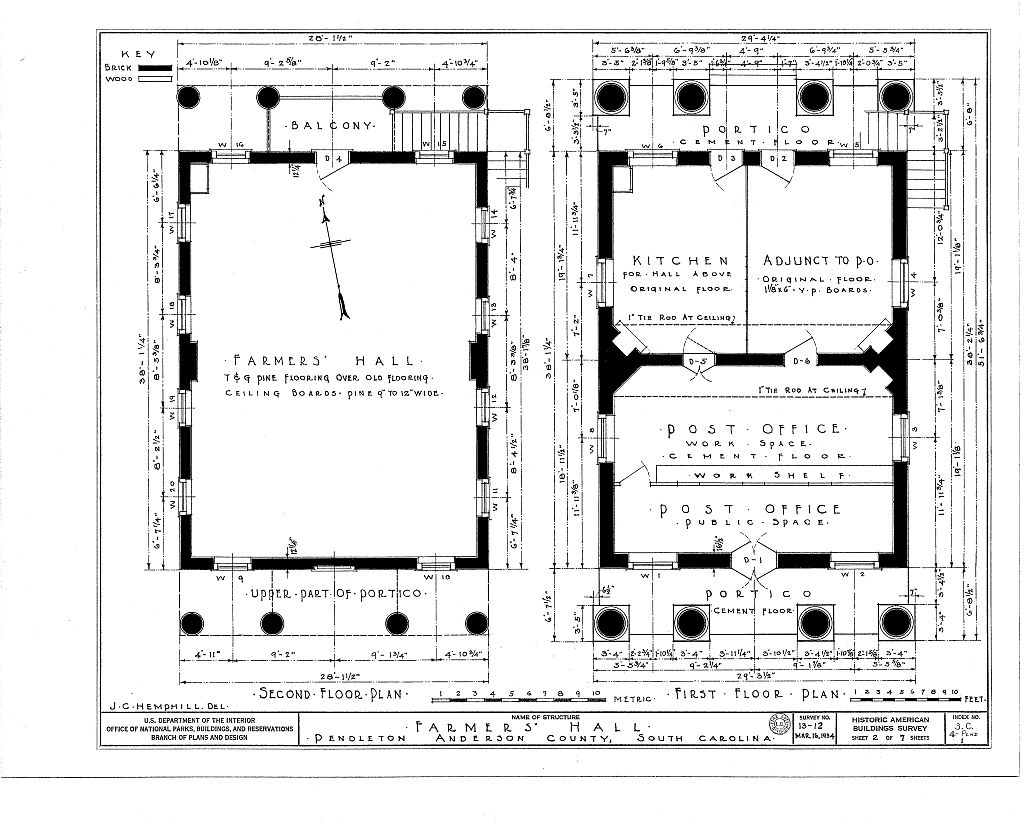
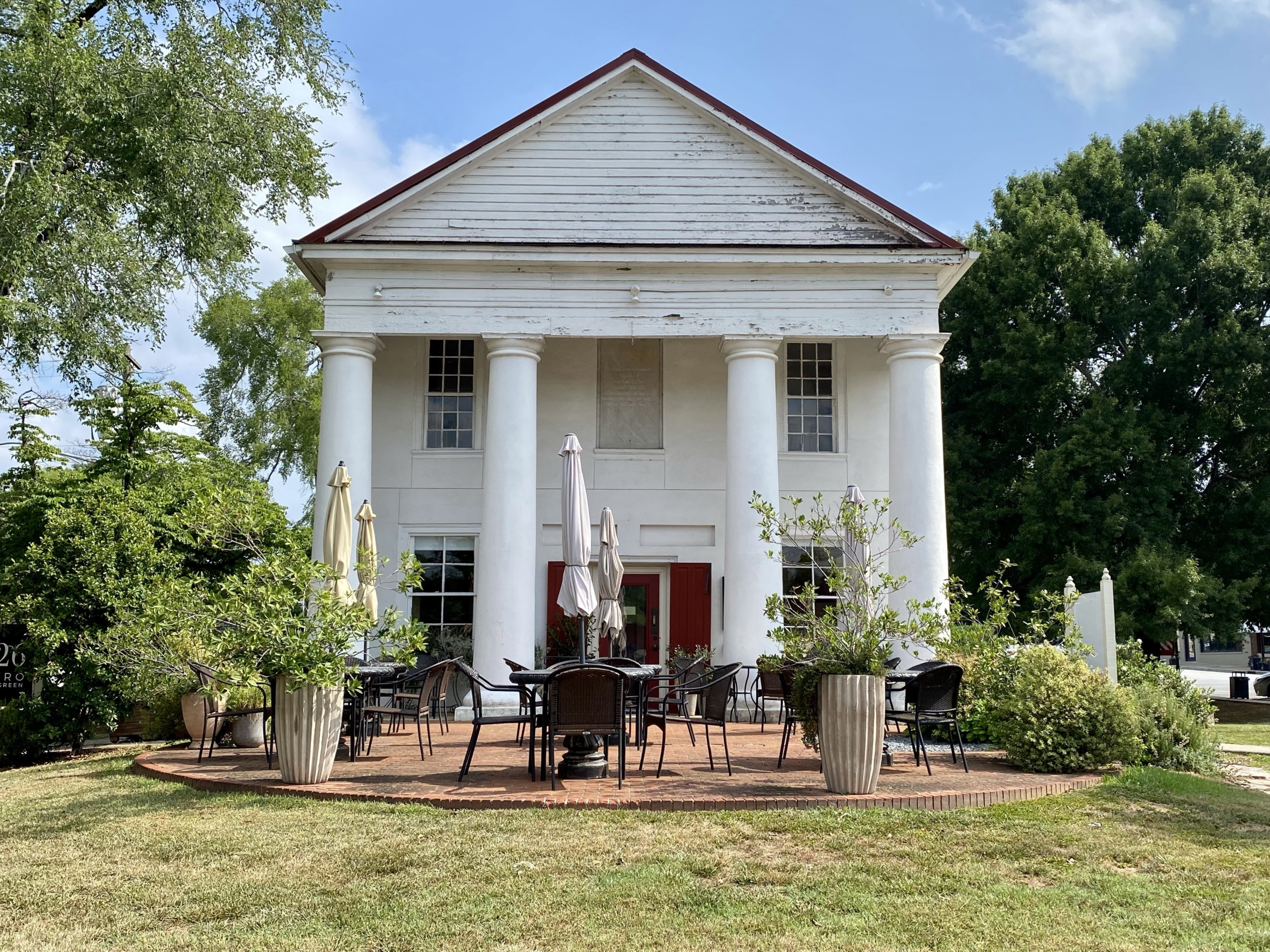
In Pendleton, South Carolina, 1849, John B. Sitton had a difficult decision to make. He knew his neighbors were angry at him. He had a position as a postmaster with a small stipend. That job put him at the center of every local event, decision, and dispute. He was situated, too, in the very center of town on the Pendleton Green. The central post office, one of the largest in the area, operated out of the prominent Farmers Hall behind substantial white columns, a Greek revival building that couldn't be missed. The authority of the postmaster and the strength of the federal government, which accorded him power, was underscored by the placement of the post office.
Sitton knew that some of his white neighbors had recently received unwelcome antislavery pamphlets in the mail. Word had spread that there were likely many more of such scurrilous materials in the sack behind his counter, waiting to be sorted and picked up. Pendleton's newly formed "Executive Committee on Vigilance and Safety," which had been established thanks in part to encouragement by their local political luminary, John C. Calhoun, was now fired up.1Stephen A. West sketches out the evolution of these Calhoun-inspired vigilance committees in From Yeoman to Redneck in the South Carolina Upcountry, 1850–1915 (Charlottesville: University of Virginia Press, 2008), 53–55. See also West's article entitled "Minute Men, Yeomen, and the Mobilization for Secession in the South Carolina Upcountry," The Journal of Southern History 71, no. 1 (2005): 75–104. The most thorough and broad context for this incident can be found in Manisha Sinha's book, The Counterrevolution of Slavery: Politics and Ideology in Antebellum South Carolina (Chapel Hill: University of North Carolina Press, 2000), especially chapter 3, "The Discourse of Southern Nationalism," 63–94. Her specific mention of Barrett can be found on page 80, in which Sinha persuasively characterizes the leaders of this movement to create viliance committees as essentially "potentates" seeking to suppress all "unorthodox" views on slavery. Here I wish to fold the role of Black witness back into the analysis because they were an implicit part of the policed audience for this bonfire.
What followed might seem merely like a small, local action: Pendletonians gathered on the village green and read aloud excerpts from offending documents, ran into the post office, and roughly pushed aside Sitton, who was trying to defend, perhaps half-heartedly, the mail. The white villagers found what they sought. On Pendleton Green, the mob burned thirty-eight pamphlets that were literally and figuratively "incendiary."2For a sense of how the word "incendiary" became a defining legal term in this context see Richard R. John, "Hiland Hall's 'Report on Incendiary Publications': A Forgotten Nineteenth Century Defense of the Constitutional Guarantee of the Freedom of the Press," The American Journal of Legal History 41, no. 1 (1997): 94–125.
At first glance, this event might seem inconsequential for the town. Although antislavery newspapers in the North picked up the story, there seem to have been no further episodes of collective burnings in Pendleton. No one appears to have held any ill will against Sitton, the postmaster. Indeed, he was elected mayor a few years later. This event occurred twelve years before the Civil War and was more of a symptom of growing tension than a cause of further rupture. Overall, the event reinforced how righteous white Pendletonians wanted to see themselves as on the vanguard of a battle, defending their way of life against anyone who might see things differently. In particular, it represented something unique about the place and the space—the town elites of Pendleton were insistent about policing ideas that might reach the less elite white neighbors.3West argues in From Yeomen to Redneck that this type of upstate vigilantism was largely carried out by the slaveholding elites and was "aimed to censor political expression that appealed to the interests of non-slaveholders"; for this region of South Carolina, West argues that "it appears more a an attempt by members of the slaveholding minority to police opinions among the slaveless majority," West, Yeoman to Redneck, 65.
And yet, the event was enormously consequential for a young man from Ohio, John M. Barrett. As those pamphlets burned, he sat in jail in nearby Spartanburg County throughout the summer heat. There he was abused and terrorized into giving up a story of those mailings and how they had found their way into the hands of citizens across South Carolina. He never fully took responsibility for these mailings, perhaps because he knew the terrible penalties for such a "crime." Still, the evidence made it clear to his allies and enemies that he was indeed involved in the scheme. Before he could confess or take on the mantle of hero or martyr, Barrett died while out on bail awaiting trial. Newspapers in Indiana, where he died, reported this as a consequence of his suffering in Spartanburg.4The jail time in Spartanburg is linked to Barrett's death in his obituary as reported in New Castle (IN) Courier, reprinted in Indiana State Sentinel (Indianapolis), April 11, 1850.
And the event was consequential, too, for the enslaved population of Pendleton, who knew and saw what was happening. The bonfire was a public spectacle for Black people, as well as any white dissenters. It was a calculated warning.
This essay explores the broader context of these events by understanding the initial spate of mailings that happened in 1835. This examination includes the author and instigator of these mailings, William Henry Brisbane; the Calhounist culture of Pendleton, SC, that fueled this particular demonstration; the sad fate of the young man, John M. Barrett, who was caught up in the materials' distribution; and the people held captive in the middle of it all, the enslaved men, women, and children of Pendleton.
Test Run: 1835 Antislavery Mail Campaign
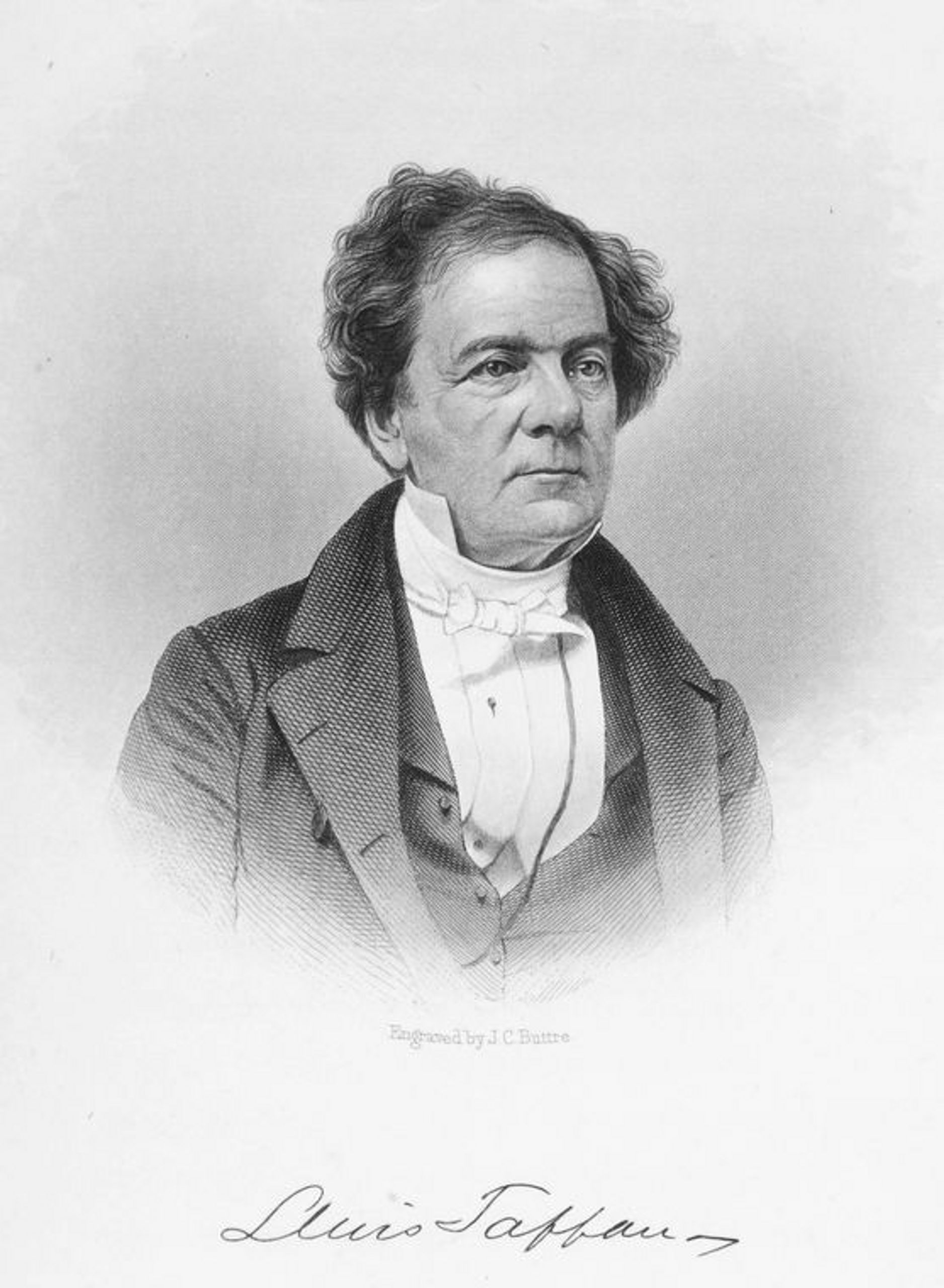
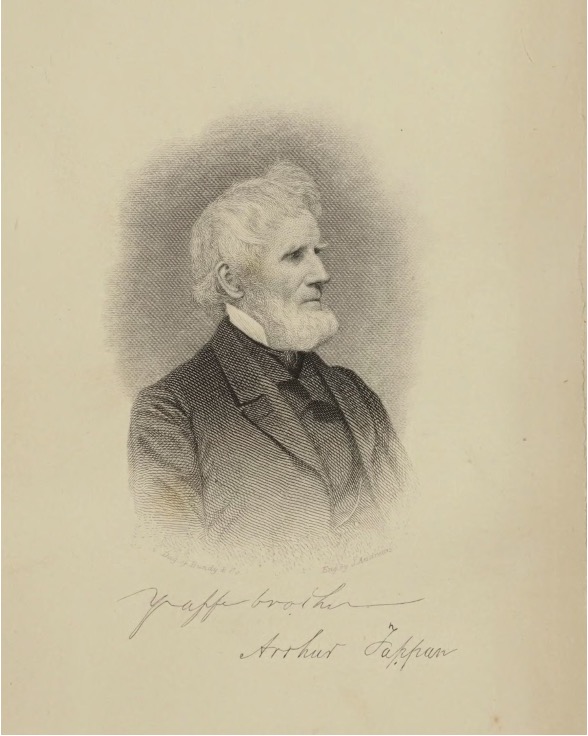
Arthur and Lewis Tappan, a Massachusetts pair of evangelical philanthropists, directed much of their money to activist causes, particularly towards antislavery organizations and endeavors. In 1835, the Tappan brothers funded an extraordinary undertaking: they helped the American Anti-Slavery Society send unsolicited abolitionist messages, newspapers, and tracts to many ministers, prominent business people, and public figures in several states below the Mason–Dixon line. This brash endeavor might well have been, to use the words of one historian, "[a campaign that] sparked the country's first crisis over postal content."5Winifred Gallagher, How the Post Office Created America (New York: Penguin Random House, 2016), 75. See also Richard R. John, Spreading the News: The American Postal System from Franklin to Morse (Cambridge, MA: Harvard University Press, 1998), 257–58.
While mailings fanned out across various states, it was in South Carolina that they were met with the most dramatic fury.6For an overview of how this was received in different states, see Wyatt-Brown, Bertram, "The Abolitionists' Postal Campaign of 1835," The Journal of Negro History 50, no. 4 (1965): 227–386. When a large bundle of them arrived at the Charleston Post Office in late July, some were delivered, but several recipients returned them to the post office with umbrage. Knowing there were more bundles of such mailings in the post office's possession and likely more about to arrive, Postmaster Alfred Huger, an enslaver himself, was flummoxed, caught between his federal duties and his angry white constituency.7For an overview of the 1835 abolitionists' postal campaign, see Susan Wyly-Jones, "The 1835 Anti-Abolition Meetings in the South: A New Look at the Controversy over the Abolition Postal Campaign," Civil War History 47, no. 4 (2001): 289–309. Also Hollis Robbins, "Fugitive Mail: The Deliverance of Henry 'Box' Brown and Antebellum Postal Politics," American Studies 50, no. 1/2 (2009): 5–25.
Aside from activist abolitionists, many political figures, even those who often clashed, could come to some shared perspectives— President Andrew Jackson advocated a federal law that would authorize censoring abolitionist mail.8Manisha Sinha, The Slave's Cause: A History of Abolition. (New Haven, CT: Yale University Press, 2016), 250. Senator John C. Calhoun argued that congressional legislation required northern postal officials to obey southern state legislation that prohibited transmission of abolitionist texts. He saw this as a power derived not from the Constitution but from states' rights and nullification, which were issues dear to Calhoun's heart.9Richard R. John, "Hiland Hall's 'Report on Incendiary Publications'", 99.
Postmaster Huger stalled before eventually deciding to have the abolitionist materials, including copies of the Emancipator newspaper, set aside in a distinct and separate bag. To no one's surprise, vigilantes calling themselves "The Lynch Men" broke into the post office. They burned the offending materials along with an effigy of antislavery activist William Lloyd Garrison. Torch-lit parades to protest these mailings were then held in towns throughout South Carolina.10Devin Leonard, Neither Snow nor Rain: A History of the United States Postal Service (New York: Grove Press, 2017), 25. See also Wyly-Jones, "A New Look," 289–309. As an 1835 lithograph suggests, the riot was well-publicized, and a gauntlet was now thrown: slavery advocates demanded mail censorship.11Attack on the Post Office, Charleston, SC, 1835, political cartoon, 15.0 x 18.5 cm, The American Antiquarian Society, Worcester, MA, https://americanantiquarian.org/earlyamericannewsmedia/items/show/48.
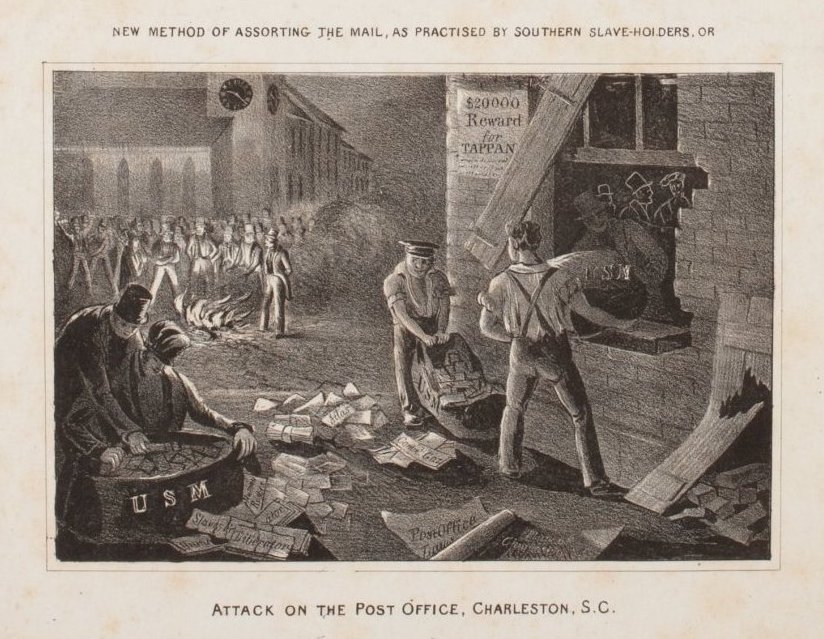
Calhoun's bill was narrowly defeated, but the controversy was directly associated with him—something that northern skeptics and southern supporters were not willing to forget. White South Carolinians knew their course of action when the next abolitionist mailing campaign occurred.
The Firebrand: William Henry Brisbane
Nothing intrigues more than that which is banned. The burnings attracted attention that occasionally thwarted rioters' goals. Abolitionist pamphlets and newspapers and the growing debates over eradicating slavery contributed to a battle for minds. Certainly, too, the white supremacists' bonfires would have affected the Black people who watched or heard about them, signaling to the enslaved that there was opposition elsewhere, that people in bondage weren't alone but had allies in the broader world. That notion was precisely what had stoked the greatest fears of the Charleston "Lynch men": the possibility that abolitionist tracts might incite violent slave uprisings.12Wyly-Jones, "A New Look," 1.
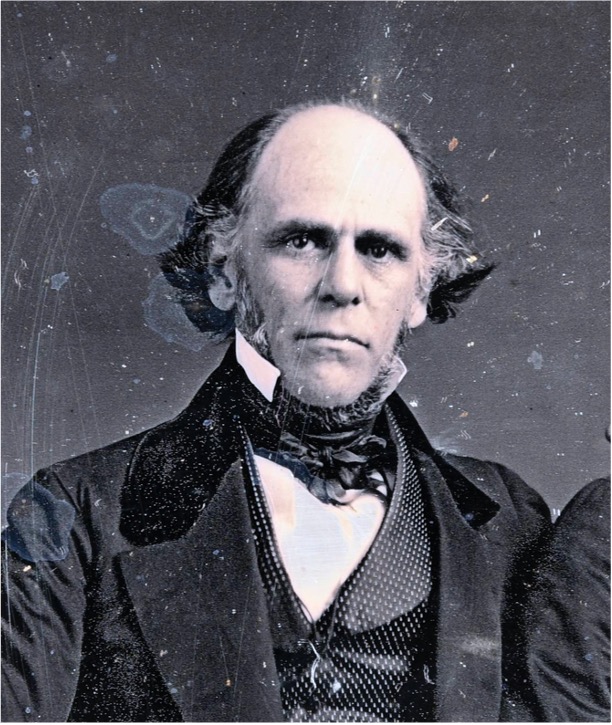
One person who stumbled into conversations about abolition was the Reverend William Henry Brisbane (1806–1878) of Beaufort, South Carolina. A man of inherited wealth and property with considerable holdings that included men, women, and children, he found he could not fully counter abolitionist arguments and gradually came to denounce slavery. Eventually, he liberated most of the people he had control over and went on to help many of them relocate with him, as free people, to Ohio. Brisbane renounced his slaveholding past and joined with antislavery activists in the Midwest and nationally to rail against the cruelties of slavery.13See Blake McNulty, "William Henry Brisbane: South Carolina Slaveholder and Abolitionist," in The Southern Enigma: Essays on Race, Class, and Folk Culture, eds. Walter J. Fraser Jr. and Winifred B. Moore Jr. (Westport: Greenwood Press, 1983), 119–129. Also see a characteristic letter from Brisbane pledging to support captives through an Anti-Slavery Society effort. William Brisbane to Lewis Tappan, January 23, 1841, Doc. no. F1-4881, American Missionary Association Archives, Amistad Research Center, New Orleans, LA.
Having been converted to the antislavery movement partly because of his own exposure to abolitionist pamphlets and arguments in the 1830s, Brisbane eventually aided the cause by authoring his speeches, sermons, and tracts, often with very pointed arguments for those South Carolinians he felt were vulnerable to persuasion.14Brent J. Morris, "'We Are Verily Guilty Concerning Our Brother': The Abolitionist Transformation of Planter William Henry Brisbane," South Carolina Historical Magazine 111, no. 3/4 (2010): 123.
Brisbane began to draft opinions under the pseudonyms of "Brutus," "A True South Carolinian," and other aliases that targeted non-slaveholding white men, particularly those from the inland and upcountry regions of the state (including Pendleton and its adjacent districts and counties)—all areas which featured less dense populations and far less concentrated wealth than was found in the coastal or "Lowcountry" region. The three most northwest counties of the state (Oconee, Anderson, and Pickens—often understood as the "Pendleton District") were perceived as being vulnerable to arguments that might appeal to white citizens feeling unrepresented or disenfranchised by the dominance of the planter politics of the state. Brisbane hoped to win "upstate" or "upcountry" South Carolina citizens over to the antislavery cause by arguing that their own best interests were to resist the political power of the class of elite enslavers and to embrace free labor.15The antislavery pamphlet, "An Address to the Citizens of South Carolina," by "Brutus" circulated in the 1849 campaign (and was actually found with John M. Barrett in Spartanburg). The pamphlet was included in his indictment. State v. John Barrett,
Spring Term 1851, Roll #17, Spartanburg County Court of General Sessions, South Carolina Department of Archives and History, Columbia, SC.
These were hardly radical diatribes. They didn't reference immediate abolition and didn't dwell on the inhumane practices of slavery. But that was the point; these liberal pronouncements against injustices burdening the life of white southerners were designed to pique the interest of otherwise indifferent or complacent citizens.
Brisbane, along with other activists from northern states, planned to launch another wave of mailings that would not overtly advocate emancipation, but would primarily rail against the injustices of a state ruled by an elite. He also hoped this would skirt around some of the further restrictions passed after the 1835 campaign. He and his co-conspirators recruited a young man from Indiana, John M. Barrett, to travel through South Carolina, gathering names and addresses and facilitating the mailings, all under the guise of a "Gazetteer," collecting innocuous data for commercial reference work.
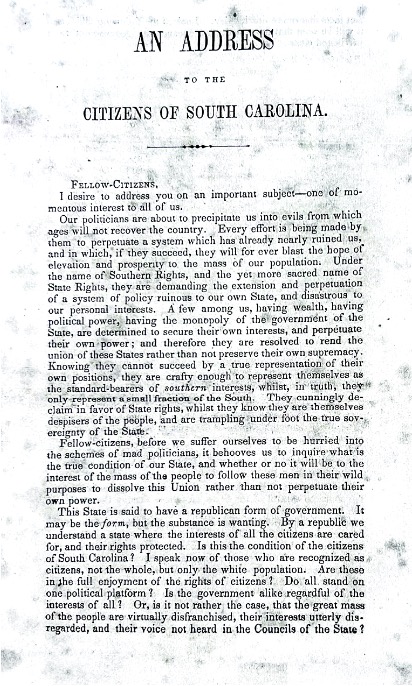
Using information and addresses supplied by Barrett, several of Brisbane's tracts were mailed to South Carolinians in 1849. Most of these did not directly advocate for the immediate abolition of slavery, much less urge uprisings or rebellions. Materials authored by Brisbane and later found in the Spartanburg post office were quoted by the Spartan as pointing out that "the great mass of citizens of the State have no PERSONAL INTEREST in slaves, and they know that the benefits of the institution are confined to a very small number of the whole white population."16"The Rev. Wm Henry Brisbane, The Traitor," Spartan, (Spartanburg, SC), April 24, 1849, reprinted in Liberator (Baltimore, MD), October 19, 1849.
As characterized by the New York Tribune, the materials Barrett was accused of circulating materials that decried "the inequality of representation between the strong slaveholding and comparatively non-slaveholding portions of the state; the rigid monopoly of office by the great slaveholders; the degraded condition and gloomy prospects of the white freemen of South Carolina who do not own slaves, etc."17"Law in South-Carolina," New York Tribune, reprinted in Lancaster (PA) Examiner, August 1, 1849. As this paper continued: "as there is no such thing as answering the facts set forth in them [the materials found with Barrett], the slaveholders have sought to keep them from being read."18"Law in South-Carolina." The New York Tribune indignantly pointed out that Barrett had not advocated for abolition at all: "[Barrett] is accused of . . . enlightening the White Non-Slaveholders of South Carolina with regard to the glaring oppressions to which they are subjected by reason of the dominance of Slavery."19"Law in South-Carolina."
Regardless of such indirect arguments or the northern interpretations of the events, white South Carolinians in power knew a threat when they saw one. Being in possession of Brisbane's work could carry with it a death sentence.20David J. McCord, ed., The Statutes at Large of South Carolina, vol. 7 (Columbia, SC: A.S. Johnston, 1840), 389–90. According to Act 15, theft of an enslaved person was a felony without benefit of clergy, which at that time meant that if convicted, you would be whipped, branded, or "suffer death as a felon."
The Spy: John M. Barrett
John M. Barrett (1825–1850) was, by his own admission, a passionate Free Soiler. He opposed the expansion of slavery into the United States' free territories and was generally aligned with abolitionist sentiment. Although he was only twenty-three, he agreed to undertake a covert and dangerous mission alone. The Anti-Slavery Society of Ohio, inspired by the 1835 campaign and with the leadership of the Reverend William Henry Brisbane, who by now had relocated to Ohio, sent young Barrett traveling throughout South Carolina. His job was to gather names of prominent clergymen, businessmen, and other white citizens, both those who enslaved people and those who did not.21One overview of the Barrett story can be found in William Sherman Savage, The Controversy over the Distribution of Abolition Literature (Washington, DC: The Association for the Study of Negro Life and History, Inc., 1938), 115–6. A more recently scholarly study can be found in Chapter Two, "Forging a United People," in West, Yeoman to Redneck, 46–65.
The plan seems to be that he would gather information and names of these influential people at various locales and send that information back to his handlers in Ohio, who would generate mailings. Occasionally his handlers would mail him things directly and ask him to forward post them on their behalf. In each imagined scenario, Barrett would be sure to leave town weeks before any incendiary mailings might arrive. This plan left Barrett vulnerable, alone, and far from any rescue if he attracted local attention.
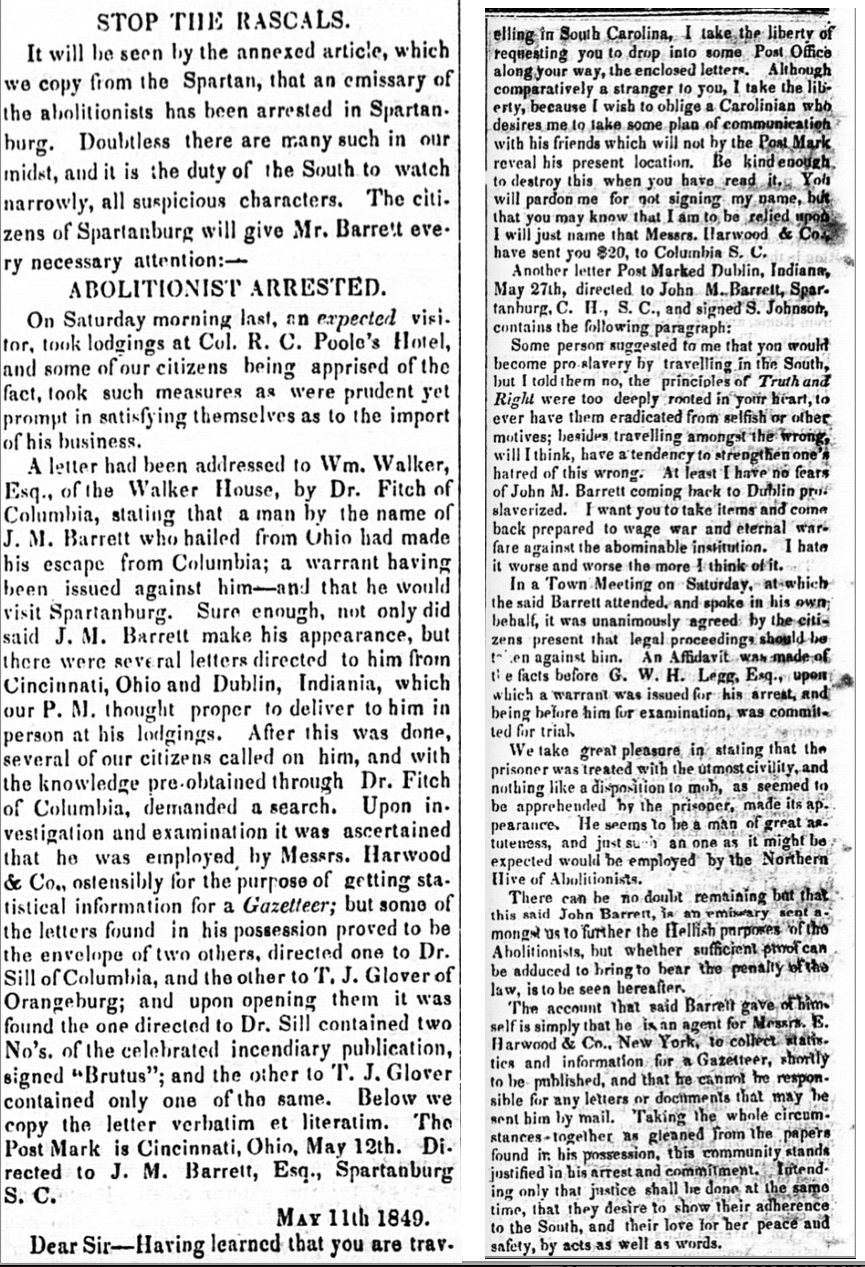
Initially, things seemed to work as intended: post offices across the state received an onslaught of pamphlets. But authorities caught on fairly quickly: first in Columbia, where a warrant was issued for Barrett's arrest. He then turned up in Winnsboro. There he was let loose for lack of evidence.22Morris, "Abolitionist Transformation," 40. Likely in Apil 1849, he made his way through Anderson County and the Pendleton District. When he reached Spartanburg, a letter from Columbia warning that he might make an appearance arrived with local officials. They detained and arrested Barrett when a letter directed to him (under a pseudonym) was found to contain what one paper termed "celebrated incendiary publications."23McNulty, "William Henry Brisbane," 124–5. See also "Abolitionist Arrested," North Star (Rochester, NY), July 20, 1849. Vague and clumsy references to letters in code and cyphers in his correspondence directed to Barrett made his situation look damning. One newspaper from North Carolina noted that if it hadn't been for clumsy cyphers, the entire affair would have seemed quite innocent.24See "Espionage in the Mails," Raleigh (NC) Register, reprinted in North Star (Rochester, NY), October 5, 1849, https://www.loc.gov/resource/sn84026365/1849-10-05/ed-1/?sp=1&r=0.086,0.73,0.275,0.143,0.
When local law officials found Barrett at Colonel R. C. Poole's Spartanburg hotel, the suspect materials, including a "Brutus" tract railing about the disproportionate political power of slaveowners and some cryptic letters from a "B.H.W." were hard to explain away.25Brutus, "An Address to the Citizens of South Carolina." See also the advertisement for Poole's hotel in Spartanburg. "Mansion House," Spartan (Spartanburg, SC), August 18, 1844.. Nor was it difficult to establish that William Henry Brisbane was the author (especially after Brisbane published a confused defense of Barrett and inadvertently confirmed his involvement).26See Brisbane's letter in the National Anti-Slavery Standard (New York, NY), September 6, 1846. In it he ends with a rather incriminating postscript: "Perhaps at some future time I shall be at liberty to communicate with your readers some things connected with this affair that I cannot now do without a breach of private confidence." While Barrett might have been able to explain possessing antislavery materials, explaining away evidence of a conspiracy to distribute such materials was going to be a fraught defense.27See "The Rev. Wm Henry Brisbane, The Traitor," Spartan, reprinted in Liberator (Baltimore, MD), October 19, 1849, and Keowee (SC) Courier, August 4, 1849.
As had happened with Postmaster Huger in Charleston in 1835, the hapless postmaster of Spartanburg, George W. H. Legg, was now caught in the middle of the controversy as he, too, refused to turn over the mail to unauthorized recipients who demanded it for inspection. By August of 1849, a warrant for Legg's arrest was issued, and he was held at least briefly in the same jail as Barrett. Legg, unlike Barrett, was quickly able to post bond.28Legg's ability to post bond is recounted in "More Nullification" from the New York Tribune, reprinted in Brooklyn (NY) Eagle, July 31, 1849. And while he was free, everyone waited for clear directions from the federal authorities, including the attorney general, about policy.29"Violation of Private Letters," Boston (MA) Evening Transcript, August 11, 1849. See also John, "Hiland Hall's 'Report on Incendiary Publications'," 275.
Barrett sat in the Spartanburg jail throughout the summer. And while he sat there, more unwelcome pamphlets and documents began to arrive across the state, stirring up fury and reviving or launching many local vigilance committees. These committees were well organized and increasingly militant.30West, Yeoman to Redneck, 53–55. The Spartanburg Committee announced that "our object will be to prevent by all means in our power the spread of these abolitionist writings among our people if harsh means be necessary 'we will not hesitate to use them,' and any incendiary hereafter caught, may expect rough treatment—by this Committee."
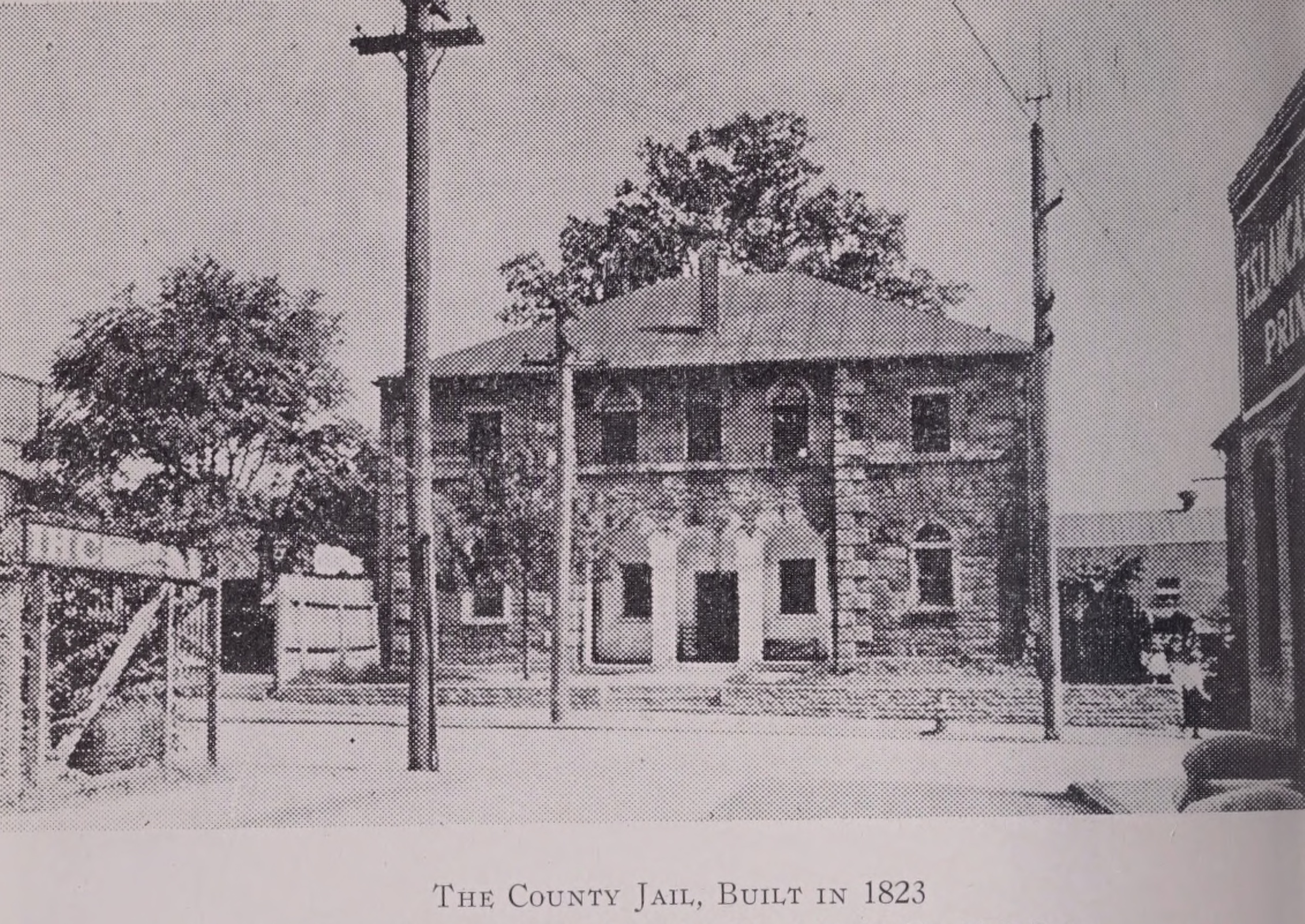
They signaled their threats to lynch Barrett or any others: "In carrying out the views of the duties imposed on us, we may in some instances have to rise above the Law."31"Fellow Citizens," Pickens Keowee (SC) Courier, September 22, 1949. The Liberator quoted Brisbane stating that John Barrett had been threatened with death, "law or no law," and that if he were to stand for trial, Barrett would be sure to face "Lynch's law."32Brisbane, "The Value of the Union," Crisis (Boston, MA), reprinted in Liberator (Baltimore, MD), January 11, 1850.
While there were some contrary expressions, on the whole, white South Carolinians followed the story with indignation and increasing fury.33See "Espionage in the Mails" for a conciliatory editorial from North Carolina arguing that mail censorship was a bad precedent. And even though the disseminated materials promoted the Brisbane-style of argument that white non-slaveholders should oppose slavery because it disproportionately empowered elites, several newspapers in southern states assessed this argument as likely to incite rebellions and uprisings among the enslaved. The Charleston Daily Courier wrote: "There can be no doubt remaining but that this said John Barrett, is an emissary sent amongst us to further the Hellish purposes of the Abolitionists."34"Another Letter," Charleston (SC) Daily Courier, June 18, 1849.
As the story developed, reporters who visited Barrett noted his ill health. A letter from him to his family was republished by the North Star in October of 1849 in which, perhaps to save his life, Barrett continued to assert his innocence and denied any knowledge of Brisbane. He was despairing, though, writing: "I almost feel that I am never to enjoy much happiness in this world. It seems to me that I am doomed to be a companion with misfortune in my course of life."35Barrett's letter to his father, Centerville (OH) Sentinel, reprinted in North Star (Rochester, NY), October 12, 1849.
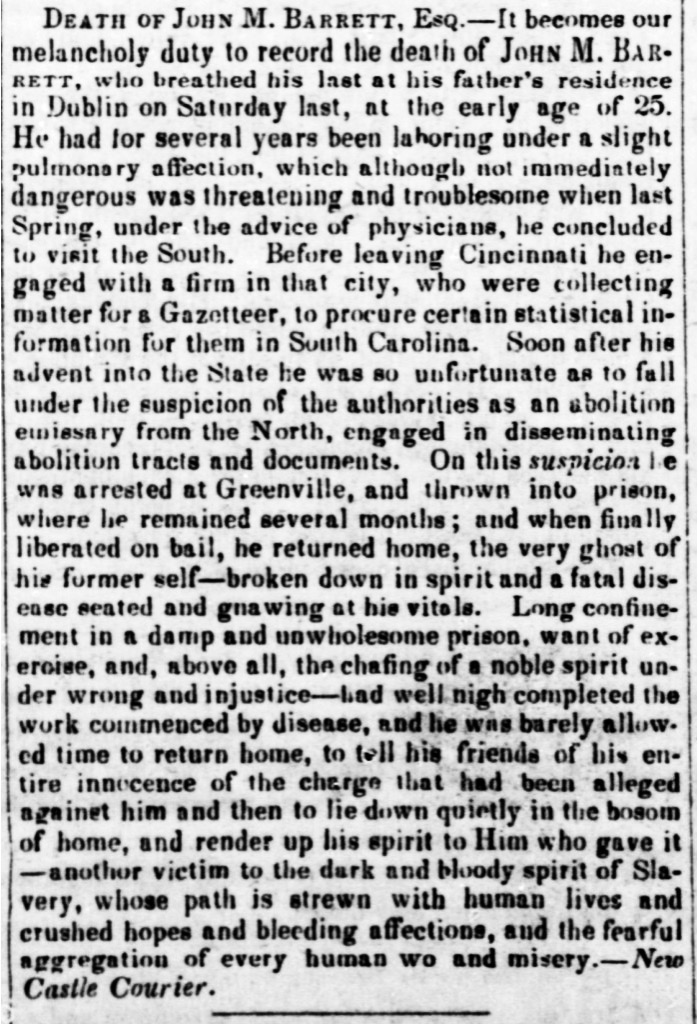
After several months, his father came down to South Carolina and finally secured his release by paying $200 in fees and posting $1,000 bail. Barrett never returned to Spartanburg for trial. He died a few months after returning to Indiana. As the New Castle Courier reported:
". . . [he was] collecting matter for a Gazetteer, to procure certain statistical information for them in South Carolina. Soon after his advent in the State, he was so unfortunate as to fall under the suspicion of the authorities as an abolition emissary from the North, engaged in disseminating abolition tracts and documents. On this suspicion, he was arrested at Greenville and thrown into prison, where he remained for several months. When finally liberated on bail, he returned home, the very ghost of his former self-broken down in spirit and a fatal disease seated and gnawing at his vitals."36"Death of John M. Barrett, Esq.," New Castle (IN) Courier, reprinted in Indiana State Sentinel (Indianapolis), April 11, 1850.
The paper goes on to explain:
"Long confinement in a damp and unwholesome prison, want of exercise, and, above all, the chafing of a noble spirit under wrong and injustice—had well nigh completed the work commenced by disease, and he was barely allowed time to return home, to tell his friends of his entire innocence of the charge that had been alleged against him and then to lie down quietly in the bosom of home, and render up his spirit to Him who gave it— another victim to the dark and bloody spirit of Slavery, whose path is strewn with human lives and crushed hopes and bleeding affections, and the fearful aggregation of every human wo [sic] and misery."37"Death of John M. Barrett, Esq."
Perhaps because Barrett never lived to see a resolution to his case and died while still professing his innocence rather than admitting guilt, he was never identified or honored as a prominent martyr for the antislavery cause. There was little recognition for his sacrifice aside from a few comments here and there, often quoting the New Castle Courier notice excerpted above. However, his co-conspirators, including Brisbane, would have carried the memory of Barrett's sacrifice with them for the rest of their lives.
The Outraged: Pendleton in 1849
Rumors and truths about Barrett reached towns across the state (often before any mail did). Citizens in Pendleton could read aloud to each other accounts of the unfolding drama of Barrett and the Spartanburg Post Office. They were keyed up for anything untoward that might appear. And then it did.
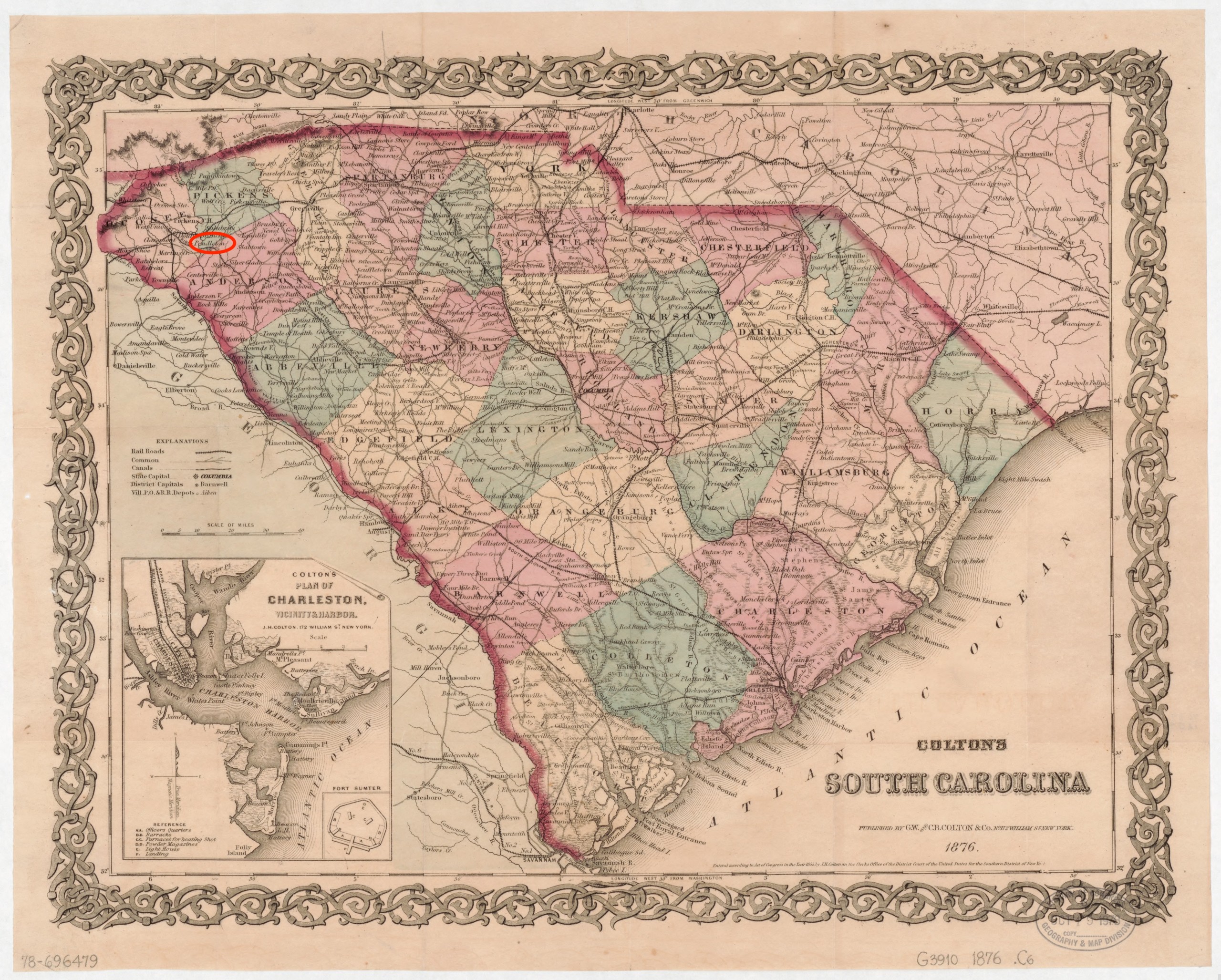
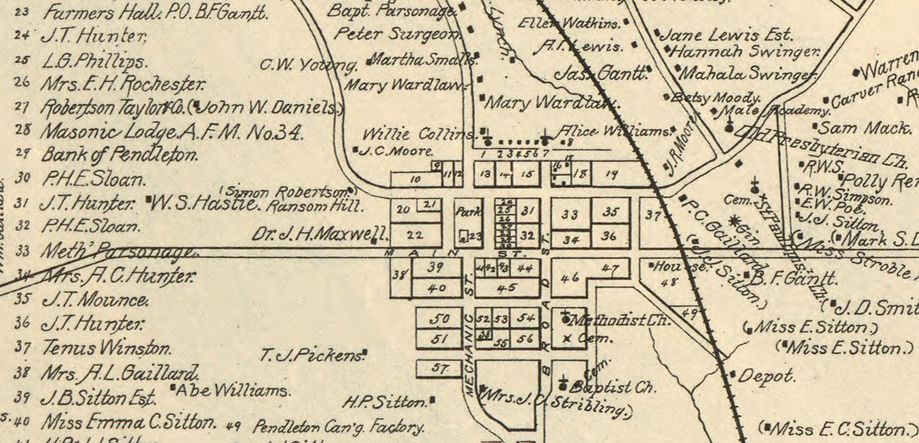
The Pendleton Messenger reported:
"We had quite a stir in our village on Friday lest, when the Southern mail was delivered . . . Col. William Sloan was among the first to receive his, and upon examination, he found a printed, post marked Boston, mailed as a letter, charged with ten cents postage, signed Junius, and addressed to the Hon. John C. Calhoun of the most malicious, offensive, and insulting character to the Southern people. This document was read by Colonel Sloan aloud, and it produced much excitement among the persons assembled."38See the August 17, August 21, September 21, and October 5, 1849 issues of the Pendleton Messenger.
There was no doubt in the minds of Pendletonians about the origin of these documents. The Pendleton Messenger wrote: "the most remarkable thing about them is the particularity and correctness with which they were directed to individuals in this neighborhood and in Pickens District on the route which Barrett traveled, and where it is known and can be proved that he obtained the names of the people."39"Abolition Documents," Pendleton (SC) Messenger, August 17, 1849.
William Sloan, who read his letter aloud to the crowd, was a prosperous local farmer who enslaved several people. He was known as a leading citizen of the town. He and many of his relatives in town enslaved people, and neither he nor Calhoun would have been the working-class white men Brisbane had hoped to reach. Sloan was also evidently comfortable enough in his civic standing, righteousness, and relationship with Calhoun to open a letter addressed to Calhoun.
Sloan and his neighbors, a group styling themselves the "Executive Committee on Vigilance and Safety," pushed their way into the building and overcame the resistance by John Sitton, a carriage maker, and merchant who also operated the post office. Appointed in 1835, he had run it from his home for a few years, but its operations had become so busy as to require a separate location.40After Sitton built a new house for himself off the Pendleton Green in the 1850s, he moved the post office out of Farmers Hall and into his first floor for a few years (perhaps to better protect the mail), but the post office operations were later moved back into the Farmers Hall a few years later. See "Sitton House," Pendleton, City Profile, accessed July 20, 2022, https://www.cityprofile.com/south-carolina/sitton-house.html. By 1849, the Pendleton Post Office was officially situated in the Farmers Hall building on the Green.
A Pendletonian who witnessed the event wrote: "The Executive Committee . . . demanded the letters of the postmaster. On his refusal to deliver them, they entered his office and took them by force."41Frederick Douglass, "Doings in South Carolina," North Star (Rochester, NY), October 12, 1849. Postmaster Sitton was unlikely to have put up too much of a fight. All of the Executive Committee members probably pushed him aside and went over or around a counter in the small space, grabbing the bags they wanted. An architectural drawing of the Farmers Hall in the early twentieth century shows that the space was small.42Thomas M. Sloan, Farmers' Hall, Village Green, Pendleton, Anderson County, SC, photograph, Historic American Buildings Survey, Library of Congress, Washington, DC, https://www.loc.gov/item/sc0102. Sitton was no abolitionist. He enslaved several people. But he did his duty as postmaster as well as might be expected with, at least, performative resistance.
This story differs from the conflicts elsewhere in South Carolina in part because Pendleton was unlike other communities Barrett had gone through. Some postmasters did not resist as Sitton had resisted. James E. Hagood in nearby Pickens had personally and preemptively burned some fifteen to twenty pamphlets when he realized they had arrived in his district. Nor did he wait around for a mob to help him. Newspapers recorded other incidents of irritated recipients of antislavery materials across South Carolina. Individuals across the state proudly announced that they, too, had taken it upon themselves to burn such documents.43"Save Your Ink and Paper," Pickens Keowee (SC) Courier, August 25, 1849. But the collective effort in Pendleton suggests a reaction that speaks to the particularity of that place and time.
While the most intense spate of mailings targeted the Upstate, Pendleton was no backwater filled with poor white citizens who might conceivably be receptive to Brisbane's argument against the entrenched and elite political class that ruled the state. It was, instead, a densely populated and established enclave. Significantly, Pendletonians culturally and politically aligned themselves not so much with the Appalachian Scots-Irish settlers in the mountains or the white working-class of non-slaveholders common in the Piedmont. Instead, the town was quite invested in identifying itself with the wealthy sojourners from the Atlantic coast who often vacationed there to escape the summer heat and who had built numerous mansions encircling the town boundaries. Many of the town people were merchants or tradesmen, not planters, but they certainly aspired to join those more elite ranks that gave their town a reputation for gentility.44A genteel and happy history of Pendleton can be found in Mary Esther Huger, The Recollection of a Happy Childhood (Pendleton, SC: Research and Publication Committee, Foundation for Historic Restoration in Pendleton Area, 1976). See also R.W. Simpson, History of Old Pendleton District: With a Genealogy of the Leading Families of the District (Anderson, SC: Oulla Printing & Binding Company, 1913).
While the Upstate or Piedmont region of South Carolina was generally white-majority with far fewer large slaveholders than the coastal region—and was populated with many small yeoman farmers who made a living on properties with poor soil or with the topographic challenges inherent at the foothills of the Appalachians—Pendleton itself was different. It boasted both female and male academies of some repute. It had a long-running circulating library.45Frances Lander Spain, "Early Libraries in Pendleton," The South Carolina Historical and Genealogical Magazine 50, no. 3 (1949): 115–26. For references to the carriage-making reputation of the town, see "Pendleton," The Historical Marker Database, accessed July 20, 2022, https://www.hmdb.org/m.asp?m=9614. Local white artisans, usually assisted by enslaved workers, operated high-end cabinet making and carriage construction businesses that attracted an elite clientele. Pendleton featured wealthier and more politically influential families than many other Upstate towns. The opulent summer houses, hunting lodges, and manor-style properties built around the town by enslaved labor signaled to inhabitants and visitors that they were now in a special and more affluent place than other Upstate villages of comparative size.
Most of all, this town aligned itself with the reputation and identity of their great patron, the illustrious John C. Calhoun, who had long called for censorship of the mail when it came to abolitionist materials.46West, Yeoman to Redneck, 52. Calhoun didn't just represent their state or district; he was their hometown celebrity and a founding member of The Farmers Society, which had built the impressive columned building that housed the post office.
That the round of mailings included at least one pamphlet directed explicitly to the now quite elderly Calhoun may have especially raised the hackles of Pendleton, always protective of the revered statesman. This connection did not go unremarked: As the Brooklyn Eagle noted: "It appears that [the cause of] Mr. John M. Barrett . . . has been taken up by some of John C. Calhoun's minions in South Carolina."47"More Nullification," New York Tribune, reprinted in Brooklyn (NY) Eagle, July 31, 1849.
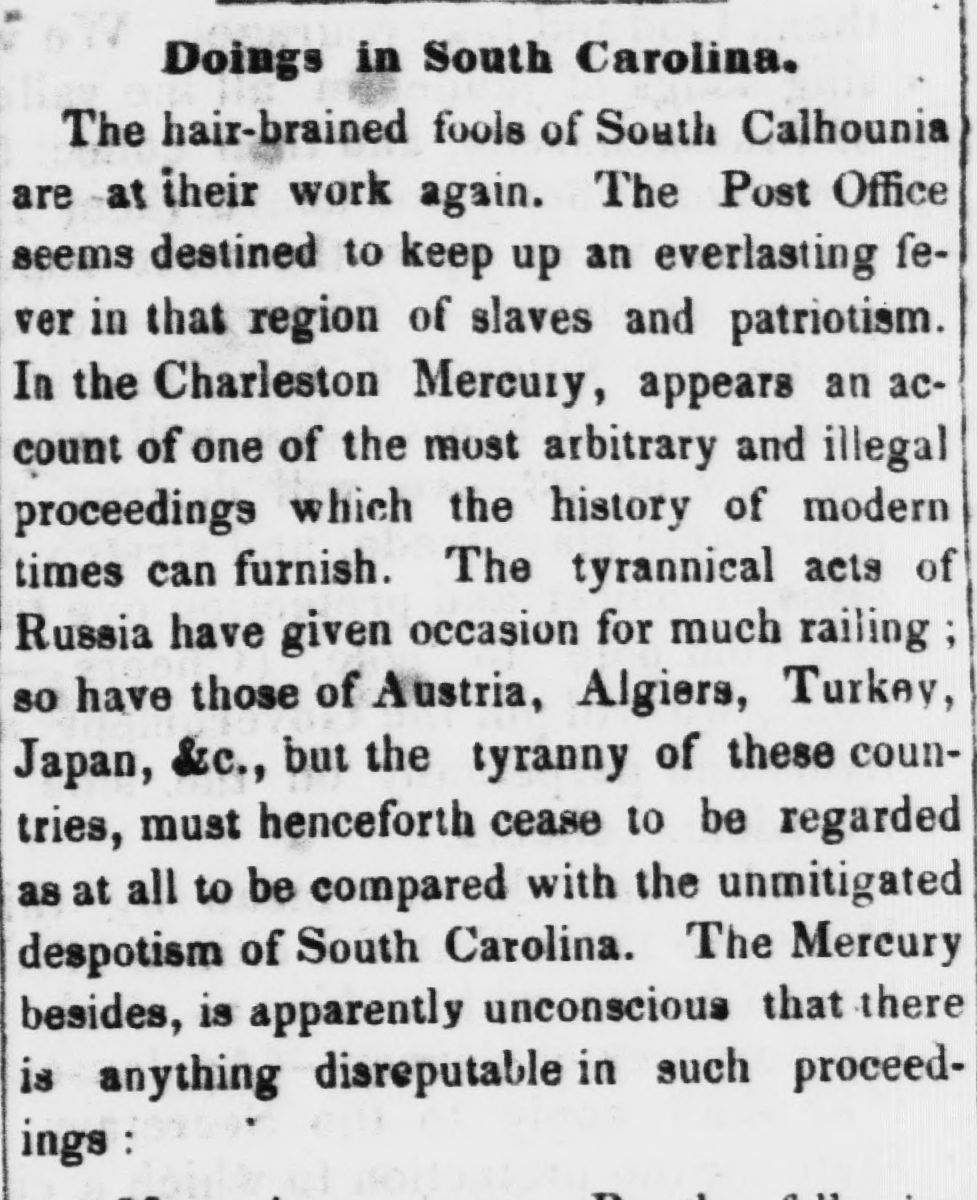
The alignment of Pendleton and Calhoun was common knowledge. In his newspaper Frederick Douglass characterized the activities of the Pendleton vigilantes: "The hair-brained fools of South Calhounia [sic] are at their work again" above a reprinted letter from a Pendletonian about the Barrett case.48Douglass, "Doings in South Carolina."
This, too, is a story of media power. It is not merely incidental that Pendleton, in 1849, had a newspaper office. At the time of the bonfire, the Pendleton Messenger directly faced the conflagration on the Green. The press was right there to witness, observe, opine, and energetically disseminate the happenings. The Pickens Keowee Courier, another leading paper of the area which at that time was run by editors previously involved with the Pendleton Messenger, also dedicated a lot of ink to the Pendleton happenings.49See West, Yeoman to Redneck, 63. West argues persuasively that the hullabaloo about the press coverage of the Barrett case was not soon forgotten. When, in 1859, vigilantes in Greenville seized a man for holding books and pamphlets they found objectionable, they sought to keep it quiet and out of the newspapers.
Long associated with Calhoun, the Pendleton Messenger had first published his most famous writings on nullification in in the 1830s. It shouldn't be surprising that the paper was especially protective of the celebrity politician who put Pendleton on the map. In general, citizens of the Upstate and the media acolytes of Calhoun were determined to be at the forefront of outrage and resistance.50See Susan Hiott, "Pendleton Messenger," South Carolina Encyclopedia, updated May 22, 2018, https://www.scencyclopedia.org/sce/entries/pendleton-messenger/.
While the Pendleton Messenger ended as the town's newspaper in 1851, its building at 1254 Exchange Street on the Green still stands as the locus of a different kind of political and media power. As of 2022, the old Pendleton Messenger building currently houses the office of longtime US Senator from South Carolina, Lindsey Graham.
The Black Witnesses
Burning mail on the Pendleton Green was probably one of the least violent acts many of these white men enacted in any given week. Black men, women, and children, as well as many Native people, had long been held in bondage in the Upstate of South Carolina. They were controlled by the perpetual threat of violence that, as Orlando Patterson famously codified in his study Slavery and Social Death, was one of the defining and vital tools that enabled the practice of enslaving another human being.51See Orlando Patterson, Slavery and Social Death: A Comparative Study with a New Preface (Cambridge, MA: Harvard University Press, 2018). The power of violent coercion, usually through implicit or explicit threats, was necessary to maintain control over others.
The burning of the antislavery mail was simply another manifestation of this threat. It was a violent rhetorical performance and visible event designed for publicity and to send a message to abolitionists and to white non-slaveholders in the southern states that no contrary thinking could be countenanced.
Black people, the resistors and agents of abolition and antislavery long before the creation of any organizations with those names, would not have needed pamphlets with timid arguments to tell them of injustices. But what might they have thought or felt upon seeing the flames in Pendleton?
Direct records of African Americans' thoughts are not currently part of the material archive. And while we have the outrage of Black audiences expressed in northern papers, we must be careful in speculating about the reactions of Black witnesses in Pendleton. But we would be remiss not to speculate. Their historical presence at the scene is indisputable. To affirm a different kind of Black memory work, we must grapple with the notion that many people watching or smelling that bonfire were aware that their presence was impossible, unregistered, and ignored. And yet, their presence was part of the story, perhaps the most crucial part.
Understood in part as an act of publicity and surveillance, the Pendleton bonfire and its newspaper coverage ensured a wider awareness of violence and racial control. Editors knew well that papers elsewhere would pick up and reprint their reporting. The bonfire also had the cruel effect and intent of warning anyone in the Black population not to feel emboldened or hopeful that they might have allies for liberation. The bonfire was, in many ways, for their witness.
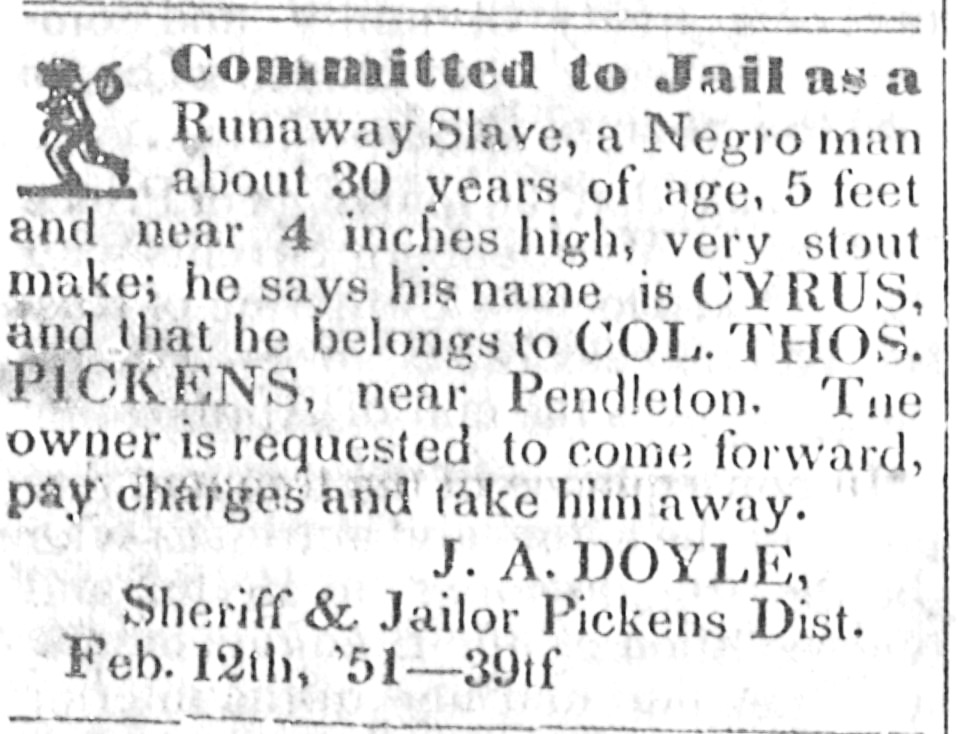
Of course, that message was mixed: white townspeople were kicking up a fuss about a cultural force that had escaped their control. And as they railed against antislavery mail, perhaps it encouraged some Black villagers to self-liberate. Cyrus, for one, enslaved at a labor camp near Pendleton, escaped in 1851.52"Committed to Jail as a Runaway," Pickens Keowee (SC) Courier, February 15, 1851. Although recaptured, he clearly had decided he wouldn't wait for someone to intervene on his behalf.
Anderson courthouse records indicate that in the 1840s a woman named Sylvia hid for eleven weeks in a barn until she accidentally left some clothing in nearby Pendleton and was discovered. The enslaved man in Pendleton who harbored her, Harry, was sentenced to fifty-seven lashes. What happened to Sylvia is unclear but the family and friends of Harry and Sylvia knew to be fearful of the long reach of the Pendleton area authorities.53For the story of Sylvia and Harry, see W. J. Megginson, African American Life in South Carolina's Upper Piedmont 1780–1900 (Columbia: University of South Carolina Press, 2006), 84. W.J. Megginson's work with the Anderson Court records provides many rich examples of the ways in which the culture of the justice system in the upstate of South Carolina controlled Black life. They had carved out some moments of resistance, but the surveillance culture of the Upstate left little room for triumph.
Like most southern-state newspapers of the era, the Pendleton Messenger drew a solid revenue stream from advertising sales of women, babies, children, and men. Almost every issue throughout the 1840s featured such advertisements. In one dated October 27, 1843, the local sheriff's office not far from Pendleton offered for sale Lenah and Jack with their children Beck, Peter, and three "younger ones" in order to pay off their enslaver's debts. From its inception the Pendleton Messenger specialized in silencing the voices and diminishing the personhood of Black people, marketing families like Lenah and Jack's. Literate or not, enslaved persons would have known to be wary of the ways in which news traveled.54"Sheriff's Sales," Pendleton (SC) Messenger, October 27, 1843.
The Pickens Keowee Courier ran advertisements for enslaved people aligning them with sales of animals such as one in February 1, 1851, notifying the public of eighteen people available for purchase.55"Administrator's Sale," Pickens Keowee (SC) Courier, February 1, 1851. The circulation of print in Upstate South Carolina helped set the value of the enslaved and affirm the values of enslavers.
Black activists from afar took note of the frantic reactions to antislavery mailings. "These violent measures resorted to by the slave mongers," wrote Frederick Douglass, "may be regarded as evidence that they see their weakness and the untenableness of their position."56Douglass, "Doings in South Carolina." That fact that updates about John Barrett and the protests were carried in the Anti-Slavery Standard and the Liberator, periodicals with significant Black readership, indicates a kind of displaced testimony to the events, particularly when you consider how these papers frequently reprinted in their entirety articles which had initially appeared in the South Carolina papers.
More concretely, we can return to the site of Pendleton to imagine the role of Black witness. The archival record doesn't record specific witnesses by the people most affected by the event, but when we adjust our attention to see the presence of Black life around that village green, possibilities for seeing the space anew emerge.
Many Black people lived and labored within a short stroll to the Green. Many of the Pendleton men involved in the bonfire, if not all, were enslavers or likely aspirational enslavers. Both Sitton and Sloan, for example, held men, women, and children laboring in bondage on their properties only a few hundred feet from the Green.
A blacksmith's shop was only half a block away from enslaved workers. Indeed, almost every house close to the Green in that period was owned by an individual who shows up as an enslaver on the Federal Slave Schedules of 1850. Black people must have seen the event, perhaps peeking from windows or viewing from alleys. Perhaps from porches at mansions only a block away, enslaved people washing linens or handling horses saw the smoke and heard the yelling. Would they have shrugged and kept their heads down? Likely they realized this agitation represented something more. Were the white people in Pendleton enraged because they were being challenged? Somebody had caused problems and drawn their ire. Doubtless the news traveled.
The enslaved were all around, on acreage outside the town limits as well as close by to attend to domestic tasks. Elam Sharpe, for example, who owned a large house steps away from the Green, held six enslaved people according to the census record of 1840; by 1850 a slave schedule reported he owned thirteen unnamed people. Some of those were women and young children.57"Elam Sharpe," 1850 United States Census (Slave Schedule), Anderson County, SC, NARA series M432, Roll 861, Family Search, accessed July 25, 2022, https://familysearch.org/ark:/61903/1:1:HRWH-H73Z. They might not all have resided at his "in-town" property; some of these women exploited as domestics would undoubtedly have worked in the two-story house in Pendleton. Would these women, occupied with cooking or laundry, have seen a stream of agitated white men passing by their home on the way to the Green? Would have heard the cheering and smelled the smoke? Sharpe's brother-in-law was the editor of the Pendleton Messenger, operating two blocks away, so his household, including the enslaved, would undoubtedly known all about the events. The carriages or horses of the Pendleton Vigilance Committee would have passed by the front porch on the way to the conflagration.
Owned and run by the Maverick family in the 1840s, Montpelier, one of the large plantation labor camps sited on what is now Old Greenville Highway was only a few minutes by wagon from the town center. At least thirty-seven men, women, and children were held in bondage there.58"Samuel Maverick," 1850 United States Census (Slave Schedule), Anderson County, SC, NARA series M432, Roll 861, Family Search, accessed July 25, 2022, https://familysearch.org/ark:/61903/1:1:HRWH-4ZZM. Would word reach them, soon after the event? Would they know people out there in the world were decrying slavery and perhaps have felt a little less alone?
Given the social space of Pendleton, many Black people would have been in the vicinity of the bonfire, watching it or perhaps doing their best to keep far away. Pendleton's population (both the town proper and the broader "Pendleton District") during the early nineteenth century was notably more dense than in many other areas of the Upstate, and their holdings of enslaved people considerable, albeit dispersed among numerous white families. White Pendletonians enslaved people at higher rates than surrounding white populations. According to the 1860 census, the combined population of Oconee and Pickens counties, which encompassed much of the Pendleton District, included 500 enslavers who held 4,195 people in bondage. That's a high number but nothing like comparative statistics in the central or southern parts of the state.59For a good understanding of these numbers, see Megginson, African American Life, 8. Consider how Charles Joyner, in his study of the All Saints Parish in coastal South Carolina (known as the Lowcountry) demonstrated that in the 1860s fifteen wealthy planters enslaved 4,383 people.60Charles W. Joyner, Down by the Riverside: A South Carolina Slave Community (Urbana: University of Illinois Press, 1984), 19. Certainly the Upstate or Pendleton District was quite unlike the Lowcountry. But, the small town of Pendleton was itself quite different from its surrounding areas—and would have felt a bit more like a Lowcountry town in terms of its affluence and its ratio of enslaved people to the white slaveholding populations. The town of Pendleton, as the 1860 census reported, counted 383 white people, one lone free person of color, and 470 enslaved persons.61Population data from 1860 can be found in Joseph Kennedy, Population of the United States in 1860 (Washington, DC: Government Printing Office, 1864), 448–455, accessed July 25, 2022, https://www2.census.gov/library/publications/decennial/1860/population/1860a-32.pdf. Individual enslavers in town held humans in their inventory but so did business entities: The Pendleton mercantile firm of W.H.D. Galliard & Co., for example, listed four enslaved laborers sited on premises near the Pendleton Post Office.62Megginson, African American Life, 8, 114.
Even though many of the affluent white sojourners from the Lowcountry who spent extensive vacation periods in Pendleton left the bulk of their enslaved work crews to endure the rice or cotton plantation labor camps, they would have traveled with a domestic retinue of the enslaved to their Pendleton retreats.
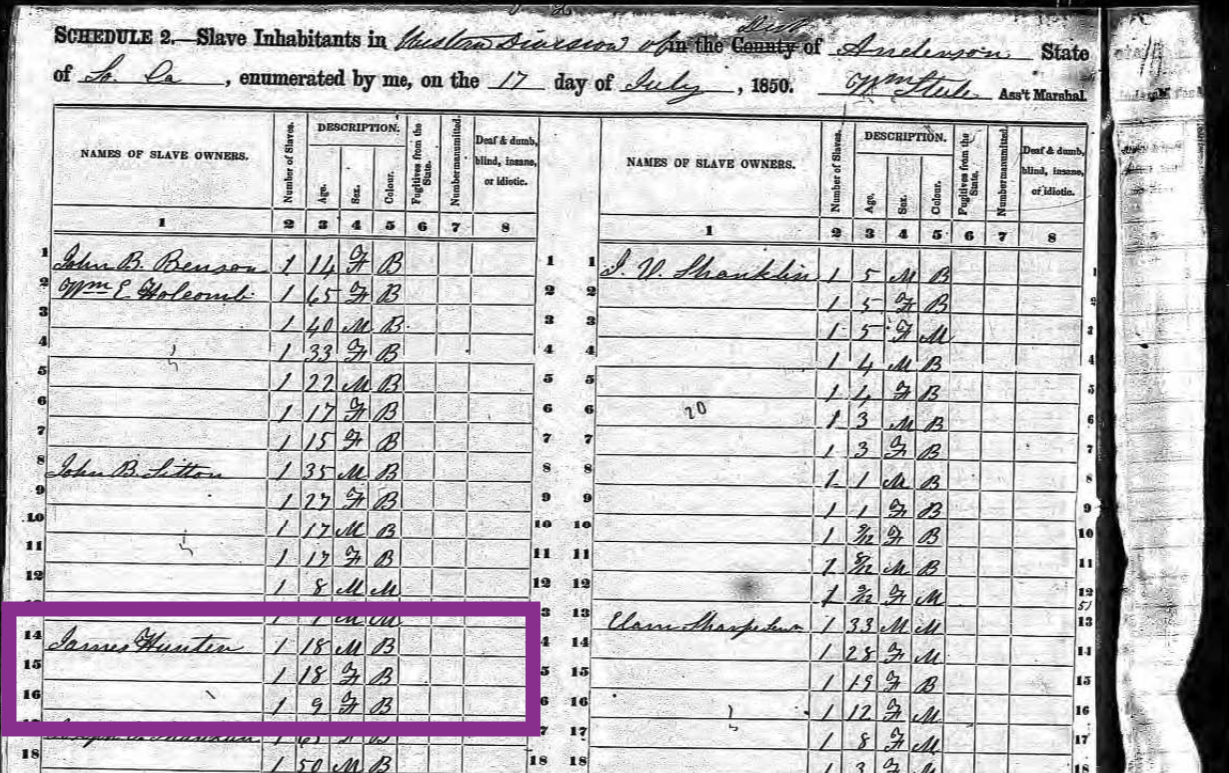
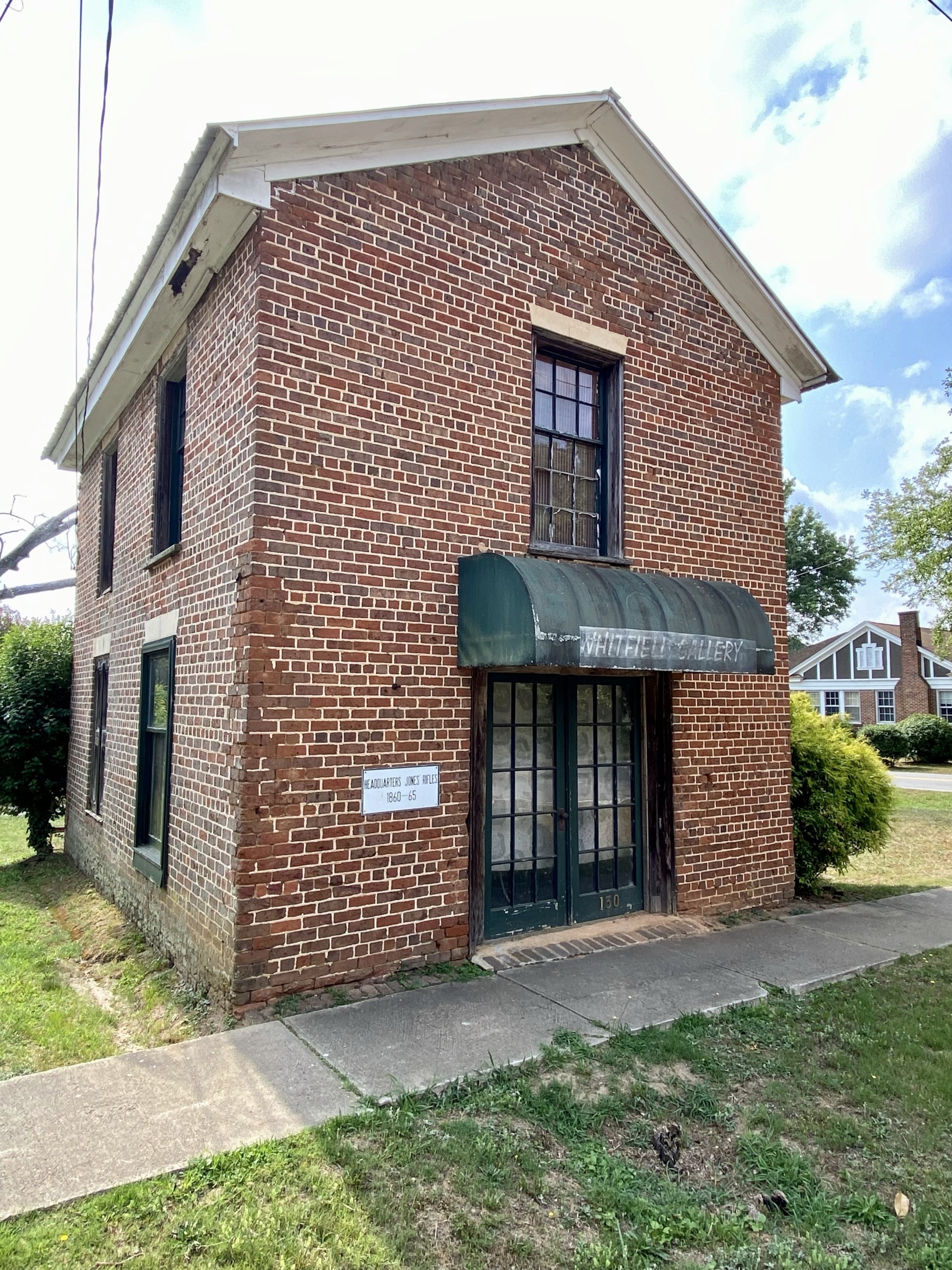
There were more Black people close to the Green for other reasons, too. A few free Black people could even conduct business at the establishments there, but almost every business owner in the town held a few people in bondage. James Hunter, for example, ran a blacksmith shop right off the Green, doubtless assisted in part by one of the three Black people he enslaved, most likely the unnamed eighteen-year-old man listed in the 1850 slave schedule.63"James Hunter," 1850 United States Census (Slave Schedule), Anderson County, SC, NARA series M432, Roll 861, Family Search, accessed July 25, 2022, https://familysearch.org/ark:/61903/1:1:HRW4-GYN2.
There were boarding houses and hotels located within shouting distance of the Green, all of which had travelers with enslaved servants passing through as well as a handful of enslaved people, ensuring that hosting routines went smoothly. They, too, might have seen the fires or the ashes. The Female Academy of Pendleton was located kitty-corner from the Green. While the white students did not board there (they tended to live at houses within walking distance), at least one or two enslaved Black workers stayed on hilly site to tidy the property, clean the classrooms, stoke the fires, and stand ready with carriages and horses to pick the young ladies up and transport them as needed.64For references to the various incarnations of the Female Academy in Pendleton see "South Carolina Education—Anderson County," Carolana, accessed July 20, 2022, https://www.carolana.com/SC/Education/sc_education_anderson_county.html.
A creative cognitive map of Pendleton's enslaved population of 1849 reveals plenty of Black people in proximity to the fiery events. They would have mapped the terrain differently as their perceptions of joined places and slave neighborhoods would not have coincided with officially sanctioned property lines defined by enslavers.65For an overview of this concept see Anthony E. Kaye, Joining Places: Slave Neighborhoods in the Old South (Chapel Hill: University of North Carolina Press, 2007) and "'In the Neighborhood': Towards a Human Geography of US Slave Society," Southern Spaces, September 3, 2008, https://southernspaces.ecdsdev.org/2008/neighborhood-towards-human-geography-us-slave-society/. The entire township, not merely a particular site of bondage, would have encompassed their neighborhood.
The Pendleton Green, town center for white villagers, was likely traversed with great care by Black Pendletonians, who would have understood the performative terrorism and the threat it signified. News carried fast. This was a story for them, about them, and directed at them with cruel menace.
Conclusion
Pendleton today benefits from proximity to nearby Clemson University and tourism. The entire town is on the National Registrar of Historic Places, making it one of the country's largest designated districts.66For details about this historic designation, see "Pendleton Historic District," South Carolina Historic Properties Record, accessed July 20, 2022, http://schpr.sc.gov/index.php/Detail/properties/11705. For the claim that the district is exceptionally large, see "Anderson County, South Carolina," Carolana, accessed July 20, 2022, https://www.carolana.com/SC/Counties/anderson_county_sc.html. It features over fifty buildings dating from the eighteenth and nineteenth centuries. While now promoting restaurants and antique stores more than carriage making or agriculture, it's a lovely place to stroll.67 "Pendleton Historic District, Anderson County (Pendleton)," South Carolina Department of Archives and History, accessed July 20, 2022, http://www.nationalregister.sc.gov/anderson/S10817704013/index.htm.
The Pendleton Foundation for Black History and Culture has worked hard to redirect and enrich much of the public discussion about local history. They have drawn attention to local sites important to Black history; in particular, the significance of the Keese Barn site, only a few hundred steps from the Green, which in the early twentieth century became a gathering place for African Americans.68"About Us," Pendleton Foundation for Black History & Culture, accessed July 19, 2022, https://blackhistorypendleton.org/about.
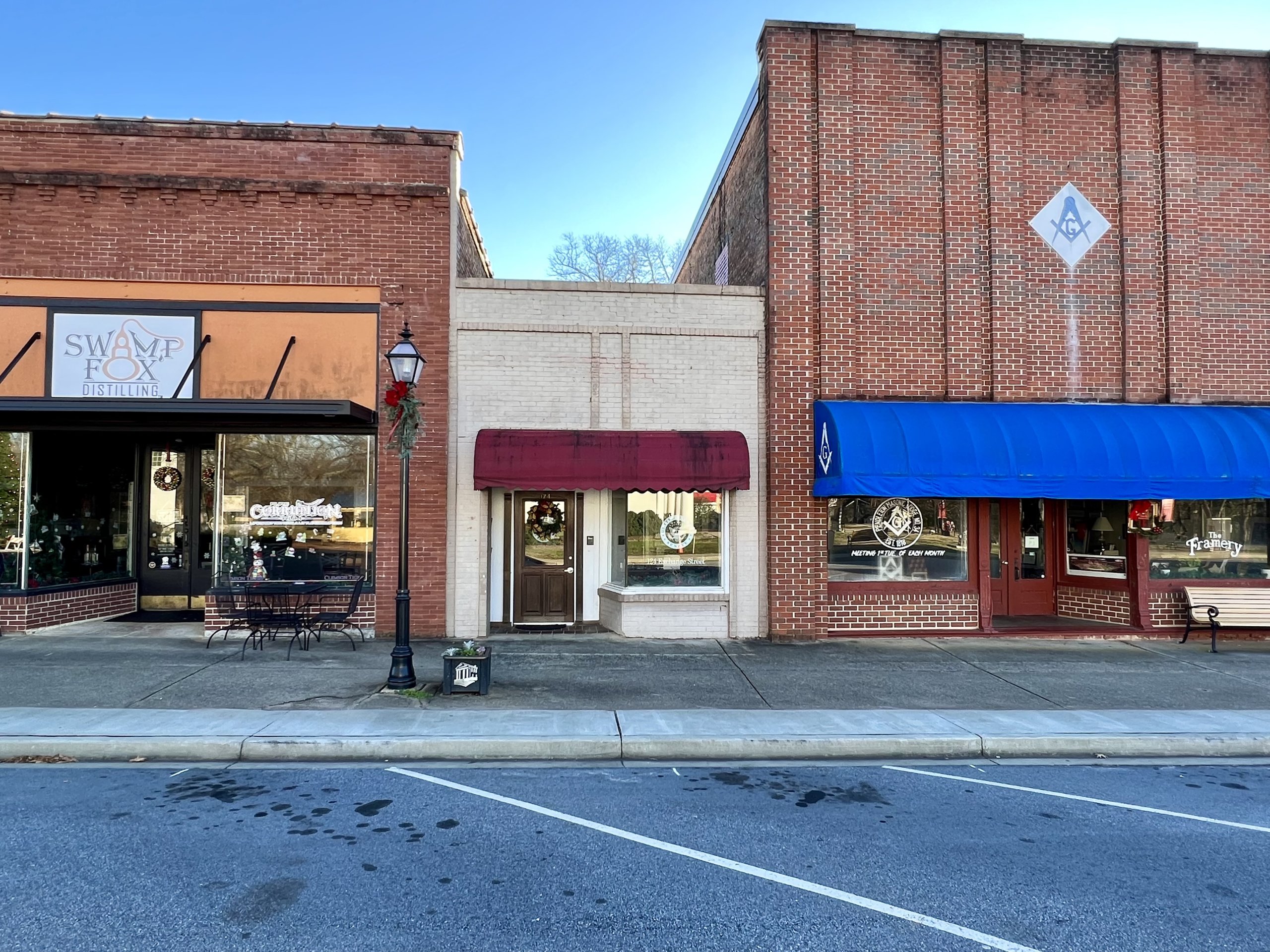
The story of the Green demands a more complex reckoning than the current historic markers allow. The Farmers Hall still stands in its stolid beauty with its colossal columns. A bustling restaurant called the 1826 Bistro on the Green now occupies its first floor, where the post office once operated.69"1826 Bistro," 1826 Bistro, accessed July 19, 2022, http://www.1826bistro.com/. A bookstore overlooks the Green as do gift stores and a Mexican café.70"Home," The Pendleton Bookshop, accessed July 25, 2022, https://www.pendletonbookshop.com/; "Welcome to Vaquaros Mexican Restaurant," Vaquaros Mexican Restaurant, accessed July 25, 2022, https://www.vaquerosinthesquare.com/; "Home," Mountain Made American Handcrafts, accessed July 25, 2022, https://potteryinpendletonsc.com/. Farmers markets, annual festivals, and local protests, particularly those seeking the attention of US Senator Lindsay Graham, whose office overlooks the Green, regularly enliven the public space.71"Home," US Senator Lindsey Graham, accessed July 19, 2022, https://www.lgraham.senate.gov/public/. But the story of the gathering of white supremacists attacking the federal post office and casting pamphlets into a bonfire remains little known. 
About the Author
Susanna Ashton is a professor of English at Clemson University. She studies the writing and witness of enslaved people, particularly those from South Carolina. Ashton holds an MA and a PhD in English from the University of Iowa and received her BA from Vassar College. She has held fellowships at Yale, Harvard, Emory, and the University of South Carolina, and has served as a Fulbright Faculty fellow at University College Cork in the Republic of Ireland. Most recently, she was a W.E.B. Du Bois Fellow at Harvard's Hutchins Center for African and African American Studies for 2021-2022. Ashton's current project, John Andrew Jackson, the Hidden Inspiration Behind Uncle Tom's Cabin, is forthcoming from The New Press, 2024. She lives approximately three miles from the Pendleton Green.
Acknowledgments
I thank Doug Seefeldt (Clemson History) for the opportunity to assemble this story for the public. Thanks are also due to Tara Wood and Brenda Burk for their kind assistance. Staff members at the Anderson County Main Library’s Genealogy and Local History section were especially helpful in finding images of Pendleton. Librarian Mary Lanham, especially, was quite generous with her time. Librarian Daniel Bonsall helped me sort through some puzzling Pendleton statistics. Clemson Colleagues Jessica Serrao, Josh Catalano, and Amanda Regan were models of kindly instruction. The staff at the South Carolina Room at the Hughes Main Public Library in Greenville, the Pendleton Branch Public Library, and the South Carolina State Department of Archives and History (particularly Dr. Steve Tuttle) went beyond the call of duty in helping me assemble the materials undergirding this project. The curators at the South Carolina State Dept of Archives and History were especially helpful in getting me court documents related to the trial, including an actual and rather extraordinary copy of the particular Brutus tract the Spartanburg authorities held as evidence against Barrett. A research sabbatical from Clemson University's College of Architecture, Arts, and Humanities allowed me the luxury of time to hone my professional skills as well as complete this modest storytelling endeavor.
I’m grateful to the editorial team of Southern Spaces and the anonymous peer reviewers, all of whom helped me further develop this project and bring it to the public.72This incident of 1849 was first brought to my attention in Stephen West's terrific book, From Yeoman to Redneck in the South Carolina Upcountry, 1850-1915 (University of Virginia Press, 2008) and I thereafter independently kept bumping into complaints about Brisbane in antebellum newspapers from the Carolinas. It took a few years for me to be able to see how an angle on this story might be particularly about the ways that the Upstate of South Carolina, particularly Pendleton, saw its allegiance to the culture of Calhoun and the culture of the coastal Low Country. Even that only made sense when the Black people at the heart of the story could be appropriately understood to be at the center, not the periphery, of the scene.
While little of my specific information in the Black Witness section comes directly from W. J. Megginson's work, African American Life in South Carolina's Upper Piedmont 1780-1900 (University of South Carolina Press, 2006), I am grateful to him for his deeply felt research that undergirds my approach to apprehending the different kinds of possible witness there. Brent Morris' thorough and thoughtful work on the Reverend William Henry Brisbane was also vital to this project and I suggest anyone seeking more information on Brisbane start with Morris' fine writings on the topic.
A New Era for "School Choice" and Vouchers
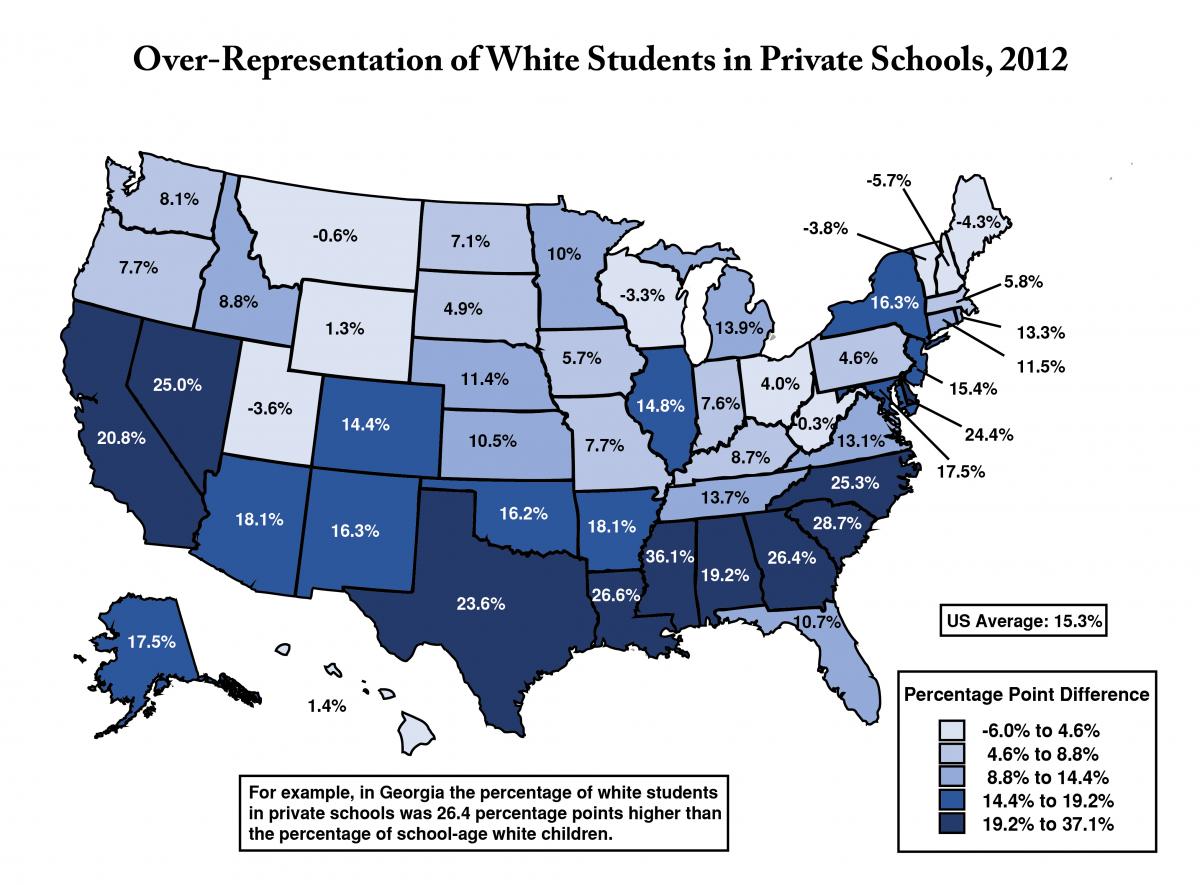
The United States has never been closer to adopting a nationwide program in which the state and federal governments spend billions of tax dollars to finance largely unaccountable private schools to educate children from kindergarten through the twelfth grade. By the beginning of 2019, more than half of the fifty states had enacted a variety of voucher programs diverting public funds to private schools and in some places to home-schooling—often for the purported purpose of improving the education of low-income African American and Hispanic students. These programs use state appropriations or tax credits to divert public monies to support self-governing private schools, often with few requirements or restrictions.
The states have steadily enlarged these programs during recent decades as a result of persistent, intense lobbying from school choice advocates. Often, programs have started modestly with special-needs children, then expanded to a broader student population. School choice programs are spread across the nation, although the South has more than anywhere else.1"Interactive Guide to School Choice Laws," National Conference of State Legislatures, June 15, 2017, http://www.ncsl.org/research/education/interactive-guide-to-school-choice.aspx; "School Choice in America," EdChoice, last modified April 9, 2019, https://www.edchoice.org/school-choice/school-choice-in-america/. Twelve of the twenty-six states with voucher programs using direct appropriations, indirect tax credits, or tax savings education accounts are in the South: Alabama, Arkansas, Florida, Georgia, Louisiana, Maryland, Mississippi, Oklahoma, North Carolina, South Carolina, Tennessee, and Virginia. State programs vary in form and scope, but some, like Georgia, permit state tax dollars to be diverted for home-schooling. All charts and maps with labels indicating "South" in this article refer to a fifteen-state South, which includes the twelve states listed above as well as Kentucky, Texas, and West Virginia. In 2018, more than $2.1 billion dollars in state funds went to support private schooling—a sum larger than the annual state appropriation for public schools in any of thirteen states across the nation.2School Choice Guidebook 2017–2018 (Washington, DC: American Federation for Children Growth Fund, 2018), 7–9, https://www.federationforchildren.org/wp-content/uploads/2018/10/AFC_School_Choice_Guidebook_2017-18_10.3.pdf; "2016 Public Elementary-Secondary Education Finance Data," Annual Survey of School System Finances, US Census, last modified May 17, 2018, https://www.census.gov/data/tables/2016/econ/school-finances/secondary-education-finance.html.
In addition, there is growing support in Washington for establishing school choice nationwide. In his first address to a joint session of Congress, President Donald Trump declared:
Education is the civil rights issue of our time. (Applause.) I am calling upon members of both parties to pass an education bill that funds school choice for disadvantaged youth, including millions of African American and Latino children. (Applause.) These families should be free to choose the public, private, charter, magnet, religious, or home school that is right for them.3"Trump's Speech to Congress: Video and Transcript," New York Times, February 28, 2017, https://www.nytimes.com/2017/02/28/us/politics/trump-congress-video-transcript.html. During his speech, the President also introduced an African American student who had received a tax credit voucher.
During his campaign, Trump pledged that he would become the "nation's biggest cheerleader for school choice" and would provide states with the means to use $20 billion in federal money to create vouchers allowing children to attend the private schools of their choice. "There is no policy more in need of urgent change than our government-run education monopoly," he said, "[that] has trapped millions of African American and Hispanic youth" in failing schools.
Trump's secretary of education, Elizabeth "Betsy" DeVos, a wealthy donor to Republican causes and a leading advocate of public funding of religious private schools, stated in May 2017 that the Trump administration would propose "the most ambitious expansion of education choice in our nation's history" because the "cause is both right and just." The Trump administration proposed to divert more than $1 billion to private schools in the 2019 budget in order to fund "scholarships to students from low-income families that could be used to transfer to a private school." But DeVos has so far been unable to convince Congress to fund such programs directly.4Jane Mayer, "Betsy DeVos, Trump's Big-Donor Education Secretary," New Yorker, November 23, 2016, https://www.newyorker.com/news/news-desk/betsy-devos-trumps-big-donor-education-secretary; Emma Brown, "DeVos Promises 'the Most Ambitious Expansion of Education Choice in Our Nation's History'—but Offers No Details," Washington Post, May 22, 2017, https://www.washingtonpost.com/local/education/betsy-devos-promises-the-most-ambitious-expansion-of-education-choice-in-our-nations-history--but-offers-no-details/2017/05/22/ae90f55e-3f03-11e7-8c25-44d09ff5a4a8_story.html; Valerie Strauss, Danielle Douglas-Gabriel, and Moriah Balingit, "DeVos Seeks Cuts from Education Department to Support School Choice," Washington Post, February 13, 2018, https://www.washingtonpost.com/news/education/wp/2018/02/12/devos-seeks-massive-cuts-from-education-department-to-support-school-choice; Laura Meckler, "The Education of Betsy DeVos: Why Her School Choice Agenda Has Not Advanced," Washington Post, September 4, 2018, https://www.washingtonpost.com/local/education/the-education-of-betsy-devos-why-her-school-choice-agenda-has-crashed/2018/09/04/c21119b8-9666-11e8-810c-5fa705927d54_story.html; US Department of Education, Fiscal Year 2019 Budget: Summary and Background Information, last modified February 12, 2018, https://www2.ed.gov/about/overview/budget/budget19/summary/19summary.pdf.
Support for federal funding of private schools is not a phenomenon only of the Trump administration. In 2012, the Republican candidate for president, Mitt Romney, issued an education "white paper" proposing public financing of tuition costs in private schools as the centerpiece of a new national education reform. The Romney for President position paper proposed to overhaul the primary federal funding of K–12 public schools "so that low-income and special-needs students can choose which school to attend and bring their funding with them. The choices offered to students under this policy will include . . . private schools if permitted by state law."5Romney for President, "A Chance for Every Child: Mitt Romney's Plan for Restoring the Promise of American Education," May 23, 2012, Chesapeake Digital Preservation Group, Georgetown Law Library, https://web.archive.org/web/20180624193755/http:/cdm16064.contentdm.oclc.org/cdm/ref/collection/p266901coll4/id/3980. The white paper was endorsed in a foreword by former Florida governor Jeb Bush.
In 2014, US senators Tim Scott of South Carolina and Lamar Alexander of Tennessee (ranking Republican on the committee for education) introduced legislation to enable federal funding for low-income and special-needs students in public schools to attend private schools. Alexander explained: "Allowing $2,100 federal scholarships to follow 11 million children to whatever school they attend would enable other school choice innovations, in the same way that developers rushed to provide applications for the iPhone platform."6Motoko Rich, "Bill to Offer an Option to Give Vouchers," New York Times, January 27, 2014, https://www.nytimes.com/2014/01/28/education/senator-to-propose-school-vouchers-program.html; American Enterprise Institute, "Senators Lamar Alexander and Tim Scott Unveil Ambitious Proposal to Expand School Choice," January 28, 2014, http://www.aei.org/events/senators-lamar-alexander-and-tim-scott-unveil-ambitious-proposals-to-expand-school-choice/; Lamar Alexander, "Weekly Column by Lamar Alexander: The 'Scholarship for Kids' Act," Weekly Columns, Lamar Alexander: United States Senator for Tennessee, February 18, 2014, https://www.alexander.senate.gov/public/index.cfm/2014/2/weekly-column-by-lamar-alexander-the-scholarships-for-kids-act; See also CHOICE Act, S. 1909, 113th Cong. (2014) and Scholarships for Kids Act, S. 1968, 115th Cong. (2017).
This momentum for vouchers found its way into the major federal tax overhaul enacted in 2017. Congress expanded the use of "529 savings plans" beyond paying for college costs so that tax-advantaged funds can now be used to pay up to $10,000 annually for costs of elementary and secondary education in K–12 private schools.7Ron Lieber, "Yes, You Really Can Pay for Private School With 529 Plans Now," New York Times, December 21, 2017, https://www.nytimes.com/2017/12/21/your-money/529-plans-taxes-private-school.html. This federal change supplements the Coverdell Education Savings Accounts passed first in the Clinton administration and expanded during the George W. Bush administration. It allows a limited use of federal tax dollars to support attendance at private elementary and secondary schools. See Coverdell Education Savings Accounts, 26 U.S.C. § 530 (2006). Most private schools, as non-profit organizations, receive contributions that are deductible for donors from federal income taxes. They also are exempt from income taxes and often local property taxes. This change promises to become quite significant, especially for wealthier households. It opens up a fund—$328 billion and growing—from which monies can be diverted yearly to private K–12 schools.8"529 Plan Data," College Savings Plan Network, June 30, 2018, http://www.collegesavings.org/wp-content/uploads/2018/10/June-2018-529-plan-data-10.15.18.pdf.
Civil Rights Rhetoric Echoes in "School Choice" and Vouchers
"School choice" has no traditional or intrinsic meaning in the field of education, but over the last several decades it has become a political slogan for the claim that government should finance children's education from pre-kindergarten through the twelfth grade in schools outside the public system in order to provide parents with a choice. In recent years, charter schools have been included as a "school choice" option because many local districts and some states now authorize private profit-making or non-profit entities to operate these schools independently, often without meeting requirements and rules that public schools must follow. In 2015, there were 2.8 million students in charter schools and 5.8 million students in private elementary and secondary schools across the United States.9"Public Charter School Enrollment," The Condition of Education 2018, National Center for Education Statistics, 2018, https://nces.ed.gov/programs/coe/pdf/coe_cgb.pdf; "Private School Enrollment," The Condition of Education 2018, National Center for Education Statistics, 2018, https://nces.ed.gov/programs/coe/pdf/coe_cgc.pdf. Also, see Peter Bergman and Isaac McFarlin Jr., "Education for All? A Nationwide Audit Study of Schools of Choice" (working paper 25396, National Bureau of Economic Research, December 2018). This article examines the history of government support for private schools as both the origin and primary foundation for the current movement for "school choice."
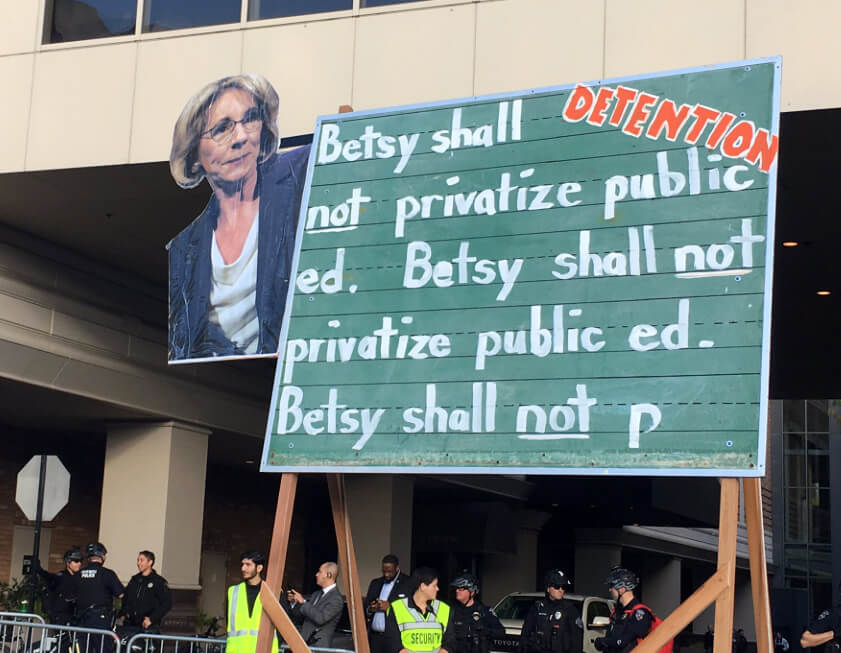
In claiming private "school choice" as right and just, President Trump and Secretary DeVos echo rhetoric that others have used to argue that publicly financed vouchers for children to attend private K–12 schools are a moral imperative. In articles such as "How School Choice Helps Advance Martin Luther King's Legacy," the Heritage Foundation has insisted that vouchers continue the civil rights movement. In 2011, the founder of the tax credit voucher program in Florida declared that school choice for low-income families "is one of the most important social justice issues of our time."10John Kirtley, "Facing a Harsh Truth When Fighting for a Bipartisan Cause," RedefinED, May 20, 2011, https://www.redefinedonline.org/2011/05/facing-a-harsh-truth-when-fighting-for-a-bipartisan-cause/; Katie Nielsen, "How School Choice Helps Advance Martin Luther King's Legacy," My Heritage, Heritage Foundation, August 28, 2013, https://www.myheritage.org/news/how-school-choice-helps-advance-martin-luther-kings-legacy/.
One of Dr. King's children, in fact, joined the cause of vouchers for private schools in Florida to give "black, Latino, and Hispanic" children the same options as others. "This is about justice," Martin Luther King III stated in 2016. "This is about righteousness. This is about freedom—the freedom to choose for your family and your child."11Kristen M. Clark, "Thousands Rally in Support of Program Opposed by Union," Miami Herald, January 19, 2016, www.miamiherald.com/news/politics-government/state-politics/article55454785.html. Martin Luther King III attended and graduated from the private Galloway School, created in Atlanta in 1969. Earlier, his parents attempted to enter him into another Atlanta private school when he reached school-age in the 1960s, after they were misinformed by an Episcopal priest that the all-white, private Lovett School would accept their son. Their written application for his admission was denied without reference to a reason, although the chairman of the school board later stated that he believed that both the "negro and the white man has some individual rights." "Diversity and Inclusion at Galloway," The Galloway School, accessed March 27, 2019, https://www.gallowayschool.org/community-life/diversity-inclusion; Kevin M. Kruse, White Flight: Atlanta and the Making of Modern Conservatism (Princeton, NJ: Princeton University Press, 2005), 175–177.
The political movement for "school choice" is employing the icons and language of civil rights and social justice to advance private school vouchers that fifty years ago were primary tools for segregationists to preserve unequal education for African American and Hispanic children. President Trump's call for a national program of "school choice" echoes the language of George Wallace and others who demanded the federal government and US courts permit Alabama and the South to administer "freedom of choice" for elementary and secondary schools.
These apparent contradictions emerge from the unexamined legacy of segregationists who designed and developed effective, lasting strategies that frustrated and blocked K–12 school desegregation. It is a legacy that turns the icons and language of civil rights inside-out while thwarting the national goal of an effective, equitable system of education for all children.
Forgotten Segregationists
Historically, the methods and forms of segregation have been neither monolithic nor inert.12See C. Vann Woodward, The Strange Career of Jim Crow (New York: Oxford University Press, 1966); Pauli Murray, States' Laws on Race and Color (Cincinnati, OH: Women's Division of Christian Service of the Methodist Church, 1951), 3–20; J. Mills Thornton III, "Segregation and the City: White Supremacy in Alabama in the Mid-Twentieth Century," in Fog of War: The Second World War and the Civil Rights Movement, eds. Kevin M. Kruse and Stephen Tuck (New York: Oxford University Press, 2012), 52–55. Southern segregationists held differing notions about the best ways to preserve school segregation along with their beliefs in racial superiority. As Sylvan Meyer observed in 1960, southern segregationists included "all those whose views varied from a mild belief that the South would be better off maintaining as much racial separation as possible to those advocating insurrection rather than 'surrender' to any compromise whatsoever."13Walter Spearman and Sylvan Meyer, Racial Crisis and the Press (Atlanta, GA: Southern Regional Council, 1960), 47. Many segregationist leaders who designed and implemented plans for school choice have been forgotten, as have their plethora of rationales, strategies, and tactics. They were never widely known, and popular culture has narrowed the cast to a small rogues' gallery.
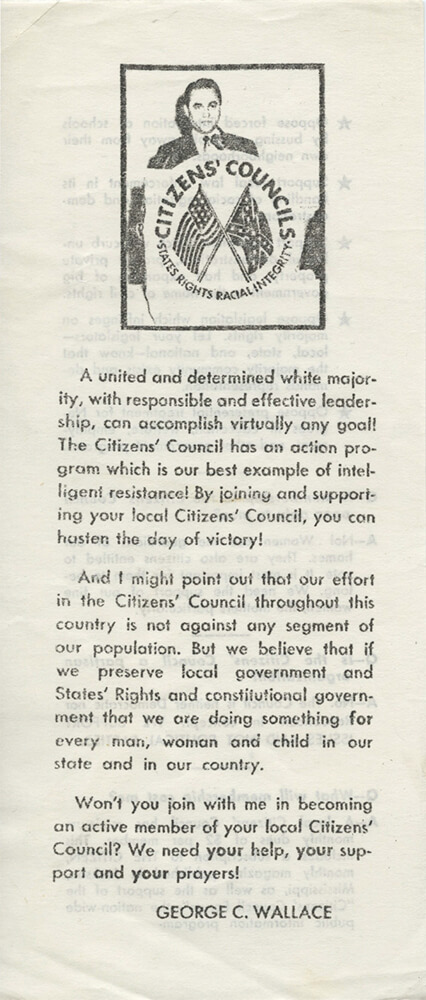
Prevalent images include segregationists such as Alabama governor George Wallace, Birmingham police commissioner Eugene "Bull" Connor, and a bevy of other white leaders such as Mississippi senator James Eastland who endure as premiere political symbols—in large part because their defiant images in multiple confrontations with and condemnations of federal officials often were captured as television came of age in the 1960s.14See Gene Roberts and Hank Klibanoff, The Race Beat: The Press, the Civil Rights Struggle, and the Awakening of a Nation (New York: Random House, 2006), 56, 301–325, 376–379. A few, such as Wallace and North Carolina's Jesse Helms, remained on the national political stage for more than a decade.15See Dan T. Carter, The Politics of Rage: George Wallace, the Origins of the New Conservatism, and the Transformation of American Politics (New York: Simon & Schuster, 1995), 451–468. Wallace prompted controversies over "free speech" rights on college campuses into the 1970s and remains today a popular reference for personifying the southern segregationist. See Peter Salovey, "Free Speech, Personified," New York Times, November 26, 2017, https://www.nytimes.com/2017/11/26/opinion/free-speech-yale-civil-rights.html.
But George Wallace was only one type of segregationist—and hardly a representative figure for those more successful over time in frustrating and blocking school desegregation. Segregationists with other styles and backgrounds built the more lasting terms, tools, and tactics that obstructed the Supreme Court's unanimous 1954 opinion in Brown v. Board of Education16Brown v. Board of Education of Topeka, 347 U.S. 483 (1954). outlawing segregated public education. This wider cast of white supremacists competed fiercely in shaping how and where segregated schools could be preserved. When political self-interest and racial ideology aligned, they occasionally cooperated. At times they shared a vocabulary against Brown, depicted as a federal edict to force the South to create "mixed schools," never to create equitable, desegregated or integrated schools.17Spearman and Meyer, Racial Crisis and the Press, 19, 25, 46–48, 52. Meyer explains how "mix" was a "scare word." Justin Driver, "Supremacies and the Southern Manifesto," Texas Law Review 92 (2014): 1082, https://chicagounbound.uchicago.edu/journal_articles/4043/.
These white men included die-hards, such as those found in the middle-class Citizens' Councils who usually pushed to abandon all public schooling rather than accept any desegregation. Some Citizens' Council leaders, however, came to recognize exceptions to absolute, complete segregation. Ku Klux Klanners, especially in the Deep South, were also dead-set against a single Black child entering an all-white school and were willing to use extra-legal intimidation and violence. Others, such as South Carolina governor Jimmy Byrnes, believed that the impact of Brown could be postponed indefinitely or avoided in large measure by building new Black schools so that separate schools appeared closer to equal.
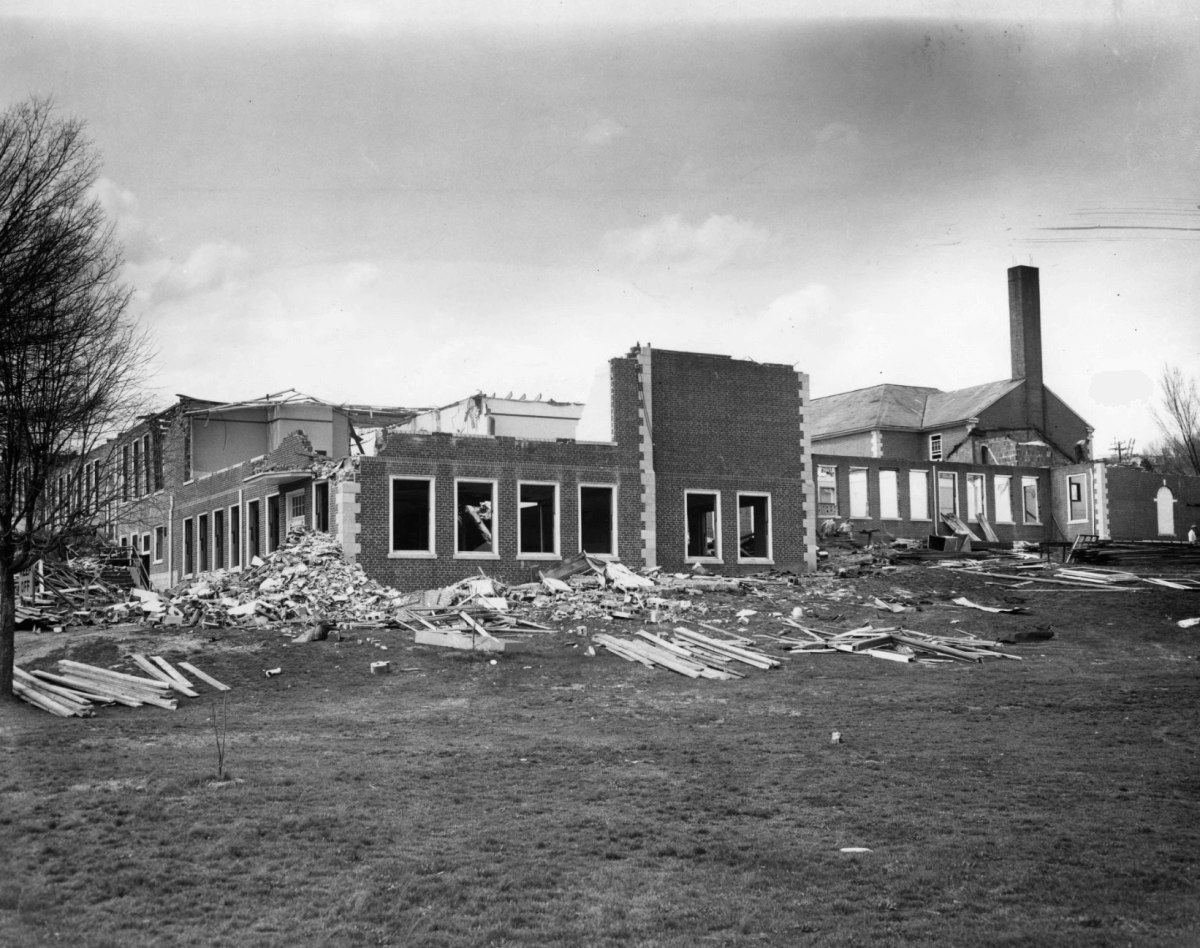
Political leaders such as Georgia's Ernest Vandiver won office by campaigning on a slogan of "No, not one" African American child would ever be allowed in a white school but discovered after entering the governor's office that complete, absolute segregation was impossible to achieve—and counter-productive to preserving as many virtually segregated schools as possible. There were segregationists such as Alabama state senator Albert Boutwell—who later as a "moderate" mayoral candidate defeated "Bull" Connor—and Birmingham corporate attorney Forney Johnston. While Wallace began as a white liberal before shifting his politics to become governor, Boutwell and Johnston were the first segregationist leaders to develop a variety of strategies, tactics, and rationales for school choice that often delayed and defeated the promise of Brown.
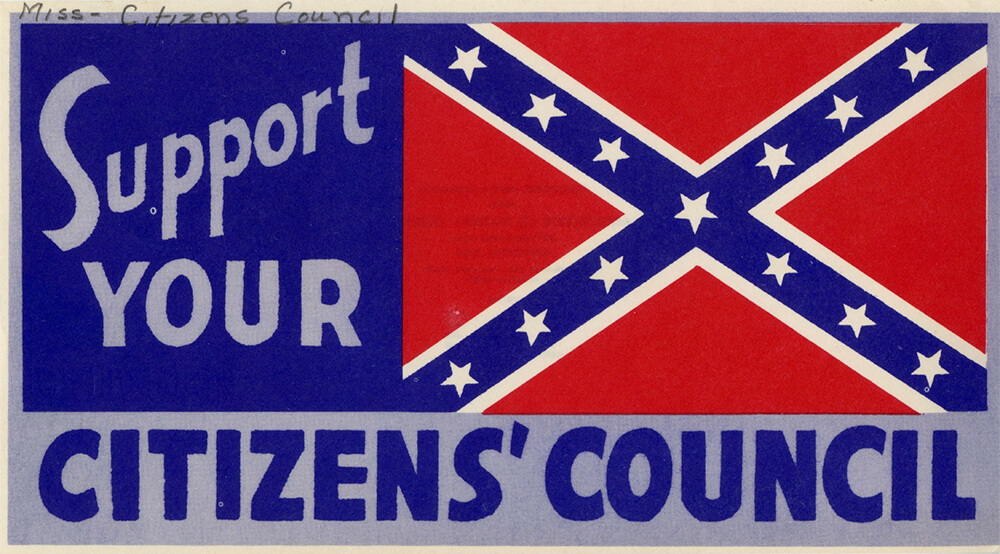
Resistance to school desegregation differed across the states of the former Confederacy according to class, geography, religion, and political ambition.18David L. Chappell, "The Divided Mind of Southern Segregationists," Georgia Historical Quarterly 82, no. 1 (Spring 1998): 45–72; James Graham Cook, The Segregationists (New York: Appleton-Century-Crofts, 1962), 5–6; Clive Webb, ed., Massive Resistance: Southern Opposition to the Second Reconstruction (New York: Oxford University Press, 2005), 8–9. The different factors influencing all policy issues, including race, in the segregated South were detailed by state in V. O. Key Jr., Southern Politics in State and Nation (New York: Alfred A. Knopf, 1949). These different factors also were evident in southern white attitudes toward African American education. See Gunnar Myrdal, An American Dilemma: The Negro Problem and Modern Democracy (New York: Harper and Brothers, 1944), 893–900. For an example of class divisions during desegregation, see Karen Anderson, "The Little Rock School Desegregation Crisis: Moderation and Social Conflict," Journal of Southern History 70, no. 3 (August 2004): 603–636. Only by recovering and understanding the work of a wider cast of white actors who crafted enduring tools and strategies protecting segregation can the reactionary heritage of today's school choice become clear. As Justin Driver has found, the efforts of these segregationist leaders "to maintain white supremacy were often considerably more sophisticated, self-aware, and nuanced than the cartoonish depiction of southern stupidity and hostility would admit."19Driver, "Supremacies and the Southern Manifesto," 1079. These forgotten and ignored strategies help explain how today's proponents of public financing of private schools can employ the language of civil rights without widespread discredit. They also reveal how the origins and historical development of "freedom of choice" have shaped and continue to define the impact and role of "school choice" and vouchers in public education across the nation.20This study is, of course, not the first essay to explore the southern segregationist origins of private school vouchers for elementary and secondary schools. See, for example, Chris Ford, Stephenie Johnson, and Lisette Partelow, The Racist Origins of Private School Vouchers (Washington, DC: Center for American Progress, July 12, 2017), https://www.americanprogress.org/issues/education-k-12/reports/2017/07/12/435629/racist-origins-private-school-vouchers/, and Mark A. Gooden, Huriya Jabbar, and Mario S. Torres Jr., "Race and School Vouchers: Legal, Historical, and Political Contexts," Peabody Journal of Education 91, no. 4 (2016): 522–536.
School Choice and Vouchers Become Segregationist Tools
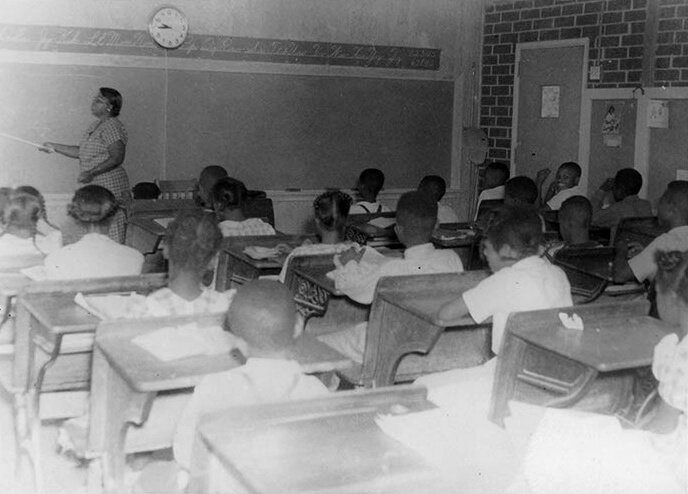
During the middle of the twentieth century, K–12 private schooling became intertwined with race and ethnicity as the Supreme Court issued opinions outlawing segregated graduate and professional public education.21Dick M. Carpenter II and Krista Kafer, "A History of Private School Choice," Peabody Journal of Education 87, no. 3 (2012): 336–338. For a review of the Court's decisions leading up to Brown, see Richard Kluger, Simple Justice: The History of Brown v. Board of Education and Black America's Struggle for Equality (New York: Alfred A. Knopf, 1976), 256–284; Sam P. Wiggins, Higher Education in the South (Berkeley, CA: McCutchan Pub. Corp., 1966), 169. There is an earlier history of school choice in the United States, when Catholic schools competed with public schools, often decidedly Protestant in nature, that carried forward into the twentieth century. See Robert N. Gross, Public vs. Private: The Early History of School Choice in America (New York: Oxford University Press, 2018). Yet, Gross largely ignores the pivotal period of Reconstruction when African American representatives helped to write new southern state constitutions mandating public schools as an essential duty of state governments. W.E.B. Du Bois, Black Reconstruction in America, 1860–1880 (New York: MacMillan, 1992), 637–669. These decisions had no impact on elementary and secondary public schools, but they signaled the direction the Court was moving.
From 1940 to 1950, private school enrollment in the South rose by more than 125,000 students—a 43-percent increase, and, for the first time since private enrollment numbers were documented, the rate of growth doubled that of the rest of the nation.
From 1950 to 1965, US private school enrollment grew at unprecedented rates while the South's rate again exceeded the nation's. Whites in record numbers fled to traditional and newly formed private schools. From 1950 to 1958, the South's private school enrollment increased by more than 250,000 students. By 1965, there were nearly one million southern private school students. Almost all were white.22See Norman Dorsen, "Racial Discrimination in 'Private' Schools," William & Mary Law Review 9, no. 1 (1967): 46, https://scholarship.law.wm.edu/wmlr/vol9/iss1/4/.
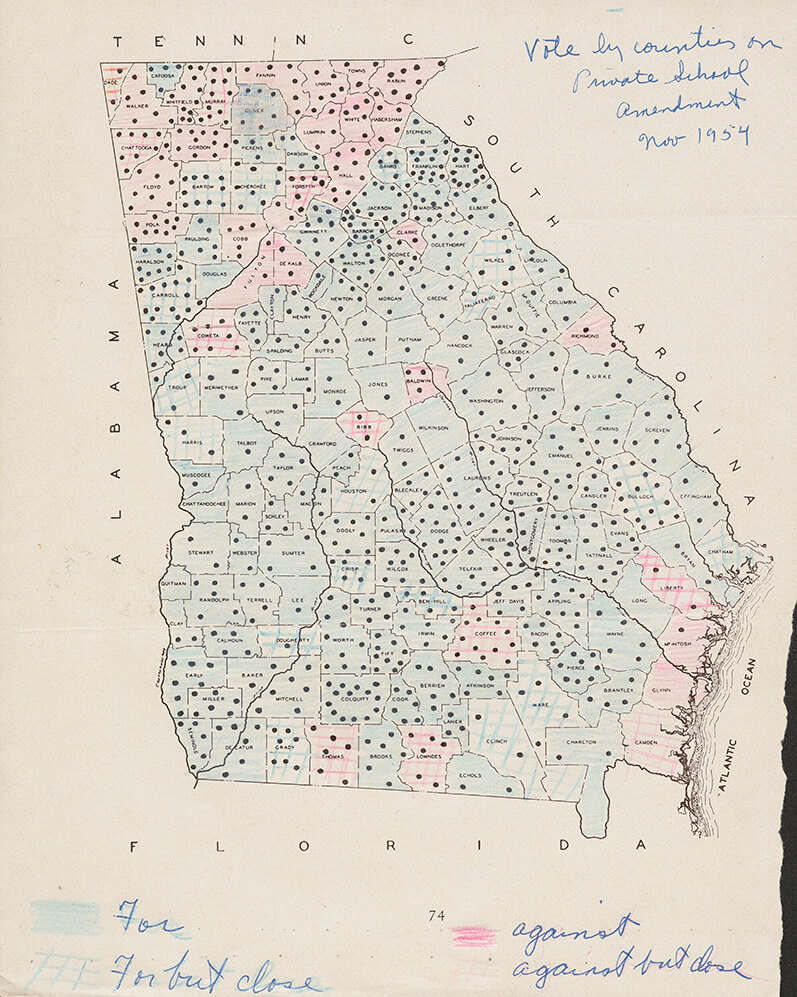
Legislatures passed laws authorizing vouchers and other means of transferring public assets and monies to private schools.23Reaction to Brown was comparatively muted outside the South since the Supreme Court struck down only school segregation established by law, and most segregation laws were in southern states. There was widespread de facto school segregation outside the South but only in a relatively few places did the law erect a dual system of publicly financed education based on race or ethnicity. See Murray, States' Laws on Race and Color; Robin M. Williams Jr. and Margaret W. Ryan, eds., Schools in Transition: Community Experiences in Desegregation (Chapel Hill: University of North Carolina Press, 1954); Will Maslow, "De Facto Public School Segregation," Villanova Law Review 6, no. 3 (1961), https://digitalcommons.law.villanova.edu/vlr/vol6/iss3/2/. In November 1953, as it appeared the Supreme Court might strike down school segregation, white South Carolinians voted to repeal a section of their state constitution that provided for a "liberal system of free public schools"—to clear the way for establishing a private school system. Georgia became the first southern state to pass a constitutional amendment enabling the legislature to send state, county, and municipal funds to "citizens of the State for educational purposes, in discharge of all obligation of the State to provide adequate education for its citizens." A month later, white Mississippians voted for a constitutional amendment granting the legislature power to close public schools and finance private ones. By the end of 1956, Virginia, Alabama, and North Carolina passed similar measures.24W. D. Workman Jr., "The Deep South," in With All Deliberate Speed: Segregation-Desegregation in Southern Schools, ed. Don Shoemaker (New York: Harper and Brothers, 1957), 97–100; House Resolution No. 225, Acts and Resolutions of the General Assembly of the State of Georgia, 1953, November–December Session, vol. 2, 241; Molly Townes O'Brien, "Private School Tuition Vouchers and the Realities of Racial Politics," Tennessee Law Review 64, no. 2 (1997): 359–407. Louisiana adopted a constitutional amendment in 1954 affirming its police powers to prevent desegregation of public schools, and this amendment apparently was interpreted to provide the state legislature will the power to fund private schools. See Poindexter v. Louisiana Financial Assistance Commission, 275 F. Supp. 833 (1967).
From 1954 to 1965, southern legislatures enacted as many as 450 laws and resolutions attempting to discredit, block, postpone, limit, or evade school desegregation. A large number of these acts allowed the re-direction of public resources, including school resources, to benefit private schools.25Tom Flake, "475 Legislative Actions Pertain to Race, Schools," Southern School News, May 1964, B-1. In 1956, the Georgia legislature permitted the leasing of public property to segregated private schools. Five years later, the state enacted a law to provide vouchers for students to attend any non-sectarian private school, boldly declaring the act was to advance "the constitutional rights of school children to attend private schools of their choice in lieu of public schools."26For a full treatment of the methods and strategies of resistance, including diverting public resources to private schools, see Thomas V. O'Brien, The Politics of Race and Schooling: Public Education in Georgia, 1900–1961 (Lanham, MD: Lexington Books, 1999), 99–198.
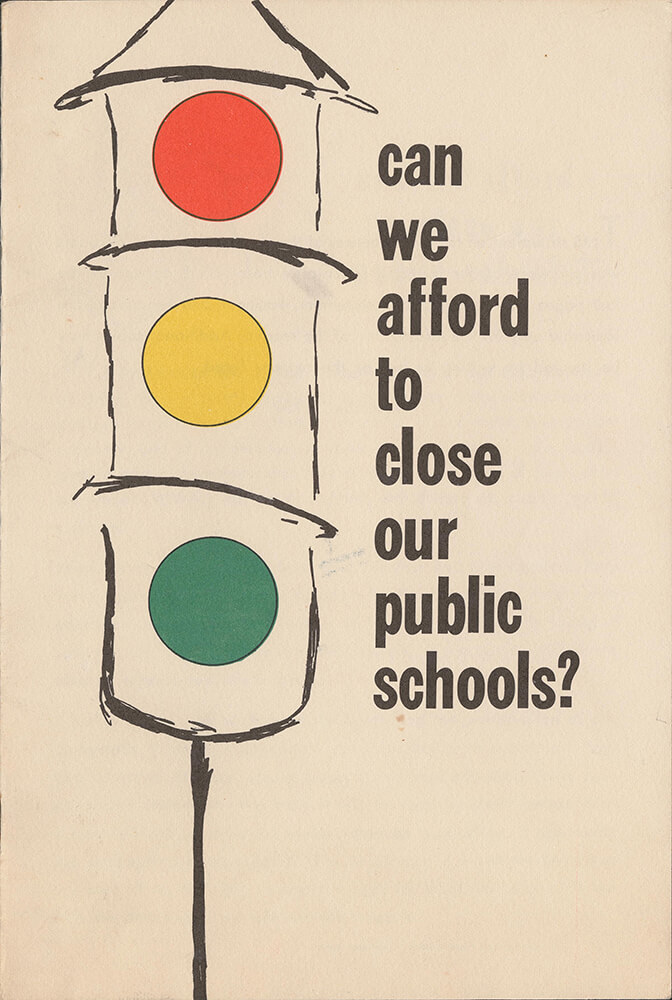
The North Carolina legislature enacted eight bills, the first of which was a constitutional amendment to authorize vouchers for private education and to allow whites to close public schools through a local referendum. In Alabama, Louisiana, Mississippi, and South Carolina, legislatures passed laws to publicly fund vouchers for private schools and to transfer public school property to private educational organizations. Citizens' Councils were active in setting up private schools, especially in Mississippi. The Virginia legislature declared its support for this "freedom of choice" movement by enacting a system of vouchers for private organizations and citizens.27Arthur Larentz Carlson, "With All Deliberate Speed: The Pearsall Plan and School Desegregation in North Carolina, 1954–1966" (master's thesis, East Carolina University, 2011); Jim Leeson, "Private Schools Continue to Increase in the South," Southern Education Report 2 (November 1966): 22–25; Walter F. Murphy, "Private Education with Public Funds," Journal of Politics 20, no. 4 (November 1954): 636–637; Lester Tanzer, "Private School Push: Integration of Virginia Public Schools Spurs Growth of Private Units," Wall Street Journal, February 6, 1959; Neil R. McMillen, The Citizens' Council: Organized Resistance to the Second Reconstruction, 1954–64 (Urbana: University of Illinois Press, 1971), 297–304; Mary Ellen Goodman, Sanctuaries for Tradition: Virginia's New Private Schools (Atlanta, GA: Southern Regional Council, 1961).
In addition to direct transfers of public funds and assets, some states employed tax schemes, including tax credits, to build and finance private school systems. In the Little Rock Crisis of 1957, after President Dwight Eisenhower was forced to call out federal troops to protect a handful of Black children attempting to attend Central High School, Governor Orval Faubus funneled public monies through contracts and tax credits to the Little Rock Private School Corporation until the federal courts stopped the subterfuge (along with further attempts by Arkansas to enact vouchers). In 1959, Georgia governor Ernest Vandiver led the legislature in passing the six segregation bills, including one that supported "the establishment of bona fide private schools by allowing taxpayers credits upon their State income tax returns for contributions to such institutions."28Clay Gowran, "Faubus Tells 'Legal Plan' To Segregate," Chicago Daily Tribune, September 19, 1958; Journal of the House of Representatives, State of Georgia, Regular Session, 1959, 80; "'Resistance' Laws Urged in Georgia: Governor Offers 6 Measures Designed to Strengthen Segregated Schools," New York Times, January 16, 1959; "Georgia Asked To Strengthen Segregation: Six Bills Offered by Governor," Chicago Daily Tribune, January 16, 1959.
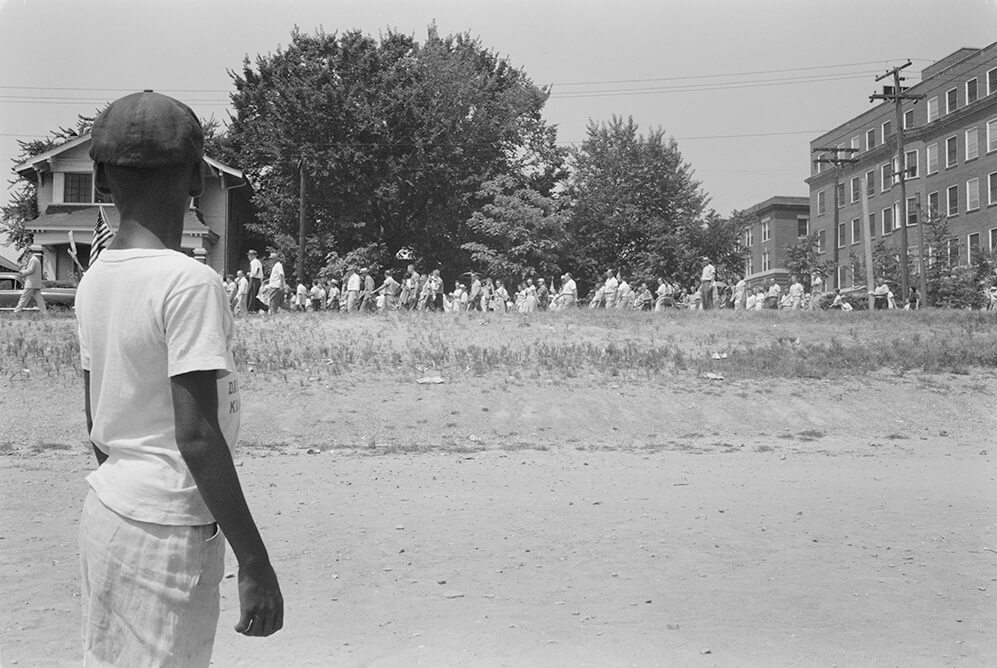
In the same year, Florida governor LeRoy Collins successfully opposed a legislative initiative to pass a constitutional amendment to allow state tax credits for private school contributions. In Prince Edward County and other locations in Virginia, officials used both direct payments and tax credits to build private schools until the federal courts halted both. In Mississippi, after federal courts struck down a direct tuition grant to private schools, Governor John Bell Williams proposed a state tax credit as he searched for the "ways and means of rendering assistance" for white flight to private schools.29"May Veto Plan To Sell Segregation," Daily Defender, June 8, 1959; Lester Tanzer, "Private School Push: Integration of Virginia Public Schools Spurs Growth of Private Units Norfolk Academy, Others Will Expand; State Aids Shift, Authorizes Tuition Grants A Pattern for Solid South? Private School Push: Integration in Virginia Spurs Growth of Units," Wall Street Journal, February 6, 1959; Raymond Moley, "Children Are the Real Victims of the School Integration War," Los Angeles Times, May 18, 1961; Jon Nordheimer, "Integration Raises the Issue of Coeducation in South," New York Times, June 4, 1970.
By 1965, seven states had enacted some type of voucher that enabled the largest growth of private schools in the South's history. Yet, vouchers as a preferred and essential method of resistance to Brown did not stand alone but worked most effectively through larger plans that emerged from the different states. These plans were not uniform, but most incorporated strategies and language that have evolved and endured as the ways and means by which vouchers, school choice, and private schooling have escaped the stigma of their segregationist origins without losing much of the same purpose or effect.
Preserving Virtual School Segregation through Vouchers
During the era of massive resistance, several state legislatures and governors established committees or commissions to develop options for preserving segregation. These strategy groups were often known by the name of the persons chairing them—usually a senior legislator or well-known businessman. In Alabama, it was the Boutwell Committee, led by a prominent, well-to-do state senator. In South Carolina, a wealthy state senator chaired the Gressette Committee. The Pearsall Committee in North Carolina was named for its businessman leader; an Atlanta business leader guided Georgia's Sibley Commission. In Virginia, both of its strategy commissions were named for their prominent businessmen chairs.
The strategy groups issued recommendations in written reports explaining the imperatives for segregation, the rationale for preserving it, including arguments for why segregation was advantageous to Black families, and the different tactics of resistance. These reports demonstrate that segregationist leaders came to understand that vouchers and other forms of aid to private schools worked best in conjunction with a variety of other tactics and strategies for defeating Brown.
Alabama: "Big Mules" Develop a Freedom of Choice Plan
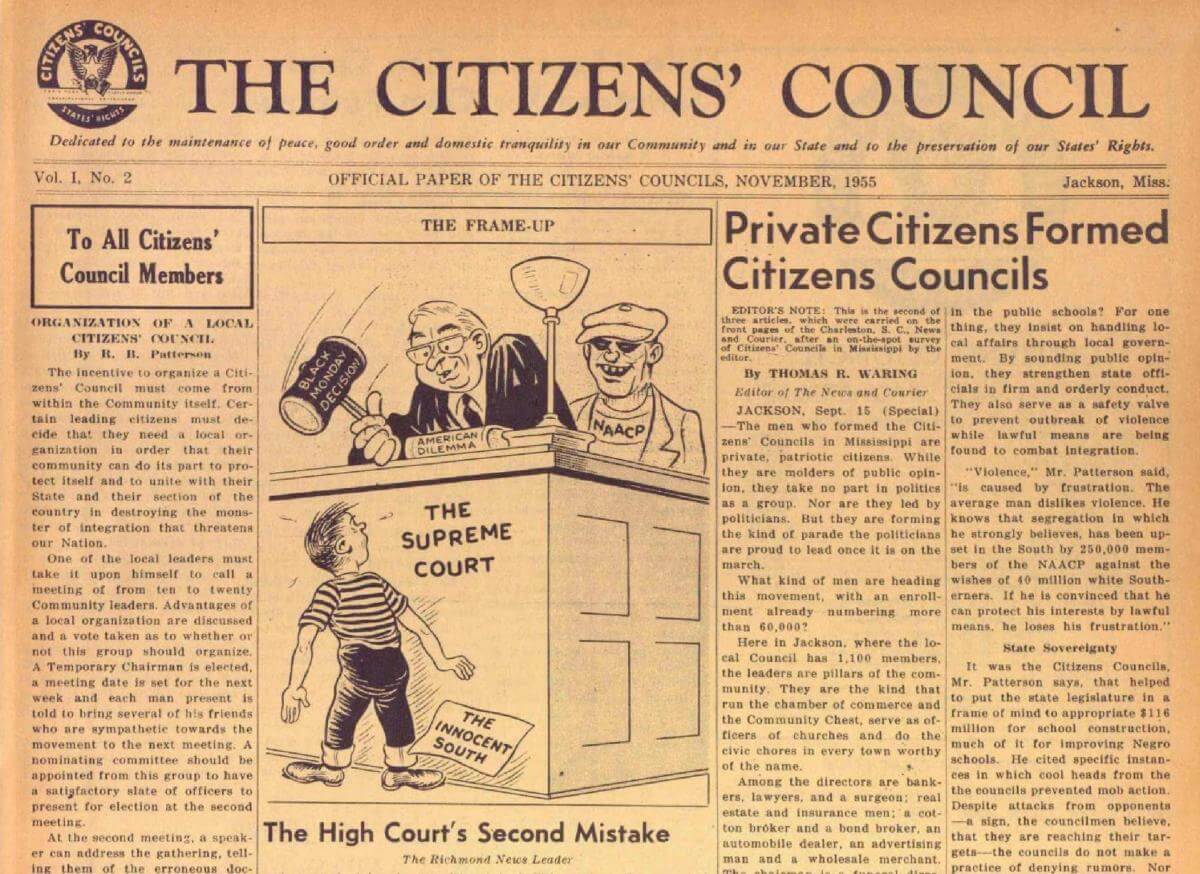
In October 1954, barely five months after Brown, the Boutwell Committee became the first strategy group to lay out a complete, multifaceted plan of resistance. As a moderate segregationist, state senator Albert Boutwell did not believe it feasible or advisable to maintain old segregation laws and disavowed the use of force.30Boutwell's reputation as a moderate grew larger after he ran against and defeated Birmingham Police Commissioner Eugene "Bull" Connor in a race for mayor. "Albert Boutwell Lieutenant Governor: 1959–1963," Alabama Department of Archives and History, last modified August 20, 2009, http://www.archives.state.al.us/conoff/Boutwell.html. Perhaps the Boutwell plan's chief architect and certainly its primary intellectual force was Forney Johnston, a brilliant segregationist and corporate attorney in Birmingham who represented Alabama's "Big Mules"—coal companies, railroads, and wealthy industrialists and investors who profited from Birmingham's exploitative heavy industries. As a backroom politician and former governor's son, Johnston adroitly maneuvered in politics and law to protect the corporate interests he represented and to preserve his notion of segregation. He had managed a 1924 presidential campaign, mounted major legal challenges to New Deal economic reforms, and worked behind the scenes to secure pardons for the "Scottsboro Boys"—but only to prevent growing national support for federal intervention in "states' rights."31Edward R. Crowther, "Alabama's Fight to Maintain Segregated Schools," Alabama Review 43 (1990): 209–210; Thomas Jasper Gilliam Sr., "The Second Folsom Administration: The Destruction of Alabama Liberalism" (PhD diss., Auburn University, 1975), 107, 116, 194, 384. Johnston played a behind-the-scenes role in Alabama on racial matters. As a life-long white supremacist, he worked with state political and business leaders after both world wars in developing laws and strategies to thwart the expectations and aspirations of returning Black soldiers. Yet after managing a presidential primary campaign, Johnston nominated Alabama senator Oscar W. Underwood as the anti-Klan candidate for president at the Democratic National Convention of 1924. John W. Davis, who later argued before the US Supreme Court on behalf of southern states in Brown, won the nomination over Underwood after an unprecedented number of ballots. Johnston was a formidable and talented legal opponent. Steve Suitts, Hugo Black of Alabama (Montgomery, AL: NewSouth Books, 2005), 235–236, 462–472; "Roosevelt Stand on Policies Asked; Forney Johnston Urges Chamber to Seek Clarification of President's Objectives," New York Times, May 1, 1935; "Graves Is Accused in Scottsboro Case," New York Times, December 25, 1938; John Temple Graves, "The Wage-War Between the States," Nation's Business, June 1934, 42; Frank W. Boykin to Mrs. Forney Johnston, June 7, 1962, Frank W. Boykin Papers, Alabama Department of Archives and History.
The Boutwell report decried "forced integration," claiming it would lead to "violence, disorder, and tension for the state and its children." It warned that if the federal courts pursued "coerced integration," white employers would fire Black employees involved in such efforts and the federal courts would prompt inevitable violence among "the least stable and least mentally matured and responsible members of both races." The report also suggested that "compulsory integration" would devastate public school finances by estranging "white people, who pay by far the greater part of taxes which maintain the schools."
The Boutwell plan sought to assure two goals ("Education for all children of the state" and "No compulsory mixing of races in our schools") by proposing four basic strategies:
- Eliminate any "prohibition against the operation of mixed schools, attended by both races" in the current state constitution and laws. In other words, Alabama laws would "concede the right of white and negro families to send their children to mixed public schools." This change would enshrine "the principle of freedom of choice" to enable parents to select the school their children should attend—within certain predetermined conditions and qualifications.
- Remove any suggestion from the state constitution that there is a right of education or an obligation of the state to fund public schoolchildren and establish a "policy of the State of Alabama to foster and promote the education of its citizens in a manner and extent consistent with its available resources, and the willingness and ability of the individual student [emphasis added]."
- Invest the legislature with constitutional powers to enable local school officials to determine the conditions and qualifications for "eligibility, admission, and allocation of pupils, including the power to refuse admission to individuals or groups whose deficiencies in scholastic aptitude would compel undue lowering of school standards."
- Grant the legislature the constitutional power to provide vouchers and other tax funds in "support and furtherance of education in other ways than the operation of public schools" for both Black and white children.
In effect, the plan would establish in the name of school "choice" a three-school system, instead of a dual school system. The new system would enable children to attend all-white schools, all-Black schools, or desegregated schools in a state-financed system of public and private schools.
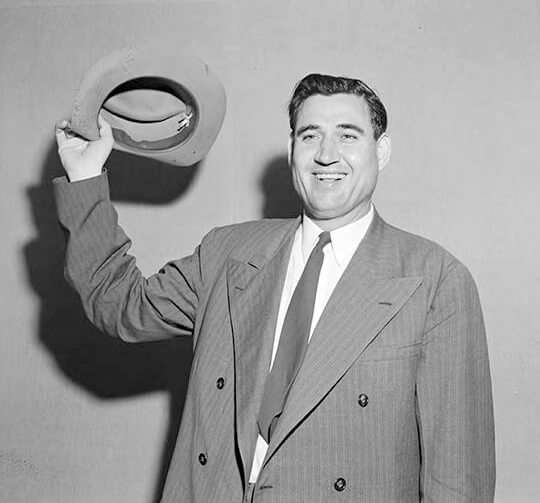
With only one "nay" vote, the legislature passed the proposals to revise the state constitution, and white voters of Alabama ratified the amendments in 1956 to set up the plan's framework. Alabama's Citizens' Council (called "manicured Kluxism" by the editor of the Montgomery Advertiser) worried that the proposals were weak. The Council's leader, state senator Sam Engelhardt, had earlier proposed legislation to close all public schools and use vouchers for white parents to enroll in private schools in order to "keep every brick in our segregation wall intact." Alabama governor James E. "Big Jim" Folsom opposed all of these measures. "I wouldn't want to sign a bill that would let rich folks send their kids all to one school and the poor folks to another school," the populist Folsom declared.32Fred Taylor, "'Freedom of Choice' Bill Seeks School Solution in Alabama," Atlanta Journal-Constitution, February 12, 1956; Fred Taylor, "3-School System Amendment Expected to Pass in Alabama," Atlanta Journal-Constitution, August 26, 1956; Crowther, "Alabama's Fight," 214; "Georgia," Southern School News, September 3, 1954; Carter, The Politics of Rage, 83.
While the constitutional amendments recommended by the Boutwell Committee were pending before the legislature, Forney Johnston gave a speech to the Alabama Bar Association that identified the plan's legal underpinnings: "the liberty of parents to direct the basic conditions under which their children shall be educated." Quoting from the 1925 US Supreme Court opinion that struck down an Oregon statute requiring all disability-free children to attend a public school,33Pierce v. Society of Sisters, 268 U.S. 510 (1925). Johnston declared: "This parental liberty, like other liberties, is not absolute; but is limited only by an overriding necessity for community order or welfare, reflected not in some remote Federal pronouncement, but in the grass-root exercise of state police power, by the State acting in its sovereign capacity."
Johnston argued that the Boutwell plan provided freedom of choice without regard to race and, in that context, the federal courts could not require white parents to send their children to a desegregated school, although some white parents could decide to do so. "If the 14th Amendment now says that a state cannot inhibit the freedom of negroes to attend schools with white people, what does it say about the freedom of white people to choose not to go to school with negroes?" Johnston answered his own question. Virtually segregated schools could continue through this freedom of choice in a new system of education where the government financed both public and private schools, where there was "ordinary and customary geographical districting" for public schools, and where the independent "application of accepted educational tests and standards" by both private and public schools were the terms for admitting students.
This type of school system would permit parental choice for a desegregated school, all-white school, or all-Black school within a structure and standards that were expressly non-racial. "If the members of a race are thereby deprived of access to a school attended by the other race," Johnston observed, "the result is attributable not to compulsion by the state but to the inconsistent choices of free citizens. Under such circumstances, the state is obliged to give effect to the desire of parents without compulsion against either side."34Joseph F. Johnston, "Schools, the Supreme Court, and the States' Power To Direct the Removal of Gunpowder," Alabama Lawyer 17, no. 3 (1956): 3–10.
The full details of the Boutwell plan failed to become law in 1955 in large measure because of the direct and behind-the-scenes opposition of Governor Folsom, who downplayed the Brown decision and fought on many other issues with Black Belt politicians and Birmingham's "Big Mules" and their lawyers such as Johnston. Folsom also vetoed a handful of local bills that attempted to punish Black teachers if they voiced support for desegregation, but the legislature passed the segregationists' pupil placement bill by a veto-proof margin.
The new pupil placement law for public schools was sponsored by Senator Sam Engelhardt, the Citizens' Council leader who had come to embrace the Boutwell Committee's concepts and strategies. The law asserted it had nothing to do with segregation, but aimed to advance each child's education:
To establish a practical school system whereby the state's school program can be adapted to each pupil's ability to learn. To this end it provides a modern school placement system, so that pupils can be so grouped that the less advanced pupils shall not be penalized by being placed in the class with pupils who are more advanced or capable of learning at a more rapid rate, and conversely, that exceptionally bright and able pupils shall not be held back to a level below their ability to learn.
The law empowered local school boards alone to make decisions about which school each student was assigned to attend based on the following factors: tests of student aptitude and ability as well as the distance of school from a pupil's home; a pupil's educational background and home environment; a student's long-established ties of friendship or the dangers of placing a pupil in hostile surroundings absent former friends and "associates"; a pupil's own wishes as evidenced by a written request from his parents or guardian to be assigned to a particular school; and whether, in the judgment of the school board, the assignment would cause or tend to cause a breach of the peace, riot, or "affray." The law provided for a complicated, costly appeal process, if parents disagreed with the board's decision. Not one word in the legislation mentioned segregation, integration, or a child's race.35Fred Taylor, "School Segregation Problem No. 1 on Ala. Legislature List: Measures Proposing Varied Plans Readied for Extra Session Call," Atlanta Journal-Constitution, January 2, 1955; "Alabama," Southern School News, February 3, 1955, 3; J. Tyra Harris, "Alabama Reaction to the Brown Decision, 1954–1956: A Case Study in Early Massive Resistance" (PhD diss., Middle Tennessee State University, 1978), 208–209.
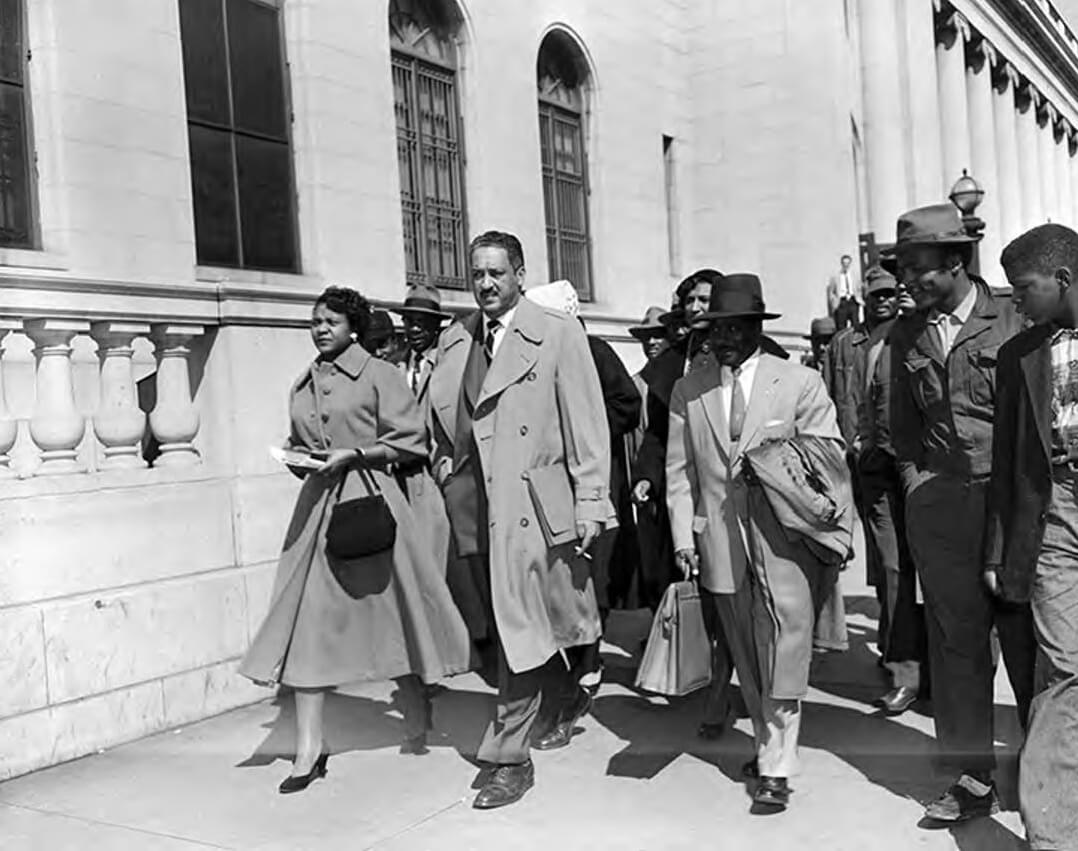
A year later, with the Montgomery bus boycott threatening to end segregated seating in the state capital, the federal courts ordered the admission of Autherine Lucy, a Black woman, into the University of Alabama, and white-led race riots broke out in Tuscaloosa.36Lucy was summarily suspended "for her own safety" after a series of riotous events on campus following her attendance. Charles Morgan Jr., A Time To Speak (New York: Harper and Row, 1964), 37–39. Lucy remembered in 2017 at a university ceremony dedicating a historical marker in her honor that whites had chanted: "Hey, Hey, Ho! Where in the Hell did the nigger go?" See Jessa Reid Bolling and Rebecca Griesbach, "Autherine Lucy Foster Memorialized with Historical Marker," The Crimson White, September 18, 2017, 3, http://now.dirxion.com/Crimson_White/library/Crimson_White_09_18_2017.pdf; AL.com, "Autherine Lucy Foster Monument Unveiled," YouTube video, 1:56, September 17, 2017, https://youtu.be/6jriSBIwSHg. Afterwards, the legislature decided it was time to place before voters the basic parts of the Boutwell plan or, as it was publicly called, the "Freedom of Choice Plan." Folsom declared the legislation "hogwash" and many of his supporters opposed it. It also was opposed by die-hards such as Asa Carter, a Citizens' Council (and soon Klan) leader, since the proposal removed all constitutional requirements for the complete separation of the races in the schools.
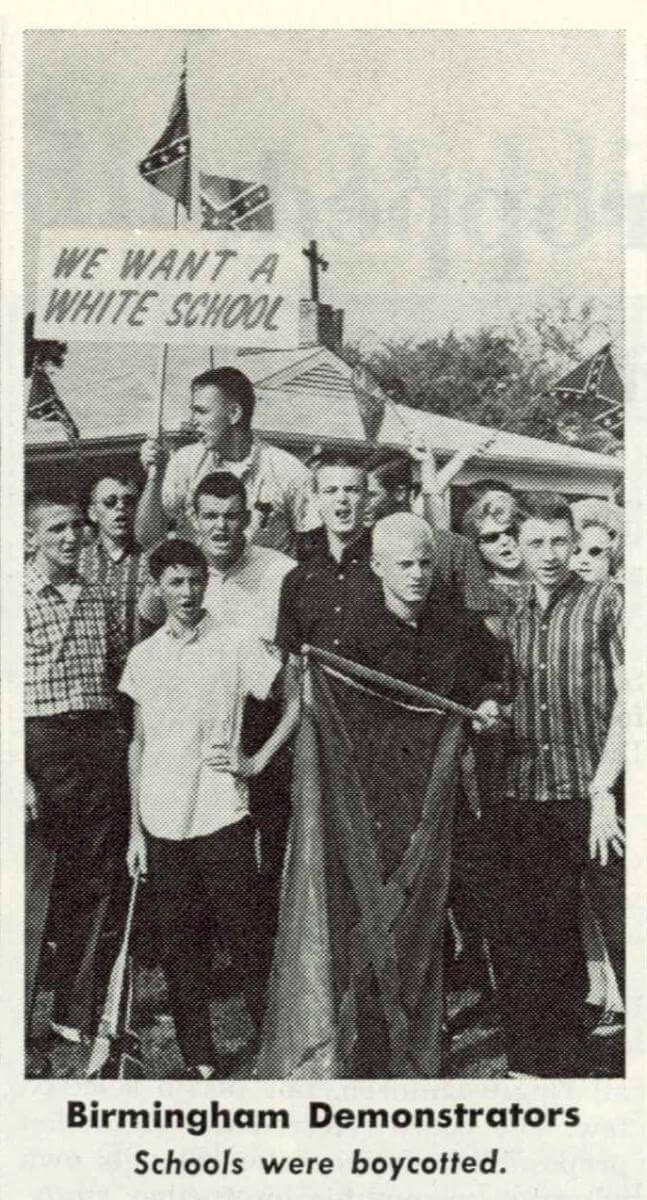
Alabama's virtually all-white electorate approved the "freedom of choice" amendments to the constitution with 61 percent of the vote, and the Boutwell plan's key elements became the operating terms for the strategy to resist and slow school desegregation in the Heart of Dixie.
John Patterson won the race for governor in 1958 as a hard-edged, proven segregationist who, as Alabama attorney general, had attempted to put the NAACP out of business through a series of persistent, harassing lawsuits—an attack commenced after a strategy meeting that included Forney Johnston. As governor, Patterson assured white Alabamians that "I would not agree under any circumstances to operate an integrated school," but, with Boutwell serving as lieutenant governor, he followed the spirit and letter of the Boutwell-Johnston strategy. It proved remarkably successful. During Patterson's four years in the governor's mansion, the US Supreme Court upheld Alabama's pupil placement law on its face as constitutional and, as Patterson later boasted, no Alabama public school was ever desegregated while he was governor.37Harris, "Alabama Reaction to the Brown Decision," 226–229, 241–249; Gilliam Sr., "The Second Folsom Administration," 316–321, 374–384, 423–436; Joseph M. Bagley, "School Desegregation, Law and Order, and Litigating Social Justice in Alabama, 1954–1973" (PhD diss., Georgia State University, 2013), 104–105; Shuttlesworth v. Birmingham Board of Education, 162 F. Supp. 372 (1958) affirmed by Shuttlesworth v. Board of Education, 358 U.S. 101 (1958); "Alabama: Governor Renews Vow to Resist Integration," Southern School News, February 1961, 14; Warren Trest, Nobody But the People: The Life and Times of Alabama's Youngest Governor (Montgomery, AL: NewSouth Books, 2008), 260, 303–306; William Warren Rogers et al., Alabama: A History of a Deep South State (Tuscaloosa: University of Alabama Press, 1994), 547–548.
Alabama's approach to controlling school desegregation changed dramatically in 1963 after George Wallace won the race for governor by making good on his promise—uttered after losing to Patterson in 1958—that "no other son-of-a-bitch will ever out-nigger me again."38Carter, The Politics of Rage, 96–109. Wallace defeated Folsom, Boutwell, and "Bull" Connor, among others. In his inaugural speech written by Asa Carter, Wallace proclaimed words that have resounded across the decades:
Today I have stood, where once Jefferson Davis stood. . . . Let us . . . send our answer to the tyranny that clanks its chains upon the South. . . . I draw the line in the dust and toss the gauntlet before the feet of tyranny . . . and I say . . . segregation now . . . segregation tomorrow . . . segregation forever.39George C. Wallace, "The Inaugural Address of Governor George C. Wallace," January 14, 1963, Alabama Textual Materials Collections, Alabama Department of Archives and History, transcript, http://digital.archives.alabama.gov/cdm/ref/collection/voices/id/2952.
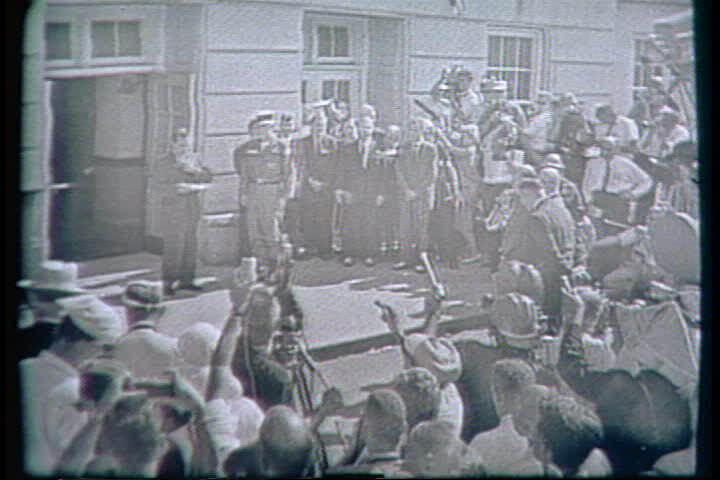
Governor Wallace kicked off an orchestrated, theatrical performance of massive resistance a few months later when he stood in the schoolhouse door to decry federal encroachment on state sovereignty and to protest the admission of two Black students to the University of Alabama, which had a total enrollment of almost ten thousand students. Afterwards, Wallace led the state government in replaying strategies used earlier in Mississippi and Louisiana, including the formation of state spy commissions to monitor and intimidate civil right activists. His administration coordinated with the Klan and the Citizens' Council, and Wallace's frequent public pronouncements left little doubt that Alabama's school program had nothing to do with the Boutwell Committee's earlier stated purposes of advancing "each pupil's ability to learn" and everything to do with preserving absolute segregation.
Buoyed by national news coverage and by the enthusiastic support of white Alabamians that came as a result of Jim Crow grandstanding, Wallace had no intention of permitting any Alabama official to accept or implement token integration in the schools without an opportunity for him to publicly display his fight for complete segregation. The governor called out state troopers to surround school buildings in several Alabama towns—even when local white school boards had decided to permit a small number of Black children to cross the color line.
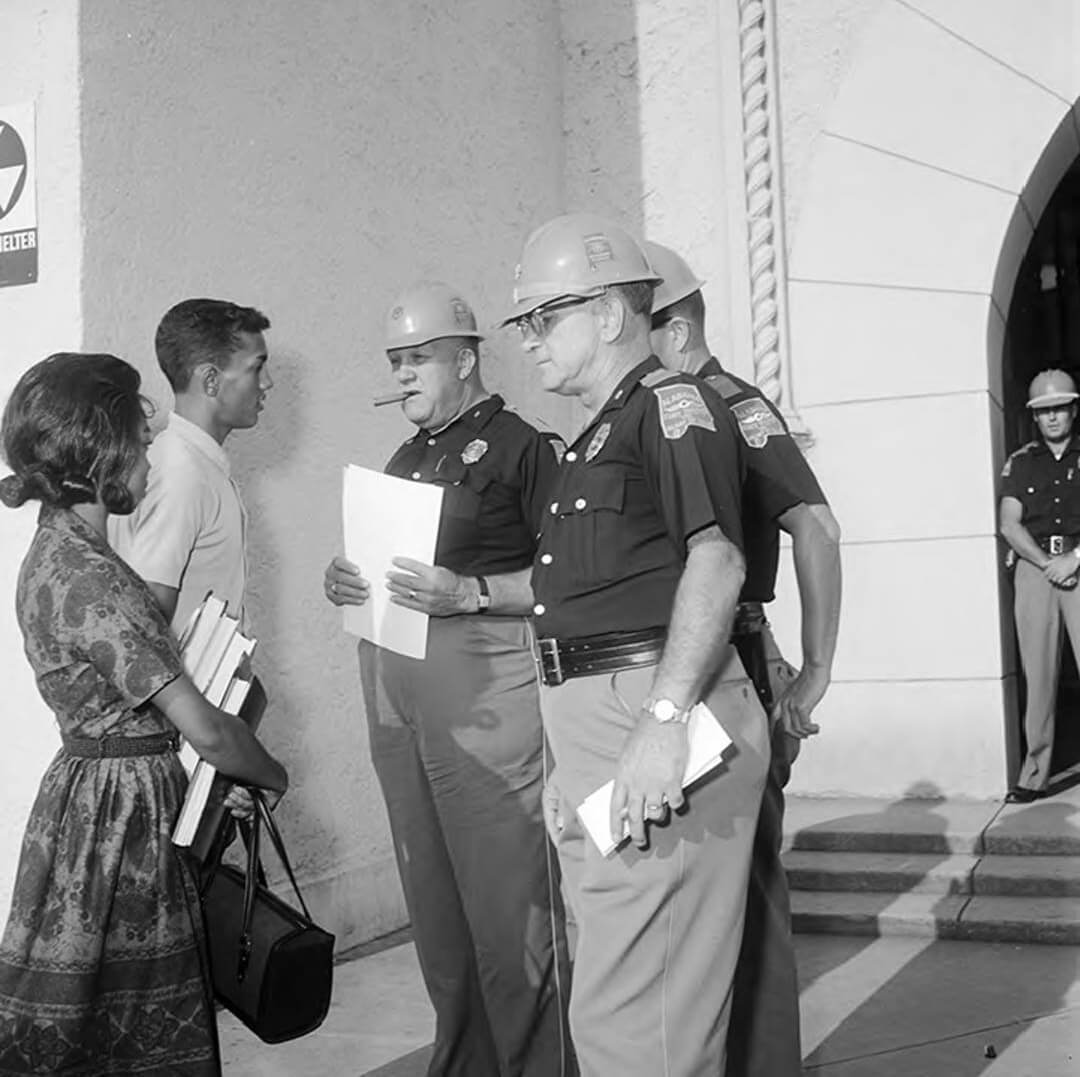
In response, civil rights attorneys returned to federal court with new evidence from Wallace's statements and actions that the school laws and their enforcement were intended to block Brown, and the courts began striking down the state's education laws—including its private school voucher law—and ordering school desegregation. As his lawyers lost in the federal courts, Wallace kept racial politics center stage, creating an environment for violence and capturing the adulation of the white die-hards. He also attracted the nation's attention by expanding and amplifying the provocative rhetoric of total, massive federal resistance. Wallace became in the political imaginary one of the nation's enduring southern segregationist icons.40Carter, The Politics of Rage, 133–293; Stephan Lesher, George Wallace: American Populist (Boston, MA: Addison Wesley, 1994), 244–253; Lee v. Macon County Board of Education, 267 F. Supp. 458 (1967); Allen Tullos, Alabama Getaway: The Political Imaginary and the Heart of Dixie (Athens: University of Georgia Press, 2011), 233–241.
The Other Southern States: "Freedom from Compulsory Association" by Any or Many Means
Six other states—Mississippi, Louisiana, Virginia, North Carolina, South Carolina, and Georgia—also created strategy groups to block school desegregation. Each group had its own distinct design and role within the dynamics of how each state built massive resistance to Brown, but most shared similar characteristics and tactics. All adopted vouchers for private schools.
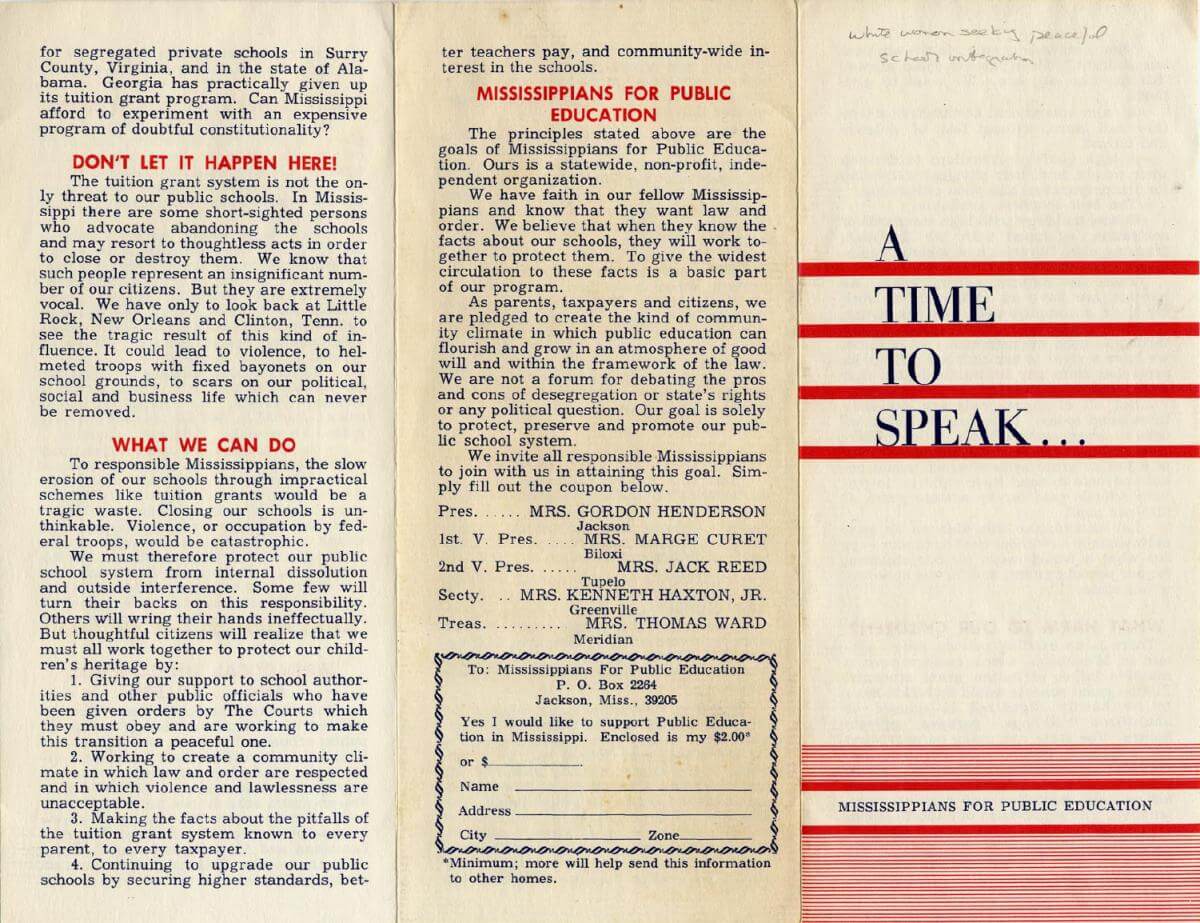
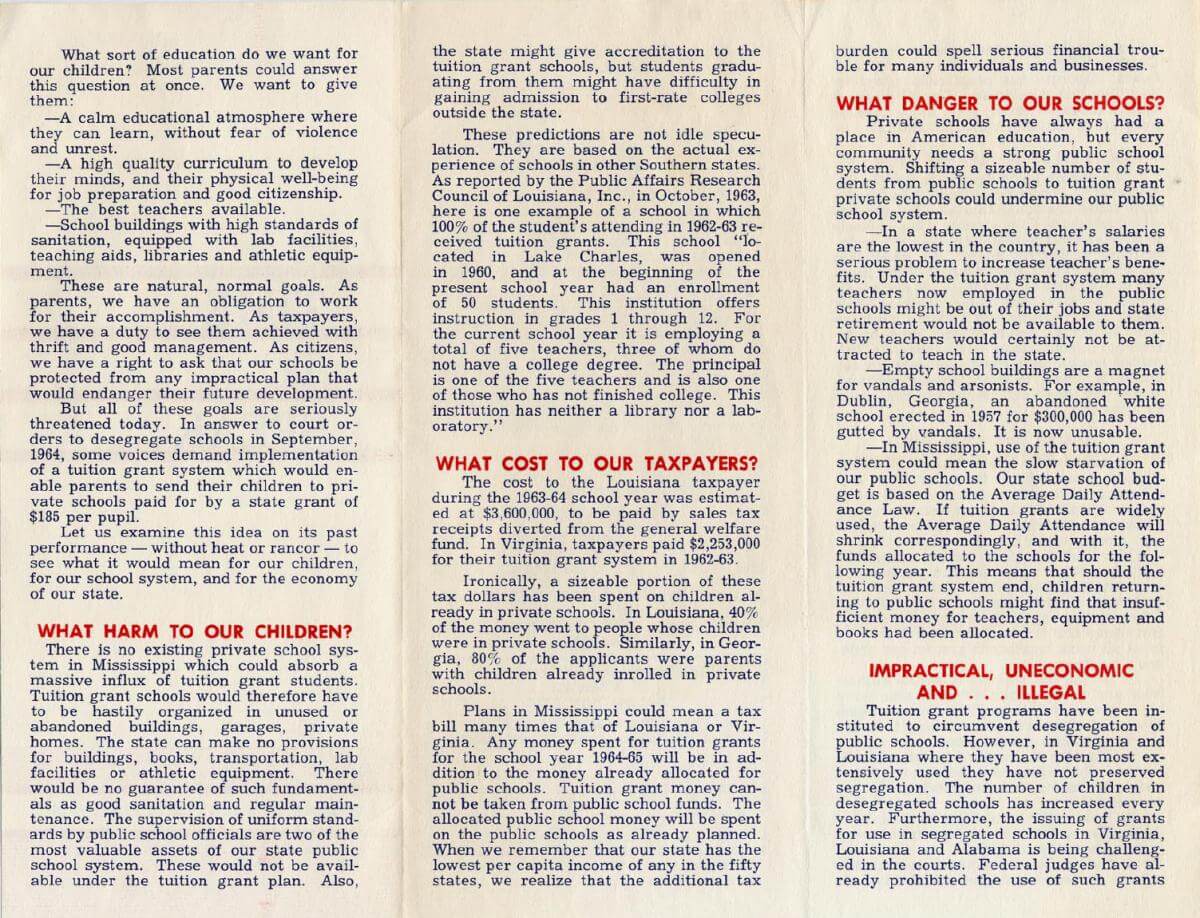
In Mississippi, white voters approved state constitutional changes recommended by Governor Hugh White's advisory group that authorized state funding for children to attend their parents' choice of a private school and for transferring public school properties to private schools. Afterwards, the strategy committee did little more since Mississippi's white leaders employed other groups and strategies as their first line of defense. The legislature approved small funding increases forBlack public schools in an attempt to convince Black citizens that the state would move closer to "separate but equal" facilities.
Mississippi's primary strategies to block school desegregation involved private and public agencies that undertook economic and social intimidation, behind-the-scenes spying, physical threats, and violence. The Mississippi Sovereignty Commission kept tabs on "agitators" in conjunction with the Citizens' Council, the Klan, and other vigilante groups.41"Mississippi," Southern School News, September 3, 1954; Charles C. Bolton, The Hardest Deal of All: The Battle Over School Integration in Mississippi (Jackson: University Press of Mississippi, 2005), 65–68, 75–88; McMillen, The Citizens' Council, 15–32, 360–361; John Dittmer, Local People: The Struggle for Civil Rights in Mississippi (Urbana: University of Illinois Press, 1994), 45–72; Charles M. Payne, I've Got the Light of Freedom: The Organizing Tradition and the Mississippi Freedom Struggle (Berkeley: University of California Press, 1995), 34–37.
Other states used legal and extra-legal tactics to keep schools segregated, but, as one author wrote, "Mississippi verged on totalitarianism."42Michael J. Klarman, "Why Massive Resistance?" in Massive Resistance: Southern Opposition to the Second Reconstruction, ed. Clive Webb (New York: Oxford University Press, 2005), 27. "This is a fight for white supremacy," declared the editor of the Jackson Daily News, returning to public language often abandoned by segregationists elsewhere. "[T]here will be no room for neutrals or non-combatants." Local Black leaders such as Leake County sisters Winson and Dovie Hudson faced combatants as they continued to challenge school segregation, despite economic reprisals, physical threats, and more than one bombing of their own homes. "I'm going to stay here and pay the cost, no matter what it is," Dovie Hudson assured Mississippi NAACP field secretary Medgar Evers, who soon afterwards was murdered in his own driveway in Jackson. Anyone connected to school desegregation or civil rights work in Mississippi ran a real risk of being fired from work, thrown out of their house, beaten, bombed, or shot at. Several were killed.43Dennis J. Mitchell, Mississippi Liberal: A Biography of Frank E. Smith (Jackson: University Press of Mississippi, 2001), 130; Constance Curry, "A Right to Be There," Southern Changes 14, no. 1 (1992): 18–25, http://southernchanges.digitalscholarship.emory.edu/sc14-3_1204/sc14-3_005/; Winson Hudson and Connie Curry, Mississippi Harmony: Memoirs of a Freedom Fighter (New York: Palgrave MacMillan, 2002), 47–73; Marin Noel and Roderick Wright, "Mrs. Murtis Powell: On the Front Lines of Battle," in Minds Stayed on Freedom: The Civil Rights Struggle in the Rural South, an Oral History, ed. Youth of the Rural Organizing and Cultural Center (Boulder, CO: Westview Press, 1991), 110–115.
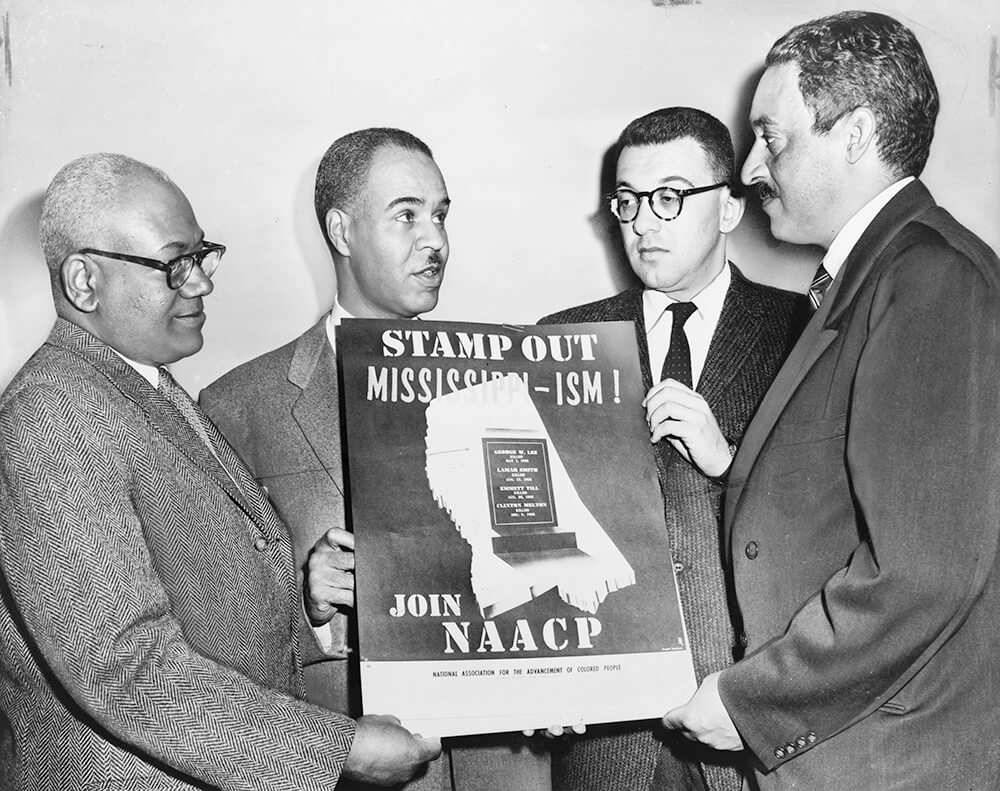
As a result, school desegregation moved very slowly in Mississippi. In 1969, fifteen years after Brown, the US Supreme Court found that Mississippi had made hardly any strides in undoing "segregated conditions" and ordered every school district in the state "to terminate dual school systems at once." Aided by Citizens' Council chapters, segregation academies sprung up across the state, and Mississippi's public schools desegregated only when and where civil rights lawyers won their day in federal courts.44Survey of School Desegregation in the Southern and Border States, 1965–1966 (Washington, DC: United States Commission on Civil Rights, 1966), 33–42, https://www2.law.umaryland.edu/marshall/usccr/documents/cr12sch611.pdf; Alexander v. Holmes County Board of Education, 396 US 19 (1969); McMillen, The Citizens' Council, 302; Bolton, The Hardest Deal of All, 169–186.
The strategy group in Louisiana was headed by long-time state senator William M. Rainach, who also spearheaded the creation of Louisiana's Citizens' Councils.45Jim Carl, Freedom of Choice: Vouchers in American Education (Santa Barbara, CA: Praeger, 2011), 26–28; "Louisiana," Southern School News, September 3, 1954, 13; Charles A. Reynard, "Legislation Affecting Segregation," Louisiana Law Review 17 (1956–57): 104–114. For a brief time, Rainach later became head of the Louisiana Sovereignty Commission, the primary state apparatus to spy on and harass civil rights activists and supporters. Carl, Freedom of Choice, 37, 46. The Rainach Committee became a coordinating agency as much for action as for legislative strategy. It helped to mount legal roadblocks to school desegregation, orchestrated legal attacks on Black activist organizations, and spurred efforts to remove or block Black voting in close collaboration with the Louisiana Sovereignty Commission. Like many other state agencies across the South, the committee condemned integration as the work of communists.
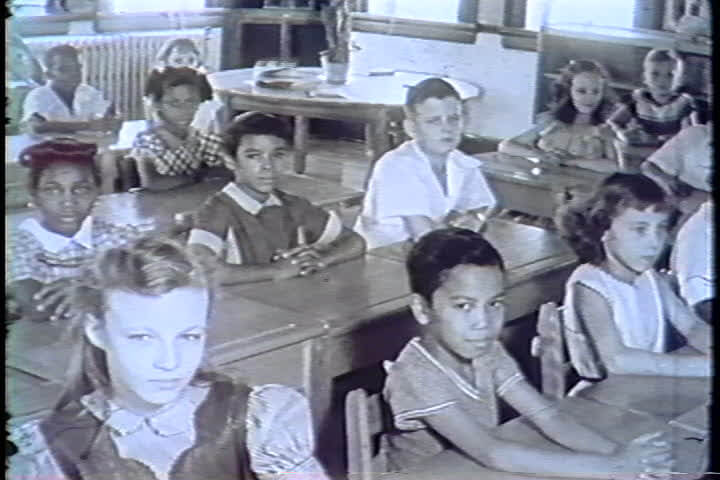
Following the Rainach Committee's recommendations, the legislature in 1958 authorized public schools to become private education cooperatives and a voucher program for white students to attend non-religious private schools.46Carl, Freedom of Choice, 29–32; "Supreme Court Approves Invalidation of Louisiana's Pupil Placement Law," Southern School News, July 1957, 7. In New Orleans, the Catholic schools were uniquely more willing to integrate sooner than the public schools. As early as 1956, the Archbishop publicly declared that segregation was morally wrong. Local NAACP leader Daniel Boyd suggested to national legal director Thurgood Marshall that "the Luzanna legislature will keep ignoring any and all court decisions until a number of them are jailed."47Adam Fairclough, Race and Democracy: The Civil Rights Struggle in Louisiana, 1915–1972 (Athens: University of Georgia Press, 1995), 247. In 1960, refusing further delays, federal district judge Skelly Wright ordered the desegregation of New Orleans's 9th Ward elementary school. Amid death threats, a six-year-old Black girl, Ruby Bridges, entered the previously all-white school with an escort of federal marshals amid a mob of angry, screaming white men and women. Senator Rainach abandoned his role as strategist in order to appear publicly more attractive as he campaigned to become governor. "Let's use the 'scorched earth policy,'" he proclaimed at a Citizens' Council rally.
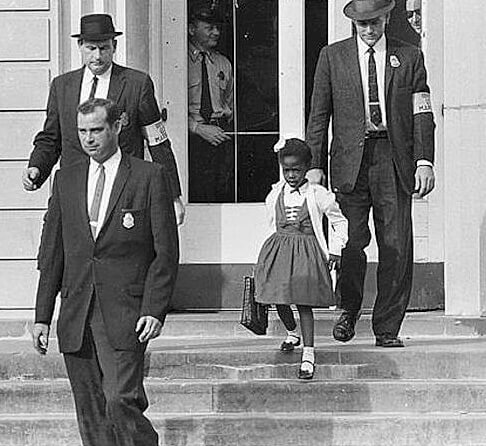
Jimmie Davis became the newly elected governor and quickly disbanded Rainach's committee. Following other southern governors, Davis pushed the legislature to revoke all overt segregation laws and pass race-neutral programs for advancing freedom of choice for parents. A new voucher law also made no mention of race; it allowed any Louisiana child eligible to receive a state-funded voucher to attend a non-profit, non-sectarian private school.48Carl, Freedom of Choice, 47–48; "State Again Fails To Get Control of Orleans Schools," Southern School News, February 1961, 6.
The race-neutral program began in 1962, operated for four years, and distributed more than fifty-five thousand vouchers. The vast majority of state funds went to the families of white students, although existing records show that about 7 percent of all vouchers supported students from Black families. All voucher-supported private schools were segregated by race—either all-white or all-Black.
After the voucher law was challenged in federal court, four all-Black private schools joined the state government in defending the program. The legislature renamed its voucher commission the "Louisiana Education Commission for Needy Children" with the professed purpose of addressing the problems of juvenile delinquency and school dropouts as well as the special needs of "retarded children" as it declared "that the parent, not the State of Louisiana, shall be the determining force which shall decide on the type of education ultimately received by the child." A federal court panel, however, found the "necessary effect of the Louisiana tuition grants [was] to establish . . . a system of segregated schools for white children, in violation of the equal protection clause."49Carl, Freedom of Choice, 48–53; "Louisiana Legislators Go Home; Teachers Miss Pay," Southern School News, January 1961, 1, 8–11; Poindexter, 275 F. Supp. 833.
Thomas J. Pearsall, a North Carolina attorney, businessman, and former Speaker of the House, chaired the North Carolina strategy committee responsible for finding a response to Brown. The Pearsall Committee originally had three African Americans among twenty members. Its first report proposed only a pupil assignment act mirroring the basics of Alabama's law. It empowered local school officials to assign students according to factors such as community relations, student ability, school capacity, and geographic location—without any mention of race.50John E. Batchelor, Race and Education in North Carolina: From Segregation to Desegregation (Baton Rouge: Louisiana State University Press, 2015), 32–42; Carlson, "With All Deliberate Speed," 55–59.
Hardline segregationists such as Jesse Helms, later US senator, dismissed the report, arguing that the state had to choose between "integrated public schools and free choice private schools." North Carolina attorney general Beverly Lake, also later a US senator, made the same argument urging the closure of public schools and the provision of vouchers for white children to attend totally segregated private schools.51Batchelor, Race and Education, 36–40.
In a second report in April 1956, the now all-white Pearsall Committee declared that it would "preserve a segregated system" like the one in the past and suggested ways to move from a "segregated-by-law system" to a segregated-by-choice system. The report reminded local school officials that, due to the US Supreme Court, there can be "no racial segregation by law," but nothing prohibited them from making "assignment according to natural racial preference and the administrative determination of what is best for the child." It recommended vouchers wherever "a child cannot be conveniently assigned to a non-mixed public school," regardless of the child's race, so long as the child's parent did not want a desegregated school. The committee insisted that while the Supreme Court had struck down laws "compelling the separation of the races in public schools," no court could compel "the mixing of the races."
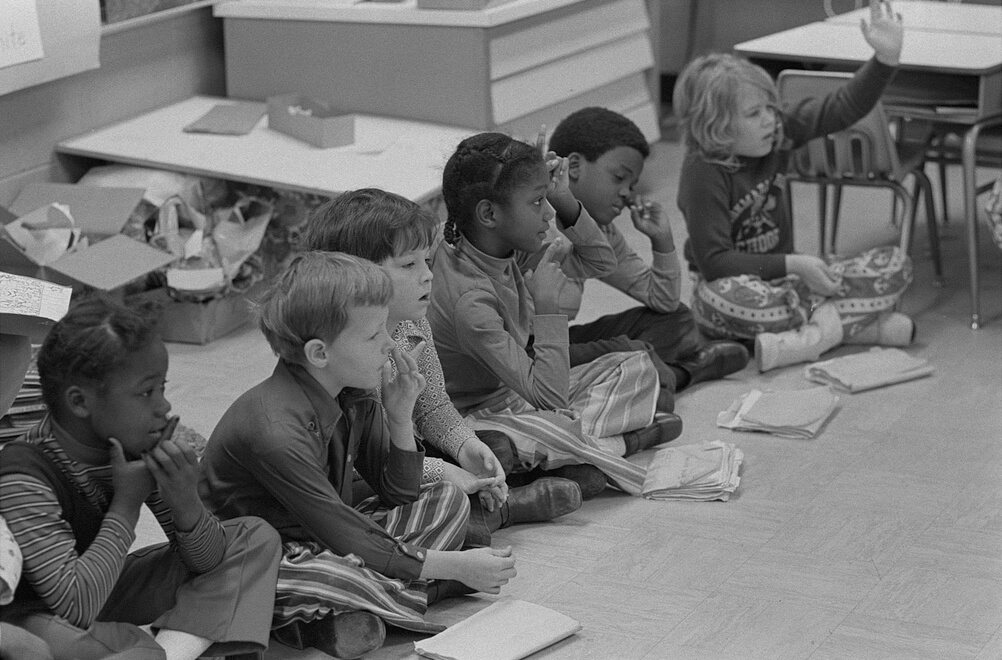
Over the next decade, most North Carolina schools slowly admitted a token number of Black students in previously all-white schools, although many small, rural school districts in eastern North Carolina resisted until a court order required the admission of a token number of Black children in previously all-white schools. The Pearsall Plan began to crumble when North Carolina civil rights attorney Julius Chambers persuaded a federal three-judge panel in 1966 that "the payment of tuition grants is clearly state action, and unquestionably impermissible." A year earlier, Chambers's home had been bombed twice and his car firebombed once as a result of his willingness to openly challenge school segregation. Following his own advice to others—"Keep fighting"—Chambers convinced the federal court that the "state may not circumvent the Constitution by giving financial encouragement to individuals to follow a course which defeats desegregation."52Batchelor, Race and Education, 76–110; Carlson, "With All Deliberate Speed," 72; Douglas Martin, "Julius Chambers, a Fighter for Civil Rights, Dies at 76," New York Times, August 6, 2013, https://www.nytimes.com/2013/08/07/us/julius-chambers-a-fighter-for-civil-rights-dies-at-76.html; "Hawkins v. North Carolina State Board of Education," Race Relations Law Reporter 11 (1966): 745, 747.
In Virginia, there were two strategy commissions. The first was chaired by businessman and state senator Garland Gray. In November 1955, it recommended the three basic methods of resistance first outlined by Alabama's Boutwell Committee: 1) investing local school officials with broad discretion to assign public school students on the basis of apparently non-racial factors such as availability of facilities and transportation, health, and aptitude of the child; 2) authorizing vouchers and other payments to private schools; and 3) permitting parents, without regard to race, to receive state-funded vouchers to attend private schools if their children were assigned to desegregated schools.
The Gray Commission's proposals implied that it would preserve only virtual segregation, not total segregation—an approach that many Virginia politicians defiantly opposed.53Joseph J. Thorndike, "'The Sometimes Sordid Level of Race and Segregation': James J. Kilpatrick and the Virginia Campaign against Brown," in The Moderates' Dilemma: Massive Resistance to School Desegregation in Virginia, eds. Matthew D. Lassiter and Andrew B. Lewis (Charlottesville: University Press of Virginia, 1998), 70. Bowing to the hardline segregationists, state leaders rejected the Gray Commission's recommendation in favor of massive resistance. The legislature declared desegregation a "clear and present danger" that required closing public schools when necessary. The new law also discarded the Gray Commission's recommendation to give local school boards the authority to make pupil assignments on terms without expressly mentioning race. The state board of education was specifically authorized to prevent assigning white and Black students in the same school.54Carl W. Tobias, "Public School Desegregation in Virginia During the Post-Brown Decade," William & Mary Law Review 37 (1996): 1269–1271.
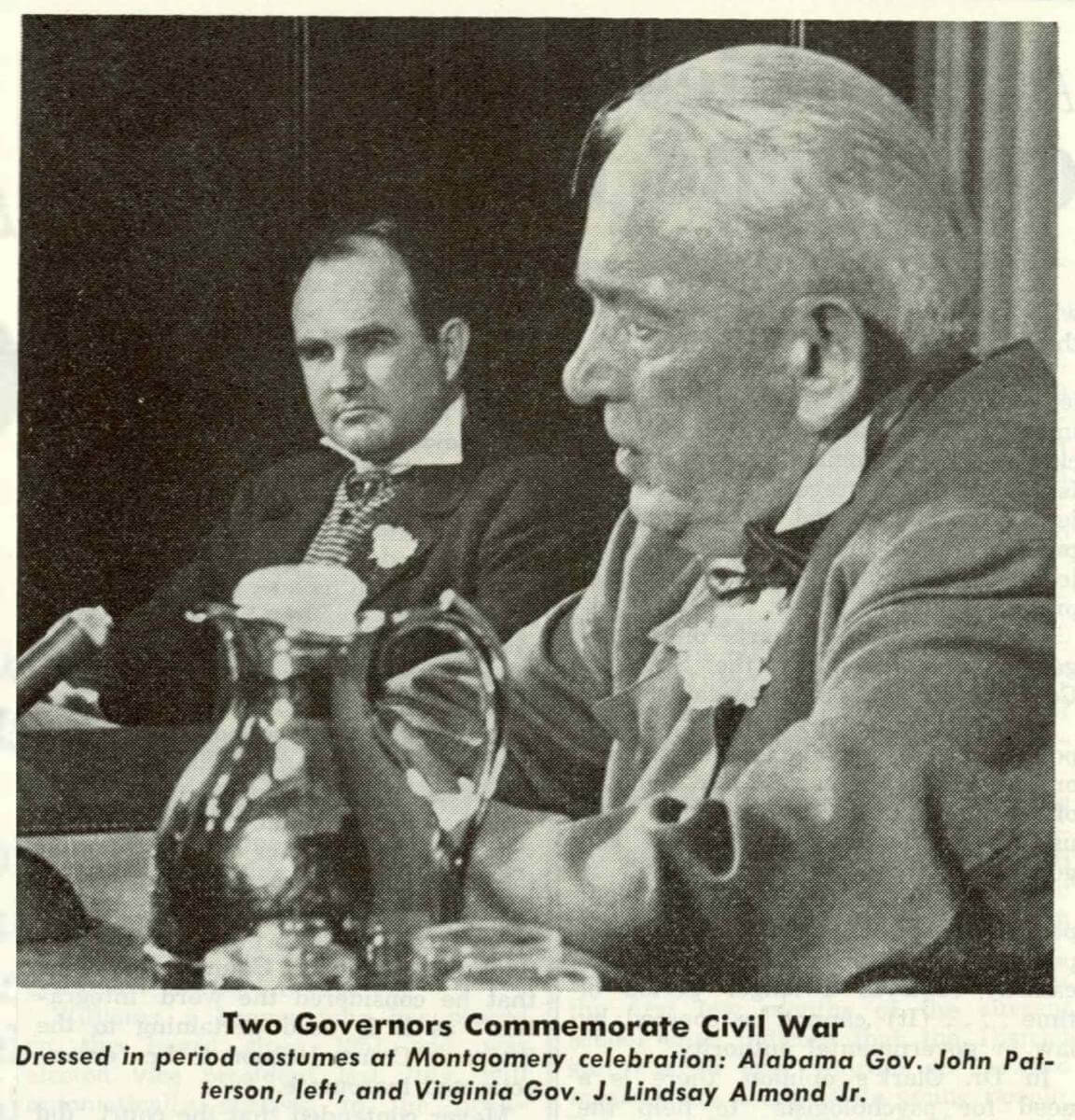
Lindsay Almond became Virginia's new governor in 1957 after a campaign in which he supported the hardline approach. "I'd rather lose my right arm," he proclaimed, "than to see one nigra child enter the white schools of Virginia." But, once in office, Governor Almond was persuaded by business leaders and others to establish a second commission, named after its chair, state senator Mosby Perrow, a prosperous lawyer and farmer. The Perrow Commission's report echoed the Gray Commission's "twin principles of local determination and freedom of choice." It also recommended adopting the strategies of the earlier Gray Commission and Alabama's Boutwell Committee: abandon any mention of race; allow local, flexible pupil placement on factors without explicit mention of race; create vouchers or so-called "scholarships."
The Perrow report did not specify exact terms for proposed legislation in each area since its members were not certain at that moment if a "three school plan," first envisioned in Alabama five years earlier, would be successfully defended in the courts. It did recommend a new uniform testing program—but testing only for the public schools, not for the private schools supported by vouchers.55Commission on Public Education, "Report of the Commission to the Governor of Virginia" (Richmond, 1959). This report is also referred to as the Perrow Report in reference to the chairman of the Commission, Mosby G. Perrow Jr.
Not all local jurisdictions followed the Perrow report. Some, such as Prince Edward County, maintained absolute segregation by closing the county's public schools and providing county tax credit scholarships to supplement state vouchers for white children to attend private schools. In 1964, however, Justice Hugo Black issued the Supreme Court opinion outlawing the die-hard segregationists' schemes. The Court ordered the public schools reopened on a desegregated basis and held that both tax credit and direct vouchers were unconstitutional.56"Report of the Commission to the Governor of Virginia," 21–25; "Virginia: State Commission Draws Up New Legislative Proposals," Southern School News, April 1959, 16; George M. Cochran, "Virginia Facing Reality: The 1959 Perrow Commission," Augusta Historical Bulletin 42 (2006), http://mlkcommission.dls.virginia.gov/va_school_closings/pdfs/Cochrane%20Augusta%20Historical%20Bulletin.pdf; Griffin v. School Board of Prince Edward County, 377 U.S. 218 (1964) at 233.
Senator Marion Gressette, chair of the South Carolina Segregation School Committee—first created by Governor Jimmy Byrnes and the state legislature in 1951—led resistance to court-ordered desegregation for more than twenty years. The Gressette Committee believed the best defense against the federal courts was to move "with caution and with a minimum of publicity" and to report publicly as little as possible.57John W. White, "Managed Compliance: White Resistance and Desegregation in South Carolina, 1950–1970" (PhD diss., University of Florida, 2006), 152.
Before Brown, Governor Byrnes initiated an aggressive statewide building program of segregated schools for Black children to bolster the legal argument that "separate but equal" was equal and constitutional, but the passage of a state constitutional amendment two years before Brown also permitted South Carolina to close its public schools—a clear message to the Black population to leave segregation as it had been.
After Brown, Byrnes suspended the Black school construction program, but restarted it once persuaded by the Gressette Committee that the program remained a useful incentive for Black parents to keep their children in segregated, all-Black schools instead of seeking admission to all-white public schools.58Stephen Harold Lowe, "'The Magnificent Fight': Civil Rights Litigation in South Carolina Federal Courts, 1940–1970" (PhD diss., University of Michigan, 1999), 193–201; White, "Managed Compliance," 43–61; "South Carolina," Southern School News, September 3, 1954, 12.
Following the Gressette Committee's recommendations, the legislature also passed a pupil assignment bill giving local school boards the authority to make all decisions about attendance based on a family's geographic location and a child's scholastic aptitude (e.g., "each child shall be considered individually") without mention of race. Gressette understood that this color-blind standard in pupil placement could be a barrier to widespread school desegregation because of residential segregation. As the staff director of the Gressette Committee privately observed, local school boards could also decide, even where housing segregation did not preserve separate schools, that "there are few Negroes educationally qualified to go to schools with similarly aged white children."59White, "Managed Compliance," 151–153. "Academic standards" without any reference to race or skin color also were used to assure that African American teachers did not receive equal pay with white teachers, despite a federal court order to equalize teachers' salaries. Also see R. Scott Baker, "Testing Equality: The National Teacher Examination and the NAACP's Legal Campaign to Equalize Teachers' Salaries in the South 1936–63," History of Education Quarterly 35, no. 1 (1995): 49–64 and R. Scott Baker, "The Paradoxes of Desegregation: Race, Class, and Education, 1935–1975," American Journal of Education 109, no. 3 (May 2001): 320–343. The Gressette Committee also attempted to convince the NAACP lawyers that geography, not the state government, was responsible for school segregation. See Maxie Myron Cox Jr., "1963—the Year of Decision: Desegregation in South Carolina" (PhD diss., University of South Carolina, 1996), 166.
The president of the South Carolina Farm Bureau echoed the analysis made earlier by Alabama corporate attorney Forney Johnston when he observed: "If Negroes are to have the right of free choice in attending separate or mixed schools if they wish, then even the Supreme Court cannot deny to white people that same free choice of sending their children to separate or mixed schools."60"South Carolina," Southern School News, January 6, 1955, 14.
The state's acceptance of token desegregation in order to keep schools virtually segregated did not satisfy South Carolina's hardliners, but the Gressette Committee's approach prevailed even as escalating racial violence and state-sponsored intimidation against Black and white activists, especially the NAACP, continued.61White, "Managed Compliance," 166–265. Over time, and without mentioning race, the South Carolina legislature repealed compulsory attendance in public schools, pushed decision-making about school enrollment and school closing to local districts, permitted white students living in racially diverse areas to transfer to a nearby virtually segregated school district, and established tax exemptions for children attending private schools.62"South Carolina," Southern School News, February 3, 1955, 3; "South Carolina," Southern School News, March 3, 1955, 14; "South Carolina," Southern School News, July 1955, 4. Even bills proposing confrontational tactics, such as closing public schools, often did not mention race. For example, a bill in 1955 proposed to close any public school where a student was admitted by court order. See "South Carolina," Southern School News, May 4, 1955, 6. In 1960, on advice of the Gressette Committee, the legislature removed the phrase "for racially segregated schools only" from its appropriations bill. See Cox Jr., "1963—the Year of Decision," 15.
On January 28, 1963, following a federal court order, Harvey Gantt became the first African American since Reconstruction to enroll in a state university in South Carolina when he was admitted to Clemson without incident. Gantt had attended college in Iowa but decided: "I was homesick for the South, I was a child of the South, and that's where I wanted to go."63"Clemson College Admits Negro in State's First Desegregation," Southern School News, February 1963, 1; Interview with Harvey B. Gantt by William R. Ferris, September 28, 2015, C-0367, Southern Oral History Program Collection #4007, Southern Historical Collection, Wilson Library, University of North Carolina at Chapel Hill, https://dc.lib.unc.edu/cdm/compoundobject/collection/sohp/id/27218/rec/2.
The next day, South Carolina's new governor, Donald Russell, announced that the state would provide parents with vouchers or "scholarship grants" to send their children to non-sectarian private schools. Russell did not mention race. He argued that vouchers would require public schools to compete with private ones for students and "this competition would stimulate progress in public education." The Gressette Committee reported that vouchers would "offer to all our citizens the broadest possible freedom of choice."64"Clemson College Admits Negro on Order of Appellate Court," Southern School News, February 1963, 8–9.
In May 1968, after hearing arguments on the voucher program from Matthew Perry and Ernest Finney Jr. (two African American attorneys who later became judges), a panel of three federal judges declared the "purpose, motive and effect of the Act is to unconstitutionally circumvent the requirement . . . that the State of South Carolina not discriminate on the basis of race or color in its public educational system."65White, "Managed Compliance," 390–391; Brown v. South Carolina State Board of Education, 296 F. Supp. 199 (1968).
In Georgia in 1950, more than two hundred African American students and parents filed a lawsuit claiming unequal education on account of race and seeking admission to all-white schools in Atlanta. Governor Eugene Talmadge warned, "Our rifles are ready" to resist any court desegregation order. Roy Harris, an influential political operative and head of the Citizens' Council, called for the closure of the state's public schools and the creation of a tax-funded private school system.66O'Brien, "Private School Vouchers and the Reality of Racial Politics," 79–92.
Over the next few years, the General Assembly passed laws cutting off funding to any public school that a federal court ordered to desegregate. It also passed laws increasing school funding for segregated Black schools and, after Brown was argued in 1953, additional laws enabled white voters to approve a constitutional amendment to permit vouchers for private schooling. Georgia's attorney general, Eugene Cook, assured white Georgians that any plan to "subsidize the child rather than the school" was lawful.67O'Brien, 105–108; "Georgia Attorney General Says Supreme Court Will Mix Schools," Chicago Defender, October 31, 1953, 5; Acts and Resolutions of the General Assembly of the State of Georgia, 1956, vol. 1, 10–11, 13–15. These laws followed the passage of a 1955 law mandating that in Georgia "no State or local funds shall be in any manner appropriated or expended for public school purposes except for schools in which the white and colored races are separately educated." See Acts and Resolutions of the General Assembly of the State of Georgia, 1955, vol. 1, 174–176.
In 1958, Ernest Vandiver became governor after promising white voters: "Neither my child nor your child will ever attend an integrated school during my administration. No, not one!" Afterwards, the legislature enacted tuition tax credits for families whose children attended private schools, barred using local property taxes to finance desegregated public schools, and empowered the governor to close either school districts or individual public schools as needed.68Acts and Resolutions of the General Assembly of the State of Georgia, 1959, vol. 1, 7, 15, 157; "Georgia: Teachers Endorse Separate-But-Equal; Decision Awaited In State Test Case," Southern School News, April 1959, 7. During this period, Atlanta's NAACP attorney Donald Hollowell, who advanced many of the court challenges to Georgia's school segregation, stated that he would not predict the outcome of any court case, but added that he fully expected the color line to fall.69"Motion to Dismiss Is Overruled," Atlanta Daily World, December 16, 1958.
Facing a federal court order for the token desegregation of four Atlanta public schools, Governor Vandiver considered accepting virtual segregation, earning the outrage of political kingmaker Roy Harris, who declared: "If one little Negro is entitled to go to Henry Grady High School in Atlanta, then all Negroes are entitled to go to some high school with whites."70O'Brien, "Private School Vouchers and the Reality of Racial Politics," 174. Vandiver tried having it both ways: he recommended bills to continue absolute segregation while creating a Committee on the Schools, later called the Sibley Commission, to explore best options.
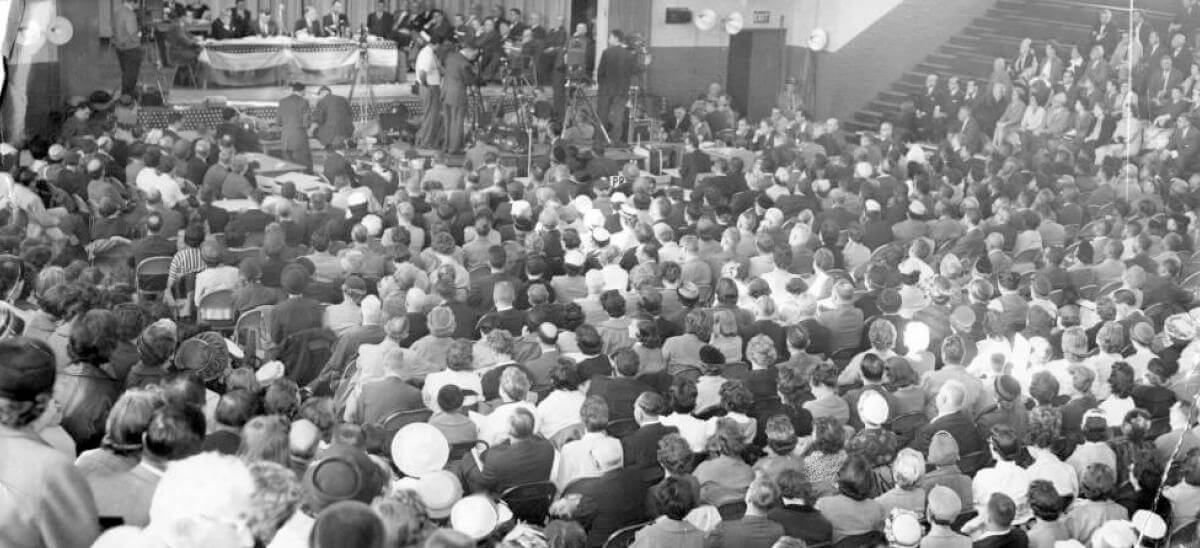
Atlanta businessman and corporate attorney John Sibley led the new commission in holding public hearings across the state. Afterwards the Commission recommended that public schools remain open and, in effect, that the state manage a slow process of token desegregation: "Those who insist upon total segregation must face the fact that it cannot be maintained in public schools by state law." The report's plan was designed "to effectuate voluntary association." Recommended strategies included freedom of parental choice, local decisions for pupil placements and pupil transfers, and tuition grants to private schools—the pillars of Alabama's earlier Boutwell plan.71O'Brien, 171–181; Acts and Resolutions of the General Assembly of the State of Georgia, 1960, vol. 1, 1187; Jeff Roche, Restructured Resistance: The Sibley Commission and the Politics of Desegregation in Georgia (Athens: University of Georgia Press, 1998), 163–172; "Here's Text of Majority Report by Sibley Committee," Atlanta Constitution, April 29, 1960; "Text of Minority Report," Atlanta Constitution, April 29, 1960; Paul Delaney, "Judge Hooper to Study Sibley Report Monday," Atlanta Daily World, May 8, 1960.
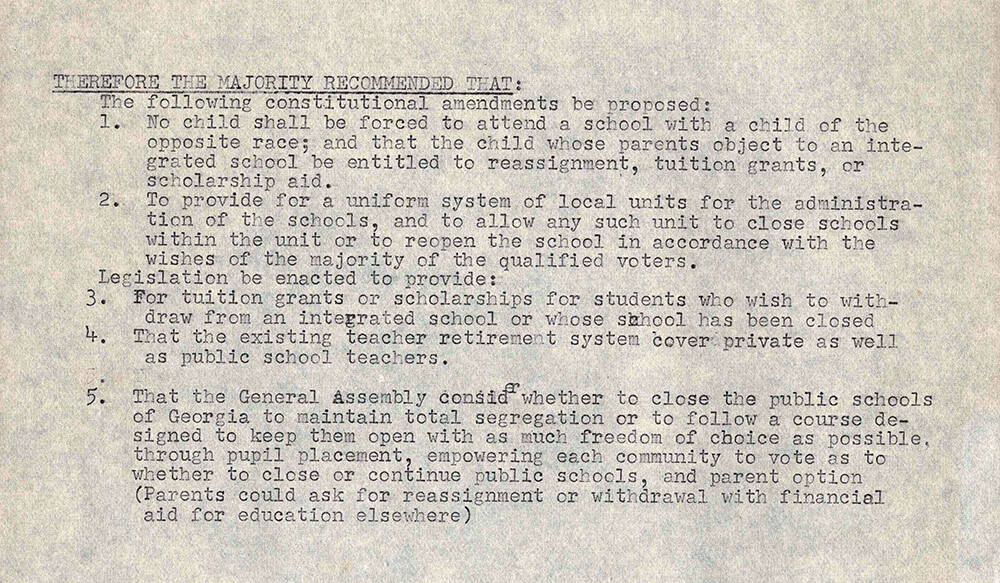
In January 1961, shortly after two thousand angry whites surrounded the dormitory of Charlayne Hunter, one of two Black students admitted to the University of Georgia in Athens,72Matthew D. Lassiter, The Silent Majority: Suburban Politics in the Sunbelt South (Princeton, NJ: Princeton University Press, 2006), 87–89. Governor Vandiver announced he would follow the Sibley report. He proposed to repeal race-specific laws of massive resistance and promised every Georgia child "his God-given right to freedom of association" through a new amendment securing "the constitutional rights of school children to attend private schools of their choice in lieu of public schools" through public financing.73O'Brien, "Private School Vouchers and the Reality of Racial Politics," 189–191, 199–201; "Gov. Ernest Vandiver Asks 4-Point Child Protection Defense Package," Atlanta Daily World, January 19, 1961; "U.S. Judge Rejects Contentions of Georgia Officials," Southern School News, February 1961, 8; Acts and Resolutions of the General Assembly of the State of Georgia, 1961, vol. 1, 35.
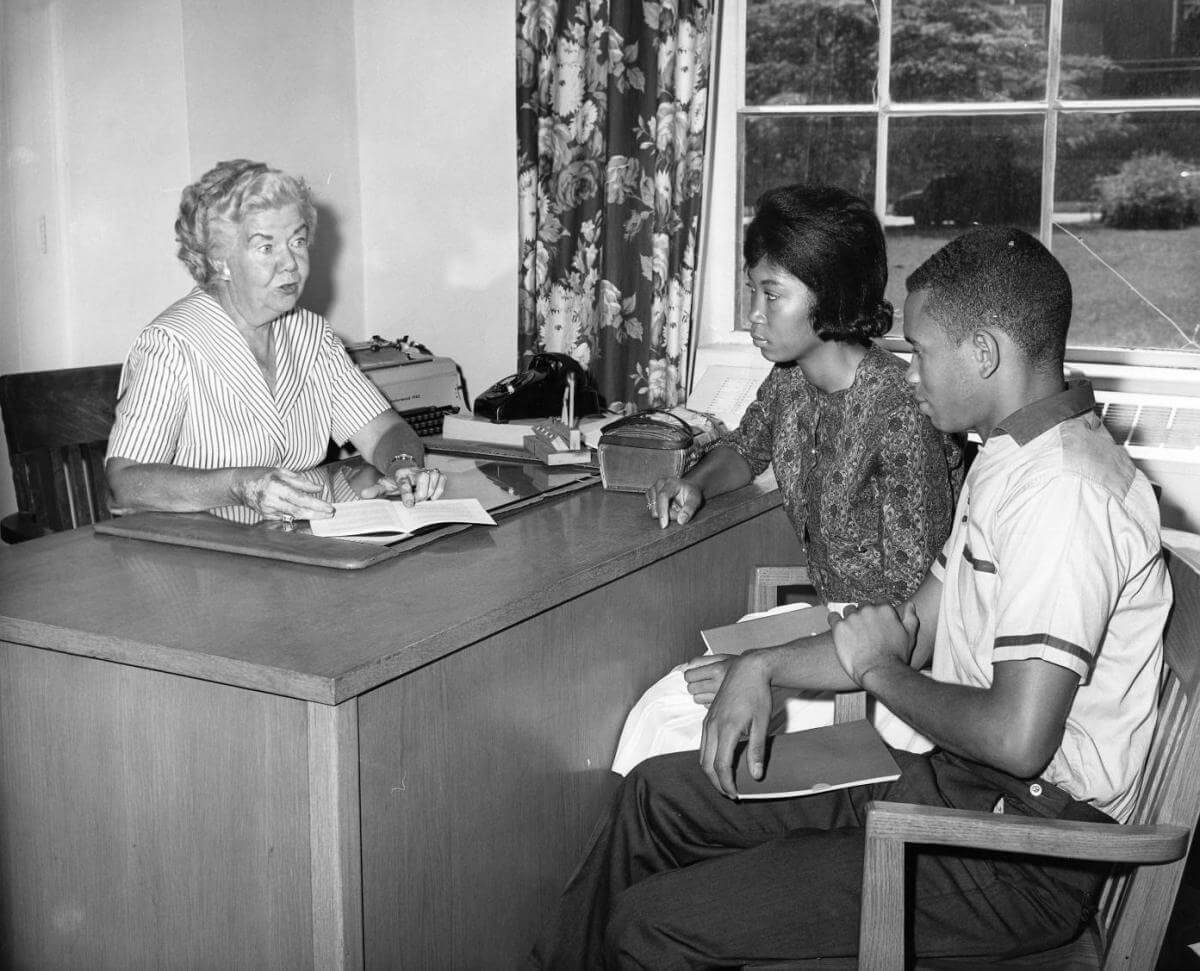
In August 1961, two Black students desegregated Atlanta's Grady High School without incident. Atlanta's peaceful acceptance of token integration at Grady and the city's other all-white high schools became, in the words of the New York Times, a "new and shining example of what can be accomplished" in the South. President John Kennedy said afterwards: "I strongly urge all communities which face this difficult transition to look closely at what Atlanta has done."74Kruse, White Flight, 150–156. That one day in 1961 burnished the city's growing international reputation as the "City Too Busy to Hate," while, in fact, it set in motion a process of pupil assignments that preserved virtual segregation across the entire school system.75Lassiter, The Silent Majority, 104–105.
In 1962, Georgia financed vouchers for more than fifteen hundred students in private schools. In addition, the legislature aided white teachers in leaving public for private schools by allowing them to remain in the state retirement system. None of the new laws specifically mentioned "race" or racial segregation. In the aftermath of its "shining example," the Atlanta school board routinely denied requests by scores of Black parents to transfer their children to all-white schools. Attorney Donald Hollowell assured the public "we will appeal," but courtroom challenges could not catch up with the school board's delaying tactics. By December 1963, Dr. Martin Luther King Jr. publicly condemned "something strange and appalling"—not a single Black child was attending Atlanta's all-white elementary schools and only 153 of more than 14,000 Black high school students attended classes with whites.76Bruce Galphin, "40 Negro Students File Appeals for Transfers," Atlanta Constitution, June 14, 1961; Bruce Galphin, "38 Negroes, White Girl Lose Transfer Appeals," Atlanta Constitution, July 7, 1961; Tomoko Brown-Nagin, Courage to Dissent: Atlanta and the Long History of the Civil Rights Movement (New York: Oxford University Press, 2011), 307.
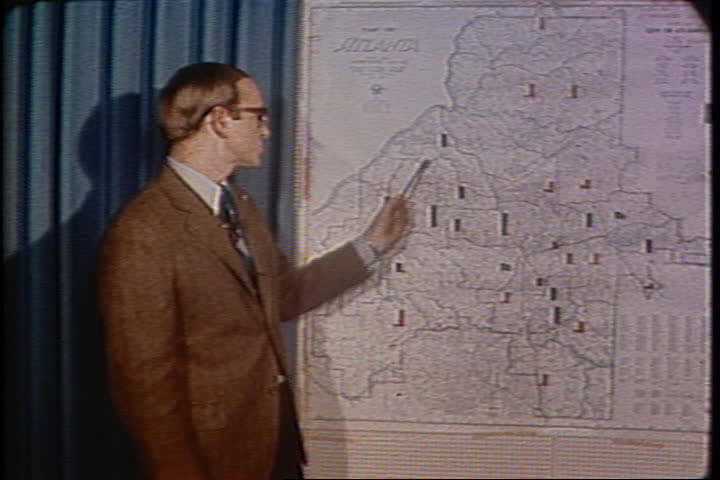
With each passing year throughout the 1960s, legal strategies and tools of resistance to Brown became less important in Atlanta and other metropolitan areas as white flight to suburban counties increased—illuminating another highly effective option for preserving the "freedom of white people to choose not to go to school with negroes." Georgia's voucher program petered out after a couple of years—once it became obvious that the program would not survive review by the courts and after the discovery that many of the program's beneficiaries were already attending private schools.77Kruse, White Flight, 9–17, 161–177, 234–235; John H. Britton, "Fear of Increase in Taxes Is Blamed for Bond Measure Defeat: Negro Votes Favored Most Bond Proposals," Atlanta Daily World, August 4, 1962; "$206,640 Granted Students to Attend Jim Crow Schools," Atlanta Daily World, October 17, 1962.
The Limits of Lawsuits: Toppling Voucher Programs but Not Segregated Schools
By 1965, most voucher programs, which had been enacted only in southern states, had been declared unconstitutional or were under serious attack, no matter whether the programs involved indirect expenditures such as tax credits or were shrouded in non-racial language. Each law financing private schools was soon invalidated by a federal court (or abandoned in the case of Georgia before it could be struck down) because the efforts were perceived to evade or disrupt public school desegregation and to "significantly encourage and involve the State in private discriminations."78See these federal cases: Coffey v. State Educational Finance Commission, 296 F. Supp. 1389 (S.D. Miss. 1969); Griffin v. State Board of Education, 296 F. Supp. 1178 (E.D. Va. 1969); Poindexter v. Louisiana Financial Assistance Commission, 296 F. Supp. 686 (E.D. La. 1968); Brown v. South Carolina State Board of Education, 296 F. Supp. 199 (D.S.C. 1968), aff'd, 393 U.S. 222 (1968); Poindexter v. Louisiana Financial Assistance Commission, 275 F. Supp. 833 (E.D. La. 1968), aff'd, 389 U.S. 571 (1968); Lee v. Macon County Board of Education, 267 F. Supp. 458 (M.D. Ala. 1967); Hawkins v. North Carolina State Board of Education, 11 Race Relations Law Reporter 745 (W.D.N.C. 1966); Griffin v. State Board of Education, 239 F. Supp. 560 (E.D. Va. 1965); Lee v. Macon County Board of Education, 231 F. Supp. 743 (E.D. Ala. 1964); Pettaway v. County School Board, 230 F. Supp. 480 (E.D. Va. 1964), aff'd, 339 F. 2d 486 (2d Cir. 1964); Hall v. St. Helena Parish School Board, 231 F. Supp. 649 (E.D. La. 1961), aff'd, 368 U.S. 515 (1962); Aaron v. McKinley, 173 F. Supp. 944 (E.D. Ark. 1959), aff'd sub nom, Faubus v. Arron, 361 U.S. 197 (1959).
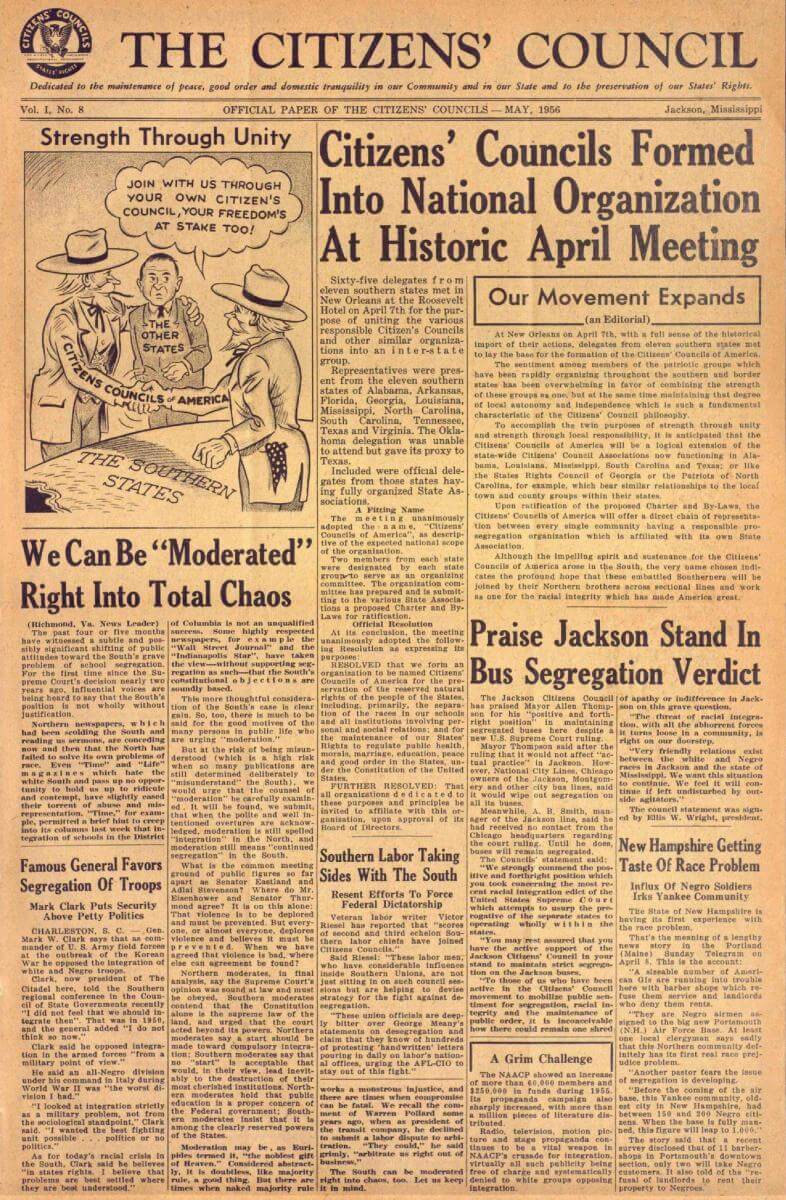
A vital component in states' strategies to preserve segregation, vouchers operated differently depending on state politics, federal court decisions, and the values and judgments of the strategy committees. Exchanging ideas and information, these committees functioned separately, shaped and reshaped by the dynamics of a state's political and business leadership and without a coordinated sectional effort.
In their final reports, most strategy committees adopted methods and means that evaded any exact definition of what preserving school segregation meant as an expression of racial subordination. Like Georgia Governor "No, Not One" Vandiver, states adapted to the reality that absolute or total segregation could not be preserved in the face of federal enforcement of Brown. Sooner or later, white leaders such as Tom P. Brady, the Mississippi politician credited with the idea of forming the Citizens' Council, were willing to accept virtual segregation. Others, including Alabama corporate attorney Forney Johnston, knew at the time of Brown that virtual segregation with its token exceptions could preserve white supremacy so long as conservative white leaders kept control of schools, politics, and the economy.79Tom P. Brady, "Segregation and the South," October 4, 1957, Citizens' Council Collection, Archives and Special Collections, University of Mississippi Libraries; McMillen, The Citizens' Council, 265–266; Thomas P. Brady, interview by Orley B. Caudill, March 4, 1972, Center for Oral History and Cultural Heritage, University of Southern Mississippi Libraries. In 1962, Arnold Rose, who assisted Gunnar Myrdal, wrote a postscript in the 1962 edition of An American Dilemma (New York: McGraw Hill, xxxv–xxxvii) where he discussed how the initial monolithic response to Brown by southern whites changed and adapted to fit the times.
Starting in the mid-1960s, civil rights lawyers were able to use new national anti-discrimination laws to challenge a wider range of white supremacist laws and practices. The civil rights movement moved away from the courtroom as the primary venue for creating change. Before Brown, the NAACP and other civil rights lawyers led the way by using the words of the Constitution to take down the wall of segregation, beginning in the schoolhouses, one student at a time. Privately, NAACP chief attorney Thurgood Marshall laid out the legal approach: "Those white crackers are going to get tired of having Negro lawyers beating 'em every day in court."80Harry S. Ashmore, Hearts and Minds: The Anatomy of Racism from Roosevelt to Reagan (New York: McGraw Hill, 1982), 214. Publicly, it was the hallmark of attorneys such as Donald Hollowell, known in Georgia as "Mr. Civil Rights," to remain reserved and dignified—what Hollowell later remembered with a wink as "courtly"—using only federal filings to argue with white society about segregation, even as white state officials brazenly belittled, condemned, and harassed them.81Brown-Nagin, Courage to Dissent, 336; Donald Hollowell, conversation with the author, May 1978. This strategy confronted white stereotypes and rendered Brown as the law of the land, but alone it proved too slow and inadequate to halt relentless white efforts to stop change or to keep pace with growing Black demands.
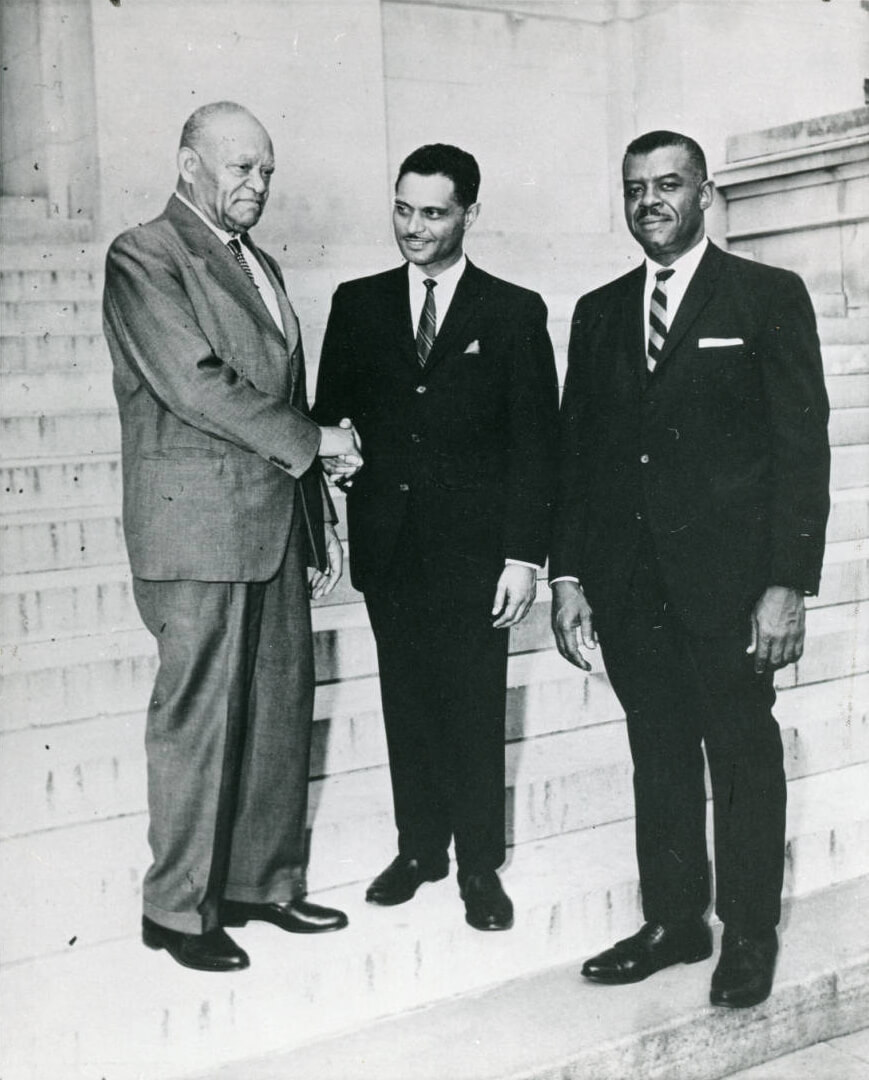
The emergence of the student movement and direct action as strategies for challenging private and public segregation was in part a reaction to the slow, back-and-forth pace of litigation. In some places, even "the twin avenues of civil rights protest—legal and direct action—did not have a catalytic effect" in advancing desegregation. By the middle of the 1960s, school desegregation was no longer the civil rights spearhead. As Dr. Martin Luther King Jr. observed about his own town: "In the absence of legal, political, economic, and moral pressure, not even a city as enlightened as Atlanta is likely to grant the Negro his constitutional rights."82Brown-Nagin, 307–309.
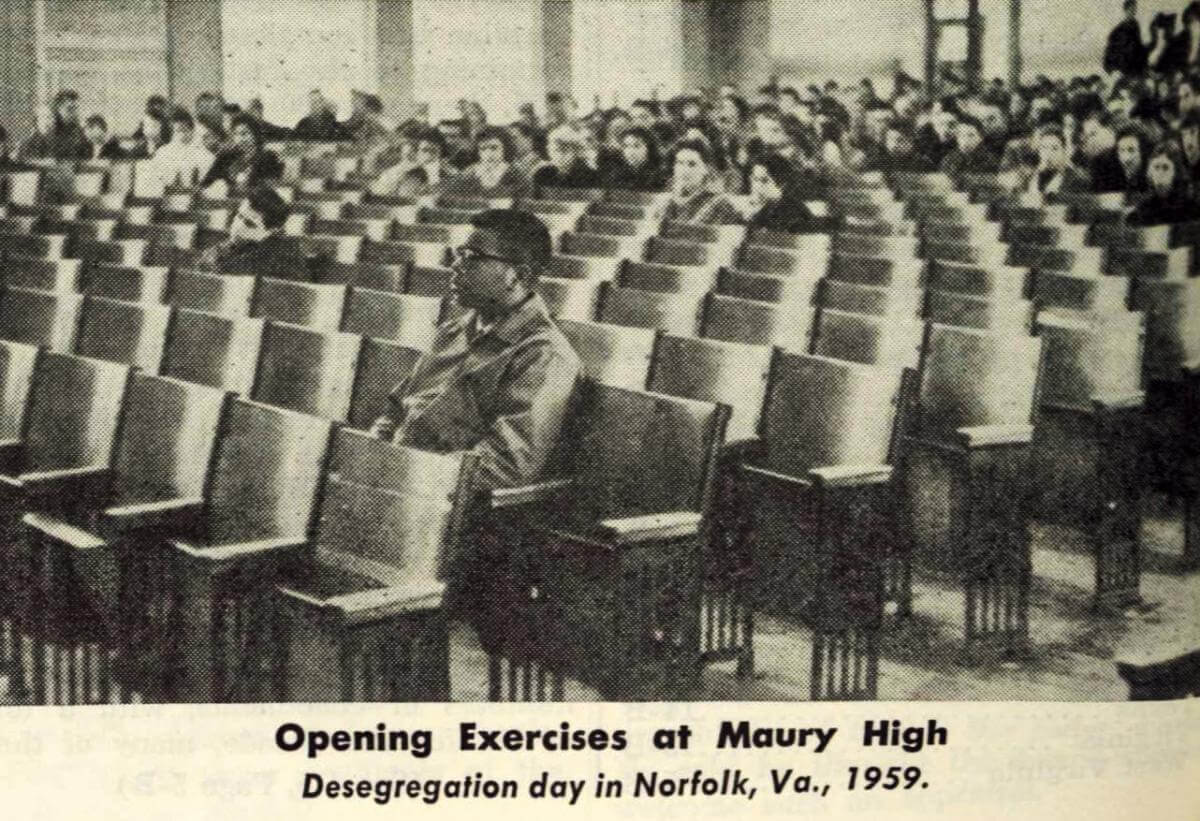
Most of the South's white leaders were discovering that a more fluid definition of segregation was their most effective defense. Increasingly, they realized the efficacy of moving away from "No, not one" or a stand in the schoolhouse door toward strategies that could do almost as much as absolute segregation. As early as 1956, the founder of the Citizens' Council had suggested that members should redefine their way of life as far more than complete separation of the races: "Segregation represents the freedom to choose one's associates, Americanism, state sovereignty, and the survival of the white race."83Robert B. Patterson, 2nd Annual Report (Greenwood, MS: Association of Citizens' Councils of Mississippi, August 1956), 2.
As for the public schools, it did not matter that all the tools for preserving segregation could not withstand the scrutiny of the federal courts or that the civil rights leaders were employing new strategies. A decade after Brown, the architects and advocates of private school vouchers had discovered the means to permit only a symbolic semblance of desegregation. If only by trial and error in some states, "southern anti-integration efforts during the post-Brown era were more often characterized by creativity and flexibility than by obstinacy and intransigence."84Driver, "Supremacies and the Southern Manifesto," 1093. While discussing the ideas and strategies voiced by southern federal officials, Driver illuminates the components of segregationists' plans of resistance that "play a role today in maintaining the paucity of meaningful integration in the nation's public schools." See pages 1094, 1097–1099.
By the end of the 1965 school year, Alabama, Georgia, Louisiana, Mississippi, North Carolina, South Carolina, and Virginia—the seven states that had adopted voucher programs—maintained the South's lowest rates of school desegregation. That year, fewer than 2 percent of all Black students in each of the seven states were attending public schools with white students.85Statistical Summary: School Segregation–Desegregation in the Southern and Border States (Nashville, TN: Southern Education Reporting Service, 1966–67), 43.
Milton Friedman and "Government Schools"
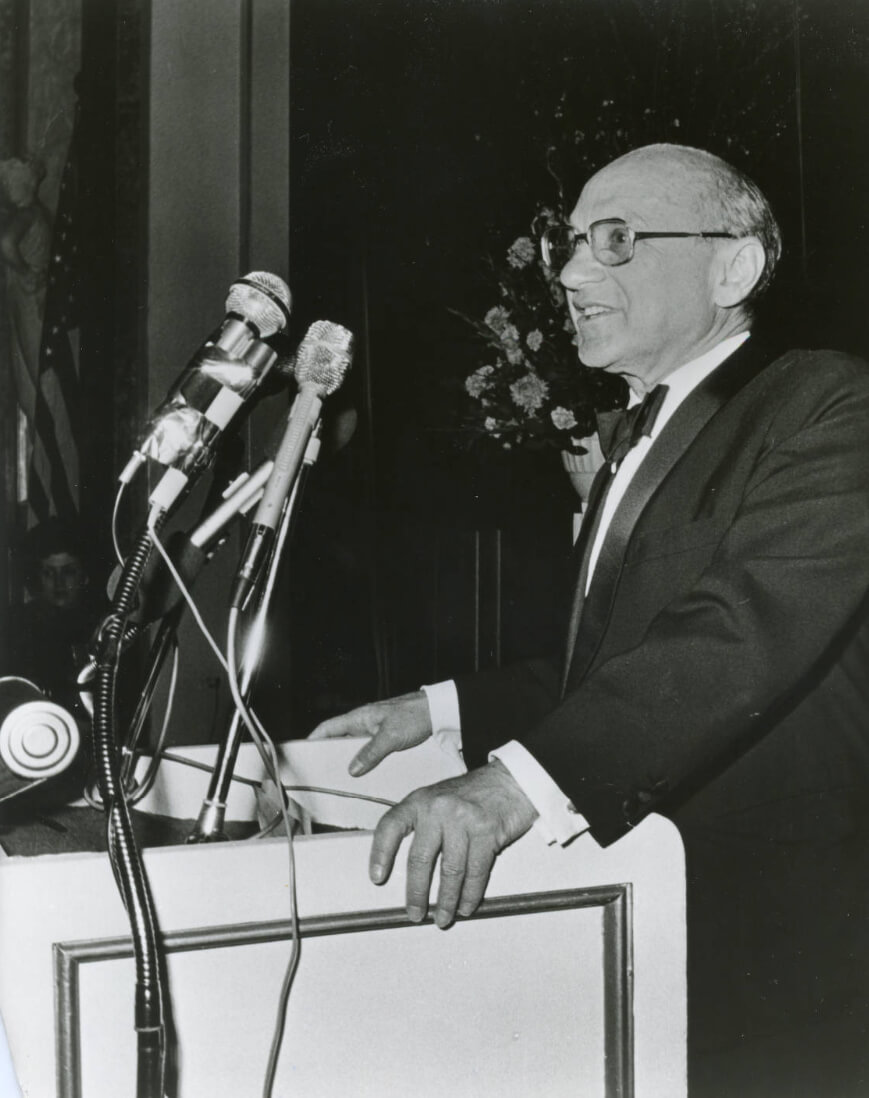
In 1955, almost a year after Albert Boutwell released the Alabama legislative report proposing private school vouchers as a key element in his committee's plan of "freedom of choice," libertarian economist Milton Friedman of the University of Chicago published "The Role of Government in Education."86Milton Friedman, "The Role of Government in Education," in Economics and the Public Interest, ed. Robert A. Solo (New Brunswick, NJ: Rutgers University Press, 1955), 123–144. Friedman was awarded the Nobel Prize for economics in 1976 for his work on monetary policy. It introduced academicians to an economic rationale for school vouchers. Friedman believed parents would get the best education for their children when private schools competed for enrollment. Advancing a theory he and others would repeat over decades, Friedman argued that "competitive private enterprise is likely to be far more efficient in meeting consumer demands than nationalized enterprises" in education.87Friedman, "The Role of Government in Education," 129.
Friedman's advocacy for a system of government-financed vouchers to replace "government schools," as he called them, was grounded in his free market beliefs. However, in a page-long footnote he acknowledged that essentially the same proposal "has recently been suggested in several states as a means of evading the Supreme Court ruling against segregation"—a development Friedman said came to his attention after he had largely completed his essay. The economist assured readers that he deplored segregation and racial prejudice, but he also opposed forced "non-segregation" no less than forced segregation. (Friedman also opposed a federal fair employment commission that would prohibit racial discrimination in private employment and, later, the 1964 Civil Rights Act's prohibition against racial discrimination by private businesses.88Milton Friedman, Capitalism and Freedom (Chicago: University of Chicago Press, 2002), 111–115; "Friedman Cautions Against Rights Bill," Harvard Crimson, May 5, 1964.)
Friedman acknowledged that vouchers would allow a system where there could be "exclusively white schools, exclusively colored schools, and mixed schools. Parents can choose which to send their children to." He was at best agnostic about ending segregation in schools. He noted that the government could decide to make public funds available to private schools only if they were segregated schools, as some southern states proposed in 1955, or only if they were non-segregated schools. His proposal for vouchers was "not therefore inconsistent with either forced segregation or forced nonsegregation."89Friedman, "The Role of Government in Education," 131, fn. 2.
Had he cared enough to inquire about southern segregation, Friedman would have discovered that many white supremacists had already adopted the same outlook and conceptual framework to make vouchers instrumental in maintaining segregated schools. A year earlier, in response to Brown, Mississippi politician Tom P. Brady gave a speech (later expanded into a book) that became an informal manifesto for the Citizens' Council and other southern segregationists. In Black Monday, Brady wrote:
The public school is a socialized or politically monopolized institution, and suffers from weakness inherent in all monopolies. The only thing that prevents the public school from decaying completely is the fact that it is not a complete monopoly. Local control of the school gives the taxpayer and parent some say in its management. . . . Nothing will do more to better education in America than the breaking of the public school trust. . . .
This is not a proposal to abolish public schools. It is a proposal to put them into competition with free enterprise schools, so they can prove their worth. And this can be done by the remission to parents of the taxes they are compelled to pay to support politically-controlled schools, in an amount comparable to what they pay for private schooling. The method of effecting this remission—whether by deduction from income taxes or allowances from local levies—is a technical matter; if the principle established that a parent has the right to buy the educational service he deems best for his child, the fiscal problem of tax remission could be solved.90Tom P. Brady, Black Monday (Winona, MS: Association of Citizens' Councils, 1954), 56; Brady, interview.
Similarly, the Alabama "freedom of choice" plan—the first segregation strategy report, published a year before Friedman's essay—was built on the foundational philosophy that when "members of a race are thereby deprived of access to a school attended by the other race, the result is attributable not to compulsion by the state but to the inconsistent choices of free citizens." As Alabama's Forney Johnston explained, under his segregation plan "the state is obliged to give effect to the desire of parents without compulsion against either side" or, as Milton Friedman wrote, without "either forced segregation or forced nonsegregation."
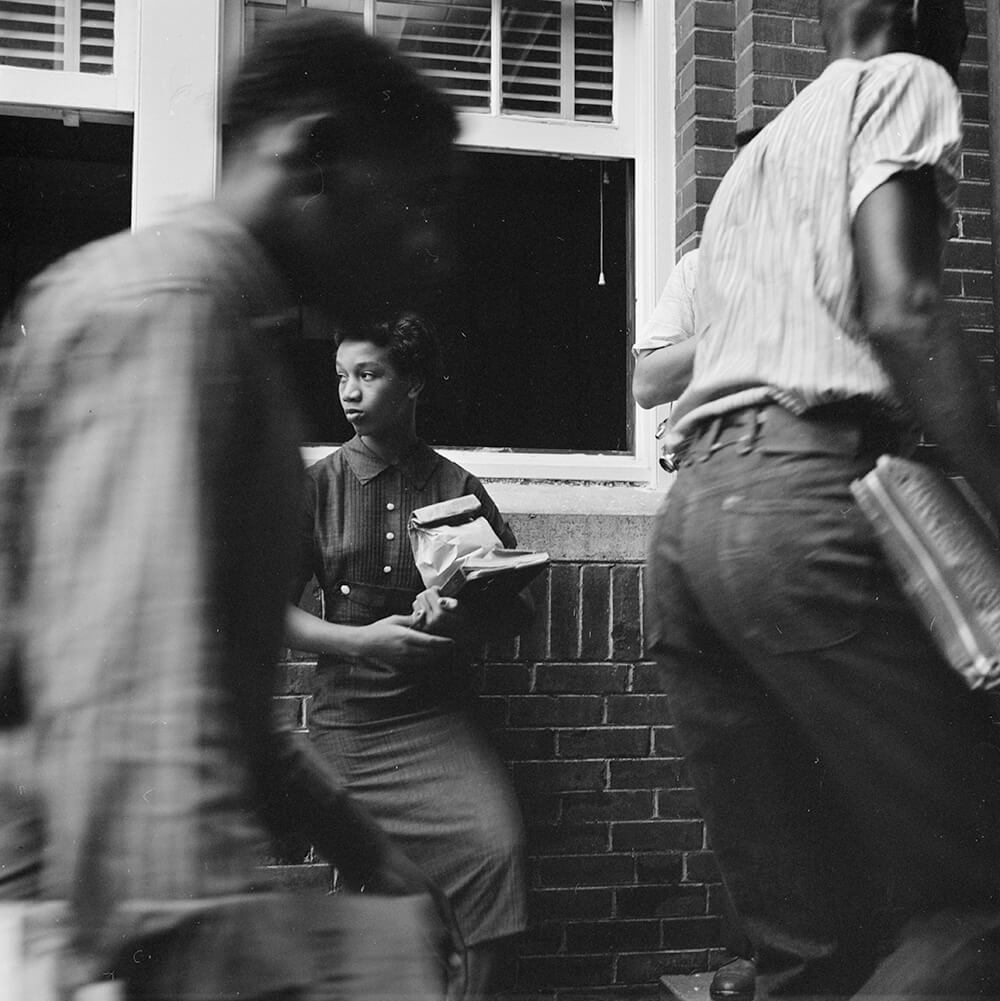
Johnston foresaw that his Alabama plan would lead to the same place Friedman envisioned—moving from a dual school system to a three-school system with "exclusively white schools, exclusively colored schools, and mixed schools." And Johnston was confident that, so long as white parents had access to vouchers for private schools and segregationist leaders established and implemented pupil placement, his plan would preserve segregation in some form for most white students in his state.91Johnston, "Schools, the Supreme Court, and the States' Power," 3–10.
Friedman's analysis not only echoed segregationist plans but helped to revive a new non-racial defense of segregation. Within four years of the publication of Friedman's essay, a large number of southern segregationists were advancing the theory of individual freedom as the leading rationale for vouchers and school choice. Perhaps the most prolific, active disciple of this libertarian approach was Virginia newspaperman Leon Dure, who converted Friedman's advocacies into a constitutional argument for freedom of association.
As tactics of massive resistance began to fail in Virginia, Dure urged state leaders in 1958 to adopt school vouchers and his principles of freedom of choice or freedom of association as the most effective means for limiting desegregation. The plan offered every child "of whatever color, of whatever means" a voucher (called a "scholarship"). Echoing Johnston and Friedman, Dure argued that "the South accepts the right of all people to associate, but it insists on the right of all people not to associate." On these terms, Dure wrote, "the southern white case is not compulsory segregation; it also is individual liberty," which he believed was protected in federal and state constitutions' guarantees of the right to assemble. Oliver Hill, the Virginia NAACP's leading attorney who had brought one of the original cases involved in Brown, told Dure that his proposal would do little more than mask racial discrimination.92James H. Hershman and the Dictionary of Virginia Biography, "Leon S. Dure (1907–1993)," Encyclopedia Virginia, last modified October 6, 2016, https://www.encyclopediavirginia.org/Dure_Leon_S_1907-1993; Leon Dure, "Virginia's New Freedom," The Georgia Review 18, no. 1 (Spring 1964): 4; Leon Dure, "The New Southern Response: Anatomy of Two New Freedoms," The Georgia Review 15, no. 4 (Winter 1961): 401–409, 412; James H. Hershman Jr., "Massive Resistance Meets Its Match: The Emergence of a Pro-Public School Majority," in The Moderates' Dilemma: Massive Resistance to School Desegregation in Virginia, eds. Matthew D. Lassiter and Andrew B. Lewis (Charlottesville: University Press of Virginia, 1998), 128. Dure seemed especially delighted that the US Supreme Court had recognized the "right of association" in a case where the Court prevented the Alabama attorney general's assault against the NAACP. See NAACP v. Alabama ex rel. Patterson, 357 U.S. 449 (1958). Dure was also influenced by the writings of Virgil Blum, a political scientist at Marquette University who advocated for school vouchers for private schools, including parochial schools, on a philosophy of free-markets and freedom of religion. See Carl, Freedom of Choice, 91–92.
When Virginia's Perrow Commission issued its report, reversing the openly defiant tone and recommendations of earlier governors and legislatures, it embraced tactics of local control and freedom of association. As one politician wrote to Dure, there was now complete "agreement that the Freedom of Choice plan is . . . not based on segregation or integration but that any child in Virginia may obtain a tuition grant"—an equal opportunity to all children to freely disassociate.93Hershman Jr., "Massive Resistance Meets Its Match," 127–130; C.F. Hicks to Leon Dure, June 22, 1961, Leon Dure Papers, University of Virginia, Charlottesville, Virginia.
Dure also helped to convince white leaders in Georgia to reverse their approach for preserving segregated schools. Dure's frequent correspondence with John Sibley and others helped Governor Vandiver's administration understand how embracing "freedom of association" held the best promise for justifying and preserving virtually segregated schools. The exact language of the new state constitutional amendment approved by the white voters of Georgia stated: "Freedom from compulsory association at all levels of public education shall be preserved inviolate." During the same period, Louisiana's white leaders also attempted to rescue their strategies to resist desegregation through a similar approach.94Hershman Jr., "Massive Resistance Meets Its Match," 127–128, including fn. 52; Carl, Freedom of Choice, 91–92. The Georgia amendment became Section VIII of Article VIII of the Georgia Constitution and remained in the constitution until removed twenty years later as a "vestige of the past," although many in the early 1980s had no notion of what the provision represented. See Committee to Revise Article VIII, "Transcripts of Meetings," 22 May 1980, State of Georgia Select Committee on Constitutional Revision, 1977–1981, vol. I, 9.
Just as Friedman adopted the term "mixed schools," the segregationists' favorite scare phrase for desegregated schools, die-hard segregationists adopted Friedman's language. In 1964, the Mississippi administrator of the Citizens' Council, William Simmons, abandoned his earlier primary defense of segregated schools as a matter of constitutional "state rights" and began condemning the monopoly of "government schools." In the Council's newsletter, echoing both Brady and Friedman, Simmons wrote that that public schools "can no longer be considered public—they have become government school systems." Afterwards, the White Citizens' Council focused primarily in Mississippi on developing a private school system of choice, as their leaders condemned government schools as "socialism in its purest form."95Michael W. Fuquay, "Civil Rights and the Private School Movement in Mississippi, 1964–1971," History of Education Quarterly 42, no. 2 (Summer 2002): 163–164, 178–179. Parroting Friedman, right wing radio and media personalities such as Neal Boortz and Sean Hannity have hammered for years at "government schools." Neal Boortz, "Government Idiocy in Action at Schools," Atlanta Journal-Constitution, December 8, 2009, https://www.ajc.com/news/opinion/neal-boortz-government-idiocy-action-schools/mQCmFIfvMZ36Nwc2t2YoDI/; "Sean Hannity Attacks Social Security and Public Schools as Ineffective Programs Exploiting People's Fears," Media Matters for America, January 3, 2019, https://www.mediamatters.org/video/2019/01/03/sean-hannity-attacks-social-security-and-public-schools-ineffective-programs-exploiting-peoples/222411.
Friedman never joined forces with segregationists, but he remained indifferent about how his libertarian economic arguments aided their strategies. Over several decades he continued to promote the concepts and framework that segregationists in the late 1950s and early 1960s believed were their best chance and best arguments. Long after southerners abandoned their segregationist rhetoric, Friedman's advocacy shaped how future scholars, advocates, and the general public would see vouchers and "freedom of choice" as acts of consumerism rather than segregationist tactics. "For whites moving into the new suburbs," writes historian James Hardman Jr., the term "carried the popular consumer phrase 'choice,' and gave the impression that simple economic choice, not morally questionable racial prejudice, was behind the segregation in their communities."96James Hardman Jr., "Virginia on the Cusp of Change," in Historians in Service of a Better South, eds. Robert J. Norrell and Andrew H. Myers (Montgomery, AL: NewSouth Books, 2017), 80. It was a redefinition of choice that most of the South's private schools, even those started as "segregation academies," came to embrace and propagate as they persisted and expanded in the decades that followed.
Challenging Tax Benefits of Segregated Private Schools
Civil rights organizations recognized during the 1960s the danger that governmental support posed in helping to build segregated systems of private schools even after the courts had dismantled voucher programs. These groups pushed the Internal Revenue Service (IRS) to deny tax-exempt applications of "segregation academies." This federal tax status enabled whites to reduce their taxable income when contributing to racially exclusionary private schools. But, in 1967, the IRS announced that it would grant tax deductions for contributions to any southern private school, even self-avowed segregation academies, because "the school is private and does not have such degree of involvement with the political subdivision as has been determined by the courts to constitute State action for constitutional purposes."97Green v. Kennedy, 309 F. Supp. 1127 (1970) at 1130.
The Lawyers Committee for Civil Rights Under Law sued the IRS in 1969 and obtained a court order requiring it to "affirmatively determine" that a private school in Mississippi is not "operated on a racially segregated basis as an alternative to white students seeking to avoid desegregated public schools." The three-judge federal court found that the "tax benefits under the Internal Revenue Code mean a substantial and significant support by the Government to the segregated private school pattern."98Green, 309 F. Supp. 1127 (1970) aff'd sub nom, Cannon v. Green, 398 U.S. 956 (1970); Eileen Shanahan, "Schools in South May Avoid Taxes," New York Times, August 3, 1967; Eileen Shanahan, "Private Schools That Bar Blacks to Lose Tax Aid," New York Times, July 11, 1970. After its ruling was affirmed without opinion by the US Supreme Court, the court issued a permanent injunction restricting the IRS from granting a tax exemption to any and all Mississippi private schools that applied for the tax benefit.99Green v. Connally, 330 F. Supp. 1150 (1971), aff'd sub nom, Coit v. Green, 404 U.S. 997 (1971).
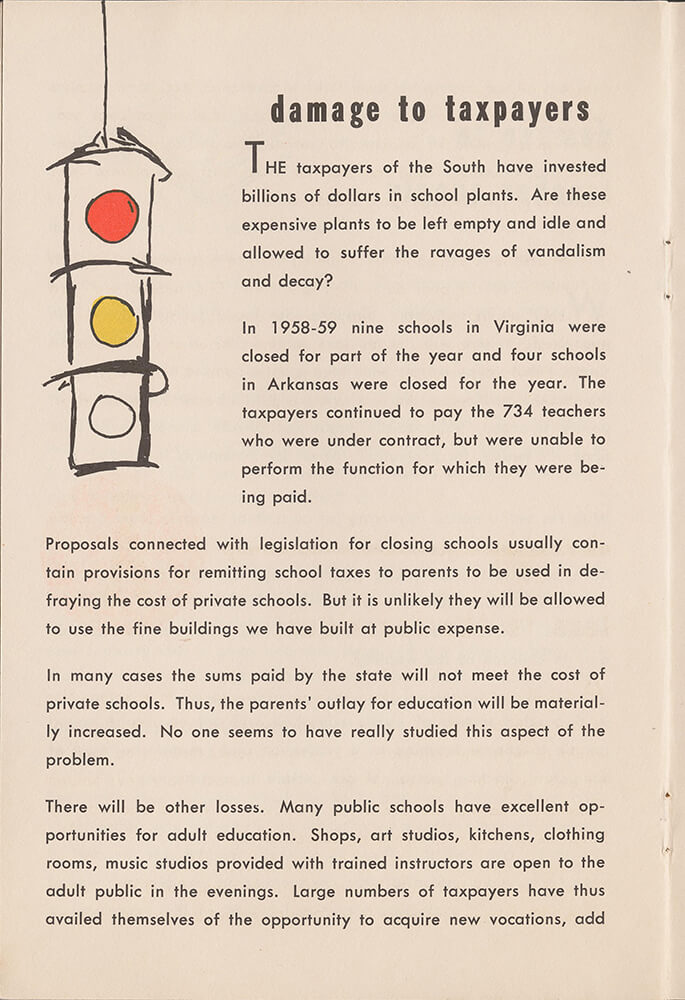
Afterwards, the IRS revoked the tax exemptions of more than one hundred private schools and scrutinized applications for tax exemption from others; however, it took eight years before the agency proposed specific administrative regulations to implement the non-discrimination policy adopted in 1970. During this time, the IRS faced a backlash from private schools and their supporters, including southern members of Congress, and, in this political environment, went back and forth with proposed administrative procedures and congressional hearings. When the Nixon administration issued final guidelines, the Lawyers Committee, the US Civil Rights Commission, and others criticized the IRS's rules, procedures, and enforcement as inadequate.100"Proposed Rules on Tax Exemptions for Private Schools Eased by IRS," New York Times, February 10, 1979; IRS Tax Exemptions and Segregated Private Schools: Hearing Before the Subcommittee on Civil and Constitutional Rights of the Committee on the Judiciary, House of Representatives, 97th Cong., 2d Sess. 39 (1982); also see Tax-Exempt Status of Private Schools: Hearing Before the Subcommittee on Oversight of the Committee on Ways and Means, House of Representatives, 99th Cong., 2d Sess. 39 (1985).
Despite the regulation's shortcomings, a significant number of religious private schools in the South objected to the new IRS rules on the grounds of religious freedom, claiming that the government could not oversee their operations under any circumstances, even if they engaged in practices of segregation and racial discrimination. In 1983, the US Supreme Court disagreed and upheld the application of the IRS rules on religious schools in a case involving Bob Jones University in South Carolina. Chief Justice Warren Burger wrote that "the Government has a fundamental, overriding interest in eradicating racial discrimination in education—discrimination that prevailed, with official approval, for the first 165 years of this Nation's constitutional history. That governmental interest substantially outweighs whatever burden denial of tax benefits places on petitioners' exercise of their religious beliefs."101Julia Malone, "Those Tax Breaks for Segregated Schools Stir Storm," Christian Science Monitor, January 14, 1982; Bob Jones University v. United States, 461 U.S. 574 (1983); Strat Douthat, "Some All-White Academies Struggle," Richmond Times-Dispatch, March 18, 1986.
After Bob Jones, the IRS required tax-exempt private schools to demonstrate non-discriminatory policies and operations. But the requirements proved minimal—involving little more than adoption of a policy statement by the school's founders or board, publication of the policy (in brochures and catalogues), and some way of demonstrating that the school had abandoned total, absolute segregation.102Terry Berkovsky, Andrew Megosh, Debra Cowen, and David Daume, "Private School Update," 2000 EO CPE Text, Internal Revenue Service, 2000, www.irs.gov/pub/irs-tege/eotopicn00.pdf. The IRS rules suggest that a school must evidence that "it currently enrolls a meaningful number of racial minority students, or that its promotional activities and recruiting efforts are reasonably designed to inform students of all racial segments in the general communities within the area of the availability of the school." But, as a matter of practice, citing language in the Bob Jones case that denial of tax exemptions should be made "only where there is no doubt that the organization's activities violate fundamental public policy," the IRS and the US Tax Court has denied tax status only when a school maintains total segregation. See Calhoun Academy v. Commissioner, 94 T.C. 284 (1990).
Private schools in the South began to publish non-discrimination statements and many began a slow process of admitting a token number of Black or other students of color. It was a replay of the most effective tactics that segregationists had deployed in the public schools several years earlier. This change did little more than end all-white segregation in order to sustain virtual segregation. The practices satisfied the IRS requirement and allowed subsequent federal administrations to claim that private schools had shown "clear and specific factual evidence" of non-discrimination.
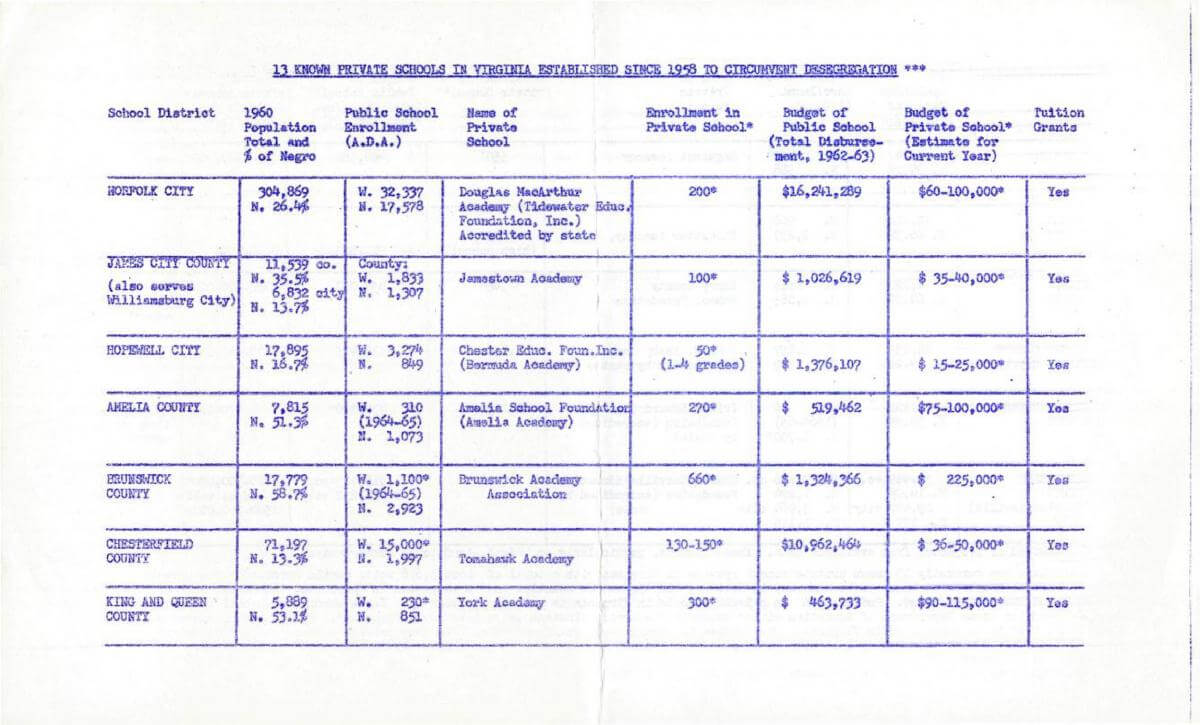
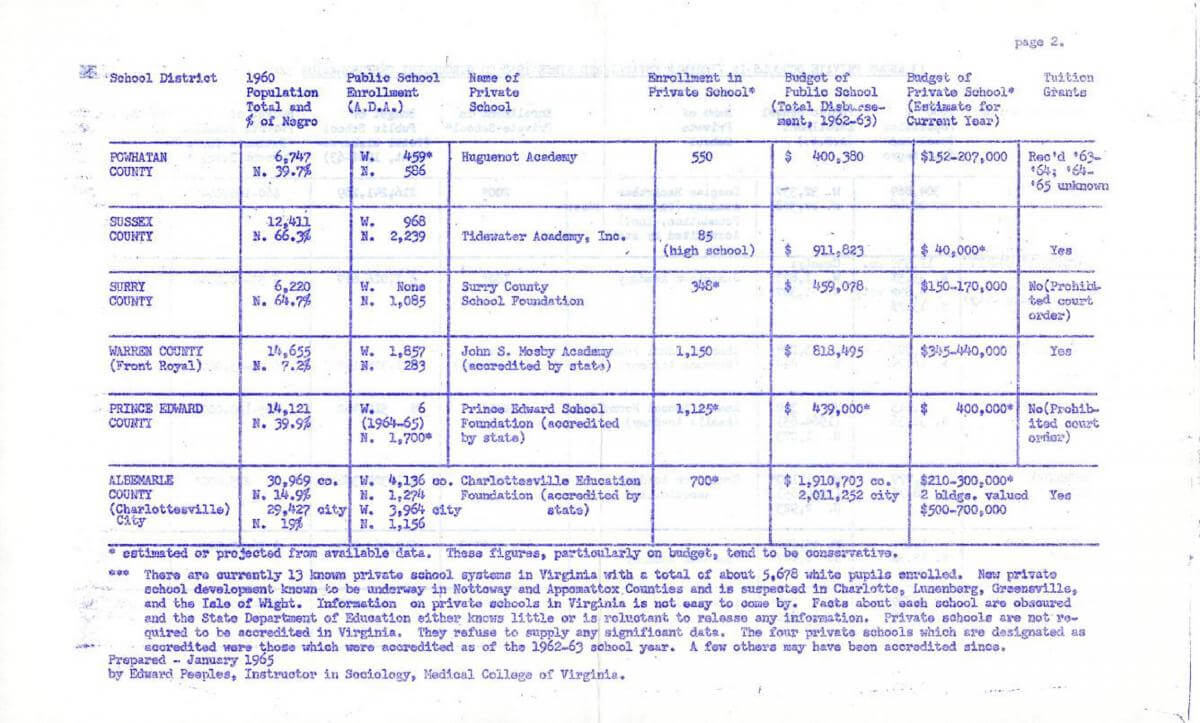
The private school movement grew rapidly. After the 1969 Supreme Court ruling that "every school district is to terminate dual school systems at once" in Mississippi,103"Private Schools on Rise in the South," New York Amsterdam News, November 8, 1969; Kitty Terjen, "The Segregation Academy Movement," in The South and Her Children: School Desegregation, 1970–1971, ed. Robert E. Anderson Jr. (Atlanta, GA: Southern Regional Council, 1971), 69–71; "Civil Rights: Segregation: Federal Income Tax Exemptions and Deductions: The Validity of Tax Benefits to Private Segregated Schools," Michigan Law Review 68, no. 7 (June 1970): 1410–1414; Alexander v. Holmes County Board of Education, 396 U.S. 19 (1969). white parents responded. From 1965 to 1980, private school enrollment increased by more than 200,000 students across the South—with about two-thirds of that growth occurring in the states that had created voucher programs.104Steve Suitts, Race and Ethnicity in a New Era of Public Funding of Private Schools: Private School Enrollment in the South and the Nation (Atlanta, GA: Southern Education Foundation, 2015), 7–8.
There were no government surveys reporting race or ethnicity for private school enrollment at the start of the 1980s, but the Southern Regional Council, which monitored the movement after Brown, estimated that virtually segregated private schools in the eleven states of the former Confederacy enrolled between 675,000 and 750,000 white students. When computed with overall enrollment data for those states, these estimates suggest that somewhere between 65 and 75 percent of the private school's white students were virtually segregated by the early 1980s.105Hearings on IRS Tax Exemptions and Segregated Private Schools, Before the Subcommittee on Civil and Constitutional Rights of the Committee of the Judiciary, 97th Cong. (1982), 69; Digest of Education Statistics, 1981 (Washington, DC: National Center for Education Statistics, 1981).
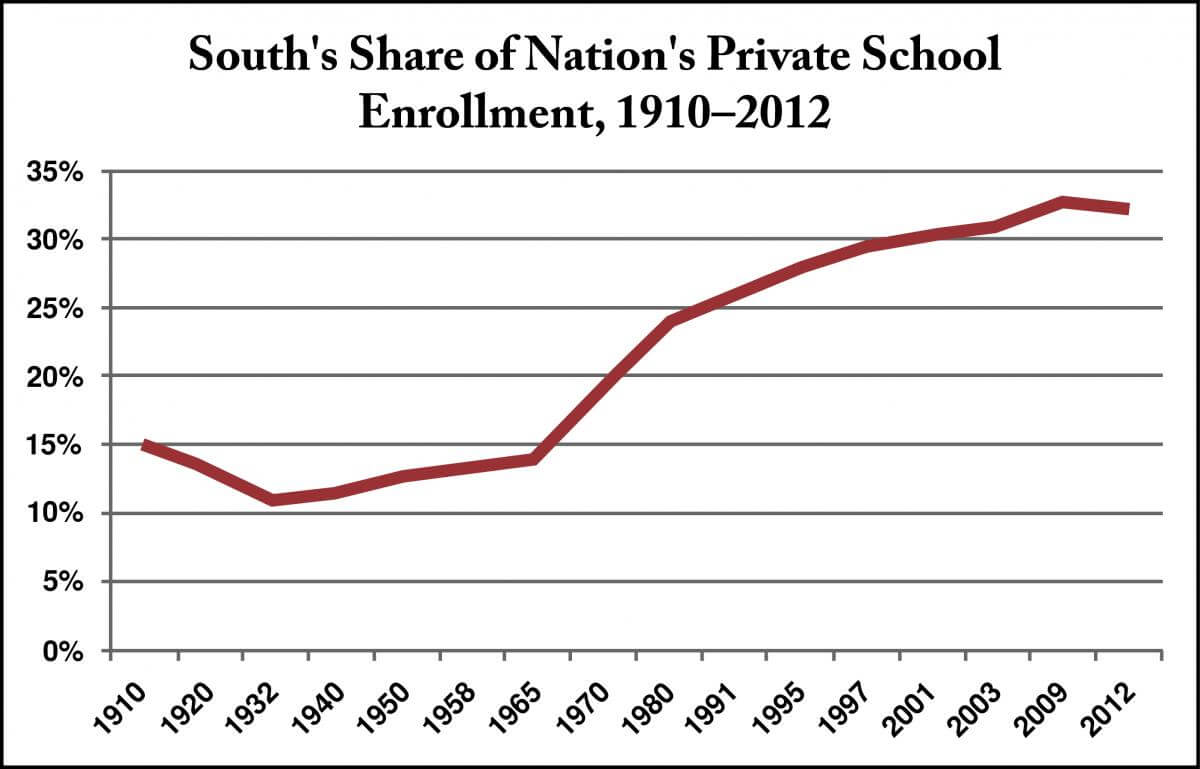
Overall, the southern states' white flight from public schools in the wake of desegregation from 1940 through 1980 helped to quadruple the number of students attending segregated private schools. As Jason Morgan Ward aptly observed, "[T]he end of the Jim Crow era rendered segregation, like white supremacy before it, a doomed battle cry. But it was not a dead proposition."106Jason Morgan Ward, Defending White Democracy: The Making of a Segregationist Movement and the Remaking of Racial Politics, 1936–1965 (Chapel Hill: University of North Carolina Press, 2011), 183.
The "Post-Racialist" Standards Movement
Most of the South's private schools that started during massive resistance survived without vouchers—but with federal tax exemptions. Many increased their enrollments and resources as they embraced the old-line segregationists' non-racial language and reasoning. This transformation of stated purpose from preserving segregation to meeting children's needs for a quality education through choice involved an initial phase when headmasters and other promoters of private schools struggled to abandon their original meaning and adopt a new, non-racial script about motives and purposes.
Dr. T. E. Wannamaker, for example, founder of the South Carolina Independent School Association, explained in 1966 the reasons for his organization and schools: "We're here because we have convictions and we're going to stay. It's not token integration we're concerned about, but the effects mass integration will have on our schools in the future." Earlier, Wannamaker had described himself as "an old-time conservative. I believe it's heredity first and environment second. Many (Negroes) are little more than field hands." In 1970, he became the first leader of the Southern Independent School Association.107Terjen, "The Segregation Academy Movement," 76; Margaret Rose Gladney, "I'll Take My Stand: The Southern Segregation Academy Movement" (PhD diss., University of New Mexico, 1974), 80. An Alabama private school advocate told a journalist in 1969, "We really didn't do it on account of segregation. We done it for a better education."108Kitty Griffith, "New 'Segregation Academies' Flourish in the South," South Today, October 1969, 1.
By the 1970s, as many public schools in the South were being desegregated for the first time, promoters of private schools were developing a more consistent line of reasoning: the schools may have begun over the "racial question," but were now operating to provide "quality education." "I've been fighting to take the race question out of the Independent Schools," a member of the Louisiana Private School Association said in 1973. "I've run a segregated school for 33 years. . . . I want nice people in my school. We're trying to sell quality education."109Gladney, "I'll Take My Stand," 80.
The headmaster of Prince Edward Academy (which five years earlier had been denied the continued benefit of vouchers and tax credits due to racial discrimination) told a researcher: "This school came into being because we love our children and want the best education in a controlled environment." A leader of Louisiana's private schools expanded this new language of transition: "I think people would be able to accept integration if it did not mean lowering of academic and moral standards. But they know it means it; therefore, they resort to private schools." And the head of the Alabama Independent School Association told researcher Rose Gladney in 1972: "Our primary interest is educating people basically of like learning capacities. We adopt a school system to meet their needs. . . . The real historical importance of the movement is not one of segregation or integration. It's academically important."
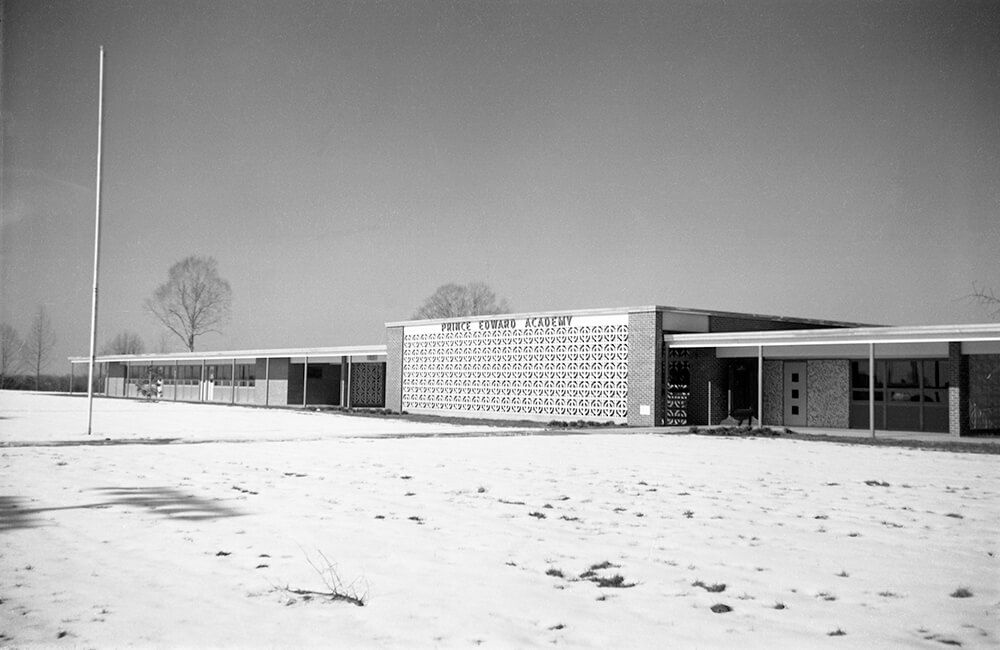
It was left to a student in one of the private schools that Gladney visited to be explicit about the white supremacist message he heard from administrators, promoters, and perhaps family: "Niggers are dumb; can't learn. And when you have a majority of low standard in a school, they will pull all the rest down. It is not really a race issue, just a matter of lowering standards."110Gladney, 99–126.
Many private schools operated by churches also began to justify their existence through the imperative of religious education. "Religion is an integral part of the Independent School movement," said the director of the Louisiana Independent School Association. "We're developing a pseudo-parochial system where there's a fixed religion we feel we want."111Gladney, 134–136. These often became Christian schools that turned "in every particular around Bible teachings and interpretations."112David Nevin and Robert E. Bills, The Schools that Fear Built: Segregationist Academies in the South (Washington, DC: Acropolis Books, 1976), 61.
Whatever the non-racial rationale—economic freedom, better education, religious instruction—the vast majority of the South's private schools were established when it became clear locally that federal law would require some form of desegregation. By the start of the 1980s, the character of most of these private schools was set. "These are schools for whites," wrote the authors of The Schools that Fear Built in 1976. "The common thread that runs through them all, Christian, secular, or otherwise, is that they provide white ground to which Blacks are admitted only on the school's terms if at all."113Nevin and Bills, 11.
For God and Private Schools
Following the 1980 election of Ronald Reagan, private schools throughout the nation received federal support and endorsement as never before. The Reagan administration justified proposed federal assistance to private schools as a means for advancing high quality education along with diversity and pluralism. The administration waffled on whether to support Bob Jones University's claim that religion gave it the right to discriminate on the basis of race even while receiving tax exemption. "I was under the impression," Reagan said, "that the problem of segregated schools had been settled, that we have desegregation."114Catherine A. Lugg, "For God and Country: Conservative Ideology and Federal School Policy during the First Term of President Ronald Reagan" (PhD diss., Pennsylvania State University, 1995), 105–111, 121.
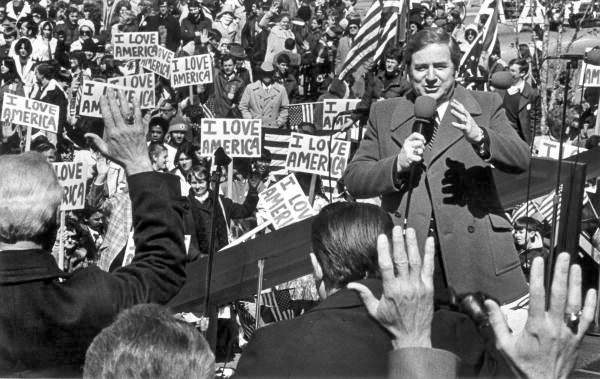
In 1981, Reagan's secretary of education testified in support of tax credit vouchers for private schools as "an expansion of educational opportunities for all Americans." In 1983, Reagan became the first president to send Congress legislation for federal tax credits to finance private schools. The proposed "Educational Opportunity and Equity Act," the administration argued, would benefit a wide range of students, including low-income children of color, and more broadly would "promote diversity in education and the freedom of individuals to take advantage of it, and to nurture the pluralism in American society which this diversity fosters." School segregation was a thing of the past, said Reagan, and private schools were the engines of diversity.115Lugg, "For God and Country," 132; Julia Malone, "Drive Begins for Tuition Tax Credit: Reagan Education Secretary Argues for Private School Help," Christian Science Monitor, June 8, 1981; Julia Malone, "Bid to Allow Tax Credits for Private-School Tuition Awaits Next Session of Congress," Christian Science Monitor, November 16, 1983; David E. Rosenbaum, "Tuition Credit Seen in Reagan Plan," New York Times, May 27, 1985.
Reagan linked his tax credit bill with an imperative to return religion to schools. "I don't think God should ever have been expelled from the classroom," he declared at a news conference in which he defended his support of private schools, including religious schools. The president's remarks echoed a long line of southern segregationists who had justified the growth of private schools on religious grounds, especially after 1961 when the US Supreme Court outlawed a New York statute that required public school students to recite an official Christian prayer.116Lugg, 126–127; Engel v. Vitale, 370 U.S. 421 (1962).
White churches started private academies in the wake of court-ordered desegregation, with religion and segregation often intermingling in the schools' stated purpose. In Prince Edward County, Virginia, many white clergy supported closing the public schools, their churches provided white-only space, and their curricula were built around church teachings. "Our people—supporters of the Independent schools—are convinced God is behind us," asserted the head of the Louisiana segregated private schools in the early 1970s. "If you don't include that aspect, you're missing a good part of the motivation behind this movement. People believe wholeheartedly that God doesn't want us to mix."117Gladney, "I'll Take My Stand," 134.
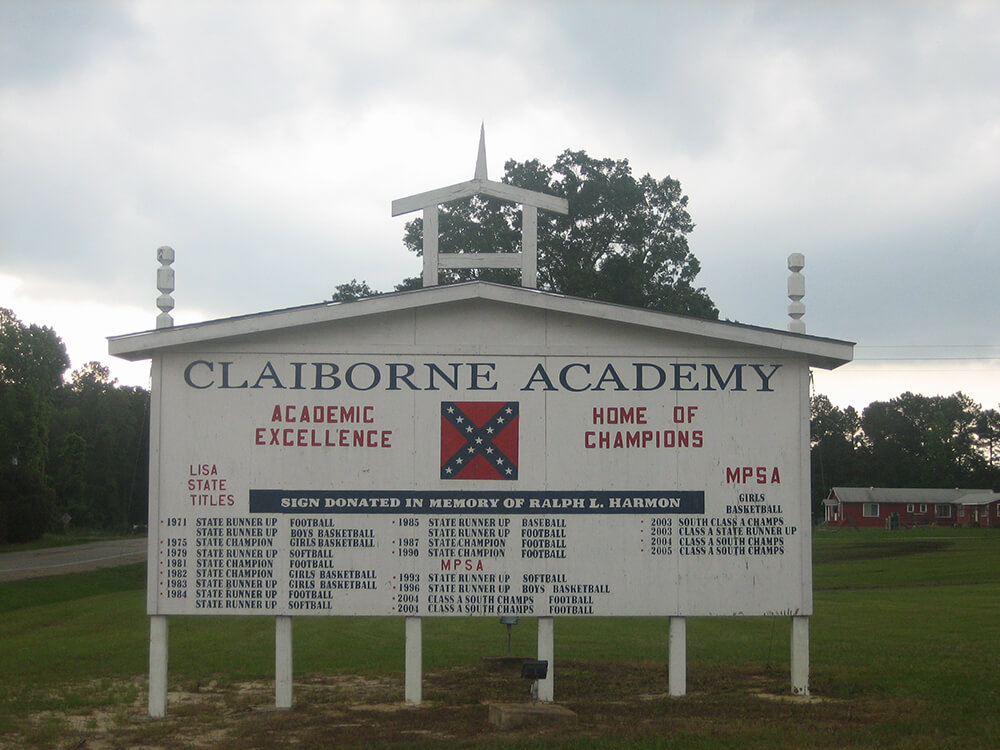
Looking across the South in 1974, Rose Gladney, a young scholar whose family had been actively involved in setting up a segregation academy in Homer, Louisiana, saw how most adults involved in private schools had merged racial segregation, quality education, and religion into one rationale. "The teachings of the academies," Gladney sadly observed, "hope to ensure that there will be people who think there is a need because they will have been taught, for at least another generation, that love of God, love of their white skins, and love of quality education cannot be separated."118Goodman, Sanctuaries for Tradition, 9–12; Gladney, 137.
President Reagan transformed a "love of white skin" into a color-blind doctrinal belief that individual freedom of choice in schooling created diversity and opportunity for all in an era without segregation. Reagan became the nation's primary voice for why and how government should support private schools, and, as a former actor and California governor, his own past and national leadership obscured the original role and rationales of southern white supremacists from public memory.
In 1984, in re-nominating Reagan, the Republican Party's education platform included support for the right to pray in public schools, opposition to busing for desegregation, passage of tuition tax credits for private schools, and redirecting billions of federal funds dedicated to assist low-income students in public schools into vouchers for private schools. It was the first time a national political party endorsed school vouchers. In his State of the Union address fourteen months later, President Reagan declared: "We must continue the advance by supporting discipline in our schools, vouchers that give parents freedom of choice; and we must give back to our children their lost right to acknowledge God in their classrooms."119Lugg, "For God and Country," 212–213; "Republican Party Platform of 1984," The American Presidency Project, accessed March 8, 2019, https://www.presidency.ucsb.edu/documents/republican-party-platform-1984; Ronald Reagan, the annual State of the Union address (speech, Washington, DC, February 4, 1986), The American Presidency Project, www.presidency.ucsb.edu/documents/address-before-joint-session-congress-the-state-the-union. The first time a national political party's platform endorsed tax credits for private schools was in 1972 at the Republican National Convention. It was the first time a US president expressly advocated for school vouchers before a joint session of Congress. Without attribution, the views and tools of southern segregationists had become the official position of the national Republican Party and the Reagan presidency.
No to "Racial-Mixing," Yes to Vouchers
At the end of the Reagan administration, almost thirty-five years after Brown, enrollment in the South's private schools continued to grow in absence of any significant new government financial support.120The next federal legislation providing new tax benefits to private schools was the Coverdell Education Account created in 1997 during the Clinton administration. It permits annual contributions up to $500 to earn tax-free funds to cover expenses in college or in elementary and secondary private schools. The accounts have restrictions on income and uses for K-12 private school tuition. Ironically, First Lady Hillary Clinton's first job out of law school involved investigating discriminatory practices of southern private schools. See Amy Chozick, "How Hillary Clinton Went Undercover to Examine Race in Education," New York Times, December 27, 2015, www.nytimes.com/2015/12/28/us/politics/how-hillary-clinton-went-undercover-to-examine-race-in-education.html. Some schools created in defiance of desegregation struggled and failed, but most survived by embracing other stated purposes for their existence and by maintaining their tax-exempt status—a benefit that required most to enroll just enough children of color to avoid total segregation while preserving a culture of "schools for whites."121See, for example, John Egerton, "Hammond Academy: A Rebel Yell, Fading," in Shades of Gray: Dispatches from the Modern South (Baton Rouge: Louisiana State University Press, 1991), 237–248.
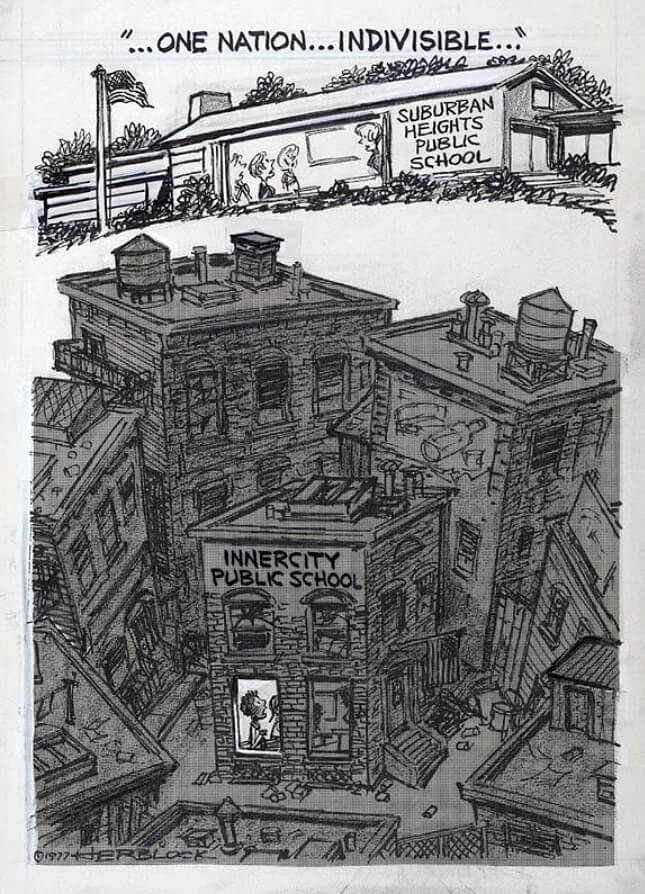
Since the 1960s, white flight from urban public systems such as Atlanta's had maintained and extended segregated patterns in private tax-exempt schools and in suburban public schools. On both sides of the Mason–Dixon line, many white middle-class parents had escaped the mandates of school desegregation by moving into suburban neighborhoods where residential patterns of racial isolation and economics provided virtually segregated public schools. This suburban constituency helped to sustain Nixon and Reagan policies in blocking inter-district desegregation plans.122See Lassiter, The Silent Majority, 295–324.
Earlier segregationists had foreseen the importance of district lines. In 1955, Forney Johnston, one of the architects of the Alabama three-school "freedom of choice" plan, identified "ordinary and customary geographical districting" as a primary tool for defeating Brown. His strategies cast a very long shadow. Examining school data from 1988 to 1990, a national study concluded "that white families are fleeing public schools with large concentrations of poor minority schoolchildren. In addition, the clearest flight appears to be away from poor black schoolchildren."123Robert W. Fairlie and Alexandra M. Resch, "Is There 'White Flight' into Private Schools? Evidence from the National Educational Longitudinal Survey," Review of Economics and Statistics 84 (2002): 21–33.
The patterns persisted. Based on data from 1998, scholars Sean Reardon and Jon Yun found that the "South ha[d] the greatest segregation between the public and private sector of any region—white and Asian private school enrollment rates are more than three times greater than Black rates in the South, and more than double Latino rates."124Sean F. Reardon and John T. Yun, Private School Racial Enrollments and Segregation (Cambridge, MA: The Civil Rights Project, Harvard University, 2002), 22, https://civilrightsproject.ucla.edu/research/k-12-education/integration-and-diversity/private-school-racial-enrollments-and-segregation/Private_Schools.pdf. They also concluded that "the strongest predictor of white private enrollment is the proportion of Black students in the area."125Reardon and Yun, Private School Racial Enrollments and Segregation, 22.
Drawing upon the 2000 Census, Duke University scholar Charles Clotfelter found that private schools were continuing to foster racial separation and isolation in K–12 education in the South, especially in non-metropolitan areas: "Combined with the general stability or growth of private enrollments in the South since 1970, these findings suggest that private schools were playing much the same role in non-metropolitan counties of the South in 1999–2000 as they were shortly after desegregation."126Charles T. Clotfelter, "Private Schools, Segregation, and the Southern States," Peabody Journal of Education 79, no. 2 (2004): 74–97.
During this time, Milwaukee and Cleveland became limited, urban experiments in voucher programs in northern states, as some white liberals suggested that vouchers might offer a way to break up what they came to believe were intractable problems faced by low-income public schoolchildren. It was also the era when state governments began establishing programs to finance attendance in private schools, especially through tax credit vouchers. This new initiative reached into every part of the nation, but mostly the South, including all of the states where segregationists had established vouchers.127Harry Brighthouse, "Egalitarian Liberals and School Choice," Politics & Society 24, no. 4 (1996): 457–486; James S. Coleman, "Some Points on Choice in Education," Sociology of Education 65, no. 4 (1992): 260–262. For a clear, deep understanding of this recent emergence of tax credits to finance enrollment at private schools, see Kevin G. Welner, NeoVouchers: The Emergence of Tuition Tax Credits for Private Schooling (Lanham, MD: Rowman & Littlefield, 2008).
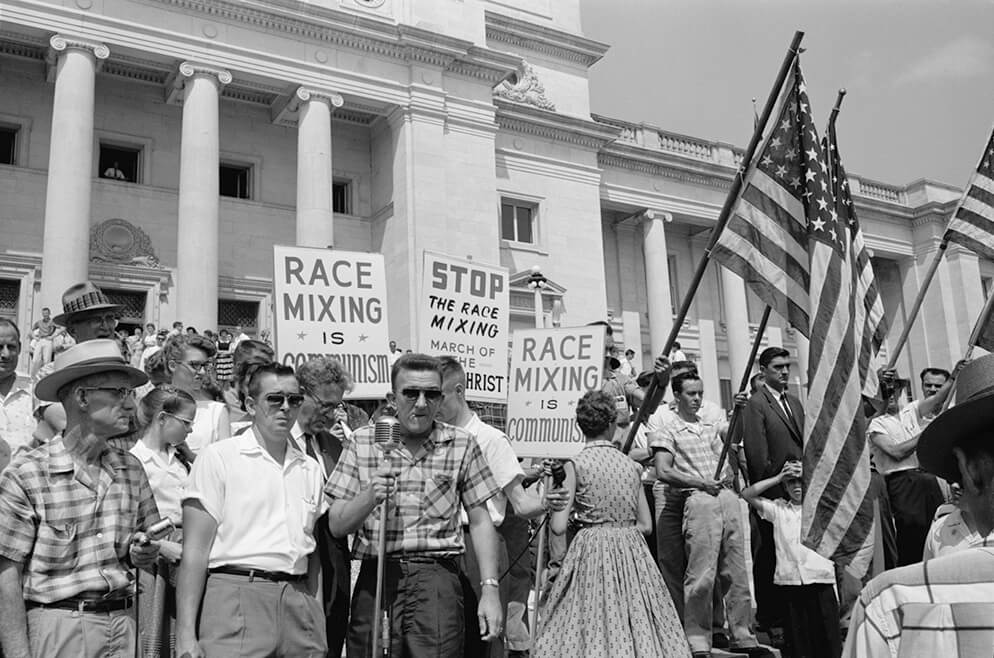
The US Supreme Court began to bless these developments. As early as 1973, Justice William Rehnquist became the first member of the Court to issue a dissent from a school desegregation case relying on the precedent of Brown. In a case concerning school segregation in Denver, he condemned the Court's opinion for requiring a school district to advance desegregation—employing the old scare word, "racial mixing"—where there were "neutrally drawn boundary lines" that sustained segregation.128Keyes v. School Dist. No. 1, Denver, 413 US 189 (1973), 258; Justin Driver, The Schoolhouse Gate: Public Education, the Supreme Court, and the Battle for the American Mind (New York: Pantheon, 2018), 278–283. As Driver notes, Justice Rehnquist as a Supreme Court law clerk had argued while Brown was being considered that the Court should not overrule Plessy v. Ferguson, 163 U.S. 537 (1896), which had sanctioned state-sponsored segregation. Barely a year after the Bob Jones decision held that religious private schools could not hold a tax exemption and discriminate on the basis of race, the Supreme Court slammed shut the courthouse door on those seeking to challenge the IRS's weak enforcement. Parents of twenty-five Black public school children sued the IRS, charging that its standards and procedures were inadequate to fulfill its obligation to deny tax-exempt status to racially discriminatory private schools. In 1984, the US Supreme Court held that the parents had no standing to bring such a suit.129Allen v. Wright, 468 US 737 (1984).
With the appointment of other justices across more than three decades, the Court increasingly refused to require school districts to use any method of desegregation that proved effective in dismantling the dynamics of separation. By 2007, the Court had turned Brown on its head as a precedent for backing public school districts' voluntary efforts to desegregate. Chief Justice John Roberts wrote that Brown commanded school districts to avoid using race as a consideration, even for the purpose of recognizing and diminishing public school segregation. "When it comes to using race to assign children to schools," Roberts wrote without doubt or irony, "history will be heard."130Parents Involved in Community Schools v. Seattle School Dist. No. 1, 551 US 701 (2007), 2744; Driver, The Schoolhouse Gate, 293–308.
As the Court stymied effective strategies for desegregating public schools, Justice Anthony Kennedy led it in unleashing private schools from constitutional restraints for receiving taxpayer funds. Arizona's program of tax credit vouchers allowed individuals and corporations to give tax dollars to private schools instead of paying them to the state—a scheme similar to those the Court had outlawed in prior cases, including in Prince Edward County, Virginia, in the 1960s. Kennedy, in a majority opinion, held that tax credit vouchers did not involve public funds or any state action that the Bill of Rights would prohibit. "While the State, at the outset, affords the opportunity to create and contribute," Kennedy wrote, "the tax credit system is implemented by private action and with no state intervention."131Arizona Christian School Tuition Organization v. Winn, 131 U.S. 1436 (2011) at 1448. Justice Kennedy's opinion considered whether the First Amendment's clause requiring separation of church and state, by way of application to the states through the 14th Amendment, prohibited providing state tax credit vouchers to religious schools.
With few federal restraints, legislatures have expanded these programs or established new forms of vouchers, such as educational savings accounts that deposit state and local per-pupil expenditures into a personal account for a child's parents to use toward private schooling or to supplement home-schooling.
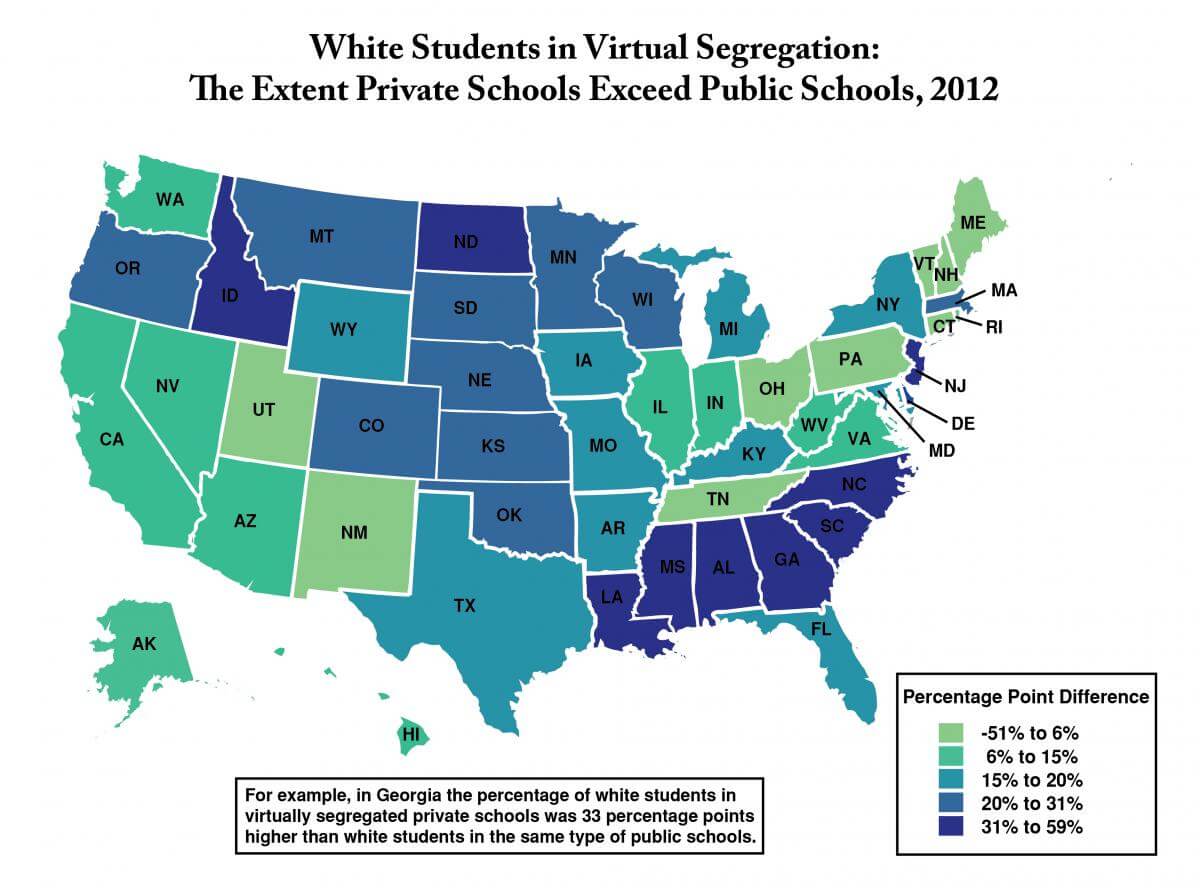
Patterns of virtual segregation have stayed remarkably high in private schools. As recently as 2012, 43 percent of the nation's private school students attended virtually all-white schools—schools where white students comprise 90 percent or more of the enrollment. That year, half of the fifty states had a majority of private school students attending virtually segregated schools.132Suitts, Race and Ethnicity in a New Era of Public Funding of Private Schools, 36–39.
Despite white flight, virtual segregation for white students was far more substantial in private schools than in public schools, especially in the South. In 2012, 63 percent of white students in South Carolina's private schools were virtually segregated compared with only 5 percent of white students in South Carolina's public schools. Private schools were almost twelve times more likely to enroll white students in virtually segregated schools in 2012 than were the state's public schools.
In Mississippi, white students attending private schools were almost four times more likely to be in virtually segregated schools than public school students. More than seven out of ten white students in Mississippi's private schools attended schools where 90 percent or more of the enrollment was white. In the state's public schools, the rate was 15 percent. In Louisiana, 52 percent of the white students in private schools were virtually segregated in 2012, but only 14 percent for white public school students.
This new era of vouchers emerged as public schools across the nation experienced a substantial increase in the numbers of low-income students and students of color. Completing a trend that began in the 1980s, low-income students (those eligible for free or reduced lunch) became a majority of the South's public schoolchildren in 2006; in 2009, the South's public schools also had a majority of students of color. By 2013, more than 50 percent of the nation's public schoolchildren were from low-income families and almost half were children of color.133Steve Suitts, A New Majority: Low Income Students in the South's Public Schools (Atlanta, GA: Southern Education Foundation, 2007), https://www.southerneducation.org/wp-content/uploads/2019/02/A-New-Majority-Report-Final.pdf; Steve Suitts, A New Diverse Majority: Students of Color in the South's Public Schools (Atlanta, GA: Southern Education Foundation, 2010), https://www.southerneducation.org/wp-content/uploads/2019/02/A-New-Diverse-Majority-2010.pdf; Steve Suitts, A New Majority: Low Income Students Now a Majority in the Nation's Public Schools (Atlanta, GA: Southern Education Foundation, 2015), https://www.southerneducation.org/wp-content/uploads/2019/02/New-Majority-Update-Bulletin.pdf; Shaila Dewan, "Southern Schools Mark Two Majorities," New York Times, January 6, 2010, https://www.nytimes.com/2010/01/07/us/07south.html; Lyndsey Layton, "Majority of US Public School Students Are in Poverty," Washington Post, January 16, 2015, https://www.washingtonpost.com/local/education/majority-of-us-public-school-students-are-in-poverty/2015/01/15/df7171d0-9ce9-11e4-a7ee-526210d665b4_story.html.
Changing patterns, most evident in the nation's cities, spread to the suburbs. In 2011, 40 percent of public schoolchildren in the nation's suburban districts were low-income; the rates were 45 percent or higher in suburbs in the West and the South. During the 2000s, the number of suburban poor exceeded the number in the nation's cities for the first time. Similarly, with a huge increase in Hispanic children, suburban school districts began educating a student population in which students of color comprised more than 40 percent. At the same time, African Americans moved into suburban counties surrounding central cities (such as Atlanta) in record numbers.134Suitts, A New Majority: Low Income Students in the South and Nation (Atlanta, GA: Southern Education Foundation, 2013), 5–6, 15, https://www.southerneducation.org/wp-content/uploads/2019/02/New-Majority-2013.pdf; Elizabeth Kneebone, "The Changing Geography of US Poverty," The Brookings Institution, February 15, 2017, https://www.brookings.edu/testimonies/the-changing-geography-of-us-poverty/; Richard Fry, "Sharp Growth in Suburban Minority Enrollment Yields Modest Gains in School Diversity" (Washington, DC: Pew Research Center, March 31, 2009), http://www.pewhispanic.org/2009/03/31/sharp-growth-in-suburban-minority-enrollmentbryields-modest-gains-in-school-diversity/; Karen Pooley, "Segregation's New Geography: The Atlanta Metro Region, Race, and the Declining Prospects for Upward Mobility," Southern Spaces, April 15, 2015, https://southernspaces.ecdsdev.org/2015/segregations-new-geography-atlanta-metro-region-race-and-declining-prospects-upward-mobility.
This new diversity in suburban school-age populations did not result in major increases in integrated schools. Instead, old habits resurfaced that involved shifting residential segregation, white flight into exurbs, localities attempting to secede from majority-Black public school districts, and the states' rebirth of vouchers for private schools. Legislatures failed to increase public school funding to meet the huge challenges of educating a majority of schoolchildren who are low-income and non-white, especially in the South and West where most voucher programs have emerged.135Don Boyd and Lucy Dadayan, "State and Local Governments Reshape Their Finances," The Book of the States 2016 (Lexington, KY: The Council of State Governments, 2016), http://knowledgecenter.csg.org/kc/system/files/Boyd%20Dadayan%202016.pdf; Nikole Hannah-Jones, "The Resegregation of Jefferson County," New York Times, September 6, 2017, https://www.nytimes.com/2017/09/06/magazine/the-resegregation-of-jefferson-county.html; Suitts, A New Majority: Low Income Students in the South and Nation, 8–13.
New Token Students of Choice
Overall trends have obscured a small, inclusive change in the color line for admission to private schools amid a more pronounced, underlying pattern of racial exclusion. Frequently, white private schools have chosen Asian or Pacific Island children to break their completely segregated enrollment in order to reach a token level of diversity for an IRS tax exemption. These students have family ancestries from countries including China, Vietnam, Korea, Japan, India, the Philippines, and various islands of the Pacific. In 2012, Asian American students comprised 5.8 percent of the nation's private school enrollment—a number slightly above the percentage of the Asian school-age population. Only white students and students with Asian ancestries were in private schools in numbers that exceeded or generally matched their representation in the school-age population. In forty-two states, the percentage of Asian students in private schools exceeded the state's percentage of school-age Asian children.136Suitts, Race and Ethnicity in a New Era of Public Funding of Private Schools, 17, 27–29. Reardon and Yun also found that Asian students were over-represented in private schools in 1998. One other group of school-age children nationally matched their representation in private schools in 2012: students who self-identified as "of two or more races."
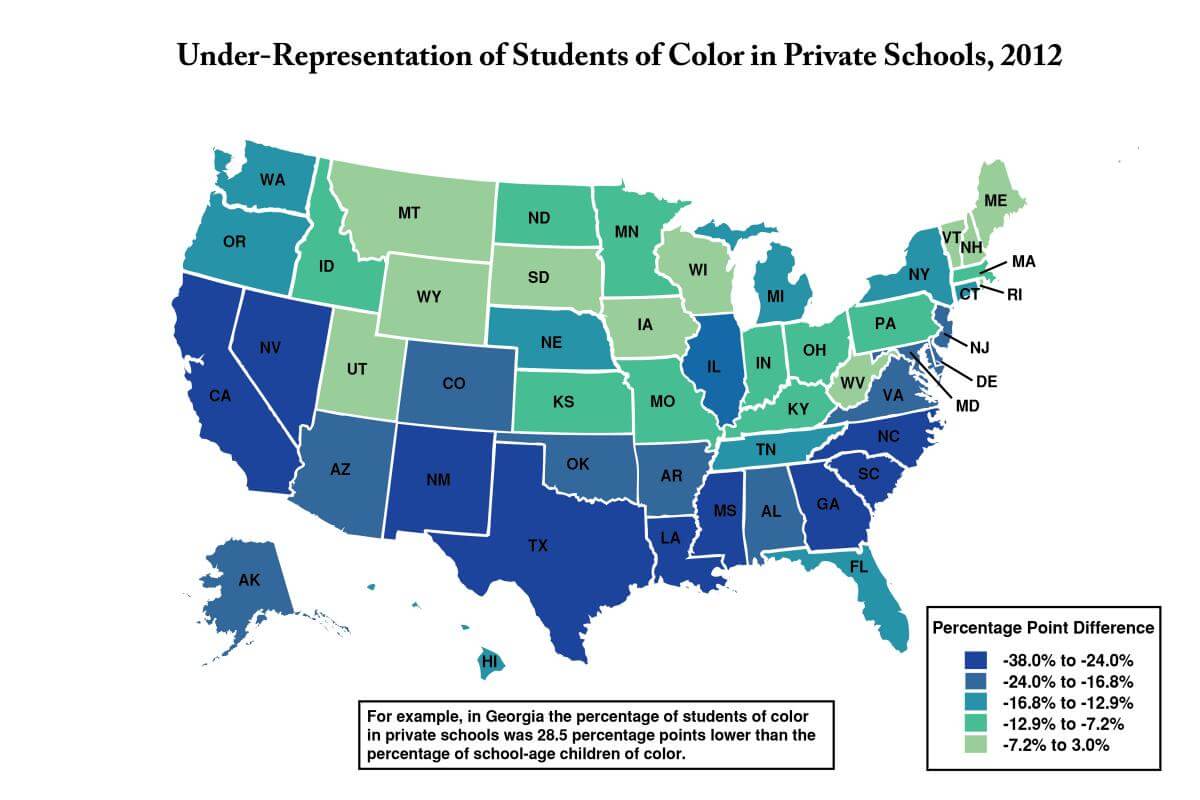
This development stands in sharp contrast to the history of discrimination that Asians have experienced, especially in California and the South, and makes Asian students stand out among students of color attending private schools. The explanation for this shift seems grounded in at least three factors: since the late 1980s, Asian households have had the nation's highest median income (more than $11,500 above non-Hispanic white household income in 2012); since at least the 1990s, Asian students have had the nation's highest scores on standardized tests; and more than three generations after World War II, some whites may find the lighter skin color of Asian Americans more acceptable according to racist hierarchies.137See Joyce Kuo, "Excluded, Segregated and Forgotten: A Historical View of the Discrimination of Chinese Americans in Public Schools," Asian American Law Journal 5 (1998): 181–212, https://scholarship.law.berkeley.edu/cgi/viewcontent.cgi?article=1044&context=aalj; Carmen DeNavas-Walt, Bernadette D. Proctor, and Jessica C. Smith, Income, Poverty, and Health Insurance Coverage in the United States: 2012, Current Population Reports (Washington, DC: US Census Bureau, 2013), 5, https://www.census.gov/prod/2013pubs/p60-245.pdf; Lauren Musu-Gillette, Cristobal de Brey, Joel McFarland, William Hussar, William Sonnenberg, and Sidney Wilkinson-Flicker, Status and Trends in the Education of Racial and Ethnic Groups 2017 (Washington, DC: US Department of Education, National Center for Education Statistics, 2017), 46–52, https://nces.ed.gov/pubs2017/2017051.pdf; Herbert J. Gans, "'Whitening' and the Changing American Racial Hierarchy," Du Bois Review: Social Science Research on Race 9, no. 2 (2012): 267–279.
Asian children usually comprise a small minority of a private school's enrollment. Their presence often serves to increase a school's performance on college entrance exams—enabling schools to promote evidence of quality education while avoiding an all-white enrollment that could jeopardize their tax exemption. Asian Americans' admission, however, does not change the reality of most private schools as "schools for whites."138Suitts, Race and Ethnicity in a New Era of Public Funding of Private Schools, 28. The two states with the largest percentage of Asian and Pacific Islander school-age children, Hawaii and Alaska, have an under-representation of these children in private schools—in fact, the largest gaps among the 50 states in 2012.
Increased token admission of Asian children obscures the fact that the patterns of virtual segregation and exclusion in private schools are considerably larger for under-represented racial and ethnic groups: African Americans, Hispanics, and Native Americans. In 2012, two-thirds of white students in US private schools attended virtually "exclusionary schools"—schools where African American, Hispanic, and Native American children comprised 10 percent or less of total enrollment. In thirty of the fifty states, 70 percent or more of all white students attending private schools were in such schools.139Suitts, Race and Ethnicity in a New Era of Public Funding of Private Schools, 40–42, 64–65. Hispanics and Native Americans have their own linked histories of discrimination in education. See Victoria-María MacDonald, "Demanding their Rights: The Latino Struggle for Educational Access and Equity," in American Latinos and the Making of the United States: A Theme Study, National Park Service, 2013, https://www.nps.gov/articles/latinothemeeducation.htm; Richard R. Valencia, "The Mexican American Struggle for Equal Educational Opportunity in Mendez v. Westminster: Helping to Pave the Way for Brown v. Board of Education," Teachers College Record 107, no. 3 (March 2005): 389–423; David Wallace Adams, Education for Extinction: American Indians and the Boarding School Experience, 1875–1928 (Lawrence: University Press of Kansas, 1995); Theda Perdue, "The Legacy of Indian Removal," Journal of Southern History 78, no. 1 (February 2012): 3–36.
This "exclusionary" pattern is not unique to private schools. Some public schools also have extremely low rates of enrollment of African American, Hispanic, and Native American children. But, private schools in forty-seven of the fifty states have far higher rates of this kind of "exclusionary" enrollment than do public schools. In twenty-six of these states, the rates of "exclusionary" schooling in private schools were more than 25 percentage points higher than rates in public schools. The largest differences were in southern states. For example, 84 percent of white students in South Carolina private schools attended schools where African American, Hispanic, and Native American students together comprised only 10 percent or less of the private school enrollment. But only 11 percent of the white students attending public schools in South Carolina were in similarly "exclusionary" schools.
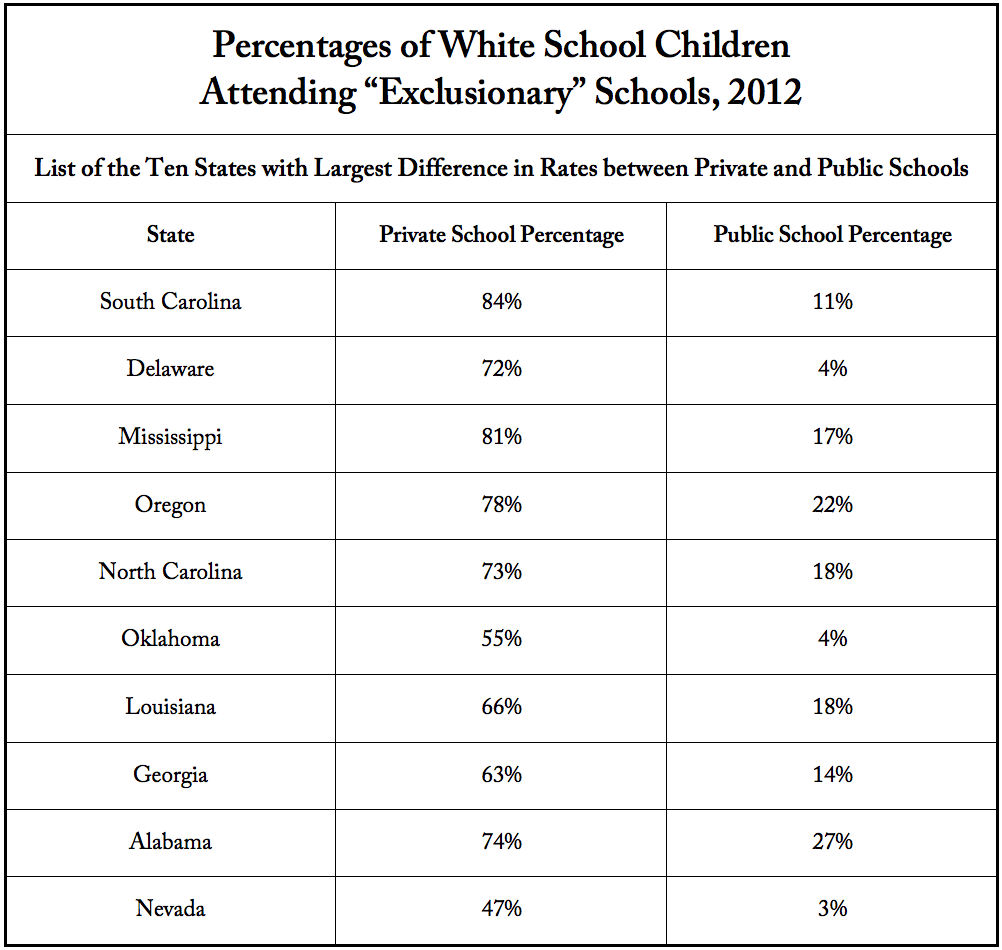
Each southern state that adopted voucher schemes in the era of massive resistance to Brown, except for Virginia, appears on the top ten list for exclusionary schooling, and Virginia was not far away. Like Virginia, Arkansas (where vouchers were tried temporarily in Little Rock) also had a gap of 34 percentage points. All southern states, except West Virginia, had a gap of 20 percentage points or larger. In West Virginia, the gap was 10 percentage points.
With the re-emergence of vouchers, the overwhelming majority of white students attending the nation's private schools continue to attend "schools for whites." The geographies where segregationists invented and implemented vouchers to resist Brown remain the places with greatest patterns of "exclusionary" private schools—assuring their white students that they do not attend school with any more than a token number of under-represented students of color. In 2012, the percentage of white students attending "exclusionary" private schools in the South exceeded the percentage in similar public schools in the South by 37 percentage points. This gap was double that of the rest of the nation.
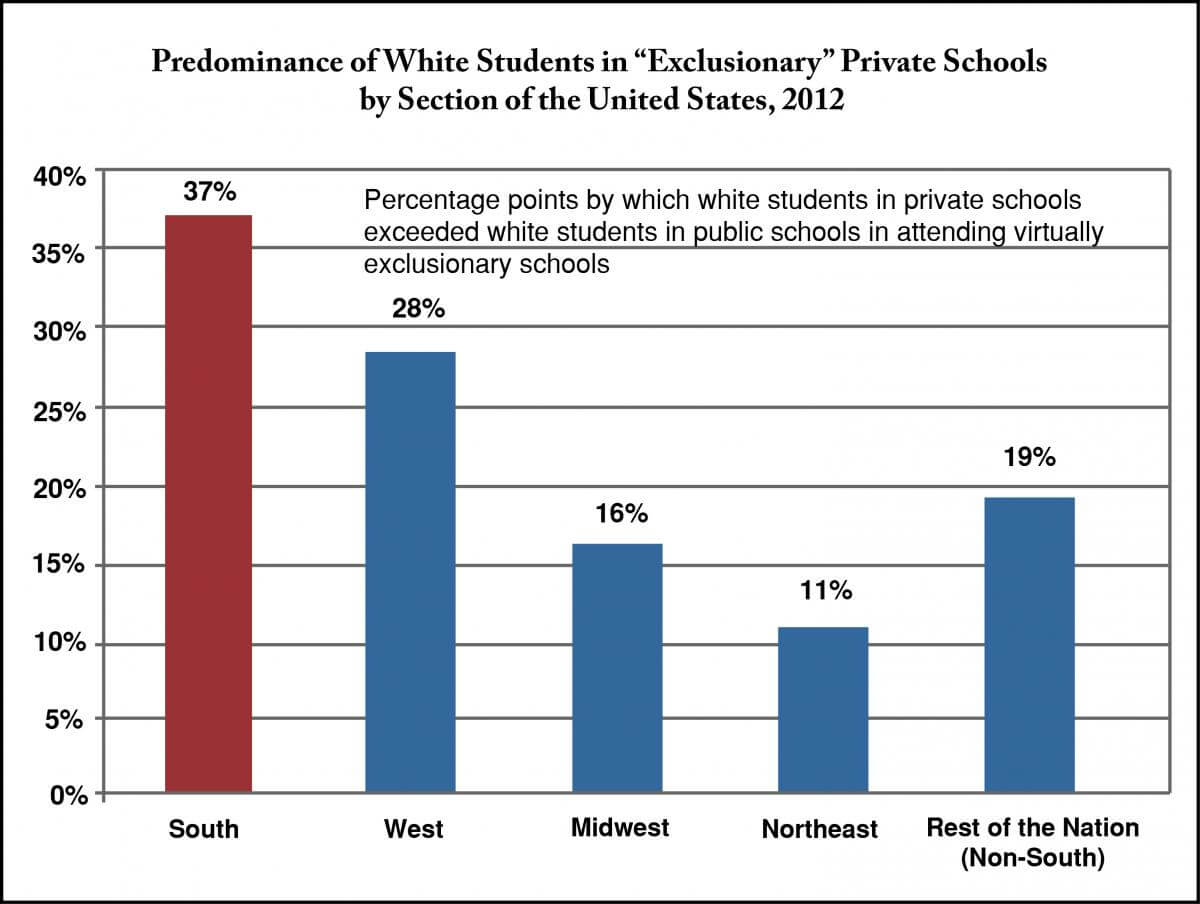
Lingering Facets of Jim Crow Segregation
States that adopted the first voucher plans in the 1950s and 1960s were forced by federal courts to abandon the laws and practices of complete separation of the races in schools and other public places. Yet Jim Crow laws were far from the only manifestations of segregation. The "better citizens" (as upper-class white supremacists were often called) were willing to accept token desegregation because of their belief that white supremacy and racial superiority did not place each and every white person always above "a negro of intelligence and good character."140Woodward, The Strange Career of Jim Crow, 107; Thomas J. Woofter, Southern Race Progress (Washington, DC: Public Affairs Press, 1957), 133–137. In the Jim Crow era, many southern industrialists believed in white supremacy but did not always find absolute segregation an economic advantage for their companies. See Suitts, Hugo Black of Alabama, 246–250, for a précis of this condition in Birmingham.
The practice of permitting virtual segregation or token desegregation was widespread before and during Jim Crow. Often, the all-white Democratic primary was not all-white. "In county after county," V. O. Key Jr. wrote in Southern Politics in State and Nation, "a few Negroes have voted for many years in Democratic primaries conducted under white-primary rules." The practice of holding virtually segregated primaries was particularly common where African Americans comprised a small proportion of the population.141Key Jr., Southern Politics in State and Nation, 620. Of course, attempting to vote in a southern state's Democratic primary was dangerous or deadly for African Americans. Steven F. Lawson, Black Ballots: Voting Rights in the South, 1944–1969 (New York: Columbia University Press, 1976), 119–121; Howell Raines, My Soul Is Rested: Movement Days in the Deep South Remembered (New York: Bantam Books, 1978), 285–294; also, listen to Hank Klibanoff, Buried Truths, 2018, podcast, https://www.wabe.org/shows/buried-truths.
Similarly, southern justice was segregated, and "after 1900, essentially no Blacks sat on southern juries." But, as civil rights and civil liberties attorney Charles ("Chuck") Morgan noted in the 1960s, "[T]he names of a token number of Negroes are often included on jury rolls." These token Blacks—hand-picked by white jury commissioners from the few African Americans deemed acceptable—seldom served since they could be struck by prosecutors or defense lawyers.142Michael J. Klarman, Brown v. Board of Education and the Civil Rights Movement (New York: Oxford University Press, 2007), 14; Charles Morgan Jr., "Segregated Justice," in Southern Justice, ed. Leon Friedman (New York: Random House, 1965), 159–161.
In their analysis of the South's segregationist leaders during massive resistance, historians Matthew Lassiter and James Hershman characterize segregationists as either caste-based or class-based. The caste-based defended complete segregation or exclusion on the belief that "all black people were inherently inferior to all white people." Understanding that absolute segregation was unnecessary to maintain a rule of white supremacy, the class-based segregationist (sometimes described as "moderate segregationists") conceded that "perhaps a few black people could be accepted into white institutions."143Hershman, "Massive Resistance Meets Its Match," 105.
The ambitions of politicians such as George Wallace and Ernest Vandiver muddled the division between caste and class, but the contrasting definitions illustrate that segregation was not defined as only a total, absolute exclusion of all African Americans or other people of color from the spaces—including schools—occupied by whites. Southern laws were often written that way, but reality was different. Affluent leaders of the most successful strategies for defeating desegregation demonstrated a class-based acceptance of virtual segregation and worked to preserve it. They anticipated the long-term possibility of ending absolute segregation and empowering leaders of local schools to justify virtual segregation through non-racial language, traditional school attendance boundaries, and neutral-sounding educational admissions standards, although it is doubtful that many realized how powerful class-based terms would resonate in suburban desegregation politics decades later.144Hershman, 104–106; Lassiter, The Silent Majority, 13–14, 26–29, 322–323.
The layered dimensions of segregation and exclusion are also illuminated by school segregation laws outside the South—in states that practiced de jure segregation well into the twentieth century—including the law invalidated by the Brown decision in Topeka, Kansas.145Brown v. Board of Education of Topeka, 98 F. Supp. 797 (1951).
All the attention drawn to the South's massive resistance eclipsed notice of how the Kansas school segregation law differed by excluding Black children from all white schools only in cities with a population over 15,000. The Kansas statute allowed boards of education in larger municipalities to decide if they should establish absolute segregation in those places where the number of African American children might exceed virtual or token segregation in a public school. In all other areas of Kansas with small Black populations, demographic patterns assured an acceptable level of virtual segregation.
Kansas population data illustrates how the law preserved virtual segregation in most of the state and absolute segregation where there was more than a token number of Black children. From 1890 through 1950, Kansas's Black population never reached 4 percent of the state's total, with the vast majority of Black Kansans living in and around a few cities. In 1950, there were 73,158 African Americans among more than 1.9 million Kansans. Almost three-fourths of the state's Black population resided in five counties where the state's largest cities were empowered to enact total segregation. All but one did. Elsewhere in Kansas in 1950, twenty thousand African Americans were spread among 1.3 million whites across one hundred counties, ensuring the maintenance of virtual segregation without the force of law.146Murray, State Laws on Race and Color, 161; Institute for Social and Environmental Studies, Kansas Statistical Abstract 1976 (Lawrence: University of Kansas, 1977), 5–9, 23, http://ipsr.ku.edu/ksdata/ksah/KSA12.pdf. There was a failed legislative effort in 1921 to change the nineteenth-century Kansas law to allow towns as small as two thousand to establish absolute segregation in schools. Thom Rosenblum, "The Segregation of Topeka's Public School System, 1879–1951," National Park Service, last modified April 10, 2015, https://www.nps.gov/brvb/learn/historyculture/topekasegregation.htm.
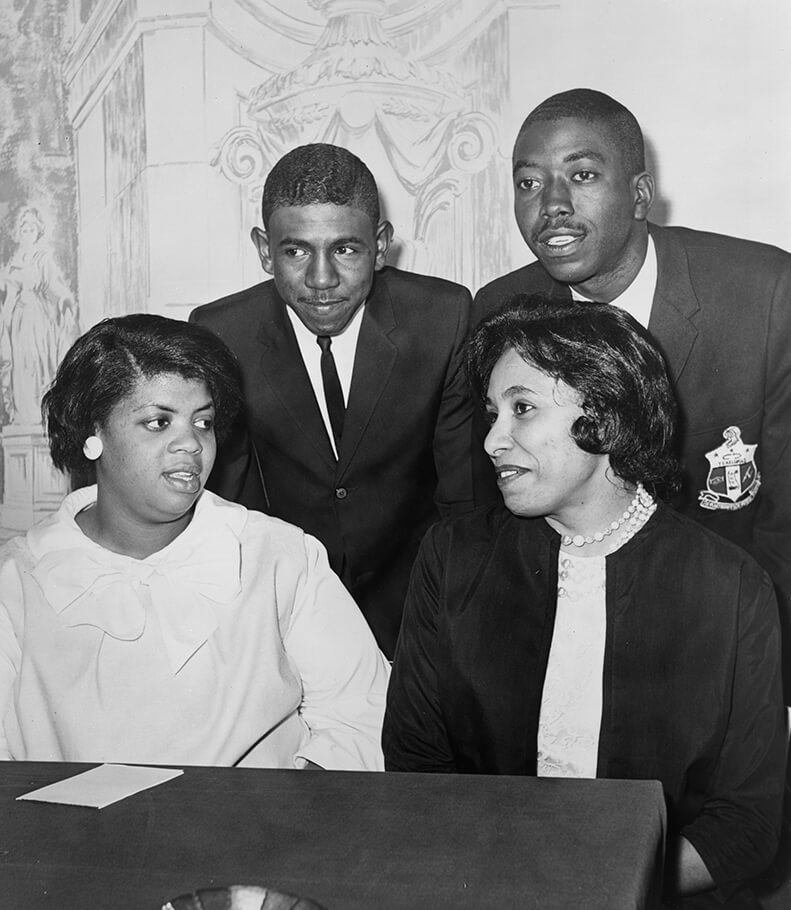
In 1951, when Linda Brown's father sued to desegregate her school system, Topeka (pop. 80,000) required absolute segregation in neighborhood elementary schools, undoing the virtual segregation that demographic trends assured to most white parents elsewhere in Kansas. In other words, Kansas's law had the same intent as southern laws—to maintain some form of segregation in all cases—although it did not establish absolute segregation as the default. That was implemented only when virtual segregation could not be maintained in practice.
Arizona also had a school segregation law—in some public high schools—triggered whenever twenty-five or more "pupils of African race" registered. In these situations, 15 percent of the voters in the school district could initiate a referendum to require the local school board to "segregate the pupils of the African race from pupils of the Caucasian race." In other words, the presence of twenty-five Black students in a high school could set in motion a process for absolute segregation.
In adjoining New Mexico, the law permitted the separation of "pupils of African descent" into separate classrooms in the same buildings if the school boards decided "it was for the best advantage of the school." The state allowed a local school board to decide what number of students might endanger virtual segregation, although it did permit the local jurisdiction to avoid the cost of building a separate school to implement absolute segregation.
Wyoming law gave school boards and superintendents power to enforce absolute segregation whenever there were fifteen or more "colored children" within a district. Since the large majority of Wyoming's schools were small, the numerical calculation of what number might threaten virtual segregation was also quite small. Until 1949, local jurisdictions in Indiana could decide to institute absolute segregation under a law used almost exclusively in larger cities where the percentage of Black population jeopardized virtual segregation.147Murray, 35–36; 290–291, 144; Mary Melcher, "'This Is Not Right': Rural Arizona Women Challenge Segregation and Ethnic Division, 1925–1950," Frontiers: A Journal of Women Studies 20, no. 2 (1999): 198–199. Arizona did require all elementary schools to segregate by race. Melcher suggests that Arizona required school segregation due to the large number of former southerners serving in the legislature. See Murray, 524; Reid E. Jackson, "The Development and Character of Permissive and Partly Segregated Schools," Journal of Negro Education 16, no. 3 (Summer 1947): 302–305.
These laws were different from those in the South because they assumed a different starting point. Before Brown, non-southern states started with virtual segregation and went to the absolute form when necessary, while southern states started with absolute segregation and went to virtual segregation when required by Brown. Wherever, school segregation was a multifarious exclusion without an exact shape or defining measure. As practiced, segregation always revolved around what a white-controlled legislature, white constituency, or white-controlled institution considered minimally acceptable. Contemporary private school patterns and practices—that state and federal governments have come to tolerate and often support with public funds—appear for what they are: legacies of class-based southern segregation used to evade Brown and multi-dimensional segregation of non-southern states before Brown.
Desegregation's Future
During the heyday of the first era of school vouchers, Dr. Martin Luther King Jr. decried that "token integration is little more than token democracy, which ends up with many new evasive schemes and it ends up with new discrimination, covered up with such niceties of complexity."148Martin Luther King Jr., "Love, Law, and Civil Disobedience," New South, December 1961. King's words have proven prophetic, although he could not have foreseen how dramatically the icons and language of the movement he led would be used, even by his own lineage, to develop and advance the tools and strategies that segregationists of his day thought could defeat the promise of Brown.
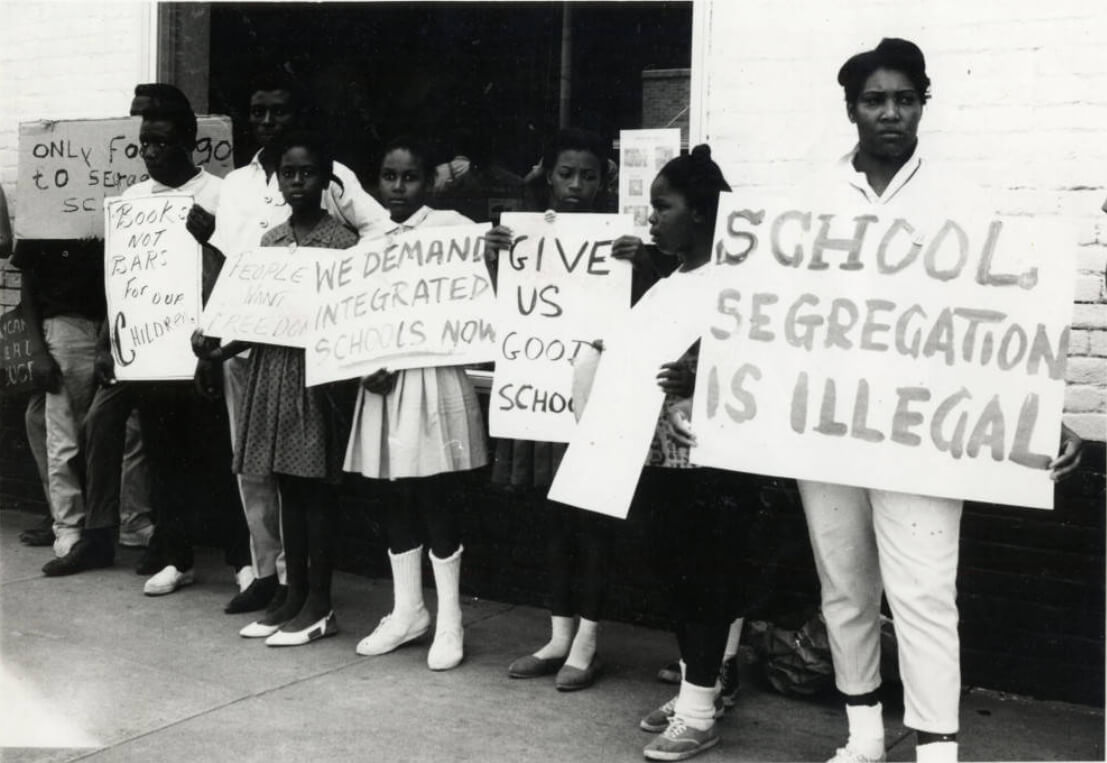
Today's advocates of school vouchers are not the first to attempt to graft the words and imagery of King and the civil rights movement onto their reactionary cause. As early as 1988, Rev. Jerry Falwell of the Moral Majority declared to a gathering of all-white, conservative male ministers in Atlanta that "Martin Luther King is everybody's American hero."149Lorri Denise Booker, "250 Protest Anti-Abortion Conference—2 Arrested; 600 Pack Omni to Hear Falwell," Atlanta Journal-Constitution, December 9, 1988; "Homogenized Heroes," SRC Home Record, Southern Regional Council, First & Second Quarters, 1989, 5. Ralph Reed, director of the Christian Coalition, continued to try to align King as the role model for conservative evangelical activists, many of whom supported public funding for private religious schools. Carter, The Politics of Rage, 466. But the school choice and voucher movement is remarkable in replicating so closely the primary strategies and tactics of southern segregationists while claiming the righteous mantle of the people and movement who fought against those segregationists.
One reason school choice proponents have appropriated civil rights rhetoric may relate to the fact that there is little evidence that vouchers improve the education of low-income children or children of color.150See Robert C. Pianta and Arya Ansan, "Does Attendance in Private Schools Predict Student Outcomes at Age 15? Evidence From a Longitudinal Study," Educational Researcher 47, no. 7 (2018), https://journals.sagepub.com/stoken/default+domain/XfYmtC25VddcCfbA3xiV/full; Mark Dynarski, On Negative Effects of Vouchers (Washington, DC: Brookings Institution, 2016), https://www.brookings.edu/research/on-negative-effects-of-vouchers/; Mark Dynarski and Austin Nichols, More Findings about School Vouchers and Test Scores, and They Are Still Negative (Washington, DC: Brookings Institution, 2017), https://www.brookings.edu/research/more-findings-about-school-vouchers-and-test-scores-and-they-are-still-negative/; Martin Carnoy, School Vouchers Are Not a Proven Strategy for Improving Student Achievement (Washington, DC: Economic Policy Institute, 2017), https://www.epi.org/publication/school-vouchers-are-not-a-proven-strategy-for-improving-student-achievement/; Halley Potter, Do Private School Vouchers Pose a Threat to Integration? (Washington, DC: The Century Foundation, 2017), https://s3-us-west-2.amazonaws.com/production.tcf.org/wp-content/uploads/2017/03/22102646/do-private-school-vouchers-pose-a-threat-to-integration.pdf; Kevin Carey, "Dismal Voucher Results Surprise Researchers as DeVos Era Begins," New York Times, February 23, 2017, https://www.nytimes.com/2017/02/23/upshot/dismal-results-from-vouchers-surprise-researchers-as-devos-era-begins.html. Voucher advocates' strongest arguments invoke social justice as well as freedom in order to legitimate school choice as more than a consumerist mindset and to obscure the factual results.151Samuel E. Abrams, Education and the Commercial Mindset (Cambridge, MA: Harvard University Press, 2016), 303–307.
A larger part of the explanation surely lies in forgetting what little was known and understood about segregationists such as Alabama's Forney Johnston and Albert Boutwell, Georgia's John Sibley, North Carolina's Thomas Pearsall, and Virginia's Garland Gray. In current memory, George Wallace remains the image of the diehard segregationist—standing defiantly to assure not one Black child in any white school. The images, language, and cruel tactics of Wallace and Birmingham's "Bull" Connor remain vivid in the lingering American mind, but not the strategic, behind-the-scenes work of South Carolina's Marion Gressette.
Yet, the southern states' first plan for defeating court-ordered desegregation, the one that Johnston and Boutwell devised in 1954 in Alabama, is exactly what today's advocates and supporters of vouchers seek to implement: no compulsory "race-mixing" in schools and no mention of any intent to discriminate. What could be more American than the freedom of parents to choose their children's school—private or public—with public financial support?
The Boutwell plan also aimed to remove from the state constitution and statutes any right of education for a child and any obligation to fund education. Instead, a state was to "foster education of its citizens in a manner and extent consistent with its available resources, and the willingness and ability of the individual student [emphasis added]."152Report of Alabama Interim Legislative Committee on Segregation in the Public Schools, 11. The plan authorized white school officials to decide "the eligibility, admission, and allocation of pupils, including the power to refuse admission to individuals or groups whose deficiencies in scholastic aptitude would compel undue lowering of school standards."153Report of Alabama Interim Legislative Committee on Segregation in the Public Schools, 7–8. The state was to provide vouchers and tax funds to private schools to increase school choice options.
The primary components of segregationist plans developed in the 1950s and 1960s by southern states are today the main objectives of policymakers and advocates leading the movement for school choice and vouchers.154For video overviews of the struggles against efforts to use vouchers to privatize public education, see videos at "Vouchers and Tax Credit Scholarships in the US," Southern Education Foundation, 2015, https://www.southerneducation.org/publications/vouchersandtaxcreditscholarships/; "Advancing Public Education in the South," Southern Education Foundation, 2013, https://www.youtube.com/watch?v=dBo4HwZ_8v8. No less remarkable, the segregation that Forney Johnston envisioned in his tripartite school system was also foreseen by economist Milton Friedman, who considered it an acceptable consequence of his goal of managing the country's education systems through market forces.
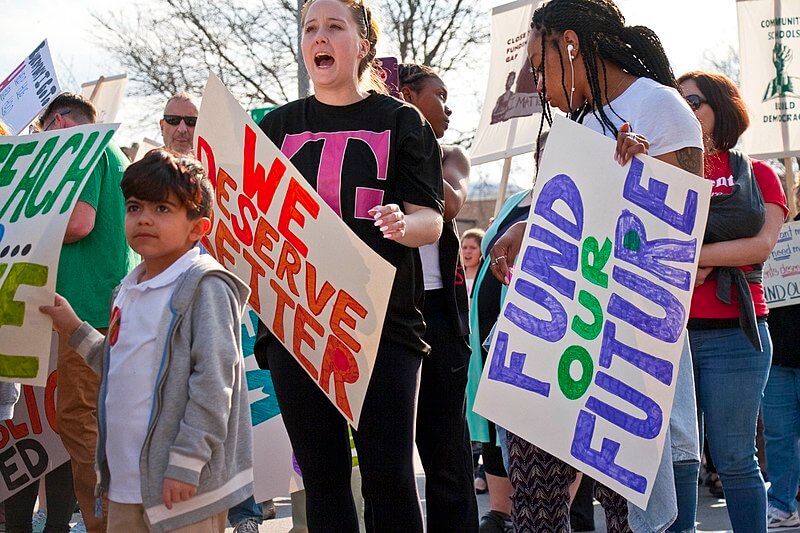
The nation's lack of memory has done far more than encourage the acceptance as racially neutral the economic and social arguments of voucher advocates, who blithely use the language of civil rights to advance the tools of segregationists. The nation has lost an understanding of class-based segregation as a general but not absolute condition for preserving racial superiority. This country also has failed to remember that school segregation laws outside the South embodied the same bifurcated notion of absolute and virtual segregation, although applied to different locales and demographies. More disturbing is the current wide acceptance of segregation as a part of an American way of schooling that merits public funding.
At the same time, the legal meaning and force of racial discrimination in civil rights enforcement and tax policy has shrunk to such an extent that courts, the public, and policy makers often recognize discrimination in private schools only if a person or institution sounds like an old-style segregationist who says "No, not one." Even some of the nation's most prominent public scholars have failed to grasp how, despite past court rulings, the strategies of virtual segregation continue today as prevailing practice among religious and non-religious private schools with tax exemptions.155For example, Jill Lepore writes that, because of the Supreme Court decision in Coit v. Green in 1971, "private religious schools no longer provided a refuge for whites opposed to integration." See Jill Lepore, These Truths: A History of the United States (New York: W.W. Norton, 2018), 663. There is no basis in fact for such a conclusion.
The US Supreme Court has declared as law of the land that private schools cannot enjoy the benefits of exemptions from federal income tax, much less receive tax credits and direct government funding, while engaging in racial discrimination, even when motivated by claims of religious freedom. But, the federal government's current standards and practices of enforcement accept as valid and true on its face any private school's public pledge of non-discrimination in admission practices and operations, so long as the school has no formal or written policies to the contrary and does not maintain absolute, complete "No, not one" segregation. And parents of public school children cannot go to federal court to challenge the lack of robust, effective enforcement.
This faux policy of anti-discrimination has permitted a majority of private schools across the nation to maintain what strategic southern segregationists sought to achieve after Brown—virtual segregation and exclusion of children of color. Recall that two-thirds of white students attending the nation's private P–12 schools are in institutions where African American, Hispanic, and Native American children constitute 10 percent or less of the student body. These white schools are exercising "school choice" to decide which and how many children of color to admit—in token numbers and on terms, values, and motives inherited from strategic segregationists who, as Julian Bond noted, "dared not say out loud" their true goals.156See Julian Bond, "Civil Rights in the Popular Culture," Southern Changes 14, no. 2 (1992): 4, http://southernchanges.digitalscholarship.emory.edu/sc14-2_1204/sc14-2_002/.
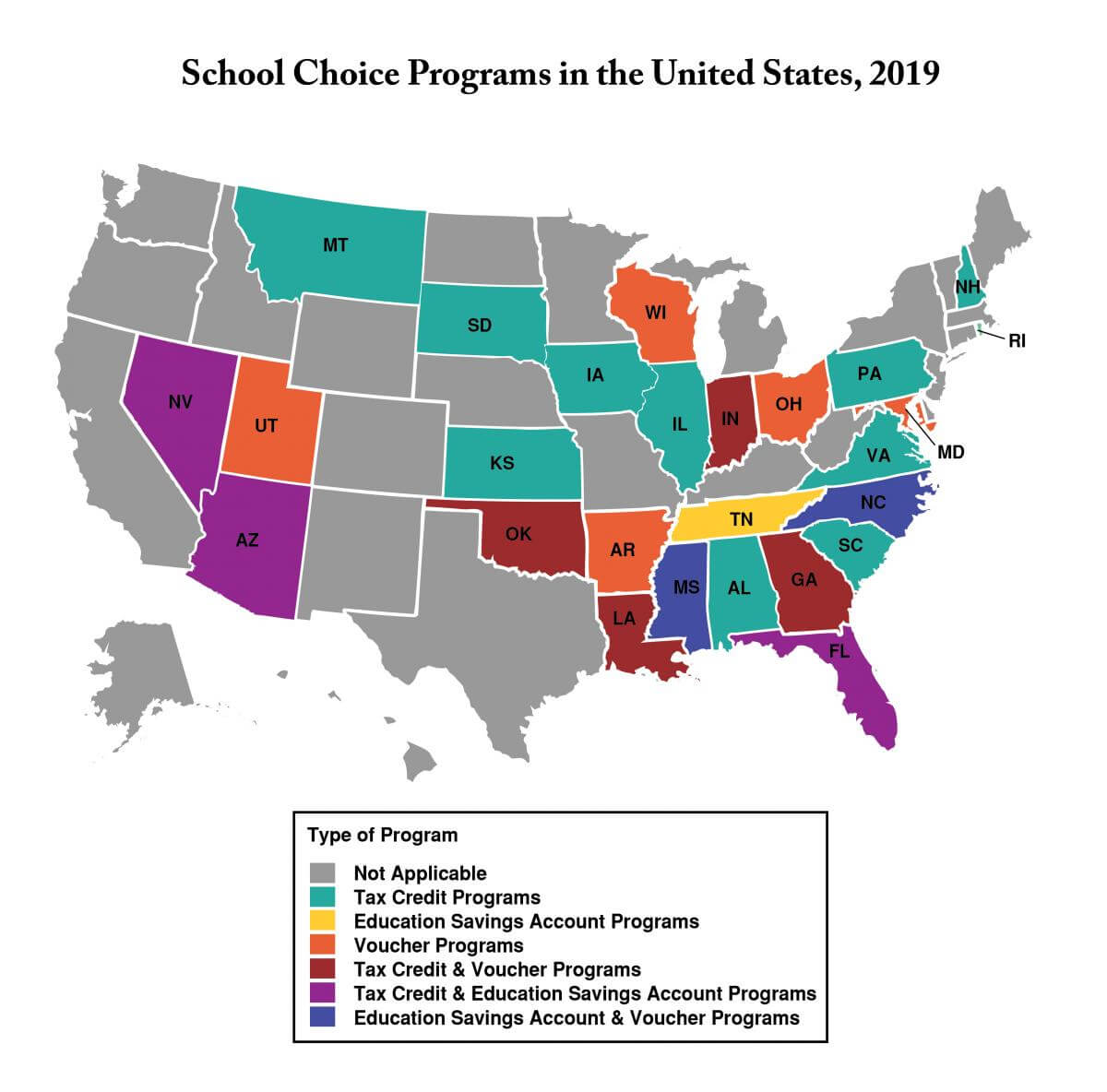
More than half of the nation's states have adopted some form of vouchers to support private schools, portending that virtual segregation and exclusion will be sustained over time. And the federal government is moving closer than ever to establishing a program of direct or tax credit vouchers to support private schools on whatever terms are acceptable to the states. Nor is there serious consideration of revising the standards and practices that have already permitted many states to erect the scaffolding of a private–public school system first put forward by Alabama segregationists in 1954.
By failing to grasp the history of the struggles and tactics against southern school desegregation, the nation has come to recognize segregation and racial superiority only in those private schools that are absolutely all-white. The looming danger lies in legitimizing and advancing a system of segregation and exclusion in education that is not called by its name. Even if most Americans find repugnant the absolute separation of the races that George Wallace defiantly championed as destiny in 1963, his words have transformed into a prophesy about schools across the nation that rings true by the most accurate, historical definition of the term: "segregation now . . . segregation tomorrow . . . segregation forever."
Acknowledgments
Many thanks to Southern Spaces staff members Stephanie Bryan, Madison Elkins, Amelia Golcheski, Camille Goldmon, Hannah Griggs, Rachel Kolb, Ra'Niqua Lee, and Sophia Leonard for their work on this piece. Thanks as well to Jon N. Hale for his suggestions. A special appreciation to Megan Slemons, GIS specialist with the Emory Center for Digital Scholarship, for assistance with maps and tables; and to Allen Tullos, my dear friend and senior editor of Southern Spaces.
About the Author
An adjunct with Emory University's Institute for the Liberal Arts, Steve Suitts is the author of Hugo Black of Alabama: How His Roots and Early Career Shaped the Great Champion of the Constitution. Earlier in his career, Suitts served as the executive director of the Southern Regional Council, vice president of the Southern Education Foundation, and executive producer and writer of "Will the Circle Be Unbroken," a thirteen-hour public radio series that received a Peabody Award for its history of the civil rights movement in five Deep South cities.
]]>Review
On June 19, 1911, the quiet evening descending on Thorndale, Texas, shattered suddenly when a group of men exiting a saloon attacked a youth they found whittling wood. Eyewitnesses reported that the saloon's owner grabbed fourteen-year-old Antonio Gómez and tossed him to the street. As a crowd closed in around Gómez, he defended himself and fatally stabbed the man striking him. Enraged that Gómez's age made his legal execution impossible, a mob decided to lynch him after first dragging him through the streets by a chain fastened around the boy's neck.
Nicholas Villanueva, Jr. contributes to the emerging scholarship on Anglo mob violence against ethnic Mexicans in the United States in this concise, well-written book. While in Forgotten Dead, William D. Carrigan and Clive Webb show the breadth of anti-Mexican violence in the US West between 1848 and 1928, Villanueva details what this meant for targeted individuals.1William D. Carrigan and Clive Webb, Forgotten Dead: Mob Violence against Mexicans in the United States, 1848–1928 (New York: Oxford University Press, 2013). In particular, he examines Anglo attacks against Mexicans in the 1910s, the decade of the Mexican Revolution. Not limiting his account to civilian attacks, Villanueva contends that "law officers acting as jury, judge, and executioner acted beyond their authority," thereby lynching for the state (6).
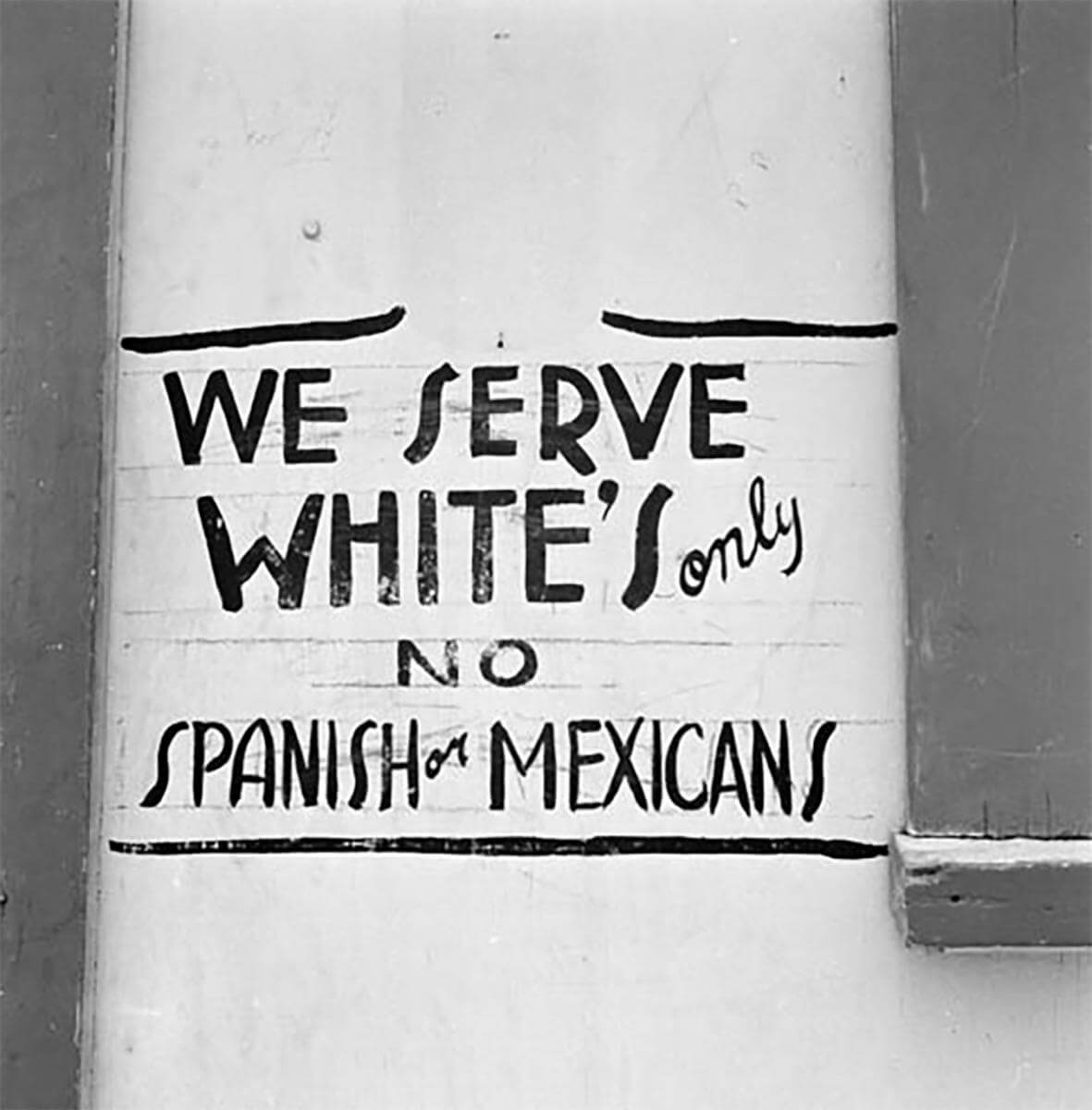
If mobs lynched African Americans for alleged offenses that challenged white supremacy, Villanueva argues that Anglos lynched Mexicans to police "citizenship and sovereignty" (5). Although Mexican Americans were "white by law" since 1848 when the Treaty of Guadalupe Hidalgo granted citizenship to the Mexican inhabitants of the newly acquired territory, Anglo immigrants to Texas viewed Mexicans as "greaser[s]," undeserving of equal rights (11). Unable to impose Jim Crow policies on Mexican Americans legally, a less formal "Juan Crow" pattern of prejudice emerged (33). In 1893 and 1905, Texas passed a series of English-only laws that paved the way for the segregation of Mexicans in public schools. Outraged over the unequal treatment of their children, Mexican Americans in San Angelo protested, asserting their rights as US citizens. In an early example of non-violent protest that would characterize later civil rights efforts to desegregate the classroom, Mexican families withheld the names of their school-age children from federal census takers to deny money to a system that discriminated against them. Rather than accept Juan Crow, Mexican Americans advocated for their civil rights and boycotted separate and unequal schooling (37). Their protests made headlines across the state, but international events derailed the effort and plunged the borderlands into the deadliest decade in the state's history.
In a series of case studies Villanueva makes clear that violence against Mexicans in Texas must be understood in a borderlands context, with events in one country affecting race relations in the other. The Mexican Revolution of 1910 played out transnationally, with leaders hiding in exile in Texas, and sedicioso raiders striking US settlements along the border. News reports of attacks on Anglos in Mexico fueled anti-Mexican sentiment in the United States. In November 1910, an Anglo mob in Rocksprings, Texas, stormed the jail and seized Antonio Rodríguez. Claiming that the young migrant worker had raped a white woman, the mob doused him in oil and burned him alive. Anti-American riots broke out across Mexico following news of the lynching and further fueled anti-Mexican sentiment in the borderlands. Anglo Texans viewed refugees of the Mexican Revolution—mostly poor, dark-skinned, working class people—as potential enemies whom they felt free to attack. These changing demographics occurring in the midst of international tensions exacerbated racist fears and help to explain why approximately 20 percent of the documented lynchings of Mexicans in the United States occurred between 1910 and 1920 (6).
Villanueva's boldest argument is his consideration of state-level forces in Texas as lynchers. In 1911, an Anglo mob surrounded the west Texas jail holding Leon Martínez, Jr. Believing him guilty of murdering a young white school teacher, the local sheriff demanded the fifteen-year-old confess or be turned over to the mob outside. Martínez confessed, but asserted his innocence after the mob dispersed. Despite efforts by Mexican American advocates and the Spanish language press, the Texas justice system refused to consider the circumstances which led to the confession and executed the young man in 1914. Villanueva makes a compelling argument for Martínez's coerced confession as a state complicit "legal lynching" (80). In examining another incident—a murderous village assault—Villanueva stretches this argument.
On January 28, 1918, an armed group of Texas Rangers and Anglo ranchers entered El Porvenir, a community of approximately 140 ethnic Mexicans deep in the Big Bend. Accusing the inhabitants of sheltering raiders who had attacked an Anglo ranch, the strike force searched the village. Upon the discovery of two firearms and a pair of boots similar to ones reported stolen, officers led fifteen of the villagers, Mexican Americans, and Mexican refugees away and shot them. The men killed that night ranged in age from sixteen to seventy-two.
In labeling state attacks as lynching, Villanueva goes further than his predecessors. Chicana/o and borderlands historians have well-documented the institutional racism of the Texas Rangers and their role as state enforcers of white supremacy.2Miguel Antonio Levario, Militarizing the Border: When Mexicans Became the Enemy (College Station: Texas A&M University Press, 2012), 17; and Américo Paredes, With His Pistol in His Hand: A Border Ballad & Its Hero (Austin: University of Texas Press, 1958), 24. Other historians have considered this police force's attacks as state-sanctioned violence.3Gary Clayton Anderson, The Conquest of Texas: Ethnic Cleansing in the Promised Land, 1820–1875 (Norman: University of Oklahoma Press, 2005), 7; and Benjamin Heber Johnson, Revolution in Texas: How a Forgotten Rebellion and Its Bloody Suppression Turned Mexicans into Americans (New Haven: Yale University Press, 2003), 168. Villanueva classifies the Texas Rangers as part of a posse of "jingo bandits," whom he defines as "persons who attack a community or a group of people without a warrant, and who punish their victims through extralegal measures" (123). These "bandits," however, wore badges which shielded them of their crimes. Disavowing Texas's sanction of the attack, the state's adjutant general James Harley asked for the resignation of the Ranger captain responsible for the massacre and discharged all officers involved. Although an investigation exonerated the victims of any crimes, no law enforcement officer or member of the posse who took part in the atrocity faced charges for the murders.
In detailing the suffering that individuals and communities endured, Villanueva treats his subjects with care, ensuring that readers regard the victims as human beings rather than statistics. Scholars of lynching looking for a comparative analysis of racial violence against ethnic Mexicans with other groups should look elsewhere. Villanueva's work fills a gap in unapologetically Mexican American and borderlands scholarship. Although high school and college history textbooks mention mob attacks against African Americans, US textbooks fail to admit similar assaults against Latinx people. In providing a substantive and unflinching examination of mob violence a century ago, The Lynching of Mexicans in the Texas Borderlands gives much needed context to the contemporary demonization of ethnic Mexicans implicit in current cries for "border security."4Matthew Haag, "Border Patrol Agent Killed in Texas in What Senator Calls an Attack," New York Times, November 19, 2017, https://www.nytimes.com/2017/11/19/us/border-patrol-killed-texas.html.
About the Author
George T. Díaz is an assistant professor of history at the University of Texas Rio Grande Valley where he teaches courses on United States, Mexican-American, and borderlands history. His first book, Border Contraband: A History of Smuggling across the Rio Grande, was published by the University of Texas Press in 2015.
]]>Review
"By branding the South as the racist section of the country," writes Brent Campney, "those narrating the identity of other sections have found a foil against which they can compare their own racial goodness. They can then deny, sanitize, or simply not see the profound anti-black racism in their own sections. Furthermore, when confronted by it, they can depict it as episodic or aberrant, something that occurred in but was not really of that place" (9). Long attentive to the history of white racial violence and lynching in the states of the former Confederacy,1See George Rable, But There Was No Peace: The Role of Violence in the Politics of Reconstruction (Athens: University of Georgia Press, 1984); Lou Faulkner Williams, The Great South Carolina Ku Klux Klan Trials 1871–1872 (Athens: University of Georgia Press, 1996); Nicholas Lemann, Redemption: The Last Battle of the Civil War (New York: Farrar, Straus and Giroux, 2006); J. Michael Martinez, Carpetbaggers, Cavalry, and the Ku Klux Klan: Exposing the Invisible Empire During Reconstruction (Lanham, Maryland: Rowman & Littlefield Publishers, Inc., 2007); Stephen Budiansky, The Bloody Shirt: Terror After the Civil War (New York: Penguin Group, 2008); LeeAnna Keith, The Colfax Massacre: The Untold Story of White Power, Black Terror, and the Death of Reconstruction (New York: Oxford University Press, 2008); Charles Lane, The Day Freedom Died: The Colfax Massacre, The Supreme Court, and the Betrayal of Reconstruction (New York: Henry Holt and Company, 2008); and Kimberly Harper, White Man's Heaven: The Lynching and Expulsion of Blacks in the Southern Ozarks, 1893–1909 (Fayetteville: The University of Arkansas Press, 2010). recent scholars have both widened their geographical frame and explored violence directed against racial and ethnic groups other than African Americans.2See William D. Carrigan and Christopher Waldrep, eds., Swift to Wrath: Lynching in Global Historical Perspective (Charlottesville: University of Virginia Press, 2013); William D. Carrigan and Clive Webb, Forgotten Dead: Mob Violence Against Mexicans in the United States, 1848–1928 (Oxford: Oxford University Press, 2013); and Michael J. Pfeifer, ed., Lynching Beyond Dixie: American Mob Violence Outside the South (Champaign: University of Illinois Press, 2013) Campney's book breaks new ground in revealing the hollowness of congratulatory comparisons between Kansas and the South while analyzing how Kansans created a "Free State Legend" and made themselves the not-South.
Campney insists that too many scholars reduce racist violence to lynching3Campney uses "racist violence" instead of "racial violence" to "underscore the implicit power dynamic: whites used racist violence to 'maintain social control over the black population through terrorism,'" (1). Here he follows Barbara J. Fields, "Whiteness, Racism, and Identity," International Labor and Working-Class History 60 (Fall 2001): 48–56. perhaps because lynching "seemed to define in the starkest terms the virulence of white racism, the vulnerability of blacks, and the brutality of the racial order" (1). He deploys a more capacious approach, encompassing sensational violence (lynchings, race riots, mobbing, killing-by-police, and homicides), threatened violence (threatened lynchings by mobs and intimations of violence by posses and crowds), and routine violence (many everyday types). He also highlights both black and white resistance.
Although "racial conservatives made up the majority of whites in the state" (14), Campney asserts, they did not have the education, resources, or influence of their moderate and radical white counterparts. Historians tend to minimize their voices, but Campney "examines the racist violence by means of which they fervently demonstrated their contempt for blacks" (14). Radical and moderate Kansans did not, by and large, approve of racist violence. However, by the 1880s, conservatives, usually through violence, compelled dissenters to abandon earlier promises of justice and equality.
Campney writes that beginning in 1861, white Kansans tolerated black fugitives from Missouri out of self-interest rather than beneficence and employed lynchings and other racist violence to stymie black suffrage, segregate public schools, and assert dominance.4In making this argument Campney critiques Nicole Etcheson, Bleeding Kansas: Contested Liberty in the Civil War Era (Lawrence: University Press of Kansas, 2004), 229 and Robert G. Athearn, In Search of Canaan: Black Migration to Kansas, 1879–80 (Lawrence: Regents Press of Kansas, 1978), 75. Lynch mobs received widespread support from white communities. During Reconstruction, white Kansans employed racist violence to segregate public schools. Although traditionally defined as the five decades between the end of Reconstruction (1877) and the beginning of the Great Depression (1929), Campney widens the temporal bounds of the "lynching era" to include Reconstruction. In addition, when the black Exodusters arrived in Kansas in 1879, many whites employed violence to reinforce their supremacy.5"Exodus" refers to the migration of tens of thousands of African Americans from the South to Kansas. See Nell Irvin Painter, Exodusters: Black Migration to Kansas after Reconstruction (New York: W. W. Norton & Company, 1976); Athearn, In Search of Canaan; and Charlotte Hinger, Nicodemus: Post-Reconstruction Politics and Racial Justice in Western Kansas (Norman: University of Oklahoma Press, 2016). Lynching "continued to provide a barometer for race relations," but other types of violence including enforced segregation and exclusion from towns and counties "played a highly publicized role in the savagery that defined the [eighteen] nineties" (91).
The spatial dimension of This Is Not Dixie is fascinating. Throughout the Midwest, and Kansas in particular, government agencies, residents, and writers framed racist violence as an exclusively southern phenomenon. The South became the demonized geography against which Kansans gauged their virtue and measured their superiority. When racist violence appeared, white Kansans usually considered it to be an imported contagion, claiming, for instance, "that white Texas drovers imported racist violence into the state's cattle towns" (34). White Kansans often asserted that "racist violence would always be foreign—no matter how common it was" (42).
Following the Civil War, white Kansans created the Free State Legend, reshaping the memory of the struggle in the 1850s into "a fight not only for white political and economic freedom but for the liberation of the slaves as well" (12). While utilizing violence to define racial boundaries, they spoke of Kansas as a "land of freedom and justice" (41). They argued that Kansas was a "worthy foil to the 'Negro-Hating South'" (72), even as they attacked the Exodusters. Pangs of conscience about the difference between the Free State Legend and everyday reality occasionally caused authorities to attempt to prevent violence. More commonly, however, after an episode of racist violence, white Kansans thumped their chests and decried the disease imported by Southerners. Kansans used the "mythology as a palliative to obscure their assault on blacks" and "routinely invoked the territorial origin myth as prima facie evidence of their commitment to racial equality" (99).
Deploying the Free State Legend, white Kansans "did internalize it to some degree, absorbing it into their geographical imaginations and thereby placing potent, if largely unconscious, constraints upon their own behavior" (166). African Americans appealed to it to "encourage whites' adherence to their own professed beliefs in racial justice" (177). Black men and women skillfully exploited white self-righteousness and shrewdly played on fears that racist violence would undermine the state's reputation.
African Americans cultivated their own version of the Free State Legend, sometimes juxtaposing memories of the South against Kansas and, despite plenty of evidence to the contrary, creating an "idyllic representation of the state" (177). Black newspapers frequently referred to Kansas as the land of freedom, especially in comparison with the Jim Crow South. Black Kansans determined to make Kansas live up to its promises.
Critically, this is not a story of helpless black people prostrate before savage whites. One of the most captivating and important components of This Is Not Dixie is Campney's discussion of black resistance by men and women, especially in self-defense organizations that sometimes succeeded in mounting jailhouse defenses to prevent lynchings. When black people defended a jailhouse, white men often preferred not to risk a confrontation.
Campney's discussion of black resistance challenges notions offered by some scholars that it was the defiant writings of New Negro intellectuals that first sparked a shift in black attitudes and that it took black World War I veterans to inspire a militant turn.6In making this argument, Campney builds on the work of Sundiata Keita Cha-Jua, "'A Warlike Demonstration': Legalism, Armed Resistance, and Black Political Mobilization in Decatur, Illinois, 1894–1898," The Journal of Negro History 83 (Winter 1998): 52–72. African Americans in Kansas articulated a defiant message and confronted white mobs decades earlier. The veterans of the 1920s "were not charting any radical new path; they were instead following in the well-traveled footsteps of their parents and grandparents" (199).
As African Americans resisted, so too did some whites. This Is Not Dixie offers several courageous examples. Mob violence offended the sense of civic order of many middle-class whites. White police officers, sometimes working with African Americans, began to thwart lynchings. This seeming progress, however, proved hollow. Killings-by-police escalated while lynchings declined, allowing the state to wrest control from mobs, effectively diminishing unpredictability while achieving the same repressive purpose.
Although Campney might have delved deeper into manuscript collections and sought out more contemporary correspondence, This Is Not Dixie is supported by thorough research in the state's many newspapers. The book is full of challenging and provocative ideas. It critiques, for instance, the too-simple "what's the matter with Kansas" analysis. This analysis, articulated in Thomas Frank's What's the Matter with Kansas, unquestioningly accepts the Free State Legend and asserts that Kansas "doesn't do racism."7Thomas Frank, What's the Matter with Kansas: How Conservatives Won the Heart of America (New York: Metropolitan, 2004), 179. Campney deftly illustrates how a compelling narrative benefitted white people, but also how African Americans used the Free State Legend to sway white behavior. His examination of black resistance complicates older notions about accommodation and militancy. In expanding the geography of racist violence, This Is Not Dixie will appeal to anyone interested in US race relations from the era of the Civil War and Reconstruction through the 1920s.
About the Author
Evan C. Rothera is a Postdoctoral Teaching Fellow in the History Department at The Pennsylvania State University and a member of the Richards Civil War Era Center. Rothera's dissertation analyzes civil wars and reconstructions in the United States, Mexico, and Argentina in the period 1860–1880.
]]>Beneath
Beneath the landmark 1967 Loving v. Virginia US Supreme Court case is a very simple story: two people, Richard Loving and Mildred Jeter, loved each other and wanted to marry and raise their family in rural Caroline County, Virginia. In the 2016 cinematic dramatization, Loving, writer-director Jeff Nichols best exemplifies this simplicity neither through dramatic courtroom scenes nor in his scant exploration of iterations of the legal process needed to achieve legalization of interracial marriage in the Court's decision, but in quiet moments of private intimacy.
The film neither glorifies nor sanctifies. Nichols proceeds with care, illustrating the ways in which all intimacies are negotiated and far from simple. Midway through Loving, after living for some years in exile in Washington, DC, Mildred and Richard decide, in violation of state law, to move back to Virginia with their three young children. They find a farmhouse. It has no telephone or easy connection to the outside world. As the family drives up, Mildred's face beams as she sees her new home—glistening white in the sunlight, surrounded by wide-open space. Richard smiles at her happiness. Mildred's goal is simple, as she tells Richard in DC, a city antithetical to her way of life: "I won't raise my family here." She will raise their children in the rural environs of her home state and in secrecy if need be. Yet, in this scene, as Mildred's joy radiates in the face of actress Ruth Negga as captured by cinematographer Adam Stone, Richard turns and stares into the beyond, back down the road from which they came. While Mildred is intent on raising their children in a manner she sees fit, Richard's goal, as he tells her in one of the film's most emotional scenes, is different yet equally simple: "I can take care of you." In these brief, quiet moments, Mildred is at home; Richard is afraid.
Beneath the Lovings's story, then, are bedrock truths that all couples must negotiate: intimacy and protection in the present, and care and preparation for the future. Nichols crafts this narrative through images of the marriage bed, the laying of a home's foundation, and front porches looking out to an idyllic and unknown beyond. As I search Loving for the "beneath," I recall the late Eve Kosofsky Sedgwick's claim that reading for the beneath fosters narratives of "depth or hiddenness" calling out for "a drama of exposure."1Eve Kosofsky Sedgwick, Touching Feeling: Affect, Pedagogy, Performativity (Durham, NC: Duke University Press, 2003), 8. Sedgwick's foundational contribution to the field of queer theory was her implicit understanding of the closet-structure and coming-out narrative and how they functioned. Sedgwick understood the closet as a "resilient and productive… structure of narrative" with a firm "hold on important forms of social meaning" both before and since the great gay liberationist movement "began" at Stonewall. See Eve Kosofsky Sedgwick, Epistemology of the Closet (Berkeley: University of California Press, 1990), 67. Like other key thinkers such as Michel Foucault and Judith Butler, Sedgwick understood the "very specific crisis of definition" implicit in binary distinctions like gay/straight, homosexual/heterosexual, black/white, as well as how that crisis is often socially constructed, limiting the possibilities of non-normative subjectivities (72). Such distinctions create hierarchy and the implicit desire on the part of the majority for the minority to be exposed, excavated, and/or transcended. These realities necessitate giving voice. Yet, we can read silence and invisibility as power. Arguably, in Loving and Moonlight, what is unsaid, what is invisible, is represented as equal in power to what is said and shown. Reading for the beneath raises ethical questions: Why do we need to justify the loving of this particular couple as valid? For whom are the filmmakers making Loving and why are they placing this story of the past in our present? What are the stakes of excavating and exposing the Loving story now? In supplanting readings for the "beneath," Sedgwick calls for readings of the beside, in which "a number of elements may lie alongside one another… Beside comprises a wide range of desiring, identifying, representing, repelling, paralleling, differentiating, rivaling, leaning, twisting, mimicking, withdrawing, attracting, aggressing, warping, and other relations"—such as loving or moonlighting.
I read Loving not as a film that exposes either the "Loving Story" to a wider audience or the quintessential nature of interracial loving, but as an imperative film which ask viewers to place themselves "beside" others in acts of creating, understanding, universalizing and identifying, legalizing, equalizing, and yes, loving. In so doing, I will read it alongside another 2016 film, Moonlight, to illustrate the power of both films in breaking expectations of narrative form and cultural understanding. Both films invite us to touch, to feel, the intimate lives of their characters in opposition to forces that define, prescribe, limit, and curtail.
Remember that the grand story of the Lovings—given the photojournalistic treatment by Grey Villet in Life magazine, the Lifetime television treatment with Richard Friedenberg's Mr. and Mrs. Loving (1996), the documentary treatment with Nancy Buirski's The Loving Story (2011), and now the Hollywood treatment—is only known to us, only "a drama of [continued] exposure," because Mildred first wrote a letter to the ACLU via Robert Kennedy in 1963 seeking legal assistance in moving her family from DC back home to Virginia. We know the Lovings because Mildred first engaged in a quiet, solitary act of letter writing. The Lovings were neither unique nor exemplary in their transgressive love. They were unique in their successful resistance to the laws that sought to define how and where they could love and live. And they were unique in asserting that beneath their love was something that could not be cast aside, exiled, closeted.
Beside
Beside each other, they sit in moonglow. Nichols's film opens: first shot Mildred Jeter, second Richard Loving, then both, equal visual weight. Mildred, black and Rappahannock, is pregnant; Richard, white, is the father. Crickets chirp in the background of the 1958 Virginia night. There is silence and joy. They are about to marry, to be parents; they look to the future. Despite Nichols's creative license in blurring the timeline their choice is simple: they will build a life together.
Loving challenges viewers because it is largely a meditative film telling this simple story, not a film of award-baiting fireworks or melodramatics. Nichols's goal in writing and directing was "to concentrate on the day-to-day lives of the Lovings" and "make a really slow, quiet film."2Joe Robberson, "Director Jeff Nichols talks 'Loving,' His relationship With the South & His Muse, Michael Shannon," Zimbio, November 7, 2016, http://www.zimbio.com/Zimbio+Exclusive+Interviews/articles/bqW7H-jZy09/Director+Jeff+Nichols+Talks+Loving+Relationship. The film's composition takes on equal weight to its script: not only what Loving says but also how it says it. Framing becomes central in cinematically portraying the Lovings. The camera eye presenting the narrative reveals an implicit resistance to bombastic inauthenticity. Nichols frames the Lovings via numerous shots of Richard's construction jobs—building home frames with 4x4s, laying foundations of cement blocks, insulating homes with the durable stacking of bricks and scraping of the mortar trowel—and Mildred's domestic work—washing dishes, ironing clothes, speaking on the telephone, buying groceries, running after her kids. Nichols elevates the quotidian tasks of the Lovings into profound meaning. The Lovings simply wanted to build a home together.
As a filmmaker, Nichols understands that in representing a true story that changed the US Constitution, Loving requires both adherence to the preexisting historical record and a multi-dimensional narrative framing of his central characters' lives.3Nichols, a native of Arkansas, has made four previous films: Shotgun Stories (2007), Take Shelter (2011), Mud (2012), and Midnight Special (2016). All of these films are fiction. Loving is Nichols's first film to be rooted in fact. Nichols understands the stakes and proceeds with great care. Loving presents the moments of rupture well known to historians and legal scholars: the invasion of the Lovings's bedroom, their arrest, Mildred's five-day imprisonment, the abrupt judicial decision, and their exile from their home state. Like The Loving Story (2011) documentary before it—which divided its narrative into sections entitled the Crime, Exile, the Climate, the Court, Oral Arguments—Nichols's film presents the known facts with chronological precision. Richard and Mildred committed a crime; they broke the state's love law. A legal holdover from slavery and Jim Crow, the Virginia Racial Integrity Act of 19244Virginia was not alone in enforcing such legal holdovers. By the time of the 1967 decision, fifteen other (mostly southern) states (Alabama, Arkansas, South Carolina, North Carolina, Georgia, Mississippi, West Virginia, Missouri, Louisiana, Kentucky, Florida, Texas, Tennessee, Oklahoma, and Delaware) had similar anti-miscegenation laws on the books. While the Supreme Court's federal decision invalidated all of these state laws, it would take until 1998 and 2000 for South Carolina and Alabama, respectively, to amend their state constitutional language on miscegenation. made it illegal for men and women of different races to marry and live together. Initially, the Lovings accepted a deal to live outside Virginia for twenty-five years or risk re-arrest. In exile, they moved to DC. They grew homesick and disenchanted living in a space that was not their own. Mildred contacted the ACLU, which took on their case. They secretly moved back into Virginia but were discovered and re-arrested. Their case worked its way to the US Supreme Court, and in 1967, the Lovings won. All of this is in Nichols's film, yet he never lets the grandiosity of the circumstances supplant the simplicity of story. This is not The Loving Story; it is Loving.
The stakes for present-day viewers are not whether to understand Mildred and Richard Loving's marriage as equal and legal. That question is moot. The questions today are whether we can see their loving-struggle alongside other forms of loving we still debate, and whether we can accept the lives their loving created as lives equal to all others. For us, then, the Lovings serve as precedent.
"All Love is created equal" says the film's tagline. But Loving's imperative implicitly asks: Who does all include? What is love? When is the time? What do we mean by created? How equal, by what terms? These questions call forth the positionality of various loves alongside one another in cultural understanding and legal equality.
In two of Grey Villet's Life magazine images, Richard and Mildred stand or sit beside one another at their home. Perhaps the film's most powerful image is a similar moment of intimacy in which viewers are invited to sit alongside. It is an image used in the film's promotion: Mildred sits in Richard's lap, holding his head close to her chest. They sit at a kitchen table. An embrace. Silence. Yet, they are in exile in DC; this is not their kitchen table. This still frame invites you to the table alongside them. To dare disrupt this quiet scene. Dare to deny the fierce simplicity of their loving. Help bring them home.
Beneath
Beneath Loving is bedrock: textures of mortar and soil, dirt and desire, the need to build a home and be rooted. Beneath Barry Jenkins's Moonlight is an ocean: the need to be visible as something other than the expected or prescribed, to be seen as singular and more than a drop drowning in the multitude. Loving and Moonlight, released in the same year, are period pieces illustrating tensions between fixity and fluidity in journeys we must take to love ourselves so that we can engage in acts of loving others.
Beneath Moonlight is not the often-told, true-life story of the Lovings, but autobiographical traces of playwright Tarell Alvin McCraney and writer-director Barry Jenkins's upbringings in 1980s Miami.5Moze Halperin, "Playwright Tarell Alvin McCraney Discusses the Piece that Inspired 'Moonlight,'" Flavorwire, October 21, 2016, http://flavorwire.com/592191/playwright-tarell-alvin-mccraney-discusses-the-piece-that-inspired-moonlight. Halperin writes, with "In the Moonlight, which McCraney set in his own home of Liberty City, Florida, the playwright tried to lay out some of his own biographical questions about growing up with a mother grappling with drug addiction, and growing up gay in a neighborhood sequestered by race and class, in a community where his own divergence from masculine norms led him to be classified as Other from a young age. Moonlight writer/director Barry Jenkins likewise grew up in Liberty City—and in the very same public housing unit as McCraney—Liberty Square, though they didn't know each other. His adaptation of McCraney's work combined their diverging and overlapping experiences, and projected them onto the story of a protagonist, who, through the convergence of time and society's all-too-often blanketing perceptions of black manhood, lives as a beautifully unchanging soul housed within three metamorphosed bodies." Moonlight, adapted from both McCraney's sketch In Moonlight Black Boys Look Blue and from life, is fiction. While the film's tagline may read, "This is the story of a lifetime," it is not the story of any one lifetime but a composite of the experiences of many young black "gay" men in the urban South. It burrows beneath while seeking to get beyond. It is not "based on a true story" in any distinct way but culled from the archives of the many men like protagonist Chiron who do not get represented on screen. Moonlight is simple and grand, specific and universal, drop and ocean. The most apt preposition for an exploration of Moonlight may not be "beneath" but "beyond." Moonlight asks to go beyond what we think we know about men, about being black, about being gay. It asks us to think beyond any singular identity and consider the intersections where black-gay-men struggle to exist in places such as Miami and Atlanta.
Jenkins structures Moonlight in a tripartite way, beginning with "Little" and ending with "Black," both nicknames for the character's actual name, "Chiron," the title for the middle section. Little-Chiron-Black. This structure invites side-by-side analysis around three moments of time in one man's life. Little-Chiron-Black function as islands of existence and snapshots of time representing the fragmentary nature of a man growing into himself and negotiating racial, gender, and sexual identities. Viewers encounter all three—Little-Chiron-Black/ Black-Gay-Man—distinctly but also connected across the intersectional, hyphenated breach.
Beyond
Beyond visible: the sound of ocean waves crashing before the fade-in is how Moonlight begins—with what cannot be seen or known but only heard and approached. Loving begins in fixity and stillness—crickets chirping in a calm, rural Virginia night. Moonlight begins in fluidity and chaos. We hear the non-diegetic crashing of waves and the diegetic "Every Nigger is a Star" playing on Juan's car radio as we fade-in to his meeting one of his drug-dealing employees. The camera spins like the eye of a hurricane or a whirlpool undercurrent, circling and weaving around the actors as director Barry Jenkins introduces 1980s Miami and the slow-drain effect of drug addiction and trafficking. We fall into Loving, into the front porch simplicity of a couple, a grand narrative before them. With Moonlight, we crash full force into a street life where "Every Nigger is [or aims to be] a Star."
So much of Moonlight is disassociation, disembodiment, and disorientation: sounds of waves, cracked glass underfoot, muffled moans, zippers descending, voices and whispers, continued movement, and abrupt shifts. The main character Little-Chiron-Black is never fixed, but constantly shifting and adapting. Each section in this man's life is built around a core set of characters who shape him and ultimately help him associate, embody, and orient so that we come to "know" this man not by virtue of his fixed being but by his continual becoming.

"Little" is structured around Juan, the first character we meet in Moonlight, stepping out of his bright blue car. As played by Mahershala Ali, Juan is not one-dimensional, neither villain nor hero. Yes, he deals drugs, but he also serves as mentor and caretaker for "Little," a lost boy whose mother is adrift on the crack-cocaine Juan sells. It is Juan who teaches Little to swim, who stares out across the Atlantic—back home—and tells Little that he was once called "Blue" as a boy in Cuba, but he no longer identifies with that name because "at some point you got to decide for yourself who you gonna be." Juan creates his morally ambiguous self, and it is from Juan that Little learns self-becoming.
As "Little" progresses, viewers come to know Little's sexuality even before he understands it. In the closing scene of this first snapshot in Chiron's life, Little asks Juan and his partner Teresa, who serves as a second mother, "What's a faggot?" The couple exchange knowing glances, and refuse to lie. They tell him that he will know if he's gay when he knows.
If "Little" reveals Chiron's first moment of self-awareness and recognition, "Chiron" is Little's adolescent hardening. "Chiron" centralizes Kevin, Little's childhood friend and first pubescent crush. "Chiron" shows a young man who lives in fantasies: wet dreams in which the sounds of waves and grunting lead him to find Kevin fucking a faceless woman beneath the south Florida palms. "Chiron," second snapshot in this story of a lifetime, is full of similar sex and frustration, daydream and risk, role-playing and reality.

"Chiron" begins with a science teacher discussing DNA in class, suggestive of the heteronormative idea of sex as procreation as well as the heightened sexual risk associated with certain methods of swapping DNA. As if to reify these passing suggestions, Jenkins returns the viewer, in the middle of the "Chiron" section of the film, to the same class, alongside the students, as the same teacher mentions a "lack of white blood cells" in his lesson plan. Said in passing, "a lack of white blood cells" serves as a potent phrase in the middle of a movie set in the early, death-sentencing years of the HIV/AIDS epidemic in which gay sexuality and IV-drug behaviors were stigmatized, misunderstood, and pathologized. It is also a reminder of the startling disparity that people of color and drug addicts continue to face, measured in new HIV infection rates, access to care, and number of AIDS-related deaths in the United States.6"Lifetime Risk of HIV Diagnosis," CDC, February 23, 2016, https://www.cdc.gov/nchhstp/newsroom/2016/croi-press-release-risk.html; "CDC Fact Sheet: Today's HIV/AIDS Epidemic," August 2016, https://www.cdc.gov/nchhstp/newsroom/docs/factsheets/todaysepidemic-508.pdf; Claire Galofaro, "Appalachia Bracing for HIV," U.S. News & World Report, June 5, 2015, http://www.usnews.com/news/us/articles/2015/06/04/appalachia-gripped-by-hepatitis-c-epidemic-bracing-for-hiv. Is it any wonder that Chiron, a young man trying to decide who he is going to be, might be frightened of the sexual urges he feels for Kevin, of both the tenderness and hardening that he is told make him sick, soft, not "man" enough?
And yet, always beneath the surface of Chiron's confusion and self-discovery is Kevin, a young man who boasts of his sexual conquests and the size of his genitalia, who seems to better negotiate his sexual fluidity against the unforgiving, tough, adolescent, environment. Kevin is a consummate performer, adapting his personality and behavior to survive the only world he knows. Kevin recalls James Baldwin's confusion over the term "gay": "I didn't understand the necessity of all the role playing."7Richard Goldstein, "'Go the Way Your Blood Beats': An Interview with James Baldwin," In James Baldwin: The Last Interview and Other Conversations (Brooklyn, NY: Melville House, 2014), 59. To be "gay," to own that identity especially at a certain point in time, one had to consistently play some version of a part—clone, closet case, down low, top, bottom, vers, masc, macho, fem, maricón, queen—in order to survive. One could not simply be "out"; one had to negotiate how one was out. Moonlight never explicitly labels or categorizes either Kevin or Chiron's sexuality; they just are. In the street life of 1980s urban black America, being out in whatever degree meant playing some part to reveal or conceal, make or mask. If one did not play a part, all that was left was a form of self-denial so internally violent, repressing, and damning that lashing out externally seemed a likely result.
It is Kevin who first nicknames Chiron "Black," giving him the role of a lifetime. Kevin knows playing a part is survival. He understands risk and danger associated with authenticity. Chiron does not understand the necessity of role-play or the inundation of danger he receives at school, in the streets, and at home. All Chiron understands are his urges, his emotions, and his desire to act upon them. Throughout most of "Chiron," he rejects Kevin calling him "Black." He is not yet ready to play the part.

All this changes after Kevin and Chiron meet on a beach, sitting side-by-side as they stare out into the ocean. Kevin is tough, his façade intact. Chiron tells him, "I cry so much sometimes I feel like I just turn to drops." Chiron is "soft," drowning in his own emotions. When Kevin comforts him, the two kiss. The only sexual act they engage in is the one of least risk: Kevin masturbates Chiron. As Kevin wipes Chiron's DNA in the sand, he marks this space, at the edge of the sea, as one of new life where each can stop playing a role and see each other clearly. It is a space of safety not unlike the calm front porch of Loving. They sit side-by-side, and the roles the world asks them to play fall away.
Such safety is illusory. The roles return in full force. Kevin must act a man and beat Chiron after the school bully pressures him to do so. During this first fight scene, as Kevin punches Chiron repeatedly, the camera again moves in chaotic circles, Jenkins illustrating the whirlpool undercurrent, the violent drain, of toxic masculinity. Days later, Chiron responds with a violent rage, beating the class bully who made Kevin prove his manhood in beating Chiron, the soft "faggot." Chiron becomes "Black." Even after Chiron's retaliation in which he plays the role of tough man, the counselor calls him a "boy." In hardening himself to be tough, to be "Black" in order to survive, Chiron is as lost as ever.
The "Black" section of the film begins in Atlanta where Chiron and his mother, Paula, have moved. Black is all muscle, physically imposing, leading a solitary life back on the streets. His mother has sobered up, choosing to live at the rehabilitation center. Yet, it is not Paula who haunts "Black," it is Juan. While mentor to Little, Juan also served as a dangerous model in propagating street life, drug-work, and moral ambiguity as a tough but necessary way of life for a black man. He may teach Little not to fold into himself, but he also provides Little a caricature to play. With "Black," we see a man adopting the teeth, headwear, car and dash ornament, and street lifestyle of his mentor. Yet, Black feels like a radical and a false departure—physically, emotionally—from both Little and Chiron. As the ghost of Juan hovers over "Black," Kevin suddenly resurfaces to offer a moment of startling grace, helping Chiron unmask and reveal "Black" to himself. With "Black," Chiron must learn to integrate the disparate influences of Juan and Kevin into some version of himself.
Little-Chiron is not Black, and it is Kevin who can perhaps best expose and save him from this false self. When Black drives down to Miami and shows up at Kevin's diner, Kevin cooks him dinner and plays "Hello Stranger" on the jukebox. Yes, they are strangers because time and place have divided them. But the meaning goes deeper: Black has taken on the role of stranger to himself; we hear the sound of ocean waves return. Kevin asks Black: "Who is you?"
Moonlight begins in darkness, with the sound of ocean water—currents, rhythms, and waves—before fading in to the narrative. It ends with two men, in a kitchen, pouring a glass of water, negotiating each other's past and the present they long to enact. It ends with two men bathing each other in a warm embrace. When Black tells Kevin, "no man has touched me since you," we come to understand Black's answer to Kevin's question. "Who is you?" I am yours, Black seems to say. As Kevin holds Black, we come to "know" and see the man Chiron apart from the roles he has played. The irony of Chiron's story of a lifetime is that it is no longer a "story" with characters—"Little," "Chiron," "Black"; black-gay-man—to create or perform. Illustrating Little-Chiron-Black's harnessing of the ocean's immense body of water into a single glass—his pulling in of desire and intersectional identity from the vast, diffuse, and invisible to the known, contained, and experienced—is the achievement of Barry Jenkins's film.
In colloquial terms, to moonlight is to pretend to be something you are not; moonlighting is role-playing. In the film's final frames, we see Little again, his back to us, staring out at the immense waters of the Atlantic. To paraphrase Kate Chopin, the voice of the sea is clam, it is sensuous. It invites you to wade into its waters and lose yourself in the invisible beyond.8Kate Chopin, The Awakening (Chicago and New York: Herbert S. Stone & Co, 1899). At Moonlight's end, however, Little-Chiron-Black is awakened. In the final frame, Little does not walk into the waters, lost to us forever. He turns to the camera and stares directly and fiercely into its lens. He breaks the fourth wall, shattering the pretense of performance. He is present and visible. He is blue in the moonlight. He dares us not to see him and join him on this beach. The film fades to black.

Beside, the Breach
Searching for you in the hollow cage…
—Richie Hoffman, "Sea Interlude: Moonlight"9Richie Hoffman, "Sea Interlude: Moonlight," The Missouri Review, 34, no. 4 (2011): 93.
Beside ocean water, as waves break on the shore, Moonlight ends with a return to Little standing on a solitary beach. Awakened, he stands at the shore of a new becoming, no longer seeking to get beyond himself but to be within himself. The whirlpools have stilled. He stands calmly. As viewers, we are asked to look him in the eye, see him, to place ourselves alongside him. Actor Mahershala Ali, in accepting the SAG award for his performance as Juan, described Chiron as a persecuted man who was folding into himself. Our responsibility, Ali suggests, is to uplift him and tell him he matters. He invites us all to "do a better job of that."10Alex Abad-Santos, "Watch: Mahershala Ali's powerful SAG Awards speech on persecution and acceptance," Vox.com, January 29, 2017, http://www.vox.com/2017/1/29/14433536/mahershala-ali-2017-sag-award-speech-video. Journeys of empathy are not always easy, but as Baldwin once said, you cannot change what you will not face. As we face Little, we stand alongside. We enter his breach as we hear the rhythm of breaking waves. We do not look toward the horizon for a better beyond.
When McCraney, on whose work Moonlight is based, approached writing a play about Hurricane Katrina's devastating effects on New Orleans, he and his collaborators settled on the title The Breach. It begins, "It was water that woke us up that morning."11Catherine Filloux, Tarell Alvin McCraney, and Joe Sutton, The Breach. In Katrina on Stage: Five Plays, edited by Suzanne M. Trauth and Lisa S. Brenner (Evanston, Illinois: Northwestern University Press, 2011), 57.
Beneath Moonlight, the slow return of water and its rhythms upon the shore—fluidity constantly reshaping fixity—wake Chiron up to his true self. Like water splashed in the face of the deep-sleeper, the element of water snaps Chiron out of the fragmentary and traumatic breaches that seek to define him. At Moonlight's close, we join Little-Chiron-Black as he ceases folding into himself and begins to become whole.
In this review essay, I have framed my story deliberately, placing Loving and Moonlight beside each other, linked in more ways than the year of their release. Both films depict breaches—Loving's depiction of a breach of law, Moonlight's breach of time via its non-continual structure and motif of the sound of waves breaching on the shore. More important are the symbolic breaches each film forces us to ponder. Loving is a calm illustration of the fierce power of the action of breaking laws in order to live and love: what is loving? How do we love? Moonlight is a chaotic rumination on being broken, fragmented, traumatized, and the slow process of recovery. What is moonlighting? How do we all moonlight? Each film emplaces viewers alongside characters in the breach. Sutured into the narrative of Loving's calmness and Moonlight's chaos, we wade in these waters in which each lifetime has a story and all love is equal.
It is perhaps no accident that both Loving and Moonlight, which ponder never-simple questions of race and sexuality, take place in US southern spaces, spaces historically rife with such interrogations. It is also no accident that neither features stereotypical tropes of "southern" filmic narratives. Yes, Loving largely takes place in Virginia, and yes, there is the racist Sheriff and the biased state courts, but the "big white house" is not a centralized plantation but an isolated loving home. In one of the film's most haunting moments, we see a rope being tossed over a tree branch—evoking a murderous history. Nichols, however, immediately cuts to the Loving children who are using this rope for a tire-swing. In rural Virginia, poor whites and blacks often exist alongside one another instead of in opposition. Additionally, the subtext of race in Loving is not simply black and white. The film implicitly asks how can you tell someone with Native blood—whose very marriage license lists her as "Indian"12Arica L. Coleman, "What's Fact and Fiction in Jeff Nichols's Film about the Lovings," History News Network, November 14, 2016, historynewsnetwork.org/article/164415.—that she cannot live in this space?
Similarly, Moonlight takes place in south Florida and Atlanta, but the space is far from traditionally confined. Moonlight exists as spatially liminal: a film located somewhere along the US South—Circum-Caribbean—Black Atlantic continuum. Both Juan and Kevin, the two most important male figures in Chiron's journey, have roots elsewhere. Jenkins's use of the motif of water breaching signifies the larger perplexity of "rootedness" and fixity for all African Americans with ancestors forcibly brought to American shores. How can anyone find stasis out of a heritage of migration, movement, fluidity, and the breach that was the Middle Passage?

The power of Loving and Moonlight lies in their ability not to didactically excavate beneath or idealistically get beyond, but to emplace the viewers beside the characters within the breach. For Mildred and Richard Loving, that breach is the uprooting of home and the exile they endured. For Little-Chiron-Black, that breach is the brokenness of waves crashing into and continually shaping him to be someone other than who he knows and wants himself to be. Can we cross the empathetic breach to see ourselves shaped by deferred dreams and broken promises? Can we see ourselves, as Black comes to see himself, as a hollow shell moonlighting as a full self? Can we understand his awakening?
Both films implore moments of grace—where we sit alongside on a porch, fight alongside for fair and equal justice, hold one another when we are broken, see and witness the truth and significance of each other's lives. We enter the breach when we rupture our own understandings and prescribed identities.
Loving and Moonlight are linked still in more direct ways. Near the end of her life, Mildred Loving wrote in support of Massachusetts's legalization of same-sex marriage and to commemorate the fortieth anniversary of Loving v. Virginia: "I believe all Americans, no matter their race, no matter their sex, no matter their sexual orientation, should have that same freedom to marry… I support the freedom to marry for all. That's what Loving, and loving are all about."13"Loving for All," Statement by Mildred Loving, June 12, 2007. In Grey Villet, Loving: An Intimate Portrait (New York: Princeton Architectural Press, 2017), 111.
The real-life examples of the Lovings and Loving helps us realize the stakes. Moonlight and Little-Chiron-Black help us understand the slippery nature of ethical imperatives to make lives and loves matter. How do we understand forms of loving—coexisting, cohabitating, desiring, fornicating, fucking, and polyamory, to name but a few—outside the moralizing imperative to move beyond individual bodies and pleasures to the more official, legal institution of marriage? The literal "beyond" of Loving v. Virginia is the Supreme Court's 2015 Obergefell v. Hodges decision that legalized same-sex marriage.14Loving v. Virginia was cited as legal precedent for the Supreme Court's Obergefell v. Hodges decision in which the court saw "the history of marriage is one of continuity and change." See https://www.supremecourt.gov/opinions/14pdf/14-556_3204.pdf. Yet, the achievements of legal recognition of interracial and same-sex marriage, nearly fifty years apart, do not answer the question: how is marriage a moonlighting form of loving and an impoverished form of codifying our love alongside other loves?15Lynne Huffer, "The New Normal is Not Good Enough," The Huffington Post, February 2, 2016, http://www.huffingtonpost.com/lynne-huffer/the-new-normal-not-good-enough_b_1895309.html. How is marriage legalization an easy and impermanent solution to the ethical imperative to see other forms of love alongside one's own?
As Loving and Moonlight bravely enter our world, we ponder the questions they raise as new dangers emerge. The election of Donald Trump feels like an unnavigable breach for many of us, but as the saying goes, now is the time for artists to go to work. In 2015, Toni Morrison wrote of her response to Bush's 2004 re-election: "This is precisely the time when artists go to work. There is no time for despair, no place for self-pity, no need for silence, no room for fear. We speak, we write, we do language. That is how civilizations heal."16Toni Morrison, "No Place for Self-Pity, No Room for Fear," The Nation, March 23, 2015, https://www.thenation.com/article/no-place-self-pity-no-room-fear. Chauncey Devaga cites both Loving and Moonlight as "symbolic resistance in the age of Trump…. They offer a powerful counternarrative to the reactionary social and political forces that elected Donald Trump."17Chauncey Devega, "'Moonlight' and 'Loving': Film as symbolic resistance in the age of Trump," Salon, December 10, 2016, http://www.salon.com/2016/12/10/moonlight-and-loving-film-as-symbolic-resistance-in-the-age-of-trump/. Perhaps what both Moonlight and Loving reveal is that the most important part of speech in our country is the progressive tense "ing"—working, doing, creating, healing. We engage in acts of forming and becoming a more perfect union, whether that union is the result of a crossed breach of difference or sameness. No more moonlighting, no more pretending, we all benefit from loving. We the people must be our own becoming.
About the Author
Eric Solomon is a doctoral candidate in the department of English at Emory University. His dissertation project, Southernmost Currents: Liminal Narratives of Love in the Florida Straits, reads south Florida as a zone of confluence for various queer figures in the latter half of the twentieth century.
]]>Introduction
Thomas Mullen is the author of four novels, including The Last Town On Earth (2006), which received the James Fenimore Cooper Prize and was recognized by USA Today as the best debut novel of the year. Mullen's books are notable for the range and variety of their historical settings and influences. Last Town on Earth is set in a mill town in the Pacific Northwest during the 1918 flu epidemic. The Many Deaths of the Firefly Brothers (2010) is a Depression-era story following two brothers who gain notoriety due to their bank-robbing exploits. Even his novel The Revisionists (2011), although set in a dystopian future, examines historical agency.
Mullen's newest book, Darktown (2016), is set in the racially polarized, crime-ridden underworld of Atlanta in 1948. The city is on the cusp of a civil rights movement that will transform it politically, socially, and spatially. By following the travails of two African American policemen who were among the first men to desegregate the Atlanta police force, Mullen's novel offers an original perspective on the city's history.
Mullen, a resident of Decatur, Georgia for nearly a decade, came upon this episode in Atlanta's history while researching a magazine article. In this exclusive Southern Spaces interview, he speaks with Joseph Crespino about the sources that informed his fiction, the history that underlies Darktown, and the uses of history and fiction in understanding place and time.
Interview
About the Interviewer
Joseph Crespino is Jimmy Carter Professor of American History at Emory University, specializing in southern history since Reconstruction. He is the author of Strom Thurmond's America (New York: Hill & Wang, 2012) and In Search of Another Country: Mississippi and the Conservative Counterrevolution (Princeton, NJ: Princeton UP, 2007) and co-editor, with Matthew Lassiter, of The Myth of Southern Exceptionalism (Oxford: Oxford University Press, 2010).
]]>Presentation and Review
Civil rights narratives often empower and embolden, promoting faith in possibilities, hope for rectifying inequities. More sober assessments show that, though we've come a long way—thanks to mighty black struggle and interracial coalition—there's still far to go. Honoring local achievements while warning of persistent injustice, Jim Grimsley's bold memoir of a racist white upbringing forecloses sentimentality with resolute honesty, charting slow, hard-earned change and the author's ongoing efforts to unlearn the lessons of childhood. Integration's chief foe, he suggests, is the hardwired racism of "good people" (72)—a phrase you'll never hear in the same way again.
In 1966, Jimmy Grimsley, thirty other white students, and three new African American classmates Rhonda, Ursula, and Violet forged a "tepid and partial desegregation" (40) of their sixth grade classroom in rural Jones County, North Carolina, where public schools officially desegregated under a begrudging gradualist "Freedom of Choice" plan. Describing himself as "a good little racist" (18), Jimmy was the first to hurl an epithet at chubby Violet. When she spoke back with poise and pride, giving as good as she got, Grimsley began the most important educational journey of his life: unlearning entrenched habits of race and gender. "Skin color and difference" (ix), as he labels them, were linked to the body, its desires, sexual norms, and deviances. Grappling with his own sense of difference, Jimmy was more willing than most to question dominant structures of white authority and racial inequality.
Quizzical, effeminate, a hemophiliac forbidden boys' rough play, Jimmy remembers thriving after his working-class family moved into the town of Pollocksville where he could walk to the library and read widely. He absorbed novels and teen magazines, and caught glimpses of new classmates Rhonda and Ursula's Ebony and Jet. He credits the media, including television, with introducing him to dominant racist, as well as emergent anti-racist, representations: Bill Cosby's role in I Spy and Nichelle Nichols's in Star Trek. Remembering his sixth-grade self, Grimsley appears perplexed, since "adults rarely explained" (8) the unprecedented circumstances of judicial desegregation, speaking only in "coded, guarded" (10) language.
 |
| Photograph of a young Jim Grimsley, age 11, Jones County, North Carolina, 1966. Courtesy of Algonquin Books. |
The transformations from sixth to seventh grade, from lackadaisical Mr. Vaughn's class to the precise Mrs. Ferguson, from foe to friend of black classmates, helped expose southern white culture's feigned warmth, courtesy, and piety. While hindsight affords Grimsley insight into the significance of his middle school years, at the time—about most matters of importance—Jimmy "had no idea" (6) and had never imagined the stark realities that delineated his racial experience.
Just when I, as a reader, suspect Grimsley is overstating his youthful naiveté—characterizations of "the Southerner" clanging, only occasionally qualified by "white"—he unearths racism's roots with brute force. In the chapter "The Learning," Grimsley shows how bias, seemingly timeless and naturalized in nursery rhymes, in fact, emanates from adults' repetitive aggressive assertions of supremacy. If racist verses structure childhood games—sung on playgrounds, chanted outside churches—a vast repertoire of nigger jokes reveals how entrenched and persistent white anxieties remain, situating prejudice in the here and now. This repertoire documents a cruel and pernicious counterpart to the long, affirmative tradition of African American trickster tales. With grace, Grimsley retells not a single joke, nary a punch line. He nonetheless explains their gruesome logic, pinpointing their myriad implications. In short, his father's and friends' jokes are variations on the theme of inferiority, castigating blacks as lazy, ugly, smelly, dirty, sloppy, unruly, faulty, sorry. Seemingly told in jest, they united whites around racist ideology. "When we laughed at the joke[s], we accepted the premise" (79).
Though Grimsley remembers hearing these jokes in many places—"at a country store or a service station, places where men talked to other men" (79)—he recalls local churches as teaching the worst lessons. There, racist discourse flowed between adults, between Sunday School and worship services, as well as mid-week meetings, at both the Baptist and Methodist churches he attended. Grimsley's chapter "Divinely White" spotlights the broad influence of Jim Crow Christianity's supremacist symbolism. He repeats no clichés about the most segregated hour of the week—that was a given. Instead, he writes that "the stratification . . . went beyond this" (93), beyond the small-town hierarchies ranging from Pentecostal to Episcopalian. "The Christian Bible" he adds, "depicted God's son as a white-wooled lamb, God's adversary as a prince of . . . darkness, salvation as a cleansing that leads to shining whiteness. God, Christ, and all the angels wore white. Death and sin were robed in black" (94). Regardless of what was preached from the pulpit—about Ham, about biblical justifications of slavery—Grimsley remembers the so-called good book making the racist points, over and over, with crude color-coded metaphors.
 |
 |
| Location of Jones County in North Carolina (top) and location of Pollocksville in Jones County, North Carolina (bottom). Maps by Southern Spaces, 2015. |
Faithfully reporting his county's dismal history of Native expulsion and African slavery, sexual assaults on black women and lynchings of black men, Grimsley implicitly denounces violence, hatred, and ignorance. More so, How I Shed My Skin carefully and candidly calibrates levels of fear and knowing among his fellow white southerners. As he demonstrates, whites with disabilities in Jones County, including his father, rejected chin-up resilience and vented their rage at African Americans. At the other end of a narrow spectrum, Grimsley has no truck with milquetoast liberalism. As he testifies, "nearly every white person I have spoken to about this time [said] 'We were not allowed to use the word "nigger" in my family.' One should remember," Grimsley instructs, "that most Southern mothers also proscribed such words as shit, fuck, and cunt, often to no effect whatsoever" (87–88). The power of How I Shed My Skin lies in its ability to illuminate the many inequalities ingrained beneath a veneer of pervasive politeness.
In addition to racism, Grimsley connects the dots of sexism, homophobia, and other categories of difference, notably class. As in many southern jurisdictions unable to afford one good school system, much less two, when Jones County consolidated its black and white facilities, white parents birthed a segregation academy. A new sort of dual system emerged. Grimsley, his siblings, and other poor whites remained in the public schools. There, his aesthete's sensibilities rarely connoted queerness, and he was seldom bullied. In the majority-black high school, tracked into the majority-white college-prep curriculum, Grimsley observes integration in some spaces: the football field, the stands, post-game dances, and the smoking patio. He notices and worries about classmates involved in discreet biracial romances. While he expects violent reprisals for color-line transgressions, none materialize. His white friend Mercy, who dated black student body president Andy, simply abandons her drunken father's home and moves in with other relatives. Determined to get out, all three students survive high school and end up at Chapel Hill. After graduating from the University of North Carolina, Grimsley migrates to the queer mecca of New Orleans.
By memoir's end, Violet (one of the three students who integrated Grimsley's middle school, the one who spoke back to him with such confidence) has conspicuously dropped out of the narrative, even as Grimsley documents a tentative multiracial circle of friends. At Jones Senior High, black students stage walkouts after a white teacher spouts racist slurs and a black teacher's job is threatened. But against elder white prophesies, desegregation doesn't incite an apocalypse. Students adjust, and the conflicts between insensitive white teacher-administrators and their black charges are managed, although not resolved.
In How I Shed My Skin's conclusion, Grimsley is one of only two white graduates to attend his fortieth high school class reunion. There, a black preacher first tells a joke at his expense then makes an anti-Semitic comment—southern religiosity (whether black or white) again unmasked. Still, the author sounds a hopeful note, crediting Violet with opening his mind in middle school.
I find most compelling Grimsley's recollections of song and dance. Dances were a rare site of integration in motion, on the ground, at the gym, after ballgames: a democracy on the dance floor. Though his "church taught that dancing was of the devil," he enjoyed "moving to music" (193). Grimsley "never danced with a boy in high school, or dated" one (198), "but when I was dancing I understood that I was one of many, not so different, not apart from the rest" (199). Only in these utopian moments does this highly individualistic autobiography gesture toward Mab Segrest's powerful collectivist Memoir of a Race Traitor from 1999.
 |
In contrast to the dance floor, the gospel chorus remained color-coded. Inherited from the all-black high school, the chorus had no white members after consolidation. In a shrewd, subtle critique of Hollywood happy endings that play to audience expectations, Grimsley notes that, as a novelist or screenwriter, he might have invented a scene in which he sings alongside Violet, "proving that the separation between the races could one day be conquered" (225), systemic racism overcome by one-to-one biracial friendships. Instead, Grimsley as memoirist is frank as ever, realistic and sorrowful, acknowledging the slow pace of change and the maudlin appeal of instant reconciliation. His meditation on genre morphs into a stunning dialectic on the individual and collective, the loner-outsider desiring connection: "I would like to have lived in the world where I could have sung in that chorus, where what mattered would have been only the way my voice blended with the others, and the sound we made. I think I could have added to the music" (227).
Refusing easy redemption songs, Jim Grimsley yearns for communion. While his sexuality sets him apart—venturing to New Orleans and beyond, rarely to return—his yearning evidences a desire to be a part, to take part, his hopes steadfast in collective, common humanity. With piercing, instructive honesty, How I Shed My Skin revisits a painful time and place—different, yet not so different from the here and now—to show how racism's unexamined habits take deep and early hold.
About the Authors
John Howard is professor of American Studies at King’s College London. He is the author of Concentration Camps on the Home Front: Japanese Americans in the House of Jim Crow (2008) and Men Like That: A Southern Queer History (1999), both from the University of Chicago Press.
Jim Grimsley is professor of practice in English and Creative Writing at Emory University. He is the author of four previous novels, among them Winter Birds, which won the 1995 Sue Kaufman Prize for First Fiction from the American Academy of Arts and Letters, and received a special citation from the Ernest Hemingway Foundation; Dream Boy, winner of the American Library Association GLBT Award for Literature (the Stonewall Prize) My Drowning, a Lila-Wallace-Reader’s Digest Writer’s Award winner; and Comfort and Joy.
]]>The Southern Renaissance
 |
The Southern Renaissance has been declared by critics as having begun in 1929, the year that saw the publication of major works by Robert Penn Warren, Thomas Wolfe, and William Faulkner.1A great deal has been written on the phenomena of southern literature and the particularized role of culture in the South's dynamic history of aesthetic productions. For analyses speculating on this literary emergence, see Allen Tate's "The Profession of Letters in the South," Virginia Quarterly Review 11 (1935), 161–176; C. Vann Woodward's "Why the Southern Renaissance?," Virginia Quarterly Review (Spring 1975), 222–239; Cleanth Brooks's "Southern Literature: The Wellsprings of Its Vitality," Georgia Review 16 (1962), 238–253; Flannery O'Connor's Mystery and Manners: Occasional Prose (New York: Farrar, Straus and Giroux, 1969); Eudora Welty's The Eye of the Story (New York: Random House, 1978); Fred Hobson's Tell About the South: The Southern Rage to Explain (Baton Rouge: Louisiana State University Press, 1983); Daniel Joseph Singal's The War Within: From Victorian to Modernist Thought in the South, 1919–1945 (Chapel Hill: University of North Carolina Press, 1982); and Ralph Ellison's Shadow and Act (New York: Random House, 1964). From the outset, poet and some-time novelist Allen Tate questioned the appropriateness of the word "renaissance," concluding that this literary outpouring "was more precisely a birth, not a rebirth." Building on Tate's insights, C. Vann Woodward, introducing "[t]he second and more common historical usage of 'renaissance'" to refer to "the evocation of the ghost of a dead civilization, as the ghost of Hellenic culture was evoked in thirteenth- to fifteenth-century Italy," insisted that "surely nothing of that sort took place in the South." Woodward's assessment in 1975 was not unlike that of Faulkner in 1933, who quipped that the South would never accomplish anything in "music and the plastic arts." Faulkner is famous for not acknowledging individual or cultural influences on his writing, so his assessment of the state of "music and the plastic arts" is Menckenesque and unsurprising. However, he did feed on the cultural ferment that gave voice and shape to the Mississippi of his time. As Thadious Davis has documented, Faulkner regularly heard the dance rhythms and art of what had become W. C. Handy's "franchise" of bands, traveling ensembles that played the southern college circuit.2Thadious M. Davis, "From Jazz Syncopation to Blues Elegy: Faulkner's Development of Black Characterizations," in Faulkner and Race: Faulkner and Yoknapatawpha, 1986, ed. Doreen Fowler and Ann J. Abadie (Jackson: University Press of Mississippi, 1987), 70–72. While Robert Johnson has become a household name through the rise of recorded music and his acknowledged influence on British and American rockers, the names of blues queens alone—Ma Rainey (billed as "Mother of the Blues" and "Songbird of the South"), Bessie Smith ("Empress of the Blues"), Billie Holiday ("Lady Day")—frame Faulkner's South as "birthplace" and wellspring rather than the tonal dearth of art that he and Mencken conjured. The Mississippi that once sported the nostalgic slogan "The Magnolia State" is pointedly nationalist now, declaring itself on license plates to be "The Birthplace of America's Music."3Born in Columbus, Georgia, Chattanooga, Tennessee, and Philadelphia, Pennsylvania, respectively, all these artists were major figures in defining secular music that had its roots in the South. (The baby who would become Billie Holiday was born of a thirteen-year-old mother who had been thrown out of her family's home in Baltimore for being unmarried and pregnant. Kept by family in Baltimore during her early years, Holiday herself is on record as having occasionally claimed Baltimore as the city of her birth.) Meanwhile, other major figures, like Mamie Smith, born in Cincinnati, Ohio (just across the river from Southgate, Kentucky), and Trixie Smith, a university-educated blues great born into a middle-class home in Atlanta, suggest some of the borders crossed in this period of cultural transformation. The Faulkner who in 1927 published his second novel, voiced by vapid aesthetes and desperate artists trapped together on a stalled yacht in Lake Pontchartrain, might not have been aware of the existence of Shearwater Pottery in Ocean Springs, Mississippi, and he could not have been aware of the still-to-be discovered psychotropic watercolors awash in water and light generated by his contemporary, Walter Anderson, a figure who was known for his pottery and who made madness into art. This being said, the William Faulkner who had any interest in art could not have spent time in Pascagoula without having heard about the work of George Ohr, the storied "Mad Potter of Biloxi"; this self-taught artist created pots, playing in bright shapes, ultimately (like Faulkner after him) favoring form over color. Faulkner's artist figures that focused on glassblowing and the ideal shape of the female vase are telling when seen in a Mississippian, let alone a southern, context that would include the remarkable beauty fired from the clay of the late-nineteenth-century Carolina Piedmont.4For a discussion of the Sophie Newcomb arts and crafts movement and other pottery-based art forms, see Susan Donaldson's "Cracked Urns: Faulkner, Gender, and Art in the South," in Faulkner and the Artist: Faulkner and Yoknapatawpha, 1993 (Jackson: University Press of Mississippi, 1996). For a discussion of the nineteenth-century Carolina Piedmont tradition and the emergence of folk pottery forms, see Charles G. Zug III, Turners and Burners: The Folk Potters of North Carolina (Chapel Hill: University of North Carolina Press, 1986). Faulkner's disparagement of music in 1933 (unlike his bad-faith but self-preserving denials of the influence of the words of Joyce and the theories of Freud) speaks to his unfathomed consciousness or absence of consciousness of the art he imbibed as mother's milk. Thadious Davis, addressing the dynamic and changing field of American popular music, has understood the cross-racial synergy of an era in which blue notes, elegy, and the changing emphases of syncopation had striking implications for literature. Writing about the late 1910s and 1920s, Davis identifies an intense "period of reverse acculturation, in which aspects of the minority culture moved into the dominant one with the accumulative effect of transforming the majority." "Cultural diffusion," an aesthetic force that fertilized art as it crossed the color line, brought a "revitalization . . . witnessed perhaps most vividly in the New Negro or Harlem Renaissance."5Davis, "From Jazz Syncopation to Blues Elegy," 71–72.
This vitality constituted the living matrix that birthed the Southern Renaissance. The language of Faulkner's South, like the music, was the air that his ears breathed. This being said, it would be wrong not to acknowledge that this southern literary emergence in 1929—so surprising to the literate white world—was indeed based on "the ghost of a dead civilization," the diabolically vital and haunting specter of slavery recorded and recounted in the written word of the slave narrative and the slave novel.6Woodward, "Why the Southern Renaissance?," 222–239. These ghosts, along with the writers of the Harlem Renaissance, precursed and begat what we now think of as southern literature.
While Louis Rubin notes that critics could "justly feel uncomfortable . . . talking about an entity known as 'Southern Literature'" as opposed to individual authors, he insists on the necessity of addressing this phenomenon, placing Faulkner as only "the most distinguished" among what he recognizes as "a galaxy of accomplished literary artists."7Louis Rubin, "The Dixie Special: William Faulkner and the Southern Literary Renascence" [1982], in The Mockingbird in the Gum Tree: A Literary Gallimaufry (Baton Rouge: Louisiana State University Press, 1991), 39. If the quantity of literary production is impressive in the twentieth-century South, the quality is shocking. An apostolic twelve, cut crudely from the end of a lengthy alphabetized list, reads like a pantheon: Lee Smith, Elizabeth Spencer, William Styron, Allen Tate, Peter Taylor, Jean Toomer, Alice Walker, Margaret Walker, Robert Penn Warren, Eudora Welty, Thomas Wolfe, and Richard Wright were producing works that defined twentieth-century southern (as well as American) literature.8A list partial and incomplete would include James Agee, Dorothy Allison, Raymond Andrews, Maya Angelou, Harriette Arnow, Doris Betts, Arna Bontemps, Olive Ann Burns, George Washington Cable, Erskine Caldwell, Truman Capote, Fred Chappell, Charles Chesnutt, Kate Chopin, Pat Conroy, Hubert Creekmore, Harry Crews, James Dickey, Ellen Douglas, Alice Dunbar- Nelson, Ralph Ellison, Fannie Flagg, Shelby Foote, Ernest Gaines, Tim Gautreaux, Ellen Glasgow, Caroline Gordon, Shirley Ann Grau, Barry Hannah, John Wylie Henderson, Mary Hood, William Bradford Huie, Zora Neale Hurston, James Weldon Johnson, Randall Keenan, Barbara Kingsolver, Harper Lee, Andrew Lytle, Bobbie Ann Mason, Jill McCorkle, Carson McCullers, Margaret Mitchell, Gurney Norman, Flannery O’Connor, John Kennedy O'Toole, Breece D'J Pancake, Walker Percy, William Alexander Percy, Katherine Anne Porter, Reynolds Price, Ron Rash, Ishmael Reed, Elise Sanguinetti, Evelyn Scott, Mary Lee Settle, Lee Smith, Elizabeth Spencer, William Styron, Allen Tate, Peter Taylor, Jean Toomer, Alice Walker, Margaret Walker, Robert Penn Warren, Eudora Welty, Thomas Wolfe, and Richard Wright. Partial and incomplete, the much longer list in the note favors novelists while acknowledging the centrality of the short story and in particular the story-cycle novel to a literature that has its provocation in orality. This literature, paradoxically emerging from poverty and illiteracy to challenge hierarchies of art, has created the South, and page by page it both answers and begs the question of southern distinctiveness.
William Faulkner (who, quite drunk, once resisted going further north than he had already been on the subway system in Manhattan) had an unerring sense of direction. Faulkner never denied being southern, and he was among the first to acknowledge the existence of southern literature as a phenomenon. African American writers and Harlem Renaissance figures other than the most famous of the untoward—Zora Neale Hurston—chose to identify themselves as southern while some, wary of the taint of whiteness and insult in the term, pointedly did not. Alice Dunbar-Nelson (best known for her New Orleans stories in The Goodness of St. Rocque [1899]) enunciated the grounds of her own race-blind ambition, expressed in her desire to surpass George Washington Cable as a great "Southern writer."9Elizabeth Ammons, Conflicting Stories: American Women Writers at the Turn into the Twentieth Century (New York: Oxford University Press, 1992), 125. Jean Toomer, the most influential ancestor of southern modernism, published Cane (1923), a prose-poem cycle that has increasingly been understood as an innovative novel. This lyrical masterpiece, seen as a culmination of the experimental promise of the Harlem Renaissance and the extensive African American exploration of the collage form, was written by an author who pleaded unsuccessfully with his publisher, Horace Liveright, to keep Cane from being marketed as a work by an African American.10For more on collage in African American art, see Rachel Farebrother's The Collage Aesthetic in the Harlem Renaissance (London: Ashgate, 2009). Toomer claimed that he was a "new American," and wanted to be true to all of the bloods that ran in his veins.11For more on racial identity in Toomer's life and work, see Rudolph P. Byrd and Henry Louis Gates Jr.'s essay "'Song of the Son': The Emergence and Passing of Jean Toomer" in the 2011 Norton critical edition of Cane. Stating a modernist fact (a geography of creativity that would have included Taos, New Mexico, in its locations), Toomer openly acknowledged that he had journeyed south in the 1920s to be closer to the "sources" of his art.
 |
| Figure 1. Cleo Campbell, nine years old. Pottawotamie County, Oklahoma, 1916. Photograph by Lewis Hine. Child Labor Collection, Library of Congress, LOT 7475, v. 2, no. 4592. |
 |
| Figure 2. Callie Campbell, eleven years old. Pottawotamie County, Oklahoma, 1916. Photograph by Lewis Hine. Child Labor Collection, Library of Congress, LOT 7475, v. 2, no. 4594. |
 |
| Figure 3. Callie Campbell. Pottawotamie County, Oklahoma, 1916. Photograph by Lewis Hine. Child Labor Collection, Library of Congress, LOT 7475, v.2, no. 4596. |
 |
| Figure 4. Campbell family picking cotton. Pottawotamie County, Oklahoma, 1916. Photograph by Lewis Hine. Child Labor Collection, Library of Congress, LOT 7475, v. 2, no. 4590. |
Alice Walker, taking a course on southern literature that consisted of works by Faulkner, Welty, and McCullers at Sarah Lawrence College in the 1960s, recalls her epiphany in reading the assigned works of Flannery O'Connor. Walker credits O'Connor's fiction with having taught her that she did not want to live and write in the poverty of a segregated literature. Born in a sharecropper's shack (unbeknownst to her, just down the road from the family dairy farm where the terminally ill O'Connor wrote and died), Walker was capable of imagining a literary estate that did not cede territory. Able to distinguish the adjective "southern" from meaning white, Walker noted that there were no black southern writers taught in this racially focused and no doubt (given the precociousness of this female-dominated canon) politically conceived course.12Alice Walker, "Beyond the Peacock: The Reconstruction of Flannery O'Connor," in In Search of Our Mothers' Gardens (New York: Harcourt Brace Jovanovich, 1983), 43. While Walker does not identify herself as "southern," she also does not cede ground. In response to a speaker's assertion that "we" "lost the [Civil] War," Walker with clipped irony asked, "What do you mean 'we'?" (The added address to the female speaker as "white man" is of course implied here.) Walker's critique of Faulkner's fiction using his public pronouncements in advocating gradualism in relation to change in racist policies as a lens for critique is well known. For insight into this view as well as others in the complex history of "Afro-American" writers' responses to Faulkner's provocations, see Craig Werner's excellent analysis, "Minstrel Nightmares: Black Dreams of Faulkner's Dreams of Blacks," in Faulkner and Race: Faulkner and Yoknapatawpha, 1986, ed. Doreen Fowler and Ann J. Abadie (Jackson: University Press of Mississippi, 1987). While C. Vann Woodward argued that the South would come of age when the adjective "southern" came to refer to the black population as well as the rebellious white inhabitants, Woodward and others continued to see the emergence of the Southern Renaissance as a white mystery rather than the progeny of aesthetic miscegenation inherent in William Faulkner's, as well as Alice Walker's, literary genealogy.
Even the most conservative conception of the Southern Literary Renaissance, one that names a figure such as William Styron as Faulkner's heir, necessitates a consideration of the formal influence of Robert Penn Warren, finally placing both Warren and Styron in the tradition of the slave narrative. Styron's first novel, Lie Down in Darkness (1951), has been understood as being Faulknerian in theme while being indebted in formal terms to Warren's All the King's Men (1946), the most successful of his ten novels. Warren's fifth novel, Band of Angels (1955), concerns an elite light-skinned woman who discovers that she is a slave at the time of her father's death. Here, Warren rewrites the story of the "tragic mulatta" told in slave novels such as William Wells Brown's Clotel; or the President's Daughter (1853) and Frances E. W. Harper's Iola Leroy; or Shadows Uplifted (1892), to give the heroine of color a voice as the narrator rather than as a courageous and painfully exposed character.
A dozen years after Warren published his fictionalized slave narrative, William Styron penned a first-person account that gives voice and interiority to the most feared revolutionary in US history. It speaks to the origins and materials of southern literature that Styron's Confessions of Nat Turner (1967), considered his most successful work, is written in the threatening voice of a resisting slave, a character whose motivations include psychosexual torments in the form of fantasies about white women. In his novel, Styron, who would later speculate that he had "unwittingly created one of the world's first politically incorrect texts,"13Styron quoted in Tony Horwitz, "Untrue Confessions," New Yorker, December 13, 1999, 84. revealed the heightened racial tensions over black masculinity that reached a white heat in the late 1960s. While Styron's Confessions precipitated controversy, his work has not approached the productively provocative place of Faulkner's varied and offensive representations of race, whether as static stereotype or troubling paradox. As Anne McKnight has argued, contending with complex Japanese hierarchies as her mediating context, racism is difficult to translate:
Faulkner's texts, with all of their hauntings of the racial hysteria, [inscribe] the sprawling structure of materiality, sensory mechanism and figure that is his inscription of the "South." The narration of Faulkner's south is always in the process of uneven growth, of slapping up another textual building . . . , in the process of re-reading and re-presenting itself as a (not always successful) strategy of bringing the effects of this racial hysteria into a field of legibility.14Anne McKnight, "Crypticism, or Nakagami Kenji's Transplanted Faulkner: Plants, Saga, and Sabetsu," Faulkner Journal of Japan 1 (May 1999), http://www.faulknerjapan.com/journal/No1/anne.htm.
As Craig Werner prophesied, this continued response by black writers to Faulkner's irritations and incitements is far from a joyous coming to voice, but Faulkner's fiction seems destined to remain a generative place of productive dialogue about race and racism.15Werner, "Minstrel Nightmares." In this still relevant essay from a quarter of a century ago, Werner predicts cycles and finds patterns in the varied African American creative as well as critical riffs on Faulkner's fiction. Questions of female voice and queries concerning ways that race and history have forged definitions of class distinguish Werner's essay as a prescient work of cultural interpretation. The defining episode for the poor white's realization of race and class continues to be Sutpen's epiphany in Absalom, Absalom! after he is turned away, pointedly classified, by the well-dressed doorkeeper of a Tidewater residence and sent to the back door.
The neo-slave narrative,16For important recent work that analyzes race and class through the transformative lens of the affections, see Carina Evan's book manuscript in progress, Loving Blackness: The Neo-Slave Narrative and Contemporary Revisions of Slavery, completed as a dissertation in the English Department of the University of California, Santa Barbara, 2009. It was my privilege not just to read Evan's work but also to have extensive conversations with her as she was developing her thesis. often in novels set in the United States or the Caribbean, forms a suggestive parallel to the southern novel, as it continues to develop as a site of political fiction that uses the "not dead" past to reflect on problems in the present. In many ways, Faulkner's Light in August, as it located this crisis of masculinity and incarceration within a body defined by race rather than color, provided a crucial turning point for writing about the violence inherent in the enforcement of racially delimited identities. The embodied conflict of Joe Christmas ignited political writers, often male, across the wavering and full spectrum of the color line, and the white woman is a pregnant presence in Faulkner's narrative of violence. Describing Lena Grove as "a wistful staging of a myth," André Bleikasten argues that
when the procession of identical wagons in which Lena is traveling is likened to a procession "moving forever and without progress across an urn" (7), Faulkner's pastoral calls attention to itself as a work of art. And, revealingly, the reference here is to a plastic medium, to the arts of space, whose privileges Faulkner must have sometimes envied and with which he seems to have competed with more vigorously in Light in August than in any of his other novels.
Seen here as an ekphrastic act as it sculpts and structures Keats's "Ode on a Grecian Urn," Faulkner's Light in August—framed by the flesh of men and women sculpted by pregnancy and other forms of bodily violence—is understood by Bleikasten to be Keats's poem "reread and rewritten in and by the novel."17André Bleikasten, The Ink of Melancholy: Faulkner's Novels from The Sound and the Fury to Light in August (Bloomington: Indiana University Press, 1990), 280. As Bleikasten continues, "even though the poet speaks to the urn and allows the urn to speak in the final two lines, Keats' ode is on, not to, a Grecian urn. Like Homer's famous description of the shield of Achilles, it is an ekphrasis, a verbal transposition of a plastic work of art, a word-shaper's tribute to a sculptor of marble in the ut pictura poesis tradition" (280).
The Southern Literary Renaissance, positioned at the cusp in 1929, also ushered in a decade that would become known for its nostalgic idealizations of a plantation South, a mythology canonized in Margaret Mitchell's best-seller Gone with the Wind (1936), and given heft in over seventy Hollywood films trading on the popular and highly marketable longing for an "Old South."18For more on Hollywood's deployment of the trope of the "Old South," see Ida Jeter's "Jezebel and the Emergence of the Hollywood Tradition of a Decadent South," The Southern Quarterly: A Journal of the Arts in the South 19, nos. 3–4 (Spring–Summer 1981), 31–46. Mitchell's novel, which contains only one mixed-blood character, the significantly named Dilsey, avoids issues of race while promoting regeneration through capitalism. Known for its sentences of over eighty lines in search of a paragraph, Faulkner's Absalom, Absalom!, published the same year as Gone with the Wind, places race and miscegenation at its center. In fictions that often did not provide solutions or consolations, Faulkner created a world that could not satisfy the programmatic desires of the Depression era, but would inspire later writers of varying colors and classes to create their own complexly articulated Yoknapatawphas.19Faulkner's As I Lay Dying (1931) was compared unfavorably to Erskine Caldwell's salaciously saleable depiction of southern poverty in Tobacco Road (1932), which devoted part of its mélange to the potential uplift for blacks and well as whites in the form of agricultural cooperatives. Caldwell, author of some twenty-five novels, only five of which were published in the 1930s, produced twenty novels in the 1940s. From the 1970s to the present, with a steadily decreasing emphasis on the fast-aging adjective, critics have touted the "New Regionalism." However, this literary movement continues, in the culturally deep tracks of Faulkner and Eudora Welty, to represent regions within the South, the most distinctive, productive, and accomplished literary area of the United States.
Yoknapatawphas All
Raymond Andrews was forty-four when he published Appalachee Red (1978), which chronicles life after World War I in his fictional Muskhogean County, Georgia, a world that he examines in more depth in Baby Sweet's (1983), a novel set in a local brothel during the era of the civil rights movement.20At the 1998 Faulkner and Yoknapatawpha Conference ("Faulkner in America"), Trudier Harris gave a talk on Andrew's trilogy and his creation of an African American Yoknapatawpha in Georgia.
More political and situated in a plantation past, Ernest Gaines's eight novels take place in the fictional environs based on the actual River Lake Plantation in Louisiana, where his family has lived for seven generations, framed by a narrative history that begins in slavery. The author of The Autobiography of Miss Jane Pittman (1971), which charts a woman's transition from bondage into the challenging freedom of the twentieth century, Gaines, like Faulkner, is known for multivocal narrations, in particular A Gathering of Old Men (1983),21For a telling article that considers ethnicity and race in relation to "Southern Literature" as a concept, see Goto Kazuhko, "William Faulkner and Southern Literature in the Postmodern Era," Faulkner Journal of Japan 1 (May 1999), http://www.faulknerjapan.com/journal/No1/GotoRevd.htm. As Goto argues in relation to southern identity: "This intense historical sensitivity of the Southerners has formulated what is more than a regional peculiarity; it is something very close to 'ethnicity.'" Linking the multiple narrators of Gaines's A Gathering of Old Men to Faulkner's fifteen narrators of As I Lay Dying, Goto underlines the bonds forged by men (Gaines's characters) who "have shared the same fate." In Goto's view, Gaines's novel reveals a "literature of the ethnic solidarity bred through the history of oppression and discrimination, supported by the network of the traditional manners knitting up each and every niche of life and always reminding the members of the community of its historical fate [that] should be discussed not in the context of Southern literature but in that of the African American literature." Goto acknowledges the fact that "this novel by Gaines freely exploits . . . Faulkner's methods with success." The most extensive analysis linking Gaines's fictional world to Faulkner's Yoknapatawpha is Michel Fabre's "Bayonne or the Yoknapatawpha of Ernest Gaines," Callaloo 1 (1978), 110–124. Outside of the interest (antipathetic and otherwise) shown in the Americas, French and Japanese intellectuals have developed the most insightful critical communities concerned with and contributing to the growth of Faulkner studies. a work that, like Faulkner's As I Lay Dying, is presented through the first-person accounts of fifteen named narrators. (In Gaines's novel, his "Candace" bears the more usual nickname "Candy," and she is one of the narrators, unlike the close-to-voiceless Caddy [Candace] in Faulkner's Sound and the Fury. As more than one observer has noted, the "Old Men" of Gaines's title have become more potent than the Compsons or even Jewel of the Bundrens. Class, if not race, is equalized as these men come bearing guns.) Faulkner remains recognizable as a formal presence for Randall Kenan in his creation of Tims Creek, a community whose fictional template, directly recalling Go Down, Moses, includes layered stories, letters, and journal entries, to build a late-twentieth-century Yoknapatawpha. Regions within regions, geographically conceived as well as narratively populated with voices, are important for naming Yoknapatawphas, and Kenan's Tims Creek locates a fictional community in the swampy low country of North Carolina.
Faulkner's work has been acknowledged as and is a source for this creative outpouring, the wellsprings of cultural regions distinguished by their creators' capacities to voice their own communities of fiction. In terms of ethnic and race-based fictions, Faulkner was and continues to be a major influence. Even the most cursory glance at the late-twentieth-century fictional masterworks treating Native American experience reveal his acknowledged presence as a formal as well as thematic forebear, recognizable in the works of the brilliant and voice-based experimental authors N. Scott Momaday, Louise Erdrich, and Ray A. Young Bear Jr. The Sound and the Fury is alluded to explicitly in Momaday's Pulitzer Prize–winning novel, House Made of Dawn (1964), while Erdrich has created complex and interrelated historical communities that include islands of the very real and mythic past, a place pockmarked by the slaughterhouses and bingo palaces of more recent acts of survival committed amid and despite depredations. Erdrich's encyclopedic oeuvre provided provocation for Young Bear's strong language-based entry. Ironically, Young Bear, the separatist author of two novels with alternating sections in syllabic (spoken) Mesquakie, is a poet and a drummer who, despite the fact that he may never have read Faulkner's work, is more Faulknerian than Erdrich in his tribal-based fiction's challenge to decipherability. Young Bear conveys and withholds cultural knowledge through his inclusion of transliterated orality.
Language—the difficulties of dialect as words become the medium of resisting incorporation into a national or narratively flattened body—is crucial to the most productive uses of racially-inflected class consciousness and the unanswerable hysterias of insulted humanity. Paulo Da-Luz-Moreira has revealed the pained vitality of a contact zone that I think of as "the inland triangle." This is a modernism with Faulkner at its northern apex as backwoods narrators struggle against the encroaching codifications of bureaucracy, articulating cultural resistance in João Guimarães Rosa's Brazilian backlands of Minas Gerais and Juan Rulfo's deep south Mexico in Jalisco. The challenges inherent in comparatist analysis are foregrounded by the state of translation. As Rodrigo Bauer reveals, the most recent Brazilian translation of As I Lay Dying is in high-church Portuguese rather than the rich dialects nourished in internal regions such as the dark corner known to Faulknerians as the "Deep North" of Brazil.22For innovative and insightful work comparing these fictional worlds created in English, Spanish, and Brazilian Portuguese, see Paulo da-Luz-Moreira, "Regionalism and Modernism in the Short Stories of William Faulkner, João Guimarães Rosa, and Juan Rulfo" (PhD diss., University of California, Santa Barbara, 2007). My conversations with da-Luz-Moreira have proved invaluable in understanding the place of dialect, class, and race in relation to the diverse but deeply historically, culturally, and aesthetically connected inland modernisms of the Americas. As Rodrigo Bauer has emphasized in his conversations with me, whatever else this text may convey, a translation of As I Lay Dying that does not include the shifts into italics cannot have begun to understand the novel's shifts of time and levels in unconsciousness thought, much less the even more subtle alterations in who is speaking that are a primary focus of The Signifying Eye's chapter 3.
Of the fictional worlds generated in Faulkner's wake, the Japanese Yoknapatawpha created in the novels of Nakagami Kenji (that, like Young Bear's work, is rooted in textual documents which go back centuries) is uncompromisingly dedicated to the juncture where the profoundly oral vessel of culture meets literacy and the written word. Born in 1948 into the despised burakumin (considered the lowest and most defiled or polluted caste in the highly stratified and hierarchical structures of traditional Japanese culture),23While this word is used in English, its use is not considered acceptable in modern Japan. The Burakumin are thought of as village or rural people who have inherited a caste condition that is deeply reviled and entrenched through their families' inherited fate to deal with death, the dead, and the dying. This group includes those in charge of killing in executions as well as those charged with the laying away of the dead, slaughtering animals for meat, and processing animal skins for leather. Nakagami gained access to literacy as a result of the post–World War II law that required that all Japanese children be educated. Nakagami, according to his own account, was distinguished in his village for being able to read his own name. Nakagami's work, in what Kato Yuji has called "[t]he lushness of language," "repeat[s] the images of the random growths of plants and roots . . . [to] constitute what might be called a culturally transplanted Yoknapatawpha saga . . . polyphonic mixtures of random voices and pieces of vernacular narrations of his almost anonymous characters. His images reverberate with the memories of the texture of Faulkner's writings: rumors, fragmented narrations, voices of isolated, orphaned characters, coming out of no specific origins." Nakagami echoes these Faulknerian textual idiosyncrasies so persistently that they come to constitute the very essence of his writings.24For this and other important insights, see Kato Yuji, "'The Luxuriating South,' William Faulkner and Gabriel Garcia Marquez: Voices, Narrations, and the Place of Existence," Faulkner Journal of Japan 1 (May 1999), http://www.faulknerjapan.com/journal/No1/kato.htm.
Nakagami emphasizes the crucial importance of oral narrative and the sound of words as a dimension that resists and delights in the incorporation of the vocal into the written word, inscribing difference and distance from the imperial claims of Kyoto as well as those of the metropolis, a Tokyo that is even further to the north. As he translates the underlying forces, thematic and formal, locating a world of a Japanese "South" in the Kumano region of the southern Kii peninsula, Nakagami creates an inassimilable region that defines the opposing concept of nation. The most Faulknerian of Nakagami's work, his trilogy, is not a Snopesian chronicle of the advance of capitalism and modernization; rather these novels are rooted in the concerns of Absalom, Absalom!, featuring brother and sister incest and a narrative where brother kills brother. And neither of these heinous acts provokes the desired acknowledgment from the patriarch who, Sutpen-like, builds monuments to try to pass in terms of caste.25For a revelatory and detailed analysis that is only summarized here, see McKnight, "Crypticism, or Nakagami Kenji's Transplanted Faulkner." Arguably, capitalism was both too ubiquitous and too mundane in postwar Japan to generate the "luxuriating" response to the primal miscegenation that joins the spoken to the written word. This is the crossroads, vernacular and oracular, that discovers class as race in modernism's multiplicity of voices.
About the Photographs
Figure 1. "Cleo Campbell, 9 years, picks 75 to 100 pounds of cotton a day. Expects to start school soon. Said: 'I'd ruther go to school and then I wouldn’t have ter work.' Father said she and her sister begin about 6 A.M. and work until 6 or 7 P.M. with 1 hours off at noon."
Figure 2. "Callie Campbell, 11 years old, picks 75 to 125 pounds of cotton a day, and totes 50 pounds of it when sack [sic] gets full. 'No, I don't like it very much.'"
Figure 3. Callie Campbell.
Figure 4. "Campbell family picking cotton. W. W. Campbell, Route 1, Box 64, Shawnee. Children go to Pioneer School, 7 miles northwest of Shawnee. Father said: 'Both the girls can hoe the cotton as well as any grown-up.'"
Waid writes:
Despite the captions describing hard labor, these posed Lewis Hine photographs of girls in cultivated nature have a romanticized, even fairy-tale, quality when compared to Hine’s photographs of the exposed and deformed bodies of children who are working in factories, mines, and fisheries. In addition to documenting girls' labor in cotton production, these images reveal an investment in whiteness and the class-based concept of preserving a "complexion" practiced by some female agricultural laborers. Here, Cleo Campbell's face is darkened by the sun, but her hands (protected for practical reasons) shine at the end of her dark-brown arms, as if she is still wearing her work gloves. In contrast, her older sister Callie is clearly committed to preserving her whiteness. As she is featured here in two of these photographs, her Mother Hubbard hat protects her face while the thick black stockings on her arms, as well as her legs, protect her limbs from the leathering rays of the sun. Folk myths aside, this work is being done under a sun in which people of color, even those of the darkest hues, burn and blister. Little changed in the methods of chopping and picking cotton during the nearly fifteen-year period between Hine's taking of these photographs and the publication of Faulkner's As I Lay Dying. A fifty-pound bag could indeed be part of the harvest, but smaller bags and baskets, pulled along or strapped on the picker's neck, were emptied into these larger sacks.
About the Author
A native of Alabama, Candace Waid is professor of English at the University of California, Santa Barbara. Her central interests include American literature and culture, gender studies, African-American literature, southern literature, and regional literature. She is the author of Edith Wharton's Letters from the Underworld: Fictions of Women and Writing (University of North Carolina Press, 1991), editor of the Norton Critical Edition of The Age of Innocence (2002), and writer of articles on Wharton, Faulkner, and Welty.
]]>Introduction
 |
| Location of Lockhart, Alabama, 2012. |
On a warm spring day in 1904, former governor of Maryland and lumberman E. E. Jackson, along with several associates, traveled to Alabama to view their extensive holdings of southern yellow pine forests. The party took a private train car owned by the president of the Louisville and Nashville Railroad, Milton H. Smith, from Montgomery eighty miles south to Opp, the end of the line. American Lumberman wrote that the men spent two days "in the timber." Clad in fine suits and surrounded by industry journalists, they walked the forest and discussed plans to establish a "Model Sawmill Plant" and a company town named "Lockhart" after Standard Oil magnate, Charles Lockhart. The plan to transform this parcel of southern Alabama forest known as the "Jackson Tract" into a productive industrial operation drew investment capital from Pennsylvania and Baltimore, Maryland. Carrying out the strategy of the Jackson Lumber Company required transporting poorly provisioned European immigrant labor deep into forests to perform the brutal tasks of felling and hauling timber. Here a calculating labor manager, William S. Harlan, and sadistic foremen, Bob Gallagher and S. E. Huggins established a horrendous regime of forced labor that led to a physical and legal battle between managers, workers, and Progressive reformers.1"The Story of a Yellow Pine Sextet," American Lumberman 73 (March 5, 1904), 43; "Women Will Help in War Against Trusts," The New York Times, September 15, 1907.
Once inside the forest, workers confronted extreme temperatures, unsanitary provisions, and brutal labor bosses. Upon realizing the terrible conditions, many men attempted to escape from the Jackson camps. Documents in the Department of Justice (DOJ) Peonage Files as well as forest industry media and muckraker journalism reveal the social and environmental violence in the Jackson Tract. The struggle over lumber, peonage labor, and legal justice represents one narrative of progressive reform in the rural United States.2Mary Quackenbos affidavit, Department of Justice Files, National Archives, Record Group 60, Class 50, Box 10800, File 50-162-1 (Hereafter abbreviated "DOJ Files, NA, RG 60, Class 50, Box 10800, File 50-162-1").
 |
| Unidentified lumberman in the Jackson Tract, outside Lockhart, Alabama. American Lumberman 1907, Part 1, January–June 1907, Forest History Society archive. |
In the summer of 1906, one year after Theodore Roosevelt established the US Forest Service and appointed Gifford Pinchot to implement a conservationist policy, a conflict over workers rights and environmental conditions erupted inside the Jackson Company forests. The company claimed to base their Alabama operations on principles of forestry conservation and pronounced a commitment to bringing economic development to southern Alabama. Yet when officials in the DOJ received complaints from families of immigrant workers who went missing after taking forest industry jobs, a legal, intellectual, and physical battle ignited. Simultaneously, several immigrant workers, subjected to the forest's harsh environment and suffering abuse from violent woods bosses, defied the labor foremen and their bloodhounds, escaped into the woods, and eventually notified federal authorities. The men accused labor manager Harlan and his foremen of using the forested landscape to entrap laborers and conceal debt peonage and physical violence. In November, the DOJ prosecuted Harlan and several labor foremen for violating the Peonage Act of 1867, which outlawed forced labor as remuneration for debt. DOJ files relating to peonage investigations show how environmental and labor conditions inside the Jackson Tract contributed to conflict between workers, foremen, and federal deputies, and revealed the extent of peonage labor.3Ibid. The Peonage Files of the USDepartment of Justice reveal widespread systematic abuse of immigrant, African American, and white workers throughout the southern United States, particularly in rural industrial labor spaces where landscapes and the environment played a key role in violence between employers and workers. Many of the individual affidavits report the abuses and inhumane conditions workers experienced inside southern labor camps as well as foremen's collusion with local law enforcement to conceal their abuses from federal authorities. For a discussion of environmental history methodologies, see Gunther Peck, "The Nature of Labor: Fault Lines and Common Ground in Environmental and Labor History," Environmental History 11, no. 2 (April 2006): 212–38; William Cronon, "Modes of Prophecy and Production: Placing Nature in History," The Journal of American History 76, no. 4 (March 1990): 1122–31. For a discussion of Padrones and foreign contract labor in western industrial camps, see Gunther Peck, Reinventing Free Labor: Padrones and Immigrant Workers in the North American West, 1880–1930 (New York: Cambridge University Press, 2000).
 |
| A log train with cut, stacked timber, near Lockhart, Alabama. American Lumberman 1907, Part 1, January–June 1907, Forest History Society archive. |
An examination of social and environmental violence in the Jackson Tract builds upon Karl Jacoby's call for further analyses of environment and wilderness in rural labor landscapes. Industrial elites' plans clashed with the resistance of workers in dangerous extractive industries. The remoteness of Jackson's labor camps hindered the federal government in exposing peonage abuses and protecting workers. An emphasis on workers' daily lives and landscape, which Mart A. Stewart defines as "a unit of [knowable] shaped land" reflecting "social and productive relationships," offers a method for examining nature and culture inside the Jackson Tract. Lumbermen, foremen, workers, and reformers generated a series of conflicts in this time of change in peonage labor regimes and rural extractive industries.4For a discussion of conflict over land use, see Karl Jacoby, Crimes Against Nature: Squatters, Poachers, Thieves, and the Hidden History of American Conservation (Berkeley: University of California Press, 2001); Mart A. Stewart, "What Nature Suffers to Groe": Life, Labor and Landscape on the Georgia Coast, 1680–1920 (Athens: University of Georgia Press, 1996), 1–2, 10, 12. For a discussion of industrialism in the "New South," see C. Vann Woodward, Origins of the New South (Baton Rouge: Louisiana State University Press, 1951); Gavin Wright, Old South, New South: Revolutions in the Southern Economy Since the Civil War (Baton Rouge: Louisiana State University Press, 1986). For a discussion of labor exploitation and worker mobility, see Jacqueline Jones, The Dispossessed: America's Underclasses From the Civil War to the Present (New York: Basic Books, 1992).
The "Jackson Tract"
 |
| E. E. Jackson. American Lumberman 1907, Part 1, January–June 1907, Forest History Society archive. |
Governor E. E. Jackson of Maryland—Methodist, Republican, and "conservationist"—was born in Somerset, Maryland, in 1836. He grew up on his father's farm, acquired a modest education, and founded a country store near the town of Delmar. After the Civil War, Jackson established a flooring mill in Baltimore, which by 1870 was the leading business in the city. He bought a Washington, D.C factory that made hardwood flooring and cabinets for the housing boom of the 1880s. As a Gilded Age industrialist, Jackson expanded his lumber business through consolidation and vertical integration. In 1874, Jackson bought timber tracts in Nansemond County, Virginia, to supply his Baltimore and DC factories. There he built the first railroad in the South used exclusively for lumbering. Jackson purchased additional timber in Suffolk County, Virginia and in Gates County, North Carolina, near the Chowan River. As a political figure and entrepreneur, Jackson seized the opportunities found in the great southern forests.5American Lumbermen: The Personal History and Public and Business Achievements of One Hundred Eminent Lumbermen of the United States, vol. 3 (Chicago: American Lumbermen, 1906), 391, 393. On the rise of corporations nationally, see Alan Trachtenberg, The Incorporation of America: Culture and Society in the Gilded Age (New York: Hill and Wang, 2007); Robert F. Himmelberg, ed., The Rise of Big Business and the Beginnings of Anti-trust and Railroad Regulation, 1870–1900 (New York: Garland Publishing, 1994).
Until the 1880s, northern and western dealers judged southern timber as weaker due to the warm climate. However, significant quantities of southern pine went into the construction of the 1892 Chicago World Fair, and by 1893, forty-one percent of the nation's softwood came from the South. The industry came to realize that southern timber was an enormous untapped resource. In 1900, Alabama contained over five thousand square miles of coniferous and deciduous forests referred to as "southern" or "yellow" pine. The ecological characteristics of the southern pine forests contributed to lumbermen's opportunistic dreams. Alabama's southwestern Pine Hills' climate offered hot summers and mild winters. Frequent fires kept underbrush down and regenerated the region's sandy soil.6Richard Walter Massey Jr., "A History of the Lumber Industry in Alabama and West Florida 1880–1914," (PhD diss., Vanderbilt University, 1960), 28–29. On the ecology of the southeastern Pine Hills, see Lawrence S. Earley, Looking for Longleaf: The Fall and Rise of an American Forest (Chapel Hill: University of North Carolina Press, 2004). The northern belt of US coniferous pine forest stretches from New England through New York, Pennsylvania, Michigan, Wisconsin, and Minnesota. The central pine belt begins at the Chesapeake Bay of Virginia and runs through North Carolina, northern Alabama, Mississippi, and Arkansas. The southern pine belt extends from southeastern Virginia to eastern Texas and includes shortleaf, loblolly, and slash pine, all of which were marketed as "southern" or "yellow pine." Southern forest industries provided timber and pitch tar to European markets beginning in the seventeenth century and by 1900 Chicago and the eastern United States consumed much of southern timber.
E. E. Jackson originally grew interested in Deep South forests in 1886, "backing his faith by extensive purchases" in Florida and Alabama. Primarily approaching forests as commodities, he administered the vast scale and scope of timber extraction through engineering, business consolidation, and labor control. Jackson believed that harvesting southern timber represented what Teddy Roosevelt called the "wise use" of forests, and claimed to operate his Alabama lumber industries "upon principles of forest conservation."7American Lumbermen, 391, 393.
Non-human nature played a central role in the transformation of landscapes, lumber, and labor inside the Jackson Tract. The company developed the town of Lockhart in a broad ecological zone of southern pine forests that covered nearly three-fifths of Alabama and Florida west of the Alapaha River. American Lumberman called the one billion feet of timber in the Jackson Tract "the finest body of yellow pine timber that ever grew in this country." The high and fairly level elevation of the tract lent itself to railroad construction and provided easy access to internal and foreign markets. The Lumberman boasted: "The fine and healthful climate and fertility of the soil will assist materially in making Lockhart an ideal industrial community."8"The Story of a Yellow Pine Sextet," 43, 45; F. V. Emerson, "The Southern Long-leaf Pine Belt," The Geographical Review 2 (January 1919), 81. For a general description of Alabama forests, see Roland M. Harper, Forests of Alabama (Tuscaloosa: Geological Survey Of Alabama, 1943). On southern economic development, see A. E. Parkins, The South, Its Economic-Geographic Development (New York: J. Wiley and Sons, 1938).
 |
| The Jackson Plant, Lockhart, Alabama. American Lumberman 1907, Part 1, January–June 1907, Forest History Society archive. |
The Jackson Lumber Company portrayed the Lockhart operation as technological advancement and civilization brought to the underdeveloped southern Alabama forests. Lying one hundred miles south of Montgomery and eighty miles north of Pensacola, the company town of Lockhart mushroomed into a small industrial hub. Industry press promoted the operation's scope and sophistication, modern machinery, and mechanization of labor. American Lumberman reported: "Lockhart is as a sawmill town should be—in the woods—but it is [at] the very center of civilization." The Lockhart plant consisted of "two [saw] bands and a 48 inch gang [saw], with a capacity of 250,000 feet in a 22 hour run and will later be increased in size to have approximately that capacity in an 11 hour run, a planning mill equal to capacity as [the] saw mill, brick dry kilns with capacity of 160,000 feet powered by brick housed boiler plant of 72 inch by 18 foot boilers, 8 of these will be required for saw mill and dry kilns and 2 more for planning mill." Promising great profits for investors and sectional progress for the South, lumber journalists claimed Jackson offered "the provision of comfortable homes and pleasant surroundings, for the employees."9"Model Sawmill Plants, XXIII," American Lumberman 60 (November 10, 1900): 28–29. See also Massey, "A History of the Lumber Industry in Alabama and West Florida," 29. For discussion of the naval stores industry, see Robert Outland, Tapping the Pines: The Naval Stores Industry in the American South (Baton Rouge: Louisiana State University Press, 2004).
 |
| Jackson Planning Mill, Lockhart, Alabama. American Lumberman 1907, Part 1, January–June 1907, Forest History Society archive. |
Industry media trumpeted Lockhart's operation to men of the professional class across the United States who envisioned investment or management-level employment opportunities with the Jackson Lumber Company. American Lumberman reported that the Lockhart operation produced "great quantities of comb-grained yellow pine flooring for shipment to fastidious New England. This product pleases the easterners so thoroughly well that they have not yet been able to get enough of it." The company's extraction of Alabama timber fit squarely within a larger pattern of what C. Vann Woodward called a "tributary economy" whereby northern and eastern capital invested in and exploited southern resources. Industry publications did not acknowledge the difficulty of transporting labor deep into the southern pine belt, nor the horrendous conditions workers faced in the forests outside Lockhart constructing railroads as well as cutting and hauling timber.10"Model Sawmill Plants, XXIII," 28–29; Woodward, Origins of the New South, 319.
 |
| Jackson Sawmill, Lockhart, Alabama. Alexander Irvine, "My Life in Peonage," Appleton's Magazine, July 1907, 5. |
Railroads constituted the primary means of converting southern forest landscapes into rural industrial spaces. Railroad expansion increased demand for labor. Each mile of track required three thousand ties and an additional two hundred replacement ties per mile each year. Prior to 1900, most forest industry labor consisted of local, part-time tenant farmers who engaged in seasonal work on the railroads and in sawmills as a source of supplemental cash income or convict laborers which southern industrialists leased from the state penal system. Mark King, a local woodsman who lived in the area emphasized the danger, noting that "there was always the chance that a worker could be cut with a saw or an axe," and "even the most expert crews were not always certain of the direction a tree would fall." When trees crashed to the ground, limbs broke off and hurtled through the air in random and unpredictable directions. "On one occasion," King recalled, "a limb about the thickness of a man's arm hit the head of one of the cutters so hard that it killed him instantly and left a depression in his skull several inches deep."11Massey, "A History of the Lumber Industry in Alabama and West Florida," 35, 37.
Local white labor held better paying jobs in sawmill towns or seasonally cut and sold timber. Retaining labor in the forests far from the amenities of towns represented a perennial challenge to the company. In order to acquire workers where the available local and convict labor proved inadequate, industrialists involved in railroad construction and naval stores industries developed elaborate networks of peonage labor that involved trafficking workers, coercing their labor, and threatening criminal prosecution or even death if they attempted to flee. Scholars such as Pete Daniel, Jacqueline Jones, and Douglas Blackmon have shown that nearly one fourth of southern rural industrial workers were coerced through indebtedness or threat of physical violence. Men such as Henry Morrison Flagler of the Florida East coast Railroad, and Milton H. Smith of the Louisville and Nashville Railroad turned to foreign contract labor. The Jackson Lumber Company also recruited and transported foreign workers to its forest camps outside Lockhart.12Peonage labor is distinct from that in sawmill towns and locally owned turpentine camps where local and southern migrant labor dominated. For a discussion of convict and peonage labor, see Pete Daniel, The Shadow of Slavery: Peonage in the South, 1901–1969 (Urbana: University of Illinois Press, 1972), especially 82–95; Jacqueline Jones, The Dispossessed: America's Underclasses from the Civil War to the Present (New York: Basic Books, 1992); Douglas A. Blackmon, Slavery by Another Name: The Re-Enslavement of Black Americans from the Civil War to World War II (New York: Double Day, 2008).
Foreign Contract Labor
In the early 1900s, Jackson hired labor agents such as Sigmund Schwartz and Frank and Miller Company in New York City to recruit European immigrant laborers for the Jackson Tract. Foreign immigrant workers knew little of the dangers of forest industries, and recruiters lied to them about wages, fees for transportation, and conditions. The Jackson Lumber Company exploited thousands of foreign contract laborers and concealed its abusive practices. The company used peonage in both timber and naval stores. Federal investigators and muckraker journalists began to condemn the lumber industry for its exploitation of workers, wasteful practices, and laissez faire capitalism. Reformers sought to expose a "new slavery" in the US South, arguing that the 1867 Peonage Act prohibited any voluntary or involuntary servitude if retained through indebtedness or threat of violence. In 1906, Alexander Irvine, a writer for Appleton's Magazine, went undercover in the Jackson lumber camps. In My Life in Peonage, Irvine wrote that Lockhart was "a town where men were parts of machine—a machine to grind out profits for men who never saw the place, who never sensed its dull brutal life."13Massey, "A History of the Lumber Industry in Alabama and West Florida," 57–60; Mary Quakenbos affidavit, DOJ Files NA, RG 60, Class 50, Box 10800, File 50-162-1; Alexander Irvine, "My Life In Peonage: A Week with the 'Bull of the Woods,'" Appleton's Magazine 10, no. 1 (July 1907): 14.
 |
| Immigrant laborers, Greenwich Street, New York, New York. Alexander Irvine, "My Life in Peonage," Appleton's Magazine, August 1907, 193. |
 |
| Laborers en route to the Jackson Tract, Atlantic Ocean. Alexander Irvine, "My Life in Peonage," Appleton's Magazine, August 1907, 190. |
The relationship between the Alabama forests and peonage labor began on the street corners of New York and Philadelphia where labor agents operated within networks of ethnic migration chains to exploit pools of unemployed immigrant workers. In 1906, the Jackson Lumber Company's expansion in Alabama led them to hire labor agent Sigmund S. Schwartz, who kept an office at First Street in Manhattan in the heart of the southern and eastern European immigrant neighborhoods. Along with recruiters such as Smith and Company, and Frank and Miller Company, Schwartz recruited thousands of workers for southern forest industry jobs. Jackson paid labor agents cash fees of three dollars for each man they sent to Lockhart. Workers became commoditized bodies to agents, or padrones, who directed them into labor trafficking networks. Agents recruited and transported workers of varying national origins to cities such as New York and Philadelphia and then on to the forests of Tennessee, Georgia, Florida, and Alabama.14Jacob Ormanskey affidavit, DOJ Files NA, RG 60, Class 50, Box 10800, File 50-162-1. For more on immigration, ethnicity, and labor, see Matthew Frye Jacobson, Whiteness of a Different Color: European Immigrants and the Alchemy of Race (Cambridge: Harvard University Press, 1999); Matthew Frye Jacobson, Barbarian Virtues: The United States Encounters Foreign Peoples at Home and Abroad, 1876–1917 (New York: Hill and Wang, 2000); Peck, Reinventing Free Labor.
Labor agents used two strategies in recruitment. First, they operated within immigrant populations experiencing high levels of unemployment and relied on social networks such as foreign language newspapers. Eugene P. Newlander, a Hungarian, worked for the Jackson Lumber Company as a labor agent and recruited workers from within the Hungarian population in New York City. Louis Kriger, a recent immigrant from Wilkomir, Russia, who had no family in the United States, was in New York a few months when he saw a newspaper advertisement for workers that directed him to the office of S. S. Schwartz. There, a man "with red hair, a German" told him there "was good work to be had in the South." Jacob Ormanskey was also recruited by Schwartz: "I left New York five weeks ago in company with about sixty men, fifteen of whom were Russian Jews, like myself."15Eugene P. Newlander, Louis Kriger, and Jacob Ormanskey affidavits, DOJ Files NA, RG 60, Class 50, Box 10800, File 50-162-1.
Labor recruiters lured workers, often from the rural hinterlands of eastern and southern Europe, with stories of easy labor in comfortable climates. Workers claimed Schwartz "told us good stories about work in the South," promising free transportation and one dollar and fifty cents per day. Schwartz told Harry Korshinsky that "he would be rapidly advanced" and that "it was a nice country and in all respects a splendid chance." "Joseph" (a Schwartz recruiter) lured Bennie Graubert, a Romanian, by describing the South as "nice country and easy work." He told him of a Georgia pencil factory. Another New York recruiter, the Frank and Miller Company, pledged skilled labor positions in Georgia and Alabama. They promised Rudolph Lanniger, a recent Russian immigrant, a "good job" and hired Manuel Jordomons, a Bulgarian, to do masonry work in Georgia.16Harry Korshinsky, Bennie Graubert, Rudolph Lanniger, and Manuel Jordomons affidavits, DOJ Files NA, RG 60, Class 50, Box 10800, File 50-162-1. For a discussion of wilderness areas as spaces of opportunity and danger, see William Cronon, ed., Uncommon Ground: Rethinking the Human Place in Nature (New York: W. W. Norton, 1996).
 |
| Box car quarters at a Jackson Company camp, outside Lockhart, Alabama. Alexander Irvine, "My Life in Peonage," Appleton's Magazine, July 1907, 3. |
 |
| Inside the box car, outside Lockhart, Alabama. Alexander Irvine, "My Life in Peonage," Appleton's Magazine, July 1907, 6. |
In sworn affidavits taken by DOJ officials in 1906, immigrant workers linked the New York labor agents to the Jackson Company and described their trip to Georgia and Alabama as a forced crossing into a dangerous wilderness where severe conditions and racially charged labor regimes reduced them to chattel. Ormanskey testified that Smith and Company was "[a]n agent of the saw mill company . . . at Lockhart, Alabama" and reported that armed guards "brought us by steamer from New York to Savannah, where another agent of the company, a negro, met us and took us by train to Milner, Alabama. From there this negro, who was a foreman for Smith and Company, took us by wagon to Lockhart, about twenty miles from Milner." Frank and Miller shipped Rudolph Lanniger south to Savannah via steamship, then by rail to Lockhart. Ormanskey reported that many of the armed "negro" foremen, who took them from Savannah deep into the woods miles away from Lockhart, coerced workers and deterred escape attempts, initiating them into the violent social and environmental relationships that characterized peonage labor camps.17Jacob Ormanskey and Rudolph Lanniger affidavits, DOJ Files NA, RG 60, Class 50, Box 10800, File 50-162-1.
Armed guards took foreign workers to labor in what some described as complete wilderness. Others arrived at railroad construction sites with boxcar quarters. Workers described the conditions—a combination of intense heat, lack of provisions, and heavy timber—as "hell." Average temperatures for July through August reached over ninety degrees Fahrenheit and humidity levels consistently topped ninety percent. Direct, prolonged exposure to "the burning sun" caused serious physical injury to workers unaccustomed and unprotected. Alexander Irvine writes that after working in the hot sun for several days, Herman Ormanskey gained the sympathy of even some bosses because "the skin had peeled off his arms." Mike Trudics, a Hungarian, explained that as the foremen took him more than seven miles into the forest "a sort of dread seized me . . . I was filled with suspicion." Trudics explained to Irvine, "So here we were, out in a wild place, helpless and at the mercy of men who laughed at contracts and out of whose hip pockets bulged revolvers."18See Jesse Enloe, "Plot Time Series: National Oceanic and Atmospheric Administration, National Climatic Data Center," last modified September 24, 2012, http://www.ncdc.noaa.gov/temp-and-precip/time-series/; Harry Korshinsky affidavit, DOJ Files NA, RG 60, Class 50, Box 10800, File 50-162-1; Alexander Irvine, "My Life in Peonage: The Situation as I Found It," Appleton's Magazine 9, no. 6 (June 1907): 650; Mike Trudics, "Life Story of a Hungarian Peon," in Holt Hamilton, ed., The Life Stories of Undistinguished Americans as Told by Themselves (New York, NY: Routledge, 2000), 203–204.
"Treated like cattle"
Inside the Jackson tract, men worked alongside horses and mules, suffering the indignities and violence of chattel. In their reports to the DOJ, workers conflated the status of men and beasts. Edward J. Stone reported bosses forced him and other workers to carry two hundred pound railroad ties at gunpoint all day in the intense heat. John Gindes, a Slavic worker, testified, "The work was very hard and we were treated like cattle." When men refused, felt too weak to continue to work, or attempted escape, bosses and guards whipped them like oxen or beat them into submission. When a young boy named Joe ran into the forest, a foremen brought him back and bloodied his face with a shovel.19Harry Korshinsky, Jacob Ormanskey, Mike Trudics, Joseph Neil, and Louis Kriger affidavits, DOJ Files NA, RG 60, Class 50, Box 10800, File 50-162-1.
Labor foremen represented the primary threat to workers. Irvine depicts them as "ignorant, illiterate men" who "only know the law of the jungle." The woods' boss, S. E. Huggins, embodied the forest landscape. "Huggins is a typical frontiersman," writes Irvine. "He was probably born among the pines and inherited the knots. His face has the appearance of a turpentine tree newly chipped. It bears the marks of the shack." Irvine describes Huggins as tall and heavily built. "He shambles—usually with a cloud on his face and a chip on his shoulder. He understands the wild. He belongs there, and men who cannot easily adjust themselves to the life find little mercy or consideration at his hands. . . . A man who sells shoelaces on the bowery is not easily transformed into a lumber jack. Attempts to affect such a transformation brought into play the cowhide and the bloodhound."20Irvine, "The Situation as I Found It," 645, 647.
 |
| Robert Gallagher. Alexander Irvine, "My Life in Peonage," Appleton's Magazine, June 1907, 646. |
Robert Gallagher, another Lockhart foreman, called by workers "the bull of the woods," routinely used debt peonage and physical brutality to coerce labor. Irvine describes Gallagher as an Irishman being only "a generation or two removed from the sod." He had a talent for profanity and was a "genius" as a labor driver. When the men requested to leave, Gallagher told them they owed the company for their transportation charges and could not go until they worked off the cost. He beat men who defied orders. He tied Manuel Jordomons, Harry Lyman, and John Cox to trees and pistol-whipped them for not cutting trees and carrying ties. He warned workers that if they tried to run, the "bloodhounds would finish them." Workers reported he regularly fired his pistol within inches of their faces, necks, and chests. Gallagher took a certain sadistic pleasure in abusing Herman Ormanskey, who the workers called "Square-head," beating him "on a daily basis."21Irvine, "A Week with the 'Bull of the Woods,'" 3, 9; Manuel Jordomons affidavit, DOJ Files NA, RG 60, Class 50, Box 10800, File 50-162-1.
At the camps outside Lockhart where men cut railroad ties and timber for the lumber mill, Rudolph Lanniger reported, "There was no place to sleep," so he slept on the ground. Men reported being served cold, stale biscuits, twenty or so for roughly thirty men, "not enough to go around." A mile from the camp lay a "shallow ditch" that held the only available water supply. "I saw with my own eyes,” writes Irvine, “the excrement of both men and beasts dissolving in the ditch from which we got our drinking water." The men dug two wells, both of which produced "almost no water." The lack of sanitary water led to typhoid, causing suffering and killing at least two men in 1906.22Jacob Ormanskey, Rudolph Lanniger, and Manuel Jordamons affidavit, DOJ Files NA, RG 60, Class 50, Box 10800, File 50-162-1; Irvine, "A Week with the 'Bull of the Woods,'" 10."
 |
| The company's bloodhounds, outside Lockhart, Alabama. Alexander Irvine, "My Life in Peonage," Appleton's Magazine, July 1907, 7. |
Men and horses, mules, and oxen worked in teams cutting, loading, and hauling trees to the mill, confronting the dangers of heavy, freshly cut timber, flying splintered branches, and overloaded log trains. Animal strength was crucial to the lumbering process, and men acknowledged their dual status as men and beasts. Animals suffered the labor and injuries just as the men did. Timbering required extreme physical exertion, concentration, and quick reflexes. Small mistakes had deadly consequences. Fast moving log trains injured and killed horses, mules, dogs, and oxen, as well as cattle that wandered onto the tracks. Often companions of the workers, horses and dogs were also used to catch escapees.23Irvine, "A Week with the 'Bull of the Woods,'" 8.
Giving voice to the public concern regarding an influx of foreigners and vagabond workers, the Florala News reported: "The company keeps trained dogs to run down such fellows as jump contracts and violate the laws." In testing a dog's capabilities, Gallagher once ordered an unsuspecting black guard into the woods on an errand and then sent the hounds after him. "They treed the nigger alright," noted the wife of foremen Archie Bellinger. Bloodhounds have thick coats and struggle in hot weather, easily overheating or even dying while in pursuit of escapees. They characteristically suffered from eye and skin infections and occasionally incurred injuries from heavy equipment. The cook, Hughie, had a "slew of pups" for pets and Irvine noted that one "ol' pup," named Nellie, was "cut in twain" by a logging train. Workers mourned Nellie's death, their tears revealing the attachment for their animal companions and the awkward similitude of men and animals in the camps.24Irvine, "The Situation As I Found It," 652; Bellinger quoted in Irvine, "A Week with the 'Bull of the Woods,'" 8. For more on bloodhounds, see C. F. Brey and L. F. Reed, The Complete Bloodhound (Wiley, UK: Howell Book House, 1978); William D. Tolhurst, Manhunters: Hounds of the Big T (Louisville, KY: Hound Dog Press, 1984).
 |
| Arthur Bellinger (left) and Alexander Irvine (second from left) with Larry the horse (far right), outside Lockhart, Alabama. Alexander Irvine, "My Life in Peonage," Appleton's Magazine, July 1907, 8. |
Irvine writes of a camp horse named Larry, driven excessively by the bosses until he became "so stupid that they could not work him. . . . The horse doctor said his mind was blank." Frustrated, Gallagher's assistant led Larry into the woods, then not unlike the men, beat him over the head with a tree branch, and left him bleeding for dead. Eventually, Larry regained consciousness and somehow returned to camp. Larry's story revealed the men's identification with the animals they worked alongside, as well as their dread of violence and their hope to survive.25Irvine, "A Week with the 'Bull of the Woods,'" 6.
Despite the odds, men continually attempted escapes from the camps. "Hardly a day passed," Mike Trudics testified ". . . without some one being run down by the bosses or the bloodhounds and returned and whipped." This pattern characterized labor conflict in the Jackson Tract. Trudics arrived in Lockhart on July 18 and attempted to escape the next day. He "hid in the woods," but Gallagher eventually caught and whipped him. Jacob Ormanskey witnessed several men tied to trees and whipped for trying to get away. One John Dubrin attempted escape but was caught and locked in a "dark cellar" underground for three days. "In the woods," Trudics explained "they can do anything they want to and no one can see them but God."26Daniel, The Shadow of Slavery, 88; Jacob Ormanskey and Mike Trudics affidavits, DOJ Files NA, RG 60, Class 50, Box 10800, File 50-162-1. On the legal history of the US South, see David J. Bodenhamer and James W. Ely, Jr. eds., Ambivalent Legacy: A Legal History of the South (Jackson: University of Mississippi Press, 1984), 70–100.
Gallagher did not catch every escaped worker. The same dense southern forests that concealed foremen's brutality aided runaways. Louis Kriger fled into the forest with seven other "boys" and immediately encountered another group of escaped workers. Emerging from the forest and seeing the foreman and a policeman, they ran the opposite direction into the woods. After hearing "some Irish men had run away before we came," said Bennie Graubert, "about twelve of us ran away too. . . . On the bridge we saw two carriages with sheriffs and bloodhounds. There were nine of us and we laid flat in the grass . . . for two hours." Eventually the men escaped through the swamps. The phrase "going to the woods" took on new meaning once inside the Jackson Tract.27Max Cantor, Louis Kriger, and Bennie Graubert affidavits, DOJ Files NA, RG 60, Class 50, Box 10800, File 50-162-1.
"A strange mixture"
The diversity of workers' ethnic and national background, combined with white foremen and local black labor, made the labor camps racially charged places. Witnesses did not acknowledge local white laborers inside the camps; however, some of them do appear in the record. Workers often traveled to, worked in, and ran off from the camps in ethnically homogenous groups, and their reports reveal ethnic and racial discrimination. Foremen's violence expressed labor hierarchies and white supremacist racial ideologies. Most Anglo Americans—north or south—did not consider immigrant workers from eastern and southern Europe to be "white." The remoteness and harsh environment facilitated the exploitation of foreign ethnic and southern black workers.28Louis Kriger affidavit, DOJ Files NA, RG 60, Class 50, Box 10800, File 50-162-1. The literature on immigrants and race in the United States is vast. Some recommended books include John Higham, Strangers in the Land: Patterns of American Nativism (New Brunswick, NJ: Rutgers University Press, 1955); Barbara Miller Solomon, Ancestors and Immigrants: A Changing New England Tradition (Chicago: University of Chicago Press, 1956); Donna Gabaccia, From Sicily to Elizabeth Street (Albany: State University of New York Press, 1984); Ewa Morawska, For Bread with Butter: The Life-Worlds of East Central European Immigrants in Johnstown, Pennsylvania 1890–1940 (New York: Cambridge University Press, 1985); John Bodnar, The Transplanted: A History of Immigrants in Urban America (Bloomington: Indiana University Press, 1985); Elizabeth Ewen, Immigrant Women in the Land of Dollars: Life and Culture on the Lower East Side, 1890–1925 (New York: Monthly Review Press, 1985); Grace Elizabeth Hale, Making Whiteness: The Culture of Segregation in the South 1890–1940, (New York: Pantheon Books, 1998); Jacobson, Whiteness of a Different Color; and Jacobson, Barbarian Virtues.
 |
| Workers Nathan Scott, Manuel Jordoneff (also known as Jordomons), Michael Trudics, Arthur Buckley, and Herman Orminsky ("Square-head"), outside Lockhart, Alabama. Alexander Irvine, "My Life in Peonage," Appleton's Magazine, June 1907, 648. |
Ethnic difference was a major source of conflict. Men expressed prejudice even as most workers shared a similar condition in peonage. Irvine describes the camps as ethnically mixed but divisive, attributing the separations to both worker choice and southern custom. He notes that southern workers called the foreigners "dagos" and "sheenies." Men called one camp "the dago camp" for its large Italian element. Irvine points out the presence of separate quartering of workers and writes that the town of Lockhart was divided racially by "a small grove of pine trees" and had separate white and black schools and churches. Out in the forest camps, isolation facilitated some integration as well as violence among ethnically diverse laborers. Irvine describes his team as "a strange mixture—a Dane, a Virginia 'cracker,' a Michigan lumber jack, two Negroes, and an Irish man." The hierarchies that peonage labor regimes reinforced also generated conflict within ethnic groups. When one young Irish boy named McGuinnis refused to sleep in a train car with Greek workers, Gallagher, who expressed his ethnic pride by hanging Irish flags all around the camp, pistol-whipped the boy into submission.29Louis Kriger affidavit, DOJ Files NA, RG 60, Class 50, Box 10800, File 50-162-1; Irvine, "A Week with the 'Bull of the Woods,'" 5, 9, 12, 13.
William P. Jones and David Oshinsky have pointed out that lumber camp and convict penal farm bosses often employed African American men—some of them also prisoners—to manage or guard other workers in southern rural labor camps. Though the town of Lockhart was strictly segregated, deep in the woods black guards held coercive power over ethnic European workers. The black foremen in the Jackson camps and "trusty shooters" on Mississippi's Parchman Farm represented modern counterparts to the black "drivers" of the antebellum plantation slave gangs. The presence of armed black guards made the camps particularly frightening to immigrant laborers, but their presence did not necessarily invert or challenge white supremacist codes. In the Jackson Tract, black foremen served under the command of the white bosses who paid them to coerce workers regardless of ethnic or racial categories. Workers testified that these "negroe guards" marched them from the trains into the forests. Jacob Ormanskey reported that when men were unable to work anymore, "the negro whipped us. He whipped me several times on my head, eyes, and back until I bled."30Jacob Ormanskey affidavit, DOJ Files NA, RG 60, Class 50, Box 10800, File 50-162-1. On black lumber workers, see William P. Jones, The Tribe Of Black Ulysses: African American Lumber Workers In The Jim Crow South (Urbana: University of Illinois Press, 2005). For more on penal farms, see David M. Oshinsky, Worse Than Slavery: Parchman Farm and the Ordeal of Jim Crow Justice (New York: Free Press, 1996). No personal affidavits of black guards exist in the records on the Lockhart camp.
 |
| African American laborer chipping trees, outside Lockhart, Alabama. Forest History Society archive. |
The practice of de jure segregation drew Irvine's attention immediately upon entering Lockhart, but in the pine drifts he met and worked along side black teamster Bob Anderson. Gallagher repeatedly bailed Anderson out of jail for drunkenness and added the cost to his contract, a familiar peonage tactic. Though workers of different races and ethnicities lived and labored together, black workers suffered especially violent treatment at the hands of white bosses. Irvine reportd that Gallagher instigated one of the most humiliating creations of the Jim Crow South, the "battle royale," where whites force black men to fight each other, often to the death, not unlike cocks, or dogs. At least once, Gallagher gave two black workers metal pipes and coerced them at gunpoint to fight. He broke the fight up only after the two men bloodied one another severely.31Irvine, "A Week with the 'Bull of the Woods,'" 5, 9; Louis Kriger affidavit, DOJ Files NA, RG 60, Class 50, Box 10800, File 50-162-1.
Irvine describes the camps in terms of white racism that labeled African Americans as ignorant and crude while overlooking their resistance strategies. In "the negro car" he encountered "half a dozen men . . . having a card game," and a "group of singers around a banjo. . . . The financial losses of the singers added color to the words of the song." From its inception, the blues dealt with toil and oppression. Barrelhouse, country, and blues music served as emotional release and oppositional expression. Even as Irvine exposes black suffering, he awkwardly expresses their situation as victimized laborers and symbols of social disorder.32Irvine, "A Week with the 'Bull of the Woods,'" 12. On African American resistance strategies, see Robin D. G. Kelley, "'We Are Not What We Seem': Rethinking Black Working-Class Opposition in the Jim Crow South," The Journal Of American History 80, no. 1 (June, 1993): 75–112. See also James C. Scott, Domination and the Arts of Resistance: Hidden Transcripts (New Haven: Yale University Press, 1990).
Irvine offers evidence of whites' perception of their fellow black workers. Noting that the white men spoke of "'nigger's' inferiority," he adds that ". . . the 'nigger' was doing the best work in camp." Irvine reinforces notions of black workers as crude when he writes that the particularly "smutty stories" whites told "would make [even] a negro blush." Black workers' role in the camps embodied their crucial position in the labor regime, where whites perceived them as crude and peculiar and as victims of or threats to the social order.33Irvine, "A Week with the 'Bull of the Woods,'" 9.
Progressive Reformers
Mary Grace Quackenbos earned a reputation as an attorney who aided poor and immigrant laborers in New York City against the abuses of employers and factory owners. In 1906 she traveled to Florida and Alabama after receiving complaints from families of immigrant workers that several of their young men were missing. Assistant US attorney general Charles Wells Russell supported Quackenbos, appointed her as his special assistant, and encouraged her campaign to expose peonage in southern rural industries. She first attended to complaints from workers in railroad and turpentine camps at Buffalo Bluff and Maytown in northeast Florida. Quackenbos targeted Sigmund Schwartz and foreman William S. Harlan, linking their brutality toward workers to the Jackson Lumber Company. Reformers identified immigrants as victims of recruiters' deceptive practices and documented how Harlan and Gallagher indebted and coerced workers inside the Jackson camps.34Mary Quackenbos affidavit, DOJ Files NA, RG 60, Class 50, Box 10800, File 50-162-1. On peonage trials, see Daniel, The Shadow of Slavery. On Quackenbos, see Jerrell H. Shofner, "Mary Grace Quackenbos, a Visitor Florida Did Not Want," Florida Historical Quarterly 58, no. 3 (January 1980): 273–290; Randolf H. Boehm, "Mary Grace Quackenbos and the Federal Campaign against Peonage: The Case of Sunnyside Plantation," The Arkansas Historical Quarterly 50, no. 1 (Spring 1991): 40–59.
 |
| William S. Harlan. American Lumberman 1907, Part 1, January–June 1907, Forest History Society archive. |
Exposing company abuses and proving that foremen held workers against their will required reformers to visit the camps. Quackenbos wrote that the "cruelties practiced" were "not easy to get at . . . unless detectives could spend many weeks in those camps and subject themselves to the dangers." The first federal investigators to visit the northern Florida camps faced swarms of mosquitoes, traversed swamps, and found the forests "infested with wild animals of all kinds, snakes, alligators, and other reptiles." Investigators agreed that the physical environment contained significant dangers to workers' health, provided obstacles preventing their escape, and that employers intentionally used islands, swamps, and forests to retain labor. Rejecting claims that formen carried shotguns to defend against the "wild panthers," investigators wrote that laborers "are through the natural circumstances and conditions held in abject slavery." They utilized vivid descriptions of the tract to make their case against the Jackson Lumber Company.35Mary Quackenbos and Will Nanse affidavits, DOJ Files NA, RG 60, Class 50, Box 10800, File 50-162-1. On Progressivism in general, see Michael E. McGerr A Fierce Discontent: The Rise and Fall of the Progressive Movement in America, 1870–1920, (New York: Free Press, 2003).
Will Nanse traveled to Lockhart in August 1906 in service of the DOJ and immediately witnessed the violent conflict between workers and bosses. He saw Gallagher shoot at a black worker named John. Nance said John "had been working and had quit," then attempted to leave the camp on a logging car. Gallagher threatened, "I'll whip you" to which John replied, "No, you'll have to kill me, I won't go to be whipped." "I'll kill you" Gallagher replied, and fired his pistol three times. John fled through the woods with Gallagher giving chase, firing his pistol "at least a dozen times." It's unclear whether Gallagher killed John or if he escaped.36Will Nanse affidavit, DOJ Files NA, RG 60, Class 50, Box 10800, File 50-162-1.
![Some of the [Jackson] company's executives, including Bob Gallagher (right), outside Lockhart, Alabama. Alexander Irvine, "My Life in Peonage," Appleton's Magazine, June 1907, 4.](https://southernspaces.ecdsdev.org/wp-content/uploads/2019/07/014-ss-12-reynol_lg.jpg "Some of the [Jackson] company's executives, including Bob Gallagher (right), outside Lockhart, Alabama. Alexander Irvine, \"My Life in Peonage,\" Appleton's Magazine, June 1907, 4.") |
| Some of the [Jackson] company's executives, including Bob Gallagher (right), outside Lockhart, Alabama. Alexander Irvine, "My Life in Peonage," Appleton's Magazine, June 1907, 4. |
Deep South lumbermen and state officials colluded with immigration agents to conceal labor abuses while promoting the development of rural industries and encouraging foreign workers. At Quckenbos' request, Gerold Rolfs, the German consul at Pensacola, sent Emile Lesser, president of the German Immigration Society and the United Hebrew Charities to inquire into reports of workers being retained against their will inside the Jackson Tract. Lesser reported that Rolfs told him "any conviction for peonage would materially hurt Southern Immigration" by restricting the flow of workers to the camps. The company doctor escorted Lesser to the Jackson camp where he met several German workers. Lesser testified that Rolfs ordered him to say that "no peonage existed there" and that "I did so." Will Nanse reported that Harlan and Huggins removed workers who might attest to abuses. Gallagher "spirited away" Buckley and Ormanskey "to a camp in the woods [where] they were kept out of sight." The company took them to Pensacola to avoid being interviewed.37Nance and Lesser quoted in DOJ Files NA, RG 60, Class 50, Box 10800, File 50-162-1; Irvine, "The Situation as I Found It," 650.
Lesser acknowledged that Gallagher was a "brute" but stated that he personally favored the "increase of German immigration to the South," as it "was a good cause and that the state should endorse the opening of an immigration office abroad to direct European immigrants to the South." He insisted that any letter attesting to peonage in Lockhart "would not hurt the company" unless, as US attorney Sheppard told him, "it was proved that the [Jackson Lumber] company authorized Gallagher's abuses." Lesser's testimony was crucial to the investigation into the company's operations. Along with Will Nanse's affidavit, it confirmed Quackenbos's assertion that Harlan, Huggins, and Gallagher used the forest to retain workers and prevent the exposure of brutality.38Mary Quackenbos and Will Nanse affidavits, DOJ Files NA, RG 60, Class 50, Box 10800, File 50-162-1.
Quackenbos, Nanse, and the other DOJ investigators compiled significant evidence of labor abuses in the Jackson Tract. Along with Irvine's reporting, progressive reformers revealed the exploitative character of foreign contract labor. In regards to the Harlan case, the New York Times reported that "Miss Grace Winterton, [Quackenbos] compiled a mass of evidence which was so startling in its truth and proof that Assistant [US] Attorney General Charles W. Russell was immediately designated by the government to begin an exhaustive prosecution." Quackenbos successfully prosecuted Harlan in a contest that reached the attention of President Roosevelt. Yet lumbermen in Florida and Alabama appealed the case, delaying penalties on Harlan and Huggins. In a gesture meant to appease southern employers and local authorities while giving a nod to federal prosecutors, President Taft agreed to "commute the sentences of Harlan, Huggins, and Hilton" but only after they "surrendered to accept the action of the court." The Jackson Lumber Company attorneys defied the courts by filing "habeas corpus writs" until the US Supreme Court ruled in favor of the DOJ's prosecution in November 1910.39Mary Quackenbos affidavit, DOJ Files NA, RG 60, Class 50, Box 10800, File 50-162-1; "Woman Will Help in War Against Trusts; Mrs. Quackenbos, Attorney General's Assistant, a Lawyer and Member of Old New York Family," The New York Times, September 15, 1907.
Alabama lumbermen used their political leverage to influence Booker T. Washington to write a letter on behalf of Harlan to President Taft, defending him because he consistently employed black workers. "There are few men anywhere in the South," Washington wrote, "who have stood higher than Mr. Harlan or have done more for the development of the South." Washington, concerned as he was with the abuse of African American laborers, sought to maintain favor with southern lumbermen. Like penal reform movements that touted the social and economic advantages of the convict lease system, foreign contract labor represented another example of business and political elites' attempt to develop the South by trafficking and exploiting marginalized workers. Even after the convictions of Harlan and O'Hara and the success of the 1911 Alonzo Bailey case that outlawed forced labor in remuneration of personal debt, political compromise between federal elected officials and southern state and local governments systematically concealed peonage labor abuses on private farms, turpentine camps, and corporate fruit and vegetable farms throughout the interwar years and beyond.40Daniel, Shadow of Slavery, 90–93; Mary Quackenbos affidavit, DOJ Files NA, RG 60, Class 50, Box 10800, File 50-162-1.
About the Author
Aaron Reynolds is a PhD candidate at University of Texas, Austin preparing to graduate in Spring 2013. Born and raised in central Texas, his scholarly interests include labor and environment in the US South. He thanks the editors and staff at Southern Spaces for their support, as well as Dr. Jacqueline Jones, and the Forest History Society at Duke University for their help with his research and writing of "The Jackson Tract."
]]>Review
 |
"Let the Negro fight his own battles," declared Felix Tijerina, a Mexican American civil rights activist in Texas and the national president of the League of United Latin American Citizens (LULAC), in 1957. Tijerina was responding to the suggestion by some LULAC colleagues that Mexican Americans ally with African Americans. "[The Negro's] problems are not mine," he retorted. "I don't want to ally with him" (1). Thirteen years later, Reverend D. Leon Everett, the lone black member of the Houston school board, and a leader of the local chapter of the National Association for the Advancement of Colored People (NAACP), expressed pessimism over the possibility for black-brown unity after a Mexican American youth told him that "[w]e don't want to go to school with the Blacks because they are dirty!" "As a Black man I will join any group of oppressed people," he declared, "but when that group employs the same form of discrimination that I have been up against all these years, I will cut them loose." Everett proved just as susceptible to the monolithic view, denouncing Mexican Americans en masse as he too declared: "Let them fight their own battles" (1–2).
The rejection of interracial cooperation embodied in these mutual rebukes provides the starting point for Brian D. Behnken, an assistant professor in the department of history and the US Latino/a Studies program at Iowa State University. In the quarter of a century after World War II, both groups struggled for civil rights, pursuing courtroom strategies, exercising the franchise, and marching—and both achieved significant victories. Yet, "unification largely eluded these groups," argues Behnken. "Instead, two separate civil rights struggles occurred simultaneously. Despite repeated calls for cooperation and a number of examples of interethnic alliances, African Americans and Mexican Americans ultimately 'fought their own battles'" (2). Behnken examines these movements, both as mutually exclusive entities and in cooperation and conflict. Although devoting equal attention to both groups, he is most provocative in his discussion of Mexican Americans.
Responding to a scholarly tendency to study the civil rights movement as a southern phenomenon involving only blacks and whites, Behnken focuses on Texas, a state with significant Mexican American and African American populations in roughly equal numbers. Reflecting this demography, Texas maintained a "dual Jim Crow system" (5) which enforced discrimination against both populations through a hodge-podge of laws and customs, and separated both groups not only from whites but from one another. "Anglos had set these groups apart for the purpose of maintaining white supremacy. To acquire power from whites, blacks and Mexican Americans had to work against each other" (230). Behnken proceeds from World War II to the early 1970s, examining the strategies and tactics employed by the black and Mexican American populations in their struggles, as well as the (usually fleeting) efforts of the two to work together. Eschewing more conventional historiography that emphasizes an abrupt shift from nonviolent protest to a more confrontational posture in the late 1960s, Behnken explores a generally neglected period of transition. Scholars have "largely ignored the period between the days of nonviolence and the days of Black Power and Brown Power," he writes. "Rather than one movement ending and another beginning, an evolutionary process took place—the Mexican American and African American movements evolved into something different, and Black or Brown Power were hardly forgone conclusions" (131).
Behnken provides an incisive examination of various obstacles to successful interracial coalition. One was the tendency of each group to internalize white-authored stereotypes about the other. "Some African Americans tended to regard Mexican Americans as foreigners who took jobs from the native born" and "as competitors who took political power away from African Americans and monopolized government aid programs" (9). A second obstacle was the proclivity of each group to seek the support of the other without having to reciprocate. A third was racial geography: with the exception of some of the larger cities, blacks and Mexican Americans lived in different areas of the state. In Crystal City, the site of a major Mexican American struggle, blacks "comprised only 2 percent of the population, or less than two hundred people," Behnken explains. "Few blacks traveled to Crystal City to join the political protests. By the same token, few Mexican Americans from South and Southwest Texas went to cities like Dallas and Houston to take part in the [black-led] sit-ins. Moreover, African Americans in Crystal City backed the Anglo political machine" (97–98).
The author provides a trenchant analysis of how, from World War II to the mid-1960s, Mexican Americans attempted to pressure white Texans to recognize them as fellow whites—a status granted by the 1848 Treaty of Guadalupe Hidalgo, but one which whites ignored. "Mexican Americans' focus on whiteness ultimately damaged their relations with African Americans," Behnken notes. "By arguing for whiteness, Mexican Americans attempted to destroy Jim Crow as it applied to Mexican-origin people. Since blacks battled to end segregation altogether, Mexican American white racial formation ran counter to African American aims" (8). Rather than trying to destroy an inherently unjust social order, "Mexican American civic groups sought to include Mexican Americans on the white side of Jim Crow" (68). Not surprisingly, many black Texans simmered with resentment. "Some blacks interpreted white racial formation negatively. They saw it as proof that Mexican Americans, like racist Anglos, opposed the black movement. This made Mexican Americans adversaries of black civil rights" (9).
Although the whiteness strategy enabled them to make gains, Mexican Americans found it unsatisfying because, even if they could compel the state to recognize them as white some of the time, they could do little to alter the attitudes of white citizens and officials or the racially discriminatory practices which they enforced. Behnken shows that in a number of instances Mexican American leaders successfully lobbied institutions, such as hospitals, to remove the category of Mexican from forms and to categorize Mexican Americans formally as whites. Often, however, these same institutions would quietly revert to their earlier tripartite categorization scheme (37).
Some Mexican Americans asserted their whiteness aggressively in their interactions with blacks. In 1950, unknown vigilantes detonated a series of fifteen bombs at the homes of blacks who were integrating a white neighborhood. "Like bombings in Birmingham, Alabama, and other southern cities," writes Behnken, "the terrorist acts in Dallas stemmed from the migration of blacks out of overcrowded segregated neighborhoods and into areas zoned for white use. But in South Dallas, two of the main suspects were Mexican American men who felt threatened by the encroachment of African American families into white neighborhoods. One of these individuals, Pete Garcia, later admitted that he had painted 'For Whites Only' signs in the neighborhood, threatened black home buyers with a knife, and chased two African American real estate agents out of the area" (13). Even some civil rights activists were inclined to assert their whiteness through acts of discrimination against blacks, although they usually did so with words rather than dynamite. LULAC leader Tijerina enforced a strict Jim Crow policy at his business. "He took the unusual step of posting a detailed policy statement, titled 'Negroes,' on the serving of blacks in his Felix Mexican Restaurants," writes Behnken. "Most eating establishments simply hung a 'whites only' sign. But Tijerina charted out specific situations and gave his staff stock statements to use if African Americans attempted to be seated at one of his restaurants" (62). Tijerina and others like him clearly hoped that, by drawing sharp distinctions between themselves and blacks, Mexican Americans might pull themselves into alliance with the whites.
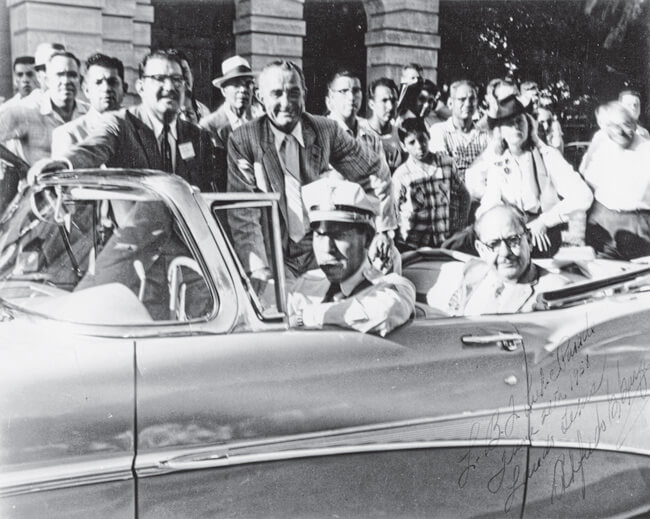 |
| Alfredo G. Garza, LULAC national president Felix Tijerina (in backseat) with Senator Lyndon B. Johnson, accompanied by Officer Jose Davila and Alfredo Garza, in a 1958 LULAC parade in Laredo, Texas, LBJ Library. From Fighting Their Own Battles: Mexican Americans, African Americans, and the Struggle for Civil Rights in Texas by Brian D. Behnken. Copyright © 2011 by the University of North Carolina Press. Used by permission of the publisher. |
The whiteness strategy achieved limited success in the 1940s and 50s because "some Anglos—among them, Governor Price Daniel . . . recognized Mexican American whiteness" and were receptive to the notion that, since these people "constituted a group of whites, the state could assist them in obtaining equality. State officials did not regard blacks as deserving of equal treatment or, unsurprisingly, as white people" (40). In 1943 Governor Coke R. Stevenson had voiced a similar view: "Meskins is pretty good folks. If it was niggers, it'd be different" (36).
In the late 1960s, Behnken asserts, some Mexican Americans shifted away from whiteness during the Chicano movement. "Chicanos argued that individuals of Mexican heritage were an identifiable minority—they were brown, not white" (10). As they had with their claims to whiteness, these activists alienated potential black allies with the brownness strategy. "Some blacks found the brownness strategy disingenuous. Mexican Americans, these black activists argued, had fought for white rights for decades. Why had they suddenly changed tactics? For African Americans, the answer to this question lay in the success that the black freedom struggle enjoyed in the 1960s and that Mexican Americans coveted" (10). Nevertheless, blacks and Mexican Americans forged stronger alliances during this period—even if sustained solidarity remained elusive. In a rare exhibit of unity, black and Mexican American protesters pitted themselves against white law enforcement officers in Dallas in 1973, resulting in a race riot. The activists were objecting to rampant police brutality evident in recent killings of black and brown residents. "Activists turned on the police officers observing the march. They beat the officers and dispersed them, burned two police motorcycles, and looted more than forty stores along Main Street" (174–175).
Whites sometimes used Mexican American claims of whiteness to stymie civil rights efforts by both minority populations. Amid turmoil over school integration in 1970, Houston officials insisted on classifying Mexican American children as white—despite the demands of contemporary activists to reclassify the population as brown. These officials then mixed Mexican American and black schools (leaving white schools untouched) and declared the schools integrated. In this manner, "Chicanos would serve as symbolic 'whites' for desegregation purposes" (200). "The whiteness strategy had come back to haunt Mexican Americans" (200).
Despite its strengths, Fighting Their Own Battles does suffer from several weaknesses. Behnken does not adequately describe the Jim Crow system as it applied to Mexican Americans. Although he asserts that skin color and social class "allowed some Mexican Americans to avoid the most stultifying aspects of racial segregation" (5), he relies on a number of quotations from the secondary literature to explain Mexican American experiences, leaving readers without a clear understanding of the system. Without a satisfactory description of Jim Crow, it is difficult to assess the efforts of activists to dismantle it. Second, while Behnken provides compelling insights into the strange career of whiteness in Mexican American history, he misses an opportunity to place his findings within a larger historiography. Had he situated the Mexican American whiteness strategy—and its replacement with a brownness strategy—in context with well-documented Irish, Italian, and Polish whiteness strategies, he might have done much to further a larger conversation about white racial formation and reformation. Instead, he offers on this matter a conclusion which is disappointingly summative. Third, Behnken occasionally falls back upon language which reinforces the whiteness which has been, in part, a focus of his study. Perhaps unwittingly, he substitutes the generic words "Americans" and "people" when he means whites: "Americans have generally vilified Black and Chicano Power. People living in the late 1960s and early 1970s saw both as indistinguishable. They represented identically distasteful themes of violence, racism, and anti-Americanism" (193). Finally, Behnken does not provide any maps, a noteworthy oversight in a book that advances an argument rooted in part in social geography.
These concerns aside, Brian Behnken has produced a valuable and challenging comparative study, essential reading for the post-World War II civil rights movement, southern and western history, and whiteness studies. As the author notes in his conclusion, Fighting Their Own Battles is important because black-brown relations (as well as their relations with whites) continue to play a significant role in both Texas and, increasingly, national affairs—as evident in the 2008 Democratic presidential primaries or in the endemic interracial gang killings which characterize relations between these populations in cities such as Los Angeles. While Behnken finds some evidence that "the dividing lines between black and brown may be starting to erode" (236), he argues that the prognosis for the future is as turbulent as the post-World War II era that he documents. "Blacks and Latino/as continue to view each other as competitors, not allies. . . . As the Latino/a community expands, these issues seem likely to persist" (238).