Thursday, September 26, 2024
In Marshall talking with Joel and Josh. Very real concerns about the river, which is at ten feet, fierce, and rapidly rising. The island is already under water. At fourteen feet the river would be in town. At nineteen feet there would be extensive flooding and costly repairs.
Our niece Jody arrives at the house. She’s going to do a soap-making tutorial with Leslie for the weekend. We lose power later this evening and with it our water. Cell and internet are also out.
My concern is the wind. The ground is saturated from three days of rain. A windstorm could bring down thousands of trees lining our driveway, the road into town, and the forests that make up 73% of the land in Madison County.
Friday, September 27
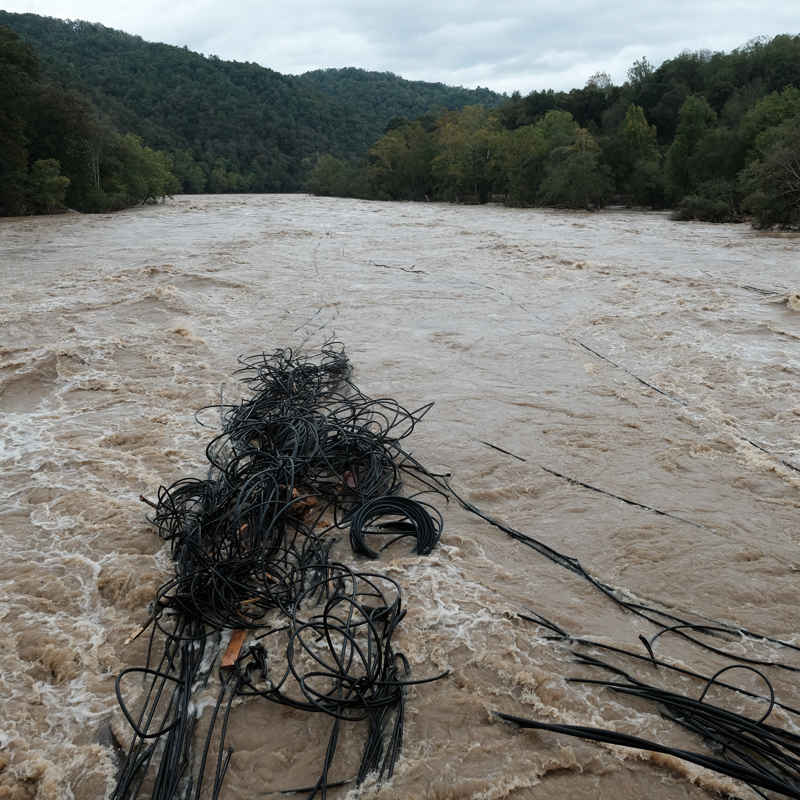
The river crested early this morning at twenty-seven feet, four feet higher than the previous record set in 1916. Yesterday’s concerns are facing today’s reality — the town’s total destruction. The wind never materialized at the house. It’s still raining. Our friend Maia has joined us after being evacuated out of Marshall.
We pile into our car and drive down Little Pine, thinking we’ll go into Marshall. We’re stopped before we get to the Redmon bridge. Neighbors are lining the road looking at the river, which has become one with the road. Fuel tanks, giant tangles of PVC piping, shipping containers — swept away.
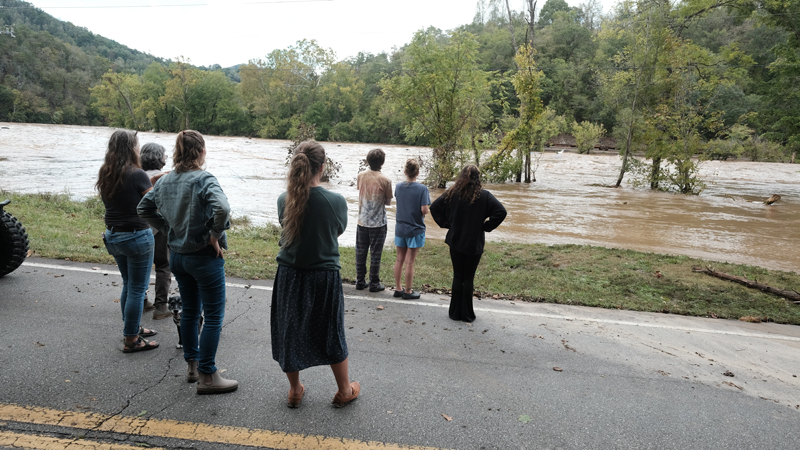
We turn around and drive down Anderson Branch to Barnard. There, worse. Over five feet of water covers the road. Ronnie Meadow’s house inundated. Neighbors wading waist-high water to get his prescriptions and photographs.
Stop at Paul and Laurie’s and get water from their spring. Go home and start cooking and the power comes on. Internet and cell service spotty.

Saturday, September 28
Drive down to Barnard to see if we can get out, and do. Stop at the bridge. Meet some neighbors, make some pictures, come home. Chris, Maia’s boyfriend, got in from Atlanta. We make supper.
Sunday, September 29
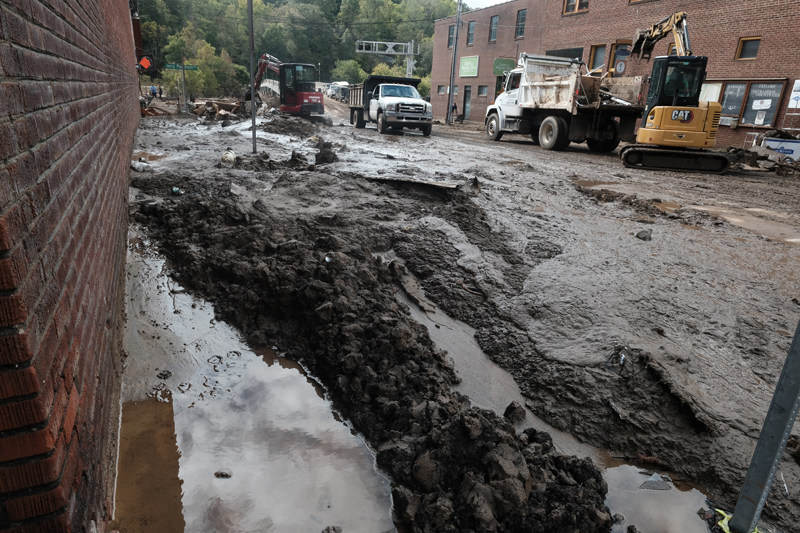
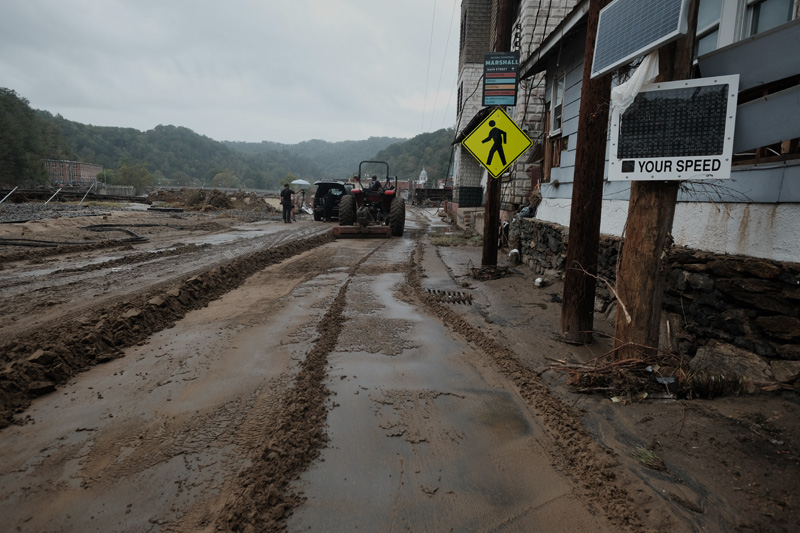
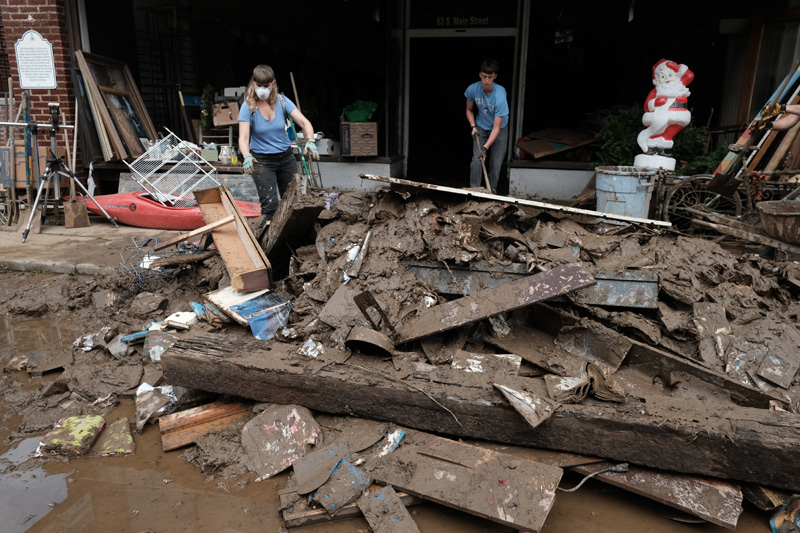
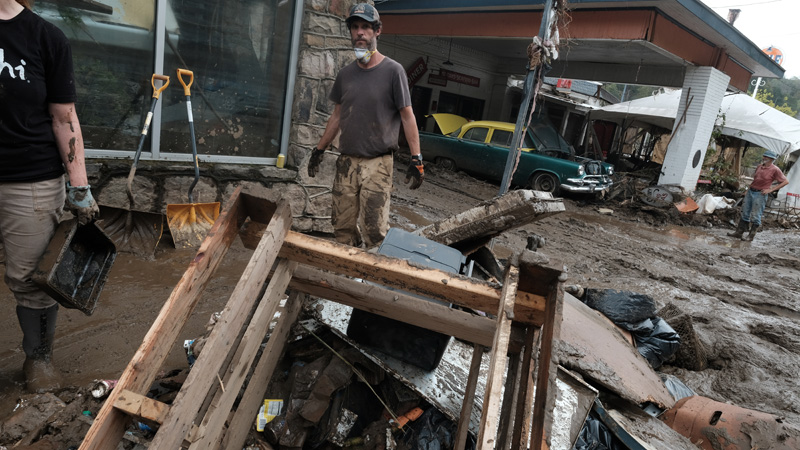
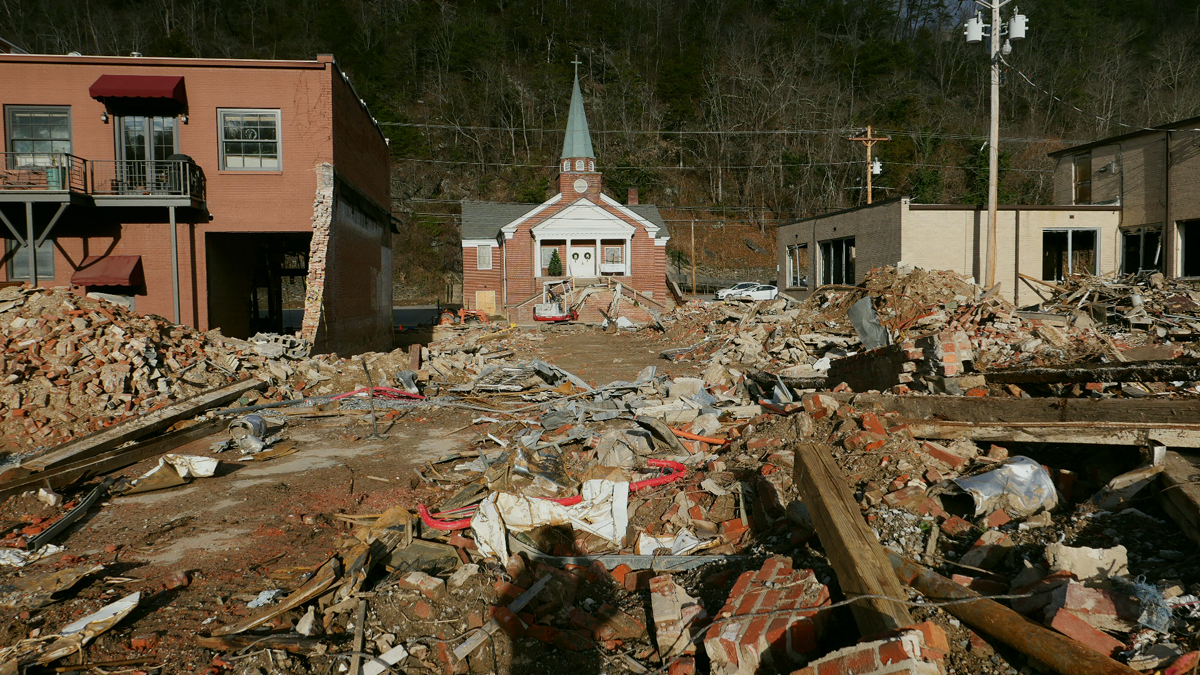
A first look at Marshall. The mud. Everywhere, impossible to avoid. Heavy, sticky. The kind of mud that sucks you in and holds you close. The beginnings of debris piles. Submerged cars and trucks. Rubble where buildings once stood. Stores and restaurants where we’d visited just days before, windows broken, spewing mud from their orifices. And the smell, a mix of water and mud, and propane, a general sense of toxicity.
This is the fourth hurricane related flood I’ve photographed in the last twenty years — Katrina in New Orleans, Hugo in South Carolina, Floyd in Eastern North Carolina, and now, Helene in my backyard.
There are similarities between the four. The mud. The displaced buildings and houses and subsequent debris fields. People’s faces and eyes, at once unbelieving and resilient.
But this is different. It is home, it is friends, neighbors, it is music and dancing, it is church if you want, art most everywhere, eccentricity abounding. It is gone.
I see Morgan, in the midst of mud and debris. Forlorn. No doubt realizing she’s lost her job to the flood. We hug. I move on.
The uniqueness of each building has taken on a sameness of look. Broken windows, water lines above the doorways, stuff beginning to line the street — books, chairs, a sewing machine, an elk head, furniture, boxes of dripping files in front of a lawyers’ office — and mud.







Monday, September 30
For many people, town residents and storeowners, this is a first look at the town, their places of business, their homes. The shock is palpable. The enormity of the destruction incomprehensible and impossible to accept. There’s tears, many, and embraces. What else to do? It’s a reckoning of what once was and what it has become in the blink of an eye. And what lies ahead.
Western North Carolina has long been considered a climate haven. The Southern Appalachian mountains are among the oldest on earth and they offer protection from tornados and hurricanes and other natural disasters. We’ve had floods and landslides in the past, and memorable snowstorms, droughts, and fires. But Helene was unique and has been termed a “geological event” because the accompanying flooding, landslides, and tree damage will have a lasting impact on the landscape. It certainly has had a lasting impact on Marshall and the twenty western counties of North Carolina.
I walk through town for three or four hours, making photographs, talking to friends and neighbors. I think about shoveling mud, but feeling how dense and heavy it is, I realize that it’s a heart attack waiting to happen. I’m clearly the oldest person out there and the work is for the young.
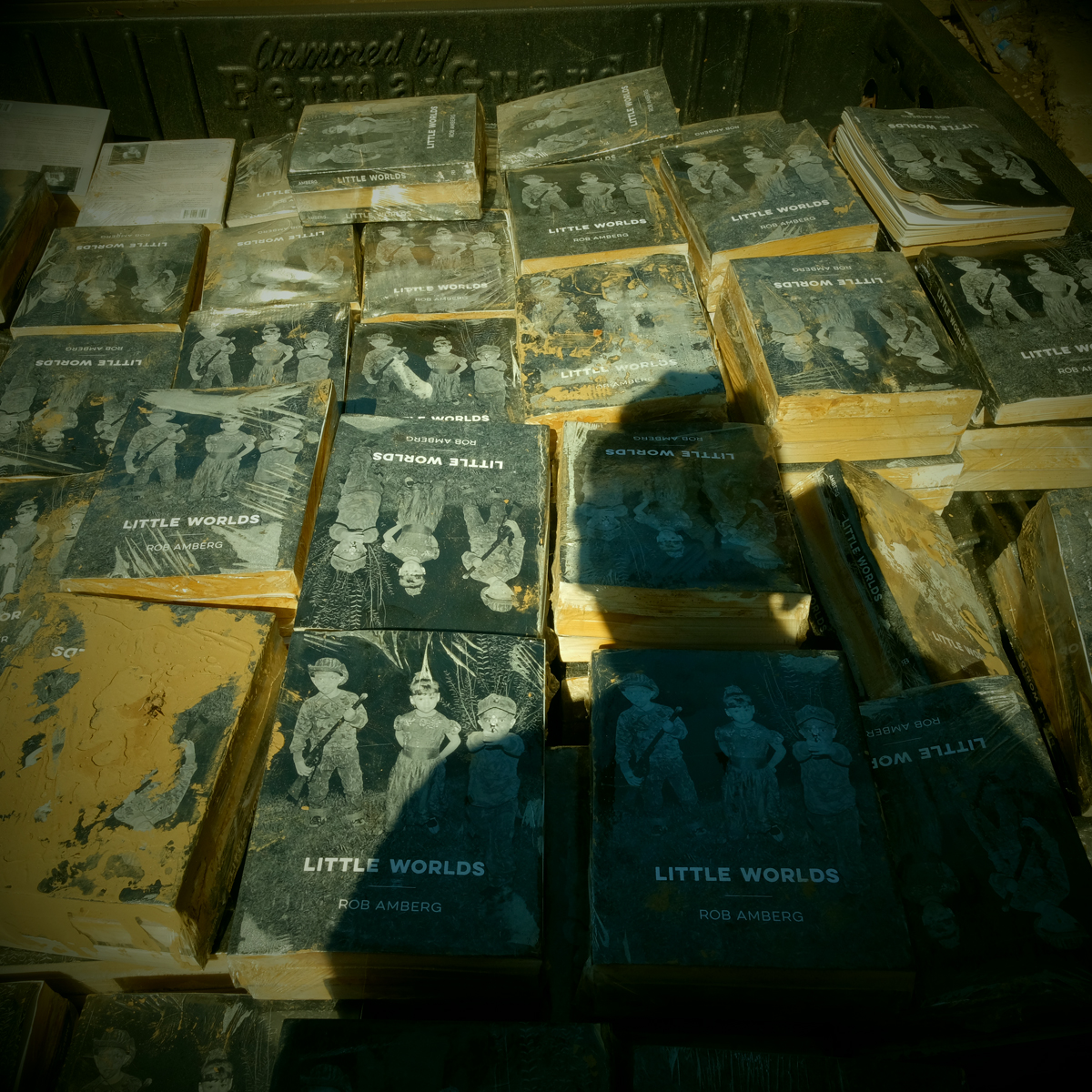
I went to check on my books — 450 copies of my new book, Little Worlds —that were stored in a friend’s warehouse in town. The road in front of the building is foot deep in mud but seems firm at first step. With the second I am shin deep and locked in place, unable to lift my feet. John and Kirsten pull me out, sans shoes, which Kirsten pulls out by laying flat on the ground.
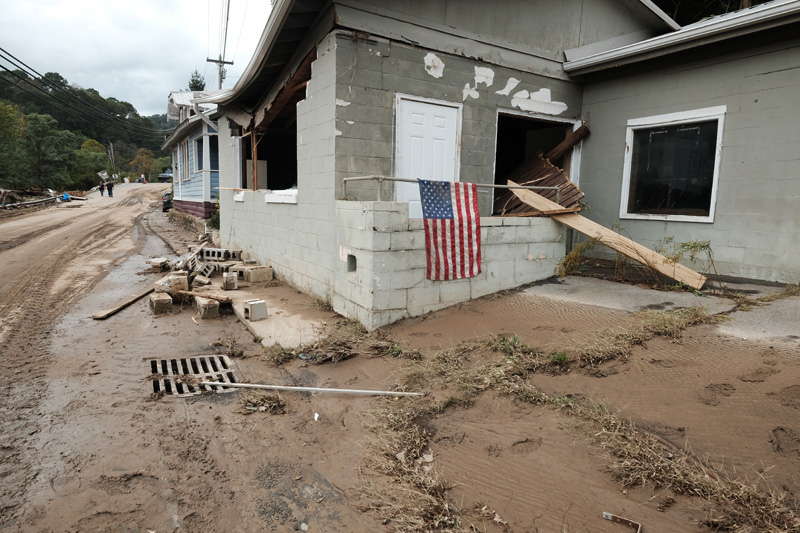
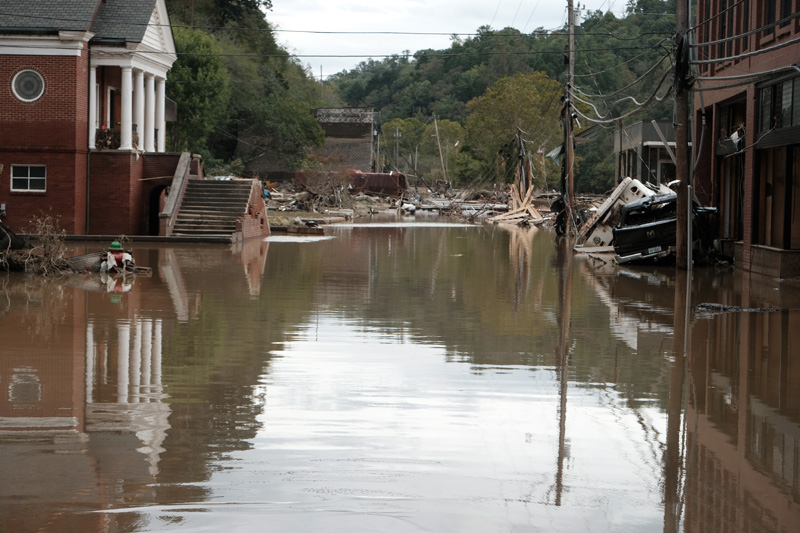
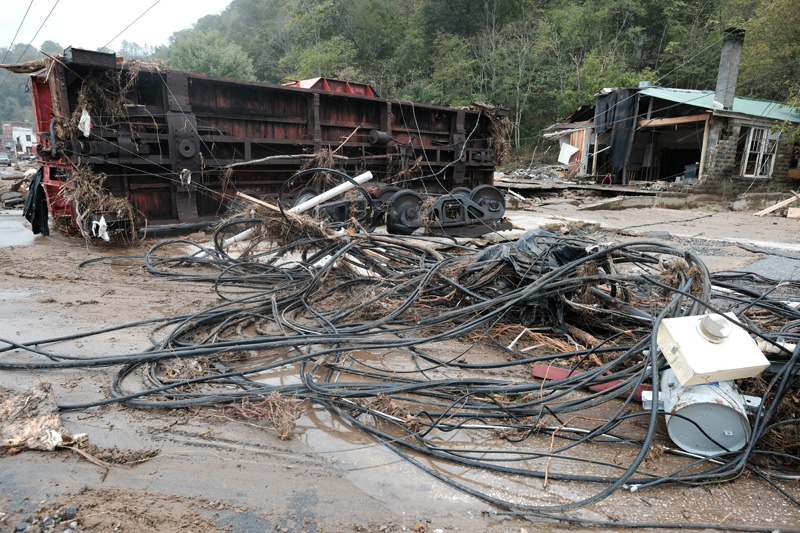
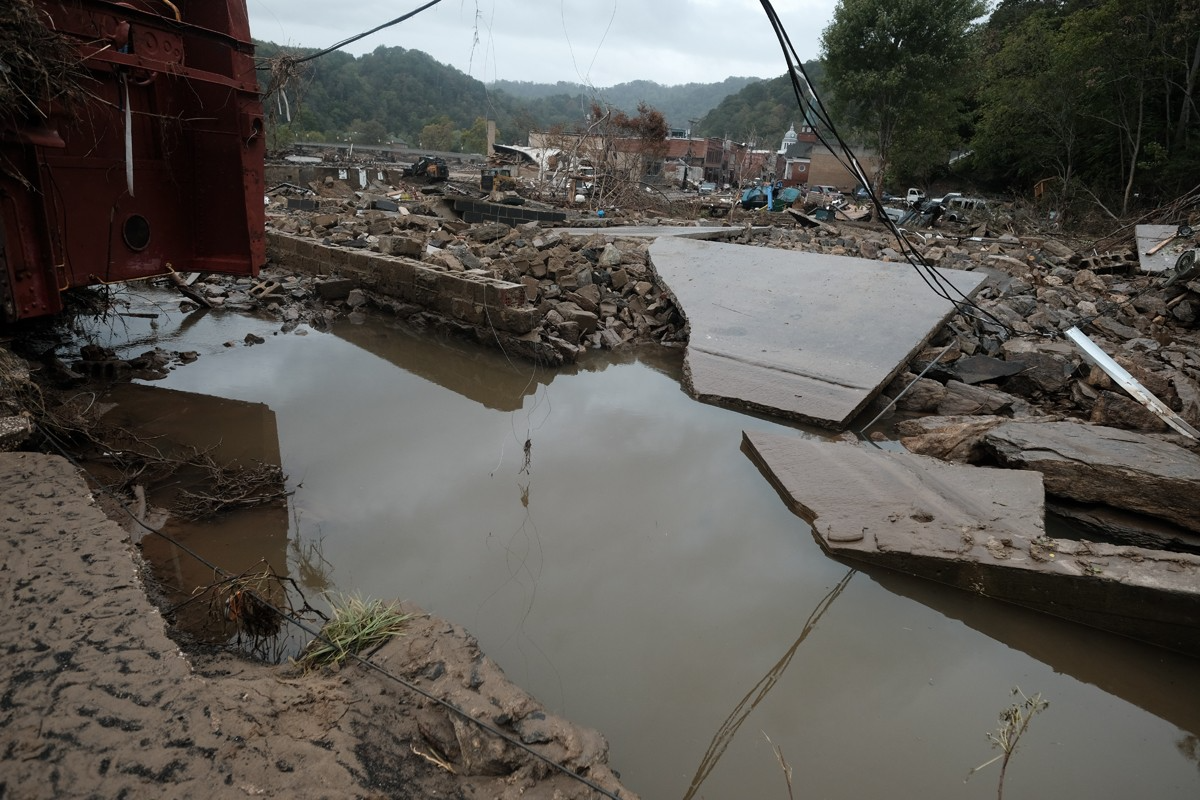




Tuesday, October 1
There’s more people in town today, beginning the task. Some are clearing buildings, adding to debris piles. Others are shoveling and scraping mud. Some are salvaging what little there is to salvage. There’s heavy machinery and a steady line of dump trucks heading to the landfill. The mud remains slick, never-ending, clinging to whatever it touches.
I talk with Jamie Smith and his wife who own the French Broad Exchange, our local used bookseller. They’ve lost over 15,000 volumes to the flood, almost their entire inventory. They’re older, of retirement age, and questioning a return. They don’t own the building and the owner is reluctant to commit to doing any repairs.
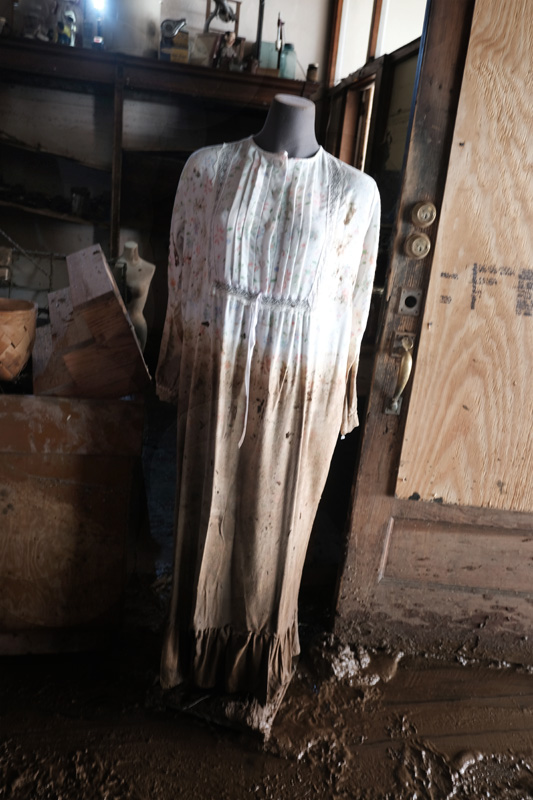
At Penland & Sons Store, the interior looks like a giant has gone in with huge salad forks and stirred the contents — clothing, books, jams and jellies, fresh vegetables. Georgette takes me to a moveable counter with two baskets of my wife’s soap resting on top. The flood lifted the counter to the ceiling and rested it in a new location in the store, never disturbing the soap.
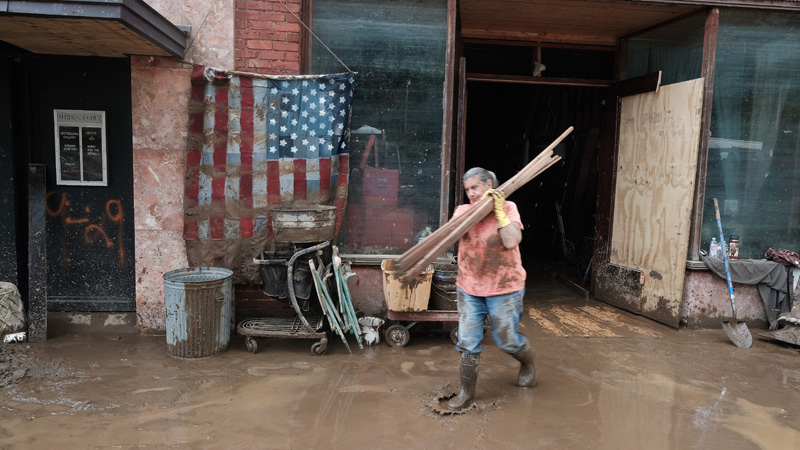
With help from Todd I make it into the building to check on my books. It’s dark inside the warehouse, the floor carpeted with mud and water, tools, lumber. Two-by-ten boards have been placed throughout the building and we walk gingerly to the back. The pallet of books has been moved and is resting on its side in a puddle of water and mud. The covers appear untouched, protected by the cellophane covering. But when I cut into the pallet and pull out a small bundle of books, I see they are all sealed shut, only opened by tearing pages. Disheartening.
Wednesday, October 2
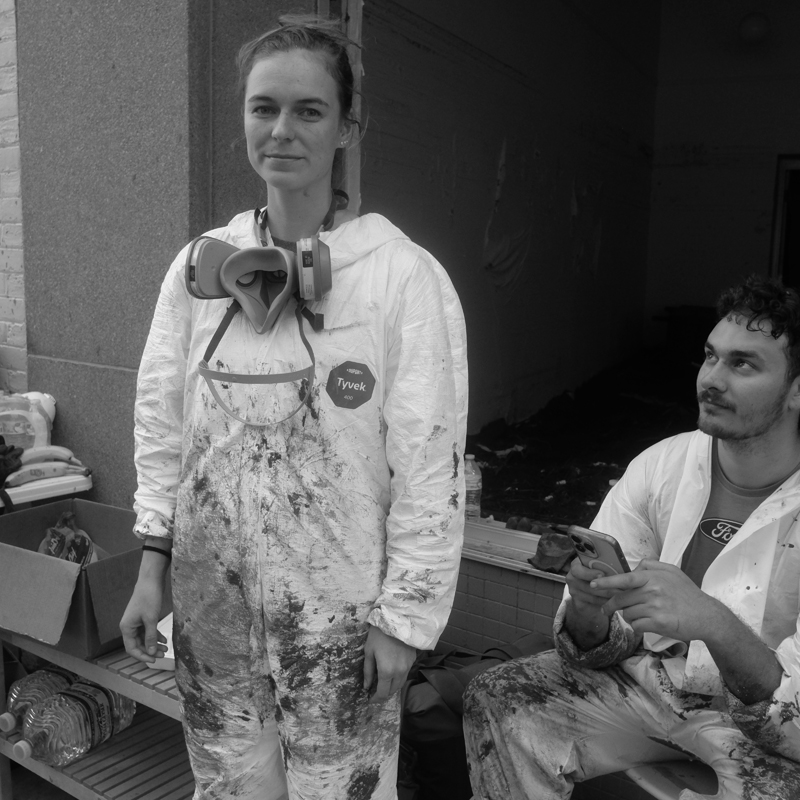
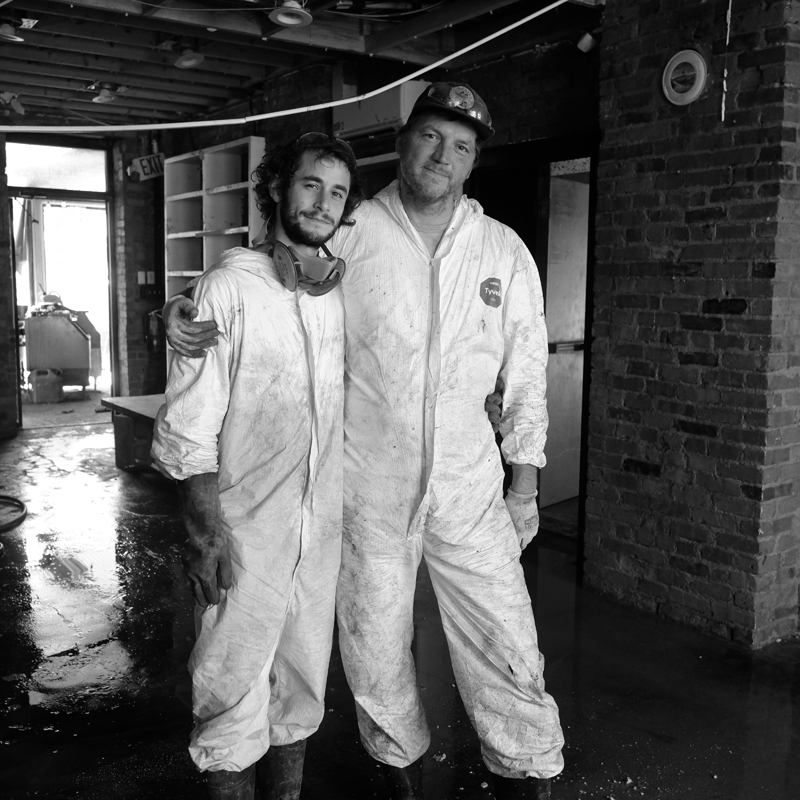
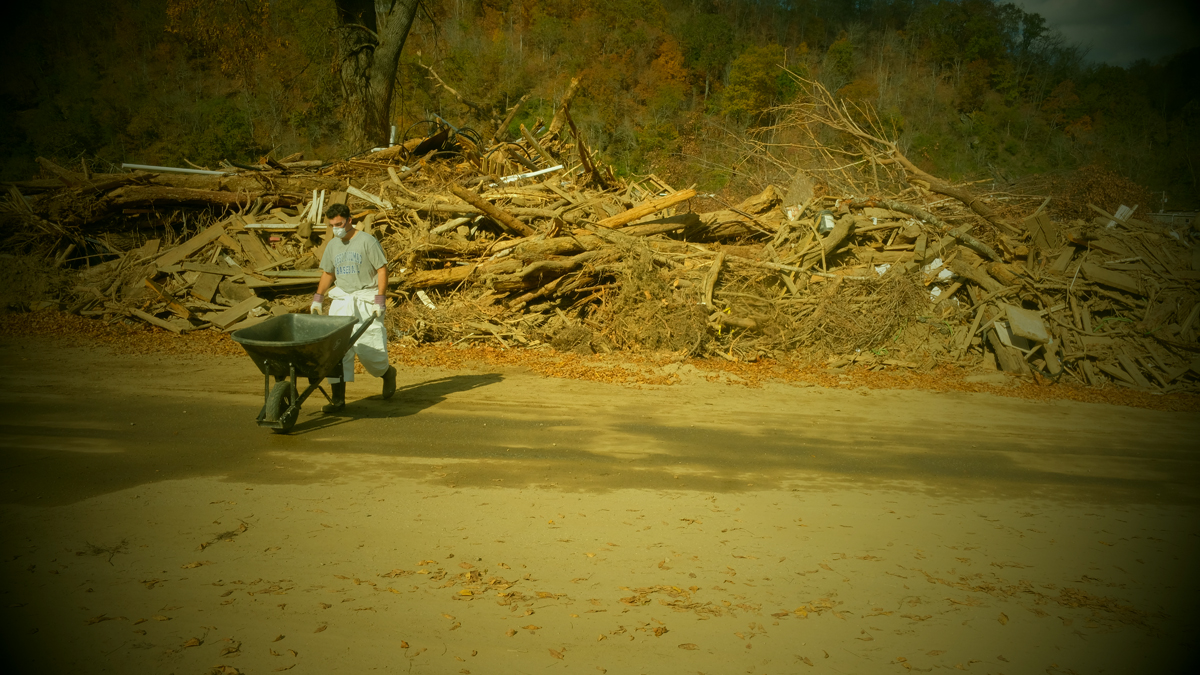
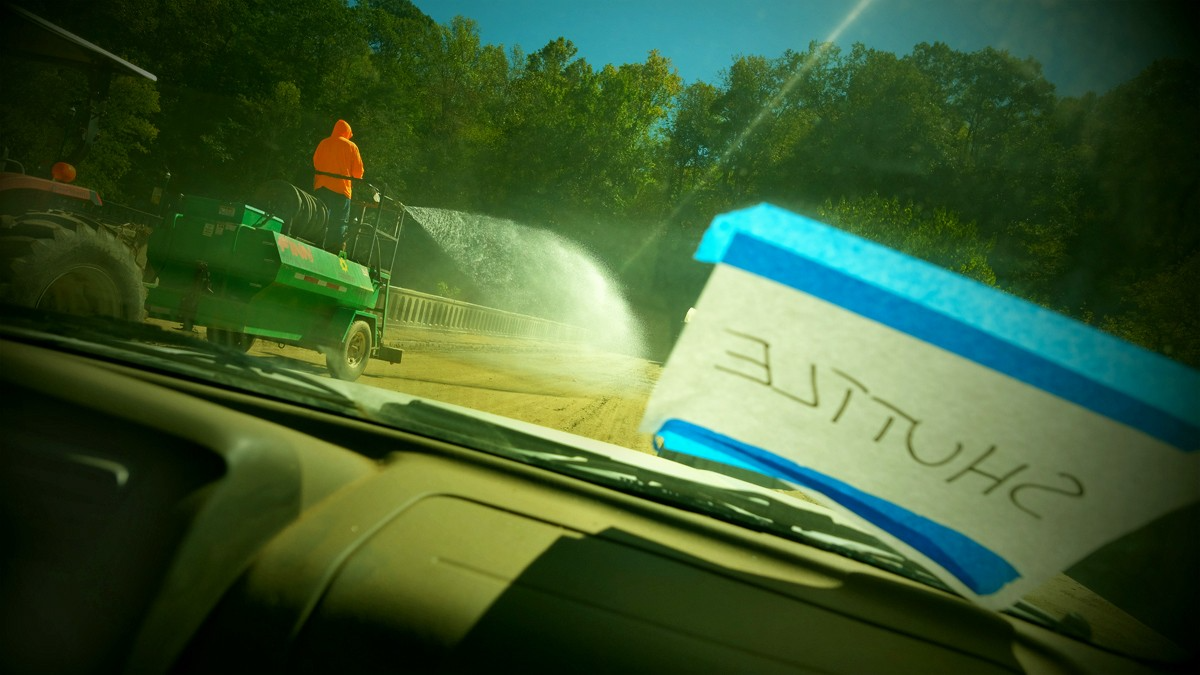
Staging ground has been set up at Nanostead on the Marshall bypass and it is immediately flooded with supplies, equipment, food, and volunteers. The volunteers are coming from all over and they are a diverse group — church groups, college students, elderly retirees, and county residents not impacted by Helene. They don Tyvek suits with boots, gloves and respirators as there are concerns about the toxicity of the mud. They’re shuttled into Marshall in the back of trucks, their gleaming white outfits blinding in the sunlight.
The town is a hub of activity. I’m reminded of stories about Marshall before the coming of I-40 and the bypass. Then, it was on the most direct route between Knoxville and Asheville. This small mountain town had three car dealerships, three grocery stores, two hardware stores, two florists (Sunnyside and Shadyside}, a library, the courthouse, countless attorneys, the jail, and restaurants and general stores.
Now, the streets are crowded and dangerous with an abundance of heavy machinery — track hoes, front end loaders, bulldozers — all piling and loading a steady stream of dump trucks, some with mud, others with debris, and still others with remains of trees. Smaller tractors with scrape blades try to keep the mud at bay.
Inside the buildings the owners, along with friends and volunteers, push and bucket mud into the street. The concern now is mold. A series of warm sunny days heightens the fear. Piles of soggy, stinky, just plain nasty, insulation and sheetrock begin lining the street.
The mood is different today. The townspeople remain depressed and angry. But I also sense an adrenaline rush, a feeling of resilience and determination to rebuild. Perhaps it’s the volunteers, the added hands and young energy. Or the visible evidence of the recovery moving forward. Or how the town is working together.
Food stands are set up to feed the workers. Water. Washing stations.
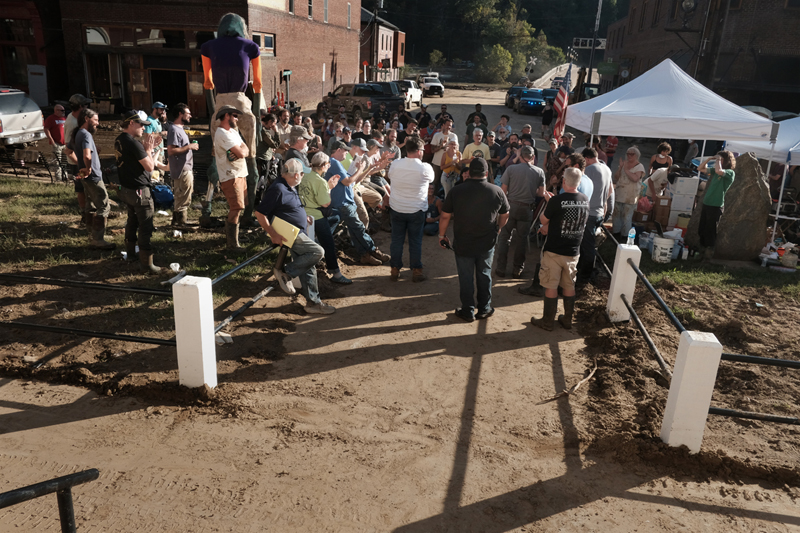
There is a town meeting every evening. An accounting of what was accomplished that day. How many truckloads of debris. The number of buildings mucked out. And also plans for the next day. Who needed what? What could be improved?
The town is shut down after the meeting. No power, no water, standing water throughout, massive and growing debris piles. Ghostly. Police patrol the streets at night. There has been looting.
Thursday, October 3
After the storm hit and the level of destruction to our region became evident my ex-Catholic guilt kicked in. I thought my book, Little Worlds, which speaks of a worldwide collapse, had somehow caused the flood. I could hear myself in confession — “Bless me father for I have sinned. I wrote a book that predicted an apocalypse and it came true. I’ve ruined a town and the lives of many people.” But, soon, I realized that, unlike the federal government of Marjorie Taylor Greene’s imagination, I could not control the weather.
But at the same time, both Leslie and I are experiencing survivors’ guilt; the knowledge that we faired well in the storm compared with friends who’ve lost everything. Yes, I lost a lot of books, income. seven years of sweat equity. But the books can be replaced. And a look around Marshall, helps me understand I’ve lost very little.
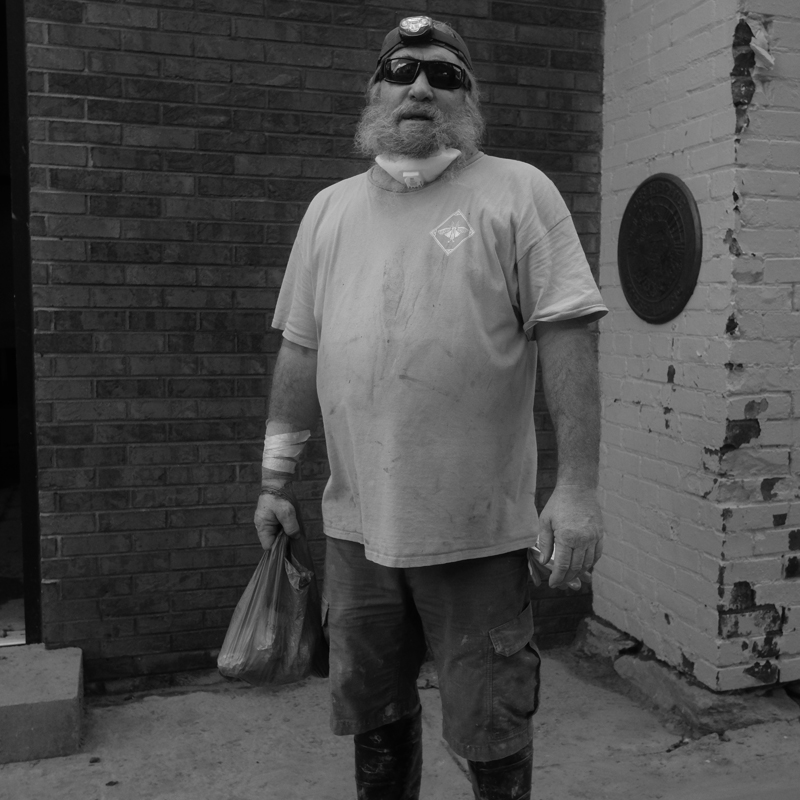
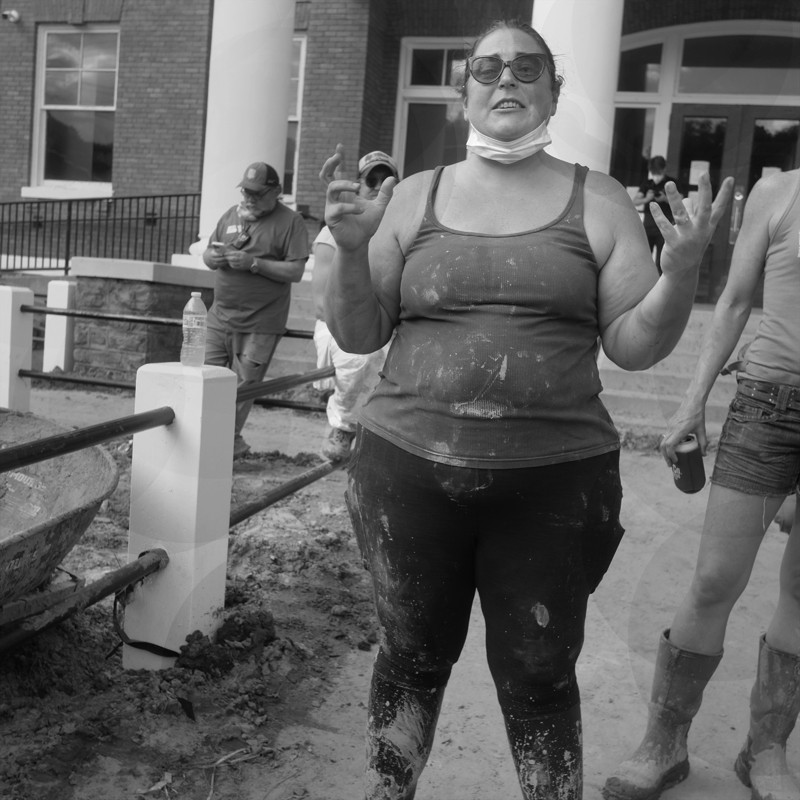
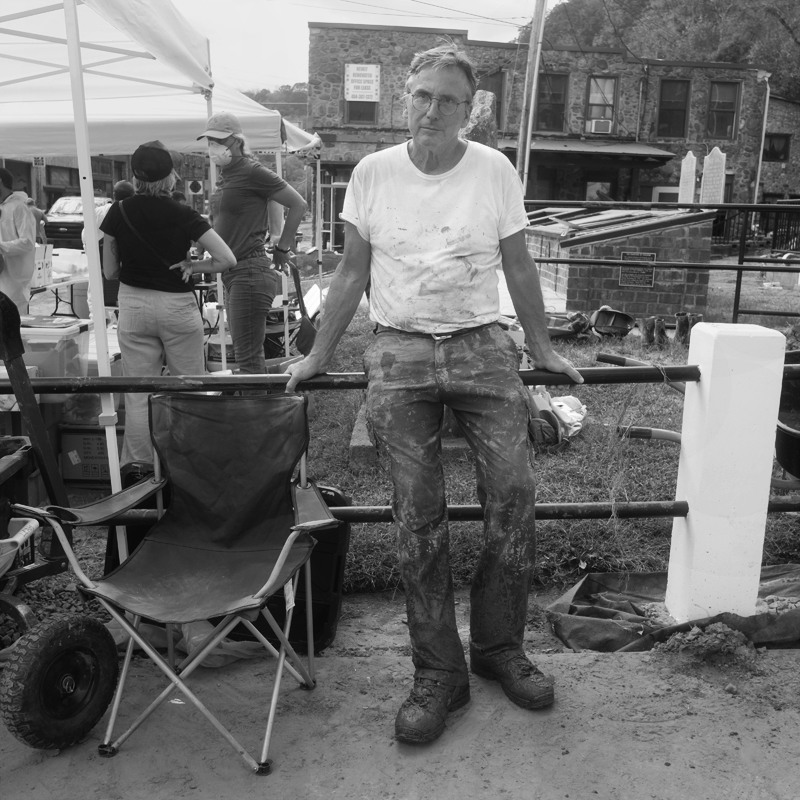
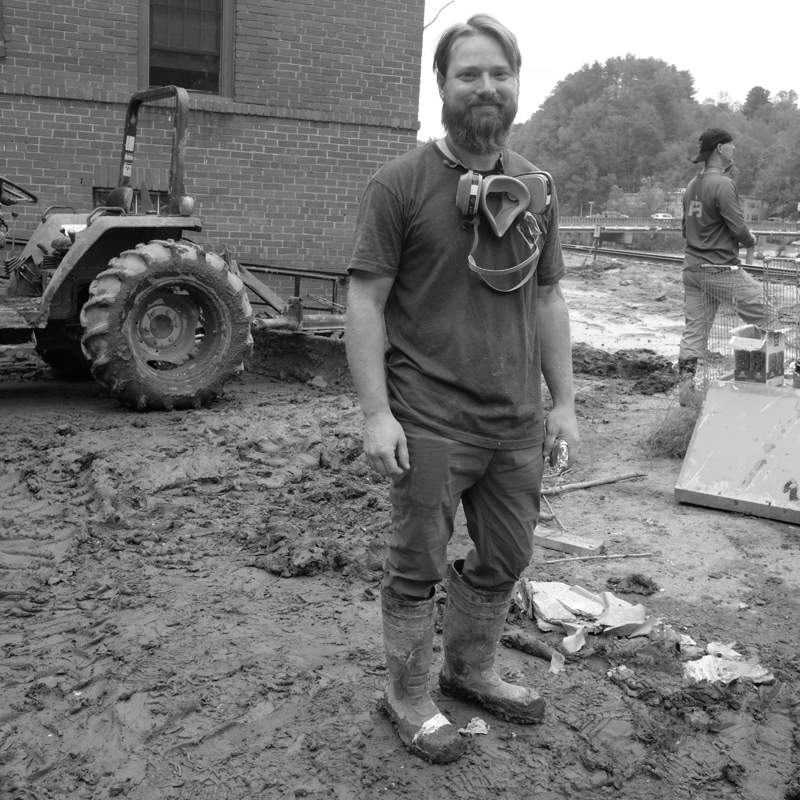
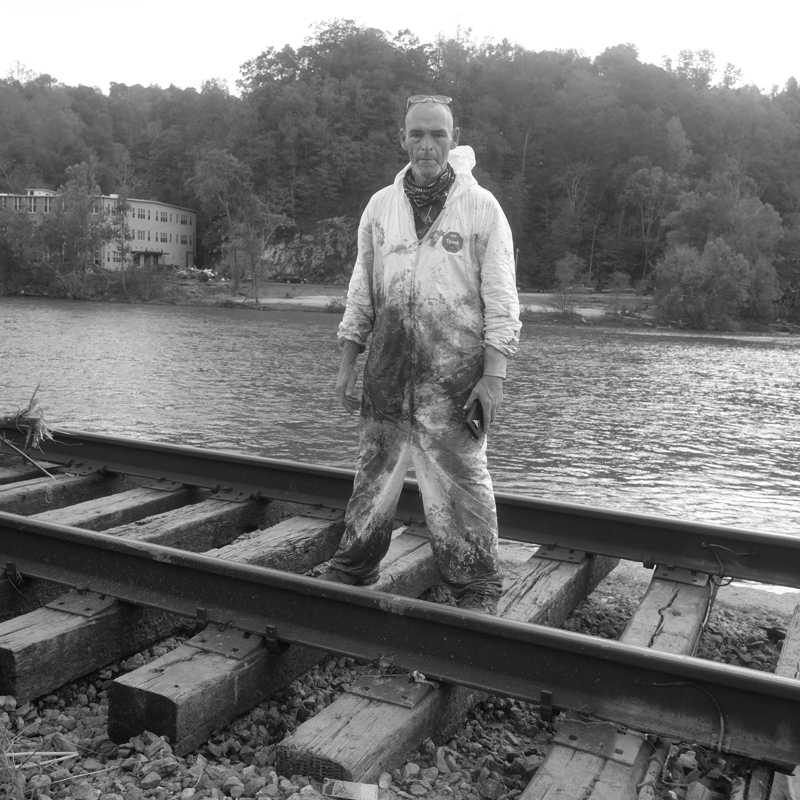
Shooting portraits today. Square format, b/w. Tight. Faces. Some objects. The black and white takes me back to my beginnings in photography and my belief that color can be so distracting. The monochrome heightens the emotions.
One of the real ironies of this catastrophe is water. The tremendous amount of water that flowed through town to cause this level of destruction. And now the tremendous amount of water being used to rid the town of what the flood left. Pressure washing — walls, floors, machinery, salvageable items.
As I walk through town, doorways seem to vomit debris. The piles of rubble, cinderblocks, and brick remind me of a walk with my son through the Valley of the Temples in Agrigento, Sicily. Some of the twenty-five hundred year old Greek temples had been meticulously restored to mimic their one-time magnificence. Others were mounds of crumbling limestone columns, left where nature had placed them. Both here and there, in Marshall and Sicily, I see fractured memories of what once was.
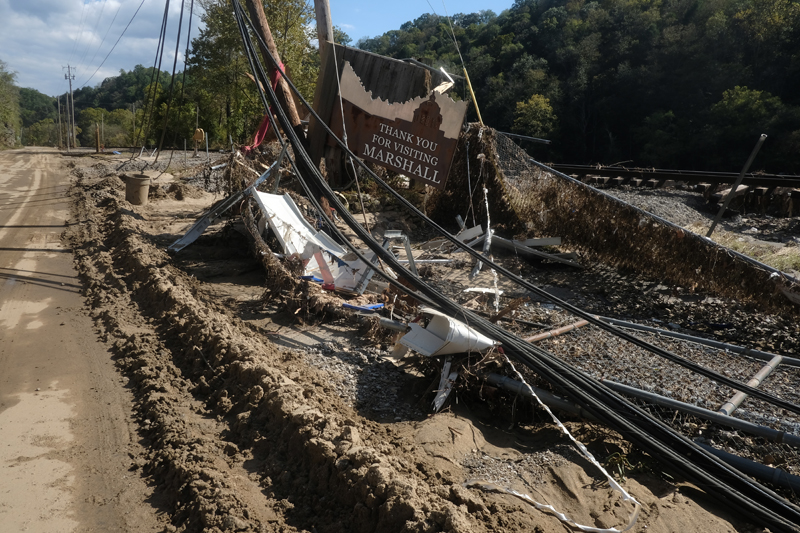
Cars looking like relics dug from a different era. A telephone pole perches over Main Street, hanging by the wires that it once supported.
At Penlands Store, Georgette and Susan and their families sort through mounds of water and mud-soaked pants, shirts, dresses, scarves, hats, belts, boots. Trying to lighten the mood of despair, I jokingly ask Georgette if she has a 42-long sport coat. She gives me the finger.
My books have been moved to the upper floor of the warehouse, in the dry and out of the way. I can see them for what they are, and are not. What they are is artifacts, remnants of the great flood of 2024. The covers are readable, clean. What they are not is useable. The pages are glued shut, only opened by tearing. There looks to be 350 of them.

Friday, October 4
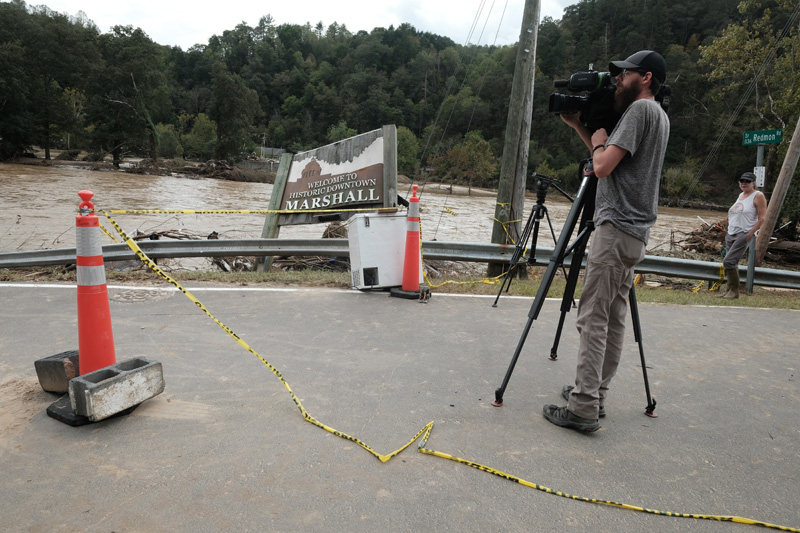
The town is crawling with journalists, photographers, videographers, all looking for the defining image or story. Some are working with major publications or media outlets, others are rubber-necking, disaster tourists. All are afraid to get close, to engage, choosing to keep their distance with their long lenses and removed personalities.
Volunteers are here in earnest today, hundreds of them. Arriving to Nanostead, the staging area, and donning brilliant white Tyvek and boots, heavy gloves, masks and respirators. They’re driven by shuttle into town and turned loose. Students from all over, elderly people here with church groups from Oklahoma, California, and Louisiana with memories of Katrina. A soul food truck operated by a family from Florida who stay a week and then have to beat it back to Florida to help with Hurricane Milton. The best fried catfish I’ve ever eaten. Other trucks arrive in regular fashion, bringing food, water, chain saws, generators, more Tyvek.
Throughout the day I see people — hugging, holding hands, crying together, hugging some more. The look remains one of disbelief, confusion, anger, emotional exhaustion. Yet, people are here — together — mucking, hauling debris, ripping out sheetrock and insulation, helping each other. I see my friend Matt, a local building contractor, who sends a crew down to the Natural Foods store where they demo the sheetrock and insulation throughout the store in ninety minutes — a job that would’ve taken the owners days to finish.
Sunday, October 6

There are fewer people in town today and I don’t stay long.
Deb and Jerry Burns at Engine House Design are mucking and removing debris but already thinking about how to redesign the building.
Jamie at French Broad Exchange isn’t sure what he’s doing. The buildings’ owner is not helping with the clean-up and restocking will be a long, slow and expensive process. But he loves the town and being part of it.
Josh has a small crew pressure washing the kitchen at the Old Marshall Jail. I’m mesmerized by their movement with hose and brush, like an elegant dance of light and space. And for a time I dance with them, moving, seeking the right spot, stopping time.








Tuesday, October 8
The town is humming with activity today. Food stations at Nanostead preparing for the noon rush. Downtown, mud remains the ever-present problem. Inside the buildings, pressure washing and sweeping the liquid muck into the street, where it will be piled, picked up, and hauled off. There is a sense about the mud that it will never go away, as if it’s been imprinted and will forever be a part of the town.
There are some buildings, farther along in their rebuild, that have fans set up in their open doorways, drying the building and clearing the air.
There are more volunteers, their gleaming white Tyvek soon to turn brown. They’re mostly young, many students, some from close by, others from far away. It’s heartening.
And the Army has arrived. Probably a couple of platoons of men and women from the 101st Airborne Division from Fort Campbell, Kentucky. They, too, are very young, some not long out of high school. Fit, with shoulders and arms meant for work.
I walk through town hunting artifacts. They’re everywhere. Still-life expressions of what once was.
Wednesday, October 9
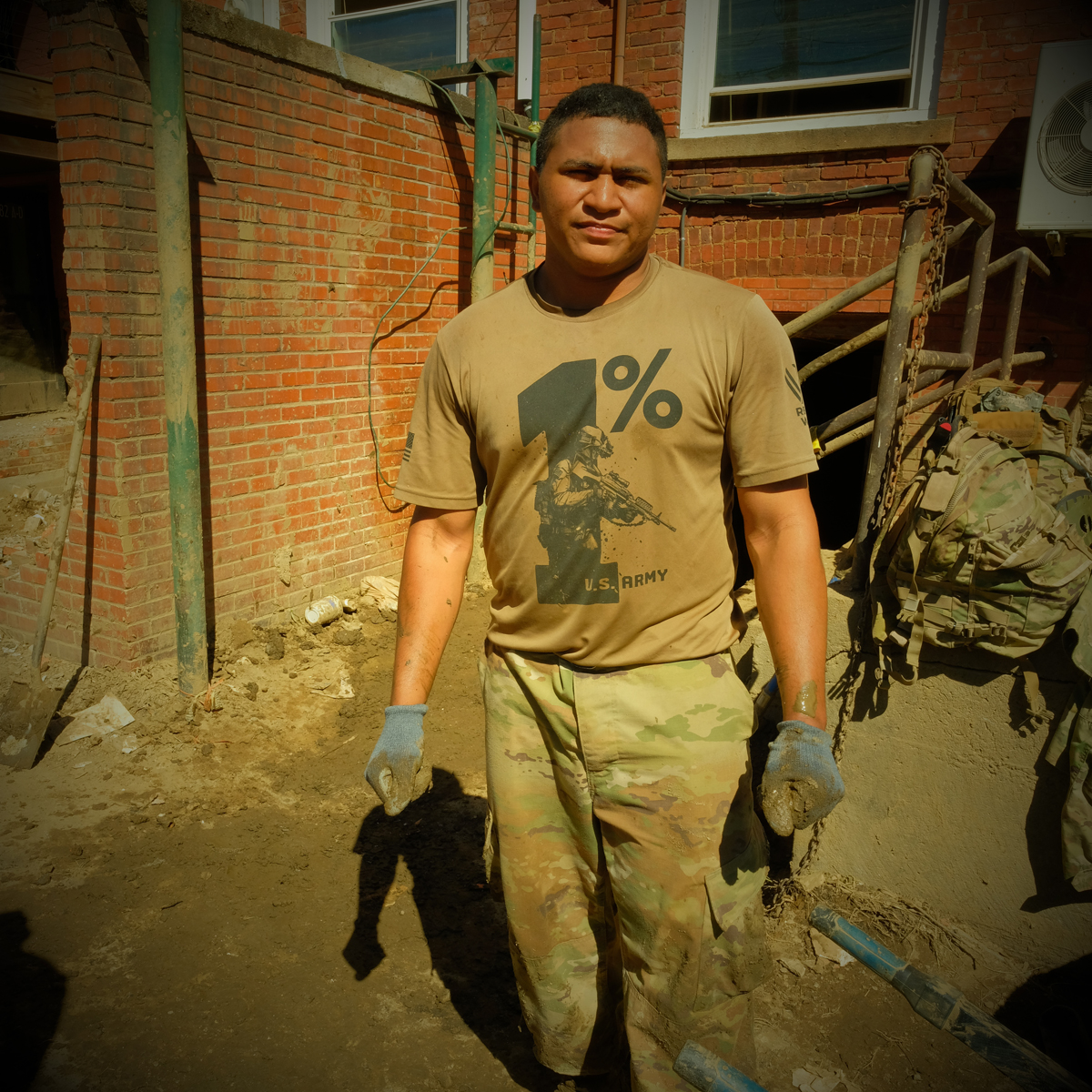
The Army seems to have found its purpose in the basements of downtown Marshall. In those tight, low-ceiling, airless dungeons, up to three feet of river mud has settled. In most cases the only access to the basements is through suspect steps and narrow doorways with no room for machinery.
I have a long history with the Army. My father was a veteran of World War II and both of my parents worked for the Department of the Army throughout their careers. I was an Army enthusiast and went to an all-boys, Catholic, military high school. I considered a career in the military as a potential life goal. I enrolled in advanced ROTC in college and was preparing to enter the Army as a second lieutenant upon graduation.
But change happens if you are open to it. I began reading a broader body of history and literature and hanging out with a more diverse group of people (teachers and students) who introduced me to new ideas and ways of seeing the world. A trip to Italy with my grandmother sealed my distaste for Catholicism and opened me to European opinions of America.
So, when the 101st Airborne marched into Marshall, I was prepared to be resistant at worst, mistrustful at best. But change happens.
At the Madison County Arts Council building, a crew of fifteen soldiers are gathered around the stairs and doorway to the basement. A group of six or eight of them, two mud buckets each, go into the dark, dank room and begin shoveling. The mud is thick, heavy with water, and stinks; a half a bucketful is almost too heavy to lift. At the doorway stands Lopez. He handles all the buckets, hauling them to the stairs, and handing them to two men above him who empty them into wheelbarrows. It is grueling, nasty work. They work in thirty-minute shifts, a fifteen-minute break, then back at it. It takes two days to clear the building.
There is a side of me that is in awe of these young men and women — their focus, work ethic, stamina, and their ability to find the best solution to a problem and then just doing the work. At the same time I know that when they signed up for the Army they didn’t really have a choice as to what work they did. And I much prefer they are in Marshall, rather than in some far away place shooting up the local population and countryside. The whole town is thankful they are here.
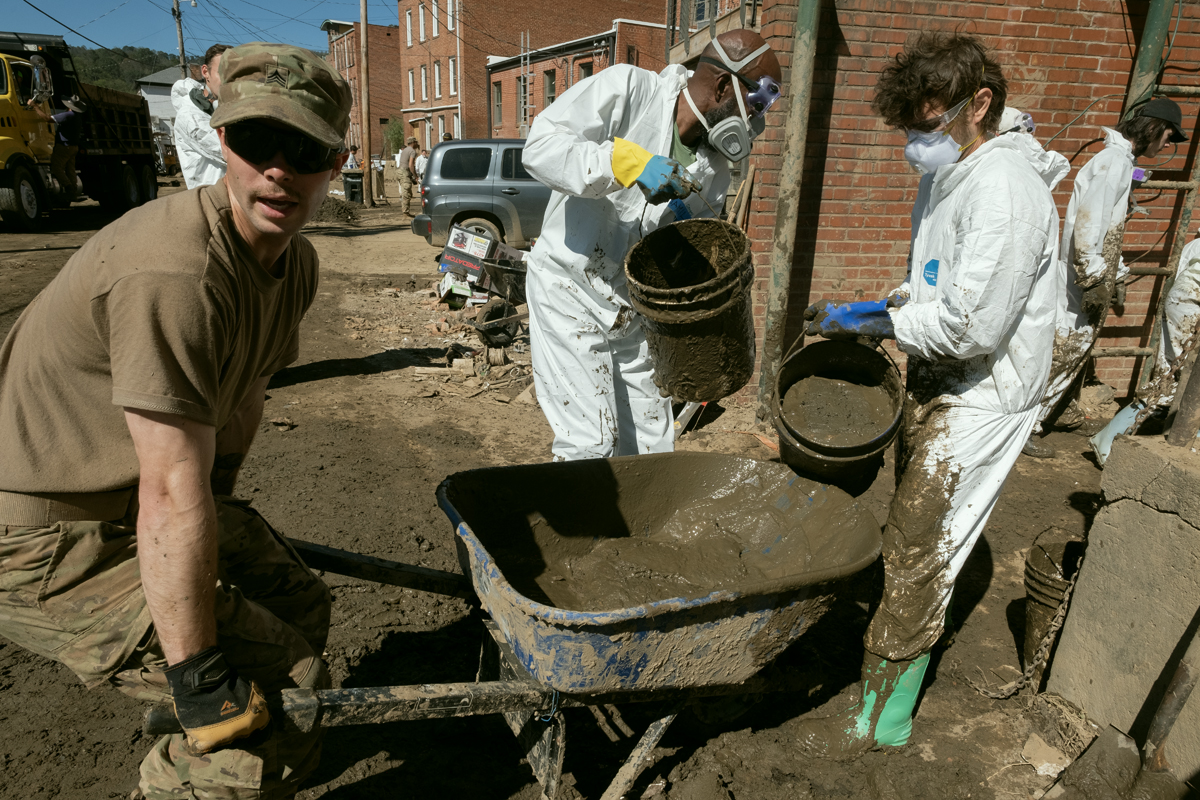
Friday, October 11
The river’s flow looks almost normal today. Nothing else about it is the same. New channels and sandbars. The river banks are stripped clean or a tangle of downed trees, miscellaneous debris, and a gelatinous mix of sand and mud. There’s a shipping container wrapped around one of the bridge pilings. Those trees that survived the flood are festooned with plastic sheeting and bundles of PVC pipe.
The Army and the volunteers are back at it, but roles have changed. The soldiers have been ordered out of the basements by their superiors for fear of mold and toxicity. They’ve been replaced by the young volunteers.
I wade into the warehouse to check on my books. They’ve been moved upstairs, safe and dry, and out of the way. Sealed shut and unreadable.
Saturday, October 12
Al and I go back to the warehouse and gather the books into the back of my truck. We’re going to park them in our barn for some undetermined future use.
I make a photograph of the books in the truck that speaks to me of the totality of my loss. The image filled with mud-splattered books — black and white and brown. In the corner, looming, is my head and torso’s shadow, the books’ covers living in my body’s trace.
Tuesday, October 15
A late afternoon walk through town. Streets mostly empty of people, not the mud, which maintains a lessened but constant presence.
Years ago, when I lived in downtown Marshall, in converted warehouse space on the third floor of what is now the Flow building, the town emptied at 5 o’clock. Dave, the town custodian who doubled as Santa Claus in the Christmas parade, would begin his walk through town with pushcart, shovel and broom. And Marshall would shut down for the night.
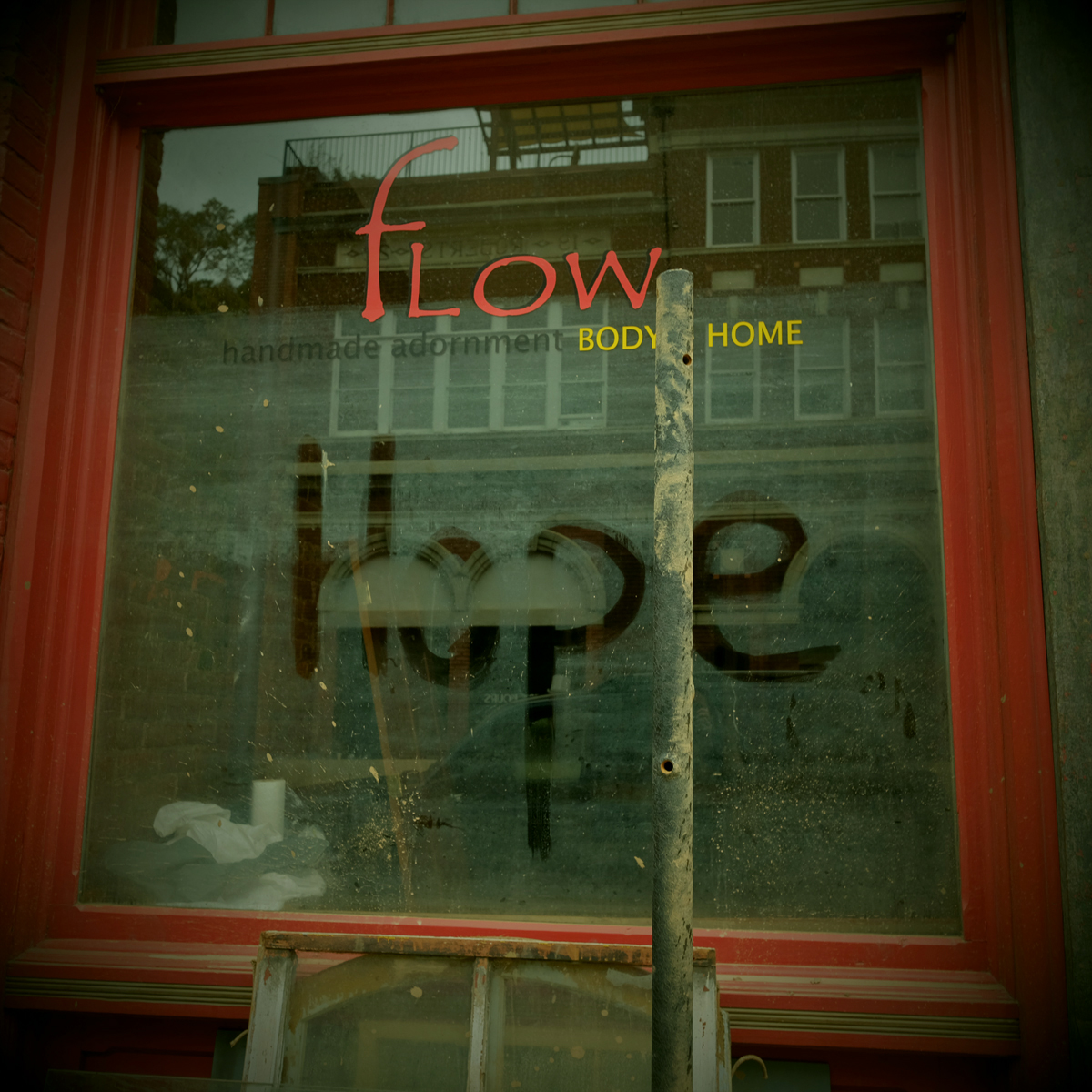
This town closure, of course, is different. Involuntary. Streets passable but slick with mud, buildings open to the air, no power, the town not just shuttered for the night, but essentially dead.
But I do faintly hear music and follow it to the courtyard behind the old Rock Cafe. It’s a small gathering celebrating Deb Burn’s birthday. There’s a chocolate cake, and music, and people dancing around a portable heater.
Saturday and Sunday, October 19 & 20
It’s mostly quiet as I walk through town. There’s people, but not many. Thomas and Mark are washing and sweeping, getting ready to mitigate for mold. The Shadyside florist guy is stunned, everything that was inside his store is now piled high outside.
The relative lack of sound, the quiet of the place, offers the opportunity to see quietly, without the urgency of the cleanup dominating most images. There’s time to feel the light and taste the wind, hear the now muffled sound of the river. There’s beauty in the stillness of the destruction, life as the river has left it.
The roads are dusty now, the recurring mud dry from lack of rain. It’s been three weeks since the storm.

Monday, October 21
A quick visit with Georgette and Susan at Penlands Store. They’ve torn the flooring out of the building and I bring some home with me to maybe use in an art project.


Sunday, October 27
Town has become emotionally exhausting for me and I’ve been staying away more and more. The constant reminder of the loss of my books and the utter destruction of the town. Plus, the upcoming election has me and my friends on edge. We’re hopeful Harris will win but not without fear of a bad ending. We know Madison County will vote Republican.
Wednesday, October 30
I’m not quite sure how he’s done it but Josh is having ballad swap at the Jail tonight. Balladry has a long and storied tradition in Madison County and the county, especially the community of Sodom, is considered a rich source for acapella ballad singing. Since Josh Copus opened the Old Marshall Jail as a boutique hotel, restaurant and bar, he has been hosting a monthly ballad swap. Six to ten singers, some with multi-generational roots in the tradition, gather at the Jail to swap songs and stories.
It’s pretty much the first event in town since the flood a month ago and the symbolism is hard to miss — the community’s ancient tradition responding to the wrath of our most ancient river, the French Broad.
It's primitive at the Jail, no food, a portable tap serving free beer, limited seating, highly emotional. Everyone is glad to be among other people. Hopeful. Closes with “I’ll Fly Away.”
Saturday, November 2
Meet up with Jack Cecil from the Biltmore Estate and his wife and sister and do a walk around town. He is on the board of trustees for the Duke Endowment, which has donated millions to the rebuilding effort in the region and wants to do more. They’ve asked me to come to their monthly meeting and do a presentation about Marshall.
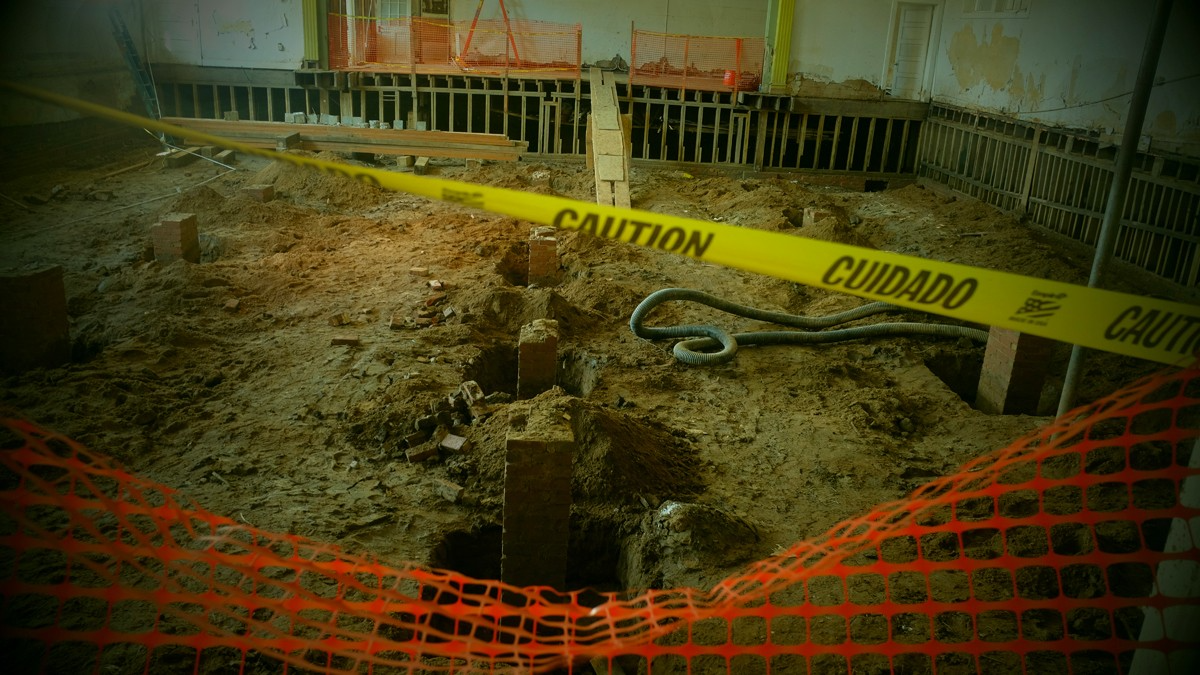
We walk over to the island for a look at the Marshall High Studios. The grounds — the walking trail, basketball court, swing sets, picnic tables, maybe a hundred trees — denuded and gone. Replaced with debris piles, mountains of trees, and a heavy layer of sand. Inside the building — like every other place in town — but bigger, more complicated, very expensive.
The dust. It’s dry. People beginning to worry about fires with all the downed trees, fuel.
Saturday, November 16
The mud is mostly gone, not entirely, but out of the majority of the buildings and off the streets. Debris and dead trees remain a work-in-progress with any one day better than the day before. Many places have been pressure washed and mitigated for mold, swept, and open to the dry air outside.
The town has been feeding on a shared energy to get to this visible progress and today is the expression of that bursting energy. Party is in the air. Not quite two months since the flood and Marshall is ready to cut loose, take a break from the doom and gloom, catch our collective breath and ready ourselves for the next, hardest push.
My friend Lois, a fellow artist and thirty-year resident of the county has decided to have her annual found art fashion show. Lois lost everything to the storm—her home and studio, and every trace of her seventy years of life and fifty years of art. Her response to the grief of losing the physical memory of her life—make more art.
I photographed Lois’s first fashion show at the Madison County Arts Council and many more since then. Funny, outrageous, creative, the shows take full advantage of the overwhelming number of artists in the community. This year is no different in that respect—a celebration of the power of art, and resilience. This year's theme — Tyvek.

Spring, 2025
I think about Helene a lot. Was this our “Get Right With God” moment? Retribution for past sins? Noah? Or was it a random, freak-of-nature storm that devastated the western third of our state. Was nature humbling us? Letting us know that while we consider ourselves safe from most of nature’s fury, it isn’t a sure thing. When I think about the frequency and intensity of these natural and manmade disasters in places like Paradise, California, Maui, Hawaii, Gaza, Ukraine, Los Angeles, it may simply have been our turn.
The adrenaline wore off months ago, about the time winter set in. It carried the town through the intensity of the cleanup — the mucking and striping and pressure washing and mitigating. There is still evidence of the recent destruction — lingering piles of debris, or trees, or mud — but Main Street is clean, drivable, and gives the appearance of nothing being amiss.
But peoples’ moods have darkened with the season; money to rebuild being the main concern. Insurance monies are slow to arrive and federal dollars that flowed quickly during the previous administration are being delayed or rejected by the current crowd in office.
People sit and wait and get frustrated.

Also there’s a shortage of sub-contractors with the entire region devastated. Plumbers, electricians, carpenters, laborers, heavy equipment operators, all hard to find.
Major questions about the rebuild of the town, which lost over a quarter of its buildings, and still lies in the floodplain, something that won’t change. And there is the very idea of the town itself — what is it, who is it for, how is it paid for?
Marshall has been reborn in recent years. What had been the economic, political, and cultural hub of the county for many decades had mostly died during the 1980s and 1990s with better access to the outside world and changing demographics. The 2000s brought new money, ideas, and energy to town and Marshall and the county emerged as a destination for art, cultural tourism, and outdoor adventure. The flood changed all of that.
Some people/businesses will leave. Some will stay. Of the original businesses in town, Penlands Store, Shadyside Florist, maybe Bowman’s Hardware, the VFW building, will stay. Every other business is new within the last twenty-five years and most of them are coming back.
I continue walking. Often through town looking for traces of improvement, or not. There are places in town where it looks like the flood happened yesterday, and others that are open for business. I went with Jim along a stretch of the railroad track near Redmon searching for debris and was not disappointed. Same in the woods and field next to Ronnie Meadow’s house.
There are gatherings in town. Mal’s bar has opened for music a few different times and there was a big Punk concert at the Arts Council. The venues are unfinished, almost primitive, without plumbing, but offering a place to come together. Everyone is hungry for it.
Summer, 2025
Was speaking with Pete the other day and we agreed that town felt different. And we couldn’t really say what that difference is. The physical changes are obvious, but beyond that, the emotional and attitudinal shifts areharder to identify. It seems the overall, never-ending need for money is dwarfing the strong sense of community that existed before the flood. And the uncertainty of what is coming next, knowing Marshall will be altered, possibly shattered beyond repair.
As I’m finishing this essay, I must acknowledge several of the catastrophes that have hit the nation since Helene devastated our region. Fires in Los Angeles and Maui, tornados in the Midwest and Plains, another flood in eastern North Carolina, and the unprecedented high-water disaster in Texas.
Storms are growing in frequency and intensity, with devastating effects on people, the natural world, and property. How to reverse course? How to rebuild? How will governments and insurance companies pay for ever-more-costly reconstructions? Our current national government seems intent on removing itself from the responsibilities of emergency management, leaving it up to the states who can’t afford the costs to clean up and rebuild.
Marshall and our neighboring town of Hot Springs are rebuilding, slowly. People are supportive. Music is regularly happening and a couple of restaurants are open. During the day the streets are busy with construction workers —carpenters, plumbers, electricians —putting the towns back together. There is no safe place. All of us are vulnerable; some people much more than others, but there is no hiding from the fact that we live in a deteriorating global environment. And as the scientists have predicted, it will only get worse. 
About the Author/Photographer
Rob Amberg has photographed and written about western North Carolina since moving there in 1973. Internationally published and exhibited, his photographs are represented in numerous public and private collections. Rob has received fellowships and awards from the National Endowment for the Humanities, the John Simon Guggenheim Foundation, The Center for Documentary Studies, and others. His books include Quartet: Four North Carolina Photographers (2007); The Living Tradition: North Carolina Potters Speak (2009); and his Madison County trilogy: Sodom Laurel Album (2002), The New Road: I-26 and the Footprints of Progress in Appalachia (2009), and Little Worlds (2024). Books and prints are available on his website: robamberg.com. Amberg lives in Madison County, North Carolina.
Donations for Marshall’s recovery can be made to:
The Madison County Arts Council
The Downtown Marshall Association
]]>
Introduction
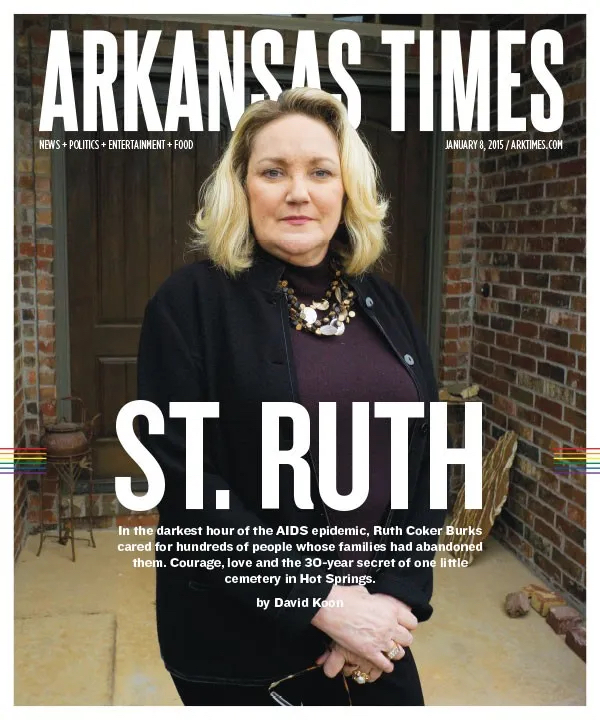
Ruth Coker Burks (born Frances Ruth Coker in 1959) is an Arkansas woman who was a caregiver and AIDS activist in central Arkansas from the mid-1980s to the mid-1990s during the height of the HIV/AIDS epidemic. In 1986, when Burks began her informal care work, she was a mid-twenties single mother who sold timeshare condominiums on Lake Hamilton near her hometown of Hot Springs in central Arkansas. Over the next few years, her informal end-of-life care expanded into daily care work, AIDS activism, and education. Newspaper and magazine profiles, television interviews, a popular memoir, and social media posts have documented her efforts as the ‘Arkansas Cemetery Angel’ (we will refer to Ruth Coker Burks as Ruth since this is how she is named in her memoir and in most press coverage). Laudatory media coverage also led to pointed criticisms of the limits of Ruth’s efforts and to potential flaws in her memory. Rather than evaluating the accuracy of Ruth’s account or those of her critics, this article investigates what her rich, if fragmentary, archival materials, along with her published memoir and newspaper accounts, can reveal about care work, gender, and the lived experience of the AIDS epidemic in Arkansas. More broadly, it begins to address what the publicity (and controversy) around Ruth’s life story offers the study of queer memory in southern spaces.
Ruth’s career as an AIDS caregiver and activist began with a case of mistaken maternal identity and a contested family cemetery. As described in newspaper profiles and her memoir, All the Young Men (2020), in 1986, while visiting a friend in the hospital in Little Rock, Arkansas's capital city, Ruth noticed a neglected patient, Jimmy, who was dying of complications from AIDS. When she went into Jimmy's hospital room, he mistook Ruth for his mother, who refused to visit him. After she confronted the nursing staff, who largely avoided Jimmy's room and failed to convince his mother (over the phone) to come to visit her dying son, Ruth returned to Jimmy's room. And it was as his ‘mama’ that Ruth sat by his bedside for hours, holding his hand and comforting him as he died. This moment of assumed maternal identity marked the beginning of Ruth's decade of informal care work.1Ruth Coker Burks and Kevin Carr O’Leary, All The Young Men: A Memoir of Love, AIDS, and Chosen Family in the American South (New York: Grove Press, 2020), 3–11; Michael Garofalo, “Lessons in Love,” StoryCorps, December 5, 2014, https://storycorps.org/podcast/storycorps-449-lessons-in-love/; David Koon, “Ruth Coker Burks: The Cemetery Angel,” Arkansas Times, January 8, 2015, https://arktimes.com/news/cover-stories/2015/01/08/ruth-coker-burks-the-cemetery-angel.
Alongside care work and public activism, Ruth provided a final resting place for some men she cared for in the Files Cemetery in Hot Springs, an hour's drive southwest of Little Rock in the Ouachita Mountains. It was for Jimmy, who had mistaken Ruth for his mother, that she turned to Files Cemetery.
From the first chapter of Ruth’s memoir, the Files Cemetery is described as a site of commemoration, refuge, and conflict.2Burks and O’Leary, All the Young Men, 11–14. In the following decades, this cemetery has become an essential site of LGBTQ+ memory in Arkansas. Layers of informal commemoration at the Files Cemetery and Ruth’s fragmentary archival record speak to the kinds of alternative archives of AIDS activism—beyond the public sphere—that Stephen Vider has examined in his discussion of community caregiving during the AIDS epidemic as part of his more extensive study of the importance of domestic spaces in LGBTQ+ politics in the United States.3Stephen Vider, The Queerness of Home: Gender, Sexuality, and the Politics of Domesticity after World War II (Chicago, IL: University of Chicago Press, 2021). As far as we know, the Files Cemetery is one of only a few cemeteries in the United States that became a documented resting place for people who died during the HIV/AIDS epidemic.4Two other documented final resting places for those who died during the HIV/AIDS epidemic are the Congressional Cemetery in Washington, DC and the Hart Island Potter's Field in New York City. The Files Cemetery operates at a much smaller and more informal scale than either of these.
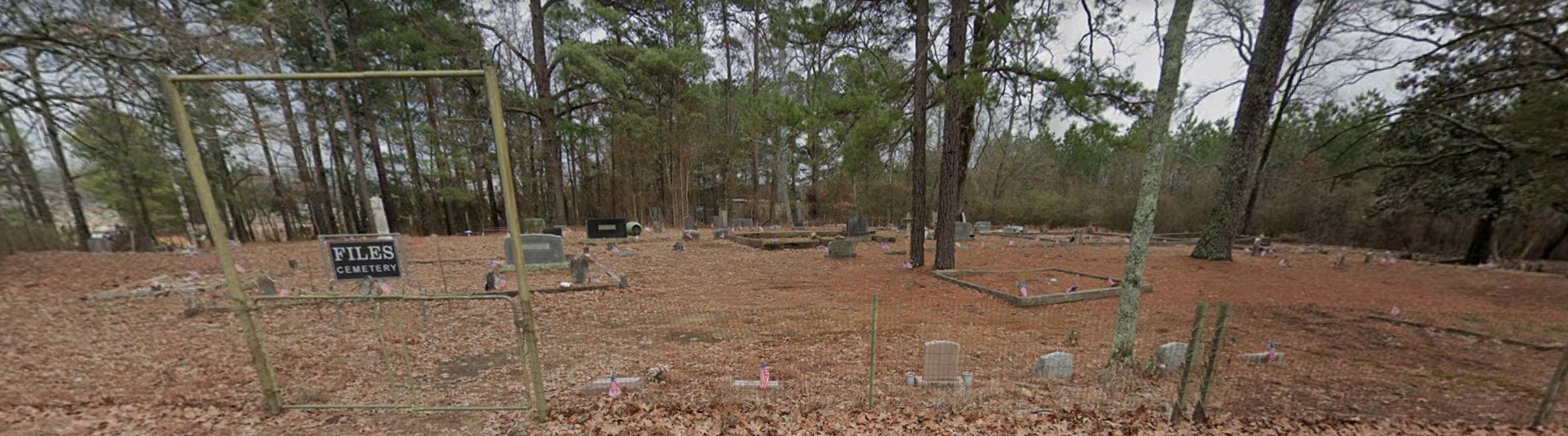
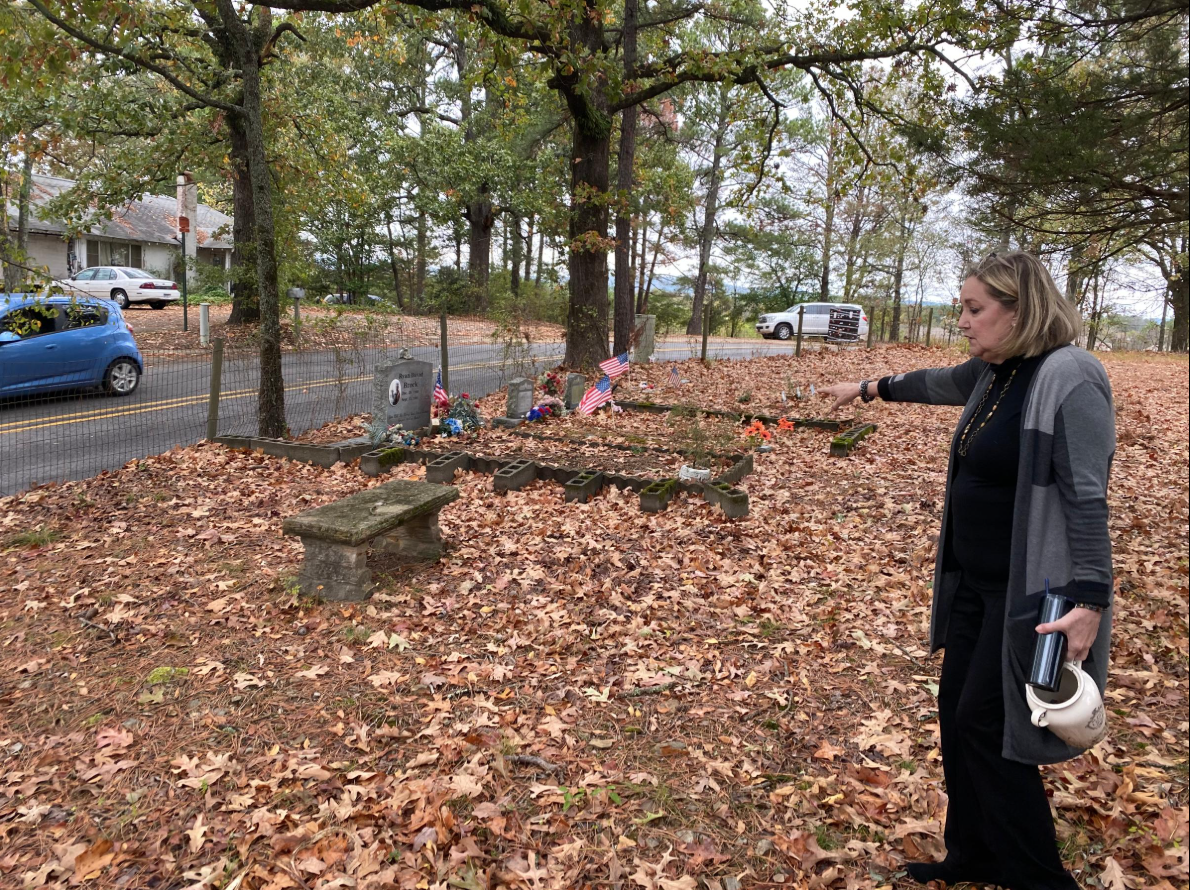
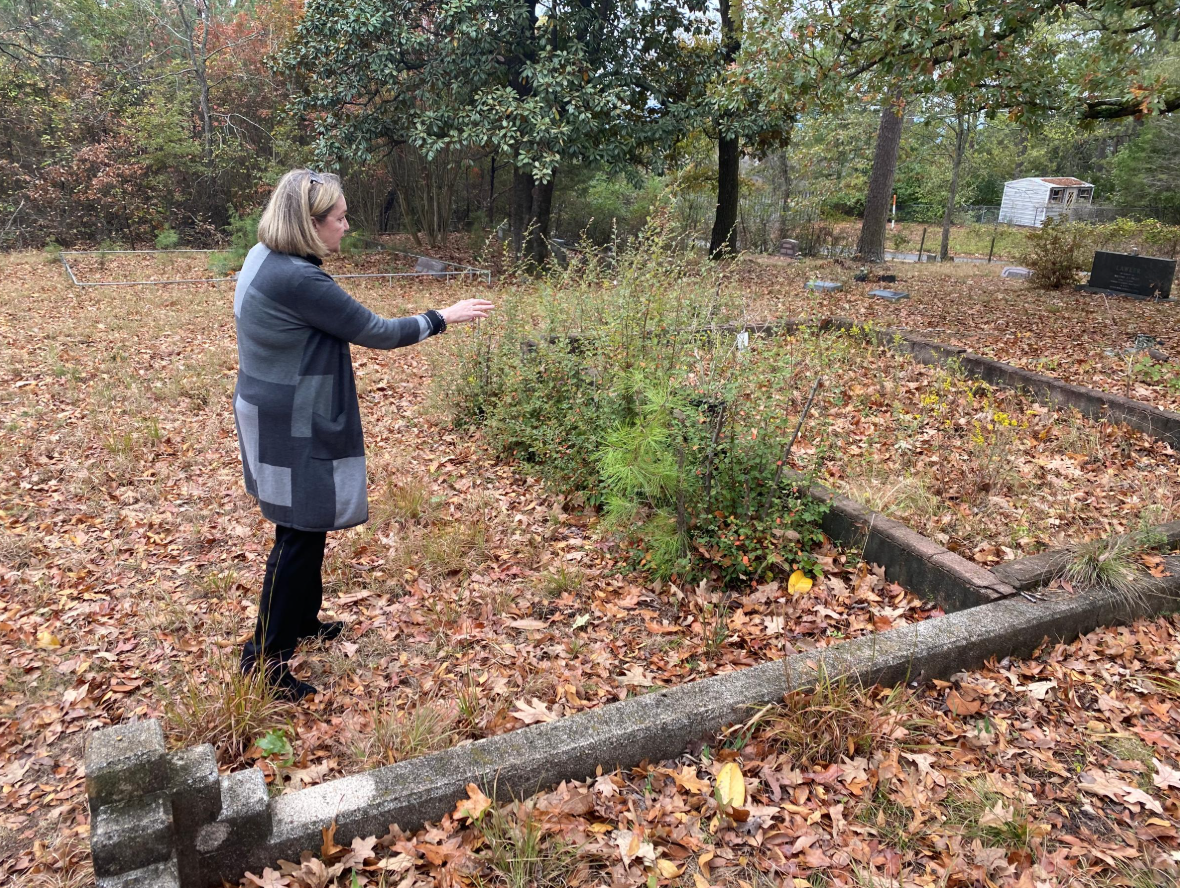
There also is scattered but evocative evidence of continuing engagement with the Files Cemetery as a space for queer memory-making. Facebook posts from March 2019 record how the drag troupe, the Arkansas Sisters of Perpetual Indulgence: The Abbey of the Hillbilly Harlots, cared for the cemetery’s grounds and planted rose bushes. A series of photographs of the Files Cemetery taken at regular intervals from spring 2020 to fall 2024, which are part of a forthcoming donation to the Center for Arkansas History and Culture, reveal earlier layers of informal commemoration (including notes, beer bottles, Mardi Gras beads, and devotional objects) near the resting places of some of the men. In 2020, a grave was added to the cemetery (of which Ruth was unaware.) Some of these later commemorative efforts at individual graves did not involve Ruth and were potentially enacted by local critics of Ruth, as evidenced by one stone that was partially funded by a critical host of a YouTube podcast.
Praise extended to the national and international levels. The first prominent news article on Ruth, which predated the Arkansas Times' profile, was a twelve-minute interview with NPR's StoryCorps in 2014. The December 7, 2020, issue of People magazine featured a glowing article, “They Call Me the AIDS Angel.”5Jason Sheeler, “They Call Me the AIDS Angel,” People, December 7, 2020. Exemplifying Ruth's newfound fame, the Guardian published an article on February 3, 2021 titled, "The Aids Angel: How Ruth Coker Burks Comforted Dying Gay Men." That same year, however, the Arkansas Times published a more critical piece by Austin Gelder about a “missing monument.” Gelder's piece centered on accusations that Burks had exaggerated some of her claims and failed to establish a much-discussed monument at the Files Cemetery in honor of those for whom she had cared.6Austin Gelder, “Ruth Coker Burks and the Missing Monument,” Arkansas Times, July 8, 2021, https://arktimes.com/arkansas-blog/2021/07/08/ruth-coker-burks-and-the-missing-monument. National press coverage trended from the laudatory to the skeptical with pointed questions about Ruth's claims about the number of men for whom she cared, the number of gravesites at the Files Cemetery, and her contested ownership of the cemetery.7Alexander Kacala, “Doubts Surround Viral Story of ‘AIDS Angel’ Who Says She Helped Hundreds of Dying Men,” NBC News, October 29, 2021, https://www.nbcnews.com/nbc-out/out-news/doubts-surround-viral-story-aids-angel-says-helped-hundreds-dying-men-rcna4163. These critiques came largely from residents of Hot Springs, some of whom knew Ruth, some of whom wanted a more thorough history of the events, some who are invested in the history and its public telling, and also those who feel that her version of events is somehow maligning the city. A YouTube podcast, RUTHLESS: The Real Story Behind the ‘Cemetery Angel of Arkansas’ is representative of this critique and is discussed in more detail below. In the wake of this praise and criticism, the Center for Arkansas History and Culture at the University of Arkansas at Little Rock has collected Ms. Burks’ archival materials in an ongoing effort to preserve LGBTQ+ history in Arkansas. The CAHC's archival work complements that of Invisible Histories—an organization who "believes archiving is resistance to oppression and history leads to liberation"—to document queer histories and spaces of memory in the southern United States.8"Invisible Histories." Accessed January 3, 2025. https://invisiblehistory.org/.
This article discusses the history of Ruth's care work and activism in central Arkansas in the broader context of scholarship on gender and care work during the HIV/AIDS epidemic. We will survey the gendered construction of care work and motherhood in Arkansas in Ruth’s memoir and archival materials. Then, we will tackle the life histories of the predominantly white and Latino working class and rural men she cared for and what her archive—with its evocative fragments and enduring silences— reveals about the lived experience of the AIDS epidemic for some people in Arkansas. We conclude with Ruth’s critics and what her story can teach about the contested memory of the AIDS epidemic. This article does not attempt to evaluate the accuracy of the claims of either Ruth or her local critics, but rather examines the possibilities and limits that her archive, and the published materials about her, open up. The historical importance of Ruth’s care work and the validity of some of the criticisms of her are not incompatible. Rather than a binary understanding, we are interested in what Ruth’s archive reveals about the history of the AIDS epidemic and the construction of the role of the idealized caregiver for some women in Arkansas.
Care Work and AIDS Activism in Arkansas
Ruth was one of many women across the United States who played leading roles in AIDS activism and care. As the ACT UP Oral History Project states, “Women were an integral part of the AIDS crisis—first, and foremost, as People with AIDS, but also as leaders of the AIDS Activist Movement, and as caregivers.”9“Women and AIDS,” ACT UP Oral History Project, digital archive, https://www.actuporalhistory.org/actions/women-aids. Ruth’s trajectory reflects what scholars have argued was the complex array of personal, political, social, and spiritual motivations behind many women’s activism during the AIDS epidemic in the United States.10See, for example, Ulrike Boehmer, The Personal and the Political: Women’s Activism in Response to the Breast Cancer and AIDS Epidemics (Albany: State University of New York Press, 2000); Angelique Harris, “Emotions, Feelings, and Social Change: Love, Anger, and Solidarity in Black Women’s AIDS Activism,” Women, Gender, and Families of Color 6, no. 2 (2018): 181–201; For a more expansive history of women’s activism in the United States, see Dawn Durante, ed., Women’s Activist Organizing in US History (Urbana: University of Illinois Press, 2022).
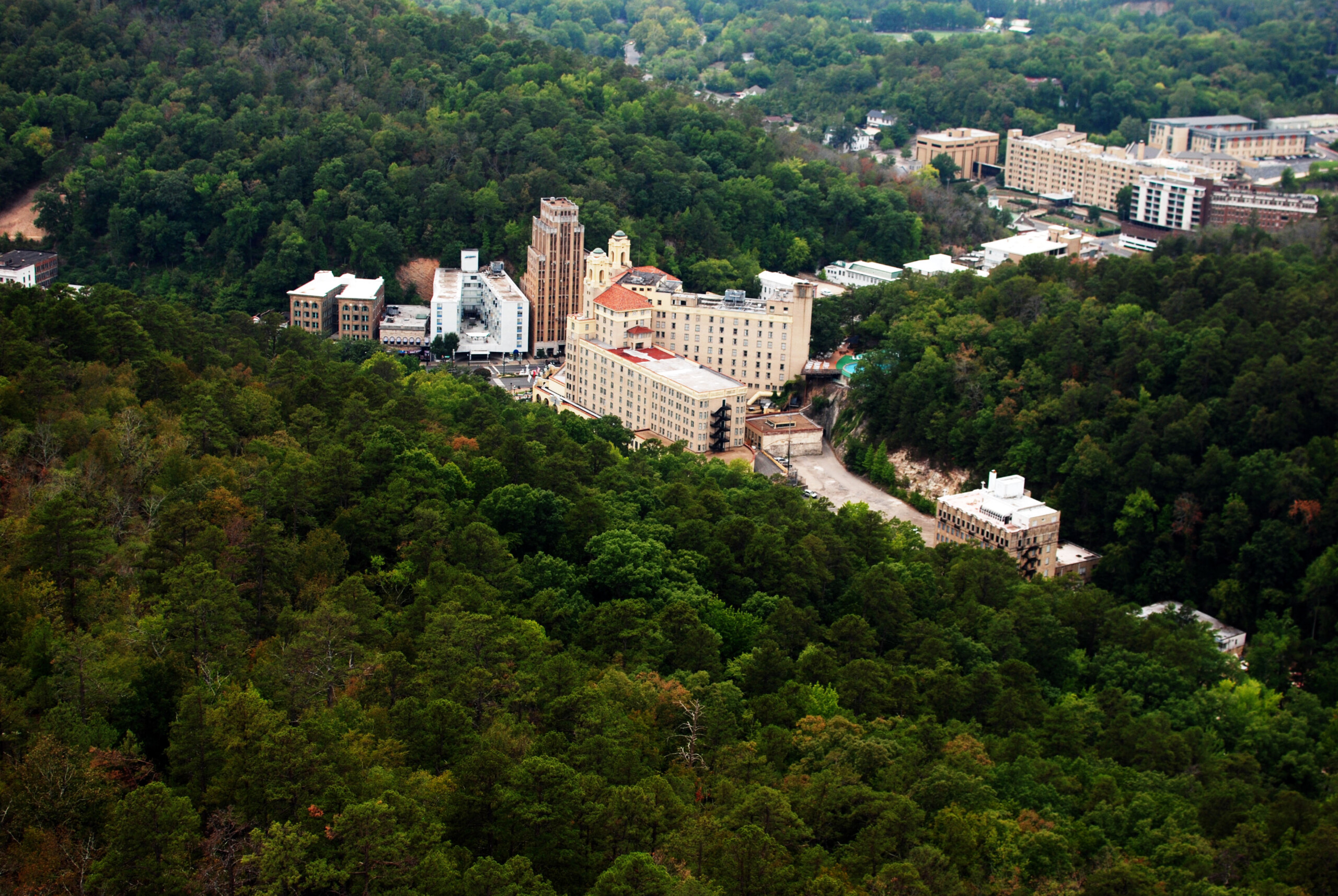
Ruth was a single mother who sold lakeshore timeshares in Hot Springs when she began her informal care work. Her work's flexible and commission-based practices facilitated Ruth’s initial care work. AIDS activism and end-of-life care were not how recently divorced Ruth planned to spend her twenties and early thirties. “All I want sometimes is to be a wife and be in the Junior League.”11Burks and O’Leary, All the Young Men, 74. While Ruth did not come from a well-off background, she hoped to advance in the social scene of Hot Springs. Ruth’s care work encompassed a shifting range of activities from 1986 to 1995. Initially, she focused on visiting the hospital, comforting dying men, and providing supplemental food for those still alive.12Burks and O’Leary, 62; Paula Cocozza, “The AIDS Angel: How Ruth Coker Burks Comforted Dying Gay Men,” The Guardian, February 3, 2021, https://www.theguardian.com/society/2021/feb/03/aids-angel-ruth-coker-burks-dying-gay-men. As she described at one point (she had started dumpster-diving to get adequate cooking supplies), “I could be like this little grocery-delivery person.”13Burks and O’Leary, All the Young Men, 96. Word of mouth drove her first few years of care work as anxious Little Rock and Hot Springs hospital staff contacted her. “More calls started coming. I guess the nurses and doctors all went to the same places to drink and unwind because I later found out they got to talking. ‘Oh my God, we had this insane woman come in, and she went right in the AIDS patient’s room.’ . . . I had two calls that first month, which I thought was crazy. Then three the second.”14Burks and O’Leary, 24–25.
This soon shifted to men calling her directly, either for themselves or for a friend or loved one. As Ruth notes, by 1988, this “network of calls from the hospitals and gay men giving out my number” kept her more than busy, along with caring for her young daughter and trying to make a living.15Burks and O’Leary, 54, 83. It is important not to reify the assumption that persons with HIV/AIDS were always gay men, even if that is often how Ruth discusses her experiences in central Arkansas in her memoir. Ruth’s archive and the ambiguities surrounding the Files Cemetery underline the importance of not projecting contemporary categories onto the past and respecting privacy in the telling of these histories.
From 1986 to 1989, Ruth worked quietly, and from 1989 onwards, she was much more public in attempting to raise awareness and draw local media attention to the AIDS epidemic in central Arkansas. Building on her connections to some of “the town elders” of Hot Springs, Ruth also gave talks at Rotary Clubs across Arkansas and quietly facilitated donations from well-to-do residents of Hot Springs. In her description of one of her early speeches at Rotary, “I talked about the people with AIDS in town, how they needed food and access to care, but what we mainly needed was education.”16Burks and O’Leary, All the Young Men, 125, 129–134, 184, 257. Formalizing her activism, Ruth assisted Norman Jones, who ran the Arkansas non-profit, Helping People with AIDS (HPWA.) Ruth’s work with HPWA encompassed everything from the distribution of accessible sex education materials to creative publicity efforts, including the production of humorous T-shirts with the phrase “I believe in Jesus. Do you?” transformed into “I DO. DO YOU?” about safer sex practices.17Burks and O’Leary, 270–271.
The sharply diverging reactions to Ruth in the present-day echo in her recollections of care work and AIDS activism from the mid-1980s to the mid-1990s. Ruth claims that initially, she was perceived as a prim “‘church lady’” by many of the men she cared for. However, she remembers that to most of Hot Springs, she was viewed as “this insane woman” and “that crazy Ruth Coker Burks,” who wouldn’t stop talking about AIDS and gay rights.18Ruth Coker Burks, "All Her Sons: The Cemetery Angel," interview by Seth Doane, Video, December 1, 2019, CBS Sunday Morning, https://www.cbsnews.com/news/all-her-sons-ruth-coker-burks-the-cemetery-angel/; Burks and O’Leary, All the Young Men, 24, 94, 156.


Along with public-facing activism, Ruth’s informal hospice care evolved from providing company at the bedside of dying men to helping ‘her guys’ live as long as they could by securing housing assistance, filling out death certificates, seeking social security payments, filling AZT prescriptions at often hostile local pharmacies, HIV testing, and ultimately AIDS education.19Koon, “Ruth Coker Burks: The Cemetery Angel”; Burks and O’Leary, All the Young Men, 57–58, 72, 81–83, 86–88, 112–113. Ruth regularly visited hospitals in Hot Springs and Little Rock and frequently cared for people in their homes. At times, she appears to have operated as an informal pharmacy herself, distributing leftover AIDS medication across central Arkansas.20Garofalo, “Lessons in Love”; Burks and O’Leary, All the Young Men, 173. These shifts did not mean she stopped providing personal daily attention. For example, in her time with one of the men for whom she cared, Chip, she visited daily, fed him, bathed him, and read him the newspaper.21Burks and O’Leary, All the Young Men, 234. In his study of queer public history and the home, Vider challenges the often-presumed division between political action (outside of the home) and care work (inside the home). Rather than framing the home as a space away from politics, Vider argues that the home and the care for people with AIDS in their own homes constitute an essential site for activism.22Vider, The Queerness of Home, 179–213. The contours of Ruth's care work reflect Vider's argument.
While Ruth’s individualized efforts to keep ‘her guys’ fed are distinct from the more extensive history of food justice organizing in the twentieth-century United States that Emily Twarog studies in Politics of the Pantry (2017), food was at the center of Ruth’s work, especially in the late 1980s, and her subsequent gendered construction as a caregiving angel.23Emily E. LB. Twarog, Politics of the Pantry: Housewives, Food, and Consumer Protest in Twentieth-Century America (New York: Oxford University Press, 2017). In early media profiles from 2014 and 2015, Ruth estimated that she cared for "nearly 1,000 people" and "hundreds of dying people" from the mid-1980s to the mid-1990s.24Garofalo, “Lessons in Love”; Koon, “Ruth Coker Burks: The Cemetery Angel.” As discussed below, these numbers have been contested. While it is beyond the scope of this article to fully address how Ruth’s efforts intersected with formal and informal care networks in Arkansas, there were additional organized efforts, including the important work of RAIN (Regional AIDS Interfaith Network), which was profiled in a 2016 Arkansas Times piece, among others.
Ruth’s unprocessed archival collection at the Center for Arkansas History and Culture provides some indications of how her care work intersected with broader caregiving networks in Arkansas. Specifically, her archives include a binder of letters of recommendation and typed endorsements from prominent community members regarding Ruth’s nomination for the Arkansas Community Service Award, the establishment of an HIV/AIDS program at Levi Hospital, and the nomination of Ruth for the position of Executive Director of the Arkansas AIDS Foundation. In one letter, the assistant director of the American Psychological Association recommended Ruth for the Arkansas Community Service Award with the argument that “Ruth’s efforts in promoting the conference have remained unflagging. Most impressively, Ruth has served without remuneration, preferring that we hire two part-time local coordinators from our community of those directly affected by AIDS. As one of our local coordinators has suffered an unfortunate precipitous decline in health. Ruth has generously stepped forward to assume his responsibilities while insisting that he still receive the full salary offered for the position.” A local attorney wrote in a separate letter of recommendation, “I would like to recommend Ruth Burks as the person to get this program started. Ruth has demonstrated her commitment to the care of those who are HIV positive and we are fortunate to have someone already in the community who is prepared to immediately take on such a responsibility.”25These recommendation letters are part of Ruth's collection donated to and being processed by the Center for Arkansas History and Culture. Box 6, Folder 20, Ruth Coker Burks papers, Center for Arkansas History and Culture, Little Rock, Arkansas.
Ruth's memoirs and archives only get us so far in researching the experience of AIDS in Arkansas and of women activists during the AIDS epidemic. Ruth remembers primarily, but not exclusively, caring for white and Latinx men. Her life story and archival materials tell us little about the impact of HIV/AIDS on Black communities in Arkansas (15.5% of the Hot Springs population in 1990) or the work of Black women in AIDS activism both at the state and national levels. Recent scholarship has drawn attention to the central role of Black women to AIDS activism and care work in the United States. In her influential study of Black women activists, Angelique Harris argues for the importance of the intersecting emotions of love, compassion, community solidarity, anger, and frustration in AIDS activism and care work.26Harris, “Emotions, Feelings, and Social Change,” 181–183, 186–188, 191–195.
While this article centers upon Ruth’s life and her account of primarily caring for white and Latinx men, it is critical to acknowledge how racial disparities in healthcare profoundly shaped the history of HIV/ AIDS. Unfortunately Ruth’s archive does not tell us much about the impact of the AIDS epidemic on Black people in Arkansas. However, our study of Ruth’s memoir and archival fragments builds on Cherisse Jones-Branch and Gary Edwards’ compelling model of biographical essays in Arkansas Women: Their Lives and Times (2018) and Jayme Stone’s 2010 study of Black women as activist mothers in the Arkansas Delta.27Cherisse Jones-Branch and Gary T. Edwards, eds., Arkansas Women: Their Lives and Times, Southern Women: Their Lives and Times (Athens: University of Georgia Press, 2018); Jayme Millsap Stone, “‘They Were Her Daughters:’ Women and Grassroots Organizing for Social Justice in the Arkansas Delta, 1870–1970” (Memphis, TN, University of Memphis, 2010), https://digitalcommons.memphis.edu/cgi/viewcontent.cgi?article=1238&context=etd. Our examination of the richness and limits of Ruth’s archive expands on these authors’ approach of using various sources to demonstrate women's diverse and multifaceted historical roles.

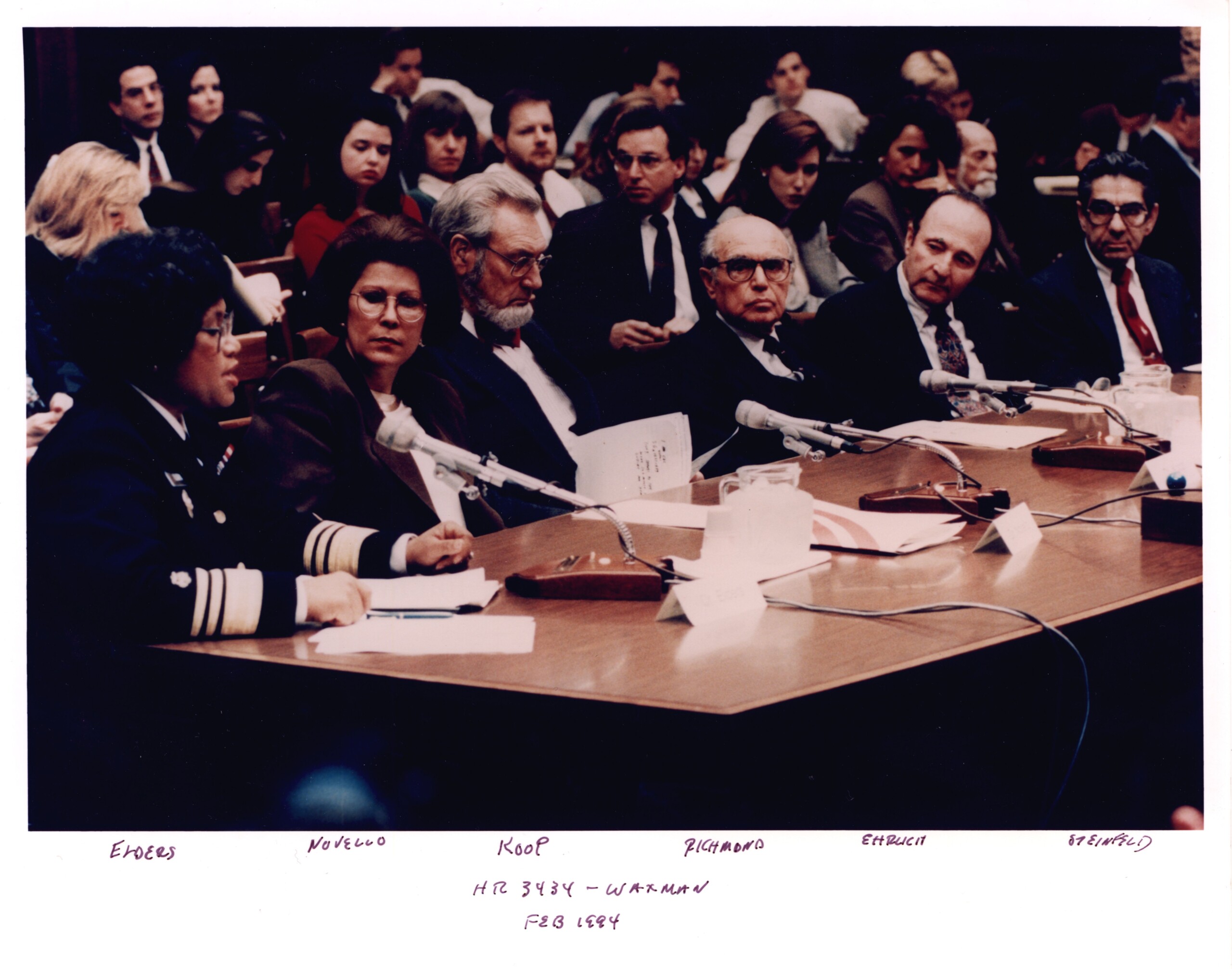
If contested understandings and expectations of gender run through Ruth’s memoir and archives, and the discrimination experienced by many of the men she cared for, Arkansas’s enduring racial divisions implicitly shaped her narrative and its silences. In the words of Catherine Fosl and Daniel Vivian, “the same race, gender, and class divides that mark US society are evident within LGBTQ communities, making histories of queer people of color, women, and trans people more difficult to access, especially by those who do not identify as such.”28Catherine Fosl and Daniel Vivian, “Investigating Kentucky’s LBGTQ Heritage: Subaltern Stories from the Bluegrass State,” The Public Historian 41, no. 2 (2019): 221. Ongoing archival projects in Arkansas are beginning to address these histories. The Historical Research Center at the UAMS Library has collected and preserved the papers of Dr. Joycelyn Elders, Director of the Arkansas Department of Health (1987–1993) and Surgeon General of the United States (1993–1994), who played an important role in the AIDS epidemic both in Arkansas and nationally.
To understand Ruth’s story—and what her archives and cemetery mean for queer memory in the southern United States—we must address how Ruth embraced and struggled against an ideal of “southern femininity” in the 1980s and early 1990s. Ruth’s memoir is a record of the constricted gender expectations imposed on her and her strategic use of her identity to help the men for whom she cared. In her 1991 essay, Frances Ross provides a formative background on changing notions of femininity and how women addressed social problems in turn-of-the-twentieth-century Arkansas.29Frances Mitchell Ross, "The New Woman as Club Woman and Social Activist in Turn of the Century Arkansas," The Arkansas Historical Quarterly 50, no. 4 (1991): 317–351. These norms remained decades later, as Anna Zajicek, Allyn Lord, and Lori Holyfield argue in their article on the women’s movement in northwest Arkansas: “To become activists in the civil rights movement, these women had to challenge the ideals of southern femininity and create a new sense of self.”30Anna M. Zajicek, Allyn Lord, and Lori Holyfield, “The Emergence and First Years of a Grassroots Women’s Movement in Northwest Arkansas, 1970-1980,” The Arkansas Historical Quarterly 62, no. 2 (2003): 155. Ruth also grappled with ideals of femininity while embracing the gendered role of caregiver.
In her memoirs and archival notes, Ruth does not directly discuss feminist politics in Arkansas. However, her complex experiences as a caregiver and activist contribute to what Janet Allured referred to as alternative “wellsprings” of “southern change-seekers” in her study of second-wave feminism in Louisiana.31Janet Allured, Remapping Second-Wave Feminism: The Long Women’s Rights Movement in Louisiana, 1950–1997 (Athens: University of Georgia Press, 2016), 49. Moreover, when we examine Ruth’s experiences, it is vital to consider the historical context of Arkansas in the mid-1980s, a little over a decade after the intense political backlash against the proposed Equal Rights Amendment. As Janine Parry argues, “the Equal Rights Amendment in Arkansas had swiftly moved from being perceived by many observers as ‘virtually assured’ of ratification in January of 1973 to being openly reviled at the next legislative session.”32Janine A. Parry, “‘What Women Wanted’: Arkansas Women’s Commissions and the ERA,” The Arkansas Historical Quarterly 59, no. 3 (2000): 283. While distinct from Ruth's story, these conflicting political currents indirectly shaped her activism and experiences.
Constructing Care Work and Motherhood in Arkansas
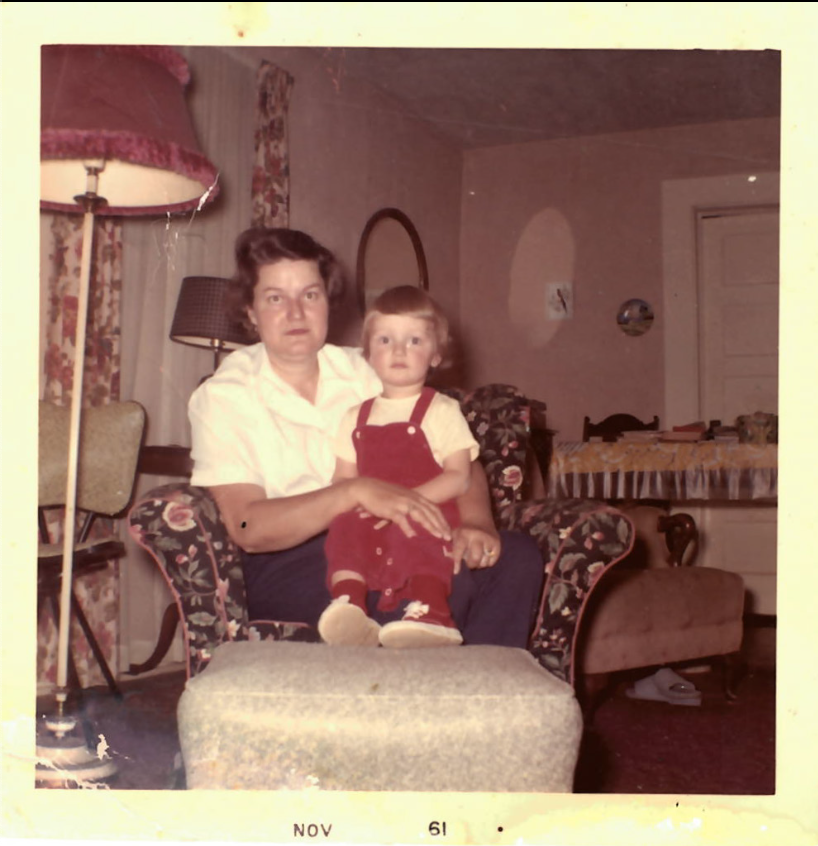
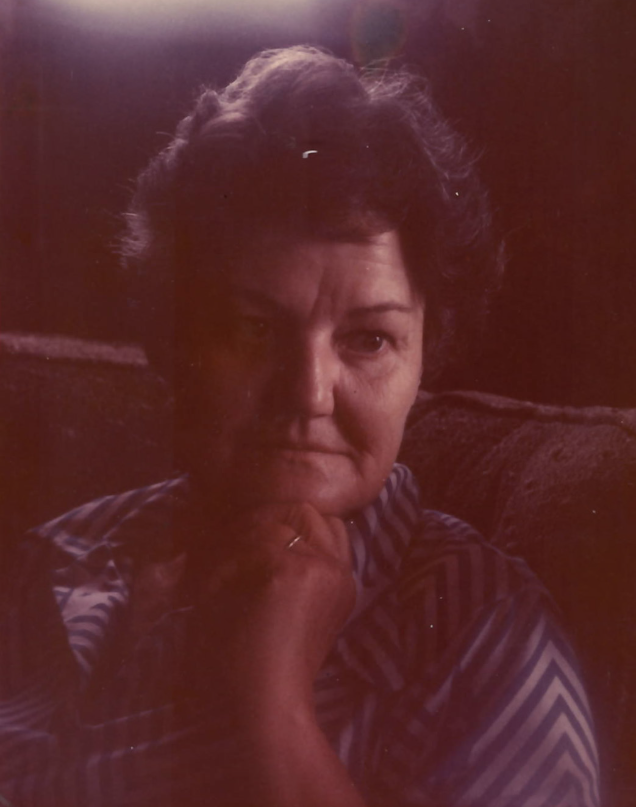
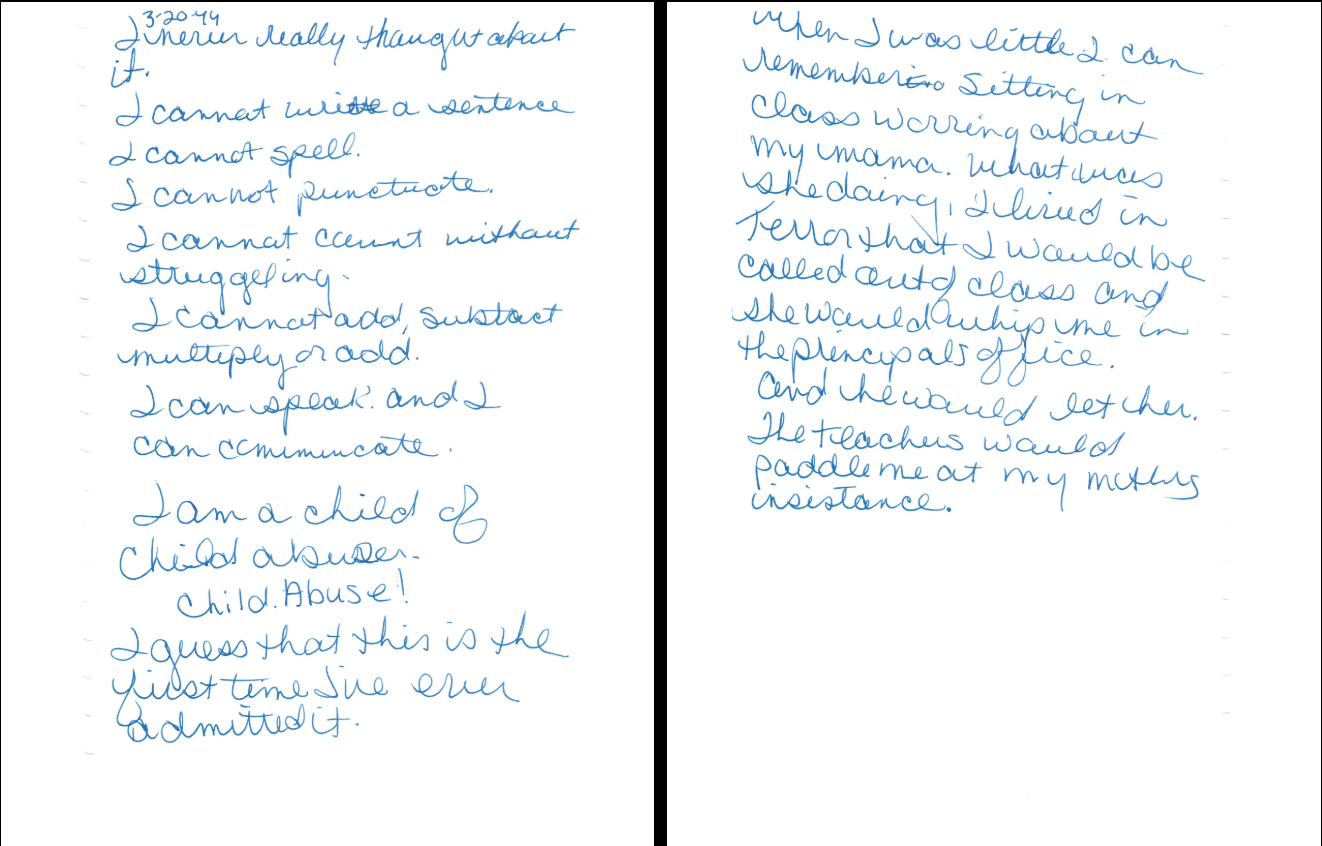
Ruth’s written and archival ephemera record the gendered expectations of care and motherhood often imposed on women in late twentieth-century Arkansas. Her autobiography contains a steady commentary on the contested meaning of motherhood in her life and care work. The figures of abusive mothers, absent mothers, and idealized alternative mothers run throughout the book. Ruth’s deeply damaging mother and her own constant worries that she might cause her young daughter harm through her AIDS work are recurring themes.33Burks and O’Leary, All the Young Men, 100–102. Ruth’s memoir and archives contain glimpses of the range of substitute mothers these dying men sought, including Ruth, the Virgin Mary, and even Dolly Parton.
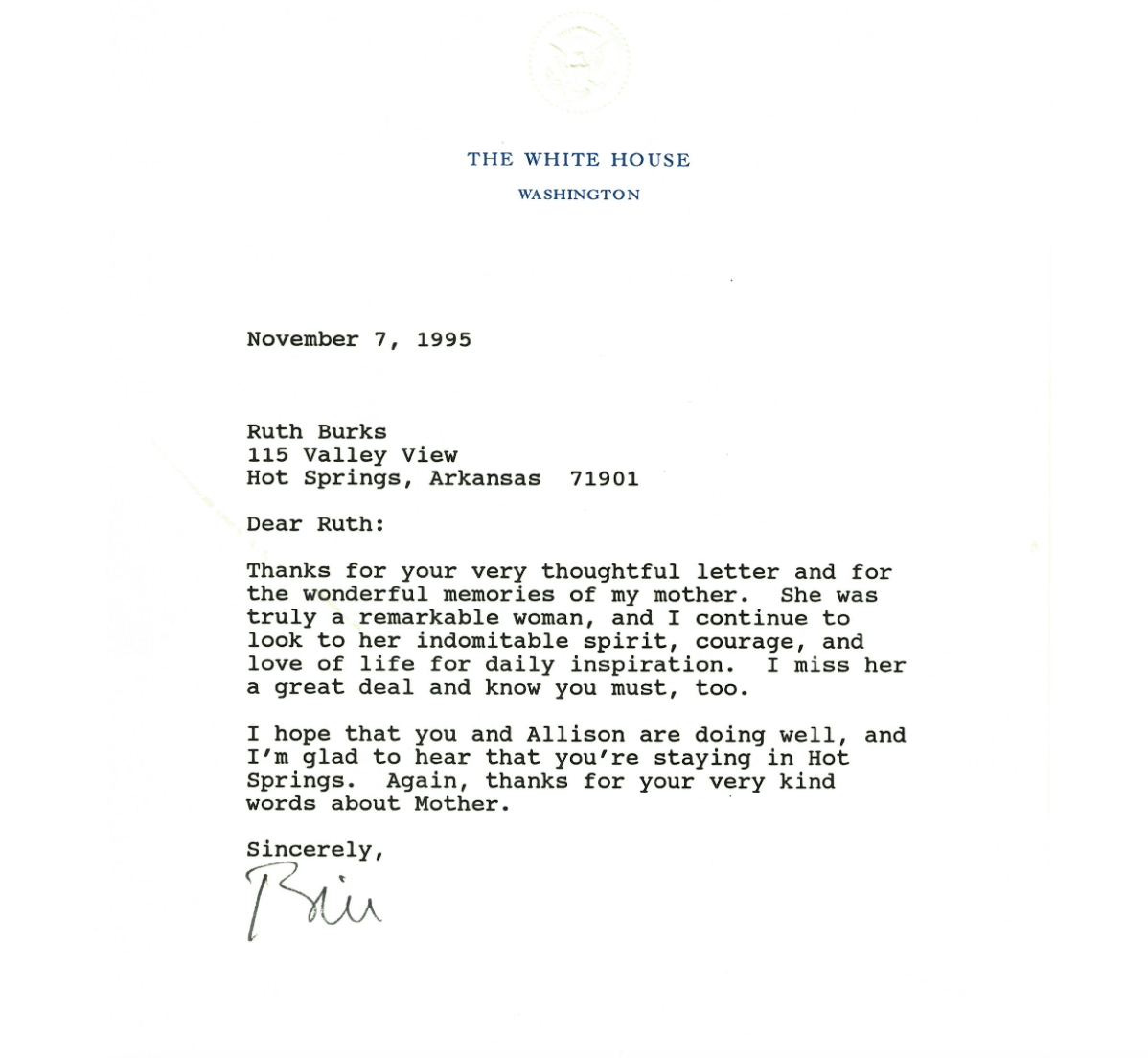
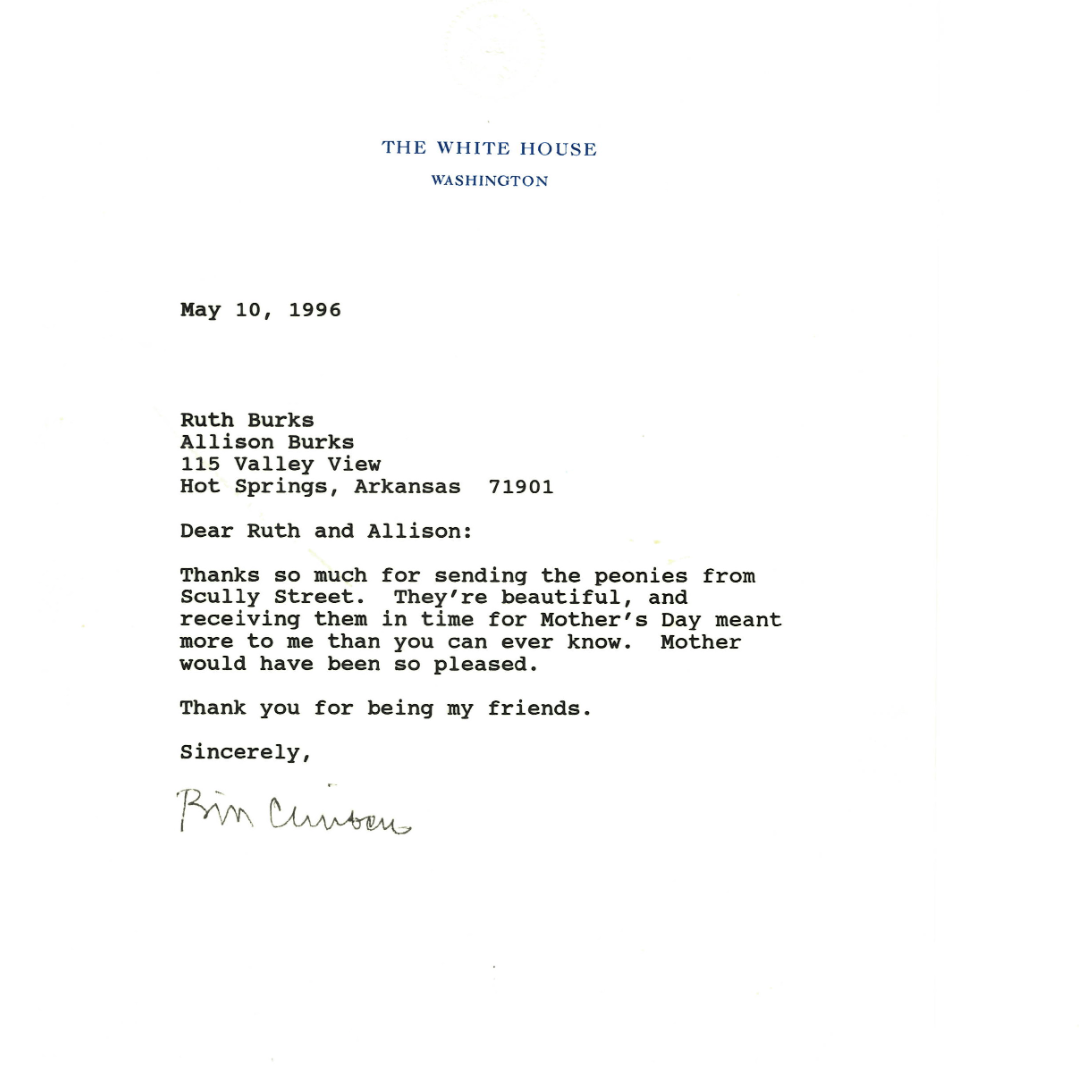
As mentioned, Ruth's career as an informal caregiver in the mid-1980s began with a case of mistaken maternal identity. With only a few exceptions, the men's families for whom Ruth provided care rejected their sick and dying sons.34Garofalo, “Lessons in Love.” “So many arrived [back in Arkansas] thinking Mama would take them back. Sometimes I would go to their homes with them, mostly just to save me a trip of driving back out there when she wouldn’t.”35Burks and O’Leary, All the Young Men, 55.
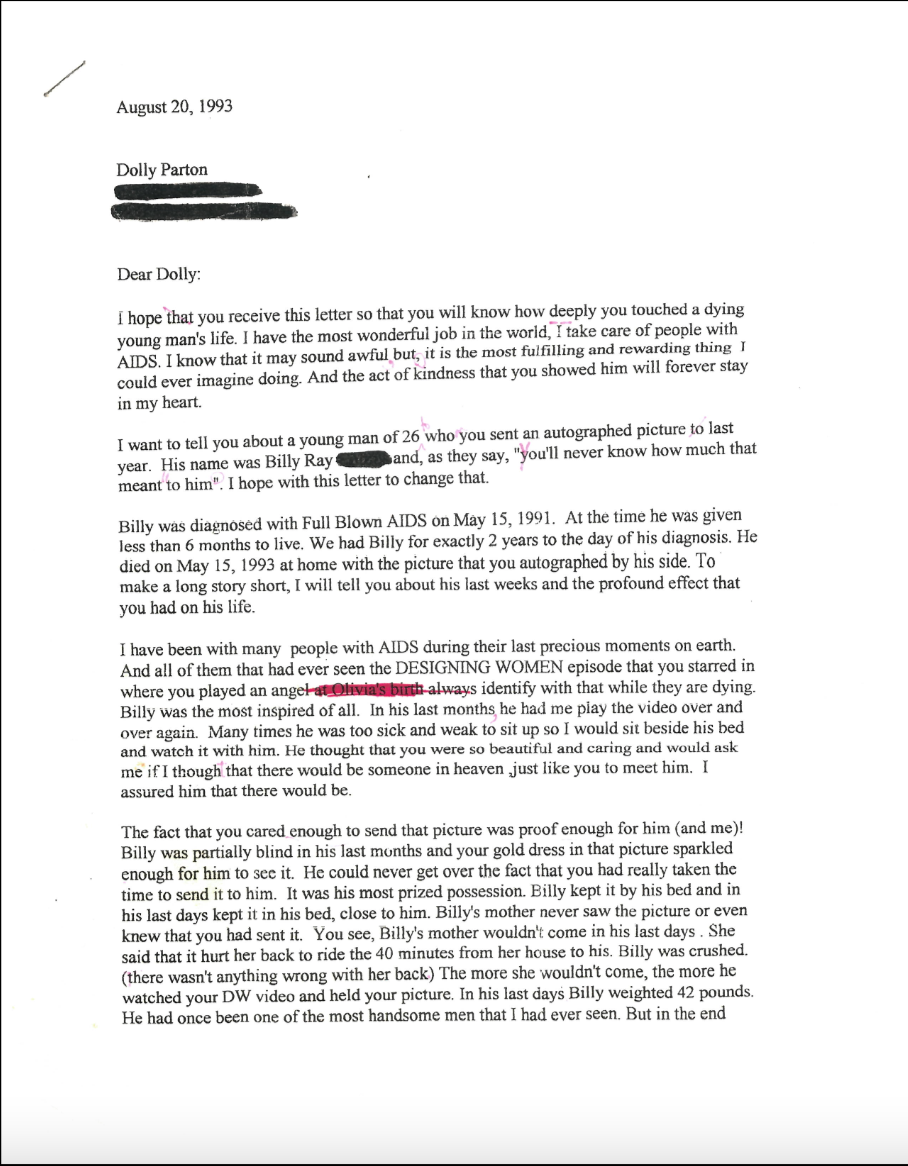
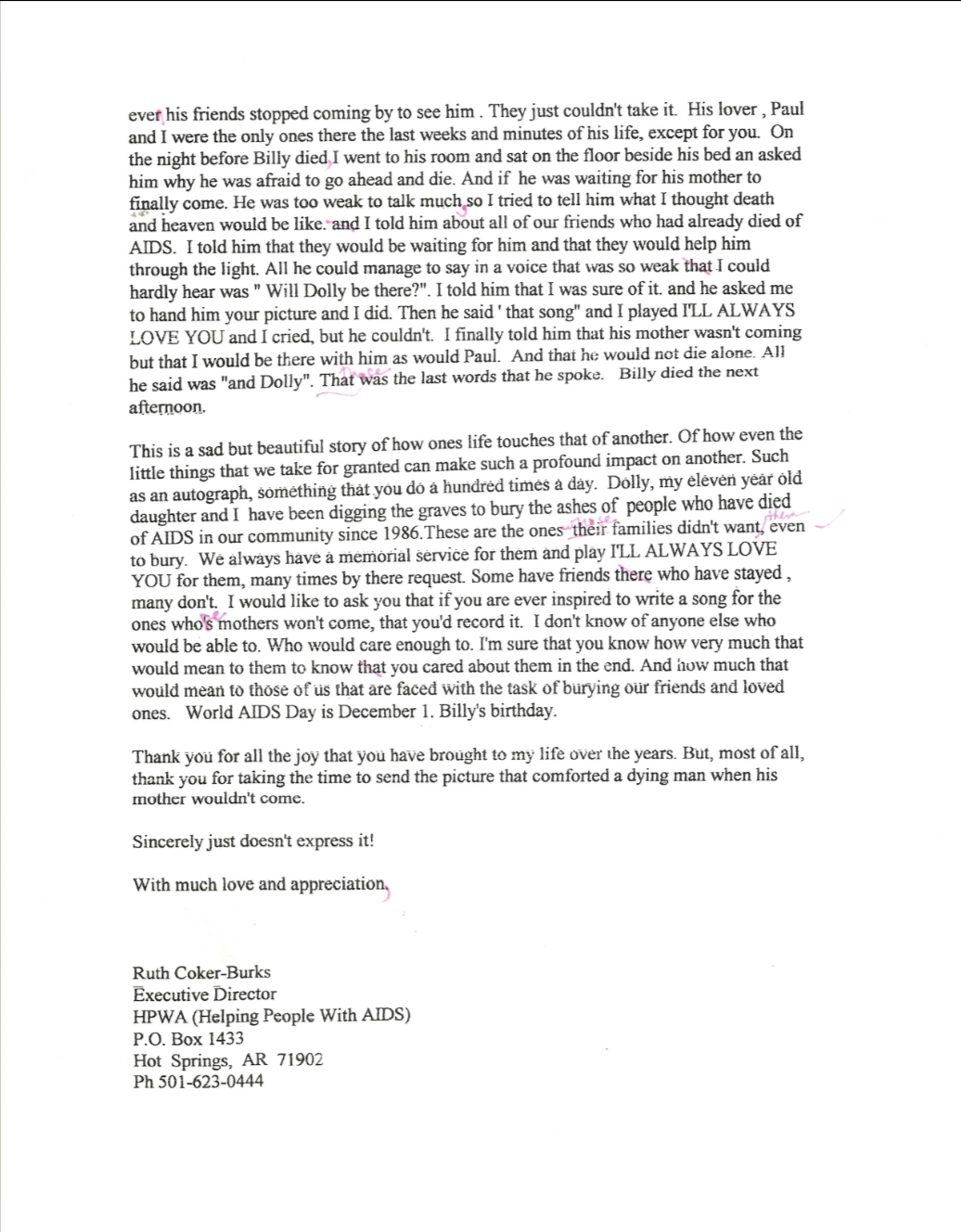
Alongside this parade of neglectful parents, another narrative of idealized mother figures runs through Ruth’s life history and archives. A letter she wrote to Dolly Parton on August 20, 1993, on behalf of Billy Ray Collins soon after he died, fashioned the beloved country music singer as a substitute maternal figure for the dead man. Ruth wrote the letter thanking Dolly for a picture that she had sent to Billy, a devoted fan. “Billy’s mother never saw the picture or even knew that you had sent it,” the letter begins “You see, Billy’s mother wouldn’t come in his last days. . . . Billy was crushed.” Ruth's letter underlined a profound sense of loneliness: “But in the end, even his friends stopped coming by to see him. They just couldn’t take it. His lover, Paul, and I were the only ones there in the last weeks and minutes of his life, except for you.” Ultimately, Ruth had to tell the dying Billy that his mother would not visit him. “I finally told him that his mother wasn’t coming but that I would be there with him as would Paul. And that he would not die alone. All he said was ‘and Dolly’.” In Ruth’s memory of Billy’s final days, recorded in a letter to Parton, a photograph of the singer was transformed into an icon standing in for Billy’s absent mother.36See, Box 6, Folder 16, Ruth Coker Burks papers, Center for Arkansas History and Culture, Little Rock, Arkansas. Billy was certainly not the only one of Ruth’s guys to reach out for their mothers and be denied at the end of their lives. This is a recurring theme in Ruth’s memoir.
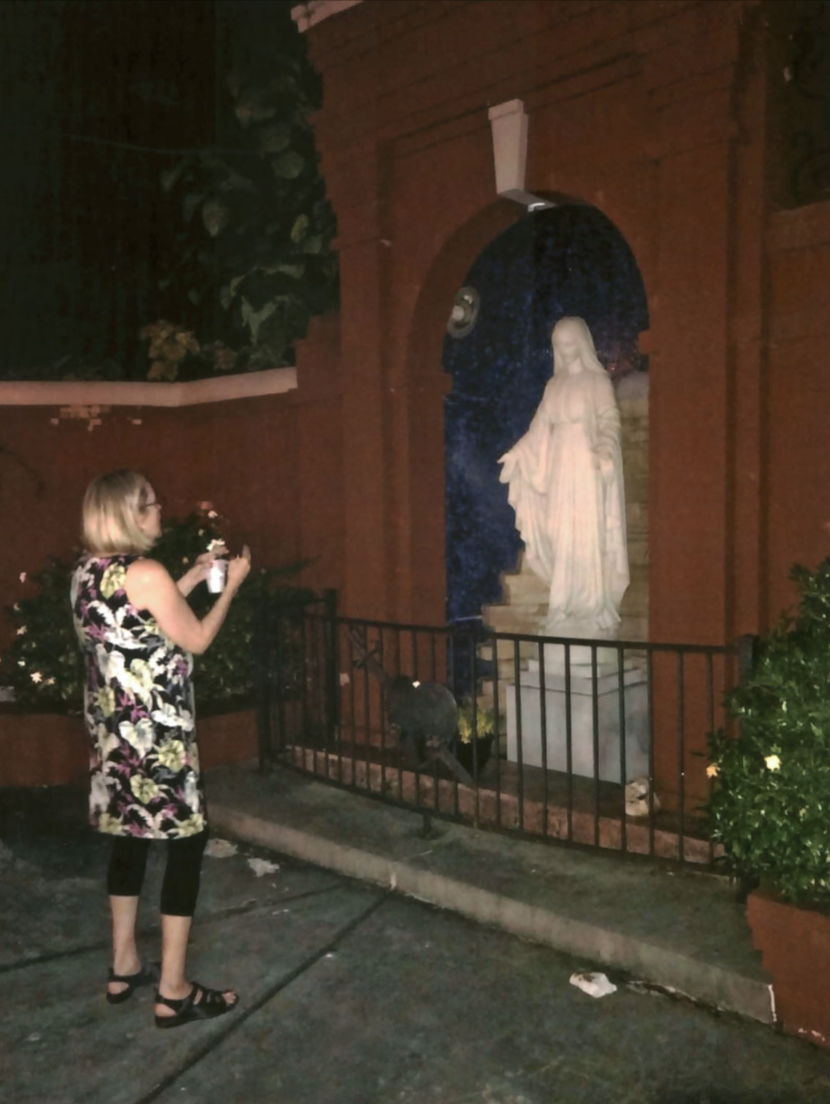
This search for an alternative maternal figure is perhaps best exemplified by Ruth’s visits with the men she cared for to that most idealized, and unrealizable, of mothers: the Virgin Mary. They often visited a small grotto at St. Mary of the Springs Catholic Church in Hot Springs. “There’s a statue of the Virgin Mary there,” writes Ruth, “in a red-brick shrine, hidden from the street. She’s on a pedestal, so she looks down on you, but there’s kindness in the stone of her eyes. . . . Whatever their religion, or lack thereof, my guys often like to visit her . . . sit on the brick and talk to her.”37Burks and O’Leary, 232.
All the Young Men
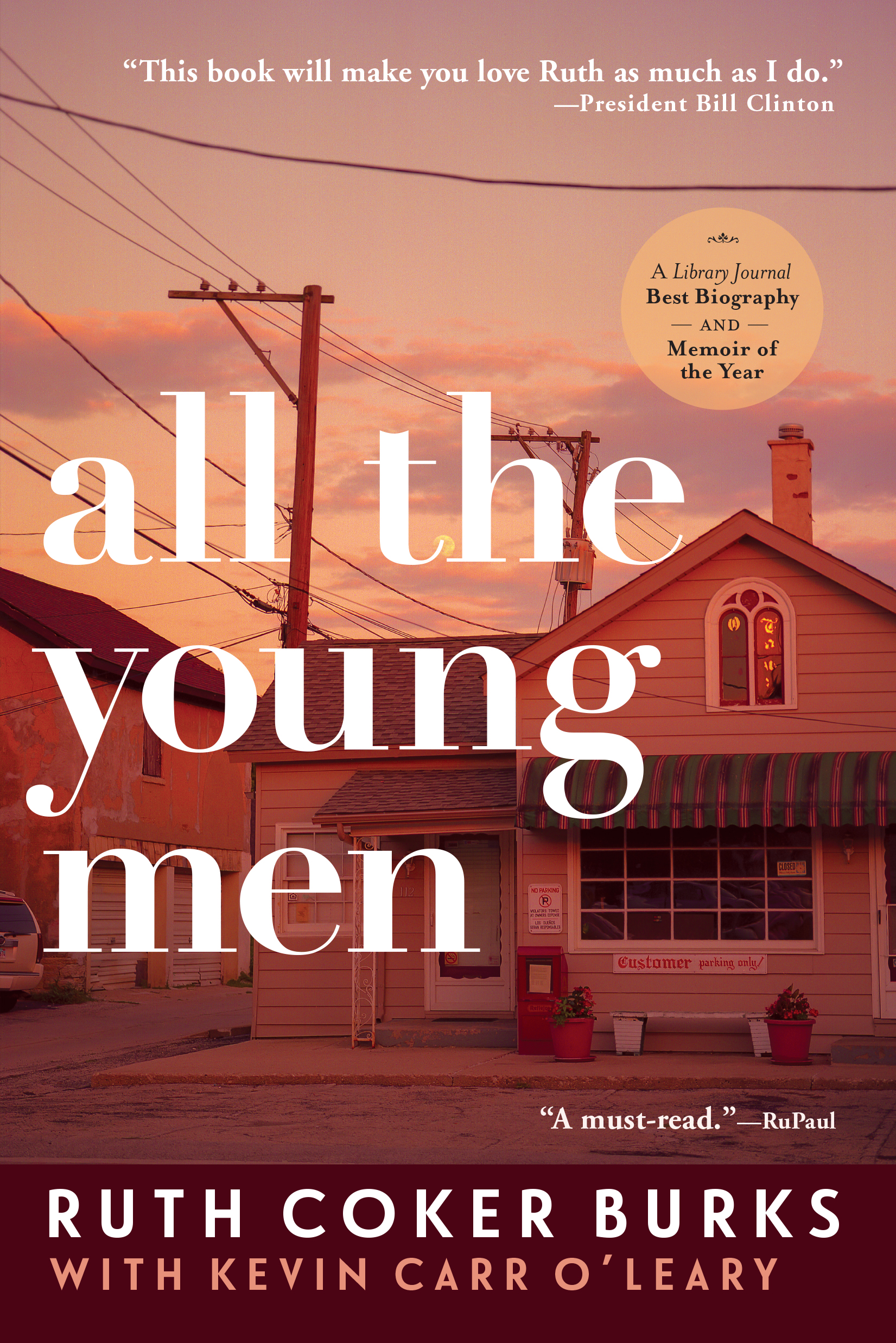
At the heart of Ruth’s memoir, and of recent criticisms of her memory, are the men, including Chip and Billy, who she cared for and those she later buried, such as Jimmy, in the Files Cemetery. Who were the titular ‘young men’ of Ruth’s autobiography, or as some of her critics lament, the lost ‘forty names’ of the Files Cemetery?38Gelder, “Ruth Coker Burks and the Missing Monument.”
Based on Ruth’s account, she cared for hundreds of men dealing with HIV/AIDS in central Arkansas from 1986 to 1995.39Garofalo, “Lessons in Love”; Koon, “Ruth Coker Burks: The Cemetery Angel”; Burks, "All Her Sons: The Cemetery Angel.” The ashes of a small number of them are interred in the Files Cemetery. These men had returned to Arkansas in search of care after living in New York or Washington, DC, or when they had left more rural parts of the state for Hot Springs or Little Rock. In Ruth’s telling, many of these young men only reluctantly returned to Arkansas for care that their families denied them.40Burks and O’Leary, All the Young Men, 30–31, 76–77. “My guy who made it all the way to DC,” wrote Ruth upon visiting Chip’s grave, “only to end up in the place he’d escaped from.”41Burks and O’Leary, 343.
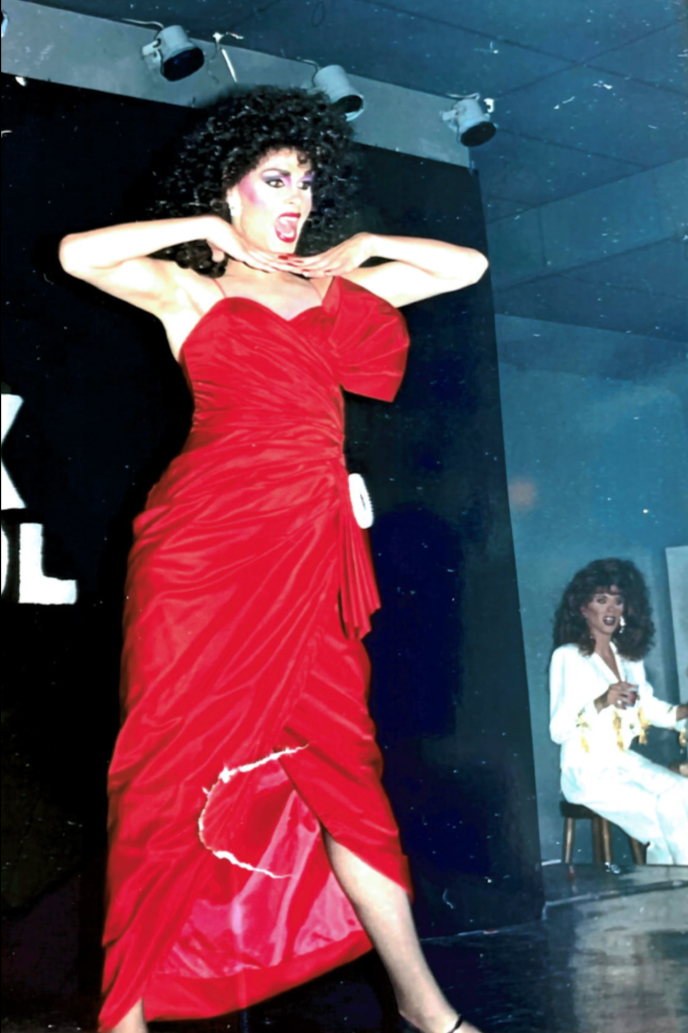
She cared for primarily working-class (sometimes indigent) young white and Latino men. Specifically, Ruth’s memoir, archives, and interviews record her work with numerous white country boys from the hills of Arkansas, Mexican immigrants in Hot Springs, and working-class drag queens. Many came from Mount Ida, Dardanelle, and other rural towns in central Arkansas.42Burks and O’Leary, 148–149, 165–167. Exemplifying this, Ruth’s beloved Billy, a luminescent drag queen, was “the movie star from Dardanelle.”43Burks and O’Leary, 166. Her guys included everyone from Jim, her first patient; to Tim Gentry, “a hillbilly dandy”; to Roger, whose family tried to wash away his sins in a creek baptism; and to the aforementioned Billy, the charismatic drag queen from Dardanelle who prominently featured in many newspaper profiles of Ruth and her book.44Koon, “Ruth Coker Burks: The Cemetery Angel”; Matthew Kincanon, “Ruth Coker Burks Describes Her Lifetime Caring for AIDS Patients to the Gonzaga Community,” The Gonzaga Bulletin, March 1, 2017, https://www.gonzagabulletin.com/news/ruth-coker-burks-describes-her-lifetime-caring-for-aids-patients-to-the-gonzaga-community/article_0e5de906-fdeb-11e6-b294-d72df02858f2.html; Burks and O’Leary, All the Young Men, 70. They also included men from Mexico who worked in tree planting or at the Hot Springs racetrack Oaklawn Park, including Angel Mestizo, whom Ruth recounts assisting as he simultaneously sought medical care and to avoid deportation.45Burks and O’Leary, All the Young Men, 274–277. The marginalized status of many of these men led them to Ruth, who, as she frequently reminds her readers and interviewers, lacked any formal medical training. As Paul Wineland, Billy's former partner, notes in the 2014 StoryCorps interview, "You were the only person that we could call. There wasn’t a doctor. There wasn’t a nurse. There wasn’t anyone. It was just you."46Garofalo, “Lessons in Love.”
Occasionally, Ruth did comment on the class divisions. She provided concise descriptions in her efforts to keep her childhood friend, Arkansas Governor Bill Clinton, informed about the AIDS epidemic: “But I knew he didn’t know the gay men I saw—the poor, the rejected, the ones with nobody to care for them.”47Burks and O’Leary, All the Young Men, 92. In discussing a professional ballet dancer whose partner came home to die in Arkansas, Ruth described “this ballet dancer who seemed so out of place and of a different class than the Hot Springs guys.” Ruth remembers the drag queens she saw at Our House in Hot Springs as goddesses who transformed the city. “The performers came and went . . . It was like Dynasty, but that was absurd because we were in Arkansas, which meant these people didn’t have the means to have a fabulous life. But there they were in fabulous gowns. . . . They were goddesses. The idea that I could breeze by someone like this in Hot Springs.”48Burks and O’Leary, 161, 267.
Not all of the men lacked political or social connections. Chip exemplifies this. While he was from Glenwood, which Ruth described as “one county over from Hot Springs and about forty years behind,” Chip had enjoyed a rising career working for the Democratic Party in Washington, DC. Chip lived with Ruth and her daughter for a few weeks, and she cared for him as he died.49Burks and O’Leary, 230, 233–235. This simultaneous intensity and brevity helps explain some of the gaps in her detailed knowledge of these men: “I felt at home, yet still at a distance from what these men were going through.”50Burks and O’Leary, 53. Ruth often provided daily care for weeks or months before their families sometimes stepped in for their last few days of life.51Burks and O’Leary, 260–266.
While Arkansas was the site of flight and reluctant return in Ruth’s memoir, Hot Springs served as a refuge for many rural gay men. At the gay bar Our House, “almost all the regulars had left their hometowns to create their own lives here in Hot Springs.”52Burks and O’Leary, 5, 37, 166. For a fuller queer history of Arkansas, see Brock Thompson, The Un-Natural State: Arkansas and the Queer South (Fayetteville: University of Arkansas Press, 2010).
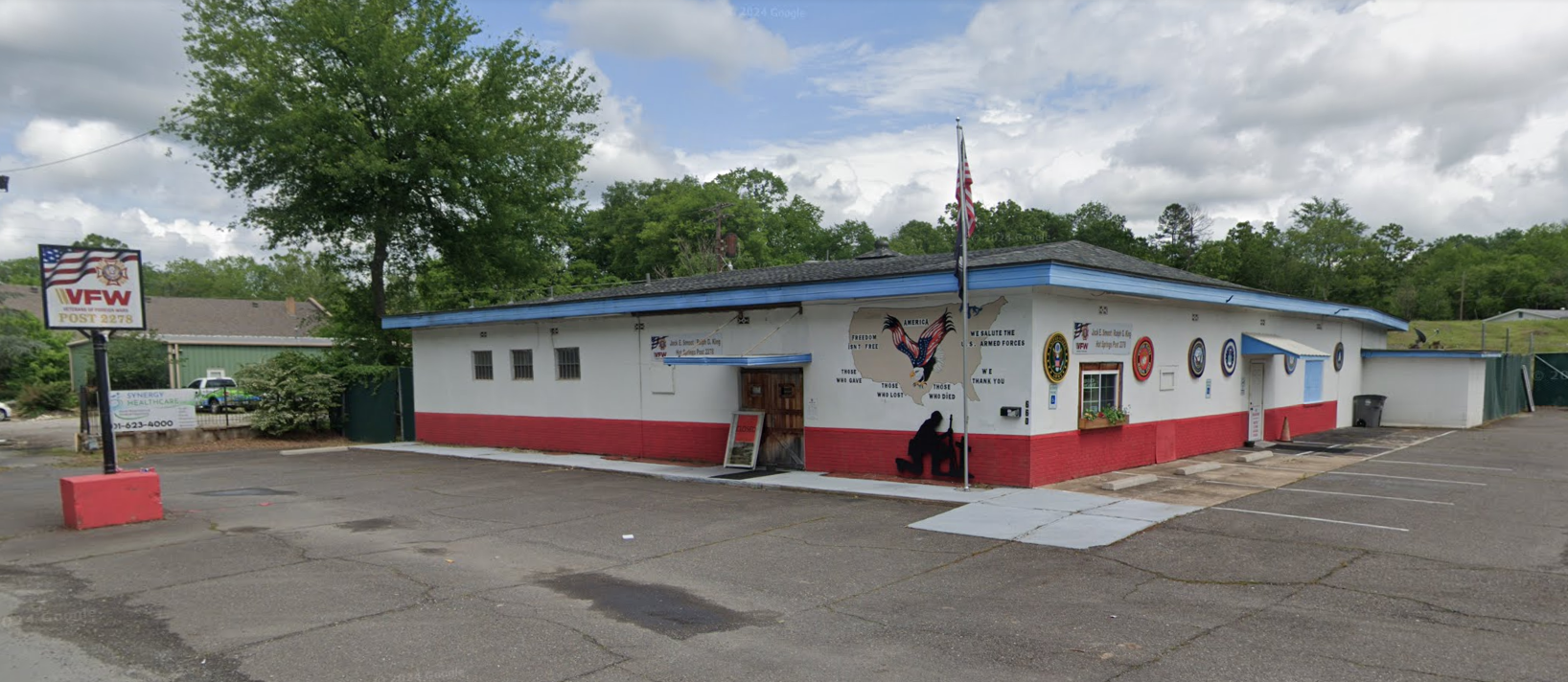
If Hot Springs was a refuge, the Files Cemetery emerged as a site for queer memory. Flagging the commemorative importance of this small cemetery, Ruth says “I wanted them to be counted, to have their lives matter, and I wanted them to have control over their destinies, no matter how limited they might seem to others. If I felt they were strong enough, I brought them to Files Cemetery and asked them to tell me where they’d like to be buried.”53Burks and O’Leary, 58.
A significant challenge of working with Ruth's archives and autobiography is the enduring ambiguities surrounding the number of cremations interred in the Files Cemetery either by her from the mid-1980s to the mid-1990s, or in the following years as the cemetery became informally associated with LGBTQ+ memory in Arkansas. Estimates of the number of men whose ashes Ruth interred range from five to approximately forty. In her early interview with StoryCorps, Ruth stated, "I’ve buried over forty people in my family’s cemetery because their families didn’t want them."54Garofalo, “Lessons in Love.” As one longtime resident of Hot Springs, Tim Looper, notes, there are five identifiable graves of men who died during the HIV/AIDS epidemic, and he remembers explicitly going to six funerals there.55Kacala, “Doubts Surround Viral Story of ‘AIDS Angel’ Who Says She Helped Hundreds of Dying Men.” Ruth has long maintained that dozens of other cremations have been interred at Files; she mentions fifteen names in her memoir. She insists that given the passage of time and her health problems, she does not remember the names of all the men she cared for.56Koon, “Ruth Coker Burks: The Cemetery Angel”; Kacala, “Doubts Surround Viral Story of ‘AIDS Angel’ Who Says She Helped Hundreds of Dying Men.” Moreover, she claims that initially in the 1980s, she concealed what she was doing in the Files Cemetery so that those who would have opposed burying abandoned people associated with AIDS there would not find out.57Burks and O’Leary, All the Young Men, 27–28. Further complicating the matter, Ruth claims that she started to receive anonymous ashes in the mail once she was interviewed about HIV/AIDS in local news outlets, and she proceeded to inter these ashes as well.58Burks and O’Leary, 133–136. Finally, the ashes of people Ruth did not know personally have also been interred at Files, as it became a potent space of LGBTQ+ memory. During an August 2020 visit to the cemetery, Ruth noticed a recently added memorial to a queer-identifying young man whom she had never met.
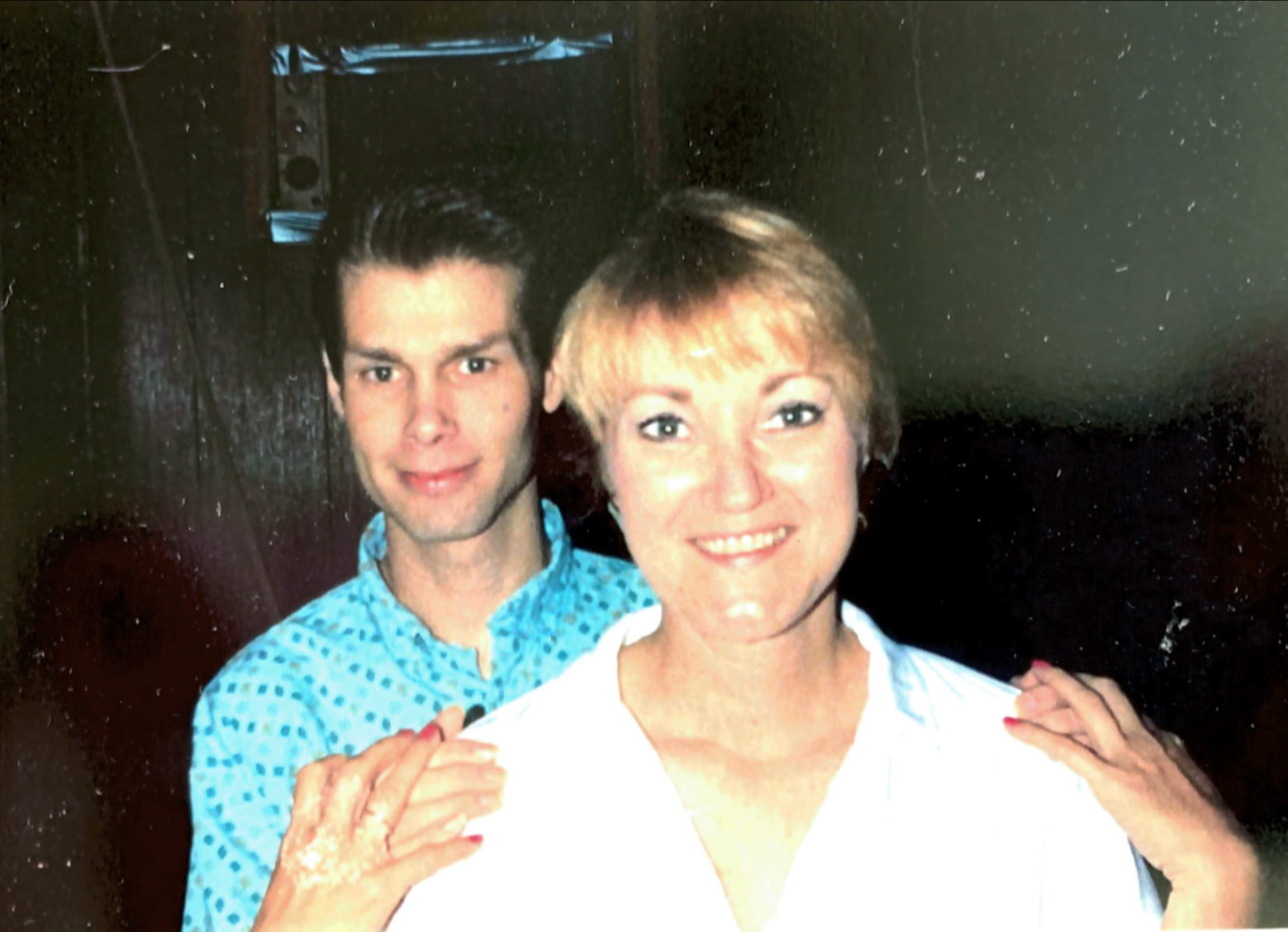
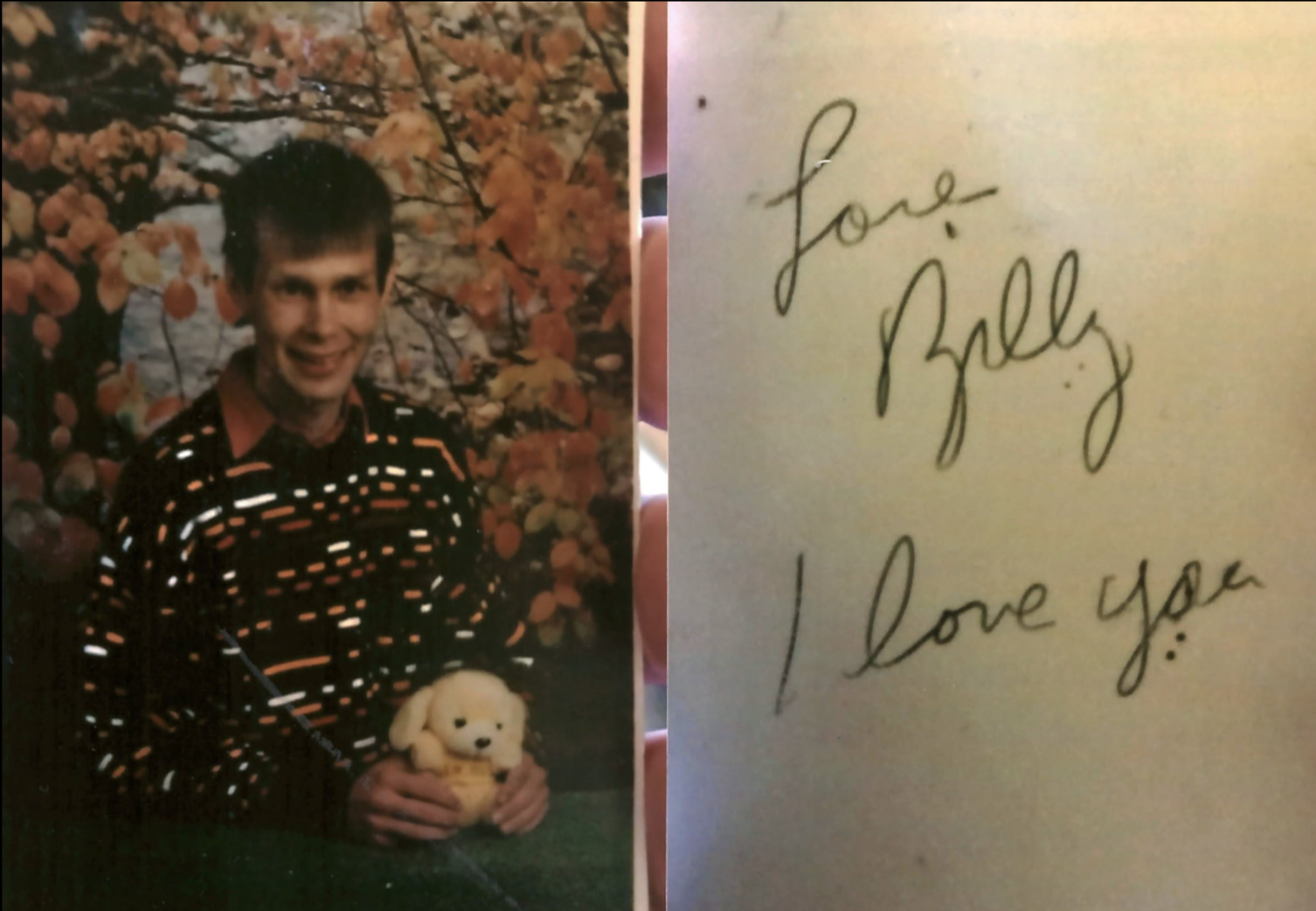
Ambiguity, anonymity, and informality have been central elements of Ruth's work from the beginning. In response to praise during her StoryCorps interview, Ruth said, "You know, they always say 'fake it ‘til you make it,' and I faked my way through the whole thing. I didn’t know what I was doing. I didn’t know anything."59Garofalo, “Lessons in Love.” Respecting the anonymity of many men is central to Ruth's understanding. "I'd go to an apartment to bring food, and another man would be there,” she writes. "There were people I recognized, though I pretended not to know anything about them."60Burks and O’Leary, All the Young Men, 97–98. Ruth's publisher noted in 2021, "Many of the men Ruth helped and eventually buried approached her asking for anonymity due to not wanting to be outed."61Kacala, “Doubts Surround Viral Story of ‘AIDS Angel’ Who Says She Helped Hundreds of Dying Men.”
The cemetery is a throughline in Ruth's memoirs and interviews. She returns to this commemorative geography at the end of All the Young Men as she narrates the journey from Rogers, in the northwestern corner of Arkansas, where she currently lives, back to her hometown of Hot Springs. “I make my way, finally, to Files Cemetery. The carpet of pine needles crunches under my feet as I make the rounds. The mockingbirds still caw above me. I clear brush here and there on the graves, saying hi to Misty before walking over to see Angel, Carlos, and Antonio.”62Burks and O’Leary, All the Young Men, 344. Alongside its status as a refuge and commemorative space, the cemetery is a site of considerable pain for Ruth, not only in terms of the family conflict that resulted in her contested ownership of many cemetery plots and the memory of the men she buried there, but also the more recent debates over what she did (or did not do) in caring for them.
Ruth's Fragmentary Archive
There are scattered, evocative references to Ruth’s archival materials throughout All the Young Men, whether to her pink leather daybook or to the collection of newspaper clippings related to her successful efforts to mobilize the Downtown Merchants Association of Hot Springs for Worlds AIDS Day on December 1, 1993.63Burks and O’Leary, 154, 337, 339. Her fragmentary archive complements recent public history scholarship on queer history and memory in rural areas of the United States. For example, a 2019 special issue on “Commemorating Queer History" in The Public Historian explored how museum exhibits and historical sites, especially in smaller towns and more rural areas, engage queer history.64See Rebecca Bush, “Woman, Southern, Bisexual: Interpreting Ma Rainey and Carson McCullers in Columbus, Georgia,” The Public Historian 41, no. 2 (2019): 94–115; Christopher Hommerding, “Queer Public History in Small-Town Wisconsin: The Pendarvis Historic Site and Interpreting the Queer Past,” The Public Historian 41, no. 2 (2019): 70–93; Fosl and Vivian, “Investigating Kentucky’s LBGTQ Heritage.” As Christopher Hommerding argues, such histories in non-urban areas “[give] lie to the notion that queerness outside of urban centers was historically hidden, invisible, and cut off from queers in other locations.”65Hommerding, “Queer Public History in Small-Town Wisconsin,” 73. Moreover, public historians such as Fosl and Vivian have foregrounded the challenge of “an uneven, often spare historical record” and the need for “better geographic representation” of queer histories in southern spaces.66Fosl and Vivian, “Investigating Kentucky’s LBGTQ Heritage,” 221–222.
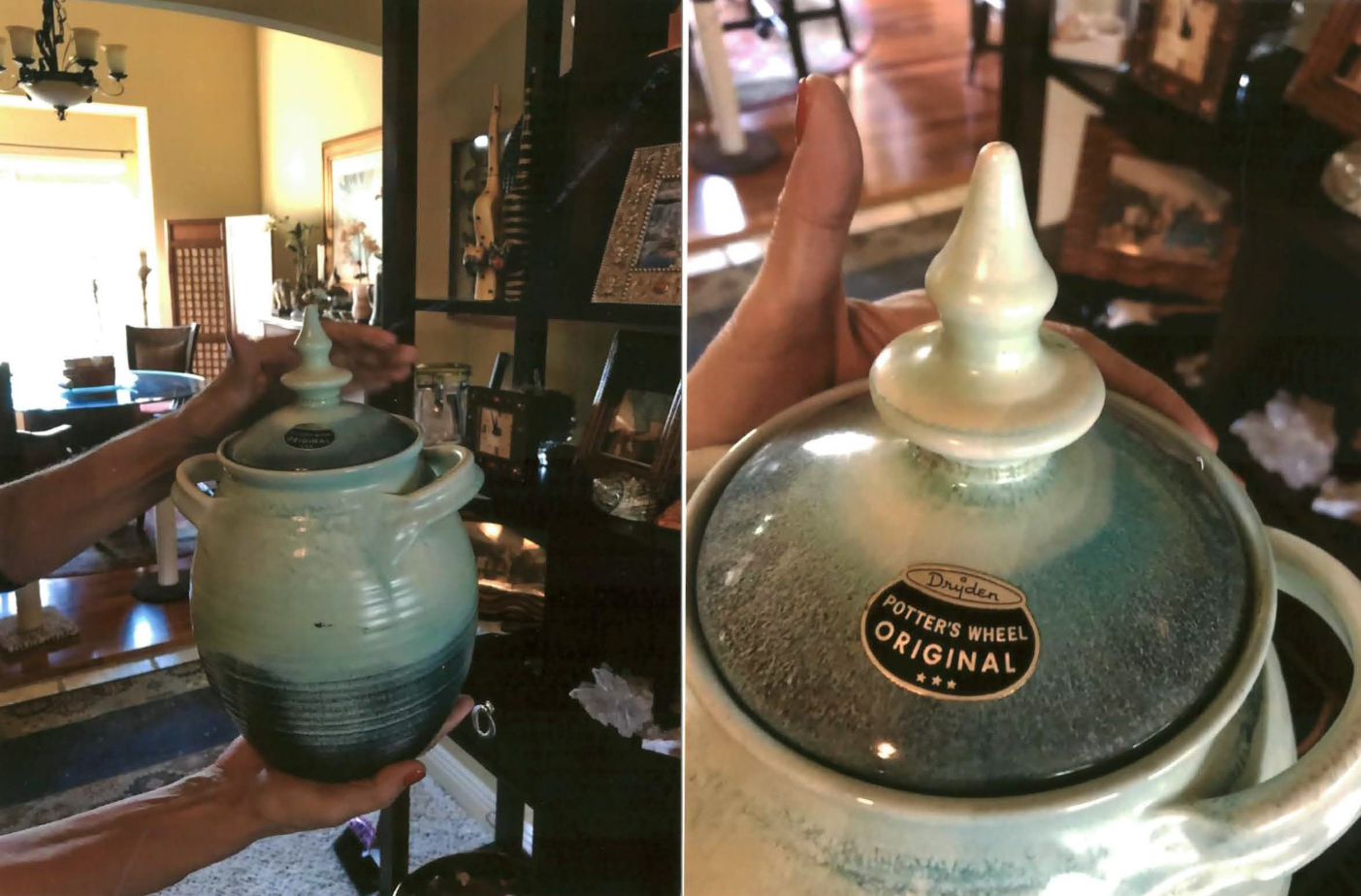
In 2022, Ruth donated her archival materials to the Center for Arkansas History and Culture (CAHC) in two batches. The first, more significant donation of materials primarily consisted of biographical and professional information, including planners, personal writing, news clippings, Christmas cards, and scattered photographs from Ruth’s activism and travels in the 1990s. This also included ephemera such as AIDS education t-shirts, drag ball gowns (one of which Ruth wore to Bill Clinton’s first inaugural ball), and the final pottery urn from Dryden Pottery that Ruth never used. The second, smaller donation comprised photo albums, newspapers, magazines, and All the Young Men publication materials. We wish that Ruth had kept better records, but this is the regrettable reality of many archives. Perhaps a better question than why Ruth did not keep better records is what this rich, if incomplete, archive can tell us about the history of HIV/AIDS.
Ruth’s daily planners illustrate the simultaneously rich and fragmentary nature of the collection. The planners in the archival collection include more blank pages than written ones, with some pages marked with only a single name. These fragmentary entries are mundane, a day-to-day account of an individual woman’s hopes and fears. Many are simple notes or reminders, the importance and context coming from either conversation with Ruth or other external sources.
Ruth’s archive reveals what it must have felt like in those difficult early years when she claims she primarily acted alone. As she puts it in the epilogue of her autobiography, “There was no one behind me. I had no choice but to help them.”67Burks and O’Leary, All the Young Men, 343. David Koon began his 2015 profile of Ruth in the Arkansas Times as “one lonely person” attempting to “budge the vast stone wheel of apathy.”68Koon, “Ruth Coker Burks: The Cemetery Angel.” This theme of isolation and hostility runs throughout her memoir. As Ruth notes of one church supper, other parishioners “eyed me suspiciously, but they always eyed me suspiciously, even before I was the town pariah.”69Burks and O’Leary, All the Young Men, 152.
But Ruth was not the only individual caring for AIDS patients in central Arkansas. All the Young Men can be read as a record of “the town elders” of Hot Springs who quietly assisted her. This is best exemplified by Clay Farrar, a prominent Hot Springs lawyer. Clay introduced Ruth to a network of Rotary Clubs where she spoke about her care work and AIDS activism and connected with prominent men who were willing to provide support quietly. Several bankers in Hot Springs occasionally assisted Ruth with monetary donations or by requesting favors in the medical profession.70Burks and O’Leary, 182–184, 257–258.
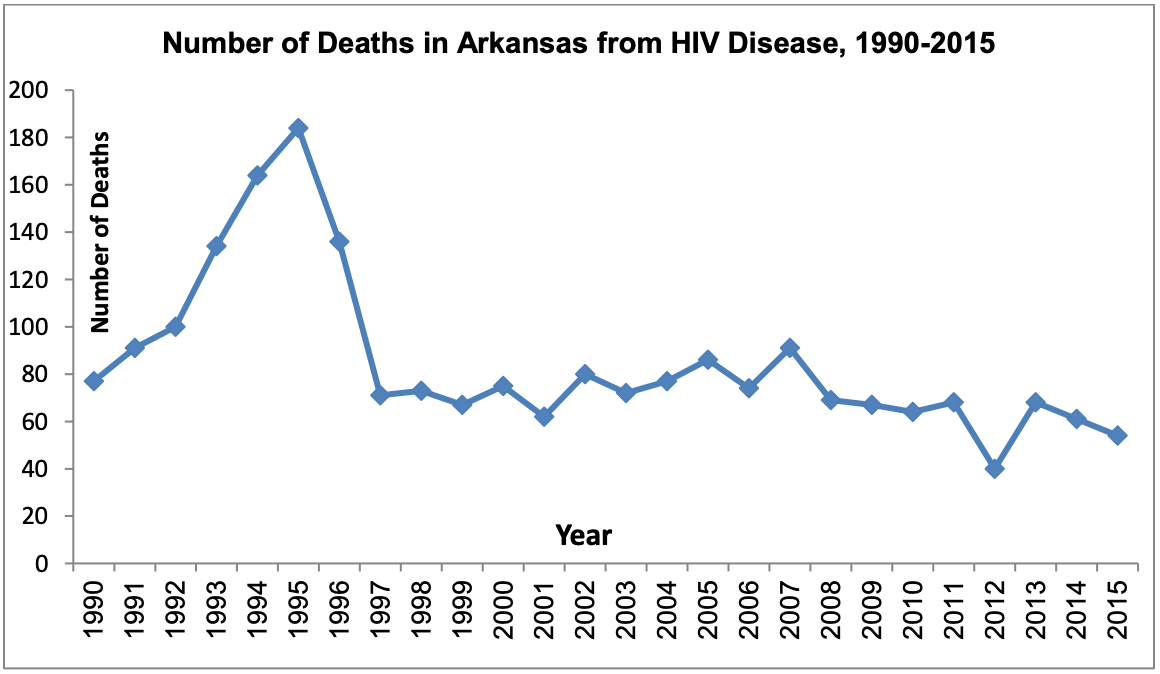
Certainly, a range of individuals and non-profits attempted to help those dealing with HIV/AIDS in Arkansas in the 1980s and early 1990s; however, Ruth’s searing memory but factual inaccuracy in insisting that she acted alone evokes the experience of the HIV/AIDS epidemic for the men she cared for, many of whom—working class, indigent, and abandoned—were from the hills of Arkansas or were Mexican immigrants far from their families. These men were on society’s margins in multiple abject ways. As Ruth describes visiting Angel in the hospital, “Angel and I smiled at each other, together in our lonely place.”71Burks and O’Leary, 277.
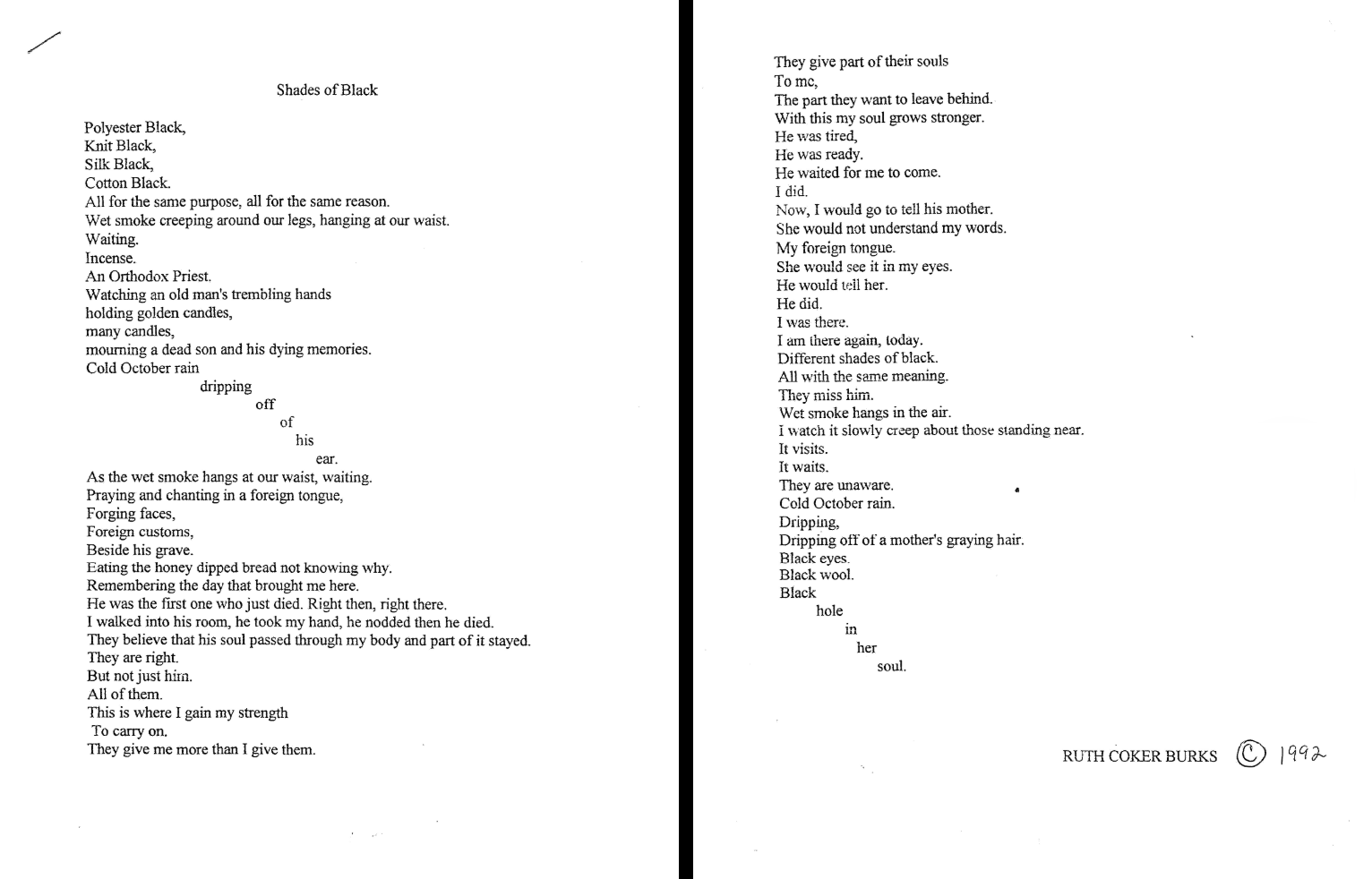
This sense of isolation is also represented in Ruth’s archival materials, for instance, in two poems she wrote in the early 1990s, “Shades of Black” and “THIRTYONE.” In writing about her first patient, Jimmy, in “Shades of Black,” the death Ruth recalls is sudden and lonely; there is only Ruth and a dying man crying out for his absent mother. Ruth went into the room alone, held this man’s hand, watched him die, and walked out of the hospital room alone. “Remembering the day that brought me here. He was the first one who just died. Right then, right there. I walked into his room, he took my hand, he nodded and then he died.”72See, Box 6, Folder 16, Ruth Coker Burks papers, Center for Arkansas History and Culture, Little Rock, Arkansas.
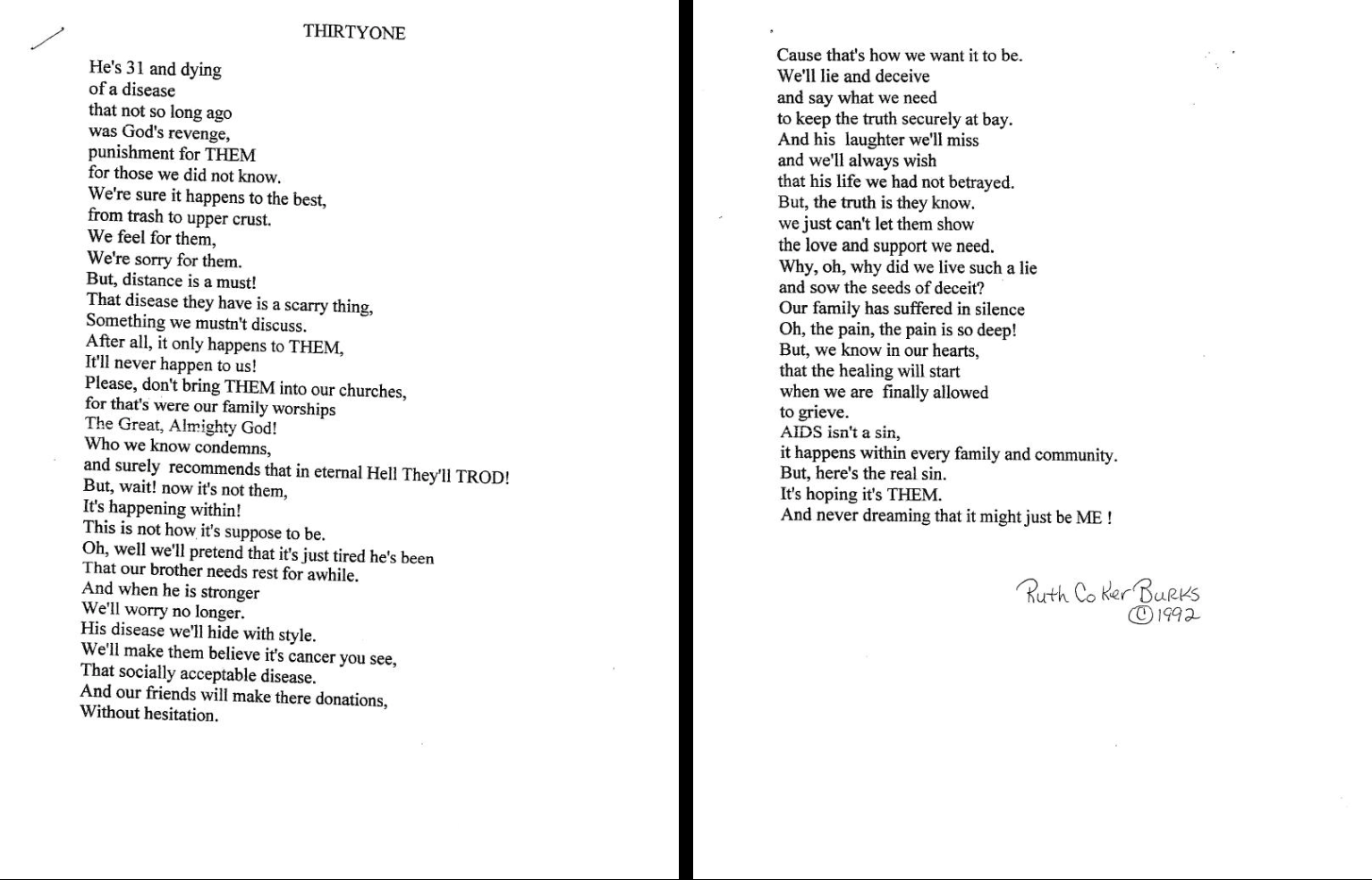
In “THIRTYONE,” the sense of isolation is deployed in anger against society and religious institutions. Ruth writes: “He’s 31 and dying of a disease that not so long ago was God’s revenge, punishment for THEM. While Ruth was sharply critical of the hostility of many religious institutions in Arkansas from the mid-1980s and mid-1990s, she remembers her care work and activism relative to her religious faith. As she has repeated in conversations with us, “I never lost my faith; I just lost faith in everyone else’s faith.”73See, Box 6, Folder 16, Ruth Coker Burks papers, Center for Arkansas History and Culture, Little Rock, Arkansas.
Criticism in Context
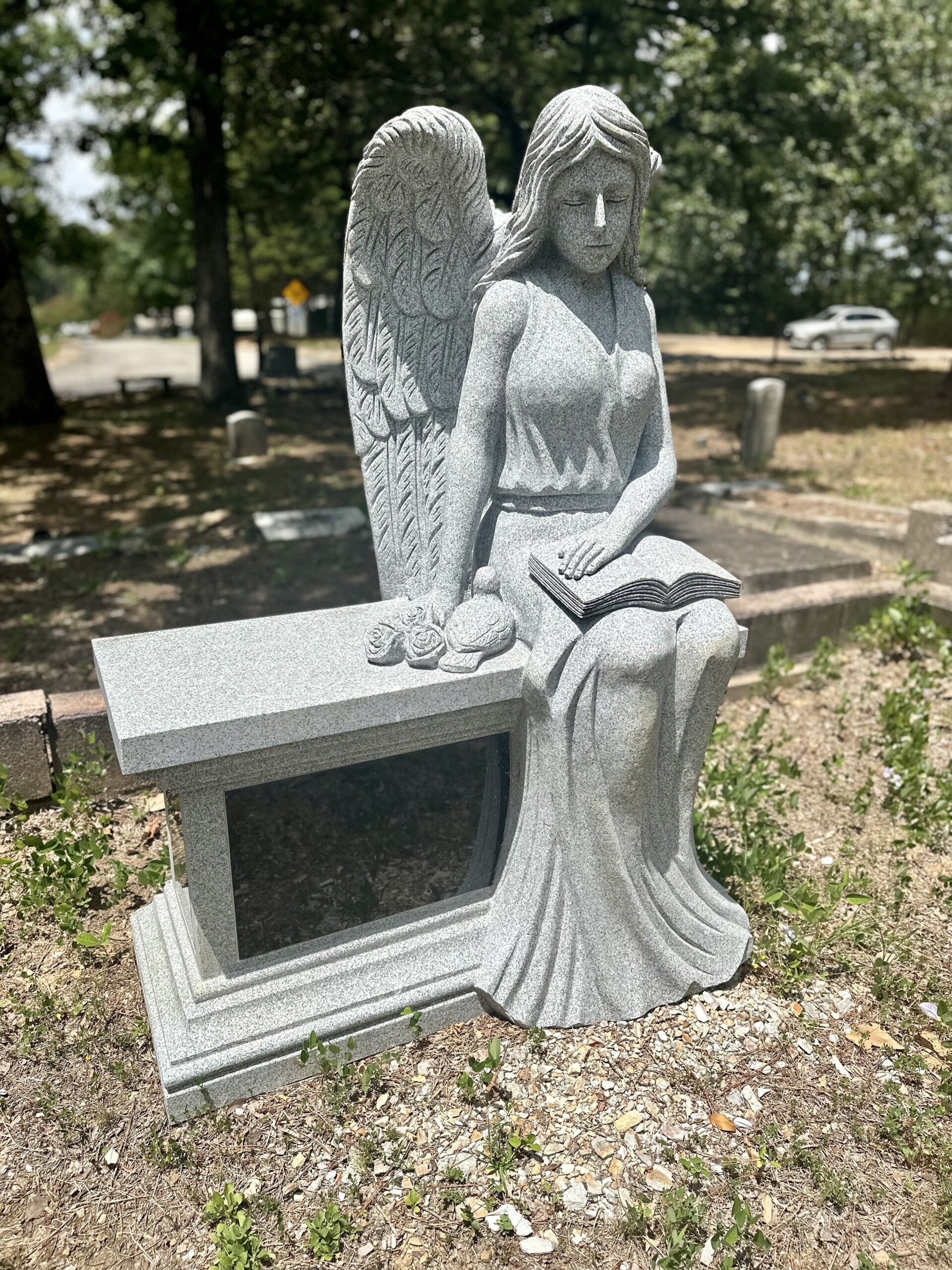
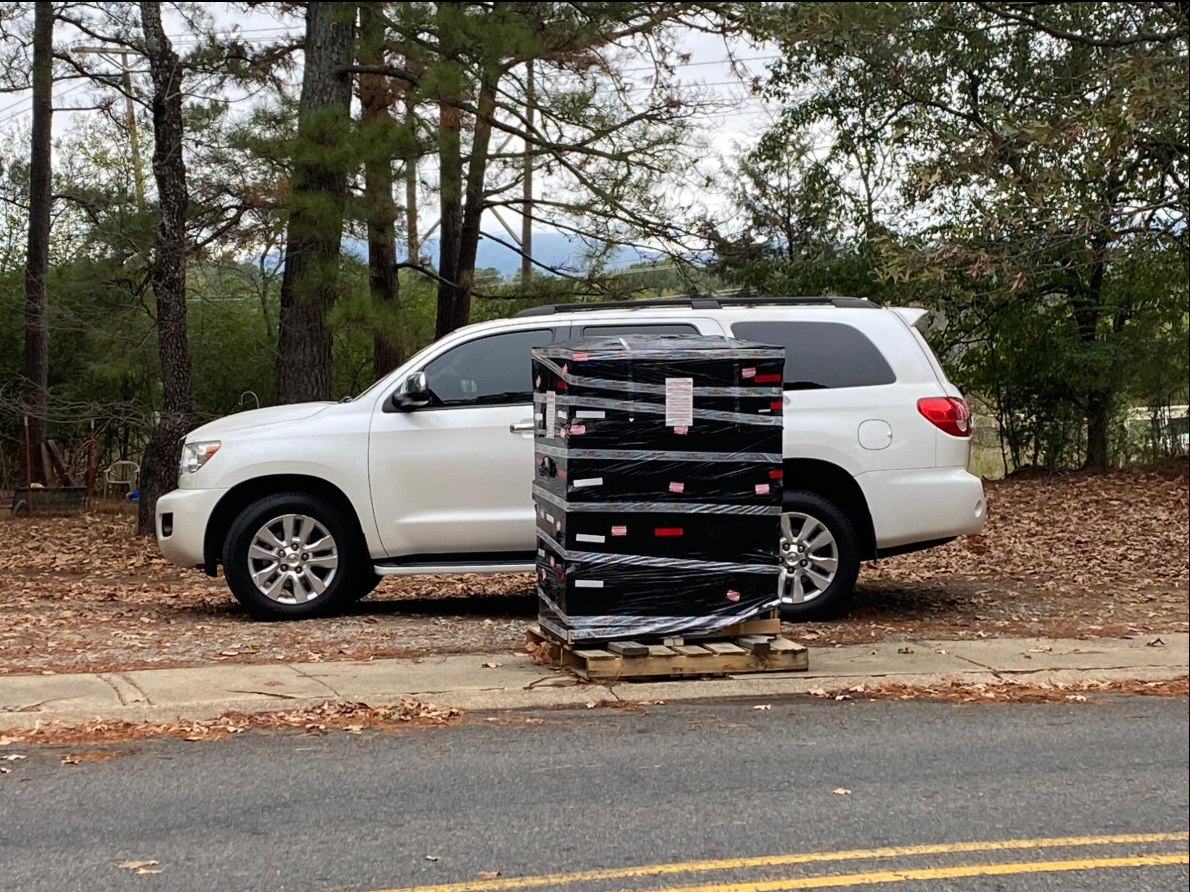
In time, media coverage of Ruth shifted from the laudatory into two overarching criticisms. First, Ruth either kept shoddy records of the men whose ashes she interred in the Files Cemetery or was guilty of exaggerating the number she cared for or buried. Second, she has either been unwilling or unable to put up a monument to these men at the Files Cemetery despite advocating for a memorial for years. Some of her critics suggest that a successful GoFundMe campaign (to raise money for a cemetery memorial and Ruth’s medical bills) was entirely used for the latter purpose and not for the former. For example, in a 2021 piece, the Arkansas Times journalist Austin Gelder discussed how there was not yet a memorial, local disappointment in the limited impact of Ruth’s newfound celebrity on Hot Springs, and debates over ownership and oversight of the Files Cemetery. In a subsequent piece for NBC News, Alexander Kacala expanded on these concerns over funding, management of the Files Cemetery, and local disappointment (and anger.) Kacala also suggested that Ruth may have exaggerated or even fictionalized some of her claims, particularly regarding the number of men for whom she cared.74Kacala, “Doubts Surround Viral Story of ‘AIDS Angel’ Who Says She Helped Hundreds of Dying Men.” It is important to note that in late 2022, Ruth arranged for a monument to be constructed and delivered to the Files Cemetery.
As Gelder notes, most of her critics still “commend Burks . . . [and] don’t want to detract from her good deeds” while insisting on clarity.75Gelder, “Ruth Coker Burks and the Missing Monument.” In turn, Kacala surmises that beyond the good deeds that Ruth did in the 1980s and early 1990s, “over the years either she or the media have sensationalized the story for some sort of gain.”76Kacala, “Doubts Surround Viral Story of ‘AIDS Angel’ Who Says She Helped Hundreds of Dying Men.” Some in Hot Springs are more critical, including Robert Klintworth, a former friend of Ruth who cared for the Files Cemetery for many years (Klintworth provides much of the criticism in both the Arkansas Times and NBC News pieces). Klintworth claims he and his partner, Paul Wineland (who was Billy's partner before his death), cared for the cemetery and provided Ruth with significant assistance in remembering details and names for her book, but that the rewards of the “book deal, a movie deal, and international recognition” have accrued to Ruth alone.77Gelder, “Ruth Coker Burks and the Missing Monument.” Paul Wineland was also central to the 2014 StoryCorp profile, which fed the media's interest on Ruth’s story.
Along with Klintworth, Tim Looper cared for the cemetery for several years after 2015. Looper also is one of Ruth’s prominent local critics, and has argued that Ruth exaggerated her narrative and/or does not remember events accurately.78Kacala, “Doubts Surround Viral Story of ‘AIDS Angel’ Who Says She Helped Hundreds of Dying Men.” Looper maintains, for instance, that Ruth’s first hospital visit occurred in Hot Springs and not in Little Rock, as she writes in her memoir. According to Ruth, some local drag troupes have also provided informal care for the cemetery. In 2023, Hot Springs resident Jim Thompson began to care for the seemingly neglected cemetery, as reported by the local news.79Rolly Hoyt, “One Man’s Mission Helps Restore a Site of Arkansas Cemetery Holding Remains of AIDS Victims,” THV 11, October 26, 2023, https://www.thv11.com/article/news/local/arkansas-files-cemetery-aids-restoration/91-39e9dad1-7ece-4244-b854-4e1d2091c5bc.
A June 2024 YouTube video podcast, RUTHLESS: The Real Story Behind the ‘Cemetery Angel of Arkansas’ alleges to uncover the “scam” perpetrated by the “grifter” Burks. The three-hour video is a sensational retelling of the 2021 Arkansas Times article. Looper is the principal source and the recurrent themes include the alleged exploitation of gay deceased men for fame and fortune, the accusation of profiting from a never-constructed (but since built) memorial, the flagging of factual errors and inconsistencies in the memoir, Ruth’s alleged failure to recognize other individuals and entities who provided aid, and a general sense that her version of events has disparaged Hot Springs and Arkansas. Posted comments about the video are overwhelmingly critical of Ruth, but it is beyond the scope of this article to evaluate these claims.
The CAHC is working to process Ruth's and others' archival papers from these years. However, it would take a large research budget (and a significant scholarly team) to, 1) carefully and responsibly reconstruct the life histories of the men buried in the Files Cemetery, 2) locate the interred cremations within the Files Cemetery with both precision and respect for anonymity, and 3) carefully and empathetically adjudicate the conflicting claims by drawing on state and local records. Complicating any research efforts is the reality that almost all of the direct witnesses of what Ruth did are long dead, and the remaining few include both fervent supporters and biting critics. These conflicting accounts rely on individual memories of traumatic events that occurred at least thirty years ago.
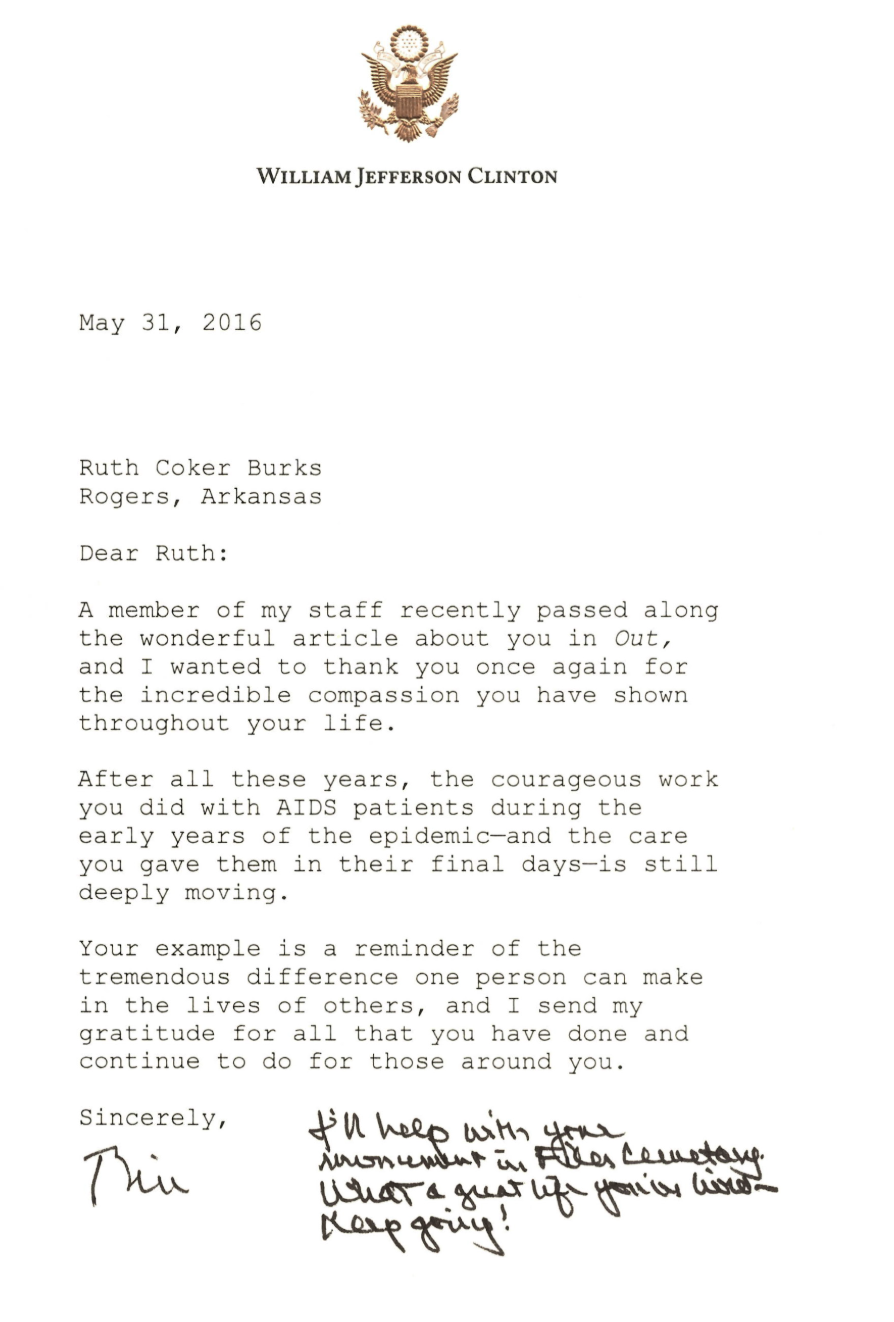
Many of the critiques voiced in newspaper articles and videos are valid. We too would like to know more about the men's life histories and see the Files Cemetery physically transformed into the commemorative site it already is in the minds of so many. In telling and retelling Ruth's story, it is clear that many details and claims remain constant, alongside some ambiguities and exaggerations. Ruth is not necessarily the appropriate target for all of these legitimate concerns. Or to reframe Kacala’s observation as a question, if elements of Ruth’s story have been ‘sensationalized’ over the years, to what end have they been sensationalized for a reading public in Arkansas and beyond?
Our preliminary research suggests that the presentation of Ruth as an almost saintly figure began with the 2014 StoryCorps interview and the 2015 Arkansas Times profile. In the StoryCorps interview, Michael Garofalo notes, "Ruth is one of those rare people who doesn’t run away from suffering. She runs toward it without hesitation."80Garofalo, “Lessons in Love.” David Koon’s article in the Arkansas Times in 2015 was titled, “Ruth Coker Burks, the Cemetery Angel.” A photograph of Ruth overlayed with the text, “St. Ruth,” was the cover story of the initial print edition (the “St. Ruth” title was removed from the online version). It was more often in the headlines of stories, rather than in the body of articles, that she was presented in saintly or angelic terms.
These binary understandings of Ruth, either as a living saint and the Arkansas cemetery angel, or as a fantasist and teller of tall tales, do not map onto the reality of her evocative and fragmentary archive. Returning to the questions we posed at the beginning of this article, what can Ruth’s archive tell us about the history of the AIDS epidemic in Arkansas and the construction of the role of the idealized caregiver for some Arkansas women at the time?
One answer that her archive does provide is that contestation and debate have long been integral to Ruth's care work and activism and that she has always had both enthusiastic supporters and harsh critics. Based on newspaper clippings from her archival donation, the criticism of Ruth and her work began in the early 1990s. In a 1993 letter to the editor published in the Sentinel-Record (Hot Springs, AR) that echoes some of the later criticism, the author states that Ruth “claims too much credit . . . her statistics are out of this world,” and that Ruth made AIDS patients stand out in the cold during a World AIDS Day service. Other local newspaper pieces saved by Ruth from the early 1990s had less to do with Ruth herself and instead reflected rampant prejudice against gay men. An undated letter to the editor states that the author is withdrawing their membership to the Downtown Merchants Association of Hot Springs due to the Association’s support of AIDS Awareness Day since, in the words of the outraged author, “AIDS is a behaviorally transmitted disease and does not need awareness or anything other than saying 'no' to homosexual activity or drug use. How much does it cost to teach that?”81See, Box 6, Folder 2, Ruth Coker Burks papers, Center for Arkansas History and Culture, Little Rock, Arkansas.
Criticisms of Ruth are not the only subject of the news clippings that she assiduously collected. There are several undated articles praising Ruth and her work. These positive assessments from the early 1990s foreshadow the recent praise of Ruth's care work and activism. One letter by Robert Gale (the vice-president of Helping People with AIDS) refuted the claim that Ruth was not the executive director of HPWA, and praised her efforts in that role. At least two articles in Ruth’s collection mention her professional work at her day job at Prudential Lakefront Real Estate.
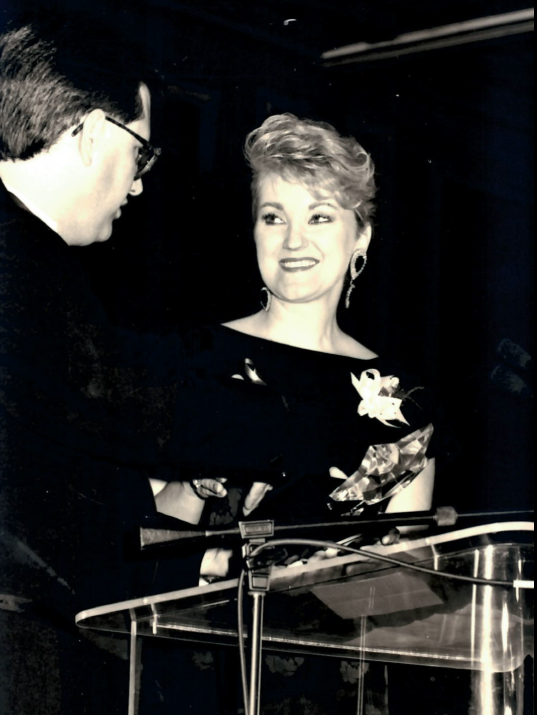
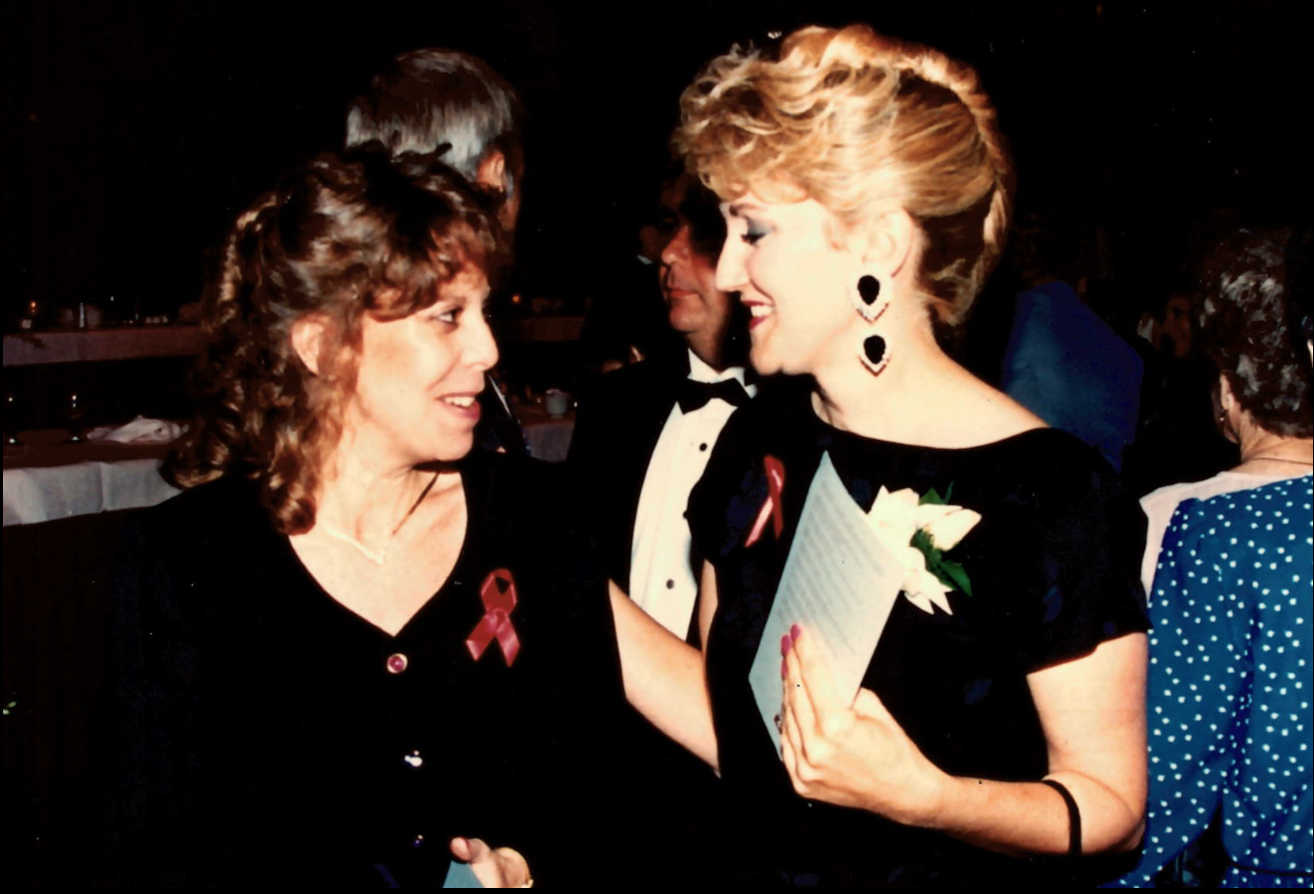
Ruth’s archival collection includes a binder of letters of recommendation and typed endorsements from prominent citizens regarding Ruth’s nomination for the Arkansas Community Service Award, the establishment of an HIV/AIDS program at Levi Hospital, and the nomination of Ruth for the position of Executive Director of the Arkansas AIDS Foundation. These letters provide further evidence of the sustained care work that she offered. For example, a local attorney wrote that “Ruth has demonstrated her commitment to the care of those who are HIV positive, and we are fortunate to have someone already in the community who is prepared to immediately take on such a responsibility.”82See, Box 6, Folder 20, Ruth Coker Burks papers, Center for Arkansas History and Culture, Little Rock, Arkansas.
The testimony of some of Ruth’s critics lends credence to her sustained, if controversial, presence. Kacala includes an extended quote from Hot Springs resident Daymon Jones, a long time survivor of the AIDS epidemic in Hot Springs, who is harshly critical of Ruth. In Jones’ own words, “I have contempt for her … She makes it look like my town was hostile to people with HIV. It’s the fact that she has used that stereotype to portray my town and my community as something horrible and that was not the story.” Jones was particularly annoyed at what he saw as Ruth’s pushy methods in attempting to provide him with unwanted help. Again, in Jones’s own terms, “What really got me riled up [was] how she does it. . . . She said, ‘Well you know I can bury you, too, when you die.’ Well Ruth, I have no intention of dying right now, and even if I do, I have a family cemetery. ‘They won’t let you in, you know that.’ Oh yes they will. We discussed this already. She tried to use fear to make herself look like she was somebody that was going to help.”83Kacala, “Doubts Surround Viral Story of ‘AIDS Angel’ Who Says She Helped Hundreds of Dying Men.
Jones’ comments clearly illustrates that some people living with AIDS in Hot Springs found Ruth’s efforts unnecessary and even offensive. At the same time, the anecdote also suggests that by the early 1990s, Ruth was locally well-known for AIDS-related activism and care work and that she regularly discussed her cemetery as a possible final resting place for those excluded elsewhere.
Conclusion
What can we make of the competing media narratives depicting this individual woman to be either a saint, selflessly salving the wounds of AIDS patients, or a sinner, exaggerating what she did and pocketing the cash? We want to argue that the legitimate anger aimed at the incomplete historical record of these men's lives and the decaying state of their final resting place is standing in for a much larger problem—the terrible treatment accorded those dealing with HIV/AIDS in Arkansas in the 1980s and 1990s by many medical institutions, by civil society, by their families, and by religious congregations. As Ruth put it, with hopefulness, “if I sound the alarm . . . the cavalry will come.”84Burks and O’Leary, All the Young Men, 183. Yet the cavalry never arrived, at least for many of the men for whom Ruth cared. These conclusions are born out in the two persistent emotions that weave their way throughout her story: her searing anger at the failure of others to not do more, and her deep, enduring love for these men whom she often only knew briefly at the very end of their lives. This echoes Harris’s influential analysis of the role of a range of emotions in Black women activists' perspective on their AIDS activism, especially the entanglement of love, compassion, and solidarity with frustration and anger.85Harris, “Emotions, Feelings, and Social Change,” 191–195.
Maybe this rush to canonize or vilify Ruth is an effort to displace this broader societal failure. Suppose Ruth was an angelic caregiver for those dying of AIDS. In that case, it absolves all those in Arkansas (and elsewhere) who either did nothing or actively discriminated against gay men. In turn, if Ruth was an imperfect record keeper with a shaky memory, she could become the target of all the legitimate anger of how these men were treated in life and death.
The archive of Ruth’s life, activism, and care work, and its fragments offers a much more sobering history of AIDS in Arkansas: a colossal tragedy and a systemic failure. Not a failure on the part of Ruth or the other individuals who, at a tremendous personal sacrifice, helped those dealing with HIV/AIDS, but rather a systemic failure on the part of many medical institutions, state government, and civil society. Returning at the very end of her autobiography to the very beginning of her story (when she walked into Jimmy’s hospital room in Little Rock in 1986), Ruth puts it a different way: “The question I get most, the one I hate, is why I went into his room. And why I helped people. Again and again . . . the answer is, How could I not? The real question is, How could you not?”86Burks and O’Leary, All the Young Men, 345.
Ultimately, it is not a question of what Ruth Coker Burks did (or did not do) to become the Arkansas Cemetery Angel, but rather what the depictions of Ruth as an angel and a saint in print and the media reveals about the memory (and continuing reality) of AIDS in Arkansas. At its most potent, Ruth's memoir and archives—alongside the Files Cemetery—not only illustrate the deep commitment of one inspiring individual, however imperfect, to help those suffering at society's margins, but also provide a glimpse into the lives of the men she cared for, whether in documenting their loneliness, their heroic efforts to live as long as they could, or in their fashioning of substitute mothers and chosen family.
Acknowledgements
The authors would like to thank Nathan Marvin, Marta Cieslak, and David Baylis for their encouragement, generous feedback, and insights that contributed to the development of this article.
About the Authors
Andrew Amstutz is an assistant professor of history at Queens College, CUNY. He has published articles in Comparative Studies of South Asia, Africa and the Middle East, Philological Encounters, and South Asia. Prior to joining Queens College, he taught at the University of Arkansas at Little Rock.
Jess Porter is executive director of the Center for Arkansas History and Culture, the University of Arkansas at Little Rock's archive. He is a geographer and former chair of UALR's history department.
Phoenix Smithey is the head of special collections and university archivist at the University of Central Arkansas. Smithey is active with the Academy of Certified Archivists, the Society of Southwest Archivists, and the Arkansas Humanities Council. She teaches in the fields of archival management and archival preservation.
]]>Preface
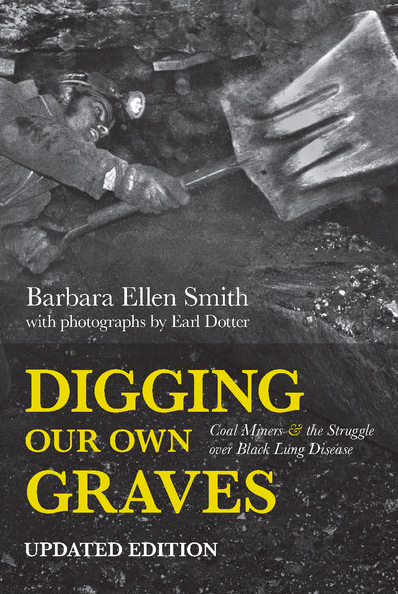
Digging Our Own Graves, first published in 1987, concluded with an ominous prediction: "Black lung disease awaits the younger generation of coal miners who are now at work underground." Would that I had been wrong! Today, not only do coal miners still suffer from this lethal but preventable lung disease, they do so at younger ages, some even in their thirties, and they are contracting the most advanced form of black lung at the highest rates ever recorded. More than fifty years after the US Coal Mine Health and Safety Act of 1969 imposed a respirable dust standard on the coal industry, designed to prevent black lung, why do such carnage and suffering persist? This updated version of the original book seeks answers to that question.
My own introduction to black lung began in the winter of 1971–1972, when I came to West Virginia to work for the Black Lung Association. I was barely twenty years old. Extraordinary political transformations were in the making: coal miners, miners' wives, and widows were challenging powerful institutions that had once commanded their acquiescence—the hierarchy of the United Mine Workers, the coal operators' association, county political machines, and the Social Security Administration.1The language of "miners' wives and widows" implies that all miners are male. However, since at the least the 1970s, women have worked in the mines, including underground, albeit in small numbers. I use the language of "wives and widows" because most black lung activists use this language in their organizing and their discussion of black lung compensation (e.g., "widows' claims"). For a young college student from the Midwest, these developments in the mountains of West Virginia beckoned with a romantic excitement. Besides, the mountains were my ancestral homeplace; now I could return to them, not on a summer vacation in the backseat of the family car, but on my own.
Working with the older coal miners and impatient young organizers who made up the Black Lung Association at that time was a formative political experience for me. Coming from a long line of southern subsistence farmers and circuit-riding preachers, I was instilled with a righteous, if vague, sense of populism that made me eager to join the struggles of "working people." But neither my political heritage nor my exposure to campus radicals prepared me for what I found in the coalfields of West Virginia: above all, the stark boundaries and clear perceptions of class antagonism. Virtually every coal miner over the age of sixty-five proudly claimed to have "fought in the battle of Blair Mountain with a machine gun" in 1921 to bring the union into southern West Virginia. They were up against the combined forces of coal company guards, the state police, county sheriffs and their deputies, aerial bombers, and, ultimately, the US Army. I was dumbfounded.
Fortunately, it didn't occur to me to write about any of these experiences until my age and the changing times helped to deepen my understanding of what they might mean. In 1978, more than six years after I had first worked for the Black Lung Association, I began the research for a dissertation on the black lung movement. The political atmosphere was altogether different. A reform movement in the United Mine Workers of America (UMWA) had arisen, succeeded in a special election for leadership of the union, then disintegrated; the black lung movement had seemingly disappeared; and a storm of reaction was sweeping the Appalachian coalfields. The setbacks were frightening, but they made possible a more sober and critical perspective on the earlier period of upheaval.
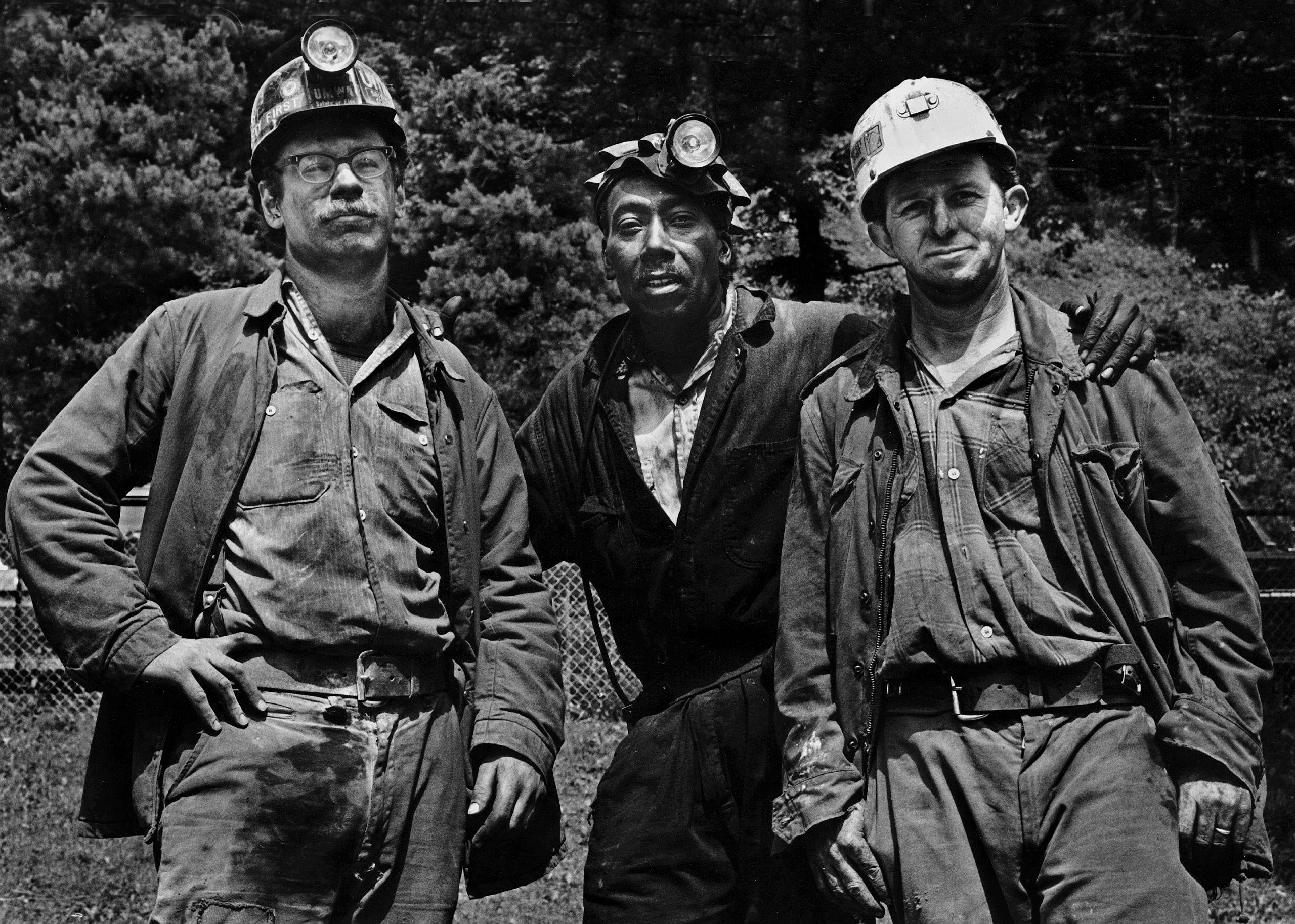
I began this book as a labor history, asking obvious questions that seemed most important at the time: Why did the movement end this way? What did it accomplish? How did it fail? Who or what was to blame? As I dug deeper into the history of the black lung movement, however, these apparently clear-cut questions about victories and defeats began to seem ambiguous, even misleading. The assessment of whether the movement had succeeded or failed depended a great deal on whose goals were used as the standard of measurement—and goals varied considerably among different participants. Moreover, what the larger political culture defined as the movement's greatest accomplishments often turned out to be mainly symbolic; they represented the visible outcomes of formal processes of reform (the passage of legislation, for example), but in and of themselves did not necessarily signify substantial and lasting change. The simplicity of my original questions faded as the labels of victory and defeat, success and failure, appeared more and more ephemeral. The central analytical problems increasingly seemed to involve the maddening complexity of social change itself, which prevented any person or group from controlling the course or outcomes of this movement.
As I delved further into the reforms sought and controversies engendered by the black lung movement, it became apparent that the movement was more than an important episode of labor resistance. At issue in the struggles over black lung, which have reemerged today, is not only how to prevent the disease or compensate those affected by it but also the very definition of black lung. Frequently, the most ideologically powerful opponents that miners have faced in their successive surges of activism are not coal operators or conservative politicians but physicians. At the center of the black lung controversy has been a profound power struggle between miners and physicians over who will control the definition of this disease.2See Daniel M. Fox and Judith F. Stone, "Black Lung: Miners' Militancy and Medical Uncertainty, 1968–1972," Bulletin of the History of Medicine 54, no. 1 (1980): 43–63, for an early framing of the black lung struggle as between miners and physicians over the definition of disease. Their emphasis on medical uncertainty differs from the analysis in my own article, which came out during the same time period: Barbara Ellen Smith, "Black Lung: The Social Production of Disease," International Journal of Health Services 11, no. 3 (1981): 343–359.
As a result of these and other shifts in emphasis, this book is a hybrid. It draws on diverse theoretical traditions in order to analyze not only the organization and development of the black lung movement, but also the history and conflict that underlie the brutal fact of coal miners' diseased bodies. Beginning with how and why black lung originates in the workplace, this book also explores the medical history of the disease and the conflicting meanings that miners and certain physicians, lawyers, and government administrators invest in black lung.
After moving away to a self-imposed exile some twenty-five years ago, I live once again in West Virginia. Contrasts with the 1970s heyday of working-class activism are evident throughout the rural landscape of abandoned gas stations, rusted coal tipples, and boarded-up union halls. The differences are personal as well: when I interviewed black lung activists in the 1970s, I was the age of their daughters and granddaughters; today, I am eligible for Medicare. As I conducted additional interviews in 2019, mostly with retired coal miners close to my age, their bodies as well as their words spoke the story of black lung disease and the physical toll of hard-labor jobs. Conditioned as a white woman to thinking of my embodiment primarily in terms of gender, I was struck again and again by how the privileges of class have shielded me from harm and become subsumed into my body. This updated and revised book, which includes two new chapters and a moving, evocative photo gallery by Earl Dotter, thus entails not only additional research into medical, legal, and economic materials relevant to black lung, but also historical reckonings both political and personal.
Today, as I write this preface, the power relations that miners experience on the job are dangerously asymmetrical, and their outcomes grim. Coal miners in southern West Virginia, once the stronghold of the UMWA in central Appalachia, where those who crossed a picket line invited ostracism if not assault, now work nonunion. Coal companies, facing shrinking domestic markets and in many instances bankruptcy, force workers, coal communities, and American taxpayers to bear the costs of their decline. Black lung can only be fully understood as part of this historical moment, when resistance, remarkably, persists. Digging Our Own Graves analyzes the dreadful resurgence of black lung within the long history of efforts to legitimate this disease and make it visible, prevent black lung in the workplaces where it is produced, and extend dignity and a measure of justice to those for whom prevention comes too late.
Conclusion: Class Power, Scientific Authority, and State Regulation
Nearly two centuries have passed since Dr. James Gregory opened up the lifeless body of John Hogg and hypothesized a connection between the miner's blackened lungs, his respiratory disability in later life, his occupation, and his death. For a time, physicians in Britain and the United States continued to investigate the relationship between occupational exposures and miners' respiratory distress. Toward the end of the nineteenth century, however, during a period of tight corporate control in the Appalachian coalfields and an increasingly restrictive scientific understanding of disease, black lung began to disappear from the medical literature of both countries. In the United States, coal miners eventually precipitated renewed medical attention to black lung by winning a union-controlled health care plan for themselves and their families. Even so, coal workers' pneumoconiosis—much less the broader ensemble of illnesses called black lung—was not accepted as a legitimate, occupationally related disease by the medical profession as a whole.3Journalistic and some scientific accounts equate coal workers' pneumoconiosis (CWP) with black lung. However, an essential component of the black lung movement was miners' and their families' struggle to broaden the definition, beyond CWP, of miners' disabling, occupationally related lung disease. Research by physicians and other scientists familiar with and sympathetic to miners and their health has validated this broader definition. See, for example, Edward L. Petsonk, Cecile Rose, and Robert Cohen, "Coal Mine Dust Lung Disease: New Lessons from an Old Exposure," American Journal of Respiratory and Critical Care Medicine 187, no. 11 (2013): 1178–85. Formal recognition required collective political intervention by coal miners themselves.
Even as social and economic factors have impinged on the medical construction of black lung, so have they shaped the actual production of disease. Black lung originates not simply from the physical presence of dust in coal mines, but from the relative power and respective actions of miners and operators, which influence conditions in the workplace. Miners' eventual success in unionization enhanced their collective power in the workplace, but, depending on UMWA leaders' priorities, unionism at times paradoxically undermined miners' capacity to make that workplace healthy and safe. In the years after World War II, the pact between larger operators and the UMWA produced unimpeded mechanization of the production process, high levels of unemployment, forced migration, and occupational death and disability from black lung. However, that industrial collaboration also produced massive rank-and-file upheaval and a successful effort to reform the union. In the present moment, union weakness and miners' lack of bargaining leverage in the workplace, combined with certain operators' endgame maneuvers to extract coal from thinner seams even while pressing for high levels of labor productivity, once again intensify the extent and severity of the disease.
The virulence of black lung today—fifty years after it was supposedly destined for elimination—does not diminish what coal miners, their families, and their allies accomplished in the past. Rather, it attests to the enduring realities of labor exploitation that the black lung movement episodically managed to contest. For its constituents, the movement achieved a unique and unprecedented federal compensation program. Approximately half a million miners and widows have received compensation under the federal black lung program; especially for those ineligible for a pension or other benefits, the monthly payments can mean the difference between destitution and modest survival.4This estimate of the number of black lung beneficiaries is extrapolated from data on the number of claims filed each year, changing approval rates, the annual total cost of claims, and, for some years, reports from the administering federal agency. See, for example, Social Security Administration, Annual Statistical Supplement to the Social Security Bulletin, 2016 (Washington, DC, 2017), Table 9. Beneficiaries who are miners and those who are widows, added together, do not equal the total number of miners judged disabled by black lung, as a widow may receive her husband's benefits after his death. Further, the number of beneficiaries is reported each year as a rolling total, and thus cannot be summed. The coronavirus interrupted my efforts to obtain more precise data. As of December 2018, an individual beneficiary is entitled to receive $660/month, which increases up to a maximum of $1,320 for those with three or more dependents. US Department of Labor, Division of Coal Mine Workers' Compensation, "Benefit Rates Under Part C, 1973–2018," accessed August 16, 2019, https://www.dol.gov/owcp/dcmwc/statistics/PastPartCBenefitRates.htm. The respirable dust standard and other disease prevention measures in the US Coal Mine Health and Safety Act of 1969 are also attributable to the black lung movement. As one element in a larger upheaval throughout the coalfields, the movement contributed as well to the rank-and-file takeover of the United Mine Workers of America and renewal of union leaders' critical attention to occupational safety and health.
Originally and essentially, however, the black lung movement was a struggle over the recognition and, more implicitly, causation of an occupational disease. What seemed at first a straightforward task— achieving legal inclusion of a "new" dust disease under the workers' compensation system—turned out to be a far more complex undertaking. Miners and other activists learned early on that "black lung," as refracted through the lens of scientific medicine, was quite different from the disease for which they sought recognition, compensation, and prevention. In a struggle that has lasted more than fifty years, activists have persistently challenged physicians, lawyers, and policymakers over the meaning of this disease; at different times, they have been able to replace the restrictive scientific construction of a rarely disabling coal workers' pneumoconiosis with their own definition of "black lung." Although focused on arcane disputes over diagnostic methods, disability standards, legal presumptions, and other issues, this conflict over the definition and causation of black lung is intensely political: it involves the ideological content of medicine's view of disease, including the technical perspective that narrows causation to the inhalation of dust, and the powerful role of physicians in labeling work-related disability as legitimate. On the outcome of such conflict rests financial liability for the coal industry that potentially ranges into billions of dollars. The legacy of black lung activism thus entails unsettling questions about the relationship between scientific and technical knowledge, state regulation, and the exercise of class power.
It should be stressed at the outset that not all physicians subscribe to a narrow or purely technical understanding of black lung: recall the role of three doctors (Buff, Rasmussen, and Wells) in the first black lung mobilization during 1968 to 1969 in West Virginia. Dr. Donald Rasmussen continued to work with and advocate for coal miner patients out of his pulmonary lab in Beckley, West Virginia, for five decades, up until his death in 2015.5Sam Roberts, "Dr. Donald L. Rasmussen, Crusader for Miners' Health, Dies at 87," New York Times, August 2, 2015, accessed September 29, 2019, https://www.nytimes.com/2015/08/03/health/research/dr-donald-l-rasmussen-crusader-for-coal-miners-health-dies-at-87.html. Rasmussen's mantle now falls on Dr. Robert Cohen, a pulmonologist who directs the occupational lung disease unit at Northwestern University and frequently testifies before Congress on miners' behalf.6Dr. Cohen testified during the hearings on black lung, "Breathless and Betrayed." See "What is MHSA Doing to Protect Miners from the Resurgence of Black Lung Disease?" YouTube video, 2:58:39, June 20, 2019, House Committee on Education and Labor, https://www.youtube.com/watch?v=sJUDcTf0a_g. Other physicians in the coalfields, such as Drs. Gregory Wagner and Brandon Crum, have devoted much of their professional lives to caring for coal miners with lung disease. After practicing medicine at a clinic on Cabin Creek (West Virginia), Wagner eventually came to direct Respiratory Disease Studies at NIOSH when that agency issued the criteria document that legitimated a broad definition of black lung, inclusive of COPD (chronic obstructive pulmonary disease), and recommended much lower limits on miners' exposure to coal dust and silica.7NIOSH, Criteria for a Recommended Standard: Occupational Exposure to Respirable Coal Mine Dust, publication no. 95–106 (Washington, DC: US Government Printing Office, 1995), xxii, https:// www.cdc.gov/niosh/docs/95-106/default.html. Crum, a radiologist—and, not coincidentally, former coal miner—was first to sound the alarm over black lung's escalating severity, which in 2014 he began detecting among his patients in eastern Kentucky. Four years later, the coal-industry-beholden state legislature responded by disqualifying him from reading X-rays for miners' workers' compensation claims.8Austyn Gaffney, "As Black Lung Strikes Younger Coal Miners, Kentucky Restricts Medical Benefits," NRDC, September 24, 2018, accessed September 29, 2018, https://www.nrdc.org/stories/black-lung-strikes-younger-coal-miners-kentucky-restricts-medical-benefits.

Apart from such individual physicians' political and medical predispositions, however, there remain epistemological tendencies within scientific medicine that militate against the understanding of disease advanced by black lung activists.9This summary of miners' perspectives on the origins of black lung and the role of physicians in advocating a restrictive view of work-related, compensable disease is based on the author's interviews and observations in southern West Virginia at different moments during the past five decades. Within the restrictive medical viewpoint that requires conclusive, scientific proof of occupational causation, black lung is in fact coal workers' pneumoconiosis, a single clinical entity, disabling only in advanced and, even today, relatively rare stages. The disease acquires legitimacy—indeed, effectively comes into existence—only when visible to trained personnel viewing objective diagnostic evidence, that is, X-rays, of an individual miner's lungs. The thousands of miners who believe themselves disabled by black lung yet exhibit no X-ray evidence of advanced CWP might legitimately be considered "disabled"—if the quantitative results of certain tests confirm such a condition. However, the origin of their disability is nonoccupational, above all their own cigarette smoking, or, if nonsmokers, other sources outside the workplace. Although this scientific definition of disease is quite different from physicians' earlier construction of a benign "miners' asthma," the result, in the eyes of many victims, is the same: black lung is trivialized. What many miners view as a collective problem becomes, from the perspective of scientific medicine, individual, quantifiable cases. What they experience as part of the shared social world of coal mining becomes occasional, biological events. What they attribute to their class relationship with the coal operators becomes the product of a single physical agent, dust. In sum, what is collective becomes individual, what is social becomes biological, what is produced by human action becomes the outcome of inert material.
Certain tendencies intrinsic to clinical medical practice are also at stake in the seemingly incommensurable perspectives of miners and certain physicians. Scientific medicine situates disease spatially, within the individual body, and temporally, at the point when signs, symptoms, or other physical alterations develop. Disease is ahistorical as well as asocial; it has no history except a "natural," that is, physical, history. It is said to exist when experienced by the individual and diagnosed by the physician, not at the point when it is being produced. The possibilities for prevention are thus constrained within the very definition of disease.10Howard S. Berliner and J. Warren Salmon, "The Holistic Health Movement and Scientific Medicine: The Naked and the Dead," Socialist Review 9, no. 1 (January–February 1979): 31–52.
Clinical medicine reflects this understanding of disease on a practical level: individual patients present the physician with their distinctive symptoms and complaints; they appear as random, disconnected "cases," and they are granted therapeutic treatment as individuals. There is no social meaning to disease in the sense of an internal relationship between social relations and the individual experience of ill health; primarily individual behaviors, such as diet, exercise, and smoking habits, command attention. Yet, in quantifying disability and allocating it to occupational or nonoccupational sources, physicians implicitly assess the conditions in which miners have lived and worked all their lives. That most physicians have never been in a coal mine (much less worked in one), and that some have never even been in the coalfields, serves to intensify the conflict between physicians and coal miners, who experience the superior legitimacy automatically granted scientific medical knowledge as a complex and powerful form of social control.
The authority of physicians to pronounce miners "healthy" or "disabled" carries important financial consequences. In the context of federal black lung compensation, doctors' assessments of coal miners' health can be decisive in the award or denial of financial benefits that are allocated in large part according to medical eligibility criteria. Doctors act as gatekeepers in a more generic sense as well: they control access to the "sick role," the sole avenue by which adults may legitimately escape the daily responsibilities of their class, race, and gender.11See Talcott Parsons, The Social System (New York: Free Press, 1951). Parsons's conceptualization of the sick role was neither class nor historically specific. For coal miners, as for other workers, the preeminent requirement of their class position is to perform wage labor. Medical criteria for assessing disability (and determining compensation eligibility) that take as the standard for health the functional capacity to work explicitly enforce this requirement. Even if damaged by work, coal miners still must provide medically sanctioned evidence of their "total disability"—i.e., complete inability to continue working—in order to receive financial compensation and legitimate relief from wage labor. In pushing against the limits of this compensation policy, miners and their families implicitly contest not only the ideological authority of physicians to define disease and assess disability; they ultimately threaten the economic power of coal operators by pressing for a broad definition of black lung and relaxed standard of disability that would provide unhealthy miners an alternative to labor in the mines.
This convergence between the restrictive scientific view of black lung and the economic interests of the coal industry is, for many miners and their families, an ultimate source of distrust and conflict with physicians. The narrow definition of disabling black lung as a relatively rare, complicated pneumoconiosis is highly functional to the industry: it circumscribes the scope of occupational lung disease and correspondingly diminishes both the cost of compensation benefits and the importance of prevention. In the context of policy formation, scientific medicine plays a mediating role between the interests of the coal industry and the actions of the state. It facilitates apparent distance between corporate power and public policy, and seems to ground political decision-making in the neutral, technical knowledge of a third party.
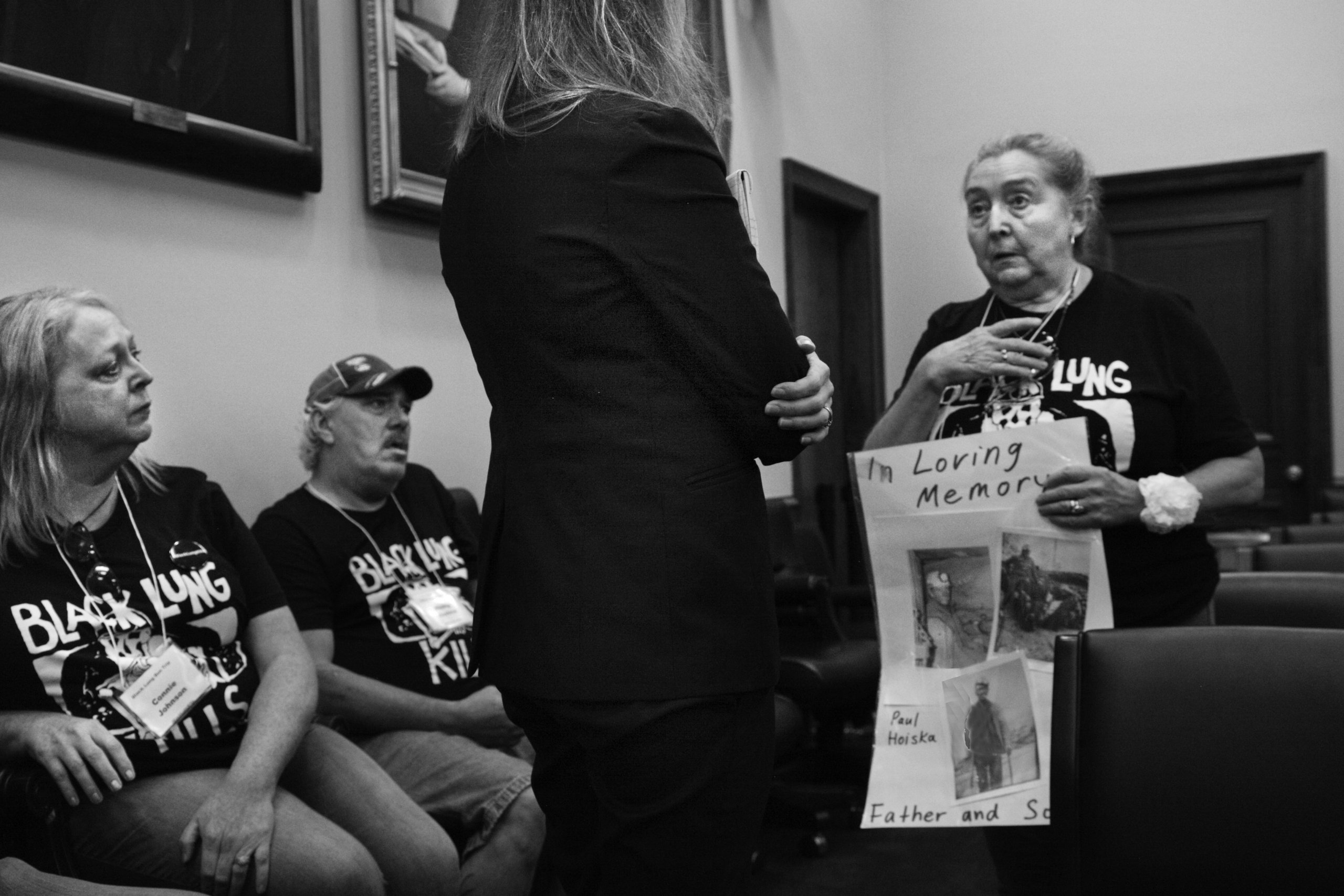
The lessons of the protracted struggle over black lung disease encompass both caution and inspiration, loss and hope. In an era of science denialism, when defense of factual truths and scientific knowledge seems obviously necessary, the case of black lung still stands as a warning about the presumed neutrality and appropriate scope of scientific and technical solutions: beware of technical fixes for problems that ultimately derive from economic exploitation and grossly unequal political power. Activists' original quest for redress through the workers' compensation system offers a related caution: the sprawling administrative machinery of the state, which presents the customary, sanctioned route for institutionalizing reform, entails embedded interests that can thwart activists' aims even as it seems to grant their demands. Finally, the long history of black lung suggests that effective prevention of occupational disease, injury, and death ultimately resides in the ever-changing power relations of the workplace and workers' collective, organized capacity to defend themselves. For these and many other reasons, victories are never secure, achieved once and for all; they must be defended, expanded, critiqued, and revised, as black lung activists have doggedly done for some five decades now.
Today, the industry that for more than a century has defined central Appalachia is dying. Those who would chart a post-coal future must grapple with the industry's legacy of incalculable human and environmental destruction, but they would do well to learn from the additional legacy of coal mining families' solidarity and resistance. Ever since the first investors laid claim to the coal of Appalachia, the people of this region have been revolting in various forms against the appropriation of their land, their labor, and even their lives. Those who fought in the black lung movement are both heirs and contributors to this long history of resistance. Today, many miners pay the cost of coal production in the currency of their very breath, but they also continue to resist. Danny Whitt: "We don't never give up. You know when I'll stop? When the last breath leaves my body."12Author's interview with Danny Whitt, Matewan, WV, September 4, 2019.
About the Author
Barbara Ellen Smith is professor emerita of women's and gender studies in the Department of Sociology at Virginia Tech. She has been active in and writing about movements for social and economic justice in Appalachia and the US South for more than 45 years. Her recent publications include a co-edited book with Stephen L. Fisher, Transforming Places: Lessons from Appalachia (University of Illinois, 2012) and Digging Our Own Graves: Coal Miners and the Struggle over Black Lung Disease (Haymarket Books, 2020).
]]>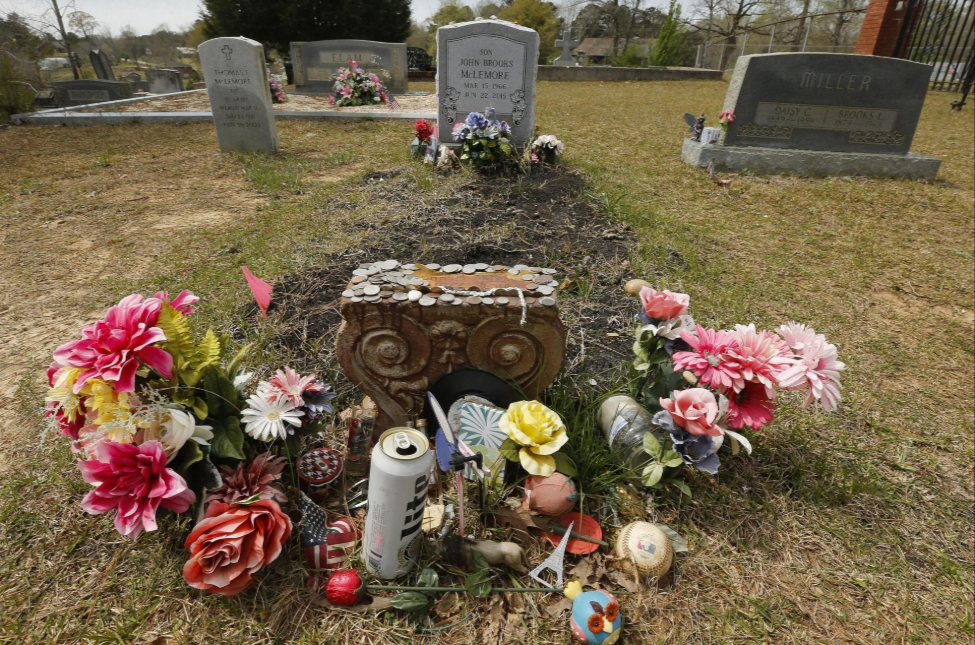
Like most listeners, I'm sure, what I love best about S-Town is McLemore's irrepressible character and voice. McLemore was an antique horologist and self-described "semi-homosexual" who lived in Bibb County, Alabama, outside the small town of Woodstock. However, although Woodstock is only about thirty miles equidistant from the metropolitan centers of both Tuscaloosa and Birmingham, Alabama's largest city, the podcast deceptively portrays the area as excessively rural and remote. That deception not only gets this part of Alabama wrong, but also perpetuates a longstanding stereotype of the whole South as generally disconnected from the modern world, culturally and geographically. I should confess here that I am ultimately not a fan of S-Town, and this portrayal is just part of the reason why.
Nevertheless, McLemore's unique story still offers a rich opportunity to examine the complex dynamics of sexuality, gender, race, and class at the fringes of the more familiar, metronormative centers of urban queer life. McLemore was a paranoid genius, with the rare ability to see and explain all the invisible connections between his immediate locality and the global forces of capitalism, inequality, war, and environmental degradation currently destroying the planet. Sadly, in addition to other likely causes, including the mercury poisoning he probably contracted from his work on antique clocks, McLemore's paranoia drove him to suicide on June 15, 2015. This loss makes me doubly grateful that Brian Reed, S-Town's creator and narrator, decided to share McLemore's voice with millions of listeners. In a time when so many people happily treat every new music video, online commentary, Presidential tweet, and podcast like S-Town as a revolutionary event, McLemore resists any easy classification or commodification and shows us, instead, the real precarity and messiness of what it means to be human, as well as queer and southern, in the twenty-first century.

In her excellent article about S-Town, Monique Rooney examines the way that McLemore's untimely "voice from beyond the grave" combines with the "intermedia" of other texts and objects within the podcast—including "clocks and sundials," the "elaborate hedge maze that John created, unrecorded conversations, letters, a novel and other print narratives, poetry, songs, film, e-mails, Google maps, theatrical rituals, tattoos and tattooing, texts messages and graffiti"—to create a queerly alternative sense of time that works within and against the linear structure of the overarching narrative form.2Monique Rooney, "Queer Objects and Intermedial Timepieces: Reading S-town," Angelaki: Journal of the Theoretical Humanities 23, no. 1 (2018): 157. This intermedial structure of text and paratext, she argues, "opens the listener to wider networks and spheres" beyond "John's relentlessly caustic and negative views of life in the American South" and offers McLemore himself as "an intermediary" who "confound[s] . . . established hierarches and conventional subject/object relations," especially in terms of temporality, region, and sexuality.3Rooney, 159.
While there's no denying the power of McLemore's voice, I believe that the podcast ultimately restricts that power by constraining it within the closed temporal field of the podcast's strictly sequential form. Although Rooney argues that "S-Town's queerly intermedial form counteracts its ends-driven sequential form and its death-driven themes," the podcast's relentless push toward narrative resolution still wins out.4Rooney, 157, original emphasis. Moreover, while McLemore's recorded voice may be coming "from beyond the grave," his death still means that he can never speak out after the podcast to confront its selective portrayal of him. McLemore is endlessly complex, yet he will never be more complex than the narrative allows. This containment helps explain how he has become a figure of so much public fascination: like any dead celebrity, he can never finally reassert his subjectivity in a way that might change our perceptions and fantasies about him. And this restrictive framework is what frustrates me most about S-Town, for I know that I can never fully separate the McLemore I have come to like from the McLemore that Reed has edited for us.
Other reviewers have challenged Reed's serious ethical problem of seeming to exploit McLemore's death for creative and financial gain.5Jessica Goudeau, "Was the Art of S-Town Worth the Pain? How a Decades-Old Literary Argument Adds Insight to the Debate over the Popular Nonfiction Podcast," The Atlantic, April 9, 2017, https://www.theatlantic.com/entertainment/archive/2017/04/was-the-art-of-s-town-worth-the-pain/522366/; Aja Romano, "S-Town is a stunning podcast. It probably shouldn't have been made," Vox, April 1, 2017, https://www.vox.com/culture/2017/3/30/15084224/s-town-review-controversial-podcast-privacy. Around the same time that plans for a movie adaptation were announced in June 2018, McLemore's estate filed suit against the makers of the podcast for violating his "rights of publicity."6EJ Dickson, "Judge Allows Lawsuit to Proceed Against 'S-Town' Podcast Makers," Rolling Stone, March 25, 2019, https://www.rollingstone.com/culture/culture-news/s-town-lawsuit-john-mclemore-estate-812965/. But I want to consider another ethical concern in the way that Reed manipulates McLemore's voice to produce a certain effect—or rather, affect—for his listeners. Even as S-Town lets us experience McLemore's unusual character directly, this story of his troubled genius and premature death packages his character in a way that implicitly makes us, the listeners, feel different from him, no matter how much we might personally identify with him. As narrator, Reed uses McLemore to imagine a pleasanter, happier type of subjectivity, fashioning himself as a model liberal subject—not necessarily liberal in the pedestrian sense, although he does that too, but in the sense of being a self-contained, autonomous individual who appears, unlike McLemore, more or less separate from, and unaffected by, all the disciplinary and controlling forces of society. In addition, the podcast invites listeners to identify with Reed's narrative voice, eventually sharing his feelings of transcendent mobility and sophistication in opposition to the pain and paranoia that we hear in McLemore. Reed's aural embodiment of this liberal subject position promises listeners a similar sense of freedom and survival in a world of heightened global uncertainty—the forces that McLemore constantly railed against.
This buffering effect is, I think, another part of what gives S-Town its widespread appeal. Of course, it's not necessarily bad or unusual that a creative work would help us find this sense of pathos and security in a troubled world. But what I don't like is the way that Reed creates this affect by figuratively sacrificing McLemore to a worn narrative of southern gothic dysfunction. To create this twenty-first-century subjectivity that seems to transcend place, S-Town traps McLemore hopelessly and eternally in the place that he calls Shittown, Alabama. Although Reed ends the podcast with the story of McLemore's birth, S-Town buries him forever at the clichéd, lonely crossroads of a tragically (never happily) queer and backwards South. And in doing so, no matter what else the podcast might tell us about the real-life experience of being a queer, white, "semi-homosexual" man in semi-rural Alabama, this narrative framework reveals much more about the ideological uses served by mainstream imaginaries of southern queerness—fantasies of what it means to be queer and southern, southern and queer—in twenty-first-century US culture and beyond.7Brian Reed, "Chapter II: Has Anybody Called You?" March 28, 2017, in S-Town, produced by Brian Reed and Julie Snyder, podcast, MP3 audio, 44:22, https://stownpodcast.org/chapter/2. If any movie adaptation were to try to elicit the same kind of feeling in its viewers, I can't imagine it would be any less exploitative.
Policing the South
There's no denying S-Town's popularity. All seven episodes were made available for download on March 28, 2017, and since then tens of millions of listeners have followed Reed's account of McLemore's life and suicide. S-Town establishes itself, much like Reed's prior work, Serial, as a true-crime investigation. McLemore has asked Reed to investigate two things—an alleged murder and a case of alleged police corruption—and Reed sets to work combing the police reports and interviewing locals, although he didn't visit Alabama until a year later.
In Chapter I, Reed establishes a not-so-subtle conflation between Alabama and an imagined picture of the "South" as a whole. He does this in part by overstating the rurality of the setting. For example, Reed's description of where he stays on his first visit to Alabama invokes broader tropes of a sparsely populated, isolated landscape: "I had to leave Bibb County to find a hotel, so I'm in Bessemer, a small city about fifteen miles down the highway, where the far reaches of the Birmingham Metro Area dissolve into the rural counties like Bibb to the west. I'm at a Best Western just off the exit ramp, behind a Waffle House."8Brian Reed, "Chapter I: If You Keep Your Mouth Shut, You'll Be Surprised What You Can Learn," March 28, 2017, in S-Town, produced by Brian Reed and Julie Snyder, podcast, MP3 audio, 31:16, https://stownpodcast.org/chapter/1. While fifteen miles on an interstate highway hardly makes a marathon drive into the "far reaches" of civilization (and why does he have to "find" the hotel, as if the internet, a map, or McLemore himself, hadn't already told him where it was?), Reed effectively "dissolves" the specific landscape of Alabama into a more symbolic landscape of rural counties "like" Bibb whose generic southernness is made all the more evident by their common location "behind a Waffle House."
In Chapter II, Reed determines that rumors about the murder McLemore asked Reed to investigate were exaggerated tales of a fight that occurred at a party "in the middle of the woods" in Tuscaloosa County.9Reed, "Chapter II," 22:48. Reed's attention to the fact that the fight took place in the woods once again occludes the proximity of Tuscaloosa and Birmingham. Reed mentions the quick arrival of the police and ambulance, as well as the nearness of a hospital where the alleged murderer Kabram Burt was taken to treat his injuries after the fight, and the fact that Burt called a friend in Bessemer, which is outside Birmingham, to pick him up at the hospital. Nevertheless, Reed gives the last word about the fight to Burt, who shrugs off the incident as the normal consequence of "liv[ing] like white trash and shit," and the rumors of murder as a normal consequence of living in "a damn small town, man."10Reed, "Chapter II," 26:43, 25:28. Although Reed essentially "solves" the crime for his listeners, he uses Burt's testimony to blur the scene of the crime with a broader notion of southern rurality. The fight might have happened anywhere in this imagined South, because the only spaces that matter here are a gossipy small town and a wooded landscape dominated by "white trash," not the more metropolitan adjacent spaces.
Construing the semi-rural setting of S-Town as excessively rural sets the stage for Reed's portrayal of McLemore as a queer loner who is similarly isolated, the apparent lawlessness of the place echoing the turbulent, anything-but-normal life of this particular inhabitant. And so, just after his explanation to McLemore about the fight, Reed quickly turns to the news of McLemore's suicide, even though in real time McLemore's death occurred several months after that conversation. Squeezing this sequence of events allows Reed to maintain the "true crime" format of the podcast, and he quickly sets to work exploring the details of McLemore's death and the fallout that ensues.
Thankfully, Reed is not entirely interested in solving the question of what finally led McLemore to take his own life. From a literary standpoint I am glad he didn't oversimplify things by trying to pin down a single, simple cause or motive. Based on this narrative open-endedness, I would agree with reviewer Katy Waldman that S-Town looks and sounds like a new kind of literary genre, what she calls "aural literature."11Katy Waldman, "The Gorgeous New True Crime Podcast S-Town is Like Serial but Satisfying," Slate, March 30, 2017, http://www.slate.com/blogs/browbeat/2017/03/30/s_town_the_new_true_crime_podcast_by_the_makers_of_serial_reviewed.html. Yet, where she argues that this new kind of true-crime literature is "even more satisfying because [the case] always stays open," I believe that this feeling of audience satisfaction stems from something that is ideologically more dubious than open-endedness—and that shows how "aural literature" may not be so new after all. For all its novelty, and for all the ways that the podcast's intermedial elements stand "at odds with the sequential form," as Rooney writes, I find that this podcast has much in common with the traditional novel.12Rooney, 157. It deviates from the path of standard-fare detective stories and police procedurals, but detection and policing remain central to the narrative, both figuratively and structurally, thus replicating many of the discursive effects of discipline and control that literary critic D.A. Miller has identified in British novels of the Victorian era.13D.A. Miller, The Novel and the Police (Berkeley: University of California Press, 1988).
Miller demonstrates how Victorian novels use narratives of policing and investigation to establish a covert model of self-policing and self-discipline for the unmarked, bourgeois center of society. These novels, he argues, set up a "scene" of criminality and/or social dysfunction (e.g., the slums of Victorian London) as a space that requires rigorous investigation. The narrative intrusion into this scene establishes its opposite. By going into a dysfunctional space and then withdrawing, the novel constructs and "repairs . . . normality" as a space "not needing the police or policelike detectives."14Miller, The Novel and the Police, 3. Moreover, this pattern defines the structure of the Victorian novel beyond tales of explicit crime and detection. To borrow the words from Dickens's novel Our Mutual Friend (1864–65), Miller adapts the work of Foucault to show how these texts "do the police in different voices," deploying all kinds of modes of discipline, surveillance, and constraint to make the reader a good, orderly subject for the sake of a stable, orderly society. In the narrative restoration of "normality," the protagonist (who, like Reed, is sometimes the narrator) is able to forget or disavow the "system of carceral restraints or disciplinary injunctions" that shape his subjectivity.15Miller, The Novel and the Police, x. And so, by way of our identification with that narrator/character, we readers can forget the disciplinary regimes that govern our "normality," too, because our implicit acquiescence to those regimes similarly means that no visible intervention or investigation is required. When the disciplinary structures of society seem most invisible, we liberal subjects feel like we're free of them.
In S-Town, following McLemore's lead, Reed constructs an imaginary, emphatically rural, and corrupt "Alabama" (as well as a wider "South") full of violence, racism, theft, and intrigue—exactly the kind of "scene" that requires this sort of literary "intrusiveness." Although the podcast starts with a specific investigation into the local circumstances of the alleged murder, Reed blurs that literal act of investigation with subtler forms of exposure and containment when he turns to McLemore's suicide, widening the scope of the figurative investigation beyond the local to McLemore's fraught position within sectional, national, and global contexts. In particular, I want to delve into two aspects of the podcast where Reed performs this novelistic policing: his treatment of Alabama racism and his treatment of McLemore's queerness. Both depictions construct Alabama and the wider South as a backwards, dysfunctional space in need of heavy policing, literally and figuratively. And it is through this clichéd sectional portrayal that we can most clearly understand how Reed exploits McLemore to construct this version of the liberal subject.
The Backwards South, Again
Thankfully, because this is a podcast delivered through sound, and not a written narrative, the power and originality of McLemore's voice constantly break through Reed's efforts to shape what we hear. But then S-Town squanders this opportunity by editing McLemore's voice to fit a more shopworn "southern" script. Like Jeeter Lester soaking his feet in the drainage ditch in Erskine Caldwell's Tobacco Road (1932), it doesn't take long before S-Town sinks into a stream of southern gothic clichés. Yes, Reed is following McLemore's cynical lead, but Reed seems even more insistent in portraying Shittown as backwards and corrupt and runs with McLemore's own comparison of Shittown to the "undercurrent of depravity" expressed in William Faulkner's story "A Rose for Emily" (1930).16Reed, "Chapter I," 32:50. And, even though Reed also mentions similar works by writers Guy de Maupassant and Shirley Jackson, he uses the Zombies' song inspired by "A Rose for Emily" as the closing music for every episode, underscoring connections between the podcast and southern gothic literature.17Literary critics David A. Davis and Gina Caison discuss these southern gothic tropes at length, including the comparison to Faulkner's "A Rose for Emily." Hear their excellent critique on the podcast "S02 Episode 3: Gilded Souths & S-Towns," July 20, 2017, in About South, produced by Gina Caison, Kelly Vines, and Adjoa Danso, podcast, MP3 audio, 38:27, https://soundcloud.com/about-south/s02-episode-3-gilded-souths-and-s-towns.
In later chapters, we learn that McLemore allegedly buried large amounts of gold on his property, and Reed turns us into narrative prospectors by making us wonder if the gold was found by greedy relatives, stolen by the police, or, as Reed implies, dug up in the middle of the night by McLemore's neighbor and most intimate companion in the podcast, Tyler Goodson. As with other elements of this true-life story, the legend of buried gold is of McLemore's making. But, in the telling of it, Reed can't seem to recognize what A Streetcar Named Desire's Blanche Dubois (1947), Queen Diva of the southern gothic, would have noticed in a heartbeat: that the story of buried gold is so old that "Only Poe! Only Mr. Edgar Allan Poe!—could do it justice!" Although Blanche references Poe's poem "Ulalume" (1847) in the play, where the poet visits his dead lover's grave, in this context I'm talking about Poe's 1843 short story about buried pirate treasure, "The Gold Bug."18The story of southerners obsessively digging up land in the search for buried gold also echoes the plot of Caldwell's farcical God's Little Acre (1933).
Finally, there's S-Town's closest literary parallel: John Berendt's popular Midnight in the Garden of Good and Evil (1994). I wasn't much of a fan of that, either. Both works cast their nonfictional gaze upon a supposedly insular "southern" place and regale their audience with sensational, almost shocking "discoveries" of things like actual gay people! and even more complicated gender dynamics! Here are places, they announce, plagued with racism! and full of crimes of passion! where half the locals are too secretive and the other half are far too garrulous! Even things like college football and getting a tattoo start to sound like arcane rituals. In other words, these texts spectacularize all the colorful, grotesque things you might find virtually anywhere else in these United States, southern stereotypes be damned. To me, there's just not much that's very new in the manner of this podcast's representation. From Berendt to Blanche to Faulkner to Poe, S-Town tells a story we've been hearing for a long time.
Clichés are necessary to Reed's portrayal of a gothic South that needs policing. Like the Victorian novel, S-Town constructs an image of Alabama as the place where disorder and depravity reign. In fact, it is so dysfunctional that even the police need policing. Remember that McLemore's initial email to Reed asked for help investigating not only the alleged murder, but also a case of police corruption. And later, when Reed considers that the police might have stolen McLemore's gold when they first arrived on the suicide scene, McLemore's cousin Reta Lawrence returns to this question of corruption: "Isn't that what John first got in touch with me about to investigate, she says, corruption in the local police?"19Brian Reed, "Chapter V: Nobody'll Ever Change My Mind About It," March 28, 2017, in S-Town, produced by Brian Reed and Julie Snyder, podcast, MP3 audio, 16:10, https://stownpodcast.org/chapter/5. Maybe the police did steal the gold. But Reed doesn't actually need to solve any of these questions. As satisfying as it is that all the cases are "left open," as Katy Waldman argues, Reed also needs his southern setting to remain gothic and corrupt in order to create the implicit counterexample of a "normal" world where the police aren't corrupt and a "normal," bourgeois person needn't worry about such things.
Another way that Reed bolsters this extended stereotype of the gothic South is through his treatment of race and racism. When Reed visits a tattoo parlor in Chapter II, he takes pains to point out the racism of the young men in the room, as if any listener could miss it. Reed seems to want to shock listeners, presumably by broadcasting what they might not normally hear in public discourse, at least before the 2016 Presidential campaign, but also by confirming that the old figuration of a racist South needs no qualifications or nuances. What's really shocking, however, is Reed's blatant, and rather clumsy, attempt to distance himself from these white men ideologically and geographically. Reed does nothing to confront or complicate the unexamined whiteness of both his real-life subjects and his own perspective.20Wesley Jenkins, "The Empathy of 'S-Town' Doesn't Extend to Black People," BuzzFeed News, April 21, 2017, https://www.buzzfeed.com/wesleyjenkins/the-empathy-of-s-town-doesnt-extend-to-black-people?utm_term=.fmJA3Xxxe#.jtpwXLBBz; Maaza Mengiste, "How 'S-Town' Fails Black Listeners," Rolling Stone, April 13, 2017, https://www.rollingstone.com/culture/how-s-town-fails-black-listeners-w476524. He quietly tells one of the young men that racism in New York is "quieter" than it is in the South.21Reed, "Chapter II," 8:34. And then, in case we had any doubts, Reed assures his audience that he is certainly not a racist, for he has boldly, bravely taken the step of making all his social media accounts private to prevent his interviewees from seeing a photo of him with his future wife, Solange, who's black.22Reed, "Chapter II," 7:58.
Surely Reed can't really believe that these young men are so disconnected from the rest of the world that they wouldn't be able to google his name and find out more. Even bigots in Alabama have smartphones, as McLemore laments at length in Chapter I. I think Reed actually has a different motive for telling us about his social media accounts, for in doing so he positions himself as different from these other white men in important ways. By reminding us that his fiancé is black, Reed telegraphs that he is a nonracist, liberal subject who is much more connected to the modern world, not just in terms of internet savvy, but also in terms of politics. By reminding us that where he hails from racism is allegedly "quieter" (what would Eric Garner say about such a claim?), Reed suggests that he is much less tied to place than the other whites in that tattoo parlor—that he is much more mobile culturally, economically, ideologically, and geographically. Reed's unmarked whiteness allows him to travel in and out of different spaces, while the marked racism of the other white men will, it seems, prevent them from fitting in anywhere else than sweet home Alabama. With a little digital pruning, Reed will be OK in Shittown, but those boys will never make it in New York.
By layering racism, subjectivity, and place onto each other in this way, Reed also puts listeners in the same liberal subject position as himself. We implicitly identify with his narrative voice as he marks those other subjects as different and flawed. Reed wants us to feel that we, like him, are not constrained by our time and place, even if the racism where we live isn't actually "quieter." Reed's narrative manipulations tell us that we, as untethered individuals, must be liberal in the more pedestrian sense, too. Unlike those white Alabamans who don't seem to question or notice that K3 Lumber, their local lumber mill, implicitly honors the Ku Klux Klan, as Reed suggests at the very beginning of Chapter I, our feeling of autonomy—accentuated by the disembodiment of the aural podcast—guarantees we'll never have a problem with Brian Reed's marriage to Solange.23Reed, "Chapter I," 18:38.
A Queer South
Reed makes similar moves in the way he discusses McLemore's sexuality. Another thing I like about this podcast is the way that McLemore and his relationships defy simplistic analysis or categorization. The most complicated, and the one to which Reed gives the most airtime, is McLemore's close intimacy with his younger neighbor, Tyler Goodson. As McLemore admits in Chapter V, and as we learn more fully in Chapter VI, their relationship may seem to others more like a "usership" than a "friendship" because of the men's codependencies.24Reed, "Chapter V," 49:09. McLemore gives Goodson money and other kinds of material support, ostensibly for all the odd jobs he performs, while Goodson reciprocates with emotional and physical companionship. There is no clear indication that they had sex, but the erotic, even romantic dimensions of their relationship are unambiguous. Goodson agrees to satisfy McLemore's apparent fetish for pain by regularly tattooing his skin, including his nipples, and even whipping him. And, just before his death, the two men spray-paint their names on a local bridge like a queer combination of teenage lovers and, since they did this on Father's Day, daddy and son.25Reed, "Chapter VI: Since Everyone Around Here Thinks I'm a Queer Anyway," March 28, 2017, in S-Town, produced by Brian Reed and Julie Snyder, podcast, MP3 audio, 50:36, https://stownpodcast.org/chapter/6.
Here is a rich opportunity for mapping some of the unlikely networks of gender, power, and pleasure that shape all those sketchy spaces beyond more familiar queer metropoles such as New York and San Francisco. A useful critical pairing would be Scott Herring's work on the Alabama photographer Michael Meads in Another Country: Queer Anti-Urbanism.26See Scott Herring, Another Country: Queer Anti-Urbanism (New York: New York University Press, 2010), 99–124. As Herring demonstrates, Meads's photographs of nude and semi-nude young white men—often in the mise-en-scène of Confederate flags, guns, trophy deer, piney woods, and other objects that signal southerness to the viewer—short-circuit both homonormative assumptions about sexuality and gay identity and metronormative assumptions about sex and homophobia in the rural South.
Anecdotally, I've heard from a goodly number of southern gay white men who say that they like this kind of unsettling dynamic in S-Town. Apparently, to them, as to me, John B. McLemore's character feels at once enigmatic and familiar. He clearly doesn't fit mainstream constructions of either gay or southern identity; and yet, ironically, because of how he blends his intellectualism with a kind of down-home, country campiness, he also seems almost paradigmatically gay and southern. In a comment that he also relates to McLemore's sexuality, blogger Aaron Bady, who is originally from southern Appalachia, also notices this paradox: "John might seem like a one-of-a-kind, but hearing him instantly reminded me of any number of gifted hillbilly eccentrics I've known, red-state liberals whose local roots run deep and murky."27Aaron Bady, "Airbrushing Shittown," Hazlitt, May 1, 2017, https://hazlitt.net/longreads/airbrushing-shittown. The pejorative term "hillbilly" is specific to Appalachia and would not apply to the space of middle Alabama, let alone to McLemore. But, as someone who originates from Appalachia, Bady uses it interchangeably with "redneck" and other terms that generally refer to white southerners historically identified as "poor whites," which is to say, whites whose identities do not fit bourgeois normativities. He also uses these terms in ways that avoid perpetuating negative stereotypes, even as he remains outspoken against the racism, homophobia, and conservatism of so many white southerners.
Nevertheless, Reed's treatment of sexuality is, like his treatment of race and racism, immensely frustrating. In Chapter VI, he tells of how a gay man named Olin Long contacted him to talk about his relationship with McLemore, whom he met through a phone network for gay men in the time before apps like Grindr. They became intimate friends, but not lovers, and Reed dwells on their twelve-year relationship to bolster several assumptions about how hard it must be to be queer in the South, not just for McLemore in particular, but for anyone. (Shane Barnes runs with this notion in his review of the podcast on Vice; Michael A. Lindenberger offers a better take in the Dallas Morning News.28Shane Barnes, "'S-Town' and the Loneliness of Being Gay in the Rural South," Vice, April 13, 2017, https://www.vice.com/en_ca/article/aemwqg/s-town-and-the-loneliness-of-being-gay-in-the-rural-south; Michael A. Lindenberger, "S-Town Humanizes the Haunting Isolation of Gays in Rural America," Dallas Morning News, May 3, 2017, https://www.dallasnews.com/opinion/commentary/2017/05/03/john-bs-loneliness-tells-us-homosexual-life-rural-america.) Olin Long tells of his deep, moving appreciation of the film Brokeback Mountain, a story of repressed, rural gay love that Reed overlays onto Alabama. It turns out that Long has been celibate for nearly six years, and Reed automatically implies that, much like the Cowboy West of the movie, Long's celibacy is more the fault of the Red-State South than a choice he has made. "John and Olin," says Reed, "both kept their sexuality hidden for much of their lives. John talked to Olin and to me about how you had to be very careful about that where he lived."29Reed, "Chapter VI," 20:44. Later, Reed summarizes that "Living in Birmingham, Olin Long says at least he had places to go on a date, places where he could sit with another man in public and get a coffee or a drink. But John had nothing like that. There's not a single bar in all of Bibb County. And even if there was, it's hard to imagine two men feeling comfortable or safe going on a date there."30Reed, "Chapter VI," 21:47.
I certainly do not want to downplay the deep loneliness and fear that so many queer people experience, perhaps especially in rural locales. I also do not want to downplay the serious threats that LGBTQ+ people face in virtually every public space, certainly not limited to conservative southern spaces. In 1999, in Coosa County, Alabama, about seventy miles from Woodstock, Steve Butler and Charles Mullins murdered thirty-nine-year-old Billy Jack Gaither simply because he was gay, as they confessed.31See Allen Tullos, Alabama Getaway: The Political Imaginary and the Heart of Dixie (Athens: University of Georgia Press, 2011), 39–42. And in 2004, in Bay Minette, Alabama, down near Mobile, Christopher Gaines murdered eighteen-year-old Scotty Joe Weaver, in part because he was gay.32See Jen Christensen, "Scotty's Last Moments: The Murder of a Gay Teen—Allegedly at the Hands of His Best Friends—Has Rattled a Small Alabama Town," The Advocate, September 28, 2004. Both were high-profile cases that Long and McLemore almost certainly would have known. But gay life in the South is obviously more than just a matter of fear and violence, as we can easily see in the documentary Small Town Gay Bar (2006)—which discusses Weaver's murder alongside stories of queer resistance, love, and triumph—and in the work of writers and activists like Minnie Bruce Pratt, who hails from Centreville in Bibb County.33See Pratt's lecture "When I Say 'Steal,' Who Do You Think Of?" Southern Spaces, July 21, 2004, https://southernspaces.ecdsdev.org/2004/when-i-say-steal-who-do-you-think and her poem "No Place," Southern Spaces, July 27, 2004, https://southernspaces.ecdsdev.org/2004/no-place.
Or maybe if Reed had read John Howard's work on the history of gay male car culture in rural Mississippi he'd know that being gay doesn't always require brick-and-mortar buildings with rainbow flags in front.34See John Howard, Men Like That: A Queer Southern History (Chicago: University of Chicago Press, 1999), 78–125. As Howard's pathbreaking work reveals, LGBTQ+ people in Mississippi in the middle of the twentieth century, and gay men in particular, did not forge a sense of identity and community simply by meeting in bars or bookstores. Car culture was central: men met men in cars for sex, shared cars to travel back and forth between homes and towns and cities, and gathered in cars in unsurveilled rural spaces. Keeping in mind the different power dynamics attached to race, class, and gender presentation, LGBTQ+ southerners are able to come out and go out in towns and villages as well as cities. And sometimes, as we see in the case studies Howard discusses and in McLemore's own unusual friendship with Tyler Goodson, queer men don't need conventional (hetero) dating rituals to develop lasting relationships.
Moreover, doesn't McLemore tell Reed at the beginning of Chapter II that "Me and Roger Price had went up to the truck stop together to get a little dinner"?35Reed, "Chapter II," 0:28. They weren't on a date, but they were still two men sitting together, and they didn't encounter any homophobia. What does Reed think gay men do on dates that's different from what McLemore and Price did? More to the point, why doesn't Reed do more with McLemore's statement that "everyone around here thinks I'm a queer anyway"?36Reed, "Chapter I," 42:37. Reed uses this line as the title of Chapter VI, but he never really asks why McLemore would have to keep his sexuality "hidden" if his queerness is already, in a manner of speaking, public knowledge.
In any case, Reed backs away from that challenge and tells us that, because of McLemore's semi-rural Alabama situation, the only other potential partners he could find were an older man, "William," the married construction worker who tutored him in sex, and two other men whom he met on the phone line.37Reed, "Chapter VI," 16:58. Eventually, William faded away, and, according to Reed's account of what McLemore and Long told him, those other two men were too grotesque for words. One was "repulsive-looking, a chain smoker with tobacco-stained teeth," and the other had made a date at John's house only because he wanted a quick encounter.38Reed, "Chapter VI," 22:30. When McLemore didn't want to immediately jump into bed, according to Long, the man sat on the porch and "masturbated into whatever that flower bush was there. And then he left."39Reed, "Chapter VI," 23:42.
Alabama is certainly not the only place where you can find bad sex and awkward encounters. But Reed portrays Alabama as homophobic, intolerant, and virtually empty of that thirty-five-percent plurality of LGBTQ+ residents, making no real distinction between the surrounding countryside and Alabama's largest city (let alone larger cities like New Orleans, Miami, or Atlanta). Reed suggests that "Alabama" causes McLemore's loneliness far more than any of his idiosyncrasies or choices. Apparently, the problem had nothing to do with the fact that McLemore could be socially awkward, or that his strong personality might have scared some men away (remember that Reed waited a good while before he started replying to his initial calls and emails), but that he lived in a place where it's just too hard to meet the right guy. Ironically (or perhaps intentionally?), it never even seems to occur to Reed, the savvy creator of a digital podcast, that his queer subject might have moved on from antiquated telephone chatrooms to dating and hookup apps on his smartphone. It's as if the digital revolution missed Reed's version of Alabama altogether.
At least one reviewer has taken Reed to task for trying to force McLemore's sexuality to fit a normative frame of monogamy and romantic love, as if what he must have really wanted was an LTR that he could take on vacation to Fire Island.40Daniel Schroeder, "S-Town Was Great—Until It Forced a Messy Queer Experience Into a Tidy Straight Frame," Slate, April 11, 2017, http://www.slate.com/blogs/outward/2017/04/11/s_town_podcast_s_treatment_of_queer_experience_hobbled_by_straight_biases.html. But Reed's questionable portrayal produces another effect that brings me back to subjectivity. As he tells us about McLemore's failed relationships, Reed makes sure to remind us that his own sexuality is hardly so constrained. Once again, Reed uses his wife, Solange, to do so, telling us that it took him a while to reply to Long's email because it arrived during the time of Reed's wedding.41Reed, "Chapter VI," 7:37. Got it? Reed's sexuality is healthy and fully realized, while Long's and McLemore's erotic and romantic lives must go unfulfilled—because Alabama makes it too hard to come out and find a partner in the first place. To be clear, I'm not saying Reed is being homophobic. Rather, the podcast implies that if Long or McLemore had gotten out of Alabama, they could have found the same kind of happiness that Reed enjoys with Solange. In S-Town, they are tragic victims of location, while Reed is the liberal subject whose life in New York has (ironically) given him the freedom and autonomy to fully embrace his sexuality and find marital bliss.
Liberal Subjects
S-Town imagines a repressive and regressive "Alabama"—one that blurs into an equally backwards "South," regardless of whether it's rural, urban, or in between—in order to paint Brian Reed the narrator, and, by extension, all the podcast's listeners, as modern, mobile, and progressive. As Reed polices the narrative space of this queer and backwards Alabama, he never reveals something new that will change our perception of the state or our own circumstances. We never get past the cliché of a racism somehow predominately, if not exclusively, southern. We never find other ways to live and love that challenge the prescriptions of both hetero- and homonormativity. And we never remedy police corruption. Reed is no more interested in solving anything, including McLemore's suicide, than he is in reforming the actual institutions of the state of Alabama. Instead, just as D.A. Miller interprets in the Victorian novel, Reed uses a twisted Alabama to "repair normality" for listeners. Wherever we might be physically listening to the podcast, S-Town depicts Shittown, Alabama, in a way that makes us feel like we are all living in a better place.
How do we know our place is better? Because we don't need policing the way the people of Shittown do. Because in Shittown people are too openly racist, not like the "quieter" people of New York. Because in Shittown it's too hard to be gay. Because people in Shittown steal your property, dig up your gold, beat each other up in the woods, and so on. In Shittown people conduct dangerous experiments with mercury, even though the European milliners who wrote about the procedure back in the 1800s warned them not to. And, tragically, when the mercury poisoning combines with Shittown's other determining factors to finally drive you crazy, the people there don't even honor your last wishes by calling your friends when you die.
If I sound glib about McLemore's suicide, it's not because I actually feel that way, but because I believe the structure of the podcast is glib. The tone of the podcast honors the true genius of John B. McLemore. But the structure of S-Town tells us that the ultimate tragedy is that McLemore lived in Alabama and never got out. That is not to say that the podcast doesn't portray the citizens of Shittown as liberal subjects in their own right. But, like McLemore, they are always flawed subjects. When Tyler Goodson says in Chapter V that Reed must think he's a "bad person" for taking things off McLemore's land after his death, Reed condescendingly assures him: "No, man, I see you as a complicated, normal person. You know, I disagree with some of your decisions. But you also—you've had a very different life experience than I've had."42Reed, "Chapter V," 44:40, 44:50. A few minutes earlier in the podcast, Reta also worries that she would come across as a "bad person" because of her behavior in the property dispute (Reed, "Chapter V," 38:00). The implication here is that if Goodson had lived anywhere else—let's say New York—maybe he could have been just the same as Reed: well-traveled, successful, and "good." However, all the "bad" forces of Shittown have compromised Goodson by giving him a "very different life experience." Because of these forces, Reed suggests, Goodson will always remain "bad" and "different" from "normal" people, even if he could lift himself out of his poverty with the sudden windfall of McLemore's buried gold.
John B. McLemore, of course, is more extraordinary than Tyler Goodson. And, in terms of the narrative work of the podcast, this difference makes McLemore's fatal emplacement within Reed's southern imaginary an even greater tragedy. Reed expresses this idea in his depiction of McLemore as a crusader in Chapter II:
The shitty misfortunes John fixates on, they're not a bunch of disparate things. They're all the same thing. His Shittown is part of Bibb County, which is part of Alabama, which is part of the United States, which is part of Earth, which is experiencing climate change, which no one is doing anything about. It maddens John. The whole world is giving a collective shrug of its shoulders and saying fuck it.
What I admire about John is that in his own misanthropic way, he's crusading against one of the most powerful, insidious forces we face—resignation, the numb acceptance that we can't change things. He's trying to shake people out of their stupor, trying to convince them that it is possible to make their world a better place.43Reed, "Chapter II," 34:35.
From local corruption to planetary climate change, McLemore sensed all the social, political, economic, and natural forces that were acting upon—and against—humanity, and his tragedy was that he couldn't forget or disavow them. He could not find a way to survive because he could not blind or numb himself—even through pain—to the carceral restraints of our destructive global society. McLemore simply could not repair his own normality.
As the podcast implicitly tells us, however, we listeners still have the chance to forget and disavow. S-Town doesn't show us McLemore's almost panicked obsession with climate change so that we will also begin panicking about climate change. It doesn't tell his story so that we will run out and try to "change things." Rather, the podcast quarantines all that worry within John B. McLemore in order to repair our sense of our normality. Sure, we might worry about climate change a little—for, as D.A. Miller points out, the liberal subject's fantasy of being free from the world's determining forces also allows him to "conceive of himself as a resistance: a friction in the smooth functioning of the social order, a margin to which its far-reaching discourse does not reach."44Miller, The Novel and the Police, 207. Nevertheless, the point of the podcast is that we should be careful not to adopt McLemore's intensity and resist too much. As good liberals, we can fight for a new world of clean energy, interracial love, and queer comradeship, but the podcast suggests that if we fight too hard we might find ourselves buried next to John McLemore in Shittown. For if his brilliant mind couldn't change the forces that seek to discipline and destroy us at every level, how on earth could we?
Ultimately, the podcast is inviting us to identify with Reed, who is obviously freer and happier than all the residents of Shittown. In the logic of this work of aural literature, we must repair ourselves and our normality by imagining ourselves as a liberal subject like Reed the narrator, just as Victorian readers would have done. I don't mean that Reed is trying to shake us back into the "stupor" that McLemore was trying to shake us out of. But daily survival in a world on the brink of mass extinction really does require a lot of forgetting. In so many ways, our survival depends on our belief that we are persons with some power to resist. On its own, that belief will not help us stop climate change, but it's necessary all the same. And the fact that S-Town gives us these feelings of freedom and possibility explains its immense popularity. If a film version could accomplish the same thing—assuming the lawsuit against the podcast's makers allowed an adaptation to proceed—I imagine it would get even higher ratings, although I still cannot see how a film could do so without continuing to misrepresent Alabama and the South, and what it means to be queer in those spaces.
S-Town's literary predecessor, Midnight in the Garden of Good and Evil, ends with a celebration of the restored and persistent pleasures of the southern gothic:
For me, Savannah's resistance to change was its saving grace. The city looked inward, sealed off from the noises and distractions of the world at large. It grew inward, too, and in such a way that its people flourished like hothouse plants tended by an indulgent gardener. The ordinary became the extraordinary. Eccentrics thrived. Every nuance and quirk of personality achieved greater brilliance in that lush enclosure than would have been possible anywhere else in the world.45John Berendt, Midnight in the Garden of Good and Evil (New York: Random House, 1994), 388.
But in the story that Reed tells, nothing grows in the scorched earth of S-Town, where its key "eccentric" found he could no longer thrive. This inability to thrive is symbolized most clearly in the story of McLemore's hedge maze. In Chapter I, Reed dwells at length on the maze that McLemore and Goodson built on McLemore's land—a maze with moveable doors that allowed McLemore to create sixty-four different solutions as well as an insoluble "null set."46Reed, "Chapter I," 29:50. After McLemore's death, the maze fell into disrepair, and the hedges died. Although Reed does not talk about that decay, it is clear even within the podcast that the maze will never reach the "maturity" wished for in the final Chapter.47Brian Reed, "Chapter VII: You're Beginning To Figure It Out Now, Aren't You?" March 28, 2017, in S-Town, produced by Brian Reed and Julie Snyder, podcast, MP3 audio, 24:27, https://stownpodcast.org/chapter/7. The maze signifies McLemore's attempt to impose his own vision of order and wonder on the landscape. But after the podcast, we remain trapped in the maze of Reed's creation. When tourists go to Bibb County to look for the maze, they find they can only know it as they have encountered it in the podcast. As William Thornton writes for AL.com, many who visit the town of Woodstock do not find the Shittown they expect, for the maze is effectively gone and the citizens do not fit the impression that the podcast creates.48William Thornton, "The Seeds of S-Town: Woodstock Looks for Healing," AL.com, September 6, 2018, https://www.al.com/news/2018/09/the_seeds_of_s-town_woodstock.html. It is the podcast's depiction of Shittown that endures most of all.
If we could separate McLemore's voice from the narrative frame, what might we learn? Could he help us build new kinds of spatial narratives in addition to the temporal ones Rooney traces in her article? What might he teach us about being queer? Or even solving climate change? I am particularly interested in the possible links between his self-identification as a "semi-homosexual" and his becoming "unbanked."49Brian Reed, "Chapter III: Tedious and Brief," March 28, 2017, in S-Town, produced by Brian Reed and Julie Snyder, podcast, MP3 audio, 34:16, https://stownpodcast.org/chapter/3. As he claimed to have mostly withdrawn from capitalist financial structures, how did he also imagine his sexuality as never fully fitting a coherent ideological category? How was he trying to occupy a subject position outside the control of capitalist networks and epistemologies that seek to make every individual fully knowable and accountable? What might be the advantages of other LGBTQ+ people following this lead—as southerners such as Minnie Bruce Pratt have been doing for years—fighting for sexual and gender liberation by revising and restructuring, or perhaps just rejecting, the systems of twenty-first-century global capitalism? Back in 1983, before the turn to the umbrella terms queer and LGBTQ+, historian John D'Emilio pointed out that "gay men and lesbians" were especially well positioned to build alternatives to exploitative capitalist regimes—to create models of sociality and community that "broaden the opportunities for living outside traditional heterosexual family units" and "provide a [stronger] material basis for personal autonomy."50John D'Emilio, "Capitalism and Gay Identity," in Making Trouble: Essays on Gay History, Politics, and the University (New York: Routledge, 1992), 13. Up to his death in 2015, John B. McLemore was essentially calling for the same thing, but with even greater urgency.
Maybe if I went back and listened one more time, I'd find the answers to these questions buried in McLemore's monologues. But then I'd still be grappling with the narrative frame that arranges them into a meaningful structure. I'd be right back where I started, and still not a fan of the podcast. Maybe Brian Reed should just release McLemore's full recordings, monologues, and emails, however interminable and insufferable they may be. Listening to an unedited John B. McLemore might not be as entertaining or as pleasant, but it would still be profoundly interesting. Maybe that's what we need to "shake people out of their stupor" and show the rest of the nation that thirty-five percent of its queer population really do have something important to say.
About the Author
Michael P. Bibler is Robert Penn Warren Associate Professor of English at Louisiana State University. He is the author of Cotton's Queer Relations: Same-Sex Intimacy and the Literature of the Southern Plantation, 1936–1968 and co-editor of the collection of essays Just Below South: Intercultural Performance in the Caribbean and the US South. He is currently finishing a book manuscript about literalism and silliness in literature, music, performance, and film from the 1980s to the present, entitled "Literally, Queerly: The Pleasures of Silly Objects and Identities."
]]>Review
The yeoman farmer is a central figure in debates over the historical dispossessions that created the place we now call Appalachia. For historians like Ron Eller, these self-sufficient small landholders dominated the agrarian past, and first became exploited as residents of company towns when coal, timber, and other corporate interests began in the late nineteenth century to appropriate the land and wealth of the mountains for their own profit.1See Ronald D. Eller, Miners, Millhands, and Mountaineers: Industrialization of the Appalachian South, 1880–1930 (Knoxville: University of Tennessee Press, 1982). During the 1960s and 1970s, activists promoted a related golden-age vision of egalitarian pastoralism in pre-industrial Appalachia, which they contrasted with the ugliness of strip mining, black lung disease, and other contemporary depredations to amplify their calls to "save the land and people." Then, in 1996, Wilma Dunaway swept aside romantic visions of the Appalachian past with prodigious quantitative research, an earlier historical timeline (back to 1700), and the perspective of world systems theory. "On the eve of the Civil War," she concluded, "Appalachians were much more likely than other Americans to be impoverished, illiterate, and landless."2Wilma A. Dunaway, The First American Frontier: Transition to Capitalism in Southern Appalachia, 1700–1860 (Chapel Hill: University of North Carolina Press, 1996), 21.
.jpg)

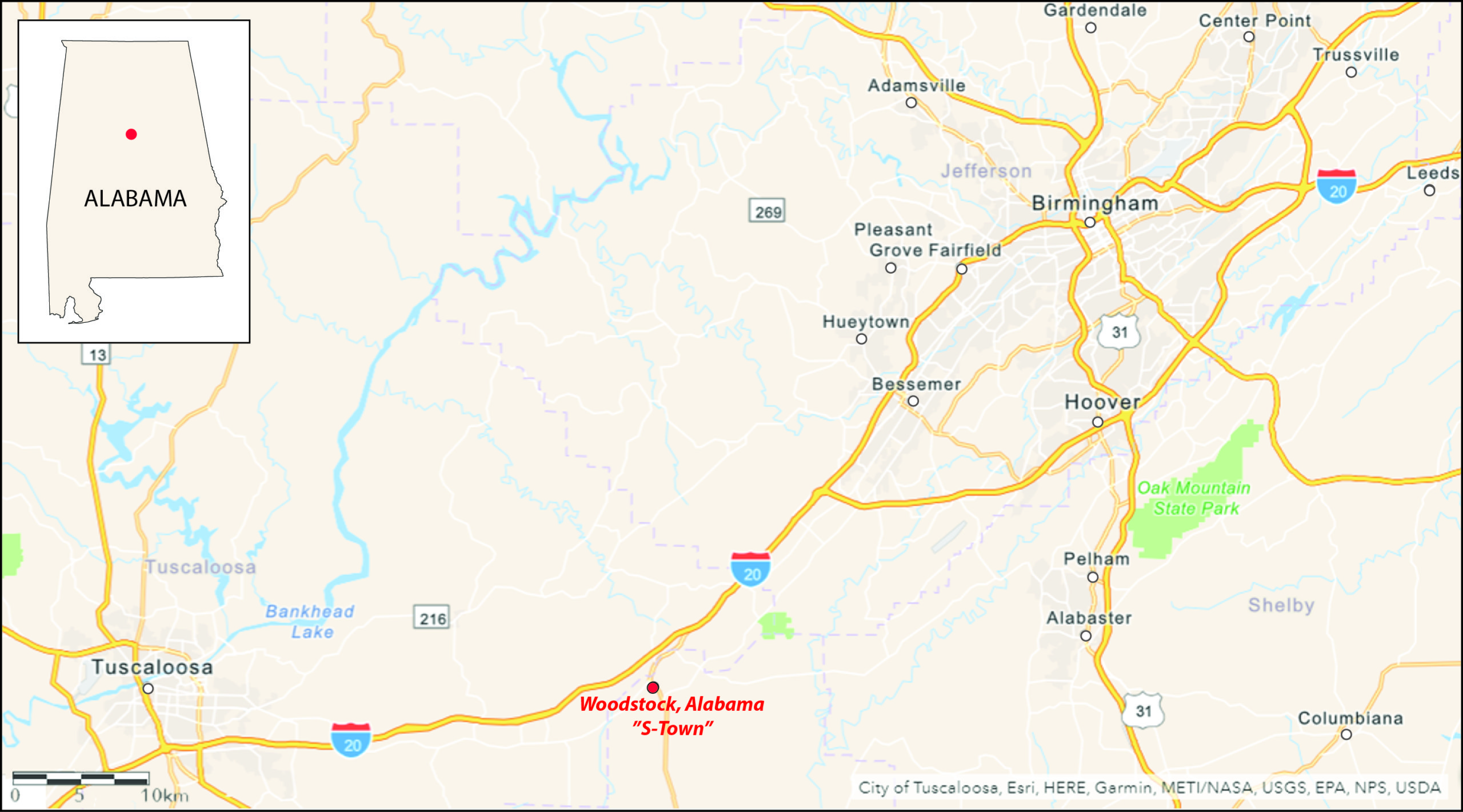
Steven Stoll's Ramp Hollow intervenes in these and related debates by recasting the nature of agriculture and the meaning of land ownership among the European colonialists and their descendants who settled the Appalachian frontier. Stoll likens Appalachia's early settlers to peasants all over the world, who depend on access to a common "ecological base." In the Appalachian instance, this "base" is the forest: "This is a vast renewable fund of resources that provides spaces for fields, food for gathering, fodder for cattle, and habitat for wild game. The base gives everything but costs nothing" (33). Through the practice of swidden, sometimes pejoratively called slash-and-burn agriculture, settlers cleared portions of the forest and cultivated crops, but their clearings were limited; more importantly, they utilized the forest as a source of wild plants, game, and mast for their free-ranging livestock. Although their economy was "makeshift," without extensive surplus or accumulation, these early settlers rarely starved, Stoll asserts, and they should not be considered poor.
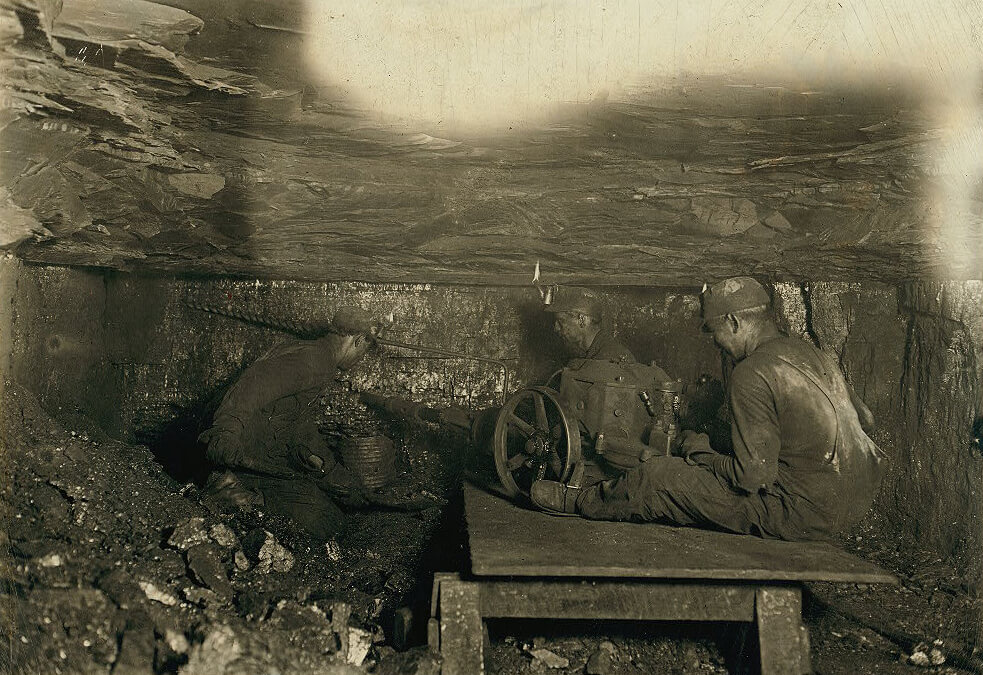
As the western edge of European settlement, the mountainous backcountry of eighteenth-century Appalachia briefly represented a space of relative freedom from state enforcement of property rights. Although elites gained formal title to millions of mountainous acres through grant or purchase, they tended to view the land as "wilderness" and unworthy of investment or even much attention, according to Stoll. A chaos of competing land claims emerged, as well as, in effect, the practice of "land to the tiller." Use-rights prevailed. Squatters and small landholders utilized the vast forest without regard to absentee elites and their abstract legal instruments, which went unenforced, thereby irrelevant, and they engaged in a vigorous barter economy with one another.
Although historians and activists have focused largely on the land-grabbing actions of coal companies in the late nineteenth century as the definitive dispossession of Appalachia, Stoll takes us back to the federalism of Alexander Hamilton in the early republic. Taxation—an obligation that could only be fulfilled in legal currency—was the means to force subsistence agrarians toward a cash economy and extend the administrative reach of centralized government into the recesses of the mountains. "Taxation does not merely fund the state," Stoll observes, echoing the arguments of James C. Scott and other anti-statist anarchist scholars. "It creates its territorial and financial power" (122).3See James C. Scott, The Art of Not Being Governed: An Anarchist History of Upland Southeast Asia (New Haven, CT: Yale University Press, 2009). Armed resistance to Hamilton's tax on distilled spirits, which did not distinguish between commercial and household production, arose from the high value of whiskey in barter exchanges and the onerous compulsion to send money from a cash-poor economy to a distant central government—all on the heels of a war for "independence." Although the Whiskey Rebellion succeeded in discontinuing the excise tax, the coercive extension of a sovereign state—with a unified system of land ownership, property rights, law, currency, taxation, and administrative regularity—would eventually facilitate destruction of the ecological base and subsistence practices of Appalachian agrarians.
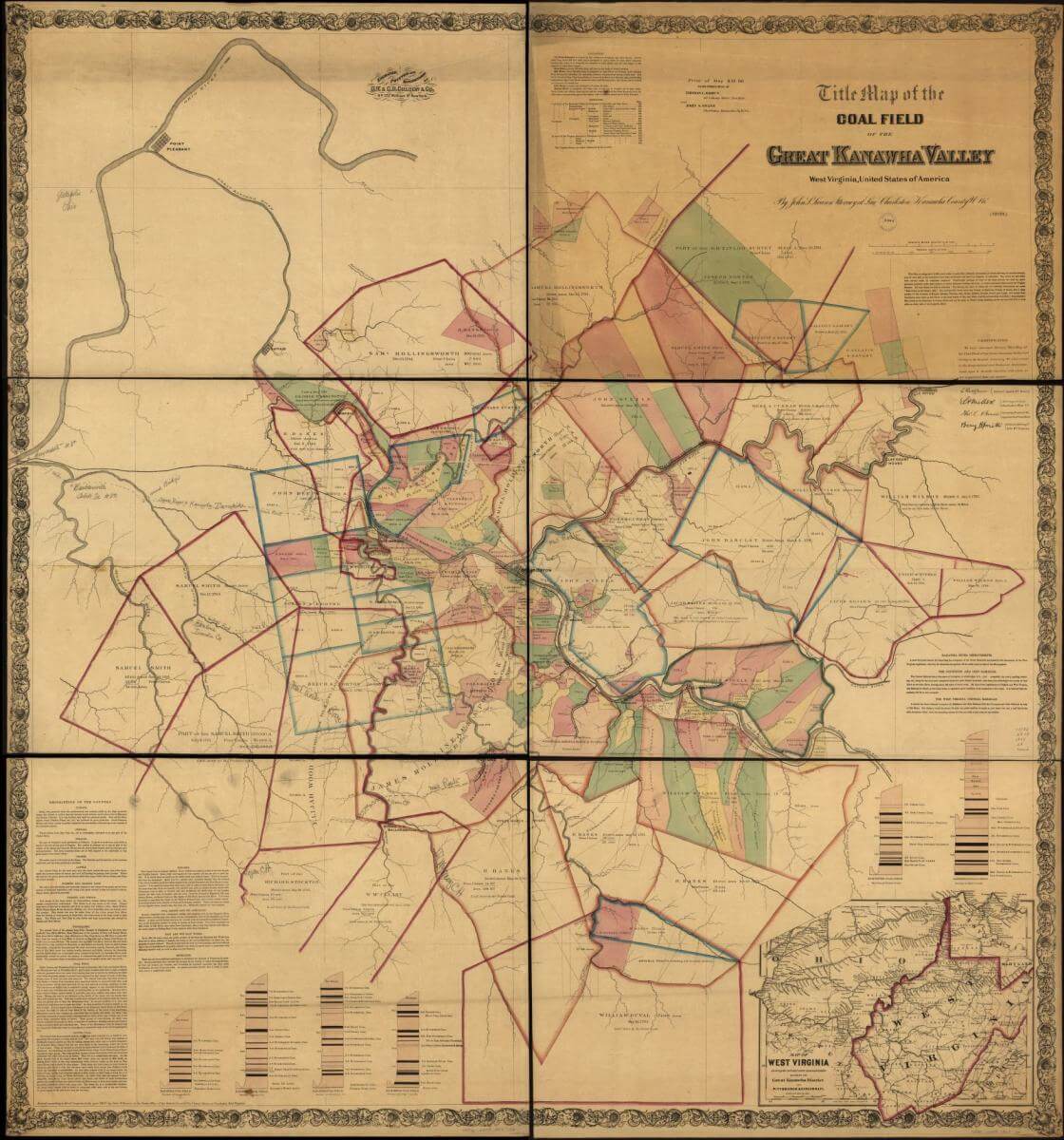
Stoll's tale of rural industrialization in the second half of the nineteenth century focuses on what became West Virginia, and is familiar to scholars and many residents of central Appalachia: extension of the railroads into southern West Virginia, corporate acquisition of mineral rights and vast landholdings, opening of the "billion dollar coalfields," growth of company towns and the exploitative trap of scrip (non-legal tender in which miners received wages), company stores, occupational death, the mine guard system of private security thugs. True to his emphasis on subsistence agrarians, however, Stoll builds on work by Ron Lewis to emphasize the wholesale timbering of the mountains, which accompanied coal mining and devoured the ecological base of the forest.4See Ronald L. Lewis, Transforming the Appalachian Countryside: Railroads, Deforestation, and Social Change in West Virginia, 1880–1920 (Chapel Hill: University of North Carolina Press, 1998). Combined with the contradiction of a growing population seeking sustenance from a shrinking base of land (analyzed in detail by Dwight B. Billings and Kathleen M. Blee), these multiple dispossessions spelled an end to the makeshift agrarian economy.5See Dwight B. Billings and Kathleen M. Blee, The Road to Poverty: The Making of Wealth and Hardship in Appalachia (Cambridge: Cambridge University Press, 2000).
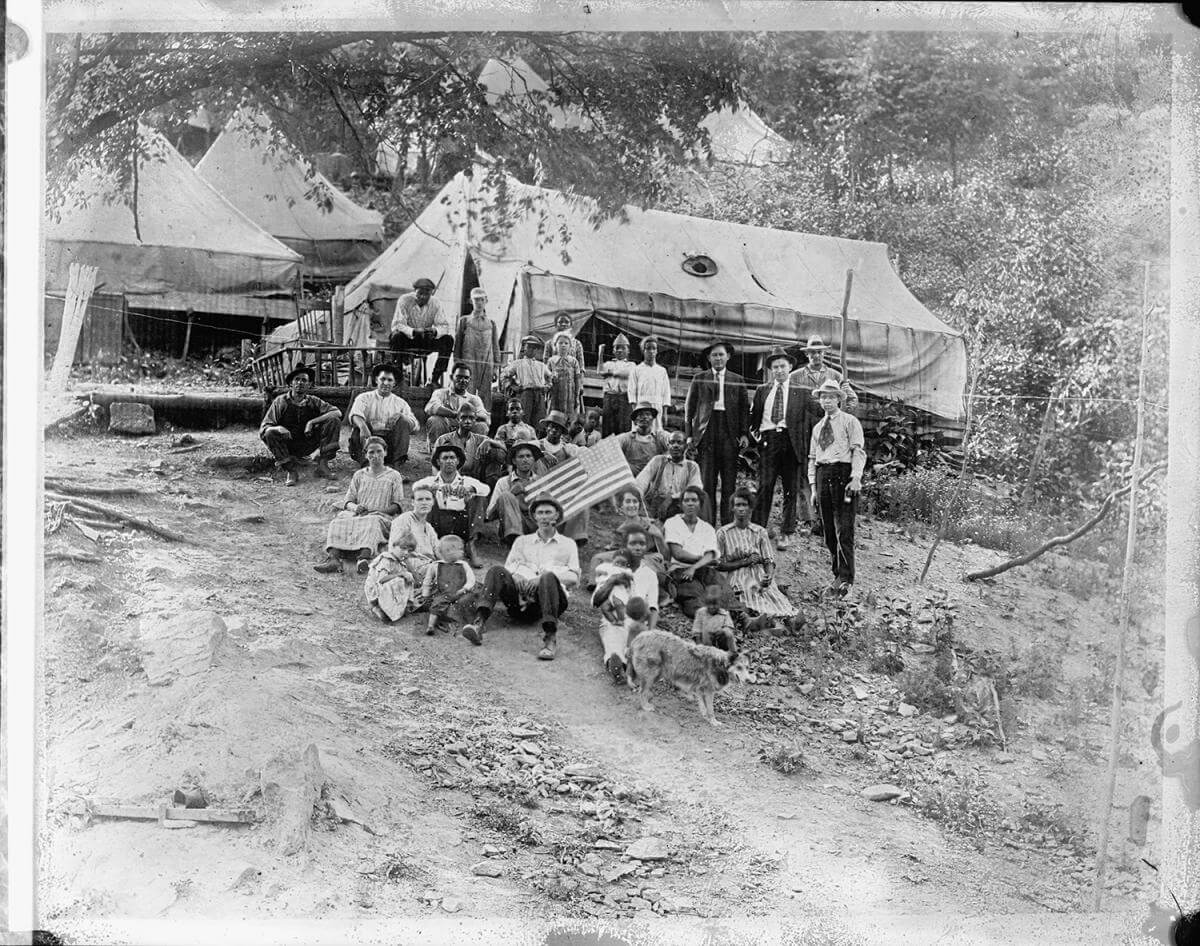
Stoll directs special attention—and some of his most blistering critique—to the ideologues of capitalist modernity, those self-interested promoters of the benefits of wage labor, efficiency, discipline, and "productive" (i.e., profitable for them and their kind) use of the land. Declaring makeshift agricultural practices a miserable, impoverished throwback that impeded the self-evidently desirable processes of modernization, "Atlantic elites" gradually appropriated the means of subsistence of mountain farmers, then pronounced them miserable and poor. This critique of dominant ideology forms an important bridge toward Stoll's larger purpose in Ramp Hollow, which is to defend the integrity of peasants and the viability of their agricultural practices—when not disrupted by various "development" schemes—all over the world. Indeed, the book begins in West Virginia and ends in West Africa, where Stoll decries the contemporary enclosure movement whereby governments are dispossessing entire peasant villages by transferring "idle" common lands to corporations that produce agricultural commodities for global markets.
Reviewers typically feel an obligation to register a complaint or two about a book, and I am no exception. I was disappointed by Stoll's lack of attention to gender relations and the gendered division of labor, especially in view of his definition of the makeshift agricultural economy as a household mode of production. Although he acknowledges that the agrarian household was a "coercive institution" (216), what he means by that is the authority of patriarchs over their children, who "owed their families a certain term of labor before gaining the right to strike out for themselves" (216). Neither patriarchal authority over wives nor the fact that daughters never gained "the right to strike out for themselves" seems to occur to him. Consistent with his Marxist analytic (and neglect of Marxist-feminism), Stoll focuses exclusively on class relations; in the context of coal camps, this includes analyzing the contradictory role of the household garden as a means to lower the cost of miners' and their families' social reproduction (and thus wages) as well as potentially sustain them during strikes. The labor in those gardens, as in social reproduction more generally, remains unexplored.
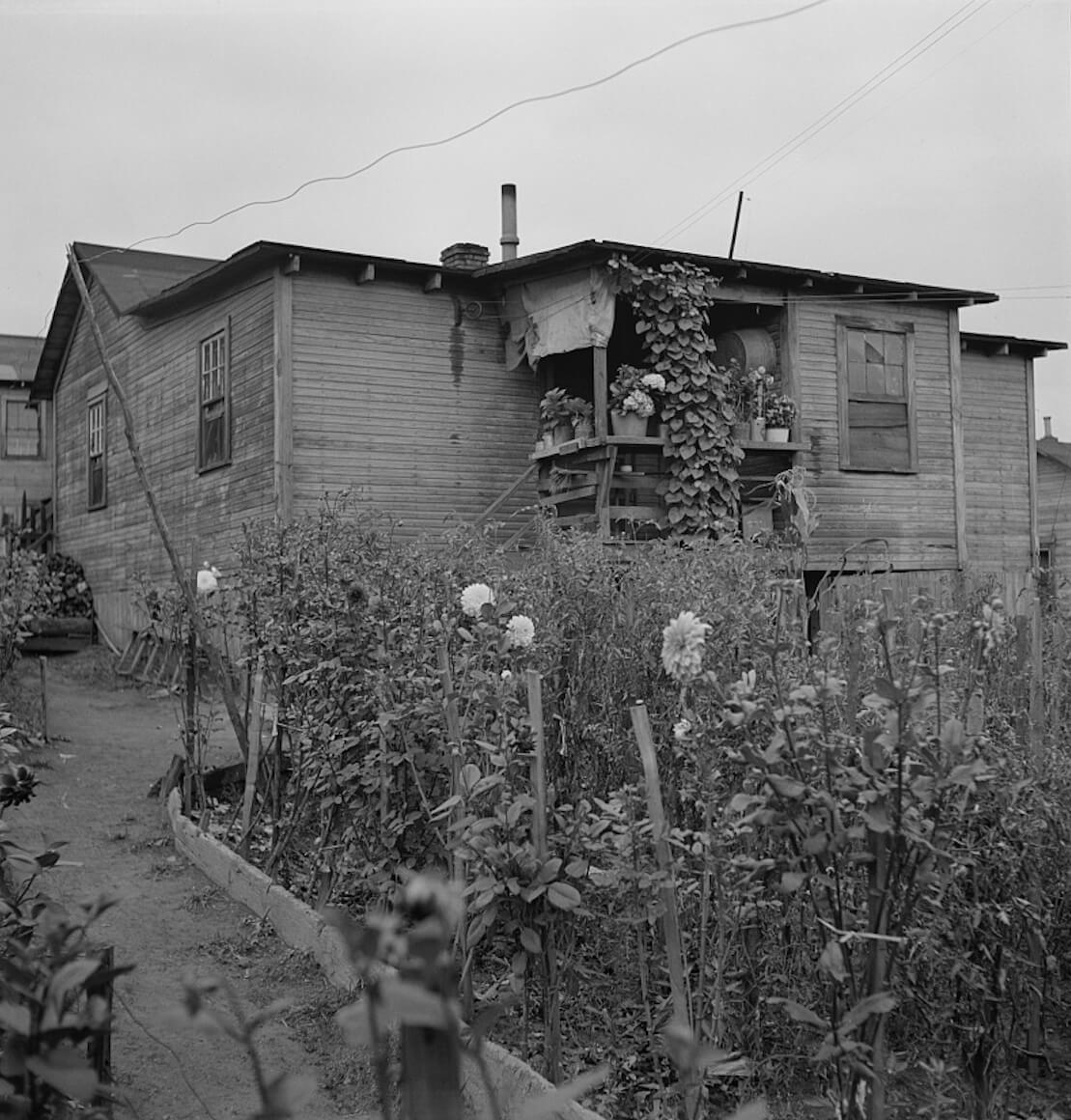
To its great credit as a work of history, Ramp Hollow is unusual in its direct relevance to contemporary politics. This is true for not only areas of the world where land grabs and enclosures proceed apace, but also central Appalachia, where the struggle to envision and create post-coal—and potentially "post-capitalist"—futures is ongoing. In his final chapter, Stoll offers a "thought experiment" in the form of "The Commons Communities Act" (272–274), which proposes publicly-owned commons, complete with a variety of incentives and protections for those who live there, each with an ecological base sufficient to sustain residents through "hunting and gathering, cattle grazing, timber harvesting, vegetable gardening, and farming" (272). Although his proposal is understandably crafted for rural contexts, given Stoll's concerns throughout the book, the commons is not necessarily so. Indeed, the argument that different forms of public commons may be key to the reinvigoration of civic life and the prospects for democratic, place-based economies seems to be spreading.6See Herbert Reid and Betsy Taylor, Recovering the Commons: Democracy, Place, and Global Justice (Urbana and Chicago: University of Illinois Press, 2010); Kathryn Newfont, Blue Ridge Commons: Environmental Activism and Forest History in Western North Carolina (Athens: University of Georgia Press, 2012); and George Monbiot, Out of the Wreckage: A New Politics for an Age of Crisis (New York: Verso, 2017). Regardless of the specifics of such proposals, they reinforce Stoll's overarching argument: capitalist hegemony is not inevitable, and collective access to land is key to the future of Appalachia.
About the Author
Barbara Ellen Smith is professor emerita at Virginia Tech and a member of the editorial board of Southern Spaces. She has long studied and participated in economic justice movements in Appalachia.
]]>Introduction
At present, the people of Appalachia continue to endure the contraction and retreat of extractive industry with little more than big-box retail for employment. They work for local hospitals and county governments at a time when both depend on a withering tax base. Many residents hunt, fish, and garden to make up the shortfall in their household incomes. The Appalachian Regional Commission has not come up with a solution; neither has the leadership of the United States. It seems unlikely, though I would not say impossible, that corporations will show up in southern West Virginia or eastern Kentucky and open factories and offices. I wrote the Commons Communities Act after months of thinking about how the people of the southern mountains might find work with dignity, working for themselves and their families without owing their existences to corporations. I thought that government could help to solve this problem and do what it should do: stand between citizens and the power of capital.
It is difficult to find anything Appalachians have gained by voting for Republicans. Yet a majority in every county in West Virginia voted for Donald Trump in 2016. His promise to revitalize the coal industry lacks a footing in reality. Sensing this, one voter gave him a desperate endorsement, saying, "He's the only shot we got." If Trump studies West Virginia's congressional delegation, he might conclude that he doesn't need to do very much. But the people can do better than that. They can make their representatives justify the trust placed in them. They can demand more of their government. They can assert a right to land and livelihood and reparations from the corporations that used and abused them for so long. Maybe that can be the basis for a positive political identity.1For an argument in favor of collective identities in the service of an ethical politics, see Critchley, Infinitely Demanding. I have especially learned from David Whisnant's "Developments in the Appalachian Identity Movement," which though published in 1980 still resonates. "At its worst . . . regional identification is an isolationist impulse." He deconstructs an essentialist mountain identity. And yet, "The political value of regional identity lies in its usefulness as a basis for broad solidarity and coalition." Whisnant, David. "Developments in the Appalachian Identity Movement: All is Process." Appalachian Journal 8, no. 1 (1980): 41–47.
I favor democratic socialism and a reinvention of the nation-state as a conduit for meeting human needs rather than for accumulating capital. I also favor a realm of democratic autonomy, and that might have more political traction. If Congress and the president can cooperate, such a realm can exist as a function of the United States itself. But it can also exist outside of centralized government, sponsored by West Virginia or Kentucky or Tennessee. Or people can do it themselves, by squatting on abandoned land and defending their right to the commons.2In the words of two historians, "Making visible activities that neoliberalism renders invisible expands the range of ideas for producing social livelihoods and economic development." Amanda Fickey and Michael Samers, "Developing Appalachia: The Impact of Limited Economic Imagination," in Studying Appalachian Studies: Making the Path by Walking, ed. Chad Berry, Phillip J. Obermiller, and Shaunna L. Scott (Urbana: University of Illinois Press, 2015), 123.
There is talk and some action regarding returning land. Various organizations have held public meetings to elicit policies directly from citizens. Even Congress is thinking along these lines. In 2016, Representative Harold Rogers, a Kentucky Republican, introduced the Reclaim Act. The law would empower the Department of the Interior to distribute funds to states and Indian nations aimed at developing land in communities "adversely affected by coal mining." I would push this thinking toward creating a reconstituted commons. What if people who wished to do so lived by hunting and gardening as part of a social project that encouraged political participation? What if citizens possessed use-rights over a sustaining landscape?
Historians don't often write legislation. My attempt is consistent with the argument of this book. Consider it more a thought experiment than a ready-made policy. Any actual solution would require the knowledge of people who live in the mountains and the sponsorship of organizations and activists working on these questions. The following owes something to the New Deal economist Milburn Wilson, the geographer J. Russell Smith, the historian Lewis Cecil Gray, the Kentucky farmer and writer Wendell Berry, and also to Mahatma Gandhi, Lewis Mumford, and E. F. Schumacher.3Appalachian Voices is one such organization. The Reclaim Act is H.R. 4456, 114th Congress. Introduced in the House in February 2016. I call it . . .
THE COMMONS COMMUNITIES ACT
Whereas coal mining is diminishing in the southern mountains, leaving thousands unemployed, and whereas coal contributes to climate change and the disruption of human societies all over the world; whereas a rural policy should incorporate ecological principles with food production on a small scale, and whereas the United States once included millions of households engaged in production for subsistence and exchange; whereas when people take care of landscapes, landscapes take care of them,
SECTION 1. The United States shall create a series of commons communities, each designed to include a specified number of households within a larger landscape that will be managed by them, the residents. This landscape will provide the ecological base for hunting and gathering, cattle grazing, timber harvesting, vegetable gardening, and farming. The ecological base will be owned as a conservation easement or land trust under the authority of the states and/or counties where each community resides.
SECTION 2. Commons communities would be organized according to the design principles developed by the economist Elinor Ostrom, who was awarded the Nobel Prize in Economic Sciences in 2009 for her work on the economic governance of common resources. Each community shall include well-defined boundaries and members. Each will devise rules for appropriation suitable to the environment, along with sanctions and penalties for those who violate the rules and take too much or otherwise abuse the resource. Each must establish a means of conflict resolution and governance. In the event that residents need to sue the community or other residents, they would use the county, state, or federal courts.4Ostrom (1933–2012) shared the Nobel Prize with Oliver E. Williamson. The act would rely on Ostrom's Governing the Commons: The Evolution of Institutions for Collective Action (Cambridge: Cambridge University Press, 1990). For design principles, see pages 90–101.
SECTION 3. Commons communities will not be limited to Appalachia but could be established anywhere a sufficient ecological base exists, including the outskirts of cities and suburbs. This law must not be construed to favor one location or ethnic group.
SECTION 4. Social services and education will be paid for by an income tax on the top one percent of household incomes in the United States and an Industrial Abandonment Tax, attached to any corporation that closed its operations in any city or region of the United States within the last twenty years of the date of this Act and moved elsewhere, leaving behind toxic waste and poverty.
SECTION 5. Resident households with incomes under $50,000 a year will pay no federal income tax. Residents will own their own homes, paying for them with low-interest mortgages and a $1.00 down payment.
SECTION 6. No nonresident, trust, or corporation is permitted to purchase property in a commons community.
SECTION 7. The organization of commons communities will proceed through the Department of Agriculture. The Department will initiate the identification of suitable lands for condemnation by eminent domain or land already owned by counties, states, or the United States. The Department will determine how much land is needed to sustain a given number of residents.
SECTION 8. Allied Programs.
SUB-SECTION A. Income tax incentives will encourage teachers and medical doctors to live in commons communities and work in the schools and nearby hospitals.
SUB-SECTION B. College-age members of any commons household may apply for free tuition at their state university. Tuition shall be paid for by the Industrial Abandonment Tax.
SUB-SECTION C. Commons communities will receive special programs intended to link them to the Internet. Cooperation between communities will incorporate schools, artists and writers in residence, and scientists engaged in the study of the environment. This Act provides funds for the publication of a journal or magazine of commons life to be written and published by the residents of the various communities.
SUB-SECTION D. Another program will link gardeners with markets for their produce, including grocery stores and restaurants. Proceeds from this Market Garden Initiative will not be subject to state or federal income tax.
SUB-SECTION E. University experiment stations in every state where commons communities exist will send representatives to teach the latest methods of garden production, with the approval and consent of residents.
SECTION 9. If the members of a commons community no longer wish to be associated with the federal government, they may become independent at any time with a majority vote consisting of two-thirds of adult residents, at which time all federal programs associated with this Act will cease. Ownership of the commons would not change and residents would keep their homes.
The act might look like Arthurdale and the Division of Subsistence Homesteads all over again. But it has no factory, no originating debt, and no presumption that people must subsist entirely from gardens. It emphasizes scientific conservation, cultural expression, entrepreneurship, and democracy. It would not prevent any resident from earning money in any job or profession. Some within Appalachia might object to the participation of the federal government. But government can do things that communities cannot by themselves, like purchase land, relieve taxes on citizens and levy them on corporations, advance citizen participation, and pay for college. Government can help the residents of commons communities remain connected to the wider world of economic opportunity and political participation. But the act allows for its own dissolution. Residents would have the authority to end the government's participation and keep their gains.5On corporate subsidies, Niraj Chokshi, "The United States of Subsidies," Washington Post, March 18, 2015, www.washingtonpost.com/blogs/govbeat/wp/2015/03/17/the-united-states-of-subsidies-the-biggest-corporate-winners-in-each-state/?utm_term=.314361798972.
Top, View of Arthurdale project, Reedsville, West Virginia, 1935. Photograph by Walker Evans. Courtesy of the New York Public Library Miriam and Ira D. Wallach Division, digitalcollections.nypl.org/items/96818680-baca-0132-6504-58d385a7b928. Bottom, Homes and land cultivation, Arthurdale project, Reedsville, West Virginia, 1935. Photograph by Walker Evans. Courtesy of the New York Public Library Miriam and Ira D. Wallach Division, digitalcollections.nypl.org/items/94ba4f90-baca-0132-01de-58d385a7b928.
The act seeks to preserve and encourage a makeshift economy that has been practiced for two centuries among mountain farmers, as well as among people in other parts of the United States. Readers in New York, Chicago, or Los Angeles might not appreciate the extent to which rural Americans depend on forests and other environments for food and cash. In the 1980s, Timothy Lee Barnwell photographed and interviewed Appalachians who practiced agrarian economy. Charlie Thomas of Bush Creek, North Carolina, said, "Even when I was growing up we raised almost everything we ate. You'd buy a little coffee if you wanted it, but we never drank it, and buy or trade for what sugar you needed, and we used honey for that. We've always kept bees for our own honey." A series of interviews conducted in southern West Virginia during the 1990s is now part of the Library of Congress. "People around here . . . on Coal River, just about every one of them does the same thing," explained Dave Bailey. "They pick the grains, they pick the black berries, they fish, they hunt . . . they get the molly moochers [the morchella or morel mushroom] . . . They do that, their kids is going to do it, their grandkids is going to do it, and that's the way it is on Coal River." Others interviewed detailed their extensive knowledge of trees and plants. None of these West Virginians need the Commons Communities Act to continue living as they always have, from whatever forested commons they can still find. The act is meant to promote this social ecology. By combining land and livelihood—by fostering possession against a history of dispossession—it would reconnect communities and landscapes in a structure for sustaining both.6Tim Barnwell, The Face of Appalachia: Portraits from the Mountain Farm (New York: W. W. Norton, 2003), 121, 122, 126. The project is Tending the Commons: Folklife and Landscape in Southern West Virginia in cooperation with the Coal River Folklife Project and the American Folklife Center at the Library of Congress. Dave Bailey interviewed by Mary Hufford on April 12, 1996 (AFC 1999/008), http://hdl.loc.gov/loc.afc/afccmns.104007; Virgil Jarrell interviewed by Mary Hufford on May 23, 1996 (AFC 1999/008), http://hdl.loc.gov/loc.afc/afccmns.117004.
The political economy of the act combines private and communal property. Residents may buy and sell their homes, pass them to the next generation, and do anything else with them permitted by local law. They would act differently in their role as managers of common woods and waters. Economists have rarely understood the logic of collective use. The most common argument says that every user has an incentive to cut every last tree, shoot every last large-bodied mammal, and let his cattle graze every last acre of wild meadow, leaving nothing for anyone else. The forest is reduced to stumps; the high meadow is overrun with thistle. This is the misleading parable of the "Tragedy of the Commons," most famously described by the biologist Garrett Hardin in 1968.7Garrett Hardin, "The Tragedy of the Commons," Science 162 (December 13, 1968): 1243–48.
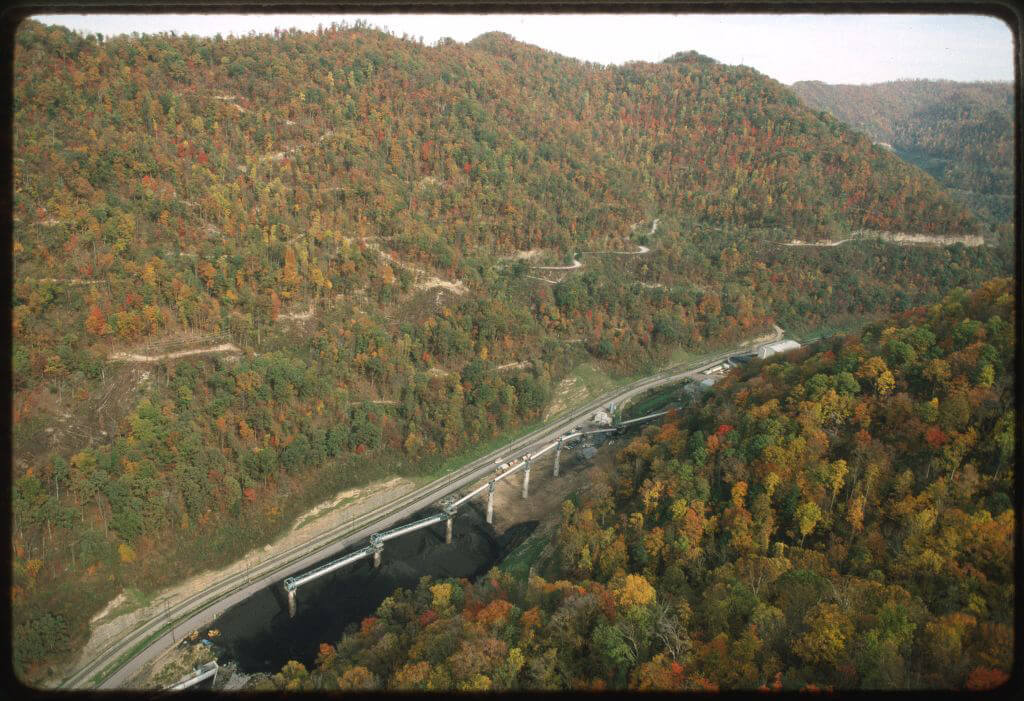
Hardin based his model on a self-serving conception of human nature. His essay has nothing to do with how actual people govern actual shared resources, cases that Hardin seems to have known little about. His first mistake was to think that a commons is a free-for-all. No such set of resources is open to everyone, but only to members, defined in various ways. Consider the forests of New England in the nineteenth century. Colonial towns owned them and controlled access, allowing some to cut trees and others to hunt and fish with permission. Lobster fishermen in Maine operate according to their own rules and institutions, with little government involvement, resulting in one of the most successful fisheries in the world. But they decide who can and cannot benefit. Thus everyone who depends on common property has an incentive to maintain it. This is not to say that everyone is always satisfied. Community management requires governance to mediate disagreement and limit the consequences of conflict. The point is that it's simply not true that common property always degenerates into scarcity.8According to Richard Judd, "These local common resource regimes established two central principles for the emerging New England conservation tradition: communities bore collective responsibility for managing their resources in a productive fashion, and they were to allocate these resources equitably." Judd, Common Lands, Common People: The Origins of Conservation in Northern New England (Cambridge, MA: Harvard University Press, 1997), 7–8, 41–45; James Acheson, Capturing the Commons: Devising Institutions to Manage the Maine Lobster Industry (Hanover, NH: University Press of New England, 2003), 206; Allan Greer, "Commons and Enclosure in the Colonization of North America," American Historical Review 117, no. 2 (April 2012): 365–86.
But Hardin cannot be dismissed altogether. His fable reasonably describes resources that no group can manage, like the open ocean and the atmosphere. And not all collective uses of land have succeeded. (In fact, we know very little about how the functional forest commons fared in West Virginia, how well users governed themselves.) Without regulations and penalties, without clear borders and firm institutions, they can result in devastation. This is why Elinor Ostrom studied them—to figure out why some failed and others thrived.9Kathryn Newfont, Blue Ridge Commons: Environmental Activism and Forest History in Western North Carolina (Athens: University of Georgia Press, 2012), 276.
We all live in communities. In a sense, no one really lives in the United States but in neighborhoods, towns, and counties. Strengthening those bonds within environments that allow for economic autonomy seems like a way of creating space between people and the nation-state. It might also offer a way to endure during times of climate disruption, when the United States might not be capable of compensating for any number of possible disasters. The Commons Communities Act proposes land reform and collective governance. It proposes nothing new, but rather something very old, a sense of ownership without the enclosure and the abuse of power characteristic of private property.10Ibid.
And yet, I have my own objections to the Commons Communities Act. Small-scale development programs appeared decades ago, with mixed results. The same reformers and intellectuals who rediscovered the small town and the Indian pueblo during the New Deal urged communitarian approaches all over the world. But these schemes harbored certain false assumptions, well described by the historian Daniel Immerwahr. Development agencies believed that the members of a village acted from shared principles and that local elites would fairly apportion money entrusted to them. But villages in the Philippines and India turned out to be more complicated—and divided—than the sanguine Americans had thought. Immerwahr suggests another problem. When a nation-state invests in a community, where does its influence end? What role would the United States play in a commons community?11Daniel Immerwahr, Thinking Small: The United States and the Lure of Community Development (Cambridge, MA: Harvard University Press, 2015).
The act might also be criticized for shunting the problem of industrial abandonment onto the poor, just like the Division of Subsistence Homesteads. In this way, it seems like a neoliberal policy intended to reduce the cost of state services and lower taxes on the rich. And while under the act the corporations that caused so much human and ecological ruin would be required to pay for houses and schools, this doesn't change or challenge a political economy in which humans and environments serve as inputs in the circulation of capital. For corporations, compensating for social destruction is merely part of the cost of doing business. Eliminating these contradictions so that citizens benefit would require a government and a set of laws dedicated to human welfare.
The act includes scholarships so that the children of Appalachian households might attend college, but it does not come close to addressing the larger cultural problem of why high school kids in Appalachia often don't apply. In Hillbilly Elegy (2016), J. D. Vance eloquently explains why it's so difficult for Appalachians to find a way out of unemployment and improve the quality of their lives. Some see themselves as different from those outside their families or counties. People in other parts of the country view them harshly, with many of the same racialized stereotypes present a century ago. All of this makes geographic and social mobility difficult. Vance's own story suggests that a strong mentor with the capacity to see beyond limited local opportunities can overcome self-defeat. Vance's mentor was his grandmother. "She didn't just preach and cuss and demand. She showed me what was possible . . . and made sure I knew how to get there." Her home provided Vance stability and peace, "not just a short-term haven but also hope for a better life."
Vance got out. He graduated from Ohio State University, the Marines, and Yale Law School before joining a Silicon Valley investment firm. But his very success implies the depth of the problem he confronted. The most unsettling currents in Hillbilly Elegy lie in the necessity of leaving and in its emphasis on a strong and uncompromising grandmother. If meaningful work and a decent occupation only exist elsewhere, then most Appalachians will be abandoned. If escape depends on someone who rises above despair and abuse, then most will be stuck. The role of public policy and a political solution to poverty is to attempt to help everyone in the same situation rather than rely on extraordinary circumstance and plain luck to produce successful individuals. Vance's book is inspiring as a memoir, but it might be construed as saying that the tragedy of Appalachia is the sum of its individual failings or the insularity of its families.12J. D. Vance, Hillbilly Elegy: A Memoir of a Family and Culture in Crisis (New York: Harper Collins, 2016): 148–49, 206. Domestic violence, drug abuse, and hopelessness on such a scale have social causes. They require solutions that do not place the burden on the sufferers themselves to transcend their circumstances.
About the Author
Steven Stoll is a professor of history at Fordham University and the author of The Great Delusion (Hill and Wang, 2008) and Larding the Lean Earth (Hill and Wang, 2002). His writing has appeared in Harper's Magazine, Lapham's Quarterly, and the New Haven Review.
]]>Review
In 2001, lifelong Anniston, Alabama, resident Ruth Mims was called to testify in a lawsuit against the multinational corporation Monsanto. Monsanto had owned and operated a chemical manufacturing facility in Anniston since the 1930s, and growing up, Mims and her family—mother, father, and twelve siblings—lived right near the plant. Her parents farmed land near a drainage ditch that carried effluent from the factory. The family's livestock got their water from the ditch, and Mims and her siblings "played barefoot in the dirt and swam and caught tadpoles" in the ditch, whose small currents, as she recalled, were awash with dead minnows (243).
By the time of her testimony, Mims was seventy years old. An expert witness testified that her blood carried "outrageously high" levels of the class of toxic chemicals known as PCBs, manufactured by Monsanto, and that the soil in her yard contained PCB levels "above what the government will consider safe for human habitation" (243). The information should have been no surprise to Monsanto. In her testimony, Mims had recalled how, back in 1970, company representatives had knocked on the family's door, asking to buy their hogs for $25 a head "plus a pint of corn liquor." Unbeknownst to the Mims and their neighbors, Monsanto was collecting nearby livestock to determine the extent of PCB contamination of the local environment and its inhabitants. The company's analyses showed that the chemicals were building up in the animals' fat to levels of roughly 19,000 parts per million (at the time, federal standards advised consuming fish with no more than 5 ppm). But the company kept the results under wraps, even though they clearly pointed to high PCB levels among the poor and working-class families living near the plant.

The concealment of such "toxic knowledge" is a central theme of Ellen Griffith Spears's excellent and important book, Baptized in PCBs: Race, Pollution, and Justice in an All-American Town, which follows the story of Anniston from its factory-town founding in 1872 through its acquisition of the moniker "Toxic Town USA" in 2002. The book reconstructs the history of two "chemical dramas" that played out in Anniston over the century: one concerned the town's battle to clean up PCBs among other chemical pollutants, and the other concerned the fate of chemical weapons stockpiled in Anniston during the Cold War. Spears's book tells a larger story, too, about the intersection of place, racial segregation, class, the military, and pollution. The Mims were an African American family, their plight another instance of a form of southern environmental injustice whose total ramifications have rarely been adequately acknowledged or addressed. In Spears's work, Anniston's story, alongside many other stories of those who, like the Mims, were directly affected by the town's chemical dramas, serves as a powerful "argument for reforming how we manufacture, use, and regulate toxic chemicals in the United States" (xiii). It's an argument, says Spears, that is as urgent as the one made by Rachel Carson in Silent Spring more than half a century ago.

PCBs are industrial chemicals—there are more than two-hundred of them in all—used mostly for their insulating and fire-retardant properties. Anniston was the first site of PCB production in the United States; a company named Swann Chemical set up shop there in the 1920s, drawn to the town's industrial capacity and access to natural resources and cheap labor. As Spears notes, Anniston was founded as an experiment during Reconstruction and by the 1880s had been dubbed a "Model City" of the South for its productive mix of agriculture and industry, fueled by deeply rooted racial hierarchies. By 1930, Swann's Anniston Works produced 3,000 pounds of PCBs daily, shipping exports "as far away as China" (27).

Pollution accompanied this productivity. In the 1930s, Anniston residents complained that dust and smoke from the works was "eating paint" off their cars, houses, and lawn furniture, and some Swann workers sued the company over chemical exposures that made them sick. When Monsanto took over Swann's facility in 1935, the toxic effects of PCBs were well known. Scientific reports detailed the "acneform eruptions" on workers faces and bodies, and studies by a Harvard scientist had found that even "very small amounts of the chemical were harmful" (70, 73). But at this early stage, evidence of "toxic knowledge" was dismissed. Monsanto's physicians blamed the effects on "impurities" and not the chemical itself. When workers became ill, their own physiology was blamed, and they were replaced with "new men" (67).
This refusal and redirection is critical. For Spears's account is, at its core, a simultaneously fascinating and frightening history of the extent of Monsanto's toxic knowledge and the multitude of approaches the company took to control it over time. At times, toxic knowledge was concealed; at other times, it was dismissed. At still other times, Monsanto sought to distract from it, as when the company launched its early public relations campaigns, sponsoring department store displays and Disneyland exhibitions about the achievements of the chemical industry. At other times the company stemmed the flow of toxic knowledge, as when it took advantage of close ties to government officials to procure a promise that the Navy would be "commercially discreet" with information it had accrued about how PCBs sickened not only shipyard workers but also their wives, who were exposed to the chemicals on their husbands' clothes (129).

Historians of health and the environment have documented the importance of chemical "invisibility" to the movement of so-called modern matter,1Mitman, Gregg, Michelle Murphy, and Christopher Sellers, "Introduction: A Cloud Over History," Osiris 19 (2004): 1–20; Murphy, Michelle, Sick Building Syndrome and the Problem of Uncertainty: Environmental Politics, Technoscience, and Women Workers (Durham, NC: Duke University Press, 2006). and as Spears demonstrates, it was relatively easy to "shroud" toxic knowledge about a class of chemicals that was largely invisible to the public, such as PCBs. As chemicals, PCBs are mostly colorless and odorless. Some PCB compounds, visible at first, become colorless when mixed with other chemicals. These properties made PCBs invisible, but so did their applications. PCBs were never sold directly to consumers, but consumers bought and accumulated them unwittingly, since they could be found not only in products ranging from electronics to detergents but in caulk, ink, shoe polish, fabrics, perfumes, and even Christmas trees. PCBs' invisibility made PCB pollution and exposure an issue categorically different from the twentieth-century's most famous chemical drama—DDT pollution and exposure—simply because Americans didn't know when they were buying PCBs, didn't know when and where PCBs were in the environment, and didn't know how to avoid them.
In Baptized in PCBs, the drama turned on two critical historical episodes: one made PCBs ubiquitous; the other helped make them and their toxic effects visible. In wartime, Swann and Monsanto benefited from lucrative federal contracts, forging tight relationships with government agencies that protected the company, its products, and its practices from scrutiny, even as the company grew at an unprecedented rate and its products made their way into every household and every body. In peacetime, new coalitions of activists formed to fight for civil rights, with important consequences for the emergence, decades later, of a form of environmentalism that fought against the injustice of chemical pollution in poor and minority communities. Both of these trends are visible in Anniston's history, demonstrating, as Spears intends, that "local spaces are sites at which global processes take place" (17).
The connection between Anniston's civil rights activism and its environmental activism is an important contribution of Spears's work. But it's also just one piece of the larger narrative she weaves about the historical relationship between race and pollution. When Anniston was founded as a mill town in the late nineteenth century, black workers were given the "dirtiest" jobs and lived on "Smokey Row," within "sight, smell and walking distance of the iron mill" (25). As industry in Anniston changed, patterns of employment and residence remained the same. As a consequence, over a century later African Americans lived on the most PCB-polluted land and had PCB body burdens three times that of whites.
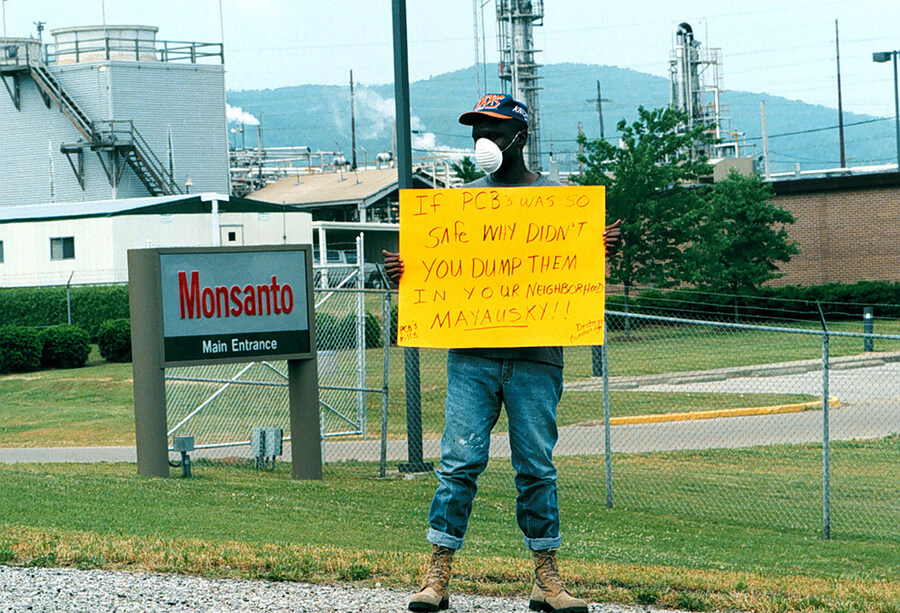
Importantly, however, Spears's point is not that nothing changed. Rather, she shows how, over time, pollution exaggerated—and continues to exaggerate—existing racial disparities. Segregation and poverty exacerbated industrial waste dumping in poor and minority neighborhoods, and in turn, the resulting pollution reinforced and worsened segregation and poverty. As Spears writes, "Segregation had kept African Americans out of city pools, so they swam in (polluted) local swimming holes. Poverty kept supermarkets from locating in the neighborhood, while home gardens exposed residents to contaminated dirt. Relying on small livestock and locally caught fish, promoted decades earlier as a progressive reform . . . ironically made them vulnerable to Monsanto's pollution as well. In circular fashion, being home to a polluting plant depressed neighborhood home values and repelled business development, thereby increasing poverty" (220).
From the hundreds of pounds of PCBs dumped into a local creek on a daily basis in 1969, to the local fish found with 37,800 ppm PCBs, to the fact that Anniston residents today carry among the highest bodily levels of PCBs worldwide for non-workers, there is no shortage of evidence of horrifying pollution practices and consequences in Spears's account. But Baptized in PCBs is not just about PCBs.

During World War II, the Chemical Warfare Service set up a training site near Anniston. By the early 1960s, the Army's entire Chemical-Biological-Radiological Corps Command was moved to Anniston, and the site also became home to a chemical weapons storage site. Only after the US signed the Chemical Weapons Convention of 1993 did Anniston residents come to learn that the local Army depot had been storing more than 2,000 tons of chemical weapons since 1963. In spite of staunch opposition from local citizens, the US Army pursued plans to incinerate the weapons on site—including tons upon tons of deadly nerve agents—defining a series of zones within the town in the process. Residents living within the "Pink Zone" were given protective equipment and training on what to do in case things went wrong and nerve agents escaped during incineration. Spears tells the story of being invited to dinner at the home of a local Anniston family, who offered the caveat that if the incinerator's warning siren went off while Spears was at their house, they had only enough masks to protect themselves—not her.
Anniston residents fought, successfully, for safer Army incineration plans at the same time that legal action against Monsanto was gaining momentum. In 2002, a jury found Monsanto guilty of knowingly poisoning Anniston residents and hiding the dangers of chemical exposures. Over a year later, lawyers for the company and attorneys representing more than 21,000 plaintiffs (including Mims) settled the Anniston PCB cases with a global settlement of $700 million, the "largest award to remedy industrial pollution at a single site in US history" (263).
But this is not necessarily a happy ending, nor is it a conclusion marked by victory. Baptized in PCBs demonstrates the degree to which corporate power has controlled the creation and flow of toxic knowledge. It provides compelling evidence of the extent to which chemical manufacturers took advantage of their products' invisibility, manufactured doubts about their products' toxicity, and nurtured a close relationship with the "machinery of war," a relationship that protected industry at the expense of individuals (7). Anniston's chemical dramas, in Spears's telling, bring into relief the troubling relationships among national security, corporate power, racial hierarchies, and social injustices. They are, as Spears contends, "a paradigmatic case for the need for precaution, for addressing toxic chemical exposures not after the fact but before damage is done" (298).
About the Author
Elena Conis is assistant professor of history at Emory University, a former award-winning health columnist for the Los Angeles Times, and the author of Vaccine Nation: America's Changing Relationship with Immunization (University of Chicago Press, 2015).
]]>Poem
Robert Morgan reads his poem "Bricking the Church," 2014.
Bricking the Church
At the foot of Meetinghouse Hill
where once the white chapel
pointed among junipers and pulled
a wash of gravestones west,
they've buried the wooden snow that
answered sarvis in bloom
and early morning fogs, in brick,
a crust the same dull red
as clay in nearby gullies.
The little churchhouse now looks more
like a post office or school.
It's hard to find
among the brown winter slopes
or plowed fields of spring.
Brick was prestigious back when
they set their minds and savings to it.
They wanted to assert its form
and presence if not in stone
at least in hardened earth, urban weight,
as the white clapboards replaced
unpainted lumber which replaced
the logs of the original
where men brought their guns to preaching
and wolves answered the preacher.
The structure grows successive rings,
and as its doctrine softens
puts on a hard shell
for weathering this world.
Acknowledgments
"Bricking the Church" from Robert Morgan's book Groundwork (Gnomon Press, 1979) appears here by permission of Gnomon Press.
About the Author
Robert Morgan is the author of fourteen books of poetry, most recently Terroir, 2011. He has also published nine volumes of fiction, including Gap Creek, a New York Times bestseller. A sequel to Gap Creek, The Road From Gap Creek, was published in 2013. A new novel, North Star, is forthcoming in 2015. In addition, he is the author of three nonfiction books, Good Measure: Essays, Interviews, and Notes on Poetry, 1993; Boone: A Biography, 2008; and Lions of the West: Heroes and Villains of the Westward Expansion, 2011. In 2010 a special issue of Southern Quarterly, edited by Jesse Graves, was devoted to essays about his work. He has been awarded the James G. Hanes Poetry Prize by the Fellowship of Southern Writers and the Academy Award in Literature by the American Academy of Arts and Letters. In 2013 he received the History Award Medal from the Daughters of the American Revolution. Recipient of fellowships from the Guggenheim and Rockefeller foundations, the National Endowment for the Arts, and the New York State Arts Council, he has served as visiting writer at Davidson College, Furman, Duke, Appalachian State, and East Carolina universities. A member of the Fellowship of Southern Writers, he was inducted into the North Carolina Literary Hall of Fame in 2010. Born on October 3, 1944 in Hendersonville, North Carolina, he has taught since 1971 at Cornell University, where he is Kappa Alpha Professor of English.
]]>Interview
Part 2: Morgan reads “Backwater” and discusses his history of coming to terms with his origins
Part 3: Morgan reads “Heaven” and discusses the place of nostalgia in his poetry
Part 4: Morgan reads “Rearview Mirror” and discusses the paradox of the mirror
Part 5: Morgan describes his relationships with A.R. Ammons and Jake Adam York, as well as the role of place in poetry
Part 6: Morgan discusses the tension between the particular and the universal
Poems
Terroir
That quality that seems unique,
as thriving from a special spot
of soil, air flow and light specific,
and also frost and winter sleep,
conditions of particular year,
as every instance comes just once
with mix of mineral and grease,
what Hopkins chose to call inscape,
or individuation, sounds
so close to terror you'd confuse
the two, as if the finest and
the rarest blend would come with just
a hint of fear or pain, the sting
and shiver of revulsion with
the savor of the earth and sun,
of this once, not returning, sung
for this one ear, on this one tongue.
Backwater
I used to think backwater meant
remote or backward, out of date,
a place of stagnant poverty.
But found the term in history means
across the mountain watershed
where rivers run the other way
to west, to wilderness, to where
the future waits to open out
its shining promise, destiny.
Backwater meant new water then,
where greatness waited, tilted toward
the sunset rivers of hope where
the worst of us, the very worst
of all, might find a seventh chance.
Heaven
And yet I don't want not to believe in,
little as I can, the big whoosh of souls
upward at the Rapture, when clay and ocean,
dust and pit, yield up their dead, when all
elements reassemble into forms
of the living from the eight winds and flung
petals of the compass. And I won't assume,
much as I've known it certain all along,
that I'll never see Grandma again, nor
Uncle Vol with his fabulations,
nor see Uncle Robert plain with no scar
from earth and the bomber explosions.
I don't want to think how empty and cold
the sky is, how distant the family,
but of winged seeds blown from a milkweed field
in the opalescent smokes of early
winter ascending toward heaven's blue,
each self orchestrated in one aria
of river and light. And those behind the blue
are watching even now us on the long way.
Rearview Mirror
This little pool in the air is
not a spring but sink into which
trees and highway, bank and fields are
sipped away to minuteness. All
split on the present then merge in
stretched perspective, radiant in
reverse, the wide world guttering
back to one lit point, as our way
weeps away to the horizon
in this eye where the past flies ahead.
About the Author
Robert Morgan is the author of fourteen books of poetry, most recently Terroir, 2011. He has also published nine volumes of fiction, including Gap Creek, a New York Times bestseller. A sequel to Gap Creek, The Road From Gap Creek, was published in 2013. A new novel, North Star, is forthcoming in 2015. In addition he is the author of three nonfiction books, Good Measure: Essays, Interviews, and Notes on Poetry, 1993; Boone: A Biography, 2008; and Lions of the West: Heroes and Villains of the Westward Expansion, 2011. He has been awarded the James G. Hanes Poetry Prize by the Fellowship of Southern Writers and the Academy Award in Literature by the American Academy of Arts and Letters. In 2013 he received the History Award Medal from the Daughters of the American Revolution. Recipient of fellowships from the Guggenheim and Rockefeller foundations, the National Endowment for the Arts, and the New York State Arts Council, he has served as visiting writer at Davidson College, Furman, Duke, Appalachian State, and East Carolina universities. A member of the Fellowship of Southern Writers, he was inducted into the North Carolina Literary Hall of Fame in 2010. Born in Hendersonville, North Carolina, October 3, 1944, he has taught since 1971 at Cornell University, where he is Kappa Alpha Professor of English. In 2010 a special issue of Southern Quarterly, edited by Jesse Graves, was devoted to essays about his work.
About the Interviewer
Emma Lirette, originally from Chauvin, Louisiana, lives outside Atlanta with her wife and two daughters. She works as a User Experience Researcher in social media and holds a PhD in American Studies and an MFA in Creative Writing. Her book Last Stand of the Louisiana Shrimpers is forthcoming from University of Mississippi Press in September 2022.
Acknowledgments
"Backwater" and "Terroir" appeared in Terroir (New York City: Penguin, 2011) and are reprinted here courtesy of Penguin Books.
"Heaven" and "Rearview Mirror" appeared in Sigodlin (Middletown, CT: Wesleyan University Press, 1990) and are reprinted here courtesy of the author.
]]>The Dispossession
What happened in rural America during the quarter century after 1950 has been eclipsed by the Cold War, the civil rights movement, the war in Vietnam, and growing concern over pesticides, nuclear testing, and other environmental issues. During these years, 3.1 million farmers left the land, over one half million of them African Americans. American agriculture transformed from labor-intensive to capital-intensive operations and, spurred by United States Department of Agriculture (USDA) subsidies, expensive machines and chemicals dominated remaining farms. Black farmers were often unable to obtain credit, information, or other federal benefits, and county USDA offices purposely squeezed black farmers out of farming. Paradoxically, the flight of African Americans from the land coincided with the civil rights movement, a time of hope for an end to segregation and discrimination. It also coincided with rising national popularity of blues and country music, much of which originated in the rural South. Although southern rural music expressed the hopes, aspirations, failures, and hardships of rural people, farming culture remained invisible to most listeners. The work culture that produced the music—farmers plowing, planting, cultivating, and harvesting crops; weekend singing and dancing both to the devil and to the Lord; and the family, schools, churches, juke joints, honky tonks, country stores, and smells of the earth—has been neglected or romanticized.
 |
| Welchel Long, Dewey Rose, Georgia, 1987. Photograph by Lu Ann Jones. Courtesy of National Museum of American History, LJ 87-17112-2. |
In my recent book, Dispossession: Discrimination Against African American Farmers in the Age of Civil Rights, I analyze the forces that combined to drive black farmers from the land as well as the stubborn resistance of black farmers and their supporters.1Pete Daniel, Dispossession: Discrimination Against African American Farmers in the Age of Civil Rights (Chapel Hill: University of North Carolina Press, 2013). The Student Nonviolent Coordinating Committee's initiative to open federal programs to African Americans in the mid-1960s, especially its efforts to elect black farmers to Agriculture Stabilization and Conservation Service (ASCS) county committees, has been largely overlooked by historians. The class action suit, Strain v. Philpott, that defeated the Alabama Cooperative Extension Service's discriminatory policies has been relegated to a footnote. Welchel Long and Timothy Pigford challenged the Farmers Home Administration and revealed remarkable prejudice, and the Pigford v. Glickman class action suit is a remarkable civil rights initiative that documented discrimination. Such efforts to oppose USDA discrimination have been buried, and constitute an invisible residue of the civil rights movement.
The history of African American farmers created a remarkable trajectory. African slaves brought farming knowledge with them to the New World, and planters relied upon slaves' farming expertise. After Emancipation, former slaves made remarkable progress in acquiring farms, and by 1910, African Americans held title to some sixteen million acres of farmland. By 1920 there were 925,000 black farmers, their acquisition of land and tenure coming during some of the country's harshest racial discrimination and violence.2Bruce J. Reynolds, "Black Farmers in America, 1865–2000: The Pursuit of Independent Farming and the Role of Cooperatives," USDA Rural Business Cooperative Service, Research Report 194 (October 2002), table 3, "Farm Operators in the US by Race, 1900 to 1997," 24. During the 1920s this ownership arc peaked and turned downward, influenced by the march of science and technology across the land, by government programs that favored wealthier farmers, and by USDA discrimination. African Americans had continually moved out of the South to escape violence, gain access to better schools, and find jobs, and the volume of their migration increased during World War I as jobs opened in northern industries.
As I discussed in Dispossession, three USDA agencies offer insight into its encompassing discrimination. The Agricultural Stabilization and Conservation Service handled allotments, referring to the amount of a crop a farmer could grow, and managed numerous subsidy programs. The Federal Extension Service (FES) offered advice on the latest farming techniques, organized 4-H clubs for rural youth, and established home demonstration clubs for rural women. The Farmers Home Administration (FHA, later FmHA) offered loans to farmers unable to secure credit from private sources. These three powerful pseudo-democratic agencies became repositories of prejudice as they hired office staffs, selected extension and home demonstration agents, controlled information, adjusted acreage allotments, disbursed loans, adjudicated disputes, and, in many cases, looked after family and friends. County administrators had enormous discretion in how programs were carried out and who benefited from them. Land grant university curricula and research focused on farmers who could invest in science and technology.
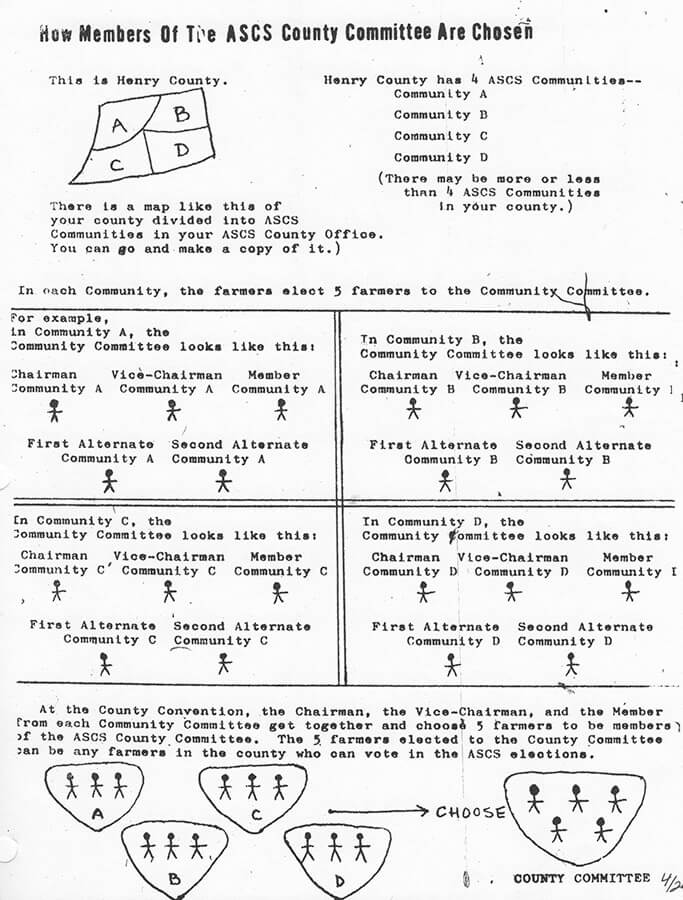 |
| How Members of the ASCS County Committee Are Chosen, 1965. Diagram by the Student Nonviolent Coordinating Committee. Courtesy of the Student Nonviolent Coordinating Committee Papers. |
Although never providing equal services to blacks, USDA offices increased discrimination after the 1954 Brown v. Board of Education decision, sometimes using policy to punish activists, and more often simply excluding black farmers from equal participation in programs. While the USDA discriminated against all poor farmers, southern USDA officials focused on black farmers. The dramatic events of Freedom Summer in 1964 eclipsed an important SNCC initiative to elect black farmers to ASCS county committees. Civil rights activists focused on federal programs that discriminated against African Americans, and they discovered that each county had, among numerous other federal offices, an ASCS office, an elected three-man committee (comprised entirely of white men), and an office manager that executed the programs. Since farmers elected the county committees, civil rights workers enlisted black farmers to both vote and stand for election, to gain a voice in deciding how acreage and other benefits were distributed. Hastily prepared challenges in 1964 provoked white resistance that ranged from issuing confusing information on county maps to intimidation and violence. Only a handful of black farmers won seats to community committees, the bodies that met to elect the powerful county committees. For several years black farmers and their supporters battled subterfuge, fraud, and intimidation in Mississippi, Alabama, Georgia, and Louisiana but won only a few seats despite having a majority of voters in many counties. As the civil rights movement cooled in the late 1960s, the ASCS claimed that it, not civil rights workers, launched the voting initiative and that civil rights organizations had little or no impact on black voting. The ASCS hoped to white out the powerful civil rights challenge, but documentation resulted in three chapters of Dispossession devoted to efforts of black farmers and their supporters to end ASCS discrimination.
During the civil rights movement, the press primarily covered major civil rights demonstrations and violent incidents and neglected the transformation in the rural South. A wave of science and technology broke across the land, consisting of tractors, self-propelled combines, picking machines, hybrid seeds, improved fertilizers, and synthetic chemicals such as DDT and parathion. USDA policy encouraged farmers to invest in machines and chemicals and bent policy to aid wealthy farmers. The crop cycle increasingly required farmers to purchase seeds and fertilizer at planting time, chemicals to fight weeds, and often emergency funds for machine repairs, and, of course, tractors and picking machines, on credit. Many poorer farmers were content to raise crops each year and clear enough to do it all over again, and they were cautious in buying into the capital-intensive treadmill. While prosperous farmers could borrow from banks, struggling farmers often turned to the FHA, the lender of last resort. County FHA supervisors had absolute control over which farmers received loans, and their discriminatory treatment of African Americans (and women, Indians, and Hispanics) is richly documented.
A pattern emerged across the South in FHA offices during the 1950s and 1960s. Sometimes the supervisor simply refused to give a black farmer an application, denied the request outright, or stated that money for that program had been spent. At other times the farmer would receive a loan only large enough to start the crop cycle but not enough to finish it, leading to crop failure. In still other cases the loan was so large that it was impossible to pay off, resulting in foreclosure. Loan officers seldom extended or adjusted loans for black farmers. The situation was precarious, for while farmers required funds to plant, cultivate, and harvest, that same FHA loan made them vulnerable to foreclosure. The FHA program was increasingly corrupt, and loans went to more wealthy farmers.
Consider the example of Georgia farmer Welchel Long. After his father died when he was thirteen, the family moved from a nearby farm to Athens where Long's first job was delivering wine to University of Georgia students. He served in the army during World War II, and then graduated Tuskegee University on the G.I. Bill. When historian Lu Ann Jones interviewed Long in the mid-1980s, his mind flooded with dozens of cases of FHA discrimination. For example, he observed that, since he moved to Elbert County in 1952, the number of black farmers fell from four hundred to two; he then corrected the number to one since he was no longer farming. In addition to teaching agriculture in high school, Long farmed, and he told Jones of his numerous confrontations with FHA county supervisor Thomas K. Wilson. When a black farmer asked about a loan, Wilson would say there was no money for that kind of loan, and when a black farmer found a farm to purchase, Wilson found fault with it. One year Long received a $12,500 loan, using $3,000 to plant five hundred acres of soybeans, but when he asked for the remainder for herbicides and machinery repairs, the FHA impounded the money. At the National Archives and Records Administration, there is a thick file on Welchel Long. His case was supported by the Allis-Chalmers farm implement dealer as well as a staff member in the business office at the University of Georgia. One year, two members of the county FHA committee supported a loan, but Wilson denied it. During the first years of the Richard M. Nixon Administration, most complaints were either tossed in the trash or filed with no investigation. In 1978, after Wilson had left the county, a surprised Long was asked to serve on the FHA committee. The county supervisor, he told Lu Ann Jones, had enormous power, and the supervisor or state office could overrule the committee. Wilson's tactics to discourage African American loans epitomized those throughout southern FHA offices and are well documented.3Welchel Long, interview by Lu Ann Jones, April 16, 1987, Elbert County, Georgia, box 5559, Farm Credit 1-2, General Correspondence, 1906–1976, Records of the Secretary of Agriculture, Record Group 16, National Archives and Records Administration, Oral History of Southern Agriculture, Archives Center, National Museum of American History.
Challenges to Discrimination: Strain and Pigford
 |
| The Negro Farmer Closes Shop, June 1965. Courtesy of the National Agricultural Library. |
The Federal Extension Service distributed the latest scientific information to farmers and organized 4-H clubs for children and home demonstration clubs for women. The segregated Negro Extension Service operated out of African American land grant universities and was supervised by white land grant schools. Still, African Americans eked out spheres of independence that offered opportunities and careers. In 1965 the Negro Extension Service was integrated into white land grant schools, and black county agents and demonstration agents were assigned secondary positions, always under white supervisors. The autonomy provided by segregation disappeared. Willie Strain had edited The Negro Farmer at Tuskegee University until 1965 when he moved to Auburn University, where he was given an office, no duties, and was shunned by the white staff. He spent his time reading in the library. After several years, he returned to graduate school. Back at Auburn, he was passed over to head the publications department despite his qualifications. He sued. The class action suit, Strain v. Philpott, revealed the duplicity of the Alabama Cooperative Extension Service's integration plan. Judge Frank M. Johnson's September 1971 decree not only illuminated the degree of discrimination throughout Alabama's extension service, but also prescribed remedies to correct it. Similar cases challenged extension service discrimination in most southern states. White land grant universities also resisted federal employment guidelines and insisted that counties should have control over hiring, an obvious ploy to avoid integration. In a larger view, land grant universities focused on research that favored more affluent farmers.4Pete Daniel, interview with Willie L. Strain, Tuskegee Institute, Alabama, February 21, 2007, Southern Oral History Collection, Chapel Hill, NC; Hoyt M. Warren, "Actions Associated with Implementation of the Civil Rights Act of 1964," in the Cooperative Extension Service, Auburn University, December 1972 (administratively confidential), copy in Archives and Manuscripts Department, Auburn University; Willie L. Strain v. Harry M. Philpott, 331 F. Supp. 836 (1971).
 |
| Willie Strain, 2007. Photograph by Pete Daniel. Reproduced by permission of Pete Daniel. |
Despite numerous studies by the US Commission on Civil Rights and Congressional hearings that revealed patterns of discrimination, USDA bias continued. In 1984, Timothy Pigford testified before a House subcommittee and recounted his experiences in eastern North Carolina. After attending the University of North Carolina at Wilmington for several years in the late 1960s, he worked fulltime at the Hercules Chemical plant and started renting land to farm. "It has always been my dream to own and farm my own land," he testified. When he found a farm for sale, the FHA office denied his application and continually gave him flawed farming advice. Pigford took extension courses, expanded his rented land, attempted to buy again and again, and finally became active in farmer groups that challenged discrimination.5House Subcommittee on Civil and Constitutional Rights, Hearings on Civil Rights Enforcement Record of the Department of Agriculture, 98th Cong., 2nd sess. (Washington, 1984), statement and testimony of Timothy Pigford, 63–81; Pigford v. Glickman, 185 F.R.D., 82 (D.D.C., 1999). Black farmers took advantage of an internal USDA study conducted by a Civil Rights Action Team (established by Secretary of Agriculture Dan Glickman) that revealed continuing discrimination. African American farmers staged a demonstration in Washington and brought about a class action suit, Pigford v. Glickman.6"Civil Rights at the United States Department of Agriculture: A Report by the Civil Rights Action Team" (Washington, 1997). On April 14, 1999, Judge Paul L. Friedman began his decision with that familiar Civil War and Reconstruction era rhetoric: "Forty acres and a mule." Here Friedman connected emancipated slaves' struggles for property ownership with black farmers who struggled—and continue to struggle—for ownership in the twentieth- and twenty-first centuries. He estimated that only 18,000 black farmers survived.7Pigford, 185 F.R.D. at 85–86. The judge established an elaborate process to determine damages and prevent fraud. He established 1981, the year the USDA's civil rights office stopped investigating discrimination complaints and threw many in the trash, as the cut-off date for damages. Dispossession focused on the years before 1981, and evidence of discrimination appeared in, among other sources, USDA records, the US Commission of Civil Rights Papers, the National Association for the Advancement of Colored People (NAACP) Papers, the National Sharecroppers Fund Papers, records of land grand universities, and in legal literature.
An April 25, 2013 New York Times article entitled "U.S. Opens Spigot After Farmers Claim Discrimination" virtually ignored the discrimination that led to the lawsuits, and instead unduly focused on fraud in settlements under the Pigford decision and in cases involving women, Indian, and Hispanic farmers. Sharon LaFraniere, the author of the article, neglected to explain the exacting legal process that Judge Friedman established for documenting discrimination. Instead, LaFraniere preferred statements such as, "career lawyers and agency officials who had argued that there was no credible evidence of widespread discrimination."8Sharon LaFraniere, "U.S. Opens Spigot After Farmers Claim Discrimination," The New York Times, April 25, 2013, http://www.nytimes.com/2013/04/26/us/farm-loan-bias-claims-often-unsupported-cost-us-millions.html. USDA officials repeatedly denied discrimination, even in the face of multiple reports from the US Commission on Civil Rights (beginning in 1965 with Equal Opportunity in Farm Programs: An Appraisal of Services Rendered by Agencies of the United States Department of Agriculture); Washington Post reporter Ward Sinclair's series of articles in the early 1980s; and, of course, the extensive documentation housed in repositories across the country.9John A. Hannah, Eugene Patterson, Frankie M. Freeman, Erwin N. Griswold, Theodore M. Hesburgh, and Robert S. Rankin,Equal Opportunity in Farm Programs: An Appraisal of Services Rendered by Agencies of the United States Department of Agriculture (Washington, DC: US Government Printing Office, 1965). The Federation of Southern Cooperatives/Land Assistance Fund found at least ten factual errors in the article; The New York Times published executive director Ralph Paige's letter to the editor, along with another letter from ten scholars of rural life.10Federation of Southern Cooperatives/Land Assistance Fund, "'Sharon LaFraniere Got it Wrong': Response to the Coverage of the Pigford Settlement in the April 26, New York Times," http://www.federationsoutherncoop.com/pigford/Response%20to%20Pigford%20NYTimes%20Coverage[2].pdf; Ralph Paige and Rachel Slocum, "Letters: Bias and a Settlement With Black Farmers," The New York Times, May 3, 2013, http://www.nytimes.com/2013/05/04/opinion/bias-and-a-settlement-with-black-farmers.html. Even after black farmers won their case proving discrimination, some USDA staff perpetuated the myth that there had been no bias. USDA staff seemed anxious to once again erase the historical record, mirroring the role they played in denying civil rights efforts to win ASCS elections in the 1960s.
African American farmers and their supporters have fought a protracted battle against USDA perfidy. It was a fight that recorded few victories but that set important precedents. Willie Strain's case against the Alabama Extension Service created a pathway for similar suits in other states, and the Pigford case opened an avenue for women, Indians, and Hispanics to contest USDA discrimination. The legal records from these cases offer historians the opportunity to delve further into USDA discrimination.
Timothy Pigford graduated from the University of North Carolina at Wilmington in May 2013 and was awarded the Hoggard Medal of Achievement for academic excellence. One of his professors, Monica Gisolfi, offered remarks at the graduation ceremony to contextualize his career. "Most likely you do not know that your classmate, Mr. Pigford, is one of the most important civil rights activists of the last thirty years," she began. "He is an individual who has fought for freedom at great personal sacrifice, who has bettered the lives of tens of thousands of American farmers, who has fought for justice and equality, and who—like all great Americans—has challenged his government to protect, defend, and insure the rights of its citizens."11Monica Gisolfi e-mail message to author, June 4, 2013. Timothy Pigford personifies the enduring legacy of black farmers who fought USDA discrimination, and his achievements should encourage a thoughtful look at the history of USDA discrimination and its incalculable damage.
About the Author
A professor of history and a public historian, Pete Daniel is author of seven books, including Dispossession: Discrimination Against African American Farmers in the Age of Civil Rights (Chapel Hill: University of North Carolina Press, 2013). Daniel is the past president of the Organization of American Historians and the Southern Historical Association.
]]>