On election night 2024, when the Associated Press called Pennsylvania and North Carolina for Donald Trump, I knew that he would be our next president, and I went to bed. The next morning, as I came back from a walk, the Harris-Walz bumper stickers on the back of our cars caught my eye.
HARRIS-WALZ 2024 | WE’RE NOT GOING BACK
I immediately thought of the late Willie Lee Rose’s The Port Royal Experiment: Rehearsal for Reconstruction. Rose tells the remarkable story of enslaved and subsequently free Black people living on the South Carolina Sea Islands who gained their freedom—and small plots of land—while the war still raged, and then gained political rights during Reconstruction. That moment ended when a violent white, counter-revolutionary movement took away their rights as citizens and much of their property, returning them to a state of semi-slavery. Written in 1964 at the crest of the civil rights movement, Rose’s last chapter, “Revolutions May Go Backward,” was a cautionary warning to the optimists of her time. Today it seems an epitaph for those of my generation who saw the possibilities of a second Reconstruction that fulfilled the promises of the first.1Willie Lee Rose, Rehearsal for Reconstruction: The Port Royal Experiment (Indianapolis: Bobbs Merrill, 1964), 378–408.
It’s not that I was blindsided by the election results. After President Biden's withdrawal, I became increasingly convinced that the Harris-Walz campaign was in jeopardy. In very close races, polls are unreliable in choosing winners, particularly when it comes to Donald Trump who outperformed almost every major poll in 2016 and 2020, as he would in 2024. But I do think they give some sense of direction. During the last three weeks of the campaign, as Trump became more unhinged in his lies, more threatening to his enemies and more obscene in his rallies, I watched as Harris’s lead slip from 3% to 1%. By election day, I had little confidence that she would win.
I can’t claim to be a prophet. I assumed former President Trump would receive something like his 46 per cent of the vote in 2016 and win because of our archaic and undemocratic eighteenth-century electoral college. I was wrong. He didn’t gain a mandate (49.8 %), but it was more than Harris’s 48.3%. Moreover, by narrow margins in dozens of races, Republicans maintained control of the House and won the Senate. However precarious the majorities, the party of Trump now controls the executive, congressional, judicial branches of government.
Over the next week, I neither read any post-mortems of the election’s outcome nor listened to or watched the news. I knew it would be filled with "what if's?" second-guessing the strategy and tactics of the Harris-Walz/Democratic campaign. The Democratic Party bears some of the blame for this loss. Inhibited by its own wealthy backers and so frightened of the term “socialism” or even “liberalism,” party leaders failed to drive home the economic damage to working- and middle-class voters caused by the neo-liberal policies of the last half century and the dominance of the nation’s new plutocracy.2Elizabeth Popp Berman, Thinking Like an Economist: How Efficiency Replaced Equality in US Policy (Princeton: Princeton University Press, 2023).Despite these failures, there have been substantive policy differences between a Republican Party that has consistently reshaped our tax and economic system to benefit the wealthy and Democratic measures that helped the working and middle-class programs proposed by Democrats. The 2024 election is less about the failures of the Democratic Party than the remarkable success of the wealthy interests and disciplined zealots who have joined hands with Donald Trump to capture the Republican Party.
Historians such as Nancy MacLean (Democracy in Chains), journalists Jane Mayer (Dark Money), and Anne Applebaum (Autocracy, Inc.) as well as other scholars and journalists have described how this anti-government movement has proved successful in carrying out its long-term strategy of promoting libertarian ideas and policies into the mainstream, ideas once dismissed as the work of Ayn Rand cranks and ideologues.3Nancy MacLean, Democracy in Chains: The Deep History of the Radical Right's Stealth Plan for America (New York: Viking Press, 2017); Jane Mayer, Dark Money: The Hidden History of the Billionaires Behind the Rise of the Radical Right (New York: Doubleday, 2016); Anne Applebaum, Autocracy, Inc.: The Dictators Who Want to Run the World (New York: Doubleday, 2024).
Over the last half century, bankrolled by their wealthy backers, this reactionary movement created a broad and effective network of institutions, think tanks, and media mouthpieces that honed dual messages.
The first: money corrupts the poor but elevates the moral character of the rich. Making the lives of marginal and lower middle-class Americans more insecure would lead them to return to the lost work ethic that had made America great. At the same time, making wealthy Americans even richer enabled the super-rich “job creators” to benefit society as a whole.
The second: a contempt for the very concept of “public” in “all its forms (public service, public health and safety agencies, public parks, the protection of public lands, public schools, etc.) and a conviction that the hand of “government” inevitably guarantees inefficiency and corruption. The solution? Replace those critical institutions with the unrestrained market, driven only by profits and freed from the restraints of oversight, regulations, and the demands of labor unions, civil rights activists, feminists, the disabled, and others who struggle for social justice.
The New Right was also able to draw upon a deeply rooted anti-government/“dog-eat-dog”/“everyone for himself and the devil take the hindmost” ethos. While a pittance of charity for widows and orphans has long been considered acceptable, assistance for those who do not succeed (obviously through their own laziness and lack of initiative) designates them as undeserving poor and dependent “takers.”
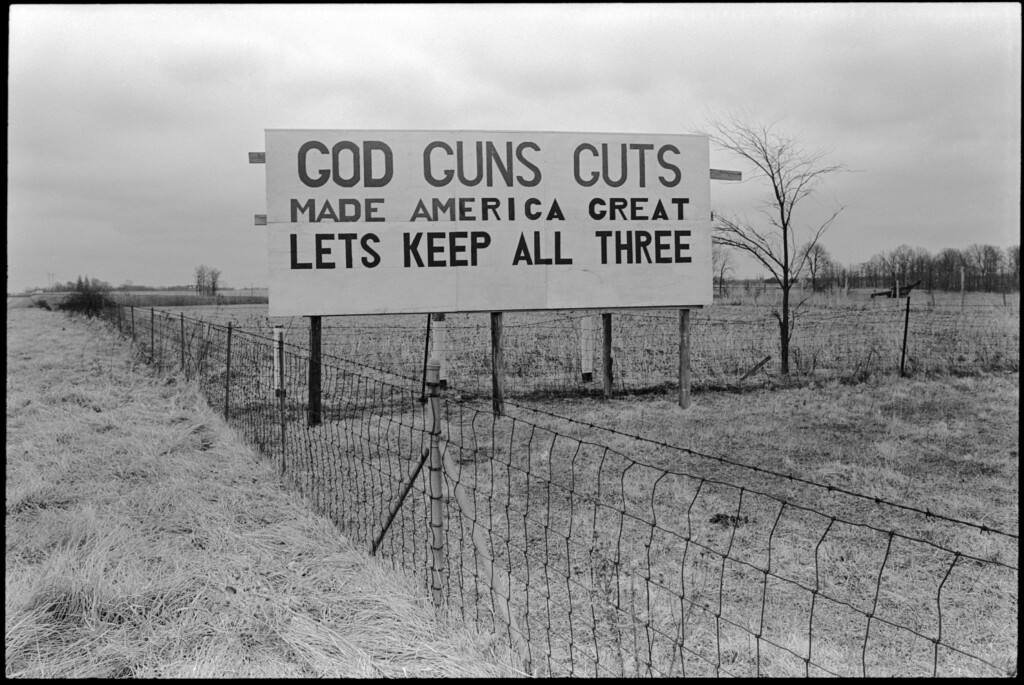
The Social Darwinism of the Gilded Age shifted somewhat in the wake of the late-nineteenth century Populist movement and during the “Progressive Era” of the early twentieth. Bolstered by an emerging “social gospel” movement that emerged within Protestant, Catholic, and, what Rabbi Shaul Magrid, has called the “Jewish social gospel,” when a majority of Americans concluded—in our complex and interdependent economy—only national institutions could offer protection from monopolistic corporate power and reckless actions that threatened citizens’ health and well-being. Then, faced with the devastation of the Great Depression, Americans of that generation learned the hard way that a reliance on rugged individualism proved useless in the face of a collapsing economy.4Christopher H. Evans, The Social Gospel in American Religion (New York: NYU Press, 2017); Rabbi Shaul Magid is professor of Jewish Studies at Dartmouth. His book is The Necessity of Exile: Essays from a Distance (Brooklyn: Ayin Press, 2023).
By the time Dwight Eisenhower took office in 1953, the Roosevelt revolution seemed broadly accepted by both parties. As Eisenhower wrote to his brother in 1954, federal initiatives such as social security, unemployment compensation, labor laws and other government funded programs were essential and the “Texas oil millionaires” and the politicians and businessmen who sought to turn back the clock were “negligible and . . . stupid.”5Dwight D. Eisenhower, “Letter from Dwight D. Eisenhower to Edgar Newton Eisenhower (1954),” Teaching American History, https://teachingamericanhistory.org/document/letter-to-edgar-newton-eisenhower/.
But the political upheavals of the 1950s and 1960s gave an opening to the anti-government reaction of the last fifty years—our backward revolution.
It’s ironic that Richard Nixon took the first steps in this reactionary movement; ironic because he was hardly an anti-government politician. Like Eisenhower, under whom he served for eight years, Nixon had made peace with expansive government under Franklin Roosevelt and Lyndon Johnson. He not only maintained most of the New Deal/Great Society programs, but supported the creation of the Environmental Protection Agency, the Clean Air and Clean Water Acts, expanded federal resources for the CDC and NIH. and signed Title IX, a sweeping measure designed to prevent gender discrimination at colleges and universities. At one point he considered creating a national guaranteed income program. Politically, however, Nixon was always attuned to the shifting currents of public opinion.
You don’t have to be a historian to list the developments that set us on the road to the election of Donald Trump for a second term. White backlash—activated by the civil rights movement and urban unrest—as well as the trauma of the Vietnam War led the way for this right-ward retreat.
In 1968, Nixon ran as a centrist between Hubert Humphrey and third-party segregationist candidate George Wallace. He came within a hair’s breadth of losing the election after Wallace captured fourteen million votes and the electoral votes of five southern states. (According to exit polls, absent Wallace’s “American Party,” at least four of those states would have voted for Nixon.)
Relying upon the advice of his adviser, Kevin Phillips ("The whole secret of politics is knowing who hates who”), Nixon understood the possibilities for political realignment among several groups of voters. White southerners and white northerners opposed to the gains of the civil rights protests and civil rights legislation, suburban voters frightened and angered by the urban violence of the 1960s, and Americans disgusted by an anti-war movement that rejected the patriotic ideology: “My country, right or wrong.”6Garry Wills, “The Politics of Grievance,” New York Review, July 19, 1990, https://www.nybooks.com/articles/1990/07/19/the-politics-of-grievance/.
Thus was born the GOP “Southern Strategy,” a political plan to create a solid Republican South by “blackening” the Democratic Party in the states of the former Confederacy and drawing disgruntled whites across the US into what had once been the party of Lincoln. In the aftermath of the Watergate scandal, Jimmy Carter managed to defeat Gerald Ford in 1976, but his administration was a brief detour.
During the 1950s, middle- and upper-income voters in four southern states had chosen the popular Dwight Eisenhower, but the major growth in Republican support from lower income white voters came over the next two decades. White evangelicals and religious conservatives also played a major role in the political realignment, strongly supporting traditional gender roles, the nuclear family, and male “leadership” while recoiling against the demands of the women’s movement of the 1970s and 1980s as well as the way that a new, wide-open popular culture undermined traditional sexual mores. As Playboy came out from under the drug store counters and onto the magazine racks, it was no accident that third-party candidate George Wallace attacked the Supreme Court for its rulings requiring desegregation and striking down broad obscenity laws.
Today’s white evangelicals point to the 1973 Supreme Court decision, in Roe v. Wade as the critical turning point for devout Christians. But, if that is true, how can we explain the fact that mainline Protestant denominations, including Southern Baptists, praised the decision?
Randall Balmer, Cornell University historian of American religion, argues in Bad Faith: Race and the Religious Right (2021) that the shift among evangelicals was linked directly to racial issues.7Randall Balmer, Bad Faith (Eerdmans Publishing: Grand Rapids, Michigan, 2021). Gerald Ford’s Justice Department first developed a series of legal cases challenging the tax-exempt status of the segregated “academies” (most of them religious) that expanded in the aftermath of the Brown decision. But it was the Carter administration that dramatically increased the number of lawsuits challenging these tax-exempt segregated schools, a policy eventually affirmed by the Supreme Court in Bob Jones v. United States (1983).
Right-wing Republican activists like Paul Weyrich claimed that this was an attack on religious freedom, but such arguments found only limited traction. Instead, skilled conservative organizer (and devout Catholic) Phyllis Schlafly smoothed over long-time tensions between Catholics, Mormons, and Protestant conservatives, bringing them together to create a “right-to-life” and anti-feminist constituency that proved to be a far more “righteous” movement than defending segregation.
White Protestant evangelicals had voted for the “born-again” Carter in 1976, but four years later two thirds of self-identified white evangelicals voted for the divorced and marginally Christian candidate, Ronald Reagan. Republican support increased through the decades that followed. In the 2024 presidential election, 81 per cent of white evangelicals voted for Trump. Between the late 1960s and the end of the 1980s, the Southern Strategy transformed the “solid South” from a Democratic stronghold to the foundation of Republicans’ national strength.
Racism was not the only factor in creating a white Republican South, but it was a major driving force. And the tactics that created the (white) victory for the Republican Party in the South and attracted white northerners, have allowed politicians to exploit different versions of racism on a national level for the last half century. George Wallace pioneered the use of code words that avoided explicit racist language in the 1960s, but Republican operatives and leaders became even more skilled in their exploitation of white Americans’ underlying racial prejudices. As Lee Atwater, a key adviser to Reagan and to George H.W. Bush famously told Vanderbilt political scientist Alexander Lamis, “You start out in 1954 by saying “N--r, n--r, n--r.” By 1968, you can’t say ‘n--r’—that hurts you. Backfires. So you say stuff like forced busing, states’ rights, and all that stuff.”8Lee Atwater (1981): Interview with Alexander P. Lamis, https://www.bradford-delong.com/2017/03/lee-atwater-interview-with-alexander-p-lamis-rough-transcript-weekend-reading.html.
Equally significant in arousing this white backlash was the emergence of Black and, later, Brown Americans into a constant presence on the nation’s television screens that triggered resentment by many white viewers. The emergence of gay men and lesbians prompted a similar response.
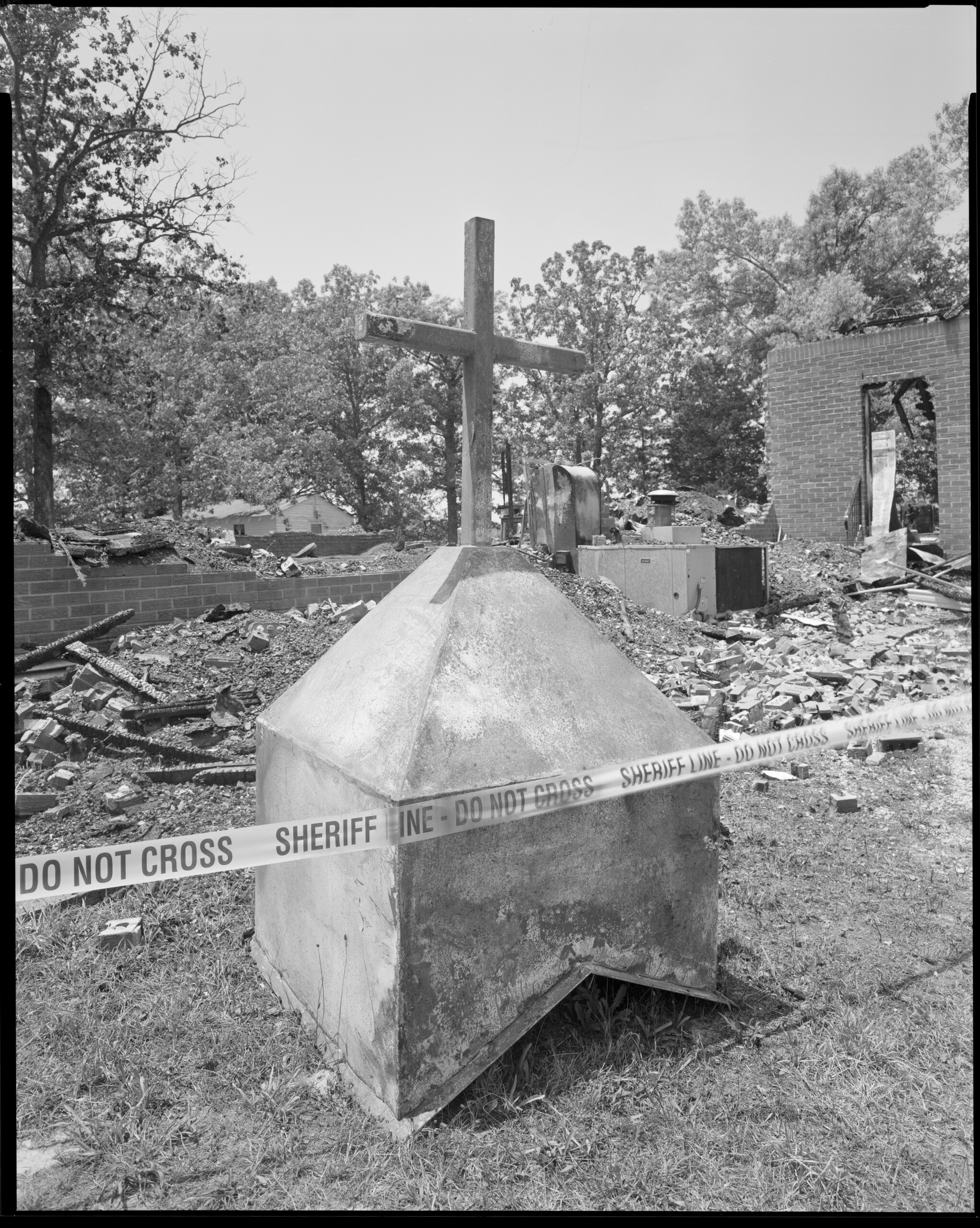
Critics often compare Donald Trumps’ dehumanizing language against his enemies—“vermin,” “garbage,” “scum,” “poisoning the blood of our country,” “traitors,” “diseased,” “bad genes”—to Adolf Hitler.9Gram Slattery, “Trump’s ‘bloodbath’ and other rhetoric inflame his 2024 campaign trail,” Reuters, March 22, 2024, https://www.reuters.com/world/us/bloodbath-vermin-animals-trumps-rhetoric-trail-2024-03-22/. But such rhetoric has deep roots in US history, pitting “us” (true Americans) against “them” (threatening outsiders). From John Higham’s 1955 classic, Strangers in the Land to the more recent publication of Erica Lee’s America for Americans: A History of Xenophobia in the United States, scholars and journalists have described politicians’ exploitation of white/Anglo-Saxon/Protestant Americans’ fear and hatred of Native Americans, Catholics, Jews, Italians, and Hispanics.10John Higham, Strangers in the Land: Patterns of American Nativism, 1860-1925 (Rutgers University Press: New Brunswick University Press, 1955); Erika Lee, America for Americans: A History of Xenophobia in the United States (New York: Basic Books, 2019).
In addition to relying upon such racist and xenophobic appeals, the party that Donald Trump now controls has sought to strengthen its political power by implementing openly undemocratic measures. In Rehearsal for Reconstruction, Willie Lee Rose describes the blunt measures that white Democrats used to disenfranchise (predominantly Black) Republicans. During South Carolina’s 1895 Constitutional Convention the Party stamped out the last handful of Black voters. Whites made no effort to conceal their hand. As one Democrat said, “We don’t propose to have any fair elections.”11Rose, Rehearsal for Reconstruction, 404. Such openly partisan and racist voter suppression measures supported by the modern Republican Party are central to our backward revolution.
When Democrat Bill Clinton won in 1992 and 1996, the Republican Party launched a broad range of measures designed to reduce Democratic voters, particularly Black voters. Despite differences between the disenfranchisement efforts of white Democrats in the late nineteenth century and present-day Republicans, Yogi Berra’s memorable phrase: “It’s déjà vu all over again” seems particularly apt. Political scientists Steven Levitsky and Daniel Ziblatt have shown how this growing anti-democratic movement has exploited weaknesses in our constitutional system to create a “tyranny of the minority,” a process described in detail by scholars like Steve Suitts and Gene Nichols.12Steven Levitsky and Daniel Ziblatt, Tyranny of the Minority: Why American Democracy Reached the Breaking Point (New York: Crown, 2023); Steve Suitts, A War of Sections: How Deep South Political Suppression Shaped Voting Rights in America (Athens, Georgia: New South Books, 2024); Gene R. Nichol, Lessons from North Carolina: Race, Religion, Tribe, and the Future of America (Durham, NC: Blair Publishing, 2023).
Republicans have justified such measures by successfully convincing 88 per cent of Republicans and over 25 percent of Democrats that voter fraud is widespread, despite the fact that every rigorous investigation and analysis has found fraud has been statistically infinitesimal. In a review of such claims over the last twenty-five years, researchers for the Brookings Institution could not find one example of voter fraud that “changed the outcome of a single election.”13Owen Averill, Annabel Hazrati, and Elaine Kamarck, “Widespread election fraud claims by Republicans don’t match the evidence,” Brookings, November 22, 2024, https://www.brookings.edu/articles/widespread-election-fraud-claims-by-republicans-dont-match-the-evidence/.
In 2012, dissatisfied with piecemeal measures to limit Democratic voters, the Republican State Leadership Committee launched its “Redistricting Majority Project” (REDMAP) with the goal of using the decennial redistricting process to gerrymander state and congressional districts to give an advantage to Republican candidates at the state and congressional level. While gerrymandering has long been practiced in American politics, the development of sophisticated computer programs, the heightening of partisan division, and the economic support of dark money by wealthy donors made it possible for the Republican Party to reshape American politics. In 2019, the five-member Republican majority of the Supreme Court gave the green light to such gerrymandering. By 2024, Republicans had created the most distorted electoral system in nine of the ten most gerrymandered states in the nation.14“2012 REDMAP Summary Report,” January 4, 2013, https://www.redistrictingmajorityproject.com/; Nick Wing, “GOP Redmap Memo . . . ,” January 17, 2013, “https://www.huffpost.com/entry/gop-redmap-memo-gerrymandering_n_2498913; “Rucho v. Common Cause," https://en.wikipedia.org/wiki/Rucho_v._Common_Cause; “Most Gerrymandered States,” World Population Review, https://worldpopulationreview.com/state-rankings/most-gerrymandered-states.
Republicans and Democrats argue over whether such measures stem from partisan or racial motives, but it is clear that racism remains one of the key factors in Trump’s personal rise to political prominence. It was his promotion of the “birther lie,” the demonstrably false claim that Barack “Hussein” Obama was born in Kenya and not a “true American” that launched his political career. As a real estate developer with an early history of excluding Black people from his family’s rental properties, Donald Trump learned that traditional anti-Black racism could prove adaptable in politics by exploiting fear and hate against other “outsiders.” Of all his inflammatory and racist claims, none was more successful than his description of a massive (non-existent) crime wave by brown-skinned illegal immigrants spreading chaos, raping and pillaging embattled white Americans.15Slattery, “Trump’s ‘bloodbath’."
Economic inequality grew steadily from the early 1970s onward as members of the middle as well as the working class joined the poor in a struggle from paycheck to paycheck. The New Right didn’t address this increasing wealth gap but kept the emphasis on drawing in religious conservatives by convincing them that Christianity and the family was under attack. Right wing activists and new media outlets spread false but heart-rending accounts of full-term babies ripped from their mother's wombs. As early as 1977, the American singer and anti-gay activist Anita Bryant claimed that homosexuals were seducing children for sexual exploitation, but by 2010, claims of “grooming” were widespread on web sites, promoted by right-wing anti-gay groups and Republican politicians. In a 2023 60 Minute interview, Georgia Congresswoman Marjorie Taylor Greene insisted to interviewer Leslie Stahl that “Democrats are a party of pedophiles. . . . They support grooming children.”16“Anti-gay Organizing on the Right,” PBS Out of the Past, https://www.pbs.org/outofthepast/past/p5/1977.html; “Marjorie Taylor Greene: The 60 Minutes Interview,” https://www.rev.com/transcripts/marjorie-taylor-greene-the-60-minutes-interview-transcript.
Even more astonishing has been the success of the New Right in convincing nearly 60 percent of white Americans that “discrimination against whites is as big a problem as discrimination against blacks and other minorities.”17Ryan Struyk,”Blacks and whites see racism in the United States very, very differently,” CNN, August 18, 2017, https://edition.cnn.com/2017/08/16/politics/blacks-white-racism-united-states-polls/index.html.
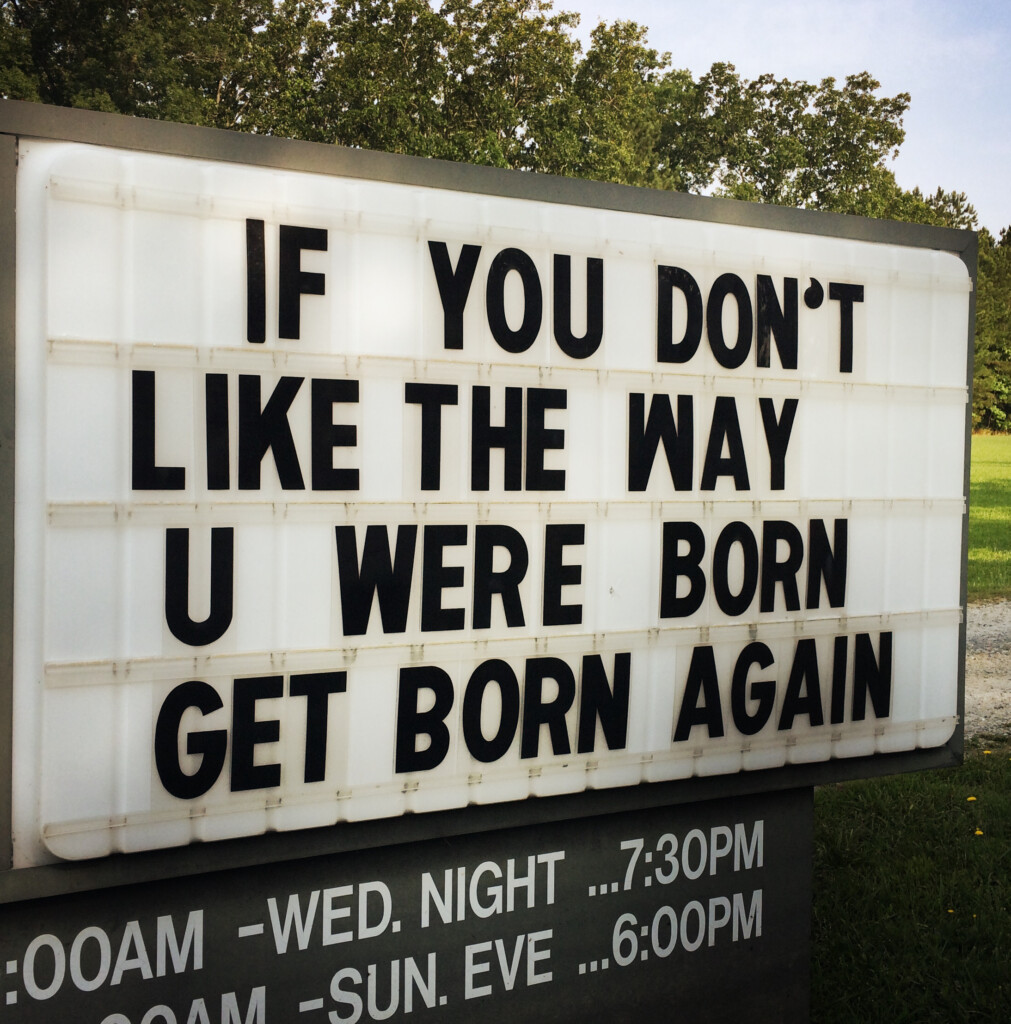
Few examples more clearly illustrate the irrational, but powerful appeal of such success at promoting irrationality than the demonization of transgender people in this country—as though they are somehow an existential threat. When a “Fox and Friends” host asked Trump what he would do to “fix” schools, he responded: “No transgender, no operations. You know, they take your kid. There are some places where your boy leaves the school [and] comes back a girl. Without parental consent.”18Daniel Dale, “Fact Check: Trump revives his lie that schools are secretly sending children for gender-affirming surgeries,” CNN, October 26, 2024, https://www.cnn.com/2024/10/26/politics/fact-check-trump-rogan-children-gender-affirming-surgeries/index.html. During the last three months of the 2024 campaign, the GOP spent more than $215 million on political advertisements attacking transgender individuals.19Zane McNeill, “Republicans Spent Nearly $215M on TV Ads Attacking Trans Rights This Election,” truthout, November 5, 2024, https://truthout.org/articles/republicans-spent-nearly-215m-on-tv-ads-attacking-trans-rights-this-election/.
It is easy to see why special interests such as insurance companies, the pharmaceutical industry, health care monopolies, the fossil fuel industry and libertarian tech billionaires fell in line behind Donald Trump once he gained the enormous powers of the presidency. Given the tax policies enacted during the first Trump administration and those proposed for the second, economic self-interest has also attracted support from the super-rich, the wealthy, and even the moderately well-to-do. While much of the attention has concentrated on the top one percent, between the mid-1970s and 2020, the income of top five percent of America’s taxpayers increased 125 per cent while median family income rose less than fifty per cent.20Eric Schutz to the author, February 17, 2025.
While working-class and struggling middle-class American voters are keenly aware of their growing economic insecurity, they seem oblivious to the role of the wealthy interests that have profited from an economy that has shifted wealth from labor to capital—all reinforced by changes in “tax reform” that lowered taxes on the new plutocracy and led to an explosion of our national debt. This transfer of wealth from the working and middle class to the wealthiest has created in the United States the greatest income inequality in any advanced democracy in the world.
But many of these voters found Donald Trump’s repeated explanation for their plight more persuasive: “The mass migration invasion has crushed wages, crashed school systems . . . wrecked the standard of living and brought crime, drugs, misery and death.”21Linda Qui, “Trump’s Claims That Blame Migrants: False or Misleading,” New York Times, October 18, 2024, https://www.nytimes.com/2024/10/18/us/politics/trump-immigration-fact-check.html.
The Democratic Party is hardly immune from the pressures of big money donors, but promoting the interests of the wealthy has been the explicit policy of the Republican Party since Reagan. Trump’s promise not to reduce the federal government’s most expensive programs—Defense, Social Security and Medicare—mean that the only items on the chopping block are those programs that most affect working-class and poor Americans: SNAP (food stamps), Medicaid, ending student loan forgiveness and loan modifications, dismantling the Education Department, and enacting major tariffs that will be passed on to consumers by higher prices.
Reducing the deficit won’t come from increasing taxes. Since signing the “No New Taxes” pledge in 1986, Republicans have opposed tax increases even though—among the thirty-eight advanced economies—US total federal state and local taxes as a percentage of GDP are lower than all but a handful of countries such as Turkey and Mexico.22“Revenue Statistics 2024, Key Findings for the United States," OECD, https://www.oecd.org/content/dam/oecd/en/topics/policy-sub-issues/global-tax-revenues/revenue-statistics-united-states.pdf.
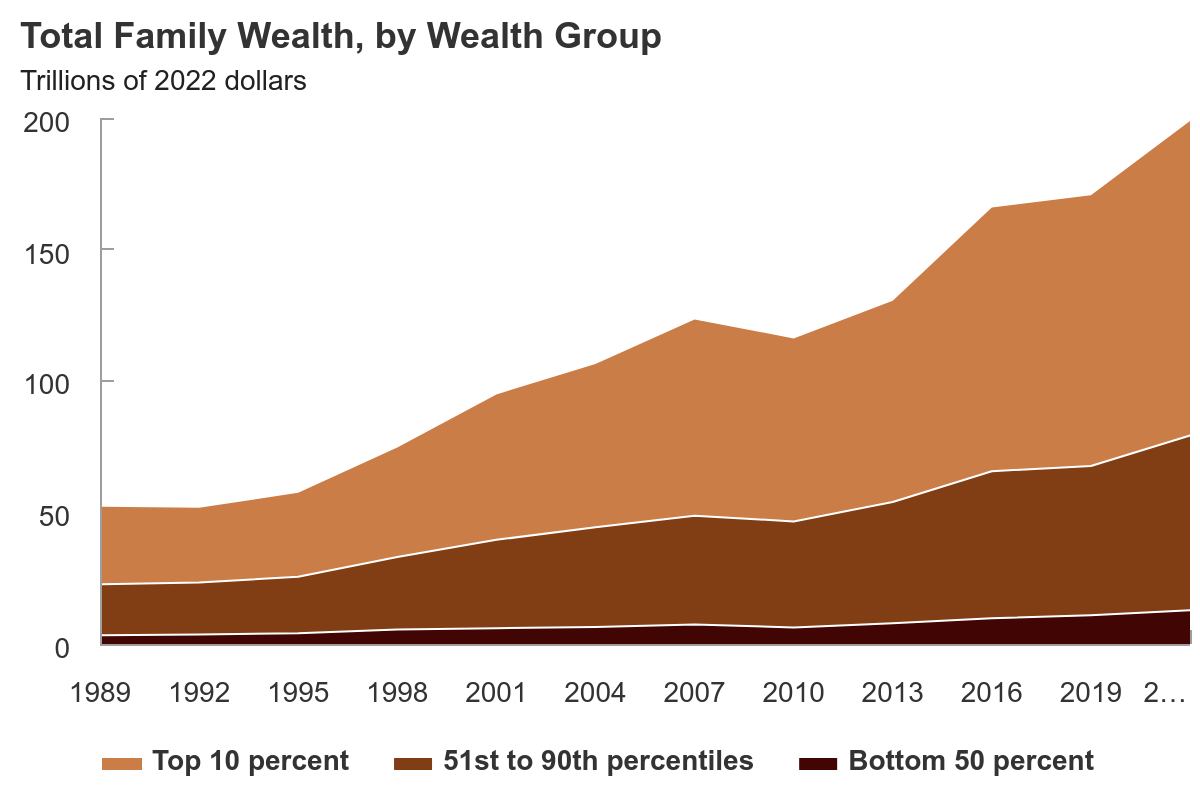
Even as wealth has become more concentrated in the highest income brackets, the tax rates on the upper ten percent and particularly the upper one percent have significantly declined since Ronald Reagan became President in 1981. Over the last forty years, the actual income tax rate paid by the wealthiest one percent of taxpayers has fallen from nearly 40 percent to 26 percent.23Robert McClelland and Nikhita Airi, “Effective Income Tax Rates Have Fallen for the Top One Percent Since World War II,” Tax Policy Center, September 15, 2021, https://taxpolicycenter.org/taxvox/effective-income-tax-rates-have-fallen-top-one-percent-world-war-ii-0. A key provision of the Biden Administration’s 2022 Inflation Reduction was to allocate $80 billion over ten years to the IRS to reduce tax evasion by the wealthiest taxpayers, an amount estimated to be over $600 billion each year.24Natasha Sarin, “The Case for a Robust Attack on the Tax Gap,” U.S. Department of the Treasury Featured Stories, September 7, 2021, https://home.treasury.gov/news/featured-stories/the-case-for-a-robust-attack-on-the-tax-gap; Arianna Fano, “Breaking Down the Federal Tax Gap,” Bipartisan Policy Center, June 27, 2024, https://bipartisanpolicy.org/explainer/breaking-down-the-federal-tax-gap/. Republicans used negotiations over extending the debt ceiling to cut the original $80 billion to $60 billion. Within weeks of Trump’s taking office, he ordered the IRS to lay off 6,000 employees, more than six per cent of the IRS staff, even as he made it clear that this was only the beginning of his assault on the agency. Blocking the IRS from requiring the wealthy to pay their taxes is clearly a cause close to Trump. As he said in his first 2016 debate with Hillary Clinton, “Paying no taxes makes me smart.”25Andrew Duehren and Michael S. Schmidt, “I.R.S. to Begin Laying Off Roughly 6,000 Employees on Thursday,” New York Times, February 19, 2025, https://www.nytimes.com/2025/02/19/us/politics/irs-layoffs.html; Richard Rubin, “Donald Trump on Not Paying Taxes: ‘That Makes Me Smart’,” Wall Street Journal, September 26, 2016, https://www.wsj.com/articles/BL-WB-65659; “September 26, 2016 Debate Transcript,” Commission on Presidential Debates, https://www.debates.org/voter-education/debate-transcripts/september-26-2016-debate-transcript.
In the 2024 campaign, Donald Trump’s unconcealed policies to protect wealthy Americans from paying taxes did not seem to resonate with most Americans who don’t have the advantage of overseas tax havens and creative accountants. Neither did his promise to end clean-energy programs and eviscerate regulations by the Environmental Protection Agency. For decades, the coal, oil, and gas industries have worked to discredit the conclusive evidence that the burning of fossil fuels is the major contributor to global warming. In 2009, Trump signed a full-page New York Times with over one-hundred American business leaders warning that if the United States and other countries failed to act decisively to slow climate change, it was “scientifically irrefutable that there will be catastrophic and irreversible consequences for humanity and our planet.26“Dear President Obama . . .,” New York Times, November 19, 2016, https://static01.nyt.com/packages/pdf/opinion/Dot-Earth/climatead09nyttrumplowrez.pdf. But in 2012, as he began his plans to enter politics, he tweeted that the “concept of global warming was created by and for the Chinese in order to make U.S. manufacturing non-competitive."27Edward Wong, “Trump Has Called Climate Change a Chinese Hoax,” New York Times, November 18, 2016, https://www.nytimes.com/2016/11/19/world/asia/china-trump-climate-change.html.
As in all matters Trump, this was a purely transactional move. Few people were shocked, or even noticed, when he told members of the American Petroleum Industry and over a dozen oil company executives at a private at Mar-a-Lago that they “should donate $1 billion to his presidential campaign.” In return, he said, he would roll back environmental rules.”28Lisa Friedman, Coral Davenport, Jonathan Swan, and Maggie Haberman, “At a Dinner, Trump Assailed Climate Rules and Asked $1 Billion From Big Oil,” New York Times, May 9, 2024, https://www.nytimes.com/2024/05/09/climate/trump-oil-gas-mar-a-lago.html.
Trump knows nothing about economics, science, or history that might guide him as the nation’s President, but his marketing skills honed by years hawking overpriced real estate projects, and his time on television playing the CEO on The Apprentice, created the illusion of him as a brilliant businessman despite his seven bankruptcies and the fact that a jury found his companies guilty of massive tax fraud that led to a $350 million fine. Perhaps many Americans have come to see cheating on taxes by the rich and using bankruptcy laws to stiff those to whom they owe money as simply “good business.”
Above all, Donald Trump discovered what sells in today’s political environment must be saturated with the trappings of entertainment. Our national comedian of cruelty found that the more vulgar, vile and threatening he became, the more millions of Americans adored him.
What initially bewildered me most was the willingness of millions of American voters to accept Trump’s tsunami of transparent lies. In time, I’ve come to believe that Trump sensed the new reality: most Americans believe all politicians lie. By making his lying so brazen and preposterous, he could be seen as somehow more “honest,” and “non-hypocritical” than his opponents.
Even though we can be certain that Trump has never read Hannah Arendt’s Origins of Totalitarianism (1951), he grasped one of her critical insights.
The followers of demagogues, writes Arendt, were “ready at all times to believe the worst, no matter how absurd, and did not particularly object to being deceived because it held every statement to be a lie anyhow.” Such power-obsessed leaders discovered they could “make people believe the most fantastic statements one day, and trust that if the next day they were given irrefutable proof of their falsehood, they would take refuge in cynicism.” They would insist that “they had known all along that the statement was a lie” and would admire their leader for his “tactical intelligence.”29Hannah Arendt, Origins of Totalitarianism (New York: Harcourt, Brace and Company, 1971), 433.
As long as you kept repeating something, “it didn’t really matter if it wasn’t true,” said Stephanie Grisham, Trump’s White House Press Secretary. “Casual dishonesty filtered through the White House as though it were in the air-conditioning system.”30Stephanie Grisham, I’ll Take Your Questions Now: What I Saw at the Trump White House (New York: Harper Collins, 2021), 138; Peter Baker, “In Trump’s Alternate Reality, Lies and Distortions Drive Change,” New York Times, February 23, 2025, https://www.nytimes.com/2025/02/23/us/politics/trump-alternative-reality.html.
Such contempt for the truth is not simply a matter of political tactics. It has demonstrable, and often deadly consequences. In the wake of the COVID epidemic, surveys showed that 75 per cent of Republicans told pollsters they had confidence in Trump’s advice on the epidemic. The result? An analysis published in 2023 in The Journal of American Medicine concluded that, once the COVID vaccine became available, "the excess death rate among Republican voters was 43% higher than the excess death rate among Democratic voters.”31Andrew Greiner, “75% of Republicans trust Trump’s medical advice,” YouGov, April 24, 2020, https://today.yougov.com/politics/articles/29305-75-republicans-trust-trumps-medical-advice; Jacob Wallace, Paul Goldsmith-Pinkham, Jason L. Schwartz, “Excess Death Rates for Republican and Democratic Registered Voters in Florida and Ohio During the COVID-19 Pandemic,” JAMA Internal Medicine, July 24, 2023, https://jamanetwork.com/journals/jamainternalmedicine/fullarticle/2807617; Alyssa Bilinski, Ezekiel J. Emanuel, “COVID-19 and Excess All-Cause Mortality in the US and 18 Comparison Countries,” JAMA Network, October 12, 2020, https://jamanetwork.com/journals/jama/fullarticle/2771841. Lancet, one of the world’s most trusted medical journals, compared America’s COVID response with our European allies during the Trump time in office and estimated that his administration’s inaction and misinformation led to the unnecessary deaths of at least 400,000 Americans.32Steffie Woolhandler, David U. Himmelstein, Sameer Ahmed, Zinzi Bailey, Mary T. Bassett, Michael Bird, et al., “Public Policy and Health in the Trump Era,” The Lancet, February 20, 2021, https://www.thelancet.com/journals/lancet/article/PIIS0140-6736(20)32545-9/abstract.
As I watched his rise to the presidency in 2016 and 2024, I recalled the 1955 book by Milton Mayer, They Thought They Were Free. In 1953, Mayer moved to the small German city of Marburg and came to know a number of local townspeople who looked back on their nation’s journey from the democratic Weimar Republic to Hitler’s Third Reich. None were more perceptive than Heinrich Hildebrandt, a retired teacher of classics and literature. What happened from the beginning of the new German Reich, he said, was the gradual acceptance of the German people to the step-by-step destruction of their democratic institutions, the rise of a dictatorship and the ultimate barbarity: the Holocaust. Each act was worse than the last, but only a little worse, he recalled, and he kept waiting for that one dramatic overreach by Hitler’s regime that would lead decent Germans to rise in resistance.
Then, one evening at dinner, his very young son began talking about “Jew swine”, said Hildebrandt, “and you see that everything, everything, has changed and changed completely under your nose,” recalled Hildebrandt. “The world you live in—your nation, your people—is not the world you were born in at all.”33Milton Mayer, They Thought They Were Free, The Germans, 1933–45 (Chicago: University of Chicago Press, 1955), 171.

Over the last decade a majority of white Americans have come to accept a President who does little to conceal his racism, his contempt for—and abuse of—women, his cruelty toward the displaced and the vulnerable, and his lack of any respect for democratic norms. Donald Trump is no Adolph Hitler, and today’s America is certainly not the Weimar Germany of the Great Depression. But the process of first being appalled by, and then gradually accepting his abnormal words and actions as “normal,” has marked Trump’s rise to power.
Hildebrandt called the response of the German people during the 1930s gewöhnung — "habituation." Social psychologists use the same word to describe the process by which, through repetition, words and behavior once considered unacceptable eventually become dismissed with a shrug. “Just Trump being Trump.” Barring some dramatic shift in the public mood, that process will only continue during a second Trump administration as we are overwhelmed by his incompetence, his merciless cruelty, and his demand for a powerful “unitary executive,” the kind of unlimited authority claimed by monarchs and dictators.
Despite his words and behavior, Trump has gained the passionate support of an overwhelming majority of Republican voters. Their unquestioning embrace has allowed him to achieve something that has never happened in American history: the complete control of one of the nation’s major political parties by a reckless demagogue. Having abandoned integrity and, what earlier generations called a “sense of honor,” his nominees, appointees, and elected Republican officials have prostrated themselves before a President who openly announced that his false claim that the 2020 election was stolen allowed him to “terminate all rules, regulations, and articles, even those found in the Constitution.”34Isaac Arnsdorf and Josh Dawsey, “Trump’s call to suspend Constitution divides Republicans,” Washington Post, December 4, 2022, https://www.washingtonpost.com/national-security/2022/12/04/trump-constitution-republicans/.
Trump’s dismissal of constitutional restraints has been a persistent pattern. Less than a month into his new administration, in a post-midnight post on his “Truth Social” account, he wrote: “He who saves his Country does not violate any law,” a restatement of a quote attributed to Emperor Napoleon Bonaparte. Whether Napoleon actually made such a statement is irrelevant: it reflects Donald Trump’s belief that he is above the law.
Such assertions of unlimited executive power would have discredited any politician a half century ago; a much less extreme claim of presidential authority by Richard Nixon led the Republican Party to abandon the nation’s 37th President and force his resignation in 1974. But the guardrails that help protect our democracy (however flawed) have fallen away during the last thirty to forty years and a crucial element in this process has been the declining confidence of Americans in the institutions that are essential to making informed public policy choices. “Elitists” of all kinds, scientific and medical organizations, professional journalists, social scientists, academics, researchers, colleges and universities, the government agencies that protect our health and safety, judges, prosecutors and legal institutions: all are dismissed as part of the corrupt “Deep State.” While hardly perfect, these social repositories of inquiry and knowledge incorporate ethical guidelines and self-correcting procedures that seek to arrive at some measure of truthfulness, making them infinitely preferable to understand the world as it is rather than what we wish were true, or what feeds our deepest fears.
Is Trump simply a beneficiary of this transformation in our politics? Or is it a moment when an individual’s bizarre and troubling behavior seems matched to our national mood? Since the 1960s, mental health professionals have been wary of diagnosing the mental health of individuals, particularly politicians, but in his 2019 analysis, Diagnosis from a Distance, psychologist John Martin-Joy suggests that, given Donald Trump’s clearly unstable behavior, we may have no choice but to make that assessment.35John Martin-Joy, Diagnosing from a Distance: Debates over Libel Law, Media, and Psychiatric Ethics from Barry Goldwater to Donald Trump (Cambridge: Cambridge University Press, 2019) 224–228.
John Gartner, a nationally recognized psychologist who taught at Johns Hopkins University Medical School for twenty-eight years certainly agrees. He has made a powerful argument that Donald Trump “suffers from malignant narcissism, a diagnosis far more toxic and dangerous than mere narcissistic personality disorder because it combines narcissism with three other severely pathological components: paranoia, sociopathy, and sadism.” In a 2020 essay, Gartner documented Trump’s persistent narcissism (he knows “more about everything than anyone” and his “empathy for no one but himself”). The President’s paranoia was reflected in “his demonization of the press, minorities, immigrants, and anyone who disagrees with him.” Such attributes, concluded Gartner, are classic signs of paranoia. Equally dangerous were the examples of his sociopathy, “a diagnosis that describes people who constantly lie, violate norms and laws, exploit other people, and show no remorse”. Finally, there was his constant sadistic behavior—“He takes gleeful pleasure in harming and humiliating other people. He is undoubtedly the most prolific cyberbully in history.”36John Gartner, “DEFCON 2: Nuclear Risk Is Rising as Donald Trump Goes Downhill,” in Rocket Man: Nuclear Madness and the Mind of Donald Trump, ed. John Gartner, Steven Buser, and Leonard Cruz (Asheville, NC: Chiron Publications, 2018), 29–30.
As it has become more difficult to winnow truth from the torrent of lies, it becomes easier to accept his repeated claim: “I alone can fix it.” Any misgivings can be set aside by finding confirmation of Donald Trump’s lies on conspiracy-affirming social media platforms or Fox News.
Trump also learned much from the internal infighting that marked his first administration. The second time around, he is making certain that every appointment and every candidate who hopes to be re-elected is totally dependent upon his whims. There will be no voices to resist or to ask probing questions. And unlike his first administration, he now has the coordinated support and financial backing of much of America’s plutocracy as well as the right-wing ideologues who produced Project 2025 and have vetted individuals to carry out his wishes.
Indiana Senator Jim Banks (R) described the beginning of the second Trump administration as "shock and awe," but it was essentially Steve Bannon’s recipe: “Flood the zone with shit,” overwhelming critics and the opposition party while insuring that members of his party will approve all his nominees and appointments, even if they are incompetent, convicted criminals, sexual predators, paranoiacs, or xenophobes.37Robert Costa, “Trump ally says first 100 days will be ‘shock and awe’,” CBS Sunday Morning, January 19, 2025, https://www.cbsnews.com/news/trump-ally-says-first-100-days-will-be-shock-and-awe/; Brian Stelter, “This infamous Steve Bannon quote is key to understanding America’s crazy politics,” CNN Business, November 16, 2021, https://www.cnn.com/2021/11/16/media/steve-bannon-reliable-sources/index.html.
As someone who generally votes for Democratic Party candidates, I have been disappointed with election outcomes in the past. However discouraged, I never felt that Ronald Reagan, or the father and son Bushes (or even Richard Nixon) represented a fundamental threat to our democracy. Donald Trump and the extremists, loyalists, and enablers who fill his Administration are that threat and I have no illusion that a subservient Republican congressional majority will stop his abuses of the Constitution. Perhaps the Supreme Court will block his most radical acts, but the Court’s July 2024 decision granting him absolute immunity for actions taken “within his constitutional powers as president” is far from reassuring.38Trump v. United States, 23 U.S. 939 (2024), https://www.supremecourt.gov/opinions/23pdf/23-939_e2pg.pdf.
In all the post-mortems that followed the 2024 election, an interview with Anne Applebaum by the New York Times’ Ezra Klein captured what I had been thinking but couldn’t put into words. As Klein writes:
One of the challenging things about covering Donald Trump is that it is hard to talk about him without sounding unhinged—and that is because he acts in ways that are, by any reasonable standard, unhinged. . . . He makes his opponents look like rabid antagonists by making them respond to a reality that leaves no room for neutrality, no room for a wait-and-see open-mindedness. He creates a wild reality—and then you sound wild simply describing it.39Ezra Klein, “Trump Kicks Down the Guardrails,” New York Times, November 19, 2024, https://www.nytimes.com/2024/11/19/opinion/ezra-klein-podcast-anne-applebaum.html.
In 2018, when the news media uncovered the full extent of the Trump Administration’s deliberate policy of separating children from their mothers and fathers, Joe Biden responded in what would become his refrain over the next six years, “This is not who we are.” He was not referring to policy, but to a code of moral and ethical beliefs that he assumed Americans shared.
Joe Biden was mistaken. On election day, 2024, 61 per cent of white men and 53 percent of white women voted for Donald Trump. This is who the majority of white voters have become.
So, what is to be done? In his 1862 message to Congress as the war for the preservation of the union began, Abraham Lincoln told the nation: “The dogmas of the quiet past are inadequate to the stormy present. The occasion is piled high with difficulty, and we must rise with the occasion,” he said. “As our case is new, we must think anew, and act anew. We must disenthrall ourselves, and then we shall save our country.”40Abraham Lincoln, “December 1, 1862: Second Annual Message,” Miller Center Presidential Speeches, https://millercenter.org/the-presidency/presidential-speeches/december-1-1862-second-annual-message.
More than a century and a half later, Lincoln’s words speak to the present threat to American democracy and the values we once shared. The crisis has been in the making for over half a century. This and future generations now face the long task of reimagining what kind of America, what kind of world, is worth fighting for. 
About the Author and the Photographer
Dan T. Carter is Educational Foundation Emeritus Professor at the University of South Carolina. He is the author of numerous books and articles including The Politics of Rage: George Wallace, the Origins of the New Conservatism, and the Transformation of American Politics (Louisiana State University Press, second edition, 2000) and Unmasking the Klansman: The Double Life of Asa and Forrest Carter (Athens, Georgia: New South Books, 2023)
Tom Rankin is Professor of the Practice of Art and Documentary Studies at Duke University where he directs the MFA in Experimental and Documentary Arts. His books include Sacred Space: Photographs from the Mississippi Delta (1993; Deaf Maggie Lee Sayre: Photographs of a River Life (1995); Faulkner's World: The Photographs of Martin J. Dain (1997); Local Heroes Changing America: Indivisible (2000). He edited and wrote the introductory essay for the book One Place: Paul Kwilecki and Four Decades of Photographs from Decatur County, Georgia (2013). He is a member of the Southern Spaces editorial board.
Cover Image Attribution: Camden, Tennessee Christmas Parade, 1982 Billboard along I-65, Indiana, 1976. Photograph by and courtesy of Tom Rankin.
]]>Introduction
On the seventieth anniversary of Brown v. Board of Education, which outlawed racial segregation in the nation’s public schools, the states of the southern US are pushing to reestablish publicly financed, dual school systems—one primarily for higher-income and white children and the other primarily for lower-income and minority children. This seismic shift in how states fund K–12 education through universal vouchers isn’t confined to the South. But it is centered among the states that once mandated racially separate, unequal schools and where segregationists in the 1960s attempted to use private school vouchers to evade the watershed US Supreme Court decision.
More than thirty-five states have created voucher programs to send public dollars to private schools. At least twenty, including most in the South, have adopted or are on a path to enact legislation making state-funded “Educational Savings Accounts” (ESAs)—the newest type of voucher approach—available to all or most families who forego public schools. These families can use the funds to send their children to almost any K–12 private school, including home-schooling, or purchase a wide range of educational materials and services, such as tutoring, summer camps, and counseling.
In recent times, private school vouchers were pitched to the public for the purpose of giving a targeted group of disadvantaged children new educational options, but legislatures are now expanding eligibility and funding for vouchers to include advantaged students. By adopting universal or near universal eligibility for ESAs, states will be obligating tens of billions of tax dollars to finance private schooling while creating a voucher system for use by affluent families with children already attending or planning to attend private school.
States are rushing to enact ESAs while they still have the last of huge federal COVID appropriations to distribute among public schools. This timing allows ESAs' sponsors—Republican legislative leaders and governors—to entice once-reluctant, rural legislators to support vouchers. It also camouflages the severe fiscal impact this scheme will have on routinely underfunded public schools after the special federal funds run out.
The states adopting ESAs are also structuring this emerging, publicly funded, dual system so that private schools and homeschooling remain free of almost all regulations, academic standards, accountability, and oversight. These sorts of rules and regulations are always imposed by state legislatures on public schools and are understood as essential to protect students and to advance learning. Even as legislatures are adding restrictive laws on how local public schools teach topics involving race, sex, ethnicity, and gender they are providing new state funding for private schools and home-schooling that will enable racist, sexist, and other bigoted teaching.
If state legislatures succeed in establishing and broadening this dual, tax-funded system of schools, the tremors will transform the landscape of US elementary and secondary education for decades to come. Calling for “freedom of choice,” a battle cry first voiced by segregationists who fought to overturn the Brown decision,1Steve Suitts, “Segregationists, Libertarians, and the Modern 'School Choice' Movement,” Southern Spaces, June 4, 2019, https://southernspaces.ecdsdev.org/2019/segregationists-libertarians-and-modern-school-choice-movement. Available in book form as Overturning Brown: The Segregationist Legacy of the Modern School Choice Movement (Montgomery: NewSouth Books, 2020). predominantly white Republicans will take states back to a future of separate and unequal education.
The Universal Voucher System
By the seventieth anniversary of Brown, five states (Alabama, Arkansas, Florida, Georgia, and North Carolina) have enacted ESA programs that allow all or a vast majority of families with school-age children to send their children to private schools with state funds that equal or closely match the states’ per pupil expenditures for public schools. South Carolina adopted a “pilot” ESA last year, and a bill making its program permanent has already passed one chamber. The lower house of the Louisiana legislature passed a bill for a statewide universal ESA program to start next year, but the state senate is likely to delay adoption for another year to confirm estimated costs. Both states have governors who are likely to push adoption again next year.2The best source for the current status and terms of voucher and ESA legislation, including those bills passed and pending in 2023–2024, can be found at FutureEd, an independent think tank at Georgetown University’s McCourt School of Public Policy. https://www.future-ed.org/legislative-tracker-2024-state-private-school-choice-bills/; Seanna Adcox, “‘Universal’ school choice approved in SC House before pilot even begins,” South Carolina Daily Gazette, Mar. 21, 2024, https://scdailygazette.com/2024/03/21/universal-school-choice-approved-in-sc-house-before-pilot-even-begins/; Greg LaRose, “Lawmakers advance education savings accounts, parents’ curriculum choice,” Louisiana Illuminator, Mar. 20, 2024, https://lailluminator.com/2024/03/20/education-savings-accounts/; Greg LaRose, “High price tag for education savings accounts leads to proposal overhaul,” Louisiana Illuminator, May 2, 2024, https://lailluminator.com/2024/05/02/education-savings-account/.
The Tennessee legislature adjourned in April without passing either of two pending universal ESA bills—only because Governor Bill Lee and legislative leaders failed to agree on which voucher bill to enact. They vow to pass legislation next session. In Texas, Governor Greg Abbott used campaign funds from a Pennsylvania billionaire in the state’s Republican primary to defeat a handful of legislators who blocked his ESA bill last year. Abbott expects to defeat the two remaining state house members who failed to vote for his legislation—giving him the number he needs to pass his bill, while sending a political message that will keep his supporters in line.3Sam Stockard and Adam Friedman, “Tennessee’s statewide school voucher bill dead, but not forgotten,” Tennessee Outlook, Apr. 22, 2024, https://tennesseelookout.com/2024/04/22/tennessees-statewide-school-voucher-bill-dead-but-not-forgotten/. Karen Brooks Harper, “School voucher supporters bask in primary wins, say goals are within reach,” Texas Tribune, Mar. 6, 2024, https://www.texastribune.org/2024/03/06/texas-primaries-vouchers-school-choice/; Renzo Downey, “Gov. Greg Abbott says Texas is two House votes away from passing school vouchers,” Texas Tribune, Mar. 20, 2024, https://www.texastribune.org/2024/03/20/greg-abbott-tppf-vouchers-primary-runoff/. In identifying ESAs, this essay does not distinguish between those funded by state appropriations and those funded by state tax credits.
Only two southern states have not yet joined this reactionary movement. Republicans in Virginia’s legislature introduced a half-dozen bills to establish universal ESAs during the last two sessions but were stymied by bipartisan concerns about how vouchers benefited the wealthy and drained funds from public schools, and by Democrats who narrowly control both houses. In prior years, the Virginia legislature passed bills establishing limited ESAs but those too were blocked by the state’s last two Democratic governors.4Joe Landcaster, “Virginia Is Considering 4 Different School Choice Bills,” Reason, Jan. 22, 2023, https://reason.com/2023/01/22/virginia-is-considering-4-different-school-choice-bills/; Megan Pauly, “Wealthiest Virginians are benefiting most from contributions to school voucher program,” VPM News, July 11, 2022, https://www.vpm.org/news/2022-07-11/wealthiest-virginians-are-benefiting-most-from-contributions-to-school-voucher/.
In Mississippi, once the nation’s symbol of truculent political opposition to Brown and home to a vast number of segregation academies set up to evade school desegregation, Republicans control both legislative houses and the governor’s mansion. But, at the end of its 2024 session, the legislature failed to enact both a proposed new $40 million voucher program and a near-universal ESA bill that Governor Tate Reeves sought.5Suitts, Overturning Brown, 29–32; Bracey Harris, “Reckoning with Mississippi’s ‘segregation academies’,” The Hechinger Report, Nov. 29, 2019, https://hechingerreport.org/reckoning-with-mississippis-segregation-academies/; Russ Latino, “New Legislation Would Create Universal School Choice Program in Mississippi by 2029,” Magnolia Tribune, Feb. 20, 2024, https://magnoliatribune.com/2024/02/20/new-legislation-would-create-universal-school-choice-program-in-mississippi-by-2029/; Bobby Harrison, “House advances bill that would establish close study of universal school vouchers,” Mississippi Today, Mar. 5, 2024, https://mississippitoday.org/2024/03/05/house-committee-universal-vouchers/; Bobby Harrison, “Bill increasing tax credits for private schools defeated at end of session,” Mississippi Today, May 7, 2024, https://mississippitoday.org/2024/05/07/private-schools-tax-credits-mississippi-legislature/.
Why is Mississippi currently an exception to the rush to ESAs? First, the state is more rural and poorer than any other southern state, with vastly underfunded public schools and most of its private school children in a few suburban and urban areas. The Democrats who oppose vouchers in the legislature comprise a larger number than in other states (the Black population accounts for the largest percentage of any state). Significant, too, is the work of effective public interest lobbyists in Mississippi, led on school issues by an interracial coalition, The Parents Campaign. The group's director, Nancy Loome, has built a rare reputation on both sides of the legislative aisle as a trusted, honest voice for school children.
Border South states have already joined the separate and unequal movement. In 2021, Oklahoma and West Virginia passed ESA programs that have eligibility guidelines allowing almost every family with school-age children to receive state funding for private schooling and related educational expenses. Missouri expanded its tax credit ESA voucher program to include students across the state in four-person households with incomes up to $147,000. Kentucky passed a tax credit voucher program in 2021, but its supreme court held that the state constitution prohibits financing nonpublic schools. In 2024, the Republican-led legislature passed a bill authorizing a referendum to change the state constitution to permit ESAs.6For the bills terms, see FutureEd, https://www.future-ed.org/legislative-tracker-2024-state-private-school-choice-bills/; Amelia Ferrell Knisely, “Public schools likely to lose $21M after thousands of students left for Hope Scholarship,” West Virginia Watch, Dec. 13, 2023, https://westvirginiawatch.com/2023/12/13/public-schools-likely-to-lose-21m-after-thousands-of-students-left-for-hope-scholarship/; Annelise Hanshaw, “Opposition remains for sprawling education bill expanding Missouri private school tax credits,” Missouri Independent, Mar. 28, 2024, https://missouriindependent.com/2024/03/28/opposition-remains-for-sprawling-education-bill-expanding-missouri-private-school-tax-credits/; McKenna Horsley, “‘Game changer:’ Amendment for public dollars to nonpublic schools clears General Assembly,” Kentucky Lantern, Mar. 15, 2024, https://kentuckylantern.com/2024/03/15/game-changer-amendment-for-public-dollars-to-nonpublic-schools-clears-general-assembly/.
Arizona and Indiana are the leading states for voucher programs outside the South. In 1997, Arizona was one of the earliest adopters. Its ESA now costs more than $900 million a year. Indiana’s near-universal program, enacted in 2022, costs roughly $500 million in 2024.7Beth Lewis and Karen Kirsch, “One year in, Arizona’s universal school vouchers are a cautionary tale for the rest of the nation,” AZMirror, Dec. 11, 2023, https://azmirror.com/2023/12/11/one-year-in-arizonas-universal-school-vouchers-are-a-cautionary-tale-for-the-rest-of-the-nation/; Casey Smith, “Indiana’s ‘school choice’ voucher program grew 20% last year—with more growth coming” Indiana Capital Chronicle, June 14, 2023, https://indianacapitalchronicle.com/2023/06/14/indianas-school-choice-program-grew-20-percent-last-year-with-more-growth-coming/.
The remaining states with ESAs are Kansas, Ohio, Utah, Iowa, New Hampshire, and Wyoming. By 2027, approximately 86 percent of Kansas families could be eligible for a voucher. In Utah, families with a child eligible to attend public schools can receive up to $8,000. Legislation introduced in 2024 would increase the ceiling to $150 million. Iowa’s ESA cost over $100 million in its first year and 60 percent of the recipients were already attending private schools. The New Hampshire ESA program is more restrictive, spending less than $25 million in 2023 and permitting only children from households with incomes below 350 percent of poverty to participate, although school choice advocates are pushing for expansion. Wyoming’s Republican legislature voted to allow families with household incomes of up to $146,000 to receive state funds, but Republican Governor Mark Gordon used a line-item veto to cut the eligibility down to 150 percent of poverty since the state constitution prohibits funding private individuals or organizations “except for the necessary support of the poor.”8Author’s calculations based on the bills’ terms and each state’s median income; FutureEd. Also see Jay Waagmeester, “County-by-county distribution of education savings accounts released,” Iowa Capital Dispatch, Aug. 8, 2023.
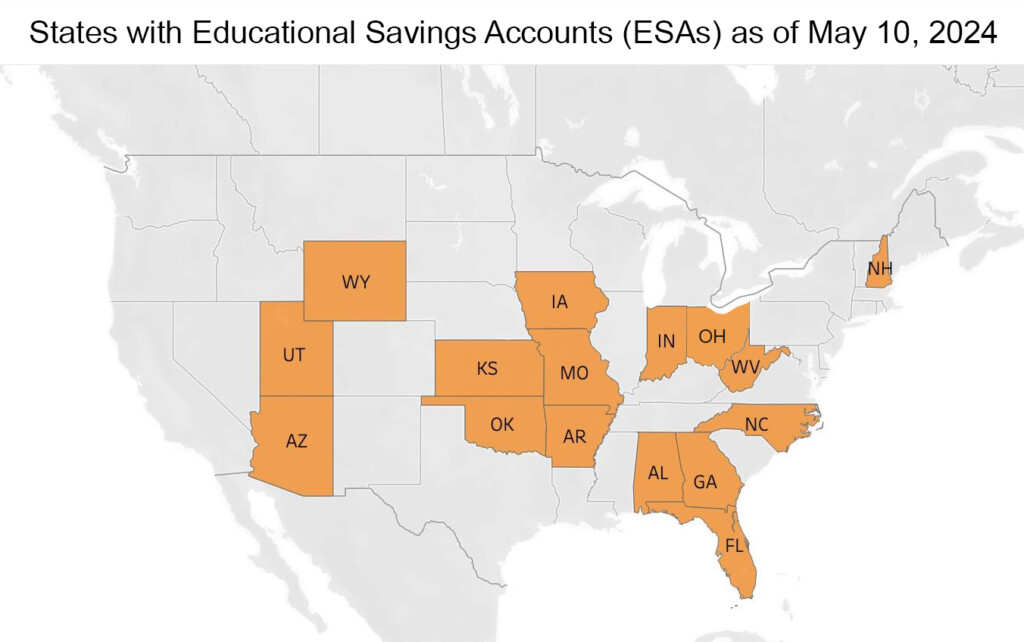
So far, sixteen states have set up ESAs to publicly finance private school attendance, home-schooling, and a range of educational services available to a majority of the states’ school-age children. Southern states are leading this movement by undertaking a classic bait and switch—first selling the public on voucher programs to help poor and disadvantaged students in “chronically failing public schools,” and then building and publicly financing an alternative, dual system of private schooling.
The historical context is shameful. Five of the southern states that now have universal vouchers also enacted open-ended vouchers in the 1960s—attempting to defeat Brown’s mandate for school desegregation. All but four of the states that have already embraced publicly financed ESAs were the only states authorizing segregated public schools on the eve of the Supreme Court’s decision.9Suitts, Overturning Brown, 18–53, 87–89; Suitts, “Segregationists, Libertarians, and the Modern 'School Choice' Movement,”; Pauli Murray, States' Laws on Race and Color (Cincinnati, OH: Women's Division of Christian Service of the Methodist Church, 1951). Indiana had school segregation laws from 1869 until 1949, when five years before the Brown decision the legislature revoked the laws, See Murray, 145–147. The eighteen states are the eleven states of the South: West Virginia, Kentucky, Missouri, and Oklahoma in the Border South; Kansas, Indiana, Arizona, and Wyoming.
The fiscal impact of this rush to fund private schooling will be devastating to public schools. In 2018, all fifty states allocated $2.6 billion to finance private school vouchers. In 2021, legislatures increased the total amount to $3.3 billion and more recently to over $6 billion. If the eleven southern states enact the bills currently adopted or pending in their legislatures, their total funding for vouchers will be as much as $6.8 billion in 2025–26 and, according to independent estimates, as much as $20 billion for private schooling in 2030. This sum would equal the total state funds to public schools among six southern states in 2021.10Suitts, Overturning Brown, 3; EdChoice, The ABCs of School Choice, 2024, https://www.edchoice.org/wp-content/uploads/2023/11/2024-ABCs-of-School-Choice.pdf; author's computations based on the provisions of enacted and pending bills, fiscal notes accompanying legislation and independent estimates by non-profits in the southern states.
The Past Is Future
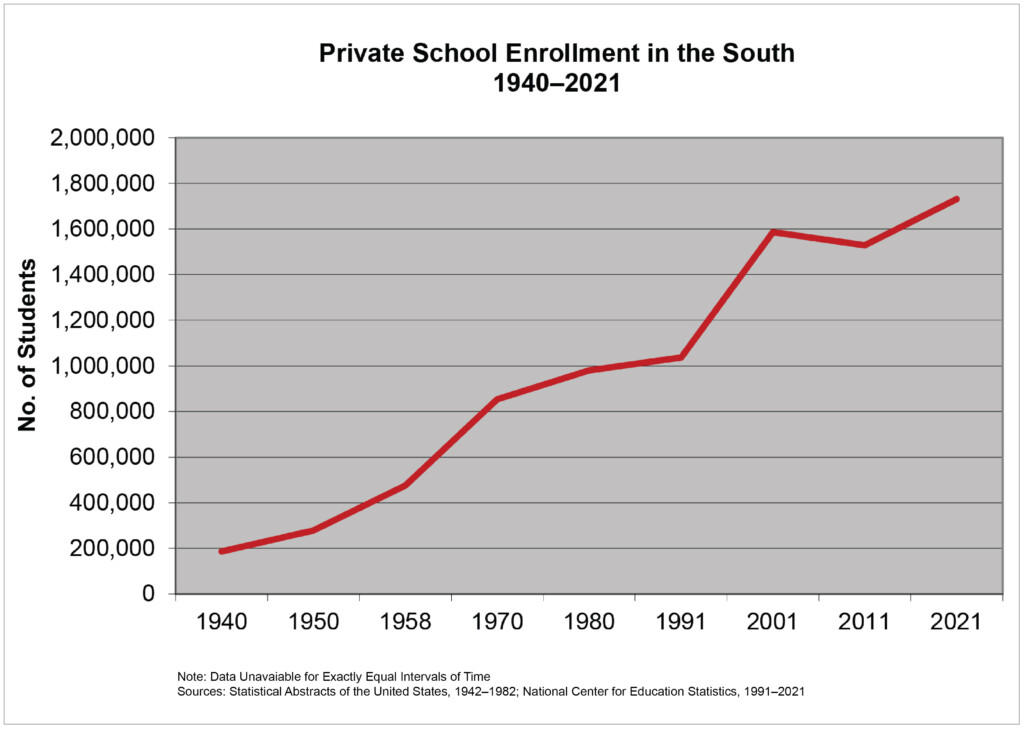
Segregationists’ attempts to use private schools to prevent the implementation of Brown shaped the demography of private school enrollment. After the 1954 decision, enrollment in southern private schools accelerated. With federal court enforcement of Brown, private school growth exploded in the 1960s and 1970s as white families, especially in areas with large Black populations, fled public schools. This was the era of “segregation academies”—private schools created in response to federal court orders to desegregate local public schools. With little or no attempt to hide their intent to evade Brown, seven southern legislatures enacted voucher programs providing families with tax dollars to send their children to private schools. The other four states of the former Confederacy came close to adopting such programs, but abandoned consideration once the federal courts invalidated voucher programs. Adopted as an effort to allow public funds to “fund the child,” Georgia voluntarily defunded its vouchers after segregationist lawmakers realized that they were mostly subsidizing well-to-do families whose children were already attending private schools. In Louisiana, both white and Black families were provided private school vouchers before the federal courts voided the program.11Suitts, “Segregationists, Libertarians, and the Modern 'School Choice' Movement.”
Southern states’ private school enrollment quickened across the decades, especially in the 1990s as population, economy, and personal income markedly increased. To retain a non-profit, federal tax exemption, segregation academies ditched their strict, all-white admission policies, and reoriented their appeal as places of religious education or of higher educational standards. Other private schools became more willing to admit children of color as a new generation of white people was less indoctrinated by received habits, institutions, leaders, and media on the necessity and virtue of total segregation. Whatever non-racial rationale private schools adopted, the vast majority maintained a common character: “These are schools for whites,” observed a group of scholars in the 1970s. “The common thread that runs through them all, Christian, secular, or otherwise, is that they provide white ground to which blacks are admitted only on the school’s terms if at all.”12David Nevin and Robert E. Bills, The Schools that Fear Built: Segregationist Academies in the South (Washington, DC: Acropolis Books, 1976), 11.
Private and Public: Vastly Disparate Students
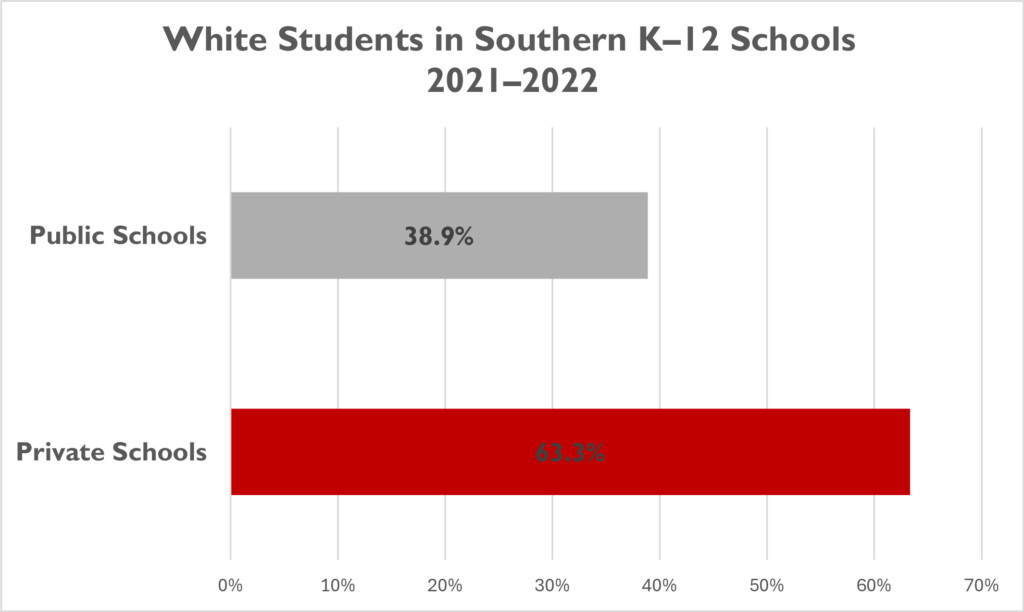
The character of most southern private schools has persisted, but, beginning in the 1990s, the student population of the South’s public schools began to change. Today, the southern states’ private schools remain predominately white and their public schools are predominately non-white, serving children of color. In 2021 (the latest comparable data), white students comprised 63 percent of the South’s private school enrollment and only 39 percent of the public schools. Black and Hispanic children constituted 53 percent of all students in public schools but less than half that proportion—26 percent—in the private schools of the eleven states.13Private school enrollment retrieved and computed from National Center for Education Statistics (NCES), accessed at https://nces.ed.gov/surveys/pss/privateschoolsearch/. Public school enrollment taken from NCES’ Table 203.70 of 2023 Digest of Education Statistics, accessed at https://nces.ed.gov/programs/digest/2023menu_tables.asp.
Income also separates the public and private schools as worlds apart. Private school students come from homes with vastly higher incomes than public school students. The median incomes of private school households in Georgia, Florida, Louisiana North Carolina, Tennessee, Texas, and Virgina have been from 170 percent to nearly 200 percent greater than incomes of public school households over the last two decades. A recent scholarly, national study found that enrollment of higher-income students in private schools had increased over prior decades.14Jacob Fabina, Erik L. Hernandez, and Kevin McElrath, “School Enrollment in the United States: 2021,” American Community Survey Reports, US Census Bureau, Washington, DC, 2023; Bruce D. Baker, Danielle Farrie, David Sciarra, Is School Funding Fair? A National Report Card, 2012, 2014, 2017, “Coverage” appendices; R.J Murnane and Sean Reardon, “Long-Term Trends in Private School Enrollments by Family Income,” AERA Open 4, no. 1 (2018), https://doi.org/10.1177/2332858417751355. The Murname and Reardon study measured the Census South.
As private school enrollment has become wealthier, public school enrollment has become poorer. By 2006, a majority of the South’s public school students came from low-income households, and in 2013, for the first time in recent history, a majority of the nation’s public school children came from low-income households. Despite continued growth in the US economy, these patterns persist. Fifty-two percent of the public school students in the eleven-state South were eligible for free or reduced school meals in 2021, due in large part to the enrollment of so many low-income children. Nationwide, the rate was 49 percent, only slightly down from more than 50 percent during the two prior years.
A sizable number of public school children also have special needs that involve extraordinary educational challenges for teachers and schools. The southern states have almost 40 percent of the nation’s five million school children who are English learners. Students with disabilities (IDEA) range from one in every ten students in Texas to one in every six students in Arkansas public schools. On average, one child out of every fifty in the South’s public schools is homeless.15Steve Suitts, A New Majority: Low Income Students in the South’s Public Schools, Southern Education Foundation, 2008, https://southerneducation.org/publications/newmajority/; Steve Suitts, A New Majority Update: Low Income Students in the South and Nation, Southern Education Foundation, 2013, https://southerneducation.org/wp-content/uploads/documents/new-majority-update-bulletin.pdf; computations from Tables 102.40, 204.10, 204.20, 204.70, 204.75d, “Digest of Education Statistics, 2022,” National Center for Education Statistics, https://nces.ed.gov/programs/digest/2022menu_tables.asp.
There is no reliable data on the number of children with special needs enrolled in private schools. A small number were established to serve special needs students, but the vast majority do not. As a matter of law and mission, most private schools maintain no responsibility to educate disadvantaged students.
Vouchers Worsen School Disparities in a Dual System
Wherever states have abandoned narrow, targeted voucher programs, the expanded public funding has usually been grabbed by the higher-income households, often with children already attending private schools. In 2023, Education Week magazine, which has impartially covered K–12 schools for more than forty years, reported that in states with recently expanded voucher programs a “majority of students participating in these programs were already enrolled in private schools or were homeschool students prior to signing up for the newly expanded, publicly funded education subsidy."16Mark Lieberman, “Most Students Getting New School Choice Funds Aren’t Ditching Public Schools," Education Week, Oct. 4, 2023, https://www.edweek.org/policy-politics/most-students-getting-new-school-choice-funds-arent-ditching-public-schools/2023/10.
During Arkansas’ first year of financing universal ESAs, “95% of the students receiving vouchers” did not attend public schools before receiving the state money. And in four other states that have enacted near-universal ESAs, including Florida, a majority of the new households receiving vouchers have children already attending private schools.17Arkansas Department of Education, LEARNS, Education Freedom Account Annual Report, 2023–2024, https://arktimes.com/wp-content/uploads/2023/10/EFA-Transparency-Report37.pdf; “Iowa’s Students First Education Savings Account program generates more than 29,000 applications,” press of Iowa Governor Kim Reynolds, July 6, 2023, https://governor.iowa.gov/press-release/2023-07-06/iowas-students-first-education-savings-account-program-generates-more; Robin Opsahl, “More than 29,000 apply for Iowa private-school funds in first year,” Iowa Capital Dispatch, July 6, 2023, https://iowacapitaldispatch.com/2023/07/06/more-than-29000-apply-for-iowa-private-school-funds-in-first-year; Ethan Dewitt, “Most education freedom account recipients not leaving public schools, department says,” New Hampshire Bulletin, Mar. 22, 2022, https://newhampshirebulletin.com/briefs/mosteducation-freedom-account-recipients-not-leaving-public-schools-department-says/; News Service Florida, “New report shows nearly 123,000 new students received Florida school vouchers in 2023,” NBC 6 South Florida, https://www.nbcmiami.com/news/local/new-report-shows-nearly-123000-new-students-received-florida-school-vouchers-in-2023/3112869; Florida Department of Education (2023). "Florida’s Private Schools 2022–23: School Year Annual Report," https://www.fldoe.org/core/fileparse.php/7562/urlt/PS-annualReport2023.pdf; Alec MacGillis, “Private Schools, Public Money: School Leaders Are Pushing Parents to Exploit Voucher Programs,” ProPublica, Jan. 21, 2024, https://www.propublica.org/article/private-schools-vouchers-parents-ohio-public-funds.
Data on household income among new ESA recipients is not widely available, but an analysis by Ohio’s former chair of the state house education committee finds that the state’s near-universal voucher programs is subsidizing private school tuition for families in higher income brackets, and that nine of ten of the new recipients have been white. Arizona does not collect income data from its rapidly expanded universal ESA, but Princeton sociologist Jennifer Jennings found in 2024 that “Arizona’s school vouchers are subsidizing its most fortunate families, reinforcing existing disparities rather than mitigating them.” In Florida, the lastest available numbers show that two out of every three new recipients in its universal voucher programs had incomes above 185 percent of poverty. As many as 44 percent had incomes no less than 400 percent above the poverty line.18Stephne Dyer, “Ohio's Disastrous Voucher Explosion,” Tenth Period, Nov. 29, 2023, https://10thperiod.substack.com/p/ohios-disastrous-voucher-explosion?subscribe_prompt=free; Jennifer Jennings, “Arizona’s school vouchers are helping the wealthy and are widening educational opportunity gaps,” Arizona Mirror, Jan. 12, 2024, https://azmirror.com/2024/01/12/arizonas-school-vouchers-are-helping-the-wealthy-and-are-widening-educational-opportunity-gaps; “Transparency in Scholarship Programs,” Step Up for Students via Florida Phoenix Sep. 2023, https://drive.google.com/file/d/1yyl80Jbs9mU6GlV1ktA6zZg8GUjLnsP4/view. The Arizona Common Sense Institute argues that its zip code analysis shows that the state’s ESAs are assisting mostly middle-class families but their analysis lumps together zip codes with median household incomes with those more than twice the state median. In Florida, Step Up for Students expanded the grouping of voucher recipients—the lowest income category showing recipients’ income as high as 185 percent of poverty. Glenn Farley and Kamryn Brunner, Universal ESA’s: Where We Are and Where We Are Going, Arizona Common Sense Institute, May 2023, https://commonsenseinstituteaz.org/wp-content/uploads/2023/05/CSI-Report-_Universal-ESAs_May-2023-2.pdf; Glenn Farley, Growth and Change: How One Year of Universal Empowerment Scholarship Accounts Has (and Has Not) Altered Arizona’s K–12 Landscape, Arizona Common Sense Institute, April 2024, https://commonsenseinstituteaz.org/wp-content/uploads/2024/04/CSI_REPORT_ESA_GROWTH_APRIL_2024.pdf.
It has been evident for years that wealthier households are the primary beneficiaries of open-eligibility tax credit voucher programs. In 2023 the non-profit Institute on Taxation and Economic Policy examined programs in three states that permitted any family to divert state taxes to private school vouchers. Ninety-nine percent of all voucher tax credits in Louisiana and 87 percent in Virginia went to families with annual incomes over $200,000. In Arizona, it was 60 percent. In Georgia, $100 million can now be taken annually from the treasury through state tax credit for funding private school vouchers, and higher-income families have received the majority of the vouchers since 2013. The actual number may be much greater as the program has been plagued by irregularities, deceit, and misrepresentations by private groups distributing the tax credit vouchers. The Georgia Department of Revenue does not use tax records to verify the self-reporting of those receiving the tax credits or vouchers.19Carl Davis, Tax Avoidance Continues to Fuel School Privatization Efforts, Institute on Taxation and Economic Policy, Mar. 3, 2023, https://itep.org/tax-avoidance-fuels-school-vouchers-privatization-efforts/; author’s computations from annual Qualified Education Expense Credit Report, Georgia Department of Revenue, 2013–2021, https://dor.georgia.gov/calendar-year-qualified-education-expense-credit-report; Steve Suitts and Katherine Dunn, A Failed Experiment: Georgia's Tax Credit Scholarships for Private Schools (Summary Report), Southern Education Foundation, 2008, https://southerneducation.org/publications/a-failed-experiment; Nancy Badertscher, “Group targets tax credit scholarships - Revenue Department asked to stem students from private schools,” Atlanta Journal-Constitution, July 22, 2011, B-2; Steve Suitts, “Program encourages deception and helps those who don't need it,” Atlanta Journal-Constitution, July 5, 2011, A-13.
Even with vouchers, few low-income families in the South can afford to keep their children in K–12 private schools. The average cost of private school tuition in ten of eleven southern states exceeds those states’ per-pupil funding of public schools. In other words, even if a voucher equals the state per pupil allocation for public school, it is not enough to match the private school tuition. After including additional expenses of attending a private school—books, supplies, uniforms, technology, athletics, and field trips—the total average cost in all southern states except Arkansas exceeds the state per pupil appropriation. In Texas, that total cost is more than $9,000 over the state’s per pupil public school appropriation. It is more than $2,300 in Mississippi.20Calculations based data on average private tuition prices by state and other costs reported at Raise Right website, https://www.raiseright.com/blog/how-much-do-private-schools-cost, and Prosperity for America website, https://www.prosperityforamerica.org/average-private-school-tuition/. Data on state revenue for state per pupil revenue is found at “2021 Public Elementary-Secondary Education Finance Data, US Census. https://www.census.gov/data/tables/2021/econ/school-finances/secondary-education-finance.html. These back-of-the envelope calculations capture the real-life financial barriers many families will encounter if they rely on an ESA voucher to send a child to a private school, and the calculations don’t even include cost of transportation, something that few private schools provide and is far beyond the resources of most low-income families.
The emerging ESAs are apparently designed for higher-income families that can already afford to pay all or much of the cost of private schooling. Wealthy families can use these vouchers to cover tuition costs and a wide range of expenses. As in several other states, Alabama’s vouchers can go toward tuition, textbooks, fees, after-school care, summer education programs, private tutoring, curriculum and instructional materials, online learning, educational software and applications, standardized assessments, including college admissions tests and advanced placement exams, and college prep courses.
The South Cannot Afford a Dual School System
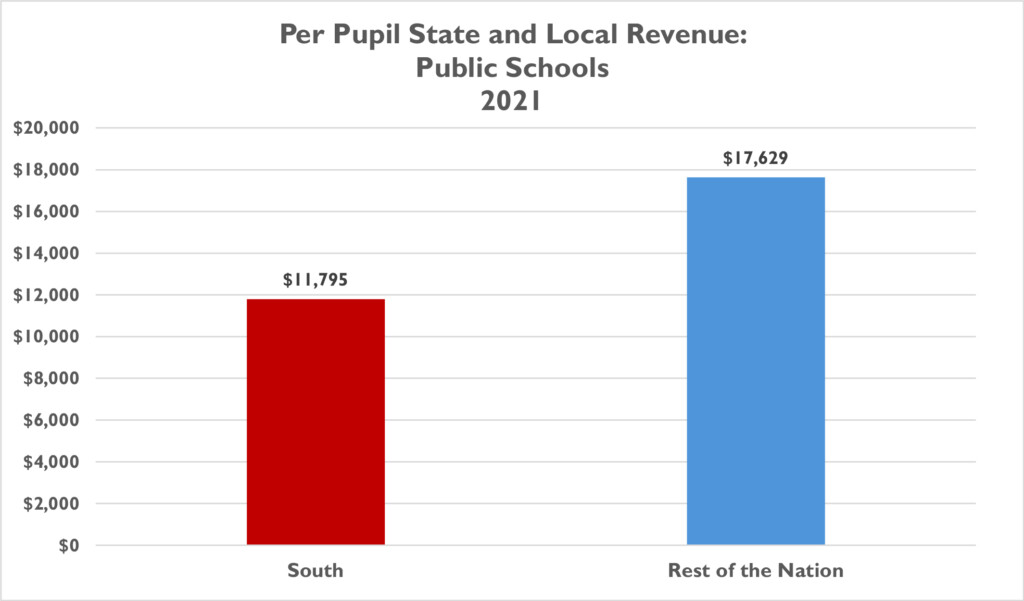
Southern states, while serving a large proportion of disadvantaged children, provide among the lowest per pupil funding in the nation to their public schools. Any given K–12 student in the South received on average $5,831 less for education during 2021–2022 than a student in public school elsewhere in the United States. Public school children in North Carolina, which ranks 48th in state and local funding, received nearly $7,500 less per child than what the rest of the nation provides.
This pattern of underfunding public schools is longstanding and was aggravated over decades, in large part, by the fact that the southern states maintained separate, unequal, dual school systems.21Steve Suitts, “The South: America’s Legacy of Gross Disparities in Funding Education,” No Time to Lose: Why America Needs an Education Amendment to the Constitution, Southern Education Foundation, 2009, https://files.eric.ed.gov/fulltext/ED524094.pdf. And the legacy persists. A recent study by University of Miami Professor Bruce Baker and his colleagues found no less than three out of every four public school districts in the South were chronically underfunded by national standards of need and resources.22Bruce D. Baker, Matthew Di Carlo, and Mark Weber, The Adequacy and Fairness of State School Finance Systems, Jan. 2024, https://www.schoolfinancedata.org/the-adequacy-and-fairness-of-state-school-finance-systems-2024/.
States will soon realize the damage of these disparities. The vast federal funds that were appropriated shortly after the COVID epidemic to shore up schools will run out in 2024. Governors and state legislatures have allocated these temporary funds as if they were state appropriations and often have been able to increase public school funding using federal funds. As that funding is exhausted, public schools in the southern states will suffer extraordinary shortfalls—more so than any other area of the United States.
Approximately nine percent of Louisiana’s education budget across the last three years has been financed with federal funds, almost all of which will be spent by 2025.23Joanna LeFebvre and Sonali Master, Expiration of Federal K–12 Emergency Funds Could Pose Challenges for States, Center on Budget and Policy Priorities, Feb. 2024, https://www.cbpp.org/sites/default/files/2-28-24sfp.pdf. The legislature will be forced to cut K–12 education funding and/or raise additional revenue. If Louisiana's legislature enacts the pending universal ESA it could add more than $65 million in expenses by 2026, and by independent estimates, as much as a half a billion dollars in annual expenditures to the state education budget by 2030.24“Expanding School Choice: Education Savings Accounts Raise Cost, Accountability Concerns,” Public Affairs Research Council of Louisiana, https://parlouisiana.org/wp-content/uploads/2024/03/PAR-Commentary-Expanding-School-Choice-1.pdf.
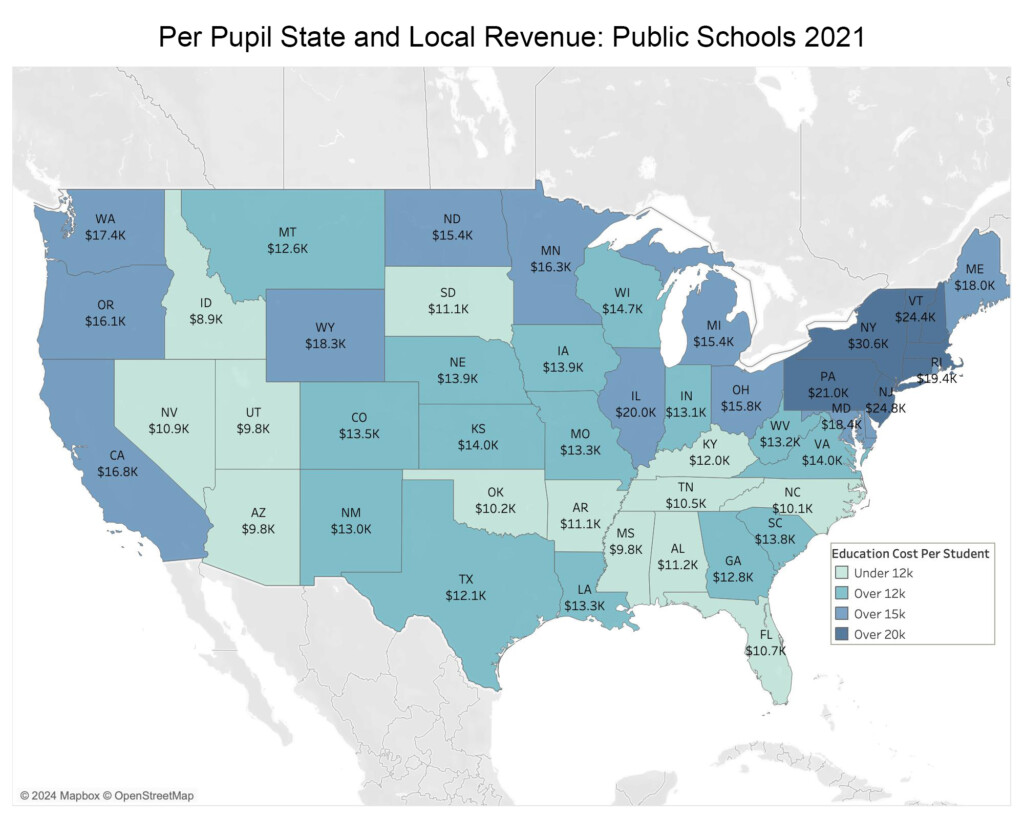
Such grim estimates extend to all states that have enacted or are moving to adopt universal ESAs, including Arizona where 6.9 percent of the state’s recent annual education appropriations will be lost. Yet the fiscal calamities will happen foremost in the southern states where federal funds have constituted an average of 6.4 percent of annual state education spending—and as much as 10.5 percent in Mississippi.
According to ERS, a consulting firm that collaborates with urban school districts, children in fifteen states will be hit hardest as the federal government’s COVID funding ends.25“Here’s Why Some States Are Facing a Steeper ESSER Funding Cliff in 2024,” ERS, Mar. 2023, https://www.erstrategies.org/tap/analysis-esser-funds-fiscal-cliff-by-state/#factor3. Nine of these are southern states, with Florida falling just outside the list. Among the states that will be hardest hit, all except New Mexico have or are currently considering ESA voucher plans.
Replacing $41.5 billion in special federal funding during the last three years will be a daunting challenge for southern states, especially since they also received billions of dollars from other federal COVID relief funding for health care, roads, transportation, and childcare. These funds are also ending. Without massive cutbacks in funding public schools and services, how can the southern states meet this crisis while spending hundreds of millions financing new ESA vouchers in support of a separate system of private schooling? It’s a fool’s errand that will involve educational and financial catastrophe for all but the South’s upper-income households, for whom ESAs will provide a nice subsidy. For public school children, especially most low-income and minority children, it is the making of a disaster.
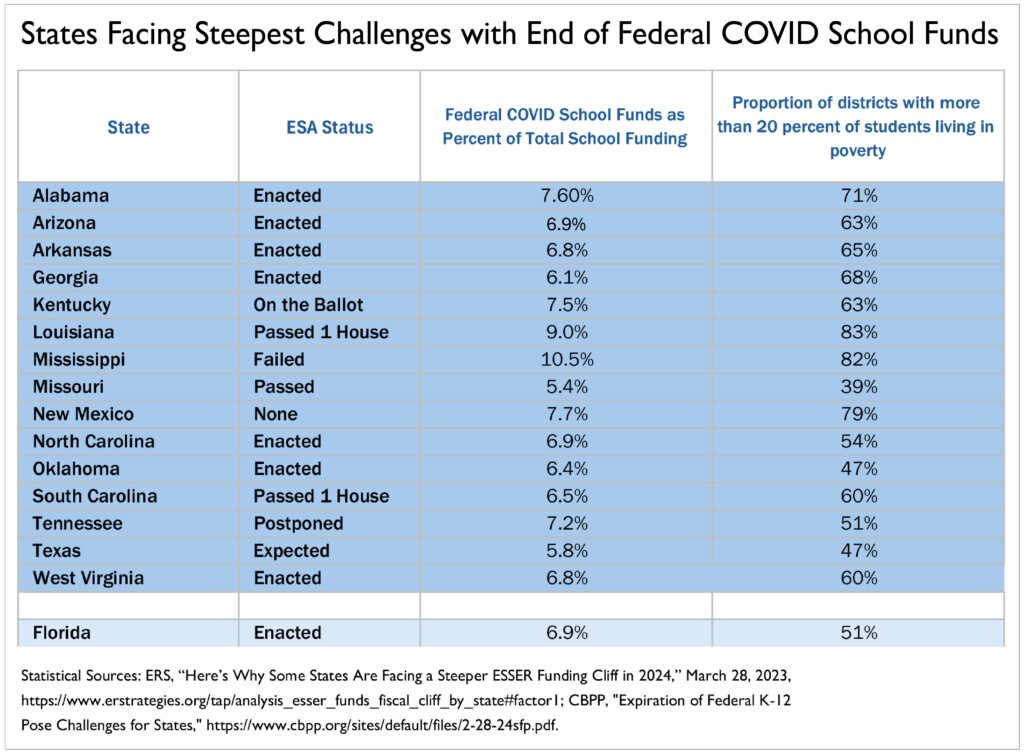
Dismantling Public Schools
Perhaps it is the aim of some school choice backers who are pushing for a state-financed system of universal vouchers to incapacitate the public education system’s mission and mandate to serve all students with equal educational opportunities. In April 2024, a lead sponsor of universal ESA vouchers in the Tennessee legislature, Republican Scott Cepicky, was caught on tape privately telling home-school parents that his goal for the state’s public schools was to “throw the whole freaking system in the trash at one time and just blow it all back up."26Phil Williams, "'We're trying to throw the whole freaking system in the trash,' school voucher sponsor says," NewsChannel 5 Nashville, Apr. 15, 2024, https://www.newschannel5.com/news/newschannel-5-investigates/revealed/revealed-were-trying-to-throw-the-whole-freaking-system-in-the-trash-school-voucher-sponsor-says
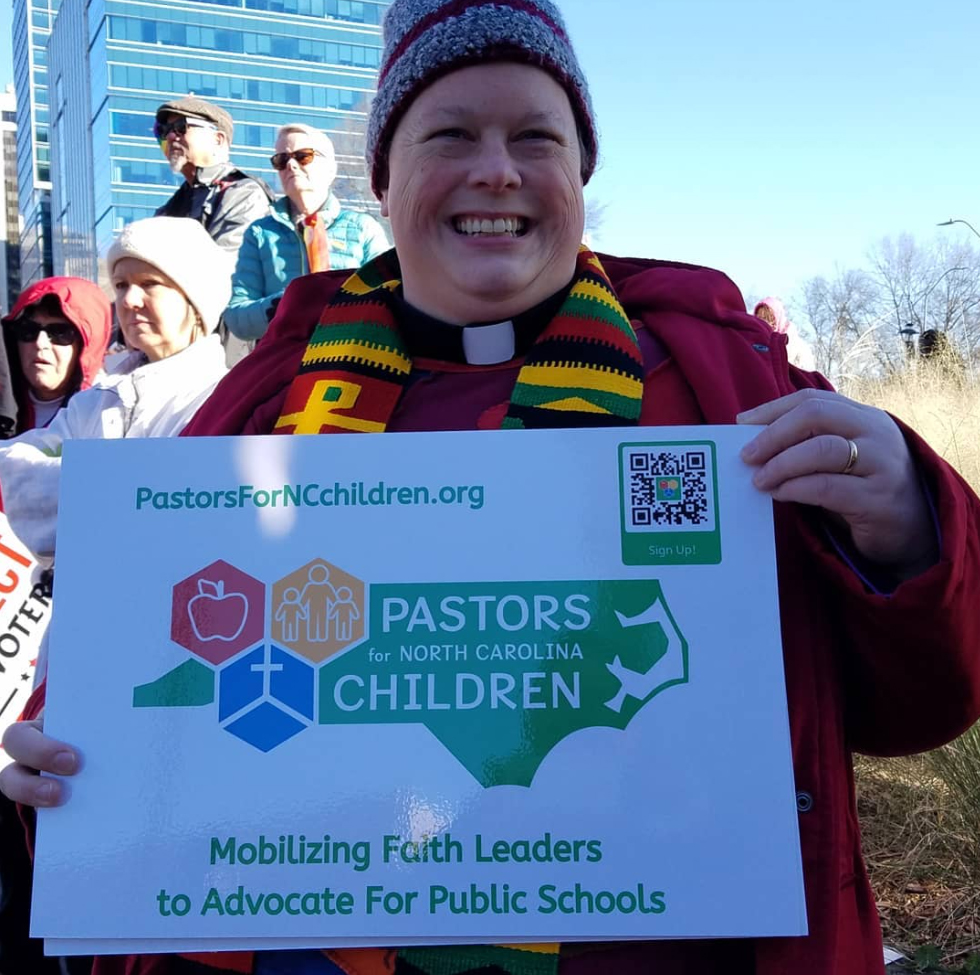
Last year, in a closed meeting of Christian millionaires, one attendee declared that the goal was to “take down the education system as we know it today.” Michael Farris, the Virginia lawyer who has become a prominent leader of the modern home-schooling movement, told the group, “We’ve got to recognize that we’re swinging for the fences here, that any time you try to take down a giant of this nature, it’s an uphill battle,” according to a recording obtained by the Washington Post.27Emma Brown and Peter Jamison, “The Christian home-schooler who made ‘parental rights’ a GOP rallying cry,” Washington Post, Aug. 29, 2023, https://www.washingtonpost.com/education/2023/08/29/michael-farris-homeschoolers-parents-rights-ziklag/.
Few backers of universal vouchers say as much in public, but they no longer keep up a pretense that the school choice movement is about finding ways to provide targeted assistance and opportunities for low-income and minority children. But, Southern governors still like to parade out a group of children of color when they sign voucher bills, as did Georgia Governor Brian Kemp when he held his signing ceremony for the ESA law.28Ty Tagami, “Kemp signs voucher bill he championed,” Atlanta Journal-Constitution, Apr. 24, 2024. Most voucher proponents and wealthy donors who have coalesced for decades, spending enormous energy and money to advance public financing of private education, have confessed openly to a variety of other motives.
This diverse coalition seeks state-supported Christian education, free-market competition, elite-only schooling, unfettered parental control of education, and regulation-free schools, among other objectives. Their movement has progressed over the decades through the collective organizational work and political action committees bankrolled by the super-rich and corporate leaders who believe that the government is too large, taxes too much, and has little or no business in providing education.29David Montgomery, “School Voucher Proponents Spend Big to Overcome Rural Resistance,” Governing, Mar. 28, 2024, https://www.governing.com/finance/school-voucher-proponents-spend-big-to-overcome-rural-resistance; Jimmy Cloutier, “‘School choice’ super PAC targets Texas GOP incumbents,” Open Secrets, Mar. 4, 2024, https://www.opensecrets.org/news/2024/03/school-choice-super-pac-targets-texas-gop-incumbents/; Katie Meyer, “Jeff Yass, the richest man in Pa., is single handedly keeping school choice PACs flush,” WHYY, May 12, 2021, https://www.phillytrib.com/jeff-yass-the-richest-man-in-pa-is-single-handedly-keeping-school-choice-pacs-flush/article_ee7dde98-1989-5ef1-925c-06473429466c.html; James Holmann with Breanne Deppisch and Joanie Greve, “Koch network laying groundwork to fundamentally transform America’s education system,” Washington Post, Jan. 20, 2018, https://www.washingtonpost.com/news/powerpost/paloma/daily-202/2018/01/30/daily-202-koch-network-laying-groundwork-to-fundamentally-transform-america-s-education-system/5a6feb8530fb041c3c7d74db/.
Consider the voucher advocates who believe in economist Milton Freidman’s vision of public education that is entirely based on the government’s providing a voucher to all families with school-age children to go to any school of their choosing. Friedman laid out his free-market idea for voucher-schooling in 1955, a year after Brown. To realize Friedman’s vision today, his adherents’ goal is not a dual school system, but a unitary system of only ESA vouchers. In other words, they seek to destroy public education as it exists.
These free-market proponents fail to grapple deeply with the same issues that Friedman blithely dismissed when condemning “government schools.” In 1955, he acknowledged that his voucher proposal had already been “suggested in several states as a means of evading the Supreme Court ruling against segregation." Friedman’s solution was simple: vouchers paid by government funds would create a system of "exclusively white schools, exclusively colored schools, and mixed schools. Parents can choose which to send their children to." Friedman also opposed a federal fair employment commission to bar racial discrimination in private employment and later the 1964 Civil Rights Act—since it involved government regulation of private businesses for the purpose of prohibiting racial discrimination.30See Suitts, “Segregationists, Libertarians, and the Modern 'School Choice' Movement.”
The belief in the unqualified virtue of private choice means that by design school choice should trump any role government has to prohibit discrimination based on race, sex, and religion in providing the nation’s children with an education. It means the destruction of public schools and their core democratic values.
The emergence of universal vouchers has convinced Pulitzer Prize winning journalist Cara Fitzpatrick to write in The Death of Public Education (2023) that the aim of the movement is to “radically redefine public education in America” with consequences that most citizens have not begun to fully consider.31Cara Fitzpatrick, The Death of Public Education: How Conservatives Won the War over Education in America (New York: Basic Books, 2023). In their revised preface to A Wolf at the Schoolhouse Door (2023), Jack Schneider and Jennifer C. Berkshire write that there is now “a very real threat to public education in the United States . . . we’ve seen more destruction than we imagined could be done in a decade. And we’re worried when we next sit down to update this book, we’ll be writing a eulogy rather than a polemic."32Jack Schneider and Jennifer C. Berkshire, A Wolf at the Schoolhouse Door: The Dismantling of Public Education and the Future of School (New York: The New Press, 2023).
The Bizarre Disparities in Governing the Emerging Dual School Systems
Ending public schools may be the clear goal of the primary advocates behind the private choice movement, but what is emerging in states that are on their way to adopting universal ESAs is a dual school system with vastly, differing, unequal ground rules, responsibilities, and oversight for educating children with public funds.
Most ESA legislation requires minimal regulations of private schools. Children may be rejected by a private school receiving state vouchers for any number of reasons, spoken or unspoken, relating to income, religion, race, ethnicity, dress, sex, gender identity, or disability. The schools will have the ultimate choice—not the children and their families. State legislation usually prohibits discrimination based on race and national origin, but as with most ESAs, there are no mechanisms for oversight, reporting, investigation of complaints, or enforcement.33Kevin G. Welner & Preston C. Green, “Vouchers as a Mechanism for State-Sanctioned Private Discrimination,” in The School Voucher Illusion: Exposing the Pretense of Equity, eds., Kevin Welner, Gary Orfield and Luis A. Huerta (New York: Teacher College Press, 2023), 87–109; Chase M. Billingham and Matthew O. Hunt, “School Racial Composition and Parental Choice: New Evidence on the Preferences of White Parents in the United States,” Sociology of Education, 89, 2 (2016): 99–117, https://doi.org/10.1177/0038040716635718.
The standards for educating children and methods of accountability are minimal or illusory in voucher-supported private schools. The bills establishing ESAs allow these schools to be accredited by a range of private associations, usually comprised of representatives of the schools they accredit. In most southern states, private schools receiving vouchers are not required to assess students for achievement, or, they can use a nationally normed test of their preference, which undermines comparisons among schools. In any case, the results are not always available to the public. Most of these states do not specify, regulate, or review a private school’s curriculum before or after providing voucher funding.
This near-complete freedom to instruct children in whatever way the voucher-supported private schools choose is often justified on the basis that such schools provide students a better education than public schools. There is no factual grounding for this assumption.34Christopher Lubienski, T. Jameson Brewer, and Joel R. Malin, “Bait and Switch: How Voucher Advocates Shift Policy Objectives,” The School Voucher Illusion, 127–141; John Schaaf, “School vouchers hurting students’ academic performance, several studies show,” Kentucky Lantern, Feb. 19, 2024; also, Public Funds, Public Schools has complied a long list of the studies on how private voucher-supported schools have had chronic achievement problems, https://pfps.org/research/. Some private schools are renowned for their high-quality education, but academic study after study has proven this supposition is false. Voucher students are academically harmed on average, particularly in math. Yet, as Cara Fitzpatrick has observed “what the research shows no longer matters.” Private schools are free to indoctrinate students as much as educate them, so long as their parents tolerate or endorse it.35Fitzpatrick, 13.
Some voucher-supported private schools instruct students exclusively about a biblical story of creation. Some require students to pledge allegiance to religious flags and to memorize and recite school-chosen Bible verses. Some teach that homosexuality is a sin. Some expel LGBTQ+ students or even those who associate with LGBTQ+ people. Some use textbooks that belittle the significance of slavery and ignore or downplay the role of Black leaders and the civil rights movement.36Adam Laats, “The Right-Wing Textbooks Shaping What Many Americans Know About History," Time, Oct. 12, 2023, https://time.com/6316978/conservative-textbooks/; Jenna Scaramanga and Michael J. Reiss, “Evolutionary stasis: creationism, evolution and climate change in the Accelerated Christian Education curriculum,” Cultural Studies of Science Education 18 (2023): 809–827. https://link.springer.com/article/10.1007/s11422-023-10187-; Jenna Scaramanga and Michael J. Reiss, “Accelerated Christian Education: a case study of the use of race in voucher-funded private Christian schools,” Curriculum Studies 50, no. 1 (Nov. 2017): 1–19, https://www.researchgate.net/publication/321373088_Accelerated_Christian_Education_a_case_study_of_the_use_of_race_in_voucher-funded_private_Christian_schools; Adam Laats, Forging a Fundamentalist ‘‘'One Best System’': Struggles Over Curriculum and Educational Philosophy for Christian Day Schools, 1970–1989," History of Education Quarterly 49, no. 1 (Jan. 2010): 55–83; Zack Kopplin, “Hundreds of Voucher Schools Teach Creationism in Science Classes,” PBS News, Jan. 29, 2013; “The Loch Ness Monster Is Real; The KKK Is Good: The Shocking Content of Publicly Paid for Christian School Textbooks," Alternet, June 19, 2012; Steve Suitts, Race and Ethnicity in a New Era of Public Funding of Private Schools: Private School Enrollment in the South and the Nation, Southern Education Foundation, 2015, Appendix 14 (available on request); Julie F. Mead and Suzanne E. Eckes, How School Privatization Opens the Door for Discrimination, National Education Policy Center, Nov. 2018; Steve Suitts, Georgia’s Tax Dollars Help Finance Private Schools with Severe Anti-Gay Policies, Practices, & Teachings, Southern Education Foundation, Jan. 2013. There is nothing in the ESA laws, enacted or pending, that restricts a private school teacher, or home-schooling parent from engaging in a lesson plan of indoctrination on the inherent superiority of the white race, the heroism of John Wilkes Booth and James Earl Ray, the need to exterminate LGBTQ+ people, or to punish any woman who seeks an abortion.
In contrast, southern legislatures have piled up decades of regulations, assessments, reporting requirements, and penalties for traditional public schools and more recently are micro-managing what and how teachers can teach and what books local school libraries can keep on their shelves. From 2008 through 2022, the eleven southern states enacted a total of 3,552 laws regulating their public schools. There are nearly a thousand pages devoted to student discipline.37Compilations developed at Education Legislation/Bill Tracking, National Conference of State Legislatures, https://www.ncsl.org/education/education-legislation-bill-tracking; Compendium of School Discipline Laws and Regulations for the 50 States, Washington, DC and the US Territories, National Center on Safe Supportive Learning Environments, 2023, https://safesupportivelearning.ed.gov/school-discipline-compendium.
Southern state legislatures have moved to prohibit what they consider to be inappropriate curricula, lesson plans, and books involving diversity, inclusion, and equity—primarily about how and when persons and groups who are not white or heterosexual should be portrayed in the classroom and in library books. Every southern state has passed laws restricting discussions of race and/or gender identity. Most, like Alabama’s recent law, include restrictions for K–12 public schools on “divisive topics,” or like Arkansas, prohibit “indoctrination or critical race theory." No other area of the US has been as aggressive in restricting public school teachers and librarians, who face penalties or dismissal if they fail to adhere to the regulations banning what they can say and what books students may read.38Hannah Natanson, Lauren Tierney and Clara Ence Morse, “Which states are restricting, or requiring, lessons on race, sex and gender,” Washington Post, Apr. 4, 2024; “America’s Censored Classrooms,” PEN America, Aug. 17, 2022, https://pen.org/report/americas-censored-classrooms/.
It is hard to imagine a more divergent, unequal arrangement. The state-supported private schools can expel a student or teacher for almost any reason, and their teachers and librarians have complete freedom from governmental interference as to what subjects they teach and how they teach it. They have complete freedom to indoctrinate students—with no consequences.
As Vouchers Spread, Brown’s Promise Dies
During the last seventy years, the nation’s public schools have struggled in meeting the promise of Brown, despite clear proof that racially integrated, well-funded schools improve outcomes for Black children.39Rucker C. Johnson, Children of the Dream: Why School Integration Works (New York: Basic Books, 2019). This promise has been especially important to the South, where the states’ first education laws prohibited Black persons from being taught to read or write; where racially segregated schools offered children of color an inferior education across more than a half century. Due to stubborn, racially defined housing patterns, increasing class disparities, adverse, even hostile Supreme Court decisions, a lack of local, interracial community support, and, as recent research confirms, the growth of school choice, public schools continue to face far too many hurdles in providing all children with a good education.40Gary Orfield and Ryan Pfleger, The Unfinished Battle for Integration in a Multiracial America—from Brown to Now, The Civil Rights Project, UCLA, April 2024. https://civilrightsproject.ucla.edu/research/k-12-education/integration-and-diversity/the-unfinished-battle-for-integration-in-a-multiracial-america-2013-from-brown-to-now/National-Segregation-041624-CORRECTED-for.pdf. Also, see Tomas Monarrez, Brian Kisida, and Matthew Chingos, When Is a School Segregated? Making Sense of Segregation 65 Years after Brown v. Board of Education, Urban Institute, Sep. 2019. https://www.urban.org/research/publication/when-school-segregated-making-sense-segregation-65-years-after-brown-v-board-education; Laura Meckler, “The unexpected explanation for why school segregation spiked,” Washington Post, May 6, 2024, https://www.washingtonpost.com/education/2024/05/06/school-segregation-study-policies-court-orders/.
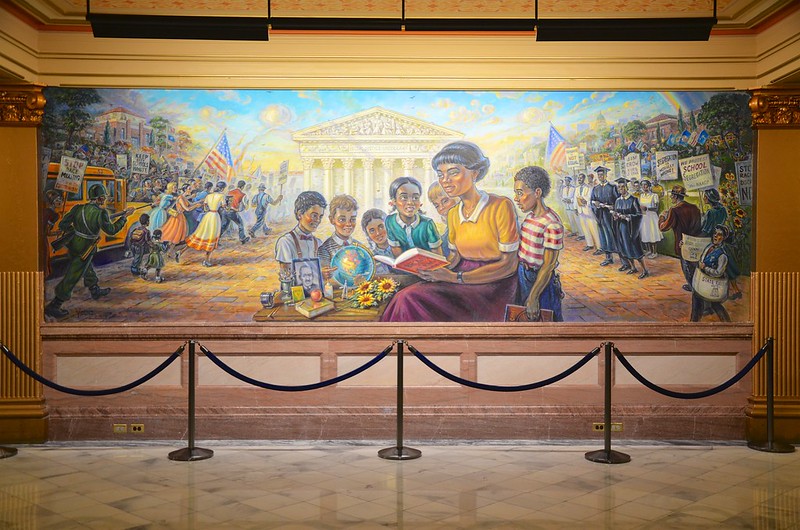
The South’s new dual school system renounces and annuls the mandates and hopes of Brown v. Board of Education. As universal vouchers spread, Brown’s promise dies. By their design, vouchers are an abandonment of Brown’s goal of equality of educational opportunity.
Reestablishing a dual school system will damage the prospects of a good education for all who attend public schools—not just low-income and minority children. The southern states were not able to finance two separate school systems during the era of segregation, even though Black students received a pittance of funding. Today that inability remains. The South continues to be far behind the rest of the nation in state and local funding of public schools. The new schemes of universal Education Savings Account vouchers will exacerbate the lack of sufficient funds for all except those higher-income families whose school-age children can attend private schools or home-schools and enjoy the enhancements and enriching experience that vouchers will subsidize.
Parents, grandparents, and others who support public schools and the democratic promise of public education must raise our voices against this reactionary movement and in furtherance of the importance of public schools. Like democracy itself, public schools may be the worst system for delivering all children an equal opportunity for a good education—except for all the others. We must not betray or abandon public education if we are committed to the democratic goal of a more perfect union and a good society for all.
About the Author
An adjunct with Emory University's Institute for the Liberal Arts, Steve Suitts is the author of A War of Sections: How Deep South Political Suppression Shaped Voting Rights in America (Athens, GA: University of Georgia Press, 2024). Earlier in his career, Suitts served as the executive director of the Southern Regional Council, vice president of the Southern Education Foundation, and executive producer and writer of "Will the Circle Be Unbroken," a thirteen-hour public radio series that received a Peabody Award for its history of the civil rights movement in five Deep South cities.
]]>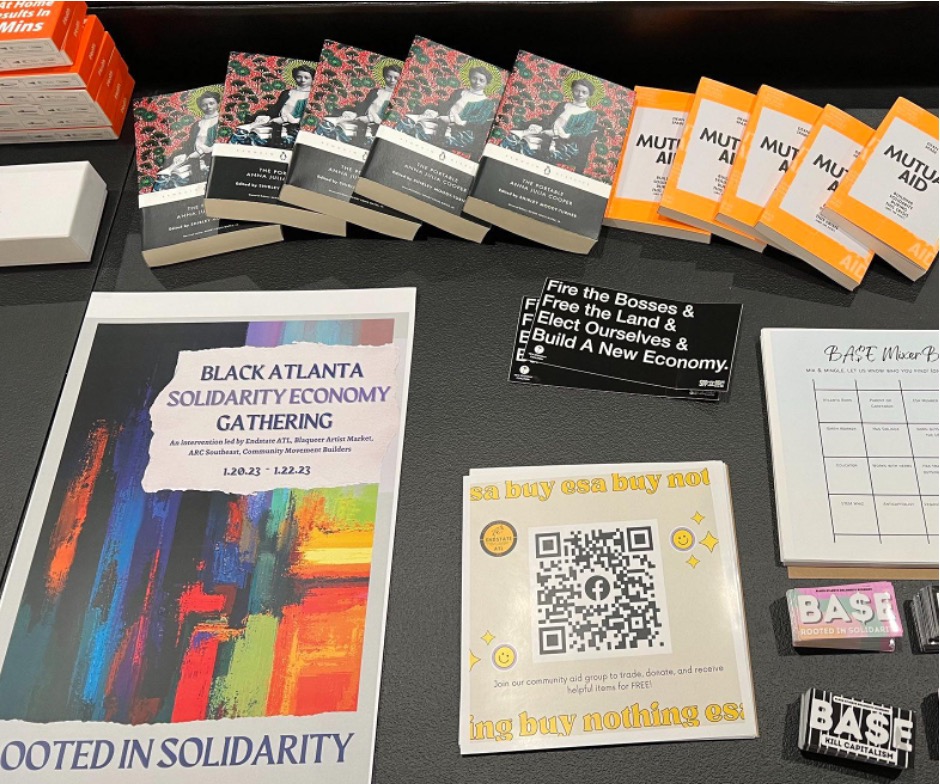
In May of 2023, when the World Health Organization downgraded the coronavirus emergency from a global health pandemic to an "ongoing health crisis," the shift made sense in many ways. Most developed nations have made vaccines available for over two years. Shutdowns and enforced quarantines ended, even in holdout nations. The WHO's announcement signaled that other countries, including the United States, would follow suit if they had not already. This move, however, will have material consequences for grassroots charitable organizations across the US. Endstate ATL (ESA), a group I have worked with since 2021, is one of many non-profit groups that will be affected.
In Georgia, the COVID state of emergency officially ended in May 2022, even as it remained in place at the national level. This allowed organizations like ESA to continue our mutual aid work. But when the US announced the end of the Federal COVID-19 Public Health Emergency (PHE) Declaration on May 11, 2023, enhancements to public assistance and social safety net programs ceased. From this point on, groups like ESA once again will have to jump through multiple bureaucratic hoops to obtain the funding necessary to provide care.
Following the global outbreak of COVID in 2020 many governments created temporary measures to extend aid to vulnerable populations. In the US, these included extensions of unemployment benefits, a moratorium on student loan interest and payments, no-cost COVID testing and vaccinations, Medicare flexibility, and opportunities to provide nontaxable disaster relief funds. The national government also released relief funds to individual state governments, although often these funds did not reach the people who needed them.1Rebecca Riess and Devon M. Sayers, "Alabama Governor Signs Bill to Use Covid-19 Relief Funds to Build Prisons," CNN, October 1, 2021, https://www.cnn.com/2021/10/01/politics/alabama-covid-relief-prison-bills-signed-governor-kay-ivey/index.html. Despite the uneven distribution of aid, many people, specifically children and elders, moved above the poverty line thanks to COVID assistance.2John Creamer, "Supplemental Poverty Measure That Accounts for Additional Government Benefits Lowest on Record at 7.8%," Census, September 13, 2022, https://www.census.gov/library/stories/2022/09/government-assistance-lifts-millions-out-of-poverty.html.
The flexibility surrounding nontaxable disaster relief funds eased mutual aid work. Mutual aid has a long history in the US and Global South, and the onset of the COVID-19 pandemic witnessed an outpouring of community solidarity towards those in need. Mutual aid stands apart from other charity models because of its non-hierachal emphasis on mutualism rather than models that maintain divisions between givers and receivers. Mutual aid is rooted in reciprocity.
Endstate ATL took advantage of these temporary measures for the betterment and aid of our community members. Rooted in southwest Atlanta with a Black queer feminist politic, ESA's work aims to reach those most marginalized through community building, political education, and mutual aid. Through our Black Power Fund, which pays up to three months' worth of utility bills for Black queer households, and our Pack Provides Programs, which provide household supplies, COVID PPE, and infant essentials including formula, clothing, and sanitary products to caregivers of young children, we seek to step in where the state fails to provide support.
Mutual aid allows organizations to provide immediate care and relief to individuals in need without imposing the bureaucratic processes that often keep aid beyond reach. Under a state of emergency, disaster relief payments are not taxable. As such, ESA, and other groups like it, were able to provide direct aid through a less convoluted system of reporting and disbursement. This allowed us to move funds directly and rapidly to people in need and has been crucial to our ability to substantively support people in a timely way. ESA has covered bills for ten households in the past year, as well as covered a year of utilities for the BARRED Business house, which provides stable, community-owned housing for people recently released from prison. We have been able to report these funds as disaster relief.3"Mutual Aid Legal ToolKit," Sustainable Economies Law Center, Accessed June 22, 2023, https://www.theselc.org/mutual_aid_toolkit.





The efforts of mutual aid groups helped supplement aid where state and local leadership failed. Georgia governor Brian Kemp refused to take the COVID-19 pandemic seriously. In 2020, Georgia was the first state in the nation to relax quarantine restrictions, even as Kiesha Lance Bottoms, the mayor of Atlanta, sought to retain many protective measures. Initial reporting that the virus would largely impact the elderly and immunocompromised, combined with anti-fear government propaganda, engendered a sense of invincibility and an attitude of disregard among many Georgians. As of 2021, Georgia had one of the highest COVID mortality rates in the US, and those most impacted were poor, working class, and people of color.4"COVID-19 Mortality by State," CDC, Accessed June 22, 2023, https://www.cdc.gov/nchs/pressroom/sosmap/covid19_mortality_final/COVID19.htm. The refusal of Governor Kemp to implement mandated social distancing or mask requirements, even before vaccines were available, left the entire state population vulnerable to infection. The consequences were devastating, with thousands of unnecessary deaths and debilitating outcomes for those suffering from long COVID.
Pandemic relief payments meant to alleviate the burden of rising interest rates were out of reach for marginalized Georgians. In order to receive national stimulus checks and Kemp's own "special tax credit," individuals needed to have filed and paid taxes for the preceding two years, a barrier that left people who were unemployed or homeless without access to relief.5"Gov. Kemp Announces First Round of This Year's Special Tax Refund," Department of Revenue, May 1, 2023, https://dor.georgia.gov/press-releases/2023-05-01/gov-kemp-announces-first-round-years-special-tax-refund#:~:text=Single%20filers%20and%20married%20individuals,a%20maximum%20refund%20of%20%24500.
In response to the pandemic, groups emerged such as Bed Stuy Strong, based in Brooklyn, which created a robust grocery delivery system by first relying on the resources at their disposal before evolving into a program that benefited thousands.6Haritha Kumar, "Four Key Takeaways from Mutual Aid Organizing During the COVID-19 Pandemic," Georgetown University Beeckcenter, October 4, 2022, https://beeckcenter.georgetown.edu/four-key-takeaways-from-mutual-aid-organizing-during-the-covid-19-pandemic/. Georgia has similar organizations. Community Movement Builders developed stabilization programs that include rent/mortgage payments as well as groceries in their efforts to impede the gentrification of southwest Atlanta, and Food4Lives a non-profit started by Georgia Tech and Emory students provides food and supplies for the unhoused in the greater Atlanta area.7Katie Burkholder, "Housing as a Human Right: Community Movement Builders Organize Against Gentrification," Georgia Voice, April 21, 2022, https://thegavoice.com/today-in-gay-atlanta/housing-as-a-human-right-community-movement-builders-organize-against-gentrification/; "Who are We?" Food4Lives, Accessed June 22, 2023, https://food4lives.org/about.html. Both organizations preceded the pandemic, but their work became much more indispensable in its wake.
The increase in groups doing this aid work was significant, especially in red states where Republican leadership champions laissez-faire government structures for almost everything but reproductive health, policing, and surveillance. Pandemic or no pandemic, people need help. However, smaller aid groups face difficulties in keeping the work going. ESA has primarily been funded by grants, a funding model that is not easily sustainable. According to one of our members, "A significant struggle we've faced since the end of the COVID-19 pandemic is the philanthropic and public perception that the conditions for folks have changed enough that mutual aid is not necessary even as we continue to field a significant number of requests." Further, all members participate on a volunteer basis, spending much of our time otherwise as graduate students, teachers, doulas, herbalists, and nonprofit workers. Over the last two years, many of us have faced our own destabilizing events, financial uncertainty, bouts of COVID, and family loss. The ability of small groups to come together and push to make a difference in their communities—despite personal difficulties and decreasing assistance from governing bodies—should inspire more activism. But the question remains, how can we continue this work when governmental policies have resumed restricting social safety nets while offering few, if any, alternatives?
Changing policy is one problem organizers face, burnout is another. Studies have suggested that we approach "burnout as a part of activism and as influenced by the organizational context, rather than as something that individual activists experience outside of activism."8Maria Fernandes-Jesus et al., "More Than a COVID-19 Response: Sustaining Mutual Aid Groups During and Beyond the Pandemic," Frontiers in Psychology 12 716202, October 2021, https://www.ncbi.nlm.nih.gov/pmc/articles/PMC8563598/. However, as young Black people organizing in the South, my colleagues and I experience burnout from many directions. We deal with the stress of everyday life, as well as the difficulty of doing our solidarity work, with constant reminders from government leadership that our goals are at odds with theirs.
With the COVID state of emergency ending in the US, aid provided by organizations such as Endstate ATL becomes taxable, dramatically altering the way funds can be mobilized, as well as the process that recipients must go through to receive support. Charitable tax deductions are reserved for individuals and corporations who donate money to qualified charities.9Up until December 2021, entities meeting these requirements were able to claim as much as 100% of their AGI in charitable tax write offs. "CARES Act Charitable Benefits Not Extended For 2022," Stanford Giving, March 14, 2022, https://giving.stanford.edu/stories/cares-act-not-extended-for-2022/. Because ESA puts money "directly" in the hands of marginalized people, such direct contributions to individuals are not tax-exempt. The COVID state of emergency allowed groups like ESA to move funds to individuals more freely—on an emergency basis. The end of the state of emergency means we must restructure our aid programs. The beautiful thing about mutual aid is that even if one group burns out, another group can and likely will step up right behind to fill the gap. In this way, the work continues. We never stop.
About the Author
Ra'Niqua Lee writes to share her particular visions of love and the South. She earned an MFA in fiction from Georgia State University, and she is currently at Emory pursuing a PhD in late nineteenth/early twentieth century African American literature with a focus on spatial and Black queer feminist theories. Her fiction has appeared or is forthcoming in Cream City Review, SmokeLong Quarterly, Indiana Review, Passages North, Best of the Net 2023, Best Small Fictions 2023, and elsewhere. In 2021, the Georgia Writers Association awarded her the John Lewis Writing Grant for fiction. Her flash collection For What Ails You is forthcoming from ELJ Editions.
Acknowledgments
Many thanks to my colleagues. Without their collaborative support, I would not be able to do this work: Julian Rose, Britni Ruff, Christina Foster, Michelle, Jovan Julien, and extra thanks to Hugh Hunter for his early edits.
Public Health in the US and Global South is a collection of interdisciplinary, multimedia publications examining the relationship between public health and specific geographies—both real and imagined—in and across the US and Global South. These essays raise questions about the origin, replication, and entrenchment of health disparities; the ways that race and gender shape and are shaped by health policy; and the inseparable connection between health justice and health advocacy.
Beginning in 2022, the series expands to include 1000-word blog posts, as well as longer commentaries, essays, articles and media productions that address the public health and political implications of the COVID-19 pandemic from multiple perspectives. The series editor for Public Health in the US and Global South is Mary E. Frederickson.
Commentary
Multiple COVID-19 waves have left in their wake compelling evidence of long overlooked gaps in pandemic readiness and responsiveness. The primary lesson for the US public health and healthcare sectors is that this deep-rooted ignorance took a huge toll on their ability to contend with a novel, rapidly spreading, and lethal contagion. As historian Peter Burke recently noted: "Many vivid examples of the consequences of ignorance come from the history of diseases."1Peter Burke, Ignorance: A Global History (New Haven: Yale University Press, 2023), 189. COVID-19 is a current case in point. What was missed or mismanaged in the run up to the pandemic and during its catastrophic course will, if left unexamined and uncorrected, lead to enormous suffering and loss in additional public health crises. In this commentary, I want to elaborate on how institutionalized ignorance affected the Centers for Disease Control and Prevention's (CDC's) response and what can and should be done to learn from the agency's mistakes, with the goal of avoiding a repetition.

A thorough and fully transparent probe of CDC's recent history is warranted, one that scrutinizes "institutional obliviousness, under a succession of agency directors and programmatic leaders, to basic gaps in readiness and responsiveness that became glaringly obvious during the pandemic and contributed to numerous missteps in the US response to COVID-19."2Daniel Pollock, "COVID-19 Lessons in Ignorance," Southern Spaces, April 28, 2022, the first in a public health series covering the pandemic: https://southernspaces.ecdsdev.org/2022/covid-19-lessons-ignorance/. Far too much had to be cobbled together on the fly in early 2020 largely because of prior organizational neglect. And far too little has changed three years later, even as CDC moves ahead with its latest—to date, largely upper echelon—reorganization.3Centers for Disease Control and Prevention, "CDC Moving Forward Reorganization: A Notice by the Center for Disease Control," Federal Register 88, no. 29 (2023): 9290, https://www.federalregister.gov/documents/2023/02/13/2023-02929/cdc-moving-forward-reorganization.
Yes, SARS CoV-2 is a novel pathogen that spread rapidly, wreaked extraordinary devastation, and evolved quickly. Lots of impromptu learning about the virus and measures to contain or counter was necessary. However, pandemic warning signals abounded for years, and many assets CDC needed to function optimally in public health emergencies—as well as in non-pandemic times—were long overlooked or chronically under supported by virtue of the agency's own strategic planning, programmatic priority setting, and discretionary funding decisions. In surveillance and data science, for example, CDC did not fully mind and mend critically important gaps in electronic case reporting, immunization information systems, forecasting and outbreak analytics, and tools and dashboards for data visualization.
Certainly, factors largely beyond CDC's control had major impacts on the agency's performance. Besides the virus itself, CDC had to contend with (1) a coterie of federal government executives, most notably the 45th President, who failed to respond effectively and exerted unprecedented political interference; (2) a legacy of outbreak responses in the United States that are highly decentralized and contingent on a variety of situational circumstances; (3) longstanding constraints on CDC's public health authorities; and (4) chronic underfunding of public health programs at all levels of government. Each of these factors helps explain limitations, gaps, and shortcomings in the agency's performance. However, to leave the matter there would mean overlooking the impact of internal organizational factors that remain largely under CDC's control. Whether the agency has fully reckoned and responded to its internal problems is an open question that warrants much more attention.


"To be frank, we are responsible for some pretty dramatic, pretty public mistakes, from testing to data to communications," CDC Director Rochelle Walensky acknowledged in August 2022. However, the full CDC Scientific and Programmatic Review report that prompted Dr. Walensky's critique remains under wraps and not publicly available. Many months after the report was completed, all that CDC has published is a high-level summary and set of recommendations.4"CDC Moving Forward Summary Report," Centers for Disease Control and Prevention, Last reviewed September 1, 2022, https://www.cdc.gov/about/organization/cdc-moving-forward-summary-report.html. What was covered in the review, its methods and findings, and how conclusions were reached are shrouded in secrecy. Sequestering the report does not bode well for efforts to learn from CDC's COVID-19 experience and improve the agency's performance. Instead, CDC leaders have opted for a form of knowledge concealment that serves to perpetuate institutionalized ignorance.
For those of us who are deeply concerned about where the agency is headed, this is a fraught moment, yet organizational dysfunctions, mishaps, setbacks, and downturns are not necessarily points of no return. Learning from the COVID-19 pandemic and CDC's response to it can lead to changes that help revitalize the agency. Concealing the recent scientific and programmatic review report is not a good start along the path of organizational learning.

"Organizational learning," according to a leading researcher in the field and her colleagues, "is a process through which experience performing a task is converted into knowledge, which, in turn, changes the organization and affects its future performance."5Linda Argote, Sunkee Lee, and Jisoo Park, "Organizational Learning Processes and Outcomes: Major Findings and Future Research Directions," Management Science 67, no. 9 (2021): 5399–5429. The process should include gathering and moving information across organizational boundaries; eliciting and using multiple viewpoints; acknowledging hierarchies, policies, and practices that have not worked; and trying new approaches that have a higher likelihood of success. A prime example of an opportunity to learn from the COVID-19 experience is reckoning with how the agency organized, staffed, and operated its emergency response. From my perspective, the structure and process defects were profound and persistent, with the upshot that returns on the extraordinary time and effort so many CDC responders committed to their tasks fell well short of what would warrant use of all those precious resources. What purposes did the CDC response serve? Did the agency achieve those purposes? What was necessary to get the job done? Among the more specific questions about CDC's emergency operations is whether all the work involved with preparing, clearing, and presenting extensive PowerPoint slide decks in daily COVID-19 briefings was worthwhile. What were the benefits and at what cost?
Most of CDC's performance problems during the pandemic were the legacy of organizational neglect, not the exigencies of a novel corona virus or other external factors. The botched laboratory test rollout, flawed testing guidance, poorly prepared public health guidelines, confusing messaging, misguided mask recommendations, multiple data and analytic deficiencies, staffing shortfalls, and publication delays are traceable to assumptions widely held within the agency about institutional readiness coupled with longstanding inattentiveness by CDC directors and programmatic leaders to known or partially understood gaps. That CDC was not ready to go live sooner with a publicly facing, state-of-the art COVID-19 data display epitomizes what the agency had neglected. Instead, other data visualization websites, most notably Johns Hopkins University's dashboard, served as the go-to destinations for pandemic surveillance data. The reputational damage to CDC is severe and could have been avoided.
So much had to be launched or improvised by CDC in crisis mode because so much had been taken for granted or ignored for such a long time. Some additional examples from my own experience: When I joined the CDC response as Deputy Incident Manager for data and surveillance at the end of March 2020, I was surprised to learn that the agency had yet to introduce a process to enable secure data access and distribution of COVID-19 data sets to prospective data users who had been identity-proofed by the U.S. Department of Health and Human Services. Further, CDC had taken no steps to inventory and document relevant data sets and make provisions for sharing de-identified data with news organizations, one of which moved forward with a lawsuit to gain access to COVID-19 case data aggregated by CDC. The agency should have closed these basic gaps in data provisioning well before the pandemic, not during the throes of it. The only explanation of this blunder that I can think of is lack of forethought and follow through.

SARS CoV-2 is not the first viral respiratory pathogen to emerge and spread across country borders in the twenty-first century. While each international outbreak has presented a unique mixture of causes and consequences, they also have had much in common. That commonality places a premium on learning from each event and applying take-away lessons in a thoroughgoing way. What's ahead epidemiologically can surpass what's happened already in terms of complexity and magnitude, and that only heightens the stakes for CDC's organizational learning and pandemic preparedness.
While there are many pockets of CDC excellence, the organization, most notably because of its COVID-19 response, has taken multiple hits—some reflect ignorance about the agency's mission, operations, opportunities, and constraints but others are knowledgeable, on target, and of high consequence. There is much to do—and soon. We need to know more about CDC's performance gaps and shortcomings, and how to remedy them. To that end, instead of treating the full details of CDC's COVID-19 mistakes as a sequestered resource, it behooves CDC leaders to build on, transfer, and most importantly, act on what has been learned.6Jeffrey Pfeffer and Robert I. Sutton, The Knowing-doing Gap: How Smart Companies Turn Knowledge into Action (Cambridge, MA: Harvard Business School Press, 2000): 261. In the pandemic's wake, a much stronger commitment to organizational learning by CDC will provide the quickest and most effective solutions to the institutionalized ignorance that placed the public and the agency at risk.
About the Author
After completing the CDC's Epidemic Intelligence Service training program in 1986, Daniel Pollock worked as a medical epidemiologist at the agency for 35 years. Dr. Pollock led the CDC unit responsible for national surveillance of healthcare-associated infections from 2004–2021, and he served in CDC's COVID-19 emergency response in the spring of 2020 as the Deputy Incident Manager for data and surveillance.
Public Health in the US and Global South is a collection of interdisciplinary, multimedia publications examining the relationship between public health and specific geographies—both real and imagined—in and across the US and Global South. These essays raise questions about the origin, replication, and entrenchment of health disparities; the ways that race and gender shape and are shaped by health policy; and the inseparable connection between health justice and health advocacy.
Beginning in 2022, the series expands to include 1000-word blog posts, as well as longer commentaries, essays, articles and media productions that address the public health and political implications of the COVID-19 pandemic from multiple perspectives. The series editor for Public Health in the US and Global South is Mary E. Frederickson.
A turning point was reached fifty years ago. In 1972, the Club of Rome published the report The Limits to Growth, drawing global attention to the fact that economic growth could not continue indefinitely because of resource depletion. This was also the year in which the first Earth Summit in Stockholm brought together world leaders under the aegis of the United Nations to lay the foundation for global environmental governance. Various international gatherings stimulated research on the environment and the origin of ecological problems, a field that played an increasingly important role in the following years. Thanks to the subsequent emergence of ecologically focused "green" political parties and the rise of various ecological forms of militancy, the critique of an economic model based on limitless growth began to be recognized as a legitimate political concern. Yet at first ecological demands did not acquire a central role; they were seen as one demand among many others that a progressive politics had to consider.
Today, the situation is different. The multiplication of weather-related natural disasters has helped raise awareness of the urgent need to stabilize the climate. Moreover, it is now generally admitted that human activity is responsible for the ecological crisis. Many scientific studies have proved that global warming is the consequence of the accumulation of greenhouse gas emissions caused by the fossil fuel industries and that it is necessary to curtail them. Since 2018, thanks to youth movements such as Greta Thunberg's Fridays for Future, the question of climate change has acquired an unexpected salience among wide sections of the public. A growing part of the population is now aware that the preservation of acceptable living conditions on earth will depend on the ability to effectively combat global warming. The crucial question is no longer if we need to decarbonize our economies, but how, and how quickly.
Despite a large consensus among ecologists of all stripes on the necessity to move to renewable energy, the path to follow is far from agreed upon. Even among progressive parties no consensus exists about the strategy to follow.2For a thoughtful discussion of the different approaches, see Amanda Machin, Negotiating Climate Change: Radical Democracy and the Illusion of Consensus (London and New York: Zed Books, 2013). One of the main disagreements concerns the possibility of effectuating the ecological transition without radical systemic change.
Many ecological parties believe in the possibility of reaching a consensus on the policies that need to be implemented to decarbonize the economy. They are convinced that, since this objective is in the interest of everybody, all reasonable citizens should be able to agree on the measures needed. They warn against attempts to politicize climate issues, claiming that it might create artificial divisions and impede the wide collaboration necessary for the implementation of a sustainable model of society.
In line with this position, most ecological parties avoid taking sides in the confrontation between left and right, and declare themselves to be situated beyond such an axis. This explains why some are ready to enter in coalitions with both right and left political parties, as is the case in Germany and Austria.
From a left populist perspective, the more interesting propositions are those that, like the Green New Deal, advocate a radical ecological bifurcation which involves a rupture with financial capitalism. Such a project is often associated with the arguments used in the United States by the Sunrise Movement and Alexandra Ocasio Cortez, who, on 5 February 2019, presented a path-breaking resolution to deal with climate change to the US Congress. The resolution had the following goals: To reach net-zero greenhouse gas emissions through a fair and just transition for all communities and workers. To create millions of good, high-wage jobs and ensure prosperity and economic security for all people of the United States. To invest in the infrastructure and industry of the United States to sustainably meet the challenges of the twenty-first century. To secure clean air and water, climate and community resilience, healthy food, access to nature, and a sustainable environment for all. To promote justice and equity by stopping current, as well as preventing future and repairing historical, oppression of frontline and vulnerable communities.

The idea of a Green New Deal has actually been discussed since 2008 in various circles in the United Kingdom. A group of economists led by Ann Pettifor was scrutinizing the close links between the financial and economic sectors and the ecosystem. They claimed that in order to address the climate crisis it was necessary to have a radical intervention of the state to regulate the financial system. Furthermore, they stressed the urgency of subordinating the financial sector to the interests of society and the future of the planet. Societies, they asserted, should abandon their dependency on the economic system of globalized financial capitalism that produces ecological disasters as well as economic, political, and social inequalities.3Ann Pettifor, The Case for the Green New Deal (London: Verso, 2019).
The American version of the Green New Deal is more comprehensive because it explicitly links the reduction of greenhouse gas emissions with the objective of fixing social problems. It proposes concrete policies to bring solutions to three fundamental problems: the climate crisis, issues of poverty, and racial inequalities. In order to secure the support of the popular sectors whose jobs will be affected, it contains several important proposals which establish strong links between social, economic, and environmental policies, and prioritizes equality. One of its central ideas is to guarantee work to every unemployed American who wants to work in the construction of infrastructures that respect criteria of efficient energy.
In Britain, the Green Industrial Revolution spelled out in the Labour Party programme under Jeremy Corbyn in 2019 also asserted that social and economic justice cannot be separated from environmental justice. The election manifesto announced that Labour would create one million jobs in the UK to transform industry, energy, transportation, agriculture, and construction, while restoring the natural environment. It would promote measures for a rapid decarbonization of the economy, jointly with investment in sustainable, well-paid, and unionized jobs. It would also create new industries to revive the parts of the country that had been neglected, while working in partnership with the workforce and trade unions in every sector of the economy.
The manifesto also announced that Labour would bring energy and water under democratic public ownership and that they would be treated as rights rather than commodities. Any surplus was to be reinvested or used to reduce bills. Emphasis was put on the fact that public ownership secured democratic control over nationally strategic infrastructures and provided collective stewardship for key natural resources. These measures should bring about a radical decentralization of power in order to give local people and communities greater control over their lives and prospects.
All these different proposals call for an ecological bifurcation that articulates demands of both an ecological and social nature. Their objective is to put the ecological struggle in relation with other types of struggles to create a just and more democratic society. By establishing a political frontier and defining an adversary, they contribute to politicizing ecological issues.
The climate movement must be politicized in order to take into consideration the centrality of labour exploitation, while at the same time social struggles must recognize the urgency of global warming. As defenders of the US Green New Deal assert in A Planet to Win:
A Left populism that mobilizes a genuinely multiracial working class is an essential step in the path to creating a more equal and just society—one that can weather climate change and prevent its most catastrophic effects. That kind of politics draws a sharp line between the masses of the excluded and exploited who are likely to suffer the most, and the rich and powerful who benefit from the status quo.4Kate Aronoff, Alyssa Battistoni, Daniel Aldana Cohen, and Thea Riofrancos, A Planet to Win: Why We Need a Green New Deal (London: Verso, 2019), 183.
Although under different labels, other projects also aim at a radical ecological bifurcation. For example, L'avenir en commun of Jean-Luc Mélenchon's party La France Insoumise. In their programme for l'Union Populaire in the 2022 presidential elections examining the major challenges today, the party advocates a radical change of course and proposes a series of measures to implement an ambitious state-led ecological strategy. This includes 200 billion euros in investments for ecological and social programmes and a vast plan to adapt infrastructures to climate change. Key measures consist in enshrining the principle of the "green rule" in the constitution, whereby no more is taken from nature than can be replenished and collectivizing fundamental common goods such as water and air by democratically controlling their use and protection. Other proposals include establishing an ecological and solidarity-based protectionism to produce in France and a re-localized, diversified, and ecological agriculture that would create 300,000 jobs, fighting against precarious contracts, re-establishing a protective unemployment insurance, rolling back privatization, and introducing a tax for financial transactions. L'avenir en commun stresses the democratic character of this ecological bifurcation and declares: "We must reorganise the republican state according to ecological and democratic objectives. Ecological planning must be based on the commune, the vital level of democracy."5Jean-Luc Mélenchon, L'avenir en commun (Paris: Editions du Seuil, 2021), 45, author's translation.
At the difference of proposals, like the Green Deal of the European Union, these projects recognize that a real ecological transition cannot take place without a confrontation with financial capitalism. It demands breaking with the dominant regime of accumulation characterized by unprecedented financialization and the globalization of capital indexed to the growth of polluting industries. Although disagreements exist about the forms it should take, the struggle to end the fossil fuel industry is generally considered to be of uppermost importance. This industry is responsible for most of the greenhouse gas emissions that cause global warming and ocean acidification. Moreover, it leads to serious environmental damage to local communities.

While the fight against fossil fuels is a priority for stopping global warming, it will not be enough to achieve an ecological bifurcation capable of delivering a new model of development that guarantees democratic rights and social justice. As indicated by the Chinese government's recent announcement of a plan to reach carbon neutrality by 2060 at the latest, such an objective is perfectly compatible with an authoritarian model. And various forms of "green capitalism" might also be able to find ways to thrive without exploiting fossil fuels.
Those who promote a Green New Deal are aware of the magnitude of the problem:
For a stable climate and more equal world, we have to simultaneously unmake our fossil-fuelled lifestyles and build infrastructures that equitably distribute renewable energy. We have to dismantle the most powerful industry on earth incredibly fast, or the things that we build to replace it won't matter. This means tackling fossil capital head on.6Mélenchon, L'avenir en commun, 31.
They also state, "A radical Green New Deal leans in to the inevitable intersections of social, economic, and environmental policy, and prioritized equality."7Mélenchon, L'avenir en commun, 19.
While these proposals are vital, a project that aims to address the ecological question in its multiple dimensions cannot be limited to the struggle against capitalism, as if a bifurcation only needed to take place at the level of production. As historian Dipesh Chakrabarty argues:
While there is no denying that climate change has profoundly to do with the history of capital, a critique that is only a critique of capital is not sufficient for addressing questions relating to human history once the crisis of climate change has been acknowledged and the Anthropocene has begun to loom on the horizon of our present.8Dipesh Chakrabarty, "The Climate of History: Four Theses," Critical Inquiry 35 no. 2, (Winter 2009): 212.
The Anthropocene is a term coined in the 1980s and later popularized by the atmospheric chemist Paul J. Crutzen. In 2000, Crutzen used the term to signal the beginning of a new geological age in which humans have become the dominant force shaping the earth's climate. However, there are disagreements concerning the term's beginnings and main features. Some people prefer to speak of the "Capitalocene" to indicate the epoch's links with the development of capitalism, or the "Plantationcene" to take account of the central significance of slavery and the plantation system in the Americas in producing the current environmental crisis. This debate has given rise to extensive and diverse literature.9A good presentation of the literature can be found in Christophe Bonneuil and Jean-Baptiste Fressoz, The Shock of the Anthropocene: The Earth, History and Us (London and New York: Verso, 2016). Nonetheless, I will limit myself here to the insights in the works associated with the Anthropocene that I find important in the political domain.
Far-reaching consequences can be drawn from the recognition that we have entered a new phase of planetary history with a new climatic regime that endangers the very existence of life on earth. The Anthropocene raises a whole series of philosophical and anthropological issues about the relationship between nature and culture, humans and non-humans. To accept that we are part of nature forces us to adopt a different attitude towards the non-human and to challenge some of the basic tenets of modernity.10The best discussion of this challenge is found in Pierre Charbonnier, Affluence and Freedom: An Environmental History of Political Ideas (Cambridge: Polity, 2021).
It could indeed be pointed out that the rationalism defended by the philosophers of the Enlightenment, whose effects in the political field I discussed in chapter 2, is also responsible for the project of domination of Nature that has led to the Anthropocene. Their rationalist ambition to visualize progress as free from both affects and nature is at the origin of the modern project that sees nature as an infinite resource that could, thanks to infinite technical development, be used to carry out infinite growth.
There are those who claim that the critique of this ambition should make us reject the whole modern project. However, I believe that, just as we are able to break the link between the democratic project of the Enlightenment and its foundation in a rationalist epistemology, we should be able to rescue democratic ideals from the Promethean ambition to dominate nature and the capitalist and colonial socio-economic conditions that allowed the pursuit of this ambition. This requires conceiving democracy differently, questioning the privileged place attributed to a certain conception of freedom as emancipation from all forms of constraints, natural and social, and reclaiming the central value of equality that was eclipsed by the hegemony of liberal discourse. The democratic project must be redefined, freeing it from rationalistic biases, and it should make room for the recognition of the needs of non-humans.
In 1985, reflecting on the emergence of new forms of conflict in Hegemony and Socialist Strategy, Ernesto Laclau and I argued in favour of connecting the demands of the working class with those of the "social movements."11Ernesto Laclau and Chantal Mouffe, Hegemony and Socialist Strategy: Towards a Radical Democratic Politics
(London: Verso, 1985). Furthermore, we proposed envisaging socialism as the "radicalization of democracy"—the extension of democratic ideals to a wide range of social relations.

With the ecological crisis, the project of radicalizing democracy has acquired a new dimension. During the twentieth century, the core of the socialist project was the question of inequality and the fight for social justice, conceived in terms of an equal distribution of the fruits of growth. The struggles of the new social movements add new perspectives to the question of social justice but their focus is on autonomy and liberty, and apart from some ecological movements, they do not fundamentally target the nature of growth.
With the new climatic regime, we have entered a phase in which the struggle for social justice requires questioning the productivist and extractivist models. Growth has ceased being considered a source of protection and has become a danger for the material conditions of social reproduction. It is no longer possible to envisage radicalizing democracy without including the end of the model of growth that endangers the existence of society and whose destructive effects are particularly felt by the more vulnerable groups.
Addressing the new climatic regime requires articulating the anti-neoliberal struggle with the ecological one. The democratic project needs to be reformulated in view of the ecological exigency, and this involves struggles both at the level of production and at the level of reproduction—that is, reproduction understood in the wide sense of the totality of life on the planet, not only human reproduction. Therefore, a critique focused exclusively on capitalism is insufficient and needs to be complemented by concerns about the Anthropocene.
There is another issue I need to raise. While I find proposals for a Green New Deal essential to envisage the policies necessary to fight neoliberalism and its deleterious consequences for the climate, I do not think that those proposals have the capacity, on their own, to generate the common affects that the collective will for carrying out an ecological bifurcation requires. As we have seen, for ideas to acquire force, it is necessary that they meet affects. To awaken affects, ideas need to connect with what Cornelius Castoriadis refers to as the "imaginary significations" that institute the social world proper to a society.12Cornelius Castoriadis, World in Fragments: Writing on Politics, Society, Psychoanalysis, and Imagination (Stanford: Stanford University Press, 1997), 10–13.
In many societies, it is the affective force of the democratic imaginary that has provided the significations that motivate people to act. As recent popular mobilizations testify, democratic values, despite their relegation by neoliberalism, still play an important role in the democratic social and political imaginary. This imaginary is constituted by a repertoire of social significations that are transformed through the effects of a plurality of discursive practices. One of its nodal points is the signifier "democracy," but it is a floating signifier whose meaning is only partially fixed and varies according to different types of articulation. In the nineteenth century, under the impact of socialism, the democratic imaginary was profoundly transformed by the incorporation of social demands. And with the new climatic regime, we are now witnessing new forms of articulation of the democratic ideal. For instance, several proposals have been made to re-signify the meaning of "rights," and diverse initiatives to attribute rights to non-human entities like rivers or forests have taken places in different countries. In 2017, three countries assigned rights and legal statutes to rivers: the Atrato in Colombia, the Whanganui in New Zealand and the Ganges, and the Yamuna in India.13María Ximena González Serrano, "Blog Series 'Nature and Its Rights:' Young Researcher's Seminar April 2020," river-ercproject.eu.
To be able to bring about the necessary ecological bifurcation, the articulation of anti-neoliberal and ecological struggles needs to mobilize affects of political and ecological nature whose articulation can result in the construction of a "people." As I have repeatedly clarified, a "people" is not a sociological category but a discursive construction with a symbolic and libidinal dimension. It consists in federating a diversity of democratic demands and its construction necessitates a principle of articulation, a "hegemonic signifier" around which common affects can crystallize. Thanks to this hegemonic signifier, a chain of equivalence can be established among heterogeneous demands to make them coalesce in a "we" that will act towards a common aim, despite the differences among its components.
What is the hegemonic signifier that could activate the political and ecological affects for creating such a people? I propose envisaging the ecological bifurcation advocated by the Green New Deal in terms of a "Green Democratic Revolution" as a new front in the radicalization of democracy that redefines democratic principles and then extends them to new fields and a plurality of social relations. Understood in that way, the Green Democratic Revolution reactivates and enriches the democratic imaginary and procures the hegemonic signifier needed to create a chain of equivalence. It would play the role of a "myth" in the sense of Georges Sorel, an idea whose power to anticipate the future gives a new figure to the present. It is a narrative that conveys affects that could be more powerful and more credible than competing neoliberal discourses and provide the impulse for the creation of a social majority.
The survival of the planet and the conditions that make it habitable is an objective that concerns a great number of people as well as various movements with heterogeneous demands. Besides trade unions and groups organized around socio-economic issues, we find people involved in a variety of feminist, anti-racist, anti-colonial, and LGBTQ+ struggles. In ordinary circumstances, they generally insist on pursuing their own interests, but in view of the seriousness of the ecological crisis, they might become aware of the need to unite to face the forces responsible for the climate emergency and prevent the advent of authoritarian solutions. All their demands are democratic demands, albeit in different ways, and given their shared opposition to autocracy, they can identify with the vision offered by the Green Democratic Revolution. It is a project that could generate powerful affects across a diversity of groups and resonate with the demands of those who are calling for security and protection while also fighting for equality and against different forms of oppression.

For such an identification to take place it is not necessary that the participants share the same world view, and they can have different religious or philosophical convictions. Their concern for the environment can proceed from different sources and they can follow a diversity of approaches, but these differences should not constitute an insurmountable obstacle. Those involved do not have to agree on a fully fledged political programme. Some will define their aims in terms of "eco-socialism," others will prefer thinking in terms of a "citizen revolution."14For an eloquent defence of the eco-socialist vision, see Paul Magnette, La vie large (Paris: La Découverte, 2022). What they share is a common adversary and the will to maintain a habitable planet to secure the future of a democratic society that can give them the opportunity to pursue their specific struggles in a multiplicity of agonistic public spaces.
By advocating a Green Democratic Revolution, I have been delineating how I think the left populist strategy should currently be envisaged. I contend that such a strategy is the most appropriate for articulating the manifold democratic struggles against different forms of domination, exploitation, and discrimination with the defence of the habitability of the planet. The strength of a left populist strategy lies in acknowledging the partisan character of politics and the importance of mobilizing common affects in the construction of a "we" by drawing a political frontier.
The Green Democratic Revolution asserts that, to bring about a real ecological bifurcation, it is imperative to confront the powerful economic forces that resist it and to break with the neoliberal order. But it also accentuates the democratic character of this bifurcation and visualizes this rupture according to the strategy Erik Olin Wright defines as "eroding capitalism."15Erik Olin Wright, How to Be an Anti-capitalist in the Twenty-First Century (London and New York: Verso, 2019). The objective is not to "smash" capitalism but to displace it through the implementation of a series of what André Gorz calls "non-reformist" reforms and the development of alternative institutions such as cooperative and bottom-up civil-society-centred initiatives that promote economic activities embodying egalitarian relations.
The state needs to be a significant actor in a Green Democratic Revolution because, as many economists recognize, it will not be possible to achieve the necessary transition to renewable energies without ecological planning. It is illusory to imagine that the profound transformations the ecological bifurcation requires could be made by social movements alone. Activists and ecological groupings have an important role to play, but without winning elections and reaching state power it will not be possible to create the conditions to successfully confront the power of fossil capital. To be able to exercise influence on the decisions taken at state level, it is necessary to organize politically. All those who are involved in diverse ecological struggles should realize that they will not be able to make decisive advances if they shun electoral politics.
Envisaging the necessary ecological bifurcation as a Green Democratic Revolution could, I believe, provide the strategy that the left needs to successfully thwart the attempts to harness the sense of vulnerability produced by the social, economic, and climatic crises, and the affects it has generated, to promote authoritarian forms of security and protection. These demands can be articulated in a progressive way, and it would be a serious mistake to neglect them. At the moment, when neoliberalism is trying to recuperate these demands for authoritarian purposes, it is imperative for the left to impede such a move by articulating the idea of protection with the defence of the habitability of the planet, conceiving it in line with what Paolo Gerbaudo calls "protectivism," which he defines as follows: "Protectivism encompasses a great variety of policies, including social welfare, workers' representation, environmental protection and other social support mechanisms."16Paolo Gerbaudo, The Great Recoil: Politics after Populism and Pandemic (London: Verso, 2021), 112. A Green Democratic Revolution aims to defend society and its material conditions of existence and provide security and protection in a way that empowers people instead of making them retreat into defensive nationalism or a passive acceptance of algorithmic forms of governmentality.
Such a project could federate a wide variety of democratic demands because it addresses the challenge of the new climatic regime while providing social justice and fostering solidarity. Activating passions that are central to the democratic imaginary should motivate people to get involved in politics with the aim of establishing the conditions for a society where the democratic principles of liberty and equality are redefined and extended to new domains, including humans and non-humans. I contend that, understood in this way, the left populist strategy is more relevant than ever.
About the Author
Chantal Mouffe is the Professor Emeritus of Political Theory at the Center for the Study of Democracy at the University of Westminster. Her books include Gramsci and Marxist Theory (London: Routledge and Kegan Paul, 1979), Hegemony and Socialist Strategy (London: Verso, 1985) with Ernesto Laclau, Dimensions of Radical Democracy (London: Verso, 1992), and For a Left Populism (London: Verso, 2018).
]]>A case argued in October 2022 concerning Congressional reapportionment in Alabama reveals that the Court's conservative majority is likely poised to follow the lead of Associate Justice Samuel Alito, who in July 2021 wrote the Court's majority opinion reinterpreting the Voting Rights Act's Section 2 to make it more difficult to win a case challenging laws that restrict voting procedures.1 Steve Suitts, "Undoing the Voting Rights Act," Southern Spaces, July 12, 2021, https://southernspaces.ecdsdev.org/2021/undoing-voting-rights-act/.
By further crippling the Act's Section 2, instead of voiding it completely, as the Court did nine years ago to the Act's Section 5 in an opinion by Chief Justice John Roberts involving Shelby County, Alabama, the current Court will reach the same practical result: overturning the ruling of a three-judge court (composed of two Trump-appointed and one Clinton appointed federal judges) that would permit Alabama's Black voters—one-fourth of the state's population—an opportunity to help elect a candidate of their choice in two (not just one) of the state's seven Congressional districts.2Amy Howe, "In 5–4 vote, Justices Reinstate Alabama Voting Map Despite Lower Court's Ruling that It Dilutes Black Votes," Scotusblog, Feb. 7, 2022, https://www.scotusblog.com/2022/02/in-5-4-vote-justices-reinstate-alabama-voting-map-despite-lower-courts-ruling-that-it-dilutes-black-votes/; Merrill v. Milligan, 142 S. Ct. 879 (2022); Shelby County, Ala. v. Holder, 570 US 529 (2013). Steve Suitts, "States Rights Resurgent: The Attack on the Voting Rights Act," Southern Spaces, Aug. 29, 2013, https://southernspaces.ecdsdev.org/2013/states-rights-resurgent-attack-voting-rights-act/.

The case, Merrill v. Milligan, will adversely shape voting rights in Alabama and across the nation, but the worst is yet to come if Justice Alito's remarks from the bench on October 4 foretell the Court's future approach. In an exchange with the US Solicitor General, who sided with Alabama's Black plaintiffs, Alito proffered a couple of far-reaching, deeply flawed notions about voting. If adopted by the Court, they will provide the rationale for further gutting the Voting Rights Act, as effectively as if it were revoked, and for removing federal courts from virtually any future role in protecting Black voting rights in the US South. These are consequences that could be built on Alito's blatant misstatement of facts and blithe misconception of the history of voting rights struggles.
Justice Alito has sought to overturn the Supreme Court's prior cases about reapportionment and voting rights since he was in the Reagan Administration's Justice Department in the 1980s. In his application for a political appointment as Deputy Assistant Attorney General in 1985, he wrote, "In college, I developed a deep interest in constitutional law, motivated in large part by disagreement with Warren Court decisions, particularly in . . . reapportionment."3Mark Sullivan, Memorandum for Mark Levin, Dec. 12, 1985, https://www.archives.gov/files/news/samuel-alito/accession-060-97-761/Acc060-97-761-box1-Alito.pdf. It was in the same application in which Alito that he stated he was "particularly proud of my contributions in recent cases in which the government has argued in the Supreme Court racial and ethnic quotas should not be allowed and that the Constitution does not protect a right to an abortion."
During oral arguments in Merrill v. Milligan, Justice Alito claimed that the current standards used to prove a violation of Section 2 in reapportionment cases were far too easy, allowing Black plaintiffs to win every case or, as he put it, "always run the table" in the South. This assertion is flatly wrong, contradicted by the findings of four noted political scientists who filed a brief in the Alabama case. They told the Court that during the last twenty years, there have been only thirty-one lawsuits claiming dilution of minority voting in the redistricting of the legislative seats of fifty states and 435 Congressional districts. But, only nine of the thirty-one challenges have prevailed in federal courts.4Transcript of Oral Argument, Merrill v. Milligan, US Supreme Court, Oct. 4, 2022, 105, https://www.supremecourt.gov/oral_arguments/argument_transcripts/2022/21-1086_6j36.pdf; Brief of Amici Curiae Jowei Chen, Christopher S. Elmendorf, Nicholas O. Stephanopoulos, and Christopher S. Warshaw In Support of Appellees/Respondents, Merrill v. Milligan, July 18, 2022, 7–8, https://www.supremecourt.gov/DocketPDF/21/21-1086/230239/20220718132621523_91539%20HARVARD%20BRIEF%20PROOF3.pdf. The brief notes that these numbers do not include settlements. Also, the brief reports that earlier in the 1990s 43 Section 2 challenges to district plans involved twenty-two of them in favor of plaintiffs.

Even if Alito and his law clerks had not read the brief, he could not fail to hear Justice Sonya Sotomayor cite the same statistics minutes earlier during oral argument. "Section 2 is not being used that widely," she noted, quoting the brief's statistics as she made the point that cases were brought and won "only in an extreme circumstance where voters are polarized completely and where there's no crossover between the races."5Transcript of Oral Argument, Merrill v. Milligan, 71–72.
Alito would have none of these facts. He claimed that the current test for proving a Section 2 violation meant Alabama would never win a reapportionment case. "They're not going to win on whether the minority group is politically cohesive. They're not going to win on whether the majority votes as a bloc," he charged.6Transcript of Oral Argument, Merrill v. Milligan, 105. In other words, Alito contended that Black plaintiffs would always win a case because they always could prove that white voters in Alabama cast most of their ballots as a bloc and that their bloc-voting rarely, if ever, included support for the candidates of Black voters, who also usually voted as a cohesive group.
But, according to Alito, Black plaintiffs ought not win the cases because the bloc-voting by both Black and white people "may be due to ideology and not have anything to do with race. It may be that voters and white voters prefer different candidates now because they have different ideas about what the government should do."7Transcript of Oral Argument, Merrill v. Milligan, 105. Simply put, Alito suggests it is an ideological, partisan difference, not a racial difference, that can explain why white voters usually reject and defeat the Black voters' candidates of choice in districts where white voters are in the majority.
Alito's observation echoes the outline of an argument that the national Republican Party is aggressively advancing to disable the Voting Rights Act. The National Republican Redistricting Trust (NRRT), the primary Republican organization coordinating national, state, and local Republicans in every state's Congressional and state legislative redistricting, filed a friend of the court brief in the Alabama case. It claims that the Voting Rights Act "intended to equalize minority voting opportunities has instead become a cudgel wielded against any state law that fails to advance the institutional interests of the Democratic Party."8Brief of Amicus Curiae The National Republican Redistricting Trust in Support of Appellants/Petitioners, Merrill v. Milligan, May 2, 2022, https://www.supremecourt.gov/DocketPDF/21/21-1086/222354/20220502163340023_21-1086%20and%2021-1087%20Amicus%20NRRT%20Supp.%20Appellants.pdf.
The NRRT brief cites an earlier lower court opinion from Alabama where US District Court Judge Keith Watkins decided that in the statewide elections for state supreme court justices "factors other than race—most prominently, partisan politics and the decline of the Alabama Democratic Party" explain the election outcomes.9Ala. State Conference of the NAACP v. Alabama (M.D. Ala. Feb. 5, 2020), Case 2:16-cv-00731-WKW-SMD Document 181, 100. The Black plaintiffs lost the case.
Southern Republican leaders are also beginning to parrot this claim. For example, Republican US Representative Troy Nehls of Texas (author of The Big Fraud, in support of former President Trump's claims of a stolen election) recently told the New York Times that the majority of white voters in his Congressional district were not voting against the minority communities' candidate: "These people aren't against brown or Black people. They just don't like the way Democrats are running the country."10Michael H. Keller and David D. Kirkpatrick, "Their America Is Vanishing. Like Trump, They Insist They Were Cheated," New York Times, Oct. 23, 2022, https://www.nytimes.com/2022/10/23/us/politics/republican-election-objectors-demographics.html.
Alito's Republican-inspired argument, if adopted by the Supreme Court, would be devastating to voting rights cases. In 2019 the Court held in a case concerning North Carolina's Congressional reapportionment that federal courts cannot become involved in partisan gerrymandering since it would involve the courts in allocating power among the political parties.11Rucho v. Common Cause. 139 S. Ct. 2484 (2019). An essential part of winning a Section 2 lawsuit against a reapportionment plan requires proving that most white voters in majority-white districts routinely do not vote for the candidate whom Black voters support. In this way, bloc voting by white voters on account of race effectively denies Black voters an equal opportunity to participate in electing candidates to office in violation of the Voting Rights Act. But, if courts begin to decide that bloc voting by whites is based on partisan politics, instead of race, there can be no case heard by the federal courts about voting rights.
Not even the state of Alabama was brazen enough to make this claim, although it did make its own shameless argument in its brief as to why the Court ought not consider the effects of racial bloc voting. "Racially polarized voting is not state action," the state of Alabama claimed. It is the actions of private citizens and therefore outside the reach of the Constitution which only restricts government actions.12 Reply Brief for Appellants/Petitioners, Merrill v. Milligan, Aug. 24, 2022, 37–38, https://www.supremecourt.gov/DocketPDF/21/21-1086/234404/20220824160744143_Merrill%20-%20Merits%20Reply%20Brief%20FINAL.pdf. This is an old, discredited notion. Segregationists of the 1940s argued unsuccessfully that the Democratic party's primary elections in the South were private primaries of private political parties, not state action, uncontrolled by the Constitution or the courts. Of course, the Supreme Court flatly rejected that claim since the Court understood that southern officials were using a non-governmental political party's all-white primary as an essential tool in the state government's plan to minimize the impact of Black voting.13Smith v. Allwright, 321 US 649 (1944).
The assertions of the Republicans and Justice Alito are no less ancient and discredited. Southern white leaders have attempted to intimidate, limit, and deny Black people's voting ever since they gained the right to vote because Black citizens have held a different political ideology. In 1867, for example, the first "Alabama Colored Convention" endorsed the Republican party and as new voters proclaimed a political ideology that included "education secured for all; with the old and helpless properly cared for; with justice everywhere impartially administered."14Lucille Griffith, Alabama: A Documentary History to 1900 (Tuscaloosa: University of Alabama Press, 1968), 461. The following year, the executive committee of the all-white Democratic and Conservative Party of Alabama announced its opposition to the state's Reconstruction Constitution, which sought the Black Convention's political agenda, which included universal, adult voting and free schools for all children financed by a set aside of one-fifth of the state annual revenues.
The conservative white Democrats insisted, "Color or race has nothing to do with the motive of any one in withholding political privileges." They wrote that it was only because too few Black voters embraced "the science of civil policy to cast an intelligent vote, wisely favor or oppose a legislative measure" that they opposed the new constitution and Black voting.15"To the People of Alabama," Jacksonville (AL) Republican, Oct. 24, 1868, 2.
When conservative whites, including the Ku Klux Klan, burned Black schools and churches in Alabama and across the South during Reconstruction, their defenders claimed it had little or nothing to do with race—only political differences. "As a rule the schoolhouses (and churches also) were burned because they were the headquarters of the Union League and the general meeting places for Radical politicians," wrote Walter L. Fleming in 1905, "or because of the character of the teacher and the results of his or her teachings."16Walter L. Fleming, Civil War and Reconstruction in Alabama (New York: Columbia University Press, 1905), 628.
Later, along with other southern states, conservative white Democrats in Alabama disfranchised Black voters in the state's 1901 constitution not merely because they were formerly enslaved Black people. They disfranchised them because Black voters had joined with white Republicans and Populists to challenge conservative white Democratic candidates in pursuit of a different political agenda.17C. Vann Woodward, Origins of the New South, 1877–1913 (Baton Rouge: Louisiana State University Press, 1951), 321–331. Of course, it involved "different ideas about what the government should do" between most white and Black people, and partisan differences. But it was also rank racism.
Similarly, Alabama Governor George Wallace's opposition to Black voting, which eventually helped to enable passage of the Voting Rights Act in 1965, was based on race, but it also involved a partisan fear that the "bloc vote" (as he called Black voters) would join with a minority of white voters to defeat his political agenda at the ballot box.18Steve Suitts, A War of Sections: How Deep South Political Suppression Shaped Voting Rights in America (Athens: University of Georgia Press, 2023).
There is no way to forecast if Justice Alito will attempt to incorporate his Republican-serving rationalizations into the Alabama case or if other members of the Court will follow him in constituting a majority in this case or another. What is clear is that by continuing to dismantle the nation's foremost protections of Black citizens' right to vote and their right to have their votes count equally in election outcomes, a majority of US Supreme Court Justices, often in the name of color-blindness, will be blind to the political history of racism in the Deep South—or will knowingly misconstrue it with an apparent partisan result.
About the Author
An adjunct with Emory University's Institute for the Liberal Arts, Steve Suitts is the author of the A War of Sections: How Deep South Political Suppression Shaped Voting Rights in America (Athens: NewSouth Books, an imprint of the University of Georgia Press, 2023). Earlier in his career, Suitts served as the executive director of the Southern Regional Council, vice president of the Southern Education Foundation, and executive producer and writer of "Will the Circle Be Unbroken," a thirteen-hour public radio series that received a Peabody Award for its history of the civil rights movement in five Deep South cities.
]]>Introduction
On January 15, 1909, US President-elect William Howard Taft attended a banquet at the Chamber of Commerce along with "the cream of Atlanta and the south's commercial factors, professional men, editors and railroad magnates" where the main course featured a winter trio of roasted opossum, sweet potatoes, and persimmon beer.1"Taft Eats 'Possum, Gives South Pledge," The New York Times, Jan. 16, 1909, 1. Several months earlier and prior to his election, Taft had become the first Republican candidate to venture into the Democratic "Solid South" during a presidential election.2David Charles Needham, "William Howard Taft, The Negro, and the White South, 1908–1912," (PhD diss., University of Georgia, 1970), 31. The Atlanta banquet represented a continuation of Taft's efforts toward sectional reconciliation as he pledged to "weld into a compact unit the North and the South."3"Taft Eats 'Possum, Gives South Pledge," 1. The event highlighted the white supremacist solidarities necessary for such political and economic reunification, with his speech elaborating policies that would assure federal appointments would not go to African Americans and that southern metal and cotton products would find commercial opportunities in Far Eastern markets.4William H. Taft, "The Winning of the South," Political Issues and Outlooks: Speeches Delivered Between August, 1908, and February, 1909 (New York: Doubleday, Page, 1909), 230–234.
For the prominent white male politicians, businessmen, and other leaders seated at the dining tables, roasted opossum was more than just a show of Gilded Age gustatory extravagance. The food held deep cultural meanings. Since the antebellum era, white males of southern plantation households would occasionally oversee or accompany enslaved people's nighttime opossum hunts, claim their spoils, and then relegate the game's preparation to African American cooks. Drawing on this tradition, a generation of white men with rural upbringings came to see opossum hunts as a means of perpetuating antebellum culture by reinforcing and reinscribing racial lines. They mocked and derided opossums as indicative of negative aspects of African American culture while simultaneously celebrating African Americans as possessing a folk knowledge of hunting, preparing, and cooking opossums.5Psyche Williams-Forson examines similar paradoxes in the case of fried chicken in her chapter "More Than Just the 'Big Piece of Chicken': The Power of Race, Class and Food in American Consciousness," in Food and Culture: A Reader, 3rd ed., Carole Counihan and Penny Van Esterik, eds. (New York: Routledge, 2012): 107–118. See also Williams-Forson Building Houses Out of Chicken Legs: Black Women, Food, and Power (Chapel Hill: University of North Carolina Press, 2006). In the decades after the Civil War, whites of all social classes increasingly consumed this survival food, now labeling it a "southern delicacy."6This sort of cultural appropriation persisted for over half a century after the Taft banquet, with the women of the Junior League of Charleston, South Carolina, suing Ernest Matthew Mickler, author of White Trash Cooking, in the mid-1980s for lifting what they claimed was their historical recipe for roasted opossum. For a brief discussion of cultural appropriation in this context, see Angela Jill Cooley, "Southern Food Studies: An Overview of Debates in the Field," History Compass 16, no. 10 (2018): 1–9. The dish, known as "'possum and 'taters," was one of many items of "southern cooking," which, as Diane Spivey points out, signified a "Whites Only Cuisine" during Jim Crow.7Diane M. Spivey, "Economics, War, and the Northern Migration of the Southern Black Cook," The Peppers, Crackling, and Knots of Wool Cookbook: The Global Migration of African Cuisine (New York: State University of New York Press, 1999).
Challenged by the economic competition of freed people who sought urban factory jobs and attempted to purchase rural farms, in addition to the political competition of the Populist movement that aimed to unite Blacks and working-class whites, opossum suppers, particularly in Georgia, provided a Democratic theatre in the decades following Reconstruction. At the 1909 Atlanta supper, staged to garner national attention, Taft appealed to Democrats who sought to regain national political strength. As the New York Times reported: "Five hundred eyes watched until he had been served and bountifully served and had taken his first bite of the tempting dish."8"Taft Eats 'Possum, Gives South Pledge," 1. In the aftermath of this feast, journalist Don Marquis suggested that "the possum, and all the talk back and forth across the festive boards . . . has likely strengthened Mr. Taft's idea that the 'Solid South' is breakable, and that he is the man to break it. . . . How much of the Southern point of view with regard to the negro did Mr. Taft imbibe while eating the possum?"9Don Marquis, "A Glance: Concerning the Possum and the Negro," Uncle Remus's the Home Magazine, March 1909, 26. https://digitalcollections.library.gsu.edu/digital/collection/printed/id/6450/rec/1.
The opossum's momentary rise to glory parallels the shifting of political power during this era of intensifying apartheid. Whites in Georgia and other southern states turned African American reliance on the opossum as a means of sustenance and source of income into a symbol of racial inferiority. This occurred despite the fact that many subsistence-level whites also sought the opossum as a food source. Glorified opossum consumption complemented practices of Confederate memory-making and white sectional identity.10While scholars and writers have given attention to "southern" foods and foodways since the 1970s and 1980s, the opossum remains largely absent from the historiographical record. Most authors have simply highlighted that this food—along with other game such as raccoons and squirrels—formed an important part of the diets of both white settlers and Black slaves in the antebellum era. Sam Bowers Hilliard, Hog Meat and Hoecake: Food Supply in the Old South, 1810–1860 (1972; repr., Athens: University of Georgia Press, 2014), 54; Joe Gray Taylor, Eating, Drinking, and Visiting in the South: An Informal History (1982; Baton Rouge: Louisiana State University Press, 2008), 8; Herbert C. Covey and Dwight Eisnach, What the Slaves Ate: Recollections of African American Foods and Foodways from the Slave Narratives (Santa Barbara, California: Greenwood Press, 2009). Literary scholar David S. Shields discusses the appearance of roasted opossum on a hotel menu in "Possum in Wetumpka," Southern Provisions: The Creation & Revival of a Cuisine (Illinois: University of Chicago Press, 2015), 143–162. With the emergence of food studies as a field in the 1990s, historians have more rigorously used food to study culture, race, class, gender, and political power.
Geography and Ecology of the Opossum
What was the historical geographic range of the Virginia opossum (Didelphis virginiana)? A mid-1950s article by John Guilday indicates an abundant archeological record of the indigenous marsupial in the Lower and Middle Ohio Valley and in Ohio north to the shore of Lake Erie before European colonization.11John E. Guilday, "The Prehistoric Distribution of the Opossum," Journal of Mammalogy 39 no. 1 (1958): 39–43. An absence of remains reveals that the opossum either did not occur or was uncommon in the Appalachian Plateau of northern West Virginia, western Pennsylvania, and southern New York. Guilday shows that species distribution extended beyond the southeastern United States, even though settlers came to associate the opossum with that section of the country. In The Quadrupeds of North America, John James Audubon writes that the opossum was by no means confined to southern states, particularly during the antebellum period. By 1851 the opossum's range extended north to the Hudson River. Audubon believed that populations would soon occupy southern New York and Long Island "as the living animals are constantly carried there."12John James Audubon and the Rev. John Bachman, The Quadrupeds of North America, vol. II (New York: V. G. Audubon, 1851), 124, https://archive.org/details/b22012436_0002/page/124/mode/1up. In New Jersey and Pennsylvania, opossums were common, but they were more abundant southwardly through North Carolina, South Carolina, Georgia, Louisiana and Texas, to Mexico. They also existed in Indiana, Mississippi, Missouri, and Arkansas, and extended to the Pacific, with some populations in California.13Audubon, Quadrupeds, 125.
The opossum—which is remarkably fecund due to its short gestation period and ability to produce two litters a year in warm climates—was one of the most common small mammals before European colonization in the hardwood forests of the southern Coastal Plain and Piedmont ecoregions, according to environmental historian Timothy Silver.14Timothy Silver, A New Face on the Countryside: Indians, Colonists, and Slaves in South Atlantic Forests, 1500–1800 (New York: Cambridge University Press, 1990), 11. Unlike many species of wildlife adapted to these forests, opossums were not negatively impacted by market hunting since their pelts were of low value. The deforestation that accompanied colonial farming practices allowed opossum populations to increase by driving away foxes, wolves, and other predators and by enabling grass and seed-eating mammals, such as rabbits and mice, to proliferate. Audubon's remark that the opossum consumed everything from grain in cornfields to nuts and berries, as well as rodents, rabbits, and hens, indicates that it found plantations and yeoman farms ideal habitats.15Audubon, Quadrupeds, 112.
Many viewed opossums as pests because of their omnivorous eating habits and their ability to destroy food crops. "A 'Possum Sir, is not a critter, but a varmint," remarked an overseer at Belvoir plantation near Pleasant Hill, Alabama, insinuating that the wild animal was not desirable food.16Philip Henry Gosse, Letters From Alabama (U.S.) Chiefly Relating to Natural History (London: Morgan and Chase, 1859), 234, https://archive.org/details/lettersfromalab00goss/page/234/mode/2up. Significantly, English naturalist Philip Henry Gosse, who recorded the overseer's comment while employed as a tutor at Belvoir in 1838, also observed among the neighboring plantations that the meat of both the opossum and raccoon were "scarcely ever eaten by whites, and never in summer." Travel writers, such as Frederick Law Olmsted, offer evidence that whites occasionally ate the meat during the winter. In January 1854, Olmsted recorded the owner of a large plantation in Virginia serving him opossum, which he described as tasting like a "baked sucking-pig."17 Frederick Law Olmsted, A Journey in the Seaboard Slave States, With Remarks on Their Economy (New York: Dix and Edwards, 1856), 92, https://archive.org/details/journeyinseaboar00olms/page/92/mode/2up?view=theater. Ex-slave Anderson Furr, who grew up on a plantation in Hall County, Georgia, offers a different perspective of white consumption: "Dey made N*****s go out and hunt 'em and de white folks et 'em. Our mouths would water for some of dat 'possum but it warn't often dey let us have none."18Interview with Anderson Furr in Federal Writers' Project of the Works Progress Administration, Slave Narratives: A Folk History of Slavery in the United States From Interviews with Former Slaves, vol. IV, Georgia Narratives, Part 1 (Washington, DC: 1941; Project Gutenberg, 2004), https://www.gutenberg.org/files/13602/13602-h/13602-h.htm. Furr's recollection suggests that already, in the antebellum era, opossum consumption factored into a display of racial domination.
Hunting methods, such as capturing opossums live to fatten at home and clean out their digestive tracts may have helped to improve the taste of this wild game. Yet, associating opossums with native persimmon fruits enabled a popular imaginary that helped to reduce prejudices against prominent whites who occasionally consumed this lowly scavenger. The American persimmon tree (Diospyros virginiana)—an early invading species in disturbed areas and along forest-pasture boundaries—was common throughout the opossum's range. While Native American stories connected opossums with persimmon fruits, the association was particularly strong in antebellum African American songs and folklore, as well as white settler accounts of opossum hunts.19For examples of opossums eating persimmons, see James Mooney, "The Terrapin's Escape from the Wolves," Myths of the Cherokee (Washington, DC: Government Printing Office, 1902), 278–279, https://archive.org/details/cu31924104080076/page/n7/mode/2up. See also Joel Chandler Harris, "Why Mr. Possum Loves Peace," The Complete Tales of Uncle Remus (Boston: Houghton Mifflin Company, 1955), 9. Audubon's illustration of the opossum conveys an ecological association between the plant and animal. Ripe persimmons may have enhanced the flavor of the meat, yet the fruit was not essential to supporting this omnivorous species, which indiscriminately ate plants, insects and animals and opportunistically consumed carrion and trash.
Antebellum Opossum Hunting and Black Culture
Although opossums were a choice component of the antebellum diets of white small landholders and tenants, primary accounts offer more insight into the connections between this food and enslaved people of African descent.20Subsistence farmers engaged extensively in hunting opossums for food, but early to mid-nineteenth-century written sources emphasize on African American consumption. Along with other small game, opossums were an important source of protein and fat in diets that enslavers kept lean and scarce. Ex-slave Peter Randolph explained that in Virginia many slaves made traps with cut timber, often setting fifteen to twenty of them in the swamps to capture opossums, raccoons, hares, and squirrels.21Peter Randolph, Sketches of Slave Life: Illustrations of the "Peculiar Institution" (Boston, MA: Peter Randolph, 1855), 19–20, https://docsouth.unc.edu/neh/randol55/randol55.html. Some slaves, however, used trained dogs to tree opossums at night in wooded areas adjoining plantations. Because hunting and setting traps at night did not directly interfere with daytime farm work, some enslavers permitted those they held in bondage to capture small game for supplementary nutrition. Slaves not allowed to go hunting at night had to be more covert. Ex-slave Solomon Northup recalled that in Louisiana, "There are planters whose slaves, for months at a time, have no other meat than such as is obtained in this manner."22Solomon Northup, Twelve Years a Slave: Narrative of Solomon Northup, a Citizen of New-York, Kidnapped in Washington City in 1841, and Rescued in 1853, from a Cotton Plantation Near the Red River, in Louisiana (Buffalo, NY: Derby, Orton, and Mulligan, 1853), 201, https://docsouth.unc.edu/fpn/northup/northup.html. In interviews for the Works Progress Administration's Federal Writers' Project, the numerous ex-slaves who recollected hunting or eating opossums attest to Northrup's claim that the marsupials were an important meat and that hunger drove consumption of this wild game, often described as greasy and fatty.23See Federal Writers' Project of the Works Progress Administration, A Folk History of Slavery in the United States from Interviews with Former Slaves (Washington, DC, 1941; Project Gutenberg, 2004), https://www.gutenberg.org/ebooks/13847. A few of the interview references to opossums from the WPA slave narratives are referenced in Stephen Winick's blog "A Possum Crisp and Brown: The Opossum and American Foodways" (Washington DC: Library of Congress, August 15, 2019), https://blogs.loc.gov/folklife/2019/08/a-possum-crisp-and-brown-the-opossum-and-american-foodways/.
Opossums were more than a survival food for enslaved people. While John Patterson Green, born to emancipated parents in North Carolina, writes that African American opossum consumption "arises not so much from any constitutional partiality on their part, or difference in their tastes [. . .], as from the absence of fresh meats of all kinds," other slaves and freed people expressed the pleasures they experienced from consuming the animal.24John Patterson Green, Recollections of the Inhabitants, Localities, Superstitions and Ku Klux Outrages of the Carolinas (Cleveland, OH: 1880), 181, https://archive.org/details/recollectionsofigree/page/n5/mode/2up]. "The flesh of the coon is palatable," Northrup notes, "but verily there is nothing in all butcherdom so delicious as a roasted 'possum."25Northup, Twelve Years a Slave, 201. The marsupial also enabled enslaved people to access more desirable food. Remembering having "been kept for a long time on corn and potatoes," ex-slave Andrew Jackson of Kentucky revealed that opossums were one of several "expedients to get luxuries."26Andrew Jackson, Narrative and Writings of Andrew Jackson, of Kentucky; Narrated by Himself (Syracuse, NY: Daily and Weekly Star Office, 1847), 27, https://archive.org/details/narrativewriting00jack/page/n27/mode/2up?view=theater&q=pig. Jackson described a scheme of "eating pig for opossum" that entailed obtaining permission to go opossum hunting, skinning several opossums and burying their bodies, killing two pigs and burying their skin and entrails, and then boiling the pork in kettles. The slaves retained the opossum skins as "proof" of the meat's source. Annie Young, from Tennessee, told of a slave caught with a young pig: "Master it may be a shoat now, but it sho was a possum while ago when I put 'im in dis sack."27Interview with Annie Young in The Federal Writers' Project of the Works Progress Administration, Slave Narratives, Oklahoma: A Folk History of Slavery in the United States from Interviews with Former Slaves, vol. XIII, Oklahoma Narratives (Washington, DC: 1941; Project Gutenberg, 2007): 359, https://www.gutenberg.org/files/20785/20785-h/20785-h.htm. Young's trickster humor suggests a realm of everyday practices that lay beyond the master's grasp.28 Consider Jackson's tale alongside Louis Jordan's popular post-World War II hit song "Ain't Nobody Here But Us Chickens" as discussed in George Lipsitz's Rainbow at Midnight (Urbana: University of Illinois Press, 1994), 303–310.
Because opossums were important in survivance, they figured prominently into Black culture. Thomas Talley, an African American folklorist whose parents were former slaves, documented antebellum rhymes used for dancing and entertainment, such as the "Possum-La," "'Possum up the Gum Stump," "An Opossum Hunt," and "Shake the Persimmons Down."29Thomas Talley, Negro Folk Rhymes (New York: The MacMillan Company, 1922), 3, 23–24, 34, 233–234. References to some of these songs or rhymes can also be found in ex-slave narratives recorded through the Federal Writers' Project of the Works Progress Administration. Songs referenced plants, animals, and activities integral to the environments that enslaved people intimately experienced. The deep meanings that the opossum developed through antebellum folklore and foodways—as a connection to the past and an avenue to the future—would make it all the more significant when southern whites tried to claim an exclusivity of this food during Jim Crow.
Postbellum Opossum Hunting and White Supremacy
After the Civil War, hunting, selling, and consuming opossums remained significant among many African Americans. As formerly enslaved people sought to carve out autonomous livelihoods, opossum consumption represented ecologically rooted foraging skills, economic independence, and household sufficiency. Newspapers began to relay impressive—if not exaggerated—hunting accounts. An editor, for example, remarked on New Year's Day 1880 that a Black hunter in Anderson County, South Carolina had caught 127 opossums since the previous fall.30"South Carolina News," Yorkville (SC) Enquirer, Jan. 1, 1880, 2, https://chroniclingamerica.loc.gov/lccn/sn84026925/1880-01-01/ed-1/seq-2/.Although generally considered a male activity, there were exceptions, such as a Black woman's catching fifteen opossums in Muscogee County, Georgia, in 1877.31"Foraging on our Exchanges," The LaGrange (GA) Reporter, Oct. 11, 1877, 2, https://gahistoricnewspapers.galileo.usg.edu/lccn/sn82015287/1877-10-11/ed-1/seq-2/#date1=10%2F11%2F1877&city=LaGrange&date2=10%2F11%2F1877&words=&searchType=advanced¬text=&index=2&sequence=0&proxdistance=5&rows=12&ortext=&proxtext=&andtext=&page=1.
Enslavers may have tolerated—and on occasion, celebrated—antebellum opossum hunting. Yet, when these same men lost control over their labor force and struggled to maintain their livelihoods after the war, Black opossum hunts signaled an infringement on white supremacy. Whites sought to assert control over African American hunting and foraging practices. Attending opossum hunts with their former slaves provided one way for whites to flex their power. Opossum bounties were another. Depicting autonomous Black hunts as pathological and wasteful, one Atlantan wrote: "But we are wandering among the black jocks," adding that an opossum bounty will "protect negro labor and revive their languid interest in the best government."32"Possums and Protection," Atlanta (GA) Constitution, Sept. 20, 1882, 4. Because opossums destroyed crops and raided chicken houses, bounties gave landowners a way to protect their capital from pests and predators.33There may have been other motives behind paying African Americans to hunt opossums. By paying freed people to hunt opossums, former slave owners attempted to assert their authority over Black hunting, which they framed as an idle diversion from necessary farm work.34Scott Giltner, Hunting and Fishing in the New South: Black Labor and White Leisure after the Civil War (Baltimore, MD: Johns Hopkins University Press, 2008), 28.
For white men who had grown up on plantations, postbellum Black opossum hunting could evoke conflicting feelings. Sometimes the activity signaled a threat to white supremacy, while other times it featured in an imagined "South." While the Ramapough Mountain Indians of New Jersey and New York engaged in hunting opossums, a New York Times correspondent asserted in 1886 that they were "not such picturesque35"Picturesque" appears frequently in late-nineteenth century writing describing opossum hunting throughout the southern states. The term was rooted in eighteenth-century British landscape design, but travel writers, such as William Bartram, later used it to describe an attractive or pleasing scene. See "Picturesque," (Washington, DC: National Gallery of Art, last edited 2021), https://heald.nga.gov/mediawiki/index.php/Picturesque. hunters as their brethren of the south" because, instead of using hunting dogs, they relied on guns and deadfall traps (even though slaves and freed people in the southern states also used guns and traps).36"Hunting the Possum," Buffalo (NY) Commercial, Sep. 4, 1886, 1; "Hunting the Opossum. A Place Where He Is Found North of Mason and Dixon's Line," Wood County Reporter (Grand Rapids, WI), Sep. 23, 1886, 6, https://chroniclingamerica.loc.gov/lccn/sn85033078/1886-09-23/ed-1/seq-6/. Stereotypical depictions of place and race formed around the native marsupial. "No one ever located the opossum hunt anywhere but in the gum swamps or among the persimmon trees of the south," the correspondent wrote in popular racist imagery, "where they are ever associated with the spectacle of the bulging-eyed and expectant darky carrying aloft his flaming pine-knot torch, while his lean and lanky dog leads him to the tree where the much prized possum has sought refuge." A racist "plantation song" suggests a chaotic scene:
Afore de n****r could come down de tree would mostly fall—
Then smack among the dogs would light de possum n*g and all,
De dogs would pitch upon 'em both and most tar dem in half,
Old Marster he would stand aside and kill hisself wid laugh.37"Possum Hunting—A Song," Fairfield Herald (Winnsboro, SC), Mar. 12, 1873, 1, https://chroniclingamerica.loc.gov/lccn/sn84026923/1873-03-12/ed-1/seq-1/.
Whites reinforced their belief in Black inferiority by turning this strenuous and risky nighttime activity of Black survival and economic autonomy into a "picturesque" scene and humorous "spectacle." Such depictions omitted the horrific violence of slavery and Jim Crow, as well as the ecological destruction wrought by cotton, tobacco, and other monocrops that increasingly shaped foodways and contributed to the overhunting of wild game.
For some white men who grew up on plantations or farms in the southern states, opossum hunting evoked Confederate nostalgia. Drawing on tropes portraying Blacks as ineligible for freedom or citizenship, an Atlanta Constitution editor wrote: "Memory yet dwells with peculiar emotions of pleasure upon those glorious old hunts we used to take in by-gone days before Sambo had been transformed into a fifteenth amendment."39"The Opossum," The Atlanta (GA) Constitution, Dec. 3, 1874, 1. A columnist from Natchitoches, Louisiana, suggested: "It reminds one of the lost days ante bellum to speak of such a delicious treat as cold possum and tater on a winter's night."40"Possum and Tater," The People's Vindicator (Natchitoches, LA), Sept. 15, 1877, 3, https://chroniclingamerica.loc.gov/lccn/sn85038558/1877-09-15/ed-1/seq-3/. As it fed nostalgic memory-making, opossum hunting was more than a way of reenacting a past more often imagined than real; it represented a future where whites could retain aspects of their southern sectional identity. Another Atlanta Constitution writer offered his grandiloquent rumination:
There are some customs that even the reconstruction laws failed to disestablish and some of them are intimately connected with the opossum. The opossum still survives the war and all the sectional strife and we have sometimes hoped that the day would come when [. . .] it might become the basis, if not the emblem, of North American fraternity.41"The Premature 'Possum," The Atlanta (GA) Constitution, Aug. 6, 1882, 4.
A white brotherhood, binding the war-torn sections through the hunting and eating of opossums appealed to an apartheid appetite. As Kyla Wazana Tompkins observes, "acts of eating cultivate political subjects by fusing the social with the biological, by imaginatively shaping the matter we experience as body and self."42Kyla Wazana Tompkins, Racial Indigestion: Eating Bodies in the 19th Century (New York: New York University Press, 2012), 1. The opossum supper—a social occasion where white men came together to consume Black labor—served as a signifier of racist solidarity in the decades after the Civil War.
Cultural Appropriation, Neo-Confederates, and Urban Game Markets
Following Reconstruction, Blacks continued to hunt and eat opossums as they had for generations, as did many rural white farmers. In addition, the ascendant white political leadership ("Redeemers") who were attempting to reclaim racial command over Black labor and southern land, increasingly and publicly engaged in these activities. A plantation imaginary filled with adventuresome opossum hunts contributed to the appeal and surge of opossum suppers among white men, who had grown up on plantations or farms but were now confronting the reality of Black people transitioning from human property to citizens. They scrambled to find and re-hash tropes to narrate white supremacy and reassert racial power. Beyond overseeing Black opossum hunts, these men claimed the opossum as a rightful inheritance while depicting Black consumption as deviant. They drew on longstanding racist tropes that cast Blacks as possessing an excessive animality and fondness for opossums, while situating their own opossum consumption as appropriate, measured, and tastefully respectable. Concurrently with terroristic attempts to overthrow Black freedom struggles during Reconstruction, white men within the Democratic party cultivated the opossum supper as a theatre for leadership rites and as a site for framing anti-democratic contentions and racist tactics as legitimate, authentic, and appropriate.
In the 1870s, opossum supper announcements became common in newspapers of southeastern states and occasionally in some northeastern and midwestern ones where freed people had begun to migrate. Early on, these events involved people of different socioeconomic classes and racial or ethnic backgrounds and occurred for a variety of reasons—from political gatherings to church fundraisers and more intimate domestic occasions. With time, Democratic politicians turned the opossum supper into a social event expressive of white men's solidarity.
With the rebuilding and growth of towns into small cities after the Civil War, markets for selling opossums and other game grew. A shift in urban demographics also contributed to growing markets, with both Black and white consumers. In Atlanta, where the proportion of the city's Black population had more than doubled between 1860 and 1870, a notable opossum trade developed.43Tera Hunter, To 'Joy My Freedom: Southern Black Women's Lives and Labors after the Civil War (Cambridge, MA: Harvard University Press, 1997), 21. Atlanta's opossum market stood out with high demands among restaurant keepers, grocers, and commissioners. The grocery firm Messrs. Hambright & Co., for example, opened a wholesale trade, receiving "an invoice of live opossums nearly every day, sometimes as many as sixty at a time" to distribute to retailers in 1874.44"The Opossum," 1. African American Howard Horton drove daily through the city's streets in a wagon with live and dressed animals from the country.45"The Opossum," 1. Known as the city's "great possum cleaner," Horton, a Republican politician, estimated in 1882 that he had dressed approximately two hundred opossums a season, totaling several thousand in his lifetime.46"Howard Horton on Possums," The Atlanta (GA) Constitution, Oct. 24, 1885, 7. Among his clients were white doctors and businessmen, along with politicians, such as Democratic mayor George Hillyer and governor Alfred Colquitt, who vehemently opposed Republican Reconstruction policies.
The large influx of rural whites and freed people into southern cities fueled the growth of urban game markets throughout the late nineteenth and early twentieth centuries. In 1888, the marsupial had "arisen to a very important place in the commercial world" with one Atlanta commissioner handling three hundred of them a month and reportedly earning about $500.47"'Possum and 'Tater. Georgia Gourmets Now Reveling in the Chief Delight of the Year," reprinted from the Atlanta (GA) Journal in the Sun (New York, NY), Oct. 28, 1888, 5, https://chroniclingamerica.loc.gov/lccn/sn83030272/1888-10-28/ed-1/seq-5/. This "country animal has been a part of the south as long as there has been any south," the author asserted. The next year wholesale grocer J.C. McMillan & Co., located on Marietta Street in Atlanta, had begun keeping 160 opossums in a room, where they were "fed on slops just like a pig" for two weeks before being butchered for the table.48"A Horde of 'Possums. The Animals are Kept in a Room on Marietta Street," The Morning News (Savannah, GA), Dec. 11, 1888, 6, https://gahistoricnewspapers.galileo.usg.edu/lccn/sn86063034/1888-12-11/ed-1/seq-6/. While purifying the digestive tracts of these omnivorous animals helped make their meat more suitable for city consumers, so did the removal of grease and fat through distinct roasting techniques.49Richard Malcolm Johnston's government report indicates some of these class differences. In it, he wrote, "Southerners regard it of all meats the least indigestible, and but for its superabundant fat it would appear more frequently on tables of the whites. In some houses this superfluity was disposed of by placing a layer or more of oak or hickory sticks to the height of 3 or 4 inches at the bottom of the oven, and upon the latticework thus made laying the opossum. By such mode much of the oil was deposited on the bottom. The negro, when cooking for himself, never resorts to these measures, but takes his favorite as he is, indeed preferring him with all his imperfections on his head." Richard Malcolm Johnston, "Opossum Hunting Before the War: From the reports of the Bureau of Education," reprinted in Game Laws in Brief and Woodcraft Magazine 1, no. 1 (New York: Forest and Stream Publishing Company, April 1899), 111, https://babel.hathitrust.org/cgi/pt?id=nyp.33433082123633&view=1up&seq=127&skin=2021.
Enterprising farmers found commercial potential in raising opossums. Their efforts joined other uncommon industries labeled as "freak farms."50For a description of different types of "freak farms," see, "Freak Farms a Big Profit to Their Owners," Evening Star (Washington, DC), Aug. 27, 1911, 3, https://chroniclingamerica.loc.gov/lccn/sn83045462/1911-08-27/ed-1/seq-48/; see also Liberty Hyde Bailey, "The Collapse of Freak Farming," Country Life in America no. 4 (May 1903): 14–16, https://babel.hathitrust.org/cgi/pt?id=mdp.39015028160110&view=1up&seq=26&skin=2021. Thomas Chancey started one of the first opossum "ranches" near Hawkinsville, Georgia, in 1884.51"Opossum Farm Down South," Carroll Free Press (Carrolton, GA), June 20, 1884, 4, https://gahistoricnewspapers.galileo.usg.edu/lccn/sn89053126/1884-06-20/ed-1/seq-4/. Soon after, another began in Spartanburg, South Carolina.52The Anderson (SC) Intelligencer, May 14, 1885, 2, https://chroniclingamerica.loc.gov/lccn/sn84026965/1885-05-14/ed-1/seq-2/. Arthur Pritchard's opossum farm in Elizabeth City, North Carolina, attracted visitors in 1889.53"A Possum Farm," The Democrat (Scotland Neck, NC), Dec. 5, 1889, 1, https://newspapers.digitalnc.org/lccn/sn92073907/1889-12-05/ed-1/seq-1/. With opossums growing in demand and commanding higher prices, commercial enterprises spread to other parts of the country, including Colonel Isaac Davis's opossum farm in Ohio, in 1889;54"The Opossum Farm," Democratic Northwest (Napoleon, OH), Dec. 19, 1889, 4, https://chroniclingamerica.loc.gov/lccn/sn84028296/1889-12-19/ed-1/seq-4/. John Rand's ranch in Louisiana, in 1892;55"State News," St. Landry Clarion (Opelousas, LA), May 7, 1892, 1, https://chroniclingamerica.loc.gov/lccn/sn88064250/1892-05-07/ed-1/seq-1/. an English farmer, H.I. Twigg's establishment in Kentucky, in 1896;56"Two Queer Farms," Hopkinsville Kentuckian, June 19, 1896, 3, https://chroniclingamerica.loc.gov/lccn/sn86069395/1896-06-19/ed-1/seq-3/. an unidentified Texas man who had 200 acres of enclosed persimmon trees and muscadine vines in 1899;57"About Texas Crops," Daily Ardmoreite (Ardmore, OK), June 14, 1899, 1, https://chroniclingamerica.loc.gov/lccn/sn85042303/1899-06-14/ed-1/seq-1/. James Hart's opossum breeding project in Indiana, in 1900;58"From Saturday's Daily," Marshall County Independent (Plymouth, IN), Mar. 23, 1900, 5, https://chroniclingamerica.loc.gov/lccn/sn87056251/1900-03-23/ed-1/seq-5/. and governor John Spark's Alamo cattle ranch in Nevada, which received a shipment of opossums from Florida, in 1903.59"Sparks' Possum Ranch," Morning Appeal (Carson City, NV), Nov. 25, 1903, 2, https://chroniclingamerica.loc.gov/lccn/sn86076999/1903-11-25/ed-1/seq-2/.
While opossum farms existed in several states, the most extensive venture was William Throckmorton's ten-acre persimmon grove in Griffin, Georgia, where "over 700 possums were together so thick that the ground could not be seen between them."60E.W.B., "A 'Possum Farm," The Atlanta (GA) Constitution, June 23, 1889, 10. Of the five hundred opossums Throckmorton shipped in late 1889, some went dressed to cities throughout the state, while most went alive by rail to Washington, DC. Politicians consumed opossums at upscale establishments such as L.B. Folsom's restaurant61Known as the "Reading Room" for keeping newspapers, periodicals, and magazines for patrons, Folsom's became "the meeting place of men famous in Georgia affairs." Notable patrons included politician and former Confederate general Robert Toombs; former Atlanta mayor Captain J.W. English; and Atlanta Constitution editors Henry Grady and Evan Howell. "Folsom's Changes Hands," The Atlanta (GA) Constitution, Oct. 1, 1911, D7. in Atlanta, which reportedly was butchering a hundred of the animals monthly.62"'Possum and 'Tater. Georgia Gourmets Now Reveling in the Chief Delight of the Year," https://chroniclingamerica.loc.gov/lccn/sn83030272/1888-10-28/ed-1/seq-5/. Shipments by enterprising individuals such as Throckmorton fulfilled requests by southern congressmen. Georgia Democratic congressmen John Stewart of Griffin and George Barnes of Augusta were "perhaps the most inveterate 'possum eaters in Congress," according to the Atlanta Constitution.63This story gained significant attention. E.W.B., "A 'Possum Farm," The Atlanta (GA) Constitution, June 23, 1889, 10. The congressmen's consumption of opossum marked a shift from the antebellum era when prominent whites would have seldom consumed this survival food.
Opossum Stories, Politics, and Populism
As they sought to legitimize public opossum consumption for themselves, whites engaged in an ongoing dance between accounts of their own tasteful meals of opossum meat and narratives portraying opossum eating among Blacks as a sign of racial and cultural inferiority. Racist stories about opossums and other foods that represented African American social, cultural, and economic autonomy proliferated in the wake of Democratic organizing. In 1868, an opossum trickster story surfaced in a speech at a rally in Walhalla, South Carolina, for Democratic presidential and vice-presidential candidates Horatio Seymour and Francis Blair, Jr.64"Thunder in the Mountains," Charleston (SC) Daily News, Sept. 22, 1868, 1, https://chroniclingamerica.loc.gov/lccn/sn84026994/1868-09-22/ed-1/seq-1/. Drawing on a popular tale that newspapers circulated for over four decades after the Civil War, Greenville journalist Robert McKay conveyed a fictional account of an old hunter who had caught an opossum and fell asleep while roasting it. Another character ate it and deceived the sleeping hunter by leaving the bones in his hands and greasing his mouth so that when he awoke, he believed he had eaten it despite still feeling empty. Rooted in the prewar era, this trickster story was one of the few that depicted a slave stealing from another.65Lawrence Levine, Black Culture and Black Consciousness: Afro-American Folk Thought from Slavery to Freedom (New York: Oxford University Press, 2007), 131. The account sent a message that Blacks could not be trusted, while also asserting that Black people were too unintelligent to know when they had been duped. For McKay, the story showed that freed Blacks "could be made to believe anything. If they would not listen to good advice," he insisted, "they must go on until they found everything eaten up, and then they would be devilish hungry still."66"Thunder in the Mountains," https://chroniclingamerica.loc.gov/lccn/sn84026994/1868-09-22/ed-1/seq-1/. The story depicted Blacks as unintelligent and gullible, and incapable of controlling their insatiable appetites without white authority.
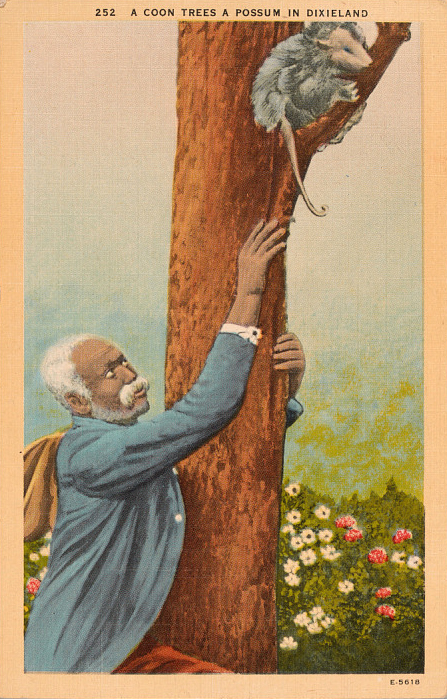
Decades later, white Democrats deployed opossum politics by portraying Blacks as chiefly motivated by appetites. In 1890, a Washington Post writer reiterated McKay's earlier claim that Black opossum consumption revealed animal instincts and inherent political naiveté. However, while McKay had insisted that Blacks were gullible, the Post article added to the narrative by suggesting that the food could be used to garner Black votes. Alexander Dockery, a Democratic member of the US House, had taken "two of his trusted lieutenants some days before the last election and made a trip through the 'Black Belt' [cotton-growing area with large populations of ex-slaves], giving out mysterious invitations to the colored voters to meet" for a supper in Missouri. While the 150 Blacks allegedly in attendance dined on opossums and raccoons, Dockery recited a political speech.67"Dockery's Coon Supper," Washington (DC) Post, Nov. 24, 1890, 2. The takeaway of the story was that, by using game stereotypically associated with ex-slaves, unsavory political actors could easily attract Black Republican voters and deceive them with political promises.68"Thunder in the Mountains," https://chroniclingamerica.loc.gov/lccn/sn84026994/1868-09-22/ed-1/seq-1/. Similar stories proliferated, leading a Washington Evening Star writer to later reminisce that opossum suppers were "great vote-getters in the south."69"'Possum for President in Southern Style," Evening Star (Washington, DC), Dec. 22, 1907, 3, https://chroniclingamerica.loc.gov/lccn/sn83045462/1907-12-22/ed-1/seq-51/. Notably, Dockery's story in 1890 appeared shortly before Democrats began to disenfranchise Blacks by law.
The timing coincides with the rise of the Populist Party, which threatened Democratic Redeemers as it sought, in its beginnings, to unite Blacks and poor whites. Populism was concentrated in the agrarian southern, southwestern, and midwestern states. Its leaders, as one historian has written, "advocated radical changes in the monetary system, regulation of the railroads, and land control as the means by which economic fairness could be assured for all oppressed people."70Sarah A. Soule, "Populism and Black Lynching in Georgia, 1890–1900," Social Forces 71, no. 2 (1992): 395–421. In 1890, Thomas E. Watson of Thomson, Georgia, campaigned on the Farmers' Alliance platform and won a seat in the US House of Representatives. Soon after, he emerged as the state's leading Populist politician and his party threatened Democrats with the possibility of dividing the white vote.
To maintain the existing class and political structure, white Democrats turned to tactics of disenfranchisement and terror against Blacks and poor whites. "The Democrats resorted to murder and beatings to drive blacks away from the Populists," explains historian Charles Postel, adding that Populists also "used terror and intimidation to prevent blacks from voting for Democrats."71Charles Postel, The Populist Vision (New York: Oxford University Press, 2007), 196. Historian C. Vann Woodward points out the high degree of election fraud, noting that there was no way to prevent "wholesale repeating, bribery, ballot-box stuffing, voting of minors, and intimidation" at the polls.72C. Vann Woodward, Tom Watson: Agrarian Rebel (New York: Oxford University Press, 1963), 208. Moreover, Black plantation hands and laborers were hauled by wagon loads and forced to vote the Democratic ticket, some doing so multiple times. Watson lost his 1892 bid for reelection to Congress to Democrat James C. C. Black of Augusta and was defeated again in 1894. Widespread violence and fraud shaped these election outcomes.
Georgia's Opossum Regime
While opossum suppers had grown in popularity throughout the southeastern US in the wake of Emancipation, it is not incidental that Georgia—the last of the former Confederate states to be readmitted into the Union (1870)—would become the spiritual center of these events within a few decades. In the 1890s, cotton-growing states had fallen into an economic depression as prices plummeted and farmers' debts increased.73Steven Hahn, The Roots of Southern Populism: Yeoman Farmers and the Transformation of the Georgia Upcountry, 1850–1890 (New York: Oxford University Press, 2006). Populism created political competition. Freedmen, who had begun seeking factory jobs in cities and attempting to purchase farms in the country, represented economic competition. White racism and lynching intensified.74 Jack Bloom, Class, Race and the Civil Rights Movements: The Changing Political Economy of Southern Racism (Bloomington: Indiana University Press, 1987). Georgia had the second highest number of lynchings from 1890–1900.75Susan Olzak, "The Political Context of Competition: Lynching and Urban Racial Violence, 1882–1914," Social Forces 69, no. 2 (1990): 395–421; George Milton, et al., Lynchings and What They Mean: General Findings of the Southern Commission on the Study of Lynching (Atlanta, GA: The Commission, 1932). Statewide Black voter turnout declined from 55% in 1876 to less than 10% after 1890.76J. Morgan Kousser, The Shaping of Southern Politics: Suffrage Restriction and the Establishment of the One Party South, 1880–1910 (New Haven, CT: Yale University Press, 1974). Lynchings and other forms of vigilante violence helped to ensure a Democratic takeover of government.
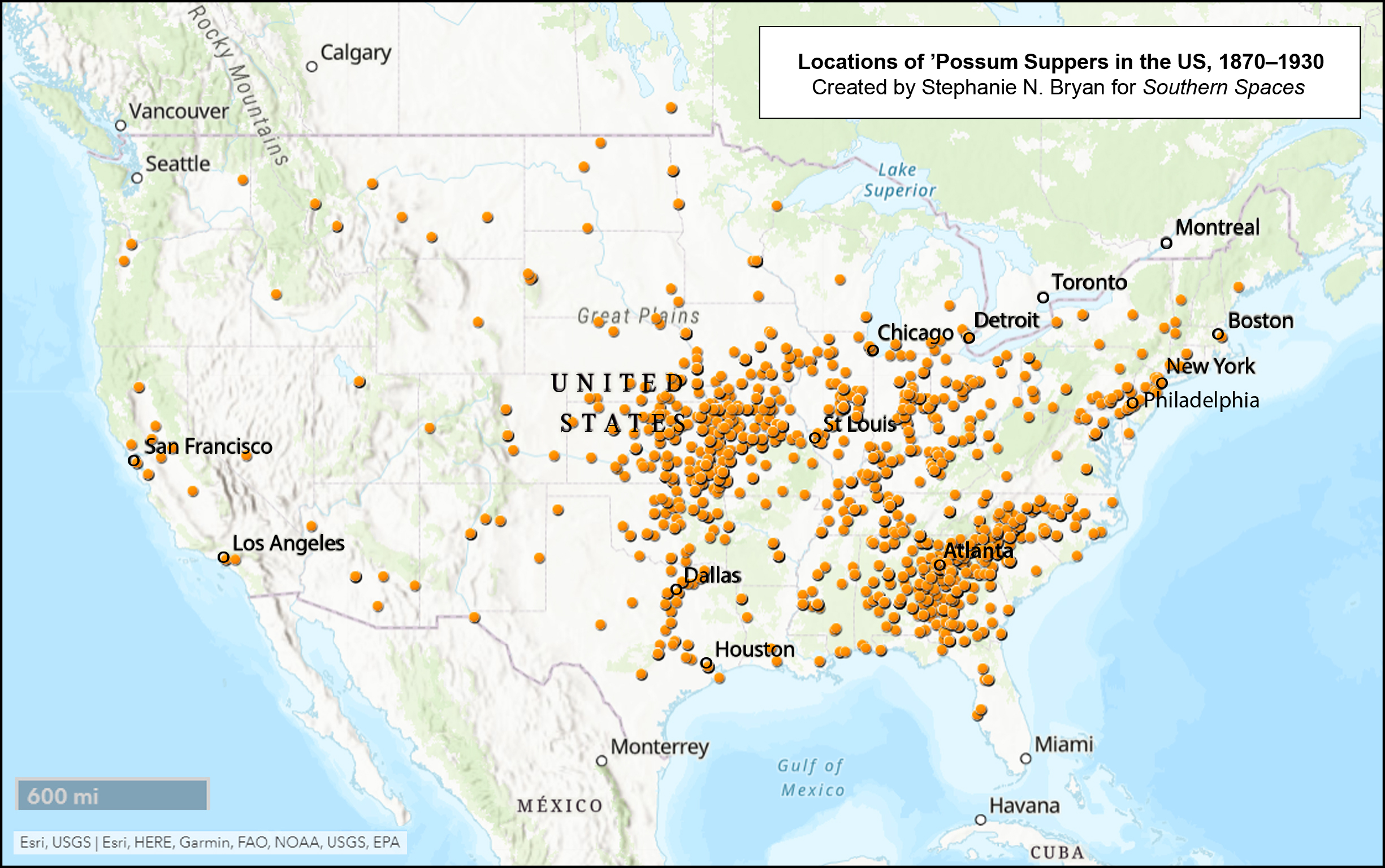
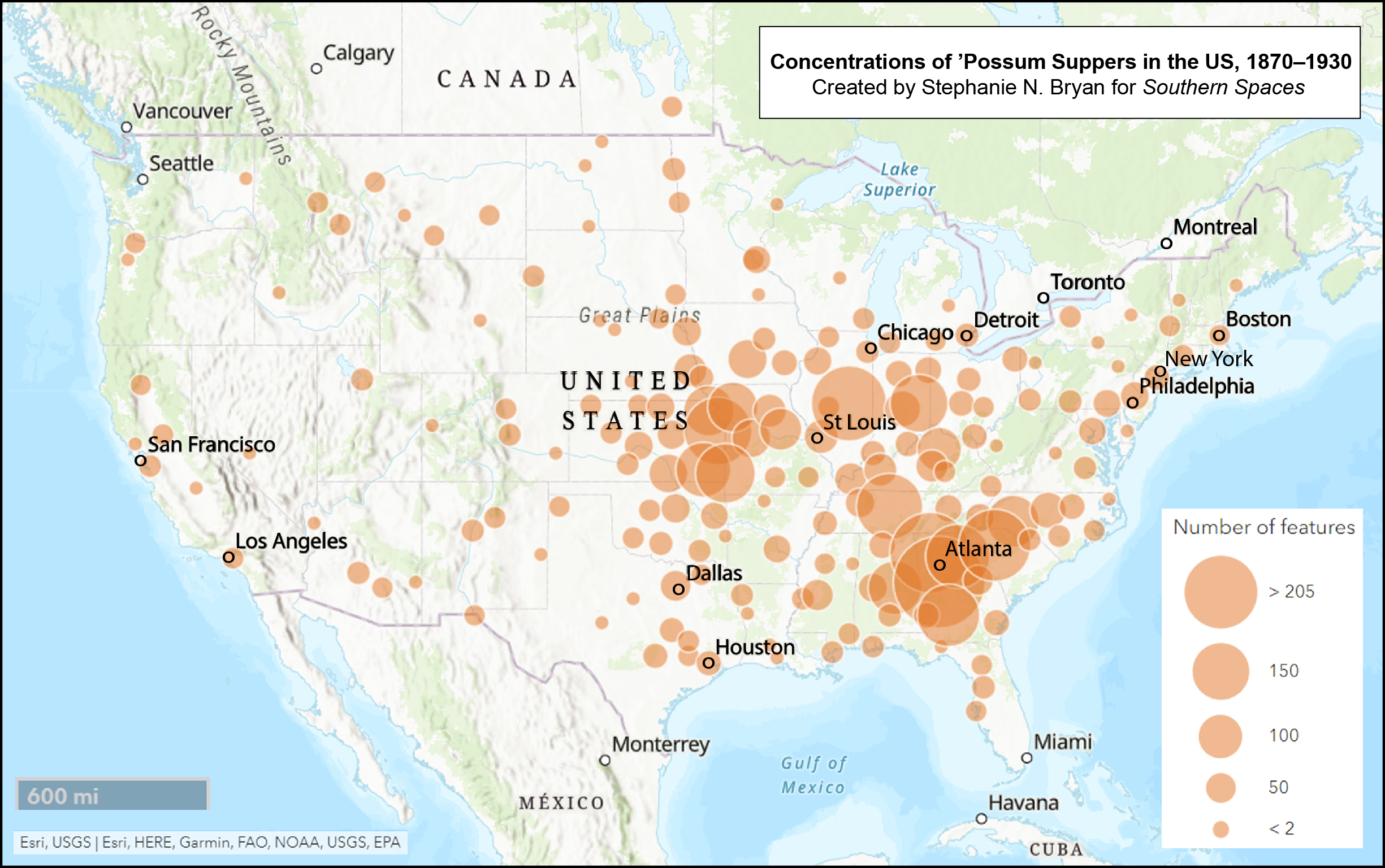
Opossum suppers became an important stage on which political actors could deploy new strategies and solidify networks of accomplices. Beginning in 1894, Colonel Harry Fisher—"railroad man, fertilizer magnate, friend of corporations"—commenced the political opossum suppers of Newnan, Georgia, to advance the Democratic ticket.77"Possum and Politicians: Many Invitations Have Been Sent Out to Newnan's Possum Supper," The Atlanta (GA) Constitution, Dec. 28, 1897, 5, https://chroniclingamerica.loc.gov/lccn/sn86063034/1897-12-28/ed-1/seq-2/. See also "Politicians to Eat 'Possum. The Supper at Newnan to Be a Unique Affair," The Morning News News (Savannah, GA), Dec. 28, 1897, 2, https://chroniclingamerica.loc.gov/lccn/sn86063034/1897-12-28/ed-1/seq-2/. Located about forty miles southwest of Atlanta where many in-state attendees traveled from, Newnan had escaped destruction during the Civil War. Its supper became an annual event, sending out over six hundred invitations "to men of prominence, both inside and outside" of the state. Politicians gathered in anticipation of the official Democratic convention and, while eating opossum, pre-determined the roster of officials for high-ranking positions.
It wasn't long before outside observers began to recognize that the political sway of the Newnan opossum suppers extended beyond southern states. On January 1, 1898, northern newspapers warned of sinister plans circulating "under the cover of savory vapors":
To these feasts are bidden men who have controlled the destinies of the State for years—shrewd politicians, who are anxious to strengthen their influence, statesmen, who gladly seize the opportunity to keep politically in touch with the elect of the State, and persons of a purely convivial nature, who are useful in lending an airy background to the political scheming which is bound to take place under the cover of savory vapors which ascend from the smoking 'possum.78"A 'Possum Supper," Baltimore (MD) Sun, Jan. 1, 1898, 1. For a similar version of this article, see "'Possum and 'Taters," The World (New York, NY), Jan. 1, 1898, 5.
Nearly a decade later, editor, politician, and defender of lynching John Temple Graves reminisced about Georgia's political "'possum regime," which had come to encompass the two-term governorships of Democrats William Y. Atkinson (1894–1898) and Joseph M. Terrell (1902–1907).79John Temple Graves, "The 'Possum Governors" of Georgia," reprinted from the New York American in The Herald and Advertiser (Newnan, GA), Jan. 15, 1909, 1, https://gahistoricnewspapers.galileo.usg.edu/lccn/sn89053456/1909-01-15/ed-1/seq-1/. Atkinson won by a narrow margin in 1894 against Populist candidate Judge James K. Hines and regained reelection in 1896 over another Populist candidate, Seaborn Wright.80James F. Cook, "William Yates Atkinson 1894–1898," The Governors of Georgia, 1754–2004, 3rd ed. (Macon, GA: Mercer University Press, 2005), 181–184. Benefiting from white terror, voter suppression, and fraud, Atkinson ended the threat Populists posed to Democrats in statewide elections.81The 1896 presidential election would further fracture the Populist party across the southern states. Some Populists who supported a fusion with Democrats nominated Tom Watson as the vice-presidential candidate alongside William Jennings Bryan for president. The Democratic National Convention also nominated Bryan, but with Democrat Arthur Sewall as his running mate, both of whom appeared on the Silver Party ticket. Conservative Democrats who disagreed with Bryan's stance on bimetallism and free silver abandoned the party to form the National Democratic Party and instead nominated Senator John Palmer along with his running-mate Simon Bolivar Buckner. With the country experiencing an ongoing economic depression under Democratic President Grover Cleveland, Republican presidential and vice-presidential nominees William McKinley and Garret Hobart, who stood for protectionism and the gold standard, defeated Bryan.
In his capacity of Speaker of the Georgia House of Representatives, Atkinson "had performed countless favors, helping many of his friends gain appointments as solicitors-general and judges of the circuit courts," explains historian Barton Shaw, adding that "Such men eagerly endorsed Atkinson's candidacy, and he also had support in Atlanta's traditional rivals, Augusta, Macon, and Columbus."82Barton C. Shaw, The Wool-Hat Boys: Georgia's Populist Party (Baton Rouge: Louisiana State University Press, 1984), 111. Through these favors, Atkinson "was able to depose the old Bourbon ring perfected by Henry Grady and the Triumvirate," while forging a new legislative ring.83Shaw, The Wool-Hat Boys, 126. His initial gubernatorial campaign against Confederate veteran General Clement Evans was a "coup d'état" that "allowed younger Democrats to take control of the party."84Shaw, The Wool-Hat Boys, 112.
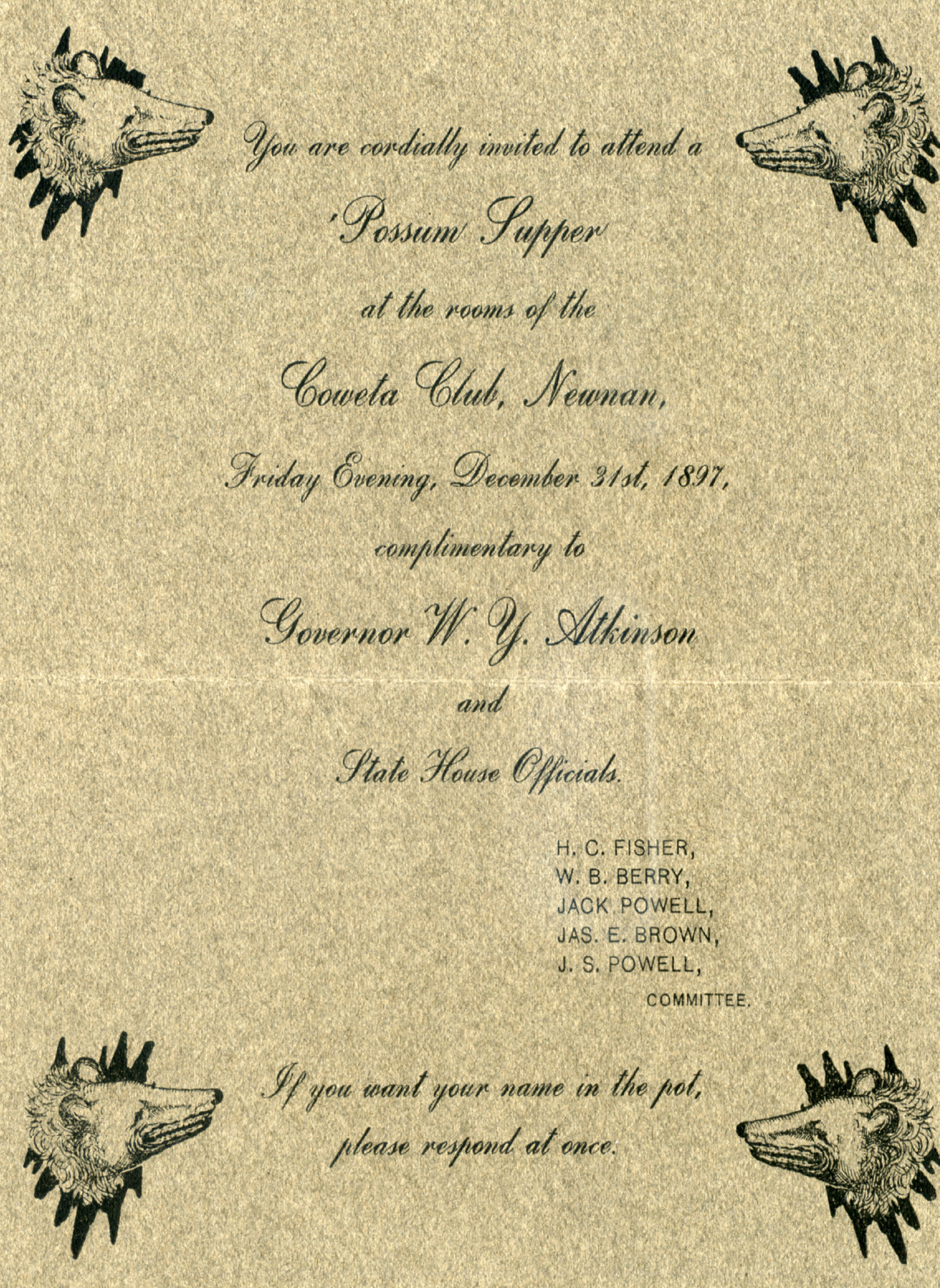
The complexity and behind-the-scenes maneuvering of numerous political factions during this period cast a cloud over why conservative Democrat Allen D. Candler (1898–1902) or Progressive Hoke Smith (1907–1909, 1911) were not considered part of the conspiracy, although it may relate to their efforts to restrict the power of the state railroad commission.85Cook, "Allen Daniel Candler 1898–1902," "Hoke Smith 1907–1909, 1911," Joseph Mackey Brown 1909–1911, 1912–1913," The Governors of Georgia, 185–188; 192–195. For more on Candler claiming to not be part of the "'possum regime" see "Candler on 'Possum Supper," Americus (GA) Times-Recorder, Jan. 14, 1898, 3, https://gahistoricnewspapers.galileo.usg.edu/lccn/sn89053207/1898-01-14/ed-1/seq-3/. Editor Graves offers some insight that Georgia's "'possum regime' was in large measure a railroad regime, and that under it corporations expect the fullness and the fatness which distinguished the adipose of the Georgia 'possum."86Graves, "The 'Possum Governors' of Georgia," https://gahistoricnewspapers.galileo.usg.edu/lccn/sn89053456/1909-01-15/ed-1/seq-1/. Accordingly, capital interests played an important role in the "booming" of certain politicians over others at events such as the Newnan opossum suppers. Barton Shaw explains the monetary benefits gained by those whom legislators appointed: "Solicitors were partly paid in fees, and citizens who could pay the highest price often found the state's charges against them dropped or at least reduced. Judges not only received handsome salaries, but were in excellent positions for advancement. The convict leaseholders always smiled upon those who helped keep up the supply of prisoners. With such support, many judges soon found themselves holding seats in Congress."87Shaw, The Wool-Hat Boys, 125.
The motives behind the Newnan opossum suppers were multifaceted, serving both the personal and collective interests of those in attendance. While they had a dominant Democratic component, occasional guests from other factions superficially presented images of reunion and reconciliation. Honorable George Peck of Chicago, a well-known railroad man who had served as a federal soldier, "referred to himself as the only yankee in the room" in a speech at the function on New Year's Eve 1897.88"'Possum Aftermath," The Atlanta (GA) Constitution, Jan. 2, 1898, 6. "A good deal of fun had been poked at him during the evening because of republicanism" and Confederate General Clement Evans, who attended the event, claimed to have made him "eat Georgia 'possum until he quit and surrendered and went over to the other side."89"Possum Aftermath;" "'Possum and Politics Wrestle for Supremacy Down at Newnan's Feast," The Atlanta (GA) Constitution, Jan. 1, 1898, 5. Although Atlanta Constitution columnist Bill Arp concluded after the event that "a politician will eat anything for office," eating opossum had developed a deeper meaning for prominent white men attending these events, signifying an economic and political alliance, as well as a racial one.90"'Possums and Politics," Watchman and Southron (Sumter, SC), Jan. 26, 1898, 2. "Bill Arp," was a pseudonym for politician Charles Henry Smith: https://evhsonline.org/bartow-history/people/charles-henry-smith-bill-arp-great-american-humorist-writer. Newspapers reported that the 1897 event included a diorama behind the toastmaster's chair comprised of a real persimmon tree, six live opossums, an actual baying opossum dog, and "old Uncle 'Cotton' See, an anxious-looking aged negro with white hair and a 'possum appetite in keeping with his surroundings" of white governors, secretaries of state, attorney generals, judges, and other high officials discussing politics over the feast.91"And Politics for Down at Newnan's Feast to the Governor," The Atlanta (GA) Constitution, Jan. 1, 1898, 5. This nostalgic scene provided a visual display of white power, delineating the rightful place of Blacks not as consumers of opossum, but as providers, cooks, and servers of it.
While Newnan's political opossum suppers were widely publicized in local and national newspapers, the public's attention soon shifted in 1899 to the horrific mob lynching of Sam Hose—a Black man who was bound, tortured, castrated, and set on fire in front of more than four thousand spectators.92For a detailed analysis of this event, see Edwin T. Arnold, What Virtue There Is in Fire: Cultural Memory and the Lynching of Sam Hose (Athens: University of Georgia Press, 2012). Chicago detective Louis P. Le Vin, whom activist Ida B. Wells-Barnett hired to investigate the lynching, concluded, "The real purpose of these savage demonstrations is to teach the Negro that in the South he has no rights that the law will enforce. Samuel Hose was burned to teach the Negroes that no matter what a white man does to them, they must not resist."93Ida B. Wells-Barnett, "Lynch Law in Georgia," (Chicago, IL: Chicago Colored Citizens, 1899), https://www.loc.gov/resource/lcrbmrp.t1612/?st=text&r=0.267,0.55,0.665,0.719,0. William Atkinson, who had moved to Coweta County to practice law following his second term as governor, spoke out to the mob from the city jail in an unsuccessful attempt to prevent Hose's lynching. 94For more on Atkinson's actions and possible motives, see Arnold, What Virtue There Is in Fire, 98–102. As governor, Atkinson had tried on numerous occasions to get the General Assembly to pass his anti-lynching bills. Because he vehemently opposed the lawlessness of mobs and proposed other solutions such as public executions, the anti-lynching stance of Atkinson and other Democrats cannot be equated with racial justice.95Arnold, What Virtue There Is in Fire, 99–100. The Sam Hose lynching led a writer from Thomasville, located near the state's southern border, to comment that Newnan's "reputation no longer rests on possum suppers."96The Daily-Times Enterprise (Thomasville, GA), May 9, 1899, 2, https://gahistoricnewspapers.galileo.usg.edu/lccn/sn88054087/1899-05-09/ed-1/seq-2/. Yet, to some extent the town's reputation did continue to rest on its opossum suppers as the political scheming that occurred at them played a role in the election of governors and other influential white men who disenfranchised Black citizens and worked to maintain the state's Democratic stranglehold.
Symbolic Separations and the Taft Banquet in Atlanta
If white Democrats were responsible for the publicized and politicized opossum suppers in southern states such as Georgia, Blacks gained attention for hosting their own events in other parts of the country.97For several examples of newspaper accounts highlighting these events, see "New Year Festivities at Crowe's Hall," Alton (IL) Evening Telegraph, Jan. 3, 1894, 9; "Lovers of 'Possums: Indianapolis Epicures Who Fancy the Toothsome Dish," The Indianapolis (IN) Journal, Part Two, Dec. 28, 1902, https://chroniclingamerica.loc.gov/lccn/sn82015679/1902-12-28/ed-1/seq-13/; "Oh, Carve Dat 'Possum: First Annual Banquet of 'Possum Club a Splendid Success," Durant Weekly News (Choctaw Nation, Indian Territory, OK), Dec. 8, 1905, 2, https://chroniclingamerica.loc.gov/lccn/sn82015679/1902-12-28/ed-1/seq-13/; "Happenings Condensed," Palestine (TX) Daily Herald, Nov. 29, 1905, 2, https://chroniclingamerica.loc.gov/lccn/sn86090383/1905-11-29/ed-1/seq-2/; "Local Briefs," Deseret Evening News (Great Salt Lake City, UT), Feb. 18, 1902, 8, https://chroniclingamerica.loc.gov/lccn/sn83045555/1902-02-18/ed-1/seq-8/; "Another 'Possum Supper," Morning World Herald (Omaha, NE), Nov. 18, 1902, 2; "That 'Possum Supper," The Anaconda (MT) Standard, Dec. 31, 1901, 9; "A Possum Supper," Grand Forks (ND) Daily Herald, Jan. 9, 1903, 4; "'Possum Supper with Hoe Cake Trimmin's; Janitor Duncan and His Colored Friends are Preparing a Big Treat for Office Holders and Others," Colorado Springs (CO) Gazette, Dec. 9, 1903, 3. Migrating Black populations continued to host opossum suppers in northern and western states, keeping the tradition popular into the early twentieth century. No doubt these individuals were aware of the strong association that opossum suppers had developed among southern Democrats, as well as the longstanding stereotypes aimed at destroying the personal and collective power of Blacks. Their actions can be understood as what Psyche Williams-Forson describes—in the case of Black women redefining fried chicken—as a refusal "to allow the wider American culture to dictate what represents their expressive culture and thereby what represents blackness."98Williams-Forson, "More than Just a 'Big Piece of Chicken'," 107–118, 343.
In 1901, Alfred King held an opossum supper at his Illinois home for the white members with whom he had served on a grand jury, along with other guests including the state attorney, sheriff, circuit clerk, and chief of police. "This is the first time," King announced, "that a grand jury in Macon county ever dined with a colored man, but the world do[es] move," indicating a shift in race relations.99"'Possum Supper. First Grand Jury to Dine with Colored Man," The Daily Review (Decatur, IL), Nov. 22, 1901. The elaborate menu—which included a course of oyster soup with celery and crackers, as well as main dishes of roasted turkey, baked opossum, mashed and sweet potatoes, corn, slaw, cranberries, white and corn bread, in addition to lemon and pumpkin pie, various fruits, ice cream and cake, and coffee for dessert—was not unlike that of an opossum banquet hosted by southern white Democrats.100"'Possum Supper," The Daily Review (Decatur, IL), Nov. 22, 1901.
A few years later, in 1903, ex-slave Jefferson Logan, who worked in the Senate cloakroom, was planning his nineteenth annual opossum supper in Iowa to which he invited Republican state officials and politicians. Described as "a wealthy leader of the colored population," newspapers noted that Logan generally secured "a good position each legislative session through his pull with the politicians."101"Possum Supper and Politics," Omaha (NE) Daily Bee, Dec. 2, 1903, 6, https://chroniclingamerica.loc.gov/lccn/sn99021999/1903-12-02/ed-1/seq-6/; see also, "Jeff Logan and 'Possum Dinner," The Minneapolis (MN) Journal, Nov. 16, 1901, 18, https://chroniclingamerica.loc.gov/lccn/sn83045366/1901-11-16/ed-1/seq-19/; "'Possum Supper a Great Success," The Des Moines (IA) Register, Dec. 6, 1902, 7. By 1907, the Adams County Free Press of Corning, Iowa, claimed, "What the banquets of the Gridiron club is [sic] to Washington the 'possum suppers of the Jeff Logan lodge are to Iowa's capital."102"Big Guns at 'Possum Feast," Adams County Free Press (Corning, IA), Dec. 25, 1907, 1. Founded in 1885, the Gridiron Club of Washington, DC, is a prestigious journalistic organization that holds annual dinners in which the president of the United States is generally in attendance. The dinners have gained criticism since they bring journalists close together with the political officials they cover in their news stories.
African Americans such as Jeff Logan, Alfred King, and others refused to relinquish opossum consumption to the purview of whites. In "Possum," Black poet Paul Laurence Dunbar plays upon the beliefs that African Americans possess a folk knowledge of preparing opossums, while drawing humor from the inherent lack of knowledge of whites. Dunbar uses "negro dialect"—a poetic genre103For a deeper discussion of Dunbar's poetry, see, Michael Cohen, "Paul Laurence Dunbar and the Genres of Dialect," African American Review 41, no. 2 (2007): 247–257. that appealed to literate, middle-class whites—to express his frustration and anger toward their ignorance:
Ef dey's anyt'ing dat riles me
An' jes' gits me out o' hitch,
Twell I want to tek my coat off,
So 's to r'ar an' t'ar an' pitch,
Hit 's to see some ign'ant white man
'Mittin' dat owdacious sin—
W'en he want to cook a possum
Tekin' off de possum's skin.104Paul Laurence Dunbar, Lyrics of the Hearthside (New York: Dodd, Mead and Company, 1899), 163–164, https://archive.org/details/lyricsofhearthsi00dunb/page/162/mode/2up.
If Blacks vied to maintain a symbolic separation between Black and white opossum consumption, so, too, did whites in their repeated assertions that it was the job of people of African descent to provide, cook, and serve them opossum.
By the time Taft came to Atlanta in 1909, white opossum suppers strongly leaned on the figure of the faithful Black servant who dutifully captured and delightfully prepared the animal for white consumers.105For more information on the faithful Black servant trope, see Micki McElya, Clinging to Mammy: The Faithful Slave in Twentieth-Century America (Cambridge, MA: Harvard University Press, 2007). Early twentieth-century newspapers occasionally published obituaries that figured into the faithful Black servant trope. For example, an obituary for Sam Coleman of Americus, Georgia, who was to be "buried by his white friends," highlighted his "reputation as an excellent cook," who had "for perhaps twenty years [. . .] cooked barbecue dinners and possum suppers for local epicures." "A Famous Old Cook Expires. The Long Time Cook of the Cue Club is No More," Americus (GA) Times-Recorder, July 8, 1902, 3. Writers for white newspapers were keenly aware of the racial power exuded through depictions of subservient Black labor in opossum suppers. Atlanta Constitution correspondent H.T. McIntosh reported on the "strenuous 'possum-catching campaign" in Worth County to secure a hundred of the animals for the banquet, which entailed a score of Black hunters overseen by Judge Frank Park.106H.T. McIntosh, "Worth County 'Possum Mad," The Atlanta (GA) Constitution, January 9, 1909, 1, 5. Northern newspapers added to the image by relaying that "old Uncle Levi and two mammies" sent by Park to Atlanta were busy slaughtering and preparing the game. And at the banquet, Rev. Dr. J.W. Lee sang the minstrel song "Carve Him to de Heart" while two Black male waiters served opossum to the president-elect.107"Taft Feasts on Possum and the South Gets Promise of Better Things," Sun (New York, NY), Jan. 16, 1909, 1, https://chroniclingamerica.loc.gov/lccn/sn83030272/1909-01-16/ed-1/seq-1/; "South to Gain," Washington (DC) Herald, Jan. 16, 1909, 1. In order to provide Taft "insight of what the south was before the war," the entire event depended on Black labor.108"Banquet to Judge Taft Marks a Social Epoch in Atlanta's History," The Atlanta (GA) Constitution, Jan. 16, 1909, 1.
Given the popularity of southern Democratic opossum suppers, Taft knew his actions conveyed racially coded political and economic messages. "Southerners are traditionally partial to this dish," explained a Texas reporter, adding that Taft's request to attend an opossum feast "further endeared himself to the people of this section."109"Plenty of 'Possums," Bryan (TX) Morning Eagle, Jan. 2, 1909, 1. Eating or even just tasting opossum, however, was more than an act of endearment; it provided a way for Taft to become "southern" by performing in a display of white supremacy tied to an imagined antebellum culture. This invented tradition encompassed much more than Black servants catching, preparing, and serving hundreds of opossums to prominent white men at the banquet. Because the menu included numerous, heavy courses that would have required several hours to complete, it is unlikely that Taft or other diners consumed much, if any, of the opossum meat on their plates.110Daniel Frank, "Taft Ate Possum in City Auditorium," The Atlanta (GA) Journal and the Atlanta Constitution, Dec. 2, 1956, 1C. Decades later, columnist Daniel Frank explained that "onlookers noticed that Taft took one taste, and only one taste" of the barbecued opossum set before him at the 1909 banquet. "Waste was part of the point," writes food historian Helen Zoe Veit. "Perhaps nowhere more nakedly than at a banquet did wealthy Americans in the Gilded Age show off their ability to command resources for their own and their guests' pleasure, to select only the very choicest morsels from a choice dish, and to leave most of the carefully prepared, expensive food for the slop bucket or the servants."111Helen Zoe Veit, Food in the American Guilded Age (East Lansing: Michigan State University Press, 2017), 196. Yet, in the case of the opossum, throwing away a food that had been critical to Black survival before and after slavery conveyed a socioeconomic message and a racial one.
Similar to the opossum suppers of Newnan that had begun decades earlier, the 1909 Atlanta event presented images of reunion and reconciliation. "It is beautifully emblematic of the fading away of sectionalism and the bitterness of the civil war, this spectacle of a northern Republicant-elect [sic] beaming over relays of ''possum and 'taters' in his march through Georgia," oozed a writer from Wisconsin.112"South Should Let Up," Topeka (KS) State Journal, Jan. 19, 1909, 4, https://chroniclingamerica.loc.gov/lccn/sn82016014/1909-01-19/ed-1/seq-4/. The dish, along with its accompaniment of persimmon beer, garnered a great deal of local and national attention in the weeks and days leading up to the Atlanta event. While the opossum was closely tied to sectional identity, other items on the menu carried different messages associated with Taft's agenda and with white prejudices. "Clear-Green Turtle [soup] a la Panama" correlated to a part in Taft's speech where he emphasized the future commercial benefits that the canal offered to southern states. "Filipino Ice Cream," on the other hand, gestured toward Taft's stance on race relations, given that throughout his tour Taft had often linked Filipinos and African Americans as inferior people dependent on whites for improvement.113"Taft Eats 'Possum, Gives South Pledge"; Edward Frantz, "Goin' Dixie: Republican Presidential Tours of the South, 1877–1933," (PhD diss., University of Wisconsin-Madison, 2002), 305; Needham, "William Howard Taft, The Negro, and the White South, 1908–1912," 63.
The banquet menu required careful tailoring. So did Taft's speech. To his white male Atlanta audience, Taft pledged, "I shall become the president, not of a party, but of a whole united people," reinforcing his aim to solidify white northerners and southerners.114"How New York Papers View 'Possum Banquet," The Atlanta (GA) Constitution, Jan. 18, 1909, 2. Some questioned Taft's motives, with South Carolina Senator Benjamin Tillman warning in August 1909 that "southerners should beware of Taft spreading molasses to give 'hungry office-seekers an excuse for deserting the democratic party. . . .'"115Needham, "William Howard Taft, The Negro, and the White South, 1908–1912," 96. Yet, Taft's participation in the banquet was a signal of his tolerance—and tacit support—of the Jim Crow laws enacted to maintain social control. Several months after the Atlanta event, Taft would address another white audience at a banquet in Birmingham, Alabama, claiming that he "would not have the South give up a single one of her noble traditions."116William Howard Taft, "Speech at the Chamber of Commerce Banquet, Birmingham, Ala. (November 2, 1909)," Presidential Addresses and State Papers (New York: Doubleday, Page & Company, 1910), 402, https://archive.org/details/presidentialaddr00unit/page/402/mode/2up?view=theater&q=traditions. Taft would prove to be a consistent ally of conservative whites, giving them a free hand, enabling "a moratorium on all African American appointees throughout not only the South, but also the North" and thereby transitioning "into a new, even more lily-white era" for Republicans.117Frantz, "Goin' Dixie," 314; 317. As historian David Needham explains, "probably the most visable [sic] effort by Taft toward wooing white southerners was his appointment of independent Democrats to high federal positions" and elimination of Black governmental involvement.118Needham, "William Howard Taft, The Negro, and the White South, 1908–1912," 118.
While the opossum "topped the pinnacle of fame [. . .] basking in the sunlight of a nation's tender interest" after the Atlanta banquet, other working-class and stereotypically African American foods had the potential to further convey Taft's political stance in other states.119"Is Champagne Better to Wash Down 'Possum Than Persimmon Beer?," The Atlanta (GA) Constitution, Jan. 4 1909, 5. In looking ahead to Taft's stop in New Orleans, the Grant Parish Democrat suggested that Taft should eat alligator steak, "a great dish among the darkeys" in order "to remain on good terms with Louisiana Republicans."120"Alligator Steak," The Caucasian (Shreveport, LA), Feb. 7, 1909, https://chroniclingamerica.loc.gov/lccn/sn88064469/1909-02-07/ed-1/seq-8/. Subsequently, the Charlotte Observer called for Taft "to stop off in North Carolina and partake in a supper of Chatham County rabbits," which "would doubtless compare favorably with the alligator steak."121The Caucasian (Clinton, NC), Feb. 18, 1909, 1. With these foods "in his system," one newspaper editor remarked: "Mr. Taft may become practically Southern, instead of the visionary theorist that he is, particularly in connection with the negro and the Republicanizing of any of the States [. . .]."122"Alligator Steak," https://chroniclingamerica.loc.gov/lccn/sn88064469/1909-02-07/ed-1/seq-8/.
Conclusion
Taft's 1909 Atlanta banquet marked the opossum's peak as a symbol of white supremacy and sectional reconciliation. After Democrats regained their political power and fully achieved Black disenfranchisement, opossum suppers diminished in popularity and, with some exceptions,123For example, the Atlanta Association of Building Owners and Managers hosted an opossum supper for Franklin D. Roosevelt, then Governor of New York, during his visit to White Sulphur Springs, Georgia, in 1930. "Roosevelt Eats and Hunts 'Possum as Georgia Guest: Partakes of Primitive Meal in Role of Adopted Son," New York Herald Tribune, Nov. 30, 1930, 11. its ties with Confederate nostalgia and Jim Crow politics faded from memory. Writing in 1916, the editor of the Jackson News in Mississippi revisited the lore surrounding the opossum, as well as the racist stereotypes:
We feel that it is a duty to shatter one of those long-cherished delusions concerning 'possums and sweet taters' as a typical Southern dish . . . . It is true that Southern homes, instinctively hospitable and willing to feed the stranger within its gates after his own heart rather than the local notion of the eternal fitness of things, serve 'possum, but generally with a silent protest that politeness alone prevents making manifest. [. . .] The dark and dismal truth is that 'possum is an all but impossible diet . . . . Possum is so largely a matter of excessive and not too fragrant fat that even Sambo, despite his reputation for never having had enough, has been known to grow tired of the same and pass it up for boiled cabbage and turnips.124Quoted in "Shattering Illusions," Gulfport (MS) Daily Herald, Nov. 29, 1916, 2.
After Reconstruction, white Democrats from Georgia had taken the lead in reinventing opossum culinary culture, once strongly associated with African American autonomy and survivance, and claimed it as their own rightful inheritance. This entailed mocking and deriding African American opossum consumption as indicative of inherently inferior racial traits. White obsessions with Black opossum consumption transformed hunting and eating the native marsupial into a nostalgic Lost Cause celebration of a supposed common culture that former enslavers claimed to share with enslaved people of African descent in the antebellum era. Since the making of a plantation imaginary filled with unforgettable opossum hunts and faithful house servants who knew the art of slaughtering, cleaning, and roasting the creature added to the dish's appeal, whites of all classes partook of opossum in part because of its association with idealized former times, remaking it, for a brief present time, into a powerful cultural symbol of Black subordination and white power.
About the Author
Stephanie N. Bryan is a PhD candidate in the history department at Emory University. She holds a Master's in Landscape Architecture from the University of Georgia, with an emphasis on historic cultural landscape management. Her dissertation examines the ways in which marginalized plant and animal species indigenous to the southeastern US—such as opossums, persimmons, muscadines, and pokeweed—survived and sometimes thrived amid destructive land use and entered into diets, cultures, economies, and politics. An earlier version of the article was “highly commended” for the 2019 Sophie Coe Prize.
]]>Commentary
An online search using the keywords "COVID-19" and "lessons" turns up an astonishing volume and assortment of information: thousands of commentaries, news stories, scholarly articles, book chapters, and monographs. The lessons are intended for vast expert and general audiences: from pediatricians, public health professionals, and other specialized communities of practice to ordinary people and political leaders across the planet. What has been, can be, and should be learned? More lessons loom. Expect a deep dive Congressional investigation and blue-ribbon probes. Storytellers are weighing in with fictional chronicles. Booker Prize winner Ian McEwan's novel, Lessons (New York: Alfred A. Knopf, 2022), is scheduled for September 2022.

From my perspective as a recently retired Centers for Disease Control and Prevention (CDC) branch chief who served in the agency's COVID-19 response from late March through June 2020, the profusion of "lessons learned" reflects the magnitude of the knowledge gaps that impaired America's readiness and undercut its efforts to grapple with a new pathogenic peril, one for which danger signs were long evident. Failures in foresight were followed by fitful attempts at comprehending a lethal contagion's spread and knowing what to do about it.1Cormac Bryce, Patrick Ring, Simon Ashby, and Jamie K. Wardman, "Resilience in the Face of Uncertainty: Early Lessons From the COVID-19 Pandemic," Journal of Risk Research 23, no. 7–8 (2020): 880–887.
The story of the nation's COVID-19 plight is as much an unfolding epistemological crisis as it is a once-in-a-century epidemiological catastrophe. Among the many lessons to be distilled are how and why ignorance in various forms and places accounts for so much of what went wrong. A thorough and wide-ranging exploration is needed, which calls for contributions from multiple disciplines and approaches. As historian of science Robert Proctor recommends: "We need to think about the conscious, unconscious, and structural production of ignorance, its diverse causes and conformations, whether brought about by neglect, forgetfulness, myopia, extinction, secrecy, or suppression."2Robert N. Proctor, "Agnotology: A Missing Term to Describe the Cultural Production of Ignorance (and Its Study)," in Agnotology: The Making and Unmaking of Ignorance, ed. Robert N. Proctor and Londa Schiebinger (Stanford, CA: Stanford University Press, 2008), 1–33. Further, as sociologist Scott Frickel suggests, we also need to focus on "how, where, and why ignorance, once produced, becomes institutionalized."3Scott Frickel, "Not Here and Everywhere: The Non-production of Scientific Knowledge," in Routledge Handbook of Science, Technology, and Society, ed. Daniel Lee Kleinman and Kelly Moore (New York: Routledge, 2014), 263–276. For example, studies of CDC's shambolic performance should include close scrutiny of institutional obliviousness, under a succession of agency directors and programmatic leaders, to basic gaps in readiness and responsiveness that became glaringly obvious during the pandemic and contributed to numerous missteps in the US response to COVID-19.
If the so-called Spanish influenza of 1918 was, in the words of historian Alfred W. Crosby, America's Forgotten Pandemic, then for the time being the bounty of lessons suggests that COVID-19 is America's Teachable Moment Pandemic.4Alfred W. Crosby, America's Forgotten Pandemic: The Influenza of 1918, Second Edition (New York: Cambridge University Press, 2003), 311–328. The largest public health cataclysm in a hundred years has put to the test assumptions, capacities, decisions, practices, and policies. In many ways, the United States has been found wanting, as evidenced by the exceptionally devastating and inequitable toll that COVID-19 has exacted, much of which was averted or more proficiently mitigated by other countries, including nations in the Global South. Vietnam is a prime example.

Events turned US exceptionalism on its head; the nation's heralded public health preeminence ran aground against a novel corona virus. Remarkably, four months before the World Health Organization declared the worldwide spread of COVID-19 a public health emergency, preparedness experts convened by the Nuclear Threat Initiative and Johns Hopkins University reported that the United States was at the top of the heap internationally in terms of its readiness to contend with a pandemic. Scoring 83.5 out of 100 possible points, the US was deemed "best prepared" in the world.5Elizabeth E. Cameron, Jennifer B. Nuzzo, Jessica A. Bell, et al, Building Collective Action and Accountability, GHS Index, October 2019, https://www.ghsindex.org/wp-content/uploads/2019/10/2019-Global-Health-Security-Index.pdf. Yet, when the virus began to spread throughout the nation, political and public health leaders overlooked or failed to respond promptly and effectively to signals of a mounting threat.
Myriad displays of ignorance in preparedness and response cast a spotlight on areas of knowledge, most visible in America's contributions to pathogen genomics and vaccine development, that were the rarity rather than the rule. As historian Peter Burke predicts, much will be said about ignorance when we look back on the pandemic.6Ana R. Rego and Marialva Barbosa, "Interview With Peter Burke: About Ignorance Nowadays," Revista Famecos—Midia, Cultura e Tecnologia 28 (2021): 1–7. The United States will provide many examples for review. "The coronavirus is very much under control in our country," President Donald Trump claimed without justification in February 2020.7"Trump Says Coronavirus Is 'Very Well Under Control' in U.S.," Bloomberg, February 25, 2020, Video, 1:26, https://www.bloomberg.com/news/videos/2020-02-25/trump-says-coronavirus-is-very-well-under-control-in-u-s-video. When cases and deaths surged, corporate America chimed in with commercials proclaiming "we are all in this together," a slogan that blithely disregarded systemic, inequitable differences in exposures, resources, and outcomes.8"Every Covid-19 Commercial is Exactly the Same," Microsoft Sam, April 15, 2020, YouTube video, 3:40, https://www.youtube.com/watch?v=vM3J9jDoaTA. As COVID-19 variants emerged and disease waves swelled, public health officials justified shifts in their response guidance with the catchphrase "follow the science," in effect denying knowledge gaps and glossing over judgment calls that informed their decisions.9Nason Maani and Sandro Galea, "What Science Can and Cannot Do in a Time of Pandemic," Scientific American, February 2, 2021, https://www.scientificamerican.com/article/what-science-can-and-cannot-do-in-a-time-of-pandemic/. Sports celebrities and other influencers joined in; some publicly declined vaccinations for spurious or unspoken reasons. In one widely publicized instance, a National Football League Most Valuable Player invoked vaccine misinformation to justify his decision to remain unvaccinated.10Ken Belson and Emily Anthes, "Scientists Fight a New Source of Vaccine Misinformation: Aaron Rodgers," New York Times, November 14, 2021, https://www.nytimes.com/2021/11/08/sports/football/aaron-rodgers-vaccine.html. These displays of ignorance, from the individual to the federal levels, almost certainly will be among the major topics covered when histories of America's recent past are written and discussed.
To a large extent, first drafts of our national COVID-19 history have been assembled, produced in near real-time amid an evolving pandemic. Among the lengthier accounts are books by Nicholas Christakis, Scott Gottlieb, Michael Lewis, Andy Slavitt, and Lawrence Wright.11Nicholas A. Christakis, Apollo’s Arrow: The Profound and Enduring Impact of Coronavirus on the Way We Live (New York: Little, Brown Spark 2020); Scott Gottlieb, Uncontrolled Spread: Why COVID-19 Crushed Us and How We Can Defeat the Next Pandemic (New York: HarperCollins, 2021); Michael Lewis, The Premonition: A Pandemic Story (New York: W.W. Norton, 2021); Andy Slavitt, Preventable: The Inside Story of How Leadership Failures, Politics, and Selfishness Doomed the U.S. Coronavirus Response (New York: St. Martin’s Press, 2021); Lawrence Wright, The Plague Year: America in the Time of Covid (New York: Alfred A. Knopf, 2021). Their narratives and additional reports, published across a wide variety of media platforms and outlets, recount a now familiar cascade of main events: warning signals missed or ignored. Contagion risks initially misunderstood or minimized. Testing bungled. Weaknesses in public health infrastructure and operations laid bare. Guidance delayed, shifted, and politicized. Mandates and masks applied, albeit unevenly. Healthcare stretched to the breaking point. Inequalities exposed. Supply chains disrupted. The economy slackened. Government spending skyrocketed, then dipped. Red-Blue divides widened. Vaccines produced in record time received mixed receptions. COVID-19’s impact surged, subsided, and swelled again—repeatedly. The pandemic dragged on and left its mark virtually everywhere and on everyone.
A bevy of initial accounts present a broad historical outline of what happened—to date. However, potential pitfalls arise when these first reports go beyond chronicling pandemic events and enter the realm of causal interpretations and lessons learned. There, the authors of quick-to-publication stories should tread particularly carefully, recognize uncertainties, and avoid unjustified or imbalanced explanations. Possible missteps include ignoring explanatory information or information sources and failing to acknowledge, or minimizing, the limits of their evidence. The risks of missing the mark are substantial. Causal interpretations skewed towards the unequivocal and unnuanced provide unreliable takeaway lessons and often obscure deeper etiologic factors. Revisions may be forthcoming, but inaugural versions can exert an outsized influence on what endures as the conventional understanding of what happened and why.

A case in point and cause for concern is Michael Lewis's bestselling The Premonition: A Pandemic Story (New York: W.W. Norton, 2021), a fast-paced narrative—a Hollywood movie version reportedly is on the way—that tells the tale of several outside experts who tried to spur CDC insiders to recognize and respond rapidly in early 2020 to signals of the brewing COVID-19 calamity. CDC's performance leaves little doubt that the agency was ill-prepared for the pandemic and made multiple mistakes in its response, including its botched diagnostic testing roll out, guidance fiascos, and acquiescence to political pressures from the White House. The open questions that Lewis takes on are what accounts for these failures and, more broadly, the poor showing by the United States compared with its lofty, pre-pandemic preparedness ranking. His answers are uncomplicated and unequivocal: the talents and recommendations of experts, represented by a small but heroic crew of scientists and physicians whom he profiles, were ignored, and the underlying cause was a lack of public health leadership, exemplified by the failings of the Trump-appointed CDC Director. According to Lewis, Donald Trump himself bears little responsibility for America's anemic response. "As one of my characters puts it," Lewis reports, "Trump was a comorbidity."12Michael Lewis, The Premonition: A Pandemic Story (New York: W.W. Norton, 2021), xiv.
I read Lewis's book closely, concentrating on his account of CDC's poor performance and the lessons to be learned. Notwithstanding his mystifying minimization of Trump's baleful role, Lewis's The Premonition offers a glimmer of hope for revelatory explanations and guidance. "After a catastrophic season, management always huddles up to figure out what needs to be changed," he suggests in his introduction, invoking a football analogy that promises a line of sight into the gap between reputation and results.13Lewis, xv. However, the front office managers are the target rather than the truth tellers in Lewis's narrative.

To tell his story, Lewis mainly relies on a small coterie of outside experts, most prominently a retired Sandia National Laboratories senior scientist who studied the effects of social distancing on mitigation of pandemic influenza, a former assistant director of the California Department of Public Health who warned state officials about the mounting COVID-19 threat during the pandemic's initial phase, and two physicians who helped write a national pandemic preparedness and response plan during the George W. Bush administration and raised early alarms about COVID-19's potentially devastating impact on the United States. High among their recommendations for thwarting a rapidly spreading contagion were school closures, which Lewis describes as one of the "truths" that his informants had discovered long ago.14Lewis, 211. Yet, considering the downsides of school shutdowns and remote learning, cleaving to that plan and putting it into practice in the COVID-19 pandemic was far from an unequivocal success, an important lesson that eludes Lewis and warrants much further attention.
Lewis doesn't make clear whether he sought or used information from CDC responders about the agency's performance. Notably, he doesn't mention any contact efforts or interviews with insiders about CDC's emergency operations. The enormously harmful effects of Trump and his minions were clear to me and many CDC colleagues, as were major internal weaknesses in the agency's response, which Lewis largely ignores. Some of CDC's shortcomings were due to acute managerial and resourcing problems, often recurring or persistent despite multiple attempts at remediation; others reflected longstanding internal and external assumptions, refuted by the agency's woeful performance, about institutional readiness, proficiency, and sustainability in a pandemic. We need fuller accounts of what went wrong and why, including contributions by CDC insiders, to correctly cull lessons and put them to good use.
More broadly, the flaws in Lewis's assessment serve as a reminder that knowledge claims presented as takeaway lessons do not necessarily undo our ignorance. Some "lessons learned" ignore or minimize more compelling understandings of what went wrong and obscure what we ought to know better. The epistemological crisis that compounded the epidemiological calamity threatens to continue in new forms with the writing of pandemic histories and production of Hollywood dramatizations. Still, COVID-19 has the potential to propel high-value learning and positive changes at the individual, organizational, and societal levels.
Among the nation's earliest and most important pandemic lessons is the immense toll that ignorance can take on human lives. As I write this conclusion, American COVID-19 deaths are fast approaching the one million mark, and untold numbers of people who survived the acute phase of their infections are affected by long-term sequelae. Perhaps we now know better the enormity and implications of what was missing in the national efforts to contend with the pandemic, and we will address collectively what science and technology scholar Manjari Mahajan aptly describes as the "complex political and social determinants that anchor a country's public health response and that are critical in ensuring the sustained well-being of a population."15Manjari Mahajan, "Casualties of preparedness: the Global Health Security Index and COVID-19," International Journal of Law in Context 17, no. 2 (2021): 204–214. COVID-19's impact also has been evident in other, more individual lessons and actions. For many Americans, the pandemic has prompted a personal reckoning and welcome revisions in how they take care of themselves and other people in their lives. However, many COVID-19 lessons and changes are likely to fade, including some that are well worth preserving. America's Forgotten Pandemic of 1918 is a prime example of the finite limits on attention spans and memories. In our time, military conflict and other crises or preoccupations are likely sources of competition for mindfulness, efforts at sense making, and shifts in priorities and routines. "Information is no longer a scarce resource," notes sociologist Sheldon Ungar, "attention and interest are."16Sheldon Ungar, "Ignorance as an Under-Identified Social Problem," British Journal of Sociology 59, no. 2 (2008): 301–326. As a result, America's COVID-19 lessons, including those that are forthcoming, are at risk of diminution or disappearance regardless of their value.
The pandemic is a uniquely teachable moment in our history; we can learn from our ignorance and act accordingly. As political scientist Eric Stern reminds us, despite the formidable obstacles to learning from a crisis, great benefits can accrue from lessons that are deeply reflective, methodologically sound, and highly pragmatic.17Eric Stern, "Bridging the Crisis Learning Gap: From Theory to Practice," in Organizing After Crisis: The Challenge of Learning, ed. Nathalie Schiffino, Laurent Taskin, Céline Donis, and Julien Raone (Brussels: P.I.E. Peter Lang, 2015), 257–272. COVID-19 has made ignorance and its negative consequences more visible in America. Fortuitously, at least for the time being, our lessons in ignorance also provide an impetus for new knowledge and, hopefully, momentum towards a more equitable society, stronger commitments to public health and healthcare, and a much greater responsiveness to planet-wide threats.
About the Author
After completing the CDC's Epidemic Intelligence Service training program in 1986, Daniel Pollock worked as a medical epidemiologist at the agency for 35 years. Dr. Pollock led the CDC unit responsible for national surveillance of healthcare-associated infections from 2004–2021, and he served in CDC's COVID-19 emergency response in the spring of 2020 as the Deputy Incident Manager for data and surveillance.
Public Health in the US and Global South is a collection of interdisciplinary, multimedia publications examining the relationship between public health and specific geographies—both real and imagined—in and across the US and Global South. These essays raise questions about the origin, replication, and entrenchment of health disparities; the ways that race and gender shape and are shaped by health policy; and the inseparable connection between health justice and health advocacy.
Beginning in 2022, the series expands to include 1000-word blog posts, as well as longer commentaries, essays, articles and media productions that address the public health and political implications of the COVID-19 pandemic from multiple viewpoints. The series editor for Public Health in the US and Global South is Mary E. Frederickson.
Blog Post
In a 2021 case from Arizona, Justice Samuel A. Alito, Jr., issued an opinion of the US Supreme Court—calling it a "fresh look"—that sabotages Section 2 of the Voting Rights Act of 1965. In effect, he rewrites the amendments Congress adopted in 1982 and annuls their purpose of making it easier, not harder, to strike down voter suppression laws resulting in racial discrimination. The Court's decision will likely unleash a new round of widespread discrimination in voting across the nation and continues its section-by-section destruction of the law that has been the nation's most effective force for expanding democracy over the last 150 years.
The Court decision reveals again that on matters of race and racism, when it suits their agenda, Justice Alito and the current Court's majority will abandon their own "textualist" judicial philosophy of adhering to the text of a law. Those studying this opinion will find it difficult to believe that it was written by the judge who, on and off the bench for years, has declared, "Statutes mean something. And the role of a judge is to interpret and apply the laws as they are written. . . . That's what we mean when we say that we have the rule of law and not the rule of men."
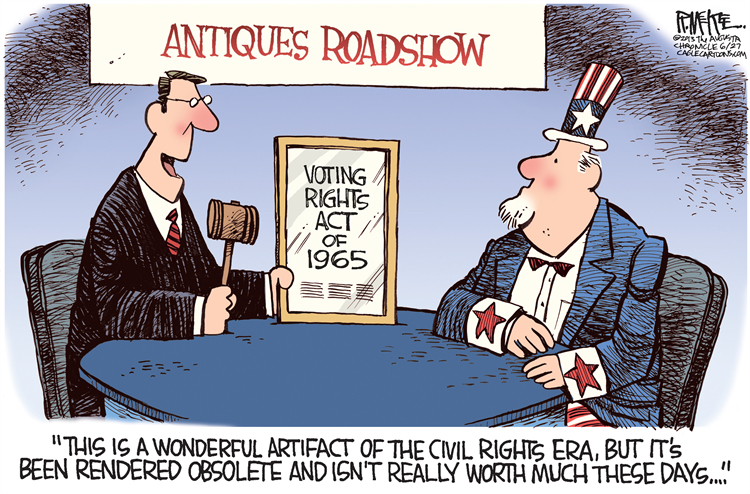
In his majority opinion, written for the six members who comprise the Court's conservative wing on controversies of race, Justice Alito upholds Arizona law that invalidates a voter's entire ballot if it is cast in the wrong precinct for any reason (even if the mistake is the fault of a voting official), and prohibits civic groups from collecting sealed ballots. Alito's opinion damages the ongoing protection of voting rights across the nation. It creates a list of standards that federal courts should consider when applying Congress's 1982 amendments to the Voting Rights Act's Section 2—the section that permits federal lawsuits challenging voting discrimination across the country. These Congressional amendments overturned a 1980 Supreme Court opinion that a law violated the Act only if intent to discriminate could be proven. Congress's amendments provided that, after considering a "totality of circumstances," a federal court need only find that a law or practice has a discriminatory result.
The US Senate's report explaining the Act's 1982 changes stated:
The courts are to look at the totality of the circumstances in order to determine whether the result of the challenged practice is that the political processes are equally open; that is, whether members of a protected class have the same opportunity as others to participate in the electoral process and to elect candidates of their choice. The courts are to conduct this analysis on the basis of a variety of objective factors concerning the impact of the challenged practice and the social and political context in which it occurs. The motivation behind the challenged practice or method is not relevant to the determination.1Voting Rights Act Extension, Report of the Committee on the Judiciary, Unites States Senate, on S. 1992, 97th Congress, May 25, 1982, 67.
Justice Alito's opinion lays out five "guideposts," his own version of the "objective factors . . . and the social and political context" that lower courts should consider. He describes these new standards as the Court's "logical" definition of what Congress meant when they instructed federal courts to consider a "totality of circumstances" in Section 2 cases:2The order in which Justice Alito listed his "guideposts" has been slightly altered here. I list his third item second for purposes of analysis.
- "size of the burden imposed" on the protected group;
- "size of the disparity in a rule's impact on members of different racial or ethnic groups";
- "degree to which a voting rule departs from what was standard practice" when the Congress added the term "totality of circumstances" to the law in 1982;
- "opportunities provided by a State's entire system of voting when assessing the burden imposed by a challenged provision";
- "strength of the state interests served by a challenged voting rule."
These standards are not found in any official reports of the US House or Senate issued in 1982 as the Congress debated and renewed the Act with amendments. None are mentioned as recommended standards in the extensive testimony during Congressional hearings in both Houses.3See Hearings before the Subcommittee on Civil and Constitutional Rights of the Judiciary Committee, House of Representatives, on H.R. 1407, H.R. 1731, H.R. 2942, H.R. 3112, H.R. 3198, H.R. 3473, and H.R. 3948, 97th Congress, May 6, 7, 13, 19, 20, 27, 28; and June 3, 1981; Report of the Subcommittee on the Constitution of the Judiciary Committee, United States Senate, 97th Congress, on S. 1992, April 1982. They are merely "logical" products of Justice Alito's thinking after conferring with his law clerks and perhaps some of the Court's other conservative members.
The most striking feature of Alito's "guideposts" is that they all offer ways to make it more difficult for a person to prove a voting rights infringement. The 1982 amended statute does not say that a "totality of circumstances" should include only considerations that make it more difficult to prove a case. On the contrary, the law was written to make it easier to prove discrimination. The Senate report mentions only that the "extent to which members of a protected class have been elected to office in the State or political subdivision is one 'circumstance' which may be considered." So, the Congress listed a consideration that can help prove a violation of the Act.4The legislative history does make it plain that the "result" test has limits. It does not guarantee a right to proportional representation. Quite the opposite, Justice Alito's list imposes on the statute five considerations that will be used primarily to disprove a violation.
For instance, Alito lists the "size of the burden" as a consideration instead of "if a burden is created," which would have been a neutral standard—e.g., does the rule create a burden to a protected group? Alito's second point similarly mandates consideration of "size of the disparity in a rule's impact on members of different racial or ethnic groups"—not if a disparity exists, but how large the disparity is. In this way, the opinion suggests that the size of a violation can make a violation go away—that whenever a disparity can be proven to be small, it can be considered no disparity at all. So, if a racial disparity burdens only a small number of minority voters in a small, rural polling place, does the relatively "small" size of the harm argue against a finding of a Section 2 violation of law? Apparently so.
As Harvard Law School's Nicholas Stephanopoulos has observed, Alito ignores the words of the statute in adding these considerations of size. "Section 2 states that it applies to any 'denial or abridgment' of the right to vote. The court qualified that broad language, effectively inserting the word 'substantial' before 'abridgment,' with no basis in the text."5Nicholas Stephanopoulos, "The Supreme Court Showcased its 'Textualist' Double Standard on Voting Rights," Washington Post, July 1, 2021, https://www.washingtonpost.com/opinions/2021/07/01/supreme-court-alito-voting-rights-act/.
The third consideration on Alito's list is "the degree to which a voting rule departs from what was standard practice" in 1982. This is an additional factor that can be used more often by state and local governments defending a voting rule than by minority groups challenging it. Stephanopoulos refers to this standard as "the court's most astonishing extra-textual move" since "Section 2's whole point is to unsettle the status quo, to end voting restrictions that disproportionately harm minority citizens. The provision aspires to move American democracy forward, not keep it fixed forever in 1982."6Nicholas Stephanopoulos, "The Supreme Court Showcased its 'Textualist' Double Standard on Voting Rights," Washington Post, July 1, 2021, https://www.washingtonpost.com/opinions/2021/07/01/supreme-court-alito-voting-rights-act/.
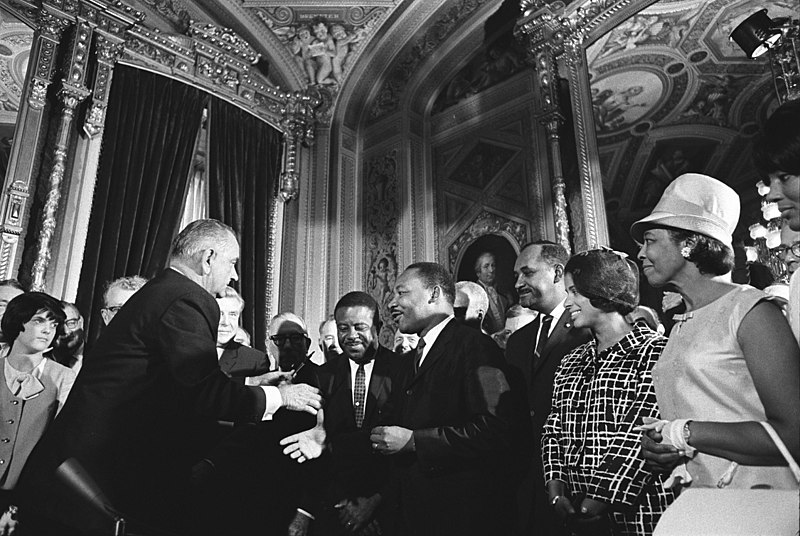
Perhaps nothing exposes the rearward nature of this trumped-up guidepost more clearly than imagining it as a mandated consideration in 1965 when Section 2 was originally adopted. It would have allowed state and local governments to use their existing misdeeds as a defense against legal challenges. In 1965, twenty-one states required English-only literacy tests to qualify to vote. Most states permitted absentee voting by requiring proof of disability or a complete absence from the community and by requiring a notarized application submitted only at the county courthouse.7Report of the President's Commission on Registration and Voting, Washington, DC, 1963, 13–14, 65. Most states had few polling places in minority and poor communities. Most southern states had voting rolls with more dead white people than living Black people. In several states polling officials were all white, and ballots were numbered in such a way as to permit white officials to know how Black voters cast their ballots.8Hearings before the Subcommittee Number 5 of the Judiciary Committee, House of Representatives, Eighty-ninth Congress, on H.R. 6400, March 18, 19, 23, 24, 25, 30, 31, and April 1, 1965; "Tan Voters Underwent Hardships: Many Waited In Lines for Hours; Some Didn't Wait," New Journal and Guide, May 14, 1966, 9; Francis X. Walter, "The May 3rd Primary In Alabama," Selma Inter-Religious Project Newsletter, May 16, 1966.
These common practices would have been used as a defense against any legal challenge under the Voting Rights Act, had Alito's guideposts been decreed as law in 1965. It would have been outrageous and unacceptable then. It is no more reasonable or acceptable now.
Alito's two remaining guideposts also make it more difficult to prove voting discrimination. Considering "opportunities provided by a State's entire system of voting" could be legitimate, if by "taking into account the other available means" includes requiring proof that those means are more accessible to the protected group and in fact fully compensate for some related disparity in access to voting. But, in upholding Arizona's law voiding all ballots cast in the wrong precinct, Alito made no such analysis. Therefore, it is highly doubtful any lower court will do so.
Finally, a consideration of the "strength of the State's interests" in a law or practice can be legitimate in voting cases, but Justice Alito chose among the many possible valid state interests to spotlight one in particular—election fraud, the single most misused and unproven rationale in current partisan voting disputes. "Fraud can affect the outcome of a close election, and fraudulent votes dilute the right of citizens to cast ballots that carry appropriate weight," Alito writes. "Fraud can also undermine public confidence in the fairness of elections and the perceived legitimacy of the announced outcome."
All true statements, in theory. But singling out fraud as the best example of a valid state interest when there have been no findings of widespread fraud across the states is worse than disingenuous. In the context of the close 2020 presidential elections in Arizona and Georgia, Alito's words signal that unsubstantiated charges of "fraud" are now available in voting rights cases as a strong "state interest." In effect, he is almost inviting the use of "fraud" on the same unproven terms as lawyers and government officials have used them in attempting to reelect Donald Trump by trying to discredit and disqualify votes on those terms primarily in majority-Black and -Brown counties.
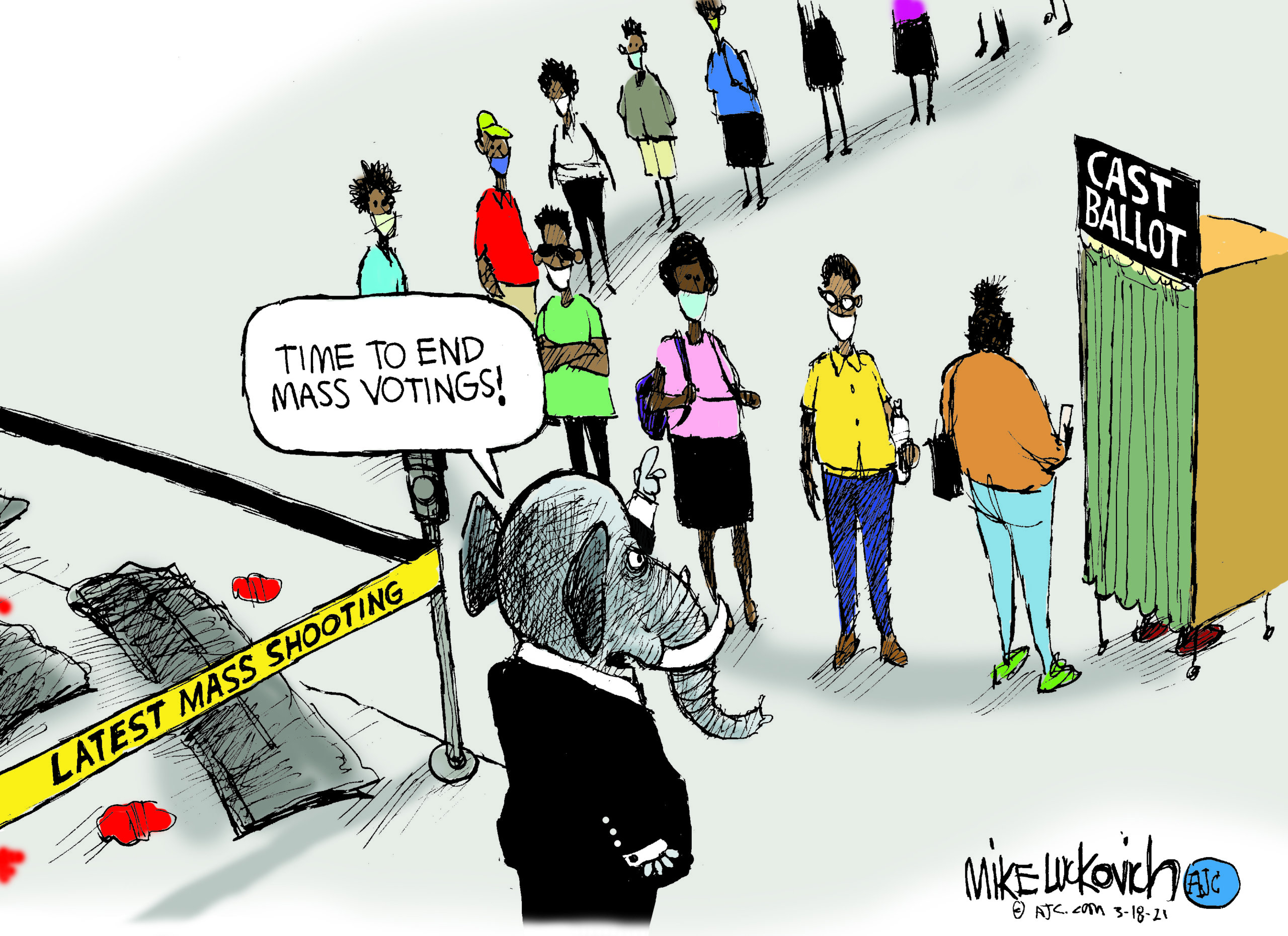
In stirring, memorable words, Justice Elena Kagan dissented from the Court's majority opinion on behalf of its two other liberal members. "If a single statute represents the best of America, it is the Voting Rights Act. It marries two great ideals: democracy and racial equality," she writes.9Regrettably, in referring to the origins of the Voting Rights Act, Justice Kegan's dissent suggests she knows law better than history. She mentions "a march from Selma to Birmingham." It was in fact the Selma to Montgomery march that made voting rights history. But, eight years ago, the Court on which Kagan now sits voided Section 5 of the Act by ignoring the fact that Congress published thousands of pages of testimony, data, and information providing evidence of the substantial, new voting rights problems covered by Section 5 that people of color face in the states.10Steve Suitts, "States' Rights Resurgent: The Attack on the Voting Rights Act," Southern Spaces, August 29, 2013, https://southernspaces.ecdsdev.org/2013/states-rights-resurgent-attack-voting-rights-act. As a result, by voiding Section 5 and now greatly weakening Section 2, the Court has left very little of the protections that Congress enacted and reenacted to advance voting rights.
A historic accomplishment, the Voting Rights Act has advanced democracy and racial justice. In 1992, voting rights attorney Laughlin McDonald wrote that the "amendment of section 2 . . . represented a strong congressional and judicial commitment to equality in voting."11Laughlin McDonald, "The 1982 Amendments of Section 2 and Minority Representation," in Controversies in Minority Voting, ed. Bernard Grofman and Chandler Davidson (Washington, DC: Brookings Institution, 1992), 70. Also see Drew Days, "How the Voting Rights Act is the Most Effective Act on the Books," Southern Changes 4, no. 1 (1981): 16, 25–27, http://southernchanges.digitalscholarship.emory.edu/sc04-1_1204/sc04-1_004/. But in recent years a majority of Supreme Court justices have abandoned their own self-professed adherence to the text of Congressional legislation in order to reach a result they prefer: voting laws that make it more difficult to prove racial discrimination and to block voter suppression. If the American people fail to rally and elect a Congress that will right the current Court's wrongs through passage of new legislation, the nation will be left without a safekeeping of either democracy or racial justice.
About the Author
An adjunct with Emory University's Institute for the Liberal Arts, Steve Suitts is the author of Hugo Black of Alabama: How His Roots and Early Career Shaped the Great Champion of the Constitution (Montgomery, AL: NewSouth Books, 2017). Earlier in his career, Suitts served as the executive director of the Southern Regional Council, vice president of the Southern Education Foundation, and executive producer and writer of "Will the Circle Be Unbroken," a thirteen-hour public radio series that received a Peabody Award for its history of the civil rights movement in five Deep South cities.
]]>Introduction
Craig Womack: Welcome, everybody, to Atlanta and to Emory University. Welcome to a place where Muscogee Creek people have had government, jurisdiction, and land tenure since time immemorial—way back before the written records. Because this is the heart and soul of where Creek people come from, we feel that this is an important place to have this discussion.

Our panelists include Andrew Adams, currently a justice on the Muscogee Creek Nation Supreme Court. At two different times he's served as chief justice of that body, and he has worked with other tribes, including seven years as chief justice for the Santee Sioux. Justice Adams has also conducted legal work for Chippewa bands in the Midwest. We're glad to have somebody who's in the trenches the way that Andrew is in terms of the matters that we're talking about today. Andrew is a full member of Tvlahasse Wvkokaye Creek Ceremonial Grounds.
The first time I can remember meeting Andrew—and please understand, at this point in my life sometimes the things that I think I remember never actually happened—but my memory of meeting him was at the old location of Tvlahasse Grounds in the mid-1990s. We were the guests of Helen Burgess and Jim Burgess at a Green Corn event that was scantly attended, as far as people in the ring. It was a baptism by fire in the sense that we got thrown into doing a bunch of stuff that a couple of newbies usually wouldn't be doing. I ended up keeping the fire in the ring that night. A year or two later, at that location or at the new grounds site, I got to meet Andrew's dad. Another fond memory.
Craig Womack: Professor Barbara Creel is a member of Jemez Pueblo. Much of the early part of her career, after graduating from the University of New Mexico School of Law in 1990, was in the Pacific Northwest, in the state of Oregon, where she spent seven years as assistant public defender. She was involved in defending reservation residents who were prosecuted under the Major Crimes Act. This is a piece of federal legislation that has a very strong bearing on the case that we're discussing today. She was also a liaison between Oregon tribes and the Army Corps of Engineers whose big water projects often have overlapping jurisdictions with tribes. Professor Creel joined the UNM law school faculty in 2007. She's the former director of the Southwest Indian Law clinic and is now directing her own project on Indigenous innocence, representing Native Americans in post-conviction appeals.
Our moderator this evening is Professor Megan O'Neil, who will be assisting with audience questions after the panel discussion. Professor O'Neil teaches here at Emory and is Faculty Curator of the Art of the Americas. She is a specialist in the ancient Maya and Mesoamerican cultures.
Sarah Deer is in the Department of Women's, Gender, and Sexuality Studies at the University of Kansas. Before this, she was a professor of law at Mitchell Hamline School of Law in the Twin Cities for almost a decade where she taught federal Indian law. She's co-authored three books on Native constitutions, tribal legal studies, and tribal criminal law. Her 2015 University of Minnesota Press book, The Beginning and End of Rape, won numerous awards. This area of inquiry is highly significant to our discussion today since the McGirt case not only has to do with tribal jurisdiction, but also with issues of sexual violence.
Professor Deer is a MacArthur Fellow and in the Muscogee Creek Nation. We're very proud of her having captured this award. She's currently the Chief Justice of the Prairie Island (Minnesota) Community Court of Appeals. She was also a judge for three years for the White Earth Chippewa nation, another Minnesota tribe. She's testified before the US House of Representatives, the United States Commission on Civil Rights, the Senate Committee on Indian Affairs, and many other federal committees and agencies. She has served multiple federal appointments, including chairing the US Attorney General's task force on sexual assault in Indian Country.
The other day I went out to my mailbox. Hope reigns eternal that someday there will be something good in there, and there was! Instead of bills, I pulled out a package from Dustin, Oklahoma. It was from a friend of mine and a friend of Sarah's, Rosemary McCombs Maxey, who's a language teacher, an activist, and a person involved in educating Creek young people. There was a note in the package—Sarah and Rosemary had sewn me a COVID mask out of Creek patchwork. I'm now convinced I have the coolest COVID mask on the planet. It's got this Creek patchwork running down the middle. Now I'm all masked up with nowhere to dance!
I'm going to say a few brief things about Creek history. I've spent a month trying to whittle my comments down to a manageable way of talking about a topic that's very difficult to contextualize in terms of this Supreme Court decision. It requires extensive historical knowledge as well as the need to describe how crimes are prosecuted on reservations. And it involves a complicated narrative about how Oklahoma tribal jurisdiction has a unique status in relationship to other Indian reservations across the United States.

When I've looked at the recent media coverage of McGirt, I've often found it disappointing, even when I read reputable papers like the New York Times. There's no way to fully cover the topics I just mentioned in newspaper articles. You would be hard pressed to cover them in a book, and there is little doubt that books will be written about this decision. My summary is too brief and reductive, but I'm going to flash forward through a huge expansive history. I'm going to skip Creeks as ancient mound builders, skip colonial history and Creek Nation relationships to the English and to the Spanish before them. I'm going to skip the early part of the nineteenth century when Creeks fought a civil war against one another in 1813 and 1814. And I'm going to skip the forcible removal of Indians in 1836 from this very area that I'm speaking from and from other parts of Georgia and Alabama.
I'm going to fast forward all the way up until the American Civil War when Creeks had barely recovered from the traumatic 1836 removal from Georgia and Alabama. They had suffered loss of life, loss of culture, loss of livelihood, businesses, and farms. They had to start all over. They had to find families to take care of all the orphans whose parents had died during the removal. During the 1860s, when the US Civil War occurred, the official Creek government headquartered in Okmulgee, Oklahoma, sided with the Confederacy. There were a disproportionate number of Creek leaders who had close ties to the Deep South: economic relationships, cultural influences, and, to some degree, plantation systems. Some leading Creek governmental figures were slaveholders. There were also those who had sympathies with the Union. Many of these Creek Union sympathizers fled to Kansas during the conflict. Many Creek men volunteered to join Union forces. The Creek leader Chitto Harjo went to Leavenworth to serve in a Union army unit.
We all know the end of this story. Fortunately, the Confederacy lost the war. Creeks were then forced to renegotiate their treaties with the federal government. They signed the Treaty of 1866, as it's come to be known, which, like most treaties, involved a land cession. One of the things that Creek people had to do was sell a big chunk of the western portion of their lands. The idea being, supposedly, that this area would be used by the United States to resettle other tribes. But the United States also wanted to open it up for eventual white settlement. In spite of having to make that land cession, this treaty made several strong guarantees about Creek sovereignty and jurisdiction into perpetuity in the territory. Because of this, many Creek leaders today regard the 1866 treaty as sort of the gold standard of Creek treaties.
The Civil War was a disaster in Creek country. It split the nation in two. Farms and mills were burned to the ground, infrastructure destroyed. A cholera epidemic ran rampant, killing many. Two decades later, when Creek people had begun to recover from this, they got hit with another disaster for Indian America across the United States. This is the Dawes Act of 1887, federal legislation that forced tribes to allot land that had previously been held in the tribal domain to individual tribal members. The "surplus land" was then opened up to white settlement. This is a main reason that reservations have a checkerboard pattern. Sometimes people think just Indians live on reservations, but because of the Dawes Act, there are also non-Indian residents there.

From Indian Territory's early inception, the United States government set it aside by congressional act as a place for tribes to live and govern themselves. So, the US had to approach the tribes in the Territory—in a way that they didn't have to approach tribes in the rest of the United States—to ask if they would be willing to voluntarily comply with allotment. The southeastern tribes were against allotment and especially against the dissolution of tribal government that was part of the process. The US federal policy idea behind this is that as tribal citizens accepted allotment certificates they eventually would become US citizens and have the same legal status as anybody else in the United States.
If you don't get anything else out of this talk, you can take away the "Native 101" fact that that tribal people, unlike any other minority group, ethnic group, or any other racial group, are defined differently from a legal standpoint in the United States. They constitute governmental entities that have the right to a government-to-government relationship with the United States federal government. With the passage of the Dawes Act, the United States was thinking maybe it could also work itself out of the Indian business, so to speak—which is to say work itself out of the unique status guaranteed to tribes. Sometimes people call this status a trust relationship, not because Indian tribes and the government particularly trust each other, but because of this unique legal standing that involves the right to self-government.
Congress found itself in a bind, having to ask the southeastern tribes, unlike other tribes in the US who weren't located in a special territory, if they'd allot land, if they'd give up tribal government. The tribes said no. Congress, being the entity that passes legislation in relationship to tribes, then flexed its muscles by expanding its plenary powers, the rights it has to pass regulations relevant to tribes, to the nth degree. It tried to make those powers as fulsome as possible by passing the Curtis Act of 1898 which forced the Indian Territory tribes to allot.
One of the things that's really striking about the Curtis Act, from the perspective of someone like me who's not a legal scholar, is that it legislates that the tribes can't have legal representation, can't contest the Act, can't rise to their own defense. With the tribes being forced to allot, the Curtis Act was an assault on tribal government, tribal land, and tribal culture.
After the Dawes Act was passed, then the Curtis Act in Indian Territory, of course tribes didn't disappear. They still organized themselves and formed political entities. After this, the federal government tended to recognize tribal governments on an ad hoc basis. There was a lot of inconsistency. From my perspective, it seemed to work this way: the Bureau of Indian Affairs says, "Okay, here's a tribe that's cooperative. Here's a tribe that opens up its reservation for exploitation of its resources to outsiders; that lets people come in and harvest timber, water, mineral resources, good tribal government, duly elected, we recognize this one." But then there's this other tribal government that's not so keen about letting people come in and take water, timber, and minerals. Then the BIA cries foul, claims this one as bad government they don't recognize, for any number of reasons they create. Since some tribal governments were recognized and others weren't, there was a growing web of confusion with no national template or cohesive policy.

In 1934, Franklin Roosevelt appointed John Collier to head the Bureau of Indian Affairs. Collier, a much more progressive leader than his predecessors, successfully lobbied Congress to pass the Indian Reorganization Act. This legislation, often called the "Indian New Deal," allowed tribes to form constitutions if they chose to do so, to submit them to the Bureau of Indian Affairs for approval, and, if they were approved, then they were allowed to form governments that the United States would recognize.
I'm going to leave it at that. The panel can correct my mistakes and I will not be offended. Sarah is going to describe how the status of the Creek Nation has changed since the July 9, 2020, McGirt Supreme Court ruling. Then we'll see what other panelists want to say.
Panel Discussion
Sarah Deer: Thank you, Craig, for that great introduction and thank you all for inviting me to be part of this panel. As a Creek citizen, this is a case that will have deep meaning for us for many years to come. And as a disclaimer, I'm here today in my personal and academic capacity. Because I also advise the Creek Nation, I want to clarify that I don't speak here in any official capacity, on behalf of the Nation.
I want to make sure as we discuss this case that you've got the basic facts. We're talking about two cases here, but the one that counts is McGirt v. Oklahoma, which was argued online due to COVID-19. We could all call in and hear the oral arguments—we're not used to that. Most of the time you have to go in person.
The decision was released in July on the very last day that decisions were announced. I think it's clear that this is one of Justice Ginsburg's final, if not the final, votes of her tenure on the Court. It's interesting that we focus on reservation law with this case, but actually both of the cases at issue here began as criminal cases. I'm glad that Professor Creel is on our panel because she'll have some more insight into the work of how criminal defense attorneys think about reservation issues.
But there were two cases. There was a case involving Patrick Murphy (Sharp v. Murphy), who was convicted of homicide and sentenced to death by the state of Oklahoma. And then the case's (McGirt v. Oklahoma) namesake here, Jimcy McGirt, a Seminole man who committed some heinous sexual crimes on children and received a draconian one thousand years in Oklahoma custody. So, these are two men that had very little to lose by appealing their decisions. When you're on death row, you've got attorneys who are trying any way to save their client's life. And from Mr. McGirt's standpoint, there was not a lot to lose by challenging jurisdiction. But both of these men, and even the state of Oklahoma would agree, committed their crimes within the boundaries of the 1866 reservation that Craig discussed.

From the perspective of a criminal defense, the fact is that if this is an Indian Reservation, if it still exists, then these two men were prosecuted by the wrong government. Under the Major Crimes Act, the federal government has criminal power over lands considered Indian Country and the state does not. So their argument on jurisdiction hinges on the question of whether or not the 1866 treaty is still the standard by which we assess Creek territorial jurisdiction. There were other cases that came before this, that did not have to do with the Creek Nation but answered a similar question: Is the reservation still there or not? Do the boundaries still apply or not? And the rules that the Court has created over the years require that Congress explicitly change the governing territory of the tribe. There were two other cases in the last thirty years in which the Court held that only Congress can establish a reservation and it cannot be inferred. It has to be explicit.
Attorneys for Murphy and McGirt argued that the defendants were prosecuted by the state of Oklahoma, which did not have jurisdiction over them. Now Craig did a great history here, so I don't need to go through all of this, but it was in 1866 that this treaty was signed. And really the language of the treaty that I think Justice Gorsuch focuses on in his written decision is the very clear language that this land—and again, there was half of it ceded in 1866—would be forever set apart as a home for the Creek Nation. And this is consistent with the other treaties that the Creek Nation had signed, even those prior to removal. So the language was consistent—words like "forever" and "perpetuity" are important for the contemporary interpretation.
What Justice Gorsuch did in McGirt was write the official decision on behalf of the majority. It was a five-four split. Writing for what people characterize as the liberal arm of the bench, Justice Gorsuch determined that because there had been no explicit language by Congress, despite allotment, despite demolishing tribal courts, despite all of those things which Oklahoma certainly argued, there was never a clear disestablishment of the reservation by Congress. Therefore, the 1866 reservation still exists. Therefore, McGirt and Murphy were prosecuted by the wrong government.
The Creek Nation and other amicus clients filed briefs in this case, and the ultimate outcome was one of victory—not just for these two criminal defendants, but for the Creek Nation and potentially many other nations. Justice Gorsuch writes that on the far end of the Trail of Tears was a promise, and "because Congress has not said otherwise, we hold the government to its word."
I want to share two more quotes from McGirt to emphasize how emotional this decision was for many of us. It felt like it set things right for the first time in a long time. One of the passages I so admire from this decision is that "Congress may sometimes wish an inconvenient reservation would simply disappear. But wishes don't make for laws." These kinds of principles transcend Indian law and speak to what justice really is about.
Justice Gorsuch also writes, "None of these moves by Oklahoma would be permitted in any other area of statutory interpretation and there is no reason why they should be permitted here. That would be the rule of the strong, not the rule of law." And finally: "Unlawful acts performed long enough and with sufficient vigor are never enough to amend the law. To hold otherwise would be to elevate the most brazen and longstanding injustices over the law, both rewarding wrong and failing those in the right."
Because today is Indigenous Peoples' Day, this particularly resonates with me. It isn't just about this Creek tribe and this Creek reservation. It's about a justice of the Supreme Court acknowledging the harms that were done and fighting for justice today.
So now we have a reservation. We always had one, but now it's recognized again. And what that means is that our territorial reach as a nation is far further than we have been exercising it. The Creek Nation now has full territorial reach throughout the boundaries of the 1866 reservation. Which is about a twelve to thirteen county area, including a great deal of the city of Tulsa. We are now tasked as a nation with governing that reservation and with the challenges posed by a large expansion of recognized territorial reach. But these are challenges that the Creek Nation is ready to take on.

Prior to McGirt, the Creek Nation had what we call Indian Country, a legal term of art referring to land that's been in trust or has a restricted status, owned in fee by the tribe—plots of land, whether they be former allotments or contemporary business district holdings. That was it. That was Indian Country. Once you step off that plot of land into the state of Oklahoma, then the state would no longer recognize you as being in Indian Country. But one of the definitions of Indian Country is all lands within the limits of any Indian reservation. So if the reservation still exists, our authority in terms of criminal law doesn't just rely on a particular plot of land; it's going to be anywhere within the boundaries of the reservation. This is a dramatic increase in recognized territorial authority.
Craig Womack: Professor Creel do you have anything you would like to add?
Barbara Creel: Yes, thank you for inviting me. Happy Indigenous Peoples' Day. Know that you are on Native land that was inhabited before contact, before the white settlers came. The McGirt case is one of the most important Supreme Court cases in land acknowledgement.
As far as background to McGirt, I wanted to add a couple of things. Professor Deer mentioned Sharp v. Murphy which started out in the Tenth Circuit as Murphy v. Royal and percolated up to the Supreme Court. It was argued and set for re-argument, but it was going to be a four-four split because Gorsuch had recused himself. You see, the decision was a Tenth Circuit decision from when he had been on that court. He didn't write that decision, but it wouldn't be proper for him to weigh in on it from his new position on the Supreme Court.
McGirt didn't change the status of the Creek Nation or expand tribal jurisdiction. McGirt recognized that the tribe had ancestral lands that were documented in treaties and congressional enactments. Federal criminal jurisdiction versus tribal jurisdiction versus state had been established in the 1883 case of Ex parte Crow Dog, which led to the Major Crimes Act of 1885. So, as Professor Deer said, if it was Indian Country and a murder after 1885, the case would be prosecuted in federal court.
Craig Womack: Along the lines of talking about ideas that came out of the 1883 case, I want to ask a question. And this very much comes from the perspective of someone whose head swims when hearing legal history. (Mainly I write novels and I play the fiddle.) But my question is this: since the McGirt decision recognizes Oklahoma tribes as having reservation status, does this ruling simply catch up Oklahoma tribes to the rest of Indian Country—much of which has had reservation status for a century now—or does it do something more?
Andrew Adams III: I guess I'll jump in quickly. First of all I thank Craig and Emory University and everyone that put this together. And I will give the same disclaimer that Professor Deer offered: I'm here speaking in my own personal, individual capacity. But to quickly answer your first question, Craig. I approach it from the standpoint that the status of the tribe didn't change, but the status of the law and essentially the federal government's posture and position related to the Muscogee Nation, changed.
The Muscogee Nation didn't change. But if you think about it in very practical terms, before the McGirt decision was issued, the Department of Interior didn't have to recognize or give any credence to the reservation boundaries. But after the Court issued its decision essentially reaffirming—and I say "reaffirming" because I don't like the terms "recognized" or "reestablished." Those reservation boundaries never went away. I can remember my first year of law school at the University of Tulsa in 2003 sitting in Professor Rice's office (whom I affectionately call Uncle Bill) and him saying, "Nephew, your tribe's reservation, you're sitting on it. You're living on it right now." I had always heard these stories about the reservation going away and he said don't believe any of that. "Congress is the only entity that can take away or diminish a reservation. And by golly nephew, when you moved down here from Michigan you moved onto your homeland."
And so when the decision was issued, it struck me emotionally. I already knew that Uncle Bill was one of the smartest people I'd ever met. But it just drove that belief further home that nearly twenty years ago, Uncle Bill—and not only Uncle Bill, but also one of the colleagues that I have on the Supreme Court, Justice Leah Harjo-Ware, when she was the attorney general for the Muscogee nation years ago—that nearly twenty years ago he made those same arguments.
There are a lot of Muscogee people who have walked with that belief close to their hearts and minds.
Then to answer your second question, Craig, the existence and disputes and concerns about reservation boundaries permeate across Indian Country. There are a number of tribes that either are in some type of dispute with, say, a county sheriff over who has jurisdiction over what people over what geographical area, or they could be in federal district court, or in some type of court of appeals where they're trying to press their case as to why the boundaries that are identified by the federal government or a state government or some subdivision of a state government are not correct.
I believe that what McGirt has done for Indian Country is to reaffirm all of those decisions in the past like Solem v. Bartlett and Hagen v. Utah where Congress is the only entity that can diminish or disestablish a reservation. And you actually see just in the time since McGirt was decided, a positive cascading effect on other federal courts, where they have provided some favorable decisions for tribes. As an Indian law practitioner and someone who, when I wake up in the morning, kind of feels like Luke Skywalker—that I fight for the good guys, that I represent tribes—I hope that continues. I hope that various levels of government get to the point where they do have that respect for tribal homelands.
Craig Womack: Thank you, Andrew. Do other panelists want to join in this discussion about reservations status?
Sarah Deer: There's been a lot of backlash from both state officials and the general public in Oklahoma, whom I don't think fully understand what McGirt means. No, it does not mean that five tribes own the east half of Oklahoma as it's somehow been suggested. Nothing changes the status of the land within the reservation. If you own a home in Tulsa or Glenn Pool, nobody's going to take that home away from you. If you're a private business and you have your business on the reservation, the status of the land where you run your business does not change. What it changes, though, is the extent to which the tribe's sovereignty is matched in the territory that it exercises; the Creek Nation has more options for exerting governmental power now. But in no way does it does it take somebody's land away or take their livelihood away. And I think that's been misrepresented in the press quite a bit.
Craig Womack: A lot of what we have heard and read about has focused on the tribe having increased jurisdiction over criminal cases. It's being depicted as an advantage. But we have also heard about the tribe now having more cases to take care of than ever before, and some have said, the situation may be overwhelming to the extent that there may be a need for expansion of the tribal court system. I was thinking when I listened to Professor Creel's podcast, which is really excellent, about her insights into the Major Crimes Act and how this act is still imbued with a colonial viewpoint. So are there other advantages, or any disadvantages, to be considered?
Sarah Deer: I'm going to let Professor Creel answer the crux of that, but yes, again, a lot of people don't realize that, technically, tribes retain concurrent authority over felonies on reservations. That's misunderstood when people read the Major Crimes Act as though it was a grant of exclusive jurisdiction to the federal government. Tribes in some states, not all, prosecute homicide, rape, and child sexual abuse, but by and large, when we think about those kinds of crimes on reservations, we think about them "going federal"—so the US attorney's office becomes involved. But certainly the tribe can also independently exercise that kind of criminal authority. To the extent that one would calibrate justice for victims with more tribal prosecution, the tribe is now in a position to do that on a much grander scale. But it does require additional staffing to be able to govern that big of a stretch of reservation. In terms of the criminal defense perspective, I'd like to ask Dr. Creel.

Barbara Creel: Thank you, Professor Deer. I would like to hear from the tribe about advantages and disadvantages, but I know from my criminal law teaching that sovereignty is what sovereignty does. As a sovereign, the tribes have incredible power to shape their own justice systems. I teach the differences between the American cultural and moral values and Indigenous cultural values and rely heavily on Sarah Deer and Carrie Garrow's book, Tribal Criminal Law and Procedure, in which they discuss where tribes get their inherent decision making about what wrongdoing is and how to punish it. How do sovereigns address wrongdoing in their own jurisdiction? It's powerful to think about. We could start over, right? We could be a Crow Dog nation that looks to restorative and rehabilitative justice instead of retribution.
We all know that the first thing we hear on Indigenous Peoples' Day is the parade of horrible statistics that Native Americans are subjected to. This case provides opportunity for the defendant who was a community member and the tribe to be on the same side. That does not happen in Indian Country cases. It's usually the United States acts as a punisher and the tribe acts as a punisher. But at this point, the two interests converge between the individual defendant and the tribe. I think it promotes what I teach: tribes are made up of individuals. What I was taught from my family values is that the people are the heart of the tribe. The tribe is the body and the people are the heart.
The advantage is having tribal sovereign government rethink its criminal jurisdiction and do differently than what the adversary system has imposed upon us. The disadvantages in this line of thinking are what Professor Deer mentioned: we're so far behind in resources in our own justice systems because they were taken away or encroached upon due to the Major Crimes Act.
We are impoverished in the ability to think and rethink about justice. I've taught tribes how to look into their own history to decide how to move forward. This was a foreign concept, either because the state took over after termination or because of the Major Crimes Act. But because of this rule of history that Gorsuch mentions—this is always the way we've done it, so we're going to keep doing it that way—tribes have lost their own thread of thought in how to treat wrongdoing. They've been without resources and basic governmental functions.
Andrew Adams III: When you think about federal policy related to Indian tribes over the last two hundred years, it's gone through different themes. Since the Indian Self Determination and Educational Assistance Act, the federal government has been in this mindset of self-determination—that tribes should be self-determining in expanding their sovereignty. So the biggest advantage that I see from McGirt is that the decision opens up a lot of options for the Muscogee Nation to expand and mature its jurisprudence. It expands the different types of cases that can come before the Muscogee Nation courts. I believe that the volume will increase and with that more opportunities for the courts of the nation to issue decisions that further the maturation of Muscogee case law.
Craig Womack: Thank you, Andrew. I want to ask one more question of Sarah, and of course anyone else can weigh in on this. Since McGirt has to do with tribal jurisdiction and sexual violence, can you address these two topics in relation to one another?
Sarah Deer: Certainly. What's interesting about this case is that I worked with a Cherokee attorney named Mary Kathryn Nagle, and we've been filing amicus briefs in Indian law cases for the last five or six years. We feel like the voices from Indian Country of victims of crime are not often presented to the Court. We did that in McGirt and in Murphy. Our primary client was the National Indigenous Women's Resource Center, a large national Native nonprofit that's dedicated to ending violence against Native women and children. We argued on behalf of McGirt and on the side of the tribe that these cases belong in tribal court. To the extent that we have strange bedfellows, I think it's worth noting again that this idea of sovereignty matters for victims and sovereignty matters for defendants. Tribal nations are in the best position to make decisions about how to protect people and hold people accountable. It may seem ironic that a victims' rights organization would side with somebody alleged to do some pretty horrific things, but the end goal of making sure that tribal nations are strong and capable of protecting one another is at the core of what any sovereignty battle is about—the battle to define what's right and wrong and how we resolve those questions.
Barbara Creel: That's Indian law, right? We're a unique, interesting, quirky, crazy quilt of jurisdiction. I wanted to add another point with regard to disadvantages. Tribes have the power to adjudicate criminal acts on the reservation. Because of separate sovereignty and the dual sovereignty doctrine, a Native American can be facing up to a year in jail without the benefit of counsel. Natives are the only people that that happens to in the United States. We're the only ones that can go to jail without an attorney. Natives are also subject to double jeopardy because they can be prosecuted by their own tribes and by federal court under the Major Crimes Act. The problem of over-policing and over-criminalizing and over-incarcerating Native Americans has a long legacy. In footnote six of the McGirt decision, the Court says some helpful things about land recognition and Native rights and points to the Pueblo Indians in the case of United States v. Sandoval. But that 1913 case was one in which the Supreme Court was trying to decide who was an Indian, and whether Pueblo Indians were Indian because there was no definition. What did the Court look to determine whether Natives were Indians? Behaviors and stereotypes. They decided that Pueblo Indians were dimwitted, had plural marriages, practiced non-Christian religions, and were in need of guardianship. That's the legacy that continues to thread into these 2020 cases. We're still carrying around those labels.
Craig Womack: Thank you. We're going to move to questions with the help of Dr. Megan O'Neil, assistant professor of art history at Emory University and faculty curator of the Art of the Americas at the Michael C. Carlos Museum.
Question and Answer Session

Megan O'Neil: Thank you, Craig. The audience has posted many questions, which I think speaks to how important this work is.
First I want to read a comment from an attendee, Stuart Fenton: "The language used by Justice Gorsuch was beautiful, brings tears to my eyes, even though I'm not Native. I'm a lawyer, however, and Jewish so I understand deeply the wrongs done to your people; similar wrongs have been done to mine."
How about the more general question about the implications of this decision in Indian Country outside of the Creek Nation?
Sarah Deer: I think the way in which Gorsuch challenges the other justices to confront the ugly history of federal Indian law and to look at what really happened on the ground could have impact on cases involving tribes that have related concerns about questions of self-government. His ability to look and be honest about the history is, I hope, a template for justices ruling on Indian Country cases in other contexts.
Megan O'Neil: Here's a question regarding what's written in the McGirt majority opinion, that there is no reason why Congress cannot reserve land for tribes in much the same way, allowing them to continue to exercise governmental functions over land even if they no longer own it commonly. How would such a conclusion affect the outcome of Alaska v. Native Village of Venetie Tribal Government, et al. from 1998?"
Sarah Deer: Venetie is a devastating case out of Alaska. It actually came out when I was a law student. It made me wonder why I was in law school, it was so poorly reasoned. But it's a question of tribal territory, really a different animal, because it's looking at the Alaska Native Claim Settlement Act, which is not applicable in the lower forty-eight and certainly not in Oklahoma. So, I would love to see Venetie reconsidered, but I'm not sure McGirt really changes anything as far as that decision goes.
Barbara Creel: I agree. Venetie was looking at the definition of Indian Country and deciding whether the Alaskan Native corporations fit within one of those definitions and found that they did not.
Megan O'Neil: Here's a question from Sarah Hill asking if you could comment on the response to the decision by the Cherokee Nation and the state of Oklahoma.
Sarah Deer: Well, the state of Oklahoma is pretty unhappy, and that's been expressed by a number of state officials, including the attorney general, who referred to us as "sovereignty hobbyists" in one of his disparaging comments about our efforts to expand tribal authority. I can't speak to the Cherokee's official position or not. Each tribe is unique and different.
Megan O'Neil: This next question is for Justice Adams, from Veronica Passfield: "After attending graduate school with Andrew I moved to Oklahoma City. Governor Stitt created a committee to strategize about how to adapt to McGirt. His committee included oil and gas CEOs, but no tribal leaders. I'd like to hear thoughts on McGirt backlash and how the community can advocate to help offset it."
Andrew Adams III: It's appropriate that we're having this conversation on Indigenous Peoples' Day. The parade of horribles you hear from individuals, from the state attorney general and Senator Inhofe, claims that the Supreme Court is creating an untenable situation in Oklahoma where the Muscogee Nation is going to be able to exercise "enhanced jurisdiction" or "extra jurisdiction" over its reservation. People say that the sky is going to fall if you give these Indians authority over their land again.
A lot of people, when they think about reservations and about treaties, think about the United States saying, "Okay, we're going to give you this land." But there's another way of thinking—and there's power in words—that reservations are the land that the tribes reserved for themselves. It wasn't anything that was given to the Muscogee Nation. This was land that the Muscogee Nation saved for itself as a homeland in exchange for other rights. Anyone who predicts the sky is going to fall, they are perpetuating the settler mentality imposed upon Indian peoples. The US Supreme Court did the right thing by issuing this decision. And now let the state of Oklahoma and the Muscogee Nation work as sovereigns.
Megan O'Neil: This next question is from Sarah Armstrong, a current public defender in Atlanta, a University of New Mexico alum, and a former student of Professor Creel. "What advice can you give to non-Native defenders of Indigenous rights, especially with respect to this decision?"
Barbara Creel: Every time I work with a person from a different family, a different community, a different tribe, a different government, I treat that experience as one of an ambassador. Learning about the particular tribe. I teach the way to be an ally is to promote Indigenous wisdom and Indigenous voices. Learn about the ancestral lands which you are standing on right now and elevate the voices of Native people. Educate yourself but know that each tribe is different. There is no pan-Indian way. Combat willful ignorance. Don't give up because these issues are complicated. Be willing to fight those injustices where you see them.
I appreciate the work of the Indigenous Women's Network and of all those who come to these issues with their own wisdom and with the experiences of having lived through violence or the criminal justice system or being court-involved.
Megan O'Neil: The next question is for Professor Deer, regarding sexual violence law jurisdiction in Indian Country: "How do you hope the case against McGirt and other cases of sexual violence committed in this region will be pursued? How does the Violence Against Women Act come into play, and how might the Creek and other Native nations bring Indigenous perspectives to such cases?"
Sarah Deer: Thank you for the question. Yes, Mr. Murphy and Mr. McGirt have both been indicted in federal court, which was the appropriate court that should have had their case from the beginning. While some headlines suggested that McGirt is leading to the release of dangerous persons, the reality is that McGirt and Murphy are still under the jurisdiction of the United States and are going to either plea or be prosecuted by the US attorney. So as far as they're concerned, the question might be, "Could the tribe also prosecute them under concurrent authority?" Certainly, going forward, the Creek Nation has a homicide law. It has a rape law. It has a child sexual abuse law, a child pornography law. So, the Tribal Council, the legislative branch of the tribe, has passed laws which suggest that the government would like to see authority in those cases. Only time will tell. I do think that the tribe has the potential at this point to take other kinds of crimes under tribal law. That'll be an interesting development, and as Professor Creel noted, we're not necessarily wedded to the Western law-and-order model. We can create therapeutic models of justice. Many tribes have done that. It's a very interesting time to be Creek.
Megan O'Neil: "The Supreme Court has not ruled on whether the Major Crimes Act divested tribes of jurisdiction, but it's widely accepted now that it did not. However, there's contrary language in some Supreme Court decisions. As I read the Gorsuch opinion, it doesn't have any definitive language suggesting he views the Major Crimes Act as divesting tribes of power, but there's some language that could be read as suggesting he assumes it did. Can you say anything about whether or how the opinion might affect tribal jurisdiction over major crimes or how the tribe might be approaching the question?"
Barbara Creel: That sounds like Professor Rolnick.
Sarah Deer: Thanks, Professor Rolnick, I'm sure we can write a law review article on this question at some point. I think any reference to whether the tribes retain jurisdiction or not in Gorsuch's opinion is a matter of dicta. Of course, you know, I think the reasoning that only Congress can divest tribes of jurisdiction would apply here. That the Major Crimes Act did not divest—there's no explicit language in the Major Crimes Act divesting tribes of jurisdiction. But yes, you're right. The question is not definitively answered in the Supreme Court at this time, but I feel confident that using this kind of case as a precedent will aid that if it does come before the Court at some point.
Barbara Creel: I read the opinion, too, with Gorsuch saying that the Major Crimes Act encroached upon tribal jurisdiction, but it was a limited encroachment in that it was specific enumerated crimes. It's widely accepted that there's concurrent jurisdiction because of Supreme Court decisions that say the dual sovereignty doctrine applies. I think that there have been implications that both the tribe and the feds have jurisdiction.

Megan O'Neil: Here's a general question about Muscogee Creek language: "As someone who was born and raised in Bogotá, Colombia, currently living in Massachusetts, I advocate for linguistic human rights being a native Spanish speaker. And I'm wondering if any of the scholars in the panel know about laws regarding language access or language advocacy, not just for the Muscogee language or the Creek people, but any of the hundreds of Indigenous languages in the United States."
Craig Womack: I'm not sure I can answer this question. For a long time, Sarah and I were in a group that got together to speak Creek with our mentor Rosemary McCombs. One of the things that Sarah was always interrogating was whether or not there are certain Muscogee words or ideas that had to do with legal principles. So, Sarah, did you want to say something about this? You can answer it better than I can.
Sarah Deer: I have to admit, that while I am a language learner, I don't know much about any federal or governmental policies about promoting language per se. I tend to focus my scholarship in the criminal arena, but there are people actively trying to save the Creek language today. It is an endangered language. We do have a linguist that committed himself to our language. His name is Jack Martin at the College of William and Mary. He co-authored our dictionary and grammar book. It is always an ongoing process to save an Indigenous language and our tribe does have a language department and there are a couple of colleges in Oklahoma that teach Muscogee language. But beyond that, I don't know that I have a lot of knowledge to bestow.
Craig Womack: I don't know of any state that has recognized a Native language as an official language.
Barbara Creel: New Mexico's constitution guarantees access to the courts in additional languages besides English. That means Spanish and Native languages. Because of the Major Crimes Act, Native language certifications are really important. States with large Native populations or states that care about Native citizens can pass a statute with regard to language access in the court system simply on a due process basis. The Pueblos come at it from a little bit different viewpoint in that my tribe has language immersion at Head Start. Language is spoken in the home and in intergenerational daycare. There's also a lawsuit in New Mexico suing the state department of education for lack of language access and services for Navajo and Pueblo speakers.


Andrew Adams III: I'll just quickly add that there are tribes all across the country that have passed tribal laws concerning traditional and Indigenous intellectual property protections. Often, tribes will identify their language as being part of that corpus of information that they consider that needs to be protected and archived and will actively budget funds for that protection, not looking to the state or the feds.
Barbara Creel: In my tribe, there is a rule against sharing the language because Pueblo language is not for public consumption. You don't find it taught in community colleges as you do in other tribes. It exists for internal purposes and is imbued with concepts that shouldn't be shared with others. The tribal language provides a different function than English does.
Megan O'Neil: Thank you so much. Here's a question from Ed Barker who's asking if McGirt affirms Congress's power to extinguish Indian Country. What do you all think about that question?
Andrew Adams III: From my standpoint, McGirt does essentially prop up the legal concept, the plenary power over tribes, right? That Congress, if it wants to, can pass statutes that dramatically change the legal relationship between the United States and federally recognized Indian tribes. And in this current environment, in some respects I don't mind that.
Sarah Deer: I agree, and I think that's been a big critique, especially by scholars who raise the question, "Is this really a victory if it continues to recognize Congress's plenary power?" In response to that, I'm not sure we will ever have that victory in the Supreme Court. What's important to note about this question is that tribal interests have had a much better go of things working with Congress than working with the courts. We tend to lose in the federal courts quite a bit, but yet we've managed to sustain some pretty progressive legislation in Congress. So if Congress is the place to go, I feel like the political process offers more ways to pursue tribal interests. We don't have control over the litigation that comes up about our sovereignty within the federal courts. But I don't think at this day and age, you would see a complete repudiation of Congress's plenary power, but one can always hope, I suppose.
Sarah Deer: I've written on tribal law, but primarily on violence against Native women. And because I get asked a lot, I finally made a website where you can find my writings at SarahDeer.com.
Barbara Creel: I'll also recommend the Sarah Deer, Carrie Garrow book that I mentioned before, Tribal Criminal Law, as a ready resource for people that just want to understand criminal jurisdiction in Indian Country with really good examples of Native thought in criminal law.
Conclusion
Craig Womack: This has been an amazing discussion. Not only for those of us on the panel, but for the impressive level of experience of the audience—people who went to law school with, or are former students of a panelist, academics such as Sarah Hill, who've written about southeastern people, grassroots people doing work in Creek country, law students across the country, law professors. And all the other members of the audience who have listened in. I'm excited too about the potential, as Professor Creel said, of being able to do things differently and maybe to expand into more ways of looking at restorative justice and creative approaches to governments and alternatives to punitive-based approaches to criminal justice. It's exciting to think about where this might lead us. Cehecvres, see you all again.
About the Panelists
Andrew Adams III is a citizen of the Muscogee (Creek) Nation and member of the Tvlahasse Wvkokaye Ceremonial Grounds. He currently serves as Justice of the Muscogee (Creek) Nation Supreme Court, Chief Justice on the Santee Sioux Nation of Nebraska Supreme Court, and Justice on the Gun Lake Tribal Supreme Court.
Barbara Creel, a member of the Pueblo of Jemez, is a professor of law at the University of New Mexico School of Law and former director of the Southwest Indian Law Clinic.
Sarah Deer is a citizen of the Muscogee (Creek) Nation of Oklahoma and University Distinguished Professor at the University of Kansas. She holds a joint appointment in the Department of Women's, Gender, and Sexuality Studies and the School of Public Affairs and Administration. Professor Deer is also the Chief Justice for the Prairie Island Indian Community Court of Appeals.
Craig Womack is an Oklahoma Creek-Cherokee Native American literary scholar, writer, and teacher, and an associate professor of English at Emory University.
]]>