Introduction: The Selected Shepherd: A “Fair, Just Place”
Let us live beyond the here and now by nurturing each other and supporting one another’s works.—Assotto Saint, “Why I Write”1Assotto Saint, “Why I Write,” Spells of a Voodoo Doll: The Poems, Fiction, Essays and Plays of Assotto Saint (Richard Kasak Books: New York, 1996), 3–8, 5.
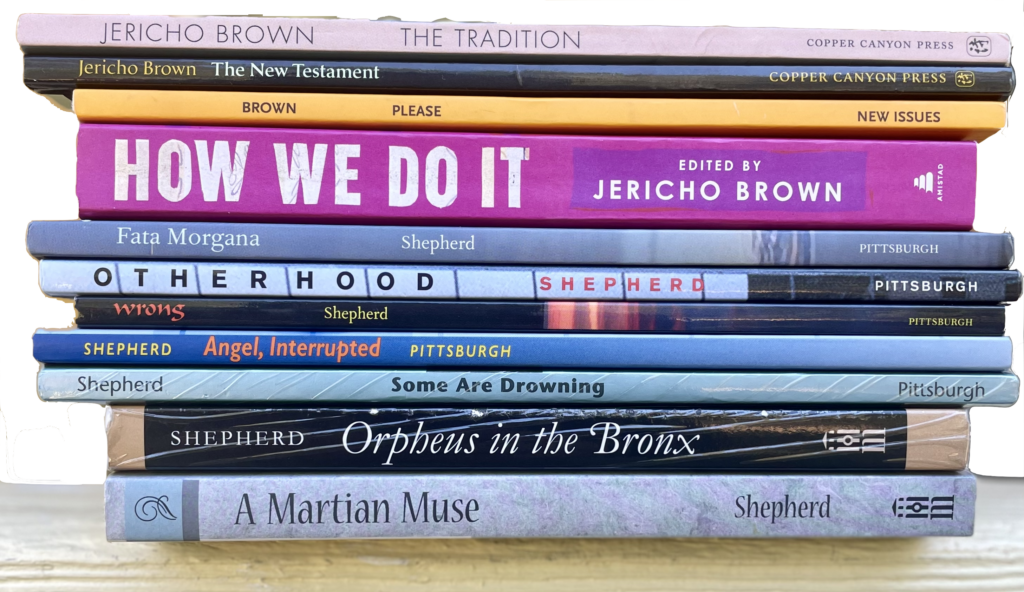
In the first lines of his introduction to The Selected Shepherd (University of Pittsburgh Press 2024), editor Jericho Brown writes of the impossible effort of introducing “a dead man,” the late poet Reginald Shepherd , to readers: “You mean to honor him knowing that you cannot present him as he might present himself.” Brown’s work with The Selected Shepherd allows Shepherd to introduce himself to readers as he would were he still with us: directly through his poetry. Brown describes Shepherd as an unpredictable, fearless, and brilliant poet who wrote “a little more wildly” across each of his six published collections.
Following a short biographical sketch and brief framing narrative written by Eric Solomon, Southern Spaces presents an edited conversation between Eric and Jericho Brown about the work, resonance, and legacy of Reginald Shepherd.2This conversation took place at the Emory Center for Digital Scholarship on August 6, 2024. Brown previously spoke with Natasha Trethewey for Southern Spaces in 2010. See Jericho Brown, “Naming Each Place,” Southern Spaces, March 4, 2010, https://southernspaces.ecdsdev.org/2010/naming-each-place/.
Reginald Shepherd was born Reginald Berry on April 10, 1963, in New York City. When he was five years old, he was issued a birth certificate with the name “Reginald Shepherd” after his mother’s successful suit against the absent man legally proven to be his father. His mother, Blanche Berry, raised him and his sister Regina in the Bronx where he remembers going by “Reggie” until he adopted the more formal “Reginald” in his mid-twenties. (Shepherd addresses the permutations of his name in the essay “What’s in a Name?”3Reginald Shepherd, “What’s in a Name?,” A Martian Muse: Further Essays on Identity, Politics, and the Freedom of Poetry, edited by Robert Philen (Ann Arbor: The University of Michigan Press, 2010): 193–198.). After his mother’s death when he was fourteen—a fact that would shape much of his future poetry—Shepherd moved to his mother’s hometown of Macon, Georgia, to live with family until he left, after graduating from high school, at age seventeen. He enrolled as an undergraduate at Bennington College, leaving in his junior year to move to Boston where he worked at the Boston Public Library, before returning to Bennington to finish his BA four years after his initial expected graduation date. He earned two MFA degrees, one from Brown University and a second from the University of Iowa. Shepherd published five books of poetry [Some Are Drowning (1994); Angel, Interrupted (1996); Wrong (1999); Otherhood (2003); and Fata Morgana (2007)] with a sixth volume published posthumously, Red Clay Weather (2011). He also published two books of essays [Orpheus in the Bronx (2007); A Martian Muse (2010)] and edited two poetry anthologies [The Iowa Anthology of New American Poetries (2004) and Lyric Postmodernisms (2008)].
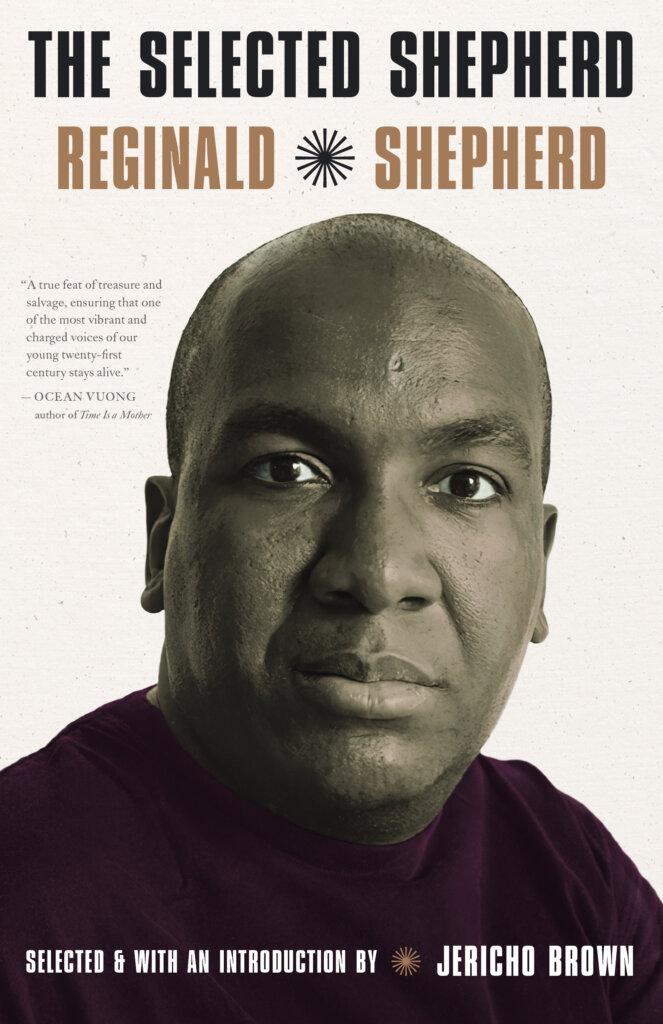
Shepherd met his partner, Robert Philen, in Ithaca, New York, in 1999, and the two moved to Pensacola, Florida, in July 2001. After a battle with colon cancer, Shepherd died on September 10, 2008, in Pensacola. Though he accomplished much in his career, Shepherd remained aware of the structural inequities that prevented men like him from accessing what he called “fair, just” places of belonging in the academic and literary worlds. “Sometimes I stand in the poetry section of Barnes and Noble and wonder how many authors there come from backgrounds like mine. They can be counted on the fingers of one hand,” he writes in an essay published the year before his death. “Unlike the vast majority of those in academia or the literary world, I have nothing to fall back on. Since leaving Georgia at seventeen, I have been on my own… I have gone from place to place, from circumstance to circumstance, and still I haven’t found that fair, just place, but I continue to search, hoping and believing that there’s a place for me.”4Shepherd, “To Make Me Who I Am,” Orpheus in the Bronx: Essay on Identity, Politics, and the Freedom of Poetry (Ann Arbor: University of Michigan Press, 2007), (7–38), 36–37. Sixteen years after his death, Jericho Brown’s The Selected Shepherd has helped secure the poet’s “fair, just place” on the bookshelves of our great poets.
Searching for Shepherd
Reginald Shepherd’s six volumes of poetry continue to amass a dedicated following from fans, fellow poets, and scholars. Shepherd’s work contains an intoxicating blend of image, metaphor, allusion, formal innovation, and often dizzying complexity. His work incorporates references from Hart Crane to Wallace Stevens to Walter Benjamin to Sam Cooke to Barry White while always remaining the work of an original voice and visionary.
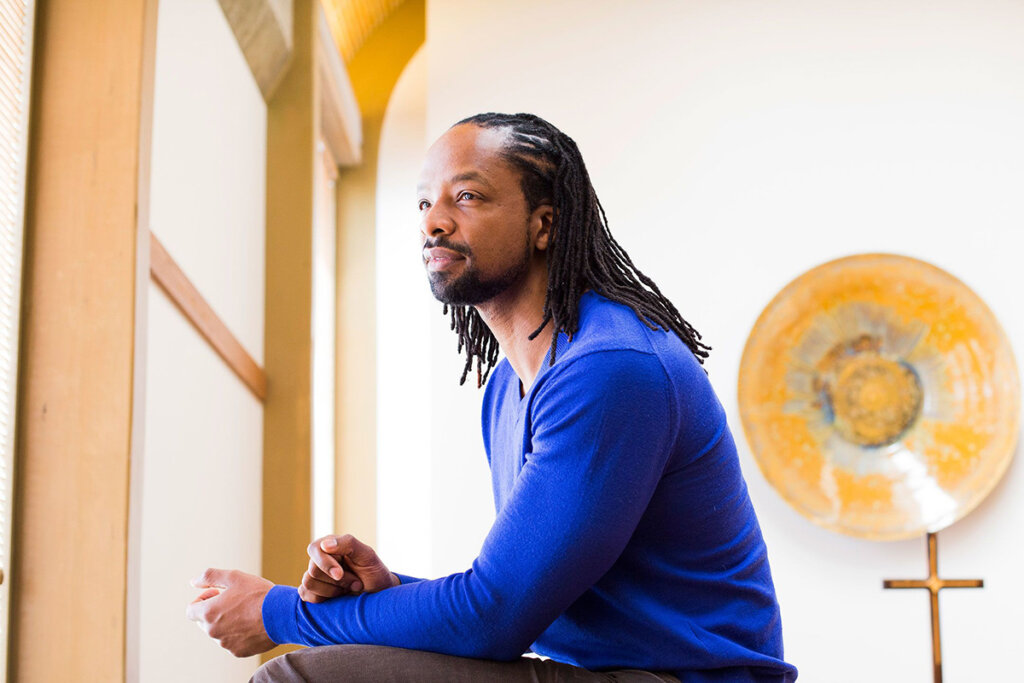
“I was around twenty-four years old when I first read Reginald Shepherd’s poem ‘Semantics at 4 P.M.’ in an edition of the Best American Poetry edited by Rita Dove,” Jericho Brown writes. Transfixed, Brown recalls asking other poets why he had not been made aware of Shepherd’s work beforehand. He continues, “the poem itself does not identify its speaker as gay, but if there is a queer voice, I believed I was reading it.” For Brown, Shepherd became an example of a “gay, Black poet who was alive,” and for those of us lucky enough to have discovered Shepherd’s work, it is the vitality and the voice—queer, brilliant, difficult, propulsive—that resonates long after the initial encounter. Though Brown’s work with The Selected Shepherd will now make a first encounter more accessible for many readers, I would argue that one does not find or search for Shepherd’s poems. As Brown’s story illustrates, you don’t find the poems; his poems find you. Or, as Brown states, poets “are the makers of the beauty that people didn’t know they needed until they see it.”5Jona Colson, “On Truth, Queerness, and Social Media: A Conversation with Jericho Brown,” Literary Hub, November 10, 2020, https://lithub.com/on-truth-queerness-and-social-media-a-conversation-with-jericho-brown/.
Similar to Brown, I (Eric) was twenty-three when I first came to Shepherd’s poetry by happenstance at a time when I needed to “see” his work. I was in an MFA poetry workshop as a MA student in English studying men and masculinities—i.e. not a poet—but we were allowed to take creative writing workshops as our schedules permitted. I recall vividly feeling like an “outsider” to what I perceived to be the “real” poets in the room (classic imposter syndrome), and I found my work at the time out of step with the much more highly innovative and experimental work of my colleagues.
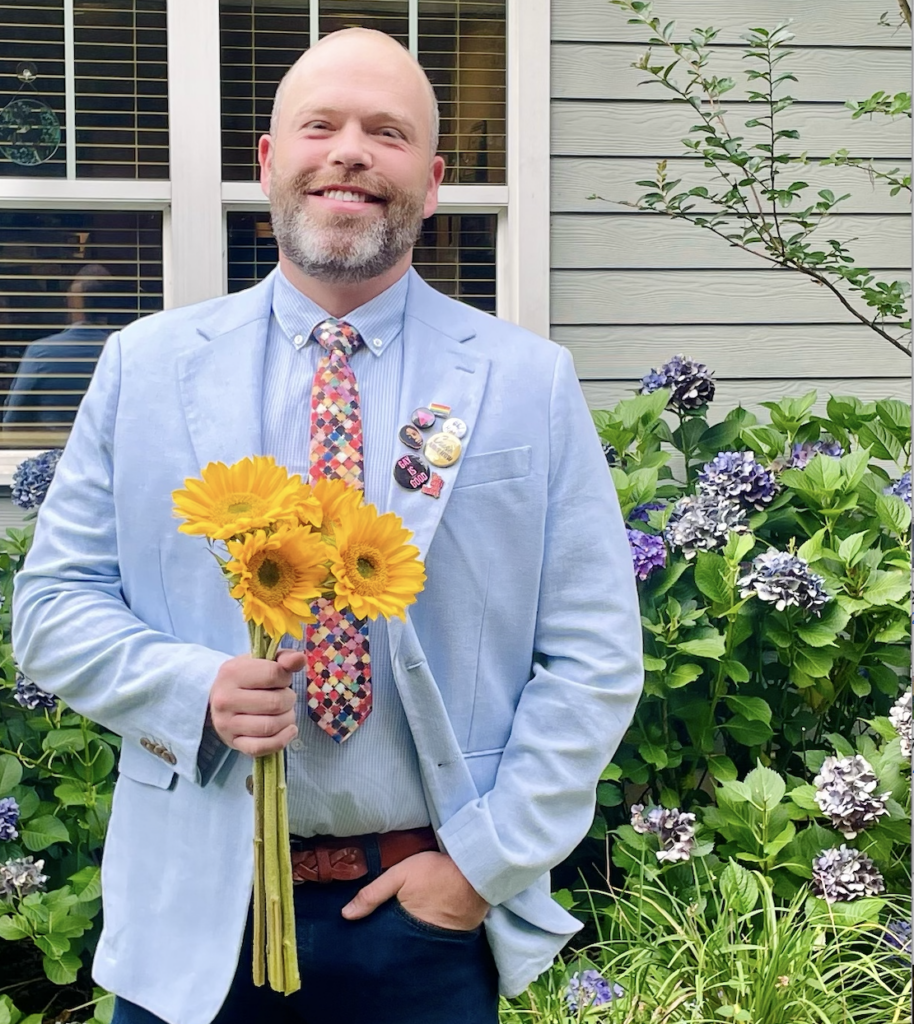
In retrospect, I was attempting in my juvenilia poems to rescue the stories of our queer dead from the tragic detritus to which their lives had forever been relegated in our collective memory. In one poem titled “Appendix,” I elegized Scotty Joe Weaver, an eighteen-year-old gay man from Bay Minette, Alabama, who was killed by two of his roommates in 2004. In another, I attempted to grapple with the death of Matthew Shepard, whose name now serves on official federal hate-crime legislation. One colleague recognized in my meditations on the queer dead something he called a poetic sense of rescue and reclamation, and he invited me to consider Reginald Shepherd when it came time to give presentations on the work of one contemporary poet in our MFA workshop.
Unlike Brown, by the time I found Shepherd, he had passed away. At my friend’s suggestion, I ordered copies of his published work, in which I found poetry full of life and resonance and contradiction and complexity and difficulty but not obscurity. Though they made me feel, I did not then, nor do I now, fully understand what I feel when I encounter and re-read a Shepherd poem. As Brown observes in The Selected Shepherd, Shepherd’s work is not easy by design. Shepherd thought poetry should be “hard enough” to sustain multiple re-readings, not written in such a way that it could be “used up” by readers after a few encounters.6Shepherd, “On Difficulty in Poetry,” A Martian Muse (33–45), 34. For Shepherd, poems should be able to contain different resonances with each return. In a conversation with Krista Tippett, Brown similarly states, “I think poems are better built out of what we don’t understand, not what we do already know, but what we’re trying to figure out and better understand.”7“Jericho Brown: Small Truths and Other Surprises,” On Being with Krista Tippett, June 6, 2019, https://onbeing.org/programs/jericho-brown-small-truths-and-other-surprises.
In searching for and finding Shepherd, equal in importance to the poems for me were something you will not find in The Selected Shepherd: his essays where the poet further attempted to understand his craft, his poetics, as well as identity, politics, and his life journey from the Bronx to Georgia to Boston to Brown University to Iowa and eventually to Florida. In the essays, Shepherd reveals his personal struggles as well as the difficulty of his relationship with academic institutions and the literary world. He also displays his vast critical knowledge and broad reading practice. Shepherd, comments Brown, “was a man who seemed to have read all the books you keep meaning to read.” Further, his insights on what we might call a queer literary canon are must-reads for those of us who study LGBTQ+ culture, past and present.
“My aim,” writes Shepherd, “is to rescue some portion of the drowned and the drowning, including always myself.”8Shepherd, “Why I Write,” Orpheus in the Bronx: Essay on Identity, Politics, and the Freedom of Poetry (Ann Arbor: University of Michigan Press, 2007), (188–198), 188.It seems to me that Shepherd’s “aim” exists in conversation with our queer cultural tradition: those of us in subsequent generations keeping “alive” some portion of the work of those who have gone before, many of whom were lost far too soon. When necessary, we rescue them from the dustbin of memory and place their stories and their works back on the central shelves of literary culture as Jericho Brown has done with The Selected Shepherd. Whether in our creative work or our work as editors, curators, scholars, documentarians or memory-makers, we claim places for our queer kin. As Brown writes, “we know poets don’t die. And if they do, people who love poetry can always resurrect them.” And in rescuing them, in resurrecting them, we rescue, always, ourselves. As Shepherd writes, no matter the challenges we face, we queer folk refuse to “forget beauty, however strange or difficult.”9Shepherd, “Why I Write,” 197.
Interview: Jericho Brown on Selecting Shepherd
Eric Solomon: Thank you, Jericho, for being here for this conversation in our Southern Spaces series “Queer Intersections.” I’ve organized the questions in two parts. First, is thinking about your editing of The Selected Shepherd . And then perhaps we can talk about how Reginald Shepherd’s work helps us think about Jericho Brown.
In choosing poems for The Selected Shepherd, you present a generally equal number from each of his six collections, with a little bit more from Angel, Interrupted. What were you looking for as you were editing?
Jericho Brown: When I got the opportunity to do this, I had somehow already started doing it in my head. It was the kind of thing, you know that phrase “comes to fruition”? it was the kind of thing that I don't even think I was aware of it until I was asked to do it. But I had started doing it somewhere in my brain as a Reginald Shepherd reader, as a person who teaches his poems, as somebody who's interested in his work, as someone who is actually taken by the ways in which his work could be uneven, even.
I don't love every Reginald poem. I don't love every poem by anybody with that many books. I had already started this system of ranking of this particular poet's work, which I think happened because there were so few Black queer poets on the national scene when I was first figuring out that I wanted to be a poet. There were so few that I could hold them all. I could read all of everything they said in every interview. I could read every book. I could read every essay that they had written. Now there are more than I can keep up with. But because there were so few, picking poems for me was at first a matter of going after what I already knew and trying to figure out which book -- was that in Otherhood? Was that in Wrong? Trying to remember exactly which book each poem is in. Rereading the books put me in a position where I could see what Reginald Sheppard's concerns were, or his obsessions, throughout his work. But more than that, it gave me the opportunity to see how he changed from book to book.
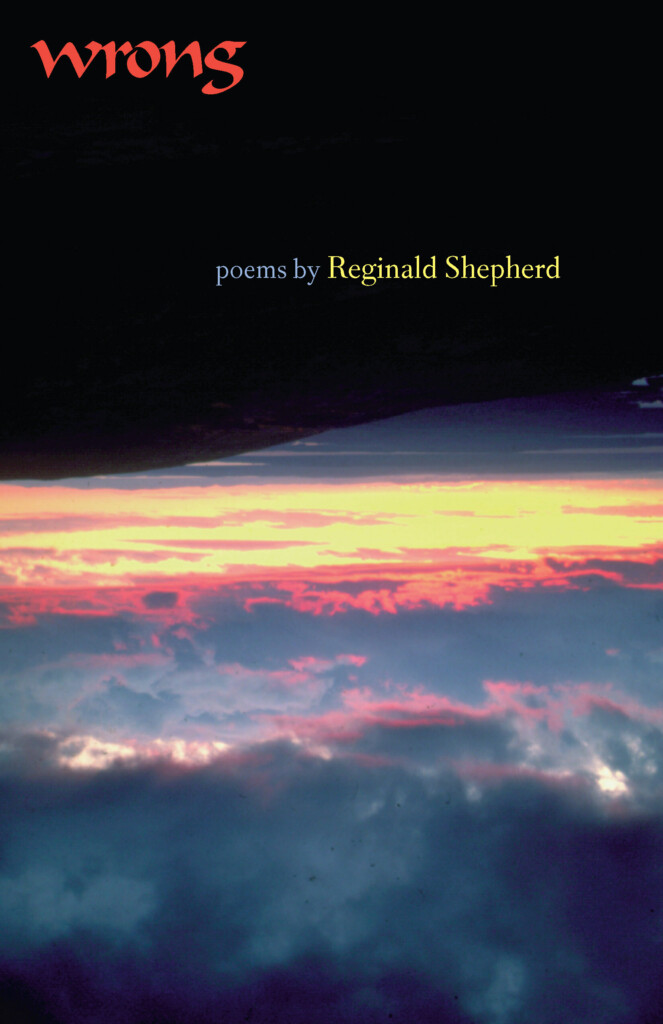
My goal in selecting the poems was to register those changes. I wasn't going to be able to make a book that only was the poems about nature, only was the poems about queer desire, or only poems about his mother. It was never thematic. It was always craft based. For instance, in Angel, Interrupted, he's very clearly trying to write a longer poem. In Otherhood, he's trying to figure out what to make of fragments. In Wrong, he's following up an influence through trying to see what would happen if Wallace Stevens wrote the queer love poem. All of that had a lot to do with how I went about selecting poems. As you mentioned, there are more poems from Angel, Interrupted and from Otherhood, but I just needed more poems to make it clear what those books were doing because they were doing it in a different way.
My favorite book by Shepherd is Wrong because I think it's the most honest that he is in all of his books. I think there are fewer poetic craft tricks. I really love Wrong. I love the long poem “Nights and Days of Nineteen-Something” and “Semantics at Four P.M.” Wrong feels to me when I'm reading it that it's a short book. I can hold on to it in a different way and walk around with it. At some point in “Nights and Days of Nineteen-Something,” he writes,
It was never sex I wanted, the grand etcetera
with a paper towel to wipe it up. I wanted him
to talk to me about Rimbaud while
I sucked him off in the park, drunk
as any wooden boat and tasting of old cigarettes
and Bailey’s Irish Cream, my juvenilia. Don’t talk
with your mouth full. (In the clearing
at the bottom of the artificial hill, his two hands
covered every part of me until I couldn’t be seen,
a darkness past the burnt-out lamppost.
There's something about that kind of audacity. And the way that it includes him. It is indeed that sort of thirst, that primal energy that we associate with desire. But it's also this guy who likes to read Rimbaud. Which is a specific and a particular guy. It's also somebody who's very aware; most of that particular poem includes cruising outside and having sex outside. But also being very aware of the natural landscape that surrounds him as he is following that primal desire, that urge to make love. I'm really taken by that poem and by a lot of the work in Wrong. I would read these books like crazy. I loved Reginald Shepherd, and I would look forward to the next book.
When it became clear to me that he was dying, I felt a kind of sadness. Not because I knew the man. I felt a sadness because I wouldn't be able to see what he was going to pull off next. I thought he was brilliant, and I loved his prose, and I loved following his blog -- at the time that people had blogs. You could wake up and go to the internet and see a beautiful new essay about poetry from Reginald Shepherd, which always included names of poets you never heard of. And because you had never heard of them, you could look them up. You had more reading to do. In many ways, he was like my teacher. I had a lot of respect for him. And I'm glad Terrance Hayes and the editors at Pitt asked me to do it.
Shepherd and Myth
Solomon: I love your craft-based approach being one to register the changes across the six collections and to pull poems that spoke to those changes. And I was reflecting on my own reading of Shepherd. I first encountered his work in 2008, 2009 -- Wrong meant something to me as well. Reading it now, in the light of what you're saying about honesty and audacity and that kind of drive that you see with desire in the poem.
Before we get into thinking about the resonances between Shepherd's work and your own, speaking of those essays that he would post on his blog, he says something about myth, and I'm curious how you understand the role of myth as you were selecting Shepherd's work. He writes in 2007 that “myth can also be used to place one's own experiences, thoughts and feelings in a larger context, opening them up to realms beyond the individual, making them less purely personal.”10Reginald Shepherd, “Mythology in Poetry,” Reginald Shepherd’s Blog, August 17, 2007, https://reginaldshepherd.blogspot.com/2007/08/mythology-in-poetry.html#:~:text=Myth%20can%20also%20be%20used,of%20the%20myth%20of%20Odysseus. How do you see myth in Shepherd's work? Is it speaking to that kind of audacity and that honesty? How is it functioning? As you were selecting poems, did you find yourself drawn to examples of the Adonis, Orpheus, and Narcissus figures?
Brown: No, he uses Greek myths so much that you wouldn't have to plan it out. It's going to happen. Any book you would do selecting Reginald Shepherd's poems, there are so many allusions to Greek mythology that you wouldn't be able to get around it. He had questions about this himself. If you check out the interview he did in Callaloo with Charles Rowell, he talks about that relationship to Greek myth, but also what that might suggest about his relationship to whiteness in general -- which I was really taken by.11Charles Rowell and Reginald Shepherd, “An Interview with Reginald Shepherd,” Callaloo 21, no 2 (Spring 1998), 290–307.He was always honest, and even though he was participating in it, he would also question the ways in which what he thought of as beauty had been informed by whiteness, by white beauty standards. Of course that included not just who he was attracted to physically, but his reading and how that reading played out and how it worked out. And we're all doing that in some way or another. You can only write as wide as your reading is. If you have various kinds of cultures coming in, then that will come through.
People think differently about what writing is and how it's done. What the “we” means in a poem and what the “I” means. That's different considering who you're talking to. And if everything you read is informed by the same classical rendering, then you're going to have a lot of Greek myth in your poems and you're going to have a lot to question about why that Greek myth is there. What does it really mean? And many poets do it. Many poets of color, many African-American poets, even Indigenous poets are making use of, or identifying with, mythological figures from the Greeks. And part of the reason we do that is this understanding that this is something our readers will share. I think Shepherd was very serious about making use of Greek myth because he was very serious about beauty, and he understood that poems must be beautiful.
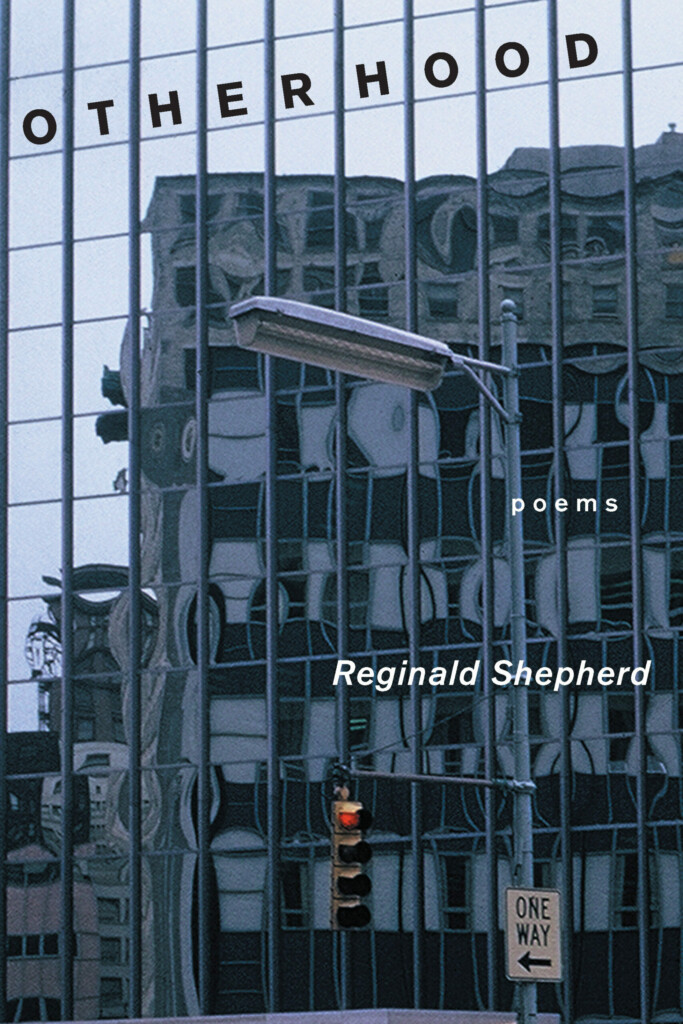
You said something earlier about the book Wrong, and it having meaning for you. Even the titles of Shepherd’s books are so tragic: Otherhood, Some Are Drowning, Wrong, Fata Morgana, Red Clay Weather. It does not sound like a good time. Greek myths lend themselves to tragedy. And Reginald Shepherd, I think, needed a kind of, how do I say this, a backdrop or a landscape of tragedy on which his poems could grow and through which he could build artifice. The Greek myths are full of rapes. They're full of wars. I think it was very important to what he was doing, but I chose poems thinking, okay, in these poems, Reginald Shepherd is making a lot of leaps, a lot of what seems to be non-sequitur leaps. And Orpheus happens to be in here. But in this poem, in another book, for instance, things are very narrative, but Orpheus happens to be in here. So, Orpheus is going to be there.
Solomon: Myth is just a vehicle for him, one of the traditions that he's drawing from and reimagining throughout his work. I know that you were registering changes as you were selecting, but myth is, as you're saying, omnipresent. You couldn't get around it, but it wasn't a strategic thing as you were selecting the poems.
My next question is about the relation of Shepherd with your work. Certainly, the use of myth is a common thread, but I'm thinking in another interview you talked about how poets love flowers, and the use of flowers that connects your work with queer culture. As I was reliving these poems through your work with The Selected Shepherd, I noticed ways in which Jericho Brown and Reginald Shepherd's poetry were in conversation with each other. Have you reflected on these resonances? Either as you were selecting the poems, or post the volume coming out?
Brown: It's hard to tease out.
Solomon: Maybe it's easier for a scholar looking in.
Brown: Yeah, I actually like hearing that. I like finding out what I'm doing and how people relate it to the poets that I'm influenced by. Because I always see things I've never seen before. I recently realized I’ve been reading this poem by Shepherd for years -- I can't think of what poem it is -- but there's a certain kind of phrasing that he uses that I use toward the end of a poem of mine called “Say Thank You, Say I'm Sorry.” As I was reading on a podcast, I'm like, “Oh, I stole that syntax.” I don’t use the same words. I realized there's a lot about my work in terms of syntax that I probably learned from Shepherd.
There are other poets who helped with this, but Shepherd helped me realize that what was most important about my writing would be how singular it was, or is. That I had to somehow either be myself or create a version of my self, and that had to be the speaker of my poems. The way Jericho Brown makes use of sentences. What I sound like in a poem has to be only what I sound like in a poem. So, part of what Shepherd does for me, reading his work through and through, is you realize nobody else wrote these poems.
No one could have written a book like Wrong but Reginald Shepherd. No one could have written “My Mother Was No White Dove,” or “Semantics at Four P.M.” but Reginald Shepherd. And I think he is the person who led me to understand that. It’s like when musical artists appear on the radio, I know its them. The deejay at the radio doesn't have to say “here's the new song by . . . .” I just know, because I've been listening to music, and I know what they sound like. There's really never a question when Mary J. Blige comes. And I figured out through Shepherd that in my own work, when people are reading a Jericho Brown poem, they need to be like, is that Jericho Brown?
So, what does that mean about a consistency of heart, a consistency of intellect, of line, of phrasing, of a kind of experimentation? Which I think was his goal. How do I continue to question myself and to challenge my idea about what a poem is and yet remain who I am throughout the poem? How is it still me? And obviously “me” changes and grows. And yet there's a way that when we look at that last book and we look at that first book by Reginald Shepherd, we can see that it's the same guy, but it's so different. That last book is so different from anything else he's written mostly because he wrote it on his deathbed. He was dying when he was finishing that book. He didn't even get to put the book in order. His partner, Robert Philen, ordered it, but it's all Shepherd’s poems. Which is why there's so many in that last book. I kind of got frustrated because there's so many very long poems, one right after another. And I'm like, “Bro, Shepherd wouldn't have done that.” [laughter] Those long prose poems. But I also noticed maybe he would have done it because it was his first time writing prose poems. I'm fascinated by what those poems yield.
Solomon: Yeah. You're comparing what you learned from Shepherd, that sense of voice, with your own. It is a Jericho Brown poem. It is Reginald Shepherd poem. That can be consistent even if, as you said, the experience of selecting these poems was to track the way he changed in terms of his craft across the six collections. Even though it's changing, there's always a sense that when you read a Reginald Shepherd poem, you know it’s him. And I will say that's also true of a Jericho Brown poem.
Brown: Aw. [laughter] Thanks Eric.
Shepherd's Queer Eros
Solomon: You're welcome. Another thing that I notice as someone who considers myself to be a queer cultural historian, I'm always down for seeing tongue-in-cheek play with the queer community or, “mock” is not quite the right word, but just send us up a little bit. Remind us not to take ourselves too seriously. I think Shepherd does something like that in “The God's at Three A.M." Or where you do it in your poem “Host” which, I think is subversive; it has a message. It's not just pure satire, but it is reminding us as queer people to be better to one another.

Brown: Yeah. To be better to one another is interesting. I never knew I wrote that. But I'm happy to hear it. I'm not against hearing that. I think what attracts me to those poems that you're talking about by Shepherd and by any queer writer, is the same thing that attracts me to poems that I'm attracted to by certain Black writers, whether they are queer or not. Because they're “in-house.” There's a way that you can read Shepherd’s “The Gods” and what you and I see in that poem we know other people are just not going to see. Because we've actually been to that bar. [laughter] And we understand that we could go to any city in America and still go to that bar and see those characters. [laughter] And we can see ourselves. Like, who am I in this poem? And yeah, that’s what is meant in a poem by me, like “Host.” Obviously, there's a reader who won't have had that experience, and they're sort of observing it from the outside, and maybe even identifying with it, but in a different way. It's the same thing as when, Future has this lyric where he says, “Y'all move that dope.” And I'm always amazed. When that song was such a huge song, every time I went to a club, every time I turned on the radio, I would hear that song. And I remember thinking, none of these people dancing to this song are drug dealers. [laughter]
Solomon: Were they “in the know”?
Brown: Yeah, like if I was really moving dope, that song probably had a certain kind of meaning to me when it came out, but when I'm listening to this song, I'm just thinking about grading papers. [laughter] I'm not trying to move dope. I'm just trying to stay up late enough to finish a poem.
I do think some things you can extrapolate or translate beyond that immediate in-house audience, but having an in-house audience I think is the actual backbone to voice. If we're having a conversation about Reginald Shepherd, we're talking about a poet who was always willing to be himself, to always have his own experiences in his poems. And so, sneaking around to make love outside, which I think queer people actually know less about than they used to.
Solomon: I agree.
Brown: But sneaking around to make love outside is an in-house conversation. It can translate. It can extrapolate to anybody sneaking around to do anything. But my experience reading those poems is “Oh, there I am.” Thank you, Reginald Shepherd, for writing this thing about yourself that shows that I'm not crazy, that shows that I exist.
Solomon: And that you're not alone.
Brown: Exactly.
Solomon: A whole history of what we might call cruising.
Brown: Yeah, that I miss. Yeah. [laughter] A whole history of cruising.
Solomon: That some people don't think we need anymore, right?
Brown: Yes. Well, I mean, maybe that's not what this interview is about, so I'll let that go. I don't know if people think we need that anymore. I just know you can meet a guy online and whatever happens from that happens. And you can meet a guy at the grocery store. And if you meet a guy at the grocery store, my personal history has shown that there were more options for what I could do with the guy and what the guy could do with me. When I meet a guy online, it's either I have to make love to you now or marry you? [laughter]
Solomon: There aren’t as many options ... And I love that Shepherd invites us to have this kind of conversation about his work.
Brown: Yeah, exactly.
Solomon: In a way that if I were someone different, if you were someone different, and we were sitting here talking about Reginald Shepherd, maybe we wouldn't be talking about “The God's at Three A.M .” The idea of cruising that you mentioned. I think that's beautiful that his work allows for all these entry points.
Brown: He would love that. And I think that we should also mention that this is all happening for Shepherd from his first book onward at a time when he is in those anthologies with Joseph Beam and Marlon Riggs and Essex Hemphill -- who also heavily used Greek myth. But there's no mixing up Hemphill and Shepherd. Among Black queer writers, even Carl Phillips at the time, there is this idea: we are going to say what our actual experience is in our poems, and we are not coding it. The code will be the fact that we reach out to you, Jericho, in that library when you're nineteen years old. In this library, actually, which is where I found Essex Hemphill’s poems.
Solomon: What you're saying reminds me of Assotto Saint’s “Why I Write” where he says (and I’m paraphrasing) we have an obligation to not file away our experiences in a desk drawer. I think that is very much clear in Shepherd's work and in your work and in Hemphill, and Riggs, and the people that you're mentioning.
Shepherd and the Natural World
You write in the Introduction to The Selected Shepherd, about framing his work around three primary concerns: 1) an understanding of the natural world as endangered; 2) his grief over the death of his mother when he was fourteen, and 3) his desire for the white male body and self-identification as a “snow queen,” and his processing of what this desire might mean.
Can you talk about the way Shepherd “reflects on the beauty of the natural world through an understanding of that world as endangered.” How did his thinking change from Some Are Drowning to Red Clay Weather? Or was it always the natural world as under threat? Did you notice different nuances as you were moving through?
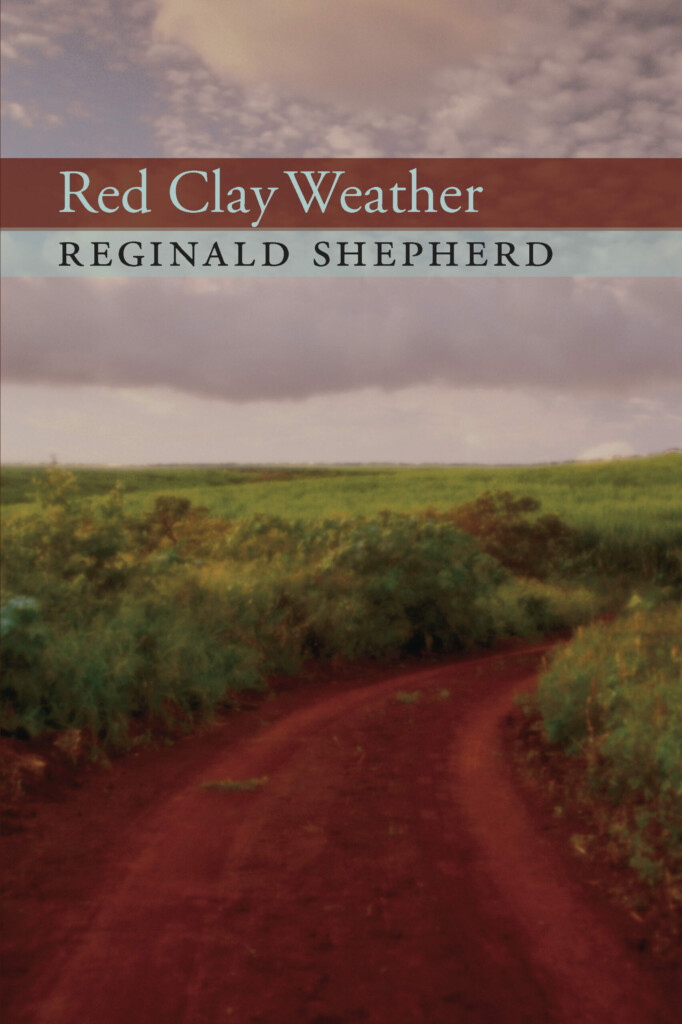
Brown: I think that maybe the one thing Shepherd would have in common with a poet like Mary Oliver is this idea that you protect and conserve the natural world not because of conservation, not because of its resources, but because it is holy. Every image from the environment is always a reason to be excited about nature. But we understand in many of the poems that that which we should be excited about could end.
For me, coming up with these concerns first had to do with separating what is a concern or a subject from that which is artifice. Greek mythology is not a subject, it’s an artifice. He's not writing a poem about the Greek myths. He's making use of classical allusion in order to say something about these other things.
Poets have to use what they have. And what we do have is a bunch of trees, flowers, and grass. We have the sky. We got some dirt. Those things seem to have already been here. They seem to have some capacity to be here if you get rid of us. And I think that particular concern is also the reason why poets can tell you the name of every flower. You just don't know what every flower looks like. You wouldn't be able to actually point to a narcissus. [laughter].
Because you read that part of the intro, I'll read what I say right after that, which I think deals with that, that first concern:
In each book, Shepherd reflects the beauty of the natural world through an understanding of that world as endangered. In his first book, Some Are Drowning, this endangerment appears in direct proportion to the fact of whiteness. And then I quote, “My true love's eyes / are nothing like my own, are bland as the suburban lawn / he mows on a summer Sunday afternoon, backyard / cookout with domesticated dog (And the beef cattle / graze x world? And the deforestation proceeds by x miles / per minute?).”
And that endangerment status matters all the more as environmental elements often get presented as characters with agency. Here are a few lines from “Surface Effects in Summer Wind” from Wrong:
I'm learning to remember the sound
days make: one sky disdaining the idea
of clouds, sunlight surviving
its centrifuge, breeze keeping blessed September
at bay.
Notice September is what's at bay. Then in the same poem a few lines later, he writes:
Midnight,
look at the things I've done
in your name, in my dark, walking out
into the street that changes nothing
Midnight gets called on and talked to directly. September gets held at bay. That which you think of as the natural occurrence, the natural world, has a mind and a life of its own. And the speaker in Shepherd's poems understands that and is always speaking directly to that mind and that life of the natural world.
Solomon: So, there's a sense of that agency of the natural world and that agency being under threat by human actions.
The Day the 'World Ended': Shepherd's Perpetual Return
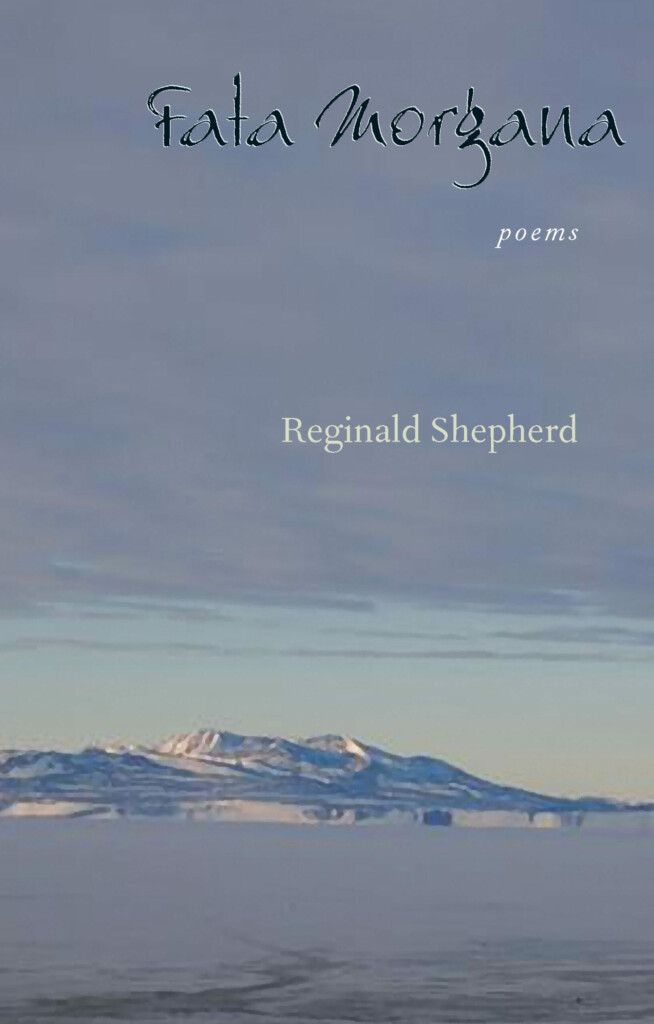
The second concern is from the very first page of Some Are Drowning to the very last page of Red Clay Weather. It’s everywhere in his poetry. It calls to mind other poets who have talked about what it means to have that sort of exigence—what motivates you to write; what, in many instances, traumatically or tragically, happened that somehow gave you the engine to write. In his poetry and essays, Shepherd writes constantly about – and is processing -- the grief over the death of his mother. In the poem “Vampires,” for example, which you select, he writes “a song like every song for the dead” or in “For My Mother in Lieu of Mourning,” which is in Fata Morgana: “Would you have frozen in these lines? You were their possibility: now love must find another shape.” Really powerfully returning over and over again to what it was like to lose his mother when he was fourteen years old.
I know you spoke with Natasha Trethewey in 2010 in Southern Spaces, and I think about hearing Trethewey speak about that existential wound, the murder of her mother, and also at such a young age. And Shepherd speaking in an essay that he would publish, talking about the day “the world ended” on March 31st, 1978, which was the day of his mother's death.12Reginald Shepherd, “To Make Me Who I Am,” Orpheus in the Bronx: Essays on Identity, Politics, and the Freedom of Poetry (Ann Arbor: University of Michigan Press, 2007), 22. Two questions here. One, how did you live with the loss of Shepherd's mother in these poems as you were reading them? How did that return for you? And then the second question is more for Jericho Brown: does that sense of a wound that writers write from jive with you? Does that make sense to you? What was it like living with that concern that you identify in Shepherd's work?
Brown: I just think it's his best work. I think it's his most beautiful poems. I think when his mother comes into a poem, I'm probably going to like the poem. I think that she was his way into and back to blackness. She was a specter to him. There's a way that she haunted him, and therefore, blackness haunted him. Whenever he talks about music in his work, his mother's coming up. If Sam Cooke, Donny Hathaway, or Otis Redding is in the poem, then his mother's in the poem. Also, the color black itself seems to always appear in a poem where his mother appears, if not talking about Black people, just the fact of a black shirt or a black shoe. I think it's also beautiful because it's not Hallmark washed. It's not a Mother’s Day card. The relationship between the speaker and his mother in these poems is fraught. There's fear as well as love. There's regret. There's also a calling out of neglect in some cases. Reginald Shepherd used to write that his mother knew that if she gave him a book, he would be occupied for the duration of the time that it took him to read the book. So, she could do whatever she wanted. She went through the trouble of making sure he was schooled at the best possible places, in spite of the fact that she was impoverished. He grew up until he was fifteen in the projects, in the Bronx. He has poems about that. I'll give a couple of examples.
I’ll start with this one as it will give me an opportunity to talk about some of the things in Shepherd's work that I'm really interested in.
“My Mother Dated Otis Redding”
My mother is laughing in the hallway with her friends I don’t like much, maybe the numbers runner who gives me dollars to go see movies while they fuck, a mattress propped in the doorway where there’s no door. I know what’s “fuck,” and “dick,” and “pussy.” They’re “tipsy,” she says, they’re having a good time. “Don’t I deserve a good time now and then?” I’m looking through the telescope I just got from a catalogue, while they break out the Tanqueray; I don’t know what that is. They’re putting on some records, it’s 1970, Nixon’s president; there’s a dock in one song and I don’t know how to whistle, but I know what’s a dock, and a bay. There aren’t many stars because of the streetlights, it’s the Bronx, the singer sounds sad, he’s dead. My mother says, “You know, I went to high school with him, back in Macon,” and everybody says “I’ll bet,” and she laughs. I wish I was his son, I wish they’d all go home. It’s late and I just want to go to bed, but she just wants to have a good time. I turn my telescope on the Puerto Rican couple fighting, kissing in a window across the concrete courtyard, three parrots escaped from the loading dock freezing in a trash tree, it’s November, neighborhood kids throwing rocks at each other from bicycles, my mother standing in the hallway with a paper cup of Tanqueray, or lying in the hallway in a pool of her own shit.
That's a poem that's hard on the mother, but also interested in what the mother affords. The mother affords this telescope. The mother affords an awareness of stars. The mother affords an awareness of the speaker's neighbors, of other cultures. The mother also affords this way into Otis Redding's history and music. And then the poem is also political in this way that I think might be in-house for Shepherd. He mentions Nixon; he mentions 1970. What many people don't know is that they would build these projects very purposely without doors in the apartments; you wouldn't have a door on a closet, or a door on a bathroom, or door dividing your bedroom from a hallway. And that was designed to take the idea of deserving privacy out of the minds of people who had to live in the projects. That was real. That was on purpose.
So, part of what he's getting at here goes beyond the mother. And I think what I learned from that poem has to do with how no matter what you start with, the poem's got to include everything. It's got to reach out into the world and somehow be about more than just whatever its obvious subject is.
Here's another poem where Shepherd is talking about his mom:
“My Mother Was No White Dove”
My Mother Was No White Dove no dove at all, coo-rooing through the dusk and foraging for small seeds My mother was the clouded-over night a moon swims through, the dark against which stars switch themselves on, so many already dead by now (stars switch themselves off and are my mother, she was never so celestial, so clearly seen) My mother was the murderous flight of crows stilled, black plumage gleaming among black branches, taken for nocturnal leaves, the difference between two darks: a cacophony of needs in the bare tree silhouette, a flight of feathers, scattering black. She was the night streetlights oppose (perch for the crows, their purchase on sight), obscure bruise across the sky making up names for rain My mother always falling was never snow, no kind of bird, pigeon or crow ...
Which I think is also a beautiful poem because it allows his mother to be a person. And there's a way that when we think about poems -- we found this out during the Iraq War -- the way Laura Bush thinks about poems is that is that they're all sweet. And that's not what poems are. I'm sorry to tell you. So, there's this way we get his mom being his mom, but also a human being, which I really love. Saying your mother is no white dove is a way also of calling to the beauty of one's mother's blackness.
Beautiful White Men: Shepherd's Desire
Solomon: I love hearing you read it. Hearing the rhythm and the way in which it was constructed. One of the things that stood out to me as you read it was the use of the word “snow,” which for readers of Shepherd’s, there's a lot of use of the word snow -- allusion, metaphor, imagery -- throughout his collections, throughout his poetry. And I wonder if this is a convenient segue, or too heavy-handed, but I am curious to get to the last concern that you identify, across his poetry, which is perhaps the most controversial still. I know it was divisive for some readers during Shepherd's lifetime. And that’s his self-identification as a “snow queen.” And where readers today might land. I am thinking about, Shepherd's attraction, veneration, of the white male body.
He writes in the 1986 essay “On Not Being White”: “I write about men, and most of them are white. And I write about white men, and most of them are beautiful. So, I write about beautiful white men.”13 Reginald Shepherd, “On Not Being White,” in In the Life: A Black Gay Anthology, ed. Joseph Beam (Washington DC: Redbone Press, 1986), 30. You can see that in his poems. Do you think that lands differently in 2024? Has anything changed in thinking about Shepherd’s potentially divisive, or confusing, as you put it in your Introduction, presentation of himself.
Brown: I don't know if it's any different. I don't know why, but I guess I just never cared. [laughter] I mean, I do care, but only intellectually. I don't get it, but I don't need to either. Even Shepherd didn't get it. I mean, he says so; he says this is weird. [laughter] There is a poem where he's looking at a very attractive Black guy reading a book and saying, what's wrong with me that I'm not attracted to you? Why not you? You're reading a book. It seems like an admission that the problem that Shepherd has is with himself, with his own idea of his own beauty or possibility for the beauty of blackness. And to be quite honest, I only feel sorry about that.
But all emotions and all ideas are welcome to be expressed in poetry. Only the Black poet can actually write about Black self-loathing that is the result of whiteness. And that's a real thing among us. And not just in the United States. I went to Nigeria a few months ago [laughter] and was just fascinated by how many blonde wigs there were. We've decided something about blonde hair that in and of itself is supposed to have a meaning toward what we think of as beautiful.
So, I don't trip about that from Shepherd. And no shade, but you know these writers who call themselves Black pessimists who are all married to white people, maybe I haven't read enough of it, but I don't see the part of their work where they're like, why is my wife white if I care about Black people so much?
Solomon: So, at least there's a self-reflection that’s happening in Shepherd.
Brown: Yeah. I'm much more attracted to that than I would be attracted to somebody participating in that without understanding that's what they are participating in. There's an awareness. It’s like when I vote Democrat. Like I'm not crazy. I'm not stupid. I also would like to at least have a home to come to. Like, I don't want, like, no shade, but I don't want porn to be illegal. So, I'm not interested in project 2025. And I'm voting for her, but I don't think of Kamala Harris as some kind of freedom fighter or some kind of rebel. I don't think that that is inherent in the fact of her blackness, either.
So, these poems are in the book because they come up so much and that's what he was interested in. And I am so happy that they're there because I would love to see critics and scholars on race and on whiteness -- fields that did not exist during Shepherd's time -- take these poems up.
Solomon: There's a complexity in these poems and in his essays that should lead to studying Shepherd’s approach to the white male body. His will to process and understand.
Brown: He also probably felt, given what was happening among Black queer writers at the time, a bit of a pariah. But it's not like he's the only Black queer person dating white guys. I think him feeling like a bit of a pariah has to do with him expressing it through his poems. When something comes up in a poem, it ends up identifying you like that's who you are. I think we might not be friends with, but we're friends with somebody who's friends with, a Black guy who only dates white people. [laughter]
Solomon: If you think about it, Shepherd publishing in the 90s into the 2000s, the post- In the Life generation, Joseph Beam and the Black man loving Black man is the revolutionary act of the 80s, there is a sense that he is publishing as a poet in contrast to those other writers and poets.
Brown: Yeah. The thing about Shepherd that makes him different is his move that, okay, you call me out about this thing. All right. So that's where I'm going. That's what I'm going to do in this next whole book. We got to see how much of that thing I am. And his way of doing things was put the poems first. And, if that's the experience he had for his poems, that's what was going to be in the poems. I'm really fascinated by that and even envious to some extent. Poets are the people who have to say the brave thing. Who have to say the thing that is true in spite of the fact that nobody else seems to be saying it. Even if that truth makes us look bad.
Solomon: Or is uncomfortable.
Brown: Yeah. And I never felt that I was doing that in my work as much as I feel it now. I feel like, “Oh, damn, I really don't want to talk about this.” I would actually rather not say this in a poem, because once I do, it becomes who I am. You can say this controversial thing in a poem, in Reginald Shepherd's case, he would say in poems that he wanted to suck white cock, which, I've never said it in my life, but -- and he understood this -- after that, you forget that that same person might want a sandwich too, might want a bowl of cereal, might like watching “Charlie's Angels,” might prefer orange to red. [laughter] There's a whole world involved with being a human being. And yet poets have to deal with the fact that once we put it on the page, we understand we will be identified that way, and in many ways dehumanized for that identification. So, Shepherd is an opportunity for me to not dehumanize somebody. But I don't get it. I don't like it, but I like him. I can still be interested in him, even if I'm not interested in that particular facet. And I as I said before, I think that that interest is allowed because he's aware.
From Shepherd to Brown
Solomon: So next is a series of questions that I teased up about how Shepherd can help us think about your work, poetic philosophy, and approach.
In an essay, “To Make Me Who I Am,” Shepherd writes about the importance of certain kinds of music being present in his poetry. For instance, in relationship to his mother as you mentioned. He adds, “Patti Smith was my first image of what a poet might be. She turned social ostracism, into rebellious outsider-hood, loneliness into proud isolation from the uncomprehending mass.” Do you have a Patti Smith? When you think about Jericho Brown before he was Jericho Brown? Was there a person who served as some type of image for you of what a poet might be?
Brown: I think that's a great question. There were always Black poets that I knew about as a kid growing up. I'm always fascinated about people not having an awareness of poetry. I don't know, it's because of the time that I grew up in. I don't know if it's because of what the Black church was then and how it's different now. I learned who Maya Angelou and Nikki Giovanni and Langston Hughes were in church. My idea of a poet were the poets. It is true that when I was a kid listening to Stevie Wonder, I felt like, “Oh, wow, this is poetry!”

I guess the big poet, for me, might be the same as the big poet for a whole bunch of other people. And that's Langston Hughes. Yeah. He seemed to me when I was a kid a kind of unifying force. I was always taken by the fact that the poems are so musical. I loved, and still to this day love, his particularly short poems: “My Friend,” “Island,” “Suicide Note.” He was amazing at creating moments of sublimity. These poems are sublime. When he's good, he's just so good. I don't like “Make America Great Again” or when he goes long. I always thought of him as The Poet because he was given to me as the poet most aware of his people. You know, the self that was made up of many selves; the I that understands there's a we. Later, the more I read his poems, I was taken that he always seemed to be reaching outside of himself.
Hughes was that poet for me. He was the first poet made accessible to me, and I knew when I got him I was getting poems. I never felt locked out of anything. I will also add, I understand people's idea of poetry as a marginal literature. But I didn't understand that at all when I was a kid. I thought poetry was the literature. To this day, I have questions about it. I think there are more poems sitting on people's refrigerators and in their mirrors above their dressers, and right by their door so that they can read them as they walk out, or inside the visor of their car. I think there are more poems in people's lives than there are novels. So, I don't know why we're so marginal. [laughter]
Solomon: Yeah. I wouldn’t argue that.
Brown: Shepherd also in his definition of Patti Smith as that beginning is thinking about how to make use of all the ways that he has been hurt, all the ways that he has been oppressed, both personally and as a Black queer person, and turning that into something else. And part of what he's saying is that Patti Smith was an example of that. I don't think I was self-conscious enough or aware enough as a young person that that was indeed my lot in life. Because I didn't feel that way then, that's not what my need of a poet was.
I liked Sylvia Plath too when I was a kid. I liked Anne Sexton. I liked Gwendolyn Brooks a whole lot. I thought she was amazing. And I mentioned Stevie Wonder. Very early on, Wonder gave me the idea that art could be a contribution to the culture; that you can make a feeling and change the entire culture. I love that. In particular, thinking about blackness. We are having that happening right now with an artist like Kendrick Lamar. Where the music is informing the way the people think about themselves. Which means that blackness, yet again, gets expanded.
So, my idea of what a poem is, and what I do when I write one, is to expand that which is expansive. I do the work of showing you just how big it can be; that it can include all these other things -- definitely Black culture, definitely queer culture, but also the wide American culture.
Identity and Poetry
Solomon: Art has the capacity to expand and not collapse any of our identities. One of the fascinating things for me as a reader of Shepherd's essays is the fact that Orpheus in the Bronx is subtitled Essays On Identity Politics and the Freedom of Poetry and he's constantly ruminating on what identity is and how it makes its way into his poetry or not. And I see some connections here. He states in one interview, “I prefer to call myself a writer who is gay and Black, or a writer who is Black and gay, and to call myself a gay Black writer. I would give the priority to me being a writer. And I certainly think that an engine of my writing is my experience of blackness, my experience of gayness, of marginality, and exclusion. But that doesn't mean that the writing arising from that experience is wholly determined by that experience.”14Charles Rowell and Reginald Shepherd, “An Interview with Reginald Shepherd,” Callaloo 21, no 2 (Spring 1998), 294.
And Shepherd writes in “The Others’ Other” in a similar way: “I have always intensely disliked what I call identity poetics, the use of poetry as a means to assert or claim social identity.”
He continually is thinking through this in his essays: what is the role of identity or “identity politics” in the making and the crafting of a poem. And I really like what you've said before about learning to write about race and sexuality and blackness, in your words, “as if they are givens” and not as if you're “exposing or exposed.”15Marian Kaufman, “Interview with Jericho Brown,” Bayou Magazine, https://bayoumagazine.org/interview-with-jericho-brown/.] I see connections between what Shepherd wrote and what you’ve written. But I also see how they're different. Do you still feel that the priority here is on the writing? What role does politics play in the composition of a Jericho Brown poem?
Brown: I think Shepherd and I were going about this probably the same way, but I also think the difference is that he's worried about bad poems, and I'm not worried about bad poems. People get so frustrated. I mean, I get it. When a really bad book wins a really big prize, you're worried about poetry. [laughter] But if we're doing the immortal thing, let the thing be immortal. It'll work out. It'll happen. But people get really -- and I think Shepherd could have too -- bogged down in the present moment; and in like, oh, why is this a poem? Because you said you were Black three times in it?
I kind of like the idea that maybe a poem is a poem because you say “Black” three times in it. [laughter] I don't care. [laughter] One of the wonderful things about having served on the National Book Award jury was seeing how many poets that I love and admire and respect approached poetry. Even if I don't like them anymore, [laughter] I still think they're poets. They are people with a lot of reading under their belts. I very distinctly remember being on that jury and seeing people bring up books that I thought were objectively bad. But they liked that mess, and with all their reading history, thought those were great poems. And then the opposite would happen. I'd be like, “Here's this book that's really good.” And they'd be like, “Jericho, no, not that book.” As long as I'm aware of that, I'm not really worried.
I think everything comes out. People get what they need. It's important that we get to hear from as many poets as possible so that we know people are getting what they need. But I also think if something doesn't turn me on, I'm not defensive enough to write an essay. Other people are, and I'm glad they're out there. There are people who are meant for that: something turns you off, you write an essay, go for it. And people talk about it on Twitter [X]. I'm down. Go for it. I love it. Lore, lore. I'm always for more lore. But I just don't get into it because it doesn't fuel my own writing.
My writing, on the other hand, can be fueled by disagreement. I can see someone's poetics being in disagreement with my poetics and my poems can prove them wrong. [laughter] Through craft, through the fact of the poem, but not in a way where I'm calling him on the phone and cussing them out -- which I actually would like better.
Maybe I'm going too far in this question, but I'm always amazed by how people get mad at folks in a community as small as Poetry Land. Where you could just call them. Like if there's a mix up, call me. You don't have to write an essay because you read something wrong. You can send me a DM. Send me an email. Text me.
I think everything goes in a poem and that my job when I'm writing a poem is to allow whatever falls into it to fall into it. And if I'm allowing everything to fall into it, then all that I know will fall into it. Orpheus might be there. Kendrick Lamar might be too. And an experience from when I was sixteen and unhappy might be in there, and an experience from when I was fourteen and happy might be all in the same poem.
And I think that's what Shepherd believes. But I think instead of him saying that he's saying something that puts him on the defensive about identity politics, which I don't get into just because I don't know what that means. And every time I try to define it, every time I look it up, every time I talk to people about it, nobody seems to agree about what identity politics means.
And the other thing I don't know that I see people saying a lot lately is race baiting. I don't know what race baiting means. And I clearly don't need to know to make my work happen. I think poems are political. I don't think there's any way around that. I haven't read the poem that is not. I think people are too. I think lives are. And I think poems are living things. When I'm working on a poem, I'm much more interested in the line, and much more interested in rhyme, and the sounds of things, and the construction of the sentences themselves than I am in what the sentences say. I figure out what the sentences say down in revision land. But when I'm in first draft land, I don't care about that stuff. Then when I'm revising the poem, I'm revising based on a system of sentences and sounds and line and rhyme and meter.
Solomon: There's a sense that you're in agreement with Shepherd on the line itself being the writer constructing the poem. Then these other things may be brought to bear on it in revision or as it’s received in the world. I think that that's powerful. Shepherd is writing these essays in a moment that is different than our moment. During the culture wars of the 90s into the early 2000s, there was this need to define, maybe more so than now in what we might call our queerer moment, when it comes to thinking about identity.
Paying it Forward
One of the things that you mentioned earlier and that I find to be a powerful ethic in Shepherd's work, especially some of his essays, has to do with going to Shepherd to find poets that you should know about. He was always uplifting and amplifying all kinds of different, lesser known, or marginalized poets. That was something that he was committed to: good work getting out there. You've returned to Shepherd here, in the ethic of bringing him to readers today. Are there poets that we should be reading and be talking more about?

Brown: I like everybody, so it's always hard for me. I really do. Nobody believes me, but I do. When I don't like a poet, it's probably because had a run in with them. [laughter] There are poets I don't like. I mean, suddenly your work can get bad to me if you've been disrespectful to me or my students. Or maybe I'm not into it. There aren't a lot of poems out there that I dislike; there are poems that I'm neutral about -- most poems. Most poems happen and I'm like, okay, well moving on. I get Poem a Day, like everybody else and I read poems every day. And sometimes I’m like, ”Oh, God, I gotta send this poem to my ten friends.” And sometimes I'm like, “Okay, girl. Well, you got in there. Go on, go with your bad self.”
So, I like Taylor Johnson, and I think everybody should be reading his work. And I'll stop there.
Solomon: Inevitably someone's going to feel left out.
Brown: Well, it's not just about feeling left out. But there was this other question you had here just about queer poets. I like Brian Teare, Randall Mann, James Allen Hall, Aaron Smith, Danez Smith, Philip B Williams. All of those folks are like the queer men. I like Ellen Bass. I have never disliked a poet whose first name is Robert: Robert Creeley, Robert Frost. I definitely like Robert Duncan. Robert Lowell.
For me, poets write the Bible. You have this book, and what? You don’t like a part of it? [laughter] You don't like Second Thessalonians? You don't you don't like Acts? Which gospel do you not like? You might like some things more than others. People love Song of Solomon because they see it as a love poem. People like any scripture where Jonathan comes up because they like to think about David having a good time. I just think poetry is in and of itself, actually attractive, likable, interesting, complex, a living thing. I like a lot of poets who I think I get on their nerves.
I like Kim Addonizio. I've always liked Terrance Hayes's work. Jeffrey McDaniel. And there are some people whose work I don't get into, but that's just because I don't get into it.
Solomon: And we don't have to name them, right?
Brown: No, I mean, I could. if you want me to say people I don't like, I could do that, too. We could gossip. [laughter] We could talk about who we ought to get rid of. Because they're out there, too. I'm like, oh my God, how is this person still working? You know? That's what y'all doing? I like a lot of very different things. It's easier for me when I'm dealing with students to make recommendations because I've seen their work and I'm like, “Oh, you should read this or that poem.” Everybody's hard on Mary Oliver, but she wrote “The Summer Day.” It's a great poem. Y'all can get crazy if you want. And Sharon Olds wrote “May 1968.” It’s a great poem. You can wear her out all you want. She gave us that. I love Yusef Komunyakaa. If you live in Arkansas and your name is Jeffrey, I probably think you're a great poet. You could spell that “Geo,” “Gef,” “Jeff,” however you get to do. I like a lot of poets because I read a lot of poetry. [laughter]
Solomon: I like finding a sense of connection or commonality with particular poets based upon a student's work. That's how I was introduced to Reginald Shepherd for the first time: someone said, “I see something in your work, read this poet.”
Brown: I like Catherine Barnett. I like Deborah Landau. I generally like poets name Catherine. All poets named Marie or Mary are always good. Mary Shivers. Marie Howe. [laughter]
I'm using that to show that you can't, you can't narrow it down. it is better to create a family tree for yourself. And that includes figuring out who you do love. When you figure out who you love, figuring out who they love. If you can do that, that's a reading life. You can read for the rest of your life that way.
I didn't even say Lucille Clifton's name. Lucille Clifton is my favorite poet. Second to her is probably Louise Glück. She's good. Leave her alone.
Poetry, Theory, Resilience
Solomon: Those of us who've spent time with Shepherd know that he's constantly invoking names like Adorno, Benjamin, Lacan. And he has written, “Unlike many poets, I have never been afraid of theory.” You're a poet, a public intellectual, a teacher. What role does theory play in your creative life? In your intellectual life? Is it something that you begin with? He says it's a “challenge and incitement” for him.16Shepherd, “To Make Me Who I Am,” 31.
Brown: I generally like to read anything that feels like it wants to be read. Anything from novels to criticism to theory to poetry that makes me feel there's an urgency behind it. Sure, I went to graduate school, got a PhD, so I've read these people. Most recently Bettina Judd, a theorist whose work has been so helpful to me. People get frustrated with theorists because they speak abstractly, in the air. And that seems sometimes contradictory to the impulse of poetry to speak on the ground and in images and that which is concrete.
Poets give often the singular situation in order to show that which is common, or known among us. Whereas theorists are doing this other thing where they want to catch the common situation, and then you get to apply it to your individual situation. What I've most recently learned from a writer like Judd has to do with maybe the first question you asked which was about the wound and whether or not I write from it. And maybe I didn't answer that question. Maybe I avoided it.
I think the hardest thing about writing for me has to do with the fact that much of where my earlier writing came from I have healed, or am trying to heal. And knowing that, I am interested in what part of my life, in my personality, only exists because of that wound or because of those wounds. And I want to heal that too. If there is something in me that is a descendant of the abuse I got at the hands of my father, I don't want that thing in me anymore. And some of that I won't be able to get rid of, and it's not like it's bad. I'm like the best friend anybody can have because I am the person who looks forward to cussing people out on somebody else's behalf. But I was never a person that could do that for myself until recently. That's because I always saw myself as a person in a family. And in the family where I grew up, you take care of everybody else, but you don't take care of yourself.
I think that's the case, not just for me. I think it's for my sister. I think it's for my mom. There's this sense that your life is about other people and that you put your life on the backburner, and that's the right thing to do. I just ain’t that person no more. And I don't want to be that person. And so, if I'm not that person, where are my poems coming from? That person wrote Please. So where are my poems going to come from if they're not coming from that wound? And what I've learned from Judd's work is that my present feeling, my present way of being will always have something from which I can pull a poem.
Solomon: It's a powerful reorientation. It makes me think of Whatever Happened to Queer Happiness? I've been thinking with that book by Kevin Brazil. He's questioning why we return to certain kinds of narratives as queer culture. Why we're reproducing certain kinds of stories about loss, about the AIDS dead, for example. And that seems to be even for non queer writers, that's how they imagined queer life. One of the things he talks about is how difficult that reorientation is -- to become someone who can write from a place that's not still dealing with that wound in the same way. You're saying healing, which I think is really powerful. It's not healed. It’s that process. So, I look forward to seeing what you write from this space.
Brown: Me too. Yeah. 
About the Authors
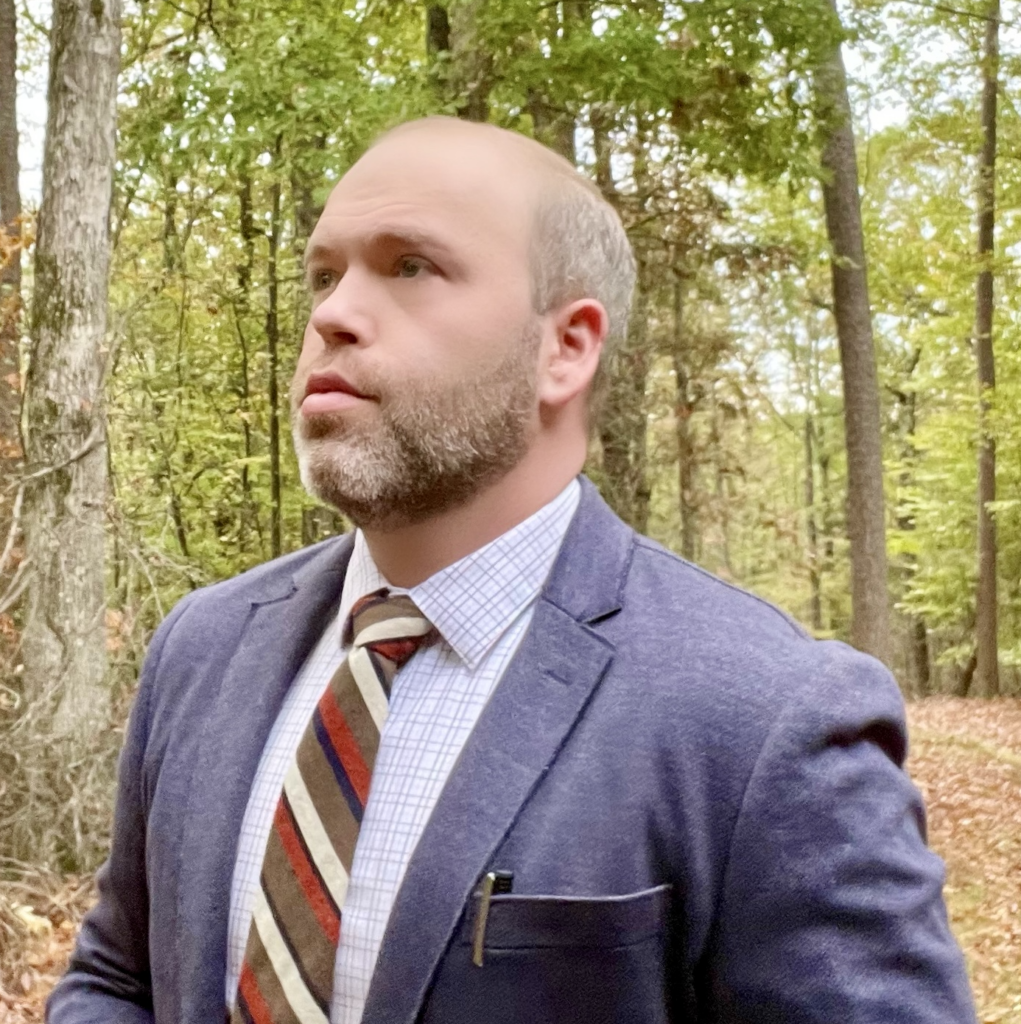
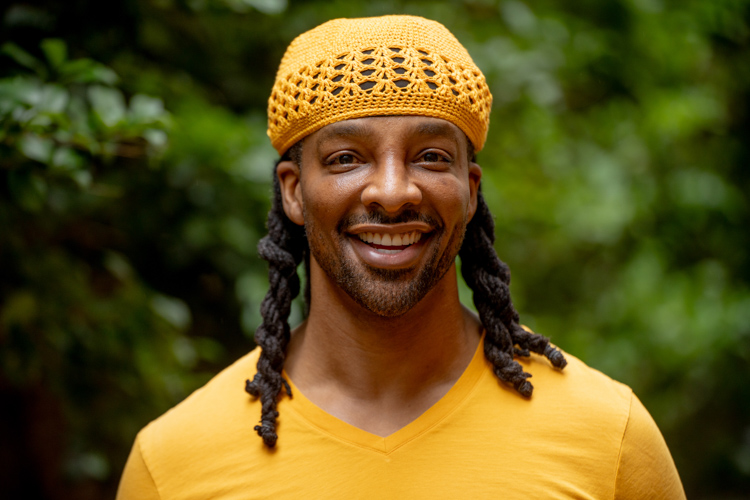
Jericho Brown is author of The Tradition, for which he won the Pulitzer Prize. He is the recipient of fellowships from the MacArthur Foundation, Guggenheim Foundation, the Radcliffe Institute for Advanced Study at Harvard, and the National Endowment for the Arts. Brown’s first book, Please, won the American Book Award. His second book, The New Testament, won the Anisfield-Wolf Book Award. He is the director of the Creative Writing Program and a professor at Emory University.
Eric Solomon is an instructor of English and affiliate faculty with the Center for the Study of Southern Culture at the University of Mississippi. He is editor of the “Queer Intersections” series with the journal Southern Spaces; chair of the LGBTQ+ Historic Preservation Advisory Committee with Historic Atlanta; and serves as cultural historian with the Mayor’s LGBTQ+ Advisory Board for the City of Atlanta. In 2021, Solomon launched The #TUOR Project, a digital story tour of sites of importance in Atlanta’s queer past.
Cover Image Attribution
Reginald Shepherd collage created by and courtesy of Eric Solomon, 2024.
]]>Introducción
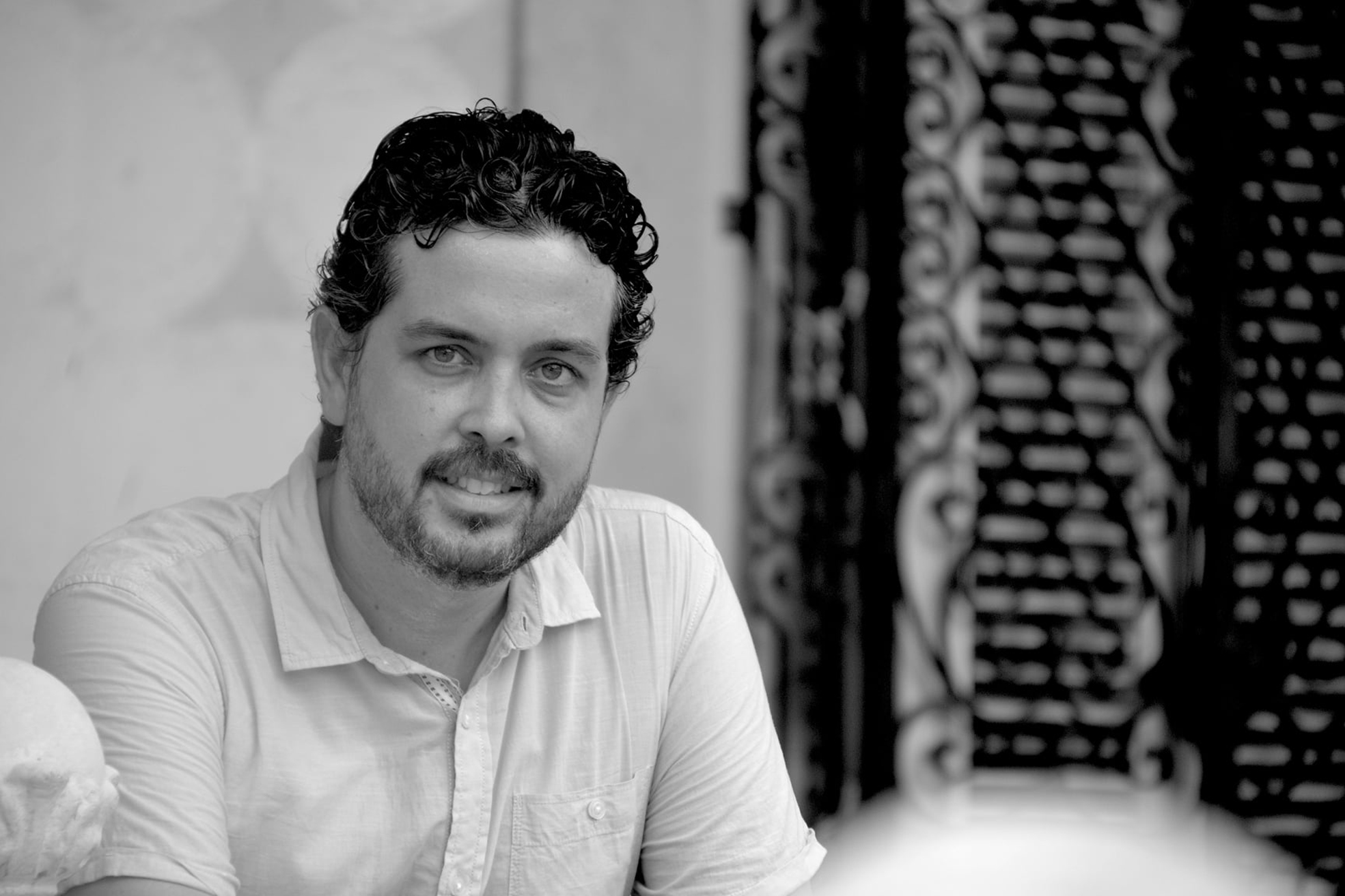
El dramaturgo Abel González Melo nació en 1980 en La Habana, Cuba, mismo año en que el Exodo del Mariel vio a aproximadamente 125,000 personas huir de su país, un evento que dramatiza en su obra de 2018 En ningún lugar del mundo. González Melo estudió Artes Teatrales en la Universidad de las Artes de Cuba. Ha recibido diversos premios y galardones por sus obras literarias y teatrales, entre ellos el Premio Primer Concurso de Dramaturgia de la Embajada de España (2005) por Chamaco, una de las obras más reconocidas de González Melo, y más reciente el prestigioso Premio Literario Casa de las Américas 2020 (enero).
Las obras de González Melo abarcan dos décadas y cubren múltiples temas sociales dentro de la vida cubana. Desde la complicada relación de Cuba con el Exodo del Mariel en En ningún lugar del mundo (2018) hasta la prostitución adolescente a principios de la década de 2000 en La Habana Vieja en su trilogía, Fuga de Invierno (2004–2009), sus obras sumergen al público en las calles que rodean el Capitolio de La Habana, en los parques, callejones y teatros que brindan espacios para la prostitución ilegal, en casas particulares que centran la importancia de la familia para los cubanos. La primera década de la escritura de González Melo problematiza la cultura juvenil cubana de principios de la década de 2000, una cultura a la vez gay y heterosexual, hambrienta y saciada, resistente y complaciente en un país donde la Revolución todavía se lucha a diario en las calles (aunque ahora rodeados por los "WiFi hotspots" aprobados). Mientras González Melo mantiene su identificación sexual privada, sus obras desafían la categorización, preguntan cuestiones de sexualidad y exploran la supervivencia, la mercantilización del cuerpo, el trauma mental intenso, el dolor de la historia y el amor profundo de la familia. Sus personajes se entretejen dentro y fuera de sus obras para demostrar esa complejidad: mientras algunas cosas han cambiado, otras siguen igual de siempre.
La obra más reciente de González Melo pasa a recuperar personajes literarios y episodios de la historia cubana con una perspectiva revisionista. Figuras históricas de la obra de González Melo incluyen la poeta feminista de principios del siglo XX María Luisa Milanés (de Bayamo, Cuba) en Bayamesa (2019), que ganó el premio Casa de las Américas de teatro en enero de 2020. En abordar el tema de la censura en el apogeo de la Revolución en Cuba, la obra más reciente de González Melo presenta personajes históricos cubanos. Fuera del juego dramatiza la experiencia de la figura cultural Heberto Padilla, un poeta venerado cuya obra criticó la Revolución y sus líderes en su momento, 1967–68, resultando en su arresto, tortura y exilio a los Estados Unidos en 1980. Padilla trabajó muchos años en varios puestos en el sistema universitario en los Estados Unidos, como Ohio State University, Bowdoin College y el Instituto de Humanidades de la NYU, antes de morir solo como poeta residente Auburn University en 2000. En su drama más reciente, Cádiz en José Martí (Festival de Teatro Iberoamericano de Cádiz, 2020), González Melo dramatiza al mítico héroe nacional de la isla, el revolucionario José Martí (1853–1895). González Melo lo sitúa en la ciudad española de Cádiz, el primer destino de Martí en su largo exilio y deportación política bajo el régimen colonial.
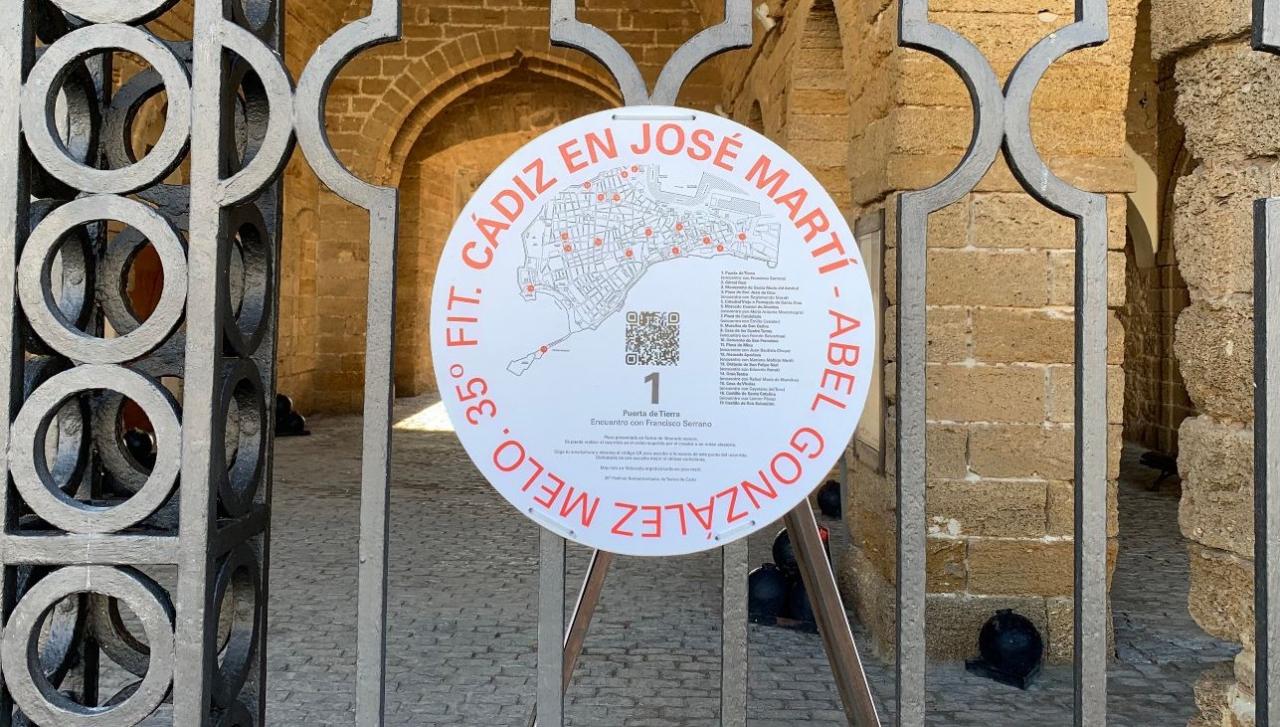
En esta conversación, González Melo explica su proceso creativo e inspiraciones, la experiencia de la migración cubana como material dramático y la idea de refundir la historia para nuevos públicos y tiempos. Habla de cómo se basó en la experiencia actual en La Habana para crear Fuga de invierno y cómo su obra reciente se sumerge profundamente en las preguntas de la comunidad y la familia durante algunos de los momentos más severos de Cuba. González Melo también reflexiona sobre las ligaduras singulares entre Estados Unidos y Cuba. Uno de estos vínculos es la conexión lingüística español-inglés, ya que muchos cubanoamericanos son bilingües. Por lo tanto, aunque esta conversación se llevó a cabo en español, hemos proporcionado traducciones al inglés. [Read the English translation of this interview here.]
Chamaco : El comienzo de todo, o el trabajo inicial de González Melo
Gunnels: ¿Por qué la dramaturgia? ¿Piensas que el teatro es el mejor vehículo para las historias que quieres contar?
González Melo: El teatro tiene algo maravilloso para un escritor: aleja a la literatura de la soledad. Propone la creación en equipo y el contacto directo con el espectador. Ambas cuestiones me resultan muy atractivas: la idea de que la escritura nunca cesa, siempre es reinterpretada en presente, necesita la comunión del director, los actores, los diseñadores, los técnicos, y precisa, indefectiblemente, la complicidad del público. Me deslumbra esa naturaleza inacabada de la escritura dramática, esa urgencia por impactar de modo inmediato. Disfruto escribir narrativa o ensayo, pero en ambos casos extraño el diálogo real con el ser humano. Será porque, cada vez más, la dramaturgia es en mí un proceso relacionado con un grupo humano concreto, una textura imaginada para gravitar sobre una cuerda floja.
Gunnels: ¿Sientes 'inacabada' esa naturaleza porque necesita de otros artistas para completarse, o porque, cada vez que se representa una obra, hay una nueva audiencia que tendrá reacciones distintas?
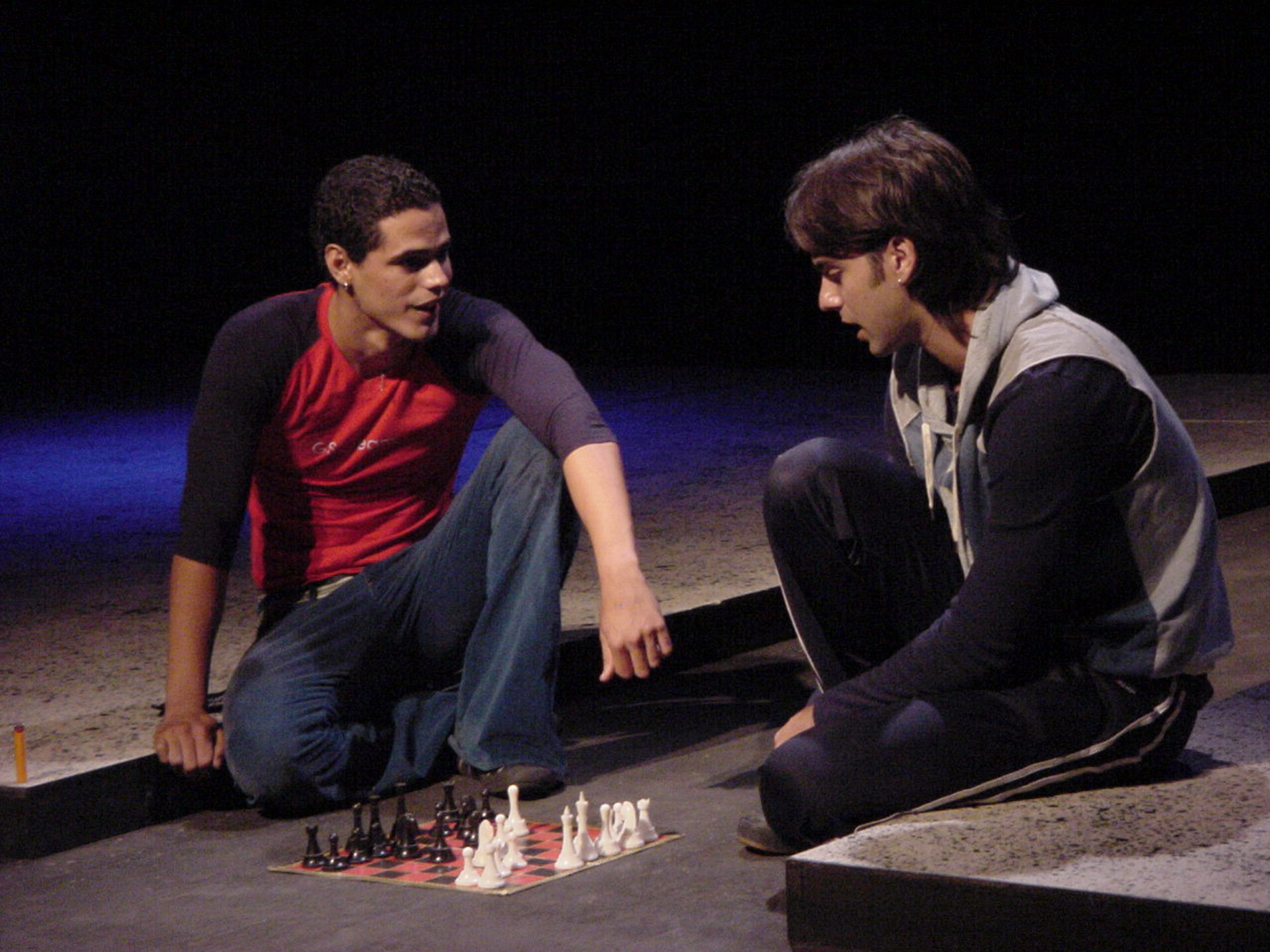
González Melo: El teatro lo hacemos entre todos, los artistas y el público. Basta recordar el origen griego de la palabra "teatro", que significa "mirar". Es decir, solo existimos porque alguien nos mira. Es uno de los mayores placeres de escribir dramaturgia: sentir que uno solo ofrece una guía de acotaciones y parlamentos sobre el papel, solo eso, pero que el personaje tendrá el cuerpo, la voz y el alma de quien lo encarne delante del espectador, que es quien terminará de construirlo en su proceso de recepción activa. ¿Por qué seguimos asistiendo una y otra vez a los estrenos de los clásicos? Pues porque su esencia, más que en el argumento, radica en cómo se cuenta hoy esa historia en el ágora pública: quiénes la ejecutan, por qué deciden hacerla, en qué contexto y ante quiénes, qué sentidos nacen de esa experiencia.
Gunnels: Quisiera pintar la escencia de la triología Fugas de invierno para la audiencia antes de que lo comentemos.
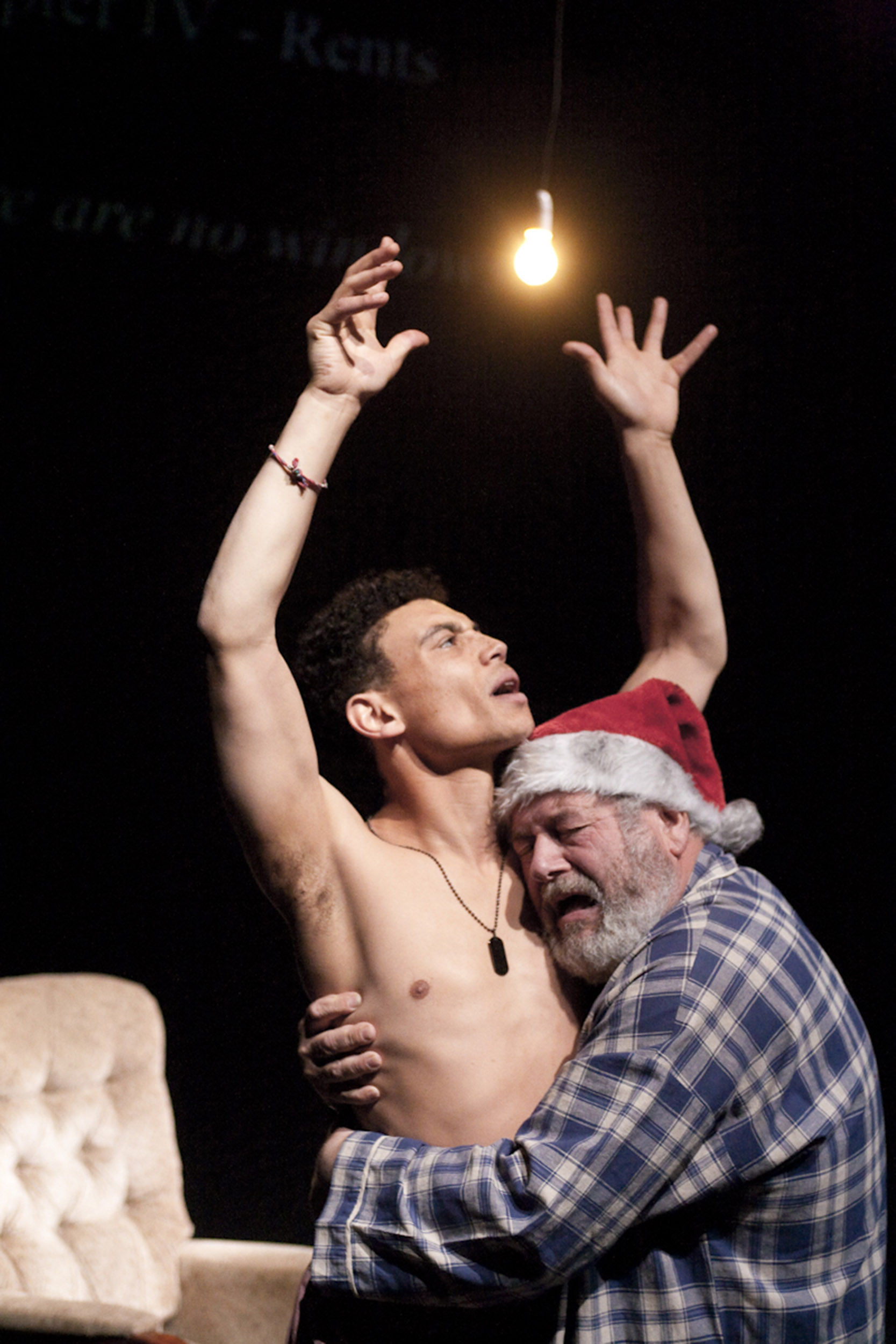
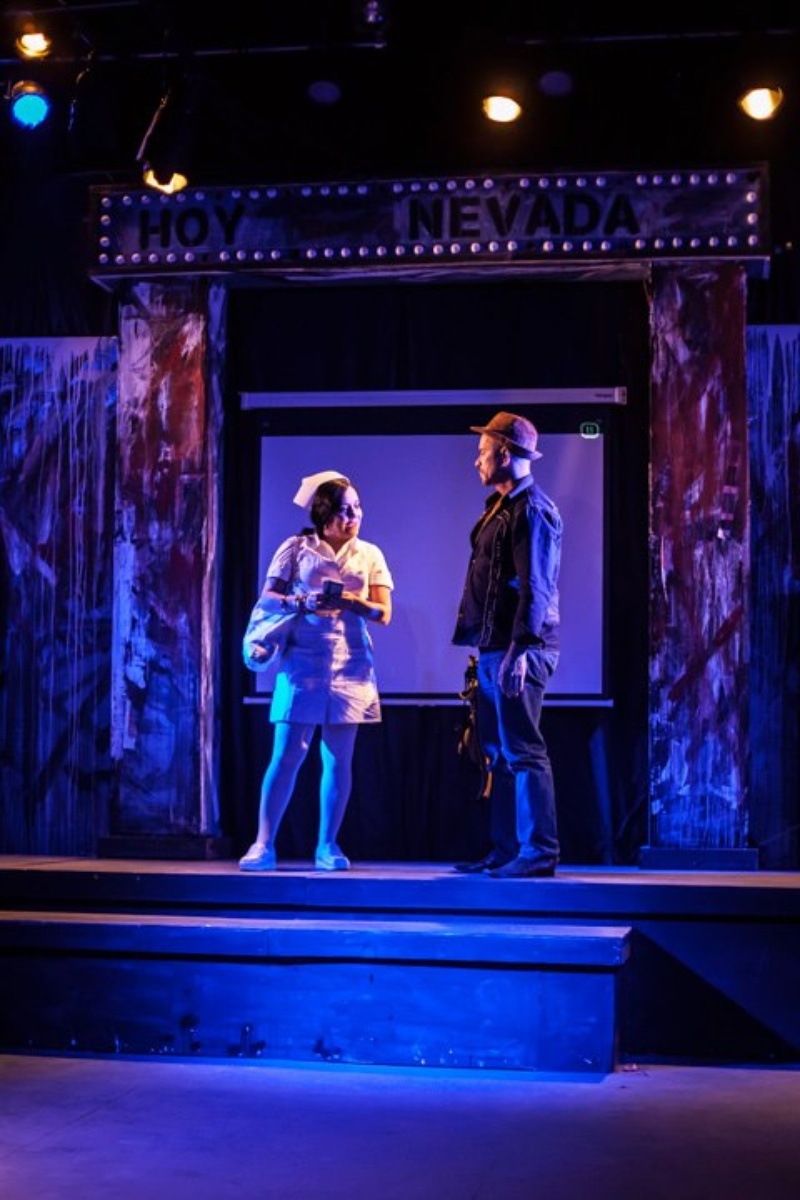
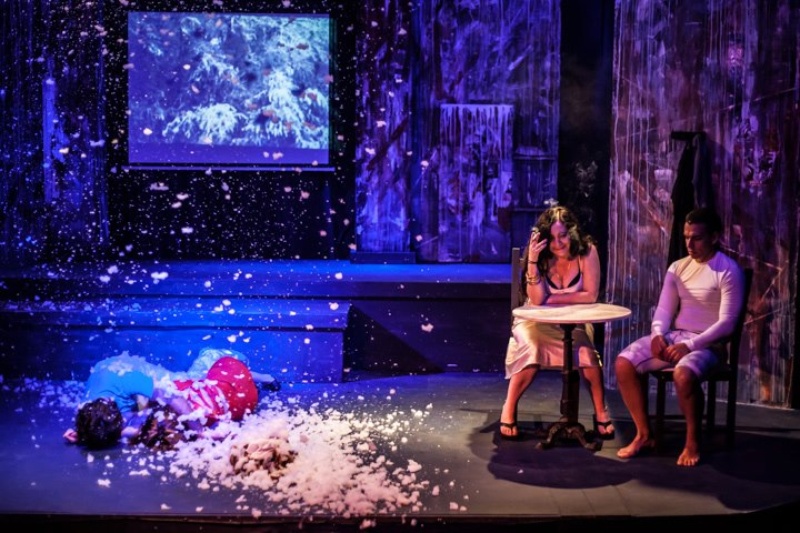
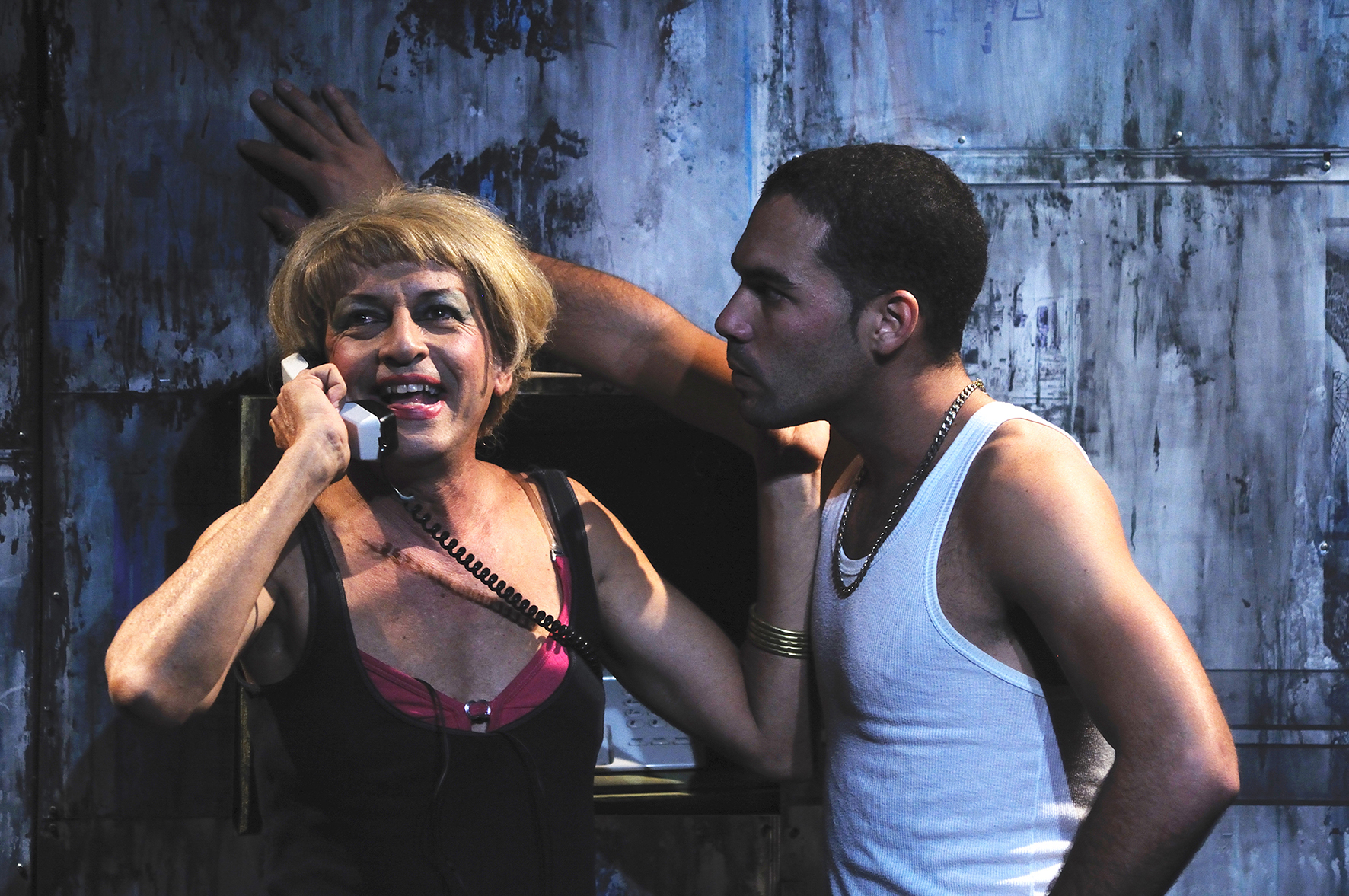
Chamaco (Kiddo, 2004, traducción al inglés de William Gregory) es la primera entrega de la trilogía.1Hay dos traducciones publicadas. William Gregory tradujo los dos Chamaco y Nevada; Yael Prizant tradujo la triología en versión bi-lingual con prensa distinta. Chamaco se ha representado a nivel mundial, desde el Teatro Argos en La Habana hasta Manchester, el Teatro HOME de Inglaterra, hasta la traducción más reciente al checo, con la producción en Praga programada para el otoño de 2021. La trilogía, que incluye Nevada y Talco (la segunda y tercera entrega), cubre un lapso de tres meses en un invierno tropical del descontento, como escribe la crítica de teatro y académica titular Lillian Manzor "the trilogy addresses concerns that are dear to the author and his generation, namely: the complex and contradictory ways in which homosexuality, sex, and migration from the countryside to the capital becomes means of survival in a society that has lost all sense of value."2Lillian Manxor and Austin Webber, "Ground Down to Nothing but Still Fighting." Hemispheric Institute of Performance and Politics. Accessed March 25, 2021. https://hemisphericinstitute.org/en/emisferica-82/manzor-webbert.html. Chamaco sumerge a los espectadores en la Nochebuena en La Habana, donde una hermana espera con inquietud que su hermano regrese a casa para una cena que nunca comerá, ya que sin saberlo ella, murió en una pelea con cuchillas. Nevada sigue a Lucía y su novio/chulo Rosnay cuando se encuentran con la realidad de vender sus cuerpos en el esfuerzo por salir o escapar, en este caso, al estado de Nevada, donde la prostitución es legal, y los "dulces vienen envueltos en papel de brillo". Talco, la última entrega, retrata una realidad cruda y sucia que se desarrolla principalmente en el baño de un antiguo cine utilizado para el tráfico y la prostitución, donde los caminos de cuatro personajes—Javi, Máshenka, Zuleidy y Álvaro—se entrecruzan en una batalla violenta y tensa de supervivencia. A la trilogía la siguen casi veinte obras más, muchas de las cuales han sido traducidas a varios idiomas y representadas tanto en Estados Unidos como en el extranjero. Abel, esta trilogía realmente centra la experiencia de la juventud cubana. Describe la importancia de dar voz a la gente joven cubana en las obras que has escrito.
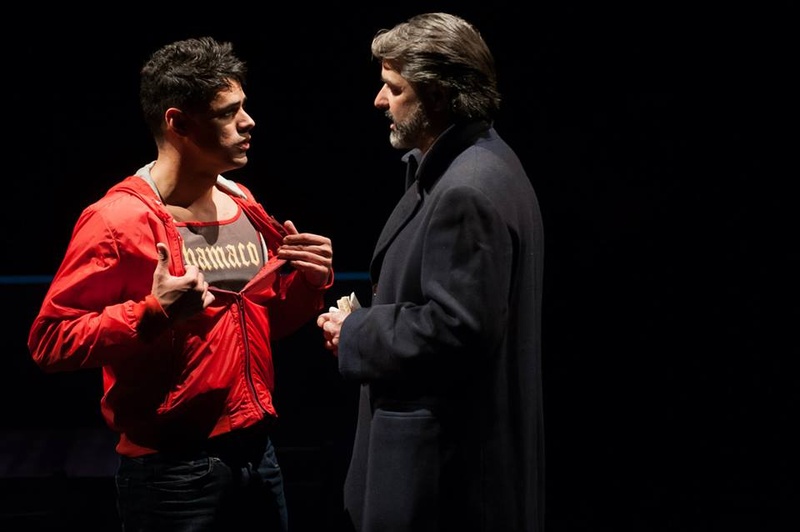
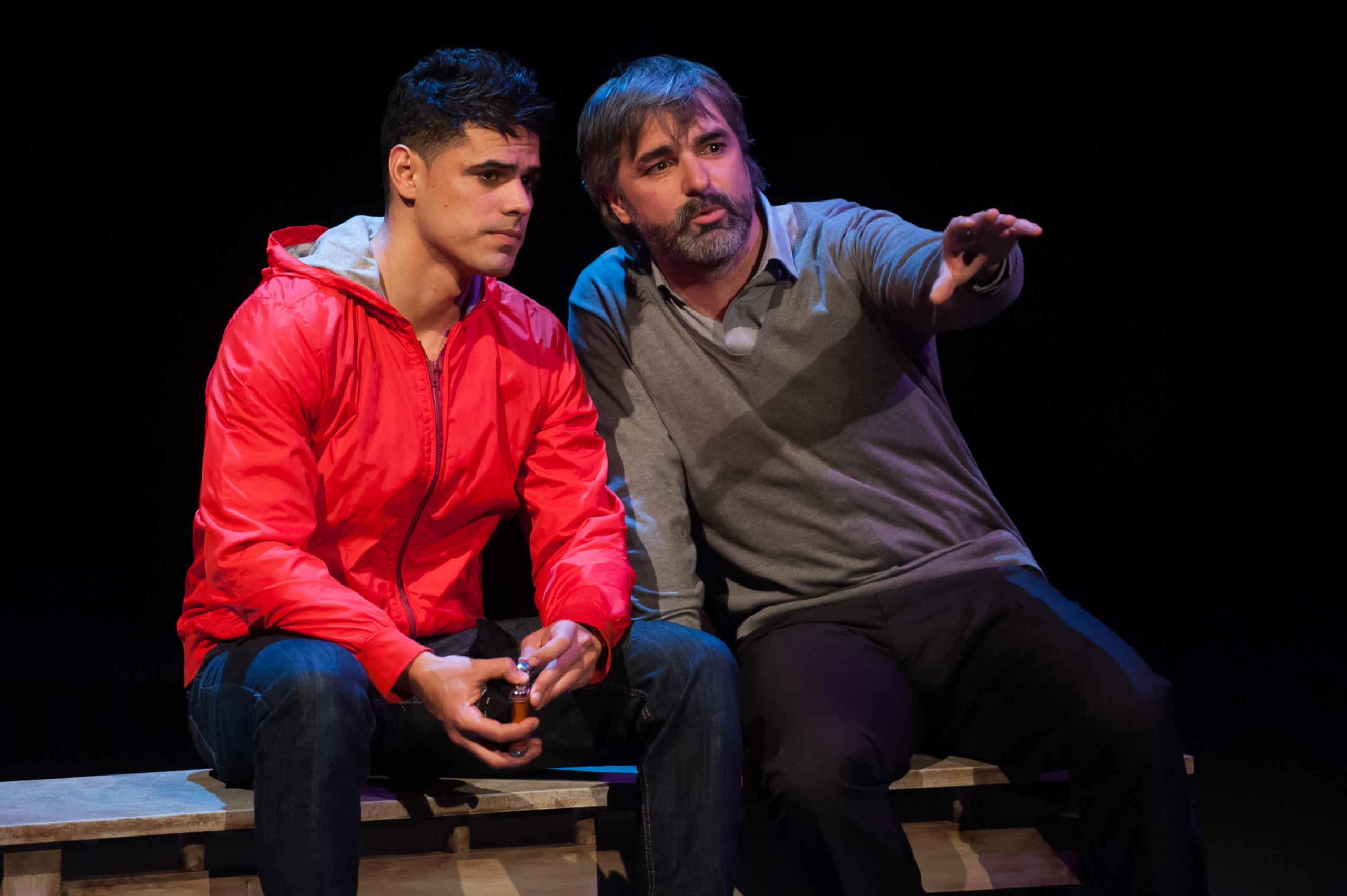


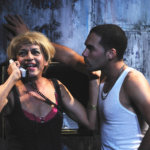
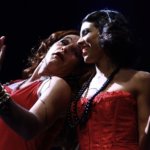
González Melo: Ahora que lo comentas, pienso que los protagonistas de mis obras han ido teniendo mi edad en el momento de escritura, y en cada texto van siendo mayores estos personajes porque crecen conmigo. He querido llenarlos de mis dudas, mis afectos, mis dolores. Son la imagen sublimada de mí mismo en medio del mundo en que he crecido: la Cuba de entresiglos, y desde hace algo más de una década también la España del XXI. Vivo a caballo entre los dos países y los observo a ambos con una mezcla de pasión y extrañeza. No puedo hablar de todos los jóvenes como una masa, eso no sé hacerlo, pero sí de mí en el paso de la adolescencia a la juventud: esas pulsiones son las que habitan mi teatro. Ojalá tengan que ver con las de otras personas.
Gunnels: Dime más sobre eso que llamas 'pasión y entrañeza.'
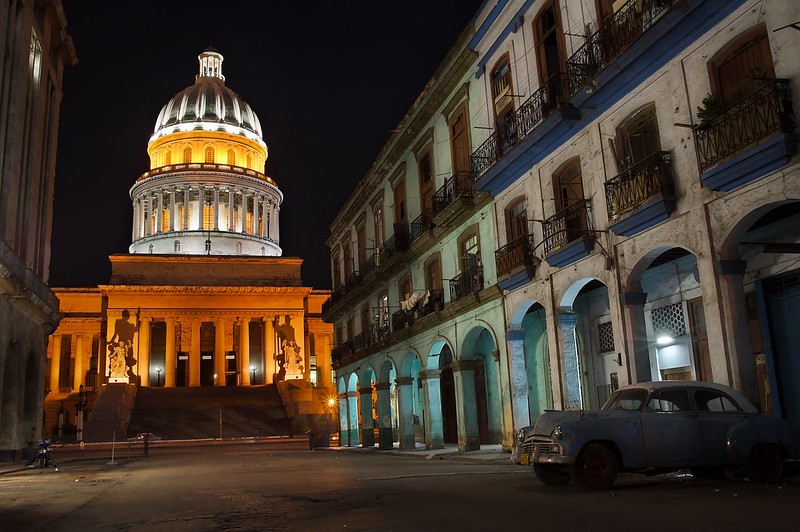
González Melo: Recuerdo que a principios de los 2000, cuando atravesaba en la noche la Habana Vieja rumbo a mi casa, me despertaban enorme curiosidad las decenas de adolescentes que aguardaban apoyados en las columnas, frente al Capitolio, o rondando el Parque Central, en medio de la zona turística. ¿Qué hacía toda esta gente aquí? ¿Quiénes eran? Poco a poco fui acercándome a ellos, muchos vivían clandestinamente en La Habana, habían emigrado desde el Oriente de la isla. Todos se prostituían, o aspiraban a hacerlo.3Una nota de González Melo: "Aquí estamos hablando, si hay que aclararlo, solo de cisgender masculinos. Yo no soy expert en estudios y terminology de género, pero los trans y las chicas están, como explico, en otras zonas de la ciudad." Supe de historias fascinantes, terribles. Irlos descubriendo a fondo no fue sencillo, ninguno iba a darme una entrevista sin más y contarme su vida. Me convertí en discreto cliente, ahorraba dinero y me iba con alguno de ellos a un cuartico de alquiler. En la fugacidad de ese rato de extraño placer me mantenía alerta: los escuchaba hablar de sus vidas, de sus hijos pequeños a quienes tenían que alimentar, de sus mujeres conscientes de que ellos se dedicaban a la cacería de extranjeros o cubanos que pudieran pagar por sexo. Mi investigación fue ampliándose, una cosa me llevó a la otra, fui componiendo el mapa de la marginalidad nocturna de la Habana Vieja: la zona de las prostitutas estaba en el cruce de las calles Monte y Cienfuegos; los travestis y transexuales aguardaban a sus clientes en el Parque de la Fraternidad; la droga se vendía en un cine abandonado, etc. Me sumergí de lleno. Hice cosas impensables durante aquellos años, cosas que hoy no haría. Pero por suerte me atreví a hacerlo: quería conocer a fondo a estas personas, sus lugares, sus razones, todo ese ambiente que la prensa oficial no publicaba. Tres o cuatro años de inmersión. Tras concluir Chamaco, tenía aún tanto material acumulado que nacieron Nevada y Talco. También en obras como Por gusto y Adentro hay huellas de este universo.
Gunnels: Por mi parte, Lucía de Nevada y María Luisa de Bayamesa me conmuevan por su necesidad de enfrentarse al mundo, al exterior hostil, pero con persistencia y amor por la familia. Son fuertes ejemplos feministas para cualquier generación. Y Lucía, con su vestido rojo, es singular para mí. ¿Hay un ángel en tu obra, un personaje que realmente te conmociona?
González Melo: No suelo partir de la emoción en los procesos de escritura. Soy bastante técnico, algo que aprendí con mi maestra Raquel Carrió (gran autora nuestra, fundadora en 1976 de la carrera de Dramaturgia en la Universidad de las Artes de Cuba): la tríada estructura-personaje-lenguaje es la base de la preparación de mis proyectos. Creo que la emoción llega (o no) en paralelo a (o luego de) la apreciación de la experiencia. La emoción estará entonces en el receptor. Pero para que eso pueda suceder, la construcción misma del texto o del espectáculo ha de ser precisa, nítida, no puede partir del deseo de emocionar, porque se desfigura. A veces siento que la emoción enturbia la objetividad de lo que ocurre: sucede mucho con los actores que actúan "emocionados" y, entonces, sobreactúan; o con los dramaturgos que se sobreemocionan con lo que están haciendo y pierden el rumbo de la acción, pierden síntesis.
Sí es verdad que alguna vez he tenido experiencias singulares, yo diría que místicas, durante la escritura misma, como me sucedió con Chamaco, que sentí que alguien me la dictaba al oído. Estaba muy reciente la violenta muerte de mi padre y el monólogo de Silvia, cuando se entera de que han asesinado a su hermano, lo escribí deshecho en llanto. Siempre he creído que Chamaco es mi padre que se convirtió en ángel para dictarme esta obra y que me acompaña desde entonces.
La historia se repite
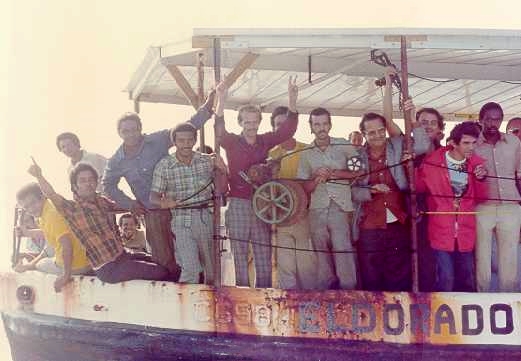
Sobre todo en sus dramas más recientes, Abel González Melo ha cambiado de describir experiencias personales en su trabajo a referenciar y dramatizar puntos de contacto históricos cubanos (como el Éxodo Mariel, los UMAP (Unidades Militares de Ayuda a la Producción), el Quinquenio Gris y el Período Especial. El Éxodo Mariel constituye la migración masiva más grande de Cuba en su historia. De abril a octubre de 1980, se estima que ~125.000 cubanos salieron del Puerto Mariel para los Estados Unidos. La historia fue bien cubierta en los medios de comunicación: un pequeño grupo de cubanos tropezó un autobús urbano hasta las puertas de la Embajada peruana en La Habana en un intento de pisar tierra allí y solicitar asilo político (y eventualmente salir de la isla). Se les concedió asilo y, después, más de 10,000 personas se acercaron a la embajada con las mismas esperanzas. Al ver esta situación desarrollarse desde los Estados Unidos, el presidente Jimmy Carter emitió una invitación abierta a cualquier persona de Cuba que huyera del régimen de Castro, evitando en parte la política y el procedimiento de inmigración de los Estados Unidos. Siguió un giro típico de Castro: después de un discurso muy público el primer de mayo, el Día del Trabajador, en la Plaza de la Revolución de La Habana, vació las cárceles y hospitales de Cuba de criminales condenados y enfermos y requirió cualquier embarcación estadounidense que fuera a recoger a familiares o seres queridos para llevar del Puerto Mariel también consigo un barco lleno de otros 'indeseables', en los que incluía hombres homosexuales y personas con problemas psiquiátricos. Como señala González Melo en nuestra conversación a continuación, la historia de Cuba con los hombres homosexuales está marcada por una trágica discriminación, tortura y muerte. Los históricos campos de trabajo de la UMAP (en español, Unidades Militares de Ayuda de la Producción) que sirvieron como un tipo de prisión laboral de 1965 a 1968 en Camagüey, Cuba, fueron politizados como campos agrícolas para "objetores de conciencia", pero fueron más una especie de "purga" social de cualquier persona que fuera considerada anticastrista o antirrevolucionaria, afirma el historiador Abel Sierra Madero.4Abel Sierra Madero, "Academies to Produce Macho-Men in Cuba." Translated by Alicia Barraqué Ellison. Translating Cuba. February 19, 2016. https://translatingcuba.com/academies-to-produce-macho-men-in-cuba-abel-sierra-madero/. Esto incluyó a los acusados de homosexualidad.
Siguiente de los años de la UMAP hay un período de poco más de cinco años (1971–1977) conocido como el quinquenio gris en el que el gobierno cubano controlaba rígidamente las producciones culturales y artísticas de la isla. Esto período limitó severamente la expresión y la publicación artísticas. Varios de los dramaturgos más destacados de Cuba, como Virgilio Piñera (1912–1979), Abelardo Estorino (1925–2013) y Antón Arrufat (1935–), sufrieron tremendamente bajo esta censura, tanto por su insistencia en la libertad creativa como por su homosexualidad. Rodeados de un ambiente hostil, los tres utilizaron la metáfora como forma de expresión, siempre tratando de evitar la censura. La obra de Piñera preguntó en términos amplios conceptos de identidad nacional y la parte del escritor como resistor. Un prolífico escritor de ensayos, cuentos y teatro, las colecciones de Piñera como Cold Tales (1956) y Little Maneuvers (1963) fueron acreditadas por inspirar a generaciones de escritores que vendrán después, incluso el autor conocido del Mariel, Reinaldo Arenas. Abelardo Estorino, que antes fue censurado con su obra Los mangos de Caín (1965), solo escribió un texto en los años 70 y en cambio se dedicó a la dirección de clásicos en la Compañía Teatro Estudio. Antón Arrufat recibió altos honores de la UNEAC por Los siete contra Tebas en 1968, pero esa institución publicó el libro con una nota que acusaba al escritor de ser un contrarrevolucionario; Arrufat fue condenado, y no publicó más por una década.
Finalmente, la inmigración hacia y desde La Habana varió drásticamente desde la década de 1960 hasta la actualidad, y las leyes que prohíben el reingreso, así como la relación política y acre entre los Estados Unidos y el régimen de Castro, crearon una forma estratificada de entender el hogar, la comunidad, y exilio. A principios de la década de 1960 se produjo un éxodo de las clases media y alta, que en su mayor parte aterrizaron en el sur de Florida y se quedaron. Después del Éxodo Mariel, la política de inmigración estadounidense de mediados de la década 90 llevó a un aumento de la inmigración de la isla, ya que 'pie mojado, pie seco' permitió acelerar los procedimientos de inmigración de EE.UU. para cubanos. El aumento de balseros es notable durante este Período Especial. De estas grandes olas de inmigración, Mariel se distingue por la demografía de la población, así como por el giro politizado en ambos lados: ese grupo fue menos aceptado por los cubanos en la isla y experimentó una integración más dura en su nueva comunidad del sur de Florida.5Aviva Chomsky, A History of the Cuban Revolution, 2nd ed. (Hoboken, NJ: Wiley-Blackwell, 2015), 75.
González Melo es descendiente de estos primeros dramaturgos cubanos así como heredero de esta historia enredada. En la conversación que sigue, González Melo reflexiona sobre la realidad del hombre "gay" en Cuba antes y después de Mariel, y cómo esta faceta de la historia cubana encuentra su camino en sus obras dramáticas. En particular, su obra Fuera del juego revisa el Caso Padilla y la UMAP, destacando la censura subversiva y la tortura psicológica de los artistas en los primeros años de la Revolución. Su obra Bayamesa se remonta a lo más lejano de la historia cubana, para abordar temas de la tradición colonialista, los roles de género y el feminismo en Cuba.
Gunnels: Describe los cambios, si los hubiera, en la realidad del hombre gay en Cuba desde que escribiste Chamaco (2004) hasta En ningún lugar del mundo (2018).
González Melo: El lapso que dices comprende poco más de una década y no creo que los cambios hayan sido muy apreciables. La Revolución no se ha comportado de modo precisamente bondadoso con los homosexuales, quienes fueron considerados durante mucho tiempo lacras sociales y enviados entre 1965 y 1968 a campos de trabajo llamados UMAP (Unidades Militares de Ayuda a la Producción). Todo ese proceso acrecentó el machismo y la homofobia en nuestra sociedad. En la obra de grandes dramaturgos cubanos, que además eran homosexuales (pienso en Virgilio Piñera, Abelardo Estorino o Antón Arrufat), el tema no aparece o aparece muy escamoteado, quizás a causa de la autocensura: después de las UMAP vinieron los terribles años 70 y sus políticas de marginación a homosexuales artistas. A mi generación le ha tocado una etapa un poco más amable, aunque la homofobia persiste y ha encontrado vías soterradas para manifestarse. En lo personal he podido abordar el tema gay en textos que se han publicado y estrenado dentro de la isla, han aparecido antologías de poesía y narrativa homoeróticas, etc. Se ha intentado incluir, en la enmienda a la Constitución, la noción del matrimonio igualitario que ya es una realidad en tantos países del mundo: pero durante demasiados años el propio gobierno ha sembrado el odio hacia los homosexuales, y la mentalidad del pueblo no puede cambiarse de un día para otro.
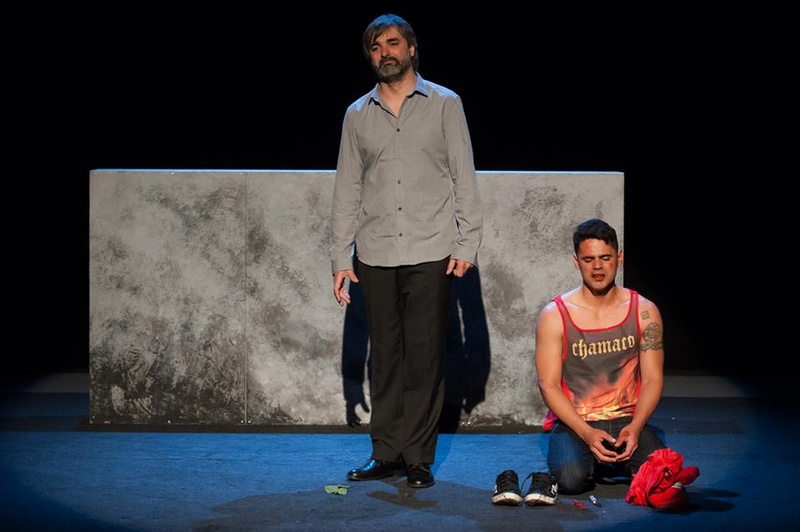
Gunnels: ¿Puede el teatro cambiar a un pueblo? ¿El poder del arte o interrogación?
González Melo: Ni el teatro ni ninguna otra manifestación artística pueden cambiar una sociedad. Sería demasiado pretencioso pensar que sí. He escuchado frases como "el arte cambia el mundo" y siempre siento que tienen un sentido figurado, metafórico. El teatro no es un partido político, no es un ejército, no es una bomba atómica ni una pandemia: no tiene ese poder de cambio brusco, inmediato, contundente. Lo que sí puede el teatro, confío en que sí, es tocar la mente y el corazón de una persona, de un espectador que asiste a una función y descubre otro modo de mirar, se identifica en ese espejo, encuentra algo que le lastima en lo profundo. El teatro transforma, en ese sentido, al individuo y no a la masa, aunque la experiencia de nuestro arte la tengamos en colectivo. El teatro trabaja siempre (en su ejecución, en su recepción) el comportamiento particular, no la generalidad. Tocamos a una persona, y esa persona tendrá en alguna ocasión, quizás, la oportunidad de tocar las cosas que mueven el mundo. Esa es la sencilla y hermosa condición de nuestro arte.
Gunnels: Su obra de 2018 En ningún lugar del mundo (Nowhere in the World) aborda el silencio en torno a la identidad sexual en Cuba (desde los años 80 hasta la actualidad), tanto como temas de visibilidad gay y el trauma del servicio militar, a través del protagonista Ángel se aprecia el dolor agudo del Mariel tanto para los que se fueron como para los que se quedaron. Cuba tiene una historia de trece años en África (1975–1988), con fuerzas militares cubanas sobre el terreno en nombre de la liberación de Sudáfrica durante ese tiempo. La asociación militar terminó con la independencia de Namibia y, según algunos, el comienzo de la retirada del apartheid en la zona. No obstante, las fuerzas cubanas regresaron con problemas psicológicos, y el drama de En ningún lugar del mundo vuelve a visitar esa época, así como el trauma inminente del Mariel. Ángel, como protagonista, sale de Cuba con el éxodo del 1980, y el drama comienza con su regreso a Cuba después del Mariel, solo para descubrir que el trauma entre familias es profundo e implacable. ¿Cómo entiendes el legado de la generación del Mariel a otros artistas cubanos que han escrito en exilio, forzado o no?
González Melo: El protagonista de En ningún lugar del mundo fue forzado a abandonar Cuba en 1980 por el Mariel, debido a problemas psiquiátricos (sí, algo despiadado: los enfermos mentales eran considerados directamente escoria), cuando en realidad la familia se lo quería "quitar de encima" por sus violentos testimonios de la dura experiencia de tres años como soldado en la Guerra de Angola. La historia de nuestros exilios está llena de gente anónima que no ha dado su testimonio porque aún sigue traumatizada. El Mariel es un entorno demasiado amplio y diverso que escapa a catalogaciones homogéneas. Lo más importante, pienso, es lo que significó como fenómeno, y los miles de cubanos que pudieron (que se vieron en la obligación de) integrarse a la cultura norteamericana y, al mismo tiempo, enriquecerla con su acción directa. No puede entenderse la cultura y la sociedad de Miami hoy sin sumar las capas de exilios que esa ciudad ha asumido. En lo personal admiro mucho la voluntad y la resistencia de las generaciones de cubanos exiliados que han reinventado el concepto de patria.
Gunnels: ¿Qué piensas sobre los dramaturgos que vivieron la época del éxodo del Mariel en Cuba pero permanecieron? Pienso particularmente en Ulises Rodríguez Febles y su obra Huevos. Ya hablamos sobre la idea de salir, ¿pero qué pasa con los que se quedan?
González Melo: El Mariel ha sido relatado brillantemente por dramaturgos que se mantienen creando en la isla, como el propio Ulises en Huevos o Carlos Celdrán en Diez millones. Los dos eran muy jóvenes en 1980 pero han logrado imprimir a sus textos, llenos de matices autobiográficos, un carácter que supera la reconstrucción histórica. Me gusta eso, que podamos sacudirnos el polvo de la cotidianidad, que tanta energía nos roba, y mirar nuestra historia y nuestro porvenir con altura. Ellos viven en Cuba, sí, pero poseen una reconocida carrera internacional: Ulises ha triunfado recientemente en México con una obra que curiosamente reconstruye la trayectoria de otro artista exiliado, Dámaso Pérez Prado, y Celdrán ha paseado sus Diez millones por importantes festivales del mundo. Cada vez la frontera entre el afuera y el adentro, entre irse y quedarse, es más permeable y menos estricta. Por suerte.
El teatro disecado: El proyecto persistente de González Melo
Gunnels: ¿Cómo afectó crecer durante el Período Especial a la trayectoria o temario de tu obra, y la influencia de otros poderes mundiales (como Rusia) en tu país?
González Melo: Es inevitable la influencia. Mi niñez estuvo colmada del imaginario ruso y soviético: esa huella es evidente, por ejemplo, en mi obra Talco, pero también en parte de mis cuentos y en mi pasión por esa cultura. Estudié el bachillerato en una escuela vocacional llamada precisamente "Lenin": fue entre los años 1994 y 1997, en régimen interno. Allí padecí la escasez (de alimentos, de luz eléctrica, de recursos sanitarios) pero también descubrí la solidaridad. Allí sufrí acoso escolar pero pude formarme como alguien independiente. De esa experiencia llena de contrastes nació mi primer libro: Memorias de cera. Y esa etapa, en pleno Período Especial, marcó mi interés por la paradoja en que hemos vivido los cubanos: gritar consignas heroicas en la Plaza de la Revolución durante los desfiles, y al mismo tiempo estar muriéndonos de hambre en casa y susurrando por los rincones nuestra miseria de vida. El Período Especial ajustó el nivel de vida de la sociedad y acrecentó las diferencias de clase, el clientelismo, el mercado negro, la corrupción en todos los ámbitos. Esa doble moral atraviesa mi literatura: personajes que precisan, a toda costa, ponerse máscaras para seguir sobreviviendo.
Gunnels: En Nevada, un tema primordial es el deseo de salir. ¿Cómo ves este sentimiento a través de otras obras que has escrito, y de dónde viene? ¿Puedes profundizar un poco en la naturaleza de la relación Cuba/Estados Unidos y este deseo de salir de la isla, especialmente en esta época de inestabilidad inmigratoria?
González Melo: Nacer en una isla condiciona el deseo de ir más allá de las fronteras inmediatas que el mar impone. Ya Virgilio Piñera lo resumía en una imagen: "La maldita circunstancia del agua por todas partes". La isla es encierro y anhelo de partir para, en mi caso, tener la oportunidad de volver. Ha sido una constante cubana la necesidad de huir de la isla, acrecentada por factores políticos y económicos en la etapa de la Revolución. Mi propio padre tuvo que exiliarse en México con el fin de garantizarnos una mejor vida: no hablo de lujos, sino de tener dinero para comer, para asearnos, para transportarnos… Como la mayor diáspora se ha dado hacia Estados Unidos, tenemos con ese país una relación muy estrecha. En mi tesis doctoral estudio precisamente los vínculos entre familia y exilio en la dramaturgia de la Gran Cuba, entendida como la generada tanto en la isla como en el extranjero: me gusta esa idea de patria expandida, no sujeta a límites físicos, sino más bien a sensaciones y ámbitos en común. Esa intención recorre gran parte de mi obra como elemento de nuestra idiosincrasia: partir y regresar. Nevada y Adentro hablan del viaje clandestino por mar y los riesgos que ello supone. En Sistema, la tensión se halla justamente en que el protagonista es atrapado en Miami y no puede volver. Epopeya, Intemperie o En ningún lugar del mundo diseñan el arco que va desde el destierro hasta el regreso al paso de los años, y todo lo que ese reencuentro comporta.
Gunnels: Pero para los Marielitos, a quienes se les aseguró que una vez salieran de Cuba no podrían volver a ella jamás, el exilio ha sido y es especialmente doloroso. ¿Te interesa con En ningún lugar del mundo diseccionar el impacto que ha tenido en esa comunidad el dolor ante el regreso a la isla, que finalmente fue posible?
González Melo: Por supuesto. El Mariel y la Guerra de Angola son asuntos que apenas hemos tratado en la escritura nacional pero sus huellas siguen ahí: son heridas no cerradas, y algo de ello he intentado tocar con En ningún lugar del mundo. La estructura familiar ha sido, en la tradición de la dramaturgia cubana, el núcleo a través del cual observar los grandes temas sociales y políticos. Esto tiene que ver con lo que antes te comentaba: el teatro solo funciona desde lo particular y no desde lo general. Los procesos históricos se analizan en libros, artículos, entrevistas, en amplios fondos bibliográficos y documentales. Una obra de teatro no puede contener todo ese proceso, todas las vidas malgastadas en el intento de construir determinado proyecto político-social. Lo que sí puede una obra es aguzar la mirada, focalizar un pequeño grupo humano y aplicarle el escalpelo. Utilizas el verbo adecuado: diseccionar. Como dramaturgo me siento exactamente así: Cuba es mi quirófano, esa familia destrozada es el cuerpo que yace sobre la camilla, y he de aplicar el bisturí con precaución, con suma responsabilidad, intentando llegar a la raíz del dolor.
Gunnels: Es verdad lo que antes decías, que hay una relación muy estrecha entre Cuba y Estados Unidos. ¿Dirías que las experiencias que has tenido en Estados Unidos como dramaturgo cubano hayan sido particularmente reveladores en cuanto a entender esta relación?
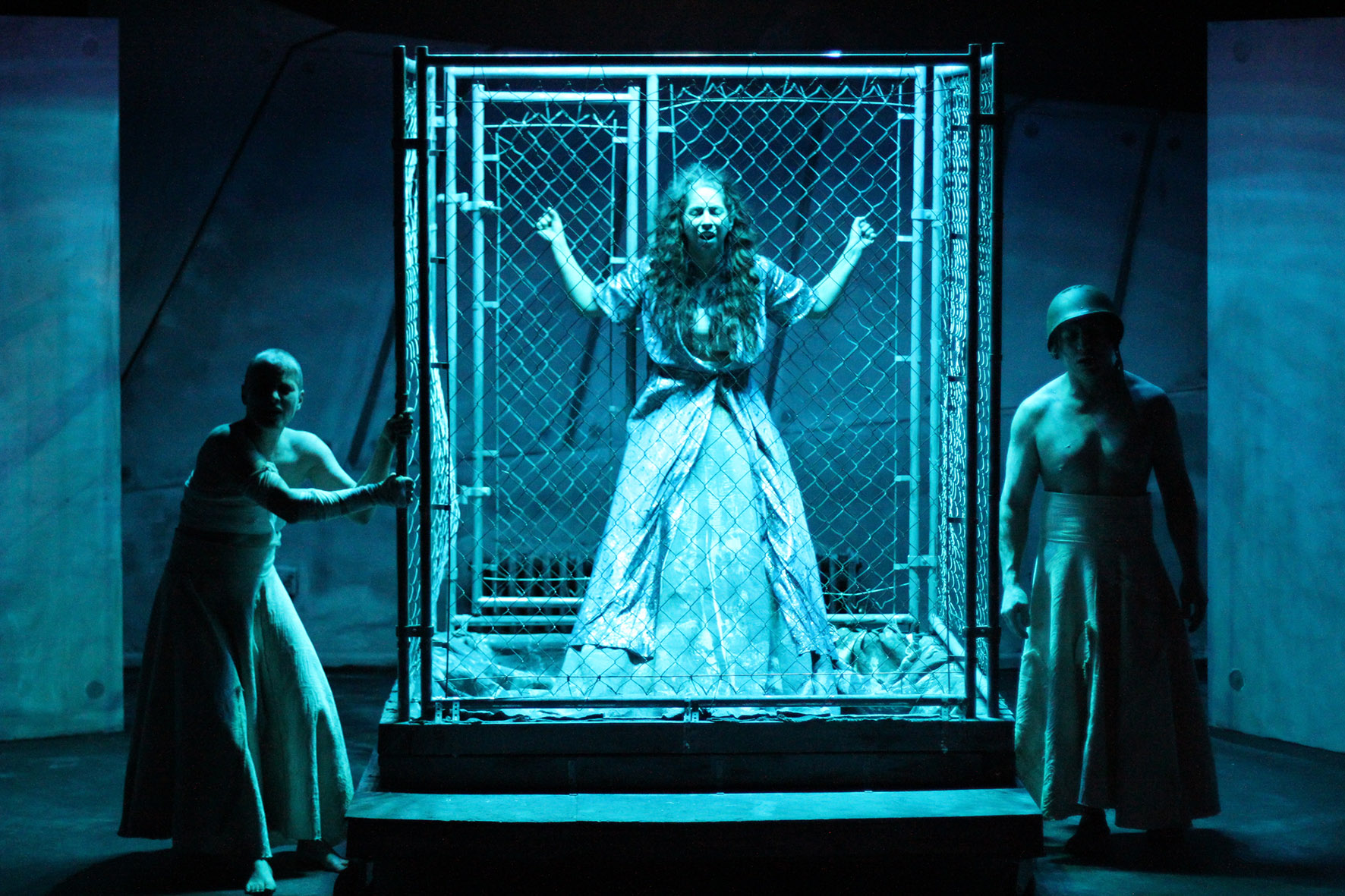
González Melo: Han sido experiencias muy diversas. En Chicago, por ejemplo, Aguijón Theater ha estrenado Adentro y Epopeya; a pesar de ser textos de marcadas referencias nacionales y de que un cubano (Sándor Menéndez) los dirigió, en ambos casos se produjo un rico diálogo con una comunidad latina más amplia, gracias también a las excelentes traducciones de Marcela Muñoz: actores, equipo artístico y espectadores asumían como suyos los temas del desarraigo y la frustración política. Algo similar sentí con el estreno de Por gusto en Repertorio Español de New York, y eso que también era cubana Leyma López, la directora: la desilusión incesante de la juventud y la monotonía de la existencia circular resultaban cuestiones afines a un elenco multinacional. Cuando Ohio Northern University produjo Nevada, recuerdo que les interesaba mucho el estudio minucioso del contexto: parte del equipo visitó la isla y el montaje contó con proyecciones documentales, que contrastaban deliciosamente con la dramatización del texto en inglés, a cargo del mexicano Otto Minera y con traducción de Yael Prizant. En Miami, donde la comunidad hispana es también amplia y variada, la confrontación esencial ha sido con el público cubano, que lógicamente resulta el más interesado, por experiencia directa o por referencia, en ficciones sobre La Habana marginal de Chamaco, Talco y Nevada, obras que Alberto Sarraín dirigió. Siento que el estreno de En ningún lugar del mundo en el XXXIII Festival Internacional de Teatro Hispano, en producción de Teatro Avante, dirigido por Mario Ernesto Sánchez y con traducción de Marian Prío, ha dimensionado aún más el debate sobre la tensión Cuba/Estados Unidos, que es el conflicto entre quienes se quedaron y quienes se fueron. Menciono siempre a las traductoras pues considero esencial su labor y su dedicación: ellas, y mi traductor británico William Gregory, han sido los responsables de que mis textos queden tan bien reescritos en esa lengua.
Gunnels: ¿Cómo escoges los motivos que vas a revisar en el teatro? En Bayamesa (2019) se ve la representación directa de la Cuba tradicional de principios del siglo XX, donde la protagonista María Milanés lucha por encajar a Cuba tradicional con sus propios sueños y ambiciones feministas. En ella, tú alteras tiempo y espacio en el escenario para generar en la obra un diálogo tenso entre el pasado y el presente, y con un suicidio desgarrador que deja a la audiencia destrozada. Nos encontramos a la mujer auténtica que nos anima a todos, pero también aflora la idea de suicidio como tema social, cuando hoy día hay más y más suicidios de gente joven. Como terminas Fuera del juego: "la historia se repite, y se repite".
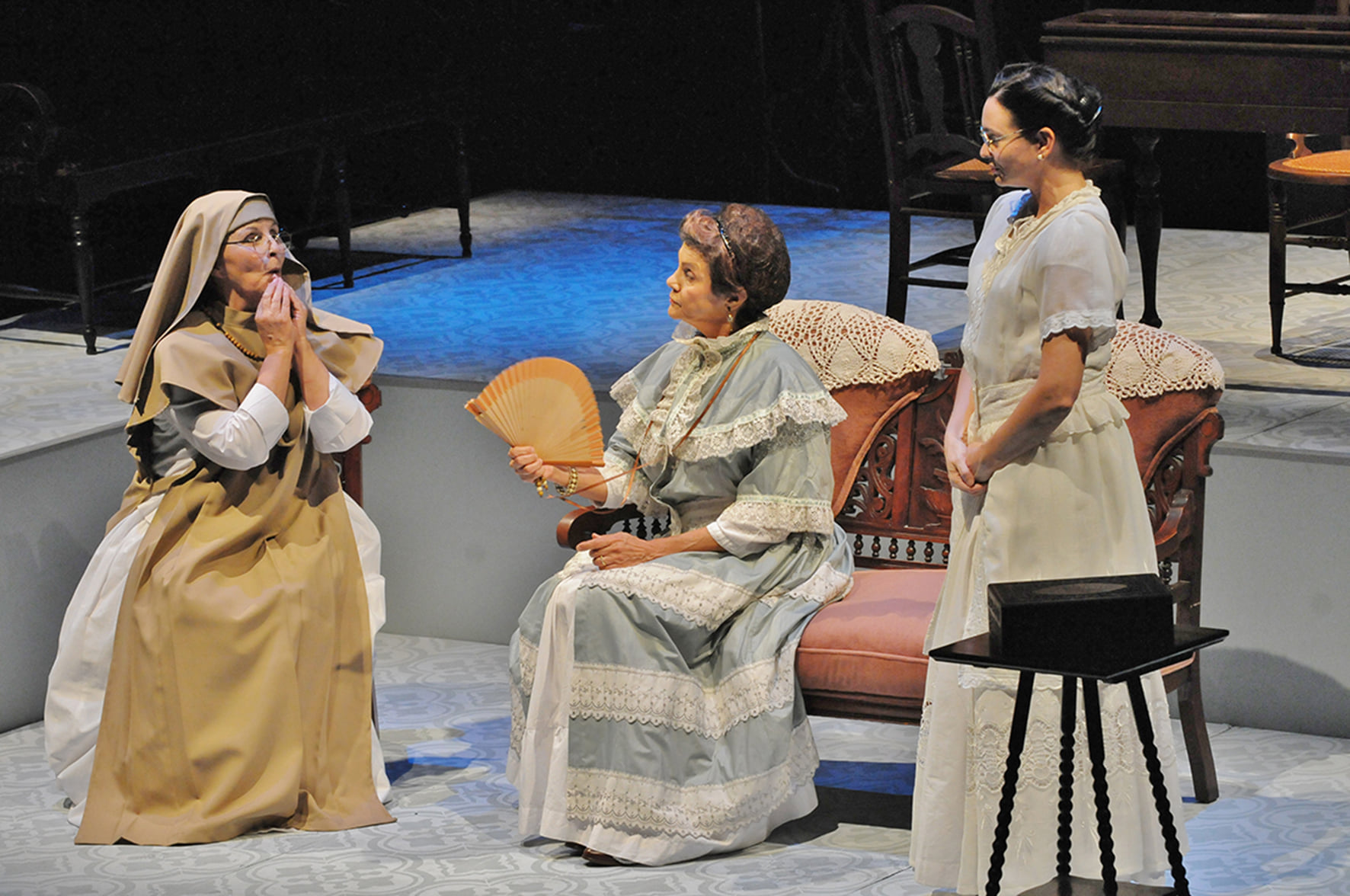
González Melo: La motivación de la escritura es múltiple y cambia de un proyecto a otro. Lo esencial siempre es que el material de partida resuene en mí, que me parezca urgente compartirlo en escena. En el caso de Bayamesa le debo mucho a mi madre, que es filóloga y escritora, y que me habló por primera vez de María Luisa Milanés (1893–1919). Leí sus poemas. Leí su sorprendente autobiografía, que es posiblemente el primer manifiesto feminista escrito en Cuba y uno de los primeros de Latinoamérica. Me impactó su simbólico suicidio: un disparo en el vientre, con la pistola de su padre militar. Un alma libre como ella prefirió escapar de ese modo, antes que continuar sometida al machismo imperante. Supe que la obra debía ser un réquiem que la devolviera a la vida, mediante una ficción que intentase acompañarla, darle voz, siquiera durante la hora y media que dura la puesta en escena. Se cumplió en 2019 un siglo justo de su muerte y, como dices, sigue siendo por desgracia un drama tan vigente…
Gunnels: ¿En qué anda tu trabajo ahora, después del éxito tremendo de Bayamesa?
González Melo: Me estoy sumergiendo cada vez más en la historia de Cuba. Creo que nuestra historia se ha abordado muy poco en la dramaturgia, a veces con una mirada muy superficial, y confío en que el teatro tiene la posibilidad de arrojar una luz nítida sobre sucesos del pasado que nos permitan situarnos en la complejidad del presente. ¿Cómo podemos vivir, cómo podemos entender el país que somos si no analizamos lo que nos ha traído hasta aquí? Durante años trabajé temas y conflictos del presente inmediato, desde los ambientes marginales hasta el lujo de los nuevos ricos. Pero ahora mismo eso se me ha agotado. Imagínate un país cada vez más desabastecido, con un pésimo transporte público, un país donde la gente tiene que pasar horas y horas en horrorosas colas para conseguir una libra de carne de cerdo, una bolsita de detergente, un litro de aceite, todo ello a precios astronómicos. El panorama actual es desolador, no sabría en qué tono dramático abordarlo. Quizás únicamente desde la farsa o el esperpento. Por eso me refugio en el pasado, porque siento que sin memoria no hay densidad de tradición. Hay mucho donde escarbar. El teatro no ha entrado a fondo, por ejemplo, en los graves casos de censura propiciados por las políticas culturales de la Revolución. La censura me interesa mucho: la tenemos demasiado cerca, a menudo sin percatarnos. Me interesa mucho la revisión histórica, siempre que tenga un matiz particular que pueda hablar de una tensión global.
Gunnels: La censura sigue siendo, en efecto, un problema pernicioso en el mundo, ahora con 'caras' diferentes. Al abordar el caso Padilla en tu obra Fuera del juego, te preocupas por problematizar el rol del artista.6En esta obra, González Melo re-visualiza el infame Caso Padilla, en el que el célebre poeta Heberto Padilla es arrestado, encarcelado, tortuado y finalmente exiliado por su trabajo contrarrevolucionaria que cuestionaba la Revolución, el Comandante (Fidel Castro) y el papel de los escritores en general. Utilizada como ilustración clásica de la traumática censura de finales de los 60 y principios de los 70 en La Habana, González Melo cuenta la historia desde la voz del propio poeta como protagonista principal. ¿Es que te interesa "complicar la cosa", para decirlo con palabras de tu propio personaje de Heberto Padilla?
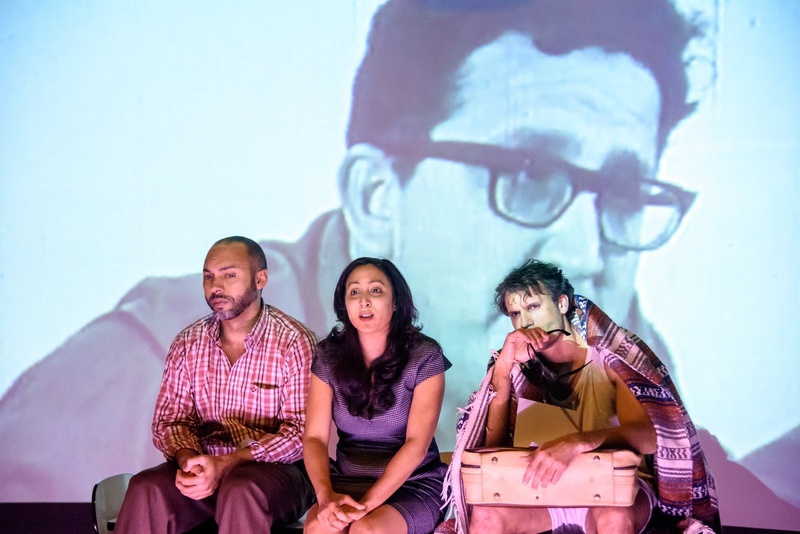
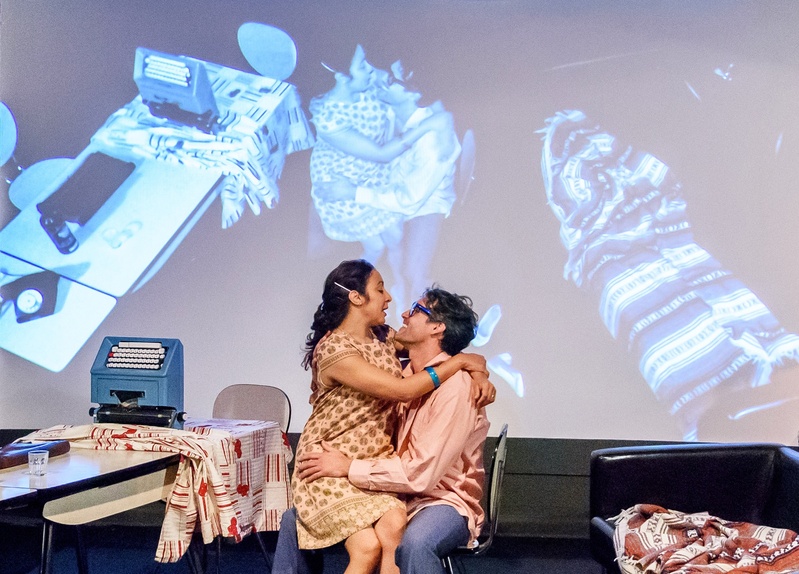
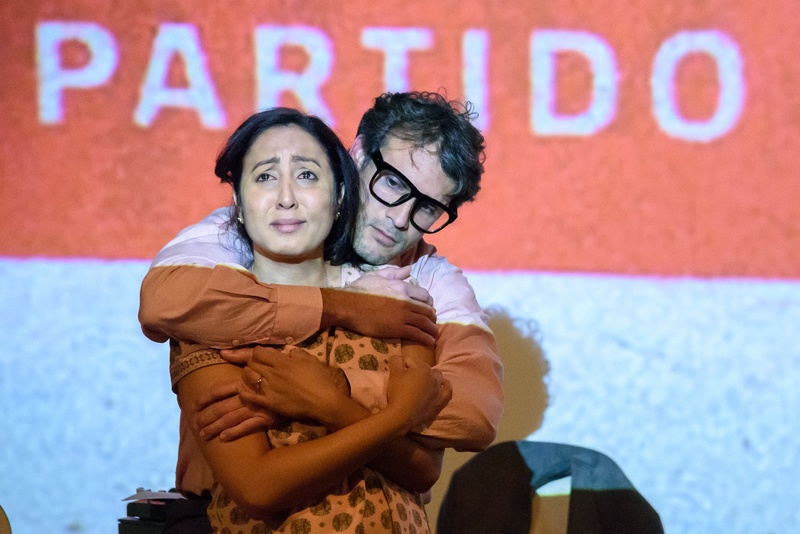





González Melo: Dicen que uno escribe la misma obra a lo largo de toda la vida. El tema de la censura y la autocensura me ha interesado siempre, quizá porque desde muy joven tuve que negociar con ella. Mi libro Memorias de cera por poco no ve la luz, ya que, aunque ganó un premio nacional que consistía en su publicación, contaba mi descubrimiento de la sexualidad en la escuela Lenin, y eso a los funcionarios de la editorial no les gustaba nada. Chamaco, de hecho, puede entenderse como una obra sobre el miedo a la libre expresión dentro de la familia Depás, donde cada uno teme sincerarse ante el otro y todos viven en una espiral de mentiras. Epopeya obtuvo en 2014 el Premio Nacional de Dramaturgia y se publicó por Ediciones Alarcos, pero tuvo una fugaz presentación de solo cincuenta ejemplares, no se distribuyó en librerías, el libro no puede encontrarse en ningún sitio y la obra no puede estrenarse en Cuba (es un texto donde utilizo la metáfora de la Guerra de Troya y el hipotexto de Hécuba de Eurípides para debatir, una vez más, sobre el regreso a la isla de los cubanos exiliados, una vez que Príamo ha caído en combate).
Es cierto que en años recientes me he acercado mucho a la relación entre arte y censura. En 2017 dirigí en Argos Teatro, en La Habana, Cartas de amor a Stalin del dramaturgo español Juan Mayorga, que para mí es una obra que habla sobre la misma situación que padecemos muchos artistas, periodistas y cubanos en general: el terror a decir la verdad, a hablar libremente. Es también uno de los temas de Bayamesa: la censura a la libertad creativa, la plasmación del dolor mediante la poesía, la necesidad de ser independiente. El padre, el marido y la madre de María Luisa Milanés no admitieron ese espíritu rebelde, y eso desencadenó el conflicto y trajo el fatal desenclace. Con Heberto Padilla ocurre lo mismo: fue un hombre muy cercano a la Revolución cubana a inicios de los años 60, incluso fue diplomático, pero lentamente se fue desencantando y su poesía fue haciéndose cada vez más inadmisible para un régimen que terminó asfixiándolo. No quiero "complicar la cosa", más bien intento lo contrario: visibilizar estos asuntos convirtiéndolos en dramaturgia y lenguaje.
Sobre la entrevistadora y el entrevistado
Bridgette W. Gunnels is Associate Professor of Spanish at Emory University and a scholar in Latin American literature from the twentieth century, in all forms, with special emphasis in the short story.
Abel González Melo is a Cuban dramatist, writer, teacher, and theater director. González Melo studied Theater Arts at the Universidad de las Artes de Cuba and is the recipient of various prizes and awards for his literary and theater works, including the Premio Primer Concurso de Dramaturgia de la Embajada de España (2005) for Chamaco [Kiddo]. Most recently, in January 2020, he won the prestigious Casa de las Américas prize for his work, Bayamesa.
]]>Introduction
Playwright Abel González Melo was born in 1980 in Havana, Cuba, the year the Mariel Boatlift saw approximately 125,000 people flee his country, an event he dramatizes in his 2018 play Nowhere in the World (En ningún lugar del mundo). González Melo studied Theater Arts at the Universidad de las Artes de Cuba. He is the recipient of various prizes and awards for his literary and theater works, including the Premio Primer Concurso de Dramaturgia de la Embajada de España (2005) for Chamaco [Kiddo], one of González Melo's most recognized works. Most recently, in January 2020, he won the prestigious Casa de las Américas prize for his work, Bayamesa.
González Melo's work spans two decades and covers multiple social issues of Cuban life. From Cuba's tangled relationship with the Mariel Boatlift in the aforementioned Nowhere in the World (En ningún lugar del mundo, 2018) to teenage prostitution during the early 2000s in Old Havana in his trilogy, Winter Escapes (Fugas de Invierno, 2004–2009), his plays immerse audiences into the streets that surround Havana's Capitolio, to the parks, alleys, and theaters that provide spaces for illegal prostitution, to private homes centering the importance of family to Cubans. The first decade of González Melo's writing centers the Cuban youth culture of the early 2000s, a culture both gay and straight, hungry and sated, resistant and complacent in a country where the Revolution is still fought daily in the streets (although now around the government approved Wifi hotspots). While González Melo maintains his private identification, his plays challenge categorization, interrogate questions of sexuality, and explore survival, the commodification of the body, intense mental trauma, the pain of history, and the deep love of family. His characters weave in and out of his plays to demonstrate with such complexity that as some things have changed others have remained the same.
González Melo's most recent work shifts to recovering figures and episodes from Cuban history with a revisionist eye. Such figures include the early twentieth-century feminist poet María Luisa Milanés (from Bayamo, Cuba) in Bayamesa (2019), which was awarded the Casa de las Américas prize for theater in January of 2020. Tackling the topic of censure at the height of the Revolution in Cuba, González Melo's recent work features Cuban historical figures. Fuera del juego (Outside the Game), dramatizes the experience of Cuban cultural figure Heberto Padilla, an award-winning poet whose work critiqued the Revolution and its leaders in his moment, 1967–68, leading to his arrest, torture, and subsequent exile to the United States in 1980. Padilla worked many years in various positions in higher education in the US, namely Ohio State University, Bowdoin College, and NYU's Institute for the Humanities, before he died alone as a poet in residence at Auburn University, in 2000. In González Melo's most recent drama, Cádiz en José Martí (Festival de Teatro Iberoamericano de Cádiz, 2020), he dramatizes the mythic national hero of the island, revolutionary figure José Martí (1853–1895), by situating him in the Spanish city of Cádiz, his first destination in his long exile and political deportation under the colonial regime.
In this conversation, González Melo explains his creative process and inspirations, the Cuban migration experience as dramatic material, and the idea of recasting history for new audiences and times. He discusses how he drew from lived experience in Havana to craft Winter Escapes as well as how his recent work dives deeply into questions of community and family during some of Cuba's grimmest moments. González Melo also reflects on the unique ligatures between the United States and Cuba. One of these ties is the Spanish-English linguistic connection, as many Cuban-Americans are bilingual. Our conversation, originally conducted in Spanish, has been translated into English here. [Se puede leer la versión en español aquí.]
Kiddo: One Playwright's Beginnings, or González Melo's Early Work
Gunnels: You have written poetry, narrative, non-fiction. Why theater? Do you think that playwriting suits your stories more than other avenues of creation?
González Melo: Theater has something wonderful for a writer: it moves literature away from loneliness. It proposes creation in a team and in direct contact with the spectator. Both questions are very attractive to me. The idea that writing never ceases, is always reinterpreted in the present, needs the communion between the director, the actors, the designers, the technicians, and precisely, inevitably, the complicity of the audience. I am dazzled by that unfinished nature of dramatic writing, that urge to feel the impact immediately. I enjoy writing narrative or essay, but in both cases I miss the real dialogue with the human being. Probably because, more and more, playwriting for me is a process directly related to a very particular human group; it must have an imagined texture that has to walk on a tightrope for success.
Gunnels: Does it feel 'unfinished' to you because it needs other artists, actors to complete it? Or more because of the constant flow of new audiences that are always distinct?
González Melo: Theater is something we do among us all, both the artists and the public. Remember the Greek origin of the word theater: "to watch or look at." Put another way, we only exist because someone looks at us. That is one of the greatest pleasures of writing dramas: feeling that one only offers a guide of stage directions and dialogues on paper, but that the character will have the body, voice, and soul of whoever embodies it in front of the viewer, and that this person will finish building it, in its process of active reception. Why do we keep reviving and repremiering the classics? Because their essence, rather than the argument, lies in how the specific story is told today in the public agora: who executes it, why they decide to do it, in what context and before whom, what senses are born from that experience.
Gunnels: I want to give readers a sense of your Winter Escapes trilogy before we discuss it.
Chamaco ([Kiddo], 2004 English translation by William Gregory) is the first installment of the trilogy. It was first published in Spanish from Ediciones Alarcos and then translated into English by Yael Prizant (University of Miami Press, 2010).1There are two different translations. William Gregory translated both Kiddo and Nevada; Yael Prizant translated the trilogy in a bilingual version with a different press in 2010. Kiddo has been staged globally, from the Argos Theater in Havana to Manchester, England's HOME Theater, to the most recent translation to Czech, with production in Prague set for fall 2021. The trilogy, including Nevada and Talco [Talc] (the second and third installments), covers a span of three months in a tropical winter of discontent. Miami-based academic and theater critic Lillian Manzor writes that "the trilogy addresses concerns that are dear to the author and his generation, namely: the complex and contradictory ways in which homosexuality, sex, and migration from the countryside to the capital becomes means of survival in a society that has lost all sense of value."2Lillian Manxor and Austin Webber, "Ground Down to Nothing but Still Fighting." Hemispheric Institute of Performance and Politics. Accessed March 25, 2021. https://hemisphericinstitute.org/en/emisferica-82/manzor-webbert.html. Kiddo immerses viewers into Christmas Eve in Havana, where a sister uneasily waits for her brother to come home for a dinner that he will never eat, as unbeknownst to her he has died in a knife fight. Nevada follows Lucía and her boyfriend/pimp Rosnay as they encounter the reality of selling their bodies in the effort to get out or escape, in this case, to the state of Nevada, where prostitution is legal, and the "candies come in brilliant gold wrappers." Talc, the final installment, portrays a crude and dirty reality that takes place mainly in the bathroom of an old cinema used for trafficking and prostitution, where the paths of four characters—Javi, Mashenka, Zuleidy, and Alvaro—crisscross in a violent and tense battle for survival. The trilogy was followed by nearly twenty other plays.
Abel, this trilogy really centers the experience of Cuban youth. Describe the importance of giving voice to Cuban youth in many of the works you've written.
González Melo: Now that you mention it, I think that the protagonists of all my plays reflect my age at the time of writing, and in each text these characters are getting older because they grow with me. I wanted to fill them with my doubts, my foibles, my pains. They are like an undercover image of myself in the midst of the world in which I grew up: the Cuba between decades of wars and shortages, and now for a bit more than a decade in Spain in the twenty-first century. I live on the margin between the two countries, and I watch them both with a mixture of passion and strangeness. I cannot speak of all the young people en masse, I do not know how to do it, but I can tell my story of the transition from adolescence to youth. Those impulses are the ones that haunt my work in theater. Hopefully they have to do with the same impulses and emotions of other people.
Gunnels: "Passion and strangeness"—tell me more.
González Melo: I remember that in the early 2000s, when I was walking through Old Havana at night towards my house, I was very curious about the dozens of teenagers who waited leaning on the columns in front of the Capitol, or hanging around Central Park in the middle of the tourist area. What were all these people doing here? Who were they? Little by little, I got closer to them. Many lived clandestinely in Havana; they had emigrated from the East of the island. All of these cisgender boys prostituted themselves, or aspired to do so.3Note from González Melo: "Here we're speaking of, if one must clarify, only cisgender males. I'm no expert in gender studies nor related terminology, but trans populations and women, as I've explained, were in other zones of the city." I learned of many fascinating, terrible stories. The process of discovering them thoroughly was not easy. None were going to give me an interview and tell me about their lives. I became a discreet client. I saved money and went with one of them to a rental room. In the fleetingness of that moment of strange pleasure, I kept myself alert. I listened to them talk about their lives, about their young children whom they had to feed, about their partners who were aware that they were hunting foreigners or Cubans who could pay for sex. My research expanded. One thing led me to another, and I composed a map of the nocturnal marginality of Old Havana. The female prostitute area was at the intersection of Monte and Cienfuegos streets; transvestites and transsexuals were waiting for their clients in the Parque de la Fraternidad; drugs were sold in an abandoned cinema, etc. I fully immersed myself. I did unthinkable things during those years, things that I would not do today. But luckily I dared to do it: I wanted to get to know these people, their places, their reasons, all that environment that the official press did not publish. Three or four years of immersion. After Kiddo finished, I still had so much material that Nevada and Talc were born. Also in my plays Por gusto and Within there are traces of this universe.
Gunnels: Lucía from Nevada and María Luisa from Bayamesa really move me because of the way they confront their worlds, hostile worlds, but always with persistence and love of family front and center. They are strong feminist cross-generational characterizations. For you, is there one character or "angel" from your work that really moves you?
González Melo: I don't usually start from emotion in my writing process. I am quite technical, something I learned with my teacher Raquel Carrió (a great Cuban author, founder in 1976 of the Dramaturgy Department at the University of the Arts of Cuba). the structure-character-language triad is the basis of the preparation of my projects. I believe that emotion comes (or does not come) in parallel with (or after) appreciation of experience. The emotion will then be in the viewer. But for this to happen, the construction of the text or the show itself must be precise, clear; it cannot start from the desire to move emotionally, because the work becomes disfigured. Sometimes I feel that emotion clouds the objectivity of what happens. This happens a lot with actors who act "excited" and then, they overact; or with the dramatists who are over-excited with what they are doing and lose the course of the action, they lose the written synthesis.
It is true that I have had some unique experiences—I would say mystical—during writing itself. It happened while writing Kiddo, in that I felt like someone was dictating it to me directly, right over my shoulder into my ear. The violent death of my father was very recent and the monologue of Silvia, when she found out that her brother had been murdered, I wrote that in tears. I have always believed that Kiddo is my father who became an angel to dictate this work to me and has accompanied me ever since.
History Repeating Itself
Especially in his more recent dramas, Abel González Melo has shifted from describing personal experiences in his work to referencing and dramatizing Cuban historical touchpoints (such as the Mariel Boatlift, the UMAPs work camps, the Grey Period, and the Special Period of Peace). The Mariel Boatlift consitutes the single largest mass migration from Cuba in its history. From April to October 1980, an estimated 125,000 Cubans left the Mariel Port for the United States. The story was well-covered in the media. A small group of Cubans ran a city bus into the gates of the Peruvian Embassy in Havana in an attempt to gain access to the grounds to request political asylum (and eventually leave the island). They were granted asylum, and afterwards, an estimated 10,000 people approached the embassy with the same hopes. Watching this situation unfold from the US, then President Jimmy Carter issued an open invitation to anyone from Cuba who was fleeing the Castro regime, bypassing in part US immigration policy and procedure. A typical Castro pivot followed: after a very public speech on May 1, the Day of the Worker, in Havana's Revolution Plaza, he emptied Cuban's prisons and hospitals of convicted criminals and ill patients and required any American vessel that was picking up family or loved ones at Mariel Port to also take with them a boatload of other 'undesirables,' in which he included homosexual men and those with severe psychiatric problems. As González Melo notes in our conversation below, Cuba's history with gay males is marked by tragic discrimination, torture, and death. The storied UMAP work camps (in Spanish, Unidades Militares de Ayuda de la Producción) that served as a type of work-based prison from 1965–68 in Camagüey, Cuba, were politicized as agricultural camps for "conscientious objectors," but were more a type of social "purge" of any person who was deemed to be anti-Castro or anti-revolutionary, according to historian Abel Sierra Madero.4Abel Sierra Madero, "Academies to Produce Macho-Men in Cuba." Translated by Alicia Barraqué Ellison. Translating Cuba. February 19, 2016. https://translatingcuba.com/academies-to-produce-macho-men-in-cuba-abel-sierra-madero/. This included those accused of homosexuality.
Following the years of the UMAP work camps is a period of a little more than five years (1971–1977) known as the Grey Period (El quinquenio gris in Spanish) in which the Cuban government controlled rigidly the cultural and artistic productions of the island, severly limiting artistic expression and publication. Several of Cuba's most noted dramatists, like Virgilio Piñera (1912–1979), Abelardo Estorino (1925–2013), and Antón Arrufat (1935–) suffered tremendously under this censure, as much for their insistence on creative freedom as for their homosexuality. Surrounded by a hostile environment, all three utilized metaphor as a form of expression, always trying to avoid censure. Piñera's work questioned in broad terms concepts of national identity and the role of the writer as resistor. A prolific writer of essay, short story and theater, Piñera's collections Cold Tales (1956) and Little Maneuvers (1963) were credited with inspiring generations of writers after him, including noted Mariel author Reinaldo Arenas. Abelardo Estorino, who was censured earlier with his work Los mangos de Caín (1965), only wrote one text in the 70s and instead dedicated himself to directing classics in the Company Teatro Estudio. Antón Arrufat was awarded high honors from the National Union of Writers and Artists (UNEAC, in Spanish) for Los siete contra Tebas in 1968, but that institution published the book with a note that accused the writer of being a counter-revolucionary; Arrufat was condemned and ostracized, and didn't publish for more than a decade.
Finally, immigration to and from Havana varied drastically from the 1960s to the present day, and the laws prohibiting re-entry, as well as the acrid political relationship between the US and the Castro regime, created a layered way of understanding home, community, and exile. The early 1960s saw an exodus of the upper and middle classes, who for the most part landed in south Florida and remained. After the Mariel Boatlift, US immigration policy of the mid-90s led to some increased immigration from the island, as "wet foot, dry foot" allowed for fast-tracking of US immigration procedures for Cubans, and the increase of rafters (balseros, in Spanish) is notable during this Special Period of Peace. Of these major immigration waves, Mariel is distinctive due to the population demographics as well as the politicized spin on both sides. That group was both maligned by Cubans on the island and experienced a rougher integration into their new south Florida community.5Aviva Chomsky, A History of the Cuban Revolution, 2nd ed. (Hoboken, NJ: Wiley-Blackwell, 2015), 75.
González Melo is a descendent of these early Cuban playwrights as well as an inheritor of this tangled history. In the conversation below he reflects on the reality of the gay male in Cuba before and after Mariel, and how this facet of Cuban history finds its way into his work. In particular, his play Outside the Game revisits the Padilla Case and the UMAPs, highlighting the subversive censure and psychological torture of artists in the early days of the Revolution. His play Bayamesa reaches back the farthest in Cuban history to tackle issues of colonialist tradition, gender roles, and feminism in Cuba.
Gunnels: How have you seen the Cuban life change for the gay man from writing Kiddo (2004) to Nowhere in the World (2018)?
González Melo: The time period you're referring to is about a decade long, and I don't think that we have seen noted change with regard to the day-to-day life of the gay man in Cuba. The Revolution wasn't too friendly with homosexuals, as they were considered during much of that time as the equivalent of social filth and outcasts; indeed many homosexuals were sent to work camps during the years of 1965–68 (UMAPS, Military Units for Help in Production). This entire process accentuated and encouraged intense machismo and homophobia in Cuban society. In the work of some of the best Cuban dramatists, who additionally were homosexual (I'm thinking of Virgilio Piñera, Abelardo Estorino, or Antón Arrufat), the topic is absent or appears hidden mostly due to self-censure/autocensure. After the horrible experience with the UMAP came the equally traumatic decade of the 1970s, which is historically noted for its strong politics based in marginalization of homosexual artists. My generation hasn't felt as much pain, as today's Cuban artist deals with a more or less 'friendly' public, although homophobia definitely persists and has found more pernicious ways to manifest. In my work personally I've been able to take on the topic of homosexuality in works that I have published and performed on the island; additionally, anthologies of homoerotic poetry and narrative have recently been published. We are trying to include in an amendment to the national Constitution the idea of gay marriage rights, an idea that is presently accepted in many other countries in the world. The problem is that for so many years, too many years, our own government has planted seeds of hate towards homosexuals, and the mentality of a country can't be changed from one day to the next.
Gunnels: But can theater change a country? The power of art or interrogation?
González Melo: I don't believe either theater or any other artistic manifestation can change a society. It would be too pretentious to think so. I have heard phrases like "art changes the world," and I always feel that they have a figurative, metaphorical meaning. Theater is not a political party; it is not an army; it is not an atomic bomb or a pandemic. It does not have that power of abrupt, immediate, forceful change. What theater can do, and I believe this to be true, is to touch the mind and heart of a person, of a spectator who attends a show and discovers another way of looking, of identifying himself/herself in that mirror, of finding something that hurts them deeply. Theater transforms, in this sense, the individual and not the masses, although we share the experience of our art collectively, together. Theater always works at (in its execution, in its reception) particular behaviors, not general ones. We touch one person, and that person will have, on occasion perhaps, the opportunity to touch the things that move the world. That is the simple and beautiful condition of our art.
Gunnels: Your 2018 play Nowhere in the World (En ningún lugar del mundo) addresses silence around sexual identity in Cuba (from the 80s to present day), as well as issues of gay visibility and the trauma of military service, as the lead Ángel negotiates the acute pain of the Mariel Boatlift for those that left as well as for those that remained. Cuba has a thirteen-year history in Africa (1975–1988), with Cuban forces on the ground in the name of liberation from South Africa during that time. Their association ended with Namibian independence and, some say, the beginning of the retreat of apartheid in the area. Regardless, Cuban forces returned with psychological issues, and the drama of Nowhere in the World revisits that time, as well as the impending trauma of Mariel. Ángel leaves the island with the boatlift, and the drama picks up with his return to Cuba after Mariel, to find that family trauma is deep and unforgiving. How do you understand the legacy of the Mariel Generation in comparison to other Cuban artists that have written in exile, either forced or by choice?
González Melo: The protagonist of Nowhere in the World was forced to leave Cuba in 1980 during the Mariel Boatlift, due to psychiatric problems (yes, a ruthless detail of Cuban history: the mentally ill were directly considered scum, unwanted by society, alongside homosexuals and convicts), although the truth of the matter was that the family wanted to get rid of him due to his frequent and violent testimonies of the hard experience of three years as a soldier in the Angolan War as you describe in your synopsis. The history of our exiles is full of anonymous people who have not given their testimony because they are still traumatized. Mariel as a historical moment is very broad and diverse in its interpretation; it often escapes homogeneous cataloging. The most important thing is what it meant as a phenomenon, and the thousands of Cubans who could (who were forced to) integrate themselves into the North American culture and, at the same time, enrich it with their direct action. The culture and society of Miami cannot be understood today without adding the layers of exiles that that city has assumed. Personally, I admire the will and the resistance of the generations of Cuban exiles who have reinvented the concept of homeland.
Gunnels: What do you think about other playwrights who experienced Mariel on the island and stayed? I'm thinking of the play Eggs, by Ulises Rodríguez Febles. We spoke already about the idea of getting out, but what of those who stay?
González Melo: The Mariel story has been told brilliantly by playwrights who keep creating on the island, as Ulises himself in Eggs or Carlos Celdrán in Ten Million. Both were very young in 1980 but have managed to print their texts, full of autobiographical nuances, and this quality surpasses historical reconstruction. I like that: that we can shake off the dust of daily life, that steals so much of our daily energy, and look at our history and our future with a different perspective. Those authors live in Cuba, yes, but they have recognized international careers. Ulises was tremendously successful in Mexico with a work that curiously reconstructs the trajectory of another exiled artist, Dámaso Pérez Prado, and Celdrán has premiered Ten Million at important festivals all over the world. More and more the border between the outside and the inside, between going and staying, is more permeable and less strict. Fortunately.
Drama as Dissection: One Playwright's Persistent Project
From the 1970s to the late 80s, Cuba's economy was nearly solely supported by the Soviet Union, who imported Cuban sugar and other products and exported massive amounts of petroleum to the island to fuel agriculture and transportation. The external effects of the dissolution of the Comecon were immediate: Cuba lost nearly 80% of its imports, and with a heavy trade embargo from the US already in place, the country was left without a major import/export partner. The island entered a period of years (from 1991–1995, although some say it hasn't ended) that later became known as the Special Period of Peace (Período especial), marked by extreme food scarcity (borderline famine), nationwide blackouts to conserve energy (apagones), sometimes for twelve to fourteen hours daily, and a complete dry up of tourism. González Melo was a teenager during this time at the Lenin School in Havana.
Gunnels: Describe how growing up during the Special Period impacted your view of Cuban life vis-à-vis foreign powers.
González Melo: The influence is inevitable. My childhood was full of the Russian and Soviet imaginary: that trace is evident, for example, in my work Talc, but also in part of my stories and in my passion for that culture. I studied in a boarding school called, very precisely, "Lenin." I was there between years 1994 and 1997. There I suffered intense shortages (food, electricity, health resources), but I also discovered solidarity. At that school I suffered bullying, but I was able to become an independent person. From that experience full of contrasts, my first book was born: Wax Memoirs. And that stage, the Special Period, marked my interest in the paradox in which we Cubans have lived. We all shout heroic slogans in the Plaza de la Revolución during the parades, and at the same time we starve to death at home and whisper in the corners the details of our misery. The Special Period adjusted the standard of living of society and increased class differences, clientelism, the black market, corruption in all areas. That double-edged moral crisscrosses my literature: characters who need, at all costs, to put on masks to continue surviving.
Gunnels: In Nevada, a salient theme is the Cuban desire to get out or escape. How do you see that imagined community elsewhere juxtaposed against what is often a very different reality (as in the case of Mariel, for example, or the present-day immigratory reality in the USA)?
González Melo: Being born on an island foments the desire to go beyond the immediate borders that the sea imposes. Virgilio Piñera summed it up in an image: "The damn circumstance of having water everywhere." The island is a prison and the longing to leave is constant alongside, in my case, having the opportunity to return. The need to flee the island has been a consistent facet of Cuban identity, increased by political and economic factors experienced in various stages of the Revolution. My own father had to go into exile in Mexico in order to guarantee us a better life: I am not talking about luxuries, but about having money to eat, to dress and take care of ourselves, to move about the island. The United States is the destination for a great many Cuban migrations; we have a very close relationship. In my doctoral thesis I study precisely the links between family and exile in the dramaturgy of Greater Cuba, understood here as a Cuba generated both on the island and abroad. I like that idea of an expanded homeland, not subject to physical limits, but rather to feelings and areas that both share in common. This issue is found in a large part of my work as an element of our idiosyncrasy: the idea of leaving and returning. Both Nevada and Within talk about the undercover, dangerous trip by sea and the risks undertaken there. In Sistema, the tension is precisely in that the protagonist is trapped in Miami and cannot return. Epopeya, Weathered, Nowhere in the World illustrate the arc that starts at exile only to return after some time, and then most critically, everything that that particular reunion involves and drags out into the present.
Gunnels: But for the Marielitos, precisely, who were told upon leaving that they would never be allowed to return, exile is (was?) painful in different ways. How does this pain of return change the "community" of Greater Cuba that you mention earlier? Is that something that Nowhere in the World wants to dissect?
González Melo: Of course. Mariel and the Angolan War are matters that we have barely dealt with in the Cuban national tradition of writing, but their traces are still there. They are wounds that have not been closed, and I have tried to touch some of it with Nowhere in the World. The family structure has been, in the tradition of Cuban dramaturgy, the nucleus through which to observe perennial social and political issues. This has to do with what I was saying before: theater only works from the particular and not from the general. Historical processes are analyzed in books, articles, interviews, in extensive bibliographic and documentary collections. A play cannot contain all of that process, all of the lives wasted in the attempt to build a certain political-social project. What a play can do is sharpen the gaze, focus on a small human group and apply the scalpel to it. You use the correct verb: dissect. As a playwright I feel exactly like this: Cuba is my operating room, that broken family is the body that lies on the table, and I have to apply the scalpel with caution, with great responsibility, trying to get to the root of the pain.
Gunnels: It's true, as you mention before, there is a very different, distinct type of relationship with the US. Would you say that your experiences in the US as a Cuban-born artist have been particularly revealing in terms of understanding this distinct relationship?
González Melo: They have been very different experiences. In Chicago, for example, Aguijón Theater premiered Within and Epopeya. Despite being texts with marked national references and with a Cuban (Sándor Menéndez) director, in both cases there was a rich dialogue with a wider Latino community, thanks also to the excellent translations of Marcela Muñoz. The actors, artistic team, and spectators took on as their own the themes of uprooting and political frustration. I felt something similar with the premiere of Por gusto in Repertorio Español in New York, and what was also with a Cuban director, Leyma López: the incessant disillusionment of youth and the monotony of a circular existence were related issues to a multinational cast. When Ohio Northern University produced Nevada, I remember that they were very interested in the detailed study of the context. Part of the team visited the island and the editing included documentary projections, which contrasted deliciously with the dramatization of the text in English (by the Mexican Otto Minera and with translation of Yael Prizant). In Miami, where the Hispanic community is also wide and varied, the essential confrontation has been with the Cuban public, which logically is the most interested, either by direct experience or by reference, in fictions about the marginal Havana of Kiddo, Talc, and Nevada, works that Alberto Sarraín directed. I feel that the premiere of Nowhere in the World at the XXXIII International Festival of Hispanic Theater, in production of Teatro Avante, directed by Mario Ernesto Sánchez and with translation by Marian Prío, has further dimensioned the debate on Cuba / United States tension, which is the conflict between those who stayed and those who left. I always mention the translators because I consider their work and dedication essential. They, and my British translator William Gregory, have been responsible for my texts being so well rewritten in that language.
Gunnels: How do you choose what specific issue you are going to dissect in the work? Your 2019 play Bayamesa is the direct portrayal of traditional, early twentieth-century Cuba, where the lead María Milanés struggles to align traditional Cuba with her own very feminist dreams and ambitions. In it, you shift time and space on the stage to bring the play into tense dialogue between past and present, with a gut-wrenching suicide that leaves the audience broken. In Bayamesa we find the authentic woman who encourages all but also the idea of suicide as a social issue emerges, when today there are more and more suicides of young people. It's like the final lines of your other 2019 play Outside the Game: "history repeats itself, and it repeats itself."
González Melo: The motivation for writing is multiple and changes from one project to another. The essential thing is always that the starting material resonates with me, that it seems urgent to share it on stage. In the case of Bayamesa, I owe a lot to my mother, who is a philologist and writer, and who spoke to me for the first time about María Luisa Milanés (1893–1919). I read her poems. I read her surprising autobiography, which is possibly the first feminist manifesto written in Cuba and one of the first in Latin America. I was struck by her symbolic suicide: a shot in the belly, with her military father's pistol. A free soul like her preferred to escape in this way, rather than continue being subjected to the prevailing machismo. I knew that the play must be a requiem that would bring her back to life, through a fiction that tried to accompany her, give her a voice, even during the short hour and a half that the staging lasts. A century of her death was celebrated in 2019 and yet, as you say, unfortunately this continues to be such a current drama....
Gunnels: Where do you see your work going after Bayamesa?
González Melo: I am immersing myself more and more in the history of Cuba. I think that our history has been approached very little in dramaturgy, sometimes with a very superficial gaze, and I trust that theater has the possibility of shining a clear and precise light on events of the past that allow us to situate ourselves in the complexity of the present. How can we live, how can we understand the country we are if we do not analyze what has brought us here? For years I worked on issues and conflicts of the immediate present, from the spaces on the margins to the luxury of the new rich. But right now that present has me exhausted. Imagine a country that is increasingly under-supplied, with lousy public transport, a country where people have to spend hours and hours in horrifying lines to get a pound of pork, a bag of detergent, a liter of oil, all at astronomical prices. The current panorama is bleak; I would not know in what dramatic tone to approach it. Perhaps only from the farce or the grotesque. That is why I take refuge in the past, because I feel that without memory there is no density of tradition. There is so much to dig into. Theater has not gone into depth, for example, in the serious cases of censorship caused by the cultural policies of the Revolution. Censorship interests me a lot. We have it too close to us, often without realizing it. I am very interested in historical revision, provided it has a particular nuance that can speak to a global tension.
Gunnels: Censorship continues to be a pernicious problem in the world, perhaps now with different 'faces.' When addressing the Padilla case in your play Outside the Game, you concentrate on problematizing the role of the artist.6In this play, González Melo re-envisions the infamous Padilla Case, whereby celebrated poet Heberto Padilla is arrested, jailed, tortured, and finally exiled for his counterrevolutionary work that questioned the Revolution, the Comandante (Fidel Castro), and role of writers in general. Used as a classic illustration of the traumatic censorship of the late 60s and early 70s in Havana, González Melo tells the story from the voice of the poet himself as the lead role. Are you interested in "complicating things," to put it in the words of your own Heberto Padilla?
González Melo: It is said that one writes the same work throughout life. The issue of censorship and self-censorship has always interested me, perhaps because from a young age I had to negotiate with that force. My book Wax Memoirs almost didn't see the light of day, because although it won a national award for its publication, it told about my discovery of sexuality at the Lenin school, which the editorial officials did not like at all. Kiddo, in fact, can be understood as a work about the fear of free expression within the Depás family, where each one fears being open to the other and they all live in a spiral of lies. Epopeya, although it won the 2014 National Prize for Dramaturgy and was published by Ediciones Alarcos, had a fleeting presentation of only fifty copies. It was not distributed in bookstores; the book cannot be found anywhere and the work cannot be released in Cuba. (It's a play where I use the metaphor of the Trojan War and the conflicts of Hecuba by Euripides as a hypotext to debate, once again, the return to the island of exiled Cubans, once Priam has fallen in combat).
It is true that in recent years I have moved much closer to the relationship between art and censorship. In 2017 I directed at Argos Teatro in Havana Letters of Love to Stalin by the Spanish playwright Juan Mayorga, which for me is a play that talks about the same situation that many artists, journalists, and Cubans in general suffer: the terror of telling the truth, of speaking freely. It is also one of Bayamesa's themes: the censorship of creative freedom, the expression of pain through poetry, the need to be independent. The father, husband, and mother of María Luisa Milanés did not allow that rebellious spirit, and that unleashed the conflict and brought forth the fatal outcome. The same thing happens with Heberto Padilla: he was a man very close to the Cuban Revolution in the early 1960s. He was even a diplomat, but he slowly became disenchanted and his poetry became increasingly inadmissible for a regime that ended up suffocating him. I don't want to "complicate things," rather I try the opposite: to make these issues visible and debatable by turning them into theater and language.
About the Interviewer and Interviewee
Bridgette W. Gunnels is Associate Professor of Spanish at Emory University and a scholar in Latin American literature from the twentieth century, in all forms, with special emphasis in the short story.
Abel González Melo is a Cuban dramatist, writer, teacher, and theater director. González Melo studied Theater Arts at the Universidad de las Artes de Cuba and is the recipient of various prizes and awards for his literary and theater works, including the Premio Primer Concurso de Dramaturgia de la Embajada de España (2005) for Chamaco [Kiddo]. In January 2020, he won the Casa de las Américas prize for his work, Bayamesa.
]]>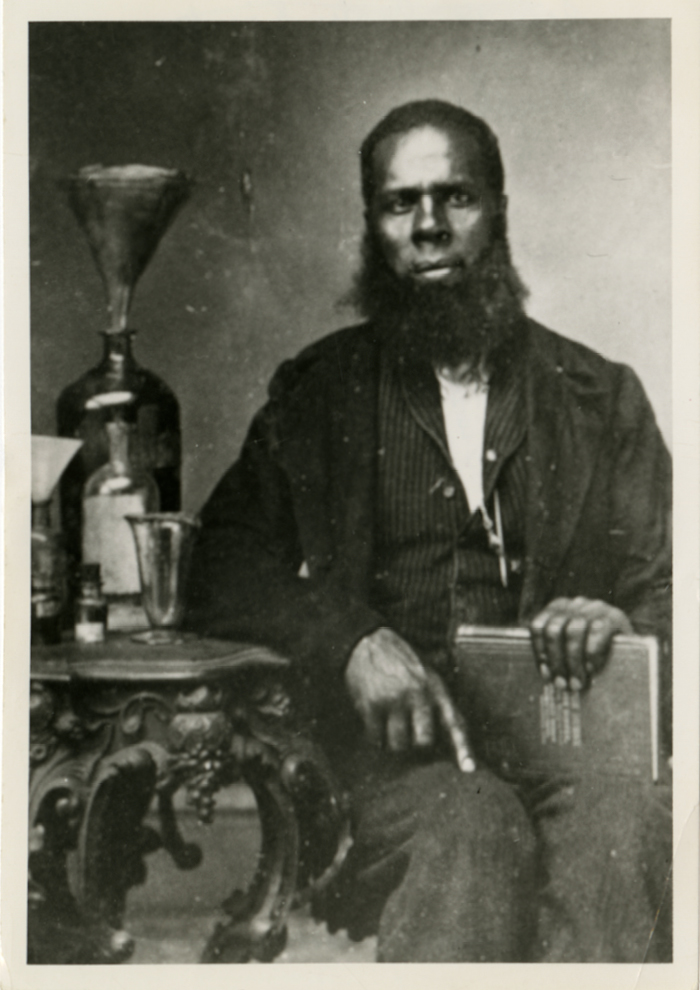
A freeborn Black abolitionist from Ohio, Joshua McCarter Simpson opened his 1854 indictment of the hypocrisy of Christian supporters of slavery, "To the White People of America," with searing words that echo across the centuries. Simpson's poetic voice resonated when Donald Trump strode through Lafayette Park for a photo opportunity—an image of him holding a Bible in front of St. John's Episcopal Church—moments after DC police, reinforced by National Guard troops, dispersed peaceful protesters who had gathered to demand that government leaders address systemic racism.
Simpson published "To the White People of America" in his collection The Emancipation Car, Being an Original Composition Of Anti-Slavery Ballads, Composed Exclusively For the Under Ground Rail Road (1854), written for abolitionists ferrying enslaved people to freedom. The Emancipation Car includes forty-three poems, all meant to be sung to then-popular tunes, and a few prose passages. The title of Simpson's collection extends the metaphor of the Underground Railroad, where these songs were popular among the formerly enslaved and where Simpson served as a conductor. In 1874 the collection was reprinted with its prose passages reworked in verse and a new appendix featuring poetic commentaries on the Fifteenth Amendment, the Underground Railroad, and related topics.
Simpson was born around 1820 in Windsor, Ohio, in the far northeastern corner of the border state, near Lake Erie. He was indentured as a servant from his childhood until he turned twenty-one, working in brutal conditions for a stonemason and later a farmer. He then taught himself to read and write, attended the Oberlin Collegiate Institute from 1844 to 1848, and moved to Zanesville in central Ohio, where he became an herbal doctor and grocer. Simpson gradually embraced abolitionism during his servitude and became a fierce advocate for emancipation thereafter. In his preface to The Emancipation Car, Simpson explains, "As soon as I could write, which was not until I was past twenty-one years old, a spirit of poetry, (which was always in me,) became revived, and seemed to waft before my mind horrid pictures of the condition of my people, and something seemed to say, 'Write and sing about it—you can sing what would be death to speak.' So I began to write and sing."1Joshua McCarter Simpson, "Note to the Public," in The Emancipation Car, Being an Original Composition Of Anti-Slavery Ballads, Composed Exclusively For the Under Ground Rail Road (1874; repr., Miami: Mnemosyne Publishing Co., 1969), vi. He first publicly performed an anti-slavery song in 1842 and published a collection of thirteen poems titled Original Anti-Slavery Songs in 1852. Simpson died in 1876.
Joshua McCarter Simpson's writing is remarkable for its force, conviction, moral clarity, and emotional depth. His poems are also frequently witty, both in their turns of phrase and in their relationship to the popular tunes with which Simpson chose to pair them. Simpson notes that "To the White People of America" should be sung to the tune "Massa's in the Cold, Cold Ground," a blackface minstrel tune composed by New York songwriter Stephen Foster in 1852, just two years prior to the publication of The Emancipation Car. In dialect, Foster's song depicts enslaved people crying as they mourn the death of their former owner, rendering Simpson's ironic appropriation bitingly clever. "In my selection of 'Airs,'" writes Simpson, "I have gathered such as are popular, and extensively known. Many superstitious persons, and perhaps many good conscientious, well-meaning Christians, will denounce and reject the work on account of the 'Tunes,' but my object has been to change the flow of those sweet melodies (so often disgraced by Comic Negro Songs, and sung by our own people,) into a more appropriate and useful channel."2Simpson, "Note to the Public," v–vi.
Despite his groundbreaking creativity, Simpson is little known today. Few scholars have written about his work, and he has never been the subject of a biography. I learned about Simpson when music bibliographer Erin Fulton included The Emancipation Car in the "Checklist of Southern Sacred Music Imprints, 1850–1925" that she compiled for the Sounding Spirit publishing initiative. Fulton turned to The Emancipation Car as Sounding Spirit searched for words from historical composers and hymnwriters in expressing our solidarity with Black Lives Matter protests in the wake of the murder of George Floyd and many others.
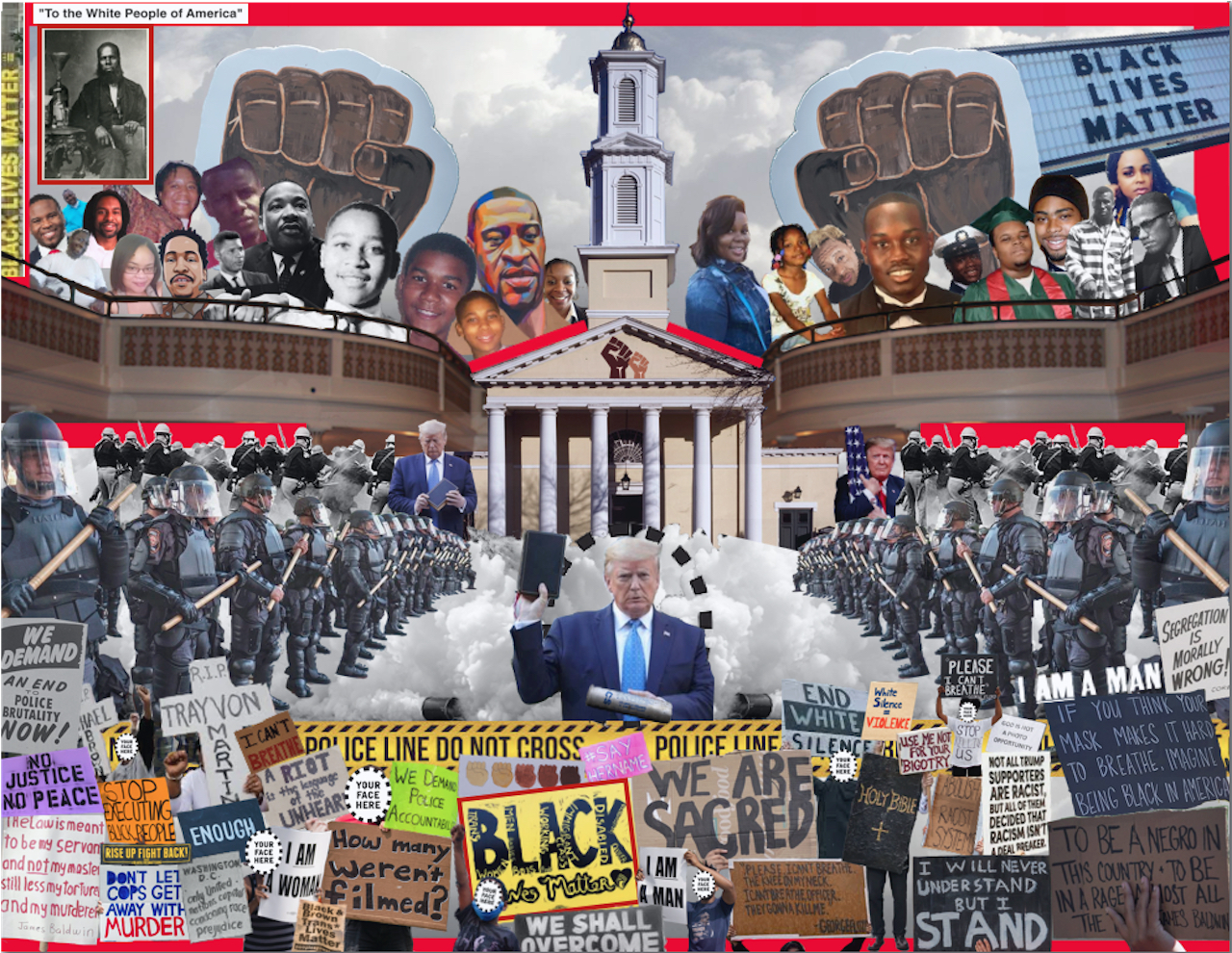
Reading Simpson's words from 1854 immediately conjures the image of Trump at St. John's Church:
"To the White People of America"
Air—"Massa's in the Cold, Cold Ground"
O'er this wide extended country,
Hear the solemn echoes roll,
For a long and weary century,
Those cries have gone from pole to pole;
See the white man sway his sceptre,
In one hand he holds the rod—
In the other hand the Scripture,
And says that he's a man of God.
Hear ye that mourning?
'Tis your brothers' cry!
O! ye wicked men take warning,
The day will come when you must die.
Lo! Ten thousand steeples shining
Through this mighty Christian land,
While four millions slaves all pining
And dying 'neath the Tyrant's hand.
See the "blood-stained" Christian banner
Followed by a host of saints (?)3Question mark appears in the original.
While they loudly sing Hosannah,
We hear the dying slave's complaints:
Hear ye that mourning?
Anglo-sons of God,
O! ye Hypocrites take warning,
And shun your sable brothers blood.
In our Legislative members,
Few there are with humane souls,
Though they speak in tones of thunder
'Gainst sins which they cannot control,
Women's rights and annexation,
Is the topic by the way,
While poor Africa's sable nation
For mercy, cry both by night and day.
Hear ye that mourning?
'Tis a solemn sound,
O! ye wicked men take warning,
For God will send his judgment down.
Tell us not of distant Island—
Never will we colonize:
Send us not to British Highlands,
For this is neither just nor wise,
Give us equal rights and chances,
All the rights of citizens—
And as light and truth advances,
We'll show you that we all are men.
Hear ye that mourning?
'Tis your brothers sigh,
O! ye wicked men take warning,
The judgment day will come by and by.
About the Author
Jesse P. Karlsberg is the senior digital scholarship strategist at the Emory Center for Digital Scholarship. He is the project director and editor-in-chief of Sounding Spirit, a research lab and publishing initiative promoting collaborative engagement with historical American songbooks. Karlsberg is an internationally recognized singer, teacher, composer, and songbook editor in the Sacred Harp tradition.
]]>Queer [__] Revolution?
"The place in which I'll fit will not exist until I make it."
—James Baldwin
"The gay revolution began as a literary revolution." This is the first bold statement in Christopher Bram's 2012 cultural history Eminent Outlaws: The Gay Writers Who Changed America. From before the homophile movement of the 1950s to the post-Stonewall gay liberation movement to the virulent activism of ACT UP and other HIV/AIDS activist organizations to the normalcy wars of the 1990s and the fight for marriage equality, the modern LGBTQ+ rights movement has occurred in the streets and in the press, in the courtrooms and in the bedroom, at the intersections and with the hash tag, challenging and revolutionizing American life.
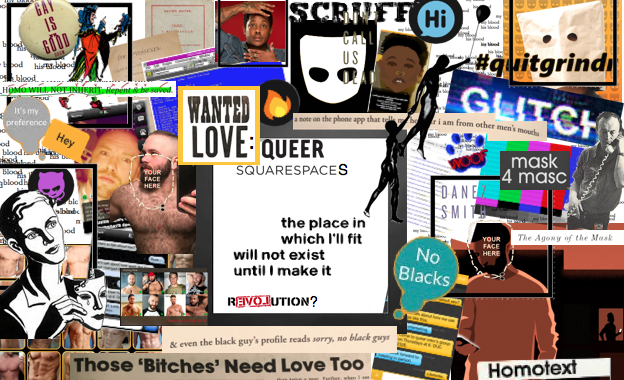
In this article, I suggest that the latest "revolutionary" movement in LGBTQ+ life is not one found in the streets or in published literary forms long familiar to us but in the digital square spaces through which queer intimacy is being reimagined and reenacted. Forms of activism and intimacy have shifted from the mediation of bound rectangles of printed books and pamphlets to the square profiles of gay geospatial social networking and dating applications. It is these square spaces that stand in contrast to the LGBTQ+ normalcy wars of the 1990s and the subsequent proliferation of narratives of assimilation and hetero- and homo-normative relationship structures. Dating and "hook-up" geospatial applications like Grindr, Scruff, Daddyhunt, Growlr, Jack'd, Hornet, Chappy, and others have radically altered the terrain of queer intimacy and precede similar "straight" applications like Tinder that used them as model. As Polly Vernon wrote in "Grindr: a New Sexual Revolution?" (2010): "Grindr is reconfiguring the landscape of human relationships."1Polly Vernon, "Grindr: a New Sexual Revolution?," The Guardian, July 3, 2010, http://www.guardian.co.uk/media/2010/jul/04/grindr-the-new-sexual-revolution/print. Some have described this reconfigured landscape as one of networked intimacy and liquid love, extending Zygmunt Bauman's ruminations into digital terrain.2See Lik Sam Chan, "Ambivalence in Networked Intimacy: Observations from Gay Men Using Mobile Dating Apps," New Media & Society 20, no. 7 (2017): 2566–2581; Mitchell Hobbs, Stephen Owen, and Livia Gerber, "Liquid Love?: Dating Apps, Sex, and the Digital Transformation of Intimacy," Journal of Sociology 53, no. 2 (2016): 271–284. My essay asks several questions to which there are no definitive answers: What do we do with this revolution in queer life? What do we do with this networked intimate landscape? What do we do with this thing called liquid elove?
While others have examined some of these applications' nefarious psychological or public health ripple effects, here I consider two of these applications, Grindr and Scruff, to discuss the vocabularies (a digital lexicon that includes "Masc4Masc," "Woof," and "Tap," among others) and rhetorical methods that queer men deploy to relate to one another anew in both generative and troubling ways. I follow Robert F. Reid-Pharr's assertion that all identities are "essentially permeable and thus impure," and "all names (black, gay, man) are ultimately monuments to the impossibility of ever fully distinguishing self from other."3Robert F. Reid-Pharr, Black Gay Man (New York: NYU Press, 2001), 12. Though impossible to fully distinguish or delineate, and only tenuously related to any authentic representation of self, the square profile spaces of digital dating apps provide stark relief (in literal, discrete boxes) between self and other even if the avatar-self often fulfills the estranged, "other" space in that formulation. In this way, although these apps have revolutionary capabilities and foster a myriad of positive affective encounters both virtual and actual, like earlier moments in queer activist intensity and homotextual production, we are again making code of ourselves in our relational affective structures through mediated digital games of masking, ghosting, haunting, catfishing, kittenfishing, benching, breadcrumbing, cushioning, firedooring, lockering, self-pornographying, among the many other terms in this perpetually expanding digital lexicon.
Finally, I consider lyrical responses to this new "square space" in LGBTQ+ dating practices, namely the poetry of Danez Smith, as a way to illustrate the merging of Bram's high "literary" queer revolutionary tradition with the ongoing "digital" revolution Vernon and others seek to understand. Hopefully, this merger pushes us to think more critically and expansively about the various manifestations of "revolutions" in queer intimacy across time and (real and virtual) terrain as filtered through language, data, "code," and the ever-present "Mask" of queer life.
Mask4Masc: A HomoText(ual) Micro-History
"So we are taking off our masks, are we, and keeping / our mouths shut, as if we'd been pierced by a glance!"
—Frank O'Hara, "Homosexuality" (1954)
A brief historical framing shapes how I think of the generative and troubling dimensions of digital square spaces in contemporary queer life. The figurative "Mask" permeates queer writing and thinking since the first American homotexts, a term I use here to describe explicitly gay/queer-centric publications.4While my conception is perhaps connotatively less complex, I take "homotexts" from a 1978 essay, "Homotextuality: A Proposal," by scholar Jacob Stockinger, who coined the term "homotextuality" to signify one way the then nascent field of gay and lesbian studies might bridge formalist criticism with thematic approaches. The term "homotextuality" itself has a robust history in transnational academic queer literary scholarship, including Robert K. Martin's "Gay Studies in the Victorian Novel" (Newsletter of the Victorian Studies Association of Western Canada 13, no. 1 (1987): 69–71) and Terry Goldie's Pink Snow: Homotextual Possibilities in Canadian Fiction (Peterborough, ON: Broadview Press, 2003). However, as more recent scholars like Catherine A. Davies have written, in the push for a field of homotextual criticism, Stockinger and others often reduced and conflated specific contexts, unique experiences, and cultural moments: the homotextual became the homotext, finite, concrete, fully knowable and not reflective of the spectrum and unknowability of human sexuality, real and imagined. As Davies writes, this model of "homotextuality" seems "to reduce all experiences of same-sex desire to a singular phenomenon" (32). Following Davies, my use of the terms "homotexts" and "homotextuality" herein is not meant to imply singularity or coherent continuity but intersectional moments where what is convergent or divergent might be observed. For me, these moments take place in the "homotexts": fictional, poetic, and nonfictional published works and the "texts" of square spaces. Like Davies, this essay focuses on the "intersections of these divergent lines of gay experience" (Davies 32, emphasis provided). See Jacob Stockinger, "Homotextuality: A Proposal," in The Gay Academic, ed. Louie Crew (Palm Springs, CA: Etc. Publications, 1978): 135–51 and Catherine A. Davies, Whitman's Queer Children: America's Homosexual Epics (New York: Continuum, 2012). In 1906, Edward Prime-Stevenson, writing as "Xavier Mayne," published privately in Italy Imre: A Memorandum, one of the first openly homosexual novels written by an American. Mayne's The Intersexes: A History of Similisexualism as a Problem in Social Life followed two years later, becoming the first study of homosexuality by an American author. Imre's narrative proceeds through parts with subtitles like "Masks" and "Masks and—A Face" and includes lines such as "The Mask—the eternal social mask for the homosexual!—worn before our nearest and dearest" and "I understood perfectly that a man must wear the Mask."5 Xavier Mayne, Imre: A Memorandum (Naples: The English Book-Press, 1906), 146, 111, https://babel.hathitrust.org/cgi/pt?id=mdp.39015019188047;view=1up;seq=7. Mayne's The Intersexes extends these ideas from the fictional to the nonfictional mode and further discusses the pre-U.S. homophile movement's imperative preoccupation with "the Mask":
To hide from his closest friends, from suspicion by the world! Hide it he must. Accounted a diseased human thing, an outcast from men, a beast . . . playing his part like a man . . . . Ever the Mask, the shuddering concealment, the anguish of hidden passion that burns his life away! . . . The Mask, ever the Mask! It becomes like the natural face of the wearer.6Xavier Mayne, The Intersexes: A History of Similisexualism as a Problem in Social Life (Privately Printed, 1908), 86, https://catalog.hathitrust.org/Record/002080887.
In Imre, Mayne writes of the "man-loving man"7Mayne, Imre, 111. as well as "the Friendship which is Love, the Love which is Friendship" in his exploration of Uranian love.8Mayne, Imre, 150. Largely deployed by early "homosexual" thinkers, writers, and advocates like Stevenson, uraninan was once a term used to understand homosexuality, gender variance, and describe same-sex affective bonds. While Imre has a mostly happy ending, the novel still views the "love between two men" as a "nameless horror," one necessitating the mediation of social "masks" to be enacted.9Mayne, Imre, 111.
While I cannot do justice to the richness of either Mayne's Imre or The Intersexes herein, "Xavier Mayne" kicked things off and marked the spot; he put his finger on a queer tension that continues into our present. Foundational to the homotextual literary-activist tradition in the United States is this tension between what Martinican poet-philosopher Édouard Glissant might call transparency and opacity, the desire for love between two men expressed publicly versus a private "anguish of hidden passion" symbolized by the Mask.10Glissant troubles the transparent/opaque binary through his "right to opacity," a right for what one scholar understands as "stubborn shadows." See Nicole Simek, "Stubborn Shadows," symplokē 23, no. 1-2 (2015): 363–373. Glissant states, "As far as I'm concerned, a person has a right to be opaque." See Manthia Diawara's film Un monde en relation (2009). Similarly, he writes in Poetics of Relation, "Opacities can coexist and converge, weaving fabrics. To understand this truly one must focus on the texture of the weave and not on the nature of its components" (190). See Édouard Glissant, Poetics of Relation, translated by Betsy Wing (Ann Arbor: University of Michigan Press, 1997). As Christian Sancto has written, this right need not be understood solely in the judicial-legal sense but as performative. See Sancto, "Visibility in Crisis: Configuring Transparency and Opacity in We Are Here's Political Activism," InVisible Culture 28 (2018). In many ways, this article pays attention to the intersecting performative textures of the mask woven in queer history as one that has persisted, necessarily so for many subjects even as political visibility has increased and expanded legal rights for LGBTQ+ US subjects. Such century's old attention to transparency and opacity in queer cultural production takes on new connotations in the Photoshop age in which it is now possible to modify, highlight, de-focalize what or who can be seen clearly and what or who might be made cloudy. We find this early thinking replicated from 1908 through the official Homophile years of activism beginning in the 1950s, beyond groups like the Gay Liberation Front and the Gay Activist Alliance in the 1970s, through Gay Men's Health Crisis and ACT UP and into our digital present. We can trace the replication of the masked figure through close attention to the genealogy of "coded" thought in queer American life.
From the masked jester of the Mattachine Society to a cover of the Daughters of Bilitis publication The Ladder, post–World War II homophile imagery extends the preoccupation with a necessary secrecy as protection in the era of the Lavender Scare. High literary writers such as Gore Vidal wrote in "code." (Vidal authored pulp fictions under the pseudonyms of Katherine Everard, Cameron Key, and Edgar Box). As Stephen S. Mills writes in his 2014 poem, "A History of the Unmarried," "Frank O'Hara loved Vincent in code: / (F) hearts (V)." This hyper-coded, anonymous and pseudonym-onous form of queer ontology and relationality is the received narrative of queer life at midcentury, when studies of sexual deviancy and the closet-structure were at their apex largely as a result of the social, economic, and indeed existential dangers of visibility.11Another figure of note in this genealogy is William Alexander Percy, who biographer Benjamin E. Wise calls a "sexual freethinker" and who negotiated his same-sex desire against the backdrop of the Mississippi Delta in the first half of twentieth century. Although best remembered for his memoir Lanterns on the Levee (1941), much of Percy's early poetry contains coded referents to Classic Greek tropes of man-man love and friendship in line with other Uranian writers. For an overview of Percy's life and work, see John Howard, "'Our Country'—Benjamin E. Wise's William Alexander Percy," Southern Spaces, April 17, 2012, https://southernspaces.ecdsdev.org/2012/our-country-benjamin-e-wises-william-alexander-percy.
Yet, the pages of homophile periodicals also espoused calls for decoding. The Mattachine Review's September 1958 issue featured the article "Discard the Mask," which in its very title gave the movement an ethical imperative. ONE Magazine featured similar stories, "Homosexuals Without Masks" (November 1958) and "The Tragedy of the Masks" (February 1959).12See Craig M. Loftin's work for deeper critical insight and overviews of much of this ONE Magazine material; Loftin, Masked Voices: Gay Men and Lesbians in Cold War America (Albany, NY: SUNY Press, 2012); Loftin, ed., Letters to ONE: Gay and Lesbian Voices from the 1950s and 1960s (Albany, NY: SUNY Press, 2012). In one of the era's most direct but lesser known homotextual calls for unmasking, Foster Gunnison, Jr., listed as vice-president of the Mattachine Society of Florida, wrote of "The Agony of the Mask" in a 1966 story published in short-lived D.C. homophile periodical The Homosexual Citizen: "Secrecy destroys self-identity . . . To attempt two lives in two worlds at once and still emerge whole would seem to be well beyond the adjustment capabilities of most persons . . . 'The trouble is that for the work's sake you must wear the mask.'"13Foster Gunnison, Jr., "The Agony of the Mask," The Homosexual Citizen 1, no. 4 (April 1966), Don Kelly Collection in Gay Literature and Culture, Cushing Memorial Library, Texas A&M University. In this latter quote within the quote, Gunnison is relating to his readers the feelings of a clergyman who wrote to him and, as Gunnison writes, "shall remain anonymous." Again, the imperative of secrecy and anonymity especially when confronted with the realities of economic survival.14For an overview of Gunnison's papers, see Charles McGraw, "Archives and Sources: The Papers of Foster Gunnison, Jr, and the Politics of Queer Preservation," History Workshop Journal, no. 65 (2008): 179–187.
Across the 1960s, such "anguish" and "agony" over the Mask gave way to a radical if not revolutionary gay and lesbian sensibility in line with the broader social climate and movements. For example: former Students for a Democratic Society member Carl Wittman's 1969 A Gay Manifesto calls for removing the mask of the Mattachine in order to perform a new show: "We've been playing an act for a long time, so we're consummate actors. Now we can begin to be, and it'll be a good show!"15Carl Wittman, "A Gay Manifesto," in We Are Everywhere: A Historical Sourcebook of Gay and Lesbian Politics, ed. Mark Blasius and Shane Phelan (New York: Routledge, 1997): 380–388. Martha Shelley's "Gay is Good," modeled after homophile activist Frank Kameny's earlier coining of that phrase, understood that "the worst part of being a homosexual is having to keep it secret."16"Martha Shelley" is the pseudonym for Martha Altman. For a discussion of her name evolution, see Eric Marcus, "Making Gay History: Martha Shelley," February 21, 2019, in Making Gay History, produced by Nahanni Rous, podcast, mp3 audio, 24:18, https://makinggayhistory.com/podcast/martha-shelley/. See Martha Shelley, "Gay is Good," in We Are Everywhere, ed. Mark Blasius and Shane Phelan, 392. Such activist homotexts responded to publications like Gunnison's "The Agony of the Mask" and still earlier works, such as Xavier Mayne's, in their coalition-building, consciousness-raising calls to visibility as a form of liberation.
And yet, the homotextual periodicals of the gay-Pride era reflect the continuation for masking and secrecy albeit in different forms; post-gay liberation, the inherited coding of queer sexuality and desire for intimate companionship simply evolved to include hanky codes, gay bar and bathhouse secret codes, and other gendered and sexualized forms of inclusion or exclusion. In a letter to the editor published in NEWSWEST, a Los Angeles newspaper for gay people, titled "Those 'Bitches' Need Love Too," San Francisco native Steve Edwards writes, "I only hope that someday we will no longer feel those fears which make us erect such masks, and we will be able to communicate openly and honestly with one another, and without judgment."17 Steve Edwards, "Those 'Bitches' Need Love Too," NEWSWEST, February 19, 1976, Don Kelly Collection in Gay Literature and Culture, Cushing Memorial Library, Texas A&M University. Many proponents of queer digital life celebrate the "open" and "honest" communication that digital applications afford in and for our present, a post-Stonewall line of thinking. The history of liberation is not so simple and the progress narrative too-readily susceptible to critique. The Mask persists, and our attention to both how and where—even if we cannot answer why—it persists is necessary for our coalitional cultural politics.
Few homophile periodicals showed people's faces and much of the material produced by queer writers at midcentury used pseudonyms, like Vidal, replicating Stevenson's "Xavier Mayne" of 1906/1908. While the "ecstasy" of the 1970s might be read as closet doors thrown open and masks removed, I am not alone in arguing that the mask began to take on other forms, wherein the Castro Clone stood in contrast to what Steve Edwards called the "bitchy queen," and the liberated queer world began its own pathway to homonormative standards and expectations. The rhetoric—such as the text-phrase Masc4Masc—and faceless torso profiles common to gay digital dating applications in our current moment are directly related to this history of masking, coding, and erasing certain kinds of sexual and gender identity and performance from mainline queer politics and cultural figurations.18See, for example, Roderick A. Ferguson, One-Dimensional Queer (Cambridge, UK: Polity, 2019). What do we do with the anguish, the agony, and the ecstasy of Masc4Masc in today's queer digital landscape? How is the call for discretion, as in "R U discreet?," any different from earlier terrains of queer intimacy in printed homotexts? Is "Gay is Good" just an appositive for "Grindr is Good," with both "Gay" and "Grindr" standing for gay white masculine-presenting cisgender man? Isn't the Mask still Masc?
This too-brief history gets us to the present, but what do we do in the current digital cruising utopia? My point in setting up this somewhat reductive rhetorical-historical genealogy is to show that before the HIV/AIDS crisis derailed much of this conversation around coding and secrecy in queer life due to its vital-viral and highly publics direct-action politics, many queer homotexts sought to articulate a way of being in the world that directly negotiated the nuances of the "Mask," both within and for queer life. Second, the advent of the digital age and its attendant concerns of mediated spaces of desire and intimate encounter are not by their nature new concerns. Sure, the technology has changed, and the "text" of earlier literary homotexts has been transposed into the text messages exchanged between digital app users. However, as much as this medium shift from text as "literary" to text as "digital"—from the denotative text to the highly visual and spatial domains of digital life—has expanded the definitional dimensions of what we mean when we say textual, rhetorical, spatial, and visual, many of the relational and affective dimensions of digital dating applications echo the coded concerns of earlier generations of queer revolutionaries. In this, LGBTQ+ culture might be more prepared for the hyper-mediated identities and split subjectivities inherent to digital life because of this received history coupled with the already mediated intersectional identities and self-definitions that many of us embody.19Indeed, there is something to be said for a comparative intersectional analysis of the ways in which the "mask" and "masking" have functioned in other historically marginalized and socio-politically oppressed groups using a not explicitly queer framing. For example, in the African diasporic tradition one could trace "masking" from Paul Lawrence Dunbar's "We Wear the Mask" (1896) to W.E.B. Du Bois's "double-consciousness" (1903) to Franz Fanon's Black Skin, White Masks (1952) to Maya Angelou's spoken-word "Mask," among many other entries in a rhetorical genealogy of black thought.


However, in grappling with the often white-cis-gay-male reductive square box of Grindr, we are reminded that masking is a diachronic process through which oppressed groups cope with power structures. Individual acts of masking and collective calls for inclusivity are not concerns unique to Grindr and other digital applications, and to be clear, one can choose to wear the Grindr mask for reasons that are not necessarily non-inclusive or normative. Real and virtual cruising is as complicated as the desire they follow, and I do not suggest here that any group is using Grindr the "right" way. Rather, we may learn from transnational queer-of-color critique how to grapple with those who wear such a Grindr mask and what that mask means for the queer revolutionary present. Much of José Quiroga's work on masks and codes in the Latin American context is essential. Quiroga informs us that, for some, "homosexuality" might be "understood as a constellation—lines of flight, encounters where the code allows for its sparks to fly off in all directions."20José Quiroga, Tropics of Desire: Interventions from Latino America (New York: NYU Press, 2000), 22. As one reviewer of José Esteban Muñoz's work writes, all "cruising is a way of moving with 'no specific destination'; the ultimate goal is 'to get lost [...] in webs of relationality and queer sociality.'"21See Sara Warner, "Cruising Utopia: The Then and There of Queer Futurity (review)," Modern Drama 54, no. 2 (2011): 255-257. Quoted in Joshua Chambers Letson, Tavia Nyong'o, and Ann Pellegrini, "Foreword: Before and After," Cruising Utopia: The Then and There of Queer Futurity (New York: NYU Press, 2019), xiii. Allowing codes to fly off in all directions with no specific destination in "webs" of queer sociality serves as one ethical imperative for how queer people might frame and reframe intimate digital square spaces to consistently resist the reductive hetero- and homonormative structures that exist across twenty-first-century actual-virtual-digital life. Furthermore, in understanding that the "the space of the [digital] mask goes beyond the certainties of assumed identities; it aims, on the contrary, to blur them," we may bring the decades-long norm-confronting work of the queer to bear on the realm of digital queer spaces and the persistent calls to trouble the mask structure for queer life.22Quiroga, 3.
But perhaps this rippling constellation of comments and concerns with masks and codes and inclusivity has gotten ahead of itself. All of this questioning must originate with one question: what are Grindr and Scruff (et al.)? For some, these are still subcultural phenomena, and so I want to take a moment to gloss them. Both Grindr (launched 2009) and Scruff (launched 2010) exist across a spectrum of Web 2.0 geospatial gay social networking applications and mobile platforms targeting narrow intimate markets. As of 2017, Grindr had over 27 million users in 192 countries; Scruff counted 12+ million users in 180 countries. As Andrew DJ Shield has written in "Grindr Culture: Intersectional and Socio-Sexual," with Grindr,
There are no algorithms to match users: instead, Grindr participants initiate contact with (or reject) each other based on one profile photo, about 50 words of text, some drop-down menus, and private chats. By centering on the [square] user photo, Grindr's interface hyper-valuates visual self-presentations, which shapes an individual's experiences on the platform, especially when the user's body provides visible cues about a racial or cultural minority position, gender non-conformity, or disability (150).23Andrew DJ Shield, "Grindr Culture: Intersectional and Socio-Sexual," Ephemera 18, no. 1 (2018): 149–161.
Scruff operates similarly wherein the visual—what is masked or unmasked, concealed or revealed—is, by format and medium, privileged. For both, the textual masks remain in the roughly "50 words of text" that users may select to (mis)represent themselves; both Grindr and Scruff offer a limited range of racial categories, but over time, each has expanded the lexicon of identity constructions, and Scruff, it should be noted, was the first to include space for trans-identification within the homonormative digital app "square-space" framing. Anyone of a certain age can download and use these applications, making them democratic and participatory, in line with Lev Manovich's five principles of new media, and, as spatial and participatory applications, they are in line with Janet Murray's four affordances of digital media.24See Lev Manovich, The Language of New Media (Cambridge, MA: MIT Press, 2001); Janet Murray, Inventing the Medium: Principles of Interaction Design as a Cultural Practice (Cambridge, MA: MIT Press, 2011). Neither Grindr nor Scruff explicitly markets itself as a "hook-up" application; both contain current features like Scruff's Ventures or Grindr's global "Explore" grid that encourage queer travel and exploration and position the platforms as thinking both with and beyond sex. However, most users download the apps for the purposes of cruising or "looking," representing what Tim Dean writes as the heavily mediated nature of gay men's sex lives. As such, the apps operate forcefully as virtual "hook-up" spaces within the queer cultural imagination.25Dean challenges scholars to understand "how erotic contact is mediated" and how we "constitute our objects of research via the languages we use to describe it [...] sex is mediated not only by vernacular but also by expert nomenclatures" (225). He writes, "Looking for UAI' [the scholarly acronym for 'unprotected anal intercourse'] is not something you see on Grindr or cruising websites" (225). See Tim Dean, "Mediated Intimacies: Raw Sex, Truvada, and the biopolitics of chemoprophylaxis," Sexualities, 18, no 1/2: 224–246. In this vein, serosorting (or serodiscrimination) is common on the apps, and many users disclose some degree of sexual health information and sexual practice preferences on their profiles.
Cruising for sexual contact, then, is central to the revolutionary "square spaces" of queer digital intimacy. Rusi Jaspal thinks of Grindr as spatial, as "a new space for sexual self-definition," (189) and Evangelos Tziallas writes of the liberating "self-pornification" the apps enact for many users. These "square spaces," then, are generative of new sexual possibility and definition even if that full possibility has not yet been and may never be attained. Jaspal writes,
Prior to the advent of the Internet, Gay and Bisexual Men used particular social and physical contexts to meet other men, such as saunas/bathhouses, and bars/clubs (Berubé 2003). In the 1970s, for example, many Gay and Bisexual Men employed subtle signifiers (e.g. ''hankie code'', colored handkerchiefs worn in back pockets) to communicate their sexual preferences (Snyder 1989). When the Internet became widely available in the 1990s, it revolutionized the ways in which Gay and Bisexual Men could connect with one another (188).
Like others before and since, Jaspal notes the transitional "revolutionized" landscape of queer intimacy afforded first by the Internet and later by smartphone apps. As John Walker writes, "LGBTQ people have long used digital spaces as a means of connecting with others like themselves . . . Scruff et al. are simply among the latest technological means through which we've learned how to make those connections."26John Walker, "Before Grindr and Scruff: A Brief Oral History of Gay Men Finding Each Other Online," Splinter News, July 19, 2016, https://splinternews.com/before-grindr-and-scruff-a-brief-oral-history-of-gay-m-1793860384. Furthermore, both how we make those digital-intimate connections and how we might use digital technology in the service of our scholarship is a topic queer historian John Howard explores in "Digital Oral History," where he writes, "Digital queer history" both "helps us expose illegitimate hierarchies of productively illicit practices, generating both challenges and possibilities for shattering normative structures of sexual pleasure and desirability" and encourages researchers "to ponder just how far we are willing to bend the rules, as we aggressively push unwieldy old institutions in revolutionary new directions."27John Howard, "Digital Oral History and the Limits of Gay Sex," in Queering the Countryside: New Frontiers in Rural Queer Studies, ed. Mary L. Gray, Colin R. Johnson, and Brian J. Gilley (New York: NYU Press, 2016), 329, 331.
Indeed, this "revolutionary" research is ongoing in many new digital directions as we seek to understand not only the history and development of queer intimacy and affective intensity across various spaces (saunas, bathhouses, bars, clubs, hanky codes, apps, etc.) but also how these newer "square spaces" are playing out in real lives in the here-and-now and how "square space" interactions and encounters might constitute academic evidence within our disciplinary methodologies. First, let me approach the question of Grindr/Scruff as "academic evidence." While many have studied this proliferation of queer dating and hook-up apps since 2007 in terms of the sociological, technological, psychological, or public health impacts of these apps, taking study into those "new directions," here I am more invested both in how queer culture understands them, uses them as means of communication and homotextual composition as well as forms of affective intimate encounter, both virtual and actual, and in their relationship to a long history of LGBTQ+ masking, coding, and inclusionary/exclusionary practices.28For excellent studies in some of these areas, see Rusi Jaspal, "Gay Men's Construction and Management of Identity on Grindr," Sexuality & Culture 21, no. 1 (2017): 187–204; Lik Sam Chan, "The Role of Gay Identity Confusion and Outness in Sex-Seeking on Mobile Dating Apps Among Men Who Have Sex with Men: A Conditional Process Analysis," Journal of Homosexuality 64, no. 5 (2017): 622–637; Evangelos Tziallas, "Gamified Eroticism: Gay Male 'Social Networking' Applications and Self-Pornography," Sexuality & Culture 19, no. 4 (2015): 759–775; Jack Turban, "We Need to Talk about How Grindr is Affecting Gay Men's Mental Health," Vox, April 4, 2018, https://www.vox.com/science-and-health/2018/4/4/17177058/grindr-gay-men-mental-health-psychiatrist. In terms of queer visual rhetoric, it is striking that the logo for Grindr is a mask, usually a black mask against a yellow background or a yellow mask against a black background. Scruff's logo is a bold "S" or its full name in silver against a black background. The niche target audience for each app is somewhat different: Scruff came into being for more mature, hirsute men and pogonophiles in direct contrast to the somewhat younger and smoother early users of Grindr. Such contrast across similar apps remains if often in less stark relief. The evidence attests: although digital applications may represent a certain form of revolution for queer life and a new kind of text for scholars of sexuality to study, the mask—in its textual, spatial, and visual dimensions—persists.
How then are these "square spaces" playing out in real lives in the here-and-now? As one example, as a graduate student I served as co-facilitator of a Queer Men's Discussion Group with an office of LGBT life for two years. During one session, my co-facilitator and I discussed Grindr and Scruff, and while the specifics of that conversation are confidential, the range of responses were vast: from validations of the democratic (even if anonymous) importance such spaces afforded to critiques of their utility for queer life, embodied experience, and issues with inclusivity. In 2016, Gay and Lesbian Review editor Richard Schneider commented on this range of use-value that we are still debating:
Cruising today is more likely to be carried out on smartphone apps like Grindr and Scruff [...] So rapid has been this shift to cyber cruising that its implications for GLBT identity and community have yet to be worked out [...] the cyber world and the classic GLBT world have one thing in common: the possibility of projecting an identity that's either authentic or disguised, out or closeted—or something in between.29Richard Schneider, Jr., "In Time for the Holidays: 'Cruising,'" Gay and Lesbian Review Worldwide 23, no. 6 (2016): 4.
"Identity that's either authentic or disguised, out or closeted—or something in between," again this cyclical tension from the origin of homotextual literary activism, like a spiraling vortex or the seemingly endless image of a Mac's rainbow wheel, returns to us in the digital age. Does one catfish, use other pictures as one's own or ghost, disappear once the allure of the code wears off? R U discreet enough? As we can see, the spaces may have changed, the media may be different, the vocabulary expanded, but the concepts and discourse remain. The ghosts of Xavier Mayne's foundational "Mask" in queer life echo in the ghosting and catfishing encounters mediated by the "filter bubbles" of modern queer digital dating technologies, where the homotext leaps from the printed page of novels and pamphlets to the applications on mobile devices. While this critical, historical, and conceptual framing could go deeper (and it is my hope that this article stimulates further academic and popular conversations), I want to close with a mention of one queer literary figure whose work negotiates the "revolutionary" square space.
The Swipe, the Tap, the Woof, Oh My!: Danez Smith and the Grind of Mediated Digital Desire
". . . everyone on the app says they hate the app but no one stops . . ."
—Danez Smith, "a note on the phone app that tells me how far i am from other men's mouths" (2017)
If Xavier Mayne gave us the evocation of the "Mask" in the wilderness years of pre-gay-rights America with Imre, if Frank O'Hara's poem "Homosexuality" evokes the lyrical (mis)understanding of the mask in 1950s America—"So we are taking off our masks, are we, and keeping / our mouths shut, as if we'd been pierced by a glance!" (1954)—if Mark Doty's 1995 poem "Homo Will Not Inherit" provides us with the landscape of "Downtown Anywhere and between the roil / of bathhouse steam [...] he said to me, I'm going to punish your mouth" of queer spatial intimacies amid post-Stonewall, post-AIDS, 1990s-normalcy-wars, perhaps it is Danez Smith's poetry that gives us both the agonies and the ecstasies of the Grindr mask in our digital age. Danez Smith: the latest queer-literary-activist revolutionary.
Smith's poetry evokes the simultaneously and somewhat paradoxically troubling and generative dimensions of gay digital dating social networks. Smith is a black, genderqueer, and HIV-positive poet and performer whose work often demonstrates how digital intimacy both reinforces and challenges the "essentially permeable and thus impure" nature of identity.30Reid-Pharr, 12. The structure of Smith's first collection (2014) evokes HTML code wherein each section inserts one word into the title [INSERT] BOY: first [INSERT] BOY becomes [black] boy then [papa's lil'] boy, [ruined] boy, [rent] boy, [lover] boy, [again] boy. In the poem "Craigslist Hook-Ups," the speaker recounts three hook-ups orchestrated through online personal ads where the language evokes the expanding lexicon of queer affective terminology: "forgive me father for I have called another man daddy"; "a sloppy chorus of sir yes, please & thank you."31Danez Smith, [INSERT] BOY (Portland, OR: Yesyes Books, 2014), 61, 62. Such language, developed within the queer vernacular and transposed onto Craigslist before becoming lyric evocation in Smith's poems, is potent in its virtual and actual allusions.
However, Smith's second collection Don't Call Us Dead (2017)—their most recent collection is the forthcoming Homie (2020)—directly references the "square spaces" of mobile gay social networking. Indeed the "phone app" of Smith's poem, "a note on the phone app that tells me how far i am from other men's mouths," is most assuredly Grindr. Sometimes through enjambment, Smith's poem juxtaposes the generative aspects of Grindr encounters, virtual and actual, with the troubling ones as in the opening line: "headless horsehung horsemen gallop to my gate / dressed in pictures stolen off Google."32Smith, Don't Call Us Dead (Minneapolis, MN: Graywolf Press, 2017), 32. The figure is "headless," a form of masking common on the apps, which makes him both a "horsehung" horseman, a desired object literally de-faced, and a fraud, "stolen off Google." Smith further evokes how Grindr both concretizes and undermines identity with lines like, "No Fats, No Fems, No Blacks, Sorry, Just a Preference :)" and the accompanying poem entitled "& even the black guy's profile reads sorry, no black guys" to whom Smith addresses the lines "if no one has told / you, you are beautiful & loveable & black & enough & so—you pretty you—am I."33 Smith, Don't Call Us Dead, 32–33. Identity squared-in, then challenged, and ultimately reinforced, sex acts orchestrated and denied, intimacy of various types: Smith's poetry evokes all of the messy complexity of queer digital life through spaces like Grindr, spaces that often reflect the homonormative, transphobic, racist, misogynistic spaces of everyday life. Beyond swipes and taps and woofs, Smith's poetry gives us the get-down-grind of mediated digital desire, what Legacy Russell calls "digital orgasm."34Legacy Russell, "Digital dualism and the glitch feminism manifesto," Cyborgology 10 (2012), http://thesocietypages.org/cyborgology/2012/12/10/digital-dualism-and-the-glitch-feminism-manifesto/. Smith's poetry sees potential (re)generation in what Foster Gunnison, Jr. earlier troubled: the "attempt" at "two lives in two worlds at once," the masks of the virtual and the actual, from which one might "still emerge whole." The attempt may fail, but for Smith there is something potent and beautiful in such failure: "…everyone on the app says they hate the app but no one stops…."35Smith, Don't Call Us Dead, 32. The desire, despite frustration, for more: connection, intimacy, the mediation of two subjects in two separate worlds, a search for some version of (e)love. As David B. Hobbs writes, Smith's poetry "comments on the world and at the same time bends language to hope for the possibility of another."36See David B. Hobbs, "Between the News and a Prayer," The Nation, November 15, 2017, https://www.thenation.com/article/danez-smith-between-the-news-and-a-prayer/. Arguably, this, too, is what the gay geospatial dating applications that Smith riffs off have the potential to do, a possibility to echo and extend the ethic of José Esteban Muñoz's Cruising Utopia: "We must dream and enact new and better pleasures, other ways of being in the world, and ultimately new worlds. Queerness is a longing that propels us onward."37 José Esteban Muñoz, Cruising Utopia: The Then and There of Queer Futurity (New York: NYU Press, 2009), 1.
Furthermore, I want to highlight that beyond references to Grindr and similar apps, digital referents permeate Smith's work. Smith's "elegy with pixels & cum," dedicated to late gay porn star Javier "Kid Chocolate" Bravo, illuminates the dehumanization and objectification of Bravo as well as the glorification, veneration, and immortalization of him afforded by digital life, where "men gather in front of screens to jerk & mourn," again the juxtaposition of liberating carnality and affective intensity.38Smith, Don't Call Us Dead, 48. "[E]legy" is followed by "litany with blood all over," which visually depicts the process of Smith's own seroconversion through digital manipulation: the palimpsestic word cloud of "my blood" and "his blood" becomes increasingly muddied as the separation between the two is impossible to discern, a pool of typography where words mask other words.39Ibid, 51–52. Far from the smartphone's mediation of desire between two autonomous subjects, what these apps reveal through Smith's imagination is a proliferation of desires; the word cloud of Smith's poetry where the digital separation between "him" and "me" becomes increasingly palimpsestic and opaque represents a deliberate blurring, an opacity of unknowingness and unintelligibility, that reflects and replicates the messy masking of the constellation that is desire.
What Danez Smith offers in their poetry is both the context of digital orgasm and an instructive tool, a guide of sorts, to queer digital life for their readers. Smith does this through poetry that reflects the digital form: lowercase lettering throughout, digitally rendered word clouds as poetic meditation, phrases of text struck-through in translucent moments of self-editing, even the separation of poetic sections via two backward slashes evokes the unavoidable presence of digital coding in Smith's lyrical ruminations. Smith's is both digital poetry, written within and for the revolution in queer intimacies and affective human landscapes of the Grindr age, and a lyrical extension of the masked-coded and inclusive coalitional concerns that have permeated homotexts across time in the American queer intimate literary landscape.
Grindr is "Glitch": Or Is the Mask Here to Stay?
"Culture was a way of talking and not talking, it was the code and it was also the mask" (26).
—José Quiroga
I have tried to provide the rhetorical-cultural-spatial-historical, and Smith gives us the lyrical, but perhaps there is more to say about the theoretical potential of Grindr and other apps. I want to end by thinking of Grindr as glitch, a slippery place full of radical cultural potential. In a 2015 article, trans-studies and feminist scholar Jenny Sundén discusses gender as a broken technology, one she thinks of as "accidental error" through the digital term "glitch."40Jenny Sundén, "On trans-, glitch, and gender as machinery of failure," First Monday 20, no. 4 (2015), https://firstmonday.org/ojs/index.php/fm/article/view/5895/4416. While I will not go into Sundén's use of glitch in terms of gender, glitch, etymologically from the Yiddish word glitsh meaning "slippery place," "forces us to pay attention to the materiality and fragility of new media."41Sundén. In this way, Grindr and Scruff are glitchy wherein the possible is sometimes materially attainable via the screen's mediation of fragile and imperfect connections. The proliferation of LGBTQ+ dating and hook-up digital applications clarify and cloud, reveal and conceal, seeking transparency and enacting opacity—a glitch between the virtual and the actual that represents the expansion of the possible as well as the continuation of a m/Mask, a posture once thought of as a "glitch" that was "fixed" via gay liberation and its attendant progressive narratives of closet deconstruction, increased queer visibility, and greater social acceptance.
The digital glitch is often liberating, generative, reductive, ridiculous, troubling: as Zadie Smith questions Facebook and new media gadgetry: "Doesn't it, suddenly, look a little bit ridiculous? Your life in this format?"42Zadie Smith, "Generation Why?," New York Times Review of Books, November 25, 2010, https://www.nybooks.com/articles/2010/11/25/generation-why/. Sure, square spaces are not enough; they're not fully YOU, whatever that you might actually signify; they are not revolutionary enough, not inclusive enough, echoing many of the masks and troubles of our current moment. But as the history of LGBTQ+ movements and the spatial terrain of intimate encounters attests, to quote James Baldwin, "The place in which I'll fit will not exist until I make it."43Baldwin quoted in Claudia Roth Pierpont, "Another Country," New Yorker, February 9, 2009, https://www.newyorker.com/magazine/2009/02/09/another-country. Or as Smith's contemporary Saeed Jones writes, "However many masks we invent and deploy, in the end, we cannot control what other people see when they look at us."44Saeed Jones, How We Fight for Our Lives: A Memoir (New York: Simon & Schuster, 2019), 106. Or, to give the last word to Danez Smith, "We do what we queers do—taking scraps and making an abundance."45Danez Smith, "Reimagining Ourselves in an Increasingly Queer World," New York Times, June 16, 2019, https://www.nytimes.com/2019/06/16/us/danez-smith-lgbtq-essex-hemphill.html. "Grindr is glitch": one slippery place wherein queers continue to make a world that fits them and their forms of loving. 
Acknowledgments
First, I would like to thank Don Kelly for his generosity, trailblazing, queer curation, and friendship. Much of the thinking in this piece originated during my tenure with the Don Kelly Research Collection Fellowship in Gay Literature and Culture at Cushing Memorial Library, Texas A&M University. Thanks to the Cushing Library and fellowship team, especially Rebecca Hankins, Michael Jackson, Krista May, Francesca Marini, Leslie Winter, and Jenny Reibenspies for their assistance and warmth during my time in Texas. Thanks as well to the students in my spring 2019 American Studies course, "Queer Intersections, American Outlaws," for helping to expand my thinking on these topics through our discussions. Finally, thanks to those Grindr and Scruff (et al.) users who continue to imagine and enact new possibilities for queer life.
About the Author
Eric Solomon earned his doctorate in English from Emory University and is a visiting assistant professor of English and American Studies at Oxford College, Emory University. His work is featured in Southern Spaces, south, Pop Matters, and Mississippi Quarterly.
]]>Poem
Zircon
When my great-uncles dug for zircons on
the mountainside and on the pasture hill
a hundred years ago they'd no idea
the little crystal bit they sought would be
a token from the planet's fiery birth.
For zircons are almost as old as earth's
creation in the conflagration from
debris that formed the galaxies of suns.
This tiny stone found in the family dirt's
a kind of clock they say, a register
of time from the beginning since it traps
uranium and other elements
decaying at a steady measured rate.
The zircon lasts when mother rocks around
have crumbled, worn away to sand. It keeps
the fingerprints of isotopes from clouds
of the original primordial dust,
right here where spiders hide in rotting duff.
Acknowledgements
"Zircon", from DARK ENERGY by Robert Morgan, copyright © 2015 by Robert Morgan. Used by permission of Viking Books, an imprint of Penguin Publishing Group, a division of Penguin Random House LLC. This film was produced by Emma Lirette, Clint Fluker, and Tim Rainey II.
About the Author
Robert Morgan is the author of fifteen books of poetry, most recently Dark Energy (Penguin, 2015). He has also published nine volumes of fiction, including Gap Creek (1999), a New York Times bestseller. A sequel to Gap Creek, The Road From Gap Creek, was published in 2013. A new novel, Chasing the North Star, is forthcoming in April 2016. In addition, Morgan is author of three nonfiction books, Good Measure: Essays, Interviews, and Notes on Poetry, 1993; Boone: A Biography, 2008; and Lions of the West: Heroes and Villains of the Westward Expansion, 2011. In 2010 a special issue of The Southern Quarterly, edited by Jesse Graves, was devoted to essays about his work. Morgan was awarded the James G. Hanes Poetry Prize by the Fellowship of Southern Writers and the Academy Award in Literature by the American Academy of Arts and Letters. In 2013 he received the History Award Medal from the Daughters of the American Revolution. As a recipient of fellowships from the Guggenheim and Rockefeller foundations, the National Endowment for the Arts, and the New York State Arts Council, Morgan has served as visiting writer at Davidson College, Furman, Duke, Appalachian State, and East Carolina universities. A member of the Fellowship of Southern Writers, Morgan was inducted into the North Carolina Literary Hall of Fame in 2010. Born on October 3, 1944 in Hendersonville, North Carolina, he has taught since 1971 at Cornell University, where he is Kappa Alpha Professor of English.
]]>
"The Nation and the Negro" is one of the most striking images from What Must Be Remembered in its visual representation of the lived experience of the international slave trade and its depiction of slavery as "catalyst [and] economic juggernaut for US development."1Pellom McDaniels III, interview with author, December 14, 2015, Atlanta, Georgia. Transcription by author.
The staged image includes a passbook from the New Orleans Gas Works Company dating to ca. 1860.2This passbook is housed in the African American Miscellaneous Collection in Emory University’s Stuart A. Rose Manuscript, Archives, and Rare Book Library.Passbooks were used during the nineteenth century to track and account for the whereabouts of enslaved African Americans traveling without their owners. The image also includes a nineteenth-century form of photography called the stereograph, known for its illusory 3D effect. Titled "Unloading a Cotton Steamboat, New Orleans, Louisiana, U.S.A." (ca. 1890), the stereograph portrays several black men serving as stevedores on the New Orleans docks.3This stereograph is housed in the Robert Langmuir African American Photograph Collection in Emory University’s Stuart A. Rose Manuscript, Archives, and Rare Book Library.In addition to these archival materials, Dr. Pellom McDaniels III describes the importance of including pieces of hemp and cotton to represent the materials that slaves cultivated and produced:
Hemp was grown in Kentucky and manufactured into twine, rope, and bagging and was then shipped to the South where it was used . . . to package the cotton [and] to secure bales of cotton to ships. . . . Those ships would sail out of the Gulf of Mexico, up the coast to Massachusetts, or across the Atlantic to England.4McDaniels III, interview, November 24, 2015, Atlanta, Georgia. Transcription by author.
Naming both domestic and international market destinations, McDaniels describes the global reach of slavery, an institution central to southern economies that extended beyond the Mason Dixon line and across the Atlantic. The juxtaposition of the stereograph, passbook, hemp, and cotton reveals the reality of an enslaved African workforce—"the Negro"—as the backbone of an emergent American economy—"the Nation."
The original exhibit displayed a quotation by black abolitionist Sarah Parker Remond alongside the image. Taken from an 1862 abolitionist speech, "The Negroes In the United States of America," Remond's quotation illustrates the centrality of slave labor to national and transnational trade: "It has always been exceedingly difficult to ascertain the exact number of slaves in the Southern states; the usual estimate is about four and a half million. . . . These human chattels, the property of three hundred and forty-seven thousand slave owners, constitute the basis of the working class of the entire south."5Sarah Parker Remond, “The Negroes In the United States of America” (1862). What Must Be Remembered. Emory University Manuscript, Archives, and Rare Book Library. The Schwartz Center for Performing Arts, Atlanta, Georgia, February 6, 2014.
Staging the photograph to reflect Redmond's vision of slavery proved difficult. Photographer Paige Knight recalls taking over fifty different shots of the staged artifacts before deciding on a final version. Reflecting on the politics of curation, Knight suggests that her role, in addition to providing historical context for archival materials, is to create a frame that allows the objects to speak for themselves:
Every step of the way was difficult. . . . When you work with archival materials, the handling and care of the objects is always top priority. You have to listen to the work and let the [objects] share what they are willing. For example, the passbook is very delicate and this was the only page that would naturally stay open, so that page was what the book was offering—which one must respect, but it's also limiting. Every item in this still life was incredibly fragile and demanding. It really required me to slow down, look and listen."6Paige Knight, interview with author, December 2, 2015, Atlanta, Georgia. Transcription by author.
Similarly, this new blog series asks readers to slow down, look, and listen to archival materials that shape collective histories and their enduring legacies. Deriving its title from the Akan people of West Africa, the term Sankofa refers to an old saying in the Akan language that translates, "It is not taboo to go back and fetch what you forgot."7“The Power of Sankofa,” Carter G. Woodson Center for Interracial Education, Berea College. https://www.berea.edu/cgwc/the-power-of-sankofa. This series asks readers to "reflect on history and understand as completely as possible how…racism, classism, sexism, ageism…effect our everyday lives." Referring to Natasha Trethewey's "Native Guard," McDaniels explains that the original Sankofa exhibit and this retrospective series are both "intended to be catalysts for conversation…between scholars at the university [and] folks in the community."8McDaniels III, interview, November 24, 2015, Atlanta, Georgia. Transcription by author.
This first post shares McDaniels's vision of a multi-vocal conversation; between artifact and natural resource, between history and present-day, between historian and community, and between "Negro" and "Nation." Excavating visual histories that must be remembered, the Sankofa series invites a fresh reading of historical artifacts to chart new trajectories for what we remember and what we know.
Acknowledgments
Southern Spaces thanks Dr. Pellom McDaniels III and Paige Knight for their assistance with all Stuart A. Rose Manuscript, Archives, and Rare Book materials and extends deepest appreciation to Dr. Leslie Harris for her expert analysis of slavery's material culture.
]]>Welcoming Comment from Natasha Trethewey
Natasha Trethewey, Welcoming Comment, 2014.
About the Speaker
Natasha Trethewey is a Pulitzer-Prize winning poet (Native Guard, Mariner Books, 2006) and former poet laureate of the United States (2012–2014). She directs the Creative Writing Program at Emory University. Many of her poems first appeared in various forms in Callaloo, a journal that for her serves as "an archive that [she] can hold."
Significance of the Occasion: A Letter and Comments from Charles Henry Rowell, Editor of Callaloo
 |  |
Dear Colleagues and Friends,
Welcome to the 2014 Callaloo Conference, our seventh annual gathering, which focuses on "Making Art: Writing, Authorship, and Critique," a subject that seldom, if ever, receives significant headliner attention at academic conferences today.
For the 2014 Callaloo Conference, we have invited distinguished intellectuals and artists to help us return to subjects that we, at our inaugural meeting in New Orleans in March 2008, partially addressed. I say "partially" because at our first meeting we attempted to answer the following questions: What do we do? How do we do it? Why do we do it? That is, "we" as academics and artists. Our aim then was—and it remains so—to bring together our colleagues, creative and critical voices, in open conversation with each other about the work, in written form, in which each of us is engaged. Ultimately, the aim is to foster understanding, appreciation, and respect for the kind of work that is required and expected of us in the academy.
While "Making Art" is in some few ways similar to our New Orleans "summit," we, during this conference here at Emory University, want to take additional and meaningful steps forward. We want to acknowledge that what we write, invent, create—as literary and cultural criticism, as fiction or poetry or drama, as painting or performance art, as music composition or dance—should be equally valued, supported, appreciated, and respected by our colleagues and by the administrators whose watch maintains the values and boundaries imposed by the current organizational structures of contemporary universities.
What we say and do here at Emory University this week should ultimately be read as a message to our colleagues across the United States, as an unmitigated statement intended especially for our colleagues in literary and cultural studies and for those in the multiple disciplines in Africana and related studies. Our message is a simple three-part statement that argues for positive changes in the academic departments or programs that house these disciplines:
- An end to the actions that divide creative and critical/academic voices; an effort to develop and establish means that perpetuate mutual respect; and mutual support for teaching and for the work, its production and publication
- An end to behavior, actions, or words that devalue, denigrate, or privilege one discipline at the disadvantage or expense of another
- An aggressive support of excellence in the production of writing and performance that is creative, critical, and archival
Charles Henry Rowell, Callaloo Conference: Significance of the Occasion, 2014.
I am certain that faculty members in Africana studies departments and programs must realize their need to expand in academic disciplines beyond the boundaries of their origins set some fifty years ago as black studies, to extend beyond courses in literature, history, and the social sciences and to include in their curricula courses in the fine arts, such as film, creative writing, visual art, music (its history, composition, and performance), theater, etc. Then, too, I am convinced that a number of forward-looking faculty members in literary studies and cultural studies in English departments would gladly promote our recognition that, instead of engaging in the traditional myopic behavior of devaluing creative writing and privileging the critical voice over the creative, we should try to bring the two groups together in mutual respect and departmental support, an effort which is the origin of the Callaloo Conference.
 |
| Dancing in the Streets, collage montage on museum board by Jean Lacy, 1976. Photograph by the Tyler Museum of Art. Back cover art of the 2014 Callaloo Conference program. Courtesy of the Callaloo Conference. |
It is our hope that our colleagues back home will observe and critique what we are doing here and set an agenda, in terms of their own college or university needs, that equitably supports and promotes their faculty members: what they do, how they do it, and why they do it. That is, if English departments and Africana departments and programs take seriously our vision here, our institutions of higher education will broadly serve our nation and become stronger for having done so.
Finally, we invite you to join us auditors for our two keynote speakers and to visit the panel presentations and join in the discussions, which are offered for your benefit as well as ours. The conference program that follows indicates that we have also organized evenings of poetry and fiction readings as well as a final morning gathering to hear original musical compositions. We hope that you will continue to visit with us for each of these activities and engage our presenters in what they offer us.
Again, welcome to the 2014 Callaloo Conference.
Yours truly,
Charles Henry Rowell
About the Author:
Charles Henry Rowell is professor of English at Texas A&M University and the editor of Callaloo, a journal of African disapora arts and letters.
]]>Greetings by Natasha Trethewey
I am Natasha Trethewey, the Director of the Creative Writing Program and I’m pleased to welcome you to this year’s Phillis Wheatley Reading, an annual event co-sponsored by the Creative Writing Program and the Department of African-American Studies at Emory University. We’re pleased tonight to present this reading as a part of the Callaloo Conference, which we are hosting this year at Emory, an event that would not be possible without our many generous sponsors across campus, the work of Paula Vitaris in the Creative Writing Program, and especially the planning and organization carried out singlehandedly by the remarkable Sarita Alami to whom I owe the greatest of debts. On behalf of all of us here at Emory I’d like to thank the Callaloo Conference participants, staff, volunteers, and editor Charles Rowell. We are especially delighted that tonight’s event is one of the highlights of the conference, showcasing the work of two of Emory’s own poets, Jericho Brown and Kevin Young, both of whom have new books out this year that we are celebrating.
Jericho Brown
Part 2: Jericho Brown reads “Labor”
Part 3: Jericho Brown reads “Again”
Part 4: Jericho Brown reads “N’em”
Part 5: Jericho Brown reads “Langston’s Blues”
Part 6: Jericho Brown reads “Track Five: Summertime”
Part 7: Jericho Brown reads “Heart Condition”
About Jericho Brown
Jericho Brown is the recipient of the Whiting Writers' Award and fellowships from the Radcliffe Institute for Advanced Study at Harvard University and the National Endowment for the Arts. His poems have appeared in The Nation, The New Republic, The New Yorker, The Best American Poetry, and in Nikki Giovanni's 100 Best African American Poems. Brown holds a PhD from the University of Houston, an MFA from the University of New Orleans, and a BA from Dillard University. His first book, Please (New Issues in Poetry & Prose, 2008) won the American Book Award. His second book, The New Testament, was published by Copper Canyon Press in 2014. Brown is an assistant professor in the Creative Writing Program at Emory University.
Kevin Young
Part 2: Kevin Young reads “Ode to Old Dirty Bastard”
Part 3: Kevin Young reads “Ode to the Harlem Globetrotters”
Part 4: Kevin Young reads “Ode to Chitlins”
Part 5: Kevin Young reads “Bereavement”
Part 6: Kevin Young reads “Charity”
Part 7: Kevin Young reads “Codicil”
Part 8: Kevin Young reads “Expecting”
Part 9: Kevin Young reads “Greening”
Part 10: Kevin Young reads “To Mr. and Mrs. ______ on the Death of their Infant Son”
Part 11: Kevin Young reads “Money Road”
About Kevin Young
Kevin Young is the author of eight books of poetry, most recently Book of Hours, which was featured on NPR's "Fresh Air," and editor of eight others. His previous book Ardency: A Chronicle of the Amistad Rebels won a 2012 American Book Award and Jelly Roll: A Blues was a finalist for the National Book Award and the Los Angeles Times Book Prize and winner of the Paterson Poetry Prize. His book The Grey Album: On the Blackness of Blackness won the Graywolf Nonfiction Prize, was a New York Times Notable Book for 2012, a finalist for the National Book Critics Circle Award for criticism, and winner of the PEN Open Award. The Collected Poems of Lucille Clifton (edited with Michael S. Glaser) won a Hurston-Wright Legacy Award in poetry. Young is currently Atticus Haygood Professor of Creative Writing and English and curator of Literary Collections and the Raymond Danowski Poetry Library at Emory University.
Question and Answer Session
Part 2: Both poets answer a question about genealogy in African American poetry and in their own work
Part 3: Both poets discuss the role of music in their poetry
Part 4: Both poets discuss “place” in their work
Poem
Robert Morgan reads his poem "Bricking the Church," 2014.
Bricking the Church
At the foot of Meetinghouse Hill
where once the white chapel
pointed among junipers and pulled
a wash of gravestones west,
they've buried the wooden snow that
answered sarvis in bloom
and early morning fogs, in brick,
a crust the same dull red
as clay in nearby gullies.
The little churchhouse now looks more
like a post office or school.
It's hard to find
among the brown winter slopes
or plowed fields of spring.
Brick was prestigious back when
they set their minds and savings to it.
They wanted to assert its form
and presence if not in stone
at least in hardened earth, urban weight,
as the white clapboards replaced
unpainted lumber which replaced
the logs of the original
where men brought their guns to preaching
and wolves answered the preacher.
The structure grows successive rings,
and as its doctrine softens
puts on a hard shell
for weathering this world.
Acknowledgments
"Bricking the Church" from Robert Morgan's book Groundwork (Gnomon Press, 1979) appears here by permission of Gnomon Press.
About the Author
Robert Morgan is the author of fourteen books of poetry, most recently Terroir, 2011. He has also published nine volumes of fiction, including Gap Creek, a New York Times bestseller. A sequel to Gap Creek, The Road From Gap Creek, was published in 2013. A new novel, North Star, is forthcoming in 2015. In addition, he is the author of three nonfiction books, Good Measure: Essays, Interviews, and Notes on Poetry, 1993; Boone: A Biography, 2008; and Lions of the West: Heroes and Villains of the Westward Expansion, 2011. In 2010 a special issue of Southern Quarterly, edited by Jesse Graves, was devoted to essays about his work. He has been awarded the James G. Hanes Poetry Prize by the Fellowship of Southern Writers and the Academy Award in Literature by the American Academy of Arts and Letters. In 2013 he received the History Award Medal from the Daughters of the American Revolution. Recipient of fellowships from the Guggenheim and Rockefeller foundations, the National Endowment for the Arts, and the New York State Arts Council, he has served as visiting writer at Davidson College, Furman, Duke, Appalachian State, and East Carolina universities. A member of the Fellowship of Southern Writers, he was inducted into the North Carolina Literary Hall of Fame in 2010. Born on October 3, 1944 in Hendersonville, North Carolina, he has taught since 1971 at Cornell University, where he is Kappa Alpha Professor of English.
]]>