Renowned documentary photographer Rob Amberg presents in Little Worlds an inventive and utterly immersive portrait of a place, the last in a trilogy that feature his longtime home. An expansive, rural, and dramatically beautiful locale buttressed in the mountains of southern Appalachia, Madison County sits just thirty miles north of cosmopolitan Asheville, but retains a feeling of being slightly wild, even after decades of change have brought more infrastructure, modern technology, and newcomers, like myself, into its fold. Amberg traded his middle-class, suburban upbringing in D.C. for the allure of a life lived closer to the land, however difficult, uncertain, and foreign it may have seemed upon his arrival in 1973. The place enthralled him. So did the people. Two years after moving to the mountains, Amberg met Dellie Norton, a tobacco-growing, ballad-singing woman with deep ties to the area and a friendly curiosity for outsiders. That fortuitous meeting grew into a long-lasting friendship and set Amberg on a course of documenting the people and places of Madison County that he has continued, diligently.
We learn about Amberg’s introduction into Madison County in his first book, Sodom Laurel Album (2002). “Photographs can teach us to look at the very texture and feeling of life around us,” he writes and then skillfully reveals.2Rob Amberg, Sodom Laurel Album (Chapel Hill: University of North Carolina Press, 2002), xii. Through intimate photographs of Dellie, her family and neighbors, as well as the land she tended, Amberg portrays a people and a way of life awash in riptide of change. In the twenty-five years between the beginning of that project to the time it was published, most people of Dellie’s generation had passed on. People in Madison County, for the most part, no longer grew tobacco, milked cows, or gathered at country stores to socialize. Yet plenty continued to sing ballads, play instruments, and raise gardens. The culture that Dellie Norton represents, Amberg claims, “has not so much vanished as continued to evolve in new and unexpected ways.”3Rob Amberg, Sodom Laurel Album, xxii.
Amberg offers a complex depiction of Sodom Laurel and Madison County, an approach that, he admits, also evolved over time. Initially he was intrigued by the old-timers exclusively, people whose connection to the land seemed stoic and stubbornly rooted in the past. Newcomers, many former suburbanites like himself, did not interest him. Nor did he want to depict anything negative he witnessed, for fear that he would perpetuate well-worn tropes of dangerous or deranged holler-dwellers. Once he came to know Dellie Norton and her broader community more intimately, his own “preconceptions …about romantic mountaineers” faded away, and he began to tell stories of real people and places that hold lightness and darkness simultaneously, an approach that remains consistent throughout all of his work.4Rob Amberg, Sodom Laurel Album, xx.
In Sodom Laurel Album, for instance, we see an especially disturbing photograph that Amberg made during a Ku Klux Klan meeting in 1976. Madison County was—and remains—a strikingly white place, and this image depicts a subset of the community that sought to keep it that way. Although the Klan did not have a lot of success in the mountains, Amberg learned, they occasionally held recruitment rallies, like one where a group of children appear in the center of the frame as the sought-after recruits. When Amberg shared his experience with Dellie Norton, she responded, ‘That’s them damn Rebels, ain’’t it?’ and followed up with a story about how her own grandmother’s life had been threatened, and her uncle’s life taken, by some Rebels years before because of their Unionist affiliations.
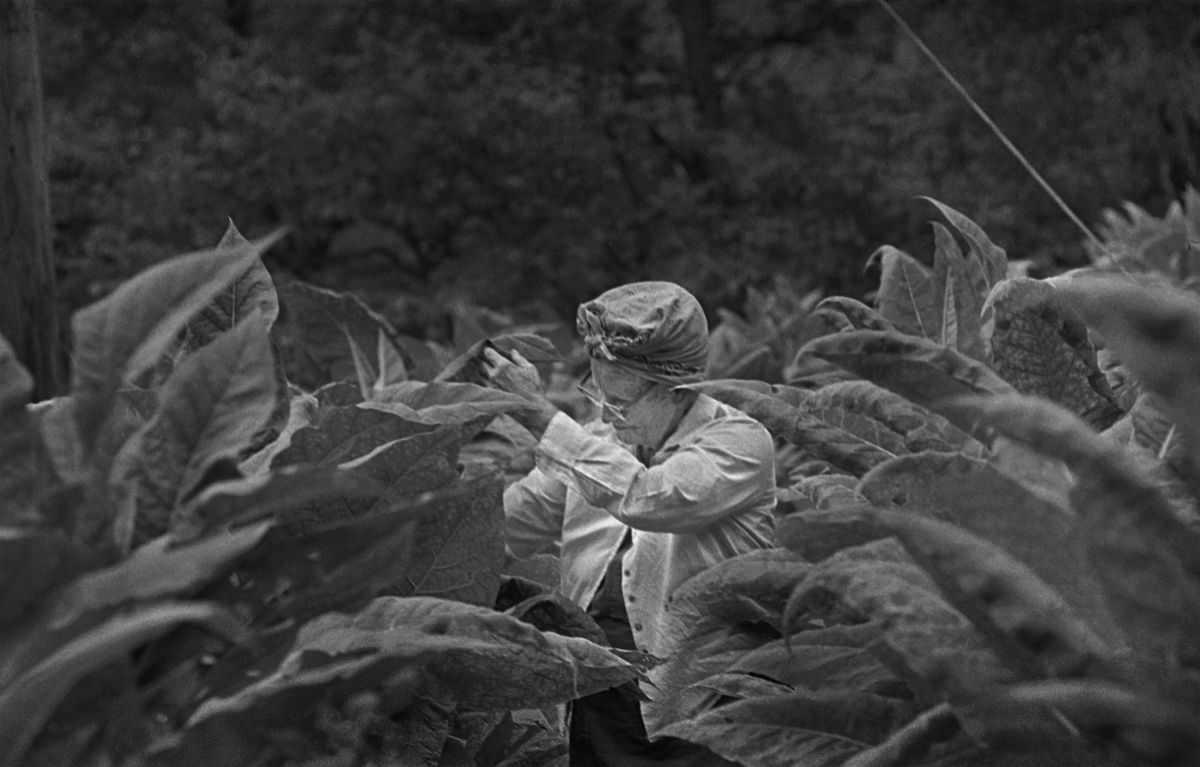
Norton’s reaction reveals one of the many divisions that existed within the cultural terrain of Madison County, which linger into the present day. Just a few months ago, for example, I encountered the twisted legacy of the Klan in conversation with a community member whose family has deep roots to this place. He shared that his grandfather had been a Wizard in the local chapter, but believed that his ancestor’s mission was fueled less by racism than by a desire to uphold American values and protect their women. I wonder how Dellie Norton, or her grandmother who dodged the Rebels’ bullets, would have responded to his interpretation, which manages to erase both violence perpetrated against women as well as animosity directed toward racial minorities. Amberg’s decision to include the photograph, however shameful it may have been to some of his contemporaries who held more egalitarian views, portrays Madison County as a place where some condone violence, or the threat of it, to preserve whiteness as the norm. At the same time, through the accompanying stories about Dellie Norton, he reveals two competing mentalities that he saw co-existing within the culture: fear of the racialized "other" and curiosity toward the incoming "outsider."
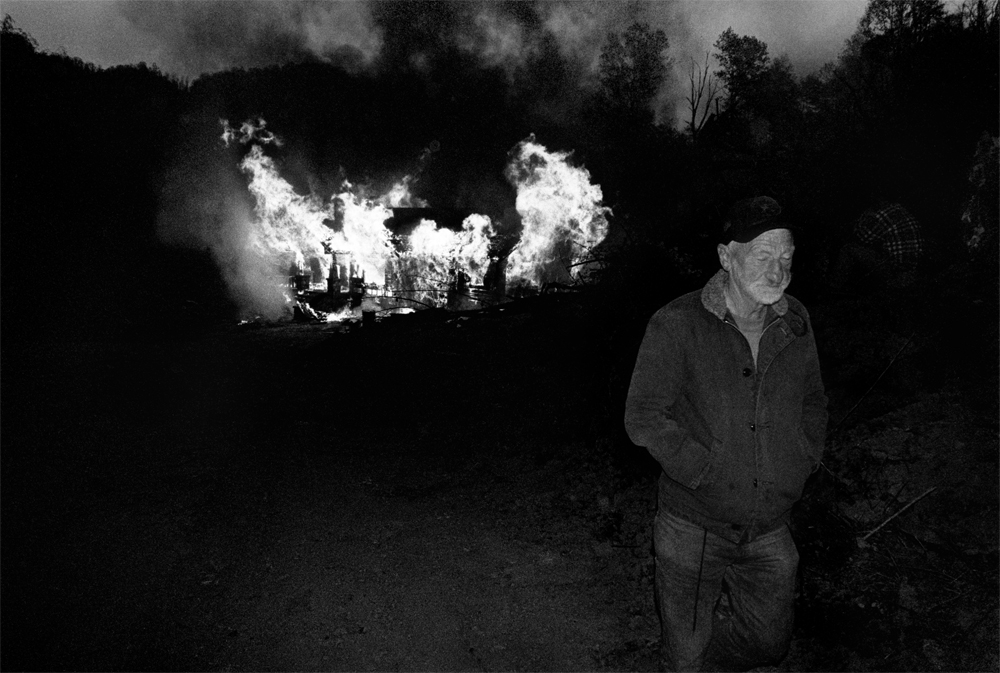
In Amberg’s second book, The New Road (2009), he continues to explore the complexity of place by delving deeper into themes of transformation and progress. What imprints are left when a mountain is pummeled to build an interstate highway, he asks. At this point in Amberg’s life, he had lived in Madison County for over three decades and had become embedded there. He was one of the residents, not simply an observer making photographs of it. The images and stories within the book depend upon his connections and the trust he had developed with neighbors. He interviewed more than thirty people about their opinions of the I-26 corridor that cut through their county, exposing complicated feelings and contradictory implications of development. Through Amberg’s images, we see a governor, a beauty queen, and a group of veterans celebrate the highway upon its completion at a new Visitor’s Center, hopeful for the convenience and access that will accompany it. We also learn of Howard and Lucille Babbitt, an elderly couple, who pick apples from their old family orchard for the last time before it is bulldozed to make room for the road. In perhaps the most heartbreaking photo of the book, JD Thomas walks away from the house where he was raised, his eyes gazing downward as flames engulf the old structure. “Bye, bye, old home place,” Amberg heard him utter.5Rob Amberg, The New Road (Chicago: Center for American Places at Columbia College, 2009), 31.
The New Road ends with Amberg’s own nuanced, yet ultimately troubled perspective of the changes he had witnessed over the decades: “all in all, Madison County has been able to find and maintain an acceptable balance between old and new….But some of what has come in the highway’s wake—the gated communities, the steep-slope development, the loss of wildness, the acres of land being bulldozed and paved, and the speed with which these things are happening—are real and symbolic evidence of a massive upheaval in our community. For me, they link us to the wider world I chose to leave behind years ago, and they are representative of a place out of balance.”6Amberg, The New Road, 175.
Fifteen years later, in Little Worlds, Amberg considers what the future may hold for a place unsteadied by perpetual growth, divided by fears (real and imagined), and occasionally ravaged by natural disasters. The book is a tribute to a life lived in a region in flux. It is a colorful collage of stories layered one over another, distinct moments of time feeding into each other, leading one to wonder where the lines between reality and fiction, or past and present, reside. Its structure follows Amberg’s previous works in its reliance on the interplay of words and images to tell a rich tale about a complicated place. But, otherwise, it takes a different approach. As Amberg told me, “I really wanted to break out of the documentary model…to break completely away from any pretense of objectivity.”7Amberg interview with Maia Surdam, March 13, 2025. He succeeds.
The storyteller’s imprint is everywhere. Amberg includes decades-old journal entries, filled with recollections of his daily life; there are vulnerable memories of divorce, remarriage, and building a life with his second wife Leslie; we see his son and daughter’s childhood photographs. Even the fictional story woven throughout was fashioned from a tale he once told his daughter Kate as part of their bedtime ritual. And, in one of the most touching final scenes I have encountered in a book, Rob Amberg depicts his future death. He has chosen a peaceful place for himself—under a shady tree in the Lost Cove, “holding [a] box of stories and memories close,” gazing at the night sky and listening for the sounds of an owl in the darkness.8Amberg, Little Worlds, 174. More than a photography book, it is a dramatic culmination of Amberg’s long-term commitment to document Madison County with insight, specificity, and imagination.
Though Little Worlds completes Amberg’s trilogy, it stands firmly on its own, offering contributions to multiple genres. History lovers, especially those of us interested in the transformation of rural life, have much to learn from Amberg’s recollections of fifty years of life in Appalachia. His work at the Rural Advancement Fund, which allowed him to travel throughout and document the rural South in the ‘80s, gave him a greater understanding of these complex changes. We feel the emotional blow of losing one’s farm when we look at his powerful photograph of a farmer holding a painting of an old farmhouse during an estate auction. We sense the massive impact that the building of the Marshall bypass had on one community’s social and spatial customs. We consider the innovation of rural people who repurpose old buildings in new ways, giving inspiration to those trying to remake small towns suited to the twenty-first century. And we see the risk of a fractured society when newcomers isolate themselves from local residents or culture, whether out of fear, indifference, or false assumptions of superiority.
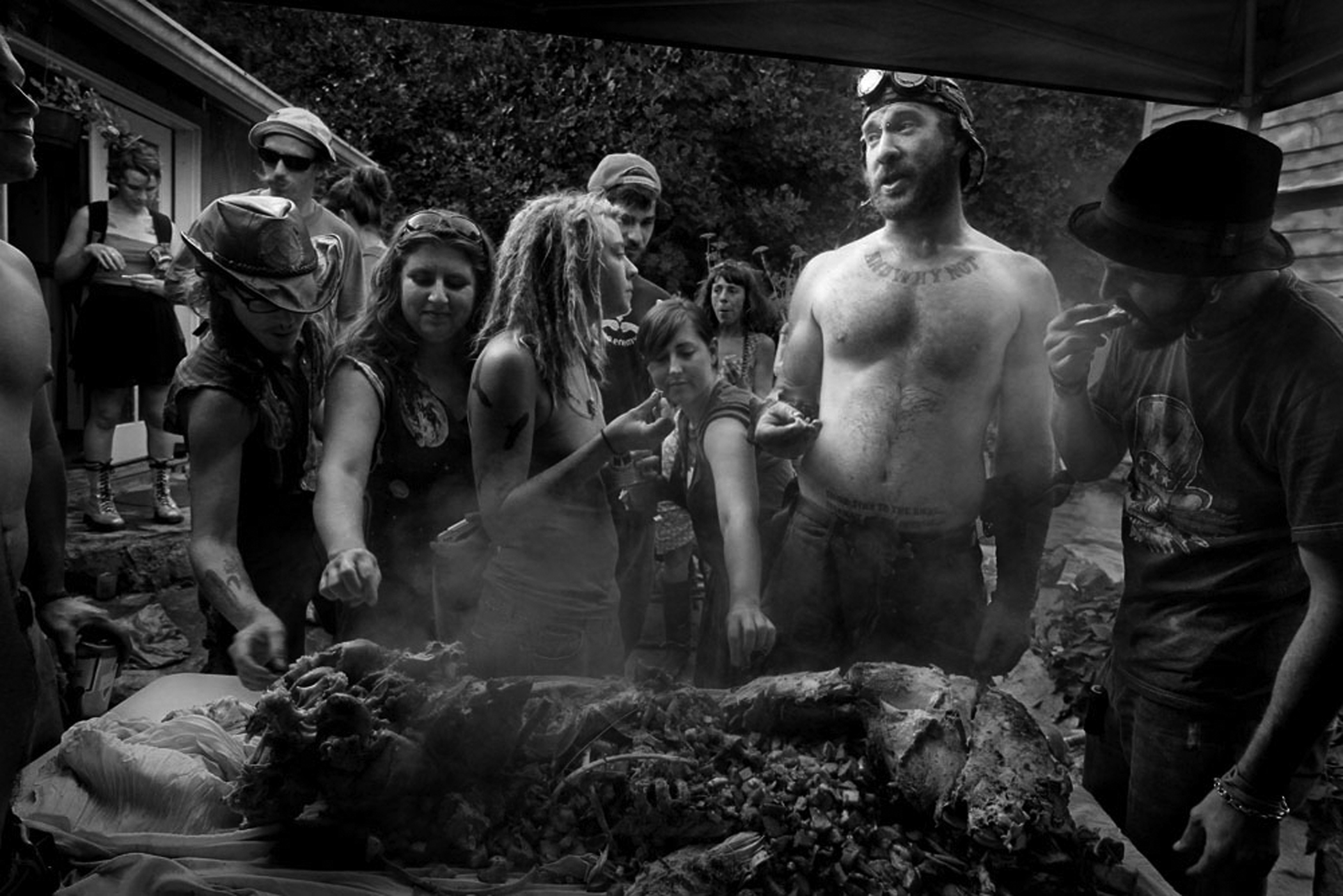
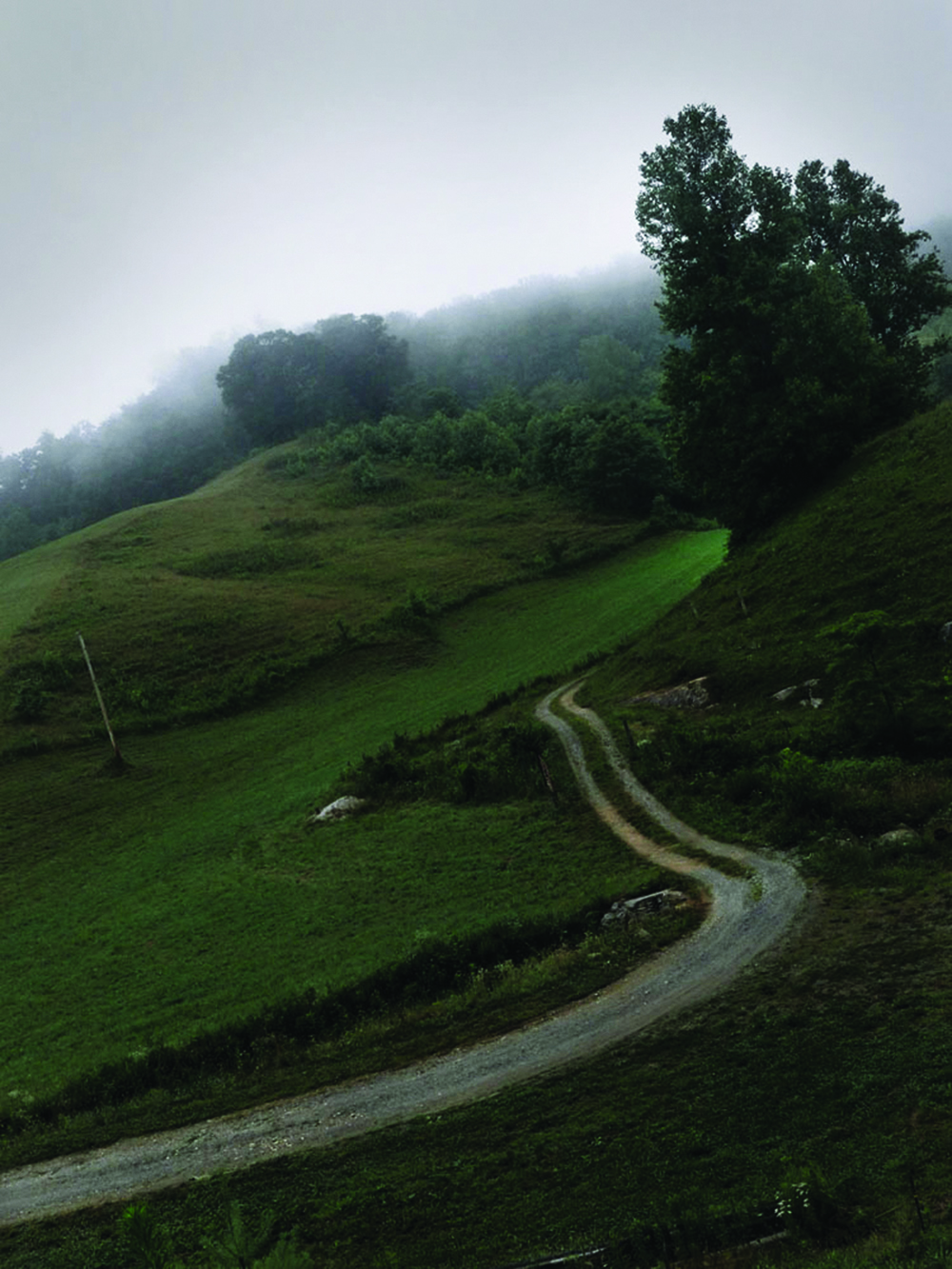
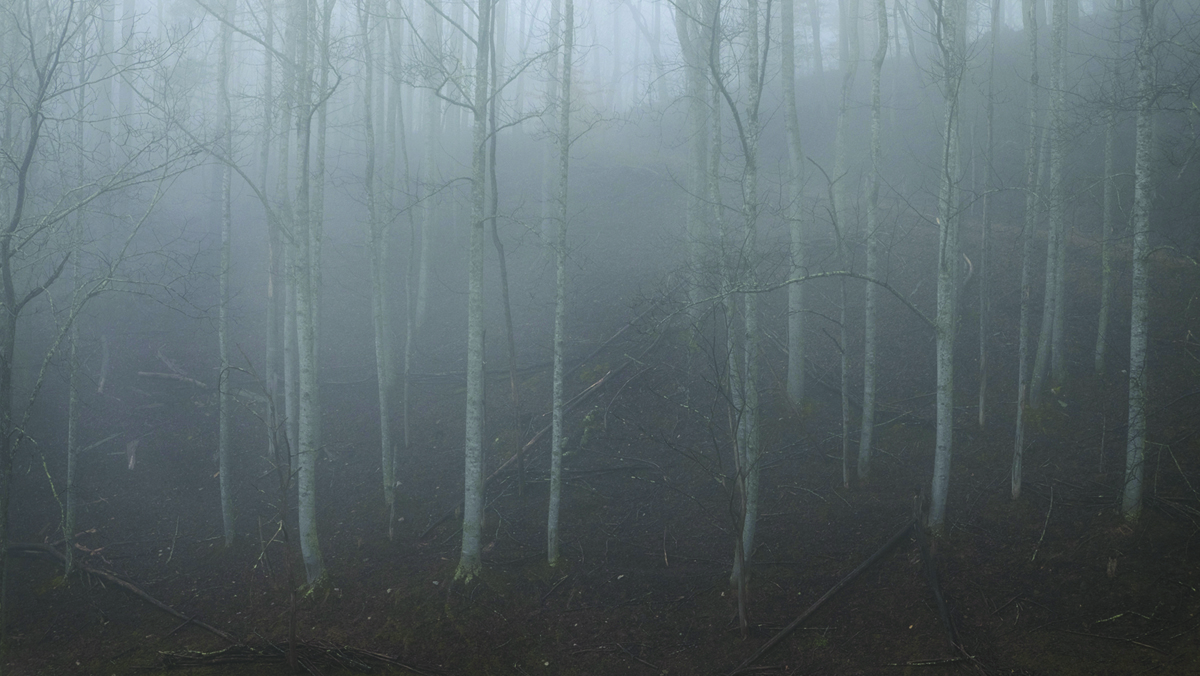
Students of visual art will appreciate how Amberg continues to use photography to convey the “texture and feeling of life.” Landscape photos signify Madison County as Appalachian, yet evoke a different scale of time. A two-track road disappearing into a foggy mountain curve. A soft green valley, edged with trees and textured with the interplay of light and shadow. A thick forest blanketed with snow, peaceful and cold. We see moments of people’s daily lives that reveal the vitality of the human existence, no matter how ordinary. Dancers stomp their feet as fiddlers strum their bows. Young, hungry party-goers pull pieces of meat from a roasted hog. A woman proudly displays her jar of canned vegetables, suggesting the great effort it took to bring forth this food.
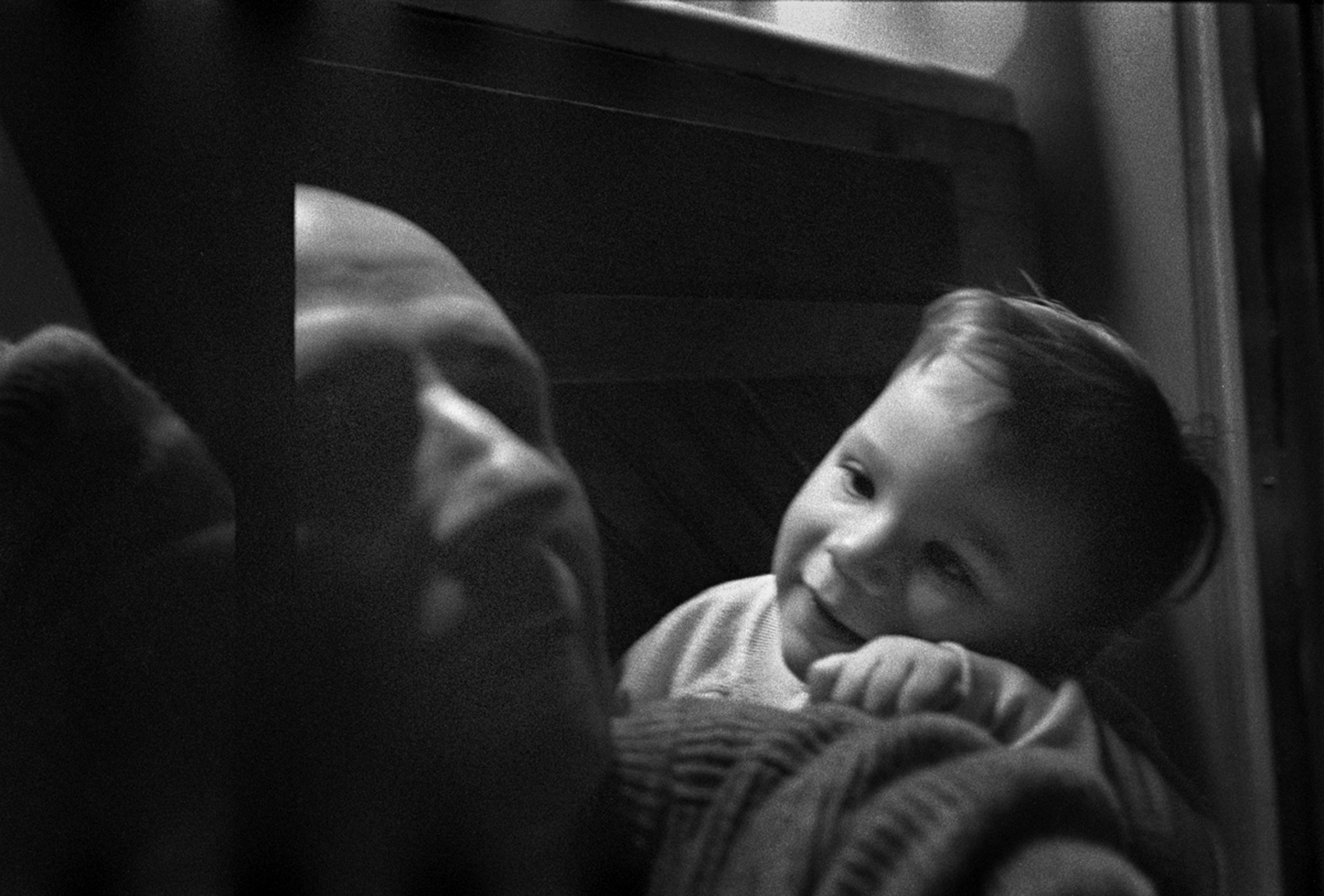
Other photographs deliberately show the passage of time, like the portraits of his daughter, which begin each chapter and show her grow from an infant into a young woman. As Amberg explained to me, “I wanted to remind the viewer that this was a story I was telling Kate…And, number two…she was my muse for years and I’ve got all these incredible photographs of her.”9Amberg interview with Maia Surdam, March 13, 2025.We sense, then, not only the evolution of a daughter listening to a bedtime story, but the changing seasons of an artist who has found creative freedom in the latter part of his career to include photographs that reveal tender moments of his parental journey. In this way, Little Worlds feels like a family heirloom, a loving gift from father to child, a collection of poignant photos and cherished memories.
As a writer and storyteller, Amberg ambitiously ventures into the realm of fiction, but this is no ordinary bedtime story. Readers will find interspersed in Little Worlds a compelling tale set in a dystopian future, reminiscent of Cormac McCarthy’s The Road or Octavia Butler’s Parable of the Sower. In this imagined world, Amberg’s descendants seek refuge in a place similar to Dellie Norton’s early days, both physically and socially, when people walked across dense mountains on foot and neighbors worked the land together out of necessity. With much of the world plagued by urban violence, incessant climate disasters, and systemic social decay, the characters in Amberg’s story, a blend of old-timers and newcomers, look to the past to build a better future in the mountains. They have a lot to learn.
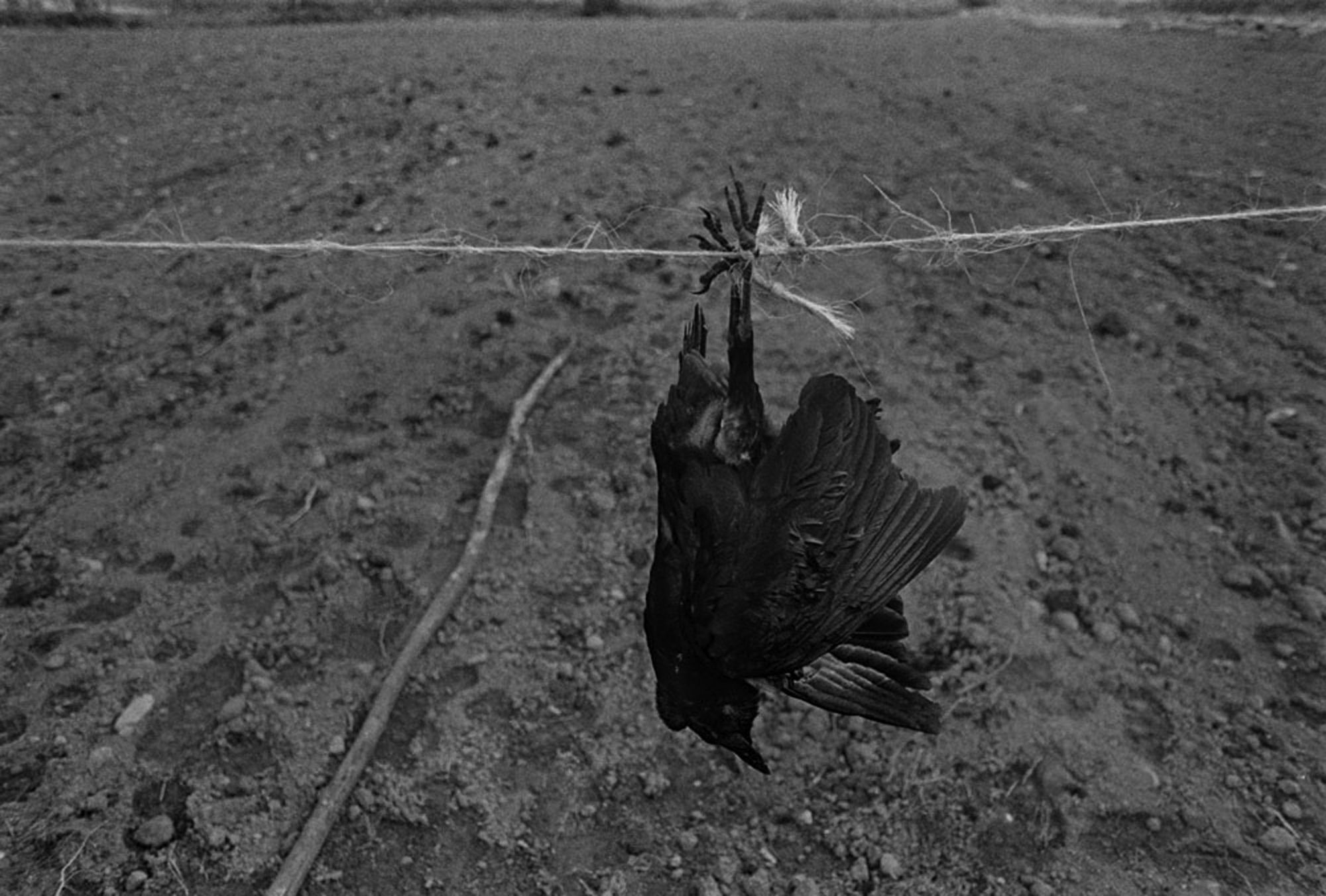
Amberg includes a plethora of images that counter the familial ones of his daughter, and, at first glance, appear as disturbing as the chilling future he imagines. We see children playing with knives, a bow and arrow, and guns, à la Lord of the Flies. We see an animal skull attached to a pickup truck. We see a rebel flag displayed prominently on Main Street; a spooky religious figure surrounded by antlers; a row of disembodied squirrel tales hanging on a wall; and a bench lined with bloody sheep heads. Surely, the stories behind these individual photos would reveal details that forgo a simple, dire understanding (animals must be slaughtered before they are consumed, of course) but, collectively, they acknowledge the “hard and harsh” aspects of Madison County. Or, as he observed in his first book, “the meanness of the place was hard to ignore.”10Amberg, Sodom Laurel Album, 35.
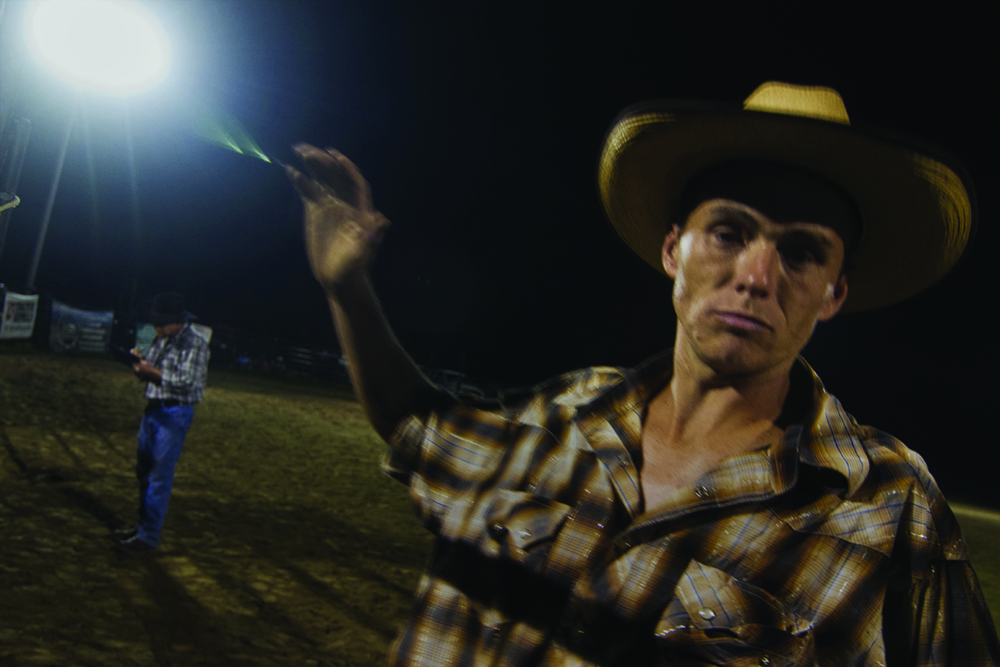
In a clever narrative move, Amberg inserts himself within the fictional tale by having his imaginary descendants, Frank and Wright, discover a trunk of his writings and photographs inside their abandoned ancestral homeplace. In their search for peace and stability, the trunk and its precious contents provide evidence of the society that had existed before their world fell into chaos. To readers, these contents are Amberg’s personal memoirs and documentation of life in Madison County that spans over fifty years, with some overlap of what we have seen in his previous two books. To Frank and Wright, they are a treasure map that helps them connect a distant past, filled with its own set of challenges, to a future that might still be salvageable from their dismal present. Up until that point, their lives had been plagued by fear, distrust, and isolation. Environmental disaster, especially floods and wildfires, made life more uncertain. Perpetual migration became an act of survival for most. Within the time capsule left by their ancestor, they consider a different path forward. They see photographs of handmade quilts made for newborn babies. There is evidence of a vibrant social life, where people gathered for parties, town hall meetings, rodeos, and even something called a Mermaid Parade. Many photographs show people working on their land to produce food to eat, supplies to use, or commodities to trade. Their initial reaction to the trunk, and its stories of a functional community rooted in place, is hopeful.
Later in the story, as the numbers of refugees grow and the community becomes more racially and culturally diverse, tensions rise as well. The characters grapple with humanity’s shadowy sides. “There are those among us holding onto the past, as divisive as that old world had been,” one person observes. “They want to exclude those different from themselves and have threatened violence if they don’t get their way.”11Amberg, Little Worlds, 165. By weaving together fictional and historical storylines—and photos that range from beautiful to ordinary to provocative to downright unsettling—Amberg once again rejects notions of a romanticized Appalachian past where everyone lived in harmony. Through his personal entries, Amberg’s descendants learn that divisiveness and violence had been a consistent part of the landscape. “In Madison County,” Amberg writes, “the divides have always been sharp, but they’ve mostly stayed beneath the surface.”12Amberg, Little Worlds, 164. As the fictional settlers consider how to respond to ruptures in their new community, Amberg’s memoir laments the virulent political culture that is taking root in his longstanding one, especially with the rise of the first Trump presidency. With a president that explicitly “encourag[es] violence and anger,” old norms of civility seem to be rotting away on the local level too. “Neighbors—people I’ve known and liked for forty years are suddenly distant and angry. It’s as if my outsider status and points of view make me an enemy.”13Amberg, Little Worlds, 164.
The narrative arc in Little Worlds is a circuitous one, as the story ends close to where it begins, with the revelation of Amberg’s trunk and documentary contents. The experience of reading this book feels appropriate for our times. It is bewildering. Are we looking backward or forward? Where are the lines between reality and fiction? Madison County, like many rural places in the US, remains mostly, but not entirely, white, a demographic fact reflected in Amberg’s visual record. Today, there are few Black people living here, around 1% of the population, but there is a rising population of Latino immigrants, as well as more people who identify as bi- or multi-racial.14Around 3.5% of the county's population identifies as Latino or Hispanic, and 5% as “two or more races.” https://data.census.gov/profile/Madison_County,_North_Carolina?g=050XX00US37115#race-and-ethnicity Politically, this county votes predominantly, but not entirely, Republican, thus supporting the fear-based ideology of Trump that feeds on division, champions a narrative of white superiority, and enacts policies that are anti-immigrant.15For a decades’ long perspective on the shifting political climate of the western North Carolina county of Transylvania, see Dan T. Carter, “Good-Bye to All That,” Southern Spaces, December 19, 2014. And like the Madison County we glimpsed in Amberg’s earlier works, we continue to witness contradictory reactions by those in the racial majority, with anti-"other" fears and animosity (with threats of ICE raids targeting Latinos as the most alarming example), as well as acts of neighborly benevolence. As far as our physical environment, which has seen dramatic transformation due to direct and indirect human interventions, including the recent climate-change-related disaster, Hurricane Helene16See Amberg’s “Hurricane Helene Visits Marshall, North Carolina,”August 11, 2025.,we are grappling with questions of how to rebuild. In the immediate wake of natural disasters, divisions may fade in lieu of pressing needs for collective survival. But how can we remake ravaged places that will sustain us in the long run if we live divided from our neighbors, whether out of custom, ignorance, or fear? How do we heed lessons from the past without being tethered to its stubborn foundation of inequality and extraction? Though Little Worlds does not answer these questions, it extends them for our contemplation as we move toward the future.
Amberg’s personal narrative is winding, too, and somewhat ambivalent. He has journeyed from outside observer to resident photographer to “an enemy” among neighbors to a man digging his imaginary grave in the beloved mountains he calls home. As he explains it, Little Worlds “spelled a story of me moving here, being here, becoming part of this place [and] leaving my own footprint here…But recognizing at the same time that I really ain’t from around here.”17Amberg interview with Maia Surdam, July 12, 2025. His is an uneasy position, but one that he occupies bravely and honestly. Little Worlds is an expansive rendering that portrays a multidimensional place where various, opposing elements coexist, however uncomfortably. As such, his story presents no clear directions on how to avoid the catastrophic future he imagines. What Amberg does give is the insight that thriving societies must cultivate vulnerability among its people. As he models for us, we must courageously share our stories, in their most truthful forms, however ambiguous, and graciously receive and reflect on those shared by others. This lesson is part of Rob Amberg’s legacy, applicable to us all, no matter what little worlds we inhabit. 
About the Author
Maia A. Surdam earned a Ph.D. in US History from the University of Wisconsin-Madison. An independent scholar of underrepresented histories of rural America, she recently contributed essays to Affrilachia: Testimonies (University Press of Kentucky, 2024). Surdam resides in the mountains of western North Carolina and serves as the Programs Director for Partnership for Appalachian Girls' Education (PAGE).
Banner image: Carnival on the Island, Marshall, 1983. All photos copyright © Rob Amberg and used by permission.
]]>The first trailer park I ever spent much time in was the Simonton Street Trailer Park, located off upper Simonton Street not far from the Southernmost Point. It was the 1990s, and drunk tourists would stagger past the humble hand-painted sign at the entrance, unaware that within the grove of Australian pines lived the working poor of South Florida. Few residents owned cars, so bicycles were locked to fences and posts, a common sight on the island. The forty-four single-wide trailers seemed to be indiscriminately scattered as if someone had tossed them into the air to see where they’d land.
Here was the last vestige of the Key West that Jimmy Buffet immortalized. Here were today’s pirates and renegades, misfits and malcontents looking for a shaker of salt—and a place to crash. But the island troubadours were now singing a sad song: rents in Key West were higher than those in New York. Keeping a roof over your head was no small matter.
I had a friend who lived in the trailer court, and I was worried about his domestic bliss. “Roommates” seemed to proliferate in number and their names changed in dizzying flux. He’d let one person crash on his sofa, and then that person would bring over three or four other people. In addition to free rent, he’d “lend” them money—money he didn’t have, money they made him fork over, or else.
My friend was a dishwasher at a local restaurant. He couldn’t read or write. He was a victim of unspeakable childhood trauma. He allowed people to stay in his trailer because he wanted to think he was helping others who needed assistance. He himself had no bank account, no savings, and was barely hanging on.

I’d stop by when I could, and usually there’d be a crowd in the trailer of people I’d never seen before. People who had nowhere else to go. The trailer court was the last resort, a de facto shelter but it was just as doomed as the people who lived there.
Don’t look for the Simonton Street Trailer Park these days. It closed in 2019, taken over by a developer who somehow evaded the city ordinance that would’ve required him to build affordable housing units. “Gentrify” doesn’t begin to describe what’s happened in certain communities of South Florida. The average home price in Key West sits at $1 million.1“Key West, FL Housing Market,” https://www.zillow.com/home-values/52767/key-west-fl/, accessed August 24, 2025.
Not many dishwashers–aka “pearl divers”–can swing a mortgage as hefty as that. Instead, they squat within mangrove islands, live aboard derelict vessels, or sleep in parked cars. Many work several jobs, but none of them add up to enough. At one point, a tent city sprang up along the Bridal Path of Smathers Beach. Affordable housing isn’t some kind of policy abstraction in South Florida: it’s a problem that pits dream against reality.
Or as Jeep, a local banjo player, told the Key West City Council when they were deciding the fate of the trailer court: “Somehow, maybe, you guys can figure out how to keep people like me and others in this community.”2Arnaud and Naja Girad, “The Gentrification of Simonton Street Trailer Park,”Key West The Newspaper,” November 4, 2019. https://thebluepaper.com/gentrification-simonton-street-trailer-park/,accessed August 24, 2025.
The erasure of the Simonton Street Trailer Park contains a pointed message about place and identity that forms the intellectual core of Sunset Colonies: A Visual Elegy to South Florida’s Mobile Home Communities. The book centers on the photography of Diego Alejandro Waisman, an Argentine by birth but a resident of Miami for over two decades, where he has established himself as a visual artist dedicated to the discontinuities and disfigurements caused by the sybaritic excess of South Florida. Waisman writes of using the “vernacular” of place to inform his work, and in the vanishing trailer parks of Miami, he has found a trove of distinctive tones.
The data is clear: the mobile home as a mode of domicile has decreased in Florida over the past decade, falling from 9.2 to 8.2% of all housing in the state. Yet unlike Tampa or St. Petersburg, the trailer park was never a defining feature of Miami, with just 1.3% of housing units being mobile homes–a figure that has remained stable over the years.3“Mobile Homes (Census ACS), FLHealthCHARTS, https://www.flhealthcharts.gov/ChartsDashboards/rdPage.aspx?rdReport=NonVitalIndRateOnly.Dataviewer&cid=0408, accessed August 24, 2025.
Waisman’s work directly takes on a persistent stigma that has plagued mobile homes from the beginning: the concept of “trailer trash,” a term that dates back to the 1950s as a way to condign residents of trailers to the ashbin of humanity. It’s certainly easy to bulldoze down a trailer park if conventional wisdom has it that the place was filled with lowlife scum.4 Harold H. Martin, “Don't Call Them Trailer Trash,” The Saturday Evening Post, August 2, 1952, Vol. 225, No. 5.
But Waisman is looking for “evidence” that even within these marginalized places, meaning and purpose can take on a multitude of forms and shapes. The photographs themselves come from his collection, For I Shall Have Already Forgotten You, a line taken from “If You Forget Me” by Pablo Neruda, a poem that appears in reprint like a miracle after the last photograph and thus lands like a thunderclap of grim profundity. Seldom has a title, poem, and art flowed together with such urbane felicity.
While Neruda in the poem might’ve been referring to a lover or to his native Chile, it’s clear that Waisman is fueled by the poem’s pervasive feeling of loss and longing. It begins: “I want you to know one thing.” Waisman takes up that same charge and then uses his camera to capture “everything that exists” within the vanishing world of Miami’s trailer parks.
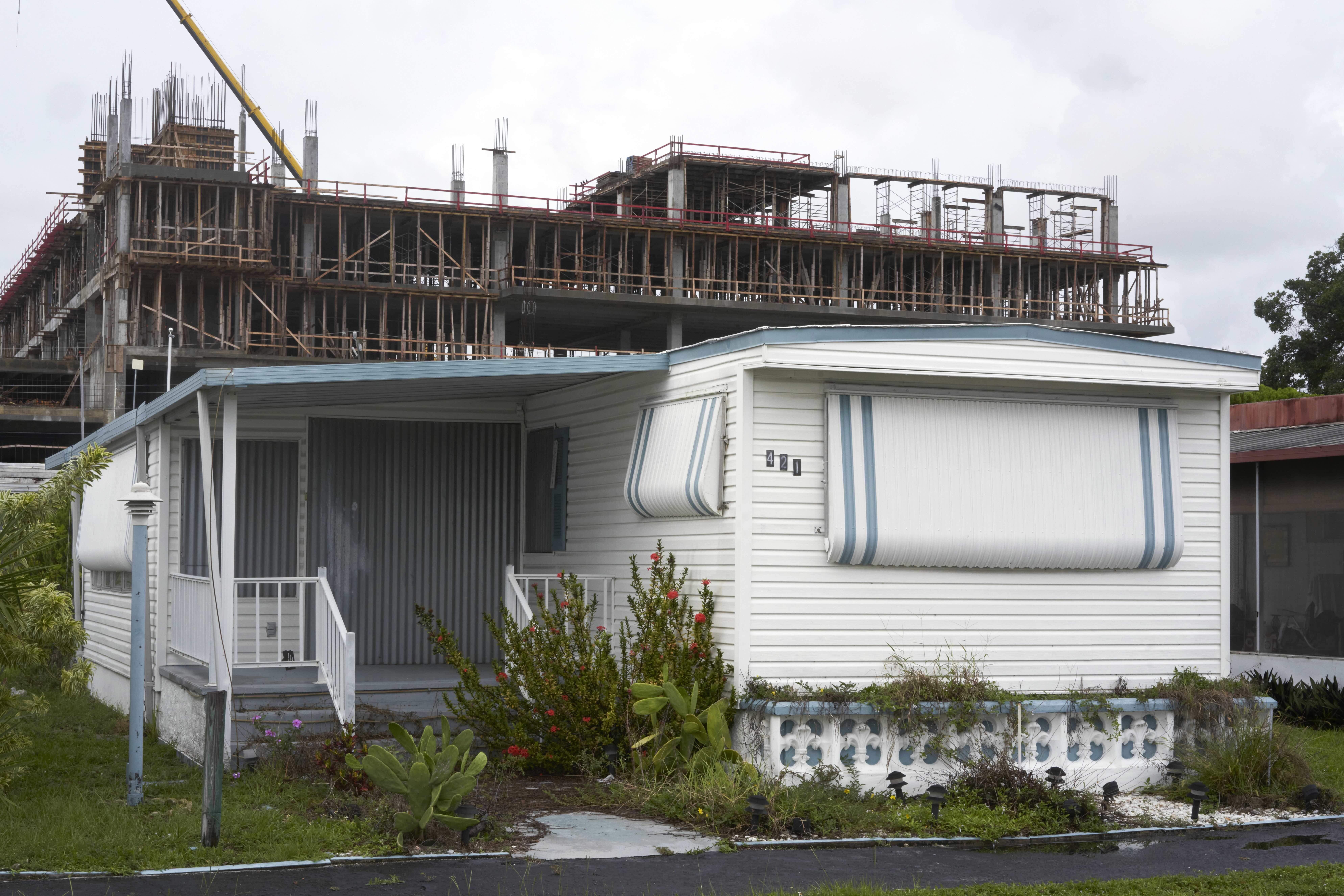
The unique geometry of Waisman’s work flows from his use of juxtaposition, the constant tension between old and new that in Miami sees skyscrapers arising next to thousand-year-old Tequesta sites. Waisman’s eye for such incongruity takes many forms in his collection. One arresting image features in the foreground a well-tended double-wide of white planks and blue trim while in the background a monstrous banality of rebar rises as if to devour the trailer in one rapacious gulp. Given the demise of the Simonton Street Trailer Park, it’s reasonable to conclude that in time too this landscape will get subsumed by the "predatory capitalism” described as the casus belli of gentrification by anthropologist Louis Herns Marcelin in his fine Afterword.
Other works also play with the tension between old and new. Sometimes the reference juts into the composition like an interloper (below), such as how he centers a “Now Leasing” sign jabbing like a dagger into the belly of a home—this work reads like an act of violence, a needless and wanton gesture of dominance.
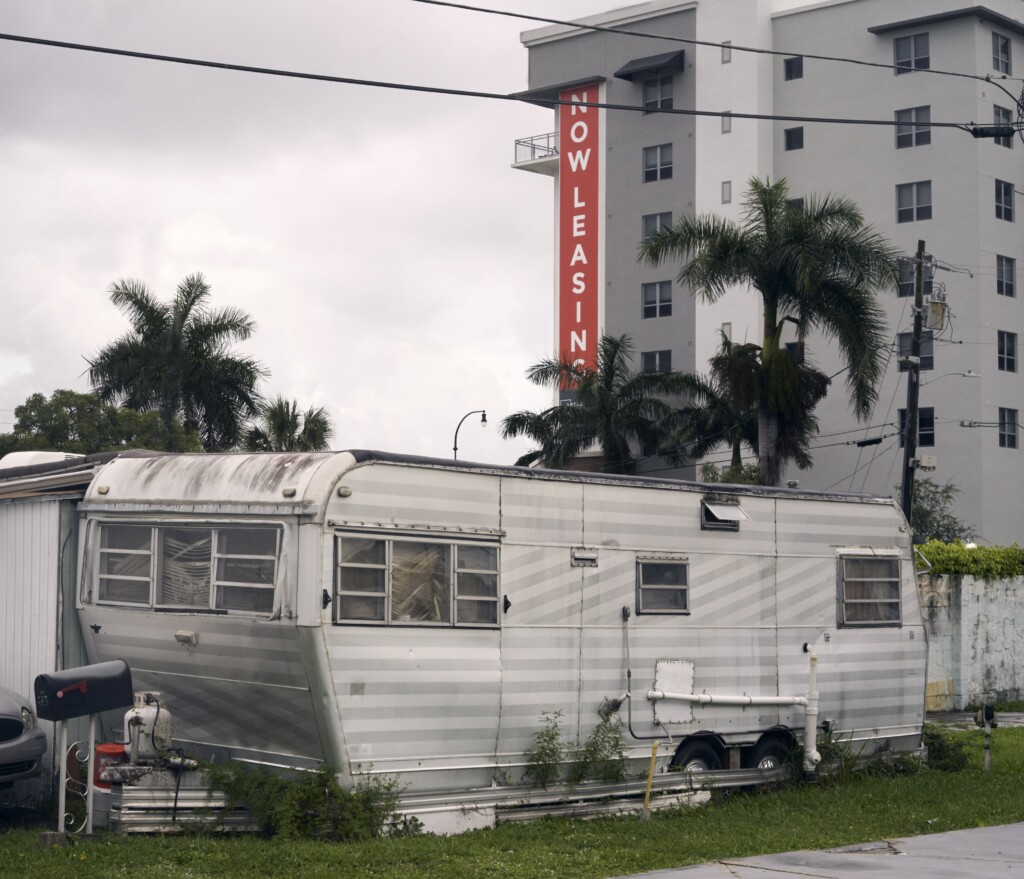
In another, the new building remains to the far right edge, rising up into the sky with a defiance that borders on mockery. The helpless trailers can do nothing but accept this fate, a finality rooted in a dream of Florida that is in open conflict with the grinding truth.
Then, in works that are somber and soulful, Waisman follows the fervid logic of Growth to its deflating conclusion: a scattering of pieces just depict the new environment with the trailer parks completely gone. Another condo project is taking shape, and on the fence surrounding it hangs a festoon of fiction, happy older couples frolicking care-free. The condo being built has no personality, no sense of self, and stands in stark contradiction to the very idiosyncratic decorations of trailers, no two of which are the same.
Waisman explores lines with great precision, finding unique ways to capture how segments can align to produce meaning. For example, in one photograph, the horizontal lines of jalousie windows stand perpendicular to the vertical lines of a metal post and door frame. Both then seem to merge with criss-cross lattice, as a clearly delineated triangle of shade falls across the trailer. The “evidence” here is of the evanescent sort: as South Florida booms, the most vulnerable places must stand in quiet opposition, affirming their own nuance in subtle ways that Waisman’s camera can singularly capture. He has spoken of his photographs as a way of slowing down the gathering decimation of these communities. His work forces us to stop, look, and ponder where exactly the American experiment is headed.

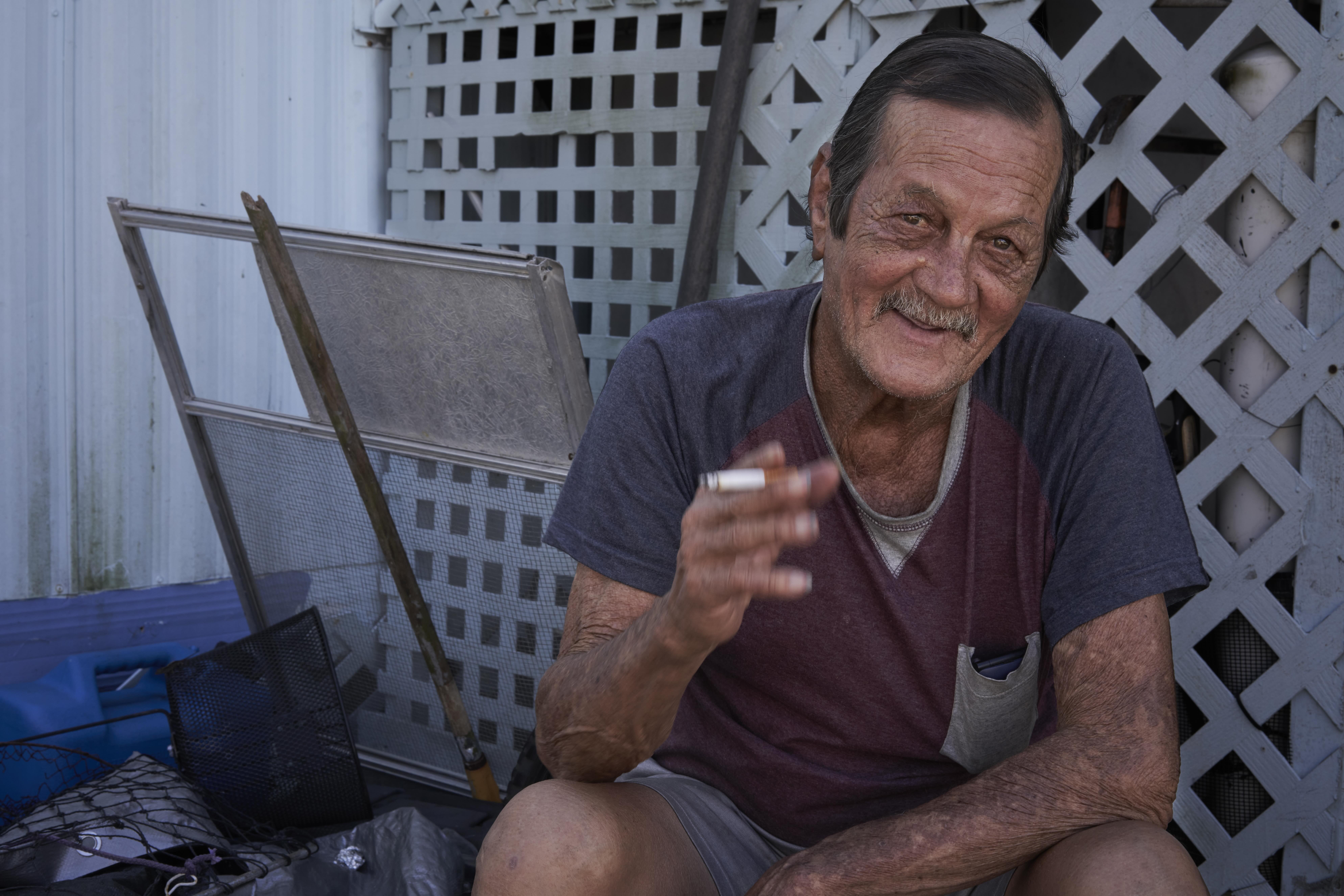
Beyond the geometry is a pulsing humanity that suggests the work of Andres Serrano, whose Residents of New York series from the 1990s conveyed the enduring spirit of Gotham’s unhoused. Waisman’s trailer park dwellers are certainly housed, but in effect his portraits are a kind of memento mori, a moment in time that will not last.
The man holding the cigarette, how long can he make it before the wrecking ball comes for the entire park? And when it’s gone, where will he go? The lattice here serves more like a net that the subject is caught in–that has ensnared all of us. His expression, though, speaks to a consanguinity, a softness that belies the other ravages the man has endured. Here Waisman is playing with juxtaposition again, but this time the viewer must enter this conversation, must hear the man out. There’s no turning away.
And the trailers . . . Waisman has assembled a wide array of examples, using an expansive color palette to capture the distinctive hues of the region. Lime greens, cerulean blues, and cherry reds all speak to the allure of South Beach, yet without the glitterati and glam. Some of the trailers have been lovingly landscaped, while others sit on bare concrete. Some are in pristine condition, and others display repairs that have accreted over time, in clunky layers of rust. Many have their hurricane shutters drawn shut, as if the corrugated metal can’t bear to witness the impending doom.
In addition to the trailers and the people in them, Waisman has added a wrinkle: photographs of ads that ran in newspapers during the 1960s and 70s, all of which extol the virtues of these communities. This is yet another kind of juxtaposition, this one ironically cultural. Waisman rightly views the backstory of trailer parks with a raised eyebrow. Why did so many people work so hard to attract retirees to Florida only to castigate and then obliterate these very communities when they are needed the most? Waisman’s splashes of history are bracing, cold water applied to smug faces. He is suggesting that there used to be a world where lower-income people could live in affordable housing–and a world where Florida led the way in pioneering an alternative to gaudy McMansions. It wasn’t even that long ago, and yet Waisman demands us to answer: what happened?
Waisman isn’t on the prowl for good guys and bad guys. He’s not offering an answer, because artists don’t answer questions, but ask them. And the question is often some variation of Thales: why is there something rather than nothing? What huge forces are shaping the landscape? The key to this collection resides in the title: it’s an “elegy,” visual lament to the dead, the dearly departed cut down by a market-driven mania to maximize profits at the expense of the unfortunate. But Waisman lifts these dead upwards so that we can celebrate the dignity these hardscrabble people display.
Three other essays complete Sunset Colonies. Amy Galpin’s helpful Introduction establishes an academic perspective for assessing Waisman’s collection. Her essay serves as a kind of map that adds context to the photographs that follow. Without Galpin, Waisman’s pieces might come off as a random assortment that could be befuddling.

But what Waisman is doing, very cleverly, is exploring the dynamics of “trailer trash” that has tarnished this community from the beginning. He is exploding this framework by offering a deeply human look at the “trash” whose lives are imperiled by the rampant development that caters to the well-off. The portraits of the residents and their homes speak to the enduring struggle to maintain even as the world seems to be crumbling around them. One image haunts, that of broken sidewalk tile, an apt metaphor for what Waisman has catalogued: the bombardment of a community that will end in permanent exile.
About the Author
Lee Irby's peer-reviewed publications include works of history, fiction, and poetry. His study of "trailer-trash" culture has received numerous awards, and his novel 7,000 Clams (Doubleday, 2005) was named by the Tampa Bay Times as one of the "10 Books Every Floridian Should Read."
]]>Introduction
One night in the spring of 2006, I found myself on the edges of Richmond, Virginia’s Shockoe Bottom neighborhood with a group of reluctant adolescents from my church youth group, Holga camera in hand. Prone to light leaks thanks to its plastic body, the Holga was a toy camera that allowed me to shift from 35mm to medium format 120mm film. What I liked most about the Holga was its less-than-automatic approach to winding through the frames. With a half turn, one could capture images on top of each other, creating a visual palimpsest of moody, blurred, and imperfect scenes. Walking along the James River, I could see ripples of water over my right shoulder while sounds of cars racing along the highway crept into my left ear.
Our local historian tour guide took us down the river path while detailing the experiences of the enslaved. She spoke about how they emerged from the hull of the ship in complete darkness, after months at sea, disoriented, terrified, and unable to communicate with their captors and, in some cases, with each other. She asked us to close our eyes and imagine what it would be like to stand there, chains rubbing away at our wrists and ankles, as we were dragged along towards an unfathomable fate. The next week I developed the film in the dark room at school. My favorite image, which I submitted to workshop that week, was a shot of my tour guide, looking off into the distance, the nearly barren branches of trees etched uncannily across her face. Her body and the natural world merged into one.
How do you represent the horrific legacy of slavery without the bodies of the enslaved? Historically, abolitionist writers and editors built their political critiques on these vulnerable bodies. This manifested as a hyper-focus on the enslaved body as a site/sight of physical domination under the various machinations of white terror. This representation of Black pain, suffering, and duress proliferated with the spread of photography. From the images of lynched bodies in the post-emancipation era, to the photos of civil rights activists being beaten by police in the 1960s, to our contemporary moment of hyper-surveillance and police brutality, US society can view Black suffering’s ever-mounting evidence.
Photographer and visual artist Dawoud Bey explores the history of slavery through landscape photography in his exhibition Elegy which I visited in January 2024 at the Virginia Museum of Fine Arts. Elegy features three photographic collections and two short films that address the legacy of chattel slavery across landscapes in Virginia, Louisiana, and Ohio.
Born in 1953 in Queens, New York, Dawoud Bey, ever drawn to sound, aspired to be a musician before he became a photographer. Bey received his BFA in Photography from Empire State College in 1990, but his career began in New York in the 1970s where he developed a distinct street style featuring predominately Black subjects in everyday life. Influenced by James Van Der Zee and Roy DeCarava, Bey spent much of his career photographing Black faces. Looking through images from collections such as Harlem USA, Class Pictures, or The Birmingham Project, it feels as if you are inundated by the unrelenting gaze of Bey’s subjects staring directly into the camera. Such a dynamic inverts expectations; the subjects are looking at us, into or through us, with as much intention and discernment as we direct towards them.
Compared to his previous work, the large-scale landscape photography featured in Elegy asks viewers to see, and hear, the haunting presence of slavery projected against the landscape without the anchoring presence of Black bodies or Black faces. Bey’s most recent work allows us to recontextualize nature photography by eschewing the innocence of the pastoral scene in order to understand how the bodies of the enslaved, fugitive in their varying trajectories, maintained complicated relationships with nature on American soil. Elegy also contends with the legacies of slavery in the landscape when historical revisionism and erasure has paved over the evidence.
“Stony the Road We Trod” & “350,000”
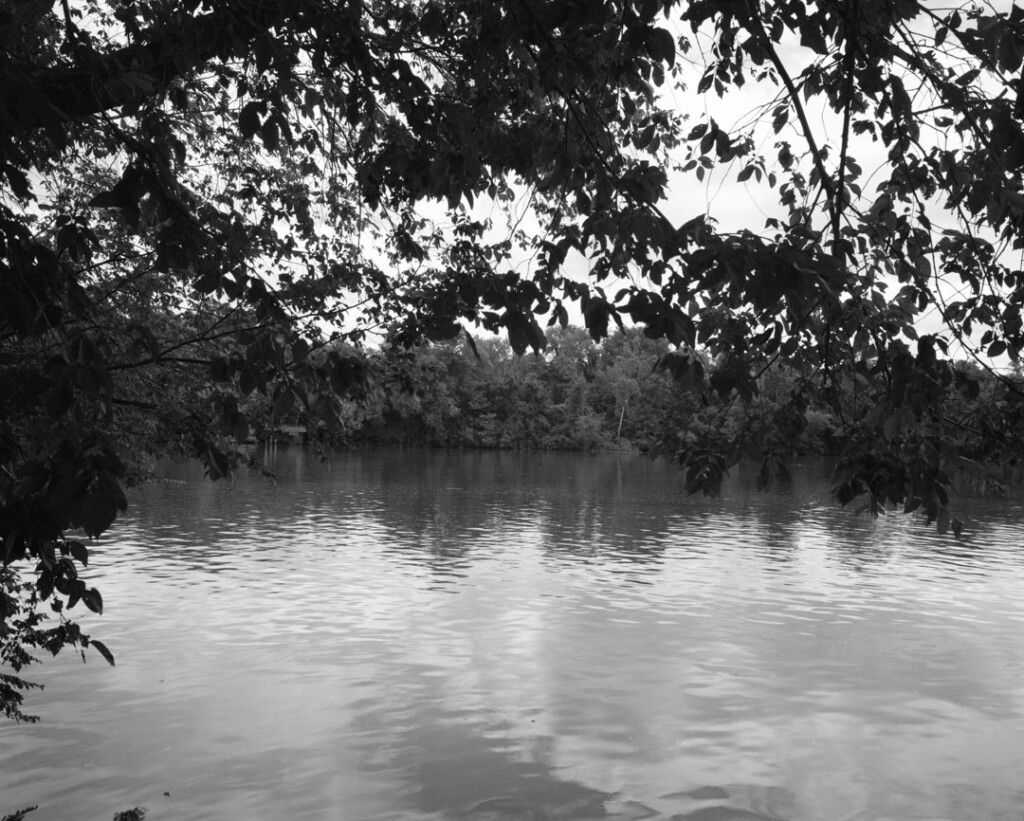
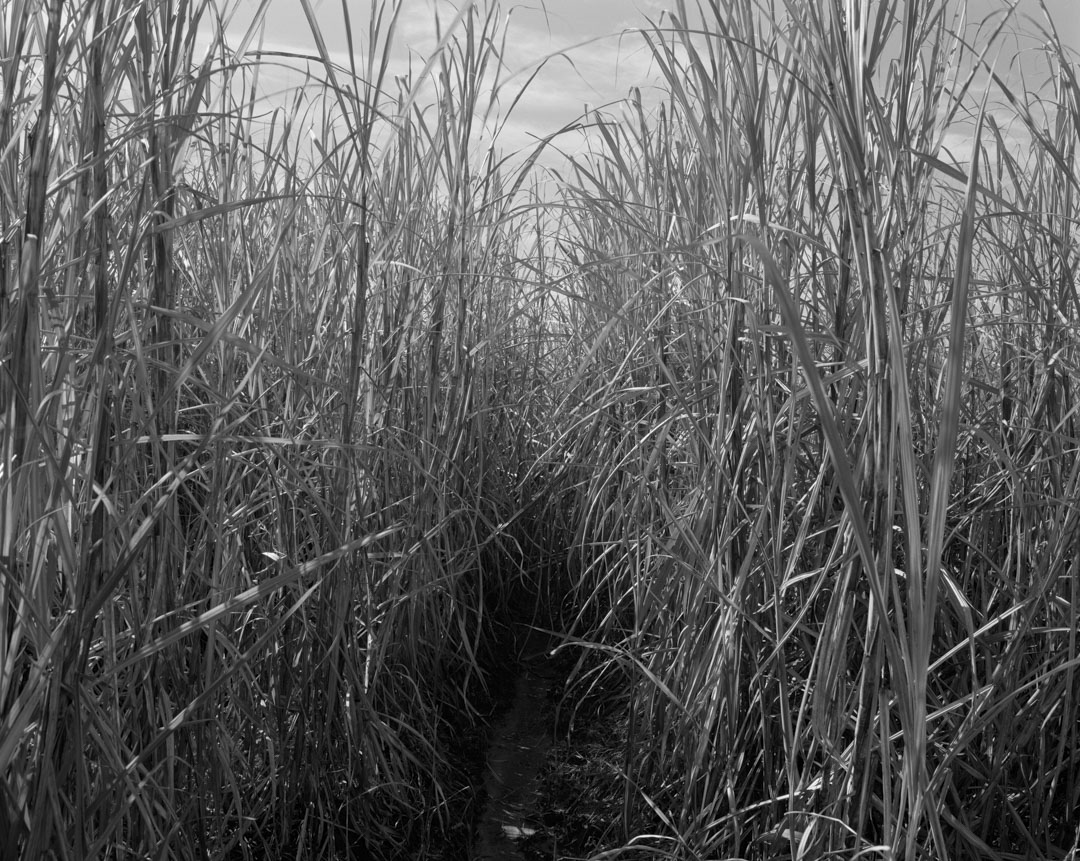
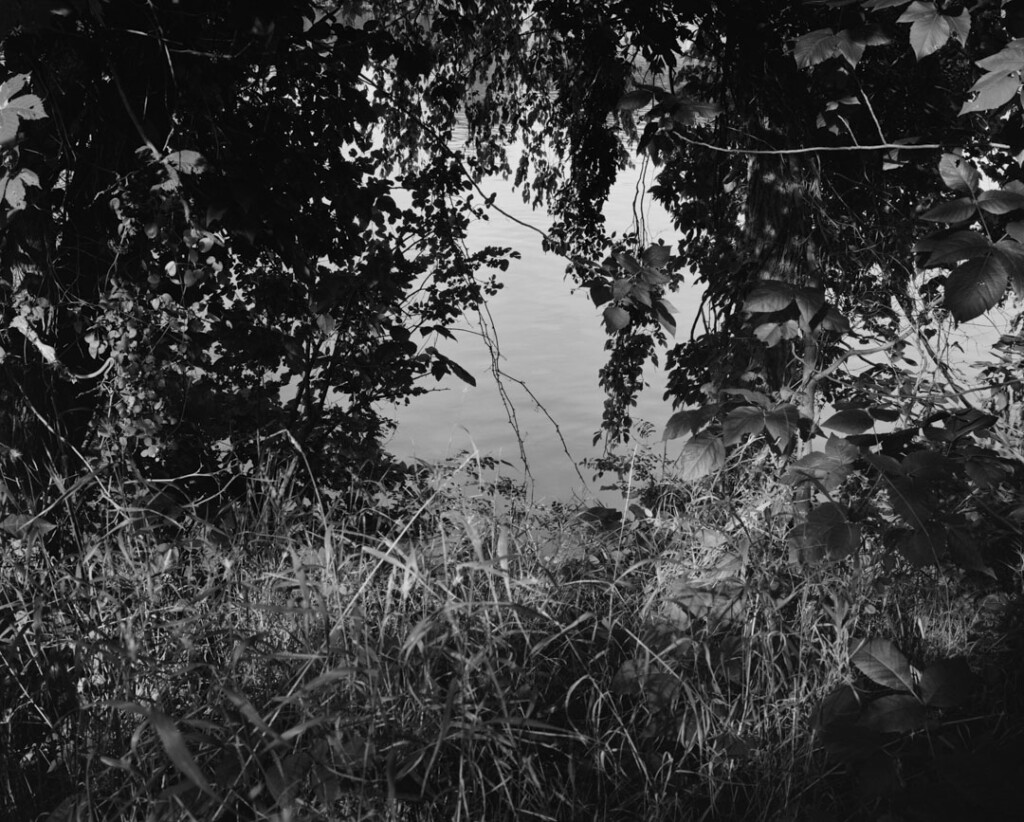
The first section of Bey’s Elegy, “Stony the Road We Trod,” (a lyric from James Weldon Johnson’s “Lift Every Voice and Sing”), features large-scale gelatin silver prints of the slave trail in Richmond. Tracking the route the enslaved took from Manchester Docks to Shockoe Bottom, Bey examines the landscape along the James River with a botanist’s eye. Each image presents the trail from different perspectives, each shot painted in varying tones of light and shadow that create depth and texture. You imagine the tall stalks of grass prickling your calves, the creeping vines of the foliage wrapping themselves around your ankles, and the overhanging branches grazing the sides of your face; you concede to the invasive nature of the landscape. To see the landscape this closely, one would have to get dirty and bend to the level of the soil. There is no way to keep yourself clean. When the camera pulls back, the fullness of the path feels almost endless. The light peeks through the trees, promising a new twist or turn, but there is a sense that it may never stop.
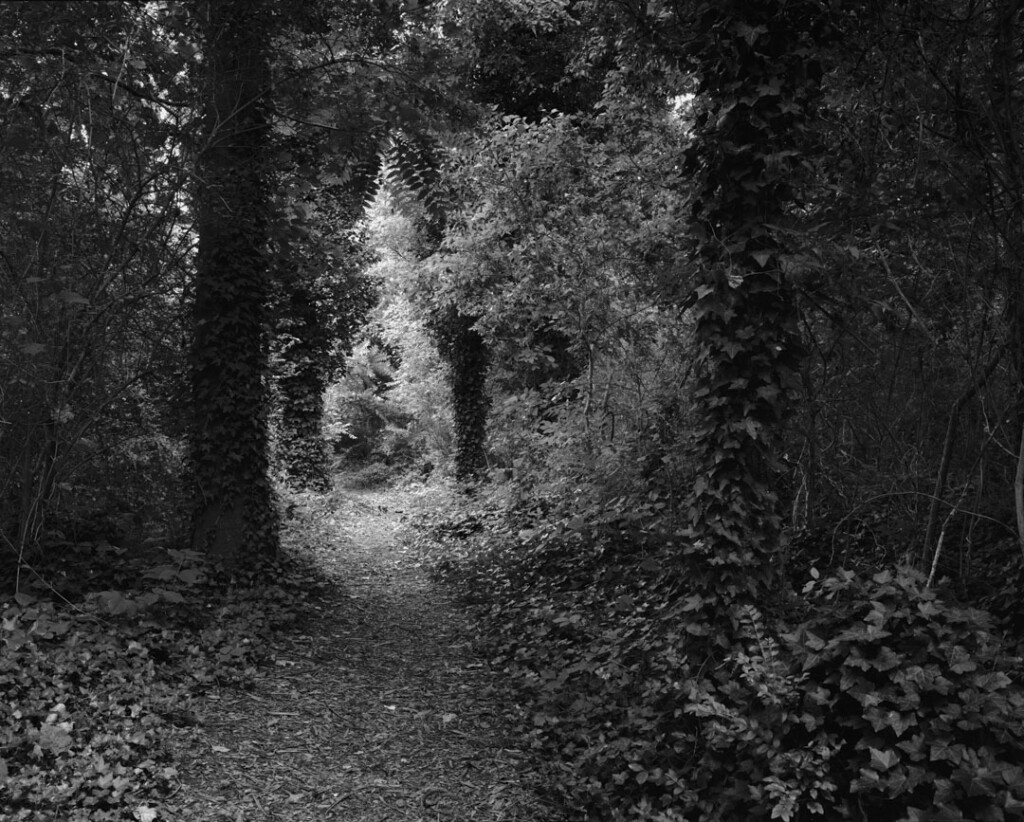
The first of Bey’s two short films, “350,000,” realizes this interminable momentum by offering the perspective of thousands of enslaved persons who traveled along the trail from the middle passage into bondage. Entirely in black and white, “350,000” is presented as a single extended tracking shot which relies on a haunting soundscape to situate the audience within the sensory experience of bondage. The film begins as it ends: with breath, not calm, but a sharp and sudden gasp, like the sound of a drowning body finally breaking through the line between water and air. This sound echoes Christina Sharpe’s concept of aspiration or “keeping and putting breath back in the Black body” within the “hostile weather” of an anti-Black climate, an act both “violent and life-saving.”1Christina Sharpe, In the Wake: On Blackness and Being (Durham, NC: Duke University Press, 2016), 113. The trail is covered in fallen leaves and enshrouded by the endless overhang of trees transitioning from late summer to autumn. Tree limbs refuse to stand upright, but bend inward from left and right, curving into an asymmetrical spiral of light, shadow, and texture. There is some semblance of shade for bodies unseen, but also a sense of being enclosed or entrapped.
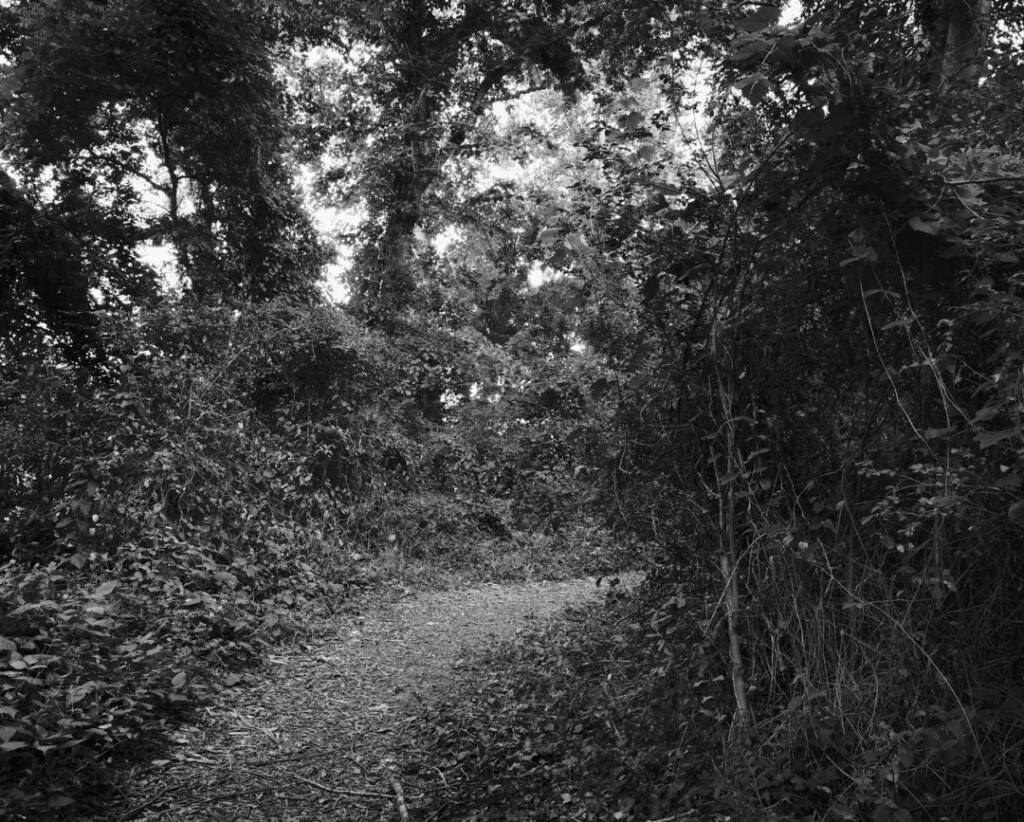
As the camera leads viewers down the winding path, there are slow pans to the left and right, from water to thicket, always searching for stability or familiarity in a strange and dangerous landscape. Even with the constant momentum, there are moments of stillness. The sounds of horse hoofs or rattling chains hover. The camera points upward, lingering on the daylight breaking through the shadows of branches and looming patches of grey-white sky. Photographed in a manner often reserved for flashback or dream sequences, the edges of the screen remain soft and blurred. The lack of any discernable body is disorienting, unmooring, echoing the experience of those trapped for months in the hull of a slave ship. Sound is the only anchor: audible labored breathing; guttural exhalations and moans slipping into a rhythmic chanting; the rattling of chains that resemble windchimes.
Bey collaborated with dance and movement scholar E. Gaynell Sherrod to choreograph “350,000”and sound designer Paul Bruski at the In Your Ear Studio in Richmond. The soundscape uses Foley techniques as dancers perform, sometimes barefoot, walking across dirt and gravel while holding large metal chains. While dancers often train to stifle or quiet the sound of their breath, Sherrod makes the labored breath of the dancers more audible, in the absence of their physical form.2Dawoud Bey, Gaynell Sherrod, and Imani Uzuri, “Soundings: Collaborations with Dawoud Bey” (Conversation/Panel, Virginia Museum of Fine Arts, Richmond, VA, February 9, 2024). Dancers’ bodies disappear and reform through sound, pulling viewers along slowly and reluctantly through the terrain.
“In This Here Place” & “Evergreen”
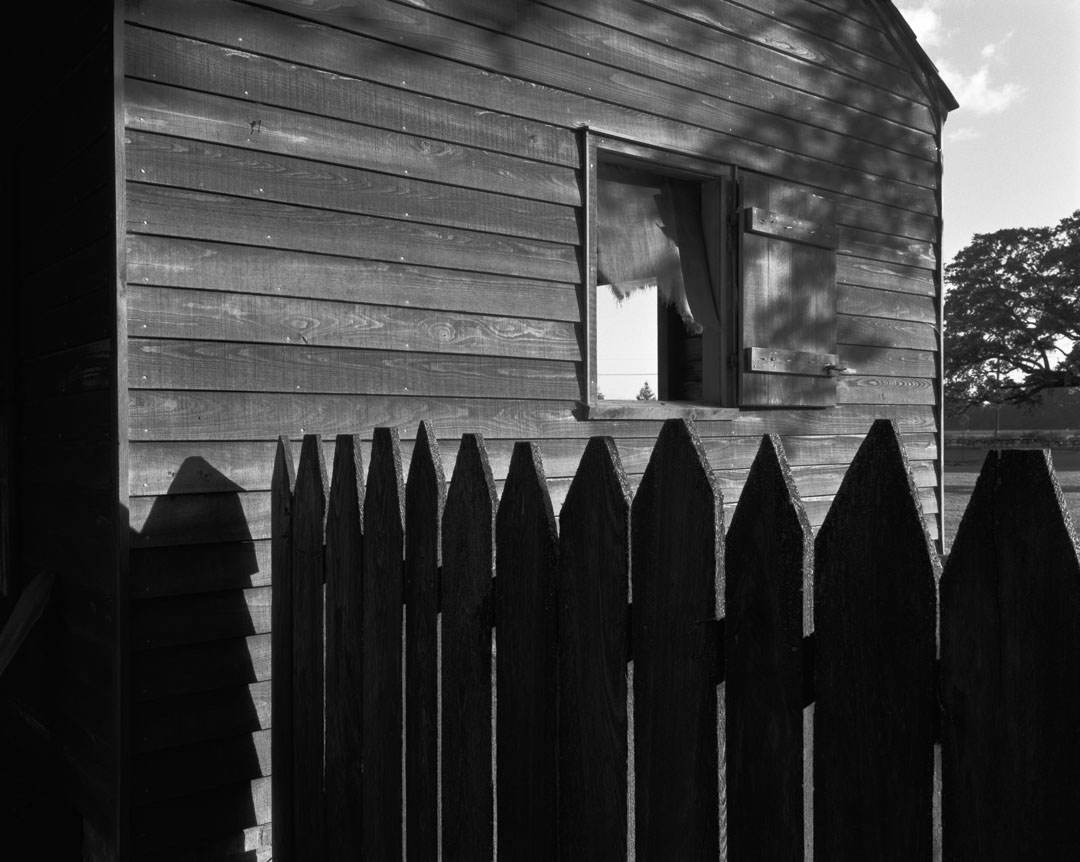
Elegy returns to the photographic on the remains of defunct plantations in Louisiana. “In This Here Place” presents a collection of images from the Evergreen, Oak Alley, and Whitney Plantations along the Mississippi River between New Orleans and Baton Rouge, capturing the slave quarters, some still intact and others commandeered by trees and wild shrubs. These antiquated cabins seem familiar. Looking at Bey’s 2019 “Overgrowth and Fence,” the barely visible cabin swallowed by the bare branches of invasive trees and tall weeds, I am reminded of many neglected houses, once owned in predominately Black neighborhoods in the Deep South, now abandoned on the outskirts of towns.
Many of the images have a spectral quality: each cabin houses the absent-presence of the enslaved. In “Cabin and Benches” the structure is surrounded by long, wooden, unoccupied benches, each shaded by large trees outside the frame. On one side, a rickety wooden shutter is swung open, revealing a small rectangular window blocked by a white curtain pulled back ever so slightly to reveal a tall, thin, black rhombus of darkness. I was convinced that at any point, bodies might emerge from the grey foreground mist, walk towards me, and sit down for some well-deserved rest. In “Cabin and Palm Trees,” the side of the cabin is almost completely obscured by varying leaves of the palm trees—some broad and flat, others a starburst of dense spikes. The window, this time unveiled from the domestic softness of the white curtain, reveals a tall black square, a void from which it felt like someone, shrouded in darkness, could be looking directly at me.
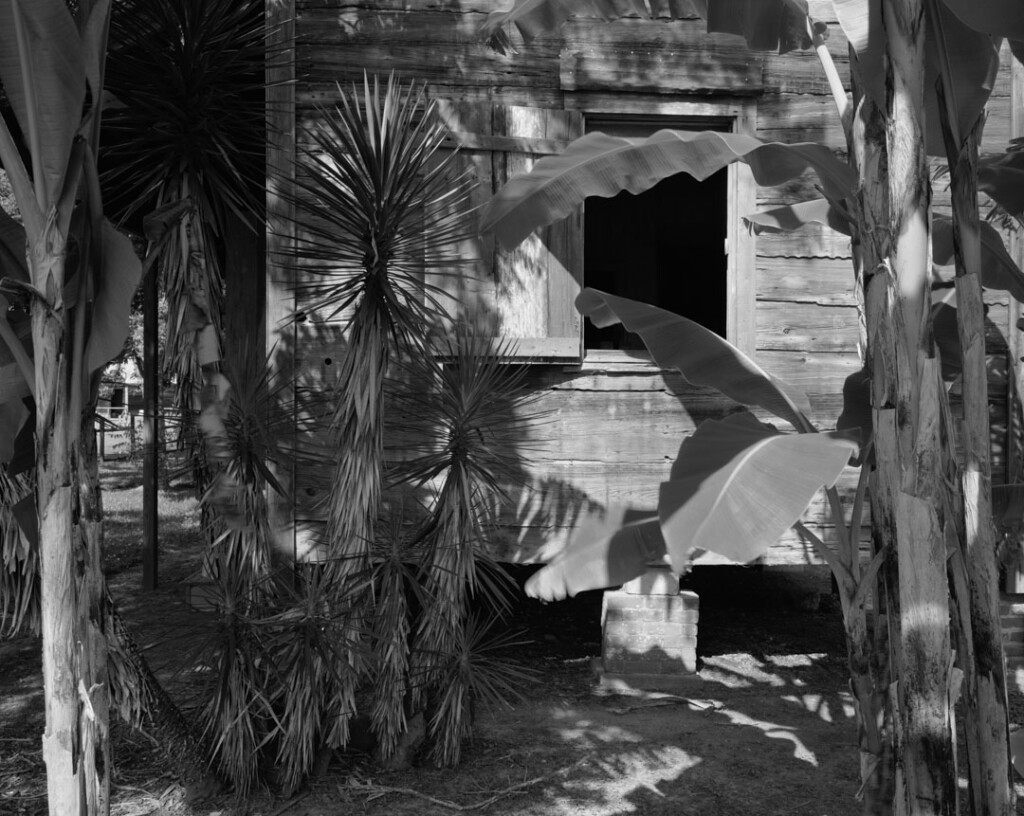
“In This Here Place” takes its name from Baby Suggs’ sermon in the clearing of Toni Morrison’s novel Beloved. Baby Suggs implores Black children to become and be seen, Black mothers to laugh, and Black fathers to dance for their children and their wives. She reminds the members of her community, many who sought their freedom by way of fugitive paths, to love themselves, fully and deeply, precisely because of the white world outside the safety of the woods. “[They] ain’t in love with your mouth,” Baby Suggs announces to the crowd, “they will see it broken and break it again. What you say out of it they will not heed. What you scream from it they do not hear.”3Toni Morrison, Beloved (New York: Vintage Books, 1987), 82. Apt then that “Evergreen,” the second of Bey’s short films featured in Elegy, presents a scream that cannot be ignored.
While “350,000” guides viewers to a single, unbroken shot on one screen, “Evergreen” is a colorful triptych that inundates with multiple shifting visual perspectives. On one screen, the camera hovers over the tops of the trees, moving slowly, as if floating, revealing the rust-tinted tin rooftops of the cabins of the enslaved. Another screen drops to ground level, cutting back and forth between close ups of the lush green grass and sharp stalks of sugarcane leaves piercing from the dirt towards the sky. On a third screen, the camera slowly pans from left to right, one cabin after another, their exterior walls stained with dark copper strokes of rust and oxidation, each one precarious on crumbling brick pillars. As soon you take in one shot on any screen, it switches. The vast perspective of “Evergreen” is awe-inspiring and, at times, overwhelming. I sat through multiple showings, trying to take in one screen at a time, but left feeling there was more to absorb.
The visual palate of “Evergreen”—red-yellow leaves across the ground, brown-blue-green of moss and mold on trees and cabins, and the bright/dull greens of grass and rusty rainwater pooling on the ground and in metal basins—blurs the pastoral and architectural decay. The soundscape intensifies the experience. Bey worked with vocalist and composer Imani Uzuri to articulate the narrative perspective of “Evergreen” where the camera does not reflect a human experience, but that of the disembodied spirits of the enslaved floating and hovering above and across the land.4Dawoud Bey, Gaynell Sherrod, and Imani Uzuri, “Soundings: Collaborations with Dawoud Bey” (Conversation/Panel, Virginia Museum of Fine Arts, Richmond, VA, February 9, 2024). Whispered words, familiar to those who grew up in the Black church, emerge from everywhere and nowhere: come by here, somebody’s praying, just like a dream, there is peace in the valley for me. Unmoored sounds of hands clapping or a tambourine beating echo throughout. Suddenly, a single extended utterance bursts forth, bending between a scream and a wistful soprano note quickly shifting back into a wail. In “Evergreen,” sounds and words intertwine, crashing into each other at an abrupt speed which approaches and dodges the legibility of music and voice. Uzuri offers us Black sound, harmonious and cacophonous, that refuses categorization; musicality stretched to the furthest comprehension.
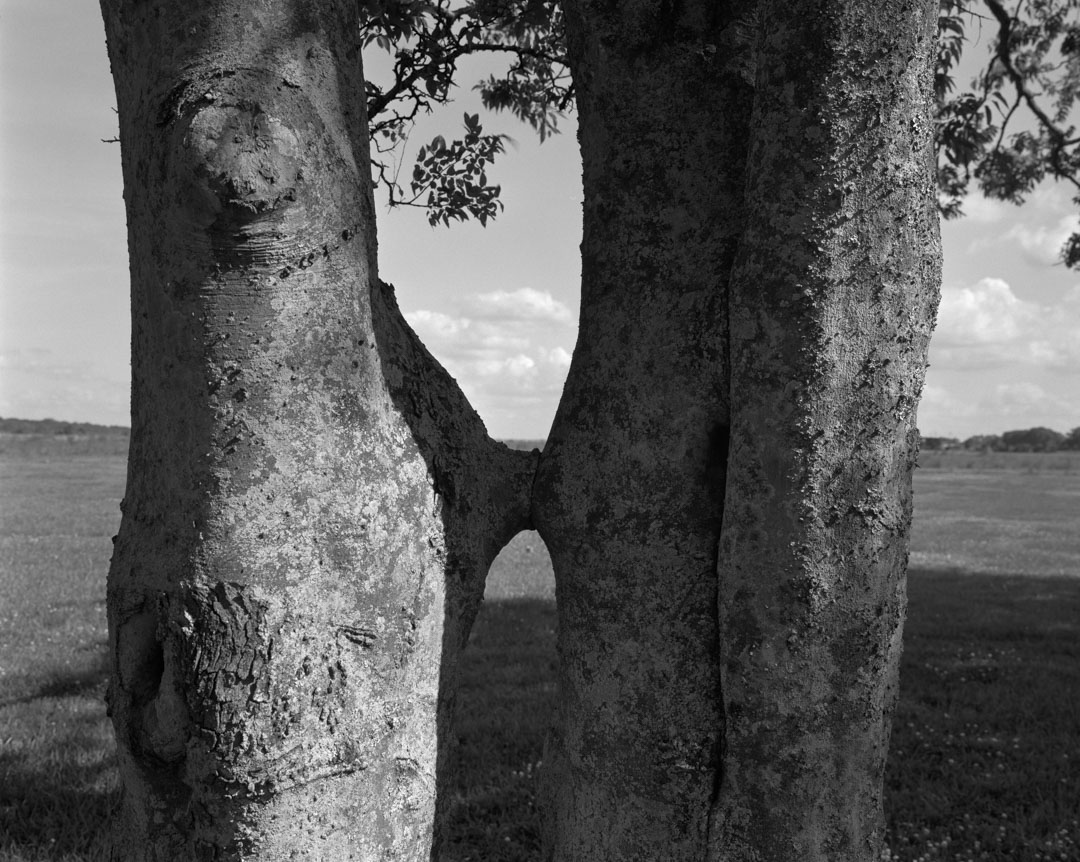
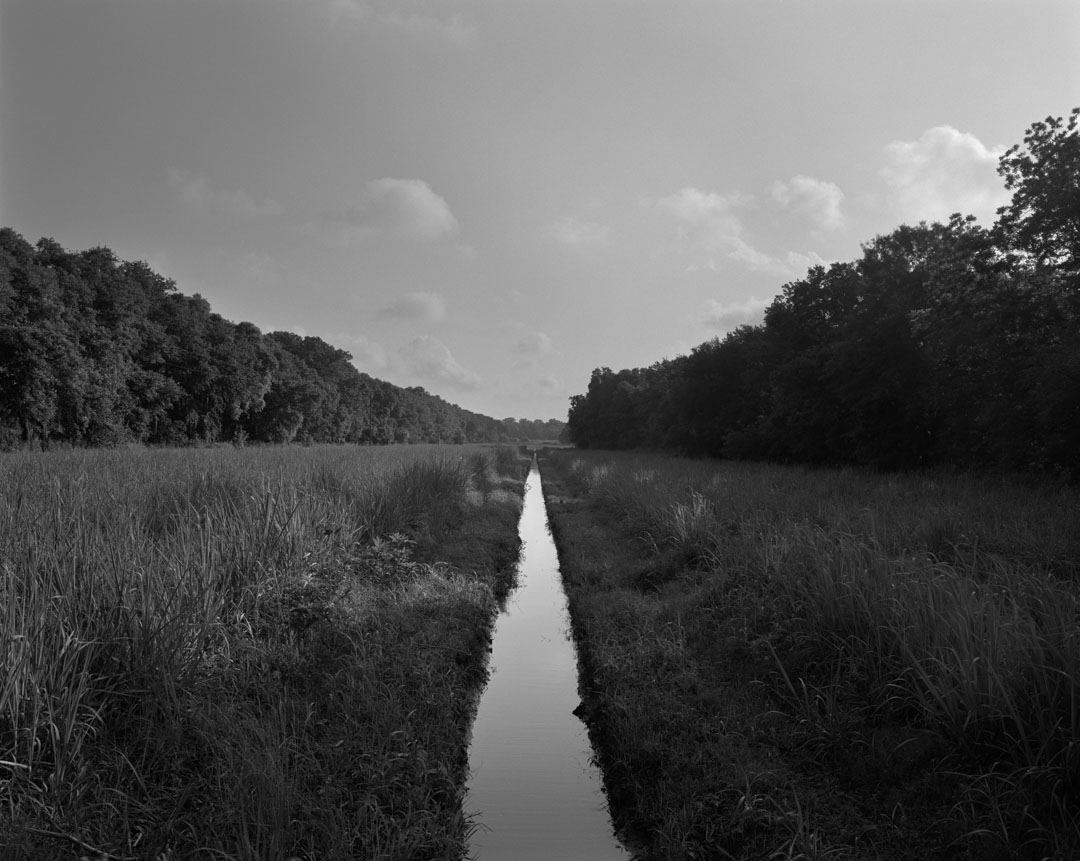
The final shot on the center screen of “Evergreen” is, again, one long tracking shot along the center path of the plantation, this time pulling backwards. Viewing the cabins from this vantage, I was struck by the stark architectural uniformity. Each cabin, equidistant and perfectly mirrored, reminds us that this space, these structures, were not only a landscape of suffering, but a community filled with a legally and culturally vulnerable population. Comparing this shot to images such as “Conjoined Trees and Field” and “Irrigation Ditch,” I notice how Bey deploys center composition to create symmetry and balance that emphasizes a single focal point, usually the subject, in an image. Bey often forces the eyes on a central path, a safe space to visually travel along a hostile territory. Both of these photographs and the last shot in “Evergreen” acknowledge and interrogate the linearity of history. While “350,000” moves viewers forward, assuming some level of literal and conceptual “progress,” we also understand that, for the enslaved, a predatory path unfurled. Pulled backward across the center at "Evergreen," we ask, what force carries us and to what end?
“Night Coming Tenderly, Black”
The title of my review comes from a line in Saidiya Hartman’s Scenes of Subjection where she argues for the “opacity” of “black song” as a phenomenon that “troubles the distinctions between joy and sorrow and toil and leisure."5Saidiya Hartman, Scenes of Subjection: Terror, Slavery, and Self-Making in Nineteenth-Century America, Revised and Updated Edition (New York: W.W. Norton, 2022), 54. In this, Hartman eschews the “overdetermined reading of the sounds of slavery”6Hartman, Scenes of Subjection, 30. prescribed by twentieth century Black thinkers such as W. E. B. Du Bois, and directs our ears to the more powerful, and at times less legible, “wild notes” of the enslaved, composed in part by the “screams lodged deep inside” that “confound simple expression . . . of black enjoyment.”7Hartman, Scenes of Subjection, 55.
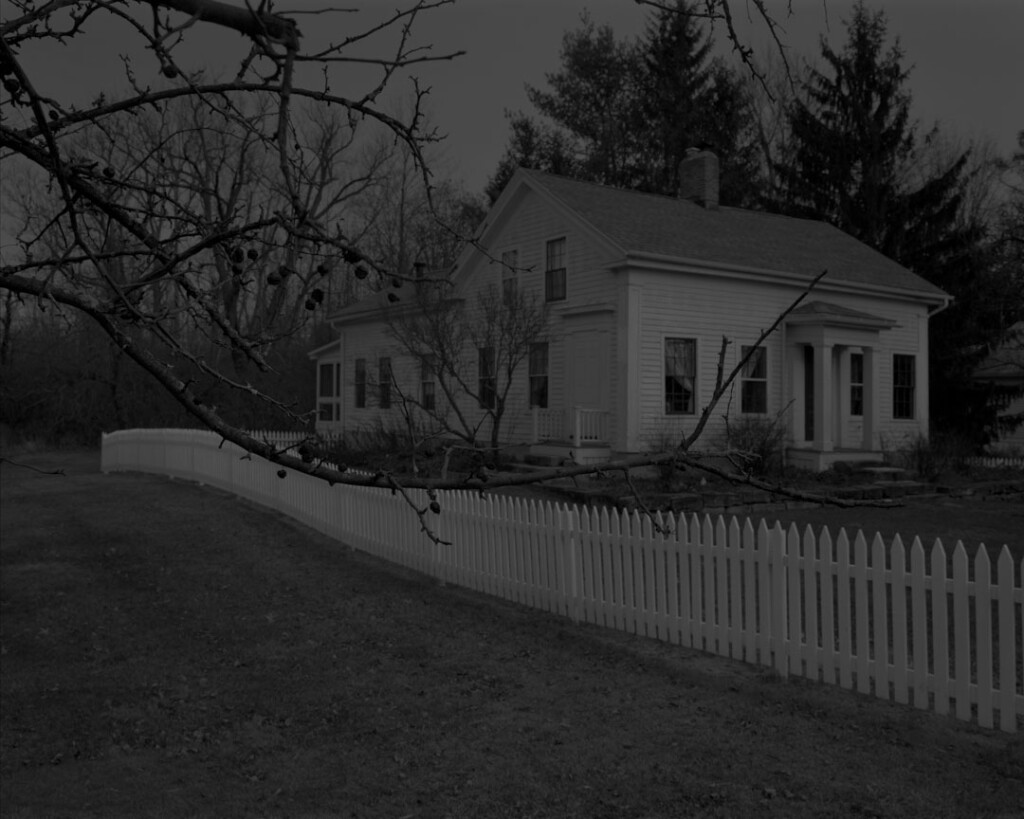
In the almost 160 years since the legal dissolution of slavery in the United States, photography and film have articulated the overdetermined image and, eventual sound, of slavery within the imagination. In both “350,000” and “Evergreen,” Bey’s exclusion of Black bodies forces viewers into a complicated simulacrum of enslaved embodiment. His films interrupt our culturally sedimented expectations not only of what slavery looks and sounds like, but also how it should be experienced. There are no clear heroes or villains in these films, no sense of a triumphant victory of good over evil, not even a sense of who, if anyone, we are following. However, in the midst of this disorientation, we remain anchored by the density of Black sound; we continue to listen through the cacophony to make sense of the experience, not through historical logic, but through a bodily reaction to what unfolds on the screen.
Coming down from “Evergreen,” I entered the final section of Elegy: “Night Coming Tenderly, Black,” its title taken from the last lines of Langston Hughes' poem, “Dream Variations.” This series of photos explores landscapes near Lake Erie in Ohio and Canada and traces the fugitive experience of enslaved persons who liberated themselves, often in the cover of night, from the bondage in southern states. Paying homage to photographer Roy DeCarava, these low-light prints hone the conflicting experiences of fugitivity, wherein a vast, beautiful, open landscape signals exposure and vulnerability while the claustrophobic cover of tree branches means safety and protection. On my way out, I was struck by the last photograph positioned to the right of the exit: a dim shot of Lake Erie, its grey waves rolling into the horizon.
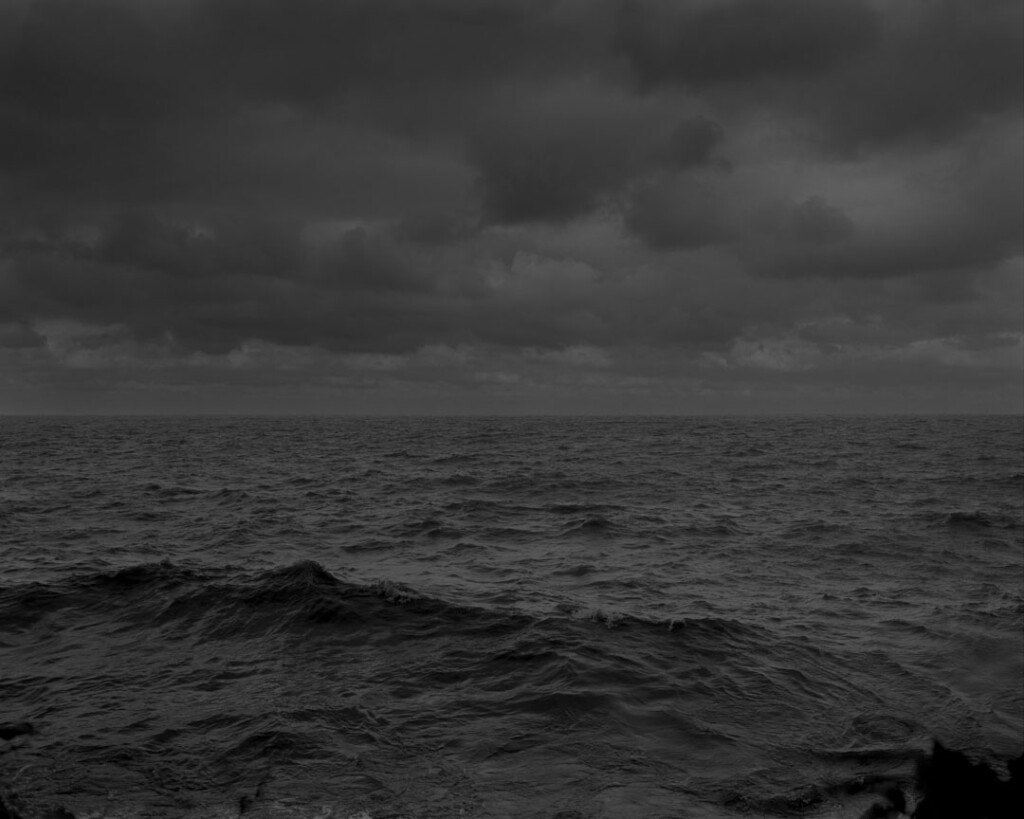
Within the full context of Elegy, viewers can understand the impact of this scene. The slow march from the Manchester docks, from Virginia through the Carolinas, Georgia, Alabama to the plantations of Louisiana, and the perilous journey from the Deep South to the northernmost parts of this country, has prepared us for this sight. If “350,000” began with a painful, sharp gasp, this shot of Lake Erie gestured towards a cathartic exhalation.
Leaving Bey’s exhibit, my mind was abuzz: What ethics, if any, are applicable to the ways that we consume the visual lexicon of slavery? Can the cacophony of Black sound that Bey so intricately deployed bring audiences to understand not only Black pain, but Black humanity? Mostly importantly, returning to the image Lake Erie, can any one photograph, detached from its critical context, represent the history of slavery so often erased and buried? When looking at non-descript images of a nature trail or even sugarcane stalks, do we need to hear the density of Black sound to understand what we are looking at? Elegy is, across all five sections of the exhibit, a fully immersive sensory experience which asks audiences to find in the American landscape a history that time and “progress” has obfuscated. As I exited, I could not shake the thought that, to an untrained or inexperienced eye, the difference between the waves of the James River and the waves of Lake Erie—let alone the currents of the Atlantic as seen from the hull of a slave ship—might be difficult to discern. In which direction does the water flow towards freedom?
About the Author
Ariel Lawrence is a PhD candidate in the English Department at Emory University. Her research focuses on Black women-authored lifewriting across multiple genres, and the articulation of ethical reading practices in and beyond the page.
]]>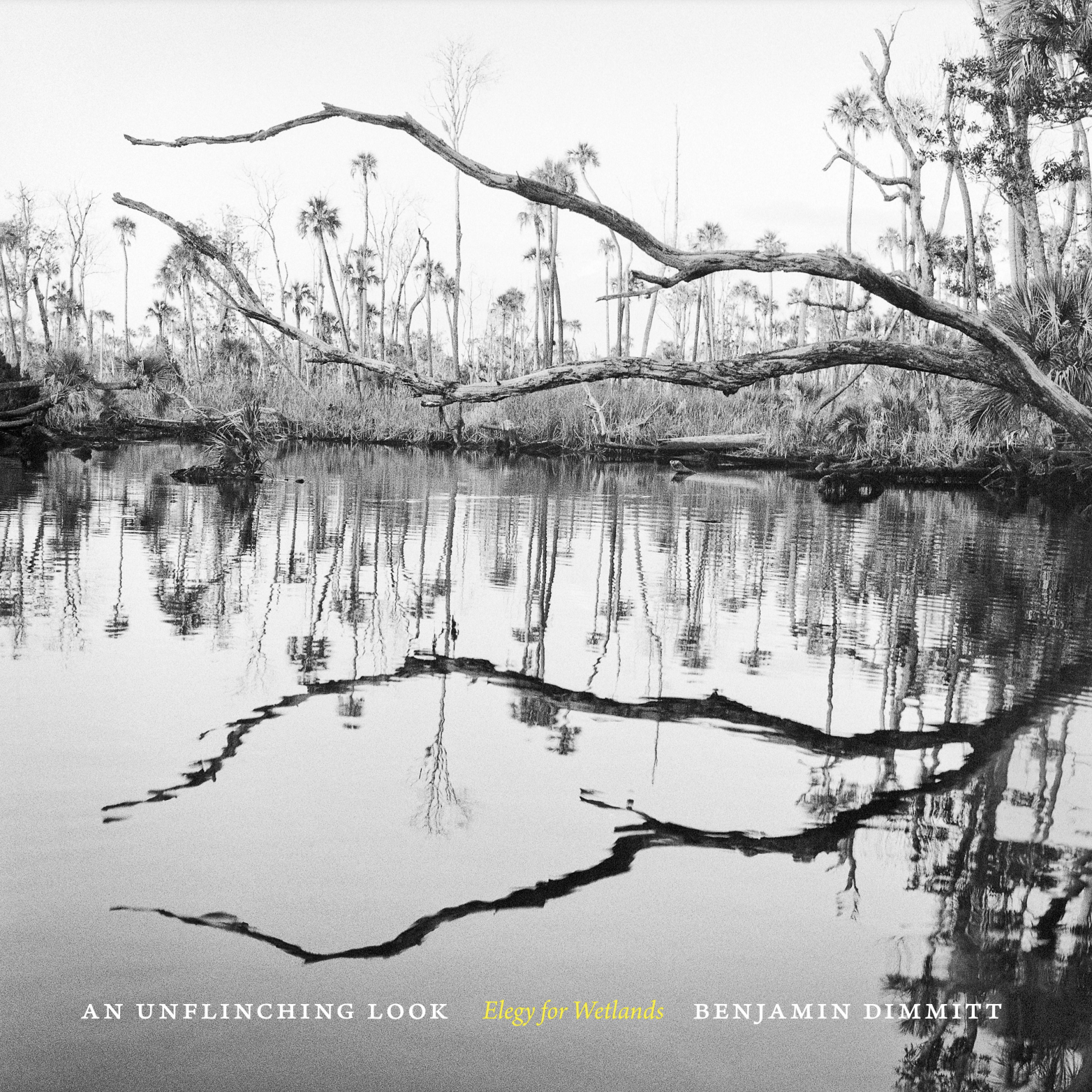
Bransford: Before we talk about An Unflinching Look: Elegy for Wetlands, can you talk about your personal history with the Chassahowitzka National Wildlife Refuge? And then describe the Refuge in terms of both ecology and aesthetics.
Dimmitt: My first trip there was in 1977 with a friend and my brother. The friend wanted to do some fishing. I had never heard of the place, nor had my brother. We drove up from Clearwater, got in his little jon boat and didn't do a lot of exploring, just fished.
I had never seen any place like this before. I had grown up in the Clearwater–Tampa Bay area, which was then probably three hours or more down the road. There are better roads now. And the swamp, as we call it, was very different from what I'd grown up around. There were many freshwater springs that spilt into the beginning of a river. In 1977, the water was clear, cerulean blue, and no one was living there.
We paddled through hardwood forest. The creek is wide in places because that area is perfectly flat. We slowly got into brackish areas and then went into big, open, less fresh, more salty, but still brackish bays. And that's as far as we got. Then we fished.
It was a very long time ago. It was beautiful. I was accustomed to the coast of Florida having barrier islands or beaches, and there were none. Water, just freshwater, merged right out into the Gulf.
Bransford: In broad brushstrokes, can you describe what the Refuge looks like?
Dimmitt: There were ferns and bromeliads everywhere. The humidity was 100% because of the springs constantly pumping out water. Lots of cabbage palm trees, which is the state tree in Florida. Some cypress and cedar trees remain, although most of them were harvested around 1916. There were trees that I wasn’t familiar with, like a type of holly called Dahoon which had little red berries. Maples. Spanish bayonets or yuccas grew on the islands. On slightly higher ground you might see some oaks.
What I loved most were the grasses that grew in the shallow creeks. You could see them by looking over the side of your canoe. The water was crystal clear. Various grasses and large ferns which had giant leaves. When I would stand in the water and make photographs, the current would move the eelgrass, which is about three quarters of an inch wide and many feet long. Those would brush against my legs as I was shooting. I had to learn to not freak out and not imagine that the eelgrass was water moccasins or gators, and just enjoy the caress.
Bransford: When did you start noticing the deterioration of the Refuge's ecosystem? What were some of these changes and the causes?
Dimmitt: Almost all the causes are saltwater intrusion. And second, for ten or twenty years, is the fertilizer getting into the aquifer. That fertilizer comes from the golf courses upstream at The Villages, which is a very large—it spans three counties—active adult retirement community. I believe they have fifty golf courses which must be beautifully kept. They throw a lot of fertilizer on the golf courses and it ends up in the aquifer. The Chassahowitzka and The Villages are both in the same springshed. The fertilizer goes down into the aquifer at The Villages, it ends up encouraging plant growth in the creeks and in the river. What you get is an increase in algae that grows really fast and then blocks sunlight because these are large mats of algae on the surface of the creeks. The algae mats are the size of a room. No sun gets through them and that kills all the smaller plants, which are the food for the smaller animals and on up the food chain. It's called toxic algae for a reason. It smothers life in the creek. That has been going on as long as The Villages has been there.
Another source of the nitrates is septic tanks that burst and go into the aquifer, and just people's yards, the fertilizer that they throw there. Agriculture also adds plenty of fertilizer to the aquifer. This has been going on longer than the impact of the sea level rise.

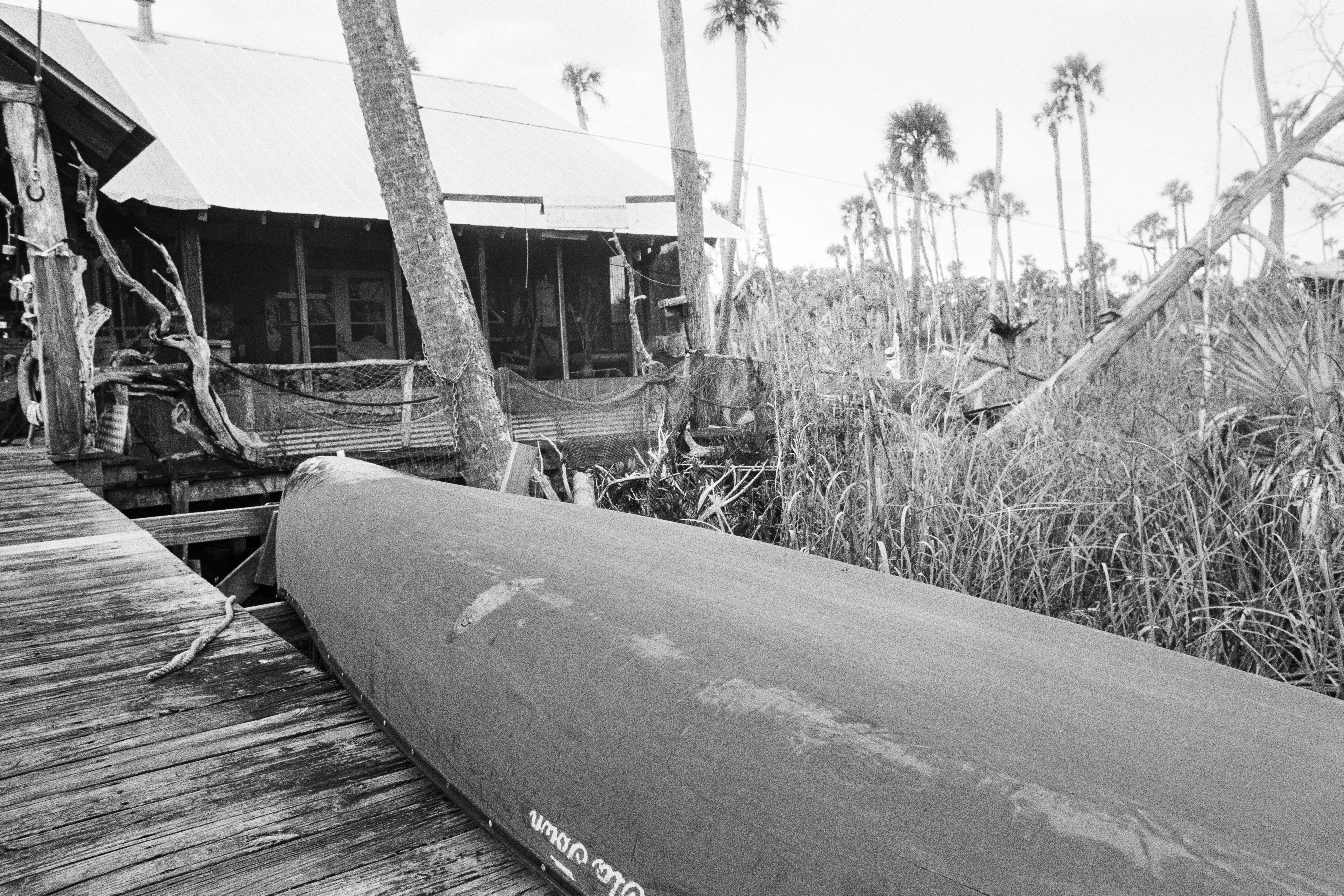
I wasn’t aware of the sea level rise until 2014, but if I look at photographs shot in 2010, I can see the beginning of the environmental damage. When you go to a place like this, it's like any forest. There are young trees and plants and mature trees and really old trees. But around 2014, the damage had become inescapable because all the hardwoods had died, the creeks were getting a lot of toxic algae, and the palms were starting to look sad. Sabal palms are the most salt tolerant trees in this ecosystem, so they're the last to die. And in many of my photographs, you'll see very little other than dead trees and palms that are on their way out. The eelgrass and other grasses are very delicate and can’t handle the increase in salt. The mats of algae cut down the sunlight that the grasses need in the creek.
Martin: It's really a combination. You have pollutants coming from the east and you have the sea level rise coming from the west. Those two are coming together in the same place and having this devastating effect.
Dimmitt: Exactly. There is no one single cause of the devastation. When I started on this project, I talked with someone who had a good working knowledge of the state’s water management practices. He had his own views that the state was looking away from or ignoring the impacts of over-pumping from the aquifer. So, yeah, it's a lot of different things. Even melting glaciers can't be denied here. That's what is lifting the water up and sending it from the Gulf up into these creeks.
Bransford: And the depletion of the aquifer is also important. To maintain all these golf courses at The Villages necessitates a huge volume of water. The water flow in the Refuge has deteriorated as well.
Dimmitt: Yes. It's so interconnected. One thing that Susan Cerulean goes into in her essay at the beginning of An Unflinching Look is that there has always been a lens—which is a use of the word “lens” I had never heard of before, but I got it right away—that exists between saltwater coming into the aquifer and the freshwater that's already in there. As water is pulled out for any and all purposes, including for sale as bottled water, the lens moves further and further inland. So you now have salt water and brackish water in the aquifer, in the local drinking water.
Bransford: Tell us about the genesis of this book, An Unflinching Look: Elegy for Wetlands.
Dimmitt: I visited there a lot in the eighties. I had my bachelor party up there. I won't go into that except to state that there were no mermaids involved. I enjoyed photographing it because it was unusual to me. I'd never seen any place like it in Florida. In 2004 I started a new photographic project called Primitive Florida. I felt that I needed to photograph these vulnerable landscapes. I was concerned about things like worsening storms and overdevelopment, and these phenomena that I learned about in college in the early seventies called global warming, climate change, and rising sea levels. Lo and behold, everything that I had learned about was starting to happen. I didn't visit the swamp between 2012 and 2014, but when I arrived at the cabin in 2014, the wetlands were devastated.
I didn't understand. I got in touch with scientists in the Tampa Bay area where I grew up and went to college. I showed them the photographs and they said, “That's saltwater intrusion. That's rising sea levels. You didn't know about that? It’s happening along the Gulf coast up to the Panhandle.”
I didn't know that it was going to be happening so soon. Eventually I got in touch with one scientist, Dr. Matthew McCarthy, whose study is excerpted in the book, and he was excited to see my photographs from water level because he's spent many years downloading satellite imagery and aerial photographs of the coast while he was working on his graduate thesis.
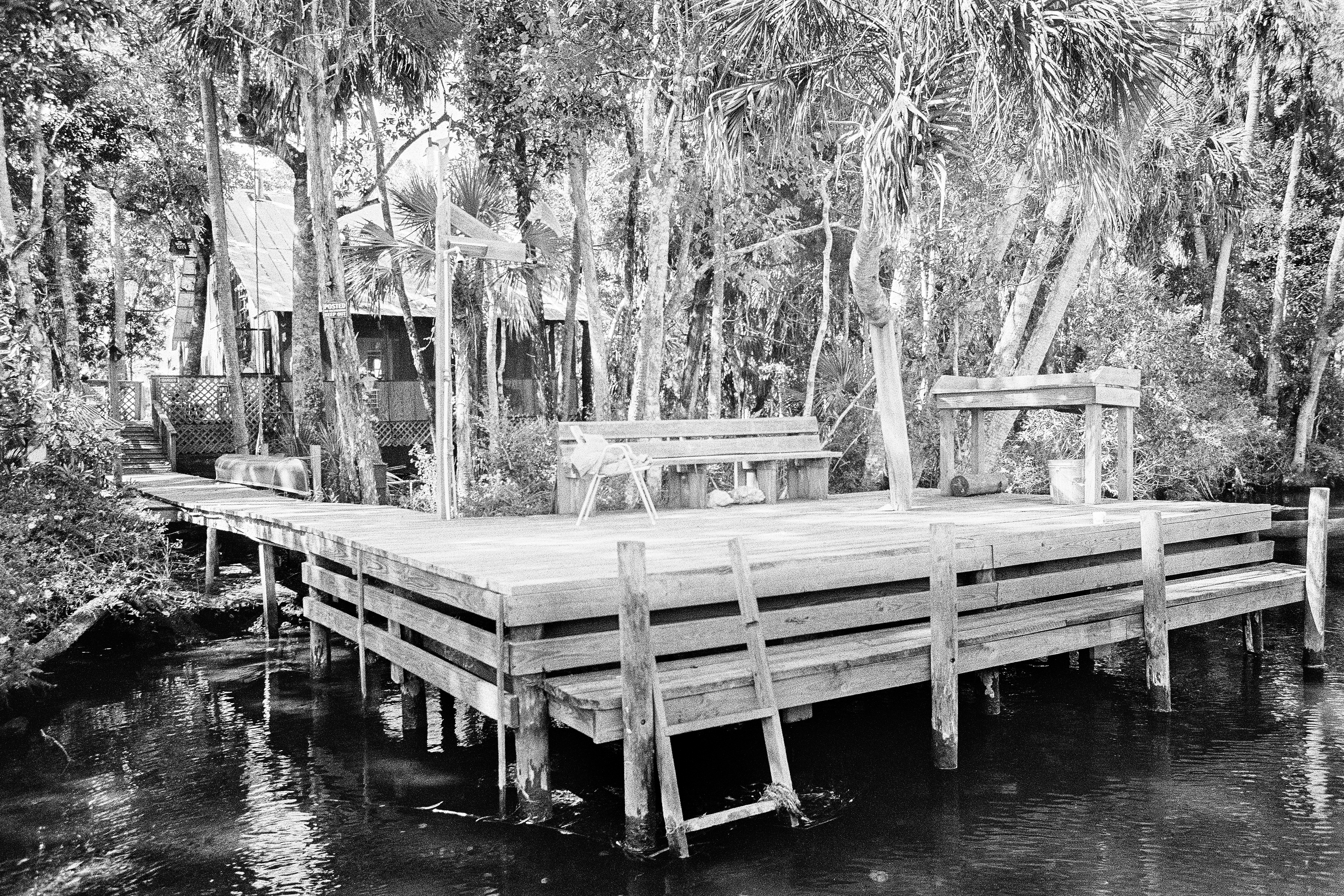
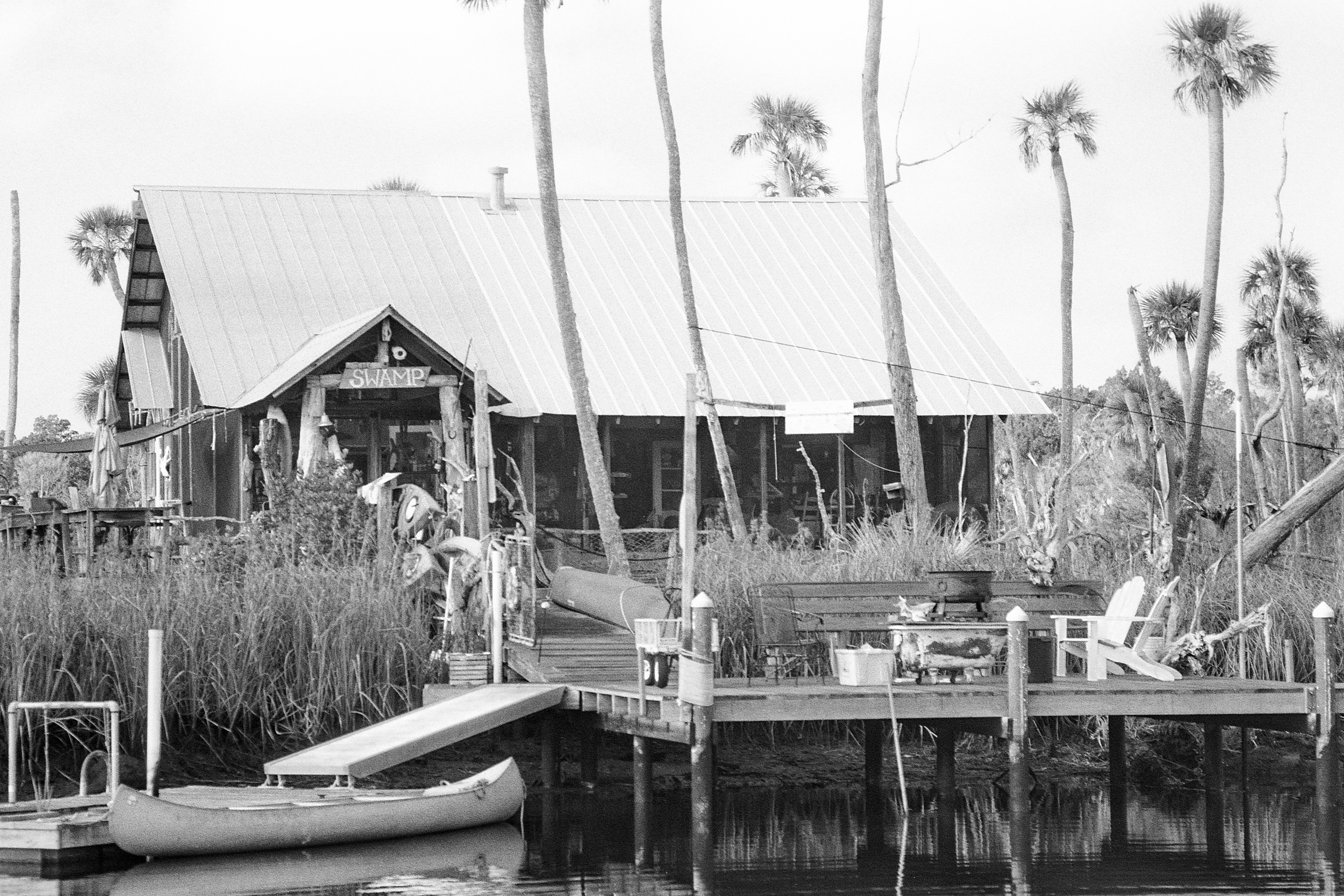
Dimmitt: That's the cabin where I stayed when I visited. My brother was one of the partners in the cabin when it was built; they did a lot of this work themselves. Everything had to be brought in by boat. When the cabin was finished, my brother asked me to take some photographs of the cabin.” He was really proud of it. He said, “I'll take you out in the boat and you can shoot back.” This was the shot I felt was best and I sent it to him. He said to me, “No, you can't see the house.” I said, “Well, bro, you built the cabin in a thick forest” The reason they built the cabin there was because the water is always 70 or 72 degrees. This is right on the creek by a spring, and the house stayed cool in the shade. The first picture (on top) is 1987. The second picture (bottom) is 2021. So that's thirty-four years. That's the same cabin and that's the same dock with some minor improvements.
Martin: This is an example of deforestation that involved no cutting down of trees.
Dimmitt: Absolutely. They wanted the shade. I took the first snapshot and made a lot of prints of it for my brother and the business partner. To reshoot in 2021, it was difficult because I had to find someone with patience to go back and forth and back and forth in their boat while I photographed. I had to figure out what lens I used back in 1987. It took awhile to get something that was good. That's often the case with re-photographic diptychs. It's very time consuming to find exactly where you did the early shot, where you stood, and what lens you used. Usually I did them by myself. But for the cabin shot, I had to rely on someone else to drive me back and forth and shoot a lot of frames.
Bransford: And you still are shooting everything on film, right?
Dimmitt: Yes, the entire project was shot on film. Any images that are square were shot with a medium format camera. When I went to reshoot the 35 millimeter images like this pair, I dug out my old 1980 Nikon F2 and got it cleaned and lubed in Asheville and took it down there. I hadn’t used that camera in probably twenty or thirty years. But yeah, everything's on film.
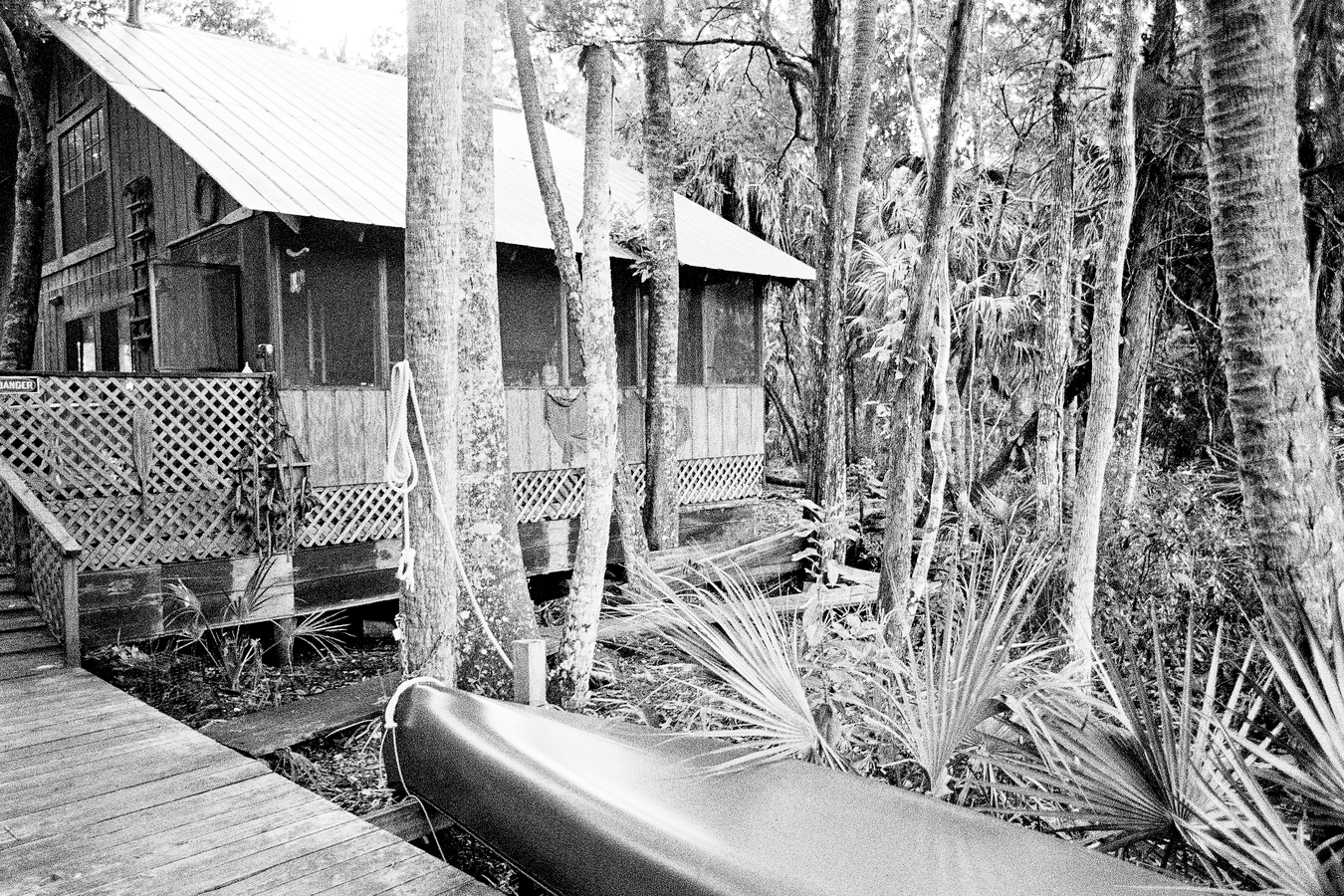

Dimmitt: That's the walkway from the dock to the cabin. The first photograph was made in 1988 and the second one was made in 2020. The earlier photograph lends itself to a vanishing perspective. And for the later one I made a point to shoot from the same position and with the same lens. It's really amazing how all the canopy, all the forest is gone. The saltwater floods around the cabin now at high tides and during hurricanes.
Martin: I'm wondering if I'm seeing what look like saw palmetto in the top photograph and then beneath it, is that Spartina now?
Dimmitt: Yeah, it looks like saw palmetto.
Martin: My gosh. That's a complete change in the ecosystem. Going from a terrestrial with freshwater influence to now saltwater dominated.
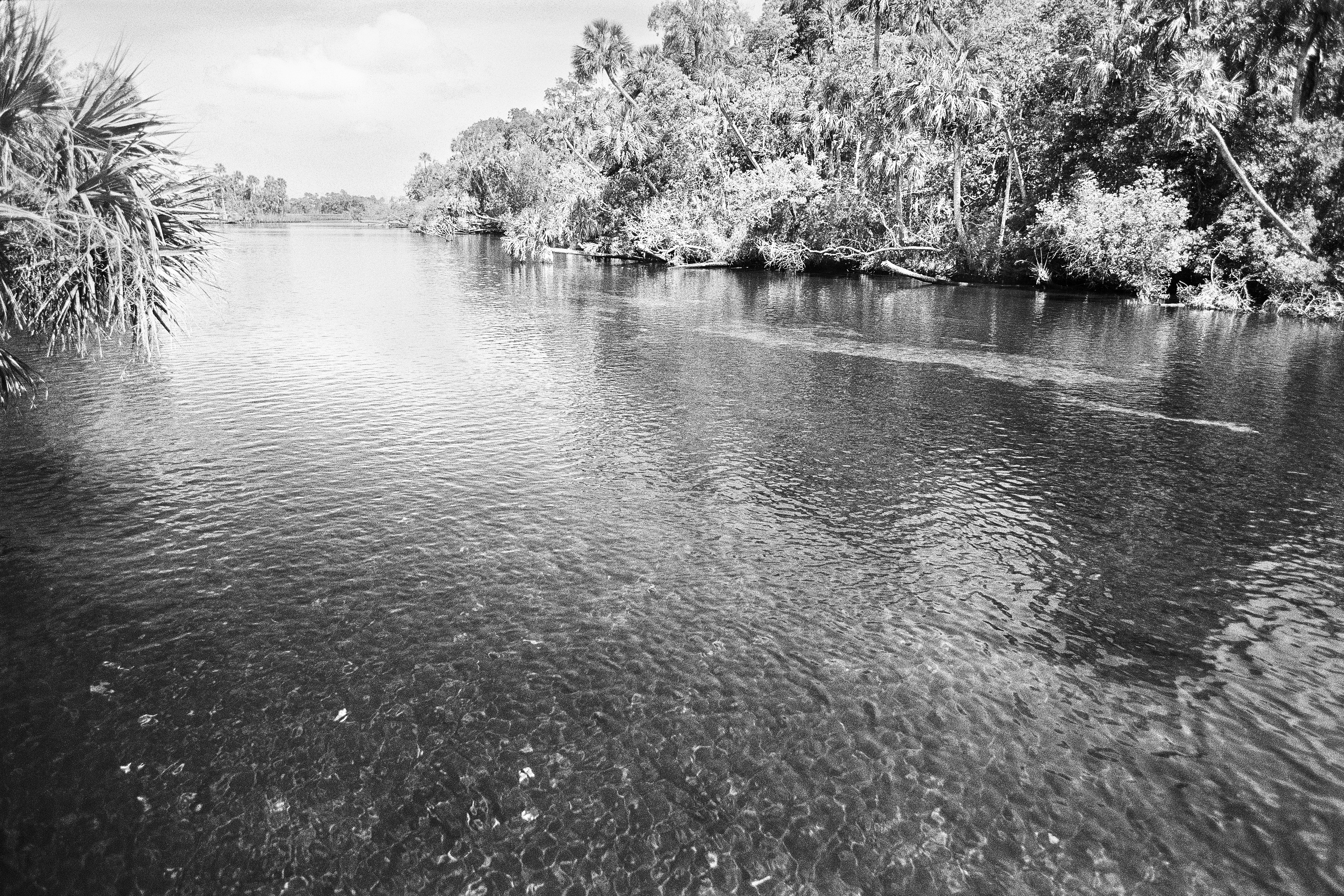
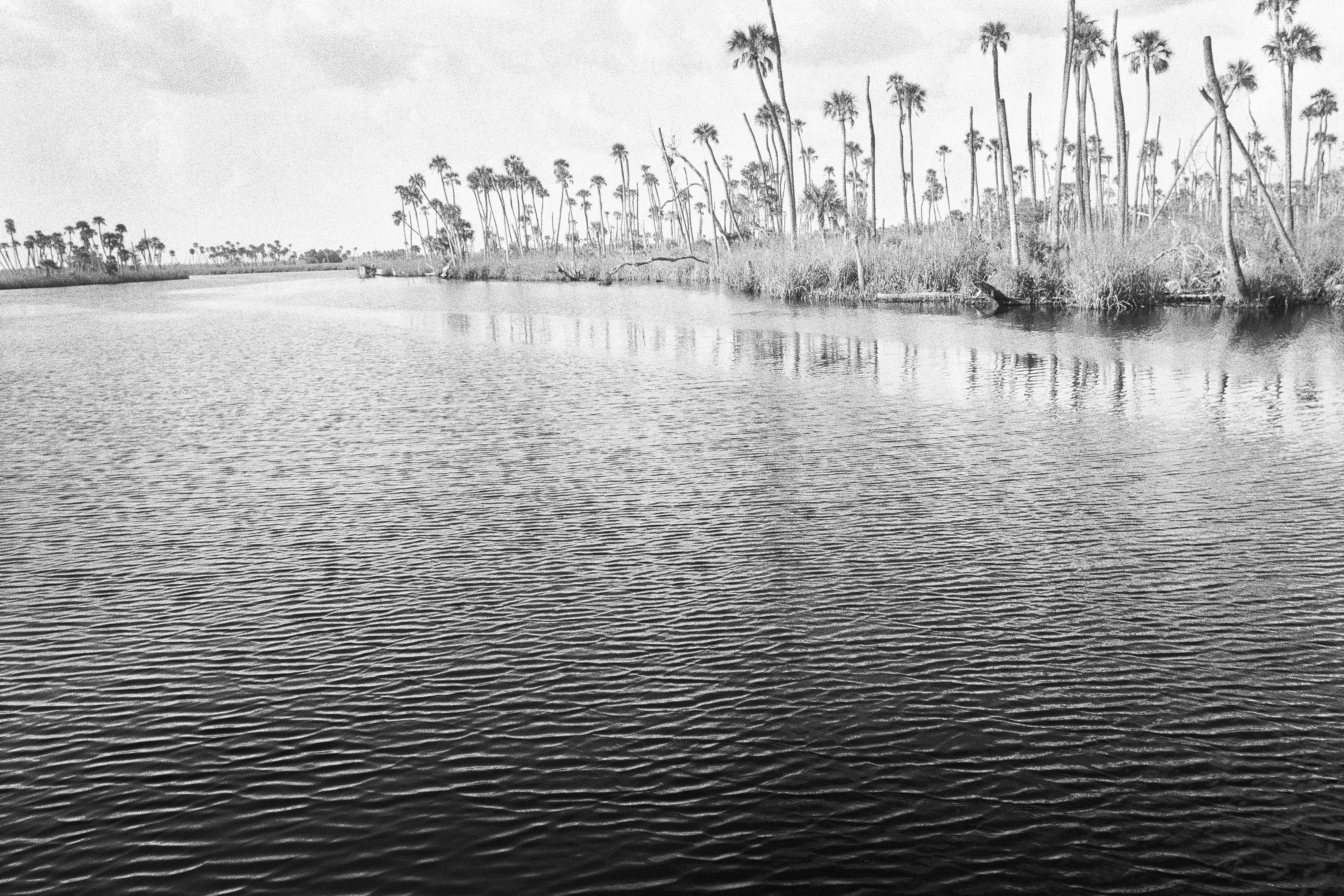
Dimmitt: I believe that this diptych shows the greatest span of time. This is from the dock looking downstream in 1986. And then the follow-up is 2020. It's the greatest span between the first and the second shot. If we were to go there now, half of the remaining palm trees in the back on the right would be gone.
Dimmitt: Next to Pat’s cabin, where I stay, is a neighbor’s cabin that has a boat shed, not a boat house. You climb up through a hole in the roof with the camera bag and tripod. I always worry about getting up the ladder with all my gear. And you can see way upriver and downriver to the Gulf. The left photograph was made in 2006 and the right one is 2022. I did several of these over the years, probably about six or more.

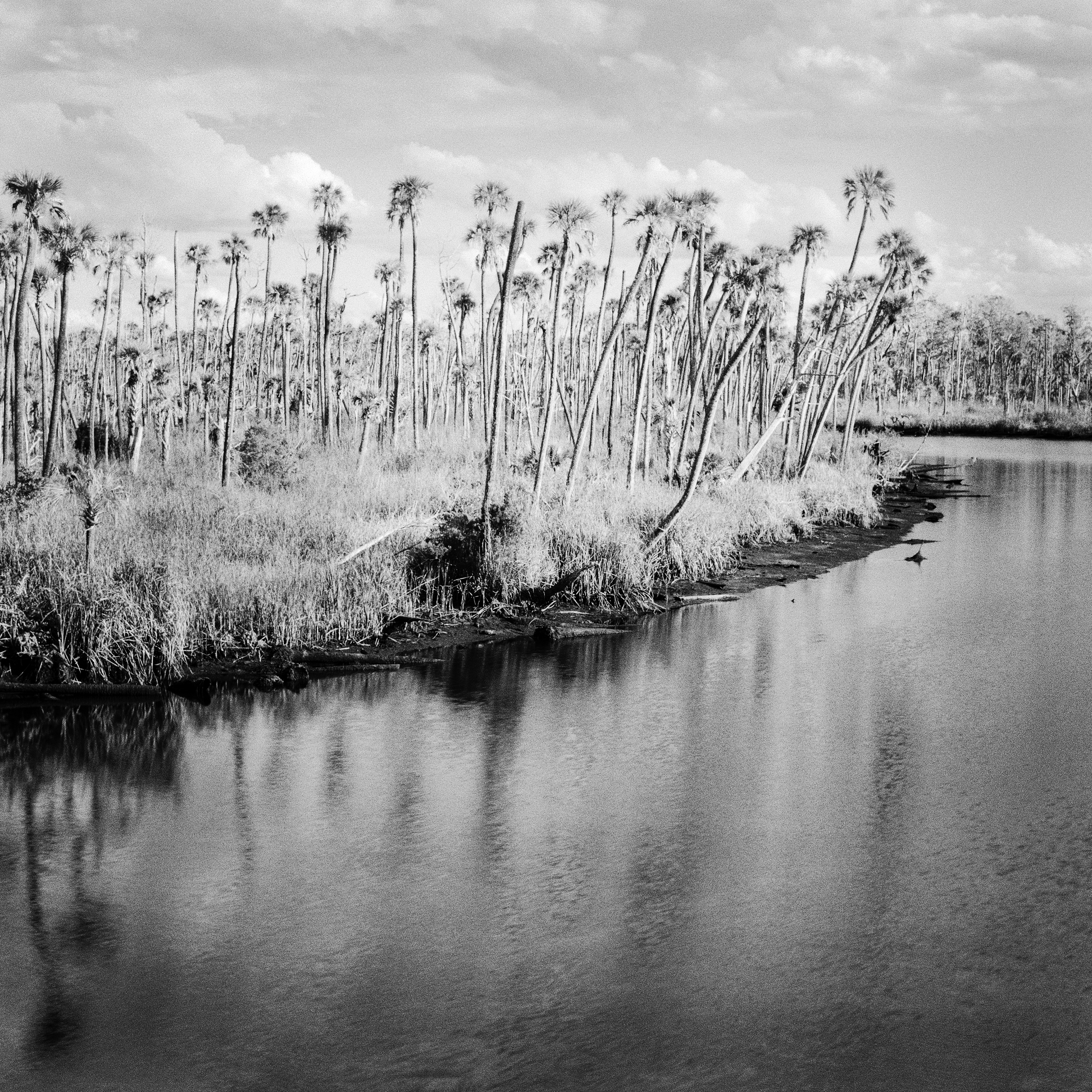
Martin: This is a really good pairing, too, because I think of this as a scientist. I'm a geologist, paleontologist by training. We are used to these really long expanses of time for dealing with environmental change. We say sea level rose, and it took thousands of years. Here, this is less than twenty. And in less than twenty years you've documented this complete shift in the ecosystems as a result of this saltwater intrusion coming upstream and affecting and changing those environments.
Dimmitt: The last time I was there, we had a good show. We saw dolphins or porpoises—I never know the difference from afar—chasing a large school of snook. It's brackish there. It’s a frenzy when the snook get trapped against the shore by the bigger, faster predators. You can't miss it if you're in a canoe or standing on the dock. And then another time, not that many years ago, we were seeing manatees come up and they always get your attention by their breathing sounds: the exhale, and then the inhale. You look out, and they've gone underwater to feed. I've seen them often in that stretch of Crawford Creek, which is where the cabin is and where I did almost all the photography.
Martin: So we're actually getting some marine mammals that are starting to come upstream into that area?
Dimmitt: I know that if they're coming up there, they're looking for food. They could easily be caught or eaten. And the spooked snook are something to behold because they go crazy. They're swimming all over the place trying to get away from the porpoises who are very smart and very fast. It's a bloodbath, but it's interesting to watch.
Dimmitt: This is kind of grim. This is 2004 and 2022.
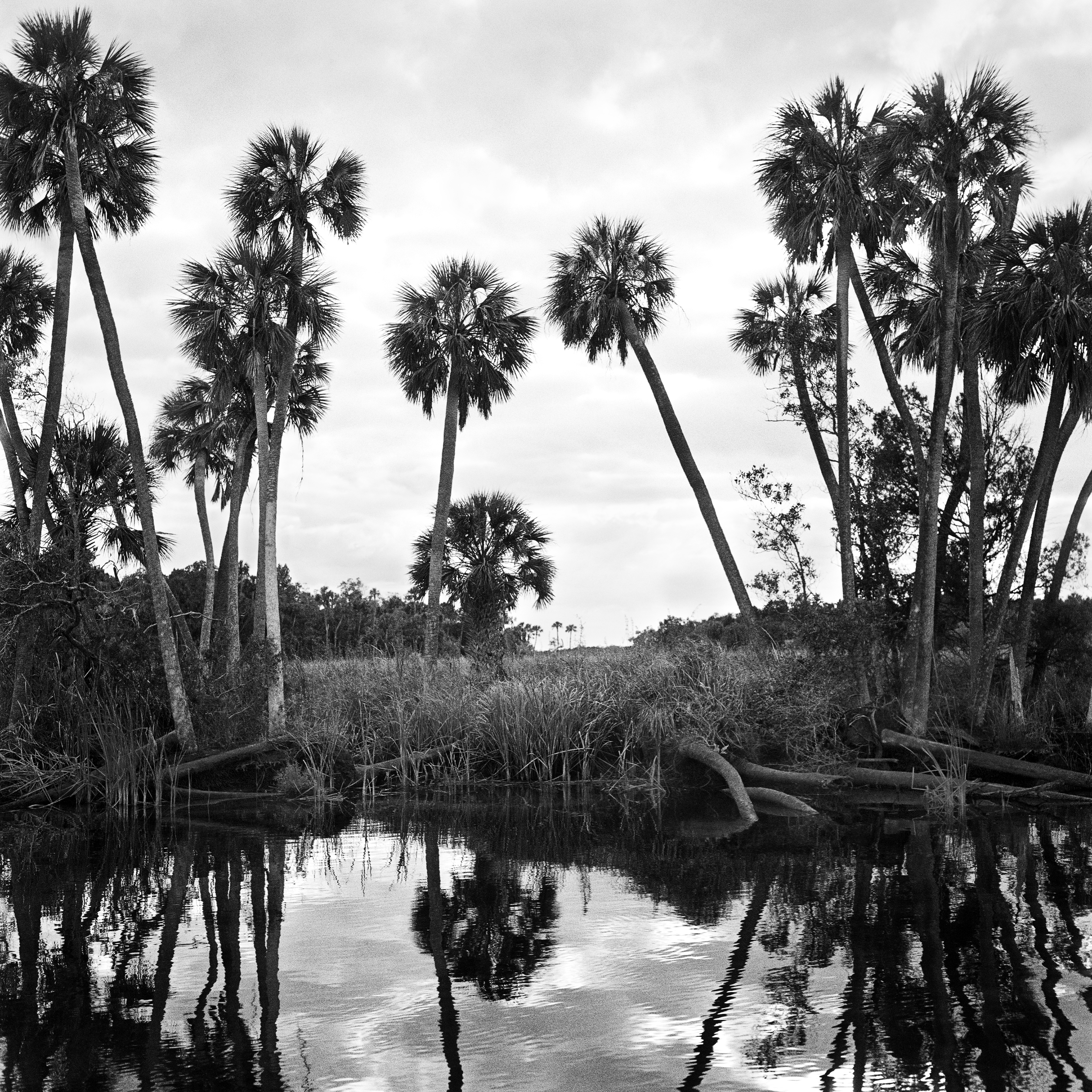
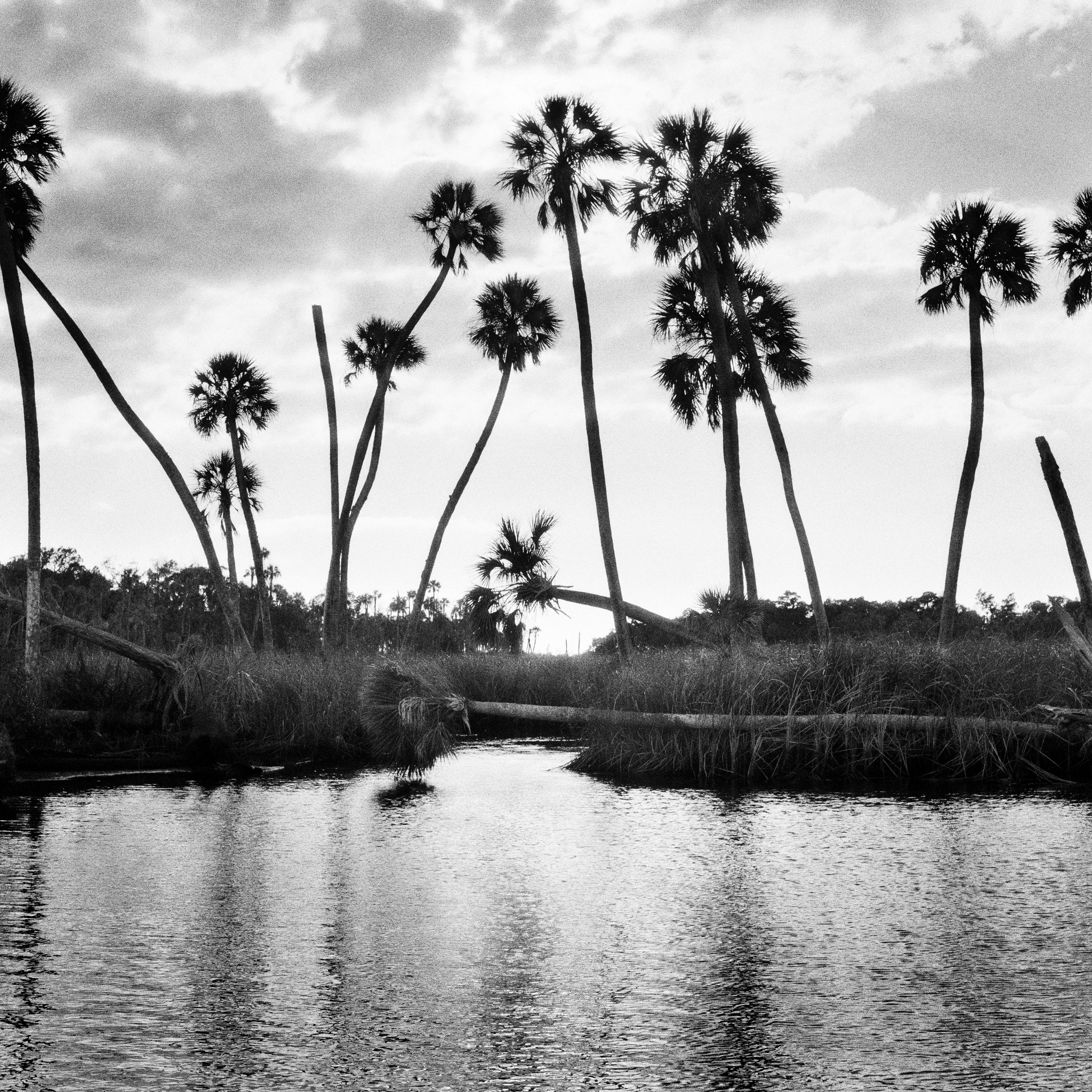
Martin: The total loss of the canopy is so striking to me. In those ecosystems, you originally had shade-tolerant plants and, of course, animals that would have been living in those communities. Then with the loss of that canopy, now you have all that sunlight pouring into those areas and heating them up, as well as the saltwater intrusion. All that is totally changing the ecological communities. And again, this happened in less than twenty years.
Dimmitt: This location is a protected stretch of creeks, maybe twenty or thirty yards out of the wind. What you see between these two photos is not a dramatic difference. My host told me that when fishermen would return in the evening, they'd go up into the grasses and clean their fish, which is why it’s called The Kitchen. And then they can get back out to the Gulf and go back up to the town of Chassahowitzka and pull out or go home. I shot the first one probably in 2004 without a tripod, which is always dicey, with a big, heavy, medium format camera. I kind of like that scene in 2004. When I went back to re-photograph it, I'm again relying on the patience of a friend and sometimes that patience runs short because I'm saying, “No, closer, no, further back.” And you go back and forth in front of it a couple more times, and there's nothing in it for the boat owner. But that was the best I could do. And everything is shot on film, but when you prepare files, when you get the images ready for the publisher, you have to get scans. So I'm working in Photoshop on scans of these negatives that I shot and printed many years ago, and I'm seeing things that I hadn't seen in a long time, and I'm looking at the difference in the two of them side by side and seeing a lot of small differences, and then way off in the background seeing other differences, and the edges of the islands on the left and right. There's some deforestation in there as well. It's a photograph that I enjoy, but it doesn't pack the punch that these other ones do.
Martin: Right. That was one of the aspects that I appreciated is that you had to toggle back and forth between each of the images to appreciate the amount of change that had happened there. And some of it is subtle. So it's something where, if you just had the second photograph, the later photograph by itself, someone who doesn't know that place would say, 'What do you mean, it looks fine, it's totally fine. It's not like there's a condominium or a development there. What's the problem?'
Bransford: Speaking photographically, did you have some compositional strategies of how you wanted to depict the Refuge? Some images have very strong diagonal lines, some obviously have strong vertical lines with the trees, sometimes downed trees dissect the frame horizontally. Other images don't have strong leading lines. The ones with algae or grasses are more abstract, ethereal. Sometimes there's a curved tree in the middle of the frame that grabs our attention or a log in the foreground in the water. Did you have certain compositional strategies of how you wanted to depict the refuge?
Dimmitt: Not at all. In some cases, I am walking around, where it's dry enough, in mud shoes and just looking or in some cases checking to see what some place looks like now. But I don’t have a predetermined way to shoot. That would really bore me. I did almost all of the newer work since 2004 with a square camera. There are only so many things you can do with a square medium format camera. I've had someone tell me it's evident that I had some sort of preconceived notion or was shooting a certain way but that’s not the case. I spent many years on this project. I had to keep it fresh. That might mean working on re-photographic diptychs one day and going on a long paddle to photograph some place new the next day.
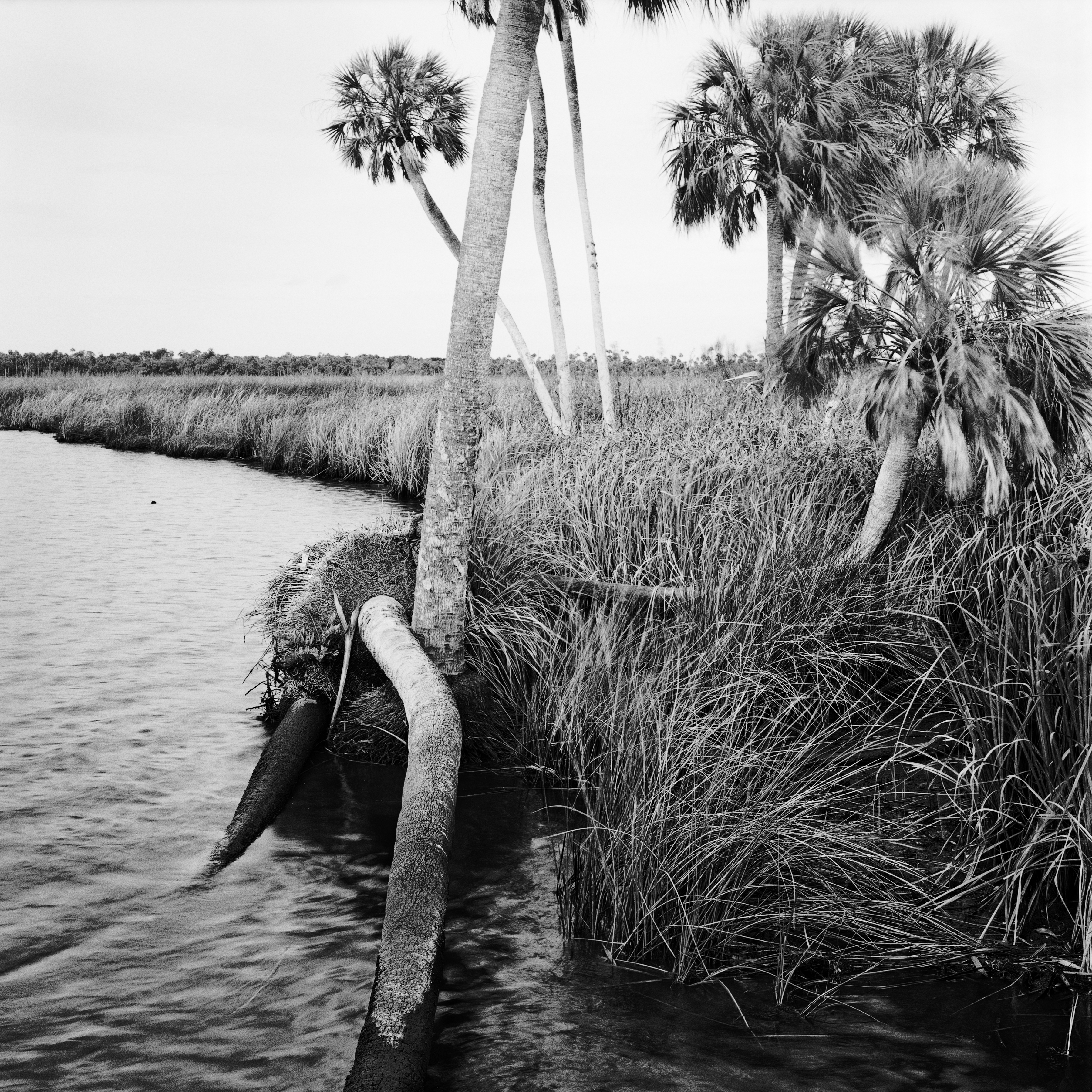
This one is a favorite, and I was asked at length about it: how premeditated is this, that sort of thing. We discussed it at the Asheville Art Museum. One of my authors, Alison Nordström, who wrote the book’s long essay on the photography, had this in her slides, and she was saying all sorts of things about it that were wonderful and flattering. And my memory is that it was beautiful. It was very straightforward in that these were palms that had washed up on the edge of a savannah. I was on a narrow dock, and I couldn't move forwards or backwards. So I was completely constricted in how I could compose it, except to change the lenses. I made what I thought was a good photograph. Alison loved it. I didn't mention at the museum book talk, but I feel it now and see it now. It looked like the Pieta to me, it looked like the Virgin Mary with Jesus in her lap. I spent time in Florence in the seventies studying Renaissance painting, etching, lithography, and sometimes all that old Italian Catholic imagery stays in your head. And you’re not even aware of it until later.
Dimmitt: This is another one of those images that was really difficult to photograph. I love it, but it was so busy and there was so much going on. It took a while, maybe twenty or thirty minutes to create some sort of order out of this chaos.
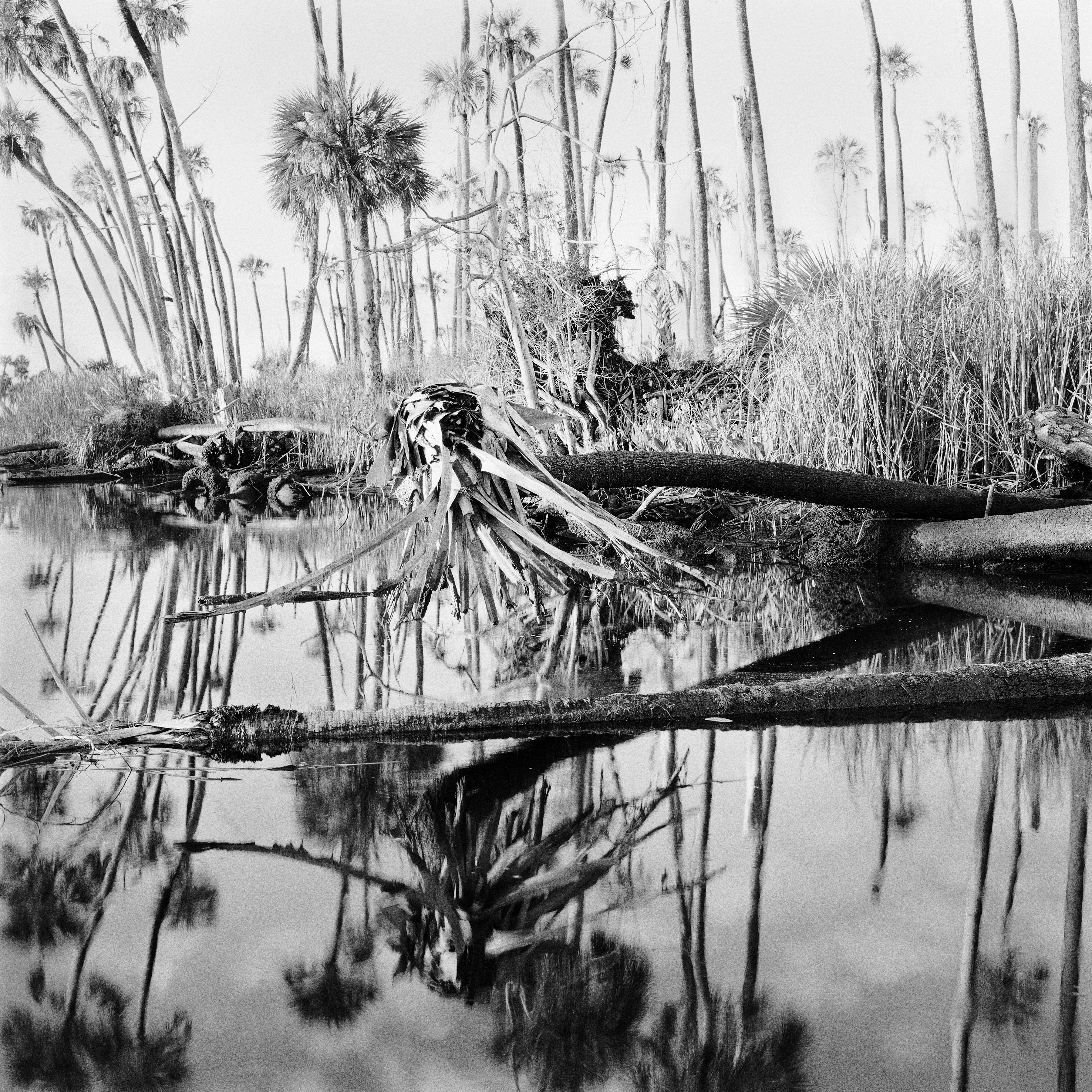
Martin: Something I appreciate in terms of the documentary aspect of this sort of photograph is that the reflection is actually bringing out the sky better. You can see the clouds and the gaps between the clouds that are only implied in the actual sky part of the picture.
Dimmitt: I was asked if I always make my skies white. There are various things I could have done here and I did do in this case, and that's to use a deep yellow filter to try and get some tone in the sky. But it was a very bright sky and there's not much you can do to get tone in it. To further answer your earlier question, I don't have a preconceived notion. This was just very difficult to compose. It's a complicated image visually but I’m very happy with it.
Bransford: You mentioned Alison Nordström, she talks about the opportune slipperiness of these photographs in the sense that they simultaneously inhabit the worlds of art, science, and social action. Was this or is this your intention? Did you come at the project initially from an art photography standpoint and realize gradually that the images also have scientific and even political appeal?
Dimmitt: I'll almost give you a straightforward answer and say yes. And then there's a but. As I mentioned, I started shooting there in earnest in 2004, and I was just photographing something that I thought might disappear or that I just liked an awful lot. And the more I poked around, the more time I took when I went there and paddled in the various parts of the swamp, the more I loved it. And again, I'm from there. This is my native landscape, so I was very happy to be doing what I was doing. And then climate change arrived, and I didn't really change my approach and become a different sort of photographer. I just photographed the impact. There was nothing undamaged. The impact was all encompassing. It was everywhere. You really couldn't escape it, and it got worse every time I went. Someone recently asked me how how many rolls did you shoot? How many times did you go down there? I moved to Asheville in 2014, and that's when I first discovered that the rising seas were starting to do serious damage. The tally I got when asked was around twenty-five trips down there in the eight years that I worked on the project.
I was doing landscape photography. That is what I do. I just happen to like to photograph in wetlands because that’s my native environment. That's my native landscape. I grew up in Clearwater on the bay. I'm working now on a project about mangroves. When I was in Florida last month, I was shooting at Weedon Island in a big, beautiful mangrove forest. That's the kind of subject that I like. The interpretation is up to the beholder.
I imagined that these photographs were good enough that my gallery in Tampa would be interested in exhibiting them. They said they weren’t going to be able to sell them, but they would exhibit them. So we did. And only two or three sold. I was eventually told it should be a book. So I got in touch with the University of Georgia Press, and the director was very excited about the work.
The book then gives you an opportunity to create an editorial viewpoint. And to me, they didn't have an editorial viewpoint. They were just a document of a place that I had made photographs of that was becoming ruined by rising sea levels. Learning about the causes from Dr. McCarthy was something that made me become a little more activist about it, and also learning about my subject and doing research. But the research didn't start until I got a book deal. Learning about The Villages and learning about the state's water management, or water mismanagement, made me even angrier, and that became something my editor convinced me to write about—my feelings. That's why my epilogue is sharper than the rest of my language.
Bransford: I'm glad you mentioned the epilogue. In it, there are the two anecdotes. One of you visiting what I think is the oldest and biggest tree in the refuge and your speculation about what's going to happen to it. And then also the wonderful anecdote of you paddling and not hearing any leaves rustling but hearing the woodpecker sounds. Could you recount those two anecdotes?

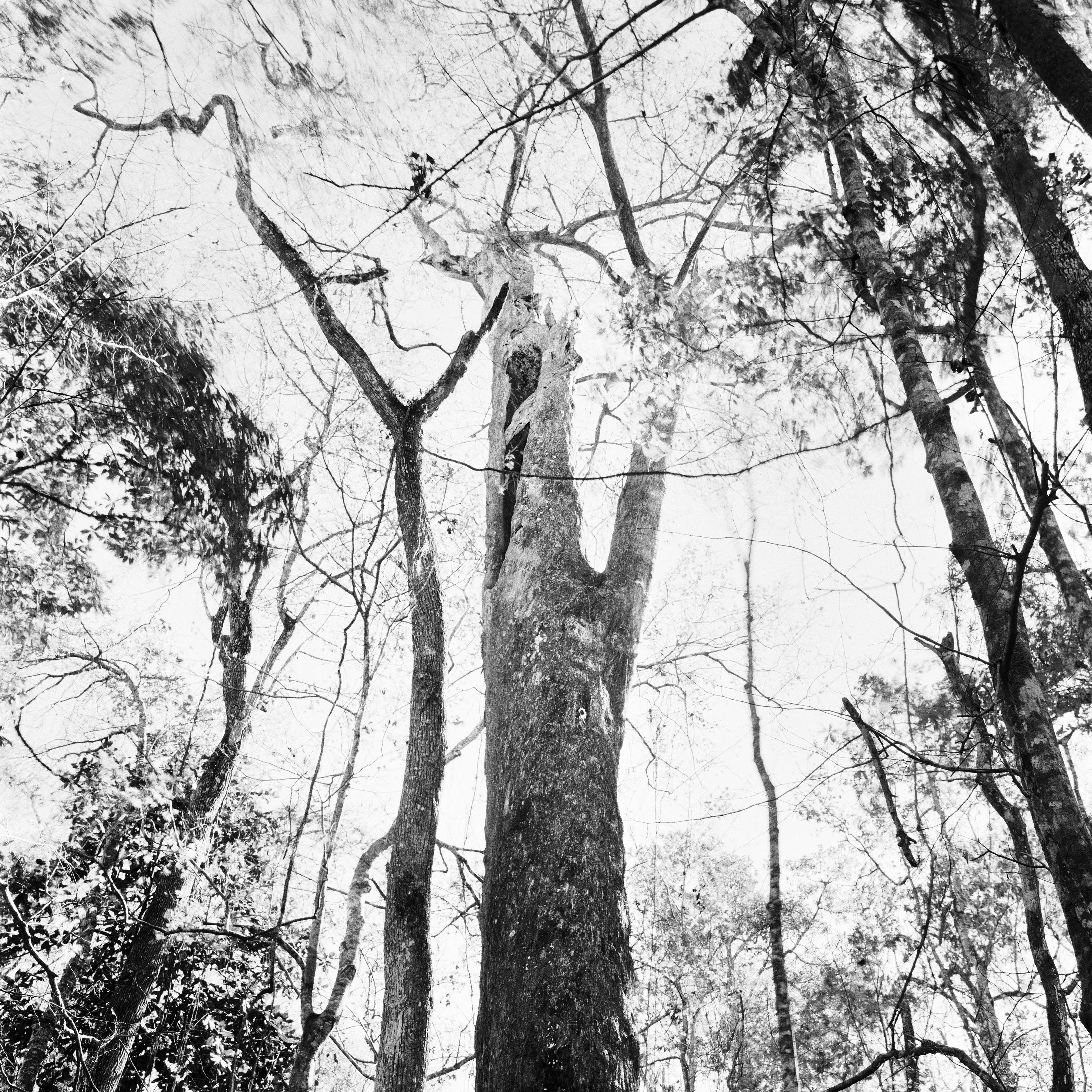
Dimmitt: I'm still surprised that the editor got those two things out of me because writing is not something that I do well or do comfortably. The last remaining old growth cypress tree is not the last one in the swamp, but the last one that anyone could direct someone to. It happened because I asked my host down there, Pat, if he could take me there. He said, “Yeah, but we will have to go to the property owner first.” And I said, “That's fine.” So we did that, and then we walked off in the direction of the tree and I'm relying on Pat. He's been there multiple times. And I'm looking up, and I'm waiting to see some old growth tree.
I practically walked into it. It’s the photograph which has a lot of palm fronds and shadows on its fat trunk. I stopped there and photographed. It doesn't show the upper part of the tree, it just shows the trunk, which is huge. I couldn't really see the tree trunk. I almost walked into it because it was somewhat camouflaged by all of its neighboring palm trees, which were small. I imagined that's how it had lived so long, because it had been unrecognizable. And anyone who is looking for cypress trees would have passed it by because its top had probably been blown off by lightning. And I made a couple of photographs of the tree in the shadows, and then backed away and got a different lens and photographed the top, which is a mess. It may still be there. I think that photograph was done in 2021, but it is really close to a creek and all the creeks are becoming saltier. And that may be what kills that tree. It survived the loggers in 1916, and it probably is not going to survive this.
You mentioned something about sound, and I will tell you that the last photographs I showed you of the palms in the creek where we discussed filtering for the sky and, that sort of thing—if I was there maybe twenty or thirty minutes composing and making the photograph and when I'm doing that, I have everything turned up all the way. I am looking as hard as I can. I'm trying to compose something that reaches into me, is compelling compositionally, all the rest of it, where am I standing, that sort of thing. Sinking up to my calves in mud. And I'm seeing everything, and I'm hearing everything. And when you asked about the woodpeckers, I chuckled because when I get back to the cabin at the end of the day, or if I’m here in the mountains and I get back to the car after a long hike, I can tell you every single thing I heard. I can tell you everything I saw. My sniffer's gone, so I can't tell you every smell. Being in the canoe, paddling around, feeling the breeze. It was a hot day in December. Losing control of the canoe in a breeze, and then I got pushed over to the side of the creek. I dropped the anchor and sat there, there was not a photograph for me to take where I ended up, but I could hear not just one woodpecker; I could hear many, many woodpeckers banging away at the all the dead trees, all the dead hardwoods surrounding me. And it was really disheartening. It was an indication that some bird's happy and there's a lot of food for all the woodpeckers now, but that's just another way in which we learn how bad the ecosystem loss is.
Martin: That caught my interest because the last couple of David Haskell's books have dealt with sound. One of them is The Songs of Trees, and Sounds Wild and Broken is his most recent book about how there are not just landscapes—and what you're doing is documenting landscapes that, of course, are waterscapes as well—but there are soundscapes. So you have the visual aesthetic that is intrinsic to your photography, but sometimes with a picture like that, I, as somebody who goes into those kind of environments, experienced the same thing you did, I also hear the sounds when I look at the photograph. And I'm realizing that it's not just visual, that there are other senses that are being engaged with these places and how climate change and sea level rise, pollution, all of these factors are also affecting those other ways we sense the world around us.
Dimmitt: If I'm at the swamp house with my host and his family, if there is a porpoise–snook battle going on, we always go out to the dock and watch. And you don't see it if you're inside the cabin with all its screens. If you're inside, you hear everything outside. You run out and engage with it. It’s nature at its most brutal. I went to school at Eckerd College near Lake Maggiore, and the sound of ospreys chirping for minutes after minutes after minutes is something I grew up with. It resonated with me.
Bransford: Is there anything else about your book that we didn't cover that you'd like to talk about?

Dimmitt: This photograph of fog on the creek closes my essay in An Unflinching Look: Elegy for Wetlands. Something you feel when you're there. It's 100% humidity. If you shoot in the winter, which I prefer because the light is better in the winter and it's not as hot, then you're going to get fog because at night it cools down. And I just walked out of the cabin and down to the edge of the dock, and that was in front of me. That's a palm that had been alive, well, probably four or five years prior. And it was already hosting plant life of its own. This is my first book. Working with an academic press, they didn't give me any direction. I was completely on my own to make the image selection and to sequence it and I came up with the idea of the gatefolds. They were wonderful to work with, and the designer did, I thought, a beautiful job.

Dimmitt: This is one of the last photographs I took in the swamp. It was the same day that I went out and heard all the woodpeckers. What has stuck with me is this whole place was a thick tropical forest, and now it's nothing. This is Spartina? Is that what the grasses are?
Martin: That's what it looks like. Smooth cord grass.
Dimmitt: There’s another grass that’s round.
Martin: Juncus. That’s also a saltwater indicator.
Dimmitt: Often I will shoot from the canoe handheld without a tripod. It’s not easy to do. And I saw this and I thought it was beautiful. I didn't think about what purpose it would serve in a book as propaganda or beauty or science or any of that. I just shot it. But after I finished the photograph, I realized that I had been fighting logs and tree trunks in the creek the whole time, and the image I just called Impassable Creek. That's because you can't paddle in these places anymore because creeks are so full of dead trees. There's no clearance. And it was like being shackled. There are so many corpses that you can't move freely. Someone who wrote about my project wrote that it reminded him of a Civil War battlefield with corpses everywhere. And this was the first time, in 2022, when I was finishing the book, that I felt that I couldn't move in the swamp.

Dimmitt: When I would walk in some of the drier places, I would just be checking in. And one of the things that caught my eye on this day was that saplings were dying. This is kind of a mess as a photograph, but that's what you see when you're walking around. When it’s too salty for palm saplings, then it's really too salty.

Dimmitt: The earlier photographs in the book are photographs of a place that was pristine and exotic. Photographs of things that I found beautiful and unusual. However, I gradually started to photograph death and destruction on a very broad scale. It just kept getting worse and worse. And it will continue to get worse and worse. Hurricane Idalia had a big impact down there. I don't even want to go see that. I had to adapt to shooting environmental destruction. I didn't know how to do this. I get asked about beauty. One thing I didn't want to do was to suddenly go from taking photographs of some place I found compelling and beautiful to using my camera to make ugly photographs or to make these wetlands look bad. When I was doing the event at the Asheville Art Museum with Alison Nordström recently, she said to me, this is a beautiful photograph. Just one of a dead palm in the river. I'm saying to myself, this image is brutal. This is straightforward damage. And it was, again, shot from a canoe, which makes it difficult to do. The creek bottom was vey soft so I can’t get out and walk. And I did the best I could. It's not a good negative, but I'm grateful that I don't have to print much of these images for exhibits because no one would want to show this work in an exhibit. But this is as straightforward a photograph as I can make. I don’t recall making any effort to photograph it beautifully. And I was surprised that Dr. Alison Nordström thought it was beautiful.
Bransford: Is there a tension there of creating beautiful images of things that are brutal and unsettling? Are they mutually exclusive?
Dimmitt: For me, there isn’t a conflict. I don’t feel that they are mutually exclusive. I guess I gave an insight into that a moment ago. I went from photographing a place that I felt was beautiful to photographing its ruin. It’s my native landscape. These are forms and shapes and trees and brackish water that I grew up with in Clearwater. We lived by the bay and there were roots of large mangrove trees that had died in a freeze long ago. They stayed there on the sand bars for decades. So, I guess I got acclimated to seeing a certain amount of death in my surroundings.
I don't know how to make ugly photographs but I do know that a beautiful photograph encourages a viewer to engage with it. I simply continued using the same sense of aesthetics that I brought to the swamp when I started photographing there decades ago.
I made a commitment to this place when I began this project in 2014. I like to honor my subjects. My goal all along has been to make compelling photographs. The book is about bearing witness to a tragic loss, saying farewell to these beautiful, complex wetlands and making it known that this is happening now along low-lying coasts all around the world and will only get worse.
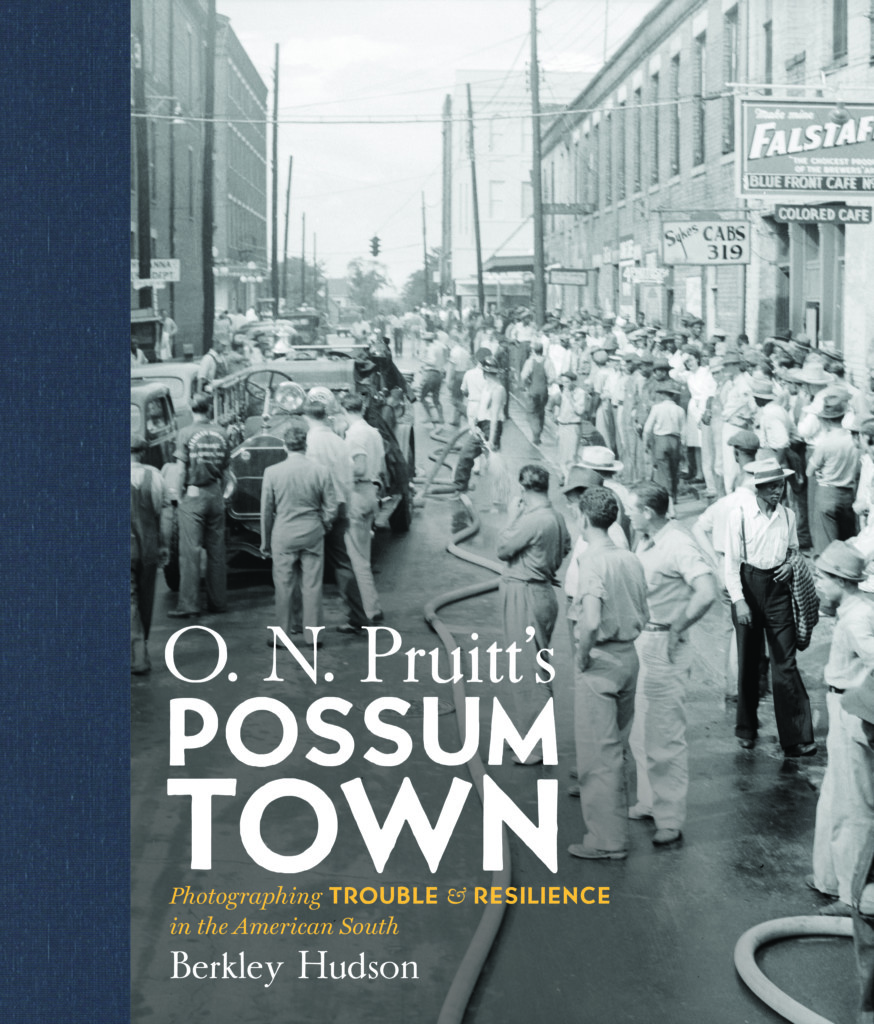
In 1971, a Walker Evans retrospective at the Museum of Modern Art inspired critic Hilton Kramer to reflect on the Evan's enduring influence: "For how many of us, I wonder, has our imagination of what the United States looked like and felt like in the nineteen-thirties been determined not by novel or play or a poem or a painting or even by our own memories, but by a work of a single photographer, Walker Evans."1Kramer quoted in Tom Rankin, "'The Injuries of Time and Weather,'" Southern Cultures 13, no. 2 (2007): 9. Swap out "the United States" for "the US South," and insert some of Evans's contemporaries, including Dorothea Lange, Jack Delano, Ben Shahn, Marion-Post Wolcott, and Margaret Bourke-White, and Kramer's point becomes even more apt. They all photographed a diverse cross section of the United States for various publications and New Deal programs, such as the Farm Security Administration, but the small-town, rural South was the site and subject of their most recognized work. The vivid immediacy of their photographs—and their ubiquity in magazines, books, and exhibits—has made it possible to think of them as surrogates for personal experience and memory. As a cultural imaginary, a "Documentary South," has often served as "the thing itself," a persuasive counterpoint to popular culture ventriloquisms. As Margaret Bourke-White wrote of You Have Seen Their Faces, her 1930s photo-text book about rural poverty, it "may not be the South of song and story, but it is the South that you bring back on sheets of Panchromatic film."2Jonathan A. Silverman, For the World to See: The Life of Margaret Bourke-White (New York: Viking Press, 1983), 80.
The reality is that up until about 1971, if residents of southern cities, towns, or farms thought about the role of photography, most would not have considered (or known of) Bourke-White or Evans. However, they may have been aware of locals who pursued photography as a profession, a passion, or perhaps both by creating snapshots made with Brownies and other Kodaks. Many of these photographers owned their own studios or made photographs for local publications and other purposes. Their portraits and photographs of street scenes, church services, rural life, and landscape often resembled an album whose intended audience was also its subject. Each town and city seemed to have its acknowledged "picture man" or woman, people such as Mike Disfarmer of Heber Springs, Arkansas; Paul Kwilecki of Decatur County, Georgia; Hugh Mangum of Durham, North Carolina; J. W. Otts of Hale County, Alabama; O. N. Pruitt of Columbus, Mississippi; Paul and Layfette Buchanan of western North Carolina; Sam F. Vance, Jr. of Kernersville, North Carolina; Bayard Wooten of New Bern and Chapel Hill, North Carolina; T. R. Phelps of southwest Virginia; Rufus W. Holsinger of Charlottesville, Virginia; and many others.
Black community photographers in the South, including P. H. Polk of Tuskegee, Alabama, Richard Samuel Roberts of Columbia, South Carolina, and Rev. Lonzie Odie Taylor of Memphis, Tennessee, played particularly important roles during the Jim Crow era when Black photographers were largely excluded from the staffs of national magazines and many New Deal agencies, including the FSA. Gordon Parks was the FSA's only Black photographer during the agency's eight-year existence between 1935 and 1943, serving as a Rosenwald fellow for one year in 1942. Black photographers documented aspects of Black life, particularly middle-class life, that white photographers ignored or could not access. Their photographs ultimately transcended their local purposes and created what bell hooks has called "a counterhegemonic world of images" that rebutted the racist caricatures found in popular culture and in the work of some white photographers.3bell hooks, Art on My Mind: Visual Politics (New York: The New Press, 1995), 57.
For most Black and white community photographers, local demands and conventions of circulation limited the reach of their images. That has changed in recent years thanks to the work of some dogged historians and archivists. Knowledge about local photographers has grown since the 1970s when scholars, partly under the influence of new social history and ethnographic movements, began retrieving and saving photographers' archives from oblivion and writing life histories. More recently, libraries have digitized some of these archives, making them more accessible to scholars and the public. Presses have published exquisite books about local photographers that combine beautiful layouts with insightful scholarship. The "Documentary Arts and Culture" series of University of North Carolina Press presents stunning books that chronicle the lives and work of a few of these photographers: One Place: Paul Kwilecki and Four Decades of Photographs from Decatur County, Georgia edited by Tom Rankin; Where We Find Ourselves: The Photographs of Hugh Mangum, 1897–1922 edited by Margaret Sartor and Alex Harris; O. N. Pruitt's Possum Town: Photographing Trouble and Resilience in the American South by Berkley Hudson.4Examples of books and articles on some of the local photographers mentioned in this review essay include, Julia Sully, Disfarmer: The Heber Springs Portraits, 1939–1946 (Danbury, NH: Addison House, 1976); Ann Hawthorne, The Picture Man: Photographs by Paul Buchanan (Chapel Hill: University of North Carolina Press, 1993); David Moltke-Hansen, "Seeing the Highlands: Southwestern Virginia through the Lens of T. R. Phelps," Southern Cultures 1, no. 1 (1994): 23–49; Belena S. Chapp, et al, Through These Eyes: The Photographs of P. H. Polk (Newark, DE: University Gallery, University of Delaware, 2001); Ralph E. Lentz, II, W. R. Trivett, Appalachian Pictureman: Photographs of a Bygone Time (Jefferson, NC: McFarland & Company, Inc., Publishers, 2001); Rob Amberg, Sodom Laurel Album (Chapel Hill: University of North Carolina Press, 2002); Rah Bickley, "Sam F. Vance, Jr. 'Character-Taker': The Faces of Small-Town and Rural North Carolina, 1930s–1940s," Southern Cultures 13, no. 2 (2007): 78–94; Tom Rankin, One Place: Paul Kwilecki and Four Decades of Photographs from Decatur County, Georgia (Chapel Hill: University of North Carolina Press, 2013); Margaret Sartor and Alex Harris, Where We Find Ourselves: The Photographs of Hugh Mangum, 1897–1922 (Chapel Hill: University of North Carolina Press, 2018); James T. Campbell and Elaine Owens, Mississippi Witness: The Photographs of Florence Mars (Jackson: University Press of Mississippi, 2019); Thomas L. Johnson and Phillip C. Dunn, A True Likeness: The Black South of Richard Samuel Roberts, 1920–1936 (Columbia: University of South Carolina Press, 2019); Berkley Hudson, O. N. Pruitt's Possum Town: Photographing Trouble & Resilience in the American South (Chapel Hill: University of North Carolina Press, 2022).
Decades in the making, Hudson's extraordinary book explores the life and work of Otis Noel Pruitt (1891–1967), a white Mississippian who between the 1920s and 1950s served as the "de facto documentarian" for Lowndes County, Mississippi, its seat, Columbus (nickname Possum Town), and surrounding towns and countryside in the northeastern part of the state. An emeritus professor of journalism at the University of Missouri, Hudson grew up in Columbus in the 1950s and knew Pruitt as the "picture man." Pruitt photographed important family gatherings at the "rambling, two-story Victorian filled with Pekingese and antiques" where Hudson's grandmother lived. His photographs adorned the walls of Hudson's childhood home. In the 1970s, as a student journalist and photographer, Hudson began working with friends from Columbus—including photographer Birney Imes, photographer and folklorist Mark Gooch, David Gooch, and Jim Carnes—to track down and acquire Pruitt's archive of 88,657 negatives and 2,000 glass plates, which they donated to the Wilson Library at the University of North Carolina, Chapel Hill in 2012.5Hudson, O. N. Pruitt's Possum Town, 2–5.
Hudson selected nearly two hundred images from Pruitt's sprawling archive to feature in O. N. Pruitt's Possum Town. They are thoughtfully sequenced to tell a coherent and dichotomous story of "Trouble & Resilience." On their own, Pruitt's evocative and deeply disturbing photographs make this a remarkable book, but it's Hudson's poignant writing and his personal connections to Pruitt, Columbus, and its people that make the book especially valuable.
In a series of short interspersed essays, Hudson tells a history of Columbus and Lowndes County, Mississippi and reveals narratives behind some of the photographs Pruitt made. Hudson weaves his research and memories with the memories of others he or his colleagues interviewed, including people featured in the photographs or their descendants, as well as Pruitt's. These voices bring life and death into the photographs. With emotional resonance, they turn abstractions (race, class, gender, place) into a nexus of experiences and relationships. They prod us to reconsider interpretations of photographs we think we know.
Born on a farm in south central Mississippi, O. N. Pruitt came of age while Eastman Kodak was popularizing photography. The introduction of affordable and portable box cameras, such as the Brownie, around the turn of the century transformed "one of the most envied accompaniments of high birth"—family portraits—into an almost common possession.6"Old Photographs," The Living Age, 279, December 13 (1913): 689. Pruitt bought his first camera to make pictures of his young children. Before long he was using his Brownie 122 to photograph timberland for landowners looking to sell. By 1915, he was a full-time photographer. To hone his craft and make himself more marketable, he studied for a year at the Illinois School of Photography in 1916. When he returned to Mississippi, he opened his own studio in the town of Newton near his birthplace. Three years later, he and his family moved ninety miles northeast to Columbus where he began working at the studio of a German immigrant named Henry Emil Hoffmeister. In 1921, Pruitt bought out his boss and began establishing himself as the area's premier photographer.7Hudson, O. N. Pruitt's Possum Town, 9.
As a businessman, Pruitt made studio portraits of Black and white people while the police and insurance companies paid him for photographs of homicide and lynching victims, car accidents, and damage and deaths from natural disasters. Pruitt roamed the area's streets and backroads on his own as a documentary artist. He had an expansive eye and a knack for recording habits and rituals from cradle to grave. He photographed infants in his studio and the dead in their caskets, baptisms and executions, fox hunts and "freak" shows, cotton farmers and Klan rallies, Black Sunday School classes, and Kiwanis Club members in blackface. "His photographs," writes Hudson, "capture scenes of the ordinary graces of everyday life, ethnic identity, and race relations as well as brutal power, full of excruciating suffering." They offer a vivid "photobiography of a time and place" from the perspective of a white photographer living in the Jim Crow South.8Hudson, O. N. Pruitt's Possum Town, 1, 9–11. What these photographs document most of all, however, is the pervasive situation of racial segregation and white domination.
Irony and contradiction saturate Pruitt's persona and his depiction of Lowndes County's segregated society. A member of "the white male Columbus power structure," he was a gregarious man who said and wrote nothing about his photographic interests or inspirations; he faithfully attended Sunday school and enjoyed telling "smutty jokes"; he was a good ole' boy who loved to hunt and fish and who used his camera to cross the color-line by making beautiful, sometimes intimate, portraits of Black clients, including the president of the local NAACP. Even the use of his most widely recognized photograph was paradoxical. Some whites turned his 1935 image of two Black lynching victims into postcards, while the Chicago Defender published it under the caustic heading "White Civilization." Three decades later, the Student Nonviolent Coordinating Committee (SNCC) used the same photo in a voting rights poster.9Hudson, O. N. Pruitt's Possum Town, 10–11, 13.
Columbus sits astride two recognized ecoregions: the last undulations of Appalachia, known in the area as the Tombigbee Hills, roll north and east of town while a band of fertile Black Belt prairieland spreads south and west. Between 1920 and 1960, the years Pruitt photographed there, the town's population grew from 10,501 to 24,771, all the while having an almost equal number of Black and white residents. The guidebook published by Mississippi's Federal Writers' Project in 1937 romanticized Columbus as "a comfortable old-tree shaded town" with homes "characteristic of the lavish ante-bellum period in which they were built. It is the junction of the Old South with the New, with gracious lines of Georgian porticos forming a belt of mellowed beauty about a modern business district." On the northside of town, the "Negro section," sat "low-roofed, red frame houses . . . festooned with wisteria and shaded by umbrella chinaberry trees and tall, brightly colored sunflowers."10Hudson, O. N. Pruitt's Possum Town, 19. The everyday inequalities and racist terror missing in the guidebook descriptions can't help but edge their way into the photos of Pruitt.
Hudson acknowledges that his study of the conservative Pruitt, who photographed him in the segregated world of his youth, helped him find "connections to my life—unknown, unconscious, or purposefully hidden. With this project, I learned heartrending stories I wish someone had told me long ago." From the photographs, Hudson "learned about executions and lynchings that my mother and father knew about but never mentioned. I learned about baptisms in the 1920s and 1930s in the Tombigbee River where Black and white church groups gathered in a measure of biracial Christian harmony. As children, my mother and my uncles went to these on Sunday afternoons near their home and a few blocks from where I one day would live."11Hudson, O. N. Pruitt's Possum Town, 5 and 7.
Despite his personal ties and long work on the project, Hudson avoids turning his study of Pruitt's images into an awakening memoir. As he writes in the opening chapter, "The stories embedded here do not simply belong to me. . . . I alone cannot tell the stories of Pruitt's photographs. That requires a collective effort of reflection and conversations among all kinds of people with all kinds of backgrounds and beliefs."12Hudson, O. N. Pruitt's Possum Town, 5. The power of O. N. Pruitt's Possum Town comes from the interplay and juxtaposition of Hudson's own stories of Pruitt's photographs with those of people whose backgrounds and experiences are, or were, unlike his own.
In the essay "Catfish Alley Fire," which accompanies Pruitt's book-cover photograph of the same title, Hudson braids his history of Columbus's former "one-block-long strip of flourishing Black businesses," with the memories of Black and white residents. The effect turns the photograph into a palimpsest of overlapping and competing stories. Although a Black business district, white men visited Catfish Alley to play poker, eat fish and barbeque, and drink illegal whiskey. Some later romanticized it in their memories, portraying it as a place redolent of fried fish and moonshine where the proprieties of middle-class life could be left behind. "Drink whiskey and eat fish," one white man remembered, "That's about all it was to it." But for Black businessman Edward C. Bush, Catfish Alley was a place of Black economic and cultural independence, a refuge from the worst of Jim Crow's indignities.13Hudson, O. N. Pruitt's Possum Town, 110–111.
Pruitt's "Catfish Alley Fire" photograph represents some small portion of the tension between these two sets of memories. Taken about 1940, it shows people congregating on the street to watch the fire department respond to a blaze that's out of view. It's an allusive image, a "tableau of street theater," Hudson writes, that corrals the contradictions of Jim Crow into one city block. Black and white, mostly men, stand in the vicinity of a sign for a "Colored Café" and stare at the fire looming beyond the left frame. It's the rare event that breaks the everyday, but in their proximity, Black and white are distanced, alienated, from each other. The fire hoses snaking along the street form cordons and ligatures, markers of segregation and the ties that bound Black and white together despite it.14Hudson, O. N. Pruitt's Possum Town, 110–111.
The hose can also be read as a rope, a symbol of the white supremacist violence—real and threatened—that runs through Pruitt's photographs in this book. Possum Town opens with a series of beautiful portraits of Black and white sitters and images that illuminate the landscape. Then, abruptly, Hudson presents a photograph of a Black boy with a bloodied nose and blood-stained shirt. He stares straight at Pruitt, wounded but impassive or perhaps stunned to see a camera pointing at him. The white boy over his left shoulder holds a nearly clinched left fist that correlates with the blood dripping from the Black boy's right nostril. The white boy's face conveys a mixture of satisfaction and reluctance as if the white men who stand behind him had goaded him into the fight for their more evident pleasure. The Black bystanders seem variously engaged and uneasy, perhaps tempering their deeper feelings about the bloodshed because of the presence of white men and because they know that this fight, even involving youths, is a species of the violence whites used to maintain power. Hudson's decision to juxtapose this image with a pastoral photograph of two white men standing in a field of oats on the opposite page suggests how suddenly "trouble" can shatter the façade of tranquility and how quickly some want to forget it.15Hudson, O. N. Pruitt's Possum Town, x.
Hudson's book includes two photographs that frame white killings of Black men. The first, on a left-facing page, from 1934, shows James Keaton, a Black man, standing at the gallows with white officials who will soon carry out his execution by hanging. On the opposite page appears one of Pruitt's 1935 photographs of the bodies of Bert Moore and Dooley Morton hanging from a tree following their lynching by a mob. These images are preceded by two photographs of different blackface minstrel shows performed by white youths and Kiwanis Club members and one image of the Klan marching at night through Columbus and passing in front of the photographer's studio. By placing these photographs immediately before the images of executions, Hudson suggests how ritualized theatrical and physical violence conspire, how one enables the other in white racism's bloody crucible.16Hudson, O. N. Pruitt's Possum Town, 149–161.
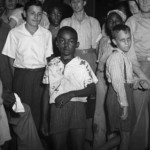
Hudson's accompanying essay to these photos provides another layer of context. In a section on Keaton's execution, Hudson explains the historical significance of Pruitt's photograph: it was the last time officials carried out a "legal" execution by rope hanging in Mississippi. An all-white, all-male jury convicted Keaton of killing a white gas station owner, although a white woman who worked nearby said he was innocent and that she knew who the actual killer was. Keaton, it turns out, was prosecuted by future US Senator and arch segregationist, John Stennis, who implored the jury to convict and "help advance civilization by removing this cancer."17Hudson, O. N. Pruitt's Possum Town, 152–153.
Pruitt's photograph of Keaton at the gallows looks like a re-creation of a scene from some macabre play, which, of course, it is in a sense. Most of the men, including Keaton, feign grins except for the official on the far right who stares at Pruitt's camera with stern self-importance and smugness. Spectators peer from below and behind the scaffold, including through a courthouse window where, in one case, the camera's flash caused a man's eyes to emit a spectral glow. Hudson calls this a "tableau vivant, a living picture, at the death's moment," though it's also a tableau mort, one Pruitt took in service of white supremacy. Though not pictured, Black people, including preachers, writes Hudson, were present outside the courthouse when Pruitt made the photograph at 2 a.m. on May 25. "On the courthouse lawn for hours before the execution, they had sung spirituals through the night." Hudson's sentence evokes the Black presence while stressing their physical absence from a cropped and sanitized image.18Hudson, O. N. Pruitt's Possum Town, 152–153.
Just over a year later, in July 1935, Pruitt, at the request of the sheriff, photographed Bert Moore and Dooley Morton hanging from an oak tree after a white mob lynched them in a churchyard eight miles south of Columbus. Unlike the Keaton execution image, only one white man appears here and he kneels with his back to the camera, "gathering their pant legs into a grasp," Hudson writes, "apparently to keep the bodies steady for the photograph."
The photograph remains Pruitt's most recognized and widely circulated, and its divergent uses have mirrored the contradictions of its creator. White supremacists made it into postcards, while Nazis used or referenced it as propaganda to expose American barbarism, as did the Black press, including the Chicago Defender, Jet, and Afro World. In the 1960s, SNCC used the photograph on posters to promote voting rights in Mississippi. More recently, it was used in the 2016 documentary, I Am Not Your Negro, by Raoul Peck based on an unpublished James Baldwin manuscript, and in a 2021 CNN special about Marvin Gaye's song, "What's Going On."19Hudson, O. N. Pruitt's Possum Town, 155 and 213.
Thanks to Hudson's book, the public can now see and interpret this photograph in light of Pruitt's broader archive, or at least a portion of it. The extraordinary range of Pruitt's photographs, and the vivid stories Hudson tells about them, offers readers a unique opportunity to see the relationship between the quotidian habits and brutal horrors of life in a Mississippi Black Belt town during the depths of Jim Crow. Seen alongside the work of contemporary Black community photographers such as Richard Samuel Roberts and Rev. L. O. Taylor, Possum Town can also shed light on how whiteness and the strictures of segregation result in an archive that obscures as much as it reveals. So far, librarians at UNC, Chapel Hill, where Pruitt's work is located, have only been able to digitize a small portion of Pruitt's massive collection. As more images become available for public access in the future, other curators can build their own chronicles of Pruitt's work on Hudson's remarkable foundation.
About the Author
Scott L. Matthews is a professor of history at Florida State College at Jacksonville. He is author of Capturing the South: Imagining America's Most Documented Region (Chapel Hill: University of North Carolina Press, 2018) and "John Cohen in Eastern Kentucky: Documentary Expression and the Image of Roscoe Halcomb During the Folk Revival."
]]>There are no truly universal feelings about the shared experience of Covid, but there is, I believe, a collective impression that we’ve all experienced a tangle of time, a displacement from the normal markers and seasons, a confronting of the inequities that accompany a pandemic, a fuller view of vulnerability and mortality. Amidst the diversity of ways we’ve managed the many interruptions and anxieties, the unknowing and the seeming to know, there’s shared understanding of a narrowing and shortening of our movements, maps, and itineraries. Through it all I’ve photographed. Sometimes in direct response to covid—with a sense that there’s something rare and exceptional about the moment—and at other times just doing what I always do.
I’ve come to understand that any photograph made during Covid is a ‘Covid photograph.’ To be sure, I recognize that some images made over the last couple of years are directly observing a response to Covid. Images of health care workers, vaccine researchers, shuttered businesses and empty offices, empty stands at athletic events, all of those and more are deeply identified with the pandemic. But so are all the other images, photographs made with full recognition of our altered routines and attitudes, the lightness and darkness that we observe having shifted. There is no way to separate the act of making pictures from a recognition of the injuries caused by the weather that surrounds. The Covid weather tightened our geography, led to a perspective that sees closer and perhaps with more intimacy, intended or not. Anytime we find ourselves looking at a singular sameness, we hope for deeper clarity and precision of sight. If there is hopefulness here, it is in the realization that there’s forever more to see in the most ordinary; another way to compose, to transform the world into an image, to confront the temporal luminance before us in an otherwise dimming day.
There is a recognizable evil tyranny in assuming that our worlds never fall apart, in taking the day-to-day for granted. We like to think we know better (“Here today, gone tomorrow,” and all that). Whatever we know doesn’t prevent us from the familiar condition that when at home the protagonist so often wishes to be away, and when away the deepest wish is often to be at home. Making pictures throughout Covid has been energized by an acceptance of a shrinking physical daily terrain, of being isolated in smaller places. My reply was to busy myself by affirming through images the fullness of wonders and contradictions close to home.
Photographers—and photographs—get all they have from embracing the darkness and light equally, shadows adjacent to highlights, contrast next to flatness, what is present alongside what has gone, low fertile valleys juxtaposed with the dry peaks. The opposites are coequal and mutually dependent, elemental to how we see. The last line from Psalms 139:12 is “the darkness and the light are both alike to you.” Alike, I argue, in that both arrive daily, and perpetually offer us a frontier to explore, render, and move to reveal, a time and place to take full visual advantage of the mystery and the uknown.
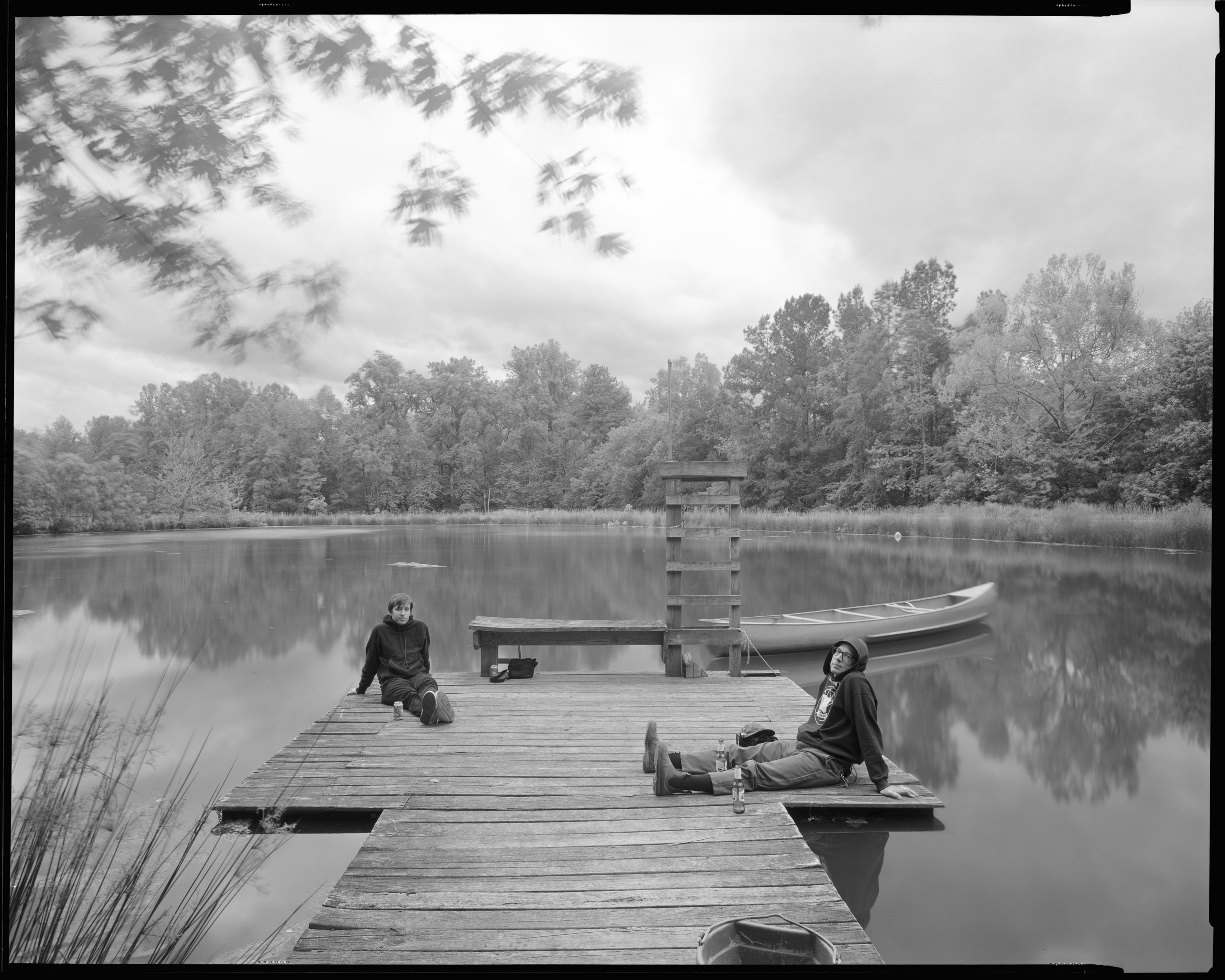
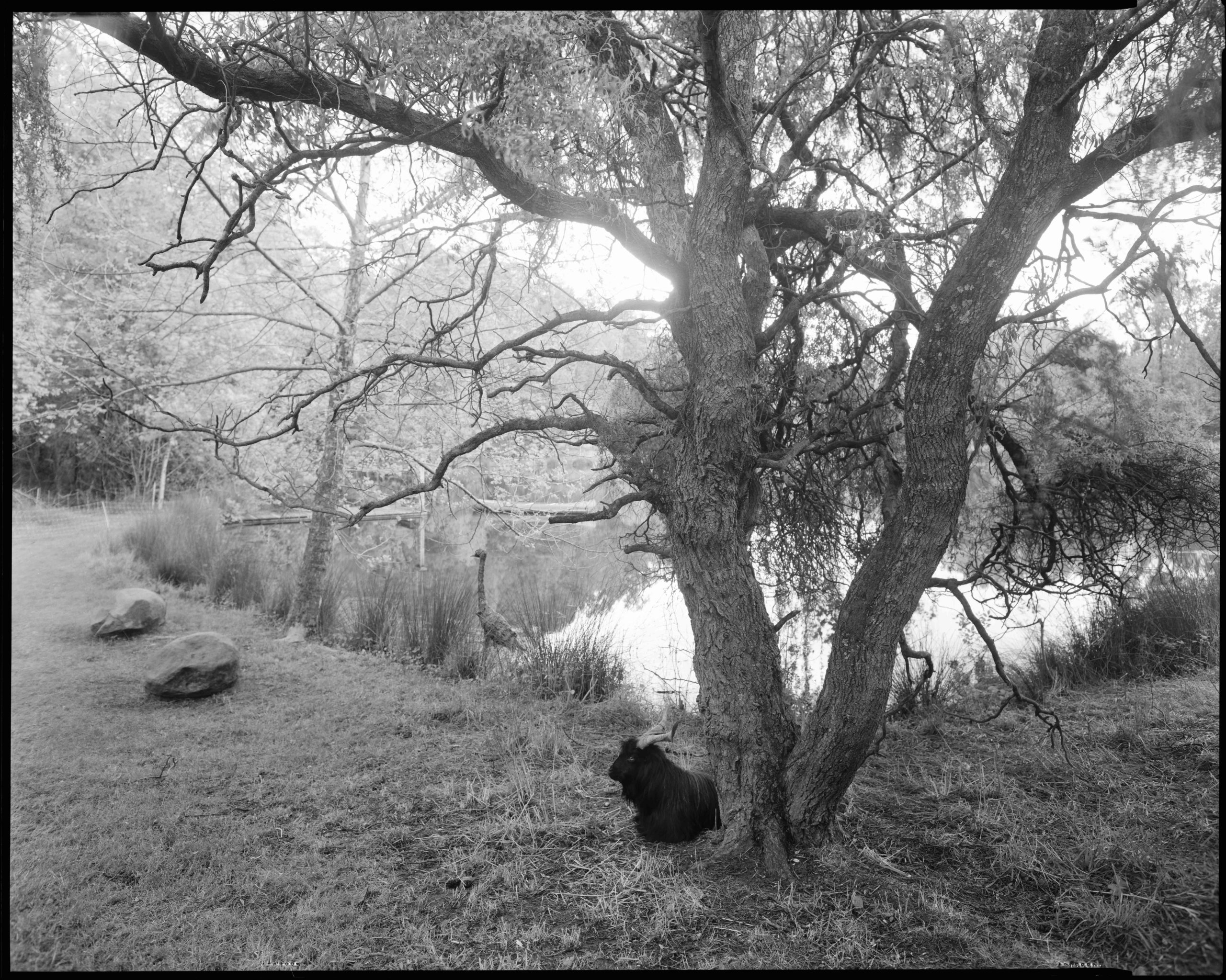
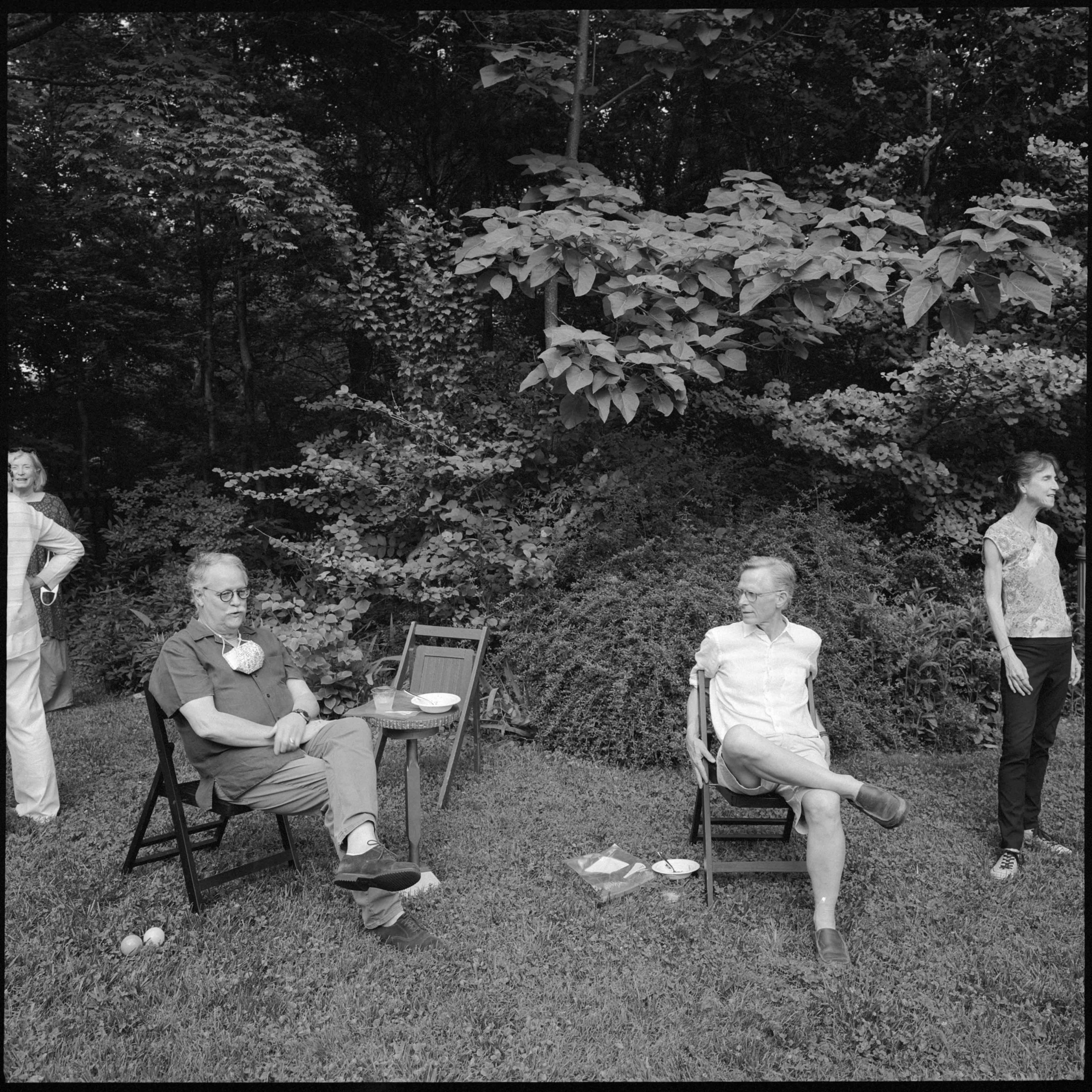
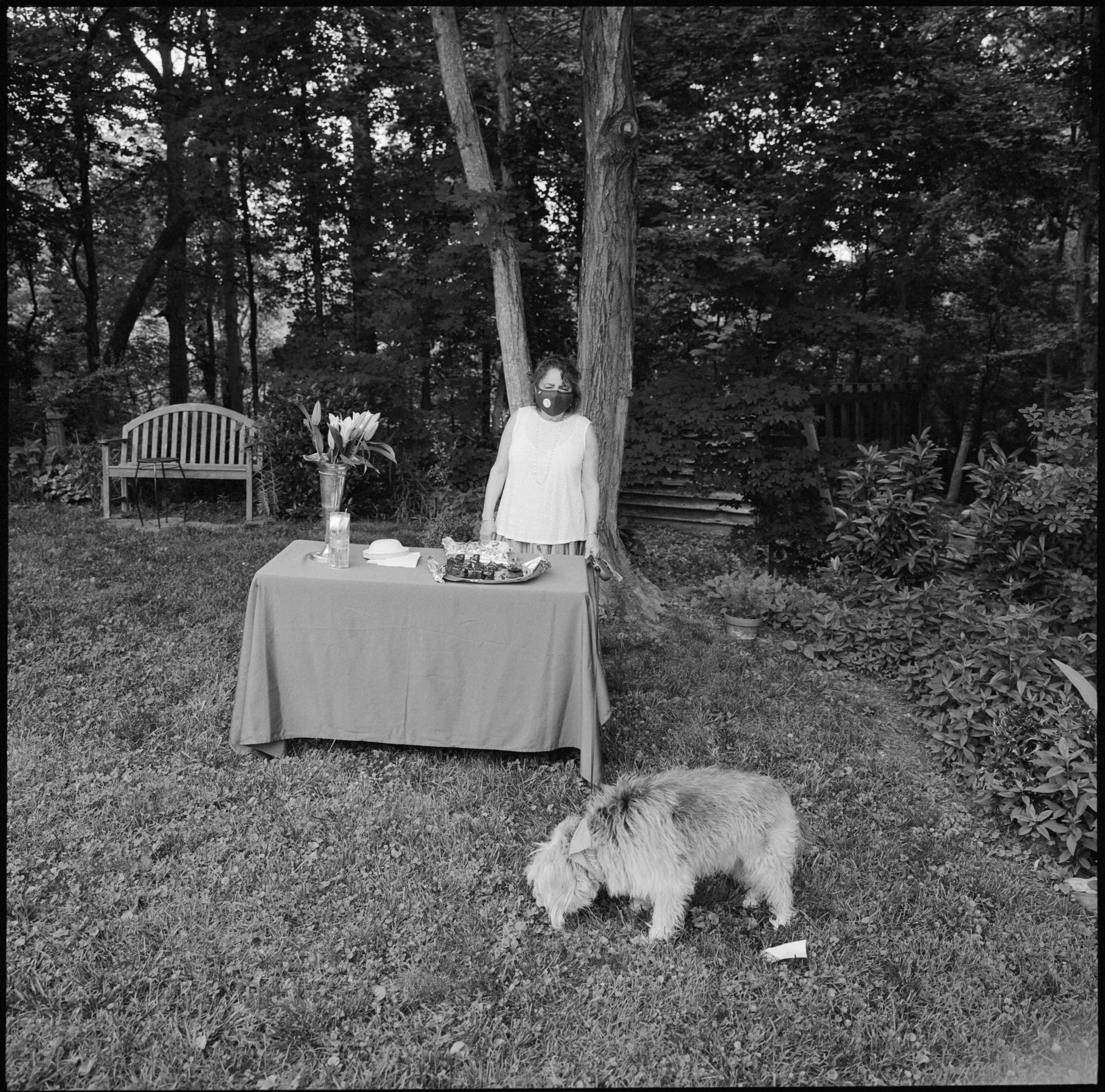
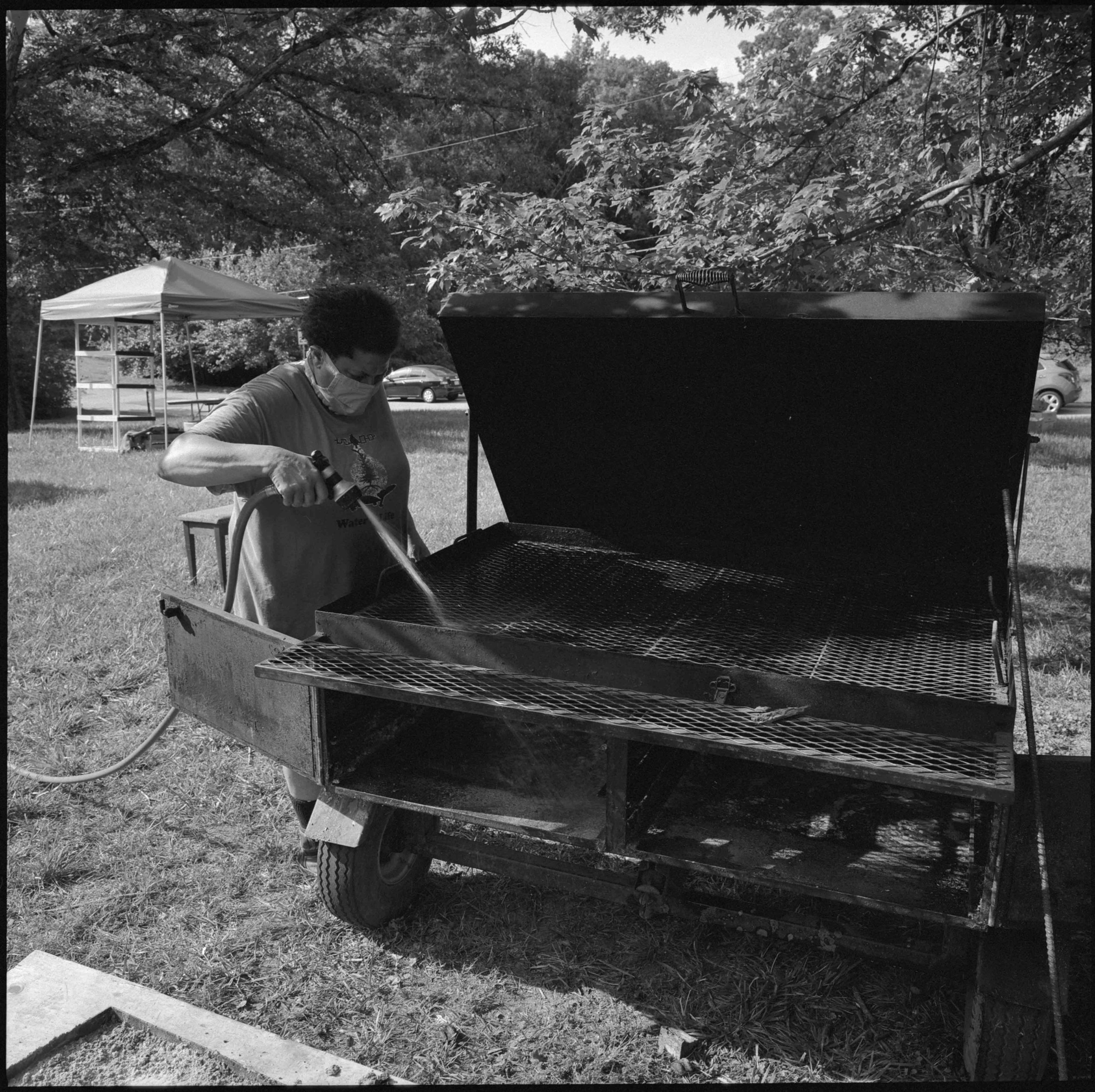
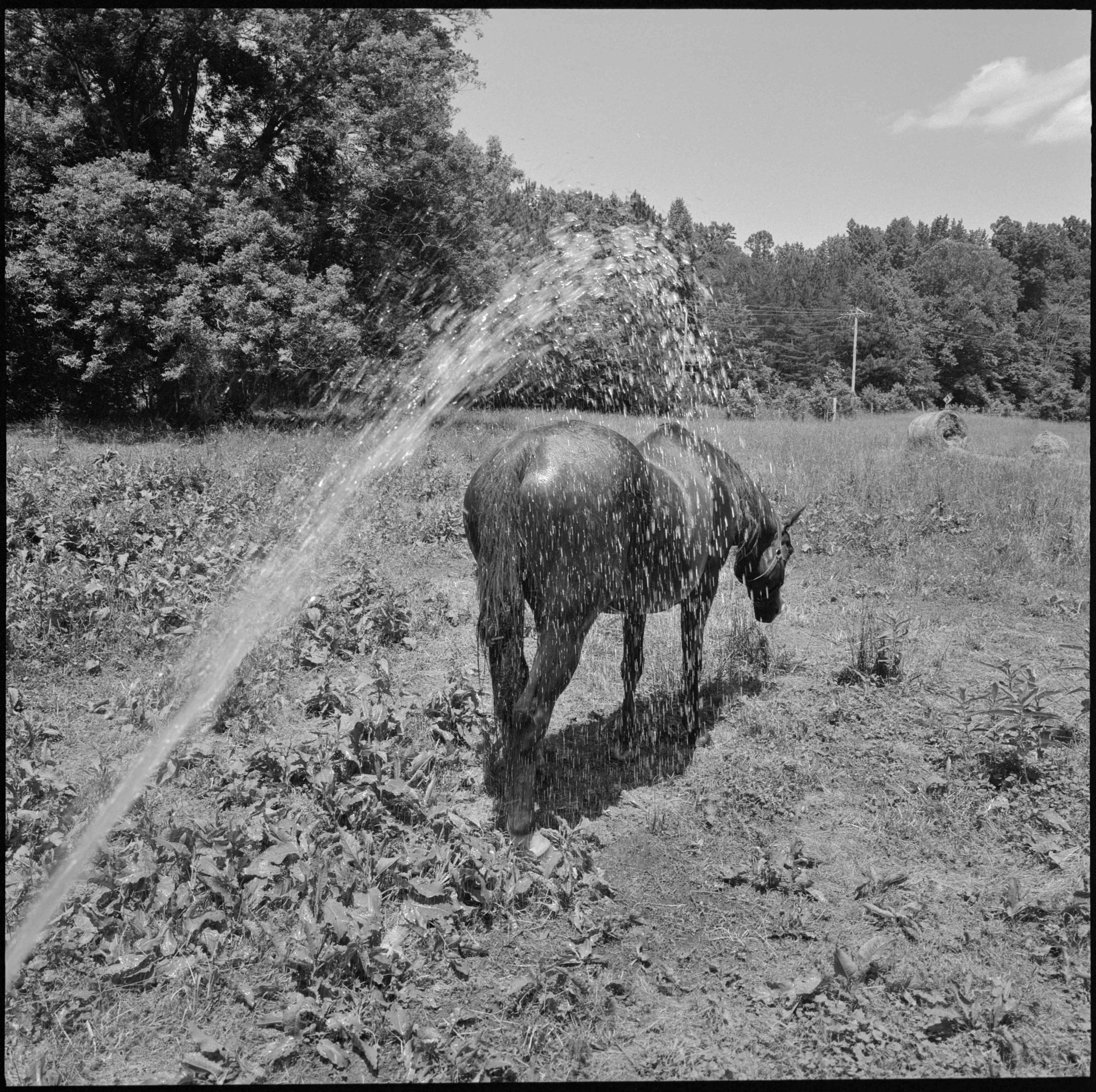
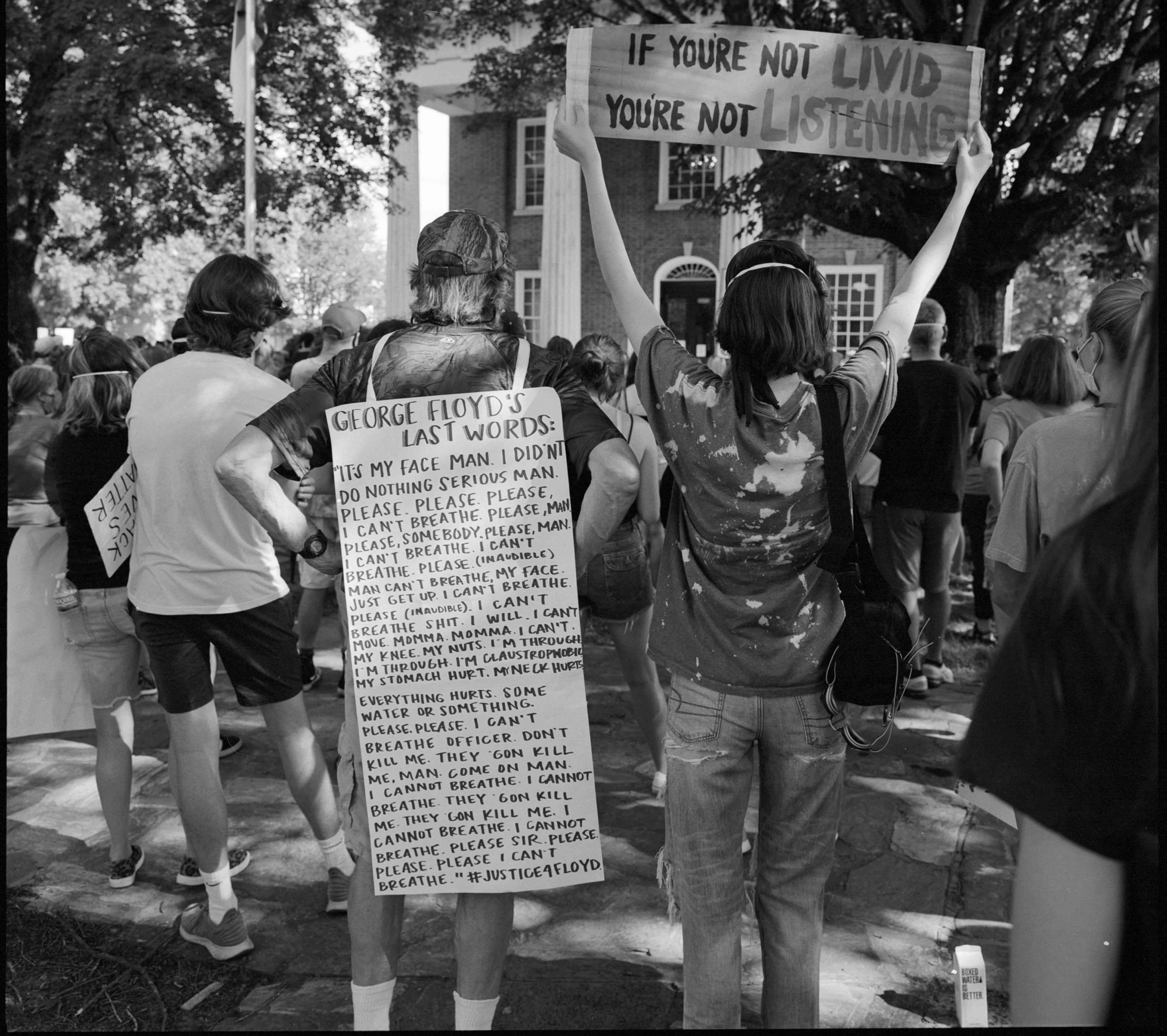
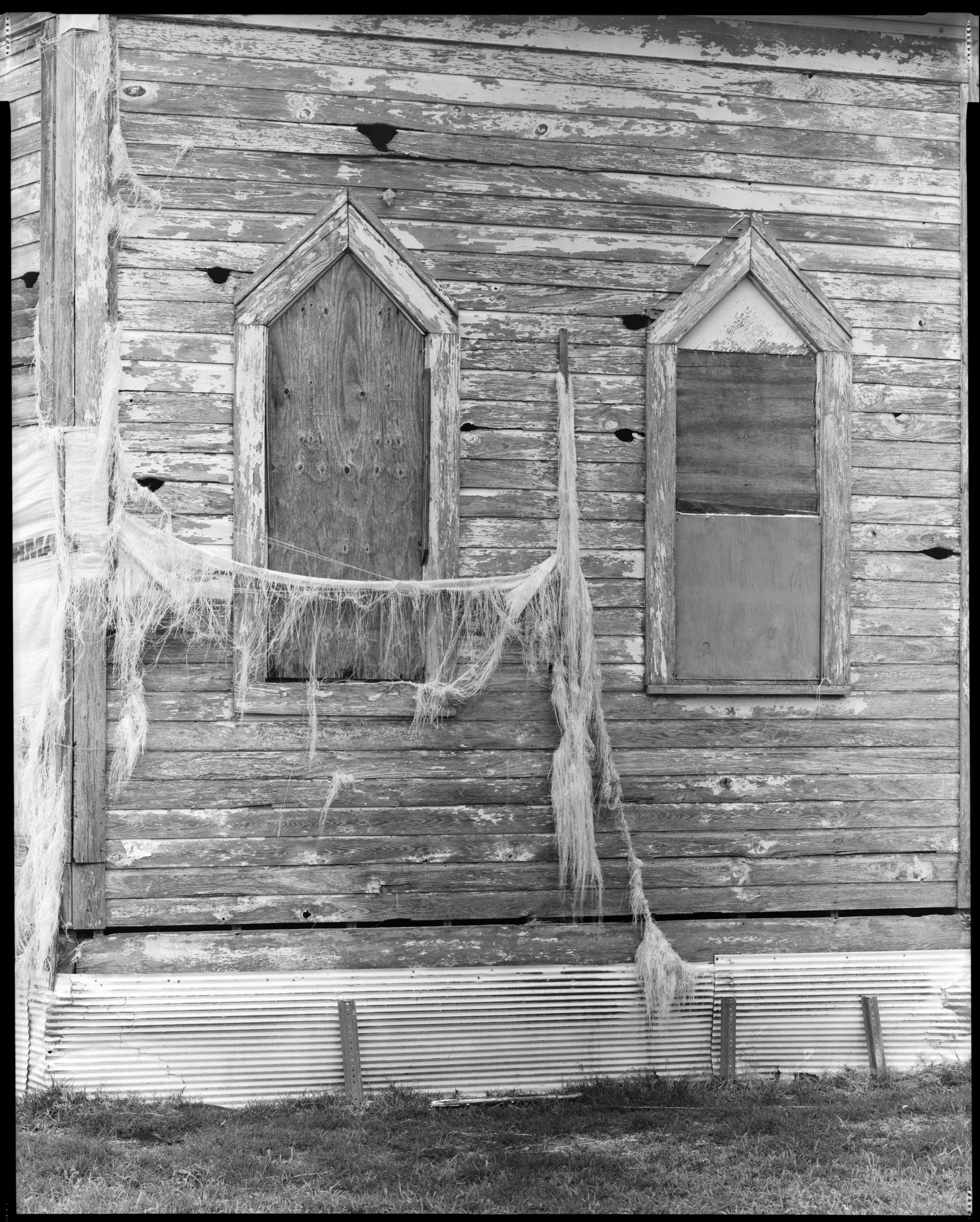
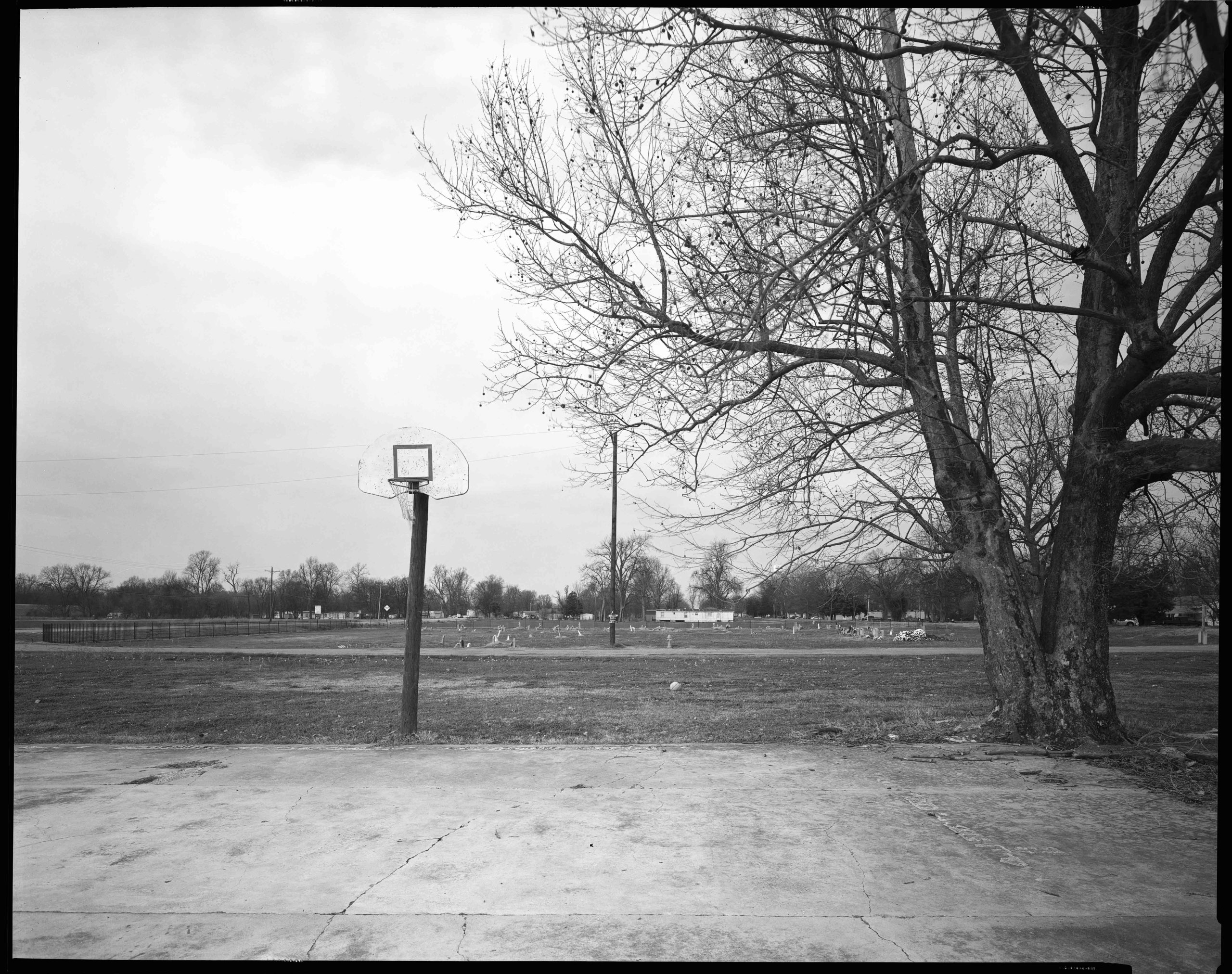
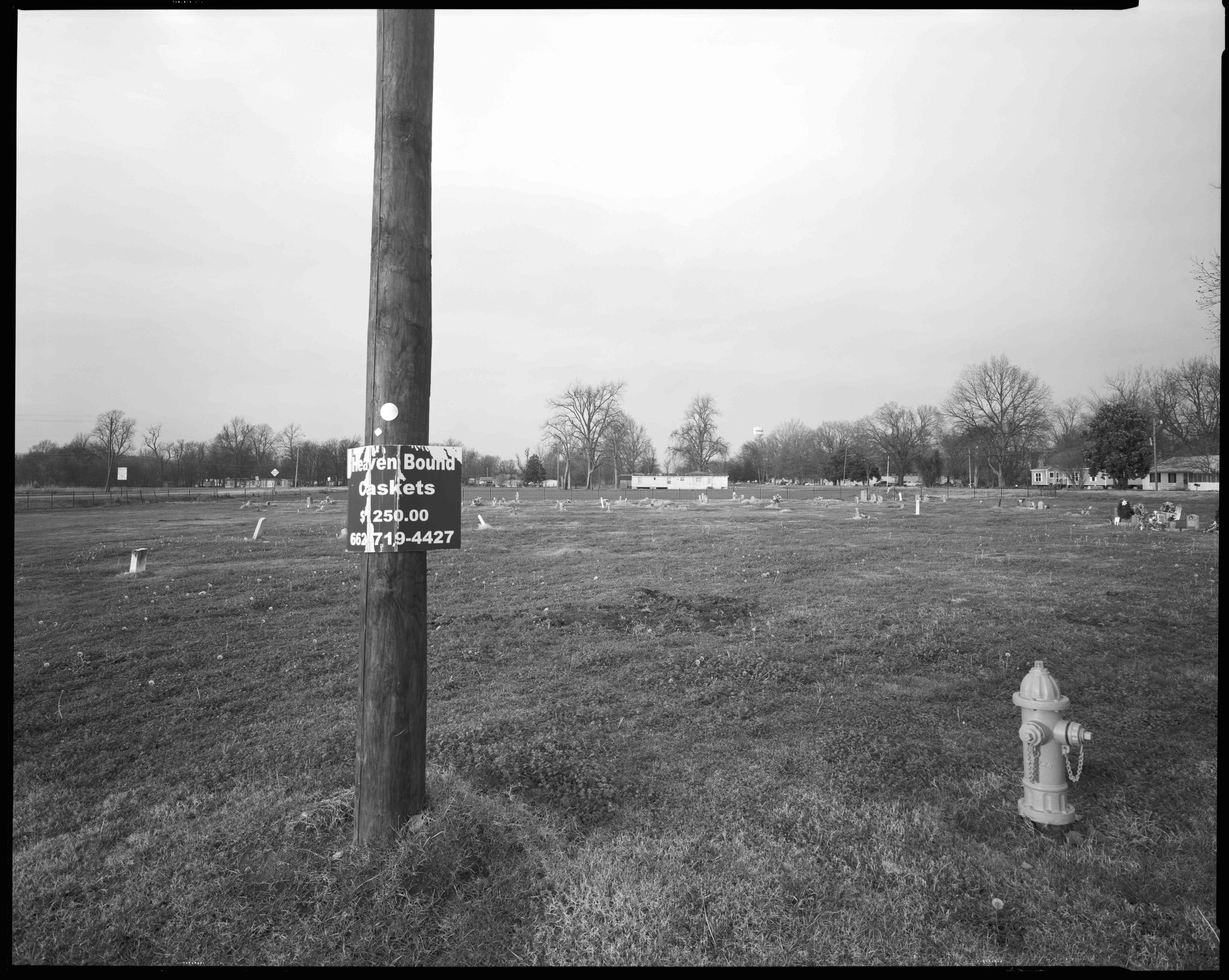
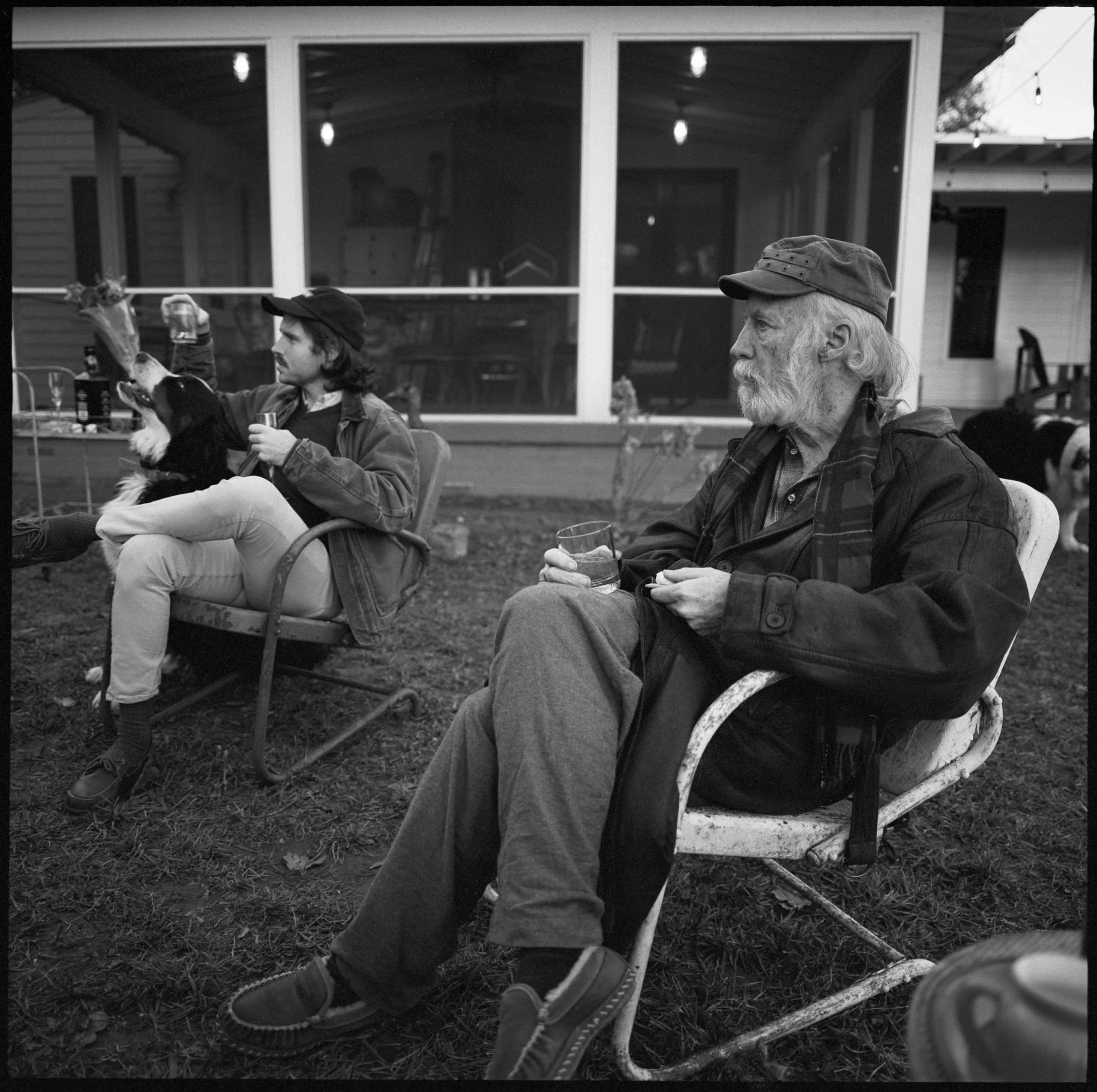
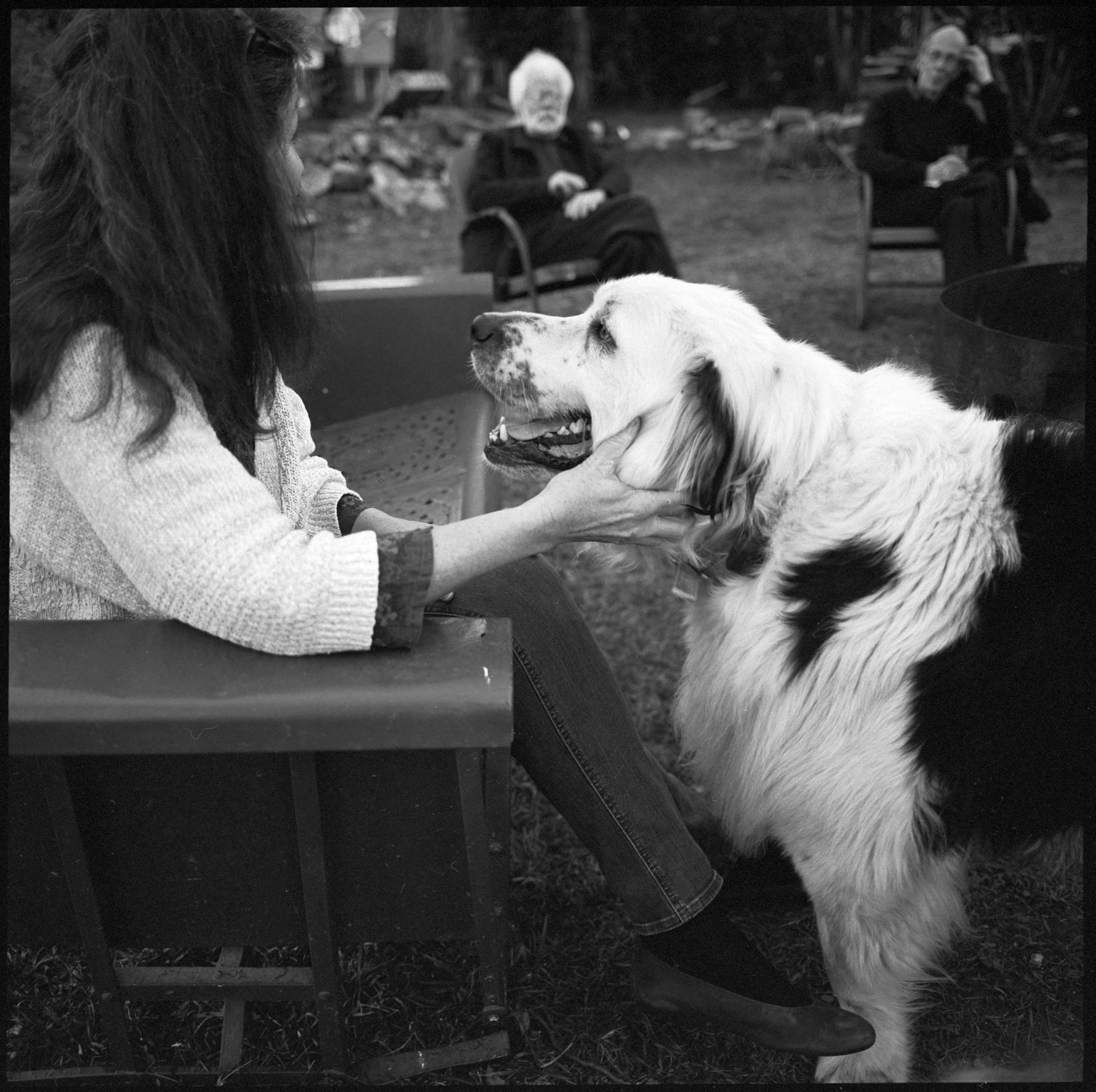
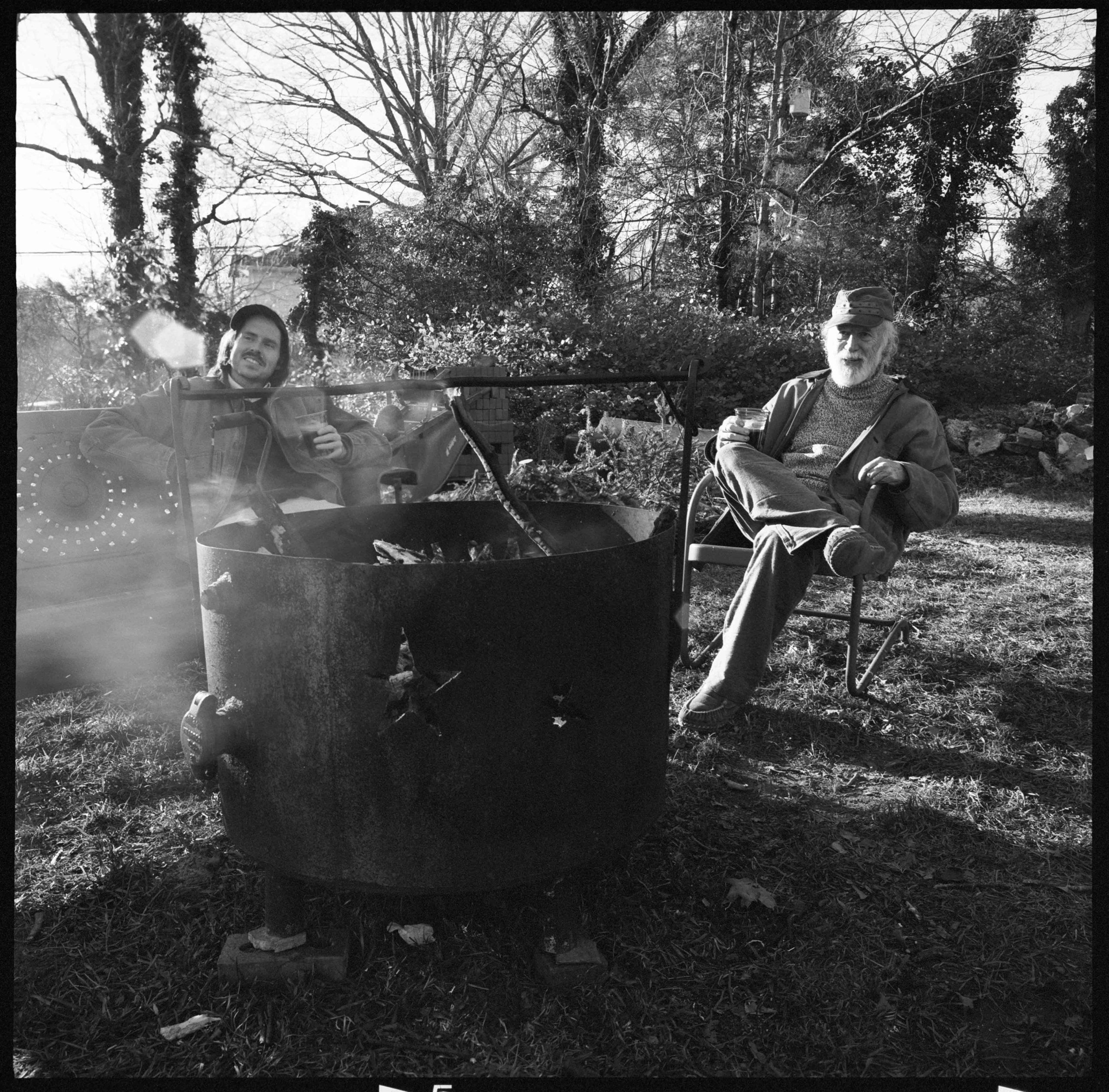
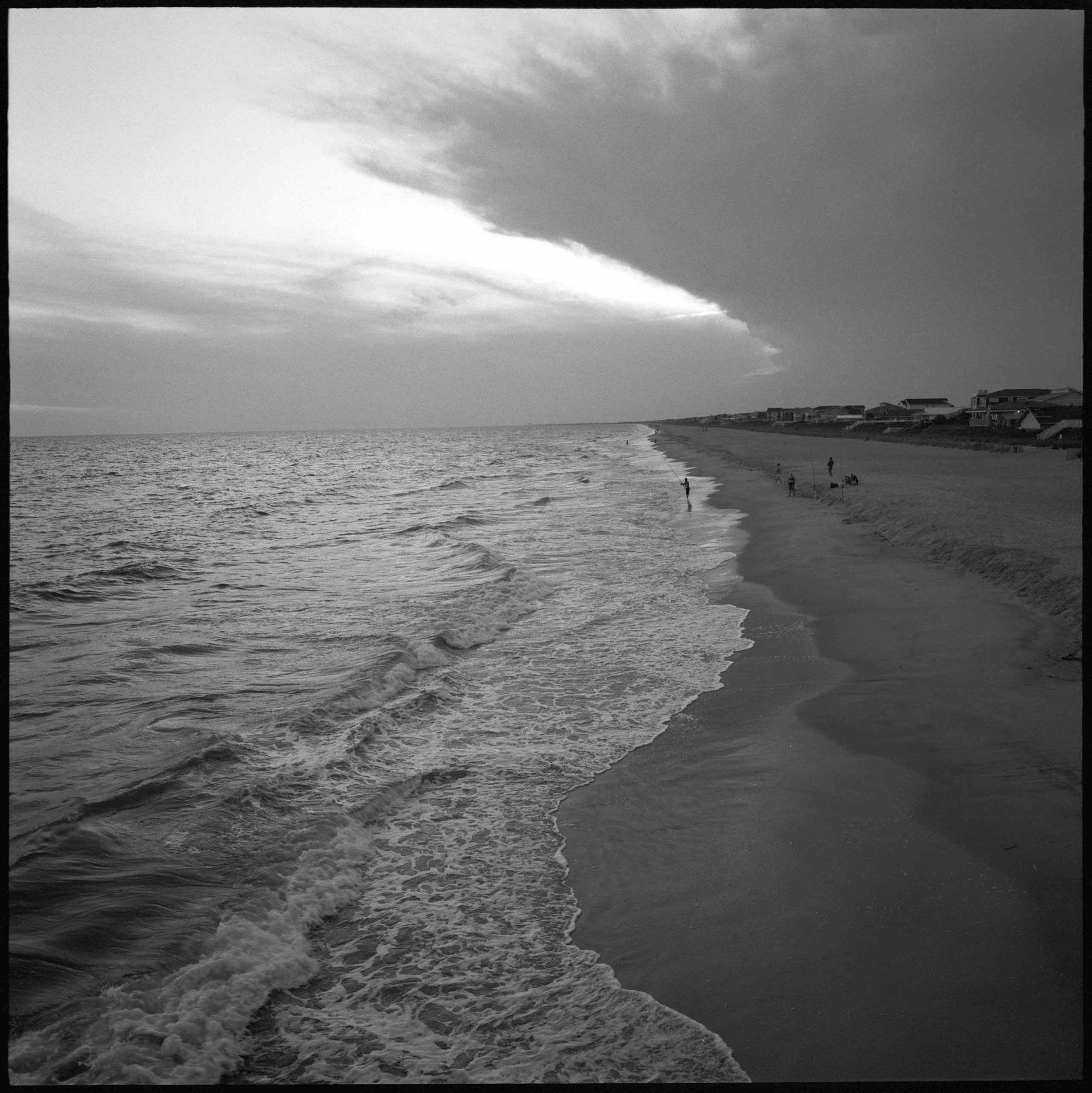
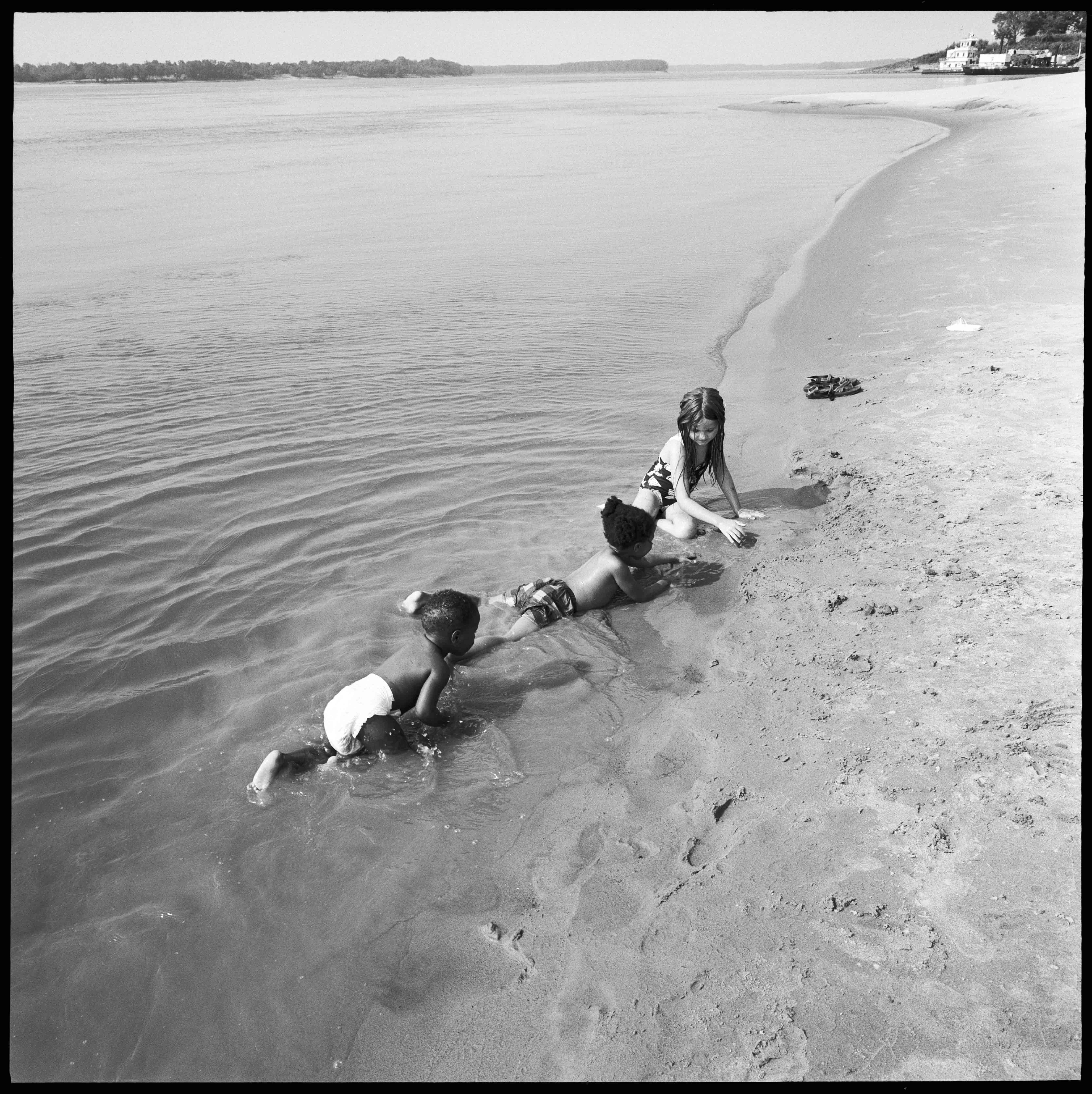
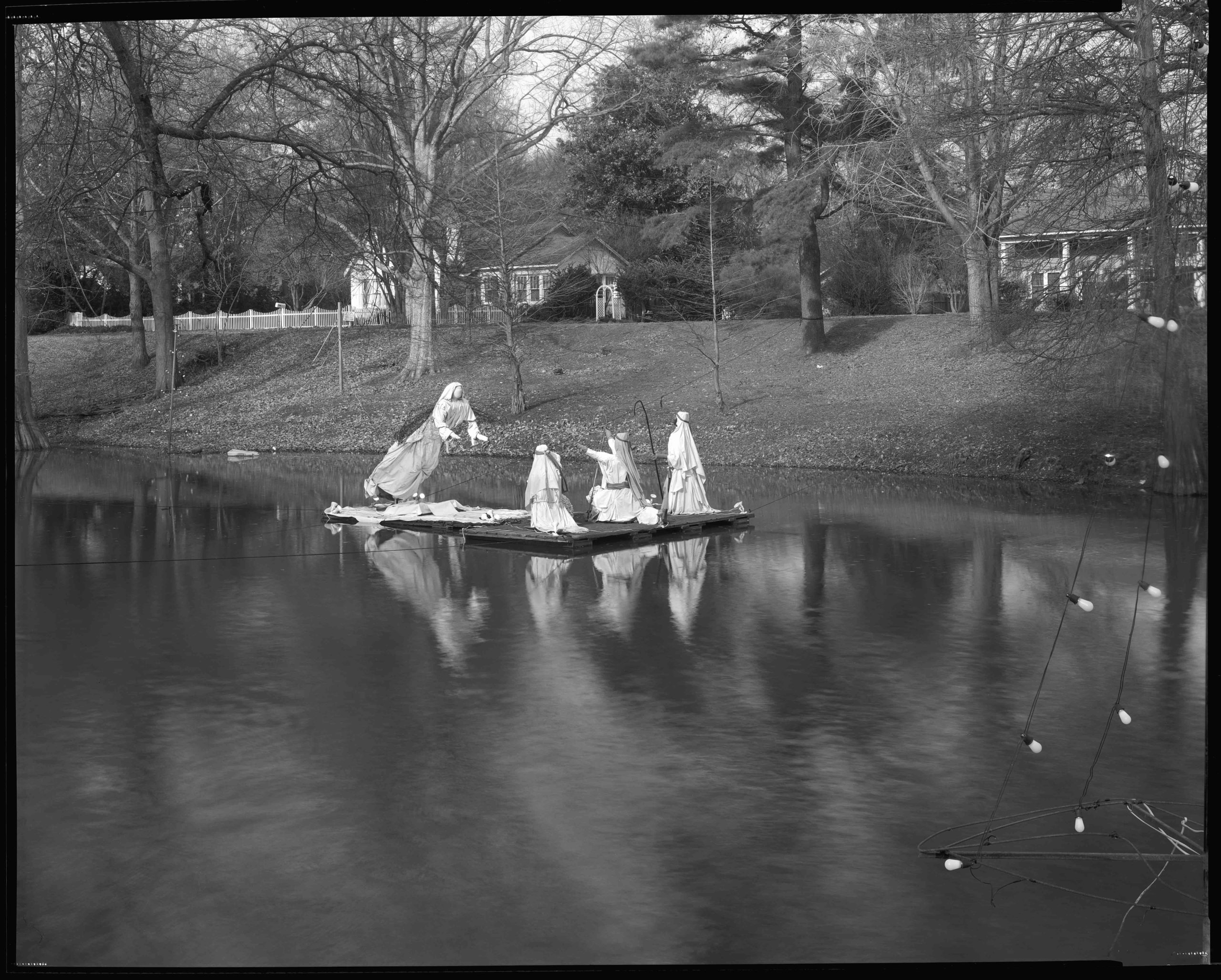
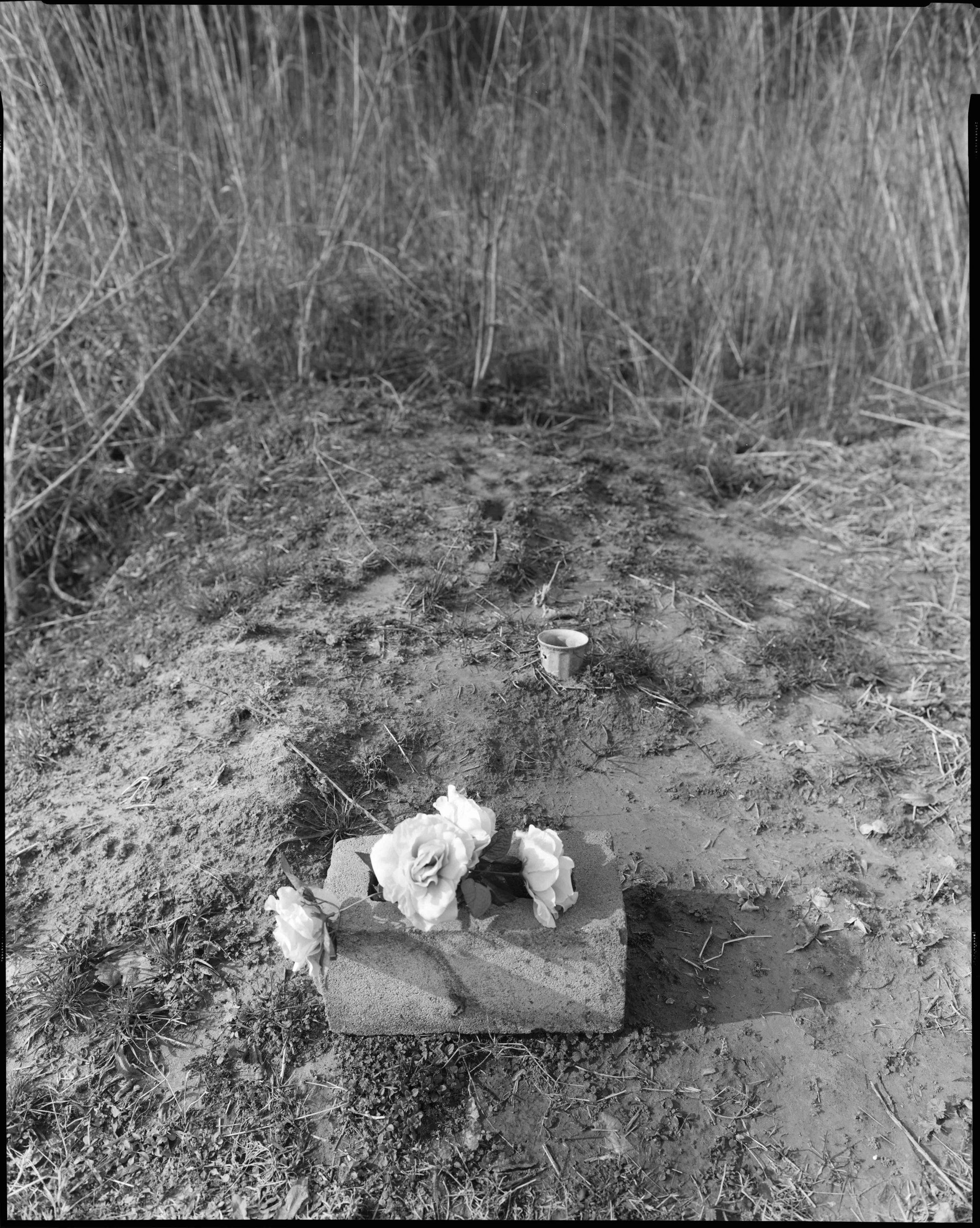
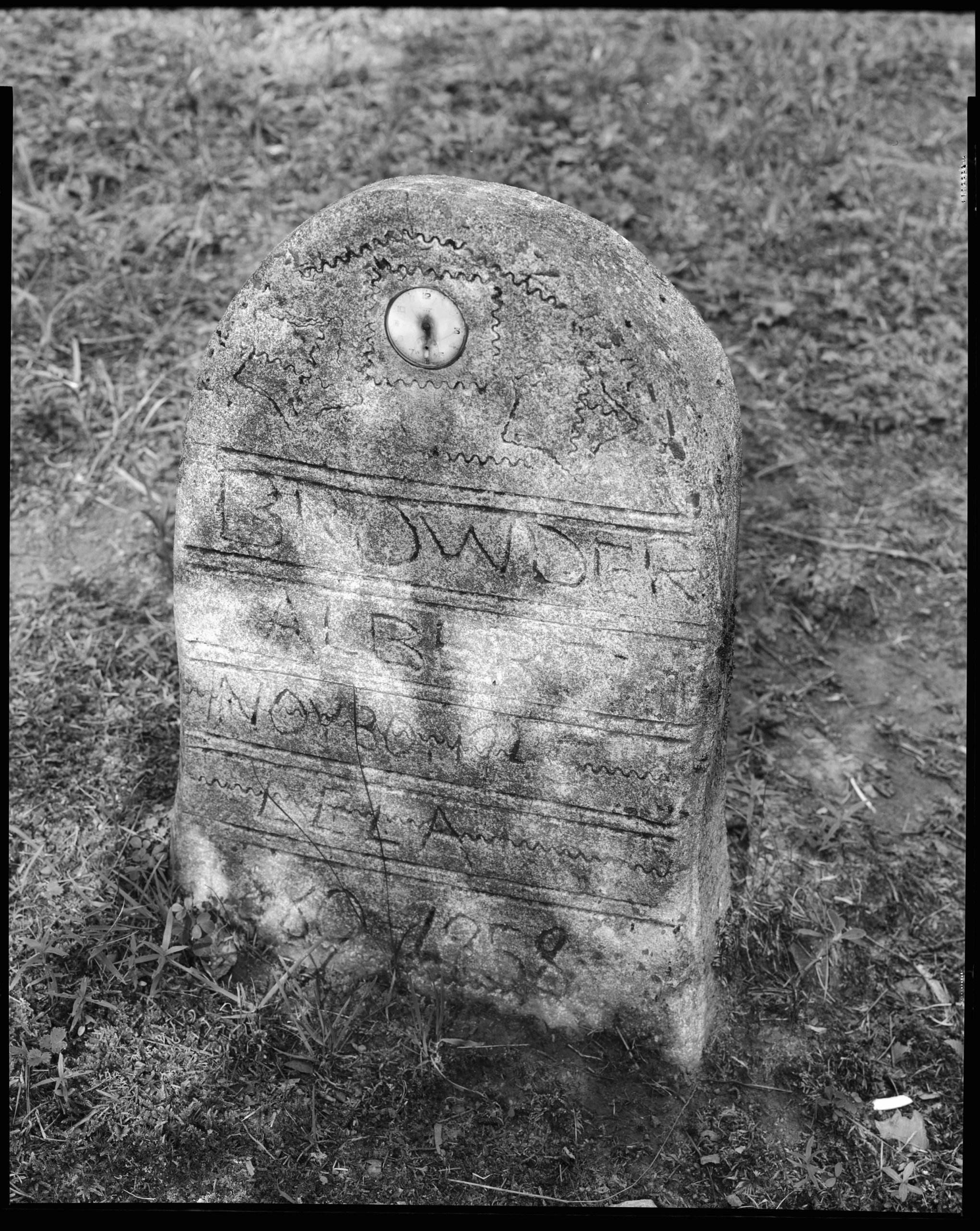
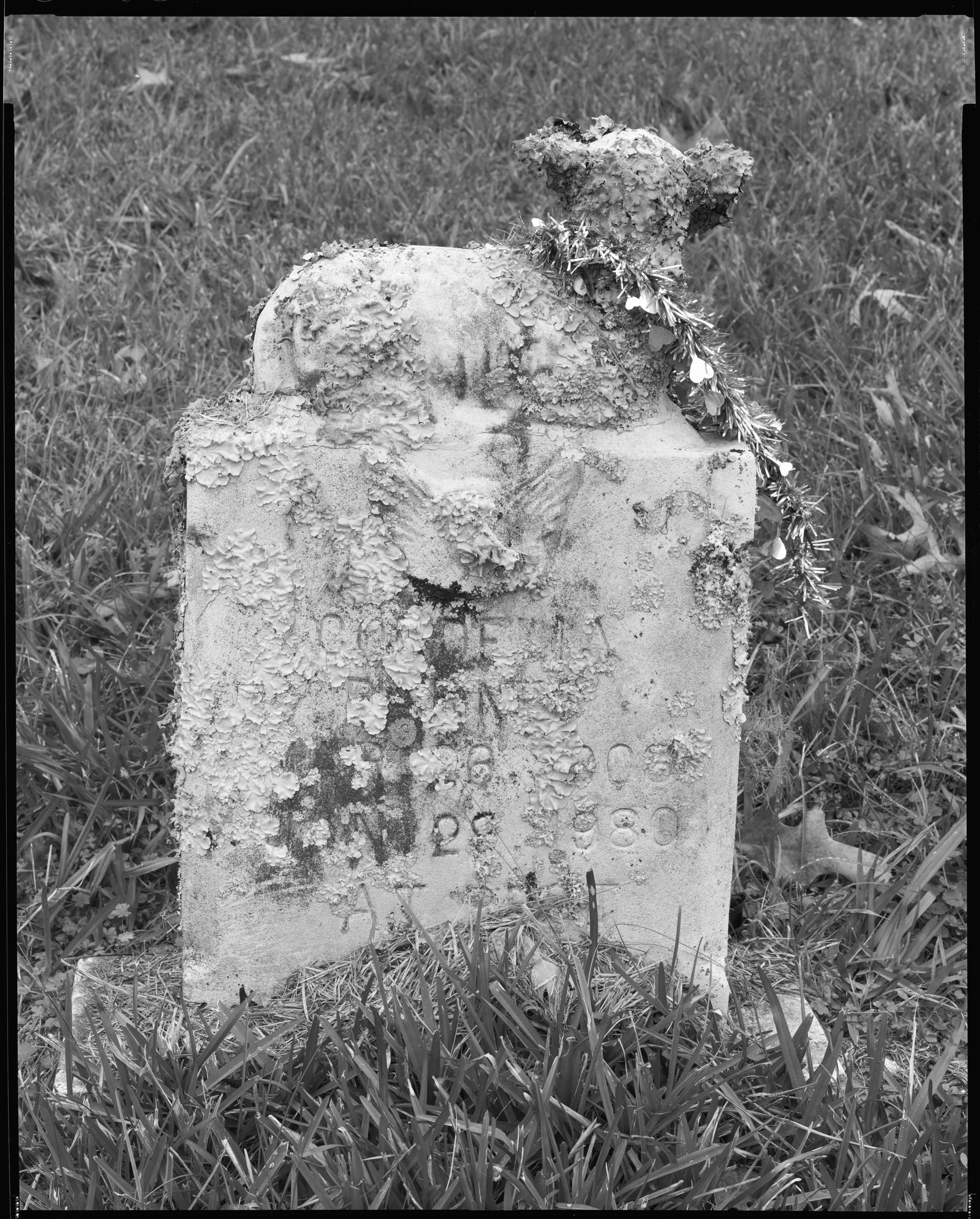
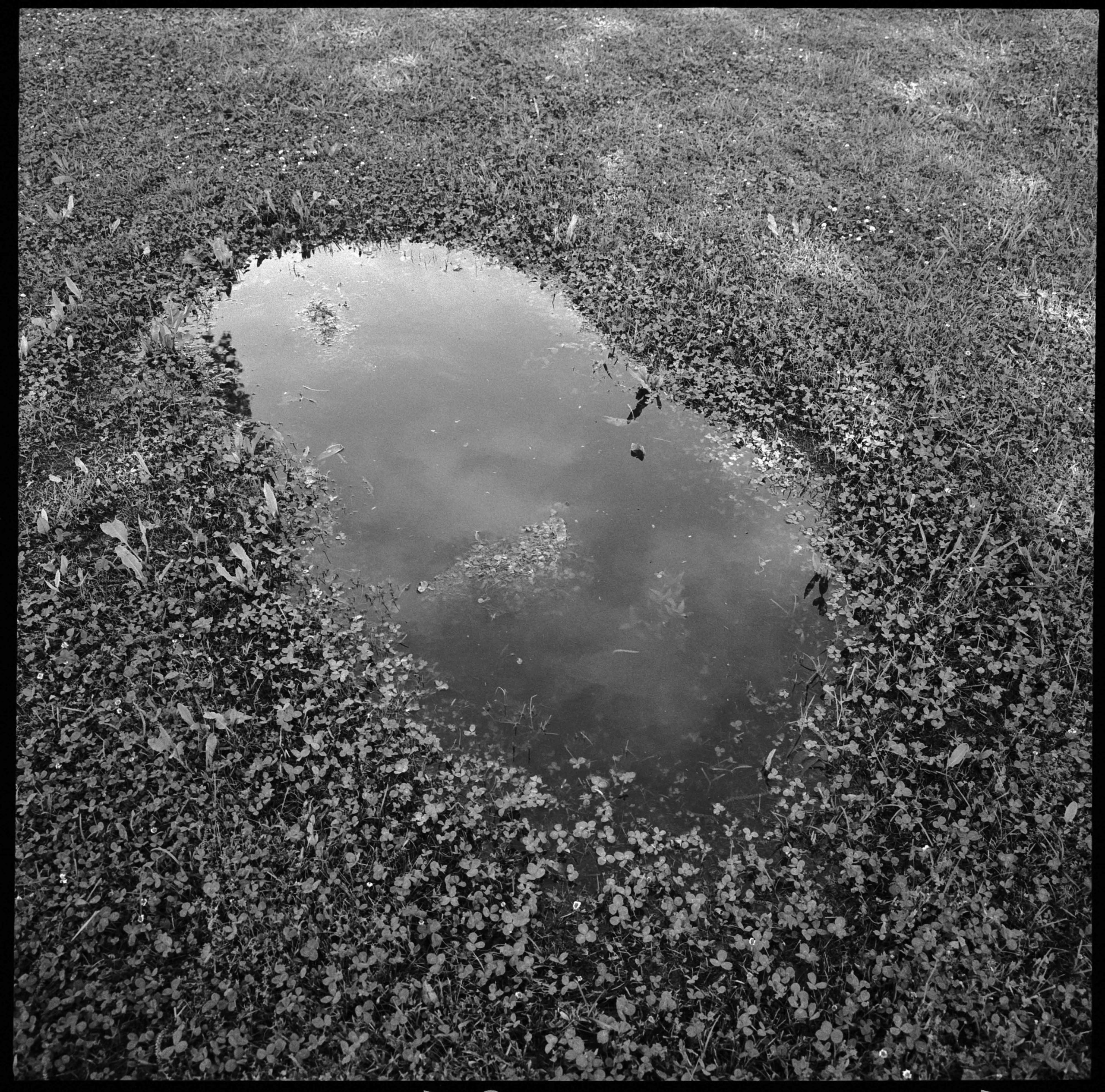
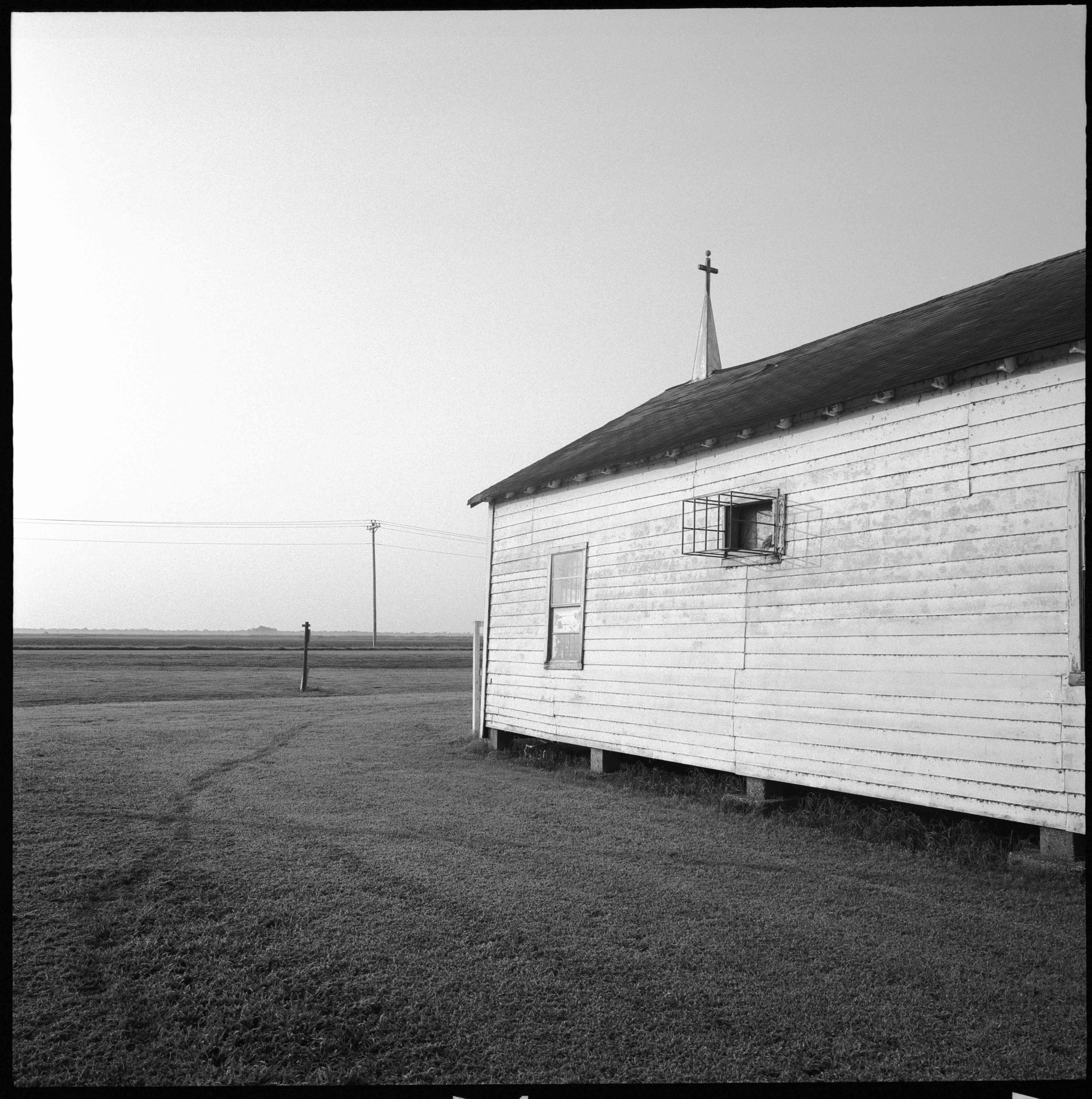
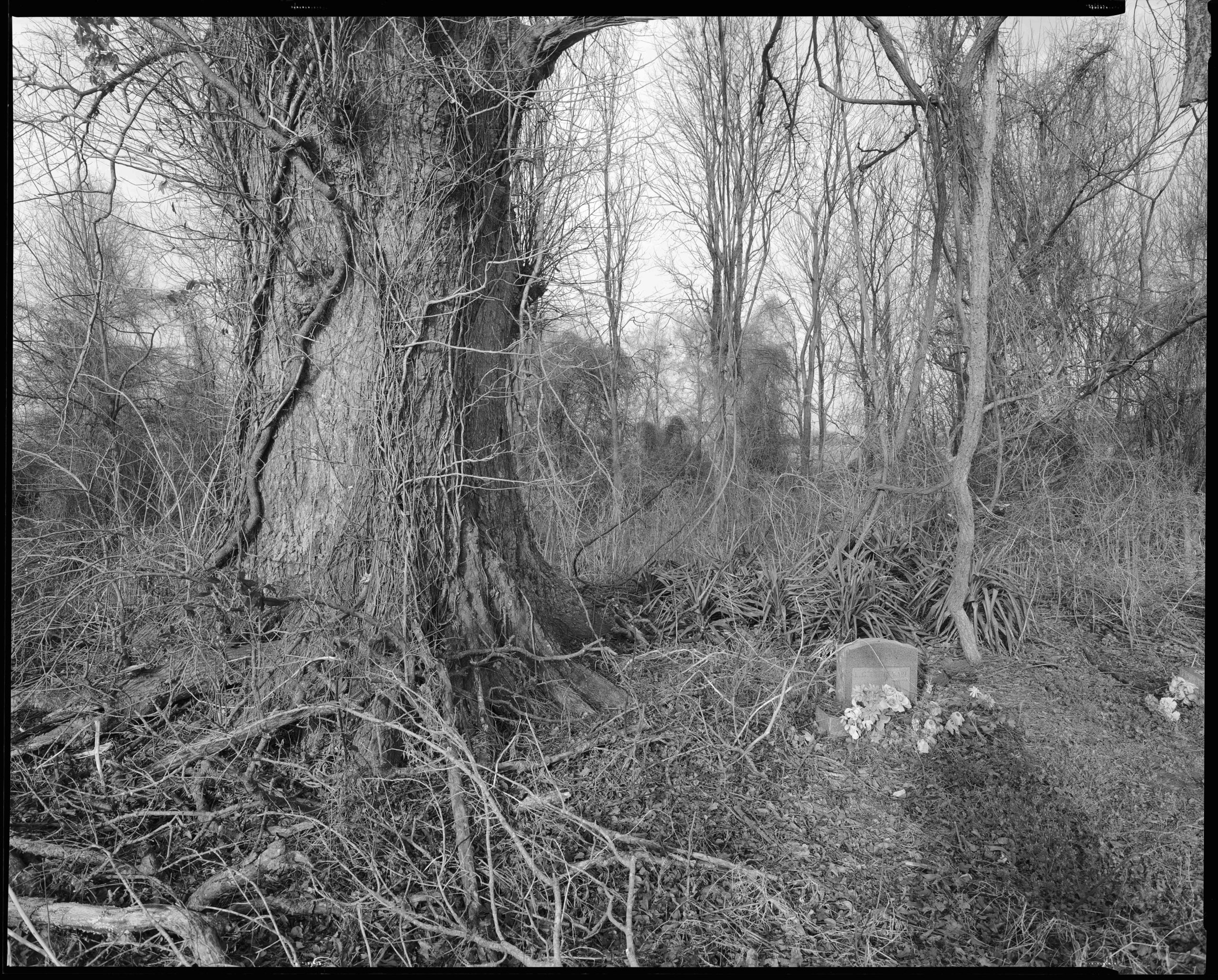
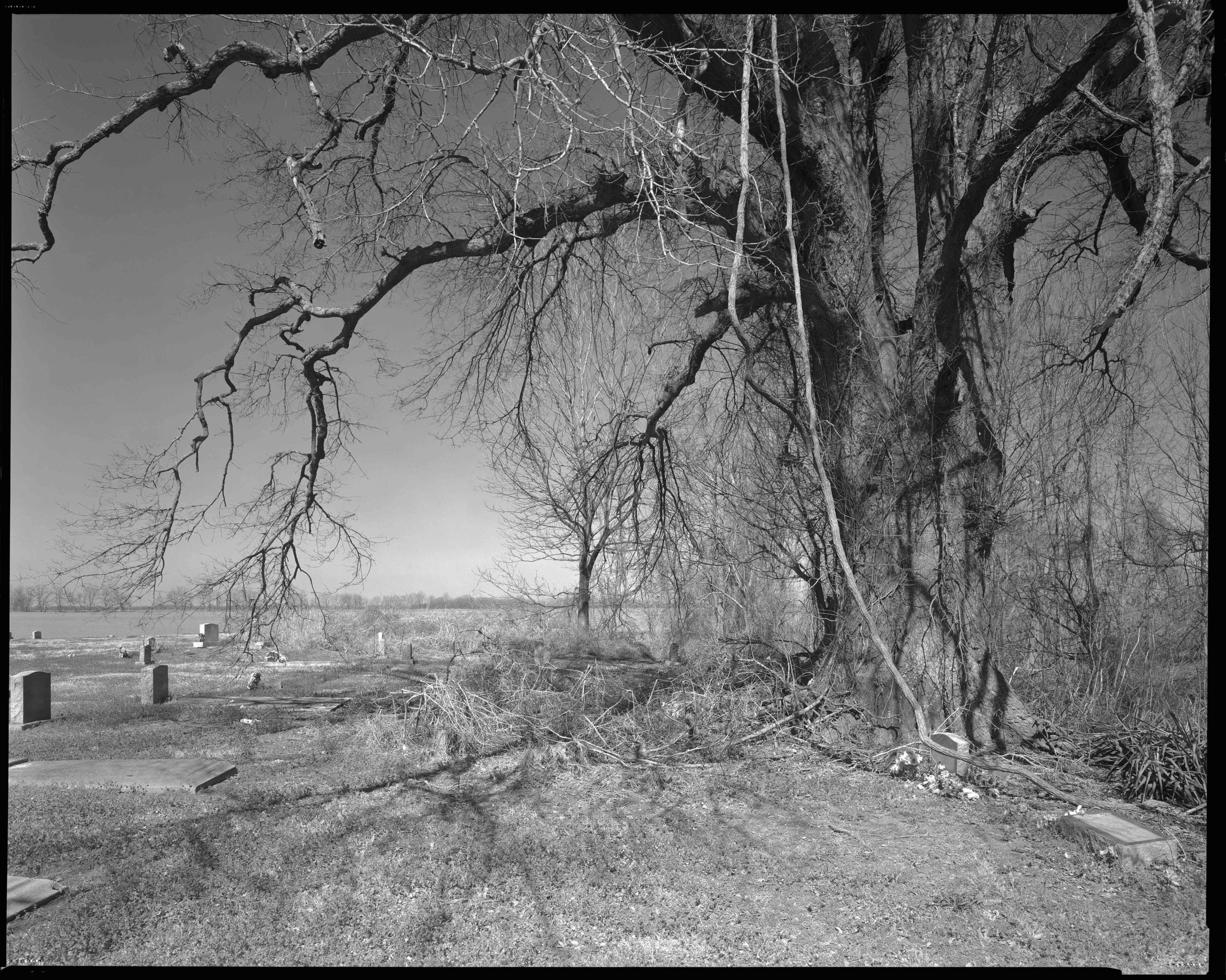
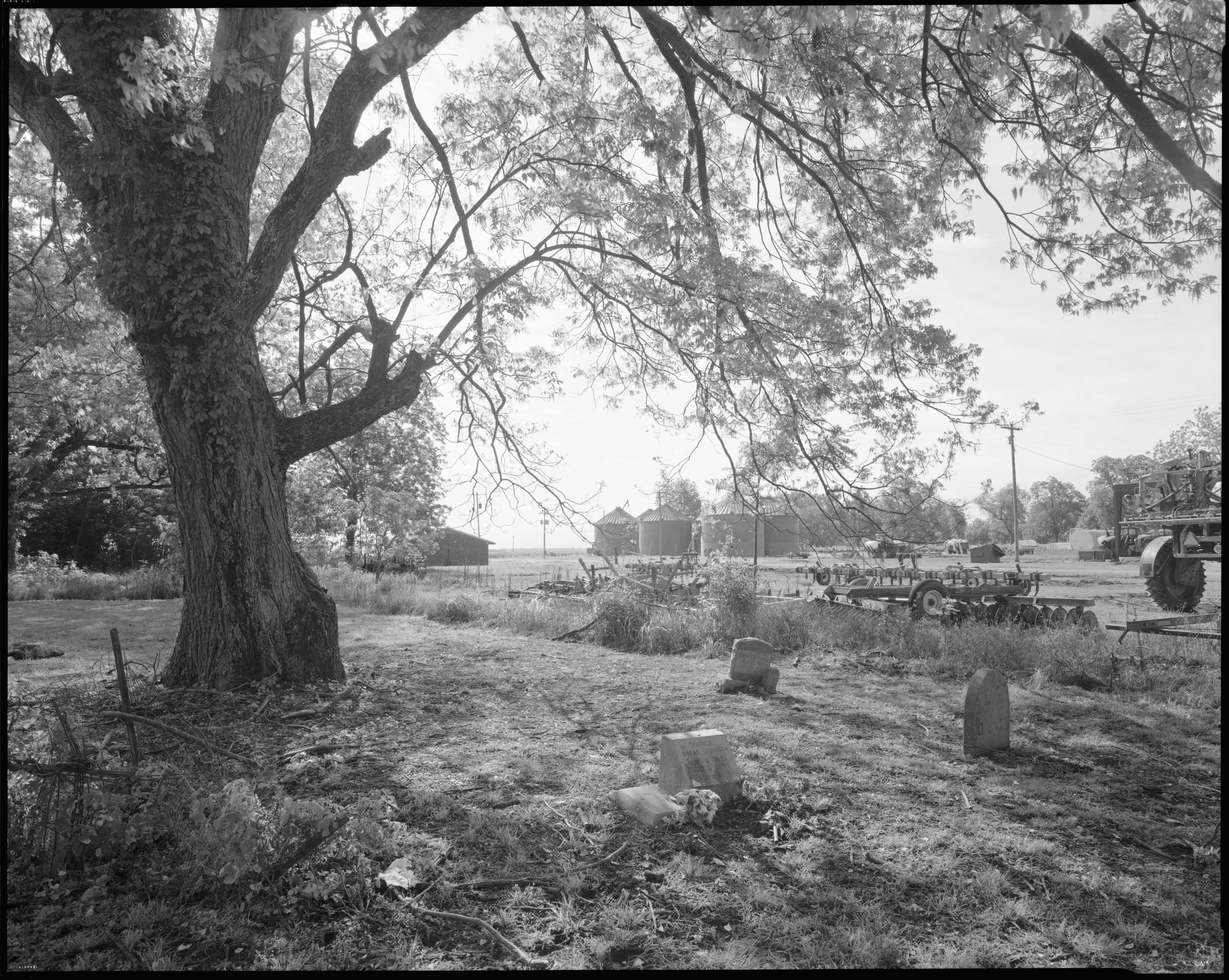
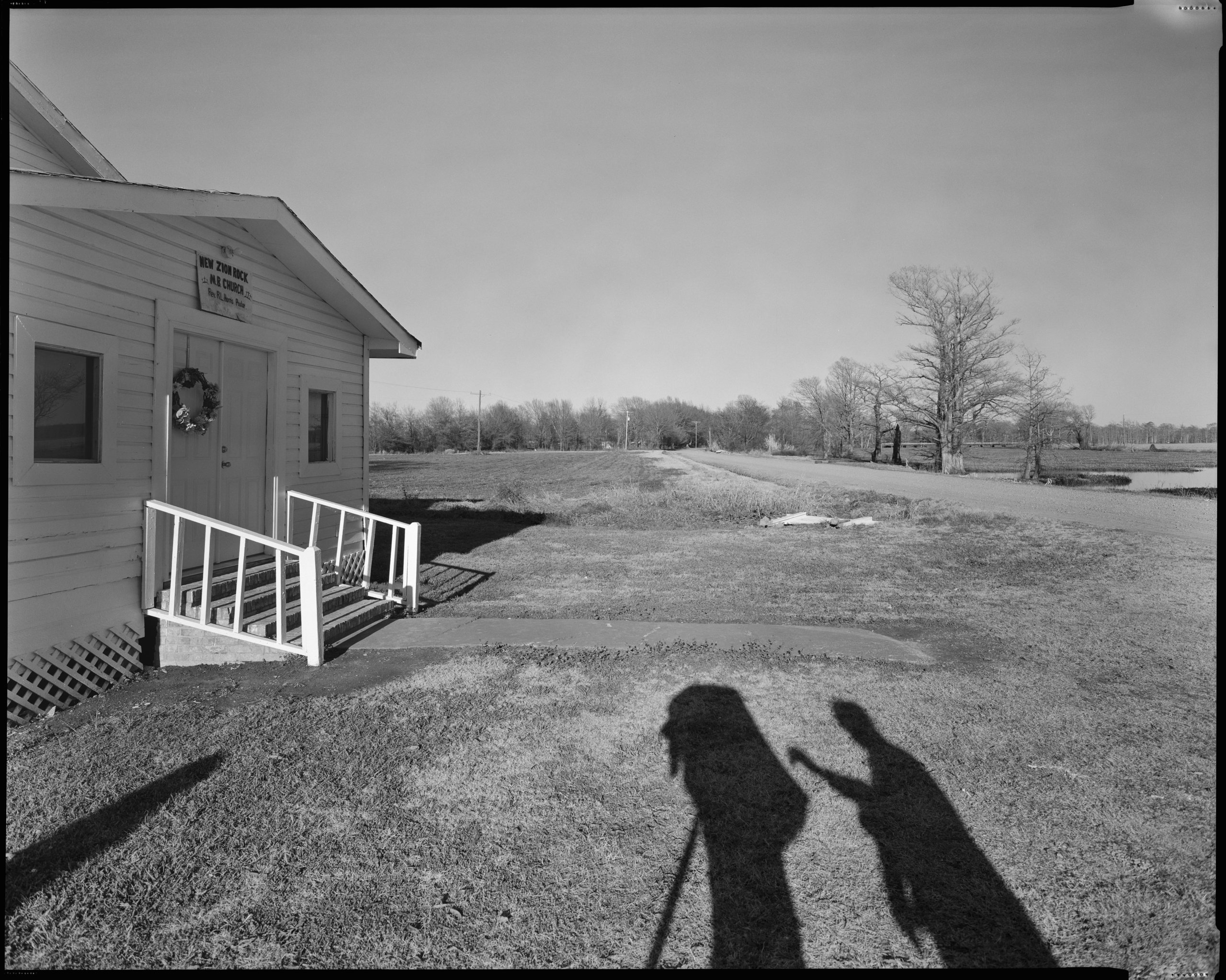
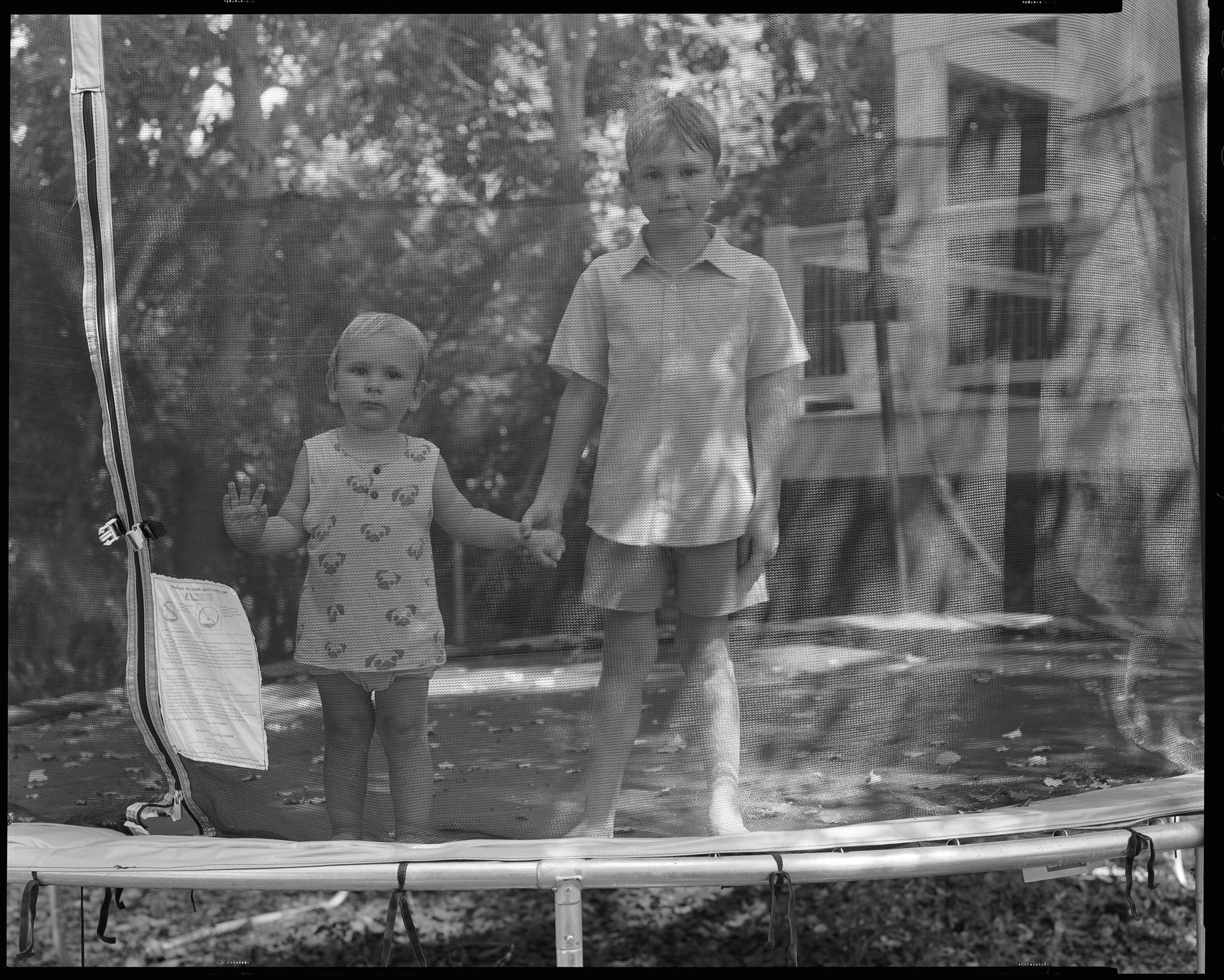
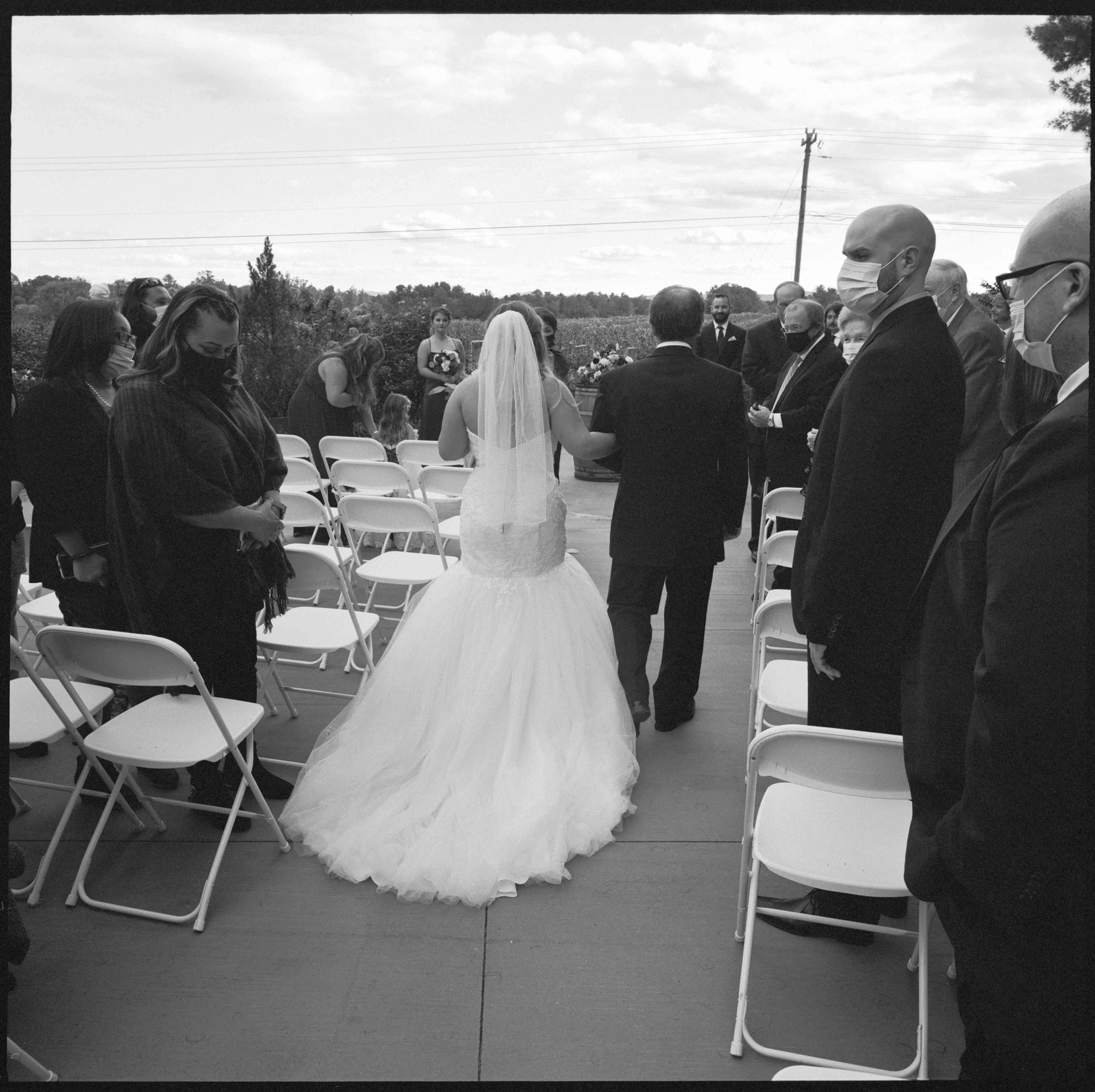
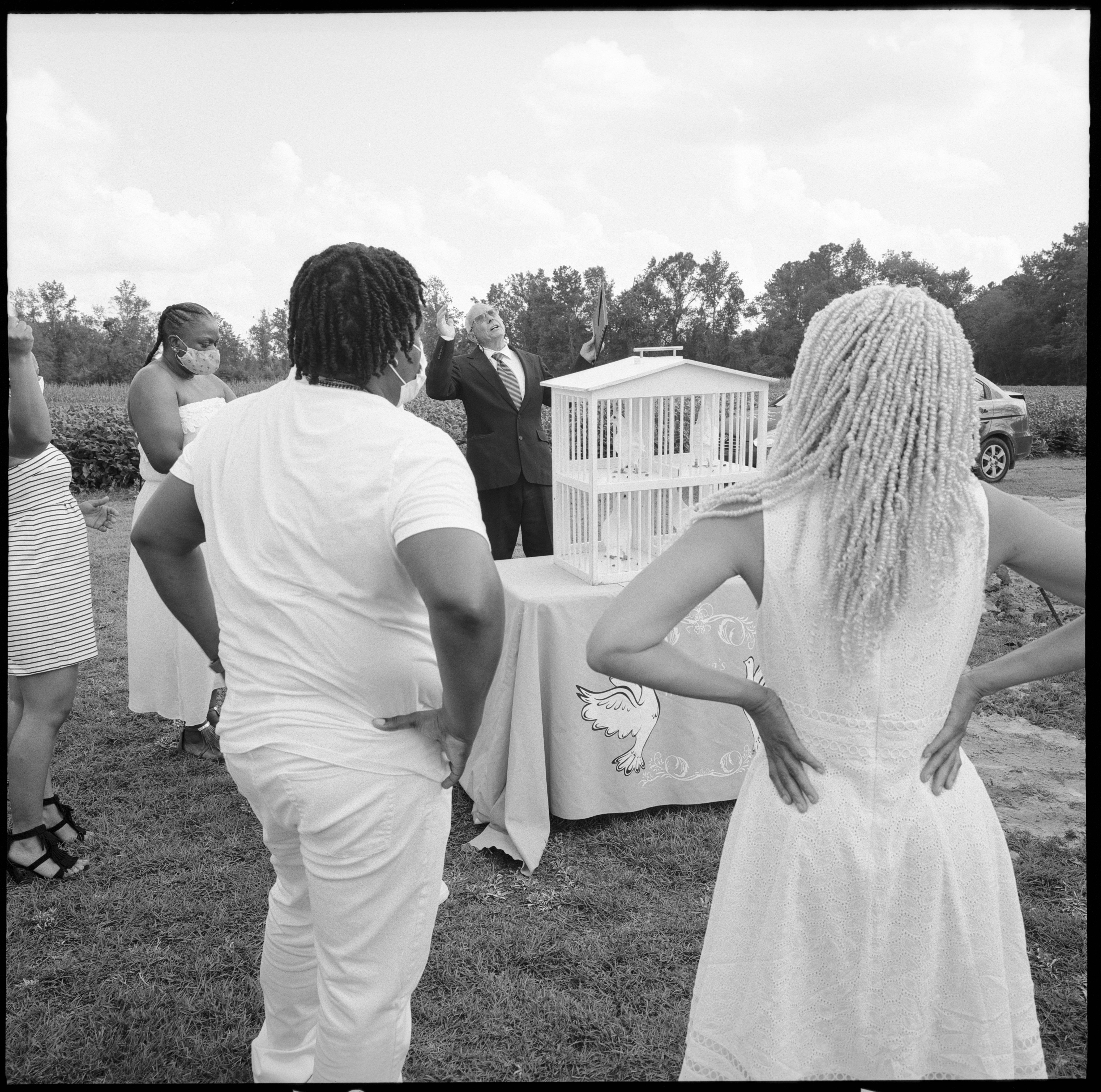
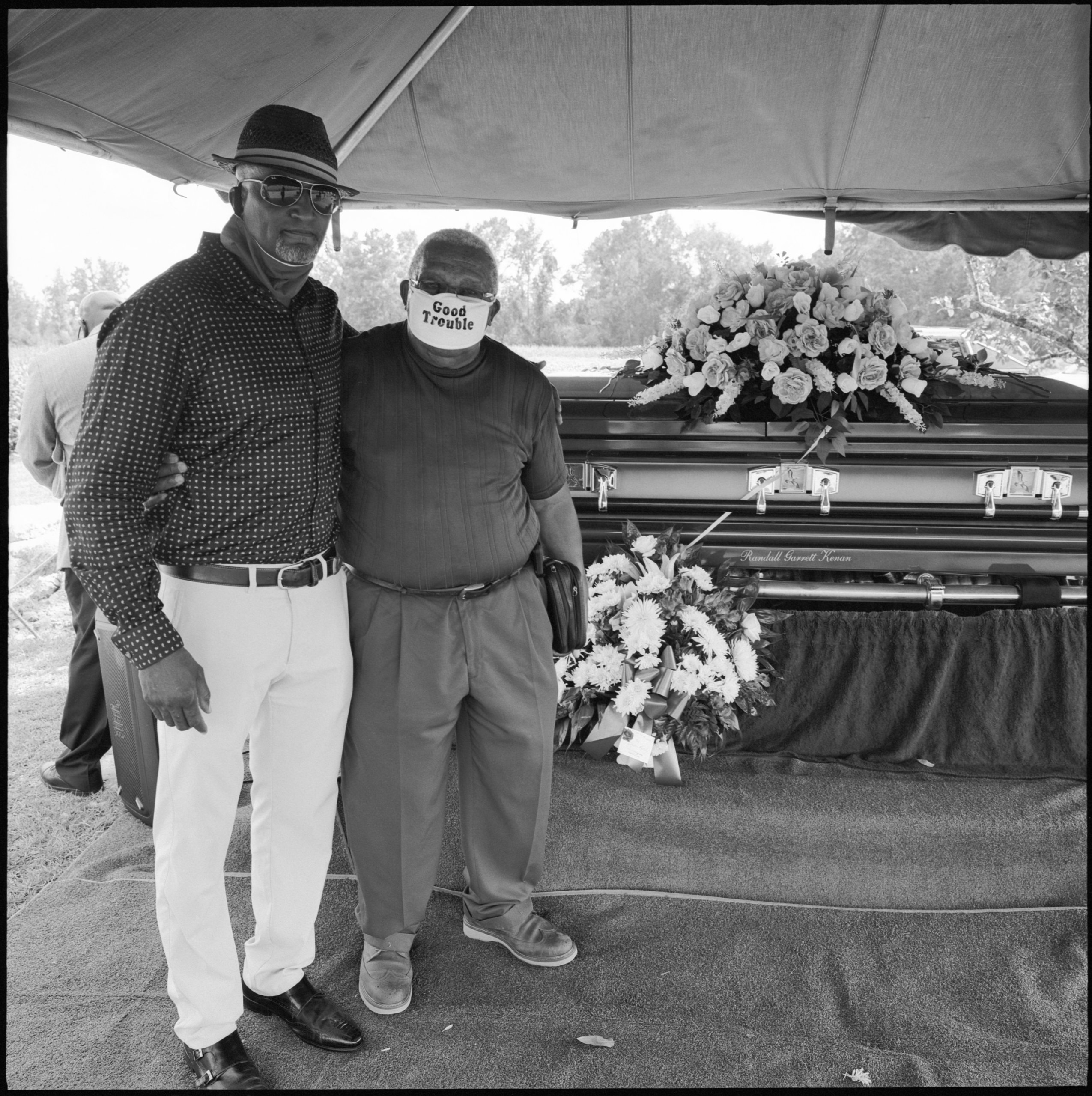
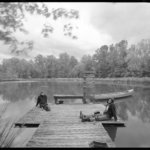
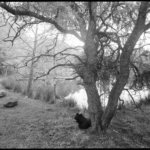
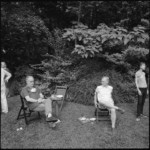
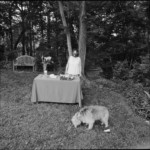
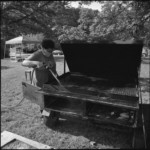
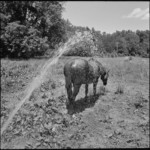
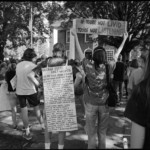
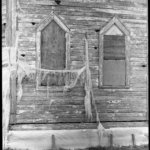
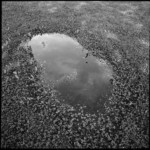
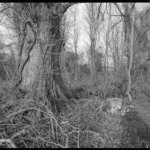
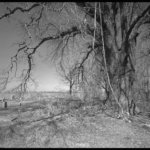
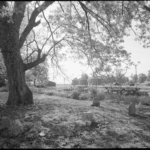
About the Author
Tom Rankin is Professor of the Practice of Art and Documentary Studies at Duke University where he directs the MFA in Experimental and Documentary Arts. For fifteen years he was director of the Center for Documentary Studies at Duke. His books include Sacred Space: Photographs from the Mississippi Delta (Jackson: University Press of Mississippi, 1993); Deaf Maggie Lee Sayre: Photographs of a River Life (Jackson: University Press of Mississippi, 1995); Local Heroes Changing America: Indivisible (New York: W.W. Norton & Co., 2000); One Place: Paul Kwilecki and Four Decades of Photographs from Decatur County, Georgia (Chapel Hill: University of North Carolina Press, 2013); and Goat Light (Durham, NC: Horse and Buggy Press, 2021) coauthored with Jill McCorkle. His photographs have been collected and published widely and included in numerous exhibitions. A frequent writer and lecturer on photography, culture, and the documentary tradition, he is the general editor of the Series on Documentary Arts and Culture with the University of North Carolina Press.
Public Health in the US and Global South is a collection of interdisciplinary, multimedia publications examining the relationship between public health and specific geographies—both real and imagined—in and across the US and Global South. These essays raise questions about the origin, replication, and entrenchment of health disparities; the ways that race and gender shape and are shaped by health policy; and the inseparable connection between health justice and health advocacy.
Beginning in 2022, the series expands to include 1000-word blog posts, as well as longer commentaries, essays, articles and media productions that address the public health and political implications of the COVID-19 pandemic from multiple viewpoints. The series editor for Public Health in the US and Global South is Mary E. Frederickson.
Introduction
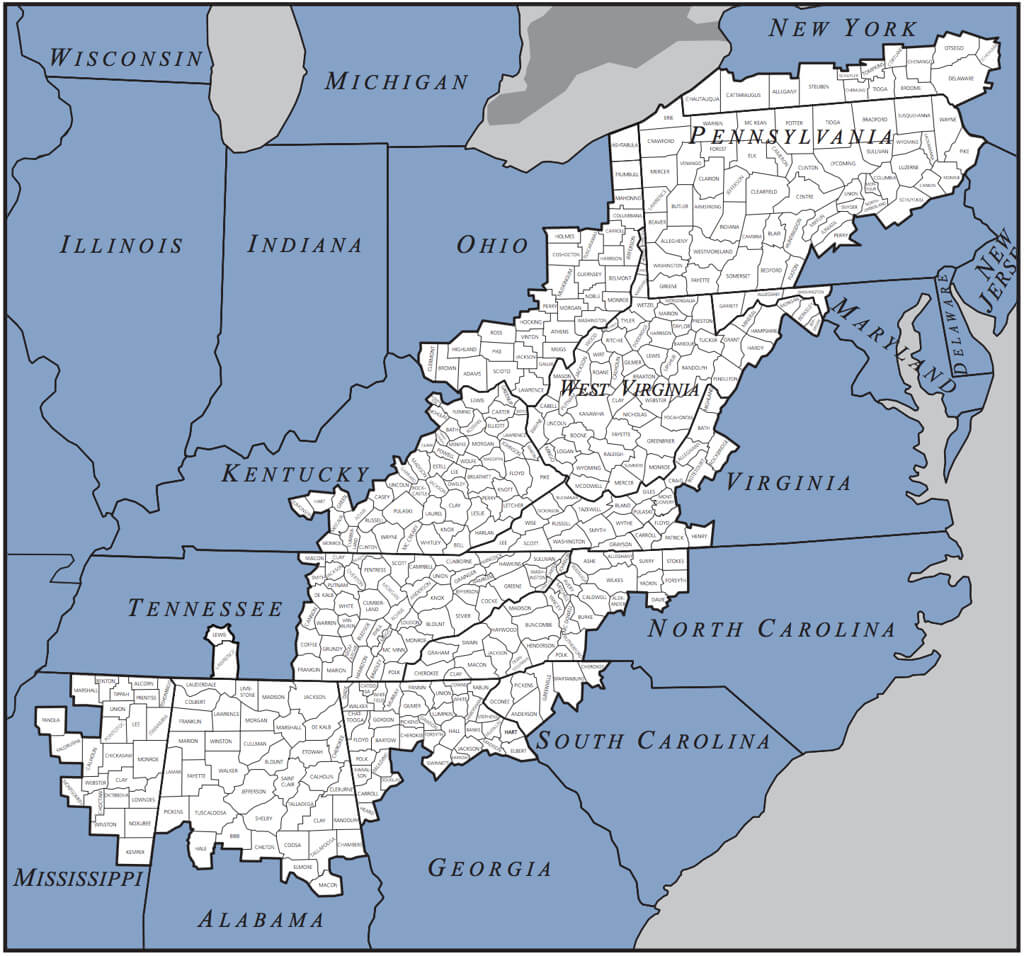
Of countless images over the last century, attempts to frame Appalachia's landscape and people have drawn on a limited number of tropes. Whether Bayard Wootten's photographic illustrations for Cabins in the Laurel,1Muriel Earley Sheppard, Cabins in the Laurel (Chapel Hill: University of North Carolina Press, 1935, 1991 reprint). or the Farm Security Administration (FSA) images of Walker Evans, Elmer Johnson, and Marion Post Wolcott, or photojournalists' frontline depictions of the War on Poverty, the visual encoding of Appalachia has reinforced and recirculated images of a rugged, yet pristine landscape, and a people who are portrayed in equal mixtures of pride and deprivation, perseverance and lack. Without question Appalachia "as a whole" presents a rather problematic construct, embracing a diverse cultural and physical geography with multiple, conflicting borders and covering—by the Appalachian Regional Commission's (ARC) definition—420 counties in thirteen states. The volume of images depicting Appalachia belies diversity, reinforcing instead a homogenized depiction of the "region." That such a broad space and numerous people—congressionally constructed—becomes reduced to one region is itself an oversimplification. A Google image search of "Appalachian photography" reveals visual stereotypes in present-day action, and their limited scope.
While these stereotypical depictions of the region exist across a broad range of media, photography has a way of literalizing this act of framing certain images at the expense of others. But alongside the many attempts to traffic in Appalachian images for commercial or political gain, projects exist that question how photography frames Appalachia: what is contained and what excluded. This effort dates back to some of those images of the FSA Photographic Unit. As Marion Post Wolcott noted, "Constantly we were asked [by Unit Director Roy Stryker] and [we were] asking of ourselves, 'In what direction are we going; are we doing the whole job? How can we fill in the gaps, round out the file…?'"2Betty Rivard, ed. New Deal Photographs of West Virginia, 1934–1943 (Morgantown: West Virginia University Press, 2012), 143. In a similar spirit, Roger May's crowdsourced photography project, Looking at Appalachia (begun in 2014, and ongoing) seeks a broader picture. This collection of images engages in a multivalent and ambivalent approach to framing Appalachia, presenting over four hundred photographs taken by more than one hundred photographers across multiple counties in thirteen states. To visit this collection is to experience "unseeing" the region through multiple frames and lenses. This strategy of "visual counter point," as May describes it, attempts to create a complex and contradictory "crowdsourced image archive [that] will serve as a reference that is defined by its people as opposed to political legislation."3Roger May, "Overview," Looking at Appalachia, 2014, http://lookingatappalachia.org/overview.
Most striking in this "visual counter point" is the degree to which the project is fundamentally frustrating. Each time an image seems to frame Appalachia in a particular way, other images unsettle the frame. As Susan Sontag suggests in Regarding the Pain of Others (2003), "the photographic image… cannot be simply a transparency of something that happened. It is always the image that someone chose; to photograph is to frame, and to frame is to exclude."4Susan Sontag, Regarding the Pain of Others (New York: Picador, 2003), 46. Unlike Wolcott and Stryker's challenge of "doing the whole job," Looking at Appalachia's use of multiple, competing frames undermines any attempt to portray a region in its entirety, or to pin this floating signifier within a fixed, defined border. But, at the same time, each of these images invites us to look at Appalachia—to see Appalachia and what it signifies in this particular image. These multiple, at times contradictory perspectives yield an increasingly complex sense of speakers and voices; as Looking at Appalachia contributor Lou Murrey explains in her commentary on May's project and several other online, collaborative photography projects: "All around Appalachia there are photographers engaged in a dialogue to change and expand perception of the region, allowing folks to declare 'hey, I'm Appalachian too.'"5Lou Murrey, "Out of Frame: Regional Stereotypes in Photography." Appalachian Voices, December 19, 2015. http://appvoices.org/2015/12/19/regional-stereotypes-in-photography/. What is particularly compelling about Looking at Appalachia is that the dialogic qualities of this crowdsourced work find expression in both form and content. Individual pictures declare "I'm Appalachian too," by calling attention to the frames that select these images. As William Schumann has noted in "Place and Place-Making in Appalachia," region is a social and historical construct, emerging through "a process of selectively cultivating some narratives of belonging while erasing other meanings from public discourse."6William Schumann, "Introduction: Place and Place-Making in Appalachia." In Appalachia Revisited: New Perspectives on Place, Tradition, and Progress, ed. William Schumann and Rebecca Adkins Fletcher (Bowling Green: University of Kentucky Press, 2016), 9. The project is fundamentally unsettling to the extent that powerful and idiosyncratic framings do not coalesce into any easy sense of what "Appalachia" signifies, but call attention to acts of inclusion and exclusion. By design, viewers are left in productive confusion, wondering what "region" means in this mixing of frames and images. The project intentionally draws upon the highly problematic ARC-defined boundary for Appalachia for its submission criterion at the same time that it challenges how these borders have framed a regional imaginary. "Appalachia's boundaries," David Whisnant writes, "have been drawn so many times by so many different hands that it is futile to look for a 'correct' definition of the region."7David E. Whisnant, Modernizing the Mountaineer: People, Power and Planning in Appalachia (Boone, NC: Appalachian Consortium Press, 1980), 134. Looking at Appalachia does not offer a "correct" narrative of belonging. It strives to provide a crowdsourced corrective to the dominant visual tropes for Appalachia through its use of multiple, competing frames.
The diversity of images in Looking at Appalachia also reveals the degree to which photographic meaning-making depends upon the power of visual citation. The crowdsourced call to photographers produces clusters of family resemblances in a manner not unlike the same-yet-different clustering that emerges through the social media practice of tagging photographs (for example, the #appalachia hashtag on Instagram.) As Sontag notes, "photographs echo other photographs"8Sontag, Regarding the Pain of Others, 84.; we recognize something in Tamara Reynolds's portrait of a Tennessee man's face (Figure 1), a semiotic resemblance that, when framed as "a face of Appalachia" contributes to the "substantiating archives of images, representative images, which encapsulate common ideas of significance and trigger predictable thoughts, feelings." In these moments of recognition, ideologies take visual form that "commemorate—in no less blunt fashion than postage stamps"—embedded values.9Ibid., 84–86. But as the number of photographers creating these images increases, commemoration becomes an increasingly granular—and increasingly ordinary—act. As Fred Ritchin writes in his discussion of the impact of social media on contemporary photojournalism, the proliferation of images documenting any single event tends to create not only greater variation in the images recorded, but also a greater number of photographs that are "more detail-oriented and everyday, with fewer elaborately constructed attempts at the larger, synthesizing statement."10Fred Ritchin, Bending the Frame: Photojournalism, Documentary, and the Citizen (New York: Aperture, 2013), 11. While an editorial board curates content included in Looking at Appalachia, the project taps into the diffusive power of crowdsourcing with the same intent: to use multiple, idiosyncratic perspectives from professional and amateur photographers alike to refract Appalachia, resisting reduction of these multifaceted photographs into a blunt commemoration.
Visual Dialogues: A Mosaic of Appalachia
In After Photography (2009), Ritchin suggests that the digital photograph acts less as "window" than "mosaic," not only because any digital image consists of pixels, but because once digital, any image exists as a link within a larger network.11Fred Ritchin, After Photography (New York: Norton, 2009), 70. Photography in a networked environment "is far from a mechanical recording; it becomes a collaborative, multivocal interrogation of both external and internal realities in which the initial exposure is only a minimalist starting point."12Ibid., 75. In Looking at Appalachia each photograph speaks to "Appalachia" in its own way, while commenting upon the reality that other images purport. Looking at Appalachia offers a mosaic of disparate images in dialogue with one another. Any image added to the mosaic does not move us closer to completion but only complicates attempts to define a "region." Because the network is always an open-ended structure, an open call for additional contexts, commentaries, and contributions, the project can never be "finished"—even after the editorial board stops adding images. It is in those gaps and contradictions among a large array that the project succeeds in evoking a sense of Appalachia while offering less and less certainty as to what exactly Appalachia contains.
Looking at Appalachia also challenges the power to exclude through the framing of visual design, juxtaposing photographs in a grid layout reminiscent of other photosharing social media services, such as Instagram, Trover, or Flickr. To return to Tamara Reynolds's portrait: this image does not present itself in isolation when we first encounter it. It is already in dialogue with other images—some sharing the same echoes of recognition (perhaps Jaclyn Brown's portrait of Bill Mullaly from Knoxville), while others (an image from the Corazon Latino Festival in Jonesborough) calling attention to all that falls outside the frame of this photograph (Figure 2). Appearing directly above in the image grid is a photograph of a young, blonde-haired woman in sunglasses, head hanging out of a demolition derby car at the Crossville Raceway in Cumberland County. While this image may echo well with other visual tropes for (Southern) Appalachia by way of NASCAR and its mythologized connection to moonshine running, it is not an image that speaks in the same semiotic registers as Reynolds's portrait. Yet both photographs—taken at the same location by the same photographer—contribute to the Appalachian imaginary. Juxtaposed and conflicting images of the same scene call attention to what Judith Butler has termed "frames of recognition"—normative structures that allow recognition of a subject as such, but only through an attempt to exclude or cast off aspects of the subject that "exceed the normative conditions of its recognizability."13Judith Butler, Frames of War: When is Life Grievable? (New York: Verso, 2009), 4. As with the playful series of photographs that went viral in 2015, in which images of a beautifully crafted meal, a woman seated on an empty beach, and a solitary bicycle on an empty road appear in their Instagram frame and in a broader frame that captured everything just outside of that "perfect shot," viewing iconic face and demolition derby car side by side in a grid of competing images reveals how framing is anything but a neutral act, and how any frame depends as much on visual citations of norms that give rise to recognition as it does excluding everything "already outside, which made the very sense of the inside possible, recognizable."14Ibid., 9.
If the imperative of the frame insists, "Look at this (and not that)," then the design strategy of juxtaposing images by diverse photographers with divergent visions compels recognition of what is just beyond the frame—to "look at this and that." The website's overall hypertextual design reinforces this visual tension between framing and what falls outside. Looking at Appalachia greets visitors with a cover image, a logo, links to information about the project, and a menu that invites users to choose a state within the thirteen-state ARC-designated region. The site directs users to select—to frame by state—one set of images of Appalachia over other sets. How viewers engage with the site determines their initial frame of context—whether proceeding alphabetically (Alabama), or via a state considered more central to their understanding (West Virginia) or perhaps beginning with a state that they might only marginally connect with Appalachia (Mississippi). While the site has many points of entry, it offers no final resting point, only a growing number of juxtaposing images, and an increasingly complex mosaic of Appalachia.
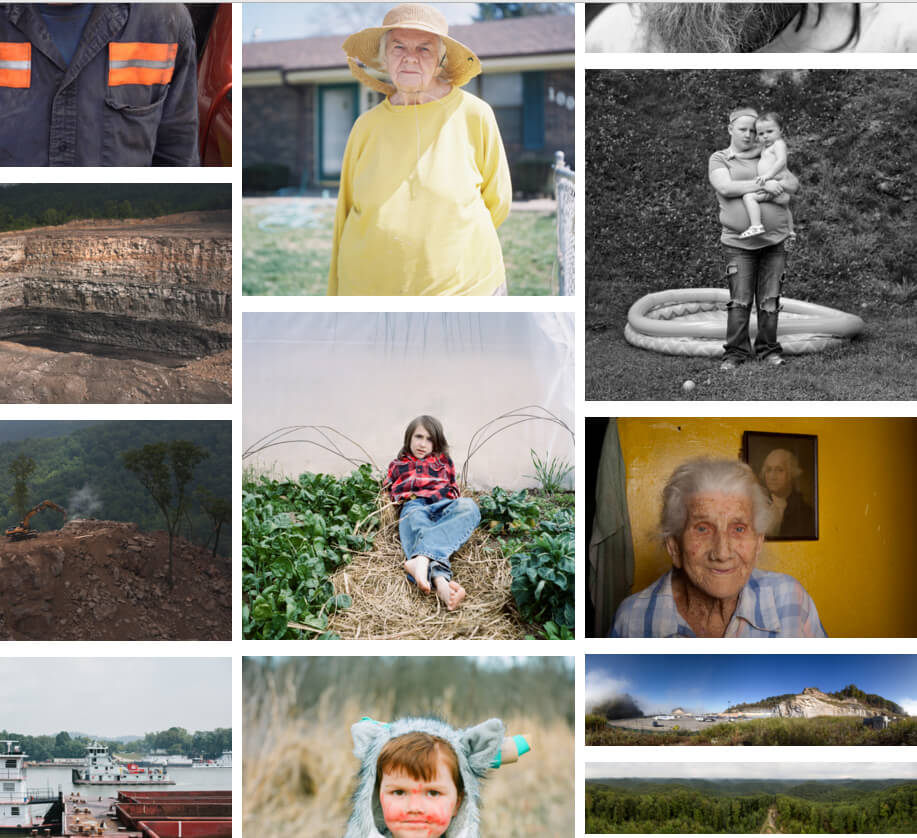
Certain images in Looking at Appalachia affirm and commemorate popular cultural assumptions. Consider the contribution of Shelby Lee Adams, a photographer of Central Appalachia who, since the mid-1970s, has garnered considerable attention—and criticism—for creating portraits that would seem to perpetuate stereotypical images of rural deprivation and depravity—what Jason Huettner has called "poverty porn."15Jason Huettner, "Capitalist Realism or Poverty Porn?" Hyperallergic, July 7, 2011, https://hyperallergic.com/28555/capitalist-realism-or-poverty-porn. See also Larry Vonalt, "The Dignity of Shelby Lee Adams's 'Disturbing' Family Photography." Studies in Popular Culture 29.2 (October 2006): 110–121. Adams has only one work included in the project, which, for those only familiar with his more controversial images, may seem a departure of sorts, though one still resonant with Appalachian stereotypes: A portrait of one-hundred-year-old Barbara, from Perry County, Kentucky. The image affirms deeply inscribed indices of the Appalachian "granny" stereotype: her aged face, whiteness, and rugged cheer. But in the mosaic presentation of images on the Kentucky page, her portrait abuts Trey Jolly's landscape of the Daniel Boone Plaza, also in Perry County—a mountaintop removal reclamation site (Figures 3, 4, 5). The nostalgia framing recognition for one photograph only maintains itself as a stereotypical image of Appalachia through exclusion of other images that lie outside the frame—images of extraction and reclamation that are just as much a normative frame as Barbara's weathered and aged face. At the same time, Adams's portrait of this mountain woman asserts itself with equal weight as a counterpoint to the stereotypical framing of Appalachia as a sacrifice zone. Photographs echo one another in ways that both cancel and amplify resonant spatial representations. No single frame can contain Appalachia and its competing significations.
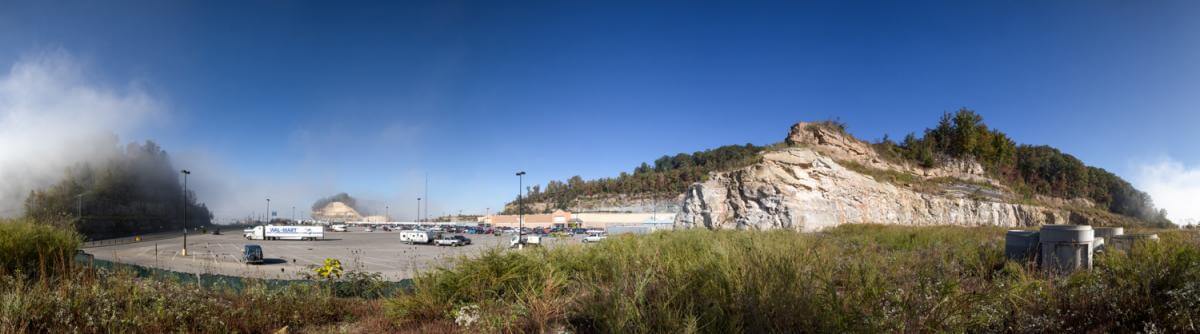
There is reason to closely consider this stereotypical photograph by Adams. In a June 2016 email exchange, May describes Adams as "the first living photographer I entered into conversation with" regarding what it meant to "look at" Appalachia through the lens of a camera and frame it in a particular way. In an essay published on May's blog, Walk Your Camera, Adams situates his work as a visual response to the War on Poverty imagery of the 1960s, which he describes as an ongoing "embarrassment to all."16Shelby Lee Adams, "The Work of Looking." Walk Your Camera, September 7, 2012, http://walkyourcamera.com/looking-at-appalachia-shelby-lee-adams-part-one/. Like Adams, May casts Looking at Appalachia—launched to mark the fiftieth anniversary of the War on Poverty—as an attempt to unravel the "visual definition of Appalachia" that codified over the ensuing half century through the heavy circulation and citation of those images in the mass media.17May, "Overview." While Adams's photographs, like the portrait of Barbara included in Looking at Appalachia, may seem to operate within the same echo chamber of iconic images and visual tropes captured in these Great Society-era photographs, Adams explains that the visual stereotypes that structure Appalachia in the popular imagination are likewise part of his own emplacement in this space. They operate as normative frames that give rise to recognizability. Acknowledging this provides an opportunity to engage in what Adams describes as "the work of looking" in photography:
Our ancestral mountain people are mythologized into our greater existence from our beginnings, a part of our childhood and permanent memories. If we are truly honest with ourselves, we know this cannot be erased. If you are from these mountains, your and my dreams and reality itself are engraved within this collective group consciousness forever. One can choose to repress, but sooner or later, the lives and images of our mountain people will return to us and keep returning until we come to terms with their importance, not just the ones we chose, but all. 18Adams, "The Work of Looking."
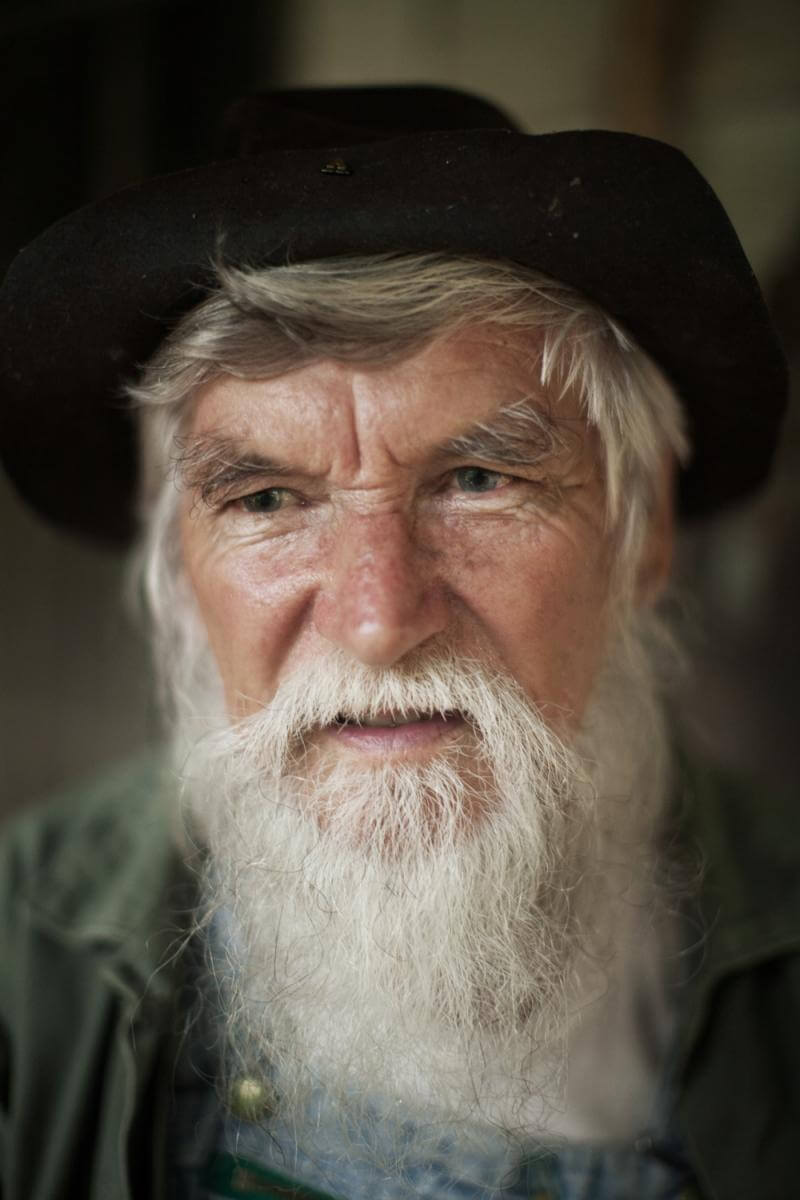
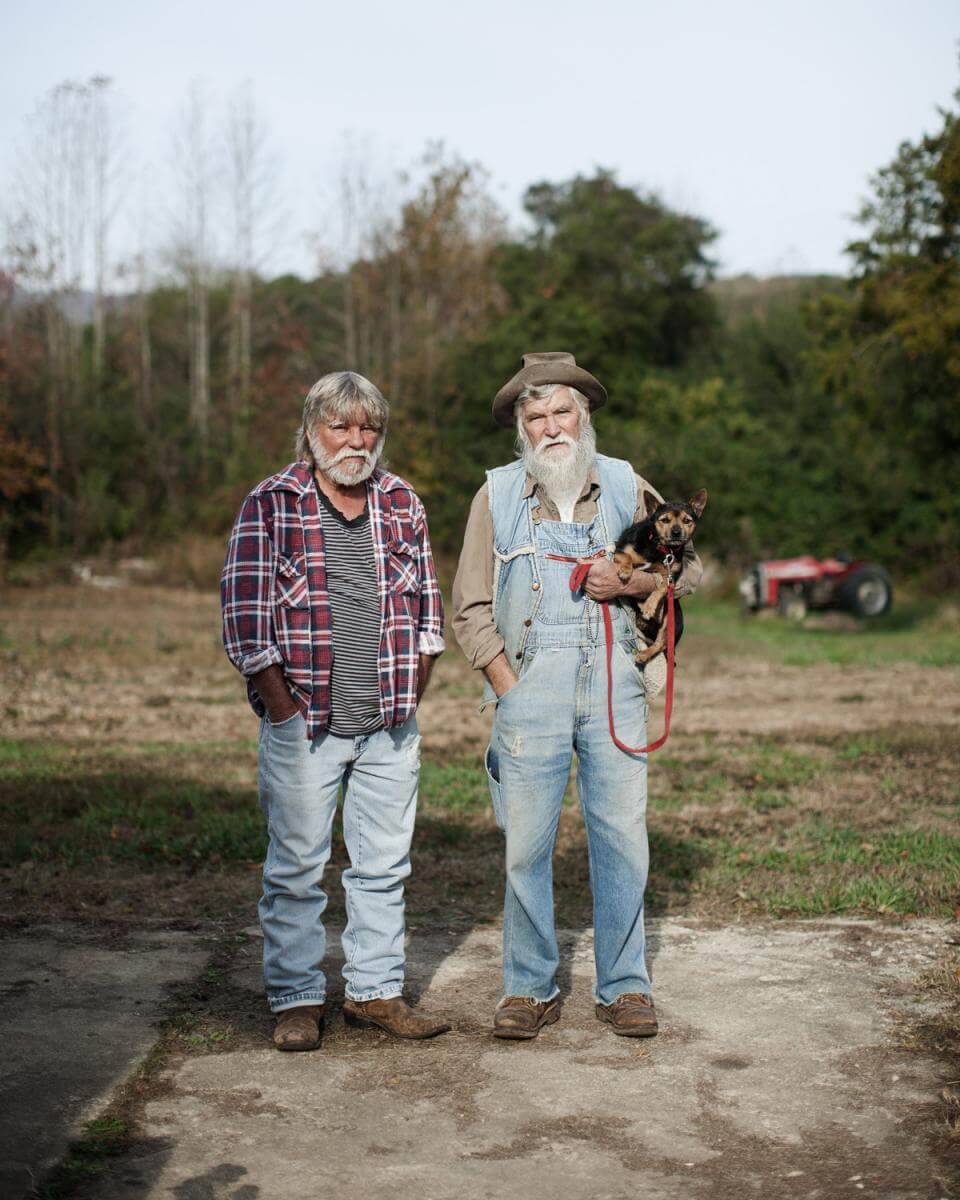
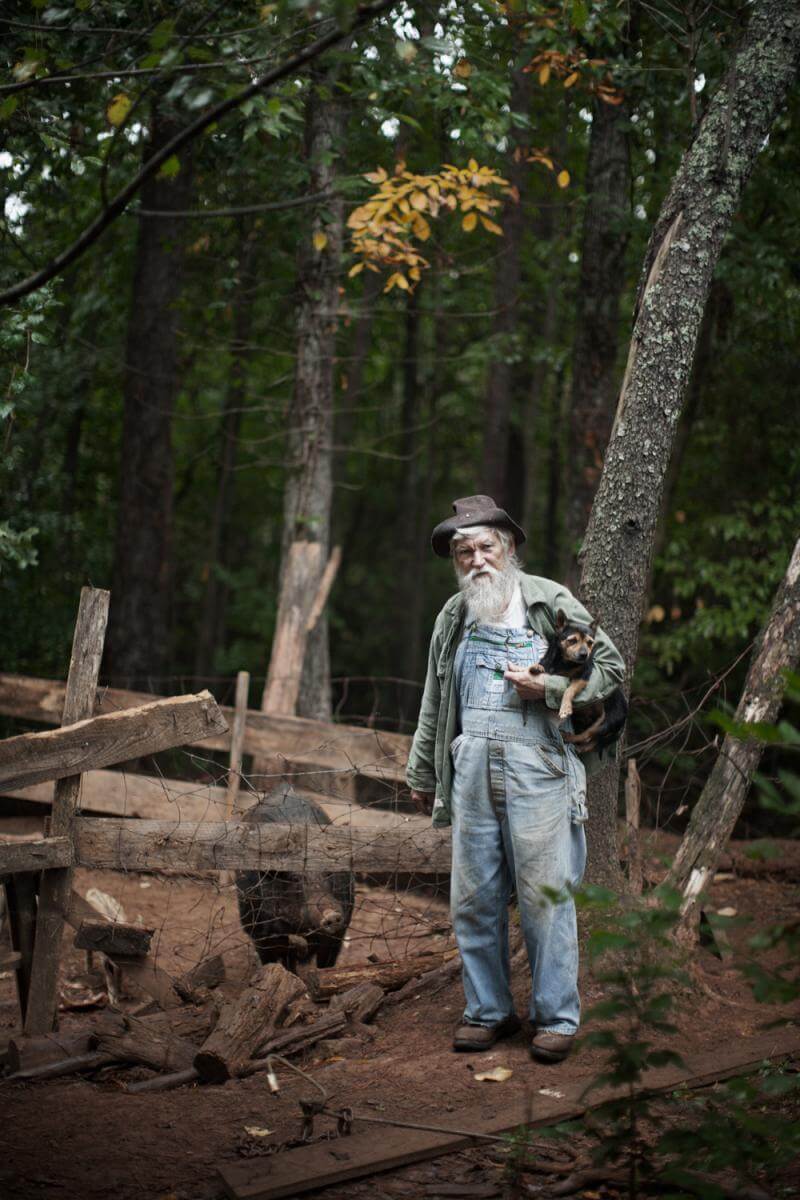
He goes on to describe photographs as "catalysts" that can complicate these stereotypes through this work of looking.19Ibid. May admits that his initial response to Adams's photographs was to "dismiss the work as typical stereotyping of Appalachia," yet in confronting those photographs, he likewise had to come to terms with his own embedded stereotypes.20Roger May, "Looking at Appalachia: Shelby Lee Adams—Part Two," Walk Your Camera, September 15, 2012. http://walkyourcamera.com/looking-at-appalachia-shelby-lee-adams-part-two/. By including Adams's portrait of Barbara alongside other photographs that echo competing, iconic images of Appalachia, the project offers its audience an opportunity to catch themselves in the act of recognition, and to question what it is they are recognizing. This play of frames serves as a central feature of how Looking at Appalachia operates, in concept and design—"fram[ing] the frame" that attempts to delimit Appalachia in each of these juxtaposed images. 21Butler, Frames, 9.
It should come as no surprise that Looking at Appalachia traffics in some of the frames of recognition that the project might be expected to attempt to undo. But this crowdsourced collection of images functions collaboratively within a mosaic that shows the recognizable as well as the frame that allows its recognition. Consider the cluster of images depicting bearded men, and the frame of reference within which these images operate. The mountaineer beard is an iconic image of Appalachian masculinity, repeated in university mascot as well as hillbilly stereotype. As beards echo other beards, a visual exchange develops, offering a complex portrait of Appalachian masculinity. A series of three images by photographer Elle Olivia Andersen of Robert Pickens, from Pickens County, South Carolina, offers a frame for the mountaineer that seems to confirm the stereotype—gray-bearded, capped, and wearing overalls (Figures 6, 7, 8). The photographs assert a documentary authority, capturing an "authentic portrait" of Appalachian life. But these images—and this beard—stand in dialogue with other images of bearded men that work against the authority of any one frame. As counterpoint, consider the portrait from Madison, Kentucky, of a younger mountaineer, bearded, but in a hat one would never confuse with an iconic "toboggan" (Figure 9). Other beards appear in other semiotic constellations that suggest an Appalachia outside the frame of any singular attempt to define the "mountain man" (Figures 10, 11, 12). The same visual conversation occurs when the gendered "granny" stereotype in Adams's portrait of Barbara is repeated and contradicted in other photographers' images of Appalachian women, old and young. With each echo of recognition, viewers see "mountain women" and "beards of Appalachia," but as these framed portraits engage one another, they ask, rather than answer: What makes these images recognizable? When you look at Appalachia, what is it that you see?
Frames of Recognition
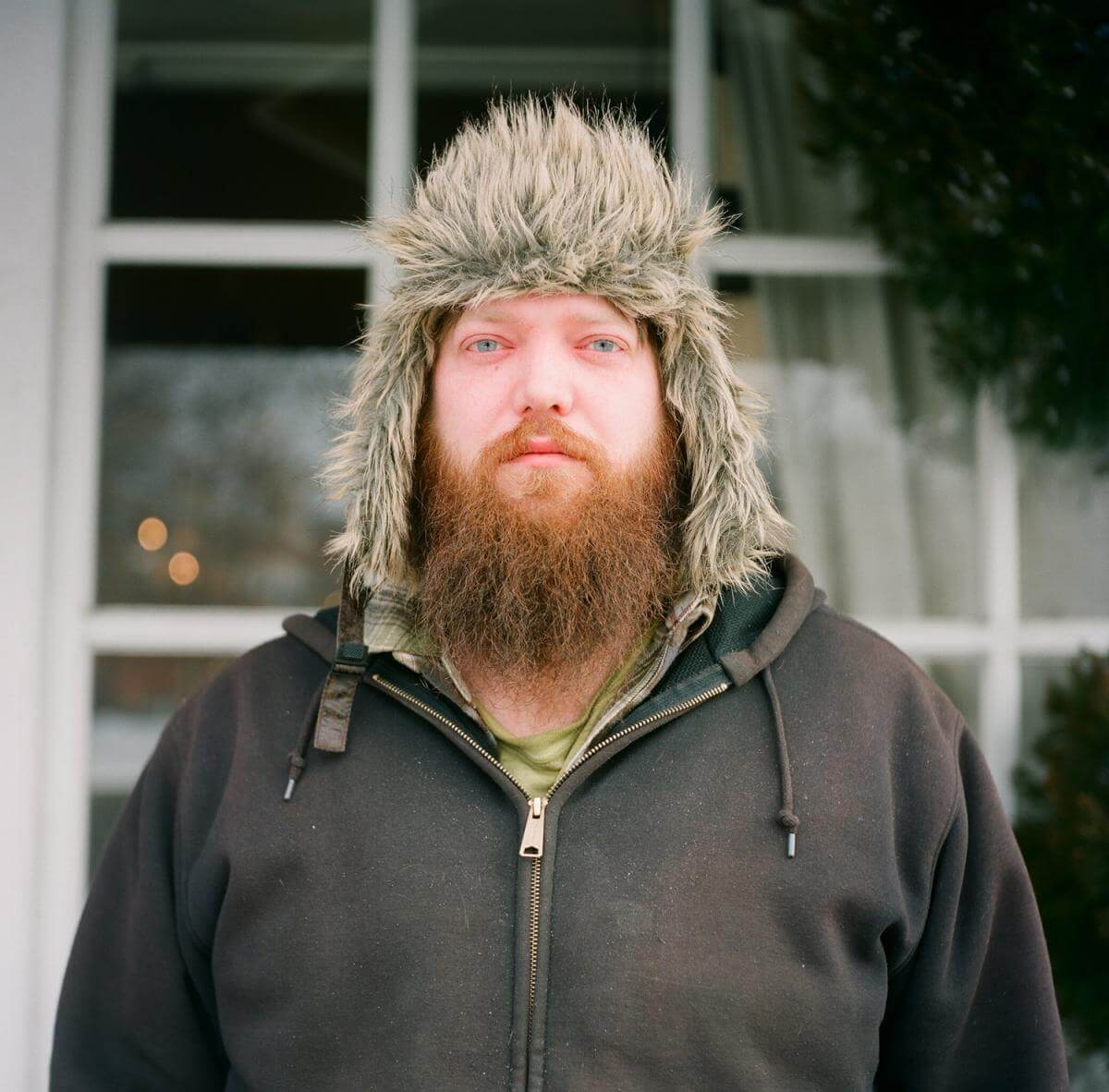
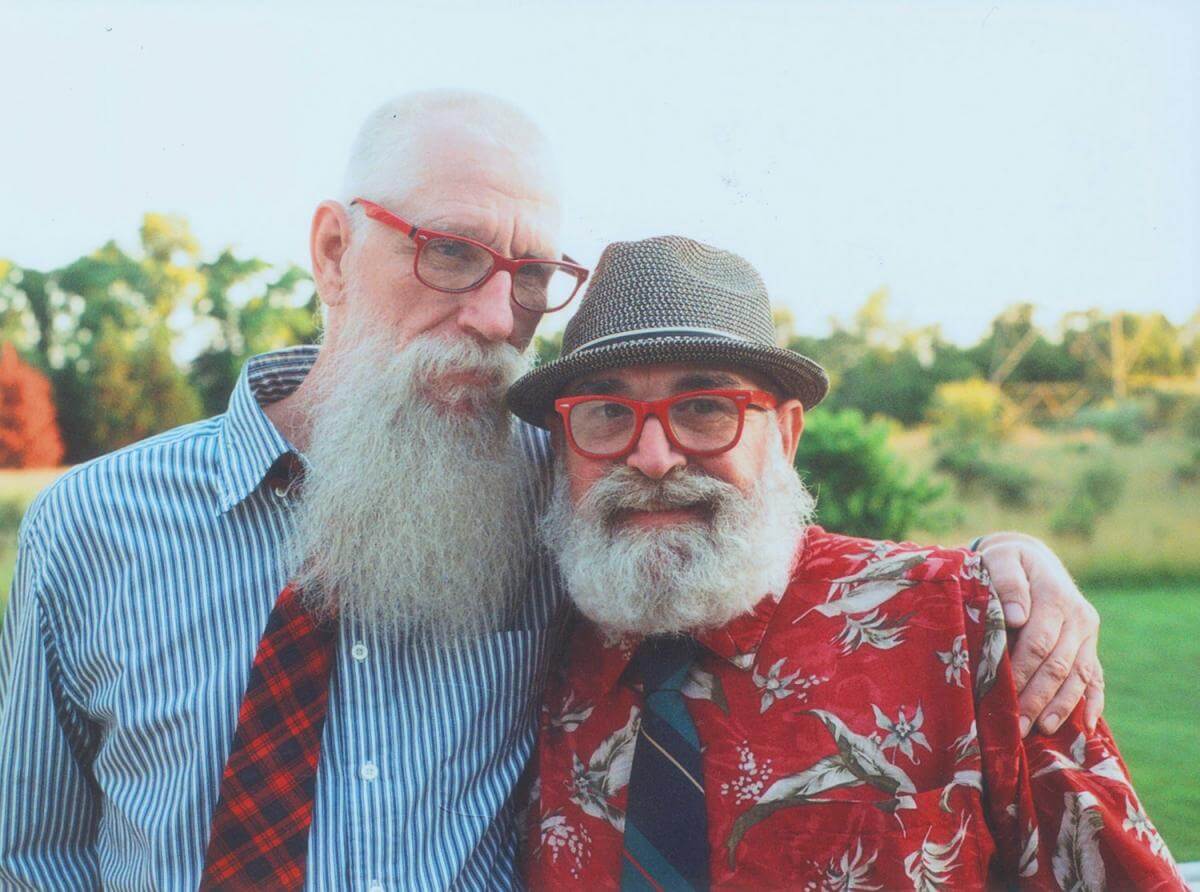
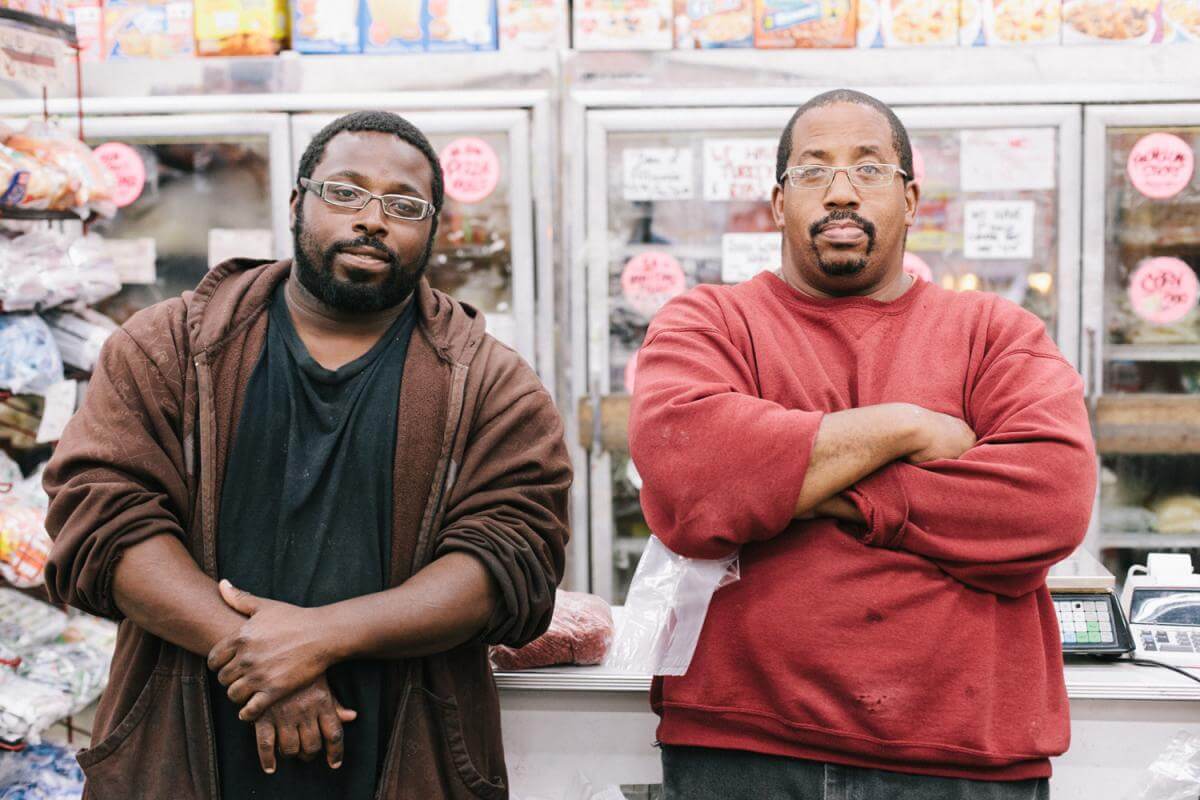
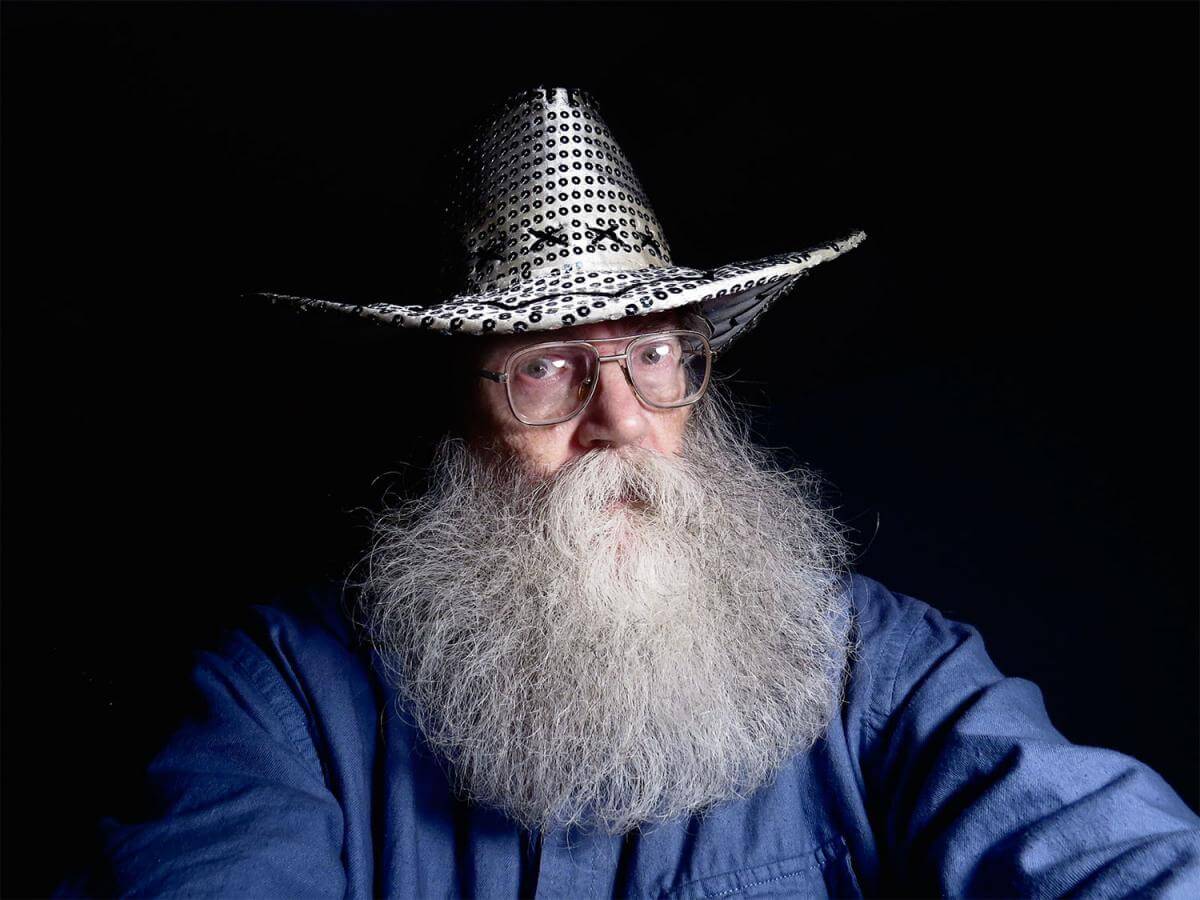
Butler suggests how frames operate as normative structures giving rise to recognizability and representability: "When a picture is framed, any number of ways of commenting on or extending the picture may be at stake. But the frame tends to function, even in a minimalist form, as an editorial embellishment of the image, if not a self-commentary on the history of the frame itself."22Ibid., 8. Framing is an interpretive act, embedded in the photograph, a material instantiation of various norms of recognizability. "Even the most transparent of documentary images is framed, and framed for a purpose," she writes, "carrying that purpose within its frame and implementing it through the frame."23Ibid., 70. Recognizability is "both jettisoning and presenting" the norms of representation and interpretation, "doing both at once."24Ibid., 73. The "iterable structure" of the frame—the fact that "the frame breaks with itself to reproduce itself"—gives rise to an inherent instability in this interpretive moment.25Ibid., 24. In one sense, Butler notes, "to be framed" implies that one has been set up—the subject of a "false accusation"; but because the frame is always vulnerable to exposing itself, to showing how this interpretive "break" in context operates (jettisoning and presenting), it also marks a potential for "breaking out" of normative structures of recognizability.26Ibid., 11 She writes of these moments of destabilization: "What happens when a frame breaks with itself is that a taken-for-granted reality is called into question, exposing the orchestrating designs of the authority who sought to control the frame. This suggests that it is not only a question of finding new content, but also of working with received renditions of reality to show how they can and do break with themselves."27Ibid., 12.
In a similar move, Looking at Appalachia breaks with itself by offering and destabilizing recognizable norms of Appalachian photography. Returning to the portraits of Robert Pickens (Figures 6, 7, 8), the frame seems to affirm the "quaint but stalwart mountaineer."28John Alexander Williams, Appalachia: A History (Chapel Hill: University of North Carolina Press, 2002), 199. The project as a whole, however, provides multiple iterations of this normative structure that break with themselves through multiple, contradictory framings. Even before Horace Kephart's popular depiction of "mountain whites" in Our Southern Highlanders (1922), the recognizable mountaineer identity has featured a normative whiteness exclusive of the racial and ethnic diversity significant in Appalachian demography.29Williams, Appalachia, 210–211; Horace Kephart, Our Southern Highlanders: A Narrative of Adventure in the Southern Appalachians and a Study of Life Among the Mountaineers (Knoxville: University of Tennessee Press, 1922, 1984 reprint). See also: Patricia D. Beaver and Helen M. Lewis, "Uncovering the Trail of Ethnic Denial: Ethnicity in Appalachia." In Cultural Diversity in the U.S. South: Anthropological Contributions to a Region in Transition, ed. Carol E. Hill and Patricia D. Beaver (Athens: University of Georgia Press), 51–68; Schumann, "Introduction."
Figures 13–16
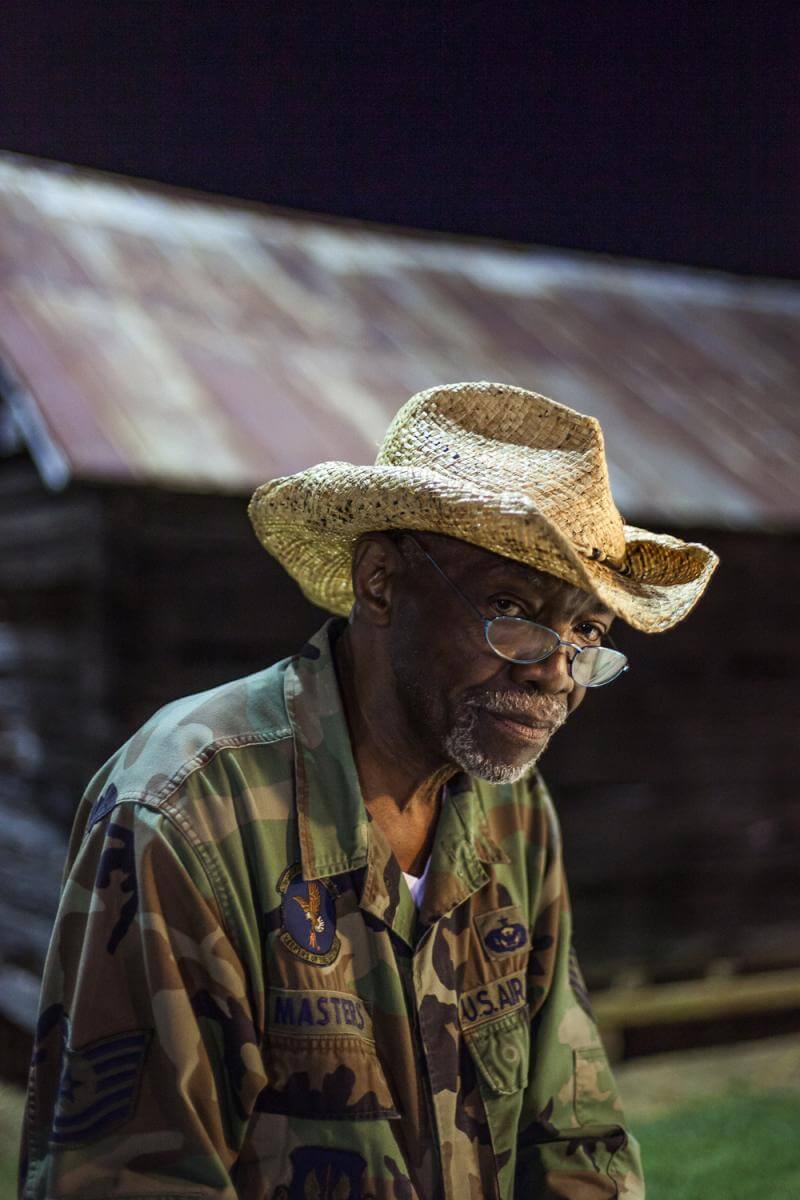
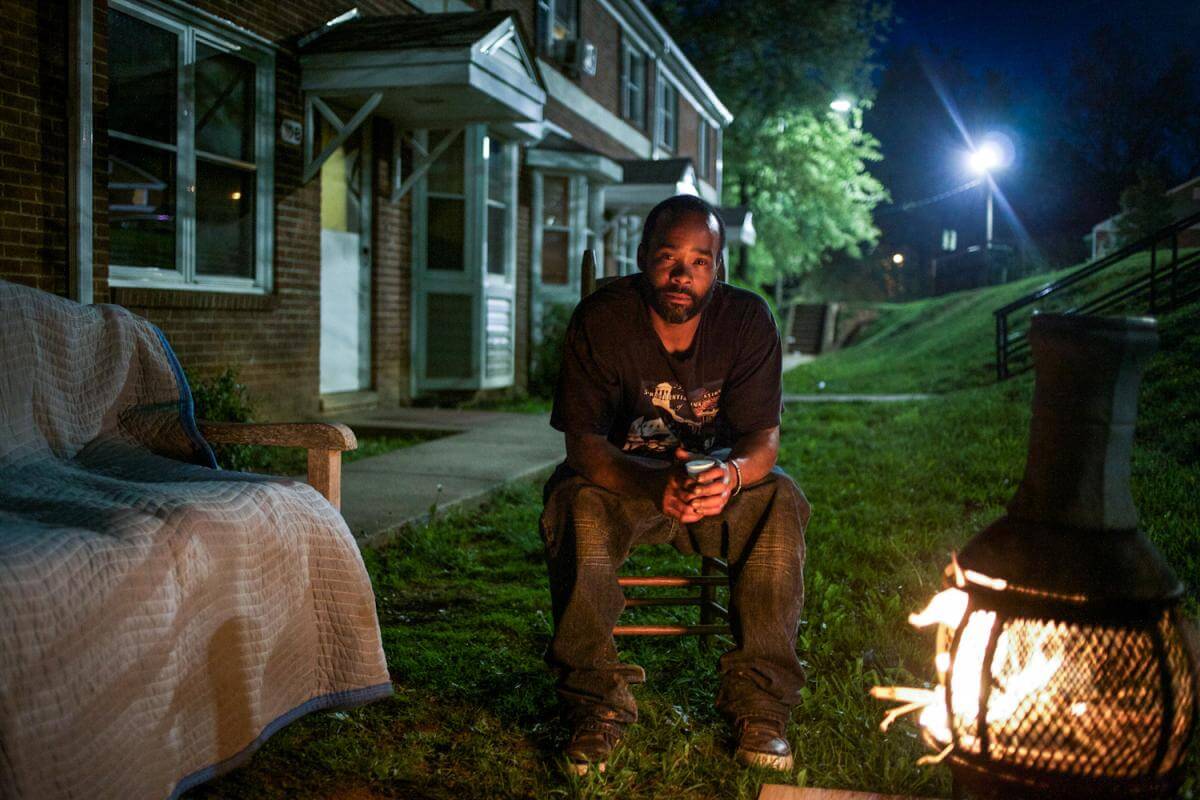
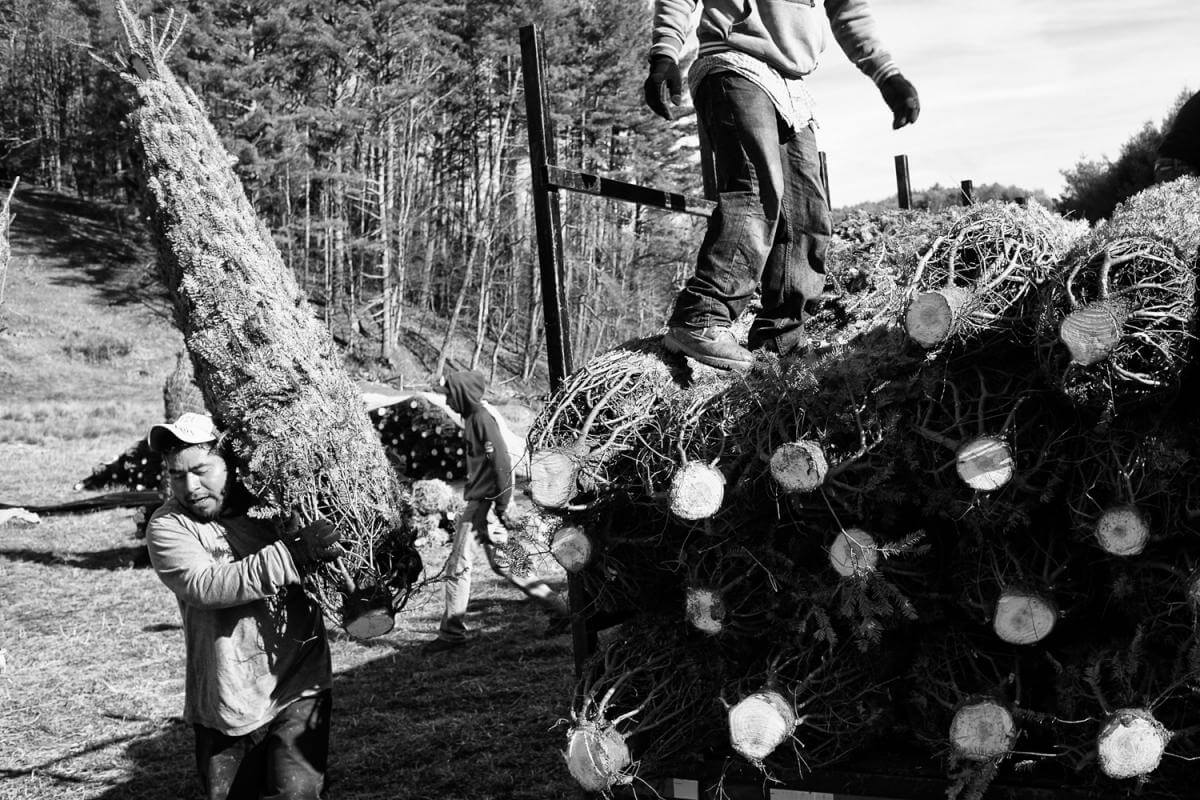
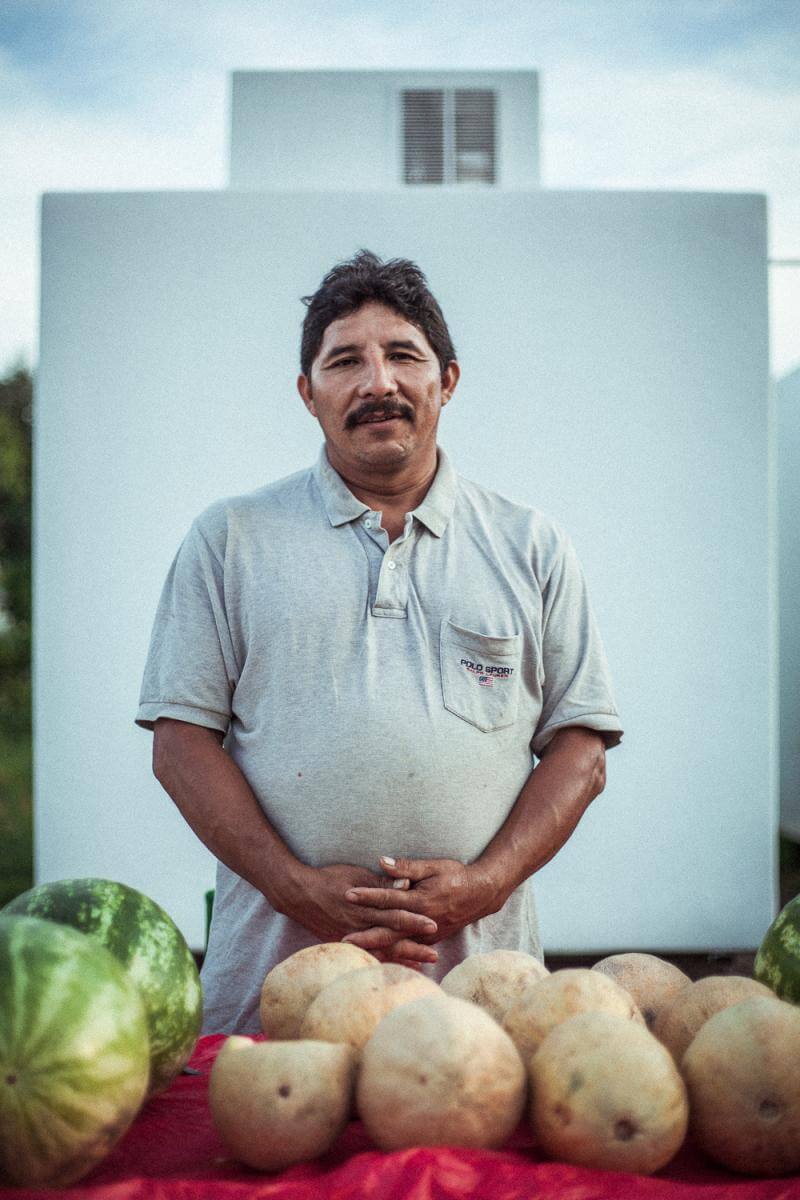
Numerous portraits within this collection of photographs speak directly to this erasure, and do so by asking viewers to question the recognizability of an Appalachia that reveals its racial and ethnic diversity. To see echoes of the same norms of representation that give us the "stalwart mountaineer," presented in portraits of African American Appalachian men, offers the normative frame of recognition and a break with its own terms for recognizability (Figures 13, 14). Similarly, while immigrant labor populations have moved into and out of the mountains throughout the nineteenth and twentieth centuries, and found their way, for example, into FSA documentation of Appalachian coal towns, ethnic diversity frequently falls outside of the frame of recognizability for "mountain folk."30Rivard, New Deal, 2012. Looking at Appalachia returns these often-erased and overlooked images to a visual dialogue, and does so within recognizable frames that reveal "received renditions of reality" at the same time that they destabilize the authoritative claim of these normative structures. Contemporary photographs of Hispanic mountaineers affirm and destabilize norms of representation (Figures 15, 16). "To learn to see the frame that blinds us to what we see is no easy matter," writes Butler.31Butler, Frames, 100.
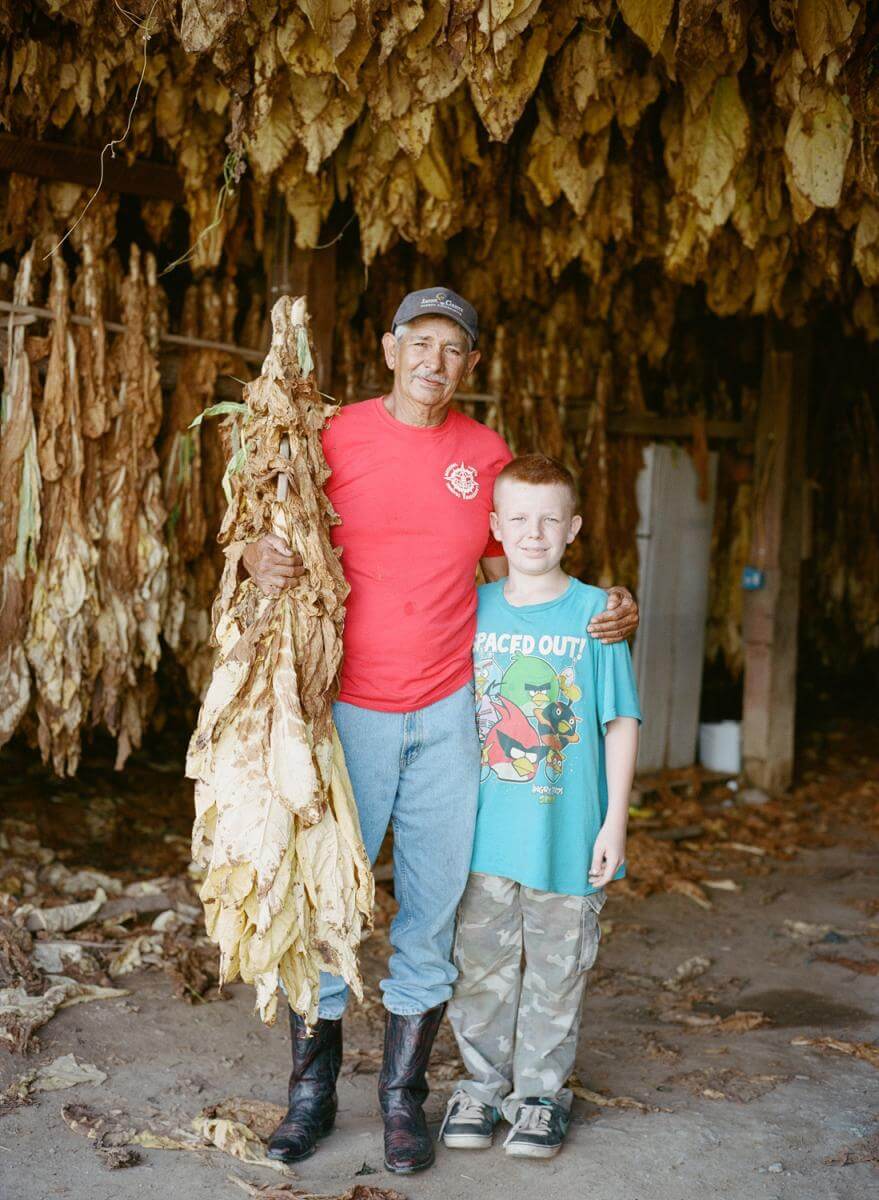
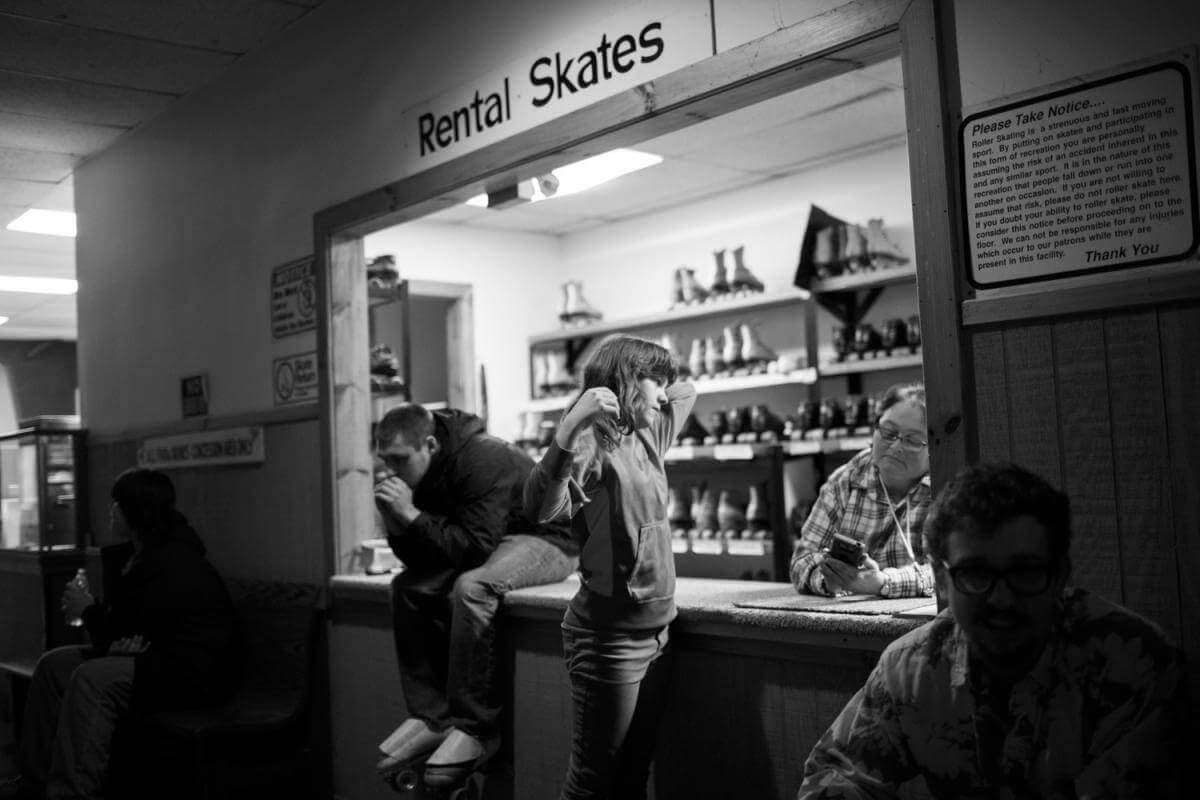
Looking at Appalachia's contemporary, crowdsourced images destabilize normative frames of Appalachian nostalgia through photographs of a more mainstream place that works its way in and through recognizable visible tropes of quaint and simple country life. As Williams and others have noted, from the local color writers movement of the late 1800s onward, Appalachia appears as a "reservoir of American folk culture."32Williams, Appalachia, 204. Images outside of this framing reveal acts of selective focus. As Watkins notes of Wootten's 1930s photographs of Spruce Pine and Bakersville, North Carolina, her choice of camera angles and framing emphasized quaintness over development: "Had the camera been placed further back up the street," he notes, in his reading of one image, "the picture would have shown, among other things, a newer department store and a movie theater, more recognizable signs of modernity."33Charles Alan Watkins, "Merchandising the Mountaineer: Photography, the Great Depression, and 'Cabins in the Laurel.'" Appalachian Journal 12.3 (Spring 1985): 227. Williams makes a similar observation: images that "placed [Appalachia] squarely in the American mainstream" historically have been marginalized to make room for more recognizable, nostalgic framings.34Williams, Appalachia, 300. As with depictions of grannies, beards, and mountaineers, Looking at Appalachia does present images that seem throwbacks. Consider Meg Wilson's portrait from Garrard County, Kentucky, of two generations (is it grandfather and grandson?) in a tobacco barn (Figure 17). There are echoes of nostalgia. But the Angry Birds image on the boy's T-shirt connects this scene to traditional Kentucky tobacco farming practices as well as global networks of mobile devices, digital games, and franchise marketing. Similarly, Lou Murrey's candid shot at Skate World in Vilas, North Carolina, frames Appalachia in ways that foreground nostalgia for an imagined simpler and remote American past (Figure 18). A closer look reveals the smartphone in the woman's hand behind the counter, locating this image squarely within the broader context of highly networked American mainstream culture. These moments of contradiction—within and between photographs—create a tension within the project that undermines the authority of these normative frames.
Figures 19–23
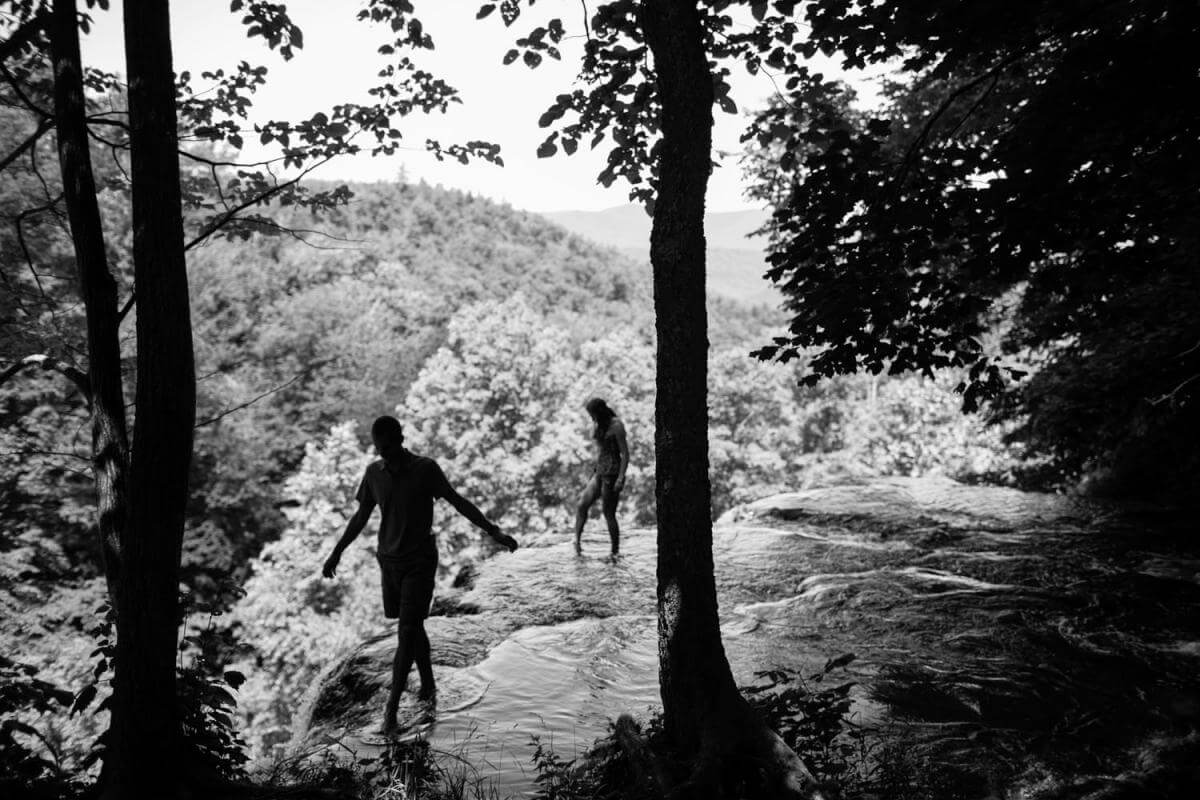
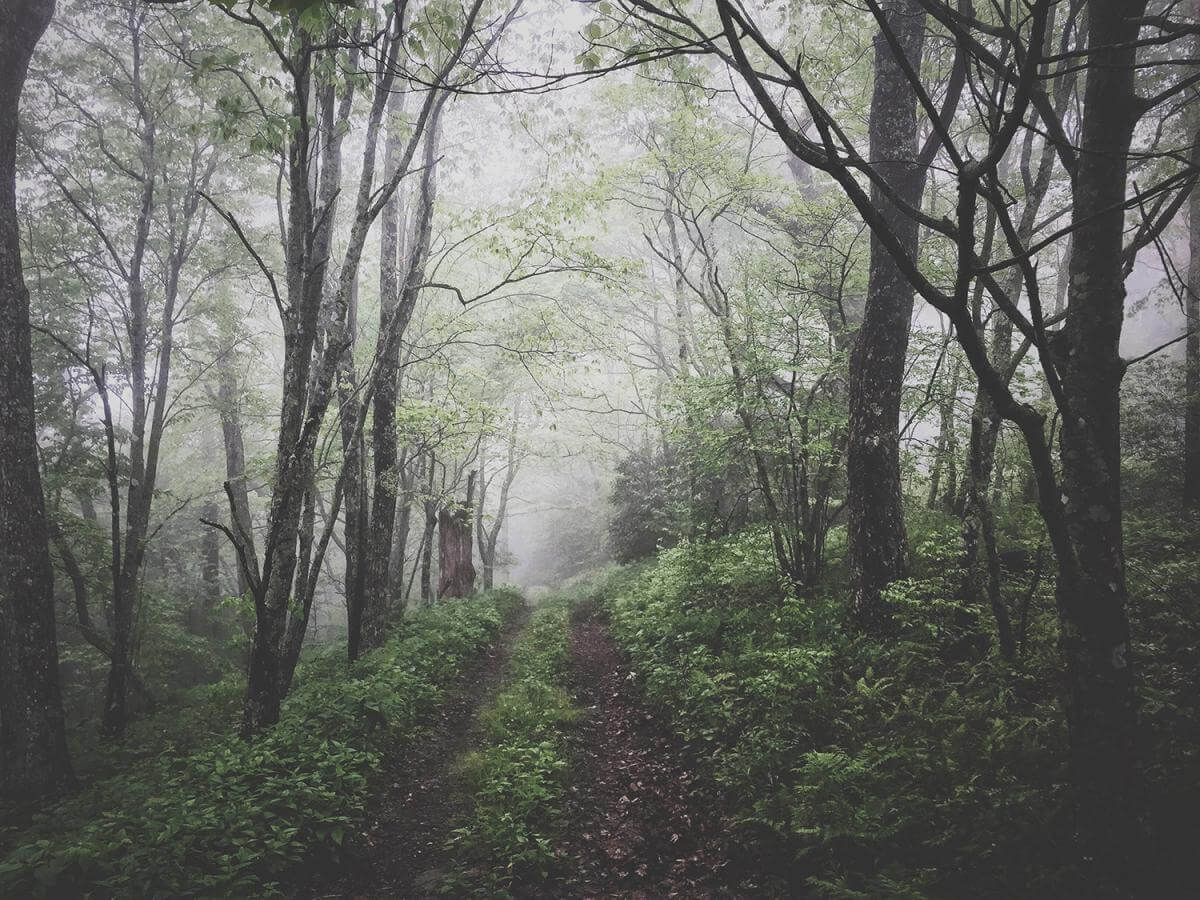
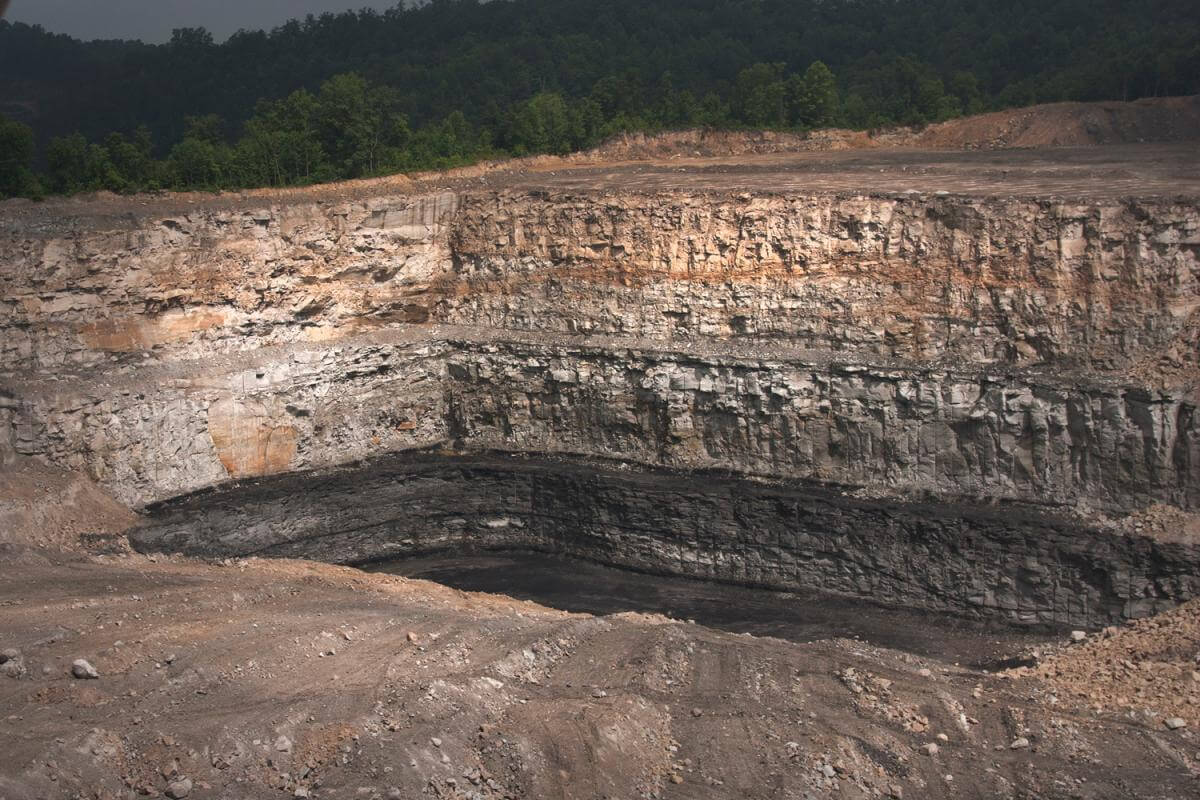
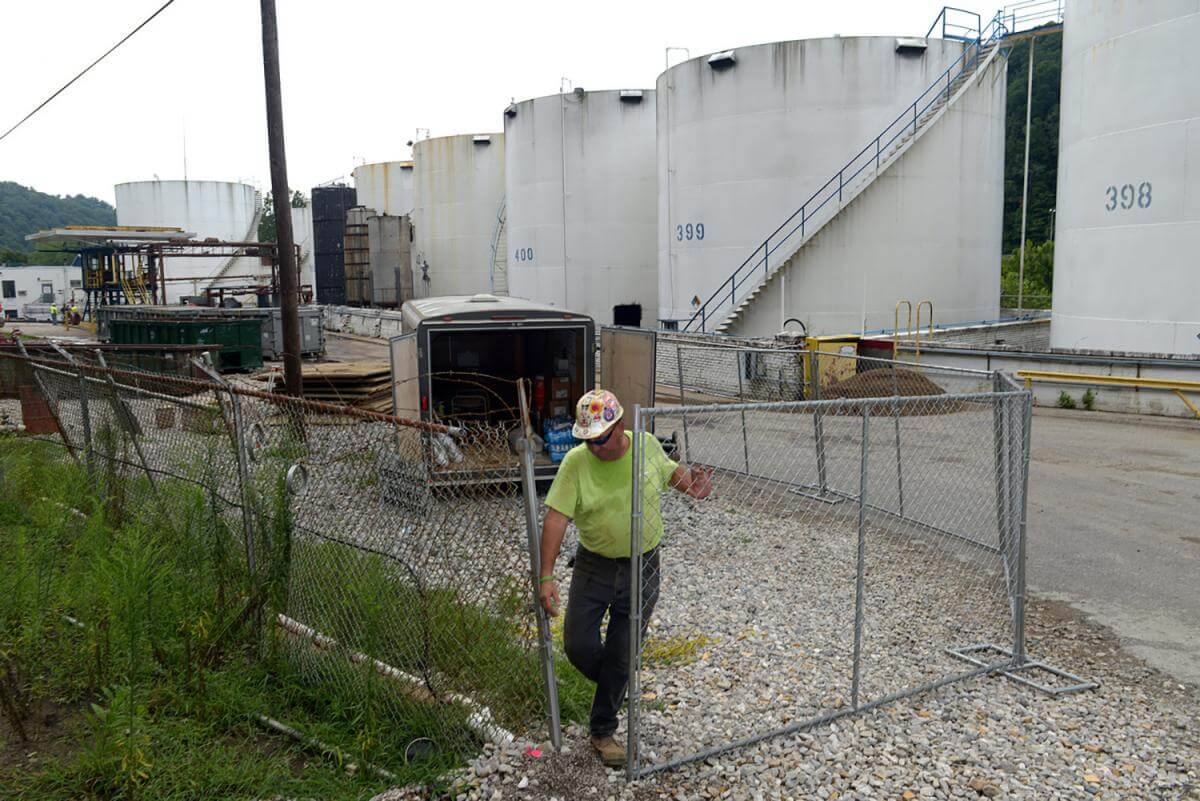
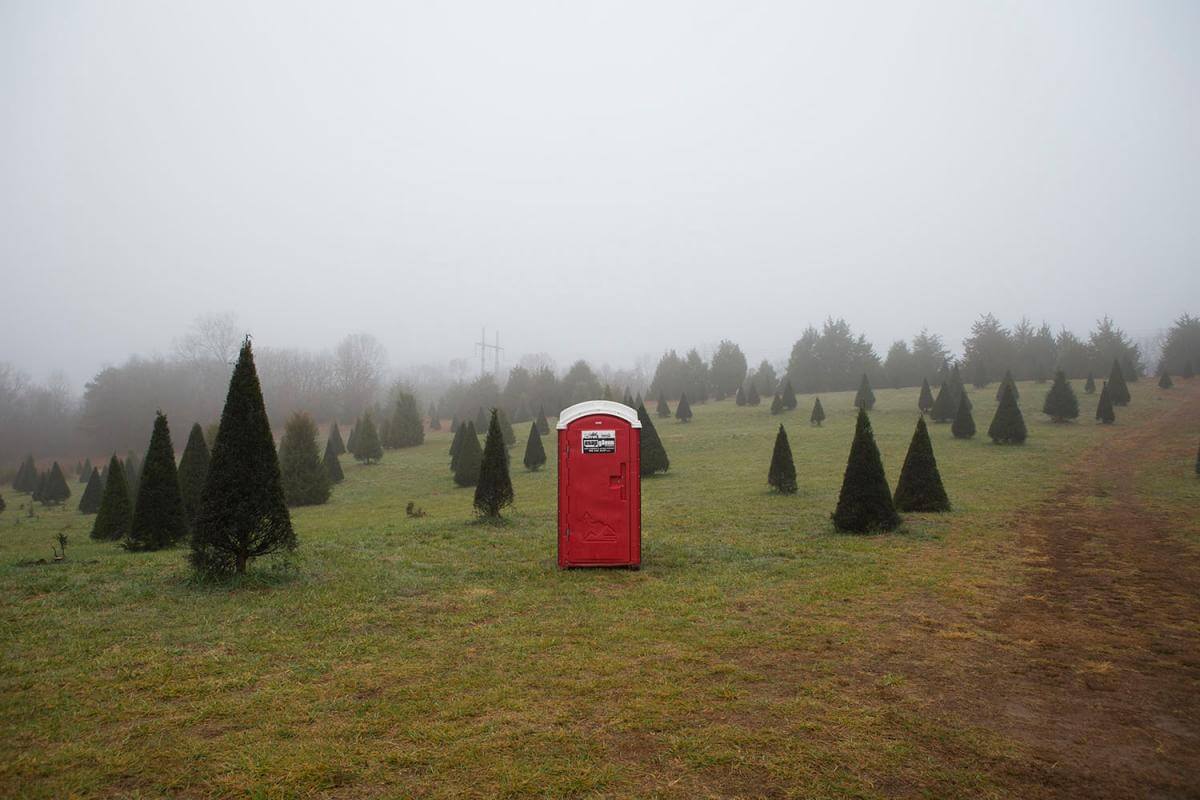
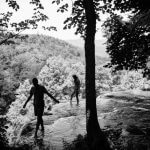
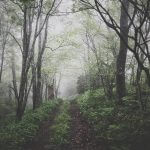
Similarly, nature photography in Looking at Appalachia complicates and questions received and expected visual tropes. Chris Jackson's portrait of a young couple walking at the edge of Virginia's Falling Springs waterfall, or Nathan Armes's image of a dirt road on Wayah Bald in North Carolina, echoes photographs framing Appalachian geography as wild refuge (Figures 19, 20). Images of Appalachia as a sacrifice zone reinforce these norms by presenting the opposite—such as Dobree Adams's active mining sites in Perry County, Kentucky, or Pat Jarret's photograph of the Freedom Industries' chemical spill site in Charleston, West Virginia (Figures 21, 22). Other "natural settings" alter these frames: does Amanda Greene's North Georgia Christmas tree farm landscape, with portable toilet in the foreground, offer an image of untouched nature, extractive economy, or something in between (Figure 23)? Or consider Wes Frazer's photograph of a youth in mid-swing over a river in Jefferson County, Alabama (Figure 24). Not only does this image echo other representations of the region as a locus of simple country pleasures (destabilized, of course, by other images in Looking at Appalachia—for example, another Frazer photograph of a tattooed youth huffing inhalants while standing in the same river) but it also depicts Appalachia as a wild and rural refuge from urban and suburban development. But this first Frazer photograph disrupts its own image of Appalachia as simple, rural refuge by including the large pile of trash on the shore. Cropping out the trash would present a very different image. It is not ironic contrast (no more so than an Angry Birds T-shirt within a tobacco barn); rather, it is an acknowledgement of both the complexity of the region and the norms that come into play when we frame Appalachia through these powerful structures of recognizability.
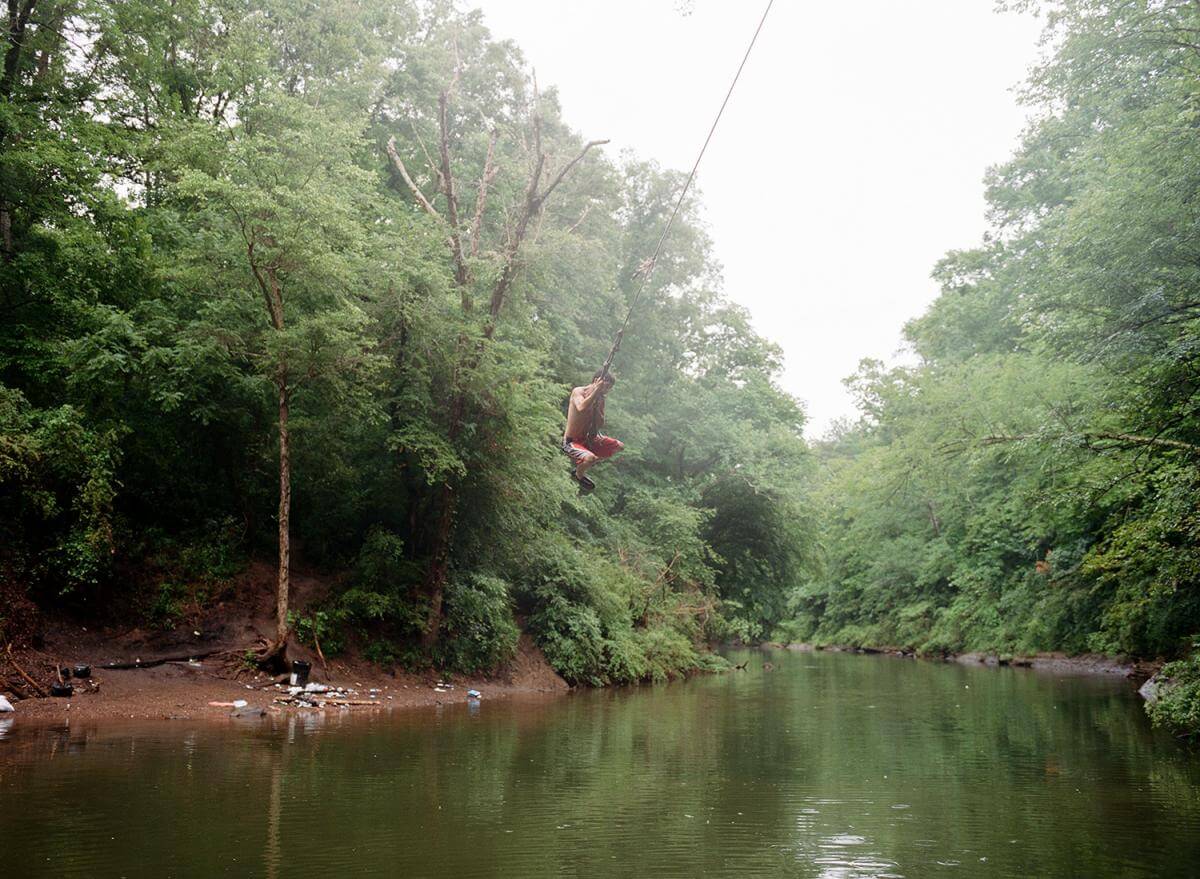
The logic and design of Looking at Appalachia includes as many images as possible in a collaborative mosaic. In a June 2016 email correspondence, May dates the origin of Looking at Appalachia to his reflection on the work of William Gedney, a War on Poverty-era photographer who managed to see more than most photojournalists. May wondered how Gedney "somehow…made photographs of grace, beauty, and simple existence all the while capturing the hardscrabble environs of his subjects."35Roger May, "Looking at Appalachia: William Gedney—Part One." Walk Your Camera, July 1, 2012. http://walkyourcamera.com/looking-at-appalachia-william-gedney-part-one/. May finds in Gedney's work "moments so obviously absent from most of the work…from Appalachia, that one has to wonder why so few photographs like this exist."36Roger May, "Looking at Appalachia: William Gedney—Part Two," Walk Your Camera, August 4, 2012. http://walkyourcamera.com/looking-at-appalachia-william-gedney-part-two/.
That Appalachia has operated far more as a narrative construct than a geographic location—as Williams phrases it, "a place that always will be—and never was"—makes Looking at Appalachia a powerful interrogation of how frames of recognition operate, and how photography can simultaneously affirm and destabilize these powerful visual tropes.37Williams, Appalachia. Looking at Appalachia succeeds in part because crowdsourcing has become a common practice. And perhaps, as Ritchin (2013) suggests, the superabundance of images and image recording devices has moved us into a "postphotographic" era in which "the image output from a camera is no longer thought of as being, or needing to be, above all a recording:
The photographer need not explain clearly, but can share his or her impressions with other viewers who might be able to help to figure it out. Images containing ideas not yet sufficiently explicated, based on the photographer's knowing or sensing that something of importance is happening, can be construed as invitations to a reader to join in the search for meanings. Thus the image becomes, in a sense, open source.38Ritchin, Bending the Frame, 49.
Looking at Appalachia encourages an open relationship to documenting and delimiting the boundaries of representation, suggesting that while we recognize Appalachia in these images, we recognize the possibility of other ways of seeing it.39Ibid., 50. Each photograph speaks to Appalachia in some way, but what it speaks to is often just outside the frame.
About the Author
Mark Nunes is the chair of the Department of Cultural, Gender, and Global Studies at Appalachian State University. He is author of Cyberspaces of Everyday Life (Minneapolis: University of Minnesota Press, 2006), which explores how the Internet restructures our everyday experience of the public and the private, and the local and the global. He is also editor of and contributing author for a collection of essays entitled Error: Glitch, Noise, and Jam in New Media Cultures (New York: Continuum, 2011), which examines how the concepts of "noise" and "error" structure modes of cultural resistance in a network society.
]]>Review
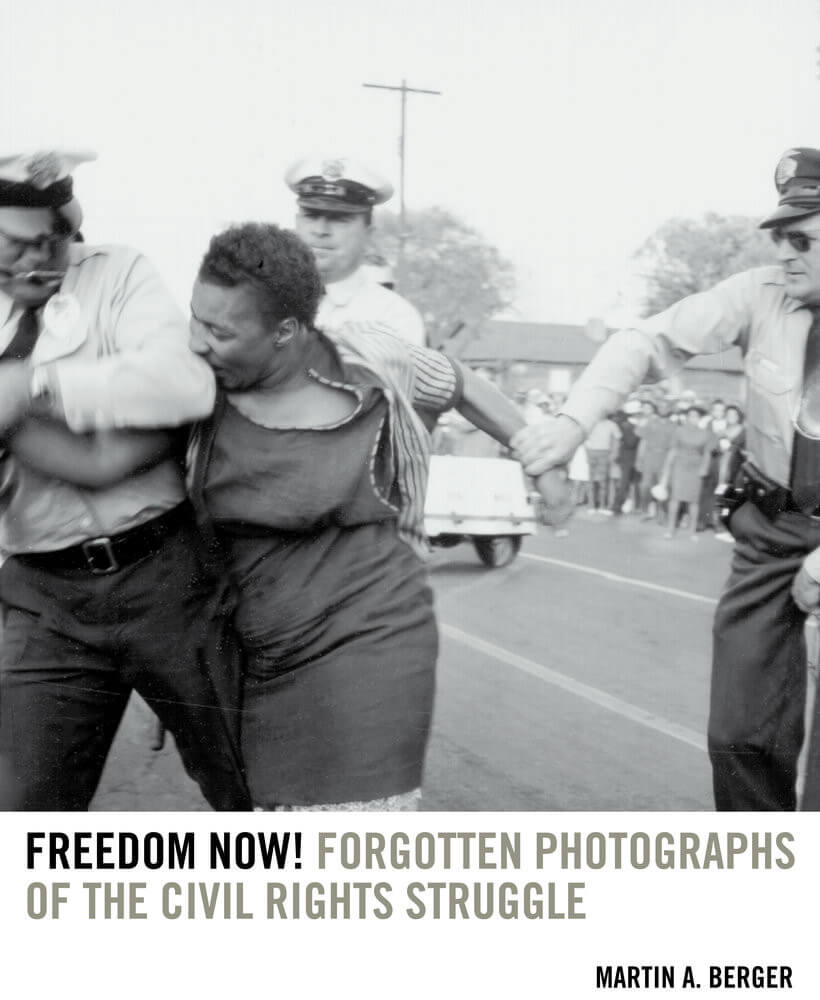
I remember well seeing Charles Moore's fire hose photographs from Birmingham in my hometown newspaper, the Louisville Courier-Journal. Six-years old in 1963, I had little understanding of the day's news, but it was impossible not to notice the violent spray of water knocking and pinning down black protesters. How could water and firemen be so harsh? A week or so later I probably saw the same photograph again, this time as a spread in Life magazine, the only mail I eagerly awaited and poured over, admittedly just for the photographs. No image became more iconic, no place more marked by photographs than Birmingham in the days of Bull Connor's hoses and dogs. Martin A. Berger's fine book, Freedom Now! Forgotten Photographs of the Civil Rights Struggle revisits those canonical images with compelling interpretations while broadening and deepening our vision through a much fuller collection of imagery of the struggle.
Berger's book may be seen by some as a corrective to the narrow visual history of the civil rights movement. If not a corrective, Berger has certainly offered an important augmentation, one that is essential in understanding the movement from multiple perspectives, including the life and nature of documentary news photography. As he argues so effectively in his "Introduction: The Case for a New Canon," our impressions of the movement are rooted in and defined by the perceived need of photographers and picture editors to "offer stark, morally unambiguous narratives" of injustice, images that might urge action. Additionally, many of those same image-makers and publishers were drawn to photographs that affirmed that whatever solutions to racial injustice might be persued, they "need not lead to social disorder," to quote Berger.1Martin Berger, Freedom Now! Forgotten Photographs of the Civil Rights Struggle (Berkley: University of California Press, 2013), 10. The images of the time often depicted activists as victims of white oppression—as often they were—conveying the message that the power and keys to change rested with interventions of white citizens.
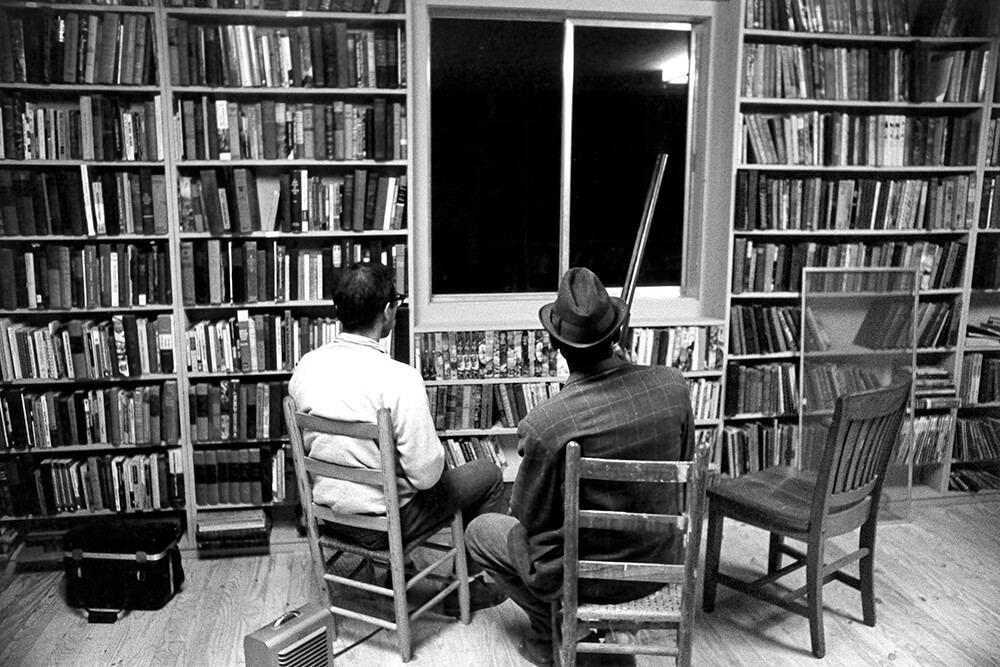
The publishing of a particular photograph—for example, Charles Moore's "Firemen Use High-Pressure Hoses against Protesters, Birmingham, Alabama, May 3, 1963" (24–25)—could often lead to the reproduction of that same photograph in multiple places, over and over, year after year. This meant that while picture-makers expanded the view of the civil rights movement for daily readers through their decisive and determined work, over time some images that came to 'define' the movement, narrowed the perspective through their repeated publication. Berger's work interrogates the limitations of this visual history, and creatively and effectively introduces an expanded, more nuanced visual chronicle of the civil rights struggle. An image like Matt Herron's, "Fire Bomb Watch, Mileston, Mississippi, June 1, 1964" stands in sharp contrast to those that portray black activists as victims of white resistance. Quiet in tone and certainly not a hard news moment that front-page editors would reach for, this photograph suggests local black resistance, self reliance, and the ways in which people in Holmes County, Mississippi, guarded their essential and beloved community center. Throughout Freedom Now!, Berger provides revealing context of the 'place' of the photographs in the moment and in the history of the movement, interpreting what information rests within the frame of a given photograph and acknowledging that much of what we need to know to understand these images lies outside the frame. In Herron's Mileston image in the community center we, as viewers, are in the room, "protected by the vigilant pair."2Ibid, 74. Just as we must hear a diversity of voices to understand the movement in a particular place, we must see imagery beyond the narrow canon to fully appreciate the complexity of the time and the struggle. The combination of Berger's image selection and his carefully researched narrative does just that.
Just as we often take the same picture over and over, we also frequently see in our mind's eye a single historical frame that is akin to the limitation of knowing a place only through a predictable selection of postcards on a drugstore display rack. What we are always challenged to discover is what Walker Percy has called a "sovereign vision," a view of the movement made up from an expanded and enriched collection of photographic expression.3Walker Percy, "The Loss of the Creature," in Message in a Bottle (New York: Picador, 1975), 46–63. "While all collections of photographs present a partial and subjective picture of their subjects," writes Berger, "they are not all equally flawed."4Berger, Freedom Now!, 14. Regardless of the veracity of a particular photograph depicting the factual and emotional truth of a moment, individual photographs are but fleeting slivers of time cropped from a vast historical narrative. This is even truer from the reflective and researched lens of history. Thus Berger's work builds out the image bank and lets the complexity of the visual record challenge simple assumptions about the civil rights movement, allowing the canonical imagery to encounter and sit in juxtaposition with revelatory photographs not often seen.
One of the most powerful and revealing of the 'new' images is, tellingly, from an unidentified photographer. "Women Resisting Arrest, Birmingham, Alabama, April 14, 1963" (96 and book cover) offers the opposite view of the black activist as victim of white authority. In this image the woman under arrest is doing all she can to wrestle free, including attempting to bite one of three policemen. Berger explains that this image was published in a best-selling segregationist pamphlet in an attempt to discredit the behavior of black activists. It was also published in Jet magazine where it questioned the unjust use of force on a woman while also applauding her stern resistance. The blurred motion in the image, perhaps a challenge for photojournalism editors at the time, communicates powerfully the moment's and the movement's violence and cacophony. That the photographer and the woman are unidentified reinforces the power of bringing such forgotten images into the public realm. Whatever converging reasons might have limited its publication in 1963 and the years following, the power and tenacity of "Woman Resisting Arrest" make it required viewing in any full visual history of the movement, seen within and alongside the familiar depictions of key events and known figures. This is the triumph of this book and the compelling argument of Berger's careful curatorial reimagining of how to view the civil rights struggle. Additional imagery will no doubt be recommended as complements to this stirring record, bearing additional witness to the power and nuance of the narratives revealed through the photographic evidence of the movement.
About the Author
Tom Rankin is professor of practice of art and documentary, director of the MFA program in experimental and documentary arts at Duke University. His books include Sacred Space: Photographs from the Mississippi Delta (Jackson: University Press of Mississippi, 1993), Deaf Maggie Lee Sayre: Photographs of a River Life (Jackson: University Press of Mississippi, 1995), Local Heroes Changing America: Indivisible (New York: W.W. Norton, 2000), and One Place: Paul Kwilecki and Four Decades of Photographs from Decatur County, Georgia (Chapel Hill: University of North Carolina Press, 2013) among others. Rankin writes frequently about photography and the documentary tradition and his photographs have been widely exhibited.
]]> |
| Chip Simone. Photo courtesy of Chip Simone. |
Long-time Atlanta resident Chip Simone co-founded NEXUS, Atlanta’s first photography gallery, in 1973. Originally from Worcester, Massachusetts, Simone studied at the Rhode Island School of Design with modern American photography master Harry Callahan. Simone’s photos are currently included in permanent collections at the Museum of Modern Art, the High Museum of Art, the Houston Museum of Fine Art, the Museum of Contemporary Art of Georgia, the Corcoran Gallery of Art, and in the Sir Elton John Photography Collection. Simone has also published two collections, On Common Ground: Photographs from the Crossroads of the New South (1996) and Chroma: Photographs by Chip Simone (2011), printed in conjunction with his exhibit at Atlanta’s High Museum.
When he moved from Manhattan to Atlanta in 1972, Simone initially took photographs of his wife, family members, and his new neighborhood of Virginia Highlands. In time, however, Simone shifted his focus to rarely photographed areas of urban Atlanta.
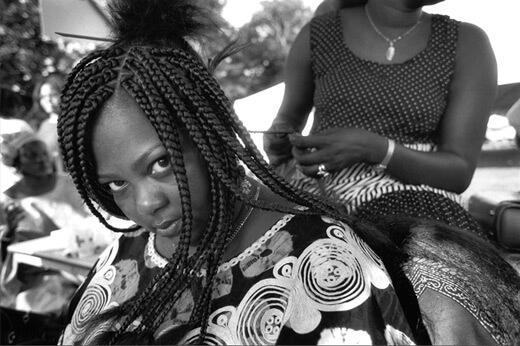 |
| A Woman Has Her Hair Braided in Piedmont Park, 1996. Photo courtesy of Chip Simone. |
“Atlanta was struggling to redefine itself, and I was more intrigued by the nature of it as a growing and transforming American city,” Simone says. “I was more interested in discovering what was not known about Atlanta and experiencing it than in reinforcing that conventional lore. Over time, my work has evolved into a more personal and intimate view of the city and its people.”
In this clip, Simone discusses Maynard Holbrook Jackson Jr., Atlanta’s first African American mayor, and his impact on the city’s topography, race relations, and the development of its artistic community. For more information about the role that art organizations like NEXUS have played in the development of Atlanta visit MARBL’s Modern Political and Historical Collections.
Randy Gue Interviews Chip Simone
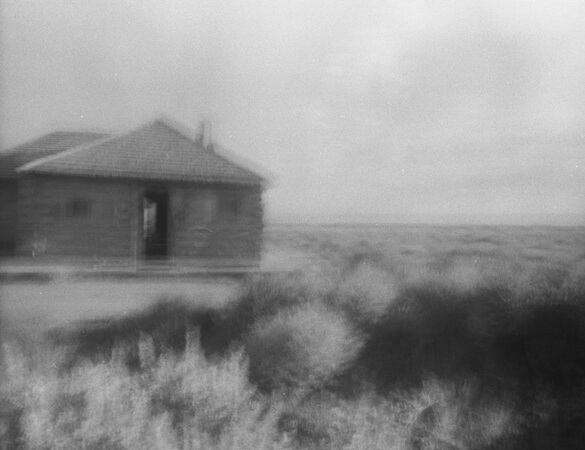 |
| "Sense of Awakening," Topophilia, 2013. Photograph by Stephanie Dowda. Courtesy of Stephanie Dowda. |
Atlanta-based photographer Stephanie Dowda is a studio artist with the Atlanta Contemporary Art Center and also maintains a darkroom at the Goat Farm Arts Center. A Georgia State University graduate, Dowda frequently presents throughout the Atlanta metro area. Dowda's work has appeared in Oxford American, Bad at Sports, ArtsATL, BURNAWAY, Atlanta Journal-Constitution, and the Atlanta Magazine. She has exhibited in numerous galleries, including Get This Gallery, M Rich Gallery, Beep Beep Gallery, Hagedorn Foundation Gallery, Kibbee Gallery, and the Atlanta Preservation Center.
In this clip, Dowda discusses her life-altering encounter with The Lightning Field in New Mexico, an installation piece by renowned sculptor, Walter De Maria. Dowda describes the piece as a quarter-mile long desert field installed with nearly 400 steel poles that extend into the sky:
The idea is that you go there and hang out in a cabin for a night and then play around in the lightening field . . . It was completely life changing . . . There is just something about that [experience] that changed me, and it also changed my camera.
 |
| "Sense of Revenant," Topophilia, 2013. Photograph by Stephanie Dowda. Courtesy of Stephanie Dowda. |
Dowda recalls that, after spending the night in the lightning field, she discovered that the photos taken there had been altered. Searching for a technical explanation as to why her photos developed in this particular way, Dowda found no easy answers. Moreover, after this experience, Dowda describes that her camera continued to yield images seemingly "possessed" by the energy from the lightning field. Inspired by this experience, Dowda works to develop new and innovative ways of illuminating the energy that differentiate locations from one another. In this clip, she elaborates on her interpretation of topophilia, a concept cultural geographer Yi-Fu Tuan coined to articulate the strong sense of place that can yield a personal attachment to particular landscapes.
]]>