Review

For more than twenty years, scholars have sought in article after book after conference paper to expand the timeline, reach, and definition of environmental concern and activism. This uncoordinated but multi-pronged effort has given us a fuller sense of activism that emerges from and addresses larger social and economic inequalities. What we call environmental justice is finally getting a full and complete history.
What has yet to be done, until now, is to bring that broader story together with the more traditional history of the environmental movement. Ellen Griffith Spears has accomplished that in her important new history, Rethinking the American Environmental Movement post-1945. In this tightly argued volume, Spears provides the first work that truly synthesizes the different strands of environmentalism, giving them equal narrative and analytical weight. This book represents the culmination of a generation of scholarship on environmentalism that sought to expand our narrative in order to consider environmentalism as a "field of movements" (5) that brings together actors, organizations and institutions from a variety of backgrounds at the local, regional, and national level. The field of movements concept allows Spears to consider the mainstream organizations such as the Sierra Club or the Natural Resources Defense Council on comparable footing with grassroots movements, working to weave all strands of activism into the synthesis. She also includes developments in the history of science and public health, especially in ecology and toxicology, as well as the regulatory responses by the federal government. These are important not only to provide background and context, but also because the often-contested terrain of scientific knowledge and expertise is so central to understanding the movement. Rethinking the American Environmental Movement also engages larger structural changes within the US economy and society, such as mass suburbanization in the 1950s and deindustrialization in the 1970s and 1980s.
Although the title of the book promises an emphasis on the post-World War II era, the first chapter is a robust examination of "Antecedents" to the modern movement. Where, for instance, traditional histories examined conservationism and perhaps Progressive Era smokestack regulation, Spears discusses resistance to slavery, and pre-Civil War public health debates, in addition to the emergence of nature preservation. This builds on important recent work in nineteenth-century environmental history, such as Catherine McNeur's Taming Manhattan and Carl Zimring's Clean and White, and buttresses the argument for long durée connections between social justice and the environment.1Catherine McNeur, Taming Manhattan: Environmental Battles in the Antebellum City, Reprint edition (Harvard University Press, 2017); Carl A. Zimring, Clean and White: A History of Environmental Racism in the United States (New York: New York University Press, 2015); Mark Fiege, The Republic of Nature: An Environmental History of the United States (Seattle: University of Washington Press, 2012).
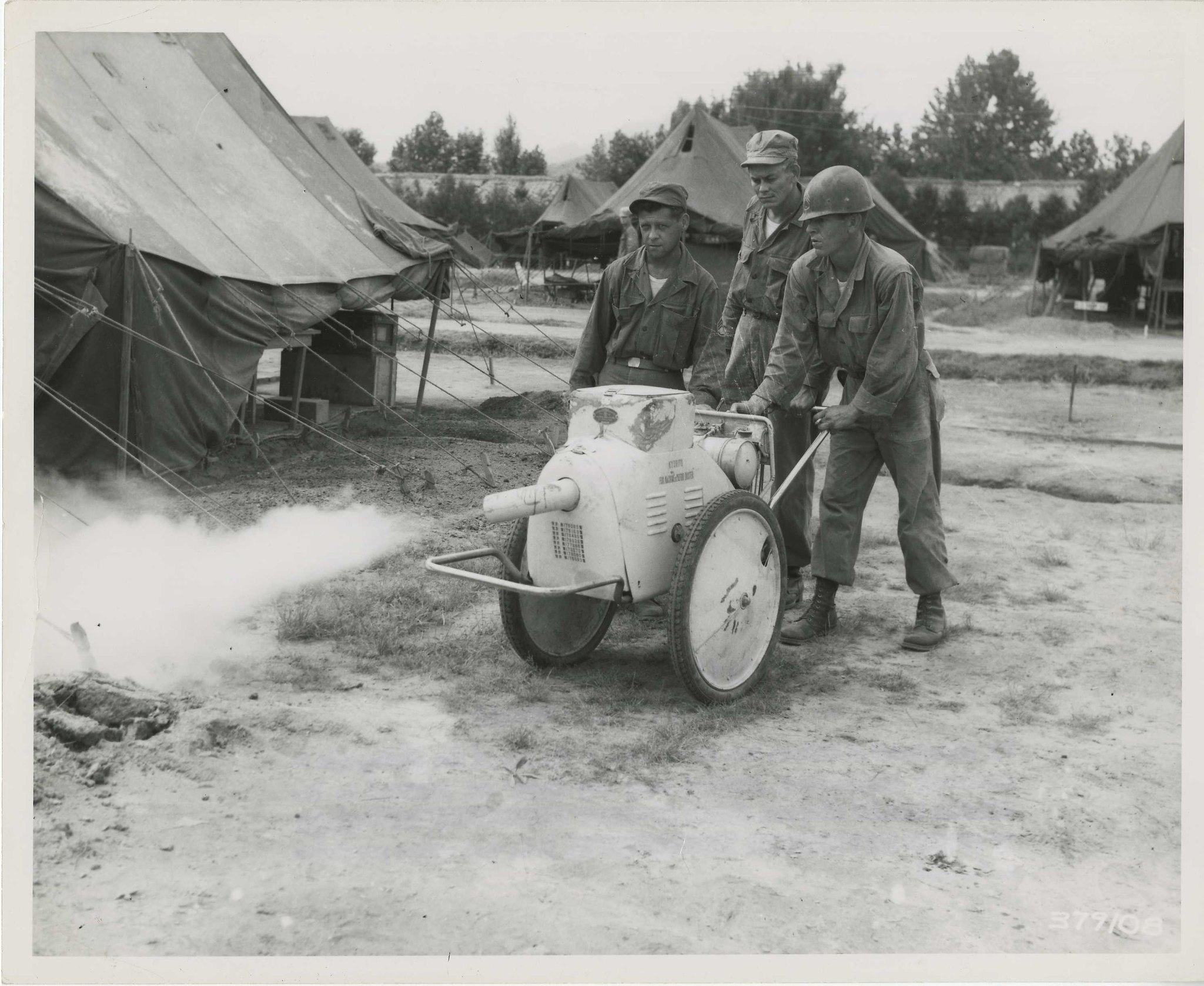
The core of Spears's book centers on the postwar period, which she ably covers while also introducing lesser known developments. For example, any book of this nature has to discuss Rachel Carson, and Rethinking devotes one of its largest section to this groundbreaking author. But instead of putting Carson on a pedestal, where she often sits in public memory, Spears places her in context, showing how she was building on and amplifying the work of grassroots activists and scientists. Americans had been raising concerns about the ecological and public health effects of dichlorodiphenyltrichloroethane (DDT) soon after World War II. This accelerated into a series of lawsuits filed by New York based conservationists protesting the indiscriminate spraying of DDT in the late 1950s. The legal action failed, but the activists caught the attention of Carson, who began investigating the impact of DDT across the country. That research culminated in the publication of Silent Spring in 1962, and Spears ably delineates how and why this book was so important. It was not just an expose about the dangers of chemical spraying; Carson helped bridge the old conservation era to more contemporary concerns about human health, and she "crystallized the recognition that humans were fundamentally altering the environment" (83).
Just as significant as this rethinking of Silent Spring and pesticide activism is what comes before it: a short but important consideration of urban environmental concerns during the 1950s—especially the National Urban League's "fight blight" and block club campaigns that targeted neighborhood cleanup, rats, empty lots, and community health. Spears examines urban activism by African American and other minority populations in more detail later, but by putting this section right before the discussion of Carson, she makes a valuable narrative intervention. Justice-focused activism by minority communities was occurring at the same time that more well-known parts of the movement were emerging, buttressing the argument that these strands of environmentalism are deserving of a longer history, and were not just a product of the environmental justice movement of the 1980s.
In addition to making sure that urban and minority neighborhoods and populations are firmly part of the narrative, Spears gives significant weight to the decades after 1980. This allows her to cover the conservative reaction to environmentalism during the Reagan administration and afterwards, but also climate activism, and recent environmental justice conflicts such as poisoned water in Flint, Michigan, and the Dakota Access Pipeline protests. Rethinking is especially strong on climate activism, representing an important shift over the past decade. The final chapter provides background on concerns over anthropogenic climate change (a subject that has figured in every United Nations environmental since 1972) and the international negotiations and treaties over the limitations of carbon and greenhouse gases in the 1990s. Spears includes a special section on the Dakota Access Pipeline protests in 2016. Because the pipeline violated indigenous rights, was a threat to the water supply of the Standing Rock Reservation, and would also allow for the cheaper transportation of fossil fuels, Spears argues that the NO DAPL protests were a great example of "an intersectional grassroots movement linking indigenous rights, climate change, and water protection" (213).

By the end of the Rethinking, readers may feel a little overwhelmed by the field of movements approach, as Spears jumps, for example, from climate activism, to green jobs, food justice, religious work on climate change, and to standalone discussions of Flint and Standing Rock, all in the second half of the last chapter. Critics could argue that this "big-tent" conceptualization risks diluting what they would classify as an environmental movement, but this is the value of Spears's approach. She convincingly shows how environmentalism has never been one particular set of activists or institutions, but a diverse set of organizations, scientists, firebrands and regulatory bodies that have always been in conversation, conflict or coalition with each other. This broad coverage helps readers understand many implicit and explicit connections. And coverage is one of the goals of this kind of book, which seeks to introduce a topic to a broader audience. This makes Rethinking especially admirable. It places activism centered upon injustice and inequality on equal footing with more commonly known parts of the movement. As someone who teaches the history of environmentalism, I believe this is vitally important. Most students begin with strong preconceived notions about environmentalism (Birkenstocks, tofu) that prove tough to dislodge.
This field-of-movements framework does raise a broader question within environmentalist writing and the narrative we tend to tell. Lurking beneath the surface of many histories of environmentalism is the conflict between the movement's different strands, particularly between environmental justice organizations, radical wilderness groups, and the mainstream "nationals." Spears does not shy away from these tensions, showing how radical factions emerged partly in opposition to the perceived "business friendly" policies of groups such as the Environmental Defense Fund, and how grassroots organizations have long been critical of the overwhelming white, middle-class staffing and policy orientation of well-funded national groups based in Washington, DC.






Rethinking lacks an exploration of the roots of these tensions. This is primarily because of the strictures on the length of such a synthetic book—and that there are not yet enough strong critical histories of the mainstream strands of environmentalism. The discussions of the close relationship between corporations and large national groups are a case in point. Spears draws on the work of journalist Mark Dowie, especially his groundbreaking 1995 book, Losing Ground: American Environmentalism at the Close of the Twentieth Century. Dowie was one of the first vocal critics of this relationship, but this book is now a quarter-century old, and there really hasn't been any work that goes beyond his primarily surface level, muckraking analysis.2Mark Dowie, Losing Ground: American Environmentalism at the Close of the Twentieth Century (Cambridge, Mass.: The MIT Press, 1996).
We need more work that takes the connections between corporations and major, national environmental groups at face value, and attempts to understand their roots and trajectories—and their lack of attention to people and geographies of color. One of Spears's primary concerns is the "multiple ways in which the color lines drawn in U.S. society have hampered environmental reform movements" (4). But as strong as it is in exploring the grassroots activism by people of color, Rethinking doesn't explore the color lines that existed in environmental organizations; why they were reluctant, for decades, to address the concerns of marginalized groups, or even make their professional staffs more diverse. This is not because Spears does not want to explore these problems. It's simply that the literature is not there. The white privilege of US environmentalism has only really been critiqued at the margins. We lack a full accounting of its development and impact, particularly on the continual escalation of environmental injustice and inequality.
What are the reasons for these deficiencies, at least within US environmental history? The most obvious arguments would be that the field, or at least the powerful and influential within the field, were for decades overwhelmingly white, male, and middle class, and had a vested interest in a set of narratives about American environmental reform. Perhaps more importantly, there was also a reluctance to attack or even critique these narratives. Not only did generations of scholars have so much invested in these heroes, but also because to many of us, environmentalism has maintained a certain moral certitude as a progressive politics.3The core "heroes" come from the wilderness and early conservation movements. See, for example, Roderick Nash, Wilderness and the American Mind (New Haven: Yale University, 1996 [1965]); Aldo Leopold A Sand County Almanac and Sketches Here and There (London: Oxford University Press, 1949). To tar it with racism, and corporate greed, especially in a post-Civil Rights, neoliberal America, could undermine the whole project.
Finally, scholars are beginning to get over that reluctance. New work by Jennifer Thomson, Paul Sabin and Keith Woodhouse, for example, digs into environmentalism to understand its flaws, contradictions and their ramifications.4Paul Sabin, "Environmental Law and the End of the New Deal Order," Law and History Review 33, no. 4 (November 2015): 965–1003; Jennifer Thomson, The Wild and the Toxic: American Environmentalism and the Politics of Health. (University of North Carolina Press, 2019); Keith Makoto Woodhouse, The Ecocentrists: A History of Radical Environmentalism. (New York: Columbia University Press, 2020). They move beyond a celebratory narrative to embed the environmental movement within the larger political and social developments of the past half-century. Outside the discipline of history, scholars such as David Pellow, Lisa Sun-Hee Park, and Dorceta Taylor have cast critical judgment on the movement, especially when understanding race in environmental politics.5Lisa Sun-Hee Park and David N. Pellow, The Slums of Aspen: Immigrants vs. the Environment in America's Eden, (New York: New York University Press, 2011); Dorceta E. Taylor, The Rise of the American Conservation Movement: Power, Privilege, and Environmental Protection (Durham, NC: Duke University Books, 2016). All of this work is important, but we need more.
Telling a more critical, less rosy story is important because a strong, inclusive and self-reflective, environmental movement is more important now than ever. Writing movement history is always political, especially when the social movements remain ongoing and their success more urgent. With Rethinking the American Environmental Movement post-1945, Ellen Spears has done admirable work in expanding our conception and understanding of the movement's varied streams. 
About the Author
Robert Gioielli is an associate professor of History at the University of Cincinnati and the author of Environmental Activism and the Urban Crisis: Baltimore, St. Louis, Chicago (Philadelphia: Temple University Press, 2014). Find him on Twitter at @robgioielli.
]]>Video and Essay
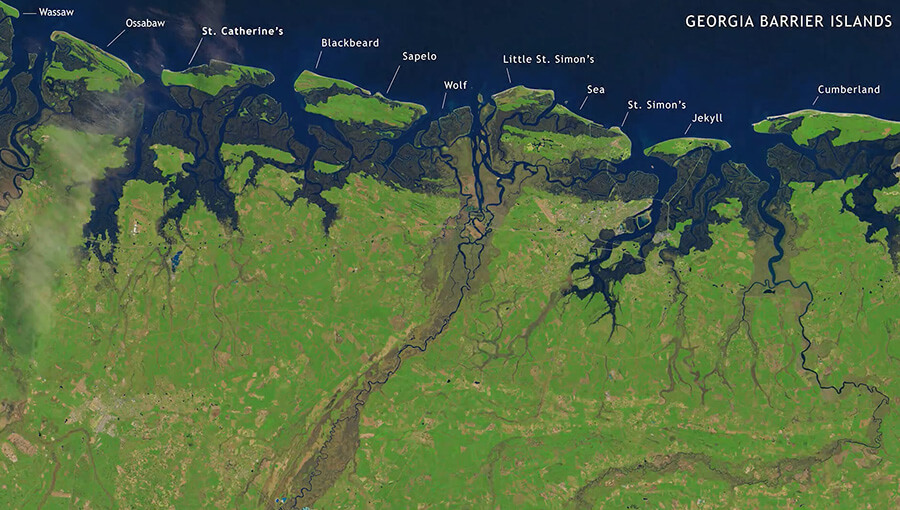
Ossabaw Island is a barrier island on the Georgia coast. The island, which trends northeast–southwest, is about 14.5 kilometers (9 miles) long and 10.5 kilometers (6.6 miles) wide. It is located between latitudes 31° 49.5' and 31° 43.2' N. Of the Georgia barrier islands, Ossabaw is the most geologically unusual. Like the major Georgia islands south of it—Cumberland, Jekyll, St. Simons, Sapelo, and St. Catherines—Ossabaw is a composite island, in which sediments from Pleistocene and Holocene shorelines are directly adjacent or superimposed. However, sediments of the Pleistocene (Silver Bluff) and Holocene shorelines on Ossabaw split near its southern portion, with the Pleistocene trending north–south and the Holocene trending northeast–southwest. The modern shoreline, which formed only in the past few thousand years, wraps around the southern and northeastern corners of the island.
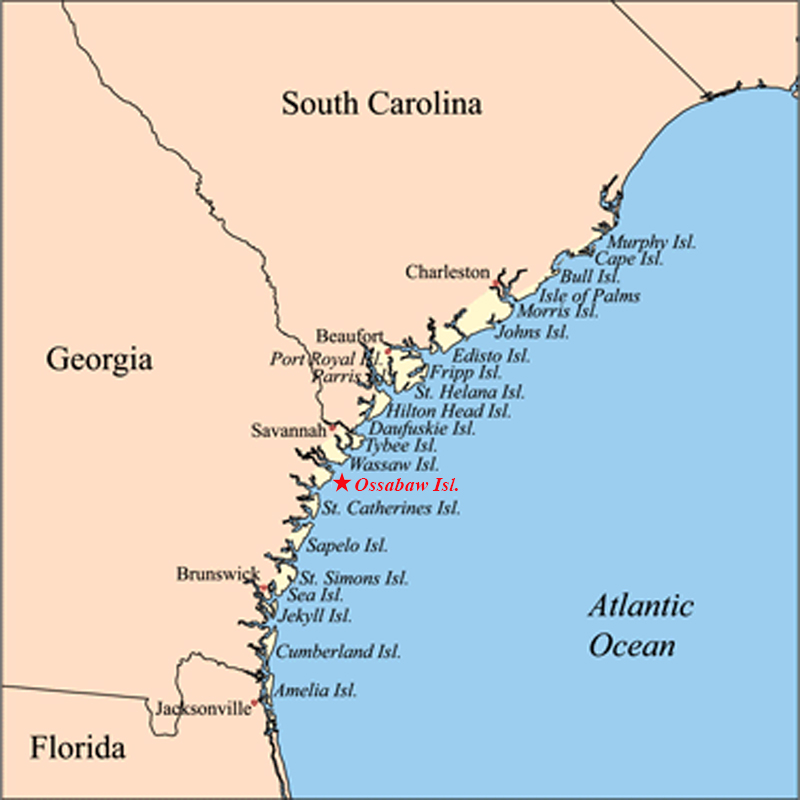
Ecosystems on Ossabaw include salt marshes, maritime forests, beaches, and a few freshwater ponds. Salt marshes are widespread west of Ossabaw, but also occupy much of the middle and eastern parts of the island between sediments of the Pleistocene and Holocene shorelines, dividing its maritime forests. The climate of Ossabaw is temperate to subtropical, with temperatures ranging from an average high of 32° C (90° F) in the summer to 10° C (50° F) in the winter. Average rainfall is about 50 centimeters (20 inches) per year, with most precipitation during the hurricane season (May–September). Hurricanes have rarely affected the Georgia barrier islands until recently, when Ossabaw was hit by Hurricane Matthew (2016), then later Hurricane Irma (2017). Hurricane Matthew, in particular, uprooted many of the older live oaks on the island and otherwise dramatically altered its landscape.
Although Ossabaw is often labeled as "pristine," humans have transformed its landscapes for at least 4,000 years. Its human history is similar to that of its island neighbor, St. Catherines, beginning with Native Americans (the Guale). The Guale had occupied Ossabaw since about 2000 BCE, but European colonization began when the Spanish arrived in the late sixteenth century. A lasting remnant of Spanish colonization on Ossabaw is the presence of feral hogs, some of which are linked to Spanish stock. This relatively large population of hogs has disrupted or otherwise altered ecosystems throughout the island.
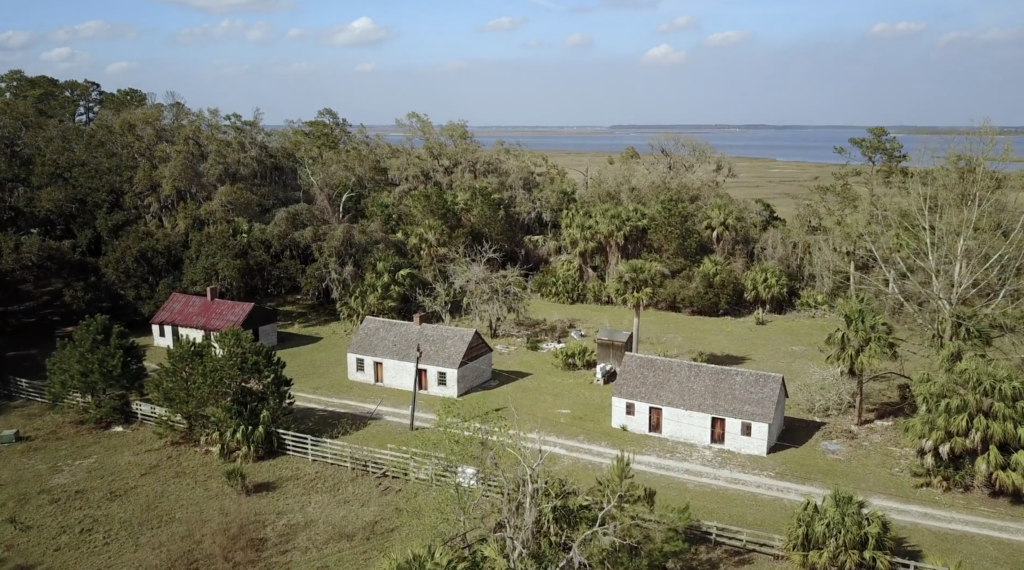
The British took control of Ossabaw in the 1730s, by which time the Guale had mostly moved inland or suffered near extinction under the pressure of colonization. Early treaties reserved Ossabaw as hunting and fishing ground for the Creek people until 1758. The British also began enslaving African people for their plantation economy, and in the late eighteenth century American settlers continued using enslaved people as laborers for growing cotton and indigo. Most inland ecosystems of Ossabaw, especially the maritime forests and salt marshes, were altered considerably by this agriculture. Following the American Civil War, a significant population of African Americans stayed on the island, but most moved to the mainland after the Sea Island Hurricane of 1893. Many of their descendants today comprise the Gullah-Geechee community in Pin Point, Georgia.
Through the early to late twentieth century, Ossabaw's ownership changed several times, but the island remained largely undeveloped and sparsely inhabited. The last private owners were members of the Torrey family, starting with Dr. Henry Norton Torrey and Nell Ford Torrey, and ending with their daughter, Eleanor Torrey ("Sandy") West. The Torreys oversaw the building of a large home for themselves, as well as hunting lodges, a beach house, and unpaved roads. In 1961, after Sandy West inherited the island, she and her husband Clifford West began the Ossabaw Island Project. This project brought luminaries of the arts and sciences to the island as a retreat center for study and discussion; notable participants included composer Aaron Copeland, writers Ralph Ellison, Margaret Atwood, and Annie Dillard, as well as ecologist Eugene Odum. This creative initiative also resulted in the Genesis Project, which focused more on the natural sciences and hosted scientists for on-site studies of and education about the archaeology, ecology, and geology of the island.
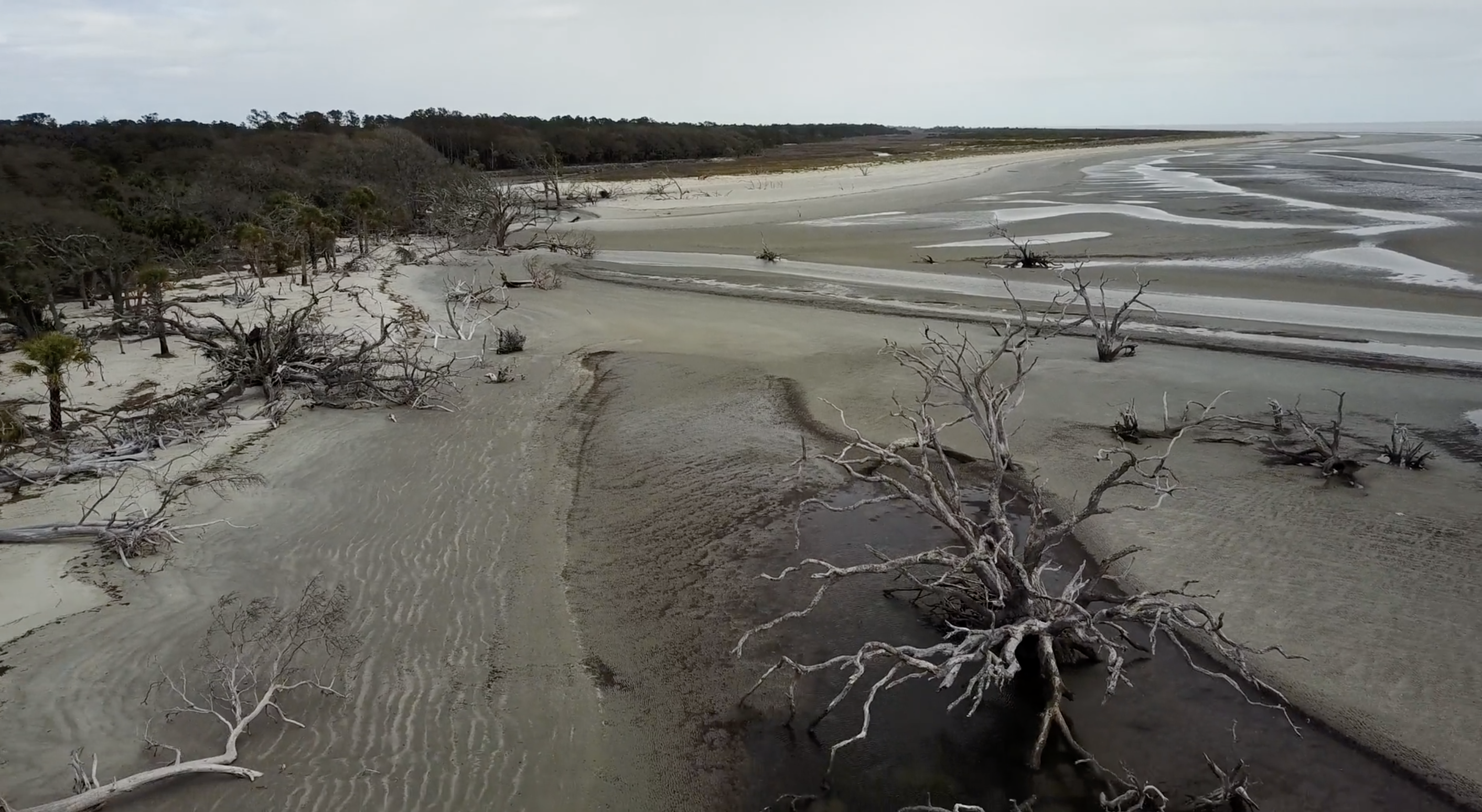
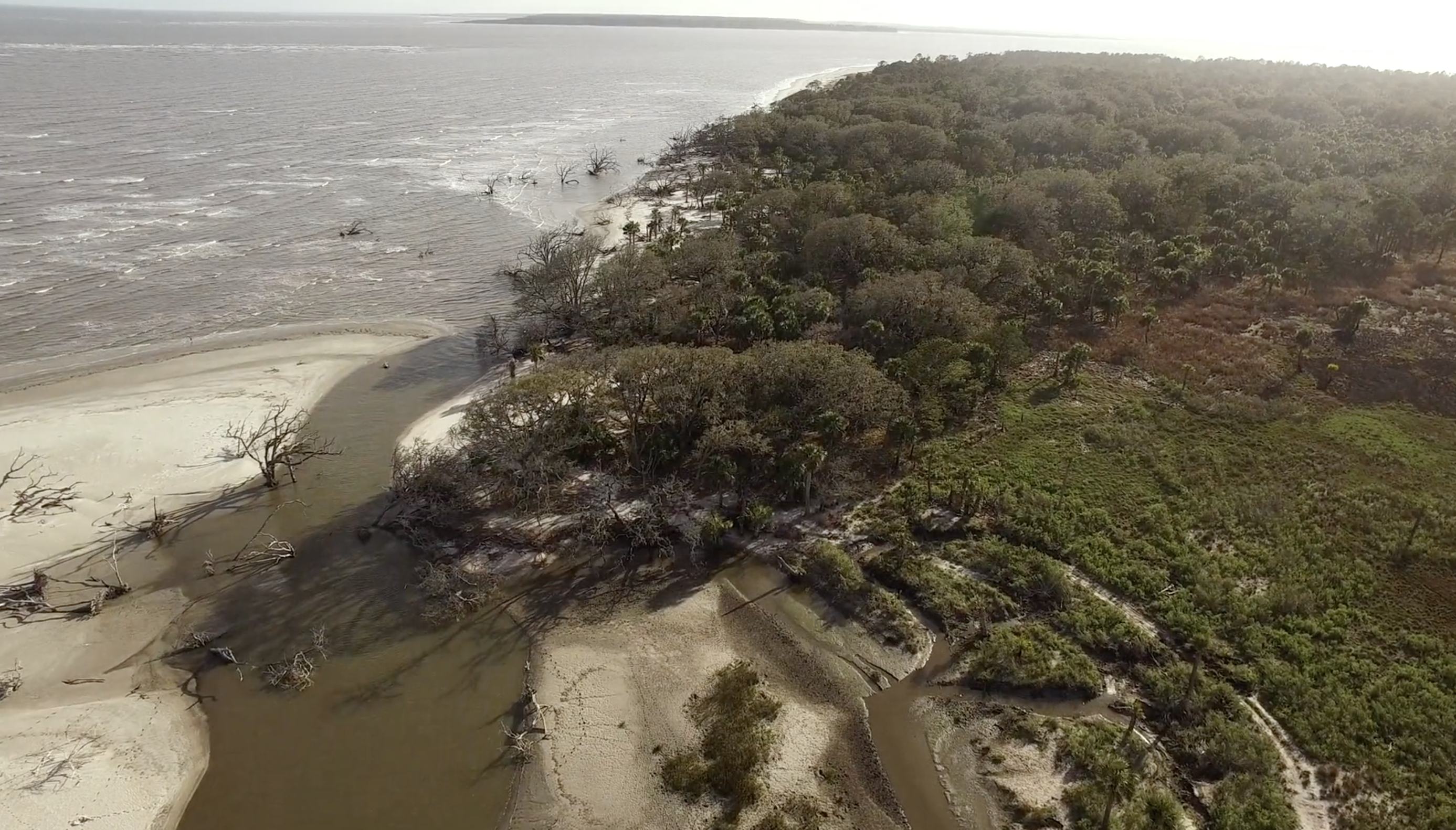
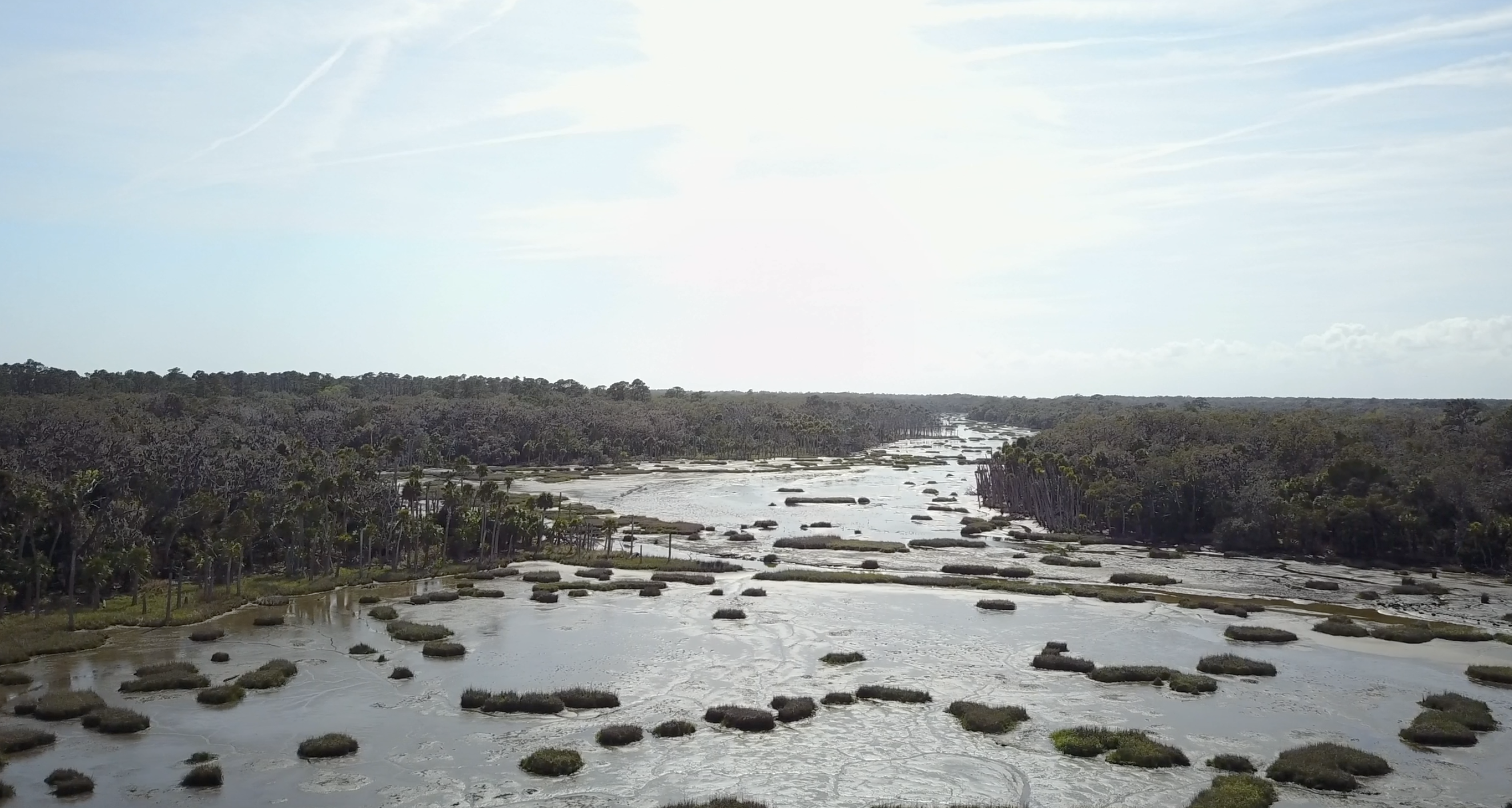
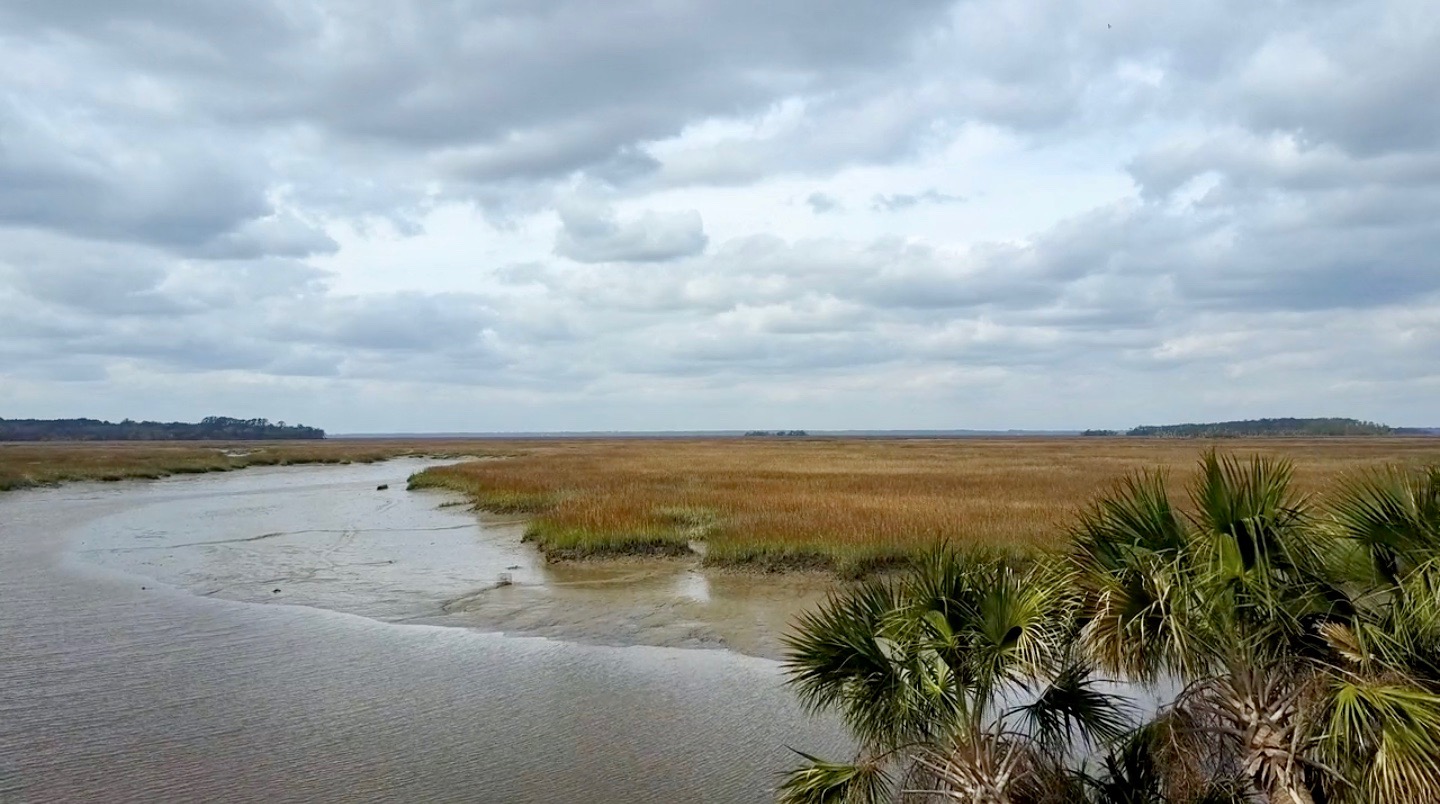
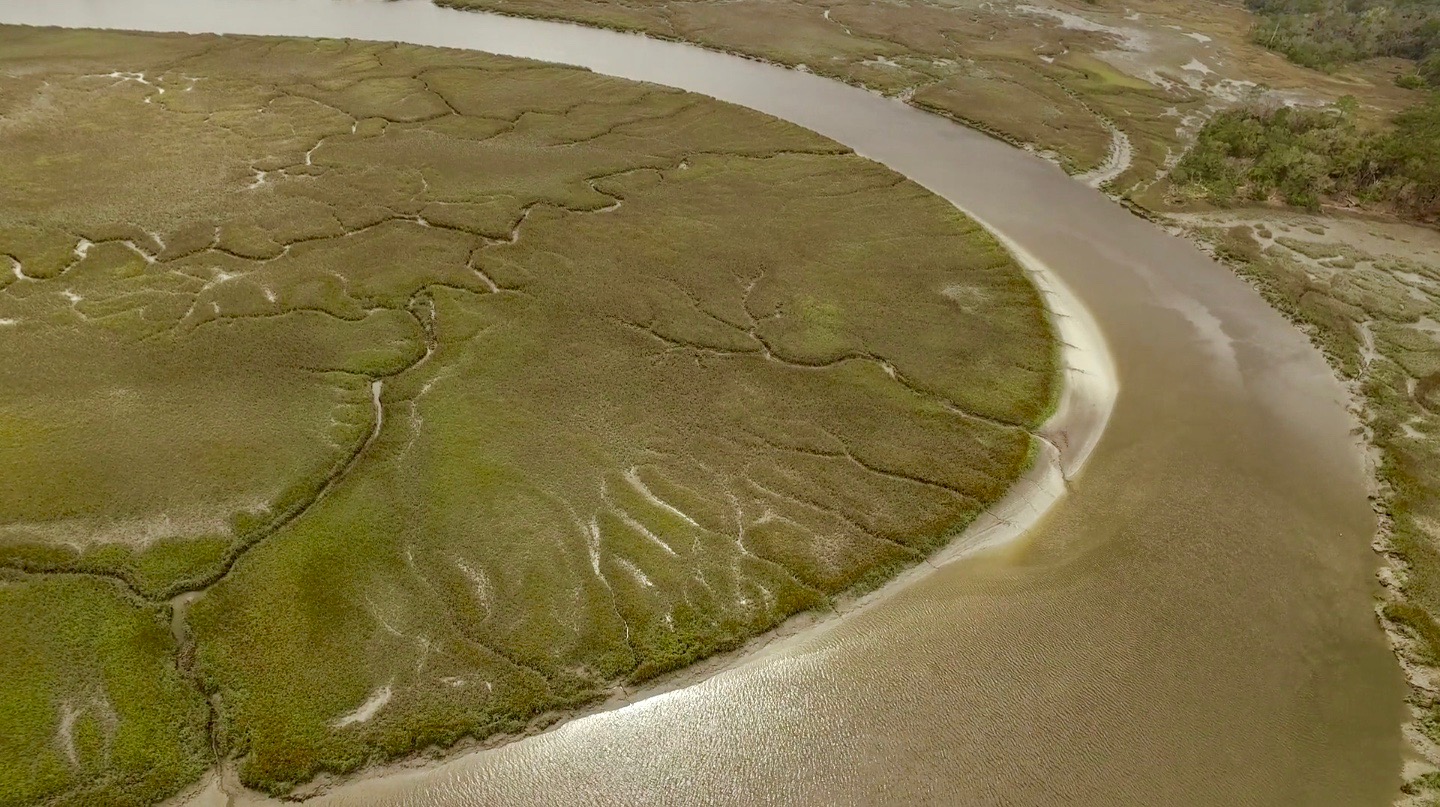
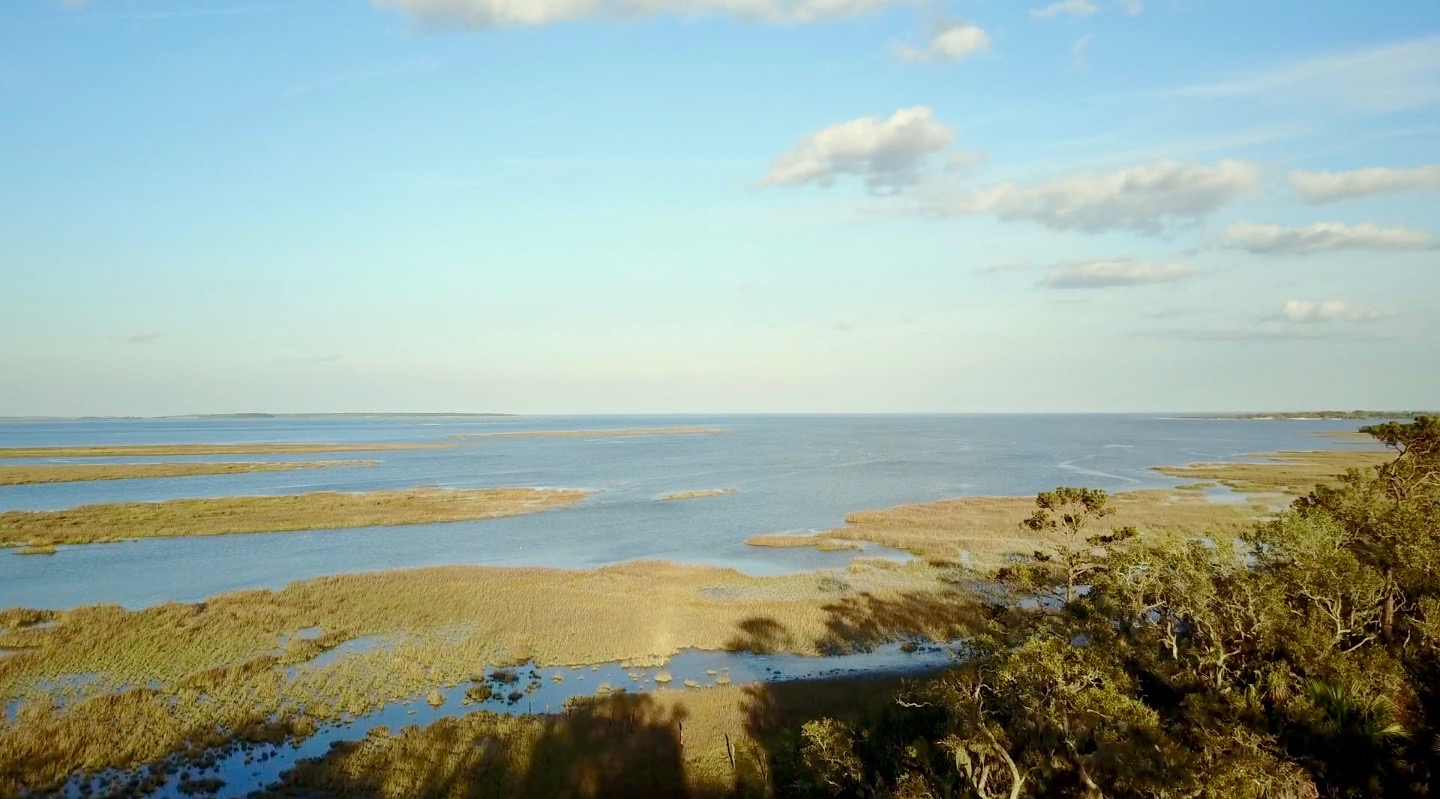
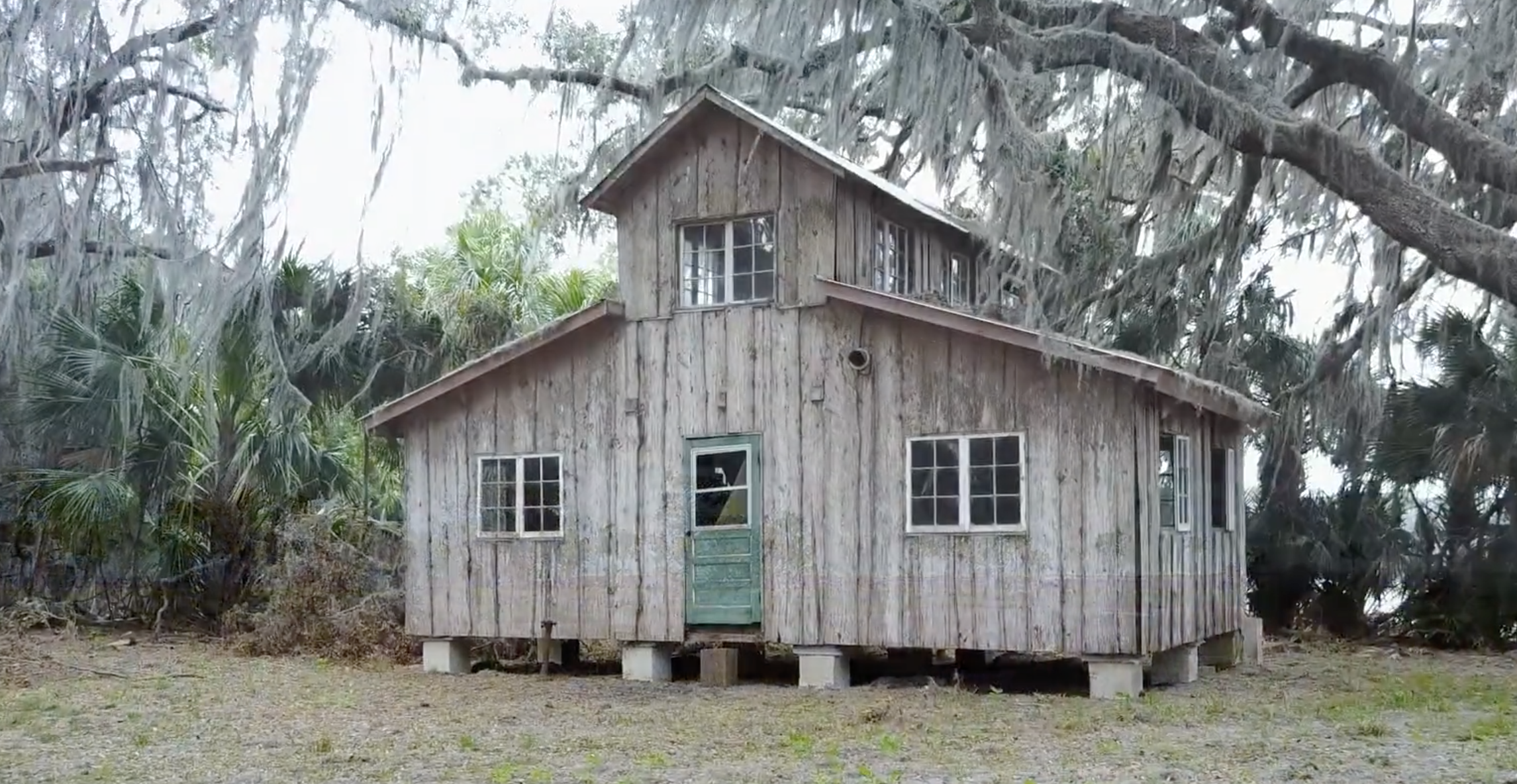
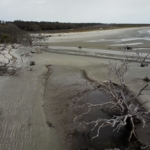
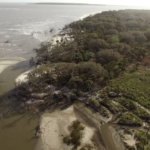
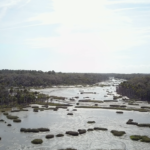
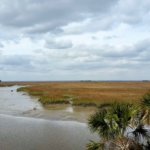
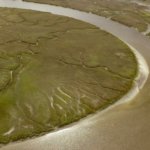
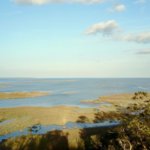
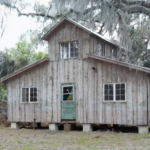

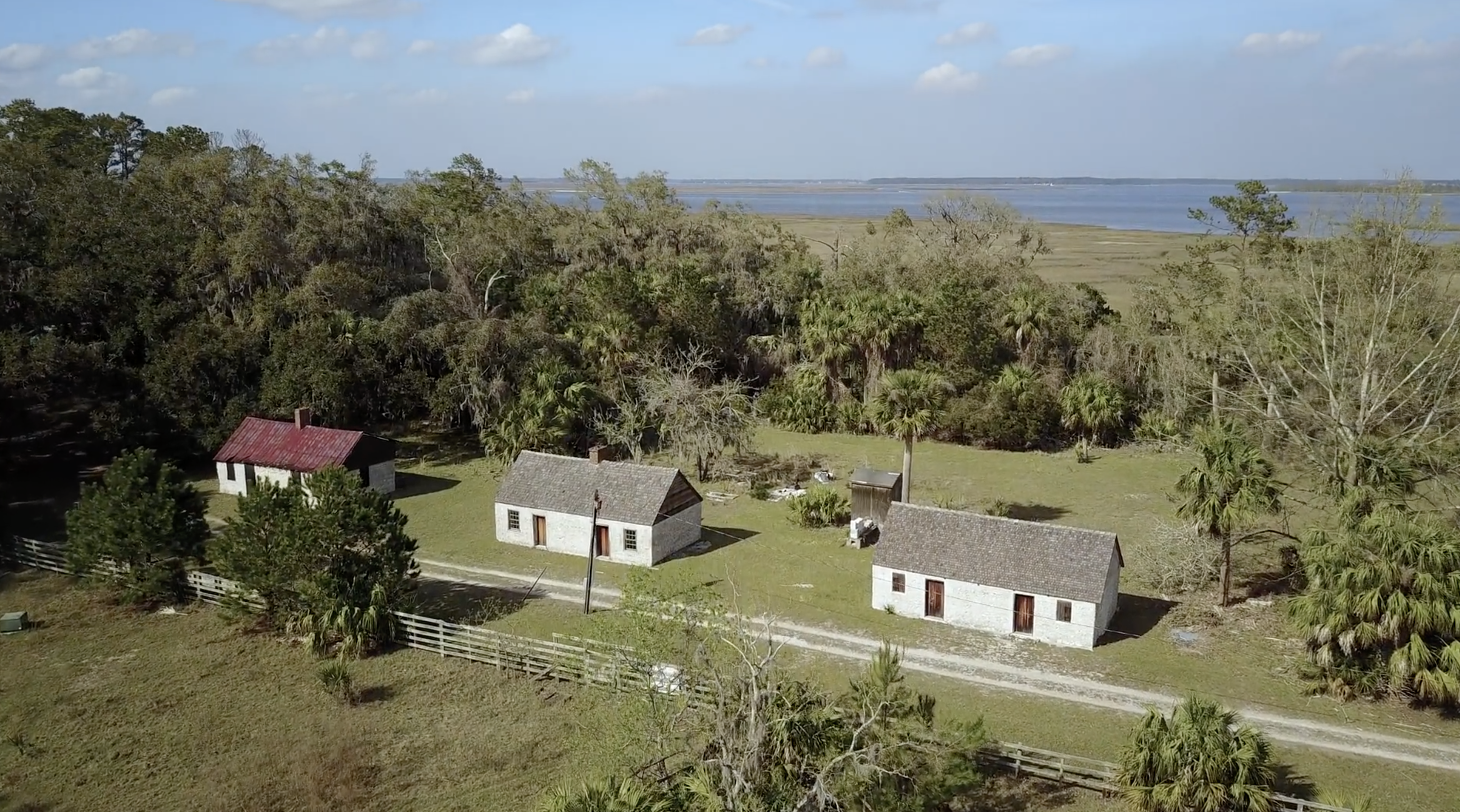
In 1978, Sandy West sold Ossabaw to the state of Georgia to establish it as the state's first heritage preserve, and it has been managed since by the Georgia Department of Natural Resources (DNR). The Ossabaw Island Foundation was established afterwards as a non-profit organization working with DNR to encourage educational, cultural, and scientific programs on the island. Sandy West continued living on the island until just recently; at the time of this writing (January 2020), she was living in nearby Savannah, Georgia, and had just celebrated her 107th birthday.
This Ossabaw flyover video provides a visual sample of the many interconnections between natural and human histories on Ossabaw. Featuring sweeping aerial views and audio annotations explaining the island's varied environmental features, this video is organized around four sequential but overlapping themes: fauna, flora, landscapes, and human structures.
Acknowledgment
Thanks to the Ossabaw Island Foundation for their support on this piece.
About the Authors
Anthony "Tony" Martin is a professor of practice in the Department of Environmental Sciences at Emory University. His publications include Life Traces of the Georgia Coast (Bloomington: Indiana University Press, 2013).
Steve Bransford is the senior video producer at the Emory Center for Digital Scholarship. His documentary feature film The Well-Placed Weed is available on the PBS website and app.
Michael Page is lecturer in Geospatial Sciences and Technology at Emory University.
Leotie Hakkila is an MPH student at the Rollins School of Public Health, Emory University.
Anandi S. Knuppel is a visiting assistant professor in the Department of Religious Studies at Lawrence University.
]]>Review
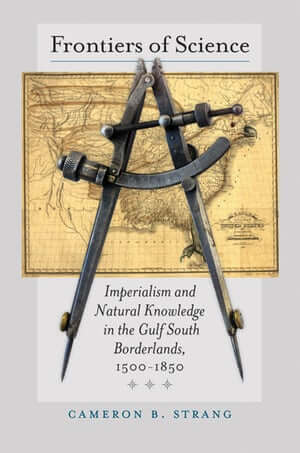
Open Cameron B. Strang's Frontiers of Science and you will encounter a fascinating frontispiece that receives no mention in the remarkable study that follows. The image is perhaps too easy for readers to bypass, particularly because modern reproduction obscures some of the details of this image, originally produced as a copperplate engraving in the mid-1770s. Yet it is worth pausing to examine the frontispiece closely because it visually manifests Strang's masterful argument that the local spaces and populations of the Gulf South borderlands—Strang's name for an area that includes today's Louisiana, Mississippi, Alabama, and Florida—were central to early American knowledge production.
At first glance the image appears to be a familiar allegory of Europe's conquest of the Americas. It centers on an American Indian who kneels before an enthroned Minerva—Roman goddess of wisdom, warfare, arts, trade, strategy, and commerce—and proffers a partially unscrolled map. Scenes of indigenous people offering maps to the colonizer populate the vast literature of European colonization. Referring to this particular image, among other similar ones, Martin Brückner observes that such "ceremonies of submission" are a visual convention that performed dangerous cultural work: they encouraged viewers to imagine the violence of empire as "the voluntary surrender of America by Native Americans."1Martin Brückner, The Geographic Revolution in Early America: Maps, Literacy, and National Identity (Chapel Hill: University of North Carolina Press and Omohundro Institute, 2006), 72–73. Yet close inspection of the frontispiece discloses a different story. This image does not narrate European conquest of the Americas, but rather Anglo-American fascination with a very particular part of North America: the Gulf South borderlands upon which Strang's study focuses—a space variously named and claimed by multiple imperial powers (including Spain, France, Britain and, starting in the 1790s, the United States), numerous Indian nations and confederacies (including the Natchez, Apalachee, Guale, Timucua, Calusa, Choctaw, Chickasaw, Upper Creek, Lower Creek, and Seminole), Africans both free and enslaved, and various groups of pirates and adventurers.
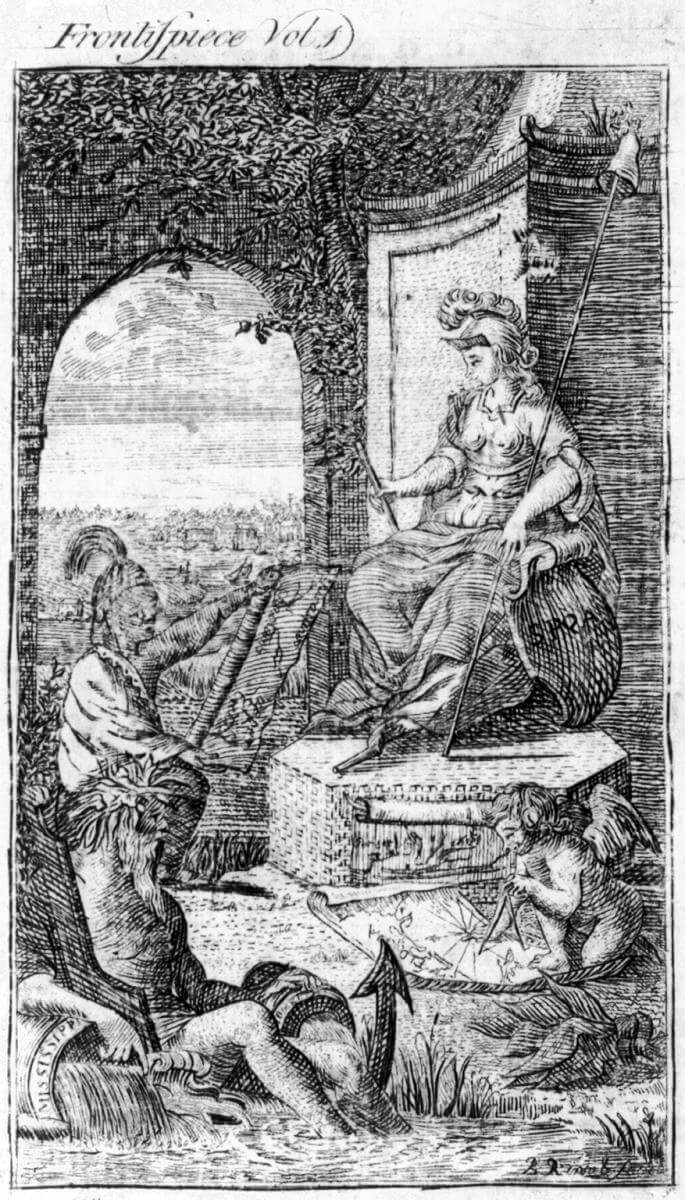
The frontispiece contains a wealth of specific detail about the lands, waters, and variegated populations of these southeastern borderlands. At lower right a smiling cherub uses a compass to inspect a navigational chart that, upon close examination, displays the Gulf of Mexico bordered by a sliver of land marked "Florida." To the lower left of the engraving, a bearded river god sits atop an anchor between two casks pouring forth streams of water. The casks are marked "Mississippi" and "ombech," respectively, signifying the Mississippi River and the Tombechbee River, an antiquated or alternate name for the Tombigbee River, which runs through present-day Mississippi and Alabama.2Arthur S. Marks, "Joining the Past to the Present: William Rush's Emblematic Statuary at Fairmount," Proceedings of the American Philosophical Society 157, no. 2 (2013): 190. And the American Indian kneeling before Minerva most likely represents one of the particular Indian tribes inhabiting the Gulf South, for this frontispiece was created by Bernard Romans for his 1775 A Concise Natural History of East and West Florida, the first natural history of the Floridas—an area then comprising present-day Florida and parts of Alabama, Mississippi, and Louisiana—to be published in North America.3For more on this work and its publication, see Kathryn E. Holland Braund, ed., A Concise Natural History of East and West Florida (Tuscaloosa: University of Alabama Press, 1999). The Dutch-Anglo-American Romans—like many of the other largely forgotten figures whose stories Strang tells so vividly—turned his local knowledge of the Gulf South to personal and public profit. Romans was a savvy adventurer and polymath who sensed an emerging fervor among the Anglo northeast elite for information about the soil, plants, geography, waters, and people of the southeastern reaches of the continent, and he pays homage to that fervor in his frontispiece. Against Minerva's throne leans a large shield marked "SPQA," likely signifying "Senate and People of the American Republic," rendering the goddess an allegorical figure for Americans in Boston, New York, Philadelphia, and other northeastern cities where Romans found financial support for his work among an impressive list of subscribers eager to know of the Gulf South.4Both Marks and Braund suggest that the shield's marking signifies this. For more on the publication and circulation of Romans's work, see Braund, A Concise Natural History.
"Since the nineteenth century," Strang tells us, "historians of the early United States have portrayed spaces beyond the Anglo East (and especially the Northeast) as zones of ignorance with no place in America's intellectual history, much less the history of science" (7). Historians of the Gulf South borderlands in particular found evidence for this portrayal in the writings of early French, Spanish, and Anglo observers who emphasized the "mental incapacity" and "backwardness" of the region's populations, along with the poverty of its lands when compared to more fertile spaces on the continent (7). Yet, for Strang, this familiar story of early American intellectual history began to lose explanatory power when he made a series of archival discoveries that ultimately convinced him that encounters in the southeastern borderlands in fact produced forms and networks of natural knowledge that mattered both within and well beyond the region. The resulting study deftly analyzes a range of neglected or underexamined materials—including letters, journals, military reports, hydrographical charts, geological and boundary surveys, guides to commerce and agriculture, periodical essays, natural histories, and Indian and European maps—that document a thriving intellectual life in the southeastern borderlands and the effects of that life on the meaning, production, circulation, and application of natural knowledge in the empires and nations competing for this space, namely Spain, France, Britain, and (starting in the 1790s) the United States (13–14).
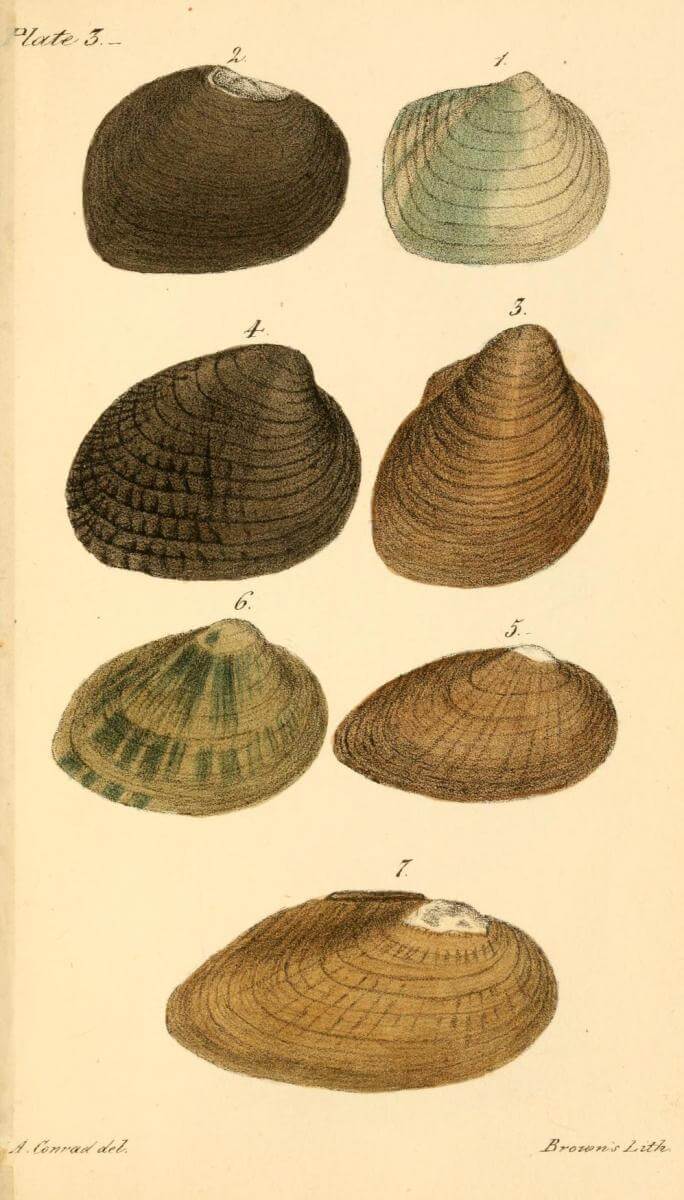
Each of Strang's seven substantial chapters is organized around a set of related case studies of locals who advanced science itself by learning to "navigate and manipulate" a Gulf South "world of rapidly shifting power relations" (5). A brief sampling of these studies affirms that we can no longer think only, or even first, of Anglos living along the Atlantic seaboard when we consider early American knowledge production and circulation (6). For example, we learn of an enslaved native cartographer, a Tawasa man named Lamhatty, whose local geographic knowledge of Florida's Gulf coast enabled his British captors to understand the region when they forced him to produce a map, upon which Lamhatty also chose to document the violence of imperial expansion (53–57). We also learn of a Creek Indian called Yaolaychi, whose mineralogical knowledge of the area around St. Augustine inspired a Spanish expedition in search of precious metals—a quest whose outcome Yaolaychi then shaped by telling vivid stories of a fearsome beast, or "Monster Lizard" (104–110). Turning to the development of astronomy in the Gulf South, Strang introduces Mississippi planter and astronomer William Dunbar, who used the observatory on his Natchez plantation—likely with the help of enslaved people—to produce astronomical knowledge that proved essential to the federal government's mapping of the Mississippi Valley (151–152). And in a chapter on slavery and geology, Frontiers of Science reveals the story of an enslaved shell collector in Alabama who located shells for Philadelphia's Academy of Natural Sciences, where scientists used conchology to understand the age, history, and future of the earth (248).
These and other accounts of Indians, Africans, and Europeans who leveraged local knowledge for different personal ends, and in response to different imperial pressures, call upon us to shift our framework for studying the history of knowledge in early America in several ways. First and foremost, these case studies demand a spatial and demographic shift: like Jane Landers's Atlantic Creoles in the Age of Revolutions, Kathleen DuVal's Independence Lost: Lives on the Edge of the American Revolution, and Alejandra Dubcovsky's Informed Power: Communication in the Early American South, Frontiers of Science affirms that we must look south to fully understand that a range of variegated landscapes and populations have shaped the history of North America at every turn. This spatial and demographic shift necessitates a chronological shift in our history of early American knowledge. For one, we can no longer consider that history solely in relation to the context of British colonialism, for science and empire entwined in the Gulf South for nearly three hundred years prior to US founding and continued to do so long after Britain's thirteen colonies became the first United States.
Finally, and provocatively, Strang's work demands at least two epistemological shifts. First, we must expand our definitions of what counts as "natural knowledge," "science," and "scientific practice." At its broadest level, this book usefully reminds us that science in early North America was not the professionalized disciplined that it would start to become during the late nineteenth century, but rather a capacious practice that engaged a broad and interested public in places far beyond academic or other institutional spaces. In this way, Strang's study joins others that widen the scope of early American knowledge-making, including Susan Scott Parrish's American Curiosity: Cultures of Natural History in the Colonial British Atlantic World, Laura Dassow Walls's Passage to Cosmos: Alexander von Humboldt and the Shaping of America, and Britt Rusert's Fugitive Science: Empiricism and Freedom in Early African American Culture. And Strang productively amplifies the scope of these studies by considering multiple cultures—Indian, African, Anglo, French, and Spanish—across a timespan of more than three centuries (1500–1850).
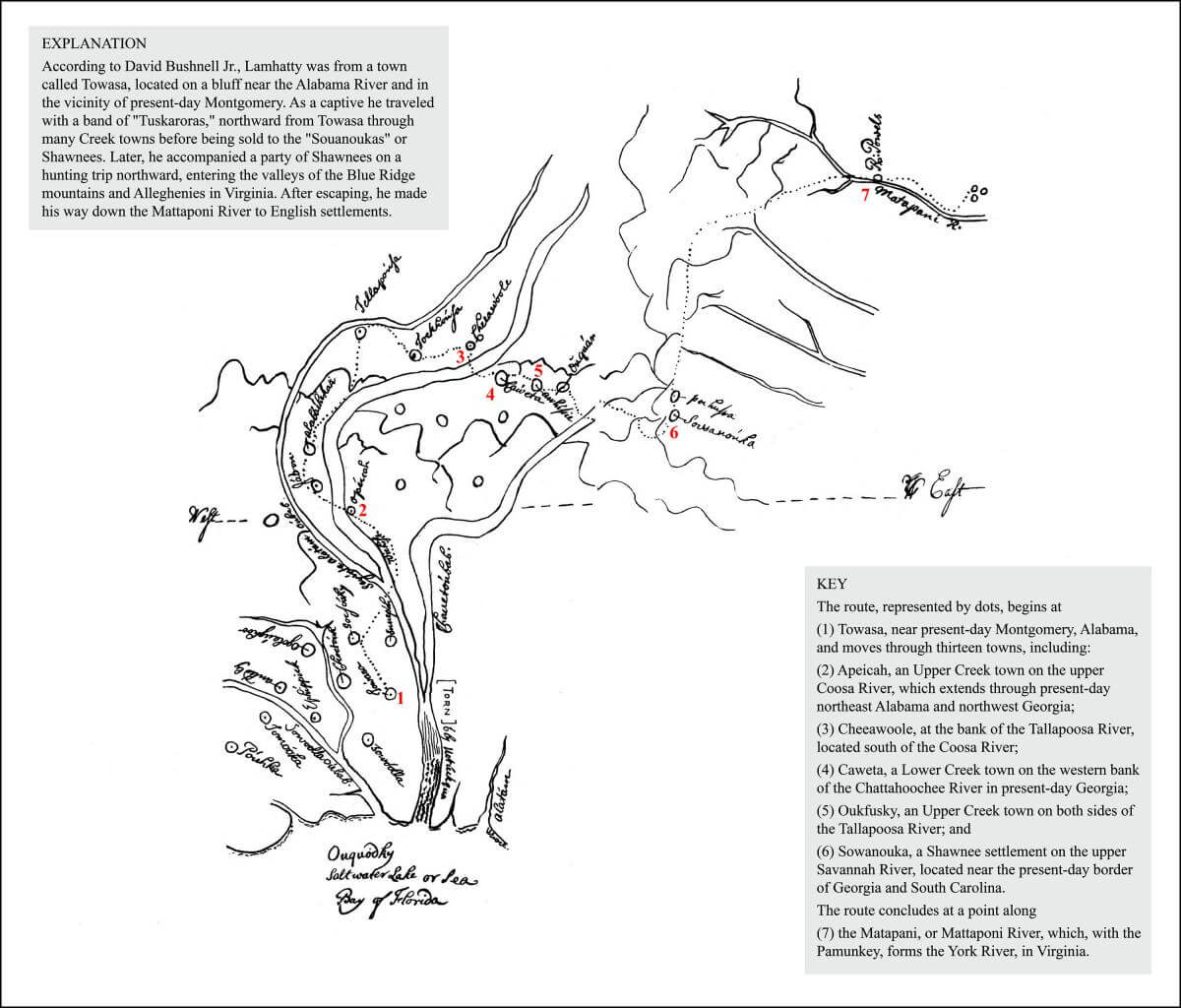
Second, Frontiers of Science also demands that we recognize the constitutive role of imperial violence in the production of scientific knowledge in North America. For empire occasioned the interactions—many of them forced—among an astonishing array of materials, practices, and practitioners that scientific advancement required. Indian captivity facilitated British cartography (53–57). US expansion sponsored ethnography by making black and Indian bodies available to white "experts" (225). And plantation slavery enabled specimen collection and observation that proved essential to geological research (245). Likewise, the production of scientific knowledge did not always lead to freedom—especially for the producers. For example, whereas Yaolaychi's storytelling increased his status among Spanish officials and impeded their access to local mineral resources (104–116), Lamhatty's mapmaking facilitated British slave trading (61), and many Africans with natural and spiritual expertise risked imprisonment and death for their knowledge (97).
Widely varying effects resulted from the entwining of empire and science in the Gulf South across multiple centuries, yet Strang's skillful illumination of these effects upends any assessment that the continent's borderlands lack "a meaningful history of knowledge" (131). That assessment, Strang recognizes in the epilogue, has present-day effects: it risks producing "a narrow vision of America's cultural past" that can then be used "to justify ongoing exclusion and inequality" (344). A perspective on the Gulf South as somehow backward, separate, and expendable perhaps manifests most publicly these days in environmental disasters that result directly from the uneven distribution of federal resources to the South more broadly. If the humanities are useful for showing us that the past is "still part of the present with implications for the future," as Dominick LaCapra explains, then we need more studies like Frontiers of Science that recover a more inclusive early American history.5Dominick LaCapra, Understanding Others: Peoples, Animals, Pasts (Ithaca, NY: Cornell University Press, 2018), 165.
About the Author
Michele Navakas is an associate professor of English at Miami University of Ohio where she teaches early American literature, culture, and environment. She is the author of Liquid Landscape: Geography and Settlement at the Edge of Early America (University of Pennsylvania Press, 2018), which won the 2019 Rembert Patrick Award and the 2019 Stetson Kennedy Award from the Florida Historical Society. She is currently at work on a cultural history of coral and politics in early America.
]]>Video and Essay
A barrier island on the Georgia coast, Sapelo has an unusually long and varied blend of natural and human history. The western half of the island is composed primarily of Pleistocene sediments deposited along a shoreline 40–50,000 years ago. Much of its eastern half is more recently formed and dynamically shifting. Modern ecosystems include extensive salt marshes with tidal creeks, beaches, maritime forests, back-dune meadows, grasslands, and a few human-made freshwater ponds. Erosion occasionally reveals sediments from older environments, such as hundreds-year-old relict marshes exposed along Cabretta Beach on Sapelo's northeastern edge.
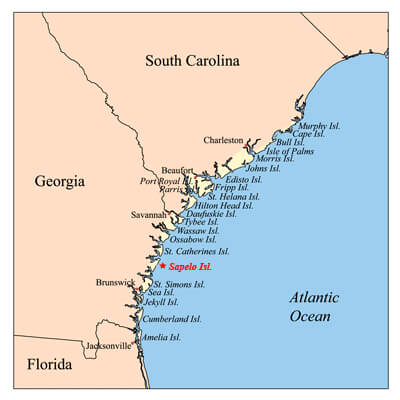
Sapelo Island in the Sea Islands Watershed. Courtesy of Wikimedia Commons. Creative Commons license CC BY-SA 2.5.
The Sapelo climate is temperate to subtropical; temperatures range from an average high of 90°F (32° C) in summer to 50°F (10° C) in winter. Freezing is rare. Rainfall is about 50 inches (127 centimeters) a year, with the majority of precipitation during the May–September hurricane season. Despite the impact of Hurricane Matthew on October 8, 2016, hurricanes rarely affect the Georgia coast. The worst was in 1898, and directly impacted Sapelo and its companion, Blackbeard Island, to the northeast. Until the 1898 hurricane hit, Blackbeard hosted a US Marine Hospital yellow-fever quarantine station, which was damaged heavily by the storm; it reopened, only to close in 1909 with the development of yellow-fever vaccines.
A prominent and well-preserved Native American (Guale) shellring on the northwestern corner of the island gives evidence that humans have experienced Sapelo for at least 4,500 years. The arrival of the Spanish in the sixteenth century resulted in the naming of "Sapelo," an Anglicized corruption of "Zapala" from Spanish and likely a corruption of the original Guale name for the island. French and English colonization of Sapelo in the eighteenth and nineteenth centuries heavily modified the local ecosystems.
Following the American Revolution, alteration of the local environment continued throughout the early to mid-nineteenth century. Plantation agriculture depended on slave labor of people with varied languages and origins in west Africa, resulting in an enforced cultural mélange. Descendants of those enslaved people, and the only Gullah-Geechee population on any Georgia barrier island, reside today in the Hog Hammock community. Although shrinking in size, Hog Hammock retains a distinctive culture and features a revival of traditional knowledge, including handicrafts such as sweetgrass basket weaving, cultivation of unique agricultural species (e.g., Sapelo red peas), and Gullah-Geechee storytelling.
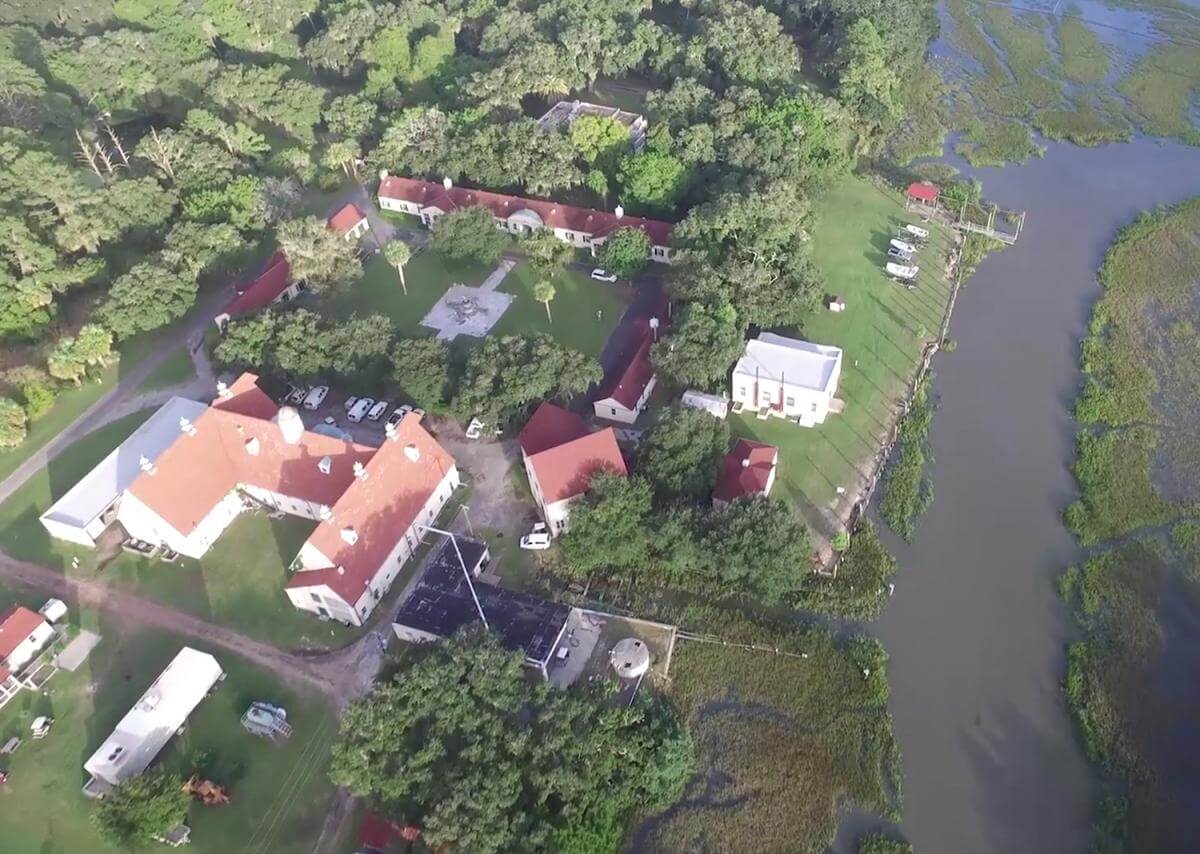
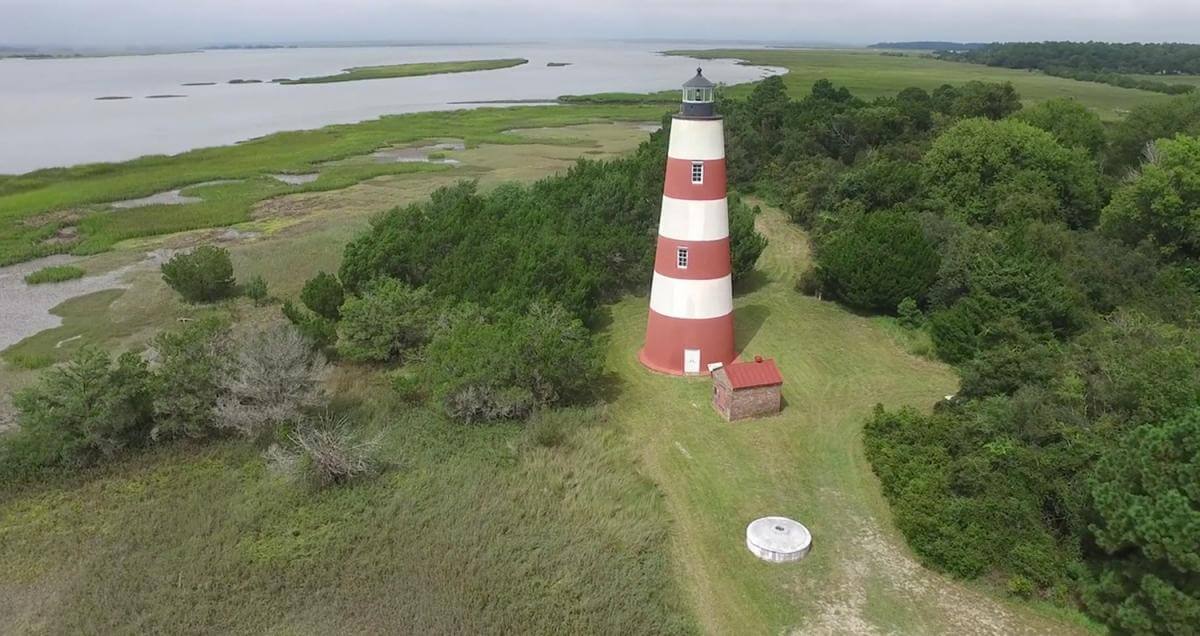
Top, the UGAMI complex on Sapelo Island, Georgia, 2015. Bottom, lighthouse on Sapelo Island, Georgia, 2015. Screenshots courtesy of Southern Spaces.
Perhaps the most scientifically significant legacy of Sapelo is its birthing of modern ecology, much of which was done at the University of Georgia (Athens) Marine Institute, or the UGAMI, founded in 1953. The UGAMI owes its existence to ecologist Eugene Odum (1913–2002) and tobacco heir/businessman R.J. Reynolds, Jr. (1906–1964). Reynolds bought most of the island in 1934, but Odum persuaded him to donate land and buildings to start the UGAMI in 1953. The Institute, located next to its study sites, has conducted world-renowned research on salt-marsh ecology and other aspects of natural communities on and around the island.
Reynolds' widow, Annemarie Reynolds, sold much of the island to the state, which the Georgia Department of Natural Resources now manages. The western edge of Sapelo is part of NOAA's National Estuarine Research Reserve system, termed the Sapelo Island National Estuarine Research Reserve. The UGAMI still serves as a thriving center for ecological research and hosts academic field trips in natural science education.
In September, November, and December 2015, we visited Sapelo Island to gather ground and aerial drone-video footage that would visually summarize its ecosystems. This footage also shows signs of human activity, such as the UGAMI complex, paved roads, a freshwater pond created by excavation, and the present-day lighthouse, still used for guiding maritime traffic in Doboy Sound.
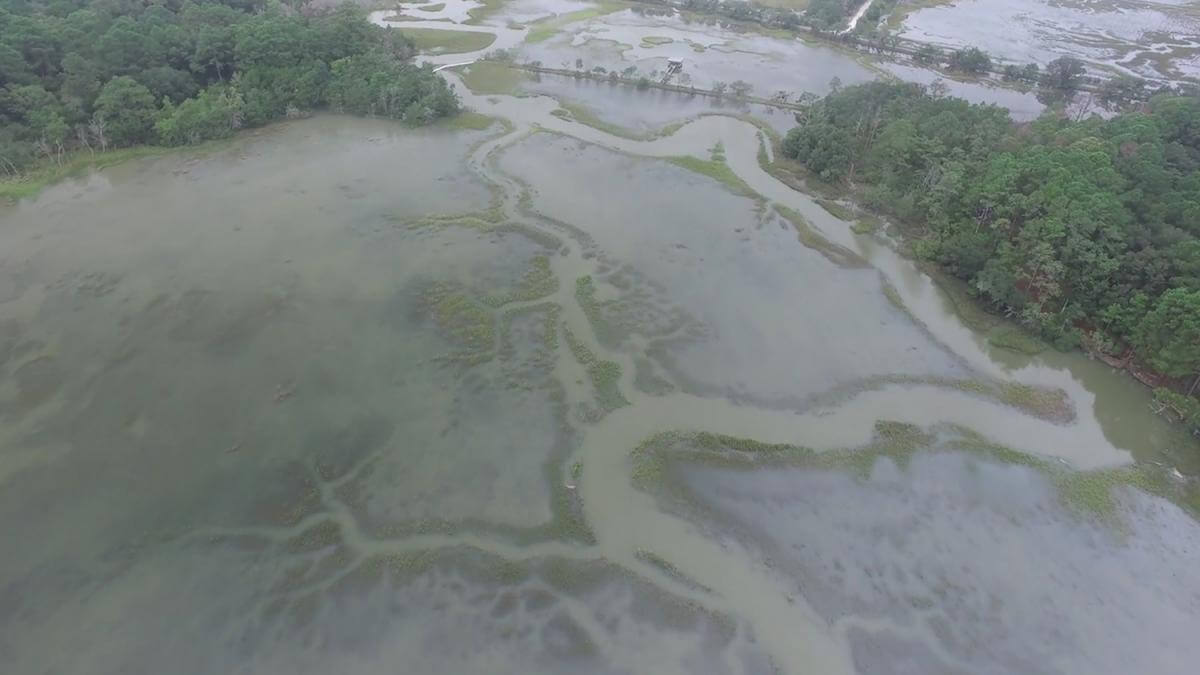
Internal Waterway, Sapelo Island, Georgia, 2015. Screenshot courtesy of Southern Spaces.
Our first trip in September 2015 also coincided with "king tides," spring tides accentuated by a relatively stronger gravitational pull associated with a "super moon." This situation caused unusually high tides to flood marshes, roads, and other low-lying places on Sapelo, a phenomenon repeated there and along the rest of the Georgia coast in late October 2015. Tidal ranges on the Georgia coast are already greater than those of most barrier island systems, typically varying from 2.5–3 meters (8.2–9.8 feet). Any addition to this already-voluminous water exchange imparts dramatic effects. Some of the drone footage showing the extent of the flooding serves as a harbinger of predicted sea-level rise on the east coast associated with climate change. We also included two snippets of time-lapse sequences of intertidal areas—Cabretta Beach, on the northeastern corner of the island, and a salt marsh in the south end—to further convey the effects of tides on island margins and interiors.
This Sapelo video encapsulates a history that forecasts the future under climate change. Among its subjects are: abrupt transitions in coastal ecosystem, from beach to back-dune meadows to maritime forests; beaches where sand is being actively eroded or deposited by longshore drift; a tree "boneyard" with dead trees on a beach signaling the former presence of a maritime forest; an artificial freshwater pond adjacent to maritime forest but with salt marshes in the background; dendritic drainage patterns of marshes at low tide, and much more. Despite its short 3:45-minute length, this video's content, combined with its brief narrated descriptions, can inspire an hour or more of classroom discussion of natural and human systems on this remarkable Georgia barrier island.
About the Authors
Anthony (Tony) Martin is a professor of practice in the Department of Environmental Sciences at Emory University. His publications include Life Traces of the Georgia Coast (Bloomington: Indiana University Press, 2013). Steve Bransford is an educational analyst for video with University Technology Services at Emory. He launched his own production company, Terminus Films, in 2001. Anandi Salinas is a PhD candidate in religion at Emory and a training specialist with the Emory Center for Digital Scholarship. Michael Page is lecturer in geospatial sciences and technology at Emory. Shannon O'Daniel is an educational analyst with Emory's Library and Information Technology Services.
]]>Presentation
About the Speaker
James W. Porter is the Meigs Distinguished Professor of Ecology at the University of Georgia and a faculty member in School of Marine Programs, Water Resources and Conservation Ecology. Porter has worked extensively on coral reef ecology, especially the biology, ecology, and assessment of Floridian and Caribbean coral reefs. His research and expertise has brought him to testify before Congress five times on environmental concerns, most recently on the effects of global warming on coral reefs.
]]>Video and Essay
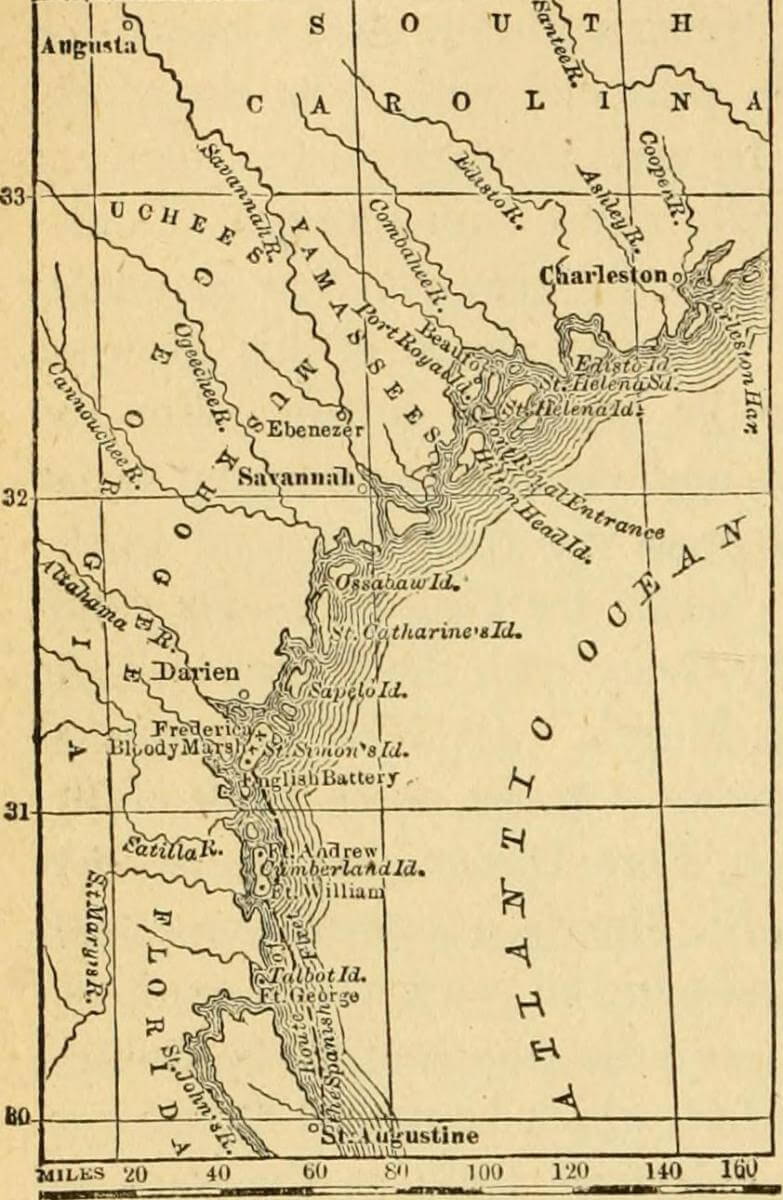
One of the barrier islands along the Georgia coast of the Atlantic Ocean, St. Catherines has an extraordinary ecological and settlement history. First inhabited more than four thousand years ago, the undeveloped island is privately owned but protected for the public good. A small network of unpaved roads connect the interior of the ten-mile long, three-mile wide island. In addition to ongoing environmental study, extensive archaeological research has occurred at St. Catherines with regard to Native American settlements, the Spanish mission of Santa Catalina de Guale, and pre-Civil War plantation sites.
 |  |
During a week-long visit to St. Catherines in March 2015, Emory University geographer Michael Page, environmental scientist Anthony (Tony) Martin, and graduate student Alison Hight flew a camera-bearing drone over nearly every type of ecosystem on the island: maritime forests, extensive beaches, back-beach meadows, salt marshes, mud flats, fresh-water ponds, and more. Along with colleagues from Georgia Southern University, Page and Martin have worked together at St. Catherines since 2011, locating, describing, mapping, and writing about alligator dens and gopher-tortoise burrows. The use of a drone enables a new way of studying the island's dynamic ecosystems and scouting locations difficult to reach on foot. During their spring 2015 trip, Page and Martin found places where alligators walk from their dens through nearby salt marshes, then return. Rather than trying to track the alligators in the marshes—a challenging, time-consuming, and risky endeavor—they sent the drone to take overhead photos at higher resolutions than currently available imagery from the US Department of Agriculture and other agencies. Page and Martin georeferenced and mosaicked the captured images for their research geodatabase. In addition to demonstrating the potential of a drone in difficult-to-access areas, Page and Martin plan to use the St. Catherines video footage to teach students how to identify and interpret the environments of a Georgia barrier island, and to conduct local-scale mapping.
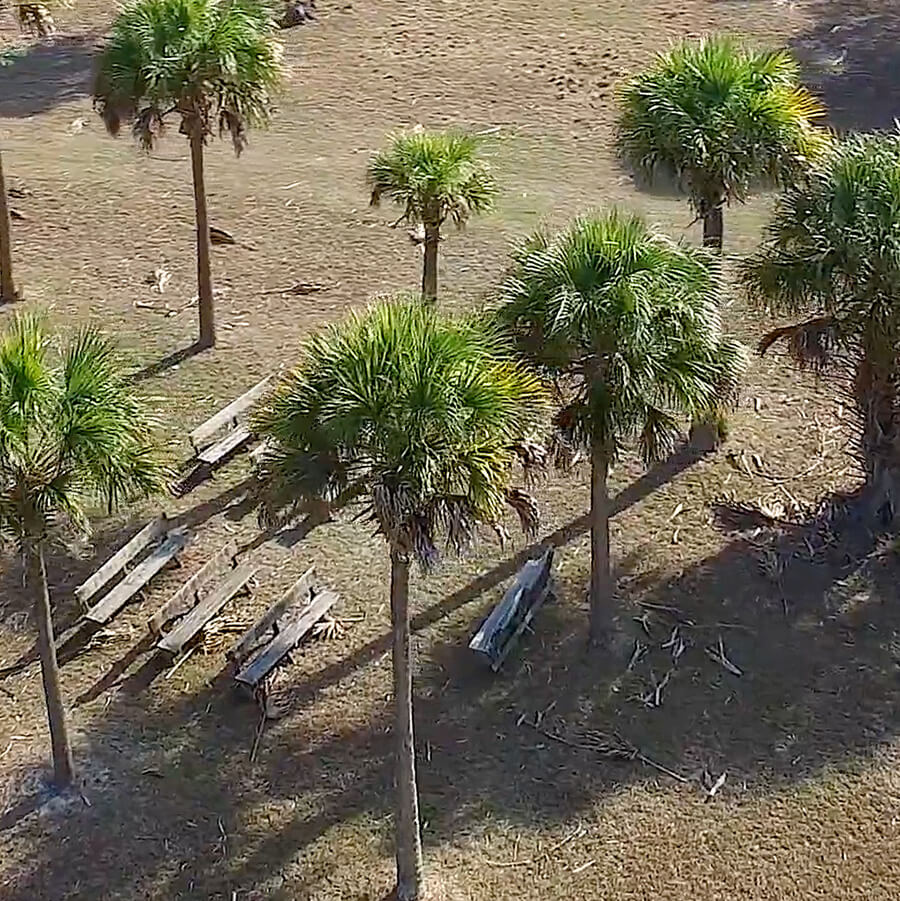
From the many hours of March 2015 drone footage, documentary videographer Steve Bransford edited the short video presented here. It begins by orienting viewers to the location of St. Catherines, and then travels smoothly across the various ecosystems. The former site of the Spanish mission is visible (its footprint outlined by cabbage palms) as are alligator tracks, and alligators swimming near the video's end.
About the Authors
Steve Bransford is an educational analyst for video with University Technology Services at Emory University. He launched his own production company, Terminus Films, in 2001. Anthony (Tony) Martin is a professor of practice in the department of Environmental Sciences at Emory University. His publications include Life Traces of the Georgia Coast (Bloomington: Indiana University Press, 2013). Michael Page is lecturer in geospatial sciences and technology in the department of Environmental Sciences at Emory University.
]]>Review
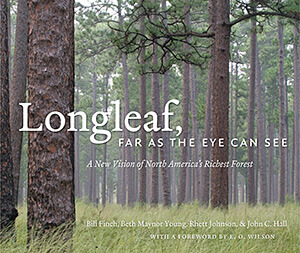 |
Longleaf, Far as the Eye Can See presents a rhapsodic argument in pictures and words for the preservation, restoration, and reestablishment of longleaf pine forests across the areas of the US South where they once existed or dominated, ranging from Maryland down and across the Atlantic and Gulf Coasts to east Texas. The book's creators are activists in the longleaf restoration campaign, and the work is supported by the Longleaf Alliance, an organization based at Auburn University and created in 1995 to coordinate cooperation between private landowners, forest industries, government agencies, conservation groups, and researchers. The concept for the book originated with conservation photographer Beth Maynor Young and Longleaf Alliance director Rhett Johnson. Bill Finch, who served as lead writer, is the executive director of the Mobile Botanical Gardens, and John C. Hall is curator of the Black Belt Museum at the University of West Alabama.
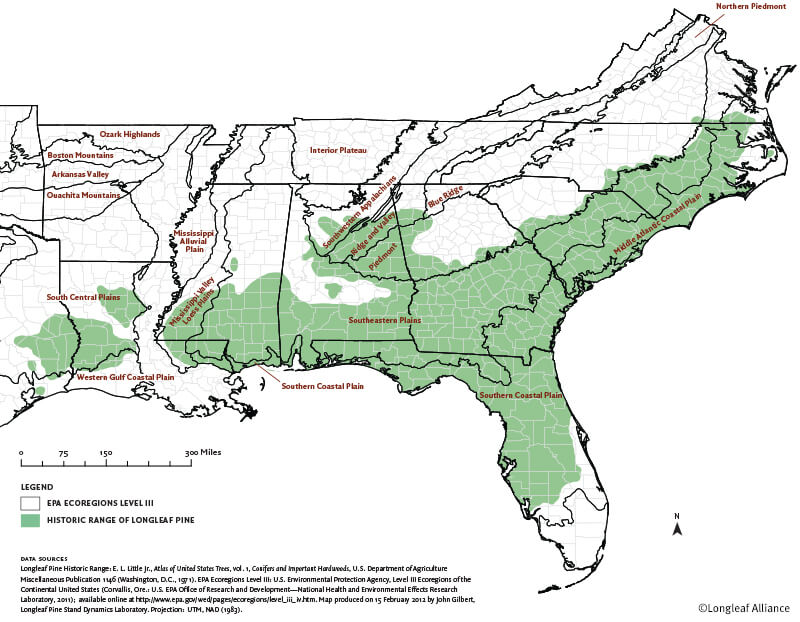 |
| EPA ecoregions level III and historic range of longleaf pine, Map by Longleaf Alliance. Reproduced by permission of Longleaf Alliance. |
Young's stunning photographs of longleaf forests and flora and fauna, easily the book's outstanding feature, dominate Longleaf's oversized format. The writing, occasionally lyrical, sometimes colloquial, and generally informative, does not rise to the level of the images.
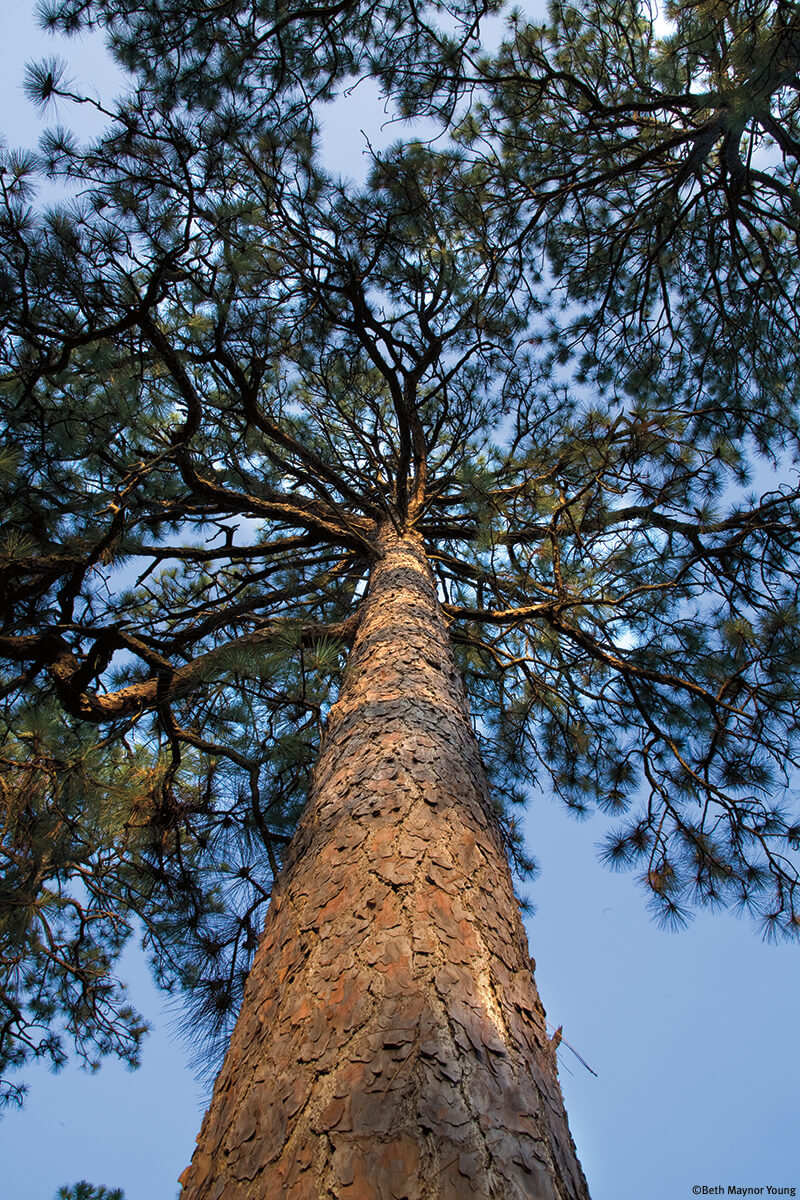 |
| The distinctive shape of a mature longleaf, Weymouth Woods-Sandhills Nature Preserve, Southern Pines, North Carolina. Photograph by Beth Maynor Young. Reproduced by permission of the University of North Carolina Press. |
Once full of diverse plant and animal life, longleaf forests grew in many forms and various conditions and soil types across large areas of the southern states. The authors of Longleaf effectively argue that the forests' diminution has brought a reduction or loss of numerous species, and that fire—both natural and "managed"—is essential.
Some features of the book are irritating. The text breaks on page forty-three for several pages of non-related information and does not resume until page fifty-two. Various experts are mentioned, but the titles of their works are generally not included and there is no formal bibliography. Lawrence S. Earley's Looking for Longleaf: The Fall and Rise of an American Forest, for instance, is an important work that readers should know about.
The authors overlook, exclude, or trivialize some subjects. They treat the important topic of fire as though those who favored fire exclusion were poorly informed zealots, while their opponents were enlightened. The general public has become more aware in recent years, particularly since the Yellowstone fires of 1988, of the importance of fire and fire management in forested areas. But historically, the subject is nuanced and complicated. In the early twentieth century many, if not most, in forestry and land management regarded fire as an unmitigated enemy of forests. Famous anti-fire campaigns featured Smokey Bear. However, foresters such as Yale professor H. H. Chapman, and Austin Cary and Eloise Gerry of the US Forest Service, demonstrated their understanding of fire as a management tool through both their professional work and their writing. The problem was partially one of communication. How do you convey to the public that fire is part of the natural process and that some fire is good, while some is not? And some fire was bad. The authors extoll the wisdom of those who burned to control pests or clear undergrowth, but fail to mention those who set fires to sabotage the property of large landowners and companies, or simply for entertainment. They also do not mention the damage done to young seedlings by wild hogs and the destructive effects of naval stores production.
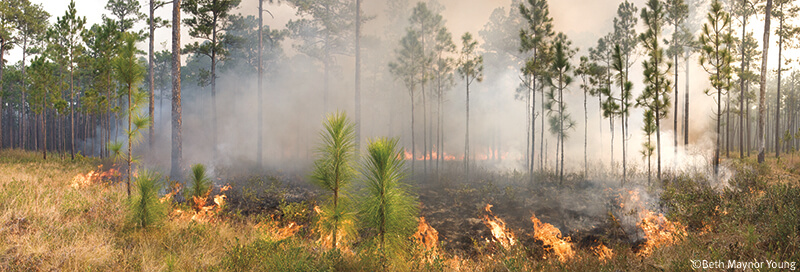 |
| A manageable fire in a regularly burned longleaf area, Blackwater River State Forest, Milton, Florida. Photograph by Beth Maynor Young. Reproduced by permission of the University of North Carolina Press. |
On the other hand, the authors spotlight some positive examples of longleaf management that are little recognized by the general public. For example, they highlight the role of the military in maintaining large acreages of longleaf on bases such as North Carolina's Fort Bragg, where fires ignited by lightning and ammunition are allowed to burn and contribute to the natural reproductive cycle of the forest. Longleaf also features the stories of individuals and organizations striving to restore or maintain the forest's original domain across the South. In discussing private ownership of forests and wood production, the authors do not account for the enormous changes of recent years with the disappearance of fears of a "timber famine," and the divestiture of vast acreages by forest products companies and their acquisition by investment trusts that are not focused as much on quick regrowth, harvest, and processing of timber as were the lumber and paper companies. Aesthetic and environmental values are important management objectives for some of these newer owners.
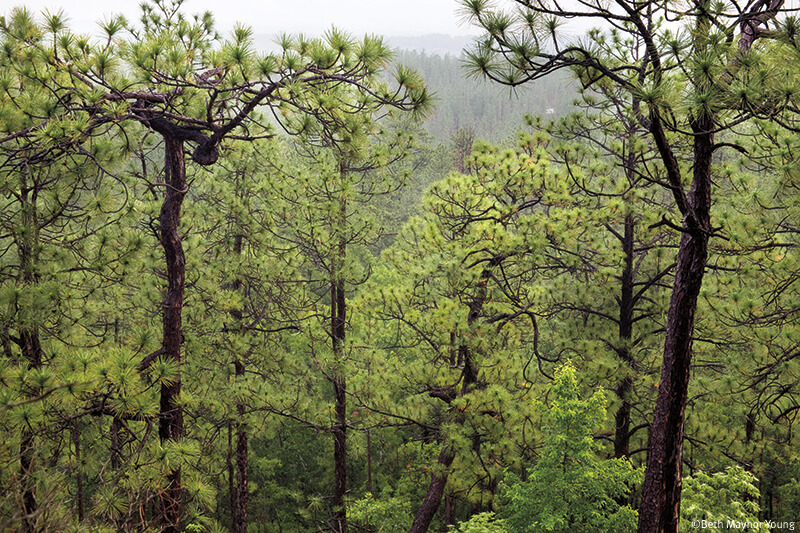 |
| Mature longleaf on Sugar Loaf Mountain, Sand Hills State Forest, Patrick, South Carolina. Photograph by Beth Maynor Young. Reproduced by permission of the University of North Carolina Press. |
By emphasizing the biological diversity, beauty, and value of these remarkable forests, this book will help readers "gain a new appreciation for the wonders of the longleaf forest" (x). Hopefully Longleaf will also convince its audience of the imperatives of protection and restoration.
About the Author
James E. Fickle is professor of history at the University of Memphis and Visiting Professor of Forest and Environmental History at the Yale School of Forestry and Environmental Studies. He is author of Timber: A Photographic History of Mississippi Forestry (Jackson: University Press of Mississippi, 2004) and Mississippi Forests and Forestry (Jackson: University Press of Mississippi, 2001), among other books. His book Green Gold: Alabama's Forests and Forest Industries is forthcoming from University of Alabama Press in early 2014.
Acknowledgements
The photographs included in this review are from Longleaf, Far as the Eye Can See: A New Vision of North America's Richest Forest, by Bill Finch, Beth Maynor Young, Rhett Johnson, and John C. Hall. Copyright © 2012 by the University of North Carolina Press. Photographs © 2012 by Beth Maynor Young. Used by permission of the publisher.
]]>Review
I adored Beasts of the Southern Wild and have seen it three times: each viewing a quick incursion into the southern surreal. Benh Zeitlin's movie has received a nomination for best film, and Quvenzhané Wallis, his spunky, firebreathing star, may be crowned best actress. In the movie she plays the part of one of Louisiana's Katrina-surviving, throwaway children, but on her own terms she is a gargantua. The poster for the film shows the actress in darkness—her legs striding the ground, arms reaching out like Leonardo's Vitruvian Man and in each hand a giant sparkler irradiating the movie's title in untamable light.
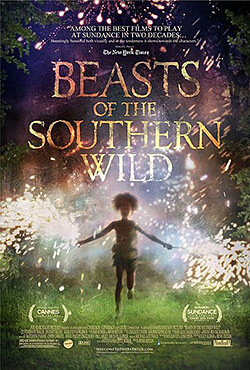 |
| Film poster for Beasts of the Southern Wild, Twentieth Century Fox, 2012. |
My present passion is luminous trash, glowing debris, garbage that lights up—like the tossed-away sled at the end of Citizen Kane or the illuminated basketball hoops that David Hammons makes out of Harlem debris or the bright garbage that a dirty robot collects in Wall-E. Beasts is a movie where debris and light vie for screen time. The heroine, Hushpuppy, is covered with mud as she traverses the squishy soil around her claptrap, rickety house. In the film's opening scenes the screen floods with light when the Bathtub's bright revelry spills over and neons the Cineplex audience. This film carries the nation's baggage; it investigates a culture of racial neglect, creates a zone of history-making for Katrina's disposable bodies, and provides a steady critique of white capital. The film's rags and wastelands—its killing fields—become powerful emblems of the Southland's (and our nation's) commitment to toxic inequality.
But something else rages in this film; it refuses the realism of social critique and advances instead into hubris land, into a new realm of myth making for the twenty-first century. "We's who the earth is for," boasts Hushpuppy, echoing her father's view of the racially mixed population of the Bathtub. This community bristles with carnivores, meat-eating women and men unashamed of their appetites, alcohol, and impoverishment. Nurtured, imperiled, the child creates a wild set of gods: demiurges, mother figures, aurochs, and sirens to inhabit a world dangerous and ecstatic. She forces us to ask: what myths do we need to live in an era of global warming where every coastal community may soon look like the Bathtub? As Zeitlin said of Isle de Jean Charles, the place where Beasts was filmed: "it's a place where ingenuity rules. Planks, low-lying bridges make up the walkways from house to house, so if your bridge gets knocked out, you fill the gap with a mattress or roofing."1Emily Brennan, "A Filmmaker's Lessons From the Bayou," The New York Times, August 16, 2012, Tr 3. Quvenzhané Wallis deserves an Academy Award because her impassioned presence and plain speaking bestow an unexpected path for assessing the mess we have made; her measured voice endows the film with a new mythos that addresses a world we have broken: a human cosmos that may be dirtied beyond repair.
Where to begin? Charles Wright's poem "In Praise of Thomas Hardy" takes us straight to the heart of light, dirt, and their relation to energy:
Each second the Earth is struck hard
by four and a half pounds of sunlight.
Each second.
Try to imagine that.
No wonder deep shade is what the soul longs for,
And not, as we always thought, the light.
No wonder the inner life is dark.2Charles Wright, "In Praise of Thomas Hardy," in A Short History of the Shadow (New York: Farrar, Straus, and Giroux, 2002), 27.
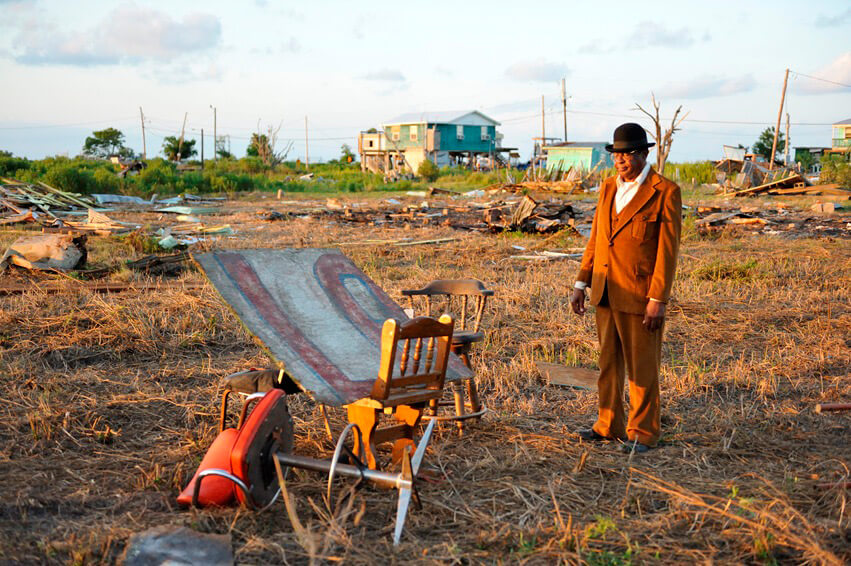 |
| Still from Beasts of the Southern Wild, Twentieth Century Fox, 2012. |
Beasts of the Southern Wild is about this four and a half pounds of sunlight. What happens when we take it for granted? What happens as we unravel the fabric of the universe by throwing two and a half centuries of fossil fuel back at the sun?
Beasts begins with a child making a dirt nest for a half grown chick, reminding us that even though primates may have started in the treetops, our home is in the dirt. This mud nest is small, lopsided, and looks uncomfortable, like a practice run for that other dirt-obsessed movie, Close Encounters of the Third Kind. But instead of conjuring light-hungry aliens who come to earth, the nest-building child picks up the chick and listens to its heart; she imagines a chorus of animals: "'I'm hungry. I want to poop.' But sometimes they start talking in codes." How do we make our way into the coded life of other species? In Beasts meat is never processed and prepackaged; it always comes on the bone or in the shell—a reminder of its origins inside other creatures. "Meat is the buffet of the universe," Hushpuppy 's teacher insists. Hushpuppy's father reminds her: "Share with the dog," as if our main task in the Anthropocene, this new era when humans must learn to see themselves as a geologic force preying on the planet, is to know ourselves as a species dependent on other species. As Dipesh Chakrabarty suggests in "The Climate of History": "Changing the climate, increasingly not only the average temperature of the planet but also the acidity and level of the oceans, and destroying the food chain are actions that cannot be in the interest of our lives."3Dipesh Chakrabarty, "The Climate of History: Four Theses," Critical Inquiry 35 (Winter 2009): 219. Or as Hushpuppy says in the trailer: "The whole universe depends on everything fitting together. If one piece busts, even a small piece, the entire universe will get busted."
The vulnerability at the heart of Beasts is staggering. We should have created a planet where children can be safe, but we have not. One in ten American children live in deep poverty; 2.8 million children live in households that have incomes of less than two dollars per person per day—a benchmark for developing countries.4 Paul Tough, "The Birthplace of Obama the Politician," New York Times Magazine, August 19, 2012, 31. Peter J. Hotez, "Tropical Diseases: The New Plague of Poverty," New York Times, Saturday Review, August 19, 2012. Hushpuppy steers through her world in underpants, wearing white plastic boots covered in mud, her parents lost, the camera lens that follows her scratched or marred. She jousts perilously with sparklers; she lights a gas range and burns down her house; neglected and feisty, she is more wild than free, and her thoughtful face summons archetypes of abandonment.
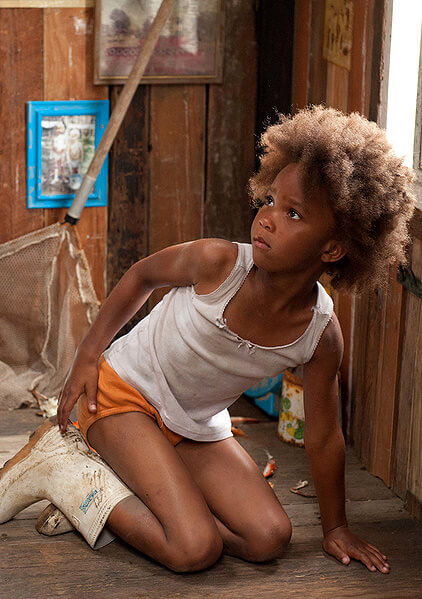 |
| Quvenzhané Wallis as Hushpuppy. Still from Beasts of the Southern Wild, Twentieth Century Fox, 2012. |
Hushpuppy's near nakedness stirs the film's controversy. Author bell hooks protests oppressive stereotypes that ensure Hushpuppy's victim status and her father's abusiveness and cruelty: his life of drunken delirium. Arlene Keizer, a scholar of African American literature, noted in conversation that Zeitlin's film luxuriates in dirt, disorder, and mental disturbance—as if these were the exclusive properties of the racialized poor. Even the actress who plays Hushpuppy, Quvenzhané Wallis, insists in an interview with Oprah that the heroine should have been allowed to wear long pants. Were the filmmakers conscious of tapping these reservoirs of stereotypical abjection? Why summon inaccurate, dirty cliches about the hopeless lot of underclass blacks, Louisiana, and the marginal Southland, so blindly?
I want to argue that these criticisms, while eloquent, are off the mark. Beasts is not a slice of life or a realist screed; its business is mythological: it proffers a sacred narrative with overtones of awe and cosmic investigation. Querying the social order, it offers strange pedagogies about how we should live in a melting world. Hushpuppy equals the Invisible Man as a "thinker-tinker," a philosopher child who makes up her own world of demiurges and deities; she imagines calving glaciers, starry mothers, and glistening aurochs who want to gobble up cave babies, and in the process she creates creatures so scary and risible that we almost forget their filmic source—a handful of potbelly pigs blown up by the camera and turned into primeval beasts with a patchwork of nutria fur and tacked-on tusks—the bricolage of an odd filmmaker and an even odder child's imagination.
Beasts works through two additional forms of myth making. First, while Hushpuppy's father Wink is scary, he also has a vitality so palpable that his daughter has to absorb it. "Who de man?" he shouts. "I the Man!" she replies. In a scene where one of the white men in her community is teaching Hushpuppy how to eat crab with a knife (and standing suggestively behind her, reminding us of Hushpuppy's sexual vulnerability once her father dies), Wink insists that she "beast it": she must break the crab open with her bare hands and suck its guts out by sheer force of will. Her father may be helpless against the curse of alcohol, but he provides her with meat, with safety from other men (including himself, since he insists that they live in separate houses), and he inhabits the mythic register of the Fisher King, a wounded monarch whose sickness unto death puts his entire kingdom in jeopardy—a wild lord who must be restored to health, or replaced, if the wasteland is to flourish. And in the final scenes Hushpuppy hews to this myth by bringing him a bizarre magic chalice—the closest thing to a talisman that the commodity world owns—a throwaway Styrofoam container filled with gator meat fried by her knife-wielding, light-creating, imaginary mom. The wasteland is with us now and forever—even its myths create trash.
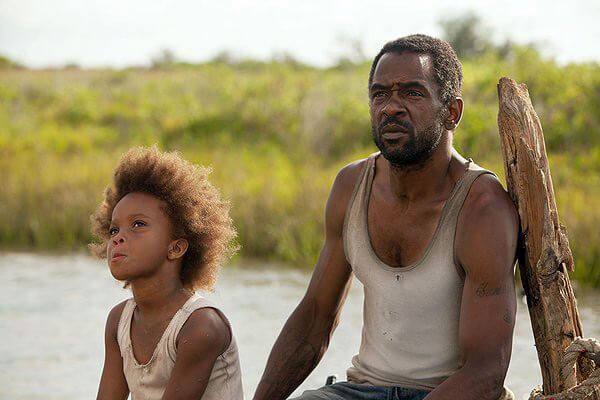 |
| Hushpuppy and Wink, played by Dwight Henry. Still from Beasts of the Southern Wild, Twentieth Century Fox, 2012. |
This throwaway Styrofoam brings us to Beasts' other mythic register—its quest for a way to represent our species' relation to global warming. Styrofoam is made from oil, and images of acetylene torches, gas stoves, and gas engines remind us that although the film's characters are battered by the forces of global warming and their carbon footprint is small, creating a carbon-free democracy is not their concern. The citizens of the Bathtub practice a dirty ecology, making do with what they can salvage from other waste-making classes. When a Katrina-like storm savages their community, the damage is endless. A giant pig-beast knocks over power lines: these are animals who "eat their own mommas and daddies." In the Bathtub the carbon apocalypse is already upon us. Early in the movie, Hushpuppy's teacher raises her skirt; she shows a thigh tattooed with prehistoric aurochs—"fierce" creatures who signify that "any day the fabric of the universe is going to unravel." A blast of poverty consumes everyone living in Wink's and Hushpuppy's community. After we watch the child, her father, and their chickens, dog, and pig chew up the world during a ritual "feed-up time," the film veers from animal eating to the screen-filling shot of an oil refinery. "Ain't that ugly over there?" Wink says from his repurposed boat. "We got the prettiest place on earth." The Bathtub's houses are made from castaway metal and lumber, its people jettisoned by the currents of capitalism. It's too close to the water: cut off by a levy from the thing-creating world. The oil refinery looks at once mechanical and auratic; its white spires hover in the same place in the pictorial frame as the calving glaciers that start to rain down on the audience, and free child-eating aurochs—the mythic equivalents of carbon's rough beasts, their hour come round at last.
These once-extinct, returning aurochs mark the movie's geologic concern, its interest in eras. Around 1750, humans switched from renewable energy to the large-scale use of fossil fuel—a shift in scale marking the beginning of a new era.5Chakrabarty, 207. Ten thousand years ago the Pleistocene or Ice Age gave way to the warmer Holocene, and civilization began in earnest. But our contemporary era, the Anthropocene, has speeded up our species' access to matter until we now create our own weather events, our own set of fractures. Humans are reborn as geologic agents, as the main cause of change for earth itself. Chakrabarty argues that humans now wield a separate geological force and that we must scale up our imagination of the human, the consciousness of our scope and reach as species being, before we can hope to redeem the planet.6Chakrabarty, 206. This means owning up to the imbroglios we have made, and their unintended consequences. Claiming these unintended consequences becomes Hushpuppy's lament, her motif in Beasts. Angry at her father for going away (near the beginning of the film we see him wandering toward the house, dazed, in a hospital gown; he's been institutionalized against his will for delirium tremens brought on by heavy drinking), she sasses him and he strikes her. She then strikes him back, and he goes down—a man of great will but little strength. The screen flashes with visions of glaciers melting; Hushpuppy transfers her teacher's parable onto her father's ruined body: fantasizing that he is a landscape her bad actions have broken. She dashes to get him medicine and he disappears again, only to reappear as the heavens open: a hurricane nears. Like Lear, Hushpuppy takes the force of the gathering storm upon herself, calling into the wind: "Momma, is that you? I've broken everything."
This is primitive thinking—an animistic sense that her actions have caused the decay of the universe. It is mistaken, childish—and may suggest a deep psychological wound. Children reeling from abuse may internalize themselves as bad objects, blaming themselves because it's too painful—too dangerous—to jeopardize a precarious relationship with their parents. To decide that she is at fault, that she's done the breaking, puts Hushpuppy in a universe of children who've been neglected or traumatized. She blames the world's trauma on herself to keep from alienating her caretaker—a father so unpredictable that even a child's feathery anger might frighten him away. Self accusation makes sense in terms of the film's psychological economy, but it also operates in a mythical or cosmic register.
According to Chakrabarty, Bruno Latour, Tim Mitchell—or a thousand ecologists—the guilty recognition that we have the power to shatter our own universe is exactly the tragic recognition—a true anagnorisis—that we need to embrace; we need to scale up not only our self-knowledge, but our self-image as quasi-subjects with the terrible power to change the planet, not just individually, but as species-being. Beasts names us as a vulnerable species in need of tools that can mirror and refract the depth of our ongoing, entangled acts of pollution, our attachment to things that keep turning into debris, our power to destroy Earth itself. Hushpuppy's animistic thinking is a mistake, but this displacement is also a powerful origin point for a necessary myth, for the dream we need to dream (that is, to make into creed, to make tangible) of our complicity as a dangerous, polluting species.
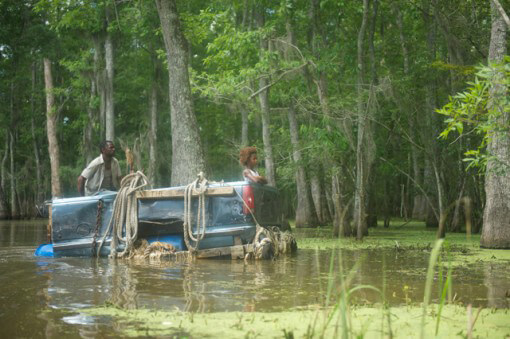 |
| Wink and Hushpuppy. Still from Beasts of the Southern Wild, Twentieth Century Fox, 2012. |
I'm arguing that Hushpuppy signals to us, again and again, possible transference points for claiming kin with our carbon voracity. First, she's a determined creatrix who tries to memorialize her own acts of trashing: "If Daddy kill me [for burning down the house] I ain't going to be forgotten," she thinks and hides under a cardboard box while the flames advance as she draws a picture of herself for posterity. "Daddy could have turned into a tree or a bug," she thinks when he disappears, "there wasn't any way to know," and the screen flashes with tent caterpillars and ice floes suggesting the break-up of the universe. When the hurricane rages we see mud-spattered animals trudge through the needling rain. When it's over and Hushpuppy and Wink float in their newly drowned world, Hushpuppy thinks of the waste of dead animals: "They're all down below trying to breathe through the water. For animals that didn't have a Dad to put them in the boat, the end of the world already happened." When the water finally drains out of the Bathtub, Hushpuppy reminds us: "It didn't matter that the water was gone. Sometimes you can break something so bad that it can't be put back together." Or, watching her father die, she exclaims, "The brave ones stay and watch it happen. They don't run," but she still finds herself on a boat skippered by a captain who hoards all his Chick-fil-A wrappers: "the smell helps me to be cohesive." Garbage animates this wasteland, but as the movie veers away from a world filled with animal parts—and unabashed human carnivores who lie down in mounds of crawfish shells or sleep in piles of rags and throw-away clothing that, to bourgeois noses, would smell unclean—it embraces a comedy of processed food that seems to grow its own trash, and Hushpuppy insists that you still have to "fix what you can."
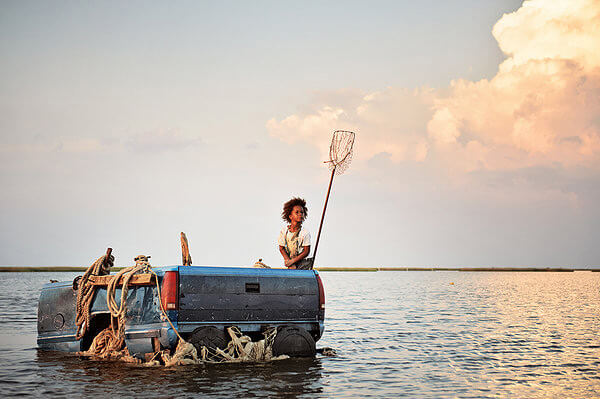 |
| Still from Beasts of the Southern Wild, Twentieth Century Fox, 2012. |
In Beasts nothing gets mended, except for the audience's amazement at a child's voracious imagination. After the apocalypse, those left in the Bathtub try to drain the polluting water by detonating a levy. The screen goes white when the detonation is successful, and then reveals barren bayous. Hushpuppy's community is forced to go to the "Open Arms Processing Center," a sterile, inhospitable world where "when an animal gets sick here they plug it into the wall." The film starts to fall apart in this civilized bureaucracy. Hushpuppy's imagination slows down, and Zeitlin falters as his mythic backdrop falls away. The film finally picks up when it returns to the wasteland, although it makes a second detour to a buoyant island of happy prostitutes. This detour from carbon catastrophe is beautiful; the screen dazzles with utopian lights that reiterate, in a vague and careless way, a wished-for matriarchy. At the end of this scene little girls dance with loving women wearing old-fashioned white slips—as if the movie wants to promise us a Land of Cockaigne where little girls will always be sexually safe, where mothers can be cooks instead of hookers, and where heat and light are endless.
To return to life as an endangered child in a universe of bureaucracy and endless waste is scary. But the ritual death of the Fisher King, the film's insistence that Hushuppy's father must die and cannot heal the wasteland, keeps us mired in the film's litany of Anthropocene images. Allan Stoekl argues that every twenty-first century addiction flows from our addiction to oil.7Allan Stoekl, Bataille's Peak: Energy, Religion, and Postsustainability (Minneapolis: University of Minnesota Press, 2007). To break this obsession means reformulating our entire subjectivity.
To prevent this, we practice a dirty ecology: recycling a few things while leaking and expending everything else. In other words, dirty ecology is the science of halfway practices. We know that driving and flying and industrial pollution and living in drywall houses destroys the planet, but we continue to do it. Hushpuppy appeals so powerfully because she is an early avatar of who we need to become: a child who clings to Styrofoam but sends her liquor-addicted dead father in his gasoline-addicted-repurposed-Chevy truck-made-into-a-boat off into another world.
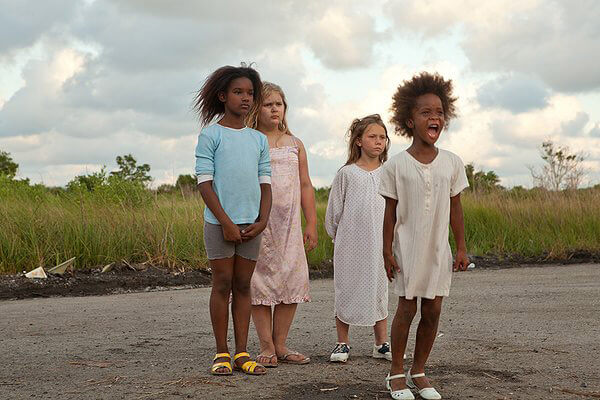 |
| Still from Beasts of the Southern Wild, Twentieth Century Fox, 2012. |
Hushpuppy's cry keeps echoing: "Momma . . . I've broken everything!" Her mythical thinking represents childish animism and a private legacy of psychological damage. But myths also establish long-term models for guiding behavior. They require, first of all, mystery—awe at fact of the universe and our place in it; second, a topos—an explication of cosmic shape that can ground us in a felt geography; third, an epistemology—shaping foundations supported by codes or ideas that establish the norms of the social order; and finally an ethic—a set of rules or maxims about how to live within the parameters of the everyday. Beasts bestows a weird movie mythopoeia for reestablishing each of these needs within our present era: the carbon-drunk Anthropocene.
In this movie's wake, I hope for a long line of girls and boys who will call out to us with the knowledge that we've broken our ecosystem. We must dirty ecology, the science of whole environments, with myths, fictions, half-truths, dirty imagery. Myths are crucial as implements of attachment and ownership for all the unintended consequences we have to live with in order to make a buffet, a movable feast, and a pedagogy out of our cosmic impasse. "If daddy don't get back soon it will be time for me to eat my pets," Hushpuppy says early in the movie to soothe her growing sense of abandonment. Even though Wink imagines that "I got it under control," he also sees that "my blood is eating itself." No one has it under control in the Anthropocene, and unless we recognize this soon we will have to eat things stranger and less appetizing than our pets. What's the world coming to when the best movie of 2012 has a nutria rigger, when it reimagines extinct aurochs as potbellied pigs with plastic horns? Beasts of the Southern Wild is whimsical, but it is also an epic comment on our condition of metamorphosis when humans persist in changing Earth's geologic direction: "Daddy could have turned into a tree or a bug, there wasn't any way to know." Trees and bugs may not need mythologies, but the rest of us do, and to advance the project of reshaping a planetary epistemology, see this movie—and then let's start to fix what we can.
About the Author
Patricia Yaeger is Henry Simmons Frieze Collegiate Chair at the University of Michigan. She was editor of PMLA from 2006–2011 and author of the award-winning Dirt and Desire: Reconstructing Southern Women's Writing. She is working on two books: "Luminous Trash: America in an Age of Conspicuous Destruction" and "Flannery O'Connor in Drag," and is co-editing volumes on literature and energy, "Fueling Culture: Energy, History, Politics" and "American Dirt."
]]>Essay
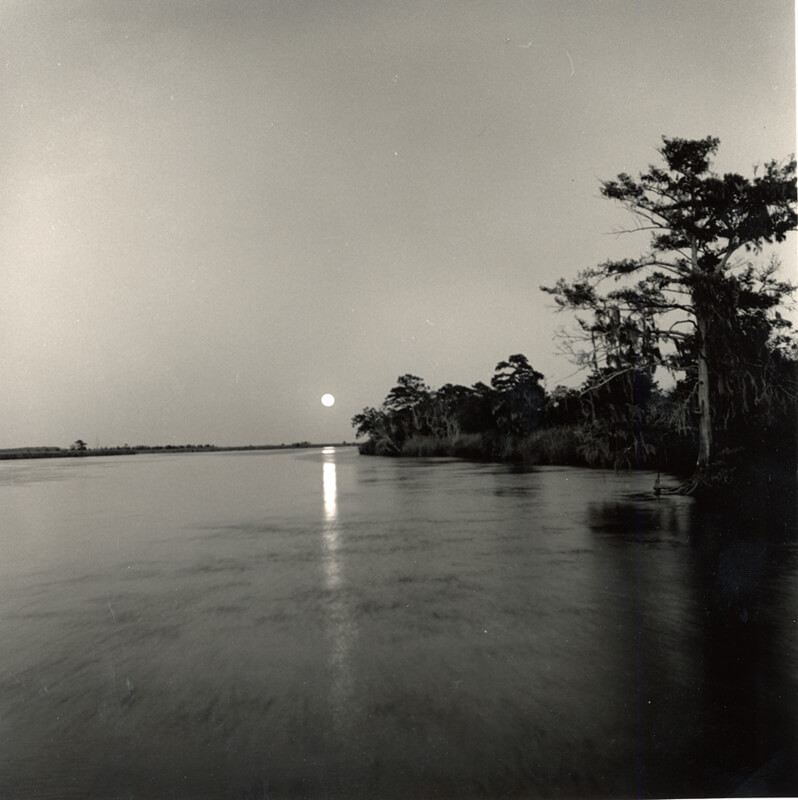 |
| Nancy Marshall, Moon over Darien River, Georgia, 2010. |
I have a story about a crab that started a movement. It is about a river that is stunning in its magnitude and in its biodiversity. It is about a man who turned his tenacious mind and undistracted gaze upon that body of water and decided that he would clean it up, and who, in the process, became somebody he never dreamed of being. The story is about the creation of a group of advocates in a part of the United States that had not known environmental advocacy, and a litany of successes that built an environmental ethic and caused this deeply beloved sedimentary river to run cleaner out of Georgia, into the sea.
The story is one of the transformation that is possible if one wakes up to the beauty and wonder of the earth, if one fears not, if one follows the path of his or her heart. The story of the transformation possible if people join together and decide to protect something they love. With love, many things are possible.
In a boat at the mouth of the Altamaha River sat James Holland, around him the sea boiling, an eight-foot tide meeting thousands of gallons of fresh water minute by minute. The air was diaphanous with salty mist, like a veil. A finger of white sand reached out from Little St. Simons Island as if to calm the waters, and on that arm of firmament crowded ruddy turnstones, yellowlegs, oystercatchers, and willets.
Below, in the calmness and silence of the gray depths, a male blue crab carried his girl. She had molted and they had mated and for forty-eight hours he was carrying her, right-side-up and forward, and when her shell hardened he would release her, and she would begin her migration back into the salt, beautiful swimmer, with a cargo of two million eggs.
Many of which, for some reason, would not survive.
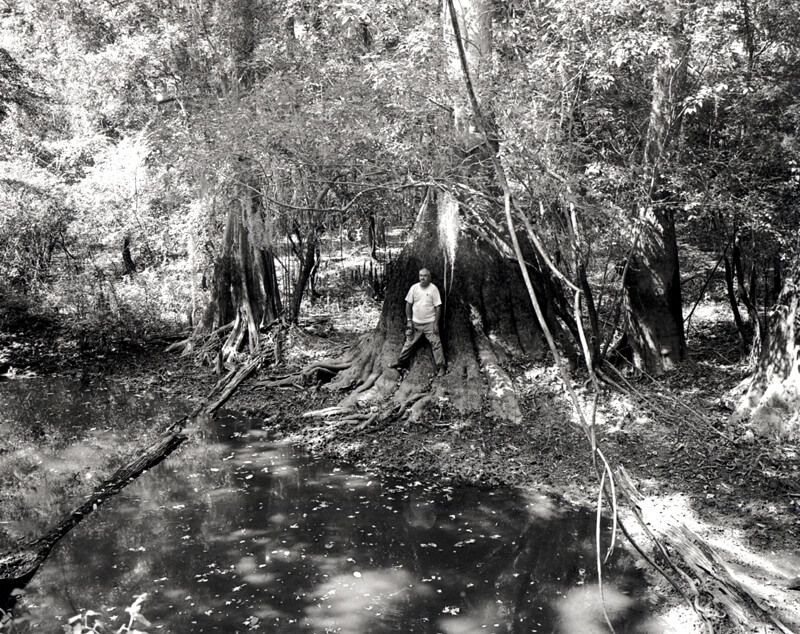 |
| Nancy Marshall, James Holland, Altamaha River, Georgia, 2010. |
The boat carried Holland, like the river water carries nutrients to feed the plankton. Like the ocean carries salt. Holland was working these waters, motoring in his old boat from float to float he recognized so well. Every trip was a connect-the-dots; he hauled up the traps and took from them the crabs he was allowed to take, returning the rest to forage through the delta mud.
The numbers in the coolers spoke: they were falling, 300 pounds, 225, 175. Every year they fell—he remembers 1,500 pounds easily from one hundred traps in a day.
When Holland got hungry, he cut the engine and rested on the waters, dolphins in the foreground, pelicans diving headfirst, waves tapping the craft in a kind of SOS. "Do you see what is happening?" they were saying in their insistent language. The sky ever changed. The estuary stretched from the river, its bed a channel, a tablet upon which the water records what is happening to Georgia, from the first bubbles of spring water in the piedmont, to the confluence, to the fanned-out delta. On the other side of Holland lay the wide and faltering ocean.
Holland had no idea that his life was about to change permanently and that for the rest of his days he would become a voice for wild places and wild things. In a way this was a natural progression. Holland had been a warrior before, a marine, and he knew how to fight.
Like the spark of life the female blue crab carries in her orange sponge, an idea began in him. The voice of the voiceless spoke, and sitting in the rocking boat, eating a tuna sandwich, drinking warm coffee, he began to listen. Willet, willet, willet, the voice said. To watch it simply vanish is a sin against God.
Get up, James, the voice said. The sun is already high in the sky. Stand up.
You are a big man, you are strong, you have two hands capable of doing anything. You have a great mind. I have given you eyes to see and ears to hear. But I have given you something more, James, something special. What I have given you is a heart big enough to care, with room enough to love even the blue crab, which every day you hold in your big hands and admire.
When he reached land and stood up, the ground trembled.
In the 1940s, a little boy who did not understand much of what was happening in his world retreated to a creek near Cochran, Georgia, to sail leaf boats, to build dams, to swim, and to fish. That was James Holland. He will not talk much about what happened to this little boy, because some of it he would rather forget. The river was with him from the start.
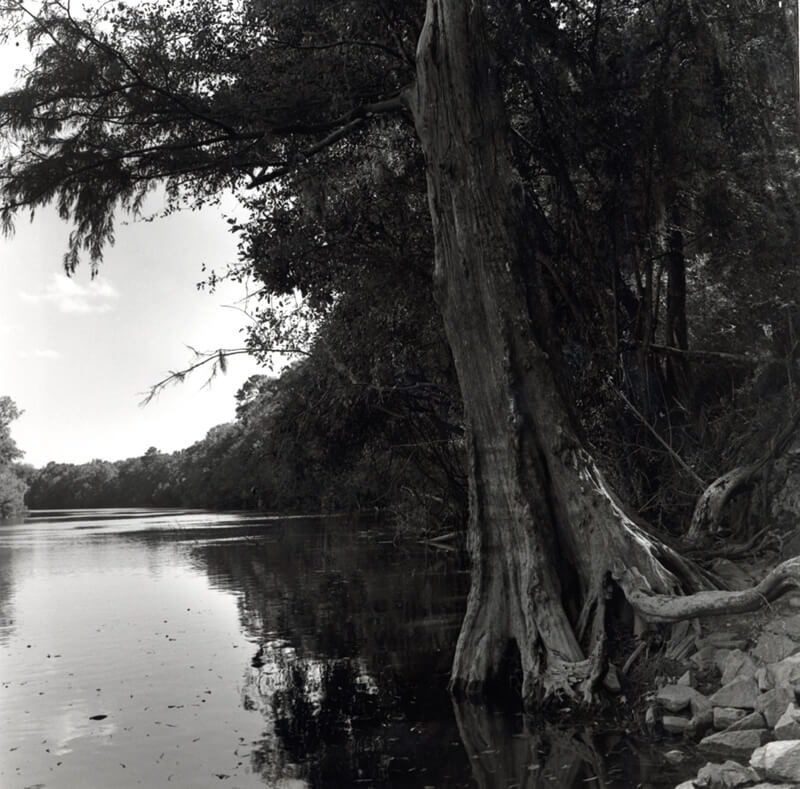 |
| Nancy Marshall, Altamaha River, Georgia, 2010. |
Years later, after a career in the Marines and another in food services, after a family was mostly raised and gone, after twenty-five years in a boat in the hot sun, healing from all that had happened, laboring to forget, drawing up traps, worrying some about money, he came home to the river that knew him when he was a boy, lost and found. The river found him, and then he returned and found it.
First there was a language to learn that had not been his own. It was not "sook," not "gas line," not "Doboy Sound," not "robust redhorse." This new language had long, scientific, technical, academic, political words, and lots of initials. DNR, EPD, PSP, OVC, SMZ, MOA, BMP. He had to learn it all, he who had never had a chance to go to college, who had known nothing except hard work all his life.
By God, he would understand what the people who had the river by the throat were saying. He learned more than he ever thought possible. He could have been a biologist. He could have been a lawyer. He could have been a writer. He could have been a public official.
But James Holland was needed on the ground, on the water. He was needed in public meetings, standing in front of the people.
Poor people live up and down this river. We work for years to buy a johnboat. Some of us are badly educated, even ignorant. We throw car tires and deer carcasses in the creeks. We dump trash and other bad stuff in. We cut down trees.
But if we could understand a car engine, we could understand a river system, and for it to run it needs all its parts, and the parts have to be clean, in good working order, and they need fuel.
We needed to know how to translate all this.
Industry takes advantage of our ignorance, our silence, our consuming worries. It takes the fish, it takes the forests, it dumps copper and arsenic into the water, it erects coal plants that fill the air with mercury that drifts down into the river. It tries to build poultry processing plants, it schemes waste incinerators and biomass plants.
In a poor region of the country, with a citizenry poorly educated about the environment, the river's time had come. Altamaha Riverkeeper was born, and Holland became the first actual, official Riverkeeper. Membership grew exponentially. The years passed and Holland traveled through the watershed, ferreting out lawlessness, ringing the bells of the people supposed to be regulating and protecting the watershed. There was a lawsuit, another lawsuit, another lawsuit. The federal judges were sympathetic to the law.
I've seen lots of activists at work and I've never seen anybody mobilize people the way Holland did. Maybe it's that he's clear about what he wants and he demands it. One thing I've noticed: he makes a lot of phone calls. Even when he could do a task alone with less effort, he takes time to involve people on many levels. He reaches out to people through their established friends. He worries with a problem until he has an idea. He finds someone who can help him. He asks for help. If he's told no, he asks again or finds someone else.
At 8:30 one Sunday morning many years ago, for example, my phone rang. "Were you sleeping?" Holland boomed.
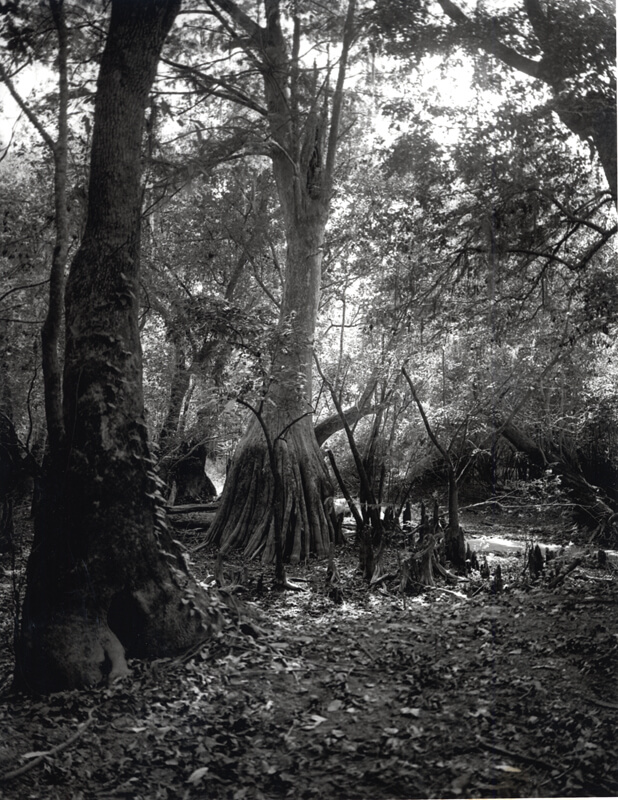 |
| Nancy Marshall, Big Cypress, Altamaha River, Georgia, 2010. |
"No," I said. "I was lying in bed, reading."
"I was laying in bed at 4:00 a.m. this morning, waiting until I could get to work," he said. "You're crabbing today?"
"Yep," he said. "Heading out now. But listen, I have a favor. I just talked to my first cousin. Her husband is a professor in Athens. Which shows that all my folks didn't turn out like me. She'll get our press release to the university newspaper. I want you to mail it to her."
"Ok," I said, and jotted down the address.
"And include a short note," said Holland, "to let my cousin know that a human being sent it."
A lot got done in ten years. Holland was out front, but behind him was Deborah Sheppard, the staunch and steady executive director who had left an Atlanta activist career to live on the coast, writing grants and press releases and doing the thankless work of keeping the whole ship afloat. She filled in Holland's gaps. She backed him up. They were a dynamic duo.
After a few years I began to notice something. In addition to the photos of destruction that Holland would send by e-mail, copying everybody he thought might help on every travesty, he began to e-mail pictures of beautiful things, wild things, rare things, endangered things: tiger swallowtail butterflies, wood storks constructing nests, raccoons washing food, water hyacinth, gulf frittillaries, sparring bucks, roseate spoonbills, sunning alligators, four wood ducklings on a log. As the years passed, the photos became more beautiful and more numerous. In the end, I think, the travesty was too much even for Holland's calm, rational, Marine-trained mind, too much for his immensely capacious heart. He couldn't keep focusing on tragedies.
"Even when I was seeing the degradation, I saw that beauty was still there," he said. "I found out that the most beautiful flowers on God's earth are around wetlands."
After ten years, Holland retired. On his last official day on the job, in May of 2010, he called to tell me that the City of Jesup was dumping raw sewage again, the mess visible around the pipe, stringing in the trees. There were more condoms than you can believe, he said. Every year they do it, he said. We talk to them and talk to them and they keep doing it.
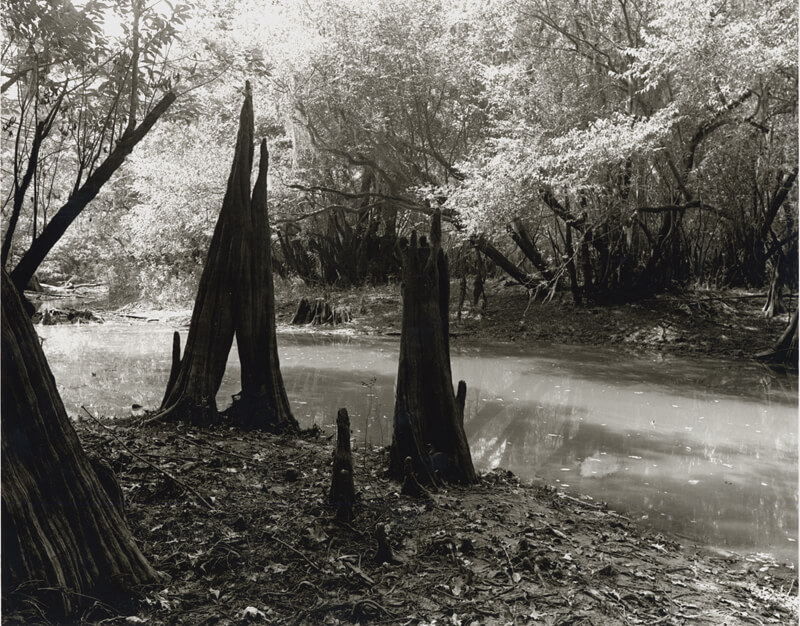 |
| Nancy Marshall, Altamaha River, Georgia, 2010. |
For his retirement, people came from up and down the river, from within the watershed and without, to honor him, and to thank him. They came from Tattnall County, Appling County, Wayne County, Toombs, Jeff Davis, McIntosh, Telfair. They came from Atlanta, Savannah, Macon, Athens. They thanked him for being a champion of rivers, conqueror of polluters and destroyers, defender of wild things, campaigner for justice.
"What you gave us was hope," I told him. "You made us want to fight. You were a warrior and you were fighting and we fell in step beside you. You inspired us. You performed miracles in front of our eyes."
From Holland I learned that transformation is possible. Watching him was watching the monarch emerge from her cocoon and take off over the tips of the milkweed.
Holland gave the Altamaha River a fighting chance. He gave it and its people the greatest gift a person could give, life itself, through eleven years of ceaseless labor and unflinching dedication to a grand corner of creation that is the Altamaha watershed.
Holland was the first Riverkeeper. But not the last. He simply started it all. It is a movement that is unstoppable.
Success is hard to measure. But I believe that water quality in the basin has improved steadily, incrementally, one part per million at a time, since Altamaha Riverkeeper lodged like a grain of sand in a clam and grew to become a pearl.
About the Author
Janisse Ray was born in Baxley, Georgia in 1962 and graduated from the M.F.A. program at the University of Montana in 1997. She currently resides in the Altamaha Community of Reidsville, Georgia and teaches in the MFA program at Chatham University. She has published poetry and non-fiction books, including Ecology of a Cracker Childhood (1999).The excerpt "James Holland, Riverkeeper: Environmental Protection along the Altamaha" comes from Janisse Ray's Drifting into Darien: A Personal and Natural History of the Altamaha River (Athens: University of Georgia Press, 2011).
About the Photographer
Nancy Marshall is a native Atlantan now living in McClellanville, South Carolina. She received her M.F.A. in Photography from Georgia State University School of Art and Design in 1996. Her work is widely exhibited and collected. Marshall's awards include the National Endowment for the Arts/Nexus Grant for Book Arts, a Southern Arts Foundation Fellowship for Photography, an Emory College Excellence in Teaching Award for the Humanities, and a fellowship with the Ossabaw Island Genesis Project.
]]>Introduction
This here tale begins in the summer of that year, whatever year it was . . . The year don't matter. The national situation don't even matter, because even though we were smack dab in the middle of what we’ve been told was the Depression, folks in the Ozarks was so poor to begin with that they scarcely noticed. No, that's not right, because poverty’s so relative. A better way to put it is that folks in the Ozarks still had everything they needed to subsist and endure, and they didn't want for nothing. So they didn’t even know that people elsewhere all over the country was suffering from want."
—Donald Harington’s “Vance Randolph” character in Butterfly Weed1Donald Harington, Butterfly Weed (New Milford, CT: The Toby Press, 1996), 5.
After supper Uncle Greene . . . began speaking of the Ozarks. ‘Used to be a real happy land for us outlaws,’ he recalled. ‘But for us reformed sons of bitches no country ain’t no great sight better than no other country . . . But I still say . . . that whichever the country, hit’s the backhills that stay interestin’ and closest to everlastin’ . . .’
—Charles Morrow Wilson in The Bodacious Ozarks2Charles Morrow Wilson, The Bodacious Ozarks: True Tales of the Backhills (New York: Hastings House Publishers, 1959), 28.
A former student introduced me to her great-uncle who runs the family hardware store in a small town in the Arkansas Ozarks. The store is the modern-day equivalent of the old-timey gristmill, a place of congregation for anyone with a minute to spare. I began the Arkansas component of a long-term research project in that turn-of-the twentieth century brick building in downtown Marshall. I arrived with tape recorder, notepad, and pen, ready to identify participants for a study of Ozark agricultural biodiversity. One of the many names I scribbled that day was Dean Smyth, short for Willodean. When it came to discussing traditional foodways in the region (and in this essay), Willodean, one of the most charismatic and enthusiastic of my contacts, serves as a guide to the continuity of self-sufficient traditions in the Ozarks.
The research foundation for this essay consists of archival data collected in and about each of the subregions of the Ozark Highlands (see Ozark Relief Map below), in addition to semi-structured interviews and participant observation in the St. Francois Mountains (2002-2004), the Boston Mountains and Salem and Springfield Plateaus (2006 and 2009). This research is a component of an applied anthropology endeavor to document and conserve traditional varieties (heirloom) of crops and the family stories related to them. Students, volunteers, and researchers conduct interviews with people who maintain heirloom seed varieties, document and (hopefully) acquire the seeds, store them (along with the stories) in a seed bank and database, grow them out in campus and gardens, and give them away at Seed Swaps.
 |
| Crystal Bowne, Back-to-the-Land Ozarker Gardens, Newton County, Arkansas, 2010 |
The most traditional, conservative Ozark inhabitants, who constitute the cultural focus of this research, have been ethnocentrically misrepresented in both popular and academic media.3Brooks Blevins, Hill Folks: A History of Arkansas Ozarkers and Their Image (Chapel Hill: University of North Carolina Press, 2002). Anthony Harkins, Hillbilly: A Cultural History of an American Icon (Oxford: Oxford University Press, 2004). Misrepresentations of Ozarkers emerge through a lack of cultural relativism and an inability or unwillingness to comprehend traditional Ozark culture. The cultural anthropology approach, with its methods of participant observation and semi-structured interviews, allows the researcher to move beyond stereotypes and gain an understanding of the interconnections between the motivations, perceptions, and practices of a group of people.4Karl G. Heider, Seeing Anthropology: Cultural Anthropology through Film, 4th ed. (Boston: Allyn & Bacon, 2006). Robert H. Lavenda and Emily A. Shultz, Core Concepts in Cultural Anthropology, 3rd ed. (Boston: McGraw Hill Companies, Inc., 2007).
This study presents Ozark seed savers and agrobiodiverse farmer-gardeners at the beginning of the twenty-first century, but it expands beyond conventional ethnography in two ways. I do not focus strictly on the present; instead I engage past subsistence traditions to elucidate contemporary practices, and I cast a wider net, utilizing a more diverse range of media to illustrate the Ozarks as a refuge for agricultural biodiversity. Drawing upon historical and contemporary photographs, recipes, folk tales, works of ethnographic/historical and autobiographical fiction, as well as excerpts from interviews with Willodean and other Ozarkers, these sources illustrate the diversity, agroecological knowledge, and frugality inherent in the region’s subsistence traditions.
Agricultural Biodiversity
With its adoption of the Convention on Biological Diversity, the 1992 Earth Summit in Rio de Janeiro highlighted the implications of species extinction and imprinted biodiversity upon the public consciousness as a buzzword for species richness and global health.5Hope Shand, Human Nature: Agricultural Biodiversity and Farm-Based Food Security (Ottawa: RAFI, 1997). While biodiversity became synonymous with the importance of not cutting down the rainforest, environmental anthropologists have attempted to expand that narrow conception. Most of the “natural,” pristine, or “virgin” landscapes that early European explorers encountered in the Americas were actually anthropogenic, created through human modification and management.6Bill Balee and Darrell Posey, Resource Management in Amazonia: Indigenous and Folk Strategies (New York Botanic Garden series, Advances in Economic Botany, 1989). Nancy J. Turner, The Earth’s Blanket: Traditional Teachings for Sustainable Living (Seattle: University of Washington Press, 2005). Unlike the common perception of humans as the cause of biodiversity loss, humans have enhanced or created biodiversity in their ecosystems through traditional management systems.7 Gary Paul Nabhan, Cultures of Habitat: On Nature, Culture, and Story (Washington DC: Counterpoint, 1997). Virginia Nazarea, Cultural Memory and Biodiversity (Tucson: The University of Arizona Press, 1998). M.L. Oldfield and J.B. Alcorn, "Conservation of Traditional Agroecosystems," Bioscience, 37 (1997) 199-208. E. Smith and M. Wishnie, "Conservation and Subsistence in Small-scale Societies," Annual Review of Anthropology 29 (2000): 493–524. Nancy J. Turner, The Earth’s Blanket: Traditional Teachings for Sustainable Living (Seattle: University of Washington Press, 2005).
Agricultural biodiversity refers to human-modified components of biodiversity that contribute to the sustenance and health of human populations.8Shand, Human Nature. This includes the domesticated plants and animals that constitute the foundation of agriculture and the non-domesticated plants, shrubs, and trees utilized for subsistence and health and the related soil biota and insects necessary for plant propagation and reproduction.9T. Johns, I.F. Smith, P. Eyzaguirre, "Understanding the Links Between Agriculture and Health" IFPRI, 13 (2006), 12-16. Several approaches characterize agrobiodiverse farming systems: 1) polyculture; farmers grow an assortment of crop species within a field or agricultural landscape; 2) intraspecific diversity; more than one variety of a species exists in the fields; 3) wild-domesticated continuum; farmers allow non- and semi- domesticated species to grow within and around fields; and 4) utility diversity; species in the fields have multiple uses, as livestock feed and human food, medicine, dye, clothing, storage, cordage, etc.10M.A. Altieri, Agroecology: The Scientific Basis of Alternative Agriculture (Boulder: Westview Press, 1995). Shand, Human Nature. Farmers the world over engaged in such practices before the now ubiquitous modern industrial agricultural model replaced diversity and self-sufficiency with specialization.11Altieri, Agroecology. T. Smith and Eyzaguirre, 2006. Eugene Odum, Ecology: A Bridge Between Science and Society (Sunderland, Massachusetts: Sinauer Associates, Inc., 1997). When the farmer focuses strictly on large-scale production of one crop for the market, the animals that previously produced manure for fertilizer, in addition to their meat, eggs, milk, or labor, must now be replaced with tractors, chemical fertilizers, and store-bought food. If the farmer moves to large-scale animal production, s/he must purchase large amounts of feed and abandon diversified production of crops. Instead of using manure as fertilizer, it becomes a point-source pollutant, requiring extensive mitigation measures to prevent groundwater pollution. Either way, a loss of self-sufficiency results.
While much agricultural biodiversity research has focused on farms and full-time farmers, studies reveal the comparatively high diversity of species and varieties in home gardens.12Virginia Nazarea, Heirlooms and their Keepers: Marginality and Memory in the Conservation of Biological Diversity (Tucson: University of Arizona Press, 2005). J.W. Watson and P.B. Eyzaguirre, editors, "Proceedings of the Second International Home Gardens Workshop: Contribution of home gardens to in situ conservation of plant genetic resources in farming systems," 17–19 July 2001, Witzenhausen, Federal Republic of Germany. International Plant Genetic Resources Institute, Rome, 2002. This new angle makes sense in light of the widespread shift from traditional to industrial agriculture throughout the world, transforming home gardens into refuges for culturally important crop species and varieties.13Nazarea, Heirlooms and their Keepers. Agricultural biodiversity researchers have encouraged an investigative approach emphasizing persistence in traditional farming practices within or despite culture change.14B. Orlove and S. Brush, "Anthropology and the conservation of biodiversity," Annual Review of Anthropology 25 (1996), 329-352. In Heirloom Seeds and their Keepers: Marginality and Memory in the Conservation of Biological Diversity, Virginia Nazarea explores “seedsaver gardens as repositories of ambiguities and alternatives that can effectively counteract homogenization and avert cultural and genetic erosion.”15Nazarea, Heirlooms and their Keepers, 16. She encourages researchers to “shift from conceptual, aggregate units such as “organizations” and “populations” (whether local or not) to actual people – people who acquire and pass on knowledge collectively and individually.”16Nazarea, Heirlooms and their Keepers, 19. This essay follows these leads by focusing on the diversity of one particular farmer/gardener to gain insight into traditional agrobiodiverse farming and gardening practices in the Ozarks.
The Biophysical Geography of the Ozark Highlands
The Ozark Highlands region comprises the southern half of Missouri, northern third of Arkansas, and a small fraction of northeastern Oklahoma, which geographers generally delimit by rivers: the Missouri on the north, the Mississippi on the east, the Grand on the southwest. Geographic characteristics that distinguish the Ozarks as a region include the general ruggedness and vertical topography, and the relative age of surface rocks being older than those in adjoining areas.17Milton Rafferty, The Ozarks: Land and Life(Norman: University of Oklahoma Press, 2001). The karst topography of the Ozarks creates many of these geographic characteristics; the soluble rock (dolomite and limestone) dissolves as groundwater filters through it. Much of the precipitation in karst areas carries nutrients critical to plant growth directly into the groundwater, well below rooting depths of most agricultural plants.18Tom Aley, "Karst Topography and Rural Poverty," Ozarkswatch 5.3 (1992), 19-21. Land cover in the Ozarks relates directly to these effects of the karst topography; unlike the surrounding regions, large-scale monoculture agriculture is untenable in the Ozark hills. Deciduous forests of oak-hickory-pine mixes with intermittent cedar glades compose the Ozarks’ primary landscape feature.
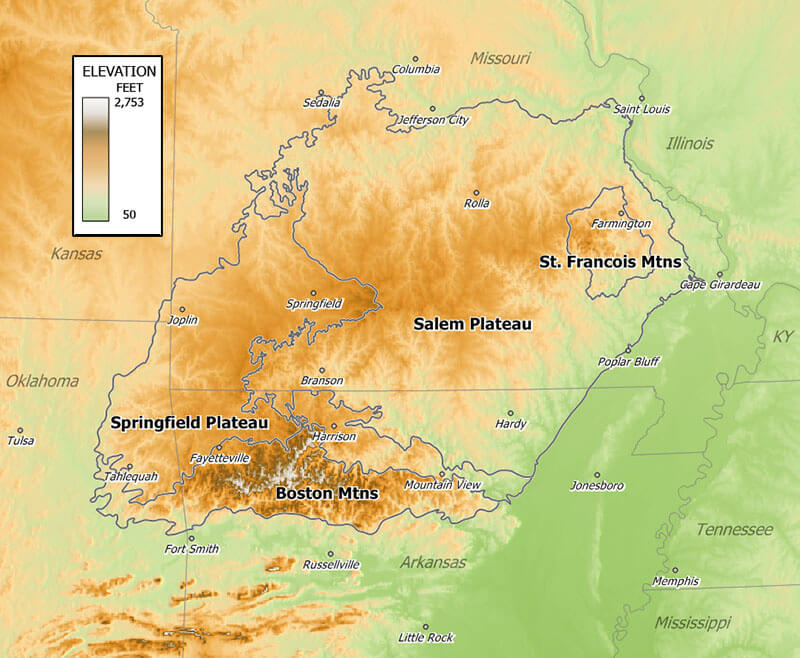 |
| Ozark Relief Map, 2007 |
People from in and around the region refer to the Ozarks in a variety of ways, as the Ozark mountains, hills, highlands, plateau, escarpment, and to residents as Ozarkers, Ozarkians, hillbillies, baldknobbers, ridgerunners, hillpeople, in addition to some others not fit to print.19Rafferty, The Ozarks: Land and Life. Vance Randolph, Pissing in the Snow, and other Folktales (Urbana and Chicago: University of Illinois Press, 1976). Before modernization thoroughly infiltrated the Ozarks, even as late as the 1960s, the Ozarks constituted a discrete cultural province, with communities and isolated homesteads of self-reliant forager/gardener/farmers with their unique folkways and dialect scattered throughout.20Brian Campbell, "Ethnoecology of the Ozarks’ Agricultural Encounter," Ethnology: An International Journal of Cultural and Social Anthropology, 48.1(2009), 1-20. John Soloman Otto and Augustus Marion Burns III, "Traditional Agricultural Practices in the Arkansas Highlands," The Journal of American Folklore, 94 (1981), 166-187. Rafferty, The Ozarks: Land and Life. Vance Randolph, The Ozarks: An American Survival of Primitive Society (New York: Vanguard Press, 1931). With the construction of roads and bridges in previously remote areas, exposure to mainstream media through television and radio, and the concomitant decline of diversified farming as a livelihood, a significant percentage of the Ozark population abandoned or never learned the agrarian lifeway.21Blevins, Hill Folks. W.O. Cralle, "Social change and isolation in the Ozark Mountain Region of Missouri," The American Journal of Sociology 41 (1936), 435–446. Art Gallaher Jr., Fifteen Years Later (New York: Columbia University Press, 1961). James West, Plainville, U.S.A. (New York: Columbia University Press, 1945).
 |
| Arthur Keller, Old Stock garden, Baxter County, Arkansas, early 20th century. Courtesy University of Central Arkansas Archives, Butcher-Keller Collection. |
Despite these relatively sudden and vast changes, the Ozark Highlands has retained many farming and gardening traditions, and constitutes a distinct bio-region. Researchers recognize the region as a contemporary refuge for unique open-pollinated (folk, heirloom, old-timey) varieties of agricultural crops.22Campbell, "Ethnoecology of the Agricultural Encounter in Ethnology." James R. Veteto, "The history and survival of traditional heirloom vegetable varieties in the southern Appalachian Mountains of western North Carolina," Agriculture and Human Values 25 (2008), 121–134. K. Whealy, Foreword. In S. Stickland (ed), Heirloom Vegetables: A Home Gardener’s Guide to Finding and Growing Vegetables from the Past (New York: Fireside, 1998). The Ozarkers who engage in agrobiodiverse farming and gardening rarely constitute a “population” or community or discrete cultural unit, but rather are dispersed throughout the region in pockets or “hollers” disconnected from one another. In the rural areas outside of the small Ozark towns, most homes feature a garden that has some mix (depending on the season) of basic staples, such as beans, cabbage, canteloupes, cucumbers, mustard greens, okra, peppers, potatoes, squash, tomatoes, turnip (greens), watermelons, and perhaps some corn. Yet the percentage of those gardens that house open-pollinated varieties rather than hybrids has fallen drastically over the last quarter century; I estimate that less than one quarter of Ozark gardens today can be characterized as “agrobiodiverse,” with at least several open-pollinated crop species in cultivation (not including hybrids and ornamental species). The total percentage of Ozarkers engaged in agrobiodiverse farming and gardening at the beginning of the twenty-first century is likely around ten percent, if not less, and these are spread throughout the region. As Nazarea and Orlove and Brush indicate, this discussion of agricultural biodiversity conservation acknowledges “the complexity of plant populations in dynamic and patchy social contexts.”23Nazarea, Heirlooms and their Keepers. Orlove and Brush, "Anthropology and the conservation of biodiversity," 342. Indeed, the contemporary Ozarks, as much as anywhere else, represents the patchiness and dynamism of agricultural biodiversity.
 |
| Zachariah McCannon, Old Stock Ozark garden, Newton County, Arkansas, 2007. |
Ozark Settlement history and Demography
Prior to Euro-American settlement, the Ozarks was sparsely populated. There is archaeological evidence (spearpoints and mastodon and mammoth kill-sites) for Paleo-Indian (12000-8000 BC) and Archaic (8000-1000 BC) period occupation of the region. During the Woodland (1000 BC – AD 900) and Mississippian (AD 900-1700) periods the region housed forager-gardeners similar to the pre-modern Euro-American Ozarkers, with the main difference being the agricultural species grown. Deer and elk provided the bulk of the meat consumed; nuts (acorn, hickory, and walnut) and fruits (elderberry, grape, persimmon, plum) constituted the majority of the plant foods; and now-obsolete domesticated species (amaranth, chenopod, little barley, maygrass, sumpweed, sunflower), squash species and small amounts of corn provided a minimal percentage of the diet.24Gayle Fritz, "Identification of Cultigen Amaranth and Chenopod from Rockshelter Sites in Northwest Arkansas," American Antiquity, Vol. 49 No. 3 (1984), 558-572. George Sabo and Jerry E. Hilliard, "Woodland Period Shell-Tempered Pottery in the Central Arkansas Ozarks," Southeastern Archaeology, Winter 2008. From approximately AD 1500 through 1700 there was very little Native American occupation of the interior Arkansas Ozarks.25Kenneth L. Smith, Buffalo River Handbook (Little Rock, AR: The Ozark Society, 2004). During the historic period, from about 1700 until 1808, when they ceded the lands to the US government, the Osage maintained the Ozarks as a seasonal homeland and hunting reserve. The region also served as a refuge for displaced Native American groups (Cherokee, Choctaw, Delaware, Kickapoo, Shawnee) who came into conflict with the Osage as they attempted to settle.26Rafferty, The Ozarks: Land and Life. Of these diverse contemporary Native American groups, the Cherokee have established the most lasting and evident imprint on the region. By the late eighteenth and through the mid-nineteenth century, Cherokee splinter groups left the east and settled in the Ozarks.27Timothy Jones, "Commentary on 'Cultural Conservation of Medicinal Plant Use in the Ozarks.'" Human Organization 59(1)(2001), 136-140. During the 1830s, the Indian Removal Act forced southeastern tribes onto the Trail of Tears. En route to Oklahoma many Cherokee escaped into the Ozark hills. Despite forced removal of known Native Americans from the Ozarks to Indian Territory (Oklahoma) beginning in 1820, many Cherokee maintained anonymity and remained in the Ozarks. Some Cherokee intermarried with Euro-American homesteaders or clandestinely remained with groups of fellow Cherokee, which was not all too difficult because many they had already adopted the general subsistence and architectural strategies of their Euro-American neighbors in the Southeast.
The first Europeans in the Ozarks were French creoles, who almost exclusively exploited the mineral resources and fur-bearing animals. They established settlements on the fringes of the Ozarks, in what is now southeastern Missouri. Spain took formal possession of the region in 1770 and readily distributed land-grants to Americans to protect the territory from the British. France similarly used “Louisiana” strategically, and after re-establishing control of the region, sold it to the United States in 1803. Subsequently, Ozark lands were given to veterans of the American Revolution and the War of 1812 as payment for their military service. Ozark homesteaders of the nineteenth century were predominantly Scots-Irish, accustomed to living on the frontier, in close contact with Native American enemies and allies.28Blevins, Hill Folks. Rafferty, The Ozarks: Land and Life. Typically young men would precede their families and begin the homesteading process, later sending word for the rest of the family to join them. In their relative isolation, they frequently became involved with local women, often of Native American (Cherokee, Choctaw, Quapaw, Shawnee) heritage. Native Americans contributed significantly to contemporary agricultural biodiversity because early homesteaders learned how to harvest and utilize wild species from Cherokee and other Native American residents and also integrated some of their domesticated species into their gastronomy. African-Americans, on the other hand, constituted a small proportion of the Ozark population in the past and present. Early settlers were mostly poor, landless, and without slaves. A few slaveholders settled in the fringe river valleys. During the Civil War and the decade after, many African Americans fled because of the lawlessness and violence.
 |
| Arthur Keller, Display of pumpkin harvest, Mountain Home, Baxter County, Arkansas, early twentieth century. Keller-Butcher Collection, University of Central Arkansas Archives. |
Descendants of the earliest Ozark homesteaders who continue to reside in the region, such as Willodean, are referred to as Old Stock Ozarkers to differentiate them from more recent in-migrants.29Russel L. Gerlach, Immigrants in the Ozarks : A Study in Ethnic Geography (Columbia: University of Missouri Press, 1976). While some Old Stock residents in the twenty-first century continue to engage in seed saving and agrobiodiverse gardening traditions, most have adopted technological conveniences and abandoned traditional practices. More recent Ozark settlers have arrived with specific intentions of perpetuating traditional agrobiodiverse farming practices. Beginning with Depression era “back-to-the-landers” of the Arts and Crafts and Country Life movements through the counter-culture of the 1960’s and ‘70s, people raised in urban environments have sought the Ozarks as a pastoral getaway to experiment with, and sometimes persevere in rural living.30Blevins, Hill Folks, Campbell n.d.
The Ozarks has consistently served as a destination for disillusioned Arcadia-seekers because of the inexpensive land, isolation, beauty and abundance of water. Most of these back-to-the-landers have been “driven back to civilization by snakes, chiggers, heat, cold, and starvation,” but many have also remained.31Blevins, Hill Folks, 200. While exact numbers are impossible to ascertain because there is no census category for this variable and these homesteaders are by choice difficult to document because of their avoidance of mainstream societal institutions, they represent a small percentage (five to ten) of the population in most Ozarks counties, but in some, such as Newton and Stone counties in Arkansas and Ozark County in Missouri, the percentages are much higher. Donald Harington characterizes such back-to-the-land Ozarkers as similar to earlier homesteaders:
Elsewhere in Arkansas the latest blooming hippies have all cleaned up and moved back to the suburbs. Those who persist and endure in Newton County, are the strong ones, fit survivors, like the real pioneers in the nineteenth century, who came as a kind of spillover of the mountain settlement to the east.32Harington, Let Us Build Us a City: Eleven Lost Towns. (New Milford, CT: The Toby Press, 1986), 98-9.
 |
| Arthur Keller, Man standing among tomato plants, early 20th century, Mountain Home, Baxter County, Arkansas, Keller-Butcher Collection, University of Central Arkansas Archives. |
Harington’s romanticized portrayal in this semi-autobiographical work captures the back-to-the-land subset relevant to this research; however it omits the poverty and difficulties of many such inexperienced urban refugees.
Back-to-the-land homesteaders may not have the family tradition or childhood experience in the Ozarks, but they usually bring a range of seeds, many of which are new to the region, and books on homesteading, organic gardening, and seed-saving, and eventually develop local networks to assist them in their adaptation to the landscape. They typically share the frugality of Old Stock residents and engage in traditional, long-abandoned practices such as plowing with mules or horses. They rarely realize their aspirations of self-sufficiency. Back-to-the-landers almost always fall back on some form of occupation to supplement their gardening, farming, and/or foraging. As Tina Marie Wilcox, Ozark Folk Center head gardener and back-to-the-lander explains: “I moved to the Ozark Mountains with the mission of growing all of my own food. I’ve learned that this is easier said than done.” Contemporary Old Stock Ozarkers have no such illusions of making a living through farming, rather they tend to heavily supplement another occupation with foraging, farming, gardening, and hunting. Old Stock Ozark families invariably refuse to sell their garden surplus, preferring to give it away to family and neighbors.
General Characteristics
These subsistence strategies supplement Ozarkers wage income, which tends to be comparatively low. For example, Searcy County, Willodean’s home county, has 667 square miles, with twelve people per square mile, which is a very low population density. According to the US Census Bureau, the median household income in 2008 was $25,807, with approximately one quarter of the county population living below the poverty level. The most common jobs for men in Searcy County include construction (20%), agriculture, foraging, and forestry (13%), and woodworking (12%) (timber and furniture and related production); for women they are health care (17%), education (14%), and food services (12%). 96.8% of the population is characterized as “White Non-Hispanic,” followed by “American Indian” (1.8%). Sixty-eight percent of residents over twenty-five years of age hold a high school degree, while only 8.4% have a bachelor’s degree or higher. The Ozarks in general has been described as “overchurched” in reference to the myriad sects, denominations and evangelical fervor.33Rafferty, The Ozarks: Land and Life. An overwhelming majority, 92%, of Searcy County residents (who participated in the census) reported their religion as evangelical Protestant, (Baptist 57%, Church of Christ 13%, Assembly of God 10%, and other) while the remaining 8% reported themselves as United Methodist. The residents lean toward the right in their political stance, with between 60 and 75% voting Republican in the presidential elections of 2004 and 2008.
Geography and Gastronomy
During the late nineteenth and early twentieth centuries the vast forests of the region attracted the industrial timber industry from outside. Logging companies denuded many of the Ozark hillsides of their virgin white oak forests. The shallow soils, with nothing to hold them in place, washed away, choking streams and rivers. Previously abundant fish and game disappeared as their habitats were destroyed and desperate Ozarkers over-harvested those that remained. Many Ozark homesteaders left, typically heading for California, because they could no longer make a living in the degraded landscape. The US government purchased enormous tracts of this Ozark land for pennies on the dollar and converted it into National Forests.34Rafferty, The Ozarks: Land and Life.
Those families who scraped by in the Ozarks represent the defining sociological character of the region – mirrored by the landscape – ruggedness. They survived because they diversified their subsistence base; they obtained food not only from their own production, but also by their awareness of it in the wild. Charles Morrow Wilson, journalist and chronicler of the Ozarks in the first half of the twentieth century, documented and celebrated the Ozarks as a special place with a uniquely independent population, noting the traditional foodways. Few other primary or secondary sources from this era indulge the reader with ethnographic details about the agricultural biodiversity used in Ozark foodways. A key motivation for his in-depth discussion must be that Wilson had the “Divine permission to grow up on an Ozarks farm in an era when the utilization of the home-grown and home-picked, plucked or otherwise recovered, was in prime.”35 Wilson, The Bodacious Ozarks, 152. As modernity increasingly invaded, Wilson lamented the decline in subsistence traditions:
There is no substitute for experience in the actual growing or gathering, cooking and eating of the foodstuffs. . . . It stays particularly true in the rural Ozarks where many of the most distinguished and delectable dishes were born directly of poverty and isolation. Both of the latter-named phenomena are now on the wane. So is at least some part of the charm of Ozarks cookery. But this is not inevitable. The culinary distinction can be restored and maintained to the extent that people are willing to experiment, to propagate both new and old varieties of edible plants in fields, gardens, orchards and berry beds, and even more definitely to take food materials directly from the open fields, ranges, woods and creeks or rivers.36Wilson, The Bodacious Ozarks, 164-5.
While Wilson worried that these Ozarkian traditions might perish half a century ago, this essay aims to reveal that in terms of agrobiodiverse subsistence his Uncle Green was on track with his opinion “that hit’s the backhills that stay interestin’ and closest to everlastin’.”37Wilson, The Bodacious Ozarks, 28. His assessment resonates with anthropological literature on cultural characteristics of pre-modern mountain regions; they are frequently inhabited by marginal groups with traditions distinct from lowland, mainstream populations.38Robert Rhoades, "Integrating Local Voices and Visions into the Global Mountain Agenda," Mountain Research and Development 20(1)(2000), 4-9. A significant portion of the cultural traditions that distinguish highland populations revolve around subsistence. As long as people seek out the mountains to avoid the mainstream, they subsist by consuming locally adapted species in that landscape. The isolation of the Ozark mountains also allows for a flourishing, clandestine underground economy, which consists of a wide range of economic transactions outside the formal market. These activities range from general barter, undocumented hunting and foraging, and the production and sale of illicit substances such as moonshine, marijuana and methamphetamines.39Rafferty, The Ozarks: Land and Life. Rural Ozarkers usually adhere to a “live and let live” philosophy; whether they approve of, or engage in such activities or not, they tend to ignore them as long as they do not negatively affect their families directly.
Willodean: Ozark Subsistence Traditions in the Present
 |
| Brenda Smyth, Willodean's garden, Searcy County, Arkansas, July 2009. |
On a spring day in 2009 I visited the home of Kenneth and Willodean Smyth in Marshall, Arkansas. They live a mere six blocks off the main highway, but their fifteen acres boasts a very large garden, fruit trees, nut trees, blackberry brambles, chicken coops, a humble, comfortable residence, and a priceless view of the forested Boston Mountains (Ozarks) in the distance. During the interview Willodean toured me around her gardens, planted approximately a month earlier, showed me the coop for her bantam fan-tail chickens, and led me down into the cellar. The cellar contained a woodstove, an enormous freezer stocked with meats and grains, most notably her family variety cornmeals milled down the road, and a 12’ x 12’ room completely full of canned preserves. She proceeded to rattle off the contents of every group of Mason jars, with agronomic and culinary anecdotes accompanying each. This essay uses those anecdotes as springboards for detailed discussions of the three interconnected concepts that emerge in my analysis of traditional Ozark subsistence: diversity, agroecological knowledge, and frugality.40While animals constitute a very significant component of traditional Ozark subsistence, this research focuses exclusively on the diversity of the home garden and cellar (for more on animals in traditional Ozark agroecology see Brian Campbell, "'A gentle work horse would come in right handy': Animals in Ozark Agroecology," Anthrozoös: A multidisciplinary journal of the interactions of people and animals, 22(3) (2009), 239-253).
Willodean Smyth exhibits agroecological knowledge and frugality in the creative strategies she uses to recycle materials to ensure that nothing goes to waste. Diversity is on display by the range of species and varieties grown and used and in the array of methods of preservation and consumption. Prior to the early twentieth century, the only methods of preservation consisted of salting (meats), pickling (various vegetables), drying (fruits and meats) or burying (typically tubers and some squashes) in the ground. Once canning was introduced and caught on, with much urging from Extension agents, Ozark housewives prided themselves on the amount of food they could “put up,” with estimates of “100 to 400 jars (quarts or half-gallon)” being acceptable.41West, Plainville, U.S.A., 37. The unpublished memoirs of Alice Dillard Smith of Marion County, Arkansas, born in 1894, set the bar even higher:
We use to have to raise our living, can and preserve it for winter use. I was always glad when the first frost fell for that meant my canning was about over, which I always did a lot of. One summer we canned 1600 quarts of fruit and vegetables. We didn’t have to worry about something to eat after the canning season was over; we looked forward to Hog Killing time.42Alice Dillard Smith (born 1894), Unpublished, hand-written memoirs. Marion County, Arkansas.
Diversity
 |
| Carl Mydans, Drying Jars for Canning Time, Missouri Ozarks, May 1936. Courtesy of the Library of Congress. |
Diversity exists not only in the range of species grown in a garden or field, but also in the distinct varieties of a species grown annually or from one year to the next. Old Stock Ozarkers who grow an annual garden frequently maintain some of their parents’ open-pollinated seed varieties. Gardening provides them with their own produce, and saving seed closes the loop, conferring independence, a valued trait. While many Old Stock seed savers do not refer to their family seeds as heirlooms, seed saving became so rare in the late twentieth century that mainstream society applied the term to such inter-generationally saved seeds. Old Stock Ozarkers who maintain family varieties do so for various reasons: to preserve their family history, to grow seed that requires minimal inputs to successfully produce on their farms, and especially to have the correct ingredients for the meals they like the most (e.g. bean dishes, cornbread, fried okra, grits, hominy, soups, squash casseroles). They consistently inform me that hybrid varieties just “don’t taste right” in their family recipes. Willodean maintains her open-pollinated varieties because she enjoys the holistic process of gardening, seeing the seed through the entire cycle.
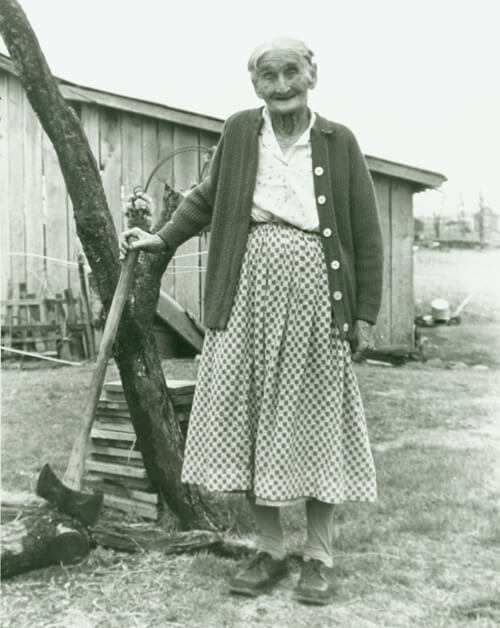 |
| Vaughn Brewer, Claudia Gammill, age 89, Stone County, Arkansas, 1979. Courtesy of University of Central Arkansas Archives, Rackensack Collection. |
Willodean continues an Ozark tradition when she plants a wide array of species in her garden; squash, cucumbers, garlic, onions, lettuces, corn, beans, peas, peppers, potatoes, tomatoes, turnips, and more fill every last inch of her tidy one acre patch. Abundant and diverse garden produce historically provided a significant portion of most Ozarkers’ diets. In 1979, Claudia Gertrude Gammill of Stone County, Arkansas asserted: “I made sixty-eight gardens in the same garden spot out here and I have not missed a year.” Her gardens included:
. . . tomatoes. . . peanuts. . . two or three acres in peas, a sorghum molasses patch, the cane to cut for hay for mules and stock to eat. . . Kraut cabbage. . . Three or four acres or five in cotton and corn. . . Taters, turnips, taters of both kinds and all kinds of garden stuff, onions, cabbage, and everthing beans, beans, planted in the corn, what is called white soup beans, . . . a yellow-pale yellow bean that I raised out just in the rows. There is a bunch bean. All of the beans we could eat all winter long.43Rackensack Collection, unpublished oral histories conducted in Stone County, Missouri in association with Jimmy Driftwood. University of Central Arkansas Archives. Conway, Arkansas.
In 1833, an immigrant to the region noted the seed varieties she transported from Germany to the Missouri Ozarks in cloth bags and paper seed packets:
. . . three kinds of green peas, four kinds of beans, three of carrots, three of onions, three of cabbages, two of beets, plus parsnips, cucumbers, gherkins, spinach, rhubarb, kohlrabi, leeks, and four kinds of turnips, two of which were for animal feed. . . gooseberry, blackberry, raspberry, and strawberry seeds, and for her planned orchard apple, cherry, peach, pear, quince, apricot, and plum seeds. Some twenty years later she wrote, "We have 22 apple trees; 10 cherry; 12 peach; 5 quince; 9 plum; 16 pear; 6 apricot; 16 crab-apple. We started by planting from seeds that I brought with me from home.44Erin McCawley Renn, "German Food: Customs and Traditions in the Missouri Ozarks," Ozarkswatch 3(3) (1990), 14-19.
Corn (Zea Mays), an Ozark Staple
Corn has been a key component of Ozark subsistence, appearing in one way or another at each meal.45William McNeal, An Arkansas Folklore Sourcebook (Fayetteville: University of Arkansas Press, 1992). The continuity of culinary traditions perpetuates diverse seed saving because family recipes sometimes require (or taste better with) particular varieties of crops such as corn. Because hominy remains a popular food in traditional Ozark homes, those families continue to grow open-pollinated field corn.
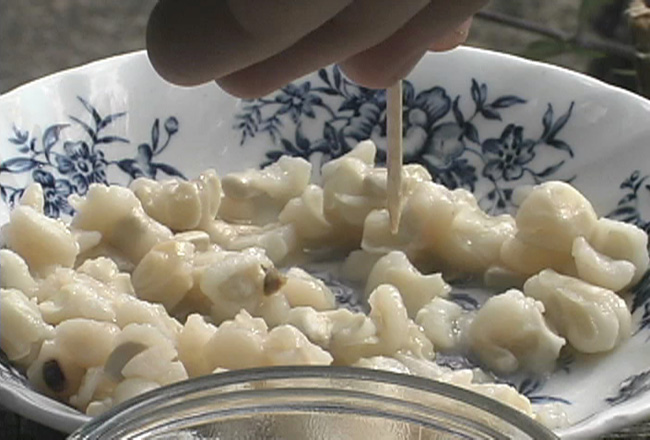 |
| Zachariah McCannon, Hominy made with Hickory King corn, Stone County, Arkansas, 2008. |
In Bittersweet Country Ellen Gray Massey explains the practicality of hominy:
Making hominy was a way to continue using corn after the growing season in some form other than corn meal. Since the stored dried corn would not spoil, the ingredients were always at hand and it could be made throughout the year as a vegetable dish. Either yellow or white corn can be used, though most preferred white corn because it makes such a pretty white fluffy product. The variety that most preferred was Hickory King (usually pronounced “cane”).46Ellen Gray Massey, Bittersweet Country (Garden City, New York: Anchor Press/Doubleday, 1978), 40.
Ozarkers maintain that neither sweet corn nor hybrid field corn varieties can be used to make hominy appropriately. In 1982, Anna McDowell, of Madison County, Missouri explained:
I can tell you one thing, you can’t make hominy out of this hybrid corn. It’s got to be old fashioned or whatever you call it. I’ve tried it twice since I’ve been here with that hybrid corn, and you just can’t make hominy out of it. Oh, it’ll peel good, but . . . you just can’t cook it done enough. There’s a big difference in it.47Dana Hamilton, My Daddy Taught Me to Doctor Snake Bites! Mozark: Cultural Journalism of Madison County, Missouri High School English Class (Fredericktown Missouri Public Library Collection, 1982), 56.
| Willodean's Hominy with Lye recipe | |
| 6 cups corn 8 or 9 cups of water 1 tbsp lye | |
| Put in stone jar or glass, stir with wooden spoon. Soak overnight in glass or crock container in lye solution. Cook 30 minutes or until eyes come off easy in porcelain or cast iron pot. Stir last 15 minutes constantly. Dip out of kettle and strain. Change water and put corn back in. Boil 20 minutes. Repeat 2 or 3 times or until the water clears up. Fill jars ¾ full and add water and 1 tsp salt to top. Cook 1 hour. 10 lb pressure for 40 minutes. Yield 6 ½ pints. |
 |
| Brenda Smyth, Willodean in her garden, Searcy County, Arkansas, July 2009. |
Willodean conveys ecological knowledge about the cross-pollination of various species and how to maintain pure seed varieties. Specifically she indicates that because she has more than one corn variety in her field she must separate them to prevent cross-pollination. Corn is wind-pollinated; once the tassels emerge and produce pollen the wind blows it onto the silks emerging from the developing ears below. Each kernel has a silk that must be dusted with pollen in order to develop. Corn varieties can easily cross, unless separated by a mile or two, or their planting is staggered to ensure that only one variety is spreading pollen at a time.48Suzanne Ashworth, Seed to Seed: Seed Saving and Growing Techniques for Vegetable Gardeners (Decorah IA: Seed Savers Exchange Press, 2002).
In the Ozarks, I have documented both seed-saving farmers who consciously prevent cross-pollination to ensure seed purity and others who do not concern themselves with cross-pollination, allowing the genetics of their seeds to intermingle. In this case, Willodean planted both Tennessee Red Cob, a field corn used to make corn meal, hominy or grits, as well as a sweet corn variety that would be eaten on the cob. Ozark farmer/gardeners frequently plant one field corn and one sweet corn variety each year.49Massey, Bittersweet Country. To reduce the possibility of cross-pollination, Willodean strategically plants other species in between each variety to block the flow of pollen from one corn variety to the other. She also chronologically staggers their plantings. Another way to prevent cross-pollination is to have someone else grow it, as Willodean explains about her daughter:
She got some black corn at the Seed Swap and she didn’t have space [in her garden]. I didn’t want it to cross with my corn in my garden so she had a neighbor up in Harrison grow it. She says: “It’s the strangest lookin’ corn I ever seen. It’s like a bush, with an ear on every stalk.”
The most common field corn (Zea mays) varieties found as heirlooms from the Ozarks include Bloody Butcher, Hickory Cane (King), Old Joe Dent, Pencil Cob, Possum Walk Special, Red Indian, Tennessee Red Cob, in addition to several popcorn varieties, such as Strawberry and Indian. I have documented many additional varieties that families name after a specific person, such as Ted Horton or Alfred Drury corn. Some of these corn varieties can be recognized as variants of historical varieties that were brought into the area from Appalachia (Hickory “Cane” [King], Tennessee Red Cob). The names indicate an Ozarkian (possibly universal) tendency to name a seed variety after the person who introduced it into the family. A comical exchange occurred when the sixty-year-old son of a seed saving matriarch was sent back to the pantry to retrieve some “Grandma Milsap’s” pinto beans and came back with several bags of bean seeds. He poured the contents of a bag out in his hand: “Is this them mama?” She studied the seeds and finally said: “No. That’s them John Dee beans.” Her son and daughter both giggled, having never heard about these beans, and she clarified: “I don’t know where John got them. They’ve been in the family for years. We don’t plant them anymore, because we don’t really grow field corn anymore and you have to have the field corn to vine’em.” She continued with a genealogical overview of John Dee, which reflects the power of seeds to preserve history and root cultural identity.
This exchange also elucidates a distinctive practice in agrobiodiverse farming: interplanting; in this case, John Dee beans are “cornfield” beans because they vine and climb the corn stalks, simultaneously fixing nitrogen for the corn plants. But because the family no longer grows field corn, they have abandoned this related seed variety. This exemplifies agricultural biodiversity loss and the interconnections between species; as particular traditions cease, related components, such as seed varieties disappear also.50S.B. Brush, Genes in the Field, On-Farm Conservation of Crop Diversity (Boca Raton, FL: Lewis Publishers, 2000).
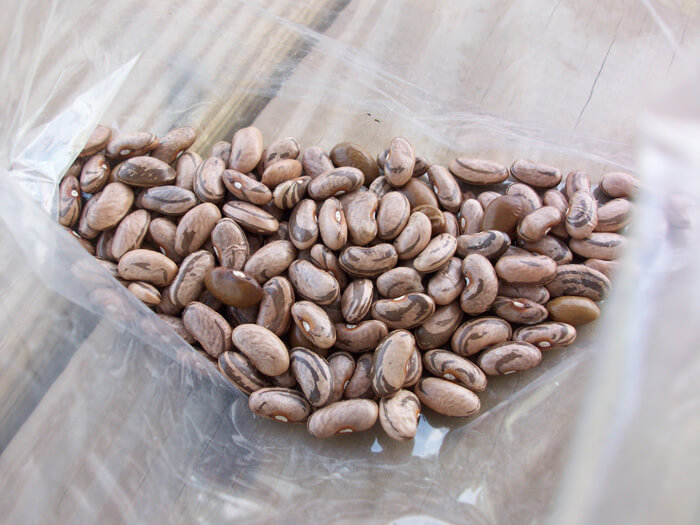 |
| Brian C. Campbell, John Dee cornfield beans, Newton County, Arkansas, 2007. |
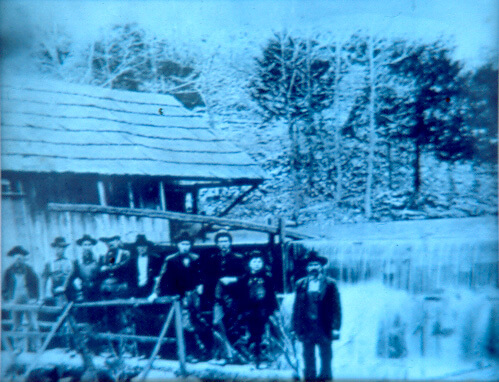 |
| Photographer unknown, Avery Brothers’ grandfather’s water-powered gristmill on Big Springs, Stone County, Arkansas, circa 1900. Courtesy of University of Central Arkansas Archives, Rackensack Collection. |
Gristmills were commonplace in rural areas through the mid-twentieth century. They were a place of congregation where people told stories, went on short hunting expeditions, whittled and/or reminisced while their corn was being milled. As early as 1840, there were at least four gristmills for stone grinding corn in each county of the Ozarks.51Blevins, Hill Folks, 22. In the early 1940s, Mr. A. O. Weaver, who “was seen on his mule, with a sack of corn strapped to his saddle, a gun in his hand, and his hound-dogs following along . . . on his way to the old Cedar Grove gristmill, to have his corn ground into meal” remarked:
This ol’ Cedar Grove mill is a real ol’ timer an’ has been grindin’ out corn meal ever since long before the Civil War. It has purtnye [pretty near] raised my family ‘cause there is where I’ve allers [always] took my corn to have it made into meal,. . . We’ve got to have corn meal at our house or we can’t live. I’ve got a big family an’ it takes lots ov bread, an’ when I go to the mill, I allers take my gun an’ dogs along an’ by the time I make the round an’ get back home, I’ve usually got a bunch of squirrels tied to this ol’ white mule, an’ that shore helps a lot at our table ‘cause we all like wild meat, sich as fish, squirrels, ‘possums an’ ‘coons an’ ground hogs, an’ turkeys.52Lennis L. Broadfoot, Pioneers of the Ozarks (Caldwell, Idaho: The Caxton Printers, Ltd, 1944).
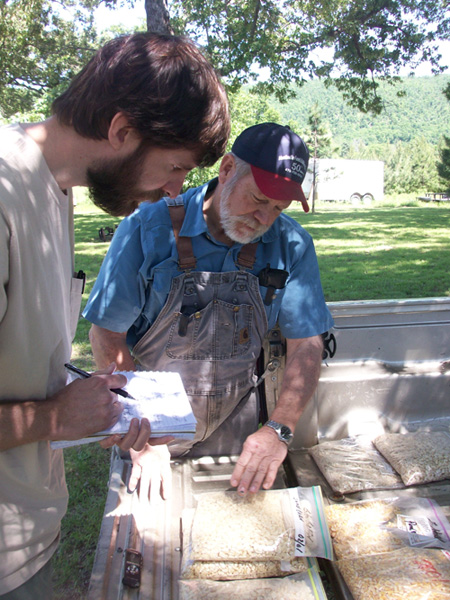 |
| Zachariah McCannon, Searcy County miller Rick Horton discussing local corn varieties with University of Georgia anthropology graduate student James Veteto, Searcy County, 2009. |
Whereas early Ozark gristmills were usually water-powered, contemporary ones typically run on fossil fuels or electricity. The general disappearance of gristmills throughout the United States contributes to the decline in heirloom corn varieties because without a local miller, field or dent corn used for cornmeal, hominy, and grits, is suitable only as livestock feed.53Wilson, The Bodacious Ozarks, 139. The Searcy County miller who grinds Willodean’s family corn works fulltime for the Arkansas Game and Fish Commission as a habitat biologist. He constructs and sells gas-powered gristmills and mills local families’ corn as a hobby. He estimates that only five to 10 percent of the corn brought for him to mill is hybrid, the other 90-95% is open-pollinated family corn. When a family brings him corn to be milled there is a fee for the service, unlike in the past when Ozark families had little (if any) cash money and instead paid a “miller’s fee,” a percentage of the corn. Willodean’s miller sets aside a small percentage of the corn unmilled in a deep freeze as seed stock to ensure that these family heirlooms are not lost. Several years ago one family planted all its seed corn and a severe storm washed it from their fields. The family was overjoyed when they contacted the miller and found that he had saved their corn seeds and their ancestral corn variety was not lost.
Agroecological Knowledge
Ozarkers who engage in agrobiodiverse farming have knowledge of their environment and the species within it that allow them to survive (agroecological knowledge). They utilize both wild and domesticated species, observe their behavior and interrelationships, and apply that information to use in gastronomy and agriculture. In the Ozarks and throughout the world, gourds (C. pepo,and Lagenaria siceraria) have found myriad uses.54Antonio Bisognin Dilson, "Origin and Evolution of Cultivated Cucurbits," Ciência Rural 32 (4)(2002), 715-723. Willodean and other Ozark farmers grow egg gourds (Cucurbita pepo) [also known as “nest” gourds] to use as surrogate eggs to indicate to a hen where she should be laying (rather than in hard-to-reach places) or to check the broodiness of a hen. Likewise, gourds have been grown on chicken houses to reduce or deter mite infestations55 Dilson, "Origin and Evolution of Cultivated Cucurbits." Nancy McDonough, Garden Sass: A Catalog of Arkansas Folkways (New York: Coward, McCann and Geoghegan, 1975), 213. Gourd vines have an especially pungent, putrid smell and contain, like other members of the cucurbit family, a secondary metabolite called cucurbitacin. Cucurbitacin has been documented as an insect repellant and attractant, and a purgative, emetic, and antihelminthic, in addition to other medicinal applications for humans. This particular metabolite may assist the plant in repelling mites that affect chickens. Hard-shelled (Lagenaria) gourds serve as containers of different sorts, birdhouses, and toys, and as the bodies of the earliest banjos and fiddles.56Ballentine UCA Rackensack Oral History Collection
Wild Species
Willodean Smyth, like many contemporary Ozarkers and their ancestors, utilize wild foods, especially berries, in a range of dishes and beverages. Lissie Moffett of Turtle, Missouri, explained: I pick an’ can enough wild berries every summer to do me through the winter. I take my basket on my arm an’ go out into the hills an’ stay all day, pickin’ huckleberries an’ blackberries.57Broadfoot, Pioneers of the Ozarks, 148.
| Willodean's Ozark Mountain Grape Drink | |
| Wash and stir fresh, firm, ripe grapes. Put 1 cup of whole grapes into hot quart jars. Add ½ to 1 cup of sugar (I use 2/3 cups) fill jar with boiling water, leaving ¼ in headspace. Adjust cap, press quart in pressure cooker (5 lbs) or 10 minutes in boiling water bath. Wait about 3 few weeks for flavor to develop. |
A wide range of wild plants continue to be important in Ozark subsistence. Willodean references the most widely used and appreciated wild green in the Ozarks, American Pokeweed (Phytolacca Americana).58William McNeil, An Arkansas Folklore Sourcebook (Fayetteville: University of Arkansas Press, 1992), 193. WPA Collection. She cans wild greens for her family to eat throughout the winter. Wild plants serve more than just culinary uses; they also provide medicine, stimulate growth in other plants, deter pests, and attract beneficial insects and pollinators.59Altieri, Agroecology. Michael Balick and Paul Cox, Plants, People, and Culture: The Science of Ethnobotany (New York: Scientific American Library, 1996). Ozarkers harvest spring culinary greens, in this approximate order: 1) watercress (Nasturtium officinale), sticky thistle (Cirsium species), wild lettuce (Lactuea Canadensis), wild onions [garlic] (Allium species) 2) plantain (Plantago species), dandelion (Taraxacum officinale), pokeweed, Henbit (Lamium amplexicaule), and broad-leaf (Rumex obtusifolius), and curley (Rumex crispus) dock 3) lamb's quarters (Chenopodium album), wild mustard (Brassica species), wild sage (Salvia lyrata) shepherd's purse (Capsella bursa-pastoris), and along creek banks: crow's foot (Ranunculus Trichophyllus) and colt's foot (Tussilago farfara), and then last to emerge in May is sheep sorrel (Rumex acetosella).60Nancy Holssinger, "Wild Greens: Values of the Roadside," Bittersweet 3(3)(1976), 52-57. Loma L. Paulson, "Greens Gathering through Generations," Bittersweet 3(3)(1976), 57-58. Randolph, The Ozarks: An American Survival of Primitive Society, 33. Wilson, The Bodacious Ozarks.
Pokeweed or poke sallit is a perennial plant that grows in just about any disturbed areas regardless of the quality of the soil. The ubiquity of the poke makes it a reliable food source even in the most stressed conditions. A folk tale collected in Stone County, Arkansas, in 1982 illustrates Ozarkers’ reliance on the plant, and their sense of humor:
Renzie Dow went to a place one night to stay. . . The man says come right on in. He says I do not have but one bed. You will have to sleep with me and my wife tonight. Says I will put a bolster [a long pillow] between us.
When time come to eat supper they did not have a thing in the world but poke salet. Renzie Dow was starving to death so he just eat poke salet until man it was a sight on earth, and the old man he reached over and he jerked the bowl away from him. He said . . . “to have some of that for breakfast; do not eat it all.”
Well, Renzie Dow was still just a starving to death. They went to bed and he was still laying there thinking about . . . all of that poke salet that he wanted. About midnight, why the stock just went to shouting out at the barn and all and the old man he had to go out and see what was bothering the stock. This woman . . . whispered to him. . . “now is your time.” Renzie Dow said, “huh?” and she says “now is your time, get over that bolster.” He said “Oh boy, I will get up and eat all of that poke salet.”61Rackensack Collection
The use of pokeweed as food requires knowledge of the plant’s properties, for it is poisonous if not cooked properly. Due to toxicity, only the young tender leaves are picked and boiled in water, and as Willodean explains, “boiled again” to ensure removal of the toxins.
Some plants produce toxic alkaloids and compounds to prevent herbivorous browsing, coincidently creating useful medicines or entheogens that lead to their increased propagation.62Balick and Cox, Plants, People, and Culture: The Science of Ethnobotany. Michael Pollan, The Botany of Desire: A Plant’s-Eye View of the World (New York: Random House Books, 2001). The toxicity of pokeweed results in medicinal properties that Ozarkers have identified.63Justin M. Nolan and Michael C. Robbins, "Cultural Conservation of Medicinal Plant Use in the Ozarks," Human Organization 58(1)(1999), 67-72. Poke’s early spring shoots are considered an invaluable spring tonic.64Holssinger, Wild Greens, 58. McNeil, An Arkansas Folklore Sourcebook, 193. Historically, after the preserves were finished off, Ozarkers had only smoked meat and hunted game to eat in the latter half of the winter, which led to a “thickening” of the blood. Spring greens “thinned” the blood, thereby restoring health. The roots can be used in tinctures or bitters, a combination of alcohol (historically homemade corn whiskey) and medicinal herbs, and in decoctions to treat a range of ailments, especially rheumatism and arthritis, and as a general tonic. Some Ozarkers eat a poke berry a day for similar reasons (spitting out the seeds due to the “pizen” in them).
Traditional Ozark meals consist of cooked greens (sometimes mixed with eggs) and some form of pork served with a variety of beans and cornbread. An Arkansas WPA (Works Progress Administration) researcher in the 1930s recorded a recipe for “Poke Sallit, one of the best-liked spring vegetable dishes,” that concludes “Many persons like to pour pepper sauce on sallit at the table” and provides a recipe for this particular pepper sauce that includes vinegar and “freshly picked ripe bird peppers” (Capsicum Annuum). I have documented and collected heirloom seeds from a range of “bird peppers” in the area that have been variously referred to as Bouquet Peppers, Chiltepins, and Poinsettia Peppers.
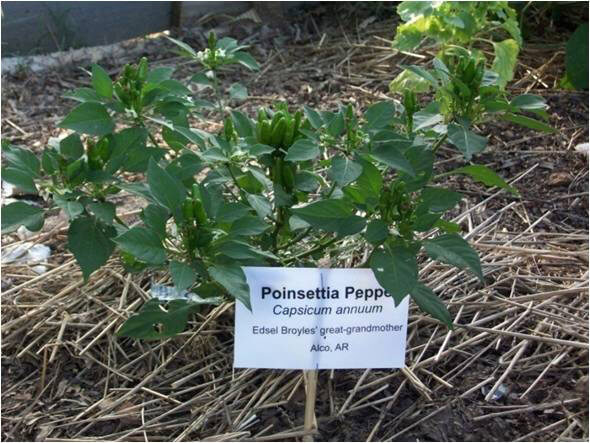 |
| Brian C. Campbell, Poinsettia Peppers in the Seed Bank Heritage Garden, Greenbriar, Arkansas, 2008. |
The WPA recipe continues: “pot licker from poke greens as cooked in this way is particular-good eaten with corn bread.” Pot likker (licker) is the liquid left over after cooking greens and was commonly spread over cornbread. The cooked greens were usually poke, mustard (Brassica juncea) or turnip (Brassica rapa); the latter was the most common cultivated green. In Three Years in Arkansaw, Marion Hughes conveys the importance of turnip greens in early Ozark subsistence when he tells the story of a cow escaping into “John Brown’s garden and eat up his turnip greens, and John he sued [the cow’s owner] for maintenance until rostenears is hard enough to eat.”65Marion Hughes, Three Years in Arkansaw (Chicago: M.A. Donohue & Company, 1904), 44. The ubiquity of corn in traditional Ozark meals continues here, with the reference to “rostenears” [roasting ears]. This treatment of young field corn as a vegetable rather than a grain resembles our contemporary use of sweet corn.66West, Plainville, U.S.A., 45.
Frugality
 |
| Brian C. Campbell, Ladybug on Whippoorwill field pea plant, Faulkner County, Arkansas, Seed Bank Heritage Garden, 2007. |
Growing species and varieties that tend to be well-adapted and resilient in their region, Ozarkers use (and reuse) plants that require limited work and inputs to produce and avoid the outlay of cash as much as possible. Field or cow peas (Vigna unguiculata) exemplify these traits and constitute another key foodways component.
Charles Morrow Wilson describes the Whippoorwill cowpea variety cooked with hog jowls as “distinctive Ozark fare.”67Wilson, The Bodacious Ozarks, 157. The Whippoorwill pea – a hardy cowpea that survives the most extreme Ozark weather and readily self-seeds – was known to numerous Ozarkers as the food that “got them through the Depression.” In a 1979 inverview, the Avery brothers of Stone County, Arkansas said that when they were growing up their parents and grandparents referred to hard times as “eating peas and dance,” because that was all one could do then.68Rackensack Collection
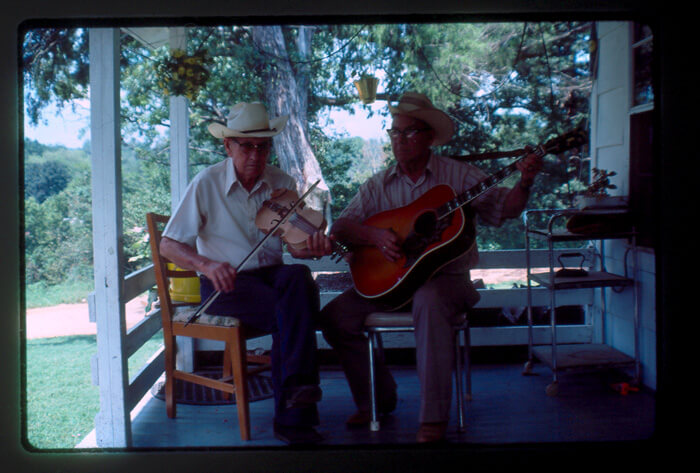 |
| Vaughn Brewer, Lonnie and Asburn Avery, Stone County, Arkansas, September 6, 1979. Courtesy of University of Central Arkansas Archives, Rackensack Collection. |
 |
| Brenda Smyth, Old chicken feed bags in garden with rocks on them as mulch, Searcy County, Arkansas, July 2009. |
Willodean refuses to throw away feed bags because of their utility as garden mulch. The bags retain soil moisture and prevent weeds from outcompeting her desired crops. She reuses a wide range of containers and other materials. The foam trays from meats or other packaged store produce stacked in her kitchen pantry, remind me of another seed saver who uses these materials as seed drying trays. He is a back-to-the-land farmer who settled in Newton County, Arkansas, in the early 1980s, built his own home, and runs a plant nursery. He and his wife reuse a wide range of materials, from plastic bags and plastic garden pots to foam and cardboard trays for seed drying. In the past, Ozarkers resourcefully made use of torn clothing (rugs, quilts), corn cobs (fuel, pipes, dolls), shucks (chair bottoms, mats, brooms, mattress stuffing), old nails (fishing lures and gigs), and every part of an animal they slaughtered.69McDonough, Garden Sass. McNeil, An Arkansas Folklore Sourcebook. Old Stock seed savers continue to engage in recycling behavior because of their enculturation by parents who struggled through subsistence living and the Great Depression. Back-to-the-land seed savers may have different motivations for their recycling tendencies, such as more modern environmentalist and conservationist ideologies, but they share this dedication to frugality.
 | |
| Brian C. Campbell, Seed Drying Trays, Newton County, Arkansas, 2009. Back-to-the-land farmer and seed saver Herb Culver. |
Before tossing any food to the pigs or chickens (rural waste disposals), traditional Ozarkers would have attempted to convert it into a palatable human dish. Willodean and her husband Kenneth recognize that some potatoes will inevitably get damaged during the harvest and they take measures to ensure that they do not go to waste. On April 6, 1973, Alice Dillard Smith of Marion County, Arkansas, wrote about her first “whipping” from her father, which she received for unintentionally “wasting” an entire crop of watermelons. She recalled:
We lived on a Rocky Ridge farm, which wasn’t good for raising watermelons. But one Spring they were Determined to raise some melons, they made Special hills some way. . . But it was good bit of work an trouble. We had a very nice patch of them an they had worked hard to establish some raised beds to grow them. It was time for melons to start Ripening. I was very small girl then an Id seen people plug melons to see if they were ripe. I didn’t know it would hurt them. So I got a knife one day an made for the patch. I plugged ever melon in the patch, not finding one Ripe one. I carefully placed the plugs back never dreaming I’d ruined them.70Alice Dillard Smith, Marion County, Arkansas, Unpublished, Hand-written Memoirs, acquired by Dr. Campbell from the family during ethnographic research in 2008.
While her mother tried to hide it from her father, the truth came out when he visited the patch, and Alice received a harsh lesson in Ozark subsistence.
At the end of the growing season in late fall, gardeners must salvage what they can before the first frost. Frequently tomatoes and other vegetables are picked before they are ripe and must be used in some unusual dish. Chow-chow fills that role by combining a hodge-podge of ingredients that may not suffice to make their own dish.
When a cucumber grows too large, it is no longer palatable, however Ozarkers, create innovative dishes that convert something that is usually wasted into something useful. Willodean turns the large over-ripe cucumbers into cinnamon rings. Here is a recipe for over-ripe zucchini squash.
| Lucy Monger's Mock Apple Butter | |
| 4 cups zucchini puree 6 tbs vinegar 3 tbs lemon juice | 2 cups sugar 1 tsp cinnamon (or more to taste) |
| Peel zucchini, take out the seeds, and chop coarsely. Place in blender with vinegar and lemon juice. Blend until smooth. Pour into saucepan with remaining ingredients. Blend well and cook on medium heat, stirring occasionally until mixture reaches desired thickness. Cool and keep in fridge or pour into sterilized pint jars while hot and seal. Serve with biscuits or toast. We use the large zucchini that seem to escape picking for this recipe. | |
| Willodean's Green Tomato Relish | |
| 12 cups ground or finely chopped tomatoes 4 cups chopped onions 3 chopped red and green bell peppers 8 cups boiling water 4 cups vinegar | 6 cups sugar ½ cup canning salt 3 tbs mustard seed 3 tbs celery seed (if wanted) 2 tbs turmeric |
| Combine tomatoes, onions, and peppers. Add boiling water, let set 5 or 10 minutes. Drain. Mix vinegar, sugar, salt, mustard, celery seeds and turmeric. Add to tomato mixture boil slowly for 15 or 20 minutes or until ready to can. Pour in jars and seal. Makes 6 pints. | |
The Future of Ozark Subsistence and Agricultural Biodiversity
While Willodean involves her grandchildren in gardening and canning and encourages them to consume healthy homegrown food, many children in the Ozarks are removed from these traditional processes.To encourage the continued transmission of agroecological knowledge and seed saving, several organizations have collaboratively established Seed Swaps. Today, agrobiodiverse farming in the Ozarks does not occur strictly among Old Stock farmers, rather a wide range of back-to-the-lander and new international immigrants. The Seed Swaps present a diversity of seed savers, in their ethnicity (Guatemalan, Mexican, Hmong, Thai) and in their age and farming background. Bo Bennett, a college student, excitedly traded his great grandfather’s seeds for other people’s grandparents’ seeds, exclaiming:
I’ve got some seeds. They’re Moon and Stars Watermelon (Citrullus lanatus). I got these from my grandmother. They were my grandpa’s. He died ten years ago, but she saved this jar of seeds this whole time and never planted them. He grew them every year when he was alive and they were grown by my great-grandfather also.”
 |  |  | ||
| John Hammer, Bo Bennett, UCA student, holding okra seed (left). He traded his grandfather’s Moon and Stars watermelon seed at the Swap. Victor Garcia of Independence County, Arkansas, and Kent Bonar, of Newton County, Arkansas (center). Willodean Smyth with her family heirloom variety Pencil Cob Corn (right). Ozark Seed Swap, Mountain View, Arkansas, 2009. | ||||
When Willodean attended her first Seed Swap and realized the interest so many people had in her varieties, knowledge, and traditions, she glowed. She was energized. She now seeks out local heirlooms more than ever, grows them in her gardens, gives them to the seed bank and at Swaps. She invites young people to her home and shows them how she cans. When she prepared butternut (C. moschata) and coushaw squash (C. mixta) pies for some neighbor “kids” (forty-somethings), they were shocked not to have eaten such food before. “Wow! I’ve never had this before," one remarked. "I can’t believe this food is so much better than store food.” “After hearing that,” Willodean says, “I decided, the good Lord has kept me alive because I’ve got a job to do, to teach young people how to make a garden and can.”
]]>