Songs Cover the Landscape
Yet another program housed under the Works Progress Administration (WPA), the Federal Writers Project (FWP), invited Zora Neale Hurston in 1938 to join the editorial staff of The Florida Guide, part of an "American Guide" series designed to "hold up a mirror to America." The gig provided her with the opportunity to sharpen her ethnographic game, and through her WPA activities and assignments, she began to move closer toward both recording and performing her folk music findings out in the field. According to her colleague Stetson Kennedy, she collected "fabulous folksongs, tales, and legends, possibly representing gleanings from days long gone by." She also drafted reports on the music of local church services and filed an essay on Florida folklore and music entitled "Go Gator and Muddy the Water." Hurston did all of this in spite of her steadfast autonomy as a member—the only Black woman member—of the editorial staff (the lowest paid and yet, according to Kennedy, quite likely the most experienced). In this context, she emerged as the ideal candidate to participate in a statewide recording expedition organized by the FWP.1 Valerie Boyd, Wrapped in Rainbows: The Life of Zora Neale Hurston (New York: Scribner, 2004), 313; Kennedy as quoted in Boyd, 318. Says Kennedy, "She had already published her first two books by that time, but she wanted a job and was given the same job title that I had when I started out. I was junior interviewer. Imagine Zora Hurston, junior interviewer. She had already had her degrees from Boaz (sic) and Columbia and Barnard and so on." "The Sounds of 1930s Florida Folklife," All Things Considered, February 28, 2002, NPR Hearing Voices, http:// hearingvoices.com/transcript.php?fID =23. In his unpublished manuscript on Hurston's career and his time working with her on what became known as the "Negro Unit" of the FWP, Kennedy notes that Hurston was given the title of "Junior Interviewer" and paid "$67.20 per month" for her work with the WPA. "Ironically," Kennedy adds, "the typist at the Negro Unit" in Jacksonville "was paid $5.00 per month more than Zora, by virtue of a higher urban wage scale." Stetson Kennedy, "Alan Lomax/Zora Neal Hurston Field Trip of 1935 . . . As Described by Alan [Lomax] to Stetson Kennedy," Zora Neale Hurston Box 1, Stetson Kennedy Papers, uncataloged, n.d., George A. Smathers Library, University of Florida, Gainesville. However, Stetson remains a tricky figure when it comes to his own treatment of Hurston's legacy. He was a fierce champion of her legendary status, a jealous protector of his own archival materials related to their shared work for the WPA, and also a spectacularly harsh critic of Hurston's contradictory persona. See, for instance, his searing list of "SAD-BUT-TRUE ASPECTS of Zora" which includes a range of inflammatory monikers including "THE SELF-STYLED 'PET DARKEY' . . . NO RACE CHAMPION . . . THE LICKER OF THE WHIP HAND, THE 'HOUSE NIGGER' . . . THE RACISTS' DARLING," "THE ARCH REACTIONARY," and "THE 24-KARAT BITCH." The latter insult Kennedy attributes to Alan Lomax, quoting him as having said that in "the field, Zora was absolutely magnificent—but of course you know she was a 24-karat bitch. . . ." Kennedy, "SAD-BUT-TRUE ASPECTS OF ZORA," September 5, 2000, Zora Neale Hurston Box 1, Stetson Kennedy Papers, uncataloged at the time of archival research. Kennedy wrote obsessively about Hurston in a range of published material and unpublished material that recycled and occasionally reworked versions of the aforementioned list of traits he logged. See, for instance, Kennedy, "Almost all I know about Zora," unpublished manuscript, September 5, 2000, Zora Neale Hurston Box 1, Stetson Kennedy Papers, uncataloged at the time of archival research. Kennedy, untitled ("I am the one who wrote, in my Tribute to Zora . . ."), unpublished manuscript, September 8, 2000, Zora Neale Hurston Box 1, Stetson Kennedy Papers, uncataloged at the time of archival research.
In the eyes of Ben Botkin, the FWP folklore program's new national director, "mere written transcriptions did not provide enough detail and ambience," and so he turned to Hurston and crew to turn up the volume in the wetlands. "When she first came on board and scheduled a visit to our (lily-white) state office," recalls Kennedy, "a staff conference was convened at which we were admonished that 'we would have to make allowances for Zora, as she had been lionized by New York café society, smoked cigarettes in the presence of white people,' etc. And so she did, and so we did."2Boyd, Wrapped in Rainbows, 322; Stetson Kennedy, unpublished manuscript, 6, Zora Neale Hurston Box 1, Stetson Kennedy Papers, uncataloged at the time of archival research.
It was not a situation without stress for her. Writing in late 1938 to state FWP director Carita Doggett Corse, Hurston noted her personal battle with a "form of phobia," a crushing and incapacitating depression that left her unable to "write, read, or do anything at all for a period." Having assured her "Boss" in that letter that when she does "come out of" such spells, it is "as if [she] had just been born again," Hurston nonetheless was plagued at times with questions about how best to make sense of her inner turmoil in relation to her intellectual and artistic pursuits. In her letter to Corse, she ponders the reasons for her despair and notes that she finds that such spells are often "the prelude to creative effort."3Zora Neale Hurston to Carita Dogget Corse, December 3, 1938, in Zora Neale Hurston: A Life in Letters (New York: Anchor, 2003), 417–418. By summer of the following year, she was rolling with the FWP crew and about to embark on some of her most fascinating and unique methods of research.
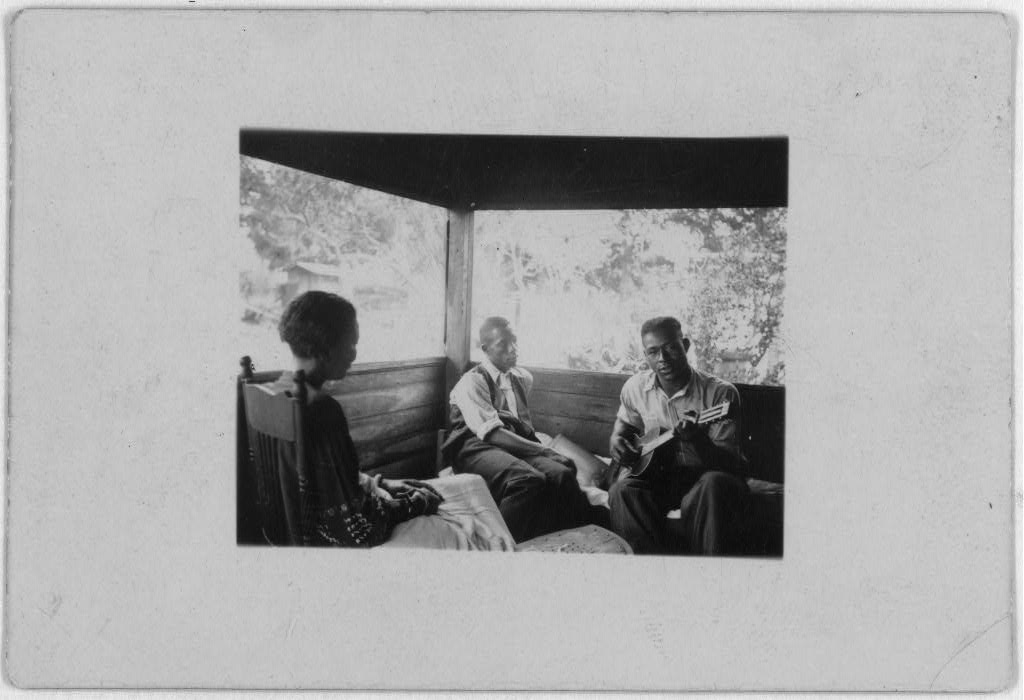
Bottom, Zora Neale Hurston with Rochelle French and Gabriel Brown, Eatonville, Florida, June 1935. Photograph by Alan Lomax. Courtesy of Library of Congress.
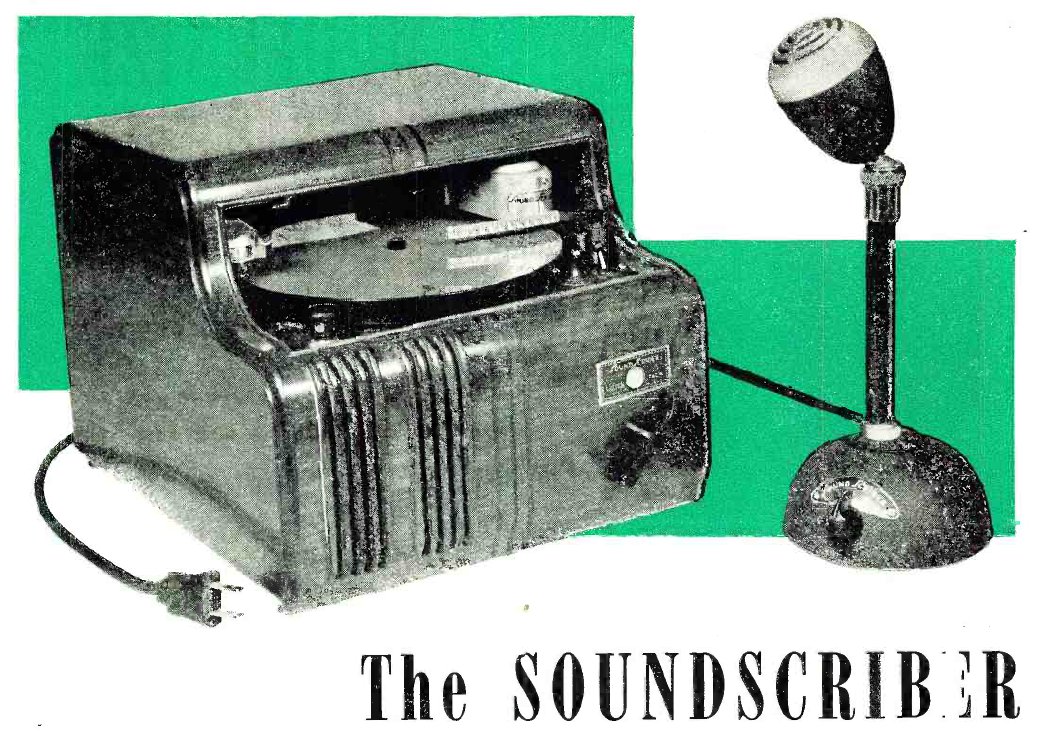
Some four years after the publication of what would become two of her most famous essays, folklorist Herbert Halpert and a crew of fellow WPA workers recorded Hurston on June 18, 1939, performing a range of rollicking vernacular songs down on the Florida peninsula in Jacksonville. Here she and her Florida guide colleagues had set up camp, among them Corse, "twenty-something" Halpert, and local student-turned-project supervisor Kennedy. On site in Jacksonville, Halpert had on hand a recording device "the size of a coffee table—the moving parts looked like a phonograph—and cut recordings with a sapphire needle directly onto a 12-inch acetate disk." For her part, Hurston had, along with her fellow Black FWP colleagues, rounded up "a group of railroad workers, musicians, and church ladies at the Clara White Mission on Ashley Street, a landmark institution in Jacksonville's Black community." There, Halpert "used his cumbersome recording machine to capture the voices of various informants singing, telling stories, and occasionally hamming it up for posterity."4"Sounds of 1930s Florida Folklife." Kennedy traces the recorder back to "the Hurston/Lomax/Barnicle team," pointing out that the team "borrowed the recorder of the Library of Congress" because of Lomax's father's ties to that institution. "In those pre-tape days," he muses, recorders "consisted of a heavy monstrosity. . . ." After joining the FWP, "Zora was able to again wangle it on loan from the Library of Congress" Stetson Kennedy, unpublished manuscript, 62–63, Zora Neale Hurston Box 1, Stetson Kennedy Papers, uncataloged at the time of archival research. Bordelon further points out that Halpert would arrive in Jacksonville "with the equipment carefully stored in a converted World War I ambulance outfitted by workers from the Federal Theater Project. . . . He was one of the few folklorists with field recording experience. He knew how to transport, repair, and set up the cumbersome equipment as well as how to conduct the first-person interviews, an integral part of the recording sessions." "Zora Neale Hurston," Go Gator and Muddy the Water: Writings by Zora Neale Hurston from the Federal Writers Project, ed. Pamela Bordelon (New York: Norton, 1999), 45; Boyd, Wrapped in Rainbows, 324.
Hurston's approach to this whole operation was always distinct, always bent on both reproducing precious sounds through her own performance practices and yet still capitalizing on the quirks and the character of her own interpretative skills. This is Zora's form of phonography, that which loops together a zone in which she operates at the crossroads of the modern and the folk. On tape, one hears a forty-eight-year-old Hurston (who brashly claims for the record that she is thirty-five) both collaborating with and also facing off against Halpert's bulky, furniture-sized machine to offer her own definitive repertoire of southern vernacular culture for the archive. A copy of Halpert's "Tentative Record Check List" from these sessions dated March 12–June 30, 1939, offers a detailed account of songs sung by Hurston and other local interlocutors (for example, "Beatrice Long (white) age 35"; "Rev. H. W. Stuckey, age 43, blind Negro preacher"). Both a playlist of sorts and an archival testimony to this sister's exhaustive performative dynamism, her mad flow, and her tireless and meticulous attention to the cultural eccentricities manifest in the songs themselves, Halpert's "record check" documents Hurston's instructive commentary and her magnetic presence on these expeditions. These are notes that follow the rhythms of her explanatory cues, the distinctions that she makes between, say, a "jook song" and a "lining" accompaniment, her references to her own ethnographic prowess ("Miss Hurston describ[es] how she collects and learns songs (including those she has published)"). The labor of it all lurks in the parentheses as well, as in the bracketed moment when Halpert indicates that "Miss Hurston was tired (in part) and accidentally tacked songs together." This is the document of her marathon performances, her critical acuity in the realm of listening, performing, and, by extension, arranging the sounds that she encounters, stores, and "carrie[s] . . . in her memory" from the heart of the field right into the center of those scholarly circles awaiting her return.5Boyd, Wrapped in Rainbows, 325; Bordelon, "Mule on the Mount" transcription, 163–164; Herbert Halpert, "Tentative Record Check List: southern recording expedition," March 12– June 30, 1939, Herbert Halpert 1939 Southern States Recording Expedition (AFC 1939/005), Archive of Folk Culture, American Folklife Center, Library of Congress, Washington, DC. Kennedy maintains that it was his "bright idea" to "sav[e] travel money," "summo[n]" Hurston to Jacksonville, "si[t] her down in a chair, and recor[d] all the folkstuff she carried around in her head," and he looked to Halpert, who was "using the machine at the time," to "collaborate in interviewing" her. Stetson Kennedy, unpublished manuscript, 64, Zora Neale Hurston Box 1, Stetson Kennedy Papers, uncataloged at the time of archival research.
By way of Zora's phonography, we are made privy to a listening to a listening: Kennedy and Halpert and Corse and others lean in and pose questions as they strain to follow Hurston's musical cartography of folk songs, work chants, and blues and children's songs gathered up in the American South and the Caribbean diaspora, from the Bahamian "Crow Dance" to the swinging "Charleston rhythms" of "Oh the Buford Boat Done Come," music picked up by Hurston from a South Carolina Geechee country woman she met in Florida. She stands at the center of it all, shifting fluidly between the role of the folklorist and that of the informant, melding songs with communal lore, sketching out their sociocultural context and utility, and belting them out for a wonkish gaggle of folklore scholars, a captive audience who, nonetheless, prods her for details. Scholarly jostling ripples as an undercurrent in these sessions. But Hurston the pro brings all her swagger to these proceedings; she brings all of her skills to bear/bare in her vocal aesthetics of song, the means through which she might put the wonder and specificity of Black sonic art on the Florida map once and for all.6Kennedy's version of this recording expedition occasionally frames Hurston as the object of ethnographic inquiry rather than as a fellow collaborator ("I had gotten into the habit of asking my informants if they knew any 'dirty songs.' As it turned out, they knew plenty. . . . I asked Zora if she knew a song called 'Uncle Bud.'"). Stetson Kennedy, unpublished manuscript, 64, Zora Neale Hurston Box 1, Stetson Kennedy Papers, uncataloged at the time of archival research. The Library of Congress website lists both Halpert and Kennedy as "speakers" along with Hurston on various recordings from these sessions. Elsewhere Kennedy elaborates on the team's working conditions, describing how, "in recent years when asked to speak on the subject 'Working with Zora' . . . I have been tempted to suggest that the title 'Trying to Get Zora to Work' would be more appropriate. Like many of us who were on our own out in the field (again myself included), production was sporadic." Stetson Kennedy, "Zora's Contributions," n.d., unpublished manuscript, n.p., Zora Neale Hurston Box 1, Stetson Kennedy Papers, uncataloged. Kennedy was one of Hurston's greatest defenders and also one of the most consistent critics of her well-known ambivalences when it came to racial uplift politics, her "accomodationist-if-not apologist" leanings, as he puts it. But repeatedly in his manuscript, he argues that "we and generations yet to come should focus upon how Zora Neale Hurston wrote, not how she voted." Stetson Kennedy, unpublished manuscript, 68, Zora Neale Hurston Box 1, Stetson Kennedy Papers, uncataloged. See also Kennedy, "sad-but-true aspects of zora," unpublished manuscript, September 5, 2000, Zora Neale Hurston Box 1, Stetson Kennedy Papers, uncataloged at the time of archival research. For more on Hurston's political leanings, see Boyd, Wrapped in Rainbows.
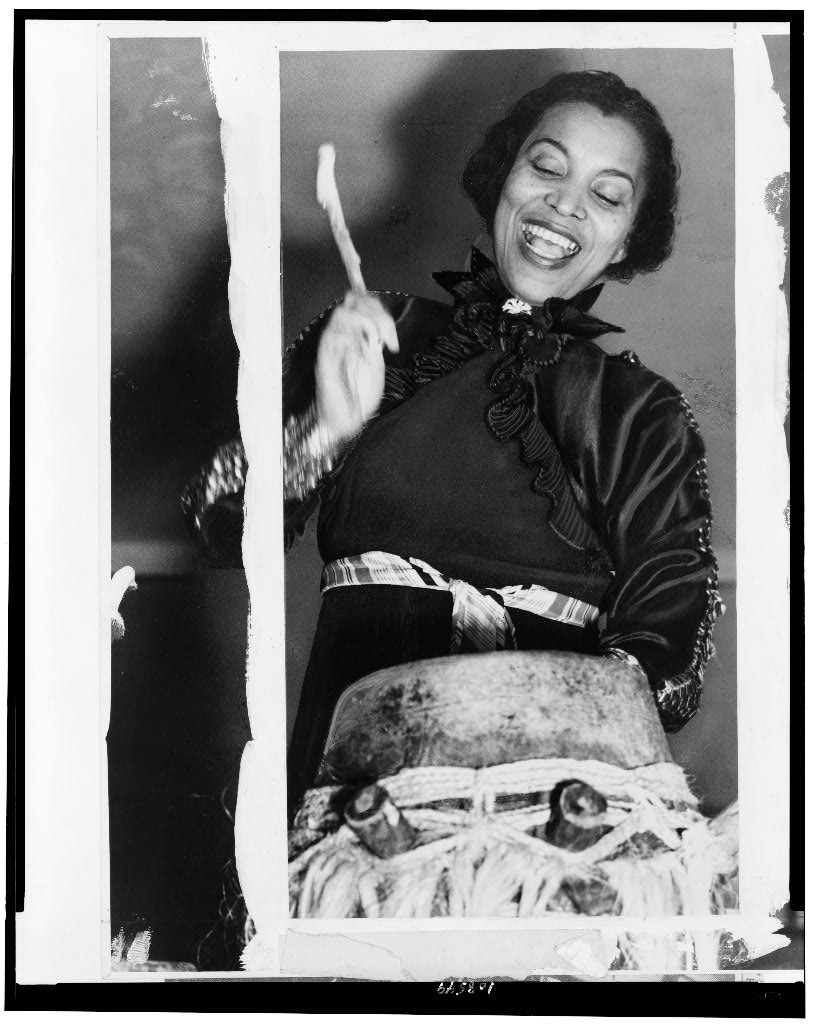
Songs cover the landscape like regional quilts in Zora Neale Hurston's musical repertoire. As she lets loose on "Mule on the Mount," "the most widely distributed work song in the United States," we hear the varied shades and moods of Black regional experience as verses shift and change according to locality. Hurston's fascination with blues dissonance clearly undergirds her theories of Black performance, her liner notes for the recordings still to come when, for instance, she highlights the importance of both angularity (performances that stress the "angles" of bodily expression) and especially asymmetry ("the abrupt and unexpected changes. The frequent change of key and time . . ."). We can hear her working this blues aesthetic out in songs like "Mule on the Mount," that lining rhythm that we might think of as a Hurston, folkified version of "Wartime Blues" since, as is perhaps implicit in her prefatory comments, it shares moments of startling narrative discordance and social upheaval with that Blind Lemon Jefferson blues classic.
Hurston: This song I am going to sing is a lining rhythm, and I am going to call it "Mule on the Mount," though you can start with any verse you want and give it a name. And it's the most widely distributed work song in the United States . . . it has innumerable verses and whatnot, about everything under the sun. . . . [Black folk] sometimes sing it just sitting around the jook houses and doing any kind of work a t'all. . . .Everywhere you'll find this song. Nowhere where you can't find parts of this song. . . .
Halpert: . . . Is it a consistent song . . . as you hear it all over?
Hurston: The tune is consistent, but . . . the verses, you know . . . every locality you find some new verses everywhere. . . . There is no place that I don't hear some of the same verses. . . .
Halpert: Where did you learn this particular way?
Hurston: Well, I heard the first verses, I got in my native village of Eatonville, Florida, from George Thomas.
Halpert: And is . . . that the only version you're going to sing?
Hurston: The tune is the same. I am going to sing verses from a whole lot of places.
Halpert: All right.7Zora Neale Hurston, "Mule on the Mount," Herbert Halpert 1939 Southern States Recording Expedition, AFC 1939/005: AFS 03136 B01, American Folklife Center, Library of Congress, Washington, DC, https://www.loc.gov/item/flwpa000008/.
If the trope of the mule recurs in Hurston's literary and ethnographic writing most famously as a feminized beast of burden, in this song from "everywhere," it is the vehicle that the masculinist singer "rides down" in the opening verse, replaced in the second verse by "a woman" who "shakes like jelly all over." "Mule on the Mount" is, by no means, a feminist revision of sexist vernacular culture, as it transitions into a stock tale of paranoia and betrayal ("My little woman, she had a baby this morning. . . . He had blue eyes"), alienation and revenge ("And I told her, must be the hellfire cap'n Ha! . . . I got a woman. She won't live long, lawd, lawd, she won't live long"). However, it is a song that emerges in her research and performance as raw material that showcases the ways sonic folklore might serve as the connective tissue that ties dispersed Black peoples together through improvisational innovation, as well as temporally and geographically distant modes of collaboration.8Bordelon transcription of "Mule on the Mount," Bordelon, Go Gator, 163–164; Hurston, "Mule on the Mount." Like the protagonist in Jefferson's ode to estrangement and wandering, the tragic hero of Zora's mule tale retold breaks by the fourth verse onto another plane, away from the arrival of the "blue-eyed baby," the product of probable betrayal and potential racialized sexual violation, away from "the hellfire," and turns instead toward the sound of "a cuckoo bird" that "keep a hollerin' Ha! . . . It look like rain, lawd, lawd, it look like rain."9Blind Lemon Jefferson's 1926 "Wartime Blues" makes use of the blues form's "floating verses," oft-repeated verses in Black radical tradition lore, and ones that reference familiar images, for instance, "trains" and "rivers" and tropes evocative of African American rural and migratory life. Such visions and figures and themes "float" from one song to another and can sometimes take shape as jarring abstractions, as thematic non-sequitar. But in every case, they are manifestations of both a dispersed and disrupted culture and the innovative contemplation of and rejoinder to quotidian and ubiquitous crisis. Blind Lemon Jefferson, "Wartime Blues," Release # 12425A, Matrix # 3070, Take #1, The Rise & Fall of Paramount Records, Vol. 1 (1917–1932) (Third Man Records-Revenant Records, 2013). For more on blues aesthetic traditions, see also Scott Blackwood's monumental work on the archive of Paramount recordings. Scott Blackwood, The Red Book liner notes for The Rise & Fall of Paramount Records, Vol. 1 (1917–1932); and Chapter 7. The pivotal fifth verse, and one that would become a signature line in Hurston's repertoire—"I got a rainbow wrapped and tied around my shoulder/It look like rain, lawd, lawd, it look like rain"—is the most telling break in the song, and it is the kind of rupture that Hurston would capitalize on in her role as a "signifying ethnographic" critic of Black sound. With that technicolor coat supplying crucial cover, the heroine of "Mule on the Mount" stands both outside and inside the song's wending, epic narrative. It may pour cats and dogs all around her, this song suggests, but she stays the course all bundled up in a mystical garment. Here in this place, caught in this storm and yet sheltered from it, she is traveling at her own angle against and through the elements. Moving to her own soundtrack, she possesses the equipment to stay in motion and keep the music alive. She wraps that "rainbow . . . tightly around [her] shoulder" and heads on out into the territory that is Black America, picking up exquisite sound, peculiar sound, vital sound all along the way.10Hurston, "Mule on the Mount."
Hurston on the Open Road
"My search for knowledge of things," Hurston muses in her conundrum of a memoir Dust Tracks on a Road, "took me into many strange places and adventures. My life was in danger several times. If I had not learned how to take care of myself in these circumstances, I could have been maimed or killed on most any day of the several years of my research work." Still more, Carla Kaplan makes plain in her edited edition of Hurston's letters how wary she is of "romanticiz[ing] Hurston with Model T and pistol, searching out 'the Negro farthest down' and 'woofing' in 'jooks' along the way." The "truth is," Kaplan contends, "that she worked hard under harsh conditions: traveling in blistering heat, sleeping in her car when 'colored' hotel rooms couldn't be had, defending herself against jealous women, putting up with bedbugs, lack of sanitation, and poor food in some of the turpentine camps, sawmills, and phosphate mines she visited."11Hurston, Dust Tracks on a Road (New York: Harper Perennial, 1996, 146; Carla Kaplan, "'De Talkin Game': The Twenties (and Before)," in Zora Neale Hurston: A Life in Letters (New York: Anchor Books, 2002), 51–52. With regards to the opacity of Dust Tracks, Maya Angelou's 1995 foreword to the book is instructive. Angelou famously observes of Dust Tracks that "the author stands between the content and the reader. It is difficult, if not impossible, to find and touch the real Zora Neale Hurston" (xii). But as she was prone to "wandering" in "spirit," if not always in "geography" and "time," as she would describe it in her memoir, the automobile proved useful as a source of refuge from Jim Crow danger on more than one occasion for her, particularly as "racially 'mixed' teams" of WPA field researchers "travelling together were virtually unheard of." For these reasons, her "beat-up Chevy" was, more often than not, always her most dependable shelter.12Hurston, Dust Tracks on a Road, 67. See also Boyd, Wrapped in Rainbows, 57. Fellow FWP recording expedition team member Kennedy recalls Hurston's time in the field with him "record[ing] more of the songs of migratory black workers in the Everglades mucklands." Stetson Kennedy, unpublished manuscript, 63, Zora Neale Hurston Box 1, Stetson Kennedy Papers, uncataloged at the time of archival research.
Hurston turned to her engine of modernity to gather up, cultivate, and disseminate songs that played with and through time and space and that called attention to the scale and depth of Black community. . . . The songs are the cars that she drives and the vehicles that carry her listeners into the "imagined cartographies" of Black migrants all at once, working out the politics of spirited togetherness as well as passionate longings and everyday dislocations as her vocal wheels keep turning. They are the sounds that stored up a kind of complex counterknowledge to that which irked Hurston, the seemingly knee-jerk rendering of southland Black life that defined it as steeped in suffering and nothing but.13Marti Slaten, Email message to the author, Jan. 13, 2011. Josh Kun would most certainly identify the "audiotopian" sites of cultural memory, communal questing, and questioning in Hurston's sounds. Josh Kun, Audiotopia: Music, Race, and America (Berkeley: University of California Press, 2005). Concerning this noted Blackness and suffering trend, redolent in the work of some of her most prominent 1930s contemporaries like George Gershwin and Richard Wright, she lamented in a 1936 letter that "some writers are playing to the gallery. That is, certain notions have gotten in circulation about conditions in the south and so writers take this formula and workout so-called true stories." Zora Neale Hurston to Stanley Hoole, March 7, 1936, Folder 60, Box 2, Zora Neale Hurston Papers.
I heard "Halimuhfack" down on the . . . East Coast. . . . I was in a big crowd, and I learned it in the evening [in] the crowd. . . . I learned it from the crowd. [Zora singing]: "You may leave 'n go to Halimuhfack, but my slowdrag will bring you back. Well, you may go, but this will bring you back. I been in the country but I move to town. I'm a toe-low shaker from a head on down. Well you may go but this will bring you back. . . . Some folks call me a toe-low shaker, it's a doggone lie. I'm a backbone breaker. Well you may go, but this will bring you back. Oh you like my peaches but you don't like me. Don't you like my peaches, don't you shake my tree? Oh well you may go but this will bring you back. Hoodo! Hoodo! Hoodo do working! My heels are poppin' . . . my toenails crackin'. Well you may go, but this will bring you back."14Zora Neale Hurston, "Halimuhfack," Herbert Halpert 1939 Southern State Recording Expedition, AFC 1939/005: AFS 03138 B02, recorded in Jacksonville, Florida, June 18, 1939, American Folklife Center, Library of Congress, Washington, DC, https://www.loc.gov /item/flwpa000014/.
You can hear Hurston relishing the wicked innuendos running amuck in "Halimuhfack," a jook song she'd "heard down on the East Coast" of Florida and one that exudes the "slow and sensuous" rhythms of the jook, that undercommons gathering place where, as she would famously insist, Negro theater originates, where "bawdiness" and "pleasure" erupt out of a smoldering elixir of song, dance, and inspired instrumentation.15Zora Neale Hurston, "Characteristics of Negro Expression," in The Jazz Cadence of American Culture, ed. Robert O'Meally (New York: Columbia University Press, 1998), 306–309. All taunt and gentle seduction, Hurston the singer/interpreter gamely seizes on the mischievous wonder of a song that nonetheless documents and archives Black geographies in flux. It is a song that calls attention to the "imbrication of material and metaphorical space."16 Katherine McKittrick, Demonic Grounds: Black Women and the Cartographies of Struggle (Minneapolis: University of Minnesota Press, 2006), xiii. McKittrick calls these kinds of "clandestine geographic-knowledge practices" the "spaces of black liberation" that were "invisibly mapped across the United States and Canada and that this invisibility is, in fact, a real and meaningful geography. . . . the unmapped knowledges" (18). These "black geographies," she argues, "are deep spaces and poetic landscapes, which not only gesture to the difficulties of existing geographies and analyses, but also reveal the kinds of tools that are frequently useful to black social critics" (21–22). As Hurston would describe it in her "Folklore" manuscript chapter for the FWP, "Halimuhfack" is a "blues song" whose "title is a corruption of the Canadian city of Halifax. The extra syllables are added for the sake of rhythm."17Zora Neale Hurston, "First Version of Folklore," n.d., manuscript, Box 12, Zora Neale Hurston Papers. Pamela Bordelon includes "the third and final draft of the folklore and music chapter for The Florida Negro" in her collection of Hurston's transcribed FWP writings, but she spells the title as "Halimufask." The song title in Hurston's "first version" is "Halimuhfack." See Zora Neale Hurston, "Go Gator and Muddy the Water," in Bordelon, Go Gator, 72. The Stetson Kennedy Papers include a Zora Neale Hurston "set list" of sorts with "Halimuhfack" listed as "Halimuhfact," as well as the handwritten additional lyric, "My slow drag will bring you back!" Black theater scholar Eric Glover notes that "Halimuhfack" appears in Hurston's script for Polk County as well. See Eric Glover, "By and About: An Antiracist History of the Musicals and Anti-musicals of Langston Hughes and Zora Neale Hurston" (PhD diss., Princeton University, 2017). Yet "extra syllables," the gateway to lyrical "corruption" here, are the beats that carry the song onto another plane of expressive recourse for African Americans managing the exigent pressures of Jim Crow life, the quest for equality, employment, and human sustenance. Like "Diddy-Wah-Diddy" and other "Negro mythical places" of Black folklore that she documents in her automotive guide writing, "Halimuhfack" is the site of the speculative, the not-here; it's the in-between world of mythical folklore and blues quotidian life.18Bordelon points out that one of the "Negro mythical places" included in her automotive guide excerpt, "'Diddy-Wah-Diddy' . . . [is] a magical destination where neither man nor beast had to worry about work or food. Both were magically supplied. They often laughed and dreamed of far-off 'Heaven,' pinning human qualities on its celestial inhabitants." Bordelon, "Zora Neale Hurston," 26. See also Christopher D. Felker, "'Adaptation of Source': Ethnocentricity and 'The Florida Negro,'" in Zora in Florida, ed. Steve Glassman and Kathryn Lee Seidel (Orlando: University of Central Florida Press, 1991), 149. Hurston's shrewd rhythmic elongation of a north-of-the-border place (a place where Black fugitives found shelter from those who sought to return them to US bondage) renders it unrecognizable, turns this place into something new, another site of Black flight with its own quixotic allure, matched only by the "slow drag" of a singer bold enough to try to seduce her lover to return.
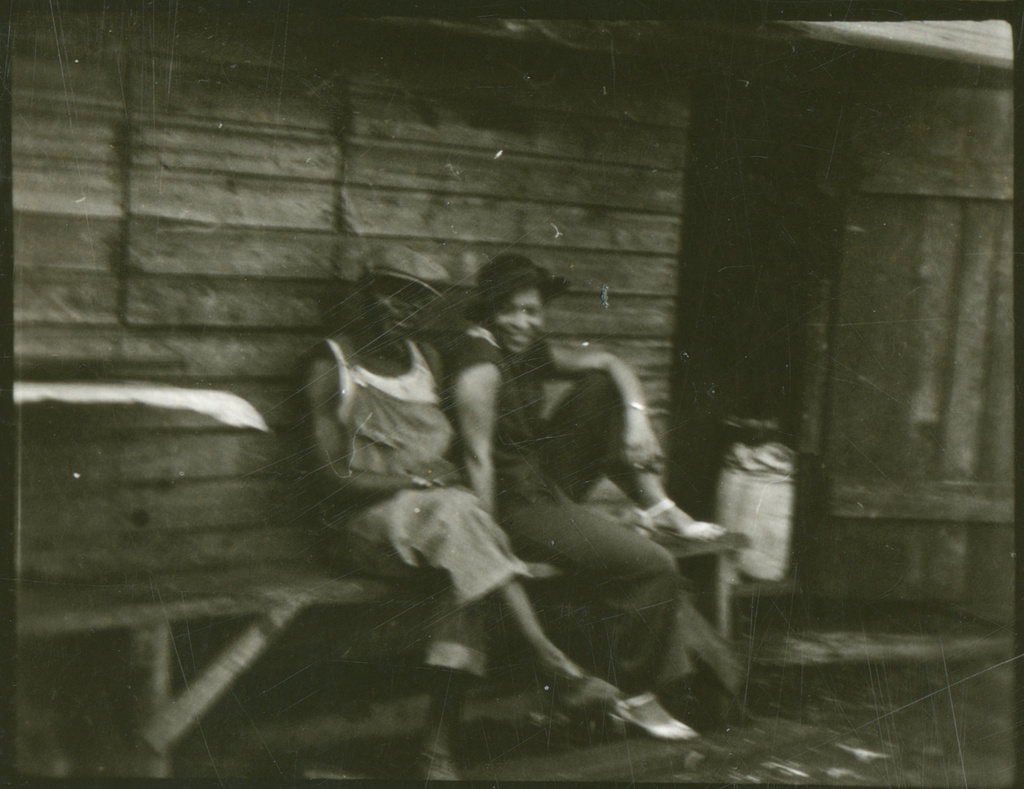
"Halimuhfack" is a record of Florida Jim Crow life as it was lived in a felt relationship with space, place, and the land that our intrepid anthropologist criss-crossed by car. In her time working for the FWP—which, on the one hand, flexed its racism by hiring her "in a relief rather than an editorial-supervisory capacity" and yet, on the other hand, enabled her to "live and work out of her own home in Eatonville, a privilege extended to only a handful of writers nationwide"—Zora's taped performances exude the kind of adventurous independence that would ultimately inform the iconicity of her career.19Bordelon, "Zora Neale Hurston," 17. Her recordings also stand as sound evidence of "different knowledges and imaginations . . . ," they are the kind of recordings that hold out the promise of "call[ing] into question the limits of existing spatial paradigms and put[ting] forth more humanly workable geographies."20McKittrick, Demonic Grounds, xxvi–xxvii. Hurston's rendition of the song encapsulates the driving and oscillating Zora, the woman who was both of and in the crowd as well as whimsically positioned outside of it. Reveling in the taunt, sass, and sly insinuations of this jook song's chorus ("You may go but this will bring you back"), she inhabits the playful ("Hoodo! Hoodo!") and the flirtatious energy of the tune while also wistfully stretching out the song's melancholic lyrics ("You may go but this will bring you back"), lyrics that signal lapsed love, abrupt departures, and the sting of abandonment. She translates into sonic feeling "geographic patterns that are underwritten by black alienation from the land."21McKittrick, 5. As the twinned pressures of the Great Migration and the Depression continued on through the thirties, songs like "Halimuhfack" captured the entwined sounds of vibrant, ingenious, raucous communal sociality and movement; sober, individual despair; and a deep bone will to survive and thrive in the face of enormous socioeconomic and regional transformations. Inside the massive archive that is Zora's playlist, in the anatomy of each of these big, colorful and complex songs of the self, Black folks make their own time while the wheels keep turning round and round. 
About the Author
Daphne A. Brooks is William R. Kenan, Jr. Professor of African American Studies, American Studies, Women's, Gender, and Sexuality Studies, and Music at Yale University. She is the author of Bodies in Dissent: Spectacular Performances of Race and Freedom, 1850–1910 (Durham, NC: Duke University Press, 2006), winner of The Errol Hill Award for Outstanding Scholarship on African American Performance from the American Society of Theatre Research; Jeff Buckley's Grace (New York: Continuum, 2005); and Liner Notes for the Revolution: The Intellectual Life of Black Feminist Sound (Harvard University Press, February 2021).
]]>
While I was an undergraduate at Temple University in the mid-1990s, gospel's ubiquity in both secular and sacred spaces was a source of great fascination for me. On a Saturday night stroll down the halls of my dormitory, Temple Towers, one might hear Kirk Franklin's "Silver and Gold," Mary J. Blige's "My Life," and Biggie's "One More Chance" in succession. Though hip-hop had the loyalty of most undergraduates, my inner circle, particularly my fellow women's basketball teammates, had a deep appreciation for gospel music. On our road trips, at the dining halls, and in our dormitories, gospel music occupied the same space as R&B and old-school soul. Fortunately, my academic work as an African American studies major and history minor reinforced many of the lessons provided during my extracurricular activities. Classes and conversations with Professors Sonia Sanchez, Bettye Collier Thomas, Greg Carr, Valethia Watkins, and Mario Beatty, among others, strengthened my already firm sense of the importance of the spiritual lives of black folk. Seeds sown in my childhood home of Jacksonville blossomed under the guidance of these teachers and the music journalists and cultural critics whom I read over the next two decades: Horace Boyer, Mark Burford, Mellonee Burnim, Portia Maultsby, Eileen Southern, Jon Michael Spencer, Brooksie Eugene Harrington, Michael W. Harris, Robert Darden, Anthony Heilbut, Glenn Hinson, Wyatt Tee Walker, Pearl Williams-Jones, Robert Marovich, and Jerma Jackson.1See Horace Clarence Boyer, Golden Age of Gospel (Champaign: University of Illinois Press, 2000); Jon Spencer, Protest and Praise: Sacred Music of Black Religion (Minneapolis, MN: Fortress Press, 1991); Michael W. Harris, Rise of Gospel Blues: The Music of Thomas Andrew Dorsey in the Urban Church (New York: Oxford University Press, 1994); Bob Darden, People Get Ready! A New History of Black Gospel Music (New York: Bloomsbury, 2004); Anthony Heilbut, Gospel Sound: Good News and Bad Times (New York: Simon and Schuster, 1971); Pearl Williams-Jones, "Afro-American Gospel Music: A Crystallization of the Black Aesthetic," Ethnomusicology 19, no. 3 (1975) 373–385; Robert M. Marovich, A City Called Heaven: Chicago and the Birth of Gospel Music (Champaign, University of Illinois Press, 2015); and Jerry Zolten, Great God A'Mighty! The Dixie Hummingbirds: Celebrating the Rise of Soul Gospel Music (New York: Oxford University Press, 2003) Their respective histories of gospel music enriched my understanding of the genre's centrality to black culture, its early relationship to the recording industry, and its role as a source of individual and collective uplift for people of African descent. They also reaffirmed my belief in gospel music as a subject worthy of in-depth cultural criticism and historical analysis.
And yet, despite my admiration for their work, or perhaps because of it, these authors always left me wanting more, particularly greater engagement with the gospel music of the post-civil rights era. Why couldn't their razor-sharp analyses of gospel music's "golden era" (1945–65) extend into the 1970s and 1980s, I often wondered? Why did the black sacred music adored by so many of my generation seem inconsequential to the historians whose scholarship mattered so much to me? To be sure, Heilbut's The Gospel Sound and Darden's People Get Ready! extended their analyses beyond gospel's golden era. But their discussion of the genre's later years lacked the detailed attention given to the earlier period.
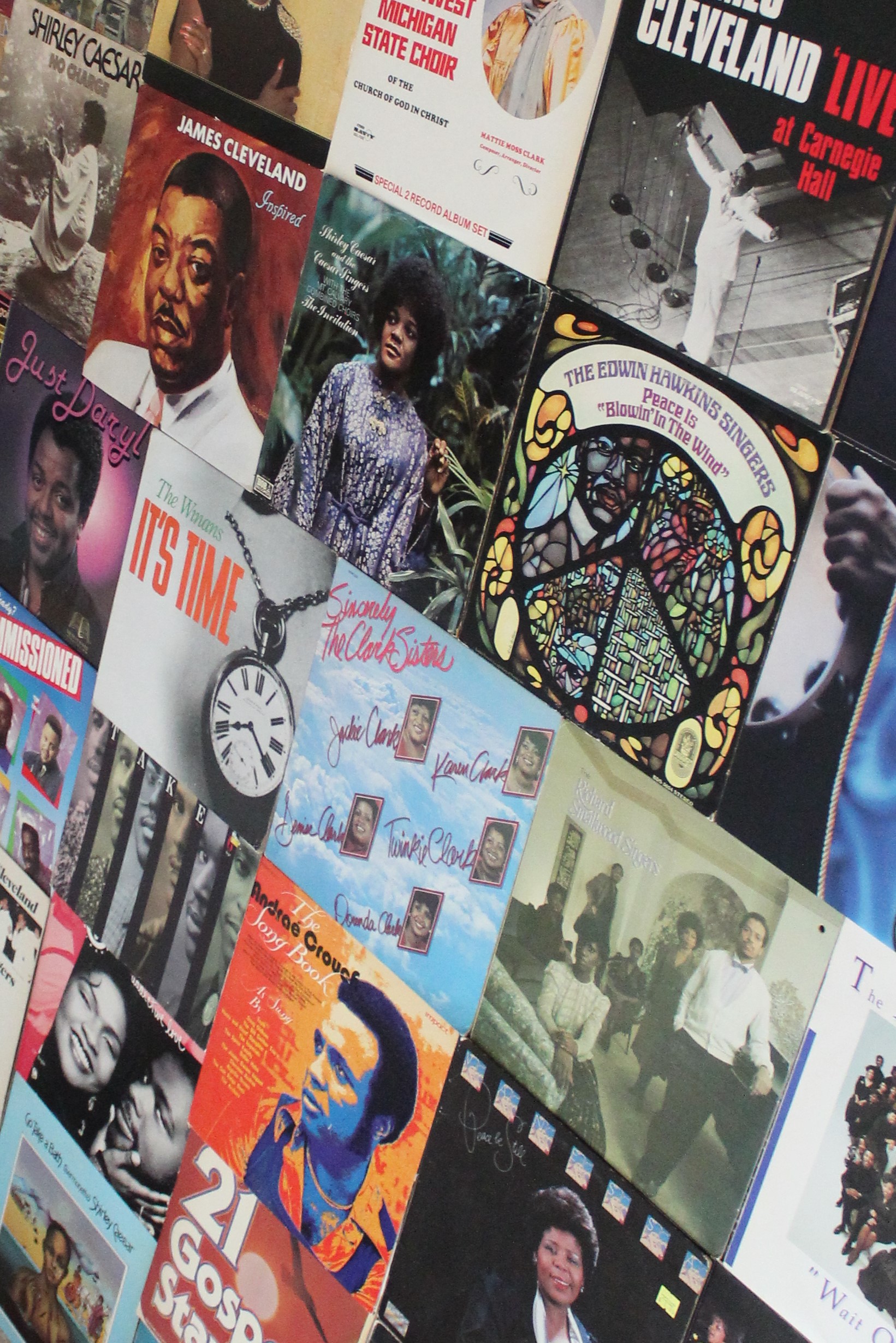
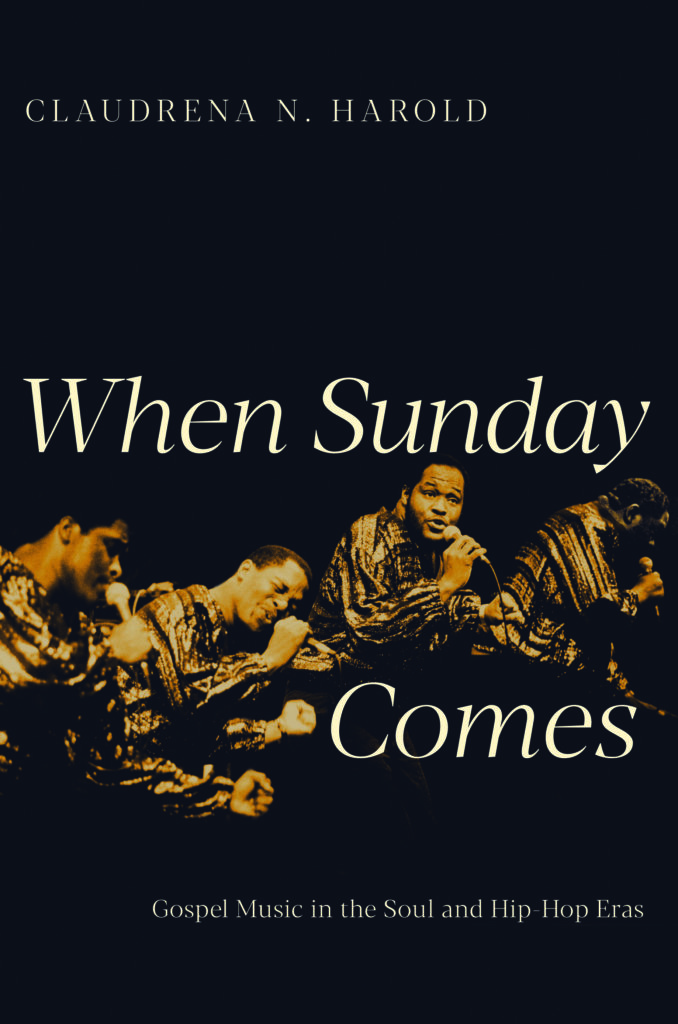
By focusing primarily on the last three decades of the twentieth century, When Sunday Comes shines light on gospel's golden era of commercialism. Instead of dismissing this period as one of musical decline and questionable crossover pursuits, this book treats these years as a time of great artistic innovation and advancement.2Fortunately, digging deeper into gospel's more recent history has been made easier with the important work of scholars like Mellonee V. Burnim, Brooksie Eugene Harrington, Deborah Pollard Smith, Jon Spencer, Guthrie Ramsey, and Birgitta Johnson. In addition, historians like Shawn David Young and David Stowe provide useful insights into the contemporary Christian music genre. Brooksie Eugene Harrington, "Shirley Caesar: A Woman of Words" (PhD diss., Ohio State University, 1992); Birgitta J. Johnson, "Back to the Heart of Worship: Praise and Worship Music in a Los Angeles African-American Megachurch," Black Music Research Journal 31, no. 1 (2011): 105–129; Deborah Smith Pollard, When the Church Becomes Your Party: Contemporary Gospel Music (Detroit, MI: Wayne State University Press, 2008); Spencer, Protest and Praise; David W. Stowe, No Sympathy for the Devil: Christian Pop Music and the Transformation of American Evangelicalism (Chapel Hill: University of North Carolina Press, 2013); Shawn David Young, Gray Sabbath: Jesus People USA, the Evangelical Left, and the Evolution of Christian Rock (New York: Columbia University Press, 2015); Guthrie P. Ramsey, Race Music: Black Cultures from Bebop to Hip-Hop (Berkeley: University of California Press, 2004). It details how Kirk Franklin, the Winans, Take 6, and the Clark Sisters, among others, not only advanced the black sacred music tradition but also ensured that gospel remained embedded in African American culture. That embeddedness has surfaced in a variety of cultural contexts and arenas and continues to do so: BET's annual award shows; the music of secular stars like Beyoncé, D'Angelo, Missy Elliot, Snoop Dogg, Chance the Rapper, and Kanye; the cinematic offerings of such avant-garde filmmakers as Arthur Jafa, Kevin Jerome Everson, and Cauleen Smith; and even the televised funerals of some of the entertainment industry's biggest icons. Take as a case in point the very public mourning that followed the deaths of Michael Jackson and Whitney Houston. On July 7, 2009, twelve days after Jackson's death, millions of fans watched the homegoing service of the "King of Pop." The memorial opened with Andraé Crouch and his choir humming the melody of the gospel classic "Soon and Very Soon" as Jackson's brothers rolled his casket to the center stage of Staples Center in Los Angeles.
Three years later, Crouch's music had a strong presence at the homegoing of another pop legend, Whitney Houston. This time, the musical vessel was not Crouch himself but his student Marvin Winans. Standing before a grief-stricken audience of family, friends, music legends, and curious onlookers, Winans belted out Crouch's latest hit, "Let the Church Say Amen," as he closed his eulogy of a woman who had been raised in New Hope Baptist Church under the tutelage of her mother, Cissy Houston; who had supported the careers of his younger siblings BeBe and CeCe Winans; and who fifteen years before her passing released the multi-platinum gospel album The Preacher's Wife. The presence of Crouch's music at both Houston's and Jackson's funerals not only symbolized his importance to the gospel sound but also showed how often African Americans have turned to this vibrant and life-affirming art form to make sense of the tragicomic reality of human existence.
As I reflected on what gospel music has meant to African Americans, my thoughts often turned to the song that inspired the book's title: Donald Lawrence and the Tri-City Singers' 1995 hit "When Sunday Comes." Seven minutes long, the song features gospel legend Daryl Coley on lead vocals. Throughout the performance, Coley titillates the crowd with a flurry of vocal riffs, drawing from the improvisational styles of both gospel and jazz. The audience's shouts of approval convey their agreement with his message of the joy that awaits Jesus's Second Coming and also their recognition of his mastery of form. "When Sunday Comes," as both a song and a metaphor, captures the wide range of emotions, relationships, and processes operating in African American gospel music: the climactic moment in a performance when a musician reaches the height of his or her artistic and spiritual powers, the gospel audience's contribution to and immediate recognition of such moments, and the deep cultural meanings the sacred songs hold for people of African descent in America.
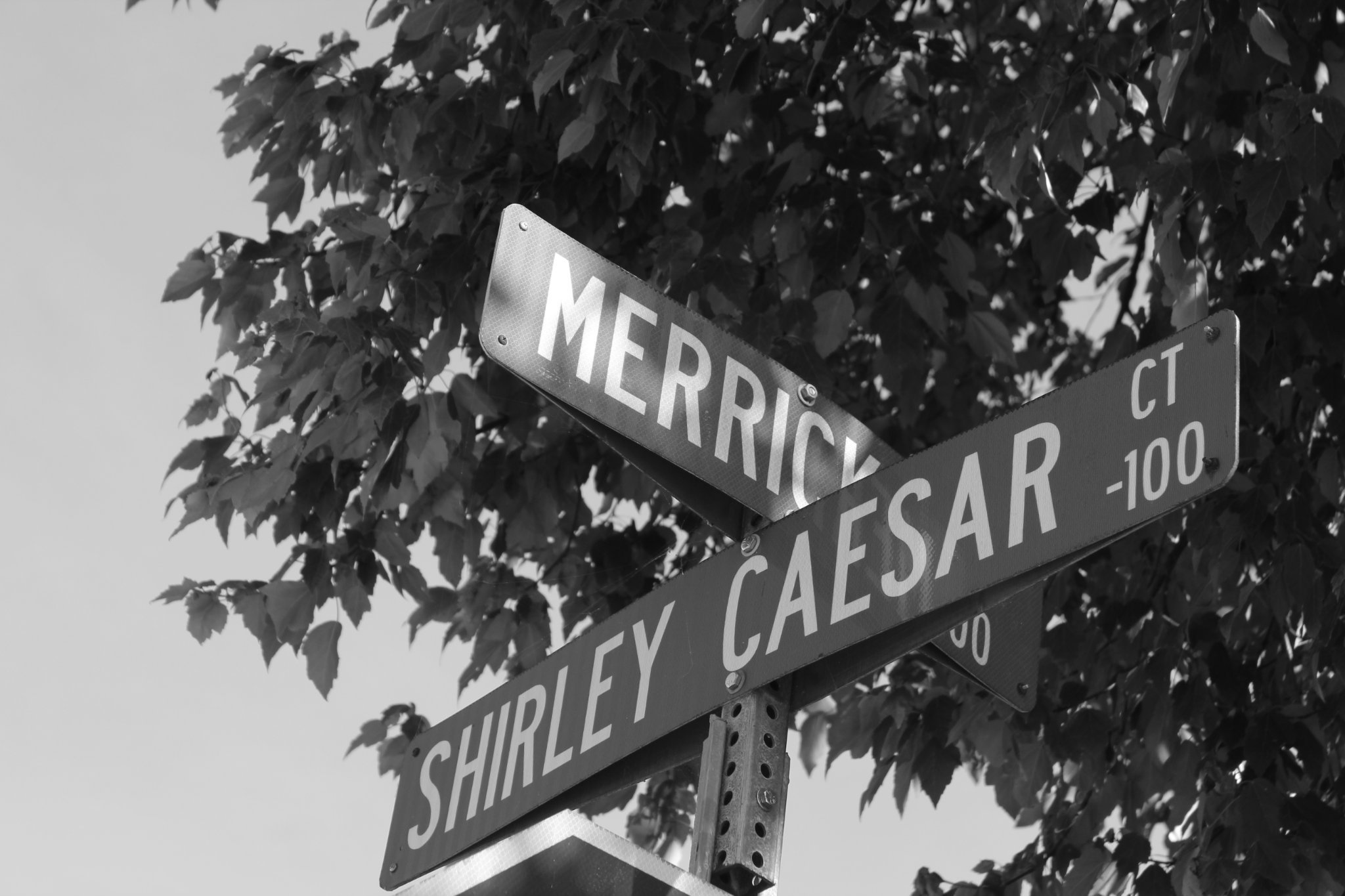
For many of the artists in When Sunday Comes, singing gospel was not simply a form of self-expression or a way to magnify God but also a way to uplift people, to lighten their burden. Perhaps no one understood this more than Shirley Caesar, who envisioned her concerts as a way to elevate her audience to a higher spiritual plane. "It's not so much that I want people to shout," she explained to Geoffrey Himes in 1987. "I want them to forget that burden they left behind when they came to the concert. I want to give them a spiritual catharsis."3Geoffrey Himes, "Shout It! Gospel According to Shirley Caesar," Washington Post, April 3, 1987, B7.
Outside the County Line: The Southern Soul of John P. Kee
More than thirty years have passed since my first encounter with the music of John P. Kee, but the memory of that experience remains fresh in my mind. On a weekend visit to my aunt's house, where gospel music played from sunup to sundown, we both found ourselves mesmerized by a new song: Kee's "Wait on Him." Within seconds of the song's opening verse, my attention shifted from mildly interested to fully engaged as Kee's powerful voice ripped through the speakers: "I'm going to run this race, if I go by myself," Kee sang as the choir roared: "Wait on Jeeee-suuuus." As Kee and the choir riffed off each other, bassist Andrew Gouche, guitarist Jimmy Hill, and drummers George Clinkscale and Calvin Livingstone held down the rhythm section. During the extended vamp, Kee adlibbed with a ferociousness reminiscent of Joe Ligon of the Mighty Clouds of Joy: "They that wait on the Lord, shall renew their strength. . . . They shall mount up on wings, as eagles. They shall run, not get weary."4John P. Kee, Wait on Him (Tyscot Records, 1991). This was the sound of Christian faith forged in the crucible of the southern black church.
The release of Wait on Him in 1989 marked the beginning of a remarkable creative run for Kee and his New Life Community Choir (NLCC). Between 1989 and 1996, Kee released hugely popular singles as well as the critically acclaimed records Wash Me and Show Up! (which was certified gold). Enjoying widespread radio play, sold-out concerts, and high record sales, Kee won the hearts of thousands of gospel lovers with his signature voice and classic songs. Not since James Cleveland had a male vocalist in the gospel world occupied such a ubiquitous presence on gospel radio. Tunes like "The Storm Is Passing Over," "Lily in the Valley," "Never Shall Forget," "Standing in the Need," "Wait on Him," "Wash Me," and the smash hit "Jesus Is Real" were in constant rotation. These songs were also part of the repertoire of countless black gospel choirs across the country. Even as the black religious community became increasingly diverse, Kee's music held an esteemed place in a variety of African American churches, from Pentecostal to Baptist.
Especially down south, Kee's blue-collar aesthetic and country home vibe earned a special place in the hearts of gospel music fans, particularly those who saw themselves or their families' history in his work. A proud southerner, Kee frequently transported his listeners to the black South, where women, men, and children cared for and loved each other, where elders shared their wisdom with the young, where the church anchored the social and cultural lives of a striving people. Kee was an artist for whom the South's past and present supplied endless inspiration and material. On both his studio and live recordings, he can be found resurrecting the spirit of his father, honoring the religiosity and deep faith of his grandmother, and reflecting on his life-changing encounters with ordinary southern women and men in the streets of Charlotte, North Carolina. Throughout his discography, the South looms large as an incubator of his cultural, religious, and political sensibilities. Kee's South is neither monolithic nor static but a geography constantly responding to new political forces and new social realities.
North Carolina Beginnings
John Prince Kee was born on June 4, 1962, in Durham County, North Carolina. The fifteenth child of John Henry and Lizzie Mae Kee, the young John lived on the outskirts of Durham until the age of five, when his father started work as a foreman at a local brickyard. In many ways, the world in which young John entered was radically different from that of his older brothers and sisters, due in no small part to the growing political determination of African Americans in Durham.
Notwithstanding its image as a progressive southern city, Durham was racist to its core. Even when the white power structure appeared to bend in favor of African Americans, its actions were often more symbolic than substantive. As historian Christina Greene rightly points out, Durham's white power brokers were more concerned with racial harmony than with racial justice. The conflict between the city's racial moderates and more direct action-oriented civil rights organizers reached a fever pitch in the summer of 1962. Late in July, members of the Congress of Racial Equality and the NAACP picketed Eckerd's Drug Store and Howard Johnson's ice cream parlor. At Eckerd's, the issue at hand was the store's refusal to hire African Americans as salespersons, despite the fact that blacks constituted half of its customers. Likewise, Howard Johnson's was opposed to hiring African Americans in clerical positions. The restaurant had also refused to desegregate its lunch counter, even after the sit-ins of 1960 led other stores to reverse their segregation policies. Taking the lead in the fight against Howard Johnson's were black students from North Carolina Central, who in their efforts to implement change endured verbal assaults, threats of violence, consternation from conservative blacks, arrests, and sometimes imprisonment. For their refusal to pay a trespass fine for protesting Howard Johnson's, students Guytana Horton and Joycelyn McKissick were sentenced to thirty days in jail. Their arrest and subsequent jailing galvanized the civil rights community, which in August held a large rally at one of the city's movement centers, St. Joseph AME Church. Shortly after the rally, 1,500 African Americans headed to Howard Johnson's to continue their protests. These protests persisted throughout the summer as part of the "Freedom Highways" project, a CORE-directed campaign that extended from Maryland to Florida. This project eventually led more than half of the Howard Johnson's establishments in North Carolina to desegregate their lunch counters. One of the holdout restaurants was the Howard Johnson's in Durham, which in 1963 was the site of one of the largest civil rights demonstrations in North Carolina.5Christina Greene, Our Separate Ways: Women and the Black Freedom Movement in Durham, North Carolina (Chapel Hill: University of North Carolina Press, 2005). Over the next few years, Durham remained a center of political protest and grassroots activism as African Americans directed their attention to the problems of urban renewal, deindustrialization, employment discrimination, and the housing crisis.
One important center of local organizing was Union Baptist, the church home of the Kee family and hundreds of other blacks. Under the pastorate of Dr. Grady Davis, Union was a center of black spiritual life in Durham and an anchoring institution for the local civil rights movement. A dedicated member until his death in 1981, John Henry Kee lent his musical talents to the Grady Davis Choir and the Senior Male Choir.6"Obituary," Carolina Times, January 31, 1981. Like his father, young John developed a deep love for music, routinely spending hours at the family's Walter upright piano. "I was about seven years old when I started playing that piano, and I got a lot of encouragement because music in our household was just the thing to do. And it was by playing piano that I kept my dad's attention."7Bobby Jones and Lesley Sussman, Touched by God: Black Gospel Greats Share Their Stories of Finding God (New York: Pocket Books, 1998), 239.
Showing great promise as a musician, Kee enrolled at the North Carolina School of the Arts in Winston-Salem and then graduated from there at the age of fourteen. To further develop his musical skills, he joined his brothers at Yuba College Conservatory in Marysville, California. To support himself, Kee worked as a sideman for Cameo and Donald Byrd on their visits to Northern California. On the surface, the talented youngster seemed destined for greatness, but on his route to superstardom he took several dangerous detours.
During his time in California, Kee descended into a world of drug use. He then returned to North Carolina, where he found work with the Charlotte-based Miss Black Universe pageants. His move back south was part of a national trend. Since the 1970s, the number of African Americans migrating to the South exceeded the number of those leaving the region. Especially for returning and primary migrants frustrated by the declining economic opportunities available in the rustbelt cities of the Midwest and Northeast, the metropolitan centers of Atlanta, Houston, Dallas, and Charlotte seemed much more appealing than their northern and midwestern counterparts.8Carol B. Stack, Call to Home: African Americans Reclaim the Rural South (New York: Basic Books, 1996); Sabrina Pendergrass, "Perceptions of Race and Region in the Black Reverse Migration to the South," Du Bois Review: Social Science Research on Race 10, no. 1 (2013): 155–178; George Gmelch, "Return Migration," Annual Review of Anthropology 9 (1980): 135–159; Larry H. Long and Kristin A. Hansen, "Trends in Return Migration to the South," Demography 12, no. 4 (1975): 601–614. "If ever there was a city that epitomizes the New South," boasted the June 1983 edition of Black Enterprise, "it is Charlotte, N.C., the largest city between Washington and Atlanta. . . . This Sunbelt city is now home to 314,000 residents—31 percent of them black—and to a burgeoning business community, which includes 500 black-owned companies."9David D. Porter and Rosalyn Gist Porter, "The Changing Profile of Charlotte," Black Enterprise 13 (June 1983): 180. For ambitious African Americans wishing to improve their lives and perhaps avoid the problems of the urban North, Charlotte was the place for them.
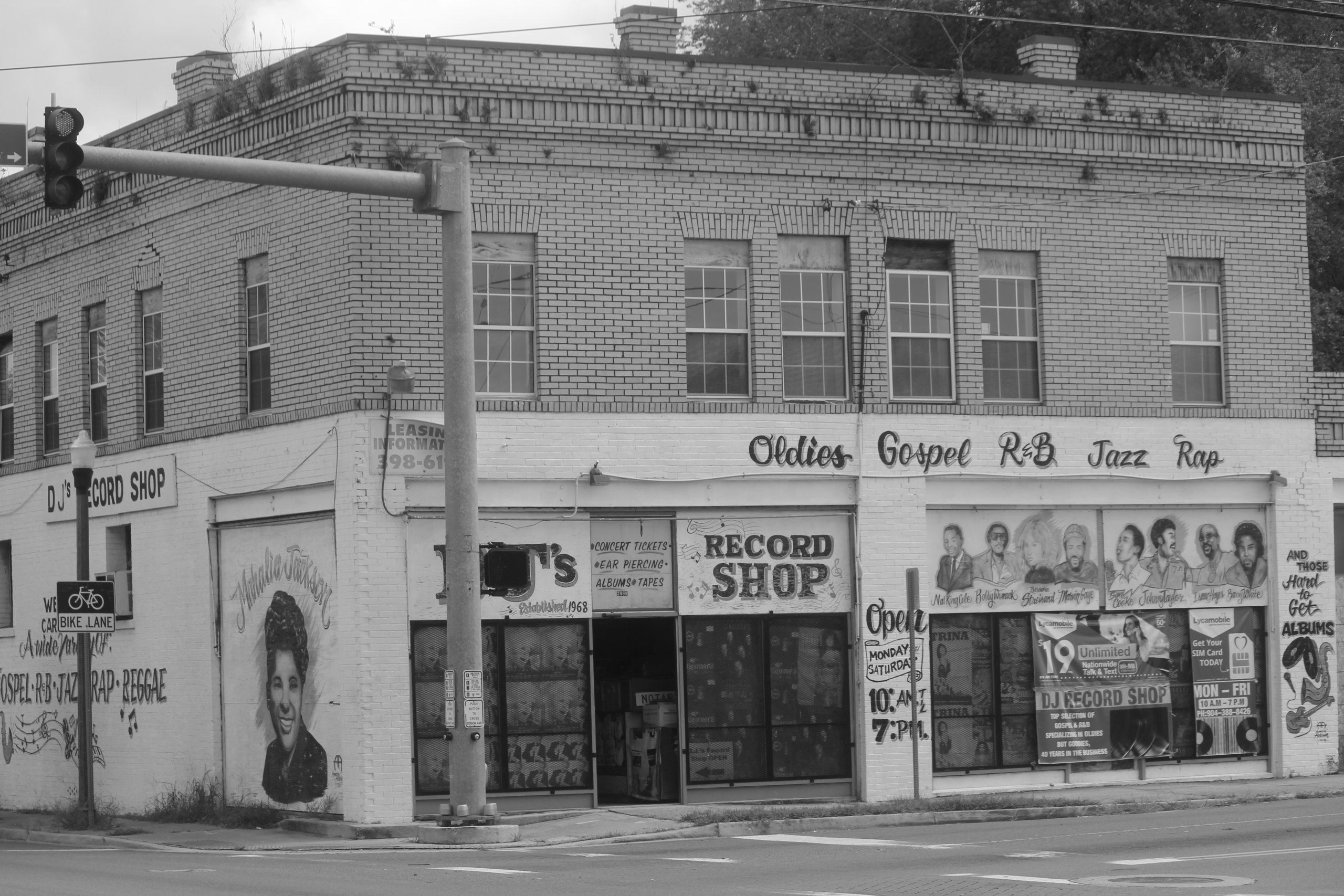
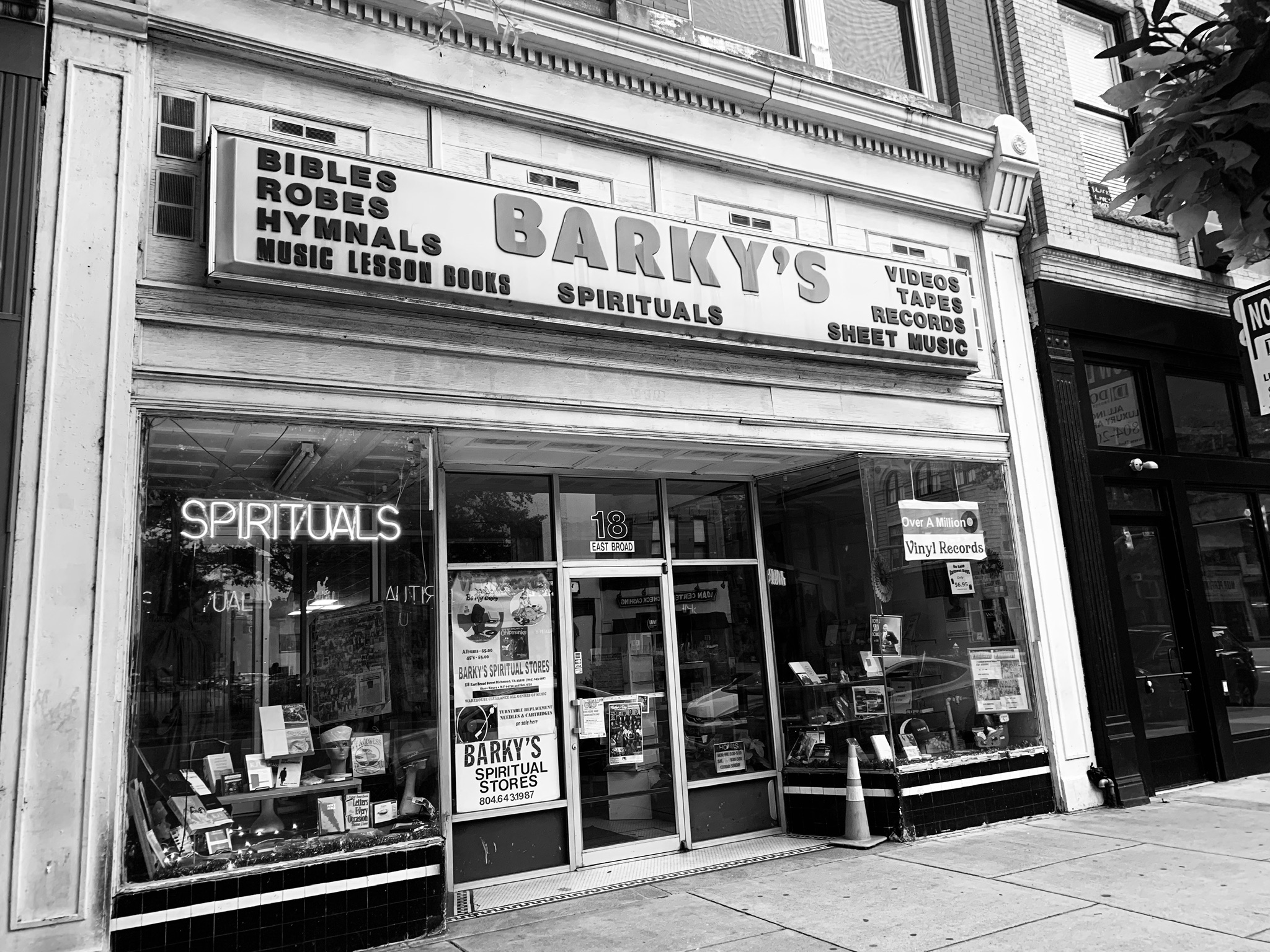
To many outsiders, this was a city on the move, a great place for young people with talent, ambition, and a hard work ethic. Unfortunately, Kee was not quite ready to take advantage of the city's benefits. Even after his move back south, Kee remained a part of the drug scene—not only as a user but as a seller as well. Upon his arrival in Charlotte, he settled into the Double Oaks neighborhood, an area facing many of the problems plaguing other inner-city communities. Crime, unemployment, substandard housing, and drugs wreaked havoc on many of its residents. Drifting further away from the values of his early childhood, Kee was an active participant in Double Oaks's underworld.
A dramatic shift occurred in Kee's life in 1981, when one of his closest friends fell victim to drug-related violence. His friend's murder shook Kee to his core, forcing him to reevaluate his life: "I was seeing young men dying on the street, and I think I just made up my mind that I did not want to leave here like that. I just felt like there was a gift or something inside of me, and I didn't want to waste it."10Jones, Touched by God, 242. The reformed drug dealer started working with a group of young singers involved in the Combination Choir, which was based in Charlotte. This marked the beginning of Kee's lifelong commitment to the local community, particularly the Double Oaks neighborhood. The choir later morphed into the New Life Community Choir, which gained national attention in the 1990s for their work with Kee.
Kee's Breakthrough
On his rehabilitation journey, Kee received major support from two of gospel's most iconic figures, James Cleveland and Edwin Hawkins. Like many aspiring musicians in the gospel field, Kee turned to the Gospel Music Workshop of America to gain a larger audience and connect with industry insiders. In 1985, Cleveland placed two of Kee's compositions, "He's My All in All" and "Jesus Can Do It," on his 1985 GMWA recording. Two years later, Kee was a featured vocalist and songwriter on Edwin Hawkins's music and arts seminar recording. That same year, Kee released Yes Lord, his debut with the black-owned label Tyscot. A relatively small company based in Indianapolis, Tyscot begin in 1977 as a vehicle for one of its founders, Leonard Scott, to promote his church choir. The label would add to its roster a few minor gospel acts, but it was hardly on the radar of most in the gospel industry. This would change with the release of Kee's Yes Lord. Though the record had modest sales, it generated considerable anticipation for Kee and the New Life Community Choir's 1989 release, Wait on Him.
Finding a receptive audience among lovers of traditional and contemporary gospel music, Wait on Him elevated Kee to superstar status in the black gospel world. The album climbed to #4 on the gospel charts, dominated gospel radio, and enabled Kee to launch a nationwide tour. "We're getting more requests than I can handle," Kee informed journalist Robert Darden. Though the record had a southern sound, its popularity extended beyond the Mason-Dixon Line. "'Wait on Him' is doing incredible business in New York," Kee marveled. The singer was also receiving attention from beyond the black gospel world. "We're getting calls from white churches in Texas, Washington state, even the hills of Tennessee—where the man told me all they've ever heard is 'hillbilly gospel' before now!"11Robert Darden, "New Life's 'Wait on Him' Is an Overnight Hit for John P. Kee," Billboard, February 24, 1990, 45.
About the Author
Claudrena N. Harold is a professor of African American and African Studies and History at the University of Virginia and an editorial board member at Southern Spaces. She is the author of New Negro Politics in the Jim Crow South (Athens: University of Georgia Press, 2016) and The Rise and Fall of the Garvey Movement in the Urban South, 1918–1942 (UK: Routledge Press, 2007).
]]>
A freeborn Black abolitionist from Ohio, Joshua McCarter Simpson opened his 1854 indictment of the hypocrisy of Christian supporters of slavery, "To the White People of America," with searing words that echo across the centuries. Simpson's poetic voice resonated when Donald Trump strode through Lafayette Park for a photo opportunity—an image of him holding a Bible in front of St. John's Episcopal Church—moments after DC police, reinforced by National Guard troops, dispersed peaceful protesters who had gathered to demand that government leaders address systemic racism.
Simpson published "To the White People of America" in his collection The Emancipation Car, Being an Original Composition Of Anti-Slavery Ballads, Composed Exclusively For the Under Ground Rail Road (1854), written for abolitionists ferrying enslaved people to freedom. The Emancipation Car includes forty-three poems, all meant to be sung to then-popular tunes, and a few prose passages. The title of Simpson's collection extends the metaphor of the Underground Railroad, where these songs were popular among the formerly enslaved and where Simpson served as a conductor. In 1874 the collection was reprinted with its prose passages reworked in verse and a new appendix featuring poetic commentaries on the Fifteenth Amendment, the Underground Railroad, and related topics.
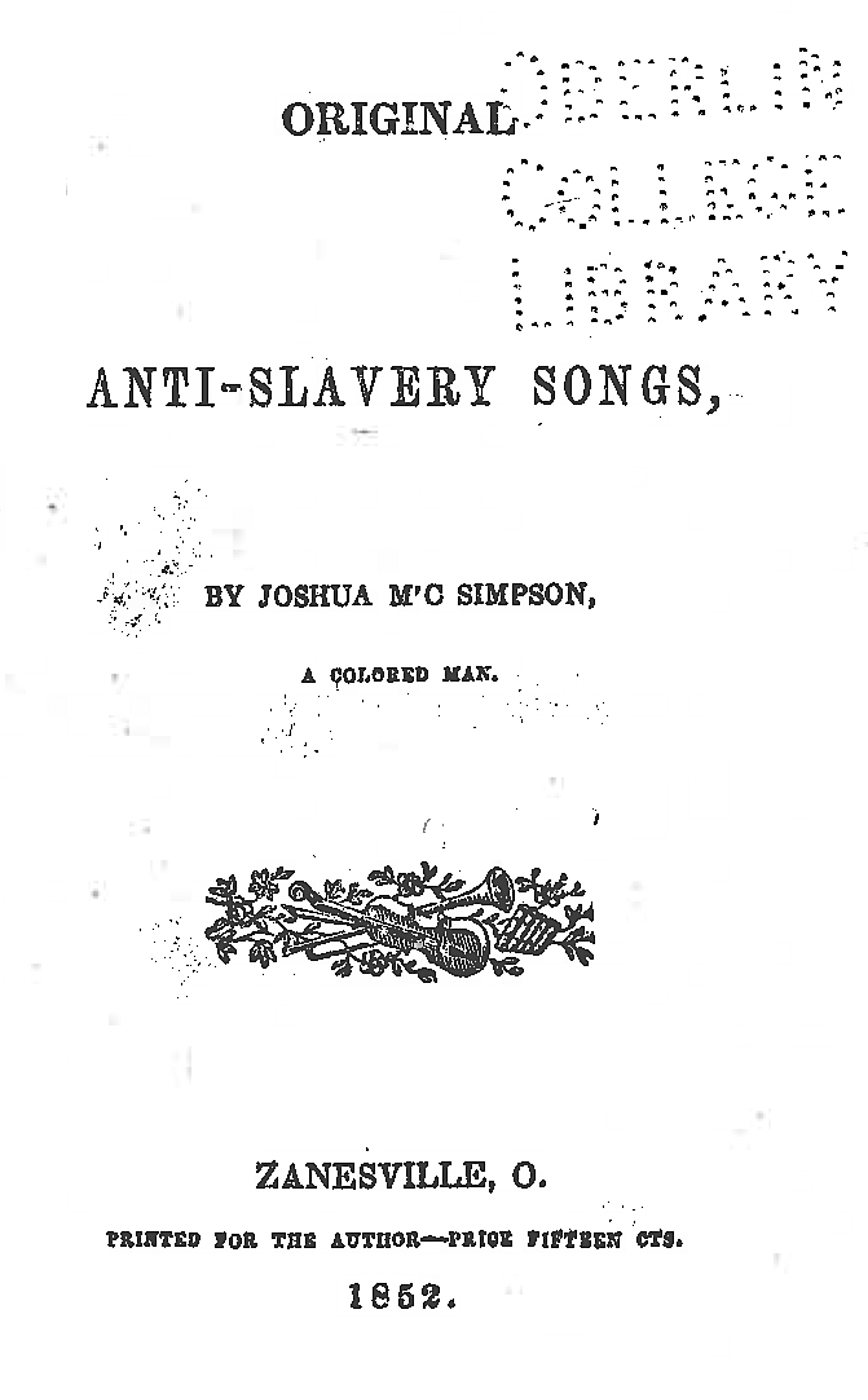
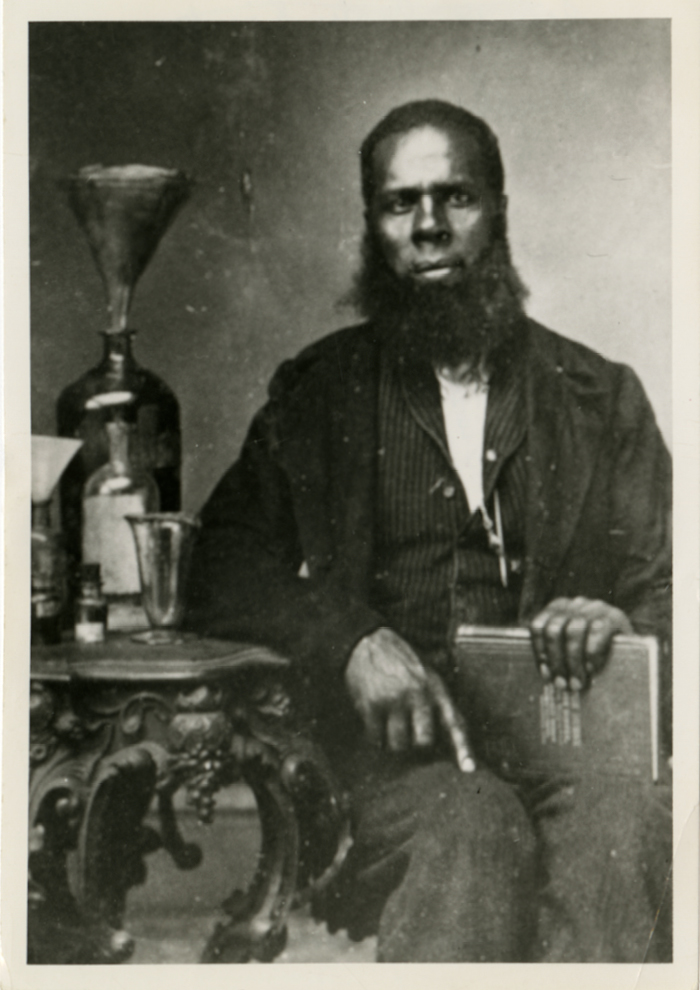
Simpson was born around 1820 in Windsor, Ohio, in the far northeastern corner of the border state, near Lake Erie. He was indentured as a servant from his childhood until he turned twenty-one, working in brutal conditions for a stonemason and later a farmer. He then taught himself to read and write, attended the Oberlin Collegiate Institute from 1844 to 1848, and moved to Zanesville in central Ohio, where he became an herbal doctor and grocer. Simpson gradually embraced abolitionism during his servitude and became a fierce advocate for emancipation thereafter. In his preface to The Emancipation Car, Simpson explains, "As soon as I could write, which was not until I was past twenty-one years old, a spirit of poetry, (which was always in me,) became revived, and seemed to waft before my mind horrid pictures of the condition of my people, and something seemed to say, 'Write and sing about it—you can sing what would be death to speak.' So I began to write and sing."1Joshua McCarter Simpson, "Note to the Public," in The Emancipation Car, Being an Original Composition Of Anti-Slavery Ballads, Composed Exclusively For the Under Ground Rail Road (1874; repr., Miami: Mnemosyne Publishing Co., 1969), vi. He first publicly performed an anti-slavery song in 1842 and published a collection of thirteen poems titled Original Anti-Slavery Songs in 1852. Simpson died in 1876.
Joshua McCarter Simpson's writing is remarkable for its force, conviction, moral clarity, and emotional depth. His poems are also frequently witty, both in their turns of phrase and in their relationship to the popular tunes with which Simpson chose to pair them. Simpson notes that "To the White People of America" should be sung to the tune "Massa's in the Cold, Cold Ground," a blackface minstrel tune composed by New York songwriter Stephen Foster in 1852, just two years prior to the publication of The Emancipation Car. In dialect, Foster's song depicts enslaved people crying as they mourn the death of their former owner, rendering Simpson's ironic appropriation bitingly clever. "In my selection of 'Airs,'" writes Simpson, "I have gathered such as are popular, and extensively known. Many superstitious persons, and perhaps many good conscientious, well-meaning Christians, will denounce and reject the work on account of the 'Tunes,' but my object has been to change the flow of those sweet melodies (so often disgraced by Comic Negro Songs, and sung by our own people,) into a more appropriate and useful channel."2Simpson, "Note to the Public," v–vi.
Despite his groundbreaking creativity, Simpson is little known today. Few scholars have written about his work, and he has never been the subject of a biography. I learned about Simpson when music bibliographer Erin Fulton included The Emancipation Car in the "Checklist of Southern Sacred Music Imprints, 1850–1925" that she compiled for the Sounding Spirit publishing initiative. Fulton turned to The Emancipation Car as Sounding Spirit searched for words from historical composers and hymnwriters in expressing our solidarity with Black Lives Matter protests in the wake of the murder of George Floyd and many others.
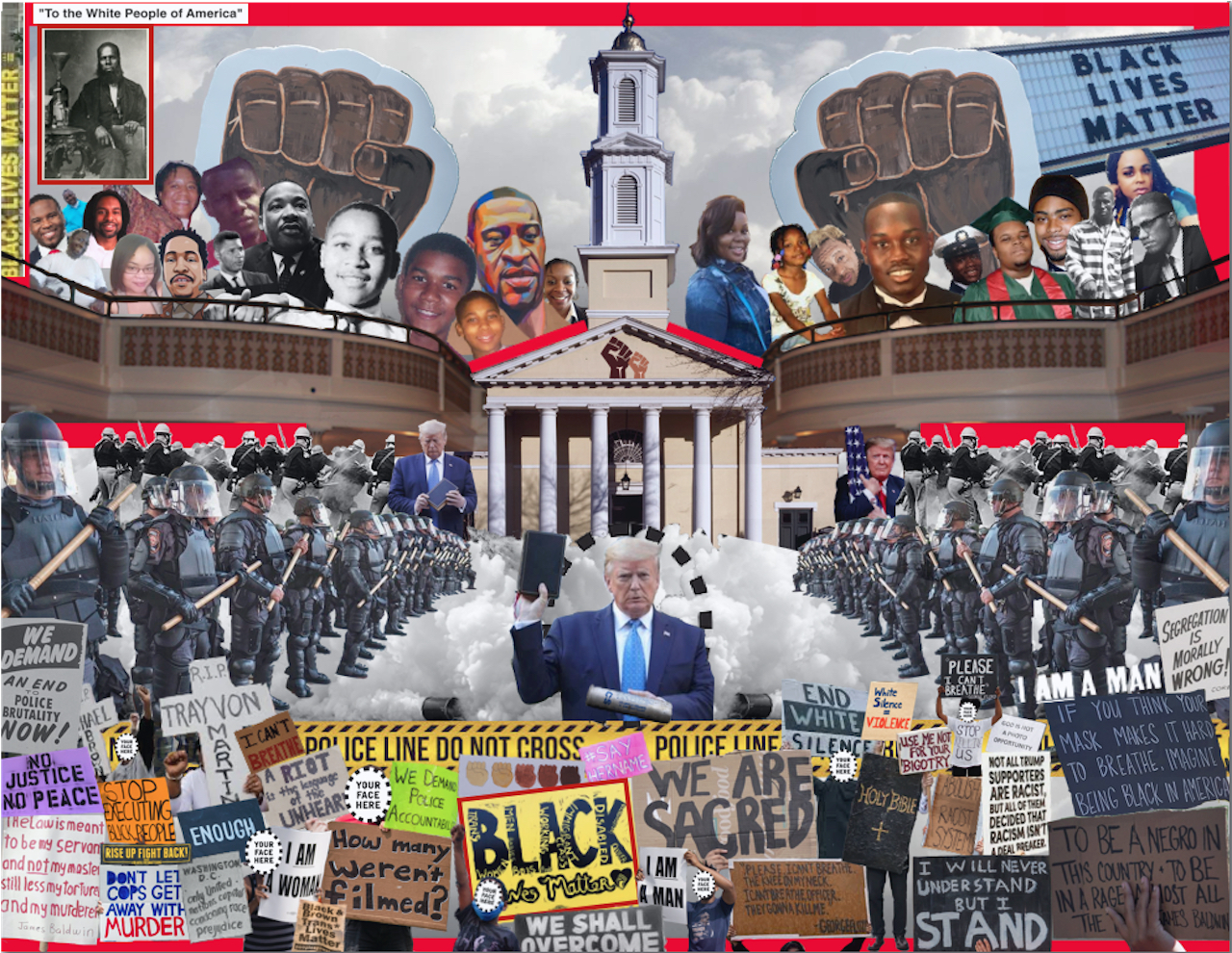
Reading Simpson's words from 1854 immediately conjures the image of Trump at St. John's Church:
"To the White People of America"
Air—"Massa's in the Cold, Cold Ground"
O'er this wide extended country,
Hear the solemn echoes roll,
For a long and weary century,
Those cries have gone from pole to pole;
See the white man sway his sceptre,
In one hand he holds the rod—
In the other hand the Scripture,
And says that he's a man of God.
Hear ye that mourning?
'Tis your brothers' cry!
O! ye wicked men take warning,
The day will come when you must die.
Lo! Ten thousand steeples shining
Through this mighty Christian land,
While four millions slaves all pining
And dying 'neath the Tyrant's hand.
See the "blood-stained" Christian banner
Followed by a host of saints (?)3Question mark appears in the original.
While they loudly sing Hosannah,
We hear the dying slave's complaints:
Hear ye that mourning?
Anglo-sons of God,
O! ye Hypocrites take warning,
And shun your sable brothers blood.
In our Legislative members,
Few there are with humane souls,
Though they speak in tones of thunder
'Gainst sins which they cannot control,
Women's rights and annexation,
Is the topic by the way,
While poor Africa's sable nation
For mercy, cry both by night and day.
Hear ye that mourning?
'Tis a solemn sound,
O! ye wicked men take warning,
For God will send his judgment down.
Tell us not of distant Island—
Never will we colonize:
Send us not to British Highlands,
For this is neither just nor wise,
Give us equal rights and chances,
All the rights of citizens—
And as light and truth advances,
We'll show you that we all are men.
Hear ye that mourning?
'Tis your brothers sigh,
O! ye wicked men take warning,
The judgment day will come by and by.
About the Author
Jesse P. Karlsberg is the senior digital scholarship strategist at the Emory Center for Digital Scholarship. He is the project director and editor-in-chief of Sounding Spirit, a research lab and publishing initiative promoting collaborative engagement with historical American songbooks. Karlsberg is an internationally recognized singer, teacher, composer, and songbook editor in the Sacred Harp tradition.
]]>An Unlikely Bohemia
We are hope despite the times.
R.E.M., "These Days" (1986)
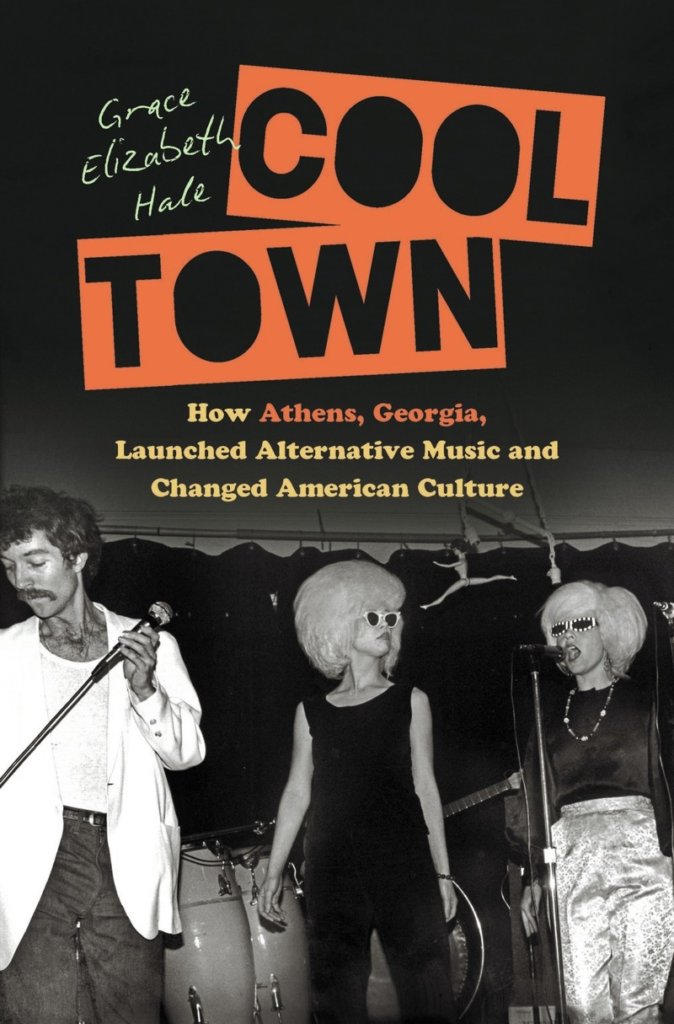
In Athens, Georgia, in the 1980s, if you were young and willing to live without much money, anything seemed possible. Magic sparkled like sweat on the skin of dancers at a party or a club. Promise winked underfoot like the bits of broken glass embedded in the downtown sidewalks. A new world seemed to be emerging out of our creativity, our music and art, and our politics, but also the way we understood ourselves and related to each other.
In my memory, the weight of the air on summer nights made possibility seem like a substance I could hold in my hand. Always, local bands played and people listened—at practice spaces and house parties and venues like the 40 Watt. People went to hear their roommate or boyfriend or coworker play one night and urged everyone to come and see their group the next. Easy to make and easy to hear, live music was everywhere. We used it to reinvent and express ourselves and connect with each other. We used it to live.
After the clubs let out, the scene kept moving until dawn. Small groups climbed the fences at apartment complexes—no one would admit to living in one—and went skinny-dipping. Sometimes people walked to a big Victorian house on Hill Street and danced to mixtapes in the hall between the rolled-back pocket doors until their clothes dripped with sweat and their heads spun. Occasionally, at midnight, a small drama troupe would perform an original play up and down the aisles of the twenty-four-hour Kroger. Film buffs too young to see movies like Sleeper, Raging Bull, and Paper Moon when they came out watched them for free in the air-conditioned quiet of the seventh floor of the University of Georgia's library. Often, people paired up, going home with the person they were seeing or an acquaintance or someone they had just met. One perfect July night, I lay naked with a friend on the cool cement floor of a screen porch as the wet heat thinned and the crickets rasped and we talked about music until dawn. Possibility proved more addictive than the beer everyone drank and the drugs many people took.
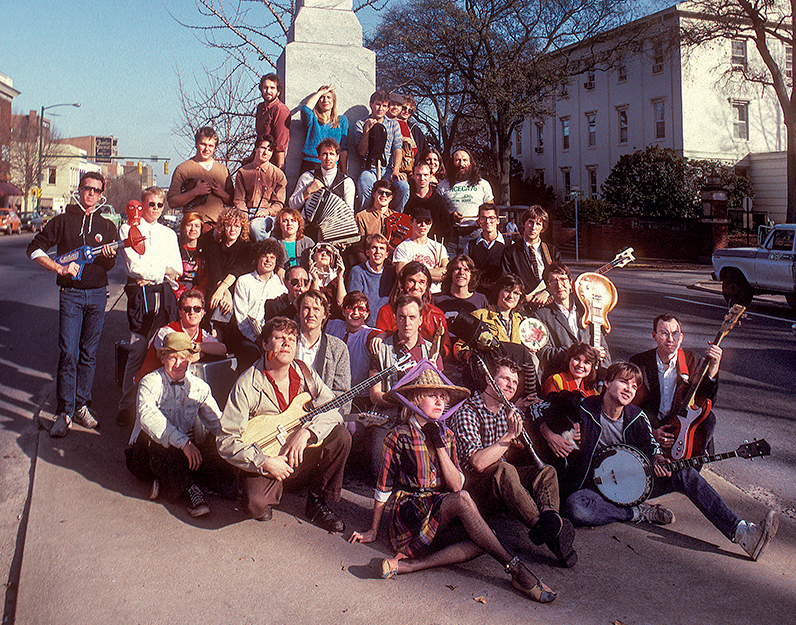
We were unlikely people in an unlikely place. No one expected us to do these creative things. No one who mattered thought that we could make a new kind of American bohemia. Yet Athens kids built the first important small-town American music scene and the key early site of what would become alternative or indie culture.
We had grown up anything but alternative. Home was a new version of the South created by desegregation, interstates, air conditioning, and airports. Our parents had mostly enjoyed the rewards, a hard-earned success that had been knocked back in the last decade by the oil crisis, stagflation, and the Reagan recession. Our schools practiced a form of neglect that suggested racial integration was easy, feminism unnecessary, and gay sexuality nonexistent. None of that was true, of course, but white, middle-class kids often skated over the consequences.
On some vague level, we sensed that we were living in a changed and changing world, yet the adults around us seemed to be in denial, clinging to old ideas about life and work and community. The most visible alternative, the hippies and peace activists left over from an earlier generation's counterculture, appeared to have degenerated into caricature. Reading books and music magazines and talking to older Athens artists and University of Georgia professors, we learned about creative communities in Paris and London and New York, places that had nurtured earlier rebels from the Beats and the jazz musicians and the abstract painters to the rockers and the drag queens and the punks. Some of us even got to know nearby "folk" artists and musicians, people who followed their own visions right here at home. We longed to send our yawp over the roofs of the world, too, to live for music and art and sex, to be daring and original and important. Why the hell not? We did not want to be rednecks or racists or conservative Christians or live in subdivisions or work as middle managers. We dreamed not of the Reagan-era Sunbelt but of a different world, a new, new, new South. And in the university's libraries and archives and studios and galleries and concert halls and the town's old buildings, we found resources to try to make that world a reality.
The scene was our answer to what we understood as the failures and limits of our America. And our participation in this collective creativity transformed us. In my case, the scene took in an unhappy accounting major confused about politics and about six years later spit out a feminist and anti-racist scholar determined to live her life as art. Along the way, I waited tables and catered, made rugs and wall-hangings out of old clothes, took up painting and the cello, earned a master's degree in history, and cofounded and ran a local venue. When I left Athens to start a history PhD program elsewhere, I took that magical sense of possibility with me and used it to weather the perils of graduate school and the academic job market. My story was not unique. The scene changed everyone I knew. Middle-aged now, a historian and the mother of college kids myself, I can see how the things we learned—question the givens, find something to do that engages your passions, build community into whatever you do, and stop often for beauty and pleasure—radically transformed the trajectory of our lives.
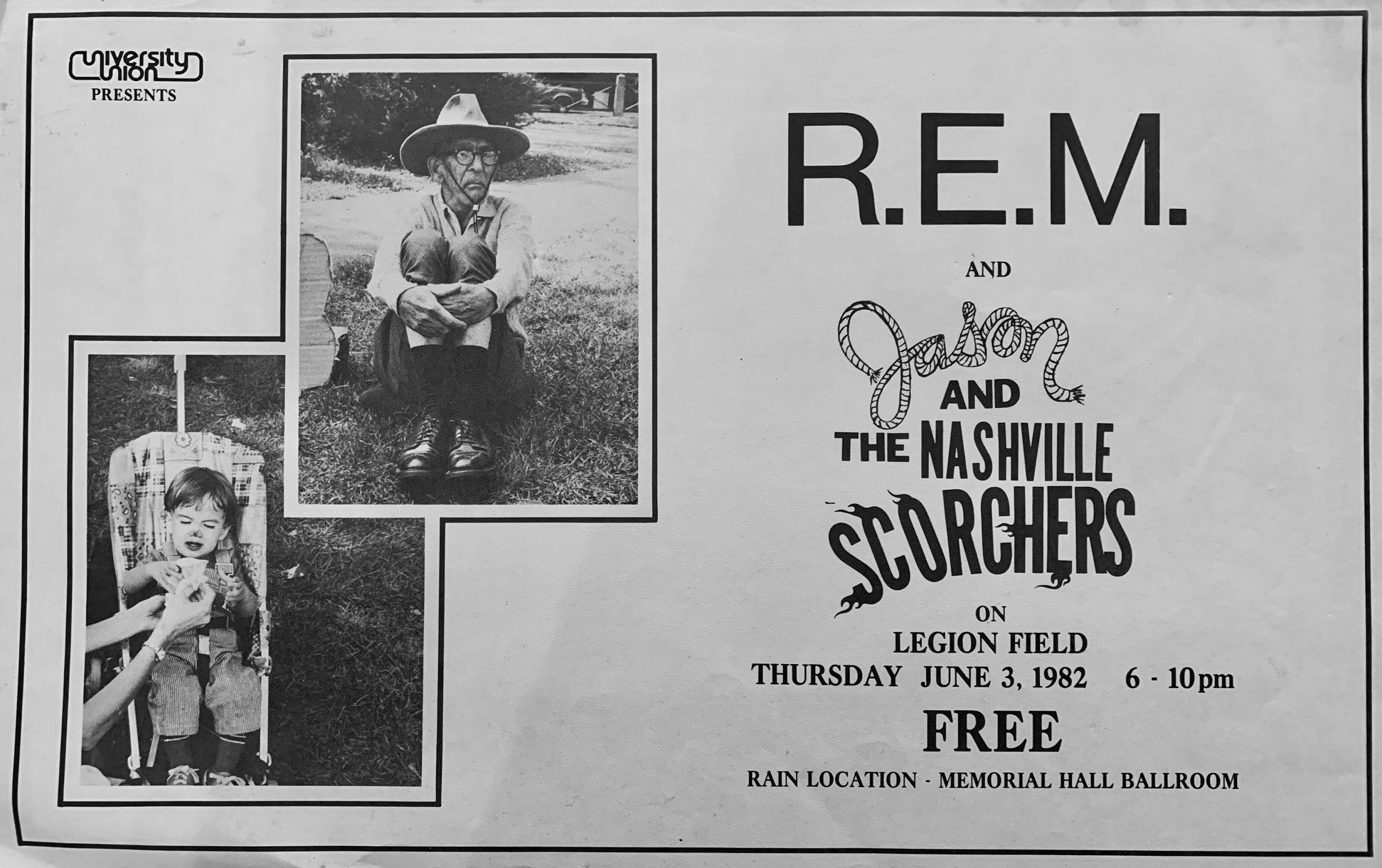
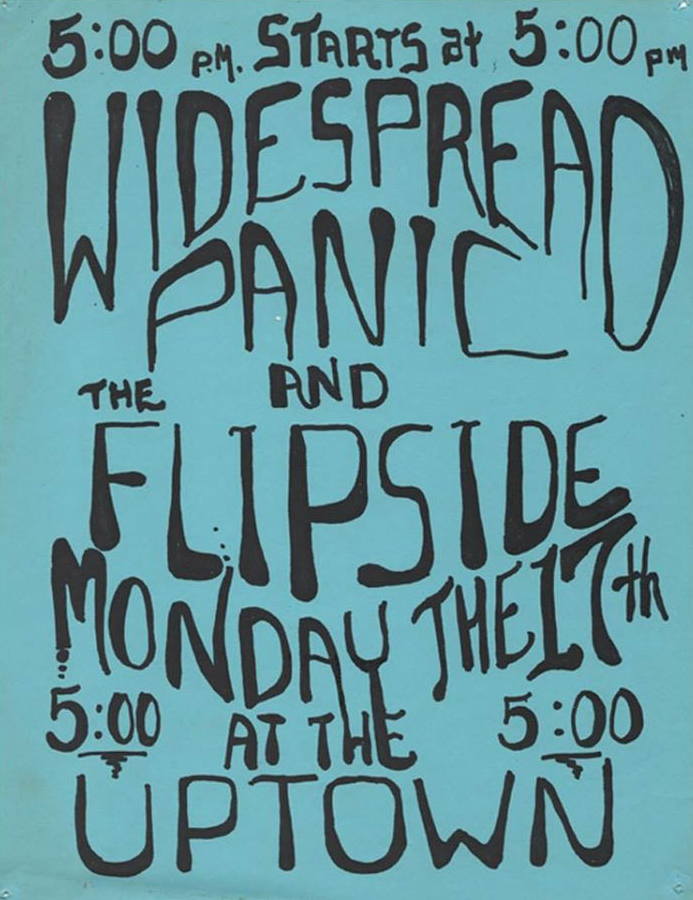
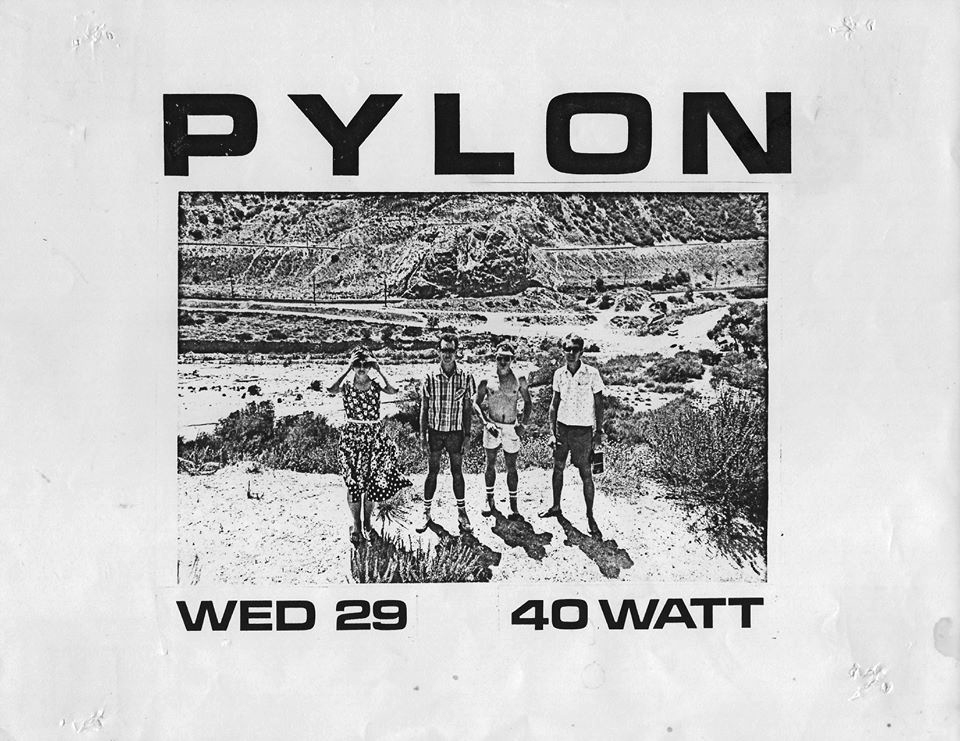
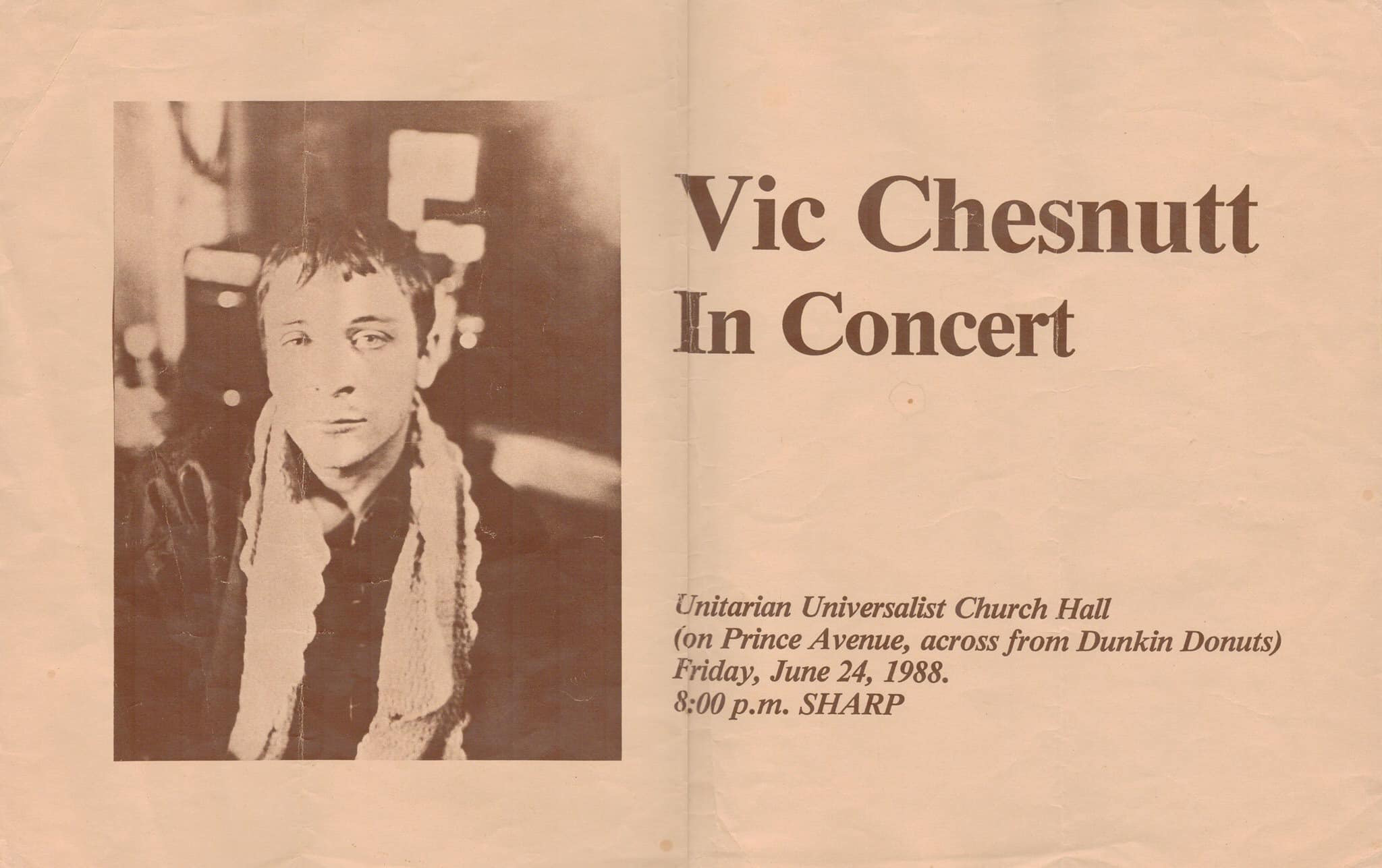
From the late-seventies origins of bohemian Athens to the early nineties when Seattle became the center of American alternative culture, the Athens scene produced amazingly good music, from famous groups like the B-52s, R.E.M., and Widespread Panic to critics' darlings like Pylon and Vic Chesnutt and acts that built a grassroots fan base one show at a time, like the Squalls and Mercyland. But the scene also transformed the punk idea that anyone could start a band into the even more radical idea that people in unlikely places could make a new culture and imagine new ways of thinking about the meaning of the good life and the ties that bind humans to each other. The history of the Athens scene proves that people you would not expect in places you have not thought about can create a better world. It also reveals how cultural rebellion can transform human experience.
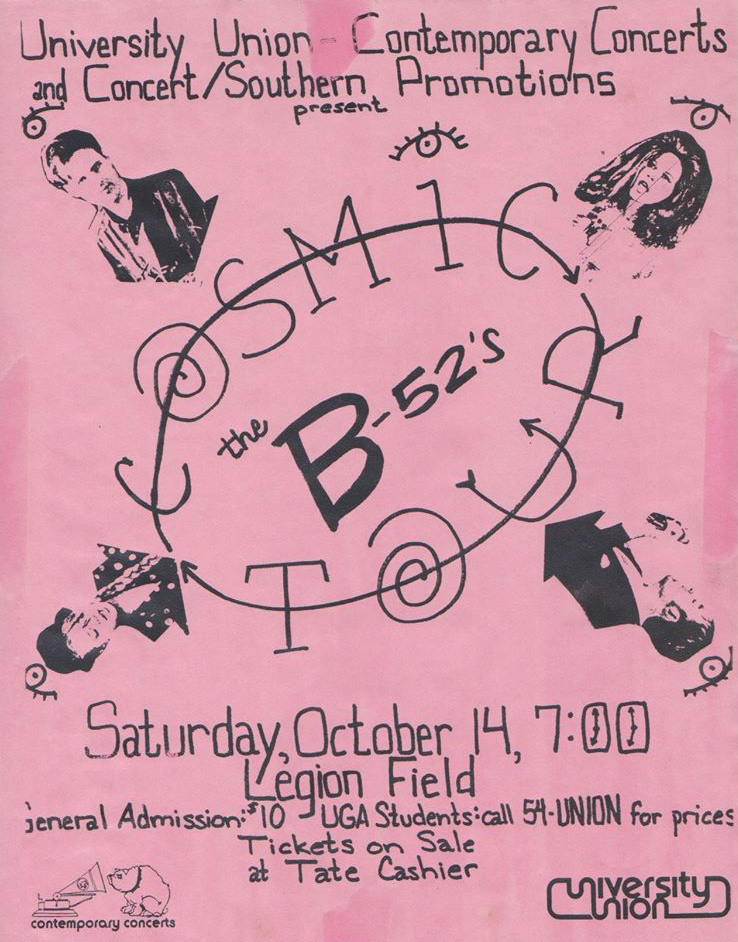
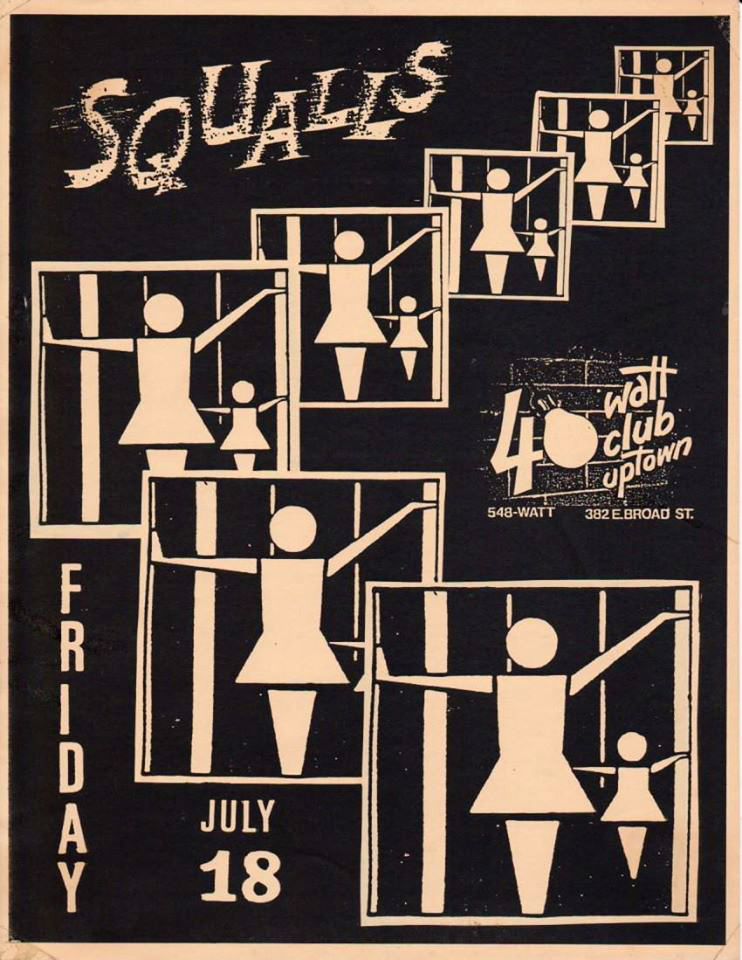
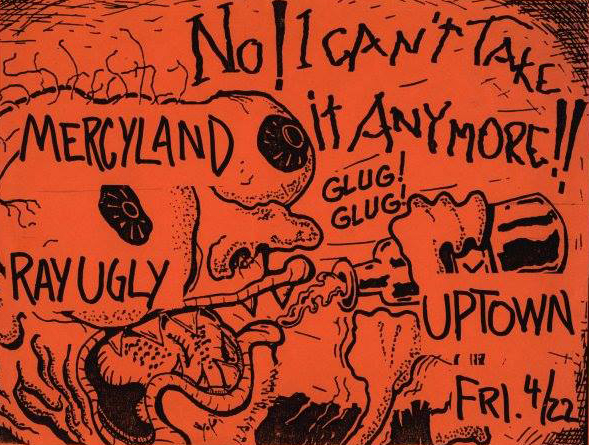
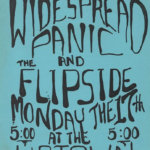
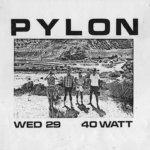
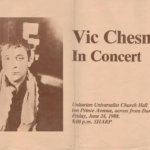
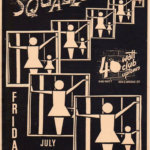
Of course, the music mattered. Athens musicians combined an arty, avant-garde approach that prized originality with its seeming opposite, a commitment to the pleasures of pop culture, rhythms that made you feel and move, and spectacle that made you stare. Reimagining the structures of rock music went hand in hand with having fun. Athens bands helped make this pop-art fusion an important part of the new overlapping music genres of college and alternative and indie rock. Because the Athens scene emerged so early in the transition between punk and indie, it also served as a model for kids trying to make their own music in other places not previously understood as having underground potential. If punk taught people that anyone could play, Athens taught them that this music making could happen anywhere, even in the South, even in small-town America.1Bernard Gendron, Between Montmartre and the Mudd Club: Popular Music and the Avant-garde (Chicago: University of Chicago Press, 2002); Tricia Henry, "Punk and Avant-Garde Art," Journal of Popular Culture 17, no. 4 (Spring 1984): 30. Another, early node of DIY culture in an unlikely place was the scene which formed in Akron and Cleveland, Ohio, two adjacent and then-deindustrializing cities, after the formation of Devo in 1973. See Calvin C. Rydbom, The Akron Sound: The Heyday of the Midwest Punk Capital (Charleston, SC: The History Press, 2018). On the relationship between the Akron scene and Kent State University, see Tim Sommer, "How the Kent State Massacre Helped Give Birth to Punk Rock," Washington Post, May 3, 2018, https://www.washingtonpost.com/outlook/how-the-kent-state-massacre-changed-music/2018/05/03/b45ca462-4cb6-11e8-b725-92c89fe3ca4c_story.html. See also the publication D.I.Y: The Do-It-Yourself New Music Magazine, published in Manhattan Beach, California, in 1980 and 1981. Issues included lists of clubs that would book punk and other kinds of new music, independent record stores, and college radio stations, as well as coverage of scenes in Cleveland, New York, Los Angeles, and a few other cities.
While bands created the most widely circulated forms of eighties alternative culture, the point was never only to make our own music. People in Athens and in other outposts of indie America were working on something more. We were trying to build authentic and meaningful lives in opposition to what we understood as the stifling conventions, false idols, and emptiness of modern middle-class American life. We were trying to save popular music, sure, but we were also attempting to create real places in which real people interacted with each other in order to boost real human flourishing. Surrounded by New Right politics, evangelical social conservatism, and corporate-dominated life, we worked to preserve the very idea of culture as a space of freedom and play and pleasure. And our efforts helped move the ideals we valued—a much more open and tolerant society, an appreciation for and investment in the local, a commitment to beauty and pleasure in everyday life, and a belief that what you do for a living does not define your identity—from the margins to the mainstream of contemporary life.
It is easy to scoff at our naivete and our ignorance—and even our arrogance—and to argue that the DIY notions we imagined as utopia gave way instead to today's start-up mentality, the gig economy, and ballooning inequality. Many people whose opinions I value want the story of Athens to follow a rise and fall arc. But this story distorts and simplifies the history of this scene and ignores the facts. And I am not ready to give up on the promise of alternative culture yet, not in my Athens of the past or in any possible Athens of the future.
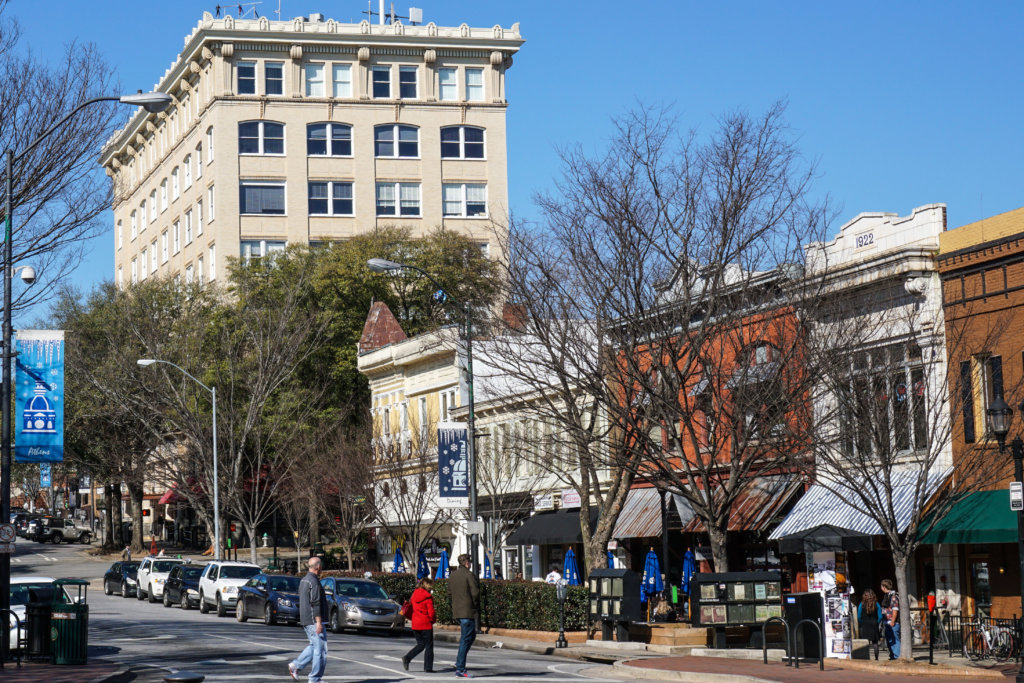
Unlike many other places where eighties and nineties alternative culture flourished, contemporary Athens has not become a bohemian stage set for the top 10 percent of Americans, with a little bit of genuine creative culture clawing for survival among the rising rents. It has not been taken over by tech culture and "creative" entrepreneurship like Seattle, Brooklyn, and Austin. And it has not turned slick and rich with retirees and people with "family" money like many other college towns. Gentrification is occurring, but the area remains relatively cheap, isolated, hard to get to, and modest, especially outside the historic districts and areas close to campus. And somehow, within and even on the margins of the scene, wealth is still not something you want to brag about or display unless you want to be considered an idiot or a racist or a Republican. The currency remains DIY culture, and while you can buy other people's creativity and aesthetic sensibility, nothing is as cool as cultivating your own. While the scene is still too white, events like Hot Corner Hip Hop and venues like the World Famous have stretched the boundaries of Athens alternative culture to include African American musicians and fans of indie hip-hop. Today, bohemian Athens still works about as well as it ever did, nurturing a famous band here or there but always churning away at the less glamourous but arguably more important work of transforming the lives of suburban and small-town southern kids and giving them a vision of a bigger and more creative, open, and tolerant world.2Contrast Coran Capshaw, the manager of Charlottesville's most famous musical group, the Dave Matthews Band, with Bertis Downs, R.E.M.'s lawyer and manager, who still runs the business end of that former band. Capshaw is an entrepreneur who runs multiple companies and a real estate empire in the college town where I live now, while Downs spends most of his time as a local and national advocate for public schools.
Pylon's "Danger"
Sonically and visually, Pylon worked the contrast between flat, machine-like minimalism and ragged, southern-accented amateurism. Their songs used a four-on-the-floor disco beat to mash together punk's emotional excess and industrial repetition and detachment. The band may have been "safety conscious," but the raw, pounding sound did not make anyone feel safe. Band members turned uneven development—the collision between Athens as a small southern town and Athens as the home of a modern university and Athens as a peripheral industrial site—into a startlingly original sound, an audio portrait of postmodernity.
After Jim Fouratt left Hurrah, he and a partner opened Danceteria, a New York dance club that also showcased live bands. Video artists Emily Armstrong and Pat Ivers programmed the video lounge there, and they recorded one of Pylon's shows. The surviving footage reveals what Pylon looked and sounded like at the height of their power.3"Pylon-1980," online at https://vimeo.com/50389377. See also http://localeastvillage.com/2012/10/15/nightclubbing-pylon/, which described the video as part of Pat Ivers and Emily Armstrong's archive of punk-era concert footage being digitized for the Downtown Collection at N.Y.U.'s Fales Library.
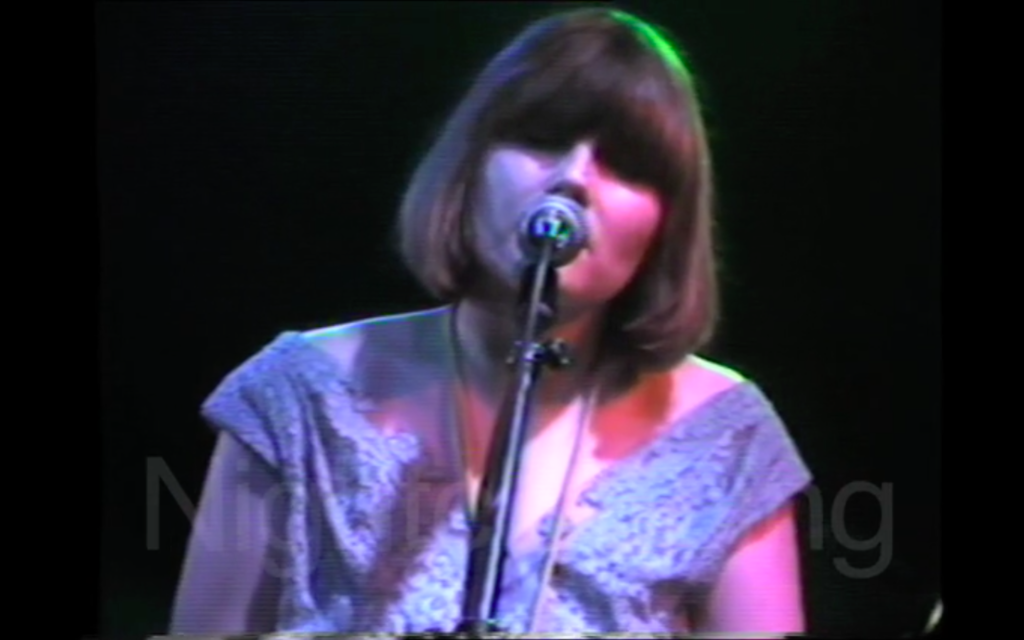
The song "Danger" begins with a bass drum beat and lead singer Vanessa Briscoe Hay quietly alternating between making a "ssssss" sound and chanting works like "the sound of danger." Drum and voice hold the line as the bass rings out and a scattering of guitar notes compete with a clanging cymbal. Someone thinks to turn up the stage light, and Briscoe Hay's head and upper torso emerge from the dark. Michael Lachowski's bass builds, repeating a bouncing five-note phrase again and again, and the guitar and cymbal clang repeatedly. Briscoe Hay stares straight ahead at the audience, her eyes barely visible under a thatch of brown bangs, and hisses into the mic, impersonating a snake or a valve letting off steam, the sound equivalent of the machine in the garden.4Local East Village, "Pylon-1980."
On stage, Briscoe Hay and Lachowski's bodies and clothes create a kind of visual dissonance. Briscoe Hay wears a church dress gone wrong, its color a bit faded and its shape a little soft. As she shakes and twirls her head, a limp lace sleeve slips down her shoulder. Instead of a necklace, she wears her whistle. Her facial expressions alternate between lack and excess, an underplaying that suggests choked amateurism and an overplaying that evokes the entwined histories of blackface and drag.5Van Gosse, "Pylon Draws the Line," Village Voice, February 25, 1981, describes Briscoe Hay in a performance at the Rock Lounge in New York on Valentine's Day 1981 as, "shoeless with whistle, in a parochial-school blue smock and white blouse" (3).
As the song builds, Briscoe Hay spins like a windup whirling dervish, slowing down and speeding up according to the tension in her spring. As she dances, her moves accentuate her curves. The only sharp things here are her cheekbones. Her accent is somehow flat and yet also lushly southern. Like Cindy Wilson in the B-52s, Briscoe Hay both conjures and contradicts the multiple meanings of performing like a girl. In contrast, Lachowski is tall, hard, and thin, a pole of a man with slow, repressed gestures. He sticks out his tongue, and he turns his head a little, looking away from the crowd on one side and then the other. At times, he seems a little scared. His t-shirt and jeans refuse notice. In the critic Van Gosse's words, Lachowski and guitarist Randall Bewley look "like bike mechanics or sculptors" who perform a kind of "abstract hopping around, cute yet unposed."6Gosse, "Pylon Draws the Line," 3.
About a minute in, Briscoe Hay shakes her brown bangs from her brown eyes and half smiles, half grimaces at the audience as she increases the volume and the emotional intensity of her voice. "Dannnne . . . gerrrr," she sings, like a southern girl struggling to speak a foreign tongue, "Be careful. Be caw . . . tious." Drawing out the "caw" until it mimics the sound of a crow, she over-enunciates and turns her head for emphasis, like a teacher trying to force her students to pay attention. A delay effect sends the vocals echoing in all directions and conjures the large space of a factory or a church. With Briscoe Hay's vocal shift, the song explodes. The drums become fat and big and bullying. Sprays of a few guitar and bass notes and shouted words form achingly simple hooks. Then Briscoe Hay blows a long blast on her whistle right into the mic, and the sound of a safety alert at a factory or a foul in a gym rings out an elementary need. The serial riffs convey both the repetition of machinery and a growing urgency as volume and tempo slowly build. At the end, the guitar and bass sound like they are unwinding. Briscoe Hay begins to scream and moan, and the delay effect unravels her voice. The creamy skin of her chest shows just above her breast where her dress has slipped off her shoulder. Decreasing the volume and cutting the speed, she winds listeners out of the song on a wash of emotions that refuse to coalesce into any coherent form.
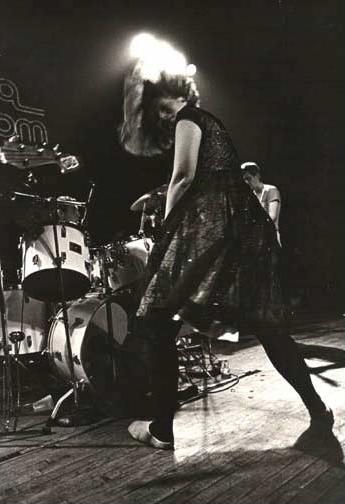
In person, Briscoe Hay sounded like a girl—she spoke in a soft, high voice with a deep southern accent. On stage, she developed a grown-up and powerful roar. Part beauty queen and part drag queen, she worked the intersections of white southern conventions of femininity and drag performance, Patti Smith's androgyny and Yoko Ono's arty shock and awe. The Danceteria video conveyed the charisma of the maturing band's live performances, an allure never quite captured on their recordings. Back in Athens, Vanessa's performances made other women think that if a sweet southern girl could do this, then they too might dare to dream.
That November, DB Records released Gyrate, Pylon's first album, recorded the previous spring in a three-day session at Stone Mountain Studios and produced by Kevin Dunn, a former member of Atlanta punk band the Fans who had also helped with the B-52s's and Pylon's singles. In December, Armageddon Records released the album in England. Critics raved. New Music Express named the record "one of the year's most fundamental rock and roll celebrations." Melody Maker worked the unlikeliness angle: "Buried deep in the land of rednecks, peanut farms and wave-yer-hat-and shout-yeehaw boogie bands, there's something stirring." Pylon made its first overseas tour, playing across England and a few dates in Europe in November and December. Back in New York, John Lennon was murdered. Briscoe Hay remembered getting out of a car in Liverpool and accidently stepping into a pile of flowers left as a makeshift memorial.7"Review of Gyrate," New Music Express, December 1980; Robert Holland, "After Hours," Red and Black, February 8, 1980, 5; "Interview with Danny Beard," Tasty World 3 [April 1985], 11; Jay Watson, "Local Groups Get Boost from DB Records," Red and Black, January 13, 1982, 1, 5; Briscoe Hay, "Vanessa's Version"; Briscoe Hay, interview; Bourne, interview; Biddle, interview; Rasmussen, interview. Bewley did the cover art for the album and former art student Bourne, then working in Atlanta at Beard's record store, did the art direction and design.
Reagan had been elected president just as the album came out, and many critics heard something political in the band's unique sound. Glenn O'Brien prefaced his positive review of Gyrate with a rant about the new political moment. He agreed with the president that America still believed in "those great ideals, those hopes and dreams." The problem for O'Brien was that collectively, Americans had lost "our national ability to identify facts, to absorb information and correlate it; in short, our ability to know anything." By really making you feel like dancing, by moving listeners and making them think, Pylon worked as an antidote to this know-nothingness.8Glenn O'Brien, "Glenn O'Brien's BEAT," Interview, March 1981, 62.
For critic Van Gosse, writing in the Village Voice, Pylon's new album was not just great; as the Reagan era began amidst "imperial decline and the sound of cowboy bluster," it was essential. "If there is any conceivable 'rock 'n' roll future,'" he argued, it lay "in the intrinsic values of a music that is kept blindingly simple, unsentimental, uncomfortable: that which embodies the particular contradictions of its historical epoch in three minutes of glorious noise." For Van Gosse, rock and roll meant "nothing more or less than controlled rhythmsmack, an exquisite tension and release embodied in sound." Pylon embodied "this formal truth right now in a way that only the Rolling Stones ever have before." After lovingly describing their sound and raving about the "hypnotic" Briscoe Hay, "shoeless with whistle," he returned to the importance of this kind of band in this kind of time. Before Pylon, "the class acts of post-everything modernism" came from "the most ancient bowels of decayed industrial capitalist, the dreary olde U.K." While many young Americans loved this music, "we're not really rotted enough yet ourselves. What was needed was something with a little frontier chutzpah, some rooty-toot-toot all-American get-up-an-go, to sing of our bodies electric and alone." Pylon, from "the proverbial sleepy college town," was that band.9Gosse, "Pylon Draws the Line," 61–62. Gosse's article offered very high praise considering how much good rock and roll came out in 1980, including Springsteen's The River, John Lennon's Double Fantasy, Pete Townshend's Empty Glass, David Bowie's Scary Monsters, Grace Jones' Warm Leatherette, Captain Beefheart's Doc at the Radar Station, The English Beat's I Just Can't Stop It, and Stevie Wonder's Hotter Than July, and albums by more underground acts like the Talking Heads' Remain in Light, Elvis Costello's Get Happy!, X's Los Angeles, The Clash's Sandinista!, and the Dead Kennedys' Fresh Fruit for Rotting Vegetables.
New York Rocker's March 1981 Pylon cover story and interview "From Athens, Georgia: New Sounds of the Old South" did not so much argue as gush. The band's "utter lack of attitude" offered an antidote to big city jadedness: "Aren't y'all tired of patronizing arty-fartiness pawned off as entertainment?" Pushed to describe Pylon's sound, Lachowski called the band's music "temporary," in contrast to contemporary, rock. In the same issue, Vic Varney explained the new Athens scene under the headline "Nineteen Hours from New York," and New York Rocker printed photos of the next wave of bands: R.E.M., Love Tractor, and the Side Effects.10Karen Moline, "Pylon: From Athens, GA: New Sounds of the Old South," New York Rocker, March 1981, 15–17; Vic Varney, "'Nineteen Hours from New York': Small Town Makes Good," New York Rocker, March 1981. For more interesting writing about Pylon, see Robert Palmer, "Critics' Choices," New York Times, April 4, 1982; Guy Trebay, "Survey of the Week's Events: Pylon/dB's," Village Voice, April 20, 1982; "Pylon/'Crazy,'" New York Rocker, June 1982, 43; Steve Anderson, "Pylontechnics," Village Voice, November 9, 1982, 66; Stephen Holden, "Music: Pylon at the Ritz," New York Times, May 31, 1983, C15; Tom Carson, "Pylon Up Around the Bend," Village Voice, June 14, 1983, 84; Kim Taylor Bennett, "We Talked to Pylon's Michael Lachowski Because He's a Legend," Vice, August 14, 2014, https://www.vice.com/en_us/article/6w3vw6/we-talked-to-michael-lachowski-from-pylon-because-hes-a-legend.
When the 40 Watt Club reopened with new ownership on West Clayton near the old Last Resort space, Pylon was the obvious choice to headline. Varney had exaggerated when he told New York Rocker that Pylon was essentially "commuting to New York." Despite touring with the Gang of Four in the Midwest and Canada and recording a new single, "Crazy"/"M-Train," and a second album, Chomp, band members still lived in Athens and spent a lot of time there. In January 1982, the group played a now-legendary show on campus, selling out the large Memorial Hall ballroom. That fall, Pylon packed the i and i, a warehouse-sized club that for a short time booked the new bands. In April of 1983, when the 40 Watt moved from Clayton Street to a bigger venue on Broad Street, only Pylon could headline the back-to-back closing and then opening shows and pack both rooms. Pylon ruled the scene that the band had done so much to create.11Vanessa Briscoe Hay interviews, T. Patton Biddle interview; Jay Watson, "'Athens' Finest' Play Tonight," Red and Black, January 13, 1982, 5; Moline, "Pylon: From Athens, GA"; T. Patton Biddle, better known as Pat the soundman, has the flyer for the Memorial Hall show with Pylon and Love Tractor on his website at https://www.patthewiz.com/.
In contrast, the New York-based B-52s hit something of a slump. After following up their debut album with 1980's successful Wild Planet, the group finally released Mesopotamia in early 1982, a David Byrne–produced recording that ended up being an EP because the band simply did not have enough new material. Most critics panned it. New York Rocker captured the prevailing sentiment: "This best-dressed act doesn't know what to do for an encore." Still, a lot of Athens folks headed down to Atlanta to catch the B-52s at the Fox, and Fred Schneider plugged his friend Jerry Ayers's band Limbo District, playing later that night at the Atlanta club 688. The next spring, the B-52s released Whammy!, a new album that returned to their original sound and did better commercially than the EP without generating any hits.12Cindy Wilson interview; Jon Piccarella, "The B-52s, Mesopotamia (Warner Brothers)," New York Rocker, April 1982, 43; J. Eddy Ellison, "Athens Own B-52s Rock the Fox, Still Have Their 40 Watt Charisma," Red and Black, May 12, 1982, 2. Of course, the B-52s never played the 40 Watt Club.
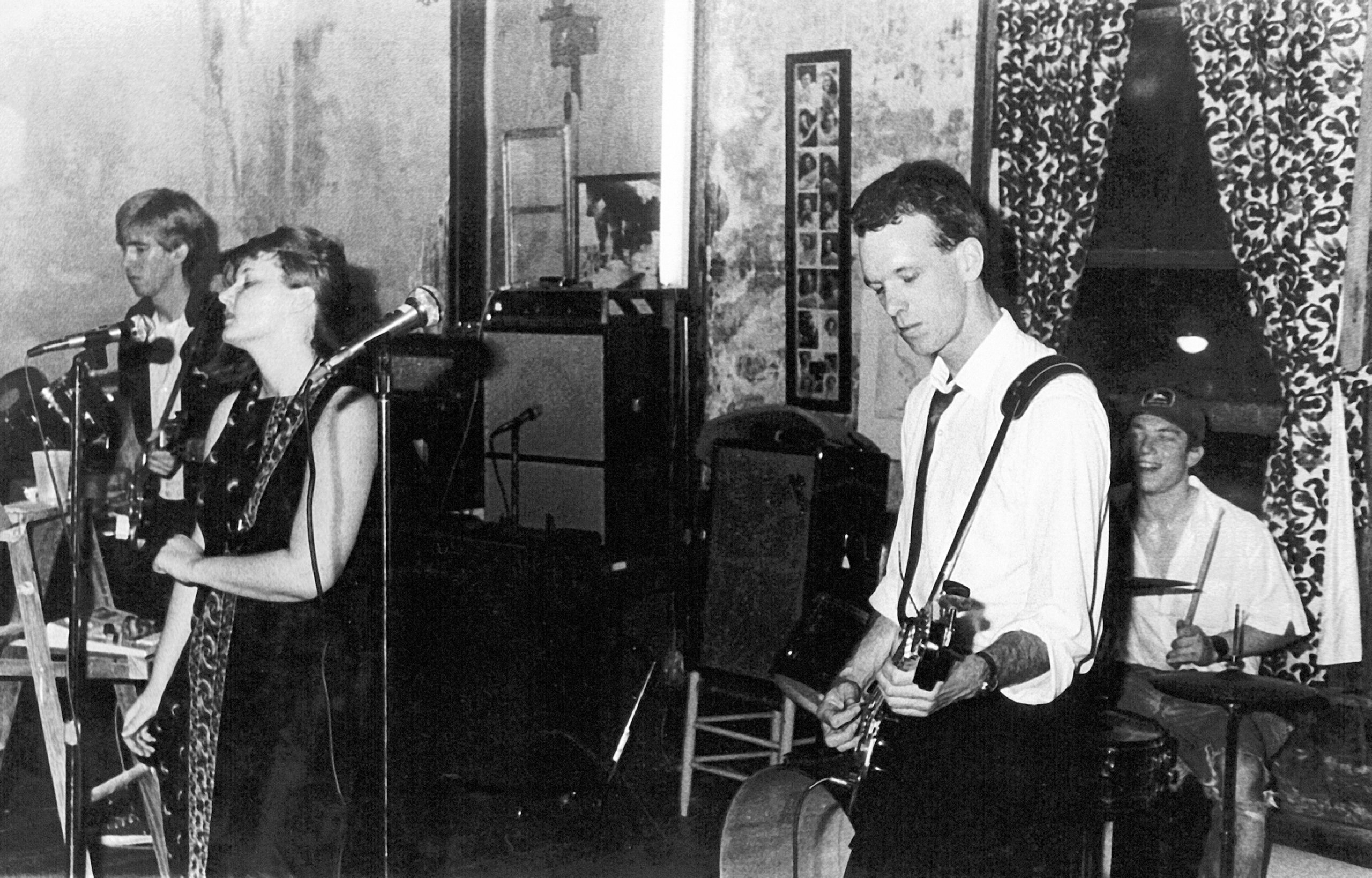
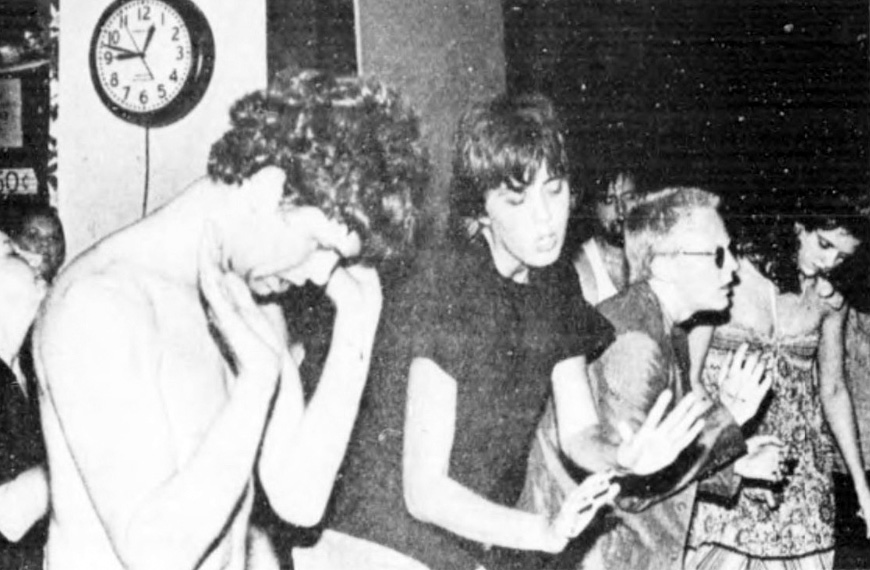
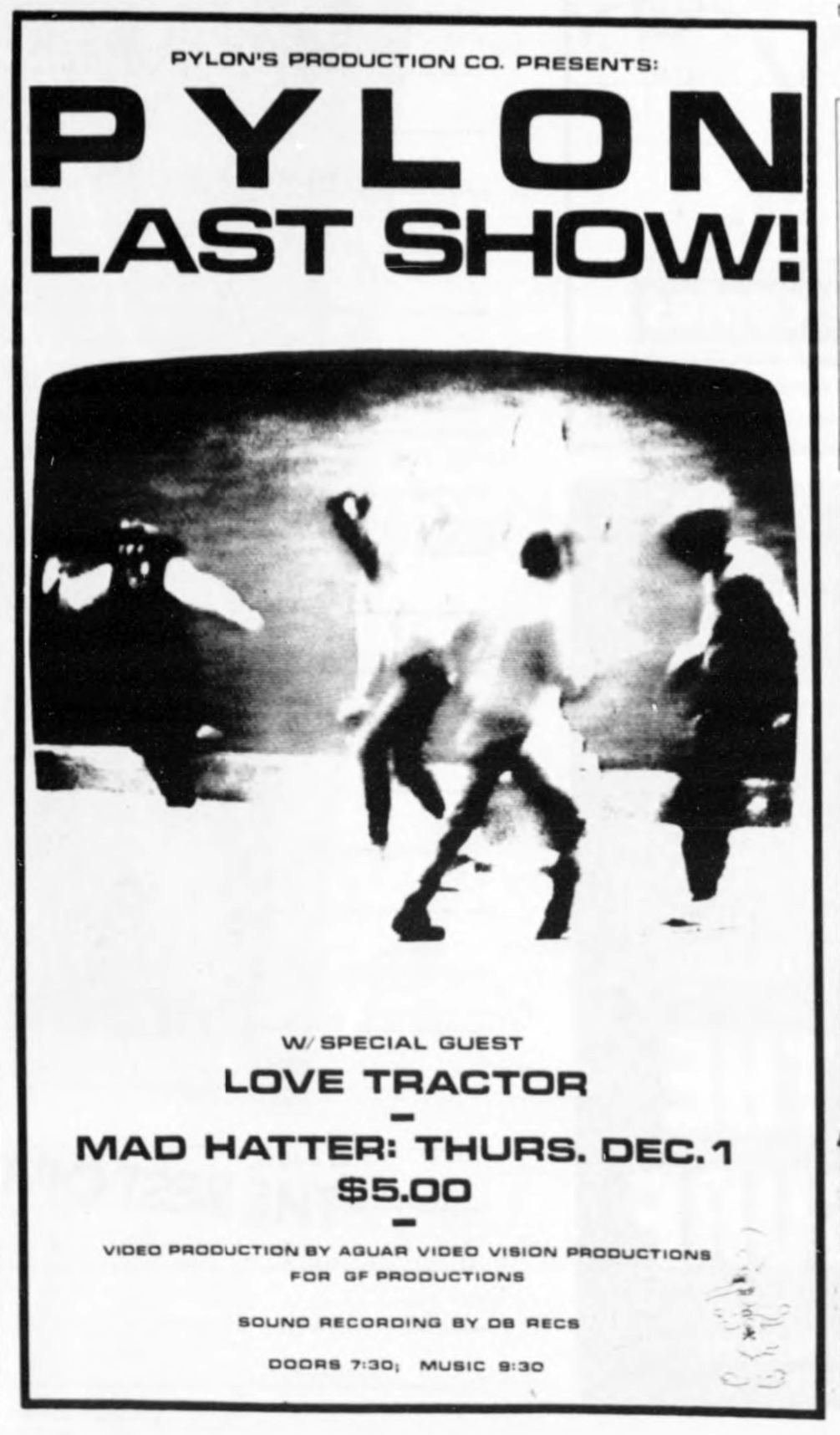
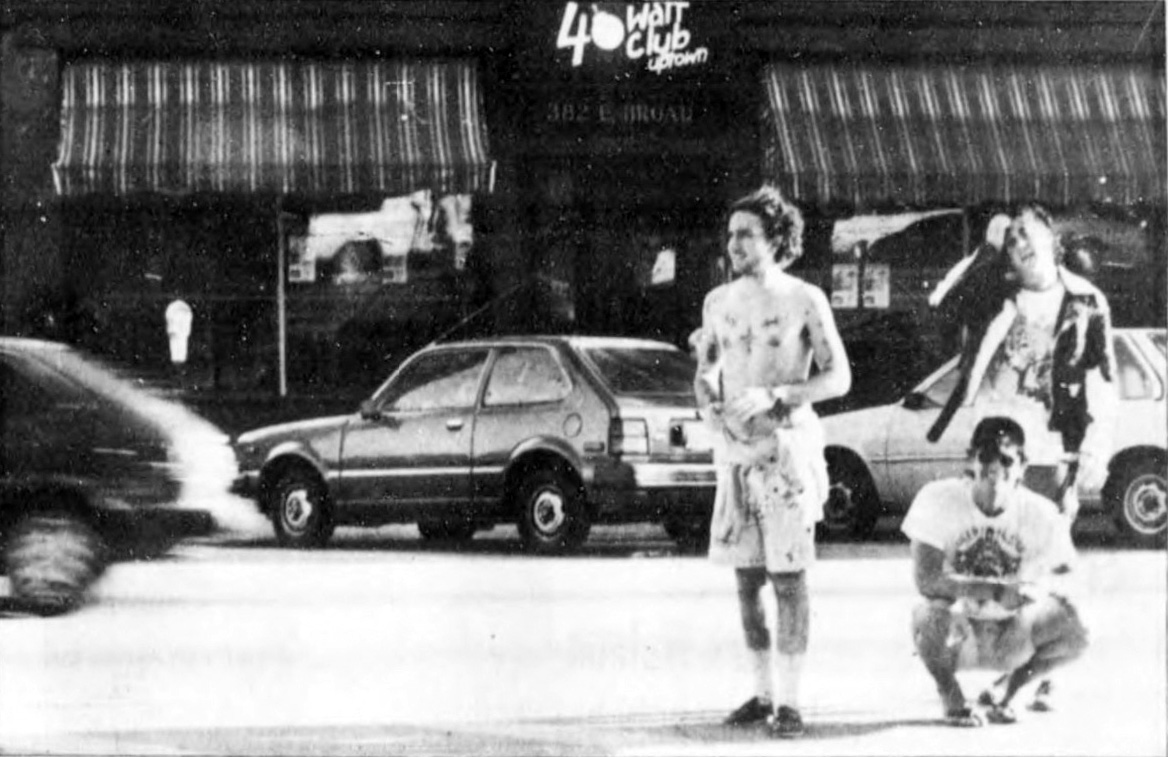
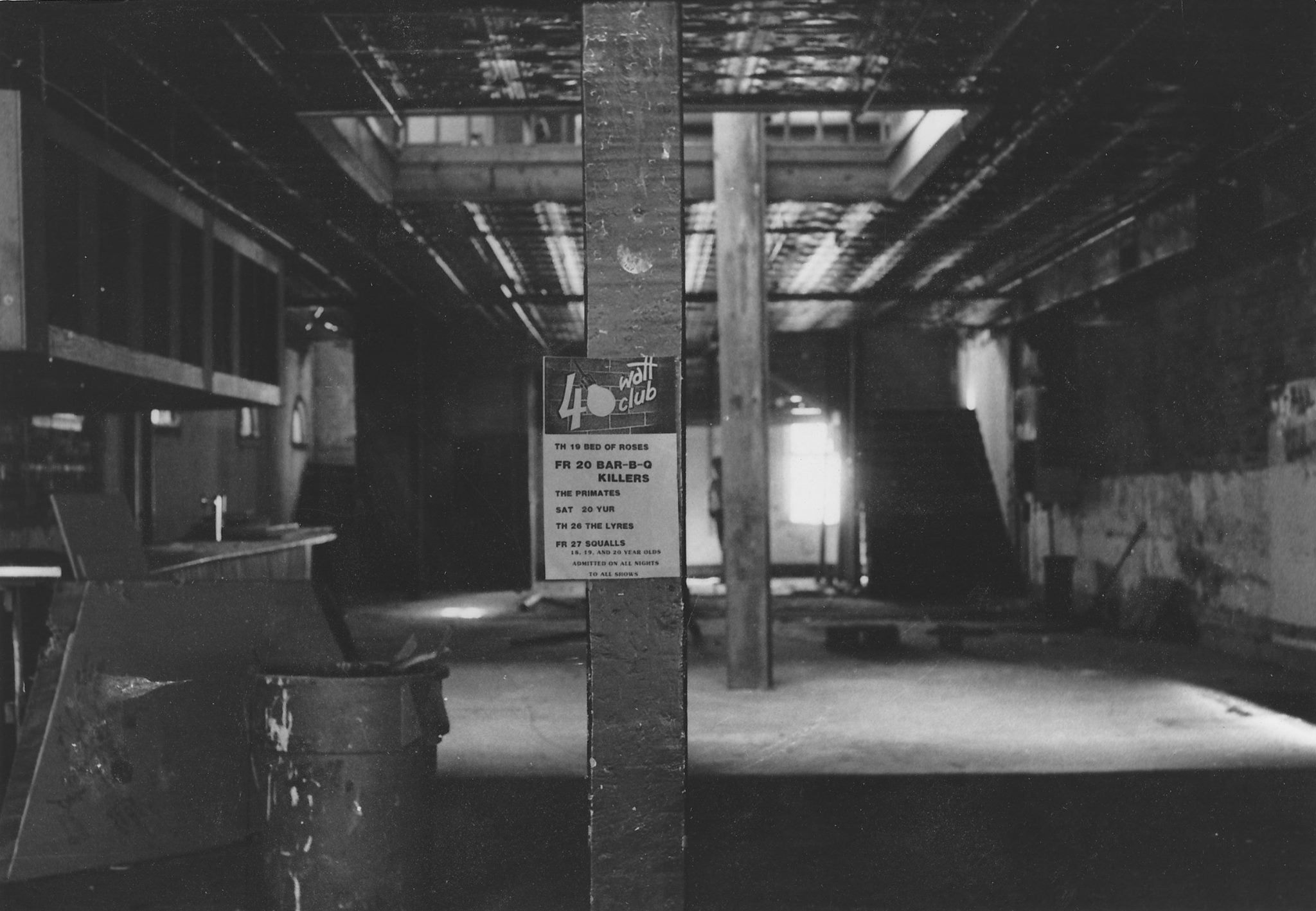
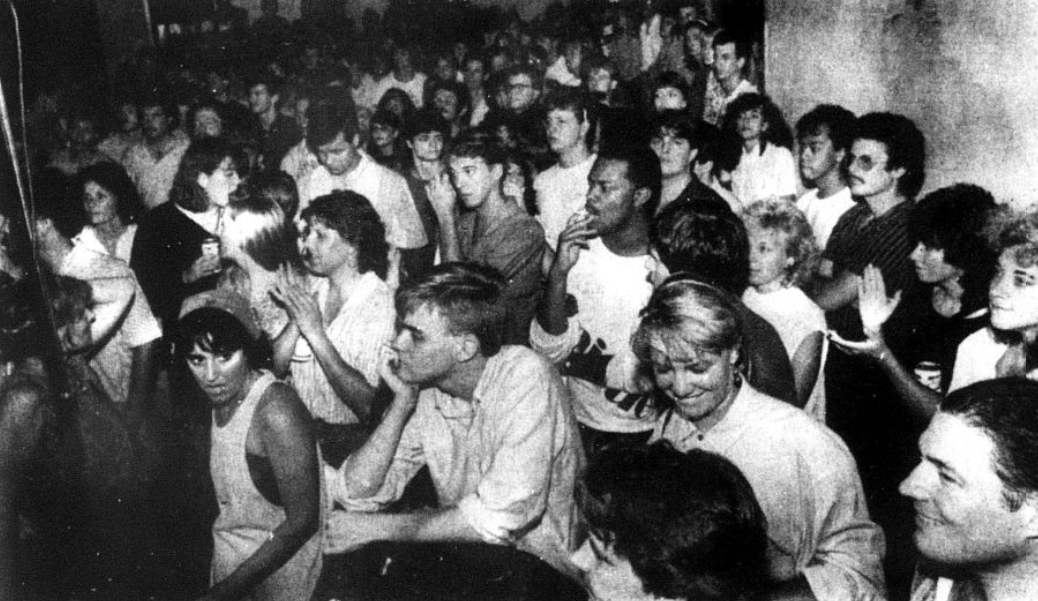
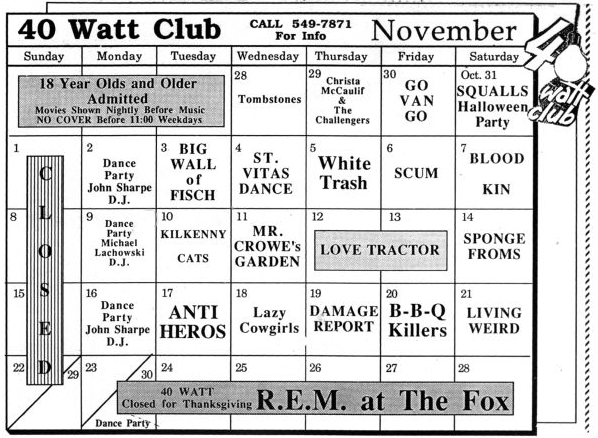
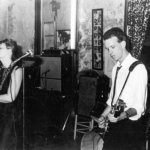
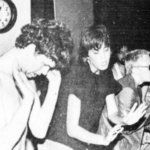
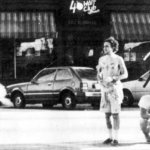
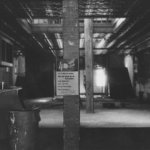
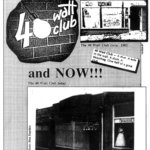
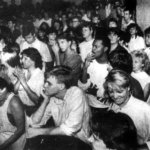
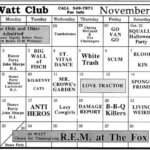
Pylon, too, hit a wall. From an underground perspective, the band seemed wildly successful. In Athens, New York, a few other American cities, and in England, they packed the clubs. Elsewhere, audiences did not seem to know what to make of the group. And while the members of Pylon made enough money to live cheaply in Athens, they weren't exactly comfortable. To reach the next level, they hired a professional booking agent. He landed them a gig most bands would have been giddy to get: the opening slot for U2's U.S. tour in support of their recently released album War. At first, band members said no, but eventually they compromised and agreed to play the first several dates. When they took the stage, crowds impatient to see the Irish band ignored them. As Briscoe Hay recalled, "People were heckling . . . 'Where's U2?' and 'Get off the stage.'" What everyone said was great felt instead like failure. It certainly was not fun. Maybe they did not really want this kind of success. Maybe their music was not for everybody. Maybe their performance-art-turned-band was exactly what they said it was, "temporary rock."13Briscoe Hay, interviews; Michael Lachowski, interviews.
In January 1983, Briscoe Hay told the Athens Observer, "I think if it ever became miserable, we would just disband," and in retrospect she was hinting at what was to come. Band members decided around this time to break up at the end of the year, after they fulfilled their bookings, but they kept their decision secret. In Athens, most people found out when posters went up for "Pylon's Last Show" with opening act Love Tractor. The gig took place in a huge venue known more for its cheap drink nights than live music so everyone could come.14Poster reproduced as an ad, Red and Black, December 1, 1983, 6; Lachowski, interviews; Briscoe Hay, interviews.
A live recording of that farewell show released in 2016 finally gave those of us who missed it a chance to listen in on this essential moment in Athens history. From the opening note of the first song, "Working Is No Problem," Pylon lays out what a critic fittingly describes as "an all-business, no-banter set" of twenty-two songs with hair-on-fire intensity that does not let up until the five-song encore finishes. Over the course of approximately an hour and a quarter of music, the crowd roars out its encouragement. Sometimes, the fans sing along to lyrics like "everything is cool" and even occasionally to guitar hooks, like the woo-woo of "M-Train." At other times, they just yell. No one wants the evening to stop. When it does, Pylon ends with a song that only their earliest fans would get and an homage to their origins in Lachowski's loft studio, their version of the Batman theme song. Superheroes fight evil. To resist the way the market strips away every meaning but money, maybe you just have to refuse to play.15Pylon, Pylon Live (Atlanta, GA: Chunklet Industries, 2016); Stuart Berman, "Pylon: Pylon Live," Pitchfork, July 19, 2016, https://pitchfork.com/reviews/albums/22125-pylon-live/.
Interviewed about the breakup, band members reflected on why they had started making music "as another form of artistic expression." "We accomplished what we set out to do," Lachowski said. "It's not that we are miserable, it's just that we've seen all we're going to see and don't want to put any more time into it." "Our whole reason for doing it was for fun," Crowe argued, "and when the fun wears out and it starts turning into a serious type of job—there's no reason to do it anymore." Briscoe Hay captured the purity and the privilege of the band's attitude: "We wanted to do what we wanted to do when we wanted to do it." As Lachowski explained, "What was frustrating was not trying to live like other bands, but trying to convince everybody that we didn't want to do it that way. . . . We were the only ones that understood why we were not out there with the other bands trying to make it big." But for all the talk about fun, at least one band member was still thinking about the importance of form. "We'll become a cult band now," Bewley predicted on the eve of Pylon's last show. "This is a type of suicide that'll make us more popular in the long run." And he was right.16J. Eddy Ellison, "A Found Farewell: Fans, Followers and Friends Sadly Try to Accept," Athens Banner Herald-Athens Daily News, December 2, 1983, 10–11; Lachowski, interviews; Briscoe Hay, interviews; David Pierce, "The Tasty World Interview: Michael Lachowski," Tasty World 2, 23, 29.
It was a tiny crowd really, fewer people than belonged to a single average-sized fraternity. Cline remembered about sixty people plus hangers on, a hundred tops. Briscoe Hay recalled a tight core of about one hundred people. Lachowski, comparing Athens to the early CBGB's days, argued that both scenes were "so vibrant because they were so tight." Proximity and personal relationships were key. Yet closeness alone was not enough. To be a scene, you needed a story. You needed a narrative to connect what was happening in Athens to a larger vision of the good life. You needed a myth.17Mark Cline interviews; Briscoe Hay, interviews; Lachowski, interviews.
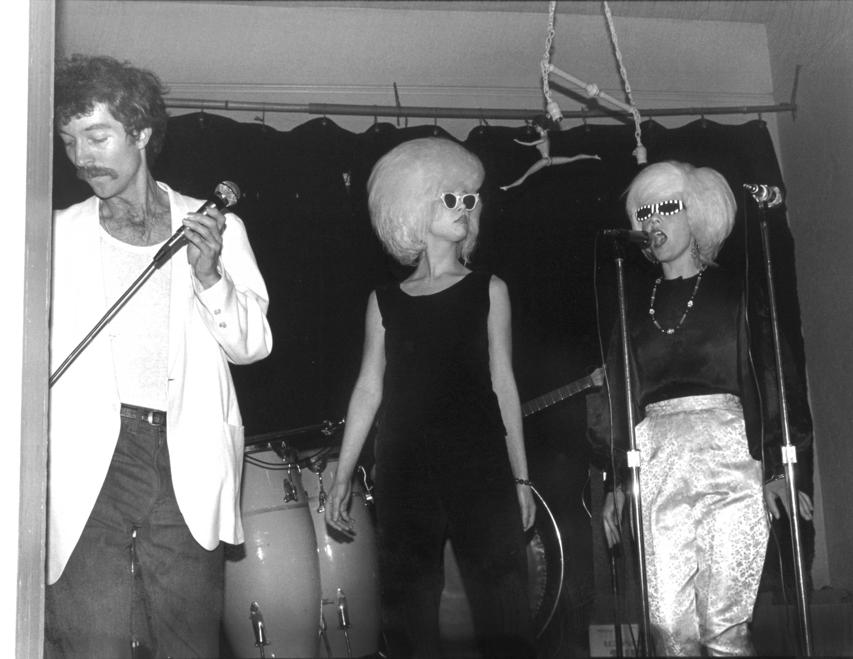
With their attention to "form" and their decision to quit at the height of their fame, Pylon provided this story, doing more than any other single group to fuse the loose, downtown-based network of art students, artists, other outsiders, and their friends that the B-52s had helped spark into what became known as the Athens scene. Performing their music, they also shared their bohemian vision. Life should be about making art for and with friends, combining creativity and pleasure and personal relationships, and living within and sharing a culture that you made yourselves. Money and fame were not necessary. They might even be lethal, killing the experience of creative pleasure.
The B-52s had turned pop art and drag into a form of punk music and proved a little bit of bohemia could flower even in as unlikely a location as a Georgia college town. Pylon, too, started with art and ratcheted up the intensity. Performance art depended on presence to offer messy truths. Pylon made performance art people could dance to, delivering a punk comment on the survival of originality in the machine-made future in a southern drawl more commonly associated with the handmade past. Live, the band's raw, intense music worked the contradictory meanings of repetition, how duplicated sounds and acts could evoke expansiveness or constriction, pleasure or boredom, play or work, and the body or the machine. Critics' darlings, repeatedly named the best band in Athens, Pylon carried their art piece so far that they broke up on the cusp of stardom. The members of Pylon might not have had the language to describe resistance to what people by the end of the century would be calling neoliberalism, but they had the sound.
About the Author
Grace Elizabeth Hale is the Commonwealth Professor of American Studies and History at the University of Virginia. Her previous books include A Nation of Outsiders: How the White Middle Class Fell in Love with Rebellion in Postwar America and Making Whiteness: The Culture of Segregation in the South, 1890–1940.
]]>Introduction
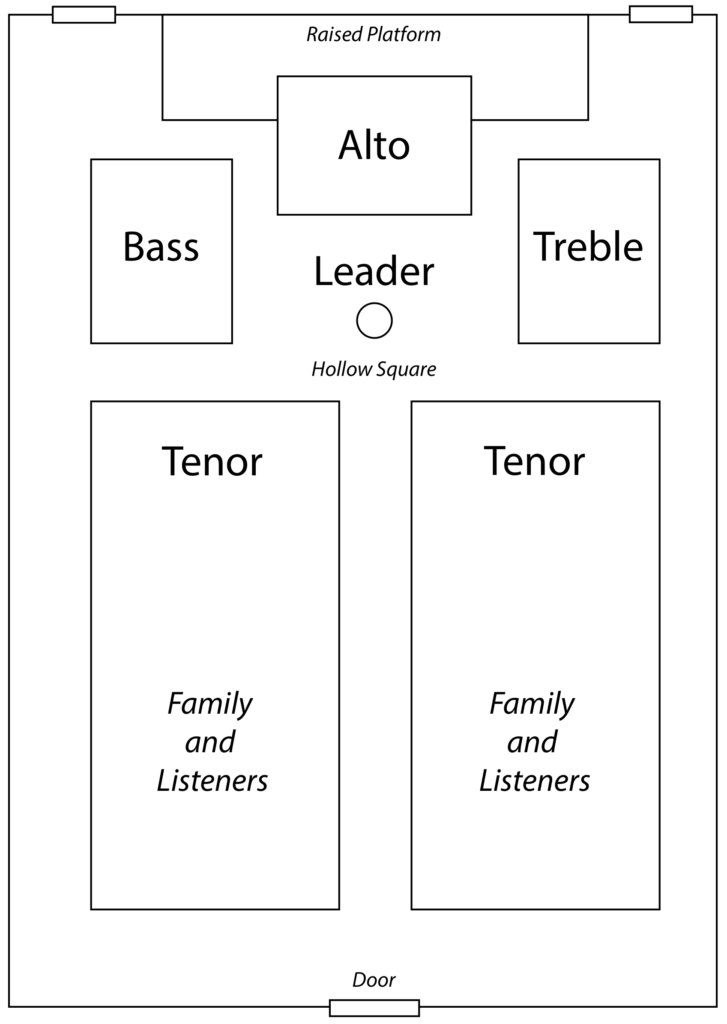
Sacred Harp singing is defined by its spatial organization as much as by its musical style. In this form of shape-note music, an assembled "class" of singers gathers at annual events called "singings"—weekend days spent in churches or community centers singing songs from The Sacred Harp, a nineteenth-century Georgia tunebook revised every generation or so. The tunebook uses a pedagogical system in which the music's note heads have four distinct shapes corresponding to their position in the scale, associated with the names "fa," "sol," "la," and "mi," which singers recite before singing a song's hymn text. Just as important as the shape-notes to the Sacred Harpers is the "hollow square" orientation in which singers sit, facing each other in rows of pews or chairs organized by voice part (bass, alto, treble, and tenor). Throughout the singing day, a procession of leaders take turns stepping into the hollow center to face the tenor or lead section that carries the melody and direct the class in a song or two of their choice from The Sacred Harp.1For more on Sacred Harp singing, see, especially, Buell E. Cobb Jr., The Sacred Harp: A Tradition and Its Music (Athens: University of Georgia Press, 1989); John Bealle, Public Worship, Private Faith: Sacred Harp and American Folksong (Athens: University of Georgia Press, 1997); Kiri Miller, Traveling Home: Sacred Harp Singing and American Pluralism (Champaign: University of Illinois Press, 2008); David Warren Steel and Richard H. Hulan, The Makers of the Sacred Harp (Champaign: University of Illinois Press, 2010).
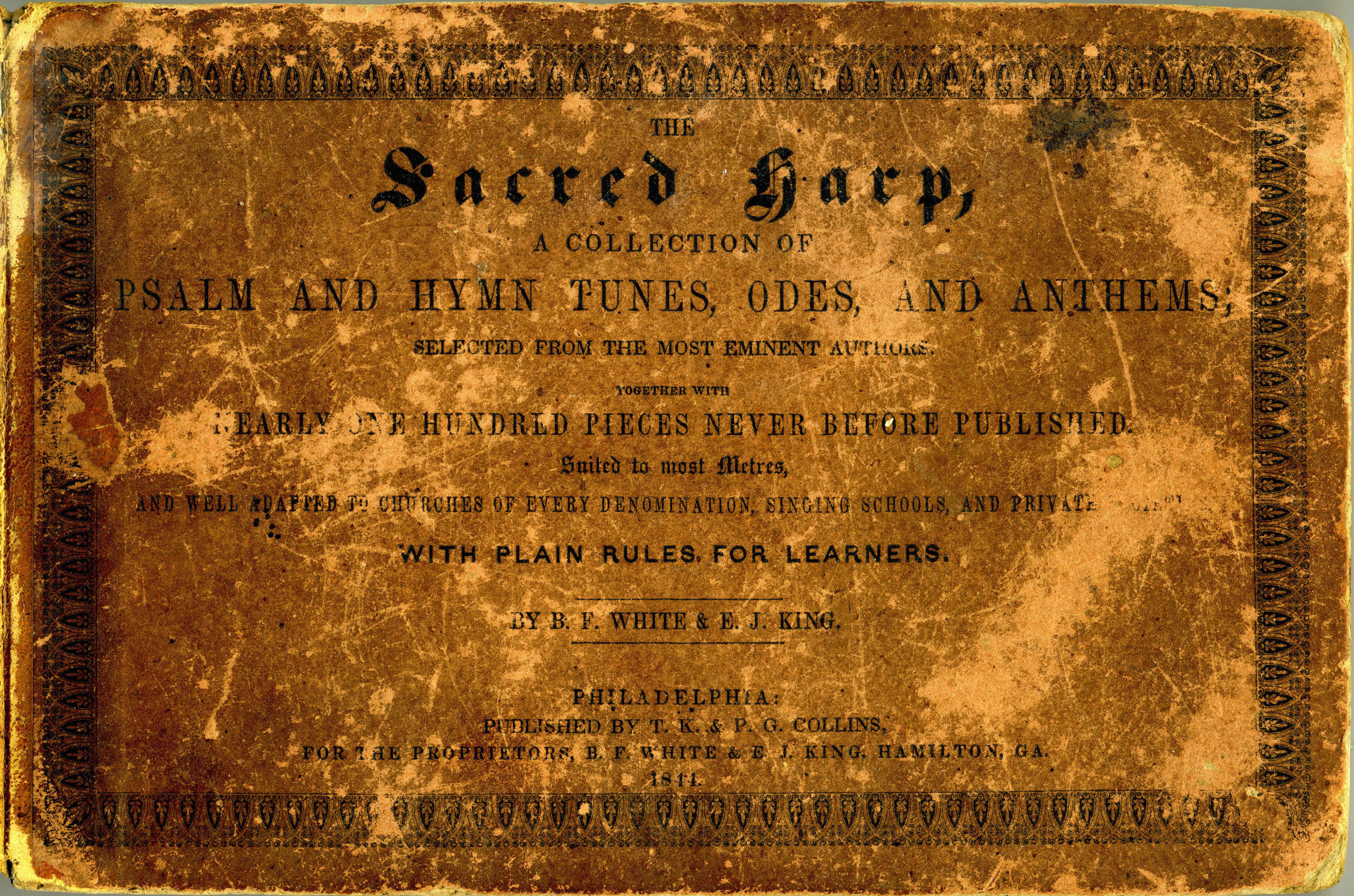
For singers, the hollow square is both a practically necessary convention and a deeply meaningful space. Encircled by full-voiced singing to hymn texts such as Isaac Watts's "Within Thy circling pow'r I stand, On ev'ry side I find Thy hand," for singers the immersiveness of the hollow square comes to represent God's encompassing love.2"Akin," music by P. Dan Brittain (1971), words by Isaac Watts (1719), in Hugh McGraw et al., eds., The Sacred Harp: 1991 Edition (Carrollton, GA: Sacred Harp Publishing Company, 1991), 472. For composers, the spatial organization of singings, especially the separation of voice parts, is something to consider and emphasize in writing for the tradition. For singers and scholars seeking to capture the essence of Sacred Harp singings, the hollow square has been a longstanding focus, with advances in recording technology leading to new strategies. In this publication we introduce new immersive 360-degree video and audio recordings we made from within the hollow square in the summer of 2019 and offer context drawing on a larger project about the hollow square's meaning to singers and composers and the history of attempts to capture the experience of this unique sonic space.
Yi Halo and Ambeo VR at Mt. Lebanon
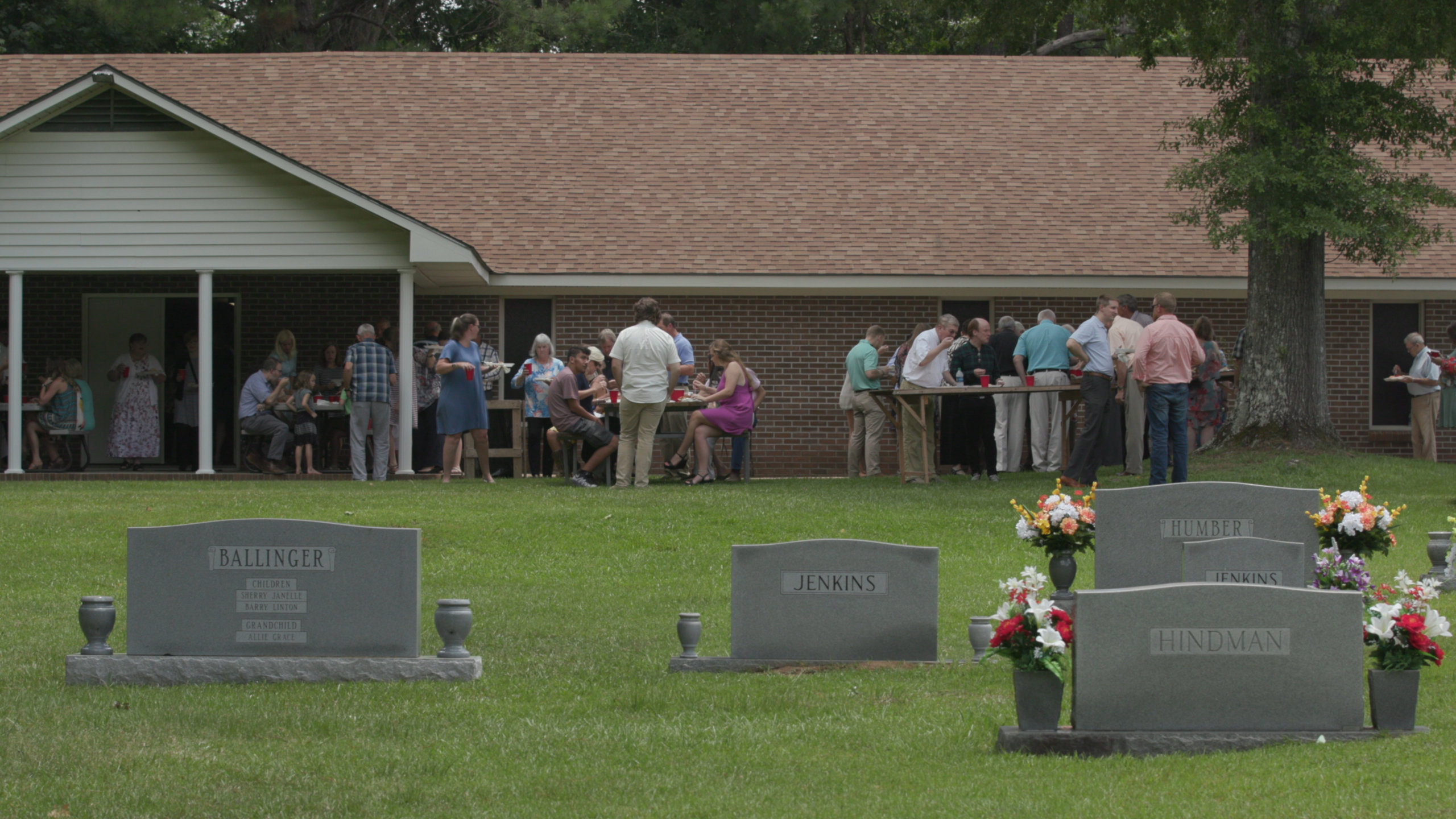
We used new video and audio recording technologies to capture elements of the experience of the hollow square. Our recording equipment included the Yi Halo, a device that captures video via seventeen separate cameras arranged in a circular housing. The Google platform Jump Assembler (now defunct) stitched the footage from all the cameras into a series of 360-degree videos.3Janko Roettgers, "Google Is Shutting Down Its Jump VR Video Program," Variety (blog), May 18, 2019, https://variety.com/2019/digital/news/google-jump-shutting-down-1203219306/. We used the Sennheiser Ambeo VR microphone to capture 360-degree spatial audio via four interconnected microphone capsules. Using the video editing application Adobe Premiere, we connected the 360-degree video to the spatial audio. When the user shifts the 360-degree visual field of view in the YouTube window, the audio shifts correspondingly. This spatial audio can only be experienced when wearing headphones.
After trying out the device at a Decatur, Georgia, all-day singing, we recorded three hours of the annual singing at Mt. Lebanon Baptist Church in rural Fayette County in west Alabama. This lively, midsize singing is in an area long central to the geography of what is now an international music culture with roots in Alabama, Georgia, Mississippi, Florida, and Texas.4On Sacred Harp's shifting geography, see James B. Wallace, "Stormy Banks and Sweet Rivers: A Sacred Harp Geography," Southern Spaces, June 4, 2007, https://southernspaces.ecdsdev.org/2007/stormy-banks-and-sweet-rivers-sacred-harp-geography; Jesse P. Karlsberg, "Folklore's Filter: Race, Place, and Sacred Harp Singing" (PhD diss., Emory University, 2015), https://etd.library.emory.edu/concern/etds/n009w256n?locale=en; Jesse P. Karlsberg and Robert A. W. Dunn, "Mapping the 'Big Minutes': Visualizing Sacred Harp's Geographic Coalescence and Expansion, 1995–2014," Southern Spaces Blog (blog), January 23, 2018, https://southernspaces.ecdsdev.org/2017/mapping-big-minutes-visualizing-sacred-harps-geographic-coalescence-and-expansion-1995-2014. The Mt. Lebanon Singing also serves as this Independent Baptist church's homecoming and as a reunion for the Ballinger family, a number of whose members are active singers. Today the singing also attracts members of singing communities in northeast Alabama, metro Atlanta, and further afield: singers in 2019 had traveled from New York City and Dublin, Ireland, to Fayette County. Trying the singers' patience and good humor, we placed the cumbersome, many-eyed Yi Halo in the singing's cozy hollow square for much of the day. Song leaders stood right next to the device. Steve captured conventional "flat" video from the back of the room, behind the tenor section, while Jesse sat and sang with the tenors.
The resulting recordings, embedded in this publication and accessible through YouTube, present video and audio from the center of the hollow square. This vantage point, typically inaccessible to those who don't lead songs, is the physical and spiritual center of Sacred Harp singings.
Entering the Hollow Square
The hollow square is central to understanding the music and music culture that surrounds The Sacred Harp. Singers associate the hollow square with key values of participation and community. Sacred Harp singers often state that they are "singing for each other and for God," rather than for an audience. Though non-singers such as family members and descendants of singers, congregants at churches hosting singings, and other curious individuals do sometimes come to listen, the layout of Sacred Harp singings, in which singers face each other rather than the listeners in the back, reinforces its participatory ethos.5On how Sacred Harp's spatial organization compares to that of historically related sacred music cultures, see Paula Tadlock, "Shape-Note Singing in Mississippi," in Discourse in Ethnomusicology: Essays in Honor of George List, ed. Caroline Card et al. (Bloomington: Ethnomusicology Publications Group, Indiana University, 1978), 191–207.
The hollow square also bolsters singers' sense of Sacred Harp as a community. Eye contact across the hollow square, where trebles face basses and tenors face altos, has kindled relationships, reinforced friendships, and intensified shared emotional experiences. Sacred Harp's music culture generally discourages talking while a singing is in session. In the absence of commentary on the affective and spiritual experience of singing, nonverbal communication—during singing and between songs as leaders cycle in and out of the square—contributes to singers' understanding of their experience as shared.6On verbal and nonverbal communication, the hollow square, and affective intensity in Sacred Harp singing, see Miller, Traveling Home; Kiri Miller, "'Like Cords Around My Heart': Sacred Harp Memorial Lessons and the Transmission of Tradition," Oral Tradition 25, no. 2 (2010), http://muse.jhu.edu/journals/oral_tradition/v025/25.2.miller.html; Anne Heider and R. Stephen Warner, "Bodies in Sync: Interaction Ritual Theory Applied to Sacred Harp Singing," Sociology of Religion 71, no. 1 (2010): 76–97.
The hollow square also improves the sound of Sacred Harp singings in ways both practically and aesthetically valued by singers. Facing each other makes it easier for singers to stay together. All can see and follow the leader, who beats time, moving an arm down and up to convey tempo. Singing at each other rather than out at an audience concentrates sound, making it easier for singers to hear each other. The accumulated volume enhances the depth of the experience.
Of course, the very best sound is in the center of the hollow square. In this space, the singing is loudest and all four parts achieve their best balance. Many singers who came to Sacred Harp singing as adults remember the first time they stepped into this space as the time they knew Sacred Harp singing would become an enduring part of their lives. Over time many come to think of this locus of Sacred Harp's spatial organization as a sacred space. Singers frequently invite newcomers to join them in the center for a song, believing that this is the best vantage point from which to apprehend what makes the music culture so moving to its participants.
Composing Sacred Harp's Spatiality
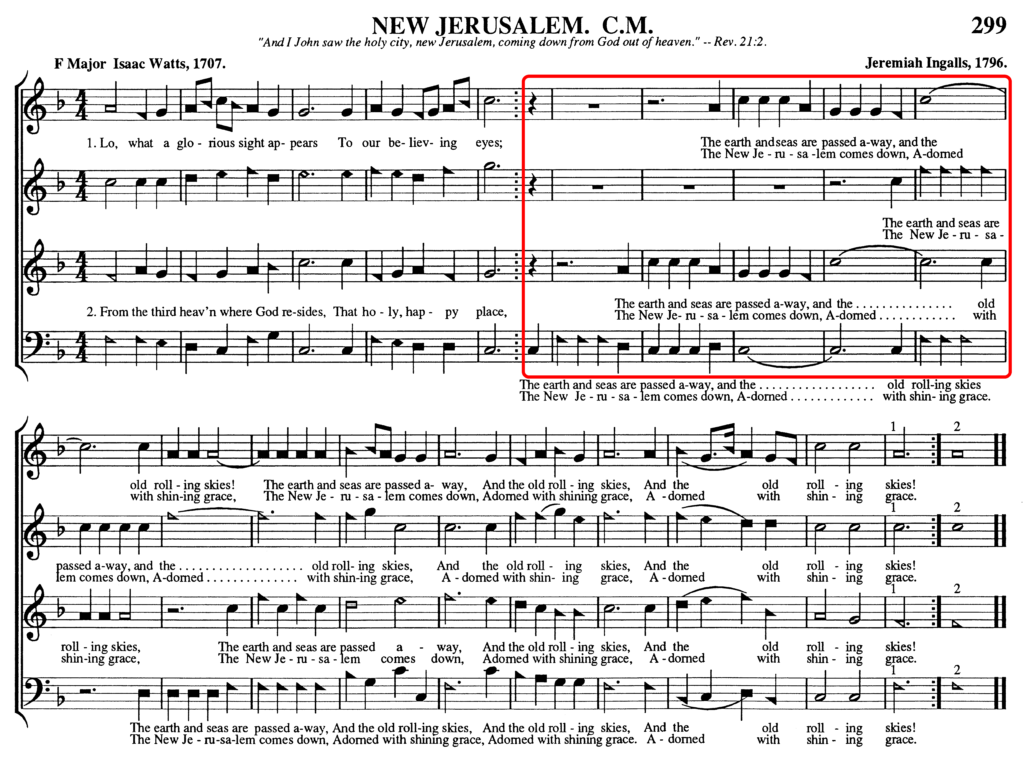
Many of the songs in The Sacred Harp leverage specific features of the hollow square for musical and emotional impact. The three immersive recordings of the Sacred Harp singing at Mt. Lebanon feature songs exemplifying two such approaches: fuging among the voice parts and traded high notes between the tenor and treble parts. Fuging tunes are among the most characteristic and popular song forms in The Sacred Harp. Typical fuging tunes begin with all the parts singing together, followed by a section in which each of the four voice parts enters in sequence, finally coming together again before the conclusion of the song.7Irving Lowens, "The Origins of the American Fuging Tune," Journal of the American Musicological Society 6, no. 1 (April 1, 1953): 46, https://doi.org/10.2307/829998. On fuging tunes, see also Karl Kroeger, American Fuging-Tunes, 1770–1820: A Descriptive Catalog (Westport, CT: Greenwood Press, 1994); Maxine Ann Fawcett-Yeske, "The Fuging Tune in America, 1770–1820: An Analytical Study" (PhD diss., University of Colorado at Boulder, 1997); Jesse P. Karlsberg, "Genre Spanning in the Close and Dispersed Harmony Shape-Note Songs of Sidney Whitfield Denson and Orin Adolphus Parris," American Music 35, no. 1 (2017): 94–132. The most common of these entrance patterns, as found in Jeremiah Ingalls's "New Jerusalem," led by Eli Hinton of Atlanta, Georgia, is propelled forward not just by the cascade of entrances and their progression from lower to higher voices, but by their spatialization. The entrance pattern proceeds counterclockwise around the hollow square, with basses followed by tenors, trebles, and altos.8"New Jerusalem," music by Jeremiah Ingalls (1796), words by Isaac Watts (1707), in McGraw et al., The Sacred Harp, 299.
Generations of composers have adopted this pattern and experimented with alternatives, frequently inspired by the arrangement of the vocal parts around the hollow square. After a short fuging section, Amos Munson's "Newburgh," led by Cheyenne Ivey, a member of a singing family from Henagar, Alabama, leverages the physical separation of the vocal parts to dramatize the celestial distance between the sun and stars. After the basses to the right of the leader enter on the phrase "Thou sun with golden beams" and all four parts sing "And moon with paler rays," the trebles, to the leader's left, reply with a shimmering "Ye starry lights, ye twinkling flames, Shine to your Maker's praise."9"Newburgh," music by Amos Munson (1798), words by Isaac Watts (1719), in McGraw et al., 182.
Composers also rely on the separation of vocal parts to create moments of power and energy by trading prominent high notes in rapid succession between the tenor and treble parts, a feature that singers often refer to as "thunder and lightning." Since these two parts are typically sung by mixed gender groups with similar vocal ranges, this trading back and forth of high notes would be undetectable without the vocal separation that the hollow square provides. In songs like C. Curtis's "Providence," led here by siblings Wanda Capps and Danny Creel from Dora and Hoover, Alabama, respectively, the traded high notes are distinct and clearly audible, contributing dynamic crackling energy to the song. "Providence" features "thunder and lightning" in multiple places. After a short opening section, the song's chorus begins with the trebles singing a musical phrase that peaks on a high note (accompanied by the basses) which is immediately echoed by the tenors. The song continues with similar exchanges, culminating in a figure ricocheting from the tenor to the treble as the song reaches its conclusion.10"Providence," music by C. Curtis (1820), words by Isaac Watts (1719), in McGraw et al., 298.
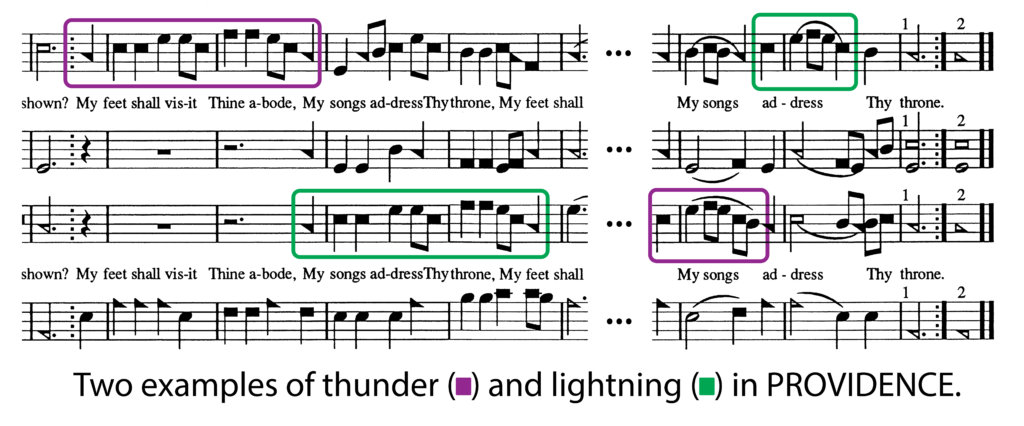
Recording the Hollow Square
For singers and scholars, Sacred Harp's spatial qualities have made recording the style appealing. Yet the results have persistently struck their makers and audiences as falling short of conveying the experience of being at a singing. The earliest field recordings, made by John W. Work III in 1938 and Alan Lomax and George Pullen Jackson in 1942, used then-available monophonic technology, collapsing the music's richly spatialized four-part harmonies to a single channel of recorded sound.
For Lomax, frustration with the result prompted him to include Sacred Harp singing in his itinerary for the "Southern Journey" field recording sessions he conducted in August through October of 1959 after he first gained access to portable stereo recording technology. The ensuing recordings, released in part as All Day Singing from "The Sacred Harp" (1961), provide considerably greater depth and intimacy than the monophonic recordings from the 1930s and 1940s, and contributed to greater public awareness of and interest in participating in Sacred Harp singing during the folk revival.11Alan Lomax and Alabama Sacred Harp Singers, All Day Singing from "The Sacred Harp," recorded 1959, 33 1/3 rpm record, Southern Journey (Bergenfield, NJ: Prestige, 1961). But Lomax's vantage point at one corner of the hollow square contributed to an imbalance among the parts that bothered contemporaneous Sacred Harp singers. The Sacred Harp Publishing Company, publisher of the most widely used tunebook at singings, responded by recording, producing, and releasing a series of LPs in the 1960s and 1970s, recorded in a studio and mastered to provide what they deemed a more satisfying balance of the parts.12Cobb, The Sacred Harp. When quadrophonic sound systems—one speaker for each Sacred Harp voice part!—proliferated in the 1970s, the same organization planned a release in this format, but the project was eventually shelved.
Conclusion
In the 2020s, as in the 1930s, there is no substitute for experiencing a Sacred Harp singing in person; singings today are held across the United States and beyond every weekend of the year. Yet we think the recordings of these three songs provide new virtual access to the experience of Sacred Harp's spatiality. We invite you to explore the activity in different parts of the singing space by shifting your perspective while navigating the video on your desktop monitor or your phone's YouTube app. If you wear headphones, you can hear the spatial audio shift along with the visual field of view. If you have access to a virtual reality headset, you can immersively experience the perspective these recordings afford. We plan to stage virtual reality viewings of these recordings at the Camp Fasola Sacred Harp singing school and at other singings in 2020. We will also make recordings of other songs accessible through the web in the coming months to expand the selection of songs and leaders captured using this technology. 
Additional Videos
- Philip Gilmore, of Oneonta, Alabama, leads Ananias Davisson's "Idumea" (p. 47b) from The Sacred Harp.
- Ewa Lichnerowicz, of Dublin, Ireland, leads S. M. Denson's "Praise God" (p. 328) from The Sacred Harp.
- Cindy Tanner, of Henagar, Alabama, leads George Coles's "Green Street" (p. 198) from The Sacred Harp.
- Beth Wallace, Eady Porter, Aubrey Zeanah, and Ridley Colvin, of Fayette, Northport, and Demopolis, Alabama, lead O. A. Parris's "My Brightest Days" (p. 546) from The Sacred Harp.
- Judy Caudle, of Eva, Alabama, leads H. S. Rees's "Sweet Morning" (p. 421) from The Sacred Harp.
About the Authors
Steve Bransford is the senior video producer at the Emory Center for Digital Scholarship. His documentary feature, The Well-Placed Weed, is available on Vimeo.
Jesse P. Karlsberg is the senior digital scholarship strategist at the Emory Center for Digital Scholarship. He is the project director and editor-in-chief of Sounding Spirit, a research lab and publishing initiative promoting collaborative engagement with historical American songbooks. Karlsberg is an internationally recognized singer, teacher, composer, and songbook editor in the Sacred Harp tradition.
]]>Blog Post
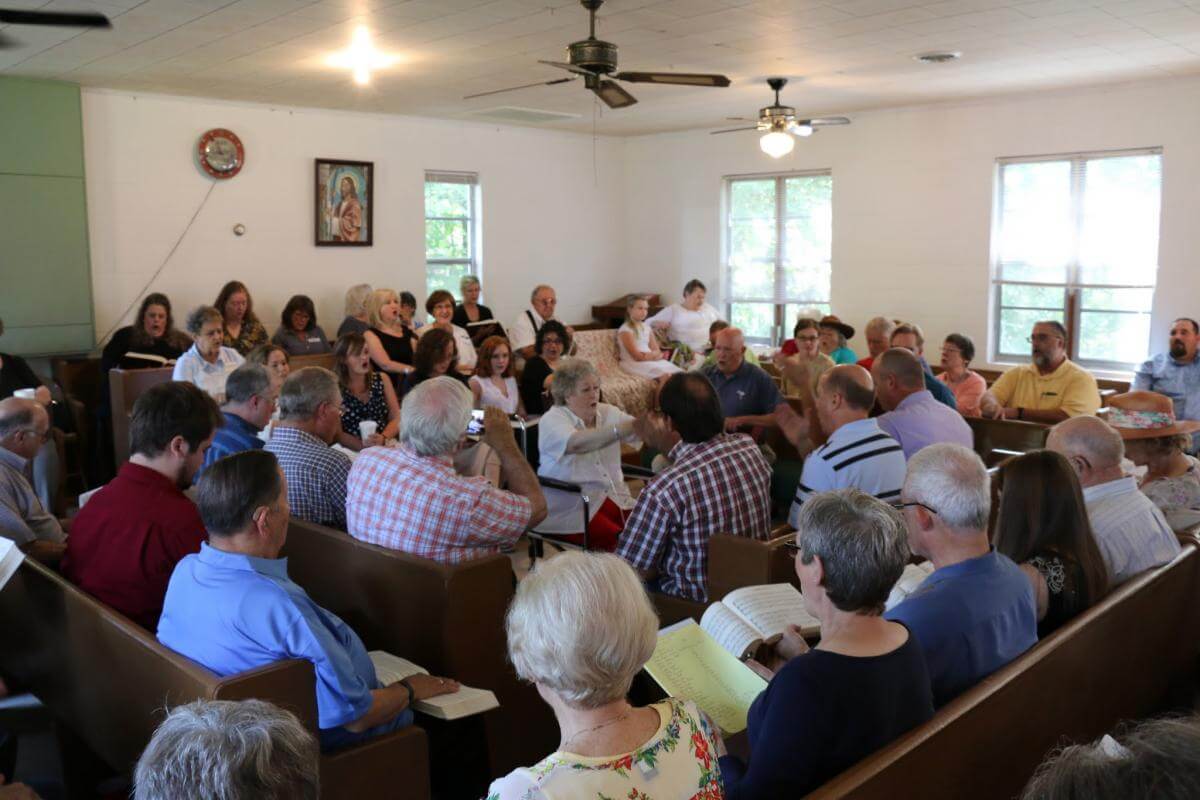
The Sacred Harp, a shape-note tunebook first published in 1844, has long been the center of a network of "singing conventions," weekend meetings featuring a cappella harmony singing at which participants take turns leading an informally assembled group in singing selections from the book. Beginning with singings in Georgia, Alabama, Florida, Tennessee, Mississippi, and Texas during the second half of the nineteenth century, participation in Sacred Harp has been tied to local, church, and kinship networks.1George Pullen Jackson, White Spirituals in the Southern Uplands: The Story of the Fasola Folk, Their Songs, Singings, and "Buckwheat Notes" (Chapel Hill: University of North Carolina Press, 1933); Buell E. Cobb, The Sacred Harp: A Tradition and Its Music (Athens: University of Georgia Press, 1989); David Warren Steel, The Makers of the Sacred Harp (Champaign: University of Illinois Press, 2010). In the twentieth century, however, The Sacred Harp's geography shifted to reach beyond these contexts. Scholars frequently recount the contours of these shifts in broad strokes bound up in narratives tied to folksong rhetoric and southern romanticism.2John Bealle, Public Worship, Private Faith: Sacred Harp and American Folksong (Athens: University of Georgia Press, 1997); Kiri Miller, Traveling Home: Sacred Harp Singing and American Pluralism (Champaign: University of Illinois Press, 2008). As the style came to be characterized as a folk music and included in American music curricula on college campuses in the second half of the twentieth century, singings spread to the Northeast, Midwest, and West Coast. Later, through these same channels, The Sacred Harp expanded to Canada, Europe, Australia, and East Asia.3Jesse P. Karlsberg, "Folklore's Filter: Race, Place, and Sacred Harp Singing" (Ph.D. dissertation, Emory University, 2015), http://pid.emory.edu/ark:/25593/pgtds; Ellen Lueck, "Sacred Harp Singing in Europe: Its Pathways, Spaces, and Meanings" (Ph.D. dissertation, Wesleyan University, 2016). Meanwhile, journalists and individuals across Sacred Harp's geography associated the style with "old-fogy" rural southern white culture in decline and regularly foretold the style's extinction in the southern states where it first thrived.4For examples and analysis of Sacred Harp singers' negotiation of the "old-fogy" label, see George Pullen Jackson, The Story of The Sacred Harp, 1844–1944: A Book of Religious Folk Song as an American Institution (Nashville, TN: Vanderbilt University Press, 1944); Hugh W. McGraw, "'There Are More Singings Now Than Ever Before': Hugh McGraw Addresses the Harpeth Valley Singers," Sacred Harp Publishing Company Newsletter 2, no. 3 (December 31, 2013), http://originalsacredharp.com/2013/12/31/there-are-more-singings-now-than-ever-before-hugh-mcgraw-addresses-the-harpeth-valley-singers; Karlsberg, "Folklore's Filter," 105–12.
In this post we complicate these narratives, drawing on a newly augmented database of the proceedings at thousands of Sacred Harp singings in the late twentieth and early twenty-first centuries, adding nuance and specificity to the story of Sacred Harp's recent geographic transformations. Minutes, summaries of the proceedings at annual Sacred Harp singings, constitute an integral part of this music culture. Elected or appointed secretaries originally published minutes in pamphlets or spread them through local newspapers. After World War II, rural depopulation caused local singing networks to contract, while improved infrastructure facilitated travel. During this time, a publication known colloquially as the "Big Minutes" grew out of the minutes pamphlets of a network of singings centered in Winston County, Alabama.5Editors of today's "Big Minutes" repeat the received history that the book originated as the minutes pamphlet of the Alabama State Sacred Harp Musical Convention, based in Birmingham, Alabama. However, minutes pamphlets in the collections of Winston County, Alabama, singers Roma Rice and Margaret Keeton, and the Carrolton, Georgia, Sacred Harp Museum, suggest that this Winston County-centered publication was the precursor to today’s “Big Minutes”; continuities in printer, editor, and singings between a set of 1930s and early 1940s minutes pamphlets for a group of singing conventions centered in Winston County, Alabama, and pamphlets published beginning in 1945 titled Minutes of the Alabama-Tennessee Sacred Harp Singing Conventions, and, after 1954, titled Minutes: Alabama, Mississippi and Tennessee Sacred Harp Singings, indicate a shared lineage. Today the "Big Minutes" are comprehensive: nearly all annual singings using the most common edition of The Sacred Harp disseminate their minutes through the volume. The "Big Minutes" contain appendices including contact information and birthdays for thousands of active singers, lists of singers who have died in the past year, and a directory of upcoming singings for the year. Still, the bulk of its contents are dedicated to documenting each singing held the previous calendar year.
These minutes for individual Sacred Harp singings are remarkable documents, providing a granular record of the musical taste and activities of each participant in this decentralized music culture. Minutes detail the name of each song leader, the page number(s) of song(s) each person led, the names of officers and committee members, these committees' reports, and even the timing of lunch and recesses. They also include information about the location of each singing, most often listing the city or town, state, and name of the church or other building where the singing was held.
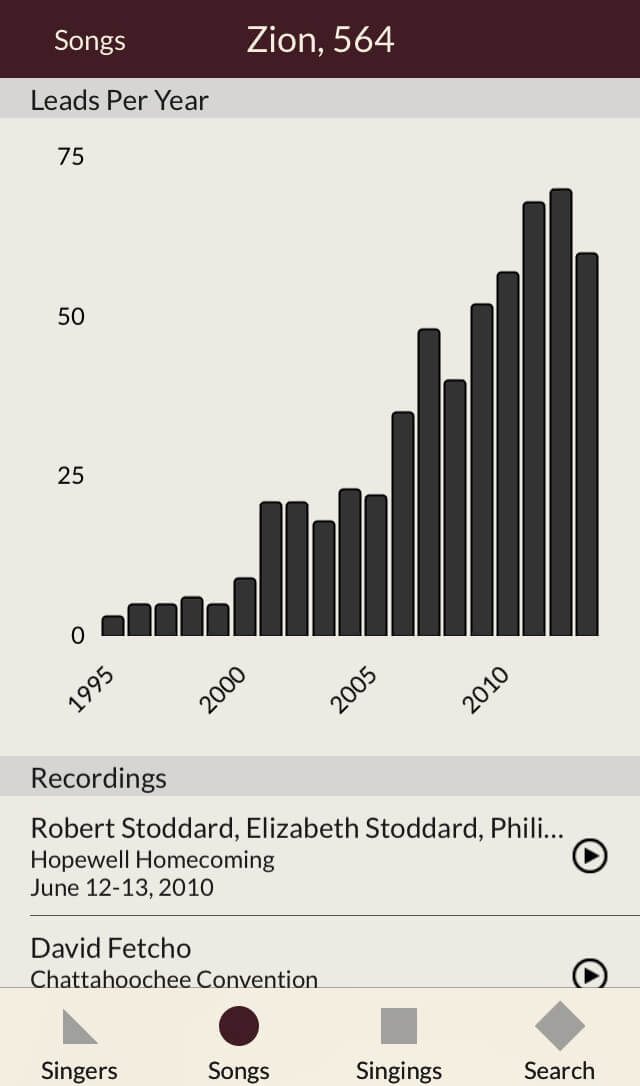
In 1995, a non-profit organization, the Sacred Harp Musical Heritage Association (SHMHA), assumed responsibility for the minutes and adopted a digital process enabling more streamlined production of annual print volumes and the publication of a searchable database.6To access this database or order a print copy of the contemporary "Big Minutes," see Judy Caudle, et al., eds., "Minutes and Directory of Sacred Harp Singings," Fasola.org, http://fasola.org/minutes/. Projects such as the FaSoLa Minutes iOS and Android app and the "Song Use in The Sacred Harp" statistics page on Fasola.org draw on the availability of the minutes in digital form to enable analysis of song use and leader behavior.7On the FaSoLa Minutes app, see Clarissa Fetrow, "There's an App for That: A Review of the 'FaSoLa Minutes' App," Sacred Harp Publishing Company Newsletter 3, no. 2 (November 12, 2014), http://originalsacredharp.com/2014/11/12/theres-an-app-for-that-a-review-of-the-fasola-minutes-app/. Thanks to its inclusion of location information, the minutes database also suggests the possibility of visualizing the geographical development of Sacred Harp over the past twenty years.
Our new mapping of Sacred Harp singings—drawing on minutes data—required enhancing the database used to publish the annual volumes. We began with data from 4,173 singings using The Sacred Harp: 1991 Edition held between January 1995 and December 2014.8Mark T. Godfrey created this dataset for the FaSoLa Minutes app and with Jesse P. Karlsberg supported Robert A. W. Dunn's research augmenting the data with precise locations. Godfrey's original dataset features enhancements to the SHMHA data and excludes 740 singings using other Sacred Harp editions and related shape-note books. These singings were initially excluded to ensure that page numbers included in the minutes reliably indexed specific songs in The Sacred Harp. The exclusions also improve the representativeness of the minutes, which feature nearly all annual singings from The Sacred Harp: 1991 Edition, but relatively few singings from other tunebooks, which typically disseminate their minutes through other publications. An array of variations from year to year and from singing to singing presented problems in creating a unified dataset. For example, different secretaries responsible for taking minutes at these singings adopted disparate approaches to the level of detail in naming singing locations.9Most secretaries include the names of buildings where singings are held, but others give names of larger institutions or campuses with multiple potential venues. A handful of singing minutes feature no specific location, instead providing just a city or town and county. Other minutes include a city or town but no county, or a county but no municipality. Additionally, a singing may undergo changes from year to year, as the building in which it was located may change names or the singing may move to a different location entirely, all while keeping the same singing name. Mapping the minutes required consistently adopting naming conventions found within the minutes so that each singing was given a building name, city/town, county, and state.
However, the majority of the work involved locating data not found in the minutes book. Through using a combination of web-based mapping services (such as Google Maps, Google Street View, MapQuest, and HERE), contacting dozens of singers who helped organize singings with hard-to-pin-down locations, and taking one field trip to a log cabin in Winston County, Alabama, we identified exact locations of all but thirty-one singings, complete with street names and numbers and, most importantly, GPS coordinates. This unified dataset with precise location data makes visualizing Sacred Harp's geographical shifts over the past twenty years possible to an unprecedented extent. The global timeline map (below) displays the locations of singings held each year between 1995 and 2014 in sequence.
Global Sacred Harp Singings, 1995–2014
Global Sacred Harp Singings, 1995–2014. Interactive Map by Jesse P. Karlsberg and Robert A. W. Dunn. View larger version.
The growth of Sacred Harp singings in Europe from a single annual event in England to a dense cluster with additional singings scattered across the continent, and the establishment of a singing in Australia, are perhaps the most noticeable of all changes on this world map. Even at this scale, changes within the United States, such as the increase in the density of singings in the Northeast and on the West Coast, are also visible.
Many more changes to the United States' singing geography are observable on a more regional scale. The zone stretching from West Georgia to West Alabama reveals a hotbed of Sacred Harp singing dating from the nineteenth century. Noticeable shifts are apparent between 1995 and 2014. These changes affirm that singings have ceased to be held in some counties, yet demonstrate that strong networks persist in other areas, undercutting the overdetermined narrative of the decline of southern singings. Our visualizations demonstrate that what began in 1995 as a solid strip of singings stretching across this area of the Alabama and Georgia upcountry had by 2014 coalesced into discrete spatial clusters. Interconnected networks of singings persisted in Walker, Winston, and Cullman Counties north of Birmingham; in northeast Alabama; and on the Alabama-Georgia border in Cleburne County, Alabama, and Haralson, Carroll, and Heard Counties, Georgia.
Alabama and Georgia Upcountry Sacred Harp Singings, 1995–2014
Alabama and Georgia Upcountry Sacred Harp Singings, 1995–2014. Interactive Map by Jesse P. Karlsberg and Robert A. W. Dunn. View larger version.
In the Birmingham and Atlanta metropolitan regions, the number of singings has held steady even as their geography has shifted, revealing nuance obscured by the overarching narrative of southern decline. In Birmingham, the number of annual singings remains constant while their locations move out of the city center (view interactive map). In Atlanta, singings held in north Fulton County are steadily supplanted by those held towards the center of DeKalb County (view interactive map).
The visible growth of Sacred Harp singings in southern states outside of historical singing areas, perhaps most noticeable in South Carolina (view interactive map) and Arkansas (view interactive map), undercuts the binaristic opposition of growth in the North and decline in the South. Before 1999, there were no Sacred Harp Singings held in South Carolina. By 2011, there were four annual singings held across the state. Arkansas, at its peak, featured three singings, none of which were held in 1995. (The state presently features two.)
Mapping minutes data also adds specificity to the story of Sacred Harp's expansion to other parts of the United States. Popular narratives date the style's expansion as occurring in the 1970s and 1980s, in the immediate aftermath of Sacred Harp's incorporation into the folk revival. Yet the mapping of minutes data reveals a later acceleration of the style's spread beyond the South in the 1990s and 2000s. No annual singings were held in Pennsylvania in 1995, yet singings proliferated in the eastern part of the state over the subsequent two decades, and spread to the central and western part of the state from 2008 to 2010 (view interactive map). Eight singings were held in Pennsylvania in 2014. Sacred Harp singing also grew steadily in the Pacific Northwest, from one singing in the mid- to late 1990s, to seven annual singings in 2014 (view interactive map). Even in New England, where the oldest continuously held annual singing outside the South celebrated its fortieth anniversary in the fall of 2016, mapping the minutes reveals a dramatic expansion from a single annual singing in 1995 to eleven events in 2014 (view interactive map).
New England Sacred Harp Singings, 1995–2014
New England Sacred Harp Singings, 1995–2014. Interactive Map by Jesse P. Karlsberg and Robert A. W. Dunn. View larger version.
Visualizing the changing geography of singings from The Sacred Harp: 1991 Edition also demonstrates shifts in the balance of singing from different Sacred Harp editions and the growing comprehensiveness of the "Big Minutes" compilation. In Texas, where singings generally feature the descendant of a competing early-twentieth-century revision of The Sacred Harp known as the "Cooper Book," mapping reveals the inroads made by the 1991 Edition in the state, growing from two singings in 1995 to six singings in 2014 (view interactive map).10On the social context of the increasing number of singings from the 1991 Edition in Texas since the 1990s, see Karlsberg, "Folklore's Filter," 118–24. The increase in singings in the area of middle and south Georgia around Macon and Thomaston (view interactive map) and in east central Alabama near Alexander City is due to the decision of longstanding networks of singings from the 1991 Edition that continued to publish their own separate minutes pamphlets to affiliate with the "Big Minutes" in the late 1990s and early 2000s.11The South Georgia Convention, a network of a dozen singings from the 1991 Edition centered around Macon and extending south to Cordele, Georgia, continues to publish an annual minutes pamphlet, even as its sponsored singings increasingly submit minutes to the "Big Minutes."
Our augmentation of born-digital Sacred Harp minutes data dating back to 1995 affords an unprecedented look at the extent to which the use of The Sacred Harp: 1991 Edition has shifted in the past two decades, complicating popular narratives of the style's northern spread and southern decline. A team of volunteers is currently processing digitized minutes from fifty annual volumes going back to 1945, produced prior to the digitization of the minutes' production process, part of a plan to expand the database that we augmented to create these maps.12For more on this process and a collection of research drawing on the expanding Sacred Harp minutes database, see "Sacred Harp Minutes: Querying Sacred Harp's Sonic Past through the Minutes of Sacred Harp Singings, 1945–2016," 2017, http://fasolaminutes.org/. We hope this marks the beginning of the process of drawing insights from the extraordinarily comprehensive and granular record of participation in a music culture that the Sacred Harp minutes provide.
Additional Maps
- Metro Birmingham (Alabama)
- Metro Atlanta (Georgia)
- South Carolina
- Arkansas
- Pennsylvania
- Pacific Northwest
- Texas
- South Georgia
Acknowledgments
The authors would like to thank Chris Thorman, Mark T. Godfrey, and Judy Caudle for their assistance obtaining and editing minutes data and Megan Slemons, Stephanie Bryan, and the rest of the Southern Spaces staff, for their assistance producing this post.
About the Authors
Jesse P. Karlsberg is the Senior Digital Scholarship Strategist at the Emory Center for Digital Scholarship and the consulting editor of Southern Spaces. A scholar of digital publishing and American music, Jesse is the editor of Original Sacred Harp: Centennial Edition (Pitts Theology Library and Sacred Harp Publishing Company, 2015). His 2015 dissertation, "Folklore's Filter: Race, Place, and Sacred Harp Singing," earned honorable mention for the Society of American Music's Wiley Housewright Dissertation Award.
Robert A. W. Dunn is a music and historical research consultant for the Emory Center for Digital Scholarship’s Sounding Spirit project. He is a Sacred Harp singer and musician and graduated in 2016 from Emory University with a BA in History and Music.
]]>Presentation
Question and Answer Session
About the Speaker
Niall Atkinson is Neubauer Family Assistant Professor of Art History and the College at the University of Chicago. His publications include The Noisy Renaissance: Sound, Architecture, and Florentine Urban Life (University Park: Penn State University Press, 2016), as well as articles and chapters in Grey Room, Senses and Society, and A Companion to Renaissance and Baroque Art (Hoboken, NJ: Wiley-Blackwell, 2013).
]]>
Atlanta rap artist Jack Preston takes the stage at Gallery 72, Atlanta, Georgia, October 18, 2015. Photograph by Clint Fluker. Courtesy of LiFT Art Salon.
In collaboration with ELEVATE, Atlanta's annual city-wide art event, LiFT Art Salon sponsored an October 18, 2015 gathering to discuss hip hop, technology, and fine art. Fahamu Pecou, Emory Institute of Liberal Arts (ILA) graduate student and ELEVATE 2015 curator, placed Atlanta hip hop production company, Organized Noize, at the heart of this week-long arts celebration: "Organized Noize Productions and the Dungeon Family collective become highly visible examples of the ways [in which] Atlanta's history, politics, and the arts converge ... [They are] responsible for some of the most prominent aural and visual aesthetics that have come to define the South."1 Fahamu Pecou, phone interview with author, November 12, 2015, Atlanta, Georgia. Transcription by author. See, "ELEVATE 2015," City of Atlanta Office of Cultural Affairs, http://www.ocaatlanta.com/?programs=elevate.
Building on Pecou’s vision, LiFT’s ELEVATE event, "The South Got Something to Say," featured hip hop in a multi-media environment that engaged artists, activists, and academics in dialogue about innovative Atlanta projects.2 "The South Got Something to Say" refers to Andree 3000's acceptance speech at the 1995 Source Awards. "Outkast winning Best New Rap Group at the Source Awards 1995," YouTube video, 5:36, posted by The Max Trailers, October 12, 2014, https://www.youtube.com/watch?v=vwLG7aSYM3w. Held in Gallery 72, attendees enjoyed a visual art exhibit featuring Atlanta-inspired pieces by the LiFT art collective3The LiFT art Collective consists of six young artists who contribute orginal art to the LiFT Art salon each month. The collective includes, Gerald Lovell, Julian Plowden, Doriane Sewell, Jurell Cayetano, Tim Short and Annisa Wedderburn. and graffiti artist SKIE, a live musical performance by local rap artists Jack Preston and Small Eyez, and a salon-style dialogue between the LiFT team and Digital Good Times on racial dynamics in Atlanta’s technology scene. Together, these events introduced Gallery 72 as a vibrant canvas to a new audience.
LiFT’s visual art curator, Shady, envisioned her exhibit transforming Gallery 72 to resemble the underside of a bridge covered in graffiti. Shady describes using a traditional gallery space as a blank canvas in political terms: "The opportunity to interrogate spatial relationships, not just culturally and artistically, but also physically and architecturally, through the transformation of the exhibition space ... reveals a movement toward new operative frameworks and political objectives where traditionally exclusive spaces include more diverse audiences."4Shady, phone interview with author, November 12, 2015, Atlanta, Georgia. Transcription by author.
Atlanta artist and Gallery 72 curator, Kevin Sipp, shares this commitment to politically-motivated and activist-oriented art. Sipp is former curator of the Hammonds House Museum in historic West End, Atlanta. Known primarily as an exhibition space for black artists and for its "permanent collection of more than 350 works dating from the mid-nineteenth century by artists from America, Africa, and the Caribbean,"5"About Us," Hammonds House Museum. http://www.hammondshouse.org/about-us.html. Sipp draws inspiration from Gallery 72’s design and history. Though the gallery's glass walls and sleek exterior create a modern look and feel, the 72 Marietta Street building, donated to the city by Cox Enterprises in 2010, has a rich history as former home of the Atlanta Journal Constitution.6Michael Kahn, "Review: Gallery 72, former home to the AJC, sparks new life into Marietta Street," ArtsATL, May 1, 2014, http://www.artsatl.com/2014/05/review-gallery-72/.
According to Michael Kahn of ArtsATL, the lobby of the building was reimagined following AJC’s departure to "be a catalyst for a renaissance of the once prominent Atlanta thoroughfare."7Ibid. Moreover, the building-as-gallery pays homage to Atlanta’s notorious weather. The building features aluminum panels against a bright yellow and green backdrop that resembles the pollen that coats the city each Spring, as well as the building’s historic connection to print journalism: "The serpentine ribbons snake up the façade, masking the intensity of the bright yellow-green wall. The twisting form alludes to the conveyors used in the production of newspapers."8Ibid.
For Sipp, the building’s history is central to his vision for the gallery’s mission: "I enjoy the fact that Gallery 72 is in the old AJC building, because I appreciate the convergence of literature, journalism, and the visual. We need to nurture the idea of reviewing, critiquing, and writing about visual art. It is important, because art movements are rarely reported on in real time. For this reason, I enjoy curating in a building that was once used for journalism."9Kevin Sipp, phone interview with author, November 12, 2015, Atlanta, Georgia. Transcription by author. After the LiFT event, Sipp reflected, "I like the fact that we are a space that is trying to show innovative work of both established and new artists. That’s what I like about the LiFT Art Salon. They are doing a great job of giving people that exposure and creating a space for intergenerational exchange."10Ibid. LiFT’s "The South Got Something to Say" salon documented just that: a new generation of Atlantans interested in working together to explore how the arts can be used to transform a gallery space, a building, or even an entire city.
]]>Review Essay
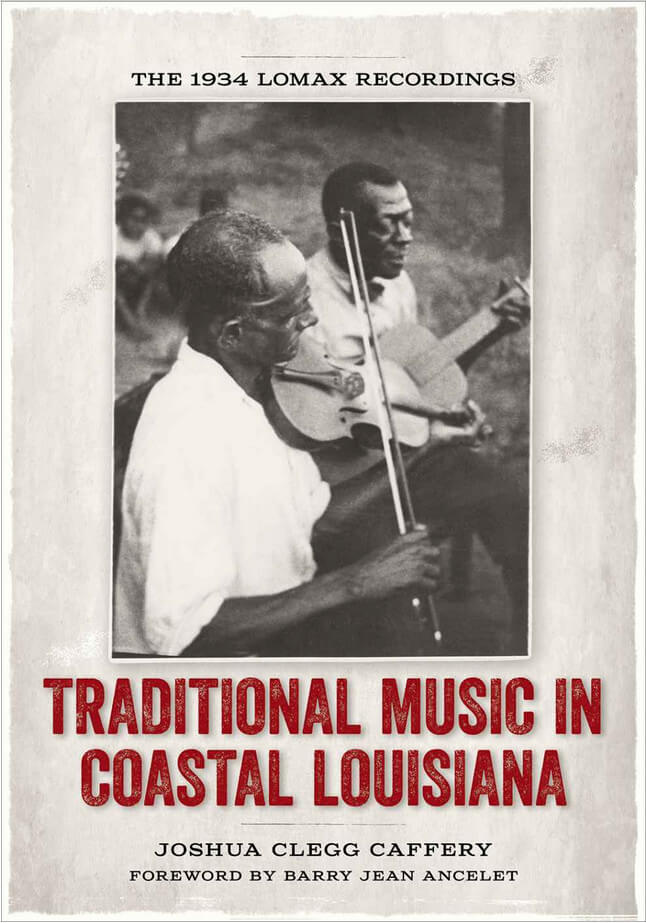
Of all the southern spaces Alan Lomax visited during his Depression-era excursions into vernacular American music, the French-speaking communities populating south Louisiana forever captivated his imagination. "The Cajun country is one of the richest and at the same time least known mines of folk music and literature in North America," he once remarked.1"Cajun' Music,"Weekly Iberian, April 28, 1938. Lomax's 1934 foray into the state's Francophone musical traditions, with a portable recording device in tow, began an intermittent but deeply influential engagement with Cajun and Creole music across his long career. Indeed, the song hunter's 1934 excursion into French Louisiana generated a titanic splash that has rippled for generations.2Irène Thérèse Whitfield, "Louisiana Folk Songs" (MA thesis, Louisiana State University, 1935); John A. Lomax and Alan Lomax, Our Singing Country: Folk Songs and Ballads (New York: MacMillian, 1941); Barry Jean Ancelet, Cajun Music: Its Origins and Development (Lafayette, LA: Center for Louisiana Studies, 1989); Barry Jean Ancelet, Jay Edwards, and Glen Pitre, Cajun County (Jackson: University Press of Mississippi, 1991); Shane K. Bernard, Swamp Pop: Cajun and Creole Rhythm and Blues (Jackson: University Press of Mississippi, 1996); Barry Jean Ancelet, "Research on Louisiana French Folklore and Folklife," in French and Creole in Louisiana, ed. Albert Valdman (New York: Plenum Press, 1997), 351–356; Ben Sandmel and Rock Olivier, Zydeco! (Jackson: University Press of Mississippi, 1999); Charles J. Stivale, Disenchanting Les Bons Temps: Identity and Authenticity in Cajun Music and Dance (Durham: Duke University Press, 2003); Mark F. DeWitt, Cajun and Zydeco Dance Music in Northern California (Jackson: University Press of Mississippi, 2008); Ryan André Brasseaux, Cajun Breakdown: The Emergence of an American-Made Music (New York: Oxford University Press, 2009); John Szwed, Alan Lomax: The Man Who Recorded the World (New York: Viking, 2010).
Lomax's southern excursions aimed to normalize folk culture and music in the United States. By reframing their positionality from the margins to the mainstream of American culture, Lomax's work opened and colored a public forum through which marginalized populations such as Louisiana's Cajuns generated a narrative in which they themselves became the protagonists.3For more on the cultural politics of Alan Lomax's agenda, see Robert Baron, "'All Power to the Periphery': The Public Folklore Thought of Alan Lomax," Journal of Folklore Research 49, No. 3 (September/December 2012): 275–317. But not without tension in the telling. Lomax's interpretations were often at odds with local Cajun perceptions about culture, music, and history. He sometimes butted heads with folklorist Barry Jean Ancelet, who became the most visible auteur of the Cajun-generated narrative.
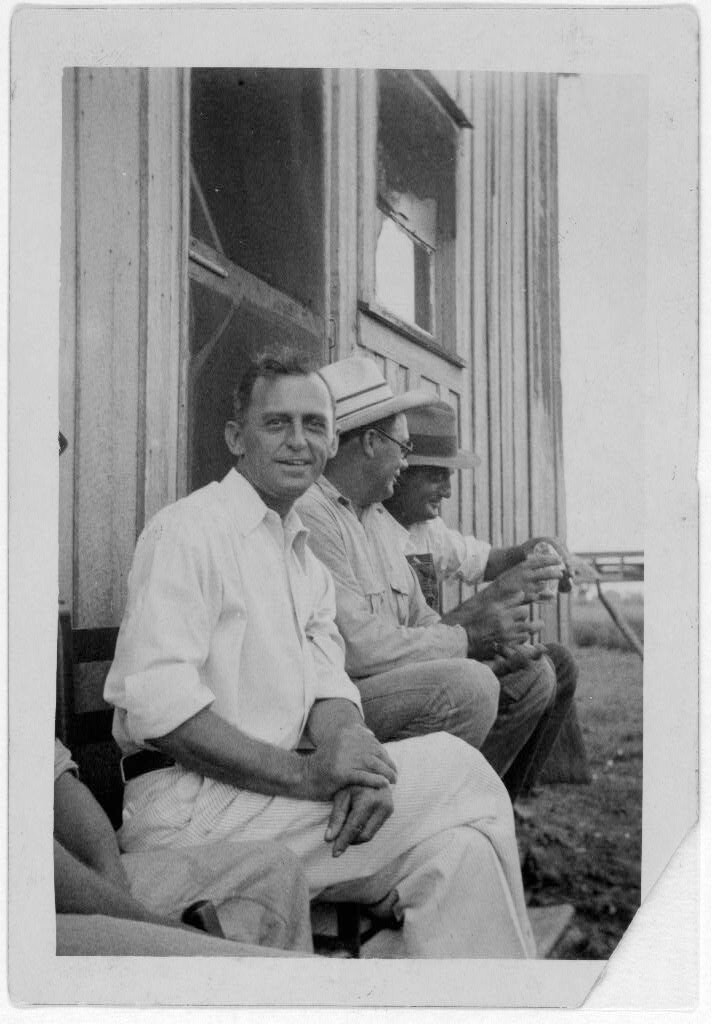
Folklorist Joshua Clegg Caffery's inaugural book, Traditional Music in Coastal Louisiana: The 1934 Lomax Recordings (2013), is the latest chapter in these Lomaxian annals.4Traditional Music in Coastal Louisiana: The 1934 Lomax Recordings developed out of Caffery's dissertation advised by Barry Jean Ancelet. Joshua Clegg Caffery, "Ride les Blues: The Lomaxes in Coastal Louisiana, 1934" (PhD dissertation, University of Louisiana at Lafayette, 2011). Caffery offers the first systematic exploration of the music that compelled Lomax eighty years ago. Under the tutelage of Ancelet, he painstakingly combed the whole of Lomax's French Louisiana recordings at the Library of Congress. He then methodically transcribed songs, cross-checking them against the extant catalogues of folkloric material on French North American songs. Caffery generally organizes his transcriptions by parish (or county), with the exception of the last three chapters titled "Unidentified Location," "Instrumental Music," and "Miscellaneous." The rest of the material is included in chapters titled "Acadia," "East Baton Rouge," "Iberia," "Jefferson Davis," "Lafayette," "St. Landry," "St. Martin," "St. Mary," "Vermillion," and "West Feliciana." Traditional Music in Coastal Louisiana is both a point of entry into the deep archive Lomax deposited at the Archive of American Folk Song at the Library of Congress and a first real step in understanding the material he collected. Caffery's work signals how Lomax profoundly influenced the spaces, both real and discursive, that Cajun music came to inhabit. While Traditional Music in Coastal Louisiana signifies the latest chapter in the long view of Lomax's legacy, the rest of this review essay considers the song hunter's multi-generational influence in Louisiana music studies.
The 1934 excursion was the brainchild of Alan's father John, who had already amassed a national reputation with his first book Cowboy Songs and Other Frontier Ballads (1910). Two years later, John began his scholarly flirtations with Louisiana while serving as a Sheldon Fellow at Harvard. He contacted the St. Landry Clarion newspaper in Opelousas, Louisiana, to facilitate his research on African American folk songs. "He wants the words and music of the most distinctive negro 'ballets,' precisely as he has sung them and in many places continues to sing them," explained the editor.5"The Realm of Negro Lore," St. Landry Clarion, May 25, 1912. The newspaper published snippets of work songs and spirituals written in minstrel phonetics so their readers "may be able to furnish the entire song, origin and music."6Ibid. Lomax's reputation, however, did nothing to preserve his family's finances when the Great Depression hit. Driven to find an alternative source of income, John secured the modest patronage of the Library of Congress in the early 1930s. He was sixty-five years old and had not been in the field in ten years. Moreover, he was at work on his autobiography, Adventures of a Ballad Hunter, even while exploring communities and collecting songs. These factors created space for a teenaged Alan Lomax, who took over the lion's share of the recording work during their 1934 expedition into Louisiana's Cajun country. This excursion along the Gulf Coast proved formative in Alan's burgeoning career in applied folklore.7For more on the Lomax family legacy, see Nolan Porterfield, Last Cavalier: The Life and Times of John A. Lomax (Urbana: University of Illinois Press, 1996); Szwed, Alan Lomax.
"The best pay-dirt I struck in Louisiana," he recalled, "was a young woman who worked in a fish canning factory. She had a repertoire of old French ballads that was inexhaustible. When I found her she was tired and not particularly crazy about singing for me, but she did want a new party dress."8"Cajun' Music." The girl's name was Elita Hoffpauir, whose repertoire often expressed, as Caffery notes, "feminine teenage angst, woven together from various strands of tradition often grounded in such emotions."9Joshua Clegg Caffery, Traditional Music in Coastal Louisiana: The 1934 Lomax Recordings (Baton Rouge: Louisiana State University Press, 2013), 130. But the Hoffpauir family's extensive knowledge of European balladry was only one component of a broader mosaic. The Lomaxes went on to record hundreds of hollers, hymns, spirituals, charivari, children's songs, blues, waltzes, two-steps, jurés, laments, and other genres that effectively demonstrated Louisiana's variegated soundscape. The scope of their work, together with the methodological innovations afforded by bringing recording technology into the field, propelled the father-son team (and particularly Alan) into the national limelight. Alan parlayed the experience, establishing himself as an authority on vernacular American music en route to becoming perhaps the most important arbiter of Cajun and Creole music to have never wielded an accordion or fiddle.
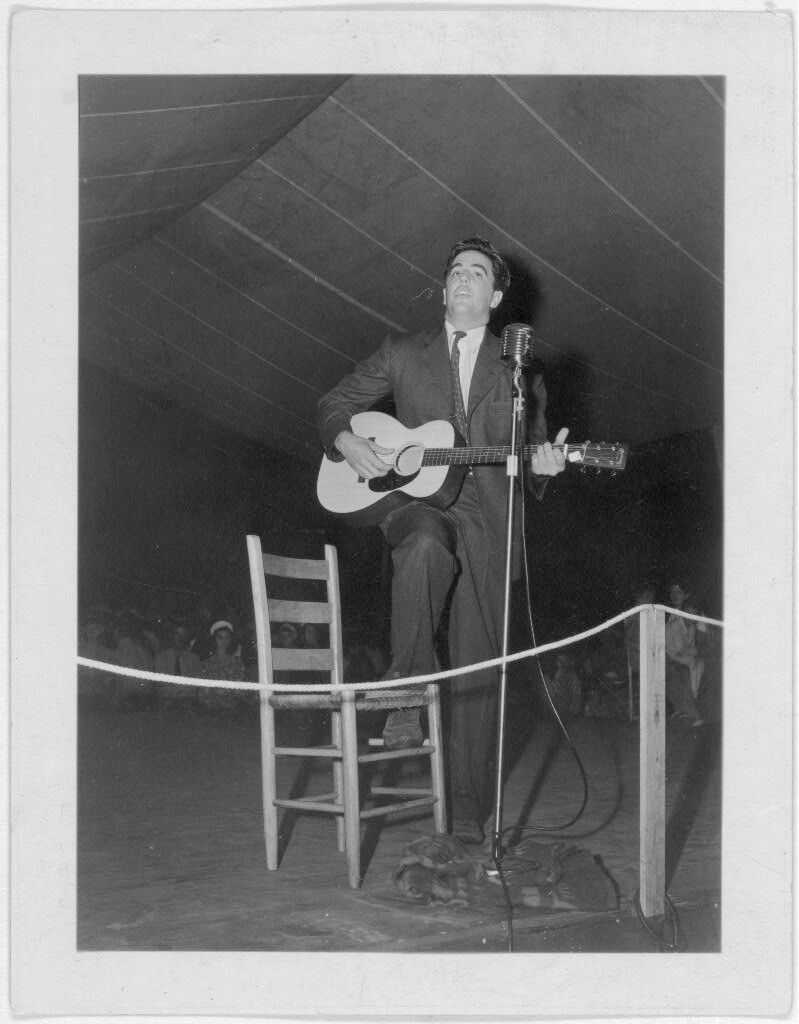
Alan's influence was felt immediately in the scholarly realm. Louisiana native and budding folklorist Irène Thérèse Whitfield met Lomax in 1934 while still in the throes of her master's thesis at Louisiana State University. "On one occasion I was out 'song-hunting' with Mr. Alan Lomax," she recalled. "He had in his automobile, the machinery for making phonograph records for the Library of Congress, while I was armed with paper for writing songs."10Whitfield, "Louisiana Folk Songs," 22. The ripples from that encounter flowed into the 1936 National Folk Festival staged in Dallas, Texas.11John and Alan Lomax never served in any official capacity as advisors for Sarah Gertrude Knott's National Folk Festival. However, their influence was certainly felt despite their tangential relationship to the festival. Michael Ann Williams, Staging Tradition: John Lair and Sarah Gertrude Knott (Urbana: University of Illinois Press, 2006), 22. Whitfield directly influenced her cousin, cultural geographer Lauren Post, who served as chairman of the festival's Louisiana delegation. Post assembled a thirty-six-person entourage including musicians, folk artists, and Whitfield, whom he acknowledged as "the best informed person on Acadian folk songs."12Lauren C. Post, Cajun Sketches: From the Prairies of Southwest Louisiana (Baton Rouge: Louisiana State University Press, 1974), 159. The Cajun performances Post helped stage at the festival so impressed Alan Lomax that he proclaimed fiddler Ardus Broussard "the best example of folk talent in the whole festival."13Ibid., 160.
Irène Whitfield's influence extended beyond the festival. She left her imprint on a budding song hunter named William Owens whom she met in Dallas. Owens decided to embark on his own song hunting expedition in south Louisiana.14See William A. Owens, "Cajun French: Lapping Over from Louisiana," in Tell Me a Story, Sing Me a Song: A Texas Chronicle (Austin: University of Texas Press, 1983), 116–152. Meanwhile, Whitfield's thesis, "Louisiana Folk Songs" (1935), would become the first monograph on Cajun and Creole music—Louisiana French Folk Songs (1939). Almost a decade later, her notated melodies, including Mr. Bornu's "Je m'endors," would serve as the basis for composer Virgil Thompson's Pulitzer Prize-winning score to Robert Flaherty's last documentary, Louisiana Story (1948).15For more on Mr. Bornu and "Je m'endors," see Caffery, Traditional Music in Coastal Louisiana, 25–31. For information on Virgil Thompson and the Lomax recordings see, Ryan André Brasseaux, "The Backstory on Louisiana Story," Louisiana Cultural Vistas 20, No. 1 (2009): 20–29.
Lomax's expedition also blazed the path for two of the most influential figures in the world of Louisiana music after World War II: Harry Oster and Ralph Rinzler. Oster and Rinzler figured prominently for their ethnographic fieldwork, field recordings, and, in Rinzler's case, bringing Cajun music to the Newport Folk Festival in 1964. Despite several degrees of separation, Oster, like Lomax, dove with abandon into the musical traditions of Louisiana. As a LSU professor and founding member of the Louisiana Folklore Society, Oster recorded various performers, including Anglo string bands, French ballads, work songs, and prisoners at Angola State Penitentiary.16As quoted in F. A. de Caro, "A History of Folklife Research in Louisiana," http://www.louisianafolklife.org/LT/Virtual_Books/Guide_to_State/decaro.html. This is an online reprint of F. A. de Caro, "A History of Folklife Research in Louisiana," in Louisiana Folklife: A Guide to the State, ed. Nicholas R. Spitzer (Baton Rouge: Office of Cultural Development, 1985): 12–34. Between 1956 and 1959, Arhoolie issued a now classic collection of Oster's field recordings: Folksongs of the Louisiana Acadians (ARH LP 5009) and Folksongs of the Louisiana Acadians Vol. 2 (ARH LP 5015). These LPs marked the entrée of Cajun field recordings into the marketplace.
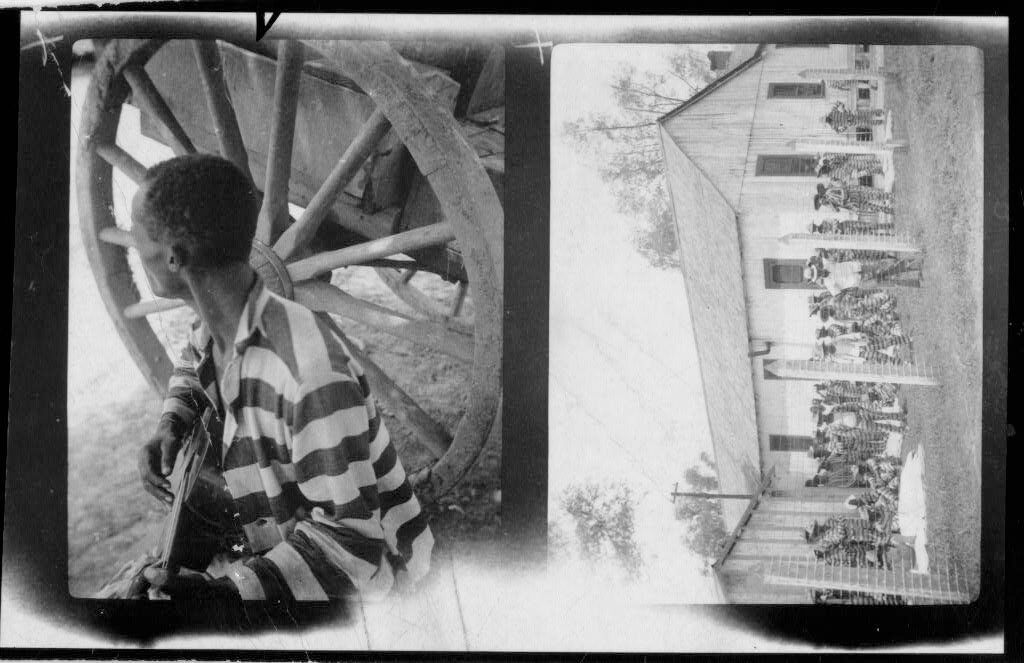
Rinzler, on the other hand, maintained close ties to Lomax, who, in anticipation of the 1964 Newport Folk Festival, convinced the festival board to hire Rinzler as a talent scout.17Szwed, Alan Lomax, 349. Rinzler made plans to travel to Louisiana at Lomax's urging. He contacted local culture brokers, including Oster, then assembled a Cajun band that included a musician named Dewey Balfa who sat in on guitar when the group performed at that year's festival. Newport rejuvenated interest and pride for traditions thought by some in Louisiana as passé. President of the Louisiana Folk Foundation Paul Tate lauded Rinzler and the Newport Folk Foundation "for what is happening to Cajun music today,"18As quoted in de Caro, "A History of Folklife Research in Louisiana." affording the genre "authenticity and legitimacy."19As quoted in Ibid. The experience politicized Dewey Balfa, who came home a devout cultural nationalist. In 1974 Balfa and Rinzler joined forces again, coordinating a concert sponsored by the Council on the Development of French in Louisiana (CODOFIL) entitled Hommage à la musique Acadienne/A Tribute to Cajun Music in Lafayette.
On March 26, 1974, approximately eight-thousand spectators filled the University of Southwestern Louisiana's basketball arena, the Blackham Coliseum, to hear some of the most popular artists of the region's dancehall circuit.20Now the University of Louisiana at Lafayette. The concert, however, signified a departure from local convention. Hommage à la musique Acadienne introduced three cultural interventions through which organizers hoped to recalibrate the perspectives Louisianians harbored about their own musical traditions. First, the concert exponentially expanded the size of the public forum in which locals consumed music. Dancehalls and honky tonks in south Louisiana generally held between two hundred and four hundred people.21For more on dancehalls, see Malcolm L. Comeaux, "The Cajun Dance Hall," Material Culture 32 (2000): 37–56; Ryan André Brasseaux "Social Music" in Cajun Breakdown, 27–48. Organizers also barred dancing, eliminating the contexts so intimately associated with these forms of social music. Finally, the concert planners recontextualized the musical traditions on stage by introducing an interpretive framework analyzing the historical and cultural threads flowing through each performance. This initial concert proved the viability of the format in southwestern Louisiana as the concert evolved over time into the Festivals Acadiens et Créoles. And, perhaps more significantly, it became a training ground for undergraduate French student and budding folklorist Barry Jean Ancelet, whose career in applied and public folklore paralleled (and at times intersected) the work of Alan Lomax.22Barry Jean Ancelet and Philip Gould, One Generation at a Time: Biography of a Cajun and Creole Music Festival (Lafayette, LA: Center for Louisiana Studies, 2007). Ancelet considers his brand of folkloristics "guerrilla academics." Barry Ancelet, "The Center for Acadian and Creole Folklore: An Experiment in Guerrilla Academics," in Sounds of the South: A Report and Selected Papers from a Conference on the Collecting and Collections of Southern Traditional Music (Durham: Duke University Press, 1991), 148–156; Barry Jean Ancelet, "The Theory and Practice of Activist Folklore: From Fieldwork to Programming," Working the Field: Accounts from French Louisiana, edited by Jacques Henry and Sara Le Menestrel (Jackson: University Press of Mississippi, 2009), 55–76. There are a number of parallels between Lomax's and Ancelet's modes of public engagement. See, Baron, "'All Power to the Periphery'."
Barry Ancelet, who wrote the Forward to Traditional Music in Coastal Louisiana, admittedly found Alan Lomax "variantly inspiring and intimidating, frustrating and fascinating."23Barry Jean Ancelet, "Lomax in Louisiana: Trials and Triumphs," Folklife in Louisiana: Louisiana's Living Traditions website, http://www.louisianafolklife.org/LT/Articles_Essays/LFMlomax.html. This article is based on the Phillips Barry Memorial Lecture Ancelet delivered at the 2003 American Foklore Society meeting, later published in the 2009 Louisiana Folklore Miscellany, a journal of the Louisiana Folklore Society. See also,"40 years of Festivals Acadiens et Créoles," http://blog.lafayettetravel.com/40-years-of-festivals-acadiens-et-creoles/. Like Lomax, Ancelet spent his "whole career trying to honor the culture of ordinary folks."24Ruth Laney, "Barry Ancelet has Established an Archive of Cajun and Creole Music in Lafayette," The Attakapas Historical Association No. 2 (2014), http://attakapasgazette.org/2014-issue-2/barry-ancelet-established-archive-cajun-creole-music-lafayette/. He understood his travails in field recording, festival and musical programing, public education, radio, television, and publications all within the context of preserving French language and culture in Louisiana.25Ancelet came of age during a period in Louisiana's history when the number of native Francophones was in precipitous decline, a phenomenon that colored his scholarship and activism. For more on the decline of French in Louisiana, see Shane K. Bernard, The Cajuns: Americanization of a People (Jackson: University Press of Mississippi, 2003) and Jacques M. Henry and Carl L. Bankston III, Blue Collar Bayou: Louisiana Cajuns in the New Economy of Ethnicity (Westport, CT: Praeger, 2002). His mediation rested on the primacy of French as a marker of cultural authenticity. "[T]he preservation of the language," he argued, "is vital to the survival of the culture."26Barry Jean Ancelet, "A Perspective on Teaching the 'Problem language' in Louisiana," The French Review 61, No. 3 (1988): 353. This mediation took various forms, from scholarship to the Festivals Acadiens et Creoles. For more on the role of linguistic and cultural politics in French Louisiana, see Jacques Henry, "From 'Acadien' to 'Cajun' to 'Cadien': Ethnic Labelization and Construction of Identity," Journal of American Ethnic History 17, No. 4 (Summer, 1998): 29–62; Dianne Guenin-Lelle and Alison Harris, "The Role of Music Festivals in the Cultural Renaissance of Southwestern Louisiana in the Late Twentieth Century," Louisiana History 50, No. 4 (Fall 2009): 461–472; Mark Mattern, Acting in Concert: Music, Community, and Political Action (New Brunswick: Rutgers University Press, 1998), 79–100; Ancelet and Gould, One Generation at a Time. Some locals who identify as Cajun take issue with the emphasis on French as the defining factor in the Cajun cultural equation. See, Michael Tisserand, "Never Mind the Bowties—Here's The Bluerunners," in Accordions, Fiddles, Two Step & Swing: A Cajun Music Reader, eds. Ryan A. Brasseaux and Kevin S. Fontenot (Lafayette, LA: Center for Louisiana Studies, ), 477–85; Michelle Y. Fiedler, "The Cajun Ideology: Negotiating Identity in Southern Louisiana," (PhD dissertation, Washington State University, 2011), 166–172. For examples of other cultural mediation efforts through folklore, see David E. Whisnant, All That Is Native and Fine: The Politics of Culture in an American Region (Chapel Hill: University of North Carolina Press, 1984); Benjamin Filene, Romancing the Folk: Public Memory and American Roots Music (Chapel Hill: University of North Carolina Press, 2000). He influenced a generation of fieldworkers in south Louisiana, becoming one of the primary authors of the public discourse defining the Cajun experience, a narrative colored, in part, by Lomax.
In 1977, while still a master's student in folklore at Indiana University, Barry Ancelet and Beausoleil bandleader Michael Doucet visited the Library of Congress to explore the 1934 Lomax recordings. The two Cajuns listened to eleven reels of tape. After a particularly beautiful song, Ancelet turned to Doucet and said, "Oh, my God, we're gonna have to rethink, everything we thought we knew."27 Laney, "Barry Ancelet has Established an Archive of Cajun and Creole Music in Lafayette." The Lomax recordings proved a persuasive counterpoint to the historic commercial material Ancelet and Doucet had heard on the Old Timey record collection Louisiana Cajun Music—a five LP set of reissued Cajun songs recorded between 1928 and 1938. "All anybody had ever heard was the commercially recorded stuff," he expounded. "Our notion of the history of Cajun music was based on what we had heard."28Janey McMonnaughey, "Father-Son Team of 'Ballad-Hunters' Preserved Louisiana Folk Songs," Los Angeles Times, February 21, 1988. Ancelet initially copied the field recordings on reel-to-reel analogue tape for his own use, then later worked to build the Archive of Cajun and Creole Folklore at the University of Southwestern Louisiana by repatriating the Lomax materials back to the state. "I had met Lomax at several events over the years," he recalled. "I contacted him, and he said he'd be very happy to have his work here; he had always intended to make it available to Louisiana. I ordered reel-to-reel copies from the LOC."29Laney, "Barry Ancelet has Established an Archive of Cajun and Creole Music in Lafayette." The archive opens John and Alan Lomax's 1934 recordings to local scholars, students, and musicians interested in the state's musical heritage. Indeed, Michael Doucet and Beausoleil began crafting new arrangements of material culled from the Lomax collection as early as their first American-released album, The Spirit of Cajun Music, in 1978.30Doucet and his band crafted a new arrangement of the a cappella composition "Je m'endors" originally sung by Mr. Bornu and recorded by the Lomaxes in 1934. Beausoleil, The Spirit of Cajun Music (Swallow LP6031, 1978). Caffery, Traditional Music in Coastal Louisiana, 25–31.
Taking a cue from Folksongs of the Louisiana Acadians, Ancelet further broadened the reach of the Lomax recordings by releasing them into the commercial market. In 1987, Ancelet partnered with Swallow Records in Ville Platte to produce Louisiana Cajun and Creole Music, a double LP compilation of field material. With an introductory text by Lomax, the twenty-five-page liner note compendium wove together photographs from the Library of Congress' Farm Security Administration and Ancelet's transcriptions and translations of the songs featured on the album. "[W]e try not to compete with commercial record companies," he elaborated. "Instead we try to work with these established labels to release records they might not ordinarily attempt…making available sounds that might have been otherwise forgotten.31Ancelet, "The Center for Acadian and Creole Folklore," 153. In 1999, Rounder Records of Cambridge, Massachusetts, ushered the Lomax recordings into the digital age by reissuing the double LP set in a compact disc format.32Alan and John A. Lomax: Cajun and Creole Music, 1934/1937 (Rounder Records 11661-1842-2, 1999); Alan and John A. Lomax: Cajun and Creole Music II, 1934/1937 (Rounder Records11661-1843-2, 1999). "I was never so happy to be a folklorist in my life," Ancelet exclaimed as these historic compositions circulated once again in French Louisiana.33Laney, "Barry Ancelet has Established an Archive of Cajun and Creole Music in Lafayette." Through the 2000's, forgotten songs reentered Louisiana's musical lexicon as local bands—such as Feufollet (which included Joshua Caffery)—adapted, recorded, and performed compositions just as Beausoleil had done in the late 1970s.34Ancelet, "Lomax in Louisiana."
Alan Lomax, meanwhile, renewed his relationship with the region where he "had my first glass of wine, my first shrimp creole, my first full-blown love affair and made my first independent field recordings."35As quoted in Szwed, Alan Lomax, 57. In 1980, Lomax gave the keynote address at the same Louisiana Folklore Society annual meeting that Harry Oster helped found. Lomax used the opportunity to challenge the cultural integrity of CODOFIL, a state agency designed to promote and preserve French in the region. He particularly railed against CODOFIL's importation of francophone teachers from Canada and France to teach French to Cajun children. The folklorist also used the occasion to rekindle his Louisiana fieldwork, which culminated in the American Patchwork documentary Cajun Country: Lache pas la patate.36Ancelet, "Lomax in Louisiana." Cajun Country aired on PBS in 1990, bringing the intervention Lomax began in 1934 full circle.37Sharon Bernstein, "'Patchwork' Extends the Cultural Reach of PBS Television," Los Angeles Times, July 6, 1990; Paige Gutierrez, "Cajun Country: Lache pas la patate by Alan Lomax," Journal of American Folklore 109, No. 434 (Autumn, 1996): 465–468. He once again sought to authenticate Louisiana's musical and cultural traditions, but through a deductive approach in which the folklorist sought out evidence to bolster his preconceived hypotheses. This time, however, Lomax's interpretation of the region's culture and music was suddenly the marginal discourse at odds with an increasingly influential emic narrative. Locals had learned to define and maintain boundaries about their own identity and culture. Indeed, Cajun critics, who helped craft public narratives around the meaning of Cajun and Creole, found the film "troubling in its omissions, oversimplifications, unsupported assertions, and loose ends."38Gutierrez, "Cajun Country," 466. For instance, Lomax presented "Cajun" as an umbrella term that included indigenous peoples, Afro-Creoles, and Anglophone southerners. Ancelet protested Lomax's song lyric translations, though he is acknowledged in the film's credits as a language consultant. Lomax's apparent disregard for local input left Louisiana's Cajun intelligentsia feeling aggrieved, ignored, and disrespected. "I was frustrated to see his interpretation of the Mardi Gras celebration preserved in the film," Barry Ancelet elucidated, "despite our many efforts to offer other perspectives on this and other issues, such as the zydeco/pygmy connection, the Acadian/Huguenot connection, and the sexual repression at the heart of high constricted vocals in Cajun music."39As quoted in Ancelet, "Lomax in Louisiana." Ancelet's frustration with Lomax's view of French Louisiana had been simmering since 1983, when he openly challenged Lomax's interpretation of Mardi Gras at a Smithsonian Institute workshop. Lomax pulled Ancelet aside after the panel and roared, "Don't you ever contradict me in public again, you impudent young son-of-a-bitch."40As quoted in Ibid.
Cajun Country: Lache pas la patate helped bring into sharper relief the turf war between the aging, though celebrated folklorist and a group of local upstarts, all of whom harbored different agendas around defining Cajunness. Lomax's interpretive acumen and reputation hung in the balance. Locals, meanwhile, saw an opportunity for self-determination. Standing up to Alan Lomax's authorial voice in the realm of Louisiana music scholarship became a demonstrative illustration of the Cajun commitment to rewrite mainstream discourses about their community.41A number of socio-historical factors, including transnational influences from French Canada, contributed to the vocabulary with which Louisianians express their culture and language in public discourses. For more on these factors, see Barry Jean Ancelet, "Negotiating the Mainstream: The Creoles and Cajuns in Louisiana," The French Review 80, No. 6 (May 2007): 1235–1255; Bernard, The Cajuns; Jacques Henry, "Le CODOFIL dans le mouvement francophone en Louisiane," Présence Francophone, 43 (1993): 27–28; Jacques Henry, "The Louisiana French Movement: Actors and Actions in Social Change," in French and Creole in Louisiana, ed. Albert Valdman (New York and London: Plenum Press, 1997), 183–213; James Dormon, "Louisiana's Cajuns: A Case Study in Ethnic Group Revitalization," Social Science Quarterly 65 (December 1984): 1043–1057; Dianne Guenin-Lelle, "The Birth of Cajun Poetry: An Analysis of Cris sur le bayou: naissance d'une poésie acadienne en Louisiane," The French Review 70, No. 3 (February, 1997): 439–451. But challenges to the song hunter's cultural capital did not materialize overnight. Cajun Country: Lache pas la patate came in the wake of a growing and influential body of writing by native Louisianians. In particular, an interdisciplinary collective forming the Center for Louisiana Studies at the University of Southwestern Louisiana—which included Ancelet, Carl Brasseaux, Mathé Allain, Glenn Conrad, Michael Forêt, David Barry, among others—ensured that a chorus of local voices would redirect the narrative of the Cajun experience in a rapidly evolving Louisiana during the 1980s and 1990s.42Revon Reed, Lache pas la patate (Montréal: Éditions Parti Pris, 1976); Glenn R. Conrad ed., The Cajuns: Essays on Their History and Culture (Lafayette, LA: Center for Louisiana Studies, 1983); Glenn R. Conrad, New Iberia: Essays on the Town and Its People (Lafayette, LA: Center for Louisiana Studies, 1986); Carl A. Brasseaux, Founding of New Acadia: The Beginnings of Acadian Life in Louisiana, 1765–1803 (Baton Rouge: Louisiana State University Press, 1987); Barry Jean Ancelet and Elemore Morgan, Makers of Cajun Music (Austin: University of Texas Press, 1984); Carl A. Brasseaux, "Four Hundred Years of Acadian Life in North America," Journal of Popular Culture 23, No. 1 (Summer 1989): 3–22; Michael James Forêt, "A Cookbook view of Cajun Culture," Journal of Popular Culture 23, No. 1 (Summer 1989): 23–36; Darrell Bourque, "Plainsongs of the Marais Bouleur: A Selection," Journal of Popular Culture 23, No. 1 (Summer 1989): 37–45; David Barry, "A French Literary Renaissance in Louisiana: Cultural Reflections," Journal of Popular Culture 23, No. 1 (Summer 1989): 47–63; Mathé Allain, "They Don't Even Talk Like Us: Cajun Violence in Film and Fiction," Journal of Popular Culture 23, No. 1 (Summer 1989): 65–75; Marcia Gaudet, "The Image of the Cajun in Literature," Journal of Popular Culture 23, No. 1 (Summer 1989): 77–88; Sharon Arms Doucet, "Cajun Music: Songs and Psyche," Journal of Popular Culture 23, No. 1 (Summer 1989): 89–99; Barry Jean Ancelet, "The Cajun who went to Harvard: Identity in the Oral Tradition of South Louisiana," Journal of Popular Culture 23, No. 1 (Summer 1989): 101–115; Ancelet, Cajun Music; Barry Jean Ancelet, Capitaine, Voyage Ton Flag: The Traditional Cajun Mardi Gras (Lafayette, LA: Center for Louisiana Studies, 1989); Ancelet, Edwards, Pitre, Cajun Country. And yet, Lomax's influence remained powerful in Louisiana Studies even as members of the Center for Louisiana Studies dismissed Cajun Country's analysis. In 2003, shortly after Lomax's death, Ancelet gave the Phillips Barry Memorial Lecture at the American Folklore Society annual meeting. He addressed the trials and triumphs of Lomax in Louisiana, ultimately concluding that "[s]ome of us who sometimes found ourselves enduring Alan when he was alive recognize that his contributions to our understanding of our own communities endure as well."43Ancelet, "Lomax in Louisiana."
Critical views of Alan Lomax's work and legacy have most recently culminated in Joshua Clegg Caffery's annotated compendium of song lyrics derived from the Lomax recordings. Caffery acknowledges the varied genealogical currents that have carried the Lomax legacy into the twenty-first century. But, his investment in studying the 1934 Louisiana recordings does not translate to a wholesale subscription to Lomaxian analyses. Lomax's explanations of Louisiana culture are cavalier and uneven, he explains, in ways that are "alternately brilliant or demonstrably incorrect."44Caffery, Traditional Music in Coastal Louisiana, 2. He recognizes Irène Whitfield's pioneering work as opening an early window into the Lomax collection, but dismisses her interpretations as being void of "any significant depth."45Ibid., 1. Instead, Caffery's work is situated squarely within his dissertation advisor's camp.
If Lomax's imprint can be felt on Whitfield's work, so too can Ancelet's influence be felt on Caffery's. Ancelet, he argues, "brought a more scrupulous eye to the material" than Whitfield and indeed Lomax himself.46Ibid., 2. Caffery echoes many of Ancelet's interpretations, privileges his French-language song transcriptions and translations, while crediting his mentor with helping carry the project through: "Without Barry's guidance, advice, and specialized knowledge, the work conducted here simply would not and could not have happened."47Ibid., xx.
The varied intellectual genealogies flowing through Traditional Music in Coastal Louisiana inform the excerpts reprinted below. I have selected representative transcriptions that provide an introduction to the breadth and range of material featured in Caffery's book. Mr. Bornu's "Belle" is both an a cappella French-language composition indigenous to Louisiana and a song that reentered the state's musical lexicon through later adaptations. The Grammy Award-winning band Beausoliel orchestrated and released the song on their Swallow Records release Déjà Vu in 1990. Lunéda Comeaux's "La Belle, Je Suis Venu" is an example of the European ballad traditions still circulating among French Catholics in coastal Louisiana in 1934. In contrast to the material associated with Bornu and Comeaux, both of whom were white Francophones, "Thank God Almighty" is a window into some of the English-language compositions offered by African Americans. Alberta Brandford and Becky Elzy were born into slavery and lived on the Avery Island plantation where Tabasco brand pepper sauce is made. Their Protestant spiritual sung in English suggests that diversity in Depression-era Louisiana was linguistic and religious, in addition to racial. The final excerpt included here is the text to "Batson," an original composition sung by African American string band performer Wilson "Stavin' Chain" Jones. Part murder ballad, part social commentary, the song recounts in thirty-nine verses the tale of a mass murder that occurred in 1902 in southwest Louisiana. To further situate these transcriptions, I have also selected analytical excerpts accompanying the lyrics to contextualize those compositions. The lyrics are haunting. Song protagonists become the heroes of Caffery's narrative. Meanwhile, the ripples of Alan Lomax's legacy lap ashore against the text of Traditional Music in Coastal Louisiana.
About the Author
Ryan André Brasseaux is dean of Davenport College at Yale University. He is the author of Cajun Breakdown: The Emergence of an American-Made Music (Oxford University Press, 2009), co-editor of Accordions, Fiddles, Two Step & Swing: A Cajun Music Reader (2006), and co-author of Stir the Pot: The History of Cajun Cuisine (2005).
Excerpts from Traditional Music in Coastal Louisiana by Joshua Clegg Caffery
Introduction
In the summer of 1934 the two central figures of American folk song collecting, John Lomax and his son Alan, ventured into Louisiana's southern parishes. The resulting collection constitutes the foundational record of the area's vernacular music. Undertaken at the dawn of the era of recorded sound, the Lomax collection continues to provide the best glimpse of the origins of south Louisiana's vernacular musical culture. Recorded long before television became widely available, when radio and recorded sound were in their infancy, the collection captures the collision of old and new song types and styles, effectively straddling the oral/literary milieu of the nineteenth century and the emergent, electronically mediated styles of the twentieth century. In many ways the collection exerts a firm pull on the present as a source of authority, an archive of forgotten lore, a beacon and a blueprint. Despite its significance, however, and despite the continued proliferation of interest in traditional music in southern Louisiana, the bulk of the material has remained largely inert, slumbering in the deep aluminum grooves and flickering integers of the Archive of Folk Culture in Washington, D.C. The Lomax recordings in Louisiana have not yet, in other words, generated a body of critical commentary comparable to the great collections of Appalachian folk song, such as Cecil Sharp's English Folksongs from the Southern Appalachians, or the five-volume critical editions of the Frank C. Brown Collection of North Carolina Folklore or the Vance Randolph collections of Ozark tales and songs brilliantly edited and annotated by Gershon Legman. The central aim of this study, therefore, is to examine and identify the materials in the 1934 Lomax foray into coastal Louisiana and to present them for the first time in an accessible critical and comparative framework.
In the absence of a comprehensive critical treatment, we know of the collection through selections published in Irène Thérèse Whitfield's 1934 Louisiana French Folk Songs and in the Lomaxes' early anthology Our Singing Country. Although both parties occasionally offer intriguing observations about the material, neither offers commentary of any significant depth. As Barry Jean Ancelet argues (2003), sounding a common criticism, Alan Lomax in particular was given to hazarding cavalier interpretations that could be alternately brilliant or demonstrably incorrect or even, somehow, both.
In the liner notes (with transcriptions) to the release of forty-four songs from the 1934 and 1935 trips, Ancelet (1999) brought a more scrupulous eye to the material, and John Cowley offered perceptive commentary on a segment of the English material in the notes to Rounder's Deep River of Song: Louisiana (2004). Taken as a whole, however, these studies consider less than half of the collection. While Ancelet's liner notes represent the first serious analyses and interpretations of the material, they are of necessity succinct rather than expansive. What follows is a textual study of the 1934 Lomax Louisiana recordings—in what they called "Evangeline Country"—in their entirety, a concerted effort to extend the efforts of Ancelet and others and address the whole corpus in all of its rambling complexity.
There are a number of reasons why this project is important. To begin with, the musical traditions of southern Louisiana, outside of New Orleans, remain only partially understood. While most attention is paid to Cajun music and zydeco, popular public styles that emerged in the early and mid-twentieth century, very little work has been done on older vocal or instrumental traditions—traditions that made up the musical climate in which Cajun music and zydeco came to be. Even given the considerable body of scholarship surrounding twentieth-century styles, for instance, there remains almost no comparative work, with the exception of Ancelet's analysis of Creole séga traditions in the Indian Ocean (Murray 2004, 955). Although scholarship abounds on the creolized contemporary genres of Louisiana music, in other words, we know very little about the elements of those creolizations or how they fit into broader patterns of transatlantic cultural evolution and change. In order to understand these puzzles, we need to know more about the shapes of the pieces.
While there are a few examples of what we might call Cajun music or zydeco in the Lomax collection, the recordings primarily hint at the substructure underpinning these genres. When the Lomaxes arrived in southern Louisiana in 1934, the public dance music of the region was just coming into style. Although the father-and-son team recorded a handful of waltzes and two-steps, John Lomax in particular was not interested in what he perceived to be a radically syncretized popular form. While radically syncretized popular forms have a way of coalescing into traditions and becoming what some would call folk song or folk music, such a fate had not been preordained in 1934, and the "genius of American folksong collecting" had other quarry in mind (Abrahams 2000, 102). John Lomax was also highly suspicious of jazz, and he saw what he called "fais do-do" music as a dilution of older folkloric styles, much as he saw jazz as a dilution of more hallowed blues and work song traditions (Hirsch 1992). Alan Lomax, in turn, while he continued throughout his career to support efforts to encourage and preserve Cajun music and zydeco, cultivated an ecumenical vision of Louisiana's traditional music, based on his early work in the state: "Yet, since we were short of money and time, I am glad that we preserved these older styles, since they provide a view of the complex roots of the Cajun and Creole music of today, and, with luck, may fuel a French Louisiana music richer than the present-day zydeco and fais-do-do" (1988).
Top, Terry and the Zydeco Bad Boys, Gulf Coast Zydeco Music Festival, Daphne, Alabama, May 22, 2011. Photograph by Flickr user John Krupsky. Creative Commons license CC BY 2.0. Bottom, Thomas Fields' "The Big Hat Man" and his Foot Stompin' Zydeco Band sign, New Orleans Jazz and Heritage Festival, New Orleans, Louisiana, April 25, 2009. Photograph by Flickr user Rocky A. Creative Commons license CC BY-NC-ND 2.0.
This is not primarily a book about Cajun music and/or zydeco. In looking closely at what the Lomaxes actually found, however, during their sojourn in coastal Louisiana in 1934, we stand to learn a good deal about how the modern vernacular musical culture of this region emerged. Far from diminishing these contemporary styles, their small but distinct role in the collection throws them into sharp relief, highlighting their startling difference and deep beauty. But these recordings also hint at alternate paths, forgotten slips off the main current, now covered in brush and duckweed. In their travels down the back roads of rural south Louisiana, the Lomaxes preserved an invaluable atlas of Louisiana's vernacular musical traditions—a document based on the past yet designed for charting future explorations.
The sheer variety of song styles reflected tells an engrossing, complex story about rural Louisiana music as well as about the Lomaxes' own predilections. While the early "ethnic" recording industry preserved the short form two-step, waltzes, and accordion blues, the Lomax collection is unique in that it preserves a wild diversity of noncommercial traditional music. Folklorists tend to gravitate to genres in "distress" (Stewart 1991), and the Lomaxes were on the lookout more often than not for songs that had "been handed down for a number of generations" (AFS 35 A02). In 1934 they were particularly interested in African American work traditions and in the vestiges of Acadian culture. In seeking out the domestic, the occupational, the noncommercial, the unique, and the rare, the Lomaxian gaze (in 1934 at least) stayed fixated on the sunset horizons of tradition. Even as Alan advocated for French language instruction and for the preservation of Cajun and Creole dance music years later, he continued to urge young preservationists not to forget the diversity and venerability of earlier traditions of the sort reflected in the 1934 collection.
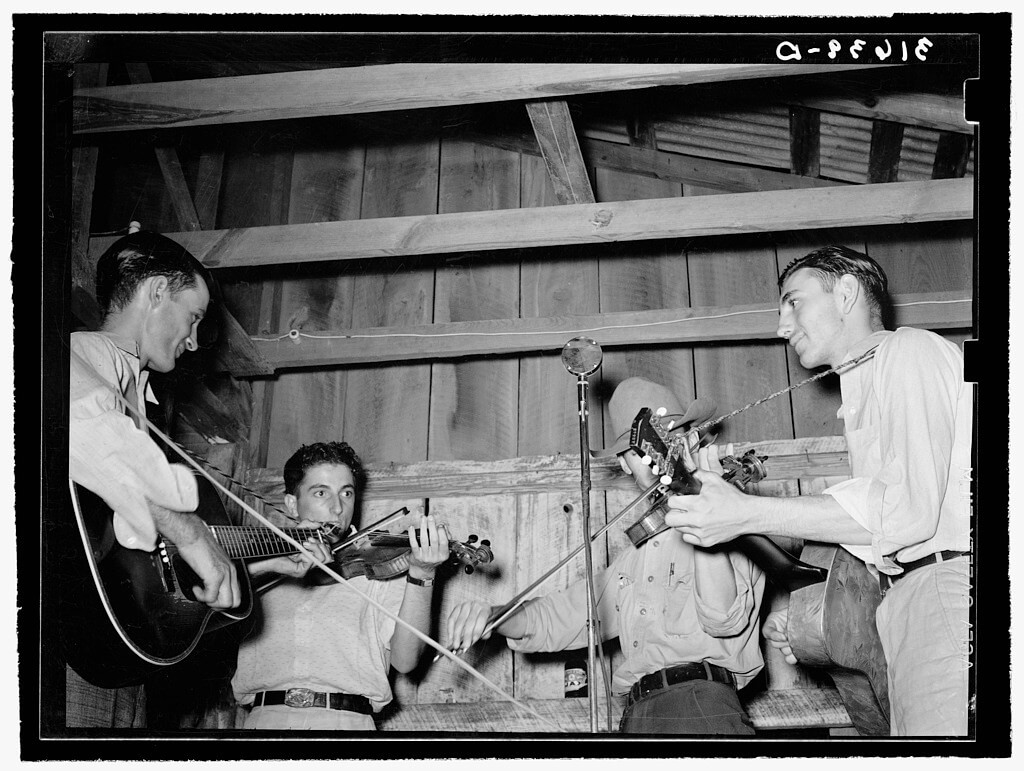
Both Lomaxes were first and foremost ingenious song hunters, and the 1934 song bag is, thankfully, both deep and wide. John Lomax in particular modeled himself on the great British ballad collectors of the eighteenth and nineteenth centuries, and he envisioned fieldwork as a strenuous, heroic endeavor. Criticizing Lomax's romantic ideology is easy enough today, but it remains difficult to challenge the basic impetus or the results of his collecting. Despite sensibilities that might strike a modern folklorist or anthropologist as naive, paternalistic, or cavalier, Lomax proved clairvoyant in his belief that these older styles would fade from the earth. In Louisiana, narrative singing in French, for instance, exists largely as a folkloric reenactment at festivals or to round out a recording project. Ring shout songs similarly have been reabsorbed into some contemporary zydeco recordings and performances, but the original spiritual context is largely missing. While a very distinct, localized vernacular music thrives in southern Louisiana, in other words, a variegated host of older styles have—for the most part— expired. Today the 1934 Lomax recordings provide the best early record of this diverse array of types.
These styles include—but are not limited to—traditional French mal-mariée and charivari songs; antebellum spirituals; nineteenth-century French romances; tietamping and cypress-logging hollers; roustabout coonjine songs; French strophic songs and songs in dialogue; ancient and modern pastourelles and brunettes, randonnées, rounds, and play-party songs; Protestant hymns; French drinking songs; sacred, profane, and downright bawdy English and American ballads; French adaptations of English ballads; American fiddle tunes; Creole jurés; ring shout songs; blues and blues ballads; nineteenth-century French theatrical and literary songs; mazurkas, waltzes, twosteps, and valses à deux temps; enumerative children's songs; and small dance orchestra settings; not to mention a Scottish jig.
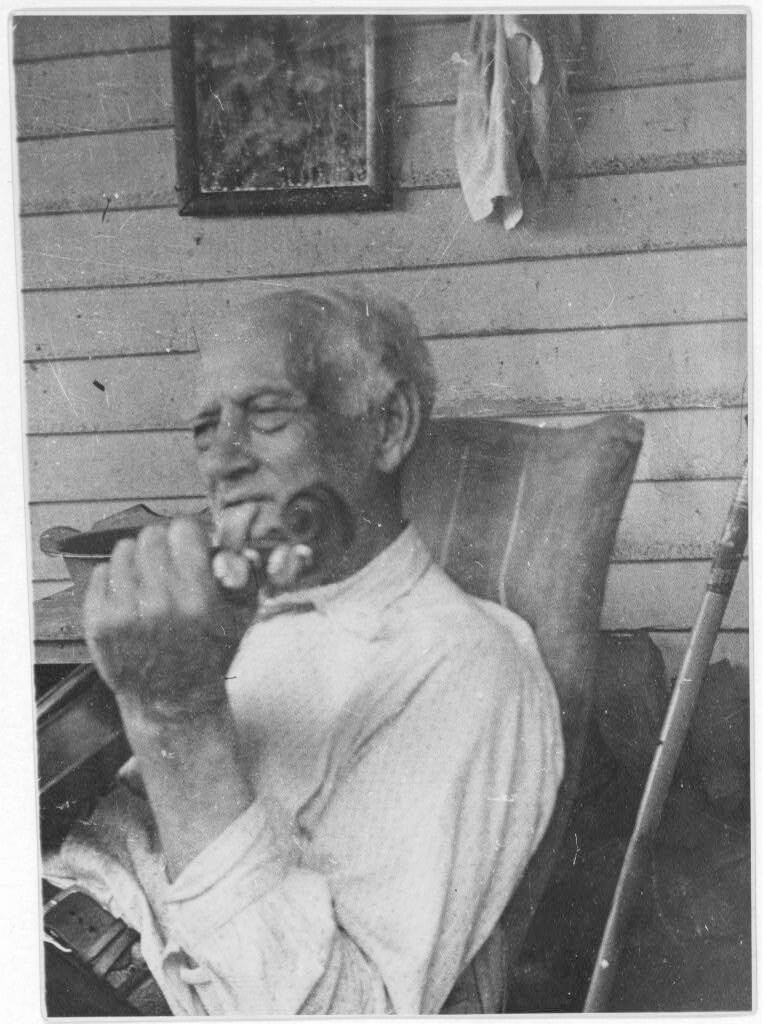
Historian Carl Brasseaux argues convincingly that modern examinations of vernacular culture in southern Louisiana must take into account current research that demonstrates its complex ethnic plurality (2009). The Lomax collection provides a mighty testament to that complexity—a collection of verbal art and musical style that parallels the dense plurality of south Louisiana's culture. As the list of song types suggests, the vernacular music of Louisiana in 1934 was multifarious and cosmopolitan. But what do we know about this embarrassment of riches? Where, for instance, are the foundational textual studies of Louisiana vernacular song? For the most part they simply do not exist. As Ancelet observes of Louisiana French song lyrics: "Little attention has been given to the thematic and textual content of Louisiana French song lyrics that would enable comparisons between this music and its sister and cousin traditions in French North America (Québec, Ontario, the Acadian Maritimes, the Old Mines district of Missouri, the old Detroit region, the old Illinois country, and the Franco-American areas of the Northeast) and other parts of the French-speaking world (e.g. France, the West Indies, and the Indian Ocean)" (2003).
The argument could be made about any of the genres in the long list of musical styles. There are no thorough comparative studies of Continental French song in coastal Louisiana, Whitfield's Louisiana French Folk Songs (1939) and a 1950 Louisiana State University thesis by Gaston-Eugène Adam notwithstanding (though French Canadian scholars, particularly Marius Barbeau and Conrad Laforte, have integrated available Louisiana materials into their comparative studies of French song). Susan Silver's unpublished master's thesis, "J'apprenais ça avec ma maman: Étude de la femme dans les repertoires de cinq chanteuses traditionnelles en louisiane" (1991), offers perhaps the most extended examination of traditional song lyrics, with the exception of Ancelet's collected liner note annotations.
Although Whitfield anthologizes a number of Creole songs, there remain no systematic textual studies of Creole song in Louisiana, and no comparative apparatus exists for studying the Louisiana Creole song bag in the context of the broader Creole world. Little has been written about the antebellum spiritual repertoire in southern Louisiana, well represented here by Becky Elzy and Alberta Bradford, born into slavery on and around Avery Island. Less has been written about the Louisiana ring shout song and its secular Creole counterpart, the juré. Although it is commonly assumed that the ring shout, one of the oldest indigenous African American performance traditions, died out everywhere except the Sea Islands of Georgia, there are no less than fifteen shout songs in this collection, indicating a vibrant tradition. While Louisiana scholars have discussed the ring shout, contextual and comparative studies are lacking. Although John Szwed has hinted briefly at tantalizing similarities between Creole quadrille bands in Guadeloupe and Louisiana zydeco (Szwed and Marks 1988, 30), there are no major studies of nineteenth-century quadrille traditions in Louisiana and therefore no foundation for the sort of comparative work that could provide an invaluable perspective on the evolution of Louisiana's signature dance music traditions. The influence of the blues on the emergence of Cajun music and zydeco is clear and palpable, yet almost nothing has been written about rural blues in coastal Louisiana. If the Lomax collection is any indication, there was a dynamic country blues tradition in Louisiana in 1934. The same basic criticism could be applied to other English genres— ballads, hymns, and play-parties, for instance.
There continues to be a wide gulf between the great collections of oral poetry in Louisiana—those not only of the Lomaxes but of Harry Oster and Irène Whitfield, Ralph Rinzler, Catherine Blanchet, Robert and Jeanne Gilmore, Barry Jean Ancelet, and others—and the concerns of modern scholarship: questions of authenticity, for instance, representation, performance, authority, agency, and/or the sociocultural genealogy of modern performance styles. These concerns should undoubtedly be part of a broader critical discourse about traditional music in southern Louisiana, but there has not been a strong textual or exegetical framework for them to develop. Critical studies of the great collections of Louisiana folklore can help build this framework.
The first step in undertaking the present work was one of demarcation. Although the Lomaxes conducted work in north Louisiana and in Pointe Coupee Parish in 1934, the collection featured here represents only the materials from south-central and southwestern Louisiana—the southern rim of the state. Although the songs of Pointe Coupee are relevant to those of parts farther south, particularly considering the deep links between the Pointe Coupee Creole culture and that of the lower Bayou Teche, I do not include the Pointe Coupee recordings for two reasons. First, Pointe Coupee is geographically displaced from the location of these recordings, not only in terms of distance but also because the two places are separated by the largest river swamp in the nation, the Atchafalaya Basin. Even now the journey from, say, New Iberia to False River is a winding one. In 1934, long before the construction of the I-10 interstate or Highway 190, which enabled faster access to the east side of the Atchafalaya Basin, the trip would have taken an entire day or more, depending on the mode of travel. Second, the recordings in Pointe Coupee are extensive, and the additional investigation of these materials in one volume would have made a large project unwieldy. This is not to say that these materials are not important or that there are not vital connections to be made between the two areas. On the contrary, there are multiple book-length studies to be done just on the recordings made by Harry Oster and the Lomaxes in Pointe Coupee, and these future studies will only serve to complement the work conducted here.
I accessed recordings of the francophone materials through the Archives of Cajun and Creole Folklore at the University of Louisiana at Lafayette. As my project is geographic, rather than language-specific in focus, I obtained copies of the additional English recordings from the Archive of Folk Culture at the Library of Congress. While some of the recordings previously released on compact disc were already divided into individual audio tracks, another part of the process was, of necessity, archival. Working with audio software, I divided the entire collection into individual tracks, which then formed the basis of a digital database. The next step involved transcription, translation where necessary, and finally annotation. Although this study's primary aim is to be a lucid and direct textual study, I have offered interpretations and speculations that incorporate the perspectives of performance studies, gender studies, and psychological criticism but only insofar as they seem pertinent and helpful. I have assiduously attempted to avoid tendentious readings based on my own predilections for one or another theoretical mode.
The resulting core of this project is thus a fairly straightforward annotated anthology. Taken as a whole, this study of the Lomax collection provides firmer footing for future scholarship concerning traditional music in Louisiana. In attempting to make sense of this fundamental document, I hope to answer the call made by John Lomax during his Louisiana sojourn (as it turns out, he had a bit of a soft spot for Cajun music after all): "The Segura Brothers and their band at White Oak near New Iberia, Louisiana, played this beautiful music on June 22, 1934, for the Library of Congress in Washington. The record is to be kept there perpetually for the musicians of America to study" (AFS 40 A01).
Mr. Bornu
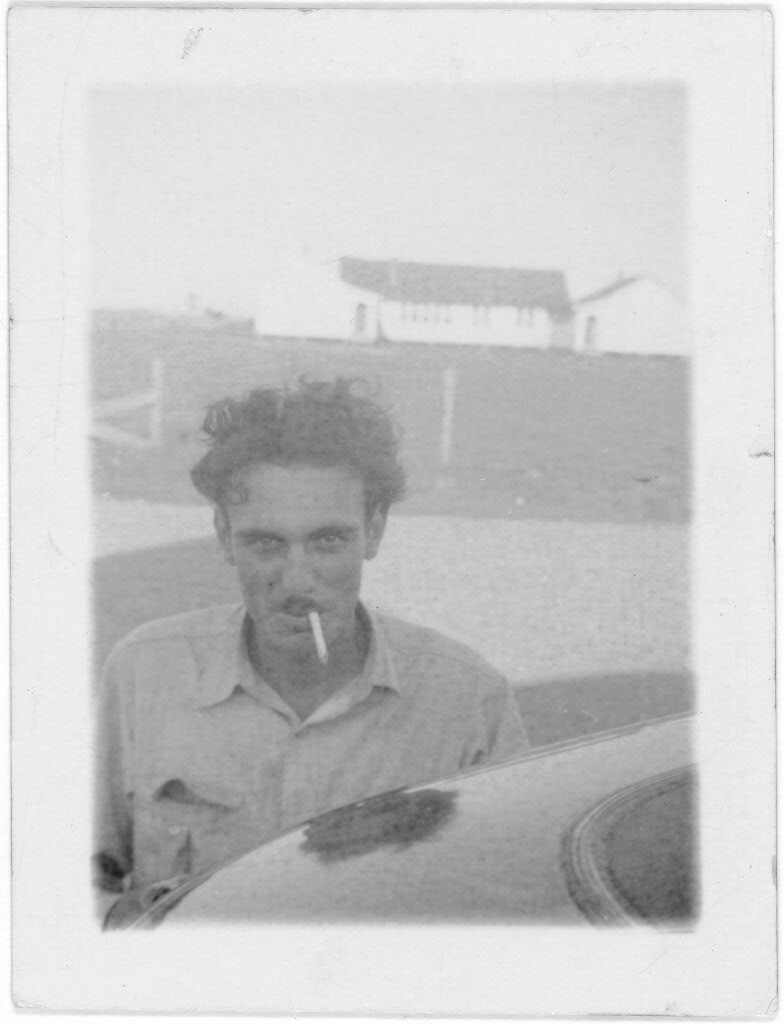
Mr. "Bornu," who recorded near Morse in 1934, remains one of the great enigmas of the Lomax collection. His songs suggest a familiarity with cowboy lore ("Old Chisholm Trail") and traditional English bawdy material ("Inch above Your Knee") as well as the complex interplay of white and black francophone traditions that coalesced into Cajun and Creole music ("Belle" and "Donne-l'à ton nègre"). Alan Lomax's photograph of Bornu reveals a handsome young man with a mischievous grin, smoking a cigarette in front of a cattle fence—an appropriate location, considering the various connections in his songs to horse culture. Who exactly Bornu was remains a mystery. No one with the surname Bornu appears in any of the 1900, 1910, 1920, or 1930 Louisiana census rolls. One possibility is that the Lomaxes invented the pseudonym at his request, perhaps because of the extremely risqué nature of one of the songs. Performers of bawdy material (as evidenced, for instance, in the notes to Vance Randolph's extensive collections of bawdy song) often contributed material to folklorists with the understanding that they would not be identified. One possible clue exists in the Library of Congress catalog. On the card for "Old Chisholm Trail" the performer's name is scratched through, with Bornu added in pencil above it. Alan Lomax, who spent some time at the helm of the Archive of American Folk Song, often personally amended these files, and it may be the case that he or someone else altered an accidental printing of the actual name. (Barnes is the name scribbled out.) While this is purely conjectural, it should be noted that Barnes was indeed a common surname in southwestern Louisiana and southeastern Texas in the early 1930s (as was, incidentally, Borne).
In this song the speaker takes a train for Texas—a perennial theme in vernacular Louisiana song. After three days he receives a letter informing him that the girl he has left behind is ill, and he returns by train, pawning his horse, Henry (presumably to pay for her medical bills). As the Lomaxes observed in their note to a transcription of this song, published in Our Singing Country, the performance, while apparently an indigenous francophone composition, suggests that the "influence of the Westerns and of jazz is plain to be seen in this modern chronicle of Cajun country" (2000, 194). Irène Thérèse Whitfield cites a Mr. Vories LeBlanc, of Rayne, who associated the rhythm of the song with the valse à deux temps (1939, 96), which literally means "waltz in two times" but which refers to a European two-step dance in triple meter. A valse à deux temps thus originally referred to a dance step rather than a song type. Although the notion of a "two-step waltz" seems counterintuitive, as waltzes and two-steps are generally considered two discrete, even opposite, steps, particularly in Louisiana and Texas, the valse à deux temps is simply another style of dancing to a triple meter. As the valse à deux temps tends to be a quick dance, involving almost constant turning, faster songs in triple meter, such as this one, may have been associated with the dance form. While much hay has been made about the evidence of English influences indicated by the pronunciation of the horse's name, this should come as no surprise, given that Bornu also performed two songs in English for the Lomaxes. Like many people who came of age during the 1930s in southwestern Louisiana, he was apparently bilingual and, not surprisingly, sang songs in both English and French. As Ancelet notes, horses and particularly mules were often given Anglo-American names by francophone and bilingual owners, and Henry is also the name of the horse in Lawrence Walker's classic waltz "Chère Alice" (pers. comm., February 2011).
Lunéda Comeaux
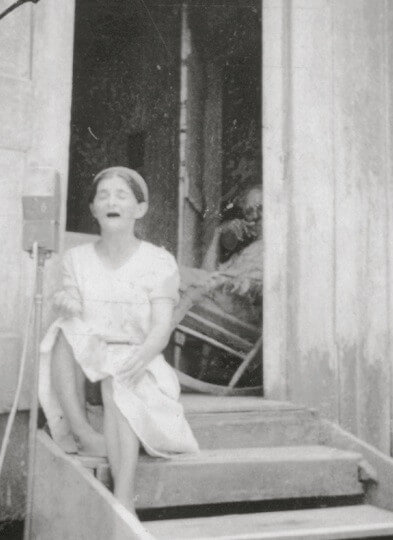
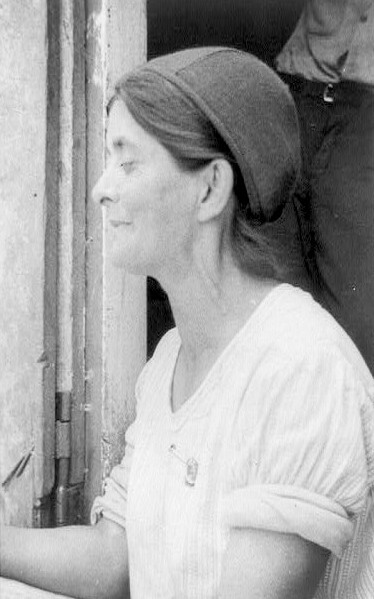
Not much is known about Lunéda Comeaux. According to annotations made by the Lomaxes, Comeaux lived at Route 4, Box 117, in New Iberia. She was forty-two at the time of the recording, making her birth date approximately 1892. The spelling "Lunéda" is based on Whitfield's spelling in Louisiana French Folk Songs, and may or may not be correct. Comeaux's repertoire was a varied one, and it reflects the depth and breadth of oral tradition in south Louisiana in the 1930s. Alongside traditional laments with medieval roots, Comeaux performed rounds, randonnées, nineteenth-century "sans souci" fool songs, and transpositions of American folk songs—not to mention humorous lyrics related to Louisiana Creole song traditions. Songs of parting and abandonment are conspicuously prevalent in her repertoire. Unfortunately, as so little is known about her life, any link between her own experiences and her penchant for these particular songs is purely conjectural.
This song consists of a dialogue between a man and his lover. About to depart for "the islands," he has come to say his good-byes. The woman proclaims that the pretty brunettes of these islands will surely entrance him, but she also makes a flirtatious promise: if he is wise and remains faithful, he won't regret it upon his return. He concurs and promises the same. In the last verses, presumably set later in time, the abandoned girl laments the pitfalls of love and declares herself "malheureuse" (wretched), suggesting that her apprehensions about his journey were well founded. Although portions of this song seem to adhere to a fairly strict abab rhymed quatrain, this tendency is highly variable.
An analogue of the song published by Creighton and Labelle as "Parti pour un voyage" (1988, 62), this song was also sung for the Lomaxes, with slight variation, by Julien Hoffpauir. The motif of a departure for the islands also appears in Joe Segura's version of "Adieu Marguerite." Although the versions of "Parti pour un voyage" consist of the same basic plot, there are subtle variations. In this version the traveler is warned about the charms of pretty brunettes. In others, however, the temptresses in question may be Italians or, in Acadian versions, "Canadiennes," the term used to this day by Acadians for their Québécois neighbors:
Just as the terrible beauty of a "jolie blonde" signals cross-cultural temptation in indigenous French Louisiana song, the pretty brunettes and Canadiennes of these songs may have embodied cultural as well as romantic fears.
Although clearly a love lyric, this song also reflects the occupational realities of the French maritime provinces, where men had to travel far afield for employment— whether as fishermen or, earlier, as voyageurs and coureurs des bois. As Madeleine Béland and Lorraine Carrier-Aubin discuss at length in their study Chansons de voyageurs, coureurs des bois et forestiers (1982), parting songs like this one were part of the repertoire of itinerant laborers as well as the women they left behind.
Songs in dialogue often allow for different interpretations, of course, on the part of the performer, and Comeaux's concluding verses clearly focus the narrative on the plight of the deserted girl. In contrast to Hoffpauir's lilting, chantey-like version of this song, Comeaux's version is plaintive and shrill, a lament in line with the other songs of abandonment in her repertoire.
Alberta Bradford and Becky Elzy
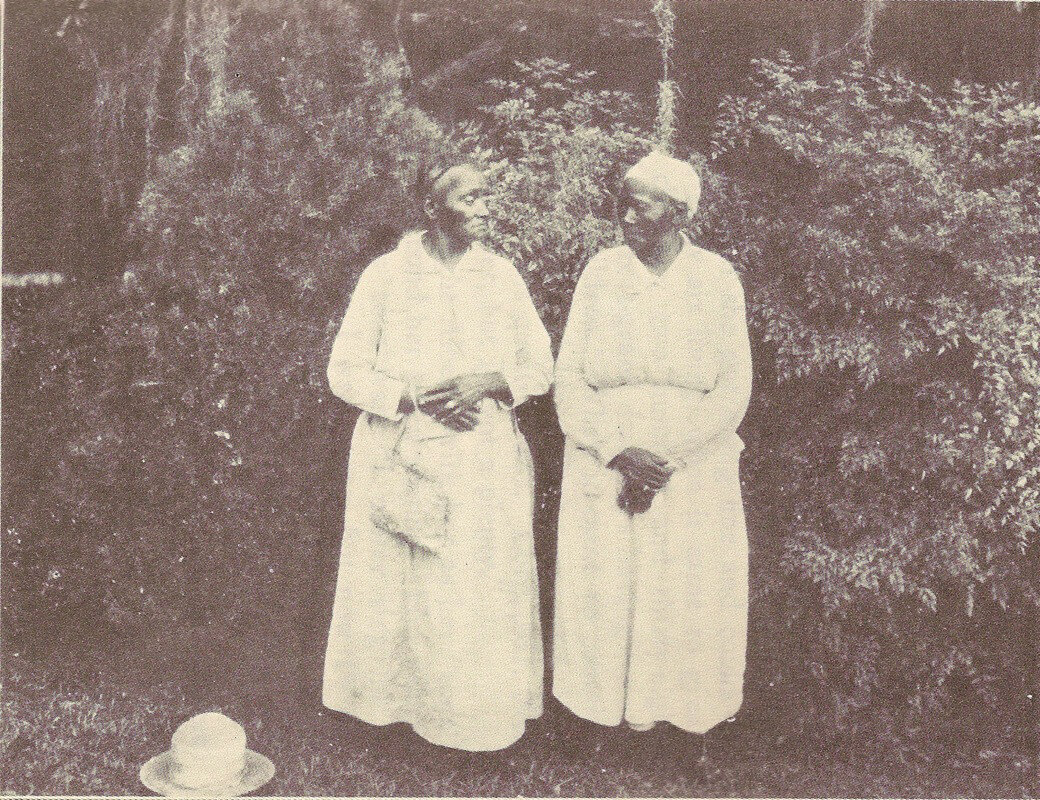
At the end of the Lomaxes' recording session with Becky Elzy and Alberta Bradford, John Lomax offers a short biography of the singers: "The spirituals on this record were sung by Becky Elzy, 86, and Alberta Bradford, 73, who in their younger days were slaves on the Avery Island plantation. They've recollected these songs over all these years and still have wonderful voices to sing them as they should be sung" (AFS 00105 A02). As Lomax also mentions, words similar to many of those in the songs from this recording session can be found in E. A. McIlhenny's book, Befo' de War Spirituals (1933). McIlhenny was and remains the best-known scion of the Avery and McIlhenny clans of Avery Island—a raised coastal salt dome near New Iberia, Louisiana. McIlhenny, who managed the family's multifarious business interests, also made a name for himself as a nature writer and amateur ornithologist, turning the island into a bird sanctuary and planting exotic gardens open to the public. In addition, McIlhenny was fascinated by the religious music of the former slaves who remained on his family property after the Civil War. A regular participant in the church services on Avery Island, McIlhenny set out to put together a songbook with the intention of preserving the songs he had heard growing up—songs that he believed were rapidly dying out during Reconstruction. When he could remember only thirty of these songs on his own, he set out to find singers who could help fill out the repertoire. Eventually, he located Becky Elzy, who had been a slave about twenty miles away on Côte Gélee but who was then living in the country only six miles from Avery Island. Elzy had retained many of the older songs, and—along with help from Alberta Bradford, who provided a "second," or "tone," to her alto—she helped McIlhenny construct a significant collection (McIlhenny 1933, 11–33; McKenzie 1990, 95–110).48Alan Lomax announces: "The spirituals on this record were sung by Becky Elzy, 86, and Alberta Bradford,73, who in their younger days were slaves on the Avery Island plantation. They've recollected these songs over all these years and still have wonderful voices to sing them as they should be sung. These spirituals, as they're sung, can be found in Mr. E. A. McIlhenny's book, Befo' de War Spirituals. These songs were recorded in Lake Arthur, Louisiana, in the month of June, 1934." Caffery, Traditional Music in Coastal Lousiana, 68.
This song is among the most famous in the African American spiritual repertoire, thanks in part to a reference to it in the concluding lines of Martin Luther King's "I Have a Dream" speech: "And when we allow freedom to ring, when we let it ring from every village and hamlet, from every state and city, we will be able to speed up that day when all of God's children—black men and white men, Jews and Gentiles, Catholics and Protestants—will be able to join hands and sing in the words of the old Negro spiritual: ‘Free at last! Free at last! Thank God Almighty, we are free at last!'" (1992, 105–6).
As most commentary on African American spirituals notes, the bondage and subsequent release of the Israelites, as recounted in the Old Testament, served as a deep internal cultural metaphor for the plight of black slaves. Unable to address this plight outright, the original authors of the "sorrow songs" employed Christian symbolism to express what would otherwise be interdicted. In this song there is little outright reference to any particular biblical story, with a focus instead on personal salvation from sin. As sung by congregations of enslaved African Americans, however, it seems logical to speculate that the song would have expressed a broader cultural longing for economic and social freedom.
This song, like all of the other songs performed by Bradford and Elzy, freely includes metrical commonplace lines found elsewhere in their repertoire as well as in the broader spiritual tradition. The lines "Ole Satan mad and I am glad" and "Satan thought he had me fast," for instance, can also be found in a version of "Goin' Down to Jordan." Likewise, "I know my God is a man of war" also appears in their versions of "Dry Bones," "Comin' Down the Line," and "Adam in the Garden Pinnin' Leaves." All of these lines, it should be noted, are virtually identical, metrically speaking, in that they can be scanned as trochaic tetrameter—four accents per line, emphasizing the rhythm's heavy downbeat.
Wilson "Stavin' Chain" Jones, Charles Gobert, and Octave Amos
The Lomax recordings of Wilson Jones (guitar), Octave Amos (fiddle), and Charles Gobert (banjo) are the only known documentation of this somewhat mysterious ensemble. Who exactly these musicians were, where they might have performed, and who might have been their audience remains a mystery, though census and military records confirm that people with those names lived in Louisiana during the early twentieth century.
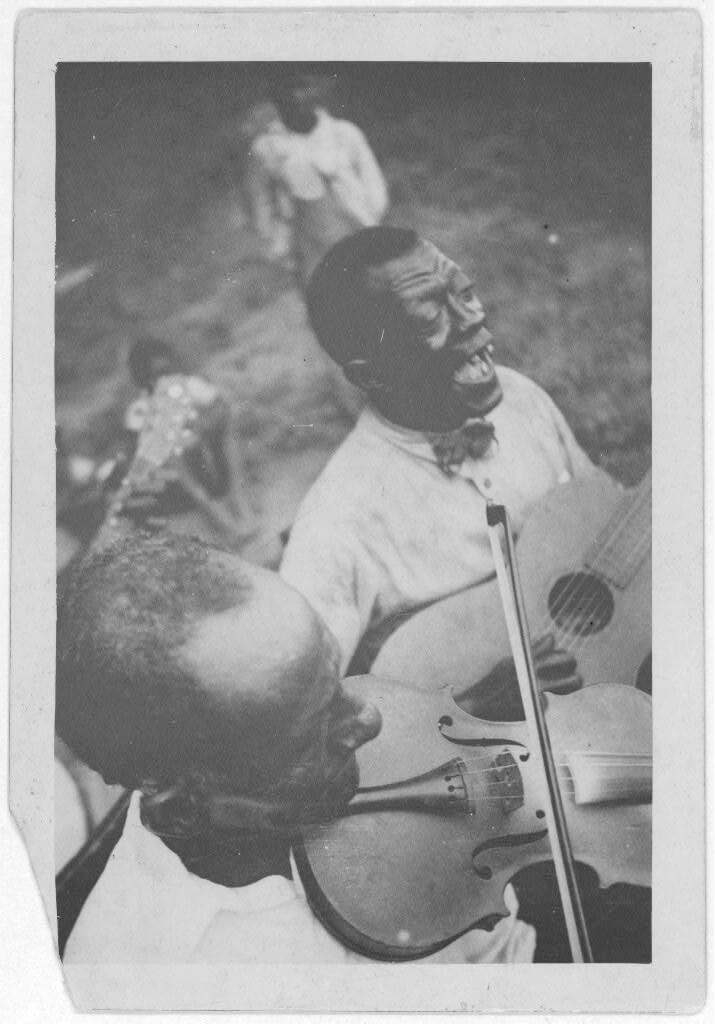
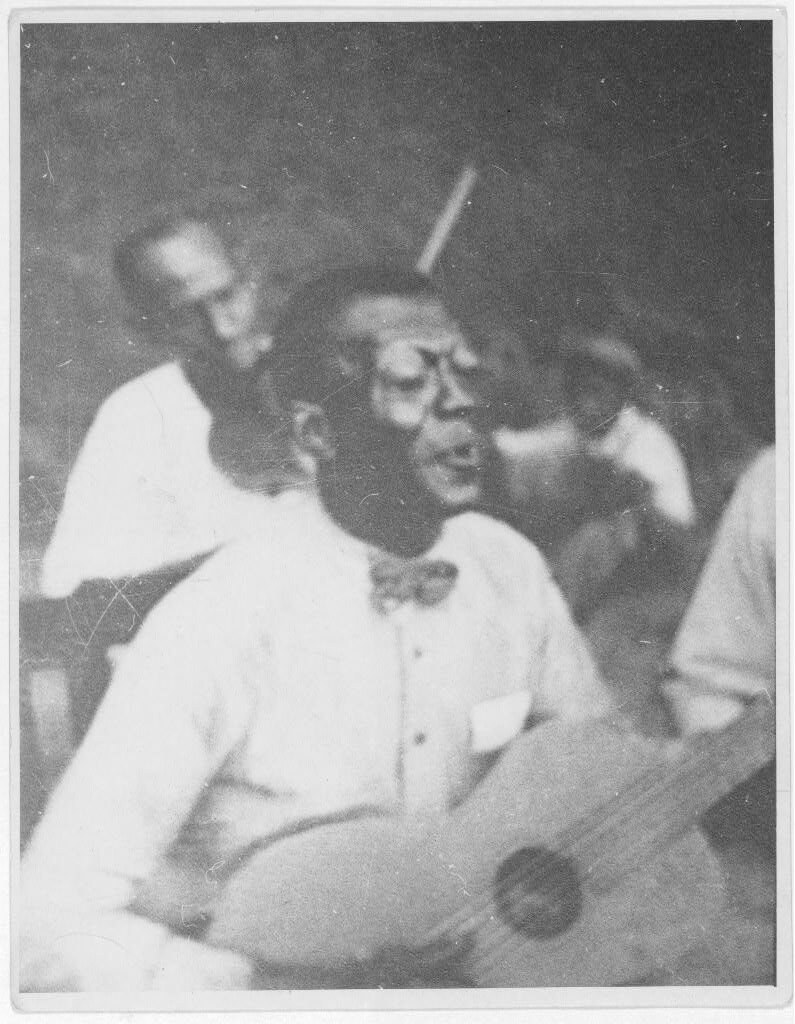
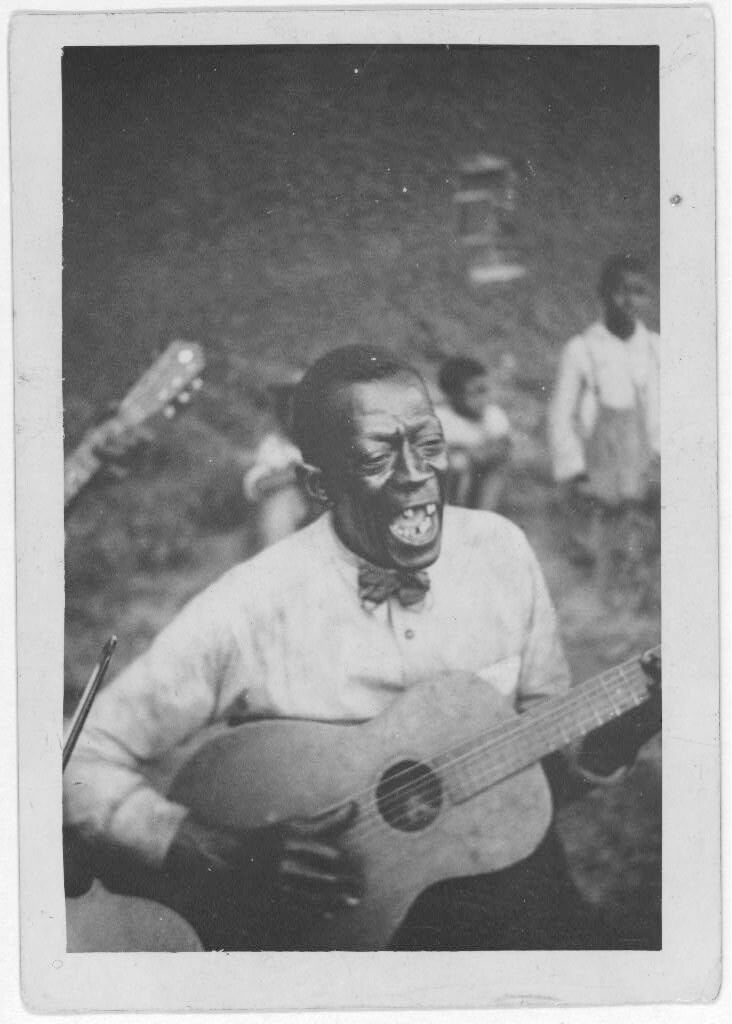
Wilson Jones, who apparently went by the name Stavin' Chain, may be the same Wilson Jones drafted on September 12, 1918.49For a discussion of the meaning of stavin' chain, see my note to the song "Stavin' Chain" (217). Nineteen at the time, this Wilson Jones was born in Opelousas around 1899 and would have been approximately thirty-five when the Lomaxes recorded him. Jones's original ballad about serving in World War I suggests that they could be the same individual. Census records also indicate, however, that another Wilson Jones apparently lived in northeastern Louisiana, around the town of Bonita, an area known for its dynamic blues traditions.
Evidence of Amos and Gobert is similarly sparse. The 1930 census indicates that a black man named Charles Gobert, aged forty-nine, was living in Lafayette, and military records indicate that an Octave Amos, born in Louisiana on May 7, 1894, was drafted into the army in 1918. Perhaps they met during the war.
The lineage of the rural banjo/fiddle-driven black string band is a long and complex one. Although the style fell into obscurity during much of the twentieth century and the banjo and fiddle became more commonly associated with white bluegrass and "oldtime" Appalachian music, early accounts of vernacular American string band music identify it with African American performance. As Dena J. Epstein's Sinful Tunes and Spirituals (2003) amply illustrates, the banjo and the fiddle were once perceived to be the quintessential instruments of slave performance, going back at least to the late eighteenth century. Moreover, as a number of studies have suggested, many early minstrel performers expended considerable effort attempting to imitate the fiddle/banjo performances of black southerners, and these imitations were incorporated into the minstrel show—albeit in a somewhat distorted and often grotesque fashion (Conway 1995; Lott 1993; McLane 2003; Meer 2005). In turn the minstrel show, the most popular American musical style for much of the nineteenth century, provided a template and training ground for many of the early popular white "hillbilly" and "country" artists. Uncle Dave Macon, Jimmie Rodgers, and Bob Wills, for instance, all cut their teeth as minstrels in medicine shows. Black musicians, strangely enough, first gained national audiences in the nineteenth century on the minstrel circuit, even in some instances wearing blackface themselves (Toll 1974).
Although the string band became increasingly identified as a hillbilly (and thus white) configuration in the twentieth century, a number of black string bands enjoyed some success before those divisions became widely accepted. Most famous among them was the Mississippi Sheiks, the guitar/fiddle duo whose hit "Sitting on Top of the World" is today a staple of the bluegrass and western swing repertoires. As black string band ensembles had done since before the Civil War, bands such as the Sheiks, the Dallas String Band, Cannon's Jug Stompers, and many others performed a hybrid repertoire that was designed to appeal to both black and white audiences (Wolfe 1990, 32–35). The repertoire of Stavin' Chain and company is in this same vein, mixing straightforward blues with topical ballads and crossover dance numbers such as "Little Liza Jane."
While anglophone black string band and folk blues traditions have not thrived in south Louisiana, all evidence indicates that they were a vibrant part of the area's cultural landscape up until at least the early part of the twentieth century. Along with the Lomax recordings of John Bray and Herbert Halpert's Works Progress Administration recordings (AFS 3990) of Phinus "Flatfoot" Rockmore, "Kid" White, and Joe Harris (recorded in Shreveport but hailing from New Iberia), these recordings demonstrate that a vernacular pan-southern anglophone African American tradition once thrived in south Louisiana, alongside the better-known Cajun and Creole traditions. Moreover, they provide meaningful context for the development of Cajun and Creole styles, themselves so indebted to and intertwined with the blues, while reminding us of the remarkable breadth of vernacular performance styles in early-twentieth-century Acadiana.
In the headnotes to this song, published in Our Singing Country, Lomax remarks that he was unable to verify Jones's claim that it was based on an actual murder and subsequent trial in the area of Lake Charles (2000, 335). As the legal scholar Richard Underwood points out, however, Lomax's efforts toward this end must have been minimal (2007, 766). The case of Albert Edwin "Ed" Batson and his alleged murder of the Earle family in the environs of Welsh, Louisiana, in 1902 was infamous, and Jones's ballad constitutes a vernacular echo and retelling of a story that had been at one time a statewide, and even national, sensation.
In Jones's song Batson is a hapless, somewhat oppressed laborer accused of a crime he did not commit. Apprehended while window-shopping, he is convicted and gruesomely executed, much to the horror of his adoring family. His last request is that his daughters be well cared for.
With little exception, newspaper reports of the time painted a starkly divergent portrait of Batson. "fiendish deeds of a tramp" reads the front page of New Orleans's Daily Picayune story (one of many that would run), published two days after the mutilated bodies of the Earle family were discovered. This article essentially follows the accepted narrative surrounding the killings, the same narrative that the prosecution would successfully articulate in the subsequent trial.
Batson had worked for some time as the hired man of Ward Earle, son of L. S. Earle, a prosperous farmer who had brought his family from Kansas to Calcasieu Parish. Someone (many witnesses later testified that it was Batson) claiming to be Ward Earle apparently tried to sell Earle's team of livestock in Lake Charles, arousing suspicions that led to the discovery of the murdered family. Batson, meanwhile, had departed for his hometown in Missouri, leaving incriminating evidence in Ward Earle's buggy—a vest containing a cryptic suicide note and other possessions linked to Batson. As all circumstantial evidence seemed to suggest Batson's guilt, he was arrested in Missouri and ultimately extradited to Calcasieu Parish, where he stood trial for murder (Underwood 2007; Daily Picayune 1902).
Already notorious, the case began to assume legendary proportions when the first verdict of guilty was reversed and a second trial announced. Things became more complicated when an acquaintance of the defense attorney, the Associated Press reporter Charles Dobson (also known as Miles Dobson), published a book, Guilty? Side Lights on the Batson Case, a Recrudescence of the Murder of the Earll [sic] Family in Louisiana (1903), which postulated that two unknown villains had perpetrated the crime, possibly as retribution for an ancient grievance dating back to the Earle family's past lives in Kansas (Underwood 2007). Although the hearsay evidence that led to Dobson's conclusion was never admitted in court, the book caused quite a stir and contributed to the controversy surrounding his eventual execution on August 14, 1903, as well as the lingering doubts about Batson's guilt. Almost a century after his death, for instance, an article by journalist Jim Bradshaw in the October 28, 1997, edition of the Lafayette (La.) Daily Advertiser accepts key tenets of Dobson's hypothesis.
While Jones's ballad obviously diverges sharply from the facts as presented at the trial, many of these divergences relate to details of the case, no doubt transmuted via oral transmission. Batson, for instance, hitches up Mr. Earle's "two bay horse and a wagon." The case revolved largely around the suspect's attempt to divest himself of Earle's mules, horses, and buggy. In the song Batson walks "uptown," where he looks in a "showcase." During the trial it emerged that the suspect had left Earle's horses and mules and visited a gunsmith and a watch repair store. "Henry Reese" is the name of the sheriff in the ballad, and while the sheriff who arrested Batson was named Perkins, one H. L. Reese, the foreman of the Lake Charles streetcar line, was a key witness at the trial. Moreover, the initial appearance of a deputy, rather than the sheriff, echoes real events: apparently, Perkins was criticized for sending his deputy to investigate what he knew to be a major crime. Similarly, the song refers to Batson scribbling with a pencil. Much of the trial proceedings hinged on the positive identification of Batson's handwriting— specifically, whether it matched the handwriting on a note pinned on Ward Earle's door that seemed intended to throw investigators off the scent. And finally, the closing line of the song, "Bye Bye, Batson, Bye Bye," may relate to the text of Batson's purported suicide note (the so-called Ha Ha Letter), which concluded thusly: "A. E. Batson, Friend to All. Ha, ha, bye-bye, I'm gone" (Daily Picayune 1902).
All of these connections notwithstanding, Jones's narrative differs from the actual events in many major respects. Albert Batson was an itinerant laborer, for instance, and had no wife or children. Authorities apprehended him after he had left the state, not when he was window-shopping in Lake Charles. The metamorphosis of the Batson story evidenced here, however, is in keeping with its assimilation into the narrative blues tradition—a tradition that tends to invert societal norms, often making heroes of reputed scoundrels. The tune and structure of the song, the Lomaxes note in Our Singing Country, are taken directly from the widely known African American folksong "Frankie and Johnny," a song that also presents a generous defense of a murderer.
A number of the phrases and motifs are also traditional. Batson's declaration "You may dress in red, / You may dress in black" echoes the concluding verses of a number of similar blues songs, such as "Ella Speed" and Mississippi John Hurt's version of "Louis Collins." Likewise, the image of a "rubber-tired buggy, decorated horse" appears frequently in similar songs, such as "Frankie and Albert" and Blind Willie McTell's "Delia":
Rubber-tired buggy,
Two-seated hack,
Took Delia to the graveyard,
Never brought her back.
(McTell 1990)
Although early scholarship on the blues ballad as a genre—or "Negro ballad," as G. Malcolm Laws called it (1964, 94)—initially set it apart from Anglo-American balladry, suggesting that it was less likely to be based on real events and less likely to be diegetically unified, more recent investigation into the historical background of songs such as "Stagger Lee" and "Ella Speed" have suggested that these compositions were in fact often based on real events and that those real events were often rendered in precise and realistic detail (Garst and Cowley 2001; Brown 2004). "Batson," I would argue, while it does incorporate stylistic elements from the blues tradition, is a highly unified, extremely realistic narrative drawn directly from real events—much like many topical canonical ballads. In general the song is a skillful appropriation and transmutation of current events through the medium of African American oral poetics.
The only other known version of this song is a manuscript version in the Robert Winslow Gordon papers in the Library of Congress (Gordon 3759). In December 1929 an assistant district attorney in Lake Charles, Robert Mouton, transcribed eleven verses from the singing of an elderly African American man and forwarded them to Gordon. Although the story differs in certain details, the refrain is nearly identical, and the words fit neatly with the musical structure of "Frankie and Johnny."
About the Author
Joshua Clegg Caffery is a scholar and musician from Franklin, Louisiana. He was a founding member of the Red Stick Ramblers and a longtime member of the Louisiana French band Feufollet. In addition to being nominated for a Grammy for his work on the Feufollet album En Couleurs, he served as the 2013–14 Alan Lomax Fellow in Folklife Studies at the John W. Kluge Center, Library of Congress. In 2014–15, he served as visiting professor of folklore at Indiana University.
Acknowledgments
Southern Spaces thanks Lousiana State University Press for permission to reprint this excerpt from Traditional Music in Coastal Louisiana: The 1934 Lomax Recordings. All rights reserved.
]]>The teenagers in this clip from Seventeen, a teen dance show broadcast by WOI-TV to central Iowa in the late-1950s, did not need to know this history to appreciate that Willis's "Betty and Dupree" was a perfect song for dancing the Stroll, even if they did so awkwardly. The teens on Seventeen were emulating their peers in Philadelphia who popularized the dance on the nationally broadcast American Bandstand. Less obviously, the Iowa teens were also emulating teens on The Mitch Thomas Show—a black teen dance show that broadcast locally from Wilmington, Delaware, to the Philadelphia area—whose version of the Stroll influenced the American Bandstand dancers.
While Des Moines, Iowa, may be a long way from the South geographically, television connected Iowa teens to music and dance styles flowing from Delaware, Georgia, South Carolina, and elsewhere. Seventeen was one of dozens of locally broadcast teen dance shows in this era. Each show featured musical performances and records alongside dancing teenagers. The simplicity and profitability of the teen dance show format appealed to television stations, but airing images of youth music culture was a complicated proposition that involved television technologies, network affiliations, marketing, and racial segregation. This essay examines four programs that brought music and dance to southern and border state audiences in the 1950s and 1960s. I focus on three black teen shows, The Mitch Thomas Show from Wilmington, Delaware (1955–1958); Teenage Frolics (1958–1983), hosted by Raleigh, North Carolina, deejay J. D. Lewis; and Washington, DC's Teenarama Dance Party (1963–1970), hosted by Bob King. In addition, I examine Washington's The Milt Grant Show (1956–1961), which allowed only white dancers.
These shows broadcast in an era when civil rights lawsuits and protests sought to overturn policies of racial segregation in schools and public spaces in the South. Wilmington and Washington were the sites of two of the school segregation cases, Belton v. Gebhart and Bolling v. Sharpe, which the Supreme Court combined into Brown v. Board of Education. In Raleigh, token school integration did not begin until 1960, six years after Brown.3Sarah Caroline Thuesen, Greater Than Equal: African American Struggles for Schools and Citizenship in North Carolina, 1919 –1965 (Chapel Hill: University of North Carolina Press, 2013), 225–229. That same year, black students from St. Augustine University and Shaw University staged sit-ins at lunch counters in Raleigh to protest the whites-only policies at Woolworths and other stores.4Jeffrey Crow, Paul Escott, and Flora Hatley, A History of African Americans in North Carolina (Raleigh: Division of Archives and History, North Carolina Department of Cultural Resources, 1992). Televisual representations and photographs of civil rights protests in Little Rock, Greensboro, Birmingham, Jackson, Selma, and other cities also made images of the South highly politicized.5Aniko Bodroghkozy, Equal Time: Television and the Civil Rights Movement (Urbana: University of Illinois Press, 2012); Martin Berger, Seeing Through Race: A Reinterpretation of Civil Rights Photography (Berkeley: University of California Press, 2011); and Leigh Raiford, Imprisoned in a Luminous Glare: Photography and the African American Freedom Struggle (Chapel Hill: University of North Carolina Press, 2013). Part of the power of television for civil rights activists was how the medium exposed excessive acts of physical violence to audiences outside the South. In the midst of the voting rights marches in Selma in 1965, for example, Martin Luther King told marchers and the news media, "We are here to say to the white men that we no longer will let them use clubs on us in the dark corners. We're going to make them do it in the glaring light of television."6Quoted in Bodrogkozy, Equal Time, 2.
In the context of pitched battles over segregation and civil rights, these televised teen dance shows reveal much about the visibility of different youth musical cultures in the 1950s and 1960s. First, The Mitch Thomas Show, Teenage Frolics, and Teenarama Dance Party were important for black teens because the shows offered televisual spaces that valued their creative energies and talents. As historian Earl Lewis has noted, when African Americans faced Jim Crow policies in parks, swimming pools, and movie theaters, they developed separate recreation sites through which they turned segregation into "congregation."7"Afro-Americans who lived in communities as diverse as Chicago, Norfolk, and Buxton, Iowa, congregated—sometimes along class lines, but always together," Earl Lewis argues. "In the southern context, congregation was important because it symbolized an act of free will, whereas segregation represented the imposition of another's will." Earl Lewis, In Their Own Interests: Race, Class, and Power in Twentieth-Century Norfolk, Virginia (Berkeley: University of California Press, 1991), 91–92. Unlike other racially segregated leisure spaces, however, television brought the sounds and images of black music cultures to viewers of all colors across and beyond the cities from which the shows broadcast. Second, television technology worked to enhance and/or limit the visibility of different youth musical cultures. Broadcasting from Wilmington, Raleigh, and Washington, these shows reached regional audiences, but varied in terms of signal strength and network affiliations. Differences in terms of station power and stability shaped the duration of each program. Finally, the visibility these shows offered to teenagers was closely tied to the salability of teen music culture. For The Mitch Thomas Show, Teenage Frolics, and Teenarama Dance Party this meant trying to attract sponsors to advertise to black television audiences. For The Milt Grant Show, this meant airing black music performances while maintaining a segregated studio audience that would appeal to sponsors.
I became interested in these teen dance shows while researching and writing a book on American Bandstand. Counter to host Dick Clark's claims that he integrated American Bandstand, my research revealed how the first national television program directed at teens discriminated against black youth during its early years and how black teens and civil rights advocates protested this discrimination.8Matthew Delmont, The Nicest Kids in Town: American Bandstand, Rock 'n' Roll, and the Struggle for Civil Rights in 1950s Philadelphia (Berkeley: University of California Press, 2012). Like American Bandstand, the local programs I explore in this essay brought dynamic music cultures to eager audiences and advertisers, while they also traced the boundaries of inclusion and exclusion in their cities. Unlike American Bandstand, or Soul Train, which started broadcasting nationally in 1971, The Mitch Thomas Show, Teenage Frolics, Teenarama Dance Party, and The Milt Grant Show are not well known outside of their local broadcast markets. Among these four programs, only one recording is known to exist, a 1957 episode of The Milt Grant Show recorded to sell the show to sponsors. With limited televisual evidence, my analysis draws on archival documents, promotional materials, newspapers, photographs, and interviews to explore how these shows got on and stayed on the air and what they meant to their audiences. By examining these local programs this essay builds on the work of scholars Norma Coates, Murray Forman, Julie Malnig, Tim Wall, George Lipsitz, and Brian Ward who have examined the intersections of music and television, the importance of televised teen dance shows as community spaces, and the development of rhythm and blues and rock and roll.9Norma Coates, "Elvis from the Waist Up and Other Myths: 1950s Music Television and the Gendering of Rock Discourse," in Medium Cool: Music Videos from Soundies to Cellphones, eds. Roger Beebe and Jason Middleton (Durham, NC: Duke University Press, 2007), 226–251; Coates, "Filling in Holes: Television Music as a Recuperation of Popular Music on Television," Music, Sound, and the Moving Image 1, no. 1 (Spring 2007): 21–25; Murray Forman, One Night on TV Is Worth Weeks at the Paramount: Popular Music on Early Television (Durham, NC: Duke University Press, 2012); Julie Malnig, "Let's Go to the Hop: Community Values in Televised Teen Dance Programs of the 1950s," Dance & Community: Proceedings of The Congress on Research in Dance (August, 2006): 171–175; Tim Wall, "Rocking Around the Clock: Teenage Dance Fads from 1955 to 1965," in Ballrooms, Boogie, Shimmy, Sham, Shake: A Social and Popular Dance Reader, ed. Julie Malnig (Urbana: University of Illinois Press, 2009), 182–198; George Lipsitz, Midnight at the Barrelhouse: The Johnny Otis Story (Minneapolis: University of Minnesota Press, 2010); and Brian Ward, Just My Soul Responding: Rhythm and Blues, Black Consciousness, and Race Relations (Berkeley: University of California Press, 1998).
The Mitch Thomas Show
The Mitch Thomas Show debuted on August 13, 1955, on WPFH, an unaffiliated television station that broadcast to Philadelphia and the Delaware Valley from Wilmington.10"The NAACP Reports: WCAM (Radio)," August 7, 1955, NAACP collection, URB 6, box 21, folder 423, TUUA. Born in West Palm Beach, Florida, Mitch Thomas graduated from Delaware State College and served in the army before becoming the first black disc jockey in Wilmington, Delaware, in 1949.11Eustace Gay, "Pioneer In TV Field Doing Marvelous Job Furnishing Youth With Recreation," Philadelphia Tribune, February 11, 1956; Gary Mullinax, "Radio Guided DJ to Stars," The News Journal Papers (Wilmington, DE), January 28, 1986, D4. His television show, broadcast every Saturday, resembled Philadelphia's Bandstand, at the time a local program hosted by Bob Horn, and other locally broadcast teenage dance programs. The Mitch Thomas Show stood out because it was the first television show hosted by a black deejay that featured a studio audience of black teenagers. Otis Givens, who lived in South Philadelphia and attended Ben Franklin High School, remembered that he watched the show every weekend for a year before he finally made the trip to Wilmington to dance on air. "When I got back to Philly, and everyone had seen me on TV, I was big time," Givens recalled. "We weren't able to get into Bandstand, [but] The Mitch Thomas Show gave me a little fame. I was sort of a celebrity at local dances."12Otis Givens, interview with author, June 27, 2007. Similarly, South Philadelphia teen Donna Brown recalled in a 1995 interview, "I remember at the same time that Bandstand used to come on, there used to be a black dance thing that came on, and it was The Mitch Thomas Show . . . And that was something for the black kids to really identify with. Because you would look at Bandstand and we thought it was a joke."13Quoted in John Roberts, From Hucklebuck to Hip-Hop: Social Dance in the African American Community in Philadelphia (Philadelphia: Odunde, 1995), 37. The Mitch Thomas Show also became a frequent topic for the black teenagers who wrote the Philadelphia Tribune's "Teen-Talk" columns. Much in the same way that national teen magazines followed American Bandstand, the Tribune's teen writers kept tabs on the performers featured on Thomas's show, and described the teenagers who formed fan clubs to support their favorite musical artists and deejays.14On the Philadelphia Tribune's "Teen-Talk" coverage of Mitch Thomas' show, see "They're 'Movin' and Groovin,'" Philadelphia Tribune, July 31, 1956; Dolores Lewis, "Talking With Mitch," Philadelphia Tribune, November 9, 1957; Lewis, "Stage Door Spotlight," Philadelphia Tribune, November 9, 1957; Laurine Blackson, "Penny Sez," Philadelphia Tribune, December 7, 1957 and April 26, 1958; Dolores Lewis, "Philly Date Line," Philadelphia Tribune, December 7, 1957; "Queen Lane Apartment Group [photo]," Philadelphia Tribune, December 7, 1957; Jimmy Rivers, "Crickets' Corner," Philadelphia Tribune, January 21 and April 22, 1958; Edith Marshall, "Current Hops," Philadelphia Tribune, March 1, 8 and 22, 1958; Marshall, "Talk of the Teens," Philadelphia Tribune, March 22, 1958; and "Presented in Charity Show [Mitch Thomas photo]," Philadelphia Tribune, April 22, 1958. The fan gossip shared in these columns documented the growth of a youth culture among the black teenagers whom Bandstand excluded. In 1957, it was one of these fan clubs that made the most forceful challenge to Bandstand's discriminatory admissions policies.15Art Peters, "Negroes Crack Barrier of Bandstand TV Show," Philadelphia Tribune, October 5, 1957; "Couldn't Keep Them Out [photo]," Philadelphia Tribune, October 5, 1957; Delores Lewis, "Bobby Brooks' Club Lists 25 Members," Philadelphia Tribune, December 14, 1957. Although many of these teens watched both Bandstand and Thomas's show, as Bandstand grew in popularity and expanded into a national program, The Mitch Thomas Show remained the only television program that represented the region's black rock and roll fans.


Economics, more than a concern for racial equality, influenced WPFH's decision to provide airtime for this groundbreaking show. Eager to compete with Bandstand and the afternoon offerings on the other network-affiliated stations, WPFH hoped that Thomas's show would appeal to both black and white youth in the same way as black-oriented radio.16On the crossover appeal of black-oriented radio, see Brian Ward, Radio and the Struggle for Civil Rights in the South (Gainsville: University Press of Florida, 2004); William Barlow, Voice Over: The Making of Black Radio (Philadelphia: Temple University Press, 1999); and Susan J. Douglas, Listening In: Radio and the American Imagination (New York: Times Books, 1999), 219–255. The station's bet on Thomas was part of a larger strategy that included hiring white disc jockeys Joe Grady and Ed Hurst to host a daily afternoon dance program that started at 5 p.m., after Bandstand concluded its daily broadcast. While The Grady and Hurst Show broadcast five times per week, the weekly Mitch Thomas Show proved to be more influential.
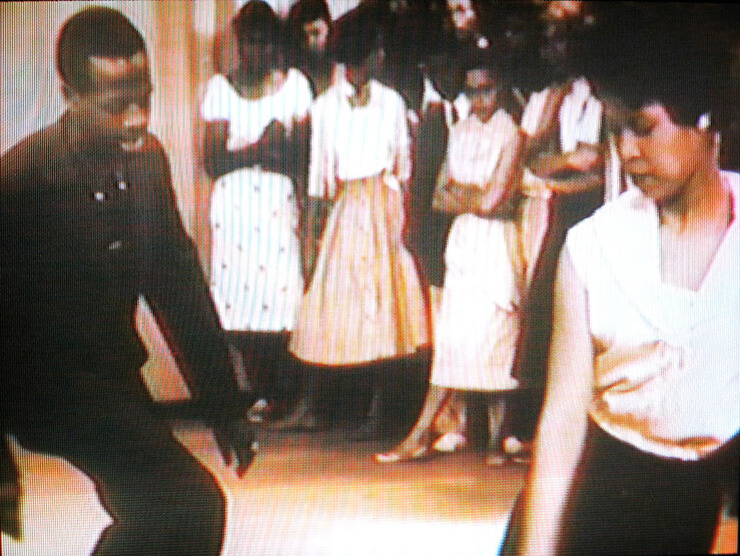
Teens dancing on the The Mitch Thomas Show, locally called the "Black Bandstand," Wilmington, Delaware, ca. 1955-1958. Screenshots (1 and 2) from Black Philadelphia Memories, directed by Trudi Brown (WHYY-TV12, 1999). Screenshots courtesy of Matthew F. Delmont, The Nicest Kids in Town.
Drawing on Thomas's contacts as a radio host and on the talents of the teenagers, the program helped shape the music tastes and dance styles of young people in Philadelphia. In a 1998 interview for the documentary Black Philadelphia Memories, Thomas recalled that "the show was so strong that I could play a record one time and break it wide open."17Black Philadelphia Memories, directed by Trudi Brown (Philadelphia, WHYY-TV12, 1999), television documentary. Indeed, Thomas's show hosted some of the biggest names in rock and roll, including Ray Charles, Little Richard, the Moonglows, and Frankie Lymon and the Teenagers. It also featured vocal harmony groups from the Philadelphia area.18"Teen-Age 'Superiors' Debut on M.T. Show," Philadelphia Tribune, November 19, 1957. Thomas promoted large stage shows as well as small record hops at skating rinks.19On Mitch Thomas' concerts, see Archie Miller, "Fun & Thrills," Philadelphia Tribune, December 4, 1956; "Rock 'n Roll Show & Dance," Philadelphia Tribune, April 19, 1958; "Swingin' the Blues," Philadelphia Tribune, August 5, 1958; "Mitch Thomas Show Attracts Over 2000," Philadelphia Tribune, August 18, 1958; "Don't Miss the Mitch Thomas Rock & Roll Show," Philadelphia Tribune, July 2, 1960. These events were often racially integrated, "The whites that came, they just said, 'Well I'm gonna see the artist and that's it.' I brought Ray Charles in there on a Sunday night, and it was just beautiful to look out there and see everything just nice."20Mullinax, "Radio Guided DJ to Stars."
Ray Smith, who attended American Bandstand frequently and has done research for one of Dick Clark's histories of the show, remembers that he and other white teenagers watched The Mitch Thomas Show to learn new dance steps. Describing the "black Bandstand," Smith recalled:
First of all, black kids had their own dance show, I think it was on channel 12, but one of the reasons I remember it is because I watched it. And I remember that there was a dance that [American Bandstand regulars] Joan Buck and Jimmy Peatross did called "The Strand" and it was a slow version of the jitterbug done to slow records. And it was fantastic. There were two black dancers on this show, the "black Bandstand," or whatever you want to call it. The guy's name was Otis and I don't remember the girl's name. And I always was like "wow." And then I saw Jimmy Peatross and Joan Buck do it, who were probably the best dancers who were ever on Bandstand. I was talking about it to Jimmy Peatross one day, when I was putting together the book, and he said, "Oh, I watched this black couple do it." And that was the black couple that he watched.21Ray Smith, interview with author, August 10, 2006. Jimmy Peatross and Joan Buck tell a related story about learning how to do The Strand from black teenagers in Twist, directed by Ron Mann (Sphinx Productions, 1992), documentary.
Vera Boyer and Otis Givens show off their dance steps on The Mitch Thomas Show, Wilmington, Delaware, ca. 1956–57. Screenshot from Black Philadelphia Memories, directed by Trudi Brown (WHYY-TV12, 1999). Screenshot courtesy of Matthew F. Delmont, The Nicest Kids in Town.
These white teenagers were not alone in watching The Mitch Thomas Show. Smith's experience supports Mitch Thomas's belief that [American Bandstand teens] "were looking to see what dance steps we were putting out. All you had to do was look at 'Bandstand' the next Monday, and you'd say, 'Oh yeah, they were watching.'"22Ibid. They were watching, for example, when dancers on The Mitch Thomas Show started dancing The Stroll, a group dance where boys and girls faced each other in two parallel lines, while couples took turns strutting down the aisle. Thomas remembers that the teens on his show "created a dance called The Stroll. I was standing there watching them dancing in a line, and after a while I asked them, 'What are y'all doing out there?' They said, 'That's The Stroll.' And The Stroll became a big thing."23Black Philadelphia Memories, dir. Trudi Brown. Because the show influenced American Bandstand during its first year as a national program, teenagers across the country learned dances popularized by The Mitch Thomas Show.
Despite its success among black and white teenagers, Thomas's show remained on television for only three years, from 1955 to 1958. His short-lived television career resembled the experiences of other African American entertainers who hosted music and variety shows in this era. The Nat King Cole Show (1956–1957) failed to attract national advertisers and lasted only one year. Before Cole, shows hosted by black singers Lorenzo Fuller (1947) and Billy Daniels (1952) and the variety program Sugar Hill Times (1949) also fared poorly. Among local programs, the Al Benson Show and Richard Stamz's Open the Door Richard both had brief periods of success in 1950s Chicago.24J. Fred MacDonald, Blacks and White TV: African Americans in Television Since 1948 (Chicago: Nelson-Hall, 1983), 17–21, 57–64; Jannette Dates, "Commercial Television," in Split Image: African Americans and the Mass Media, ed., Davis and Barlow (Washington, DC: Howard University Press, 1993), 267–327; Christopher Lehman, A Critical History of Soul Train on Television (Jefferson, NC: McFarland & Company, 2008), 28; Richard Stamz, Give 'Em Soul, Richard! (Urbana: University of Illinois Press, 2010), 62–63, 77–78; Barlow, Voice Over, 98–103.
Mitch Thomas hosts Lewis Lymon and the Teenchords, Wilmington, Delaware, December 7, 1957, The Philadelphia Tribune. Reproduced with permission of The Philadelphia Tribune. Courtesy of Matthew F. Delmont, The Nicest Kids in Town.
The failure of the station that broadcast The Mitch Thomas Show underscores the tenuous nature of such unaffiliated local programs. Storer Broadcasting Company purchased WPFH in 1956.25Herbert Howard, Multiple Ownership in Television Broadcasting (New York: Arno Press, 1979), 142–147. Storer frequently bought and sold stations and, at the time of the WPFH acquisition, it also owned stations in Toledo, Cleveland, Atlanta, Miami, and Portland. Storer changed WPFH's call letters to WVUE and hoped to move the station's facilities from Wilmington closer to Philadelphia. The plan faltered, and the station suffered significant operating losses over the next year.26Ibid. Thomas's show was among the first victims of the station's financial problems. While advertisers started to pay more attention to black consumers in the 1950s, a product-identification stigma lingered throughout the decade, preventing many brands from sponsoring black programs.27Barlow, Voice Over, 129; Giacomo Ortizano, "One Your Radio: A Descriptive History of Rhythm-and-blues Radio During the 1950s" (PhD dissertation, Ohio University, 1993), 391–423. WVUE cancelled The Mitch Thomas Show in June 1958, citing the program's lack of sponsorship and low ratings compared to the network shows in Thomas's Saturday timeslot.28Art Peters, "Mitch Thomas Fired From TV Dance Party Job," Philadelphia Tribune, June 17, 1958. Shortly after firing Thomas, Storer announced plans to sell WVUE in order to buy a station in Milwaukee as FCC regulations required multiple broadcast owners to divest from one license in order to buy another. Unable to find a buyer for WVUE, Storer turned the station license back to the government, and the station went dark in September 1958.29Howard, Multiple Ownership in Television Broadcasting, 146. The manager of WVUE later told broadcasting historian Gerry Wilkerson, "No one can make a profit with a TV station unless affiliated with NBC, CBS or ABC." As Dick Clark and American Bandstand celebrated the one-year anniversary of the show's national debut, local broadcast competition brought The Mitch Thomas Show's groundbreaking three-year run to an unceremonious end. Thomas continued to work as a radio disc jockey through the 1960s, until he left broadcasting in 1969 to work as a counselor to gang members in Wilmington.
The Mitch Thomas Show usefully troubles the boundary between the South and the North. Historian Brett Gadsden describes Delaware as "a provincial hybrid, one in which ostensibly southern and northern modes of race relations operated."30Brett Gadsden, Between North and South: Delaware, Desegregation, and the Myth of American Sectionalism (Philadelphia: University of Pennsylvania Press, 2013), 7. Many teens who danced on The Mitch Thomas Show or watched the program would have experienced de jure school segregation and the slow realization of educational equality promised by Brown. At the same time, WPHF's Wilmington studios were only thirty miles from Philadelphia, a city that, historian Matthew Countryman notes, many black people called "Up South."31Matthew Countryman, Up South: Civil Rights and Black Power in Philadelphia (Philadelphia: University of Pennsylvania Press, 2006), 10. The Mitch Thomas Show teenagers would also have been familiar with segregation as practiced in Philadelphia and televised on American Bandstand. Carried out more covertly, this northern-style segregation was no less intentional or demeaning.32On the limitations of the de jure/de facto framework, see Matthew Lassiter, "De Jure/De Facto Segregation: The Long Shadow of a National Myth," in The Myth of Southern Exceptionalism, eds., Lassiter and Joseph Crespino (New York: Oxford University Press, 2010), 25–48. On race and segregation in Philadelphia, see Countryman, Up South; Countryman, "'From Protest to Politics': Community Control and Black Independent Politics in Philadelphia, 1965–1984,"Journal of Urban History 32 (September 2006): 813–861; Delmont, The Nicest Kids in Town; James Wolfinger, Philadelphia Divided: Race and Politics in the City of Brotherly Love (Chapel Hill: University of North Carolina Press, 2007); Wolfinger, "The Limits of Black Activism: Philadelphia's Public Housing in the Depression and World War II," Journal of Urban History 35 (September 2009): 787–814; Guian McKee, The Problem of Jobs: Liberalism, Race, and Deindustrialization in Philadelphia (Chicago: University Chicago Press, 2008); McKee, "'I've Never Dealt with a Government Agency Before': Philadelphia's Somerset Knitting Mills Project, the Local State, and the Missed Opportunities of Urban Renewal," Journal of Urban History 35 (March 2009): 387–409; and Lisa Levenstein, A Movement Without Marches: African American Women and the Politics of Poverty in Postwar Philadelphia (Chapel Hill: University of North Carolina Press, 2009). Seeing The Mitch Thomas Show as "between North and South" highlights the constant negotiation of sectional identities and imaginaries.
Teenage Frolics
J. D. Lewis' Teenage Frolics, which aired from 1958 to 1983, stayed on the air longer than any other local teen dance program. A graduate of Morehouse College and a World War II veteran, John Davis (J. D.) Lewis, Jr. started his radio career at Raleigh's WRAL in 1947 as a morning deejay playing gospel music. A. J. Fletcher and Fred Fletcher's Capitol Broadcasting Company, which owned WRAL, received a TV license in 1956 and Lewis played an important role in convincing the Federal Communications Comission (FCC) that WRAL-TV would serve African American viewers.33Clarence Williams, "JD Lewis Jr.: A Living Broadcasting Legend," Ace: Magazine of the Triangle, September–October 2002, 12–14, 70. Unlike The Mitch Thomas Show and Teenarama, Teenage Frolics aired on a VHF (very high frequency) station with a network affiliation (WRAL-TV had a primary affiliation with NBC and a secondary affiliation with ABC).34"WRAL-TV," 1960 Broadcasting Yearbook, A–73 Despite these network ties, WRAL proved challenging in other ways. Jesse Helms, later a US senator and national conservative leader, became an executive at Capitol Broadcasting in 1960 and delivered news editorials railing against communism, liberalism, and civil rights. As program manager in the late-1960s, Helms was Lewis's boss.35Jesse Helms, Here's Where I Stand (New York, Random House, 2005), 44–51; Ernest Furgurson, Hard Right: The Rise of Jesse Helms (New York: W. W. Norton, 1986), 69–91; William Link, Righteous Warrior: Jesse Helms and the Rise of Modern Conservatism (New York: St. Martin's Press, 2008), 64–98. WRAL, however, offered Teenage Frolics signal strength and stability, and Lewis's success at attracting advertisers and navigating station politics kept the program on the air for twenty-five years.
In a letter to potential advertisers, WRAL billed Teenage Frolics as "a live and lively dancing party featuring colored teenagers from high schools in the Channel 5 area." The station also included a coverage map of WRAL-TV, "which includes the most heavily populated Negro areas of the state of North Carolina (Approximately 450,000 Negroes)," and promised that "'The Teen-Age Frolic Show' affords a wonderful opportunity for firsthand consumer reaction to the sponsor's product."36J.D. Lewis (WRAL), letter to Dick Snyder, May 24, 1963, Lewis Family Papers, Southern Historical Collection, University of North Carolina at Chapel Hill, catalog number 5499, folder 139. Lewis secured Pepsi Cola, which sponsored Teenage Frolics as part of the "special markets" campaign to increase sales of the beverage among African Americans.37On Pepsi marketing to black customers, see Stephanie Capparell, The Real Pepsi Challenge: How One Pioneering Company Broke Color Barriers in 1940s American Business (New York: Free Press, 2008). He served as a Pepsi public relations and sales representative for the Raleigh area from 1965 to 1968. Pepsi's sponsorship proved important to making of Teenage Frolics financially viable in the 1960s as it fought for airtime against more profitable national programming. A 1967 memo from Jesse Helms highlights the pressures Teenage Frolics faced from national broadcasts and mentions Pepsi's sponsorship of the show. "As per our conversation of yesterday, it is going to be necessary that we make some adjustment in our Saturday afternoon schedule this fall with respect to Teen-Age Frolics," Helms wrote to inform Lewis and other staff that the show would have to be shortened from its regular one hour broadcast time.
The abbreviated (15 minute) programs are necessary because of ABC's scheduling of American Bandstand from 12:30–1:30 p.m. each Saturday. To do otherwise would necessitate our preemption of a solid hour of commercial network programming, which I deem inadvisable. In the 15-minute programs, please leave two 60-second cutaways for the Pepsi-Cola commercials which I am advised are all that we have sold in Teen-Age Frolics anyhow."38Jesse Helms, memo to Ray Reeve, July 6, 1967, Lewis Family Papers, folder 139; Ray Reeve, memo to J.D. Lewis, July 7, 1967, Lewis Family Papers, folder 139.
Despite Helms's backhanded reference, Pepsi's sponsorship offered Teenage Frolics a national brand sponsor, something neither The Mitch Thomas Show nor Teenarama possessed.
WRAL's mailing to advertisers also included a list of the schools and organizations that had visited the show. Mapping a partial list of the groups that visited the studio highlights how many young people wanted to appear on the show and participate in its creation of black youth music culture. When North Carolina began desegregation from 1969 to 1971, many black high schools were closed or were converted to elementary schools or junior highs. In 1970, for example, black students who attended W. E. B. DuBois High School were transferred to historically white Wake Forest High School and the DuBois High School building became Wake Forest-Rolesville Middle School.39Barry Malone, "Before Brown: Cultural and Social Capital in a Rural Black School Community, W.E.B. Dubois High School, Wake Forest, North Carolina," The North Carolina Historical Review 85, no. 4 (October 2008): 443–444. "When black schools closed," historian David Cecelski writes, "their names, mascots, mottos, holidays, and traditions were sacrificed with them, while students were transferred to historically white schools that retained those markers of cultural and racial identity."40David Cecelski, Along Freedom Road: Hyde County, North Carolina and the Fate of Black Schools in the South (Chapel Hill: University of North Carolina Press), 9. Teenage Frolics offered a black cultural space that bridged this period between segregated and integrated schools.
Letters from viewers and aspiring musicians to Lewis and WRAL attest that many teenagers and performers wanted to appear on Teenage Frolics. "I watch your show every Saturday and enjoy it very much," one viewer wrote. "Your records are up to date and your show is very much for teenagers. I notice everybody that come are in groups. . . . I would like to come with 6 or 7 others, and be a part of your show. I would appreciate your information by telling me if we can come and when we can come. Please rush your information."41Susan Jordan, letter to J.D. Lewis (WRAL), n.d. [ca. 1966-67], Lewis Family Papers, folder 140. A letter to "John D." from an adult chaperone suggests that Lewis was a well-known and approachable local television personality, "I came to your house two Sundays ago to see you. I asked your daughter to tell you to call me, please. . . . My plan is to bring a group of 45 or 50 children . . . on Saturday, May 14th. My question is—may they appear on your 'Dance Party'?"42Hazel Jordan, letter to J.D. Lewis (WRAL), May 8, 1966, Lewis Family Papers, folder 140. Fans also felt free to criticize the format of Teenage Frolics. One particularly opinionated "Frolic Fan" wrote, "I am very concerned with your show. Once you really had a rocking roll show up here. But now it doesn't interest anyone." This viewer offered Lewis several suggestions for how to improve the show, including, "You need more records. New records come out every day and you play old ones."43"Frolic Fan," letter to J.D. Lewis (WRAL), n.d. [ca. 1966-67], Lewis Family Papers, folder 140. Another letter complained that a local band, Irving Fuller and the Corvettes, appeared too often on the show, "Many of the people around Durham and elsewhere are bored of listening to the Corvettes. It seems as if you never play records anymore. Most people listening to a dance program would rather hear the latest records."44Anonymous ("102 Pilot St.), letter to J.D. Lewis (WRAL), June 10, 1967, Lewis Family Papers, folder 140.
Letter from The Superiors to Teenage Frolic, North Carolina, July 25, 1967. Used with permission of Yvonne Holley, Lewis Family Papers #5499, Southern Historical Collection, The Wilson Library, University of North Carolina at Chapel Hill.
In addition to viewer letters, Lewis received mail from local music groups that watched and wanted to appear on the show. Groups like Donald and the Hitchhikers, Tiny and the Tinniettes, Little Joe and the Diamonds, Cobra and the Fabulous Entertainers, and the Dacels saw Teenage Frolics as a way to perform for other black teenagers and become known beyond their high schools and neighborhoods. The Superiors, a group of six fourteen to sixteen-year-olds from Smithfield, North Carolina, expressed dreams of auditioning for Motown and asked, "could we sort of take an inch of your show to sing" to "show North Carolina they will be greatly represented."45Donald Hodge, letter to J.D. Lewis (WRAL), June 21, 1967, Lewis Family Papers, folder 140; Guadalupe Hudson, letter to J.D. Lewis (WRAL), June 24, 1967, Lewis Family Papers, folder 140; Daniel Jackson, letter to J.D. Lewis (WRAL), May 29, 1967, Lewis Family Papers, folder 140; "Nero, the Mad," letter to J.D. Lewis (WRAL), June 24, 1967, Lewis Family Papers, folder 140, July 22, 1967; Gwendolyn Gilmore, J.D. Lewis (WRAL), n.d. [ca. 1967], Lewis Family Papers, folder 140.
As television production became increasingly centralized in Los Angeles in the 1960s, Teenage Frolics was part of the everyday life of black teenagers in the Raleigh area. In this way, Teenage Frolics served as what scholar and musician Guthrie Ramsey calls a "community theater." Ramsey describes "community theaters" as "sites of cultural memory" that "include but are not limited to cinema, family narratives and histories, the church, the social dance, the nightclub, the skating rink, and even literature."46Guthrie Ramsey, Race Music: Black Cultures from Bebop to Hip-Hop (Berkeley: University of California Press, 2004), 4. From this perspective, localism was a virtue for Teenage Frolics rather than a detriment, because it offered young people a community connection that was not possible with national television. Sisters Gwendolyn and Lena Horton, for example, regularly walked from the Walnut Terrace neighborhood to appear on the show. Gwendolyn Horton recalled, "We would practice all week so we'd be ready on Saturday," while Lena Horton noted, "just to get out there, you thought you were something that could be shown on TV."47Cash Michaels, "Memories of Teenage Frolics," The Carolinian, December 4, 1997. Comparing the show to Soul Train in 1997, The Carolinian, a Raleigh-based African-American newspaper, commented that Teenage Frolics "gave the Hollywood production a run for its money in these parts."48Ibid. Soul Train and American Bandstand attracted nationally known performers, but on Teenage Frolics, teenagers participated in the show's creation and saw their neighbors, classmates, friends, and family do the same.
Teenarama Dance Party
A WOOK-TV advertisement in the 1965 Broadcasting Yearbook highlights the promise and precarity of the station that broadcast Teenarama Dance Party. The advertisement billed WOOK-TV as "America's First Negro Oriented TV Station" broadcasting "To & For Washington, D.C.'s 57% Negro population." While the advertisement used large, bold font to tout the city's majority African American population to potential advertisers, smaller letters tried to put a positive spin on the station's limitations, "281,000 UHF sets in operation in WOOK area as of Oct. 1, 1964."49"WOOK-TV," 1965 Broadcasting Yearbook, A–10. Whereas all television sets could pick up VHF stations, which carried major network programming, UHF (ultra high frequency) stations required viewers to have special UHF tuners. This meant buying additional hardware to receive the channels, or, after Congress passed the All-Channels Receiver Act in 1962, buying a newer television set.50Christopher Sterling and John Michael Kittross, Stay Tuned: A History of American Broadcasting, Third Edition (Mahwah, NJ: Lawrence Erlbaum Associates, 2002), 255–256, 351–352, 383, 415–416. Both of these options were cost prohibitive for many of the African American viewers WOOK hoped to reach. Teenarama Dance Party received top billing in this advertisement and ultimately the show's fortunes would rise and fall with WOOK's.
WOOK-TV advertisement for Teenarama host Bob King, 1965. Kendall Productions Records, Smithsonian Anacostia Community Museum. Image courtesy of Matthew F. Delmont.
Teenarama host Bob King came to WOOK in 1956 from WRAP radio in his hometown of Norfolk, Virginia, where he hosted an R&B show.51James Lee, "He Plays Teens Picks," Washington Star, [n.d.] ca. 1963. Looking back on his earlier radio career, King recalled, "In those days what I was playing was called 'race music.' It was a little more raucous. Then people like Presley came along and began to change it . . . In Norfolk in 1951 and 1952, they began calling it rhythm and blues. The hillbilly influence began creeping into it and the music became what we call rock and roll . . . The distinction, which may be a fine one, is the style of the singer and the background of a record. A lot of rock and roll today is bordering on what is called 'popular music.'"52Ibid. King went on to say that he considered Teenarama and his radio show to be "rhythm and blues" programs, and R&B artists like James Brown, Jackie Wilson, Walter Jackson, and Chuck Jackson all performed on Teenarama. For these and other artists who played at Washington's historically black Howard Theater, Teenarama offered an additional opportunity to perform and promote their music while they were in the city.
While performers, record companies, and music fans welcomed Teenarama's promotion of R&B, WOOK's music programing drew criticism from Washington's black press and the city's black leaders. One editorial in the Washington Afro-American complained that WOOK-radio was "monotonous" because it played "rock 'n roll 17 hours a day," and described "'Colored' radio" as having "dedicated itself to a low-mentality level of programming which dispenses musical slop to remind colored people that's all they want to hear."53"WOOK-TV's Coloring Book," Washington Afro-American, February 16, 1963; "WOOK's Insult to Our Race," Washington Afro-American, February 23, 1963. Another editorial argued that WOOK-TV insults "the colored race's intelligence by advertising itself as nothing but a station programming plain ol' music and dancing. As colored people, we've been plagued with that image ever since we were freed from slavery. WOOK-TV only perpetuates this image."54"Voice of the People: In Defense of WOOK-TV," Washington Afro-American, February 23, 1963. Congress of Racial Equality (CORE) chairman Julies Hobson also expressed concern, saying, "I object to foot tapping, dancing, screaming and shouting." Sterling Tucker, director of the Washington branch of the Urban League, worried that WOOK's focus on the "Negro market" was out of step with civil rights efforts, "You don't go along the road of segregation to achieve integration."55"WOOK Says it Isn't Just One-Color TV," Washington Star, February 11, 1963. These critiques reflected differences in age and class between the readership of the Afro-American and potential viewers and listeners of WOOK-TV and WOOK-radio.56John Henry Murphy, Sr. started publishing the Afro-American newspaper in Baltimore in 1892. By 1960, under the control of Carl Murphy, the Afro-American published editions across the Mid-Atlantic States. The Afro-American papers cultivated an older and more middle class black audience than the viewers and listeners WOOK-TV and WOOK-radio targeted. At the same time, the critics expressed concern that the station's management and white president, Richard Eaton, would not attend to community interests and concerns beyond musical entertainment. For his part, Eaton argued on the eve of the station's first broadcast, "WOOK-TV will be a place where young Negroes can develop their talents and the problems of the Negro [will be] vividly displayed. We hope to show interracial activities which are harmonious. We do not intend to assume a controversial role."57"Nation's First Minority Group TV Station to Broadcast Today," Chicago Defender, February 11, 1963.
WOOK-TV never assumed a leadership role with regards to the main political issues of its era, but Teenarama showcased black youth culture for Washington viewers. Chuck Jackson, an R&B artist who appeared on the show several times, described Teenarama's importance, "Before this, with some kids, no one has given them a sense of being someone, a sense of independence. All kids are creative, but we don't let them express it . . . These kids are typical of all the kids who are given something to do, some responsibility."58Nan Randall, "Rocking and Rolling Road to Respectability," Washington Post, July 4, 1965. In an interview with filmmaker Beverly Lindsay-Johnson, who made an important documentary on the show, Teenarama regular Reginald "Lucky" Luckett recalled, "One of the key things about the program was that it got the [teens] involved. If you stood around the cameramen, they would show you how to operate the cameras. I became more fascinated with the operation than the program." Another regular, William Clemmons recalled, "We couldn't go on The Milt Grant Show on a regular basis. We couldn't go on Shindig on a regular basis. We couldn't go on American Bandstand on a regular basis. We had Teenarama, which was ours."59"Dance Party (The Teenarama Story), Research Narrative," Box 2, Kendall Production Records, Smithsonian Anacostia Community Museum. As Clemmons suggests, Teenarama afforded a level of television visibility for black teenagers and black music that was not found on national programs.
Bob King watches dancers on Teenarama, Washington DC, ca. 1960s. Kendall Productions Records, Smithsonian Anacostia Community Museum. Image courtesy of Matthew F. Delmont.
One of the challenges with analyzing The Mitch Thomas Show, Teenage Frolics, and Teenarama is that no visual traces of the shows are known to exist. Most early television shows were recorded over or discarded because storage was too expensive. In her documentary on Teenarama Beverly Lindsay-Johnson dealt with this lack of footage by recruiting contemporary Washington teenagers, teaching them the locally distinct "hand dance" of the era, and having them reenact the dances. "We had eight weeks to get these kids taught," Lindsay-Johnson remembered, "and when it came time to shoot the reenactments I wasn't sure they got it." She recalled that this changed when they got period clothing, "It was a community effort, there was a guy who used to dance on Teenarama who worked at the Salvation Army and he said, 'come in and get anything you want'…when the kids had the clothes on…the kids got it, I knew they had it."60Beverly Lindsay-Johnson, interview with author, January 8, 2013. This story and the black and white reenactments in Lindsay-Johnson's film speak both to the creativity that historians of television must employ and to the imprint Teenarama made on the black population in Washington, DC.
The Milt Grant Show
As WOOK-TV prepared to come on the air in 1963, the Afro-American newspaper received a letter from Rev. Clarence Burton Jr., defending the station and raising a question about the teen dance show that predated Teenarama. "Who can tell," Burton offered, "from the working of the station maybe we can increase our colored stardom. There have been many cases where our leaders needed to make outcries such as Milt Grant's TV dance program, it seems to me that that was segregation."61"Voice of the People: In Defense of WOOK-TV," Washington Afro-American, February 23, 1963. As Burton suggests, during its five years The Milt Grant Show (1956–1961) was an officially segregated program. The show blocked black teens from the studio, though complaints from black viewers eventually led to one show per week featuring a black studio audience (so-called "Black Tuesday"). Despite its ban on black teenagers, the show regularly featured black R&B performers who were in town to perform at the Howard Theater. The Milt Grant Show is particularly interesting for how it sought to bring black music performances to television viewers while maintaining a segregated studio audience that would appeal to sponsors.
Only one kinescope of The Milt Grant Show is known to exist, but it features two separate performances by R&B performers—one by the duo Johnnie and Joe (Johnnie Lee Richardson and Joe Walker), and the other by LaVern Baker—that help explain how the show sought to manage the differences between black performers and white audience members. In each clip, the teenagers dance as the singers lip sync to recordings of their songs, as was the common practice in this era. The cameras shift between a medium shot of the artists and a wide shot of couples dancing, before using a picture-in-picture production technique that presented the shot of the artists in a box overlaying the shot of the teenagers dancing. A performance later in the show by white singer Jeri Renay did not use this technique. The resulting image nicely illustrates the tensions surrounding televising black music to white audiences. Broadcasting black musical performers on television was more challenging than radio, because television made the performers' bodies visible, and on dance shows like these, put their bodies in close proximity to those of dozens of teenagers. Alan Freed's Big Beat television show, for example, was cancelled in August 1957 after affiliated stations complained about black teenage singer Frankie Lymon dancing with a white teenage girl. A year later, an American Bandstand producer told the New York Post that this incident contributed to American Bandstand's segregation.62John Jackson, Big Beat Heat: Alan Freed and the Early Years of Rock & Roll (New York: Shirmer Trade Books, 2000), 168–169; Jackson, American Bandstand: Dick Clark and the Making of a Rock 'n' Roll Empire (New York: Oxford University Press, 1999), 56. The Milt Grant Show clips from May 1957 predate the Freed-Lymon controversy, but the show faced similar concerns. Grant needed to be able to feature black performers in a way that was safe for the consuming pleasure of the white studio and television audiences and the sponsors that were eager to reach them. With black performers only a few feet away from the white teenage dancers in the studio, the picture-in-picture technique demarcated the racial boundary between performers and audiences and offered one strategy for televising black musicians while maintaining racial segregation.
Despite the racial segregation of the studio audience, The Milt Grant Show offered black performers like LaVern Baker valuable exposure to white consumers. In the prior three years, Baker had mixed experiences with crossing over from the R&B charts to the pop chart. Her songs "Tweedle Dee" and "Jim Dandy" both reached the top twenty of the pop chart, but white singer Georgia Gibbs's cover of "Tweedle Dee" topped the pop chart and outsold Baker's version.63Arnold Shaw, Honkers and Shouters: The Golden Years of Rhythm and Blues (New York: Macmillan, 1978), 376. Baker's contemporary Ruth Brown explained, "I wasn't so upset about other singers copying my songs because that was their privilege, and they had to pay the writers of the song. But what did hurt me was the fact that I had originated the song, and I never got the opportunities to be in the top television shows and the talk shows. I didn't get the exposure. And the other people were copying the style, the whole idea."64Quoted in Ward, Just My Soul Responding, 48. Baker, who appeared on The Milt Grant Show while she was in town to play the Howard Theater, performed "Jim Dandy Got Married" and "Play the Game of Love" on this episode. Even if The Milt Grant Show carefully managed the positioning of black singers and white dancers, television viewers in the greater Washington area saw Baker perform and this exposure was one step towards establishing her as a crossover star in the late-1950s and early-1960s.
The Milt Grant Show dedicated almost every minute to selling products, and Grant, as this message to potential sponsors makes clear, was a compelling and unabashed salesman. While WTTG-TV lacked a network affiliation, Grant proved skilled at recruiting and serving sponsors.65WTTG-TV was was founded as a DuMont station and DuMont ended network operations in 1956. "Grant provides an all-out sponsor and agency service," Billboard reported in 1961. "He attends sales meetings, store openings and maintains close identification with his sponsors' products off the air as well as on."66"TV Jockey Profile: The Milt Grant Show," Billboard, February 6, 1961, 43. He promised potential sponsors that for an hour every afternoon WTTG-TV's studio in the Raleigh Hotel in downtown Washington would be a nexus for selling products to area teenagers. From paid advertisements for consumer goods to promotions of records and musical guests, also often paid for by record promoters, The Milt Grant Show presented its viewers with a host of messages. The show urged teenagers to drink Pepsi, eat at Tops' Drive-Inn, listen to Motorola portable radios, and buy the newest records at the Music Box record store. This was an extraordinarily high level of promotional activity, even by the standards of commercial television. Music was the glue that held together a carnival of consumption.
Sponsors that advertised on The Milt Grant Show bought interaction between their products and the show's teenagers. For example, in a 1957 episode the show's teens finished dancing to The Everly Brothers' "Bye Bye Love" and the camera focused on Grant in front of a table with dozens of bottles of Pepsi. After Grant took a big drink of the soda and delivered the sales pitch ("Never too heavy, never too sweet, always just right"), he asked two teenagers to help hand out bottles of the sponsor's drink to the dancers. As Grant introduced The Four Aces' "I Just Don't Know," he exited the scene, the camera pulled back to focus on teens who flocked to pick up their free Pepsi. The teens held and drank their sodas while dancing, keeping the sponsor's product in the picture throughout the song. Some teens were still holding their bottles when Grant started the next advertisement for Motorola portable radios. Here again, the advertisement incorporated the studio audience, with one young woman holding the radio while Grant praised its features. These interpolated commercials, common in radio and television in this era, offered sponsors daily visual evidence of teenagers' eagerness to consume and encouraged The Milt Grant Show's viewers to participate in the same rituals of consumption.
Conclusion
From one perspective, these televised teen dance shows were commercialized diversions during an era of profound changes in the racial dynamics of the South. From another, however, these shows were spaces that celebrated the creative potential and everyday lives of black youth. To show how these perspectives are intertwined I'll conclude with a brief discussion of a dance show that started broadcasting at a pivotal time and from a pivotal place in the history of civil rights. Steve's Show debuted in Little Rock, Arkansas, in the spring of 1957, months before the integration crisis at Central High School drew national attention. Examining Little Rock, political theorist Danielle Allen writes, "Nineteen fifty-seven forced citizens to confront the nature of their citizenship—that is, the basic habits of interaction in public spaces—and many were shamed into desiring a new order."67Danielle Allen, Talking to Strangers: Anxieties of Citizenship since Brown v. Board of Education (Chicago: University of Chicago Press, 2004), 5. Allen argues that images, like Will Counts's iconic photograph of black student, Elizabeth Eckford, surrounded by a white mob and being cursed by white student Hazel Bryan, forced some white Americans to revaluate their "habits of citizenship."
Hazel Bryan (left) harasses Elizabeth Eckford as black students attempt to integrate Little Rock's Central High School, Little Rock, Arkansas, September 4, 1957. Photograph by Will Counts. Courtesy of Matthew F. Delmont.
Changes to the structure of public life took place slowly. Televised teen dance shows offer an example of how "basic habits of interaction in public spaces" did not change dramatically in 1957. Just over one mile from Central High School, Steve's Show broadcast from the KTHV-TV studios. While Little Rock's school desegregation crisis led print and television news across the country in the fall of 1957, Arkansas viewers could tune in every afternoon to watch white teenagers dance on the still-segregated Steve's Show. Like other white teens that protested the desegregation of Central High, Hazel Bryan danced regularly on Steve's Show. After the widely circulated photograph made her a local celebrity she attended the show with a bodyguard.68David Margolick, Elizabeth and Hazel: Two Women of Little Rock (New Haven: Yale University Press, 2011), 44, 290. Steve's Show was a highly visible regional space that asserted a racially segregated public culture and continued to do so until it went off the air in 1961. And Steve's Show was not unique: Dick Reid's Record Hop in Charleston, West Virginia; Ginny Pace's Saturday Hop in Houston, Texas; John Dixon's Dixon on Disc in Mobile, Alabama; Bill Sanders's show in Chattanooga, Tennessee; Dewey Phillips's Pop Shop in Memphis, Tennessee; and Chuck Allen's Teen Tempo in Jackson, Mississippi were all segregated dance shows. Like The Milt Grant Show, Baltimore's Buddy Deane Show, the inspiration for John Waters's Hairspray film and the later Broadway musical and Hollywood film, was officially segregated and only allowed black teens to enter the studio on specific days. Nationally, American Bandstand blocked black teens from entering the studio during its years in Philadelphia, despite host Dick Clark's claims to the contrary. Every weekday afternoon, in each of these broadcast markets, these shows presented images of exclusively white teenagers.
Steve's Show, Little Rock, Arkansas, late 1950s. Broadcast locally during the 1957 school integration crisis, the show featured exclusively white dancers, including Hazel Bryan. Screenshot from Steve's Show, a documentary directed by Sandra Hubbard (Morning Star Studio, 2004). Screenshot courtesy of Matthew F. Delmont.
In his "Letter from a Birmingham Jail," Martin Luther King, Jr. spoke to what it meant for young black people to be excluded from these sorts of entertainment spaces. In a long list of reasons why "we find it difficult to wait," King includes, "when you suddenly find your tongue twisted and your speech stammering as you seek to explain to your six year old daughter why she can't go to the public amusement park that has just been advertised on television, and see tears welling up in her eyes when she is told that Funtown is closed to colored children, and see ominous clouds of inferiority beginning to form in her little mental sky…then you will understand why we find it difficult to wait." King's mention of "Funtown" is preceded by references to lynch mobs, police brutality and the "airtight cage of poverty," and followed by references to hotel segregation and racial slurs. While it is tempting to see "Funtown" as somehow less important than these issues, to do so is a mistake. The "Funtown" reference is powerful because it captures one of the ways that Jim Crow segregation and white supremacy were most meaningful to children and teenagers. For many young people being blocked from amusements parks, swimming pools, and skating rinks would be their first exposure to what King calls the feeling of "forever fighting a degenerating sense of 'nobodiness.'"69Martin Luther King, Jr., "Letter from a Birmingham Jail," April 16, 1963.
The prevalence of racial segregation in recreational spaces and on white teen dance shows throws the importance of The Mitch Thomas Show, Teenage Frolics, and Teenarama into sharp relief. If white teen shows sought to shore up the supremacy of whiteness in youth music culture, the black teen shows visualized black teens as equal participants in the production and consumption of music culture. In her study of the landmark black television show Soul!, that ran from 1968 to 1972, Gayle Wald argues that the show "created a television space where black people…could see, hear, and almost feel each other." Wald describes this as an "affective compact" that "complicates the clear division between production and consumption."70Gayle Wald, It's Been Beautiful: Soul! and Black Power Television (Durham: Duke University Press, 2015), 217, 72. While Soul! was more politically and aesthetically adventurous than The Mitch Thomas Show, Teenage Frolics, and Teenarama, these teen dance shows fostered a similar compact between their audiences and performers. Mitch Thomas, J. D. Lewis, and Bob King created televisual spaces that privileged black audiences and displayed the creative energies and talents of black youth. Years before Soul Train (1971–2006) brought black dance television to national audiences, The Mitch Thomas Show, Teenage Frolics, and Teenarama highlighted black music and dance styles.71Ericka Blount Danois, Love, Peace, and Soul: Behind the Scenes of America's Favorite Dance Show Soul Train: Classic Moments (Milwaukee: Backbeat Books, 2013); Nelson George, The Hippest Trip in America: Soul Train and the Evolution of Culture and Style (New York: William Morrow, 2014); Questlove, Soul Train: The Music, Dance, and Style of a Generation (New York: Harper Design, 2013). Unlike Soul Train, which moved from Chicago to Hollywood after one year, these local shows featured and appealed to black teens from Wilmington, Raleigh, and Washington, and as the opening clip from Seventeen suggests, they influenced American musical cultures in surprising ways.
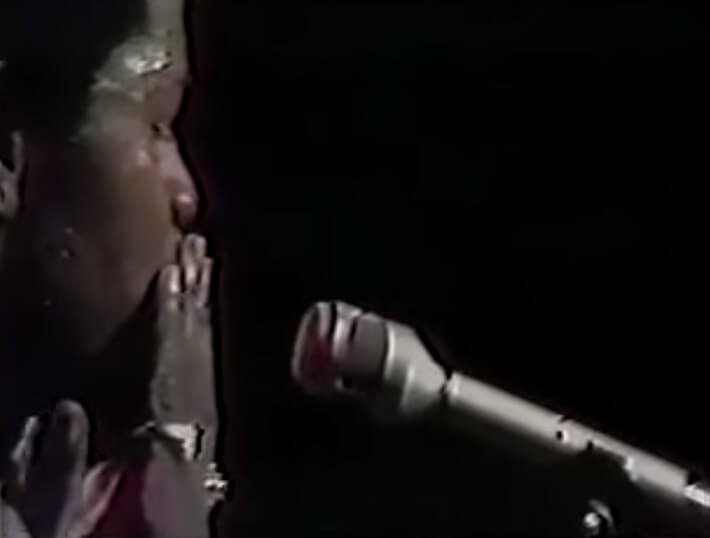
Ultimately, these televised teen dance shows encourage us to expand the range of sounds and images we associate with black youth in the South. It takes nothing away from the young men and women who risked their lives to desegregate schools and lunch counters to recognize that thousands of teenagers found joy and value in dancing on television or watching their peers do the same. If the iconic civil rights images from cities like Little Rock, Greensboro, and Birmingham attest to the fact that young activists struggled to be treated as first-class citizens, The Mitch Thomas Show, Teenage Frolics, and Teenarama emphasized that black youth were worthy of being first-class consumers and teenagers.72On the relationship between citizenship and consumption, see Lizbeth Cohen, A Consumer's Republic: The Politics of Mass Consumptions in Postwar America (New York: Alfred A. Knopf, 2003); Robert Weems, Jr., Desegregating the Dollar: African American Consumerism in the Twentieth Century (New York: New York University Press, 1998); Victoria Wolcott, Race, Riots, and Roller Coasters: The Struggle over Segregated Recreation in America (Philadelphia: University of Pennsylvania Press: 2012).
About the Author
Matthew Delmont is associate professor of history at Arizona State University and author of The Nicest Kids in Town: American Bandstand, Rock 'n' Roll, and Civil Rights in 1950s Philadelphia (University of California Press, American Crossroads series, February 2012), and Why Busing Failed: Race, Media, and the National Resistance to School Desegregation (University of California Press, American Crossroads series, forthcoming February 2016). He is currently finishing a book titled Making Roots: How an Epic Book and Television Miniseries Made History and Why Roots Still Matters (under contract with University of California Press).
]]>