How To Navigate
We’ve arranged Stand & Witness as a guided tour. We recommend that you move through the exhibition according to the numbered tour stops or “hotspots.”
To start the guided tour, click (don’t hover over) the red hotspot located at the first stop. Once clicked, the embedded video and navigation will load. The navigation will indicate the stop, for instance, at the first stop, it will say “1 of 10.” There are forward and backward arrows to move to the next and previous stops.
To view the videos in fullscreen, click the left-facing arrow located in the bottom right of the embedded video player to reveal “Show controls” and then click the “Fullscreen” button.
If you lose your way, click the magnifying glass at upper left corner of the screen, then click on the hotspot where you left off or would like to go next. On a mobile device, you’ll need to click the upward-facing arrow next to “10 Items” to reveal hotspots.
Introduction
In many ways, artists are first responders—to repurpose a term often used in public health. Soon after COVID-19 shutdowns began in March 2020, artists took to their studios, desks, and Zoom to bear witness to the pandemic and the tragic experiences of morbity and mortality that upended millions of lives. Throughout the pandemic, artists continued to serve on the emotional frontlines of COVID-19 interpretation.
Unlike the 1918 influenza pandemic, which is often referred to as the “forgotten pandemic,” COVID-19 took place in an era of global connection and social media, allowing for new audiences and shared artistic production. While scientists worked to understand the novel SARS-CoV-2, many artists leaned into the disruption that COVID-19 caused, discovering innovative strategies to interpret the impact of the pandemic individually and collectively. Artists across the globe investigated the heartbreak, poignancy, and isolation of the pandemic. Some turned to forms of humor. Novelists and poets wove narratives. When theaters were forced to close, performers found innovative ways to stage their productions and attracted new audiences on Zoom. Impelled by the pandemic, artists from around the world gathered online in August 2020, for the Edinburgh International Festival’s “Artists in the Age of Covid.” They examined new work and forms. They pondered the future of the arts, post-pandemic, and they asked, “what is the irreplaceable impact of the arts?” Stand & Witness: Art in the Time of Covid addresses that question.
Stand & Witness: Art in the Time of COVID-19 brings together an international group of artists, poets, authors, and performers to help us understand the individual and collective experiences of a pandemic that reshaped cultures and societies.
The title Stand & Witness is excerpted from “From 'Trading Riffs to Slay Monsters',” a poem by Yusef Komunyakaa and Laren McClung published in Four Quartets: Poetry in the Pandemic, (North Adams: MA, Tupelo Press, 2020).
Sponsored by the David J. Sencer CDC Museum, Office of Communications and the CDC COVID-19 response. Additional support provided by the Consulate General of Canada to the U.S. Southeast. The Stand & Witness exhibition ran from June 17–October 25, 2024 at the CDC Museum in Atlanta.
About the Authors
Louise E. Shaw served as curator of the David J. Sencer CDC Museum from 2002-2023, where she developed history and art exhibitions relevant to the work of CDC and public health. Previously she led Nexus Contemporary Art Center (now Atlanta Contemporary Art Center) and served as assistant curator at the Atlanta Historical Society (now Atlanta History Center).
Heather E. Rodriguez (contractor, Chickasaw Nation Industries) is the assistant curator at the David J. Sencer CDC museum. During her time at the museum, she has spearheaded the COVID-19 Collection Project and helped curate several exhibitions. Her areas of interest are the intersections between public health, sex, race and ethnicity, and United States culture.
Steve Bransford is senior video producer at the Emory Center for Digital Scholarship.
Public Health in the US and Global South is a collection of interdisciplinary, multimedia publications examining the relationship between public health and specific geographies—both real and imagined—in and across the US and Global South. These essays raise questions about the origin, replication, and entrenchment of health disparities; the ways that race and gender shape and are shaped by health policy; and the inseparable connection between health justice and health advocacy.
Beginning in 2022, the series expands to include 1000-word blog posts, as well as longer commentaries, essays, articles and media productions that address the public health and political implications of the COVID-19 pandemic from multiple perspectives. The series editor for Public Health in the US and Global South is Mary E. Frederickson.
Introduction
One night in the spring of 2006, I found myself on the edges of Richmond, Virginia’s Shockoe Bottom neighborhood with a group of reluctant adolescents from my church youth group, Holga camera in hand. Prone to light leaks thanks to its plastic body, the Holga was a toy camera that allowed me to shift from 35mm to medium format 120mm film. What I liked most about the Holga was its less-than-automatic approach to winding through the frames. With a half turn, one could capture images on top of each other, creating a visual palimpsest of moody, blurred, and imperfect scenes. Walking along the James River, I could see ripples of water over my right shoulder while sounds of cars racing along the highway crept into my left ear.
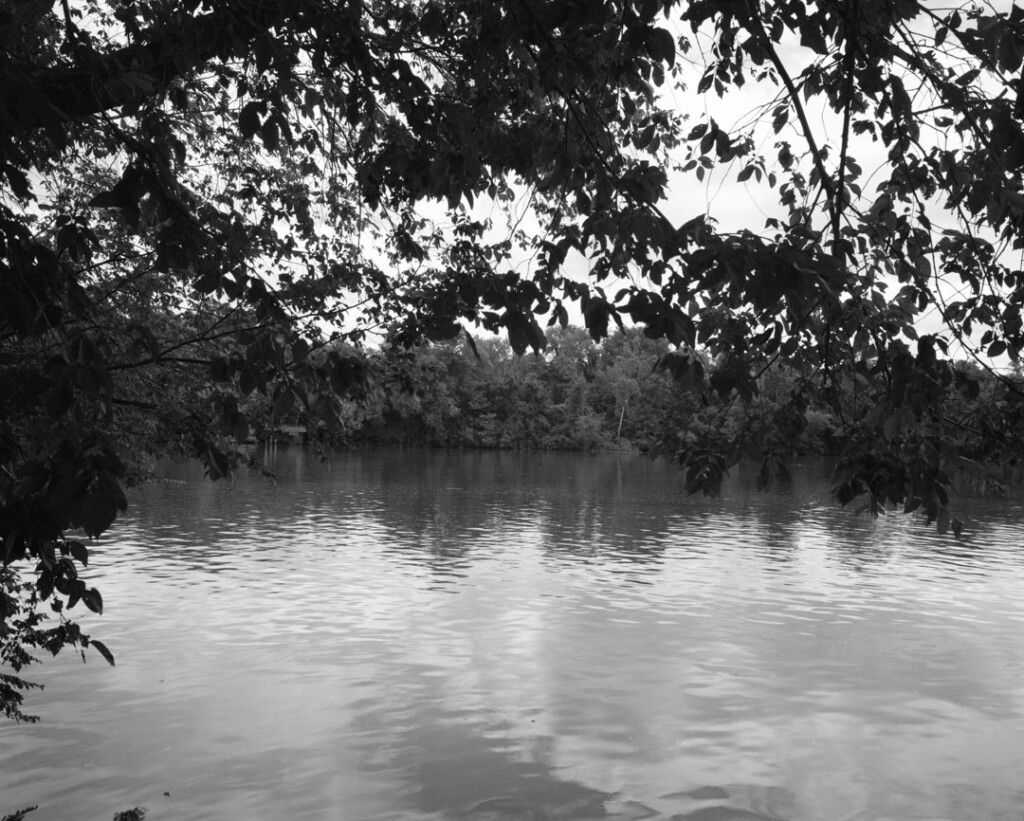
Our local historian tour guide took us down the river path while detailing the experiences of the enslaved. She spoke about how they emerged from the hull of the ship in complete darkness, after months at sea, disoriented, terrified, and unable to communicate with their captors and, in some cases, with each other. She asked us to close our eyes and imagine what it would be like to stand there, chains rubbing away at our wrists and ankles, as we were dragged along towards an unfathomable fate. The next week I developed the film in the dark room at school. My favorite image, which I submitted to workshop that week, was a shot of my tour guide, looking off into the distance, the nearly barren branches of trees etched uncannily across her face. Her body and the natural world merged into one.
How do you represent the horrific legacy of slavery without the bodies of the enslaved? Historically, abolitionist writers and editors built their political critiques on these vulnerable bodies. This manifested as a hyper-focus on the enslaved body as a site/sight of physical domination under the various machinations of white terror. This representation of Black pain, suffering, and duress proliferated with the spread of photography. From the images of lynched bodies in the post-emancipation era, to the photos of civil rights activists being beaten by police in the 1960s, to our contemporary moment of hyper-surveillance and police brutality, US society can view Black suffering’s ever-mounting evidence.
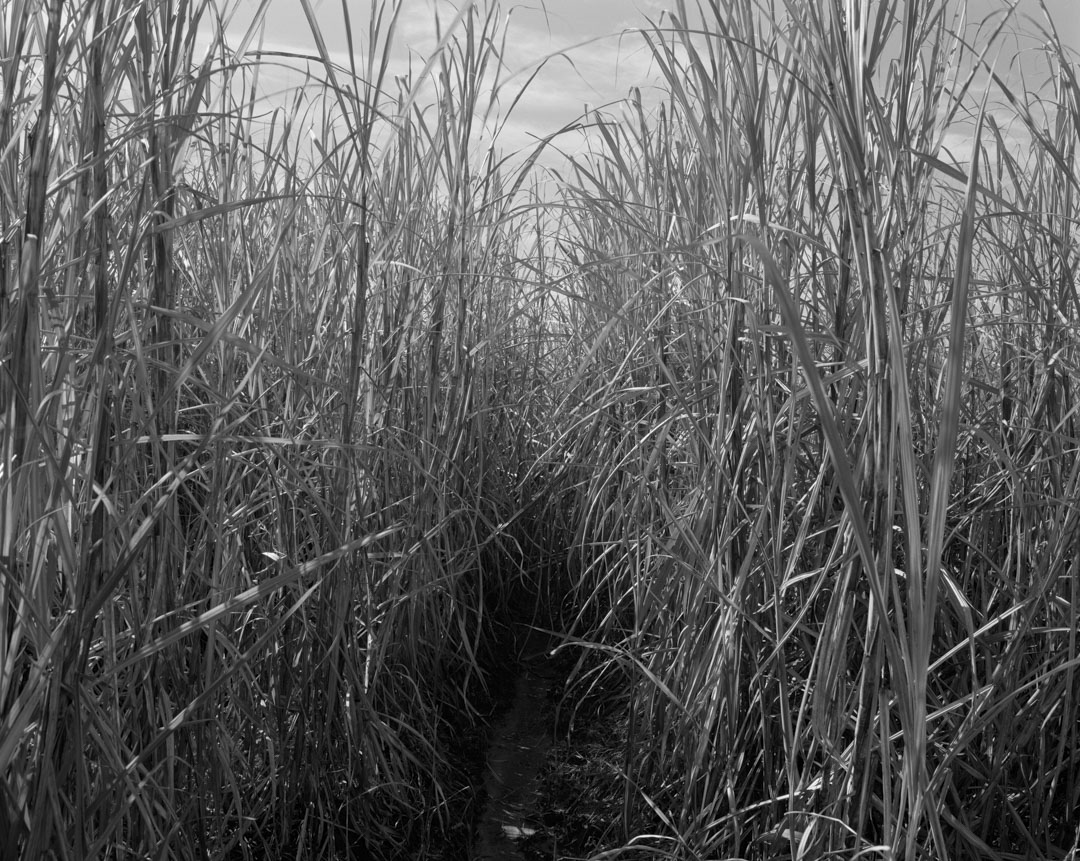
Photographer and visual artist Dawoud Bey explores the history of slavery through landscape photography in his exhibition Elegy which I visited in January 2024 at the Virginia Museum of Fine Arts. Elegy features three photographic collections and two short films that address the legacy of chattel slavery across landscapes in Virginia, Louisiana, and Ohio.
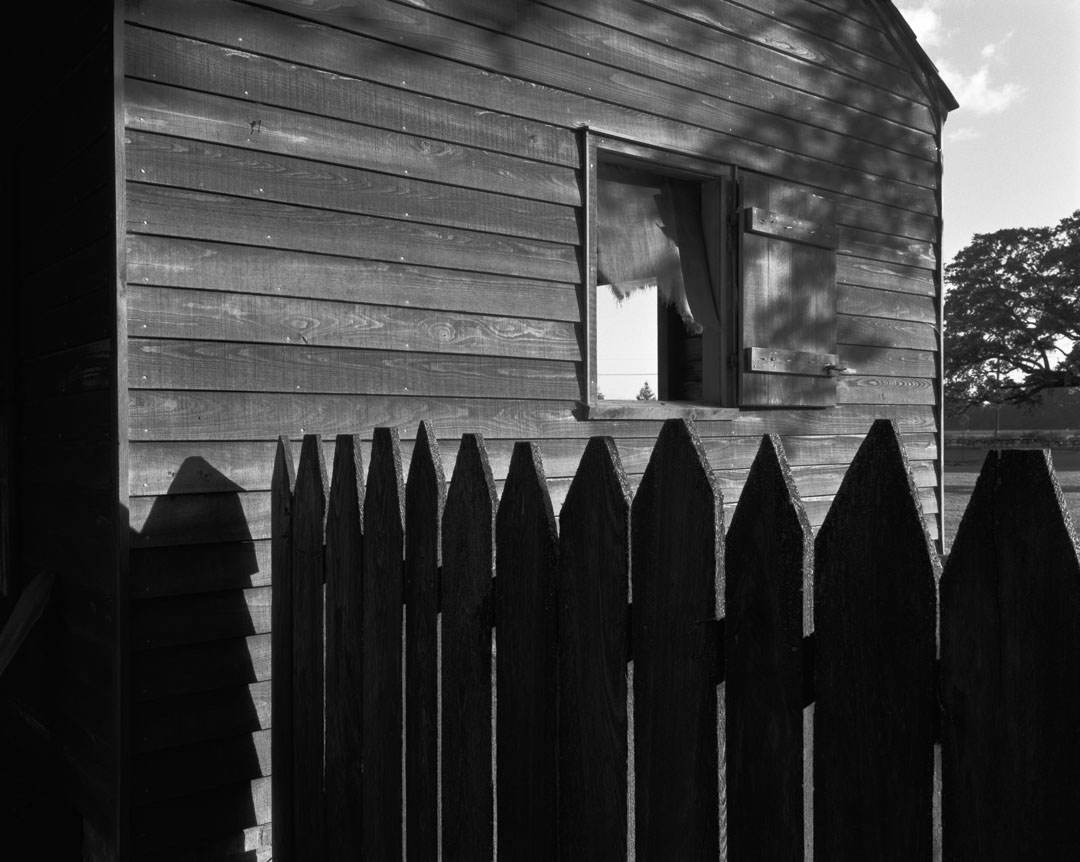
Born in 1953 in Queens, New York, Dawoud Bey, ever drawn to sound, aspired to be a musician before he became a photographer. Bey received his BFA in Photography from Empire State College in 1990, but his career began in New York in the 1970s where he developed a distinct street style featuring predominately Black subjects in everyday life. Influenced by James Van Der Zee and Roy DeCarava, Bey spent much of his career photographing Black faces. Looking through images from collections such as Harlem USA, Class Pictures, or The Birmingham Project, it feels as if you are inundated by the unrelenting gaze of Bey’s subjects staring directly into the camera. Such a dynamic inverts expectations; the subjects are looking at us, into or through us, with as much intention and discernment as we direct towards them.
Compared to his previous work, the large-scale landscape photography featured in Elegy asks viewers to see, and hear, the haunting presence of slavery projected against the landscape without the anchoring presence of Black bodies or Black faces. Bey’s most recent work allows us to recontextualize nature photography by eschewing the innocence of the pastoral scene in order to understand how the bodies of the enslaved, fugitive in their varying trajectories, maintained complicated relationships with nature on American soil. Elegy also contends with the legacies of slavery in the landscape when historical revisionism and erasure has paved over the evidence.
“Stony the Road We Trod” & “350,000”
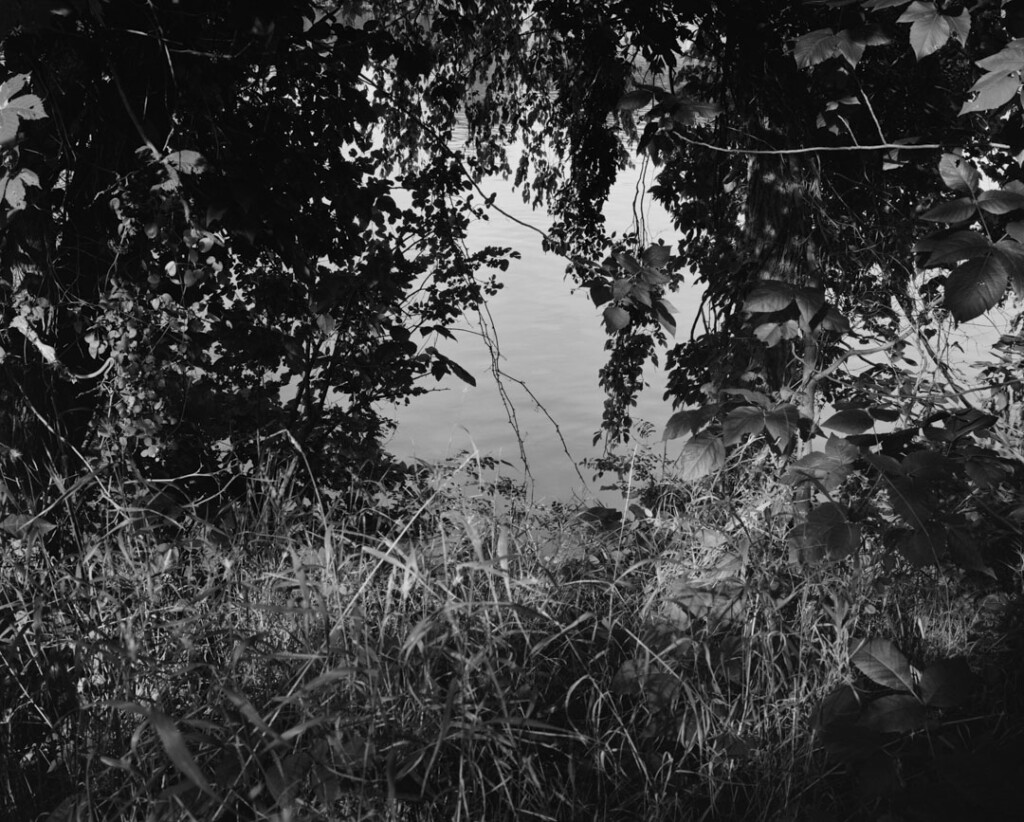
The first section of Bey’s Elegy, “Stony the Road We Trod,” (a lyric from James Weldon Johnson’s “Lift Every Voice and Sing”), features large-scale gelatin silver prints of the slave trail in Richmond. Tracking the route the enslaved took from Manchester Docks to Shockoe Bottom, Bey examines the landscape along the James River with a botanist’s eye. Each image presents the trail from different perspectives, each shot painted in varying tones of light and shadow that create depth and texture. You imagine the tall stalks of grass prickling your calves, the creeping vines of the foliage wrapping themselves around your ankles, and the overhanging branches grazing the sides of your face; you concede to the invasive nature of the landscape. To see the landscape this closely, one would have to get dirty and bend to the level of the soil. There is no way to keep yourself clean. When the camera pulls back, the fullness of the path feels almost endless. The light peeks through the trees, promising a new twist or turn, but there is a sense that it may never stop.
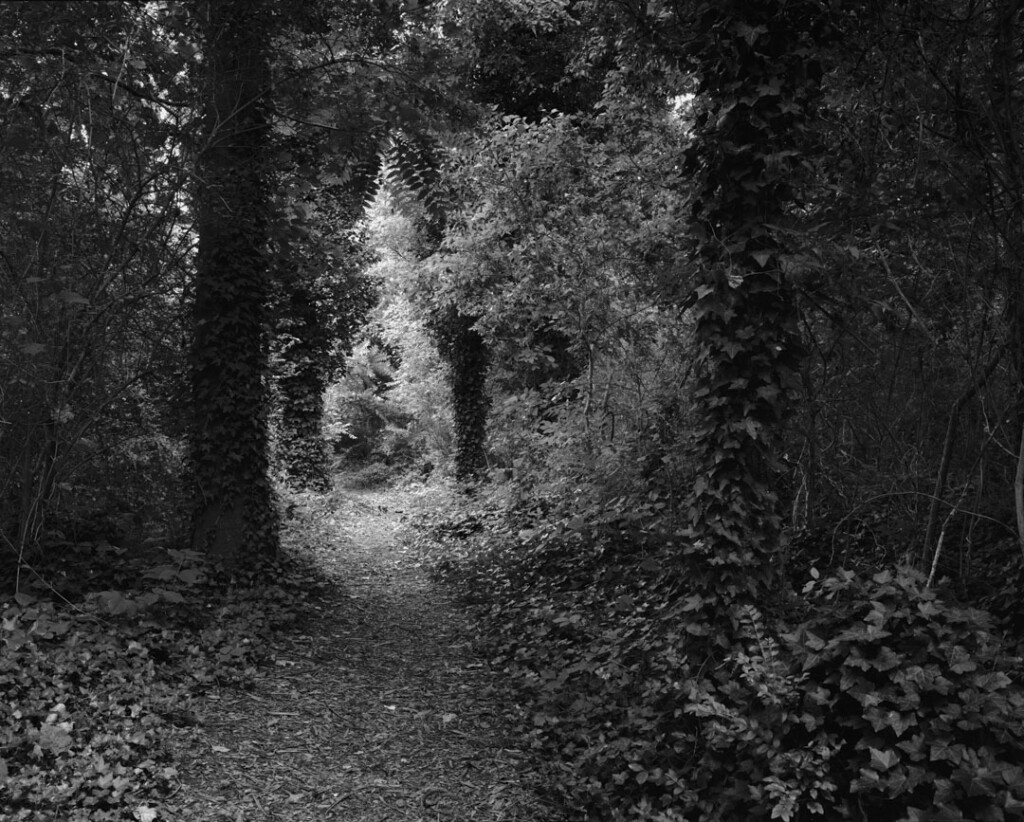
The first of Bey’s two short films, “350,000,” realizes this interminable momentum by offering the perspective of thousands of enslaved persons who traveled along the trail from the middle passage into bondage. Entirely in black and white, “350,000” is presented as a single extended tracking shot which relies on a haunting soundscape to situate the audience within the sensory experience of bondage. The film begins as it ends: with breath, not calm, but a sharp and sudden gasp, like the sound of a drowning body finally breaking through the line between water and air. This sound echoes Christina Sharpe’s concept of aspiration or “keeping and putting breath back in the Black body” within the “hostile weather” of an anti-Black climate, an act both “violent and life-saving.”1Christina Sharpe, In the Wake: On Blackness and Being (Durham, NC: Duke University Press, 2016), 113. The trail is covered in fallen leaves and enshrouded by the endless overhang of trees transitioning from late summer to autumn. Tree limbs refuse to stand upright, but bend inward from left and right, curving into an asymmetrical spiral of light, shadow, and texture. There is some semblance of shade for bodies unseen, but also a sense of being enclosed or entrapped.
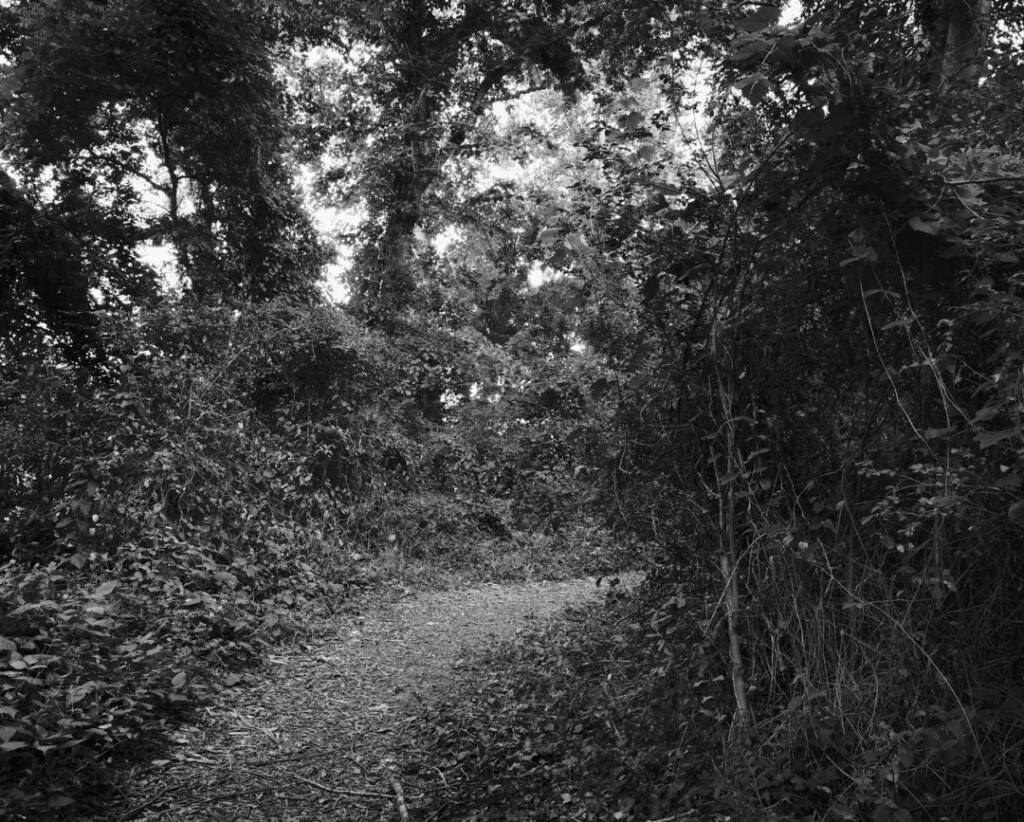
As the camera leads viewers down the winding path, there are slow pans to the left and right, from water to thicket, always searching for stability or familiarity in a strange and dangerous landscape. Even with the constant momentum, there are moments of stillness. The sounds of horse hoofs or rattling chains hover. The camera points upward, lingering on the daylight breaking through the shadows of branches and looming patches of grey-white sky. Photographed in a manner often reserved for flashback or dream sequences, the edges of the screen remain soft and blurred. The lack of any discernable body is disorienting, unmooring, echoing the experience of those trapped for months in the hull of a slave ship. Sound is the only anchor: audible labored breathing; guttural exhalations and moans slipping into a rhythmic chanting; the rattling of chains that resemble windchimes.
Bey collaborated with dance and movement scholar E. Gaynell Sherrod to choreograph “350,000”and sound designer Paul Bruski at the In Your Ear Studio in Richmond. The soundscape uses Foley techniques as dancers perform, sometimes barefoot, walking across dirt and gravel while holding large metal chains. While dancers often train to stifle or quiet the sound of their breath, Sherrod makes the labored breath of the dancers more audible, in the absence of their physical form.2Dawoud Bey, Gaynell Sherrod, and Imani Uzuri, “Soundings: Collaborations with Dawoud Bey” (Conversation/Panel, Virginia Museum of Fine Arts, Richmond, VA, February 9, 2024). Dancers’ bodies disappear and reform through sound, pulling viewers along slowly and reluctantly through the terrain.
“In This Here Place” & “Evergreen”
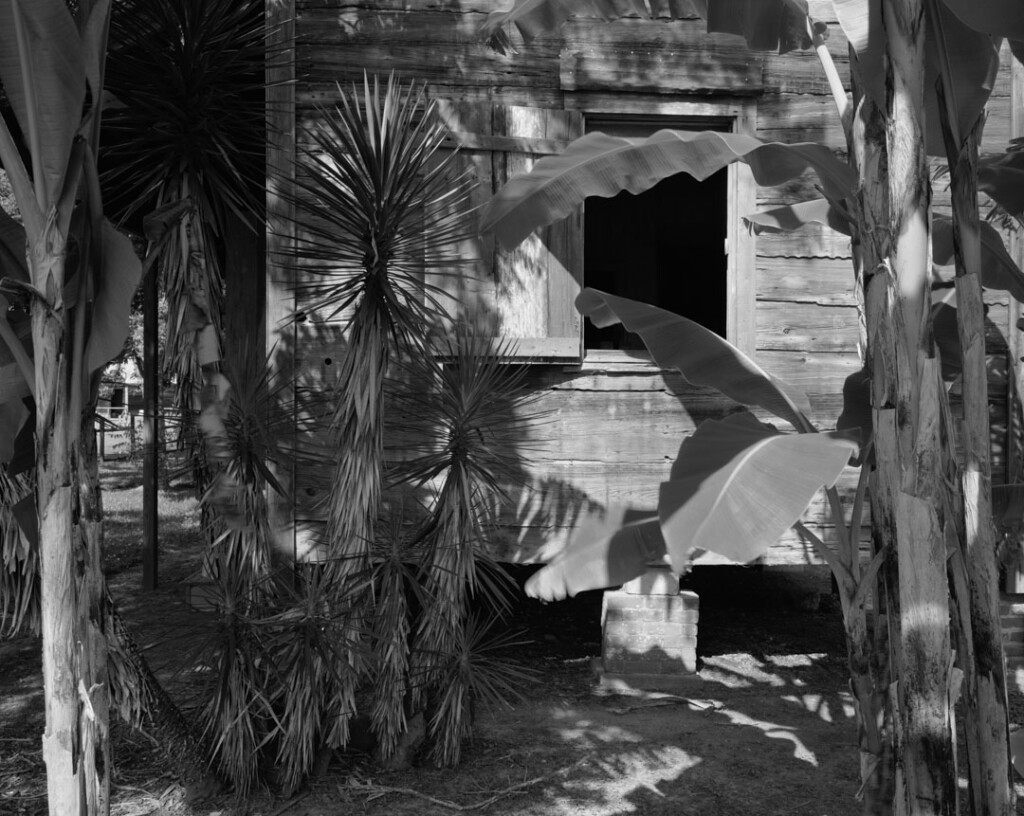
Elegy returns to the photographic on the remains of defunct plantations in Louisiana. “In This Here Place” presents a collection of images from the Evergreen, Oak Alley, and Whitney Plantations along the Mississippi River between New Orleans and Baton Rouge, capturing the slave quarters, some still intact and others commandeered by trees and wild shrubs. These antiquated cabins seem familiar. Looking at Bey’s 2019 “Overgrowth and Fence,” the barely visible cabin swallowed by the bare branches of invasive trees and tall weeds, I am reminded of many neglected houses, once owned in predominately Black neighborhoods in the Deep South, now abandoned on the outskirts of towns.
Many of the images have a spectral quality: each cabin houses the absent-presence of the enslaved. In “Cabin and Benches” the structure is surrounded by long, wooden, unoccupied benches, each shaded by large trees outside the frame. On one side, a rickety wooden shutter is swung open, revealing a small rectangular window blocked by a white curtain pulled back ever so slightly to reveal a tall, thin, black rhombus of darkness. I was convinced that at any point, bodies might emerge from the grey foreground mist, walk towards me, and sit down for some well-deserved rest. In “Cabin and Palm Trees,” the side of the cabin is almost completely obscured by varying leaves of the palm trees—some broad and flat, others a starburst of dense spikes. The window, this time unveiled from the domestic softness of the white curtain, reveals a tall black square, a void from which it felt like someone, shrouded in darkness, could be looking directly at me.
“In This Here Place” takes its name from Baby Suggs’ sermon in the clearing of Toni Morrison’s novel Beloved. Baby Suggs implores Black children to become and be seen, Black mothers to laugh, and Black fathers to dance for their children and their wives. She reminds the members of her community, many who sought their freedom by way of fugitive paths, to love themselves, fully and deeply, precisely because of the white world outside the safety of the woods. “[They] ain’t in love with your mouth,” Baby Suggs announces to the crowd, “they will see it broken and break it again. What you say out of it they will not heed. What you scream from it they do not hear.”3Toni Morrison, Beloved (New York: Vintage Books, 1987), 82. Apt then that “Evergreen,” the second of Bey’s short films featured in Elegy, presents a scream that cannot be ignored.
While “350,000” guides viewers to a single, unbroken shot on one screen, “Evergreen” is a colorful triptych that inundates with multiple shifting visual perspectives. On one screen, the camera hovers over the tops of the trees, moving slowly, as if floating, revealing the rust-tinted tin rooftops of the cabins of the enslaved. Another screen drops to ground level, cutting back and forth between close ups of the lush green grass and sharp stalks of sugarcane leaves piercing from the dirt towards the sky. On a third screen, the camera slowly pans from left to right, one cabin after another, their exterior walls stained with dark copper strokes of rust and oxidation, each one precarious on crumbling brick pillars. As soon you take in one shot on any screen, it switches. The vast perspective of “Evergreen” is awe-inspiring and, at times, overwhelming. I sat through multiple showings, trying to take in one screen at a time, but left feeling there was more to absorb.
The visual palate of “Evergreen”—red-yellow leaves across the ground, brown-blue-green of moss and mold on trees and cabins, and the bright/dull greens of grass and rusty rainwater pooling on the ground and in metal basins—blurs the pastoral and architectural decay. The soundscape intensifies the experience. Bey worked with vocalist and composer Imani Uzuri to articulate the narrative perspective of “Evergreen” where the camera does not reflect a human experience, but that of the disembodied spirits of the enslaved floating and hovering above and across the land.4Dawoud Bey, Gaynell Sherrod, and Imani Uzuri, “Soundings: Collaborations with Dawoud Bey” (Conversation/Panel, Virginia Museum of Fine Arts, Richmond, VA, February 9, 2024). Whispered words, familiar to those who grew up in the Black church, emerge from everywhere and nowhere: come by here, somebody’s praying, just like a dream, there is peace in the valley for me. Unmoored sounds of hands clapping or a tambourine beating echo throughout. Suddenly, a single extended utterance bursts forth, bending between a scream and a wistful soprano note quickly shifting back into a wail. In “Evergreen,” sounds and words intertwine, crashing into each other at an abrupt speed which approaches and dodges the legibility of music and voice. Uzuri offers us Black sound, harmonious and cacophonous, that refuses categorization; musicality stretched to the furthest comprehension.
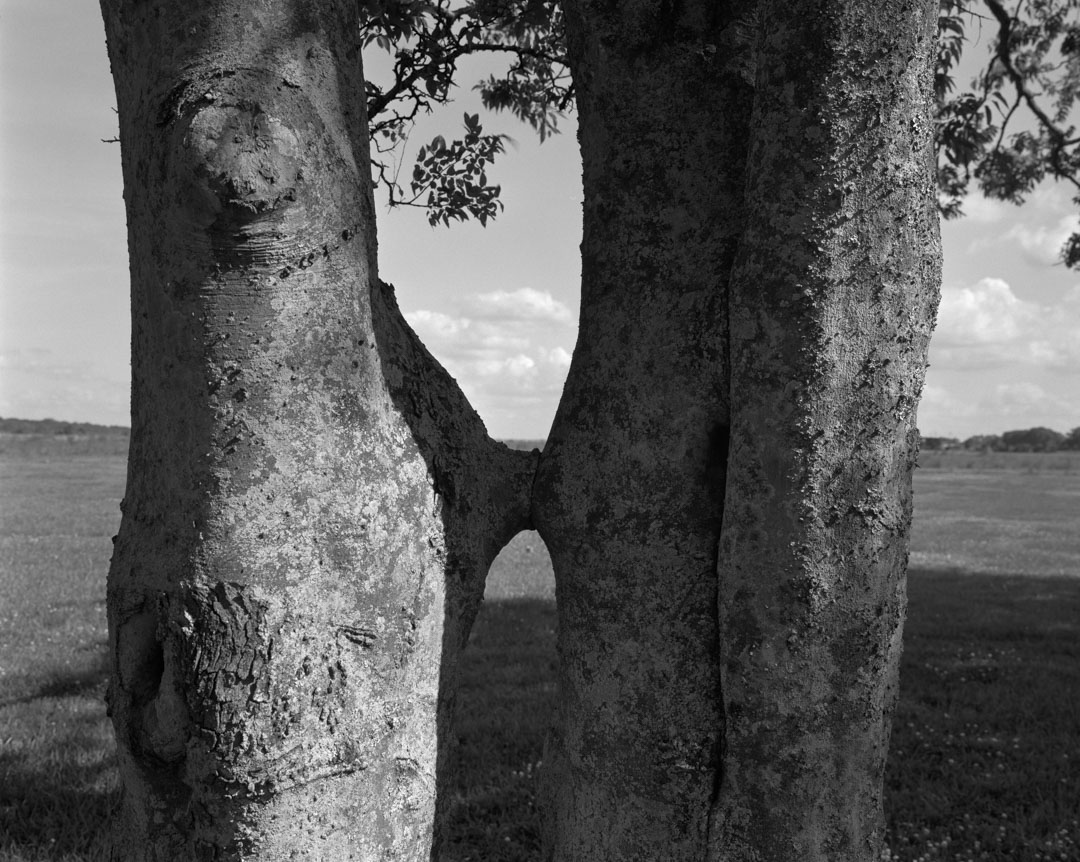
The final shot on the center screen of “Evergreen” is, again, one long tracking shot along the center path of the plantation, this time pulling backwards. Viewing the cabins from this vantage, I was struck by the stark architectural uniformity. Each cabin, equidistant and perfectly mirrored, reminds us that this space, these structures, were not only a landscape of suffering, but a community filled with a legally and culturally vulnerable population. Comparing this shot to images such as “Conjoined Trees and Field” and “Irrigation Ditch,” I notice how Bey deploys center composition to create symmetry and balance that emphasizes a single focal point, usually the subject, in an image. Bey often forces the eyes on a central path, a safe space to visually travel along a hostile territory. Both of these photographs and the last shot in “Evergreen” acknowledge and interrogate the linearity of history. While “350,000” moves viewers forward, assuming some level of literal and conceptual “progress,” we also understand that, for the enslaved, a predatory path unfurled. Pulled backward across the center at "Evergreen," we ask, what force carries us and to what end?
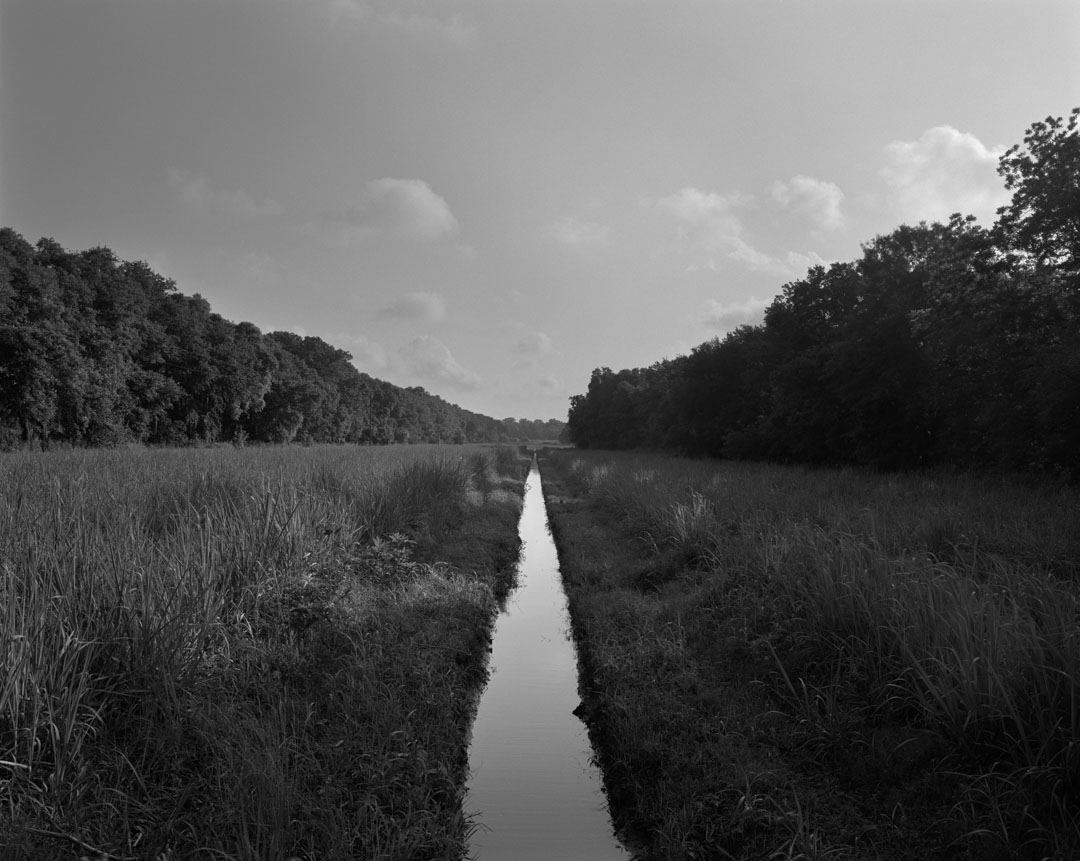
“Night Coming Tenderly, Black”
The title of my review comes from a line in Saidiya Hartman’s Scenes of Subjection where she argues for the “opacity” of “black song” as a phenomenon that “troubles the distinctions between joy and sorrow and toil and leisure."5Saidiya Hartman, Scenes of Subjection: Terror, Slavery, and Self-Making in Nineteenth-Century America, Revised and Updated Edition (New York: W.W. Norton, 2022), 54. In this, Hartman eschews the “overdetermined reading of the sounds of slavery”6Hartman, Scenes of Subjection, 30. prescribed by twentieth century Black thinkers such as W. E. B. Du Bois, and directs our ears to the more powerful, and at times less legible, “wild notes” of the enslaved, composed in part by the “screams lodged deep inside” that “confound simple expression . . . of black enjoyment.”7Hartman, Scenes of Subjection, 55.
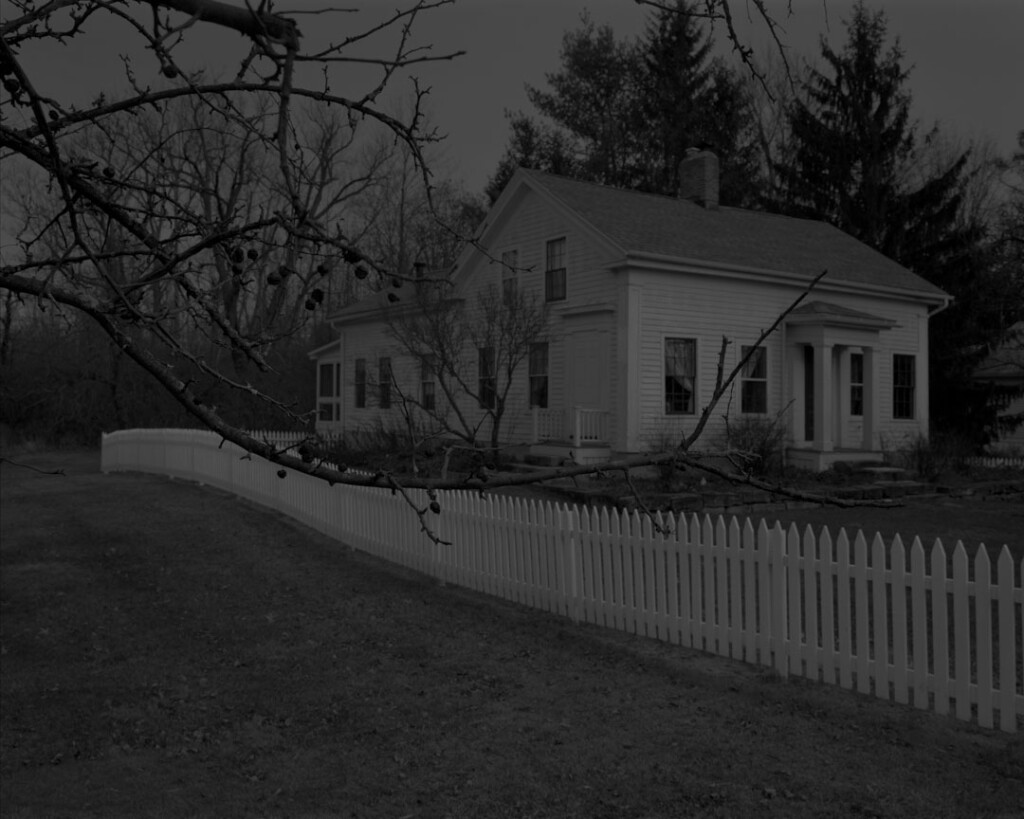
In the almost 160 years since the legal dissolution of slavery in the United States, photography and film have articulated the overdetermined image and, eventual sound, of slavery within the imagination. In both “350,000” and “Evergreen,” Bey’s exclusion of Black bodies forces viewers into a complicated simulacrum of enslaved embodiment. His films interrupt our culturally sedimented expectations not only of what slavery looks and sounds like, but also how it should be experienced. There are no clear heroes or villains in these films, no sense of a triumphant victory of good over evil, not even a sense of who, if anyone, we are following. However, in the midst of this disorientation, we remain anchored by the density of Black sound; we continue to listen through the cacophony to make sense of the experience, not through historical logic, but through a bodily reaction to what unfolds on the screen.
Coming down from “Evergreen,” I entered the final section of Elegy: “Night Coming Tenderly, Black,” its title taken from the last lines of Langston Hughes' poem, “Dream Variations.” This series of photos explores landscapes near Lake Erie in Ohio and Canada and traces the fugitive experience of enslaved persons who liberated themselves, often in the cover of night, from the bondage in southern states. Paying homage to photographer Roy DeCarava, these low-light prints hone the conflicting experiences of fugitivity, wherein a vast, beautiful, open landscape signals exposure and vulnerability while the claustrophobic cover of tree branches means safety and protection. On my way out, I was struck by the last photograph positioned to the right of the exit: a dim shot of Lake Erie, its grey waves rolling into the horizon.
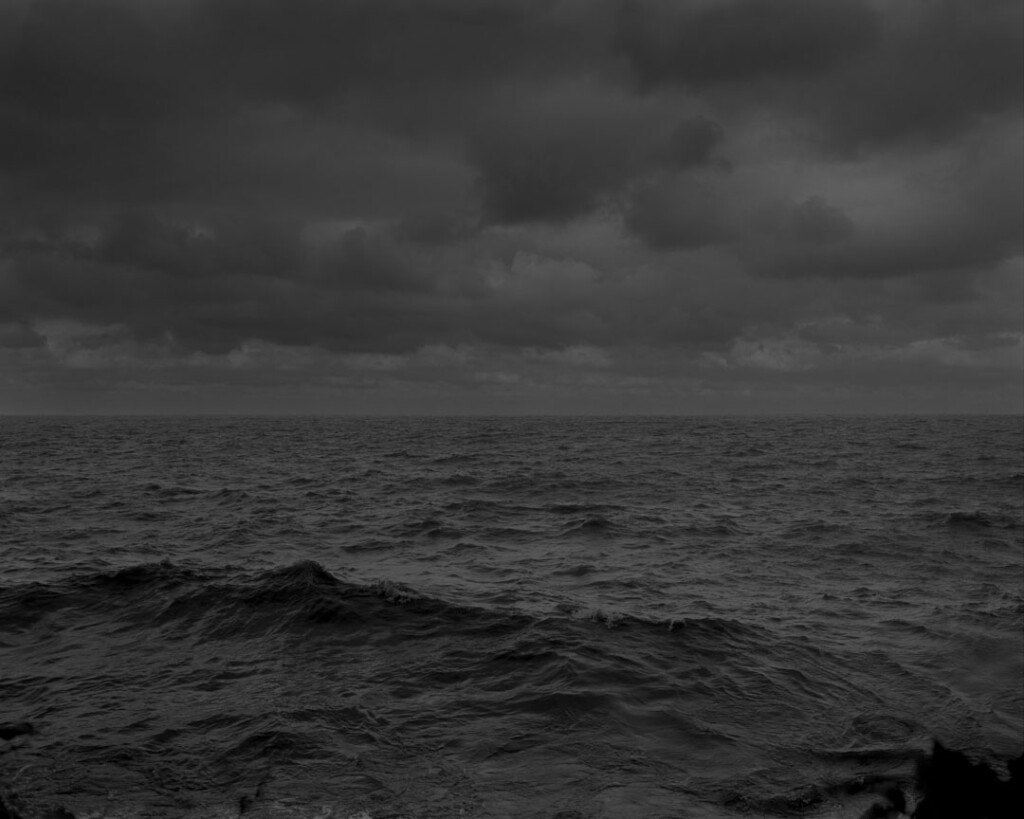
Within the full context of Elegy, viewers can understand the impact of this scene. The slow march from the Manchester docks, from Virginia through the Carolinas, Georgia, Alabama to the plantations of Louisiana, and the perilous journey from the Deep South to the northernmost parts of this country, has prepared us for this sight. If “350,000” began with a painful, sharp gasp, this shot of Lake Erie gestured towards a cathartic exhalation.
Leaving Bey’s exhibit, my mind was abuzz: What ethics, if any, are applicable to the ways that we consume the visual lexicon of slavery? Can the cacophony of Black sound that Bey so intricately deployed bring audiences to understand not only Black pain, but Black humanity? Mostly importantly, returning to the image Lake Erie, can any one photograph, detached from its critical context, represent the history of slavery so often erased and buried? When looking at non-descript images of a nature trail or even sugarcane stalks, do we need to hear the density of Black sound to understand what we are looking at? Elegy is, across all five sections of the exhibit, a fully immersive sensory experience which asks audiences to find in the American landscape a history that time and “progress” has obfuscated. As I exited, I could not shake the thought that, to an untrained or inexperienced eye, the difference between the waves of the James River and the waves of Lake Erie—let alone the currents of the Atlantic as seen from the hull of a slave ship—might be difficult to discern. In which direction does the water flow towards freedom? 
About the Author
Ariel Lawrence is a PhD candidate in the English Department at Emory University. Her research focuses on Black women-authored lifewriting across multiple genres, and the articulation of ethical reading practices in and beyond the page.
]]>Introduction
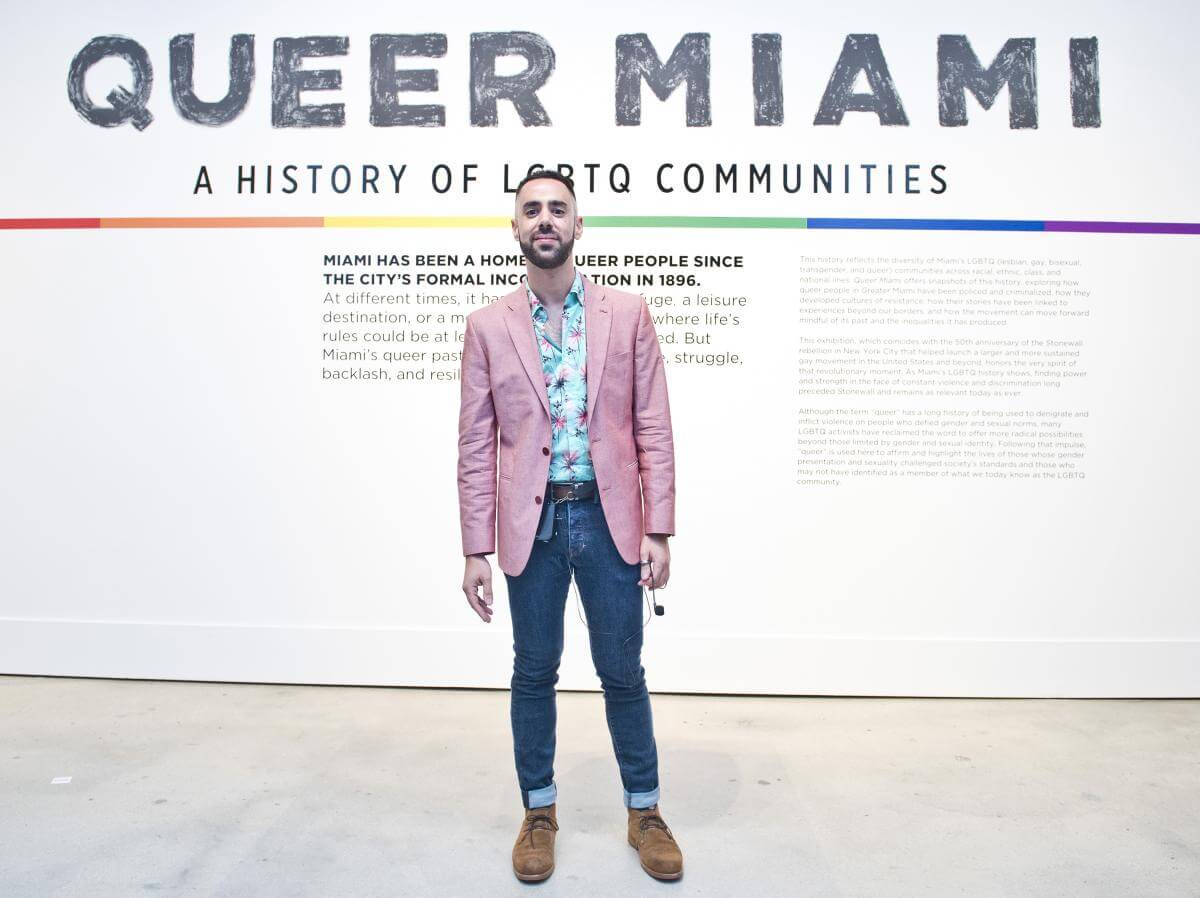
Julio Capó Jr. is a proud Miamian, and much of his work reflects detailed attention to the history of LGBTQ Miami. After seven years at the University of Massachusetts Amherst, Capó returned to his native Miami in the fall of 2019 as an associate professor in the Department of History and the Wolfsonian Public Humanities Laboratory at Florida International University. His first book, Welcome to Fairyland: Queer Miami Before 1940, explores John Sewell's 1933 notion of Florida as "a playground for the Nation" specifically through his deployment of "queer as an analytical tool" with "which to understand contested meanings of nation, race, belonging, and citizenship" in Greater Miami from the 1890s until 1940.1See Julio Capó Jr., Welcome to Fairyland: Queer Miami Before 1940 (Chapel Hill: UNC Press, 2017), 24, 5, 8. Capó explores how influential powerbrokers and everyday people contributed to the process of transforming "Miami into an 'exotic' tropical fairyland linked to the Caribbean and available for purchase."2Capó, 1. "Miami," he writes, "is geographically situated in the U.S. South and tucked in the northern section of the Caribbean Basin."3Capó, 7. Capó's Welcome to Fairyland interprets Miami as "linked to the Caribbean" and as part of a larger US landscape in a historiographical tradition of employing "a transnational lens in the recovery of queer voices, lives, and experiences."4Capó, 7. Queerness is the central analytical tool through which Capó explores Greater Miami. In his history, Capó traces Miami from its early days as a "queer frontier" to how it sustained a reputation as "a site where one could transgress gender and sexual norms."5Capó, 4. The 1950s saw Miami's queer landscape radically change once more, with the 1959 Cuban Revolution and other Cold War era political and cultural shifts. Many bemoaned the fear of losing "Miami after Dark."6Capó, 287.
In this and other ways, Welcome to Fairyland expands the terrain of queer history and southern studies. While it focuses on a seriously understudied period before cogent sexual identities had fully crystallized, the study has important implications for later queer histories with which readers may be more familiar. This includes mid to late twentieth-century narratives of state attacks in the form of the 1956–1966 Florida Johns Committee and Anita Bryant's 1977 Save Our Children campaign. Capó reveals the importance of casting further back to trace organizing strategies Miamians have utilized and how they may serve a more inclusive and socially just present and future.
Capó's curation of the exhibition Queer Miami: A History of LGBTQ Communities with the HistoryMiami Museum (March 15, 2019–September 1, 2019) examines how queer people "carved out spaces for themselves in southern Florida" across the twentieth century. For this interview, I asked Capó about Welcome to Fairyland, the HistoryMiami Museum exhibition, his plans for the future, and his thoughts on the state of queer history.
Welcome to Fairyland: Queer Miami Before 1940
SOLOMON: How did you come to write Welcome to Fairyland? What personal pathways led you to this project? Are there other histories or historians that motivated and inspired you?
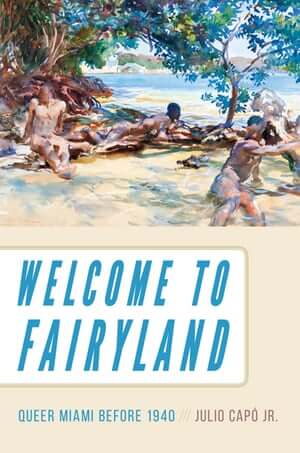
Capó: First, let me thank you for the opportunity to share my work and thoughts with you and your readers. I am most grateful. Welcome to Fairyland developed organically and with quite a bit of urgency as I continued to think historically about questions at the intersection of sexual, racial, class, and gender injustice that take many different forms today. I began revising my dissertation, which was a history of LGBTQ Miami in the post-World War II era that paid particular attention to immigrant populations and experiences. I grew frustrated by assumptions I had to make about what pre-1940 Miami looked like. For starters, there were relatively few queer community studies of the early twentieth century, especially for locations in the US South. Miami's history differed greatly from cities we know much more about, such as New York, San Francisco, and Chicago. Never taken too seriously by most scholars, Miami remains a deeply understudied city. As election polls and media reports often suggest, it remains misunderstood by political strategists and advisers. While many people are quick to point the finger at Florida (and cities like Miami) when the votes are counted (or not counted), they are often given few opportunities to better understand its complicated past.
As a historian, I've always believed the past offers us the possibility of instruction and inspiration. It is generative in that we understand the social, political, economic, and cultural architecture on which today's city stands. So, in a nutshell, I went back to the archives hoping to write one concise chapter on queer Miami before the 1940s. My first major find appeared in the criminal records that, once I paired that data with immigration records and colonial records from the Bahamas, taught me that Bahamian male migrant workers were disproportionately arrested for crimes such as sodomy in the city's early days. I realized that this was not a mere chapter in my book. This was very much its own story that deserved all my attention. This was the book I needed to write. And it challenged me to think differently about the research I had already conducted on the mid and late twentieth century.
Solomon: What personal pathways led you to this project?
Capó: My goodness! It's an embarrassment of riches in terms of inspirations for writing Welcome to Fairyland. I have already suggested how social and political injustice inspired me to ask questions that proved most productive in my research. But I also believed that to understand Miami's transnational history, the city's queer past needed to be in direct conversation with arguments and debates that have also taken shape in the fields of gender, Black, southern, Caribbean, immigration, Latinx, and labor and class history. I thought a lot about how scholars such as Cathy Cohen, José Esteban Muñoz, Siobhan Somerville, and Martin Manalansan, among many others, have treated queer as an analytic. I drew inspiration from how Eithne Luibhéid, Marc Stein, Margot Canaday, Amy Sueyoshi, and Nayan Shah have discussed the state's surveillance of immigrant bodies both at the US borders and within them. I found thoughtful transnational approaches in the works of Lara Putnam, Ana Raquel Minian, Andrew Sandoval-Strausz, and so many others. I wanted to contribute to the growing scholarship of Miami's ethnoracial demographics, Caribbean influences, and long history of class warfare that scholars such as N. D. B. Connolly, María Cristina García, and Melanie Shell-Weiss have laid out. And I wanted to expand the parameters and scope of the LGBTQ community study, with its emphasis on space and place, that George Chauncey, Nan Alamilla Boyd, John Howard, among so many others, have set forth. This barely scratches the surface, but I hope it gives a sense of what I was thinking, more broadly, as I approached the archives, the evidence, and the literature as I wrote Welcome to Fairyland.
Solomon: In his 1997 oral history, James T. Sears mentions Florida as the "Mississippi of the homosexual" in the immediate decades following when Welcome to Fairyland ends.7James T. Sears, "The Mississippi of the Homosexual and the Politics of Dialectics," in Lonely Hunters: An Oral History of Lesbian and Gay Southern Life, 1948–1968 (Boulder, CO: Westview Press, 1997). Sears's rhetorical move has always resonated with me, and I mention and challenge it in my first project. I'm from Mississippi, but I've written about Florida extensively. You're from Florida, and Welcome to Fairyland is set in your native Greater Miami. Yet, your study stops before the years (1948–1968) Sears is referencing. How important was it for you to illustrate in detail the development of queer spaces in Miami in terms of your temporal framing?
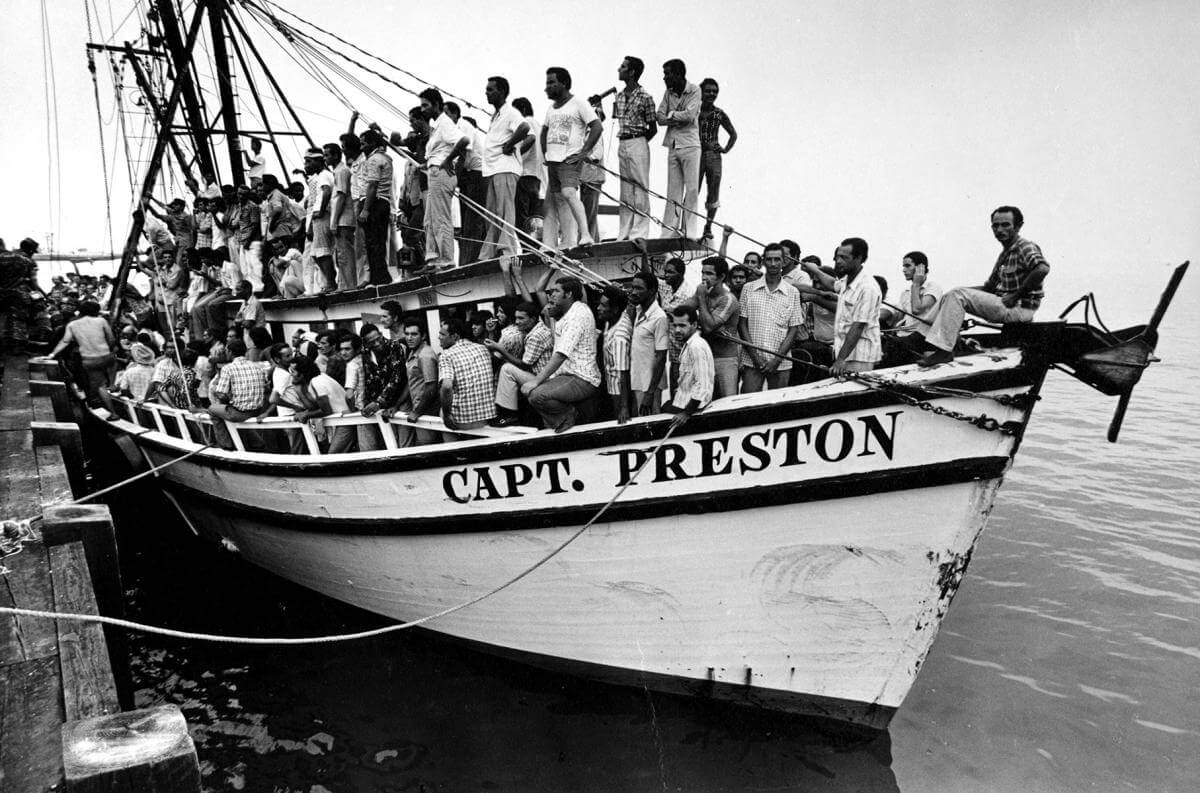
Capó: Wow, there's a lot to unpack here. Thanks for this important provocation. You know, even though Welcome to Fairyland ends in 1940, as the book's epilogue may suggest, I know quite well what happens in Miami after the 1940s. I wrote a dissertation and have curated an exhibition about that very history. I wanted to understand its origins. At least at the surface, people may be more familiar with the recent history. They have recollections of anti-gay violence spurred on by the Johns Committee, Anita Bryant, the Mariel Boatlift, and more. As I unpack in Welcome to Fairyland, this past is often really violent. It is also, however, a story of queer resistance and resilience.
More directly, what does such a loaded statement mean: Florida was the "Mississippi of the homosexual." Because its framing seeks to make a clear parallel to ground zero for Black civil rights at midcentury, the statement also inherently asks us to separate race and sexuality and imagine anti-Black violence—as well as anti-gay violence—as somehow separate and as possibly contained to a particular geography. One of the events I examine thoroughly in my book, for example, involves the 1937 raid of a Miami gay bar named La Paloma that was conducted by nearly two hundred members of the Ku Klux Klan.
Queer histories have historically been rooted and entangled with—in nuanced and checkered ways—anti-Black violence.
I'm more inclined to think of it this way: Florida was the "Florida" of Blacks and people of color; much of the same anti-Blackness and colonialism created the very conditions for Florida to become the "Florida" of the homosexual. I wonder how scholars such as John Howard would respond to this, as his book Men Like That encouraged us to question our assumptions about the US South, its relationship to gender and sexual liberation and racial politics, and even our perception that liberation was somehow more attainable in urban, rather than rural, spaces, or perhaps even the "North" rather than the "South."
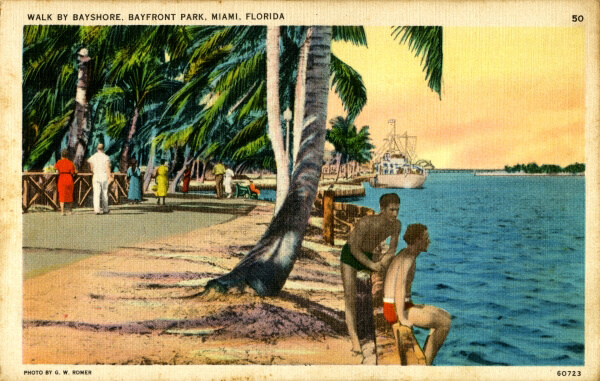
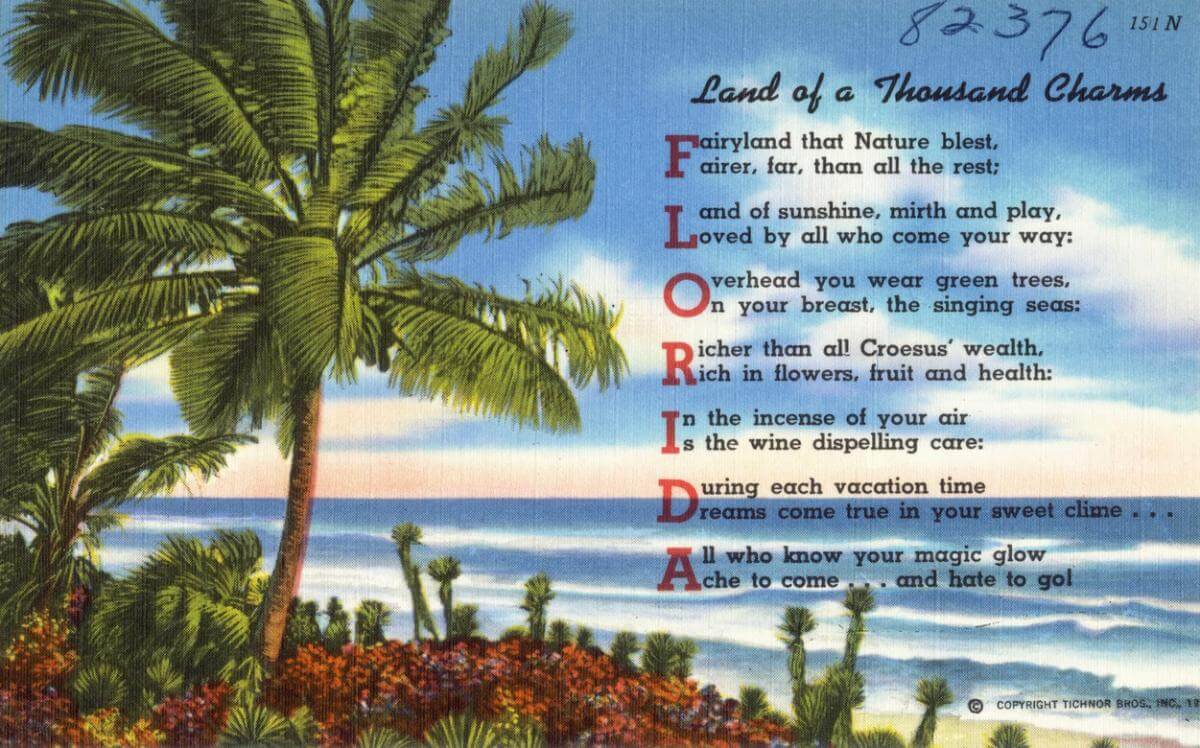
I'm thinking here about the uses and misuses of teleological arguments, but Sears' provocation is a great jumping point for our exploration of temporality and liminal spaces within "the past." Like your reference to growing up in Mississippi, I was born and raised in Miami and, in writing Welcome to Fairyland, I was struck by how much of the history I uncovered in my research had been lost to us. In other instances, I found that this history wasn't exactly lost, but rather made incoherent and illegible. Viewing the watercolors John Singer Sargent produced in early Miami takes on radically new meaning when we pair it with the city's criminal records, or immigration logs, for example. Watching Marilyn Monroe in the 1959 film Some Like it Hot, once you have studied the history of Prohibition at the Miami-Caribbean borderlands, suggests that contemporaries seeing it for the first time might have understood the critical relationship that politics had in sustaining and creating queer communities and culture. Although many of our pasts have indeed been institutionally erased, others have simply lost their meaning over time and are hidden in plain sight but very much alive in meaningful and impactful ways. No one may call Miami "fairyland" anymore; but that moniker's association with doubt can still be found in the area's ongoing efforts to draw in outsiders.
Solomon: Welcome to Fairyland deploys "queer as an analytical tool" and "interprets queer history by maintaining a transnational perspective and by providing an intersectional analysis that factors in how gender and sexuality influenced constructions of class, race, ethnicity, age, and (dis)ability."8Capó, 5. Queer. Transnational. Intersectional. How do you understand the connections between these three terms for your work?
Capó: I think the analytics of queer, transnational, and intersectional are doing a lot of the same work in the book, but in distinct ways. In general they all exist, and I'll shamelessly look to Gloria Anzaldúa for inspiration in Borderlands/La Frontera: The New Mestiza, defying static, singular, fixed positions or statuses. The queer has us move beyond the binary and think expansively about subversion and transgression as it is measured against the normative. A transnational perspective rejects the nation-state and the neat categories it seeks to produce as the dominant form of power and structure. An intersectional approach dictates how different modes of power can simultaneously coexist and that forms of oppression are indeed interlocking and impossible to separate. They are all in flux, fluid, and subject to change. For me, these are the ingredients to doing this history and important and necessary approach for measuring change over time and place.
Solomon: For those seeking to develop research projects or thinking of doing queer history, can you describe the journey of Welcome to Fairyland? How long did the book take you to write? Is the finished project what you thought it would be when you started?
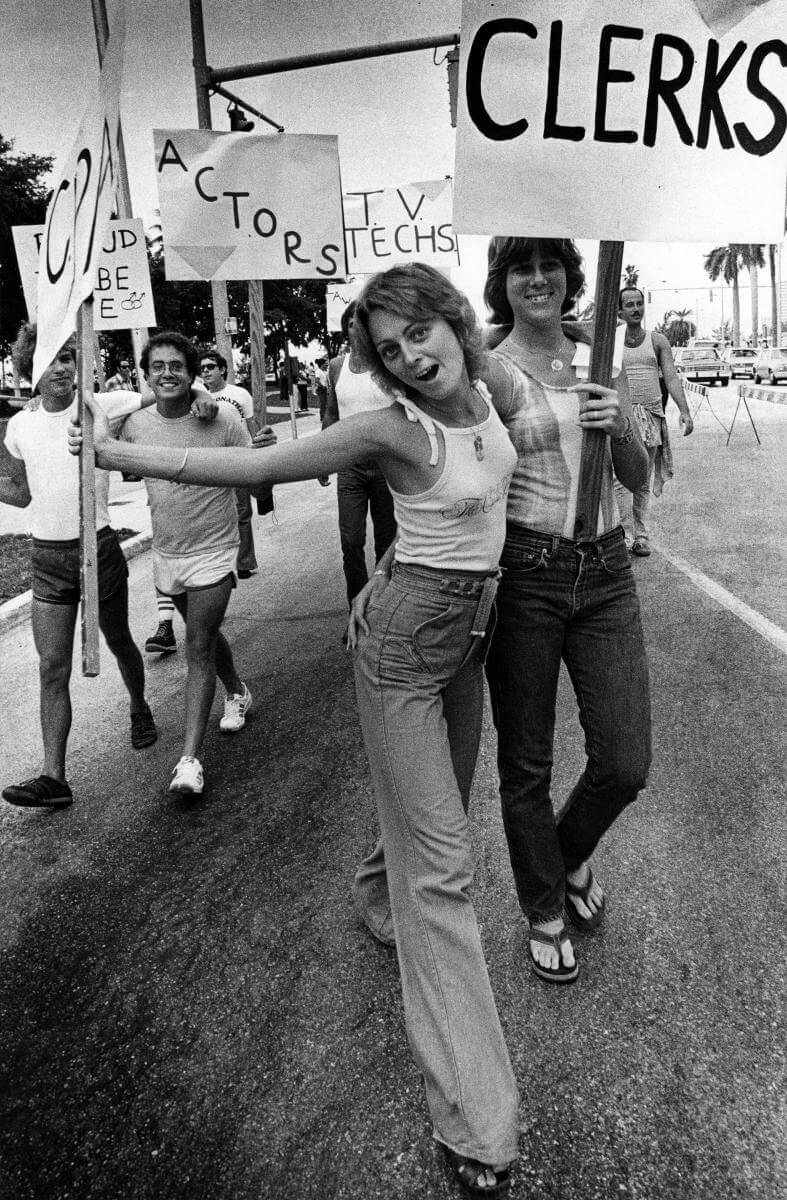
Capó: I've addressed aspects of this already, so I'll just add a few more thoughts. I think I'm a pretty disciplined writer. I'm a former journalist (still contributing to journalism, but now as a trained historian) who understands the importance of deadlines, the mythologies surrounding things such as writer's block, and the necessity of carving out time for writing every day. From concept to page proofs the book took about five years, as I began it during my postdoc. I am really proud of the final product. Once I had processed all the evidence, I realized I had a lot of things I wanted and needed to say. I've always been hyperaware that this history is meaningful, and in very different ways, to many different people—past and present. I'm sure some may not fully appreciate my treatment of the evidence and material, but a work now exists that acknowledges this history as significant and as critical to multiple histories.
I can't really say Welcome to Fairyland was the book I initially sought to write because this book came to fruition as I worked to revise a separate project from discoveries in the archives and from my efforts to respond to gaps in our knowledge. It speaks to the issues I thought—and still think—need much more attention.
Queer Miami: A History of LGBTQ Communities: Miami Across the Twentieth Century
Solomon: You write about the silences within and erasures of the queer archives, drawing from Martin F. Manalansan's understanding of "disarrangements." You also mention your own collecting of historic ephemera as a practice that directly informs your work. What are the roles of historians and nonacademic collectors in preserving queer history?
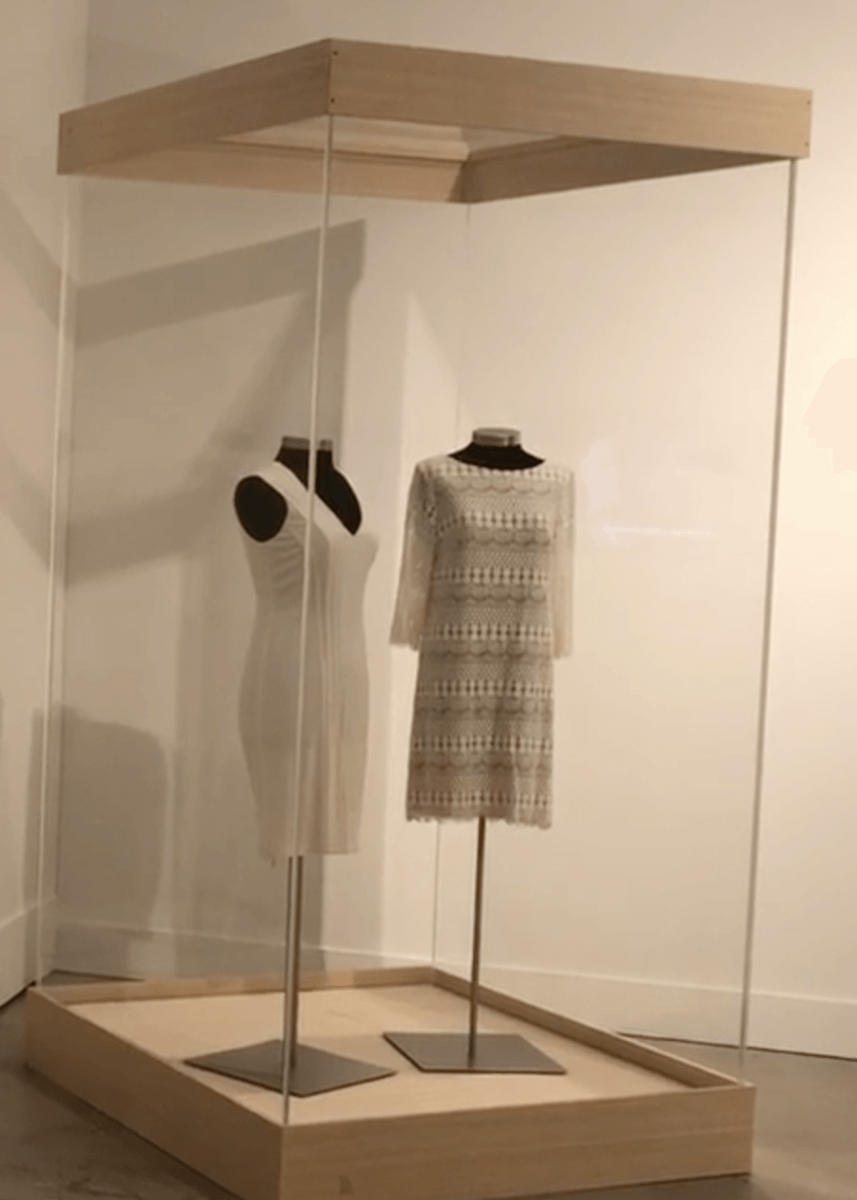
Capó: There's so much one can say about this, but I'll try to keep it somewhat brief. I think preservation is a key part of activist work. Much of the field of queer history stems from tireless community-based efforts to collect and preserve our past and make it known. Certainly, for the years I address in Welcome to Fairyland, our histories were never meant to be preserved. Those in power sought to erase us. They still do. We have to fight back, but we also have to think harder about how to respectfully recover the voices of those most marginalized within these marginalized groups. And we have to think harder about what constitutes an archive, a legitimate source or evidence, and the places where we can find them.
Many of the sources in Welcome to Fairyland, and perhaps a third of the material objects featured in the exhibition I curated in Miami, are from my personal collection. I have collected t-shirts, piggybanks, postcards, dolls, photographs, letters, rare books, and so many more items—over nearly fifteen years. I've been able to find and acquire some objects through search engines and simple keywords, such as "gay Miami." I think I've been able to piece together something else entirely, though, through my reading and rereading of Miami's past. Things that may not have appeared inherently "queer" at first can be given new meaning in context. I also think I've earned the trust and support of many members of Miami's LGBTQ community, who feel equally invested in recovering this past and having it told and preserved. I am from Miami and I'm openly gay. Over a decade ago now, I worked as an intern at the Stonewall National Museum and Archives in Fort Lauderdale, where I helped catalog some of its unprocessed materials it housed there, especially its Anita Bryant collection. What I want to stress is that this work takes time and dedication. It is, indeed, a community effort.
Solomon: In terms of the Queer Miami exhibition: can you describe your process of curating? How much of your research from Welcome to Fairyland informed or served as foundation for the exhibition? How did your collaboration with the HistoryMiami Museum come about?
Capó: The exhibition covers a bit before the 1890s to the present. That's over a century of material. I had never curated anything before, so I did my homework! I read a lot about the curatorial process, consulted with colleagues and friends, and visited as many exhibitions as I could with a very different eye: as a curator-to-be. This was such a productive and challenging experience for me. I absolutely loved it. I learned so much and have connected with so many members of the community.
Much of the narrative of Queer Miami took shape from threads of Welcome to Fairyland and my dissertation on the post-1945 era, but there are many differences. Unlike a book or an academic article, I had to tell an engaging narrative through objects or other visuals. That's often difficult, especially for the earlier period. We reproduced some ordinances, portraits, paintings, and the like for the early 1910s, but it's very difficult to explain what constituted queerness in Miami when these terms, meanings, and identities were very much in flux and often inchoate; the state also never intended to preserve this history, of course. I did not want this to exclusively be a narrative of criminalization or of surveillance of queer folks, immigrants, the poor, or people of color. I wanted to recover people's voices—as well as their moments of leisure and community-building—whenever possible.
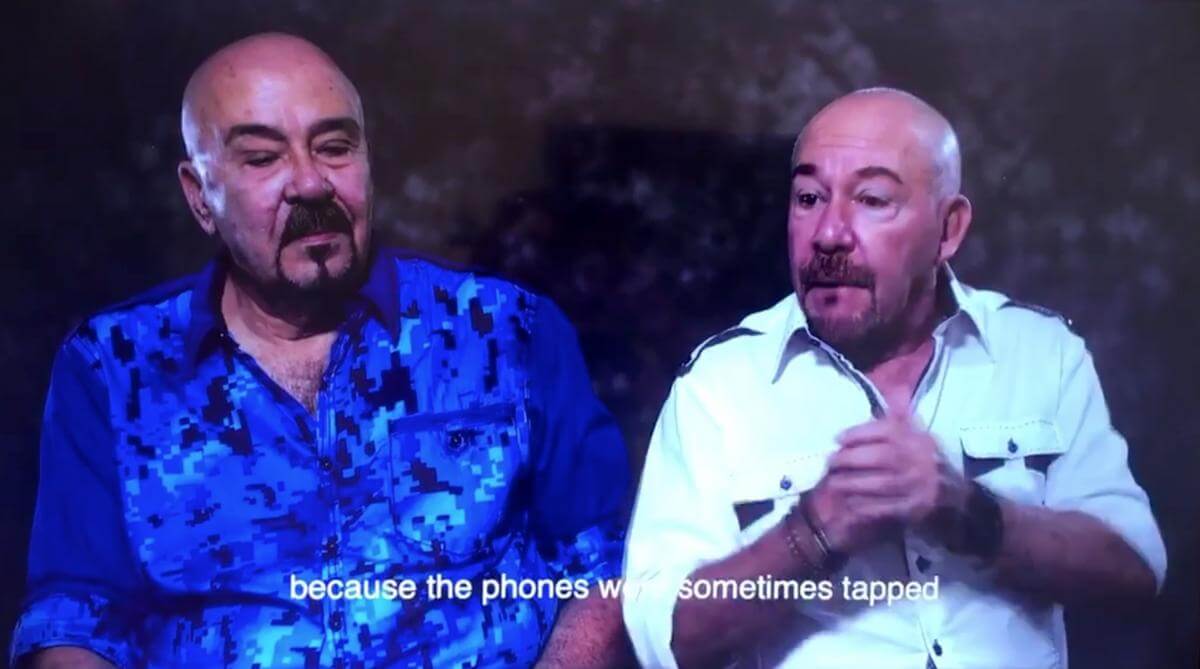
While telling Miami's queer past through objects often proved challenging, an exhibition of this size (five thousand square feet), breadth, and scope permitted me to do a lot of different things. For example, we recovered police footage of gay bar raids (and one at someone's home) from the late 1950s. We recreated a bar counter from that era where people could sit down and watch looped footage of those raids. Altogether, it presents some really powerful testimony. Audiences can see the violence of the state. You see the whiteness of these spaces. Many queer people of color held or attended private parties instead, knowing far too well the risks for them were much greater. You see people fighting back, too. One man throws his drink at the cameraperson, for example. When we think of resistance, we often think of Stonewall-like narratives. That queer people in Miami continued to congregate in and create gay spaces at all—in spite of violence and surveillance—is a testament to their resilience and their efforts to dismantle unjust practices and abuses.
It's productive to challenge ourselves by expanding and redefining our audiences, venues, and methods. I had a similar experience a few years ago when thinking about some of this very same material, but in terms of space and place as part of a study the National Park Service commissioned on LGBTQ historic sites. I contributed a chapter on Miami that narrated existing (surviving) physical sites. This work challenged me to think very differently about material I had been analyzing for years.
Solomon: Can you tell us a little bit about how the Queer Miami exhibit was organized?
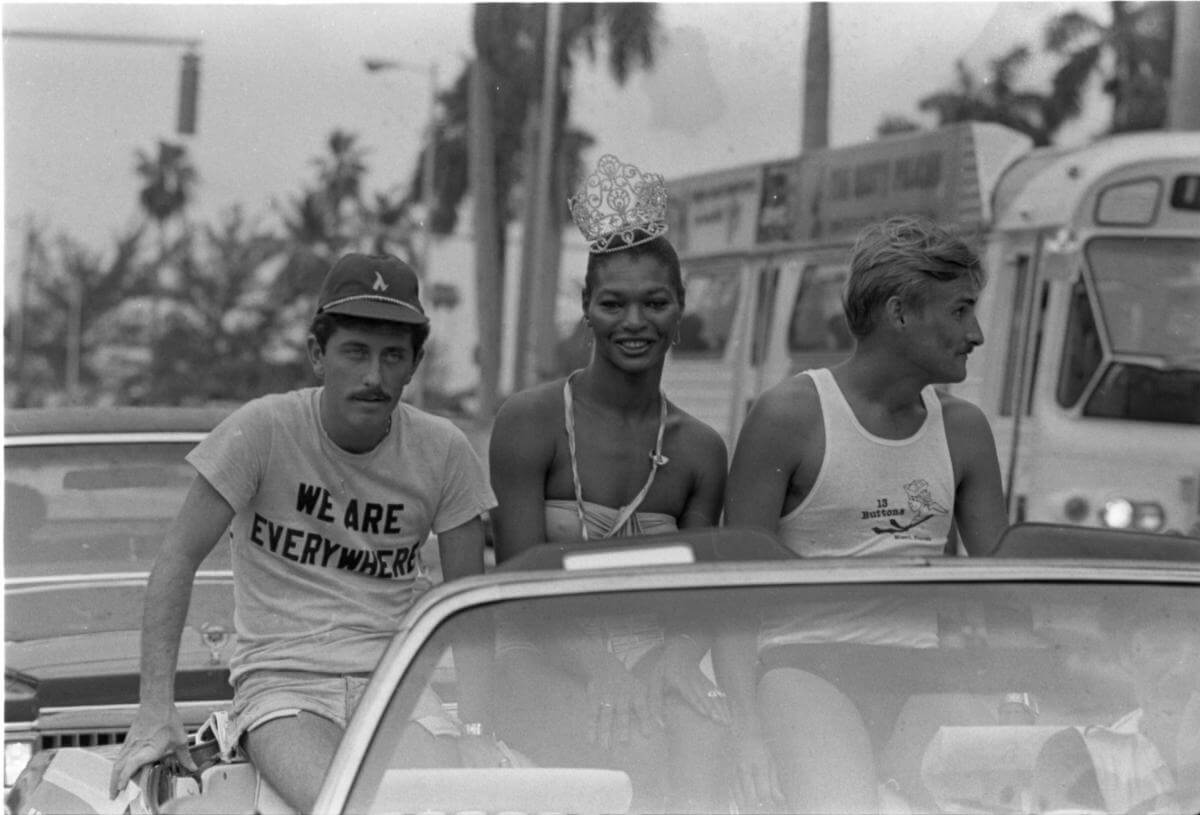
Three participants riding in a car in Miami's first Gay Rights Parade, Miami, Florida, 1978. Photograph by Tim Chapman. Courtesy of the Tim Chapman Collection, HistoryMiami Museum.
Capó: The exhibition represents the diversity of Greater Miami's LGBTQ communities across racial, ethnic, class, and national lines. It offers snapshots of this history, exploring how queer people have been policed and criminalized, how they developed cultures of resistance, how their stories link to experiences beyond our borders, and how the movement can move forward mindful of its past.
Beginning with an introduction to Miami and queer history more generally, the exhibition suggests some of the difficulties of uncovering this past, including the use of terms like "queer," the problem of archives for history never meant to be told, and how Miami's queer history is, despite the many instances of violence and oppression, also one of resilience and resistance.
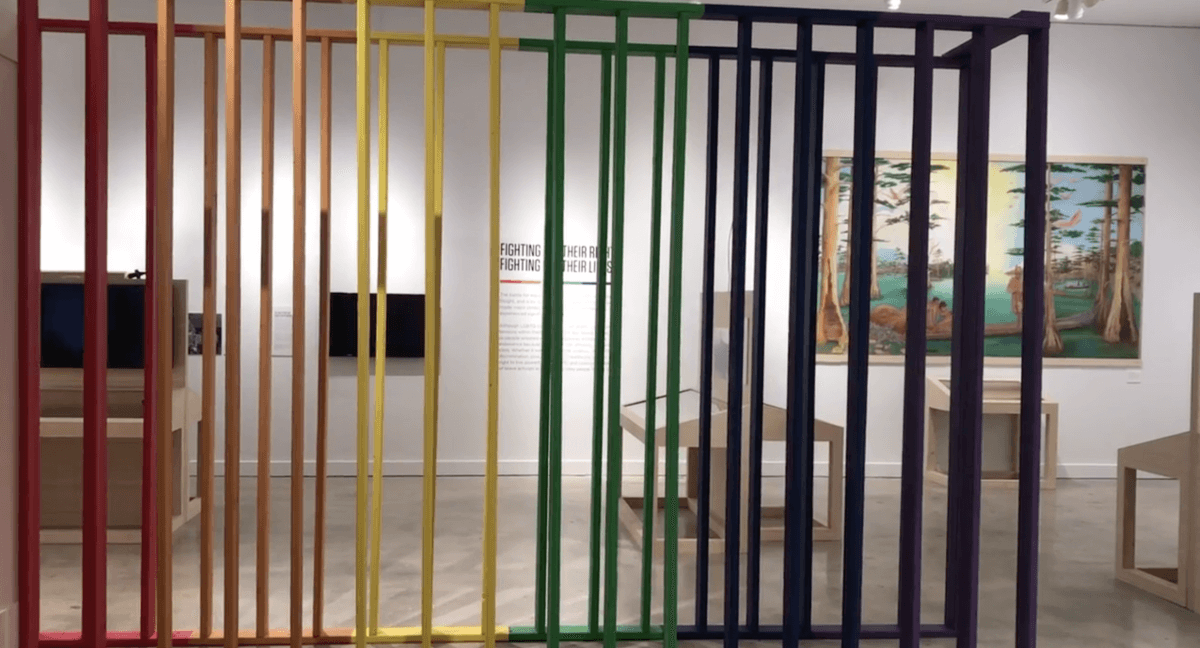
The exhibition is then organized into five sections: 1) Policing, Surveillance, and Criminalization; 2) Community Development, Representation, and Advocacy; 3) Fighting for Their Rights, Fighting for Their Lives; 4) Gateway to the Americas; and 5) Looking Ahead. For the first two, it was important to convey the many ways the state criminalized and surveilled queer people. These sections explore the significance of racist, xenophobic, and anti-Black sentiments in shaping queer culture and spaces and for the formation of strong and creative bonds of resistance. The third section shifts attention to the local and national significance of the 1977 Anita Bryant campaign to overturn a Miami ordinance that shielded gays, lesbians, and bisexuals from discrimination, and to the HIV/AIDS crisis. I wanted to offer a different narrative and chronology, one that highlights Miami's past, rather than ones that are dictated by the telling of Stonewall and other events that have come to dominate our understanding of queer protest, resistance, and change-making. The fourth section observes how Miami's LGBTQ past extended far beyond the city's borders. It's a story with deep roots in parts of the Caribbean and Latin America and must be understood in the context of the Americas. Lastly, the exhibition explores some of the challenges for Miami's LGBTQ people today and highlights many of the organizations and institutions working to improve their lives. We also provide space for people to reflect and leave testimonies of their own histories with the city and offer their recollections and insights. It's a powerful exercise and testament to what liberation can mean when it is committed to social justice in all its forms. I have enjoyed reading these many contributions to the exhibition from visitors more than I can possibly explain.
About the Interviewer and Interviewee
Eric Solomon earned his doctorate in English from Emory University and is a visiting assistant professor of English and American Studies at Oxford College, Emory University. His work is featured in Southern Spaces, south, Pop Matters, and Mississippi Quarterly.
Julio Capó Jr. is an associate professor in the Department of History and the Wolfsonian Public Humanities Laboratory at Florida International University. He is the author of Welcome to Fairyland: Queer Miami before 1940 (Chapel Hill: The University of North Carolina Press, 2017) and curator of Queer Miami: A History of LGBTQ Communities. His work has also appeared in the Journal of American History, Radical History Review, Diplomatic History, Journal of Urban History, Journal of American Ethnic History, Modern American History, GLQ, H-Net, American Studies, and several volumes.
]]>Presentation
Responses
About the Speakers
Kirk Savage is a professor of art history and architecture at the University of Pittsburgh. He has written extensively on public monuments within the theoretical context of collective memory and identity. He is the author of Monument Wars: Washington, D.C., the National Mall, and the Transformation of the Memorial Landscape (Berkeley: University of California Press, 2009) and Standing Soldiers, Kneeling Slaves: Race, War, and Monument in Nineteenth-Century America (Princeton, NJ: Princeton University Press, 1997).
Andra Gillespie is an associate professor of political science at Emory University. Gillespie, who studies racial and ethnic politics in the United States, is the author of The New Black Politician: Cory Booker, Newark, and Post-Racial America (New York: New York University Press, 2012).
Daniel A. Pollock, a longtime resident of Atlanta, is author of the project "The Battle of Atlanta: History and Remembrance."
]]>Blog Post
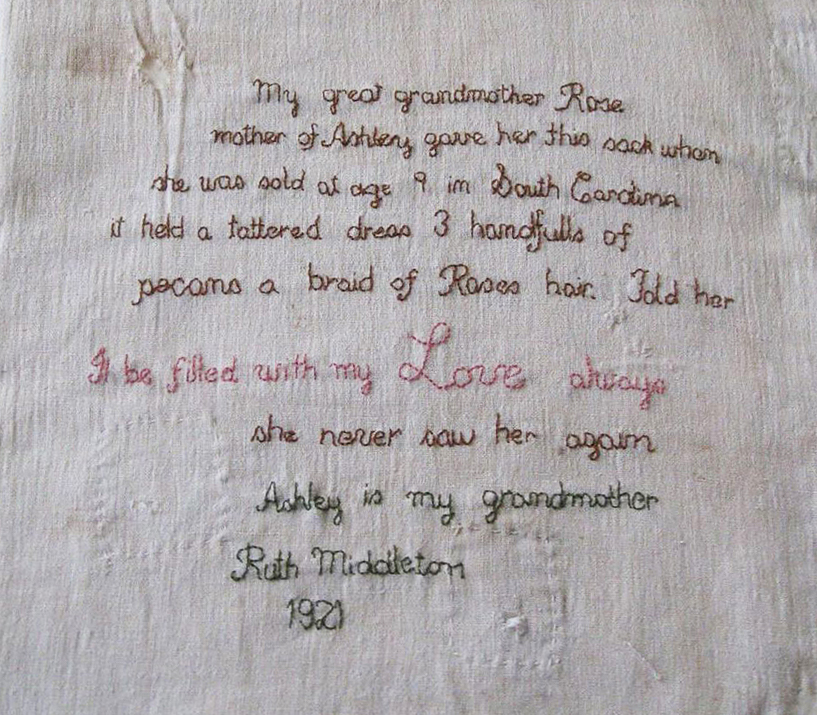
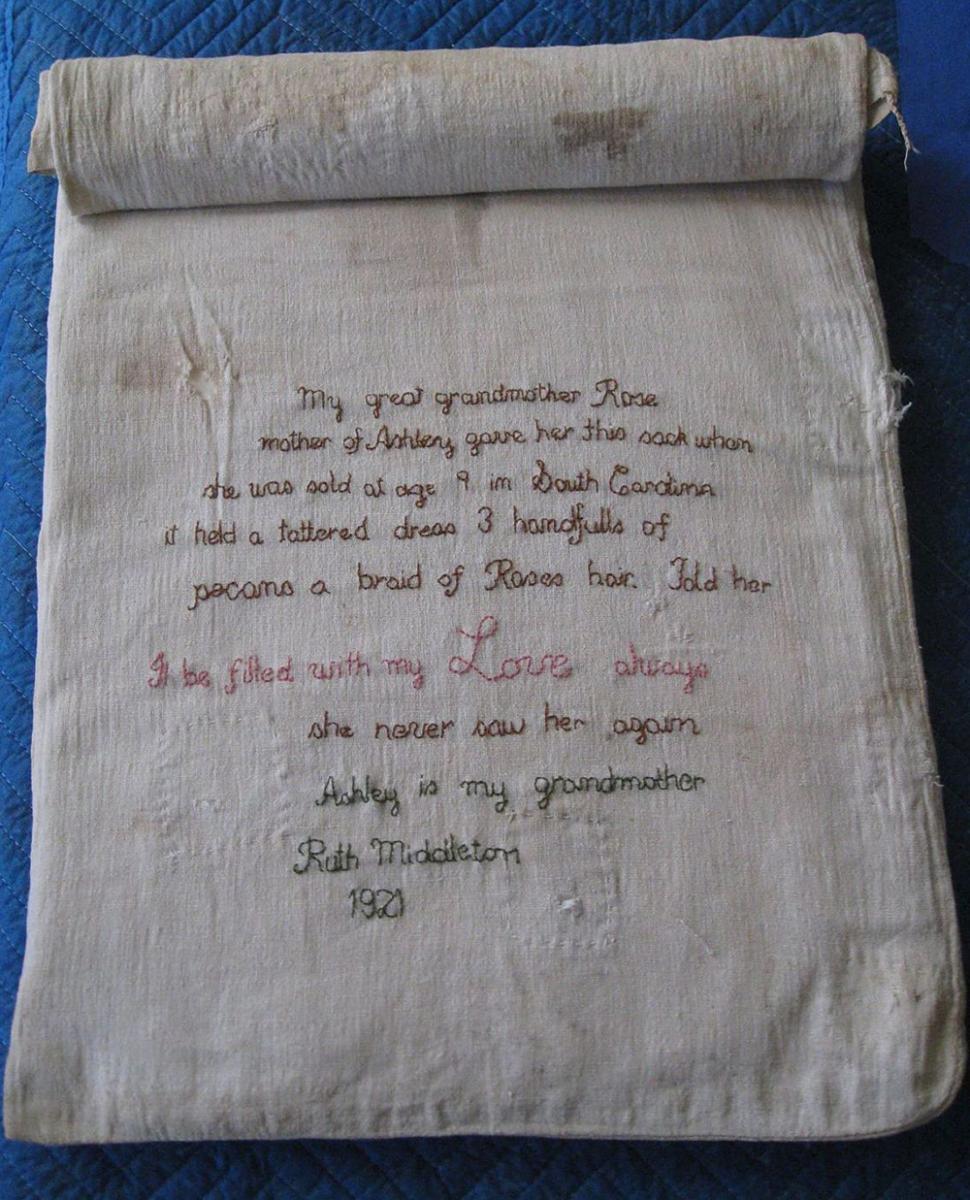
"Ashley's Sack" is among the most resonant and enigmatic artifacts on display in the newly opened Smithsonian National Museum of African American History and Culture (NMAAHC) in Washington, DC. Evidently a seed sack made of unbleached cotton fabric dating to the mid-nineteenth century, it measures about thirty-three by sixteen inches. Patched repeatedly, Ashley's Sack is stitched in three colors of cotton embroidery floss with the following ten lines of text, sewn on the lower third of the sack in 1921:
My great grandmother Rose
mother of Ashley gave her this sack when
she was sold at age 9 in South Carolina
it held a tattered dress 3 handfulls [sic] of
pecans a braid of Roses hair. Told her
It be filled with my Love always
she never saw her again
Ashley is my grandmother
Ruth Middleton
1921
With no accounts of its history, Ashley's Sack surfaced at a flea market in Springfield, Tennessee in 2007. From 2009–2013 it was displayed at Middleton Place in South Carolina, where it had enormous emotional impact on thousands of visitors.1Heather Andrea Williams, Help Me to Find My People: The African American Search for Family Lost in Slavery (University of North Carolina Press, 2012), 196–197. The sack is described in the epilogue of Williams's book, and has been discussed from time to time in media reports since the mid-2000s. Now on loan to the Smithsonian, it's likely to be viewed and pondered by millions in the coming years.
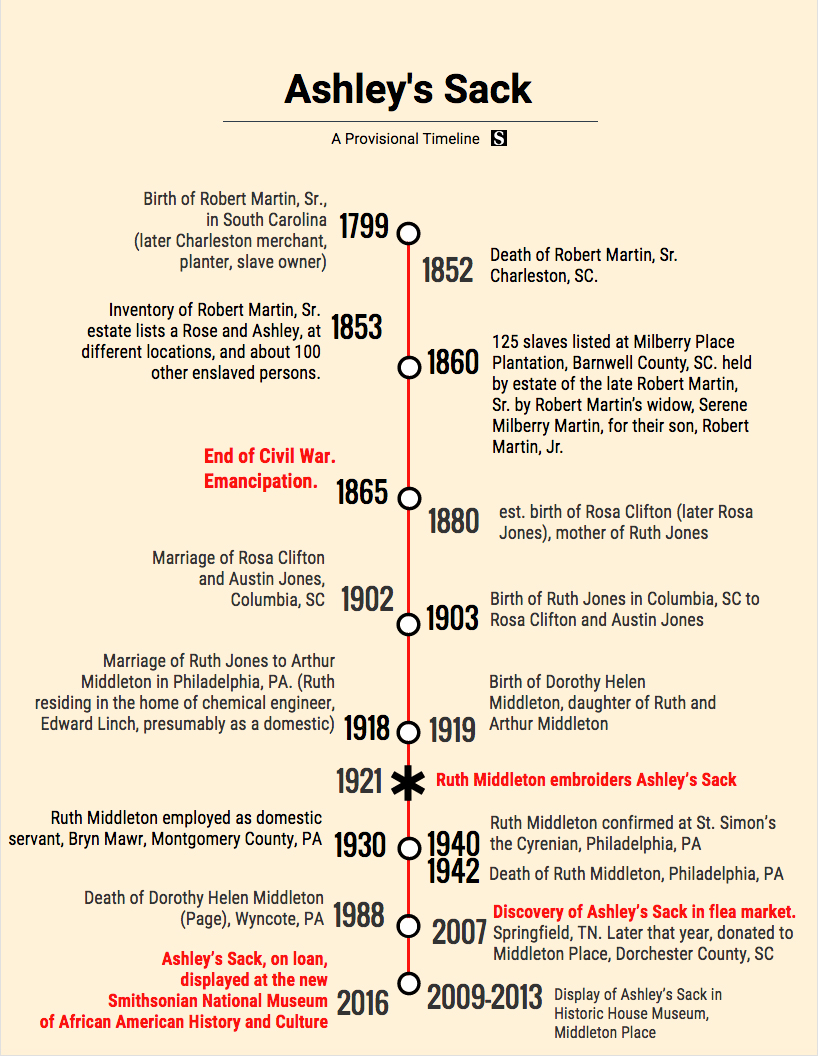
In this essay, I attempt to reconstruct the history of Ashley's Sack, from the time of slavery onwards, and explore its shifting meanings in different display venues. My reconstruction of the sack's history prior to 2007, while grounded in careful archival research, is necessarily conjectural at points, given the paucity of primary documentary evidence on the enslaved and free family lines in question. Although some of the "detective story" that follows is speculative, I suggest the project of tracing the sack is important for several reasons. It demonstrates that the narrative embroidered by "Ruth Middleton" is very likely to be accurate, or at least highly plausible. This undertaking helps us understand how, in the face of the terrible fragmentation of family solidarity caused by the domestic slave trade, family lineal memory and continuity endured across at least four generations. Finally, the 150-year history of the sack demonstrates how, in the face of structural forces that systematically alienated property from enslaved and liberated people of color, a single material object was inherited, preserved, and creatively transformed across time and space.
Tracing Rose and Ashley
If the embroidered text is correct, Ashley probably kept the gifted object throughout her life, in slavery and freedom, and presented it to her own child—likely a daughter. Ashley's child then must have passed the sack onto her (or his) daughter, the woman identified as Ruth Middleton. In 1921, Ruth Middleton made the decision to embroider the words passed down orally through the generations.
Who were these women?
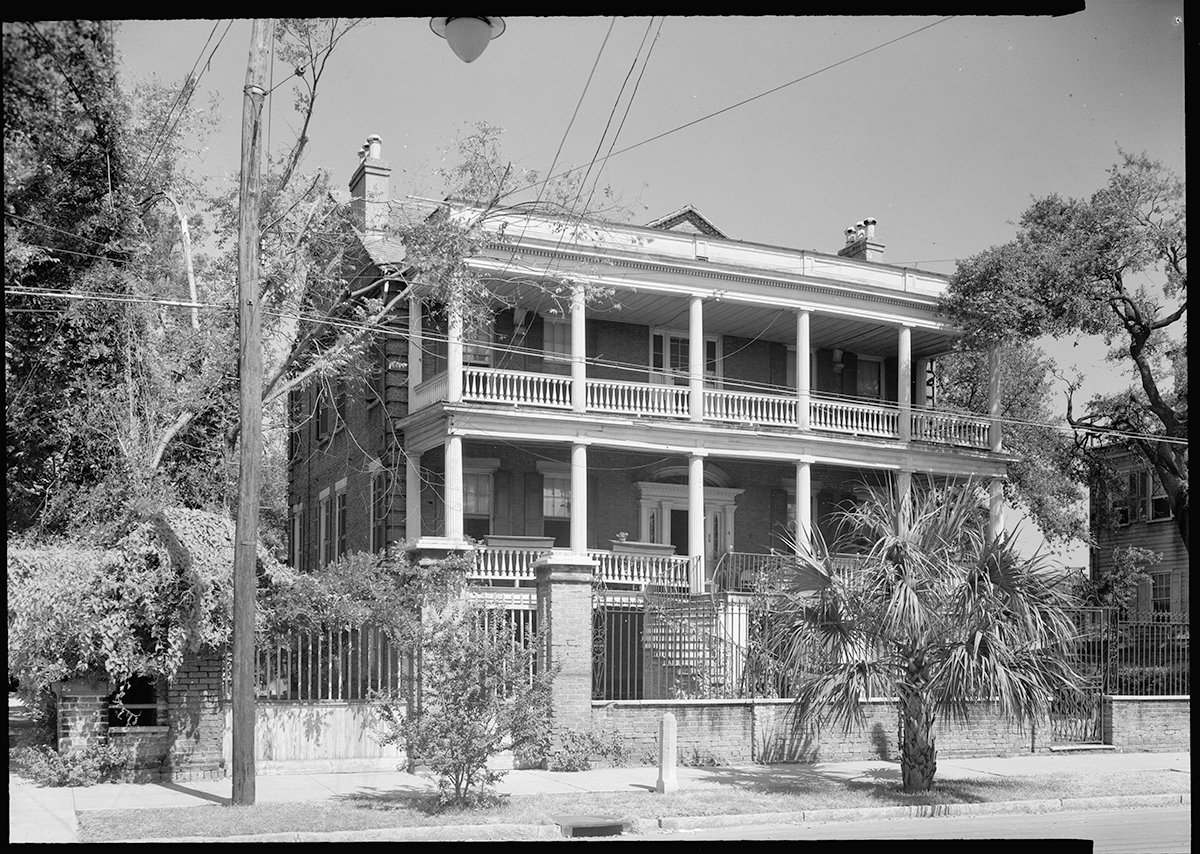
The most likely candidates for "Rose" and "Ashley" appear among the enslaved people owned by wealthy Charleston merchant and planter, Robert Martin (c. 1790–1852), who was worth over $300,000 at his death in December 1852.2Robert Martin inventory for Charleston property, listing Rose, 358; Barnwell County property, listing Ashley, 366–367, Inventories, Appraisements and Sales, 1850–1853, Charleston, South Carolina, South Carolina Department of Archives and History. Note that antebellum loose probate records from Charleston District did not survive the Civil War. According to surviving Charleston inventory records, his palatial household in Charleston at 16 Charlotte Street held seven slaves, among them a woman named Rose, valued at $700. The full listing reads:
Slave Cicero 1,000, slave Sophia 300, slave Jane 400
Slave Jack 800, slave Rose 700, slave David 800, old woman 100
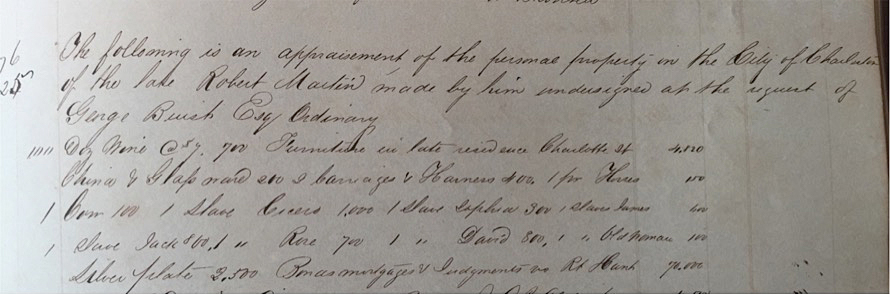
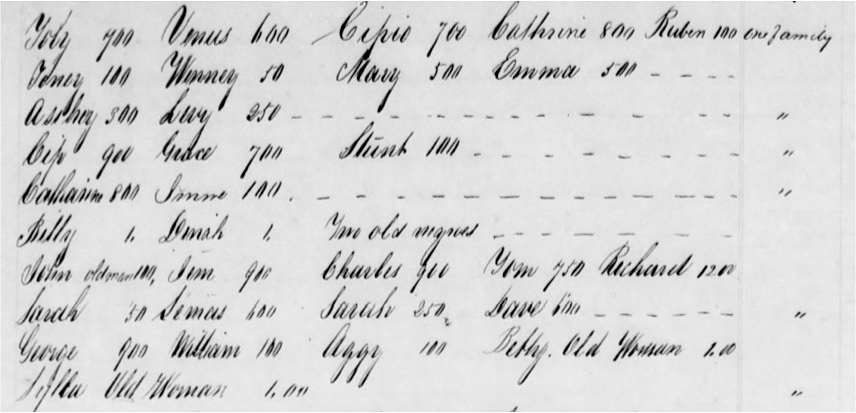
Robert Martin's Barnwell County plantation, "Milberry Place" (which employed overseer Robert Harper), contained about 105 slaves in 1853, among them the following family group, with the attached monetary evaluations:
Toney 100 Winney 50 Mary 500 Emma 500
Ashley 300 Levy 250
[...]
Total: 1700
Toney and Winney are presumably elderly, given their low valuations and the practice in this particular inventory account of listing named slaves in family groupings from eldest to youngest. Perhaps Ashley is Toney and Winney's grandchild, and they were looking after her in the absence of Ashley's mother Rose.
Fourteen months after Robert Martin Sr.'s death, a newspaper announcement of a court-decreed sale of the property notes that his Milberry Place Plantation contained over 2,900 acres.3Charleston Courier (Charleston, SC), Feb. 6, 1854, 4. This property was located along the Savannah River about a hundred miles west of Charleston, in an area now known as "Milbury," an unincorporated part of southeastern Allendale County. The tract is about six miles southeast of the present-day town of Allendale.
The will of Robert Martin stipulates that his house on Charlotte Street, its furniture, and "house servants" will remain in the custody of his widow, Milberry Serena Martin (1808–1877), the apparent namesake of Milberry Place.4Copy of Robert Martin's will, Means Family Papers, Pinckney-Means Papers, South Carolina Historical Society. See also Robert Martin will transcript, South Carolina Department of Archives and History. As executrix, she was enjoined to dissolve his resources as quickly as possible in order to realize enough cash to provide an inheritance of $20,000 for each of his children. Soon after Robert Martin's death, the parties to the inheritance entered into a complex series of cases in the South Carolina Court of Equity, leading to court-decreed sales of many components of his voluminous and diverse estate.5Milbery S. Martin (Executrix of Robert Martin) v. James B. Campbell, Bill for Account and Relief, filed 9 January 1858, and papers, filed 18 April 1858; Miberry S. Martin v. Edward Petit, 2 July 1859–1861, March 1860, Court of Equity Records, South Carolina Department of Archives and History. Mrs. Martin purchased the land of Milberry Plantation in early 1854 and allowed her son Robert Jr. to reside on it.6Loose genealogical papers pertaining to Robert Martin Sr. and descendants, Pinckney-Means Family Papers, South Carolina Historical Society. For information on Robert Martin Jr. see also Chalmers. G. Davidson, The Last Foray: South Carolina planters of 1860, A Sociological Study (Columbia: Published for the South Carolina Tricentennial Commission by the University of South Carolina Press, 1971), 288. By 1860, 125 slaves were held here. It also appears that, in accordance with court decrees, several enslaved persons were sold to raise cash.7James Daniel Erwin will, 1852, Barnwell County, South Carolina Department of Archives and History. In September 1854, Robert Martin Jr. married Annie Eliza Erwin, whose father, James Daniel Erwin, had died two years earlier and bequeathed her twenty-three slaves, many of who were held on his Erwinton plantation, adjacent to Milberry Place. Perhaps some of the 125 slaves at Milberry in 1860 had come there from the Erwin bequest.
Evidently, most of the enslaved people at Milberry remained on the plantation through the Civil War until freedom came in the spring of 1865. Some newly freed people also stayed in the vicinity. For example, the man Scipio listed in the 1853 inventory of Robert Martin's Barnwell County "Milberry" estate is presumably the Scipio Martin, recorded in the 1870 census, residing in Bamberg township, about forty miles from Milberry. Similarly, it seems likely that Frances and Amanda in the 1853 inventory became Frances Martin (born 1843) and Amanda Martin (born 1845), both residing in nearby Barnwell town in the 1870 census.
These circumstances are consistent with the scenario outlined in Ruth Middleton's embroidery. Under the will of Robert Martin Sr., Rose and the other house slaves were kept in the Charleston household at 16 Charlotte Street to look after Mrs. Martin and her minor children. Enslaved people at Milberry Place in southwestern Barnwell County could be sold off at Mrs. Martin's discretion.
At this point, we encounter a significant gap in the chain of evidence. There is no specific record of an "Ashley" after the 1853 inventory. It is not clear when the sale of Ashley took place, or how Rose and Ashley might have had the described reunion before their separation. There is no listing in Charleston newspapers of a slave sale connected to Robert Martin's estate, although there are a number of notices for equity court-decreed sales of land and real estate associated with Martin's holdings.
If the sale took place in 1853, the year after Robert Martin Sr.'s death, and Ashley was, as the needlework states, nine years old, we can assume she was born around 1844. We do not know if Rose stayed on in Charleston, or survived until emancipation.
The 1870 census reports Robert Martin's widow Serena living in Charleston with her daughter "Nina" (Serena) and four African American house servants, all with the surname Franklin:
J Franklin age 35
John Franklin age 29
Sarah Franklin age 20
Robert Franklin age 18
The embroidered text records that Rose and Ashley never saw one another again, which suggests that Rose may have died prior to 1865, or was sold out of the area after 1853.
In sum, we do have a record of a Rose and Ashley owned by the same wealthy South Carolina planter and merchant, Robert Martin, at the time of his death in late 1852, held at properties over one hundred miles apart from one another. We have legal records indicating that Robert Martin's widow was enjoined by her late husband's will to retain Rose at the Charleston mansion, but that she was free to sell Ashley and other slaves from the Savannah River "Milberry" plantation, in southeastern Barnwell County, and that she, as executrix, was under urgent pressure to raise cash for the lawful heirs of her late husband. We do not have direct evidence, however, that Ashley was sold and separated from her mother in the manner described in the 1921 embroidery. All we can say is that the 1921 embroidered account—of a nine-year-old Ashley being sold away from her mother Rose—is consistent with the extant documentary record of Robert Martin's estate.
Tracing Ruth Middleton
Who was Ruth Middleton, the woman who appears to have embroidered Ashley's Sack in 1921? We can proceed both by process of elimination, ruling out less likely "candidates," and by positive evidence for one particular woman who bore the name Ruth Middleton. There are sixteen African American women across the nation in the 1920 US census named "Ruth Middleton." Two additional Ruth Middletons, who do not appear in the census, are documented in marriage and other records. Of these eighteen women, we can subtract those born after 1915 (presumably too young to embroider in 1921). We can probably also remove from consideration those women who, according to the census, could neither read nor write. Further, that the embroiderer specified that the events took place in "South Carolina" perhaps suggests that she was not residing there when doing the needlework.
Of the six remaining candidates, one, by far, appears most likely. Only she had clear family roots in South Carolina, resided outside of the state, was literate, and resided in a context in which she plausibly could have created the needlework in question.
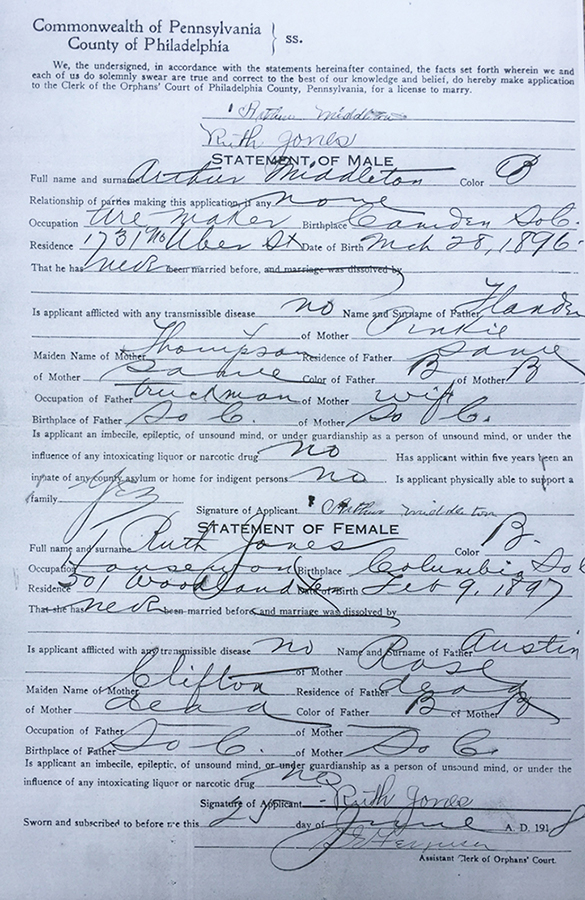
This woman is not among the Ruth Middletons in the 1920 US census—for reasons that may be telling. In 1918, a young African American, born Ruth Jones in Columbia, South Carolina around 1903, married Arthur Middleton, born around 1899, also from South Carolina, in Philadelphia, Pennsylvania, where she evidently resided for the rest of her life. Arthur was born in Camden, Kershaw County, South Carolina, about twenty miles from Columbia, and was the child of Pink (Thompson) and Flander Middleton.8Flander Middleton, the father-in-law of Ruth Jones, was born in Sumter County, South Carolina, around 1863. The 1880 census records him residing in Providence, a town in Sumter County currently known as Dalzell, a few miles northeast of Sumter township, the county seat. Although Flander is not listed in the 1870 census, the census for that year does record a Dolly Middleton (born 1855) residing in the same neighborhood of Providence. Dolly also is listed, under the married name of Dawson, living adjacent to Flander Middleton in the 1880 census. In their marriage license application, Ruth claims to be born in 1897—that is to say, to have reached twenty-one, the legal age of consent. All other sources, however, indicate that she was fifteen or sixteen at the time of her marriage.
Ruth's parents, Austin and Rosa Jones, appear to have married around 1902 in Columbia, one year before her birth. Austin worked for a time as wagon driver; in 1910 he and Rosa both worked as servants at the University of South Carolina (in Columbia), and appear to have lived next door to the well-known white South Carolina historian Alexander Salley. Austin died in 1912 and Rosa in 1916, leaving Ruth an orphan.9Letters of Administration, Richland County, South Carolina, Probate Court. Record of Admissions, Vol. 6, 114–15; Record of Deaths, 44–5, South Carolina State Mental Hospital. Certificate of Death no. 35328, Rosa Jones; South Carolina Department of History and Archives. Ruth's father, Austin Jones, died in May 1912. Ruth's mother Rosa Jones was admitted on 26 June 1916 to the South Carolina State Mental Hospital and died there three days later.
It is possible that Ruth came up to Philadelphia with Arthur Middleton, or that they met there. In her marriage application, Ruth lists her occupation as "housework" and her address as 501 Woodside Terrace.10County of Philadelphia, Commonwealth of Pennsylvania. Marriage license application (25 June 1918), Arthur Middleton and Ruth Jones. This was the elegant Italianate home of chemical engineer and factory owner Edward Linch and his wife Mabel, an organist who performed in the most prominent circles of Philadelphia white society.
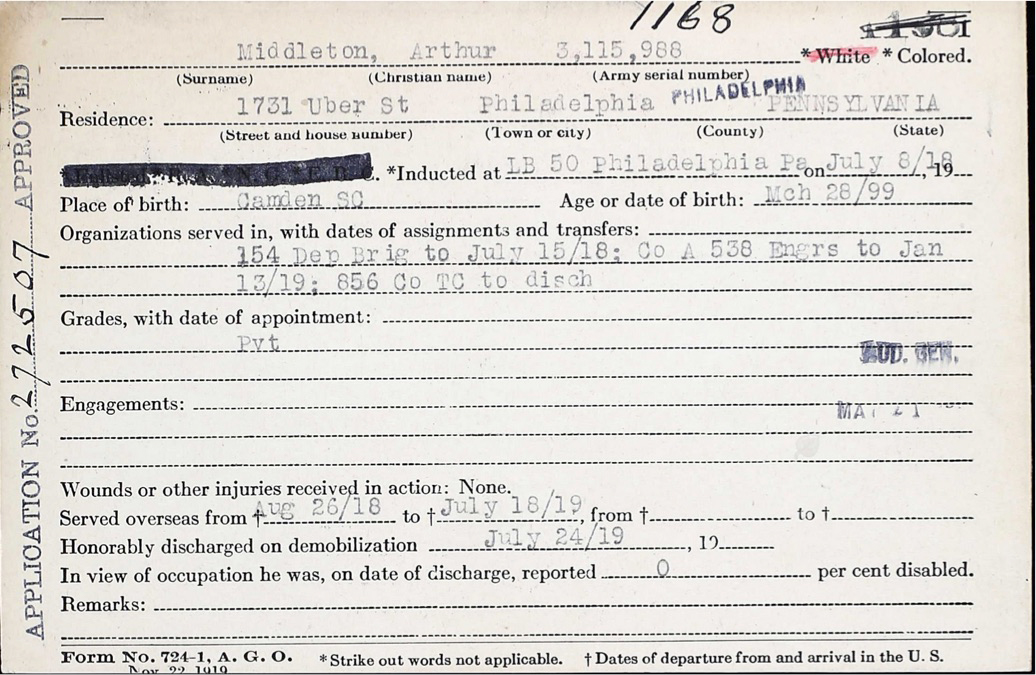
Employed as a domestic worker in this household, Ruth must have observed the ins and outs of Philadelphia society, and perhaps took up needlework during this time. It is not clear how long Ruth remained in the Linch family's employ. She gave birth to a baby girl, Dorothy Helen Middleton, in January 1919, six months after her marriage to Arthur.
There is no record that Ruth and Arthur ever lived together. Soon after their wedding, Arthur was inducted into the US Army and served overseas in World War I until mid-1919.11Army separation application #272507 (22 November 1919), Arthur Middleton. In the 1920 census he is living apart from his wife as a lodger in Philadelphia. He later resided in Brooklyn, New York, near his elder sister Helen and his mother, who eventually moved to Brooklyn from South Carolina. Ruth appears to have kept up connections with Arthur's family: a 1928 notice in the Philadelphia Tribune reports that Ruth entertained Arthur's elder sister Helen Middleton Hadley of New York for Thanksgiving.
It would therefore appear that in 1921, the year that Ashley's Sack was embroidered, Ruth Jones Middleton was an eighteen- or nineteen-year-old single mother living in Philadelphia.
Ruth Jones Middleton's later life remains somewhat of an enigma. I have found no traces of her from 1919 through 1924. In 1925, she resides in a lodging house in South Philadelphia. In the 1930 census she is listed as a live-in "waitress" in the elegant home of well-to-do white photographer, Samuel J. Caster, adjacent to Bryn Mawr College in Lower Merion, a main line suburb of Philadelphia. Eleven-year-old Dorothy Helen is not listed as living with her.12Suggestively, the only black "Dorothy Middleton" appearing anywhere in the 1930 US census is an eleven-year-old girl residing in the home of George and Maggie Lynch in Mount Hope, Fayette County, West Virginia, listed as their "niece." I do not know if this African American couple, the "Lynches," had any connection to the white Linch family who employed Ruth in 1918, in Philadelphia.

From around 1928 onwards, Ruth appears to have reinvented herself. She is mentioned regularly in the "Smart Set" and "High Society" pages of the Philadelphia Tribune, the leading African American newspaper of the region, hosting bridge and cocktail parties and wearing elegant couture.13References to Mrs. Ruth Jones Middleton in the "Woman's Page," "Society at a Glance," "Smart Set," "Younger Set," and other columns of the Philadelphia Tribune (Philadelphia, PA), Dec. 8, 1928, 6; July 24, 1929, 4; Aug.13, 1931, 4; Feb. 18, 1932, 5; Sept. 8, 1932, 5; Dec. 21, 1933, 6; Feb. 3, 1938, 6; Feb. 17, 1938, 6; March 3, 1938, 5; April 7, 1938, 6; Dec. 13, 1939, 9; Jan. 4, 1940, 8; Jan. 18, 1940, 8; Feb. 18, 1940, 9; March 17, 1940, 18. There are no known newspaper obituaries after her death in 1942. Ruth's daughter Dorothy Helen Middleton appears several times as a member of fashionable dance clubs and, in the late 1930s around age twenty, authored the Philadelphia Tribune's "Smart Set" society column at least twice.
In February 1940, the Tribune reported, "attractive South Philadelphia matron, Mrs. Ruth Middleton will be confirmed next month at St Simons Church." The Episcopal Chapel of Saint Simon the Cyrenian, at 1401 22nd Street, was a socially prominent African American church. Ruth's confirmation marked her transition to the more "respectable" ranks of black Philadelphia society. Also in 1940, Ruth is listed as a lodger in downtown Philadelphia with her daughter, Dorothy Helen Middleton. The census reports that Ruth is Dorothy's "sister"; it seems plausible that Ruth intentionally misstated their relationship to obscure the fact that she had given birth at the age of fifteen or sixteen.
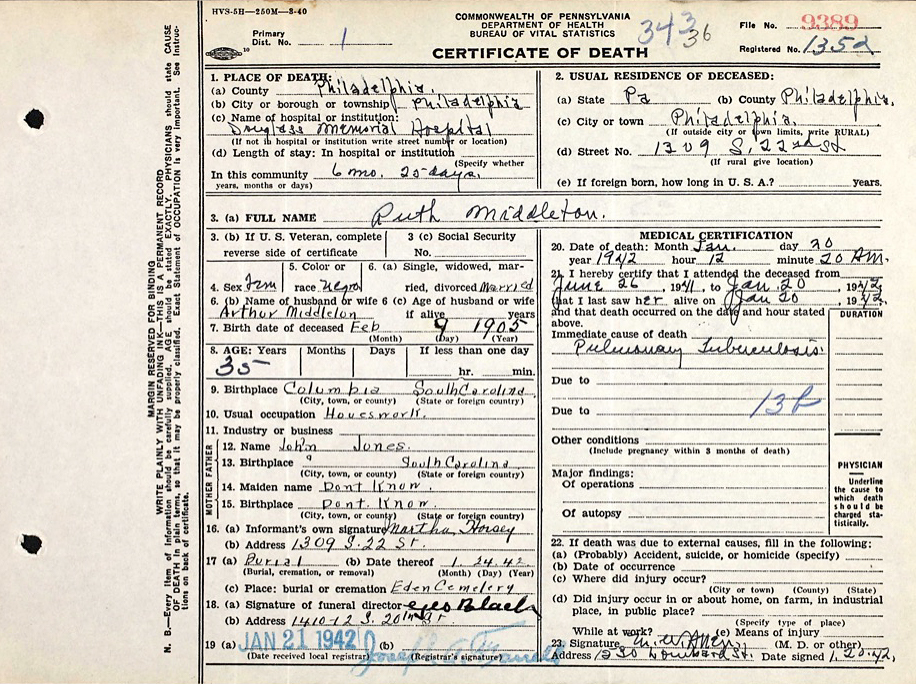
The 1940 church confirmation notices are the last mention in the press of Ruth Jones Middleton, who may, by this point, already have developed the illness that would take her life. She died in January 1942 of tuberculosis, after six months in Philadelphia's Douglass Memorial Hospital.14County of Philadelphia, Commonwealth of Pennsylvania. Certificate of Death No. 9389, Ruth Middleton. Her daughter Dorothy Helen could only afford thirty dollars for an unmarked grave in Mount Lawn cemetery in Sharon Hills, outside the city.15In 1942, Dorothy Helen Middleton purchased two burial plots—one for her mother and one for herself—at Mount Lawn in Sharon Hill, Pennsylvania. Mount Lawn cemetery records indicate that she never used the second plot; it is not known where she was buried after her death in 1988. Perhaps Ruth had a wealthy patron during her life to support her society lifestyle; if so, no resources for her funeral expenses were available after her death.
Ruth's daughter Dorothy lived until 1988, taking the name Dorothy Page at some point, perhaps because of marriage. At the time of her death, she resided in the north Philadelphia suburb of Wyncote. It's not clear whether Dorothy Helen Middleton Page (who evidently died in a nursing home) retained Ashley's Sack during her life, or how it made its way to the flea market for the 2007 sale.
Ruth Jones Middleton's Ancestry
What of the parentage and ancestry of Ruth Jones Middleton? Can we link her to Rose, to Ashley, or to Robert Martin's Milberry Place plantation of Barnwell County, South Carolina?
![Detail from U.S. Geological Survey. Peeples quadrangle, South Carolina-Georgia [map]. First Edition 1943. 1:62,500. Reston, Va: United States Department of the Interior, USGS, 2016.](https://southernspaces.ecdsdev.org/wp-content/uploads/2019/07/auslander_015_mildburylocationmap.jpg "Detail from U.S. Geological Survey. Peeples quadrangle, South Carolina-Georgia [map]. First Edition 1943. 1:62,500. Reston, Va: United States Department of the Interior, USGS, 2016.")
As of this writing, there is no direct documentary proof that Ruth Jones Middleton's family came from Milberry Place Plantation, where the "Ashley" owned by Robert Martin resided in the early 1850s. However, there is strong circumstantial evidence linking Ruth's mother and maternal grandparents to this specific region of South Carolina.
As mentioned above, Ruth is recorded in the 1910 census for Columbia, South Carolina, as the seven-year-old child of Austin Jones (born in 1878) and Rosa Jones (born in 1879), both employed as servants of the University of South Carolina. We may speculate that perhaps the name of Ruth's mother, "Rosa," honors an earlier woman in the family history named "Rose."
In her 1918 marriage license application, Ruth lists her mother's maiden name as "Rosa Clifton." The 1870 census, the first census to record the names of all recently emancipated African Americans, records about sixty African Americans named Clifton in the state of South Carolina. The only white slave owning Cliftons in antebellum South Carolina were concentrated in Chester County; many black Cliftons lived in Chester County and its environs in the 1870s.
The census records a single black Clifton family in Columbia, South Carolina, and a cluster of black Clifton families between Columbia and the Savannah River—in the Barnwell County townships of Barnwell, Blackville, Bamberg and Diamond Hill, and in the adjacent Orangeburg communities of Amelia and Goodlands. Nearly all of these Clifton families reside within a fifty-mile radius of Robert Martin's Milberry Place Plantation, where Ashley was clearly enslaved in 1852. Numerous African Americans with the surname "Martin," whose first names correspond with those listed in the 1853 Robert Martin estate inventory at Milberry, are scattered through this same geography. It's likely that Rosa Clifton Jones and her daughter Ruth Jones Middleton had roots in this extended family network.
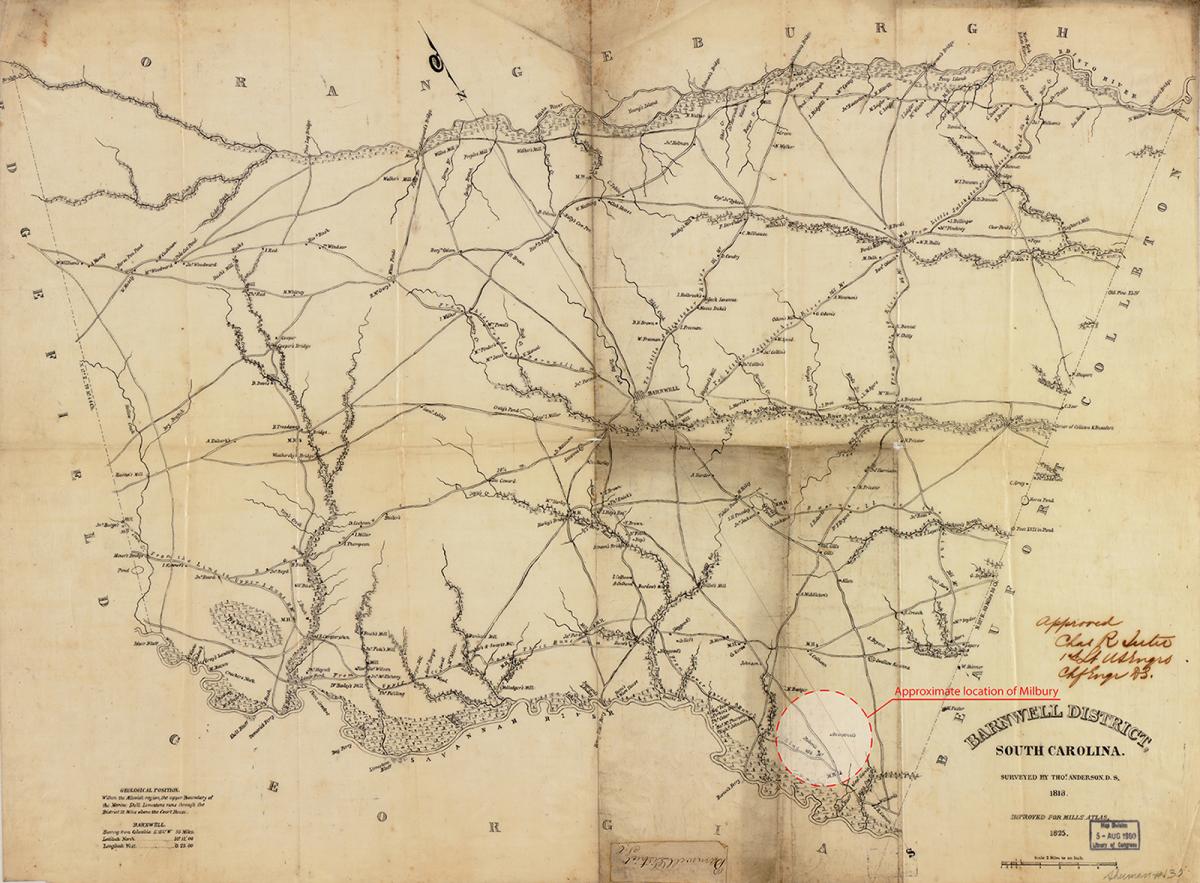
Barnwell District, South Carolina, ca. 1825. Map by Robert Mills and Anderson Thomas (surveyor). Courtesy of the Library of Congress Geography and Map Division, loc.gov/resource/g3913b.cws00130.
How do we know this? The mother of Ruth Jones Middleton, "Rosa Clifton," born around 1880, is listed in the 1900 census as living in Columbia, employed as a chambermaid. She is listed as the "sister in law" of a Wesley Perry, married to a Hattie Perry (born around 1873) who is presumably Rosa's sister (with the maiden name of Clifton). The 1880 census records a "Hattie Clifton" (born around 1874) in the Goodlands township of Orangeburg County, adjacent to Springfield, about forty miles south of Columbia. Her parents are listed as William Clifton (born around 1841) and Sarah Clifton (born around 1849).
To be sure, it would be ideal if we had clear evidence that this woman "Sarah" bore the earlier name of "Ashley," or that Rosa Clifton's grandmother bore the name Rose. In the lack of such evidence, all we can currently conjecture is that Rosa Clifton's parents probably resided in the same geographical region within which many former slaves from Milberry lived.
In short, although the lines of descent are unclear, it is highly plausible that Rosa Clifton Jones, the mother of Ruth Jones Middleton, had family roots among the once-enslaved people of the Robert Martin plantation, who, after emancipation, spread out into Barnwell, Orangeburg, and Richland Counties. Future research may provide more definitive evidence that Rosa Clifton Jones was in fact mothered by the "Ashley" listed in the Robert Martin estate.
The Sack Since 2007
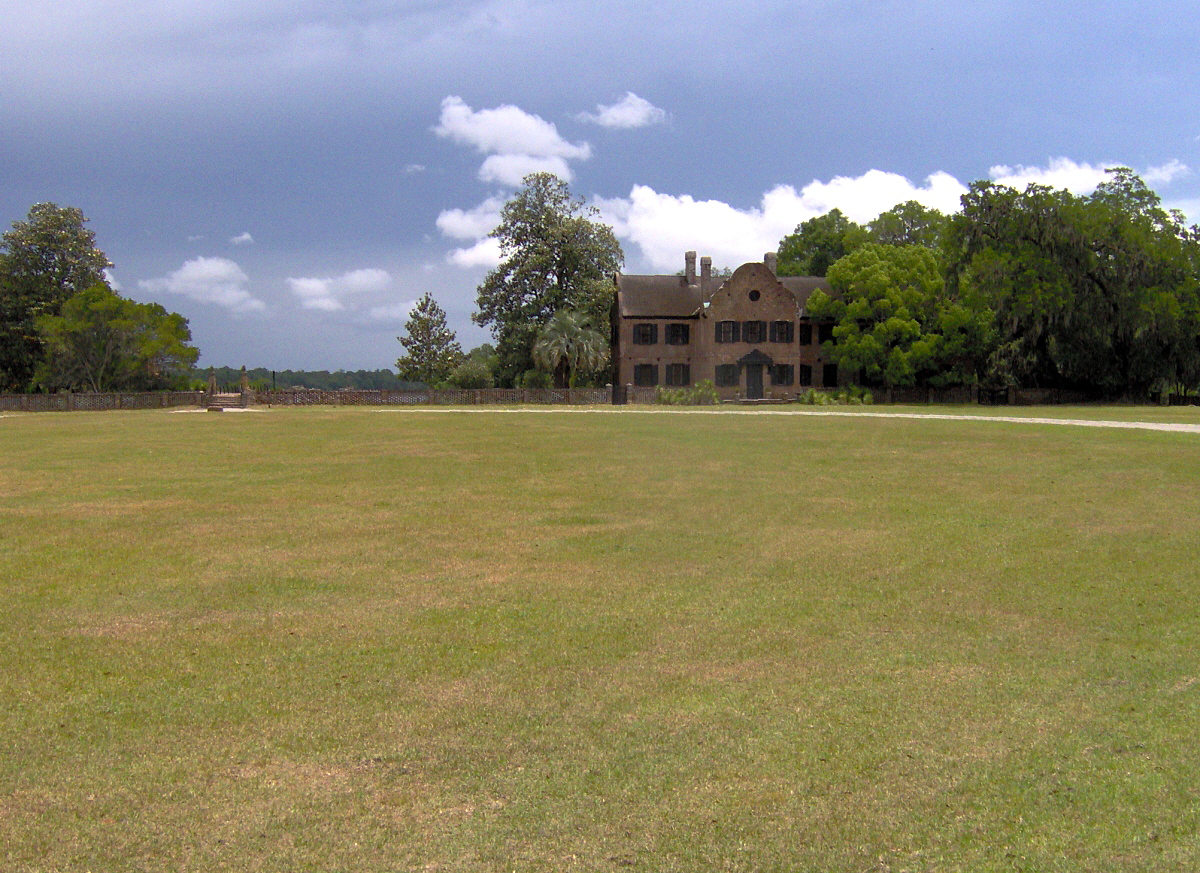
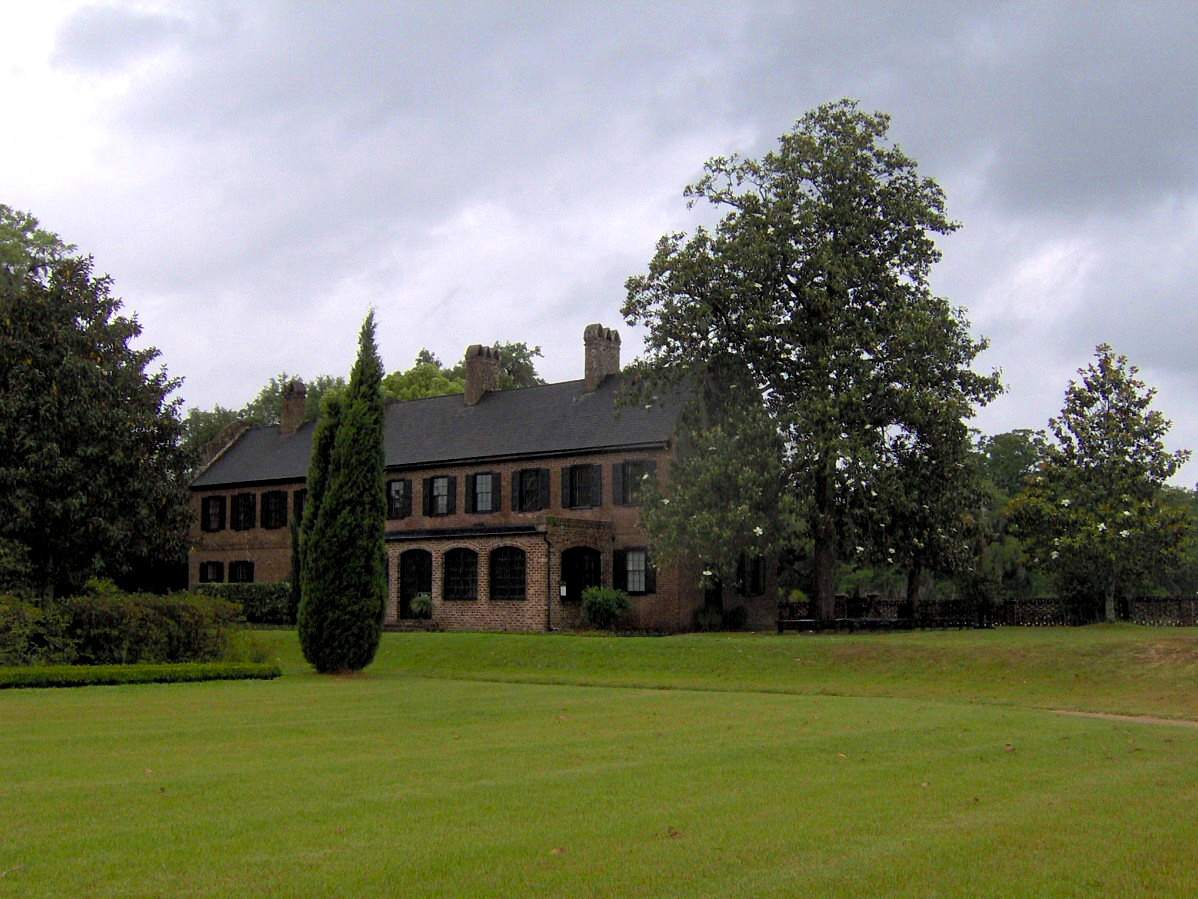
To return to recent history, in February 2007 a white woman (who wishes to remain anonymous) discovered and purchased Ashley's Sack for twenty dollars from a white man at an open-air flea market in Springfield, Tennessee. She first explored selling it through eBay and a New York auction house, but after dreaming of the little girl Ashley and developing a close connection over the telephone with a Middleton Place senior staff member, she decided to transfer it to the Middleton Place historic house museum near Charleston.16"Slave child torn from mom filled sack with love" Spartanburg Herald-Journal (Spartanburg, SC) April 16, 2007, C1, C3.
When Middleton Place Foundation acquired Ashley's Sack, it had already taken steps towards incorporating the slavery narrative into its interpretive mission. Indeed, one of the reasons the donor was so willing to present it to the Middleton Place was its demonstrated commitment to engage with mass enslavement and its legacy: Around 2005, Middleton installed a permanent exhibition on slavery in one of its outbuildings, known as Eliza's House, listing the names of about 2,600 enslaved people associated with the plantation.
Since Eliza's House lacked environmental control and security, Ashley's Sack wasn't installed there. Instead, Ashley's Sack was displayed within the historic house museum. It was initially exhibited in the upstairs library, near facsimiles of the Declaration of Independence (signed by Arthur Middleton) and South Carolina's Ordinance of Secession (signed, among others, by Arthur Middleton's descendant William). The Middleton Place leadership hoped that Ashley's Sack's placement would productively complicate the interpretation of these documents, highlighting the paradoxes embedded in American conceptions of liberty and equality. Later, the object was moved downstairs to the front hall, to a specially constructed case with other items more definitively linked to slavery at Middleton Place, including a slave badge and buttons worn by enslaved workers.
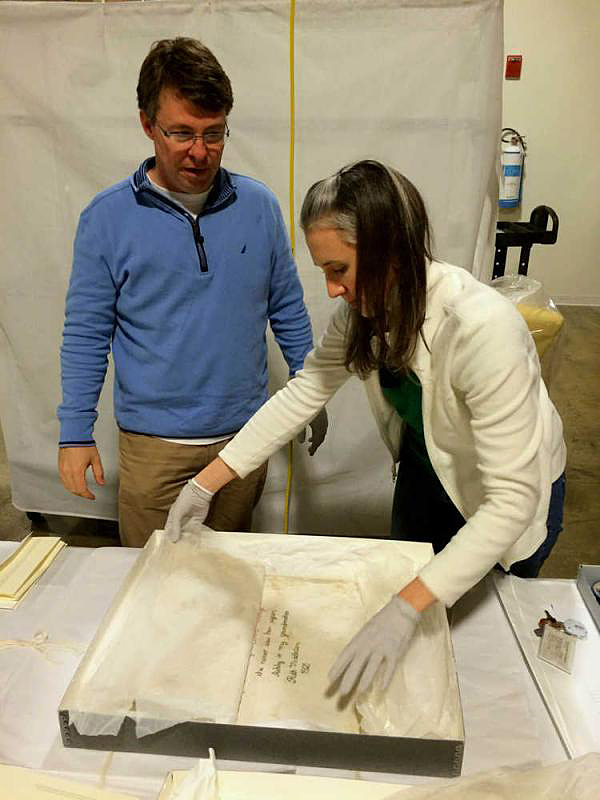
Middleton Place staff recall that Ashley's Sack posed interpretive challenges for many of the more veteran volunteer guides, who were more familiar with storylines emphasizing the accomplishments and refinement of the white Middletons. Some felt uncomfortable with direct discussions of slavery; others were overwhelmed by the emotional responses catalyzed by the object, which brought tears to many visitors' eyes. Some volunteer guides complained that the sack, and the powerful reactions it engendered, distracted from the core mission of the tour: to highlight the wealth, political leadership, and cosmopolitanism of the white Middletons.
Whatever reservations some volunteers might harbor about Ashley's Sack, the object is treasured by professional staff at Middleton Place. A large reproduction is included in the Foundation's commemorative book.17Charles Duell, Middleton Place: A Phoenix Still Rising. Middleton Place Foundation. (Charleston: Middleton Place Foundation, 2013), 57. Mary Edna Sullivan, Middleton's curator, brought it in January 2011 to the Winter Antiques Show in New York's Park Avenue Armory, where it attracted deep interest and emotional responses from hundreds of visitors.
From the time they acquired Ashley's Sack, curatorial and interpretive staff harbored the hope that it would prove to have a historical connection with Middleton Place families, black or white. Noting that the sack was discovered near Nashville, Tennessee, where some white Middletons had settled after the Civil War, they conjectured that the object might have travelled with them.18Although Ruth had no apparent lineal connection to the Middleton slaves, there is some circumstantial evidence that her father-in-law, Flander Middleton, born around 1863 during the Civil War in Sumter County, South Carolina, may have been descended from persons enslaved by the Middletons of Middleton Place. A possible link is through the Middleton heir, Eliza Carolina Middleton Huger (1824–1919), daughter of Isabella Joanne Middleton, born in 1780 at Middleton Place, the daughter of Arthur Middleton, a signer of the Declaration of Independence. Eliza Smith's son, William Mason Smith, records in an 1863 letter that he transferred his slave "Philander" and Philander's family (including a newborn child) to their Sumter County plantation, following Harriet Tubman's Combahee Raid. It is possible that the Middleton name was being maintained by the enslaved family of Philander, and a child named Philander was later known as "Flander." (I am indebted to Dottie Stone, Middleton Place historian, for this suggested connection between Flander Middleton and the Middletons of Middleton Place.) It is certainly intriguing in this light that Ruth's husband was named "Arthur Middleton," the same name as the illustrious Middleton Place patriarch.
In any event, a Middleton staff member brought Ashley's Sack to the May 2009 "Save America's Treasures" event in Charleston hosted by the National Museum of African American History and Culture (NMAAHC), as the Museum searched for significant, previously unknown works of African American material culture. Smithsonian curators were deeply moved by the object; after negotiations, Middleton agreed to lend it to the Smithsonian on a year-to-year basis.
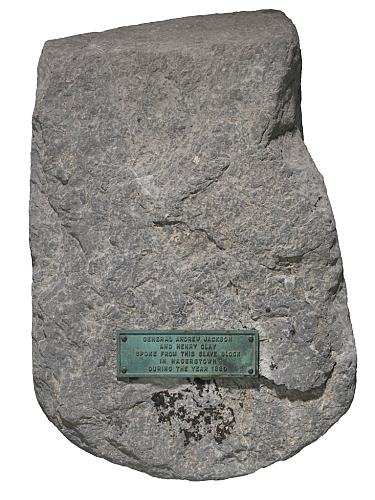
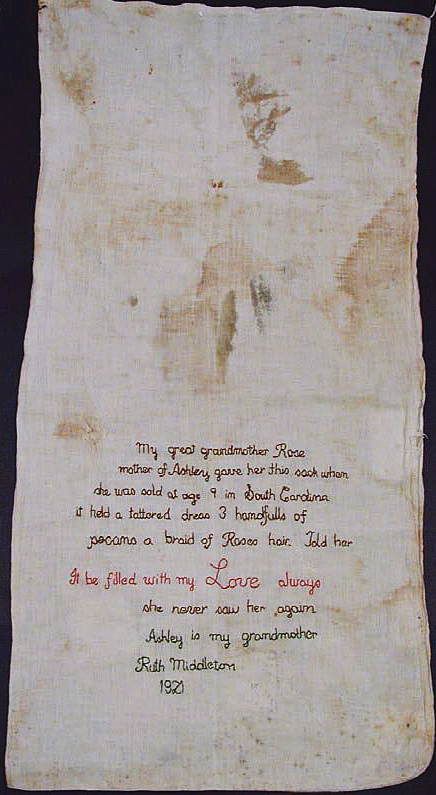
At the NMAAHC, which opened in September 2016, Ashley's Sack is exhibited directly next to a case holding an "auction block" and near a large installation evoking bales of piled cotton, entitled "King Cotton." These elements, the curators explain, evoke the enormous financial wealth generated by the slavery system. In contrast, Ashley's Sack evokes the intangible "human cost" of slavery, emphasizing a specific family story of tragedy and endurance across generations. Adjacent text describes the tragedy of family members being torn away from one another. A soundscape loop presents a range of first person commentaries, including WPA oral histories, about slave sales.
In its new location, the sack is hung entirely vertically, with the full front surface of the cloth visible, so that the text begins about three feet off the floor. Museum patrons must crouch low to read it.
Perhaps, in time, the NMAAHC will develop a more interactive and accessible installation strategy, including an enlarged reproduction of the text, allowing visitors to contemplate Ruth Middleton's complex, ambiguous narrative and to enter more directly into this complex historical trajectory. As my students and I have contemplated Ashley's Sack, it seems that the object calls out for a hands-on presentation. Perhaps visitors from around the world might write letters to Rose or Ashley, emulating Ruth's own commitment to the power of the written word to confront time's passage. Perhaps such letters could constitute an evolving installation. Alternately, visitors might ponder what they would do if faced with Rose's predicament. My colleague Jay Ball suggests asking what three gifts might visitors choose for a loved one they would never meet again. As at the adjacent Vietnam Veterans Memorial, one could imagine this exhibition space becoming a pilgrimage destination, where visitors leave objects, photographs, heirlooms, and works of art to achieve a reunion across race and difference, creating a new space of collective homecoming.
Acknowledgments
I am grateful to Jane Aldrich, Toni Carrier, Simon Lewis, and the Low Country Africana collective for guidance in this research. (Low Country Africana's ambitious partnership with fold3.com and the South Carolina Department of Archives and History has made many significant slavery-era documents searchable and accessible.) Special thanks to Laura Booth and the Philadelphia chapter of African American Genealogical and Historical Society; Mary Skinner-Jones of AME Bethel, Columbia, SC; Steve Tuttle and his colleagues at the South Carolina Department of Archives and History; Rev. John A. Middleton (New Light Beulah Baptist Church, Hopkins, South Carolina); Rev. Betsey Ivey (Saint Simon the Cyrenian Episcopal Church in Philadelphia); Peter Moak (Episcopal Diocese of Pennsylvania Archives); Mount Lawn and Eden cemeteries, Delaware County, PA; Rev. Tiffany Knowlin (Wesley United Methodist Church, Columbia, SC); Mary Elliot and Nancy Bercaw at the Smithsonian National Museum of African American History and Culture; and, Tracey Todd, Mary Edna Sullivan, Jeff Neale and Charles Duell, of Middleton Place. Research was also conducted at the Library of Congress Manuscript Division, the Free Library of Philadelphia, the Historical Society of Pennsylvania, the South Carolinia Library of the University of South Carolina, the South Carolina Historical Society, the Charleston County Public Library, and courthouses in Barnwell and Richland counties, South Carolina. I have also benefited from the many insights of Jessica Hope Amason, Ellen Avitts, Jay Ball, Randall Burkett, Nic Butler, Keith Champagne, Bobby Cummings, Lynn Linnemeier, Negara Kudumu, Wyatt MacGaffey, Jonathan Prude, Richard Reid, Ellen Schattschneider, Rosalind Shaw, Terrance Weik, Avis Williams, and my students in the Museum Studies program at Central Washington University. Finally, thanks to the Southern Spaces team for their attentive reading and editorial work.
Comments and reflections on this post, and on the meaning and significance of Ashley's Sack, may be shared at: http://culturalenvironments.blogspot.com/2016/10/origins-of-ashleys-sack.html
About the Author
Mark Auslander is Associate Professor of Anthropology and Museum Studies at Central Washington University, where he directs the university's Museum of Culture and Environment. He is the author of The Accidental Slaveowner: Revisiting a Myth of Race and Finding an American Family (Athens: University of Georgia Press, 2011). He writes a regular blog on his ethnographic, museum, and cultural studies interests, "Cultural Environments."
]]>
Atlanta rap artist Jack Preston takes the stage at Gallery 72, Atlanta, Georgia, October 18, 2015. Photograph by Clint Fluker. Courtesy of LiFT Art Salon.
In collaboration with ELEVATE, Atlanta's annual city-wide art event, LiFT Art Salon sponsored an October 18, 2015 gathering to discuss hip hop, technology, and fine art. Fahamu Pecou, Emory Institute of Liberal Arts (ILA) graduate student and ELEVATE 2015 curator, placed Atlanta hip hop production company, Organized Noize, at the heart of this week-long arts celebration: "Organized Noize Productions and the Dungeon Family collective become highly visible examples of the ways [in which] Atlanta's history, politics, and the arts converge ... [They are] responsible for some of the most prominent aural and visual aesthetics that have come to define the South."1 Fahamu Pecou, phone interview with author, November 12, 2015, Atlanta, Georgia. Transcription by author. See, "ELEVATE 2015," City of Atlanta Office of Cultural Affairs, http://www.ocaatlanta.com/?programs=elevate.
Building on Pecou’s vision, LiFT’s ELEVATE event, "The South Got Something to Say," featured hip hop in a multi-media environment that engaged artists, activists, and academics in dialogue about innovative Atlanta projects.2 "The South Got Something to Say" refers to Andree 3000's acceptance speech at the 1995 Source Awards. "Outkast winning Best New Rap Group at the Source Awards 1995," YouTube video, 5:36, posted by The Max Trailers, October 12, 2014, https://www.youtube.com/watch?v=vwLG7aSYM3w. Held in Gallery 72, attendees enjoyed a visual art exhibit featuring Atlanta-inspired pieces by the LiFT art collective3The LiFT art Collective consists of six young artists who contribute orginal art to the LiFT Art salon each month. The collective includes, Gerald Lovell, Julian Plowden, Doriane Sewell, Jurell Cayetano, Tim Short and Annisa Wedderburn. and graffiti artist SKIE, a live musical performance by local rap artists Jack Preston and Small Eyez, and a salon-style dialogue between the LiFT team and Digital Good Times on racial dynamics in Atlanta’s technology scene. Together, these events introduced Gallery 72 as a vibrant canvas to a new audience.
LiFT’s visual art curator, Shady, envisioned her exhibit transforming Gallery 72 to resemble the underside of a bridge covered in graffiti. Shady describes using a traditional gallery space as a blank canvas in political terms: "The opportunity to interrogate spatial relationships, not just culturally and artistically, but also physically and architecturally, through the transformation of the exhibition space ... reveals a movement toward new operative frameworks and political objectives where traditionally exclusive spaces include more diverse audiences."4Shady, phone interview with author, November 12, 2015, Atlanta, Georgia. Transcription by author.
Atlanta artist and Gallery 72 curator, Kevin Sipp, shares this commitment to politically-motivated and activist-oriented art. Sipp is former curator of the Hammonds House Museum in historic West End, Atlanta. Known primarily as an exhibition space for black artists and for its "permanent collection of more than 350 works dating from the mid-nineteenth century by artists from America, Africa, and the Caribbean,"5"About Us," Hammonds House Museum. http://www.hammondshouse.org/about-us.html. Sipp draws inspiration from Gallery 72’s design and history. Though the gallery's glass walls and sleek exterior create a modern look and feel, the 72 Marietta Street building, donated to the city by Cox Enterprises in 2010, has a rich history as former home of the Atlanta Journal Constitution.6Michael Kahn, "Review: Gallery 72, former home to the AJC, sparks new life into Marietta Street," ArtsATL, May 1, 2014, http://www.artsatl.com/2014/05/review-gallery-72/.
According to Michael Kahn of ArtsATL, the lobby of the building was reimagined following AJC’s departure to "be a catalyst for a renaissance of the once prominent Atlanta thoroughfare."7Ibid. Moreover, the building-as-gallery pays homage to Atlanta’s notorious weather. The building features aluminum panels against a bright yellow and green backdrop that resembles the pollen that coats the city each Spring, as well as the building’s historic connection to print journalism: "The serpentine ribbons snake up the façade, masking the intensity of the bright yellow-green wall. The twisting form alludes to the conveyors used in the production of newspapers."8Ibid.
For Sipp, the building’s history is central to his vision for the gallery’s mission: "I enjoy the fact that Gallery 72 is in the old AJC building, because I appreciate the convergence of literature, journalism, and the visual. We need to nurture the idea of reviewing, critiquing, and writing about visual art. It is important, because art movements are rarely reported on in real time. For this reason, I enjoy curating in a building that was once used for journalism."9Kevin Sipp, phone interview with author, November 12, 2015, Atlanta, Georgia. Transcription by author. After the LiFT event, Sipp reflected, "I like the fact that we are a space that is trying to show innovative work of both established and new artists. That’s what I like about the LiFT Art Salon. They are doing a great job of giving people that exposure and creating a space for intergenerational exchange."10Ibid. LiFT’s "The South Got Something to Say" salon documented just that: a new generation of Atlantans interested in working together to explore how the arts can be used to transform a gallery space, a building, or even an entire city.
]]>Review
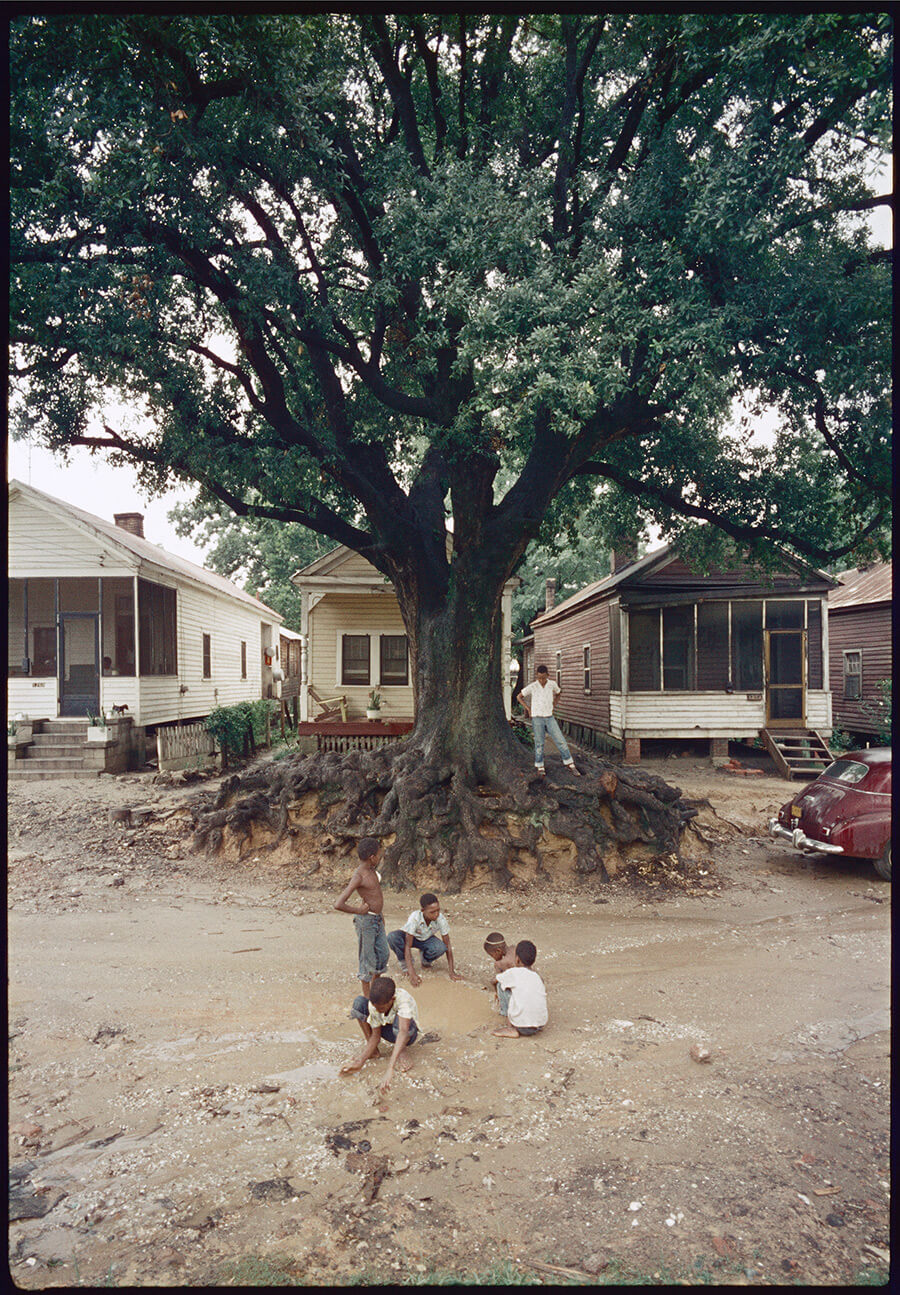 |
| Children at Play, Mobile, Alabama, 1956. Photograph 37.002 by Gordon Parks. Courtesy of and copyright by The Gordon Parks Foundation. |
A grandfather holds his small grandson while his three granddaughters walk playfully ahead on a sunny, tree-lined neighborhood street. A middle-aged man in glasses helps a girl with puff sleeves and a brightly patterned dress up to a drinking fountain in front of a store. Five girls and a boy watch a Ferris wheel on a neighborhood playground. Shot in 1956 by Life magazine photographer Gordon Parks on assignment in rural Alabama, these images follow the daily activities of an extended African American family in their segregated, southern town. When they appeared as part of the Life photo essay "The Restraints: Open and Hidden" however, these seemingly prosaic images prompted threats and persecution from white townspeople as well as local officials, and cost one family member her job. The calm demeanor of Parks's subjects belies the injustice of the "separate but unequal"1Charlayne Hunter-Gault, "Doing the Best We Could with What We Had," in Gordon Parks: Segregation Story (Göttingen, Germany: Steidl, with the Gordon Parks Foundation and the High Museum of Art, 2014), 8–10. Hunter-Gault uses the term "separate but unequal" throughout her essay. conditions of their lives in the Jim Crow South: the girl drinks from a "colored only" fountain, and the six African American children look through a chain-link fence at a "white only" playground they cannot enjoy. "Out for a stroll" with his grandchildren, according to the caption in the magazine, the lush greenery lining the road down which "Old Mr. Thornton" walks "makes the neighborhood look less like the slum it actually is. Like all but one road in town, this is not paved; after a hard rain it is a quagmire underfoot, impassable by car."2Robert Wallace, "The Restraints: Open and Hidden," Life Magazine, September 24, 1956, reproduced in Gordon Parks, 106.
Parks took more than two-hundred photographs during the week he spent with the family. All but the twenty-six images selected for publication were believed to be lost until recently, when the Gordon Parks Foundation discovered color transparencies wrapped in paper with the handwritten title "Segregation Series." Gordon Parks: A Segregation Story, on view at the High Museum of Art in Atlanta through June 21, 2015, presents the published and unpublished photographs that Parks took during his week in Alabama with the Thorntons, their children, and grandchildren.
 |  |  | ||
| Untitled, Shady Grove, Alabama, 1956. Photograph 37.005 by Gordon Parks. Courtesy of and copyright by The Gordon Parks Foundation. | Untitled, Alabama, 1956. Photograph 37.066 by Gordon Parks. Courtesy of and copyright by The Gordon Parks Foundation. | Ondria Tanner and her Grandmother Window-shopping, Mobile, Alabama, 1956. Photograph 37.007 by Gordon Parks. Courtesy of and copyright by The Gordon Parks Foundation. |
Parks's extensive selection of everyday scenes fills two large rooms in the High. Wall labels offer bits of historical context and descriptions of events with a simplicity that matches the understated power of the images. For example, one of several photos identified only as Untitled, Shady Grove, Alabama, 1956, shows two nicely dressed women, hair neatly tucked into white hats, casually chatting through an open window, while the woman inside discreetly nurses a baby in her arms. Centered in front of a wall of worn, white wooden siding and standing in dusty gray dirt, the women's well-kept appearance seems incongruous with their bleak surroundings. Children at Play, Alabama, 1956, shows boys marking a circle in the eroded dirt road in front of their shotgun houses. In Untitled, Alabama, 1956, displayed directly beneath Children at Play, two girls in pretty dresses stand ankle deep in a puddle that lines the side of their neighborhood dirt road for as far as the eye can see. In Ondria Tanner and her Grandmother Window Shopping, Mobile, Alabama, 1956, a wide-eyed girl gazes at colorfully dressed, white mannequins modeling expensive clothes while her grandmother gently pulls her close. The lack of overt commentary accompanying Parks's quiet presentation of his subjects, and the dignity with which they conduct themselves despite ever-present reminders of their "separate but unequal" status in everyday life, offers a compelling alternative to the more widely circulated photographs of brutality and violence typical of civil rights photography.
 |
| Outside Looking In, Mobile, Alabama, 1956. Photograph 37.008 by Gordon Parks. Courtesy of and copyright by The Gordon Parks Foundation. |
In the exhibition catalogue essay "With a Small Camera Tucked in My Pocket," Maurice Berger observes that this series represents "Parks'[s] consequential rethinking of the types of images that could sway public opinion on civil rights."3Maurice Berger, "With a Small Camera Tucked in My Pocket," in Gordon Parks, 12. His full-color portraits and everyday scenes were unlike the black and white photographs typically presented by the media, but Parks recognized their power as his "weapon of choice" in the fight against racial injustice.4Ibid. Furthermore, Parks's childhood experiences of racism and poverty deepened his personal empathy for all victims of prejudice and his belief in the power of empathy to combat racial injustice. His photograph of African American children watching a Ferris wheel at a "white only" park through a chain-link fence, captioned "Outside Looking In," comes closer to explicit commentary than most of the photographs selected for his photo essay, indicating his intention to elicit empathy over outrage.
However powerful Parks's empathetic portrayals seem today, Berger cites recent studies that question the extent to which empathy can counter racial prejudice—such as philosopher Stephen T. Asma's contention that human capacity for empathy does not easily extend beyond an individual's "kith and kin."5Ibid. Clearly, the persecution of the Thornton family by their white neighbors following their story's publication in Life represents limits of empathy in the fight against racism.
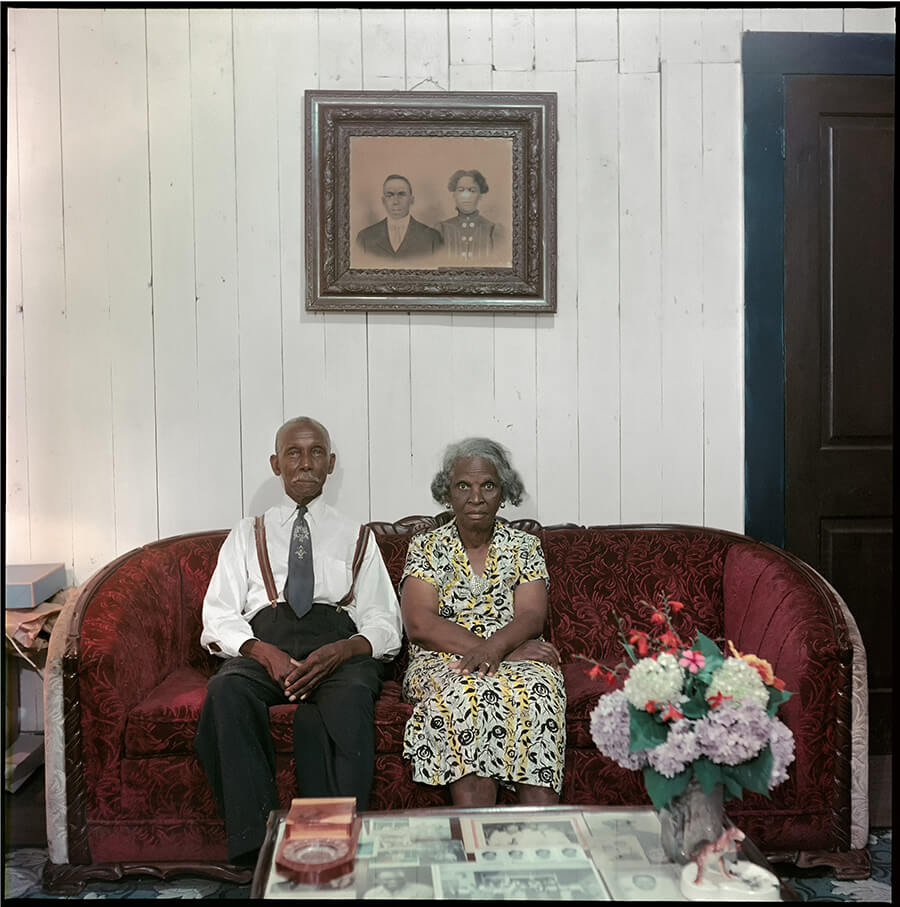 |
| Mr. and Mrs. Albert Thornton, Mobile, Alabama, 1956. Photograph 37.003 by Gordon Parks. Courtesy of and copyright by The Gordon Parks Foundation. |
Parks's Life photo essay opened with a portrait of Mr. and Mrs. Albert Thornton, Sr., seated in their living room in Mobile. Above them in a single frame hang portraits of each from 1903, spliced together to commemorate the year they were married. Mrs. Thornton looks reserved and uncomfortable in front of Parks's lens, but Mr. Thornton's wry smile conveys his pride as the patriarch of a large and accomplished family that includes teachers and a college professor. Photos of their nine children and nineteen grandchildren cover the coffee table in front of them, reflecting family pride, and indexing photography's historical role in the construction of African American identity.
As a relatively new mechanical medium, training in early photography was not restricted by racially limited access to academic fine arts institutions. African Americans Jules Lion and James Presley Ball ran successful Daguerreotype studios as early as the 1840s. During and after the Harlem Renaissance, James Van der Zee photographed respectable families, basketball teams, fraternal organizations, and other notable African Americans. Thomas Allen Harris, director of the 2014 documentary Through a Lens Darkly: Black Photographers and the Emergence of a People, recalls the importance of photography to his own family:
Photography was a means of unifying our extended family . . . one generation with the next. . . . My grandfather's living room was a gallery; filled with the images of famous Black leaders as well as the images of our forbearers, interspersed with his own photos. . . . Like grandfather's stories describing his great grandparents making their way out of slavery and building their lives into something despite the pervasive and crippling racial barriers they faced, the legacy of these photographic images proudly showed us who we were.6Thomas Allen Harris, interviewed by Craig Phillips, "Thomas Allen Harris Goes Through a Lens Darkly," Independent Lens Blog, PBS, February 13, 2015, http://www.pbs.org/independentlens/blog/thomas-harris-goes-lens-darkly.
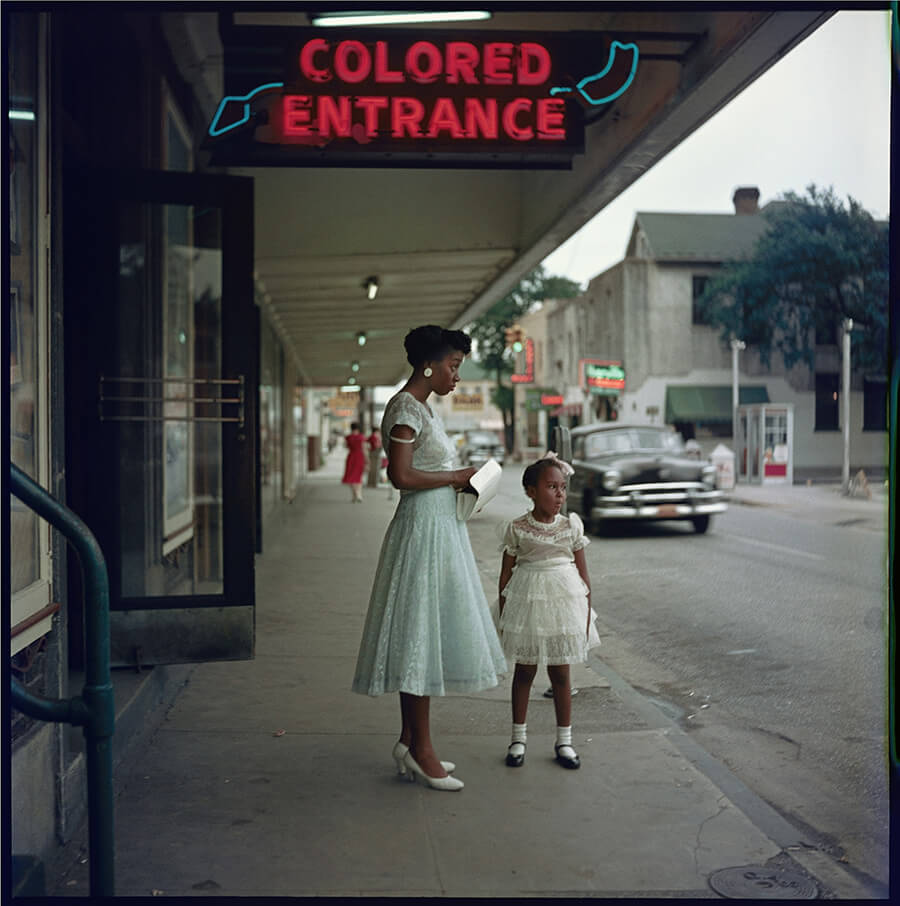 |
| Department Store, Mobile, Alabama, 1956. Photograph 37.011 by Gordon Parks. Courtesy of and copyright by The Gordon Parks Foundation. |
Parks mastered creative expression in several artistic mediums, but he clearly understood the potential of photography to counter stereotypes and instill a sense of pride and self-worth in subjugated populations. Berger recounts how Joanne Wilson, the attractive young woman standing with her niece outside the "colored entrance" to a movie theater in Department Store, Mobile Alabama, 1956, complained that Parks failed to tell her that the strap of her slip was showing when he recorded the moment: "I didn't want to be mistaken for a servant. Dressing well made me feel first class. I wanted to set an example."7Berger, 15. Parks's presentation of African Americans conducting their everyday activities with dignity, despite deplorable and demeaning conditions in the segregated South, communicates strength of character that commands admiration and respect. The headline in the New York Times photography blog Lens, for Berger's 2012 article announcing the discovery of Parks's Segregation Series, describes it as "A Radically Prosaic Approach to Civil Rights Images."8Maurice Berger, "A Radically Prosaic Approach to Civil Rights Images," Lens, New York Times, July 16, 2012, http://lens.blogs.nytimes.com/2012/07/16/a-different-approach-to-civil-rights-images/. It is precisely the unexpected poetic quality of Parks's seemingly prosaic approach that imparts a powerful resonance to these quiet, quotidian scenes.
About the Author
Diana McClintock is associate professor of art history at Kennesaw State University and was previously an associate professor of art history at the Atlanta College of Art. Prior to entering academia she was curator of education at Laguna Art Museum and a museum educator at the Municipal Art Gallery in Los Angeles. McClintock's current research interests include the examination of changes to art criticism and critical writing in the age of digital technology, and the continued investigation of "Outsider" art and new critical methodologies. McClintock also writes for ArtsATL, an open access contemporary art periodical.
Acknowledgments
Southern Spaces thanks The Gordon Parks Foundation and the High Museum of Art for their assistance with this review. All images courtesy of The Gordon Parks Foundation.
]]>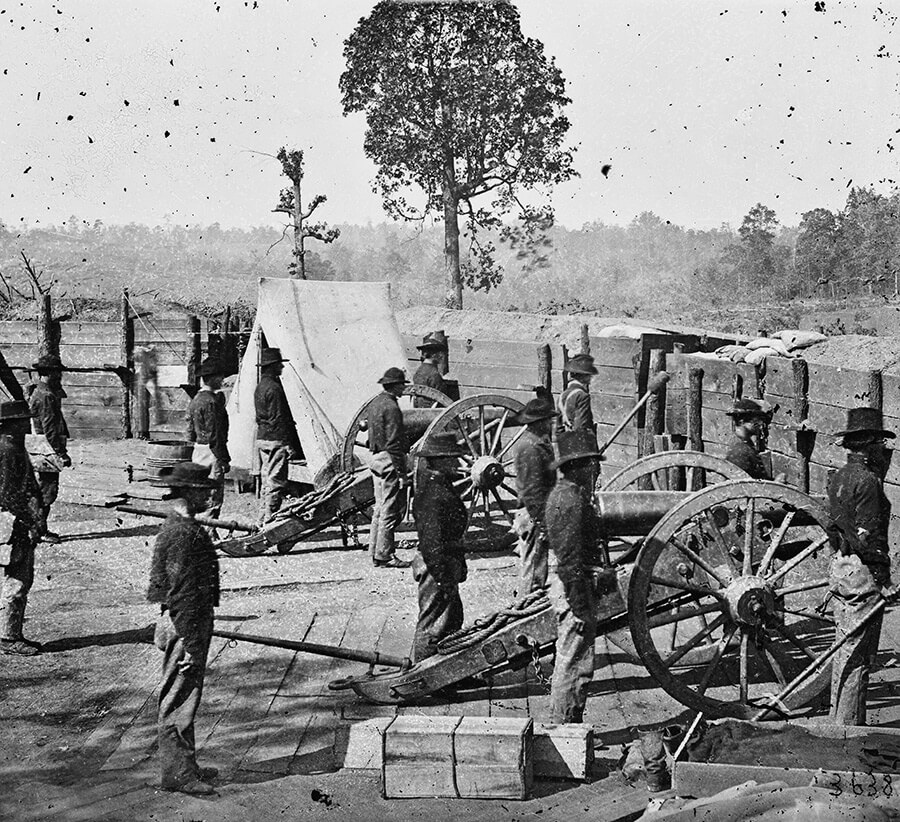
Emory University's Robert W. Woodruff Library continues to celebrate the launch of the Battle of Atlanta mobile tour website and commemorate the 150th anniversary of the battle with a presentation and exhibit of materials on Thursday, July 17, at 6:30 p.m. in the Joseph W. Jones Room.
Developed by the Emory Center for Digital Scholarship (ECDS), the smartphone-friendly tour provides GPS directions and mapping, historical information about each of its twelve stops, and multimedia content including video and historical images. It is accessible via a web link, and requires no download. (https://battle-of-atlanta.opentour.site/tours)
The event will include a talk about the context and legacy of the July 22, 1864, battle by Daniel Pollock, project lead and Civil War scholar; a demonstration of the mobile tour by Brian Croxall, project manager and ECDS digital humanities strategist; and a presentation on the Civil War collections at Emory's Manuscript, Archives, and Rare Book Library (MARBL). Randy Gue, MARBL curator of Modern Political and Historical Collections, will discuss stories and perspectives on the Battle that emerge from MARBL's Union, Confederate, and civilian collections.
"MARBL has a range of materials that document the Civil War, and statistically they represent some of our highest-use collections," Gue said. "It is exciting to see the library and ECDS develop tools that transform historical items and data from archives with digital technology. The Battle of Atlanta mobile tour website represents a new, interactive way to learn."
Erica Bruchko, US history and African American studies librarian at the Woodruff library said that the exhibit, "Mobilizing the Battle of Atlanta," chronicles how the tour application was created and the research that went into it. Bruchko, Croxall, Pollock, and ECDS Andrew W. Mellon graduate fellow Chris Sawula curated the exhibit, which will remain on view through October 19, 2014.
 |
| Dolly Lunt Burge, whose diary is in the exhibit, wrote about the Battle sounds she could hear from her home in Covington, Georgia. Courtesy Civil War collections, MARBL, Emory University. |
Among the historical materials on display will be photographs, letters, lithographs, newspaper clippings, postcards, maps, and the diary of Dolly Lunt Burge, who described hearing the Battle of Atlanta—one of the biggest in the final months of the Civil War—from as far away as Covington, Georgia. The exhibit will also include some items that do not appear on the digital tour.
Team members compare the stops along the mobile tour to a kind of twenty-first century historical marker—one that can hold an unlimited amount of text, accommodate images and video, and can be updated as new research comes to light.
Project members drew on Pollock's research to pinpoint twelve significant areas—most now unrecognizable due to the city's growth—and created a GPS-guided tour enhanced with information and images gathered from various institutions' archives during months of research. When the ECDS team could not find an application with the precise features they needed, they created their own open-source software.
"While many people in Atlanta know there was a Civil War battle here, very few of them could show you where it happened. Our digital tour takes you to the exact location of twelve significant moments in the Battle of Atlanta," Croxall said. "To learn that the first shots were fired near a local high school or to realize that its most ferocious fighting took place along your commute at what's now the intersection of Interstate 20 and Moreland Avenue, helps you see the city in a new, historical context."
The exhibit will be on display outside ECDS on level three, near the Joseph W. Jones Room where the presentation and demonstration will be held. Light refreshments will be served.
The Robert W. Woodruff Library is located at 540 Asbury Circle in Atlanta, Georgia 30322. Parking is available in the Fishburne parking deck.
]]>Review
 |
| frozen, photograph inside Kara Walker's A Subtlety, Brooklyn, New York, June 6, 2014. Photograph by Eric Konon. Courtesy of Eric Konon. |
Oh ye who at your ease
Sip the blood-sweeten'd beverage—Robert Southey, Poems of the Slave Trade, Sonnet III1Robert Southey, The Poetical Works of Robert Southey (New York: D. Appleton and Co., 1839), 110.
Nothing expresses more viscerally our blood-stained appetite for sugar than Kara Walker's installation, A Subtlety or the Marvelous Sugar Baby.2Kara Walker, A Subtlety or the Marvelous Sugar Baby, May 10–July 6, 2014, Brooklyn, New York: Domino Sugar Factory. From Robert Southey, to Voltaire, to Victor Schoelcher, to Aimé Césaire, abolitionists, philosophers, and poets alike have used the trope of blood to denounce the dehumanizing system of slavery. The force of the metaphor resides in the fact that blood in sugar was also quite literal. Unpaid or exploited laboring humans left their blood, sweat, fingers, hands, and ultimately, lives, in the plantation machinery of sugar-cane slavery and sugar processing as though in a sacrifice devoid of sacredness and rituals. French philosopher Claude-Adrien Helvetius proclaims in 1758 "There is no sugar barrel that reaches Europe without stains of human blood."3"Il n'arrive point de barrique de sucre en Europe qui ne soit teinte de sang humain." Claude-Adrien Helvétius, Œuvres Complètes, Vol. 1 (Paris: Lepetit, Editeur, 1777), 25. Author's translation. An abolitionist movement in the 1780s calls itself "Blood Sugar" on the ground that "sugar cane was fertilized with the blood of African slaves."4Jody Dunville, "Blood Sugar," accessed June 30, 2014, http://web.utk.edu/~gerard/romanticpolitics/bloodsugar.html. On the "blood sugar" topos in Coleridge's 1795 lecture on the slave-trade and Southey's 1797 sonnets, see Timothy Morton, "Blood Sugar," in Romanticism and Colonialism: Writing and Empire 1730–1830, ed. Tim Fulford and Peter J. Kitson (New York: Cambridge University Press, 1998), 87–106. Also consult anthropologist Sidney Mintz's seminal Sweetness and Power: The Place of Sugar in Modern History (New York: Penguin, 1985). Visual and installation artist Kara Walker herself, in an interview with Audie Cornish on National Public Radio, asserts: "Basically, it was blood sugar . . . like we talk about blood diamonds today, there were pamphlets saying this sugar has blood on its hands."5Audie Cornish, "Artist Kara Walker Draws Us Into Bitter History With Something Sweet," National Public Radio, May 16, 2014, accessed June 30, 2014, http://www.npr.org/2014/05/16/313017716/artist-kara-walker-draws-us-into-bitter-history-with-something-sweet.
 |
| Sugar Sublime: Kara Walker, Domino sugar, photograph inside Kara Walker's A Subtlety, Brooklyn, New York, May 31, 2014. Photograph by Several Seconds. Courtesy of Several Seconds. |
"Blood Sugar," the title of my review, is also meant in its medical sense since one of the ravages of the sugar industry is the diabetes epidemic in the world's sugar-producing and consuming regions.6 In sugar cane producing French Overseas Departments—Martinique, Guadeloupe, and Reunion—the incidence of diabetes is twice as high as in continental France. "Le Diabète Explose en France: 2 Fois Plus de Diabétiques dans les Dom-Tom Qu'en Métropole," Docbuzz: L'Autre Information Santé, November 13, 2010, accessed July 2, 2014, http://www.docbuzz.fr/2010/11/13/123-le-diabete-explose-en-france-2-fois-plus-de-diabetiques-dans-les-dom-tom-qu%E2%80%99en-metropole. For the diabetes epidemics in the Caribbean, also see Ludmilla F. Wikkeling-Scott, "Addressing Diabetes, A Regional Epidemic in Caribbean Populations," June 5, 2012. Type 2 diabetes also has such prevalence in the US South that the Center for Disease Control and Prevention coined the term "Diabetes Belt": Melissa Healy, "Diabetes Belt: American South Gets More Health Notoriety," Los Angeles Times, March 8, 2011, accessed June 30, 2014, http://articles.latimes.com/2011/mar/08/news/lat-diabetes-belt-20110308. Exhibited at the decaying Domino Sugar Factory in Brooklyn from May to July 2014, Walker's monumental installation, organized on the occasion of the demolition of the Refining Plant,7The Domino Sugar Factory will be demolished in August 2014. The operating New York area Domino factory is located in Yonkers. Before the demolition, the "Marvelous Sugar Baby" will be melted down. Some of the resin figurines will be salvaged for museum exhibits. For the recollections of Robert Shelton, who worked on the floor of the Domino factory for twenty years see Vivian Yee, "2 Jobs at Sugar Factory, and a Lump in the Throat," New York Times, July 5, 2014, accessed July 5, 2014, http://www.nytimes.com/2014/07/05/nyregion/recalling-sticky-hot-job-before-old-domino-sugar-factory-falls.html. is dedicated to "the unpaid and overworked artisans who have refined our sweet tastes from the cane fields to the kitchens of the New World."8Writing on the wall of the exhibit entrance at the Domino Sugar Factory in Brooklyn, New York. The exhibit consists of a gigantic West Indian, African, or African American mammy-sphinx, who could evoke any part of the global plantation South, made out of eight tons of confectionery sugar coated over a foam structure, and of life-size sculptures made out of molasses-covered resin. The exhibit offers no flyers, captions, or explanations, only a release form informing us that we enter the building at our own risk.9On the sanitary and safety state of the building at the time of the exhibit, see Claire Voon's "How are they Keeping Rats Off Kara Walker's Sugar Sculptures?," Hyperallergic: Sensitive to Art & Its Discontents, June 10, 2014, accessed June 30, 2014, http://hyperallergic.com/130365/how-are-they-keeping-rats-off-kara-walkers-sugar-sculptures. A few volunteers answer questions of wandering visitors but overall we are left to draw our own conclusions.
When my friend and I visited the installation on June 13, 2014, the sky had turned slate black on one side of the industrial, decrepit, and gentrifying Williamsburg cityscape.10I am grateful to my friend and colleague, Professor Naïma Hachad, who helped me brainstorm during and after the exhibit and enriched this piece with her insights. We ran towards the building to escape an approaching downpour, powerful winds, and raging storm. We passed more than two hours inside, waiting for the storm to ease and for the water puddles blocking the exit to subside. The installation strongly intertwines with the factory, the city, the elements, and the environmental conditions and history that have shaped it. Over time, sugar has built up on the warehouse rafters and walls. Through sugar, the factory and Walker's art enter a symbiotic relationship, not only environmental but deeply historical. "This dank building," writes Jerry Saltz in his review of the installation, "where layers of history are caked on the walls with molasses, this place where brown sugar was turned white, multiplies the lurking meanings in Walker's work."11Jerry Saltz, "Kara Walker Bursts Into Three Dimensions, and Flattens Me," Vulture, May 31, 2014, accessed June 30, 2014, http://www.vulture.com/2014/05/art-review-kara-walker-a-subtlety.html.
Only scarce natural light enters the building through narrow tainted windows and creases of the roof and walls. Humidity and darkness make it feel like entering a cave. As our eyes adapt, figures of black cherubs become visible. I turn my face to the right and see the gigantic marvelous Sugar Baby as if lit up from within like a powerful neon light, or a bright cinema screen filling the room almost to the ceiling. The first impression is of sharp contrasts between black and white, a statement on binaries created by the structure of slavery on which sugar production depended. Slowly, stains and pools of yellow and red appear.
 |
| Get Me Before I'm Gone, photograph inside Kara Walker's A Subtlety, Brooklyn, New York, May 31, 2014. Photograph by Several Seconds. Courtesy of Several Seconds. |
 |
| approach, photograph inside Kara Walker's A Subtlety, Brooklyn, New York, June 6, 2014. Photograph by Eric Konon. Courtesy of Eric Konon. |
Simultaneous with its visual spectacle, the installation greets our hearing and smell. Standing by the entrance closing our umbrellas and drying the bottoms of our dripping pants, we listen to the entering crowd: a mixed humanity of international tourists, locals, white and black visitors, children, art students, and elderly couples. They enter running into the grotto to escape the storm and drafty winds. Passing the threshold, their mouths gape in a unanimous "wow." The wows multiply and echo with each other, sometimes marked with awe, admiration, surprise, or horror. Sugar Baby is something as yet unseen in its scale, beauty, and monstrosity. The "wow" effect created by art, the monstrous beauty of the installation, the lightning making its way through the creases and narrow windows, and the blasts of thunder shaking the walls evoke the history of slavery.
Like naïve Hansel and Gretel, we seek shelter and sugar. Walker describes her work as a "confection": "Kara Walker has confected a Subtlety."12"Creative Time presents Kara Walker's A Subtlety," accessed June 30, 2014, http://creativetime.org/projects/karawalker/. The artist is a pastry chef, a candy-maker, a sugar worker. Confectionery "is the art of creating sugar-based dessert forms, of subtleties."13"Confectionery," Wikipedia, accessed June 30, 2014, http://en.wikipedia.org/wiki/Confectionery. Exhibit chief curator Nato Thompson explains that subtleties are "sugar sculptures that adorned aristocratic banquets in England and France in the Middle Ages, when sugar was strictly a luxury commodity. These subtleties, which frequently represented people and events that sent political messages, were admired and then eaten by the guests."14Nato Thompson, "Curatorial Statement," accessed June 30, 2014, http://creativetime.org/projects/karawalker/curatorial-statement/. The title and subtitle of the exhibit make perfect sense, until we experience their deep irony and the cruelties of the situation.
At first, we smell the scent of sugar familiar as confectioned sweets and candy. One visitor puts her nose to one of the figures. "At least it smells good," she says. But it only takes a few minutes to whiff the acrid stench of old sugar, a smell like that of meat or flesh rotting in the trashcan in the back of a restaurant on a hot afternoon. The sweet rancid air mixes with urine and corroding iron. Suddenly, we're lost characters in a Grimm tale.
 |
| Wall text for Kara Walker's A Subtlety, Brooklyn, New York, May 18, 2014. Photograph by Ann Hilton Fisher. Courtesy of Ann Hilton Fisher. |
Kara Walker, confectioner in chief, offers us the indigestion of the greedy act of consuming sugar for centuries. She turns into an avenger swallowing the public in her den for a little while and serving us a slice of history and a lesson in humanity. The invitation on the entry wall presents the exhibit as a confection made to please our taste and consumption. But it is against the rules to taste the sugar—no confectionery samples are offered at the end of the show—and the sugar is stinky and inedible. The exhibit stirs a reflex of nausea rather than hunger, an indigestion created by our consumption of sugar made possible by our exploitation of fellow humans. This luxury turned into necessity changed the course of human history, driving colonization of tropical zones, chattel slavery, indentured labor, and glucose illnesses.
I now need to go slow. I cannot rush to the enormous woman sphinx. I have to take my time in fear of what I will find.
Meandering wingless African cherubs pave the way to the monstrous and marvelous Sugar Baby. These five-feet tall black children, enlargements of collectibles, which could be found at the front door of a white southern home or sugar plantation, signifying "Southern hospitality," carry bananas or food in baskets.15"Walker went down a rabbit hole of sugar history, at one point stumbling on some black figurines online—the type of racial tchotchkes that turn up in a sea of mammy cookie jars," Audie Cornish, "Artist Kara Walker Draws Us Into Bitter History With Something Sweet," National Public Radio, May 16, 2014, accessed June 30, 2014, http://www.npr.org/2014/05/16/313017716/artist-kara-walker-draws-us-into-bitter-history-with-something-sweet. The cherubs' sweet smiles, apple cheeks, and potbellies merge into the most terrifying part of the installation. Two months into the exhibit, the statues have changed, deteriorated, or disintegrated. A majority of the figurines are made of resin covered with molasses. The molasses cherubs, made of a viscous and dark by-product of cane refining, stand in sharp contrast with the white and powdery confectionary sugar of the sphinx. The crumbling molasses sculptures each weigh four hundred pounds: surprising for their true-to-life size. Kara Walker threw broken body parts and remains into the fruit-bearing baskets of their surviving brothers. The offering of food turns into an offering of human flesh, gesturing that sugar production and consumption are acts of cannibalism. My 2013 book The Tropics Bite Back was an effort to demonstrate that the image of the cannibal was projected onto Amerindians or Africans to dehumanize them.16Valérie Loichot,The Tropics Bite Back: Culinary Coups in Caribbean Literature (Minneapolis: University of Minnesota Press, 2013). See also Mimi Sheller's Consuming the Caribbean: From Arawaks to Zombies (London: Routledge, 2003) and Jack D. Forbes's Columbus and Other Cannibals (New York: Seven Stories Press, 2008). Walker's installation makes clear that the true cannibalism was the machinery of colonization and enslavement.
 |  |
| Two photographs of a child carrying a basket inside Kara Walker's A Subtlety, Brooklyn, New York, 2014. Photograph on left by Valérie Loichot. Courtesy of Valérie Loichot. Photograph on right by B. C. Lorio. Courtesy of B. C. Lorio. | |
The molasses children who have suffered the most have stumps for limbs, tumorous skulls, gnawed mouths, empty eye sockets, and metal bars sticking out of their trunks. Blood- and pus-resembling liquid oozes from their groins as if they have been maimed by rape or castration. They resemble Emmett Till in the casket left open by his mother Mamie Till,17See, for instance, Devery Anderson, Emmetttillmurder.com, accessed June 30, 2014. or the raped and tortured figures of Walker's silhouette work.18See Gwendolyn DuBois Shaw's Seeing the Unspeakable: The Art of Kara Walker (Durham and London: Duke University Press, 2004). Transforming, the boys' flesh has gained pustules, mold, rot, and sandy growths,19Walker's installation resembles in its evolution Jason deCaires Taylor's underwater sculptures (accessed June 30, 2014, http://www.underwatersculpture.com/sculptures). However, while Taylor's sculptures' evolution with their coral environment conveys rejuvenation, Walker's art's alliance with the industrial site evokes degeneration. provoking a troubling confusion between human bodies, raw flesh,20For Hortense Spillers, the reduction to bare flesh is the condition of enslaved Africans. The critic reads the marking of the flesh of the New World African woman, of the "seared, divided, ripped-[apart], riveted to the ship's hole, fallen, or 'escaped' overboard," as a cultural text whose marking and branding "transfers from one generation of the other." See Hortense Spillers, Black, White, and In Color (Chicago: University of Chicago Press, 2003) 206–207. the vegetal product of sugar cane, and the dilapidated metallic and stone surroundings of the warehouse. In Vibrant Matter, Jane Bennett interprets American culture as marked by "hyperconsumptive necessity," by "thing-power" or "vitality": "the capacity of things—edible, commodities, storms, metals—not only to block the will and designs of humans but also to act as quasi agents of forces with trajectories, propensities, or tendencies of their own."21Jane Bennett, Vibrant Matter: A Political Ecology of Things (Durham: Duke University Press, 2010), 5, viii. In Bennett's sense, Kara Walker's creation is representative of slavery, but also of our generalized excess and hyperconsumption, in which organic and inorganic (human, animal, metal, and meteorological) coexist and co-act in confusion and enmeshment.
 |  |
| Closeup of a child sculpture inside Kara Walker's A Subtlety, Brooklyn, New York, June 13, 2014. Photograph by Valérie Loichot. Courtesy of Valérie Loichot. | A child sculpture inside Kara Walker's A Subtlety, Brooklyn, New York, June 13, 2014. Photograph by Valérie Loichot. Courtesy of Valérie Loichot. |
In the complex game of lights and shadows at the Domino Factory, we see our reflections in pools of sugary water: we are part of this story, this history, either as culprits, victims, or consumers. We are part of this womb-machine that contains and shapes us in our modernity.22For Martinican poet and philosopher Édouard Glissant, the hold of the slaveship, the slave plantation and its machinery constitute "bellies of the world," functioning at once as expelling guts and sheltering womb. See my Orphan Narratives for a discussion of Glissant's ambivalent bellies of the world: Valérie Loichot, Orphan Narratives: The Postplantation Literature of Faulkner, Glissant, Morrison, and Saint-John Perse (Charlottesville: University of Virginia Press, 2007). For Cuban writer Antonio Benítez Rojo as well, the sites of slavery and exploitation are also the wombs of modernity without which the industrialized world would not have been born. The Brooklyn Domino Sugar Refinery, established in its Williamsburg, New York, location in 1882, was the largest sugar refinery in the world, hence, a major belly of the world. Thompson explains that "The Domino Sugar refinery is certainly an integral part of the story of sugar. Built by the Havemeyer family in 1856, by 1870 it was refining more than half of the sugar in the United States, producing over 1,200 tons of the sweet stuff every day." See Thompson, "Curatorial Statement." Our bodies reflecting in the rain water pools mixed with resin and sugar by-product remind us of the mirroring, forever implicating, scene of the lynching of Joe Christmas in Faulkner's Light in August: "For a long moment [Joe Christmas] looked up at them with peaceful and unfathomable and unbearable eyes . . . upon that black blast the man seemed to raise soaring in their memories for ever and ever. They are not to lose it, in whatever peaceful valleys, . . . in the mirroring faces of whatever children they will contemplate old disasters and newer hopes."23William Faulkner, Light in August (New York: Vintage International, 1990), 465. Our reflections on a rainy day in the pools emanating from the tortured molasses babies, makes us see ourselves in the exhibit. Walker's art demands an ethical response.
At last, I am about to face Sugar Baby. A Subtlety or the Marvelous Sugar Baby. The woman sphinx has no proper name and is defined with common nouns referring to things, a recurrent way to misname in situations of slavery or oppression, such as Sapphire, Sweet Thing, Boy, Mammy, etc. The rarer, confectionary meaning of "subtlety" is overshadowed by our everyday use of the term that refers to something delicate, discreet, moderate, nice, refined, and tasteful. But there is nothing subtle about the scale, weight, enormity, exaggerated features, mouth, vulva, breasts, paws, backside, exaggerated brightness and whiteness of Sugar Baby. Subtlety acts as a euphemism of the sort used to describe the monstrosity of slavery, as the "peculiar institution." As for "marvelous," it evokes something exciting, wonderful, strange, astonishing, miraculous, or supernatural, conveying visitors to a spectacular show, whether otherworldly (as in the "marvelous land of Oz") or the freak show (as in the "marvelous contortionist").
 |
| Rear of the Sugar Baby sphinx inside Kara Walker's A Subtlety, Brooklyn, New York, June 13, 2014. Photograph by Valérie Loichot. Courtesy of Valérie Loichot. |
"Sugar Baby" could evoke any love relationship in which the beloved is turned into sweetness, from Song of Songs24"Thy lips, O my bride, drop honey." Source: "Song of Songs, Chapter 4," The Complete Hebrew Bible, accessed June 30, 2014http://www.mechon-mamre.org/p/pt/pt3004.htm. to Billie Holiday's "Sugar (That Sugar Baby O'Mine)": "Sugar, I call my baby, my sugar . . . I'd make a million trips to his lips / If I were a bee / Because he's sweeter than chocolate candy to me / He's confectionery."25"Billie Holiday—Sugar," YouTube, accessed June 30, 2014, https://www.youtube.com/watch?v=_UajeQsQrRA&feature=kp. The intersection of sugar production, slavery, and sexual exploitation turns bitter wherever black and colored women become objects of sexual consumption, in a direct metonymic and metaphorical relationship with sugar. They became fodder for the fields and food for sexual appetites.
Nina Simone's "Four Women" denounces the association between the light-skinned black woman as an easy object of consumption: "My skin is tan / my hair is fine / My hips invite you . . . Whose little girl am I? / Anyone who has money to buy / What do they call me? / My name is Sweet Thing / My name is Sweet Thing."26 "Nina Simone—Four Women," YouTube, accessed June 30, 2014, https://www.youtube.com/watch?v=WRmzQ39sXTQ. The monster Walker—or rather slavery—has created is the material realization of the effacing of a woman's body with the sugar it produced or signified. The "baby" of Walker's exhibit is also to be understood as the offspring: the monstrous child of slavery. The factory becomes the belly birthing that monstrosity.
As in the popular expressions "sugar daddy" and "honey pot," "Sugar Baby" might as well be "money baby" in the logic of the inextricable confusion between sugar, money, and sex that the economy of slavery built. In other words, Walker's creation is the materialization of the monstrous equation of human bodies with sexual and culinary commodities.
After detours and musings, I finally draw close to Marvelous Sugar Baby in all her size, brightness, whiteness, and imposing presence. That her eyes are closed—the sphinx awaiting to give the enigma—also puts the visitor in the position of the voyeur who can contemplate without the gaze of the spectacle staring back. This discomfort is particularly strong as we face the back of the statue on all fours with its sexual parts exposed. The offered large breasts with well defined areolas and nipples are available for the gazer to seize, like enslaved women's breasts were available for the enslavers' infants and toddlers. This reality is present from Toni Morrison's Beloved27"And they took my milk!" See Toni Morrison, Beloved (Knopf: New York, 1994), 19. In her Washington Post piece (McDonald, "Going to See Kara Walker's A Subtlety? Read These First," Washington Post, May 27, 2014, accessed June 30, 2014, http://www.washingtonpost.com/news/morning-mix/wp/2014/05/27/going-to-see-kara-walkers-subtlety-read-these-first/), Soraya Nadia McDonald gives a non-inclusive reading list of novels by Morrison, Maryse Condé, Jean Rhys, and Jamaica Kincaid, who have focused on similar issues. to Kara Walker's cut-paper silhouette art in her 2007–2008 exhibit "American Primitives."28On "American Primitives," see Grace Elizabeth Hale's "A Horrible, Beautiful Beast," Southern Spaces, March 6, 2008, accessed June 30, 2014, https://southernspaces.ecdsdev.org/2008/horrible-beautiful-beast. On the politics and aesthetics of milk in Kara Walker, see Patricia Yaeger's "Circum-Atlantic Superabundance: Milk as World-Making in Alice Randall and Kara Walker," American Literature 78, no. 4 (2006): 769–798. Sugar Baby's sex is exposed as her behind is lifted up in an offering position while she is on all fours. While this speaks to the availability, the sexual enslavement and animalization of the black woman's body,29For another contemporary take on the trope, see Beyoncé Knowles's 2006 "Suga Mama" in which the star sings on what looks like a white sugar cube in a pose reminiscent of the Marvelous Sugar Baby's four-legged pose. Beyoncé as well takes an ironic twist on the image, bending gender roles as she begins the song dressed as a stereotypical providing "suga daddy" rather than a "suga mama": "And I've always been the type to take care of mine / I know just what I'm doing . . . Puttin' you on my taxes already, yeah, yeah, yeah, yeah." See "Beyonce—Suga Mama," Vagalume, accessed July 27, 2017, https://www.vagalume.com.br/beyonce/suga-mama.html. and to the exhibition of black women's sexual organs attached or not to a body—see the famous case of Saartjie Baartman—it can also be seen as a lesson to visitors, or as a gesture of extreme affront. The exhibition of the female organs of sex and reproduction can also, as in Gustave Courbet's 1866 painting, show us "The Origin of the World," the place where we came from and the place that gave birth to our modernity based on the hubristic consumption of sugar, among other superfluous goods. The caricatured portrayal of both her protruding lips and vulva veer to an abstraction that makes them resemble geometric circles more than personalized human traits.30On the process of the "white gaze" smoothing out the body of "black subjects," by dismissing any individual characteristics, see Frantz Fanon's Black Skin, White Masks, trans. Richard Philcox (New York: Grove Press, 2008). The round and smooth vulva resembles the fleshy lips as turned from horizontal to vertical, as if the mouth could be violated like the vulva, or, in a more optimistic reading, as if labia could also speak, tell their story of exploitation.31On a related discussion of the correspondence between lips and labia, both called "lèvres" in French, see Lynn Huffer's Are the Lips a Grave? A Queer Feminist on the Ethics of Sex (New York: Columbia University Press, 2013). As Walker crucially explains in her interview with Audie Cornish, "She's positioned with her arms flat out across the ground and large breasts that are staring at you." While her eyes are closed or perhaps even carved out, her gaze appears in unexpected places that are, in a slavery context, sites of enslavement, theft, and resistance.
 |
| Click to load interactive 3-D model of the Sugar Baby sphinx, from Creative Time. © 2014 Creative Time. Photograph of sphinx, Brooklyn, New York, June 13, 2014. Photograph by Valérie Loichot. Courtesy of Valérie Loichot. |
"The Marvelous Sugar Baby" cannot be confused with Nina Simone's "Sweet Thing," available for the taking. Despite the apparent offering, her strength prevails. The decidedness of her chin and lips facing forward in a dignified pout offers a strong resistance to the gaze that fails to penetrate the enigmatic face. The powerful curves of her back and backside look like impassible mountains. The scale of the body makes it impossible to seize. To estimate the whole we miniature figurines have to walk around the enormous statue. We are turned into tiny black cut-out shadows next to her enormous whiteness. We are turned into Kara Walker's silhouetted figures, included in the creation of her world, and also part of that history.32Africana Studies scholar Noliwe M. Rooks deplores the fact that reviews of Walker's "A Subtlety" have been overwhelmingly positive and that critics and journalists have ignored the reception of the piece by black women (Noliwe Rooks, "Black Women's Status Update," The Chronicle of Higher Education, June 26, 2014, accessed June 30, 2014, http://chronicle.com/article/Black-Womens-Status-Update/147351/). She also points out that some of the white visitors behaved in ways that were "not just ignoble but also disrespectful" by, for instance, posing in explicitly sexual postures with the statue. Rooks's point is especially well taken not only for its crucial political dimension, but also in that, as I argue, the visitors become not only part of the show, but also incorporated into it. The ignoble gestures to which Rooks alludes become part of this repeated, unfinished, unending history of oppression.
From our Lilliputian perspective, we visitors, cannot stare her straight in the eye but have to look up towards her, as if staring at an imposing god. She is, after all, a Sphinx with enormous lion shoulders, hind legs, and forelegs ending in human hands and feet solidly anchored into the ground. The main visual inspiration for the piece seems to be the famous Great Sphinx of Giza,33For an extensive review of Kara Walker's iconographic influences, see "Kara Walker: Process and Inspiration," Creative Time, accessed June 30, 2014, http://creativetime.org/projects/karawalker/inspiration/. known as the "Terrifying One" and "Father of Dread" and "believed to represent the face of the Pharaoh Khafra."34"Great Sphinx of Giza," accessed June 30, 2014, http://en.wikipedia.org/wiki/Great_Sphinx_of_Giza. The sphinx is also, according to ancient Greek mythology, the one who is in control of the riddle and thereby the power of knowledge. The sphinx is a cannibal who devours the travelers who cannot answer her riddles.35"Sphinx," in Theoi Greek Mythology: Exploring Greek Mythology in Classical Literature and Art, ed. Aaron J. Atsma, accessed June 30, 2014, http://www.theoi.com/Ther/Sphinx.html. This last attribute is particularly resonant in the world of slavery and postslavery in which sugar cane plantation cultivation and sugar factories are perceived as cannibalistic machines.36 Among many examples of the factory as a cannibalistic machine eating up the cane workers and vomiting them out, see Aimé Césaire's Notebook of a Return to the Native Land: (Middletown, CT: Wesleyan University Press, 2001), 4: "[the] mills, slowly vomiting out their human fatigue." In its etymology, the sphinx is "the one who strangles."37"From Greek Sphinx, said to mean literally 'the strangler,' a back-formation from sphingein 'to squeeze, bind.'" See "sphinx (n.)," in Online Etymology Dictionary, ed. Douglas Harper, accessed June 30, 2014, http://www.etymonline.com/index.php?term=sphinx. The contracting sphincter muscles of the esophagi, anus, or vagina derive from the same etymon. No vulnerable object, the sphinx is the one that strangles. The added components to sphinx mythology in Walker's statue are its hyper-feminization and racialization, which inscribe her in a precise historical reality, as well as in a history of oppression by caricature. The devouring sphinx-mammy is a combination of two of the most powerful stereotypes used to define Caribbean and African American women.38On the prevalence of the figure of the cannibal as a controlling image, see Loichot, The Tropics Bite Back, especially xix–xxiii. However, since she is carved out of sugar, it is not a woman, but the materiality created by slavery that is the cannibal.
 |
| The Sugar Baby sphinx inside Kara Walker's A Subtlety, Brooklyn, June 13, New York, 2014. Photograph by Valérie Loichot. Courtesy of Valérie Loichot. |
I leave the exhibit with a riddle: why did Domino Foods donate eighty tons of sugar for the confection of Walker's work?39 For a full list of sponsors, including Domino Foods, see "Kara Walker: Project Support," Creative Time, accessed June 30, 2014, http://creativetime.org/projects/karawalker/project-support/. Why did a company that continues to be the largest producer and marketer of refined sugar in the United States chose to fund an exhibit that is so critical of its very existence? How could Kara Walker accept the gift without compromising the mission of her installation and tainting her own work? Is the donation a gesture of largesse from the "master"? Is it a marketing strategy to increase the visibility of the company? Is the sugar gift tainted with blood, or is it an honest, albeit insufficient, act of reparation? Walker's Subtlety provides neither satiety nor answer. Instead, it leaves us with a relentless urge to question topped by an indigestion. While Walker is clearly critical of Domino Foods, and, by extension, of slavery, economic, sexual, and pictorial exploitation of human bodies, mass production and mad consumption, it is not clear as to whether art can satisfactorily fight these forces. I doubt the installation will discourage me from eating sugar. Nonetheless, it is precisely in its aggressive conundrum, in its power to cause anger, outrage, rage, awe, guilt, shame, laughter, wonder, understanding, or action that Walker's interactive and transient installation succeeds in keeping us engaged.
About the Author
Valérie Loichot is a professor of French and English at Emory University. She is the author of Orphan Narratives: The Postplantation Literatures of Faulkner, Glissant, Morrison, and Saint-John Perse (University of Virginia Press, 2007) and The Tropics Bite Back: Culinary Coups in Caribbean Literature (University of Minnesota Press, 2013). Her current projects include "Caribbean Creolization in the United States: Translating Race from Lafcadio Hearn to Barack Obama" and the forthcoming monograph Water Graves.
]]> |
| Amos Paul Kennedy Jr. prints, Kennedy and Sons Collection, Emory University Manuscript, Archives, and Rare Book Library. |
Printmaker Amos Paul Kennedy, Jr.'s posters and artists' books memorialize and celebrate African American history and culture. His work, housed in the Kennedy & Sons Collection in Emory's Manuscript, Archives, and Rare Book Library (MARBL), tells complex, personal, and painful stories that contribute to a new vernacular in the depiction and description of African American experience in the United States. In describing his work, Kennedy writes, "I am a SOCIAL PRINTER! Whatever I print—because my work is dedicated to the documentation of Negro culture—whatever I print is political."1Amos Paul Kennedy, Jr., "Social Book Binding," in Talking the Boundless Book: Art, Language, and the Book Arts, ed. Charles Alexander (Minneapolis: Minnesota Center for Book Arts, 1995), 47. Kennedy's posters, on which he literally spells out his messages, are the most blatant example of the political nature of his work. The two posters that bear the text "Equality is a Privilege Reserved for Blacks" and "Coffee Makes You Black" demonstrate that Kennedy's voice is both witty and insistent, challenging the viewer to reconsider perceptions of black culture, history, and art.
A self-described "humble negro printer," Kennedy creates many of his letterpress posters and postcards on commission. In the 2008 documentary Proceed and Be Bold!, which explores Kennedy's life and artistic output, Kennedy stated, "I don't believe in the thing called art . . . I think people just make stuff."2Proceed and be Bold!, directed by Laura Zinger (Chicago: Brown Finch Films, 2008), DVD. Following this artistic vision, many of Kennedy's prints function as both advertisements and art, emerging from and responding to the idiosyncratic needs of the communities they illustrate and inhabit. As an artist, Kennedy has lived and worked in the rural towns of Gordo and York, Alabama, as well as the urban center of Detroit, Michigan, where he currently resides.
 |
| Print from The Children Don't Count Exhibit, Amos Paul Kennedy Jr., Kennedy and Sons Collection, Emory University Manuscript, Archives, and Rare Book Library. |
Kennedy relies less on traditional locales for exhibiting his art, such as galleries or museum spaces, and instead prefers more direct and democratic communication with the public. He sells prints online for $25 and in-person at local fairs. When he exhibits his work in museum spaces, Kennedy utilizes the space in both creative and political ways. For example, viewing the gallery exhibition of Kennedy's The Children Don't Count, a multiyear project dedicated to children killed in Chicago in the early 1990s, required visitors to walk over a series of prints bearing the name of a child and how his or her death occurred. Sample prints from the first instance of The Children Don't Count in MARBL's Kennedy & Sons collection remembers Chicago children who died in 1992.
The activist motivations that undergird much of Kennedy's work inflect his artist's book sculpture of a burned church included in MARBL's Kennedy and Sons collection. This piece takes its inspiration from the series of arsons of African American churches that swept the southern United States in the 1990s, echoing similar church burnings that took place during the civil rights movement. These incidents, which occurred at predominantly black rural churches from Arkansas to Virginia, targeted the very places that writer Amiri Baraka has described as the "social focal points" of black life.3LeRoi Jones, Blues People: Negro Music in White America (New York: William Morrow and Company, 1963), 40-41. Kennedy's "Burnt Church" is part of a series he is creating to commemorate these recent burnings; "One . . . for every church," Kennedy writes about the project that is at once art, protest, and community rebuilding.4Amos Paul Kennedy, Jr., letter to author, March 14, 2014, Kennedy and Sons Collection, Manuscript, Archives, and Rare Book Library, Emory University Archives.
 |  | |
| Burned church artist's book, exterior, Amos Paul Kennedy Jr., Kennedy and Sons Collection, Emory University Manuscript, Archives and Rare Book Library. | Burned church artist's book, interior, Amos Paul Kennedy Jr., Kennedy and Sons Collection, Emory University Manuscript, Archives and Rare Book Library. |
Kennedy's artists' books combine the written word he privileges in his posters with the provocative space of a church building decorated with long strips of bible pages that leap almost flame-like across the model building and onto its roof. The words of varying size and font wrap the building with flowing ribbons of text. While some of the text is legible, its function here is not to represent a literal, scriptural message, but rather to emphasize the power of the biblical words that survived the church burnings. The building itself, despite the ruin and decline suggested by the ashes scattered below it, emanates an otherworldly power. Upon close examination of the model building, it is apparent that the roof of the church can be lifted, revealing a charred Bible nestled in its core. The experience of opening the church sculpture is akin to that of opening a treasure chest: awe, disbelief and a certain reverence. In addition to highlighting the power of the violence that resulted in the series of fires the model church commemorates, Kennedy's sculpture emphasizes the imminent power of the communities and their sacred texts that have survived.
MARBL's collecting strength in black print culture also includes the papers of Carter G. Woodson and Kelly Miller, both notable African American artists and intellectuals. Kennedy's addition of this living memorial to MARBL joins the numerous collections in the archives documenting African American history and culture, all of which are available for further reexamination, interpretation, and study by researchers, scholars, and the general public.
About the Author
Claire Ittner graduated from Davidson College with a degree in English and Art History. She worked as a project researcher at MARBL until May 2014, and is now working in the Center for Jazz Studies at Columbia University.
]]>