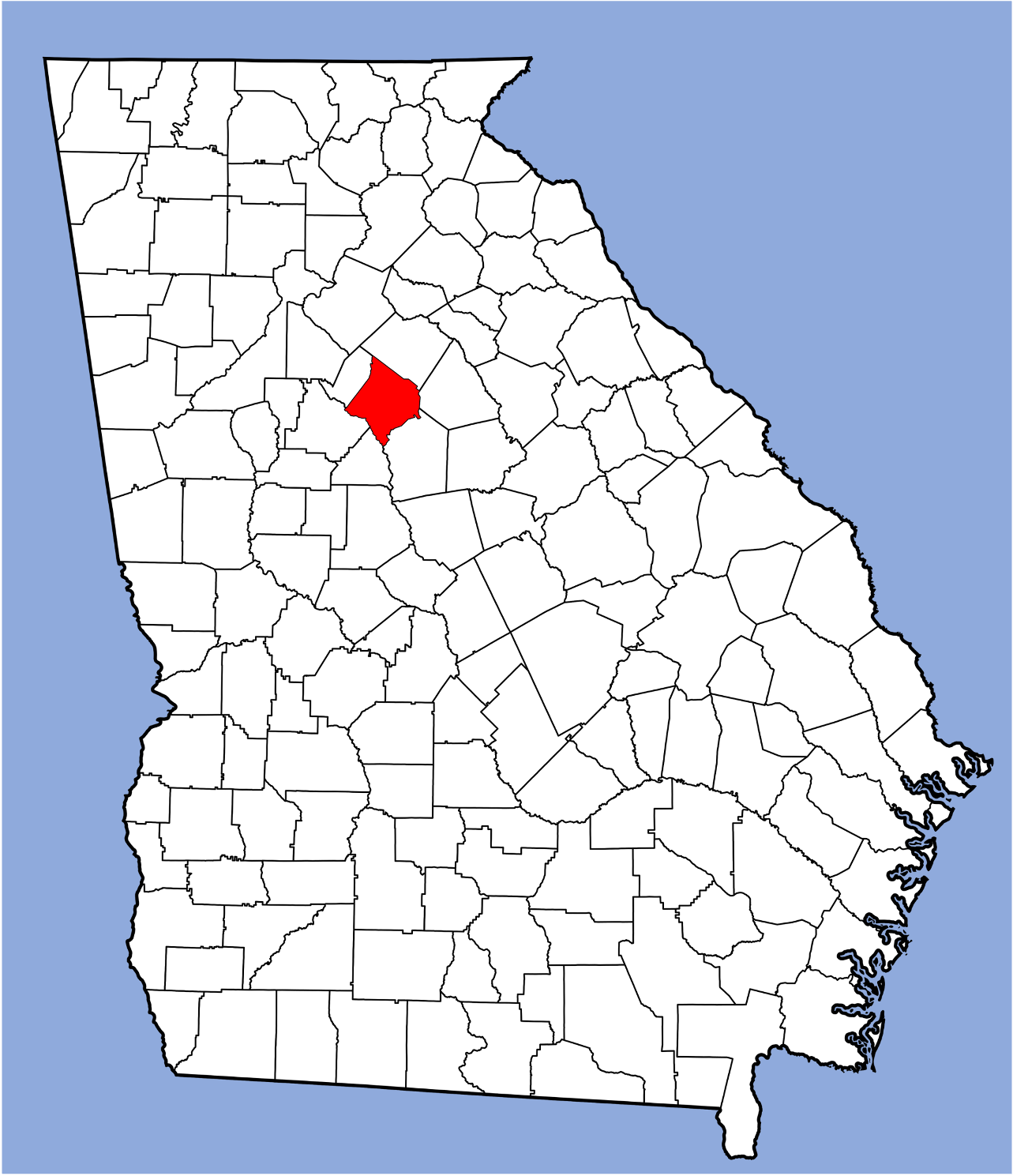
For generations, African American families in Newton County, Georgia have told a haunting story about a tributary of the Yellow River known as "Dried Indian Creek," which meanders about ten miles through the municipalities of Oxford and Covington. The creek passes about a half mile east of the original campus of Emory College—founded in 1836, now known as Oxford College of Emory University—and directly past Bethlehem Baptist Church, the county's oldest African American house of worship. For two centuries the waterway has been a significant site of fishing, trapping, hunting, gathering, reflection, baptism, and recreation for the county's Black residents.
Local Black families are well aware of the white narrative about the name of the creek, published in multiple sources across the decades: when settlers came into the lands that would become Newton County (founded in 1821), they encountered the mummified remains of an individual, whom they assumed to be Native American, and named the waterway "Dried Indian Creek." This version was often told by the segregationist sheriff of Newton County, Henry ("Junior") Odum, (1915–1976), whose grandfather had established "Avon Indian Farm" near the creek. In Sheriff Odum's telling, the mummified Indian was discovered "stretched out under a big old tree."1Odum's account is quoted in a laudatory article about the sheriff in the Atlanta Journal Constitution, 26 May 1968, p. 172.
The African American narrative is different. Elders we have known recalled that when they were children in the 1930s, their elders told them that the creek's name bore witness to a terrible crime. When whites arrived, a courageous Native American leader refused to leave the land his people had long resided on.2We assume this Indigenous leader was Muscogee, but the older African American oral accounts we heard referenced him as "Indian" or "Native American." White settlers seized, beat him, strung him up, and left his body dangling over the water, not allowing anyone to cut him down until his corpse had dried. As the story was told, this early spectacle lynching was staged as a warning to Native and enslaved Black people that any challenge to white rule would be swiftly and violently put down.
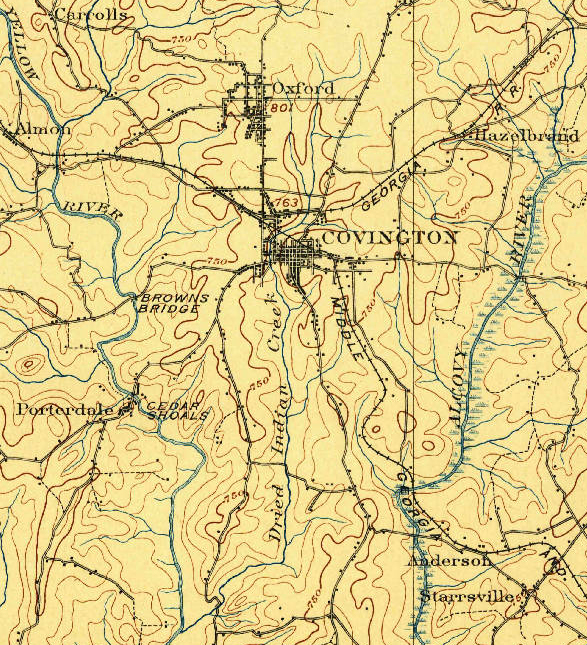
We know of only one white-authored account. The June 4, 1893, Atlanta Constitution reports that a Mr. W.D. Boggus of Covington has a number of curiosities on display in his place of business, including ". . . the leg bone of the Indian chief who was hung in 1795 and left to dry, near the old mill here in town, and from which incident Dried Indian Creek got its name."3Newspaper accounts from the following year state that Boggus wore a ring made from the "bone of an Indian warrior," exhumed from a plundered burial site near Covington (Macon Telegraph, 16 March 1894, p. 4). The individual in question, Woodson D. Boggus (c. 1868–1936), worked in the early twentieth century in Waco, Texas and in Payne, Oklahoma as an oil lease broker before returning to his home state of Georgia. (During the mid-1790s the area that is now Newton County was contested between Muscogee (Creek) inhabitants and encroaching white Georgians.) The Constitution article references the former site of Floyd's Mill, near where Bethlehem Baptist Church now stands, just north of the Clark Street bridge over the creek.
Overlapping Presences: Indigenous and Enslaved
No one we have spoken with recalls the name of this murdered Indigenous man, but the elders shared the belief he was distant kin to many African American families in Oxford. Most of these families trace their descent to two enslaved Native individuals, whom they believe to have been Muscogee (Creek). Cornelius Robinson (born c. 1836) was the enslaved valet of Alexander Means (1801–1883, Emory's professor of natural sciences, who during 1854–1855 was the College's president). Angeline Sims (born c. 1835) was enslaved with her husband George Washington Sims and their children, by Richard Sims, a founding member of Emory College's board of trustees and a founding commissioner of the town of Oxford. Angeline's daughters mainly remained in Oxford and married into local families; nearly every long-term African American family here traces descent back to one of these "Sims" women.
The elders knew that nearly all Muscogee (Creek) had been forced off the local lands around the time of the founding of Newton County, traveling to Alabama and points west, in some cases bringing with them their enslaved people of African descent. Yet they also insisted that not all "Indians" had left, that some intermarried Native and Black families had continued to live in the area.4Newton County, Georgia—created December 24, 1821, from Henry, Jasper, and Walton Counties—was based in three ceded Native territories. Under the terms of the 1805 Treaty of Washington, the 1818 Treaty at Creek Agency, and the 1821–25 Treaty of Indian Springs, all Muscogee lands in Georgia were ceded.
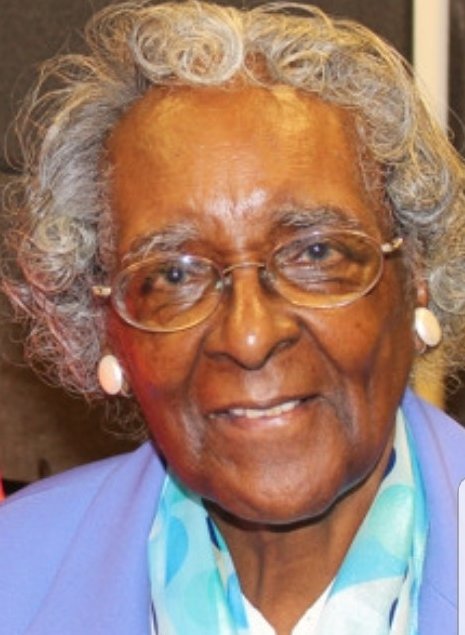
The late educator Emogene Williams (1931–2020), her mother "Miss B," and great-grandmother Sarah Baker Nelson recalled that there was an informal "Indian settlement" to the west of Covington, near Turner Lake, which persisted into the early twentieth century, when the Indigenous people were finally forced off the land. (As they remembered, there were also "gypsies" living in this settlement, who were also forced by whites to leave.) Local historian Johnny Johnson recalls that his grandmother Odessa Smith Gaither, born in 1885, shared stories about Native Americans who passed through Newton County when she was a girl, settling for a while and then "moving on."
A cluster of Afro-Native families continue to reside, semi-autonomously, along the Alcovy (Ulcofauhatchee) River, a couple of miles east of Oxford. (Large Creek villages are known to have been based along this watercourse in the eighteenth century.)5The 1805 Treaty of Washington between the United States and the Creek Nation references the "Ulcofauhatche" river; the term was used through the nineteenth century and was later anglicized to the "Alcovy" River. RaeLynn A. Butler, manager of the Historic and Cultural Preservation Department of the Muscogee Nation, notes that the Mvskoke spelling of the river would be: "orko ofv hvcce," meaning Pawpaw ("Orko," pronounced oth-go), river, or stream. Non-natives, she explains, must have heard "al-co" when mvskoke speakers were saying "oth-go" (RaeLynn A. Butler, personal note to author). See also Jonathan S. Tonge, Ulcofauhatchee: A Guide to Life Along the Alcovy River. Covington: Georgia Wildlife Federation, 2011. This small community of Angeline Sims's collateral descendants, her descendants recall, lived along the Alcovy upstream of the railway trestle, and defined themselves as "Indian" well into the twentieth century.
The late John Pliny ("J.P.") Godfrey, Jr. (1936–2020), great-grandson of Angeline, often visited this settlement of his kin when he was a child in the late 1930s and early 1940s. They trapped, fished, and minimized interactions with local whites. He remembered the elders would sing beautiful songs as they gazed out along the water, with words that were a mixture of English and "old Indian." The songs reminded him of "old Negro spirituals," but were somehow different. He sometimes understood them to be singing in remembrance of the ancestor, the old chief, who had been hanged by whites over the nearby stream and left to dry in the sun. Yet, he recalled, he never heard these elders express bitterness. "They just told me they were singing to help keep the waters rolling along." He smiled, "That's what they felt. Singing somehow helped the river, while the river gave them life and shelter."
Years later, J.P. and Mark walked along stretches of the river, but could find no trace of the old settlement he recalled from his childhood. "It's as if they were never here," J.P. sighed.
J.P and his cousins noted that most Black people in Oxford didn't talk much about their Indian relatives, but he did remember a story about his great aunt Minerva, Sallie's sister. "She was very strong willed. One time, she took her whole family down to live in Louisiana, in 'Ouachita' . . . She used to tell her children there was once a great city there, long before white folks ever came to America. They built pyramids there, just like the ancient pyramids." Records suggest that Minerva, her husband Tom Anderson, and their children lived in Ouachita from around 1890 to around 1908, when they returned to live in Oxford.
Years later, we read about archaeological excavations conducted in Ouachita, Louisiana, indicating that middle archaic mounds and earthworks at Watson Brake dated to at least 3400 BC. J.P. wondered just how Minerva could have known what she had known.
Founding Act of Murder
From time to time, the story of the murder at Dried Indian Creek has resurfaced in our conversations about the early history of Emory College and Oxford, where so many ancestors of local African Americans had been enslaved from 1836 until the end of the Civil War. Deacon Forrest Sawyer, Jr.—who had led the movement for desegregation in Newton County in 1970, famously defying Sheriff Junior Odum—said of Dried Indian Creek, "This county was founded with an act of murder. They were demonstrating the price that would be paid by anyone, red or black, who dared oppose white rule."
Emogene Williams, who traced her descent back to early enslaved persons and white slaveowners in Newton County (and who was the mother of this essay's co-author Rev. Avis Williams) concurred, "That is how they kept power in this county, through public demonstrations of violence, going all the way back to Dried Indian Creek. Lynchings, public executions of Black men scheduled as Black people were filing by going to church on Sunday."
J.P. Godfrey, Jr., whose grandfather Israel Godfrey had worked the land around Oxford in slavery and freedom, remarked, "I don't think it was entirely coincidental that Emory was founded right in the shadow of where that Indian chief was murdered . . . They wanted to show that they had taken hold of this land, and what would happen to anyone who opposed them."
These elders drew a direct link from the public desecration of the body of the murdered Indigenous man in the 1820s to the July 1946 mass lynching by about fifteen white Klansmen of two young African American couples at Moore's Ford on the banks of the Apalachee River in Walton County, which sent terrible shockwaves through surrounding Black communities in the early postwar period.
As Deacon Sawyer put it:
Rivers are the life blood, the arteries, of our land here. Rivers and streams were sacred for Indians, and it was those same creeks we'd steal away to, to feel the flow of the Holy Spirit—from the day we were brought to this county in chains. Of course, white folks chose to torture and kill our people along the river bank, reminding them that nothing was sacred. Any bond of family, any tie of love, could be broken in a moment. That's what white power was back then, and it still is.
Distant Kin: Black Oxford and the Creek Freedmen
These elders had long been fascinated by the stories of the Creek Freedmen, descendants of persons enslaved by Creek slaveowners, who had lived in Georgia and Alabama and then been removed to Indian Territory, later known as Oklahoma. Although there is no direct evidence of common ancestry between Oxford's present-day African American residents and the Creek Freedmen of Oklahoma, many local Oxford Black elders have felt a deep sense of moral kinship with the Freedmen. J.P. Godfrey, Jr., noted, "I know in my heart, those are our people. They were taken from these lands, suffered in ways we can't even imagine, but they endured. They're still our kin."
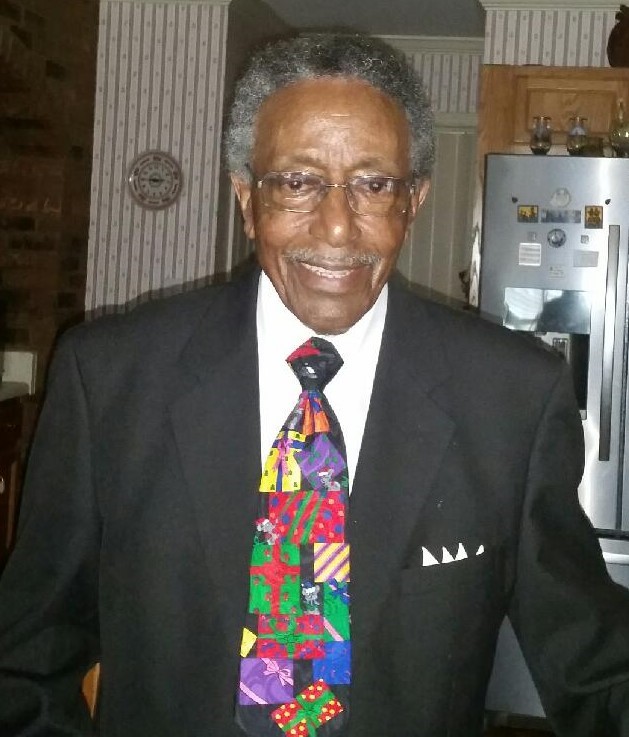
For J.P. and Emogene Williams, the 1979 de-citizenship of Creek Freedmen—descendants of those who had been enslaved by Creek slaveowners—was particularly painful. As J.P. remarked, "So many thousands gone from here. We had hoped our kin, though in bondage to the Creek, would have finally found a safe harbor in Oklahoma. Now we hear they were expelled, for supposedly being 'too African' . . . For our folks, you might say, the trail of tears never ended."6The precise motivations behind the 1979 changes in the Muscogee Constitution remain deeply contested. Defenders of the 1979 Constitution maintain the change in tribal citizenship was motivated by a desire to recognize only those Creek persons with sufficient Creek blood quanta as Creek citizens. Creek Freedman activists, in turn, insist the disenrollment of the Freedmen was motivated by racial animus, and illegitimately expelled many people whose ancestors had been considered Muscogee for multiple generations. Emogene observed, "I don't know how we're related, but I know from my mother and great-grandmother our people were all mixed together. It pains us to see those folks out West treated with such disrespect. Just like it was happening to us here."
Community members watch as leading figures in the Biden administration and the Congressional Black Caucus advocate for full citizenship rights being restored to all the Five Nation Freedmen. Secretary of the Interior Deb Haaland in May 2021 approved a revision in the Cherokee Nation constitution restoring citizenship status to Cherokee persons of African descent, and indicated her expectation that Muscogee (Creek), Choctaw, Chickasaw, and Seminole would recognize their "moral and legal obligations to the Freedmen."
By the Rivers of Babylon
In 2021, Emory University hosted a conference devoted to tracing the legacies of enslavement and the dispossession of Native American lands on the grounds that later became the institutions that comprise the consortium "Universities Studying Slavery," including Emory, University of Virginia, the Virginia Military Institute, Georgetown, Rutgers, UNC Chapel Hill, and Brigham Young University.7"Program Schedule." In the Wake of Slavery and Dispossession: Emory, Racism, and the Journey towards Restorative Justice. Emory Libraries. Accessed February 3, 2022. https://libraries.emory.edu/slavery-symposium/program-schedule.html. The conference opened with a painfully beautiful Muscogee hymn, "Espoketis Omes Kerreskos" ("This may be the last time, we do not know"), sung by Chebon Kernell, a mekko or ritual leader in the Muscogee (Creek) tradition, and a prayer by Rev. Avis Williams, an ordained Baptist preacher and daughter of the late Emogene Williams.8"Acknowledging the Ancestors with Readings, Music, and Prayer." Emory University. October 13, 2021. YouTube video. 1:13:29. The blessing and song by Cherbon Kernell and the blessing by Rev. Avis Williams are found at (00:00–11:30). https://www.youtube.com/watch?v=ELGjnpgdgJE&list=PLDSBylqXf9oGHja1c3mknOqz8JcVYMNfT&index=6. "Espoketis omes," which resonates with an African American spiritual, was sung along the Trail of Tears, as Muscogee families, including enslaved persons of African descent, made their way towards an uncertain future in the Indian Territory (Oklahoma).9The history of the song "Espoketis Omes Kerreskos" is explored in the 2014 film This May Be the Last Time (dir. Sterlin Harjo). More broadly, the film engages with the intertwined histories of Scottish Congregational line song, African American spirituals, and Muscogee (Creek) songs. Black spirituals and Muscogee hymns draw upon congregational line or note singing, part of a long musical and spiritual trajectory to maintain community amid wrenching dislocations.
Hearing Chebon sing, Avis was struck by the many parallels to the "sorrow songs" she grew up with in the Black Baptist tradition.10W.E.B. DuBois, "Of the Sorrow Songs," The Souls of Black Folk. Chicago: A.C. McClurg, 1903. Wikisource. https://en.wikisource.org/wiki/The_Souls_of_Black_Folk/XIV. In the first chapter of African Creeks (Norman: University of Oklahoma Press, 2007), Gary Zellar notes that early Christian missionization and evangelism in the Creek Nation in Georgia and Alabama was primarily associated with persons of African descent enslaved in Muscogee (Creek) communities. Had her ancestors and Chebon's ancestors perhaps sung together in the past, before or during the terrors of enslavement, forced removal, and land alienation? She was reminded in particular of Psalm 137: "By the rivers of Babylon we sat and wept/when we remembered Zion . . . our tormentors demanded songs of joy/they said, Sing us one of the songs of Zion!" Her ancestors, she knows, sang songs of sorrow but also of hope, in a strange land. So too, she thought, would Muscogee, including enslaved and free people of African descent, have sung these hymns, along many waterways, as they were expelled from their homelands.
On October 10, 2018, a Muscogee Methodist delegation gathered at the long-ago site of Standing Peachtree (Pakanahuili), the Muscogee (Creek) village that stood where Peachtree Creek enters the Chattahoochee River near present-day Buckhead, in north Atlanta.
They offered a prayer and hymn over the river. In a concluding commentary, Marilyn Cloud explained that in Muscogee tradition, "You add the prayer to the tobacco, because it is sacred. You put the tobacco in the flowing water. Whatever the prayer is that you make, the flowing river carries it."
Recently, we've held conversations about how these long-separated people might enter into dialogue. There are many unresolved legacies to work through, including the status of the Creek Freedmen, who are denied basic rights of tribal citizenship. Creek scholar and activist Craig Womack suggests music might be an appropriate starting point, to share and learn, and to hear voices of ancestors tied to riverscapes and landscapes that descendants consider sacred. Perhaps Muscogee and Newton County African American family members might gather along the river bank, joining in old hymns to honor the ancestor murdered long ago and left hanging over the waters, even as their voices, raised in song, help to move the river along. 
About the Authors
Rev. Avis E. Williams, a community activist based in Newton County, Georgia, holds four degrees from Emory University (AA, BA, Master of Divinity, Doctor of Ministry). She works for the Putnam County Charter Public School System, and currently serves on the Oxford, Georgia, City Council.
Mark Auslander, a former faculty member at Oxford College of Emory University, is a visiting faculty member in anthropology at Boston University and University of Massachusetts-Amherst.
Acknowledgments
We are grateful for detailed comments on earlier versions of this essay from Craig Womack, Professor Emeritus of English at Emory, RaeLynn A. Butler, Manager of the Historic and Cultural Preservation Department, The Muscogee Nation, and Allen Tullos. We have benefited from guidance on Five Nations Freedmen perspectives on this complex history from Eli Grayson and Marilyn Vann. We acknowledge the teachings of many elders from the Newton County African American community, especially the late Emogene Williams, Sarah Mitchell Wise, Sarah Francis Hardeman, Mary Gaither McClurkin, Forest Sawyer, Jr., and John Pliny (J.P.) Godfrey, Jr.
]]>Introducción
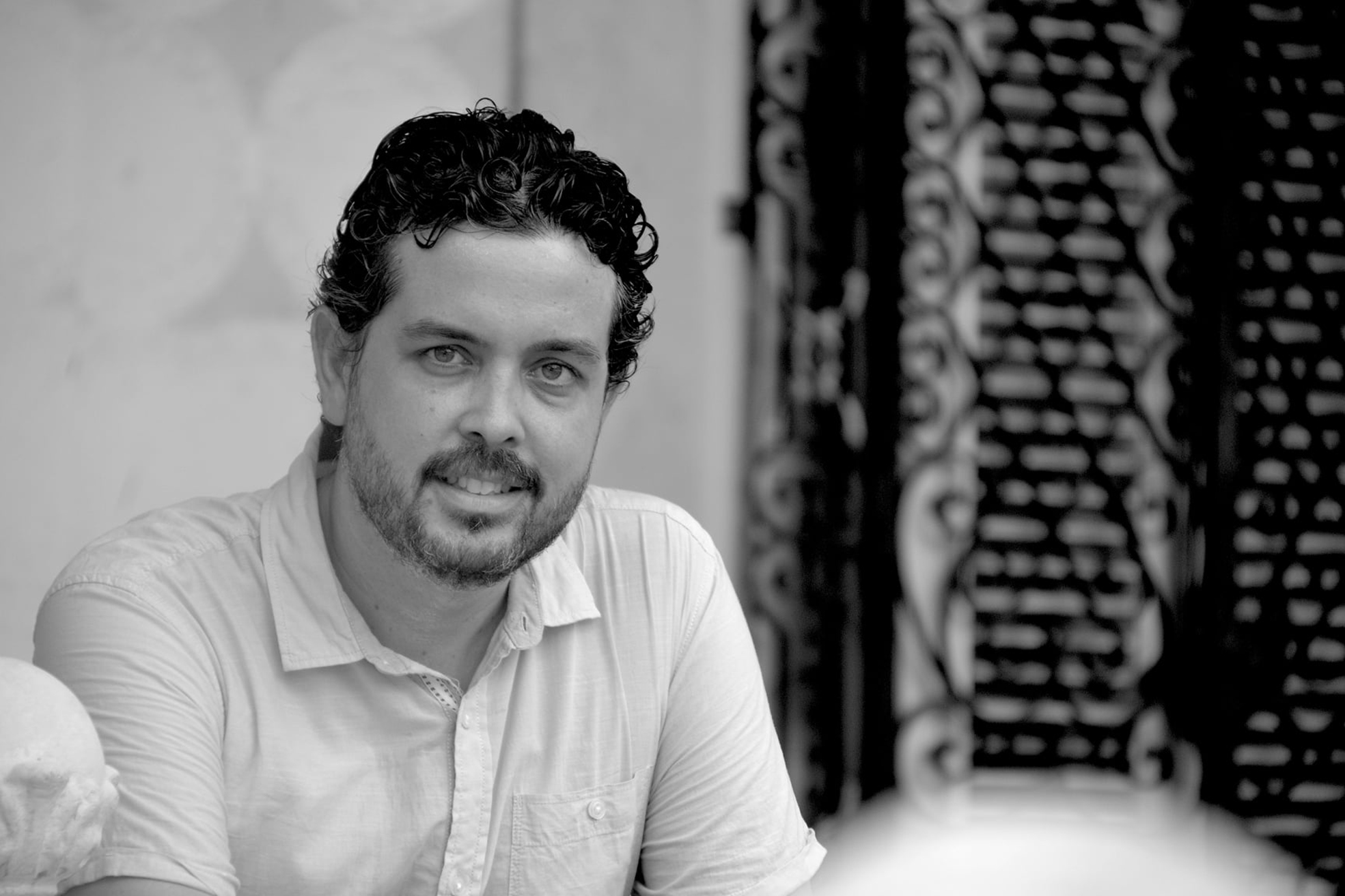
El dramaturgo Abel González Melo nació en 1980 en La Habana, Cuba, mismo año en que el Exodo del Mariel vio a aproximadamente 125,000 personas huir de su país, un evento que dramatiza en su obra de 2018 En ningún lugar del mundo. González Melo estudió Artes Teatrales en la Universidad de las Artes de Cuba. Ha recibido diversos premios y galardones por sus obras literarias y teatrales, entre ellos el Premio Primer Concurso de Dramaturgia de la Embajada de España (2005) por Chamaco, una de las obras más reconocidas de González Melo, y más reciente el prestigioso Premio Literario Casa de las Américas 2020 (enero).
Las obras de González Melo abarcan dos décadas y cubren múltiples temas sociales dentro de la vida cubana. Desde la complicada relación de Cuba con el Exodo del Mariel en En ningún lugar del mundo (2018) hasta la prostitución adolescente a principios de la década de 2000 en La Habana Vieja en su trilogía, Fuga de Invierno (2004–2009), sus obras sumergen al público en las calles que rodean el Capitolio de La Habana, en los parques, callejones y teatros que brindan espacios para la prostitución ilegal, en casas particulares que centran la importancia de la familia para los cubanos. La primera década de la escritura de González Melo problematiza la cultura juvenil cubana de principios de la década de 2000, una cultura a la vez gay y heterosexual, hambrienta y saciada, resistente y complaciente en un país donde la Revolución todavía se lucha a diario en las calles (aunque ahora rodeados por los "WiFi hotspots" aprobados). Mientras González Melo mantiene su identificación sexual privada, sus obras desafían la categorización, preguntan cuestiones de sexualidad y exploran la supervivencia, la mercantilización del cuerpo, el trauma mental intenso, el dolor de la historia y el amor profundo de la familia. Sus personajes se entretejen dentro y fuera de sus obras para demostrar esa complejidad: mientras algunas cosas han cambiado, otras siguen igual de siempre.
La obra más reciente de González Melo pasa a recuperar personajes literarios y episodios de la historia cubana con una perspectiva revisionista. Figuras históricas de la obra de González Melo incluyen la poeta feminista de principios del siglo XX María Luisa Milanés (de Bayamo, Cuba) en Bayamesa (2019), que ganó el premio Casa de las Américas de teatro en enero de 2020. En abordar el tema de la censura en el apogeo de la Revolución en Cuba, la obra más reciente de González Melo presenta personajes históricos cubanos. Fuera del juego dramatiza la experiencia de la figura cultural Heberto Padilla, un poeta venerado cuya obra criticó la Revolución y sus líderes en su momento, 1967–68, resultando en su arresto, tortura y exilio a los Estados Unidos en 1980. Padilla trabajó muchos años en varios puestos en el sistema universitario en los Estados Unidos, como Ohio State University, Bowdoin College y el Instituto de Humanidades de la NYU, antes de morir solo como poeta residente Auburn University en 2000. En su drama más reciente, Cádiz en José Martí (Festival de Teatro Iberoamericano de Cádiz, 2020), González Melo dramatiza al mítico héroe nacional de la isla, el revolucionario José Martí (1853–1895). González Melo lo sitúa en la ciudad española de Cádiz, el primer destino de Martí en su largo exilio y deportación política bajo el régimen colonial.
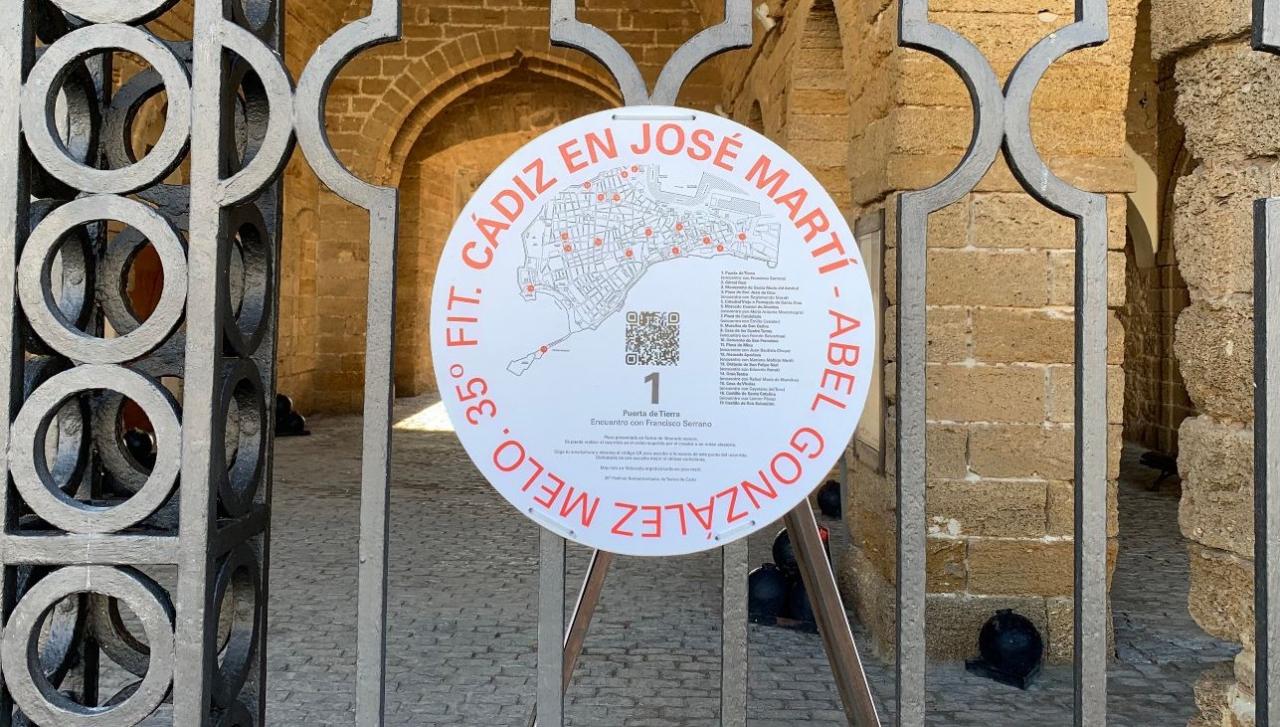
En esta conversación, González Melo explica su proceso creativo e inspiraciones, la experiencia de la migración cubana como material dramático y la idea de refundir la historia para nuevos públicos y tiempos. Habla de cómo se basó en la experiencia actual en La Habana para crear Fuga de invierno y cómo su obra reciente se sumerge profundamente en las preguntas de la comunidad y la familia durante algunos de los momentos más severos de Cuba. González Melo también reflexiona sobre las ligaduras singulares entre Estados Unidos y Cuba. Uno de estos vínculos es la conexión lingüística español-inglés, ya que muchos cubanoamericanos son bilingües. Por lo tanto, aunque esta conversación se llevó a cabo en español, hemos proporcionado traducciones al inglés. [Read the English translation of this interview here.]
Chamaco : El comienzo de todo, o el trabajo inicial de González Melo
Gunnels: ¿Por qué la dramaturgia? ¿Piensas que el teatro es el mejor vehículo para las historias que quieres contar?
González Melo: El teatro tiene algo maravilloso para un escritor: aleja a la literatura de la soledad. Propone la creación en equipo y el contacto directo con el espectador. Ambas cuestiones me resultan muy atractivas: la idea de que la escritura nunca cesa, siempre es reinterpretada en presente, necesita la comunión del director, los actores, los diseñadores, los técnicos, y precisa, indefectiblemente, la complicidad del público. Me deslumbra esa naturaleza inacabada de la escritura dramática, esa urgencia por impactar de modo inmediato. Disfruto escribir narrativa o ensayo, pero en ambos casos extraño el diálogo real con el ser humano. Será porque, cada vez más, la dramaturgia es en mí un proceso relacionado con un grupo humano concreto, una textura imaginada para gravitar sobre una cuerda floja.
Gunnels: ¿Sientes 'inacabada' esa naturaleza porque necesita de otros artistas para completarse, o porque, cada vez que se representa una obra, hay una nueva audiencia que tendrá reacciones distintas?

González Melo: El teatro lo hacemos entre todos, los artistas y el público. Basta recordar el origen griego de la palabra "teatro", que significa "mirar". Es decir, solo existimos porque alguien nos mira. Es uno de los mayores placeres de escribir dramaturgia: sentir que uno solo ofrece una guía de acotaciones y parlamentos sobre el papel, solo eso, pero que el personaje tendrá el cuerpo, la voz y el alma de quien lo encarne delante del espectador, que es quien terminará de construirlo en su proceso de recepción activa. ¿Por qué seguimos asistiendo una y otra vez a los estrenos de los clásicos? Pues porque su esencia, más que en el argumento, radica en cómo se cuenta hoy esa historia en el ágora pública: quiénes la ejecutan, por qué deciden hacerla, en qué contexto y ante quiénes, qué sentidos nacen de esa experiencia.
Gunnels: Quisiera pintar la escencia de la triología Fugas de invierno para la audiencia antes de que lo comentemos.
Chamaco (Kiddo, 2004, traducción al inglés de William Gregory) es la primera entrega de la trilogía.1Hay dos traducciones publicadas. William Gregory tradujo los dos Chamaco y Nevada; Yael Prizant tradujo la triología en versión bi-lingual con prensa distinta. Chamaco se ha representado a nivel mundial, desde el Teatro Argos en La Habana hasta Manchester, el Teatro HOME de Inglaterra, hasta la traducción más reciente al checo, con la producción en Praga programada para el otoño de 2021. La trilogía, que incluye Nevada y Talco (la segunda y tercera entrega), cubre un lapso de tres meses en un invierno tropical del descontento, como escribe la crítica de teatro y académica titular Lillian Manzor "the trilogy addresses concerns that are dear to the author and his generation, namely: the complex and contradictory ways in which homosexuality, sex, and migration from the countryside to the capital becomes means of survival in a society that has lost all sense of value."2Lillian Manxor and Austin Webber, "Ground Down to Nothing but Still Fighting." Hemispheric Institute of Performance and Politics. Accessed March 25, 2021. https://hemisphericinstitute.org/en/emisferica-82/manzor-webbert.html. Chamaco sumerge a los espectadores en la Nochebuena en La Habana, donde una hermana espera con inquietud que su hermano regrese a casa para una cena que nunca comerá, ya que sin saberlo ella, murió en una pelea con cuchillas. Nevada sigue a Lucía y su novio/chulo Rosnay cuando se encuentran con la realidad de vender sus cuerpos en el esfuerzo por salir o escapar, en este caso, al estado de Nevada, donde la prostitución es legal, y los "dulces vienen envueltos en papel de brillo". Talco, la última entrega, retrata una realidad cruda y sucia que se desarrolla principalmente en el baño de un antiguo cine utilizado para el tráfico y la prostitución, donde los caminos de cuatro personajes—Javi, Máshenka, Zuleidy y Álvaro—se entrecruzan en una batalla violenta y tensa de supervivencia. A la trilogía la siguen casi veinte obras más, muchas de las cuales han sido traducidas a varios idiomas y representadas tanto en Estados Unidos como en el extranjero. Abel, esta trilogía realmente centra la experiencia de la juventud cubana. Describe la importancia de dar voz a la gente joven cubana en las obras que has escrito.



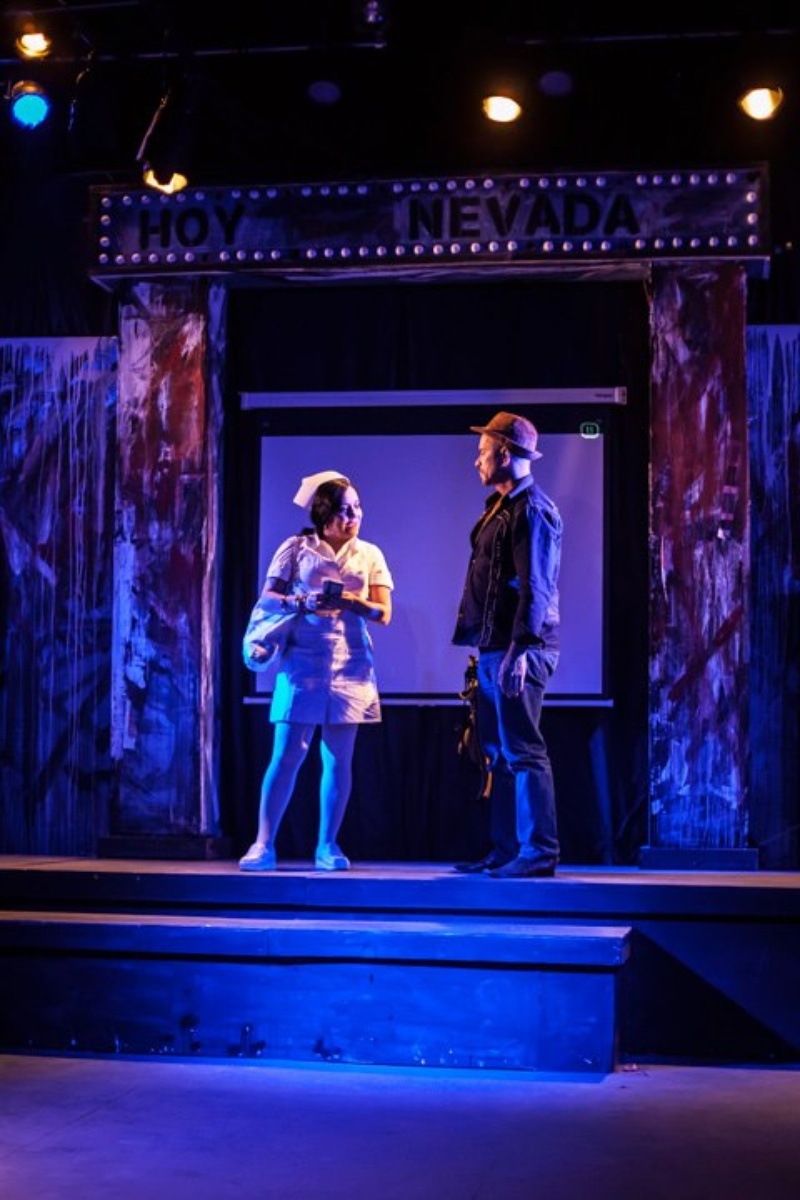
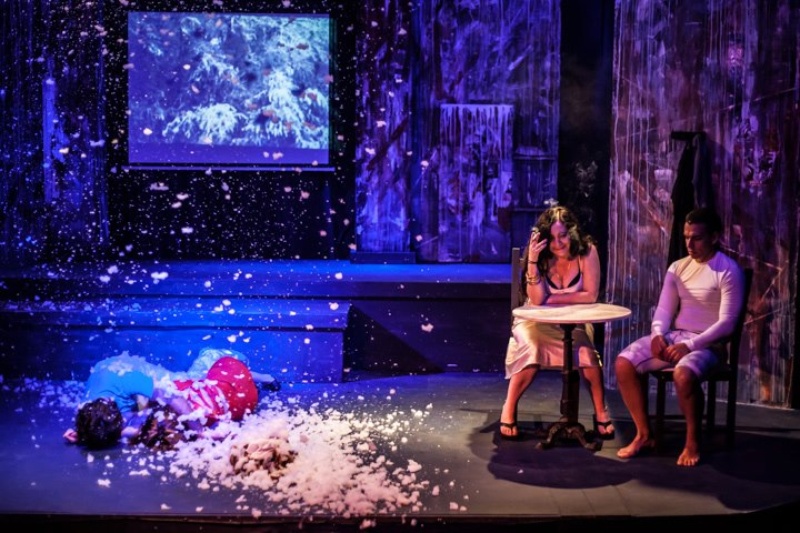
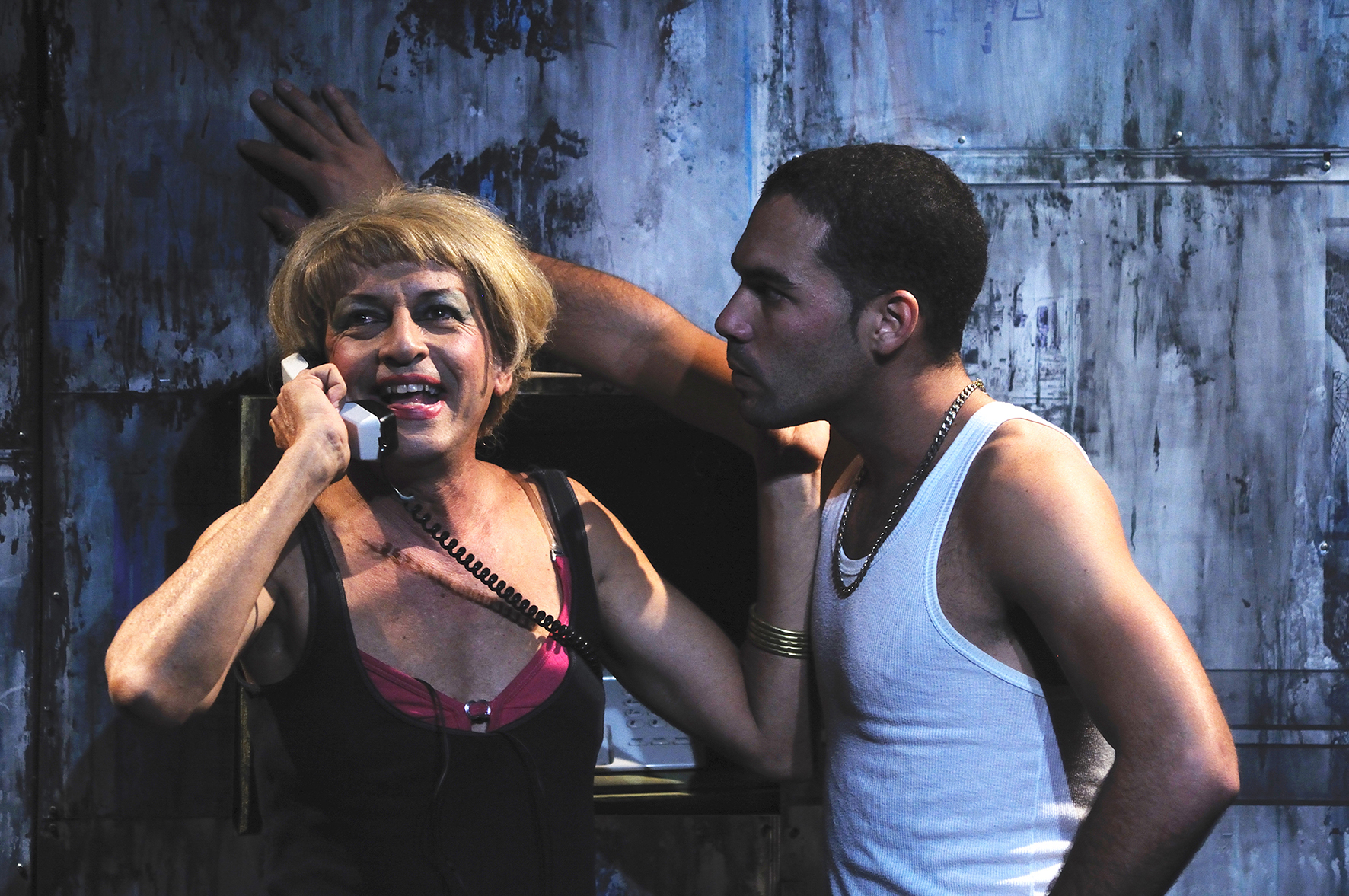






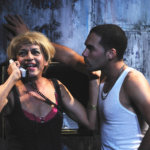

González Melo: Ahora que lo comentas, pienso que los protagonistas de mis obras han ido teniendo mi edad en el momento de escritura, y en cada texto van siendo mayores estos personajes porque crecen conmigo. He querido llenarlos de mis dudas, mis afectos, mis dolores. Son la imagen sublimada de mí mismo en medio del mundo en que he crecido: la Cuba de entresiglos, y desde hace algo más de una década también la España del XXI. Vivo a caballo entre los dos países y los observo a ambos con una mezcla de pasión y extrañeza. No puedo hablar de todos los jóvenes como una masa, eso no sé hacerlo, pero sí de mí en el paso de la adolescencia a la juventud: esas pulsiones son las que habitan mi teatro. Ojalá tengan que ver con las de otras personas.
Gunnels: Dime más sobre eso que llamas 'pasión y entrañeza.'
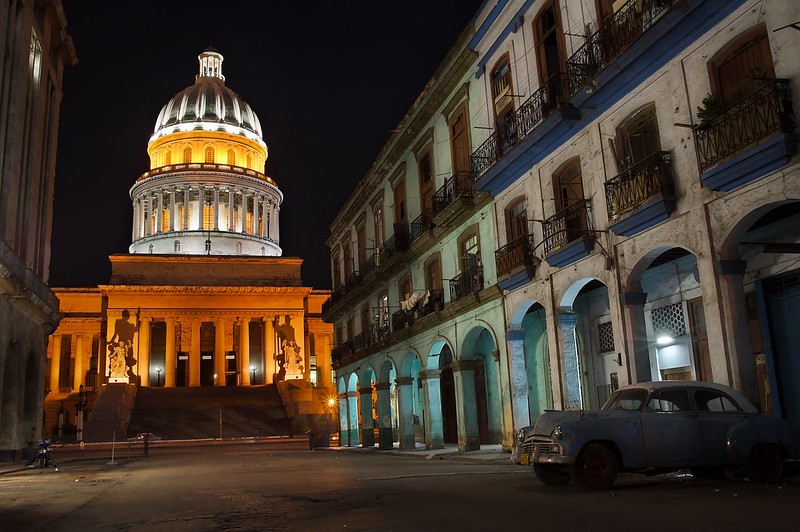
González Melo: Recuerdo que a principios de los 2000, cuando atravesaba en la noche la Habana Vieja rumbo a mi casa, me despertaban enorme curiosidad las decenas de adolescentes que aguardaban apoyados en las columnas, frente al Capitolio, o rondando el Parque Central, en medio de la zona turística. ¿Qué hacía toda esta gente aquí? ¿Quiénes eran? Poco a poco fui acercándome a ellos, muchos vivían clandestinamente en La Habana, habían emigrado desde el Oriente de la isla. Todos se prostituían, o aspiraban a hacerlo.3Una nota de González Melo: "Aquí estamos hablando, si hay que aclararlo, solo de cisgender masculinos. Yo no soy expert en estudios y terminology de género, pero los trans y las chicas están, como explico, en otras zonas de la ciudad." Supe de historias fascinantes, terribles. Irlos descubriendo a fondo no fue sencillo, ninguno iba a darme una entrevista sin más y contarme su vida. Me convertí en discreto cliente, ahorraba dinero y me iba con alguno de ellos a un cuartico de alquiler. En la fugacidad de ese rato de extraño placer me mantenía alerta: los escuchaba hablar de sus vidas, de sus hijos pequeños a quienes tenían que alimentar, de sus mujeres conscientes de que ellos se dedicaban a la cacería de extranjeros o cubanos que pudieran pagar por sexo. Mi investigación fue ampliándose, una cosa me llevó a la otra, fui componiendo el mapa de la marginalidad nocturna de la Habana Vieja: la zona de las prostitutas estaba en el cruce de las calles Monte y Cienfuegos; los travestis y transexuales aguardaban a sus clientes en el Parque de la Fraternidad; la droga se vendía en un cine abandonado, etc. Me sumergí de lleno. Hice cosas impensables durante aquellos años, cosas que hoy no haría. Pero por suerte me atreví a hacerlo: quería conocer a fondo a estas personas, sus lugares, sus razones, todo ese ambiente que la prensa oficial no publicaba. Tres o cuatro años de inmersión. Tras concluir Chamaco, tenía aún tanto material acumulado que nacieron Nevada y Talco. También en obras como Por gusto y Adentro hay huellas de este universo.
Gunnels: Por mi parte, Lucía de Nevada y María Luisa de Bayamesa me conmuevan por su necesidad de enfrentarse al mundo, al exterior hostil, pero con persistencia y amor por la familia. Son fuertes ejemplos feministas para cualquier generación. Y Lucía, con su vestido rojo, es singular para mí. ¿Hay un ángel en tu obra, un personaje que realmente te conmociona?
González Melo: No suelo partir de la emoción en los procesos de escritura. Soy bastante técnico, algo que aprendí con mi maestra Raquel Carrió (gran autora nuestra, fundadora en 1976 de la carrera de Dramaturgia en la Universidad de las Artes de Cuba): la tríada estructura-personaje-lenguaje es la base de la preparación de mis proyectos. Creo que la emoción llega (o no) en paralelo a (o luego de) la apreciación de la experiencia. La emoción estará entonces en el receptor. Pero para que eso pueda suceder, la construcción misma del texto o del espectáculo ha de ser precisa, nítida, no puede partir del deseo de emocionar, porque se desfigura. A veces siento que la emoción enturbia la objetividad de lo que ocurre: sucede mucho con los actores que actúan "emocionados" y, entonces, sobreactúan; o con los dramaturgos que se sobreemocionan con lo que están haciendo y pierden el rumbo de la acción, pierden síntesis.
Sí es verdad que alguna vez he tenido experiencias singulares, yo diría que místicas, durante la escritura misma, como me sucedió con Chamaco, que sentí que alguien me la dictaba al oído. Estaba muy reciente la violenta muerte de mi padre y el monólogo de Silvia, cuando se entera de que han asesinado a su hermano, lo escribí deshecho en llanto. Siempre he creído que Chamaco es mi padre que se convirtió en ángel para dictarme esta obra y que me acompaña desde entonces.
La historia se repite
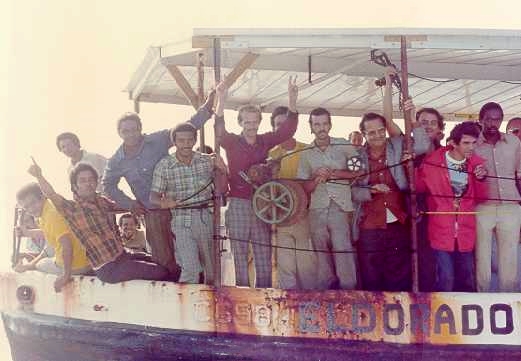
Sobre todo en sus dramas más recientes, Abel González Melo ha cambiado de describir experiencias personales en su trabajo a referenciar y dramatizar puntos de contacto históricos cubanos (como el Éxodo Mariel, los UMAP (Unidades Militares de Ayuda a la Producción), el Quinquenio Gris y el Período Especial. El Éxodo Mariel constituye la migración masiva más grande de Cuba en su historia. De abril a octubre de 1980, se estima que ~125.000 cubanos salieron del Puerto Mariel para los Estados Unidos. La historia fue bien cubierta en los medios de comunicación: un pequeño grupo de cubanos tropezó un autobús urbano hasta las puertas de la Embajada peruana en La Habana en un intento de pisar tierra allí y solicitar asilo político (y eventualmente salir de la isla). Se les concedió asilo y, después, más de 10,000 personas se acercaron a la embajada con las mismas esperanzas. Al ver esta situación desarrollarse desde los Estados Unidos, el presidente Jimmy Carter emitió una invitación abierta a cualquier persona de Cuba que huyera del régimen de Castro, evitando en parte la política y el procedimiento de inmigración de los Estados Unidos. Siguió un giro típico de Castro: después de un discurso muy público el primer de mayo, el Día del Trabajador, en la Plaza de la Revolución de La Habana, vació las cárceles y hospitales de Cuba de criminales condenados y enfermos y requirió cualquier embarcación estadounidense que fuera a recoger a familiares o seres queridos para llevar del Puerto Mariel también consigo un barco lleno de otros 'indeseables', en los que incluía hombres homosexuales y personas con problemas psiquiátricos. Como señala González Melo en nuestra conversación a continuación, la historia de Cuba con los hombres homosexuales está marcada por una trágica discriminación, tortura y muerte. Los históricos campos de trabajo de la UMAP (en español, Unidades Militares de Ayuda de la Producción) que sirvieron como un tipo de prisión laboral de 1965 a 1968 en Camagüey, Cuba, fueron politizados como campos agrícolas para "objetores de conciencia", pero fueron más una especie de "purga" social de cualquier persona que fuera considerada anticastrista o antirrevolucionaria, afirma el historiador Abel Sierra Madero.4Abel Sierra Madero, "Academies to Produce Macho-Men in Cuba." Translated by Alicia Barraqué Ellison. Translating Cuba. February 19, 2016. https://translatingcuba.com/academies-to-produce-macho-men-in-cuba-abel-sierra-madero/. Esto incluyó a los acusados de homosexualidad.
Siguiente de los años de la UMAP hay un período de poco más de cinco años (1971–1977) conocido como el quinquenio gris en el que el gobierno cubano controlaba rígidamente las producciones culturales y artísticas de la isla. Esto período limitó severamente la expresión y la publicación artísticas. Varios de los dramaturgos más destacados de Cuba, como Virgilio Piñera (1912–1979), Abelardo Estorino (1925–2013) y Antón Arrufat (1935–), sufrieron tremendamente bajo esta censura, tanto por su insistencia en la libertad creativa como por su homosexualidad. Rodeados de un ambiente hostil, los tres utilizaron la metáfora como forma de expresión, siempre tratando de evitar la censura. La obra de Piñera preguntó en términos amplios conceptos de identidad nacional y la parte del escritor como resistor. Un prolífico escritor de ensayos, cuentos y teatro, las colecciones de Piñera como Cold Tales (1956) y Little Maneuvers (1963) fueron acreditadas por inspirar a generaciones de escritores que vendrán después, incluso el autor conocido del Mariel, Reinaldo Arenas. Abelardo Estorino, que antes fue censurado con su obra Los mangos de Caín (1965), solo escribió un texto en los años 70 y en cambio se dedicó a la dirección de clásicos en la Compañía Teatro Estudio. Antón Arrufat recibió altos honores de la UNEAC por Los siete contra Tebas en 1968, pero esa institución publicó el libro con una nota que acusaba al escritor de ser un contrarrevolucionario; Arrufat fue condenado, y no publicó más por una década.
Finalmente, la inmigración hacia y desde La Habana varió drásticamente desde la década de 1960 hasta la actualidad, y las leyes que prohíben el reingreso, así como la relación política y acre entre los Estados Unidos y el régimen de Castro, crearon una forma estratificada de entender el hogar, la comunidad, y exilio. A principios de la década de 1960 se produjo un éxodo de las clases media y alta, que en su mayor parte aterrizaron en el sur de Florida y se quedaron. Después del Éxodo Mariel, la política de inmigración estadounidense de mediados de la década 90 llevó a un aumento de la inmigración de la isla, ya que 'pie mojado, pie seco' permitió acelerar los procedimientos de inmigración de EE.UU. para cubanos. El aumento de balseros es notable durante este Período Especial. De estas grandes olas de inmigración, Mariel se distingue por la demografía de la población, así como por el giro politizado en ambos lados: ese grupo fue menos aceptado por los cubanos en la isla y experimentó una integración más dura en su nueva comunidad del sur de Florida.5Aviva Chomsky, A History of the Cuban Revolution, 2nd ed. (Hoboken, NJ: Wiley-Blackwell, 2015), 75.
González Melo es descendiente de estos primeros dramaturgos cubanos así como heredero de esta historia enredada. En la conversación que sigue, González Melo reflexiona sobre la realidad del hombre "gay" en Cuba antes y después de Mariel, y cómo esta faceta de la historia cubana encuentra su camino en sus obras dramáticas. En particular, su obra Fuera del juego revisa el Caso Padilla y la UMAP, destacando la censura subversiva y la tortura psicológica de los artistas en los primeros años de la Revolución. Su obra Bayamesa se remonta a lo más lejano de la historia cubana, para abordar temas de la tradición colonialista, los roles de género y el feminismo en Cuba.
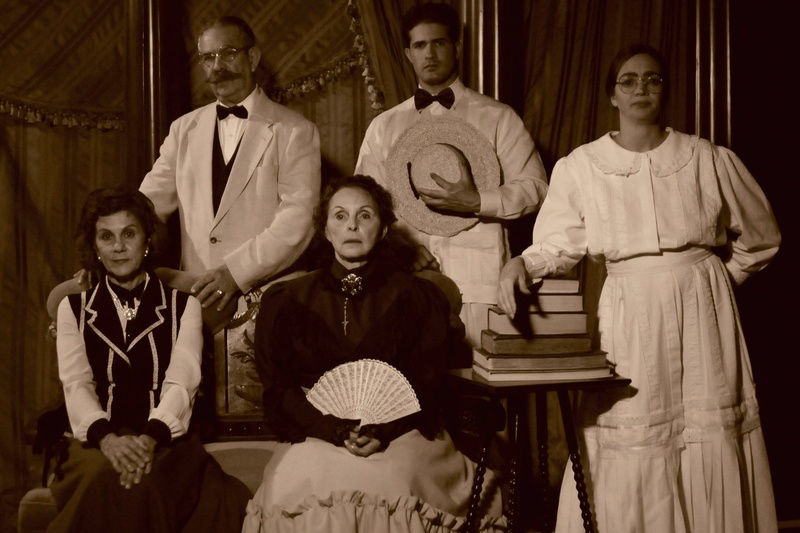
Gunnels: Describe los cambios, si los hubiera, en la realidad del hombre gay en Cuba desde que escribiste Chamaco (2004) hasta En ningún lugar del mundo (2018).
González Melo: El lapso que dices comprende poco más de una década y no creo que los cambios hayan sido muy apreciables. La Revolución no se ha comportado de modo precisamente bondadoso con los homosexuales, quienes fueron considerados durante mucho tiempo lacras sociales y enviados entre 1965 y 1968 a campos de trabajo llamados UMAP (Unidades Militares de Ayuda a la Producción). Todo ese proceso acrecentó el machismo y la homofobia en nuestra sociedad. En la obra de grandes dramaturgos cubanos, que además eran homosexuales (pienso en Virgilio Piñera, Abelardo Estorino o Antón Arrufat), el tema no aparece o aparece muy escamoteado, quizás a causa de la autocensura: después de las UMAP vinieron los terribles años 70 y sus políticas de marginación a homosexuales artistas. A mi generación le ha tocado una etapa un poco más amable, aunque la homofobia persiste y ha encontrado vías soterradas para manifestarse. En lo personal he podido abordar el tema gay en textos que se han publicado y estrenado dentro de la isla, han aparecido antologías de poesía y narrativa homoeróticas, etc. Se ha intentado incluir, en la enmienda a la Constitución, la noción del matrimonio igualitario que ya es una realidad en tantos países del mundo: pero durante demasiados años el propio gobierno ha sembrado el odio hacia los homosexuales, y la mentalidad del pueblo no puede cambiarse de un día para otro.

Gunnels: ¿Puede el teatro cambiar a un pueblo? ¿El poder del arte o interrogación?
González Melo: Ni el teatro ni ninguna otra manifestación artística pueden cambiar una sociedad. Sería demasiado pretencioso pensar que sí. He escuchado frases como "el arte cambia el mundo" y siempre siento que tienen un sentido figurado, metafórico. El teatro no es un partido político, no es un ejército, no es una bomba atómica ni una pandemia: no tiene ese poder de cambio brusco, inmediato, contundente. Lo que sí puede el teatro, confío en que sí, es tocar la mente y el corazón de una persona, de un espectador que asiste a una función y descubre otro modo de mirar, se identifica en ese espejo, encuentra algo que le lastima en lo profundo. El teatro transforma, en ese sentido, al individuo y no a la masa, aunque la experiencia de nuestro arte la tengamos en colectivo. El teatro trabaja siempre (en su ejecución, en su recepción) el comportamiento particular, no la generalidad. Tocamos a una persona, y esa persona tendrá en alguna ocasión, quizás, la oportunidad de tocar las cosas que mueven el mundo. Esa es la sencilla y hermosa condición de nuestro arte.
Gunnels: Su obra de 2018 En ningún lugar del mundo (Nowhere in the World) aborda el silencio en torno a la identidad sexual en Cuba (desde los años 80 hasta la actualidad), tanto como temas de visibilidad gay y el trauma del servicio militar, a través del protagonista Ángel se aprecia el dolor agudo del Mariel tanto para los que se fueron como para los que se quedaron. Cuba tiene una historia de trece años en África (1975–1988), con fuerzas militares cubanas sobre el terreno en nombre de la liberación de Sudáfrica durante ese tiempo. La asociación militar terminó con la independencia de Namibia y, según algunos, el comienzo de la retirada del apartheid en la zona. No obstante, las fuerzas cubanas regresaron con problemas psicológicos, y el drama de En ningún lugar del mundo vuelve a visitar esa época, así como el trauma inminente del Mariel. Ángel, como protagonista, sale de Cuba con el éxodo del 1980, y el drama comienza con su regreso a Cuba después del Mariel, solo para descubrir que el trauma entre familias es profundo e implacable. ¿Cómo entiendes el legado de la generación del Mariel a otros artistas cubanos que han escrito en exilio, forzado o no?

González Melo: El protagonista de En ningún lugar del mundo fue forzado a abandonar Cuba en 1980 por el Mariel, debido a problemas psiquiátricos (sí, algo despiadado: los enfermos mentales eran considerados directamente escoria), cuando en realidad la familia se lo quería "quitar de encima" por sus violentos testimonios de la dura experiencia de tres años como soldado en la Guerra de Angola. La historia de nuestros exilios está llena de gente anónima que no ha dado su testimonio porque aún sigue traumatizada. El Mariel es un entorno demasiado amplio y diverso que escapa a catalogaciones homogéneas. Lo más importante, pienso, es lo que significó como fenómeno, y los miles de cubanos que pudieron (que se vieron en la obligación de) integrarse a la cultura norteamericana y, al mismo tiempo, enriquecerla con su acción directa. No puede entenderse la cultura y la sociedad de Miami hoy sin sumar las capas de exilios que esa ciudad ha asumido. En lo personal admiro mucho la voluntad y la resistencia de las generaciones de cubanos exiliados que han reinventado el concepto de patria.
Gunnels: ¿Qué piensas sobre los dramaturgos que vivieron la época del éxodo del Mariel en Cuba pero permanecieron? Pienso particularmente en Ulises Rodríguez Febles y su obra Huevos. Ya hablamos sobre la idea de salir, ¿pero qué pasa con los que se quedan?
González Melo: El Mariel ha sido relatado brillantemente por dramaturgos que se mantienen creando en la isla, como el propio Ulises en Huevos o Carlos Celdrán en Diez millones. Los dos eran muy jóvenes en 1980 pero han logrado imprimir a sus textos, llenos de matices autobiográficos, un carácter que supera la reconstrucción histórica. Me gusta eso, que podamos sacudirnos el polvo de la cotidianidad, que tanta energía nos roba, y mirar nuestra historia y nuestro porvenir con altura. Ellos viven en Cuba, sí, pero poseen una reconocida carrera internacional: Ulises ha triunfado recientemente en México con una obra que curiosamente reconstruye la trayectoria de otro artista exiliado, Dámaso Pérez Prado, y Celdrán ha paseado sus Diez millones por importantes festivales del mundo. Cada vez la frontera entre el afuera y el adentro, entre irse y quedarse, es más permeable y menos estricta. Por suerte.
El teatro disecado: El proyecto persistente de González Melo
Gunnels: ¿Cómo afectó crecer durante el Período Especial a la trayectoria o temario de tu obra, y la influencia de otros poderes mundiales (como Rusia) en tu país?
González Melo: Es inevitable la influencia. Mi niñez estuvo colmada del imaginario ruso y soviético: esa huella es evidente, por ejemplo, en mi obra Talco, pero también en parte de mis cuentos y en mi pasión por esa cultura. Estudié el bachillerato en una escuela vocacional llamada precisamente "Lenin": fue entre los años 1994 y 1997, en régimen interno. Allí padecí la escasez (de alimentos, de luz eléctrica, de recursos sanitarios) pero también descubrí la solidaridad. Allí sufrí acoso escolar pero pude formarme como alguien independiente. De esa experiencia llena de contrastes nació mi primer libro: Memorias de cera. Y esa etapa, en pleno Período Especial, marcó mi interés por la paradoja en que hemos vivido los cubanos: gritar consignas heroicas en la Plaza de la Revolución durante los desfiles, y al mismo tiempo estar muriéndonos de hambre en casa y susurrando por los rincones nuestra miseria de vida. El Período Especial ajustó el nivel de vida de la sociedad y acrecentó las diferencias de clase, el clientelismo, el mercado negro, la corrupción en todos los ámbitos. Esa doble moral atraviesa mi literatura: personajes que precisan, a toda costa, ponerse máscaras para seguir sobreviviendo.
Gunnels: En Nevada, un tema primordial es el deseo de salir. ¿Cómo ves este sentimiento a través de otras obras que has escrito, y de dónde viene? ¿Puedes profundizar un poco en la naturaleza de la relación Cuba/Estados Unidos y este deseo de salir de la isla, especialmente en esta época de inestabilidad inmigratoria?
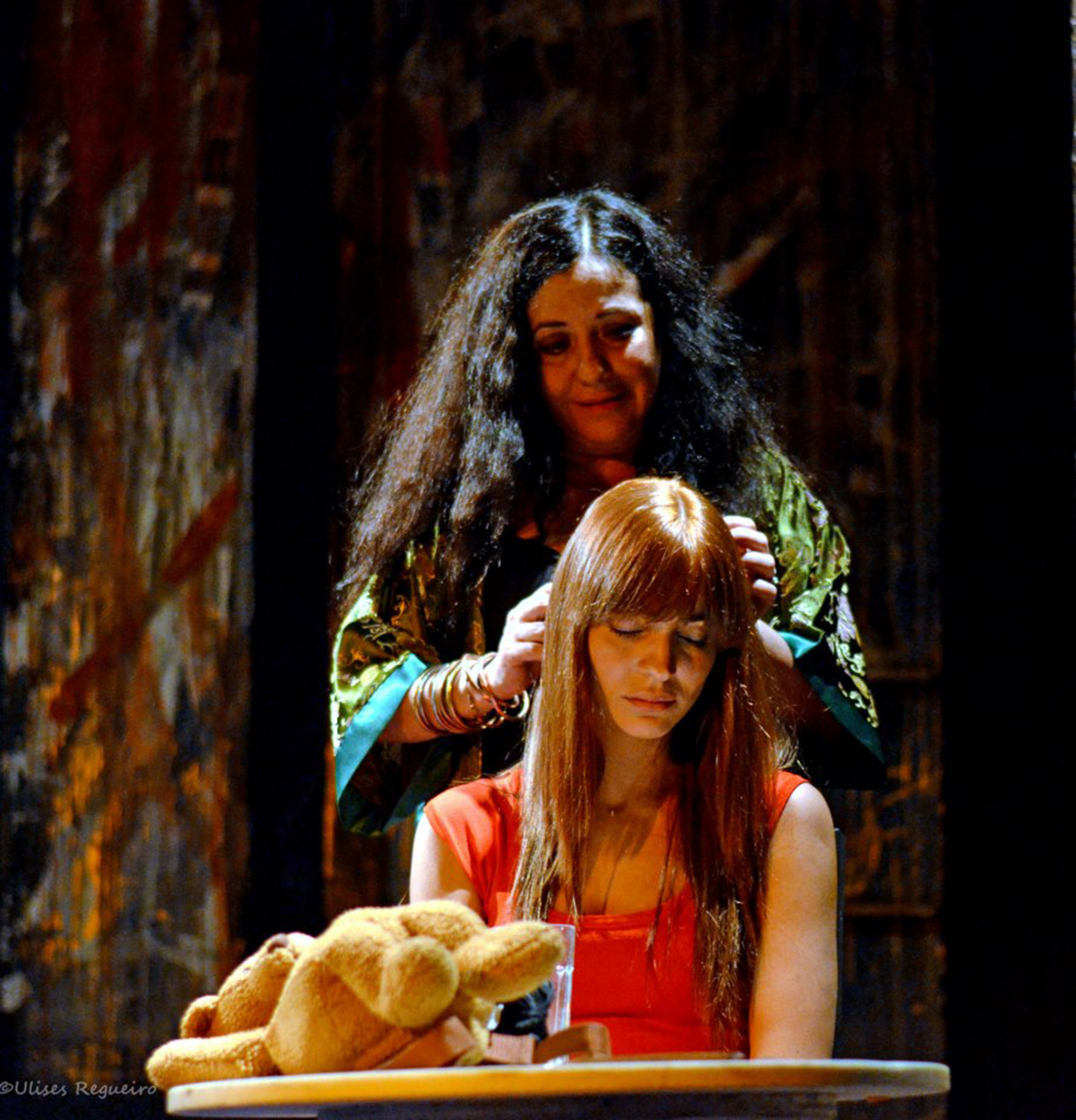
González Melo: Nacer en una isla condiciona el deseo de ir más allá de las fronteras inmediatas que el mar impone. Ya Virgilio Piñera lo resumía en una imagen: "La maldita circunstancia del agua por todas partes". La isla es encierro y anhelo de partir para, en mi caso, tener la oportunidad de volver. Ha sido una constante cubana la necesidad de huir de la isla, acrecentada por factores políticos y económicos en la etapa de la Revolución. Mi propio padre tuvo que exiliarse en México con el fin de garantizarnos una mejor vida: no hablo de lujos, sino de tener dinero para comer, para asearnos, para transportarnos… Como la mayor diáspora se ha dado hacia Estados Unidos, tenemos con ese país una relación muy estrecha. En mi tesis doctoral estudio precisamente los vínculos entre familia y exilio en la dramaturgia de la Gran Cuba, entendida como la generada tanto en la isla como en el extranjero: me gusta esa idea de patria expandida, no sujeta a límites físicos, sino más bien a sensaciones y ámbitos en común. Esa intención recorre gran parte de mi obra como elemento de nuestra idiosincrasia: partir y regresar. Nevada y Adentro hablan del viaje clandestino por mar y los riesgos que ello supone. En Sistema, la tensión se halla justamente en que el protagonista es atrapado en Miami y no puede volver. Epopeya, Intemperie o En ningún lugar del mundo diseñan el arco que va desde el destierro hasta el regreso al paso de los años, y todo lo que ese reencuentro comporta.
Gunnels: Pero para los Marielitos, a quienes se les aseguró que una vez salieran de Cuba no podrían volver a ella jamás, el exilio ha sido y es especialmente doloroso. ¿Te interesa con En ningún lugar del mundo diseccionar el impacto que ha tenido en esa comunidad el dolor ante el regreso a la isla, que finalmente fue posible?
González Melo: Por supuesto. El Mariel y la Guerra de Angola son asuntos que apenas hemos tratado en la escritura nacional pero sus huellas siguen ahí: son heridas no cerradas, y algo de ello he intentado tocar con En ningún lugar del mundo. La estructura familiar ha sido, en la tradición de la dramaturgia cubana, el núcleo a través del cual observar los grandes temas sociales y políticos. Esto tiene que ver con lo que antes te comentaba: el teatro solo funciona desde lo particular y no desde lo general. Los procesos históricos se analizan en libros, artículos, entrevistas, en amplios fondos bibliográficos y documentales. Una obra de teatro no puede contener todo ese proceso, todas las vidas malgastadas en el intento de construir determinado proyecto político-social. Lo que sí puede una obra es aguzar la mirada, focalizar un pequeño grupo humano y aplicarle el escalpelo. Utilizas el verbo adecuado: diseccionar. Como dramaturgo me siento exactamente así: Cuba es mi quirófano, esa familia destrozada es el cuerpo que yace sobre la camilla, y he de aplicar el bisturí con precaución, con suma responsabilidad, intentando llegar a la raíz del dolor.
Gunnels: Es verdad lo que antes decías, que hay una relación muy estrecha entre Cuba y Estados Unidos. ¿Dirías que las experiencias que has tenido en Estados Unidos como dramaturgo cubano hayan sido particularmente reveladores en cuanto a entender esta relación?
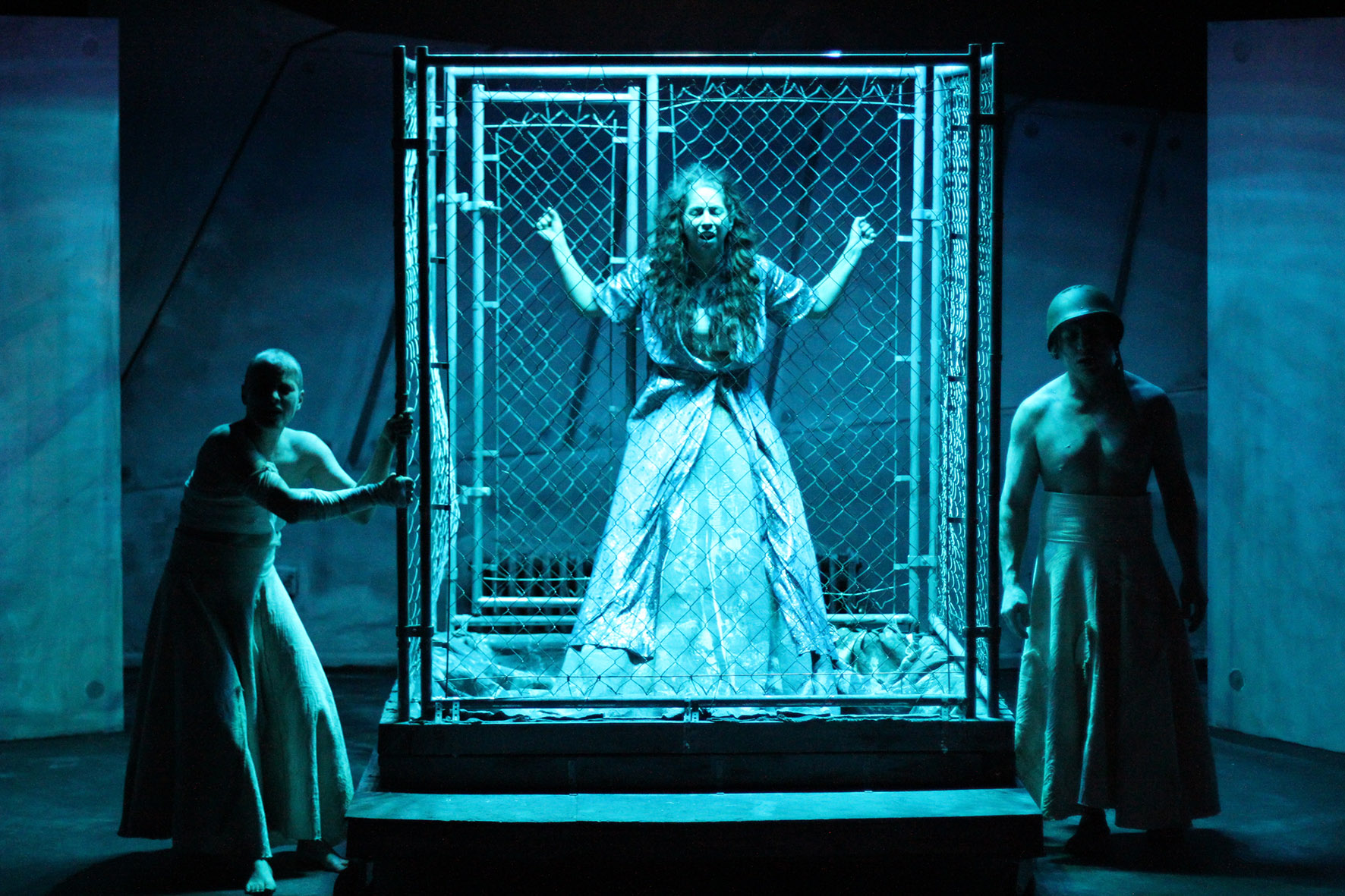
González Melo: Han sido experiencias muy diversas. En Chicago, por ejemplo, Aguijón Theater ha estrenado Adentro y Epopeya; a pesar de ser textos de marcadas referencias nacionales y de que un cubano (Sándor Menéndez) los dirigió, en ambos casos se produjo un rico diálogo con una comunidad latina más amplia, gracias también a las excelentes traducciones de Marcela Muñoz: actores, equipo artístico y espectadores asumían como suyos los temas del desarraigo y la frustración política. Algo similar sentí con el estreno de Por gusto en Repertorio Español de New York, y eso que también era cubana Leyma López, la directora: la desilusión incesante de la juventud y la monotonía de la existencia circular resultaban cuestiones afines a un elenco multinacional. Cuando Ohio Northern University produjo Nevada, recuerdo que les interesaba mucho el estudio minucioso del contexto: parte del equipo visitó la isla y el montaje contó con proyecciones documentales, que contrastaban deliciosamente con la dramatización del texto en inglés, a cargo del mexicano Otto Minera y con traducción de Yael Prizant. En Miami, donde la comunidad hispana es también amplia y variada, la confrontación esencial ha sido con el público cubano, que lógicamente resulta el más interesado, por experiencia directa o por referencia, en ficciones sobre La Habana marginal de Chamaco, Talco y Nevada, obras que Alberto Sarraín dirigió. Siento que el estreno de En ningún lugar del mundo en el XXXIII Festival Internacional de Teatro Hispano, en producción de Teatro Avante, dirigido por Mario Ernesto Sánchez y con traducción de Marian Prío, ha dimensionado aún más el debate sobre la tensión Cuba/Estados Unidos, que es el conflicto entre quienes se quedaron y quienes se fueron. Menciono siempre a las traductoras pues considero esencial su labor y su dedicación: ellas, y mi traductor británico William Gregory, han sido los responsables de que mis textos queden tan bien reescritos en esa lengua.
Gunnels: ¿Cómo escoges los motivos que vas a revisar en el teatro? En Bayamesa (2019) se ve la representación directa de la Cuba tradicional de principios del siglo XX, donde la protagonista María Milanés lucha por encajar a Cuba tradicional con sus propios sueños y ambiciones feministas. En ella, tú alteras tiempo y espacio en el escenario para generar en la obra un diálogo tenso entre el pasado y el presente, y con un suicidio desgarrador que deja a la audiencia destrozada. Nos encontramos a la mujer auténtica que nos anima a todos, pero también aflora la idea de suicidio como tema social, cuando hoy día hay más y más suicidios de gente joven. Como terminas Fuera del juego: "la historia se repite, y se repite".
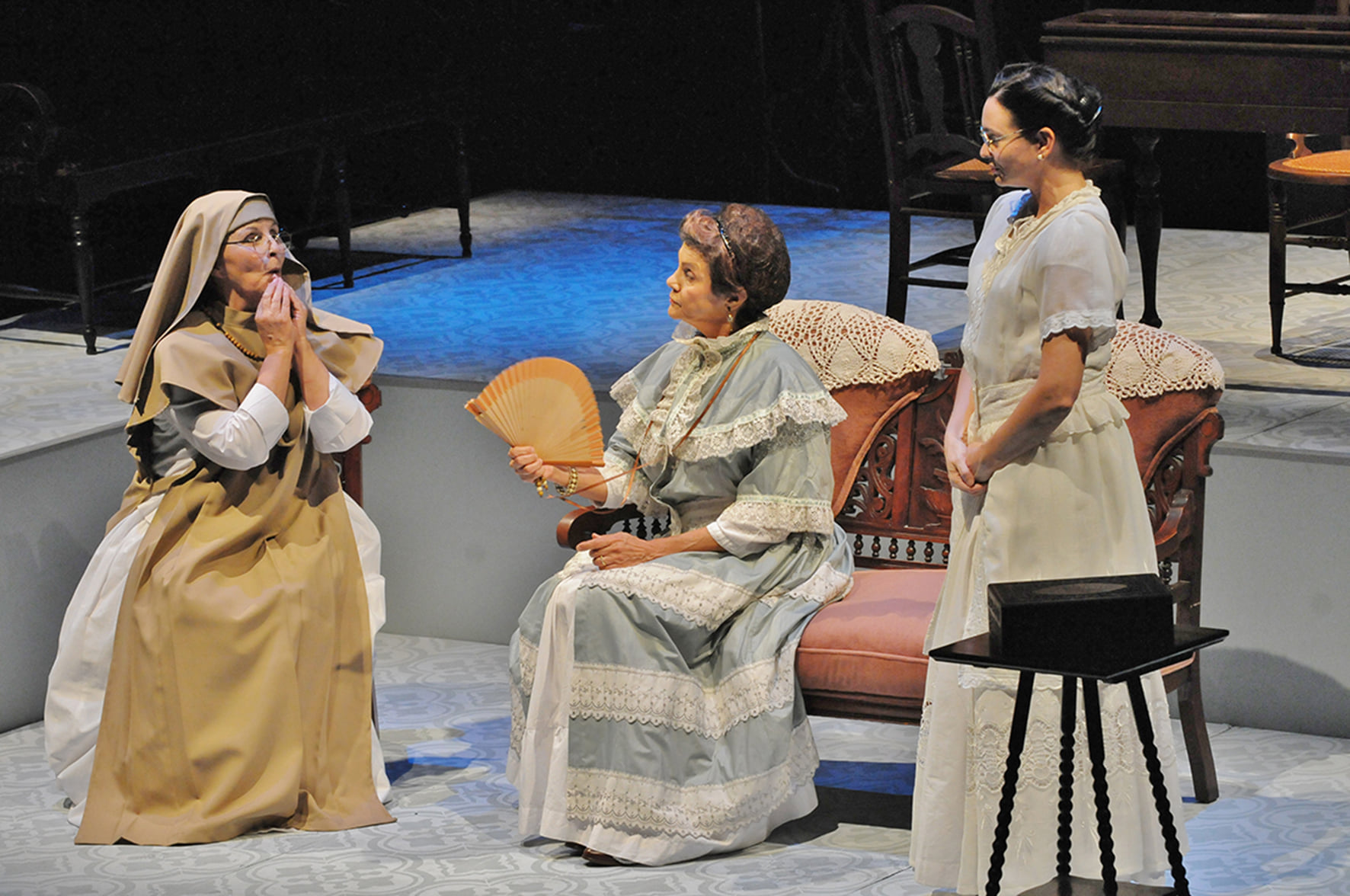
González Melo: La motivación de la escritura es múltiple y cambia de un proyecto a otro. Lo esencial siempre es que el material de partida resuene en mí, que me parezca urgente compartirlo en escena. En el caso de Bayamesa le debo mucho a mi madre, que es filóloga y escritora, y que me habló por primera vez de María Luisa Milanés (1893–1919). Leí sus poemas. Leí su sorprendente autobiografía, que es posiblemente el primer manifiesto feminista escrito en Cuba y uno de los primeros de Latinoamérica. Me impactó su simbólico suicidio: un disparo en el vientre, con la pistola de su padre militar. Un alma libre como ella prefirió escapar de ese modo, antes que continuar sometida al machismo imperante. Supe que la obra debía ser un réquiem que la devolviera a la vida, mediante una ficción que intentase acompañarla, darle voz, siquiera durante la hora y media que dura la puesta en escena. Se cumplió en 2019 un siglo justo de su muerte y, como dices, sigue siendo por desgracia un drama tan vigente…
Gunnels: ¿En qué anda tu trabajo ahora, después del éxito tremendo de Bayamesa?
González Melo: Me estoy sumergiendo cada vez más en la historia de Cuba. Creo que nuestra historia se ha abordado muy poco en la dramaturgia, a veces con una mirada muy superficial, y confío en que el teatro tiene la posibilidad de arrojar una luz nítida sobre sucesos del pasado que nos permitan situarnos en la complejidad del presente. ¿Cómo podemos vivir, cómo podemos entender el país que somos si no analizamos lo que nos ha traído hasta aquí? Durante años trabajé temas y conflictos del presente inmediato, desde los ambientes marginales hasta el lujo de los nuevos ricos. Pero ahora mismo eso se me ha agotado. Imagínate un país cada vez más desabastecido, con un pésimo transporte público, un país donde la gente tiene que pasar horas y horas en horrorosas colas para conseguir una libra de carne de cerdo, una bolsita de detergente, un litro de aceite, todo ello a precios astronómicos. El panorama actual es desolador, no sabría en qué tono dramático abordarlo. Quizás únicamente desde la farsa o el esperpento. Por eso me refugio en el pasado, porque siento que sin memoria no hay densidad de tradición. Hay mucho donde escarbar. El teatro no ha entrado a fondo, por ejemplo, en los graves casos de censura propiciados por las políticas culturales de la Revolución. La censura me interesa mucho: la tenemos demasiado cerca, a menudo sin percatarnos. Me interesa mucho la revisión histórica, siempre que tenga un matiz particular que pueda hablar de una tensión global.
Gunnels: La censura sigue siendo, en efecto, un problema pernicioso en el mundo, ahora con 'caras' diferentes. Al abordar el caso Padilla en tu obra Fuera del juego, te preocupas por problematizar el rol del artista.6En esta obra, González Melo re-visualiza el infame Caso Padilla, en el que el célebre poeta Heberto Padilla es arrestado, encarcelado, tortuado y finalmente exiliado por su trabajo contrarrevolucionaria que cuestionaba la Revolución, el Comandante (Fidel Castro) y el papel de los escritores en general. Utilizada como ilustración clásica de la traumática censura de finales de los 60 y principios de los 70 en La Habana, González Melo cuenta la historia desde la voz del propio poeta como protagonista principal. ¿Es que te interesa "complicar la cosa", para decirlo con palabras de tu propio personaje de Heberto Padilla?
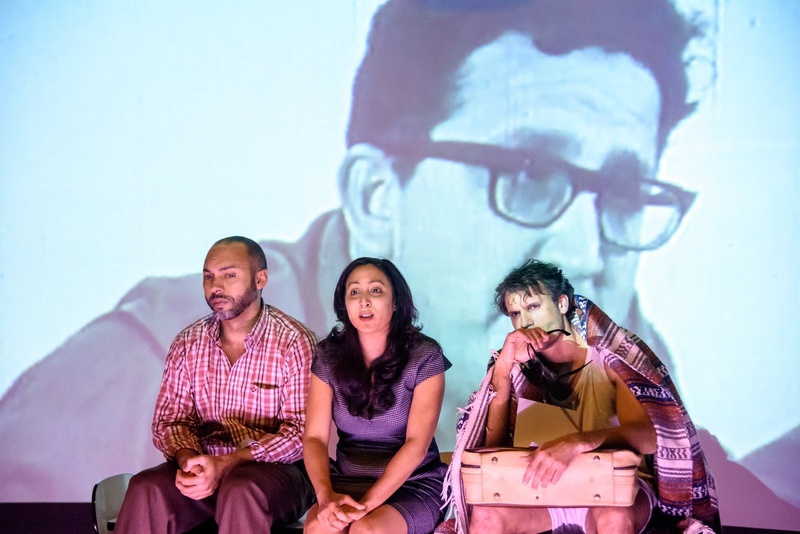
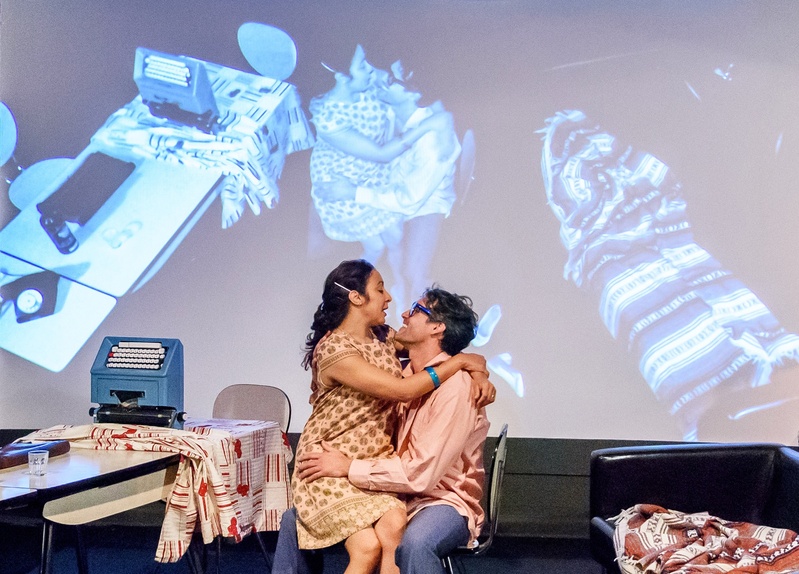
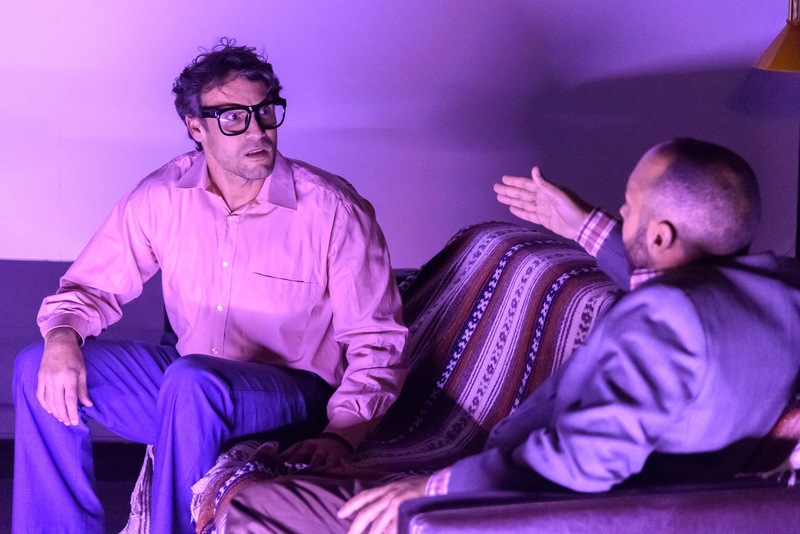
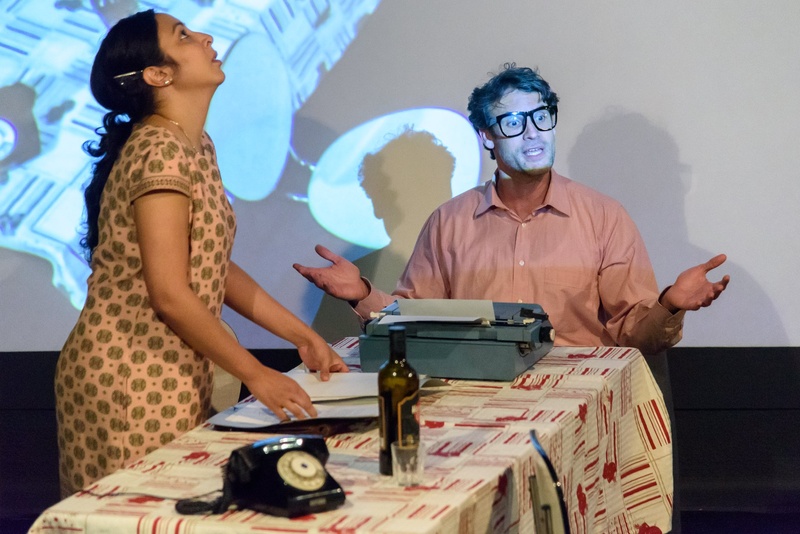










González Melo: Dicen que uno escribe la misma obra a lo largo de toda la vida. El tema de la censura y la autocensura me ha interesado siempre, quizá porque desde muy joven tuve que negociar con ella. Mi libro Memorias de cera por poco no ve la luz, ya que, aunque ganó un premio nacional que consistía en su publicación, contaba mi descubrimiento de la sexualidad en la escuela Lenin, y eso a los funcionarios de la editorial no les gustaba nada. Chamaco, de hecho, puede entenderse como una obra sobre el miedo a la libre expresión dentro de la familia Depás, donde cada uno teme sincerarse ante el otro y todos viven en una espiral de mentiras. Epopeya obtuvo en 2014 el Premio Nacional de Dramaturgia y se publicó por Ediciones Alarcos, pero tuvo una fugaz presentación de solo cincuenta ejemplares, no se distribuyó en librerías, el libro no puede encontrarse en ningún sitio y la obra no puede estrenarse en Cuba (es un texto donde utilizo la metáfora de la Guerra de Troya y el hipotexto de Hécuba de Eurípides para debatir, una vez más, sobre el regreso a la isla de los cubanos exiliados, una vez que Príamo ha caído en combate).
Es cierto que en años recientes me he acercado mucho a la relación entre arte y censura. En 2017 dirigí en Argos Teatro, en La Habana, Cartas de amor a Stalin del dramaturgo español Juan Mayorga, que para mí es una obra que habla sobre la misma situación que padecemos muchos artistas, periodistas y cubanos en general: el terror a decir la verdad, a hablar libremente. Es también uno de los temas de Bayamesa: la censura a la libertad creativa, la plasmación del dolor mediante la poesía, la necesidad de ser independiente. El padre, el marido y la madre de María Luisa Milanés no admitieron ese espíritu rebelde, y eso desencadenó el conflicto y trajo el fatal desenclace. Con Heberto Padilla ocurre lo mismo: fue un hombre muy cercano a la Revolución cubana a inicios de los años 60, incluso fue diplomático, pero lentamente se fue desencantando y su poesía fue haciéndose cada vez más inadmisible para un régimen que terminó asfixiándolo. No quiero "complicar la cosa", más bien intento lo contrario: visibilizar estos asuntos convirtiéndolos en dramaturgia y lenguaje.
Sobre la entrevistadora y el entrevistado
Bridgette W. Gunnels is Associate Professor of Spanish at Emory University and a scholar in Latin American literature from the twentieth century, in all forms, with special emphasis in the short story.
Abel González Melo is a Cuban dramatist, writer, teacher, and theater director. González Melo studied Theater Arts at the Universidad de las Artes de Cuba and is the recipient of various prizes and awards for his literary and theater works, including the Premio Primer Concurso de Dramaturgia de la Embajada de España (2005) for Chamaco [Kiddo]. Most recently, in January 2020, he won the prestigious Casa de las Américas prize for his work, Bayamesa.
]]>Introduction
Playwright Abel González Melo was born in 1980 in Havana, Cuba, the year the Mariel Boatlift saw approximately 125,000 people flee his country, an event he dramatizes in his 2018 play Nowhere in the World (En ningún lugar del mundo). González Melo studied Theater Arts at the Universidad de las Artes de Cuba. He is the recipient of various prizes and awards for his literary and theater works, including the Premio Primer Concurso de Dramaturgia de la Embajada de España (2005) for Chamaco [Kiddo], one of González Melo's most recognized works. Most recently, in January 2020, he won the prestigious Casa de las Américas prize for his work, Bayamesa.
González Melo's work spans two decades and covers multiple social issues of Cuban life. From Cuba's tangled relationship with the Mariel Boatlift in the aforementioned Nowhere in the World (En ningún lugar del mundo, 2018) to teenage prostitution during the early 2000s in Old Havana in his trilogy, Winter Escapes (Fugas de Invierno, 2004–2009), his plays immerse audiences into the streets that surround Havana's Capitolio, to the parks, alleys, and theaters that provide spaces for illegal prostitution, to private homes centering the importance of family to Cubans. The first decade of González Melo's writing centers the Cuban youth culture of the early 2000s, a culture both gay and straight, hungry and sated, resistant and complacent in a country where the Revolution is still fought daily in the streets (although now around the government approved Wifi hotspots). While González Melo maintains his private identification, his plays challenge categorization, interrogate questions of sexuality, and explore survival, the commodification of the body, intense mental trauma, the pain of history, and the deep love of family. His characters weave in and out of his plays to demonstrate with such complexity that as some things have changed others have remained the same.
González Melo's most recent work shifts to recovering figures and episodes from Cuban history with a revisionist eye. Such figures include the early twentieth-century feminist poet María Luisa Milanés (from Bayamo, Cuba) in Bayamesa (2019), which was awarded the Casa de las Américas prize for theater in January of 2020. Tackling the topic of censure at the height of the Revolution in Cuba, González Melo's recent work features Cuban historical figures. Fuera del juego (Outside the Game), dramatizes the experience of Cuban cultural figure Heberto Padilla, an award-winning poet whose work critiqued the Revolution and its leaders in his moment, 1967–68, leading to his arrest, torture, and subsequent exile to the United States in 1980. Padilla worked many years in various positions in higher education in the US, namely Ohio State University, Bowdoin College, and NYU's Institute for the Humanities, before he died alone as a poet in residence at Auburn University, in 2000. In González Melo's most recent drama, Cádiz en José Martí (Festival de Teatro Iberoamericano de Cádiz, 2020), he dramatizes the mythic national hero of the island, revolutionary figure José Martí (1853–1895), by situating him in the Spanish city of Cádiz, his first destination in his long exile and political deportation under the colonial regime.
In this conversation, González Melo explains his creative process and inspirations, the Cuban migration experience as dramatic material, and the idea of recasting history for new audiences and times. He discusses how he drew from lived experience in Havana to craft Winter Escapes as well as how his recent work dives deeply into questions of community and family during some of Cuba's grimmest moments. González Melo also reflects on the unique ligatures between the United States and Cuba. One of these ties is the Spanish-English linguistic connection, as many Cuban-Americans are bilingual. Our conversation, originally conducted in Spanish, has been translated into English here. [Se puede leer la versión en español aquí.]
Kiddo: One Playwright's Beginnings, or González Melo's Early Work
Gunnels: You have written poetry, narrative, non-fiction. Why theater? Do you think that playwriting suits your stories more than other avenues of creation?
González Melo: Theater has something wonderful for a writer: it moves literature away from loneliness. It proposes creation in a team and in direct contact with the spectator. Both questions are very attractive to me. The idea that writing never ceases, is always reinterpreted in the present, needs the communion between the director, the actors, the designers, the technicians, and precisely, inevitably, the complicity of the audience. I am dazzled by that unfinished nature of dramatic writing, that urge to feel the impact immediately. I enjoy writing narrative or essay, but in both cases I miss the real dialogue with the human being. Probably because, more and more, playwriting for me is a process directly related to a very particular human group; it must have an imagined texture that has to walk on a tightrope for success.
Gunnels: Does it feel 'unfinished' to you because it needs other artists, actors to complete it? Or more because of the constant flow of new audiences that are always distinct?
González Melo: Theater is something we do among us all, both the artists and the public. Remember the Greek origin of the word theater: "to watch or look at." Put another way, we only exist because someone looks at us. That is one of the greatest pleasures of writing dramas: feeling that one only offers a guide of stage directions and dialogues on paper, but that the character will have the body, voice, and soul of whoever embodies it in front of the viewer, and that this person will finish building it, in its process of active reception. Why do we keep reviving and repremiering the classics? Because their essence, rather than the argument, lies in how the specific story is told today in the public agora: who executes it, why they decide to do it, in what context and before whom, what senses are born from that experience.
Gunnels: I want to give readers a sense of your Winter Escapes trilogy before we discuss it.
Chamaco ([Kiddo], 2004 English translation by William Gregory) is the first installment of the trilogy. It was first published in Spanish from Ediciones Alarcos and then translated into English by Yael Prizant (University of Miami Press, 2010).1There are two different translations. William Gregory translated both Kiddo and Nevada; Yael Prizant translated the trilogy in a bilingual version with a different press in 2010. Kiddo has been staged globally, from the Argos Theater in Havana to Manchester, England's HOME Theater, to the most recent translation to Czech, with production in Prague set for fall 2021. The trilogy, including Nevada and Talco [Talc] (the second and third installments), covers a span of three months in a tropical winter of discontent. Miami-based academic and theater critic Lillian Manzor writes that "the trilogy addresses concerns that are dear to the author and his generation, namely: the complex and contradictory ways in which homosexuality, sex, and migration from the countryside to the capital becomes means of survival in a society that has lost all sense of value."2Lillian Manxor and Austin Webber, "Ground Down to Nothing but Still Fighting." Hemispheric Institute of Performance and Politics. Accessed March 25, 2021. https://hemisphericinstitute.org/en/emisferica-82/manzor-webbert.html. Kiddo immerses viewers into Christmas Eve in Havana, where a sister uneasily waits for her brother to come home for a dinner that he will never eat, as unbeknownst to her he has died in a knife fight. Nevada follows Lucía and her boyfriend/pimp Rosnay as they encounter the reality of selling their bodies in the effort to get out or escape, in this case, to the state of Nevada, where prostitution is legal, and the "candies come in brilliant gold wrappers." Talc, the final installment, portrays a crude and dirty reality that takes place mainly in the bathroom of an old cinema used for trafficking and prostitution, where the paths of four characters—Javi, Mashenka, Zuleidy, and Alvaro—crisscross in a violent and tense battle for survival. The trilogy was followed by nearly twenty other plays.
Abel, this trilogy really centers the experience of Cuban youth. Describe the importance of giving voice to Cuban youth in many of the works you've written.
González Melo: Now that you mention it, I think that the protagonists of all my plays reflect my age at the time of writing, and in each text these characters are getting older because they grow with me. I wanted to fill them with my doubts, my foibles, my pains. They are like an undercover image of myself in the midst of the world in which I grew up: the Cuba between decades of wars and shortages, and now for a bit more than a decade in Spain in the twenty-first century. I live on the margin between the two countries, and I watch them both with a mixture of passion and strangeness. I cannot speak of all the young people en masse, I do not know how to do it, but I can tell my story of the transition from adolescence to youth. Those impulses are the ones that haunt my work in theater. Hopefully they have to do with the same impulses and emotions of other people.
Gunnels: "Passion and strangeness"—tell me more.
González Melo: I remember that in the early 2000s, when I was walking through Old Havana at night towards my house, I was very curious about the dozens of teenagers who waited leaning on the columns in front of the Capitol, or hanging around Central Park in the middle of the tourist area. What were all these people doing here? Who were they? Little by little, I got closer to them. Many lived clandestinely in Havana; they had emigrated from the East of the island. All of these cisgender boys prostituted themselves, or aspired to do so.3Note from González Melo: "Here we're speaking of, if one must clarify, only cisgender males. I'm no expert in gender studies nor related terminology, but trans populations and women, as I've explained, were in other zones of the city." I learned of many fascinating, terrible stories. The process of discovering them thoroughly was not easy. None were going to give me an interview and tell me about their lives. I became a discreet client. I saved money and went with one of them to a rental room. In the fleetingness of that moment of strange pleasure, I kept myself alert. I listened to them talk about their lives, about their young children whom they had to feed, about their partners who were aware that they were hunting foreigners or Cubans who could pay for sex. My research expanded. One thing led me to another, and I composed a map of the nocturnal marginality of Old Havana. The female prostitute area was at the intersection of Monte and Cienfuegos streets; transvestites and transsexuals were waiting for their clients in the Parque de la Fraternidad; drugs were sold in an abandoned cinema, etc. I fully immersed myself. I did unthinkable things during those years, things that I would not do today. But luckily I dared to do it: I wanted to get to know these people, their places, their reasons, all that environment that the official press did not publish. Three or four years of immersion. After Kiddo finished, I still had so much material that Nevada and Talc were born. Also in my plays Por gusto and Within there are traces of this universe.
Gunnels: Lucía from Nevada and María Luisa from Bayamesa really move me because of the way they confront their worlds, hostile worlds, but always with persistence and love of family front and center. They are strong feminist cross-generational characterizations. For you, is there one character or "angel" from your work that really moves you?
González Melo: I don't usually start from emotion in my writing process. I am quite technical, something I learned with my teacher Raquel Carrió (a great Cuban author, founder in 1976 of the Dramaturgy Department at the University of the Arts of Cuba). the structure-character-language triad is the basis of the preparation of my projects. I believe that emotion comes (or does not come) in parallel with (or after) appreciation of experience. The emotion will then be in the viewer. But for this to happen, the construction of the text or the show itself must be precise, clear; it cannot start from the desire to move emotionally, because the work becomes disfigured. Sometimes I feel that emotion clouds the objectivity of what happens. This happens a lot with actors who act "excited" and then, they overact; or with the dramatists who are over-excited with what they are doing and lose the course of the action, they lose the written synthesis.
It is true that I have had some unique experiences—I would say mystical—during writing itself. It happened while writing Kiddo, in that I felt like someone was dictating it to me directly, right over my shoulder into my ear. The violent death of my father was very recent and the monologue of Silvia, when she found out that her brother had been murdered, I wrote that in tears. I have always believed that Kiddo is my father who became an angel to dictate this work to me and has accompanied me ever since.
History Repeating Itself
Especially in his more recent dramas, Abel González Melo has shifted from describing personal experiences in his work to referencing and dramatizing Cuban historical touchpoints (such as the Mariel Boatlift, the UMAPs work camps, the Grey Period, and the Special Period of Peace). The Mariel Boatlift consitutes the single largest mass migration from Cuba in its history. From April to October 1980, an estimated 125,000 Cubans left the Mariel Port for the United States. The story was well-covered in the media. A small group of Cubans ran a city bus into the gates of the Peruvian Embassy in Havana in an attempt to gain access to the grounds to request political asylum (and eventually leave the island). They were granted asylum, and afterwards, an estimated 10,000 people approached the embassy with the same hopes. Watching this situation unfold from the US, then President Jimmy Carter issued an open invitation to anyone from Cuba who was fleeing the Castro regime, bypassing in part US immigration policy and procedure. A typical Castro pivot followed: after a very public speech on May 1, the Day of the Worker, in Havana's Revolution Plaza, he emptied Cuban's prisons and hospitals of convicted criminals and ill patients and required any American vessel that was picking up family or loved ones at Mariel Port to also take with them a boatload of other 'undesirables,' in which he included homosexual men and those with severe psychiatric problems. As González Melo notes in our conversation below, Cuba's history with gay males is marked by tragic discrimination, torture, and death. The storied UMAP work camps (in Spanish, Unidades Militares de Ayuda de la Producción) that served as a type of work-based prison from 1965–68 in Camagüey, Cuba, were politicized as agricultural camps for "conscientious objectors," but were more a type of social "purge" of any person who was deemed to be anti-Castro or anti-revolutionary, according to historian Abel Sierra Madero.4Abel Sierra Madero, "Academies to Produce Macho-Men in Cuba." Translated by Alicia Barraqué Ellison. Translating Cuba. February 19, 2016. https://translatingcuba.com/academies-to-produce-macho-men-in-cuba-abel-sierra-madero/. This included those accused of homosexuality.
Following the years of the UMAP work camps is a period of a little more than five years (1971–1977) known as the Grey Period (El quinquenio gris in Spanish) in which the Cuban government controlled rigidly the cultural and artistic productions of the island, severly limiting artistic expression and publication. Several of Cuba's most noted dramatists, like Virgilio Piñera (1912–1979), Abelardo Estorino (1925–2013), and Antón Arrufat (1935–) suffered tremendously under this censure, as much for their insistence on creative freedom as for their homosexuality. Surrounded by a hostile environment, all three utilized metaphor as a form of expression, always trying to avoid censure. Piñera's work questioned in broad terms concepts of national identity and the role of the writer as resistor. A prolific writer of essay, short story and theater, Piñera's collections Cold Tales (1956) and Little Maneuvers (1963) were credited with inspiring generations of writers after him, including noted Mariel author Reinaldo Arenas. Abelardo Estorino, who was censured earlier with his work Los mangos de Caín (1965), only wrote one text in the 70s and instead dedicated himself to directing classics in the Company Teatro Estudio. Antón Arrufat was awarded high honors from the National Union of Writers and Artists (UNEAC, in Spanish) for Los siete contra Tebas in 1968, but that institution published the book with a note that accused the writer of being a counter-revolucionary; Arrufat was condemned and ostracized, and didn't publish for more than a decade.
Finally, immigration to and from Havana varied drastically from the 1960s to the present day, and the laws prohibiting re-entry, as well as the acrid political relationship between the US and the Castro regime, created a layered way of understanding home, community, and exile. The early 1960s saw an exodus of the upper and middle classes, who for the most part landed in south Florida and remained. After the Mariel Boatlift, US immigration policy of the mid-90s led to some increased immigration from the island, as "wet foot, dry foot" allowed for fast-tracking of US immigration procedures for Cubans, and the increase of rafters (balseros, in Spanish) is notable during this Special Period of Peace. Of these major immigration waves, Mariel is distinctive due to the population demographics as well as the politicized spin on both sides. That group was both maligned by Cubans on the island and experienced a rougher integration into their new south Florida community.5Aviva Chomsky, A History of the Cuban Revolution, 2nd ed. (Hoboken, NJ: Wiley-Blackwell, 2015), 75.
González Melo is a descendent of these early Cuban playwrights as well as an inheritor of this tangled history. In the conversation below he reflects on the reality of the gay male in Cuba before and after Mariel, and how this facet of Cuban history finds its way into his work. In particular, his play Outside the Game revisits the Padilla Case and the UMAPs, highlighting the subversive censure and psychological torture of artists in the early days of the Revolution. His play Bayamesa reaches back the farthest in Cuban history to tackle issues of colonialist tradition, gender roles, and feminism in Cuba.
Gunnels: How have you seen the Cuban life change for the gay man from writing Kiddo (2004) to Nowhere in the World (2018)?
González Melo: The time period you're referring to is about a decade long, and I don't think that we have seen noted change with regard to the day-to-day life of the gay man in Cuba. The Revolution wasn't too friendly with homosexuals, as they were considered during much of that time as the equivalent of social filth and outcasts; indeed many homosexuals were sent to work camps during the years of 1965–68 (UMAPS, Military Units for Help in Production). This entire process accentuated and encouraged intense machismo and homophobia in Cuban society. In the work of some of the best Cuban dramatists, who additionally were homosexual (I'm thinking of Virgilio Piñera, Abelardo Estorino, or Antón Arrufat), the topic is absent or appears hidden mostly due to self-censure/autocensure. After the horrible experience with the UMAP came the equally traumatic decade of the 1970s, which is historically noted for its strong politics based in marginalization of homosexual artists. My generation hasn't felt as much pain, as today's Cuban artist deals with a more or less 'friendly' public, although homophobia definitely persists and has found more pernicious ways to manifest. In my work personally I've been able to take on the topic of homosexuality in works that I have published and performed on the island; additionally, anthologies of homoerotic poetry and narrative have recently been published. We are trying to include in an amendment to the national Constitution the idea of gay marriage rights, an idea that is presently accepted in many other countries in the world. The problem is that for so many years, too many years, our own government has planted seeds of hate towards homosexuals, and the mentality of a country can't be changed from one day to the next.
Gunnels: But can theater change a country? The power of art or interrogation?
González Melo: I don't believe either theater or any other artistic manifestation can change a society. It would be too pretentious to think so. I have heard phrases like "art changes the world," and I always feel that they have a figurative, metaphorical meaning. Theater is not a political party; it is not an army; it is not an atomic bomb or a pandemic. It does not have that power of abrupt, immediate, forceful change. What theater can do, and I believe this to be true, is to touch the mind and heart of a person, of a spectator who attends a show and discovers another way of looking, of identifying himself/herself in that mirror, of finding something that hurts them deeply. Theater transforms, in this sense, the individual and not the masses, although we share the experience of our art collectively, together. Theater always works at (in its execution, in its reception) particular behaviors, not general ones. We touch one person, and that person will have, on occasion perhaps, the opportunity to touch the things that move the world. That is the simple and beautiful condition of our art.
Gunnels: Your 2018 play Nowhere in the World (En ningún lugar del mundo) addresses silence around sexual identity in Cuba (from the 80s to present day), as well as issues of gay visibility and the trauma of military service, as the lead Ángel negotiates the acute pain of the Mariel Boatlift for those that left as well as for those that remained. Cuba has a thirteen-year history in Africa (1975–1988), with Cuban forces on the ground in the name of liberation from South Africa during that time. Their association ended with Namibian independence and, some say, the beginning of the retreat of apartheid in the area. Regardless, Cuban forces returned with psychological issues, and the drama of Nowhere in the World revisits that time, as well as the impending trauma of Mariel. Ángel leaves the island with the boatlift, and the drama picks up with his return to Cuba after Mariel, to find that family trauma is deep and unforgiving. How do you understand the legacy of the Mariel Generation in comparison to other Cuban artists that have written in exile, either forced or by choice?
González Melo: The protagonist of Nowhere in the World was forced to leave Cuba in 1980 during the Mariel Boatlift, due to psychiatric problems (yes, a ruthless detail of Cuban history: the mentally ill were directly considered scum, unwanted by society, alongside homosexuals and convicts), although the truth of the matter was that the family wanted to get rid of him due to his frequent and violent testimonies of the hard experience of three years as a soldier in the Angolan War as you describe in your synopsis. The history of our exiles is full of anonymous people who have not given their testimony because they are still traumatized. Mariel as a historical moment is very broad and diverse in its interpretation; it often escapes homogeneous cataloging. The most important thing is what it meant as a phenomenon, and the thousands of Cubans who could (who were forced to) integrate themselves into the North American culture and, at the same time, enrich it with their direct action. The culture and society of Miami cannot be understood today without adding the layers of exiles that that city has assumed. Personally, I admire the will and the resistance of the generations of Cuban exiles who have reinvented the concept of homeland.
Gunnels: What do you think about other playwrights who experienced Mariel on the island and stayed? I'm thinking of the play Eggs, by Ulises Rodríguez Febles. We spoke already about the idea of getting out, but what of those who stay?
González Melo: The Mariel story has been told brilliantly by playwrights who keep creating on the island, as Ulises himself in Eggs or Carlos Celdrán in Ten Million. Both were very young in 1980 but have managed to print their texts, full of autobiographical nuances, and this quality surpasses historical reconstruction. I like that: that we can shake off the dust of daily life, that steals so much of our daily energy, and look at our history and our future with a different perspective. Those authors live in Cuba, yes, but they have recognized international careers. Ulises was tremendously successful in Mexico with a work that curiously reconstructs the trajectory of another exiled artist, Dámaso Pérez Prado, and Celdrán has premiered Ten Million at important festivals all over the world. More and more the border between the outside and the inside, between going and staying, is more permeable and less strict. Fortunately.
Drama as Dissection: One Playwright's Persistent Project
From the 1970s to the late 80s, Cuba's economy was nearly solely supported by the Soviet Union, who imported Cuban sugar and other products and exported massive amounts of petroleum to the island to fuel agriculture and transportation. The external effects of the dissolution of the Comecon were immediate: Cuba lost nearly 80% of its imports, and with a heavy trade embargo from the US already in place, the country was left without a major import/export partner. The island entered a period of years (from 1991–1995, although some say it hasn't ended) that later became known as the Special Period of Peace (Período especial), marked by extreme food scarcity (borderline famine), nationwide blackouts to conserve energy (apagones), sometimes for twelve to fourteen hours daily, and a complete dry up of tourism. González Melo was a teenager during this time at the Lenin School in Havana.
Gunnels: Describe how growing up during the Special Period impacted your view of Cuban life vis-à-vis foreign powers.
González Melo: The influence is inevitable. My childhood was full of the Russian and Soviet imaginary: that trace is evident, for example, in my work Talc, but also in part of my stories and in my passion for that culture. I studied in a boarding school called, very precisely, "Lenin." I was there between years 1994 and 1997. There I suffered intense shortages (food, electricity, health resources), but I also discovered solidarity. At that school I suffered bullying, but I was able to become an independent person. From that experience full of contrasts, my first book was born: Wax Memoirs. And that stage, the Special Period, marked my interest in the paradox in which we Cubans have lived. We all shout heroic slogans in the Plaza de la Revolución during the parades, and at the same time we starve to death at home and whisper in the corners the details of our misery. The Special Period adjusted the standard of living of society and increased class differences, clientelism, the black market, corruption in all areas. That double-edged moral crisscrosses my literature: characters who need, at all costs, to put on masks to continue surviving.
Gunnels: In Nevada, a salient theme is the Cuban desire to get out or escape. How do you see that imagined community elsewhere juxtaposed against what is often a very different reality (as in the case of Mariel, for example, or the present-day immigratory reality in the USA)?
González Melo: Being born on an island foments the desire to go beyond the immediate borders that the sea imposes. Virgilio Piñera summed it up in an image: "The damn circumstance of having water everywhere." The island is a prison and the longing to leave is constant alongside, in my case, having the opportunity to return. The need to flee the island has been a consistent facet of Cuban identity, increased by political and economic factors experienced in various stages of the Revolution. My own father had to go into exile in Mexico in order to guarantee us a better life: I am not talking about luxuries, but about having money to eat, to dress and take care of ourselves, to move about the island. The United States is the destination for a great many Cuban migrations; we have a very close relationship. In my doctoral thesis I study precisely the links between family and exile in the dramaturgy of Greater Cuba, understood here as a Cuba generated both on the island and abroad. I like that idea of an expanded homeland, not subject to physical limits, but rather to feelings and areas that both share in common. This issue is found in a large part of my work as an element of our idiosyncrasy: the idea of leaving and returning. Both Nevada and Within talk about the undercover, dangerous trip by sea and the risks undertaken there. In Sistema, the tension is precisely in that the protagonist is trapped in Miami and cannot return. Epopeya, Weathered, Nowhere in the World illustrate the arc that starts at exile only to return after some time, and then most critically, everything that that particular reunion involves and drags out into the present.
Gunnels: But for the Marielitos, precisely, who were told upon leaving that they would never be allowed to return, exile is (was?) painful in different ways. How does this pain of return change the "community" of Greater Cuba that you mention earlier? Is that something that Nowhere in the World wants to dissect?
González Melo: Of course. Mariel and the Angolan War are matters that we have barely dealt with in the Cuban national tradition of writing, but their traces are still there. They are wounds that have not been closed, and I have tried to touch some of it with Nowhere in the World. The family structure has been, in the tradition of Cuban dramaturgy, the nucleus through which to observe perennial social and political issues. This has to do with what I was saying before: theater only works from the particular and not from the general. Historical processes are analyzed in books, articles, interviews, in extensive bibliographic and documentary collections. A play cannot contain all of that process, all of the lives wasted in the attempt to build a certain political-social project. What a play can do is sharpen the gaze, focus on a small human group and apply the scalpel to it. You use the correct verb: dissect. As a playwright I feel exactly like this: Cuba is my operating room, that broken family is the body that lies on the table, and I have to apply the scalpel with caution, with great responsibility, trying to get to the root of the pain.
Gunnels: It's true, as you mention before, there is a very different, distinct type of relationship with the US. Would you say that your experiences in the US as a Cuban-born artist have been particularly revealing in terms of understanding this distinct relationship?
González Melo: They have been very different experiences. In Chicago, for example, Aguijón Theater premiered Within and Epopeya. Despite being texts with marked national references and with a Cuban (Sándor Menéndez) director, in both cases there was a rich dialogue with a wider Latino community, thanks also to the excellent translations of Marcela Muñoz. The actors, artistic team, and spectators took on as their own the themes of uprooting and political frustration. I felt something similar with the premiere of Por gusto in Repertorio Español in New York, and what was also with a Cuban director, Leyma López: the incessant disillusionment of youth and the monotony of a circular existence were related issues to a multinational cast. When Ohio Northern University produced Nevada, I remember that they were very interested in the detailed study of the context. Part of the team visited the island and the editing included documentary projections, which contrasted deliciously with the dramatization of the text in English (by the Mexican Otto Minera and with translation of Yael Prizant). In Miami, where the Hispanic community is also wide and varied, the essential confrontation has been with the Cuban public, which logically is the most interested, either by direct experience or by reference, in fictions about the marginal Havana of Kiddo, Talc, and Nevada, works that Alberto Sarraín directed. I feel that the premiere of Nowhere in the World at the XXXIII International Festival of Hispanic Theater, in production of Teatro Avante, directed by Mario Ernesto Sánchez and with translation by Marian Prío, has further dimensioned the debate on Cuba / United States tension, which is the conflict between those who stayed and those who left. I always mention the translators because I consider their work and dedication essential. They, and my British translator William Gregory, have been responsible for my texts being so well rewritten in that language.
Gunnels: How do you choose what specific issue you are going to dissect in the work? Your 2019 play Bayamesa is the direct portrayal of traditional, early twentieth-century Cuba, where the lead María Milanés struggles to align traditional Cuba with her own very feminist dreams and ambitions. In it, you shift time and space on the stage to bring the play into tense dialogue between past and present, with a gut-wrenching suicide that leaves the audience broken. In Bayamesa we find the authentic woman who encourages all but also the idea of suicide as a social issue emerges, when today there are more and more suicides of young people. It's like the final lines of your other 2019 play Outside the Game: "history repeats itself, and it repeats itself."
González Melo: The motivation for writing is multiple and changes from one project to another. The essential thing is always that the starting material resonates with me, that it seems urgent to share it on stage. In the case of Bayamesa, I owe a lot to my mother, who is a philologist and writer, and who spoke to me for the first time about María Luisa Milanés (1893–1919). I read her poems. I read her surprising autobiography, which is possibly the first feminist manifesto written in Cuba and one of the first in Latin America. I was struck by her symbolic suicide: a shot in the belly, with her military father's pistol. A free soul like her preferred to escape in this way, rather than continue being subjected to the prevailing machismo. I knew that the play must be a requiem that would bring her back to life, through a fiction that tried to accompany her, give her a voice, even during the short hour and a half that the staging lasts. A century of her death was celebrated in 2019 and yet, as you say, unfortunately this continues to be such a current drama....
Gunnels: Where do you see your work going after Bayamesa?
González Melo: I am immersing myself more and more in the history of Cuba. I think that our history has been approached very little in dramaturgy, sometimes with a very superficial gaze, and I trust that theater has the possibility of shining a clear and precise light on events of the past that allow us to situate ourselves in the complexity of the present. How can we live, how can we understand the country we are if we do not analyze what has brought us here? For years I worked on issues and conflicts of the immediate present, from the spaces on the margins to the luxury of the new rich. But right now that present has me exhausted. Imagine a country that is increasingly under-supplied, with lousy public transport, a country where people have to spend hours and hours in horrifying lines to get a pound of pork, a bag of detergent, a liter of oil, all at astronomical prices. The current panorama is bleak; I would not know in what dramatic tone to approach it. Perhaps only from the farce or the grotesque. That is why I take refuge in the past, because I feel that without memory there is no density of tradition. There is so much to dig into. Theater has not gone into depth, for example, in the serious cases of censorship caused by the cultural policies of the Revolution. Censorship interests me a lot. We have it too close to us, often without realizing it. I am very interested in historical revision, provided it has a particular nuance that can speak to a global tension.
Gunnels: Censorship continues to be a pernicious problem in the world, perhaps now with different 'faces.' When addressing the Padilla case in your play Outside the Game, you concentrate on problematizing the role of the artist.6In this play, González Melo re-envisions the infamous Padilla Case, whereby celebrated poet Heberto Padilla is arrested, jailed, tortured, and finally exiled for his counterrevolutionary work that questioned the Revolution, the Comandante (Fidel Castro), and role of writers in general. Used as a classic illustration of the traumatic censorship of the late 60s and early 70s in Havana, González Melo tells the story from the voice of the poet himself as the lead role. Are you interested in "complicating things," to put it in the words of your own Heberto Padilla?
González Melo: It is said that one writes the same work throughout life. The issue of censorship and self-censorship has always interested me, perhaps because from a young age I had to negotiate with that force. My book Wax Memoirs almost didn't see the light of day, because although it won a national award for its publication, it told about my discovery of sexuality at the Lenin school, which the editorial officials did not like at all. Kiddo, in fact, can be understood as a work about the fear of free expression within the Depás family, where each one fears being open to the other and they all live in a spiral of lies. Epopeya, although it won the 2014 National Prize for Dramaturgy and was published by Ediciones Alarcos, had a fleeting presentation of only fifty copies. It was not distributed in bookstores; the book cannot be found anywhere and the work cannot be released in Cuba. (It's a play where I use the metaphor of the Trojan War and the conflicts of Hecuba by Euripides as a hypotext to debate, once again, the return to the island of exiled Cubans, once Priam has fallen in combat).
It is true that in recent years I have moved much closer to the relationship between art and censorship. In 2017 I directed at Argos Teatro in Havana Letters of Love to Stalin by the Spanish playwright Juan Mayorga, which for me is a play that talks about the same situation that many artists, journalists, and Cubans in general suffer: the terror of telling the truth, of speaking freely. It is also one of Bayamesa's themes: the censorship of creative freedom, the expression of pain through poetry, the need to be independent. The father, husband, and mother of María Luisa Milanés did not allow that rebellious spirit, and that unleashed the conflict and brought forth the fatal outcome. The same thing happens with Heberto Padilla: he was a man very close to the Cuban Revolution in the early 1960s. He was even a diplomat, but he slowly became disenchanted and his poetry became increasingly inadmissible for a regime that ended up suffocating him. I don't want to "complicate things," rather I try the opposite: to make these issues visible and debatable by turning them into theater and language.
About the Interviewer and Interviewee
Bridgette W. Gunnels is Associate Professor of Spanish at Emory University and a scholar in Latin American literature from the twentieth century, in all forms, with special emphasis in the short story.
Abel González Melo is a Cuban dramatist, writer, teacher, and theater director. González Melo studied Theater Arts at the Universidad de las Artes de Cuba and is the recipient of various prizes and awards for his literary and theater works, including the Premio Primer Concurso de Dramaturgia de la Embajada de España (2005) for Chamaco [Kiddo]. In January 2020, he won the Casa de las Américas prize for his work, Bayamesa.
]]>
Whenever the concepts of diaspora and indigeneity come together, scholars tend to ascribe oppositional power to them. Diaspora implies transnational if not global movement, displacement, and attenuation while indigeneity connotes originality, belonging, and rootedness. In drawing together diaspora and indigeneity to compass the complexities and ambiguities of indigenous peoples' lives, scholars of indigenous diasporas have closed the gap between the two concepts. They suggest that in spite of diasporic indigenous persons' relationships to multiple places—a lost homeland, a current abode, a far-away site of work—and to multiple identities—clan, tribal, historical, racial, and political—diasporic indigenous peoples can and do remain rooted in common memories, traditions, and pasts.1William Safran, "Diasporas in Modern Societies: Myths of Homeland and Return," Diaspora 1 (July 1991): 83–99; Michele Reis, "Theorizing Diaspora: Perspectives on 'Classical' and 'Contemporary' Diaspora," International Migration 42 (June 2004): 41–60; Robin Cohen, Global Diasporas: An Introduction (Seattle: University of Washington Press, 1997); Rogers Brubaker, "The 'Diaspora' Diaspora," Ethnic and Racial Studies 28 (January 2005): 1–19; Paul Burke, "Indigenous Diaspora and the Prospect for Cosmopolitan 'Orbiting': The Warlpiri Case," Asia Pacific Journal of Anthropology 14 (August 2013): 304–7; James Clifford, "Indigenous Articulations," Contemporary Pacific 13 (Fall 2001): 470–72, 478–79; Robin Delugan, "Indigeneity across Borders: Hemispheric Migrations and Cosmopolitan Encounters," American Ethnologist 37 (February 2010): 41–2.
Gregory D. Smithers's The Cherokee Diaspora offers one of the first diasporic studies of Native North America. The idea of diaspora allows Smithers to remove Cherokee history from the usual linear settler/colonial paradigm that frames the subject and to instead address long and recurring cycles of Cherokee dislocation, movement, and coalescence. The problems that beset any diasporic people—a sense of belonging, of identity, and of home—have confronted Cherokees for centuries. How they responded to such challenges has varied over time as sense of self and place shifted from the sacred fires that centered each town in the eighteenth century to engagement with the federal government's so-called "civilization" policy in the early nineteenth century, to the valorization of blood quantum later in the nineteenth century, to federal law and competing indigenous notions of what it means to be Cherokee today. While such different formations enabled Cherokees to maintain a sense of peoplehood, there was often little agreement over who counted across time and space as a Cherokee. Contests over Cherokee identity became an insistent theme, but, Smithers concludes, one basic determinant above all others has defined being Cherokee since the 1830s: their shared history of expulsion from an ancestral homeland and their arduous and deadly forced march to the West along what is known as the Trail of Tears.
Scholars have wrestled with how to interpret and depict the cyclical unity of time, space, and place that gives indigenous peoples powerful identities and senses of place.2William Cronon, Changes in the Land: Indians, Colonists and the Ecology of New England (New York: Hill and Wang, 1983); Keith H. Basso, Wisdom Sits in Places: Landscape and Language Among the Western Apache (Albuquerque: University of New Mexico Press, 1996); James Taylor Carson, "Ethnogeography and the Native American Past," Ethnohistory 49 (Fall 2002): 765–784; Robbie Ethridge, Creek Country: The Creek Indians and Their World (Chapel Hill: University of North Carolina Press, 2003). Smithers makes a promising start when he grounds his study in two Cherokee sensibilities, tohi and osi, which embody notions of flow, equanimity, and power. An individual's actions always implicate him or her in the flow of the world, posing a constant challenge to remain balanced and to flow well (53–4). By setting in motion a space where people flow, where rivers and mountains are alive, where the East is associated with the beginning of life and the West with its inevitable end, Smithers embeds Cherokees within a cosmological space that holds great promise as an interpretive entry into their past.
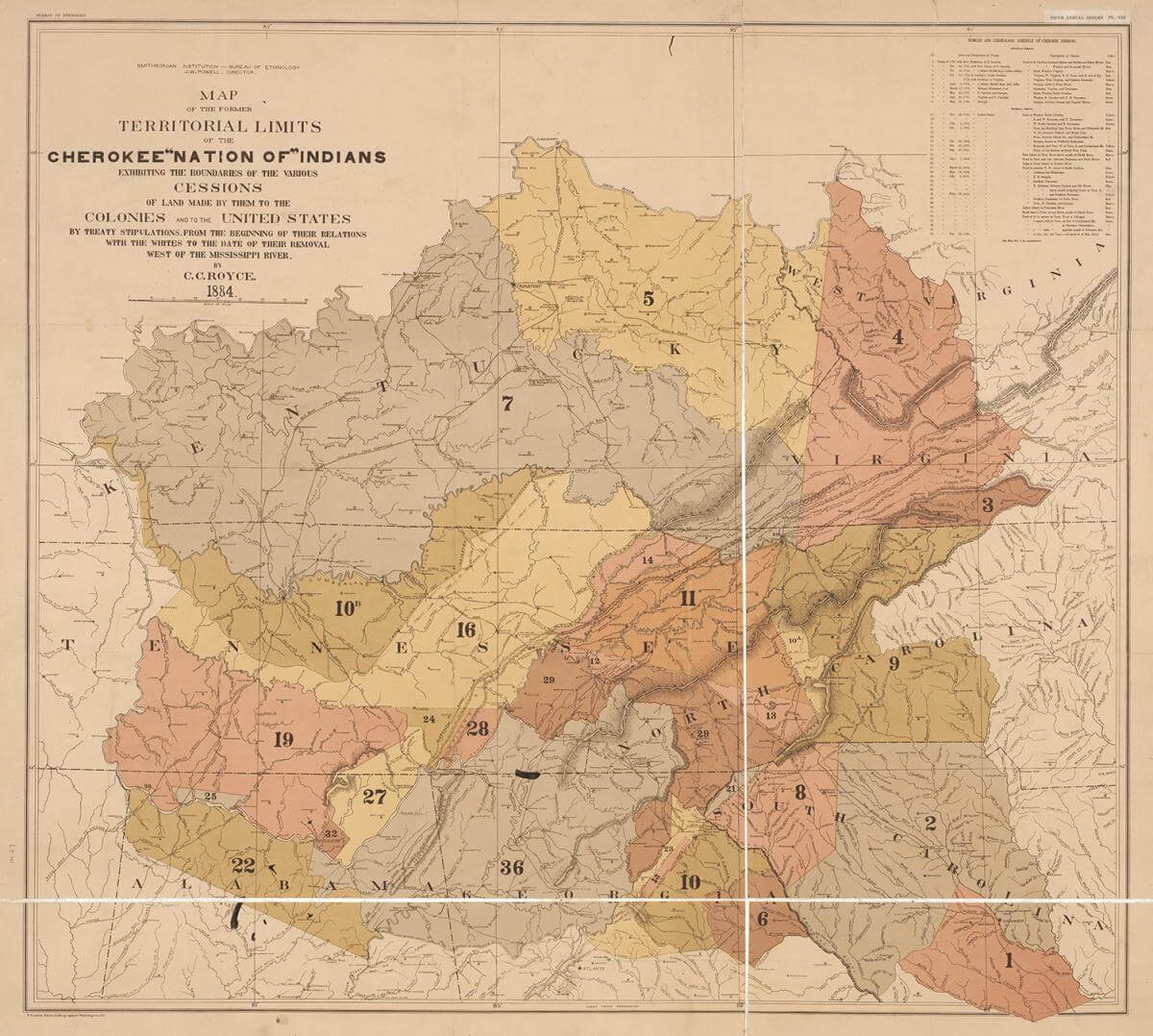
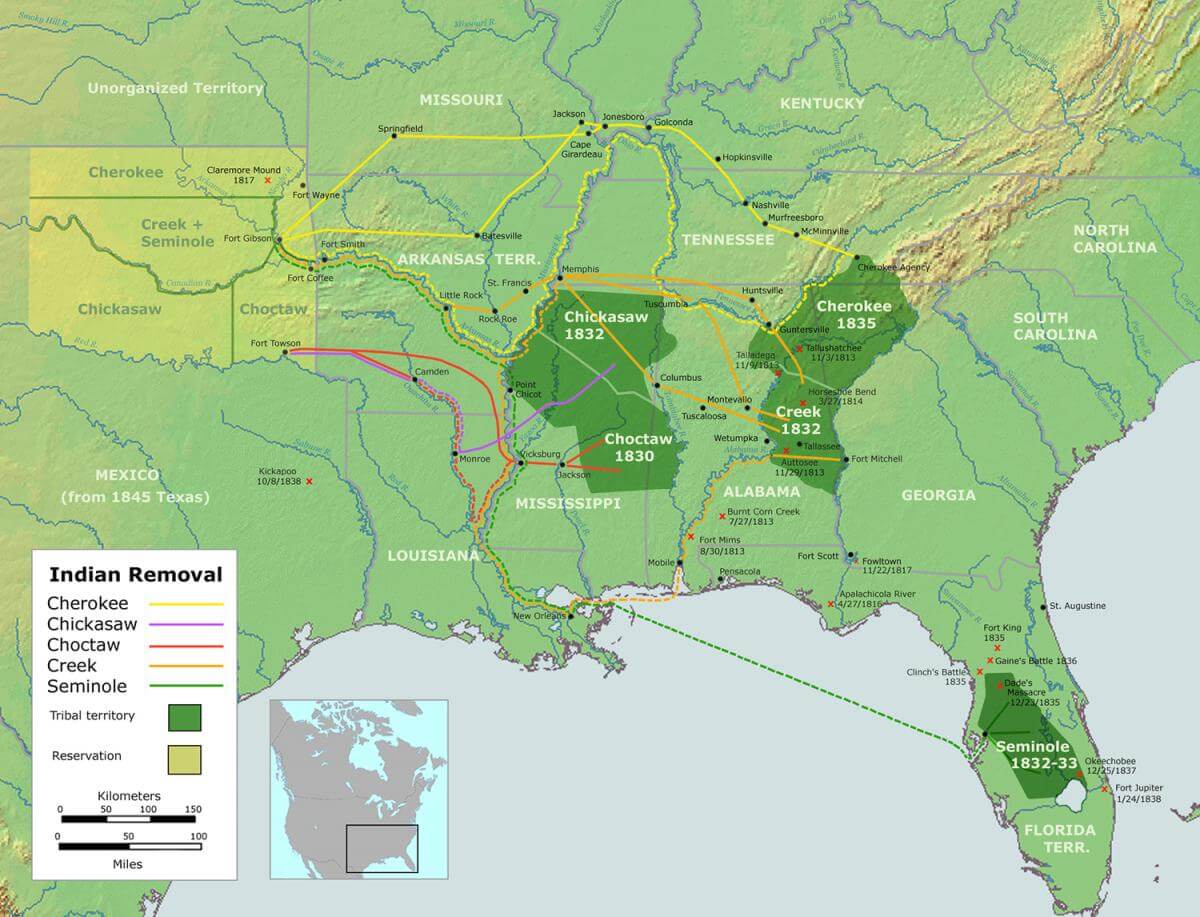
Such an auspicious spatial framing wanes over the course of The Cherokee Diaspora. As Smithers' explication of diaspora and modern identity becomes unmoored from the senses of space and place that tied them with great depth and specificity to their ancestral homeland, what remains is a fairly conventional narrative of post-removal Cherokee history. Cherokees, however, had emerged from the earth, their mother. What we gloss as trees, rocks, mountains, springs, streams, animals, and plants knit the Cherokees' knowledge of the world and its origins into a tight narrative that informed everything: how a child should behave, how to make a medicine, how to achieve peace. They were not people who inhabited a natural world; instead, the Cherokees were so implicated within the workings of the world that their lives played out in a complex mixture of time, space, and place that can be neither imagined nor perceived when disaggregated. The text also neglects a register of the profound, unexplored impact of losing their homeland. Loss of place often triggers drastic transformations in a sense of past, self, and future. Reconstituting themselves in Indian Territory was not just a struggle to resettle, build new homes, plant new gardens, and learn about new weather patterns. It demanded a reimagination of who the Cherokee were, how they connected to the world, and how they connected to their former ancestral home—all processes that lie at the core of the diasporic experience and demand closer attention.3Andrea L. Smith and Anna Eisenstein, Rebuilding Shattered Worlds: Creating Community by Voicing the Past (Lincoln: University of Nebraska Press, 2016), 3–4, 11–13.
In a longer history, Cherokees arrived in the southern Appalachians about four-thousand years ago, having left their Iroquoian homeland, which itself was once a place of arrival for ancestors thousands of years before. The Cherokee diaspora that concerns Smithers began at the end of the American Revolution when a handful of prescient leaders in mountain towns of what is today Tennessee, Georgia, and North Carolina ascertained that the long knife republic was not going to abide by borders negotiated by the crown they had just overthrown. In anticipation of this invasion, Cherokees began to head west in search of places to ensure that they could remain in flow and balance. Over the following decades many more followed while others headed for the Mexican province of Texas in search of respite from Anglo-American encroachments. By 1830, Texas Cherokees numbered several hundred while around five thousand western Cherokees settled in present-day western Arkansas and eastern Oklahoma. Many of the 16,500 who still inhabited their ancestral homeland in the states of Georgia, Tennessee, and North Carolina regarded their far-flung kin as either outsiders or as rivals who had abandoned them in their fight against the federal and state governments and who had turned their backs on the adoption of Anglo-American cultural norms. But when in 1838 and 1839 the US army expelled the remaining eastern Cherokees from Tennessee, with the exception of a few hundred who remained in western North Carolina, the relocation of the nation to what became known as Indian Territory was complete.
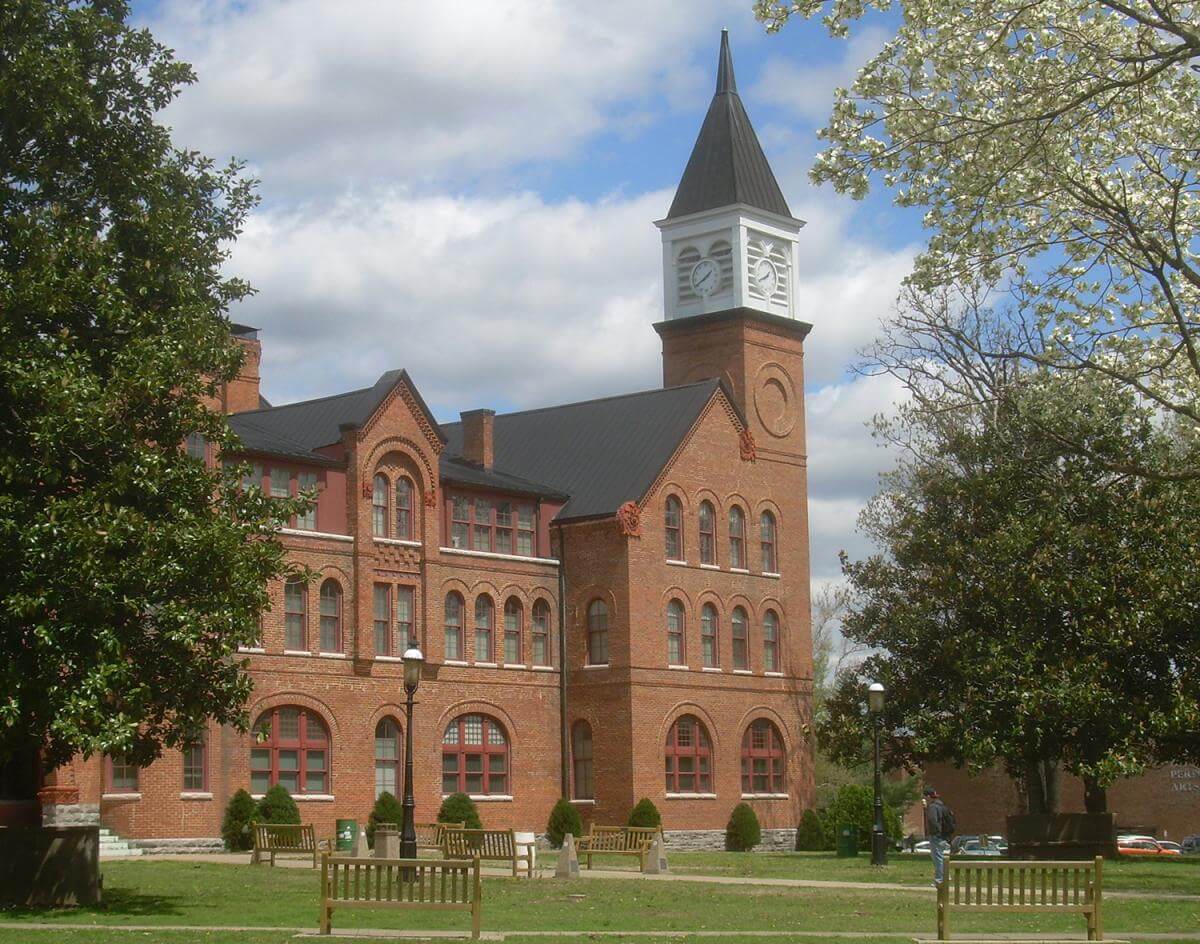
The land once home to a few thousand western Cherokees (what is today southeastern Oklahoma) transformed in the early 1840s into the site of a new nation that had to remake itself out of a population segmented by different histories of movement, identity, and resistance. In the wake of assassinations and bitter civil strife, the former leader of the eastern Cherokees, John Ross, forged a coalition in defense of their new homeland, a renewed sovereignty, and a proactive adaptation to life in Anglo-America. Over time the people who remained in North Carolina found themselves estranged from their western kin and increasingly excluded from the new nation's exclusive claims to Cherokee identity.
Two subsequent events, abolition and allotment, undermined the Cherokee identity fashioned in Indian Territory. Emancipation at the end of the Civil War created a new set of Cherokees out of the nation's enslaved population whose skin color made them anathema to most other Cherokees. The freed peoples' claims to certain legal rights and benefits hastened the nation's embrace of US racial norms and laws in order to exclude freed people from the census rolls that determined membership in the nation. Then, in the early 1900s, the federal government allotted most of the Cherokees' western land for sale to speculators and homesteaders. Allotment transformed the nation from a place that could be mapped on the ground to a space of the mind and heart that could only be felt and enacted through cultural rites, church services, and social gatherings. How Cherokees remained conscious of themselves as a people and how they reformulated a sense of self after allotment demands a deeper investigation than Smithers offers. It is unclear whether and how a sense of spatiality informed debates over who belonged and who did not. In eliminating formerly enslaved men, women, and children from the nation's rolls, Cherokees undertook a purging of collective genealogy and a restructuring of the spaces they inhabited. A different kind of removal required the political and racial separation of neighbors and kin.
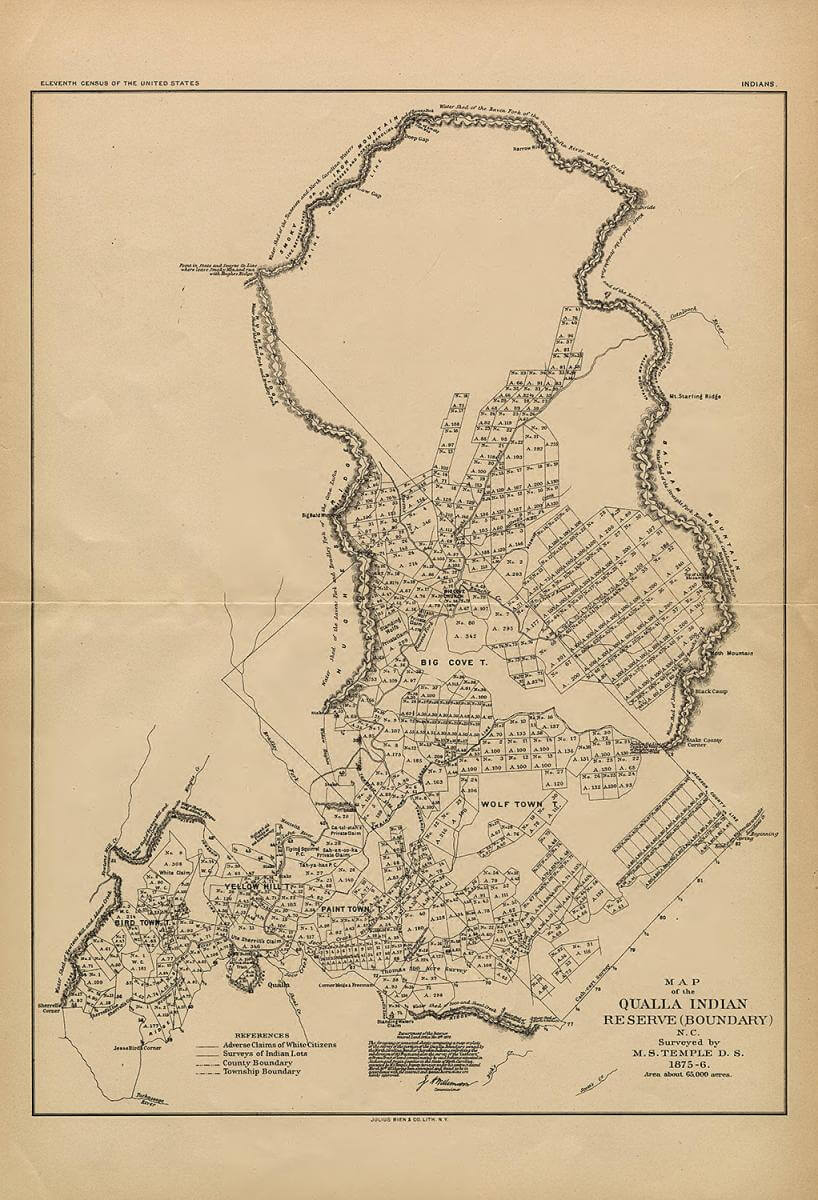
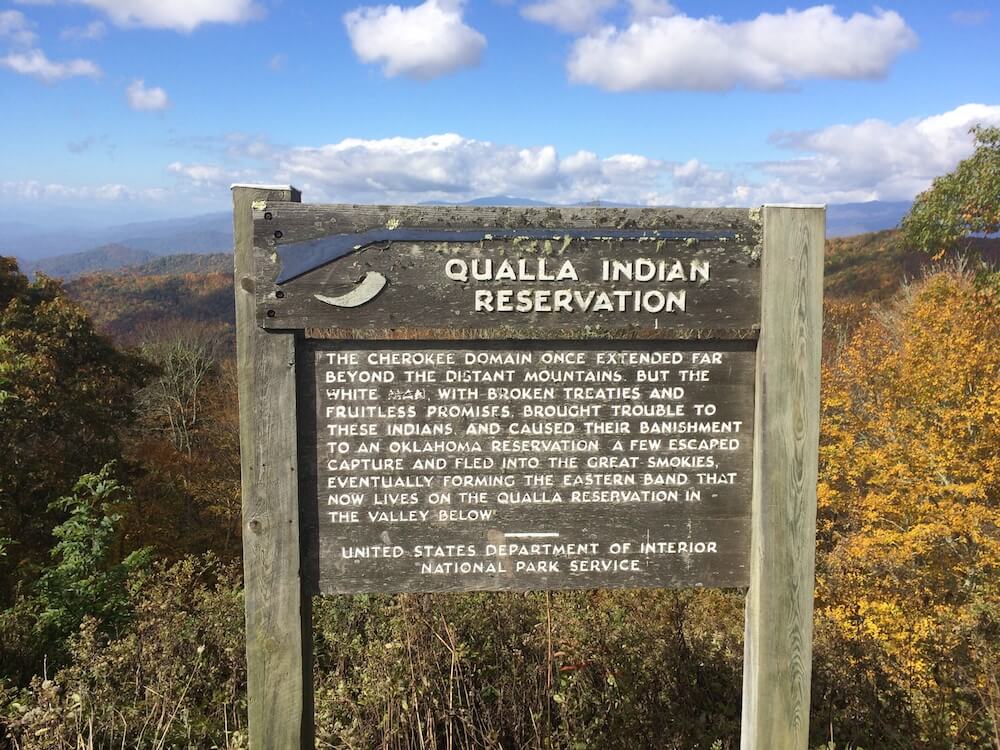
Two world wars and the Great Depression further disrupted Cherokee life. Poverty, urban opportunities, and service overseas pushed and pulled Cherokees across the country as they sought belonging and work in US cities. By the 1970s, most still called Oklahoma home but thousands had sought better opportunities in California and other states. Some made it as far as Hawaii and a few even lodged applications with the Australian government. Meanwhile, the Cherokees in North Carolina had rebuilt their land base as the Qualla reserve and gained separate federal recognition to set themselves up as a second Cherokee nation.
In spite of confusing and complicated histories of dislocation, violence, and rivalry, Smithers argues that there is still a Cherokee people whose identity transcends a myriad of political, racial, and geographical divisions. Cherokees are, Smithers argues, defined by their shared diasporic experiences of the Trail of Tears. His inability to anchor consistently his interpretation in indigenous concepts of flow and propriety fails to clarify how understanding their expulsion can be usefully explored as a diaspora. At the heart of the story of the Cherokee diaspora sit the brute facts that they lost most of their ancestral homeland, were driven by force of arms from their homes, reconstituted themselves in a new homeland which they subsequently lost, and then underwent bitter struggles over who counted as a member of the nation and who did not. When held apart from specific ethnogeographic considerations, such a narrative comports well with other such studies. If, however, Smithers had probed more deeply the interdependence of peoplehood, place, and memory, and pushed his analysis back to the much earlier migration that brought the Cherokees to their southern homeland, he might have better represented the pain of expulsion from not just an ancestral homeland but from a living being that had borne and nurtured the Cherokees for millennia.
Consider the Cherokee dead, the ghosts that haunt TVA reservoirs, inhabitants of ancient cemeteries that lie beneath economic development projects, and occupants of forlorn mounds—the beings who tie the living to the past and to the land. They have stories to tell. According to notions of tohi and osi the dead are never really dead but cohabit with the living and the unborn. When real estate development and other forms of excavation disturb or destroy the Cherokee dead, Cherokee life is imperiled. The life that Cherokee ghosts enact draws time, space, and self into one conceptual and existential field, making stories about survival, endurance, hope, and belonging possible. They ensure that life continues to flow well and that Cherokees remain Cherokees and, above all else, grounded.4James Taylor Carson, "Cherokee Ghostings and the Haunted South," The Native South: New Histories and Enduring Legacies, eds. Tim Alan Garrison and Greg O'Brien (Lincoln: University of Nebraska Press, 2017), 238–62.
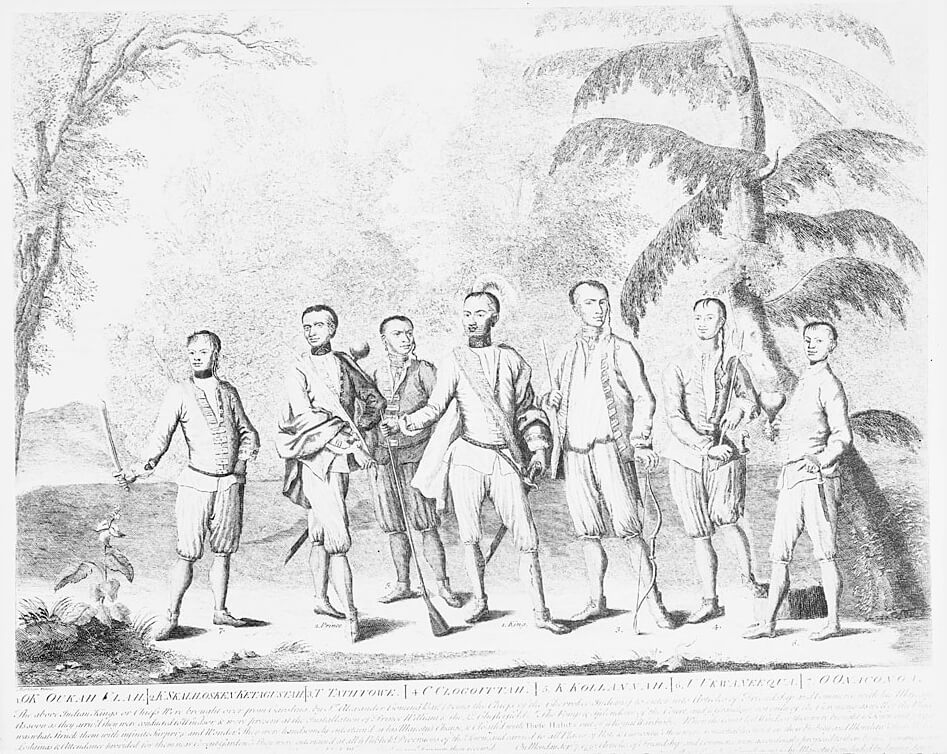
It is not, in the end, altogether clear how the concept of diaspora reframes the standard story of Cherokee dispossession. Lacking a deeper exploration of place and space, Smithers' interpretive angle never closes on the emotional depth and psychic pain of removal and allotment, nor does it open a view into the transformative creativity needed to remake a homeland, both real and remembered, over and over. Nevertheless, Smithers has tried something new, seeking to set the history of Native North America on a different footing that engages with broader inquiry into transnational themes of identity, memory, and history. He demonstrates that the trauma of ethnic cleansing remains today in Cherokee minds and memories and at the core of their collective identity. That such trauma reaches out across almost two centuries indicates the need to find ways to open the past so that well-worn narratives can recover some of their original power to provoke and to disturb.
About the Author
James Taylor Carson is head of the school of Humanities, Languages and Social Science at Griffith University, Brisbaine, Australia. His research and writing has focused largely on issues related to contact between European invaders and first peoples in North America. His books include Making an Atlantic World: Circles, Paths, and Stories from the Colonial South (Knoxville: University of Tennessee Press, 2007).
]]>Introduction
During the antebellum era, New Orleans became the second largest port of US immigration after New York City, leading hundreds of thousands of Germans to begin new lives at the mouth of the Mississippi rather than the Hudson. 1Carl Leon Bankston, ed., Encyclopedia of American Immigration, vol. 2 (Ipswich, MA: Salem Press, 2010), 476. New Orleans boasted one of the earliest and most vibrant German communities in North America, yet the German-born growth rate in Louisiana during these years pales in comparison to states such as New York and Pennsylvania, as well as that of other slave states such as Missouri, Kentucky, and Maryland. In fact, between 1850–1860 it exceeds that of only Vermont, Maine, and South Carolina.2For the history of the settlement of Louisiana’s Cotes des Allemandes (the German coast) near New Orleans, see: Ellen C. Merrill, The Germans of Louisiana (Gretna, LA: Pelican Publishing, 2005). Compiled from the Original Returns of the Eighth U.S. Census 1860a-04, 2–590; Compiled from the Original Returns of the Seventh U.S. Census 1850a-02, xxxvi. Could yellow fever and the imagined racial unsuitability of Germans to tropical climates help account for this phenomenon? A close examination of historical sources returns a resounding "Yes."
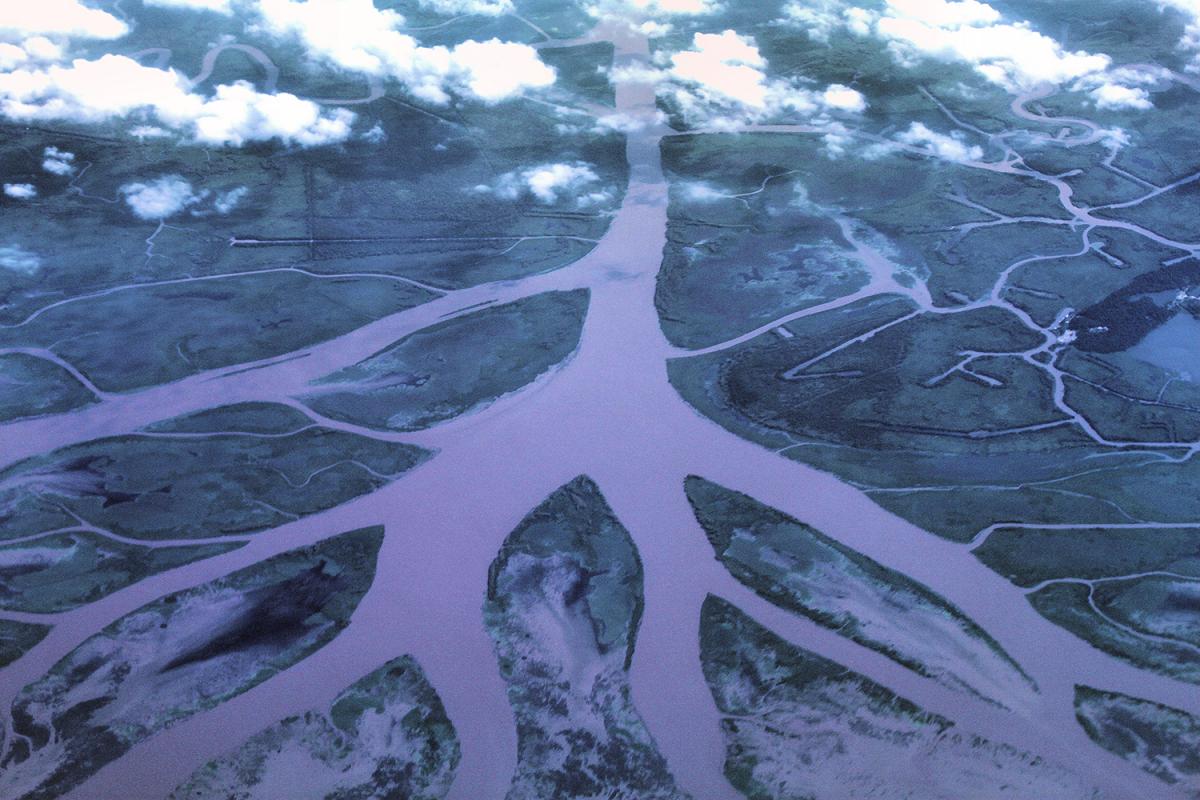
Mouth of the Mississippi, New Orleans, Louisiana, July 9, 2010. Photograph by Flickr user Adventures of KM&G-Morris. Creative Commons license CC BY-NC-ND 2.0.
European Bodies, Climate, and the Geography of Yellow Fever
As a catalyst for German interest in America, the Louisiana Purchase unleashed a flood of speculation regarding whether US stewardship of the Purchase territory could lead to the realization of the biblical "land of milk and honey." According to observations reprinted by Johann Friedrich Nonne, editor of the Neue Allgemeine Weltbühne, in 1804, "the eyes of all Europe…now focused on Louisiana." The author of the piece downplayed concerns regarding the city's unhealthy reputation, which he attributed to the neglect of its former French caretakers, and expressed confidence that the territory's new masters would fare better in realizing New Orleans's potential.3Johann Friedrich Nonne, eds. Neue Allgemeine Weltbühne Auf Das Jahr 1804, (Erfurt, Germany: Johann Friedrich Nonne, 1804), 499; Thank you to Alexander Cors for encouraging a more suitable translation and for clarifying Nonne’s role in reprinting this piece. Over the next half-century Germans wrote extensively about the United States, particularly about the Louisiana Purchase and its suitability for settlement.
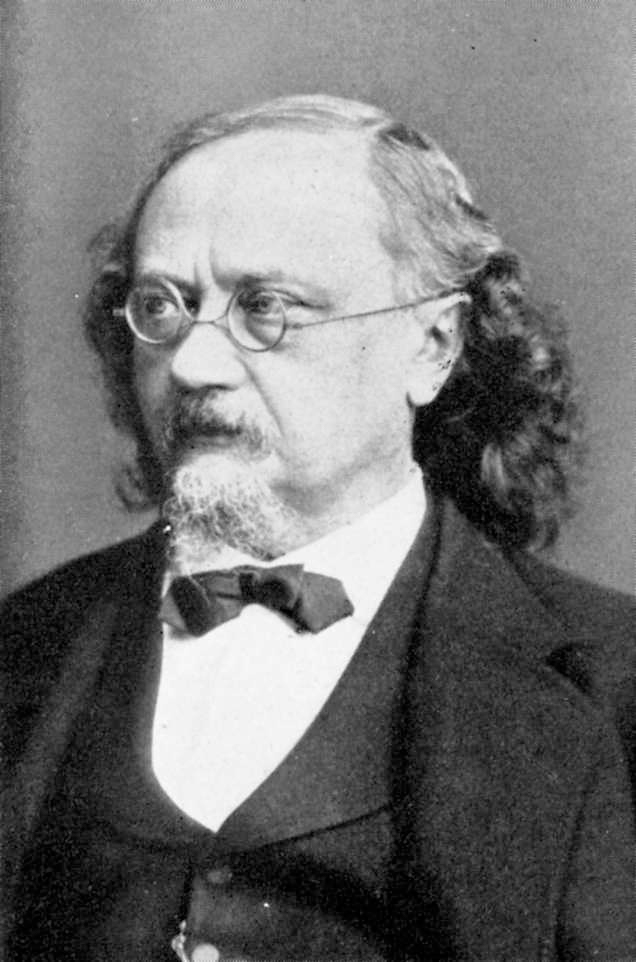
Heinrich Schmidt, ca. 1850s. Photograph by unknown creator. Courtesy of Wikimedia Commons. Image is in public domain.
From 1815 onward, accounts of "travels in the New World became almost a mania among Germans."4Paul Weber, America in Imaginative German Literature (New York: Columbia University Press, 1926), 102–103. In 1836, for example, a single volume of the Jenaischen Allgemeinen Literatur-Zeitung reviewed twenty-one North American emigration guides.5“Neueste Colonisations-Schriften,” Ergänzungsblätter zur Jenaischen Jenaischen Allgemeinen Literatur-Zeitung 2, nos. 84–85 (1836): 281–295. Leading German newspapers began publishing weekly columns on culture and politics by Germans in America as well as observations on the relationship between climate and health.6Maria Wagner, ed., Was die Deutschen aus Amerika berichteten, 1828–1865 (Stuttgart, Germany: H. D. Heinz, 1985), x–xi. "In the most remote forest hut as well as in the middle-class dwelling," noted nineteenth-century German scholar Heinrich Julian Schmidt, "the only book that could be seen in the hands of a farmer or gentleman, was a book about America."7Julian Schmidt, Geschichte der deutschen Literatur von Leibniz bis auf unsere Zeit (1896; repr., Charleston, SC: Nabu Press, 2011), 271.
One of the most salient features of this writing was its demonstration of "Wissenschafts-popularisierung" (the popularization of science).8Andreas Daum, Wissenschaftspopularisierung im 19. Jahrhundert: Bürgerliche Kultur, naturwissenschaftliche Bildung und die deutsche Öffentlichkeit (München, Germany: Oldenbourg, 2002). German writers from different walks of life consumed and disseminated knowledge from the burgeoning field of medical geography: the post-Enlightenment amalgamation of geography and the rediscovery of classical theories that insisted on the interrelationship between climate, environment, and disease.9Roy Porter, The Greatest Benefit to Mankind: A Medical History of Humanity (New York: W.W. Norton and Company, 1997), 302; Mark Harrison, Contagion: How Commerce Has Spread Disease (New Haven, CT: Yale University Press, 2013), 49. One result was an attempt to demarcate the southernmost limits of acceptable German settlement based upon a racialized discourse of "climate" largely informed by the susceptibility of European bodies to yellow fever.
German-American historian La Vern Rippley acknowledged in 1976 that Germans often cited "climate" as a major deterrent to settlement in the southernmost United States. Rippley, however, apparently didn't consider the term within the parlance of the era.10La Vern J. Rippley, The German Americans (Boston, MA: Twayne Publishers, 1976), 44–45. More recent scholars have unpacked nuances of words like "climate" to reveal that nineteenth-century European and American understandings of health and disease were inextricable from their environment. When nineteenth-century Germans referred to their suitability to certain climates, they were often speaking about the perceived health of the land.11Conevery Bolton Valenčius, The Health of the Country: How American Settlers Understood Themselves and Their Land (New York: Basic Books, 2002); Linda Nash, Inescapable Ecologies: A History of Environment, Disease, and Knowledge (Berkeley: University of California Press, 2006). Environmental historians, such as Conevery Bolton Valenčius and Linda Nash, have demonstrated how depictions of the health of the land were invaluable to nineteenth-century settlers in the burgeoning American West. Some German observers spoke favorably of the weather in Louisiana while simultaneously deriding the climate as ungesund (unhealthy).
Drawing upon extensive observations published in the German-speaking states of northern Europe this article explores the collective medical geography of the Gulf South as produced through German travel and settlement writing. By collective medical geography, I refer to the gestalt of this literature within the minds of its readers. To get a sense of this perceived landscape, I have mapped the observations detailed in this work and laid them on top of each other, like transparencies on an old overhead projector (see figures below). Having mapped each author's medico-geographical observations, I juxtaposed them with immigration and settlement data from the seventh (1850) and eighth (1860) United States Censuses to demonstrate the effect of this discourse on German immigration and eventual settlement.12Both the census of 1850 and 1860 provide population statistics by nation of origin, providing the total number of German-born in each state. Compiled from the Original Returns of the Eighth U.S. Census 1860a-04, 2–590; Compiled from the Original Returns of the Seventh U.S. Census 1850a-02, xxxvi.
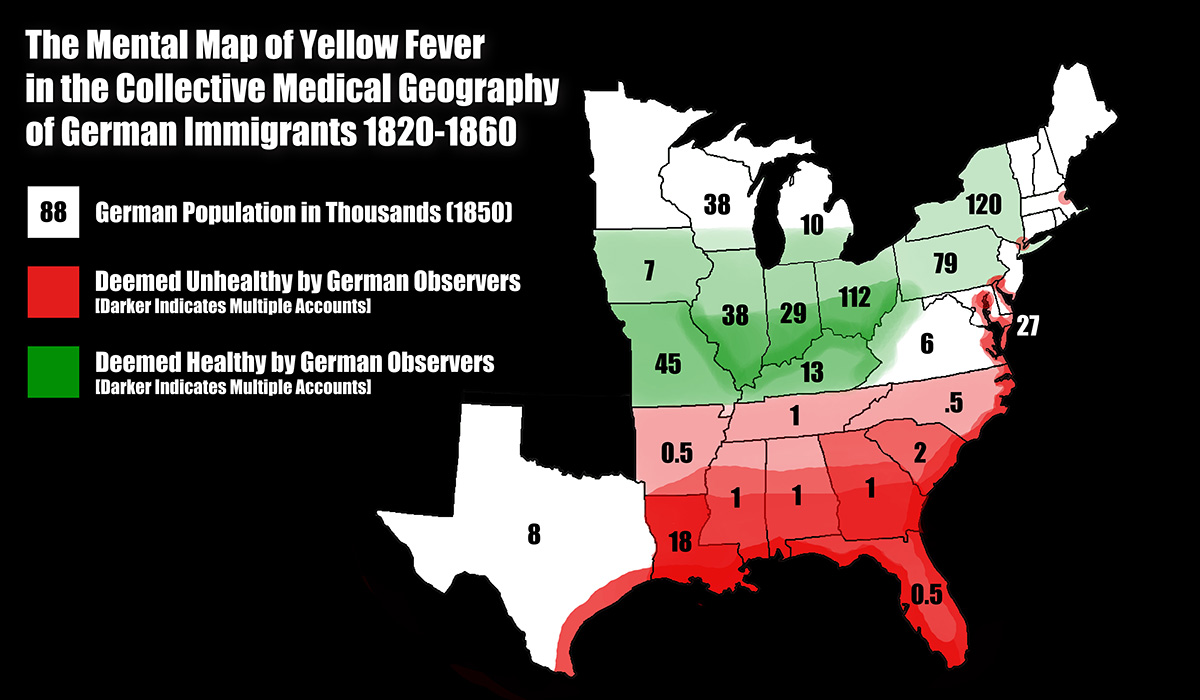
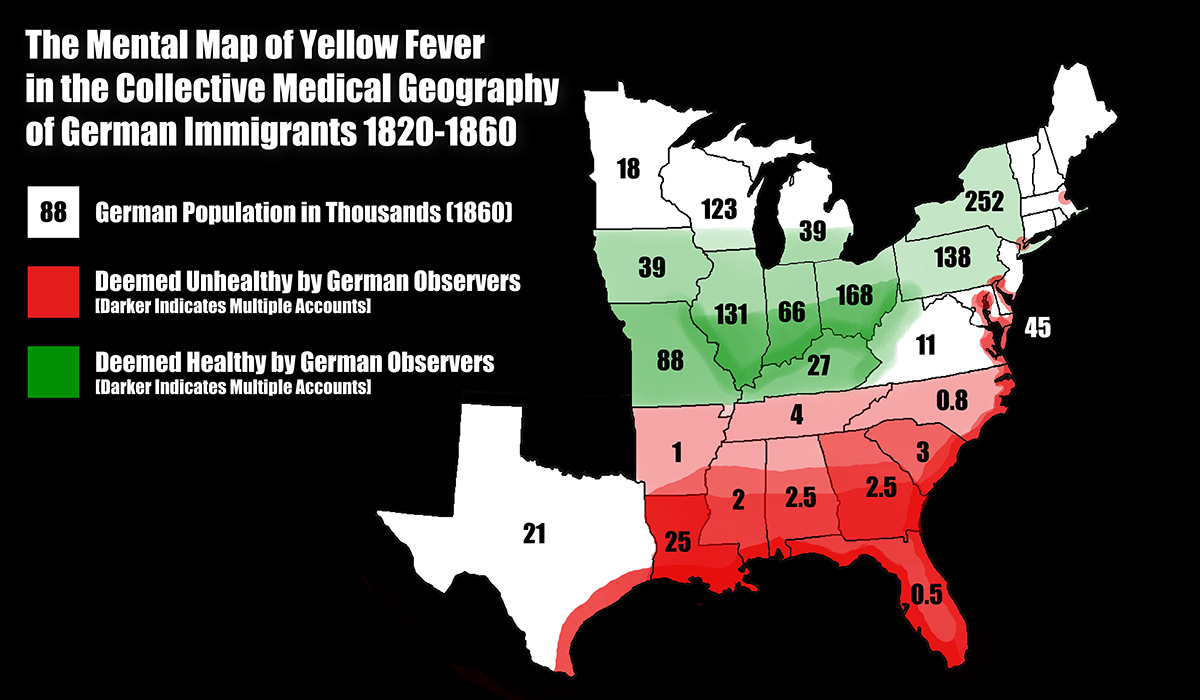
Top, The Mental Map of Yellow Fever, 1850. Bottom, The Mental Map of Yellow Fever, 1860. Maps provided by author.
The result suggests a strong correlation between the discourse of medical geography and German settlement patterns. It also raises questions about longstanding assumptions regarding slavery as the determining factor in German settlement, especially when one considers that slave states which received clean bills of health showed dramatic population increases. While some scholars have suggested that Germans avoided the US South almost exclusively due to their aversion to slavery, many German-American historians have cautioned against inscribing the beliefs of the outspoken Forty-Eighters on the entire German-American population, including the approximately 225,000 German-born citizens who lived in slave states on the eve of the Civil War.13For more on German-Americans and motivations for German-American settlement see: Merill, Germans of Louisiana, 9, 32–40; Walter D. Kamphoefner and Wolfgang Helbich, eds., Germans in the Civil War: The Letters They Wrote Home (Chapel Hill: University of North Carolina Press, 2006), 2–3; Rippley, The German Americans, 51; Andrea Mehrländer, The Germans of Charleston, Richmond and New Orleans during the Civil War Period, 1850-1870 (Berlin, Germany: Degruyter, 2011) 14; Patricia Herminghouse, “The German Secrets of New Orleans,” German Studies Review 27 (February 2004): 1–12; Wagner, Was die Deutschen aus Amerika berichteten, xi–xii.
While anti-slavery sentiment was not uncommon among Germans, other reasons more likely led to their near complete avoidance of the Gulf South: availability of land, access to cities, industrialization, etc. Closer scrutiny reveals the importance, often above all other concerns, Germans placed on settling in a salubrious climate. When combined with German laments that New Orleans's insalubrity offset its economic and cultural potential, this collective medical geography—based almost exclusively on the presence of yellow fever—was a deterring factor for German settlement in the Gulf South.
Consider as well the seasonal patterns of German immigration through New Orleans. Once its insalubrity was established in this literature by the late 1840s, German authors turned to questions of New Orleans as an economically viable port of entry to the American interior. Founded in 1847, the Deutsche Gesellschaft von New Orleans (a German-American society, DGNO) embraced this role, as is evident in annual reports and communications that dissuaded Germans from settling in Louisiana due in large part to the presence of yellow fever. The DGNO advised immigrants to utilize the port as an economical and German-friendly point of entry, but to time their arrival so that it did not fall within the yellow fever season (late May through early October). By charting the port records of the DGNO between 1847 and 1860 (see figure above) a clear correlation between their recommendations to newcomers and the arrival of German immigrants becomes apparent.
Why did Germans single out yellow fever among prevalent diseases? After all, as then American diplomat and naturalist David Bailie Warden wrote in 1819, "the ravages of yellow fever are confined to the crowded streets of the most commercial towns, and its victims are less numerous than those of the bilious putrid fever, or typhus, which sometimes runs over [all of Europe]."14David Baillie Warden, A Statistical, Political, and Historical Account of the United States of America (Edinburgh, Scotland: Hurst, Robinson, and Company, 1819), 281. While Americans attempted to downplay yellow fever against concerns abroad, what was important to consider when qualifying German fascination with the disease was not how many yellow fever killed, but whom it killed and how they died.


Top, Aedes aegypti mosquito, August 20, 2012. Colored drawing by A.J.E. Terzi. Image uploaded by Flickr user Wellcome Images. Creative Commons license CC BY-NC-ND 2.0. Bottom, Electron microscope image of the virus responsible for yellow fever, August 7, 2013. Photograph by Alain Grillet. Image uploaded by Flickr user Sanofi Pasteur. Creative Commons license CC BY-NC-ND 2.0.
Unbeknownst at the time, yellow fever is transmitted to humans through a mosquito vector, the female Aedes aegypti. The mystery of the disease's transmission confounded contemporary medical observers leading to theories ranging from domestic origination of miasmas to the direct importation of contagious persons and/or inanimate fomites. There was broad consensus on two points: first, that the affliction targeted strangers to tropical climates, hence its moniker as a "strangers' disease," and, second, the erroneous assumption that individuals of African descent carried an inherent racial immunity.15Margaret Humphreys, Yellow Fever and the South (Baltimore, MD: Johns Hopkins University Press, 1999), 6–7. Jo Ann Carrigan, The Saffron Scourge: A History of Yellow Fever in Louisiana (Lafayette: Center for Louisiana Studies, 1994), 10–11; Mariola Espinosa, “The Question of Racial Immunity to Yellow Fever in History and Historiography” Social Science History 38, nos. 3 and 4 (Fall/Winter 2014): 437–454. These two factors, whether real or imagined, carried tremendous weight for would-be German immigrants.
Beyond fears that they were more susceptible to yellow fever as strangers to the Gulf South, contemporaries suggested an underlying racial justification: the widespread belief that (white) Europeans and Americans could become acclimated over a period of years to regions otherwise hostile to their racial constitutions. Troubling to many observers, the process of acclimation suggested that the perceived immunity of slaves of West African descent confirmed a racialized climate theory often used to justify chattel slavery in the Trans-Atlantic South. That Europeans could acclimate to climates suitable for Africans raised concerns about whether the process led to racial mutability and/or degradation in whites.16David Arnold, Colonizing the Body: State Medicine and Epidemic Disease in Nineteenth-Century India (Berkeley: University of California Press, 1993), 25–32. There is a lengthy historiography of racialized climate theory broadly conceived by Europeans in the nineteenth century. The following examples attest to American and European utilization of that theory within the American South: Mark Carey, “Inventing Caribbean Climates: How Science, Medicine and Tourism Changed Tropical Weather from Deadly to Healthy,” Osiris 26, no. 1 (2011): 129–130; A. Cash Koeniger, “Climate and Southern Distinctiveness” Journal of Southern History 54, no. 1 (February 1988): 21–44; and Humphreys, Yellow Fever and the South, 7. Not only would German bodies be extremely susceptible to this devastating affliction, becoming acclimated seemed to suggest that something inside them had changed.
The presence of tropical diseases, such as yellow fever, also shaped German conceptualizations of the Gulf South as a tropical place. Whereas the distinction between free and slave states has served to delineate between North and South in many US historical studies, it is evident from their descriptions and settlement patterns that nineteenth-century Germans viewed what political historians refer to as the lower South as being a part of a larger Gulf South: one that would include eastern Mexico and the Greater Caribbean. This is not to say that they did not appreciate the political distinctions between these places, but in terms of fitness for settlement words such as "tropical" and "West Indian heat," were often used to describe areas deemed ungesund.
This collective medical geography informed German imaginations, or cognitive mapping, of southern spaces such as the Gulf South's commercial center of New Orleans. Prior to photography and video—and before mass production of maps and illustrated books in the mid-nineteenth century—Europeans relied on the written or spoken word to inform their perceptions of places they had not visited. Settlement literature would influence the spatial imaginary. Writing that emphasized insalubrity and macabre scenes of epidemic yellow fever had a deleterious affect on German perceptions of New Orleans as a space.17Cognitive mapping has been utilized by a wide array of fields, but the most influential of these works are arguably those within environmental psychology and city planning. See: R.M. Kitchin, “Cognitive Maps: What are They and Why Study Them,” Journal of Environmental Psychology 14 (1994): 1–19; and Kevin Lynch, The Image of the City (Cambridge, MA: M.I.T. Press, 1960).
Development of yellow fever 1, 2, 3, 4. Illustration originally published in Etienne Pariset and André Mazet's Observations sur la fièvre jaune, faites à Cadix, en 1819. Courtesy of Wikimedia Commons. Creative Commons license CC BY 4.0.
In addition to concerns of their unique susceptibility and fears of racial degradation in regions unbefitting their racial stock, the way in which yellow fever victims died embellished the disease's exotic and macabre reputation for would-be German settlers. The accumulation of the virus in the lymph nodes and the associated immune response leads to high fever and the onset of chills. As the liver is compromised, jaundice sets in, giving the victim's skin the yellowish hue that names the disease. Hepatic congestion brought on by liver failure and the eventual "systemic dysfunction of the clotting system" leads to hemorrhaging of the lining of the upper digestive system. Partially digested blood is forcefully expelled through the nose and mouth, producing a black vomit by which also characterizes the disease. Combined with descriptions of seizures and fevered delusions, lay accounts testify to the horror of this progression upon the afflicted and its effect on their caretakers.18Humphreys, Yellow Fever and the South, 5–6. It is no wonder that Germans placed as much emphasis on yellow fever as they did.
Travel Tales: The "Unhealthy Cities" of the South, 1820–1830
After the Napoleonic Wars (1803–1815), the optimism that Johann Friedrich Nonne expressed in 1804 regarding New Orleans's future salubrity was scarce among German authors. This coincided with the environmental trend in Enlightenment-era medicine that suggested nature exerted powerful forces upon the land and European bodies. Yellow fever was perceived as a product of tropical climates that could not easily be mitigated.19Ibid., 18–19; Porter, The Greatest Benefit to Mankind, 302; Harrison, Contagion, 49. Germans who had traveled to tropical places during and after the Napoleonic Wars testified to the havoc these climates unleashed on German bodies. For many of these writers, the presence of endemic yellow fever was sufficient to designate a place as tropical and, therefore, ungesund.
Following his service as a Prussian artillery lieutenant in the Napoleonic Wars, Johan Valentin Hecke turned to "scientific pursuits and travel."20J. Valentin Hecke, Reise durch die Vereinigten Staaten von Nord-Amerika in den Jahren 1818 und 1819, vol. 1 (Berlin: H. Pb. Petri, 1820), 1. In his 1820, two-volume Tour of the United States of North America in the Years 1818 and 1819, yellow fever figured prominently. Little is known of Hecke's life beyond his military service, but a reviewer of his Tour in the Allgemeine Literatur-Zeitung suggested that fellow Germans exercise caution in where they chose to settle.21“Vermischte Schriften,” Allgemeine Literatur-Zeitung (1821): 785–792. They would do "better to be poor at home" than die abroad.22Ibid., 792.
A representation of the cholera epidemic depicting the spread of the disease in the form of poisonous air, or miasma, as Nonne and Hecke had observed. London, England, October 1, 1831. Lithograph by Robert Seymour. Courtesy of Wikimedia Commons. Image is in the public domain.
While, like Nonne before him, Hecke believed human agency—such as a lack of sanitation leading to pestilential miasma—could contribute to the unhealthiness of climate, the determining factor was "West Indian heat."23Hecke, Reise durch die Vereinigten Staaten, vol. 1, 76. This heat, Hecke and others insisted, exacerbated miasmatic conditions present in many port cities and led to increased frequency and virulence of tropical diseases: most notably, yellow fever.24Ibid., 166–67. Hecke's contribution lay in his detailed observations of major cities and their salubrity up and down the eastern seaboard and on the Gulf Coast.
Of all the diseases he encountered, Hecke devoted far more pages to yellow fever, dubbing it "the transatlantic plague," capable of striking "even among the hardened and seafarers accustomed to almost any climate." "Only a select few survive this terrible, nervous system-shattering disease," he wrote, and those who did would "never again reach their previous health."25Ibid., 167–183. As for the uneven distribution of yellow fever between North and South, Hecke estimated that the absence of persistent West-Indian heat explained why "in the northern states yellow fever is restricted to the seaports." While he assailed the "pestilential swamps" of the South as a haven for the disease, he noted that Delaware and New Jersey were dotted with marshes, yet "not one person has been carried away" by yellow fever.26Ibid., 166–67, 170
Bald cypress in Lake Drummond, Great Dismal Swamp National Wildlife Refuge, Virginia, August 2, 2006. Photograph by Rebecca Wynn, uploaded by Albert Herring. Courtesy of Wikimedia Commons. Creative Commons license CC BY 2.0.
The further south Hecke traveled, the more he remarked on the prevalence of yellow fever. While he lauded the mountains of Virginia for their cooler and healthier climate, he was none too kind to the coastal areas. Hecke remarked that the "especially unhealthy city" of Norfolk and its surrounding coastline were dotted with pestilential fever-producing swamps. These swamps, along with high temperatures, incubated yellow and other malignant fevers that seemed to "occur almost every year."27Ibid., 161.
Of the Carolinas, Hecke was unabashedly critical. In Charleston, every summer the "burning West Indian heat" was "usually accompanied by the yellow fever."28Ibid., 166 Hecke wrote of a girl whose German-immigrant family operated a farm not far from Charleston when, without warning, yellow fever struck. Within a few days, the disease had orphaned her. Hungry and alone, she was found wandering the road.29Ibid., 167.
Yellow fever burial, Memphis, Tennessee, September 21, 1878. Illustration by unknown creator, published by Frank Leslie's Illustrated Newspaper. Courtesy of the Illustrations from Harper's Weekly Newspaper and Frank Leslie's Illustrated Newspaper collection, Digital Archive of Memphis Public Libraries.
"Despite all its glories," Hecke felt that New Orleans was "the unhealthiest place in the United States, and perhaps all of the Americas."30Ibid., 170–171. He noted "every year the yellow fever calls for its victims" in the Crescent City and that in the previous summer "one day after another, 100 [bodies] were lowered into the ground."31Ibid. He referenced the affliction's reputation as a strangers' disease, "so very dangerous not only for Europeans, but for northern Americans as well."32Ibid. Hecke's lament would be echoed in German settlement literature in the coming decades.
To emphasize the reach of the disease, Hecke wrote of a vessel anchored just outside of New Orleans during an outbreak. The ship carried "five young craftsmen who sought to take refuge [from yellow fever] in the northern states." After a short time removed from the port, each of the craftsmen fell ill. According to Hecke's informant, all five of them had fled only to perish before reaching their destination.33Ibid., 171. "No one [could] count on a long life in New Orleans, much less a comfortable one."34Ibid., 170–171.
Fellow Prussian artillery lieutenant Ignatz Hülswitt's portrayal of how yellow fever attacked and eventually killed its victims reads like a horror novel. Detailing the onset of this "fast-progressing and terrible disease," Hülswitt noted in the final stage, the victim could expect to endure "incessant vomiting and discharges of a black matter, which looks almost like tar" and "after a clear decline of all powers, strong jaundice, and maddening seizures, death usually comes on the seventh or eighth day." Hülswitt purportedly spoke from experience. Citing his own "irreplaceable loss," he claimed that during his time in Louisiana the disease had struck him down and robbed him of his "dear wife."35Ignatz Hülswitt, Tagebuch einer Reise nach den Vereinigten Staaten und der Nordwestküste von Amerika (Münster, Germany: Coppenrathschen Buch und Kunsthandlung, 1828), 306, 308. Hülswitt warned German readers that yellow fever resided "in the cities of Louisiana and causes much suffering," especially "among the newcomers."36Hülswitt, Tagebuch einer Reise nach den Vereinigten Staaten, 305–306. Despite praising the state as "indisputably one of the most beautiful in America," like Hecke, Hülswitt lamented his racial unsuitability for Louisiana.37Ibid., 304.
In a review of Hülswitt's work in the Neue Allgemeine Geographische und Statistische Ephemeriden, prospective immigrants to Louisiana were cautioned that, despite attaining a "comfortably furnished home on 160 acres of land," yellow fever had taken Hülswitt's wife and ravaged his constitution to the extent that he spent a year rehabilitating "without being able to recover from the effects of the fever."38Neue Allgemeine Geographische und Statistische Ephemeriden, (Weimar, Germany: Geographischen Institut und des Landes-Industrie-Comptoirs, 1830) 215. The affordability of land and the lure of prosperity came with dangerous consequences.
Unbeknownst to readers, Hülswitt may have fabricated the incident. Scholars have confirmed that he plagiarized much of his 1828 Diary of a Trip to the United States and the Northwest Coast of America from Englishman John R. Jewitt's Journal Kept at Nootka Sound: an account of Jewitt's abduction, enslavement, and eventual assimilation into the Nuu-chah-nulth tribe. While the portion of his book that dealt with his bout with yellow fever in Louisiana has not yet been attributed to any other author, there is no proof that Hülswitt traveled to America.39Peter Littke, “Ignatz Hülswitt, the German ‘John R. Jewitt’ at Nootka Sound?” The Initiative for Russian American History, April 2002, www.irah.eu. It's possible that Hülswitt's narrative of his family's bout with yellow fever was an attempt to exoticize an already sensational tale.
In 1835, encouraged by the swell of interest in travel narratives, Duke Friedrich Paul Wilhelm, a naturalist, explorer, and nephew of the first king of Württemberg, published his First Travels in North America, 1822–1824.40Friedrich Paul Wilhelm, Travels in North America 1822-1824, ed. Robert Nitske and Savoie Lottinville (Norman: University of Oklahoma Press, 1973), xiii. Having spurned the military life in pursuit of botany and other natural studies, "Duke Paul" set out to further the work begun by his idols, Meriwether Lewis and William Clark. As a self-styled expert of natural science, he believed himself an ideal candidate to report on the climate and ecology of Louisiana and its environs.41Ibid., xv, xiii–xx.
Paul Wilhelm of Württemberg. Image by unknown creator. Courtesy of Wikimedia Commons. Image is in public domain.
Landing in New Orleans, Wilhelm reports he was briefed on the recent yellow fever epidemic and felt blessed that a delay had kept him from arriving at its peak. "Many German countrymen who had not left," he reported, "had fallen victim to its plague."42Ibid., 34. The following year he escaped another yellow fever epidemic as it swept through. Returning to the city from yet another trip to the "interior of North America," Wilhelm was "saddened by the news of the death of a highly valued friend." He consequently declared "all strangers [should] shun New Orleans from June to November."43Ibid., 21, 34.
Like his counterparts, Duke Paul found much to appreciate in New Orleans. Enthralled by the city's commercial potential and the steamships that traveled the Mississippi, he wrote that "trade and population would increase enormously if the climate and unhealthful situation did not disturb both."44Ibid., 34. He had little faith in New Orleans's measures to combat yellow fever, noting that a "quarantine station intended to protect the city from contagious diseases" was too far up river to prove effective. Ships could disembark early and circumvent quarantine, enabling those exposed to the disease to "go unhindered in the city."45Ibid., 31.
That Wilhelm traveled through Louisiana at this time appears to be corroborated by other accounts. He purportedly crossed paths with a young German named Max who had escaped a yellow fever epidemic that had decimated St. Francisville, Louisiana. Max's account comes from letters edited and published by his father in Ulm alongside those of his sister and uncle in Excerpts from Letters from North America (1833).46Auszüge aus Briefen aus Nord-Amerika, geschrieben von zweien aus Ulm an der Donau gebürtigen, num in Staate Louisiana ansässigen Geschwistern (Ulm, Germany: E. Nübling Book Printers, 1833), 32–35, 51. Not to chance misinterpretation, Max's father emphasized his purpose for publishing his children's letters in an ominous foreword. He asked that "the youth and newly married couples who felt the impulse to emigrate to North America" heed this cautionary tale left behind, "especially the descriptions of the state of Louisiana and New Orleans."47Ibid., foreword.
In writing of a steamboat trip from New Orleans to Baton Rouge, Max noted the well-developed land and beautiful plantations.48Ibid., 22–23. He remarked on the affordability of life in Louisiana, adding that he and his uncle were able to rent their storefront, an African slave, and a wagon for only fifty-three Spanish talers per year.49Ibid., 28. Max expressed fear, however, of the area's becoming "unhealthy" by summer due to the annual flooding of the river and the formation of swamps as it receded.50Ibid., 25. That Max's unabashed participation in slavery and praise of Louisiana's economic accessibility is counterbalanced with fears of impending yellow fever presents a familiar theme.
Death of Aurelio Caballero due to yellow fever in Veracruz, 1892. Etching on zinc by José Guadalupe Posada. Courtesy of the Drawings and Prints department, The Metropolitan Museum of Art.
In a letter dated November 18, 1827, Max described an outbreak of yellow fever presumably brought by steamboat in September.51Ibid., 51. The disease initially spread among the unacclimated, "new arrivals and the older residents." Six weeks into the epidemic, Max reported that he had fallen victim. Suffering from inflamed eyes and a blackened tongue, he recalled feeling "an unusual accumulation" in his mouth, at which point he "pulled out a large piece of spalted black blood." Soon the blood poured out of his mouth and nose as doctors tried desperately to take his pulse. Max reported that he had "vomited about two sinks full of blood" that day and was failing fast. Miraculously, he made a full recovery, the lone survivor among those infected.52Ibid., 52.
Max's expressed concern for fellow Germans seeking to land in New Orleans during the summer months is also telling. In June 1828, he lamented that during his time in New Orleans, a ship "brought about 120 Germans of diverse ages" who were ill prepared to travel to the interior. Without sufficient money, they were forced to beg while the "heat during and after the flooding of the river…will soon bring about the Yellow Fever." Disheartened, Max knew that his "countrymen, who have come here so hearty and strong from healthy Germany, will fall without a fight as its first victims."53Ibid., 62–63.
When Max's sister Thekla came to America, he suggested that they meet in New York in the late fall and travel to New Orleans by steamship only after the fever season had ended. Despite their careful planning, Max reported the fever had lingered late that summer and was terrorizing New Orleans well into November. He noted that the twenty or so Germans on board decided to immediately travel north "for the sake of the preservation of their health." According to Thekla's account, she and Max retired to their quarters where they held each other and cried—praying the fever would leave them unscathed. Upon their arrival, Max and Thekla heeded the advice of "some experienced Germans" to remain onboard rather than risk entering the city.54Ibid., 148. While they survived the ordeal, Max and Thekla's letters emphasized the danger posed to Germans by yellow fever in the Gulf South. The lesson Max's father intended comes through loud and clear—wanderlust had perilous consequences.
The authors of this first period of travel and settlement literature placed more emphasis on personal observation buttressed by hearsay than scientific analysis. Even self-styled naturalists, such as "Duke Paul" and Johan Valentin Hecke, offered little data, aside from notions of yellow fever's limited range from the sea. During the mid-nineteenth century, the "Wissenschafts-popularisierung" (the popularization of science) became more apparent. Just prior to the height of German immigration to the United States, writers would provide scientific evidence that explain earlier observations and explore the presumed relationship between southern climates and German bodies that made them more susceptible to yellow fever.
"Too Far South": Yellow Fever, Race, and German Fears, 1830–1845
Beginning in the 1830s, there was a perceivable shift from travel and adventure narratives towards settlement guides and treatises on medical geography. Of particular interest were the increasingly prevalent theories of acclimation, as well as the utilization of latitudinal coordinates to pinpoint unhealthy areas for German immigration. The shift in emphasis from dissuading settlement in New Orleans to debating its merits merely as a viable port of entry for Germans settling elsewhere suggests that the unhealthy nature of the climate was increasingly taken for granted.
Cover of Gottfried Duden's Report on a Journey to the Western States of North America (Columbia: University of Missouri Press, 1980).
The most well known German travel and emigration author of the nineteenth century, Gottfried Duden, extolled the virtues of the slave state of Missouri for prospective German immigrants in his Report on a Trip to the Western States of North America (1829).55Gottfried Duden, Bericht über eine Reise nach den westlichen Staaten Nordamerikas (Elberfeld, Germany: S. Lucas, 1829). Reprinted three times, his Report became so popular that German authorities feared it might inspire a mass exodus to Missouri.56Robyn Burnett and Ken Luebbering, German Settlement in Missouri: New Land, Old Ways (Columbia: University of Missouri Press, 1996), 10. Historians have long noted the significance of Duden's Missouri boosterism,57Robert Frizell, Independent Immigrants: A Settlement of Hanoverian Germans in Western Missouri (Columbia: University of Missouri Press, 2007), 29; Conevery Bolton Valenčius, Health of the Country: How American Settlers Understood Themselves and Their Land (New York: Basic Books, 2002), 37; Richard O’Connor, The German-Americans: An Informal History (Boston, MA: Little, Brown, and Company, 1968), 68–70; Rippley, The German-Americans, 44. but his remarks on the southern limits of German settlement and yellow fever's role in establishing them have been largely ignored. Duden advised his readers to stay north of "settlements at the mouth of the Arkansas [River]," some 325 miles north of New Orleans, as they were "perhaps too far south." The main reason for his admonitions was yellow fever, which he claimed struck the Crescent City "almost every summer."58Duden, Bericht über eine Reise nach den westlichen Staaten Nordamerikas, 165–166, 328.
Duden argued that the dangers of yellow fever and other tropical diseases kept Germans from areas in which slavery was most depraved. In the middle states, like Missouri, he contended, slavery was a relatively benign institution, comparing favorably to domestic servitude in Europe, and often in the best interests of the enslaved. The greatest obstacle slaves faced to freedom, Duden believed, was their racial inferiority. He asserted that no amount of education or betterment could undo thousands of years of being exposed to debilitative, and inferior, climates.59Ibid., 142–143.
Duden maintained that Germans could not saunter into a tropical climate without prolonged seasoning.60Ibid., 328. He cautioned readers not to be enticed by the availability of inexpensive tracts of land where their health would be imperiled. Germans, he argued, should settle in Missouri, preferably near St. Louis.61Ibid., 328, 330. While he recommended traveling there from New York or some other northeastern port, he conceded that traveling to Missouri by way of New Orleans was feasible, so long as one embarked from Germany no later than "December or January so that they arrive when there is no danger from yellow fever."62Ibid., 332.
Observing that many Europeans survived in cities such as New Orleans seemingly unaffected by diseases such as yellow fever, Duden based his concepts of acclimation and seasoning on a version of racialized climate theory in which racial traits were somewhat mutable.63Ibid., ix–xiv, 110. Seasoning or acclimation attempted to scientifically explain yellow fever's reputation as a strangers' disease. When his methods of acclimation failed and the promise of his Missouri boosterism went unrealized, Duden came to be known in many settlements of the mid- to upper Mississippi River Valley as "Duden der Lügenhund" (Duden the Lying Dog).64T.S. Baker, “America as the Political Utopia of Young Germany,” Americana Germanica 1 (1897): 78.
Letter from Gustave P. Koerner to Abraham Lincoln, Springfield, Illinois, October 8, 1861. Courtesy of the Library of Congress Abraham Lincoln Papers, Manuscript Division, memory.loc.gov/cgi-bin/ampage?collId=mal&fileName=mal1/123/1235900/malpage.db&recNum=0.
A young Gustav Koerner took exception to Duden's proclamations. As an abolitionist fresh off the boat from Frankfurt in 1833, Koerner would become Illinois's most renowned German son as well as a political confidant and close friend of Abraham Lincoln.65Jack Le Chien, “We Must Make Them Understand Lincoln is Our Man,” ed. Molly McKenzie (Bellville, IL: Koerner House Restoration Committee, 2011), 14. In his Illumination of Duden's Report on the Western States of North America, from America (1834), Koerner encouraged the German public to question Duden's observations regarding the health of St. Louis. In particular, he questioned how a city in constant contact with New Orleans, a locality known to harbor "diseases of all kinds, but especially yellow fever," could possibly be considered healthy. Koerner cited longtime residents of St. Louis who confirmed that the health of the city worsened since the advent of regular steamboat traffic to and from New Orleans.66Gustav Koerner, Beleuchtung des Duden’schen Berichtes über die westlichen Staaten Nordamerikas, von Amerika aus (Frankfurt, Germany: Karl Körner, 1834), 28. It is important to acknowledge Koerner's role as a booster in Illinois. Both Duden and Koerner were selling the virtues of a place to prospective immigrants. Disagreements aside, they agreed on two principles: the universal condemnation of New Orleans as being host to endemic yellow fever (ungesund) and that Germans who settled too far south did so at their peril.
German-born academic and journalist, Francis Grund, echoed Duden's theory of acclimation in a piece for the Ausberger Allgemeine Zeitung, entitled "Die Colonisation von Liberia." Published in 1840, the article was sectionally biased. As the anti-slavery Grund lived in the North, his article about the colony of Liberia begun by the American Colonization Society offered few kind words for the South's peculiar institution. In his discussion of African Americans' perceptions of Liberia as a "morgue for the blacks," he made a corollary observation of yellow fever and the southern United States. Writing that blacks and "acclimated" residents of the South need not fear "this scourge of Mankind," Grund voiced another reminder that yellow fever was a strangers' disease and that those foreign to the South risked infection and their lives when this "yearly" affliction struck.67Duden, Bericht über eine Reise nach den westlichen Staaten Nordamerikas, ix–xiv, 110.
The yellow fever scourge in Florida, September 8, 1888. Illustration by unknown creator, published by Frank Leslie's Illustrated Newspaper. Courtesy of the General: Reference collection, Florida Memory website, The State Archives of Florida.
So influential were Grund's opinions of the US that one scholar referred to him as "The Jacksonian Tocqueville."68Holman Hamilton and James L. Crouthamel, “A Man for Both Parties: Francis J. Grund as a Political Chameleon,” Pennsylvania Magazine of History and Biography 97 (1973): 465–484. Alongside observations of culture and politics in his 1835 Die Amerikaner (The Americans), Grund offered a chastising observation of the climate in the Carolina Low Country. He warned that the region was "visited each year by the yellow fever" and insisted that even the interior or rural portions of the Carolinas and Georgia were not safe.69Francis Grund, Die Amerikaner: in ihren moralischen, politischen, und gesellschaftlichen Verhältnissen (Stuttgart, Germany: J.G. Cotta’schen Buchhandlung, 1837), 363.
German observers often suggested what areas were "healthy" for German bodies. Friedrich Schmidt's Account of the Politics and Moral Condition of the United States of North America in the Year 1821 was published shortly after Hecke's first volume. Schmidt was quick to address the mania surrounding German emigration and in his use of medical geography and latitudinal coordinates, he was a pioneer. He offered five observations as to "which areas of North America are especially unhealthy and which states might be beneficial for Europeans."70Schmidt, Versuch über den politischen Zustand der Vereinigten Staaten von Nord Amerika im Jahre 1821, 82.
Schmidt wrote that American climates were subject to rapid change and posed a potential threat, but that all areas south of "thirty-six degrees north latitude" were tropical and would "devastate European constitutions." He warned of uncultivated soils and "the reigning diseases" of the "southern and western states" that caused "exhaustion and death among Europeans and Americans." And significantly, he claimed that the "healthiest and most beneficial areas in North America for Europeans, are the states of Pennsylvania, New York, and around the southern parts of Ohio and Indiana."71Ibid., 82. As the maps accompanying this essay show, these states displayed high rates of settlement among German-born immigrants.
Ludwig Gottfried Blanc. Image by unknown creator. Courtesy of Wikimedia Commons. Image is in public domain.
Written fifteen years later by renowned preacher, philologist, and professor of Romantic Languages at the University of Halle-Wittenberg, Ludwig Gottfried Blanc's Handbook of Essential Knowledge of the Nature and History of the Earth and its Inhabitants (1837) was a comprehensive study intended for a broader audience of fellow Germans.72Ludwig G. Blanc, Handbuch des Wissenswürdigsten aus der Natur und Geschichte der Erde und ihrer Bewohner Vol. 3 (Halle, Germany: C.H. Schwetschke und Sohn, 1837). In "The United States of North America" under the subheading of "Climate," Blanc summarized the health of the US landscape. "[T]he East Coast," he wrote, "particularly from 40° South [latitude] is, for the most part, unhealthy, and most so in the southern states." Blanc singled out the "terrible yellow fever" as the "main plague of these areas," adding that in the hotter southern states even the interior was susceptible to its devastation.73Ibid., 471.
Blanc remarked favorably on the salubrity of New England, but claimed that the "interior states, between 36° and 42° are, by far, the most healthy."74Ibid., 454. This area included Ohio, Indiana, Kentucky, Illinois, Iowa, Missouri, and the southern portions of Michigan and Wisconsin where, by 1860, over half of the German-born US population resided. If the western portions of Pennsylvania and New York were included as "interior states," the proportion would rise to roughly three-quarters.75Compiled from the Original Returns of the Eighth Census 1860a-15 (Washington, D.C.: Government Printing Office, 1864), 621. For Blanc, the yellow fever zone extended down the eastern seaboard from New York City, with an increase in virulence and general unhealthiness the further south one traveled. He was especially critical of the coastal areas from Maryland southward, reserving particular scorn for Georgia, Alabama, Mississippi, and Louisiana.76Blanc, Handbuch des Wissenswürdigsten, 479–492.
While differing in content and methods from earlier travel and adventure narratives, the settlement guides of 1830–1845 came to very similar conclusions, emphasizing the destructive power of yellow fever and its relation to southern geography. Rather than take a chance on acclimation, it was better to avoid the area altogether. On the eve of the greatest period of German immigration to the United States, prospective immigrants were inundated with warnings about the lower Gulf South, and particularly New Orleans. With the question of where to settle, one question remained: was New Orleans still a viable port of entry for Germans heading for California, Texas, and the upper Midwest?
Just Passing Through: New Orleans, 1845–1860
Death as a sailor bringing yellow fever to New York. Illustration by unknown creator, published by Frank Leslie's Illustrated Newspaper. Courtesy of the Civil War Profiles website.
The emphasis of German writings of the late 1840s and 1850s shifted to discussing the viability of New Orleans as a port of entry for immigrants planning on settling outside the Gulf South. Despite the threat of yellow fever, writers acknowledged New Orleans as an economical port for those heading to the US interior. Even here, there were stipulations, the most damaging of which dealt with the time of year to arrive to avoid yellow fever.
George M. von Ross, an American of German descent and a well-known booster of German immigration to central Texas, wrote several guides. While affirming New Orleans as an economical alternative to ports in the Northeast, Ross, in his 1851 The Emigrants' Handbook, warned that those who sought to immigrate through New Orleans "must avoid landing during the period of July to November" or they would "risk finding [the city] haunted by yellow fever upon their arrival."77Ross, Die Auswanderers Handbuch, 404. Books by Gabriel Auguste van der Straten-Ponthoz and Traugott Braume shared Ross's concerns and warnings.78Gabriel Auguste van der Straten-Ponthoz, Forschungen uber die Lage der Auswanderer in den Vereinigten Staaten von Nord Amerika (Augsburg, Germany: K. Kollman Publisher, 1846), 79–80. Braume, in particular, suggested that those headed for the interior of Texas were better off landing in Galveston which, despite being host to yellow fever on occasion, he deemed a safer alternative.79Traugott Braume, Hand- und Reisebuch für Auswanderer und Reisende nach Nord, Mittel, und Süd-Amerika (Bamberg, Germany: Buchner Publishing, 1853), 612–613.
Auswanderer-karte und wegweiser nach Nordamerika, Emigration map and guide to North America, Stuttgart, Germany, 1853. Map by Gotthelf Zimmermann, published by J.B. Metzler'schen Buchhandlung. Courtesy of Library of Congress Geography and Map Division, loc.gov/resource/g3701e.ct000244/.
Established in 1847, the Deutsche Gesellschaft von New Orleans (DGNO) sought to increase German immigration through the Crescent City. It provided inexpensive or free services to those heading to the interior, and tried to protect German immigrants from fraudulent travel "brokers," false baggage handlers, and yellow fever. The organization did not actively recommend New Orleans as a final destination, but aspired to make the city the primary port of entry for German-speakers.80Historic New Orleans Collection (HNOC), Deutsches Haus Collection 1847–1983 EL 1. 1984 Item 1—Die Deutsche Gesellschaft von New Orleans, Louisiana. 1848–1888.
The DGNO closed its first annual report with an unattributed quotation that eventually found its way into the Central Association of German Emigration and Colonization's 1852 circular "To all who want to emigrate!" It advised prospective German emigrants to:
...remain in the land that nourishes you fairly because you come to a country where climate, language, customs and traditions are quite different from your own. There have been many cases in which immigrants have befallen the bitterest price of woes, regretted the reckless step taken, and who, though often in vain, must beg for the means to return to the homeland.
The circular noted that those who sought "to improve their situation" were "only too often met by a terrible awakening." For "malignant fever is almost inevitable everywhere and is often fatal if the right care cannot be found."81Landeshauptarchiv Koblenz. Inventory: 441, No. 24, 215. www.t-stoffel.de/QUELL/Quellen/An%20alle%20die%20auswandern%20wollen%202.htm.
While originally conceived as an organization to protect German immigrants from false agents and travel brokers, the DGNO realized quickly that disease posed an even greater threat and understood their "special duty to advise immigrants to schedule their arrival during a time in which the city is free from yellow fever." Further it stressed that "no embarkation from Europe should proceed later than the beginning of May . . . [or] until the end of September."82HNOC, Deutsches Haus Collection 1847–1983 EL 1. 1984 Item 1—Die Deutsche Gesellschaft von New Orleans, Louisiana. 1848–1888.
The data that the DGNO gathered between 1847 and 1860 when juxtaposed against the census figures of 1850 and 1860 explain the settlement patterns of Germans who landed in New Orleans. Of the 233,374 immigrants the society processed, sixty percent boarded steamships upriver upon their arrival. Seventy-five percent of that number chose St. Louis and its surrounding environs as their destination with just over twenty-three percent headed for the Ohio River Valley. The rest set out for Texas and, to a lesser extent, California. The remaining 63,665 were identified as either unsure of their final destination, withheld that information from the society, or had decided to remain in New Orleans for the time being. The society did not track those who migrated after their processing. Given that the German population of Louisiana was 24,614 in 1860—having only grown by 6,727 since 1850—it is safe to assume that the majority of the 63,665 who did not make immediate travel arrangements eventually migrated out of the region. Only five percent of the total German immigration occurred during the peak fever months of July, August, and September and sixty-five percent avoided arriving from the end of May to the first of November.83Ibid.
A girl suffering from yellow fever. Watercolor by unknown creator. Courtesy of Wikimedia Commons. Creative Commons license CC BY 4.0.
The majority of German immigrants made arrangements in advance of their arrival to settle in areas deemed "healthy." The timing of their arrival suggests that they heeded the settlement literature's advice and almost unanimously avoided New Orleans during peak yellow fever months even in years when the disease was not epidemic. May, the month immediately preceding the yellow fever season, was the third highest month for German immigration to New Orleans. High numbers in November and December could be explained away by the avoidance of frozen rivers in the North, but seeing immigration peak immediately before and after yellow fever season suggests more. An even clearer picture becomes apparent when we combine data from the DGNO and U.S. Census with the gestalt of the geographic recommendations of the settlement literature (see "Mental Map of Yellow Fever" maps).
Cover page of J.W. McClung's Minnesota as it is in 1870, (St. Paul, Minnesota, 1870). Courtesy of the Library of Congress General Collections and Rare Book and Special Collections Division, loc.gov/resource/lhbum.01092/?sp=1.
Yellow fever and antebellum German perceptions of its hold on the Gulf and Atlantic Coastal South contributed significantly to their avoidance of these areas. Kindled by the vast expanse of the Louisiana Purchase, travel and settlement writing as well as the discourse of medical geography contributed to the popularization of scientific knowledge (Wissenschafts-popularisierung). The American frontier provided economic and scientific opportunity to observers and newcomers brimming with new ideas about the relationship between health and the land. The explosion of European immigration to the United States had an immediate and lasting effect, as German and Irish immigrants moved into US cities seeking a better life.
Germans, in particular, sought out the expanse west of the Appalachians and, if the extent of writing presented in this essay is any indication, they were considerably well informed as to the politics, economics, and health of the Gulf and Atlantic Coastal South. This is not to say that they came prepared. With published accounts of an unknown land in mind and far less money and resources than needed, they arrived in New Orleans by the hundreds of thousands: most of them promptly boarded a steamship and traveled up the Mississippi to what they hoped would be healthier country.
About the Author
Paul Michael Warden is a PhD candidate at the University of California, Santa Barbara and a visiting scholar in Harvard's Department of the History of Science. His dissertation focuses on how yellow fever shaped the medical imagination and development of antebellum New Orleans. His broader research examines how ecology and geography intersect with period medical and scientific theory within early American history.
]]>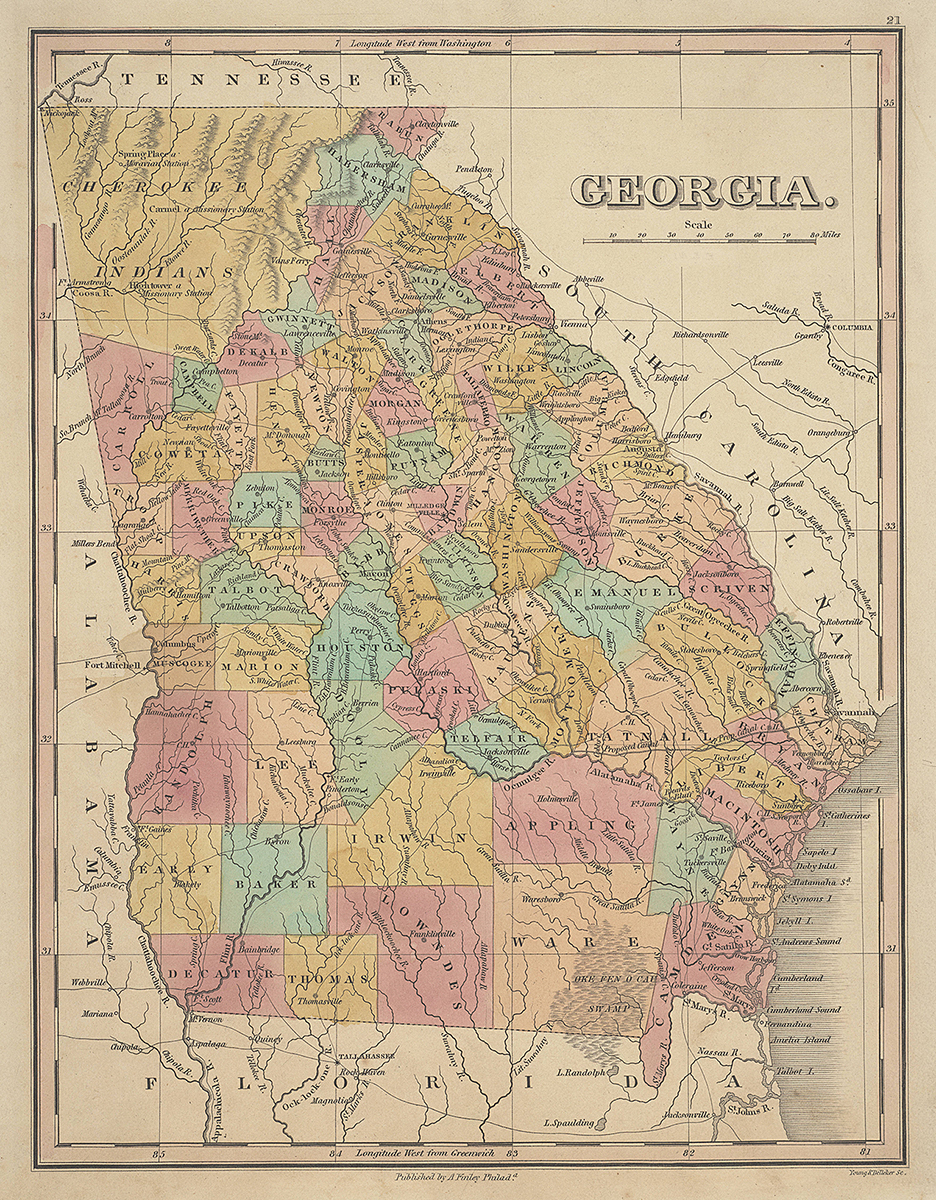
Georgia, 1831. Map by Young & Delleker, Sc. Published by A. Finley. Courtesy of the Historic Maps collection, Georgia Archives, University System of Georgia.
Georgia led the United States in the expulsion of the Cherokee Nation from its homeland. In the spring of 1838 more than two thousand soldiers arrested some nine thousand Georgia Cherokees, confined them briefly, then marched them to holding camps in east Tennessee to await their miserable trek to Indian Territory eight hundred miles away. Removed from Georgia in June, the last detachment of Cherokees left the Tennessee camps in November. Images of grieving Natives stumbling westward seized the popular imagination, throwing into shadow the record of how, why, when, and where the expulsion began. In succeeding years, the emphasis on suffering reduced the Cherokees to anonymous victims and obscured the activities of those who enabled and enforced their expulsion. The missing accounts of Cherokee removal emerge most vividly in the stories of each removal site. As the home of the Cherokee Nation's most prominent leaders and the location of two military removal stations, Rome, Georgia has much to teach.
Measuring Chains and Axes
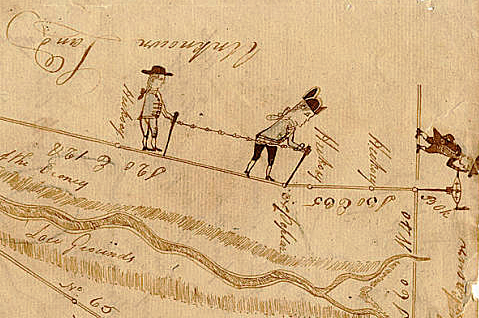
Detail of "Doodle" Plat showing a drawing of land surveyors, from a plat of Georgia land granted to William Few, ca. 1784. Courtesy of the Ad Hoc collection, Georgia Archives, University System of Georgia.
An early history of Rome1George Magruder Battey, Jr., A History of Rome and Floyd County, State of Georgia, United States, Including Numerous Incidents of More Than Local Interest, 1540–1922 (Atlanta, GA: The Webb and Vary Co., 1922), 33–4; Jerry R. Desmond, Georgia's Rome: A Brief History (Charleston, SC: The History Press, 2008), 28–30. Author of the popular history of the city and county, Battey was the son-in-law of founder William Smith. On Dec. 21, 1833, the Georgia General Assembly incorporated Livingston as a town and designated it the county seat of recently-formed Floyd County: Acts of the General Assembly of the State of Georgia, 1833 (Milledgeville: Polhill and Fort, 1834), 321–22 (hereafter Ga. Acts). describes the city's founding as an inspiration that sprang from the chance encounter of enterprising lawyers with a gracious planter. According to the idyll, attorneys Colonel Daniel Randolph Mitchell and Colonel Zachariah Branscomb Hargrove were traveling by horseback in the spring of 1834 to the Floyd County courthouse in Livingston. The men "hauled up at a small spring" and dismounted to slake their thirst. As they relaxed under a willow tree, they gazed across the small peninsula lying at the convergence of two rivers. On one side of the peninsula, the Etowah River meandered eastward more than one hundred sixty miles to merge with the Oostanaula River that ran some fifty miles from the north and east. The two waterways joined at the peninsula's tip to form the Coosa River that flowed west into the Alabama River and marked the western boundary of Georgia.
Eyeing the landscape, Hargrove exclaimed, "This would make a splendid site for a town!" An approaching stranger, Major Philip Walker Hemphill, overheard Hargrove and joined in agreement, "having been convinced for some time" the site offered "exceptional opportunities for building the largest and most prosperous" city in the region. Continuing their conversation, the three journeyed some two miles south along the Cave Spring Road to Hemphill's "comfortable plantation home," the Alhambra, and began planning a city. The major's cousin, General James Hemphill, was entering the legislature the next session and could be relied on to relocate the county seat from Livingston to the proposed site. After including Colonel William Thornton Smith in their initiative, the foursome would need to acquire "all available land" and procure rights to the ferries essential for crossing the three rivers. Smith agreed to join the coalition and the four men signed "a contract along these lines" in the Floyd County Inferior Court. They left details to their friend, attorney John H. Lumpkin, who had recently resigned as secretary to his uncle, Governor Wilson Lumpkin.2Battey, History of Rome, 33–4. The rest, some say, is history. But it is not the whole story.
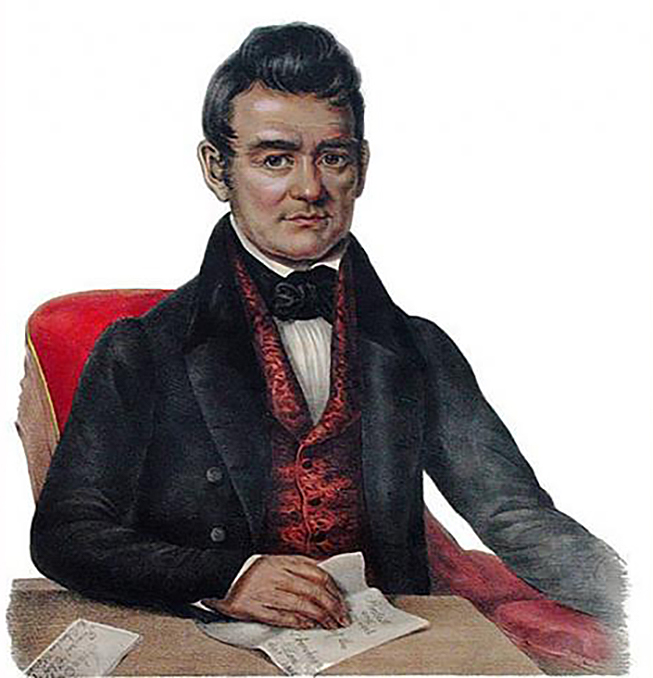
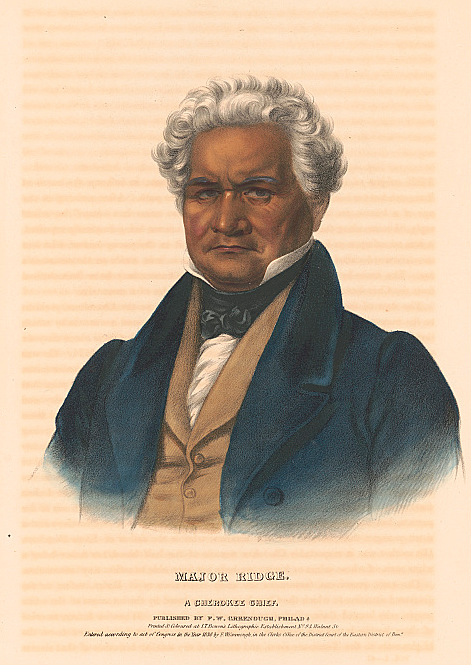
Top, John Ross, A Cherokee Chief, Philadelphia, Pennsylvania, 1843. Hand-colored lithograph on paper by Alfred M. Hoffy. Courtesy of the National Portrait Gallery, Smithsonian Institution. Middle, Major Ridge, a Cherokee Chief, Washington, D.C., 1838. Hand-colored lithograph by John T. Bowen. Courtesy of Library of Congress Prints and Photographs Division, loc.gov/resource/ppmsca.24339. Bottom, John Ridge (ca. 1802 – June 22, 1839), 1825. Portrait by Charles Bird King. Courtesy of Wikimedia Commons. Image is in public domain.
Other histories course beneath the soothing narrative of Rome's founding. When the visionaries began planning, some nine hundred Cherokees lived along the Etowah, Oostanaula, and Coosa Rivers and tributaries, including Principal Chief John Ross and Cherokee Nation leaders Major Ridge and his son, John. The site chosen for the city was the heart of the Cherokee Nation that had been gradually reduced to contiguous portions of four southeastern states. Events in Georgia portended even greater change. Between 1830 and 1838, Cherokees struggled to retain their homes, farms, and freedom while Georgia, followed by other states, asserted sovereignty over them and claimed rights to their land. In December 1831, the state legislature identified the Cherokee Nation in Georgia as Cherokee County. A bill the following year subdivided Cherokee County into nine additional counties. Approximately five hundred square miles of land bordering Alabama was designated as Floyd County in honor of Creek Indian fighter and state militia commander General John Floyd. Determined to force the federal government to fulfill its unique agreement to eliminate Indian land title, Georgia authorized a survey of Cherokee land within the state's purported boundaries and ordered a lottery for its distribution. On May 24, 1832, John Harvey completed his survey of Floyd County, having marked the property of all resident Cherokees including John Ross, Major Ridge, and John Ridge.3Ga. Acts, Dec. 26, 1831 (Milledgeville, GA: Prince and Ragland, 1832), 74–6. The state added portions of Habersham and Hall counties, which had been acquired from the Cherokees in the Treaties of 1817 and 1819, to Cherokee County and then subdivided the entire area into nine additional counties: Historical Atlas of Georgia Counties, http://georgiainfo.galileo.usg.edu/histcountymaps/index.htm; Ga. Acts, Dec. 3, 1832, http://neptune3.galib.uga.edu; Daniel Haskel and J. Calvin Smith, A Complete Descriptive and Statistical Gazetteer of the United States of America (New Haven: Hitchcock and Stafford, 1843), 216; Ga. Acts, Dec. 21, 1830 (Milledgeville: Camak and Ragland, 1830), 127–145; Field Notebooks, Survey Records, Cherokee County, Georgia Surveyor General, RG 3-3-3, Georgia Archives, Morrow, GA.
While surveyors such as Harvey carted measuring chains and axes across the farms and fields of the Cherokees, Georgians registered for the October lotteries that would distribute their land to so-called fortunate drawers. Anticipation ran high. Georgia was the only state in the nation that dispensed Native land by public lottery. The purpose of the policy was to attract white settlement, avoid concentrations of land-based wealth, and provide credibility to the legislators who wrote the land laws.4The legislature introduced the lottery system following the infamous Yazoo frauds of the 1780s and 90s in which General Assembly members sold millions of acres of Georgia's western lands to speculating companies. The 1795 sale included bribes to legislators, state officials, and other prominent Georgians. See C. Peter Magrath, Yazoo: Law and Politics in the New Republic (Providence, RI: Brown University Press, 1966); George R. Lamplugh, "Yazoo Land Fraud," New Georgia Encyclopedia, Sept. 14, 2015. Inevitably, the procedure spurred white resentment toward Native Americans who resisted appropriation of their land and toward the federal government that was supposed to protect and negotiate with Indians. Between 1805 and 1827, the state held five lotteries to give away land that had belonged to the Muscogee Creek Indians. After the Creeks were expelled from the state in 1826, Cherokees remained the only obstacle to Georgia's expansion. Their lands were the last that would be offered in the state's public lotteries.
A map of that part of Georgia occupied by the Cherokee Indians, 1831. Map by John Bethune. Courtesy of Library of Congress Geography and Map Division, lccn.loc.gov/2004633028.
Georgia Lotteries and Native Lands
Responding to dwindling opportunities, 85,000 white Georgians registered for the first of two Cherokee lotteries held in 1832. When the lottery drums stopped turning, more than eighteen thousand land parcels of 160 acres each had been awarded to fortunate drawers.5Among the winners were Philip W. Hemphill, then of Jackson County, who won a lot on the Oostanaula River in what became Murray County, and William Smith, possibly the same as the fourth founder, who won a lot on the same river in the same county: James F. Smith, The Cherokee Land Lottery (New York: Harper and Brothers, 1838), 245, 257; Farris W. Cadle, Georgia Land Surveying History and Law (Athens: University of Georgia Press, 1991), 278; Hoyt Bleakley and Joseph P. Ferrie, "Up From Poverty? The 1832 Cherokee Land Lottery and the Long-run Distribution of Wealth," National Bureau of Economic Research working paper 19175, June 2013, http://www.nber.org/papers/w19175. There were no gold lots in Floyd County. The second (and concomitant) lottery, which offered forty-acre parcels in the Cherokee gold belt, attracted 133,000 additional Georgians and dispensed 35,000 more land prizes. The numbers reveal a dimension of the challenge facing Cherokees: in a one-year period, nearly 219,500 Georgians enrolled in lotteries to sate a land hunger the lottery system fueled.
Advertisement for Gold and Land Lotteries. Published in the Southern Banner, August 17, 1832, p. 3. Athens Historic Newspapers Archive, Digital Library of Georgia.
The drums turned from late October 1832 through April 1833. Publications broadcast the names, counties, and lot numbers of winners, sparking a rush of land speculation.6Gold & Land Lottery Register (Milledgeville, GA: Grieve and Orme, 1833); Prizes Drawn in the Cherokee Gold Lottery of the 1st, 2nd, and 3rd Quality, with their Improvements and Drawer's Name and Residence (Milledgeville, GA: M. D. J. Slade, 1833); Robert S. Davis, Jr., The 1833 Land Lottery of Georgia and Other Missing Names of Winners in the Georgia Land Lotteries (Greenville, SC: Southern Historical Press, 1991). In December 1833, the state held a final lottery to finish dismantling the Cherokee Nation in Georgia. Some fifteen hundred remaining parcels and fractional parcels were awarded to Georgians. Month after month, Cherokee delegations lobbied Congress for redress while President Andrew Jackson sustained state initiatives and Georgians grew impatient for possession. As rising tension elevated the potential for violence, numbers increasingly favored the Georgians. Fewer than nine thousand Cherokees lived on land sought by nearly 220,000 Georgians and awarded to 54,500 winners.7The 1835 Cherokee census, undertaken by the federal government in anticipation of removal, enumerated 8,945 Cherokees in Georgia. Inaccuracies and contradictions derived from the refusal of some Cherokees to participate, the movement of families across state lines to avoid conflict or persecution, voluntary emigration after the census but prior to the expulsion, and deaths: "The 1835 Cherokee Census," Monograph Two, Oklahoma Chapter Trail of Tears Association (Park Hill, OK: 2002), 66. Lottery winners exceeded the total number of Cherokees in Georgia by a ratio greater than six to one. The Georgians' avidity for land, the president's refusal to intervene, and the state's oppression of Cherokees provided Rome's founders with "exceptional opportunities for building the largest and most prosperous city" in the area.8Battey, History of Rome, 33–4.
Impatience for Cherokee land and expulsion swept the state. Although state laws barred whites from taking property still occupied by Cherokees, Georgians easily ignored the sanctions. The Cherokee newspaper, The Phoenix, protested in 1832 that "fortunate drawers (so called) of our land have been passing and repassing single and in companies" across inhabited lots. Unconcerned with restrictions, Georgians roved "in search of the splendid lots which the rolling wheel had pictured to their imaginations," cheerfully asking resident Cherokees which parcels they occupied.9The Cherokee Phoenix, Nov. 24, 1832, reprinted in "From the Cherokees," The Pittsburgh Weekly Gazette, Jan. 11, 1833, 2, http://www.newspapers.com; The Cherokee Intelligencer, Feb. 23, 1833, 1, March 9, 1833, 4, and May 11, 1833, 1, Grisham-Magruder Newspaper Collection, Unprocessed Manuscript Collection Number 2001, 57, Kenan Research Center, Atlanta History Center, Atlanta (hereafter G-M Collection, AHC). In the winter of 1833, newspapers advertised maps of the Cherokee counties with "all Mountains, Rivers, Creeks, Branches, Roads, ferries, etc. delineated correctly and faithfully." The maps were atlases of opportunity for speculators and entrepreneurs. Enterprising Georgians promoted themselves as land appraisers, guides, innkeepers, attorneys, and merchandizers in the new counties.10Among many, see William J. Tarvin's offer to supply surveyors at New Echota, April 3, 1832, 3, John Dawson's advertisement for his inn at the house known as Cherokee Sally Hughes's place, Sept. 14, 1832, 4, John Powell's offer to test gold lots for lottery winners, Nov. 24, 1832, 3, and James Nisbet's announcement of his law practice in Vann's Valley, Floyd County, April 20, 1833, 3, all in The Southern Banner, http://athnewspapers.galileo.usg.edu. As the year closed, Governor Lumpkin informed the General Assembly that the state now had "settled freeholders across land hitherto the abode of people wholly unqualified to enjoy the blessings of wise self government."11"Message of the Governor to the General Assembly, Nov. 5, 1833," in The Western Herald, Nov. 16, 1833, 4, G-M Collection, AHC.
Cherokee Ruptures and Realignments
Detail of Treaty regarding Georgia's Western Lands, 1802. Courtesy of the Ad Hoc collection, Georgia Archives, University System of Georgia.
From the earliest days of the American republic, federal regulations had guarded Cherokee interests but such protection vanished under Jackson. Encouraging the state's policies as "rights" superior to federal law, he refused to enforce the Supreme Court's 1832 decision that condemned Georgia's sanctions and affirmed Cherokee sovereignty.12The 1802 Compact between the federal government and the state of Georgia provided for federal extinction of Indian land title in exchange for state relinquishment of its western lands. No other state had such a compact. Chief Justice John Marshall handed down the Worcester v Georgia landmark decision on March 3, 1832. Condemning Georgia's laws as "repugnant to the Constitution, laws, and treaties of the United States," the decision confirmed the independent political status of Indian nations, which made their consent to land cessions a legal imperative. For a useful discussion, see Jill Norgren, The Cherokee Cases: The Confrontation of Law and Politics (New York: McGraw-Hill, 1996). In the context of Jackson's defiance, opposing strategies for survival emerged among Cherokee leaders. They could continue seeking Congressional intervention until Jackson's term expired, abandon resistance and emigrate voluntarily, or negotiate in the usual treaty process that cloaked the federal government with a mantle of legality. In the spring of 1833, Cherokee leadership fractured as John and Major Ridge openly abandoned the established policy of refusing removal agreements. Forming alliances with Georgia Governor Lumpkin and federal officials, the Ridges began to seek a treaty.13See, for example, John Ridge to Wilson Lumpkin, Sept. 22, 1833, http://neptune3.galib.uga.edu. Ridge's letter was "of course, not for publication."
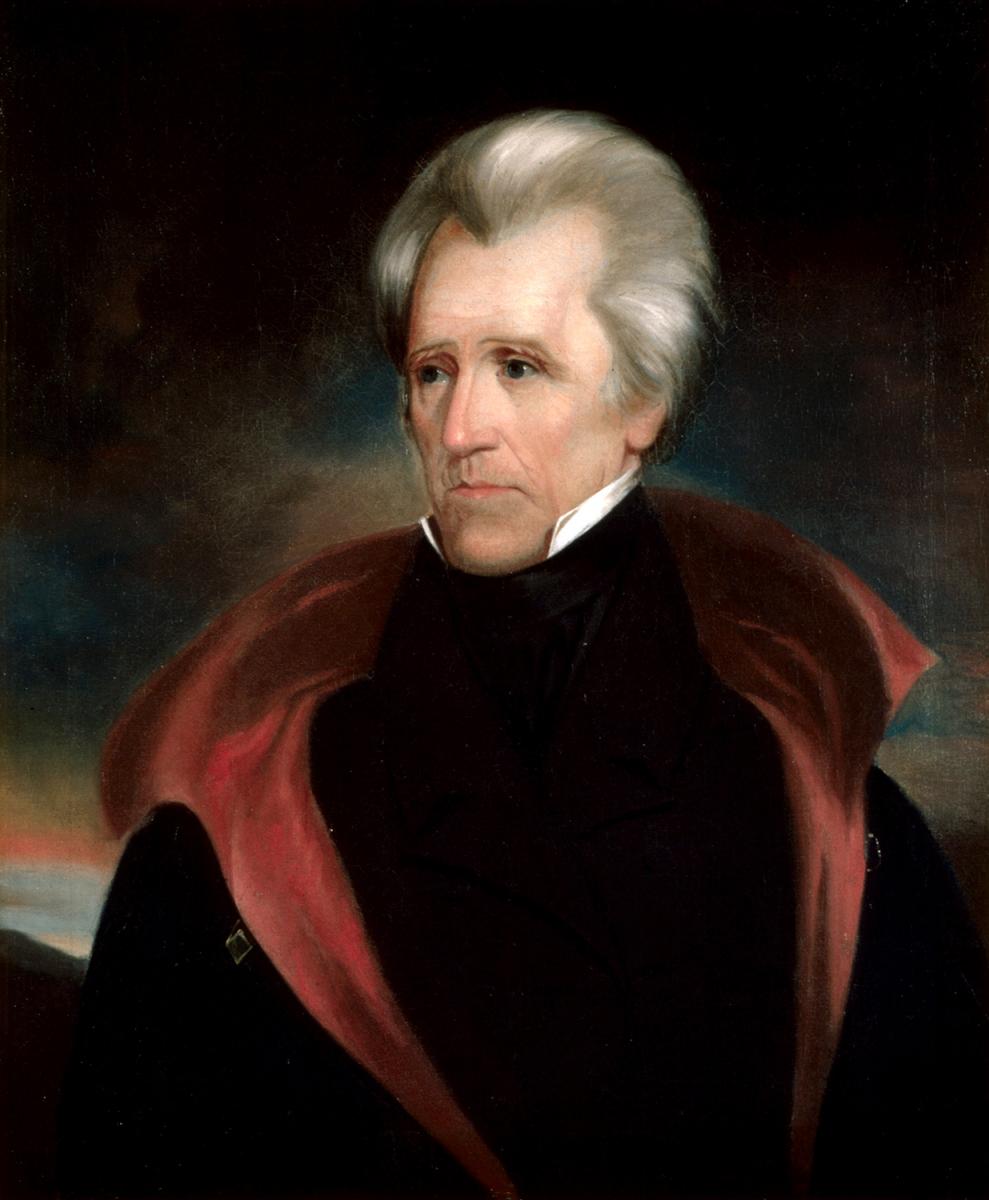
Andrew Jackson, ca. 1825–1837. Portrait by Ralph Eleaser Whiteside Earl. Courtesy of Wikimedia Commons. Image is in public domain.
The rupture among the Nation's leaders altered the Cherokee political and cultural landscape. John Ridge's Floyd County home at Running Waters became the setting for meetings with his followers and federal agents to negotiate a treaty and removal.14Justice John McLean met with John Ridge to inform him that Jackson would ignore the decision: see John Ross to William Wirt, June 8, 1832, The Papers of John Ross, Vol. 1, 1807–1839, ed. Gary E. Moulton (Norman: University of Oklahoma Press, 1985), 244–45 (hereafter Moulton, ed., Ross Papers); "Memorial of a Council held at Running Waters, Nov. 28, 1834, 23rd Cong., 2nd Sess., Doc. 91, 1–19. Major Ridge, the wealthy proprietor of an Oostanaula River ferry and store five miles from Running Waters, shared treaty party leadership with his son. Just two miles south of Major Ridge's, Ross directed the Nation's adamant refusal to cede land, negotiate treaties, or emigrate west. Commanding loyalty from the majority of Cherokees, Ross led the Nation from his plantation at Head of Coosa, organizing resistance long after Georgia prohibited the operations of his government.
The Ross-Ridge conflict destabilized the Nation. Advocacy of either side led to accusations of treachery and bribery, hardening the leaders' positions and scattering violence among their partisans. Although the three men maintained civility, their supporters demonstrated considerably less restraint. In July 1833, a fight between Ross and Ridge adherents turned Major Ridge's store into a scene of havoc. Beating and knifing one another senseless, the adversaries exemplified the rage felt on each side of the divide.15The Cherokee Intelligencer, July 20, 1833, 3, G-M Collection, AHC; Thurman Wilkins, Cherokee Tragedy: The Story of the Ridge Family and of the Decimation of a People (New York: Macmillan Co., 1970), 246–47. Wilkins points out that federal agents arrested Ross's supporters who started the attack, binding them over to the Floyd County court. While the injured survived and a few were arrested, the opposing strategies could not be reconciled, nor could those who advocated them. A few months later, treaty party adherent Eli Hicks was murdered near Rome by two Ross supporters, Duck and Swimmer, stirring the legislature to offer a reward for their capture.16See, among many other reports of threats, Z. B. Hargrove to Wilson Lumpkin, June 19, 1835, Louise Frederick Hays, comp., Cherokee Letters, Talks, and Treaties (Typescript, Georgia Archives: 1941), 303 (hereafter Hays, comp., Cherokee Letters, GA); Ga. Acts, 1834 (Milledgeville, GA: P. L. and B. H. Robinson, Printers, 1834), 294. In the fall of 1835, the two were killed, allegedly while trying to escape the local guards who arrested them.17Reported in Columbus Enquirer, Oct. 23, 1835, 3, http://enquirer.galileo.usg.edu. An 1835 letter from founder Hargrove to the governor conveyed William Smith's report of "the savage fury of the Ross party" that attacked "a friendly Indian" (that is, friendly to Georgia and John Ridge). The following year sheriff William Williamson hanged Cherokees Barney Swimmer and Terrapin in Rome's first execution.18Z. B. Hargrove to Governor Lumpkin, June 19, 1835, in Hays, comp., Cherokee Letters, GAs, 303–04; Battey, History of Rome, 211, 248 (Battey attributes the hanging to William Smith whose term as sheriff had recently expired); John Ridge to Eliza Northrup, Nov. 1, 1836, American Board of Commissioners, 18.3.1, v. 7, Item 116, in Paul Kutsche, Guide to Cherokee Documents in the Northeastern United States (Metuchen, N. J.: Scarecrow Press, 1986), No. 3137, 238. Although most of these victims cannot be identified with certainty, the 1835 Cherokee census includes an individual named Swimmer on the Etowah River and on nearby Shoal Creek a man named Tarrapin: "Cherokee Census," 37. Rather than the tranquil countryside implied in local accounts, Floyd County was home ground for the intensely partisan and sometimes brutal struggle for the Cherokee Nation's survival. Rome's founders played a part in the contest as they established a town in the midst of the Nation.
The Collapse of Law
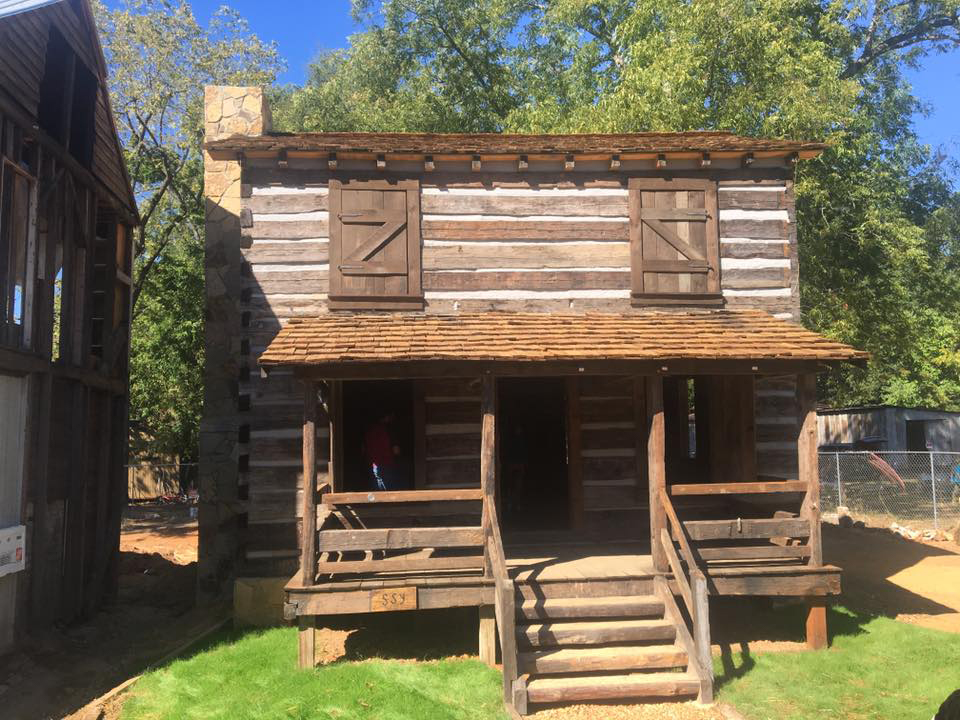
Vann Cherokee Cabin, Cave Spring, Georgia, October 2, 2016. Photo by unknown creator. Courtesy of Cave Spring Historical Society.
While the tenuous hold on their lands exacerbated tensions among Cherokees, Floyd County beckoned white Georgians. Some, like founder James Hemphill, took possession of property abandoned by the original Cherokee owners but still occupied by their descendants.19Before emigrating in 1829, Ave Vann received payment from the government for his property, which his son Charles continued to occupy. The same year, the state rented Vann's possessions to James Hemphill, who displaced Charles: Cherokee Valuations, Georgia, RG 75, T496, Reel 28, 40, GAs. See also Jeff Bishop, "The Vann Cherokee Cabin" in "Georgia Cherokee Structures," unpublished manuscript for the National Park Service, 15–16. Others pushed across the Georgia line into the Nation, sometimes naively, with scarce understanding of the confusing laws regarding Cherokee property. In June 1833, Indian agent William Cleghorn wrote Governor Lumpkin for instructions regarding Floyd County intruders who said, "they did not know it was against the law and begs me to let them gather their crops."20William H. Cleghorn to Wilson Lumpkin, June 25, 1833, TCC857, http://metis.galib.uga.edu. Cleghorn earned $124 for 31 days service as Indian agent: Ga. Acts, 1834 (Milledgeville, GA: P. L. and B. H. Robinson, Printers, 1834), 22. No response to Cleghorn's inquiry has been located. Responsible for putting qualified Georgians in possession of abandoned Cherokee holdings, agents like Cleghorn had to determine whether a site was actually abandoned and, if not, prohibit white appropriation. The work proved challenging from nearly every perspective.
Agents followed a moving target as successive legislation added restrictions and deadlines to Cherokee occupancy, which encouraged greater confusion and more intrusion. The laws of 1833 restricted Cherokee residency to 160 acres, facilitating the partial expropriation of Native farms and enhancing the obvious advantages for land-hungry Georgians. Legislation passed in 1835 withdrew all Cherokee rights of occupancy after November 1836. "Their habits and ferocious customs," the law scolded, "make them insensible to the effects of penal sanctions thereby placing our citizens, their wives and children, and all that is dear to them, at the mercy of the savage, stimulated by his vindictive passions."21"An Act to Provide for the Government and Protection of the Cherokee Indians," Georgia Acts, Dec. 20, 1833 and "An Act to Authorize the Issuing of Grants," Dec. 21, 1835, both in Digest of the Laws of the State of Georgia, comp. Oliver Hillhouse Prince (Athens, GA: Published by the Author, 1837), 154, 283 (hereafter Prince, comp., Georgia Digest). Contributing immeasurably to the collapse of law in the Cherokee counties, the rhetoric of state leaders and the press justified and encouraged the seizure of Cherokee land by Georgia citizens.
As the white population of Floyd County expanded numerically and geographically, "the mercy of the savage" was not the problem. Unlike whites, Cherokees struggled to avoid theft, arrests, beatings, and widespread dispossession. Their claims for compensation from the federal government number in the thousands, challenging the assertion that Cherokees posed a threat to whites and suggesting instead that the reverse was true. While the legitimacy of the claims can never be fully verified, their quantity, similarity, and specificity point to patterns of abuse etched in government records and Native memory. Among the records of loss, two point to the founders of Rome. From the rising hill north of Rome called Turnip Mountain, Tekalesahtuhskee reported that "a white man by the name of Hemphill" had forced him "to abandon a ferry and ferry boat on the Coosa River." The two Cherokees who corroborated the claim, under oath, contributed their own recollections that the dispossession occurred in 1830 or 1831, the year James Hemphill moved to Floyd County and displaced a resident Cherokee named Charles Vann.22Tekahlesahtuhskee Claim 29, Penelope Johnson Allen Collection, University of Tennessee Libraries, Special Collection, MS. 2033, M 4, Nashville; Cherokee Valuations, Georgia, RG 75, T496, Reel 28, 41, GAs., 41, GAs. I am grateful to Michael Wren for providing the claim from the Allen Collection as well as additional archival data relating to Cherokee history.
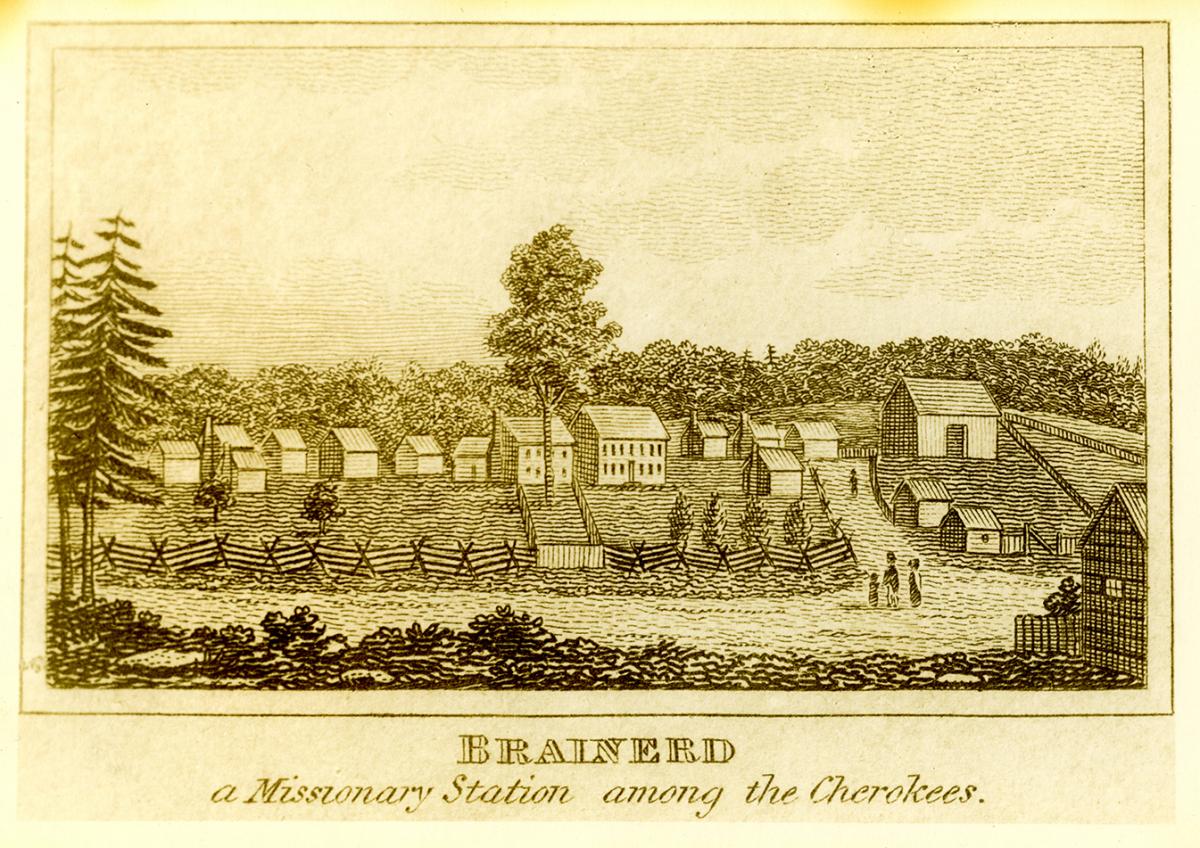
Brainerd: A Missionary Station Among the Cherokees (in Tennessee). Print of a woodcut by unknown creator. Courtesy of the Penelope Johnson Allen Brainerd Mission Correspondence and Photographs collection, University of Tennessee at Chattanooga.
Fear accompanied the erosion of rights for Cherokees like Alley Rain Crow, who couldn't retrieve the livestock that disappeared from her Cedar Creek home. Her family members "were afraid to go back there and look for them," she recalled, the Georgians having been "so troublesome we could not live there any longer." At Head of Coosa, where the founders imagined a city, a notorious rustler named Philpot stole Kolkahlosky's horses but "I did not go after them as I was afraid." Eagle Buffalofish lost his horses, cattle, and hogs to "outrages of the whites" along the Etowah River. White intruders took over Jinny Smith's ten acres of cultivated fields, peach trees, and a corncrib on the Coosa River near the Haweis Missionary Station. The resident missionaries had already been arrested, released, and dispossessed, and had fled to Tennessee. A "white man" stole a slave from Teyane and another took money from her Cedar Bluff home. When Clay's horses disappeared along the Oostanaula River, he "knew the property to be in the possession of whites" but state law obstructed him from regaining anything. "An Indian had no chance in Georgia," he lamented, "as an Indian was not allowed to swear under the laws of that state."23Claims of Alley Raincrow and Kolkahlosky, Marybelle W. Chase, comp., 1842 Cherokee Claims, Skin Bayou District (1988): 173–74, 81; Claims of Eagle Buffalofish and Clay, ibid., 1842 Cherokee Claims, Saline District, Vol. 2 (1992), 156–61 and 302–04; Claim of Teyane (a Creek woman), ibid., 1842 Cherokee Claims, Going Snake District (1989), 317–18; Mission to the Cherokees Annual Report, American Board of Commissioners for Foreign Missions, Vols. 23–26, 103; Evaluation of Cabbin Smith's widow Jinny, Nov. 18, 1836, RG 75, Cherokee Valuations, Georgia, T496, Reel 28, 83–4, GAs. The litany of complaints filled volumes in federal records but few were heard in Georgia courts. The extension of state law invalidated Cherokee testimony against whites.
Along with economic injury, physical threats menaced Floyd County Cherokees. "The usual scenes which our afflicted people experience are dreadfully increased," John Ridge wrote Ross in early 1833. "They are robbed and whipped by the whites almost every day."24John Ridge to John Ross, Feb. 2, 1833, in Moulton, ed., Ross Papers, Vol. 1, 259–60. Alex Tutt moved from the Etowah River into Tennessee, citing "abuse of himself and wife for cruel punishment inflicted upon them by the citizens of the state of Georgia in Floyd County."25Claim of Alex Tull, Chase, comp., Cherokee Claims, Saline District, Vol. 1, 207. According to Indian agent Cornelius Terhune, Georgians Joshua Keys and Jackson Morrison whipped Tutt, Benjamin Dikes stole his cotton and corn, and a man named Henderson appropriated his fields.26Cornelius Terhune, July 8, 1837, personal notes in possession of Donna Baldwin. I am grateful to Donna Baldwin for providing a copy of Terhune's notes from her family records. The white business partner of Major Ridge, George M. Lavender, thought his neighbor Knitts was wrongfully accused of stealing bacon from a storehouse. "I believe he will be proven innocent," Lavender wrote John Ridge, but Knitts was punished with 120 lashes, released, and then arrested again, which impelled him to emigrate. In his claim, Knitts declared, "I would never have left the land of my forefathers as it was dear to me and the land that I loved and I would never have left." He abandoned his home on the Oostanaula River "to be out of their reach."27George N. Lavender to John Ridge, May 3, 1836, in Battey, History of Rome, 212; Big Nitts Claim, Chase, comp., 1842 Cherokee Claims, Flint District, Vol. 1 (1991), 114–17. The suffering reported in Cherokee claims could not have escaped the attention of at least one of Rome's founders. In January 1834, founder William Smith became Floyd County sheriff with responsibility for property advertisements, land sales, lot possession, and maintaining peace and order.28Sec. of State Commission Book 277/34, p. 128, in "History," Floyd County Sheriff's Office, http://www.floydsheriff.com.
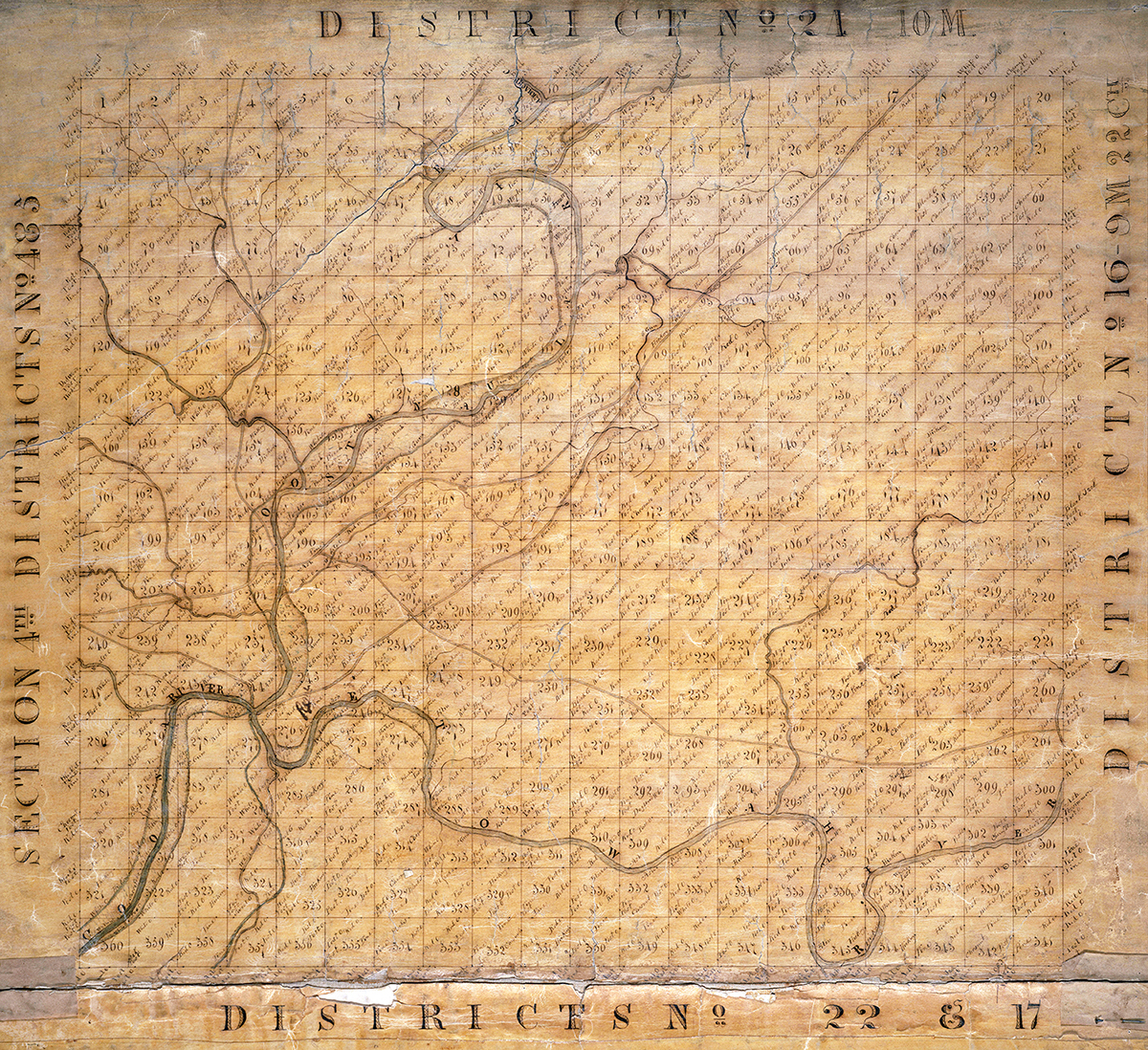
Cherokee County, Section 3, District 23, 1832. Map by surveyor John Harvey. Courtesy of the District Plats of Survey collection, Georgia Archives, University System of Georgia.
"Exceptional Opportunities" for the Founders
In addition to nurturing the intimidation of Cherokees, the confusion of squatters, the plethora of laws, and the ambition of men like Rome's founders, Georgia's unique policy of land distribution also succeeded in promoting white settlement. More than two thousand Floyd County lots were awarded to white Georgians, including veterans, widows of veterans, guardians of orphans, and individual household heads. The lottery guaranteed the mobility and speculation that ensured Cherokee displacement. Prize winners sold their winning tickets, purchased ownership grants from the state, sought buyers for their new land, or arrived by the wagonload at their designated property.29A review of lottery maps indicates a total of 2,100 Floyd County lots: Smith, Cherokee Lottery, 274–96. Local newspapers carried columns of advertisements for lots that became available for purchase in the Cherokee counties. Citizens with adequate funds, such as the founders, did not have to wait long for what they wanted.
Top, Cherokee County plat and land grant issued to Stephen Carter, 1834. Courtesy of the Ad Hoc collection, Georgia Archives, University System of Georgia. Bottom, John Ross House, Rossville, Georgia, 1952. Courtesy of the National Park Service.
The lottery wheel had been turning for two months when some of the property the founders desired became available. On January 18, 1833, the sixty-first day of the lottery, Stephen Carter of Fayette County won the lot where John Ross and his family lived.30Lot 244 in the 3rd Section of the 21st District: Gold and Land Lottery Register, 250. Ross's Head of Coosa possessions included his two-story house, sixty-five acres of cultivated fields, a kitchen, work house, smoke house, blacksmith shop, wagon house, stables, slave quarters, corn cribs, orchards, and a Coosa River ferry and landing.31Indian agent William Springer notified the governor in 1834 that Ross's improvements extended onto Lots 237 and 243 as well as across the Coosa River. His home was located in Lot 244: William G. Springer to Governor Lumpkin, Feb. 5, 1834, Hays, comp., Cherokee Letters, GAs, 264–65; Moulton, ed., Ross Papers, Vol. 1, 130. Estimates of the property's value exceeded $6,000 while the ferry was appraised separately at $10,000.32Cherokee Register of Valuations, RG 75, M 574, Reel 8, File 5, 501–02, National Archives. As his winning ticket increased in value, Carter waited to take possession of the Ross home. The ferry, however, was a more pressing matter, at least for Rome's founders. While Ross remained in residence, Philip Hemphill gained partial ownership of his ferry and landings, filing deeds in the Floyd County courthouse where he served as Inferior Court clerk. Hemphill subsequently sold a portion of his interest to Hargrove who, in turn, entered into partnership with William Smith to control the ferry's operations.33Roger Aycock, "Control of Floyd Ferries," Rome News Tribune, Nov. 28, 1971, 9.
The founders' acquisitions exemplify the economic and political interconnections that displaced Cherokees. Capitalizing on the opportunities provided by the lotteries, they also took advantage of state laws that targeted Cherokee occupation and created land markets for dexterous white Georgians. Long after Rome was settled, Wesley Shropshire recalled his 1834 visit to the town. "William Smith owned most of the land about Rome," Shropshire remembered, and "rode with me several days to buy land." When they found someone with three lots to sell, Smith "sent for Phillip Hemphill, thought he would take one, which he did," leaving the remaining two for Shropshire. The other founders were equally busy. According to Shropshire, Hargrove "owned the ferry landing" and Mitchell "owned the Ross place and land and sold it to Smith."34Wesley Shropshire to Editor, Dec. 1, 1891, reprinted in Roger D. Aycock, All Roads to Rome (Roswell, GA: W. H. Wolfe, 1981), 46. Shropshire was elected sheriff in 1838: Sec. of State Commission Book 277/34, in "History," Floyd County Sheriff's Office, http://www.floydsheriff.com. For such men, personal wealth facilitated the exploitation of the lottery system and the accumulation of Native possessions; state policy encouraged their ambition, supporting the establishment of homes, businesses, and even a city without concern for federal sanctions or Native residents. It was a combination that was disastrous for the Cherokees of Georgia.
Copy of Sketch for the Layout of Rome, Georgia, 1834. Drawing by Daniel R. Mitchell. Courtesy of Rome Area History Museum.
Day after day the lottery's whirling chits gave Cherokee land to acquisitive citizens. On February 8, 1833, another prize spun out to fan the ambitions rising among Rome's founders. Major Pierce (Pearce) of Hancock County won Lot 245, a property conforming to the idyllic tale of Hargrove and Mitchell's chance meeting with Hemphill. Bordering the Etowah River where its convergence with the Oostanaula formed the Coosa, the lot lay directly across the Oostanaula from Ross's home.35Pierce won Lot 245 in the 3rd Section of the 21st District on the 79th day of the drawing, Feb. 8, 1833: Gold and Land Lottery Register, 343. When the founders acquired Pearce's property, they designated it as the city center and set aside a portion of Ross's land across the river for future expansion. Mitchell sketched a plan for town streets and residential lots, leaving an unmapped area fronting the Etowah River for William Smith's eagerly anticipated racetrack.36Desmond, Georgia's Rome, 32. The Ross family lived less than a mile away.
"Ridding Georgia of this troublesome population"
As white Georgians mapped and planned and purchased, Cherokees found ways to resist state policy and citizen aggression. Ross maintained a strategy of challenging Georgia's belligerence through the courts. In August 1834, he informed the Nation's attorney, William H. Underwood of Rome, of threats to his residency. "The town lots on my premises," he wrote, "are advertised to be offered at public sale on the 26th." Lawyers had advised him "to apply for a Bill to enjoin these offenders" and "restrain further trespass."37John Ross to William H. Underwood, Aug. 12, 1834, in Moulton, ed., Ross Papers, Vol. 1, 300–01; Mary Young, "The Exercise of Sovereignty in Cherokee Georgia," Journal of the Early Republic 10, no. 1 (Spring 1990): 43–63. State newspapers of 1834 and 1835 carried numerous articles about the conflict between Cherokee Circuit Judge John W. Hooper and Lumpkin. Seeking an injunction to protect his property, Ross brought suit against founders Smith, Hargrove, Mitchell, Philip Hemphill, and John Lumpkin.38John Ross and Family v. Philip W. Hemphill, William Smith, Zachariah B. Hargrove, Daniel R. Mitchell, Terrell Mayo, and John H. Lumpkin, October, 1834, in Moulton, ed., Ross Papers, Vol. 1, 313. Roger Aycock states the suit was brought Aug. 16, 1834: Aycock, "Floyd Ferries," Rome News Tribune, Nov. 28, 1971. The suits were dismissed: Barron and Irwin, Attorneys' Claims, RG 75, E 235, 1834, National Archives. He emphasized to Underwood that such lawsuits "must go on with energy and earnestness" to assert the legitimacy of Cherokee rights.39Judge Hooper issued numerous injunctions on behalf of Cherokees. See Lumpkin, "Annual Message 1834," and Lumpkin to William N. Bishop, Dec. 23, 1834, Wilson Lumpkin, The Removal of the Cherokee Indians From Georgia, Vol. 1 (New York: Dodd, Mead and Co., 1907), 145–50, 271–3 (hereafter Lumpkin, Removal). The cases charted Ross's resistance as a political strategy. Although lawsuits faced near-certain dismissal, the use of judicial systems temporarily snarled the efforts of Georgians to appropriate properties, publicized the sophistication of the so-called savages, and created an enduring record of the Nation's struggle against Georgia's oppression.
Wilson Lumpkin, Governor of Georgia, ca 1838. Print by unknown artist. Courtesy of the Library of Congress Prints and Photographs Division, loc.gov/pictures/resource/cph.3a17596/.
Outraged by judicial delays to his removal goal, Governor Lumpkin tried to block the injunctions, seeking their reversal and launching an investigation into the activities of the Superior Court judge who authorized them.40Founder Z. B. Hargrove represented the state in its investigation. House Resolution, Ga. Acts, 1834, 338–39; "The Hooper Case," The Southern Banner, May 20, 1835, 1–2, http://athnewspapers.galileo.usg.edu. Lumpkin's address to the legislature regarding Judge Hooper is reported in The Southern Banner Nov. 8, 1834, 2–3, http://athnewspapers.galileo.usg.edu. Hooper's term expired before the report, which supported his rulings, was released. In December 1834, he intensified pressure on resident Cherokees. To accelerate their dispossession, he appointed his aide, William N. Bishop, as Cherokee agent. Bishop commanded the Georgia Guard, which the state had established and armed in 1830 to maintain its sovereignty inside the Cherokee Nation. Consisting of about forty men from the Cherokee counties who ardently supported Lumpkin's policies, the Guard had appropriated a mission site for headquarters, established a crude jail, operated with no legal restraint, and reported directly to the governor. Since 1833, they had spied on Ross and his associates, arrested and dispossessed errant or vulnerable Cherokees, and protected treaty party members and their property from dispossession. "I am happy to learn your intention," Bishop had written Lumpkin in 1833, "of ridding Georgia of this troublesome population."41John Ridge asked the governor to exempt the property of treaty party members until they had emigrated: John Ridge to Wilson Lumpkin, Sept. 22, 1833, http://neptune3.galib.uga.edu; William Bishop to Wilson Lumpkin, Sept. 16, 1833, http://www.rootsweb.ancestry.com/~gachatto/corr/cherokee.htm.
In a "private and confidential" letter enclosed with Bishop's appointment, Lumpkin denounced the "reprehensible" judicial challenges to state authority. He acknowledged that the language of the state's Cherokee legislation seemed "vague and ambiguous" but insisted its purpose remained obvious. The legislature and "our people," he argued, intend that "the rightful owners" be given "immediate possession" of Cherokee premises. Regardless of the "artifice of lawyers or the embecility [sic] of judges," Lumpkin welcomed responsibility for "discharging this duty."42Wilson Lumpkin to William N. Bishop, Dec. 23, 1834, in Lumpkin, Removal, Vol. 1, 272–73. Like Andrew Jackson, he denied the authority of the national and state judiciary, including jurists elected to office by Georgians. As Lumpkin realized, the elimination of legal redress left Cherokees with few options.
Claim by William N. Bishop for Land Owned by Chief John Ross, March 17, 1835. Courtesy of the Gilcrease Museum, Tulsa, Oklahoma.
On March 17, 1835, Bishop recorded his execution of Lumpkin's "duty" in Rome. "As agent for the state of Georgia," he announced, "I have this day put the Legal claimant of Lot of Land No. 244 in the 23rd District of the 3rd Section in full and entire possession of the Same of which John Ross was the Indian occupant." The notice stated Ross had "forfeited his right of occupancy under the Existing Laws of this state."43William N. Bishop, March 17, 1835, in Moulton, ed., Ross Papers, Vol. 1, 333. Bishop's assertion alluded to legislation that transferred to lottery winners all lots in the possession of Cherokees who had agreed in 1819 to become private landowners and state citizens where their lots lay. John Ross had made such an agreement for a tract in Tennessee he never occupied. Like most who entered the 1819 agreement, he sold his reserved lot for a profit and moved elsewhere in the Cherokee Nation.
A witness recalled later that Ross was out of town when Bishop and Hargrove summoned William Smith, John Lumpkin, and others "to go over the Oostanaula River and put Mitchell in possession" of Ross's house. Ross's wife, Quatie, initially "refused to give possession" to the Georgians, but Bishop "ordered a bureau thrown outdoors." His tactics of intimidation prevailed. As "four men took hold of it," Quatie Ross relented, turned over the second floor of her home, and signed a pledge "to give the house up in ten days."44Shropshire to Editor, Aycock, All Roads, 45–6. She gathered her children and left for Cherokee Nation land in Tennessee. When Ross returned from Washington later in the month, he found his home occupied by Georgians who adhered to "the Existing Laws of this state," but not to those of the United States.
Across the landscape, Cherokees and whites could watch Georgia's uneven application of justice. Just north of Ross's, Major Ridge continued living in his Oostanaula River home for two more years, earning proceeds from his store and ferry until he chose to emigrate with his family and possessions. To the northeast, John Ridge remained at his Running Waters home for the same period, benefitting from plantation and Coosa River (Alabama) ferry income until shortly before his voluntary departure.45In a June 17, 1835 letter to Bishop, Lumpkin directed him to "be vigilant in protecting and defending John Ridge and his friends" and to arrest Ross if anyone could be found to "sign an oath against him": Lumpkin, Removal, Vol. 1, 356. After passage of the New Echota Treaty, federal officers also issued instructions to protect the Ridge properties. Ultimately, however, even the Ridges were dispossessed: see testimony of General John E. Wool, Sept. 4, 1837, reported in The Burlington Weekly Free Press, Feb. 9, 1838, 1, http://www.newspapers.com/image/76504046/?terms=Coosa. The governor instructed the Georgia Guard to hold in abeyance the winners of the Ridges' properties while ensuring the dispossession of Ross and his advocates. Such selective application of law marked the memories of the Cherokees expelled from Georgia. John Ross, leaving the gravesites of his father and infant child, and his "houses, farms, public ferries and other property," followed his family to Tennessee.46Ross's own account is in his "Memorial to the Senate and House of Representatives, June 21, 1836," Moulton, ed., Ross Papers, Vol. 1, 427–444, account of dispossession on 432–33. The exiled leader continued to govern the Nation, proclaim the Cherokee position in the national press, and lead embassies to Congress to seek relief from Georgia aggression. Meanwhile, Head of Coosa became available for the "splendid new city" of Rome.
Detail of Map of Floyd County, 1871. Map published by William Philllips. Courtesy of County Maps collection, Georgia Archives, University System of Georgia.
The Treaty of New Echota
Soon after the Ross dispossession, a Floyd County meeting served as a turning point in the removal crisis. In July 1835, John Ridge and federal agents called for a grand council of the Cherokee Nation at Running Waters, purportedly to determine the procedures for distributing federal annuities. The presence of enrolling agent Benjamin Curry and treaty commissioner John Schermerhorn, however, exposed its true purpose as presenting a removal treaty to as many Cherokees as possible. Summoned by Ross because of the vote on annuities, approximately four thousand men, women, and children from four states converged on John Ridge's expansive property. While waiting for the meeting to begin, they made camp, set up areas "for wrestling and other athletic exertions," and honed their stickball skills. In an atmosphere of civility strained by heavy rains and inadequate provisions, the treaty party assembled alongside Ross and the Cherokee National Council, agent Curry, commissioner Schermerhorn, US Army officers, translators, a recording secretary, and a few Georgians. Drumming their arrival, the Georgia Guard stationed themselves in two camps, one less than a mile away to the north and the other southward at Major Ridge's where the treaty commissioner was staying.47"Journals of Return John Meigs While Secretary to the Commissioners Authorized to Negotiate with the Eastern Cherokees, 1835," trans. Alice H. Meigs, John Meigs Collection, no. 83.01, Oklahoma City Historical Society Research Center, Oklahoma City, Ok (hereafter OCHS). The federal records pertinent to the Running Waters Council are in 25th Cong., 2nd Sess., Doc. 120, 396–447. The sights and sounds, crowded roadways, masses of people, smoke from fires, and odors of cooking must have drawn the notice of even the most preoccupied Floyd County citizens.
New Echota: Cherokee National Capital, Calhoun, Georgia, June 19, 2008. Photograph by Flickr user Ashe. Creative Commons license CC BY-NC-ND-2.0.
For three days the assembly listened to speeches by Schermerhorn, Curry, John and Major Ridge, and Ross. Schermerhorn read Jackson's letter to the Cherokee Nation, which John Ridge had suggested, promoting removal and promising its benefits. The commissioner next introduced a provisional removal treaty and explained each section to the hushed assembly. Finally, the annuity alternatives were presented. John Ridge sought a per capita distribution of the annuities while John Ross favored the custom of depositing the money into the national treasury. Signifying far more than an opportunity to express preferences regarding the distribution of money, the annuity question provided a public referendum on the two opposing leaders and their policies. Of the more than 2,553 men who voted, 114 endorsed Ridge's annuity proposal and the remaining 2,439 sided with Ross.48"Meigs Journals," OCHS. As a measure of each leader's strength, the meeting orchestrated by the Ridges and government agents had backfired. The annuity vote publicly confirmed the weakness of Ridge and his coalition and, instead, underscored the commitment of Cherokees to Ross and the National Council. To obtain a treaty, the state and federal governments would have to proceed without the Cherokee government and the majority of Cherokee citizens.
The Running Waters council was the last official gathering of the Cherokee Nation in Georgia. In December 1835, Major Ridge and treaty party members traveled to New Echota for a summit with Schermerhorn and removal operatives. Without the participation of any representatives of the Cherokee government, they signed the agreement ceding all southeastern Cherokee land and committing the Nation to removal within two years. John Ridge, absent from the meeting for a conference in Washington, added his signature as soon as Major Ridge presented the document to him.49Major Ridge headed the delegation that took the signed treaty to Washington, where his son John added his signature on Feb. 3, 1836: Wilkins, Cherokee Tragedy, 277–78. On May 23, 1836, Congress ratified the treaty, which Jackson promptly signed. The treaty gave Cherokees two years to emigrate voluntarily. After the deadline, forced removal would begin.
In this letter to Governor Lumpkin, John Ridge sought protection for the property of Major Ridge and treaty advocate Alexander McCoy two years before signing the Treaty of New Echota. Courtesy of the Georgia's Virtual Vault website, Georgia Archives, University System of Georgia.
While Ross vigorously condemned the agreement, a new wave of Georgians caught the scent of removal. Less than a month after ratification, John and Major Ridge implored "our friend" the president for protection from Georgians. "We are not safe in our homes," they grieved, "the lowest classes of the white people are flogging the Cherokees with cowhides, hickories, and clubs." As the majority of Cherokees had long experienced, the treaty party now "found our plantations either taken in whole or in part" regardless of "protestations of innocence and peace." Their persecutors extended beyond "the rabble" and included "even parties of the peace and constables," a condemnation of former allies like William Smith and Colonel Bishop. Beseeching Jackson to "write to the Governor of Georgia," the Ridges pleaded, "above all send us regular troops to protect us from these lawless assaults."50John Ridge and Major Ridge to Andrew Jackson, June 30, 1836, RG 75, M 234, Reel 80, frames 0488–89, National Archives. The treaty provision that guaranteed protection of the Cherokees until their departure had little effect on Georgians who welcomed another opportunity to disregard federal imperatives.
Agents of Expulsion
As conditions deteriorated among Cherokees, the federal government began preparing for their removal. General John E. Wool assumed operational command with headquarters near the Cherokee Agency in Tennessee, designating New Echota as the center for removal in Georgia. Sharing the goal of Cherokee expulsion, soldiers and civilians moved to the former Cherokee capital. Two Georgia militia companies mustered into federal service and erected barracks and stables out of wood from the Cherokee Council House. Having completed his final term as governor, Wilson Lumpkin found housing as one of two commissioners empowered to accept or reject Cherokee evaluations and spoilation claims. Rome citizen James Liddell replaced Lumpkin when he resigned to take a US Senate seat. As commissioners reviewed thousands of petitions for property compensation, Cherokees lined up for the rations and clothing the treaty provided the indigent. John Ridge took up temporary residence as chair of the Cherokee committee advising the commissioners about claims, endorsing or denying their validity, and identifying individuals capable of removing themselves without supervision. Disbursing officers traveled back and forth with bank funds, including a loan of $10,000 from Rome's new Western Bank of Georgia that was governed, in part, by the city's founders.51Sarah H. Hill, "Cherokee Removal Scenes: Ellijay, Georgia, 1838," Southern Spaces, https://southernspaces.ecdsdev.org/2012/cherokee-removal-scenes-ellijay-georgia-1838; Lumpkin, Removal, Vol. 2, 85; "An Act to Incorporate the Western Bank of Georgia," Prince, comp., Georgia Digest, 123; Senate Report 277, 23rd Cong., 2nd Sess. (Washington, D.C.: Blair and Rivers, 1839), 94–6. The Western Bank's directors included Z. B. Hargrove, Philip W. Hemphill, and Daniel Mitchell: The Southern Banner, Aug. 19, 1837, 3, http://athnewspapers.galileo.usg.edu. With the collaboration of Georgians and the treaty party, the business of removal began.
Top, Cherokee moccasin, ca. 1830. Courtesy of Chieftains Museum/Major Ridge Home. Image provided by Sarah H. Hill. Bottom, Cherokee purse, pre-1840, made by a student at the Moravian Mission School, James Vann plantation, Georgia. Courtesy of the Georgia Department of Natural Resources, Chief Vann House Historic Site.
Floyd County citizens became appraising agents, carrying pens and notebooks from one house to another to assess properties Cherokees would be forced to abandon. Philip Hemphill and James Liddell began work in their assigned section on September 1, 1836, filling more than forty pages with notes of Cherokee possession and loss. Among prosperous households such as those of Ross and the Ridges, they examined dwelling houses, spring houses, stables, shops, kitchens, slave cabins, hen houses, fish traps, fenced lots, mills, orchards, and smoke houses. Their work took them to John Fields's inn, "a good stand at the forks of the road leading to Ross and Ridges homes" and Yonah Killer's ferry on the Oostanaula, the apple trees of Brush in the Water, Little Nelly's cook house, the garden lot of Susan Peacock, and Tarloke's loom house.52Cherokee Valuations, Georgia, RG 75, T496, Reel 28, frames 10, 20, 23, 31, 46, 55, GAs. From Vann's Valley past Head of Coosa and Running Waters, Dirt Town to Raccoon Town and Armuchee, and through Chattooga and Spicewood valleys, the agents eyed fields, farms, and homes, placing a value of eighty cents on each good peach tree and three dollars on every cleared acre of good land. They estimated most cabins at four dollars unless they had plank floors, shingle roofs, or brick chimneys that added a half dollar or more to the value. Earning four dollars a day as federal employees, Floyd County denizens moved from lot to lot assessing Cherokee economic worth.
In the adjacent section of Floyd County, Joseph Watters and Samuel Burns recorded more than one hundred additional pages of possession and loss. They repeatedly noted Cherokees had been divested of fields, homes, ferries, mills, livestock, money—everything they had built or cultivated. Dispossessions had begun soon after the extension of Georgia laws in 1830 and accelerated each year, becoming particularly widespread in 1836. It is little wonder the appraisers occasionally encountered resistance to their prying. On the Etowah River, Watters and Burns reported Chunahyahee or John Longfoot "refused to show his improvement, does not believe he will be paid for it." Nearby, Chuqualalagee, his mother, and brother "all refused to show any part of their improvements or give the number of their families." Their neighbors on either side had already been dispossessed. When the Floyd County evaluators finished their work in December, they turned over their records to James Hemphill, who delivered them to commissioner Lumpkin at New Echota.53Ibid., 66–7; Wilson Lumpkin and J. M. Kennedy to Benjamin F. Curry, Dec. 14, 1836, Lumpkin, Removal, Vol. 2, 77–8.
Regardless of evidence of the state's victory over the Cherokees—a ratified treaty, appraisal agents, Native dispossession, abandoned mission stations and schools, an expanding white population, the Georgia Guard, and federalized troops—many Georgians became more fearful, a reaction aggravated by the behavior and rhetoric of their leaders and an irresponsible press. "The Cherokees," warned the Macon Telegraph, "only wait a good opportunity to break out into open hostilities." According to the paper's unnamed sources, Cherokees were "abandoning their cornfields and cabins and making other movements plainly indicating sinister designs."54Reprinted in The Federal Union, June 2, 1836, 2, G-M Collection, AHC The Columbus Herald of August 2, 1836, passed along the fiction "the Ross party had risen in their wrath and were destroying all before them." Georgians, the paper threatened, should anticipate "a new scene of savage depredation" comparable to the Seminole and Creek removal wars.55Reprinted from The Columbus Herald in The Savannah Republican, Aug. 8, 1836, 3, http://savnewspapers.galileo.usg.edu. See also Sarah H. Hill, "To Overawe the Indians and Give Confidence to the Whites: Preparations for the Removal of the Cherokee Indians from Georgia," The Georgia Historical Quarterly 95, no. 4 (2011): 465–97. Knowing the treaty had been obtained from a dissident faction over the objections of the Cherokee government, many Georgians assumed the worst. Afraid of those they lived among and vastly outnumbered, they demanded armed intervention.
Fear and Force
Photograph of Daniel R. Mitchell, ca. 1830. Courtesy of Rome Area History Museum.
Introduced first in Floyd County, the militarization of the Cherokee homeland began in the two-year term of Governor William Schley soon after treaty ratification. Schley sent weapons to Floyd County in response to correspondence from James Hemphill. Persuaded by "several resolutions of the citizens of Floyd" conveyed by Hemphill, the governor believed "there was more danger to be apprehended" in Floyd and Walker counties "than any other part of the Cherokee Circuit." Schley took the additional step of ordering Hemphill to raise and station a battalion in Floyd County to prevent Creeks from entering the state and to "keep the Cherokees in check." The founders quickly joined the military initiative. Daniel Mitchell assembled a cavalry that included William Smith, Philip Hemphill, James Liddell, and Joseph Watters (who replaced Mitchell as captain in August). John Lumpkin became captain of one of Rome's new militia companies. By July, 200 men had set up headquarters on the Coosa River 18 miles from Rome. From the post they named Camp Scott (in honor of Creek removal commander Winfield Scott), the companies patrolled the Cherokee counties, expelled a few Creek refugees, and mistakenly arrested, then released, some resident Cherokees.56William J. W. Wellborn to William Schley, June 19, 1836, http://neptune3.galib.uga.edu; "Governor's Message," Nov. 8, 1836, in The Southern Banner, Nov. 19, 1836, 1–2, http://athnewspapers.galileo.usg.edu; James Hemphill to D. R. Mitchell, June 18, 1836, Copies 1, 2, 3, and 4, Louise Frederick Hays, comp., Georgia Military Affairs (1941), GAs, 123–24 (hereafter Hays, comp., GMA); Floyd County company elections May 28 and June 10, 1836, Vertical Files, Military, Floyd County, GAs; Gordon Burns Smith, History of the Georgia Militia, 1783–1861, Vol. 2 (Milledgeville, GA: 2000), 337.
Abandoned three months later, the ephemeral Camp Scott signifies the link Georgians made between fear and force in the removal era. Cherokees, by all reports, remained peaceful, continued to plant and build, and waited for Ross's instructions. Informants repeatedly told Governor Schley and his successor, George R. Gilmer, that Cherokees manifested no hostility. Nevertheless, from the executive office to individual households, Georgians feared a Cherokee uprising and demanded preemptive action. They sought weapons and arms for themselves and objected to the use of outside troops. As incoming federal troops enforced their responsibility to protect Cherokees until the removal deadline, Georgians became suspicious of the soldiers' loyalties. Commissioner Lumpkin insisted to the president, the enrolling agent, Wool, Schley, and Secretary of War Poinsett that removal forces in the state consist only of Georgians. The attitudes of federalized Tennessee troops and US Army officers, he wrote, insulted "every man who feels the true spirit of a Georgian."57Wilson Lumpkin to William Schley, Sept. 24, 1836, Lumpkin, Removal, Vol. 2, 49–50. Mistrust of outsiders spread through the Cherokee counties where federal troops were expected to serve. A Floyd County citizen complained to the governor that soldiers who were not Georgians "have become decidedly the Indians friend when ever they have entered the nation or they all come prejudiced against Georgia."58John T. Storey to George R. Gilmer, January 25, 1838, RG 4-2-46, File II Names, Folder 148, GAs. No other state suffered so much suspicion; no other state made such a demand. The months between ratification and removal were rank with tension between Cherokees and Georgians, and between Georgians and everyone else.
In the fall of 1837, Schley again militarized the Cherokee counties, calling for militia companies in each. He notified the new president, Martin Van Buren, that he intended to raise two regiments of Georgia troops who could "take the field at a moment's notice" and impress on "that savage and deluded people" the certainty of their expulsion. "I have deemed it my duty," he informed the president, "to protect from murder and rapine the unoffending citizens" of Georgia. Like Lumpkin, Schley argued for state militia rather than "any other species of troops" because their "wives, children, and property are the stake." Raising militia five months before the deadline, arming citizens who were already hostile to the Cherokees, and establishing a military force independent of federal authority did not diminish the anti-Indian rhetoric of the press, state leaders, or fearful citizens, and alarmed the federal administration. Secretary Poinsett lectured Schley that the president could not "perceive the propriety of sanctioning the measure at this time." Just as federal law failed to deter Lumpkin, however, the administration's objections did not dissuade Schley.59William Schley to J. R. Poinsett, Sept. 9, 1837, RG 107, M221, Reel 118, frame 875, National Archives; Poinsett to Schley, Sept. 20 and Oct. 11, 1837, 25th Cong., 2nd Sess., Doc. 120, 317–18, 328–29; "Cherokee Troops," The Southern Banner, Sept. 30, 1837, 2, http://athnewspapers.galileo.usg.edu.
Floyd County and its leaders played central roles in the revived military presence. The leader of the new militia regiment was Colonel Samuel Stewart of Rome, who raised ten volunteer companies "for the protection of the citizens of the Cherokee Country, and for the removal of Cherokee and Creek Indians."60"An Act to Provide for Protection and Removal," Prince, comp., Georgia Digest, 154–55. John Lumpkin distributed weapons to the Rome companies, collecting the arms left at Camp Scott the previous year.61Robert Ware to George Gilmer, Jan. 7, 1838, and W[illiam] F. Lewis to George R. Gilmer, Feb. 25, 1838, both in Hays, comp., GMA, Vol. 9, 5, 29. Documenting the county's increase in population and its enthusiasm for military action, Joseph Watters wrote from his home (named The Hermitage, honoring Andrew Jackson) that the Floyd County militias included five hundred officers and privates "lyable to bear arms."62Joseph Watters to George R. Gilmer, ibid., March 5, 1838, 69; Watters to Miller Grieve, May 23, 1838, in Hays, comp., Cherokee Letters, 723–24. The possibilities of combat tantalized men like Captain William F. Lewis, who informed the governor that his Floyd County company was impatient to "be in survis in order to keep down hostilities" and objected to orders "to hold our selvs in redenes" with "no prospect of survis." Additionally, suspicion of outsiders continued to taint perceptions of reality. Lewis told the governor his men found it "wors then all we ar to have other troops sent in to introod on our rights." Regardless of their eagerness or their presumed rights, the ten volunteer companies activated in April 1838 did not participate in Cherokee expulsion but instead "investigated all rumors of danger" identified in the "frequent petitions" received from Georgians in "different parts of the [Cherokee] Nation."63William F. Lewis to George R. Gilmer, March 26, 1838, in Hays, comp., GMA, Vol. 9, 84; Samuel Stewart to Charles J. McDonald, Feb. 26, 1841, http://neptune3.galib.uga.edu; Orders to Colonel Samuel Stewart, April 5, 1838, printed in The Western Georgian, April 21, 1838, 2, G-M Collection, AHC.
Lost property claim of Nah 'ny of Running Waters identifying the white man who stole her livestock, Georgia, 1837. Cherokee Indians Relocation Papers, MS 0927, Georgia Historical Society. Image provided by Sarah H. Hill.
While Schley was running (unsuccessfully) for reelection and promising to defend Georgians from Cherokee depredations, the treaty party emigrated. In March 1837, Major Ridge joined a departing group and left with his family, slaves, household goods, clothing, appraisal money, and, perhaps, a portion of "the prudent advances" commissioner Lumpkin made "to the wealthy and intelligent" in order to "remove opposition to the treaty among the most influential."64Wilson Lumpkin to C. A. Harris, March 22, 1837, Lumpkin, Removal, Vol. 2, 103–05. Ridge's lucrative store in Rome where Cherokees and Georgians had visited, traded, and fought in previous years remained in the possession of his white partners George Lavender and founder Daniel Mitchell. After completing advisory work at New Echota in late summer, John Ridge also emigrated, traveling first to Wills Valley, Alabama to settle business affairs. In addition to his slaves and two other families, Ridge's entourage consisted of his wife and their six children born in Rome, including two-year-old Andrew Jackson Ridge. From Alabama, the Ridge contingent detoured to Nashville to pay their respects to the former president, who had retired to The Hermitage. John Ridge's group arrived in Indian Territory in late November 1837 to find that "perfect friendship and contentedness prevail."65Wilkins, Cherokee Tragedy, 292–97, quotation on 298. If so, their new homeland presented a contrast to the one they had left in Floyd County. The Rome militia companies were trying to muster every week and federal troops were on the way.66Captain Lewis complained to Governor Gilmer about the requirement to muster every week: Lewis to Gilmer, March 26, 1838, in Hays, comp., GMA, Vol. 9, 84.
Erasing Cherokee Identity
The task of removing thousands of Cherokees from their homes while preventing their escape or revolt required a build-up of military and citizen support that began soon after ratification and continued past the removal deadline. Month by month, troops cleared woodland, muddied streams, rutted roads, and filled the air with sound and smoke. Ambitious Georgians set up stores and grog shops, rented rooms in their homes and oxen from their fields, drove wagons, shoed horses, ferried passengers, sold supplies, and worked as physicians and matrons. The work of removal interlaced the lives of local civilians and the hundreds of soldiers in their midst. When arrests began in late May 1838, more than two thousand men in twenty-nine Georgia companies had been mustered into federal service and stationed at fourteen posts. In accord with the demands of citizens such as Wilson Lumpkin, almost all the removal troops in the state were Georgians and under the direction of the state militia commander rather than a federal officer. In a nod to US concerns about local prejudices, however, all but two companies came from beyond the Cherokee periphery.67Hill, "Cherokee Removal Scenes," Southern Spaces. Contrary to state and federal policy, Captain Samuel Farris of Walker County commanded the companies in his own county; as removal began, Captain H. I. Dodson commanded a Tennessee company at Fort Hetzel in Ellijay. Farris's work is examined in Stephen Neal Dennis, A Proud Little Town: LaFayette, Georgia 1835–1885 (LaFayette, GA: Walker County Governing Authority, 2011).
Letter from John Means to George Gilmer, March 6, 1838. Courtesy of File II Names collection, Georgia Archives, University System of Georgia.
The first of two military stations in Floyd County was established in April 1838 in response to a local suggestion. Replying to Governor Gilmer's February inquiries, the Cherokee Nation's former attorney, Judge William H. Underwood, reported that he saw "no appearances or an intention on the part of the Indians to commence hostilities." Nonetheless, the judge thought it wise "to keep up a show of force" to intimidate the Cherokees. He advised Gilmer to "station one company on the line between Floyd and Cass Counties near General Miller on the Etowah River," a location not far from Underwood's home.68George R. Gilmer to James Gamble, Thomas McFarland, William Smith, James Hemphill, William H Underwood, and others, Feb. 13, 1838, RG 1-1-1, Governor's Letter Books, M240, Reel 35, frames 129–31, GA; William H. Underwood to George R Gilmer, Feb. 28, 1838, in Hays, comp., Cherokee Letters, 672–73. In early March, Gilmer ordered into service Captain John S. Means of Walton County, who received instructions to "take post in Floyd County near the dividing line between it and Cass County, and also near the Hightower [Etowah] River."69George R. Gilmer to William Lindsay, March 14, 1838, RG 1-1-1, Series 1, Governor's Letter Books, Box 13, 197, GAs; James Mackay to A. R. Hetzel, April 2, 1838, RG 92, Entry 357, Misc. Corr., Box 6, National Archives. Soon after, Means mustered in at New Echota with a company of sixty-five privates, three officers, and four servants (likely slaves), then advanced to a site on the Etowah River as Underwood had suggested. By April 15, soldiers were at work constructing a fort one mile east of General Andrew Miller's between the Etowah River and the nearly parallel Etowah road.70John H. Means to George R. Gilmer, April 15, 1838, Hays, comp., GMA, Vol. 9, 94. The fort site has been identified by the Georgia chapter of the National Trail of Tears Association through the meticulous work of former chapter president Jeff Bishop. Cherokees and Georgians lived nearby, scattered along the river and its tributaries.
Over the next month, company privates earned fifteen cents a day in extra-duty pay felling trees, clearing brush, digging trenches, making and installing pickets, and building store houses, a block house, stables, and a hospital. Almost all their tools—axes, ropes, chains, mattocks, shovels, hatchets, hammers, nails, files, and more—came by wagon over pitted roads from Tennessee headquarters eighty-eight miles away. In addition to the transport of construction materials, wagons creaked and groaned to the fort loaded with 200-pound barrels packed with thousands of pounds of bacon, salt, coffee, beans, soap, vinegar, candles, and flour.71See, for example, A. R. Hetzel to A. Cox, April 4, 1838, RG 350, Box 2, Vol. 2, National Archives; Hill, "Cherokee Removal Scenes," Southern Spaces. The supplies could hardly keep pace with the fort's increasing population. Dr. Eldridge W. Allen of Franklin County, who had just completed medical training, arrived to serve as post physician and on May 24, Captain Frederick W. Cook marched in with his Oglethorpe County infantry company, increasing the number of soldiers to 155 men. With removal just two days away, the privates in Means's company must have been relieved to see Cook's troops. They needed help finishing the blockhouse and the fort's entry gate.72Allen graduated from Transylvania University in 1837–38: Medical Thesis on "Acute Rheumatism," libguides.transy.edu/content.php?pid=522103&sid=4295169; RG 92, Entry 9, M745, Reel 13, Vol. 18, 254 and Vol. 26, 377, National Archives; RG 393, M 1475, Reel 1, frames 0319–22, National Archives and Records Administration (hereafter NARA).
William Graham voucher 139 payment for ferriage to William T. Price, May 29, 1838. RG 217, Entry 712, Box 1819, National Archives. Image provided by Sarah H. Hill.
Post quartermaster William Graham worked with Floyd County citizens as he built, supplied, and sustained the fort. To make flooring, he purchased thousands of feet of plank from John Johnston, one of the men who evicted Quatie Ross in 1835.73Shropshire to Editor, Aycock, All Roads, 45–6. From his home a mile from the post, John Miller sold Graham hardware for doors and gates and writing materials for keeping quartermaster records. Andrew Miller supplied oxen to haul logs and install the palisade walls. William T. Price, who owned two nearby lots, and Joseph Watters some ten miles away were among those selling thousands of bushels of corn and bundles of fodder for company horses as well as the horses, mules, and oxen that pulled wagons. Price crossed the Etowah River more than sixty times ferrying soldiers, horses, baggage, and wagons. Wilson R. Young allocated a room in his house for a sick soldier and Henry Frick sold the quartermaster a table and a desk, almost the only furniture in the simple fort. The names of numerous other Floyd County residents—James Hilton, Benjamin Penn, Stephenson Johnston, Benjamin Dykes, Samuel Morgan, Ezekial Graham, Nathanial Burge, and Zachariah Aycock—entered military records as citizens who made removal from Fort Means possible.74A. Cox Settled Account 4849, Box 1218, Entry 712, Abstract A, Sub Abstract 9, Subvouchers 1–15, and Voucher 143, Subvoucher 13; A. R. Hetzel Settled Account 6814, Box 1263, Vouchers 39 (April 16, 1838), 61 (April 21, 1838), 68 (April 25, 1838), and 6 (May 28, 1838), both Settled Accounts in Records of the Accounting Office, Treasury Department, Third Auditors Settled Accounts and Claims, March 10, 1836–April 21, 1845, National Archives. Profiting financially from the expulsion of Cherokees, Floyd County citizens sanctioned Georgia's policies.
A few days before the treaty deadline, post commanders estimated the number of Cherokees in a fifteen-mile radius of their position. Noting that he saw "no sign of hostility," Captain Means presented his survey on May 22 in terms that illuminate the reversal of Cherokee life in less than a decade. Rather than identifying Cherokees by name or even age and sex, he simply provided the total number of people for each cabin he saw. Additionally, he listed Cherokees as occupants of land belonging to white citizens rather than the reverse. Beginning with eight cabins and fifty unnamed Cherokees on "Mr. Putnam's plantation," Means noted thirty in four cabins on Mr. Williams's property and twelve in two cabins at Mr. Mann's. Crisscrossing the Etowah River, he reckoned Natives on the land of Fagin, Price, Lampkin, Wooly, Burgess, and Judge Underwood. He estimated those along the Oostanaula River on Joseph Watters's property and at George Lavender's. The landowners, "who are acquainted with them," assisted Means in his enumeration of the frightened obdurate Cherokees.75John S. Means to William Lindsay, May 22, 1838, RG 393, M1475, Reel 1, frames 0819–22, NARA. More than a military accounting, the survey provides a symbol of removal from Georgia. It consigned the land where Cherokees lived to the Georgians who acquired it and, in the process, erased Cherokee identity.
While Means prepared his fort and men, plans emerged for an additional post near Rome. Assuming the likelihood of "some very unpleasant occurrences," James Gamble had advised the governor to station soldiers in the Chattooga Valley "near the dividing line between Walker and Floyd [counties]." Thomas G. McFarland echoed Gamble's suggestion, adding that there was "a considerable number of Cherokees in that neighborhood and some of them very vicious."76Gamble and McFarland were among the men Gilmer consulted about the number of companies and their placement. James Gamble to George R. Gilmer, March 16, 1838, "Cherokee Removal Letters," www.rootsweb.ancestry.com/~gachatto/corr/cherokee.htm; Thomas G. MacFarland to George R. Gilmer, April 2, 1838, in Edward Cashin, ed., A Wilderness Still the Cradle of Nature: Frontier Georgia (Savannah, GA: Beehive Press, 1994), 232. Nothing developed until the second week of May when hundreds of men mustered into federal service at New Echota and learned their assignments. Captain Stephen Malone, arriving with his "servant" Arram and a drafted company from Henry County, was promoted to colonel and ordered to set up the post that became known as Camp Malone.77Compiled Service Records, RG 94, Entry 57, Box 210, (Stephen Malone), National Archives. It seems probable he selected a site north of Rome and perhaps in the area recommended by Gamble and McFarland.78The northern site may also have been Georgia's 15th proposed post planned for Dade County "near Perkins" but never fully manned or utilized.
View of Posts & Distances in the Cherokee nation, to illustrate Maj. General Scott's operations, December 15, 1838. Map by Lt. Erasmus Darwin Keyes, approximating the locations of and distances between removal posts in the Cherokee Nation. Courtesy of the U.S. National Archives and Records Administration.
Unlike fortified posts with assorted buildings inside stockade walls, camps consisted almost entirely of rows of tents pitched by the soldiers. The absence of structures, however, did not eliminate the camp's environmental and economic impact. Two companies with some 156 soldiers and various "servants" required a flat, cleared area for tents and another for horses. Camp physician Thomas Roberts may have needed a separate space for medical tents and bedding.79Thomas H. Roberts to Surgeon General, June 26, 1838, RG 112, Entry 10, Vol. 4, and Entry 12, Box 79, National Archives. As part of their brief, disruptive camp life, the two companies assigned to Malone modified and adapted the encampment area. Captain Charles E. F. W. Campbell's Newton County volunteers with sixty horses and Captain Edward M. Story's infantry company from Coweta County had to establish suitable camp quarters close to water and near adequate roads. Wagons added to the noisy, pungent impact as they lumbered in with military baggage and animal forage. With little time to supply the post, quartermaster Thomas Hughey found local purveyors for bacon, corn meal, and basic necessities, renting a storehouse from W. S. Lovil to secure them. Whether fort or camp, and whether for two years or two months, each post temporarily shaped the land and altered the activities and economies of participating citizens.80Compiled Service Records, RG 94, Entry 57, Box 208 (Campbell), Box 211 (Story), National Archives; Thomas Hughey payment to W. S. Lovil, June 15, 1838, Voucher 141, Subvoucher 12, Abraham Cox Settled Account 4849, Box 1219; Thomas Hughey payment to R. H. Lin, Edw. Adams, and Tuggle Wallace Co., June 6, 1838, Voucher 141, Subvouchers 1 (Lin), 2 (Adams), and 3 (Tuggle Wallace Co.), Box 1218; Thomas Hughey payment to Peter B. Terrill, May 28, 1838, Voucher 72, J. H. Deaderick Settled Account 8480, Box 1320, all in RG 217, Entry 712, Records of the Accounting Office, Treasury Department, Third Auditors Settled Accounts and Claims, March 10, 1836–April 21, 1845, National Archives. I am grateful to Stephen Neal Dennis for his guidance in accessing records and providing copies of his own research.
Charles Rinaldo Floyd. Courtesy of Hargrett Rare Book and Manuscript Library, University of Georgia Libraries.
On May 24, recently appointed removal commander General Winfield Scott arrived at New Echota, now called Fort Wool in honor of General John Wool. Scott met with state militia commander General Charles Floyd (whose father had given name to Floyd County) to assign him responsibility for most of the Georgia troops. Instructing the companies, Scott ordered each to surround and arrest "as many Indians the nearest to his fort or station as he thinks he can secure at once," leave them under guard, then march out again to capture more. "These operations will be again and again repeated," Scott directed, until "the whole of the Indians" were prisoners. The following day, more than three hundred federalized Georgians at two Floyd County sites prepared to wrest 789 Cherokees from their homes. The ratio of one (adult) soldier for every 2.5 Cherokees (including women, children, and elders) did not include the local militia eager for engagement. Home guards Samuel Stewart and John T. Story had just volunteered their service to Scott and been rebuffed. In a terse note, the commander informed them he had received more than a hundred such "irregular applications."81Winfield Scott, May 24, 1838, Order No. 34, http://metis.galib.uga.edu; Winfield Scott to Colonel S. Stewart and Lieutenant Colonel Story, May 23, 1838, RG 94, M567, Reel 75, National Archives. When Scott and Floyd finally initiated the removal process, Floyd County was well armed and more than ready.
The Cleansing of Floyd County
On Sunday morning, May 26, detachments set out from Fort Means and Camp Malone. Soldiers from the fort swept across the countryside and through the cabins Means had scanned two days earlier. When they reached an Etowah River crossing, William Price ferried "a detachment of Capt. Means company, 12 men, 7 Indians and horses and 2 of Capt. Cook's infantry crossing and recrossing," and then again, "2 of Capt. Cook's infantry and 6 Indian prisoners, crossing and recrossing." Solomon Lovelady performed the same service, ferrying four prisoners, then forty-three, and then twenty-five, all under military guard. Household by household, the numbers increased. On May 30, General Floyd received a report of 260 prisoners at Fort Means, a number that included 85 men, 85 women, and 83 children along with "7 negroes."82William Graham payment to William T. Price, May 29, 1838, Voucher 3, Subvoucher 139, Sub subvouchers 2 and 3, and Graham to Solomon Lovelady, June 16, 1838, Voucher 143, Subvoucher 2, all in Abraham Cox Settled Account 4849, RG 217, Entry 712, Box 1219, National Archives; General Floyd's Report on Indian Prisoners, May 30, 1838, and Floyd to Winfield Scott, June 9, 1838, Reel 1, frames 0455–57 and 0577–83, NARA.
Site of Fort Cummings Indian Stockade, LaFayette, Georgia. Postcard by unknown creator. Courtesy of the Historic Postcards collection, Georgia Archives, University System of Georgia.
Two days after the roundup, tragedy struck the fort. On May 28, a private in Cook's company killed a Cherokee prisoner. According to General Floyd's explanation, an unarmed captive "attempted to escape with some indications of hostility," which provoked Private Frances M. Cuthbert to shoot him. The prisoner, a deaf man, could not hear Cuthbert's order to stop. As the Savannah Republican succinctly summarized, "he could neither understand nor be understood by the troops" and was "unfortunately shot dead in the act of running."83The Savannah Republican, June 22, 1838, 2, http://savnewspapers.galileo.usg.edu. Captains Means and Cook immediately notified Floyd, who pronounced Cuthbert's actions justifiable. The general did, however, remind all posts "we are not in a state of war with the Cherokee Indians" and ordered troops to refrain from using their weapons unless they were under attack.84Charles R. Floyd Order 16, RG 393, M1475, Reel 1, frames 0475–77, NARA. News of the incident spread rapidly among anxious Georgians while memories of the soldier's violence rooted deeply among Cherokees as an archetype of their treatment by Georgians.
In contrast to the sober report from the Savannah press, James Hemphill's Rome newspaper, the Western Georgian, celebrated the removal process and all its participants. A May 30 article announced to readers, "the militia companies stationed at this place and in this vicinity" began their work "with praiseworthy dispatch." Recognizing their duty, the Georgia soldiers "cheerfully performed it." The editorial ignored Cuthbert's homicide and instead described the genial agreement of Cherokees to abandon their homes. "The Indians were at home and cheerfully obeyed the orders of the officers," the article alleged, and "prepared at once to take up their residence at Ft. Means." Other Cherokees, "finding that their time had arrived for removal," voluntarily hastened to the post "in large numbers." As night fell, "two hundred and fifty Indians slept quietly in the fort." In a brightly optimistic flourish, the article closed, "the war with the Cherokees—which the government has been anxiously providing against for months past—has been concluded in a single day."85The Western Georgian, May 29, 1838, 2, G-M Collection, AHC. According to McDill McCown Gassman, James Hemphill and Samuel S. Jack founded the newspaper: Gassman, "Rome: Georgia's "City of Seven Hills," Georgia Review 5(3) (Fall 1951): 369–77, 371. In fact, the removal of Cherokees was never a war and its conclusion had not been reached.
Winfield Scott, West Point, New York, June 10, 1862. Portrait by Charles D. Fredricks & Company. Courtesy of Wikimedia Commons. Image is in public domain.
As soldiers followed Scott's orders to go out "again and again," the number of prisoners at Fort Means surpassed five hundred Cherokees. In early June, Means's company marched the captives to New Echota. Soon after arriving, according to General Floyd, one of the prisoners "struck without any provocation one of the soldiers with a rock." The feeble act of resistance constituted "the one instance of manifest hostility" General Floyd claimed to have seen. Although comparable incidents occurred at a few other posts, the infrequency of Cherokee resistance testifies to the impact of the process on its victims, their adherence to Ross's instructions to avoid confrontation, and the certainty of reprisals. Floyd "immediately had the Indian seized and chained in the blockhouse" in company with an unidentified sheriff and two constables who had been "seizing Indian prisoners and property." On June 9, Captain Means conducted his prisoners across the Oostanaula River on W. J. Tarvin's ferry, then up the Federal Road to Ross's Landing (Tennessee) to await deportation. With 460 captives under Means's command and an additional 44 under Lieutenant James J. Selman, there were 73 "Indian poneys," and 15 wagons loaded with the elderly, ill, youngest children, and baggage.86Charles R. Floyd to Winfield Scott, June 9, 1838, Reel 1, frames 0577–83, NARA; William Graham payment to Thomas Leak, Thomas E. Buchannon, Hampton Bradley, and Samuel T. King, June 19, 1838, Voucher 143, Subvouchers 5 (Leak), 6 (Buchannon), 7 (Bradley), and 9 (King); Graham to Aaron Burriss, June 20, 1838, Voucher 143, Subvoucher 10; Graham to Ezekial Millsaps, June 23, 1838, Voucher 143, Subvoucher 12; Graham to A. Miller, June 24, 1838, Voucher 143, Subvoucher 15; Graham to A. T. Woolley, July 17, 1838, Voucher 143, Subvoucher 18, all in Abraham Cox Settled Account 7697, RG 217, Entry 712, Box 1294, National Archives; Graham to Robert Peare, June 19, 1838, Voucher 143, Subvoucher 8; Graham to Samuel Thornton, June 20, 1838, Voucher 143, Subvoucher 11; Graham to John C. Miller, July 16, 1838, Voucher 143, Subvoucher 19; J. H. Deaderick to W. J. Tarvin, July 30, 1838, Voucher 147, Subvoucher 27, all in Abraham Cox Settled Account 4849, RG 217, Entry 712, Box 1219, National Archives.
The baggage hauled to the emigration depots in Tennessee and Alabama constituted all the possessions Cherokees were able to gather as they were captured. Although Scott had ordered post commanders to let prisoners "collect and take with them" their "bedding and light cooking utensils" and "all other light articles of property," the haste of the removal negated the order. Whether Captain Means sent soldiers back to Cherokee homes to retrieve essential belongings remains unknown but the swift roundup was a final dispossession for most Cherokees. "All this I am sorry for," Scott reported, but contended the troops could not avoid the losses. He was "persuaded the fault was mainly in the Indians themselves" for failing to emigrate voluntarily and choosing instead to wait for instructions from John Ross. Having done "every thing in my power to save the unfortunate Indians from loss and distress," Scott directed emigration officer Nathanial Smith to arrange the collection and sale of "abandoned" belongings to remunerate the captives.87Winfield Scott Orders, No. 34, May 24, 1838, and Winfield Scott to N[athaniel] Smith, June 8, 1838, 25th Cong., 2nd Sess., Doc. 453, 14–15, 25–6.
Top and Bottom, Pages from Inventory and Sale of property belonging to the Indians in Floyd County, 1838. Record by Harvey Dan Abrams. Courtesy of the Digital Library of Georgia, Georgia Historical Society.
While soldiers were still scouring the countryside for refugees, special agents returned to emptied cabins to gather Cherokee belongings for sale to Georgians. James Hemphill and Joseph Watters began on May 30 "to collect and sell the property of emigrating Cherokees in the County of Floyd." For twenty-one days they stripped homes and fields of farm tools and livestock, baskets and dinner plates, fiddles and books, trunks and beds, canoes, churns, bee gums and more, all the evidence remaining of Cherokee life in Georgia. Their notes identify the captives whose property they sold, suggesting they knew those who had disappeared from their Floyd County homes—Buffalo Fish, John Longfoot, Sawney Vann, Waterhunter, Ben, Bread Cutter, Young Turkey, and many more. Itemizing the belongings of Nichatie, they added the miserable identification, "an old woman, the deaf and dumb man's mother." They sold her "cain baskets," crockery bowls, "water vessels," and assorted other household goods for $36.25.88Floyd Book, Cherokee Indian Relocation Papers, MS 927, Georgia Historical Society, Savannah, Georgia, Nichatie on 17–18.
Meanwhile, the second removal initiative took place on the north side of Rome. Although they scarcely had time to pitch their tents, soldiers from Camp Malone also set out to seize Cherokees. In the only recovered account of their arrests, Captain Campbell reported the capture of seventy prisoners on May 27, the day after removal began.89Charles R. Floyd to Winfield Scott, May 27, 1838, RG 393, M1475, Reel 1, frames 0405–0407, NARA. For the next several days, ferrymen moved troops, horses, wagons, and Cherokees back and forth across the Oostanaula River but the number of captives never increased. Camp Malone soldiers outnumbered their prisoners by more than two to one, a greater disproportion than at any other post. After nearly two weeks with no additional arrests, Campbell's company marched the seventy captives directly to Ross's Landing, the smallest number sent from any station in Georgia. On June 9, General Floyd wrote Scott that he had ordered the Camp Malone detachments back to New Echota, "all the Indians having been removed from that neighborhood."90Thomas Hughey payment to J. Rogers, June 6, 1838, Voucher 141, Subvoucher 2, and A. Cox payment to Joseph Howell, June 20, 1838, Voucher 51, both in Abraham Cox Settled Account 4849, RG 217, Entry 712, Box 1219, National Archives; Charles R. Floyd to Winfield Scott, June 9, 1838, Reel 1, frames 0574–76, NARA.
Detail of Map of the former territorial limits of the Cherokee "Nation of" Indians, 1884. Map by Charles C. Royce. Published by Smithsonian Institution Bureau of Ethnology. Courtesy of the North Carolina Maps collection, Carolina Digital Library and Archives, University of North Carolina at Chapel Hill. Red stars added to highlight locations of Rome and New Echota.
The brief existence of Camp Malone, however, was more eventful than its limited size and record suggest. The camp's inadequate organization resulted in a series of unique reimbursement vouchers that point to unusually harsh procedures. John Cathy supplied six mounted soldiers "overnight and morning" with food and shelter because they were "on forced march to collect Indians," Thomas F. Jones covered "overnight expenses" for a lieutenant and seven privates on "a force march to collect Indians at a remote distance from the camp," and Thomas Treadway furnished food, forage, and housing for five men and five horses "in consequence of force marching at a remote distance from the camp." Captain Malone justified an expense as "necessarily made in forwarding the views of the Government in a force march to collect Indians at a remote distance from the camp."91Thomas Hughey payment to Hugh Quin, June 5, to J. Cathey and Thomas F. Jones, June 6, and to Thomas Treadaway, June 3, 1838, Voucher 141, Subvouchers 1(Quin), 4 (Cathey), and 5 (Jones), Abraham Cox Settled Account 4849, RG 217, Entry 712, Box 1219, National Archives. No other post referred to forced marches. Additionally, several soldiers from Camp Malone became too ill to continue service. Francis Burk boarded four men "sent to my house from Capt. Story's company" because of "having no hospital," Jesse Lambert rented his entire house "for a hospital," and A. B. Reece provided "quarters and attendance to two sick soldiers" from Campbell's company, one of whom subsequently died.92Thomas Hughey payment to Francis Burke, June 6, to Jesse Lambert, June 13, and to A. B. Reece, June 16, 1838, Voucher 141, Subvouchers 7 (Burke), 11 (Lambert), and 13 (Reece), Abraham Cox Settled Account 4849, RG 217, Entry 712, Box 1219, NA. Every reference to forced marches and sick soldiers implies comparable hardships for the captives, but no one recorded their experiences.
The problems of camp leadership became official when Floyd ordered Malone to New Echota for trial. Having sent an officer to the post on June 10 to assess its discipline and order, Floyd quickly empaneled seven officers, including Captain Means, to try Malone "and such prisoners as may be brought before it." The officers arrived at New Echota from seven different forts and remained nearly two weeks to investigate charges for which no record exists. Sitting in judgment from June 12 to 25, the panel summoned four witnesses who were Rome citizens and members of the home guard. Gregory Hudgens, M. M. Liddle, Peter Reagin, and battalion commander Samuel Stewart had apparently seen or experienced something they considered improper, but whether the offense was against Cherokee prisoners, Georgia soldiers, Floyd County citizens, or military regulations remains unknown. No documentation has emerged to explain the proceedings, but their results are clear. The court martial resulted in the discharge of Colonel Stephen Malone from service.93Charles R. Floyd to Levi S. D'Lyon, undated, and Floyd Order 20, June 12, 1838, A. Cox to Levi D'Lyon, July 6, 1838, Voucher 94, Abraham Cox Settled Account 4849, Box 1219, National Archives; A. Cox payment to Gregory Hudgins, to M. M. Liddle, to Peter Reagin, and to Samuel Stewart, June 20, 1838, Vouchers 46 (Hudgens), 47 (Liddle), 48 (Reagin), and 49 (Stewart), Abraham Cox Settled Account 4849, Box 1241, National Archives; Thomas Hughey Abstract L, June 30, 1838, Abraham Cox Settled Account 4849, RG 217, Entry 712, Box 1218, National Archives. As with many other aspects of Floyd County removal, Malone's dismissal remains unique. No other Georgia commander was dismissed from removal service.
While Captain Means remained at New Echota for Malone's trial, his post experienced another shock. On June 16, after the last of the baggage wagons departed from the fort, a private in Means's company drowned in the Etowah River. The body of John Malcom was discovered the following day, recovered, and interred "with honors of war." No honors accrued to Nichatie's son, the deaf man who could not hear the soldier's order, and whose burial lay nearby.94"Obituary," The Western Georgian, June 19, 1838, 3, G-M Collection, AHC. Archaeological investigations conducted under the auspices of the Georgia chapter of the National Trail of Tears Association identified two burials at the fort site.
Cherokee Nation Supreme Court Building, Calhoun, Georgia, November, 20, 2009. Photograph by Flickr user J. Stephen Conn. Creative Commons license CC BY-NC-2.0.
Three weeks after Floyd County troops began arresting Cherokees, General Floyd informed Scott "there are now but few Indians in this district to remove." He cautioned Scott to prohibit prisoners from returning to settle affairs or collect belongings because "the inhabitants of Georgia are so exasperated" by rumors of delays "that no Indian will be safe who returns."95Charles R. Floyd to Winfield Scott, June 15, 1838, RG 393, M1475, Reel 1, frames 0622–23, NARA. The impatient citizens need not have worried. Having begun in Georgia, Cherokee removal was completed in the state before federal troops started work elsewhere. Accordingly, the prisoners who were already crowding onto unsteady steamships on the Tennessee River or setting out on foot under the watchful eyes of soldiers were those from Georgia, and they would not be able to return. Floyd County citizens read in the Western Georgian, "The savage Indian [emphasis in the original] no longer roams untrammeled over our forest" and none remain "in our soil to harass our citizens and retard the growth of our country."96"Cherokee Emigration," The Western Georgian June 5, 1838, 2, G-M Collection, AHC.
While quartermasters prepared to close their posts and auction off the remaining supplies, Georgia troops returned to New Echota. The two Camp Malone companies commanded by E.M. Story and C.E.F.W. Campbell mustered out of service on June 23, followed by Cook's company from Fort Means the next day. Two weeks later Captain Means's company completed a final assignment to capture and deliver a small group of refugees hiding in the mountains south of Rome. Returning to New Echota on July 6, the company mustered out on July 7 and returned to Walton County. By mid-July, the Floyd County military installations were abandoned. Time erased the evidence of Fort Means and Camp Malone so completely that in a matter of a few years no one knew where they were, who was posted there, the identities of Cherokees arrested, or the unusual and terrible events that occurred in the few weeks of their existence.
Facing the History of Cherokee Removal
Within a few miles of one another, John Ross, Major Ridge, and John Ridge shared the formation of the Cherokee Nation as a republic pursuing stability through forms modeled on those of the United States. Their homes at Head of Coosa, Running Waters, and the Oostanaula River became geographical landmarks and cultural markers of the Cherokee response to American challenges. In singular ways, events at the three sites represent the struggles that concluded with the expulsion of the Cherokee Nation. Beyond the political contests signified by the leaders and their personal geographies, the experiences of the majority of Floyd County Cherokees lay bare the absence of restraint among Georgians who responded with violence to the inflammatory rhetoric of the press and, often, the irresponsible leadership of the state. In microcosm, Floyd County brutality illustrates the repressive effects of the state's determination to supplant federal law and process with its own edicts and enforcement.
Trail of Tears Georgia Map and Guide, ca. 2013. Detail of map by National Park Service. Courtesy of the National Park Service Trail of Tears website.
The two military installations in Floyd County sketch particular images of the flawed removal process: homicide, accidental drowning, a futile moment of resistance, a mysterious court martial, and forced marches. The events unsettle the notion of an efficient and humane removal process and reveal the dangerously inadequate organization, training, and leadership of the Georgia men who rounded up and expelled Cherokees as rapidly as possible. While A. H. Kenan, aide de camp to Winfield Scott, reported to Governor Gilmer on June 21 that "the captures were made with the utmost kindness and humanity, and free from every stain of violence," events at the Floyd County posts contradict such fictions.97A. H. Kenan to George R. Gilmer, June 21, 1838, Macon Georgia Telegraph, June 11, 1838, 2, http://telegraph.galileo.usg.edu.
The absence of detailed accounts of Cherokee removal has limited historical understanding of the state's unprecedented activities and what roles Georgians filled in Cherokee dispossession and expulsion. Sunny narratives of Georgia progress have supported and endorsed policies of land distribution and Native dispossession. Evidence of the extent of violence emerges in the dispossession claims of displaced Cherokees, in newspaper accounts of regrettable mishaps, court records of dismissed cases, military references to disciplinary problems, land laws and legislative acts, executive appointments and correspondence, and in the hurriedly scratched notes of surveyors, appraisers, purveyors, and auctioneers. The history of Cherokee removal from Rome details the way the state's land policies unleashed aggression against Natives that leaders could not and would not contain. The process engaged elite Georgians as beneficiaries of property laws and land swaps, and lawless members of the hungry white majority as illegal squatters, thieves, and murderers. State leaders cast Cherokees as the cause of lost opportunities, diverted resources and public attention to the goal of expulsion, and instituted laws to destroy the economic and political development of a minority population. Supported by the press and intensified by political ambitions, Georgia leaders' destructive behavior threatened the rule of law, the balance of power, and the state and national judiciary.
The behavior illuminated by the Rome removal confirms General Floyd's assertion to Governor Gilmer: "Georgia is ultimately in possession of her rights in the Cherokee country—and her citizens unanimously concur with your Excellency in the determination to defend them."98Charles Floyd to George R. Gilmer, June 18, 1838, Savannah Daily Georgian, June 29, 1838, 2, http://savnewspapers.galileo.usg.edu. By strategically defining Cherokee removal as the execution of the state's rights, white Georgians could perceive every step of dispossession as a necessity and a right. In the aftermath, the victors selected which memories to share and which history to tell.
About the Author
Sarah H. Hill earned her doctorate in American Studies at Emory University and is author of the award-winning Weaving New Worlds: Southeastern Cherokee Women and Their Basketry (Chapel Hill: University of North Carolina Press, 1997). Dr. Hill is an independent scholar living in Atlanta, Georgia.
]]>Review
In Border Contraband: A History of Smuggling across the Rio Grande, George T. Díaz addresses the US-Mexico borderland's tawdry reputation, recently refueled by unsubstantiated stories about cocaine packed into infant corpses and live human organ trafficking (141–144). Díaz, who teaches at the University of Texas Rio Grande Valley, calls this the "black legend" of the border. These grotesqueries are part of a popular narrative about the most recent drug war in Mexico, which on its surface appears to be driven by mindless violence. From a historical perspective, however, the drug war in Mexico displays the predictable symptoms of previous drug wars from Southeast Asia to Colombia, including law enforcement's preoccupation with "kingpins," a strong government preference for criminal justice and military responses, and an underlying and seemingly tireless US obsession with psychoactive substances.1Alfred McCoy identifies five distinct drug wars since Richard Nixon's inauguration of the "War on Drugs" in the late '60s and early '70s in Alfred McCoy, The Politics of Heroin: CIA Complicity in the Global Drug Trade, Afghanistan, Southeast Asia, Central America, Colombia (Chicago: Chicago Review Press, 2003), 387–460. Kathleen Frydl thinks the drug war started earlier, in conjunction with the Cold War in the '40s and '50s, and traces the preoccupation with "kingpins" to domineering figures like Harry Anslinger, the director of the Federal Bureau of Narcotics from 1930–1962 in Kathleen Frydl, The Drug Wars in America, 1940–1973 (New York: Cambridge University Press, 2013), 59–119. In the very interesting case of marijuana prohibition, Isaac Campos makes the convincing argument that Mexican elites actually beat the United States to the punch by regulating it first, though typically U.S. politicians, reformers, and society at large have been unusually concerned about mind-altering substances compared to other nations. See Isaac Campos, Home Grown: Marijuana and the Origins of Mexico's War on Drugs (Chapel Hill: The University of North Carolina Press, 2014), 203–223.
In light of all this mayhem and confusion, Díaz draws on a rich variety of sources to make a most important point about the longer history of contraband: non-violent amateurs have been responsible for the majority of smuggling across the US-Mexico border. Further, most contraband consists of consumer goods, not illegal drugs. Smugglers tend to be regular people seeking to avoid taxes and tariffs on clothing, electronics, fruits, and vegetables. Díaz goes so far as to refer to these border transgressors as a "contrabandista community" (2), united in their unwillingness to pay extra for common merchandise to fill the coffers of US and Mexican treasuries.
![Los charros contrabandistas, Juego de dados [The cowboy smugglers, Dice game], ca. 1890–1910. Etching by José Guadalupe Posada. Courtesy of the Library of Congress Prints and Photographs Division, loc.gov/pictures/resource/ppmsc.03448.](https://southernspaces.ecdsdev.org/wp-content/uploads/2019/07/alvarez-002-contrabandistas.jpg "Los charros contrabandistas, Juego de dados [The cowboy smugglers, Dice game], ca. 1890–1910. Etching by José Guadalupe Posada. Courtesy of the Library of Congress Prints and Photographs Division, loc.gov/pictures/resource/ppmsc.03448.")
In the late nineteenth century, before either the US or Mexican government began policing drugs in earnest, most smuggling was banal and low stakes. There were women who concealed lace, kid gloves, and silk hose under their garments to avoid taxes (51), men who smuggled rawhides (33), and a young boy caught by US Customs agents for trying to bring across undeclared doilies, napkins, and handkerchiefs (52). Even Mariano Reséndez—lionized in Mexican folk ballads as one of the few nineteenth-century smugglers to raise his gun against government agents—mainly smuggled calico (51).
Los Alegres de Terán, a Norteño singing duo, perform a version of the popular corrido "Mariano Reséndez." Screenshot by Southern Spaces, June 7, 2016.
Díaz unearths dozens of similar examples from historical archives in Texas, Mexico, and Washington. Beneath them all lies a deeper reality—local people decided for themselves what laws were just and what laws were unjust, and behaved accordingly. In Díaz's analysis, this is how most smuggling worked, and in many ways this is how it still works. Sometimes border people felt they should not have to pay extra for ordinary goods that were so close at hand, and sometimes they objected to how the tariffs were spent by the US or Mexican governments (29).
Certainly, not all smugglers were accepted as part of the "moral community" of border people. Some worked intentionally to evade criminal sanction, not revenue collection. Cattle rustlers in the late nineteenth century, along with bootleggers and drug runners of the 1920s and later, often met with sharp and widespread disapproval in border societies (22, 41, 113–114). There are critical distinctions, as Díaz notes, between amateur smuggling and professional trafficking, non-violent and violent smugglers. He implies that "crime" is a meaningful category of analysis only within a political and juridical context. What counts as criminal activity changes over time, depending on a government's interest or willingness to police or prohibit.2The best examination of this concept I've found is in Eric Monkkonen's history of police, which stands to this day as one of the most sophisticated historical studies of law enforcement in the U.S. See Eric H. Monkkonen, Police in Urban America, 1860–1920 (New York: Cambridge University Press, 1981). Nevertheless, Díaz also adopts many of the categories and characterizations of "criminality" generated by government policing agencies.3The historian Paul Gootenberg calls this "talking like a state," which he believes can be an intellectual and political pitfall because it can obscure the fact that criminality itself is always politically and culturally constructed. See Paul Gootenberg, "Talking About the Flow: Drugs, Borders, and the Discourse of Drug Control," Cultural Critique, no. 71 (2009), 13.
![A sign at the humble ferry station for the hand-pulled Los Ebanos Ferry or El Chalan [...] that travels across the Rio Grande River, Los Ebanos, Texas, March 3, 2014. Photograph by Carol M. Highsmith. Courtesy of the Library of Congress Prints and Photographs Division, loc.gov/pictures/resource/highsm.27608/.](https://southernspaces.ecdsdev.org/wp-content/uploads/2019/07/alvarez-005-riosign.jpg "A sign at the humble ferry station for the hand-pulled Los Ebanos Ferry or El Chalan [...] that travels across the Rio Grande River, Los Ebanos, Texas, March 3, 2014. Photograph by Carol M. Highsmith. Courtesy of the Library of Congress Prints and Photographs Division, loc.gov/pictures/resource/highsm.27608/.")
What if we were to assess "criminality" along the same lines as the smuggling of consumer goods? In other words, as behavior generated by the notion that some laws are unjust and should be resisted? How should we understand the points of overlap between social mores and government proscription, and how should we understand the ways in which they do not converge? These questions require a nuanced definition of the "state," which Díaz does not supply. Like many authors, he uses "state" as a relatively interchangeable term that can refer to law enforcement organizations, federal and local governments, federal bureaucracies, and to the manifestation of the unified "will" of "the United States" or "Mexico," as if the nation-state itself could embody desire and aspiration. He describes how some smugglers posed a "threat" to the state and "national security" (45, 113), and makes several references to the "power" of the state without considering the underpinnings of such assertions (82, 103).
The questions of what exactly constitutes the "state," where its power resides, and how that power is expressed are particularly relevant in the study of black markets along international borders. There is a robust and growing literature that understands the "state" as simultaneously holding a monopoly on the legitimate use of force and as a heterogeneous constellation of bureaucracies and agencies that often work at cross-purposes and even in opposition to one another.4Building on Michael Mann's work, William Novak has helped elucidate the difference between "strong" and "weak" states. See William J. Novak, "The Myth of the 'Weak' American State," American Historical Review 113, no. 3 (2008) and Michael Mann, The Sources of Social Power: The Rise of Classes and Nation States, 1760–1914 (New York: Cambridge University Press, 1993). Several other key texts, both old and new, engage directly with the problem of state capacity and expansion. See Stephen Skowronek, Building a New American State: The Expansion of National Administrative Capacities, 1877–1920 (New York: Cambridge University Press, 1982), Charles Maier, Leviathan 2.0: Inventing Modern Statehood (Cambridge, MA: The Belknap Press of Harvard University Press, 2012), and James Sparrow, Warfare State: World War II Americans and the Age of Big Government (New York: Oxford University Press, 2013). For the Mexican side of the equation, see Alan Knight, "The Modern Mexican State: Theory and Practice," in The Other Mirror: Grand Theory through the Lens of Latin America, ed. Miguel Angel Centeno and Fernando López-Alves (Princeton, NJ: Princeton University Press, 2000). These works tend to ignore the border, and histories of the border tend to ignore this kind of political theory, to the detriment of both bodies of scholarship.
One of Díaz's strengths lies in his sensitivity to local color. Geography matters to him, and to the subjects he writes about. Most of the examples in Border Contraband come from Texas, an unusual state that began in early modernity as a fringe province on the edges of the vast Spanish empire, was transformed into a Mexican state during the age of revolution, converted once again to a secessionist stronghold as an "independent" republic, annexed as a slave state of the rebel South, and finally incorporated into the restored Union. All the while, the area most people think of as "Texas" was home to Comanches, Kiowas, Apaches, and other indigenous peoples. Their histories overlap and compete with the grand political narrative.5See Pekka Hämäläinen, The Comanche Empire (New Haven, CT: Yale University Press, 2009).
Every phase of this circuitous history reveals the extent to which Texas is embedded in continent-wide and global processes. Ever since railroads fused the two nations in the late nineteenth century, a significant percentage of US-Mexico trade passes through the mega-ports of El Paso and Laredo. This incessant pulse of capital circulation, worth hundreds of billions of dollars a year, forms the backbone of the US-Mexico economic colossus. By examining the transshipment of oil and gas, light and heavy manufacturing, and agribusiness, we can begin to see a nexus that stretches out to touch nearly every part of US and Mexican territory and society. Contraband is an inevitable, irrepressible, and "normal" feature of this complex economic interdependence. Police attempts to facilitate legal business while trying to surgically excise illicit trade not only miss the point of the larger system logic, but tend to increase the professionalism and violence of criminal syndicates. Díaz shows us the historical roots of this phenomenon (39, 93, 114).
Despite the deep interconnectedness of the United States and Mexico, as well as the major political and social questions this interdependence engenders, narratives of US-Mexico relations have yet to become required reading among American intellectuals.6Journalists like Alma Guillermoprieto, Laura Carlsen, Francisco Goldman, Alfredo Corchado, and others have been working tirelessly to address this problem by writing excellent articles in the New York Review of Books, The New Yorker, The Nation, and elsewhere. Books like Border Contraband can help correct this myopia by reminding us that black markets do not exist outside the "state," but rather in symbiotic relation to it. We can go further by joining the empirical expertise of historians like Díaz to conceptual analyses of state power, advanced capitalism, and criminal justice in order to better understand the world we live in today.7Saskia Sassen has written a particularly provocative book using the logic of "expulsion" to understand the vicissitudes of the current mode of globalization, and David Garland makes a compelling argument about the rise of what he calls "expressive justice" since the 1980s. Both these works could work symbiotically with books like Border Contraband to generate more precise answers to today's most important questions. See Saskia Sassen, Expulsions: Brutality and Complexity in the Global Economy (Cambridge, MA: The Belknap Press of Harvard University Press, 2014) and David Garland, The Culture of Control: Crime and Social Order in Contemporary Society (Chicago: University of Chicago Press, 2001).
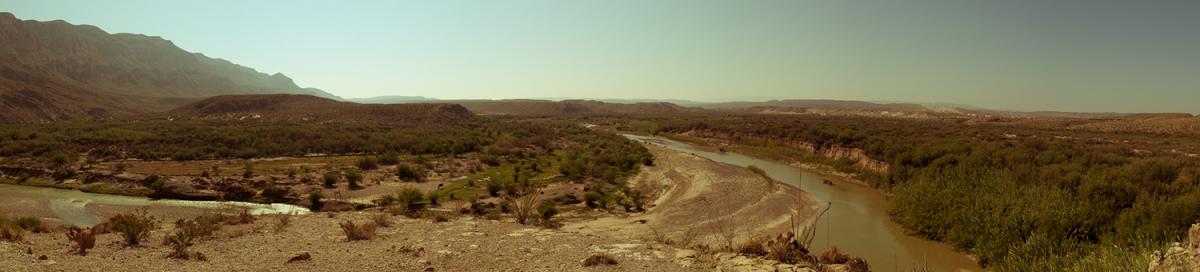
About the Author
C.J. Alvarez is assistant professor in the department of Mexican American and Latina/o Studies at the University of Texas at Austin and an affiliate of the Teresa Lozano Long Institute of Latin American Studies and the Center for Mexican American Studies.
]]>Review
An odd thing has happened on the way to the antebellum American past. Capitalism reigns; cotton is king; and work and workers are no longer studied together. Instead, slaves have become permanent inmates of a carceral landscape: mute and nearly mummified human sacrifices to a commodity-producing global machinery. Damian Alan Pargas does not quibble with the argument that slaveholding white southerners were up to their ears in a market system that drew its strength and vitality from a worldwide demand for cotton.
Cotton and capital functioned as the dual engines that drove much of what made the southern economy unique in the decades between revolution and secession. What concerns Pargas in Slavery and Forced Migration in the Antebellum South is history's waning attention to the enslaved. Less interested in the process of internal migration than in slaves' experiences, Pargas positions slaves at the center of an economy built almost exclusively on a fluid population of bound workers. "Indeed," as Pargas notes, "no studies have attempted to compare the experiences of interstate, local, and urban slave migrants" (4).
Pargas draws on slave narratives, travelers' accounts, planters' records, newspapers, and former slaves' post-emancipation testimonies in an attempt to access and recreate the impacts of market and masterly forces that compelled slaves from place to place. Pargas divides the nation's enslaved population into three major groups—interstate migrants, intrastate migrants, and those who were hired to urban employers. These categories frame his argument and the structure of the book. He begins each chapter with a discussion of those who experienced the most extreme forced relocation (interstate migrants) and ends with those he argues as having experienced the least disruption (urban hires). This makes for a systematic, if somewhat predictable, presentation. Still, as Pargas explains, "the intention is not to place undue weight on one migrant group over another," but instead, "structuring the analysis in this way rather facilitates a comparative perspective" (12). According to Pargas, comparison reveals the variations of slave and migrant worker experiences (12–13).
Hatcher, Chas. F. Slave Depot advertisement, New Orleans, ca. 1861. Advertisement originally published in Gardner's New Orleans Directory for 1861 (Gardner, 1861). Courtesy of Wikimedia Commons. Image in public domain.
The questions motivating Pargas are commendable, and in asking them, the author finds himself in good company. Despite Pargas's claims to new lines of inquiry, historians have long asked how enslaved migrants responded to, managed, and lived under the oppressions of antebellum bondage. In a careful excavation of black and white residents of antebellum Loudoun County, Virginia, Brenda Stevenson explores the impact of an age- and sex-selective internal trade on domestic lives and gendered orders. In an often overlooked essay about Mississippi's cotton frontier, Steven F. Miller illuminates how changing places and populations shifted the dynamics between workers and their owners. Walter Johnson writes brilliantly about the processes of social reassembly that began among forced migrants while they were still attached to a coffle line or penned up in a slave trader's jail. More recently, Calvin Schermerhorn investigates how enslaved Virginians attempted (sometimes successfully) to leverage to their benefit the power of a market in workers that would have otherwise reduced their families to tatters.
Public Sale of Valuable Negroes, Middleburg, Virginia, November 18, 1847. Advertisement commissioned by Geo. Cuthbert Powell and B. P. Noland. Courtesy of Gary Clemens Clerk of the Circuit Court, Historic Records Division, Loudoun County, Virginia, loudoun.gov/DocumentCenter/View/119083.
Good questions do not guarantee good answers, however, and Slavery and Forced Migration in the Antebellum South fails to deliver. Comparing inter- and intra- state migrants with those hired out to urban employers does not yield many new insights. In large part, the book's shortcomings stem from an overreliance on rigid and unyielding categories: in allowing those categories to do much of his critical work, Pargas conflates a rigid typology with the messy realities of enslaved lives. While Pargas attempts to argue that interstate migrants were distinct from intrastate migrants and that both groups were discrete from enslaved women and men whose owners hired them out to urban employers, his evidence proves otherwise. As liquid capital, enslaved Americans changed hands and homes frequently. Neither sale nor hire were one-time deals: interstate transactions did not preclude local sales, and slaves might be hired out one season and sold across state lines the next. Moreover, for many enslaved people, these recurring transactions rendered migration the norm, not the exception. One former slave answered a question about where he had been raised: "everywhere."1Entry of Henry Clay, 22 Aug. 1871, no. 377, Records of the Office of the Comptroller of Currency, National Archives, Record Group 101, microcopy 816: Registers of Signatures of Depositors in Branches of the Freedmen's Savings and Trust Company, 1865–1874, reel 3. This fluidity defies Pargas's efforts to make meaningful comparisons between those caught up in interstate, intrastate, and urban hire trades. As a result, Slavery and Forced Migration is riddled with tension, confusion, qualification, and a host of new questions: How does one distinguish between residents and newcomers if everyone is, has been, or soon will be a newcomer? How does a slave accommodate into a new "community" (as Pargas argues in chapter 6) if that "community" is in a constant state of flux? Can scholars meaningfully compare interstate and intrastate migrants with urban hires?
A Slave-Coffle passing the Capitol, ca. 1815. Illustration by unknown artist. Originally published in Cullen and Howard's Popular History of the United States (Scribner, Armstrong, and Co., 1876–1881). Courtesy of the Library of Congress, loc.gov/pictures/item/98510280/.
Confronted with these dilemmas, Pargas concedes complexity. While thousands of forced migrants were sent to "fully developed cotton plantations," to claim that those plantations contained an "already existing slave labor force" (136) misses the point. As an analytical category in the context of antebellum slavery, "newcomer" meant everything and nothing—something Pargas acknowledges late: "Consideration must be taken for changes over time because most newcomers on the frontier entered into slave societies in which a majority of the 'local' slaves were in fact other migrants who had established themselves over a number of years" (223). This admission leaves readers wondering what Pargas might have gleaned had he approached his subjects and their classifications with less rigidity.
Critiques notwithstanding, Slavery and Forced Migration in the Antebellum South synthesizes an impressive array of primary and secondary scholarship in ways helpful to new and lay audiences. Pargas's bibliography is a marvel. In addition, some of the questions begged by his analysis ought to prompt a new generation of scholars to probe the cultural, social, and political entrapment of millions of Americans in cycles of forced migration and then, in a rush hastened by war, the varied situations of freed people building their lives anew.
About the Author
Susan Eva O'Donovan is associate professor of history at the University of Memphis. Her research interests include the history of enslaved women and men, the Civil War, emancipation, and the Reconstruction as regional, national, and transnational phenomena. O'Donovan is the author of Becoming Free in the Cotton South (Cambridge, MA: Harvard University Press, 2007).
]]>
Atlanta metro region is known by many titles: as the "capital of the New South" thanks to a robust economy and rising population;1Obie Clayton, Cynthia Hewitt, and Gregory Hall, "Atlanta and 'The Dream': Race, Ethnicity, and Recent Demographic and Socioeconomic Trends," Past Trends and Future Prospects of the American City: The Dynamics of Atlanta, ed. David L. Sjoquist (Lanham: Lexington Books, 2009), 219–248. as "the capital city of black America" thanks to its substantial black middle class and its role as a key hub for black commercial activity, political leadership, and cultural production;2Richard Lloyd, "Urbanization and the Southern United States," Annual Review of Sociology 38 (2012): 483–506. and as a place of opportunity, good jobs, and a quality of life attractive to many people whose parents or grandparents left the region and the South decades ago.
The recent history of the Atlanta Metropolitan Statistical Area (MSA)3Officially the Atlanta-Sandy Springs-Roswell, GA Metropolitan Statistical Area, the "metro Atlanta" region includes the following twenty-eight counties: Barrow, Bartow, Butts, Carroll, Cherokee, Clayton, Cobb, Coweta, Dawson, DeKalb, Douglas, Fayette, Forsyth, Fulton, Gwinnett, Haralson, Heard, Henry, Jasper, Lamar, Meriwether, Newton, Paulding, Pickens, Pike, Rockdale, Spalding, and Walton. illustrates the shift of the US population to the South and West,4See Census Regions and Divisons of the United States for the states included in each Census region, http://www2.census.gov/geo/pdfs/maps-data/maps/reference/us_regdiv.pdf. As used throughout this essay, "region" refers to the Atlanta metropolitan region or Atlanta MSA. a trend that has accelerated since 1970.5Between 1970 and 2010, for example, as the Northeast's population grew by 13 percent and the Midwest's by 18 percent, the South's nearly doubled (increasing 82 percent) and the West's more than doubled (increasing 107 percent) (Table 16. Population: 1790 to 1990, retrieved from https://www.census.gov/population/www/censusdata/files/table-16.pdf; Table P1 Total Population from both the Census 2000 Summary File 1 (SF 1) 100-Percent Data and the 2010 Census Summary File 1, retrieved from American FactFinder, http://factfinder.census.gov). It especially shows the effects of what demographers are calling the New Great Migration, the movement of African Americans to the South from northern and midwestern cities.6The "New Great Migration" title stems from the fact that the pattern represents a reversal of what is known as the Great Migration, or the mass movement of African Americans out of the South primarily to northern, midwestern, and California cities, from roughly 1910 to 1970. Participants tend to have higher education and income levels than long-time southern residents, and the influx of these individuals and households into metro Atlanta has swelled the region's black middle class, which is now bigger than metro Chicago's and exceeded only by that of New York City and Washington, DC.
Localized trends complement national data. Nationally, there is the seventy-year shift from cities to suburbs. For whites, suburbanization occurred rapidly from the 1940s through the 1970s. Since the 1970s, the share of whites in suburbia has remained fairly constant (at roughly three-quarters of all whites). Whites are now exurbanizing—moving from higher density, inner-ring suburbs to emerging suburbs further from the urban core. For African Americans, the shift from city to suburb began in earnest in the 1970s (the Fair Housing Act, which outlawed discrimination in housing, became law in 1968). In the Atlanta metro region, by 2010, fully 87 percent of the African American population lived in the suburbs. The metro region now has more suburban African American homeowners than any other MSA in the country.


Despite Atlanta's reputation as a booming city, and although it has attracted hundreds of thousands of new residents—including many highly educated and high-income migrants—the metro region ranks behind nearly all other large MSAs in terms of providing its poorer residents with access to opportunities for upward mobility. And, despite the Atlanta African American population's achieving high levels of suburban residency and homeownership, residential segregation remains stubborn.7 John R. Logan and Brian Stults, The Persistence of Segregation in the Metropolis: New Findings from the 2010 Census (Washington DC: American Communities Project, Russell Sage Foundation, 2011), http://www.s4.brown.edu/us2010/Data/Report/report2.pdf. Census brief prepared for Project US2010.
This essay explores these quandaries using data from the US Census, the American Community Survey, and the Georgia Department of Education. Among the key findings is that, first, even as the metropolitan region's African American population becomes increasingly suburban, residents remain equally (if not more) likely to live in racially segregated neighborhoods. This analysis documents how stubborn residential segregation (partially the result of ongoing white flight from those areas attracting minority residents) has serious implications for black households' ability to build wealth through homeownership. The private real estate market tends to undervalue housing in more diverse neighborhoods, and the Great Recession and housing bust, which were particularly severe in metro Atlanta, have disproportionately harmed the region's minority communities.
Second, even as Atlanta's African American population becomes increasingly suburban, its African American public school students remain isolated in majority-minority schools. By 2013, African American students attending public schools within the Atlanta MSA were more likely to attend majority-minority schools (64 percent did so) than they had been in 2000 (58 percent). This is accompanied by disparities between majority-white and majority-minority schools in terms of both school quality and student achievement, which hampers black children's (particularly low-income black children's) access to upward mobility.8Raj Chetty, Nathaniel Hendren, Patrick Kline, and Emmanuel Saez, "The Equality of Opportunity Project," http://www.equality-of-opportunity.org/; John D. Barge, PK-12 Student Enrollment by Race/Ethnicity and Gender (Georgia Department of Education, Full Time Equivalent Data Collection System, 2000 and 2013). This is evidenced by the region's "especially low" upward mobility among children in low-income families, something "especially noteworthy" given the MSA's strong growth.9 Chetty, Hendren, Kline, and Saez, "The Equality of Opportunity Project."
Atlanta, "Superlative City"?
Population and demographic shifts in metro Atlanta represent broader national trends and offer extreme cases. Atlanta sits within a Census-defined, multi-state grouping ("region")10The Census-defined "South" includes Alabama, Arkansas, Delaware, District of Columbia, Florida, Georgia, Kentucky, Louisiana, Maryland, Mississippi, North Carolina, Oklahoma, South Carolina, Tennessee, Texas, Virginia and West Virginia. that has experienced rapid population growth over the last forty years; the Census South reached 114,555,744 residents in 2010—roughly double its 1970 population.11Table 16. Population: 1790 to 1990, retrieved from www.census.gov/population/www/censusdata/files/table-16.pdf; Table P1 Total Population from both the Census 2000 Summary File 1 (SF 1), 100-Percent Data and the 2010 Census Summary File 1, retrieved from factfinder.census.gov. Georgia, the fifteenth most populous state in 1970, now ranks as the ninth most populous.12"State of Metropolitan America," Brookings Institution, http://www.brookings.edu/about/programs/metro/stateofmetroamerica; US Department of Congress, Economics and Statistics Administration, Bureau of the Census, "1990 Census of Population and Housing Unit Counts" (1993), https://www.census.gov/prod/cen1990/cph2/cph-2-1-1.pdf. The Atlanta MSA has surpassed in size other population centers in the Northeast and Midwest: by 2010, metro Atlanta's population was the nation's ninth largest, exceeding that of metro Boston, metro Detroit, and metro San Francisco—all metro areas that had been larger than Atlanta as recently as 2000.13Frank Hobbs and Nicole Stoops, Census 2000 Special Reports: Demographic Trends of the 20th Century (Washington, DC: US Census Bureau, 2002), https://www.census.gov/prod/2002pubs/censr-4.pdf.
The migration of people to Atlanta from elsewhere within the United States has played a large part in the region's growth during the last decade. Between 2000 and 2010, the metro region's net domestic in-migration figure was 412,832—or roughly equivalent to the total population of the City of Atlanta in 2010 (420,003).14 William H. Frey, Diversity Spreads Out: Metropolitan Shifts in Hispanic, Asian, and Black Populations Since 2000 (Washington, DC: Brookings Institution, 2006), http://www.brookings.edu/research/reports/2006/03/demographics-frey. This wave of domestic migrants is part of what demographers are calling the New Great Migration,15Dan Bilefsky, "For New Life, Blacks in City Head to South," New York Times, June 22, 2011, A1, http://www.nytimes.com/2011/06/22/nyregion/many-black-new-yorkers-are-moving-to-the-south.html; William H. Frey, The New Great Migration: Black Americans' Return to the South, 1965–2000 (Washington, DC: Brookings Institution, 2004), http://www.brookings.edu/research/reports/2004/05/demographics-frey; Elspeth Reeve, "South Now More Integrated, More Racially Diverse," The Wire: News from the Atlantic, March 2011, http://www.thewire.com/national/2011/03/statistical-proof-south-finally-more-integrated/36096/. or the reversal (now several decades underway) of the Great Migration of southern blacks to northern, midwestern, and western cities.16The Great Migration refers to the movement of roughly six million African Americans out of the South between the years of the First World War to the 1970s. See Isabel Wilkerson, The Warmth of Other Suns: The Epic Story of America's Great Migration (New York: Random House, 2010), 8–9. Movers sought to escape the "oppressive racial climate in the South"—the segregation, discriminatory practices, and overt racism that typified the Jim Crow era. In addition to the "promise of freedom" outside the South was the wealth of opportunity in the industrial cities of the Northeast and Midwest. The millions of manufacturing jobs available to unskilled workers in these locations stood in stark contrast to the quickly evaporating pool of agricultural jobs in the rural South, which were disappearing due to the "mechanization of southern agriculture," which entirely recast what had been a very labor-intensive system. See Frey, The New Great Migration, 2; Bilefsky, "For New Life, Blacks in City Head South"; Hope Yen, "In a Reversal, More Blacks Moving Back to South: Culture, Good Jobs, Relatives Spur Return," Washington Times, February 16, 2011, http://www.washingtontimes.com/news/2011/feb/16/in-a-reversal-more-blacks-moving-back-to-south/; Thomas J. Sugrue,The Origins of the Urban Crisis: Race and Inequality in Postwar Detroit, (Princeton, NJ: Princeton University Press, 1996), 7. Since the 1970s, the portion of African Americans living in the Northeast and Midwest has fallen—a trend that has only accelerated since 1990—and the portion of American blacks currently living in the Census-designated South (57 percent) is at its highest level since 1960.17William H. Frey, "The 2010 Census: How Is America Changing?" Urban Land (2011), http://www.frey-demographer.org/briefs/B-2010-3_ULJF11_p34_36.pdf; Hobbs and Stoops, Demographic Trends of the 20th Century; Sabrina Tavernise and Robert Gebeloff, "Many U.S. Blacks Moving to South, Reversing Trend," New York Times, March 25, 2011, A1, http://www.nytimes.com/2011/03/25/us/25south.html; Yen, "In a Reversal, More Blacks Moving Back to South." There are now ten times as many black Southerners who were born in the Northeast than there were in 1970—over one million in all.18Tavernise and Gebeloff, "Many U.S. Blacks Moving to South, Reversing Trend."
The New Great Migration was prompted in part by the conditions that those migrating out of the South encountered in these cities in the 1940s, 1950s, and 1960s. Far from tolerant and open, these cities practiced their own forms of racism and racial segregation, housing newcomers in severely overcrowded and increasingly distressed neighborhoods. As these cities lost manufacturing jobs to deindustrialization, they increasingly fell short of migrants' and residents' expectations.19Sugrue, The Origins of the Urban Crisis; Rebecca Leung, "Going Home To The South," CBS News, June 12, 2003, http://www.cbsnews.com/8301-18560_162-558375.html.
Importantly for Atlanta's story, the New Great Migration represents what African Americans now envision: "Better jobs and quality of life in the South are beckoning, as is the lure of something more intangible—a sense of home."20Yen, "In a Reversal, More Blacks Moving Back to South." Participants in the New Great Migration see "less of a struggle to survive in the South"21Bilefsky, "For New Life, Blacks in City Head to South." and more opportunities for making better lives for themselves and their children.22Ibid; Leung, "Going Home To The South"; Tavernise and Gebeloff, "Many U.S. Blacks Moving to South, Reversing Trend."
Especially for African Americans, the new pull (as opposed to push) of the South and push (as opposed to pull) of the Northeast and Midwest have transformed parts of the South—particularly places in Georgia, Florida, North Carolina, and Texas—into magnets.23Frey, The New Great Migration. In Georgia, for example, the African American population has nearly tripled since 1970 after remaining almost unchanged between 1940 and 1970; the state's black population grew by nearly 601,000 residents between 2000 and 2010.24Chris Kromm, "Black Belt Power: African Americans Come Back South, Change Political Landscape," Race, Poverty & the Environment 18, no. 2 (2011): 17, http://www.southernstudies.org/2011/09/black-power-african-americans-come-back-south-shake-up-southern-politics.html.
Approximately 80 percent of Georgia's African American population growth is highly concentrated in the Atlanta metro region. African Americans from across the United States are drawn by the region's substantial black middle class as well as its diversified and growing economy.25William H. Frey, Diversity Spreads Out: Metropolitan Shifts in Hispanic, Asian, and Black Populations Since 2000 (Washington, DC: Brookings Institution, 2006), http://www.brookings.edu/research/reports/2006/03/demographics-frey. The Atlanta metro actually gained more African American residents since 1990 than any other metropolitan area in the US, and the Atlanta MSA's black population growth accounted for roughly one-fifth of all black population growth occurring in the nation's one-hundred largest metropolitan areas since 2000.26Frey, "The 2010 Census"; Brookings Institution, "State of Metropolitan America." By 2010, African Americans accounted for 32.4 percent of all Atlanta MSA residents, up from 28.7 percent in 2000—the third largest among metropolitan areas nationwide.27Steven G. Wilson, David A. Plane, Paul J. Mackun, Thomas R. Fischetti, and Justyna Goworowska. Patterns of Metropolitan and Micropolitan Population Change: 2000 to 2010 (2010 Census Special Reports), SUS Census Bureau, C2010SR-01 (Washington, DC: US Department of Commerce, Economics and Statistics Administration, and US Census Bureau, 2012), http://www.census.gov/library/publications/2012/dec/c2010sr-01.html.
Long hailed as a "mecca of the black middle class,"28Marshall Ingwerson, "Atlanta Becomes Mecca for Black Middle Class in America," The Christian Science Monitor, May 29, 1987, http://www.csmonitor.com/1987/0529/amecca.html; David L. Sjoquist, "The Atlanta Paradox: Introduction," in The Atlanta Paradox, ed. David L. Sjoquist (New York City: Russell Sage Foundation, 2000), 1–14. Atlanta featured a "wealthy and educated black aristocracy" that grew up around the city's elite black colleges of Morehouse and Spelman. The city's ranking as one of the five best US cities for blacks in business helped support and expand its black business and professional class.29Ingwerson, "Atlanta Becomes Mecca for Black Middle Class in America." Today, the Atlanta MSA has the third-highest total of black households with incomes above $100,000 (behind only New York and DC metro regions and ahead of metro Chicago). By 2011, 83,349 high-income black households lived in metro Atlanta, a 51,085-household increase since just 2000.30American Community Survey, Table B19001B, "Household Income in the Past 12 Months," 2007–2011 American Community Survey 5-Year Estimates, https://www.census.gov/newsroom/releases/archives/news_conferences/20121203_acs5yr.html. The Atlanta region is now second only to the New York City MSA in terms of its number of black homeowners. Between 2000 and 2011, metro Atlanta's black homeowners nearly tripled (from 110,872 to 317,411), surpassing totals for Chicago, Washington, and Philadelphia.31American Community Survey, Table P151B, "Household Income in 1999," Census 2000 Summary File 3 (SF 3).
Metro Atlanta not only houses one of the nation's largest concentrations of the black middle class, but it does so principally in its suburbs. This geographic dispersal from the urban core is not unique to Atlanta: between 1990 and 2010, the percentage of African Americans living in the suburbs of the country's one-hundred largest metropolitan areas jumped from 37 percent to 51 percent. For the first time, more blacks in these metros lived in suburbs than cities.32 William H. Frey, Melting Pot Cities and Suburbs: Racial and Ethnic Change in Metro America in the 2000s (Washington, DC: Brookings Institution, 2011), http://www.brookings.edu/research/papers/2011/05/04-census-ethnicity-frey. The Atlanta MSA, however, was not only ahead of this trend (47 percent of the metro's black residents were living in suburban areas in 1980), but also represents an extreme case (by 2010, Atlanta's suburbs housed fully 87 percent of the metro's African American population).33This analysis relied on the Brookings Institution's labeling of tracts as either urban or suburban, which considers urban census tracts to be those within either the primary city listed in the official MSA name or in other cities listed in the MSA names that have populations of at least 100,000. Suburban census tracts are those whose center point falls within the MSA boundary but outside the MSA's city or cities. In the Atlanta MSA, only tracts within the city of Atlanta are considered urban; all tracts outside of the city in DeKalb and Fulton Counties, as well as all tracts in Barrow, Bartow, Butts, Carroll, Cherokee, Clayton, Cobb, Coweta, Dawson, Douglas, Fayette, Forsyth, Gwinnett, Haralson, Heard, Henry, Jasper, Lamar, Meriwether, Newton, Paulding, Pickens, Pike, Rockdale, Spalding, and Walton Counties, are considered suburban. Between 2000 and 2010, the Atlanta MSA gained more suburban black residents than any other MSA.34John Sullivan, "African Americans Moving South—and to the Suburbs," Race, Poverty & the Environment 18, no. 2 (2011): 16–19, http://reimaginerpe.org/18-2/sullivan. The region's roughly half-a-million new suburban black residents number more than two-and-a-half times that for Washington and more than four times that of Chicago.35Frey, Melting Pot Cities and Suburbs.
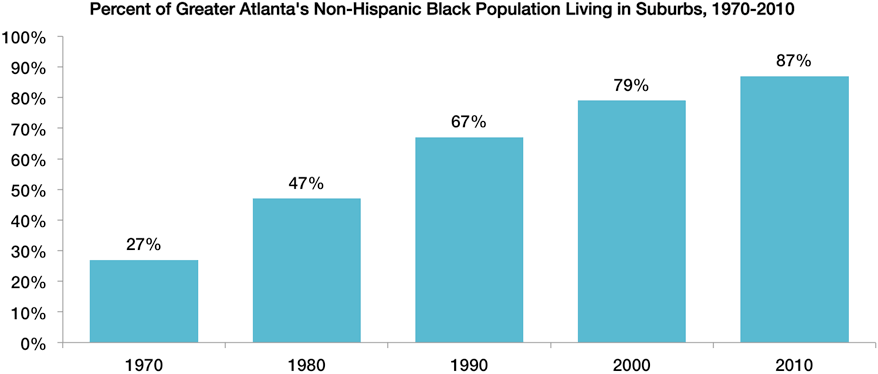
Eleven of the Atlanta region's twenty-eight counties36These eleven include the suburban portions of DeKalb and Fulton counties, which also include sections of the city of Atlanta. accounted for nearly all (98 percent) of the metro area's increase in African American residents between 2000 and 2010; by 2010, these counties housed 79 percent of the metro's black population. For analytical purposes, these counties fall into three groups: 1) "historically black" suburban counties, or those that have long been majority-black (Clayton and DeKalb counties, and southern Fulton County); 2) "nearing majority black" suburban counties, or those in which African Americans now comprise approximately one-fourth to one-half of all residents yet which were all only roughly one-fifth African American as recently as 2000 (Cobb, Douglas, Newton, and Rockdale counties)37 At the time of publication, Cobb was included with other counties listed as "nearing majority black" because it was statistically more like those counties than those classified as "diversifying." However, at 24% black, Cobb County was on the border and could have been included as either "nearing majority black" or "diversifying." and 3) "diversifying" suburban counties, or those that were nearly entirely white in 2000 but that now have a substantial minority of African American residents (Fayette, Gwinnett, Henry, and Paulding County, and northern Fulton County). The remaining suburban counties in the Atlanta region collectively added fewer than forty-thousand African American residents (in contrast to over 200,000 white residents).
Although home to over half of the metro's African American population in 2000, Atlanta's "historically black" suburban core accounted for less than one-fourth of the growth in metro black population between 2000 and 2010. Suburban DeKalb County's non-Hispanic black population, for example, grew by just 6 percent (or by less than 20,000). In a "dramatic reversal of the longstanding pattern," not only did black population growth into historically black suburbs slow, the City of Atlanta's non-Hispanic black population actually declined by more than 30,000 between 2000 and 2010.38Eric Freeman, "The Shifting Geography of Urban Education," Education and Urban Society 42, no. 6 (2010): 674–704.
Far more of the growth in the metro's African American population occurred outside of this core—in historically less diverse suburbs. Nationally, blacks are increasingly moving to places like these: between 2000 and 2010, 2 percent of all black population growth "occurred in counties that have traditionally been black population centers," while 20 percent "occurred in counties where only a tiny fraction of the population had been black."39Tavernise and Gebeloff, "Many U.S. Blacks Moving to South, Reversing Trend." In the Atlanta metro, roughly one-third (30 percent) of all black population gains between 2000 and 2010 occurred in four suburban counties that were all approximately 20 percent African American at the beginning of the decade (the "nearing majority black" suburban counties), and nearly half (45 precent) of all black population gains occurred in five counties that were all less than 15 percent African American in 2000 (the "diversifying" suburban counties).
Cobb, Douglas, Newton, and Rockdale counties comprise the former group, the "nearing majority black" suburban counties. Across these four counties, the number of African American residents nearly doubled between 2000 and 2010 (156,262 to 298,807). In Douglas, Newton, and Rockdale Counties, the African American population tripled during this time period, and in each of these counties non-Hispanic blacks now account for roughly two-in-five residents (up from just one-in-five ten years prior).
| Geography | Non-Hispanic Black Population | % Non-Hispanic Black | Change in Non-Hispanic Black Residents (2000-2010) | % of MSA's Black Population Growth | ||
|---|---|---|---|---|---|---|
| 2000 | 2010 | 2000 | 2010 | |||
| Clayton County | 120,816 | 169,020 | 51% | 65% | 48,204 | 10% |
| DeKalb County (Outside Atlanta) | 340,238 | 360,016 | 54% | 54% | 19,778 | 4% |
| Fulton County (South) | 104,575 | 144,933 | 74% | 80% | 40,358 | 9% |
| Historically Black Subtotal | 565,629 | 673,969 | 56% | 61% | 108,340 | 23% |
| Cobb County | 112,924 | 168,053 | 19% | 24% | 55,129 | 12% |
| Douglas County | 16,978 | 51,387 | 18% | 39% | 34,409 | 7% |
| Newton County | 13,690 | 40,371 | 22% | 40% | 26,681 | 6% |
| Rockdale County | 12,670 | 38,996 | 18% | 46% | 26,326 | 6% |
| Nearing Majority Black Subtotal | 156,262 | 298,807 | 19% | 30% | 142,545 | 30% |
| Fayette County | 10,383 | 21,117 | 11% | 20% | 10,734 | 2% |
| Fulton County (North) | 23,817 | 44,039 | 8% | 13% | 20,222 | 4% |
| Gwinnett County | 76,837 | 184,122 | 13% | 23% | 107,285 | 23% |
| Henry County | 17,435 | 74,056 | 15% | 36% | 56,621 | 12% |
| Paulding County | 5,634 | 23,810 | 7% | 17% | 18,176 | 4% |
| Diversifying Subtotal | 134,106 | 347,144 | 11% | 22% | 213,038 | 45% |
| Combined | 855,997 | 1,319,920 | 68% | 75% | 463,923 | 98% |
| Atlanta | 250,769 | 222,432 | 61% | 53% | -28,337 | -6% |
| Remainder of MSA | 99,720 | 137,627 | 4% | 4% | 37,907 | 8% |
| MSA Total | 1,206,486 | 1,679,979 | 28% | 32% | 473,493 | |
"Diversifying" counties—those with nominal black populations in 2000 but where African Americans accounted for a significantly larger share of all residents by 2010—added nearly as many African Americans (213,038) as "historically black" and "nearing majority black" suburban counties combined (250,885). The numbers of African American residents in "diversifying" Fayette, northern Fulton, and Gwinnett counties each approximately doubled over the course of the decade; the numbers in Henry and Paulding counties more than quintupled.
By 2010 nearly half (47 percent) of metro Atlanta's non-Hispanic black population lived outside of the City of Atlanta and also outside those historically black suburban counties adjacent to the city. "Nearing majority black" counties' share of all non-Hispanic black residents increased from 13 percent to 18 percent. "Diversifying" counties' share jumped from 11 percent to 21 percent—ahead of "nearing majority black" suburban counties and far beyond the current share of the City of Atlanta (13 percent by 2010).
Despite blacks' substantial inroads into suburban areas further from the central city, trends among non-Hispanic white households muted the impact of this suburbanization on region-wide segregation levels. Significant "racial differences in the . . . desirability [of] particular neighborhoods" resulted in considerable differences between the migration patterns of metro Atlanta's black and white households.40Casey J. Dawkins, "Recent Evidence on the Continuing Causes of Black-White Residential Segregation,"Journal of Urban Affairs 26, no. 3 (2004): 379–400. In the Atlanta MSA, nearly all of the counties adding non-Hispanic black households between 2000 and 2010 lost non-Hispanic whites. While the number of non-Hispanic whites increased within the City of Atlanta (which lost over 30,000 non-Hispanic blacks), nearly all of the other counties gaining more than 10,000 non-Hispanic white residents were on the edges of the metro region. Besides "diversifying" Henry and Paulding counties (which added 11,533 and 33,551 non-Hispanic whites between 2000 and 2010) all other counties experiencing substantial increases in non-Hispanic whites were among those suburban counties that gained only nominal numbers of non-Hispanic blacks.41Barrow, Bartow, Carroll, Cherokee, Coweta, Forsyth, and Walton counties collectively gained over 175,000 non-Hispanic white residents between 2000 and 2010; over the same time period, the number of non-Hispanic blacks in these counties rose by less than 35,000.
 |  |
As a result, although metro Atlanta's blacks "are less geographically concentrated, less confined to areas near the urban core, and scattered more widely around the metropolitan area," they remain highly segregated.42Douglas S. Massey and Nancy A. Denton, American Apartheid: Segregation and the Making of the Underclass (Cambridge: Harvard University Press, 1993). The persistence of the Atlanta MSA's high Index of Dissimilarity between whites and blacks illustrates ongoing segregation even amid changes in geographic concentration.43The Index of Dissimilarity, a popular summary statistic for quantifying an area's level of segregation, measures how evenly the populations of two racial or ethnic groups are distributed across a particular geographic area and describes the percentage of group members who would have to move in order for their racial or ethnic group to be evenly distributed (so that each Census tract's racial breakdown would match the MSA's overall racial breakdown). In 1990, metro Atlanta's Index of Dissimilarity for white and black residents was 66.3.44A value of 60 or more is considered high. It declined only slightly over the course of the 1990s—reaching 63.9 in 2000—and again over the next decade, remaining at 58.3 in 2010.45 Logan and Stults, The Persistence of Segregation in the Metropolis.
According to an analysis of Census tract-level data from the last three decennial censuses, over the course of the 1990s, the number of "majority black" and "segregated black" tracts in the Atlanta MSA increased slightly, as did the number of metro blacks living in them.46This study considers Census tracts with at least 20 percent non-Hispanic white residents and at least 20 percent non-Hispanic black residents to be "integrated." See Sheryll Cashin, The Failures Of Integration: How Race and Class are Undermining the American Dream (New York City: Public Affairs, 2004), 42. Census tracts in which more than 85 percent were of one race or ethnicity were classified as "segregated." See Ovetta Wiggins, Carol Morello, and Dan Keating, "Prince George's County: Growing, and Growing More Segregated, Census Shows," Washington Post, October 30, 2011, http://www.washingtonpost.com/local/prince-georges-county-growing-and-growing-more-segregated-census-shows/2011/10/14/gIQAbCc1TM_story.html. If tracts did not qualify "integrated" or "segregated," they were labeled "majority white," "majority black," or "majority Hispanic," if percentages of a particular race or ethnicity exceeded 50 percent. In 2010, 10 tracts had less than 15 percent white but no majority of either blacks or Hispanics (these were classified as "majority black/Hispanic"), and 12 tracts had more 15 percent white but no majority of any race or ethnicity (these were classified as "integrated"). By 2000, fully 50 percent of the region's African American population lived in either majority black or segregated black Census tracts (up from 48 percent in 1990). This held fairly steady between 2000 and 2010: the number of blacks living in segregated black Census tracts increased by 4,511 over the decade; by 2010, nearly half (47 percent) of the Atlanta MSA's African American population still lived in majority-minority or segregated-minority tracts.47"Majority-minority" tracts include "majority black," "majority "Hispanic," and "majority black/Hispanic" tracts; "Segregated-minority" tracts include "segregated black" and "segregated Hispanic" tracts.
The persistence of segregated housing patterns despite the ongoing suburbanization of the metropolitan region's black residents is deeply troubling. It brings serious consequences for black neighborhoods and homeowners. Whites have "much stronger" preferences for living in majority-white neighborhoods.48Dawkins, "Recent Evidence on the Continuing Causes of Black-White Residential Segregation"; Genevieve Siegel-Hawley, "City Lines, County Lines, Color Lines: The Relationship between School and Housing Segregation in Four Southern Metro Areas," Teachers College Record 115, no. 6 (2013): 1–45. http://www.tcrecord.org/Content.asp?ContentID=16988. Non-Hispanic whites are less likely to stay in their neighborhoods as the percentage of African Americans in those places rises, particularly as it reaches roughly one-third of all residents.49Massey and Denton, American Apartheid. As a result, the demand for housing among non-Hispanic whites decreases as neighborhood diversity increases, ultimately creating "racial differences in housing prices" and decreasing property values in diverse neighborhoods.50Dawkins, "Recent Evidence on the Continuing Causes of Black-White Residential Segregation."
David Rusk defines this housing value "drag"—or the difference between where property values would be if race were not a factor in housing choices, and where values are since race is a factor—as the "segregation tax" that minority households, particularly blacks, are forced to bear.51David Rusk, The "Segregation Tax": The Cost of Racial Segregation to Black Homeowners (Washington, DC: Brookings Institution, 2001), http://www.brookings.edu/research/reports/2001/10/metropolitanpolicy-rusk. Rusk finds a "segregation tax" for black homeowners and non-black homeowners living in majority-black neighborhoods in the nation's one-hundred largest MSAs. The "segregation tax" rises as metropolitan segregation levels increase.52Ibid.
Throughout the Atlanta region, the median house value is typically lower in more diverse Census tracts. For example, within the City of Atlanta, the typical median value in "majority white" or "segregated white" Census tracts was roughly three to five times the typical median in "majority black" or "segregated black" tracts; in the suburbs, the typical median value in "majority white" or "segregated white" Census tracts was double that in "majority black" or "segregated black" tracts.
| Tract Integration Level | Median Home Value (2011) | |
|---|---|---|
| City of Atlanta | All Suburban | |
| Segregated White | $648,570 | $250,038 |
| Majority White | $360,740 | $246,491 |
| Integrated | $253,113 | $176,370 |
| Majority Black | $128,311 | $126,195 |
| Segregated Black | $130,818 | $138,242 |
Another way to quantify this housing value drag in the Atlanta MSA is to replicate Rusk's "segregation tax" methodology: to calculate the difference between the median value to median owner income ratios for majority-non-Hispanic white and majority-non-Hispanic black neighborhoods. On average, homeowners in "segregated white" Census tracts in the city get $1.34 more in house value for every dollar of income than homeowners in "segregated black" tracts ($4.17 versus $2.83); homeowners in "segregated white" Census tracts in the suburbs get $0.55 more in house value for every dollar of income than homeowners in "segregated black" tracts ($2.91 versus $2.36).
| Tract Integration Level | Median Value-to-Median | |
|---|---|---|
| City of Atlanta | All Suburban | |
| Segregated White | $4.17 | $2.91 |
| Majority White | $3.30 | $2.75 |
| Integrated | $3.00 | $2.55 |
| Majority Black | $3.37 | $2.30 |
| Segregated Black | $2.83 | $2.36 |
Mapping median values and median value to median owner income ratios for all Census tracts in the metropolitan area further illustrates the disparities between the more diverse inner ring suburbs (particularly those south and west of the city) and the less diverse suburban fringe (particularly the area to the far north and east of the city).
 |  |
"Historically black" southern Fulton County and "diversifying" Cobb and Gwinnett counties are good illustrations of the "segregation tax" at work. While Census tracts throughout all three counties tend to have higher median values (and are shaded yellow and green on the map above), values tend to be lower relative to incomes (resulting in the three counties appearing almost universally orange on the map above), particularly in contrast to less diverse Cherokee, Fayette, and Forsyth counties.
Lower values in diverse neighborhoods can enable more modest-income households to become homeowners and can be used as "an economic development selling point."53Ibid. Conversely, however, deflated values make homes in diverse neighborhoods "poor long-term investments" and reduce owners' ability "to build equity through homeownership" or leverage their home to borrow for other household expenses, like retirement or college tuition.54Ibid.
Residential segregation also has a tendency to concentrate the negative effects of discriminatory lending practices and differential access, based on race, to home purchase and home improvement financing. This became abundantly clear as the Great Recession unfolded and the housing bubble burst. Both were "particularly bad … for the country … and especially so for African Americans," severely, and disproportionately, affecting minority households and neighborhoods.55Algernon Austin, Reversal of Fortune: Economic Gains of 1990s Overturned for African Americans from 2000–07 (Washington, DC: Economic Policy Institute, 2008), http://www.epi.org/publication/bp220/.
This discrepancy stemmed from the fact that, during the housing boom, African Americans nationally were far more likely than whites to rely on subprime (as opposed to prime) mortgage loans.56Ibid; Rakesh Kochhar, Ana Gonzalez-Barrera, and Daniel Dockterman, Through Boom and Bust: Minorities, Immigrants and Homeownership (Washington, DC: Pew Hispanic Center, 2009), http://www.pewhispanic.org/files/reports/109.pdf. In 2006 and 2007, during the height of the boom, black borrowers were three times as likely as white borrowers to take out higher priced57Higher-priced loans are defined as those with annual percentage rates that exceed the rate of US Treasury securities of comparable maturity by 3 percentage points. The chart reflects trends among conventional, first-lien loans borrowed for the purchase of 1- to 4-family properties for owner occupancy. subprime loans (33.5 percent for blacks versus 10.5 percent for whites in 2006, 52.8 percent for blacks versus 17.5 percent for whites in 2007).58Austin, Reversal of Fortune; Kochhar, Gonzalez-Barrera, and Dockterman, Through Boom and Bust. This "racial gap in subprime lending" held across income levels, even increasing among higher-income households.59Jacob S. Rugh and Douglas S. Massey, "Racial Segregation and the American Foreclosure Crisis." American Sociological Review 75, no. 5 (2010): 629–651.
Nationally, too, borrowers with subprime loans were far more likely than borrowers with prime loans to face foreclosure; between 2005 and 2009, the foreclosure rate on subprime loans skyrocketed from 3.3 percent to 15.6 percent.60Ibid. The result: black borrowers were nearly twice as likely as white borrowers to experience foreclosure (7.9 percent versus 4.5 percent of non-Hispanic whites).61Debbie Gruenstein Bocian, Wei Li, and Keith S. Ernst, Foreclosures by Race and Ethnicity: The Demographics of a Crisis (Durham, NC: Center for Responsible Lending, 2010), http://www.responsiblelending.org/research-publication/foreclosures-race-and-ethnicity. Foreclosures hit black households so hard that the overall homeownership rate among African Americans fell from 49.4 percent in 2004 to 47.5 percent in 2008, a drop steeper than that among white households and one that wiped out four years of black homeownership gains.62Kochhar, Gonzalez-Barrera, and Dockterman, Through Boom and Bust.
Residential segregation concentrates the risks associated with subprime loans (and other predatory practices more likely encountered in minority households, such as loan flipping and equity stripping schemes) in minority neighborhoods.63Jacob S. Rugh and Douglas S. Massey, "Racial Segregation and the American Foreclosure Crisis," American Sociological Review 75, no. 5 (2010): 629–651. A study by the Department of Housing and Urban Development in the late 1990s found that high-cost subprime lending was far more common in predominantly black neighborhoods than predominantly white ones. In metro Atlanta at that time, nearly all of the Census tracts in which subprime loans accounted for at least 25 percent of refinance mortgages were at least 30 percent black.64US Department of Housing and Urban Development, Unequal Burden: Income & Racial Disparities in Subprime Lending in America, (Washington, DC: US Department of Housing and Urban Development, 2000), http://www.huduser.org/portal/publications/fairhsg/unequal.html. These disparities also existed during the housing boom of the 2000s. According to Neighborhood Stabilization Program Data reflecting high cost loans from 2004 to 2006, Atlanta MSA Census tracts with larger minority populations had larger percentages of high-cost loans than predominantly white ones—and this held for both city tracts and suburban tracts, even after controlling for owner incomes.
As the housing boom became the housing bust, the prevalence of these subprime loans made metro Atlanta one of the "distinct epicenters" of the foreclosure crisis.65Kochhar, Gonzalez-Barrera, and Dockterman, Through Boom and Bust. Of the 3,141 counties nationwide, just 270 (or 9 percent of all counties) had foreclosure rates of 1.8 percent or higher in 2008. Twenty-three of these high-foreclosure counties were in Georgia; the vast majority of these (19 of the 23) were in the Atlanta MSA.66Ibid.
These nineteen Atlanta MSA counties included all of the metro's historically black counties and also all of the "nearing majority black" and "diversifying" suburban counties. Henry County—a "diversifying" suburban county—was among just thirty-three counties in the United States to have a foreclosure rate of more than 5 percent in 2008.67Ibid.
Below the county level, Neighborhood Stabilization Program Data shows that foreclosure rates during the height of the crisis (2007 and 2008) were far higher in diverse Census tracts than predominantly white tracts, even after controlling for owner incomes.
The "economic fallout [of the housing bust] was unevenly spread over the urban landscape," and not just minority households but minority neighborhoods "bore the brunt of the foreclosures."68Rugh and Massey, "Racial Segregation and the American Foreclosure Crisis." Property values declined, hurting local homeowners whether they had been subprime borrowers or not and exacerbating disparities in values between predominantly white and predominantly minority areas.69Austin, Reversal of Fortune. This, in turn, has had serious consequences for neighborhood conditions and quality of life, on the caliber of local amenities and public services, especially public schools.
Segregation and Schools
Beyond adversely affecting the health and stability of neighborhood housing markets, residential segregation has had a profound effect on students' experiences in public schools. Just as the Atlanta region's increasing suburbanization of minority group members has not translated into the greater integration of its neighborhoods, so too has it not translated into the greater integration of its schools.70Richard Fry, The Rapid Growth and Changing Complexion of Suburban Public Schools (Washington, DC: Pew Hispanic Center, 2009), http://www.pewhispanic.org/files/reports/105.pdf. The metro region's in-school trends mirror trends found nationally: suburban areas with increasing shares of minority students have "experienced, on average, increasing segregation levels between white and minority students" (emphasis added).71Sean F. Reardon, John T. Yun, and Tamela McNulty Eitle, "The Changing Structure of School Segregation: Measurement and Evidence of Multiracial Metropolitan-Area School Segregation, 1989–1995," Demography 37, no. 3 (2000): 351–364. As suburban school districts become more diverse, many experience "white flight," prompted by "the 'push' of interracial contact and the 'pull' of nearby whiter school districts."72Charles T. Clotfelter, Are Whites Still "Fleeing"? Racial Patterns and Enrollment Shifts in Urban Public Schools, 1987–1996, Working Paper 7290 (Cambridge: National Bureau of Economic Research, 1999), http://www.nber.org/papers/w7290; Freeman, "The Shifting Geography of Urban Education." This concentrates minority households and students in particular neighborhoods and school districts or schools.73Reardon, Yun, and Eitle, "The Changing Structure of School Segregation."
In metro Atlanta, white enrollment decreased between 2000 and 2013 in school districts in "nearing majority black" and "diversifying" suburban counties—those counties where black enrollment numbers grew substantially.
A particularly dramatic transformation occurred in six suburban districts in the Atlanta MSA, all of which went from roughly one-third minority in 2000 to two-thirds minority by 2013.
Even as the percentage of African American students attending suburban schools increased from 80 percent in 2000 to 89 percent by 2013, the portion attending majority-minority74Majority-minority here refers to any school in which at least half of all students are not non-Hispanic white. For consistency sake, "integrated" schools are identified using the same criteria as those used to identify "integrated" Census tracts earlier in this essay. schools increased more than twice as fast, from 49 percent to 61 percent. In "diversifying" suburban counties, while the portion of black students attending "integrated" schools did increase slightly (from 46 percent to 50 percent), the percentage in majority white schools plummeted (from 51 percent to just 12 percent) and the percentage in majority-minority schools skyrocketed (from 3 percent to 37 percent).
| School District | County Type | % Minority | % Black | ||
|---|---|---|---|---|---|
| 2000 | 2013 | 2000 | 2013 | ||
| Cobb County | Nearing Majority Black | 33% | 57% | 22% | 31% |
| Douglas County | Nearing Majority Black | 26% | 68% | 21% | 50% |
| Gwinnett County | Diversifying | 33% | 71% | 15% | 31% |
| Henry County | Diversifying | 22% | 62% | 17% | 47% |
| Newton County | Nearing Majority Black | 34% | 63% | 30% | 52% |
| Rockdale County | Nearing Majority Black | 29% | 79% | 22% | 61% |
In "nearing majority black" suburban counties, just 12 percent of black students attended a majority-minority school in 2000; by 2013, over half (52 percent) did so. Over the decade, the portion of students in "integrated" schools in these counties also declined substantially: from 69 percent in 2000 to just 48 percent by 2013.
At the same time, districts in historically black areas of the metro region (especially the City of Atlanta, DeKalb County, and Fulton County) remained highly segregated. In the 2006–2007 school year, DeKalb had the third-highest dissimilarity index among the nation's 449 suburban school districts with at least a thousand black students; Fulton County had the fifth-highest. That year, 70 percent of Fulton County's African American students and 74 percent of DeKalb County's African American students would have had to switch schools in order for all schools in those districts to reflect the racial make-up of each district as a whole.75Fry, The Rapid Growth and Changing Complexion of Suburban Public Schools.
Both of these trends—more African American students attending majority-minority schools and increasing segregation within districts—are worrisome. While research on achievement gaps has highlighted a range of factors that may contribute to disparities between white and black students' proficiency (factors including students' socioeconomic status, school quality, and teacher experience), segregated schools have "a negative influence on academic achievement and/or [contribute] to black/white achievement gaps."76Dennis J. Condron, Daniel Tope, Christina R. Steidl, and Kendralin J. Freeman, "Racial Segregation and the Black/White Achievement Gap, 1992 to 2009," Sociological Quarterly 54 (2013): 130–157; David Card and Jesse Rothstein, "Racial Segregation and the Black–White Test Score Gap," Journal of Public Economics 91, no. 11 (2007): 2158–2184; Christy Lleras, "Race, Racial Concentration, and the Dynamics of Educational Inequality Across Urban and Suburban Schools," American Educational Research Journal 45, no. 4 (2008): 886–912; Sean F. Reardon, Joseph P. Robinson-Cimpian, and Ericka S. Weathers, "Patterns and Trends in Racial/Ethnic and Socioeconomic Academic Achievement Gaps," Handbook of Research in Education Finance and Policy (2008): 497–516; Jacob Vigdor and Jens Ludwig, "Segregation and the Black–White Test Score Gap," Working Paper 12988 (Cambridge, MA, National Bureau of Economic Research, 2007), http://www.nber.org/papers/w12988; Siegel-Hawley, "City Lines, County Lines, Color Lines."
Segregation in neighborhoods and schools intensifies "group stratification by creating resource-rich educational environments for white students and resource-poor educational environments for black students."77Condron, Tope, Steidl, and Freeman, "Racial Segregation and the Black/White Achievement Gap." Black students are more likely to have teachers with fewer years of teaching experience and attend schools with higher student turnover rates and higher poverty rates.78Eric A. Hanushek and Steven G. Rivkin, School Quality and the Black–White Achievement Gap, Working Paper 12651 (Cambridge: National Bureau of Economic Research, 2006), http://www.nber.org/papers/w12651.pdf; Richard J. Murnane, John B. Willett, Kristen L. Bub, Kathleen McCartney, "Understanding Trends in the Black-White Achievement Gaps During the First Years of School," Brookings-Wharton Papers on Urban Affairs (2006): 97–135. Resource-poor schools, where minority students and lower income students are concentrated, are less able to help students achieve and succeed.79Raj Chetty, Nathaniel Hendren, Patrick Kline, and Emmanuel Saez, "The Equality of Opportunity Project," http://www.equality-of-opportunity.org/; Hanushek and Rivkin, School Quality and the Black–White Achievement Gap.
Resource disparities between different neighborhoods and public schools are especially apparent in Atlanta, considered "one of America's most affluent metropolitan areas yet also one of the most physically divided by income" and race.80David Leonhardt, "Geography Seen as Barrier To Climbing Class Ladder," New York Times, July 22, 2013, A1, http://www.nytimes.com/images/2013/07/22/nytfrontpage/scan.pdf. Metro Atlanta is proving to be particularly inhospitable to lower-income households' upward mobility. Among the nation's fifty-five largest commuting zones (similar to metropolitan areas), Atlanta ranked fifty-second in terms of the odds that its children born into low-income families between 1980 and 1982 would reach the top income quintile as adults; these children's odds stood at just 4 percent in Atlanta.81Raj Chetty, Nathaniel Hendren, Patrick Kline, and Emmanuel Saez, Online Data Tables, "The Equality of Opportunity Project," http://www.equality-of-opportunity.org/data/. Within the MSA, low-income children's chances of reaching higher incomes as adults were worse in more diverse counties than in predominantly white ones.82Ibid.
Conclusion
The Atlanta region provides an important and instructive study of recent national trends. The migration of black Americans back to regions of the South, the suburbanization of blacks and the exurbanizing of whites, the persistent residential segregation, and the increasing segregation in schools, have all played out with particular force in Atlanta. Metro Atlanta's segregated neighborhoods and schools, which now extend well into suburbia, are not only underserving the current generation of minority homeowners and students, but stand to undercut the life chances of future generations of minority residents as well. As it booms and continues to sprawl, metro Atlanta shows how segregation puts limits on minority homeowners' ability to build wealth, minority students' ability to excel in school, and low-income families' ability to achieve upward mobility.83Condron, Tope, Steidl, and Freeman, "Racial Segregation and the Black/White Achievement Gap."
About the Author
Karen Beck Pooley is a senior associate at czb LLC, a neighborhood planning firm, and teaches in the Department of Political Science and the South Side Initiative at Lehigh University in Bethlehem, Pennsylvania. Pooley received a PhD from the University of Pennsylvania's Department of City and Regional Planning in 2007. Her research focuses on neighborhood revitalization strategies, techniques for measuring housing market conditions, and the evolution of federal, state, and local housing policy.
]]>Presentation
Part 2: Nunn discusses how Rodgers’ music was appropriated and recontextualized in South Africa and Kenya in the 1930’s and 1940’s
Part 3: Erich Nunn, Selected questions and answers
About the Author
Erich Nunn is Assistant Professor of English at Auburn University, where he teaches American Studies, with an emphasis on the literature and culture of the US South. He is spending the 2012–2013 academic year as a postdoctoral fellow at The Bill and Carol Fox Center for Humanistic Inquiry at Emory University. This presentation is drawn from his book project, Sounding the Color Line: Music and Race in the Southern Imagination.
]]>