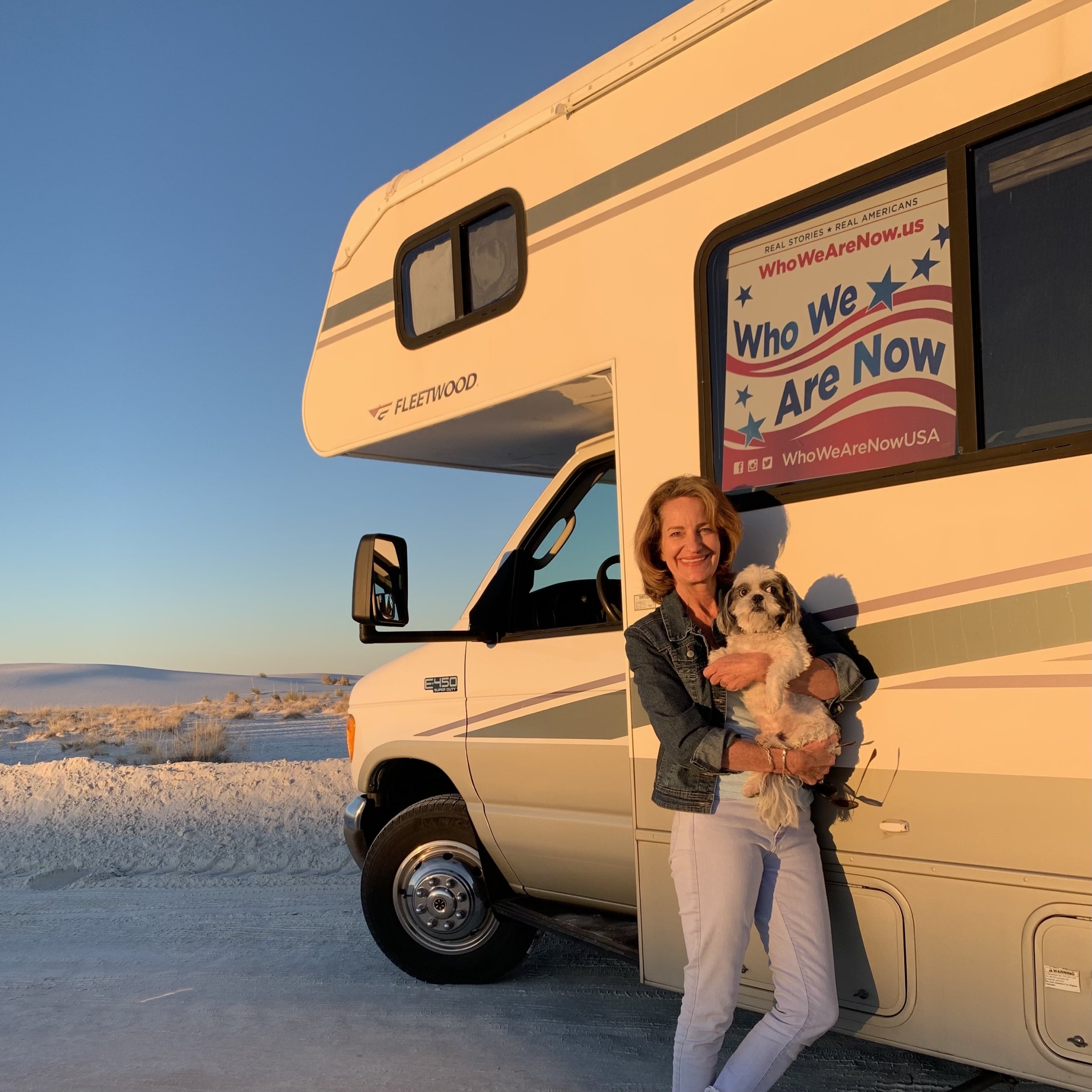
Southern Spaces: Oh, here's Michelle now. Are you in your RV?
Michelle Fishburne: Yes, I am. As a matter of fact, I'm in the RV at Jordan Lake State Park near Chapel Hill. It's about ten minutes from where I raised the kids. I have a twenty-three-year-old who has struggled with long COVID, but has just graduated from UNC. And then we'll go up to Princeton, New Jersey, where I grew up. I'll be housesitting for two weeks.
Q: We've been intrigued by your book, Who We Are Now. It's an important project. The interviews hit powerfully with regard to the loss and heartbreak from COVID. Sometimes now, in the wake of the pandemic, it's possible to think it wasn't really that bad. Life goes on. But going back to the beginnings and to the following many months as you do, the power of this pandemic can't be avoided.
Let's start with what were you doing when it became evident COVID had arrived and was not going away. What were the early months of COVID in 2020 like for you? When was it evident that COVID was not going to be a two week, stay-home-and-then-go-back-to-life-as-normal situation? And how did you develop the project that ultimately became the book?
Fishburne: I think that moment when I realized this was going to last more than two weeks takes me into early April. In January, I had just gotten back from a wonderful vacation in Grand Cayman and I had told everybody all over holiday break how much I was enjoying my job and that I could just pinch myself. It was just a great job. I was a public relations partnership person for Inmates to Entrepreneurs, some people who really, really needed it. I was working on an event at the US Senate and the House of Representatives. We were talking to John Legend, who was working on something similar, about going into a prison with him.
And then on January 17, an unknown virus attacked my eighth cranial nerve and I lost my hearing in my right ear and my vestibular functioning. I began using a walker and learning to adjust to life without hearing in one ear. In February, I bought a prom dress for my senior in high school. She was very excited about the prom and we were waiting to hear back from colleges.
Then my boss, when he saw COVID coming, he was having some struggles. His doctor said to him, "You know, you can't go anywhere." And so he said to me, "I'm going to have to lay you off because I can't go do any of these things that you are preparing." So I was laid off and I thought, "No big deal. I have a law degree from UVA. I have had an illustrious career. I've done wonderful things. I'll find a job." I wasn't panicked. But I submitted eighty-six customized cover letters between the middle of March and the middle of July, and I had nothing.
The lease on the post-divorce house was coming up on July 31. I knew that on August 1 I would have no house, no spouse, no job, and no kids to take care of. And the big critical moment happened in a Target parking lot on June 15, when I had to decide where to have the movers put my stuff. I thought, "What doesn't make any sense for me is to rent a place because I have no idea where I'm gonna have to go to get a job. I've got the motorhome that I homeschooled my kids in for ten months once. All right, I can move into the motorhome." So I put everything in storage.
And then I thought, "Oh, what will I do? Well, I love the Outer Banks. Take the motorhome to the Outer Banks." But then I thought, "Michelle, you can be in hell while you're in paradise. And if you're waking up every day thinking what's your next job, you're kidding yourself. You need a project."
I could drive out to Yellowstone from North Carolina because I've done it before. Yeah, and then I will cry the entire time I go to national parks because I won't be with my little ones anymore and I'll be all by myself.
Then out of the blue came the idea of Humans of New York. And I thought, "Oh, Brandon Stanton interviewed thousands of people in New York, took their photo, got a little snippet of their story, put it on social media." I could do the same thing. I could do Americans of the pandemic. Who We Are Now—that was the name right from the beginning.
I know that when you focus on other people, it's easier not to be afraid. I also know now from somebody I met during the interviews that action is the antidote to fear.
Getting in the motorhome and doing a fast run helped with my fear. And focusing on other people helped with a different kind of fear. But I was also very naive. What made me think I could go out in the middle of the pandemic and find strangers to talk with?
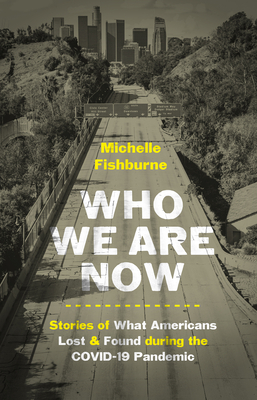
Q: Your project started off the way interviews work. One person leads to another. But you say that your fear did not seem to have been pandemic related. We're wondering, weren't you concerned about catching the virus?
Fishburne: I wasn't. Once again, naivete really helped. I thought, "I'll just wear my mask and I'll be smart. I mean, I could be smart in Chapel Hill. Why can't I be smart in Saint Louis or New Mexico?" But what I found when I got out into parts of the country that were sparsely populated, I started to reconsider what critical thinking meant.
I did take some risks. I'd think, "Okay, this building is big enough and it's just me and this person. They're way over there and I'm way over here." Because if somebody is going to tell you a story, and they've just met you, and it's about their lives, especially since I only ask one question, what I really needed was for somebody to keep going and going, going and going, right in my face. Inviting them to continue and showing interest. The mouth is really important to that. As much as I tried to use just part of my face and some body language, there were times when I needed to take off the mask.
Q: That makes perfect sense. So you talk about how this book got started, but then you traveled a long road. How did you have the momentum to sustain the project?
Fishburne: It became something unto itself. I'm just a project person and I got in the groove. What sustained me was how surprised I was every single time I got to listen to somebody else. I mean, there were genuine moments of surprise in every single interview. For example, when I talked with Anne, who's the wedding planner in LA, I had in my mind all these questions I was going to ask her because I was interested in how weddings had changed. But when I asked her the one question, she went off in a completely different direction that surprised me.
I think the excitement of knowing I was going to hear somebody else's story is what sustained me.
Q: Who was most helpful in encouraging and supporting you?
Fishburne: My mother, who is now eighty-five, was my sounding board and supporter. She also is an editor. I would send her transcripts of the interviews. I would think, "Well, this person's got different parts of their story in different places in this transcript." So I would move it around then send it back to the person and ask, "Is this what you said?" Or they'd say, "Yes, that's pretty much what I said. Or, "I said 'like' too many times. Can you take that out?"
My mom has a PhD in sociology from NYU. I grew up knowing about qualitative and quantitative research. Knowing how you ask the question is so important. We talked about the question a lot. And I needed to have a grid, a mosaic, to do a representation of the US as best I could. We talked about that, too.
Q: How did you organize your project? And, to get a sense of the scale and the scope of all the interviews you did, how much is included? How much is left out? How did you edit?
Fishburne: I was conscious of what was going on geographically. Age, race, gender, class, they're all in the mosaic. Urban, suburban and rural. Religion of different kinds. There's New York City and there's Jackson, Mississippi. I used a reverse order of population of the top fifty cities to make sure that I got different types of urban places in different parts of the country.
One area I leaned into heavily was the performing arts because they rely on a live audience. And other vocations that really had a hard time. I overloaded those a bit because they were compelling.
I interviewed about three hundred people, but only a hundred are in the book. There are more on the website and there are more that never made their way into a story. One of the peer reviewers called the book "elegiac," not a word I had anticipated. He had seen the book without any photos. Originally the contract was for forty photos, but one hundred people. And I thought, "I don't know how I'm going to choose which forty people." This was December 2021. My editor at UNC, Lucas Church, said, "Maybe we shouldn't have photos in the book. Then it would be elegiac." So the book went without the photos; the way it's set up, it kind of tumbles.
In order to get that tumble feel, some of the stories had to be very short. For example, I spent two hours with Luke and Rodney and only used Luke's story about how he got more grief for wearing a mask than holding the hand of his partner. Lucas said the stories need to be between 250 words and about 1,200. The average interview was probably thirty-five or forty minutes. If the average story length is six-hundred words, which takes about three to five minutes to say out loud, the book has about five hundred minutes of material. And I recorded three-hundred times thirty minutes. A lot was left out.
When Who We Are Now was published—I'm just going to say the truth—it did not do very well. We think what happened is that it arrived during COVID exhaustion. Yeah. More recently, the couple of book clubs that have used it have really delighted in it because it helped them reframe what the pandemic was. I know that however-many-years hence everything that I gathered is going to have more value than it has today. I think in seven years, when I'm sixty-seven, I'm going to be a very popular lady at the ten-year anniversary.
Q: As a historical read as compared with a contemporary read, I think you may not have to wait that long.
Fishburne: Sometimes when I pick it up and I read it—like I just opened up to Tina, the grief counselor—it washes over me. It all just comes back and you think, "Oh, yes, we had to go through that. How do you grieve when you can't have the formal process?"
And then when I was re-reading Tina's story, Melissa's story in Corinth, Mississippi came flooding back. Her mom had died during COVID. And Melissa said to me, "I've always thought it odd when a family member passes and you go back to the home and you have the whole spread of food that people bring. I never understood the importance of it until now. Because now when I walk down the street, it can be a beautiful day, months and months after my mom has passed and I'm having a good day and somebody who hasn't seen me since my mom passed will say, 'Melissa, I am so sorry about your mom.' I didn't get the kind of closure you get with everyone there eating food, drinking, talking."
And in a way that's how it was with COVID itself. It came, peaked, and petered out, but we never had the "end," even though the federal emergency was over. But it's not the end. Especially for people with long COVID.
Q: You mention that Who We Are Now came out around the time of COVID fatigue. But how did these oral histories affect you? Did you compartmentalize them as research?
Fishburne: I didn't see the project as research. It was just my life. Even now, when people talk about the pandemic, most people talk about it in ways that are very foreign to me. And the way I talk about it is very foreign to most people. Before I got in the motorhome and drove around the country, I thought I knew the pandemic experience, but that was based on my own lived experience. When I left here in September 2020, I expected to find desolation, depression, and division. I expected it to be very, very negative. What really surprised me was the human tenacity. The pluck. And that's the word that I use now a lot, pluck, which is spirited and determined.
In doing the interviews, I settled on asking only one question: What was your 2020 supposed to be like and what did it end up being? And people could talk about what they wanted to. They talked about what really mattered to them, what really defined this period of time, and what made it very difficult, or challenging, or surprising.
People who were out in areas that are sparsely populated would say, "Oh, I just went on the same way." But I know having been there, that every person was changed during the pandemic. More than normally every person genuinely thought about other people and what they were going through. And then there were people who were not given anywhere near the support they needed.
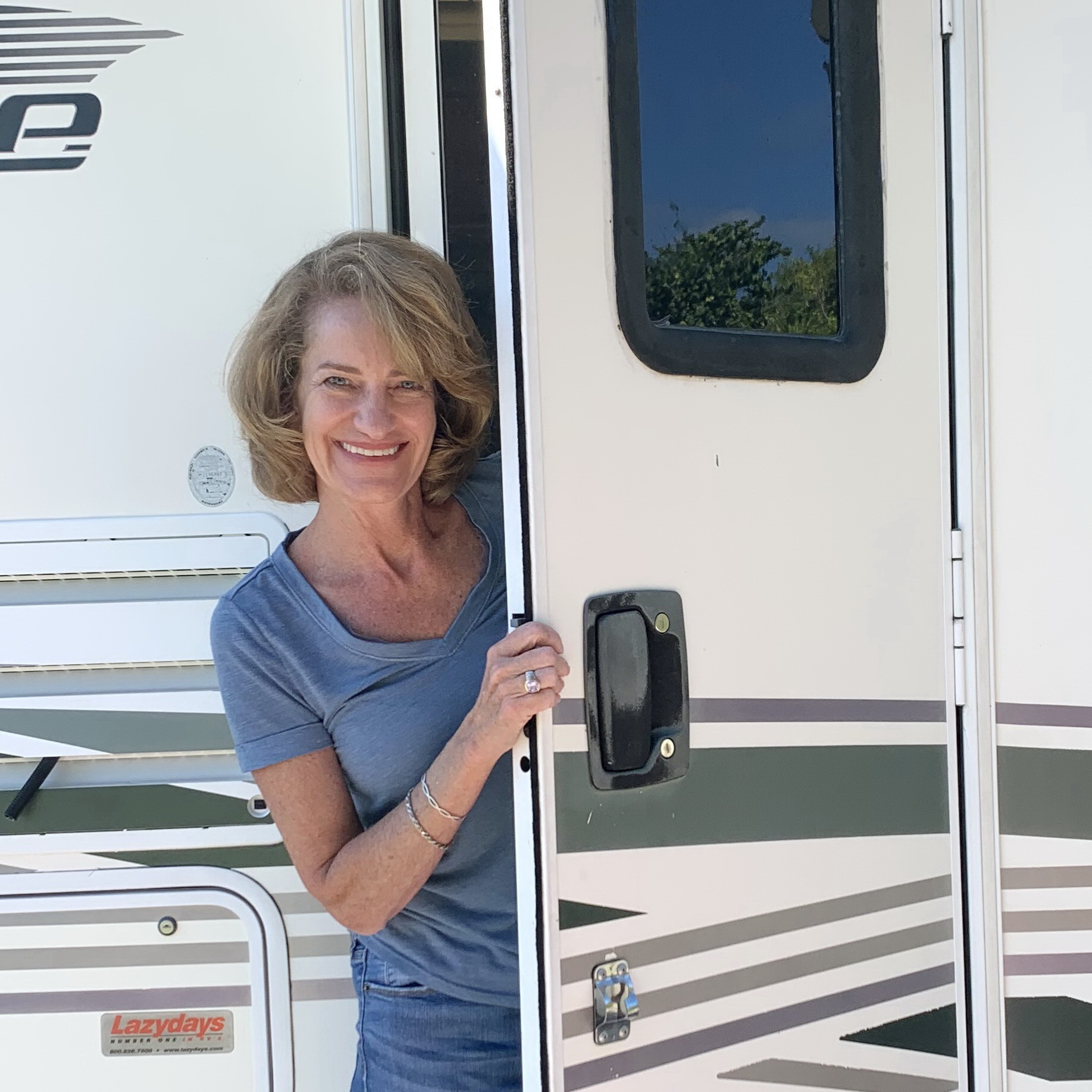

Q: And what do you say now, with a bit of distance, in terms of the perspective that you have?
Fishburne: My mom keeps telling me that I'm a sociologist and I keep pushing back and saying, no, I'm a collector of stories because a sociologist goes back and looks writ large. And I don't feel qualified to do that. I centered the project on individuals and offered up each story.
Many people had very difficult experiences of having to go in and try to do their jobs under incredibly hard circumstances. Often, they didn't have the equipment, didn't have the guidance, didn't have the support. They were watching people die or people turned people away. They couldn't do the jobs that they had trained to do. Then people would come in and reject what they were trying to do or tell them they were wrong. That was head spinning. Or to walk into a store and nobody would have masks on because it was a state where you didn't need to have a mask. It was like a horror movie. They'd think, "Which one of you am I going to see next week?" A lot of the people that I talked with in the healthcare field felt like they went through a trauma.
I thought about various groups of people who were struggling. For instance, I talked with Emma, a director of a migrant farmworker nonprofit. She told me about how really nobody cared to protect migrant farmworkers and about one man who died alone in a motel room. That never should happen. In Birmingham, I interviewed Anne, who was running a homeless shelter. She said it got to a moment when she had to ask whether people were safer inside the building or outside.
I had just started eastward in Texas when Governor Abbott announced that you didn't need to wear a mask anymore. I'm like, "What the heck, Texas is a long state to have to go through no matter which way you do it, right up or down or sideways." I was going west to east and had to be in the state for four more days. It became very uncomfortable. I am a political animal so it was really hard for me to not lean into that. But I became so fascinated with each individual. And I thought, "We are all in this together."
But let's take Fox News, on cable all over America right now. And I was really angry at a big part of the country. I'm like, how can you think that way? How can you think that way? It's Fox News. People have had it in their homes for so long. Fox was pitting us against each other, making people angrier and angrier. Some really ugly parts of us came out. But when you actually get in and talk to people, that's not who they want to be. That's not what they want to be thinking about it.
The false narrative that COVID was not as serious as it indeed was really impacted our healthcare workers and public health officials. I interviewed people who had significant responsibilities, including top public health officials in major metropolitan areas, and they stepped away or are in therapy. And some decided not to deal with it affirmatively. One doctor I spoke with recently said, "I can't talk about it." She started the dialogue and then she said, "I can't. I've just put this away in a compartment. I just can't touch it. I just can't do it." But then, there was a nurse who cried at the end of the interview and said, "Oh my gosh, I just really needed to talk about that."
I saw and heard America in these different ways. People trying to get through. It was such an odd time. The challenges we faced were very unusual.
Luke, South Carolina
Mask Wearer—November 2020
We have felt more discriminated against for wearing masks than being gay. And that's crazy. In the United States of America, we are getting more nasty comments said to us in a grocery store, on the street, for the fact that we have a mask on than the fact that we're holding hands as two men. That's just hilariously tragic. Like, that's where we're at? You're really going to be angry that I have a mask on? So no shame or foul to people who don't want to wear a mask—just don't call me a sheep because I have a mask. That literally happened to me at the gas pump this week.
Valerie, North Carolina
State Senator—December 2020
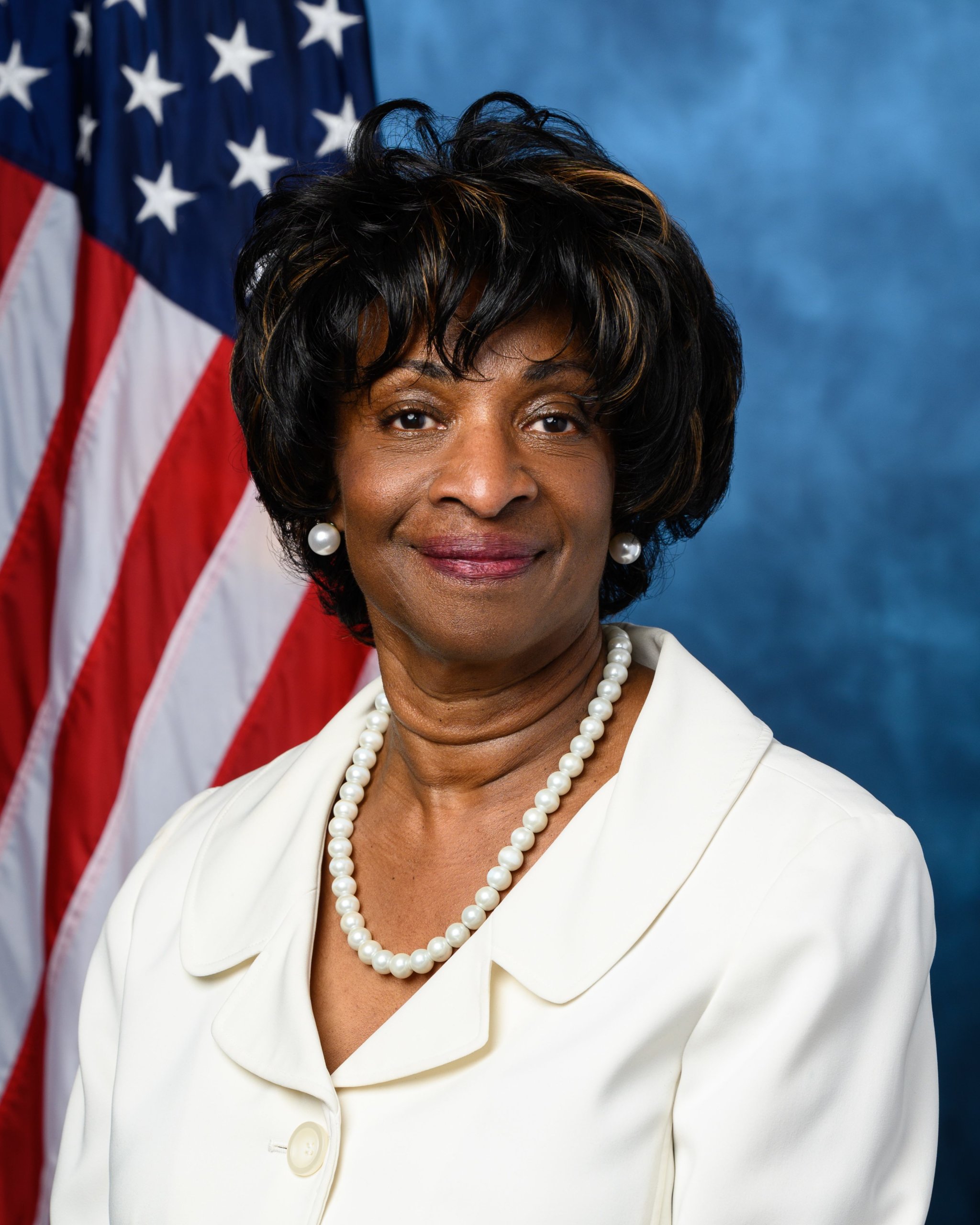
On March 3, I was attending a conference in Charlotte, and I got a text message from Health and Human Services. It was, to put it mildly, surprising to get a text from DHHS out of the blue. They were alerting me that the first confirmed cases of coronavirus in the state of North Carolina were in my district. Two residents of Chatham County who had traveled to Italy had contracted the disease. I knew enough to know that this was huge and that we were on our way into something that was not going to be good. I left Charlotte that day rather than staying over the next night because I knew that if there were two cases, there certainly were more.
When I look back at 2020, coming from that point of entry into where we are now, with massive unemployment because of shutdowns, and then the blowback, the pushback, it has been very, very difficult. We knew the shutdowns were not the best thing for the economy, but having this juxtaposition of the economy versus overall healthy communities was hard. The governor was in a tough position.
And in the midst of all of that, we were waiting on the federal government to bring in aid. When people started to lose their jobs and people's rents and mortgages and car payments went into jeopardy, there was no help. And the state system was not equipped to handle the massive number of unemployment insurance claims. Before COVID, we usually had about 800 or so claims a week. Then all of a sudden, we went from 800 to 1,800 to 300,000.
Our constituents were coming to us saying, "I followed everything you told me, Senator. I filed my unemployment claim and I've waited for three weeks now. When I call, nobody answers the phone. When I go online, I get knocked off. When I do stay online, I keep getting the same thing saying I'm not eligible. I know I'm eligible. I can't pay my rent and my family is going to be out on the street. Can you help me?"
How many of those folks do you think I could help? Very few. And then the small businesses were calling and saying, "Senator, we're not eligible for PPP [Paycheck Protection Program]." Or "Senator, you can only apply through certain banks or lending institutions. I've never done this before. I need technical assistance in applying." Or "Senator, I don't have an established relationship with this bank, so they will not even talk to me. So where's our help?" That's so painful.
And then I got the call that brought everything really close to home. It went like this.
"Hey, Valerie, how are you?"
"I'm good, how are you?"
"Not so good. So-and-so died of COViD."
"No, can't be."
"Yes."
"What happened?"
"Well, you know he had surgery. After the surgery, he was sent to a convalescent center. He contracted COVID there and died in four days."
Two days later, his family asked me if I would eulogize him. The ceremony was on May 2. There was no church service, just a graveside service, because of course we had to be outside. Afterwards, my husband and I just drove around because I just was not ready to go inside. While we were driving, I got a phone call. I had noticed at the funeral that my friend's best friend was not there. Well, so I got the call from another friend who was at the funeral. This is how it went:
"Valerie, I know this is going to upset you, but they found Kenneth dead today."
"What do you mean?"
"That's why he wasn't at the funeral."
He was only two years older than me. Kenneth was the editor and publisher of the Carolina Times newspaper, one of the few Black newspapers in our state. So that's no more. That's the end of an era that started with his grandfather, Louis Austin, way back in 1927.
And so, when I quiet myself, those are the things I most vividly remember.
Frank, Louisiana
COVID-19 Ventilator Patient—January 2021

I was working for a nonprofit organization driving a bus. We would bring older people, people on Medicare, back and forth to doctor appointments, rehab centers. I come home from work, sit down, and watch TV, and all of a sudden, I can't breathe. I called my son and he took me to the hospital. They diagnosed me: "You have COVID." I said, "Man, I ain't got no COVID." The next morning, Dr. M. come and say, "What's the matter?" I'm telling him I come here last night, and the doctor told me I have COVID. I just couldn't breathe. He said, "Are you ready to go home?" I said, "Yeah." So they let me come home. Got home, next day, the same thing. Can't breathe.
They had an ambulance service come get me. They came in here and gave me a breathing treatment and took me to the hospital. And when I got there, on March 24, Dr. M. say he's going to put me in a medically induced coma. I went to sleep on March 24 and when I woke up, it was April 23. I'd been on a ventilator for almost thirty days. The hospital's head of infectious medicine told Dr. M. to unplug me earlier than that, but Dr. M. said, "Man, I'm in the business of saving lives. I'm not going to unplug that man and tell his family he is brain dead, which he's not." When I woke up, I asked my wife when was Easter, and she said, "Boy, Easter been gone." And I say, "Where I been?" And she said, "You been out, asleep." But I didn't remember nothing, and I didn't realize how sick I was until I called my wife and said, "When you come get me?" and she said, "Not right now." I had no idea that I couldn't walk. I had no idea. I couldn't go to the bathroom. I couldn't pull up in the bed. I couldn't use nothing on my body. Hands, legs, feet, nothing. I couldn't do nothing, period, in a vegetative state. I lost the use of everything, man.
They told me they would send me to a rehab center. When I got there, they put me in a room, and the next thing I know, they put me on a second floor by myself and told me that I got COVID again. So I stayed thirty days in there, with everybody masked up, aproned up, gloved up. And they just got me laying there in the bed, can't turn over, can't feed myself, can't do nothing. And nobody could come visit me because I was in isolation. Every time they come in the room, they'd say, "Why are you down in that hole?" "Man, I've been trying to get out of this hole, but I don't have the strength to pull myself up." And then they get mad with you, they'd bring three or four people in and take you out of the hole and then all of a sudden you're back in that hole. Yeah, I mean, I'm laying flat like this for three months. It was supposed to be a rehab center, but they did nothing for me.
I finally got out of there and back to the hospital to do rehab. In two weeks, I was able to stand at the parallel bars and sit in this wheelchair and push up. And then they started walking me, and it was amazing because I hadn't walked in ninety-something days. I got off-balance and never could get the strength. I would walk with a walker and then I would get tired. Like right now, I still get tired fast, I still don't have no balance, still can't taste every now and then, still can't smell every now and then.
I know there's a God 'cause it's a miracle that I am here. The guy's son who does the dialysis tell me, "Mr. Frank, you're a walking miracle." I say, "What are you talking about?" He say, "Frankie, everyone who
was on that floor that had COVID, all of them died but you." And he say, "I know there is a God, you blessed." Then Dr. V., the heart doctor, say, "Man, we really thought you was going to die." Dr. S., "Man, we really thought you was going to die." You know, it's a bad feeling when everybody coming to you, telling you that they really thought you was going to die. And they look at you, "Man, Frank!" and you don't remember. The doctor told me maybe it's good I don't remember. You know? And I'll be asking my wife, "What happened?" And she'll be telling me, and I don't remember. He said, "That's a part of your life that you will never be able to get back." That's fine, I'm here now. I don't wish this on nobody, man.
Emma, Arizona
Migrant Farmworker—February 2021

Our farmworker population start their days at 2:00 a.m., sometimes earlier. Approximately 15,000 to 20,000 of them cross every day, and the lines on the border can be two or three hours long. They leave early so they can make it here in time to get on the bus and be taken to the fields where they harvest the fruits and vegetables that America eats. This area around Yuma is called "America's Salad Bowl." Our organization provides services to our population, including immigration, housing, parenting, chronic disease prevention, and behavioral health. We're always very busy, so when we started hearing the news that this virus was impacting China and how bad it was, we didn't have a lot of time to think about it. We have a small, rural life, so you don't think a lot about whether something international will hit here. You don't think about how interconnected you are in reference to it. Then at the end of January, we had three cases. It was still not a pandemic at that point, and it was just three cases, so we were thinking, Okay, so three cases. We continued business as usual, no additional precautions, just basic hygiene and all that. When the governor issued a shelter-in-place order, we realized this was serious. Shops started closing and people were running around and piling up food and toilet paper.
After our agricultural season ended, a lot of our farmworkers migrated to California, particularly Salinas, San Joaquin, Santa Maria. Then we started hearing about the pandemic hitting them over there, and even some deaths. One man died in a hotel room by himself. The family knew he was very sick. Nobody was visiting him or giving him food or anything, according to the family. The only contact they had was just through the phone, and all of a sudden, he stopped answering. That's how they realized he had died.
During the stay-at-home order, I had a lot of thinking to do about our office here in Yuma. We have thirty employees, and it's important for personal and cultural issues to have direct, one-on-one contact with the individuals we serve. After the two weeks of stay-at-home, we opened the office back up. My husband used to work at the Health Department's emergency preparedness program and helped us understand the precautions we needed to take. We invested a lot of money in plastic safety barriers and hygiene equipment and products, and we had the offices fumigated every two weeks to sanitize them.
Then there was the question of whether to open the doors or lock them and make people knock. But I felt badly for the elderly or the farmworkers who just needed a form to be read or translated or just basic services like that. So I decided that we were going to have to take a risk and open the doors and do whatever we could and pray to God. We were going to face the threats and fight them because we could not be paralyzed; we have to continue serving our population. So we opened the doors. We let people in just two at a time or one at a time to keep as safe an environment for them and for us as possible.
When the agricultural season started back up again in October, the owners of the farms required the workers to wear masks and did temperature checks, but the buses were loaded just the same as before, everyone crowded in. We did two or three campaigns where we went to meet the loading area for the buses at three o'clock in the morning. We provided tote bags with masks, information, gloves, and everything. Our staff was wearing their gowns and PPE, like they were in a hospital. They were there, facing their fears, because what else could we do? One time we gave out about one thousand bags between 3:00 a.m. and 4:30 a.m.
At some point in the pandemic, we were ground zero in the world for the number of cases. The harvest season and the pandemic season collided. Many of the migrants were sick, but they wouldn't say anything. And a lot of them were young, between eighteen and thirty-six, and didn't show symptoms. Migrant workers don't get fringe benefits or sick leave or anything like that, so a lot of them, especially the H-2A temporary workers, didn't want to be quarantined for two or three weeks. So the sick workers wouldn't say anything and then the whole crew would get sick, but they would not say anything. The employers wouldn't say anything either. They wouldn't want the testing to be done for the workers and the workers wouldn't want to be tested, and so there was like this kind of silent agreement. "Don't ask, don't tell, because we need you and you need us." That is what I have been hearing.
Donna, Georgia
Senior Living Community Executive—July 2021
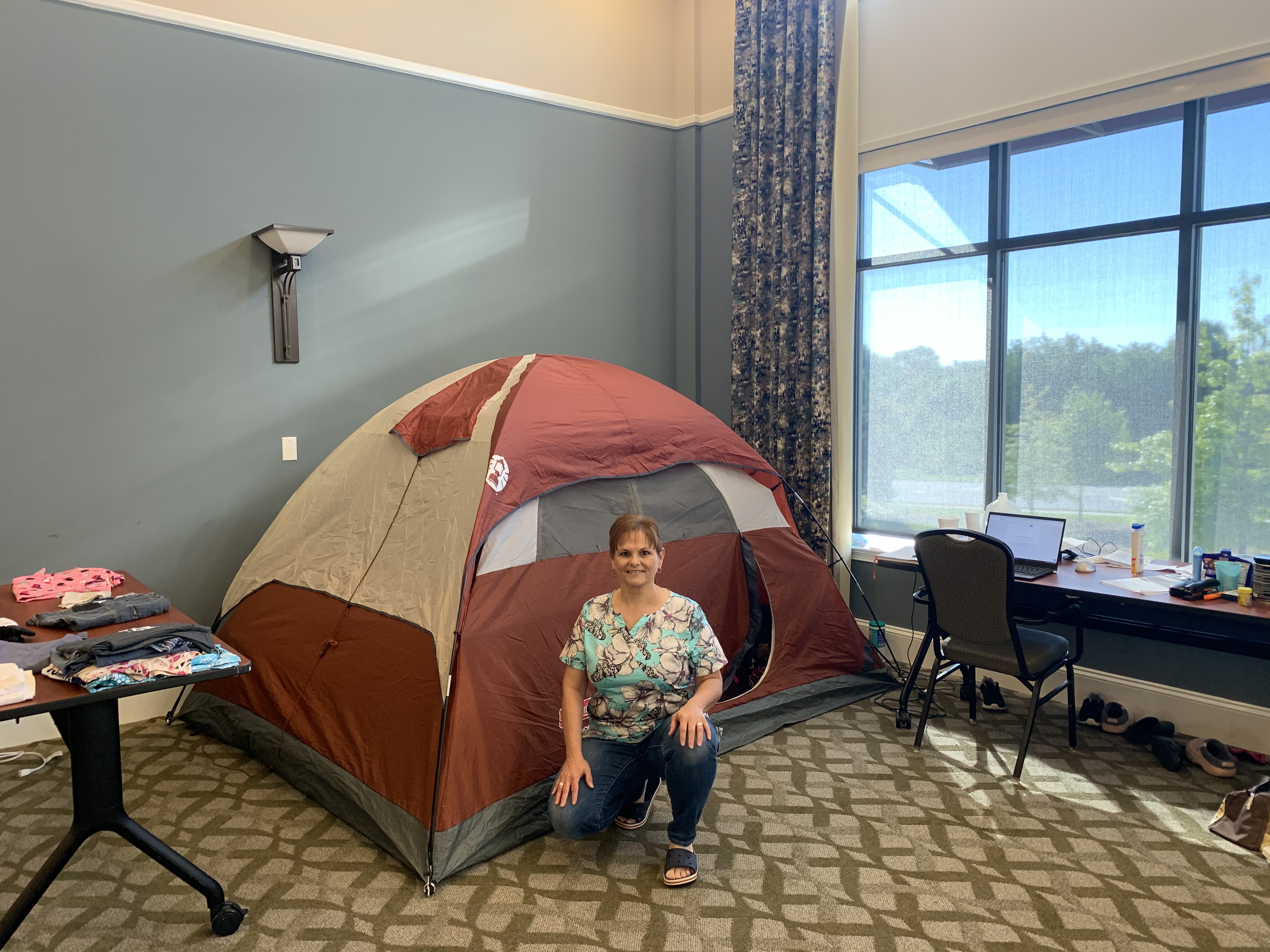
The coronavirus came to our campus on March 13. It was one employee and we sent them home. I then went to my boss, the CEO of our company, and said, "Our best strategy right now is to lock in. We'll ask employees to volunteer to live on campus and we'll reward them. And we will just live on campus with our members. It'll be over in two weeks, four weeks max." He never blinked. He was behind me 100 percent.
We didn't call it "lock out." We "locked in" with our members and we kept the world out. We kept coronavirus out. The gate was literally locked, and the only thing that came in and out of that gate was food deliveries, Amazon packages, and Instacart.
I asked for volunteers from our employee body, and sixty people raised their hands immediately.
They included our director of accounting, our moving coordinator, servers, housekeepers, maintenance, security. I took any volunteer who raised their hand. Ended up being seventy-five. The next step was figuring out where people were going to sleep, how we were going to feed employees, and how we were going to keep the operations of our 500-member community running with a staff of seventy-five instead of 300.
Some of the employees lived in model rooms, some lived in rooms on air mattresses, and some people, like me, lived in our health center, with memory care and skilled nursing. I lived in a tent in the community hall.
We left our titles at the door and we all took on different roles, whatever we needed to do to take care of members. Everybody at mealtime became someone that delivered meals. Everyone became someone who would disinfect our common areas. Everyone became whatever we needed them to be in the moment. I don't even know that some of my employees that I was serving with knew I was the COO. They just knew I was that girl that came and made French toast on Sunday mornings and vacuumed the hallways and helped do laundry. It didn't matter because it was all of us together, fighting a common enemy called COVID.
Each day, I would crawl out of my tent, put on my scrubs and ball cap, and go down to see who needed help with breakfast. I might be feeding a member, I might be cooking in the kitchen, I might be just engaging with members around a game of cards or a board game, or painting nails or giving a haircut. By the time breakfast was over, it was already lunchtime, and we were making sure that everybody was eating and getting their meals. Days were filled with making sure our households were clean, members' rooms were clean, laundry was done for everyone, and everyone received their medications. And spending time together, like sitting outside in the courtyard, soaking up the sun, talking and visiting. We did things to keep people entertained, too, like Zoom karaoke. They got such a hoot out of hearing me sing not well.
We were working twelve, fourteen, sixteen hours a day, doing what was needed and trying to keep everyone's spirits up. It was constant motion. I will admit that sometimes it was nice to retreat to my tent and just turn off the device and just be. I have an Energizer Bunny in my body, so it wasn't so much physically exhausting as much as just mentally exhausting. Retreating to my tent and just being by myself was a relief for me.
Two weeks went by and the coronavirus was a hot-fire mess in Georgia. Then four weeks. I got everyone together and said, "If you need to go home, you can. You did what I asked you to do. You committed for four weeks. But I still need you." That's the hardest thing I've ever had to do as a leader, to say, "You have given me what you promised, but I need more." And every time I did that, they would say, "You can count on me." And that's not about me, it's about what we do here. It's about our mission of loving and serving members. We make a promise to them that they never have to leave, that we will move them through the continuum of care as they progress in age, and that we will always take care of them.
This was a wonderful example of seeing people living our mission in action. It was about living it to the extreme. And it was a beautiful thing. Our employees talk about our members as their second family. We got to live that; we got to see it in action.
Employees made a commitment to leave their own families during this crisis so they could take care of the members of their second family. We have one director of nursing who has six kids, a husband, and her mom who lives with them. She talked to her family, and she said, "I feel like I need to do this." And the family said, "Don't worry about us. You go and do this and we will take care of home." I've got a picture of her standing in a window, looking at her family two stories down, waving up at the window. That's powerful commitment.
Growing up, my father was a soldier who went to Vietnam twice. You know, I was watching my father go off and hoping he would come back. With COVID, we knew we could lose members. If we didn't do extreme things like locking in, we could lose members, and we weren't willing to do that. That's what I learned from my father about mission and commitment.
We locked in for seventy-five days. When we did leave, it was because we had the processes in place, the PPE and testing in place, that we needed to make sure we could take care of our members and employees. But it was so interesting on that last day when everyone was leaving, and their families were meeting them in the parking lot. They all hung out in the parking lot talking, like they didn't quite know how to leave. They were a big family of seventy-three sisters and two brothers, needing to leave each other so they could be with their own families.
I was remembering that the other day when we finally were able to open up to family visits for our members. They had not seen their families in person, to be able to touch and hug each other, for over a year. Our staff, because they remember how emotional they were after the seventy-five days, were standing by the doors, crying, while the families were reuniting in the rooms. They knew.
We all walked away changed. You can't go through something like that and not be changed.
Michael, Texas
Bar Owner—January 2021
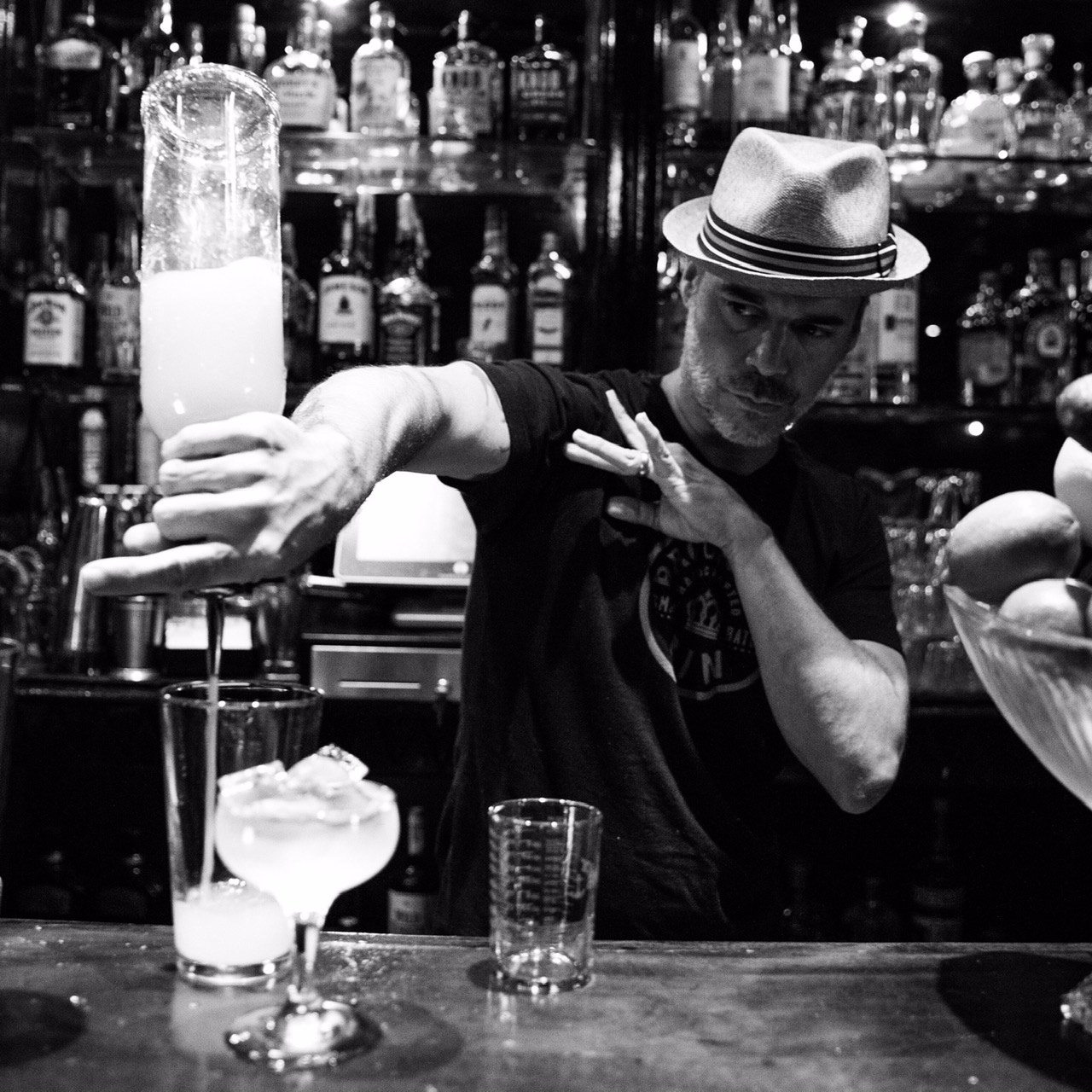
Bars are places that people rely on in disasters. We're community hubs, a place where people go to be able to contextualize what's going on. So even people who you might not see in a bar regularly, you'll see them in times of crisis because it's a place to get news, it's a place to get out of your house, and it's a place to be around people in your neighborhood or community and reassure yourself that there's other people like you. That things are going to be okay. This particular disaster, though, was one that featured humans gathering as the disaster.
When we had to shut down, we wanted to find a way to be able to serve our clientele. We have a community of people that rely on us to be there for them for whatever reason they need us.
People don't go to bars because they want to get drunk. You can get drunk anywhere. People go to bars because of the basic human need to connect. Given the way modern society is going, there's more and more separation and less and less connection. As grocery stores have gone from local shops to big-box stores, there isn't anyone there to talk with anymore. Same with coffee shops. And now that everything is automated and delivered, you can sit in your home and order everything you need and have every interaction through a computer.
We were very cognizant of the fact that the people that needed us as bartenders were still going to need us, and probably more because they were stuck at home, so whatever drove them out of their house in the first place, that hadn't gone away. And more than that, their social outlet was gone; their community gathering outlet was gone.
We started livestreaming from the bar. We went on every night for an hour, and we did all kinds of crazy things, like we sang karaoke for them, hosted trivia nights, and sometimes made cocktails. I called it a virtual bar, and we were as interactive as possible with people. Sometimes we had guests come on from other places in the country. We ended up building a really, really strong following. Basically, virtual bar clientele would sit at home and have a beer, or they'd have a drink of their own, and they would come and talk to us and they would watch us do silly stuff. We put out a tip jar that they could put money in for the staff. It was surprisingly powerful.
That lasted for a while until Texas reopened again, very early and very unwisely. At the time, we were getting towards the end of whatever resources we had, so we tried to open as safely as possible. That lasted for a couple of weeks until one of my bartenders got COVID. Then I was furious. Furious that we'd been put in the position of even trying to let people in our place. And so, out of pique, I recorded a video that was basically addressed to Greg Abbott, the governor of Texas. It was a plea from a bar in a pandemic. It ended up getting something like half a million views on social media. What a lot of people didn't realize was that bars were excluded from a lot of the aid being offered to small businesses during the pandemic. We were placed in a position of needing to open as soon as we were allowed to, even if it was unwise.
Pretty much right after my video, Texas closed down again because there was a big spike in cases. It was a big spike at the time, but compared to where we are now, it was nothing. That big spike that closed Texas down in July was a fraction of where we are now.
Mike, Florida
Doctor—January 2021

We have knowledge we learned based on our experiences in past pandemics. Yet, over the last year, we've acted like we learned nothing. That's very disheartening. We have had a lack of direction, and that's been very frustrating. They say that tough times bring out the best in people. It also brings out the worst in people. I have seen benevolence and kindness that was just phenomenal. And I have seen selfishness and self-centeredness that I would never have expected. It's really been an eye-opening experience.
My grandmother used to say, "I've been alive long enough that I have a right to say what I believe, especially if it's true." I'm not even close to her age, but that being said, I also feel that I've been around long enough, and especially around the medical field long enough, more than thirty-five years, that I can be open and honest.
Over the last year, I've become extremely disappointed with people, from leadership all the way down. I've seen political leaders come out and say, "The doctors and the medical experts say this, but I'm going to do what I want to do." And they're supposed to be our leaders. When people say, "I'm not going to follow guidelines because it's an infringement on my rights," I want to ask, "At what point does it become not all about you but all about everybody else and all about society?" Rather than people uniting with a focused approach, which would have led to a lot less suffering and death for many people, many leaders took such a selfish and self-centered approach that it made a bad situation terrible.
And I'll be honest, I would never have foreseen this happening. Previously, I thought that if we had a worldwide pandemic and we knew it and we saw it daily, that we would take the right approach, follow the high road, a consistent approach. We have done none of that.
I work as a hospitalist and do critical care medicine as well as palliative care work. In the Florida panhandle, our COVID hospitalization numbers have been climbing rapidly. From the beginning in March through November, I would have twelve to fifteen patients to work with each shift, with somewhere between two to four COVID patients. Occasionally, I had up to eighteen patients, but that would be a heavy load. On my shift a week and a half ago, I had twenty-six patients, fourteen of which had COVID. COVID-positive patients take about 50 percent more time. So taking care of twenty-six patients was actually like taking care of thirty-nine regular patients. Four of those patients were in the ICU on mechanical ventilators, which takes even more time.
I truly try to provide the best care I can for each patient, but at some point, it's like something's got to give. That is very disheartening to the doctors and nurses and other members of the medical team because we try to give our all, but unfortunately, it doesn't always work. I've taken care of hundreds of patients with this disease, and I've seen dozens and dozens die from it. Yesterday, more than 4,000 people died from COVID nationally. Many of those dying are young, and even more are dying alone.
It's frustrating when the emergency room is packed with COVID patients, the ambulance bays are packed with COVID patients, and we have no ICU beds available for our critically ill patients. I had a patient come in who was not COVID positive, but he was bleeding out from the bottom, terribly, and he had dropped his blood count by two-thirds.
When a COVID patient died, we cleaned the room and then put this guy in there, but he was the only non-COVID patient in the entire ICU. We have other patients coming in who need ICU beds, like patients with acute strokes and severe heart failure. When these patients come in and the hospital tells them, "We don't have any beds, you've got to go to another hospital," that means more time before they're admitted. As they say, every second is brain tissue in a stroke; every second is heart muscle in a heart attack. And we're having to divert these patients because there's no room. And if we can fit them in the hospital but not in the ICU, then they are put on other floors without the equipment and staffing needed to give them the proper care.
I started during the HIV days, so I've been doing this a long time. Now, when I get home after working up to sixteen hours instead of what is supposed to be a twelve-hour shift, I just try to close my eyes, sleep, and let it go. Because I know that I have to go back tomorrow and do it again. 
About the Author
Michelle Fishburne is a full-time digital nomad, splitting her time between her 2006 motorhome, Airbnbs, and the occasional housesitting gig.
Public Health in the US and Global South is a collection of interdisciplinary, multimedia publications examining the relationship between public health and specific geographies—both real and imagined—in and across the US and Global South. These essays raise questions about the origin, replication, and entrenchment of health disparities; the ways that race and gender shape and are shaped by health policy; and the inseparable connection between health justice and health advocacy.
Beginning in 2022, the series expands to include 1000-word blog posts, as well as longer commentaries, essays, articles and media productions that address the public health and political implications of the COVID-19 pandemic from multiple perspectives. The series editor for Public Health in the US and Global South is Mary E. Frederickson.
Introduction—Salt Creek and City Nature
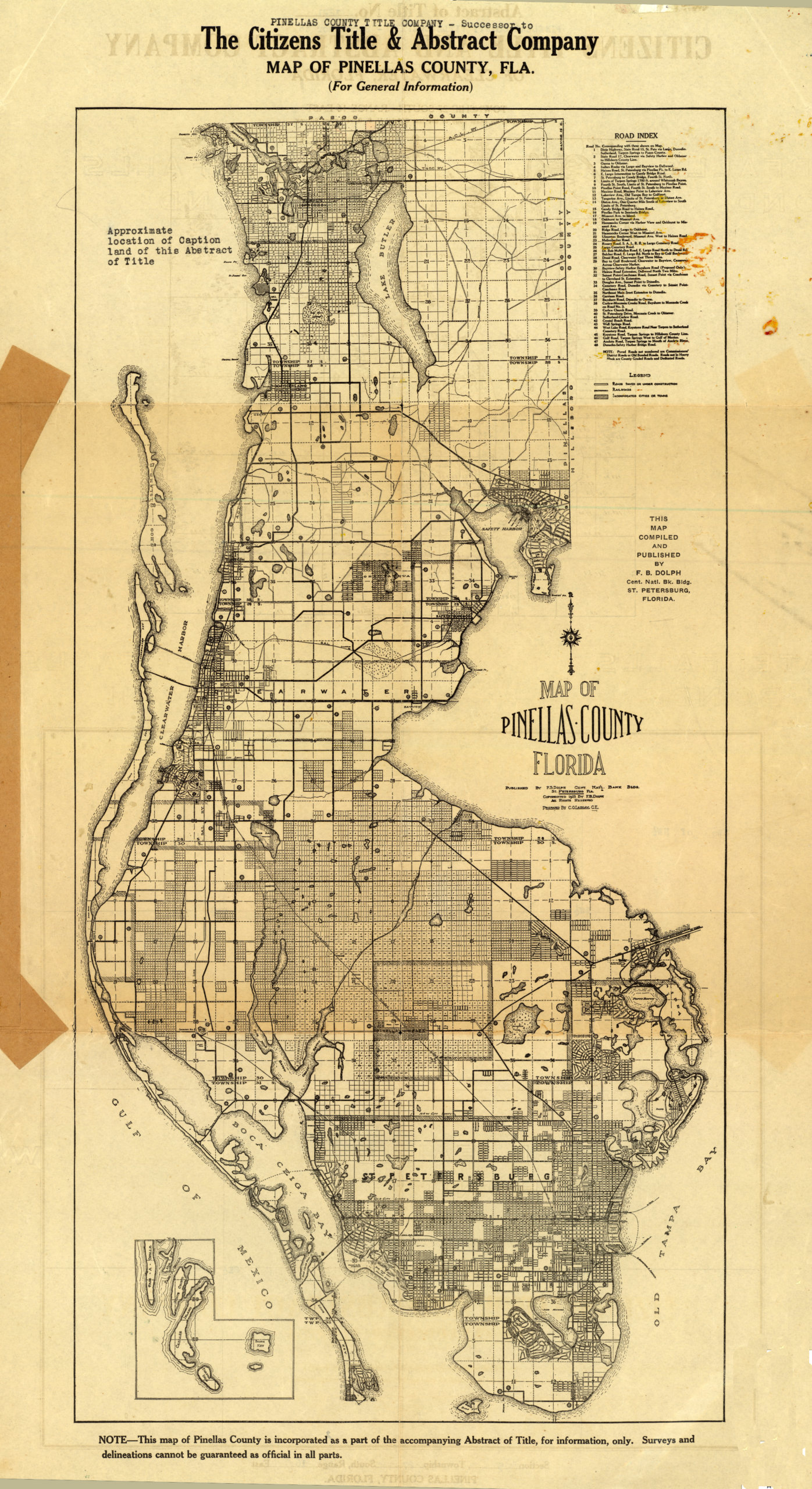
To place Salt Creek geographically, imagine the state of Florida. Zoom in to the west central coast,1This multi-media essay has developed over a long period of time and thanks are due to my home university's Center for Civic Engagement, the Frank E. Duckwall Foundation, the Tampa Bay Estuary Program, and most of all, to my students. Thanks to my comrades at Friends of Salt Creek; my church community at St. Augustine's Episcopal Church (at Salt Creek's headwaters), who have taught me to see my adopted hometown in a new light; to videographer Devin Rice; to Allen Tullos and anonymous readers for Southern Spaces; to Julie Armstrong, Jack Davis, Ray Arsenault, Amanda Hagood, Ray Roa, Chris Meindl, and Jacqueline Hubbard, Esq. then go to St. Petersburg, a midsized city—the second largest in the Tampa Bay area. St. Pete holds down the bottom of Pinellas County, a peninsula upon a peninsula, bracketed by Tampa Bay to the east and the Gulf of Mexico to the west. Water is everywhere.
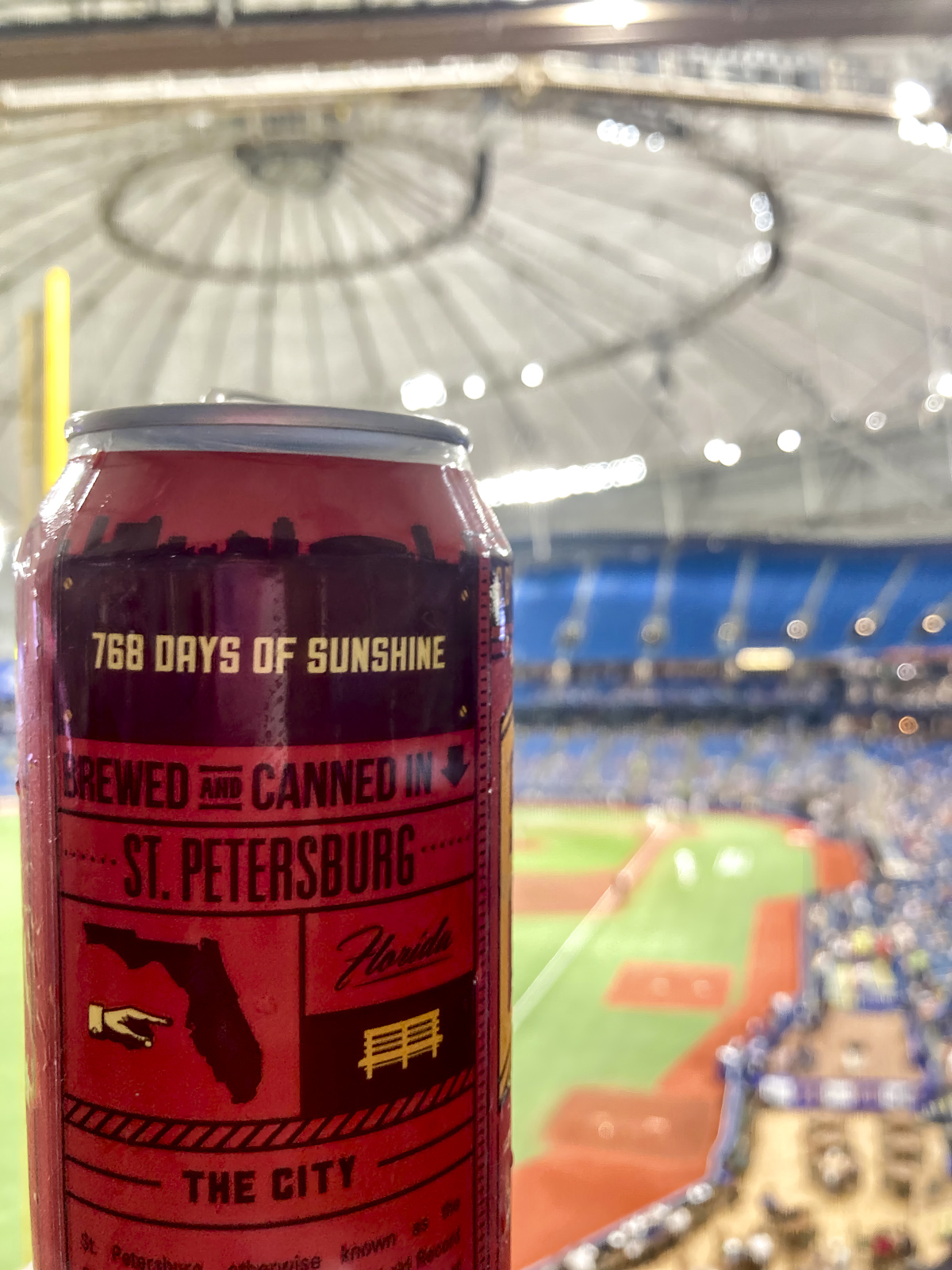
St. Petersburg has always been two things: a resort town and a product of the segregated South. Known affectionately as the Sunshine City, St. Pete claims the Guinness World Record for sunshine (as a can of local craft beer will tell you, 768 consecutive days). This winter haven boomed in the early twentieth century. White vacationers and retirees flocked here for the weather, often to relax on the green benches (hence the beer) that once lined Central Avenue, the city's main thoroughfare and longtime racial divide. African Americans first migrated here to build the railroad and work the tourist economy, building tight communities over time.
Off the tourist map, Salt Creek remains absent from view, for reasons both geographic and social. Because the water flows in a northeast direction, starting from the middle of Pinellas County then into Tampa Bay, the creek falls off the orderly cadastral map. Avenues go East-West and the streets North-South, while Salt Creek cuts a diagonal course. Most of the creek's banks are culverted, so its "nature" does not adhere to conventional labels of leisurely consumption. Racial divides further hide this fragmented waterway, and the environmental merges with the Sunshine City's flickering, all-too-easily-denied Jim Crow past.
Today only a handful of locals can trace Salt Creek's full course. The best way is to start at the mouth, Bayboro Harbor, just south of the city's previously moribund but now skyrocketing downtown. As one journeys southwest, going upstream, the creek services a working port (properties now eyed for luxury housing). The creek passes under a mangrove cover and empty lots, owned mostly by absentee speculators. The city's sizeable population of street people, who use its shielded banks for shelter, are the principal stakeholders here. Under Fourth Street, a major north-south corridor, Salt Creek opens into mangrove-shrouded Bartlett Pond. Beyond the pond, it crosses under Twenty-Second Avenue South, also a major thoroughfare, before vanishing into a culvert through Harbordale, one of the poorest neighborhoods in Pinellas County. Dammed at the north-south running Dr. Martin Luther King, Jr. Street (or Ninth Street, to old timers), the channel opens into Lake Maggiore, historically an estuarine body of water, now maintained as fresh. Beyond the lake, finally, Salt Creek splits into several other unnamed sources.
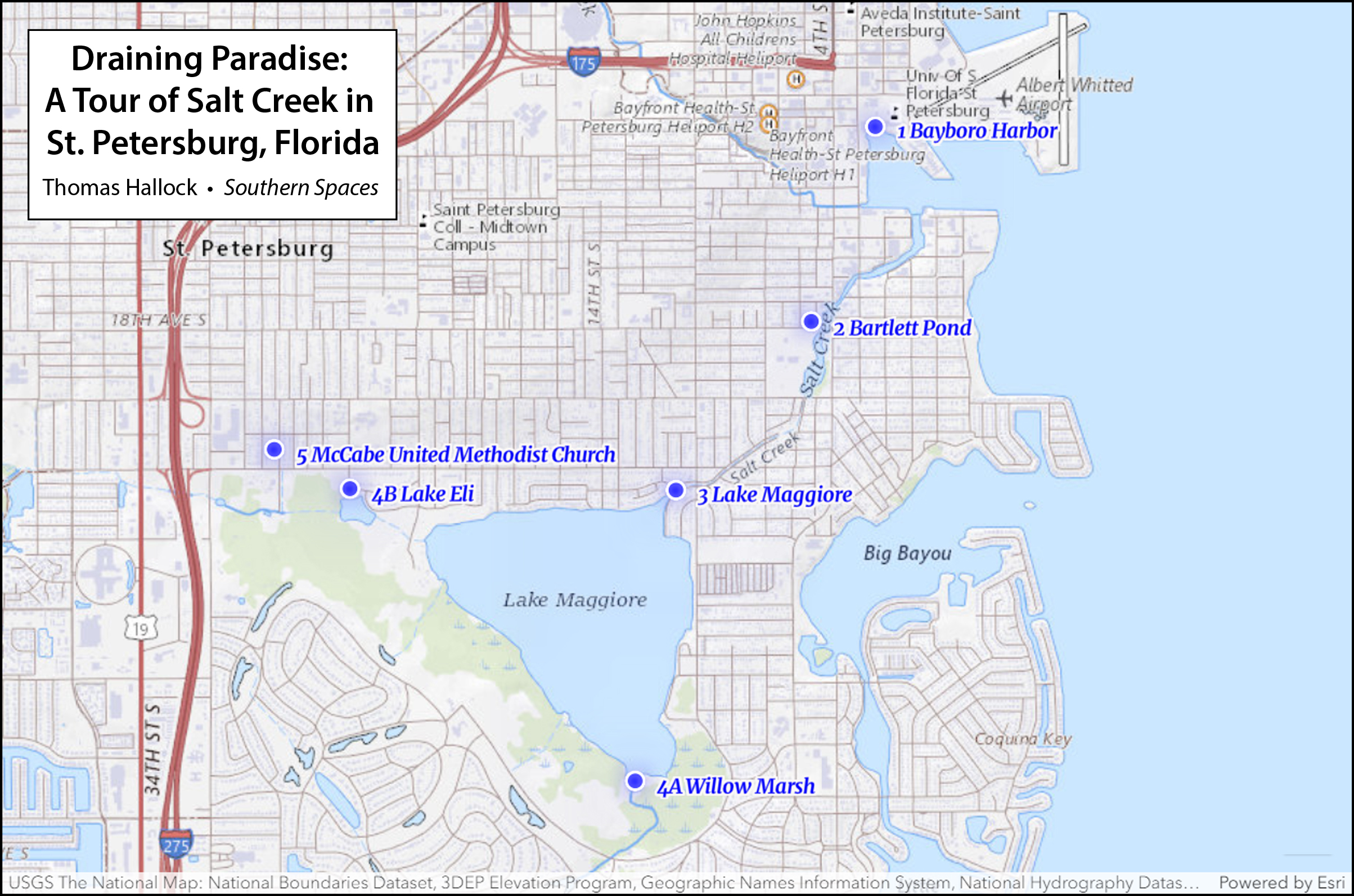
Recovering an urban waterway is no easy task, as it requires travel across both time and space. This tour, "Draining Paradise," attempts to render visible our everyday—yet hidden—lives, where water meets land. Because Salt Creek pays no heed to squared-off boundaries or cornered streets, and because property claims trump natural processes, it suffers neglect. In a city founded upon leisure—moreover, with a disenfranchised working class needed to produce that leisure—what counts as "nature" inevitably falls along social, economic, and racial lines. A continuing legacy of inequity shapes environmental priorities. Yet Salt Creek's history is complicated. Water quality intersects with social structures, though not in any simple or straightforward way. The words and conventions we use to describe natural beauty fill in few gaps, nor do current models of environmental justice fully apply. This aquatic system passes through several different neighborhoods—white and Black, rich and poor, protected and industrialized, through parts of town in clear neglect and others in good health. The social constructs fragment the hydrology until a citizenry can no longer see itself in nature. So how do we teach ourselves to see the parts as one whole? Can we come together as a community by cognitively remapping a forgotten stream? If so, what terms do we use? What's the storyline for a creek that has become a ditch?
I first stumbled upon my problem quite by accident, as an extension of my job as an English professor at the University of South Florida's St. Petersburg campus. I came to USF as a part-time instructor, tasked with developing a course called "Rivers of Florida." For several semesters, I ventured with students in canoes and kayaks onto the state's many spectacular wild and scenic rivers—traveling hours for peak nature experiences amid awesome alligators, long legged wading birds, and floodplains filled with cypress—waving trails of Spanish moss over the slick obsidian water. Despite the beauty of our surroundings, student essays from the "Rivers" classes were mostly pedestrian paeans to the "real Florida" and laments for a vanishing nature. Tired of burning class time and fossil fuels, and bored with cliché writing, I turned to nature close to home—Salt Creek, whose mouth empties right onto our campus.
With little initial support, I threw myself into a curriculum that built nature around the city. The project came to consume my work as teacher, writer-researcher, citizen, and activist. The early stages were marked by confusion and indifference. The problem, from a pedagogical standpoint, starts with semantics. What happens when a stream or creek becomes a culvert or ditch? Why do those words matter? We urban dwellers, who seek out nature close to home, are linguistically bereft: there is no term to describe the successful interface of natural and built environs. Outside cities, we have any number of categories for describing natural landscapes. The "wilderness" and "preserve" define parks, without people; the "georgic" or "bucolic" covers farmland; a "pastoral" is where classical shepherds tended their flock while reflecting upon the corruption in Rome, and today denotes cherished spaces of imagined innocence—like a baseball diamond or the Andy Griffith Show. But nature in the city presents an absence. To address this problem, I set up a classroom model. I founded a fictional group, "Friends of Salt Creek," built a website, and started exploring with my students.2For a timeline see Friends of Salt Creek, Accessed April 11, 2023, https://friendsofsaltcreek.org/; for an example on how the critical terminology overlooks city nature, see survey in Greg Garrard, Ecocriticism (New York: Routledge, 2012), which is organized around a series of chapter-keywords (pollution, wilderness, apocalypse, dwelling, animal, earth), but no urban terms. Like a generation of environmental humanists, I first recognized the shortcomings of advocacy strategies and literary conventions after reading the edited collection by William Cronon, Uncommon Ground: Rethinking the Human Place in Nature (New York: W.W. Norton, 1996); more recently, I discuss cultural categories of nature writing, and the challenges of teaching city nature, see "City Creeks: Lessons in Sustainable Environmental Discourse from a Florida Boom Town," Spaces in-between: Cultural and Political Perspectives on Environmental Discourse, ed. Mark Luccarelli and Sigurd Bergmann (Leiden, Netherlands: Brill Rodopi, 2015), 88–101. Using searchable newspaper articles and government documents, we cobbled together a storyline.
The next step was to theorize. Environmental writer Jenny Price details "Thirteen Ways of Seeing Nature in LA," a classic re-examination of the least "natural" of all places, the Los Angeles River. On the East coast, meanwhile, landscape architect Ann Whiston Spirn has combined activism, teaching and writing in a recovery of Mill Creek, a buried stream that threads through West Philadelphia before feeding the Schuylkill. These models and others provided a conceptual groundwork. Over time, I accumulated equivalents. A trip to New York City took me to the Gowanus Canal, a Superfund site where Walt Whitman once ate oysters. I learned how tourists in London will lay out ten pounds each (five for kids) to slip down the culverted Fleet River, now a covered source but a notorious ditch from the reigns of Queens Elizabeth to Victoria. A sixteenth-century mock epic by Ben Jonson, "On the Famous Voyage," recounts a journey up the filthy Fleet: the open sewer runs foul with "grease, and hair of meazled [leprous] dogs; / The heads, houghs [hocks], entrailes, and hides of hogs."3Jenny Price, "Thirteen Ways of Seeing Nature in LA" (Part 1), Believer 33 (April 1, 2006); Anne Whiston Spirn, "Restoring Mill Creek: Landscape Literacy, Environmental Justice and City Planning and Design," Landscape Research 30, no. 3 (2005): 395–413; Ben Jonson, "On the Famous Voyage," in Complete Poetry, ed. William B. Hunter, Jr. (New York: NYU Press, 1963), 72. The same waterway carries away the cannibalistic offal of Stephen Sondheim's Sweeney Todd, "the demon barber of Fleet Street."
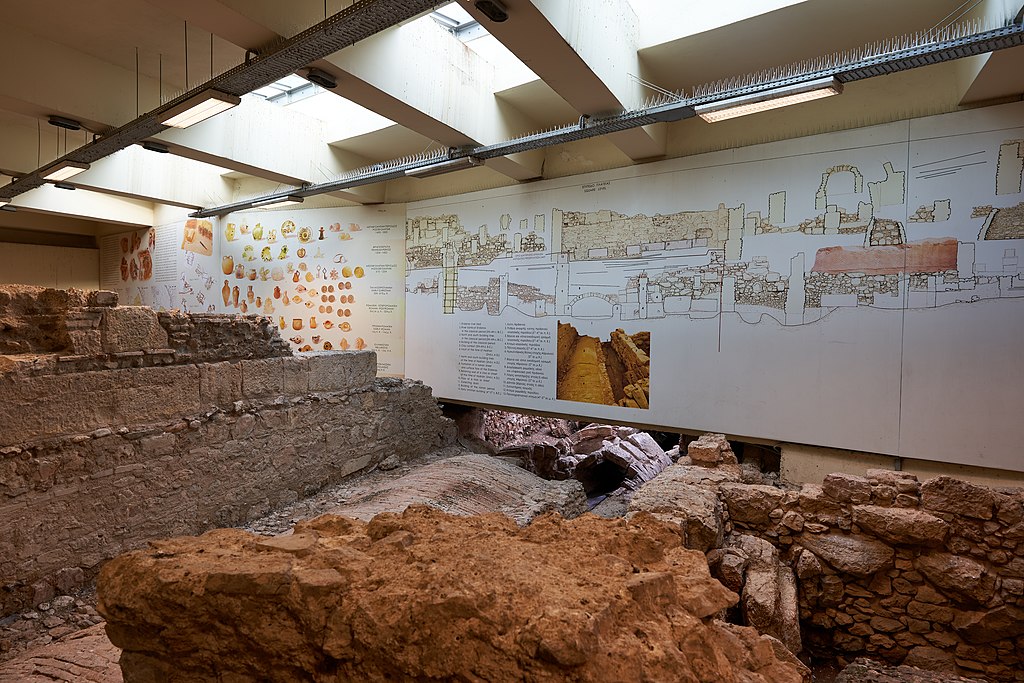
Patterns came together. Urban waterways offer a Realometer, as Thoreau wrote, places where you stand right to face the facts.4Henry David Thoreau describes the "Realometer," distinguished from the "Nilometer" (a gauge to measure the mythologized Nile), in the penultimate paragraph of the chapter "Where I Lived, and What I Lived For," from Walden, or A Life in the Woods (Boston, MA: Ticknor and Fields, 1854). Our city creeks mark charismatic, if uncomfortable points of context between activism and disaster fetish, economics and racial inequity, lost memory and recovery, cool-credibility, and very real marginalization. The more I traveled my own channelized waterway, the more analogs I discovered. Friends and colleagues started volunteering their own favorites. The Chicago River (a graduate school buddy reminds me) previously served as a portage between the Great Lakes and the Mississippi. A stunningly illustrated article in the New York Times charts the harrowing impact of sea level rise on this area.5Dan Egan, "A Climate Crisis Haunts Chicago's Future. A Battle Between a Great City and a Great Lake," New York Times, July 7, 2021, https://www.nytimes.com/interactive/2021/07/07/climate/chicago-river-lake-michigan.html. A colleague who graduated from Columbia's school of journalism reminded me that vestiges of Minetta Brook flow under Minetta Street in Greenwich Village. My writing partner for a series of #Creekshed essays in our local alt-weekly, Amanda Hagood, sent vacation photos of Ala Wai Canal in Honolulu. Another traveling colleague, a classicist, Facebook messaged me a photo of the vestigial Eridanos, Greece—the literal path to Hades—which runs through Athens' Monastiraki Metro stop. The community relations person on my campus insisted I walk the C&O canal on my next trip to to Washington, D.C. And while researching an academic memoir about her hometown of Birmingham, Alabama, my colleague and partner Julie Armstrong traced the entirety of Village Creek—a polluted stream that drains both industrial sites and a neighborhood park where she played as a child.6See Thomas Hallock and Amanda Haygood, "#Creekshed Story Map," May 5, 2022, https://storymaps.arcgis.com/stories/b664d097ee3e408c8eacf5a424075af8; for more information on the Ala Wai canal, a lagoon off Waikiki that displaced wetlands used by island Natives for fishing and agriculture in Waikiki, see Sophie Cocke, "Ala Wai Canal: Hawaii's Biggest Mistake?," Honolulu Civil Beat, May 20, 2013, https://www.civilbeat.org/2013/05/ala-wai-canal-hawaiis-biggest-mistake/; a display of Minetta Brook, which used to run through the lobby of a hotel-apartment, is no longer operable, though reference can be found at "Minetta Green," NYC Parks, Access April 11, 2023, www.nycgovparks.org/parks/minetta-green/history; Village Creek Environmental Human & Environmental Justice Society, Accessed April 11, 2023, https://villagecreeksociety.org; Julie Buckner Armstrong, "Two Days along Village Creek," Learning from Birmingham: A Journey into History and Home (Tuscaloosa: University of Alabama Press, 2023). East Lake was the white working-class neighborhood where Julie grew up. Through the post-civil right's era, it was mostly African American. Because of its increasingly coveted real estate, it became a focal point for the A&E program Flipping Down South.
Why this passion? And why is this work necessary? The recovery of an urban waterway can feel like a very vexed homecoming. Even though social history and economics have shaped our aquatic environs, current land use practices erase the very past that brings value, coherence, justice, and yes, even happiness to our communities. City creeks have a particular way of taking one both to the edges and into the heart of where we now live. We are habituated, as geographer Yi-Fu Tuan reminds us, to link memory and place. Tuan's term, "topophilia," is a well-known coinage for the memories that accrue across space. A crack in the sidewalk carries us back emotionally; a whiff of wisteria fosters connection, and one hopes, concern for a given locale.7Yi-Fu Tuan, Topophilia: A Study of Environmental Perception, Attitudes, and Values (New York: Columbia University Press, 1990). Though simple on the surface, the concept is tough to pin down; topophilia, Tuan reminds us, is not just patriotism, childlike nostalgia, or the marketing copy on a beer can. It means coming to grips with both the pleasures and the problematic.
Take the green bench, which is the name of my local brew of choice, but also a hurtful symbolism. As noted in a recent study of systematic racism in the city, green benches lined the main thoroughfare of Central Avenue from 1916 to 1960. For white residents, these benches were a "symbol of hospitality and place to socialize" on a pleasant winter afternoon; for African Americans, not being allowed to sit there served as an "everyday reminder" of humiliating segregation.8Tuan, Topophilia; Ruthmae Sears et al, "Building Bridges & Racial Equity in St. Petersburg Florida" (Tampa: University of South Florida, 2021), 52. City creeks, likewise, sit uneasily in our idea of nature. They do not offer simple recreation or respite. The active search for broken connections instead takes us beneath the placid surface of a city's daily life.
As a white northern transplant, I have learned how a recovered past opens channels for seeing a difficult present. Every metropolitan area holds its own hydrologic history, buried or forgotten. What I offer in this short trip is a lesson in how cities render nature invisible; how what we count as nature is either valued or subject to abuse, and how those decisions follow social lines; and how past, present, and future landscapes intersect. To cross into our fragmented waterways, I must add, requires humility. The divisions rendered in our shaping of the natural world remain. And so the fundamental challenge: to come together, as one community, cleaning our rivers and streams, while at least recognizing—if not starting to heal—the rifts between us.
Bayboro Harbor
Start at Bayboro Harbor, at the campus where I teach. Faculty, staff and students can rent a kayak, paddleboard, sailboat, or canoe at the waterfront office, and here, I typically begin my nature writing classes. Once called "Fiddler's Paradise," for the crabs foraging in the surrounding mangrove and spartina, this former bayou is where Tampa Bay meets Booker and Salt Creeks—two of the major drainage systems for lower Pinellas. The Gulf Coast of Florida has been home to a series of loosely-defined, overlapping cultures, more local polities than "tribes"; these include "archaic" groups, the Weeden Island culture (300CE–1000CE), followed by the Safety Harbor culture (900CE–1500CE), then Tocobaga (the residents of Tampa Bay who most likely met Spanish explorers in the sixteenth century). Florida's first people fished and gathered crustaceans. The refuse from this bounty formed middens and mounds, many of which appear on early postcards from the city. As St. Petersburg boomed through the twentieth century, during the early years of car culture, these shell mounds were looted for road fill. The Indian works, reminders of a successful synthesis of built and natural environs, remain buried under a hospital's out-parcels and parking garages.9Robert J. Austin, "'Its Origin Steeped in Mystery': The Sorry Saga of St. Petersburg's Shell Mound Park," The Florida Anthropologist 73, no. 2 (June 2020): 113–39; the ongoing status of Native remains, held at the Smithsonian and elsewhere, including (until recently) my university's anthropology department is reviewed in "Notice of Inventory Completion: Department of Anthropology, University of South Florida, Tampa, FL," National Archives Federal Register, Sep. 27, 2011; and Gene Demby and Kumari Devarajan, "Skeletons in the Closet," NPR Code Switch, Oct. 13, 2021, https://www.npr.org/transcripts/1045518876.
Salt Creek, meanwhile, tells the classic Florida story of transformation and rapine. The waterway formerly known as "Salt Run" drains lower-lying land, never particularly suited for human habitation. Starting in 1908, a group called the Bayboro Investment Company (supported by local boosters, fat with congressional pork) oversaw the harbor's dredging, which continued for several years. Imposing steam-fueled engines churned the roots, sand and gravel over bulwarks, carving a fifteen-foot channel from the shallow bayou, transforming the "marshy waste" into "valuable lands." Both Salt and Booker Creeks were straightened and deepened for the purposes of top-down economic interests: to connect with a rail depot one mile to the north, plus harborage for "pleasure yachts." Where there had been "naught but a marsh, inhabited by undesirable tenants" the St. Petersburg Evening Independent boasted, soon would "arise a beautified landscape occupied by happy homes of mankind." Four years later, with more federal funding, the city cleared frontage for a harbor and marina.10"The Bayboro Improvements," St. Petersburg (FL) Evening Independent, March 26, 1908, 1; "Deep Water Harbor Ordinance Up Tonight," St. Petersburg (FL) Daily Times, Aug. 14, 1912, 1.
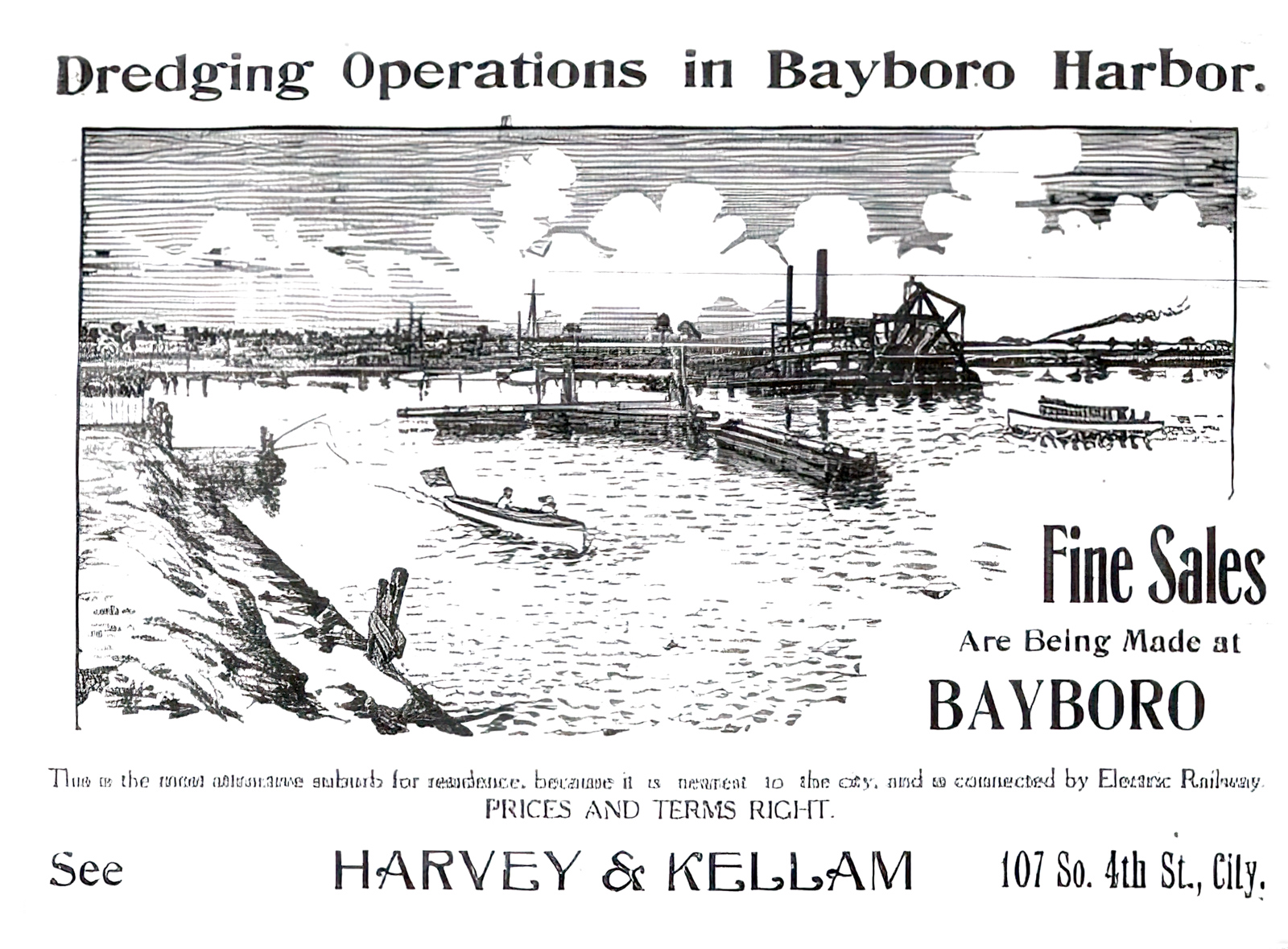
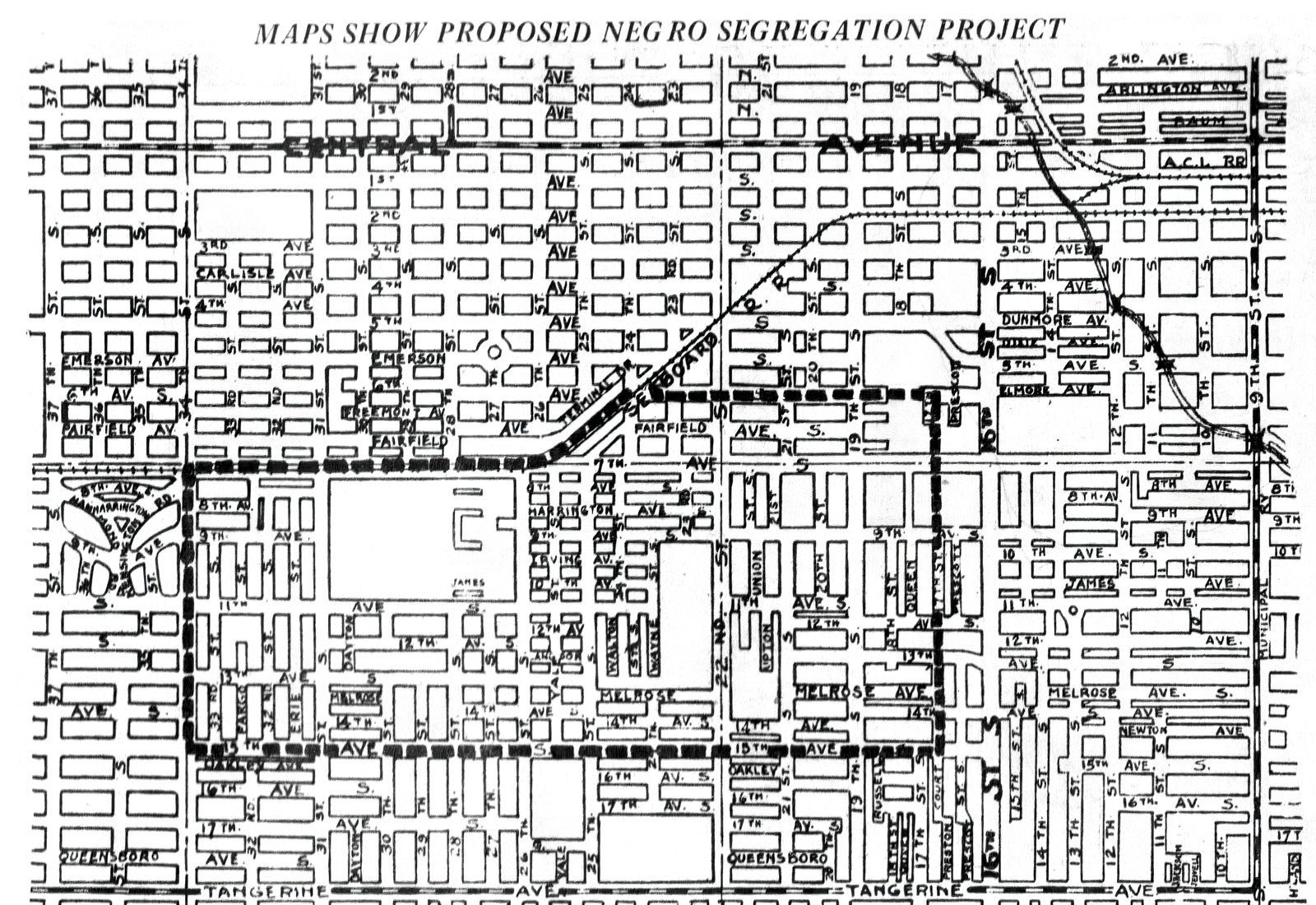
The creek's industrialization had begun. In 1913 the dredgers worked their way further up the channel, yoking the tidal "Salt Run" to Florida's violently enforced economic and social order. As standard histories recount, the area boomed through the first decades of the twentieth century, with a soggy landscape shaped to property developers who then marketed an affordable paradise for white tourists and transplants; this same paradise needed a labor force, and segregation shaped the landscape as much as the pleasures of outdoor leisure. An invisible line along Central had already divided the city into north (white) and south (African American) sides. African Americans moved to St. Petersburg in search of work and the city council sharpened boundaries where people of color could live. A 1931 charter amendment sought "to establish and set apart in said city separate residential limits or districts for White and negro residents." This redlining, impossible to enforce and revised many times, imprinted the city's demographics permanently, shaping everything from voter registration to school funding and supermarket locations.
Has the creek been subject to the same racial violence as Black bodies? It depends on who you ask, though this much is true: segregation in St. Petersburg remains unfinished business. Redlining language remained in the city charter until 1963; through the Jim Crow era, three lynchings were reported in Pinellas County (low for bloody Florida); and various groups such as Pinellas Remembers (which successfully placed an Equal Justice Initiative marker at the site of a 1914 lynching) continue the important, uphill work of healing. Environmental and social histories undoubtedly intertwine—the question is "how?"
From its early boom years, access to nature came through a front and back door. North of Central Avenue, tourists enjoy Instagram-worthy waterfront parks, showcasing urban amenities alongside Tampa Bay. Today, these parks receive the overwhelming bulk of public funding and remain fiercely guarded by a proud citizenry. The adjacent working waterfront to the south was slated for industry, and set on a course for exploitation. Starting in the 1920s, city leaders commissioned engineering studies, supported business and secured federal money to construct an "industrial harbor." Salt Creek housed oil storage tanks (inevitable spills to follow) and just upstream, a dairy and flash-freeze seafood plants. As industry left in the 1970s, the creek would serve as a site for drugs and illegal sex and squatters, and now, for fast food and a Salvation Army support center. Locals recognize the creek (if at all) from a sharply-arched bridge over Third Street known as "Thrill Hill," or as the place where a sleeping homeless woman tumbled off a seawall and lost her arm to an alligator.
Such are the long string of anecdotes—the stories of drug runners and petty crime, childhood kicks, vagrancy and chicken thieves—that populate the creek's history.11City Council minutes were printed in St. Petersburg (FL) Times, Feb. 14, 1931, 2–3; see also "Open Waters in Salt Creek" St. Petersburg (FL) Times, June 16, 1921, 10. Most recently, the city revised building codes to accommodate Miami developers, who schemed to build high-density housing on the flood plain. That bubble having burst, the area remains scraped.12"Report of Port Exports Announced by Commission," St. Petersburg (FL) Evening Independent, Sept. 16, 1926, 7; "Dairy Concern Adds to Plant on Salt Creek," St. Petersburg (FL) Times, Jan. 1, 1937; "Yacht Basin Boats Face Clampdown," St. Petersburg (FL) Times, Feb. 3, 1960; "Salt Creek Squatters Trouble City Again," St. Petersburg (FL) Independent, Aug. 28, 1961; Jack Alexander, "Drug Raids Nab 11," St. Petersburg (FL) Independent, May 18, 1968.
Salt Creek activists suffer fatigue, even disillusionment, from fighting the combined forces of city hall, Jim Crow's intractable legacy, and poor decisions rationalized by free market economics. Two episodes from the past century illustrate the challenges of turning back the tide. The creek's path traces a low-lying area, or swale. In any other scenario, land this vulnerable to flooding would be set aside for parks and greenspace. Every good planner that has studied a topo map has, in fact, reached that conclusion. In the 1920s John Nolen, the preeminent city planner of his generation, prepared St. Petersburg Today, St. Petersburg Tomorrow—a design that would be considered progressive if it were adopted even now.13John Nolen, City Planning Report: St. Petersburg Today, St. Petersburg Tomorrow (St. Petersburg, FL: St. Petersburg City Planning Board, 1923), https://friendsofsaltcreek.org/wp-content/uploads/2022/02/St-Petersburg-Today-St-Petersburg-Tomorrow-1923-Nolen-Plan-1.pdf; St. Petersburg Conceptual Plan (City of St. Petersburg, FL, May 1974), https://friendsofsaltcreek.org/wp-content/uploads/2022/03/Conceptual-Plan-St.-Petersburg-1974.pdf: 31–32. Nolen suggested a parkway, using Salt Creek to connect gulf to bay with a chain of green "around the lower end of the peninsula." Voters rejected the Nolen plan, however, citing the imposition on private property rights as well as Nolen's reluctance to tighten emerging redline laws. One could blame this shortsightedness on the times. Nolen worked in the shadow of the Rosewood massacre, but fifty years later, the city reached the same conclusion.
Dusting off many of John Nolen's ideas, a 1974 Conceptual Plan also proposed a "green open space network," which included the "natural swale" between Tampa and Boca Ciega Bay. In short, a park along the Salt Creek channel.14R. Bruce Stephenson, Visions of Eden: Environmentalism, Urban Planning, and City Building in St. Petersburg, Florida, 1900–1915 (Columbus: Ohio State University Press, 1997), 65. Neither proposal, almost fifty years apart, made the leap to policy. A common good for the city (sustainable development, equitable access to open space) will lose to private, mostly white interests every time.
In the creek, I confront my own ambivalence towards Florida. I revel in the completely undeserved, over-the-top natural beauty. I also feel overmatched by the state's ugly, obdurate social history. When my own patience runs out, I drop a kayak near the mouth and make a favorite circuit. I enter by the harbor, paddle through the marina, then under the bridges at Third and Fourth Streets, into a hidden wilderness. Past the last dredge line, not far beyond the old trolley bridge, ice cream plant or seafood fast-freeze facility, the docks and crumbling piers give way to a mangrove tangle. Under Thrill Hill, Salt Creek is both wilder and more polluted. The paradox is striking, even in its own way, charismatic. The overlooked canopy serves as a bird sanctuary, where long legged waders roost and nest. Styrofoam and plastic bottles meld with mangrove prop roots. Fecal bacteria levels spike well past acceptable levels. We are still trying to figure out the cause—excrement from the street population, which the city pushed from parks in the tourist center to the poorer southside; guano, which accumulates in the concrete channel because seawalls and dam upstream block the tidal flow; or maybe broken sewer lines.
My route takes me roughly halfway to Lake Maggiore, mostly by industrialized lots left abandoned for speculation. Past the Dollar General and McDonalds, I push through the choking mangroves, then slip under another low-slung bridge at Eighteenth Avenue South. From here the creek opens into Bartlett Pond, a small aperture all but choked off due to overgrowth. I have seen snook roil below the black, murky surface. I've also seen a prize game fish, floating ominously on the surface of the muck. Osprey watch from their nests in the light posts by the athletic fields. Were it not for the hum of traffic, I could be in the 10,000 Islands of the Everglades. Instead I have found Nature in the heart of a city.
This is not where one expects to find a kayak. Citing water quality, Parks and Rec officials have ignored my suggestions to install a put-in off Bartlett Pond. So I engineer my own exit, grabbing the sewer line off a bridge on the opposite side, nudging a gunwale to the shoreline, and throwing my fifty-seven-year-old self onto the muddy bank. From Bartlett Park, I portage back across Fourth Street, past a gas station at the busy intersection of Fourth Street and Twenty-Second Avenue South, back to my once gay and racially-mixed, increasingly gentrified neighborhood. This circuit is not easy, scenic, accessible, or even encouraged. But I find the paddle into every day nature restorative. Wilderness has been erroneously thought of as an escape, rather than as engagement with the here and now. "In wildness is the preservation of the world," Thoreau mused, wandering the clearcuts around Concord. The best wilderness is always close to home.15Henry David Thoreau, "Walking," The Atlantic, June 1862, https://www.theatlantic.com/magazine/archive/1862/06/walking/304674/.
Bartlett Pond
At Bartlett Park, tucked behind Twenty-Second Avenue and Fourth Street, Salt Creek opens into a muddy pool. This little pond adjoins two of St. Petersburg's main thoroughfares, but badly eutrophied and surrounded by mangroves, rarely merits a second look. My wife Julie has lived three blocks away and driven past Bartlett Park for twenty years, but did not know there was actually water behind the brush. A little fishing dock used to provide access on the east side, away from the street and from the park's interior. Vandals, or maybe the homeless on a cold night, burned the outer decking. Repairs to the dock then came slowly and were poorly done. After I called to complain, the parks department blocked off the charred sections, shortening the entire structure.
Environmental racism takes many forms—big and small, from legislation to microaggressions. A perspective at water level renders visible the "slow violence" of local policy, to use Rob Nixon's memorable phrase: the damage "that occurs gradually and out of sight … dispersed across time and space [and] typically not viewed as violence at all." Leisure may not register as a health concern. At least on the surface. But in this city, defined by slow violence, differences in life expectancy across race are measured by decades.16Rob Nixon, Slow Violence and the Environmentalism of the Poor (Cambridge, MA: Harvard University Press, 2011), 2; Sears et al., "Building Bridges," 123. Hypertension kills, green spaces heal.
St. Petersburg and Pinellas County pride themselves on their parks, yet the allocation of amenities follows a classic script in inequity. A Pinellas County park map is literally a reverse image of racial demographics. Docks served by the county's white residents include ADA-compliant handrails, fish cleaning stations, and overhead shelters to protect visitors from the harsh sun or sudden rain. Residents in south St. Pete's poorer Black neighborhood instead get this charred shell, over an overgrown pond my spouse never even knew existed—where health officials deemed the water unsafe to fish or swim.
Economics and social history shape the landscape, but because the history is forgotten and on-the-ground-economics vanish into everyday life, that landscape is tough to read. Bartlett Park embodies this contradiction. Behind the stump of a dock, tennis balls thwock back and forth at the St. Petersburg Tennis Center. Founded in 1926, the municipal courts are a vestige from the early twentieth century, when the neighborhood afforded vacation cottages for winter residents and renting tourists. The court's location seems anomalous, though like every other chapter of the city's history, it can be explained through the local lodestars of leisure and race. The center serves as a throwback to St. Petersburg's peak years as a populist paradise, when white northerners suffering from cold found relief in the mild climate, bay breezes, the foliage, and sport.
The same boom drew African Americans, mostly from across the South, who came here to work a growing service economy. The zoning measures set out to keep the Black population both accessible and cordoned off; these measures, from the middle third of the past century, limited where Blacks could work, live, and travel after dark. African Americans forged communities in neighborhoods that still resound in local lore—the Deuces, Pepper Town, Gas Plant, Campbell Park, Methodist Town. After the waning of de facto segregation, in the early 1970s, once tight communities fanned out across the southern side of the city.17Rosalie Peck and Jon Wilson, St. Petersburg's African American Neighborhoods (Charleston: History Press, 2008), 15–18; Sears et al., "Building Bridges," 108. Black families settled in formerly white neighborhoods on the south side of town, including Bartlett Park. White people moved out, abandoning the neighborhoods, then decades later returned to the same sections—displacing Black families who have now lived there for at least a generation.
The contradictions and shifting dynamics across time and space make Salt Creek difficult to explain. Lime green tennis balls lob over the chain link fence, down the sidewalk, and into the watershed. Environment and community relations cannot seem to find the same page. I struggle personally with my own blindness, fumbling with good intentions. After several years of my teaching along this waterway, graduate students culled together a self-produced book called Salt Creek Journal. During an Earth Day celebration at Bartlett Park, I palmed a copy of the paperback to my city council representative. She actually read the book, then convinced me to form a real group with the same name as the pedagogical fiction—Friends of Salt Creek. For several years, pulled into service, I led the group. We defined goals, calling ourselves a community group centered around nature, not so much preservationist. We met small, consistent successes. Foundation money flowed our way, though before we were logistically prepared to take on projects; we had a grant before we had a bank account. For clean ups, environmental groups like Tampa Bay Watch and the Tampa Bay Estuary Program (who do admirable work advocating for marine health) bring enthusiastic white volunteers from outside, though our constant reminder has been to build from within the neighborhood. The local Keep America Beautiful office wants to drop in cypress trees without asking people who live there.
Conventional narratives of environmental justice, Ellen Griffin Spears observes, have "left out many constituencies—women, workers, indigenous populations, people of color, immigrants—and as a result left out the social justice roots of environmental reform." And so we see the broader trends unfold in local arenas. White environmentalists are not "looking at the community," observes Jacqueline Hubbard, an African American attorney whose family has owned a lakeside home in the area for decades; the result "is a lack of communication and trust."18Ellen Griffith Spears, Rethinking the American Environmental Movement Post–1945 (New York: Routledge, 2020), 4; In my informal interview with Jacqueline Hubbard (Sept. 2, 2022), she mentioned the importance of environmentalists reaching out to churches and groups with well-established records in civil rights; my hope as the author of this article, an online tour, is to have a ready-made program for community presentation.
In retrospect, the lesson feels obvious: restoring the environment starts with community. The questions must always start with, "for whom?" For whom are we working? With whom and why? Bartlett Pond brings fault lines into stark relief. After a long period of asking, the city secured external funds to dredge the eutrophied pond. The mostly white Friends of Salt Creek continue to test waters around the park, hoping to locate the sources of fecal bacteria. But why now? Will the dredging serve the neighborhood's current, mostly Black residents? What will dredging a pond mean for those experiencing homelessness? Is "improvement" merely a bellwether of high-end development downstream? And how does one fight back cynicism? During a May Day clean up, an African American fraternity, the Sigma Betas, led a tree-planting effort that involved local teenage boys. When construction in the park cut off an irrigation line, however, the newly planted trees dried up and died. This story is nothing new. Landscape theorist Anne Whiston Spirn recounts similar frustrations with Philadelphia's Mill Creek. She describes how she led eighth graders along the creek's buried course, then asked the teenagers to develop a landscape plan. The students (more familiar with the realities of the streets than an Ivy League professor) refused to believe any plan they implemented would be suggested. "It won't happen," a student told her; "Someone will wreck it."19Spirn, "Restoring Mill Creek," 404. How do you explain to teenage boys in St. Petersburg, likewise, that the city failed to water plants they put in the ground?
Advocacy puts well intentioned theory to the test. We have to pull out the Thoreauvian "realometer." In our rhetoric and scholarly discourse, one might wax optimistic about bringing together environmental and social justice, building what my local Sierra Club chapter calls a "Black-Green" alliance. But in practice, we learn the hard way, starting by acknowledging the depth of the rift of our divides. We can get the grants but we cannot exact meaningful change. As a white-led group, Friends of Salt Creek seems to have a offered a strategic wedge for easy volunteerism; our group checked the box for "underserved community." Over summer 2021, we drew from a Tampa Bay Estuary Program grant to support an artist in residence program at the local community center. Four artists (two white, two African American) met under a central pavilion, working most closely with kids. The children here are predominantly Black, with many coming from foster homes. White kids go to tennis camp, steps away, taking after-school lessons for $200 per week. Kids from the adjacent Frank Pierce Center are not accustomed to access. The pavilion where we met backs onto the chain-link fences of the neatly rolled courts. At one point, a child passed a gate left open, usually locked, leading to the public court. "Wait," the child asked, "can we go in there?"
The same could be said for the pond. Our entry points to nature are shaped by economics, power, and race. The points of access disclose social boundaries. Where equivalent parks offered sheltered docks and piers, the only dock here is a burnt out stub. The city clears and maintains lakes in other parts of the city, opening code-compliant "windows" through the mangrove; here, the water remains hidden—out of sight and degraded.
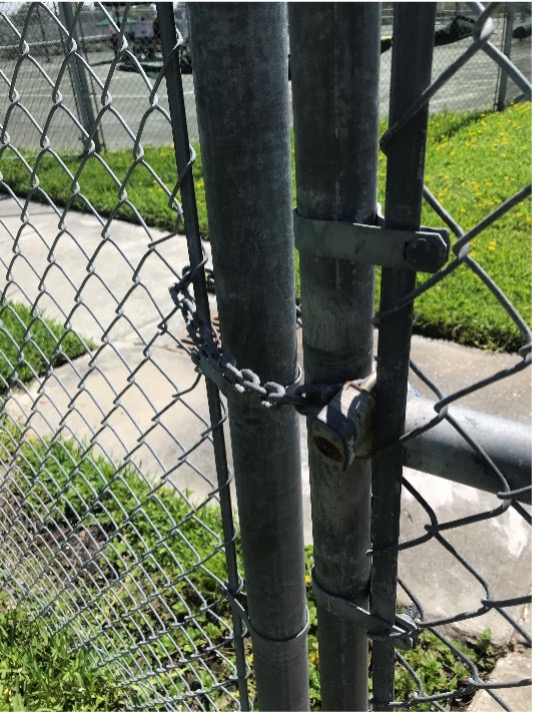
This is no accident. Past Bartlett Park, through a hidden gap in the mangroves, Salt Creek cuts diagonally, continuing to run southeast, through one of the poorer parts of the city. Neighborhoods along the creek tumble precipitously from coastal-slash-suburban to impoverished. Median household incomes drop in predictable blocks, as one moves from waterfront from properties along Tampa Bay and west into the city: $78,875 in the mostly white Old Southeast neighborhood, to $44,474 in the Bartlett Park area, to $12,096 in the more African American Harbordale section. A closer analysis provides a much more nuanced intersection of economics and race, not captured by simple caricature, though a trend exists. The city-data website reflects what anyone who lives in St. Petersburg already knows: economics fall along sharp racial lines, effecting in turn, health, access to fresh food, experiences with education and law enforcement, the possibilities of upward mobility, and of course, green space.20"St. Petersburg Florida: Income map, Earnings map, and Wages data," City-Data, Accessed March 31, 2023, https://www.city-data.com/income/income-St.-Petersburg-Florida.html. Structural racism study; see also Sears et al., "Building Bridges," 203-08.
Racial demographics and water quality intersect. At the end of legalized Jim Crow, as African Americans moved into the Harbordale neighborhood, the city let water quality sink. Low oxygen levels during the 1960s resulted in fish kills. Locals likened the smell at low tide to a badly operating sewage plant, the newspaper reported; outsiders (not residents) used the creek as an unlicensed trash pit. The rust colored water tested at almost eight times accepted levels for coliform bacteria. The city was no longer calling this waterway a stream or creek; in newspapers and press conferences the creek was now a "drainage area," or worse, a "ditch."21Willard Cox, "Tests Show [Red] 'Tide' Not Cause of Kills," The Evening Independent, July 6, 1965; "A Fishy Smell at Salt Creek," The Evening Independent, May 2, 1966; "Salt Creek Flow Sickly," The Evening Independent, Sept. 14, 1973; Bill Marden, "Trash, Tide A Problem," The Evening Independent, July 16, 1971. Racism did not cause environmental abuse; water quality was abysmal throughout Tampa Bay. A generation of activists, overwhelmingly white, have "saved the bay"—dramatically improving estuarine health. The poorer areas drained by Salt Creek, following script, are the last to see remediation.
Lake Maggiore
Semantics shape stewardship. At MLK (formerly Ninth, a major north-south street), a dam divides Salt Creek from Lake Maggiore. I am now in the middle-bottom part of the Pinellas Peninsula, on what used to be "Salt Lake," an estuarine habitat typical for coastal Florida. The name changed, however, alongside usage. In the 1920s real estate promoters began pitching new developments around a shallow, still tidal estuarine habitat. A fanciful origin story in the St. Petersburg Times provided the much-needed fiction. The newspaper, upholding real estate interests, staked a dubious claim that "Salt Lake" was discovered by Italian buccaneers, who called it "Maggiore" after a similar body of water on the Swiss-Italian border. In an act of rhetorical desalination, the hucksters presented the Italian as the earlier toponym; the sailors had first found fresh water, though mistakenly, the label "Salt Lake" stuck on later maps. Fiction and finances thus conspired to justify a dam. The Times cited a "peculiar condition" (or what the rest of us call tides) that allowed saltwater species to intrude from the bay. In 1930 a more permanent dam was built, making "Maggiore a freshwater lake for bass fishing." It would remain as such, until no one could recall when the brackish lake was part of an estuarine tidal run. By the 1980s the alligators were so pervasive that water skiers chased them off the slalom course. Neither bass nor gators belong in "Salt Lake," of course, as freshwater species have found their invasive niche in this badly translated Alpine lago.22"Lake Maggiore Believed to be Named by Pirate—To Be a Beautiful Section," St. Petersburg (FL) Times, April 5, 1925; "Lake Maggiore Dam Proposed," St. Petersburg (FL) Independent, Sept. 25, 1930. I am indebted to Jack E. Davis, who grew up on Lake Maggiore and who read a draft of this essay, for the observation about water skiing.
The folly, this not-just-semantic amnesia, has been expensive. Newspapers chronicle a twenty or thirty year cycle of restoration and waste. Eutrophication, fish kill, dredge Crisis, quick fix, repeat. In 1940, ten years after construction of the new dam, the city's Evening Independent would report:
City sanitation crews were burying hundreds of pounds of dead mullet and trout along the eastern shore of Lake Maggiore where they washed up after being killed by what [is] believed to be excessive vegetation gases in the shallow waters of the lake.
The newspaper described a horrific scene. Fish up to two feet long, panting in the grass; sanitation workers removing the rotting carcasses; the city vowing to install a screen to keep saltwater species out of the now-freshwater lake. Again, in 1963, the state game commission concludes that ecologically, the lake has become "old and not conducive to bass reproduction." Fish kills returned in 1968 and 1970, when the city detected chloride, a negatively charged ion that indicated "somehow salt water was getting into" Maggiore. In 1991, the headlines repeat: "Lake Maggiore Sick from Pollution," this time from high concentrations of run-off nitrogen and phosphorous. The following year, sanitation workers hauled off three-hundred pounds of dead menhaden (a coastal and estuarine species), snook, redfish, and yellow fin. Starting in 2004, the city spent two years scraping 1.3 million tons of sediment from the lake bottom. Trucks ran sixteen hours a day, five days a week, transferring the muck to a sod farm and developing area in the swampier part of the county's north end. After high levels of arsenic were detected in the soil, however, the city found itself in a sticky legal battle with the developer who used the fill, eventually settling with a million dollar contamination claim.23"Tons of Fish Die in Lake Maggiore," The Evening Independent Aug. 1, 1940; "Lake Maggiore: Fight Against Aging," St. Petersburg (FL) Times, June 25, 1971; Sue Landry, "Lake Maggiore Sick from Pollution," St. Petersburg (FL) Times, Jan. 16, 1991; "Natural, Normal Fish Kill Hits Lake," St. Petersburg (FL) Times, Nov. 2, 1992; Waveney Ann Moore, "Contaminated Soil to Cost St. Petersburg $1 million, 15 Years after Dredging Project," Tampa Bay (FL) Times, April 12, 2019; Southwest Florida Water Management District, "Final Phase of Lake Maggiore Restoration Project in Full Swing," Water Matters, May–June 2005, https://www.swfwmd.state.fl.us/blog/watermatters-magazine/11/final-phase-lake-maggiore-restoration-project-full-swing. Despite the added cost, toxicity, and history of repeating problems, officials declared victory. "This project attempts to set back the clock on a long history of water quality problems at Lake Maggiore," the Southwest Florida Water Management District (Swiftmud) triumphantly claimed. The irony is deafening. A plan has been set in place, with no heed for the existing pattern of waste. If the clock was "set back," as Swiftmud boasts, then only for the same problems to repeat.24Water Matters, "Final Phase."
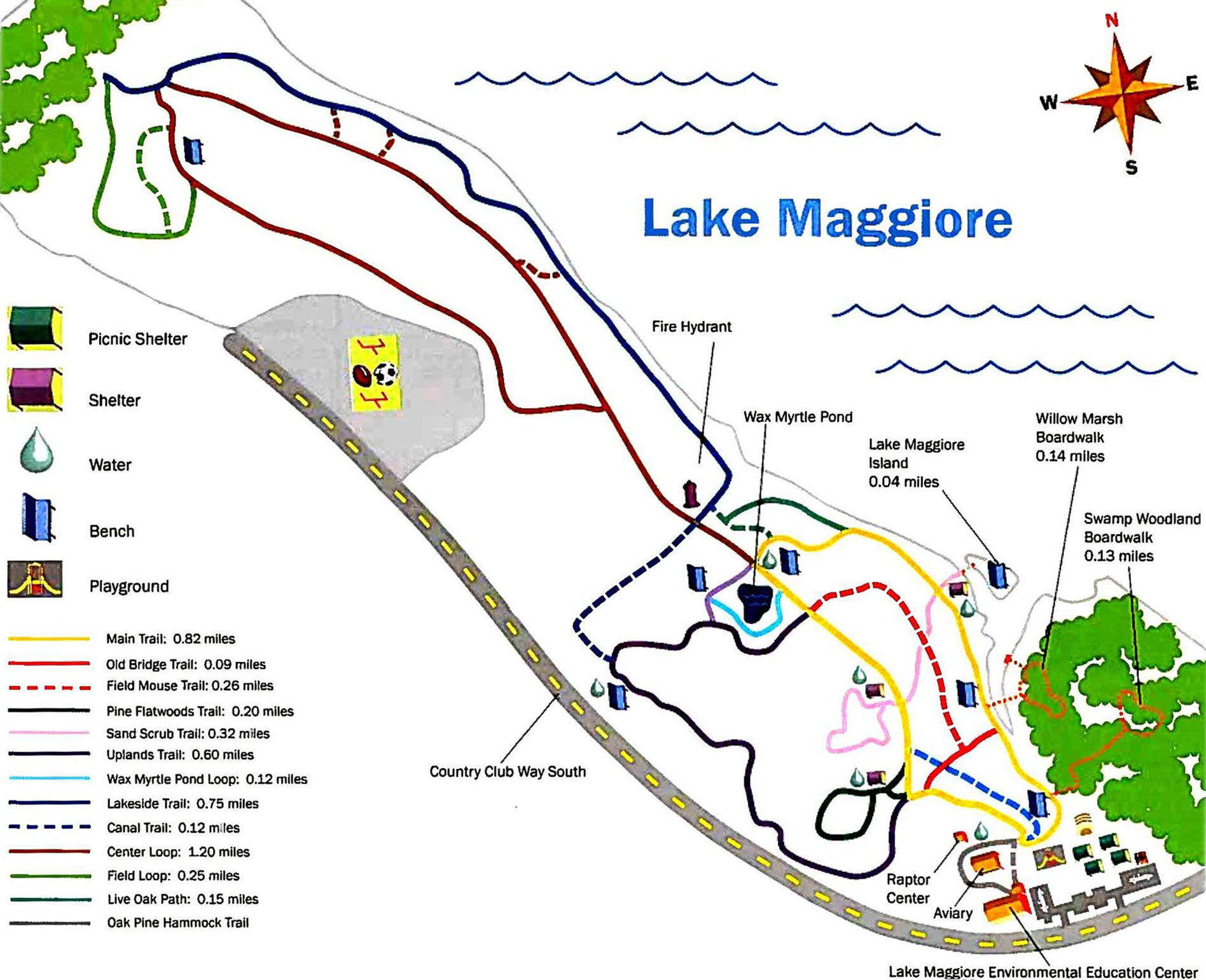
The lake remains awash in contradiction, mismanaged and lexically confused. The dam along MLK seeks to split salt and fresh water. Circle south, past some houses, by a fire station, and a mostly abandoned park. Spin further southwest and much of the land is sheltered by a beloved sanctuary, Boyd Hill Nature Preserve. Along the same tract, adjacent to the preserve, a city dump turns over mulch. At the base of Twenty-Second Street, historically the central corridor for St. Petersburg's African American population, sits a park. The north section fronts Maggiore Shores, originally a white neighborhood, then middle-to-upper-class Black, and today, increasingly white again. Each of the stakeholders holds a claim to the park—some smaller, some larger. Mostly white environmentalists aligned with Boyd Hill argue for removing the dam and restoring the ebb and flow of "Salt Lake." Older home owners in the Maggiore Shores neighborhood (to the north) want cattails around the edges cleared to improve their view; the current water management plan keeps salinity down and serves as flood protection. The only unifying factor is the cattails circling the lake, indicating low water quality. The common denominator is eutrophication; the argument is how to solve the problem. Renamed with a faux history, mispronounced, and managed against its natural flow, this once-tidal lake suffers from being something it is not.
Willow Marsh
On the south shore of the same Lake Maggiore, Salt Creek changes names (again). Then it disappears (again). The precise point of disappearance, ironically, occurs in a beloved nature park, Boyd Hill Nature Preserve, at one of the finest visual prospects in the entire city. A boardwalk on the Willow Marsh Trail faces North, towards downtown. Off in the distance, beyond the lake, cumulus clouds tower over one another, dramatically framing a vast blue horizon and restless skyline. Anhinga roost in a nearby island, and below, any number of species of ducks, moorhen and long-legged waders nudge through spatterdock and duckweed. Common sights are marsh rabbits and alligators, the mother gator often with her yellow-striped young brood. The visitor's map to the preserve marks this particular boardwalk as part of the Willow Marsh Trail, which presumably would make this area "Willow Marsh." Technically, the water forms part of a Salt Creek branch. Trail maps to the preserve, however, do not even mark a stream.
City nature has no place in a "nature preserve." At a point where an urban waterway should be most visible, even celebrated, the comedy of hide-and-seek intensifies. A waterway (now flowing due South) switches names. By the semantically confused lake, it disappears from the map altogether. Why? Because discursive "Nature" and the natural hydrology do not align. Near the Boyd Hill visitors center, hikers have unknowingly crossed Salt Creek. It is the little brook that trickles past an outdoor classroom, by the raptor rehabilitation center, and eventually reaches back to the edge of the nature preserve, where it runs under a chain link fence. Here, the creek becomes a culvert. And with subtle semantic shift, stewardship declines.
The aquatic thread snaps. We lose the connection. In a wealthy suburban neighborhood, the headwaters of Salt Creek runs through a maze of backyard overgrowth, accessible only with permission. To trace the creek now is to trespass. Care falls to individual whim or the conscience of private owners. One particularly zealous environmentalist has dutifully planted native cypress in the bottom, hoping to stabilize the sandy banks and restore habitat; elsewhere, the low-lying area remains mostly a jungle of invasive taro and wild ginger. Further south, where the planner John Nolen proposed a green corridor along the area's natural swale, the St. Petersburg Country Club has engineered the creek's headwaters into a series of water hazards for its golf course. Landscapers mow up to the edges of the artificial ponds along the golf course's back nine.
The hydrology has become impossible to visualize as one piece. Because the waterway is fragmented, no one connects the link from fourteenth fairway to Tampa Bay. Grass clippings run straight into the ditch, Lake Maggiore, into Salt Creek, and eventually into our beloved bay—feeding algae and toxic blooms that have undermined our quality of life, ruined countless fishing trips, and cost the state dearly in tourist revenue.25 The Tampa Bay Regional Planning Council set the loss of tourism revenue for a 2018 red tide bloom at $130.6 million; see The Ripple Effects of Florida Red Tide, (Pinellas Park, FL: Tampa Bay Regional Planning Council, 2019), https://tbrpc.org/wp-content/uploads/2019/01/The-Economic-Ripple-Effects-of-Florida-Red-Tide_unsigned.pdf; A more thorough study set the loss for the same bloom at double the cost, $317 million, see João-Pedro Ferreira, et al. "Impact of Red Tide in Peer-to-Peer Accommodations: A Multi-Regional Input-Output Model," Tourism Economics, March 1, 2022, https://journals.sagepub.com/doi/10.1177/13548166211068276. The neglected stream passes over a dingy concrete weir, amounting to little more than a one-stroke penalty for golfers and repository for lost Titleists.
Again, the aquatic thread splits. There are actually two larger branches feeding Lake Maggiore, the second no easier to trace. In its western course, the stream feeds a lake from a city tract along Dell Holmes Park. From here, it runs due West down a channel, where it parallels a public golf driving range. Canoes and kayaks rarely paddle this channel. The alligators are unusually large. One could go missing here altogether. If I am to put in at Lake Maggiore, I double check my life preserver.
The unnamed, culverted west branch cuts anonymously across public land. I can paddle upstream, with a city mulch processing plant to the left, and a drop-off site for brush to the right. The stream parallels the east-west running Twenty-Sixth Avenue South. Chain-link divides the landfill and private property, in this case two of the more prosperous historically Black churches in the city—St. Augustine's Episcopal and McCabe United Methodist. The location of these churches, or more accurately their relocation, figures into the last half century of city history. Both congregations served Jim Crow neighborhoods closer to the center of town, the middle class Campbell Park and poorer Gas Plant communities. Both neighborhoods were razed in the 1970s and 80s. Following a national trend, in which federal roads targeted Black areas, Interstate i-175 cut the Campbell Park neighborhood in half, running straight over homes where pillars of the African American community lived.
Ten years later, as if by design, the city razed the Gas Plant in the name of urban renewal, leveling a neighborhood to construct a domed stadium. The Tampa Bay Rays (Raze?) now play in the dome, Tropicana Field. But the team's owners (buttressed by city government and a newspaper that depends upon sports for daily copy) declare the thirty-year-old dome obsolete. Once again, the area awaits real estate redevelopment, with little probable return for the people displaced under the banner of "urban renewal" and promises to "get it right." St. Augustine's Episcopal relocated during the 1970s, moving from property now near the interstate, away from a community that has since scattered, and rebuilding on the rich soil of a former nursery near the head of Salt Creek's long swale.
Lake Eli
Where the creek ends remains an open question. According to an environmentalist friend who lives along the south shores of Lake Maggiore, the creek was historically sheet flow, tracing without record or immediate course through pine flatwoods. If I push a kayak further west, past Lake Eli, I trace the drainage ditch, almost to the churches that run along Twenty-Sixth Avenue. Just north of an arrow-straight culvert alongside the parking lot of McCabe United Methodist, the stream unceremoniously ends. The culvert takes a sharp turn at the boundary of church and city land, then runs north, along a straight ditch to north-south running Twenty-Sixth Street. On the other side of the street, Salt Creek finally disappears into underground maze of sewers. And from there, who knows?
Conclusion—Fragmented Headwaters
McCabe's presence at the headwaters embodies a painful chapter of St. Petersburg's history. The congregation of this century old church coalesced around segregated areas, along the eastern edge of the Gas Plant neighborhood. The congregants built the former church themselves, laying their spiritual home on the Black side of a segregation boundary. The interstate and dome destroyed the old structure, and today, the site is now a nondescript concrete parking garage. The current pastor, Reverend Jana Perkins-Hall, speaks clearly of the betrayal:
Black people got together, during that particular time of economic disenfranchisement, pooled their resources and physically built, brick by brick, this place of worship. They were there for fifty years before they were relocated . . . For what?
Perkins-Hall, though not a native, speaks powerfully on behalf of her parishioners: "So what kind of message does that send — spiritually, emotionally, psychologically — to the people who worked for free? That now, in place of a community they called home, is a parking garage?" There is no historical marker, even though stories continue to tell, "that this was once a place of sacred worship." The dislocation remains an unacknowledged erasure. A more visible reminder would at least acknowledge the hurt.26Jana Perkins-Hall spoke at a community forum about Booker Creek and the Tropicana Field site redevelopment, held at the University of South Florida's St. Petersburg campus on Feb. 15, 2019; see, Anna Maria Lineburger, Kelly Kennedy, and Dyllan Furness, ed., Voices of Booker Creek (St. Petersburg: University of South Florida, 2020), 29–30. Just as the teenage boy said to the Penn professor Anne Whiston Spirn: "someone will wreck it."
McCabe United Methodist Church
At McCabe, the unbaptized remnants of Salt Creek disappear into a sewer line, across from the church, at the corner of Twenty-Sixth Avenue and Twenty-Eighth Street. It is smack-dab in the middle Pinellas County, just east of the low sand ridge (a relic dune) that divides the peninsula. How and where the waters ran before development remains a question. Early histories and even the occasional map suggest that the outer reaches of Salt Creek mingled with a bayou to the west, possibly trading headwaters from both the swamp and bay' this memory of an earlier hydrology, however, remains repressed.27Walter Fuller, St. Petersburg and Its People (St. Petersburg: Great Outdoors Publishing Co., 1972), 5. The creek might have run straight across, serving as a liquid connector now lost.
Cities that bury their habitats sacrifice a bit of collective soul. Environmentalists in Los Angeles lament the failure to recognize the human, natural, and even cinematic history of the concretized Los Angeles River. Tourists are drawn to the Fleet River. New Yorkers still want to see the waters that bubbled under Minetta Street in lower Manhattan, and my archaeologist-art history friend clearly felt a connection when she stumbled onto the Eriadnos. With sea level rise, social scientists attend to the psychic costs of disappearing landscapes, citing what they call solastagia or "environmental grief."28Ellis Neville and Ashlee Cunsolo. "Hope and Mourning in the Anthropocene: Understanding Ecological Grief," The Conversation, April 4, 2018, https://theconversation.com/hope-and-mourning-in-the-anthropocene-understanding-ecological-grief-88630; Gren Albrecht et al., "Solastagia: The Distress Caused by Environmental Change," Australasian psychiatry: Bulletin of Royal Australian and New Zealand College of Psychiatrists 15 (2007); Ashlee Cunsolo and Neville R. Ellis, "Ecological Grief as a Mental Health Response to Climate Change-Related Loss," Nature Climate Change 8 no. 3 (2018): 275–281; L.P. Galway , T. Beery, K. Jones-Casey, K. Tasala "Mapping the Solastalgia Literature: A Scoping Review Study." Internal Journal of Environmental Research and Public Health 16:15 (July 2019). The social-historical context adds another layer. My partner Julie walked Birmingham's Village Creek in an effort to connect place and current-day race relations in this iconic civil rights setting. When I trace Salt Creek, I too seek this connection.
Hydrologic systems carry us into our history. They uncover buried pasts, helping us to explain unhealthy divides. Despite Florida's myths of paradise, we remain disconnected from the natural world, from the past that has built itself around us, from one another. Environmentalism needs community, and we best find community in a city's liquid heart. We need to know where the waters run.
About the Author
Thomas Hallock received his PhD from New York University. He is the author of From the Fallen Tree: Frontier Narratives, Environmental Politics and the Roots of a National Pastoral, 1749–1826 (Chapel Hill: University of North Carolina Press, 2003) and the co-editor of Early Modern Ecostudies: From the Florentine Codex to Shakespeare (New York: Palgrave Macmilian, 2008), William Bartram, the Search for Nature's Design: Selected Art, Letters and Unpublished Manuscripts (Athens: University of Georgia Press, 2010), and Travels on the St. Johns River: John and William Bartram (Gainesville: University of Florida Press, 2016). He recently published a series of travel and place-based essays that explain why he loves teaching the American literature survey, A Road Course in Early American Literature: Travel and Teaching from Atzlán to Amherst (Tuscaloosa: University of Alabama Press, 2022).
]]>Introduction
On January 15, 1909, US President-elect William Howard Taft attended a banquet at the Chamber of Commerce along with "the cream of Atlanta and the south's commercial factors, professional men, editors and railroad magnates" where the main course featured a winter trio of roasted opossum, sweet potatoes, and persimmon beer.1"Taft Eats 'Possum, Gives South Pledge," The New York Times, Jan. 16, 1909, 1. Several months earlier and prior to his election, Taft had become the first Republican candidate to venture into the Democratic "Solid South" during a presidential election.2David Charles Needham, "William Howard Taft, The Negro, and the White South, 1908–1912," (PhD diss., University of Georgia, 1970), 31. The Atlanta banquet represented a continuation of Taft's efforts toward sectional reconciliation as he pledged to "weld into a compact unit the North and the South."3"Taft Eats 'Possum, Gives South Pledge," 1. The event highlighted the white supremacist solidarities necessary for such political and economic reunification, with his speech elaborating policies that would assure federal appointments would not go to African Americans and that southern metal and cotton products would find commercial opportunities in Far Eastern markets.4William H. Taft, "The Winning of the South," Political Issues and Outlooks: Speeches Delivered Between August, 1908, and February, 1909 (New York: Doubleday, Page, 1909), 230–234.
For the prominent white male politicians, businessmen, and other leaders seated at the dining tables, roasted opossum was more than just a show of Gilded Age gustatory extravagance. The food held deep cultural meanings. Since the antebellum era, white males of southern plantation households would occasionally oversee or accompany enslaved people's nighttime opossum hunts, claim their spoils, and then relegate the game's preparation to African American cooks. Drawing on this tradition, a generation of white men with rural upbringings came to see opossum hunts as a means of perpetuating antebellum culture by reinforcing and reinscribing racial lines. They mocked and derided opossums as indicative of negative aspects of African American culture while simultaneously celebrating African Americans as possessing a folk knowledge of hunting, preparing, and cooking opossums.5Psyche Williams-Forson examines similar paradoxes in the case of fried chicken in her chapter "More Than Just the 'Big Piece of Chicken': The Power of Race, Class and Food in American Consciousness," in Food and Culture: A Reader, 3rd ed., Carole Counihan and Penny Van Esterik, eds. (New York: Routledge, 2012): 107–118. See also Williams-Forson Building Houses Out of Chicken Legs: Black Women, Food, and Power (Chapel Hill: University of North Carolina Press, 2006). In the decades after the Civil War, whites of all social classes increasingly consumed this survival food, now labeling it a "southern delicacy."6This sort of cultural appropriation persisted for over half a century after the Taft banquet, with the women of the Junior League of Charleston, South Carolina, suing Ernest Matthew Mickler, author of White Trash Cooking, in the mid-1980s for lifting what they claimed was their historical recipe for roasted opossum. For a brief discussion of cultural appropriation in this context, see Angela Jill Cooley, "Southern Food Studies: An Overview of Debates in the Field," History Compass 16, no. 10 (2018): 1–9. The dish, known as "'possum and 'taters," was one of many items of "southern cooking," which, as Diane Spivey points out, signified a "Whites Only Cuisine" during Jim Crow.7Diane M. Spivey, "Economics, War, and the Northern Migration of the Southern Black Cook," The Peppers, Crackling, and Knots of Wool Cookbook: The Global Migration of African Cuisine (New York: State University of New York Press, 1999).
Challenged by the economic competition of freed people who sought urban factory jobs and attempted to purchase rural farms, in addition to the political competition of the Populist movement that aimed to unite Blacks and working-class whites, opossum suppers, particularly in Georgia, provided a Democratic theatre in the decades following Reconstruction. At the 1909 Atlanta supper, staged to garner national attention, Taft appealed to Democrats who sought to regain national political strength. As the New York Times reported: "Five hundred eyes watched until he had been served and bountifully served and had taken his first bite of the tempting dish."8"Taft Eats 'Possum, Gives South Pledge," 1. In the aftermath of this feast, journalist Don Marquis suggested that "the possum, and all the talk back and forth across the festive boards . . . has likely strengthened Mr. Taft's idea that the 'Solid South' is breakable, and that he is the man to break it. . . . How much of the Southern point of view with regard to the negro did Mr. Taft imbibe while eating the possum?"9Don Marquis, "A Glance: Concerning the Possum and the Negro," Uncle Remus's the Home Magazine, March 1909, 26. https://digitalcollections.library.gsu.edu/digital/collection/printed/id/6450/rec/1.
The opossum's momentary rise to glory parallels the shifting of political power during this era of intensifying apartheid. Whites in Georgia and other southern states turned African American reliance on the opossum as a means of sustenance and source of income into a symbol of racial inferiority. This occurred despite the fact that many subsistence-level whites also sought the opossum as a food source. Glorified opossum consumption complemented practices of Confederate memory-making and white sectional identity.10While scholars and writers have given attention to "southern" foods and foodways since the 1970s and 1980s, the opossum remains largely absent from the historiographical record. Most authors have simply highlighted that this food—along with other game such as raccoons and squirrels—formed an important part of the diets of both white settlers and Black slaves in the antebellum era. Sam Bowers Hilliard, Hog Meat and Hoecake: Food Supply in the Old South, 1810–1860 (1972; repr., Athens: University of Georgia Press, 2014), 54; Joe Gray Taylor, Eating, Drinking, and Visiting in the South: An Informal History (1982; Baton Rouge: Louisiana State University Press, 2008), 8; Herbert C. Covey and Dwight Eisnach, What the Slaves Ate: Recollections of African American Foods and Foodways from the Slave Narratives (Santa Barbara, California: Greenwood Press, 2009). Literary scholar David S. Shields discusses the appearance of roasted opossum on a hotel menu in "Possum in Wetumpka," Southern Provisions: The Creation & Revival of a Cuisine (Illinois: University of Chicago Press, 2015), 143–162. With the emergence of food studies as a field in the 1990s, historians have more rigorously used food to study culture, race, class, gender, and political power.
Geography and Ecology of the Opossum
What was the historical geographic range of the Virginia opossum (Didelphis virginiana)? A mid-1950s article by John Guilday indicates an abundant archeological record of the indigenous marsupial in the Lower and Middle Ohio Valley and in Ohio north to the shore of Lake Erie before European colonization.11John E. Guilday, "The Prehistoric Distribution of the Opossum," Journal of Mammalogy 39 no. 1 (1958): 39–43. An absence of remains reveals that the opossum either did not occur or was uncommon in the Appalachian Plateau of northern West Virginia, western Pennsylvania, and southern New York. Guilday shows that species distribution extended beyond the southeastern United States, even though settlers came to associate the opossum with that section of the country. In The Quadrupeds of North America, John James Audubon writes that the opossum was by no means confined to southern states, particularly during the antebellum period. By 1851 the opossum's range extended north to the Hudson River. Audubon believed that populations would soon occupy southern New York and Long Island "as the living animals are constantly carried there."12John James Audubon and the Rev. John Bachman, The Quadrupeds of North America, vol. II (New York: V. G. Audubon, 1851), 124, https://archive.org/details/b22012436_0002/page/124/mode/1up. In New Jersey and Pennsylvania, opossums were common, but they were more abundant southwardly through North Carolina, South Carolina, Georgia, Louisiana and Texas, to Mexico. They also existed in Indiana, Mississippi, Missouri, and Arkansas, and extended to the Pacific, with some populations in California.13Audubon, Quadrupeds, 125.
The opossum—which is remarkably fecund due to its short gestation period and ability to produce two litters a year in warm climates—was one of the most common small mammals before European colonization in the hardwood forests of the southern Coastal Plain and Piedmont ecoregions, according to environmental historian Timothy Silver.14Timothy Silver, A New Face on the Countryside: Indians, Colonists, and Slaves in South Atlantic Forests, 1500–1800 (New York: Cambridge University Press, 1990), 11. Unlike many species of wildlife adapted to these forests, opossums were not negatively impacted by market hunting since their pelts were of low value. The deforestation that accompanied colonial farming practices allowed opossum populations to increase by driving away foxes, wolves, and other predators and by enabling grass and seed-eating mammals, such as rabbits and mice, to proliferate. Audubon's remark that the opossum consumed everything from grain in cornfields to nuts and berries, as well as rodents, rabbits, and hens, indicates that it found plantations and yeoman farms ideal habitats.15Audubon, Quadrupeds, 112.
Many viewed opossums as pests because of their omnivorous eating habits and their ability to destroy food crops. "A 'Possum Sir, is not a critter, but a varmint," remarked an overseer at Belvoir plantation near Pleasant Hill, Alabama, insinuating that the wild animal was not desirable food.16Philip Henry Gosse, Letters From Alabama (U.S.) Chiefly Relating to Natural History (London: Morgan and Chase, 1859), 234, https://archive.org/details/lettersfromalab00goss/page/234/mode/2up. Significantly, English naturalist Philip Henry Gosse, who recorded the overseer's comment while employed as a tutor at Belvoir in 1838, also observed among the neighboring plantations that the meat of both the opossum and raccoon were "scarcely ever eaten by whites, and never in summer." Travel writers, such as Frederick Law Olmsted, offer evidence that whites occasionally ate the meat during the winter. In January 1854, Olmsted recorded the owner of a large plantation in Virginia serving him opossum, which he described as tasting like a "baked sucking-pig."17 Frederick Law Olmsted, A Journey in the Seaboard Slave States, With Remarks on Their Economy (New York: Dix and Edwards, 1856), 92, https://archive.org/details/journeyinseaboar00olms/page/92/mode/2up?view=theater. Ex-slave Anderson Furr, who grew up on a plantation in Hall County, Georgia, offers a different perspective of white consumption: "Dey made N*****s go out and hunt 'em and de white folks et 'em. Our mouths would water for some of dat 'possum but it warn't often dey let us have none."18Interview with Anderson Furr in Federal Writers' Project of the Works Progress Administration, Slave Narratives: A Folk History of Slavery in the United States From Interviews with Former Slaves, vol. IV, Georgia Narratives, Part 1 (Washington, DC: 1941; Project Gutenberg, 2004), https://www.gutenberg.org/files/13602/13602-h/13602-h.htm. Furr's recollection suggests that already, in the antebellum era, opossum consumption factored into a display of racial domination.
Hunting methods, such as capturing opossums live to fatten at home and clean out their digestive tracts may have helped to improve the taste of this wild game. Yet, associating opossums with native persimmon fruits enabled a popular imaginary that helped to reduce prejudices against prominent whites who occasionally consumed this lowly scavenger. The American persimmon tree (Diospyros virginiana)—an early invading species in disturbed areas and along forest-pasture boundaries—was common throughout the opossum's range. While Native American stories connected opossums with persimmon fruits, the association was particularly strong in antebellum African American songs and folklore, as well as white settler accounts of opossum hunts.19For examples of opossums eating persimmons, see James Mooney, "The Terrapin's Escape from the Wolves," Myths of the Cherokee (Washington, DC: Government Printing Office, 1902), 278–279, https://archive.org/details/cu31924104080076/page/n7/mode/2up. See also Joel Chandler Harris, "Why Mr. Possum Loves Peace," The Complete Tales of Uncle Remus (Boston: Houghton Mifflin Company, 1955), 9. Audubon's illustration of the opossum conveys an ecological association between the plant and animal. Ripe persimmons may have enhanced the flavor of the meat, yet the fruit was not essential to supporting this omnivorous species, which indiscriminately ate plants, insects and animals and opportunistically consumed carrion and trash.
Antebellum Opossum Hunting and Black Culture
Although opossums were a choice component of the antebellum diets of white small landholders and tenants, primary accounts offer more insight into the connections between this food and enslaved people of African descent.20Subsistence farmers engaged extensively in hunting opossums for food, but early to mid-nineteenth-century written sources emphasize on African American consumption. Along with other small game, opossums were an important source of protein and fat in diets that enslavers kept lean and scarce. Ex-slave Peter Randolph explained that in Virginia many slaves made traps with cut timber, often setting fifteen to twenty of them in the swamps to capture opossums, raccoons, hares, and squirrels.21Peter Randolph, Sketches of Slave Life: Illustrations of the "Peculiar Institution" (Boston, MA: Peter Randolph, 1855), 19–20, https://docsouth.unc.edu/neh/randol55/randol55.html. Some slaves, however, used trained dogs to tree opossums at night in wooded areas adjoining plantations. Because hunting and setting traps at night did not directly interfere with daytime farm work, some enslavers permitted those they held in bondage to capture small game for supplementary nutrition. Slaves not allowed to go hunting at night had to be more covert. Ex-slave Solomon Northup recalled that in Louisiana, "There are planters whose slaves, for months at a time, have no other meat than such as is obtained in this manner."22Solomon Northup, Twelve Years a Slave: Narrative of Solomon Northup, a Citizen of New-York, Kidnapped in Washington City in 1841, and Rescued in 1853, from a Cotton Plantation Near the Red River, in Louisiana (Buffalo, NY: Derby, Orton, and Mulligan, 1853), 201, https://docsouth.unc.edu/fpn/northup/northup.html. In interviews for the Works Progress Administration's Federal Writers' Project, the numerous ex-slaves who recollected hunting or eating opossums attest to Northrup's claim that the marsupials were an important meat and that hunger drove consumption of this wild game, often described as greasy and fatty.23See Federal Writers' Project of the Works Progress Administration, A Folk History of Slavery in the United States from Interviews with Former Slaves (Washington, DC, 1941; Project Gutenberg, 2004), https://www.gutenberg.org/ebooks/13847. A few of the interview references to opossums from the WPA slave narratives are referenced in Stephen Winick's blog "A Possum Crisp and Brown: The Opossum and American Foodways" (Washington DC: Library of Congress, August 15, 2019), https://blogs.loc.gov/folklife/2019/08/a-possum-crisp-and-brown-the-opossum-and-american-foodways/.
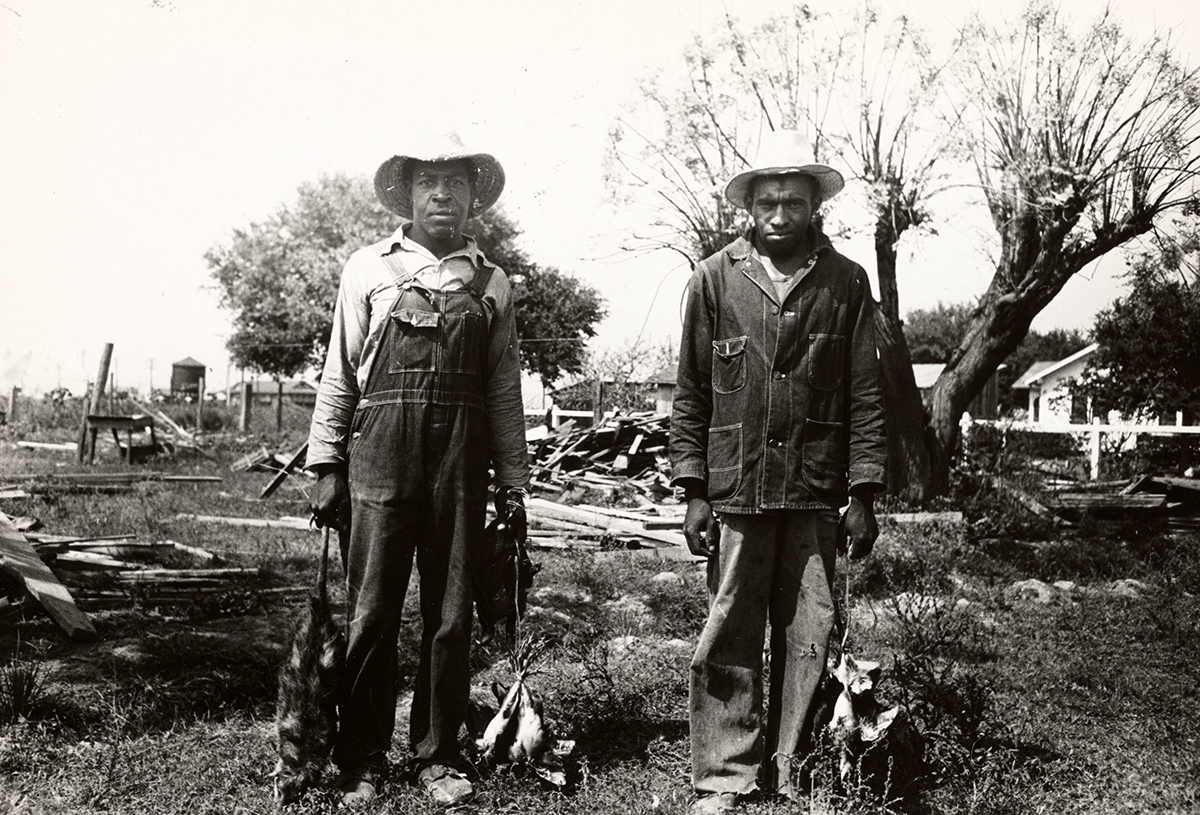
Opossums were more than a survival food for enslaved people. While John Patterson Green, born to emancipated parents in North Carolina, writes that African American opossum consumption "arises not so much from any constitutional partiality on their part, or difference in their tastes [. . .], as from the absence of fresh meats of all kinds," other slaves and freed people expressed the pleasures they experienced from consuming the animal.24John Patterson Green, Recollections of the Inhabitants, Localities, Superstitions and Ku Klux Outrages of the Carolinas (Cleveland, OH: 1880), 181, https://archive.org/details/recollectionsofigree/page/n5/mode/2up]. "The flesh of the coon is palatable," Northrup notes, "but verily there is nothing in all butcherdom so delicious as a roasted 'possum."25Northup, Twelve Years a Slave, 201. The marsupial also enabled enslaved people to access more desirable food. Remembering having "been kept for a long time on corn and potatoes," ex-slave Andrew Jackson of Kentucky revealed that opossums were one of several "expedients to get luxuries."26Andrew Jackson, Narrative and Writings of Andrew Jackson, of Kentucky; Narrated by Himself (Syracuse, NY: Daily and Weekly Star Office, 1847), 27, https://archive.org/details/narrativewriting00jack/page/n27/mode/2up?view=theater&q=pig. Jackson described a scheme of "eating pig for opossum" that entailed obtaining permission to go opossum hunting, skinning several opossums and burying their bodies, killing two pigs and burying their skin and entrails, and then boiling the pork in kettles. The slaves retained the opossum skins as "proof" of the meat's source. Annie Young, from Tennessee, told of a slave caught with a young pig: "Master it may be a shoat now, but it sho was a possum while ago when I put 'im in dis sack."27Interview with Annie Young in The Federal Writers' Project of the Works Progress Administration, Slave Narratives, Oklahoma: A Folk History of Slavery in the United States from Interviews with Former Slaves, vol. XIII, Oklahoma Narratives (Washington, DC: 1941; Project Gutenberg, 2007): 359, https://www.gutenberg.org/files/20785/20785-h/20785-h.htm. Young's trickster humor suggests a realm of everyday practices that lay beyond the master's grasp.28 Consider Jackson's tale alongside Louis Jordan's popular post-World War II hit song "Ain't Nobody Here But Us Chickens" as discussed in George Lipsitz's Rainbow at Midnight (Urbana: University of Illinois Press, 1994), 303–310.
Because opossums were important in survivance, they figured prominently into Black culture. Thomas Talley, an African American folklorist whose parents were former slaves, documented antebellum rhymes used for dancing and entertainment, such as the "Possum-La," "'Possum up the Gum Stump," "An Opossum Hunt," and "Shake the Persimmons Down."29Thomas Talley, Negro Folk Rhymes (New York: The MacMillan Company, 1922), 3, 23–24, 34, 233–234. References to some of these songs or rhymes can also be found in ex-slave narratives recorded through the Federal Writers' Project of the Works Progress Administration. Songs referenced plants, animals, and activities integral to the environments that enslaved people intimately experienced. The deep meanings that the opossum developed through antebellum folklore and foodways—as a connection to the past and an avenue to the future—would make it all the more significant when southern whites tried to claim an exclusivity of this food during Jim Crow.
Postbellum Opossum Hunting and White Supremacy
After the Civil War, hunting, selling, and consuming opossums remained significant among many African Americans. As formerly enslaved people sought to carve out autonomous livelihoods, opossum consumption represented ecologically rooted foraging skills, economic independence, and household sufficiency. Newspapers began to relay impressive—if not exaggerated—hunting accounts. An editor, for example, remarked on New Year's Day 1880 that a Black hunter in Anderson County, South Carolina had caught 127 opossums since the previous fall.30"South Carolina News," Yorkville (SC) Enquirer, Jan. 1, 1880, 2, https://chroniclingamerica.loc.gov/lccn/sn84026925/1880-01-01/ed-1/seq-2/.Although generally considered a male activity, there were exceptions, such as a Black woman's catching fifteen opossums in Muscogee County, Georgia, in 1877.31"Foraging on our Exchanges," The LaGrange (GA) Reporter, Oct. 11, 1877, 2, https://gahistoricnewspapers.galileo.usg.edu/lccn/sn82015287/1877-10-11/ed-1/seq-2/#date1=10%2F11%2F1877&city=LaGrange&date2=10%2F11%2F1877&words=&searchType=advanced¬text=&index=2&sequence=0&proxdistance=5&rows=12&ortext=&proxtext=&andtext=&page=1.
Enslavers may have tolerated—and on occasion, celebrated—antebellum opossum hunting. Yet, when these same men lost control over their labor force and struggled to maintain their livelihoods after the war, Black opossum hunts signaled an infringement on white supremacy. Whites sought to assert control over African American hunting and foraging practices. Attending opossum hunts with their former slaves provided one way for whites to flex their power. Opossum bounties were another. Depicting autonomous Black hunts as pathological and wasteful, one Atlantan wrote: "But we are wandering among the black jocks," adding that an opossum bounty will "protect negro labor and revive their languid interest in the best government."32"Possums and Protection," Atlanta (GA) Constitution, Sept. 20, 1882, 4. Because opossums destroyed crops and raided chicken houses, bounties gave landowners a way to protect their capital from pests and predators.33There may have been other motives behind paying African Americans to hunt opossums. By paying freed people to hunt opossums, former slave owners attempted to assert their authority over Black hunting, which they framed as an idle diversion from necessary farm work.34Scott Giltner, Hunting and Fishing in the New South: Black Labor and White Leisure after the Civil War (Baltimore, MD: Johns Hopkins University Press, 2008), 28.
For white men who had grown up on plantations, postbellum Black opossum hunting could evoke conflicting feelings. Sometimes the activity signaled a threat to white supremacy, while other times it featured in an imagined "South." While the Ramapough Mountain Indians of New Jersey and New York engaged in hunting opossums, a New York Times correspondent asserted in 1886 that they were "not such picturesque35"Picturesque" appears frequently in late-nineteenth century writing describing opossum hunting throughout the southern states. The term was rooted in eighteenth-century British landscape design, but travel writers, such as William Bartram, later used it to describe an attractive or pleasing scene. See "Picturesque," (Washington, DC: National Gallery of Art, last edited 2021), https://heald.nga.gov/mediawiki/index.php/Picturesque. hunters as their brethren of the south" because, instead of using hunting dogs, they relied on guns and deadfall traps (even though slaves and freed people in the southern states also used guns and traps).36"Hunting the Possum," Buffalo (NY) Commercial, Sep. 4, 1886, 1; "Hunting the Opossum. A Place Where He Is Found North of Mason and Dixon's Line," Wood County Reporter (Grand Rapids, WI), Sep. 23, 1886, 6, https://chroniclingamerica.loc.gov/lccn/sn85033078/1886-09-23/ed-1/seq-6/. Stereotypical depictions of place and race formed around the native marsupial. "No one ever located the opossum hunt anywhere but in the gum swamps or among the persimmon trees of the south," the correspondent wrote in popular racist imagery, "where they are ever associated with the spectacle of the bulging-eyed and expectant darky carrying aloft his flaming pine-knot torch, while his lean and lanky dog leads him to the tree where the much prized possum has sought refuge." A racist "plantation song" suggests a chaotic scene:
Afore de n****r could come down de tree would mostly fall—
Then smack among the dogs would light de possum n*g and all,
De dogs would pitch upon 'em both and most tar dem in half,
Old Marster he would stand aside and kill hisself wid laugh.37"Possum Hunting—A Song," Fairfield Herald (Winnsboro, SC), Mar. 12, 1873, 1, https://chroniclingamerica.loc.gov/lccn/sn84026923/1873-03-12/ed-1/seq-1/.
Whites reinforced their belief in Black inferiority by turning this strenuous and risky nighttime activity of Black survival and economic autonomy into a "picturesque" scene and humorous "spectacle." Such depictions omitted the horrific violence of slavery and Jim Crow, as well as the ecological destruction wrought by cotton, tobacco, and other monocrops that increasingly shaped foodways and contributed to the overhunting of wild game.
For some white men who grew up on plantations or farms in the southern states, opossum hunting evoked Confederate nostalgia. Drawing on tropes portraying Blacks as ineligible for freedom or citizenship, an Atlanta Constitution editor wrote: "Memory yet dwells with peculiar emotions of pleasure upon those glorious old hunts we used to take in by-gone days before Sambo had been transformed into a fifteenth amendment."39"The Opossum," The Atlanta (GA) Constitution, Dec. 3, 1874, 1. A columnist from Natchitoches, Louisiana, suggested: "It reminds one of the lost days ante bellum to speak of such a delicious treat as cold possum and tater on a winter's night."40"Possum and Tater," The People's Vindicator (Natchitoches, LA), Sept. 15, 1877, 3, https://chroniclingamerica.loc.gov/lccn/sn85038558/1877-09-15/ed-1/seq-3/. As it fed nostalgic memory-making, opossum hunting was more than a way of reenacting a past more often imagined than real; it represented a future where whites could retain aspects of their southern sectional identity. Another Atlanta Constitution writer offered his grandiloquent rumination:
There are some customs that even the reconstruction laws failed to disestablish and some of them are intimately connected with the opossum. The opossum still survives the war and all the sectional strife and we have sometimes hoped that the day would come when [. . .] it might become the basis, if not the emblem, of North American fraternity.41"The Premature 'Possum," The Atlanta (GA) Constitution, Aug. 6, 1882, 4.
A white brotherhood, binding the war-torn sections through the hunting and eating of opossums appealed to an apartheid appetite. As Kyla Wazana Tompkins observes, "acts of eating cultivate political subjects by fusing the social with the biological, by imaginatively shaping the matter we experience as body and self."42Kyla Wazana Tompkins, Racial Indigestion: Eating Bodies in the 19th Century (New York: New York University Press, 2012), 1. The opossum supper—a social occasion where white men came together to consume Black labor—served as a signifier of racist solidarity in the decades after the Civil War.
Cultural Appropriation, Neo-Confederates, and Urban Game Markets
Following Reconstruction, Blacks continued to hunt and eat opossums as they had for generations, as did many rural white farmers. In addition, the ascendant white political leadership ("Redeemers") who were attempting to reclaim racial command over Black labor and southern land, increasingly and publicly engaged in these activities. A plantation imaginary filled with adventuresome opossum hunts contributed to the appeal and surge of opossum suppers among white men, who had grown up on plantations or farms but were now confronting the reality of Black people transitioning from human property to citizens. They scrambled to find and re-hash tropes to narrate white supremacy and reassert racial power. Beyond overseeing Black opossum hunts, these men claimed the opossum as a rightful inheritance while depicting Black consumption as deviant. They drew on longstanding racist tropes that cast Blacks as possessing an excessive animality and fondness for opossums, while situating their own opossum consumption as appropriate, measured, and tastefully respectable. Concurrently with terroristic attempts to overthrow Black freedom struggles during Reconstruction, white men within the Democratic party cultivated the opossum supper as a theatre for leadership rites and as a site for framing anti-democratic contentions and racist tactics as legitimate, authentic, and appropriate.
In the 1870s, opossum supper announcements became common in newspapers of southeastern states and occasionally in some northeastern and midwestern ones where freed people had begun to migrate. Early on, these events involved people of different socioeconomic classes and racial or ethnic backgrounds and occurred for a variety of reasons—from political gatherings to church fundraisers and more intimate domestic occasions. With time, Democratic politicians turned the opossum supper into a social event expressive of white men's solidarity.
With the rebuilding and growth of towns into small cities after the Civil War, markets for selling opossums and other game grew. A shift in urban demographics also contributed to growing markets, with both Black and white consumers. In Atlanta, where the proportion of the city's Black population had more than doubled between 1860 and 1870, a notable opossum trade developed.43Tera Hunter, To 'Joy My Freedom: Southern Black Women's Lives and Labors after the Civil War (Cambridge, MA: Harvard University Press, 1997), 21. Atlanta's opossum market stood out with high demands among restaurant keepers, grocers, and commissioners. The grocery firm Messrs. Hambright & Co., for example, opened a wholesale trade, receiving "an invoice of live opossums nearly every day, sometimes as many as sixty at a time" to distribute to retailers in 1874.44"The Opossum," 1. African American Howard Horton drove daily through the city's streets in a wagon with live and dressed animals from the country.45"The Opossum," 1. Known as the city's "great possum cleaner," Horton, a Republican politician, estimated in 1882 that he had dressed approximately two hundred opossums a season, totaling several thousand in his lifetime.46"Howard Horton on Possums," The Atlanta (GA) Constitution, Oct. 24, 1885, 7. Among his clients were white doctors and businessmen, along with politicians, such as Democratic mayor George Hillyer and governor Alfred Colquitt, who vehemently opposed Republican Reconstruction policies.
The large influx of rural whites and freed people into southern cities fueled the growth of urban game markets throughout the late nineteenth and early twentieth centuries. In 1888, the marsupial had "arisen to a very important place in the commercial world" with one Atlanta commissioner handling three hundred of them a month and reportedly earning about $500.47"'Possum and 'Tater. Georgia Gourmets Now Reveling in the Chief Delight of the Year," reprinted from the Atlanta (GA) Journal in the Sun (New York, NY), Oct. 28, 1888, 5, https://chroniclingamerica.loc.gov/lccn/sn83030272/1888-10-28/ed-1/seq-5/. This "country animal has been a part of the south as long as there has been any south," the author asserted. The next year wholesale grocer J.C. McMillan & Co., located on Marietta Street in Atlanta, had begun keeping 160 opossums in a room, where they were "fed on slops just like a pig" for two weeks before being butchered for the table.48"A Horde of 'Possums. The Animals are Kept in a Room on Marietta Street," The Morning News (Savannah, GA), Dec. 11, 1888, 6, https://gahistoricnewspapers.galileo.usg.edu/lccn/sn86063034/1888-12-11/ed-1/seq-6/. While purifying the digestive tracts of these omnivorous animals helped make their meat more suitable for city consumers, so did the removal of grease and fat through distinct roasting techniques.49Richard Malcolm Johnston's government report indicates some of these class differences. In it, he wrote, "Southerners regard it of all meats the least indigestible, and but for its superabundant fat it would appear more frequently on tables of the whites. In some houses this superfluity was disposed of by placing a layer or more of oak or hickory sticks to the height of 3 or 4 inches at the bottom of the oven, and upon the latticework thus made laying the opossum. By such mode much of the oil was deposited on the bottom. The negro, when cooking for himself, never resorts to these measures, but takes his favorite as he is, indeed preferring him with all his imperfections on his head." Richard Malcolm Johnston, "Opossum Hunting Before the War: From the reports of the Bureau of Education," reprinted in Game Laws in Brief and Woodcraft Magazine 1, no. 1 (New York: Forest and Stream Publishing Company, April 1899), 111, https://babel.hathitrust.org/cgi/pt?id=nyp.33433082123633&view=1up&seq=127&skin=2021.
Enterprising farmers found commercial potential in raising opossums. Their efforts joined other uncommon industries labeled as "freak farms."50For a description of different types of "freak farms," see, "Freak Farms a Big Profit to Their Owners," Evening Star (Washington, DC), Aug. 27, 1911, 3, https://chroniclingamerica.loc.gov/lccn/sn83045462/1911-08-27/ed-1/seq-48/; see also Liberty Hyde Bailey, "The Collapse of Freak Farming," Country Life in America no. 4 (May 1903): 14–16, https://babel.hathitrust.org/cgi/pt?id=mdp.39015028160110&view=1up&seq=26&skin=2021. Thomas Chancey started one of the first opossum "ranches" near Hawkinsville, Georgia, in 1884.51"Opossum Farm Down South," Carroll Free Press (Carrolton, GA), June 20, 1884, 4, https://gahistoricnewspapers.galileo.usg.edu/lccn/sn89053126/1884-06-20/ed-1/seq-4/. Soon after, another began in Spartanburg, South Carolina.52The Anderson (SC) Intelligencer, May 14, 1885, 2, https://chroniclingamerica.loc.gov/lccn/sn84026965/1885-05-14/ed-1/seq-2/. Arthur Pritchard's opossum farm in Elizabeth City, North Carolina, attracted visitors in 1889.53"A Possum Farm," The Democrat (Scotland Neck, NC), Dec. 5, 1889, 1, https://newspapers.digitalnc.org/lccn/sn92073907/1889-12-05/ed-1/seq-1/. With opossums growing in demand and commanding higher prices, commercial enterprises spread to other parts of the country, including Colonel Isaac Davis's opossum farm in Ohio, in 1889;54"The Opossum Farm," Democratic Northwest (Napoleon, OH), Dec. 19, 1889, 4, https://chroniclingamerica.loc.gov/lccn/sn84028296/1889-12-19/ed-1/seq-4/. John Rand's ranch in Louisiana, in 1892;55"State News," St. Landry Clarion (Opelousas, LA), May 7, 1892, 1, https://chroniclingamerica.loc.gov/lccn/sn88064250/1892-05-07/ed-1/seq-1/. an English farmer, H.I. Twigg's establishment in Kentucky, in 1896;56"Two Queer Farms," Hopkinsville Kentuckian, June 19, 1896, 3, https://chroniclingamerica.loc.gov/lccn/sn86069395/1896-06-19/ed-1/seq-3/. an unidentified Texas man who had 200 acres of enclosed persimmon trees and muscadine vines in 1899;57"About Texas Crops," Daily Ardmoreite (Ardmore, OK), June 14, 1899, 1, https://chroniclingamerica.loc.gov/lccn/sn85042303/1899-06-14/ed-1/seq-1/. James Hart's opossum breeding project in Indiana, in 1900;58"From Saturday's Daily," Marshall County Independent (Plymouth, IN), Mar. 23, 1900, 5, https://chroniclingamerica.loc.gov/lccn/sn87056251/1900-03-23/ed-1/seq-5/. and governor John Spark's Alamo cattle ranch in Nevada, which received a shipment of opossums from Florida, in 1903.59"Sparks' Possum Ranch," Morning Appeal (Carson City, NV), Nov. 25, 1903, 2, https://chroniclingamerica.loc.gov/lccn/sn86076999/1903-11-25/ed-1/seq-2/.
While opossum farms existed in several states, the most extensive venture was William Throckmorton's ten-acre persimmon grove in Griffin, Georgia, where "over 700 possums were together so thick that the ground could not be seen between them."60E.W.B., "A 'Possum Farm," The Atlanta (GA) Constitution, June 23, 1889, 10. Of the five hundred opossums Throckmorton shipped in late 1889, some went dressed to cities throughout the state, while most went alive by rail to Washington, DC. Politicians consumed opossums at upscale establishments such as L.B. Folsom's restaurant61Known as the "Reading Room" for keeping newspapers, periodicals, and magazines for patrons, Folsom's became "the meeting place of men famous in Georgia affairs." Notable patrons included politician and former Confederate general Robert Toombs; former Atlanta mayor Captain J.W. English; and Atlanta Constitution editors Henry Grady and Evan Howell. "Folsom's Changes Hands," The Atlanta (GA) Constitution, Oct. 1, 1911, D7. in Atlanta, which reportedly was butchering a hundred of the animals monthly.62"'Possum and 'Tater. Georgia Gourmets Now Reveling in the Chief Delight of the Year," https://chroniclingamerica.loc.gov/lccn/sn83030272/1888-10-28/ed-1/seq-5/. Shipments by enterprising individuals such as Throckmorton fulfilled requests by southern congressmen. Georgia Democratic congressmen John Stewart of Griffin and George Barnes of Augusta were "perhaps the most inveterate 'possum eaters in Congress," according to the Atlanta Constitution.63This story gained significant attention. E.W.B., "A 'Possum Farm," The Atlanta (GA) Constitution, June 23, 1889, 10. The congressmen's consumption of opossum marked a shift from the antebellum era when prominent whites would have seldom consumed this survival food.
Opossum Stories, Politics, and Populism
As they sought to legitimize public opossum consumption for themselves, whites engaged in an ongoing dance between accounts of their own tasteful meals of opossum meat and narratives portraying opossum eating among Blacks as a sign of racial and cultural inferiority. Racist stories about opossums and other foods that represented African American social, cultural, and economic autonomy proliferated in the wake of Democratic organizing. In 1868, an opossum trickster story surfaced in a speech at a rally in Walhalla, South Carolina, for Democratic presidential and vice-presidential candidates Horatio Seymour and Francis Blair, Jr.64"Thunder in the Mountains," Charleston (SC) Daily News, Sept. 22, 1868, 1, https://chroniclingamerica.loc.gov/lccn/sn84026994/1868-09-22/ed-1/seq-1/. Drawing on a popular tale that newspapers circulated for over four decades after the Civil War, Greenville journalist Robert McKay conveyed a fictional account of an old hunter who had caught an opossum and fell asleep while roasting it. Another character ate it and deceived the sleeping hunter by leaving the bones in his hands and greasing his mouth so that when he awoke, he believed he had eaten it despite still feeling empty. Rooted in the prewar era, this trickster story was one of the few that depicted a slave stealing from another.65Lawrence Levine, Black Culture and Black Consciousness: Afro-American Folk Thought from Slavery to Freedom (New York: Oxford University Press, 2007), 131. The account sent a message that Blacks could not be trusted, while also asserting that Black people were too unintelligent to know when they had been duped. For McKay, the story showed that freed Blacks "could be made to believe anything. If they would not listen to good advice," he insisted, "they must go on until they found everything eaten up, and then they would be devilish hungry still."66"Thunder in the Mountains," https://chroniclingamerica.loc.gov/lccn/sn84026994/1868-09-22/ed-1/seq-1/. The story depicted Blacks as unintelligent and gullible, and incapable of controlling their insatiable appetites without white authority.
Decades later, white Democrats deployed opossum politics by portraying Blacks as chiefly motivated by appetites. In 1890, a Washington Post writer reiterated McKay's earlier claim that Black opossum consumption revealed animal instincts and inherent political naiveté. However, while McKay had insisted that Blacks were gullible, the Post article added to the narrative by suggesting that the food could be used to garner Black votes. Alexander Dockery, a Democratic member of the US House, had taken "two of his trusted lieutenants some days before the last election and made a trip through the 'Black Belt' [cotton-growing area with large populations of ex-slaves], giving out mysterious invitations to the colored voters to meet" for a supper in Missouri. While the 150 Blacks allegedly in attendance dined on opossums and raccoons, Dockery recited a political speech.67"Dockery's Coon Supper," Washington (DC) Post, Nov. 24, 1890, 2. The takeaway of the story was that, by using game stereotypically associated with ex-slaves, unsavory political actors could easily attract Black Republican voters and deceive them with political promises.68"Thunder in the Mountains," https://chroniclingamerica.loc.gov/lccn/sn84026994/1868-09-22/ed-1/seq-1/. Similar stories proliferated, leading a Washington Evening Star writer to later reminisce that opossum suppers were "great vote-getters in the south."69"'Possum for President in Southern Style," Evening Star (Washington, DC), Dec. 22, 1907, 3, https://chroniclingamerica.loc.gov/lccn/sn83045462/1907-12-22/ed-1/seq-51/. Notably, Dockery's story in 1890 appeared shortly before Democrats began to disenfranchise Blacks by law.
The timing coincides with the rise of the Populist Party, which threatened Democratic Redeemers as it sought, in its beginnings, to unite Blacks and poor whites. Populism was concentrated in the agrarian southern, southwestern, and midwestern states. Its leaders, as one historian has written, "advocated radical changes in the monetary system, regulation of the railroads, and land control as the means by which economic fairness could be assured for all oppressed people."70Sarah A. Soule, "Populism and Black Lynching in Georgia, 1890–1900," Social Forces 71, no. 2 (1992): 395–421. In 1890, Thomas E. Watson of Thomson, Georgia, campaigned on the Farmers' Alliance platform and won a seat in the US House of Representatives. Soon after, he emerged as the state's leading Populist politician and his party threatened Democrats with the possibility of dividing the white vote.
To maintain the existing class and political structure, white Democrats turned to tactics of disenfranchisement and terror against Blacks and poor whites. "The Democrats resorted to murder and beatings to drive blacks away from the Populists," explains historian Charles Postel, adding that Populists also "used terror and intimidation to prevent blacks from voting for Democrats."71Charles Postel, The Populist Vision (New York: Oxford University Press, 2007), 196. Historian C. Vann Woodward points out the high degree of election fraud, noting that there was no way to prevent "wholesale repeating, bribery, ballot-box stuffing, voting of minors, and intimidation" at the polls.72C. Vann Woodward, Tom Watson: Agrarian Rebel (New York: Oxford University Press, 1963), 208. Moreover, Black plantation hands and laborers were hauled by wagon loads and forced to vote the Democratic ticket, some doing so multiple times. Watson lost his 1892 bid for reelection to Congress to Democrat James C. C. Black of Augusta and was defeated again in 1894. Widespread violence and fraud shaped these election outcomes.
Georgia's Opossum Regime
While opossum suppers had grown in popularity throughout the southeastern US in the wake of Emancipation, it is not incidental that Georgia—the last of the former Confederate states to be readmitted into the Union (1870)—would become the spiritual center of these events within a few decades. In the 1890s, cotton-growing states had fallen into an economic depression as prices plummeted and farmers' debts increased.73Steven Hahn, The Roots of Southern Populism: Yeoman Farmers and the Transformation of the Georgia Upcountry, 1850–1890 (New York: Oxford University Press, 2006). Populism created political competition. Freedmen, who had begun seeking factory jobs in cities and attempting to purchase farms in the country, represented economic competition. White racism and lynching intensified.74 Jack Bloom, Class, Race and the Civil Rights Movements: The Changing Political Economy of Southern Racism (Bloomington: Indiana University Press, 1987). Georgia had the second highest number of lynchings from 1890–1900.75Susan Olzak, "The Political Context of Competition: Lynching and Urban Racial Violence, 1882–1914," Social Forces 69, no. 2 (1990): 395–421; George Milton, et al., Lynchings and What They Mean: General Findings of the Southern Commission on the Study of Lynching (Atlanta, GA: The Commission, 1932). Statewide Black voter turnout declined from 55% in 1876 to less than 10% after 1890.76J. Morgan Kousser, The Shaping of Southern Politics: Suffrage Restriction and the Establishment of the One Party South, 1880–1910 (New Haven, CT: Yale University Press, 1974). Lynchings and other forms of vigilante violence helped to ensure a Democratic takeover of government.
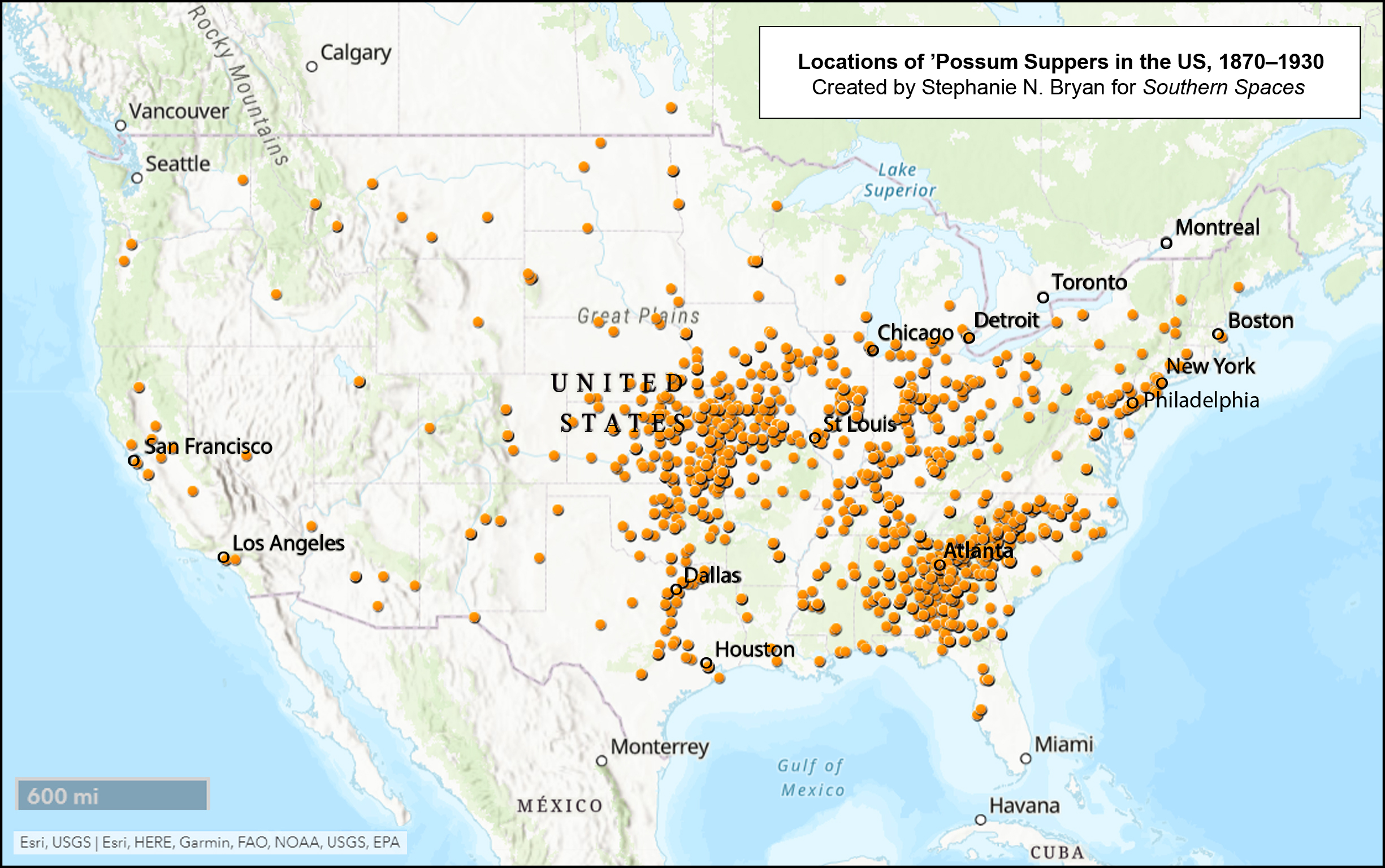
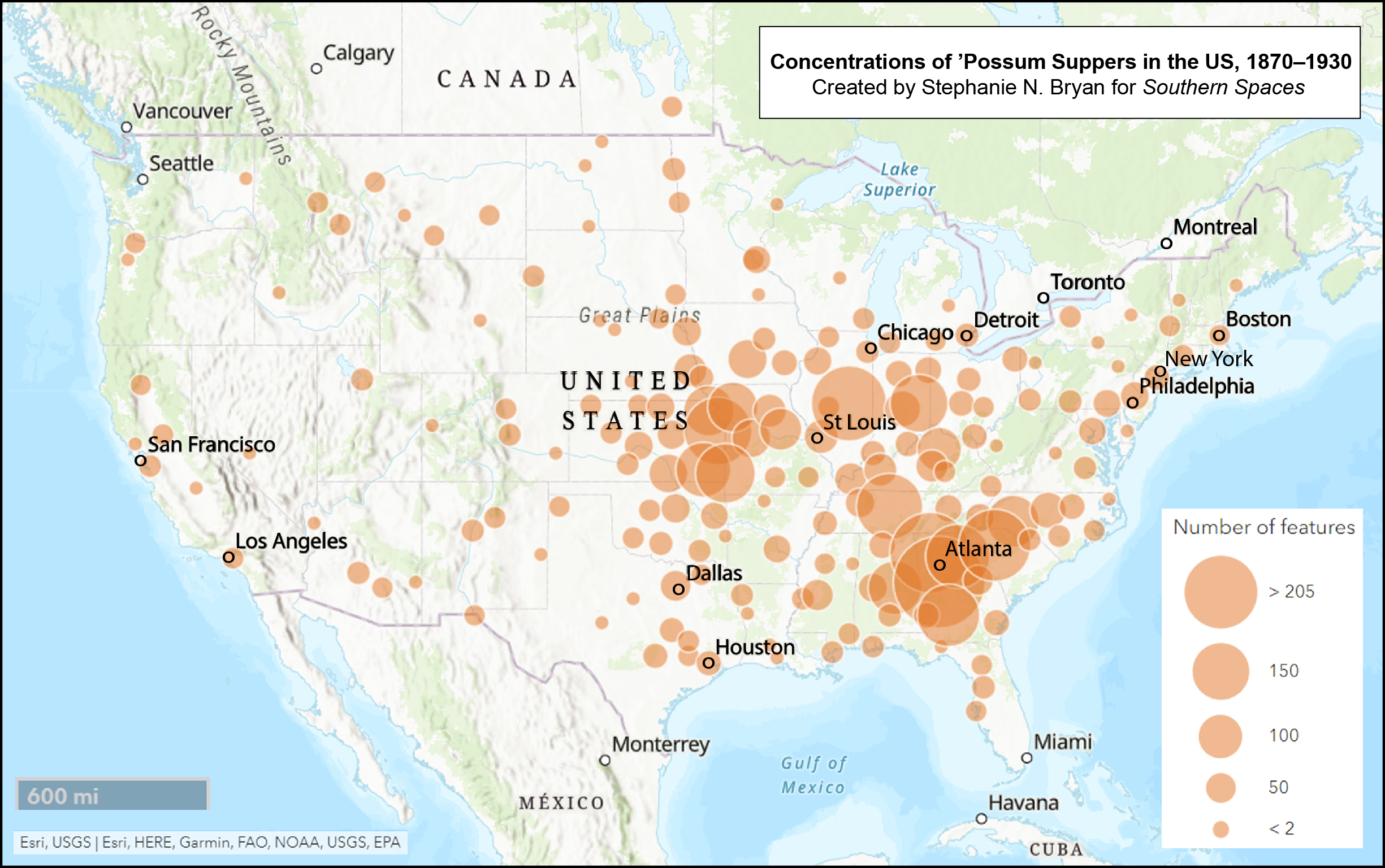
Opossum suppers became an important stage on which political actors could deploy new strategies and solidify networks of accomplices. Beginning in 1894, Colonel Harry Fisher—"railroad man, fertilizer magnate, friend of corporations"—commenced the political opossum suppers of Newnan, Georgia, to advance the Democratic ticket.77"Possum and Politicians: Many Invitations Have Been Sent Out to Newnan's Possum Supper," The Atlanta (GA) Constitution, Dec. 28, 1897, 5, https://chroniclingamerica.loc.gov/lccn/sn86063034/1897-12-28/ed-1/seq-2/. See also "Politicians to Eat 'Possum. The Supper at Newnan to Be a Unique Affair," The Morning News News (Savannah, GA), Dec. 28, 1897, 2, https://chroniclingamerica.loc.gov/lccn/sn86063034/1897-12-28/ed-1/seq-2/. Located about forty miles southwest of Atlanta where many in-state attendees traveled from, Newnan had escaped destruction during the Civil War. Its supper became an annual event, sending out over six hundred invitations "to men of prominence, both inside and outside" of the state. Politicians gathered in anticipation of the official Democratic convention and, while eating opossum, pre-determined the roster of officials for high-ranking positions.
It wasn't long before outside observers began to recognize that the political sway of the Newnan opossum suppers extended beyond southern states. On January 1, 1898, northern newspapers warned of sinister plans circulating "under the cover of savory vapors":
To these feasts are bidden men who have controlled the destinies of the State for years—shrewd politicians, who are anxious to strengthen their influence, statesmen, who gladly seize the opportunity to keep politically in touch with the elect of the State, and persons of a purely convivial nature, who are useful in lending an airy background to the political scheming which is bound to take place under the cover of savory vapors which ascend from the smoking 'possum.78"A 'Possum Supper," Baltimore (MD) Sun, Jan. 1, 1898, 1. For a similar version of this article, see "'Possum and 'Taters," The World (New York, NY), Jan. 1, 1898, 5.
Nearly a decade later, editor, politician, and defender of lynching John Temple Graves reminisced about Georgia's political "'possum regime," which had come to encompass the two-term governorships of Democrats William Y. Atkinson (1894–1898) and Joseph M. Terrell (1902–1907).79John Temple Graves, "The 'Possum Governors" of Georgia," reprinted from the New York American in The Herald and Advertiser (Newnan, GA), Jan. 15, 1909, 1, https://gahistoricnewspapers.galileo.usg.edu/lccn/sn89053456/1909-01-15/ed-1/seq-1/. Atkinson won by a narrow margin in 1894 against Populist candidate Judge James K. Hines and regained reelection in 1896 over another Populist candidate, Seaborn Wright.80James F. Cook, "William Yates Atkinson 1894–1898," The Governors of Georgia, 1754–2004, 3rd ed. (Macon, GA: Mercer University Press, 2005), 181–184. Benefiting from white terror, voter suppression, and fraud, Atkinson ended the threat Populists posed to Democrats in statewide elections.81The 1896 presidential election would further fracture the Populist party across the southern states. Some Populists who supported a fusion with Democrats nominated Tom Watson as the vice-presidential candidate alongside William Jennings Bryan for president. The Democratic National Convention also nominated Bryan, but with Democrat Arthur Sewall as his running mate, both of whom appeared on the Silver Party ticket. Conservative Democrats who disagreed with Bryan's stance on bimetallism and free silver abandoned the party to form the National Democratic Party and instead nominated Senator John Palmer along with his running-mate Simon Bolivar Buckner. With the country experiencing an ongoing economic depression under Democratic President Grover Cleveland, Republican presidential and vice-presidential nominees William McKinley and Garret Hobart, who stood for protectionism and the gold standard, defeated Bryan.
In his capacity of Speaker of the Georgia House of Representatives, Atkinson "had performed countless favors, helping many of his friends gain appointments as solicitors-general and judges of the circuit courts," explains historian Barton Shaw, adding that "Such men eagerly endorsed Atkinson's candidacy, and he also had support in Atlanta's traditional rivals, Augusta, Macon, and Columbus."82Barton C. Shaw, The Wool-Hat Boys: Georgia's Populist Party (Baton Rouge: Louisiana State University Press, 1984), 111. Through these favors, Atkinson "was able to depose the old Bourbon ring perfected by Henry Grady and the Triumvirate," while forging a new legislative ring.83Shaw, The Wool-Hat Boys, 126. His initial gubernatorial campaign against Confederate veteran General Clement Evans was a "coup d'état" that "allowed younger Democrats to take control of the party."84Shaw, The Wool-Hat Boys, 112.
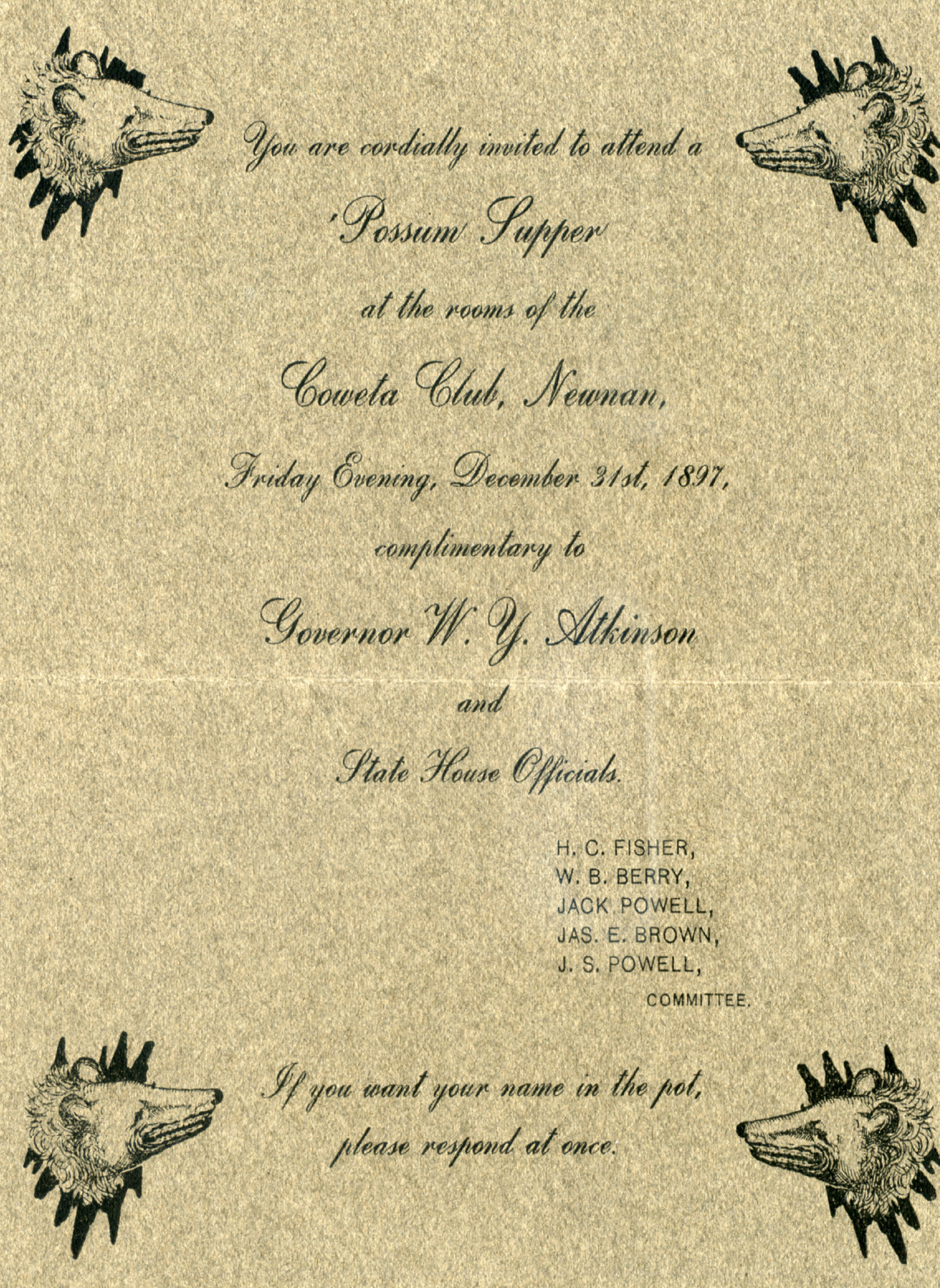
The complexity and behind-the-scenes maneuvering of numerous political factions during this period cast a cloud over why conservative Democrat Allen D. Candler (1898–1902) or Progressive Hoke Smith (1907–1909, 1911) were not considered part of the conspiracy, although it may relate to their efforts to restrict the power of the state railroad commission.85Cook, "Allen Daniel Candler 1898–1902," "Hoke Smith 1907–1909, 1911," Joseph Mackey Brown 1909–1911, 1912–1913," The Governors of Georgia, 185–188; 192–195. For more on Candler claiming to not be part of the "'possum regime" see "Candler on 'Possum Supper," Americus (GA) Times-Recorder, Jan. 14, 1898, 3, https://gahistoricnewspapers.galileo.usg.edu/lccn/sn89053207/1898-01-14/ed-1/seq-3/. Editor Graves offers some insight that Georgia's "'possum regime' was in large measure a railroad regime, and that under it corporations expect the fullness and the fatness which distinguished the adipose of the Georgia 'possum."86Graves, "The 'Possum Governors' of Georgia," https://gahistoricnewspapers.galileo.usg.edu/lccn/sn89053456/1909-01-15/ed-1/seq-1/. Accordingly, capital interests played an important role in the "booming" of certain politicians over others at events such as the Newnan opossum suppers. Barton Shaw explains the monetary benefits gained by those whom legislators appointed: "Solicitors were partly paid in fees, and citizens who could pay the highest price often found the state's charges against them dropped or at least reduced. Judges not only received handsome salaries, but were in excellent positions for advancement. The convict leaseholders always smiled upon those who helped keep up the supply of prisoners. With such support, many judges soon found themselves holding seats in Congress."87Shaw, The Wool-Hat Boys, 125.
The motives behind the Newnan opossum suppers were multifaceted, serving both the personal and collective interests of those in attendance. While they had a dominant Democratic component, occasional guests from other factions superficially presented images of reunion and reconciliation. Honorable George Peck of Chicago, a well-known railroad man who had served as a federal soldier, "referred to himself as the only yankee in the room" in a speech at the function on New Year's Eve 1897.88"'Possum Aftermath," The Atlanta (GA) Constitution, Jan. 2, 1898, 6. "A good deal of fun had been poked at him during the evening because of republicanism" and Confederate General Clement Evans, who attended the event, claimed to have made him "eat Georgia 'possum until he quit and surrendered and went over to the other side."89"Possum Aftermath;" "'Possum and Politics Wrestle for Supremacy Down at Newnan's Feast," The Atlanta (GA) Constitution, Jan. 1, 1898, 5. Although Atlanta Constitution columnist Bill Arp concluded after the event that "a politician will eat anything for office," eating opossum had developed a deeper meaning for prominent white men attending these events, signifying an economic and political alliance, as well as a racial one.90"'Possums and Politics," Watchman and Southron (Sumter, SC), Jan. 26, 1898, 2. "Bill Arp," was a pseudonym for politician Charles Henry Smith: https://evhsonline.org/bartow-history/people/charles-henry-smith-bill-arp-great-american-humorist-writer. Newspapers reported that the 1897 event included a diorama behind the toastmaster's chair comprised of a real persimmon tree, six live opossums, an actual baying opossum dog, and "old Uncle 'Cotton' See, an anxious-looking aged negro with white hair and a 'possum appetite in keeping with his surroundings" of white governors, secretaries of state, attorney generals, judges, and other high officials discussing politics over the feast.91"And Politics for Down at Newnan's Feast to the Governor," The Atlanta (GA) Constitution, Jan. 1, 1898, 5. This nostalgic scene provided a visual display of white power, delineating the rightful place of Blacks not as consumers of opossum, but as providers, cooks, and servers of it.
While Newnan's political opossum suppers were widely publicized in local and national newspapers, the public's attention soon shifted in 1899 to the horrific mob lynching of Sam Hose—a Black man who was bound, tortured, castrated, and set on fire in front of more than four thousand spectators.92For a detailed analysis of this event, see Edwin T. Arnold, What Virtue There Is in Fire: Cultural Memory and the Lynching of Sam Hose (Athens: University of Georgia Press, 2012). Chicago detective Louis P. Le Vin, whom activist Ida B. Wells-Barnett hired to investigate the lynching, concluded, "The real purpose of these savage demonstrations is to teach the Negro that in the South he has no rights that the law will enforce. Samuel Hose was burned to teach the Negroes that no matter what a white man does to them, they must not resist."93Ida B. Wells-Barnett, "Lynch Law in Georgia," (Chicago, IL: Chicago Colored Citizens, 1899), https://www.loc.gov/resource/lcrbmrp.t1612/?st=text&r=0.267,0.55,0.665,0.719,0. William Atkinson, who had moved to Coweta County to practice law following his second term as governor, spoke out to the mob from the city jail in an unsuccessful attempt to prevent Hose's lynching. 94For more on Atkinson's actions and possible motives, see Arnold, What Virtue There Is in Fire, 98–102. As governor, Atkinson had tried on numerous occasions to get the General Assembly to pass his anti-lynching bills. Because he vehemently opposed the lawlessness of mobs and proposed other solutions such as public executions, the anti-lynching stance of Atkinson and other Democrats cannot be equated with racial justice.95Arnold, What Virtue There Is in Fire, 99–100. The Sam Hose lynching led a writer from Thomasville, located near the state's southern border, to comment that Newnan's "reputation no longer rests on possum suppers."96The Daily-Times Enterprise (Thomasville, GA), May 9, 1899, 2, https://gahistoricnewspapers.galileo.usg.edu/lccn/sn88054087/1899-05-09/ed-1/seq-2/. Yet, to some extent the town's reputation did continue to rest on its opossum suppers as the political scheming that occurred at them played a role in the election of governors and other influential white men who disenfranchised Black citizens and worked to maintain the state's Democratic stranglehold.
Symbolic Separations and the Taft Banquet in Atlanta
If white Democrats were responsible for the publicized and politicized opossum suppers in southern states such as Georgia, Blacks gained attention for hosting their own events in other parts of the country.97For several examples of newspaper accounts highlighting these events, see "New Year Festivities at Crowe's Hall," Alton (IL) Evening Telegraph, Jan. 3, 1894, 9; "Lovers of 'Possums: Indianapolis Epicures Who Fancy the Toothsome Dish," The Indianapolis (IN) Journal, Part Two, Dec. 28, 1902, https://chroniclingamerica.loc.gov/lccn/sn82015679/1902-12-28/ed-1/seq-13/; "Oh, Carve Dat 'Possum: First Annual Banquet of 'Possum Club a Splendid Success," Durant Weekly News (Choctaw Nation, Indian Territory, OK), Dec. 8, 1905, 2, https://chroniclingamerica.loc.gov/lccn/sn82015679/1902-12-28/ed-1/seq-13/; "Happenings Condensed," Palestine (TX) Daily Herald, Nov. 29, 1905, 2, https://chroniclingamerica.loc.gov/lccn/sn86090383/1905-11-29/ed-1/seq-2/; "Local Briefs," Deseret Evening News (Great Salt Lake City, UT), Feb. 18, 1902, 8, https://chroniclingamerica.loc.gov/lccn/sn83045555/1902-02-18/ed-1/seq-8/; "Another 'Possum Supper," Morning World Herald (Omaha, NE), Nov. 18, 1902, 2; "That 'Possum Supper," The Anaconda (MT) Standard, Dec. 31, 1901, 9; "A Possum Supper," Grand Forks (ND) Daily Herald, Jan. 9, 1903, 4; "'Possum Supper with Hoe Cake Trimmin's; Janitor Duncan and His Colored Friends are Preparing a Big Treat for Office Holders and Others," Colorado Springs (CO) Gazette, Dec. 9, 1903, 3. Migrating Black populations continued to host opossum suppers in northern and western states, keeping the tradition popular into the early twentieth century. No doubt these individuals were aware of the strong association that opossum suppers had developed among southern Democrats, as well as the longstanding stereotypes aimed at destroying the personal and collective power of Blacks. Their actions can be understood as what Psyche Williams-Forson describes—in the case of Black women redefining fried chicken—as a refusal "to allow the wider American culture to dictate what represents their expressive culture and thereby what represents blackness."98Williams-Forson, "More than Just a 'Big Piece of Chicken'," 107–118, 343.
In 1901, Alfred King held an opossum supper at his Illinois home for the white members with whom he had served on a grand jury, along with other guests including the state attorney, sheriff, circuit clerk, and chief of police. "This is the first time," King announced, "that a grand jury in Macon county ever dined with a colored man, but the world do[es] move," indicating a shift in race relations.99"'Possum Supper. First Grand Jury to Dine with Colored Man," The Daily Review (Decatur, IL), Nov. 22, 1901. The elaborate menu—which included a course of oyster soup with celery and crackers, as well as main dishes of roasted turkey, baked opossum, mashed and sweet potatoes, corn, slaw, cranberries, white and corn bread, in addition to lemon and pumpkin pie, various fruits, ice cream and cake, and coffee for dessert—was not unlike that of an opossum banquet hosted by southern white Democrats.100"'Possum Supper," The Daily Review (Decatur, IL), Nov. 22, 1901.
A few years later, in 1903, ex-slave Jefferson Logan, who worked in the Senate cloakroom, was planning his nineteenth annual opossum supper in Iowa to which he invited Republican state officials and politicians. Described as "a wealthy leader of the colored population," newspapers noted that Logan generally secured "a good position each legislative session through his pull with the politicians."101"Possum Supper and Politics," Omaha (NE) Daily Bee, Dec. 2, 1903, 6, https://chroniclingamerica.loc.gov/lccn/sn99021999/1903-12-02/ed-1/seq-6/; see also, "Jeff Logan and 'Possum Dinner," The Minneapolis (MN) Journal, Nov. 16, 1901, 18, https://chroniclingamerica.loc.gov/lccn/sn83045366/1901-11-16/ed-1/seq-19/; "'Possum Supper a Great Success," The Des Moines (IA) Register, Dec. 6, 1902, 7. By 1907, the Adams County Free Press of Corning, Iowa, claimed, "What the banquets of the Gridiron club is [sic] to Washington the 'possum suppers of the Jeff Logan lodge are to Iowa's capital."102"Big Guns at 'Possum Feast," Adams County Free Press (Corning, IA), Dec. 25, 1907, 1. Founded in 1885, the Gridiron Club of Washington, DC, is a prestigious journalistic organization that holds annual dinners in which the president of the United States is generally in attendance. The dinners have gained criticism since they bring journalists close together with the political officials they cover in their news stories.
African Americans such as Jeff Logan, Alfred King, and others refused to relinquish opossum consumption to the purview of whites. In "Possum," Black poet Paul Laurence Dunbar plays upon the beliefs that African Americans possess a folk knowledge of preparing opossums, while drawing humor from the inherent lack of knowledge of whites. Dunbar uses "negro dialect"—a poetic genre103For a deeper discussion of Dunbar's poetry, see, Michael Cohen, "Paul Laurence Dunbar and the Genres of Dialect," African American Review 41, no. 2 (2007): 247–257. that appealed to literate, middle-class whites—to express his frustration and anger toward their ignorance:
Ef dey's anyt'ing dat riles me
An' jes' gits me out o' hitch,
Twell I want to tek my coat off,
So 's to r'ar an' t'ar an' pitch,
Hit 's to see some ign'ant white man
'Mittin' dat owdacious sin—
W'en he want to cook a possum
Tekin' off de possum's skin.104Paul Laurence Dunbar, Lyrics of the Hearthside (New York: Dodd, Mead and Company, 1899), 163–164, https://archive.org/details/lyricsofhearthsi00dunb/page/162/mode/2up.
If Blacks vied to maintain a symbolic separation between Black and white opossum consumption, so, too, did whites in their repeated assertions that it was the job of people of African descent to provide, cook, and serve them opossum.
By the time Taft came to Atlanta in 1909, white opossum suppers strongly leaned on the figure of the faithful Black servant who dutifully captured and delightfully prepared the animal for white consumers.105For more information on the faithful Black servant trope, see Micki McElya, Clinging to Mammy: The Faithful Slave in Twentieth-Century America (Cambridge, MA: Harvard University Press, 2007). Early twentieth-century newspapers occasionally published obituaries that figured into the faithful Black servant trope. For example, an obituary for Sam Coleman of Americus, Georgia, who was to be "buried by his white friends," highlighted his "reputation as an excellent cook," who had "for perhaps twenty years [. . .] cooked barbecue dinners and possum suppers for local epicures." "A Famous Old Cook Expires. The Long Time Cook of the Cue Club is No More," Americus (GA) Times-Recorder, July 8, 1902, 3. Writers for white newspapers were keenly aware of the racial power exuded through depictions of subservient Black labor in opossum suppers. Atlanta Constitution correspondent H.T. McIntosh reported on the "strenuous 'possum-catching campaign" in Worth County to secure a hundred of the animals for the banquet, which entailed a score of Black hunters overseen by Judge Frank Park.106H.T. McIntosh, "Worth County 'Possum Mad," The Atlanta (GA) Constitution, January 9, 1909, 1, 5. Northern newspapers added to the image by relaying that "old Uncle Levi and two mammies" sent by Park to Atlanta were busy slaughtering and preparing the game. And at the banquet, Rev. Dr. J.W. Lee sang the minstrel song "Carve Him to de Heart" while two Black male waiters served opossum to the president-elect.107"Taft Feasts on Possum and the South Gets Promise of Better Things," Sun (New York, NY), Jan. 16, 1909, 1, https://chroniclingamerica.loc.gov/lccn/sn83030272/1909-01-16/ed-1/seq-1/; "South to Gain," Washington (DC) Herald, Jan. 16, 1909, 1. In order to provide Taft "insight of what the south was before the war," the entire event depended on Black labor.108"Banquet to Judge Taft Marks a Social Epoch in Atlanta's History," The Atlanta (GA) Constitution, Jan. 16, 1909, 1.
Given the popularity of southern Democratic opossum suppers, Taft knew his actions conveyed racially coded political and economic messages. "Southerners are traditionally partial to this dish," explained a Texas reporter, adding that Taft's request to attend an opossum feast "further endeared himself to the people of this section."109"Plenty of 'Possums," Bryan (TX) Morning Eagle, Jan. 2, 1909, 1. Eating or even just tasting opossum, however, was more than an act of endearment; it provided a way for Taft to become "southern" by performing in a display of white supremacy tied to an imagined antebellum culture. This invented tradition encompassed much more than Black servants catching, preparing, and serving hundreds of opossums to prominent white men at the banquet. Because the menu included numerous, heavy courses that would have required several hours to complete, it is unlikely that Taft or other diners consumed much, if any, of the opossum meat on their plates.110Daniel Frank, "Taft Ate Possum in City Auditorium," The Atlanta (GA) Journal and the Atlanta Constitution, Dec. 2, 1956, 1C. Decades later, columnist Daniel Frank explained that "onlookers noticed that Taft took one taste, and only one taste" of the barbecued opossum set before him at the 1909 banquet. "Waste was part of the point," writes food historian Helen Zoe Veit. "Perhaps nowhere more nakedly than at a banquet did wealthy Americans in the Gilded Age show off their ability to command resources for their own and their guests' pleasure, to select only the very choicest morsels from a choice dish, and to leave most of the carefully prepared, expensive food for the slop bucket or the servants."111Helen Zoe Veit, Food in the American Guilded Age (East Lansing: Michigan State University Press, 2017), 196. Yet, in the case of the opossum, throwing away a food that had been critical to Black survival before and after slavery conveyed a socioeconomic message and a racial one.
Similar to the opossum suppers of Newnan that had begun decades earlier, the 1909 Atlanta event presented images of reunion and reconciliation. "It is beautifully emblematic of the fading away of sectionalism and the bitterness of the civil war, this spectacle of a northern Republicant-elect [sic] beaming over relays of ''possum and 'taters' in his march through Georgia," oozed a writer from Wisconsin.112"South Should Let Up," Topeka (KS) State Journal, Jan. 19, 1909, 4, https://chroniclingamerica.loc.gov/lccn/sn82016014/1909-01-19/ed-1/seq-4/. The dish, along with its accompaniment of persimmon beer, garnered a great deal of local and national attention in the weeks and days leading up to the Atlanta event. While the opossum was closely tied to sectional identity, other items on the menu carried different messages associated with Taft's agenda and with white prejudices. "Clear-Green Turtle [soup] a la Panama" correlated to a part in Taft's speech where he emphasized the future commercial benefits that the canal offered to southern states. "Filipino Ice Cream," on the other hand, gestured toward Taft's stance on race relations, given that throughout his tour Taft had often linked Filipinos and African Americans as inferior people dependent on whites for improvement.113"Taft Eats 'Possum, Gives South Pledge"; Edward Frantz, "Goin' Dixie: Republican Presidential Tours of the South, 1877–1933," (PhD diss., University of Wisconsin-Madison, 2002), 305; Needham, "William Howard Taft, The Negro, and the White South, 1908–1912," 63.
The banquet menu required careful tailoring. So did Taft's speech. To his white male Atlanta audience, Taft pledged, "I shall become the president, not of a party, but of a whole united people," reinforcing his aim to solidify white northerners and southerners.114"How New York Papers View 'Possum Banquet," The Atlanta (GA) Constitution, Jan. 18, 1909, 2. Some questioned Taft's motives, with South Carolina Senator Benjamin Tillman warning in August 1909 that "southerners should beware of Taft spreading molasses to give 'hungry office-seekers an excuse for deserting the democratic party. . . .'"115Needham, "William Howard Taft, The Negro, and the White South, 1908–1912," 96. Yet, Taft's participation in the banquet was a signal of his tolerance—and tacit support—of the Jim Crow laws enacted to maintain social control. Several months after the Atlanta event, Taft would address another white audience at a banquet in Birmingham, Alabama, claiming that he "would not have the South give up a single one of her noble traditions."116William Howard Taft, "Speech at the Chamber of Commerce Banquet, Birmingham, Ala. (November 2, 1909)," Presidential Addresses and State Papers (New York: Doubleday, Page & Company, 1910), 402, https://archive.org/details/presidentialaddr00unit/page/402/mode/2up?view=theater&q=traditions. Taft would prove to be a consistent ally of conservative whites, giving them a free hand, enabling "a moratorium on all African American appointees throughout not only the South, but also the North" and thereby transitioning "into a new, even more lily-white era" for Republicans.117Frantz, "Goin' Dixie," 314; 317. As historian David Needham explains, "probably the most visable [sic] effort by Taft toward wooing white southerners was his appointment of independent Democrats to high federal positions" and elimination of Black governmental involvement.118Needham, "William Howard Taft, The Negro, and the White South, 1908–1912," 118.
While the opossum "topped the pinnacle of fame [. . .] basking in the sunlight of a nation's tender interest" after the Atlanta banquet, other working-class and stereotypically African American foods had the potential to further convey Taft's political stance in other states.119"Is Champagne Better to Wash Down 'Possum Than Persimmon Beer?," The Atlanta (GA) Constitution, Jan. 4 1909, 5. In looking ahead to Taft's stop in New Orleans, the Grant Parish Democrat suggested that Taft should eat alligator steak, "a great dish among the darkeys" in order "to remain on good terms with Louisiana Republicans."120"Alligator Steak," The Caucasian (Shreveport, LA), Feb. 7, 1909, https://chroniclingamerica.loc.gov/lccn/sn88064469/1909-02-07/ed-1/seq-8/. Subsequently, the Charlotte Observer called for Taft "to stop off in North Carolina and partake in a supper of Chatham County rabbits," which "would doubtless compare favorably with the alligator steak."121The Caucasian (Clinton, NC), Feb. 18, 1909, 1. With these foods "in his system," one newspaper editor remarked: "Mr. Taft may become practically Southern, instead of the visionary theorist that he is, particularly in connection with the negro and the Republicanizing of any of the States [. . .]."122"Alligator Steak," https://chroniclingamerica.loc.gov/lccn/sn88064469/1909-02-07/ed-1/seq-8/.
Conclusion
Taft's 1909 Atlanta banquet marked the opossum's peak as a symbol of white supremacy and sectional reconciliation. After Democrats regained their political power and fully achieved Black disenfranchisement, opossum suppers diminished in popularity and, with some exceptions,123For example, the Atlanta Association of Building Owners and Managers hosted an opossum supper for Franklin D. Roosevelt, then Governor of New York, during his visit to White Sulphur Springs, Georgia, in 1930. "Roosevelt Eats and Hunts 'Possum as Georgia Guest: Partakes of Primitive Meal in Role of Adopted Son," New York Herald Tribune, Nov. 30, 1930, 11. its ties with Confederate nostalgia and Jim Crow politics faded from memory. Writing in 1916, the editor of the Jackson News in Mississippi revisited the lore surrounding the opossum, as well as the racist stereotypes:
We feel that it is a duty to shatter one of those long-cherished delusions concerning 'possums and sweet taters' as a typical Southern dish . . . . It is true that Southern homes, instinctively hospitable and willing to feed the stranger within its gates after his own heart rather than the local notion of the eternal fitness of things, serve 'possum, but generally with a silent protest that politeness alone prevents making manifest. [. . .] The dark and dismal truth is that 'possum is an all but impossible diet . . . . Possum is so largely a matter of excessive and not too fragrant fat that even Sambo, despite his reputation for never having had enough, has been known to grow tired of the same and pass it up for boiled cabbage and turnips.124Quoted in "Shattering Illusions," Gulfport (MS) Daily Herald, Nov. 29, 1916, 2.
After Reconstruction, white Democrats from Georgia had taken the lead in reinventing opossum culinary culture, once strongly associated with African American autonomy and survivance, and claimed it as their own rightful inheritance. This entailed mocking and deriding African American opossum consumption as indicative of inherently inferior racial traits. White obsessions with Black opossum consumption transformed hunting and eating the native marsupial into a nostalgic Lost Cause celebration of a supposed common culture that former enslavers claimed to share with enslaved people of African descent in the antebellum era. Since the making of a plantation imaginary filled with unforgettable opossum hunts and faithful house servants who knew the art of slaughtering, cleaning, and roasting the creature added to the dish's appeal, whites of all classes partook of opossum in part because of its association with idealized former times, remaking it, for a brief present time, into a powerful cultural symbol of Black subordination and white power.
About the Author
Stephanie N. Bryan is a PhD candidate in the history department at Emory University. She holds a Master's in Landscape Architecture from the University of Georgia, with an emphasis on historic cultural landscape management. Her dissertation examines the ways in which marginalized plant and animal species indigenous to the southeastern US—such as opossums, persimmons, muscadines, and pokeweed—survived and sometimes thrived amid destructive land use and entered into diets, cultures, economies, and politics. An earlier version of the article was “highly commended” for the 2019 Sophie Coe Prize.
]]>Introduction
What role does cruising play in marking specific areas of the urban landscape as "queer territory"?1For the purposes of this essay, I use the word "queer" primarily in its capacity as a contemporary umbrella term intended to include the panoply of non-normative sexual and gender identities concatenated in familiar and unpronounceable acronyms like LGBT, LGBTQ+, and LGBTQQIAA. To be sure, other speakers and thinkers deploy "queer" with additional senses—an historical term of derision, a specific identity, a verb. The word can summon all these thoughts and more, regardless of authorial intention; indeed, it can carry whatever freight we readers bring to it. When I intend these specific meanings in this text, I will do my best to flag them. In general, I argue our politics and communities benefit most when we embrace the untidy polysemy of "queer" and explore the openings it provides. Since the 1970s, social scientists have proposed and critiqued various models of queer territorialization. Martin Levine used spot maps of bars and cruising grounds to substantiate a "gay ghetto"; Jen Jack Gieseking analyzed individuals' "mental maps" of queer space; Amin Ghaziani critiqued the enclave theory of "gayborhoods" in favor of what he terms "cultural archipelagos."2Martin Levine, "Gay Ghetto," in Gay Men: The Sociology of Male Homosexuality, ed. Martin Levine (New York: Harper and Row, 1979), 196–218; Jen Jack Gieseking, "Queering the Meaning of 'Neighbourhood': Reinterpreting the Lesbian-Queer Experience of Park Slope, Brooklyn, 1983–2008," in Queer Presences and Absences, eds. Yvette Taylor and Michelle Addison (London: Palgrave Macmillan, 2013), 178–200; Amin Ghaziani, There Goes the Gayborhood? Princeton, NJ: Princeton University Press, 2015; Amin Ghaziani, "Cultural Archipelagos: New Directions in the Study of Sexuality and Space," City & Community 18, no. 1 (2019): 4–22. All these models of queer territory posit collective understandings of place that transcend the social boundaries of queer identity groups.
All three authors also reference cruising, but offer little detail about how cruising works in their models. Using the city of Houston as an example, this essay attends to cruising as an underdeveloped aspect of those models. As Houston's Montrose neighborhood came to be identified as a "gayborhood" between 1960 and 1980, archival evidence shows that cruising narratives played a powerful role in that identification. At the same time, these narratives also show that queer territorialization in Houston was not a smooth process of collective place claiming and recognition. Rather, dissent and conflict over the practice of cruising in Houston shows queer place claiming to be fractured, contested, and structured in part through a politics of respectability inflected explicitly by class but curiously silent on race. Importantly, that fractured and contested structure is due in part to the converging efforts of a wide array of disparate agents: queer sex-seekers, Houston residents, local politicians, civic groups, queer organizations, national anti-pornography groups, and conservative political movements. These narratives also point to complicated relationships between cruising and other markers frequently used to define queer territory, specifically businesses serving a queer clientele.
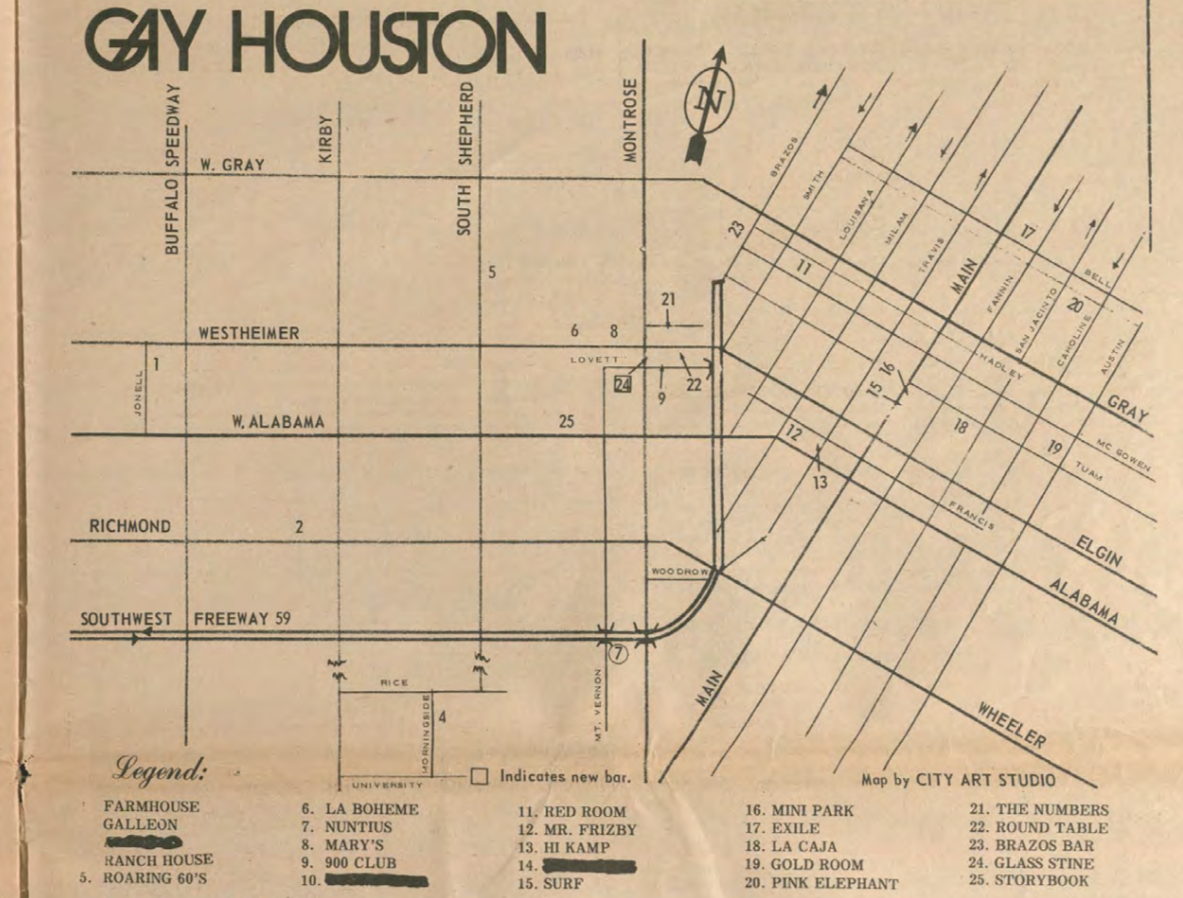
Cruising: Practice and Concept
Cruising takes the art of the flâneur—passing time watching people, usually in public—and imbues it with the additional potential or explicit purpose of finding a sex partner. As Alex Espinoza has evocatively described, cruising can lead to sex in situ, whether in public locations like parks or semi-public locations like restrooms, but often leads to sex elsewhere in more private spaces.3Alex Espinoza, Cruising: An Intimate History of a Radical Pastime. Los Angeles, CA: Unnamed Press, 2019. It can also happen inside commercial establishments that charge a fee to access other clientele in a semi-private space, like bathhouses, video arcades, and adult book stores. Out of doors, cruising can happen both on foot and, after the popularization of the automobile, by car as well. Cruising is also associated strongly but not exclusively with gay men. In our information age, dating websites and hookup apps on mobile phones—Grindr, Scruff, Growlr, Boyahoy, Jack'd, and others—seem to remove much of the guesswork (but definitely not all the danger) from divining who might be nearby and looking for the same thing. Many men seeking men for sex today came of sexual age through these digital tools, leading writers like John Fielding to ask whether the prominence and distribution of cruising as a queer social practice has waned as a result.4"In the Age of Grindr, Cruising and Anonymous Sex Are Alive and Well," Vice, January 7, 2016, https://www.vice.com/en/article/qbv5n3/cruising-in-the-age-of-grindr-828.
While this essay centers upon the importance of cruising in a particular place and a past era—Houston between 1960 and 1980—the rich scenes it describes should not be misconstrued to suggest that cruising is a thing of the past. Rather, contemporary popular culture, high art, literature, pornography, and vernacular speech continue to reproduce face-to-face cruising in public as part of a globally available gay sexual vocabulary and social practice. Espinoza's Cruising movingly shows the practice is not of a bygone era or one in which only certain (morally questionable) people engage. His book has received critical acclaim in part for its temporal and global scope—ancient Greece, England, Russia and Uganda receive specific attention—but also for his sensitivity both to disability and Latinx experience, as well as his assertion that cruising can offer contact across class and racial lines. That assertion echoes Samuel R. Delany's analysis of cruising in New York as a form of "contact" in Times Square Red, Times Square Blue (1999).5John Birdsall, "Review: 'Cruising' maps the cultural history of L.A.'s hookup spots," Los Angeles Times, July 3, 2019, https://www.latimes.com/books/la-ca-jc-review-cruising-alex-espinoza-gay-history-20190703-story.htm. In short, cruising persists as a culturally relevant practice in the United States and elsewhere, one that often moves across social boundaries and identity categories.
Men seeking men for sex has never been the sole determinant of queer territory. For those who know how to read it however, both then and now, cruising marks public and semi-public spaces as at least temporarily queer(ed) territory. This marking is how cruising functions not only as a social practice but also as a concept. Through documenting the disparate networks of people who came to meet on Houston's cruising grounds—intentional sex-seekers, criminals exploiting stigmas attached to gay sex, ambivalent law enforcement officials, area denizens, and perhaps initially naïve passersby—I argue that the social distribution of knowledge about cruising illustrates that queer territories functioned in part because some who do not identify as "queer" also imagined those territories as connected to queer lives.
This distributed social knowledge is the kind of information that Levine described under "culture area," that Gieseking captured through "mental mapping," and that Ghaziani articulated through his concept of the "cultural archipelago." Although similar in emphasis, these theorists differ significantly in how they imagine the process of place claiming. Levine borrows four criteria from the sociologists Robert Park and Louis Wirth to assess the status of a "gay ghetto": institutional concentration, culture area, social isolation, and residential concentration. Levine mapped bars and cruising areas listed in Bob Damron's 1976 Address Book to illustrate institutional concentration, and conducted a literature review and "exploratory fieldwork" in those concentrated areas to assess the remaining three criteria.6Levine, "Gay Ghetto," 185. His "exploratory fieldwork" consisted of walking around neighborhoods observing gay life and talking with gay people, activities quite parallel to cruising itself. Particularly in his assessment of culture area, Levine describes a remarkably smooth process of place claiming. Within the culture area, "open displays of affection [between men] rarely evoke sanctions; for the most part, people either accept or ignore them. Even police patrols through these spaces pay little attention to such behavior. . . . In other places, such behavior quickly elicits harsh sanctions."7Levine, "Gay Ghetto," 204.
By contrast, Gieseking and Ghaziani attend more closely to a multiplicity of perspectives, change over time, and conflict in social descriptions of place. Gieseking defines mental mapping as "the representation of an individual or group's cognitive map" of a specific place.8Jack Jen Gieseking, "Where We Go From Here: The Mental Sketch Mapping Method and Its Analytic Components," Qualitative Inquiry 19, no. 9 (2013): 712. While most of Gieseking's work is credited as "Jen Jack," this article flips those names. In visualizing both multiple individuals' and group perceptions' of a place, Gieseking finds that mental sketch mapping can "afford participants and researchers alike a way to share and see more multidimensional stories of themselves and their experiences through the lens of space and place."9Gieseking, "Where We Go From Here," 723. For his part, Ghaziani observes that "new residential and leisure queer spaces are forming across the city, and beyond its borders as well." That multiplicity of spaces grounds his proposal "that we redirect the study of sexuality and space away from our preexisting assumptions of spatial singularity—evinced by a steady stream of publications about individual gay districts—toward a cultural archipelagos model of spatial plurality."
Although Levine's work gives an important foundation, the history of cruising in Houston more closely exemplifies the social dynamics Gieseking and Ghaziani describe. During the twenty-year span centered on the 1969 Stonewall riots in New York, cruising narratives in Houston exhibit a multiplicity of opinions about a multiplicity of spaces, even as public awareness of the Montrose neighborhood as "gay" solidified both locally and nationally. This essay analyzes mainstream and queer sources of the time to construct and juxtapose two datasets: a GIS-enabled mapping of historical queer business data and an archive of narratives of cruising. While the business data offer one visualization of queer territory in Houston, narratives of cruising exceed the capacities of that mapping. Cruising areas have complex relationships to commercialized spaces—sometimes directly connected, at other times peripheral and symbiotic, and at others seemingly divorced. At the same time, these seven cruising narratives I feature here illustrate that efforts to regulate cruising converge from multiple, conflicting sources, including queer newspapers and community10Like "queer," "community" is also a freighted word. While I use it in this essay as a shorthand, I encourage readers to be cautious about the degree of coherence, agreement, organization, and unity they take it to convey. organizations with a range of stances toward queer life.
Mapping Queer Houston
I first came to live in Houston in 1997. When I arrived, the Montrose neighborhood was the epicenter of a thriving queer community. It was home to the largest concentration of Houston LGBT bars as well as many non-profit organizations, from the Montrose Counseling Center to Pride Houston. There were two queer bookstores, a free monthly magazine, and several free weekly papers. Soon, I was working for one of those papers, distributing copies all over the city. That labor helped me question and reimagine my first assumptions about the distribution of queer life in Houston. In this car-addicted place, queer bars and businesses were not just in the trendy Montrose neighborhood, but in far-flung suburban strip malls as well. Even so, Montrose remained the symbolic core.
That was not always the case. In 1911, J. W. Link and his business associates platted and marketed the Montrose Addition as an upscale suburb for middle- and upper-class Houstonians to escape the dirt and heat of the urban core. The Link Mansion built at the corner of Montrose and Alabama streets to advertise the new neighborhood was for some time the most expensive private home in Houston. To understand better how Montrose shifted from that elite suburb to a "gayborhood," I began a project in 2014 inspired by Levine's spot maps. I built a database of over 400 historical queer businesses11The definition of "queer business" here deserves some nuance. The database captures businesses explicitly marketed to a queer clientele. Historical queer advertising usually depicts that clientele as gay men and lesbians, often but not always as separate populations rather than a single market. Businesses were included in the database if they advertised in a Houston-based publication aimed at a queer readership or appeared in a national directory such as Damron's Address Book. This is not to say that queer community owned each business or that queer community was the only clientele. This nuance also matters when thinking about the relationship of cruising to commercial space, whether or not that commercial space can be thought of as queer. identified in Houston's historic queer publications like The Albatross, The Nuntius, and This Week in Texas, and supplemented those publications with other historical sources. I cross-referenced these locations through Houston's city directories to confirm the length of time each business was in operation at every street address given for it. Some bars relocated, for example, often after a fire. Using ArcGIS, I visualized that database from 1941 to 2015 on a contemporary base map of Houston to help orient present day viewers. Finally, I sequenced the 74 maps into a short animation.[2] 12Brian Riedel, "CSWGS Where is LGBTQ Houston?" YouTube video, 3:15, March 15, 2018, accessed December 31, 2019. https://www.youtube.com/watch?v=baSgYQtkTSI&feature=youtu.be&ab_channel=RiceUniversity. This animation was also displayed at Houston's Heritage Society in 2015 as part of the six month installation "Throughout: Houston's GLBT History."
That animation suggests several phases to describe Houston's queer geography and history, phases that can also be visualized through a graph of businesses over time (see graph below). From 1941 to 1955, most businesses catering to queer community (though often not exclusively) operated in downtown, present-day Midtown, or the Rice Village area. The first location in Montrose was Art Wren's, a diner that ran from 1956 to 1971. Art Wren's also gained a national profile; it is one of nine "interesting" Houston locations listed in a 1962 souvenir program of the League for Civil Education's drag fundraiser in San Francisco, "Michelle International."13"Michelle International," League for Civil Education, accessed December 31, 2019, https://www.queermusicheritage.com/fem-michelle.html. Of the nine locations listed for Houston, I have been able to confirm locations for six. Beyond those six, I can confirm an additional seven locations not included in the souvenir program. That Art Wren's is among those six speaks further to the strength of its reputation. Here, "interesting" served as code for "gay"; the words "gay" and "homosexual" never appear in the League's program, even though the drag event raised money to help those arrested in raids on gay bars. By 1969, Houston's queer center of gravity was clearly shifting toward Montrose, but Midtown and downtown were still quite active. By the 1980s, the intersection of Westheimer Street and Montrose Boulevard was the center of queer life in Houston, and new bars and businesses began opening further west and into suburban areas. Even as the geographic distribution of queer spaces widened, the total number of locations peaked at 94 in 1982. During the 1980s, Houston endured the double impact of HIV/AIDS and the long economic fallout of the 1981 oil bust. The number of queer businesses began to stabilize at around 60 in 1991, but would begin dropping again at the turn of the twenty-first century. Montrose remained the dominant center as that number continued to taper. In 2015, just 31 businesses were operating, fewer than Houston had at the time of the Stonewall Riots.
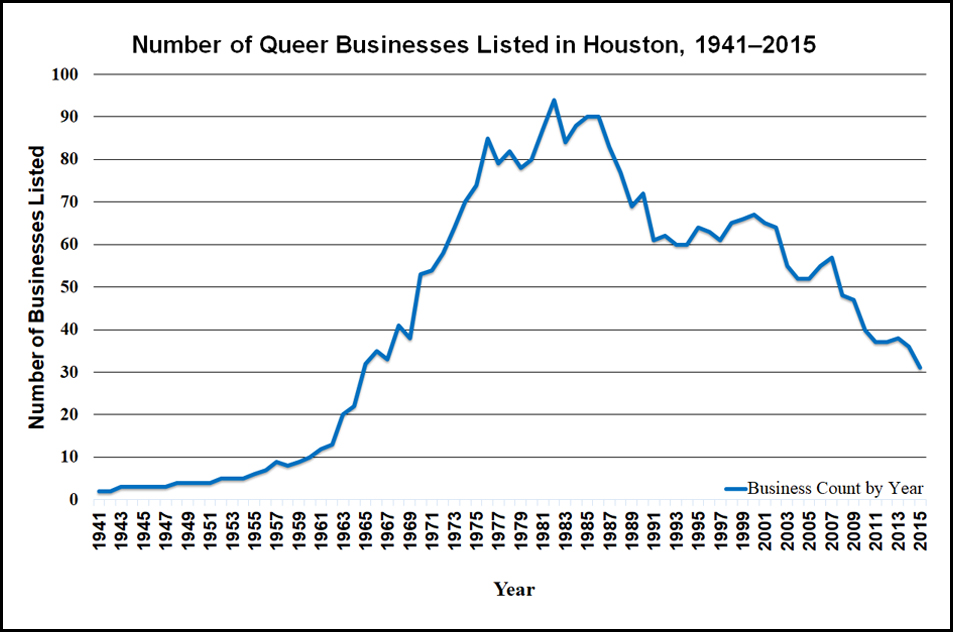
Helpful as it is for visualizing change in queer Houston over time, this mapping project has significant limitations for the kinds of queer community it can be assumed to depict. Just at the level of "queer businesses," a mafia-owned bar with a partially queer clientele in the 1950s is not exactly the same kind of queer business as a lesbian-owned bar in the 1980s that hires a security firm to watch the parking lot.14See "Kindred Spirits," Houston LGBT History, accessed October 1, 2020, http://www.houstonlgbthistory.org/misc-kindred.html. While such a 1950s bar could be any of those Carl Wittman laments in his "Gay Manifesto," the 1980's bar I mention here is quite specific. Marion E. Coleman started Kindred Spirits in Houston as an answer to many lesbians' problems with the bar options then available. She also hired a security firm to guard the parking lot and screen customers. Also, attending only to bars and businesses can skew our perception of queer space along class-inflected lines; professional middle-class and upper-class lesbians and gays eschewed the bar scene as dangerous for some time, even as recently as the 1990s.15See the letter writer to ONE below. In Houston, that pattern structured the Dianas, an almost exclusively white, upper-middle-class social organization of mostly gay men that originated in 1953 as an Academy Awards watch party in a private home.16"History of the Diana Foundation," Diana Foundation, accessed December 31, 2019, https://thedianafoundation.org/page/history-of-the-diana-foundation. That same pattern of discretion also influenced the creation of the Executive and Professional Association of Houston, founded in 1978.17"The Executive and Professional Association of Houston," EPAH, accessed December 31, 2019, https://www.epah.org/. In the more than 300 oral histories gathered through the Old Lesbian Oral Herstory Project, many lesbians—particularly those in middle-class professions like nursing and teaching—preferred softball and house parties to bars as ways to meet other women.18"The Old Lesbian Oral Herstory Project," OLOHP, accessed December 31, 2019, https://olohp.org/index.html. OLOHP owes a great deal to Arden Eversmeyer who trained women to collect oral histories across the United States. I am also indebted to an anonymous reviewer for bringing my attention to The New Orleans Dyke Bar History Project, accessed October 1, 2020, http://www.lastcallnola.org/. Those oral histories document a different perspective: some lesbians in 1970s and 1980s New Orleans preferred to meet each other in bars. See also John Howard's edited volume Carryin' On in the Lesbian and Gay South (New York: NYU Press, 1997). Mapping bar locations sourced in a mostly white-oriented gay press also elides Black, Indigenous, and other People of Color, along with their specific networks and practices.19For example, see see E. Patrick Johnson, Sweet Tea: Black Gay Men of the South, (Durham: University of North Carolina Press, 2011) and Black. Queer. Southern. Women. (Durham: University of North Carolina Press, 2018).
Beyond these limitations, the academic literature on queer territory also suggests the animation should account for the role of cruising as a place-claiming practice. Levine specifies cruising as a form of "institutional concentration" in his model of the gay ghetto, and even symbolizes cruising areas on his maps.20Levine, "Gay Ghetto," 1979. Levine also discusses cruising in chapter 4 of Gay Macho (New York: NYU Press, 1998). However, they appear as static present entities; he does not inquire into their pasts or their futures. Gieseking also positions cruising as one element in the creation of queer territory21Jen Jack Gieseking, "A Queer Geographer's Life as an Introduction to Queer Theory, Space, and Time," in Queer Geographies: Beirut, Tijuana, Copenhagen, ed. Lasse Lau et al. (Roskilde: Museum of Contemporary Art, 2013), 4–21. but takes care elsewhere to mark the limitations of both cruising and any emphasis on territory for the analysis of women's communities.22Gieseking, "Queering the Meaning of 'Neighbourhood,'" 2013. Ghaziani's There Goes the Gayborhood? briefly mentions cruising, framing it as an activity that could occur in any number of venues in the urban landscape.23Ghaziani, Gayborhood, 13. Ghaziani redeploys that same formulation of cruising in a more recent essay while arguing for "a cultural archipelagos model of spatial plurality" as an antidote to "enclave thinking." He argues that "the spatial expressions of sexuality are becoming more diverse and plural."24Ghaziani, "Cultural Archipelagos," 7. Though my mapping project did not visualize cruising areas, the research behind it did surface many narratives of cruising. Analyzing these cruising narratives in parallel with the mapping project, I argue that together they offer strong evidence to support Ghaziani's archipelagic model of queer territorialization in Houston at various moments across the twentieth century. Rather than any single enclave as figured in the footprint of Montrose, for example, these seven cruising narratives point to multiple, contested queer territories spread across Houston in memory and practice.
1930s: "Window Shopping"
The Houston queer press archive offers glimpses of cruising practices and mental maps that pre-date the temporal frame of my mapping project (1941–2015). In a 1988 article from the Montrose Voice,25"Montrose Voice," University of Houston Digital Libraries, Houston Texas, accessed October 1, 2020, https://digital.lib.uh.edu/collection/montrose. The Montrose Voice was published in Houston from 1980 to 1991. For readers unfamiliar with Houston's queer press history, I strongly recommend browsing the JD Doyle Archives, accessed October 1, 2020, http://www.jddoylearchives.org/. Richard Van Allen relates stories from men who lived in Houston before World War II, and recounts a queer urban geography through their eyes:
"The 'gay circuit'—they didn't know the word 'gay'—was downtown Houston, between Franklin and McKinney and Main Street east to San Jacinto. You could not tell a queer or a fag (the words they used then) from the straight, which was the way the gays wanted it, being fearful for their lives and jobs."26Richard Van Allen, "Houston's Gay Thirties," Montrose Voice, no. 410, September 2, 1988: 9. https://digital.lib.uh.edu/collection/montrose/item/8166/show/8130. This article has echoed in Houston media since then. See also William Michael Smith, "Looking Back at Some of the Hurdles Houston's Gay Community Had to Overcome (Part 1)," June 20, 2014, http://www.houstonpress.com/news/looking-back-at-some-of-the-hurdles-houstons-gay-community-had-to-overcome-part-i-6736836; "Houston's Earliest Gay scenes (Part 2)," Houston Press, June 23, 2014, http://www.houstonpress.com/news/houstons-earliest-gay-scenes-part-2-6748546; "'The Homosexual Playground of the South' (Part 3)," June 24, 2014, http://www.houstonpress.com/news/the-homosexual-playground-of-the-south-part-3-6737870.
Aside from a few bars that, while not intentionally or exclusively gay, served as gathering spaces to those in the know—the Rathskeller, the Old Vienna, the Capitol Bar, Rex's27Sadly, Houston city directories from the 1930s and 1940s did not confirm the addresses and locations for the bars documented in this article, so they are not included on the map. It is tempting to assume they fall within the sixteen-block area described by Van Allen.—what then functioned as queer "territory" was out on the street in that sixteen-block rectangle. According to a man Van Allen calls Dan:
"Of course, we didn't know the word 'cruising' then. We called it 'window shopping' and just like now, you know who was gay and who wasn't without asking. You could feel it, whether they had a limp wrist or not. There was this post down in front of Levy's department store. It had mirrors on four sides, and queers would stop and comb their hair there. Oh, you could spot them. If we did want to trick, we could get a room at the Milby or the Texas State Hotel. More often we went home to our apartments."
Much as Ghaziani describes "the closet era" of "scattered gay places"28Ghaziani, Gayborhood, 12–13. Ghaziani credits the second phrase as Ann Forsyth. prior to World War II, Dan's recollection of imagined gay space is opportunistic rather than exclusive. The social ecosystem of commercial downtown spaces—semi-public bars, shop windows, mirrored posts, and semi-private hotel rooms—created opportunities for strangers to meet for sex while providing a degree of plausible, respectable deniability. Gay networks circulated in parallel with other networks, but at least in Van Allen's account, cruisers would often move across the city landscape to more private spaces after meeting in more public ones.
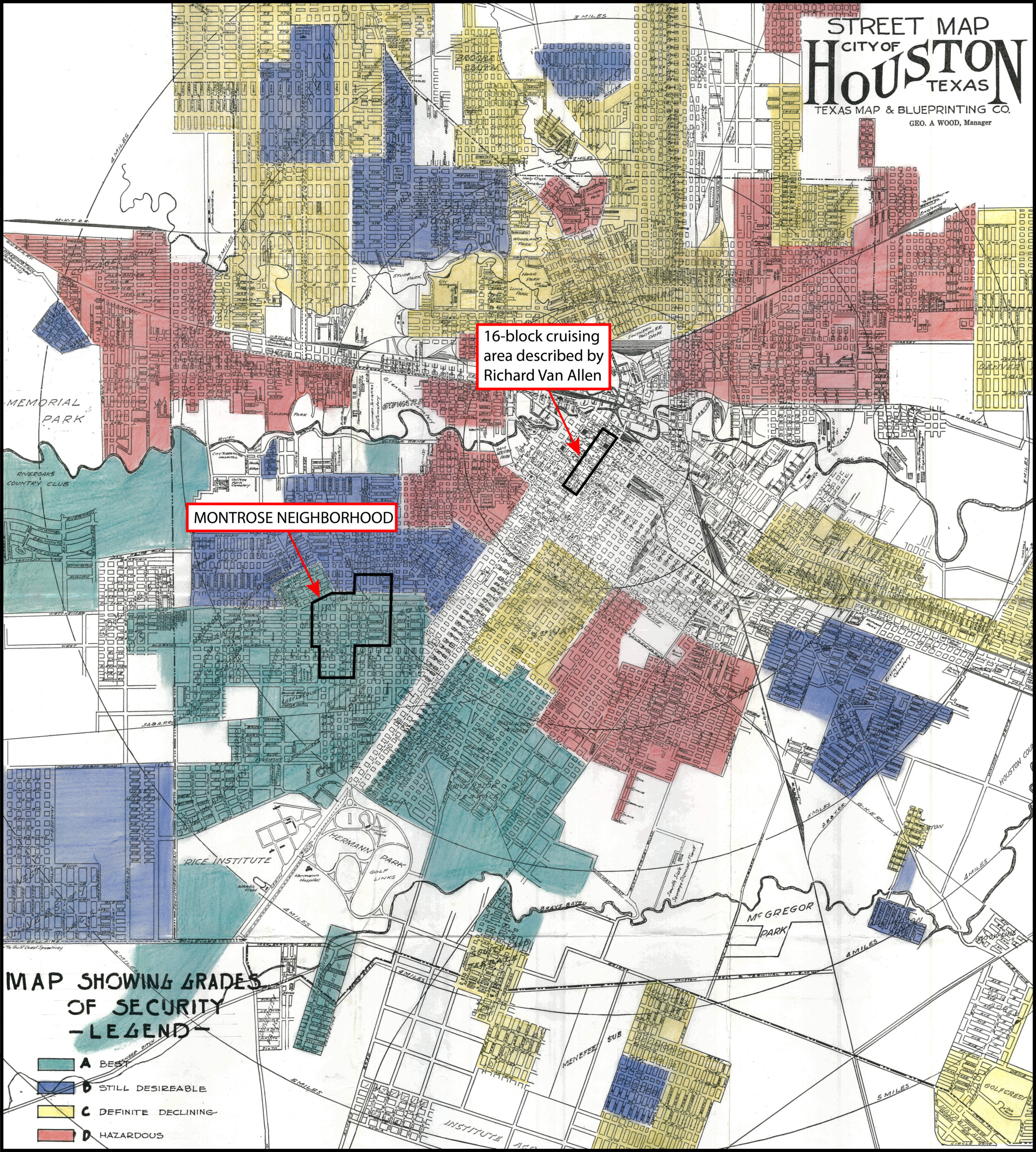
A striking way to situate this "window-shopping" area and the Montrose neighborhood in relation to the rest of 1930s Houston is to superimpose them on a now infamous Home Owners Loan Corporation map from the same era (see map above). The areas shaded red indicate the "hazardous" parts of town, where Black residents tended to live, and where the Home Owners Loan Corporation would not insure mortgage loans. The Montrose neighborhood, some two decades old at the time of this map and mostly shaded green, was the "best" type of neighborhood in which to live. Situated at the city's commercial core, the sixteen-block cruising area Van Allen's article described may well have provided opportunities for same-sex contact across both class and racial lines. And yet, Van Allen's narrators never mark race in their stories. The redlining map suggests at least one explanation for that absence, one that complicates any quick analogy to the kind of racial mixing found in Espinoza's memoir: the opportunistic use of public and semi-public spaces for cruising relied on an appearance of respectability that accounted for the persistence of racial as well as sexual lines in Jim Crow Houston.
1963: A Letter to ONE
From the 1940s through the early 1960s, however, the commercial spaces for queer community in Houston became less opportunistic and more intentional. Take for example a May 23, 1963 letter a Houstonian sent to the nationally distributed gay homophile magazine ONE,29ONE Magazine, ONE Archives at the USC Libraries, Los Angeles, 2018, https://one.usc.edu/archive-location/one-magazine. The magazine ONE was published in California from 1953 to 1967 and distributed nationally. It was the subject of the landmark 1958 US Supreme Court decision ruling that pro-homosexual writing was not of itself obscene. in which the writer offered his perspective on gay territory in the city:
Gay life in Houston seems relatively trouble-free as nearly as I can tell from my somewhat aloof perch (I don't patronize bars or attend parties or socialize much). A newly opened bar a few blocks distant is attracting great crowds on the week ends, with cars parked for blocks around, and always police watching especially toward closing time. The gay folks I meet seem delighted, and gloomily prophes[ize] that it is too good to last—I haven't heard of any trouble so far, though. Percentage-wise it seems to me this area has fully as many gay folk as any area in any of the larger cities in the North and West. Don't know of any other part of Houston where gay life is concentrated, though, except for a cheap theater downtown where the rough trade operates in amazing quantity and frankness—but could hardly call that gay life!30Craig M. Loftin ed., Letters to ONE: Gay and Lesbian Voices from the 1950s and 1960s (New York: SUNY Press, 2012), 114–5. To his credit, Loftin preserves the privacy of these letter writers by masking their precise addresses and substituting pseudonyms for their names.
While the writer's self-described "aloof" lifestyle may constrain our estimation of his version of events, the details he provided remain evocative. He spoke to a consciousness that "gay life" could be concentrated, perhaps even that it should be so organized. He also seemed to see himself as living in that concentrated part of town; he did not "know of any other part of Houston where gay life is concentrated" (emphasis mine). Still, he recognized a larger bar scene, though he did not attend it. (The map below provides a visualization of the bars and other businesses of which the writer might have been aware in 1963.)
The letter also captured the writer's sense that, for its size, queer Houston was not so out of step with the larger cities of the "North and West." New York, Chicago, San Francisco, and perhaps Los Angeles were his likely referents. Given the date of his letter and his description of a recently opened and wildly popular bar, it is also likely that his referent was Bob Eddy's Showboat, opened in 1962 on Tuam Street in present-day Midtown (labeled on the map above). For the writer, cruising was a primary if ambivalent index for whether "gay life" was "concentrated" in a particular location. The "cheap" theater he referenced is challenging to specify today given the lack of detail. I have yet to find an advertisement or mention of such a downtown theater in the queer press archive of the time; perhaps its rough trade reputation circulated only through hearsay. Whatever theater it was, the letter clearly shows that as late as 1963, this author's imagination of queer space in Houston was explicitly linked to present day downtown and Midtown. Montrose did not figure in his letter at all, even though Art Wren's had operated there for about seven years and had in 1962 already appeared in a local publication in California.
Another key index for the writer's imagination of gay life comes in the phrase "rough trade," a term still in use today. Then and now, the "rough" of "rough trade" signals men whose affect and physical appearance are both more working-class and more masculine—men who are not just "straight" acting and appearing, but who also might actually be more dangerous to approach, though that risk might itself be part of the thrill of approaching them. "Trade" signals that these men may, in fact, see themselves as straight, and that they could be only "dabbling" in same-sex activity. It also signals that these men might be seeking male clients in exchange for money, regardless of their or their client's sexual preferences. The writer to ONE gestured to this sexual ambiguity of "rough trade" when he divorced the downtown scene from what he called "gay life." At the same time, we might wonder how the writer himself was aware of the theater scene. He may have participated in it, at least enough to know just how abundant and frank the rough trade was. In any event, he does not disclose how he came to have that knowledge, even in the pages of a homophile magazine.
Importantly, the writer is also silent on the subject of race, a silence that suggests Jim Crow culture continued to texture both "gay life" and "rough trade" in the 1960s just as it had "window shopping" in the 1930s. At the same time, respectability politics are both explicit and implicit in his "aloof" observations. He marks the scene around the newly opened bar with cars "parked for blocks" and patrons who presumably have disposable income to spend at a bar, all signs pointing toward respectable middle-class status. By contrast, the "rough trade" scene at the "cheap" theater points to lowbrow entertainment and potentially sex work; their "amazing quantity and frankness" also signals their divergence from middle-class respectability.
1965: The "Phantoms" of Avondale
By 1965, however, Houston's locally produced queer press offers suggestive evidence that cruising areas had begun to shift into the Montrose neighborhood. One such piece ran in the first issue (1965) of the short-lived gay periodical, The Albatross.31"Who Are the 'Phantoms' of Avondale?" The Albatross, August 18, 1965, 1. All seven issues of The Albatross were published between 1965 and 1968 in Houston by Bob Eddy, the first owner of the Showboat bar.
The text is an intriguing window to the mise en scène of Montrose at the time. It appeared on the first page of The Albatross, marking the editors' sense of its importance with that placement. The text calls its readers to act, to report to the police crimes that the text assumes go unreported because the victims feared approaching the police. This attitude was reflected earlier in the ONE letter writer's description of police watching carefully as the bars closed. The Albatross' text specifies the location of attacks to Avondale, a subdivision adjacent to the Montrose Addition, centered on Avondale Street along the north side of Lower Westheimer. This neighborhood identity endures today in the Avondale Civic Association.32"Avondale," Avondale Association, accessed December 31, 2019, http://www.avondaleassociation.org/. The text also specifies a time: past midnight. It thus suggests a picture of who a typical victim might be: a male ("his personal safety" was at stake) walking or perhaps driving in a neighborhood after midnight, who might in fact be able to identify his assailant ("do not conceal the identity of these 'phantoms'") but feared to do so. Race remains stubbornly absent in this narrative, even as the text specifically marks class and criminality in the figure of "good people" who should not fear reporting to the police if they are attacked by the "unemployed, unwanted or purely incorrigible." While the article did not name the practice explicitly, cruising offers explanations for both that fear and why men might be walking or driving in the neighborhood late at night. Even if cruising was not the text's primary concern, the location it describes remains telling. Avondale offered a corridor between the 24-hour restaurant Art Wren's on Westheimer and the bars of Midtown to the east.
By 1965, three bars had also opened near the Avondale area: Numbers on California, the 900 Club on Lovett Boulevard, and the Round Table on Westheimer. Business owners and newspaper editors whose livelihoods depended on steady commerce likely also understood that the safety of their customers ("the good people of our community") was a prerequisite for their reliable patronage: all the more incentive for Bob Eddy—owner of Houston's Showboat and editor of The Albatross— to launch his paper with the "phantoms" as front-page news.
1970–1972: "Risky Crusing" and "The Heat"
While The Albatross' article was circumspect or perhaps even purposefully vague, five years later The Nuntius33"The Nuntius & Our Community," Houston LGBT History, accessed October 1, 2020, http://www.houstonlgbthistory.org/nuntius.html. The Nuntius was published in Houston from 1970 to 1976. would explicitly center dangerous activities in the title of an article: "Risky Crusing, Don't" [sic].34"Risky Crusing, Don't," The Nuntius 1, no. 20 (August 1970): 12. http://www.houstonlgbthistory.org/Houston80s/Assorted%20Pubs/Nuntius/nuntius-1-2-8-70.pdf. Interestingly, the nonstandard spelling of cruising as "crusing" is consistent in this article; this essay honors that spelling as an historical artifact. The article references areas from Memorial Park to Midtown and the dangers such places offered would-be pleasure seekers. It cheekily opens with a reminder that cruising could "furnish you with a free ride downtown, cost you money, embarrassment and perhaps a great deal of time away from home." The "free ride" at stake here was likely to a police station, but perhaps also to a hospital. The article closes more seriously with the tale of one man who ended up at the Texas Medical Center's Ben Taub General Hospital35Ben Taub General Hospital opened in 1963 in the Texas Medical Center and is named after the Jewish businessman and philanthropist, Ben Taub (1889–1982) who never married. after being stabbed multiple times. It ends with the question: "Is sex at this price worth it?" Despite the core message to avoid danger, the article's geographical details simultaneously functioned as a guidebook. The description of Montrose even plotted a list of specific streets (see map below for an illustration of the "round-robin"):
The round-robin at Lovett Boulevard, Roseland, Hawthorne, Stratford, California, Avondale—well, you know the area better than I. This is not risky but just dangerous as h—. There have been many, many crusy [sic] queens beaten, stabbed, robbed and almost killed from picking up tricks in this area. This bad news area is a definite "No-No."
Midtown received an equal measure of detail, including specific landmarks like "Sunnyland Furniture" at Main and Tuam (also illustrated in the map above).36Suniland Furniture was located at 2817 Main Street. See a discussion thread on the Houston Architecture Information Forum, accessed December 31, 2019, http://www.houstonarchitecture.com/haif/topic/26168-suniland-furniture-building-2817-main-st/. But it is not as if these locations were entirely accidental. By 1970, the Montrose "round-robin" encircled a collection of eight queer establishments, with Art Wren's at the center. In Midtown, the intersection of Main and Tuam was also quite close to a number of other venues catering to queer community. The mapping project documented three queer businesses that operated in the 2900 block of Main—The Surf Lounge and two Nuntius advertisers, The Midtown Lounge and the Mini-Park Theater. A block away on Tuam was the successor to the Showboat, La Caja (also a Nuntius advertiser). A few blocks further was the Gold Room, a bar whose majority Black clientele likely inspired the tag line for its advertisement in the same issue of The Nuntius: "Where the Dark & Light Meet."37Gold Room advertisement, The Nuntius 1, no. 2 (August 1970): 7. Cruising was certainly one reason why some queer people went to these parts of town, but it was not the only reason. Moreover, the concentration of queer businesses and the visibility of queer people on the street did not guarantee safety for queer people in these areas, whether that danger came from police, thieves, or tricks gone wrong.38I am grateful to a peer reviewer who suggested comparing crime rates in known cruising areas against crime rates elsewhere in Houston; that work remains a compelling future area for research.
Not all welcomed cruising in public. In early 1972, The Nuntius ran a short article, "Heat on the Circuit," several pages in that describes how "the Houston Police have been making every effort to curb the crusing [sic] in the areas of Lovett, Roseland, and Marshall Streets" (labeled as "The Circuit" in the map above).39"Heat on the Circuit," The Nuntius 3, no. 1 (January 1972): 15, http://www.houstonlgbthistory.org/Houston80s/Assorted%20Pubs/Nuntius/nuntius-3-1-72-ocr.pdf. While the title and opening lines suggest the police (the "heat") should be the readers' main subject of concern, the article gestures toward the residents, "disturbed because of the heavy auto and pedestrian traffic during the late hours at night." The language to describe police efforts to "curb" cruising also suggests its readers might still have had an ambivalent relationship to the police. The article is also a form of soft control; it notified readers that officers were active in the cruising area and those cruising may wish to avoid encountering them. At the same time, the text describes the officers as "very cordial in the stopping and questioning of unauthorized persons frequenting this section." The police forces depicted here show at least a surface of courteous concern. Those with a legitimate (respectable) reason to frequent the area need not fear, but passers-through might still doubt who the final arbiters of that legitimacy would be. Presumably, the "unauthorized" could include both the cruising "hungry hannas" and criminals who prey on them, but we cannot assume that Montrose residents, their visitors, business owners, and bar customers themselves never cruised the streets where they lived, worked, and played. The Nuntius' depiction of the neighborhood shows several subtle but important shifts from the arrangement of queer community and police that marked the Albatross' item on the "'Phantoms' of Avondale." By 1972, queer pedestrians and drivers had become more visible, perhaps even emboldened in a post-Stonewall era, but were still at risk from both criminals and the police. Officers for their part had also become more vigilant. While queer people clearly remained subjects of potential police control, it appears that some were slightly more likely to see themselves as subjects of potential police protection, at least those queers who might be "authorized" to be walking or driving around Montrose as respectable residents, guests, or consumers.
These two articles from 1970 and 1972 also continue the trend of prior cruising narratives; neither mentions race in any explicit way. That absence of racial awareness reflects the dominance of white narratives in Houston's queer press at the time, but is also a curious elision given the rising visibility of Houston's Black queer life both locally and nationally. Beyond the Gold Room's advertisements in The Nuntius, the 1971 Damron Guide also coded the Gold Room as a very popular Black bar.40"Texas Bars, Baths, Etc.: From Bob Damron's Address Book 1971," Houston LGBT History, accessed October 1, 2020: 112, http://www.houstonlgbthistory.org/houston68-71.html. More curious still is that The Nuntius ran multiple stories in 1971 about the Houston Gay Liberation Front picketing the Red Room (see map above for location) because it did not admit Black patrons. Even as activists were calling attention to the segregation of queer spaces in Houston, these two narratives of cruising could omit explicit discussion of race in a multiracial city.
1971: "Come and Browse, or Vice Versa"
Evidence of cruising also appears beyond documents generated specifically by and for queer communities. For example, Mayor Louie Welch's records41Louie Welch Collection, MSS 51, Houston Metropolitan Research Center, Houston, Texas. To be clear about my archival process and research methodology, I did not know at first that Welch's papers held citizens' complaints and police records that would matter to documenting histories of cruising or of Montrose. I came across these records quite by accident while looking to substantiate historian James Sears' assertion that Welch and gay bar-owner George Hauger knew each other. I have yet to find any evidence to prove or disprove the assertion. See James Thomas Sears, Rebels, Rubyfruit, and Rhinestones: Queering Space in the Stonewall South, (New Brunswick, NJ: Rutgers University Press, 2001): 55. preserve a host of documents reflecting political and social currents that converged to regulate cruising. Of particular interest for this essay are citizens' complaints urging local authorities to shut down sexually-oriented businesses like video arcades that would "degenerate" their neighborhoods. That records of these complaints survive today, specifically in Mayor Welch's archive, attests to the power of the social and political forces converging on cruising at the time. Some citizens believed the authorities could and should address the issue, while for their part, the Mayor and other local authorities evidently deemed cruising important enough to track and combat.
Though locally produced, these citizen complaints also stand in complex relationships with national anti-pornography campaigns, religious organizations, and conservative political movements, as analysts like Whitney Strub have argued.42Whitney Strub, Perversion for Profit: The Politics of Pornography and the Rise of the New Right (New York: Columbia University Press, 2011). In the case of Houston, some complaints to the Mayor were clearly driven by national mailing campaigns from organizations like Charles Keating's long-running Citizens for Decent Literature (CDL). Sometimes, these campaigns arrived in the mailboxes of people already deeply engaged, for whom CDL mailings were both affirmations of and ammunition for their existing efforts. When these local complaints target businesses serving a queer clientele, national anti-pornography campaigns enter into a network of converging effects in which battles to define urban space result in the arrests of both consumers of queer pornography and patrons using those video arcades to cruise in semi-private and presumably safer, commercial spaces.
The Police Complaints and Criminal Intelligence Report folders in Welch's papers reveal a chain of communications among the public, the Mayor's Office, and Chief of Police Herman Short. Those communications in turn generated specific police activities directly affecting queer lives. These records show not only that Chief Short's police department was to varying degrees responsive to Houstonians' complaints of perverse activity in their city, but also that it proactively engaged in intelligence gathering to infiltrate and map the social networks they saw as driving both perversion and social instability. The Criminal Intelligence reports track investigations into presumed weapons dealing by Black militants and meetings of leftist groups like the Socialist Workers Party43The Socialist Workers Party is a communist organization in the United States that traces its roots to 1928. In Houston, Texas, the SWP acted in coalition with other organizations on the left, including the Gay Liberation Front. and the Mexican American Youth Organization.44The Mexican American Youth Organization formed in San Antonio, Texas in 1967, and was regarded as a militant form of Chicano activism, especially relative to mainstream organizations like League of United Latin American Citizens. In Houston, MAYO had strong ties to the University of Houston campus, much like the Gay Liberation Front Houston. They also track claims of reciprocal arson among rival gay bar owners, intimidation tactics among national pornography distributors vying for control of the Houston market, and individual members of Houston's nascent Gay Liberation Front.45The Gay Liberation Front formed in New York shortly after the Stonewall riots of 1969, and quickly spread to Canada and the United Kingdom. Though it would frequently collaborate with other left organizations, it was short lived; other lesbian and gay organizations had largely supplanted it by the mid-1970s. In Houston, a branch of GLF formed in the Montrose neighborhood in September 1970 and organized a student group at the University of Houston.
To offer one example in which citizens' complaints of cruising converged with local police priorities and national anti-pornography campaigns, consider the correspondence between the office of the Mayor and a Montrose resident named R. L. Martinson.46Reproducing Martinson's real name is a considered choice. Primarily, he made himself a subject of public record by sustained communication with public officials. Also, unlike the letter writers in Craig Loftin's compilation, his actions at the time would not be interpreted as criminal, regardless of how we today might ethically evaluate those actions. Martinson took several opportunities to urge the city to prevent what he saw as the decay of Montrose. In a letter dated October 29, 1971,47Correspondence from R. L. Martinson to Mayor Louie Welch, 29 October 1971, MSS 51, Box 30, Folder 2, Louie Welch Collection. Martinson reminded the Mayor of a letter from some months before in which he had asked for help "to rid this and other neighborhoods of the filthy atmosphere of the adult book store and lewd movies." While his complaint might at first be taken as a generic complaint about pornography, he then specifically mentions the return of an adult bookstore ("Story Book") at the former location of the "Adult Library and Mini-Theater" at 1323 West Alabama, an advertiser in The Nuntius (though at the slightly different address of 1312 West Alabama; see map above). The location for both operations was only one block from Martinson's residence, today just north of St. Thomas University and west of the Annunciation Orthodox Church.
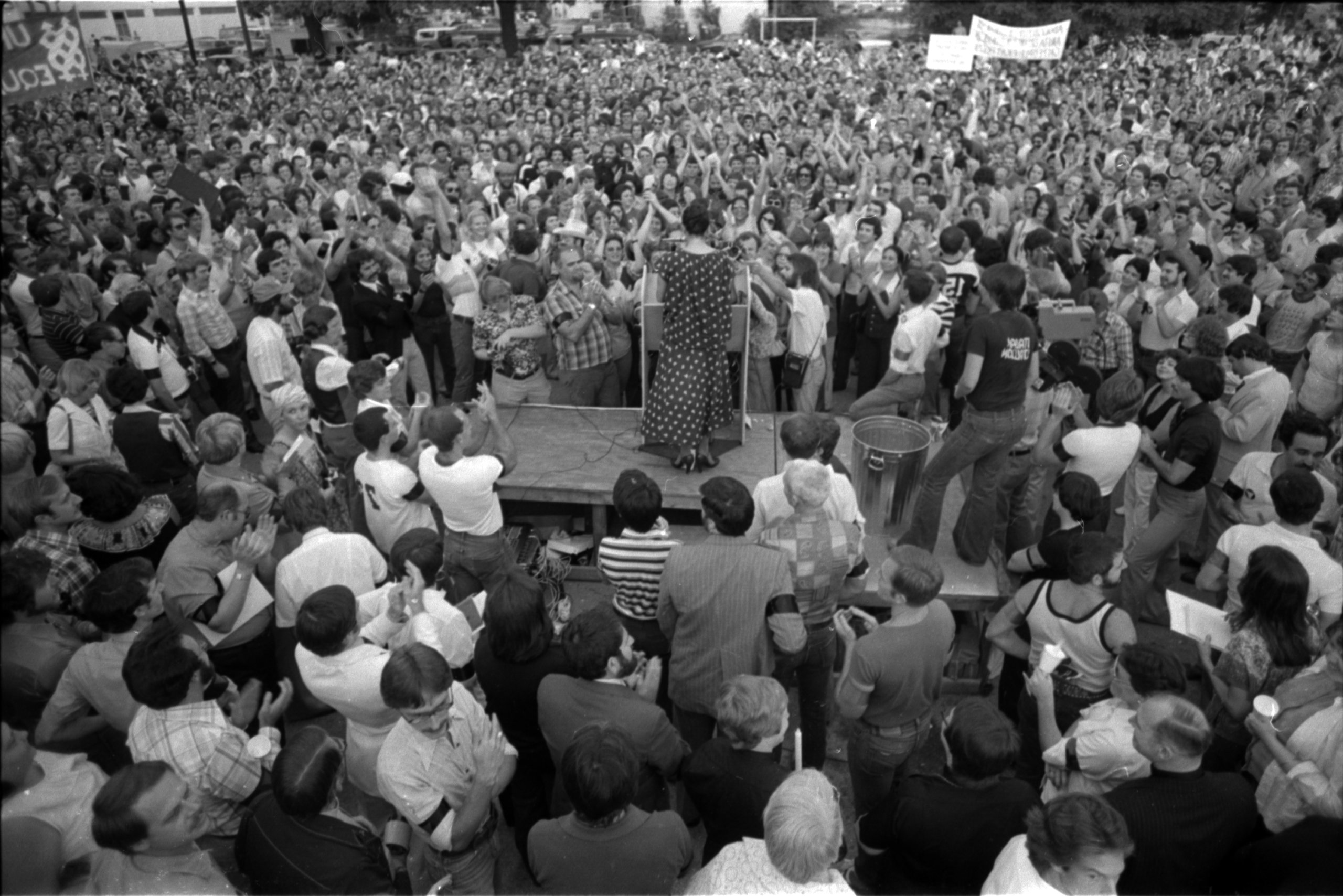
In an all too familiar rhetorical move foreshadowing Anita Bryant's 1977 "Save Our Children" campaign, Martinson focused on protecting "youngsters" from the "crowd of homosexuals and perverts who roam the neighborhood night and day." Whether or not Martinson's "roaming" is the same distinctively spelled "crusing" that The Nuntius warned its readers against, the situation apparently had been sustained for some time, as Martinson writes that he and his neighbors "have suffered enough in the past two years." Indeed, queer newspaper advertising indicates that the Adult Library first opened on Alabama in 1970.48The Houston City Directory intriguingly shows that, immediately prior, the location was occupied by "Miss Adorable Wigs." As a 24-hour venue advertising with the tag line "Come and Browse, or 'Vice-Versa,'" the Adult Library would indeed have attracted the kind of cruising traffic Martinson's "roaming" describes. The "Vice-Versa" also underscores how unlikely it was that customers came to the store just to browse. Presumably, most would browse the movies and the clientele on offer in the relative privacy of the store's video arcade. Perhaps they would select one or more sex partners—especially if the viewing booth they chose offered openings into other booths. In all likelihood, given the purpose of such arcades and the business's tagline, many would also come before they left, whether or not this occurred with a partner.
Martinson's letters also demonstrate his willingness to argue that the laws supported his position and would empower city authorities to act accordingly, though his own narrative is vague about precisely which laws might actually have done so. His October 1971 letter refers simply to "a new law which apparently went into effect September 1." Martinson clearly assumed this law somehow led to the closure of the Adult Library. More specifically, in another letter to the Mayor dated February 12, 1972,49Correspondence from R. L. Martinson to Mayor Louie Welch, 12 February 1972, MSS 51, Box 30, Folder 4, Louie Welch Collection. he writes that "sodomy charges" were at stake. At the time, Texas and most other states did indeed have sodomy laws on their books; in 1972, the Texas statute also included heterosexual non-reproductive acts but would be refined in 1973 to apply only to same-sex acts. However, there was no 1971 adjustment to the Texas penal code and the various sex crime laws described in its Chapter 21. As Texas House Speaker Gus Mutscher lamented of the 62nd session: "The much-discussed penal code reform was the second failure in 'must' legislation for the session. The state bar-recommended revision as presented in HB 419, proved to be controversial enough that sponsors said they would delay action another two years."50Gus Mutscher, "Accomplishments of the 62nd Legislature," 1972, 9. Accessed June 24, 2020. https://lrl.texas.gov/scanned/SessionOverviews/62_Accomplishments_1.pdf.
Beyond Martinson's legal theories and emotions about the reopening of the adult business, his October 1971 letter is remarkable for the social imagination driving his proposed solution: "Let's put these dens of pervertion [sic] in an isolated part of town, if we must have them, and not allow them in residential areas or shopping centers to tempt our youth."51Martinson to Mayor Welch, 29 October 1971. Despite witnessing two years of night and day homosexual presence, Martinson apparently could not imagine even in late 1971 that his neighborhood might already be that part of town. Perhaps his concern was that it would soon become so in the absence of his complaints.
The official acknowledgement of his October letter was swift, even if action was not. The Mayor's office marked it to forward to Chief Short, and sent a brief note to Martinson dated November 3, 1971.52Correspondence from the Office of Mayor Louie Welch to R. L. Martinson, 3 November 1971, MSS 51, Box 30, Folder 2, Louie Welch Collection. Despite that note's assurance that Chief Short would investigate and be in touch in the near future, it appears Martinson did not receive any of the promised updates. In his letter of February 12, 1972, his tone shifts toward impatience as he writes "once more" to "inquire what, if anything is being done about places such as the 'so called' Story Book at 1323 West Alabama."53Martinson to Mayor Welch, 12 February 1972. The invective of this letter targets "perverts" as it marks the frequent traffic of "characters" that circulate without "merchandise" at Story Book and the nearby Grass Hut, a venue other complaints mark as a "pot-parlor."54Correspondence from Coralie Anderson to Mayor Louie Welch, 28 April 1971, MSS 51, Box 29, Folder 12, Louie Welch Collection.
This February letter also surfaces a powerful converging effect: Martinson specifically refers to the January–February 1972 National Decency Reporter, a newsletter from Citizens for Decent Literature. Per Martinson, it reports "crackdowns And Convictions in Ohio, Nebraska, California, among others."55Martinson to Mayor Welch, 12 February 1972. Capitals and underscore in the original. Martinson's February letter received a similarly swift acknowledgement from the Mayor's office, dated February 17, once again noting that the complaint had been forwarded to Chief Short, but this time without any promises of further communication.56Correspondence from the Office of Mayor Louie Welch to R. L. Martinson, 17 February 1972, MSS 51, Box 30, Folder 4, Louie Welch Collection.
Although Martinson may not initially have received the degree of response he sought, action was eventually forthcoming. An internal police memo dated March 21, 197257Internal police memo from Sergeant T. R. Driskell to Lieutenant J. M. Albright, 21 March 1972, MSS 51, Box 30, Folder 4, Louie Welch Collection. went from Sergeant T. R. Driskell of the Vice Division up the chain of command via Lieutenant J. M. Albright to Chief Short, and from him to the Mayor, per a March 22 memo from Chief Short.58Internal memo from Police Chief Herman Short to Mayor Louie Welch, 22 March 1972, MSS 51, Box 30, Folder 4, Louie Welch Collection. The details of Driskell's memo illustrate how Houston police officers enacted the laws available to them as they understood them, while the chain of communication itself shows how closely the Mayor personally monitored police actions regarding the gay community. Driskell reported on the status of the state sales license, which cleared their check. Eight mini-movie machines were noted in the rear of the bookstore. Police surveillance further "revealed" that "homosexuals frequent this place,"59Driskell to Albright, 21 March 1972. although it is unclear precisely what techniques of surveillance and evidence substantiated that claim. It is clear, however, that on March 8, 1972, five patrons were arrested and charged with committing an "Indecent Act" under the then-operative Chapter 21 of the Texas Penal Code. "The manager was not arrested" as "he was not involved."60For those who have ever visited adult bookstores with video arcades, this exclusion might not surprise: a manager is usually up at the front, selling access to the movie and cruising area at the back. That said, I am also grateful for a reminder from an anonymous peer reviewer that "owners of bath houses, bars, or cinemas sometimes faced police crackdowns in other cities, even if they didn't engage in sex themselves." The impact of these converging effects on the Story Book was much broader than this one raid, however. Driskell notes that since July 29, 1971, "there has been a total of 27 arrests for various offenses" at this location. He also reports "we are in the process of trying to get an injunction through Civil Court and have this place closed."
Perhaps unsurprisingly, none of Martinson's letters or the police memos explicitly mention race.
1974: "Rough Trade"
While Houston-based and locally-distributed publications like The Albatross and The Nuntius range from elliptical descriptions of cruising to explicit cautionary tales, Ralph W. Davis's richly photographed December 1974 article about Houston in the nationally-distributed gay travel magazine Ciao! verges on the celebratory.61Ralph W. Davis. "Houston," Ciao!: the World of Gay Travel. December 1974, 10–13; available also via the JD Doyle Archives: http://www.houstonlgbthistory.org/houston74.html. Ciao! was published out of New York City from 1973 through 1980. For more about the impact of Ciao!, see Lucas Hilderbrand, "A Suitcase Full of Vaseline, or Travels in the 1970s Gay World," Journal of the History of Sexuality 22, no. 3, (2013): 373–402. Indeed, "Cruise Areas" constitutes the first major subsection of his four-page article. He rehearses several areas mentioned in prior publications, beginning with the following bolded statement: "The main cruise area is Roseland to Hawthorn to Lovett to Stanford. Lovett and Stanford, and Lovett and Montrose are good corners to linger on at night." After directing readers first to a part of Montrose only five blocks from R. L. Martinson's home, Davis then helpfully notes, "Lovett and Stanford is a little darker than the latter, and some may prefer this for obvious reasons." Those "obvious reasons" would likely include the cover that darkness can provide for either a quick outdoor sex scene or an increased degree of camouflage and anonymity for the long term lingering sometimes required to pick up a trick worth taking elsewhere.
For Davis, not all cruising areas come equally recommended. He specifically evaluates them in terms of their "roughness," with all the gender and class markers animating the 1963 letter to ONE. The cruise area section of Davis' article continues the pattern of past cruising narratives and gives no guidance about the racial mix of men frequenting any specific area. However, the individual bar listings within the article do occasionally reference race and nationality. The clientele of the country/western Golden Spur "includes some tough Latins and blacks"; the Gold Room gets a nod toward the end of the article as "an old established black bar"; the Athens Grill and Bar on the Houston Ship Channel is recommended as "the place to go for Greek sailors who, when a little drunk, swing either way," a variation on the theme of rough trade. None of these three bars are close to any of the cruise areas Davis names, however.
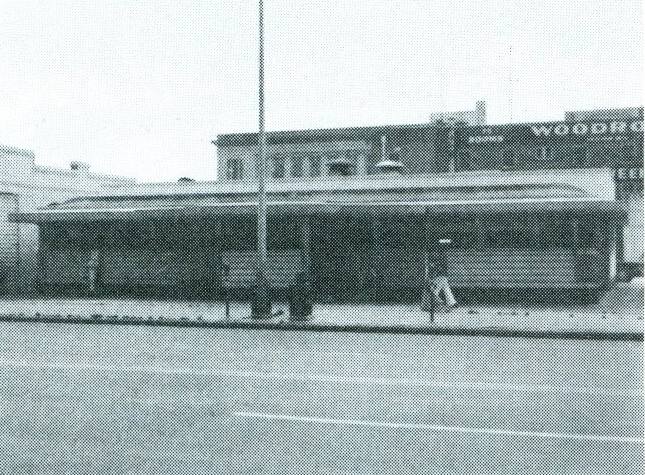
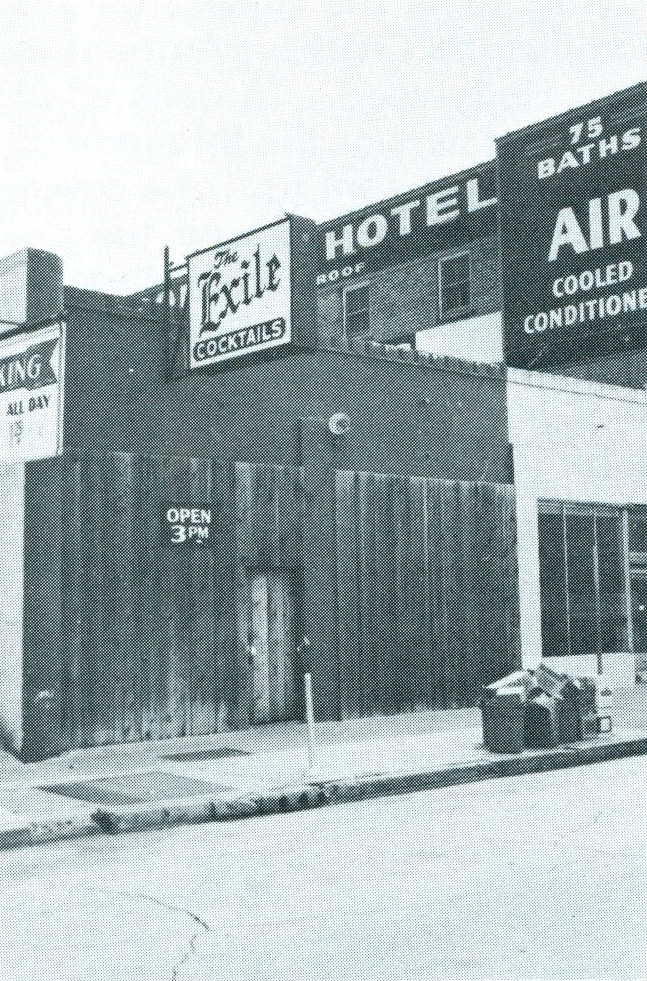
Of those cruise areas, Davis found the roughest one to be the Midtown corner of Bell and Main that hosts Simpson's Dining Car, the Exile Lounge, and, though he does not mention it in writing, the Woodrow Hotel. One hint toward the hotel's role comes when Davis notes "[o]nce Simpson's was a 24-hour restaurant; now it closes at 1 a.m. to avoid serving some of the hustlers and roughs who settle almost all night on the corner of Main and Bell." On the last page of the article, he also describes the Exile as "probably the most recommended of the rough bars."
To complete the implication, an examination of two accompanying photographs of Simpson's Dining Car and the Exile Lounge reveals the Woodrow Hotel looming in the background of both, boldly advertising "75 Rooms," "75 Baths" and "Air Conditioning" on the wall facing Main Street. Industrious Ciao! readers would also have seen that the Damron Guides for 1971 and 1972 also list the Woodrow Hotel.
For hustlers cruising for a living, that single block provided a ready-to-hand circuit of the necessities: food, drink, a steady stream of potential customers, and a private room and bath when it came to business. For out-of-town and local johns looking for the right place to go, Ciao! pointed the way. At Main and Bell, cruising and commerce commingled in a much more intense and intentional way than the Story Book on Alabama.
1976: No Turns
Although the 1972 Nuntius article gives the impression that residents played a minor role—at most complaining to the police who then in turn engage the "unauthorized"—residents do become more organized and vocal agents over time. In September 1975, Virginia Galloway reported in Update Texas that residents had formed the Montrose Citizens Association (MCA).62Virginia Galloway, "Montrose Circuit," Update Texas, Sept 26–Oct 3, 1975, 2. While the organization's name suggests an expansive membership, details on it are scarce; organizational records point only to the name of a lawyer in Montrose: Richard L. Petronella.63Initial research about the MCA surfaced a helpful clue for further work, although the source for that clue is suspicious. See "Montrose Citizens Association Inc." Bizapedia, accessed December 31, 2019, http://www.bizapedia.com/tx/MONTROSE-CITIZENS-ASSOCIATION-INC.html. That website provided the following data: "Montrose Citizens Association Inc. is a Texas Corporation filed on September 2, 1975. The company's filing status is listed as Franchise Tax Involuntarily Ended and its File Number is 0036646201. The Registered Agent on file for this company is Richard L Petronella and is located at 815 Hawthorne, Houston, TX . The company's principal address is 815 Hawthorne St Richard Petronella, Houston, TX 77006-3901." The Association's remarkable strategy eerily echoed R. L. Martinson's proposal to Mayor Welch: relocate the Circuit. Galloway reported that "area gay organizations" collaborated with the MCA to pass out flyers at street corners in the Montrose Circuit on Friday and Saturday nights, informing potential cruisers of the "moving of the historic cruising area" from Montrose to a "non-residential, semi-isolated area nearer downtown" that would supposedly be "more conducive to cruising conditions, since the roads are better and there is good lighting." The flyer included a map of the new location and described the reasons for the move: "an effort to cooperate with neighborhood residents, who are finding the activity on the Circuit increasingly more difficult to live with because of the noise and traffic in the early morning hours." Supposedly, an impending police crackdown could be avoided if the cruisers were to voluntarily relocate. Galloway's reporting gestured quietly to the odd optimism of the scheme: "most were eager to hear of the new area, although actual response by moving is still slight." Houston cruisers in 1975 might have also remembered Ralph Davis' Ciao! article recommending a specific intersection in Montrose as darker than others. "Good lighting" was a curious way to pitch a new cruising ground to that market.
Such tactics aside, MCA's flyer campaign clearly required significant planning and volunteer effort, from designing and printing the flyers to the volunteer time of handing them out at multiple intersections on multiple nights. Although attorney Petronella is the sole name listed on the organization record, clearly he was not acting as a lone agent. Other community organizations were involved, perhaps even the Houston Police Department, especially if the new location for the Circuit would not also be subject to a police crackdown. Presumably, MCA also checked with the residents and business owners in the proposed new location to be sure cruising would not present a problem to them as well.
However, the Montrose Circuit's decade-long reputation as a cruising ground proved harder to break than the MCA campaign at first envisioned. Just a few months later, in March 1976, Mel Plummer (former owner of Update Texas) wrote a column for The Nuntius titled "Houston Cruise Circuit Closed," in which he argues that the flyer campaign failed because the roads at the new location could not handle the volume of car traffic, particularly during the peak weekend hours for the nearby Farmhouse, a three-story gay bar on Albany.64Mel Plummer, "Houston Cruise Circuit Closed," The Nuntius (March 1976): 3. http://www.houstonlgbthistory.org/Houston80s/Assorted%20Pubs/Nuntius2/Nuntius%20SW-031276.pdf. This article repeats and extends a story of the same name run in the previous February issue. See The Nuntius (February 1976): 2. http://www.houstonlgbthistory.org/Houston80s/Assorted%20Pubs/Nuntius2/Nuntius%20SW-020676.pdf. He places responsibility for this failing on MCA for choosing the relocation area on its own, rather than consulting first with "those involved with the Montrose circuit." Plummer's reporting also answered a curious gap in Galloway's account: he specified the gay organizations working with MCA as the Gay Political Caucus, the Metropolitan Community Church, and "other local organizations"—some of whom could also have offered expert guidance on the move. With the failure of the flyer campaign, Plummer reports that MCA escalated its efforts and barricaded the roads one night, purportedly with collaboration from the office of Mayor Fred Hofheinz. Plummer also casts doubt on that last claim, noting that the City had issued no permits and the police did not supervise the barricades. The barricades were not MCA's final option, however. The Association apparently described this new tactic as "their last stand before police harassment would begin to all those who frequented the infamous 'Montrose Circuit.'"65Ibid. The cordiality evoked in the 1972 The Nuntius article had evaporated.
MCA unleashed that final option on Wednesday, January 28, 1976.66Plummer's article reads "January 26," an apparent editing error. With the evident cooperation of the City of Houston, MCA installed signs prohibiting vehicles from making turns between 7 p.m. and 6 a.m. in the Montrose area. These no-turn signs restricted those cruising by car from circling legally through the side streets of the neighborhood, breaking the social pattern connecting cruisers on foot with cruisers in cars. Indeed, Plummer reports that the next night "Houston Police issued 43 traffic citations for illegal turns and five people were taken to jail. This has all but assured that the Montrose Circuit exists no more."67Ibid. Importantly, this "death" of the circuit also became mainstream news; Houston television stations picked up the story with what Plummer describes as "fair and unbiased reporting." To be sure, the crackdown on cruising in Montrose did not spell the death of cruising itself. Even as Plummer asserts that "most Gays have not found a new cruise route," he goes on to observe that "many are returning to the old cruise route before the days of Montrose. This was known to many as Suniland. The area consists of the streets Main, Tuam, Fannin, and Anita."68Ibid. Indeed, these are the very same streets The Nuntius readers might remember as too risky, as places where pleasure mingles with danger. One implication of this strange return is that the shifting of neighborhoods and cruising areas is not uniform, unidirectional, or irreversible.
It is also important for us today to recall that queer folk were not always victims but also sometimes the perpetrators of surveillance and violent crime in 1970s Houston. Such crimes may also have influenced those seeking to shut down or relocate cruising areas. Many of these crimes are all but forgotten. For example, The Nuntius ran a 1971 story about a teenage boy who was picked up by two men in downtown Houston and taken back to their residence in Montrose, "known to the most of us as 'the colony.'"69"Halloween Horror for 16 Year Old Boy," The Nuntius 2, no. 11 (November 1971): 1. http://www.houstonlgbthistory.org/Houston80s/Assorted%20Pubs/Nuntius/nuntius-2-6-11-71.pdf. After what initially seemed to be an evening of drinks and movies, the boy "stated that he was knocked in the head by one of the men and tied up, beaten with a rubber hose and sexually assaulted by the pair."
Other crimes catapulted into the national consciousness. As Montrose residents and cruising men were engaged in their turf wars, Dean Arnold Corll had already begun what would come to be known as the Houston Mass Murders or the Candy Man Murders, in a gruesome nod to Corll's family business. Between 1970 and 1973, he and his accomplices are believed to have abducted, sexually tortured, and killed at least 28 teenage boys. While most of these boys had deep connections to or were taken in the Houston Heights area, the symbolic impact of the murders extended to all of queer Houston when the case was finally exposed in 1973 after one of Corll's accomplices murdered him. At the time, it was the worst serial murder case in United States history. The denouement of the Candy Man Murders played out the same year the American Psychological Association removed its classification of homosexuality as a mental illness in the Diagnostic and Statistical Manual.
More intriguingly still, even as the Montrose Citizens' Association began its 1975 flyer campaign, the Houston Chronicle began reporting on a string of murders in Montrose, mostly of men, many of them graphically violent. Then the Chronicle's January 8, 1976 front page ran the headline "Homosexual Tells Police He Killed 3 Men Here." The first line of that story described the confessor, Joseph Standwick, as "an admitted homosexual."70"Homosexual Tells Police He Killed 3 Men Here" Houston Chronicle, January 8, 1976, Sec. 1, 1. Later coverage would add to that description: "admitted homosexual and male prostitute."71"Homosexual Suspect in 3 Slayings Questioned by Arson Investigators," Houston Chronicle, January 9, 1976, Sec. 1, 12. Such headlines and biased language deepen our understanding of why Plummer might specifically comment on the "fair and unbiased reporting" regarding the no-turn signs and cruising; just weeks before the no-turn signs went up, many Houstonians were imagining a murderous, gay prostitute in Montrose.
In that context, battles over whether gay men could or should claim Montrose as their cruising grounds have an understandable urgency, and not just for cruising men concerned about their own safety. As Ralph Davis wrote in Ciao! in 1974, "[t]he Mayor, in order to reduce growing tension arising between straights and gays, immediately advised bar owners that he would not interfere with business so long as their patrons weren't a public nuisance."72Davis, "Houston," 10. Given prior police raids on the Story Book and any number of other queer establishments, cruising men might mistrust such promises. Cruising in Montrose was steeped in emotions and conflicting interests: straight-gay tensions, business concerns, residents' long-standing noise and traffic complaints, and murderous headlines (none of which ever mentioned race as a motivating factor). To be clear: no extant records indicate that the Montrose Citizens Association explicitly or implicitly connected the Candy Man and Joseph Standwick to men cruising Montrose for sex. Still, the possibility of that connection may help explain how the MCA came to have the support of the Gay Political Caucus and the Metropolitan Community Church, both organizations invested in promoting the respectability of gay people.
Time would prove the MCA's no-turn signs to be a limited success, however. A decade later, a new no-turn sign campaign launched in Montrose, and the occasion spurred many to recall the limitations of the 1976 MCA effort. Connie Woods described the new campaign in the Montrose Voice: "signs went up . . . at four intersections between Alabama and Harold at the request of the Montrose Ltd. Homeowners Association, creating controversy among residents of the neighborhood who were unaware of such requests."73Connie Woods, "New 'No Turns' Street Signs Go Up," Montrose Voice, January 24, 1986, 11. She closed the article with a brief, neutral nod to the past: "Such traffic signs were first established in the Lovett Blvd. and Stanford area on the south side of Westheimer in the 1970s to discourage 'cruising.'" The pages of This Week in Texas (TWT) offered stronger commentary, quoting Montrose resident Charlie Miller: "Responsible people will note that these signs didn't stop cruising when they were erected on the east side of Montrose Blvd. . . . The circuit merely moved, and most likely will relocate again."74"Cruise Area Under Attack," This Week in Texas 11, no. 46. (January 31–Feb 6, 1986): 19–20. http://www.houstonlgbthistory.org/Houston80s/TWT/1986/86-013186.compressed.pdf. TWT also quoted a 1985 letter from the Montrose Ltd. Homeowners Association to the city's Traffic and Engineering Department which made it clear they aimed to limit cruising:
The traffic begins increasing at dusk, is heaviest between 10 p.m. and 3 a.m. and continues until approximately dawn [… ] Most of the vehicles circle 10 or more times, but some have circled 50 or more times in one night. Depending on the day of the week, there are between 10 and 40 cars circling the block […] It's not unusual for four or more cars to be queued at each stop sign, waiting to turn the corner.
TWT readers were eager to share their thoughts in return. Bill Jackson wrote: "My apartment manager is, I believe, president of the homeowners association. I know, based on a conversation with him last fall, that they think anyone walking in the evening is soliciting, if not selling it."75Bill Jackson, "Letter to the Editor," This Week In Texas 11, no. 48 (February 14–20, 1986): 21. http://www.houstonlgbthistory.org/Houston80s/TWT/1986/86-021496.compressed.pdf. For his part, Don Buch argued that no-turn signs "demean and cheapen our Montrose properties and do not address the 'cruising' problem. It is in fact just a political tool for Houston police."76Don Buch, "Letter to the Editor," This Week In Texas 11, no. 48 (February 14–20, 1986): 23. As of this writing, some of the no-turn signs remain: two at the intersection of Marshall and Graustark, and nine along Roseland and Stanford streets. Despite consistent efforts from a variety of forces, the Montrose cruising circuits remained resilient.
Cruising Toward Theory
Taken together, these seven narratives of cruising do not describe an uncontested process of place claiming and recognition as Levine's model implies. Instead, they show territorialization through cruising to be temporally bound, conflicted, and structured in part through a politics of respectability explicitly linked to class concerns but uniformly silent on race. Considered alongside the brick-and-mortar locations of commerce and consumption that informed my earlier ArcGIS animation, these cruising narratives show that queer territories often operate on very different scales within and across multiple spaces. In these stories, the most typical scales of urban territory described are specific street corners, a few adjacent blocks, or occasional larger areas. Sometimes, but not always, these cruising grounds are connected to the commercial spaces privileged in the animation.
As the narratives attest, the practice of cruising has proponents and detractors. Tension over this practice in Houston largely stemmed from the range of agents involved and the variety of positions these agents took up on cruising. Over the years of analysis, the queer press promoted a number of stances on the behavior: discretely framed warnings, explicit admonitions that conveniently double as instruction manuals, and almost celebratory accounts of where specific kinds of action are to be found, ranked by dangers not limited to the threat of an encounter with the police. Queer and non-queer agents also intervened in a coalition to curb cruising. The Montrose Citizens Association had some degree of cooperation from the Gay Political Caucus and the Metropolitan Community Church. That alliance of respectable, community-oriented organizations built on years of residential complaints of noise and traffic even as Houstonians learned about a murderous gay prostitute in Montrose. The City of Houston directly engaged through policing, constituent messaging, and posting signage. Resilient sex-seekers responding to all of these agents seem to have found other places to pursue the chase, in part through cruising grounds remembered from other times. They had many alternatives available in collective, living memory, from cruising spots in downtown, Midtown, Montrose, Memorial Park, the Galleria, and beyond, to the adult bookstores and video arcades across the Houston landscape. At the same time, sex-seekers persisted in cruising areas like the Montrose Circuit, despite continuous efforts to displace them.
Beyond literal embodiments and emplacements, these narratives also illustrate that queer territories become so because both those who do identify as queer and those who do not identify as queer imagine them to be so. The full cast of characters holding these mental maps ranges widely in power, from unnamed neighborhood residents to the Mayor of Houston. These actors can be close to the field, like Richard L. Petronella and R. L. Martinson, and quite distant, like those reading Ralph Davis' article in the nationally circulated Ciao! magazine.77Benedict Anderson's arguments are particularly relevant here. See his Imagined Communities: Reflections on the Origin and Spread of Nationalism (New York: Verso Books, 2006). Patterns of rough trade visible since the 1960s also suggest that some men—at least those who cruise other men for sex and do not identify as queer—also carry mental maps of queer territory, if only to avoid those places lest the label stick to them.
As such, these seven cruising narratives present queer territory in Houston as a fractured and shifting network of sites imagined and contested by multiple populations, some of whom also participate in those scenes. Such an arrangement of queer territory strongly supports Ghaziani's concept of "cultural archipelagos" more than any model of a single, "gayborhood" enclave. Moreover, Gieseking's mental maps offer a well-attuned method to document the multiple social networks imagining those multiple cruising areas, at least for those living today. For the departed, the method of archival research present in works like this one will have to suffice.
These historical cruising narratives also pose several questions for future work, particularly as we explore the practice of cruising as it intersects race. Contemporary narratives like Espinoza's describe cruising as a ground on which men may meet other men of many different bodies, races, and classes. His is not a uniformly utopic stance, to be sure. He writes of people rejected for the color of their skin or the shape of their body while cruising. He acknowledges that many progressive projects, queer theory in particular, are rightly critiqued for "shutting out the lived realities of Black, Asian, Brown, and disabled queers altogether."78Espinoza, Cruising, 204. On the whole, this book leans more toward the utopia of cruising than its critique. And yet, immediately after that acknowledgement, his text embraces utopic potential: "The cruising ground erases these divisions, allowing for a more egalitarian experience not predicated on racial constructions" (Ibid., 204).
So what should we make of a body of Houston cruising narratives in which the division of race is indeed erased, so much so as to render race essentially invisible rather than seen? Perhaps it should not surprise that race goes so consistently unmarked in cruising narratives taken from Houston's white-dominated queer press. The pattern also extends nationally: as the Damron Guides began to mark race and to list cruising areas in the early 1970s, Houston's bars (the brick and mortar) were often coded for race; the archipelagic cruising areas were not. Perhaps the presumption was that, because cruising areas ranged from public outdoor space to semi-private commercial settings and were therefore "open to all," there was no reason to mention, much less mark, race. Here, oral histories with cruisers themselves would offer invaluable evidence about actual practices on the ground.79Literary accounts are also helpful, like Samuel Delaney's in Times Square Red, Times Square Blue (New York: NYU Press, 1999) or The Motion of Light in Water: Sex and Science Fiction Writing in the East Village (Minneapolis: Minnesota University Press, 2004). He was not writing of Houston however. Edmund White's States of Desire: Travels in Gay America (Madison: University of Wisconsin Press, 2014) moves through much of the South, including Houston. At the same time, that silence marked not just queer narratives. Race was similarly absent in the cruising narratives from concerned citizens and police reports. In these narratives, race's systematic absence certainly suggests the primary "problem" was the transgression of respectability in residential neighborhoods, for which the race of the transgressors could be framed as irrelevant. That race is unmarked in all the cruising narratives suggests that a broader logic may have operated, what Peggy Pascoe termed a "modernist racial ideology" that took "color blindness"—not seeing color—as a virtue.80Peggy Pascoe, "Miscegenation Law, Court Cases, and Ideologies of 'Race' in Twentieth-Century America," The Journal of American History 83, no. 1 (June 1996): 48. That ideology links drawing attention to race with racism itself. Even as it disavows racism, then, that ideology rationalizes silence about race, and also allows white privilege and white supremacy to continue, unnamed and unexamined, even in landscapes of contested respectability like cruising grounds.
At the same time, race was very much "on the map" of the queer press in Houston. As early as 1968, The Albatross marked the Gold Room as catering to Black queer Houstonians. The Nuntius covered the Gay Liberation Front picket of the Red Room for not admitting Black patrons (and disparaged the GLF in the process). Ciao! reported that "Latins and blacks" could be found at the Golden Spur. Upfront ran a substantial story on The Houston Committee, a Black social and political club that operated from 1975 into the 1980s.81For more on The Houston Committee, see "Houston Committee," Upfront 1, no. 2 (April 28, 1978): 2. http://www.houstonlgbthistory.org/Houston80s/Upfront/Upfront-V1-1-2.compressed.pdf. These descriptions fuel "mental maps" of a queer, multiracial Houston. However, these narratives of race functioned much as narratives of cruising did: they simultaneously allowed queer Houstonians to seek out racial diversity in some spaces while avoiding it in others.
In a final note toward future work, it is not as though queer territories emerge through cruising in just any location where enough people gather. These seven narratives show that other factors matter, such as relatively immediate access to semi-private spaces like wooded areas in a park (Memorial Park), bathrooms in a shopping mall (The Galleria), or a nearby and affordable hotel (The Woodrow Hotel). That benefit of access to semi-private space also undergirds the complex and varied relationships cruising areas have with specifically commercial space, and with cruisers' socioeconomic status and access to capital more generally. As the downtown window-shopping scene of the 1930s demonstrates, those commercial spaces need not be specifically queer, but must at least enable moments for discrete (respectable) communication, perhaps at a post while combing one's hair. As historian John D'Emilio might put it, such urban commercial centers help create the "conditions of possibility" for individuals to organize their lives, even if only in the ephemeral practice of cruising, through their sexuality.82See John D'Emilio, "Capitalism and Gay Identity," in The Lesbian and Gay Studies Reader, eds. Henry Abelove, et al. (New York: Routledge, 1993): 467–476. Proximity to specifically queer-centered businesses also enabled many cruising areas, albeit in flexible ways. The policed street scene outside a new bar described by the 1963 writer to ONE is quite different from the scene R. L. Martinson complained of almost a decade later—"characters" circulating in commercial space "without merchandise"—but perhaps Martinson was looking for a different kind of goods. While both narrators remark on the increased pedestrian and street traffic, Story Book created a commercialized space for cruising (and its consummation) to occur out of direct public view at the same time as both police forces and local queer press sought to control public street cruising. Said differently, the "good" that Story Book commodified was the affordance of relative privacy. While one could pick up a trick while walking outside a bar and never directly pay for that privilege, Story Book extracts payment for access to fellow sex-seekers in a semi-public and therefore marginally safer place, perhaps even with better odds of finding an available or desirable partner. The cruising scene on the corner of Main and Bell as described in Ciao! offers a different arrangement still, where some but not all of the cruising is predicated on sexual partners exchanging money directly. Also profiting from that scene are the three businesses—a restaurant, a bar, and a hotel—though at least the restaurant operators were ambivalent enough about that source of income to change their hours of operation to avoid the roughest of the rough. As a final thought, these varied relations to commercial space and capital suggest that histories of cruising not only deepen our understanding of how queer territorialization comes to be through archipelagic processes, but they also offer fertile ground for exploring the liberating potentials and structuring limitations of sexuality under capitalism.
Acknowledgments
This essay was specifically inspired by Amy Stone's call to study the South.83Amy L. Stone, "The Geography of Research on LGBTQ Life: Why sociologists should study the South, rural queers, and ordinary cities," Sociology Compass 12, no. 11 (2018). https://doi.org/10.1111/soc4.12638. Also, while this essay concentrates on men's cruising in Houston, anyone might look for sex partners in public. As Samuel Delaney argues in Times Square Red, Times Square Blue, public spaces that encourage social mixing (sexually primed or not) across class and race lines yield a civic texture worth preserving. Yet in both popular and academic analyses of public sexual behavior, the practice of cruising remains predominantly linked to gay men.84For example, see William Leap, ed. Public Sex/Gay Space (New York: Columbia University Press, 1999). An analysis of queer urban space argued from cruising alone would reproduce that limiting linkage, and yield a proportionately myopic mapping. Also, an analysis of queer rural spaces would require a different set of analytics still, one more attuned to mapping social networks of queer rural denizens (see John Howard's work for example) than mapping brick and mortar locations.85See Gray, Mary L., Colin R. Johnson, and Brian J. Gilley, eds. Queering the Countryside: New frontiers in Rural Queer Studies (New York: NYU Press, 2016).
In a note of gratitude, more people than I can name here contributed in meaningful ways to this essay. I am thankful for my writing group; Melissa Bailar, Anne Chao, and Robert Werth saw this work in its very first stages. I am indebted to the Rice University Feminist Research Group and Christina Hanhardt for formative feedback on what turned out to be the bones of this essay. I am also grateful to JD Doyle, Martin Sunday, and the editors and anonymous peer reviewers of Southern Spaces for their insights and commentary. All errors and omissions remain my own responsibility.
Many thanks as well to Southern Spaces staff member Stephanie Bryan, who helped create the digital maps published here.
About the Author
Brian Riedel is the associate director of the Center for the Study of Women, Gender, and Sexuality at Rice University, where he received his Ph.D. in Anthropology. His work has been published in the Journal of Mediterranean Studies, PoLAR: Political and Legal Anthropology Review, Somatechnics, CITE: the Architecture and Design Review of Houston, and in the anthologies AIDS, Culture, and Gay Men (University of Florida Press, 2010) and Homophobias: Lust and Loathing Across Time and Space (Duke University Press, 2009).
]]>“If I could attach our blood vessels in order to anchor you to the earth to this present time I would... It makes me weep to feel the history of your flesh beneath my hands in a time of so much loss.” —David Wojnarowicz, Untitled (When I Put My Hands on Your Body), 1990
“This is precisely the time when artists go to work. There is no time for despair, no place for self-pity, no need for silence, no room for fear. We speak, we write, we do language. That is how civilizations heal.” —Toni Morrison
Introduction
At ten years old, visual artist Forrest Lawson remembers being bullied on the playground of his Fort Myers, Florida, elementary school. Other boys targeted him with a particular pejorative word mostly used against gay men. Lawson's teacher would observe this bullying, eventually reporting it to his parents. Late one night, Lawson remembers his father pulling him aside, asking him about what was going on at school, and giving him a directive that has come to shape how he understands his ethic as an artist: “Stiffen your wrist, otherwise you’ll have to learn how to fight.”
“Although it took many years to process this statement personally in terms of my own coming-out as a gay man and my relationship with my father,” Lawson says, “I’ve realized that my artwork is how I’ve learned to fight. It’s how I fight back in the ways I know how for myself and for others. I consider my work as activism, operating in a mode promoting social justice and change for all LGBTQ+ people. My wrist might not be ‘stiff’ in the way my dad intended, but I think my artistic mission is mighty.”
Now twenty-nine, Lawson is pursuing a MFA degree in Sculpture and Fine Arts at the University of Georgia. He first began exploring art as an undergraduate student at the University of Central Florida, where he received a BFA degree. Lawson has shown his work in numerous group exhibitions, and in 2019 he was honored with the Grand Prize of ArtFields in Lake City, South Carolina. From June 2–27, 2020, his work was on display in “Eros, C’est la Vie,” a show “celebrating queer artwork and artists” at Gallery 110 in Seattle. Gallery proceeds from this show will be donated to Gay City in Seattle, and Lawson will donate his personal proceeds to Black Visions Collective. Through October 31, 2020, Lawson’s work was featured in “Existimos (We Exist),” which “brings a community of queer artists voices out of the shadows to transgress, transfigure, transpose, transform, and transcend the limitations of a binary world where queer becomes a verb and not a noun.” In our wide-ranging conversation, I asked Lawson about growing up gay in Florida, the origins of his artmaking, his artistic influences, moments of shared LGBTQ+ trauma which motivated much of his art, how he’s learning to integrate queer joy and other positive affects in his subject matter, and how the current pandemic has shaped his artistic exploration of loneliness. We end our conversation remembering and honoring the forty-nine lives lost at the Pulse nightclub shooting in central Florida.
Convoluted Beginnings: Heterize, Placebo, "Closeted"
Solomon: We might as well begin with Florida. According to 2018 data from the UCLA Williams Center, LGBT adults comprise 4.6 percent of the adult population in your home state of Florida, which is statistically tied with Georgia as the highest percentage of any “southern” state. And this number, of course, reflects only those who disclose. While sixty percent of the state is protected against discrimination on the basis of gender identity and sexual orientation in private employment, housing, and public accommodation through local measures, there is currently no statewide law, and the June 15, 2020 Supreme Court decision specified only employment discrimination nationwide.1As Skyler Swisher wrote in an article for the South Florida Sun Sentinel in 2019, sixty-eight percent of Floridians support LGBT anti-discrimination laws, which led some to hope 2020 would be “the year for Florida to protect gay and transgender people from discrimination.” Yet, one attempt, the Florida Competitive Workforce Act, died in the civil justice subcommittee in March 2020. There’s no statewide ban on conversion therapy and twenty seven percent of LGBT Floridians live below the poverty line. The seesaw potential of queer progression and regression is not unique to Florida, but I wonder if you have observed that 60/40 split, that separation between 60 percent of the state, which does protect LGBT people, and the other 40 percent. Could you tell me about your background growing up gay in Florida?
Lawson: Florida certainly isn’t unique in this, and an exception to this rule is hard for me to imagine. I was born and raised in the part of Florida that I would say is proud to count themselves among the 40 percent that don’t protect LGBTQ+ people. The area is also considerably below the median income line with a large blue-collar work force. The scarcity of work as well as an ingrained preconception about queer people contributes to many being unwilling to disclose their sexuality. Self-preservation. But it’s also true that a significant part of my work and practice actually comes from how I grew up in my very conservative, “southern,” working-class household in Fort Myers, a little-known town between Naples and Fort Charlotte in southwest Florida. I was raised in a very "non-progressive" environment, I guess is the best way to describe it. I grew up in the closet like most southern people do, and that contributes to the direction I’ve taken with my work, especially with the beginning. My practice started with me exploring shared feelings and traumas in the closet and how to create a sense of solidarity within a community that I did not yet have access to in any concrete sense. Because I grew up in such a small conservative town, I didn’t really have a visible queer community of my own; there wasn’t a large group of people that I could gravitate towards to seek mentorship. What I did have was the church, within which I felt I constantly had to negotiate my own identity as a child. I continue to deal with the daily onslaught of Christian pushback as a queer adult. And I think you see that in my art.
Solomon: So much of your work speaks directly to the intersection of faith and sexuality in places such as Fort Myers, which resonates with many other spaces and experiences for queer people across the South. Two of your first pieces were titled Convoluted, and they feature a series of biblical passages often used to condemn homosexuality.2Bible passages included in Convoluted’s web: Genesis 19, Leviticus 18:22, Leviticus 20:13, Mark 10:6–9, Romans 1:26–32, Romans 13:8–10, 1 Corinthians 6:9–11,17–20, 1 Corinthians 7:2, 1 Timothy 1:8–11, Hebrews 13:1–5, Jude 1:5–8. It is my understanding that you cut those passages out of a King James Bible in order to “convolute” them and symbolize how some people bend, misconstrue, misinterpret, and mistranslate biblical teachings in the present in order to align with their socially conservative worldviews. That all biblical teaching and meaning making is a convoluted process. Is that what you were envisioning for these two works?
Lawson: That’s exactly how I imagined the pieces would be interpreted. Art and religion can both be misinterpreted, and with the Convoluted pieces I wanted to make sure what I was saying was “on the nose,” more or less. As much as it came from a place of frustration, the process became somewhat cathartic. When I was growing up, I tried to research as much about specific Bible passages mentioning homosexuality as some sort of defense when the subject was inevitably brought up around the dinner table. There are several passages that refer to Jesus helping heal a man’s servant, and looking back at the Greek and Hebrew translations, the word is also used to describe a same sex partner. I made the mistake of asking a pastor about it, thereby confessing my lack of faith, and his response was disappointing to say the least. He dogmatically insisted that the Bible was not open for interpretation. Not getting answers from faith leaders, I turned to art. The Convoluted Bible pieces were the first major breakthroughs that I had in thinking that I could be an artist and take this path. Like you said, they’re about the mistranslations and miscommunications of Bible teachings. I grew up in a Southern Baptist setting so it was all about how preachers and pastors and Sunday school teachers would miscommunicate many of the core biblical teachings in service of a political endgame that I did not recognize as “Christian” in any sense. Convoluted #1 and #2 are deeply emotional pieces for me; they helped me begin to understand how art could serve as a way to unravel many of the misguided teachings that surrounded me as I grew up as a queer person.


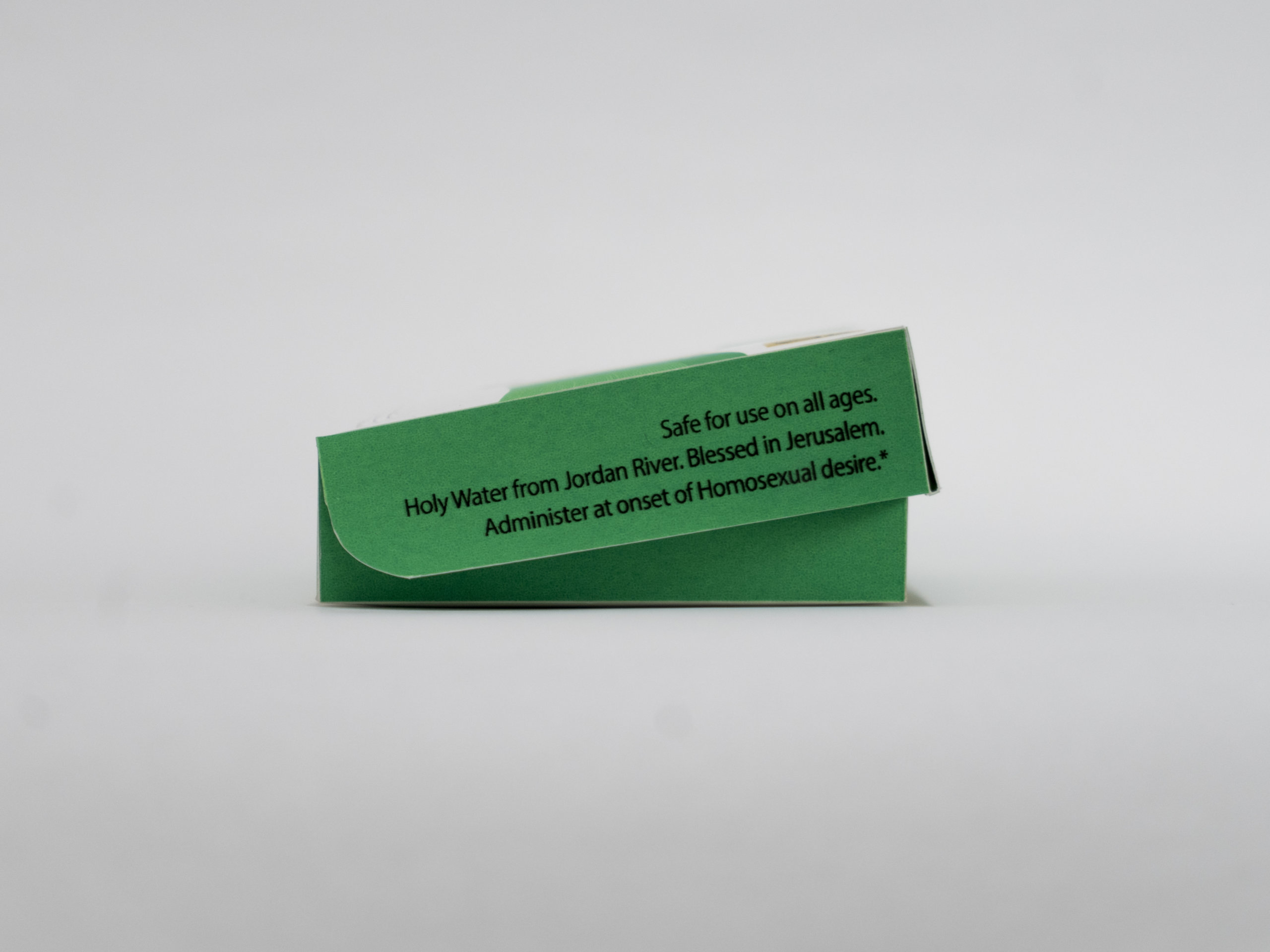





Solomon: Beyond the Convoluted pieces, interrogations of how faith meets sexuality continue to permeate your work. Heterize (2019) merges religious dogma with a convoluted history of pathologizing homosexuality as a “disorder” in need of a “cure” or “fix.” While I think the “Return to Eden” will be familiar to every queer reader who has been taunted with the “It’s not Adam and Steve” line of argument at some point in their life, what was the concept behind Heterize and do you see it as an extension, expansion, and/or revision of your concerns in Convoluted?
Lawson: I see Hetereize as both an extension and an expansion of Convoluted in that it extends my exploration of faith while expanding to discuss medical science’s responsibility to queer subjects.
Homosexuality was considered a mental disorder up until 1973, and the American Psychiatric Association (APA) didn’t officially rule reparative therapies as an ineffective strategy in “changing” sexual orientation until 1998. Dr. Robert Spitzer, one of the key members of the campaign to de-pathologize homosexuality in 1973, published a study in 2003 that many interpreted as an argument for homosexuality as a choice, that homosexuals can change their orientation.3R.L. Spitzer, “Can Some Gay Men and Lesbians Change Their Sexual Orientation? 200 Participants Reporting a Change from Homosexual to Heterosexual Orientation,” Archives of Sexual Behavior 32 (2003): 403–417. It added fuel to many churches’ fire in maintaining and extending their “conversion” practices, using established and “credible” scientific applications alongside spiritual exorcisms rooted in the rhetoric of shame and damnation. All to “fix,” “cure,” “convert” gay and lesbian people.
Heterize is based on my research of churches and organizations that practice conversion or reparative therapy at this intersection of faith and interventionist “medical” treatment. Reparative therapy is still legal in 29 states (2020) but has been widely discredited by the APA and is proven to be detrimental to the mental health of LGBTQ+ individuals who are forced into or even willingly participate in conversion therapy. These conversion centers operate from some of the same misguided principles I explored in the Convoluted series. They promote sexual and spiritual purity, accepting only procreation as divine decree and sole purpose of sexuality and homosexuality as a perversion of that decree. All the while they ignore some of the basic tenants of Christianity. This is why I list “Hospital for Ideological Reform” on a box of Heterize: bigotry under the guise of medical science.
But, again, a box of Heterize also confronts the responsibility and culpability of medical science in conversion therapies. Apomorphine, primarily used to treat Parkinson’s disease but has also been promoted as a treatment for alcoholism and heroin addiction, and the hormone Oestrogen are used in conversion practices to subdue libido as well as induce vomiting at the onset of perceived homosexual arousal. That’s why I list them as supplemental ingredients on the Heterize box. Heterize is meant to confront the absurdity of conversion therapy with its own level of absurdity. Think what it would be like if you could take a pill or inject a drug developed by science to change aspects of who you are, and that your spiritual home taught you that was your only option. It’s an absurd thought when you stop and think about it.

Solomon: Heterize might merge a faith-based critique with a more clinical form, but it’s not the first time you’ve thought about injection/ingestion as treatment within your work. Both operate strongly as a sort of interactive component, one in which viewers would not necessarily directly participate (inject/ingest), but they would feel that artistic invitation implicit in the work itself. I’m thinking here of your works around Placebo, which on one level examine the self-medication many queer people deploy (drugs/alcohol) to cope with the world around them. Each door in your Placebo Triptych, for example, features a different substance, geltine capsules (pills), a white powder, and syringes as if the person living inside each door is composed merely of the substance.
Lawson: Yeah, the Placebo Triptych (2018) is the culmination of various experiments with the idea of how queer people ingest daily words of hatred and devaluation and the accumulation of those daily homophobic micro-aggressions often become the foundation for a profound self-loathing that can often only be “treated” by filling the void with other “pills”: drugs, alcohol, substances. A placebo by definition has no value therapeutically, and I wanted to play off that idea for queer people navigating self-actualization. That just as you can’t be converted or fixed via the intrusion and twisting of religious ideology, there’s nothing that can numb you to the pain of getting beyond where you’ve been to become who you are meant to be as a fully embodied person in the world. Addiction is a problem in the LGBTQ+ community, and I wanted to confront that directly with both the Placebo Triptych and Daily.

Solomon: I know you’ve said the Placebo pieces represent the “cyclical futility of trying to escape the shame of being gay,” and the text in Daily in particular is based upon the journal of a man who underwent reparative therapy who described all the pills he had to take in a day. I wonder how you think of your own “gay shame” journey and the closet structure that figures prominently in much of your work. Could you say a bit more about how you navigated your understanding of sexuality in a place like Fort Myers, where you said earlier there were no visible queer networks and mentors for you? Was there a day when you just decided “I’m coming out”?
Lawson: I didn’t have a real sense of community in Fort Myers, but that doesn’t mean there wasn’t one there that I perhaps didn’t have access to. I didn’t really know of other queer people growing up, and the ones I did know of were through my parents who advised me to keep my distance in their stigmatizing vein of thinking about “deviant” sexuality that did not fit their ideal Southern Baptist man. I came out of the closet the day I graduated high school. But I had “come out” as an artist so to speak much earlier. Becoming an artist wasn’t an option for a very long time despite my having always been creative. As I child I was bullied and in an attempt to become “one of the guys,” I would draw erotic female figures to see if I could get the approval of my straight counterparts. I did that for a few years, maintaining a straight macho façade while continuing to draw and practice my art. I never took any art in high school because it was considered a very “gay” thing to do, and I had to avoid that perception to protect myself where I was. But then, I graduated high school, came out, and went to college in Orlando. I started by majoring in architecture, and I think you can see that structural and conceptual idea of form in my work. Architecture morphed into allowing me to think about how to blend my artistic life with a professional practice, but during my second year, I realized I was having a lot more fun making things, making objects, rather than the strict conceptualization of space and how people maneuver through it. But it’s interesting because now I’m coming full circle and beginning to research more about queer spaces and how we navigate them both in terms of accessibility and as terrains for intimate and affective encounter. The room that we’re able to take up.
Solomon: Wow, that’s powerful: “the room that we’re able to take up.” I want to come back to that idea of how your work is taking a more spatially aware turn lately. But first, you said you were bullied a lot growing up, and I think two of your art projects reflect both the experience of growing up being bullied and being closeted. “Smear the Queer” is a game many children enact on the playground: the target is the person holding the ball, who is labeled the “queer,” who must be “smeared” or tackled. The goal for the “queer” is to run and avoid being tackled. At least that’s what I remember from playing it as a kid. Your Smear the Queer speaks to the bullying many LGBTQ+ youth experience, but I would argue it also helps us understand the symbolic function queerness performs in our cultural consciousness: the one who must first be identified then “taken out” is the queer. The queer doesn’t fit. You used casts of your own teeth in the piece? A wisdom tooth at the center surrounded by other teeth jockeying for central position? Were you thinking about wisdom tooth extraction as a kind of metaphor for queer removal when you worked on this piece?

Lawson: I don’t know if I can claim I was thinking about wisdom teeth and surgical extraction specifically, but I was definitely thinking about how I was being excised from my social group and using teeth as a symbol for that. This piece started out with my own experience being bullied. As I said earlier, so much of my background informs my art. For me specifically, I was a quiet, very emotional young man, and I liked to play house with girls over football with the boys. I made other young boys uncomfortable because I wasn’t the ideal representation of a “man” (especially within my Christian private school), and unfortunately, I became a screen on which to project their own misguided ideals of proper masculinity. The wisdom tooth is extracted sometimes because of the perceived misalignment it will cause, even if the tooth is perfectly healthy, and I think this becomes a great proxy for the queer experience. As such Smear the Queer moved beyond my personal experience with bullying and evolved into a response to the number of reported hate crimes in the US. In my research I found that of the reported hate crimes committed towards the LGBTQ+ community, 57 percent of them were towards gay men. In the piece, I use 961 teeth to represent the approximate number of deaths that occurred in 2014 as reported by the Bureau of Justice Statistics (BJS). Yes, the teeth are cast from my original tooth and are arranged around it in the center of the composition. Dyed wax is used to symbolize gums and to represent the shared identity of the victims, connecting each tooth and creating a singularity and a metaphor for the shared struggle. If I thought about excision, it was in the sense of how a hate crime cuts a life short and I wanted to include those 961 teeth to reflect the sheer numbers of hate crimes against LGTBQ folk each year. Of course, one is one too many.
Solomon: Your Limp Wrist cast series also represents how a singular experience can be displayed alongside other singular experiences in order to form a collective, quotidian pattern of bullying and homophobic violence. The wrist cast pieces were featured in an early show of yours under the title “Closeted.” One of the most striking casts is from the subject “David” whose brother told him that he was “worthless.” Others in the series feature similarly jarring language “sharpied” on the cast. Can you describe how you curate the pieces in this ongoing series and how they work in your exploration of the closet?
Lawson: Yeah, the Limp Wrist pieces were probably the most successful works I did as an undergraduate at UCF. In an attempt to reach out to other queer people and form a community, I started taking on participants within my work, trying to figure out how I could mesh my historical references with theirs, and how each of us could independently grow from the process. The Limp Wrists began as a way for us to explore the role of language in making queer people understand our worth as perceived from a member of the straight majority. The written content on each cast represents the most memorable moment when the subject felt someone they loved “drew blood,” or tried to wound them with words that targeted their perceived difference. As such, each cast also features a drop of the subject’s blood to illustrate queer resilience: that we can be wounded to the point of needing a cast, but if we keep going we can become stronger. For example, on my cast I quote my grandpa who I overheard talk about the “nasty shit” on TV, by which he meant gay stuff. That moment made me understand how he perceived queer people, even the one who sat in the room with him and shared his blood. It’s about what we LGBTQ+ folk endure when we are still in the closet to those around us or even to ourselves. We put up with a lot of casual verbal violence even from our kinfolk.
I thought a lot about language and go back to Merle Miller, “it’s not true, that saying about sticks and stones; it’s words that break your bones.” In Limp Wrists, I wanted a way to express how much of what we hear around the thanksgiving table, in front of the TV, in church sermons, and with our “friends” is internalized and becomes a brutal reminder of our social status. It’s a common experience of most queer people I’ve asked. There is always a moment, something that is said either to them or unknowingly about them, that changes their perception of their self-worth. Sometimes it’s from the people we least expect, which is often the most damaging. I hope that one day I’ll run out of arms to cast, but I think these pieces are important to illustrate our queer resilience. I was inspired to create the form of a cast and “sign” it in blood after reading the Queer Nation manifesto, which was handed out by ACT UP at the New York Pride Parade in 1990:
“How can I tell you. How can I convince you, brother; sister that your life is in danger. That everyday [sic] you wake up alive, relatively happy, and a functioning human being, you are committing a rebellious act. You as an alive and functioning queer are a revolutionary. There is nothing on this planet that validates, protects or encourages your existence. It is a miracle you are standing here reading these words. You should by all rights be dead.”
Better Blood Memories
Solomon: I wanted to ask you about family—brothers and sisters—not so much your own family background but how you think about the queer kin with whom you share artistic DNA, if that makes sense. I can look at your work and see so many possible influences. First, how would you describe yourself as an artist? How do you think about your work at this stage in your career as fitting within a certain tradition?
Lawson: I’d say my art begins with a clear sense of concept that then shapes the form of the installations, something akin but not limited to the post-minimalist school of sculptural thought. I don’t have a concrete or specific school of thought surrounding what I do in my practice, but if I were to describe myself it would be an interdisciplinary multimedia artist. I would consider myself more of a sculptor. Two-dimension has slipped my repertoire of talent.
In terms of contemporary influences, I look a lot at Jordan Eagles, a California artist who works a lot with blood and did pieces in the Keith Herring museum. His Blood Mirror is probably one of my favorite pieces. I know I mimic a lot of his thought process and artistic instincts in my own work. Ai Weiwei is another artist who’s driven me to more of an activist place in my work. I’ve been talking with social justice professionals about how what I create are not just objects but have a more tangible function as reflective pieces for social change or disruption. Otherwise, I feel like I’m making the work just for myself, which isn’t the purpose of what I do.

Solomon: Yes, I can see Jordan Eagles for sure in your work. Part of the way my mind works is through connection: always seeing references and ways to synthesize because I think all works of art are ultimately in conversation with other works of art, and we scholars tease out those connections in writing about them. That intricate weaving is something a writer I admire, the late Douglas Crimp, does wonderfully.4Douglas Crimp, Melancholia and Moralism: Essays on AIDS and Queer Politics (Cambridge, MA: MIT Press, 2002). In viewing your work specifically as a queer viewer, I also see traces of many other artists I love. Speaking of Eagles and blood mirrors and a desire for the work to have more purposeful connection, your use of blood as artistic material fits within a certain queer artistic tradition. One of my favorite artists is David Wojnarowicz; he fuses image and text in a way that is perhaps comparable to you as well. I teach portions of his memoir Close to the Knives, and it’s always eye-opening for students. In one of his final artworks before he died of AIDS complications, he superimposes writing over a photograph of human remains. Part of it reads, “If I could attach our blood vessels in order to anchor you to the earth to this present time I would… It makes me weep to feel the history of your flesh beneath my hands in a time of so much loss.”5David Breslin and David Kiehl, David Wojnarowicz: History Keeps Me Awake at Night (New Haven, CT: Yale University Press, 2018), 270–271. I can see this sense of connection through loss in your return to shared LGBTQ+ traumas throughout your work. Your use of blood also seems to echo the subversive political aims of Félix González-Torres, whose work was interactive, conceptual, three-dimensional and often deceptively political. His 1991 billboard depicting an empty unmade double bed with imprints remining on the pillows, produced a year after he lost his lover Ross to AIDS, makes a powerful political statement. He writes, “It was ruled that the bed is the site where we are not only born, where we die, where we make love, but it is also a place where the state has a pressing interest, a public interest.”6Felix Gonzalez-Torres, “Practices: the Problem of Divisions of Cultural Labour,” Art and Design 9 (1994): 91. See Joan Gibbons, Contemporary Art and Memory: Images of Recollection and Remembrance (London: I.B. Tauris, 20017). Despite the power of the imprint, Ross is no longer in that bed with Felix. However, the state, following the 1986 Bowers v. Hardwick decision, remains obliquely in that bed.

Your blood works provide a ruminative and reflective political ethic similar to González-Torres. When you see the blood in your work, you do not initially know from whom the blood flowed just as you cannot discern immediately from González-Torres’s work who once occupied that bed. And you’re making a statement about the state’s continued role in regulating a particular population’s ability to donate blood.
Do you think about the history of negative connotations associated with queer blood, which stems largely from that “time of so much loss” in the 1980s–1990s, when you and I were born, during the artistic generation of Wojnarowicz and González-Torres and Herring, who you mentioned earlier? How intentionally political are these blood works for you?
Forrest: You’re right. At this point, blood has become a universal instrument or material in my work. My first projects with blood, O-Negative and Better Blood, were to expose the discriminatory FDA blood ban that I think is an unnecessary and dangerous holdover from the early years of the HIV/AIDS pandemic. I had thirty gay participants donate a slide of their blood and I made a book alongside that blood that had the FDA questionnaire that excluded gay men from donating. From there, I shifted to blood prints and blood slides in Biohazard and my current project What Are We to You. In all of this, I’m working with abjection and aesthetics, bringing the disgusting and gross into a beautiful shape and environment. It works well in a vein of subterfuge in that people get really close to it and often not until they read the fine print or the title tag do they realize that they are that much closer to queer blood. It makes people really confront very quickly their own bias and stigma. What does queer blood actually mean? What does anyone’s blood actually signify, for you, the viewer, standing this close to many other people’s blood who just so happen to be gay or bi or lesbian or trans (which you only know if you read the fine print)? Generally, I use blood as a means to impart our shared humanity while politically invoking the FDA ban, the legacy of HIV/AIDS, and the still-common association of queer blood with the infectious and the contagious in the minds of many viewers. I’ve tried hard not to use blood in any shock value way or as a way to jar people. The goal has been one of enlightenment, of introspection, of recognition, and in some sense, of communion with those who’ve gone before who were gone too soon. To memorialize.


Solomon: Yes, it’s a kind of blood memory like the Rilke quote: not until the memories have turned to blood within us can we understand them. Something like that.7For the connection between Rilke and González-Torres’s work, see Christopher Castiglia and Christopher Reed, “Remembering a New Queer Politics: Ideals in the Aftermath of Identity,” If Memory Serves: Gay Men, AIDS, and the Promise of the Queer Past (Minneapolis: University of Minnesota Press, 2012): 175–215. The full and correct Rainer Marie Rilke quote: “And still it is not enough to have memories. One must be able to forget them when they are many, and one must have the great patience to wait until they come again. For it is not yet the memories themselves. Not until they have turned to blood within us, to glance, to gesture, nameless and no longer to be distinguished from ourselves—not until then can it happen that in a most rare hour the first word of a verse arises in their midst and goes forth from them.” I go back to the inheritance of loss we all live with as gay men. I do think those years of loss are in the DNA of who we are, of how we navigate the world. How we remember and honor those who died. How the pain of the past can be instructive for our present. It’s contemplative, but I wouldn’t say your use of blood is shocking. My friend Jesse Peel describes a moment after his 1987 HIV positive diagnosis when he cut his finger and realized the blood which pooled in the cut “was poison.” He states frankly, “that’s a real mind fuck."8See the Touching Up Our Roots oral history about his life: In the Eye of the AIDS Storm: The Saga of Dr. Jesse Peel, directed and produced by Dave Hayward (2010), DVD. Touching Up Our Roots: Georgia's LGBT History Project. Georgia State University. Jesse Peel’s realization is shocking! But Forrest, I don’t find your use of blood shocking at all. Is it a “mind fuck”? Perhaps. Because you are asking reflective, metacognitive questions of your viewer. But the way you use the material of blood is so precise, ordered, neat, adding a degree of symmetric beauty to what some may view as the materially abject. There’s something about using a substance that has been historically vilified as infectious, as less-than, as something that needs to be quarantined and cured, there’s something about taking a substance that has that much chaotic weight historically and then shifting it into a register of order where you put the interpretive onus on the viewer not on the person from whom the blood came. It’s powerful re-signification. How are you thinking about your queer bloodwork and the revision of the FDA blood ban in the context of COVID-19?
Lawson: It’s really important to what I’ve been doing recently. Before this, I had actually started a national campaign with a professor of social work at UGA, Dr. Jeremy Gibbs, in order to help end the ban or remove the restrictions to something a lot more reasonable. And then, of course, this whole pandemic happened, and we get immense pressure that helps reduce the ban to three months, which is still absurd. It’s an ongoing debate that I’m sure will continue to inform my art.
Solomon: And I think that’s part of the ethic of your artwork, to quote González-Torres again: “I do have a political and personal agenda with this work, and in a way they are very interrelated.”9Felix González-Torres, interview by Tim Rollins, Between Artists: Twelve Contemporary American Artists Interview Twelve Contemporary American Artists (New York: A.R.T. Press, 1996), 94.
Lawson: Absolutely. As I say in my artist statement: “Through sculpture and assemblage, my work explores the array of complexities experienced by individuals within the gay community.” It’s both me and the collective; the personal and political are inseparable. Although lately, I’ve been moving more towards a research-based artistic practice, whereas before I would’ve considered my work more emotionally driven, more instinctually responsive to what I was personally living through or seeing around me with my own experience and those of the small community I had in Fort Myers, then Orlando, and now Athens. Since winning ArtFields in 2019, I’m working now on a more national scale, for example, by reaching out to networks of reparative therapy survivors to try to describe a queer experience that I have neither lived nor am fully familiar with.
Solomon: I see that in some of the work you’re sketching during the current pandemic too: that reaching out. How do you connect in pandemic times when connection may lead to death?
Beyond advocacy for abolishing the blood ban and the material conditions of producing and exhibiting the work, which I know have been challenging if not impossible right now, can you say a bit about the ways the current COVID-19 situation has impacted the focus of your work?

Lawson: Much of my sketching and idea invention lately has me thinking a lot about how the current “quarantine” and our experiences self-isolating as a parallel not only to the HIV/AIDS pandemic but also, for those of us who are well and isolated, to the queer experience as a whole, within the closet and beyond. I’ve started this book series. I’m trying to gather narratives of people’s experiences within the closet and to understand how that particular experience may or may not mirror the kind of isolation we are in now, where we are having to sacrifice parts of ourselves and experiences in order to survive in the world. And I envision this project, like the ones I’ve done so far, will bring a sense of recognition through reflection to those who are losing their minds right now who have never experienced this degree of isolation or loneliness before, things that many queer people have been and continue to be all too familiar with, unfortunately so, day to day as many of us have to navigate a culture that devalues and misunderstands us, sometimes with tragic consequences. I’m also thinking a lot about queer people who are isolated in neither ideal nor safe settings, and I don’t know best yet how to communicate with them. But I do want the work to amplify their voices and experiences. The biggest thing I’d like to accomplish in this newer work is creating that sense of shared experience that represents the full spectrum of affective response such “physically distant” experience elicits for us all, gesturing towards some empathy and understanding. Empathy is perhaps the direction I’m headed most of all: what is it like to walk in the shoes of others? What is it like to understand the microaggressions queer people experience if you yourself have not lived them because of who you are? What is it like to experience loneliness in isolation for the first time? Those are some of the questions I’m exploring and finding shape for.
Solomon: Shared traumatic experiences (bullying, homophobic violence, blood bans) have been the organizing principle of your art up to this point. Have you considered adding other dimensions to your work, different layers of queer affective experience?
Lawson: For sure, I’m trying to shift the mindset in order to shift the art as well. I’m working with game pieces and queer-themed board games as an attempt to play off the trope of queer missed childhoods and return to a sense of playful erotic creative whimsy that we as adult gay men can celebrate without shame or the watchful eyes of judgmental figures. I’m trying to blend the happy with the sad as best I can.
Solomon: It reminds me of “Joy” and “Sadness” in the Pixar film Inside Out. So you’re expanding perhaps the rooms that we’re able to take up, as you mentioned earlier? And I’ve been thinking about that phrase because it struck me so. There’s a passivity to the way you construct that phrase, right: “the rooms that we’re able to take up.” In the passive construction of the phrase, there’s a certain admission of powerlessness.
Lawson: Yeah, and I guess I want to take more of an active control of the narratives I’m crafting with my art, ones that aren’t purely reactionary. Right now I’m shifting in my work to attempt to find methods and forms that celebrate sexuality so as not to exclusively talk about trauma. It’s a reorientation that I’m working through right now. How, for instance, can we build a life against the backdrop of trauma that is still profoundly rooted in joy, in hope, in love, in intimacy? How can art represent the affective register of queer happiness? How can we have the whole emotional house and not just the one sad room? So now I’m stuck in that research mode trying to give those ideas more tangible rooting in my work. I’m looking a lot at queer theory right now, and I’m trying to navigate how best to talk about queer experiences without imparting a sense of total authority on the subject. How are we oriented towards our work? That’s one area of queer theory building off Sara Ahmed’s work Queer Phenomenology that I’ve been thinking through. How am I approaching the work and the themes my work has always been about? How am I “oriented” towards trauma and what “turnings” occur for others to become a part of the work? I know for eight years now my work has been primarily about homophobic experiences—those shared traumas that we as LGBTQ+ folk unfortunately know too closely and the inherited generational trauma that we still encounter from our shared past.
Solomon: And in that reorientation that you’re working through, I know sexuality is making a kind of resurgence in your work.
Lawson: Absolutely. I avoided sexuality for a long time mostly because I had done work in my undergraduate studies that was censored. They were taken out of the gallery setting. I was instructed by one of my mentors that if I ever wanted to establish myself as an emerging artist and make my work pass through that veil I should avoid explicitly carnal and sexual artwork. And I did. But it’s always been an undercurrent. As I said, I started my art as a young person drawing very erotic imagery, and I’m still to this day just drawing penises everywhere, which is both a return to the erotic in my art and that spirit of play and joy that I’m seeking more of in the work lately. And the game pieces are really about the celebration of sex and sexuality—
Solomon: The Joy of Gay Sex if you will.
Lawson: Yeah! I’ve made these BDSM themed playing cards, and I’m redoing the game Operation in a sex-toy setting. One piece I’m working on now, “The Hedonist’s Closet,” is all about the pursuit of pleasure on hookup apps. I don’t think I avoid sexuality anymore perhaps like I did when I was younger in my work. I certainly don’t do it personally! But within the work, I was always afraid that to be in a gallery setting and have some sort of success that there were certain subjects that were still very taboo. That’s really the direction my work is headed now—still very body centered—but joy, pleasure, sex, life, you know all the “simple” stuff. [Laughs]
Pulse: Remembering the 49
Queerly beloved,
we are gathered here today to get through this thing called life
our story stretched across bloodlines, backrooms, and borderlines
. . . . . . . . . . . . . . . . . . . . . . . . . . . . . . . . . . . . . . . . . . . . . . . . . . . . . . . . . . . . . .
We're tired of being so resilient.
Pero, love beats here.
—Maya Chinchilla, “Church at Night”10Maya Chinchilla, “Church at Night,” GLQ 24, no. 1 (2018), 3–8. https://doi.org/10.1215/10642684-4254387.
Solomon: I thought we’d end with a benediction of sorts by considering your works surrounding the Pulse nightclub shooting. I believe your 6/12/2016 piece was how I first encountered your work. This work resonates so deeply with so many of us. In “Church at Night,” Maya Chinchilla responds to the Pulse shooting, asking readers: “Do you remember the names/ of your first gay bar?” I already know the answer to this, but Forrest, what was your first gay bar?

Lawson: It was Pulse. Although I was closeted until I graduated high school, I was with the man who would become my husband for three years prior to that. As awful as it sounds, we maintained staying in the closet for the sake of our own growth and our own safety back in Fort Myers. Once we got of age and were able to go to nightlife situations, we were able to find more of a community then, but that really only happened after I graduated and was able to move up to Orlando, which is a mostly progressive, liberal, open place where I felt a lot more comfortable. I think a lot of queer people did up until Pulse happened… Orlando was one of the first places in Florida to offer employment and family protections, housing initiatives for homeless LGBTQ+ children (Zebra Coalition, The Center), and a vast number of out and proud queer people. It is still, however, the South, and as much as it appears the queer population is thriving, Florida still has a long way to go. It is still home to churches that host “Make America Straight Again” rallies, pastors who call for government eradication of all queer people, and the Pulse tragedy.
Yes, Pulse was the first nightclub that I went to, but there were many other queer spaces I started to navigate as a terrified nineteen-year-old child trying to explore a more “urban” terrain of queer life. Starting my queer artistic journey in Orlando really helped me understand my place within an intersectional community. Race, gender identity, class, faith-based queer groups, I was able to navigate all of that as I came into myself and into my work. And in many ways, my early twenties in Orlando felt like a replacement for the childhood I feel like I missed out on, in the sense of coming to terms with my sexuality. My twenties sort of acted as my teens, much to my detriment I’m sure…
Solomon: … I wouldn’t say that. I think that’s a fairly common experience that often serves as a misguided stereotype of gay experience: the "lost boy" trope, the boy who couldn’t or wouldn’t grow up, when those who traffic in such rhetoric fail to understand the reasons that might motivate queer people to have such a “delayed adolescence.” And yet, Forrest, it seems to me your life thus far has an element to it that subverts so many expectations: you’ve been together with your husband for a long time!
Lawson: Yeah, since we were fifteen years old, so fourteen years now. We got married in 2016, the year after it became legal. The year Pulse happened. We were in Orlando during Pulse, and that moment served as a catalyst for so much of my professional and personal life. I specifically reference the Pulse tragedy in my work with the number 49. A lot of my work features the multiplicity of that number. The blood slide pieces in What are We to You, for example, each contain 49 petri dishes of blood spots. I’ve done other projects such as the wrist band pieces in the 6/12/2016 series, which feature interviews I conducted with 49 people who give their narrative reactions to Pulse and their reactions to Pulse no longer being a safe, queer space. And then I included those reactions within a memorial box alongside one wrist band and one name of a person lost that day in June 2016. Pulse is a place that has a ghostly presence in everything I do.
Solomon: Some of the written text within one of the memorial boxes reads, “It was weird that life didn't pause or slow. That I had to get up. Go to work. Where dreams come true. And fake a smile. Pretend that forty-nine people weren't just shot.” In your display, this text is positioned between boxes honoring the young lovers Christopher Andrew “Drew” Leinonen and Juan Guerrero, a thirty-two-year-old man and twenty-two-year-old man who were both celebrating June Birthdays and who died together at Pulse. Many of us witnessed Drew's mother Christine Leinonen's public grief in the aftermath. I can still remember waking up that day to the news, seeing her tears not knowing where her son was. It's become memory in the blood at this point, deep in the marrow. And I can't help but think about how Drew and Juan and so many of those lost were our contemporaries. How you and your husband live, how I live, and they do not. And I think that's such a surreal recognition when we encounter loss: how random it seems that some die while we live.
Lawson: It is surreal. But I suppose that’s the purpose of art, right? We make and create. We keep them alive in the objects we craft to remember them. Four years later, we continue to honor them.
About the Authors
Forrest Lawson is an Orlando-based multimedia sculptor. He is best known for his assemblages dealing with issues presented within the LGBTQ+ community. Growing up in Florida, he blends the experience of southern conservative living with his experience as a gay man. He is a MFA student in Sculpture and Fine Arts at the University of Georgia and has a BFA in Fine Arts from the University of Central Florida. He received the Grand Prize of ArtFields in Lake City, South Carolina, in 2019.
Eric Solomon earned his doctorate in English from Emory University and is a visiting assistant professor of English at the University of Mississippi. His work is featured in Southern Spaces, south, PopMatters, and Mississippi Quarterly.
]]>A New Era for "School Choice" and Vouchers
The United States has never been closer to adopting a nationwide program in which the state and federal governments spend billions of tax dollars to finance largely unaccountable private schools to educate children from kindergarten through the twelfth grade. By the beginning of 2019, more than half of the fifty states had enacted a variety of voucher programs diverting public funds to private schools and in some places to home-schooling—often for the purported purpose of improving the education of low-income African American and Hispanic students. These programs use state appropriations or tax credits to divert public monies to support self-governing private schools, often with few requirements or restrictions.
The states have steadily enlarged these programs during recent decades as a result of persistent, intense lobbying from school choice advocates. Often, programs have started modestly with special-needs children, then expanded to a broader student population. School choice programs are spread across the nation, although the South has more than anywhere else.1"Interactive Guide to School Choice Laws," National Conference of State Legislatures, June 15, 2017, http://www.ncsl.org/research/education/interactive-guide-to-school-choice.aspx; "School Choice in America," EdChoice, last modified April 9, 2019, https://www.edchoice.org/school-choice/school-choice-in-america/. Twelve of the twenty-six states with voucher programs using direct appropriations, indirect tax credits, or tax savings education accounts are in the South: Alabama, Arkansas, Florida, Georgia, Louisiana, Maryland, Mississippi, Oklahoma, North Carolina, South Carolina, Tennessee, and Virginia. State programs vary in form and scope, but some, like Georgia, permit state tax dollars to be diverted for home-schooling. All charts and maps with labels indicating "South" in this article refer to a fifteen-state South, which includes the twelve states listed above as well as Kentucky, Texas, and West Virginia. In 2018, more than $2.1 billion dollars in state funds went to support private schooling—a sum larger than the annual state appropriation for public schools in any of thirteen states across the nation.2School Choice Guidebook 2017–2018 (Washington, DC: American Federation for Children Growth Fund, 2018), 7–9, https://www.federationforchildren.org/wp-content/uploads/2018/10/AFC_School_Choice_Guidebook_2017-18_10.3.pdf; "2016 Public Elementary-Secondary Education Finance Data," Annual Survey of School System Finances, US Census, last modified May 17, 2018, https://www.census.gov/data/tables/2016/econ/school-finances/secondary-education-finance.html.
In addition, there is growing support in Washington for establishing school choice nationwide. In his first address to a joint session of Congress, President Donald Trump declared:
Education is the civil rights issue of our time. (Applause.) I am calling upon members of both parties to pass an education bill that funds school choice for disadvantaged youth, including millions of African American and Latino children. (Applause.) These families should be free to choose the public, private, charter, magnet, religious, or home school that is right for them.3"Trump's Speech to Congress: Video and Transcript," New York Times, February 28, 2017, https://www.nytimes.com/2017/02/28/us/politics/trump-congress-video-transcript.html. During his speech, the President also introduced an African American student who had received a tax credit voucher.
During his campaign, Trump pledged that he would become the "nation's biggest cheerleader for school choice" and would provide states with the means to use $20 billion in federal money to create vouchers allowing children to attend the private schools of their choice. "There is no policy more in need of urgent change than our government-run education monopoly," he said, "[that] has trapped millions of African American and Hispanic youth" in failing schools.
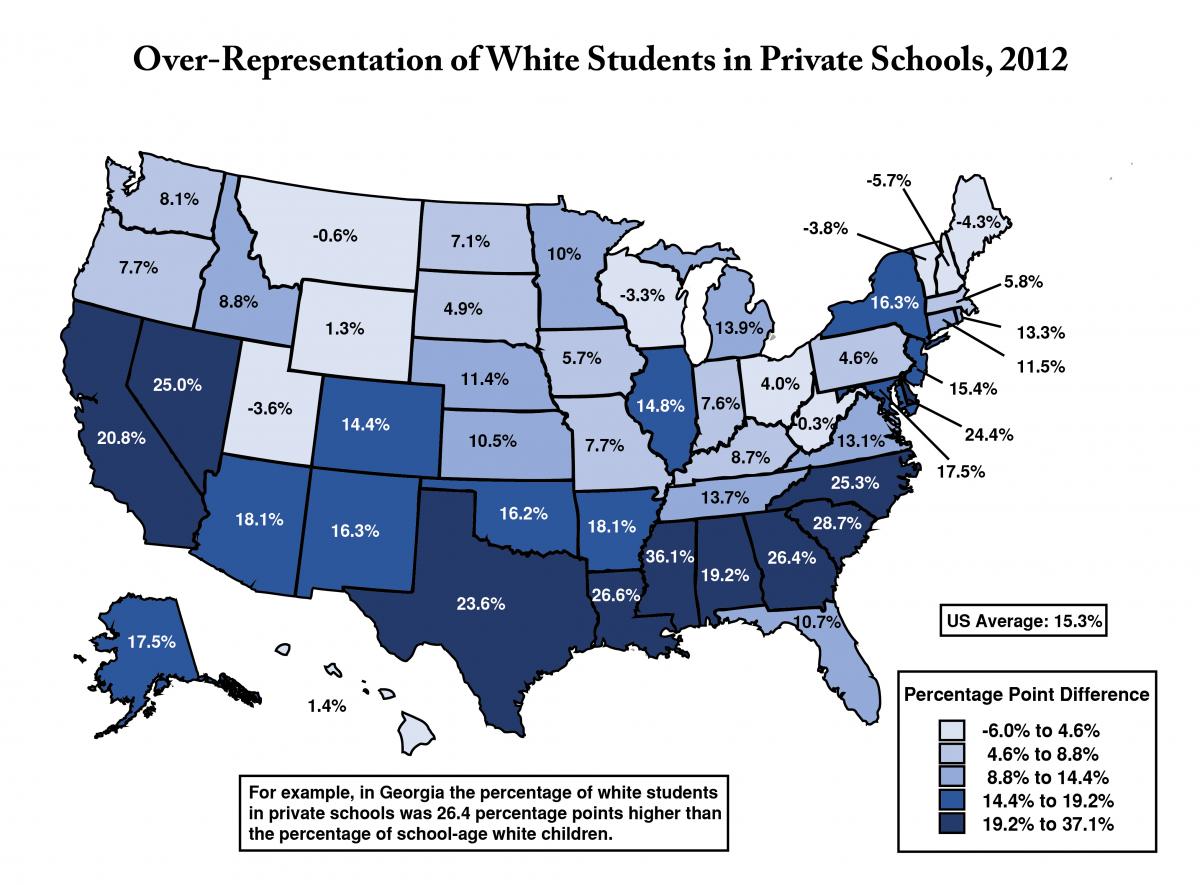
Trump's secretary of education, Elizabeth "Betsy" DeVos, a wealthy donor to Republican causes and a leading advocate of public funding of religious private schools, stated in May 2017 that the Trump administration would propose "the most ambitious expansion of education choice in our nation's history" because the "cause is both right and just." The Trump administration proposed to divert more than $1 billion to private schools in the 2019 budget in order to fund "scholarships to students from low-income families that could be used to transfer to a private school." But DeVos has so far been unable to convince Congress to fund such programs directly.4Jane Mayer, "Betsy DeVos, Trump's Big-Donor Education Secretary," New Yorker, November 23, 2016, https://www.newyorker.com/news/news-desk/betsy-devos-trumps-big-donor-education-secretary; Emma Brown, "DeVos Promises 'the Most Ambitious Expansion of Education Choice in Our Nation's History'—but Offers No Details," Washington Post, May 22, 2017, https://www.washingtonpost.com/local/education/betsy-devos-promises-the-most-ambitious-expansion-of-education-choice-in-our-nations-history--but-offers-no-details/2017/05/22/ae90f55e-3f03-11e7-8c25-44d09ff5a4a8_story.html; Valerie Strauss, Danielle Douglas-Gabriel, and Moriah Balingit, "DeVos Seeks Cuts from Education Department to Support School Choice," Washington Post, February 13, 2018, https://www.washingtonpost.com/news/education/wp/2018/02/12/devos-seeks-massive-cuts-from-education-department-to-support-school-choice; Laura Meckler, "The Education of Betsy DeVos: Why Her School Choice Agenda Has Not Advanced," Washington Post, September 4, 2018, https://www.washingtonpost.com/local/education/the-education-of-betsy-devos-why-her-school-choice-agenda-has-crashed/2018/09/04/c21119b8-9666-11e8-810c-5fa705927d54_story.html; US Department of Education, Fiscal Year 2019 Budget: Summary and Background Information, last modified February 12, 2018, https://www2.ed.gov/about/overview/budget/budget19/summary/19summary.pdf.
Support for federal funding of private schools is not a phenomenon only of the Trump administration. In 2012, the Republican candidate for president, Mitt Romney, issued an education "white paper" proposing public financing of tuition costs in private schools as the centerpiece of a new national education reform. The Romney for President position paper proposed to overhaul the primary federal funding of K–12 public schools "so that low-income and special-needs students can choose which school to attend and bring their funding with them. The choices offered to students under this policy will include . . . private schools if permitted by state law."5Romney for President, "A Chance for Every Child: Mitt Romney's Plan for Restoring the Promise of American Education," May 23, 2012, Chesapeake Digital Preservation Group, Georgetown Law Library, https://web.archive.org/web/20180624193755/http:/cdm16064.contentdm.oclc.org/cdm/ref/collection/p266901coll4/id/3980. The white paper was endorsed in a foreword by former Florida governor Jeb Bush.
In 2014, US senators Tim Scott of South Carolina and Lamar Alexander of Tennessee (ranking Republican on the committee for education) introduced legislation to enable federal funding for low-income and special-needs students in public schools to attend private schools. Alexander explained: "Allowing $2,100 federal scholarships to follow 11 million children to whatever school they attend would enable other school choice innovations, in the same way that developers rushed to provide applications for the iPhone platform."6Motoko Rich, "Bill to Offer an Option to Give Vouchers," New York Times, January 27, 2014, https://www.nytimes.com/2014/01/28/education/senator-to-propose-school-vouchers-program.html; American Enterprise Institute, "Senators Lamar Alexander and Tim Scott Unveil Ambitious Proposal to Expand School Choice," January 28, 2014, http://www.aei.org/events/senators-lamar-alexander-and-tim-scott-unveil-ambitious-proposals-to-expand-school-choice/; Lamar Alexander, "Weekly Column by Lamar Alexander: The 'Scholarship for Kids' Act," Weekly Columns, Lamar Alexander: United States Senator for Tennessee, February 18, 2014, https://www.alexander.senate.gov/public/index.cfm/2014/2/weekly-column-by-lamar-alexander-the-scholarships-for-kids-act; See also CHOICE Act, S. 1909, 113th Cong. (2014) and Scholarships for Kids Act, S. 1968, 115th Cong. (2017).
This momentum for vouchers found its way into the major federal tax overhaul enacted in 2017. Congress expanded the use of "529 savings plans" beyond paying for college costs so that tax-advantaged funds can now be used to pay up to $10,000 annually for costs of elementary and secondary education in K–12 private schools.7Ron Lieber, "Yes, You Really Can Pay for Private School With 529 Plans Now," New York Times, December 21, 2017, https://www.nytimes.com/2017/12/21/your-money/529-plans-taxes-private-school.html. This federal change supplements the Coverdell Education Savings Accounts passed first in the Clinton administration and expanded during the George W. Bush administration. It allows a limited use of federal tax dollars to support attendance at private elementary and secondary schools. See Coverdell Education Savings Accounts, 26 U.S.C. § 530 (2006). Most private schools, as non-profit organizations, receive contributions that are deductible for donors from federal income taxes. They also are exempt from income taxes and often local property taxes. This change promises to become quite significant, especially for wealthier households. It opens up a fund—$328 billion and growing—from which monies can be diverted yearly to private K–12 schools.8"529 Plan Data," College Savings Plan Network, June 30, 2018, http://www.collegesavings.org/wp-content/uploads/2018/10/June-2018-529-plan-data-10.15.18.pdf.
Civil Rights Rhetoric Echoes in "School Choice" and Vouchers
"School choice" has no traditional or intrinsic meaning in the field of education, but over the last several decades it has become a political slogan for the claim that government should finance children's education from pre-kindergarten through the twelfth grade in schools outside the public system in order to provide parents with a choice. In recent years, charter schools have been included as a "school choice" option because many local districts and some states now authorize private profit-making or non-profit entities to operate these schools independently, often without meeting requirements and rules that public schools must follow. In 2015, there were 2.8 million students in charter schools and 5.8 million students in private elementary and secondary schools across the United States.9"Public Charter School Enrollment," The Condition of Education 2018, National Center for Education Statistics, 2018, https://nces.ed.gov/programs/coe/pdf/coe_cgb.pdf; "Private School Enrollment," The Condition of Education 2018, National Center for Education Statistics, 2018, https://nces.ed.gov/programs/coe/pdf/coe_cgc.pdf. Also, see Peter Bergman and Isaac McFarlin Jr., "Education for All? A Nationwide Audit Study of Schools of Choice" (working paper 25396, National Bureau of Economic Research, December 2018). This article examines the history of government support for private schools as both the origin and primary foundation for the current movement for "school choice."
In claiming private "school choice" as right and just, President Trump and Secretary DeVos echo rhetoric that others have used to argue that publicly financed vouchers for children to attend private K–12 schools are a moral imperative. In articles such as "How School Choice Helps Advance Martin Luther King's Legacy," the Heritage Foundation has insisted that vouchers continue the civil rights movement. In 2011, the founder of the tax credit voucher program in Florida declared that school choice for low-income families "is one of the most important social justice issues of our time."10John Kirtley, "Facing a Harsh Truth When Fighting for a Bipartisan Cause," RedefinED, May 20, 2011, https://www.redefinedonline.org/2011/05/facing-a-harsh-truth-when-fighting-for-a-bipartisan-cause/; Katie Nielsen, "How School Choice Helps Advance Martin Luther King's Legacy," My Heritage, Heritage Foundation, August 28, 2013, https://www.myheritage.org/news/how-school-choice-helps-advance-martin-luther-kings-legacy/.
One of Dr. King's children, in fact, joined the cause of vouchers for private schools in Florida to give "black, Latino, and Hispanic" children the same options as others. "This is about justice," Martin Luther King III stated in 2016. "This is about righteousness. This is about freedom—the freedom to choose for your family and your child."11Kristen M. Clark, "Thousands Rally in Support of Program Opposed by Union," Miami Herald, January 19, 2016, www.miamiherald.com/news/politics-government/state-politics/article55454785.html. Martin Luther King III attended and graduated from the private Galloway School, created in Atlanta in 1969. Earlier, his parents attempted to enter him into another Atlanta private school when he reached school-age in the 1960s, after they were misinformed by an Episcopal priest that the all-white, private Lovett School would accept their son. Their written application for his admission was denied without reference to a reason, although the chairman of the school board later stated that he believed that both the "negro and the white man has some individual rights." "Diversity and Inclusion at Galloway," The Galloway School, accessed March 27, 2019, https://www.gallowayschool.org/community-life/diversity-inclusion; Kevin M. Kruse, White Flight: Atlanta and the Making of Modern Conservatism (Princeton, NJ: Princeton University Press, 2005), 175–177.
The political movement for "school choice" is employing the icons and language of civil rights and social justice to advance private school vouchers that fifty years ago were primary tools for segregationists to preserve unequal education for African American and Hispanic children. President Trump's call for a national program of "school choice" echoes the language of George Wallace and others who demanded the federal government and US courts permit Alabama and the South to administer "freedom of choice" for elementary and secondary schools.
These apparent contradictions emerge from the unexamined legacy of segregationists who designed and developed effective, lasting strategies that frustrated and blocked K–12 school desegregation. It is a legacy that turns the icons and language of civil rights inside-out while thwarting the national goal of an effective, equitable system of education for all children.
Forgotten Segregationists
Historically, the methods and forms of segregation have been neither monolithic nor inert.12See C. Vann Woodward, The Strange Career of Jim Crow (New York: Oxford University Press, 1966); Pauli Murray, States' Laws on Race and Color (Cincinnati, OH: Women's Division of Christian Service of the Methodist Church, 1951), 3–20; J. Mills Thornton III, "Segregation and the City: White Supremacy in Alabama in the Mid-Twentieth Century," in Fog of War: The Second World War and the Civil Rights Movement, eds. Kevin M. Kruse and Stephen Tuck (New York: Oxford University Press, 2012), 52–55. Southern segregationists held differing notions about the best ways to preserve school segregation along with their beliefs in racial superiority. As Sylvan Meyer observed in 1960, southern segregationists included "all those whose views varied from a mild belief that the South would be better off maintaining as much racial separation as possible to those advocating insurrection rather than 'surrender' to any compromise whatsoever."13Walter Spearman and Sylvan Meyer, Racial Crisis and the Press (Atlanta, GA: Southern Regional Council, 1960), 47. Many segregationist leaders who designed and implemented plans for school choice have been forgotten, as have their plethora of rationales, strategies, and tactics. They were never widely known, and popular culture has narrowed the cast to a small rogues' gallery.
Prevalent images include segregationists such as Alabama governor George Wallace, Birmingham police commissioner Eugene "Bull" Connor, and a bevy of other white leaders such as Mississippi senator James Eastland who endure as premiere political symbols—in large part because their defiant images in multiple confrontations with and condemnations of federal officials often were captured as television came of age in the 1960s.14See Gene Roberts and Hank Klibanoff, The Race Beat: The Press, the Civil Rights Struggle, and the Awakening of a Nation (New York: Random House, 2006), 56, 301–325, 376–379. A few, such as Wallace and North Carolina's Jesse Helms, remained on the national political stage for more than a decade.15See Dan T. Carter, The Politics of Rage: George Wallace, the Origins of the New Conservatism, and the Transformation of American Politics (New York: Simon & Schuster, 1995), 451–468. Wallace prompted controversies over "free speech" rights on college campuses into the 1970s and remains today a popular reference for personifying the southern segregationist. See Peter Salovey, "Free Speech, Personified," New York Times, November 26, 2017, https://www.nytimes.com/2017/11/26/opinion/free-speech-yale-civil-rights.html.
But George Wallace was only one type of segregationist—and hardly a representative figure for those more successful over time in frustrating and blocking school desegregation. Segregationists with other styles and backgrounds built the more lasting terms, tools, and tactics that obstructed the Supreme Court's unanimous 1954 opinion in Brown v. Board of Education16Brown v. Board of Education of Topeka, 347 U.S. 483 (1954). outlawing segregated public education. This wider cast of white supremacists competed fiercely in shaping how and where segregated schools could be preserved. When political self-interest and racial ideology aligned, they occasionally cooperated. At times they shared a vocabulary against Brown, depicted as a federal edict to force the South to create "mixed schools," never to create equitable, desegregated or integrated schools.17Spearman and Meyer, Racial Crisis and the Press, 19, 25, 46–48, 52. Meyer explains how "mix" was a "scare word." Justin Driver, "Supremacies and the Southern Manifesto," Texas Law Review 92 (2014): 1082, https://chicagounbound.uchicago.edu/journal_articles/4043/.
These white men included die-hards, such as those found in the middle-class Citizens' Councils who usually pushed to abandon all public schooling rather than accept any desegregation. Some Citizens' Council leaders, however, came to recognize exceptions to absolute, complete segregation. Ku Klux Klanners, especially in the Deep South, were also dead-set against a single Black child entering an all-white school and were willing to use extra-legal intimidation and violence. Others, such as South Carolina governor Jimmy Byrnes, believed that the impact of Brown could be postponed indefinitely or avoided in large measure by building new Black schools so that separate schools appeared closer to equal.
Political leaders such as Georgia's Ernest Vandiver won office by campaigning on a slogan of "No, not one" African American child would ever be allowed in a white school but discovered after entering the governor's office that complete, absolute segregation was impossible to achieve—and counter-productive to preserving as many virtually segregated schools as possible. There were segregationists such as Alabama state senator Albert Boutwell—who later as a "moderate" mayoral candidate defeated "Bull" Connor—and Birmingham corporate attorney Forney Johnston. While Wallace began as a white liberal before shifting his politics to become governor, Boutwell and Johnston were the first segregationist leaders to develop a variety of strategies, tactics, and rationales for school choice that often delayed and defeated the promise of Brown.
Resistance to school desegregation differed across the states of the former Confederacy according to class, geography, religion, and political ambition.18David L. Chappell, "The Divided Mind of Southern Segregationists," Georgia Historical Quarterly 82, no. 1 (Spring 1998): 45–72; James Graham Cook, The Segregationists (New York: Appleton-Century-Crofts, 1962), 5–6; Clive Webb, ed., Massive Resistance: Southern Opposition to the Second Reconstruction (New York: Oxford University Press, 2005), 8–9. The different factors influencing all policy issues, including race, in the segregated South were detailed by state in V. O. Key Jr., Southern Politics in State and Nation (New York: Alfred A. Knopf, 1949). These different factors also were evident in southern white attitudes toward African American education. See Gunnar Myrdal, An American Dilemma: The Negro Problem and Modern Democracy (New York: Harper and Brothers, 1944), 893–900. For an example of class divisions during desegregation, see Karen Anderson, "The Little Rock School Desegregation Crisis: Moderation and Social Conflict," Journal of Southern History 70, no. 3 (August 2004): 603–636. Only by recovering and understanding the work of a wider cast of white actors who crafted enduring tools and strategies protecting segregation can the reactionary heritage of today's school choice become clear. As Justin Driver has found, the efforts of these segregationist leaders "to maintain white supremacy were often considerably more sophisticated, self-aware, and nuanced than the cartoonish depiction of southern stupidity and hostility would admit."19Driver, "Supremacies and the Southern Manifesto," 1079. These forgotten and ignored strategies help explain how today's proponents of public financing of private schools can employ the language of civil rights without widespread discredit. They also reveal how the origins and historical development of "freedom of choice" have shaped and continue to define the impact and role of "school choice" and vouchers in public education across the nation.20This study is, of course, not the first essay to explore the southern segregationist origins of private school vouchers for elementary and secondary schools. See, for example, Chris Ford, Stephenie Johnson, and Lisette Partelow, The Racist Origins of Private School Vouchers (Washington, DC: Center for American Progress, July 12, 2017), https://www.americanprogress.org/issues/education-k-12/reports/2017/07/12/435629/racist-origins-private-school-vouchers/, and Mark A. Gooden, Huriya Jabbar, and Mario S. Torres Jr., "Race and School Vouchers: Legal, Historical, and Political Contexts," Peabody Journal of Education 91, no. 4 (2016): 522–536.
School Choice and Vouchers Become Segregationist Tools
During the middle of the twentieth century, K–12 private schooling became intertwined with race and ethnicity as the Supreme Court issued opinions outlawing segregated graduate and professional public education.21Dick M. Carpenter II and Krista Kafer, "A History of Private School Choice," Peabody Journal of Education 87, no. 3 (2012): 336–338. For a review of the Court's decisions leading up to Brown, see Richard Kluger, Simple Justice: The History of Brown v. Board of Education and Black America's Struggle for Equality (New York: Alfred A. Knopf, 1976), 256–284; Sam P. Wiggins, Higher Education in the South (Berkeley, CA: McCutchan Pub. Corp., 1966), 169. There is an earlier history of school choice in the United States, when Catholic schools competed with public schools, often decidedly Protestant in nature, that carried forward into the twentieth century. See Robert N. Gross, Public vs. Private: The Early History of School Choice in America (New York: Oxford University Press, 2018). Yet, Gross largely ignores the pivotal period of Reconstruction when African American representatives helped to write new southern state constitutions mandating public schools as an essential duty of state governments. W.E.B. Du Bois, Black Reconstruction in America, 1860–1880 (New York: MacMillan, 1992), 637–669. These decisions had no impact on elementary and secondary public schools, but they signaled the direction the Court was moving.
From 1940 to 1950, private school enrollment in the South rose by more than 125,000 students—a 43-percent increase, and, for the first time since private enrollment numbers were documented, the rate of growth doubled that of the rest of the nation.
From 1950 to 1965, US private school enrollment grew at unprecedented rates while the South's rate again exceeded the nation's. Whites in record numbers fled to traditional and newly formed private schools. From 1950 to 1958, the South's private school enrollment increased by more than 250,000 students. By 1965, there were nearly one million southern private school students. Almost all were white.22See Norman Dorsen, "Racial Discrimination in 'Private' Schools," William & Mary Law Review 9, no. 1 (1967): 46, https://scholarship.law.wm.edu/wmlr/vol9/iss1/4/.
Legislatures passed laws authorizing vouchers and other means of transferring public assets and monies to private schools.23Reaction to Brown was comparatively muted outside the South since the Supreme Court struck down only school segregation established by law, and most segregation laws were in southern states. There was widespread de facto school segregation outside the South but only in a relatively few places did the law erect a dual system of publicly financed education based on race or ethnicity. See Murray, States' Laws on Race and Color; Robin M. Williams Jr. and Margaret W. Ryan, eds., Schools in Transition: Community Experiences in Desegregation (Chapel Hill: University of North Carolina Press, 1954); Will Maslow, "De Facto Public School Segregation," Villanova Law Review 6, no. 3 (1961), https://digitalcommons.law.villanova.edu/vlr/vol6/iss3/2/. In November 1953, as it appeared the Supreme Court might strike down school segregation, white South Carolinians voted to repeal a section of their state constitution that provided for a "liberal system of free public schools"—to clear the way for establishing a private school system. Georgia became the first southern state to pass a constitutional amendment enabling the legislature to send state, county, and municipal funds to "citizens of the State for educational purposes, in discharge of all obligation of the State to provide adequate education for its citizens." A month later, white Mississippians voted for a constitutional amendment granting the legislature power to close public schools and finance private ones. By the end of 1956, Virginia, Alabama, and North Carolina passed similar measures.24W. D. Workman Jr., "The Deep South," in With All Deliberate Speed: Segregation-Desegregation in Southern Schools, ed. Don Shoemaker (New York: Harper and Brothers, 1957), 97–100; House Resolution No. 225, Acts and Resolutions of the General Assembly of the State of Georgia, 1953, November–December Session, vol. 2, 241; Molly Townes O'Brien, "Private School Tuition Vouchers and the Realities of Racial Politics," Tennessee Law Review 64, no. 2 (1997): 359–407. Louisiana adopted a constitutional amendment in 1954 affirming its police powers to prevent desegregation of public schools, and this amendment apparently was interpreted to provide the state legislature will the power to fund private schools. See Poindexter v. Louisiana Financial Assistance Commission, 275 F. Supp. 833 (1967).
From 1954 to 1965, southern legislatures enacted as many as 450 laws and resolutions attempting to discredit, block, postpone, limit, or evade school desegregation. A large number of these acts allowed the re-direction of public resources, including school resources, to benefit private schools.25Tom Flake, "475 Legislative Actions Pertain to Race, Schools," Southern School News, May 1964, B-1. In 1956, the Georgia legislature permitted the leasing of public property to segregated private schools. Five years later, the state enacted a law to provide vouchers for students to attend any non-sectarian private school, boldly declaring the act was to advance "the constitutional rights of school children to attend private schools of their choice in lieu of public schools."26For a full treatment of the methods and strategies of resistance, including diverting public resources to private schools, see Thomas V. O'Brien, The Politics of Race and Schooling: Public Education in Georgia, 1900–1961 (Lanham, MD: Lexington Books, 1999), 99–198.
The North Carolina legislature enacted eight bills, the first of which was a constitutional amendment to authorize vouchers for private education and to allow whites to close public schools through a local referendum. In Alabama, Louisiana, Mississippi, and South Carolina, legislatures passed laws to publicly fund vouchers for private schools and to transfer public school property to private educational organizations. Citizens' Councils were active in setting up private schools, especially in Mississippi. The Virginia legislature declared its support for this "freedom of choice" movement by enacting a system of vouchers for private organizations and citizens.27Arthur Larentz Carlson, "With All Deliberate Speed: The Pearsall Plan and School Desegregation in North Carolina, 1954–1966" (master's thesis, East Carolina University, 2011); Jim Leeson, "Private Schools Continue to Increase in the South," Southern Education Report 2 (November 1966): 22–25; Walter F. Murphy, "Private Education with Public Funds," Journal of Politics 20, no. 4 (November 1954): 636–637; Lester Tanzer, "Private School Push: Integration of Virginia Public Schools Spurs Growth of Private Units," Wall Street Journal, February 6, 1959; Neil R. McMillen, The Citizens' Council: Organized Resistance to the Second Reconstruction, 1954–64 (Urbana: University of Illinois Press, 1971), 297–304; Mary Ellen Goodman, Sanctuaries for Tradition: Virginia's New Private Schools (Atlanta, GA: Southern Regional Council, 1961).
In addition to direct transfers of public funds and assets, some states employed tax schemes, including tax credits, to build and finance private school systems. In the Little Rock Crisis of 1957, after President Dwight Eisenhower was forced to call out federal troops to protect a handful of Black children attempting to attend Central High School, Governor Orval Faubus funneled public monies through contracts and tax credits to the Little Rock Private School Corporation until the federal courts stopped the subterfuge (along with further attempts by Arkansas to enact vouchers). In 1959, Georgia governor Ernest Vandiver led the legislature in passing the six segregation bills, including one that supported "the establishment of bona fide private schools by allowing taxpayers credits upon their State income tax returns for contributions to such institutions."28Clay Gowran, "Faubus Tells 'Legal Plan' To Segregate," Chicago Daily Tribune, September 19, 1958; Journal of the House of Representatives, State of Georgia, Regular Session, 1959, 80; "'Resistance' Laws Urged in Georgia: Governor Offers 6 Measures Designed to Strengthen Segregated Schools," New York Times, January 16, 1959; "Georgia Asked To Strengthen Segregation: Six Bills Offered by Governor," Chicago Daily Tribune, January 16, 1959.
In the same year, Florida governor LeRoy Collins successfully opposed a legislative initiative to pass a constitutional amendment to allow state tax credits for private school contributions. In Prince Edward County and other locations in Virginia, officials used both direct payments and tax credits to build private schools until the federal courts halted both. In Mississippi, after federal courts struck down a direct tuition grant to private schools, Governor John Bell Williams proposed a state tax credit as he searched for the "ways and means of rendering assistance" for white flight to private schools.29"May Veto Plan To Sell Segregation," Daily Defender, June 8, 1959; Lester Tanzer, "Private School Push: Integration of Virginia Public Schools Spurs Growth of Private Units Norfolk Academy, Others Will Expand; State Aids Shift, Authorizes Tuition Grants A Pattern for Solid South? Private School Push: Integration in Virginia Spurs Growth of Units," Wall Street Journal, February 6, 1959; Raymond Moley, "Children Are the Real Victims of the School Integration War," Los Angeles Times, May 18, 1961; Jon Nordheimer, "Integration Raises the Issue of Coeducation in South," New York Times, June 4, 1970.
By 1965, seven states had enacted some type of voucher that enabled the largest growth of private schools in the South's history. Yet, vouchers as a preferred and essential method of resistance to Brown did not stand alone but worked most effectively through larger plans that emerged from the different states. These plans were not uniform, but most incorporated strategies and language that have evolved and endured as the ways and means by which vouchers, school choice, and private schooling have escaped the stigma of their segregationist origins without losing much of the same purpose or effect.
Preserving Virtual School Segregation through Vouchers
During the era of massive resistance, several state legislatures and governors established committees or commissions to develop options for preserving segregation. These strategy groups were often known by the name of the persons chairing them—usually a senior legislator or well-known businessman. In Alabama, it was the Boutwell Committee, led by a prominent, well-to-do state senator. In South Carolina, a wealthy state senator chaired the Gressette Committee. The Pearsall Committee in North Carolina was named for its businessman leader; an Atlanta business leader guided Georgia's Sibley Commission. In Virginia, both of its strategy commissions were named for their prominent businessmen chairs.
The strategy groups issued recommendations in written reports explaining the imperatives for segregation, the rationale for preserving it, including arguments for why segregation was advantageous to Black families, and the different tactics of resistance. These reports demonstrate that segregationist leaders came to understand that vouchers and other forms of aid to private schools worked best in conjunction with a variety of other tactics and strategies for defeating Brown.
Alabama: "Big Mules" Develop a Freedom of Choice Plan
In October 1954, barely five months after Brown, the Boutwell Committee became the first strategy group to lay out a complete, multifaceted plan of resistance. As a moderate segregationist, state senator Albert Boutwell did not believe it feasible or advisable to maintain old segregation laws and disavowed the use of force.30Boutwell's reputation as a moderate grew larger after he ran against and defeated Birmingham Police Commissioner Eugene "Bull" Connor in a race for mayor. "Albert Boutwell Lieutenant Governor: 1959–1963," Alabama Department of Archives and History, last modified August 20, 2009, http://www.archives.state.al.us/conoff/Boutwell.html. Perhaps the Boutwell plan's chief architect and certainly its primary intellectual force was Forney Johnston, a brilliant segregationist and corporate attorney in Birmingham who represented Alabama's "Big Mules"—coal companies, railroads, and wealthy industrialists and investors who profited from Birmingham's exploitative heavy industries. As a backroom politician and former governor's son, Johnston adroitly maneuvered in politics and law to protect the corporate interests he represented and to preserve his notion of segregation. He had managed a 1924 presidential campaign, mounted major legal challenges to New Deal economic reforms, and worked behind the scenes to secure pardons for the "Scottsboro Boys"—but only to prevent growing national support for federal intervention in "states' rights."31Edward R. Crowther, "Alabama's Fight to Maintain Segregated Schools," Alabama Review 43 (1990): 209–210; Thomas Jasper Gilliam Sr., "The Second Folsom Administration: The Destruction of Alabama Liberalism" (PhD diss., Auburn University, 1975), 107, 116, 194, 384. Johnston played a behind-the-scenes role in Alabama on racial matters. As a life-long white supremacist, he worked with state political and business leaders after both world wars in developing laws and strategies to thwart the expectations and aspirations of returning Black soldiers. Yet after managing a presidential primary campaign, Johnston nominated Alabama senator Oscar W. Underwood as the anti-Klan candidate for president at the Democratic National Convention of 1924. John W. Davis, who later argued before the US Supreme Court on behalf of southern states in Brown, won the nomination over Underwood after an unprecedented number of ballots. Johnston was a formidable and talented legal opponent. Steve Suitts, Hugo Black of Alabama (Montgomery, AL: NewSouth Books, 2005), 235–236, 462–472; "Roosevelt Stand on Policies Asked; Forney Johnston Urges Chamber to Seek Clarification of President's Objectives," New York Times, May 1, 1935; "Graves Is Accused in Scottsboro Case," New York Times, December 25, 1938; John Temple Graves, "The Wage-War Between the States," Nation's Business, June 1934, 42; Frank W. Boykin to Mrs. Forney Johnston, June 7, 1962, Frank W. Boykin Papers, Alabama Department of Archives and History.
The Boutwell report decried "forced integration," claiming it would lead to "violence, disorder, and tension for the state and its children." It warned that if the federal courts pursued "coerced integration," white employers would fire Black employees involved in such efforts and the federal courts would prompt inevitable violence among "the least stable and least mentally matured and responsible members of both races." The report also suggested that "compulsory integration" would devastate public school finances by estranging "white people, who pay by far the greater part of taxes which maintain the schools."
The Boutwell plan sought to assure two goals ("Education for all children of the state" and "No compulsory mixing of races in our schools") by proposing four basic strategies:
- Eliminate any "prohibition against the operation of mixed schools, attended by both races" in the current state constitution and laws. In other words, Alabama laws would "concede the right of white and negro families to send their children to mixed public schools." This change would enshrine "the principle of freedom of choice" to enable parents to select the school their children should attend—within certain predetermined conditions and qualifications.
- Remove any suggestion from the state constitution that there is a right of education or an obligation of the state to fund public schoolchildren and establish a "policy of the State of Alabama to foster and promote the education of its citizens in a manner and extent consistent with its available resources, and the willingness and ability of the individual student [emphasis added]."
- Invest the legislature with constitutional powers to enable local school officials to determine the conditions and qualifications for "eligibility, admission, and allocation of pupils, including the power to refuse admission to individuals or groups whose deficiencies in scholastic aptitude would compel undue lowering of school standards."
- Grant the legislature the constitutional power to provide vouchers and other tax funds in "support and furtherance of education in other ways than the operation of public schools" for both Black and white children.
In effect, the plan would establish in the name of school "choice" a three-school system, instead of a dual school system. The new system would enable children to attend all-white schools, all-Black schools, or desegregated schools in a state-financed system of public and private schools.
With only one "nay" vote, the legislature passed the proposals to revise the state constitution, and white voters of Alabama ratified the amendments in 1956 to set up the plan's framework. Alabama's Citizens' Council (called "manicured Kluxism" by the editor of the Montgomery Advertiser) worried that the proposals were weak. The Council's leader, state senator Sam Engelhardt, had earlier proposed legislation to close all public schools and use vouchers for white parents to enroll in private schools in order to "keep every brick in our segregation wall intact." Alabama governor James E. "Big Jim" Folsom opposed all of these measures. "I wouldn't want to sign a bill that would let rich folks send their kids all to one school and the poor folks to another school," the populist Folsom declared.32Fred Taylor, "'Freedom of Choice' Bill Seeks School Solution in Alabama," Atlanta Journal-Constitution, February 12, 1956; Fred Taylor, "3-School System Amendment Expected to Pass in Alabama," Atlanta Journal-Constitution, August 26, 1956; Crowther, "Alabama's Fight," 214; "Georgia," Southern School News, September 3, 1954; Carter, The Politics of Rage, 83.
While the constitutional amendments recommended by the Boutwell Committee were pending before the legislature, Forney Johnston gave a speech to the Alabama Bar Association that identified the plan's legal underpinnings: "the liberty of parents to direct the basic conditions under which their children shall be educated." Quoting from the 1925 US Supreme Court opinion that struck down an Oregon statute requiring all disability-free children to attend a public school,33Pierce v. Society of Sisters, 268 U.S. 510 (1925). Johnston declared: "This parental liberty, like other liberties, is not absolute; but is limited only by an overriding necessity for community order or welfare, reflected not in some remote Federal pronouncement, but in the grass-root exercise of state police power, by the State acting in its sovereign capacity."
Johnston argued that the Boutwell plan provided freedom of choice without regard to race and, in that context, the federal courts could not require white parents to send their children to a desegregated school, although some white parents could decide to do so. "If the 14th Amendment now says that a state cannot inhibit the freedom of negroes to attend schools with white people, what does it say about the freedom of white people to choose not to go to school with negroes?" Johnston answered his own question. Virtually segregated schools could continue through this freedom of choice in a new system of education where the government financed both public and private schools, where there was "ordinary and customary geographical districting" for public schools, and where the independent "application of accepted educational tests and standards" by both private and public schools were the terms for admitting students.
This type of school system would permit parental choice for a desegregated school, all-white school, or all-Black school within a structure and standards that were expressly non-racial. "If the members of a race are thereby deprived of access to a school attended by the other race," Johnston observed, "the result is attributable not to compulsion by the state but to the inconsistent choices of free citizens. Under such circumstances, the state is obliged to give effect to the desire of parents without compulsion against either side."34Joseph F. Johnston, "Schools, the Supreme Court, and the States' Power To Direct the Removal of Gunpowder," Alabama Lawyer 17, no. 3 (1956): 3–10.
The full details of the Boutwell plan failed to become law in 1955 in large measure because of the direct and behind-the-scenes opposition of Governor Folsom, who downplayed the Brown decision and fought on many other issues with Black Belt politicians and Birmingham's "Big Mules" and their lawyers such as Johnston. Folsom also vetoed a handful of local bills that attempted to punish Black teachers if they voiced support for desegregation, but the legislature passed the segregationists' pupil placement bill by a veto-proof margin.
The new pupil placement law for public schools was sponsored by Senator Sam Engelhardt, the Citizens' Council leader who had come to embrace the Boutwell Committee's concepts and strategies. The law asserted it had nothing to do with segregation, but aimed to advance each child's education:
To establish a practical school system whereby the state's school program can be adapted to each pupil's ability to learn. To this end it provides a modern school placement system, so that pupils can be so grouped that the less advanced pupils shall not be penalized by being placed in the class with pupils who are more advanced or capable of learning at a more rapid rate, and conversely, that exceptionally bright and able pupils shall not be held back to a level below their ability to learn.
The law empowered local school boards alone to make decisions about which school each student was assigned to attend based on the following factors: tests of student aptitude and ability as well as the distance of school from a pupil's home; a pupil's educational background and home environment; a student's long-established ties of friendship or the dangers of placing a pupil in hostile surroundings absent former friends and "associates"; a pupil's own wishes as evidenced by a written request from his parents or guardian to be assigned to a particular school; and whether, in the judgment of the school board, the assignment would cause or tend to cause a breach of the peace, riot, or "affray." The law provided for a complicated, costly appeal process, if parents disagreed with the board's decision. Not one word in the legislation mentioned segregation, integration, or a child's race.35Fred Taylor, "School Segregation Problem No. 1 on Ala. Legislature List: Measures Proposing Varied Plans Readied for Extra Session Call," Atlanta Journal-Constitution, January 2, 1955; "Alabama," Southern School News, February 3, 1955, 3; J. Tyra Harris, "Alabama Reaction to the Brown Decision, 1954–1956: A Case Study in Early Massive Resistance" (PhD diss., Middle Tennessee State University, 1978), 208–209.
A year later, with the Montgomery bus boycott threatening to end segregated seating in the state capital, the federal courts ordered the admission of Autherine Lucy, a Black woman, into the University of Alabama, and white-led race riots broke out in Tuscaloosa.36Lucy was summarily suspended "for her own safety" after a series of riotous events on campus following her attendance. Charles Morgan Jr., A Time To Speak (New York: Harper and Row, 1964), 37–39. Lucy remembered in 2017 at a university ceremony dedicating a historical marker in her honor that whites had chanted: "Hey, Hey, Ho! Where in the Hell did the nigger go?" See Jessa Reid Bolling and Rebecca Griesbach, "Autherine Lucy Foster Memorialized with Historical Marker," The Crimson White, September 18, 2017, 3, http://now.dirxion.com/Crimson_White/library/Crimson_White_09_18_2017.pdf; AL.com, "Autherine Lucy Foster Monument Unveiled," YouTube video, 1:56, September 17, 2017, https://youtu.be/6jriSBIwSHg. Afterwards, the legislature decided it was time to place before voters the basic parts of the Boutwell plan or, as it was publicly called, the "Freedom of Choice Plan." Folsom declared the legislation "hogwash" and many of his supporters opposed it. It also was opposed by die-hards such as Asa Carter, a Citizens' Council (and soon Klan) leader, since the proposal removed all constitutional requirements for the complete separation of the races in the schools.
Alabama's virtually all-white electorate approved the "freedom of choice" amendments to the constitution with 61 percent of the vote, and the Boutwell plan's key elements became the operating terms for the strategy to resist and slow school desegregation in the Heart of Dixie.
John Patterson won the race for governor in 1958 as a hard-edged, proven segregationist who, as Alabama attorney general, had attempted to put the NAACP out of business through a series of persistent, harassing lawsuits—an attack commenced after a strategy meeting that included Forney Johnston. As governor, Patterson assured white Alabamians that "I would not agree under any circumstances to operate an integrated school," but, with Boutwell serving as lieutenant governor, he followed the spirit and letter of the Boutwell-Johnston strategy. It proved remarkably successful. During Patterson's four years in the governor's mansion, the US Supreme Court upheld Alabama's pupil placement law on its face as constitutional and, as Patterson later boasted, no Alabama public school was ever desegregated while he was governor.37Harris, "Alabama Reaction to the Brown Decision," 226–229, 241–249; Gilliam Sr., "The Second Folsom Administration," 316–321, 374–384, 423–436; Joseph M. Bagley, "School Desegregation, Law and Order, and Litigating Social Justice in Alabama, 1954–1973" (PhD diss., Georgia State University, 2013), 104–105; Shuttlesworth v. Birmingham Board of Education, 162 F. Supp. 372 (1958) affirmed by Shuttlesworth v. Board of Education, 358 U.S. 101 (1958); "Alabama: Governor Renews Vow to Resist Integration," Southern School News, February 1961, 14; Warren Trest, Nobody But the People: The Life and Times of Alabama's Youngest Governor (Montgomery, AL: NewSouth Books, 2008), 260, 303–306; William Warren Rogers et al., Alabama: A History of a Deep South State (Tuscaloosa: University of Alabama Press, 1994), 547–548.
Alabama's approach to controlling school desegregation changed dramatically in 1963 after George Wallace won the race for governor by making good on his promise—uttered after losing to Patterson in 1958—that "no other son-of-a-bitch will ever out-nigger me again."38Carter, The Politics of Rage, 96–109. Wallace defeated Folsom, Boutwell, and "Bull" Connor, among others. In his inaugural speech written by Asa Carter, Wallace proclaimed words that have resounded across the decades:
Today I have stood, where once Jefferson Davis stood. . . . Let us . . . send our answer to the tyranny that clanks its chains upon the South. . . . I draw the line in the dust and toss the gauntlet before the feet of tyranny . . . and I say . . . segregation now . . . segregation tomorrow . . . segregation forever.39George C. Wallace, "The Inaugural Address of Governor George C. Wallace," January 14, 1963, Alabama Textual Materials Collections, Alabama Department of Archives and History, transcript, http://digital.archives.alabama.gov/cdm/ref/collection/voices/id/2952.
Governor Wallace kicked off an orchestrated, theatrical performance of massive resistance a few months later when he stood in the schoolhouse door to decry federal encroachment on state sovereignty and to protest the admission of two Black students to the University of Alabama, which had a total enrollment of almost ten thousand students. Afterwards, Wallace led the state government in replaying strategies used earlier in Mississippi and Louisiana, including the formation of state spy commissions to monitor and intimidate civil right activists. His administration coordinated with the Klan and the Citizens' Council, and Wallace's frequent public pronouncements left little doubt that Alabama's school program had nothing to do with the Boutwell Committee's earlier stated purposes of advancing "each pupil's ability to learn" and everything to do with preserving absolute segregation.
Buoyed by national news coverage and by the enthusiastic support of white Alabamians that came as a result of Jim Crow grandstanding, Wallace had no intention of permitting any Alabama official to accept or implement token integration in the schools without an opportunity for him to publicly display his fight for complete segregation. The governor called out state troopers to surround school buildings in several Alabama towns—even when local white school boards had decided to permit a small number of Black children to cross the color line.
In response, civil rights attorneys returned to federal court with new evidence from Wallace's statements and actions that the school laws and their enforcement were intended to block Brown, and the courts began striking down the state's education laws—including its private school voucher law—and ordering school desegregation. As his lawyers lost in the federal courts, Wallace kept racial politics center stage, creating an environment for violence and capturing the adulation of the white die-hards. He also attracted the nation's attention by expanding and amplifying the provocative rhetoric of total, massive federal resistance. Wallace became in the political imaginary one of the nation's enduring southern segregationist icons.40Carter, The Politics of Rage, 133–293; Stephan Lesher, George Wallace: American Populist (Boston, MA: Addison Wesley, 1994), 244–253; Lee v. Macon County Board of Education, 267 F. Supp. 458 (1967); Allen Tullos, Alabama Getaway: The Political Imaginary and the Heart of Dixie (Athens: University of Georgia Press, 2011), 233–241.
The Other Southern States: "Freedom from Compulsory Association" by Any or Many Means
Six other states—Mississippi, Louisiana, Virginia, North Carolina, South Carolina, and Georgia—also created strategy groups to block school desegregation. Each group had its own distinct design and role within the dynamics of how each state built massive resistance to Brown, but most shared similar characteristics and tactics. All adopted vouchers for private schools.
In Mississippi, white voters approved state constitutional changes recommended by Governor Hugh White's advisory group that authorized state funding for children to attend their parents' choice of a private school and for transferring public school properties to private schools. Afterwards, the strategy committee did little more since Mississippi's white leaders employed other groups and strategies as their first line of defense. The legislature approved small funding increases forBlack public schools in an attempt to convince Black citizens that the state would move closer to "separate but equal" facilities.
Mississippi's primary strategies to block school desegregation involved private and public agencies that undertook economic and social intimidation, behind-the-scenes spying, physical threats, and violence. The Mississippi Sovereignty Commission kept tabs on "agitators" in conjunction with the Citizens' Council, the Klan, and other vigilante groups.41"Mississippi," Southern School News, September 3, 1954; Charles C. Bolton, The Hardest Deal of All: The Battle Over School Integration in Mississippi (Jackson: University Press of Mississippi, 2005), 65–68, 75–88; McMillen, The Citizens' Council, 15–32, 360–361; John Dittmer, Local People: The Struggle for Civil Rights in Mississippi (Urbana: University of Illinois Press, 1994), 45–72; Charles M. Payne, I've Got the Light of Freedom: The Organizing Tradition and the Mississippi Freedom Struggle (Berkeley: University of California Press, 1995), 34–37.
Other states used legal and extra-legal tactics to keep schools segregated, but, as one author wrote, "Mississippi verged on totalitarianism."42Michael J. Klarman, "Why Massive Resistance?" in Massive Resistance: Southern Opposition to the Second Reconstruction, ed. Clive Webb (New York: Oxford University Press, 2005), 27. "This is a fight for white supremacy," declared the editor of the Jackson Daily News, returning to public language often abandoned by segregationists elsewhere. "[T]here will be no room for neutrals or non-combatants." Local Black leaders such as Leake County sisters Winson and Dovie Hudson faced combatants as they continued to challenge school segregation, despite economic reprisals, physical threats, and more than one bombing of their own homes. "I'm going to stay here and pay the cost, no matter what it is," Dovie Hudson assured Mississippi NAACP field secretary Medgar Evers, who soon afterwards was murdered in his own driveway in Jackson. Anyone connected to school desegregation or civil rights work in Mississippi ran a real risk of being fired from work, thrown out of their house, beaten, bombed, or shot at. Several were killed.43Dennis J. Mitchell, Mississippi Liberal: A Biography of Frank E. Smith (Jackson: University Press of Mississippi, 2001), 130; Constance Curry, "A Right to Be There," Southern Changes 14, no. 1 (1992): 18–25, http://southernchanges.digitalscholarship.emory.edu/sc14-3_1204/sc14-3_005/; Winson Hudson and Connie Curry, Mississippi Harmony: Memoirs of a Freedom Fighter (New York: Palgrave MacMillan, 2002), 47–73; Marin Noel and Roderick Wright, "Mrs. Murtis Powell: On the Front Lines of Battle," in Minds Stayed on Freedom: The Civil Rights Struggle in the Rural South, an Oral History, ed. Youth of the Rural Organizing and Cultural Center (Boulder, CO: Westview Press, 1991), 110–115.
As a result, school desegregation moved very slowly in Mississippi. In 1969, fifteen years after Brown, the US Supreme Court found that Mississippi had made hardly any strides in undoing "segregated conditions" and ordered every school district in the state "to terminate dual school systems at once." Aided by Citizens' Council chapters, segregation academies sprung up across the state, and Mississippi's public schools desegregated only when and where civil rights lawyers won their day in federal courts.44Survey of School Desegregation in the Southern and Border States, 1965–1966 (Washington, DC: United States Commission on Civil Rights, 1966), 33–42, https://www2.law.umaryland.edu/marshall/usccr/documents/cr12sch611.pdf; Alexander v. Holmes County Board of Education, 396 US 19 (1969); McMillen, The Citizens' Council, 302; Bolton, The Hardest Deal of All, 169–186.
The strategy group in Louisiana was headed by long-time state senator William M. Rainach, who also spearheaded the creation of Louisiana's Citizens' Councils.45Jim Carl, Freedom of Choice: Vouchers in American Education (Santa Barbara, CA: Praeger, 2011), 26–28; "Louisiana," Southern School News, September 3, 1954, 13; Charles A. Reynard, "Legislation Affecting Segregation," Louisiana Law Review 17 (1956–57): 104–114. For a brief time, Rainach later became head of the Louisiana Sovereignty Commission, the primary state apparatus to spy on and harass civil rights activists and supporters. Carl, Freedom of Choice, 37, 46. The Rainach Committee became a coordinating agency as much for action as for legislative strategy. It helped to mount legal roadblocks to school desegregation, orchestrated legal attacks on Black activist organizations, and spurred efforts to remove or block Black voting in close collaboration with the Louisiana Sovereignty Commission. Like many other state agencies across the South, the committee condemned integration as the work of communists.
Following the Rainach Committee's recommendations, the legislature in 1958 authorized public schools to become private education cooperatives and a voucher program for white students to attend non-religious private schools.46Carl, Freedom of Choice, 29–32; "Supreme Court Approves Invalidation of Louisiana's Pupil Placement Law," Southern School News, July 1957, 7. In New Orleans, the Catholic schools were uniquely more willing to integrate sooner than the public schools. As early as 1956, the Archbishop publicly declared that segregation was morally wrong. Local NAACP leader Daniel Boyd suggested to national legal director Thurgood Marshall that "the Luzanna legislature will keep ignoring any and all court decisions until a number of them are jailed."47Adam Fairclough, Race and Democracy: The Civil Rights Struggle in Louisiana, 1915–1972 (Athens: University of Georgia Press, 1995), 247. In 1960, refusing further delays, federal district judge Skelly Wright ordered the desegregation of New Orleans's 9th Ward elementary school. Amid death threats, a six-year-old Black girl, Ruby Bridges, entered the previously all-white school with an escort of federal marshals amid a mob of angry, screaming white men and women. Senator Rainach abandoned his role as strategist in order to appear publicly more attractive as he campaigned to become governor. "Let's use the 'scorched earth policy,'" he proclaimed at a Citizens' Council rally.
Jimmie Davis became the newly elected governor and quickly disbanded Rainach's committee. Following other southern governors, Davis pushed the legislature to revoke all overt segregation laws and pass race-neutral programs for advancing freedom of choice for parents. A new voucher law also made no mention of race; it allowed any Louisiana child eligible to receive a state-funded voucher to attend a non-profit, non-sectarian private school.48Carl, Freedom of Choice, 47–48; "State Again Fails To Get Control of Orleans Schools," Southern School News, February 1961, 6.
The race-neutral program began in 1962, operated for four years, and distributed more than fifty-five thousand vouchers. The vast majority of state funds went to the families of white students, although existing records show that about 7 percent of all vouchers supported students from Black families. All voucher-supported private schools were segregated by race—either all-white or all-Black.
After the voucher law was challenged in federal court, four all-Black private schools joined the state government in defending the program. The legislature renamed its voucher commission the "Louisiana Education Commission for Needy Children" with the professed purpose of addressing the problems of juvenile delinquency and school dropouts as well as the special needs of "retarded children" as it declared "that the parent, not the State of Louisiana, shall be the determining force which shall decide on the type of education ultimately received by the child." A federal court panel, however, found the "necessary effect of the Louisiana tuition grants [was] to establish . . . a system of segregated schools for white children, in violation of the equal protection clause."49Carl, Freedom of Choice, 48–53; "Louisiana Legislators Go Home; Teachers Miss Pay," Southern School News, January 1961, 1, 8–11; Poindexter, 275 F. Supp. 833.
Thomas J. Pearsall, a North Carolina attorney, businessman, and former Speaker of the House, chaired the North Carolina strategy committee responsible for finding a response to Brown. The Pearsall Committee originally had three African Americans among twenty members. Its first report proposed only a pupil assignment act mirroring the basics of Alabama's law. It empowered local school officials to assign students according to factors such as community relations, student ability, school capacity, and geographic location—without any mention of race.50John E. Batchelor, Race and Education in North Carolina: From Segregation to Desegregation (Baton Rouge: Louisiana State University Press, 2015), 32–42; Carlson, "With All Deliberate Speed," 55–59.
Hardline segregationists such as Jesse Helms, later US senator, dismissed the report, arguing that the state had to choose between "integrated public schools and free choice private schools." North Carolina attorney general Beverly Lake, also later a US senator, made the same argument urging the closure of public schools and the provision of vouchers for white children to attend totally segregated private schools.51Batchelor, Race and Education, 36–40.
In a second report in April 1956, the now all-white Pearsall Committee declared that it would "preserve a segregated system" like the one in the past and suggested ways to move from a "segregated-by-law system" to a segregated-by-choice system. The report reminded local school officials that, due to the US Supreme Court, there can be "no racial segregation by law," but nothing prohibited them from making "assignment according to natural racial preference and the administrative determination of what is best for the child." It recommended vouchers wherever "a child cannot be conveniently assigned to a non-mixed public school," regardless of the child's race, so long as the child's parent did not want a desegregated school. The committee insisted that while the Supreme Court had struck down laws "compelling the separation of the races in public schools," no court could compel "the mixing of the races."
Over the next decade, most North Carolina schools slowly admitted a token number of Black students in previously all-white schools, although many small, rural school districts in eastern North Carolina resisted until a court order required the admission of a token number of Black children in previously all-white schools. The Pearsall Plan began to crumble when North Carolina civil rights attorney Julius Chambers persuaded a federal three-judge panel in 1966 that "the payment of tuition grants is clearly state action, and unquestionably impermissible." A year earlier, Chambers's home had been bombed twice and his car firebombed once as a result of his willingness to openly challenge school segregation. Following his own advice to others—"Keep fighting"—Chambers convinced the federal court that the "state may not circumvent the Constitution by giving financial encouragement to individuals to follow a course which defeats desegregation."52Batchelor, Race and Education, 76–110; Carlson, "With All Deliberate Speed," 72; Douglas Martin, "Julius Chambers, a Fighter for Civil Rights, Dies at 76," New York Times, August 6, 2013, https://www.nytimes.com/2013/08/07/us/julius-chambers-a-fighter-for-civil-rights-dies-at-76.html; "Hawkins v. North Carolina State Board of Education," Race Relations Law Reporter 11 (1966): 745, 747.
In Virginia, there were two strategy commissions. The first was chaired by businessman and state senator Garland Gray. In November 1955, it recommended the three basic methods of resistance first outlined by Alabama's Boutwell Committee: 1) investing local school officials with broad discretion to assign public school students on the basis of apparently non-racial factors such as availability of facilities and transportation, health, and aptitude of the child; 2) authorizing vouchers and other payments to private schools; and 3) permitting parents, without regard to race, to receive state-funded vouchers to attend private schools if their children were assigned to desegregated schools.
The Gray Commission's proposals implied that it would preserve only virtual segregation, not total segregation—an approach that many Virginia politicians defiantly opposed.53Joseph J. Thorndike, "'The Sometimes Sordid Level of Race and Segregation': James J. Kilpatrick and the Virginia Campaign against Brown," in The Moderates' Dilemma: Massive Resistance to School Desegregation in Virginia, eds. Matthew D. Lassiter and Andrew B. Lewis (Charlottesville: University Press of Virginia, 1998), 70. Bowing to the hardline segregationists, state leaders rejected the Gray Commission's recommendation in favor of massive resistance. The legislature declared desegregation a "clear and present danger" that required closing public schools when necessary. The new law also discarded the Gray Commission's recommendation to give local school boards the authority to make pupil assignments on terms without expressly mentioning race. The state board of education was specifically authorized to prevent assigning white and Black students in the same school.54Carl W. Tobias, "Public School Desegregation in Virginia During the Post-Brown Decade," William & Mary Law Review 37 (1996): 1269–1271.
Lindsay Almond became Virginia's new governor in 1957 after a campaign in which he supported the hardline approach. "I'd rather lose my right arm," he proclaimed, "than to see one nigra child enter the white schools of Virginia." But, once in office, Governor Almond was persuaded by business leaders and others to establish a second commission, named after its chair, state senator Mosby Perrow, a prosperous lawyer and farmer. The Perrow Commission's report echoed the Gray Commission's "twin principles of local determination and freedom of choice." It also recommended adopting the strategies of the earlier Gray Commission and Alabama's Boutwell Committee: abandon any mention of race; allow local, flexible pupil placement on factors without explicit mention of race; create vouchers or so-called "scholarships."
The Perrow report did not specify exact terms for proposed legislation in each area since its members were not certain at that moment if a "three school plan," first envisioned in Alabama five years earlier, would be successfully defended in the courts. It did recommend a new uniform testing program—but testing only for the public schools, not for the private schools supported by vouchers.55Commission on Public Education, "Report of the Commission to the Governor of Virginia" (Richmond, 1959). This report is also referred to as the Perrow Report in reference to the chairman of the Commission, Mosby G. Perrow Jr.
Not all local jurisdictions followed the Perrow report. Some, such as Prince Edward County, maintained absolute segregation by closing the county's public schools and providing county tax credit scholarships to supplement state vouchers for white children to attend private schools. In 1964, however, Justice Hugo Black issued the Supreme Court opinion outlawing the die-hard segregationists' schemes. The Court ordered the public schools reopened on a desegregated basis and held that both tax credit and direct vouchers were unconstitutional.56"Report of the Commission to the Governor of Virginia," 21–25; "Virginia: State Commission Draws Up New Legislative Proposals," Southern School News, April 1959, 16; George M. Cochran, "Virginia Facing Reality: The 1959 Perrow Commission," Augusta Historical Bulletin 42 (2006), http://mlkcommission.dls.virginia.gov/va_school_closings/pdfs/Cochrane%20Augusta%20Historical%20Bulletin.pdf; Griffin v. School Board of Prince Edward County, 377 U.S. 218 (1964) at 233.
Senator Marion Gressette, chair of the South Carolina Segregation School Committee—first created by Governor Jimmy Byrnes and the state legislature in 1951—led resistance to court-ordered desegregation for more than twenty years. The Gressette Committee believed the best defense against the federal courts was to move "with caution and with a minimum of publicity" and to report publicly as little as possible.57John W. White, "Managed Compliance: White Resistance and Desegregation in South Carolina, 1950–1970" (PhD diss., University of Florida, 2006), 152.
Before Brown, Governor Byrnes initiated an aggressive statewide building program of segregated schools for Black children to bolster the legal argument that "separate but equal" was equal and constitutional, but the passage of a state constitutional amendment two years before Brown also permitted South Carolina to close its public schools—a clear message to the Black population to leave segregation as it had been.
After Brown, Byrnes suspended the Black school construction program, but restarted it once persuaded by the Gressette Committee that the program remained a useful incentive for Black parents to keep their children in segregated, all-Black schools instead of seeking admission to all-white public schools.58Stephen Harold Lowe, "'The Magnificent Fight': Civil Rights Litigation in South Carolina Federal Courts, 1940–1970" (PhD diss., University of Michigan, 1999), 193–201; White, "Managed Compliance," 43–61; "South Carolina," Southern School News, September 3, 1954, 12.
Following the Gressette Committee's recommendations, the legislature also passed a pupil assignment bill giving local school boards the authority to make all decisions about attendance based on a family's geographic location and a child's scholastic aptitude (e.g., "each child shall be considered individually") without mention of race. Gressette understood that this color-blind standard in pupil placement could be a barrier to widespread school desegregation because of residential segregation. As the staff director of the Gressette Committee privately observed, local school boards could also decide, even where housing segregation did not preserve separate schools, that "there are few Negroes educationally qualified to go to schools with similarly aged white children."59White, "Managed Compliance," 151–153. "Academic standards" without any reference to race or skin color also were used to assure that African American teachers did not receive equal pay with white teachers, despite a federal court order to equalize teachers' salaries. Also see R. Scott Baker, "Testing Equality: The National Teacher Examination and the NAACP's Legal Campaign to Equalize Teachers' Salaries in the South 1936–63," History of Education Quarterly 35, no. 1 (1995): 49–64 and R. Scott Baker, "The Paradoxes of Desegregation: Race, Class, and Education, 1935–1975," American Journal of Education 109, no. 3 (May 2001): 320–343. The Gressette Committee also attempted to convince the NAACP lawyers that geography, not the state government, was responsible for school segregation. See Maxie Myron Cox Jr., "1963—the Year of Decision: Desegregation in South Carolina" (PhD diss., University of South Carolina, 1996), 166.
The president of the South Carolina Farm Bureau echoed the analysis made earlier by Alabama corporate attorney Forney Johnston when he observed: "If Negroes are to have the right of free choice in attending separate or mixed schools if they wish, then even the Supreme Court cannot deny to white people that same free choice of sending their children to separate or mixed schools."60"South Carolina," Southern School News, January 6, 1955, 14.
The state's acceptance of token desegregation in order to keep schools virtually segregated did not satisfy South Carolina's hardliners, but the Gressette Committee's approach prevailed even as escalating racial violence and state-sponsored intimidation against Black and white activists, especially the NAACP, continued.61White, "Managed Compliance," 166–265. Over time, and without mentioning race, the South Carolina legislature repealed compulsory attendance in public schools, pushed decision-making about school enrollment and school closing to local districts, permitted white students living in racially diverse areas to transfer to a nearby virtually segregated school district, and established tax exemptions for children attending private schools.62"South Carolina," Southern School News, February 3, 1955, 3; "South Carolina," Southern School News, March 3, 1955, 14; "South Carolina," Southern School News, July 1955, 4. Even bills proposing confrontational tactics, such as closing public schools, often did not mention race. For example, a bill in 1955 proposed to close any public school where a student was admitted by court order. See "South Carolina," Southern School News, May 4, 1955, 6. In 1960, on advice of the Gressette Committee, the legislature removed the phrase "for racially segregated schools only" from its appropriations bill. See Cox Jr., "1963—the Year of Decision," 15.
On January 28, 1963, following a federal court order, Harvey Gantt became the first African American since Reconstruction to enroll in a state university in South Carolina when he was admitted to Clemson without incident. Gantt had attended college in Iowa but decided: "I was homesick for the South, I was a child of the South, and that's where I wanted to go."63"Clemson College Admits Negro in State's First Desegregation," Southern School News, February 1963, 1; Interview with Harvey B. Gantt by William R. Ferris, September 28, 2015, C-0367, Southern Oral History Program Collection #4007, Southern Historical Collection, Wilson Library, University of North Carolina at Chapel Hill, https://dc.lib.unc.edu/cdm/compoundobject/collection/sohp/id/27218/rec/2.
The next day, South Carolina's new governor, Donald Russell, announced that the state would provide parents with vouchers or "scholarship grants" to send their children to non-sectarian private schools. Russell did not mention race. He argued that vouchers would require public schools to compete with private ones for students and "this competition would stimulate progress in public education." The Gressette Committee reported that vouchers would "offer to all our citizens the broadest possible freedom of choice."64"Clemson College Admits Negro on Order of Appellate Court," Southern School News, February 1963, 8–9.
In May 1968, after hearing arguments on the voucher program from Matthew Perry and Ernest Finney Jr. (two African American attorneys who later became judges), a panel of three federal judges declared the "purpose, motive and effect of the Act is to unconstitutionally circumvent the requirement . . . that the State of South Carolina not discriminate on the basis of race or color in its public educational system."65White, "Managed Compliance," 390–391; Brown v. South Carolina State Board of Education, 296 F. Supp. 199 (1968).
In Georgia in 1950, more than two hundred African American students and parents filed a lawsuit claiming unequal education on account of race and seeking admission to all-white schools in Atlanta. Governor Eugene Talmadge warned, "Our rifles are ready" to resist any court desegregation order. Roy Harris, an influential political operative and head of the Citizens' Council, called for the closure of the state's public schools and the creation of a tax-funded private school system.66O'Brien, "Private School Vouchers and the Reality of Racial Politics," 79–92.
Over the next few years, the General Assembly passed laws cutting off funding to any public school that a federal court ordered to desegregate. It also passed laws increasing school funding for segregated Black schools and, after Brown was argued in 1953, additional laws enabled white voters to approve a constitutional amendment to permit vouchers for private schooling. Georgia's attorney general, Eugene Cook, assured white Georgians that any plan to "subsidize the child rather than the school" was lawful.67O'Brien, 105–108; "Georgia Attorney General Says Supreme Court Will Mix Schools," Chicago Defender, October 31, 1953, 5; Acts and Resolutions of the General Assembly of the State of Georgia, 1956, vol. 1, 10–11, 13–15. These laws followed the passage of a 1955 law mandating that in Georgia "no State or local funds shall be in any manner appropriated or expended for public school purposes except for schools in which the white and colored races are separately educated." See Acts and Resolutions of the General Assembly of the State of Georgia, 1955, vol. 1, 174–176.
In 1958, Ernest Vandiver became governor after promising white voters: "Neither my child nor your child will ever attend an integrated school during my administration. No, not one!" Afterwards, the legislature enacted tuition tax credits for families whose children attended private schools, barred using local property taxes to finance desegregated public schools, and empowered the governor to close either school districts or individual public schools as needed.68Acts and Resolutions of the General Assembly of the State of Georgia, 1959, vol. 1, 7, 15, 157; "Georgia: Teachers Endorse Separate-But-Equal; Decision Awaited In State Test Case," Southern School News, April 1959, 7. During this period, Atlanta's NAACP attorney Donald Hollowell, who advanced many of the court challenges to Georgia's school segregation, stated that he would not predict the outcome of any court case, but added that he fully expected the color line to fall.69"Motion to Dismiss Is Overruled," Atlanta Daily World, December 16, 1958.
Facing a federal court order for the token desegregation of four Atlanta public schools, Governor Vandiver considered accepting virtual segregation, earning the outrage of political kingmaker Roy Harris, who declared: "If one little Negro is entitled to go to Henry Grady High School in Atlanta, then all Negroes are entitled to go to some high school with whites."70O'Brien, "Private School Vouchers and the Reality of Racial Politics," 174. Vandiver tried having it both ways: he recommended bills to continue absolute segregation while creating a Committee on the Schools, later called the Sibley Commission, to explore best options.
Atlanta businessman and corporate attorney John Sibley led the new commission in holding public hearings across the state. Afterwards the Commission recommended that public schools remain open and, in effect, that the state manage a slow process of token desegregation: "Those who insist upon total segregation must face the fact that it cannot be maintained in public schools by state law." The report's plan was designed "to effectuate voluntary association." Recommended strategies included freedom of parental choice, local decisions for pupil placements and pupil transfers, and tuition grants to private schools—the pillars of Alabama's earlier Boutwell plan.71O'Brien, 171–181; Acts and Resolutions of the General Assembly of the State of Georgia, 1960, vol. 1, 1187; Jeff Roche, Restructured Resistance: The Sibley Commission and the Politics of Desegregation in Georgia (Athens: University of Georgia Press, 1998), 163–172; "Here's Text of Majority Report by Sibley Committee," Atlanta Constitution, April 29, 1960; "Text of Minority Report," Atlanta Constitution, April 29, 1960; Paul Delaney, "Judge Hooper to Study Sibley Report Monday," Atlanta Daily World, May 8, 1960.
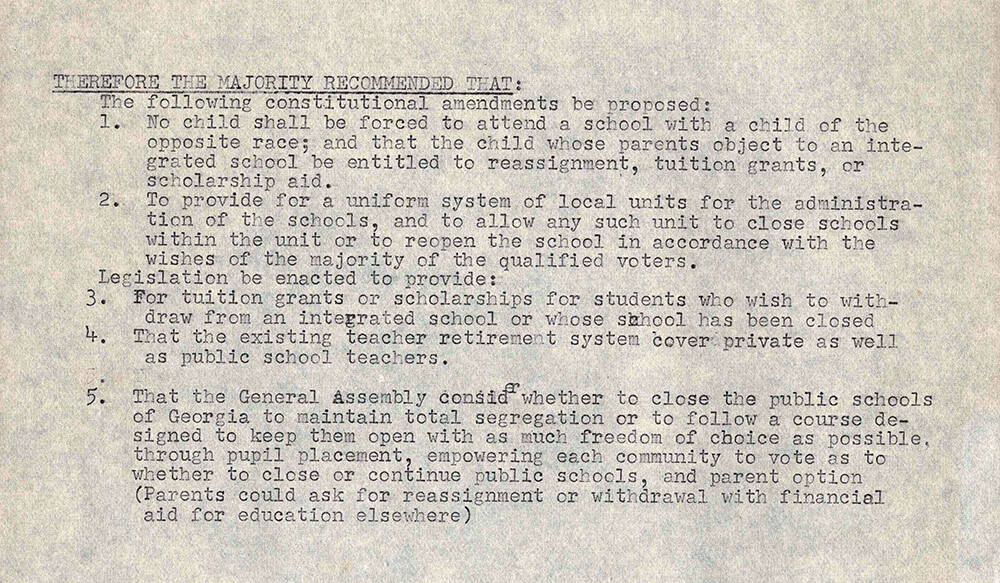
In January 1961, shortly after two thousand angry whites surrounded the dormitory of Charlayne Hunter, one of two Black students admitted to the University of Georgia in Athens,72Matthew D. Lassiter, The Silent Majority: Suburban Politics in the Sunbelt South (Princeton, NJ: Princeton University Press, 2006), 87–89. Governor Vandiver announced he would follow the Sibley report. He proposed to repeal race-specific laws of massive resistance and promised every Georgia child "his God-given right to freedom of association" through a new amendment securing "the constitutional rights of school children to attend private schools of their choice in lieu of public schools" through public financing.73O'Brien, "Private School Vouchers and the Reality of Racial Politics," 189–191, 199–201; "Gov. Ernest Vandiver Asks 4-Point Child Protection Defense Package," Atlanta Daily World, January 19, 1961; "U.S. Judge Rejects Contentions of Georgia Officials," Southern School News, February 1961, 8; Acts and Resolutions of the General Assembly of the State of Georgia, 1961, vol. 1, 35.
In August 1961, two Black students desegregated Atlanta's Grady High School without incident. Atlanta's peaceful acceptance of token integration at Grady and the city's other all-white high schools became, in the words of the New York Times, a "new and shining example of what can be accomplished" in the South. President John Kennedy said afterwards: "I strongly urge all communities which face this difficult transition to look closely at what Atlanta has done."74Kruse, White Flight, 150–156. That one day in 1961 burnished the city's growing international reputation as the "City Too Busy to Hate," while, in fact, it set in motion a process of pupil assignments that preserved virtual segregation across the entire school system.75Lassiter, The Silent Majority, 104–105.
In 1962, Georgia financed vouchers for more than fifteen hundred students in private schools. In addition, the legislature aided white teachers in leaving public for private schools by allowing them to remain in the state retirement system. None of the new laws specifically mentioned "race" or racial segregation. In the aftermath of its "shining example," the Atlanta school board routinely denied requests by scores of Black parents to transfer their children to all-white schools. Attorney Donald Hollowell assured the public "we will appeal," but courtroom challenges could not catch up with the school board's delaying tactics. By December 1963, Dr. Martin Luther King Jr. publicly condemned "something strange and appalling"—not a single Black child was attending Atlanta's all-white elementary schools and only 153 of more than 14,000 Black high school students attended classes with whites.76Bruce Galphin, "40 Negro Students File Appeals for Transfers," Atlanta Constitution, June 14, 1961; Bruce Galphin, "38 Negroes, White Girl Lose Transfer Appeals," Atlanta Constitution, July 7, 1961; Tomoko Brown-Nagin, Courage to Dissent: Atlanta and the Long History of the Civil Rights Movement (New York: Oxford University Press, 2011), 307.
With each passing year throughout the 1960s, legal strategies and tools of resistance to Brown became less important in Atlanta and other metropolitan areas as white flight to suburban counties increased—illuminating another highly effective option for preserving the "freedom of white people to choose not to go to school with negroes." Georgia's voucher program petered out after a couple of years—once it became obvious that the program would not survive review by the courts and after the discovery that many of the program's beneficiaries were already attending private schools.77Kruse, White Flight, 9–17, 161–177, 234–235; John H. Britton, "Fear of Increase in Taxes Is Blamed for Bond Measure Defeat: Negro Votes Favored Most Bond Proposals," Atlanta Daily World, August 4, 1962; "$206,640 Granted Students to Attend Jim Crow Schools," Atlanta Daily World, October 17, 1962.
The Limits of Lawsuits: Toppling Voucher Programs but Not Segregated Schools
By 1965, most voucher programs, which had been enacted only in southern states, had been declared unconstitutional or were under serious attack, no matter whether the programs involved indirect expenditures such as tax credits or were shrouded in non-racial language. Each law financing private schools was soon invalidated by a federal court (or abandoned in the case of Georgia before it could be struck down) because the efforts were perceived to evade or disrupt public school desegregation and to "significantly encourage and involve the State in private discriminations."78See these federal cases: Coffey v. State Educational Finance Commission, 296 F. Supp. 1389 (S.D. Miss. 1969); Griffin v. State Board of Education, 296 F. Supp. 1178 (E.D. Va. 1969); Poindexter v. Louisiana Financial Assistance Commission, 296 F. Supp. 686 (E.D. La. 1968); Brown v. South Carolina State Board of Education, 296 F. Supp. 199 (D.S.C. 1968), aff'd, 393 U.S. 222 (1968); Poindexter v. Louisiana Financial Assistance Commission, 275 F. Supp. 833 (E.D. La. 1968), aff'd, 389 U.S. 571 (1968); Lee v. Macon County Board of Education, 267 F. Supp. 458 (M.D. Ala. 1967); Hawkins v. North Carolina State Board of Education, 11 Race Relations Law Reporter 745 (W.D.N.C. 1966); Griffin v. State Board of Education, 239 F. Supp. 560 (E.D. Va. 1965); Lee v. Macon County Board of Education, 231 F. Supp. 743 (E.D. Ala. 1964); Pettaway v. County School Board, 230 F. Supp. 480 (E.D. Va. 1964), aff'd, 339 F. 2d 486 (2d Cir. 1964); Hall v. St. Helena Parish School Board, 231 F. Supp. 649 (E.D. La. 1961), aff'd, 368 U.S. 515 (1962); Aaron v. McKinley, 173 F. Supp. 944 (E.D. Ark. 1959), aff'd sub nom, Faubus v. Arron, 361 U.S. 197 (1959).
A vital component in states' strategies to preserve segregation, vouchers operated differently depending on state politics, federal court decisions, and the values and judgments of the strategy committees. Exchanging ideas and information, these committees functioned separately, shaped and reshaped by the dynamics of a state's political and business leadership and without a coordinated sectional effort.
In their final reports, most strategy committees adopted methods and means that evaded any exact definition of what preserving school segregation meant as an expression of racial subordination. Like Georgia Governor "No, Not One" Vandiver, states adapted to the reality that absolute or total segregation could not be preserved in the face of federal enforcement of Brown. Sooner or later, white leaders such as Tom P. Brady, the Mississippi politician credited with the idea of forming the Citizens' Council, were willing to accept virtual segregation. Others, including Alabama corporate attorney Forney Johnston, knew at the time of Brown that virtual segregation with its token exceptions could preserve white supremacy so long as conservative white leaders kept control of schools, politics, and the economy.79Tom P. Brady, "Segregation and the South," October 4, 1957, Citizens' Council Collection, Archives and Special Collections, University of Mississippi Libraries; McMillen, The Citizens' Council, 265–266; Thomas P. Brady, interview by Orley B. Caudill, March 4, 1972, Center for Oral History and Cultural Heritage, University of Southern Mississippi Libraries. In 1962, Arnold Rose, who assisted Gunnar Myrdal, wrote a postscript in the 1962 edition of An American Dilemma (New York: McGraw Hill, xxxv–xxxvii) where he discussed how the initial monolithic response to Brown by southern whites changed and adapted to fit the times.
Starting in the mid-1960s, civil rights lawyers were able to use new national anti-discrimination laws to challenge a wider range of white supremacist laws and practices. The civil rights movement moved away from the courtroom as the primary venue for creating change. Before Brown, the NAACP and other civil rights lawyers led the way by using the words of the Constitution to take down the wall of segregation, beginning in the schoolhouses, one student at a time. Privately, NAACP chief attorney Thurgood Marshall laid out the legal approach: "Those white crackers are going to get tired of having Negro lawyers beating 'em every day in court."80Harry S. Ashmore, Hearts and Minds: The Anatomy of Racism from Roosevelt to Reagan (New York: McGraw Hill, 1982), 214. Publicly, it was the hallmark of attorneys such as Donald Hollowell, known in Georgia as "Mr. Civil Rights," to remain reserved and dignified—what Hollowell later remembered with a wink as "courtly"—using only federal filings to argue with white society about segregation, even as white state officials brazenly belittled, condemned, and harassed them.81Brown-Nagin, Courage to Dissent, 336; Donald Hollowell, conversation with the author, May 1978. This strategy confronted white stereotypes and rendered Brown as the law of the land, but alone it proved too slow and inadequate to halt relentless white efforts to stop change or to keep pace with growing Black demands.
The emergence of the student movement and direct action as strategies for challenging private and public segregation was in part a reaction to the slow, back-and-forth pace of litigation. In some places, even "the twin avenues of civil rights protest—legal and direct action—did not have a catalytic effect" in advancing desegregation. By the middle of the 1960s, school desegregation was no longer the civil rights spearhead. As Dr. Martin Luther King Jr. observed about his own town: "In the absence of legal, political, economic, and moral pressure, not even a city as enlightened as Atlanta is likely to grant the Negro his constitutional rights."82Brown-Nagin, 307–309.
Most of the South's white leaders were discovering that a more fluid definition of segregation was their most effective defense. Increasingly, they realized the efficacy of moving away from "No, not one" or a stand in the schoolhouse door toward strategies that could do almost as much as absolute segregation. As early as 1956, the founder of the Citizens' Council had suggested that members should redefine their way of life as far more than complete separation of the races: "Segregation represents the freedom to choose one's associates, Americanism, state sovereignty, and the survival of the white race."83Robert B. Patterson, 2nd Annual Report (Greenwood, MS: Association of Citizens' Councils of Mississippi, August 1956), 2.
As for the public schools, it did not matter that all the tools for preserving segregation could not withstand the scrutiny of the federal courts or that the civil rights leaders were employing new strategies. A decade after Brown, the architects and advocates of private school vouchers had discovered the means to permit only a symbolic semblance of desegregation. If only by trial and error in some states, "southern anti-integration efforts during the post-Brown era were more often characterized by creativity and flexibility than by obstinacy and intransigence."84Driver, "Supremacies and the Southern Manifesto," 1093. While discussing the ideas and strategies voiced by southern federal officials, Driver illuminates the components of segregationists' plans of resistance that "play a role today in maintaining the paucity of meaningful integration in the nation's public schools." See pages 1094, 1097–1099.
By the end of the 1965 school year, Alabama, Georgia, Louisiana, Mississippi, North Carolina, South Carolina, and Virginia—the seven states that had adopted voucher programs—maintained the South's lowest rates of school desegregation. That year, fewer than 2 percent of all Black students in each of the seven states were attending public schools with white students.85Statistical Summary: School Segregation–Desegregation in the Southern and Border States (Nashville, TN: Southern Education Reporting Service, 1966–67), 43.
Milton Friedman and "Government Schools"
In 1955, almost a year after Albert Boutwell released the Alabama legislative report proposing private school vouchers as a key element in his committee's plan of "freedom of choice," libertarian economist Milton Friedman of the University of Chicago published "The Role of Government in Education."86Milton Friedman, "The Role of Government in Education," in Economics and the Public Interest, ed. Robert A. Solo (New Brunswick, NJ: Rutgers University Press, 1955), 123–144. Friedman was awarded the Nobel Prize for economics in 1976 for his work on monetary policy. It introduced academicians to an economic rationale for school vouchers. Friedman believed parents would get the best education for their children when private schools competed for enrollment. Advancing a theory he and others would repeat over decades, Friedman argued that "competitive private enterprise is likely to be far more efficient in meeting consumer demands than nationalized enterprises" in education.87Friedman, "The Role of Government in Education," 129.
Friedman's advocacy for a system of government-financed vouchers to replace "government schools," as he called them, was grounded in his free market beliefs. However, in a page-long footnote he acknowledged that essentially the same proposal "has recently been suggested in several states as a means of evading the Supreme Court ruling against segregation"—a development Friedman said came to his attention after he had largely completed his essay. The economist assured readers that he deplored segregation and racial prejudice, but he also opposed forced "non-segregation" no less than forced segregation. (Friedman also opposed a federal fair employment commission that would prohibit racial discrimination in private employment and, later, the 1964 Civil Rights Act's prohibition against racial discrimination by private businesses.88Milton Friedman, Capitalism and Freedom (Chicago: University of Chicago Press, 2002), 111–115; "Friedman Cautions Against Rights Bill," Harvard Crimson, May 5, 1964.)
Friedman acknowledged that vouchers would allow a system where there could be "exclusively white schools, exclusively colored schools, and mixed schools. Parents can choose which to send their children to." He was at best agnostic about ending segregation in schools. He noted that the government could decide to make public funds available to private schools only if they were segregated schools, as some southern states proposed in 1955, or only if they were non-segregated schools. His proposal for vouchers was "not therefore inconsistent with either forced segregation or forced nonsegregation."89Friedman, "The Role of Government in Education," 131, fn. 2.
Had he cared enough to inquire about southern segregation, Friedman would have discovered that many white supremacists had already adopted the same outlook and conceptual framework to make vouchers instrumental in maintaining segregated schools. A year earlier, in response to Brown, Mississippi politician Tom P. Brady gave a speech (later expanded into a book) that became an informal manifesto for the Citizens' Council and other southern segregationists. In Black Monday, Brady wrote:
The public school is a socialized or politically monopolized institution, and suffers from weakness inherent in all monopolies. The only thing that prevents the public school from decaying completely is the fact that it is not a complete monopoly. Local control of the school gives the taxpayer and parent some say in its management. . . . Nothing will do more to better education in America than the breaking of the public school trust. . . .
This is not a proposal to abolish public schools. It is a proposal to put them into competition with free enterprise schools, so they can prove their worth. And this can be done by the remission to parents of the taxes they are compelled to pay to support politically-controlled schools, in an amount comparable to what they pay for private schooling. The method of effecting this remission—whether by deduction from income taxes or allowances from local levies—is a technical matter; if the principle established that a parent has the right to buy the educational service he deems best for his child, the fiscal problem of tax remission could be solved.90Tom P. Brady, Black Monday (Winona, MS: Association of Citizens' Councils, 1954), 56; Brady, interview.
Similarly, the Alabama "freedom of choice" plan—the first segregation strategy report, published a year before Friedman's essay—was built on the foundational philosophy that when "members of a race are thereby deprived of access to a school attended by the other race, the result is attributable not to compulsion by the state but to the inconsistent choices of free citizens." As Alabama's Forney Johnston explained, under his segregation plan "the state is obliged to give effect to the desire of parents without compulsion against either side" or, as Milton Friedman wrote, without "either forced segregation or forced nonsegregation."
Johnston foresaw that his Alabama plan would lead to the same place Friedman envisioned—moving from a dual school system to a three-school system with "exclusively white schools, exclusively colored schools, and mixed schools." And Johnston was confident that, so long as white parents had access to vouchers for private schools and segregationist leaders established and implemented pupil placement, his plan would preserve segregation in some form for most white students in his state.91Johnston, "Schools, the Supreme Court, and the States' Power," 3–10.
Friedman's analysis not only echoed segregationist plans but helped to revive a new non-racial defense of segregation. Within four years of the publication of Friedman's essay, a large number of southern segregationists were advancing the theory of individual freedom as the leading rationale for vouchers and school choice. Perhaps the most prolific, active disciple of this libertarian approach was Virginia newspaperman Leon Dure, who converted Friedman's advocacies into a constitutional argument for freedom of association.
As tactics of massive resistance began to fail in Virginia, Dure urged state leaders in 1958 to adopt school vouchers and his principles of freedom of choice or freedom of association as the most effective means for limiting desegregation. The plan offered every child "of whatever color, of whatever means" a voucher (called a "scholarship"). Echoing Johnston and Friedman, Dure argued that "the South accepts the right of all people to associate, but it insists on the right of all people not to associate." On these terms, Dure wrote, "the southern white case is not compulsory segregation; it also is individual liberty," which he believed was protected in federal and state constitutions' guarantees of the right to assemble. Oliver Hill, the Virginia NAACP's leading attorney who had brought one of the original cases involved in Brown, told Dure that his proposal would do little more than mask racial discrimination.92James H. Hershman and the Dictionary of Virginia Biography, "Leon S. Dure (1907–1993)," Encyclopedia Virginia, last modified October 6, 2016, https://www.encyclopediavirginia.org/Dure_Leon_S_1907-1993; Leon Dure, "Virginia's New Freedom," The Georgia Review 18, no. 1 (Spring 1964): 4; Leon Dure, "The New Southern Response: Anatomy of Two New Freedoms," The Georgia Review 15, no. 4 (Winter 1961): 401–409, 412; James H. Hershman Jr., "Massive Resistance Meets Its Match: The Emergence of a Pro-Public School Majority," in The Moderates' Dilemma: Massive Resistance to School Desegregation in Virginia, eds. Matthew D. Lassiter and Andrew B. Lewis (Charlottesville: University Press of Virginia, 1998), 128. Dure seemed especially delighted that the US Supreme Court had recognized the "right of association" in a case where the Court prevented the Alabama attorney general's assault against the NAACP. See NAACP v. Alabama ex rel. Patterson, 357 U.S. 449 (1958). Dure was also influenced by the writings of Virgil Blum, a political scientist at Marquette University who advocated for school vouchers for private schools, including parochial schools, on a philosophy of free-markets and freedom of religion. See Carl, Freedom of Choice, 91–92.
When Virginia's Perrow Commission issued its report, reversing the openly defiant tone and recommendations of earlier governors and legislatures, it embraced tactics of local control and freedom of association. As one politician wrote to Dure, there was now complete "agreement that the Freedom of Choice plan is . . . not based on segregation or integration but that any child in Virginia may obtain a tuition grant"—an equal opportunity to all children to freely disassociate.93Hershman Jr., "Massive Resistance Meets Its Match," 127–130; C.F. Hicks to Leon Dure, June 22, 1961, Leon Dure Papers, University of Virginia, Charlottesville, Virginia.
Dure also helped to convince white leaders in Georgia to reverse their approach for preserving segregated schools. Dure's frequent correspondence with John Sibley and others helped Governor Vandiver's administration understand how embracing "freedom of association" held the best promise for justifying and preserving virtually segregated schools. The exact language of the new state constitutional amendment approved by the white voters of Georgia stated: "Freedom from compulsory association at all levels of public education shall be preserved inviolate." During the same period, Louisiana's white leaders also attempted to rescue their strategies to resist desegregation through a similar approach.94Hershman Jr., "Massive Resistance Meets Its Match," 127–128, including fn. 52; Carl, Freedom of Choice, 91–92. The Georgia amendment became Section VIII of Article VIII of the Georgia Constitution and remained in the constitution until removed twenty years later as a "vestige of the past," although many in the early 1980s had no notion of what the provision represented. See Committee to Revise Article VIII, "Transcripts of Meetings," 22 May 1980, State of Georgia Select Committee on Constitutional Revision, 1977–1981, vol. I, 9.
Just as Friedman adopted the term "mixed schools," the segregationists' favorite scare phrase for desegregated schools, die-hard segregationists adopted Friedman's language. In 1964, the Mississippi administrator of the Citizens' Council, William Simmons, abandoned his earlier primary defense of segregated schools as a matter of constitutional "state rights" and began condemning the monopoly of "government schools." In the Council's newsletter, echoing both Brady and Friedman, Simmons wrote that that public schools "can no longer be considered public—they have become government school systems." Afterwards, the White Citizens' Council focused primarily in Mississippi on developing a private school system of choice, as their leaders condemned government schools as "socialism in its purest form."95Michael W. Fuquay, "Civil Rights and the Private School Movement in Mississippi, 1964–1971," History of Education Quarterly 42, no. 2 (Summer 2002): 163–164, 178–179. Parroting Friedman, right wing radio and media personalities such as Neal Boortz and Sean Hannity have hammered for years at "government schools." Neal Boortz, "Government Idiocy in Action at Schools," Atlanta Journal-Constitution, December 8, 2009, https://www.ajc.com/news/opinion/neal-boortz-government-idiocy-action-schools/mQCmFIfvMZ36Nwc2t2YoDI/; "Sean Hannity Attacks Social Security and Public Schools as Ineffective Programs Exploiting People's Fears," Media Matters for America, January 3, 2019, https://www.mediamatters.org/video/2019/01/03/sean-hannity-attacks-social-security-and-public-schools-ineffective-programs-exploiting-peoples/222411.
Friedman never joined forces with segregationists, but he remained indifferent about how his libertarian economic arguments aided their strategies. Over several decades he continued to promote the concepts and framework that segregationists in the late 1950s and early 1960s believed were their best chance and best arguments. Long after southerners abandoned their segregationist rhetoric, Friedman's advocacy shaped how future scholars, advocates, and the general public would see vouchers and "freedom of choice" as acts of consumerism rather than segregationist tactics. "For whites moving into the new suburbs," writes historian James Hardman Jr., the term "carried the popular consumer phrase 'choice,' and gave the impression that simple economic choice, not morally questionable racial prejudice, was behind the segregation in their communities."96James Hardman Jr., "Virginia on the Cusp of Change," in Historians in Service of a Better South, eds. Robert J. Norrell and Andrew H. Myers (Montgomery, AL: NewSouth Books, 2017), 80. It was a redefinition of choice that most of the South's private schools, even those started as "segregation academies," came to embrace and propagate as they persisted and expanded in the decades that followed.
Challenging Tax Benefits of Segregated Private Schools
Civil rights organizations recognized during the 1960s the danger that governmental support posed in helping to build segregated systems of private schools even after the courts had dismantled voucher programs. These groups pushed the Internal Revenue Service (IRS) to deny tax-exempt applications of "segregation academies." This federal tax status enabled whites to reduce their taxable income when contributing to racially exclusionary private schools. But, in 1967, the IRS announced that it would grant tax deductions for contributions to any southern private school, even self-avowed segregation academies, because "the school is private and does not have such degree of involvement with the political subdivision as has been determined by the courts to constitute State action for constitutional purposes."97Green v. Kennedy, 309 F. Supp. 1127 (1970) at 1130.
The Lawyers Committee for Civil Rights Under Law sued the IRS in 1969 and obtained a court order requiring it to "affirmatively determine" that a private school in Mississippi is not "operated on a racially segregated basis as an alternative to white students seeking to avoid desegregated public schools." The three-judge federal court found that the "tax benefits under the Internal Revenue Code mean a substantial and significant support by the Government to the segregated private school pattern."98Green, 309 F. Supp. 1127 (1970) aff'd sub nom, Cannon v. Green, 398 U.S. 956 (1970); Eileen Shanahan, "Schools in South May Avoid Taxes," New York Times, August 3, 1967; Eileen Shanahan, "Private Schools That Bar Blacks to Lose Tax Aid," New York Times, July 11, 1970. After its ruling was affirmed without opinion by the US Supreme Court, the court issued a permanent injunction restricting the IRS from granting a tax exemption to any and all Mississippi private schools that applied for the tax benefit.99Green v. Connally, 330 F. Supp. 1150 (1971), aff'd sub nom, Coit v. Green, 404 U.S. 997 (1971).
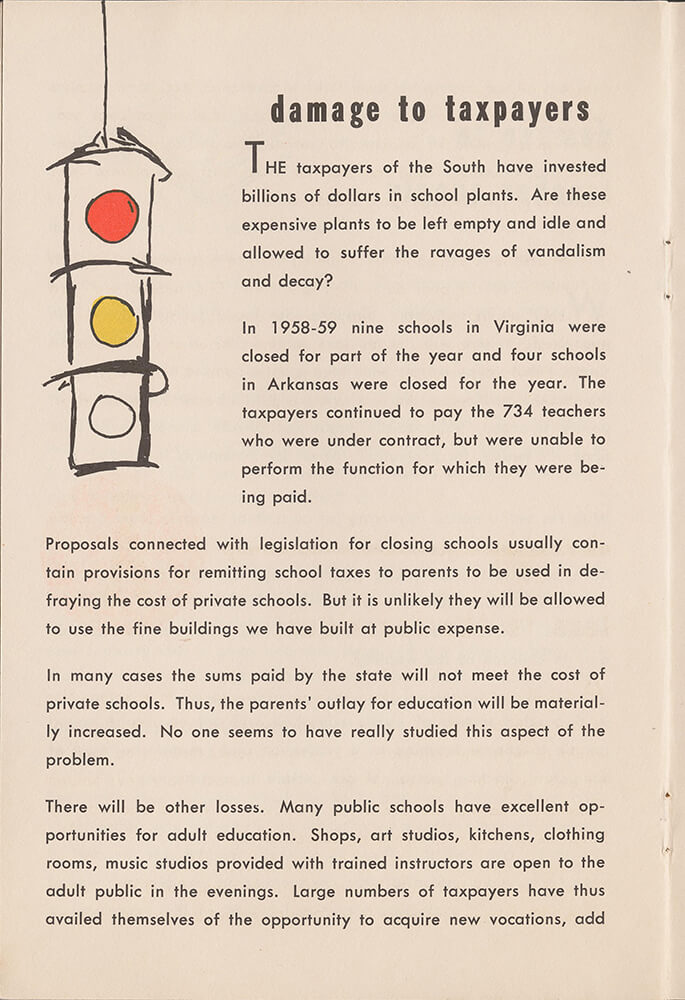
Afterwards, the IRS revoked the tax exemptions of more than one hundred private schools and scrutinized applications for tax exemption from others; however, it took eight years before the agency proposed specific administrative regulations to implement the non-discrimination policy adopted in 1970. During this time, the IRS faced a backlash from private schools and their supporters, including southern members of Congress, and, in this political environment, went back and forth with proposed administrative procedures and congressional hearings. When the Nixon administration issued final guidelines, the Lawyers Committee, the US Civil Rights Commission, and others criticized the IRS's rules, procedures, and enforcement as inadequate.100"Proposed Rules on Tax Exemptions for Private Schools Eased by IRS," New York Times, February 10, 1979; IRS Tax Exemptions and Segregated Private Schools: Hearing Before the Subcommittee on Civil and Constitutional Rights of the Committee on the Judiciary, House of Representatives, 97th Cong., 2d Sess. 39 (1982); also see Tax-Exempt Status of Private Schools: Hearing Before the Subcommittee on Oversight of the Committee on Ways and Means, House of Representatives, 99th Cong., 2d Sess. 39 (1985).
Despite the regulation's shortcomings, a significant number of religious private schools in the South objected to the new IRS rules on the grounds of religious freedom, claiming that the government could not oversee their operations under any circumstances, even if they engaged in practices of segregation and racial discrimination. In 1983, the US Supreme Court disagreed and upheld the application of the IRS rules on religious schools in a case involving Bob Jones University in South Carolina. Chief Justice Warren Burger wrote that "the Government has a fundamental, overriding interest in eradicating racial discrimination in education—discrimination that prevailed, with official approval, for the first 165 years of this Nation's constitutional history. That governmental interest substantially outweighs whatever burden denial of tax benefits places on petitioners' exercise of their religious beliefs."101Julia Malone, "Those Tax Breaks for Segregated Schools Stir Storm," Christian Science Monitor, January 14, 1982; Bob Jones University v. United States, 461 U.S. 574 (1983); Strat Douthat, "Some All-White Academies Struggle," Richmond Times-Dispatch, March 18, 1986.
After Bob Jones, the IRS required tax-exempt private schools to demonstrate non-discriminatory policies and operations. But the requirements proved minimal—involving little more than adoption of a policy statement by the school's founders or board, publication of the policy (in brochures and catalogues), and some way of demonstrating that the school had abandoned total, absolute segregation.102Terry Berkovsky, Andrew Megosh, Debra Cowen, and David Daume, "Private School Update," 2000 EO CPE Text, Internal Revenue Service, 2000, www.irs.gov/pub/irs-tege/eotopicn00.pdf. The IRS rules suggest that a school must evidence that "it currently enrolls a meaningful number of racial minority students, or that its promotional activities and recruiting efforts are reasonably designed to inform students of all racial segments in the general communities within the area of the availability of the school." But, as a matter of practice, citing language in the Bob Jones case that denial of tax exemptions should be made "only where there is no doubt that the organization's activities violate fundamental public policy," the IRS and the US Tax Court has denied tax status only when a school maintains total segregation. See Calhoun Academy v. Commissioner, 94 T.C. 284 (1990).
Private schools in the South began to publish non-discrimination statements and many began a slow process of admitting a token number of Black or other students of color. It was a replay of the most effective tactics that segregationists had deployed in the public schools several years earlier. This change did little more than end all-white segregation in order to sustain virtual segregation. The practices satisfied the IRS requirement and allowed subsequent federal administrations to claim that private schools had shown "clear and specific factual evidence" of non-discrimination.
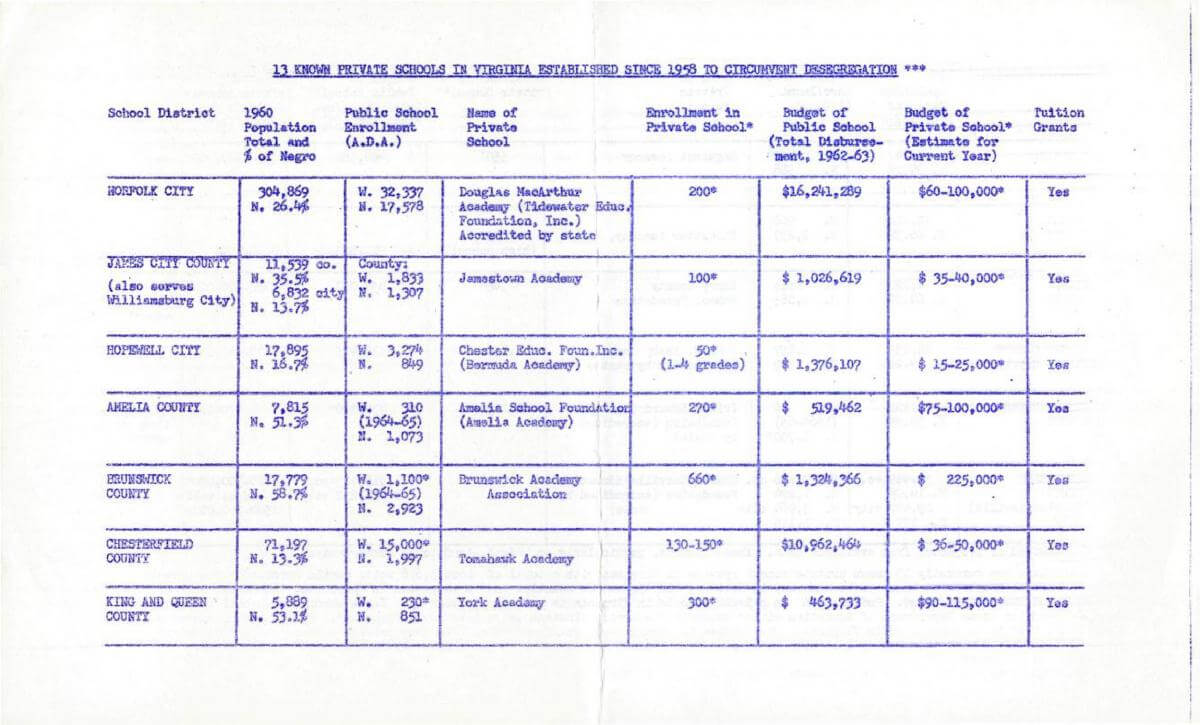
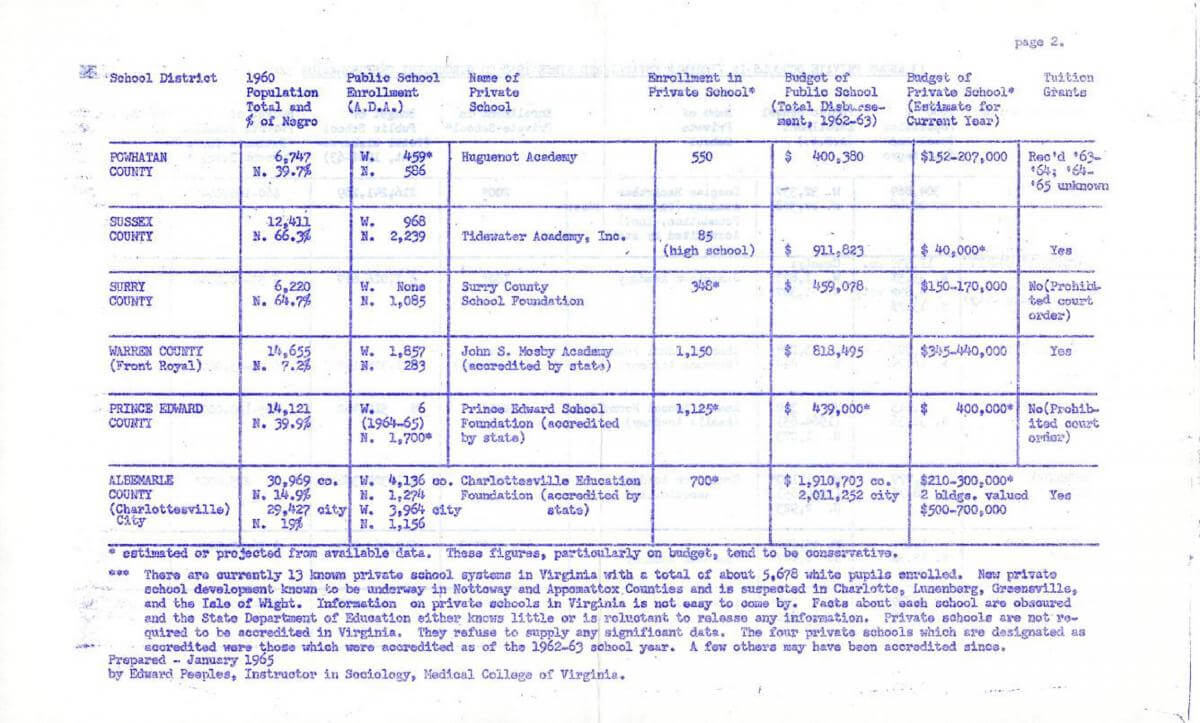
The private school movement grew rapidly. After the 1969 Supreme Court ruling that "every school district is to terminate dual school systems at once" in Mississippi,103"Private Schools on Rise in the South," New York Amsterdam News, November 8, 1969; Kitty Terjen, "The Segregation Academy Movement," in The South and Her Children: School Desegregation, 1970–1971, ed. Robert E. Anderson Jr. (Atlanta, GA: Southern Regional Council, 1971), 69–71; "Civil Rights: Segregation: Federal Income Tax Exemptions and Deductions: The Validity of Tax Benefits to Private Segregated Schools," Michigan Law Review 68, no. 7 (June 1970): 1410–1414; Alexander v. Holmes County Board of Education, 396 U.S. 19 (1969). white parents responded. From 1965 to 1980, private school enrollment increased by more than 200,000 students across the South—with about two-thirds of that growth occurring in the states that had created voucher programs.104Steve Suitts, Race and Ethnicity in a New Era of Public Funding of Private Schools: Private School Enrollment in the South and the Nation (Atlanta, GA: Southern Education Foundation, 2015), 7–8.
There were no government surveys reporting race or ethnicity for private school enrollment at the start of the 1980s, but the Southern Regional Council, which monitored the movement after Brown, estimated that virtually segregated private schools in the eleven states of the former Confederacy enrolled between 675,000 and 750,000 white students. When computed with overall enrollment data for those states, these estimates suggest that somewhere between 65 and 75 percent of the private school's white students were virtually segregated by the early 1980s.105Hearings on IRS Tax Exemptions and Segregated Private Schools, Before the Subcommittee on Civil and Constitutional Rights of the Committee of the Judiciary, 97th Cong. (1982), 69; Digest of Education Statistics, 1981 (Washington, DC: National Center for Education Statistics, 1981).
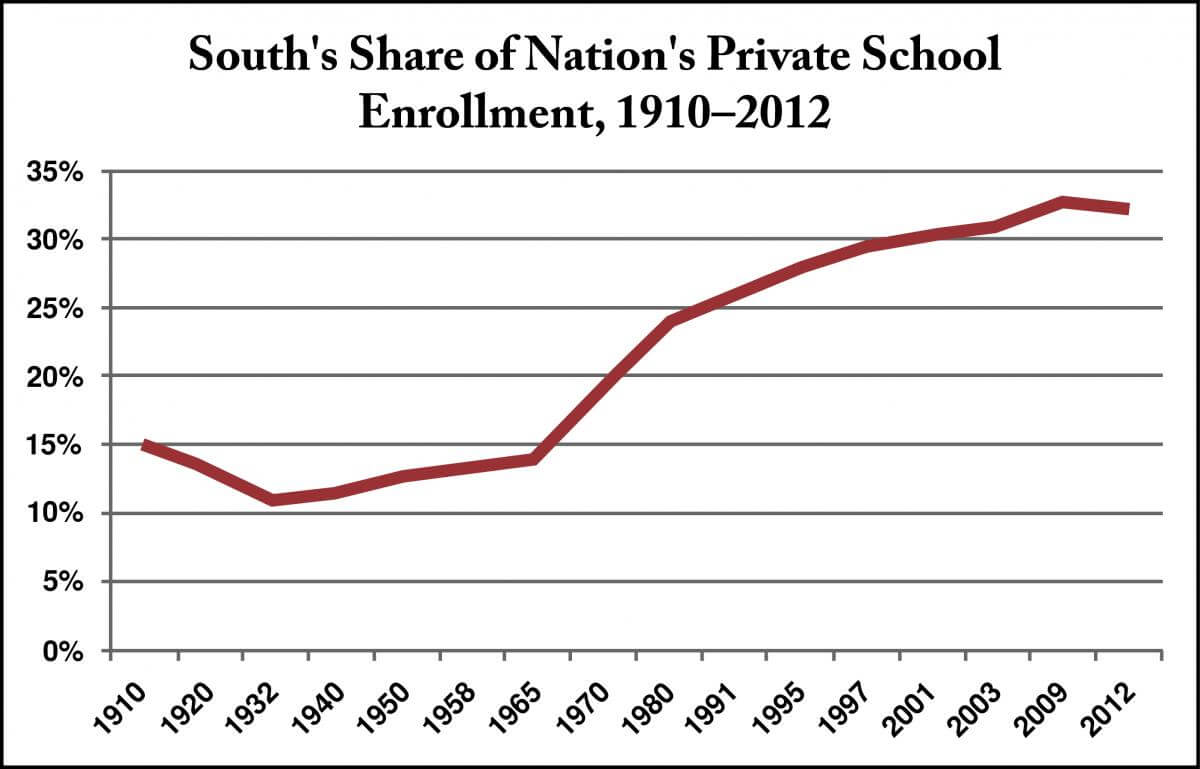
Overall, the southern states' white flight from public schools in the wake of desegregation from 1940 through 1980 helped to quadruple the number of students attending segregated private schools. As Jason Morgan Ward aptly observed, "[T]he end of the Jim Crow era rendered segregation, like white supremacy before it, a doomed battle cry. But it was not a dead proposition."106Jason Morgan Ward, Defending White Democracy: The Making of a Segregationist Movement and the Remaking of Racial Politics, 1936–1965 (Chapel Hill: University of North Carolina Press, 2011), 183.
The "Post-Racialist" Standards Movement
Most of the South's private schools that started during massive resistance survived without vouchers—but with federal tax exemptions. Many increased their enrollments and resources as they embraced the old-line segregationists' non-racial language and reasoning. This transformation of stated purpose from preserving segregation to meeting children's needs for a quality education through choice involved an initial phase when headmasters and other promoters of private schools struggled to abandon their original meaning and adopt a new, non-racial script about motives and purposes.
Dr. T. E. Wannamaker, for example, founder of the South Carolina Independent School Association, explained in 1966 the reasons for his organization and schools: "We're here because we have convictions and we're going to stay. It's not token integration we're concerned about, but the effects mass integration will have on our schools in the future." Earlier, Wannamaker had described himself as "an old-time conservative. I believe it's heredity first and environment second. Many (Negroes) are little more than field hands." In 1970, he became the first leader of the Southern Independent School Association.107Terjen, "The Segregation Academy Movement," 76; Margaret Rose Gladney, "I'll Take My Stand: The Southern Segregation Academy Movement" (PhD diss., University of New Mexico, 1974), 80. An Alabama private school advocate told a journalist in 1969, "We really didn't do it on account of segregation. We done it for a better education."108Kitty Griffith, "New 'Segregation Academies' Flourish in the South," South Today, October 1969, 1.
By the 1970s, as many public schools in the South were being desegregated for the first time, promoters of private schools were developing a more consistent line of reasoning: the schools may have begun over the "racial question," but were now operating to provide "quality education." "I've been fighting to take the race question out of the Independent Schools," a member of the Louisiana Private School Association said in 1973. "I've run a segregated school for 33 years. . . . I want nice people in my school. We're trying to sell quality education."109Gladney, "I'll Take My Stand," 80.
The headmaster of Prince Edward Academy (which five years earlier had been denied the continued benefit of vouchers and tax credits due to racial discrimination) told a researcher: "This school came into being because we love our children and want the best education in a controlled environment." A leader of Louisiana's private schools expanded this new language of transition: "I think people would be able to accept integration if it did not mean lowering of academic and moral standards. But they know it means it; therefore, they resort to private schools." And the head of the Alabama Independent School Association told researcher Rose Gladney in 1972: "Our primary interest is educating people basically of like learning capacities. We adopt a school system to meet their needs. . . . The real historical importance of the movement is not one of segregation or integration. It's academically important."
It was left to a student in one of the private schools that Gladney visited to be explicit about the white supremacist message he heard from administrators, promoters, and perhaps family: "Niggers are dumb; can't learn. And when you have a majority of low standard in a school, they will pull all the rest down. It is not really a race issue, just a matter of lowering standards."110Gladney, 99–126.
Many private schools operated by churches also began to justify their existence through the imperative of religious education. "Religion is an integral part of the Independent School movement," said the director of the Louisiana Independent School Association. "We're developing a pseudo-parochial system where there's a fixed religion we feel we want."111Gladney, 134–136. These often became Christian schools that turned "in every particular around Bible teachings and interpretations."112David Nevin and Robert E. Bills, The Schools that Fear Built: Segregationist Academies in the South (Washington, DC: Acropolis Books, 1976), 61.
Whatever the non-racial rationale—economic freedom, better education, religious instruction—the vast majority of the South's private schools were established when it became clear locally that federal law would require some form of desegregation. By the start of the 1980s, the character of most of these private schools was set. "These are schools for whites," wrote the authors of The Schools that Fear Built in 1976. "The common thread that runs through them all, Christian, secular, or otherwise, is that they provide white ground to which Blacks are admitted only on the school's terms if at all."113Nevin and Bills, 11.
For God and Private Schools
Following the 1980 election of Ronald Reagan, private schools throughout the nation received federal support and endorsement as never before. The Reagan administration justified proposed federal assistance to private schools as a means for advancing high quality education along with diversity and pluralism. The administration waffled on whether to support Bob Jones University's claim that religion gave it the right to discriminate on the basis of race even while receiving tax exemption. "I was under the impression," Reagan said, "that the problem of segregated schools had been settled, that we have desegregation."114Catherine A. Lugg, "For God and Country: Conservative Ideology and Federal School Policy during the First Term of President Ronald Reagan" (PhD diss., Pennsylvania State University, 1995), 105–111, 121.
In 1981, Reagan's secretary of education testified in support of tax credit vouchers for private schools as "an expansion of educational opportunities for all Americans." In 1983, Reagan became the first president to send Congress legislation for federal tax credits to finance private schools. The proposed "Educational Opportunity and Equity Act," the administration argued, would benefit a wide range of students, including low-income children of color, and more broadly would "promote diversity in education and the freedom of individuals to take advantage of it, and to nurture the pluralism in American society which this diversity fosters." School segregation was a thing of the past, said Reagan, and private schools were the engines of diversity.115Lugg, "For God and Country," 132; Julia Malone, "Drive Begins for Tuition Tax Credit: Reagan Education Secretary Argues for Private School Help," Christian Science Monitor, June 8, 1981; Julia Malone, "Bid to Allow Tax Credits for Private-School Tuition Awaits Next Session of Congress," Christian Science Monitor, November 16, 1983; David E. Rosenbaum, "Tuition Credit Seen in Reagan Plan," New York Times, May 27, 1985.
Reagan linked his tax credit bill with an imperative to return religion to schools. "I don't think God should ever have been expelled from the classroom," he declared at a news conference in which he defended his support of private schools, including religious schools. The president's remarks echoed a long line of southern segregationists who had justified the growth of private schools on religious grounds, especially after 1961 when the US Supreme Court outlawed a New York statute that required public school students to recite an official Christian prayer.116Lugg, 126–127; Engel v. Vitale, 370 U.S. 421 (1962).
White churches started private academies in the wake of court-ordered desegregation, with religion and segregation often intermingling in the schools' stated purpose. In Prince Edward County, Virginia, many white clergy supported closing the public schools, their churches provided white-only space, and their curricula were built around church teachings. "Our people—supporters of the Independent schools—are convinced God is behind us," asserted the head of the Louisiana segregated private schools in the early 1970s. "If you don't include that aspect, you're missing a good part of the motivation behind this movement. People believe wholeheartedly that God doesn't want us to mix."117Gladney, "I'll Take My Stand," 134.
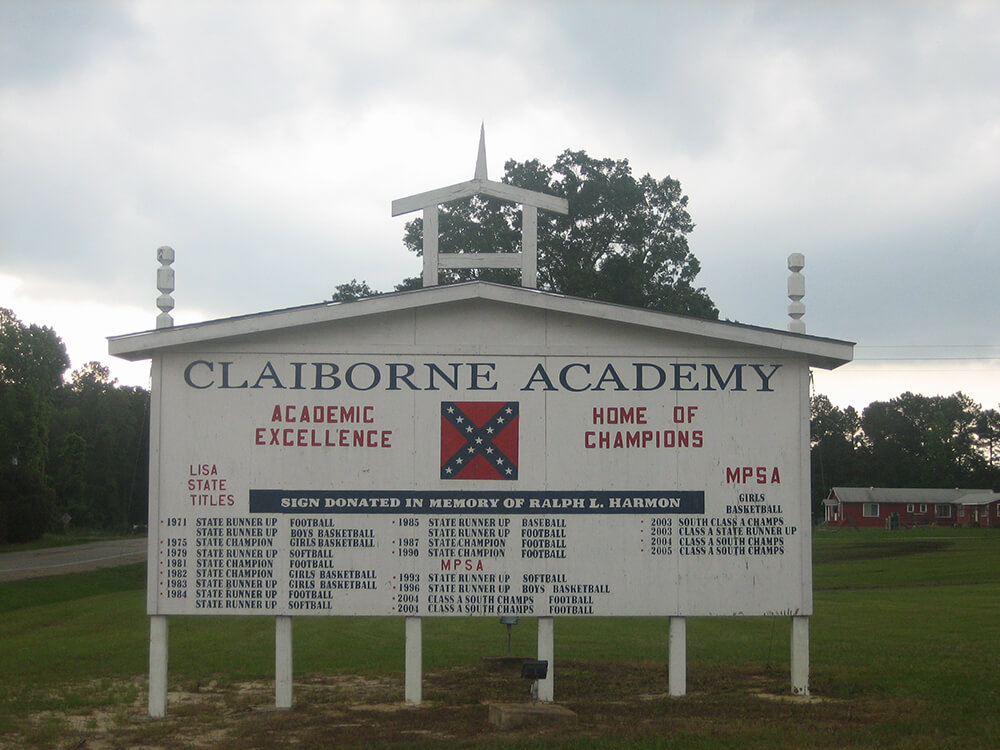
Looking across the South in 1974, Rose Gladney, a young scholar whose family had been actively involved in setting up a segregation academy in Homer, Louisiana, saw how most adults involved in private schools had merged racial segregation, quality education, and religion into one rationale. "The teachings of the academies," Gladney sadly observed, "hope to ensure that there will be people who think there is a need because they will have been taught, for at least another generation, that love of God, love of their white skins, and love of quality education cannot be separated."118Goodman, Sanctuaries for Tradition, 9–12; Gladney, 137.
President Reagan transformed a "love of white skin" into a color-blind doctrinal belief that individual freedom of choice in schooling created diversity and opportunity for all in an era without segregation. Reagan became the nation's primary voice for why and how government should support private schools, and, as a former actor and California governor, his own past and national leadership obscured the original role and rationales of southern white supremacists from public memory.
In 1984, in re-nominating Reagan, the Republican Party's education platform included support for the right to pray in public schools, opposition to busing for desegregation, passage of tuition tax credits for private schools, and redirecting billions of federal funds dedicated to assist low-income students in public schools into vouchers for private schools. It was the first time a national political party endorsed school vouchers. In his State of the Union address fourteen months later, President Reagan declared: "We must continue the advance by supporting discipline in our schools, vouchers that give parents freedom of choice; and we must give back to our children their lost right to acknowledge God in their classrooms."119Lugg, "For God and Country," 212–213; "Republican Party Platform of 1984," The American Presidency Project, accessed March 8, 2019, https://www.presidency.ucsb.edu/documents/republican-party-platform-1984; Ronald Reagan, the annual State of the Union address (speech, Washington, DC, February 4, 1986), The American Presidency Project, www.presidency.ucsb.edu/documents/address-before-joint-session-congress-the-state-the-union. The first time a national political party's platform endorsed tax credits for private schools was in 1972 at the Republican National Convention. It was the first time a US president expressly advocated for school vouchers before a joint session of Congress. Without attribution, the views and tools of southern segregationists had become the official position of the national Republican Party and the Reagan presidency.
No to "Racial-Mixing," Yes to Vouchers
At the end of the Reagan administration, almost thirty-five years after Brown, enrollment in the South's private schools continued to grow in absence of any significant new government financial support.120The next federal legislation providing new tax benefits to private schools was the Coverdell Education Account created in 1997 during the Clinton administration. It permits annual contributions up to $500 to earn tax-free funds to cover expenses in college or in elementary and secondary private schools. The accounts have restrictions on income and uses for K-12 private school tuition. Ironically, First Lady Hillary Clinton's first job out of law school involved investigating discriminatory practices of southern private schools. See Amy Chozick, "How Hillary Clinton Went Undercover to Examine Race in Education," New York Times, December 27, 2015, www.nytimes.com/2015/12/28/us/politics/how-hillary-clinton-went-undercover-to-examine-race-in-education.html. Some schools created in defiance of desegregation struggled and failed, but most survived by embracing other stated purposes for their existence and by maintaining their tax-exempt status—a benefit that required most to enroll just enough children of color to avoid total segregation while preserving a culture of "schools for whites."121See, for example, John Egerton, "Hammond Academy: A Rebel Yell, Fading," in Shades of Gray: Dispatches from the Modern South (Baton Rouge: Louisiana State University Press, 1991), 237–248.
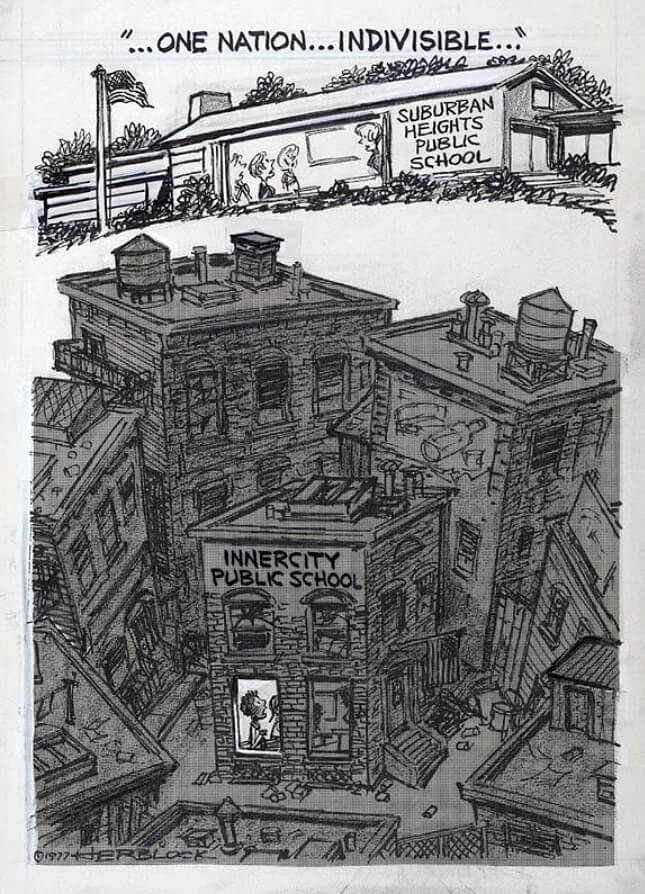
Since the 1960s, white flight from urban public systems such as Atlanta's had maintained and extended segregated patterns in private tax-exempt schools and in suburban public schools. On both sides of the Mason–Dixon line, many white middle-class parents had escaped the mandates of school desegregation by moving into suburban neighborhoods where residential patterns of racial isolation and economics provided virtually segregated public schools. This suburban constituency helped to sustain Nixon and Reagan policies in blocking inter-district desegregation plans.122See Lassiter, The Silent Majority, 295–324.
Earlier segregationists had foreseen the importance of district lines. In 1955, Forney Johnston, one of the architects of the Alabama three-school "freedom of choice" plan, identified "ordinary and customary geographical districting" as a primary tool for defeating Brown. His strategies cast a very long shadow. Examining school data from 1988 to 1990, a national study concluded "that white families are fleeing public schools with large concentrations of poor minority schoolchildren. In addition, the clearest flight appears to be away from poor black schoolchildren."123Robert W. Fairlie and Alexandra M. Resch, "Is There 'White Flight' into Private Schools? Evidence from the National Educational Longitudinal Survey," Review of Economics and Statistics 84 (2002): 21–33.
The patterns persisted. Based on data from 1998, scholars Sean Reardon and Jon Yun found that the "South ha[d] the greatest segregation between the public and private sector of any region—white and Asian private school enrollment rates are more than three times greater than Black rates in the South, and more than double Latino rates."124Sean F. Reardon and John T. Yun, Private School Racial Enrollments and Segregation (Cambridge, MA: The Civil Rights Project, Harvard University, 2002), 22, https://civilrightsproject.ucla.edu/research/k-12-education/integration-and-diversity/private-school-racial-enrollments-and-segregation/Private_Schools.pdf. They also concluded that "the strongest predictor of white private enrollment is the proportion of Black students in the area."125Reardon and Yun, Private School Racial Enrollments and Segregation, 22.
Drawing upon the 2000 Census, Duke University scholar Charles Clotfelter found that private schools were continuing to foster racial separation and isolation in K–12 education in the South, especially in non-metropolitan areas: "Combined with the general stability or growth of private enrollments in the South since 1970, these findings suggest that private schools were playing much the same role in non-metropolitan counties of the South in 1999–2000 as they were shortly after desegregation."126Charles T. Clotfelter, "Private Schools, Segregation, and the Southern States," Peabody Journal of Education 79, no. 2 (2004): 74–97.
During this time, Milwaukee and Cleveland became limited, urban experiments in voucher programs in northern states, as some white liberals suggested that vouchers might offer a way to break up what they came to believe were intractable problems faced by low-income public schoolchildren. It was also the era when state governments began establishing programs to finance attendance in private schools, especially through tax credit vouchers. This new initiative reached into every part of the nation, but mostly the South, including all of the states where segregationists had established vouchers.127Harry Brighthouse, "Egalitarian Liberals and School Choice," Politics & Society 24, no. 4 (1996): 457–486; James S. Coleman, "Some Points on Choice in Education," Sociology of Education 65, no. 4 (1992): 260–262. For a clear, deep understanding of this recent emergence of tax credits to finance enrollment at private schools, see Kevin G. Welner, NeoVouchers: The Emergence of Tuition Tax Credits for Private Schooling (Lanham, MD: Rowman & Littlefield, 2008).
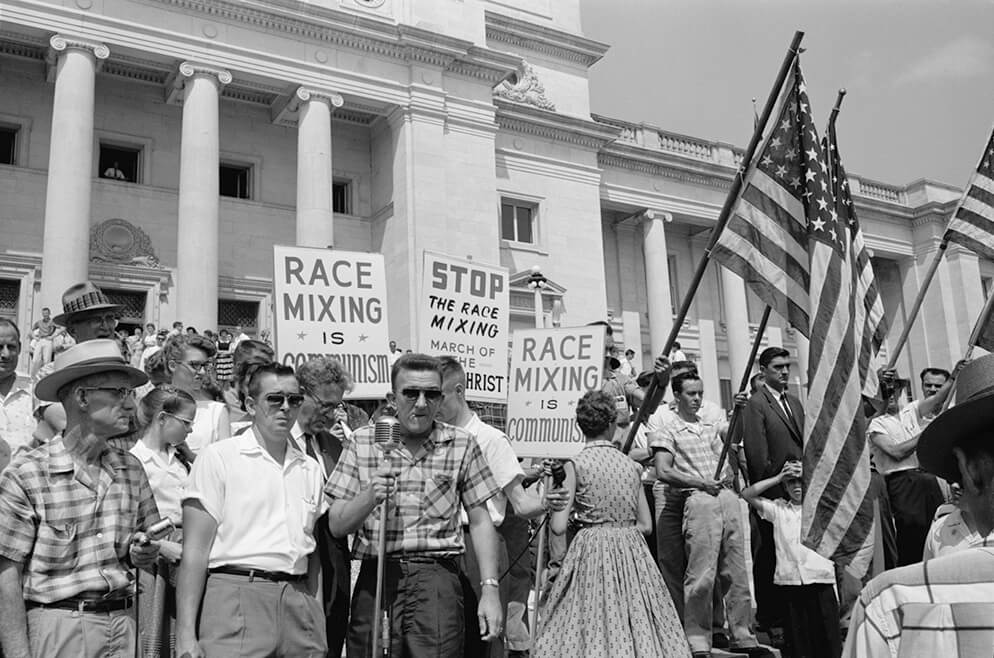
The US Supreme Court began to bless these developments. As early as 1973, Justice William Rehnquist became the first member of the Court to issue a dissent from a school desegregation case relying on the precedent of Brown. In a case concerning school segregation in Denver, he condemned the Court's opinion for requiring a school district to advance desegregation—employing the old scare word, "racial mixing"—where there were "neutrally drawn boundary lines" that sustained segregation.128Keyes v. School Dist. No. 1, Denver, 413 US 189 (1973), 258; Justin Driver, The Schoolhouse Gate: Public Education, the Supreme Court, and the Battle for the American Mind (New York: Pantheon, 2018), 278–283. As Driver notes, Justice Rehnquist as a Supreme Court law clerk had argued while Brown was being considered that the Court should not overrule Plessy v. Ferguson, 163 U.S. 537 (1896), which had sanctioned state-sponsored segregation. Barely a year after the Bob Jones decision held that religious private schools could not hold a tax exemption and discriminate on the basis of race, the Supreme Court slammed shut the courthouse door on those seeking to challenge the IRS's weak enforcement. Parents of twenty-five Black public school children sued the IRS, charging that its standards and procedures were inadequate to fulfill its obligation to deny tax-exempt status to racially discriminatory private schools. In 1984, the US Supreme Court held that the parents had no standing to bring such a suit.129Allen v. Wright, 468 US 737 (1984).
With the appointment of other justices across more than three decades, the Court increasingly refused to require school districts to use any method of desegregation that proved effective in dismantling the dynamics of separation. By 2007, the Court had turned Brown on its head as a precedent for backing public school districts' voluntary efforts to desegregate. Chief Justice John Roberts wrote that Brown commanded school districts to avoid using race as a consideration, even for the purpose of recognizing and diminishing public school segregation. "When it comes to using race to assign children to schools," Roberts wrote without doubt or irony, "history will be heard."130Parents Involved in Community Schools v. Seattle School Dist. No. 1, 551 US 701 (2007), 2744; Driver, The Schoolhouse Gate, 293–308.
As the Court stymied effective strategies for desegregating public schools, Justice Anthony Kennedy led it in unleashing private schools from constitutional restraints for receiving taxpayer funds. Arizona's program of tax credit vouchers allowed individuals and corporations to give tax dollars to private schools instead of paying them to the state—a scheme similar to those the Court had outlawed in prior cases, including in Prince Edward County, Virginia, in the 1960s. Kennedy, in a majority opinion, held that tax credit vouchers did not involve public funds or any state action that the Bill of Rights would prohibit. "While the State, at the outset, affords the opportunity to create and contribute," Kennedy wrote, "the tax credit system is implemented by private action and with no state intervention."131Arizona Christian School Tuition Organization v. Winn, 131 U.S. 1436 (2011) at 1448. Justice Kennedy's opinion considered whether the First Amendment's clause requiring separation of church and state, by way of application to the states through the 14th Amendment, prohibited providing state tax credit vouchers to religious schools.
With few federal restraints, legislatures have expanded these programs or established new forms of vouchers, such as educational savings accounts that deposit state and local per-pupil expenditures into a personal account for a child's parents to use toward private schooling or to supplement home-schooling.
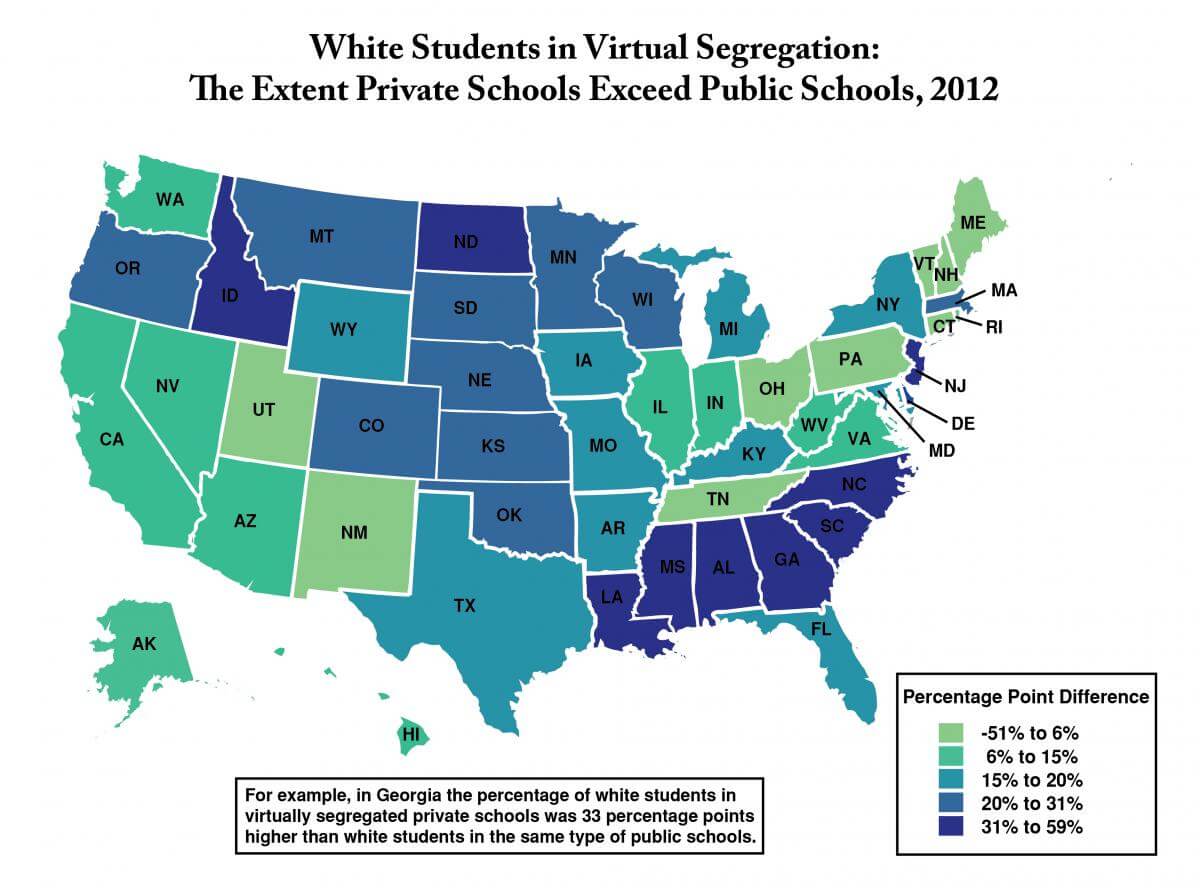
Patterns of virtual segregation have stayed remarkably high in private schools. As recently as 2012, 43 percent of the nation's private school students attended virtually all-white schools—schools where white students comprise 90 percent or more of the enrollment. That year, half of the fifty states had a majority of private school students attending virtually segregated schools.132Suitts, Race and Ethnicity in a New Era of Public Funding of Private Schools, 36–39.
Despite white flight, virtual segregation for white students was far more substantial in private schools than in public schools, especially in the South. In 2012, 63 percent of white students in South Carolina's private schools were virtually segregated compared with only 5 percent of white students in South Carolina's public schools. Private schools were almost twelve times more likely to enroll white students in virtually segregated schools in 2012 than were the state's public schools.
In Mississippi, white students attending private schools were almost four times more likely to be in virtually segregated schools than public school students. More than seven out of ten white students in Mississippi's private schools attended schools where 90 percent or more of the enrollment was white. In the state's public schools, the rate was 15 percent. In Louisiana, 52 percent of the white students in private schools were virtually segregated in 2012, but only 14 percent for white public school students.
This new era of vouchers emerged as public schools across the nation experienced a substantial increase in the numbers of low-income students and students of color. Completing a trend that began in the 1980s, low-income students (those eligible for free or reduced lunch) became a majority of the South's public schoolchildren in 2006; in 2009, the South's public schools also had a majority of students of color. By 2013, more than 50 percent of the nation's public schoolchildren were from low-income families and almost half were children of color.133Steve Suitts, A New Majority: Low Income Students in the South's Public Schools (Atlanta, GA: Southern Education Foundation, 2007), https://www.southerneducation.org/wp-content/uploads/2019/02/A-New-Majority-Report-Final.pdf; Steve Suitts, A New Diverse Majority: Students of Color in the South's Public Schools (Atlanta, GA: Southern Education Foundation, 2010), https://www.southerneducation.org/wp-content/uploads/2019/02/A-New-Diverse-Majority-2010.pdf; Steve Suitts, A New Majority: Low Income Students Now a Majority in the Nation's Public Schools (Atlanta, GA: Southern Education Foundation, 2015), https://www.southerneducation.org/wp-content/uploads/2019/02/New-Majority-Update-Bulletin.pdf; Shaila Dewan, "Southern Schools Mark Two Majorities," New York Times, January 6, 2010, https://www.nytimes.com/2010/01/07/us/07south.html; Lyndsey Layton, "Majority of US Public School Students Are in Poverty," Washington Post, January 16, 2015, https://www.washingtonpost.com/local/education/majority-of-us-public-school-students-are-in-poverty/2015/01/15/df7171d0-9ce9-11e4-a7ee-526210d665b4_story.html.
Changing patterns, most evident in the nation's cities, spread to the suburbs. In 2011, 40 percent of public schoolchildren in the nation's suburban districts were low-income; the rates were 45 percent or higher in suburbs in the West and the South. During the 2000s, the number of suburban poor exceeded the number in the nation's cities for the first time. Similarly, with a huge increase in Hispanic children, suburban school districts began educating a student population in which students of color comprised more than 40 percent. At the same time, African Americans moved into suburban counties surrounding central cities (such as Atlanta) in record numbers.134Suitts, A New Majority: Low Income Students in the South and Nation (Atlanta, GA: Southern Education Foundation, 2013), 5–6, 15, https://www.southerneducation.org/wp-content/uploads/2019/02/New-Majority-2013.pdf; Elizabeth Kneebone, "The Changing Geography of US Poverty," The Brookings Institution, February 15, 2017, https://www.brookings.edu/testimonies/the-changing-geography-of-us-poverty/; Richard Fry, "Sharp Growth in Suburban Minority Enrollment Yields Modest Gains in School Diversity" (Washington, DC: Pew Research Center, March 31, 2009), http://www.pewhispanic.org/2009/03/31/sharp-growth-in-suburban-minority-enrollmentbryields-modest-gains-in-school-diversity/; Karen Pooley, "Segregation's New Geography: The Atlanta Metro Region, Race, and the Declining Prospects for Upward Mobility," Southern Spaces, April 15, 2015, https://southernspaces.ecdsdev.org/2015/segregations-new-geography-atlanta-metro-region-race-and-declining-prospects-upward-mobility.
This new diversity in suburban school-age populations did not result in major increases in integrated schools. Instead, old habits resurfaced that involved shifting residential segregation, white flight into exurbs, localities attempting to secede from majority-Black public school districts, and the states' rebirth of vouchers for private schools. Legislatures failed to increase public school funding to meet the huge challenges of educating a majority of schoolchildren who are low-income and non-white, especially in the South and West where most voucher programs have emerged.135Don Boyd and Lucy Dadayan, "State and Local Governments Reshape Their Finances," The Book of the States 2016 (Lexington, KY: The Council of State Governments, 2016), http://knowledgecenter.csg.org/kc/system/files/Boyd%20Dadayan%202016.pdf; Nikole Hannah-Jones, "The Resegregation of Jefferson County," New York Times, September 6, 2017, https://www.nytimes.com/2017/09/06/magazine/the-resegregation-of-jefferson-county.html; Suitts, A New Majority: Low Income Students in the South and Nation, 8–13.
New Token Students of Choice
Overall trends have obscured a small, inclusive change in the color line for admission to private schools amid a more pronounced, underlying pattern of racial exclusion. Frequently, white private schools have chosen Asian or Pacific Island children to break their completely segregated enrollment in order to reach a token level of diversity for an IRS tax exemption. These students have family ancestries from countries including China, Vietnam, Korea, Japan, India, the Philippines, and various islands of the Pacific. In 2012, Asian American students comprised 5.8 percent of the nation's private school enrollment—a number slightly above the percentage of the Asian school-age population. Only white students and students with Asian ancestries were in private schools in numbers that exceeded or generally matched their representation in the school-age population. In forty-two states, the percentage of Asian students in private schools exceeded the state's percentage of school-age Asian children.136Suitts, Race and Ethnicity in a New Era of Public Funding of Private Schools, 17, 27–29. Reardon and Yun also found that Asian students were over-represented in private schools in 1998. One other group of school-age children nationally matched their representation in private schools in 2012: students who self-identified as "of two or more races."
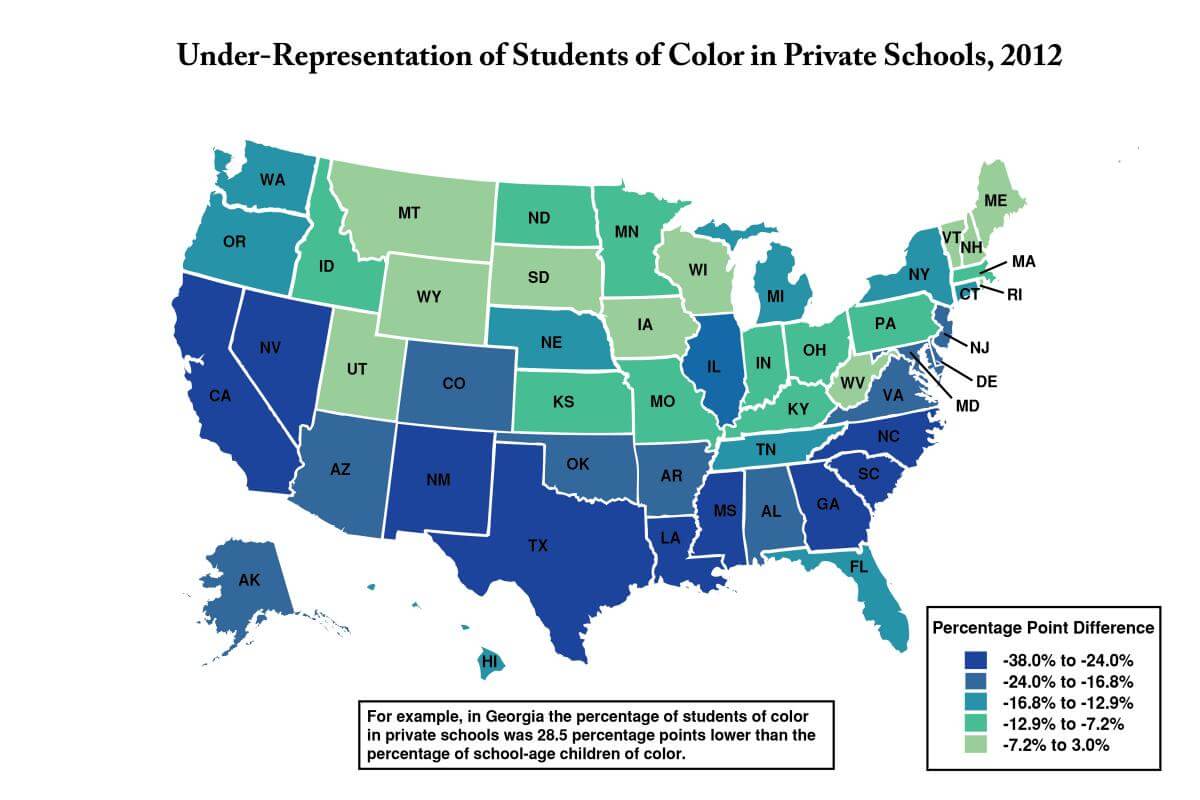
This development stands in sharp contrast to the history of discrimination that Asians have experienced, especially in California and the South, and makes Asian students stand out among students of color attending private schools. The explanation for this shift seems grounded in at least three factors: since the late 1980s, Asian households have had the nation's highest median income (more than $11,500 above non-Hispanic white household income in 2012); since at least the 1990s, Asian students have had the nation's highest scores on standardized tests; and more than three generations after World War II, some whites may find the lighter skin color of Asian Americans more acceptable according to racist hierarchies.137See Joyce Kuo, "Excluded, Segregated and Forgotten: A Historical View of the Discrimination of Chinese Americans in Public Schools," Asian American Law Journal 5 (1998): 181–212, https://scholarship.law.berkeley.edu/cgi/viewcontent.cgi?article=1044&context=aalj; Carmen DeNavas-Walt, Bernadette D. Proctor, and Jessica C. Smith, Income, Poverty, and Health Insurance Coverage in the United States: 2012, Current Population Reports (Washington, DC: US Census Bureau, 2013), 5, https://www.census.gov/prod/2013pubs/p60-245.pdf; Lauren Musu-Gillette, Cristobal de Brey, Joel McFarland, William Hussar, William Sonnenberg, and Sidney Wilkinson-Flicker, Status and Trends in the Education of Racial and Ethnic Groups 2017 (Washington, DC: US Department of Education, National Center for Education Statistics, 2017), 46–52, https://nces.ed.gov/pubs2017/2017051.pdf; Herbert J. Gans, "'Whitening' and the Changing American Racial Hierarchy," Du Bois Review: Social Science Research on Race 9, no. 2 (2012): 267–279.
Asian children usually comprise a small minority of a private school's enrollment. Their presence often serves to increase a school's performance on college entrance exams—enabling schools to promote evidence of quality education while avoiding an all-white enrollment that could jeopardize their tax exemption. Asian Americans' admission, however, does not change the reality of most private schools as "schools for whites."138Suitts, Race and Ethnicity in a New Era of Public Funding of Private Schools, 28. The two states with the largest percentage of Asian and Pacific Islander school-age children, Hawaii and Alaska, have an under-representation of these children in private schools—in fact, the largest gaps among the 50 states in 2012.
Increased token admission of Asian children obscures the fact that the patterns of virtual segregation and exclusion in private schools are considerably larger for under-represented racial and ethnic groups: African Americans, Hispanics, and Native Americans. In 2012, two-thirds of white students in US private schools attended virtually "exclusionary schools"—schools where African American, Hispanic, and Native American children comprised 10 percent or less of total enrollment. In thirty of the fifty states, 70 percent or more of all white students attending private schools were in such schools.139Suitts, Race and Ethnicity in a New Era of Public Funding of Private Schools, 40–42, 64–65. Hispanics and Native Americans have their own linked histories of discrimination in education. See Victoria-María MacDonald, "Demanding their Rights: The Latino Struggle for Educational Access and Equity," in American Latinos and the Making of the United States: A Theme Study, National Park Service, 2013, https://www.nps.gov/articles/latinothemeeducation.htm; Richard R. Valencia, "The Mexican American Struggle for Equal Educational Opportunity in Mendez v. Westminster: Helping to Pave the Way for Brown v. Board of Education," Teachers College Record 107, no. 3 (March 2005): 389–423; David Wallace Adams, Education for Extinction: American Indians and the Boarding School Experience, 1875–1928 (Lawrence: University Press of Kansas, 1995); Theda Perdue, "The Legacy of Indian Removal," Journal of Southern History 78, no. 1 (February 2012): 3–36.
This "exclusionary" pattern is not unique to private schools. Some public schools also have extremely low rates of enrollment of African American, Hispanic, and Native American children. But, private schools in forty-seven of the fifty states have far higher rates of this kind of "exclusionary" enrollment than do public schools. In twenty-six of these states, the rates of "exclusionary" schooling in private schools were more than 25 percentage points higher than rates in public schools. The largest differences were in southern states. For example, 84 percent of white students in South Carolina private schools attended schools where African American, Hispanic, and Native American students together comprised only 10 percent or less of the private school enrollment. But only 11 percent of the white students attending public schools in South Carolina were in similarly "exclusionary" schools.
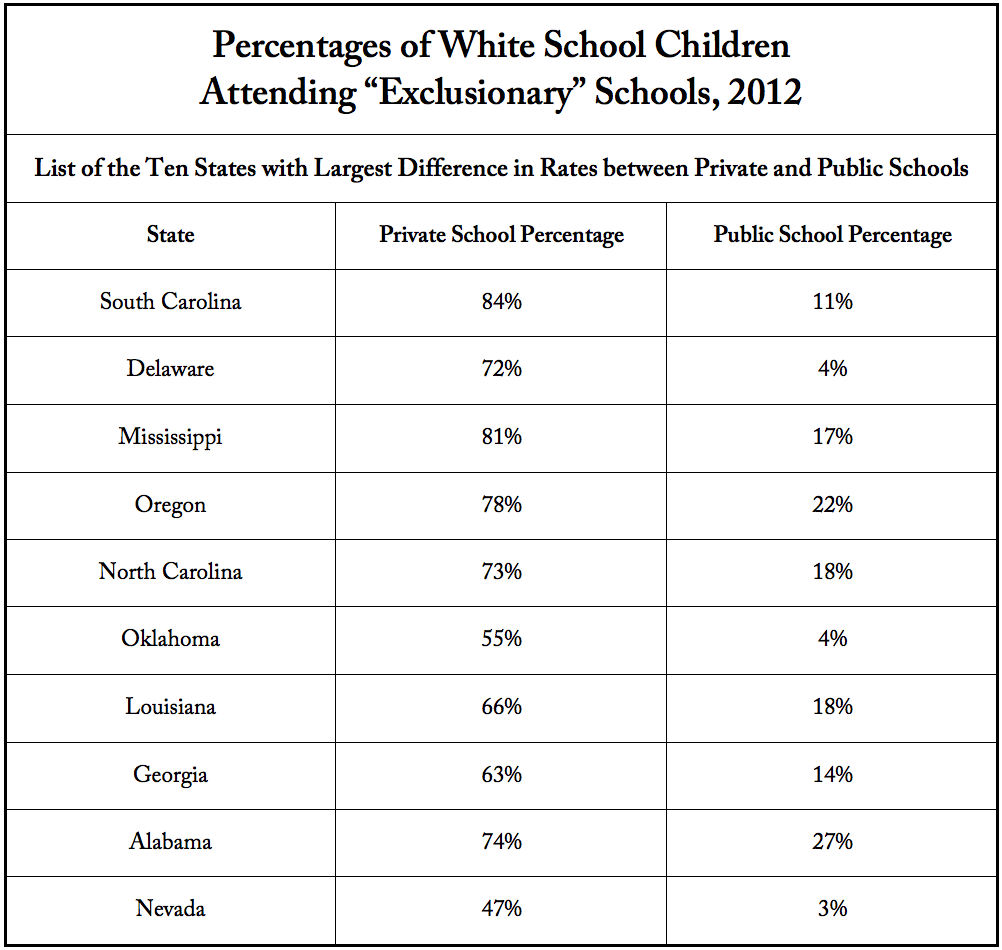
Each southern state that adopted voucher schemes in the era of massive resistance to Brown, except for Virginia, appears on the top ten list for exclusionary schooling, and Virginia was not far away. Like Virginia, Arkansas (where vouchers were tried temporarily in Little Rock) also had a gap of 34 percentage points. All southern states, except West Virginia, had a gap of 20 percentage points or larger. In West Virginia, the gap was 10 percentage points.
With the re-emergence of vouchers, the overwhelming majority of white students attending the nation's private schools continue to attend "schools for whites." The geographies where segregationists invented and implemented vouchers to resist Brown remain the places with greatest patterns of "exclusionary" private schools—assuring their white students that they do not attend school with any more than a token number of under-represented students of color. In 2012, the percentage of white students attending "exclusionary" private schools in the South exceeded the percentage in similar public schools in the South by 37 percentage points. This gap was double that of the rest of the nation.
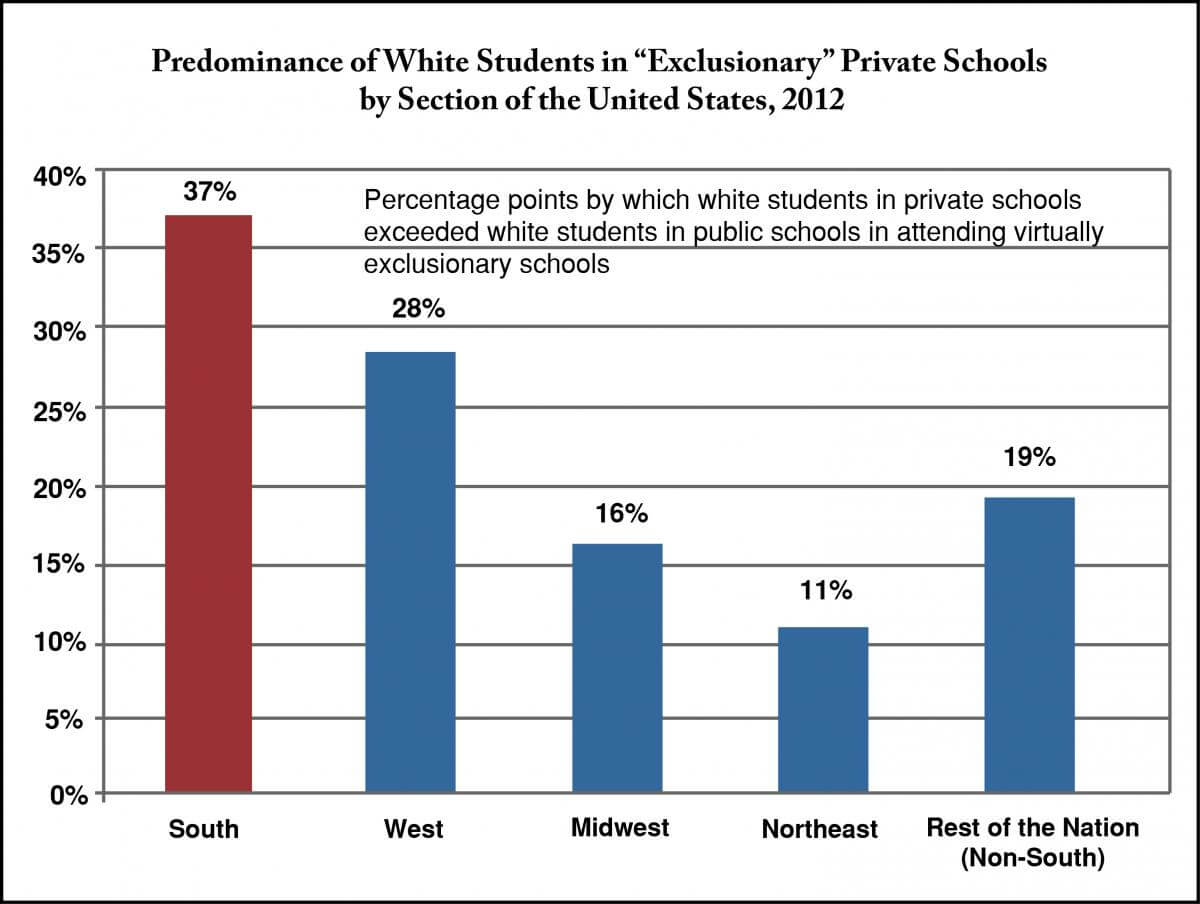
Lingering Facets of Jim Crow Segregation
States that adopted the first voucher plans in the 1950s and 1960s were forced by federal courts to abandon the laws and practices of complete separation of the races in schools and other public places. Yet Jim Crow laws were far from the only manifestations of segregation. The "better citizens" (as upper-class white supremacists were often called) were willing to accept token desegregation because of their belief that white supremacy and racial superiority did not place each and every white person always above "a negro of intelligence and good character."140Woodward, The Strange Career of Jim Crow, 107; Thomas J. Woofter, Southern Race Progress (Washington, DC: Public Affairs Press, 1957), 133–137. In the Jim Crow era, many southern industrialists believed in white supremacy but did not always find absolute segregation an economic advantage for their companies. See Suitts, Hugo Black of Alabama, 246–250, for a précis of this condition in Birmingham.
The practice of permitting virtual segregation or token desegregation was widespread before and during Jim Crow. Often, the all-white Democratic primary was not all-white. "In county after county," V. O. Key Jr. wrote in Southern Politics in State and Nation, "a few Negroes have voted for many years in Democratic primaries conducted under white-primary rules." The practice of holding virtually segregated primaries was particularly common where African Americans comprised a small proportion of the population.141Key Jr., Southern Politics in State and Nation, 620. Of course, attempting to vote in a southern state's Democratic primary was dangerous or deadly for African Americans. Steven F. Lawson, Black Ballots: Voting Rights in the South, 1944–1969 (New York: Columbia University Press, 1976), 119–121; Howell Raines, My Soul Is Rested: Movement Days in the Deep South Remembered (New York: Bantam Books, 1978), 285–294; also, listen to Hank Klibanoff, Buried Truths, 2018, podcast, https://www.wabe.org/shows/buried-truths.
Similarly, southern justice was segregated, and "after 1900, essentially no Blacks sat on southern juries." But, as civil rights and civil liberties attorney Charles ("Chuck") Morgan noted in the 1960s, "[T]he names of a token number of Negroes are often included on jury rolls." These token Blacks—hand-picked by white jury commissioners from the few African Americans deemed acceptable—seldom served since they could be struck by prosecutors or defense lawyers.142Michael J. Klarman, Brown v. Board of Education and the Civil Rights Movement (New York: Oxford University Press, 2007), 14; Charles Morgan Jr., "Segregated Justice," in Southern Justice, ed. Leon Friedman (New York: Random House, 1965), 159–161.
In their analysis of the South's segregationist leaders during massive resistance, historians Matthew Lassiter and James Hershman characterize segregationists as either caste-based or class-based. The caste-based defended complete segregation or exclusion on the belief that "all black people were inherently inferior to all white people." Understanding that absolute segregation was unnecessary to maintain a rule of white supremacy, the class-based segregationist (sometimes described as "moderate segregationists") conceded that "perhaps a few black people could be accepted into white institutions."143Hershman, "Massive Resistance Meets Its Match," 105.
The ambitions of politicians such as George Wallace and Ernest Vandiver muddled the division between caste and class, but the contrasting definitions illustrate that segregation was not defined as only a total, absolute exclusion of all African Americans or other people of color from the spaces—including schools—occupied by whites. Southern laws were often written that way, but reality was different. Affluent leaders of the most successful strategies for defeating desegregation demonstrated a class-based acceptance of virtual segregation and worked to preserve it. They anticipated the long-term possibility of ending absolute segregation and empowering leaders of local schools to justify virtual segregation through non-racial language, traditional school attendance boundaries, and neutral-sounding educational admissions standards, although it is doubtful that many realized how powerful class-based terms would resonate in suburban desegregation politics decades later.144Hershman, 104–106; Lassiter, The Silent Majority, 13–14, 26–29, 322–323.
The layered dimensions of segregation and exclusion are also illuminated by school segregation laws outside the South—in states that practiced de jure segregation well into the twentieth century—including the law invalidated by the Brown decision in Topeka, Kansas.145Brown v. Board of Education of Topeka, 98 F. Supp. 797 (1951).
All the attention drawn to the South's massive resistance eclipsed notice of how the Kansas school segregation law differed by excluding Black children from all white schools only in cities with a population over 15,000. The Kansas statute allowed boards of education in larger municipalities to decide if they should establish absolute segregation in those places where the number of African American children might exceed virtual or token segregation in a public school. In all other areas of Kansas with small Black populations, demographic patterns assured an acceptable level of virtual segregation.
Kansas population data illustrates how the law preserved virtual segregation in most of the state and absolute segregation where there was more than a token number of Black children. From 1890 through 1950, Kansas's Black population never reached 4 percent of the state's total, with the vast majority of Black Kansans living in and around a few cities. In 1950, there were 73,158 African Americans among more than 1.9 million Kansans. Almost three-fourths of the state's Black population resided in five counties where the state's largest cities were empowered to enact total segregation. All but one did. Elsewhere in Kansas in 1950, twenty thousand African Americans were spread among 1.3 million whites across one hundred counties, ensuring the maintenance of virtual segregation without the force of law.146Murray, State Laws on Race and Color, 161; Institute for Social and Environmental Studies, Kansas Statistical Abstract 1976 (Lawrence: University of Kansas, 1977), 5–9, 23, http://ipsr.ku.edu/ksdata/ksah/KSA12.pdf. There was a failed legislative effort in 1921 to change the nineteenth-century Kansas law to allow towns as small as two thousand to establish absolute segregation in schools. Thom Rosenblum, "The Segregation of Topeka's Public School System, 1879–1951," National Park Service, last modified April 10, 2015, https://www.nps.gov/brvb/learn/historyculture/topekasegregation.htm.
In 1951, when Linda Brown's father sued to desegregate her school system, Topeka (pop. 80,000) required absolute segregation in neighborhood elementary schools, undoing the virtual segregation that demographic trends assured to most white parents elsewhere in Kansas. In other words, Kansas's law had the same intent as southern laws—to maintain some form of segregation in all cases—although it did not establish absolute segregation as the default. That was implemented only when virtual segregation could not be maintained in practice.
Arizona also had a school segregation law—in some public high schools—triggered whenever twenty-five or more "pupils of African race" registered. In these situations, 15 percent of the voters in the school district could initiate a referendum to require the local school board to "segregate the pupils of the African race from pupils of the Caucasian race." In other words, the presence of twenty-five Black students in a high school could set in motion a process for absolute segregation.
In adjoining New Mexico, the law permitted the separation of "pupils of African descent" into separate classrooms in the same buildings if the school boards decided "it was for the best advantage of the school." The state allowed a local school board to decide what number of students might endanger virtual segregation, although it did permit the local jurisdiction to avoid the cost of building a separate school to implement absolute segregation.
Wyoming law gave school boards and superintendents power to enforce absolute segregation whenever there were fifteen or more "colored children" within a district. Since the large majority of Wyoming's schools were small, the numerical calculation of what number might threaten virtual segregation was also quite small. Until 1949, local jurisdictions in Indiana could decide to institute absolute segregation under a law used almost exclusively in larger cities where the percentage of Black population jeopardized virtual segregation.147Murray, 35–36; 290–291, 144; Mary Melcher, "'This Is Not Right': Rural Arizona Women Challenge Segregation and Ethnic Division, 1925–1950," Frontiers: A Journal of Women Studies 20, no. 2 (1999): 198–199. Arizona did require all elementary schools to segregate by race. Melcher suggests that Arizona required school segregation due to the large number of former southerners serving in the legislature. See Murray, 524; Reid E. Jackson, "The Development and Character of Permissive and Partly Segregated Schools," Journal of Negro Education 16, no. 3 (Summer 1947): 302–305.
These laws were different from those in the South because they assumed a different starting point. Before Brown, non-southern states started with virtual segregation and went to the absolute form when necessary, while southern states started with absolute segregation and went to virtual segregation when required by Brown. Wherever, school segregation was a multifarious exclusion without an exact shape or defining measure. As practiced, segregation always revolved around what a white-controlled legislature, white constituency, or white-controlled institution considered minimally acceptable. Contemporary private school patterns and practices—that state and federal governments have come to tolerate and often support with public funds—appear for what they are: legacies of class-based southern segregation used to evade Brown and multi-dimensional segregation of non-southern states before Brown.
Desegregation's Future
During the heyday of the first era of school vouchers, Dr. Martin Luther King Jr. decried that "token integration is little more than token democracy, which ends up with many new evasive schemes and it ends up with new discrimination, covered up with such niceties of complexity."148Martin Luther King Jr., "Love, Law, and Civil Disobedience," New South, December 1961. King's words have proven prophetic, although he could not have foreseen how dramatically the icons and language of the movement he led would be used, even by his own lineage, to develop and advance the tools and strategies that segregationists of his day thought could defeat the promise of Brown.
Today's advocates of school vouchers are not the first to attempt to graft the words and imagery of King and the civil rights movement onto their reactionary cause. As early as 1988, Rev. Jerry Falwell of the Moral Majority declared to a gathering of all-white, conservative male ministers in Atlanta that "Martin Luther King is everybody's American hero."149Lorri Denise Booker, "250 Protest Anti-Abortion Conference—2 Arrested; 600 Pack Omni to Hear Falwell," Atlanta Journal-Constitution, December 9, 1988; "Homogenized Heroes," SRC Home Record, Southern Regional Council, First & Second Quarters, 1989, 5. Ralph Reed, director of the Christian Coalition, continued to try to align King as the role model for conservative evangelical activists, many of whom supported public funding for private religious schools. Carter, The Politics of Rage, 466. But the school choice and voucher movement is remarkable in replicating so closely the primary strategies and tactics of southern segregationists while claiming the righteous mantle of the people and movement who fought against those segregationists.
One reason school choice proponents have appropriated civil rights rhetoric may relate to the fact that there is little evidence that vouchers improve the education of low-income children or children of color.150See Robert C. Pianta and Arya Ansan, "Does Attendance in Private Schools Predict Student Outcomes at Age 15? Evidence From a Longitudinal Study," Educational Researcher 47, no. 7 (2018), https://journals.sagepub.com/stoken/default+domain/XfYmtC25VddcCfbA3xiV/full; Mark Dynarski, On Negative Effects of Vouchers (Washington, DC: Brookings Institution, 2016), https://www.brookings.edu/research/on-negative-effects-of-vouchers/; Mark Dynarski and Austin Nichols, More Findings about School Vouchers and Test Scores, and They Are Still Negative (Washington, DC: Brookings Institution, 2017), https://www.brookings.edu/research/more-findings-about-school-vouchers-and-test-scores-and-they-are-still-negative/; Martin Carnoy, School Vouchers Are Not a Proven Strategy for Improving Student Achievement (Washington, DC: Economic Policy Institute, 2017), https://www.epi.org/publication/school-vouchers-are-not-a-proven-strategy-for-improving-student-achievement/; Halley Potter, Do Private School Vouchers Pose a Threat to Integration? (Washington, DC: The Century Foundation, 2017), https://s3-us-west-2.amazonaws.com/production.tcf.org/wp-content/uploads/2017/03/22102646/do-private-school-vouchers-pose-a-threat-to-integration.pdf; Kevin Carey, "Dismal Voucher Results Surprise Researchers as DeVos Era Begins," New York Times, February 23, 2017, https://www.nytimes.com/2017/02/23/upshot/dismal-results-from-vouchers-surprise-researchers-as-devos-era-begins.html. Voucher advocates' strongest arguments invoke social justice as well as freedom in order to legitimate school choice as more than a consumerist mindset and to obscure the factual results.151Samuel E. Abrams, Education and the Commercial Mindset (Cambridge, MA: Harvard University Press, 2016), 303–307.
A larger part of the explanation surely lies in forgetting what little was known and understood about segregationists such as Alabama's Forney Johnston and Albert Boutwell, Georgia's John Sibley, North Carolina's Thomas Pearsall, and Virginia's Garland Gray. In current memory, George Wallace remains the image of the diehard segregationist—standing defiantly to assure not one Black child in any white school. The images, language, and cruel tactics of Wallace and Birmingham's "Bull" Connor remain vivid in the lingering American mind, but not the strategic, behind-the-scenes work of South Carolina's Marion Gressette.
Yet, the southern states' first plan for defeating court-ordered desegregation, the one that Johnston and Boutwell devised in 1954 in Alabama, is exactly what today's advocates and supporters of vouchers seek to implement: no compulsory "race-mixing" in schools and no mention of any intent to discriminate. What could be more American than the freedom of parents to choose their children's school—private or public—with public financial support?
The Boutwell plan also aimed to remove from the state constitution and statutes any right of education for a child and any obligation to fund education. Instead, a state was to "foster education of its citizens in a manner and extent consistent with its available resources, and the willingness and ability of the individual student [emphasis added]."152Report of Alabama Interim Legislative Committee on Segregation in the Public Schools, 11. The plan authorized white school officials to decide "the eligibility, admission, and allocation of pupils, including the power to refuse admission to individuals or groups whose deficiencies in scholastic aptitude would compel undue lowering of school standards."153Report of Alabama Interim Legislative Committee on Segregation in the Public Schools, 7–8. The state was to provide vouchers and tax funds to private schools to increase school choice options.
The primary components of segregationist plans developed in the 1950s and 1960s by southern states are today the main objectives of policymakers and advocates leading the movement for school choice and vouchers.154For video overviews of the struggles against efforts to use vouchers to privatize public education, see videos at "Vouchers and Tax Credit Scholarships in the US," Southern Education Foundation, 2015, https://www.southerneducation.org/publications/vouchersandtaxcreditscholarships/; "Advancing Public Education in the South," Southern Education Foundation, 2013, https://www.youtube.com/watch?v=dBo4HwZ_8v8. No less remarkable, the segregation that Forney Johnston envisioned in his tripartite school system was also foreseen by economist Milton Friedman, who considered it an acceptable consequence of his goal of managing the country's education systems through market forces.
The nation's lack of memory has done far more than encourage the acceptance as racially neutral the economic and social arguments of voucher advocates, who blithely use the language of civil rights to advance the tools of segregationists. The nation has lost an understanding of class-based segregation as a general but not absolute condition for preserving racial superiority. This country also has failed to remember that school segregation laws outside the South embodied the same bifurcated notion of absolute and virtual segregation, although applied to different locales and demographies. More disturbing is the current wide acceptance of segregation as a part of an American way of schooling that merits public funding.
At the same time, the legal meaning and force of racial discrimination in civil rights enforcement and tax policy has shrunk to such an extent that courts, the public, and policy makers often recognize discrimination in private schools only if a person or institution sounds like an old-style segregationist who says "No, not one." Even some of the nation's most prominent public scholars have failed to grasp how, despite past court rulings, the strategies of virtual segregation continue today as prevailing practice among religious and non-religious private schools with tax exemptions.155For example, Jill Lepore writes that, because of the Supreme Court decision in Coit v. Green in 1971, "private religious schools no longer provided a refuge for whites opposed to integration." See Jill Lepore, These Truths: A History of the United States (New York: W.W. Norton, 2018), 663. There is no basis in fact for such a conclusion.
The US Supreme Court has declared as law of the land that private schools cannot enjoy the benefits of exemptions from federal income tax, much less receive tax credits and direct government funding, while engaging in racial discrimination, even when motivated by claims of religious freedom. But, the federal government's current standards and practices of enforcement accept as valid and true on its face any private school's public pledge of non-discrimination in admission practices and operations, so long as the school has no formal or written policies to the contrary and does not maintain absolute, complete "No, not one" segregation. And parents of public school children cannot go to federal court to challenge the lack of robust, effective enforcement.
This faux policy of anti-discrimination has permitted a majority of private schools across the nation to maintain what strategic southern segregationists sought to achieve after Brown—virtual segregation and exclusion of children of color. Recall that two-thirds of white students attending the nation's private P–12 schools are in institutions where African American, Hispanic, and Native American children constitute 10 percent or less of the student body. These white schools are exercising "school choice" to decide which and how many children of color to admit—in token numbers and on terms, values, and motives inherited from strategic segregationists who, as Julian Bond noted, "dared not say out loud" their true goals.156See Julian Bond, "Civil Rights in the Popular Culture," Southern Changes 14, no. 2 (1992): 4, http://southernchanges.digitalscholarship.emory.edu/sc14-2_1204/sc14-2_002/.
More than half of the nation's states have adopted some form of vouchers to support private schools, portending that virtual segregation and exclusion will be sustained over time. And the federal government is moving closer than ever to establishing a program of direct or tax credit vouchers to support private schools on whatever terms are acceptable to the states. Nor is there serious consideration of revising the standards and practices that have already permitted many states to erect the scaffolding of a private–public school system first put forward by Alabama segregationists in 1954.
By failing to grasp the history of the struggles and tactics against southern school desegregation, the nation has come to recognize segregation and racial superiority only in those private schools that are absolutely all-white. The looming danger lies in legitimizing and advancing a system of segregation and exclusion in education that is not called by its name. Even if most Americans find repugnant the absolute separation of the races that George Wallace defiantly championed as destiny in 1963, his words have transformed into a prophesy about schools across the nation that rings true by the most accurate, historical definition of the term: "segregation now . . . segregation tomorrow . . . segregation forever."
Acknowledgments
Many thanks to Southern Spaces staff members Stephanie Bryan, Madison Elkins, Amelia Golcheski, Camille Goldmon, Hannah Griggs, Rachel Kolb, Ra'Niqua Lee, and Sophia Leonard for their work on this piece. Thanks as well to Jon N. Hale for his suggestions. A special appreciation to Megan Slemons, GIS specialist with the Emory Center for Digital Scholarship, for assistance with maps and tables; and to Allen Tullos, my dear friend and senior editor of Southern Spaces.
About the Author
An adjunct with Emory University's Institute for the Liberal Arts, Steve Suitts is the author of Hugo Black of Alabama: How His Roots and Early Career Shaped the Great Champion of the Constitution. Earlier in his career, Suitts served as the executive director of the Southern Regional Council, vice president of the Southern Education Foundation, and executive producer and writer of "Will the Circle Be Unbroken," a thirteen-hour public radio series that received a Peabody Award for its history of the civil rights movement in five Deep South cities.
]]>Introduction
In the winter of 1936, Minnie Lee Ishcomer left home in Idabel, Oklahoma, and journeyed to Hot Springs, Arkansas. Thirty years old, white, poor, and the victim of a long-standing venereal infection, Ishcomer came to Hot Springs hoping to obtain treatment at the VD clinic operated there by the United States Public Health Service (PHS). Her experience was less than satisfactory. Because the clinic officially admitted only acute, infectious VD cases, Ishcomer was initially denied entrance—on the grounds that she was "not a danger to the public health." She passed her first few days in Hot Springs in search of food and shelter. Without money, she made her way to a bus station where a police officer found her "in a very serious condition." Taken back to the clinic, she received a few days' treatment. Soon after her release, a PHS official angrily wired the health officer in Ishcomer's home county that "such cases will not be treated in the future."1H.S. Cumming, Surgeon General, to Charles M. Pearce, State Health Commissioner, Oklahoma, January 29, 1936, General Records of the Venereal Disease Division, 1918–1936, 203.4, in RG 90, Records of the Public Health Service, 1912–1968, National Archives, College Park, Maryland. Hereafter VD Division Records.
The treatment Minnie Lee Ishcomer received likely did little to improve her health.2Available federal census information indicates that in 1930, Ishcomer was married and had a least one son. Her husband appears to have been a mill hand but no occupation is listed for her. Exactly which of her conditions triggered resentment by clinic doctors is not clear. Nevertheless, her story sheds light on a relatively unexplored site of public health work in the early twentieth-century US South.3For a brief overview of the Hot Springs VD clinic, see Edwina Walls, "Hot Springs Waters and the Treatment of Venereal Diseases: The U.S. Public Health Service Clinic and Camp Garraday," Journal of the Arkansas Medical Society 91, no. 9 (1995): 430–7. The opening of the Hot Springs VD clinic in 1921 followed upon extensive anti-venereal initiatives carried out by the U.S. military during World War I. Closing in the 1940s, the clinic marked a transition in the federal government's campaign against syphilis and gonorrhea—including the Tuskegee Syphilis Study (1932–72) and the Chicago Syphilis Control Project (1937–40). Throughout the interwar period, Hot Springs sat on the front lines of the PHS's war against VD, and although its efforts were largely unsuccessful, the clinic's history points toward a more complex understanding of this moment of "venereal peril."4The term "venereal peril" was a staple of turn-of-the-century discourse around syphilis and gonorrhea. For a particularly good example of this, see William Leland Holt,The Venereal Peril: A Popular Treatise on the Venereal Diseases, ed. William Josephus Robinson (New York: The Altrurians, 1909). For historical studies on this, see Theodor Rosebury, Microbes and Morals: The Strange Story of Venereal Disease (New York: Viking Press, 1971); Allan Brandt, No Magic Bullet: Venereal Disease and American Society since 1880 (New York: Oxford University Press, 1987); Suzanne Poirier, Chicago's War on Syphilis, 1937–40: The Times, the Trib, and the Clap Doctor (Urbana: University of Illinois Press, 1995); Nancy K. Bristow, Making Men Moral: Social Engineering during the Great War (New York: New York University Press, 1996); Andrea Tone, Devices and Desires: A History of Contraceptives in America (New York: Hill and Wang, 2001); Marilyn Hegarty, Victory Girls, Khaki-Wackies, and Patriotutes: The Regulation of Female Sexuality during World War Two (New York: New York University Press, 2008); John Parascandola, Sex, Sin, and Science: A History of Syphilis in America (Westport, CT: Praeger, 2008).
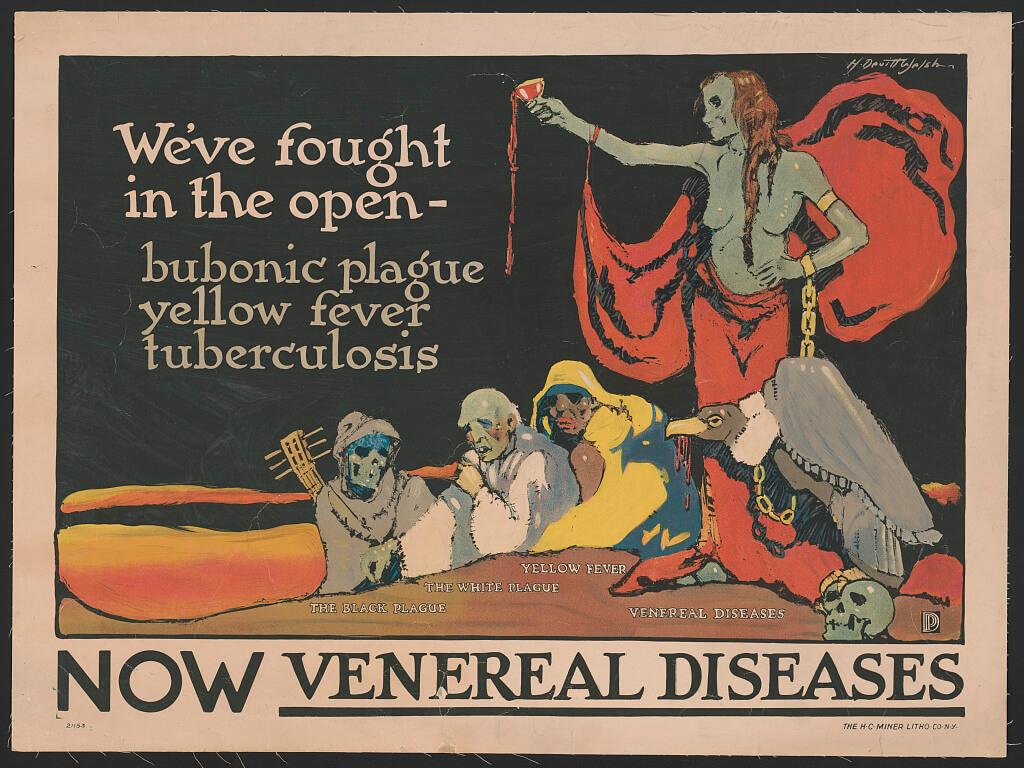
The history of the Hot Springs clinic offers insights into racial, gendered, and class-based aspects of the federal government's campaign against syphilis and gonorrhea. The clinic treated all manner of patients—black as well as white, male as well as female. Some patients were chronically poor, and others—particularly with the onset of the Great Depression—had only recently fallen on hard times. How similar were the experiences of these different groups, and to what extent did their treatment reflect prejudices against the various "others" (such as prostitutes and African Americans) popularly associated with VD? While many historical VD studies examine population subsets, this article about Hot Springs offers a more comprehensive analysis, comparing the experiences of stigmatized groups along with those of Hot Springs's prototypical health-seekers: syphilitic white males. Although they accounted for the vast majority of the clinic's caseload, white men have not received significant attention in VD historiography. Including their experiences adds new depth to our understanding of the "venereal peril" while illustrating how forcefully eugenics pervaded the PHS's campaigns against syphilis and gonorrhea.
Eugenics, of course, figures prominently in scholarship on the infamous Tuskegee Study. This experiment, in which the PHS deliberately withheld treatment from four hundred syphilitic Alabama black men in order to study the disease's "natural" progression, was designed to provide evidence for the theory that (as the Johns Hopkins syphilologist Joseph Moore put it) "syphilis in the negro is in many respects almost a different disease from syphilis in the white."5Susan Reverby, Examining Tuskegee: The Infamous Syphilis Study and Its Legacy (Chapel Hill: University of North Carolina Press, 2009), 136. From 1932 to 1972 white PHS doctors attempted to prove that black syphilitics almost never progressed to the late, advanced stage of the disease characterized by disorders of the nervous system–including tabes (syphilis of the spinal cord) and paresis (syphilis of the brain). Blacks were seen as belonging to an uncivilized race with smaller, less developed brains that equipped them with a "racial resistance" to neurosyphilis; as a result, they were more likely to suffer from the disease's cardiovascular symptoms—including syphilis of the heart.6Christopher Crenner, "The Tuskegee Syphilis Study and the Scientific Concept of Racial Nervous Resistance," Journal of the History of Medicine and Allied Sciences 67, no. 2 (2012): 244–80. Doctors believed that this partial immunity to neurosyphilis was a hereditary trait. As the authors of a recent article on Tuskegee observe, the experiment's goal was to "prove the biological basis of racial difference by documenting race-linked pathology, consistent with prevailing eugenic theory."7Paul A. Lombardo and Gregory M. Dorr, "Eugenics, Medical Education, and the Public Health Service: Another Perspective on the Tuskegee Syphilis Experiment," Bulletin of the History of Medicine 80, no. 2 (2006): 313.
In providing an assessment of intellectual undercurrents circulating through the PHS in the 1920s and 1930s, this new literature successfully rebuts the claim that Tuskegee had little to do with scientific racism or eugenics.8For a recent article in the revisionist vein, see Thomas G. Benedek and Jonathon Erlen, "The Scientific Environment of the Tuskegee Study of Syphilis, 1920–1960," Perspectives in Biology and Medicine 43, no. 1 (1999): 1–30. Unanswered, however, is how eugenic theories informed aspects of the agency's anti-venereal work involving non-blacks. At Hot Springs, these theories found expression in a campaign designed to prevent the clinic's mostly white male patients from succumbing to the "racial poison" that was VD. Comprising traditional medical services and a variety of extra-medical measures (including financial assistance for food, shelter, and basic care), this campaign cost hundreds of thousands of dollars, with its budget increasing dramatically during the early years of the Great Depression—just as the PHS dismantled a number of pilot projects designed to provide mass treatment to syphilitic blacks. Although many of the initiatives undertaken in Hot Springs benefited patients regardless of race or sex, the clinic's white male health-seekers experienced a level of preferential treatment denied to both women and African Americans. Further, for the latter group, discrimination and hostility were part and parcel of the Hot Springs experience—both inside and outside the clinic. All of this represented the eugenic impulses coursing through the PHS facility, whose director—Oliver C. Wenger—declared syphilis and gonorrhea important "from the standpoint of race conservation."9O.C. Wenger, "The Need for Social Hygiene," Oliver C. Wenger Papers, Box 1, University of Arkansas for Medical Sciences Archives.
Hot Springs reveals a significant instance of the federal government's racist approach to public health policy. When dealing with white patients, Washington extended a taxpayer-supported hand. Because such a sizable gap existed between the experiences of Hot Springs's black and white health-seekers, the story of the city's VD clinic provides a further context for understanding the Tuskegee Study. But first, a more elementary question: why did the PHS decide to create a VD clinic at Hot Springs, Arkansas?
"Mecca for Syphilitics"
Hot Springs's selection as the site of the federal government's "model" VD clinic would not have surprised early twentieth-century Americans.10C.N. Myers, "Hot Springs and the Model Federal Venereal Disease Clinic," Medical Review of Reviews 28 (1922): 86. In 1832, Congress declared that the boiling waters of the Ouachita Mountains were to be forever set aside for the "benefit and enjoyment" of the general public.11For more on the city's early history and the role of the Hot Springs Reservation, see Janis Kent Percefull, Ouachita Springs Region: A Curiosity of Nature (Hot Springs, AR: Ouachita Springs Region Historical Research Center, 2007). In 1877, Congress created the Hot Springs Reservation (HSR). Initially consisting of 2,529 acres, the HSR was public land managed by a federally-appointed commission, whose task was to maintain and control access to the 826,000 gallons of water that daily coursed through the site.12J.K. Haywood, Analyses of the Waters of the Hot Springs of Arkansas (Washington, D.C.: Government Printing Office, 1912), 5. Word of the area's therapeutic prowess spread across the country, and as the city began welcoming hundreds of health-seekers every year, its waters acquired a reputation for curing syphilis.13For evidence of this, see A.J. Wright, "Some Account of the Hot Springs of Arkansas," The New Orleans Medical and Surgical Journal (1860): 798–9, 801; R.M. Lackey, "The Hot Springs of Arkansas," Chicago Medical Journal 23 (1866): 9; J.L. White, "The Hot Springs of Arkansas," Chicago Medical Recorder 36 (1878): 311. During the late nineteenth-century, a growing belief in the springs' ability to "drive out syphilis completely" spurred a "Hot Springs craze" among venereal sufferers. Contemporaries began referring to the city as the "Mecca for syphilitics in America."14S.B. Houts, "Cases in Practice," The Medical World 5 (1887): 248–52; Edward L. Keyes, The Venereal Diseases, Including Stricture of the Male Urethra (New York: William Wood & Company, 1880), 107–8; E.R. Lewis, "The Hot Springs of Arkansas," The Kansas City Medical Index-Lancet 10, no. 7 (1889): 249. For references to Hot Springs as a "Mecca" for syphilitics during the late-nineteenth and early-twentieth centuries, see "Editorial: Syphilis of the Nervous System," The Hot Springs Medical Journal 3, no. 2 (1894): 51; A. Ravogli, "The Thermomineral Cure in the Treatment of Syphilis," The Medical Era 6, no. 8 (1897): 276; Bukk G. Carleton, A Treatise on Urological and Venereal Diseases (New York: Bukk G. Carleton, 1905), 741; Loyd Thompson, Syphilis (Philadelphia, PA: Lea and Febiger, 1920), 212.
While some of Hot Springs's health-seekers received treatment at the Free Government Bathhouse created by the HSR in 1878, increasing numbers did so at private enterprises.15Haywood, Analyses of the Waters, 5. Hot Springs was "fast becoming a fashionable resort."16J.L. Gebhart, "On the Therapy of the Waters of Hot Springs, Arkansas, and Their Relation to the Medical Profession at Large," St. Louis Medical and Surgical Journal 38 (1880): 634. Leasing land and water from the HSR, local developers began replacing the city's "miserable board shanties" with "palatial hotels."17Robert Heriot, "Letter to the Editor," Locomotive Engineers Journal 25 (1891): 919. The resort's clientele shifted: earlier the preserve of "poor, miserable paupers," it was increasingly visited by "very wealthy people from the Northern states."18E.B. Stevens, "Hot Springs, Arkansas," Transactions of the Ohio Medical Society 31 (1875): 197; Heriot, "Letter to the Editor," 919. See also H.M. Rector, "Then and Now," Hot Springs Medical Journal 4 (1895): 225; Henry Durand, "Uncle Sam, M.D., and His Great Sanitarium," The American Monthly Review of Reviews 16 (1897): 75–9. To ensure that its visitors remained a "people of leisure, with an abundance of money to spend," local officials forcibly uprooted the city's poorer health-seekers—those living in "shanties or tents" or found "encamped under the trees with no other shelter."19"Hot Springs, Arkansas," The Medical Visitor 20 (1904): 140; "Hot Springs, Arkansas, as a Health Resort," Hot Springs Medical Journal 3, no. 6 (1894): 173; William H. Deaderick, "The Development of the Hot Springs of Arkansas as a Health Resort," The Medical Pickwick 2 (1916): 265–6. One turn-of-the-century visitor reported on how "it was the policy of the municipality of Hot Springs to discourage the coming of the poor people to that place," which it did "by withholding all of the usual eleemosynary institutions from their use." Hal C. Wyman, "A Surgical Pilgrimage to Arkansas," Physician and Surgeon 28 (1906): 207. Medical authorities in other locales came to believe that "only the rich" could afford the "costly excursion" to Hot Springs.20"Syphilitic Paresis," The Eclectic Medical Journal 50 (1890): 562. As a Chicago physician said of his city's syphilitic patients: "our rich people go to the great Mecca of medical wisdom, to Hot Springs," while "our poor people may go to—where they please."21Joseph Zeisler, "The Social Evil," Year Book (Chicago: The Sunset Club, 1894), 218.
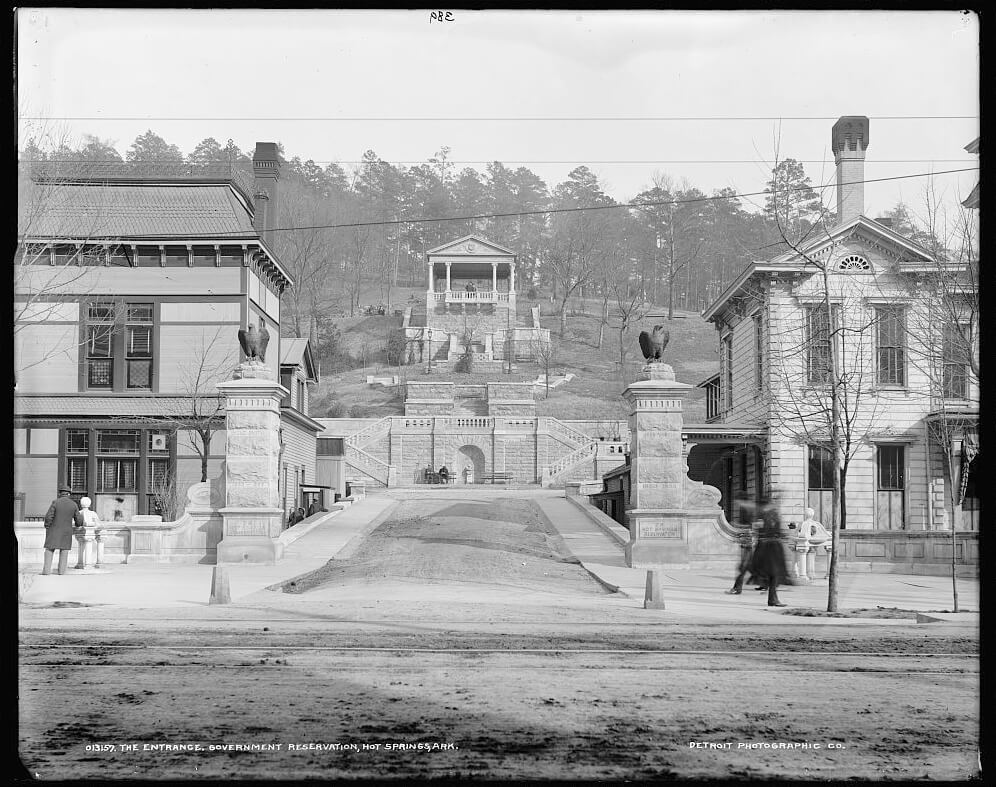
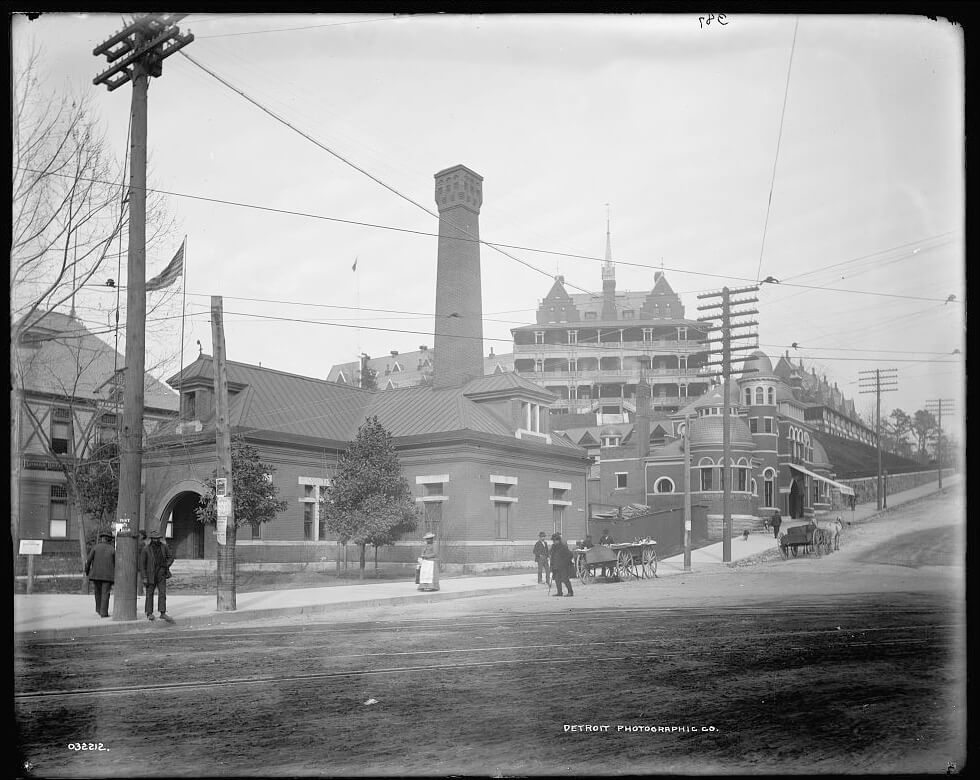
The invention of Salvarsan (1910), a more effective drug, also prompted a decline in the city's voluminous traffic in syphilitic health-seekers.22"Since the arsphenamines have justly become popular," the director of the Hot Springs VD clinic observed in 1921, "the number of syphilitics coming to Hot Springs has been decreased year by year." O.C. Wenger, "The Early Days of Hot Springs, Arkansas (1850–1900)," Oliver C. Wenger Papers, Box 1, University of Arkansas for Medical Sciences Archives. Nevertheless, neither new drugs nor the discrimination against impoverished health-seekers succeeded in severing the city's association with VD.23"We see every day, here in Hot Springs," one local physician noted in a 1913 treatise, "from ten to a hundred persons" suffering from the "terrible disease" that was syphilis. Albert J. Whitworth and John M. Byrd, The Hot Springs Specialist (Memphis, TN: B.C. Toof & Company, 1913), 164. For more about Salvarsan, see Patricia Spain Ward, "The American Reception of Salvarsan," Journal of the History of Medicine & Allied Sciences 36, no. 1 (1981): 44–62. In 1920, the HSR created a new, expanded Free Government Bathhouse; its lower floor would soon become home to the PHS's VD clinic.24Oliver C. Wenger, "The Early Days in Hot Springs, Arkansas (1850–1900)." Oliver C. Wenger Papers, Box 1, University of Arkansas for Medical Sciences Archives. As its director put it upon entering the city that same year: "to the average layman, Hot Springs, Arkansas, means VD, and VD means Hot Springs."25Oliver C. Wenger, "Results of a Study and Investigation of Venereal Disease at the United States Public Health Service Clinic at Hot Springs, Arkansas," Oliver C. Wenger Papers, Box 1, University of Arkansas for Medical Sciences Archives.
Hot Springs's status as federal land and as a "mecca" for syphilitics made the city an ideal site for the PHS's "model" VD clinic. But why would the government create such a clinic? The early twentieth-century was a time of profound anxiety over syphilis and gonorrhea, diseases said to be "undoubtedly on the increase."26George P. Dale, "Moral Prophylaxis," The American Journal of Nursing 11, no. 9 (1911): 689. It is unknown whether the general prevalence of VD increased during the late nineteenth and early twentieth centuries. What changed was likely not the percentage of the population infected by syphilis or gonorrhea, but instead, the medical profession's awareness of how many illnesses originated in one of these two diseases. Medical authorities proclaimed that 80 percent of adult males living in large cities contracted syphilis or gonorrhea before the age of thirty, and that 80 percent of all operations performed on women for diseases of the womb and ovaries were the result of one of these conditions. Such figures, though highly suspect, engendered fears of a looming VD epidemic across the country.27For these estimates, see G. Shearman Peterkin, "A System of Venereal Prophylaxis That is Producing Results," American Medicine 10 (1906): 328. A colleague named John Cunningham declared that "it is a fact worthy of consideration that every year in this country 770,000 males reach the age of maturity. It may be affirmed that under existing conditions at least 60 percent, or over 450,000 of these young men will sometime during life become infected with venereal disease, if the experience of the past is to be accepted as a criterion of the future." John C. Cunningham, "The Importance of Venereal Disease," The New England Journal of Medicine 168, no. 3 (1913): 77–8.
The sense that venereal diseases constituted "a menace to the national welfare" stemmed less from epidemiology than from social and cultural concerns—of "race suicide" attendant upon the declining fertility of native, white-born women and the influx of "new immigrants," of urbanization and its impact on sexual mores, of a "family crisis" prompted by the emergence of the "new woman," and of eugenic concerns tied to the rhetoric of social Darwinism and racial degeneration.28Abraham L. Wolbarst, "The Venereal Diseases: A Menace to the National Welfare," Medical Review 62 (1913): 327–80. Reformers clamored for an attack on prostitution, artists luridly illustrated the consequences of untreated syphilitic and gonorrheal infections, and anxious legislators passed laws that ranged from the reporting of all professionally-handled VD cases to the bacteriological examination of immigrants and prospective spouses.29For more on this, see Brandt, No Magic Bullet.
The climax of these fears came during World War I. With scientific diagnoses, doctors found that a surprisingly high number of prospective US military recruits suffered from VD. Hoping to head off a manpower shortage, in 1917 Congress created the Committee on Training Camp Activities—an organization that sought to curb the venereal scourge through the forced incarceration of prostitutes, the provision of medical services for infected soldiers, and the establishment of "wholesome" alternatives to the vice-ridden recreational opportunities commonly found in cantonment zones.30See Bristow, Making Men Moral. See also Alexandra M. Lord, "Models of Masculinity: Sex Education, the United States Public Health Service, and the YMCA, 1919–24," Journal of the History of Medicine and Allied Sciences 58, no. 2 (2003): 123–52. The following year Congress passed the Chamberlain-Kahn Act, which created the PHS's Division of Venereal Diseases and allocated two million dollars for the establishment of free VD clinics across the country.31For the Chamberlain-Kahn Act, see Alexandra M. Lord, "'Naturally Clean and Wholesome': Women, Sex Education, and the United States Public Health Service, 1918–1928," Social History of Medicine 17, no. 3 (2004): 423–41. As the war came to a close, Washington followed up on these efforts by conducting a nationwide VD survey.
Each of these actions drew attention to Hot Springs. Throughout the war, military authorities fretted over Little Rock's Camp Pike, a training facility whose VD rates were reportedly "the [highest] by far of any camp or cantonment in the United States."32Victor C. Vaughan, "Protection of American Army Against Social Diseases by More Rigid Health Laws," The Pennsylvania Medical Journal 22 (1918): 26. According to Vaughan, the venereal disease rate at Camp Pike was 568.7 per 1,000 soldiers. See also, "Disease Conditions among Troops in the United States: Extracts from Telegraphic Reports Received in the Office of the Surgeon-General for the Week Ending October 19, 1917," Journal of the American Medical Association 69 (1917): 1535–6; "Venereal Disease and Birth Control," Journal of the Switchmen's Union 20 (1918): 756. According to local commanders, Camp Pike's reputation as a hotbed of sexual sickness owed to its proximity to Hot Springs, where prostitution had been legal since the late nineteenth-century and where brothels enjoyed a reputation as home to the profession's "aristocrats."33For evidence of this, see the letters of Archie C. Cowles, a syphilitic health-seeker who traveled to Hot Springs in 1905. In a letter dated December 10, 1905, Cowles wrote that "many of the women here seem to be on the courtesan order. Of course, it would not do to call them prostitutes," Cowles remarked, "for they are aristocrats in their profession." For Cowles' correspondence, see the Archie C. Cowles Papers, Garland County Historical Society Archives, Hot Springs, Arkansas. In August 1918, Camp Pike's commanders ordered the closure of Hot Springs's numerous "houses of immorality."34"Commissioners Issue Order to the City Manager to Close the Houses of Immorality, Which Goes into Effect at Once," Hot Springs Sentinel-Record, August 2, 1918. Local businessmen and religious leaders rejected the association the military made between Camp Pike's high venereal disease rate and the "terrible conditions" in Hot Springs. See "Ministerial Men to Discuss Morals: Report from Washington of Bad Conditions Here Stirs some Enthusiasts," Hot Springs Sentinel-Record, August 9, 1918; "The Moral Condition," Hot Springs Sentinel-Record, August 10, 1918. Municipal authorities reluctantly complied, but the federal government's interest in Hot Springs did not end. While conducting their post-war VD survey, government officials grew increasingly anxious about the city's "serious medical and social problems," observing that Hot Springs was home to an increasing population of venereally afflicted "indigents" and an entirely "inadequate" public health infrastructure.35Audrey Wenger McCully, "The United States Public Health Service Venereal Disease Clinic and Government Free Bathhouse, 1919–1936," Oliver C. Wenger Papers, Box 1, University of Arkansas for Medical Sciences Archives.
From the federal perspective, syphilitic health-seekers represented an "interstate menace."36"Proceedings of the Minnesota Academy of Medicine," Minnesota Medicine 5 (1922): 61. The PHS determined to "protect the rest of the country" from those who traversed it with a venereal infection.37First Deficiency Appropriation Bill, 1921; Hearings before Subcommittee of House Committee on Appropriations, 66th Congress, 3rd Session (Washington, D.C.: Government Printing Office, 1921), 588. Opening a clinic in Hot Springs devoted to rendering the afflicted non-infectious seemed the best means of accomplishing this goal. Because patients traveled here from all parts of the country, constituted a diverse racial and socioeconomic makeup, and encompassed the full range of syphilitic infections, the PHS also found in Hot Springs an unprecedented opportunity for research. Establishing a long-term presence here would also allow the government to continue its wartime campaign against "houses of immorality," while transforming a parochial medical culture.38This last point holds for all of the public health campaigns undertaken in the early twentieth-century US South. In the case of Hot Springs, the city was seen as a center of quackery, and in particular, of the country's VD patent medicine industry. See Excluding Advertisements of Cures for Venereal Diseases from the Mails; Hearings before the Committee on the Post Office and Post Roads of the House of Representatives, 66th Congress, 1st Session (Washington, D.C.: Government Printing Office, 1921).
In late 1920 the PHS drew up plans for the facility, obtained $300,000 in construction funds and selected Oliver C. Wenger, one of the country's leading venereologists, as director.39During the war, Wenger—a native of St. Louis—served in the Medical Corps of the Missouri National Guard, and later focused his efforts on "venereal disease prophylaxis" as a member of Sanitary Squad #18, stationed in Camp Mills, a military camp in Long Island, New York. Afterwards, Wenger sought and obtained appointment as a "regional consultant" in the PHS, whereupon he assisted in the nationwide venereal disease survey (1919–20). See McCully, "The United States Public Health Service." Born in St. Louis in 1884, Wenger obtained his MD from St. Louis University in 1908. During the First World War, he served in the Medical Corps of the Missouri National Guard, later traveling to England and France as part of a sanitary squad involved in VD control.40For more on Wenger's biography, see McCully, "The United States Public Health Service." His time in Europe convinced Wenger to devote all his efforts to venereology. According to a contemporary, Wenger's idea of heaven was a place containing "unlimited syphilis," and of course, "unlimited facilities to treat it."41Reverby, Examining Tuskegee, 141. In 1919, Wenger joined the PHS Division of Venereal Disease. Before becoming director at Hot Springs, his first assignment was the national VD survey.
Inside the Clinic
With an inaugural budget of $40,000, the clinic opened in August 1921.42Oliver C. Wenger to C.C. Pierce, March 16, 1921, Hot Springs National Park Administrative Archives, Subseries 25.1.4, File A7615[04]. Hereafter NPS Archives. In its first year, five hundred patients received treatment; a total of 61,930 patients—male and female, black and white—had wound their way through by 1936, receiving 1.2 million injections of mercury and Salvarsan. Who were these individuals? How did their circumstances, needs, and experiences differ? How did prevailing ideas about VD actions influence Hot Springs's response to syphilis? And how did the clinic's campaign develop over the course of the 1920s and 1930s?
On one level, the PHS's day-to-day work reflected the widespread belief that VD constituted the "wages of sin"—a sign of sexual immorality. In lectures given by clinic personnel, patients learned that their illnesses were the result of "ignorance and your own misconduct." This message of personal irresponsibility also extended to the clinic's official instructions, which warned patients not to "loaf downtown" between treatments. Above all other commandments stood one: "DON'T GET INTO TROUBLE." And because the minimum course of therapy lasted between twenty and thirty weeks, patients were "expected to make arrangements to pay [their] own room and board."43Oliver Wenger, "Instructions" (1921), Oliver C. Wenger Papers, Box 1, University of Arkansas for Medical Sciences Archives.
Figure 1: VD Cases Admitted to the Hot Springs Clinic, 1922–1936
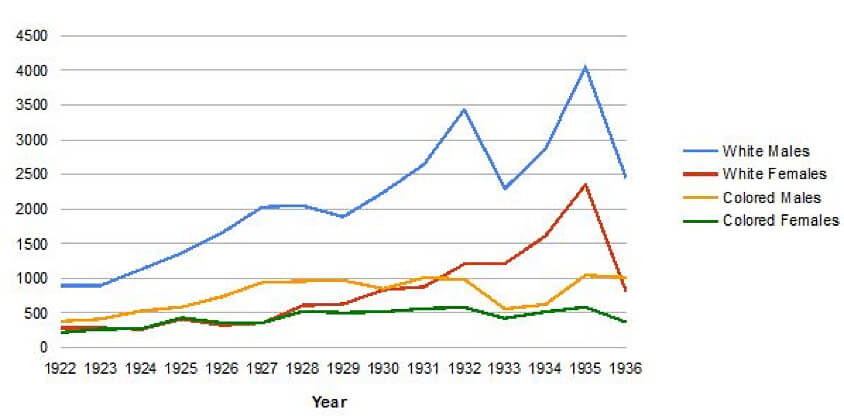
The PHS advised that "no patient should go to Hot Springs without at least a return ticket and $100 in cash." Such expectations clashed with reality. Wenger observed that "less than five percent of these indigent persons had funds with which to maintain themselves while receiving free treatment."44McCully, "The United States Public Health Service." Many arrived "without one cent of money."45O.C. Wenger, "The United States Public Health Service Clinic at Hot Springs National Park, Arkansas," Oliver C. Wenger Papers, Box 1, University of Arkansas for Medical Sciences Archives. In 1931, the average applicant carried not "$100 in cash" but $15.43. The following year, $8.76.46Oliver C. Wenger, "A Comparative Study of the Amount of Money Each Applicant Declared Under Oath at the U.S. Government Bath House for the Years 1931–32," Oliver C. Wenger Papers, Box 1, University of Arkansas for Medical Sciences Archives. Resembling a "dumping ground of many indigents" during the 1920s and 30s, Hot Springs became the preserve of all sorts of "unfortunate people" who "slept out on the hillside or in alleys, begging food from door to door...or looking for food in garbage cans."47 O.C. Wenger, "United States Conducts Clinics for Venereal Diseases," Nation's Health 8 (1926): 103; McCully, "The United States Public Health Service." As the clinic's director admitted, "the great majority left…before they could receive enough treatment to give them any real benefit."48McCully, "The United States Public Health Service."
One of this "great majority" was Virgil Oren Adams. A native of Clovis, New Mexico, during the early 1930s Adams made several visits to the Hot Springs VD clinic. Each time, he "ran out of funds" after only a few weeks, and being "sick and weak from lack of food and sleep," was forced to leave. In 1934 he wrote to President Roosevelt seeking assistance for yet another clinic trip. "I have been fighting syphilis since 1927," Adams wrote, adding that he was "very much interested in…getting rid of this terrible disease." "[A]bsolutely broke," Adams entreated Roosevelt for a letter to take "as a recommendation for treatments at Hot Springs." "Anything you can do in my behalf," he pleaded, would be "highly appreciated."49Virgil Oren Adams to President Franklin D. Roosevelt, September 27, 1934. Part of Adams's story also derives from a letter he sent to Captain Geoffrey, an officer at the Hot Springs clinic. For full texts, see VD Division Records.
Cases like Adams's were of "daily occurrence."50Oliver C. Wenger to the Surgeon General, October 18, 1934, VD Division Records. While poverty hampered patients' chances of recovery, so did the advanced state of their ailments. Most venereal sufferers came to Hot Springs long after contracting syphilis or gonorrhea. Most had not received more than a few shots of mercury or Salvarsan, and many relied only on cheap, ineffective patent medicines.51For evidence of this, consider the case of James Gordon. A Michigan man, in 1926 Gordon wrote the PHS asking for help in getting to Hot Springs. "I have tried [sic] all kinds of medicines, which you know that it [sic] takes money." From a book he had read, Gordon surmised that "there is not mutch [sic] chance for a poor man there," but still he pleaded: Hot Springs was "the last chance I have got—I have every thing [sic] else until my money is gone." For this letter, see James R. Gordon to United States Public Health Service, August 17, 1926, VD Division Records. Their illnesses were chronic, and generally immune to existing remedies. With disease burrowed deep in their bodies, few had any hope of ever being free from VD.
Realities such as these inspired a modicum of sympathy among clinic doctors. Particularly worrying to Wenger was the fate of ex-servicemen. Disappointed by the fact that during World War I, "our young American manhood" was often "unable to serve because of venereal diseases," Wenger observed hundreds of infected former soldiers seeking admittance to the Hot Springs clinic during the early 1920s. Like most patients, they were "nomads, seeking treatment here and there." Particularly troubling was the fact that these veterans were beginning to form families, and had entered "the best years [of their lives] from an economic standpoint." All of them needed medical attention; none were in a position to pay. Such matters made the treatment and control of syphilis and gonorrhea a national priority, he urged, especially "from the standpoint of race conservation."52Wenger, "The Need for Social Hygiene."
Language such as this dovetailed with contemporary eugenic discourse. Like other eugenicists, Wenger's interest in "race conservation" stemmed from anxieties over white racial purity and integrity. Over the course of the nineteenth and early twentieth centuries, birth rates among native-born white women declined by approximately 45 percent, and this, coupled with the simultaneous arrival of millions of "new immigrants" from southern and eastern Europe, prompted fears of "race suicide" among the nation's political and cultural elite.53For more on America's fertility transition, see J. David Hacker, "Rethinking the 'Early' Decline of Marital Fertility in the United States," Demography 40, no. 4 (2003): 605–20. Speaking to these fears, New York City gynecologist Abraham Wolbarst opined that "the flower of our land, the mothers of our future citizenship, are being mutilated and unsexed by surgical life-saving diseases, particularly gonorrhea."54Wolbarst, "The Venereal Diseases," 373. Sentiments such as Wolbarst's were widely held by PHS officials, including Oliver Wenger—whose eugenic beliefs scholars have also observed in his later work in Tuskegee and Chicago.55For more on this, see Reverby, Examining Tuskegee, 139–44.
The PHS sought means of accelerating the therapeutic process. Among the myriad venereological experiments conducted at Hot Springs, none loomed larger than those undertaken within the Salvarsan room. During the early 1920s clinic personnel began "the intensive and continuous plan of treatment."56McCully, "The United States Public Health Service." In the typical VD clinic, patients received one dose of Salvarsan per week; in Hot Springs, they would receive twice that amount.57J.R. Waugh and Elizabeth Milovich, "Severe Reactions to Arsphenamine among 3,050 Previously Untreated Patients," Journal of Venereal Disease Information 21, no. 12 (1940): 391. The Hot Springs clinic, it bears noting, was far from the only site where this experimental use of Salvarsan took place. In the medical literature of the time, many physicians reported success with an accelerated treatment regimen, and some recommended giving as many as three doses in a twenty-four hour period. One advocate advised colleagues to "give the largest possible amount of salvarsan in the shortest possible time." Faxton E. Gardner, "The Treatment of Syphilis," Medical Times 45 (1917): 63. For more discussions of the intensive and continuous treatment of syphilis with Salvarsan, see Frederick W. Smith, "The Modern Diagnosis and Treatment of Syphilis," Medical Record 91 (1919): 186–91; B.C. Corbus, "Prophylaxis in Cerebrospinal Syphilis," Journal of the American Medical Association 69, no. 25 (1917): 2087–9; Carlyle N. Haines, "Salvarsan in Syphilis," Pennsylvania Medical Journal 24 (1921): 839–41.
Derived largely from arsenic, a highly toxic substance, Salvarsan was a frightening remedy. While more effective than mercury, its use was accompanied by a panoply of side effects—from the mild (dermatitis, gastro-intestinal distress) to the severe (ocular damage, cardiac distress, edema). In rare cases, death resulted. In a review of 6,308 syphilis patients admitted between 1922 and 1932, Wenger counted a total of 225 adverse reactions to Salvarsan—including three fatalities from arsenical poisoning.58O.C. Wenger and Lida J. Usilton, "Notes on the Syphilis Clinic, United States Public Health Service, Hot Springs, Arkansas," Journal of Venereal Disease Information 15, no. 6 (1934): 210. It is impossible to verify these morbidity and mortality figures, as the clinic operated free from federal oversight. Because of this, and also because of the clinic's generally poor record-keeping practices, the number of "adverse reactions" may be higher than what Wenger reported. For more on the latter problem, see C.H. Waring to the Surgeon General, January 23, 1923, VD Division Records. It appears that severe reactions to Salvarsan were more common here than elsewhere.59In a 1940 study, clinic personnel revealed that nearly 2.5 patients per thousand experienced "severe reactions" to Salvarsan—a rate higher than the 1.99 per thousand reported by the Cooperative Clinical Group's studies of syphilis. Waugh and Milosivic, "Severe Reactions." Cognizant of the fact that "the duration of anti-syphilitic treatment at the Hot Springs clinic is for a relatively short time," Wenger's staff rushed to experiment with untested modes of therapy. The adoption of an "intensive and continuous plan of treatment" contributed to the clinic's high rate of serious complications.60Wenger and Usilton, "Notes on the Syphilis Clinic," 209. For further evidence of serious medical complications following upon the clinic's intensive plan of syphilis treatment, see George E. Tarkington, "Value of Liver Function Test in Arsenical Therapy," Journal of Venereal Disease Information 7, no. 1 (1926): 24–5. For details of a specific injury, see Paul S. Carley, "Infarction of Buttock from Intra-Muscular Injections of Mercury Benzoate," Journal of Venereal Disease Information 17, no. 10 (1936): 281–3. It bears noting here that during the 1920s and 1930s, the idea of "informed consent" had not become a universally recognized principle within medical ethics. Because of this, scientific investigators were not required to obtain patient permission before proceeding with experiments. Those housed within custodial institutions (public hospitals and clinics, asylums, prisons, orphanages, etc.) were especially targeted for human subjects research, with the justification often being that they owed society a debt in exchange for the free treatment they received. For more on this, see Susan Lederer, Subjected to Science: Human Experimentation in America before the Second World War (Baltimore, MD: Johns Hopkins University Press, 1997).
Such was certainly the case for Forrest LaPrade. A twenty-four-year-old Texan who arrived in Hot Springs in March 1930, LaPrade's original intention was to "boil out nicotine and malaria" through the city's "healing waters." Directed to Wenger's clinic for a physical, LaPrade was found to be syphilitic. Over the next few weeks he received seven shots of Salvarsan and eleven of mercury. His condition then worsened.61For the details of LaPrade's case, see G.L. Collins to the Surgeon General, October 11, 1932, VD Division Records.
On May 2, 1930, LaPrade complained of a "slight oedma" of the face, which his physician noted was "characteristic of arsenical poisoning." By the next day, he displayed a "face intensely swollen," along with a fever and an accelerated heart rate. After being diagnosed with erysipelas, LaPrade was transferred by a friend to a nearby hospital, where for twenty-eight days he experienced "untold agonies." Hoping to heal his swollen face, from which dripped "large drops of yellow corruption," LaPrade's doctors covered him with a white, glue-like paste, a remedy that produced a constant itching sensation that left the Texan "at the point of death." "I was actually skinned alive," LaPrade later said, describing how the itching left him "scaled like a fish." Unable to sleep, LaPrade's condition was so bad that his body "trembled like a leaf and even shook or quivered the bed." "I suffered, cried, and prayed as one who was in the doorway of Hell," he recalled with horror. "But for the Lord, I would have been six feet of earth."62Forrest D. LaPrade to Mr. Wright Patman, June 10, 1930, VD Division Records.
Although few patients faced an ordeal like Forrest LaPrade's, the clinic's experiments failed to produce "new and better methods to fight venereal diseases."63M.J. White, "Next Steps in the Field of VD Control from the Standpoint of the United States Public Health Service," Journal of Venereal Disease Information 7, no. 1 (1926): 173. A report from the PHS's Division of Venereal Diseases spoke in disappointed terms: "It was hoped that this clinic would prove useful from a research standpoint, but because of the transient character of the patients, results thus far have not been up to expectations."64"Meeting of the Advisory Committee to the Division of Venereal Diseases, United States Public Health Service, May 16, 1927," Journal of Venereal Disease Information 8, no. 8 (1927): 303. And as late as 1936, clinic personnel were still reporting on the "comparatively small number of treatments given" to patients—a reference to how few individuals completed a full course of anti-venereal treatment.
Figure 2: Sex Differentials in Syphilis by Stage of Disease upon Arrival in Hot Springs, 1922–1932
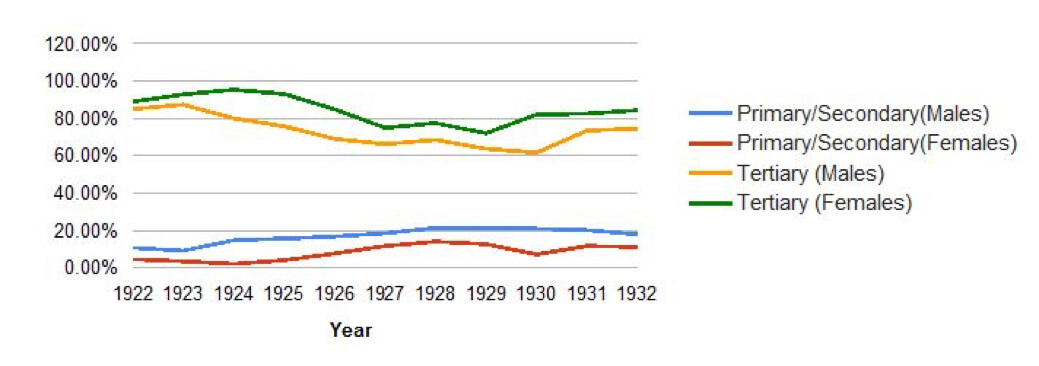
Healing the "Other": Women and African Americans at the Hot Springs VD Clinic
Because their attempts to accelerate the curative process largely failed, Wenger's staff also investigated ways of keeping patients within Hot Springs for longer periods of time. This search for extra-medical means of disease control had a racial foundation, one that becomes clear through an examination of doctors' experiences with female patients. Initially, Wenger and his staff harbored quite negative attitudes toward women, who were seen as "uncontrolled spreaders of infection" and a "menace to the community at large."65Wenger, "The Need for Social Hygiene"; Oliver C. Wenger, Annual Report for 1923, Oliver C. Wenger Papers, Box 1, University of Arkansas for Medical Sciences Archives. With the passage of time, however, clinic personnel became increasingly sympathetic to the plight of female health-seekers—even those who supported themselves through prostitution while receiving treatment. From these sentiments (which extended only to whites) emerged a non-traditional disease control program, one rooted not only in testing and treatment, but also in socioeconomic measures—including financial aid for food and housing.
Wenger's first few years in Hot Springs were characterized by an intensive crackdown on the city's red-light districts, which had re-opened in the aftermath of World War I. Hoping to prevent local brothels from recovering their former strength, in January 1921 the PHS presented an ultimatum to municipal authorities, explaining that unless the city abolished its regulated district the agency would quarantine all individuals who came to Hot Springs seeking treatment for disease—venereal or otherwise. Recognizing that it would "prove a great financial blow to the city if this patronage were lost," the PHS argued that it was "absolutely inconsistent to permit men to go there for the cure and, at the same time be exposed to reinfection through the agency of an open red-light district." Women too would be subject to these measures, as some of the female patients in Hot Springs were prostitutes who "carry on their profession while under treatment."66"Hot Springs Threatened With Loss of Patronage: Health Resort Must Eliminate Red-light District," The Social Hygiene Bulletin 8, no. 1 (1921): 8.
This seemed clear from a report Wenger received from the Interdepartmental Social Hygiene Department (ISHD) in 1922. A governmental entity tasked with investigating the relationship between prostitution and VD, the ISHD in 1921 sent an agent named Blanche Young to Hot Springs. Upon questioning a few girls "of the prostitute type" found within the city's public dance halls, she concluded that no progress against VD would be forthcoming unless the federal government abolished its system of regulated prostitution. One of the prostitutes Young met with informed her that "she had gone to the city for medical treatment and was under the care of a private physician." On another occasion, Young encountered a "very fast looking girl enter[ing] an automobile occupied by three young men who were obviously under the influence of liquor." "A little later," Young continued,
I saw this automobile stop and the men 'pick up' two girls. This was about 11:43 PM. The men talked to the girls on the street, inducing them to enter the car, immediately driving off. The next day I recognized in both the G.U. [genito-urinary] and syphilis clinics one of the girls who was present in the dance hall.67L. Blance Young to O.C. Wenger, February 8, 1932, Oliver C. Wenger Papers, Box 1, University of Arkansas for Medical Sciences Archives.
Reports such as these inclined Wenger toward an all-out assault on the city's red-light district. As during wartime, Hot Springs's response to this federal ultimatum was regretful compliance. The death of the city's physician-mayor J.W. McClendon—"the leader of the wide-open town policy"—eased Washington's task. With the removal of this "obstacle," the PHS convinced local law enforcement officials to fall in line.68O.C. Wenger to David Robinson, April 18, 1921, Oliver C. Wenger Papers, Box 1, University of Arkansas for Medical Sciences Archives. By the summer of 1922, five brothels had been shut down; by 1923, their number had been reduced by half.69 Information on brothel closures comes from my own analysis of police dockets from the City of Hot Springs, 1920–1923. These documents can be found in the Garland County Historical Society Archives, Police Department Records, Vertical Files, Garland County Historical Society, Hot Springs, Arkansas. In 1918, before the initial crackdown on prostitution, sex-workers accounted for almost one-fifth of all criminal arrests in the city. These results bore out the federal government's conclusion that local personnel had been "very successful" in "eliminating houses of prostitution" in Hot Springs.70First Deficiency Appropriation Bill, 1921: Hearing before Subcommittee of the House Committee on Appropriations (Washington, D.C.: Government Printing Office, 1921), 568.
This assessment proved premature. The interwar years brought new life to prostitution. While initially complying with the PHS, steep declines in revenue from saloons and bawdy houses prompted municipal officials to change their minds.71"Hard Sledding for Bankrupt City," Yearbook of the City Managers' Association 6 (1920): 85–6. In the late 1920s, the city's mayor "[threw] the town wide open" to prostitution, and in the next decade, cases of "female patients street-walking or soliciting" were "almost of daily occurrence."72Oliver C. Wenger, "The Transient-Indigent-Medical Problem at Hot Springs National Park, Arkansas," Oliver C. Wenger Papers, Box 1, University of Arkansas for Medical Sciences Archives. The clinic did little to oppose this challenge to federal authority. A 1934 visitor to the city remarked that Hot Springs was "the only national park where gambling, imbibing, and prostitution go unmolested."73Ray Hanley, A Place Apart: A Pictorial History of Hot Springs, Arkansas (Fayetteville: University of Arkansas Press, 2011), 81; "Hot Springs Would Secede," Today 3 (1934): 23.
What explains this reversal? For one, it appears that clinic personnel had little appetite for prolonged conflict with the array of local forces (officials, doctors, and brothel owners) opposed to the abolition of prostitution. More important, however, were the interactions clinic personnel had with female patients—many of whom sold their bodies for sex while seeking VD treatment.
Consider the experience of a "young white woman" from Tennessee named "O.J." Orphaned since childhood, O.J. had grown up at the House of the Good Shepherd in Memphis. With "limited" opportunities, she then supported herself largely through prostitution—by which she contracted both syphilis and gonorrhea. Upon arriving in Hot Springs, O.J. found work as a boarding house maid. Subsequently accused by her landlady of "running around with men," O.J. found herself back on the streets. For the remainder of her stay, she supported herself through prostitution, a decision defended with three words: "I must eat." While concerned over the number of "boy friends" this "more than ordinarily attractive" woman had infected, Wenger sympathized with O.J.'s plight, explaining to his superiors that "she was a good patient and reported regularly for treatment." Summarizing her case, the PHS agent conceded that "it is hard to be chaste and hungry."74Wenger, "The Transient-Indigent-Medical Problem."
Interactions with patients like O.J. had a dramatic impact on clinicians, who came to accept prostitution not as an indication of immorality, but as a consequence of the adverse circumstances many female patients faced.75Wenger, Annual Report for 1923. In one of his earliest reports, Wenger spoke of the "large number of female patients" who arrived in Hot Springs with "no funds" and "no friends." With work "scarce" in the city, many of these women—in a "much discouraged" state—were "forced by dire necessity to support [themselves] by prostitution."76Oliver C. Wenger, "History of United States Public Health Clinic, Hot Springs, Arkansas," Oliver C. Wenger Papers, Box 1, University of Arkansas for Medical Sciences Archives. The experiences of patients like O.J. were "not unique nor unusual, but exactly what goes on as these transients move across the country in their efforts to receive free medical service."77 "Any person who engages in travel," Wenger maintained, "may be the carrier of a communicable disease." "Every health officer knows," he reminded his superiors, "of instances, when, from one single source, hundreds and thousands of new cases have developed." Oliver C. Wenger, "The Indigent, Transient Problem and Its Relation to Public Health," Oliver C. Wenger Papers, Box 1, University of Arkansas for Medical Sciences Archives. Criticizing those who argued that prostitution could not be tolerated, Wenger explained that "as social workers and health officers, we must change our own attitude and remember that we ourselves would become transients seeking medical services if they were not available at home. This is only natural."78Ibid. In connection with Wenger's apparent acceptance of prostitution in Hot Springs, it is interesting to note that while overseeing a VD control program in Puerto Rico during the Second World War, the PHS official was privately reprimanded for proposing "methods of registration and identification of prostitutes which seem quite out of line" with the federal government's official policy of repression. For more on this, see Surgeon General Parran to Senior Surgeon O.C. Wenger, March 23, 1942, Thomas Parran Papers, Series 1, Box 5, University of Pittsburgh, Pennsylvania. Hereafter, Parran Papers.
Consistent with his new understanding of prostitution, Wenger's interactions with female patients displayed a lack of moralizing. In lectures on how to "prevent a second infection," he endorsed the use of condoms and taught women "the value of prophylaxis and also contraceptives, or birth control methods." A typical lesson began with a discussion of female anatomy and concluded with demonstrations of birth control techniques.79In educating his patients on the use of contraceptives, Wenger was taking a risk. As he noted in a 1926 letter sent to Thomas Parran (the recently-appointed director of the PHS's Division of Venereal Diseases), "the whole subject of prophylaxis is T.N.T. at this stage of the game," and as such, advocating too forcefully on behalf of birth control measures "might innocently start some unwelcome comment"—particularly in the South. On account of this, Wenger generally advised that the PHS "let the State V.D. men do as they please"—another sign of the impact local forces had on the federal government's efforts. For more, see Oliver C. Wenger to Thomas Parran, October 23, 1926, Parran Papers. While initially concerned about how female patients would react to these frank methods, Wenger reported that "there has been no embarrassment on the part of the volunteer subjects or the patients looking on. The remarks and questions asked during the demonstrations are amazing."80O.C. Wenger to Dr. White, January 13, 1925, VD Division Records.
The clinic's female patients also encouraged Wenger to search for economic solutions to the country's VD epidemic. Consider the 1933 case of "Mrs. W." A white, college-educated woman who "came here all the way from old Mexico" after having been deserted by her husband (who infected her with syphilis) and having "suffered losses in the general depression." Upon arriving in Hot Springs, Mrs. W. initially stayed with a "colored friend." When this woman's relatives moved in, Mrs. W. informed clinic personnel that she was "planning to 'hitchhike' her way back to Nogales, Arizona," where friends would take her home. Believing such a trip would be "practically impossible," Wenger turned to local welfare agencies, "who agreed to pay half of her fare." The remainder was "made up by clinic personnel." Discussing her case in a report to his superiors, Wenger noted that "this is just another instance, in which, if maintenance could have been arranged for a longer period of time, the patient could have probably improved sufficiently to take her place again among her friends and be self-supporting."81Wenger, "The Transient-Indigent-Medical Problem."
Like O.J. and Mrs. W., most of the women who made their way to the Hot Springs clinic in the 1930s were white.82During the clinic's formative years, white women never accounted for more than one-fifth of the clinic's annual caseload. Between 1928 and 1936, however, their numbers steadily grew, reaching a peak of 2,353 in 1935—a year in which they represented nearly one-third of all patients treated. During the same period, African Americans' share of the clinic's annual caseload declined from 36.9 percent to 20.3 percent—a trend especially evident among females. O.C. Wenger, "Summary Statistical Data," Oliver C. Wenger Papers, Box 1, University of Arkansas for Medical Sciences Archives. They received a much more sympathetic response than did the city's black health-seekers. Consider the case of Charley Wade Bradshaw. Shortly after entering the clinic on September 3, 1927, Bradshaw—a twenty-five year old black man employed as a porter by the Oklahoma City Railway Power House—was diagnosed with neurosyphilis and placed on a regimen of mercury. For six weeks, Bradshaw's savings enabled him to rent a room at a colored hotel, but on October 19, he was reported "AWOL." One year later, an Oklahoma City law firm supplied the reason for this abrupt departure. Coming to Hot Springs after company doctors "advised him that he had bad blood," Bradshaw left after running out of money for room and board. As an attorney informed Wenger, Bradshaw was "in a bad condition physically," and because he had "no means whatever," anyone who tried to help him "will have to do so at their expense."83Walter Martin to O.C. Wenger, March 2, 1928, VD Division Records.
Wenger apparently made no effort to pay for Bradshaw's expenses, despite his recognition of the socioeconomic inequalities that imperiled black health.84Between 1922 and 1932, the number of African American visitors listed in the "unskilled labor" category was "nearly twice as high" as the comparable figure for whites. O.C. Wenger, "An Analysis of 10,000 Cases of Syphilis," Oliver C. Wenger Papers, Box 1, University of Arkansas for Medical Sciences Archives. While concurring that venereal diseases were "playing havoc within the Negro population of the country," he criticized those who interpreted these findings as evidence of African Americans' "absolute lack of morality." The observed differential between whites and blacks, commented Wenger, "does not mean that there is a considerable difference in the morals of these different groups." The critical variable was African Americans' "social economic status"—in particular, their "more limited" educational and employment opportunities. "When the social and economic backgrounds of the two races are considered," he concluded, "there seems to be little difference in the incidence of infection."85Oliver C. Wenger, "Analysis of 10,000 Cases of Syphilis," Oliver C. Wenger Papers, Box 1, University of Arkansas for Medical Sciences Archives.
Improving black health-seekers' access to treatment required more than a rejection of the "syphilis-soaked negro" stereotype. When it came to removing institutional and economic barriers confronting African American VD patients, Wenger did little. He refused to challenge Hot Springs's adherence to Jim Crow, which confined African Americans to an "exterior observation" of all but two of the city's bathhouses. In addition to the "great disadvantage" they faced due to the "lack of proper accommodations in hotels and bathhouses," black patrons had fewer opportunities for securing therapeutic services than did whites. The Depression felled the one institution—the Woodmen of the Union Hospital—specifically catering to blacks.86 A.W. Hunton, "The American Carlsbad," The Voice of the Negro 3, no. 5 (1906–7): 331; C. Melnotte Wade, "Hot Springs—Its People," Colored American Magazine 10, no. 1 (1906): xviii; O.C. Wenger, "The United States Public Health Service Clinic at Hot Springs National Park, Arkansas," Oliver C. Wenger Papers, Box 1, University of Arkansas for Medical Sciences Archives; O.C. Wenger to Surgeon General, July 27, 1934, VD Division Records.
Black patients also faced the racial hostility of local physicians—some of whom worked in the PHS clinic. Believing that their higher rates of syphilis and gonorrhea stemmed from "the negro's almost absolute lack of morality and cleanliness," the resort's white doctors contended that southern blacks were "little better than animals with strong sexual passions."87 Thompson, Syphilis, 52. Some believed that emancipation constituted the primary cause of syphilis's spread "among the negro population of the South," as rampant promiscuity created a situation in which "the very existence of the race is threatened."88L.R. Ellis, "Address of the Chairman of the Section on Dermatology and Syphilology," Journal of the Arkansas Medical Society 6 (1909): 44; Loyd Thompson and Lyle B. Kingerly, "Syphilis in the Negro," American Journal of Syphilis 3 (1919): 396.
Racist attitudes were on display within the Hot Springs VD clinic. Admitted in July 1925, George Smith was a black man who came to the attention of local authorities after his arrest for "night prowling." While a judge ordered his release on the condition that he leave town, a Wassermann test revealed that Smith was infected with syphilis. Shortly after Wenger prevailed upon the city to permit his entrance into the PHS facility, trouble began. One day while receiving an injection of mercury, Smith reportedly became "impudent," and the doctor treating him "lost his temper and threatened to ruin" the man. Upon hearing of the incident, Wenger informed Smith to "remain away" from the clinic until the physician in question—a Dr. Abington—left. Though not expelling him, Wenger warned the doctor not to "cuss" the patients, and in his review of the case, the PHS official observed that Abington "was born and raised in the South, and [was] prejudiced toward all aggressive negroes."89O.C. Wenger to the Surgeon General, July 20, 1925, VD Division Records .
With the advent of the Great Depression, fewer and fewer men such as Charley Bradshaw and George Smith entered the Hot Springs clinic. As the economic misery of the 1930s increased, the proportion of black men and women admitted to the clinic declined precipitously; whereas in the 1920s, roughly one-third of the city's health-seekers were African American, by the middle part of the 1930s, this figure had fallen to about one-fifth. Those able to pay for a stay came later in the course of their infections than did whites, and in addition to presenting less curable forms of illness, they left Wenger's clinic much earlier than did white men and women.90On average, between 1922 and 1936, African American rates for tertiary syphilis were ten percentage points higher than those of their white counterparts, who also presented 8 percent more primary and secondary cases than did black syphilitics. O.C. Wenger, "Classification of Syphilis Cases, U.S. Public Health Service Clinic," Oliver C. Wenger Papers, Box 1, University of Arkansas for Medical Sciences Archives. A 1940 study revealed that the average white syphilitic received twelve shots of Salvarsan, and blacks only nine.91Waugh and Milovich, "Severe Reactions," 390. For further evidence of the unfavorable therapeutic outcomes for black patients, see J.R. Waugh and W. Burns Jones, "Genito-Urinary Survey of 1,625 Male Patients, United States Public Health Service Venereal Disease Clinic, Hot Springs, Ark.," Journal of Venereal Disease Information 13, no. 1 (1932): 9.
Instances of racial discrimination continued. In 1941, a PHS officer reportedly entered a number of "reputable Negro business places" in nearby Texarkana, arresting several "young ladies," and then transporting them to Hot Springs for treatment—all without testing them for venereal disease.92"Officer Uses 'Gestapo' Methods: Texarkanians Terrorized, Business Houses Molested," Arkansas State Press, July 25, 1941, 1. Such tactics soured many black syphilitics on Hot Springs.93For likely racial discrimination, see Paul Carley, "Infection with Syphilis Masked by Gonorrhea," Journal of Venereal Disease Information 18, no. 2 (1937): 21–4. For their part, black newspapers discouraged readers from journeying into central Arkansas, noting that northern health resorts and spas were "more attractive than Hot Springs" on account of the latter's "awful...Jim Crow cars and other uncivilized offerings to the colored visitor."94"Negroes Can Bathe at French Lick Springs," The Michigan State News, Tuskegee Institute News Clippings File.
Clinic to Camp
From the beginning, clinic personnel were wary of attracting local citizens' ire. Hot Springs's patients frequently "[ran] into trouble with the police for housebreaking and robbing. " Local residents resoundingly objected to "the presence of such large numbers of indigent VD cases on the city streets."95"Hot Springs Judge Wroth over 'Dumping' of Indigent Diseased Transients in City," Oliver C. Wenger Papers, Box 1, University of Arkansas for Medical Sciences Archives; Wenger, "The Transient-Indigent-Medical Problem"; O.C. Wenger to Surgeon General, July 27, 1934, VD Division Records. As early as the mid-1920s, Wenger called on the federal government to provide "some means of housing these indigent patients, or at least of providing them with sufficient food while they are under our care."96O.C. Wenger, "United States Conducts Clinic for Venereal Diseases," 103. Such aid never came.
During the Depression—as the city was "swamped with applicants seeking medical aid"—"begging, borrowing, and stealing" intensified.97Oliver C. Wenger to Taliaferro Clark, August 29, 1931, NPS Archives. Many of these applicants, wrote Wagner, belonged to a "much higher type group," individuals who in normal times would not have had to avail themselves of free, government-provided services.98O.C. Wenger, "The Transient-Indigent-Medical Program," Oliver C. Wenger Papers, Box 1, University of Arkansas for Medical Sciences Archives. Aware of the ways his clinic was "causing objection and criticism from certain groups of citizens," in 1933 Wenger again asked for federal housing of indigent patients. His next budget included monies courtesy of the Arkansas Transient Bureau (ATB), a branch of the Federal Transient Bureau, to provide "free room and board" at "$1.00 per day per patient," as well as funds for hospitalization, telegrams, minor emergencies, and transportation home.99Ibid.
During its first month in operation, the ATB provided shelter, clothing, food, and medical attention to over 2,300 VD patients—black as well as white, female as well as male. The program reaped immediate dividends: according to state officials, only one year after implementing Wenger's "maintenance" plans, the number of venereal health-seekers leaving Hot Springs non-infectious increased by 38 percent.100R.O. Brunk, "Some Interesting Facts," Oliver C. Wenger Papers, Box 1, University of Arkansas for Medical Sciences Archives. Echoing these sentiments, in January 1934, Wenger wired Washington praising the ATB for "giving out free room and board," noting that as a result of this "most of the old patients are remaining because they are getting free room and board and are taking more treatment."101Oliver C. Wenger to Dr. Vonderlehr, January 10, 1934, NPS Archives.
Figure 3: Salvarsan Injections Per Patient, 1922–1936
As diseased men and women descended onto Hot Springs, by early 1935 the ATB was providing for 4,000 diseased indigents.102McCully, "The United States Public Health Service." City officials claimed that many patients were "irresponsible as to their personal conduct"; every day, one local paper reported, twenty-five health-seekers faced arrest on charges of drunkenness and disturbing the peace.103Brunk, "Some Interesting Facts," Oliver C. Wenger Papers, Box 1, University of Arkansas for Medical Sciences Archives; "Hot Springs Judge Wroth over 'Dumping' of Indigent Diseased Transients in City," Oliver C. Wenger Papers, Box 1, University of Arkansas for Medical Sciences Archives. "If the federal government continues to invite the scum of the earth here," complained a judge to the PHS, "I guess we'll just have to move out and give the town to you."104"Hot Springs Judge," Oliver C. Wenger Papers, Box 1, University of Arkansas for Medical Sciences Archives.
Hot Springs officials began resisting calls for assistance, even refusing to admit dozens of children whose parents were receiving treatment into the public school system. Despite Wenger's "most vehement protests," and despite repeated assurances that it was "perfectly safe" for these children to mingle with local children, municipal leaders were adamant.105Oliver C. Wenger, "A Plan for the Consolidation of all Medical Measures for Transient Relief in Hot Springs, Arkansas," Oliver C. Wenger Papers, Box 1, University of Arkansas for Medical Sciences Archives. They began to push for the removal of the clinic's "undesirable" indigent transients.106"Council Approves New Transient Plan," Oliver C. Wenger Papers, Box 1, University of Arkansas for Medical Sciences Archives.
Conceding that patients "cannot be left to roam at will and get into difficulties on the streets of Hot Springs," federal officials and the ATB considered construction of a camp on the city outskirts to house clinic patients and "give them wholesome occupation and recreation."107Antoinette Cannon, "Hot Springs Transient Program," Oliver C. Wenger Papers, Box 1, University of Arkansas for Medical Sciences Archives. Initially, Wenger opposed these plans, but in order to "meet the needs of patients and the community," in 1934 the ATB began building a camp "for lone men who are under care in the United States Public Health Service clinic.108Ibid.
A year later, Camp Garraday opened on a thirty-three acre tract with a sixty-bed infirmary, nine barracks, kitchen, dining hall, and recreation building. During its first year, the ATB facility quartered five hundred white male transients.109O.C. Wenger, "A Plan for the Consolidation of all Medical Measures for Transient Relief in Hot Springs, Arkansas," September 5, 1935, NPS Archives. While these men—whom Wenger labeled the clinic's "hardest problem"—benefited from the "good food," shelter, immediate medical attention, and recreational opportunities provided directly by the federal government, white women and African Americans of both sexes continued to subsist under the old plan, by which they were "maintained in rooming and boarding houses throughout the city."110O.C. Wenger, "The United States Public Health Service Clinic at Hot Springs National Park, Arkansas," Oliver C. Wenger Papers, Box 1, University of Arkansas for Medical Sciences Archives.
Camp Garraday embodied the PHS's eugenic understanding of VD. While Wenger labeled white male patients a "problem," they were central to his ideology of "race conservation" and thereby worthy of privileges. Other patients might receive very modest financial aid, but they had to find sources of food and shelter, and felt the full force of the city's loathing. By contrast, white male patients received care on site, in a domiciliary setting. And Wenger sought to expand the camp's capabilities. In his 1936 budget, he recommended $55,320 for additional forms of support—including a butcher, a recreational supervisor, a housing director, a nursery, and a children's school (with principle and one teacher)—for Camp Garraday's residents.111Oliver C. Wenger, "A Plan for the Consolidation of All Medical Measures for Transient Relief in Hot Springs, Arkansas" (September 5, 1935), NPS Archives.
Wenger's plans never came to fruition. Local white citizens quickly and vehemently complained that Camp Garraday, "a Frankenstein monster," restored the "old stigma that Hot Springs is a place only for the treatment of venereal diseases." As the director of the Hot Springs Reservation explained, the PHS's efforts threatened to "ruin the results of the past hundred years of our history, to say nothing of the millions of dollars invested in the resort by private capital." The existence of Camp Garraday functioned to "make the place undesirable for pay patients."112As one local authority put it, developments of the early 1930s had given the health resort's more wealthy visitors the impression that "the transients being treated here were so numerous that [they] would overrun everything," and on account of this, the city had become "undesirable for pay patients." Thomas J. Allen to Arno B. Cammerer, July 23, 1934, NPS Archives.
Unable to overcome residents' objections to Wenger's maintenance program and the ATB's camp plan, the federal government terminated the Transient Bureau in 1936 and Camp Garraday ceased to house patients. Venereal health-seekers wishing treatment in Hot Springs were required to bring "sufficient funds available to pay their room and board over a period of at least ninety days."113John J. McShane to All Local Health Authorities, March 10, 1936, VD Division Records. For Oliver Wenger, who left Hot Springs in 1937 to take part in Chicago's Syphilis Control Program, it was a bitter ending. It appeared to him that Hot Springs was in no better shape than when he first arrived fifteen years earlier.
The same year Wenger left Hot Springs, Congress passed the National Venereal Disease Control Act. Allotting funds to the states, this legislation enabled a dramatic expansion in the nation's anti-venereal infrastructure. Arkansas soon felt the act's effects: prior to 1937 there were no state-run VD clinics here; by 1943, there were eighty-three. These new medical facilities treated fifteen thousand patients per year, far exceeding the heyday of the Hot Springs VD clinic.114"Venereal Disease Control," Arkansas Health Bulletin 1, no. 3 (1944): 6–9. In tandem with the mass production of penicillin in the 1940s, these developments led to a precipitous decline in the nationwide incidence of syphilis and gonorrhea. By the early 1950s, the country's VD "epidemic" had ended, and although rates for both syphilis and gonorrhea rose in subsequent decades, the government's model VD clinic would play no part in post-war developments.
Conclusion: Race, Hot Springs, and Tuskegee
The history of the Hot Springs VD clinic reveals how eugenics shaped the federal government's response to syphilis and gonorrhea. The facility's day-to-day operations show how the goal of "race conservation" structured patient experiences and outcomes. On account of the high volume of white syphilitics seeking admittance, clinic personnel became increasingly sympathetic to patients' circumstances and needs, and eventually, this sympathy manifested itself in a medical program that included free treatments as well as stipends for housing and food. While patients, regardless of race or sex, benefited from these extra-medical measures, it is unlikely the PHS would have launched such an approach to VD had not the primary beneficiaries been white males. The Camp Garraday transient center doled out special services to clinic patients because they were white men.
How did eugenics and scientific racism unfold at Hot Springs as compared with Tuskegee? As the failure of its venereological research program suggests, Hot Springs is a story about subjects becoming patients. In Tuskegee, the opposite occurred. What began as a series of mass treatment campaigns ended up as a horrific forty-year research program revolving around the denial of medical services. Tuskegee's creators tried to explain their complicity by invoking the Great Depression, claiming that their actions resulted from agency budget cuts that rendered additional funding for VD treatment impractical. However, just as the Depression deepened its hold, the PHS began pouring money into the Hot Springs clinic, whose patients were provided with drugs as well as with funds for food and shelter. The clientele at Wenger's clinic were primarily white; those enrolled in the Tuskegee study were black.
Race played a determining role in the PHS's attack on syphilis and gonorrhea. In broadening the scope of historical study beyond Tuskegee, and in particular by looking at the agency's policies toward white patients, the extent of the government's racialized response to VD becomes clearer.
About the Author
Elliott Bowen is a professor of history at Nazarbayev University and a historian of medicine and public health in the modern United States. His research explores the history of sexually transmitted diseases. Bowen is currently working on a book-length project about the history of Hot Springs, Arkansas.
]]>Introduction
During the antebellum era, New Orleans became the second largest port of US immigration after New York City, leading hundreds of thousands of Germans to begin new lives at the mouth of the Mississippi rather than the Hudson. 1Carl Leon Bankston, ed., Encyclopedia of American Immigration, vol. 2 (Ipswich, MA: Salem Press, 2010), 476. New Orleans boasted one of the earliest and most vibrant German communities in North America, yet the German-born growth rate in Louisiana during these years pales in comparison to states such as New York and Pennsylvania, as well as that of other slave states such as Missouri, Kentucky, and Maryland. In fact, between 1850–1860 it exceeds that of only Vermont, Maine, and South Carolina.2For the history of the settlement of Louisiana’s Cotes des Allemandes (the German coast) near New Orleans, see: Ellen C. Merrill, The Germans of Louisiana (Gretna, LA: Pelican Publishing, 2005). Compiled from the Original Returns of the Eighth U.S. Census 1860a-04, 2–590; Compiled from the Original Returns of the Seventh U.S. Census 1850a-02, xxxvi. Could yellow fever and the imagined racial unsuitability of Germans to tropical climates help account for this phenomenon? A close examination of historical sources returns a resounding "Yes."

Mouth of the Mississippi, New Orleans, Louisiana, July 9, 2010. Photograph by Flickr user Adventures of KM&G-Morris. Creative Commons license CC BY-NC-ND 2.0.
European Bodies, Climate, and the Geography of Yellow Fever
As a catalyst for German interest in America, the Louisiana Purchase unleashed a flood of speculation regarding whether US stewardship of the Purchase territory could lead to the realization of the biblical "land of milk and honey." According to observations reprinted by Johann Friedrich Nonne, editor of the Neue Allgemeine Weltbühne, in 1804, "the eyes of all Europe…now focused on Louisiana." The author of the piece downplayed concerns regarding the city's unhealthy reputation, which he attributed to the neglect of its former French caretakers, and expressed confidence that the territory's new masters would fare better in realizing New Orleans's potential.3Johann Friedrich Nonne, eds. Neue Allgemeine Weltbühne Auf Das Jahr 1804, (Erfurt, Germany: Johann Friedrich Nonne, 1804), 499; Thank you to Alexander Cors for encouraging a more suitable translation and for clarifying Nonne’s role in reprinting this piece. Over the next half-century Germans wrote extensively about the United States, particularly about the Louisiana Purchase and its suitability for settlement.
Heinrich Schmidt, ca. 1850s. Photograph by unknown creator. Courtesy of Wikimedia Commons. Image is in public domain.
From 1815 onward, accounts of "travels in the New World became almost a mania among Germans."4Paul Weber, America in Imaginative German Literature (New York: Columbia University Press, 1926), 102–103. In 1836, for example, a single volume of the Jenaischen Allgemeinen Literatur-Zeitung reviewed twenty-one North American emigration guides.5“Neueste Colonisations-Schriften,” Ergänzungsblätter zur Jenaischen Jenaischen Allgemeinen Literatur-Zeitung 2, nos. 84–85 (1836): 281–295. Leading German newspapers began publishing weekly columns on culture and politics by Germans in America as well as observations on the relationship between climate and health.6Maria Wagner, ed., Was die Deutschen aus Amerika berichteten, 1828–1865 (Stuttgart, Germany: H. D. Heinz, 1985), x–xi. "In the most remote forest hut as well as in the middle-class dwelling," noted nineteenth-century German scholar Heinrich Julian Schmidt, "the only book that could be seen in the hands of a farmer or gentleman, was a book about America."7Julian Schmidt, Geschichte der deutschen Literatur von Leibniz bis auf unsere Zeit (1896; repr., Charleston, SC: Nabu Press, 2011), 271.
One of the most salient features of this writing was its demonstration of "Wissenschafts-popularisierung" (the popularization of science).8Andreas Daum, Wissenschaftspopularisierung im 19. Jahrhundert: Bürgerliche Kultur, naturwissenschaftliche Bildung und die deutsche Öffentlichkeit (München, Germany: Oldenbourg, 2002). German writers from different walks of life consumed and disseminated knowledge from the burgeoning field of medical geography: the post-Enlightenment amalgamation of geography and the rediscovery of classical theories that insisted on the interrelationship between climate, environment, and disease.9Roy Porter, The Greatest Benefit to Mankind: A Medical History of Humanity (New York: W.W. Norton and Company, 1997), 302; Mark Harrison, Contagion: How Commerce Has Spread Disease (New Haven, CT: Yale University Press, 2013), 49. One result was an attempt to demarcate the southernmost limits of acceptable German settlement based upon a racialized discourse of "climate" largely informed by the susceptibility of European bodies to yellow fever.
German-American historian La Vern Rippley acknowledged in 1976 that Germans often cited "climate" as a major deterrent to settlement in the southernmost United States. Rippley, however, apparently didn't consider the term within the parlance of the era.10La Vern J. Rippley, The German Americans (Boston, MA: Twayne Publishers, 1976), 44–45. More recent scholars have unpacked nuances of words like "climate" to reveal that nineteenth-century European and American understandings of health and disease were inextricable from their environment. When nineteenth-century Germans referred to their suitability to certain climates, they were often speaking about the perceived health of the land.11Conevery Bolton Valenčius, The Health of the Country: How American Settlers Understood Themselves and Their Land (New York: Basic Books, 2002); Linda Nash, Inescapable Ecologies: A History of Environment, Disease, and Knowledge (Berkeley: University of California Press, 2006). Environmental historians, such as Conevery Bolton Valenčius and Linda Nash, have demonstrated how depictions of the health of the land were invaluable to nineteenth-century settlers in the burgeoning American West. Some German observers spoke favorably of the weather in Louisiana while simultaneously deriding the climate as ungesund (unhealthy).
Drawing upon extensive observations published in the German-speaking states of northern Europe this article explores the collective medical geography of the Gulf South as produced through German travel and settlement writing. By collective medical geography, I refer to the gestalt of this literature within the minds of its readers. To get a sense of this perceived landscape, I have mapped the observations detailed in this work and laid them on top of each other, like transparencies on an old overhead projector (see figures below). Having mapped each author's medico-geographical observations, I juxtaposed them with immigration and settlement data from the seventh (1850) and eighth (1860) United States Censuses to demonstrate the effect of this discourse on German immigration and eventual settlement.12Both the census of 1850 and 1860 provide population statistics by nation of origin, providing the total number of German-born in each state. Compiled from the Original Returns of the Eighth U.S. Census 1860a-04, 2–590; Compiled from the Original Returns of the Seventh U.S. Census 1850a-02, xxxvi.
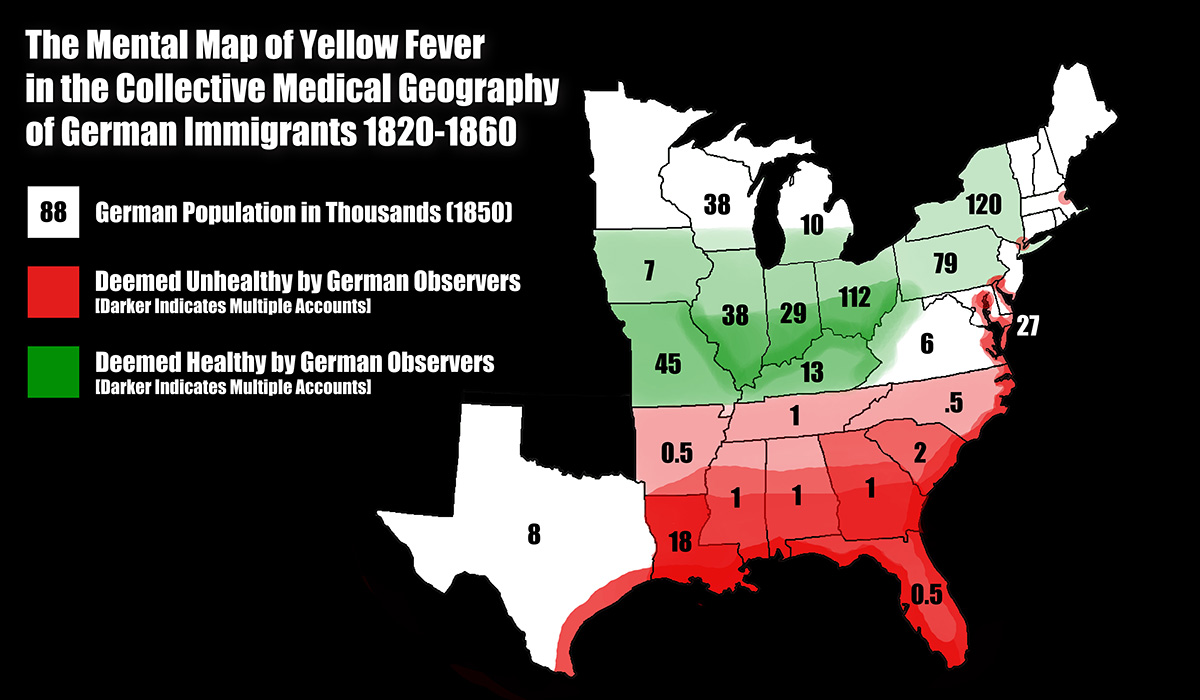
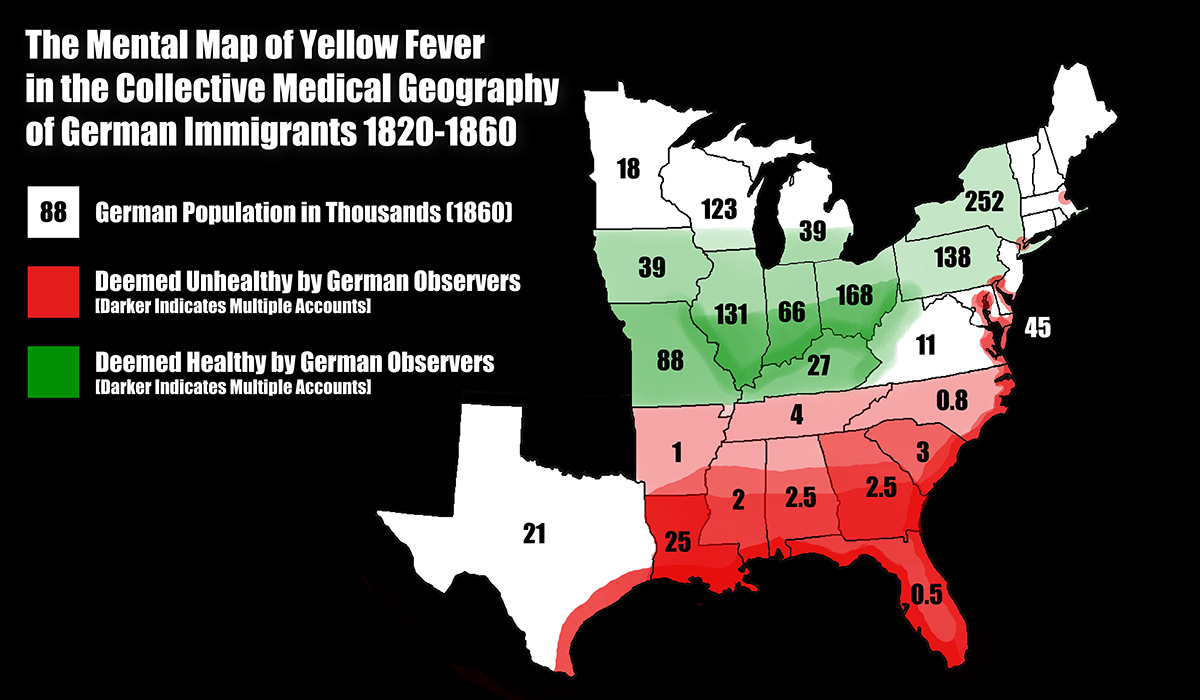
Top, The Mental Map of Yellow Fever, 1850. Bottom, The Mental Map of Yellow Fever, 1860. Maps provided by author.
The result suggests a strong correlation between the discourse of medical geography and German settlement patterns. It also raises questions about longstanding assumptions regarding slavery as the determining factor in German settlement, especially when one considers that slave states which received clean bills of health showed dramatic population increases. While some scholars have suggested that Germans avoided the US South almost exclusively due to their aversion to slavery, many German-American historians have cautioned against inscribing the beliefs of the outspoken Forty-Eighters on the entire German-American population, including the approximately 225,000 German-born citizens who lived in slave states on the eve of the Civil War.13For more on German-Americans and motivations for German-American settlement see: Merill, Germans of Louisiana, 9, 32–40; Walter D. Kamphoefner and Wolfgang Helbich, eds., Germans in the Civil War: The Letters They Wrote Home (Chapel Hill: University of North Carolina Press, 2006), 2–3; Rippley, The German Americans, 51; Andrea Mehrländer, The Germans of Charleston, Richmond and New Orleans during the Civil War Period, 1850-1870 (Berlin, Germany: Degruyter, 2011) 14; Patricia Herminghouse, “The German Secrets of New Orleans,” German Studies Review 27 (February 2004): 1–12; Wagner, Was die Deutschen aus Amerika berichteten, xi–xii.
While anti-slavery sentiment was not uncommon among Germans, other reasons more likely led to their near complete avoidance of the Gulf South: availability of land, access to cities, industrialization, etc. Closer scrutiny reveals the importance, often above all other concerns, Germans placed on settling in a salubrious climate. When combined with German laments that New Orleans's insalubrity offset its economic and cultural potential, this collective medical geography—based almost exclusively on the presence of yellow fever—was a deterring factor for German settlement in the Gulf South.
Consider as well the seasonal patterns of German immigration through New Orleans. Once its insalubrity was established in this literature by the late 1840s, German authors turned to questions of New Orleans as an economically viable port of entry to the American interior. Founded in 1847, the Deutsche Gesellschaft von New Orleans (a German-American society, DGNO) embraced this role, as is evident in annual reports and communications that dissuaded Germans from settling in Louisiana due in large part to the presence of yellow fever. The DGNO advised immigrants to utilize the port as an economical and German-friendly point of entry, but to time their arrival so that it did not fall within the yellow fever season (late May through early October). By charting the port records of the DGNO between 1847 and 1860 (see figure above) a clear correlation between their recommendations to newcomers and the arrival of German immigrants becomes apparent.
Why did Germans single out yellow fever among prevalent diseases? After all, as then American diplomat and naturalist David Bailie Warden wrote in 1819, "the ravages of yellow fever are confined to the crowded streets of the most commercial towns, and its victims are less numerous than those of the bilious putrid fever, or typhus, which sometimes runs over [all of Europe]."14David Baillie Warden, A Statistical, Political, and Historical Account of the United States of America (Edinburgh, Scotland: Hurst, Robinson, and Company, 1819), 281. While Americans attempted to downplay yellow fever against concerns abroad, what was important to consider when qualifying German fascination with the disease was not how many yellow fever killed, but whom it killed and how they died.


Top, Aedes aegypti mosquito, August 20, 2012. Colored drawing by A.J.E. Terzi. Image uploaded by Flickr user Wellcome Images. Creative Commons license CC BY-NC-ND 2.0. Bottom, Electron microscope image of the virus responsible for yellow fever, August 7, 2013. Photograph by Alain Grillet. Image uploaded by Flickr user Sanofi Pasteur. Creative Commons license CC BY-NC-ND 2.0.
Unbeknownst at the time, yellow fever is transmitted to humans through a mosquito vector, the female Aedes aegypti. The mystery of the disease's transmission confounded contemporary medical observers leading to theories ranging from domestic origination of miasmas to the direct importation of contagious persons and/or inanimate fomites. There was broad consensus on two points: first, that the affliction targeted strangers to tropical climates, hence its moniker as a "strangers' disease," and, second, the erroneous assumption that individuals of African descent carried an inherent racial immunity.15Margaret Humphreys, Yellow Fever and the South (Baltimore, MD: Johns Hopkins University Press, 1999), 6–7. Jo Ann Carrigan, The Saffron Scourge: A History of Yellow Fever in Louisiana (Lafayette: Center for Louisiana Studies, 1994), 10–11; Mariola Espinosa, “The Question of Racial Immunity to Yellow Fever in History and Historiography” Social Science History 38, nos. 3 and 4 (Fall/Winter 2014): 437–454. These two factors, whether real or imagined, carried tremendous weight for would-be German immigrants.
Beyond fears that they were more susceptible to yellow fever as strangers to the Gulf South, contemporaries suggested an underlying racial justification: the widespread belief that (white) Europeans and Americans could become acclimated over a period of years to regions otherwise hostile to their racial constitutions. Troubling to many observers, the process of acclimation suggested that the perceived immunity of slaves of West African descent confirmed a racialized climate theory often used to justify chattel slavery in the Trans-Atlantic South. That Europeans could acclimate to climates suitable for Africans raised concerns about whether the process led to racial mutability and/or degradation in whites.16David Arnold, Colonizing the Body: State Medicine and Epidemic Disease in Nineteenth-Century India (Berkeley: University of California Press, 1993), 25–32. There is a lengthy historiography of racialized climate theory broadly conceived by Europeans in the nineteenth century. The following examples attest to American and European utilization of that theory within the American South: Mark Carey, “Inventing Caribbean Climates: How Science, Medicine and Tourism Changed Tropical Weather from Deadly to Healthy,” Osiris 26, no. 1 (2011): 129–130; A. Cash Koeniger, “Climate and Southern Distinctiveness” Journal of Southern History 54, no. 1 (February 1988): 21–44; and Humphreys, Yellow Fever and the South, 7. Not only would German bodies be extremely susceptible to this devastating affliction, becoming acclimated seemed to suggest that something inside them had changed.
The presence of tropical diseases, such as yellow fever, also shaped German conceptualizations of the Gulf South as a tropical place. Whereas the distinction between free and slave states has served to delineate between North and South in many US historical studies, it is evident from their descriptions and settlement patterns that nineteenth-century Germans viewed what political historians refer to as the lower South as being a part of a larger Gulf South: one that would include eastern Mexico and the Greater Caribbean. This is not to say that they did not appreciate the political distinctions between these places, but in terms of fitness for settlement words such as "tropical" and "West Indian heat," were often used to describe areas deemed ungesund.
This collective medical geography informed German imaginations, or cognitive mapping, of southern spaces such as the Gulf South's commercial center of New Orleans. Prior to photography and video—and before mass production of maps and illustrated books in the mid-nineteenth century—Europeans relied on the written or spoken word to inform their perceptions of places they had not visited. Settlement literature would influence the spatial imaginary. Writing that emphasized insalubrity and macabre scenes of epidemic yellow fever had a deleterious affect on German perceptions of New Orleans as a space.17Cognitive mapping has been utilized by a wide array of fields, but the most influential of these works are arguably those within environmental psychology and city planning. See: R.M. Kitchin, “Cognitive Maps: What are They and Why Study Them,” Journal of Environmental Psychology 14 (1994): 1–19; and Kevin Lynch, The Image of the City (Cambridge, MA: M.I.T. Press, 1960).
Development of yellow fever 1, 2, 3, 4. Illustration originally published in Etienne Pariset and André Mazet's Observations sur la fièvre jaune, faites à Cadix, en 1819. Courtesy of Wikimedia Commons. Creative Commons license CC BY 4.0.
In addition to concerns of their unique susceptibility and fears of racial degradation in regions unbefitting their racial stock, the way in which yellow fever victims died embellished the disease's exotic and macabre reputation for would-be German settlers. The accumulation of the virus in the lymph nodes and the associated immune response leads to high fever and the onset of chills. As the liver is compromised, jaundice sets in, giving the victim's skin the yellowish hue that names the disease. Hepatic congestion brought on by liver failure and the eventual "systemic dysfunction of the clotting system" leads to hemorrhaging of the lining of the upper digestive system. Partially digested blood is forcefully expelled through the nose and mouth, producing a black vomit by which also characterizes the disease. Combined with descriptions of seizures and fevered delusions, lay accounts testify to the horror of this progression upon the afflicted and its effect on their caretakers.18Humphreys, Yellow Fever and the South, 5–6. It is no wonder that Germans placed as much emphasis on yellow fever as they did.
Travel Tales: The "Unhealthy Cities" of the South, 1820–1830
After the Napoleonic Wars (1803–1815), the optimism that Johann Friedrich Nonne expressed in 1804 regarding New Orleans's future salubrity was scarce among German authors. This coincided with the environmental trend in Enlightenment-era medicine that suggested nature exerted powerful forces upon the land and European bodies. Yellow fever was perceived as a product of tropical climates that could not easily be mitigated.19Ibid., 18–19; Porter, The Greatest Benefit to Mankind, 302; Harrison, Contagion, 49. Germans who had traveled to tropical places during and after the Napoleonic Wars testified to the havoc these climates unleashed on German bodies. For many of these writers, the presence of endemic yellow fever was sufficient to designate a place as tropical and, therefore, ungesund.
Following his service as a Prussian artillery lieutenant in the Napoleonic Wars, Johan Valentin Hecke turned to "scientific pursuits and travel."20J. Valentin Hecke, Reise durch die Vereinigten Staaten von Nord-Amerika in den Jahren 1818 und 1819, vol. 1 (Berlin: H. Pb. Petri, 1820), 1. In his 1820, two-volume Tour of the United States of North America in the Years 1818 and 1819, yellow fever figured prominently. Little is known of Hecke's life beyond his military service, but a reviewer of his Tour in the Allgemeine Literatur-Zeitung suggested that fellow Germans exercise caution in where they chose to settle.21“Vermischte Schriften,” Allgemeine Literatur-Zeitung (1821): 785–792. They would do "better to be poor at home" than die abroad.22Ibid., 792.
A representation of the cholera epidemic depicting the spread of the disease in the form of poisonous air, or miasma, as Nonne and Hecke had observed. London, England, October 1, 1831. Lithograph by Robert Seymour. Courtesy of Wikimedia Commons. Image is in the public domain.
While, like Nonne before him, Hecke believed human agency—such as a lack of sanitation leading to pestilential miasma—could contribute to the unhealthiness of climate, the determining factor was "West Indian heat."23Hecke, Reise durch die Vereinigten Staaten, vol. 1, 76. This heat, Hecke and others insisted, exacerbated miasmatic conditions present in many port cities and led to increased frequency and virulence of tropical diseases: most notably, yellow fever.24Ibid., 166–67. Hecke's contribution lay in his detailed observations of major cities and their salubrity up and down the eastern seaboard and on the Gulf Coast.
Of all the diseases he encountered, Hecke devoted far more pages to yellow fever, dubbing it "the transatlantic plague," capable of striking "even among the hardened and seafarers accustomed to almost any climate." "Only a select few survive this terrible, nervous system-shattering disease," he wrote, and those who did would "never again reach their previous health."25Ibid., 167–183. As for the uneven distribution of yellow fever between North and South, Hecke estimated that the absence of persistent West-Indian heat explained why "in the northern states yellow fever is restricted to the seaports." While he assailed the "pestilential swamps" of the South as a haven for the disease, he noted that Delaware and New Jersey were dotted with marshes, yet "not one person has been carried away" by yellow fever.26Ibid., 166–67, 170
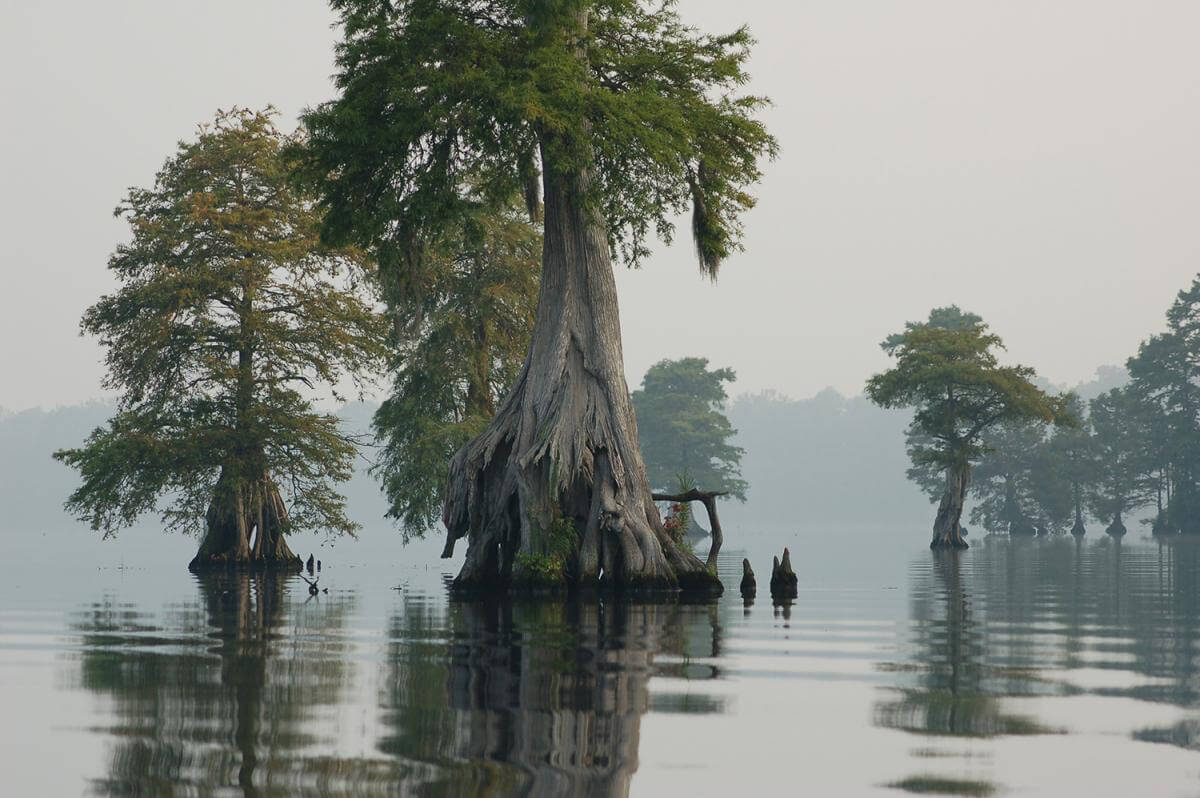
Bald cypress in Lake Drummond, Great Dismal Swamp National Wildlife Refuge, Virginia, August 2, 2006. Photograph by Rebecca Wynn, uploaded by Albert Herring. Courtesy of Wikimedia Commons. Creative Commons license CC BY 2.0.
The further south Hecke traveled, the more he remarked on the prevalence of yellow fever. While he lauded the mountains of Virginia for their cooler and healthier climate, he was none too kind to the coastal areas. Hecke remarked that the "especially unhealthy city" of Norfolk and its surrounding coastline were dotted with pestilential fever-producing swamps. These swamps, along with high temperatures, incubated yellow and other malignant fevers that seemed to "occur almost every year."27Ibid., 161.
Of the Carolinas, Hecke was unabashedly critical. In Charleston, every summer the "burning West Indian heat" was "usually accompanied by the yellow fever."28Ibid., 166 Hecke wrote of a girl whose German-immigrant family operated a farm not far from Charleston when, without warning, yellow fever struck. Within a few days, the disease had orphaned her. Hungry and alone, she was found wandering the road.29Ibid., 167.
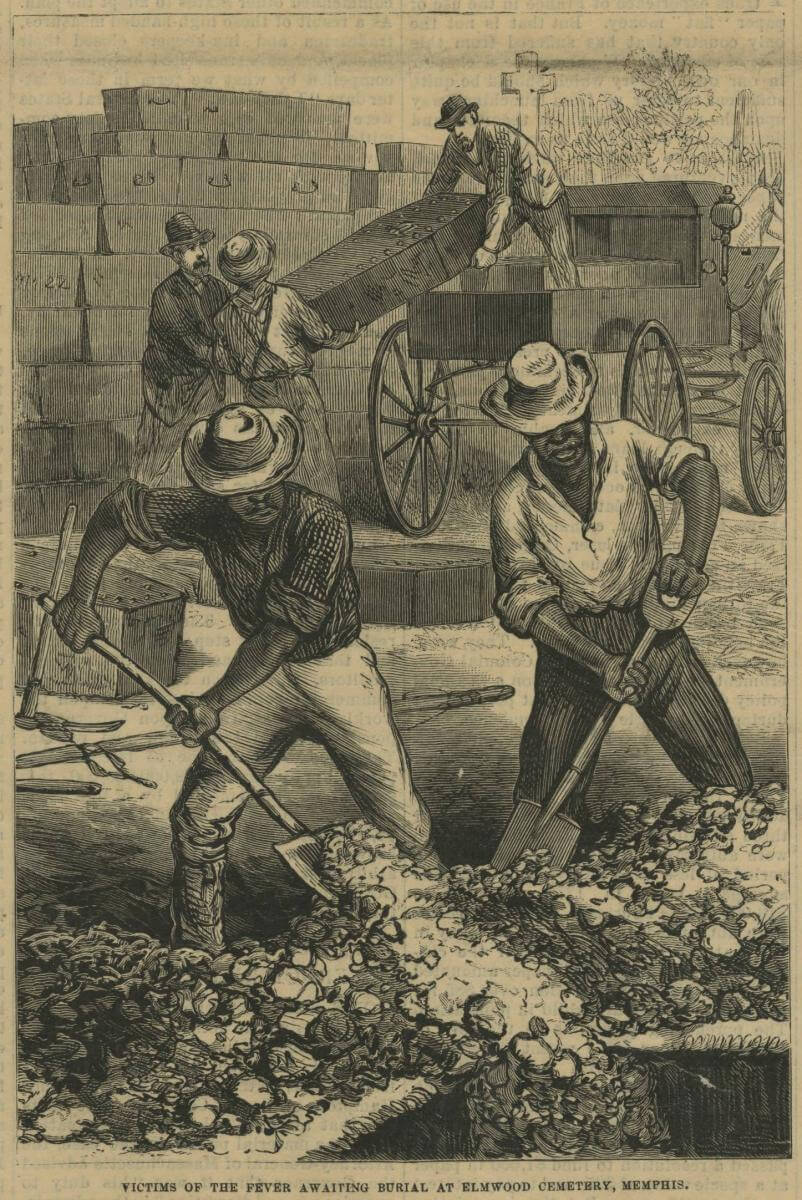
Yellow fever burial, Memphis, Tennessee, September 21, 1878. Illustration by unknown creator, published by Frank Leslie's Illustrated Newspaper. Courtesy of the Illustrations from Harper's Weekly Newspaper and Frank Leslie's Illustrated Newspaper collection, Digital Archive of Memphis Public Libraries.
"Despite all its glories," Hecke felt that New Orleans was "the unhealthiest place in the United States, and perhaps all of the Americas."30Ibid., 170–171. He noted "every year the yellow fever calls for its victims" in the Crescent City and that in the previous summer "one day after another, 100 [bodies] were lowered into the ground."31Ibid. He referenced the affliction's reputation as a strangers' disease, "so very dangerous not only for Europeans, but for northern Americans as well."32Ibid. Hecke's lament would be echoed in German settlement literature in the coming decades.
To emphasize the reach of the disease, Hecke wrote of a vessel anchored just outside of New Orleans during an outbreak. The ship carried "five young craftsmen who sought to take refuge [from yellow fever] in the northern states." After a short time removed from the port, each of the craftsmen fell ill. According to Hecke's informant, all five of them had fled only to perish before reaching their destination.33Ibid., 171. "No one [could] count on a long life in New Orleans, much less a comfortable one."34Ibid., 170–171.
Fellow Prussian artillery lieutenant Ignatz Hülswitt's portrayal of how yellow fever attacked and eventually killed its victims reads like a horror novel. Detailing the onset of this "fast-progressing and terrible disease," Hülswitt noted in the final stage, the victim could expect to endure "incessant vomiting and discharges of a black matter, which looks almost like tar" and "after a clear decline of all powers, strong jaundice, and maddening seizures, death usually comes on the seventh or eighth day." Hülswitt purportedly spoke from experience. Citing his own "irreplaceable loss," he claimed that during his time in Louisiana the disease had struck him down and robbed him of his "dear wife."35Ignatz Hülswitt, Tagebuch einer Reise nach den Vereinigten Staaten und der Nordwestküste von Amerika (Münster, Germany: Coppenrathschen Buch und Kunsthandlung, 1828), 306, 308. Hülswitt warned German readers that yellow fever resided "in the cities of Louisiana and causes much suffering," especially "among the newcomers."36Hülswitt, Tagebuch einer Reise nach den Vereinigten Staaten, 305–306. Despite praising the state as "indisputably one of the most beautiful in America," like Hecke, Hülswitt lamented his racial unsuitability for Louisiana.37Ibid., 304.
In a review of Hülswitt's work in the Neue Allgemeine Geographische und Statistische Ephemeriden, prospective immigrants to Louisiana were cautioned that, despite attaining a "comfortably furnished home on 160 acres of land," yellow fever had taken Hülswitt's wife and ravaged his constitution to the extent that he spent a year rehabilitating "without being able to recover from the effects of the fever."38Neue Allgemeine Geographische und Statistische Ephemeriden, (Weimar, Germany: Geographischen Institut und des Landes-Industrie-Comptoirs, 1830) 215. The affordability of land and the lure of prosperity came with dangerous consequences.
Unbeknownst to readers, Hülswitt may have fabricated the incident. Scholars have confirmed that he plagiarized much of his 1828 Diary of a Trip to the United States and the Northwest Coast of America from Englishman John R. Jewitt's Journal Kept at Nootka Sound: an account of Jewitt's abduction, enslavement, and eventual assimilation into the Nuu-chah-nulth tribe. While the portion of his book that dealt with his bout with yellow fever in Louisiana has not yet been attributed to any other author, there is no proof that Hülswitt traveled to America.39Peter Littke, “Ignatz Hülswitt, the German ‘John R. Jewitt’ at Nootka Sound?” The Initiative for Russian American History, April 2002, www.irah.eu. It's possible that Hülswitt's narrative of his family's bout with yellow fever was an attempt to exoticize an already sensational tale.
In 1835, encouraged by the swell of interest in travel narratives, Duke Friedrich Paul Wilhelm, a naturalist, explorer, and nephew of the first king of Württemberg, published his First Travels in North America, 1822–1824.40Friedrich Paul Wilhelm, Travels in North America 1822-1824, ed. Robert Nitske and Savoie Lottinville (Norman: University of Oklahoma Press, 1973), xiii. Having spurned the military life in pursuit of botany and other natural studies, "Duke Paul" set out to further the work begun by his idols, Meriwether Lewis and William Clark. As a self-styled expert of natural science, he believed himself an ideal candidate to report on the climate and ecology of Louisiana and its environs.41Ibid., xv, xiii–xx.
Paul Wilhelm of Württemberg. Image by unknown creator. Courtesy of Wikimedia Commons. Image is in public domain.
Landing in New Orleans, Wilhelm reports he was briefed on the recent yellow fever epidemic and felt blessed that a delay had kept him from arriving at its peak. "Many German countrymen who had not left," he reported, "had fallen victim to its plague."42Ibid., 34. The following year he escaped another yellow fever epidemic as it swept through. Returning to the city from yet another trip to the "interior of North America," Wilhelm was "saddened by the news of the death of a highly valued friend." He consequently declared "all strangers [should] shun New Orleans from June to November."43Ibid., 21, 34.
Like his counterparts, Duke Paul found much to appreciate in New Orleans. Enthralled by the city's commercial potential and the steamships that traveled the Mississippi, he wrote that "trade and population would increase enormously if the climate and unhealthful situation did not disturb both."44Ibid., 34. He had little faith in New Orleans's measures to combat yellow fever, noting that a "quarantine station intended to protect the city from contagious diseases" was too far up river to prove effective. Ships could disembark early and circumvent quarantine, enabling those exposed to the disease to "go unhindered in the city."45Ibid., 31.
That Wilhelm traveled through Louisiana at this time appears to be corroborated by other accounts. He purportedly crossed paths with a young German named Max who had escaped a yellow fever epidemic that had decimated St. Francisville, Louisiana. Max's account comes from letters edited and published by his father in Ulm alongside those of his sister and uncle in Excerpts from Letters from North America (1833).46Auszüge aus Briefen aus Nord-Amerika, geschrieben von zweien aus Ulm an der Donau gebürtigen, num in Staate Louisiana ansässigen Geschwistern (Ulm, Germany: E. Nübling Book Printers, 1833), 32–35, 51. Not to chance misinterpretation, Max's father emphasized his purpose for publishing his children's letters in an ominous foreword. He asked that "the youth and newly married couples who felt the impulse to emigrate to North America" heed this cautionary tale left behind, "especially the descriptions of the state of Louisiana and New Orleans."47Ibid., foreword.
In writing of a steamboat trip from New Orleans to Baton Rouge, Max noted the well-developed land and beautiful plantations.48Ibid., 22–23. He remarked on the affordability of life in Louisiana, adding that he and his uncle were able to rent their storefront, an African slave, and a wagon for only fifty-three Spanish talers per year.49Ibid., 28. Max expressed fear, however, of the area's becoming "unhealthy" by summer due to the annual flooding of the river and the formation of swamps as it receded.50Ibid., 25. That Max's unabashed participation in slavery and praise of Louisiana's economic accessibility is counterbalanced with fears of impending yellow fever presents a familiar theme.
Death of Aurelio Caballero due to yellow fever in Veracruz, 1892. Etching on zinc by José Guadalupe Posada. Courtesy of the Drawings and Prints department, The Metropolitan Museum of Art.
In a letter dated November 18, 1827, Max described an outbreak of yellow fever presumably brought by steamboat in September.51Ibid., 51. The disease initially spread among the unacclimated, "new arrivals and the older residents." Six weeks into the epidemic, Max reported that he had fallen victim. Suffering from inflamed eyes and a blackened tongue, he recalled feeling "an unusual accumulation" in his mouth, at which point he "pulled out a large piece of spalted black blood." Soon the blood poured out of his mouth and nose as doctors tried desperately to take his pulse. Max reported that he had "vomited about two sinks full of blood" that day and was failing fast. Miraculously, he made a full recovery, the lone survivor among those infected.52Ibid., 52.
Max's expressed concern for fellow Germans seeking to land in New Orleans during the summer months is also telling. In June 1828, he lamented that during his time in New Orleans, a ship "brought about 120 Germans of diverse ages" who were ill prepared to travel to the interior. Without sufficient money, they were forced to beg while the "heat during and after the flooding of the river…will soon bring about the Yellow Fever." Disheartened, Max knew that his "countrymen, who have come here so hearty and strong from healthy Germany, will fall without a fight as its first victims."53Ibid., 62–63.
When Max's sister Thekla came to America, he suggested that they meet in New York in the late fall and travel to New Orleans by steamship only after the fever season had ended. Despite their careful planning, Max reported the fever had lingered late that summer and was terrorizing New Orleans well into November. He noted that the twenty or so Germans on board decided to immediately travel north "for the sake of the preservation of their health." According to Thekla's account, she and Max retired to their quarters where they held each other and cried—praying the fever would leave them unscathed. Upon their arrival, Max and Thekla heeded the advice of "some experienced Germans" to remain onboard rather than risk entering the city.54Ibid., 148. While they survived the ordeal, Max and Thekla's letters emphasized the danger posed to Germans by yellow fever in the Gulf South. The lesson Max's father intended comes through loud and clear—wanderlust had perilous consequences.
The authors of this first period of travel and settlement literature placed more emphasis on personal observation buttressed by hearsay than scientific analysis. Even self-styled naturalists, such as "Duke Paul" and Johan Valentin Hecke, offered little data, aside from notions of yellow fever's limited range from the sea. During the mid-nineteenth century, the "Wissenschafts-popularisierung" (the popularization of science) became more apparent. Just prior to the height of German immigration to the United States, writers would provide scientific evidence that explain earlier observations and explore the presumed relationship between southern climates and German bodies that made them more susceptible to yellow fever.
"Too Far South": Yellow Fever, Race, and German Fears, 1830–1845
Beginning in the 1830s, there was a perceivable shift from travel and adventure narratives towards settlement guides and treatises on medical geography. Of particular interest were the increasingly prevalent theories of acclimation, as well as the utilization of latitudinal coordinates to pinpoint unhealthy areas for German immigration. The shift in emphasis from dissuading settlement in New Orleans to debating its merits merely as a viable port of entry for Germans settling elsewhere suggests that the unhealthy nature of the climate was increasingly taken for granted.
Cover of Gottfried Duden's Report on a Journey to the Western States of North America (Columbia: University of Missouri Press, 1980).
The most well known German travel and emigration author of the nineteenth century, Gottfried Duden, extolled the virtues of the slave state of Missouri for prospective German immigrants in his Report on a Trip to the Western States of North America (1829).55Gottfried Duden, Bericht über eine Reise nach den westlichen Staaten Nordamerikas (Elberfeld, Germany: S. Lucas, 1829). Reprinted three times, his Report became so popular that German authorities feared it might inspire a mass exodus to Missouri.56Robyn Burnett and Ken Luebbering, German Settlement in Missouri: New Land, Old Ways (Columbia: University of Missouri Press, 1996), 10. Historians have long noted the significance of Duden's Missouri boosterism,57Robert Frizell, Independent Immigrants: A Settlement of Hanoverian Germans in Western Missouri (Columbia: University of Missouri Press, 2007), 29; Conevery Bolton Valenčius, Health of the Country: How American Settlers Understood Themselves and Their Land (New York: Basic Books, 2002), 37; Richard O’Connor, The German-Americans: An Informal History (Boston, MA: Little, Brown, and Company, 1968), 68–70; Rippley, The German-Americans, 44. but his remarks on the southern limits of German settlement and yellow fever's role in establishing them have been largely ignored. Duden advised his readers to stay north of "settlements at the mouth of the Arkansas [River]," some 325 miles north of New Orleans, as they were "perhaps too far south." The main reason for his admonitions was yellow fever, which he claimed struck the Crescent City "almost every summer."58Duden, Bericht über eine Reise nach den westlichen Staaten Nordamerikas, 165–166, 328.
Duden argued that the dangers of yellow fever and other tropical diseases kept Germans from areas in which slavery was most depraved. In the middle states, like Missouri, he contended, slavery was a relatively benign institution, comparing favorably to domestic servitude in Europe, and often in the best interests of the enslaved. The greatest obstacle slaves faced to freedom, Duden believed, was their racial inferiority. He asserted that no amount of education or betterment could undo thousands of years of being exposed to debilitative, and inferior, climates.59Ibid., 142–143.
Duden maintained that Germans could not saunter into a tropical climate without prolonged seasoning.60Ibid., 328. He cautioned readers not to be enticed by the availability of inexpensive tracts of land where their health would be imperiled. Germans, he argued, should settle in Missouri, preferably near St. Louis.61Ibid., 328, 330. While he recommended traveling there from New York or some other northeastern port, he conceded that traveling to Missouri by way of New Orleans was feasible, so long as one embarked from Germany no later than "December or January so that they arrive when there is no danger from yellow fever."62Ibid., 332.
Observing that many Europeans survived in cities such as New Orleans seemingly unaffected by diseases such as yellow fever, Duden based his concepts of acclimation and seasoning on a version of racialized climate theory in which racial traits were somewhat mutable.63Ibid., ix–xiv, 110. Seasoning or acclimation attempted to scientifically explain yellow fever's reputation as a strangers' disease. When his methods of acclimation failed and the promise of his Missouri boosterism went unrealized, Duden came to be known in many settlements of the mid- to upper Mississippi River Valley as "Duden der Lügenhund" (Duden the Lying Dog).64T.S. Baker, “America as the Political Utopia of Young Germany,” Americana Germanica 1 (1897): 78.
Letter from Gustave P. Koerner to Abraham Lincoln, Springfield, Illinois, October 8, 1861. Courtesy of the Library of Congress Abraham Lincoln Papers, Manuscript Division, memory.loc.gov/cgi-bin/ampage?collId=mal&fileName=mal1/123/1235900/malpage.db&recNum=0.
A young Gustav Koerner took exception to Duden's proclamations. As an abolitionist fresh off the boat from Frankfurt in 1833, Koerner would become Illinois's most renowned German son as well as a political confidant and close friend of Abraham Lincoln.65Jack Le Chien, “We Must Make Them Understand Lincoln is Our Man,” ed. Molly McKenzie (Bellville, IL: Koerner House Restoration Committee, 2011), 14. In his Illumination of Duden's Report on the Western States of North America, from America (1834), Koerner encouraged the German public to question Duden's observations regarding the health of St. Louis. In particular, he questioned how a city in constant contact with New Orleans, a locality known to harbor "diseases of all kinds, but especially yellow fever," could possibly be considered healthy. Koerner cited longtime residents of St. Louis who confirmed that the health of the city worsened since the advent of regular steamboat traffic to and from New Orleans.66Gustav Koerner, Beleuchtung des Duden’schen Berichtes über die westlichen Staaten Nordamerikas, von Amerika aus (Frankfurt, Germany: Karl Körner, 1834), 28. It is important to acknowledge Koerner's role as a booster in Illinois. Both Duden and Koerner were selling the virtues of a place to prospective immigrants. Disagreements aside, they agreed on two principles: the universal condemnation of New Orleans as being host to endemic yellow fever (ungesund) and that Germans who settled too far south did so at their peril.
German-born academic and journalist, Francis Grund, echoed Duden's theory of acclimation in a piece for the Ausberger Allgemeine Zeitung, entitled "Die Colonisation von Liberia." Published in 1840, the article was sectionally biased. As the anti-slavery Grund lived in the North, his article about the colony of Liberia begun by the American Colonization Society offered few kind words for the South's peculiar institution. In his discussion of African Americans' perceptions of Liberia as a "morgue for the blacks," he made a corollary observation of yellow fever and the southern United States. Writing that blacks and "acclimated" residents of the South need not fear "this scourge of Mankind," Grund voiced another reminder that yellow fever was a strangers' disease and that those foreign to the South risked infection and their lives when this "yearly" affliction struck.67Duden, Bericht über eine Reise nach den westlichen Staaten Nordamerikas, ix–xiv, 110.
The yellow fever scourge in Florida, September 8, 1888. Illustration by unknown creator, published by Frank Leslie's Illustrated Newspaper. Courtesy of the General: Reference collection, Florida Memory website, The State Archives of Florida.
So influential were Grund's opinions of the US that one scholar referred to him as "The Jacksonian Tocqueville."68Holman Hamilton and James L. Crouthamel, “A Man for Both Parties: Francis J. Grund as a Political Chameleon,” Pennsylvania Magazine of History and Biography 97 (1973): 465–484. Alongside observations of culture and politics in his 1835 Die Amerikaner (The Americans), Grund offered a chastising observation of the climate in the Carolina Low Country. He warned that the region was "visited each year by the yellow fever" and insisted that even the interior or rural portions of the Carolinas and Georgia were not safe.69Francis Grund, Die Amerikaner: in ihren moralischen, politischen, und gesellschaftlichen Verhältnissen (Stuttgart, Germany: J.G. Cotta’schen Buchhandlung, 1837), 363.
German observers often suggested what areas were "healthy" for German bodies. Friedrich Schmidt's Account of the Politics and Moral Condition of the United States of North America in the Year 1821 was published shortly after Hecke's first volume. Schmidt was quick to address the mania surrounding German emigration and in his use of medical geography and latitudinal coordinates, he was a pioneer. He offered five observations as to "which areas of North America are especially unhealthy and which states might be beneficial for Europeans."70Schmidt, Versuch über den politischen Zustand der Vereinigten Staaten von Nord Amerika im Jahre 1821, 82.
Schmidt wrote that American climates were subject to rapid change and posed a potential threat, but that all areas south of "thirty-six degrees north latitude" were tropical and would "devastate European constitutions." He warned of uncultivated soils and "the reigning diseases" of the "southern and western states" that caused "exhaustion and death among Europeans and Americans." And significantly, he claimed that the "healthiest and most beneficial areas in North America for Europeans, are the states of Pennsylvania, New York, and around the southern parts of Ohio and Indiana."71Ibid., 82. As the maps accompanying this essay show, these states displayed high rates of settlement among German-born immigrants.
Ludwig Gottfried Blanc. Image by unknown creator. Courtesy of Wikimedia Commons. Image is in public domain.
Written fifteen years later by renowned preacher, philologist, and professor of Romantic Languages at the University of Halle-Wittenberg, Ludwig Gottfried Blanc's Handbook of Essential Knowledge of the Nature and History of the Earth and its Inhabitants (1837) was a comprehensive study intended for a broader audience of fellow Germans.72Ludwig G. Blanc, Handbuch des Wissenswürdigsten aus der Natur und Geschichte der Erde und ihrer Bewohner Vol. 3 (Halle, Germany: C.H. Schwetschke und Sohn, 1837). In "The United States of North America" under the subheading of "Climate," Blanc summarized the health of the US landscape. "[T]he East Coast," he wrote, "particularly from 40° South [latitude] is, for the most part, unhealthy, and most so in the southern states." Blanc singled out the "terrible yellow fever" as the "main plague of these areas," adding that in the hotter southern states even the interior was susceptible to its devastation.73Ibid., 471.
Blanc remarked favorably on the salubrity of New England, but claimed that the "interior states, between 36° and 42° are, by far, the most healthy."74Ibid., 454. This area included Ohio, Indiana, Kentucky, Illinois, Iowa, Missouri, and the southern portions of Michigan and Wisconsin where, by 1860, over half of the German-born US population resided. If the western portions of Pennsylvania and New York were included as "interior states," the proportion would rise to roughly three-quarters.75Compiled from the Original Returns of the Eighth Census 1860a-15 (Washington, D.C.: Government Printing Office, 1864), 621. For Blanc, the yellow fever zone extended down the eastern seaboard from New York City, with an increase in virulence and general unhealthiness the further south one traveled. He was especially critical of the coastal areas from Maryland southward, reserving particular scorn for Georgia, Alabama, Mississippi, and Louisiana.76Blanc, Handbuch des Wissenswürdigsten, 479–492.
While differing in content and methods from earlier travel and adventure narratives, the settlement guides of 1830–1845 came to very similar conclusions, emphasizing the destructive power of yellow fever and its relation to southern geography. Rather than take a chance on acclimation, it was better to avoid the area altogether. On the eve of the greatest period of German immigration to the United States, prospective immigrants were inundated with warnings about the lower Gulf South, and particularly New Orleans. With the question of where to settle, one question remained: was New Orleans still a viable port of entry for Germans heading for California, Texas, and the upper Midwest?
Just Passing Through: New Orleans, 1845–1860
Death as a sailor bringing yellow fever to New York. Illustration by unknown creator, published by Frank Leslie's Illustrated Newspaper. Courtesy of the Civil War Profiles website.
The emphasis of German writings of the late 1840s and 1850s shifted to discussing the viability of New Orleans as a port of entry for immigrants planning on settling outside the Gulf South. Despite the threat of yellow fever, writers acknowledged New Orleans as an economical port for those heading to the US interior. Even here, there were stipulations, the most damaging of which dealt with the time of year to arrive to avoid yellow fever.
George M. von Ross, an American of German descent and a well-known booster of German immigration to central Texas, wrote several guides. While affirming New Orleans as an economical alternative to ports in the Northeast, Ross, in his 1851 The Emigrants' Handbook, warned that those who sought to immigrate through New Orleans "must avoid landing during the period of July to November" or they would "risk finding [the city] haunted by yellow fever upon their arrival."77Ross, Die Auswanderers Handbuch, 404. Books by Gabriel Auguste van der Straten-Ponthoz and Traugott Braume shared Ross's concerns and warnings.78Gabriel Auguste van der Straten-Ponthoz, Forschungen uber die Lage der Auswanderer in den Vereinigten Staaten von Nord Amerika (Augsburg, Germany: K. Kollman Publisher, 1846), 79–80. Braume, in particular, suggested that those headed for the interior of Texas were better off landing in Galveston which, despite being host to yellow fever on occasion, he deemed a safer alternative.79Traugott Braume, Hand- und Reisebuch für Auswanderer und Reisende nach Nord, Mittel, und Süd-Amerika (Bamberg, Germany: Buchner Publishing, 1853), 612–613.
Auswanderer-karte und wegweiser nach Nordamerika, Emigration map and guide to North America, Stuttgart, Germany, 1853. Map by Gotthelf Zimmermann, published by J.B. Metzler'schen Buchhandlung. Courtesy of Library of Congress Geography and Map Division, loc.gov/resource/g3701e.ct000244/.
Established in 1847, the Deutsche Gesellschaft von New Orleans (DGNO) sought to increase German immigration through the Crescent City. It provided inexpensive or free services to those heading to the interior, and tried to protect German immigrants from fraudulent travel "brokers," false baggage handlers, and yellow fever. The organization did not actively recommend New Orleans as a final destination, but aspired to make the city the primary port of entry for German-speakers.80Historic New Orleans Collection (HNOC), Deutsches Haus Collection 1847–1983 EL 1. 1984 Item 1—Die Deutsche Gesellschaft von New Orleans, Louisiana. 1848–1888.
The DGNO closed its first annual report with an unattributed quotation that eventually found its way into the Central Association of German Emigration and Colonization's 1852 circular "To all who want to emigrate!" It advised prospective German emigrants to:
...remain in the land that nourishes you fairly because you come to a country where climate, language, customs and traditions are quite different from your own. There have been many cases in which immigrants have befallen the bitterest price of woes, regretted the reckless step taken, and who, though often in vain, must beg for the means to return to the homeland.
The circular noted that those who sought "to improve their situation" were "only too often met by a terrible awakening." For "malignant fever is almost inevitable everywhere and is often fatal if the right care cannot be found."81Landeshauptarchiv Koblenz. Inventory: 441, No. 24, 215. www.t-stoffel.de/QUELL/Quellen/An%20alle%20die%20auswandern%20wollen%202.htm.
While originally conceived as an organization to protect German immigrants from false agents and travel brokers, the DGNO realized quickly that disease posed an even greater threat and understood their "special duty to advise immigrants to schedule their arrival during a time in which the city is free from yellow fever." Further it stressed that "no embarkation from Europe should proceed later than the beginning of May . . . [or] until the end of September."82HNOC, Deutsches Haus Collection 1847–1983 EL 1. 1984 Item 1—Die Deutsche Gesellschaft von New Orleans, Louisiana. 1848–1888.
The data that the DGNO gathered between 1847 and 1860 when juxtaposed against the census figures of 1850 and 1860 explain the settlement patterns of Germans who landed in New Orleans. Of the 233,374 immigrants the society processed, sixty percent boarded steamships upriver upon their arrival. Seventy-five percent of that number chose St. Louis and its surrounding environs as their destination with just over twenty-three percent headed for the Ohio River Valley. The rest set out for Texas and, to a lesser extent, California. The remaining 63,665 were identified as either unsure of their final destination, withheld that information from the society, or had decided to remain in New Orleans for the time being. The society did not track those who migrated after their processing. Given that the German population of Louisiana was 24,614 in 1860—having only grown by 6,727 since 1850—it is safe to assume that the majority of the 63,665 who did not make immediate travel arrangements eventually migrated out of the region. Only five percent of the total German immigration occurred during the peak fever months of July, August, and September and sixty-five percent avoided arriving from the end of May to the first of November.83Ibid.
A girl suffering from yellow fever. Watercolor by unknown creator. Courtesy of Wikimedia Commons. Creative Commons license CC BY 4.0.
The majority of German immigrants made arrangements in advance of their arrival to settle in areas deemed "healthy." The timing of their arrival suggests that they heeded the settlement literature's advice and almost unanimously avoided New Orleans during peak yellow fever months even in years when the disease was not epidemic. May, the month immediately preceding the yellow fever season, was the third highest month for German immigration to New Orleans. High numbers in November and December could be explained away by the avoidance of frozen rivers in the North, but seeing immigration peak immediately before and after yellow fever season suggests more. An even clearer picture becomes apparent when we combine data from the DGNO and U.S. Census with the gestalt of the geographic recommendations of the settlement literature (see "Mental Map of Yellow Fever" maps).
Cover page of J.W. McClung's Minnesota as it is in 1870, (St. Paul, Minnesota, 1870). Courtesy of the Library of Congress General Collections and Rare Book and Special Collections Division, loc.gov/resource/lhbum.01092/?sp=1.
Yellow fever and antebellum German perceptions of its hold on the Gulf and Atlantic Coastal South contributed significantly to their avoidance of these areas. Kindled by the vast expanse of the Louisiana Purchase, travel and settlement writing as well as the discourse of medical geography contributed to the popularization of scientific knowledge (Wissenschafts-popularisierung). The American frontier provided economic and scientific opportunity to observers and newcomers brimming with new ideas about the relationship between health and the land. The explosion of European immigration to the United States had an immediate and lasting effect, as German and Irish immigrants moved into US cities seeking a better life.
Germans, in particular, sought out the expanse west of the Appalachians and, if the extent of writing presented in this essay is any indication, they were considerably well informed as to the politics, economics, and health of the Gulf and Atlantic Coastal South. This is not to say that they came prepared. With published accounts of an unknown land in mind and far less money and resources than needed, they arrived in New Orleans by the hundreds of thousands: most of them promptly boarded a steamship and traveled up the Mississippi to what they hoped would be healthier country.
About the Author
Paul Michael Warden is a PhD candidate at the University of California, Santa Barbara and a visiting scholar in Harvard's Department of the History of Science. His dissertation focuses on how yellow fever shaped the medical imagination and development of antebellum New Orleans. His broader research examines how ecology and geography intersect with period medical and scientific theory within early American history.
]]>
Georgia, 1831. Map by Young & Delleker, Sc. Published by A. Finley. Courtesy of the Historic Maps collection, Georgia Archives, University System of Georgia.
Georgia led the United States in the expulsion of the Cherokee Nation from its homeland. In the spring of 1838 more than two thousand soldiers arrested some nine thousand Georgia Cherokees, confined them briefly, then marched them to holding camps in east Tennessee to await their miserable trek to Indian Territory eight hundred miles away. Removed from Georgia in June, the last detachment of Cherokees left the Tennessee camps in November. Images of grieving Natives stumbling westward seized the popular imagination, throwing into shadow the record of how, why, when, and where the expulsion began. In succeeding years, the emphasis on suffering reduced the Cherokees to anonymous victims and obscured the activities of those who enabled and enforced their expulsion. The missing accounts of Cherokee removal emerge most vividly in the stories of each removal site. As the home of the Cherokee Nation's most prominent leaders and the location of two military removal stations, Rome, Georgia has much to teach.
Measuring Chains and Axes
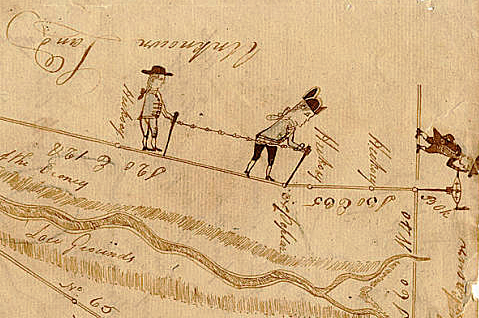
Detail of "Doodle" Plat showing a drawing of land surveyors, from a plat of Georgia land granted to William Few, ca. 1784. Courtesy of the Ad Hoc collection, Georgia Archives, University System of Georgia.
An early history of Rome1George Magruder Battey, Jr., A History of Rome and Floyd County, State of Georgia, United States, Including Numerous Incidents of More Than Local Interest, 1540–1922 (Atlanta, GA: The Webb and Vary Co., 1922), 33–4; Jerry R. Desmond, Georgia's Rome: A Brief History (Charleston, SC: The History Press, 2008), 28–30. Author of the popular history of the city and county, Battey was the son-in-law of founder William Smith. On Dec. 21, 1833, the Georgia General Assembly incorporated Livingston as a town and designated it the county seat of recently-formed Floyd County: Acts of the General Assembly of the State of Georgia, 1833 (Milledgeville: Polhill and Fort, 1834), 321–22 (hereafter Ga. Acts). describes the city's founding as an inspiration that sprang from the chance encounter of enterprising lawyers with a gracious planter. According to the idyll, attorneys Colonel Daniel Randolph Mitchell and Colonel Zachariah Branscomb Hargrove were traveling by horseback in the spring of 1834 to the Floyd County courthouse in Livingston. The men "hauled up at a small spring" and dismounted to slake their thirst. As they relaxed under a willow tree, they gazed across the small peninsula lying at the convergence of two rivers. On one side of the peninsula, the Etowah River meandered eastward more than one hundred sixty miles to merge with the Oostanaula River that ran some fifty miles from the north and east. The two waterways joined at the peninsula's tip to form the Coosa River that flowed west into the Alabama River and marked the western boundary of Georgia.
Eyeing the landscape, Hargrove exclaimed, "This would make a splendid site for a town!" An approaching stranger, Major Philip Walker Hemphill, overheard Hargrove and joined in agreement, "having been convinced for some time" the site offered "exceptional opportunities for building the largest and most prosperous" city in the region. Continuing their conversation, the three journeyed some two miles south along the Cave Spring Road to Hemphill's "comfortable plantation home," the Alhambra, and began planning a city. The major's cousin, General James Hemphill, was entering the legislature the next session and could be relied on to relocate the county seat from Livingston to the proposed site. After including Colonel William Thornton Smith in their initiative, the foursome would need to acquire "all available land" and procure rights to the ferries essential for crossing the three rivers. Smith agreed to join the coalition and the four men signed "a contract along these lines" in the Floyd County Inferior Court. They left details to their friend, attorney John H. Lumpkin, who had recently resigned as secretary to his uncle, Governor Wilson Lumpkin.2Battey, History of Rome, 33–4. The rest, some say, is history. But it is not the whole story.
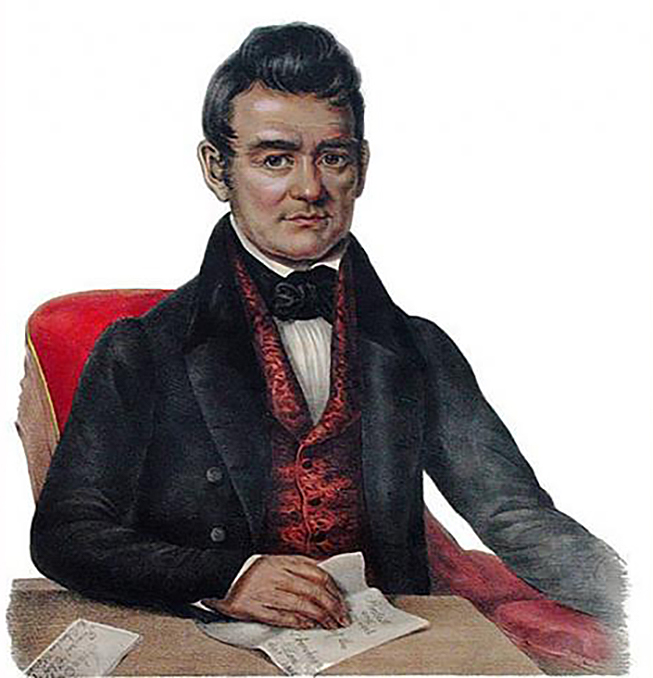
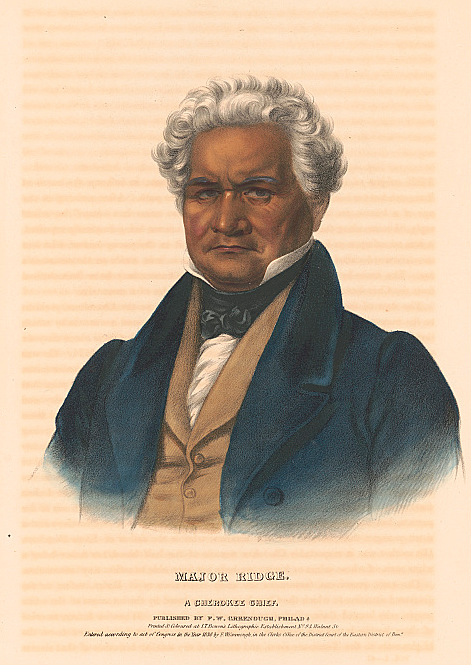
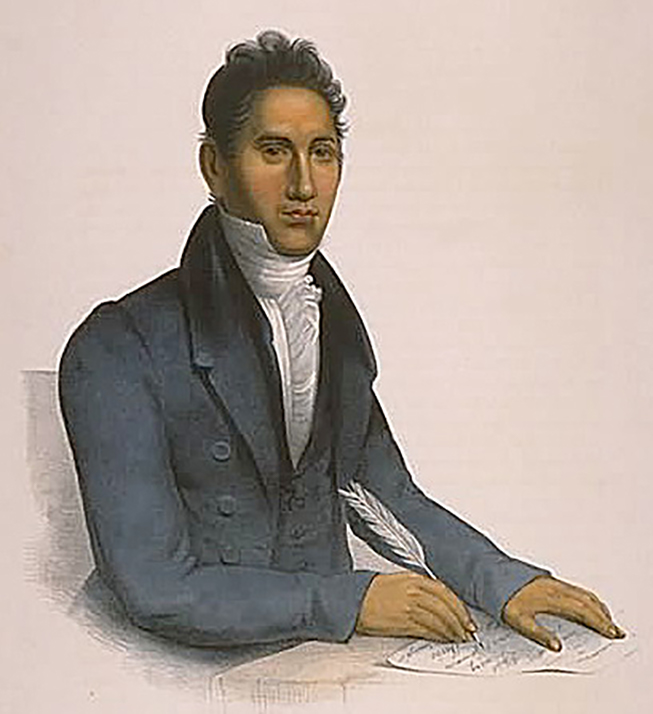
Top, John Ross, A Cherokee Chief, Philadelphia, Pennsylvania, 1843. Hand-colored lithograph on paper by Alfred M. Hoffy. Courtesy of the National Portrait Gallery, Smithsonian Institution. Middle, Major Ridge, a Cherokee Chief, Washington, D.C., 1838. Hand-colored lithograph by John T. Bowen. Courtesy of Library of Congress Prints and Photographs Division, loc.gov/resource/ppmsca.24339. Bottom, John Ridge (ca. 1802 – June 22, 1839), 1825. Portrait by Charles Bird King. Courtesy of Wikimedia Commons. Image is in public domain.
Other histories course beneath the soothing narrative of Rome's founding. When the visionaries began planning, some nine hundred Cherokees lived along the Etowah, Oostanaula, and Coosa Rivers and tributaries, including Principal Chief John Ross and Cherokee Nation leaders Major Ridge and his son, John. The site chosen for the city was the heart of the Cherokee Nation that had been gradually reduced to contiguous portions of four southeastern states. Events in Georgia portended even greater change. Between 1830 and 1838, Cherokees struggled to retain their homes, farms, and freedom while Georgia, followed by other states, asserted sovereignty over them and claimed rights to their land. In December 1831, the state legislature identified the Cherokee Nation in Georgia as Cherokee County. A bill the following year subdivided Cherokee County into nine additional counties. Approximately five hundred square miles of land bordering Alabama was designated as Floyd County in honor of Creek Indian fighter and state militia commander General John Floyd. Determined to force the federal government to fulfill its unique agreement to eliminate Indian land title, Georgia authorized a survey of Cherokee land within the state's purported boundaries and ordered a lottery for its distribution. On May 24, 1832, John Harvey completed his survey of Floyd County, having marked the property of all resident Cherokees including John Ross, Major Ridge, and John Ridge.3Ga. Acts, Dec. 26, 1831 (Milledgeville, GA: Prince and Ragland, 1832), 74–6. The state added portions of Habersham and Hall counties, which had been acquired from the Cherokees in the Treaties of 1817 and 1819, to Cherokee County and then subdivided the entire area into nine additional counties: Historical Atlas of Georgia Counties, http://georgiainfo.galileo.usg.edu/histcountymaps/index.htm; Ga. Acts, Dec. 3, 1832, http://neptune3.galib.uga.edu; Daniel Haskel and J. Calvin Smith, A Complete Descriptive and Statistical Gazetteer of the United States of America (New Haven: Hitchcock and Stafford, 1843), 216; Ga. Acts, Dec. 21, 1830 (Milledgeville: Camak and Ragland, 1830), 127–145; Field Notebooks, Survey Records, Cherokee County, Georgia Surveyor General, RG 3-3-3, Georgia Archives, Morrow, GA.
While surveyors such as Harvey carted measuring chains and axes across the farms and fields of the Cherokees, Georgians registered for the October lotteries that would distribute their land to so-called fortunate drawers. Anticipation ran high. Georgia was the only state in the nation that dispensed Native land by public lottery. The purpose of the policy was to attract white settlement, avoid concentrations of land-based wealth, and provide credibility to the legislators who wrote the land laws.4The legislature introduced the lottery system following the infamous Yazoo frauds of the 1780s and 90s in which General Assembly members sold millions of acres of Georgia's western lands to speculating companies. The 1795 sale included bribes to legislators, state officials, and other prominent Georgians. See C. Peter Magrath, Yazoo: Law and Politics in the New Republic (Providence, RI: Brown University Press, 1966); George R. Lamplugh, "Yazoo Land Fraud," New Georgia Encyclopedia, Sept. 14, 2015. Inevitably, the procedure spurred white resentment toward Native Americans who resisted appropriation of their land and toward the federal government that was supposed to protect and negotiate with Indians. Between 1805 and 1827, the state held five lotteries to give away land that had belonged to the Muscogee Creek Indians. After the Creeks were expelled from the state in 1826, Cherokees remained the only obstacle to Georgia's expansion. Their lands were the last that would be offered in the state's public lotteries.
A map of that part of Georgia occupied by the Cherokee Indians, 1831. Map by John Bethune. Courtesy of Library of Congress Geography and Map Division, lccn.loc.gov/2004633028.
Georgia Lotteries and Native Lands
Responding to dwindling opportunities, 85,000 white Georgians registered for the first of two Cherokee lotteries held in 1832. When the lottery drums stopped turning, more than eighteen thousand land parcels of 160 acres each had been awarded to fortunate drawers.5Among the winners were Philip W. Hemphill, then of Jackson County, who won a lot on the Oostanaula River in what became Murray County, and William Smith, possibly the same as the fourth founder, who won a lot on the same river in the same county: James F. Smith, The Cherokee Land Lottery (New York: Harper and Brothers, 1838), 245, 257; Farris W. Cadle, Georgia Land Surveying History and Law (Athens: University of Georgia Press, 1991), 278; Hoyt Bleakley and Joseph P. Ferrie, "Up From Poverty? The 1832 Cherokee Land Lottery and the Long-run Distribution of Wealth," National Bureau of Economic Research working paper 19175, June 2013, http://www.nber.org/papers/w19175. There were no gold lots in Floyd County. The second (and concomitant) lottery, which offered forty-acre parcels in the Cherokee gold belt, attracted 133,000 additional Georgians and dispensed 35,000 more land prizes. The numbers reveal a dimension of the challenge facing Cherokees: in a one-year period, nearly 219,500 Georgians enrolled in lotteries to sate a land hunger the lottery system fueled.
Advertisement for Gold and Land Lotteries. Published in the Southern Banner, August 17, 1832, p. 3. Athens Historic Newspapers Archive, Digital Library of Georgia.
The drums turned from late October 1832 through April 1833. Publications broadcast the names, counties, and lot numbers of winners, sparking a rush of land speculation.6Gold & Land Lottery Register (Milledgeville, GA: Grieve and Orme, 1833); Prizes Drawn in the Cherokee Gold Lottery of the 1st, 2nd, and 3rd Quality, with their Improvements and Drawer's Name and Residence (Milledgeville, GA: M. D. J. Slade, 1833); Robert S. Davis, Jr., The 1833 Land Lottery of Georgia and Other Missing Names of Winners in the Georgia Land Lotteries (Greenville, SC: Southern Historical Press, 1991). In December 1833, the state held a final lottery to finish dismantling the Cherokee Nation in Georgia. Some fifteen hundred remaining parcels and fractional parcels were awarded to Georgians. Month after month, Cherokee delegations lobbied Congress for redress while President Andrew Jackson sustained state initiatives and Georgians grew impatient for possession. As rising tension elevated the potential for violence, numbers increasingly favored the Georgians. Fewer than nine thousand Cherokees lived on land sought by nearly 220,000 Georgians and awarded to 54,500 winners.7The 1835 Cherokee census, undertaken by the federal government in anticipation of removal, enumerated 8,945 Cherokees in Georgia. Inaccuracies and contradictions derived from the refusal of some Cherokees to participate, the movement of families across state lines to avoid conflict or persecution, voluntary emigration after the census but prior to the expulsion, and deaths: "The 1835 Cherokee Census," Monograph Two, Oklahoma Chapter Trail of Tears Association (Park Hill, OK: 2002), 66. Lottery winners exceeded the total number of Cherokees in Georgia by a ratio greater than six to one. The Georgians' avidity for land, the president's refusal to intervene, and the state's oppression of Cherokees provided Rome's founders with "exceptional opportunities for building the largest and most prosperous city" in the area.8Battey, History of Rome, 33–4.
Impatience for Cherokee land and expulsion swept the state. Although state laws barred whites from taking property still occupied by Cherokees, Georgians easily ignored the sanctions. The Cherokee newspaper, The Phoenix, protested in 1832 that "fortunate drawers (so called) of our land have been passing and repassing single and in companies" across inhabited lots. Unconcerned with restrictions, Georgians roved "in search of the splendid lots which the rolling wheel had pictured to their imaginations," cheerfully asking resident Cherokees which parcels they occupied.9The Cherokee Phoenix, Nov. 24, 1832, reprinted in "From the Cherokees," The Pittsburgh Weekly Gazette, Jan. 11, 1833, 2, http://www.newspapers.com; The Cherokee Intelligencer, Feb. 23, 1833, 1, March 9, 1833, 4, and May 11, 1833, 1, Grisham-Magruder Newspaper Collection, Unprocessed Manuscript Collection Number 2001, 57, Kenan Research Center, Atlanta History Center, Atlanta (hereafter G-M Collection, AHC). In the winter of 1833, newspapers advertised maps of the Cherokee counties with "all Mountains, Rivers, Creeks, Branches, Roads, ferries, etc. delineated correctly and faithfully." The maps were atlases of opportunity for speculators and entrepreneurs. Enterprising Georgians promoted themselves as land appraisers, guides, innkeepers, attorneys, and merchandizers in the new counties.10Among many, see William J. Tarvin's offer to supply surveyors at New Echota, April 3, 1832, 3, John Dawson's advertisement for his inn at the house known as Cherokee Sally Hughes's place, Sept. 14, 1832, 4, John Powell's offer to test gold lots for lottery winners, Nov. 24, 1832, 3, and James Nisbet's announcement of his law practice in Vann's Valley, Floyd County, April 20, 1833, 3, all in The Southern Banner, http://athnewspapers.galileo.usg.edu. As the year closed, Governor Lumpkin informed the General Assembly that the state now had "settled freeholders across land hitherto the abode of people wholly unqualified to enjoy the blessings of wise self government."11"Message of the Governor to the General Assembly, Nov. 5, 1833," in The Western Herald, Nov. 16, 1833, 4, G-M Collection, AHC.
Cherokee Ruptures and Realignments
Detail of Treaty regarding Georgia's Western Lands, 1802. Courtesy of the Ad Hoc collection, Georgia Archives, University System of Georgia.
From the earliest days of the American republic, federal regulations had guarded Cherokee interests but such protection vanished under Jackson. Encouraging the state's policies as "rights" superior to federal law, he refused to enforce the Supreme Court's 1832 decision that condemned Georgia's sanctions and affirmed Cherokee sovereignty.12The 1802 Compact between the federal government and the state of Georgia provided for federal extinction of Indian land title in exchange for state relinquishment of its western lands. No other state had such a compact. Chief Justice John Marshall handed down the Worcester v Georgia landmark decision on March 3, 1832. Condemning Georgia's laws as "repugnant to the Constitution, laws, and treaties of the United States," the decision confirmed the independent political status of Indian nations, which made their consent to land cessions a legal imperative. For a useful discussion, see Jill Norgren, The Cherokee Cases: The Confrontation of Law and Politics (New York: McGraw-Hill, 1996). In the context of Jackson's defiance, opposing strategies for survival emerged among Cherokee leaders. They could continue seeking Congressional intervention until Jackson's term expired, abandon resistance and emigrate voluntarily, or negotiate in the usual treaty process that cloaked the federal government with a mantle of legality. In the spring of 1833, Cherokee leadership fractured as John and Major Ridge openly abandoned the established policy of refusing removal agreements. Forming alliances with Georgia Governor Lumpkin and federal officials, the Ridges began to seek a treaty.13See, for example, John Ridge to Wilson Lumpkin, Sept. 22, 1833, http://neptune3.galib.uga.edu. Ridge's letter was "of course, not for publication."
Andrew Jackson, ca. 1825–1837. Portrait by Ralph Eleaser Whiteside Earl. Courtesy of Wikimedia Commons. Image is in public domain.
The rupture among the Nation's leaders altered the Cherokee political and cultural landscape. John Ridge's Floyd County home at Running Waters became the setting for meetings with his followers and federal agents to negotiate a treaty and removal.14Justice John McLean met with John Ridge to inform him that Jackson would ignore the decision: see John Ross to William Wirt, June 8, 1832, The Papers of John Ross, Vol. 1, 1807–1839, ed. Gary E. Moulton (Norman: University of Oklahoma Press, 1985), 244–45 (hereafter Moulton, ed., Ross Papers); "Memorial of a Council held at Running Waters, Nov. 28, 1834, 23rd Cong., 2nd Sess., Doc. 91, 1–19. Major Ridge, the wealthy proprietor of an Oostanaula River ferry and store five miles from Running Waters, shared treaty party leadership with his son. Just two miles south of Major Ridge's, Ross directed the Nation's adamant refusal to cede land, negotiate treaties, or emigrate west. Commanding loyalty from the majority of Cherokees, Ross led the Nation from his plantation at Head of Coosa, organizing resistance long after Georgia prohibited the operations of his government.
The Ross-Ridge conflict destabilized the Nation. Advocacy of either side led to accusations of treachery and bribery, hardening the leaders' positions and scattering violence among their partisans. Although the three men maintained civility, their supporters demonstrated considerably less restraint. In July 1833, a fight between Ross and Ridge adherents turned Major Ridge's store into a scene of havoc. Beating and knifing one another senseless, the adversaries exemplified the rage felt on each side of the divide.15The Cherokee Intelligencer, July 20, 1833, 3, G-M Collection, AHC; Thurman Wilkins, Cherokee Tragedy: The Story of the Ridge Family and of the Decimation of a People (New York: Macmillan Co., 1970), 246–47. Wilkins points out that federal agents arrested Ross's supporters who started the attack, binding them over to the Floyd County court. While the injured survived and a few were arrested, the opposing strategies could not be reconciled, nor could those who advocated them. A few months later, treaty party adherent Eli Hicks was murdered near Rome by two Ross supporters, Duck and Swimmer, stirring the legislature to offer a reward for their capture.16See, among many other reports of threats, Z. B. Hargrove to Wilson Lumpkin, June 19, 1835, Louise Frederick Hays, comp., Cherokee Letters, Talks, and Treaties (Typescript, Georgia Archives: 1941), 303 (hereafter Hays, comp., Cherokee Letters, GA); Ga. Acts, 1834 (Milledgeville, GA: P. L. and B. H. Robinson, Printers, 1834), 294. In the fall of 1835, the two were killed, allegedly while trying to escape the local guards who arrested them.17Reported in Columbus Enquirer, Oct. 23, 1835, 3, http://enquirer.galileo.usg.edu. An 1835 letter from founder Hargrove to the governor conveyed William Smith's report of "the savage fury of the Ross party" that attacked "a friendly Indian" (that is, friendly to Georgia and John Ridge). The following year sheriff William Williamson hanged Cherokees Barney Swimmer and Terrapin in Rome's first execution.18Z. B. Hargrove to Governor Lumpkin, June 19, 1835, in Hays, comp., Cherokee Letters, GAs, 303–04; Battey, History of Rome, 211, 248 (Battey attributes the hanging to William Smith whose term as sheriff had recently expired); John Ridge to Eliza Northrup, Nov. 1, 1836, American Board of Commissioners, 18.3.1, v. 7, Item 116, in Paul Kutsche, Guide to Cherokee Documents in the Northeastern United States (Metuchen, N. J.: Scarecrow Press, 1986), No. 3137, 238. Although most of these victims cannot be identified with certainty, the 1835 Cherokee census includes an individual named Swimmer on the Etowah River and on nearby Shoal Creek a man named Tarrapin: "Cherokee Census," 37. Rather than the tranquil countryside implied in local accounts, Floyd County was home ground for the intensely partisan and sometimes brutal struggle for the Cherokee Nation's survival. Rome's founders played a part in the contest as they established a town in the midst of the Nation.
The Collapse of Law
Vann Cherokee Cabin, Cave Spring, Georgia, October 2, 2016. Photo by unknown creator. Courtesy of Cave Spring Historical Society.
While the tenuous hold on their lands exacerbated tensions among Cherokees, Floyd County beckoned white Georgians. Some, like founder James Hemphill, took possession of property abandoned by the original Cherokee owners but still occupied by their descendants.19Before emigrating in 1829, Ave Vann received payment from the government for his property, which his son Charles continued to occupy. The same year, the state rented Vann's possessions to James Hemphill, who displaced Charles: Cherokee Valuations, Georgia, RG 75, T496, Reel 28, 40, GAs. See also Jeff Bishop, "The Vann Cherokee Cabin" in "Georgia Cherokee Structures," unpublished manuscript for the National Park Service, 15–16. Others pushed across the Georgia line into the Nation, sometimes naively, with scarce understanding of the confusing laws regarding Cherokee property. In June 1833, Indian agent William Cleghorn wrote Governor Lumpkin for instructions regarding Floyd County intruders who said, "they did not know it was against the law and begs me to let them gather their crops."20William H. Cleghorn to Wilson Lumpkin, June 25, 1833, TCC857, http://metis.galib.uga.edu. Cleghorn earned $124 for 31 days service as Indian agent: Ga. Acts, 1834 (Milledgeville, GA: P. L. and B. H. Robinson, Printers, 1834), 22. No response to Cleghorn's inquiry has been located. Responsible for putting qualified Georgians in possession of abandoned Cherokee holdings, agents like Cleghorn had to determine whether a site was actually abandoned and, if not, prohibit white appropriation. The work proved challenging from nearly every perspective.
Agents followed a moving target as successive legislation added restrictions and deadlines to Cherokee occupancy, which encouraged greater confusion and more intrusion. The laws of 1833 restricted Cherokee residency to 160 acres, facilitating the partial expropriation of Native farms and enhancing the obvious advantages for land-hungry Georgians. Legislation passed in 1835 withdrew all Cherokee rights of occupancy after November 1836. "Their habits and ferocious customs," the law scolded, "make them insensible to the effects of penal sanctions thereby placing our citizens, their wives and children, and all that is dear to them, at the mercy of the savage, stimulated by his vindictive passions."21"An Act to Provide for the Government and Protection of the Cherokee Indians," Georgia Acts, Dec. 20, 1833 and "An Act to Authorize the Issuing of Grants," Dec. 21, 1835, both in Digest of the Laws of the State of Georgia, comp. Oliver Hillhouse Prince (Athens, GA: Published by the Author, 1837), 154, 283 (hereafter Prince, comp., Georgia Digest). Contributing immeasurably to the collapse of law in the Cherokee counties, the rhetoric of state leaders and the press justified and encouraged the seizure of Cherokee land by Georgia citizens.
As the white population of Floyd County expanded numerically and geographically, "the mercy of the savage" was not the problem. Unlike whites, Cherokees struggled to avoid theft, arrests, beatings, and widespread dispossession. Their claims for compensation from the federal government number in the thousands, challenging the assertion that Cherokees posed a threat to whites and suggesting instead that the reverse was true. While the legitimacy of the claims can never be fully verified, their quantity, similarity, and specificity point to patterns of abuse etched in government records and Native memory. Among the records of loss, two point to the founders of Rome. From the rising hill north of Rome called Turnip Mountain, Tekalesahtuhskee reported that "a white man by the name of Hemphill" had forced him "to abandon a ferry and ferry boat on the Coosa River." The two Cherokees who corroborated the claim, under oath, contributed their own recollections that the dispossession occurred in 1830 or 1831, the year James Hemphill moved to Floyd County and displaced a resident Cherokee named Charles Vann.22Tekahlesahtuhskee Claim 29, Penelope Johnson Allen Collection, University of Tennessee Libraries, Special Collection, MS. 2033, M 4, Nashville; Cherokee Valuations, Georgia, RG 75, T496, Reel 28, 41, GAs., 41, GAs. I am grateful to Michael Wren for providing the claim from the Allen Collection as well as additional archival data relating to Cherokee history.
Brainerd: A Missionary Station Among the Cherokees (in Tennessee). Print of a woodcut by unknown creator. Courtesy of the Penelope Johnson Allen Brainerd Mission Correspondence and Photographs collection, University of Tennessee at Chattanooga.
Fear accompanied the erosion of rights for Cherokees like Alley Rain Crow, who couldn't retrieve the livestock that disappeared from her Cedar Creek home. Her family members "were afraid to go back there and look for them," she recalled, the Georgians having been "so troublesome we could not live there any longer." At Head of Coosa, where the founders imagined a city, a notorious rustler named Philpot stole Kolkahlosky's horses but "I did not go after them as I was afraid." Eagle Buffalofish lost his horses, cattle, and hogs to "outrages of the whites" along the Etowah River. White intruders took over Jinny Smith's ten acres of cultivated fields, peach trees, and a corncrib on the Coosa River near the Haweis Missionary Station. The resident missionaries had already been arrested, released, and dispossessed, and had fled to Tennessee. A "white man" stole a slave from Teyane and another took money from her Cedar Bluff home. When Clay's horses disappeared along the Oostanaula River, he "knew the property to be in the possession of whites" but state law obstructed him from regaining anything. "An Indian had no chance in Georgia," he lamented, "as an Indian was not allowed to swear under the laws of that state."23Claims of Alley Raincrow and Kolkahlosky, Marybelle W. Chase, comp., 1842 Cherokee Claims, Skin Bayou District (1988): 173–74, 81; Claims of Eagle Buffalofish and Clay, ibid., 1842 Cherokee Claims, Saline District, Vol. 2 (1992), 156–61 and 302–04; Claim of Teyane (a Creek woman), ibid., 1842 Cherokee Claims, Going Snake District (1989), 317–18; Mission to the Cherokees Annual Report, American Board of Commissioners for Foreign Missions, Vols. 23–26, 103; Evaluation of Cabbin Smith's widow Jinny, Nov. 18, 1836, RG 75, Cherokee Valuations, Georgia, T496, Reel 28, 83–4, GAs. The litany of complaints filled volumes in federal records but few were heard in Georgia courts. The extension of state law invalidated Cherokee testimony against whites.
Along with economic injury, physical threats menaced Floyd County Cherokees. "The usual scenes which our afflicted people experience are dreadfully increased," John Ridge wrote Ross in early 1833. "They are robbed and whipped by the whites almost every day."24John Ridge to John Ross, Feb. 2, 1833, in Moulton, ed., Ross Papers, Vol. 1, 259–60. Alex Tutt moved from the Etowah River into Tennessee, citing "abuse of himself and wife for cruel punishment inflicted upon them by the citizens of the state of Georgia in Floyd County."25Claim of Alex Tull, Chase, comp., Cherokee Claims, Saline District, Vol. 1, 207. According to Indian agent Cornelius Terhune, Georgians Joshua Keys and Jackson Morrison whipped Tutt, Benjamin Dikes stole his cotton and corn, and a man named Henderson appropriated his fields.26Cornelius Terhune, July 8, 1837, personal notes in possession of Donna Baldwin. I am grateful to Donna Baldwin for providing a copy of Terhune's notes from her family records. The white business partner of Major Ridge, George M. Lavender, thought his neighbor Knitts was wrongfully accused of stealing bacon from a storehouse. "I believe he will be proven innocent," Lavender wrote John Ridge, but Knitts was punished with 120 lashes, released, and then arrested again, which impelled him to emigrate. In his claim, Knitts declared, "I would never have left the land of my forefathers as it was dear to me and the land that I loved and I would never have left." He abandoned his home on the Oostanaula River "to be out of their reach."27George N. Lavender to John Ridge, May 3, 1836, in Battey, History of Rome, 212; Big Nitts Claim, Chase, comp., 1842 Cherokee Claims, Flint District, Vol. 1 (1991), 114–17. The suffering reported in Cherokee claims could not have escaped the attention of at least one of Rome's founders. In January 1834, founder William Smith became Floyd County sheriff with responsibility for property advertisements, land sales, lot possession, and maintaining peace and order.28Sec. of State Commission Book 277/34, p. 128, in "History," Floyd County Sheriff's Office, http://www.floydsheriff.com.
Cherokee County, Section 3, District 23, 1832. Map by surveyor John Harvey. Courtesy of the District Plats of Survey collection, Georgia Archives, University System of Georgia.
"Exceptional Opportunities" for the Founders
In addition to nurturing the intimidation of Cherokees, the confusion of squatters, the plethora of laws, and the ambition of men like Rome's founders, Georgia's unique policy of land distribution also succeeded in promoting white settlement. More than two thousand Floyd County lots were awarded to white Georgians, including veterans, widows of veterans, guardians of orphans, and individual household heads. The lottery guaranteed the mobility and speculation that ensured Cherokee displacement. Prize winners sold their winning tickets, purchased ownership grants from the state, sought buyers for their new land, or arrived by the wagonload at their designated property.29A review of lottery maps indicates a total of 2,100 Floyd County lots: Smith, Cherokee Lottery, 274–96. Local newspapers carried columns of advertisements for lots that became available for purchase in the Cherokee counties. Citizens with adequate funds, such as the founders, did not have to wait long for what they wanted.
Top, Cherokee County plat and land grant issued to Stephen Carter, 1834. Courtesy of the Ad Hoc collection, Georgia Archives, University System of Georgia. Bottom, John Ross House, Rossville, Georgia, 1952. Courtesy of the National Park Service.
The lottery wheel had been turning for two months when some of the property the founders desired became available. On January 18, 1833, the sixty-first day of the lottery, Stephen Carter of Fayette County won the lot where John Ross and his family lived.30Lot 244 in the 3rd Section of the 21st District: Gold and Land Lottery Register, 250. Ross's Head of Coosa possessions included his two-story house, sixty-five acres of cultivated fields, a kitchen, work house, smoke house, blacksmith shop, wagon house, stables, slave quarters, corn cribs, orchards, and a Coosa River ferry and landing.31Indian agent William Springer notified the governor in 1834 that Ross's improvements extended onto Lots 237 and 243 as well as across the Coosa River. His home was located in Lot 244: William G. Springer to Governor Lumpkin, Feb. 5, 1834, Hays, comp., Cherokee Letters, GAs, 264–65; Moulton, ed., Ross Papers, Vol. 1, 130. Estimates of the property's value exceeded $6,000 while the ferry was appraised separately at $10,000.32Cherokee Register of Valuations, RG 75, M 574, Reel 8, File 5, 501–02, National Archives. As his winning ticket increased in value, Carter waited to take possession of the Ross home. The ferry, however, was a more pressing matter, at least for Rome's founders. While Ross remained in residence, Philip Hemphill gained partial ownership of his ferry and landings, filing deeds in the Floyd County courthouse where he served as Inferior Court clerk. Hemphill subsequently sold a portion of his interest to Hargrove who, in turn, entered into partnership with William Smith to control the ferry's operations.33Roger Aycock, "Control of Floyd Ferries," Rome News Tribune, Nov. 28, 1971, 9.
The founders' acquisitions exemplify the economic and political interconnections that displaced Cherokees. Capitalizing on the opportunities provided by the lotteries, they also took advantage of state laws that targeted Cherokee occupation and created land markets for dexterous white Georgians. Long after Rome was settled, Wesley Shropshire recalled his 1834 visit to the town. "William Smith owned most of the land about Rome," Shropshire remembered, and "rode with me several days to buy land." When they found someone with three lots to sell, Smith "sent for Phillip Hemphill, thought he would take one, which he did," leaving the remaining two for Shropshire. The other founders were equally busy. According to Shropshire, Hargrove "owned the ferry landing" and Mitchell "owned the Ross place and land and sold it to Smith."34Wesley Shropshire to Editor, Dec. 1, 1891, reprinted in Roger D. Aycock, All Roads to Rome (Roswell, GA: W. H. Wolfe, 1981), 46. Shropshire was elected sheriff in 1838: Sec. of State Commission Book 277/34, in "History," Floyd County Sheriff's Office, http://www.floydsheriff.com. For such men, personal wealth facilitated the exploitation of the lottery system and the accumulation of Native possessions; state policy encouraged their ambition, supporting the establishment of homes, businesses, and even a city without concern for federal sanctions or Native residents. It was a combination that was disastrous for the Cherokees of Georgia.
Copy of Sketch for the Layout of Rome, Georgia, 1834. Drawing by Daniel R. Mitchell. Courtesy of Rome Area History Museum.
Day after day the lottery's whirling chits gave Cherokee land to acquisitive citizens. On February 8, 1833, another prize spun out to fan the ambitions rising among Rome's founders. Major Pierce (Pearce) of Hancock County won Lot 245, a property conforming to the idyllic tale of Hargrove and Mitchell's chance meeting with Hemphill. Bordering the Etowah River where its convergence with the Oostanaula formed the Coosa, the lot lay directly across the Oostanaula from Ross's home.35Pierce won Lot 245 in the 3rd Section of the 21st District on the 79th day of the drawing, Feb. 8, 1833: Gold and Land Lottery Register, 343. When the founders acquired Pearce's property, they designated it as the city center and set aside a portion of Ross's land across the river for future expansion. Mitchell sketched a plan for town streets and residential lots, leaving an unmapped area fronting the Etowah River for William Smith's eagerly anticipated racetrack.36Desmond, Georgia's Rome, 32. The Ross family lived less than a mile away.
"Ridding Georgia of this troublesome population"
As white Georgians mapped and planned and purchased, Cherokees found ways to resist state policy and citizen aggression. Ross maintained a strategy of challenging Georgia's belligerence through the courts. In August 1834, he informed the Nation's attorney, William H. Underwood of Rome, of threats to his residency. "The town lots on my premises," he wrote, "are advertised to be offered at public sale on the 26th." Lawyers had advised him "to apply for a Bill to enjoin these offenders" and "restrain further trespass."37John Ross to William H. Underwood, Aug. 12, 1834, in Moulton, ed., Ross Papers, Vol. 1, 300–01; Mary Young, "The Exercise of Sovereignty in Cherokee Georgia," Journal of the Early Republic 10, no. 1 (Spring 1990): 43–63. State newspapers of 1834 and 1835 carried numerous articles about the conflict between Cherokee Circuit Judge John W. Hooper and Lumpkin. Seeking an injunction to protect his property, Ross brought suit against founders Smith, Hargrove, Mitchell, Philip Hemphill, and John Lumpkin.38John Ross and Family v. Philip W. Hemphill, William Smith, Zachariah B. Hargrove, Daniel R. Mitchell, Terrell Mayo, and John H. Lumpkin, October, 1834, in Moulton, ed., Ross Papers, Vol. 1, 313. Roger Aycock states the suit was brought Aug. 16, 1834: Aycock, "Floyd Ferries," Rome News Tribune, Nov. 28, 1971. The suits were dismissed: Barron and Irwin, Attorneys' Claims, RG 75, E 235, 1834, National Archives. He emphasized to Underwood that such lawsuits "must go on with energy and earnestness" to assert the legitimacy of Cherokee rights.39Judge Hooper issued numerous injunctions on behalf of Cherokees. See Lumpkin, "Annual Message 1834," and Lumpkin to William N. Bishop, Dec. 23, 1834, Wilson Lumpkin, The Removal of the Cherokee Indians From Georgia, Vol. 1 (New York: Dodd, Mead and Co., 1907), 145–50, 271–3 (hereafter Lumpkin, Removal). The cases charted Ross's resistance as a political strategy. Although lawsuits faced near-certain dismissal, the use of judicial systems temporarily snarled the efforts of Georgians to appropriate properties, publicized the sophistication of the so-called savages, and created an enduring record of the Nation's struggle against Georgia's oppression.
Wilson Lumpkin, Governor of Georgia, ca 1838. Print by unknown artist. Courtesy of the Library of Congress Prints and Photographs Division, loc.gov/pictures/resource/cph.3a17596/.
Outraged by judicial delays to his removal goal, Governor Lumpkin tried to block the injunctions, seeking their reversal and launching an investigation into the activities of the Superior Court judge who authorized them.40Founder Z. B. Hargrove represented the state in its investigation. House Resolution, Ga. Acts, 1834, 338–39; "The Hooper Case," The Southern Banner, May 20, 1835, 1–2, http://athnewspapers.galileo.usg.edu. Lumpkin's address to the legislature regarding Judge Hooper is reported in The Southern Banner Nov. 8, 1834, 2–3, http://athnewspapers.galileo.usg.edu. Hooper's term expired before the report, which supported his rulings, was released. In December 1834, he intensified pressure on resident Cherokees. To accelerate their dispossession, he appointed his aide, William N. Bishop, as Cherokee agent. Bishop commanded the Georgia Guard, which the state had established and armed in 1830 to maintain its sovereignty inside the Cherokee Nation. Consisting of about forty men from the Cherokee counties who ardently supported Lumpkin's policies, the Guard had appropriated a mission site for headquarters, established a crude jail, operated with no legal restraint, and reported directly to the governor. Since 1833, they had spied on Ross and his associates, arrested and dispossessed errant or vulnerable Cherokees, and protected treaty party members and their property from dispossession. "I am happy to learn your intention," Bishop had written Lumpkin in 1833, "of ridding Georgia of this troublesome population."41John Ridge asked the governor to exempt the property of treaty party members until they had emigrated: John Ridge to Wilson Lumpkin, Sept. 22, 1833, http://neptune3.galib.uga.edu; William Bishop to Wilson Lumpkin, Sept. 16, 1833, http://www.rootsweb.ancestry.com/~gachatto/corr/cherokee.htm.
In a "private and confidential" letter enclosed with Bishop's appointment, Lumpkin denounced the "reprehensible" judicial challenges to state authority. He acknowledged that the language of the state's Cherokee legislation seemed "vague and ambiguous" but insisted its purpose remained obvious. The legislature and "our people," he argued, intend that "the rightful owners" be given "immediate possession" of Cherokee premises. Regardless of the "artifice of lawyers or the embecility [sic] of judges," Lumpkin welcomed responsibility for "discharging this duty."42Wilson Lumpkin to William N. Bishop, Dec. 23, 1834, in Lumpkin, Removal, Vol. 1, 272–73. Like Andrew Jackson, he denied the authority of the national and state judiciary, including jurists elected to office by Georgians. As Lumpkin realized, the elimination of legal redress left Cherokees with few options.
Claim by William N. Bishop for Land Owned by Chief John Ross, March 17, 1835. Courtesy of the Gilcrease Museum, Tulsa, Oklahoma.
On March 17, 1835, Bishop recorded his execution of Lumpkin's "duty" in Rome. "As agent for the state of Georgia," he announced, "I have this day put the Legal claimant of Lot of Land No. 244 in the 23rd District of the 3rd Section in full and entire possession of the Same of which John Ross was the Indian occupant." The notice stated Ross had "forfeited his right of occupancy under the Existing Laws of this state."43William N. Bishop, March 17, 1835, in Moulton, ed., Ross Papers, Vol. 1, 333. Bishop's assertion alluded to legislation that transferred to lottery winners all lots in the possession of Cherokees who had agreed in 1819 to become private landowners and state citizens where their lots lay. John Ross had made such an agreement for a tract in Tennessee he never occupied. Like most who entered the 1819 agreement, he sold his reserved lot for a profit and moved elsewhere in the Cherokee Nation.
A witness recalled later that Ross was out of town when Bishop and Hargrove summoned William Smith, John Lumpkin, and others "to go over the Oostanaula River and put Mitchell in possession" of Ross's house. Ross's wife, Quatie, initially "refused to give possession" to the Georgians, but Bishop "ordered a bureau thrown outdoors." His tactics of intimidation prevailed. As "four men took hold of it," Quatie Ross relented, turned over the second floor of her home, and signed a pledge "to give the house up in ten days."44Shropshire to Editor, Aycock, All Roads, 45–6. She gathered her children and left for Cherokee Nation land in Tennessee. When Ross returned from Washington later in the month, he found his home occupied by Georgians who adhered to "the Existing Laws of this state," but not to those of the United States.
Across the landscape, Cherokees and whites could watch Georgia's uneven application of justice. Just north of Ross's, Major Ridge continued living in his Oostanaula River home for two more years, earning proceeds from his store and ferry until he chose to emigrate with his family and possessions. To the northeast, John Ridge remained at his Running Waters home for the same period, benefitting from plantation and Coosa River (Alabama) ferry income until shortly before his voluntary departure.45In a June 17, 1835 letter to Bishop, Lumpkin directed him to "be vigilant in protecting and defending John Ridge and his friends" and to arrest Ross if anyone could be found to "sign an oath against him": Lumpkin, Removal, Vol. 1, 356. After passage of the New Echota Treaty, federal officers also issued instructions to protect the Ridge properties. Ultimately, however, even the Ridges were dispossessed: see testimony of General John E. Wool, Sept. 4, 1837, reported in The Burlington Weekly Free Press, Feb. 9, 1838, 1, http://www.newspapers.com/image/76504046/?terms=Coosa. The governor instructed the Georgia Guard to hold in abeyance the winners of the Ridges' properties while ensuring the dispossession of Ross and his advocates. Such selective application of law marked the memories of the Cherokees expelled from Georgia. John Ross, leaving the gravesites of his father and infant child, and his "houses, farms, public ferries and other property," followed his family to Tennessee.46Ross's own account is in his "Memorial to the Senate and House of Representatives, June 21, 1836," Moulton, ed., Ross Papers, Vol. 1, 427–444, account of dispossession on 432–33. The exiled leader continued to govern the Nation, proclaim the Cherokee position in the national press, and lead embassies to Congress to seek relief from Georgia aggression. Meanwhile, Head of Coosa became available for the "splendid new city" of Rome.
Detail of Map of Floyd County, 1871. Map published by William Philllips. Courtesy of County Maps collection, Georgia Archives, University System of Georgia.
The Treaty of New Echota
Soon after the Ross dispossession, a Floyd County meeting served as a turning point in the removal crisis. In July 1835, John Ridge and federal agents called for a grand council of the Cherokee Nation at Running Waters, purportedly to determine the procedures for distributing federal annuities. The presence of enrolling agent Benjamin Curry and treaty commissioner John Schermerhorn, however, exposed its true purpose as presenting a removal treaty to as many Cherokees as possible. Summoned by Ross because of the vote on annuities, approximately four thousand men, women, and children from four states converged on John Ridge's expansive property. While waiting for the meeting to begin, they made camp, set up areas "for wrestling and other athletic exertions," and honed their stickball skills. In an atmosphere of civility strained by heavy rains and inadequate provisions, the treaty party assembled alongside Ross and the Cherokee National Council, agent Curry, commissioner Schermerhorn, US Army officers, translators, a recording secretary, and a few Georgians. Drumming their arrival, the Georgia Guard stationed themselves in two camps, one less than a mile away to the north and the other southward at Major Ridge's where the treaty commissioner was staying.47"Journals of Return John Meigs While Secretary to the Commissioners Authorized to Negotiate with the Eastern Cherokees, 1835," trans. Alice H. Meigs, John Meigs Collection, no. 83.01, Oklahoma City Historical Society Research Center, Oklahoma City, Ok (hereafter OCHS). The federal records pertinent to the Running Waters Council are in 25th Cong., 2nd Sess., Doc. 120, 396–447. The sights and sounds, crowded roadways, masses of people, smoke from fires, and odors of cooking must have drawn the notice of even the most preoccupied Floyd County citizens.
New Echota: Cherokee National Capital, Calhoun, Georgia, June 19, 2008. Photograph by Flickr user Ashe. Creative Commons license CC BY-NC-ND-2.0.
For three days the assembly listened to speeches by Schermerhorn, Curry, John and Major Ridge, and Ross. Schermerhorn read Jackson's letter to the Cherokee Nation, which John Ridge had suggested, promoting removal and promising its benefits. The commissioner next introduced a provisional removal treaty and explained each section to the hushed assembly. Finally, the annuity alternatives were presented. John Ridge sought a per capita distribution of the annuities while John Ross favored the custom of depositing the money into the national treasury. Signifying far more than an opportunity to express preferences regarding the distribution of money, the annuity question provided a public referendum on the two opposing leaders and their policies. Of the more than 2,553 men who voted, 114 endorsed Ridge's annuity proposal and the remaining 2,439 sided with Ross.48"Meigs Journals," OCHS. As a measure of each leader's strength, the meeting orchestrated by the Ridges and government agents had backfired. The annuity vote publicly confirmed the weakness of Ridge and his coalition and, instead, underscored the commitment of Cherokees to Ross and the National Council. To obtain a treaty, the state and federal governments would have to proceed without the Cherokee government and the majority of Cherokee citizens.
The Running Waters council was the last official gathering of the Cherokee Nation in Georgia. In December 1835, Major Ridge and treaty party members traveled to New Echota for a summit with Schermerhorn and removal operatives. Without the participation of any representatives of the Cherokee government, they signed the agreement ceding all southeastern Cherokee land and committing the Nation to removal within two years. John Ridge, absent from the meeting for a conference in Washington, added his signature as soon as Major Ridge presented the document to him.49Major Ridge headed the delegation that took the signed treaty to Washington, where his son John added his signature on Feb. 3, 1836: Wilkins, Cherokee Tragedy, 277–78. On May 23, 1836, Congress ratified the treaty, which Jackson promptly signed. The treaty gave Cherokees two years to emigrate voluntarily. After the deadline, forced removal would begin.
In this letter to Governor Lumpkin, John Ridge sought protection for the property of Major Ridge and treaty advocate Alexander McCoy two years before signing the Treaty of New Echota. Courtesy of the Georgia's Virtual Vault website, Georgia Archives, University System of Georgia.
While Ross vigorously condemned the agreement, a new wave of Georgians caught the scent of removal. Less than a month after ratification, John and Major Ridge implored "our friend" the president for protection from Georgians. "We are not safe in our homes," they grieved, "the lowest classes of the white people are flogging the Cherokees with cowhides, hickories, and clubs." As the majority of Cherokees had long experienced, the treaty party now "found our plantations either taken in whole or in part" regardless of "protestations of innocence and peace." Their persecutors extended beyond "the rabble" and included "even parties of the peace and constables," a condemnation of former allies like William Smith and Colonel Bishop. Beseeching Jackson to "write to the Governor of Georgia," the Ridges pleaded, "above all send us regular troops to protect us from these lawless assaults."50John Ridge and Major Ridge to Andrew Jackson, June 30, 1836, RG 75, M 234, Reel 80, frames 0488–89, National Archives. The treaty provision that guaranteed protection of the Cherokees until their departure had little effect on Georgians who welcomed another opportunity to disregard federal imperatives.
Agents of Expulsion
As conditions deteriorated among Cherokees, the federal government began preparing for their removal. General John E. Wool assumed operational command with headquarters near the Cherokee Agency in Tennessee, designating New Echota as the center for removal in Georgia. Sharing the goal of Cherokee expulsion, soldiers and civilians moved to the former Cherokee capital. Two Georgia militia companies mustered into federal service and erected barracks and stables out of wood from the Cherokee Council House. Having completed his final term as governor, Wilson Lumpkin found housing as one of two commissioners empowered to accept or reject Cherokee evaluations and spoilation claims. Rome citizen James Liddell replaced Lumpkin when he resigned to take a US Senate seat. As commissioners reviewed thousands of petitions for property compensation, Cherokees lined up for the rations and clothing the treaty provided the indigent. John Ridge took up temporary residence as chair of the Cherokee committee advising the commissioners about claims, endorsing or denying their validity, and identifying individuals capable of removing themselves without supervision. Disbursing officers traveled back and forth with bank funds, including a loan of $10,000 from Rome's new Western Bank of Georgia that was governed, in part, by the city's founders.51Sarah H. Hill, "Cherokee Removal Scenes: Ellijay, Georgia, 1838," Southern Spaces, https://southernspaces.ecdsdev.org/2012/cherokee-removal-scenes-ellijay-georgia-1838; Lumpkin, Removal, Vol. 2, 85; "An Act to Incorporate the Western Bank of Georgia," Prince, comp., Georgia Digest, 123; Senate Report 277, 23rd Cong., 2nd Sess. (Washington, D.C.: Blair and Rivers, 1839), 94–6. The Western Bank's directors included Z. B. Hargrove, Philip W. Hemphill, and Daniel Mitchell: The Southern Banner, Aug. 19, 1837, 3, http://athnewspapers.galileo.usg.edu. With the collaboration of Georgians and the treaty party, the business of removal began.
Top, Cherokee moccasin, ca. 1830. Courtesy of Chieftains Museum/Major Ridge Home. Image provided by Sarah H. Hill. Bottom, Cherokee purse, pre-1840, made by a student at the Moravian Mission School, James Vann plantation, Georgia. Courtesy of the Georgia Department of Natural Resources, Chief Vann House Historic Site.
Floyd County citizens became appraising agents, carrying pens and notebooks from one house to another to assess properties Cherokees would be forced to abandon. Philip Hemphill and James Liddell began work in their assigned section on September 1, 1836, filling more than forty pages with notes of Cherokee possession and loss. Among prosperous households such as those of Ross and the Ridges, they examined dwelling houses, spring houses, stables, shops, kitchens, slave cabins, hen houses, fish traps, fenced lots, mills, orchards, and smoke houses. Their work took them to John Fields's inn, "a good stand at the forks of the road leading to Ross and Ridges homes" and Yonah Killer's ferry on the Oostanaula, the apple trees of Brush in the Water, Little Nelly's cook house, the garden lot of Susan Peacock, and Tarloke's loom house.52Cherokee Valuations, Georgia, RG 75, T496, Reel 28, frames 10, 20, 23, 31, 46, 55, GAs. From Vann's Valley past Head of Coosa and Running Waters, Dirt Town to Raccoon Town and Armuchee, and through Chattooga and Spicewood valleys, the agents eyed fields, farms, and homes, placing a value of eighty cents on each good peach tree and three dollars on every cleared acre of good land. They estimated most cabins at four dollars unless they had plank floors, shingle roofs, or brick chimneys that added a half dollar or more to the value. Earning four dollars a day as federal employees, Floyd County denizens moved from lot to lot assessing Cherokee economic worth.
In the adjacent section of Floyd County, Joseph Watters and Samuel Burns recorded more than one hundred additional pages of possession and loss. They repeatedly noted Cherokees had been divested of fields, homes, ferries, mills, livestock, money—everything they had built or cultivated. Dispossessions had begun soon after the extension of Georgia laws in 1830 and accelerated each year, becoming particularly widespread in 1836. It is little wonder the appraisers occasionally encountered resistance to their prying. On the Etowah River, Watters and Burns reported Chunahyahee or John Longfoot "refused to show his improvement, does not believe he will be paid for it." Nearby, Chuqualalagee, his mother, and brother "all refused to show any part of their improvements or give the number of their families." Their neighbors on either side had already been dispossessed. When the Floyd County evaluators finished their work in December, they turned over their records to James Hemphill, who delivered them to commissioner Lumpkin at New Echota.53Ibid., 66–7; Wilson Lumpkin and J. M. Kennedy to Benjamin F. Curry, Dec. 14, 1836, Lumpkin, Removal, Vol. 2, 77–8.
Regardless of evidence of the state's victory over the Cherokees—a ratified treaty, appraisal agents, Native dispossession, abandoned mission stations and schools, an expanding white population, the Georgia Guard, and federalized troops—many Georgians became more fearful, a reaction aggravated by the behavior and rhetoric of their leaders and an irresponsible press. "The Cherokees," warned the Macon Telegraph, "only wait a good opportunity to break out into open hostilities." According to the paper's unnamed sources, Cherokees were "abandoning their cornfields and cabins and making other movements plainly indicating sinister designs."54Reprinted in The Federal Union, June 2, 1836, 2, G-M Collection, AHC The Columbus Herald of August 2, 1836, passed along the fiction "the Ross party had risen in their wrath and were destroying all before them." Georgians, the paper threatened, should anticipate "a new scene of savage depredation" comparable to the Seminole and Creek removal wars.55Reprinted from The Columbus Herald in The Savannah Republican, Aug. 8, 1836, 3, http://savnewspapers.galileo.usg.edu. See also Sarah H. Hill, "To Overawe the Indians and Give Confidence to the Whites: Preparations for the Removal of the Cherokee Indians from Georgia," The Georgia Historical Quarterly 95, no. 4 (2011): 465–97. Knowing the treaty had been obtained from a dissident faction over the objections of the Cherokee government, many Georgians assumed the worst. Afraid of those they lived among and vastly outnumbered, they demanded armed intervention.
Fear and Force
Photograph of Daniel R. Mitchell, ca. 1830. Courtesy of Rome Area History Museum.
Introduced first in Floyd County, the militarization of the Cherokee homeland began in the two-year term of Governor William Schley soon after treaty ratification. Schley sent weapons to Floyd County in response to correspondence from James Hemphill. Persuaded by "several resolutions of the citizens of Floyd" conveyed by Hemphill, the governor believed "there was more danger to be apprehended" in Floyd and Walker counties "than any other part of the Cherokee Circuit." Schley took the additional step of ordering Hemphill to raise and station a battalion in Floyd County to prevent Creeks from entering the state and to "keep the Cherokees in check." The founders quickly joined the military initiative. Daniel Mitchell assembled a cavalry that included William Smith, Philip Hemphill, James Liddell, and Joseph Watters (who replaced Mitchell as captain in August). John Lumpkin became captain of one of Rome's new militia companies. By July, 200 men had set up headquarters on the Coosa River 18 miles from Rome. From the post they named Camp Scott (in honor of Creek removal commander Winfield Scott), the companies patrolled the Cherokee counties, expelled a few Creek refugees, and mistakenly arrested, then released, some resident Cherokees.56William J. W. Wellborn to William Schley, June 19, 1836, http://neptune3.galib.uga.edu; "Governor's Message," Nov. 8, 1836, in The Southern Banner, Nov. 19, 1836, 1–2, http://athnewspapers.galileo.usg.edu; James Hemphill to D. R. Mitchell, June 18, 1836, Copies 1, 2, 3, and 4, Louise Frederick Hays, comp., Georgia Military Affairs (1941), GAs, 123–24 (hereafter Hays, comp., GMA); Floyd County company elections May 28 and June 10, 1836, Vertical Files, Military, Floyd County, GAs; Gordon Burns Smith, History of the Georgia Militia, 1783–1861, Vol. 2 (Milledgeville, GA: 2000), 337.
Abandoned three months later, the ephemeral Camp Scott signifies the link Georgians made between fear and force in the removal era. Cherokees, by all reports, remained peaceful, continued to plant and build, and waited for Ross's instructions. Informants repeatedly told Governor Schley and his successor, George R. Gilmer, that Cherokees manifested no hostility. Nevertheless, from the executive office to individual households, Georgians feared a Cherokee uprising and demanded preemptive action. They sought weapons and arms for themselves and objected to the use of outside troops. As incoming federal troops enforced their responsibility to protect Cherokees until the removal deadline, Georgians became suspicious of the soldiers' loyalties. Commissioner Lumpkin insisted to the president, the enrolling agent, Wool, Schley, and Secretary of War Poinsett that removal forces in the state consist only of Georgians. The attitudes of federalized Tennessee troops and US Army officers, he wrote, insulted "every man who feels the true spirit of a Georgian."57Wilson Lumpkin to William Schley, Sept. 24, 1836, Lumpkin, Removal, Vol. 2, 49–50. Mistrust of outsiders spread through the Cherokee counties where federal troops were expected to serve. A Floyd County citizen complained to the governor that soldiers who were not Georgians "have become decidedly the Indians friend when ever they have entered the nation or they all come prejudiced against Georgia."58John T. Storey to George R. Gilmer, January 25, 1838, RG 4-2-46, File II Names, Folder 148, GAs. No other state suffered so much suspicion; no other state made such a demand. The months between ratification and removal were rank with tension between Cherokees and Georgians, and between Georgians and everyone else.
In the fall of 1837, Schley again militarized the Cherokee counties, calling for militia companies in each. He notified the new president, Martin Van Buren, that he intended to raise two regiments of Georgia troops who could "take the field at a moment's notice" and impress on "that savage and deluded people" the certainty of their expulsion. "I have deemed it my duty," he informed the president, "to protect from murder and rapine the unoffending citizens" of Georgia. Like Lumpkin, Schley argued for state militia rather than "any other species of troops" because their "wives, children, and property are the stake." Raising militia five months before the deadline, arming citizens who were already hostile to the Cherokees, and establishing a military force independent of federal authority did not diminish the anti-Indian rhetoric of the press, state leaders, or fearful citizens, and alarmed the federal administration. Secretary Poinsett lectured Schley that the president could not "perceive the propriety of sanctioning the measure at this time." Just as federal law failed to deter Lumpkin, however, the administration's objections did not dissuade Schley.59William Schley to J. R. Poinsett, Sept. 9, 1837, RG 107, M221, Reel 118, frame 875, National Archives; Poinsett to Schley, Sept. 20 and Oct. 11, 1837, 25th Cong., 2nd Sess., Doc. 120, 317–18, 328–29; "Cherokee Troops," The Southern Banner, Sept. 30, 1837, 2, http://athnewspapers.galileo.usg.edu.
Floyd County and its leaders played central roles in the revived military presence. The leader of the new militia regiment was Colonel Samuel Stewart of Rome, who raised ten volunteer companies "for the protection of the citizens of the Cherokee Country, and for the removal of Cherokee and Creek Indians."60"An Act to Provide for Protection and Removal," Prince, comp., Georgia Digest, 154–55. John Lumpkin distributed weapons to the Rome companies, collecting the arms left at Camp Scott the previous year.61Robert Ware to George Gilmer, Jan. 7, 1838, and W[illiam] F. Lewis to George R. Gilmer, Feb. 25, 1838, both in Hays, comp., GMA, Vol. 9, 5, 29. Documenting the county's increase in population and its enthusiasm for military action, Joseph Watters wrote from his home (named The Hermitage, honoring Andrew Jackson) that the Floyd County militias included five hundred officers and privates "lyable to bear arms."62Joseph Watters to George R. Gilmer, ibid., March 5, 1838, 69; Watters to Miller Grieve, May 23, 1838, in Hays, comp., Cherokee Letters, 723–24. The possibilities of combat tantalized men like Captain William F. Lewis, who informed the governor that his Floyd County company was impatient to "be in survis in order to keep down hostilities" and objected to orders "to hold our selvs in redenes" with "no prospect of survis." Additionally, suspicion of outsiders continued to taint perceptions of reality. Lewis told the governor his men found it "wors then all we ar to have other troops sent in to introod on our rights." Regardless of their eagerness or their presumed rights, the ten volunteer companies activated in April 1838 did not participate in Cherokee expulsion but instead "investigated all rumors of danger" identified in the "frequent petitions" received from Georgians in "different parts of the [Cherokee] Nation."63William F. Lewis to George R. Gilmer, March 26, 1838, in Hays, comp., GMA, Vol. 9, 84; Samuel Stewart to Charles J. McDonald, Feb. 26, 1841, http://neptune3.galib.uga.edu; Orders to Colonel Samuel Stewart, April 5, 1838, printed in The Western Georgian, April 21, 1838, 2, G-M Collection, AHC.
Lost property claim of Nah 'ny of Running Waters identifying the white man who stole her livestock, Georgia, 1837. Cherokee Indians Relocation Papers, MS 0927, Georgia Historical Society. Image provided by Sarah H. Hill.
While Schley was running (unsuccessfully) for reelection and promising to defend Georgians from Cherokee depredations, the treaty party emigrated. In March 1837, Major Ridge joined a departing group and left with his family, slaves, household goods, clothing, appraisal money, and, perhaps, a portion of "the prudent advances" commissioner Lumpkin made "to the wealthy and intelligent" in order to "remove opposition to the treaty among the most influential."64Wilson Lumpkin to C. A. Harris, March 22, 1837, Lumpkin, Removal, Vol. 2, 103–05. Ridge's lucrative store in Rome where Cherokees and Georgians had visited, traded, and fought in previous years remained in the possession of his white partners George Lavender and founder Daniel Mitchell. After completing advisory work at New Echota in late summer, John Ridge also emigrated, traveling first to Wills Valley, Alabama to settle business affairs. In addition to his slaves and two other families, Ridge's entourage consisted of his wife and their six children born in Rome, including two-year-old Andrew Jackson Ridge. From Alabama, the Ridge contingent detoured to Nashville to pay their respects to the former president, who had retired to The Hermitage. John Ridge's group arrived in Indian Territory in late November 1837 to find that "perfect friendship and contentedness prevail."65Wilkins, Cherokee Tragedy, 292–97, quotation on 298. If so, their new homeland presented a contrast to the one they had left in Floyd County. The Rome militia companies were trying to muster every week and federal troops were on the way.66Captain Lewis complained to Governor Gilmer about the requirement to muster every week: Lewis to Gilmer, March 26, 1838, in Hays, comp., GMA, Vol. 9, 84.
Erasing Cherokee Identity
The task of removing thousands of Cherokees from their homes while preventing their escape or revolt required a build-up of military and citizen support that began soon after ratification and continued past the removal deadline. Month by month, troops cleared woodland, muddied streams, rutted roads, and filled the air with sound and smoke. Ambitious Georgians set up stores and grog shops, rented rooms in their homes and oxen from their fields, drove wagons, shoed horses, ferried passengers, sold supplies, and worked as physicians and matrons. The work of removal interlaced the lives of local civilians and the hundreds of soldiers in their midst. When arrests began in late May 1838, more than two thousand men in twenty-nine Georgia companies had been mustered into federal service and stationed at fourteen posts. In accord with the demands of citizens such as Wilson Lumpkin, almost all the removal troops in the state were Georgians and under the direction of the state militia commander rather than a federal officer. In a nod to US concerns about local prejudices, however, all but two companies came from beyond the Cherokee periphery.67Hill, "Cherokee Removal Scenes," Southern Spaces. Contrary to state and federal policy, Captain Samuel Farris of Walker County commanded the companies in his own county; as removal began, Captain H. I. Dodson commanded a Tennessee company at Fort Hetzel in Ellijay. Farris's work is examined in Stephen Neal Dennis, A Proud Little Town: LaFayette, Georgia 1835–1885 (LaFayette, GA: Walker County Governing Authority, 2011).
Letter from John Means to George Gilmer, March 6, 1838. Courtesy of File II Names collection, Georgia Archives, University System of Georgia.
The first of two military stations in Floyd County was established in April 1838 in response to a local suggestion. Replying to Governor Gilmer's February inquiries, the Cherokee Nation's former attorney, Judge William H. Underwood, reported that he saw "no appearances or an intention on the part of the Indians to commence hostilities." Nonetheless, the judge thought it wise "to keep up a show of force" to intimidate the Cherokees. He advised Gilmer to "station one company on the line between Floyd and Cass Counties near General Miller on the Etowah River," a location not far from Underwood's home.68George R. Gilmer to James Gamble, Thomas McFarland, William Smith, James Hemphill, William H Underwood, and others, Feb. 13, 1838, RG 1-1-1, Governor's Letter Books, M240, Reel 35, frames 129–31, GA; William H. Underwood to George R Gilmer, Feb. 28, 1838, in Hays, comp., Cherokee Letters, 672–73. In early March, Gilmer ordered into service Captain John S. Means of Walton County, who received instructions to "take post in Floyd County near the dividing line between it and Cass County, and also near the Hightower [Etowah] River."69George R. Gilmer to William Lindsay, March 14, 1838, RG 1-1-1, Series 1, Governor's Letter Books, Box 13, 197, GAs; James Mackay to A. R. Hetzel, April 2, 1838, RG 92, Entry 357, Misc. Corr., Box 6, National Archives. Soon after, Means mustered in at New Echota with a company of sixty-five privates, three officers, and four servants (likely slaves), then advanced to a site on the Etowah River as Underwood had suggested. By April 15, soldiers were at work constructing a fort one mile east of General Andrew Miller's between the Etowah River and the nearly parallel Etowah road.70John H. Means to George R. Gilmer, April 15, 1838, Hays, comp., GMA, Vol. 9, 94. The fort site has been identified by the Georgia chapter of the National Trail of Tears Association through the meticulous work of former chapter president Jeff Bishop. Cherokees and Georgians lived nearby, scattered along the river and its tributaries.
Over the next month, company privates earned fifteen cents a day in extra-duty pay felling trees, clearing brush, digging trenches, making and installing pickets, and building store houses, a block house, stables, and a hospital. Almost all their tools—axes, ropes, chains, mattocks, shovels, hatchets, hammers, nails, files, and more—came by wagon over pitted roads from Tennessee headquarters eighty-eight miles away. In addition to the transport of construction materials, wagons creaked and groaned to the fort loaded with 200-pound barrels packed with thousands of pounds of bacon, salt, coffee, beans, soap, vinegar, candles, and flour.71See, for example, A. R. Hetzel to A. Cox, April 4, 1838, RG 350, Box 2, Vol. 2, National Archives; Hill, "Cherokee Removal Scenes," Southern Spaces. The supplies could hardly keep pace with the fort's increasing population. Dr. Eldridge W. Allen of Franklin County, who had just completed medical training, arrived to serve as post physician and on May 24, Captain Frederick W. Cook marched in with his Oglethorpe County infantry company, increasing the number of soldiers to 155 men. With removal just two days away, the privates in Means's company must have been relieved to see Cook's troops. They needed help finishing the blockhouse and the fort's entry gate.72Allen graduated from Transylvania University in 1837–38: Medical Thesis on "Acute Rheumatism," libguides.transy.edu/content.php?pid=522103&sid=4295169; RG 92, Entry 9, M745, Reel 13, Vol. 18, 254 and Vol. 26, 377, National Archives; RG 393, M 1475, Reel 1, frames 0319–22, National Archives and Records Administration (hereafter NARA).
William Graham voucher 139 payment for ferriage to William T. Price, May 29, 1838. RG 217, Entry 712, Box 1819, National Archives. Image provided by Sarah H. Hill.
Post quartermaster William Graham worked with Floyd County citizens as he built, supplied, and sustained the fort. To make flooring, he purchased thousands of feet of plank from John Johnston, one of the men who evicted Quatie Ross in 1835.73Shropshire to Editor, Aycock, All Roads, 45–6. From his home a mile from the post, John Miller sold Graham hardware for doors and gates and writing materials for keeping quartermaster records. Andrew Miller supplied oxen to haul logs and install the palisade walls. William T. Price, who owned two nearby lots, and Joseph Watters some ten miles away were among those selling thousands of bushels of corn and bundles of fodder for company horses as well as the horses, mules, and oxen that pulled wagons. Price crossed the Etowah River more than sixty times ferrying soldiers, horses, baggage, and wagons. Wilson R. Young allocated a room in his house for a sick soldier and Henry Frick sold the quartermaster a table and a desk, almost the only furniture in the simple fort. The names of numerous other Floyd County residents—James Hilton, Benjamin Penn, Stephenson Johnston, Benjamin Dykes, Samuel Morgan, Ezekial Graham, Nathanial Burge, and Zachariah Aycock—entered military records as citizens who made removal from Fort Means possible.74A. Cox Settled Account 4849, Box 1218, Entry 712, Abstract A, Sub Abstract 9, Subvouchers 1–15, and Voucher 143, Subvoucher 13; A. R. Hetzel Settled Account 6814, Box 1263, Vouchers 39 (April 16, 1838), 61 (April 21, 1838), 68 (April 25, 1838), and 6 (May 28, 1838), both Settled Accounts in Records of the Accounting Office, Treasury Department, Third Auditors Settled Accounts and Claims, March 10, 1836–April 21, 1845, National Archives. Profiting financially from the expulsion of Cherokees, Floyd County citizens sanctioned Georgia's policies.
A few days before the treaty deadline, post commanders estimated the number of Cherokees in a fifteen-mile radius of their position. Noting that he saw "no sign of hostility," Captain Means presented his survey on May 22 in terms that illuminate the reversal of Cherokee life in less than a decade. Rather than identifying Cherokees by name or even age and sex, he simply provided the total number of people for each cabin he saw. Additionally, he listed Cherokees as occupants of land belonging to white citizens rather than the reverse. Beginning with eight cabins and fifty unnamed Cherokees on "Mr. Putnam's plantation," Means noted thirty in four cabins on Mr. Williams's property and twelve in two cabins at Mr. Mann's. Crisscrossing the Etowah River, he reckoned Natives on the land of Fagin, Price, Lampkin, Wooly, Burgess, and Judge Underwood. He estimated those along the Oostanaula River on Joseph Watters's property and at George Lavender's. The landowners, "who are acquainted with them," assisted Means in his enumeration of the frightened obdurate Cherokees.75John S. Means to William Lindsay, May 22, 1838, RG 393, M1475, Reel 1, frames 0819–22, NARA. More than a military accounting, the survey provides a symbol of removal from Georgia. It consigned the land where Cherokees lived to the Georgians who acquired it and, in the process, erased Cherokee identity.
While Means prepared his fort and men, plans emerged for an additional post near Rome. Assuming the likelihood of "some very unpleasant occurrences," James Gamble had advised the governor to station soldiers in the Chattooga Valley "near the dividing line between Walker and Floyd [counties]." Thomas G. McFarland echoed Gamble's suggestion, adding that there was "a considerable number of Cherokees in that neighborhood and some of them very vicious."76Gamble and McFarland were among the men Gilmer consulted about the number of companies and their placement. James Gamble to George R. Gilmer, March 16, 1838, "Cherokee Removal Letters," www.rootsweb.ancestry.com/~gachatto/corr/cherokee.htm; Thomas G. MacFarland to George R. Gilmer, April 2, 1838, in Edward Cashin, ed., A Wilderness Still the Cradle of Nature: Frontier Georgia (Savannah, GA: Beehive Press, 1994), 232. Nothing developed until the second week of May when hundreds of men mustered into federal service at New Echota and learned their assignments. Captain Stephen Malone, arriving with his "servant" Arram and a drafted company from Henry County, was promoted to colonel and ordered to set up the post that became known as Camp Malone.77Compiled Service Records, RG 94, Entry 57, Box 210, (Stephen Malone), National Archives. It seems probable he selected a site north of Rome and perhaps in the area recommended by Gamble and McFarland.78The northern site may also have been Georgia's 15th proposed post planned for Dade County "near Perkins" but never fully manned or utilized.
View of Posts & Distances in the Cherokee nation, to illustrate Maj. General Scott's operations, December 15, 1838. Map by Lt. Erasmus Darwin Keyes, approximating the locations of and distances between removal posts in the Cherokee Nation. Courtesy of the U.S. National Archives and Records Administration.
Unlike fortified posts with assorted buildings inside stockade walls, camps consisted almost entirely of rows of tents pitched by the soldiers. The absence of structures, however, did not eliminate the camp's environmental and economic impact. Two companies with some 156 soldiers and various "servants" required a flat, cleared area for tents and another for horses. Camp physician Thomas Roberts may have needed a separate space for medical tents and bedding.79Thomas H. Roberts to Surgeon General, June 26, 1838, RG 112, Entry 10, Vol. 4, and Entry 12, Box 79, National Archives. As part of their brief, disruptive camp life, the two companies assigned to Malone modified and adapted the encampment area. Captain Charles E. F. W. Campbell's Newton County volunteers with sixty horses and Captain Edward M. Story's infantry company from Coweta County had to establish suitable camp quarters close to water and near adequate roads. Wagons added to the noisy, pungent impact as they lumbered in with military baggage and animal forage. With little time to supply the post, quartermaster Thomas Hughey found local purveyors for bacon, corn meal, and basic necessities, renting a storehouse from W. S. Lovil to secure them. Whether fort or camp, and whether for two years or two months, each post temporarily shaped the land and altered the activities and economies of participating citizens.80Compiled Service Records, RG 94, Entry 57, Box 208 (Campbell), Box 211 (Story), National Archives; Thomas Hughey payment to W. S. Lovil, June 15, 1838, Voucher 141, Subvoucher 12, Abraham Cox Settled Account 4849, Box 1219; Thomas Hughey payment to R. H. Lin, Edw. Adams, and Tuggle Wallace Co., June 6, 1838, Voucher 141, Subvouchers 1 (Lin), 2 (Adams), and 3 (Tuggle Wallace Co.), Box 1218; Thomas Hughey payment to Peter B. Terrill, May 28, 1838, Voucher 72, J. H. Deaderick Settled Account 8480, Box 1320, all in RG 217, Entry 712, Records of the Accounting Office, Treasury Department, Third Auditors Settled Accounts and Claims, March 10, 1836–April 21, 1845, National Archives. I am grateful to Stephen Neal Dennis for his guidance in accessing records and providing copies of his own research.
Charles Rinaldo Floyd. Courtesy of Hargrett Rare Book and Manuscript Library, University of Georgia Libraries.
On May 24, recently appointed removal commander General Winfield Scott arrived at New Echota, now called Fort Wool in honor of General John Wool. Scott met with state militia commander General Charles Floyd (whose father had given name to Floyd County) to assign him responsibility for most of the Georgia troops. Instructing the companies, Scott ordered each to surround and arrest "as many Indians the nearest to his fort or station as he thinks he can secure at once," leave them under guard, then march out again to capture more. "These operations will be again and again repeated," Scott directed, until "the whole of the Indians" were prisoners. The following day, more than three hundred federalized Georgians at two Floyd County sites prepared to wrest 789 Cherokees from their homes. The ratio of one (adult) soldier for every 2.5 Cherokees (including women, children, and elders) did not include the local militia eager for engagement. Home guards Samuel Stewart and John T. Story had just volunteered their service to Scott and been rebuffed. In a terse note, the commander informed them he had received more than a hundred such "irregular applications."81Winfield Scott, May 24, 1838, Order No. 34, http://metis.galib.uga.edu; Winfield Scott to Colonel S. Stewart and Lieutenant Colonel Story, May 23, 1838, RG 94, M567, Reel 75, National Archives. When Scott and Floyd finally initiated the removal process, Floyd County was well armed and more than ready.
The Cleansing of Floyd County
On Sunday morning, May 26, detachments set out from Fort Means and Camp Malone. Soldiers from the fort swept across the countryside and through the cabins Means had scanned two days earlier. When they reached an Etowah River crossing, William Price ferried "a detachment of Capt. Means company, 12 men, 7 Indians and horses and 2 of Capt. Cook's infantry crossing and recrossing," and then again, "2 of Capt. Cook's infantry and 6 Indian prisoners, crossing and recrossing." Solomon Lovelady performed the same service, ferrying four prisoners, then forty-three, and then twenty-five, all under military guard. Household by household, the numbers increased. On May 30, General Floyd received a report of 260 prisoners at Fort Means, a number that included 85 men, 85 women, and 83 children along with "7 negroes."82William Graham payment to William T. Price, May 29, 1838, Voucher 3, Subvoucher 139, Sub subvouchers 2 and 3, and Graham to Solomon Lovelady, June 16, 1838, Voucher 143, Subvoucher 2, all in Abraham Cox Settled Account 4849, RG 217, Entry 712, Box 1219, National Archives; General Floyd's Report on Indian Prisoners, May 30, 1838, and Floyd to Winfield Scott, June 9, 1838, Reel 1, frames 0455–57 and 0577–83, NARA.
Site of Fort Cummings Indian Stockade, LaFayette, Georgia. Postcard by unknown creator. Courtesy of the Historic Postcards collection, Georgia Archives, University System of Georgia.
Two days after the roundup, tragedy struck the fort. On May 28, a private in Cook's company killed a Cherokee prisoner. According to General Floyd's explanation, an unarmed captive "attempted to escape with some indications of hostility," which provoked Private Frances M. Cuthbert to shoot him. The prisoner, a deaf man, could not hear Cuthbert's order to stop. As the Savannah Republican succinctly summarized, "he could neither understand nor be understood by the troops" and was "unfortunately shot dead in the act of running."83The Savannah Republican, June 22, 1838, 2, http://savnewspapers.galileo.usg.edu. Captains Means and Cook immediately notified Floyd, who pronounced Cuthbert's actions justifiable. The general did, however, remind all posts "we are not in a state of war with the Cherokee Indians" and ordered troops to refrain from using their weapons unless they were under attack.84Charles R. Floyd Order 16, RG 393, M1475, Reel 1, frames 0475–77, NARA. News of the incident spread rapidly among anxious Georgians while memories of the soldier's violence rooted deeply among Cherokees as an archetype of their treatment by Georgians.
In contrast to the sober report from the Savannah press, James Hemphill's Rome newspaper, the Western Georgian, celebrated the removal process and all its participants. A May 30 article announced to readers, "the militia companies stationed at this place and in this vicinity" began their work "with praiseworthy dispatch." Recognizing their duty, the Georgia soldiers "cheerfully performed it." The editorial ignored Cuthbert's homicide and instead described the genial agreement of Cherokees to abandon their homes. "The Indians were at home and cheerfully obeyed the orders of the officers," the article alleged, and "prepared at once to take up their residence at Ft. Means." Other Cherokees, "finding that their time had arrived for removal," voluntarily hastened to the post "in large numbers." As night fell, "two hundred and fifty Indians slept quietly in the fort." In a brightly optimistic flourish, the article closed, "the war with the Cherokees—which the government has been anxiously providing against for months past—has been concluded in a single day."85The Western Georgian, May 29, 1838, 2, G-M Collection, AHC. According to McDill McCown Gassman, James Hemphill and Samuel S. Jack founded the newspaper: Gassman, "Rome: Georgia's "City of Seven Hills," Georgia Review 5(3) (Fall 1951): 369–77, 371. In fact, the removal of Cherokees was never a war and its conclusion had not been reached.
Winfield Scott, West Point, New York, June 10, 1862. Portrait by Charles D. Fredricks & Company. Courtesy of Wikimedia Commons. Image is in public domain.
As soldiers followed Scott's orders to go out "again and again," the number of prisoners at Fort Means surpassed five hundred Cherokees. In early June, Means's company marched the captives to New Echota. Soon after arriving, according to General Floyd, one of the prisoners "struck without any provocation one of the soldiers with a rock." The feeble act of resistance constituted "the one instance of manifest hostility" General Floyd claimed to have seen. Although comparable incidents occurred at a few other posts, the infrequency of Cherokee resistance testifies to the impact of the process on its victims, their adherence to Ross's instructions to avoid confrontation, and the certainty of reprisals. Floyd "immediately had the Indian seized and chained in the blockhouse" in company with an unidentified sheriff and two constables who had been "seizing Indian prisoners and property." On June 9, Captain Means conducted his prisoners across the Oostanaula River on W. J. Tarvin's ferry, then up the Federal Road to Ross's Landing (Tennessee) to await deportation. With 460 captives under Means's command and an additional 44 under Lieutenant James J. Selman, there were 73 "Indian poneys," and 15 wagons loaded with the elderly, ill, youngest children, and baggage.86Charles R. Floyd to Winfield Scott, June 9, 1838, Reel 1, frames 0577–83, NARA; William Graham payment to Thomas Leak, Thomas E. Buchannon, Hampton Bradley, and Samuel T. King, June 19, 1838, Voucher 143, Subvouchers 5 (Leak), 6 (Buchannon), 7 (Bradley), and 9 (King); Graham to Aaron Burriss, June 20, 1838, Voucher 143, Subvoucher 10; Graham to Ezekial Millsaps, June 23, 1838, Voucher 143, Subvoucher 12; Graham to A. Miller, June 24, 1838, Voucher 143, Subvoucher 15; Graham to A. T. Woolley, July 17, 1838, Voucher 143, Subvoucher 18, all in Abraham Cox Settled Account 7697, RG 217, Entry 712, Box 1294, National Archives; Graham to Robert Peare, June 19, 1838, Voucher 143, Subvoucher 8; Graham to Samuel Thornton, June 20, 1838, Voucher 143, Subvoucher 11; Graham to John C. Miller, July 16, 1838, Voucher 143, Subvoucher 19; J. H. Deaderick to W. J. Tarvin, July 30, 1838, Voucher 147, Subvoucher 27, all in Abraham Cox Settled Account 4849, RG 217, Entry 712, Box 1219, National Archives.
The baggage hauled to the emigration depots in Tennessee and Alabama constituted all the possessions Cherokees were able to gather as they were captured. Although Scott had ordered post commanders to let prisoners "collect and take with them" their "bedding and light cooking utensils" and "all other light articles of property," the haste of the removal negated the order. Whether Captain Means sent soldiers back to Cherokee homes to retrieve essential belongings remains unknown but the swift roundup was a final dispossession for most Cherokees. "All this I am sorry for," Scott reported, but contended the troops could not avoid the losses. He was "persuaded the fault was mainly in the Indians themselves" for failing to emigrate voluntarily and choosing instead to wait for instructions from John Ross. Having done "every thing in my power to save the unfortunate Indians from loss and distress," Scott directed emigration officer Nathanial Smith to arrange the collection and sale of "abandoned" belongings to remunerate the captives.87Winfield Scott Orders, No. 34, May 24, 1838, and Winfield Scott to N[athaniel] Smith, June 8, 1838, 25th Cong., 2nd Sess., Doc. 453, 14–15, 25–6.
Top and Bottom, Pages from Inventory and Sale of property belonging to the Indians in Floyd County, 1838. Record by Harvey Dan Abrams. Courtesy of the Digital Library of Georgia, Georgia Historical Society.
While soldiers were still scouring the countryside for refugees, special agents returned to emptied cabins to gather Cherokee belongings for sale to Georgians. James Hemphill and Joseph Watters began on May 30 "to collect and sell the property of emigrating Cherokees in the County of Floyd." For twenty-one days they stripped homes and fields of farm tools and livestock, baskets and dinner plates, fiddles and books, trunks and beds, canoes, churns, bee gums and more, all the evidence remaining of Cherokee life in Georgia. Their notes identify the captives whose property they sold, suggesting they knew those who had disappeared from their Floyd County homes—Buffalo Fish, John Longfoot, Sawney Vann, Waterhunter, Ben, Bread Cutter, Young Turkey, and many more. Itemizing the belongings of Nichatie, they added the miserable identification, "an old woman, the deaf and dumb man's mother." They sold her "cain baskets," crockery bowls, "water vessels," and assorted other household goods for $36.25.88Floyd Book, Cherokee Indian Relocation Papers, MS 927, Georgia Historical Society, Savannah, Georgia, Nichatie on 17–18.
Meanwhile, the second removal initiative took place on the north side of Rome. Although they scarcely had time to pitch their tents, soldiers from Camp Malone also set out to seize Cherokees. In the only recovered account of their arrests, Captain Campbell reported the capture of seventy prisoners on May 27, the day after removal began.89Charles R. Floyd to Winfield Scott, May 27, 1838, RG 393, M1475, Reel 1, frames 0405–0407, NARA. For the next several days, ferrymen moved troops, horses, wagons, and Cherokees back and forth across the Oostanaula River but the number of captives never increased. Camp Malone soldiers outnumbered their prisoners by more than two to one, a greater disproportion than at any other post. After nearly two weeks with no additional arrests, Campbell's company marched the seventy captives directly to Ross's Landing, the smallest number sent from any station in Georgia. On June 9, General Floyd wrote Scott that he had ordered the Camp Malone detachments back to New Echota, "all the Indians having been removed from that neighborhood."90Thomas Hughey payment to J. Rogers, June 6, 1838, Voucher 141, Subvoucher 2, and A. Cox payment to Joseph Howell, June 20, 1838, Voucher 51, both in Abraham Cox Settled Account 4849, RG 217, Entry 712, Box 1219, National Archives; Charles R. Floyd to Winfield Scott, June 9, 1838, Reel 1, frames 0574–76, NARA.
Detail of Map of the former territorial limits of the Cherokee "Nation of" Indians, 1884. Map by Charles C. Royce. Published by Smithsonian Institution Bureau of Ethnology. Courtesy of the North Carolina Maps collection, Carolina Digital Library and Archives, University of North Carolina at Chapel Hill. Red stars added to highlight locations of Rome and New Echota.
The brief existence of Camp Malone, however, was more eventful than its limited size and record suggest. The camp's inadequate organization resulted in a series of unique reimbursement vouchers that point to unusually harsh procedures. John Cathy supplied six mounted soldiers "overnight and morning" with food and shelter because they were "on forced march to collect Indians," Thomas F. Jones covered "overnight expenses" for a lieutenant and seven privates on "a force march to collect Indians at a remote distance from the camp," and Thomas Treadway furnished food, forage, and housing for five men and five horses "in consequence of force marching at a remote distance from the camp." Captain Malone justified an expense as "necessarily made in forwarding the views of the Government in a force march to collect Indians at a remote distance from the camp."91Thomas Hughey payment to Hugh Quin, June 5, to J. Cathey and Thomas F. Jones, June 6, and to Thomas Treadaway, June 3, 1838, Voucher 141, Subvouchers 1(Quin), 4 (Cathey), and 5 (Jones), Abraham Cox Settled Account 4849, RG 217, Entry 712, Box 1219, National Archives. No other post referred to forced marches. Additionally, several soldiers from Camp Malone became too ill to continue service. Francis Burk boarded four men "sent to my house from Capt. Story's company" because of "having no hospital," Jesse Lambert rented his entire house "for a hospital," and A. B. Reece provided "quarters and attendance to two sick soldiers" from Campbell's company, one of whom subsequently died.92Thomas Hughey payment to Francis Burke, June 6, to Jesse Lambert, June 13, and to A. B. Reece, June 16, 1838, Voucher 141, Subvouchers 7 (Burke), 11 (Lambert), and 13 (Reece), Abraham Cox Settled Account 4849, RG 217, Entry 712, Box 1219, NA. Every reference to forced marches and sick soldiers implies comparable hardships for the captives, but no one recorded their experiences.
The problems of camp leadership became official when Floyd ordered Malone to New Echota for trial. Having sent an officer to the post on June 10 to assess its discipline and order, Floyd quickly empaneled seven officers, including Captain Means, to try Malone "and such prisoners as may be brought before it." The officers arrived at New Echota from seven different forts and remained nearly two weeks to investigate charges for which no record exists. Sitting in judgment from June 12 to 25, the panel summoned four witnesses who were Rome citizens and members of the home guard. Gregory Hudgens, M. M. Liddle, Peter Reagin, and battalion commander Samuel Stewart had apparently seen or experienced something they considered improper, but whether the offense was against Cherokee prisoners, Georgia soldiers, Floyd County citizens, or military regulations remains unknown. No documentation has emerged to explain the proceedings, but their results are clear. The court martial resulted in the discharge of Colonel Stephen Malone from service.93Charles R. Floyd to Levi S. D'Lyon, undated, and Floyd Order 20, June 12, 1838, A. Cox to Levi D'Lyon, July 6, 1838, Voucher 94, Abraham Cox Settled Account 4849, Box 1219, National Archives; A. Cox payment to Gregory Hudgins, to M. M. Liddle, to Peter Reagin, and to Samuel Stewart, June 20, 1838, Vouchers 46 (Hudgens), 47 (Liddle), 48 (Reagin), and 49 (Stewart), Abraham Cox Settled Account 4849, Box 1241, National Archives; Thomas Hughey Abstract L, June 30, 1838, Abraham Cox Settled Account 4849, RG 217, Entry 712, Box 1218, National Archives. As with many other aspects of Floyd County removal, Malone's dismissal remains unique. No other Georgia commander was dismissed from removal service.
While Captain Means remained at New Echota for Malone's trial, his post experienced another shock. On June 16, after the last of the baggage wagons departed from the fort, a private in Means's company drowned in the Etowah River. The body of John Malcom was discovered the following day, recovered, and interred "with honors of war." No honors accrued to Nichatie's son, the deaf man who could not hear the soldier's order, and whose burial lay nearby.94"Obituary," The Western Georgian, June 19, 1838, 3, G-M Collection, AHC. Archaeological investigations conducted under the auspices of the Georgia chapter of the National Trail of Tears Association identified two burials at the fort site.
Cherokee Nation Supreme Court Building, Calhoun, Georgia, November, 20, 2009. Photograph by Flickr user J. Stephen Conn. Creative Commons license CC BY-NC-2.0.
Three weeks after Floyd County troops began arresting Cherokees, General Floyd informed Scott "there are now but few Indians in this district to remove." He cautioned Scott to prohibit prisoners from returning to settle affairs or collect belongings because "the inhabitants of Georgia are so exasperated" by rumors of delays "that no Indian will be safe who returns."95Charles R. Floyd to Winfield Scott, June 15, 1838, RG 393, M1475, Reel 1, frames 0622–23, NARA. The impatient citizens need not have worried. Having begun in Georgia, Cherokee removal was completed in the state before federal troops started work elsewhere. Accordingly, the prisoners who were already crowding onto unsteady steamships on the Tennessee River or setting out on foot under the watchful eyes of soldiers were those from Georgia, and they would not be able to return. Floyd County citizens read in the Western Georgian, "The savage Indian [emphasis in the original] no longer roams untrammeled over our forest" and none remain "in our soil to harass our citizens and retard the growth of our country."96"Cherokee Emigration," The Western Georgian June 5, 1838, 2, G-M Collection, AHC.
While quartermasters prepared to close their posts and auction off the remaining supplies, Georgia troops returned to New Echota. The two Camp Malone companies commanded by E.M. Story and C.E.F.W. Campbell mustered out of service on June 23, followed by Cook's company from Fort Means the next day. Two weeks later Captain Means's company completed a final assignment to capture and deliver a small group of refugees hiding in the mountains south of Rome. Returning to New Echota on July 6, the company mustered out on July 7 and returned to Walton County. By mid-July, the Floyd County military installations were abandoned. Time erased the evidence of Fort Means and Camp Malone so completely that in a matter of a few years no one knew where they were, who was posted there, the identities of Cherokees arrested, or the unusual and terrible events that occurred in the few weeks of their existence.
Facing the History of Cherokee Removal
Within a few miles of one another, John Ross, Major Ridge, and John Ridge shared the formation of the Cherokee Nation as a republic pursuing stability through forms modeled on those of the United States. Their homes at Head of Coosa, Running Waters, and the Oostanaula River became geographical landmarks and cultural markers of the Cherokee response to American challenges. In singular ways, events at the three sites represent the struggles that concluded with the expulsion of the Cherokee Nation. Beyond the political contests signified by the leaders and their personal geographies, the experiences of the majority of Floyd County Cherokees lay bare the absence of restraint among Georgians who responded with violence to the inflammatory rhetoric of the press and, often, the irresponsible leadership of the state. In microcosm, Floyd County brutality illustrates the repressive effects of the state's determination to supplant federal law and process with its own edicts and enforcement.
Trail of Tears Georgia Map and Guide, ca. 2013. Detail of map by National Park Service. Courtesy of the National Park Service Trail of Tears website.
The two military installations in Floyd County sketch particular images of the flawed removal process: homicide, accidental drowning, a futile moment of resistance, a mysterious court martial, and forced marches. The events unsettle the notion of an efficient and humane removal process and reveal the dangerously inadequate organization, training, and leadership of the Georgia men who rounded up and expelled Cherokees as rapidly as possible. While A. H. Kenan, aide de camp to Winfield Scott, reported to Governor Gilmer on June 21 that "the captures were made with the utmost kindness and humanity, and free from every stain of violence," events at the Floyd County posts contradict such fictions.97A. H. Kenan to George R. Gilmer, June 21, 1838, Macon Georgia Telegraph, June 11, 1838, 2, http://telegraph.galileo.usg.edu.
The absence of detailed accounts of Cherokee removal has limited historical understanding of the state's unprecedented activities and what roles Georgians filled in Cherokee dispossession and expulsion. Sunny narratives of Georgia progress have supported and endorsed policies of land distribution and Native dispossession. Evidence of the extent of violence emerges in the dispossession claims of displaced Cherokees, in newspaper accounts of regrettable mishaps, court records of dismissed cases, military references to disciplinary problems, land laws and legislative acts, executive appointments and correspondence, and in the hurriedly scratched notes of surveyors, appraisers, purveyors, and auctioneers. The history of Cherokee removal from Rome details the way the state's land policies unleashed aggression against Natives that leaders could not and would not contain. The process engaged elite Georgians as beneficiaries of property laws and land swaps, and lawless members of the hungry white majority as illegal squatters, thieves, and murderers. State leaders cast Cherokees as the cause of lost opportunities, diverted resources and public attention to the goal of expulsion, and instituted laws to destroy the economic and political development of a minority population. Supported by the press and intensified by political ambitions, Georgia leaders' destructive behavior threatened the rule of law, the balance of power, and the state and national judiciary.
The behavior illuminated by the Rome removal confirms General Floyd's assertion to Governor Gilmer: "Georgia is ultimately in possession of her rights in the Cherokee country—and her citizens unanimously concur with your Excellency in the determination to defend them."98Charles Floyd to George R. Gilmer, June 18, 1838, Savannah Daily Georgian, June 29, 1838, 2, http://savnewspapers.galileo.usg.edu. By strategically defining Cherokee removal as the execution of the state's rights, white Georgians could perceive every step of dispossession as a necessity and a right. In the aftermath, the victors selected which memories to share and which history to tell.
About the Author
Sarah H. Hill earned her doctorate in American Studies at Emory University and is author of the award-winning Weaving New Worlds: Southeastern Cherokee Women and Their Basketry (Chapel Hill: University of North Carolina Press, 1997). Dr. Hill is an independent scholar living in Atlanta, Georgia.
]]>Introduction

Early in 1949, Dottie Colson wrote to the National Health Council in New York City for advice on how to start a "real health movement" in her hometown. Colson believed that use of the pesticide DDT in her rural community outside of Claxton, Georgia, was causing grave harm, and that she and her neighbors had a right to be spared its effects. She described her own sensitivity to the chemical, her daughter's unyielding sore throat, the illness that had struck the family's dairy cows, and the loss of their baby chicks and honeybees. The harm to livestock, fowl, and bees, along with an endless stream of doctors' bills, threatened the family with financial ruin. In Colson's telling, DDT was destroying their lives.1Letter from Mrs. H.J. Colson to The National Health Council, January 31, 1949, Folder: T-47: Toxicology–Economic Poisons–Insecticides–Mrs. Plyler & Colson, Box 3, Record Group 26, Subgroup 4, Series 21, Georgia Archives. More than that, as one of her neighbors put it, DDT was destroying a way of life, as it made small farms unsustainable and eroded the good health and cooperative spirit that were the backbone of rural communities such as theirs.2Letter from Mrs. B.C. Plyler to Hon. Herman Talmadge, August 17, 1950, Folder: Plyler and Colson, Box 3, Record Group 26, Subgroup 4, Series 21, Georgia Archives.
Colson's crusade against DDT began in 1945, the same year the pesticide emerged from the Second World War as an American miracle. First synthesized by an Austrian chemist in the late-nineteenth century, DDT's powers as a pesticide weren't discovered until World War II. By the time the war ended, it was credited with saving millions in Europe and the Pacific theater from insect-borne diseases, and the US Army proclaimed it the "war's greatest contribution to the future health of the world."3"DDT Seen for Public by Spring," Atlanta Journal, August 6, 1945, 18. Just a few months after the war's end in Europe, DDT became commercially available in the US. It was quickly and enthusiastically deployed in liquid and powder form against insect pests across the country, especially in the South, where health departments and agricultural interests hailed it as an authentically American "wonder drug" poised to bring the "magic" it had worked against diseases such as malaria and typhus abroad back home.4"Seminole Uses Wonder Drug to Fight Malaria," Atlanta Journal, March 13, 1945; "Danger – DDT," Georgia's Health 25, no. 4 (1945): 4.
But a countervailing narrative of DDT also emerged. Local media warned of DDT's potential to kill not only harmful insects but "the innocent and beneficial" as well, and to upset "the complex balance of nature."5"Use Care With DDT, Farmers Are Warned," Atlanta Journal, August 1, 1945, 12. At the same time, citizens like Colson and her neighbors circulated complaints about their personal encounters with the chemical and fought to keep it off their land and out of their homes. As they contacted state officials, local and federal lawmakers, and the pesticide manufacturers, they decried the widespread use of DDT as an infringement on their right to property and livelihood, an un-Christian cause of human suffering based on an irresponsible ignorance of the chemical's harm.
This essay recounts the story of one community's fight against DDT in the years immediately after its introduction to the US market, in order, first, to demonstrate that DDT's reception in this period was more troubled than the chemical's historiography generally allows, and, second, to insert a more complicated story of local American values, beliefs, and ideas about health and environment into the often-told global histories of DDT during and immediately after World War II. The pesticide's use in peacetime raised health and environmental concerns not urgent during wartime. In this new context, scientific knowledge about the chemical's range of effects appeared fragmentary and difficult to synthesize, and varying assessments of DDT's hazards to people and environments became challenging to reconcile. Conversations about the chemical and its use pointed up tensions between the assessment of risk in wartime and in peace; among professionals responsible for individual and public health; and between a lightly regulated industry and the government bodies charged with mitigating the consequences of its products' various uses. As these conversations took place, DDT acquired a layered symbolism: it remained a wartime miracle to most, even as to others it became the tool of a government in service to big-capital interests. Additionally, DDT's widespread, national visibility—fostered by wartime media attention and postwar advertising and promotion—was critical to the symbolism the pesticide acquired, and had paradoxical consequences for its reputation and, potentially, for its persistence on the US market in the decades after the war.
The Problem with Claxton
In the mid-1940s, Dottie Colson and her blacksmith husband Henry, along with daughters Hazel and Dorothy, lived on a small farm off newly paved Highway 280, which paralleled the railroad that ran from Savannah to Cordele. It was an ideal place to live; as Colson's neighbor—and sister—Mamie Ella Plyler put it, "No farm could be more conveniently situated, as we have paved highway outlets to all towns, are on Georgia Power line, mail delivery, telephone, [and] school bus and several passenger buses pass each way daily which take on or let off passengers at our door."6Letter from Mrs. B.C. Plyler to Prince Preston, September 7, 1950, Folder: T-47: Toxicology-Economic Poisons-Insecticides-Mrs. Plyler and Colson, Box 3, Record Group 26, Subgroup 4, Series 21, Georgia Archives. This folder of letters contains evidence that other Claxton residents shared the sentiments and experiences documented by Colson and Plyler. This evidence includes a petition signed by a group of Claxton residents and pesticide surveys completed by residents. This essay draws predominantly on the letters written by Colson and Plyler, however, as their letters, in particular about a half-dozen very lengthy ones, contain the most detailed accounts of the community's experience. The bulk of these letters are in the records of the Department of Health; very few are in the records of the Department of Agriculture. The existing letters, however, indicate that the Claxton residents wrote to multiple government agencies, at all levels, across the state and in Washington, DC. But the stretch of highway outside of Claxton was not their first choice of residence. In 1942, the US Army had bought the land they then lived on, roughly forty miles southeast of Claxton, to expand Camp Stewart for an antiaircraft artillery training center and prisoner of war facilities.7A. M. De Quesada, A History of Georgia Forts: Georgia's Lonely Outposts (Charleston, SC: History Press, 2011), 107–109. Plyler later wrote that they moved with "chin up" in service of their country, even as the place they relocated to "took advantage of this forced exile of families" with inflated land prices that ultimately came with added costs.8Letter from Mrs. B.C. Plyler to Prince Preston September 7, 1950.
For Plyler, the problem with Claxton became apparent in March of 1945, when she fell ill. She later recorded that she had developed severe sores in her mouth and throat and a persistent "irritation" of the head that didn't give way until fall. Plyler's husband "B.C." and daughters Betty and Martha suffered similarly. Before long, she noted that their symptoms were seasonal: they set in when the "big land owners" who owned the fields surrounding her home began "spraying" their crops at the end of winter, and they let up when the spraying season ended in October. The sprays and dusts coated everything on the Plyler farm: cow pasture, vegetable garden, fruit trees, chicken coops, open feed boxes and water pans, clothes and bedding hung out on the line, and everything and everyone in the house if the windows were open when the spraying began. Moreover, the Plylers' chickens were dying, and their livestock were sick, too.9Ibid.
At first neither Plyler nor Colson knew what was being sprayed over the fields adjacent to their farms. But their suspicion quickly landed on DDT. During the war, DDT had earned fame for its ability to bring epidemics to a dramatic halt or prevent them entirely. It had saved war-torn Naples from typhus, soldiers in the Pacific from malaria, and troops in every theater from bed bugs, lice, and more.10Edmund Russell, War and Nature: Fighting Humans and Insects with Chemicals from World War I to Silent Spring (New York: Cambridge University Press, 2001), 127–129, 155. National news outlets carried the word that the "magic insect powder" was "one of the greatest scientific discoveries" of the war and nothing short of a "miracle."11"DDT," Washington Post, August 1, 1945, 6; "DDT," Time, June 12, 1944; "Doubts DDT Caused Bay Fish Deaths," Washington Post, August 23, 1945, 3. In Plyler and Colson's home state, local papers echoed the message, calling DDT a "wonder insecticide" and the "Chemical That Saves Millions."12"DDT May End Malaria When War Needs End," Atlanta Constitution, May 13, 1945, 5B; Frank Carey, "Chemical That Saves Millions," Augusta Chronicle, December 4, 1944, 7.
Colson and Plyler did not hear about DDT solely in dispatches from abroad. Before the war was over, DDT had been put to use in the Southeast's malaria belt, which included their home state.13Despite the fact that malaria rates were at historic lows in the early 1940s, the war had, according to historian Margaret Humphreys, brought new attention to the devastation wrought by the disease abroad, "and the crisis climate spread to the American South." Margaret Humphreys, Malaria: Poverty, Race, and Public Health in the United States (Baltimore, MD: Johns Hopkins University Press, 2001), 140. In 1942, the federal government had established the Malaria Control in War Areas (MCWA) agency, headquartered in Georgia and tasked with creating malaria-free zones around military sites. Two years later, the agency's head convinced Congress to authorize an expansion of their programming; the agency's "Extended Program" wouldn't focus solely on war areas, but on all malaria-prone areas across a dozen southern states. The program's main tool in rural areas was DDT, and in its first year, MCWA sprayed more than half a million homes. In Georgia, the health department boasted that only Arkansas had deployed more DDT.14"Mosquito Proofing," Georgia's Health 26, no. 8 (1946): 2; "Danger - DDT," Georgia's Health 25, no. 4 (1945): 4. The success helped inspire a second DDT-driven campaign in Georgia, against typhus; the state had among the highest rates of the disease in the nation.15The Department of Health's anti-typhus campaign was multi-pronged: it involved extermination, elimination of food sources, and rat-proofing of buildings. However, the dusting of rat runs with DDT took center stage in the department's dispatches about the effort. See for example, "DDT's Typhus Role," Georgia's Health 26, no. 8 (1946): 1; "Typhus Takes a Tumble," Georgia's Health 26, no. 5 (1948): 1; "5 Tons of DDT Received Here," Augusta Chronicle, November 21, 1945, 10; "Health Officers Will Spray DDT," Augusta Chronicle, December 2, 1945, 7. Soon, Georgia was also spraying and dusting rat "runs," municipal dumps, dairies, abattoirs, freezer-locker plants, sausage-manufacturing facilities, and more with DDT, all in a continued effort to eliminate the array of insects suspected of carrying infectious disease.16Communicable Disease Center Technical Development Division, Savannah, Georgia, "Summary of Activities," No. 12, October–December 1947, Headquarters and Branch Reports, Box 2, Record Group 442, The National Archives at Atlanta; Georgia Malaria Control in War Areas Carter Memorial Laboratory Savannah, "Summary of Activities," May 1945, Folder: MCWA Carter Memorial Lab; Savannah, GA 1946, 1945, Historical Files, Box 2, Record Group 442, National Archives at Atlanta.
Surviving health department records do not indicate that Claxton was among the towns where homes or businesses were sprayed as part of the Extended Program, although Claxton residents did record seeing DDT delivered to the local health office (and health officers' own letters confirm this). Surviving records of the state's Department of Agriculture document that Claxton and neighboring Evans County were sprayed with DDT sometime before the end of 1947, likely in an effort to control the white-fringed beetle, a nursery and crop pest.17Maps Index Cards, DDT Spray Program, March–November 1947, Record Group 13, Subgroup 2, Series 41, Box 1, Department of Agriculture, Georgia Archives; Hal Allen, "Air War Set in Macon Area on White-Fringed Beetle," Macon Telegraph, July 15, 1946, 1; "Battle against Beetle Mapped: Middle Georgia Counties Are Put under Quarantine," Macon Telegraph, Sept 25, 1946, 1. In the years after the war, DDT's uses rapidly evolved from predominantly public-health oriented to predominantly agricultural. In the wetlands and wildlife refuges to the east of Claxton, between Claxton and Savannah, the MCWA's Technical Development Branch laboratory (along with the US Fish and Wildlife Service and the US Department of Agriculture) carried out extensive tests on DDT's toxicity to animals in the wild and in the lab.18United States Public Health Service Malaria Control in War Areas Carter Memorial Laboratory, "Work Project Outlines," 1946, Headquarters and Branch Reports, Box 2, Record Group 442, National Archives at Atlanta; Summary of Activities No. 7, Communicable Disease Center Technical Development Division, Savannah, Georgia, July–September 1946, Headquarters and Branch Reports, Box 2, Record Group 442, National Archives at Atlanta. In the mid-1940s, then, Claxton residents would have been very familiar with both news and sight of DDT spread in and around their communities, whether as a dust or spray, by hand or by plane.
It was airplane application that proved so troubling to the residents of Claxton. As Pete Daniel describes in Toxic Drift, aerial pesticide application in the Deep South first began in the 1920s, when World War I aircraft were retrofitted with dispensers and cranks. Over the course of that decade, using planes to spread insecticides such as calcium arsenate and Paris green became more and more common on big cotton plantations.19Pete Daniel, Toxic Drift: Pesticides and Health in the Post-World War II South (Baton Rouge: Louisiana State University Press in association with Smithsonian Institution, Washington, DC, 2005), 48–50. Two decades later, the Second World War similarly—and further—propelled the practice as chemical warfare fogging tanks fitted to the bomb racks of fighter planes were filled with DDT emulsions and sprayed over southern Europe, North Africa, and Asia, sometimes dosing entire islands.20See for example Frank M. Snowden, The Conquest of Malaria: Italy, 1900–1962 (New Haven, CT: Yale University Press, 2006), 199. After the war, some US farmers bought surplus planes, rigged them with spraying equipment, and coated their crops—sometimes with older pesticides, and sometimes with the new, synthetic ones developed for the war effort, including DDT.21Russell, War and Nature: Fighting Humans and Insects with Chemicals from World War I to Silent Spring, 162; "DDT Available for Civilian Use Early Next Week," Washington Post, July 27, 1945, 1. When Claxton residents saw rigged planes loading pesticides on Highway 280 (which the planes often used as a landing strip), and when they saw the planes flying low to coat the neighboring fields of tomatoes, peanuts, tobacco, and other crops owned by the "big land owners" who lived in town, they quickly concluded the planes were spreading DDT. They had no direct proof that the spray was DDT, but what else, as Plyler put it, could "come over like big clouds of billowy smoke from a locomotive, so dense it casts a shadow as it passes between us and the sun"?22Letter from Mrs. B.C. Plyler to Prince Preston, September 7, 1950.
In a petition sent to the director of Georgia's Department of Health, the governor, both Georgia senators, and their congressman, a dozen Claxton residents recalled a time "when all the dusting and spraying was done by the shaking of dusts by hand from a flour sack held over plants, or a hand operated sprayer, or an implement mule drawn." Such methods, they added, insured that the "insecticides stayed in the area they were being applied on." But in the new era of farming, they wrote, more and more farmers, especially the wealthier ones who lived in town and cultivated their hundreds of acres from afar, treated their fields using aerial crop dusters and sprayers. With "any breeze blowing," the sprays and dusts blew into small farmers' homes and onto their vegetables, pastures, chicken yards, and laundry lines. This practice, the residents argued, was causing "poisoning of humans" and "endangering life."23Petition submitted to Georgia Department of Public Health, October 24, 1950, Folder: T-47: Toxicology–Economic Poisons–Insecticides–Mrs. Plyler & Colson, Box 3, Record Group 26, Subgroup 4, Series 21, Georgia Archives. And they were powerless to stop it.
The petition called on the health department to exercise its "authority" to restrict "the uses of, and methods of applying, insecticides in residential areas," based on the fact that the chemicals caused "distressing symptoms, acute suffering and even death in humans and other warm blooded farm animals and fowl."24Ibid. This last charge was not based on personal observations alone, although Colson and Plyler in particular listed such observations in great detail in years' worth of letters to state and federal officials. Rather, it relied just as much on the group's—and especially Colson's and Plyler's—dogged investigations into DDT and other "economic poisons" (as insecticides were called) of the postwar era.25Insecticides in the pre- and immediate postwar period were dubbed economic poisons for the fact that they were known poisonous substances used for economic benefit. The ubiquity of DDT in wartime and postwar news reports and advertising, along with its enthusiastic and widespread use in postwar state public health and agricultural programs, initially focused the Claxton residents' suspicion on DDT as a cause of their suffering. When they began to look into expert literature on the chemical more closely, they easily found evidence that appeared to prove it was harming their health—and they didn't have to dig very deep to find it.
Spraying interior of Italian houses with 10% DDT and kerosene for malaria control, 32nd Field Hospital, Unit B Installation, February 26, 1945. Image by Flickr user Otis Historical Archives National Museum of Health and Medicine. Creative Commons license CC BY 2.0.
Before drafting the petition with her neighbors, but after failed attempts to enlist the Department of Commerce, the Highway Patrol, and the Civic Aeronautics Administration to halt the aerial spraying of DDT on her land, Dottie Colson had reached out to Lester Petrie, the Director of Industrial Hygiene at the Georgia Department of Public Health.26Dottie Colson's first meeting with Lester Petrie is mentioned in a letter she wrote to him later, in the summer of 1948. Letter from Mrs. Henry J. Colson to Lester Petrie, June 30, 1948, Folder: T-47: Toxicology–Economic Poisons–Insecticides–Mrs. Plyler & Colson, Box 3, Record Group 26, Subgroup 4, Series 21, Georgia Archives. I have found reference to contact with the transportation and trade agencies listed here, but I have not found the letters themselves. Colson hoped that Petrie could analyze samples of soil from her property, so that she could prove, once and for all, what had been sprayed on it—and what was making her sick. Her first letter to him betrayed a clear sense of frustration, as well as the assumption that despite DDT's reputation as a "wonder drug," it and the other economic poisons were not being sprayed for her health, but were certainly harming it. "I have tried to be very nice to all who are interested in using these poisons in an effort to save crops," she told Petrie, "yet when I find they are affecting the health of myself and my family, I feel I am justified in wanting to know more about them.27Letter from Mrs. H.J. Colson to Lester Petrie June 30 1948, Folder: T-47: Toxicology–Economic Poisons–Insecticides–Mrs. Plyler & Colson, Box 3, Record Group 26, Subgroup 4, Series 21, Georgia Archives.
In ensuing correspondence, Petrie shared department bulletins and press releases with Colson, and Colson, in turn, shared state laws and information she collected from scientific journals, private physicians, insecticide manufacturers, and "reliable farm papers."28Letter from Mrs. H.J. Colson to Dr. G.D. Lunsford, July 12, 1948, Folder: T-47: Toxicology–Economic Poisons–Insecticides–Mrs. Plyler & Colson, Box 3, Record Group 26, Subgroup 4, Series 21, Georgia Archives. Petrie engaged in an ongoing pursuit of detailed information on the toxicity of the new economic poisons, DDT included, as evidenced by the countless letters he wrote to manufacturers and federal scientists asking for safety data. Despite this shared cause, however, Petrie very quickly reached the limits of his patience with Colson's demands—not only for information, but for antidotes, investigations, and state enforcement of safer spraying practices. To Colson, it was the health department's duty to protect the health of every Georgia resident. To Petrie, his duty was to preserve the health of the state by encouraging practices and policies based on the most recent scientific evidence. And there simply was no evidence of a threat to the state's health.
However, in the case of individual complaints about the newer economic poisons, Petrie found himself vexed. The chemicals' rapid commercial release after the war and the confidential nature of their wartime development meant that he had limited access to information about their safety and use; moreover, most of the information he did have access to, on DDT in particular, reflected the health and safety standards of military, not civilian use. He certainly had no antidotes, and he had only limited powers of enforcement over insecticide use.29These were provided in the "Economic Poisons Act," adopted in 1950 to regulate the sale, distribution, and transportation of new insecticides and application devices and enforced by the Department of Agriculture. He did have the power to investigate health threats, but aside from the Claxton complaints, no evidence suggested anything to investigate. Neither wartime research nor DDT's extensive use in the campaigns against malaria and typhus in Georgia had indicated any harm to health. The sole evidence comprised a series of case reports of DDT poisonings and deaths published across a range of US and European medical journals and all attributed to extraordinarily high doses of the insecticide. In one report, a group of starving war prisoners mistook DDT for flour and baked bread with it; those who ate the most bread suffered lasting neurological damage, but all survived.30Richard M. Garrett, "Toxicity of DDT for Man," Journal of the Medical Association of Alabama 17, no. 2 (1947): 74-76. Petrie could find no specific evidence that an incidental, ongoing, exposure like that faced by the residents of Claxton should cause any individual harm—even as Colson and Plyler assured him that the many physicians they consulted were sure that insecticides were behind their ill health.
"I have a great deal of sympathy for Mrs. Colson because of her alleged problems with regard to the killing of her bees, her personal hypersensitiveness to some of the dusts," Petrie wrote to a colleague in Washington, DC, but he found it suspicious that the "only" other complaint about DDT came from her sister.31See for example Letter from Lester Petrie to H.N. Graning, March 4, 1949, Folder: T-47: Toxicology–Economic Poisons–Insecticides–Mrs. Plyler & Colson, Box 3, Record Group 26, Subgroup 4, Series 21, Georgia Archives. Department of Health files indicate that this was not true. To Petrie, the Claxton health problems were "all in their own minds."32Letter from Dr. L. Petrie to Dr. G.G. Lunsford, August 19, 1948, Folder: T-47: Toxicology–Economic Poisons–Insecticides–Mrs. Plyler & Colson Box 3, Record Group 26, Subgroup 4, Series 21, Georgia Archives. Over and over, state officials dismissed Colson's and her neighbors' claims about DDT and other insecticides. And yet the complaints the Claxton residents made echoed the DDT cautions and warnings expressed in news coverage of the chemical, and throughout government and scientific reports, documents, and publications on DDT. As one news clipping service noted, "not a few" of the tens of thousands of DDT-related articles published just after the war "cautioned the public against its sinister and unknown dangers."33H.H. Stage, "Facts and Fallacies About DDT," Mosquito News 6, no. 1 (1946): 1. Many of these admonitions came from official sources and carried the message that DDT was a toxic chemical potentially destructive of nature and harmful to humans.
"Double-Edged Sword"
DDT Warning, August 7, 1944. Scan by Time magazine archive. Originally published in the August 7, 1944, issue of Time magazine, page 66.
Such concerns were not hidden. When the Washington Post announced, on its front page, the US Army War Production Board's decision to allow the sale of surplus DDT to civilians in 1945, the article's first sentence informed readers that the Board "warned against 'use of it to upset the balance of nature.'"34"DDT Available for Civilian Use Early Next Week," Washington Post, 1. The second sentence spoke of hazards to users and risks associated with DDT residues on products (even as the article then went on to promise the chemical's future use in paints, plaster, and construction materials to make homes insect-proof). A month after Time magazine enumerated DDT's "amazing" properties, it ran an article, "DDT Warning," describing the "poisoning symptoms" produced in laboratory animals in "small doses"—shivers, paralysis, and occasionally death—along with evidence that the poison was "cumulative." DDT, the article concluded, "is 'a definite health hazard.'"35"DDT Warning," Time, August 7, 1944. The "double-edged sword" served as a popular metaphor for DDT, a weapon that would "rid your home of mosquitoes, flies, and vermin, but the price may turn out to be high in human health and life."36Jane Stafford, "Insect War May Backfire," Science News Letter, August 5, 1944, 90; Bob Jones, "DDT: Handle with Care," Better Homes and Gardens, November 1945, 10.
Local coverage did not always mirror the national news outlets. The Atlanta Journal, Atlanta Constitution, and Augusta Chronicle openly discussed DDT's risks and benefits, but the Macon Telegraph did not report on DDT until it was used against the White Fringed Beetle. The Savannah Morning News largely limited its coverage to developments in DDT research at the local MCWA branch. Nonetheless, many of the cautionary themes found in national reporting appeared in local media, including the double-edged sword. An Augusta Chronicle editorial compared DDT to the atomic bomb, not to convey its impressive nature (as DDT ads often did), but to emphasize that it "kills the innocent and beneficial as well as the obnoxious…and kills a lot of things which we do not want to kill."37Editorial, "Use DDT Intelligently," Augusta Chronicle, August 24, 1945, 4. Other reports made DDT's threat to nature even clearer. News reports in Georgia and neighboring states warned that "a single concentrated application destroys birds"; "even dilute applications are dangerous to fish"; and that, since the pesticide might be killing Georgia's wrens, robins, and mocking birds, "perhaps it would be just as well to leave DDT on probation for a while."38"DDT Available for Home Use within 30 Days, Agencies Say," Atlanta Journal, August 22, 1945, 5; Editorial, "Poisoning the Birds," Atlanta Journal, November 14, 1946; "DDT and Fish," Augusta Chronicle (Reprint from The Columbia (S.C.) State), July 12, 1947, 4. Papers quoted the Tennessee Valley Authority's health director saying that DDT's "potentialities" to cause "biological imbalance are very considerable."39"DDT May End Malaria When War Needs End," Atlanta Constitution; "DDT Insecticide Destroys Pests," Augusta Chronicle, June 3, 1945, 5B.
Channing Cope, farm editor and columnist for the Atlanta Constitution, vividly captured ambivalence toward DDT's release. When he brought home his first containers of the poison, Cope spread an emulsion on his home's doors, windows, walls, cracks, and crevices; on the shoulders of his cat Dinty; the back of his pig Pinky; the throats and legs of his mules; and the walls of his milking barn. As a final test, he coated his Scotch terrier with DDT dust. The next morning he was convinced: DDT was a wonder, but it also frightened him. For "we must remember, too, that DDT will kill the bees and that means that it will kill the clover (which means, too, that it will kill off our livestock). It will destroy the fruit crops which are dependent on the bee for pollenization! It will kill of most of the flowers for the same reason and will wipe out many of our vegetables." It's a great "tool for our betterment," he concluded, but it "has the power to ruin us."40Channing Cope, "DDT Experiment Proves Successful," The Atlanta Constitution, August 29, 1945, 7. This was no minor warning from the great popularizer of the insidious kudzu vine. Derek H. Alderman, "Channing Cope and the Making of a Miracle Vine," Geographical Review 94, no. 2 (2004): 157–177.
Cope's worries about pollinators formed part of a common refrain about DDT. "Farmers, truck growers, and victory gardeners," advised a Georgia health department engineer, should "wait and see" what agricultural experts ultimately decided about DDT's "potential to destroy…bees and other pollen carriers," before using it on their own land.41Steed, "Play Safe with DDT," Atlanta Journal Magazine, November 4, 1945, 22–23. The state entomologist ran notices that DDT "might have a deadly effect on Georgia's bee industry."42"Use Care with DDT, Farmers Are Warned," Atlanta Journal, August 1, 1945. Atlanta papers reported complaints of Florida beekeepers about DDT spray programs—and that Georgia beekeepers were "disturbed" that "DDT kills bees as readily as roaches."43Steed, "Play Safe with DDT," Atlanta Journal Magazine, 22–23; "Macdill to Test DDT for Mosquitoes," Atlanta Journal, August 5, 1945, 12. Such warnings, crucial to Georgia agriculture, were far from buried: "DDT Kills Bees, Other Insects, Helpful to Man," ran an Augusta Chronicle front-page headline in August of 1945.44A.P., "DDT Kills Bees, Other Insects Helpful to Man," Augusta Chronicle, August 28, 1945, 1.
Another Atomic Bomb?, Chicago, Illinois, 1945. Cartoon by Carl Somdal. Originally published in Chicago Daily Tribune (August 24, 1945). Courtesy of Chicago Tribune Archives.
Writing to Petrie from her home in Claxton, Plyler said she had read that the Georgia Beekeepers Association's vice president attributed the death of his bees to insecticides sprayed on a field near his home.45Letter from Mrs. B.C. Plyler to Lester Petrie, December 4, 1950, Folder: T-47: Toxicology–Economic Poisons–Insecticides–Mrs. Plyler & Colson, Box 3, Record Group 26, Subgroup 4, Series 21, Georgia Archives. The loss was bad enough, but Plyler also saw something more egregious embedded in DDT's harm to beneficial insects: a form of economic injustice. It simply wasn't right, in her view, "to kill one man's bees to make another man's peanuts."46Ibid. Colson didn't need proof from the papers to argue that the poisoning of bees had far-reaching implications. "Half" of her family's bees had died since the neighboring landowners began spraying DDT, and because of bees' dual roles as honey producers and pollinators, the Colsons' ability to make a living was compromised.47Letter from Mrs. H.J. Colson to Lester Petrie, June 30, 1948; Letter from Mrs. H.J. Colson to The National Health Council. Colson, too, saw something more egregious and injurious to livelihood in DDT's insect-killing powers. She had become certain, through her own illness, that "any poison strong enough to kill or damage honey bees is surely strong enough to affect people who are susceptible to such things."48Letter from Mrs. H.J. Colson to Lester Petrie, June 30, 1948. And, noted Plyler, "How about the honey after the insecticide was blown all over it? Somebody ate it."49Letter from Mrs. B.C. Plyler to Lester Petrie, December 4, 1950.
Federal DDT experiments conducted at the Savannah River Migratory Wildlife Refuge a few years earlier had focused expressly on the chemical's effects on bees (along with other insects, reptiles, and birds).50"Work Project Outlines 1946," United States Public Health Service Malaria Control in War Areas Carter Memorial Laboratory, Headquarters and Branch Reports, Box 2, Record Group 442, National Archives at Atlanta. Bees warranted special attention because they were, as one MCWA bulletin reflecting on the Extended Program put it, "so vitally concerned in the pollination of so many commercial crops."511944–45 Malaria Control in War Areas, Federal Security Agency, US Public Health Service, Headquarters and Branch Reports, Box 2, Record Group 442, National Archives at Atlanta. Even DDT-maker Monsanto expressed reservations about the chemical's "shadowy side"—meaning its detrimental effects on bees.52"Monsanto Makes DDT," Reprint from Monsanto Magazine, DDT, Vol. 1, September 1944, Folder: DDT Reports Vol 1 & 2, Box 3, Record Group 442, National Archives at Atlanta. Despite citizens' letters as well as government scientists' and manufacturers' acknowledgements of the problem, Georgia's health department responded with Machiavellian reassurances. To a Georgia man concerned about consuming honey in a region where cotton plants had been sprayed "following heavy poisoning schedules," Petrie replied that he had nothing to worry about—but not because the poisons weren't harmful.53Letter from Oscar E. Cole to State Department of Health, August 29, 1949, Folder: Toxicology – TEPP, DDT, ETC. Economic Poisons, Box 3, Record Group 26, Subgroup 4, Series 21, Georgia Archives. The plants were likely sprayed with DDT or benzenehexachloride and sulphur, Petrie responded, and the DDT in particular was so toxic to honey bees that the bee feeding on such plants "does not even get back to the hive."54Letter from Lester Petrie to Oscar E. Cole, August 29, 1949, Folder: Toxicology – TEPP, DDT, ETC. Economic Poisons., Box 3, Record Group 26, Subgroup 4, Series 21, Georgia Archives. The public didn't have to worry about consuming the toxic spray carried by bees, that is, precisely because the spray's extreme toxicity to bees acted as a safety barrier protecting humans from consuming the same poison.
Such twisted reassurances had little effect on Colson and Plyler, both of whom saw themselves (and in Colson's case, her daughters) as uniquely susceptible to DDT-induced illness. From existing letters, it's unclear if this is how they felt from the start, or whether they developed this idea in response to official dismissals of their claims, or in response to what they read in the DDT-related literature they acquired. As local health director W.D. Lundquist put it, by 1949 they had amassed "volumes of articles, pamphlets and practically all information available on the subject of D.D.T.," likely giving them better access to information than he had.55Letter from Dr. W.D. Lundquist to Dr. L. Petrie, June 25, 1949, Folder T-47: Toxicology–Economic Poisons–Insecticides–Mrs. Plyler & Colson Box 3, Record Group 26, Subgroup 4, Series 21, Georgia Archives. When Lundquist met with Claxton residents and reviewed their collected materials, he found himself in the same information vacuum that posed such a problem for Petrie. He noted that while most of the articles and reports in Colson's and Plyler's possession stated that DDT was dangerous, and could be uniquely harmful to those who were sensitive, "none of them actually point out [specific] instances nor can I find what D.D.T. is supposed to do in the way of symptoms in the sensitive."56Ibid. The contents of Colson's and Plyler's collected materials can be reconstructed from their letters, and included articles from the Progressive Farmer, other farm papers, Georgia newspapers, pamphlets from manufacturers, government releases and bulletins, and journal articles.
The scientific literature contained frustratingly oblique references to individual variability in susceptibility to DDT: experiments demonstrated that the pesticide killed some rat ectoparasite species but not others, and studies on lab rodents had shown that individuals of the same species could be susceptible to DDT while others were not.57"Program Information," n.d. (1950–1953), Headquarters and Branch Reports, Box 3, Record Group 442, National Archives at Atlanta; Manuscript: Acute and Subacute Toxicity of DDT, June 21, 1944, Folder: Woodard, G., Nelson, AA., and Calvery, H.C., "Acute and Subacute Toxicity of DDT," A1 10, Box 12, Record Group 88, National Archives at College Park. Such studies offered little guidance to Lundquist and Petrie, precisely because they had emerged from a scientific paradigm developed to ensure the safety of industrial workers exposed to chemicals in high, ongoing workplace doses; their conclusions were a puzzle when applied "outside of the factory," as historian Linda Nash has observed.58Linda Lorraine Nash, "Purity and Danger: Historical Reflections on the Regulation of Environmental Pollutants," Environmental History 13, no. 4 (2008): 651–658. Industrial hygiene, or toxicological, experiments on animals sought to determine the chemical level a species safely "tolerated" without causing debilitating or permanent injury or death; they left no room for individual-level intolerance, apart from allergies. Evidence determined lethal doses and carcinogenic doses—not, necessarily, a chemical's more subtle or rare effects, which were of little interest to a profession responsible for ensuring workers' productivity.
Protection for Health and Property
In disbelief that government health workers could know so little about the chemicals that were their charge, Plyler pointed Lundquist and Petrie directly to literature from DDT makers that stated that "repeated exposure may without warning cause prolonged susceptibility to very small doses or exposures."59Letter from Mrs. B.C. Plyler to Dr. L. Petrie, December 14, 1950, Folder: T-47: Toxicology–Economic Poisons–Insecticides–Mrs. Plyler & Colson Box 3, Record Group 26, Subgroup 4, Series 21, Georgia Archives. Lundquist replied that he "sincerely believed" that insecticide dusts could irritate "some people," but his doubt that Claxton residents had received high enough doses to "poison" them reflected his allegiance to the tenets of industrial hygiene, a profession responsible for, but without answers to, the problem of the public's chemical exposures.60Letter from Dr. W.D. Lundquist to Dr. G.G. Lunsford, July 17, 1948, Folder: T-47: Toxicology–Economic Poisons–Insecticides–Mrs. Plyler & Colson Box 3, Record Group 26, Subgroup 4, Series 21, Georgia Archives. Instead, Lundquist and others resorted to character judgment—and misogyny. The health department's director of local operations, Guy Lunsford, attributed Colson and Plyler's symptoms to their "overanxious" nature and believed that Colson in particular was motivated by money, since she had reportedly spoken with a lawyer who suggested she had a winnable case.61Ibid. Lundquist nonetheless questioned all the local doctors he could find, in a quest to uncover and confirm other reports of "hypersensitive" individuals—but he found none.62Ibid. He wrote to Petrie in frustration in August 1948: "I wish that the State Department could have these cases tested for sensitivity to these chemicals so as to prove or disprove once and for all their claims and convictions."63Letter from Dr. W.D. Lundquist to Dr. L. Petrie, August 13, 1948, Folder: T-47: Toxicology–Economic Poisons–Insecticides–Mrs. Plyler & Colson Box 3, Record Group 26, Subgroup 4, Series 21, Georgia Archives. But such tests did not exist, and there was nothing in the literature, as the health experts saw it, to prove or disprove Colson's and Plyler's claims.
In fact, the lack of substantive and applicable evidence about the harmful effects of exposure to the new economic poisons was consuming a sizable portion of health department energy. Petrie may have dismissed Colson's and Plyler's claims in correspondence with his colleagues, but his files indicate that his division of the state health department was engaged in an ongoing, though often fruitless, campaign for clues and data about insecticide toxicity from other state health departments and from insecticide manufacturers themselves. He wrote to the US Army's Industrial Hygiene lab for help with the "problem of poisoning caused by organic insecticides," figuring that since so many of them were developed as war gas poisons the Army could share its experience "combating and investigating" them. (The organic insecticides included the organochlorines, such as DDT, and the organophosphates, which included parathion.) Petrie asked the USDA for every piece of information on labeling guidelines. He wrote to chemical companies, asking them to add tracers to their insecticides so state health officers could figure out which sprays were causing which illnesses—and which deaths. A response from Monsanto's medical director summed up the reason why the companies would never do this: it would cost too much.64Letter from R. Emmett Kelly to Dr. L. Petrie, August 4, 1950, Folder: Toxicology Economic Poisons-General-1951, Box 3, Record Group 26, Subgroup 4, Series 21, Georgia Archives.

Petrie also wrote to other state health departments to collect information on poisonings and related laws. The result was a collection of harrowing stories of insecticide poisonings that he kept in his files: the woman who died within hours after eating blackberries bordering a recently sprayed cotton field; the deaths of pilots who flew cotton-dusters; the tenant farmer found collapsed in a sprayed tobacco field; the ten-year-old boy who died after swigging from a whiskey bottle he found in the crotch of a tree, not knowing it contained pesticide; the two children who died after making mud pies with "fruit spray"; the six-year-old boy who died when "plant spray" spilled on his leg; and many others.65News clipping: "Spray Poison Kills Two Tots," March 17, 1954, Folder: Toxicology-General, Box 3, Record Group 26, Subgroup 4, Series 21, Georgia Archives; News clipping: "Poisonous Spray Kills Boy 6," n.d., Folder: Toxicology-General, Box 3, Record Group 26, Subgroup 4, Series 21, Georgia Archives.
The sprays in these cases were sometimes identified, sometimes not. Those most often responsible for the worst poisonings didn't contain DDT, but parathion and TEPP (tetraethyl pyrophosphate). The latter insecticides emerged, like DDT, from wartime research, but they belonged to a different class of far more acutely toxic chemicals; toxicity tests showed that a single drop of TEPP in the eye could be fatal. Spared the fanfare of DDT, their harms went largely unnoticed by the public—and appear to have been mapped onto DDT instead. When Petrie sent a safety bulletin to local health departments and county agents with detailed warnings about the "new insect sprays," the resulting local news stories carried headlines such as "Farmers Warned DDT is Harmful"—but rarely referred to the other insecticides by name.66News Clippings: "Economic Poisons Bulletin," November 1950, Folder: N-16: Newspaper Clippings-Insecticides, Box 3, Record Group 26, Subgroup 4, Series 21, Georgia Archives. News items based on Petrie's bulletin ran in the Covington News, Quitman Free Press, Polk County Times, Millen News, Cobb County Times, Hawkinsville Dispatch and News, Jesup Sentinel, Dalton News, Early County News, Cedartown Standard, Morgan County News, Abbeville Chronicle, Daily Tifton Gazette, Carroll County Georgian, and elsewhere. When the other insecticides were mentioned, they often were described in comparison to DDT: one percent of parathion was described as more potent than a five percent DDT preparation; toxaphene was described as sixteen times as toxic as DDT.67News Clipping: "Despite Warnings of Government Agencies Deadlier Chemicals for Insecticides Are Released Each Year," Durham Herald, NC, October 20, 1949, Folder: N-16: Newspaper Clippings-Insecticides, Box 3, Record Group 26, Subgroup 4, Series 21, Georgia Archives. As a household name, DDT became the touchstone for the new class of synthetic economic poisons, which had paradoxical implications for its reputation: the worst traits of more acutely toxic insecticides were projected onto it even as it was described as relatively safe among the new insecticides.
Petrie's preoccupation with the acutely poisonous organophosphate insecticides offered another reflection of the professional norms of industrial hygiene. The pesticides causing rapid onset of symptoms and death captured the attention of the state health department—especially since some had the capacity to be fatal in strikingly small doses. DDT caused few deaths, and while toxic to the nervous system, required a very large dose before symptoms of poisoning set in. Yet unlike the organophosphates, DDT accumulated in bodies, building up in fat tissue and leading to scientific concerns that its toxic effects compounded with accumulation. This property was known, and publicized, from early on: Time had notified readers in 1944 that DDT's "poisoning" properties were "cumulative."68"DDT Warning," Time. The Atlanta Journal Magazine, too, warned readers against getting DDT dust or solution on their hands precisely because the insecticide's toxic effects to humans "may be cumulative."69Steed, "Play Safe with DDT," 22–23. As studies of lab rodents and dogs had shown, DDT also was passed along in milk. Colson told Petrie these properties had her very worried. From what she read, she knew the farm's eggs and milk contained DDT.70Letter from Mrs. H.J. Colson to Lester Petrie, January 29, 1949, Folder: T-47: Toxicology–Economic Poisons–Insecticides–Mrs. Plyler & Colson, Box 3, Record Group 26, Subgroup 4, Series 21, Georgia Archives. From what she experienced, she knew DDT had the capacity to cause illness, because of the days when insecticide blew into her sister's cow lot while her children milked. When they drank the milk, their mouths and throats "burned, hurt, and swelled."71Letter from Mrs. B.C. Plyler to R.H. Fetz, April 27, 1951, Folder: T-47: Toxicology–Economic Poisons–Insecticides–Mrs. Plyler & Colson, Box 3, Record Group 26, Subgroup 4, Series 21, Georgia Archives.

Representing the professional norms of industrial hygiene and employing the rationale of proven-benefits-to-the-many outweighing reported-risks-to-the-few, state health officials responded to Colson and Plyler. Regional medical director Lundquist said that he had had the opportunity to "closely observe the effects of DDT in five different counties" and had never heard of anyone saying that DDT made them sick. Spraying had occurred in fifty other Georgia counties, affecting "hundreds of thousands of people," commented Lundquist, and "several hundred men in the State" worked as sprayers, "who are thoroughly covered or soaked with the chemicals at the end of each day's operations."72Letter from Dr. W.D. Lundquist to Mr. G.O. Hohwer August 19, 1948, Folder: T-47: Toxicology–Economic Poisons–Insecticides–Mrs. Plyler & Colson, Box 3, Record Group 26, Subgroup 4, Series 21, Georgia Archives. If DDT hadn't made them sick, it couldn't make anyone sick. Petrie, to prove the same point, sent Colson an article from the Journal of the American Medical Association describing the hundreds of thousands of lives saved when the US Army dusted the people of Naples in 1943. "There were no serious cases of impaired health," he told her, "nor any deaths reported as being attributed to DDT as a result of this experience." The same message was conveyed in a Federal Security Agency release he shared with her, issued after a 1949 national scare about DDT in milk, which reminded Americans that DDT had "contributed materially to the general welfare of the world" without "ever" causing human sickness due to the DDT itself.73Federal Security Agency Public Health Service, Washington, DC Memorandum, April 1, 1949, Folder: T-47: Toxicology–Economic Poisons–Insecticides–Mrs. Plyler & Colson Box 3, Record Group 26, Subgroup 4, Series 21, Georgia Archives. Generally, federal documents on the pesticide, such as this one, attributed DDT-related illnesses to the solvents used to emulsify it, and not the DDT itself. Colson's and Plyler's assertions of individual risk were invalidated by state and even global benefit, and by the fact that so many people had withstood high-dose exposures seemingly without incident.
For Colson, however, there were a few problems with this reasoning. Population statistics and the experiences of spray operators that suggested DDT was safe meant nothing in the case where someone was uniquely sensitive to the chemical—as Colson believed she and her daughters were. "It is unfortunate indeed," Colson told Petrie, "to be one of the proven few that DDT is so very poisonous to."74Letter from Mrs. H.J. Colson to Lester Petrie, January 29, 1949. Without directly articulating it, she expressed a sentiment then circulating among experts discussing DDT's widespread use after the war: as the chemical's deployment shifted from military to civilian use, its benefits and risks needed weighing anew, but all too often, this calculation was not done.75Russell, War and Nature: Fighting Humans and Insects with Chemicals from World War I to Silent Spring, 158–164. Risks tolerable in wartime were often intolerable in times of peace, and she counted her own insecticide sensitivity among the latter. Moreover, as one of the "few," Colson felt she was being asked to sacrifice her health for the convenience and wealth of others. She and her family had readily given up their former home and moved to Claxton to make room for Camp Stewart's expansion. But by failing to stop the spread of insecticides over her land, her government, she felt, was remiss in its duty to guarantee all a "reasonable amount of protection for health and property," she wrote. "I believe the Constitution gives us this much."76Letter from Mrs. H.J. Colson to Mr. J.G. Townsend, August 20, 1949, Folder: T-47: Toxicology–Economic Poisons–Insecticides–Mrs. Plyler & Colson, Box 3, Record Group 26, Subgroup 4, Series 21, Georgia Archives.
Plyler, meanwhile, voiced an additional objection to health department dismissals. In years of protest against DDT, she had consulted with countless doctors, written to agencies in Washington, visited with representatives of chemical companies, and interviewed people all over southeastern Georgia.77Letter from Mrs. B.C. Plyler to Prince Preston, September 7, 1950. Her inquiries turned up plenty of stories of DDT skepticism and harm: to the boy who died from eating sprayed berries; the pastor and the farmer whose cows were killed; the cotton farmer who refused to use it anymore; the merchants who said insecticides made them sick; and the war veteran who told her that DDT "might not have hurt the guy putting it out but sure hurt the ones who had to live in it."78Memorandum, Evans County, by Guy G. Lunsford, n.d., Folder: T-47: Toxicology–Economic Poisons–Insecticides–Mrs. Plyler & Colson, Box 3, Record Group 26, Subgroup 4, Series 21, Georgia Archives; Letter from Mrs. B.C. Plyler to Lester Petrie, December 4, 1950. Not every story Plyler cited contained a clear reference to DDT, but DDT was the only chemical mentioned by name in any story. Not every story Plyler collected contained a clear reference to DDT, but it was the sole insecticide she mentioned by name. She came to doubt the assertion that hundreds of thousands of people had been exposed to DDT "without having registered any complaint."79Ibid. Instead, she believed their complaints simply hadn't been registered.
A Form of Economic Injustice
Over the course of their five years of letter writing, Plyler became increasingly invested in publicizing not just the harms of DDT, but the tragedy of postwar shifts in the economy and governance that her fight against the chemical had revealed. The economic poisons may have protected crops, but this agricultural advantage came at a significant cost to the health of livestock and people. When a small land owner felt this effect, she argued, he abandoned the hazardous substances. The "big land owner," by contrast, lived in town, never felt the effects and shielded himself from insecticide-related losses. "He sends out a crop dusting plane…he doesn't even risk a mule in it. If his mule got sick or died, he would be the loser, but if the negro or poor white man is made sick" he never has to pay the bill. Georgia, it was clear to her, had three classes—"the rich man, his hands, and the little land owner"—and only the first of these stood to survive. The others would "soon be extinguished if they and all their possessions are covered with insecticides beginning in March and continuing into October every year."80Letter from Mrs. B.C. Plyler to Lester Petrie, December 4, 1950. Plyler hoped someday to tell this story in a series of articles for national publication. She had already decided on a title: "This Is Georgia."81Letter from Mrs. B.C. Plyler to Prince Preston, September 7, 1950. I have no evidence that Plyler wrote professionally, but according to the 1940 census, she completed two years of high school. Her activism—and that of her sister—may be a function of their Southern Methodist upbringing: ancestry records accessible online suggest that their paternal grandfather was married in the Sand Hill Methodist Church in Tattnall, GA. On Southern Methodist women's tradition of involvement in social reform movements, see Paul Harvey, Freedom's Coming: Religious Culture and the Shaping of the South from the Civil War through the Civil Rights Era (Chapel Hill: University of North Carolina Press, 2005), 75–77; Samuel S. Hill and Charles H. Lippy, Encyclopedia of Religion in the South (Macon, GA: Mercer University Press, 2005), 845.
In a letter to Georgia governor Herman Talmadge in 1950, Plyler wrote that her battle against DDT had convinced her that her government had abandoned its "Christian" duty to its citizens. Families were being "herded out of God's open country"—in her case, first to serve the war effort, and now to suit big landowners. She described a cooperative way of life that existed only on small farms, and that depended on conditions that allowed parents, children, cows, pigs, chickens, and vegetable and flower gardens to thrive. Agents of the state had abetted big landowners in eliminating the "happy experiences of comradeship from which many of the fundamentals needed in the making of happy, useful citizens have their beginning," she told Governor Talmadge. "Can we hope to enjoy good health in Georgia and have this happiest opportunity?" she asked. Or must we "be poisoned to death in our own homes?"82Letter from Mrs. B.C. Plyler to Hon. Herman Talmadge, August 17, 1950. Underline in original.
Plyler's letter spoke to larger changes. Drawn by abundant natural resources and state governments promising low-wage and non-unionized labor and cheap (or free) land, military installations sprang up and expanded, and a host of industrial operations migrated into the South.83James C. Cobb, Selling of the South: The Southern Crusade for Industrial Development, 1936–90 (Chicago: University of Illinois Press, 1993). Rural population declined while the farms that remained grew larger.84Christopher J. Bosso, Pesticides and Politics: The Life Cycle of a Public Issue (Pittsburgh, PA: University of Pittsburgh Press, 1987), 23. The new economic poisons accelerated the shift to monoculture farms, a trend that came with the promise that industrial agriculture was the best way to feed the nation—and the world.85Ibid., 26–30. Plyler longed for a sense of neighborliness that she felt was the hallmark of small farms. As Christopher Bosso notes, pre-war biological pest control depended upon a cooperative ethos among farmers and an "active government role." In the postwar era, chemical pest control favored a farmer's "individualized mastery of his particular chunk of nature, a mastery requiring little, if any, government meddling."86Ibid., 32. By spraying, each farmer had no need to think beyond the borders of his or her own land. Plyler perceived a flaw in this logic: as new chemicals promised benefits for the many, they introduced threats into the shared physical environment in a cultural setting which exhorted everyone to think only of themselves. Plyler hoped for a government that would act as a check on these transformations, as there was no law or regulation protecting individuals from sprays that drifted, unwanted, onto their own land. When Congress passed the Federal Insecticide Fungicide and Rodenticide Act (FIFRA) in 1947, however, it simply placed government in the role, as Bosso has put it, of "authoriz[ing] the manufacture, sale, and use of products carrying potential hazards to the public health and environment."87Ibid., xii. Plyler certainly would have agreed with the characterization that DDT poisoned people in their own homes and that government sanctioned the practice instead of stopping it.
Not all the "billowing clouds" blowing over the small farms of Claxton were DDT. By the time Plyler wrote her plea to Governor Talmadge, she and her neighbors had confirmed that neighboring property owners were using DDT—but they were also using pesticides containing parathion, copper, and arsenic. Plyler's most recent doctor's visit had led to a diagnosis of arsenic poisoning.88The Claxton residents had found a label from an insecticide container that a local merchant claimed to have sold to the "big land owners;" it contained 20% DDT, but the merchant also reported selling the owners other sprays, too. Letter from Mrs. B.C. Plyler to Prince Preston, September 7, 1950. The health department responded to the diagnosis by launching an investigation involving clinical and laboratory testing—something the Claxton residents had requested all along. Petrie's office sampled well water and urine, testing parents, children, and neighbors. The tests came back negative.
Later in that fall of 1950, Colson experienced her old symptoms on a visit to the Claxton health office, and a neighbor told her that she had seen a leaking container of DDT and chlordane—another new economic poison (and relative of DDT)—on the office's back porch. Colson's conviction that DDT was at the root of her community's problems returned. So did Plyler's, after a similar experience visiting a shop in a nearby town. Their conviction was about more than symptoms. To the Claxton residents, DDT was not just a health threat, but a symbol of a changed nation, a distant entity that did not have their small-farming community's best interests in mind, cared nothing for the sacrifices it had made during the war, and now prioritized big-capital interests over those of hardworking citizens, in the process destroying a way of life.
An Unexplored Archive
Early in 1945, before DDT had become available to the American public, The Saturday Evening Post ran an article on its discovery, battle victories, and inherent dangers, written by Brigadier General James Stevens Simmons, chief of preventive medicine for the US Army. It was Simmons who called DDT "the War's greatest contribution to the future health of the world," and while he wrote that its myriad possible benefits were "sufficient to stir the most sluggish imagination," he also described the chemical's "alarming" toxicity and its potential to "disturb vital balances in the animal and plant kingdoms."89James Stevens Simmons, "How Magic Is DDT?," Saturday Evening Post, January 1, 1945, 18–20. Despite its tempered tone, Simmons' article has been cited repeatedly by historians, as well as other scholars and writers, as evidence of the American public's wholehearted reception of DDT as the US emerged from the war—and for the better part of the two decades that followed.90See for example James Whorton, Before Silent Spring: Pesticides and Public Health in Pre-DDT America (Princeton, NJ: Princeton University Press, 1974), 248; Russell, War and Nature, 124; Thomas Dunlap, DDT, Silent Spring, and the Rise of Environmentalism (Seattle: University of Washington Press, 2008); Will Allen, The War on Bugs (White River Junction, VT.: Chelsea Green Publisting, 2008), 171. As historian William Cronon has written, "Until 1962"—the year Rachel Carson's pesticide exposé Silent Spring was published—"Americans were far more inclined to regard DDT as a miracle than as a menace."91Dunlap, DDT, Silent Spring, and the Rise of Environmentalism, x.
Several historians who have studied DDT's story in depth, including Thomas Dunlap, Edmund Russell, and David Kinkela, acknowledge the ambivalence of Simmons's account.92Russell, War and Nature, 125; Dunlap, DDT, Silent Spring, and the Rise of Environmentalism, x; David Kinkela, DDT and the American Century: Global Health, Environmental Politics, and the Pesticide That Changed the World (Chapel Hill: University of North Carolina Press, 2011), 31. And yet, the historiographic conclusion that has emerged from analyses of DDT discourse in the postwar years is that early DDT cautions and warnings were quickly abandoned in light of the pesticide's promise as a tool of technological modernization in the context of postwar exuberance.93Kinkela, DDT and the American Century, 7. Dunlap claims that for a decade after DDT came on the commercial market, "only two groups paid much attention to it: the economic entomologists who recommended sprays and the public health officials who regulated residues on food."94Dunlap, DDT, Silent Spring, and the Rise of Environmentalism, 29. And Russell argues that debates among experts about how best to weigh the benefits and risks of DDT as it moved from military to civilian use were hidden from view of the public.95Russell, War and Nature, 158–164.
The letters written by the residents of Claxton, Georgia, suggest that this was not the case. There's no doubting the enthusiasm displayed for DDT immediately after the war, when headlines called it "dynamite" and "magic"; popular writers dreamed of a day without "roaches in the cupboard" and "ants in the sugar"; and drugstores sold out of their stock before the chemical even arrived.96John K. Terres, "Dynamite in DDT," New Republic, March 25, 1946, 415–416; Simmons, "How Magic Is DDT?."; Truman McMahan, "DDT," Colorado County Citizen (TX), September 27, 1945; "Small Amount of DDT Put on Sale Here," Washington Post, August 18, 1945, 2. But cautiousness and circumspection abounded, too. Warnings about the risks DDT posed to humans, animals, and nature appeared repeatedly and prominently in the national and local press. Although historian James Whorton, among others, has argued that early warnings about DDT were "generally dismissed as hysteria," when the historical record broadens beyond expert and institutional sources, it does not uniformly support this view.97Whorton, Before Silent Spring, 250. A notable fraction of reporters, county agents, and farmers took early warnings seriously. And the letters of Claxton residents indicate that warnings were within easy reach of the self-described "housewife" of a blacksmith, the "housewife" of a small farmer, and their neighbors in a locale with direct exposure to DDT.
Black Flag Insect Killer advertisement from the June 19, 1950 issue of Life magazine. Scan by Flickr user clotho98. Creative Commons license CC BY-NC 2.0.
The Claxton letters may turn out to be unique. They may also turn out to be the tip of an unexplored archive. Colson, Plyler, and their neighbors did not (as far as I have found) publish letters to the editor in local or national papers. The extant record of their correspondence with state and federal health and agricultural officials and politicians is also fragmentary. But its existence indicates that the experience of individuals who encountered DDT may shift historical thinking about the chemical's storied dramatic change of fortune between the mid 1940s and the late 1960s. It also indicates that it's worth looking for and at more obscure sources yet to find the voices of spray operators, farm hands, migrant agricultural workers, merchants, and small farmers like the Colson and Plyler families, who may have received DDT, and its class of postwar chemicals, with as much ambivalence and precaution as many privileged experts did, if not more. Lastly, this record supports—and sheds light on—otherwise offhand references to popular resistance to DDT spraying operations in government and other expert sources. MCWA records of the Extended Program of malaria eradication, for instance, mention "occasional refusals to having houses sprayed" in South Carolina and Arkansas.98See for example Malaria Control in War Areas, Federal Security Agency, US Public Health Service. They say nothing of refusals in North Carolina, even though that state's health journal reported that some householders were "dubious" of DDT spray teams and that ten percent of homes turned away the teams on their first visit.99Jens A. Jensen, "The DDT Residual Spraying Program for Malaria Control in North Carolina," The Health Bulletin 60, no. 10 (1945): 12–14. Opposition to DDT existed from the start, but its extent, contours, and meanings as yet remain unexamined.
In part, this open question remains because much of the historiography of DDT assumes what experts in the 1940s (and some historians of later decades) assumed: that early objections to DDT represented "hysteria," a word itself suggesting dismissal of DDT objections because of the identity of the individuals voicing them. Colson and Plyler were accused of being "overanxious," and the DDT problems they perceived "all in their minds," even as male newspaper columnists, county agents, beekeeper association heads, and scientific authors who raised identical concerns were not similarly accused. Of course, Colson and Plyler's DDT critique went further than theirs. Many of DDT's critics worried that the insecticide could adversely affect health and nature; Colson and Plyler expressed certainty that it did. They also tied the chemical's use, and the laws and regulations supporting its use, to larger problems they perceived in the postwar political and economic order. For this, they faced gendered character attacks. Their experience presaged the orchestrated opposition that Rachel Carson encountered after the publication of Silent Spring, and that other female activists striving to draw a connection between environmental contaminants and human ill health faced in the decades that followed.100Linda J. Lear, Rachel Carson: Witness for Nature, 1st ed. (New York: H. Holt, 1997), 430; Elizabeth D. Blum, Love Canal Revisited: Race, Class, and Gender in Environmental Activism (Lawrence: University Press of Kansas, 2008), 54–55.
Colson and Plyler were literate, educated, and empowered enough to voice their objections to DDT and all that it symbolized to them. They were also white. Well before DDT drifted over their homes, however, it was sprayed inside the homes of black families in rural Georgia and Arkansas' cotton country and in a village of sugarcane laborers in Puerto Rico. The spraying was part of a set of federal experiments (for which little record seems to exist) upon which broader use of DDT in the war and afterward was based. An article on the Arkansas experiments describes the "field site" as a place where "ninety-five percent of the houses are of tenant or sharecropper type, shotgun-construction, newspaper lined, and inhabited by Negroes making only a marginal living."101"DDT May Control Malaria," Science News Letter, December 30, 1944, 418. A report on the Georgia experiments notes that DDT left "negligible" markings on the walls, in homes that were so "crowded" with furniture and belongings it was difficult to spray.102Letter from S.W. Simmons to Porter A. Stephens, DDT Reports, Vol. 1, July 4, 1944, Folder: DDT Reports Vol. 1 & 2, Historical Files, Box 3, Record Group 442, National Archives at Atlanta. The decision to test the spray in their homes was undoubtedly supported by the observation that in the South, blacks had a higher prevalence of malaria than whites—not that justifications were needed in a time when blacks were routinely experimented on without consent. This differential value of lives troubled Plyler about the use of DDT after the war, when landowners subjected poor and black hands to the spray but wouldn't "risk a mule" in it. And this differential makes it all the more important to seek new sources on the nation's response to DDT during and after the war.
The second time North Carolina's spray teams passed through the communities targeted by the MCWA's Extended Program, just one percent of homes turned them away. Margaret Humphreys, in her study of malaria in the South, takes this as evidence of overwhelming popular acceptance of DDT, and as an indication that DDT's effectiveness put a shine on its reputation and paved the pesticide's way.103Humphreys, Malaria, 148. Passing references to resistance in the historical record often get read this way, as nothing more than proof that the American public happily doused itself in DDT in exchange for a pest-free existence. But lay resistance to DDT, even if official sources suggest it affected "just" one percent of the population, is worth further examination for two reasons. First, resistance may not have been as minor as recorded. Even if DDT doubters comprised a minority of Americans, such small numbers may belie important differentials along lines of race, income-level, gender, or occupation. Experiences of illness through chemical exposure eroded Colson's and Plyler's acceptance of DDT, but so did their feelings of frustration over what they perceived as a new relationship between citizen wealth and power and the government's failure to check imbalances in that power in the postwar years. Small numbers also say little to nothing about how acceptance took root across lines of race, class, and other factors, and whether it was secured not solely through jingoism and faith in technology, but through historically determined traditions of subservience to institutions of power. DDT's acceptance, of course, was built not just on its performance in war, but on the basis of the preliminary tests in "negro shacks" and plantation workers' homes.104Malaria Control in War Areas, Federal Security Agency, US Public Health Service; Letter from S.W. Simmons to Porter A. Stephens, DDT Reports, Vol. 1, July 4, 1944, Folder: DDT Reports, Vol. 1 & 2, Historical Files, Box 3, Record Group 442, National Archives at Atlanta.
Second, even if the opinions expressed in the Claxton letters (and embedded in the actions of people who turned DDT-wielding health officers away from their homes) represented a minority view, they retain value yet. For they offer insight into a transformative moment in American society, government, medicine, and public health—and insight into how that transformation was experienced in at least one corner of the South.105Historian Michael Willrich makes a similar argument about Progressive Era anti-vaccinationists in Michael Willrich, Pox: An American History (New York: Penguin Press, 2011). The Claxton residents' letters reveal a group of citizens disaffected by new patterns of wealth, the behavior of industry, and the growing distance of government, and frustrated by science's promises combined with lack of answers. Their push-back against technological developments, frustration with public health experts, and demand that government exercise greater authority to protect its citizens supports the argument that DDT debates of the 1940s presaged debates and events of the 1960s.106Russell makes the argument that expert debates about DDT did just this. See Chapter 8 in War and Nature: Fighting Humans and Insects with Chemicals from World War I to Silent Spring. Such sentiments formed a bridge between older forms of social activism and organized movements that led to the banning of DDT in the US later in the twentieth century.
Acknowledgments
Emory University's University Research Committee, the Chemical Heritage Foundation, the National Endowment for the Humanities, and the Emory University History Department supported the research and writing of this essay. The author thanks Carrie Crawford, Terrence Greer, Abigail Li Holst, Hays Hopkins, and Abigail Meert for invaluable research assistance and the anonymous reviewers for comments and suggestions.
About the Author
Elena Conis is a faculty member in the Graduate School of Journalism at the University of California, Berkeley and the Department of Anthropology, History, and Social Medicine at the University of California, San Francisco and author of Vaccine Nation: America's Changing Relationship with Immunization (Chicago: University of Chicago Press, 2015). She is currently working on a book about the history of DDT.
]]>