Introduction
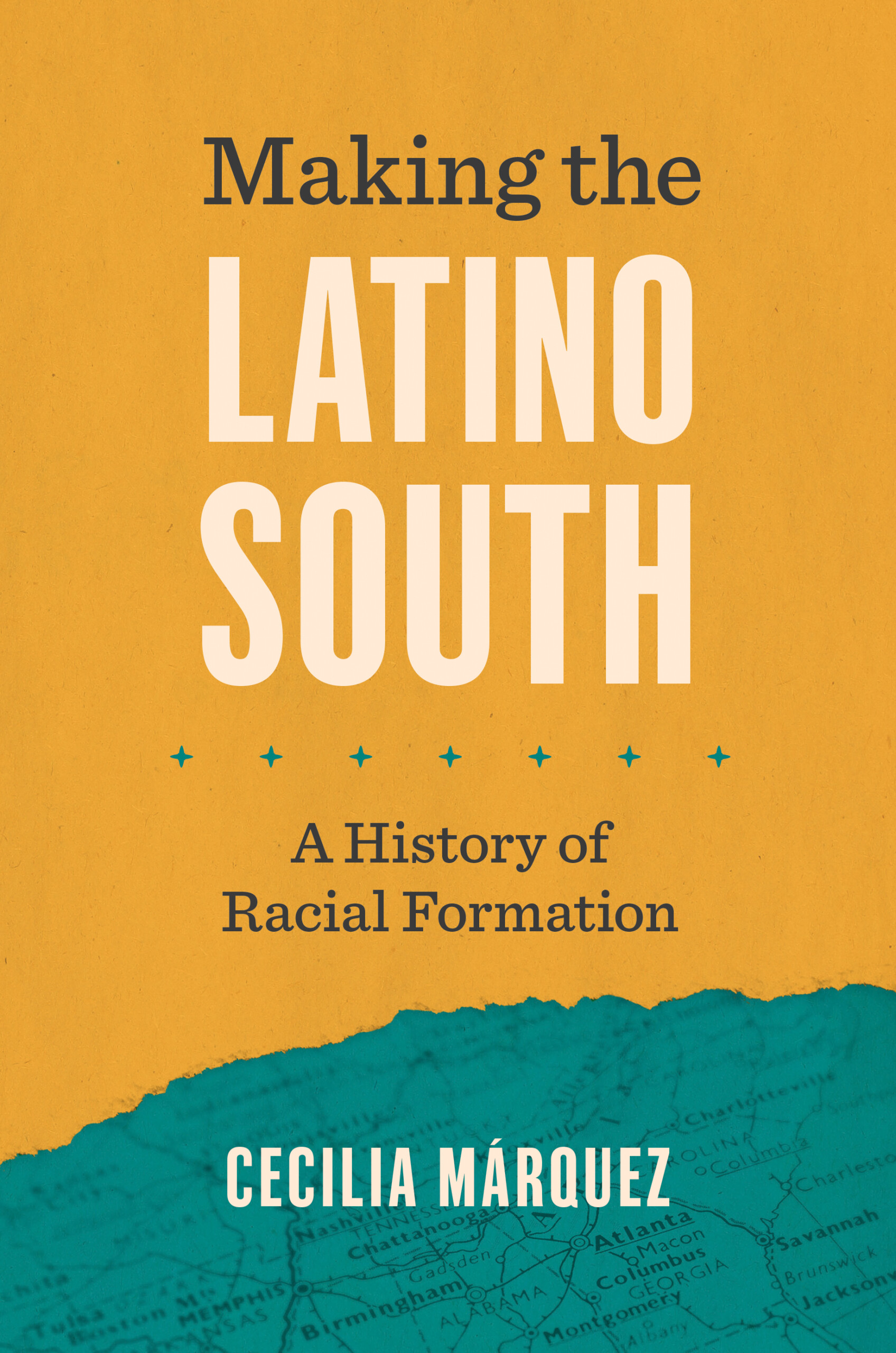
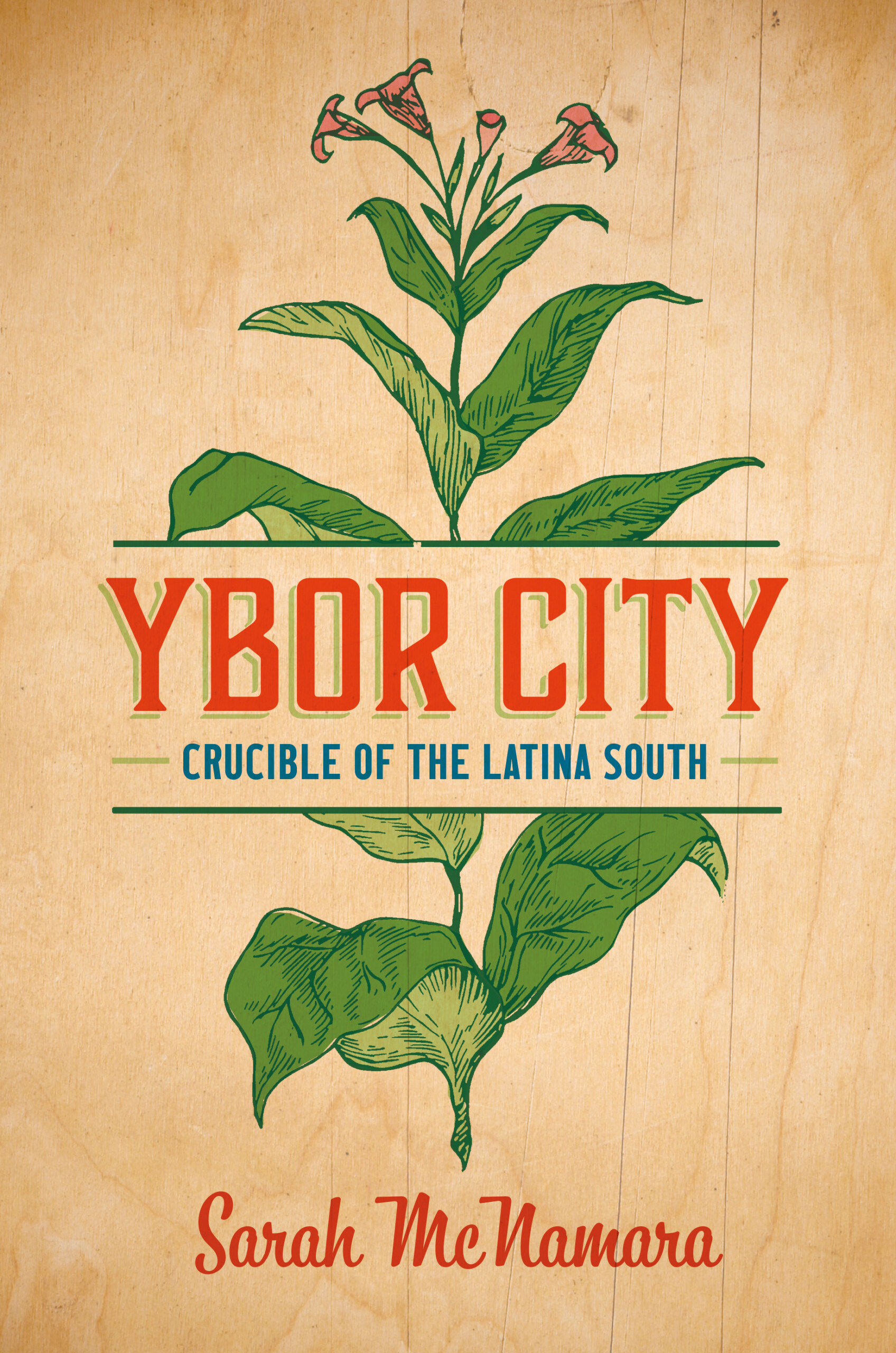
In 2003, Raymond Mohl’s description of the “latinization” of the late twentieth century US South (the “Nuevo New South”) helped set the stage for an expanding body of cross-disciplinary research on Latinx migration, settlement, and everyday experiences.1Raymond Mohl, “Globalization, Latinization, and the Nuevo New South,” Journal of American Ethnic History 22, no. 4 (2003): 31–66. While scholarly writing such as Mohl’s documenting this demographic shift offered important insights into the labor and settlement experiences of migrants, there was often little work done to use the geographical imaginary of a “Nuevo South” critically. Rather, as historian Perla Guerrero would later write: “in many instances the term ‘Nuevo South’ is used as if it were self-explanatory, or, in some of the more egregious cases, the word ‘nuevo’ is used simply in an exoticizing manner—Latinas/os are moving to the South and they speak Spanish, so we can now refer to the South as the ‘Nuevo South.’”2Perla Guerrero, Nuevo South: Latinas/os, Asians, and the Remaking of Place (Austin: University of Texas Press, 2017), 8. Guerrero makes a compelling argument for the use of “Nuevo South” as an important political economy and historical framework for understanding racial formations. As the field has continued to grow, however, new works are bringing a critical and longer historical perspective to southern Latinx populations, communities, and experiences. This includes two recent books by historians Cecilia Márquez—Making the Latino South: A History of Racial Formation (2023)—and Sarah McNamara—Ybor City: Crucible of the Latina South (2023).
Importantly, the idea of “southern” Latinx history being a new phenomenon is not a driving force in either book. Rather, these works contribute a longer understanding of the Latinx migrations to/through US southern spaces that have contributed to shaping racial hierarchies, labor landscapes, and diverse migrant communities. As two books concerned with individual and collective experiences within a shifting racial hierarchy, Making the Latino South and Ybor City significantly historicize and spatialize Latinx presence in the US South prior to the late twentieth century. Together, Márquez and McNamara call on readers to reject a monolithic definition of latinidad, specifically by paying attention to histories and politics of ethnicity, race, gender, labor, geography, and generational cohorts.
Shifting Racial Hierarchies
In Making the Latino South, Márquez places Latinos at the center of a history that lays bare the ways in which anti-blackness and white supremacy have shaped questions about culture, education, identity, and labor as experienced by Latinos living and working in various locations across the US South. “The history of Latino people offers a new and complex way of understanding the history of race in the South,” writes Márquez. “It is not a monolithic past, and it is one that refuses simple narratives about race.”3Cecilia Márquez, Making the Latino South: A History of Racial Formation (University of North Carolina Press, 2023), 17. Between the 1940s through early 2000s, Márquez places questions about Latino racialization at the center of historical investigations into matters of culture, education, identity, and labor. Across five chapters that illuminate localized Latino histories in Alabama, DC, Georgia, Mississippi, North Carolina, and South Carolina, Márquez shows how the racial position of Latinos shifted at the turn of the century. At the center of Making the Latino South is the necessary understanding that “Latino” functions as a constructed category shaped by spatial histories and understandings of race, all of which impact Black and non-Black Latinos in distinct manners.
Marquez’s first three chapters demonstrate how some Latinos benefited from a “provisional whiteness” as they attended white schools, used white facilities, and enjoyed greater overall mobility in the Jim Crow era. She begins in Washington, DC, with Karla Galarza and her family. Galarza’s experiences in seeking education within the city’s segregated school system highlight how “non-Black Latino people were understood through a mosaic of racial categorizations,” with varying characteristics (i.e. skin color, language usage, citizenship status) used to demarcate Latinos’ “proximity or distance from Blackness.”4Márquez, 21.
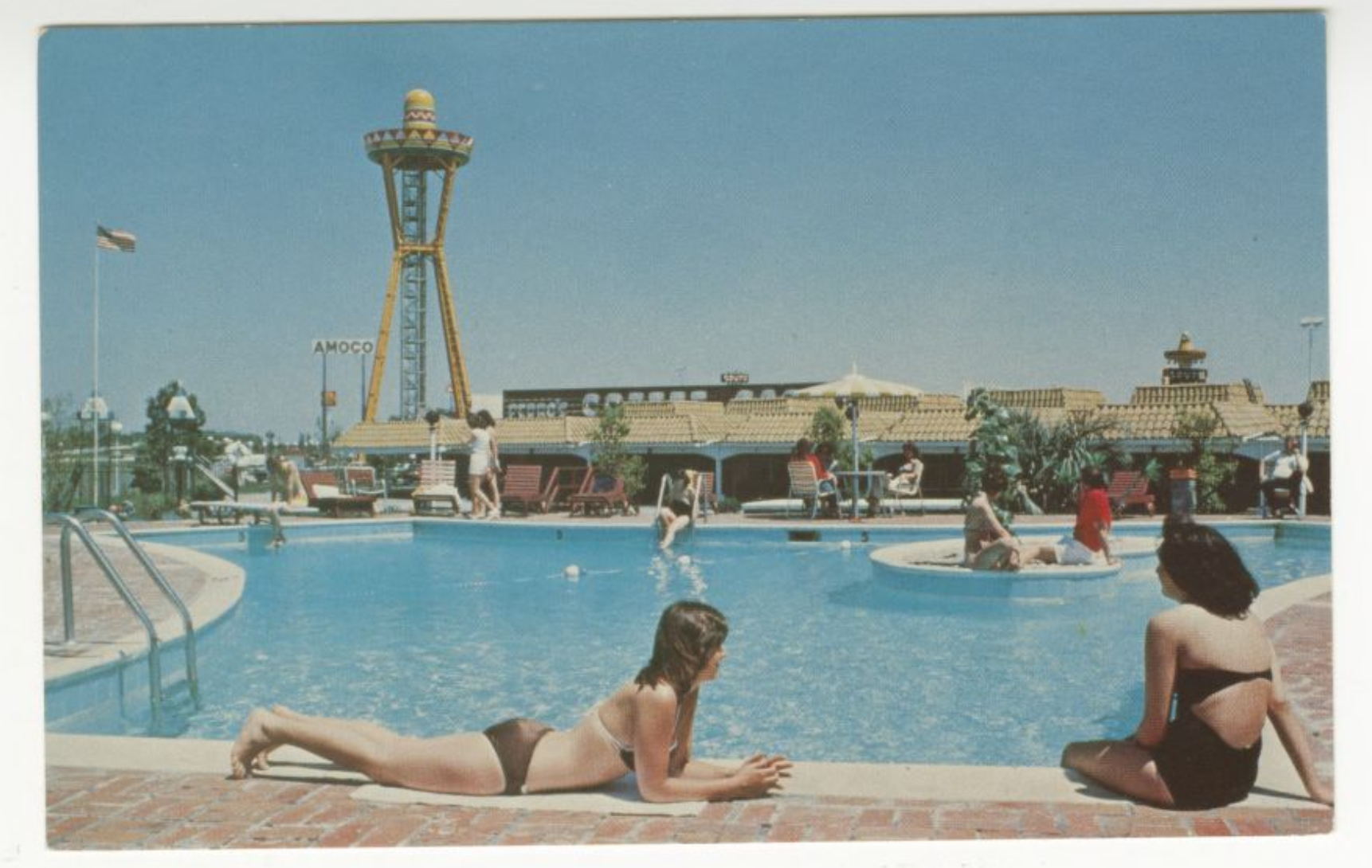
Next, Marquez moves from individual Latino experiences to the ways white southerners imagined and used “Latinoness” to negotiate their anxieties over a shifting racial landscape amid growing civil rights activism. In telling of the infamous South of the Border roadside attraction in South Carolina, Márquez shows how the tourist destination’s racialized figure—or, rather, mascot—“Pedro” illuminated white imaginations about racial hierarchies that increasingly included Latinos. Even with the absence of Latinos in upcountry South Carolina between 1945 to 1965, a “fantasized mexicanness” proved fruitful for a business class that sought to give an escape to white consumers seeking to “revel in the pleasures of racial subjugation.”5Márquez, 16.
The third chapter of Making the Latino South delves into the Civil Rights Movement, as Márquez excavates the experiences of Latino activists who traveled to the South to work with the Student Nonviolent Coordinating Committee. Between 1960 through 1970, non-Black Latino activists Elizabeth “Betita” Mártinez, Maria Varela, and Luis Zapata lent their support to the movement. As first-time travelers to/through this section of the US, these Latino activists encountered Jim Crow in ways that illuminated their proximity to whiteness. It was, in other words, their “Latinidad” and “non-Blackness” that shaped their experiences with SNCC, including the expulsion of non-Black members in 1966. “The expulsion,” Márquez explains, “recast in light of the history of Latino people in the South, highlights the regional nature of SNCC’s racial vision.” Both white and Black southerners’ understanding of Latino racialization, however, would shift as the 1970s and 1980s saw an increase in migration of working-class, undocumented, darker-skinned Latinos.
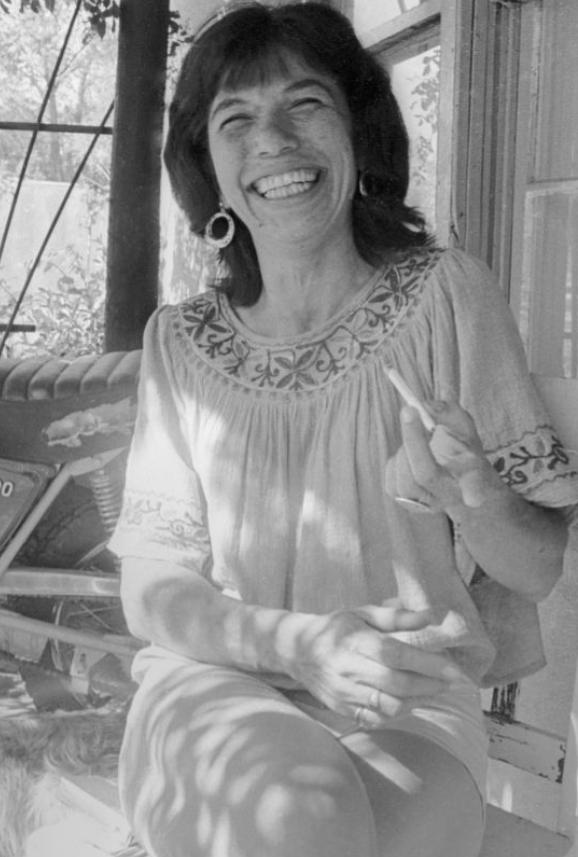
Márquez captures the shift that occurred in the late twentieth century as a larger non-white Latino population settled into southern destinations and were racialized both favorably and negatively as “hardworking” and “illegal.” A pivotal point arrives in the 1980s when Latino racialization shifted from a provisional whiteness to a distinct marginalized group that, on the surface, received a warm welcome. Márquez brings important attention to Dalton, Georgia, an industry town known for carpet manufacturing and for its seemingly positive embrace of Mexican arrivals. Here, industry leaders and other local actors cast Latinos as “hardworking,” which allowed white elites to “participate in what they saw as racially progressive ideology” while maintaining an exploitable laboring class.6Márquez, 149. The celebration, and exploitation, of the “hardworking” Latino narrative gave way to a new racial script after 9/11. Márquez traces how anti-immigrant sentiments that began in the 1990s contributed to the casting of Latinos as “illegal” by the early 2000s. While Latino remained a racially diverse category that included Black and non-Black people, “citizenship, race, class, color, and other identities continued to structure how Latino people” were racialized and marginalized.7Márquez, 180.
Racial categorization shifted between the 1940s through 2000s for Latinos, and Márquez reminds us that, “What is shared across the broad time period is a racialization defined, in large part, by Blackness. It is anti-Blackness and white supremacy that have defined the contours of Latinidad in the South.”8Márquez, 184. This is a critical insight that, as the author notes, opens more questions than it offers answers on the experiences of Black Latinos. There is much more work to do in recording and understanding aspects of living and working in southern spaces for Black Latinos. Falling outside the scope of Marquez’s particular project, Making the Latino South also does not contend with the question of indigeneity as it relates to the population and the (re)shaping of racial hierarchies. The book’s strengths lie in its centering of Blackness, an emphasis that will continue to shape the field’s attention to race as it relates to a diverse Latino population.
While Márquez draws readers’ attention to the role that gender plays in shaping Latino experiences, it is not central to her book. For that, we can look to Sarah McNamara’s recent work that not only highlights gender in this southern history, but rather makes it a central framework for understanding community making processes in an unequivocal Latino borderland—Tampa, Florida’s Ybor City.
Gender, Labor, & Generational Politics
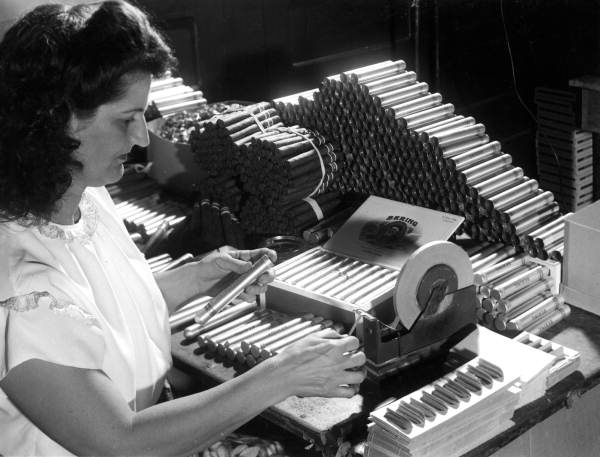
McNamara’s Ybor City: Crucible of the Latina South offers an exciting multi-scale history told from a local vantage point that attends to the realities of diasporic life in a southern “transnational, multi-racial borderland” that was shaped, in large part, by Latinas who worked and organized around the cigar industry. Women, she argues, shaped the trajectory of the Latina/o community and the subsequent ways it would be celebrated and remembered well after the cigar companies and families moved out of Ybor City. Across four chapters that examine three generations of Latinas/os “who struggled, worked, and dreamed in Ybor City and Tampa, Florida,” Sarah McNamara introduces individuals and families who built the first sustained Latina/o community in Florida.9Sarah McNamara, Ybor City: Crucible of the Latina South (Chapel Hill: University of North Carolina Press, 2023), 10.
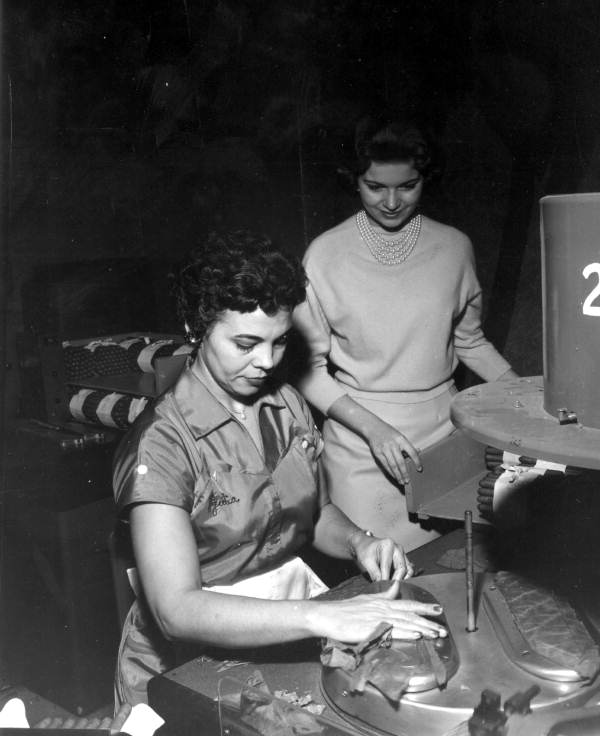
Ybor City begins by attending to the ways that categories of gender and race intersected with Latina and Latino labor, politics, and understandings of community and nation. McNamara situates Tampa as a “an international borderland where people and ideas competed for authority” over the meaning of space and place since the sixteenth century. It was not until the 1880s that Tampa, or the neighborhood of Ybor City, became a truly transnational city with the increased arrival of Latina/o laborers, who were primarily Cuban. Examining these early years of placemaking, McNamara unravels the everyday experiences and relationships that animated the establishment of a Latina/o city and shows how the “cigar factory floor was [both] a refuge and a revolutionary space.”10McNamara, 29.
Next, McNamara takes up the leftist, anti-fascist, and transnational revolutionary politics of Latinas who worked and organized within the cigar industry and their communities in the early twentieth century. She expertly weaves renowned labor organizer Luisa Moreno’s work in Florida with the experiences of Latinas who worked and lived in Ybor City, showing how “the women [that Moreno] organized influenced her even more than she influenced them.”11McNamara, 61. Latinas’ fights for labor and human rights, as well as complex questions about ethnic and racial identities, in Ybor City highlighted the struggle of organizing in a place “where one’s sense of self was fluid and in constant negotiation with anti-radical and anti-immigrant powers within the US South and politically leftist ideologies” that animated Latina/o transnational networks of solidarity.12McNamara, 82. Leftist struggles, however, would come increasingly under question as the late 1930s saw the rise of anti-radical sentiments and politics.
Alongside critical attention to gender and the ways it shaped laboring, organizing, and community spaces for Latinas in Ybor City, McNamara points readers to another important social positionality that shaped people’s politics—generational cohorts. She depicts the shift from a leftist radical laboring Latina/o population, to one that “fought to survive in a shifting world where public perception mattered.”13McNamara, 106.While capturing the varying ways Black and white Cubans navigated social, cultural, and educational institutions during the Jim Crow era, McNamara also shows how “Cuban” became a category deemed undesirable (often cast as a group of un-American “foreign subversives”) within Tampa’s Anglo population. US-born Latinas/os who witnessed the marginalization of their elders developed their own practices to demonstrate patriotism (or Americanness), which included Latinos enlisting in the army and Latinas engaging in volunteer and community advocacy work. In the shifting labor and racial landscape of the 1940s, Latinas continued to advocate for themselves, their families and community members “in Anglo-controlled spaces by laying claims to their right…to belong.”14McNamara, 137.
As the war ended and young Latinas/os returned to everyday life, many saw their futures as lying outside of Ybor City’s cigar industry. McNamara follows the ways in which Latinas/os with roots in Ybor City navigated questions about memory, community, and belonging. She argues that the process of “remaking” the community in the postwar era necessitated obscuring the “radical leftist past” of Ybor City, to make way for a “moderate, yet progressive, present” that Latinas/os could use to enter mainstream politics.15McNamara, 140. Delving into three distinct political moments between 1948 through 1970 (the Henry Wallace campaign; the Cuban Revolution; urban renewal), McNamara highlights Latinas’ presence—and, at times, absence—in shaping local political mobilizations and responses to deindustrialization and urban renewal. She shows how, more than just a capital for cigar manufacturing, Ybor City was a place made, and remade, by distinct generations of Latinas/os who had varying approaches to negotiating issues of race, ethnicity, gender, and labor, all of which informed the ways the community would be remembered for years to come, whether through local museums or at family dinner tables.
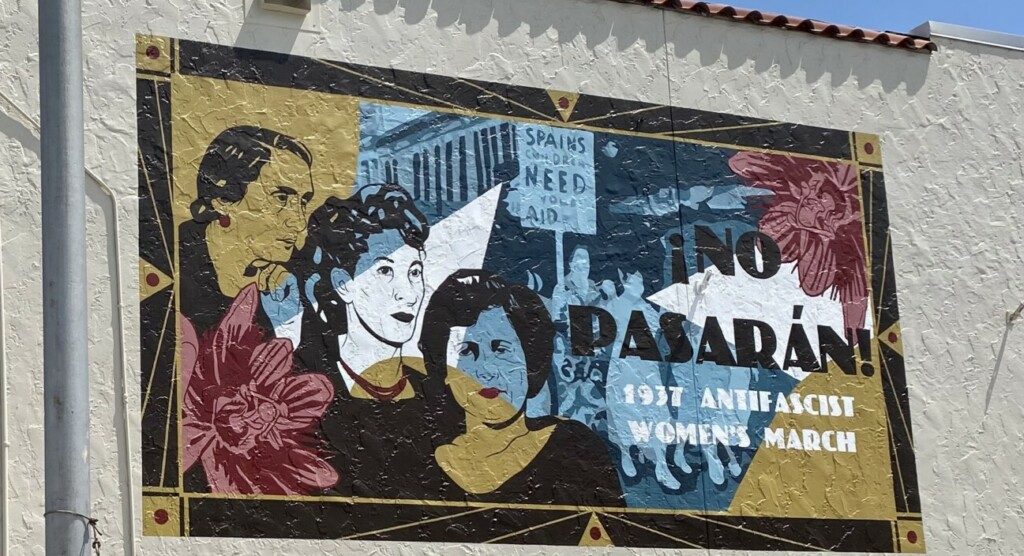
With her multi-generational analysis that shows change over time through the experiences of those whose lives intersected with and/or shaped Tampa and Ybor City, McNamara asks readers to “rethink what it means to be of Cuban descent, live in Florida, survive in the South, and advocate for visibility and representation within the United States."16McNamara, 13. Like Márquez, she is attentive to the racial diversity of the population, writing that “U.S.-born Latinas and Latinos disavowed radical, leftist politics and defined themselves against Blackness to transform their image from foreign subversives to acceptable U.S. citizens.” She continues by noting that this resulted in a “the creation of a new ethnic, non-Black identity as well as proximity to Anglo society and the gain of political power.”17McNamara, 10. There is some attention to the specific experiences of Afro-Cubans throughout the book, especially as related to the organization of mutual aid societies in the early decades of the twentieth century.
It is McNamara’s specificity that makes Ybor City a key contribution to the postwar, place-based histories of Latinas/os living and working in the various regions of the South. “Too often,” she writes, “Ybor City, and even Florida, is seen as an exception – a place where latinidad is everywhere and has always existed and is therefore unnecessary for inclusion in broader and more expansive understandings of Latinas/os within the South and the nation.”18McNamara, 15. By examining this “exception,” Sarah McNamara offers a hemispheric history that informs how Latinas/o lived experiences are shaped by time and place. Another important dimension of Ybor City is its serious consideration of the individual and familial histories. As more Latinx scholars who are born and/or raised in southern spaces record our own histories, McNamara’s book will serve as a model for how to balance individual, familial, and communal histories with attention to (trans)national historical processes.
When and Where You Are Latinx Matters

With attention to matters of ethnicity, race, migration, transnationalism, class, labor, gender, and generational cohorts, Cecilia Márquez and Sarah McNamara offer us important critical readings. Making the Latino South and Ybor City highlight the intersections of race, gender, and place, constructed categories that have historically informed hierarchies of desirability and belonging. They show the diversity of identities and experiences that shaped Latina/o life between the late nineteenth through early twenty-first centuries.
These scholars also raise important questions about scale. Márquez’s book is less a history of specific Latino communities and more a story of how this diverse group came to be described, or rather racialized, as “Latino.”19Márquez, 4. Geography and racial hierarchies are at the center of her investigations into racialization processes in Alabama, DC, Georgia, and the Carolinas. On the other hand, McNamara begins with her familial roots in Ybor City’s radical Latina history, and extends her analysis to encompass Ybor City as a node within a borderlands where the Caribbean and US South meet and shape each other. These books model balancing of the multitude of voices of everyday Latinx historical actors.
Márquez and McNamara held a roundtable discussion at the 2023 Southern Historical Association meeting in Charlotte about the shifting terrain of Latinx history. Márquez made a key aspect of Latinx history clear: “when and where you are Latino matters.” Later in the same session McNamara added that, along with generational cohorts, “migration patterns matter.” With the various Latinx migrations to/through southern spaces since the late nineteenth at top of mind, the discussion highlighted the nuances of writing Latinx history from a southern vantage point. The conversation illuminated Chicana historian Vicki Ruiz’s argument that “region is intricately tied to Latina identity.” With attention to geographic and temporal specificities, Márquez’s Making the Latino South and McNamara’s Ybor City each demonstrate how Latina/o/x individuals, families, and communities navigated, understood, and claimed southern spaces over time. With their critical attention to the importance of regional racial formations, histories of racial capitalism, and the varied dimensions (racialized, gendered, generational) of Latinx identities and community formations, Márquez and McNamara have each made contributions that enrich more than two decades of scholarship. 
About the Author
Iliana Yamileth Rodriguez (“Yami”) is a historian of US Latinx communities. With a research emphasis on the US South, Rodriguez’s scholarship examines Latinx experiences in relation to culture, race, ethnicity, labor, and migration. Her current book project, “Mexican Atlanta: Migrant Place-Making in the Latinx South,” traces the history of Metro Atlanta’s ethnic Mexican community formation and broader Latinx connections beginning in the mid-twentieth century.
Cover Image Attribution
"A bit of Old Spain as seen at Ybor City, Tampa, Florida," ca. 1930–1945. Postcard. Courtesy of the Tichnor Brothers Postcard Collection, Boston Public Library.
]]>Blog post
Mother Jones died ninety years ago, but she was back in Alabama this July. It was not her first visit to the state. She came to Birmingham and Bessemer to support striking railroad workers in 1894, and a few years later, she took a job in a Tuscaloosa cotton mill to report on the wretched working conditions faced by women and children.
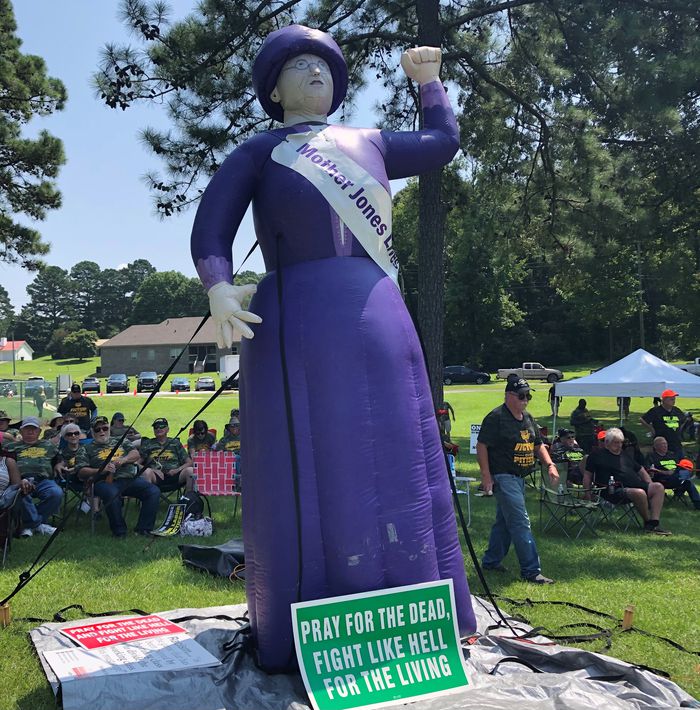
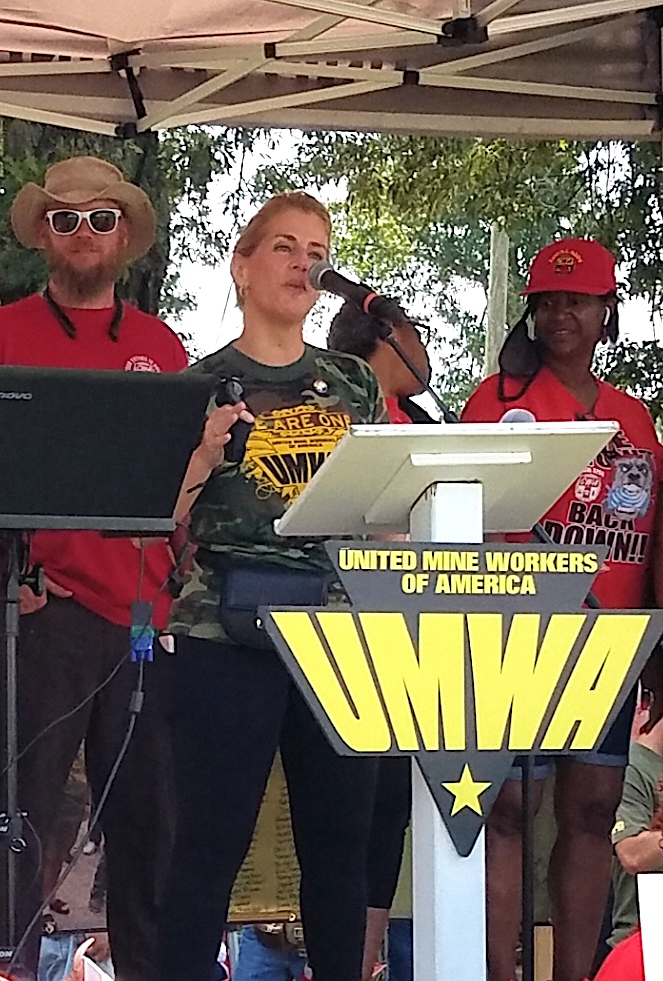
Truth be told, it was not the real Mother Jones but a twelve-foot inflatable likeness of her that showed up at the Brookwood Ballpark for a rally in support of striking coal miners. Roughly two thousand people came out to the event, and many stopped to have their picture taken with "the grand old lady of the labor movement." Present were representatives of labor unions from across the country—longshoremen, flight attendants, municipal employees, as well as members of the United Mine Workers of America from West Virginia, Kentucky, Illinois, Indiana, Pennsylvania, and Ohio.
The inflatable likeness belongs to the Mother Jones Heritage Project, a pro-labor organization based in the Chicago area. Jim Dixon of Springfield, Illinois, drove her down to Alabama. Now retired, he was president of Springfield Trades and Labor Council, a member of the American Federation of State, County and Municipal Employees (AFSME), and a union activist. He came to Alabama not only with Mother Jones, but with checks for the miners' strike fund from his AFSCME local, and from the Mother Jones Foundation.
The immediate spur for Dixon's trip to Alabama was the five-month-old strike, called by the United Mine Workers of America, of over a thousand workers in Tuscaloosa County. They took a big pay cut four years ago when their employer, the Walter Energy Company, went bankrupt. The new owner, Warrior Met, refuses to negotiate restoration of pay, overtime, and holidays now that the old contract has expired, despite the fact that coal shipments to China, Europe, and Latin America have made the company profitable once again.

We think of Alabama as a deep red "right-to-work" state, yet it has a long history of union organizing. In Bessemer, just half an hour east on Interstate 20, was the big organizing drive against Amazon a few months ago. The contradictions of red state unionism are right on the surface. Many of the striking miners are Trump Republicans who loved his promise to "bring back coal." But they recognize too that there has been no support for the strike coming from the right, no GOP politicians standing in solidarity for fair wages, no Fox News coverage. Meanwhile, the law has winked at a few incidents of violence against the strikers. But there is also a contradiction from the left. Coal is a filthy fuel, a major contributor to global warming, yet promises of "good paying green jobs" sound like pie in the sky to working class families who have struggled across generations for the bit of security offered by UMWA jobs.
Jim Dixon said he was struck by several things during his time in Alabama. He was impressed with the size of the crowd and the energy at the rally staged by the United Mine Workers. He also mentioned that it was a well-integrated event—about a fifth of the striking miners are African American, and he felt a strong spirit of solidarity across racial lines. The miners Dixon spoke with were upbeat, ready to keep fighting for a contract. Still, he added, this strike isn't getting the press attention it deserves. Not just newspapers, but unions too need to go back to educating Americans about economics. The biggest owner of Warrior Met, he noted, was BlackRock, the world's largest asset manager. "Workers know they're getting kicked," Dixon said, "but they don't always know whose foot is in the boot."
"An injury to one is an injury to all," he added, quoting the slogan of the nineteenth-century Knights of Labor. Dixon's grandfather, a coal miner, narrowly escaped death in Illinois's horrific Cherry Mine Disaster in 1909. Organized labor, Dixon emphasized, was a family; working people needed security, safety, and decent pay to keep their children properly fed and clothed. Mother Jones, he pointed out, always referred to "the family of labor" because unions looked out for households and communities, not just individuals.


That is why Mother Jones remains an important symbol for the labor movement. Mary Harris Jones always called out whose foot was in the boot. Born in 1837, a famine immigrant from Ireland in 1850, she lost her husband and four children to a yellow fever epidemic in Memphis when she was thirty years old, then had her seamstress shop burned out in the Chicago fire of 1871. Tragedy only heightened her empathy for her fellow workers and fearlessness toward the powerful. She studied the social conditions of Gilded Age America, developed her oratorical skills, and as an elderly woman she emerged as Mother Jones, the fierce leader of a thousand labor battles.
Mother Jones organized men and women, Black and white, immigrant and native-born workers. Across industries, from steel milling to needle trades, but especially coal mining, she gave exploited American workers hope of gaining some control over their lives and bettering their conditions. To dramatize the exploitation of child labor in America, she even organized one hundred striking kids into "the March of the Mill Children," from Philadelphia to President Theodore Roosevelt's summer home on Long Island.
By the early twentieth century, Mother Jones was one of the most famous women in America. Local officials locked her up to keep her away from strike zones, but she always said she could raise more hell in prison than out. "The most dangerous woman in America," one prosecutor called her; "She is a wonder," her friend Carl Sandberg wrote; "The walking wrath of God," Upton Sinclair declared. Meridel Le Sueur, just fourteen years old when she first heard Mother Jones speak, recalled, "I felt engendered by the true mother, not the private mother of one family, but the emboldened and blazing defender of all her sons and daughters."
In Chicago, the Mother Jones Heritage Project is negotiating with the city to erect a statue of her downtown. As America reevaluates who its heroes are, rethinks who deserves to be immortalized in bronze, here is a forgotten figure, larger than life, an immigrant, a woman, an elderly person, a worker, inspiring others to "pray for the dead and fight like hell for the living." Just ask the miners—Mother Jones lives!
About the Author
Elliott J. Gorn teaches history at Loyola University Chicago. He is the author of Mother Jones: The Most Dangerous Woman in America (New York: Hill and Wang, 2001), and most recently, Let the People See: The Story of Emmett Till (New York: Oxford University Press, 2018).
]]>Preface
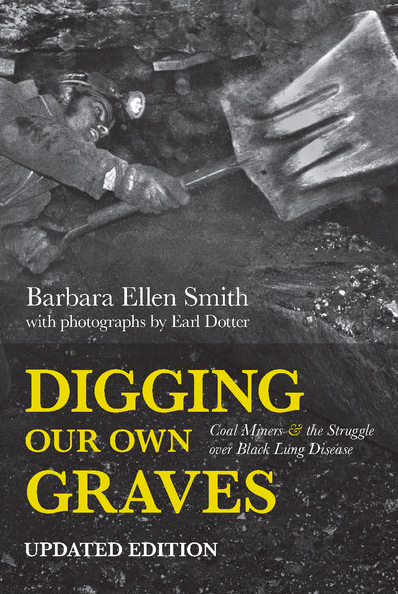
Digging Our Own Graves, first published in 1987, concluded with an ominous prediction: "Black lung disease awaits the younger generation of coal miners who are now at work underground." Would that I had been wrong! Today, not only do coal miners still suffer from this lethal but preventable lung disease, they do so at younger ages, some even in their thirties, and they are contracting the most advanced form of black lung at the highest rates ever recorded. More than fifty years after the US Coal Mine Health and Safety Act of 1969 imposed a respirable dust standard on the coal industry, designed to prevent black lung, why do such carnage and suffering persist? This updated version of the original book seeks answers to that question.
My own introduction to black lung began in the winter of 1971–1972, when I came to West Virginia to work for the Black Lung Association. I was barely twenty years old. Extraordinary political transformations were in the making: coal miners, miners' wives, and widows were challenging powerful institutions that had once commanded their acquiescence—the hierarchy of the United Mine Workers, the coal operators' association, county political machines, and the Social Security Administration.1The language of "miners' wives and widows" implies that all miners are male. However, since at the least the 1970s, women have worked in the mines, including underground, albeit in small numbers. I use the language of "wives and widows" because most black lung activists use this language in their organizing and their discussion of black lung compensation (e.g., "widows' claims"). For a young college student from the Midwest, these developments in the mountains of West Virginia beckoned with a romantic excitement. Besides, the mountains were my ancestral homeplace; now I could return to them, not on a summer vacation in the backseat of the family car, but on my own.
Working with the older coal miners and impatient young organizers who made up the Black Lung Association at that time was a formative political experience for me. Coming from a long line of southern subsistence farmers and circuit-riding preachers, I was instilled with a righteous, if vague, sense of populism that made me eager to join the struggles of "working people." But neither my political heritage nor my exposure to campus radicals prepared me for what I found in the coalfields of West Virginia: above all, the stark boundaries and clear perceptions of class antagonism. Virtually every coal miner over the age of sixty-five proudly claimed to have "fought in the battle of Blair Mountain with a machine gun" in 1921 to bring the union into southern West Virginia. They were up against the combined forces of coal company guards, the state police, county sheriffs and their deputies, aerial bombers, and, ultimately, the US Army. I was dumbfounded.
Fortunately, it didn't occur to me to write about any of these experiences until my age and the changing times helped to deepen my understanding of what they might mean. In 1978, more than six years after I had first worked for the Black Lung Association, I began the research for a dissertation on the black lung movement. The political atmosphere was altogether different. A reform movement in the United Mine Workers of America (UMWA) had arisen, succeeded in a special election for leadership of the union, then disintegrated; the black lung movement had seemingly disappeared; and a storm of reaction was sweeping the Appalachian coalfields. The setbacks were frightening, but they made possible a more sober and critical perspective on the earlier period of upheaval.
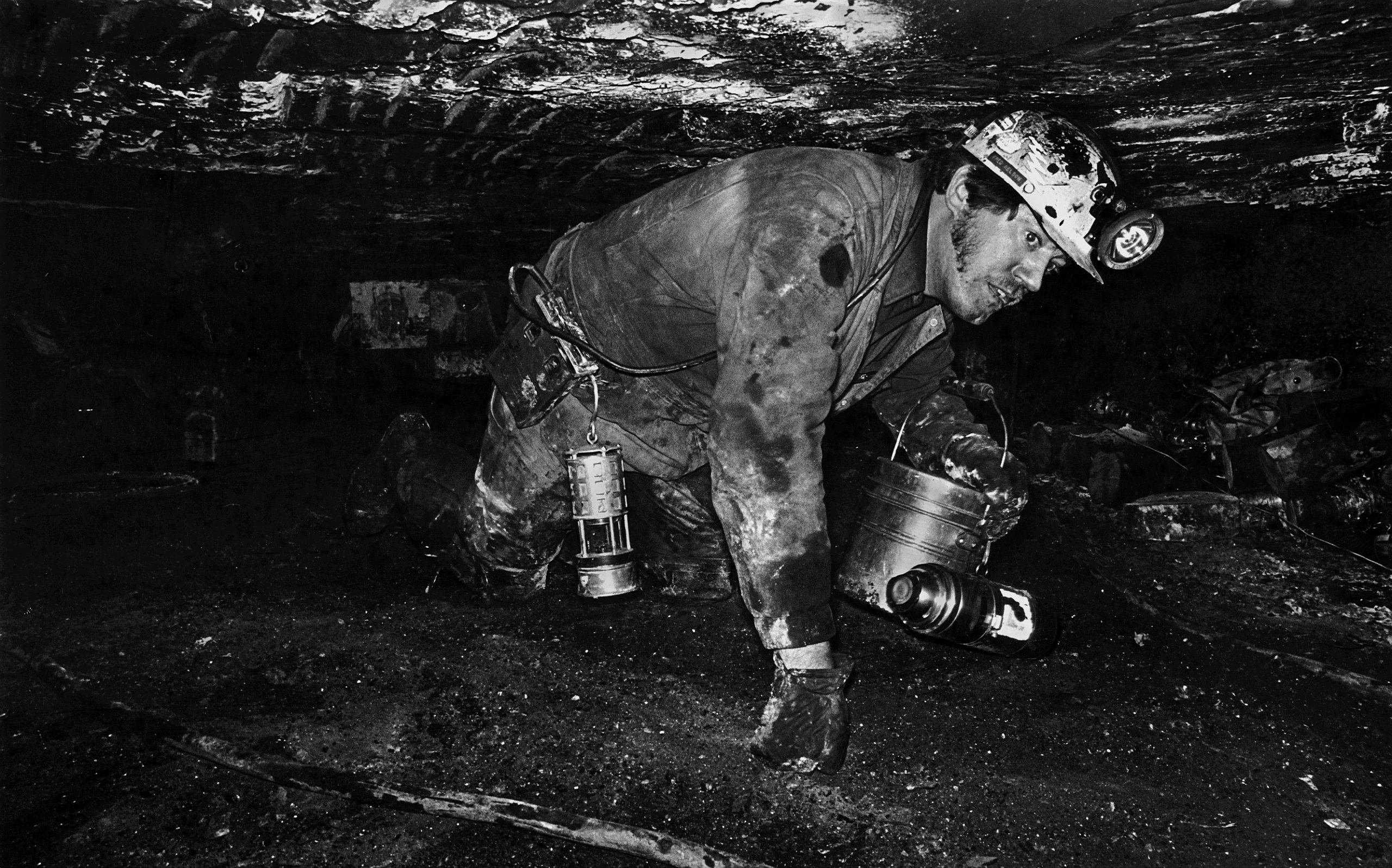
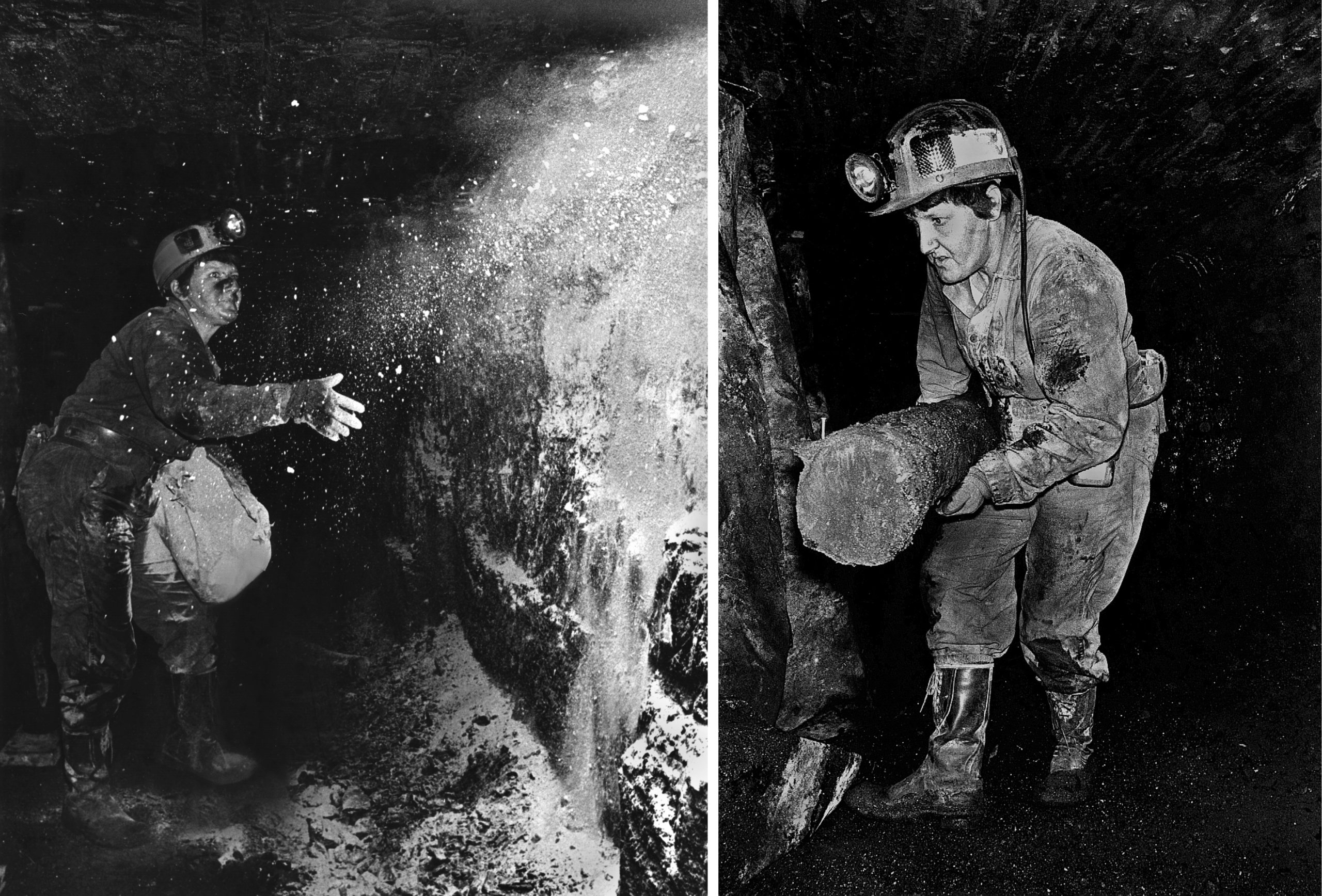
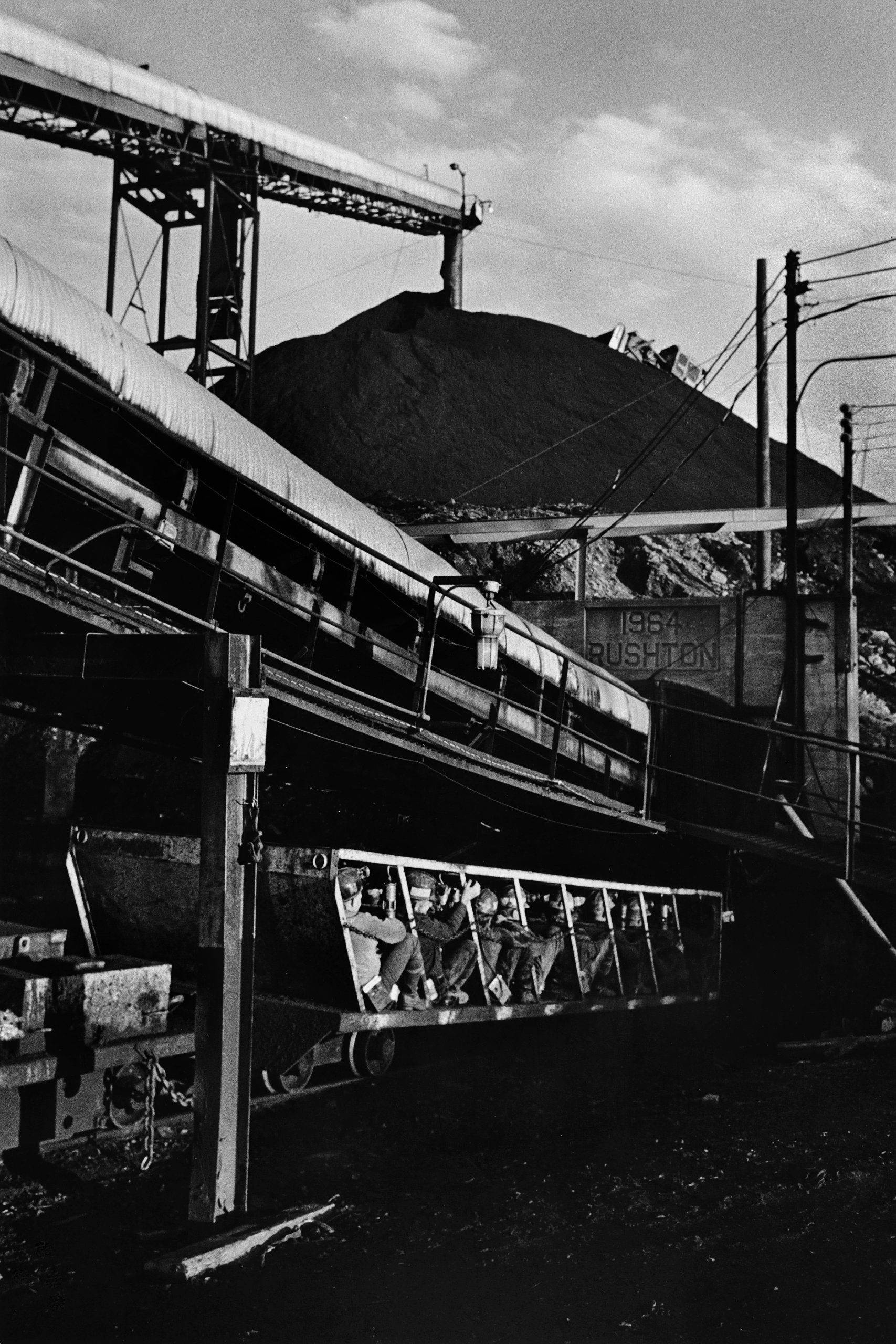
I began this book as a labor history, asking obvious questions that seemed most important at the time: Why did the movement end this way? What did it accomplish? How did it fail? Who or what was to blame? As I dug deeper into the history of the black lung movement, however, these apparently clear-cut questions about victories and defeats began to seem ambiguous, even misleading. The assessment of whether the movement had succeeded or failed depended a great deal on whose goals were used as the standard of measurement—and goals varied considerably among different participants. Moreover, what the larger political culture defined as the movement's greatest accomplishments often turned out to be mainly symbolic; they represented the visible outcomes of formal processes of reform (the passage of legislation, for example), but in and of themselves did not necessarily signify substantial and lasting change. The simplicity of my original questions faded as the labels of victory and defeat, success and failure, appeared more and more ephemeral. The central analytical problems increasingly seemed to involve the maddening complexity of social change itself, which prevented any person or group from controlling the course or outcomes of this movement.
As I delved further into the reforms sought and controversies engendered by the black lung movement, it became apparent that the movement was more than an important episode of labor resistance. At issue in the struggles over black lung, which have reemerged today, is not only how to prevent the disease or compensate those affected by it but also the very definition of black lung. Frequently, the most ideologically powerful opponents that miners have faced in their successive surges of activism are not coal operators or conservative politicians but physicians. At the center of the black lung controversy has been a profound power struggle between miners and physicians over who will control the definition of this disease.2See Daniel M. Fox and Judith F. Stone, "Black Lung: Miners' Militancy and Medical Uncertainty, 1968–1972," Bulletin of the History of Medicine 54, no. 1 (1980): 43–63, for an early framing of the black lung struggle as between miners and physicians over the definition of disease. Their emphasis on medical uncertainty differs from the analysis in my own article, which came out during the same time period: Barbara Ellen Smith, "Black Lung: The Social Production of Disease," International Journal of Health Services 11, no. 3 (1981): 343–359.
As a result of these and other shifts in emphasis, this book is a hybrid. It draws on diverse theoretical traditions in order to analyze not only the organization and development of the black lung movement, but also the history and conflict that underlie the brutal fact of coal miners' diseased bodies. Beginning with how and why black lung originates in the workplace, this book also explores the medical history of the disease and the conflicting meanings that miners and certain physicians, lawyers, and government administrators invest in black lung.
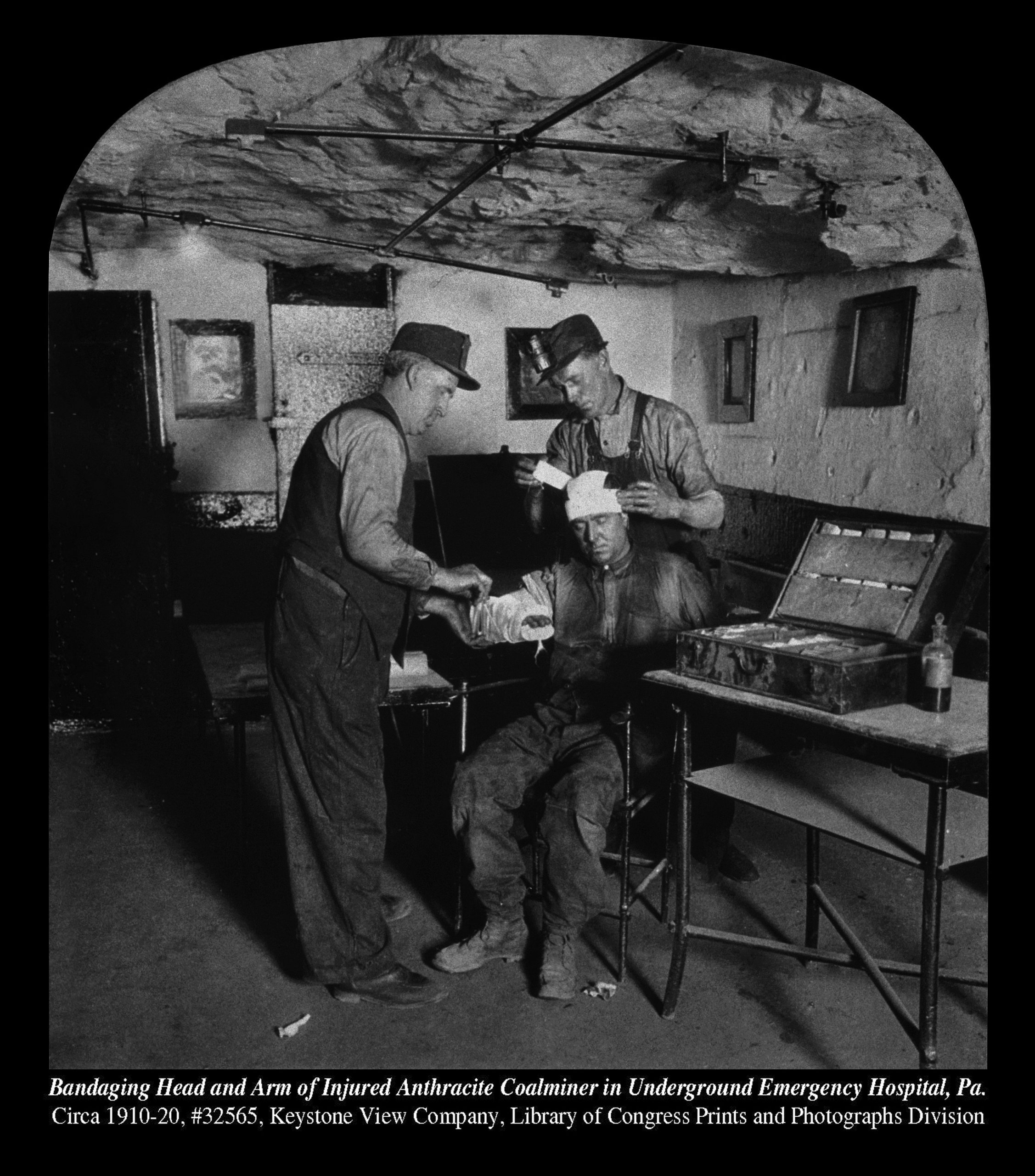
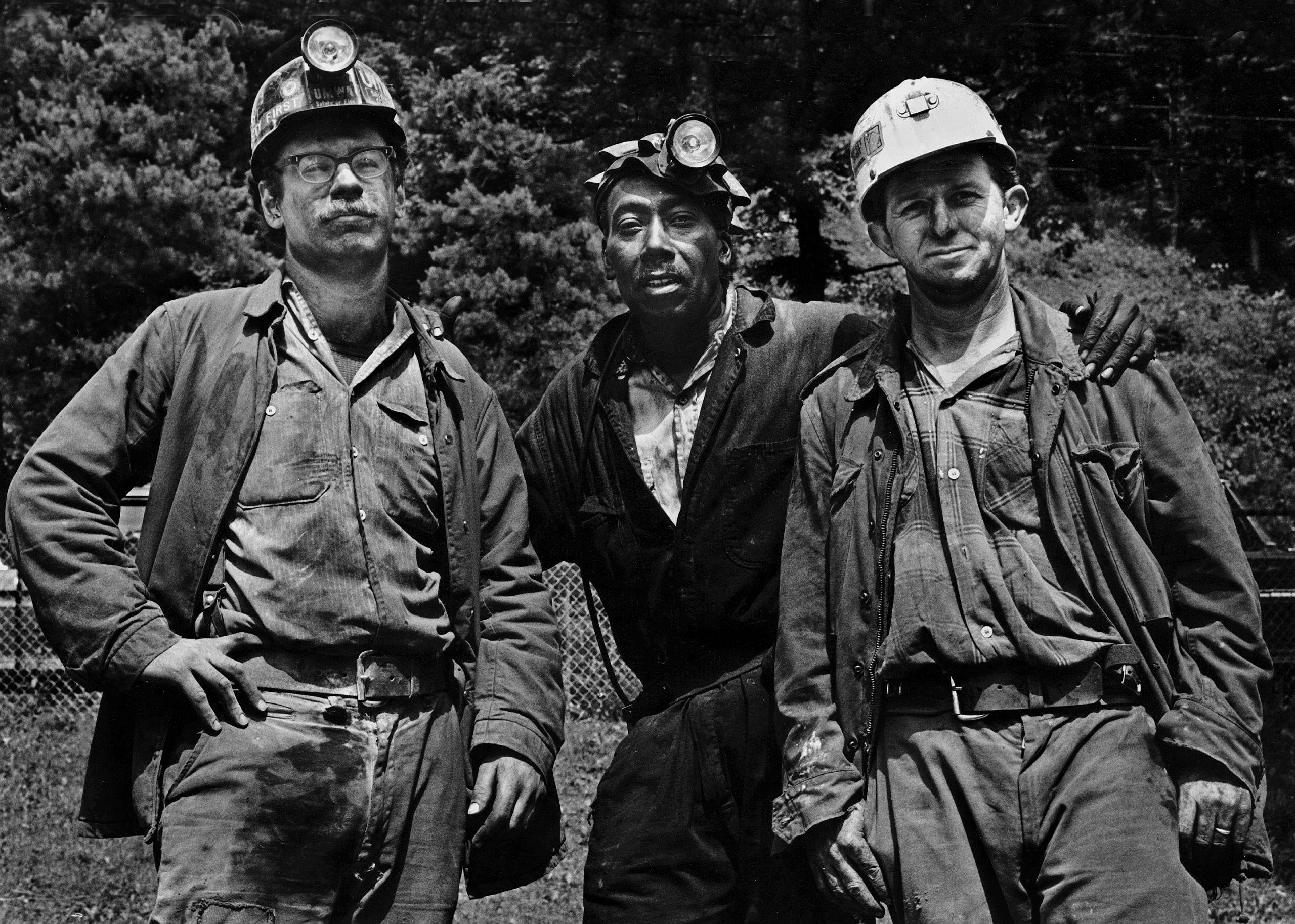
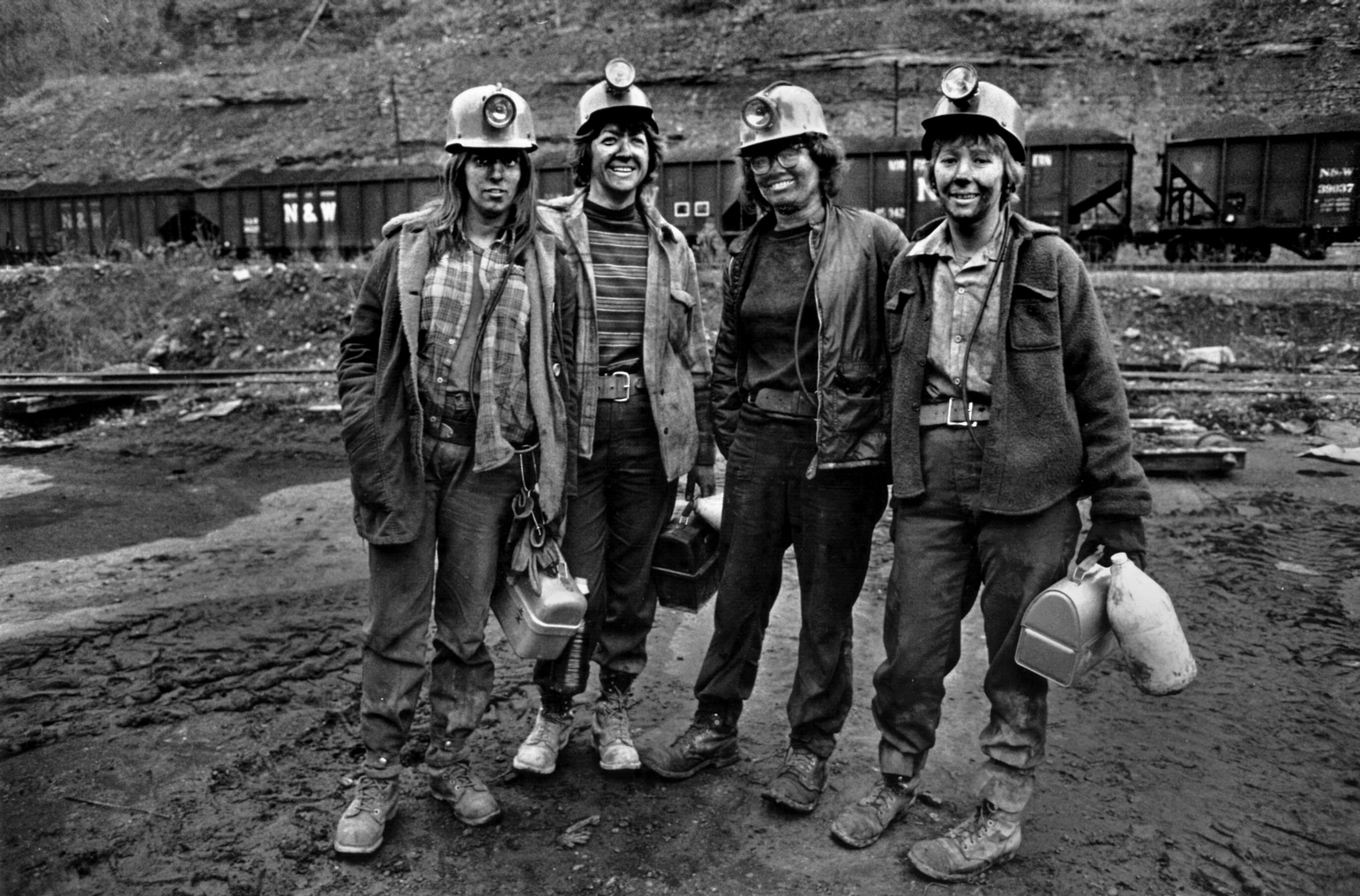
After moving away to a self-imposed exile some twenty-five years ago, I live once again in West Virginia. Contrasts with the 1970s heyday of working-class activism are evident throughout the rural landscape of abandoned gas stations, rusted coal tipples, and boarded-up union halls. The differences are personal as well: when I interviewed black lung activists in the 1970s, I was the age of their daughters and granddaughters; today, I am eligible for Medicare. As I conducted additional interviews in 2019, mostly with retired coal miners close to my age, their bodies as well as their words spoke the story of black lung disease and the physical toll of hard-labor jobs. Conditioned as a white woman to thinking of my embodiment primarily in terms of gender, I was struck again and again by how the privileges of class have shielded me from harm and become subsumed into my body. This updated and revised book, which includes two new chapters and a moving, evocative photo gallery by Earl Dotter, thus entails not only additional research into medical, legal, and economic materials relevant to black lung, but also historical reckonings both political and personal.
Today, as I write this preface, the power relations that miners experience on the job are dangerously asymmetrical, and their outcomes grim. Coal miners in southern West Virginia, once the stronghold of the UMWA in central Appalachia, where those who crossed a picket line invited ostracism if not assault, now work nonunion. Coal companies, facing shrinking domestic markets and in many instances bankruptcy, force workers, coal communities, and American taxpayers to bear the costs of their decline. Black lung can only be fully understood as part of this historical moment, when resistance, remarkably, persists. Digging Our Own Graves analyzes the dreadful resurgence of black lung within the long history of efforts to legitimate this disease and make it visible, prevent black lung in the workplaces where it is produced, and extend dignity and a measure of justice to those for whom prevention comes too late.
Conclusion: Class Power, Scientific Authority, and State Regulation
Nearly two centuries have passed since Dr. James Gregory opened up the lifeless body of John Hogg and hypothesized a connection between the miner's blackened lungs, his respiratory disability in later life, his occupation, and his death. For a time, physicians in Britain and the United States continued to investigate the relationship between occupational exposures and miners' respiratory distress. Toward the end of the nineteenth century, however, during a period of tight corporate control in the Appalachian coalfields and an increasingly restrictive scientific understanding of disease, black lung began to disappear from the medical literature of both countries. In the United States, coal miners eventually precipitated renewed medical attention to black lung by winning a union-controlled health care plan for themselves and their families. Even so, coal workers' pneumoconiosis—much less the broader ensemble of illnesses called black lung—was not accepted as a legitimate, occupationally related disease by the medical profession as a whole.3Journalistic and some scientific accounts equate coal workers' pneumoconiosis (CWP) with black lung. However, an essential component of the black lung movement was miners' and their families' struggle to broaden the definition, beyond CWP, of miners' disabling, occupationally related lung disease. Research by physicians and other scientists familiar with and sympathetic to miners and their health has validated this broader definition. See, for example, Edward L. Petsonk, Cecile Rose, and Robert Cohen, "Coal Mine Dust Lung Disease: New Lessons from an Old Exposure," American Journal of Respiratory and Critical Care Medicine 187, no. 11 (2013): 1178–85. Formal recognition required collective political intervention by coal miners themselves.
Even as social and economic factors have impinged on the medical construction of black lung, so have they shaped the actual production of disease. Black lung originates not simply from the physical presence of dust in coal mines, but from the relative power and respective actions of miners and operators, which influence conditions in the workplace. Miners' eventual success in unionization enhanced their collective power in the workplace, but, depending on UMWA leaders' priorities, unionism at times paradoxically undermined miners' capacity to make that workplace healthy and safe. In the years after World War II, the pact between larger operators and the UMWA produced unimpeded mechanization of the production process, high levels of unemployment, forced migration, and occupational death and disability from black lung. However, that industrial collaboration also produced massive rank-and-file upheaval and a successful effort to reform the union. In the present moment, union weakness and miners' lack of bargaining leverage in the workplace, combined with certain operators' endgame maneuvers to extract coal from thinner seams even while pressing for high levels of labor productivity, once again intensify the extent and severity of the disease.
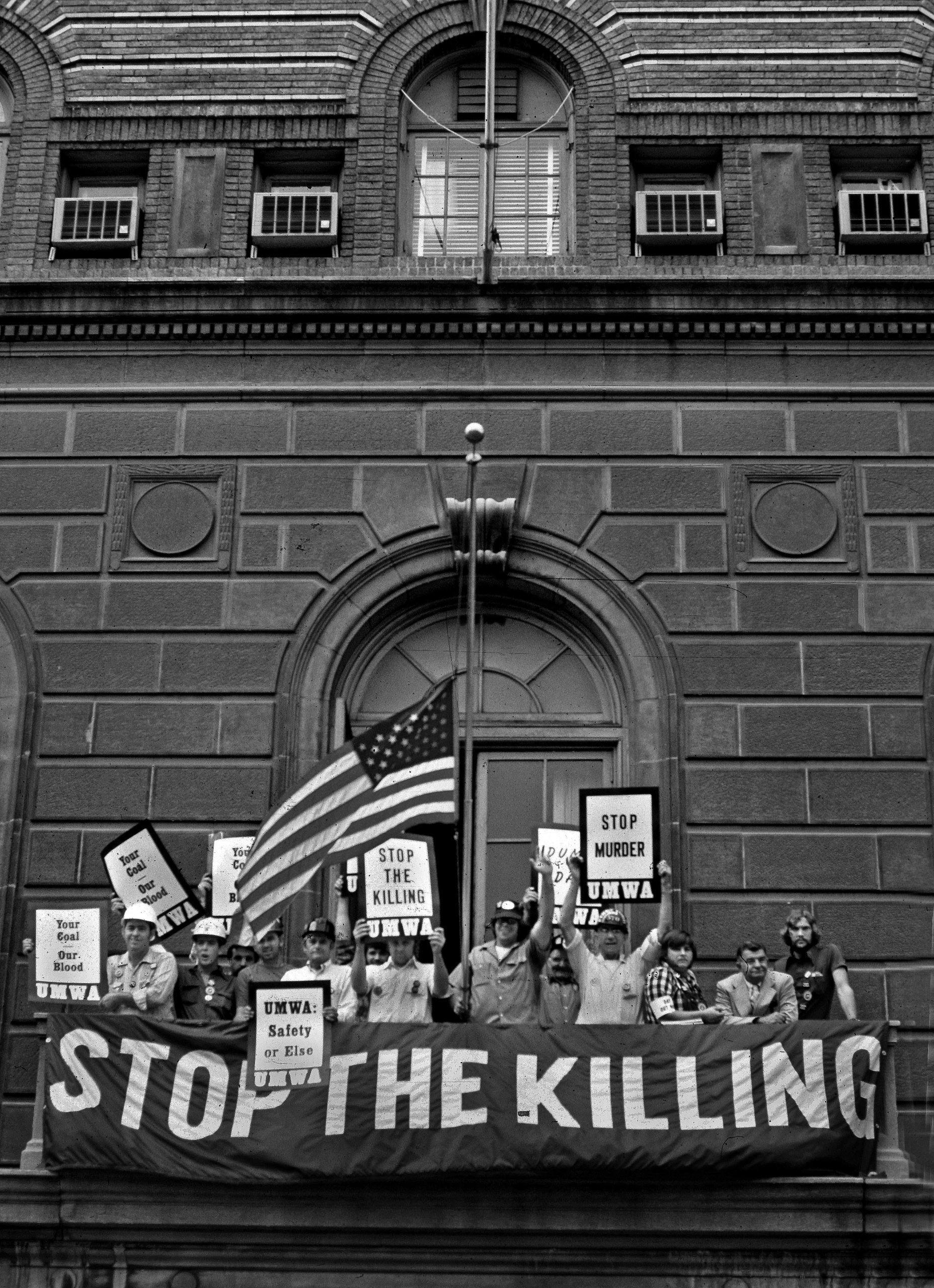
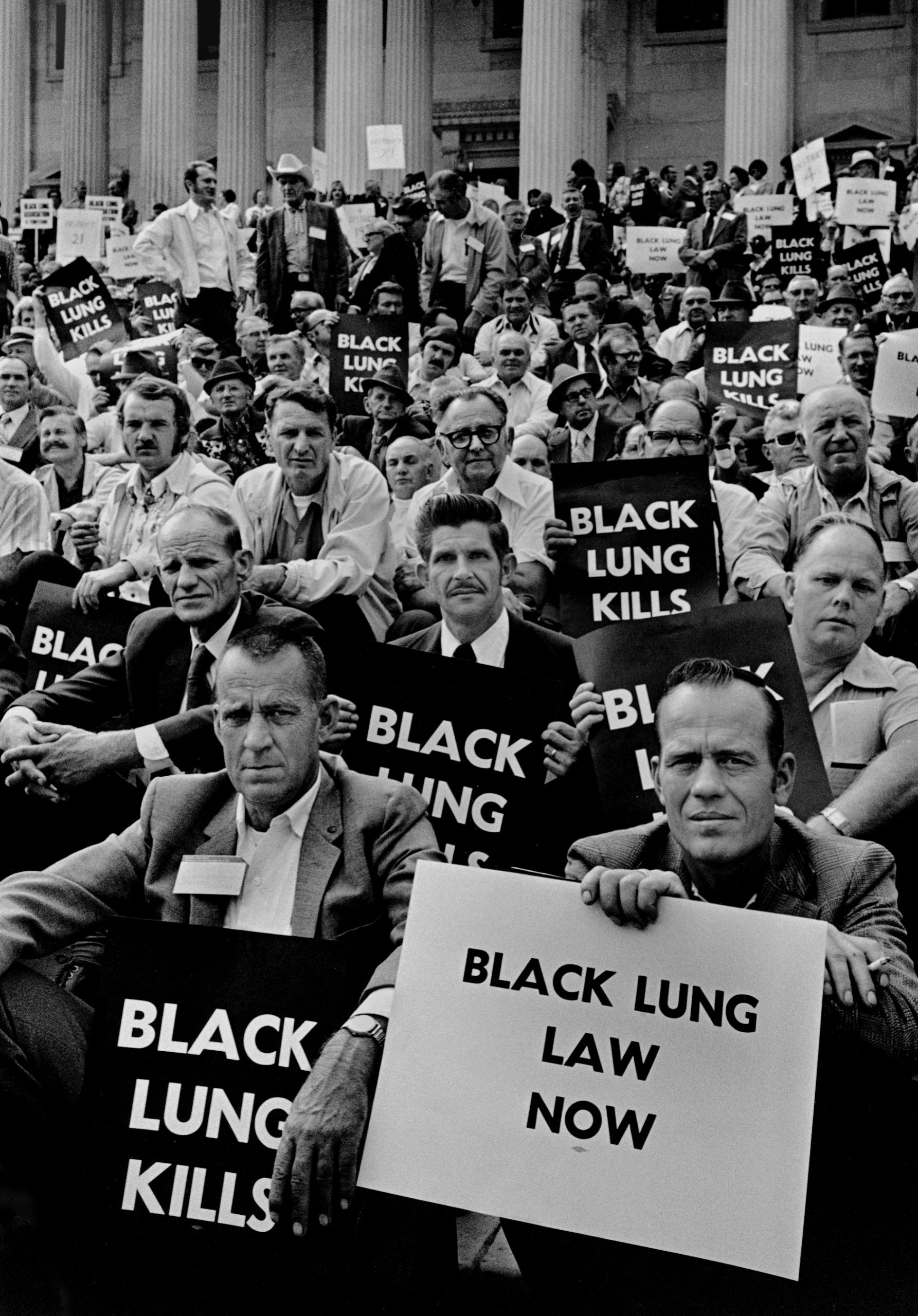
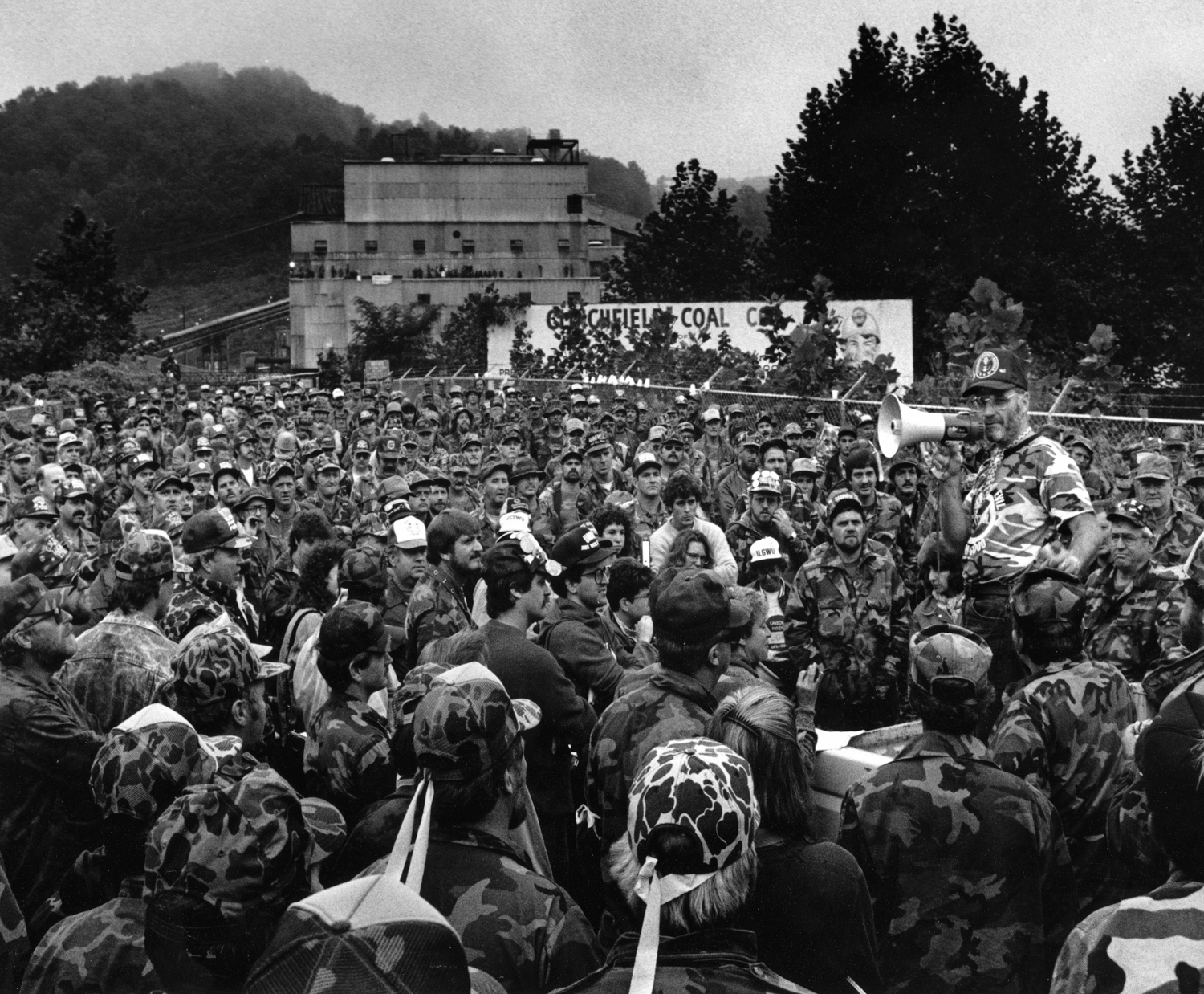
The virulence of black lung today—fifty years after it was supposedly destined for elimination—does not diminish what coal miners, their families, and their allies accomplished in the past. Rather, it attests to the enduring realities of labor exploitation that the black lung movement episodically managed to contest. For its constituents, the movement achieved a unique and unprecedented federal compensation program. Approximately half a million miners and widows have received compensation under the federal black lung program; especially for those ineligible for a pension or other benefits, the monthly payments can mean the difference between destitution and modest survival.4This estimate of the number of black lung beneficiaries is extrapolated from data on the number of claims filed each year, changing approval rates, the annual total cost of claims, and, for some years, reports from the administering federal agency. See, for example, Social Security Administration, Annual Statistical Supplement to the Social Security Bulletin, 2016 (Washington, DC, 2017), Table 9. Beneficiaries who are miners and those who are widows, added together, do not equal the total number of miners judged disabled by black lung, as a widow may receive her husband's benefits after his death. Further, the number of beneficiaries is reported each year as a rolling total, and thus cannot be summed. The coronavirus interrupted my efforts to obtain more precise data. As of December 2018, an individual beneficiary is entitled to receive $660/month, which increases up to a maximum of $1,320 for those with three or more dependents. US Department of Labor, Division of Coal Mine Workers' Compensation, "Benefit Rates Under Part C, 1973–2018," accessed August 16, 2019, https://www.dol.gov/owcp/dcmwc/statistics/PastPartCBenefitRates.htm. The respirable dust standard and other disease prevention measures in the US Coal Mine Health and Safety Act of 1969 are also attributable to the black lung movement. As one element in a larger upheaval throughout the coalfields, the movement contributed as well to the rank-and-file takeover of the United Mine Workers of America and renewal of union leaders' critical attention to occupational safety and health.
Originally and essentially, however, the black lung movement was a struggle over the recognition and, more implicitly, causation of an occupational disease. What seemed at first a straightforward task— achieving legal inclusion of a "new" dust disease under the workers' compensation system—turned out to be a far more complex undertaking. Miners and other activists learned early on that "black lung," as refracted through the lens of scientific medicine, was quite different from the disease for which they sought recognition, compensation, and prevention. In a struggle that has lasted more than fifty years, activists have persistently challenged physicians, lawyers, and policymakers over the meaning of this disease; at different times, they have been able to replace the restrictive scientific construction of a rarely disabling coal workers' pneumoconiosis with their own definition of "black lung." Although focused on arcane disputes over diagnostic methods, disability standards, legal presumptions, and other issues, this conflict over the definition and causation of black lung is intensely political: it involves the ideological content of medicine's view of disease, including the technical perspective that narrows causation to the inhalation of dust, and the powerful role of physicians in labeling work-related disability as legitimate. On the outcome of such conflict rests financial liability for the coal industry that potentially ranges into billions of dollars. The legacy of black lung activism thus entails unsettling questions about the relationship between scientific and technical knowledge, state regulation, and the exercise of class power.
It should be stressed at the outset that not all physicians subscribe to a narrow or purely technical understanding of black lung: recall the role of three doctors (Buff, Rasmussen, and Wells) in the first black lung mobilization during 1968 to 1969 in West Virginia. Dr. Donald Rasmussen continued to work with and advocate for coal miner patients out of his pulmonary lab in Beckley, West Virginia, for five decades, up until his death in 2015.5Sam Roberts, "Dr. Donald L. Rasmussen, Crusader for Miners' Health, Dies at 87," New York Times, August 2, 2015, accessed September 29, 2019, https://www.nytimes.com/2015/08/03/health/research/dr-donald-l-rasmussen-crusader-for-coal-miners-health-dies-at-87.html. Rasmussen's mantle now falls on Dr. Robert Cohen, a pulmonologist who directs the occupational lung disease unit at Northwestern University and frequently testifies before Congress on miners' behalf.6Dr. Cohen testified during the hearings on black lung, "Breathless and Betrayed." See "What is MHSA Doing to Protect Miners from the Resurgence of Black Lung Disease?" YouTube video, 2:58:39, June 20, 2019, House Committee on Education and Labor, https://www.youtube.com/watch?v=sJUDcTf0a_g. Other physicians in the coalfields, such as Drs. Gregory Wagner and Brandon Crum, have devoted much of their professional lives to caring for coal miners with lung disease. After practicing medicine at a clinic on Cabin Creek (West Virginia), Wagner eventually came to direct Respiratory Disease Studies at NIOSH when that agency issued the criteria document that legitimated a broad definition of black lung, inclusive of COPD (chronic obstructive pulmonary disease), and recommended much lower limits on miners' exposure to coal dust and silica.7NIOSH, Criteria for a Recommended Standard: Occupational Exposure to Respirable Coal Mine Dust, publication no. 95–106 (Washington, DC: US Government Printing Office, 1995), xxii, https:// www.cdc.gov/niosh/docs/95-106/default.html. Crum, a radiologist—and, not coincidentally, former coal miner—was first to sound the alarm over black lung's escalating severity, which in 2014 he began detecting among his patients in eastern Kentucky. Four years later, the coal-industry-beholden state legislature responded by disqualifying him from reading X-rays for miners' workers' compensation claims.8Austyn Gaffney, "As Black Lung Strikes Younger Coal Miners, Kentucky Restricts Medical Benefits," NRDC, September 24, 2018, accessed September 29, 2018, https://www.nrdc.org/stories/black-lung-strikes-younger-coal-miners-kentucky-restricts-medical-benefits.
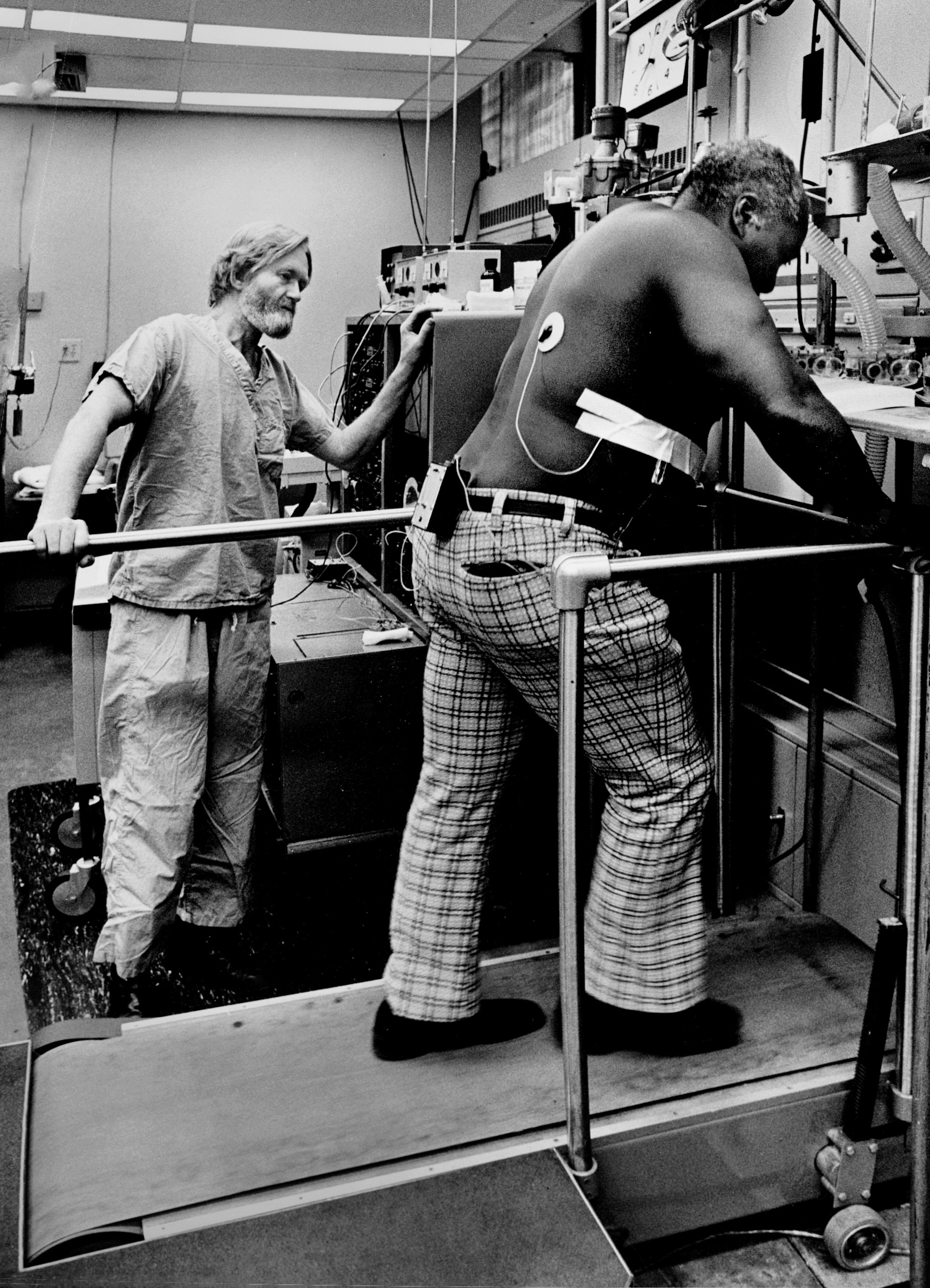

Apart from such individual physicians' political and medical predispositions, however, there remain epistemological tendencies within scientific medicine that militate against the understanding of disease advanced by black lung activists.9This summary of miners' perspectives on the origins of black lung and the role of physicians in advocating a restrictive view of work-related, compensable disease is based on the author's interviews and observations in southern West Virginia at different moments during the past five decades. Within the restrictive medical viewpoint that requires conclusive, scientific proof of occupational causation, black lung is in fact coal workers' pneumoconiosis, a single clinical entity, disabling only in advanced and, even today, relatively rare stages. The disease acquires legitimacy—indeed, effectively comes into existence—only when visible to trained personnel viewing objective diagnostic evidence, that is, X-rays, of an individual miner's lungs. The thousands of miners who believe themselves disabled by black lung yet exhibit no X-ray evidence of advanced CWP might legitimately be considered "disabled"—if the quantitative results of certain tests confirm such a condition. However, the origin of their disability is nonoccupational, above all their own cigarette smoking, or, if nonsmokers, other sources outside the workplace. Although this scientific definition of disease is quite different from physicians' earlier construction of a benign "miners' asthma," the result, in the eyes of many victims, is the same: black lung is trivialized. What many miners view as a collective problem becomes, from the perspective of scientific medicine, individual, quantifiable cases. What they experience as part of the shared social world of coal mining becomes occasional, biological events. What they attribute to their class relationship with the coal operators becomes the product of a single physical agent, dust. In sum, what is collective becomes individual, what is social becomes biological, what is produced by human action becomes the outcome of inert material.
Certain tendencies intrinsic to clinical medical practice are also at stake in the seemingly incommensurable perspectives of miners and certain physicians. Scientific medicine situates disease spatially, within the individual body, and temporally, at the point when signs, symptoms, or other physical alterations develop. Disease is ahistorical as well as asocial; it has no history except a "natural," that is, physical, history. It is said to exist when experienced by the individual and diagnosed by the physician, not at the point when it is being produced. The possibilities for prevention are thus constrained within the very definition of disease.10Howard S. Berliner and J. Warren Salmon, "The Holistic Health Movement and Scientific Medicine: The Naked and the Dead," Socialist Review 9, no. 1 (January–February 1979): 31–52.
Clinical medicine reflects this understanding of disease on a practical level: individual patients present the physician with their distinctive symptoms and complaints; they appear as random, disconnected "cases," and they are granted therapeutic treatment as individuals. There is no social meaning to disease in the sense of an internal relationship between social relations and the individual experience of ill health; primarily individual behaviors, such as diet, exercise, and smoking habits, command attention. Yet, in quantifying disability and allocating it to occupational or nonoccupational sources, physicians implicitly assess the conditions in which miners have lived and worked all their lives. That most physicians have never been in a coal mine (much less worked in one), and that some have never even been in the coalfields, serves to intensify the conflict between physicians and coal miners, who experience the superior legitimacy automatically granted scientific medical knowledge as a complex and powerful form of social control.
The authority of physicians to pronounce miners "healthy" or "disabled" carries important financial consequences. In the context of federal black lung compensation, doctors' assessments of coal miners' health can be decisive in the award or denial of financial benefits that are allocated in large part according to medical eligibility criteria. Doctors act as gatekeepers in a more generic sense as well: they control access to the "sick role," the sole avenue by which adults may legitimately escape the daily responsibilities of their class, race, and gender.11See Talcott Parsons, The Social System (New York: Free Press, 1951). Parsons's conceptualization of the sick role was neither class nor historically specific. For coal miners, as for other workers, the preeminent requirement of their class position is to perform wage labor. Medical criteria for assessing disability (and determining compensation eligibility) that take as the standard for health the functional capacity to work explicitly enforce this requirement. Even if damaged by work, coal miners still must provide medically sanctioned evidence of their "total disability"—i.e., complete inability to continue working—in order to receive financial compensation and legitimate relief from wage labor. In pushing against the limits of this compensation policy, miners and their families implicitly contest not only the ideological authority of physicians to define disease and assess disability; they ultimately threaten the economic power of coal operators by pressing for a broad definition of black lung and relaxed standard of disability that would provide unhealthy miners an alternative to labor in the mines.
This convergence between the restrictive scientific view of black lung and the economic interests of the coal industry is, for many miners and their families, an ultimate source of distrust and conflict with physicians. The narrow definition of disabling black lung as a relatively rare, complicated pneumoconiosis is highly functional to the industry: it circumscribes the scope of occupational lung disease and correspondingly diminishes both the cost of compensation benefits and the importance of prevention. In the context of policy formation, scientific medicine plays a mediating role between the interests of the coal industry and the actions of the state. It facilitates apparent distance between corporate power and public policy, and seems to ground political decision-making in the neutral, technical knowledge of a third party.
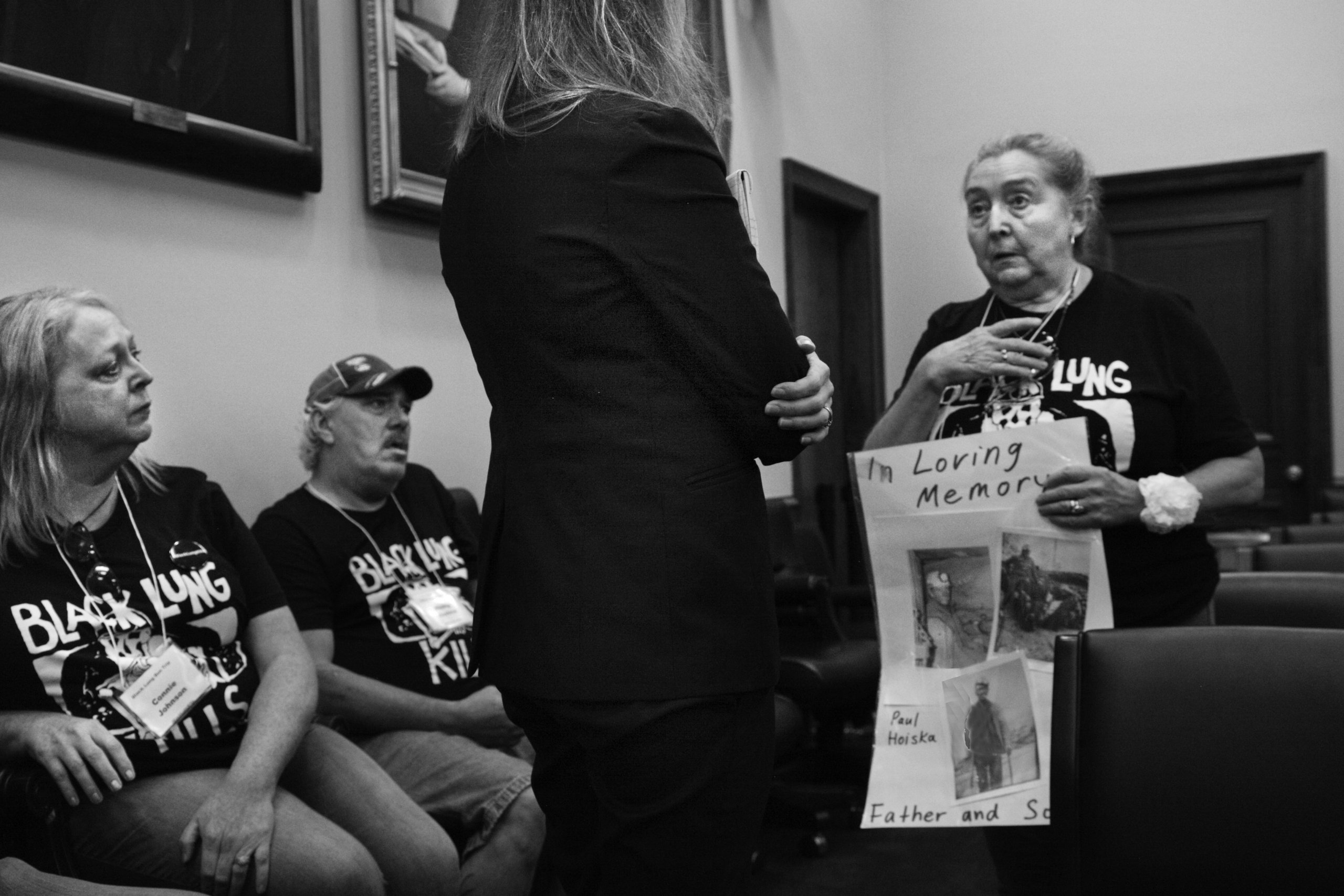
The lessons of the protracted struggle over black lung disease encompass both caution and inspiration, loss and hope. In an era of science denialism, when defense of factual truths and scientific knowledge seems obviously necessary, the case of black lung still stands as a warning about the presumed neutrality and appropriate scope of scientific and technical solutions: beware of technical fixes for problems that ultimately derive from economic exploitation and grossly unequal political power. Activists' original quest for redress through the workers' compensation system offers a related caution: the sprawling administrative machinery of the state, which presents the customary, sanctioned route for institutionalizing reform, entails embedded interests that can thwart activists' aims even as it seems to grant their demands. Finally, the long history of black lung suggests that effective prevention of occupational disease, injury, and death ultimately resides in the ever-changing power relations of the workplace and workers' collective, organized capacity to defend themselves. For these and many other reasons, victories are never secure, achieved once and for all; they must be defended, expanded, critiqued, and revised, as black lung activists have doggedly done for some five decades now.
Today, the industry that for more than a century has defined central Appalachia is dying. Those who would chart a post-coal future must grapple with the industry's legacy of incalculable human and environmental destruction, but they would do well to learn from the additional legacy of coal mining families' solidarity and resistance. Ever since the first investors laid claim to the coal of Appalachia, the people of this region have been revolting in various forms against the appropriation of their land, their labor, and even their lives. Those who fought in the black lung movement are both heirs and contributors to this long history of resistance. Today, many miners pay the cost of coal production in the currency of their very breath, but they also continue to resist. Danny Whitt: "We don't never give up. You know when I'll stop? When the last breath leaves my body."12Author's interview with Danny Whitt, Matewan, WV, September 4, 2019.
About the Author
Barbara Ellen Smith is professor emerita of women's and gender studies in the Department of Sociology at Virginia Tech. She has been active in and writing about movements for social and economic justice in Appalachia and the US South for more than 45 years. Her recent publications include a co-edited book with Stephen L. Fisher, Transforming Places: Lessons from Appalachia (University of Illinois, 2012) and Digging Our Own Graves: Coal Miners and the Struggle over Black Lung Disease (Haymarket Books, 2020).
]]>Blog Post
The activism of Appalachian women who took up the fight for justice in the 1960s and 1970s pulsed outward from a core ethic of care. Caregiving animated their understanding of politics and activism and infused their movements.1Berenice Fisher and Joan C. Tronto, "Toward a Feminist Theory of Caring" in Circles of Care: Work and Identity in Women's Lives, eds. Emily Abel and Margaret K. Nelson (Albany: State University of New York Press, 1990), 40. Historically, Appalachian women had tended to the broken bodies of miners and industrial workers, mourned the dead, raised children, and negotiated a subsistence economy. They did so not because women are inherently more nurturing than men but because culture, society, and law carved out these positions. Most caregivers do not become activists. The merging of an ethic of care with democratic struggle provided a powerful argument that caring is central to the fight for justice, fairness, rights, and democracy. Women drew upon their experiences in shaping movements for labor and welfare rights, environmental justice, access to healthcare, and women's rights.
In the last thirty years, working-class caregivers have faced a US political economy ever more hostile to their needs and concerns and increasingly demanding of their time and energy. Although overall poverty has decreased since the 1960s, many locations in the Appalachian South, like rural and working-class communities across the nation, have experienced the rise of extreme economic inequality, and a growing divide between rural and metropolitan residents.2See Ronald D. Eller, Uneven Ground: Appalachia since 1945 (Lexington: University Press of Kentucky, 2008), 232–233. In the Appalachian coalfields, the last decades of the twentieth century ushered in the final and most precipitous decline of that industry. Although mine owners and operators had long exploited workers, mining was for many years the best paying work around. When those jobs disappeared, no other industry filled the gap and more people entered the low-wage service economy, surviving with little in the way of workplace benefits or economic security.
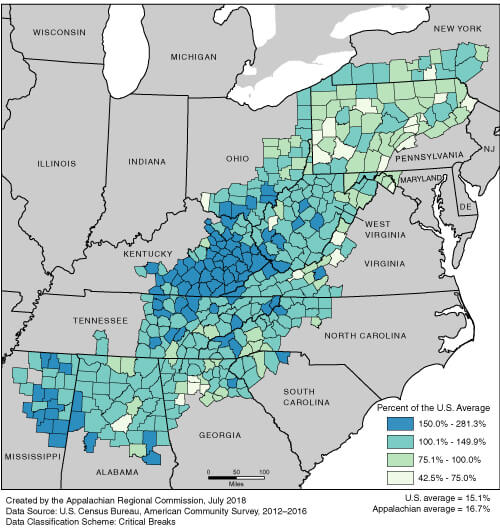
Relative Poverty Rates in Appalachia, 2012–2016 (County Rates as a Percentage of the US Average), July 2018. Map by the Appalachian Regional Commission. Courtesy of the Appalachian Regional Commission.
The loss of mining jobs and the transition to a global market and service economy paralleled the unraveling of the social safety net. In the 1990s, the bipartisan dismantling of Aid to Families with Dependent Children left poor families, and in particular women, on shaky ground and delivered a severe blow to decades of activism to guarantee welfare rights.3Deborah Thorne, Ann Tickamyer, and Mark Thorne, "Poverty and Income in Appalachia," Journal of Appalachian Studies 10, no. 3 (2004): 341–357. See also Debra A. Henderson and Ann R. Tickamyer, "Lost in Appalachia: The Unexpected Impact of Welfare Reform on Older Women in Rural Communities," Journal of Sociology and Social Welfare 35, no. 3 (2008): 153–171. Health clinics, legal aid services, and local organizations—the legacies of 1960s activism—stood as the only buffers in a political economy increasingly hostile to poor and working people.
In the popular imagination, "Appalachia" functions as shorthand for a white working class—coded as male industrial workers. For months before and after the 2016 election, journalists reported on various Trump Countries, as they were dubbed—Appalachian communities supposedly serving as ground zero for understanding working-class support for a billionaire who claimed to care about the "forgotten people" of America. This signposting allowed for an evasion of any deep analysis of racism or growing economic disparity, generations in the making and never contained to one region.4Roger Cohen, "We Need 'Somebody Spectacular': Views from Trump Country," The New York Times, September 9, 2016, accessed March 8, 2017, https://www.nytimes.com/2016/09/11/opinion/sunday/we-need-somebody-spectacular-views-from-trump-country.html; John Saward, "Welcome to Trump County, USA," Vanity Fair, February 24, 2016, accessed March 8, 2017, http://www.vanityfair.com/news/2016/02/donald-trump-supporters-west-virginia; Larissa MacFarquhar, "In the Heart of Trump Country," The New Yorker, October 10, 2016, accessed March 8, 2017, http://www.newyorker.com/magazine/2016/10/10/in-the-heart-of-trump-country. For a full list and analysis of this coverage see Elizabeth Catte, "There is No Neutral There: Appalachia as Mythic 'Trump Country,'" October 16, 2016, https://elizabethcatte.com/2016/10/16/appalachia-as-trump-country/.
Such portraits rely on exhausted tropes that erase the voices and experiences of working-class women, a multi-racial and -ethnic group, from history while wiping from historical memory the progressive activism long central to Appalachia's history. Such a narrative ignores the experiences of the vast majority of the region's workers (many of them women) who are not employed in heavy industry, but in the work of caring: health care support, education, and social services.
Conceptions of "workers" that exclude and marginalize caregiving, or cast Appalachia as an isolated, out-of-step place, have little chance of generating the kind of diverse, hopeful coalitional work that emerged in the late 1960s and 1970s.

Women activists in Appalachia and their allies—civil rights activists, lawyers, doctors, union organizers, feminists, and students—worked for what they believed was possible: the common good in their communities, region, and nation. Their most potent tool was the knowledge that they carried from a lifetime of tending to families, surviving tragedies, bearing witness to the disasters of unregulated capitalism, advocating for their communities, and taking stands for fairness and justice. Their stories are tools for the present, charting a path to a society that centers and values life-sustaining labor.
About the Author
Jessica Wilkerson is assistant professor of history and southern studies at the University of Mississippi.
]]>Review
In 1931, an all-white jury in Birmingham, Alabama, sentenced Willie Peterson to death for a mysterious attack that left two white women dead and a third critically injured. The lone survivor identified Peterson, a black ex-miner crippled by tuberculosis, as the assailant, but many in Birmingham—black and white—doubted that Peterson could have committed the crime. Just months after launching a national campaign to save the Scottsboro Boys from a similar fate, a loose coalition of southern radicals, civil rights activists, and white liberals fought to save Peterson from the electric chair.
In Murder on Shades Mountain, Melanie S. Morrison recovers the Peterson case from the shadow of Scottsboro—arguably the most significant and certainly the most chronicled miscarriage of justice in the Jim Crow South. A social justice educator with a doctorate in theology, Morrison reveals her family connection to the case. Her father, a progressive minister born into Birmingham's upper crust, was courting Genevieve Williams when her two sisters—Nell and Augusta—were attacked on Shades Mountain, approximately nine miles south of downtown Birmingham. Augusta, along with her friend Jennie Wood, died on the mountain, while Nell survived. Truman Morrison sat on the grieving family's porch and listened to Dent Williams, the girls' brother, brag about visiting the jail after Peterson's arrest and shooting the suspect at point-blank range. Peterson barely survived to face trial, but Dent Williams dodged conviction "by reason of temporary insanity" (118).
Another form of insanity—the racial pathologies laid bare by the Peterson case—compelled Truman Morrison to break off the courtship and break rank with his wealthy family. Inspired by her father's life of activism, Melanie Morrison seeks to make sense of the stories he told her and to reconstruct the social and political world of Depression-era Birmingham. This is not an unfamiliar world for historians, as Alabama has provided the setting for a number of influential studies on race, labor, and radicalism in the Jim Crow South. Yet in shifting attention from Scottsboro's sleepy courthouse square to Birmingham's industrialized and highly stratified terrain, Morrison offers fresh perspective on the structural violence that undergirded white supremacy.
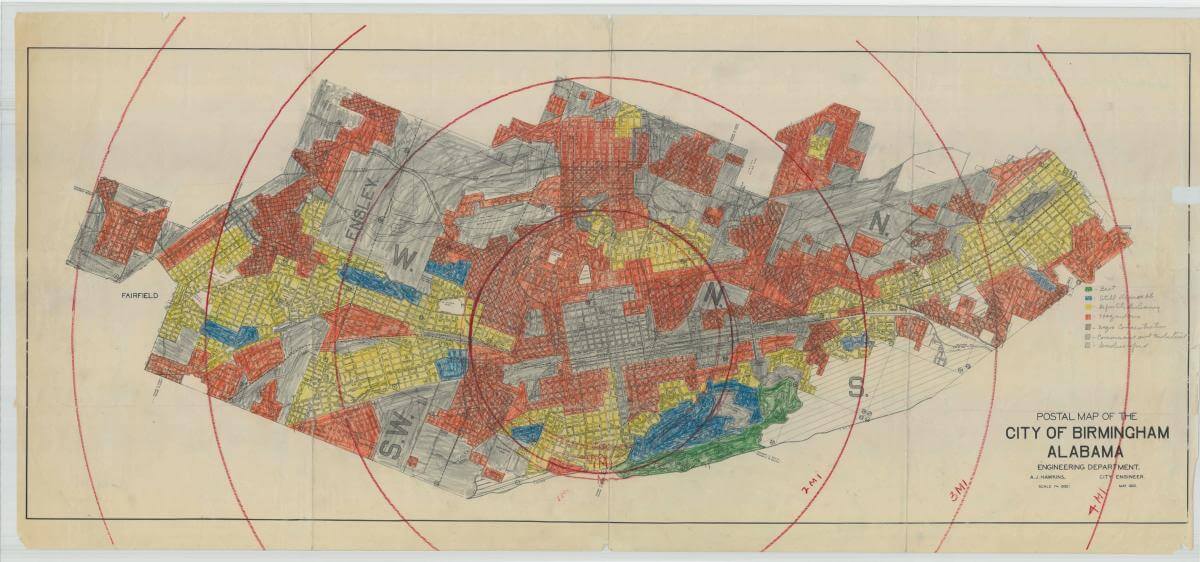
Place matters in Murder on Shades Mountain, and Morrison vividly reconstructs the social geography of Jim Crow Birmingham in the book's opening sections. Founded after the Civil War by investors intent on creating a southern industrial mecca, Birmingham was a city "rooted in racial apartheid" (26). Its barons resigned black workers to the lowest rungs of the labor ladder and confined the city's booming black population to racially zoned neighborhoods that lacked basic services. Meanwhile, whites with means moved upward and outward from the city's industrial core. The higher ground surrounding Birmingham also provided space for white leisure, including the overlook on Shades Mountain where the 1931 attack occurred. As Morrison points out, the rigidly segregated geography of Jim Crow Birmingham fueled doubts about the nature of the attack and the identity of the attacker. The notion that a black man would roam around this white enclave, in broad daylight and armed with a loaded gun, defied the spatial logic of segregation. Yet Jim Crow fueled an illogical counterpoint, where the threat of lust-crazed black men lying in wait demanded constant vigilance and swift vengeance.
The imperative that a black man must pay for the crimes committed on Shades Mountain underscores just how much Jim Crow blurred the line between legal and extralegal punishment. Angelo Herndon, a black communist and labor organizer later imprisoned in Georgia for his political activity, recounted his brutal detainment in the wake of the Shades Mountain attack. Birmingham police, he wrote in his 1937 autobiography Let Me Live, chained him to a tree and beat him with a rubber hose before charging him with vagrancy when he refused to confess to the crime. He estimated that lawmen and vigilantes killed as many as seventy black men and women in the "reign of terror" that swept him up (41–43).
For Herndon and his comrades, the arrest and prosecution of Willie Peterson marked the culmination of this broader campaign of violence and intimidation. The leftist activists who rushed to Peterson's defense blasted his conviction as a "legal lynching"—a term that Morrison embraces but which begs further interrogation given the complex and contentious history of "legal lynching" as a conceptual and rhetorical product of anti-lynching activism. Depression-era radicals were not the first to draw the connection between Jim Crow justice and extrajudicial violence, although they made these arguments vividly and forcefully. Although Morrison does not plumb this history, she rightly notes the role of US communists and allied labor radicals in promoting the argument, as the Southern Worker contended, that "the police, the courts, and the 'law enforcing' machinery are preparing to stage a legal lynching of [Peterson] as part of their campaign of terror against the entire Negro working class population of Birmingham" (84).
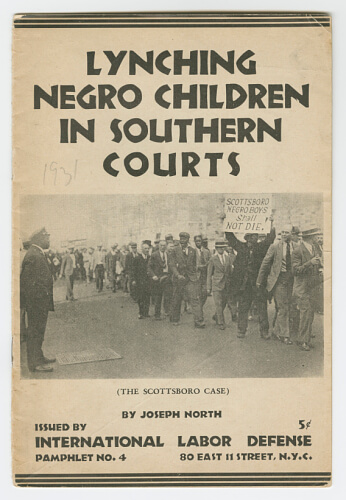
The rhetoric deployed in defense of Peterson echoed arguments popularized in the Scottsboro Case, through pamphlets with titles like Lynching Negro Children in Southern Courts. Published by the International Labor Defense (ILD), the communist legal aid organization that defended the Scottsboro Boys and later attempted to represent Peterson, the pamphlet typified a structural critique of Jim Crow as irredeemably violent and repressive. The ILD fought legal lynchings in the courts; its supporters—numbering several thousand in Alabama alone by the early 1930s—argued that the real fight was in the streets. Only "mass protest" would save those convicted, pamphlet author Joseph North argued, and moderates who counseled "faith in the lynch loving courts in Alabama and the South" were complicit in "hand[ing] them over to the executioner."1Joseph North, Lynching Negro Children in Southern Courts (New York: International Labor Defense, 1931).
The ILD aimed these barbs at its primary rival, the National Association for the Advancement of Colored People (NAACP), which had attempted unsuccessfully to wrest control of the Scottsboro Boys' legal defense from the radicals. That "wake-up call," Morrison notes, compelled the NAACP to intervene more quickly on Peterson's behalf (88). She characterizes the case as a moment of truth for the organization, which had struggled to regain its footing and credibility as more radical groups mobilized in response to economic crisis and white supremacist repression. The NAACP's new leader, Walter Francis White, had completed dozens of daring undercover lynching investigations, but he balked at any cooperation or association with communists on "legal lynching" cases. Nevertheless, Morrison emphasizes the NAACP's strategic flexibility and increasing emphasis on legal advocacy. Charles Hamilton Houston, the Howard University Law School dean who would become the NAACP's first special counsel in 1935, traveled to Birmingham to interview Peterson's wife, Henrietta (his notes from that encounter provided the source base for one of Morrison's most gripping passages), and advocated for the NAACP to expand its legal defense work.
Murder on Shades Mountain illuminates how the paths of some of the most significant figures and organizations in the black freedom struggle ran through Birmingham in the weeks and months after Peterson's arrest. Of course, the connections between mob violence and "legal" lynching run deeper than this slim volume conveys. While the antipathy between the NAACP and ILD infused both the Scottsboro and Peterson campaigns, the notion that racial violence represented only the most brutal expression of an oppressive system was not limited to radical organizations. "Lynching and mob violence are only methods of economic repression," the NAACP's William Pickens argued in 1921. "To attack lynching without attacking this system is like trying to be rid of the phenomena of smoke and heat without disturbing the basic fire."2William Pickens, Lynching and Debt Slavery (New York: American Civil Liberties Union, 1921). While the NAACP attempted to cooperate with southern white officials willing to speak out against lynching, including Alabama ex-governor Emmet O'Neal, they understood that such officials frequently talked down mob violence by doubling down on state-sanctioned execution. For these "law and order" officials, capital punishment offered reassurance to anxious whites that the state would dispose of black aggressors—real or imagined—without inviting negative publicity or outside scrutiny.
Peterson's death sentence offered no panacea to the Depression-era mob mentality. From the manhunt, roundups, and brutal interrogations that preceded Peterson's arrest to Dent Williams's assassination attempt on his sisters' accused attacker, the lynching spirit hovered over the case. While Peterson languished in prison, police in nearby Tuscaloosa handed over black teenagers to a lynch mob in the summer of 1933. Morrison's account reminds us that whatever divisions separated black activists, the campaign against lynching and related abuses remained a tactical and legal imperative. White reformers and civil rights activists argued over the criminal definition of lynching and the liability of local and state officials who failed to prevent it, while largely eschewing the language of "legal lynching." Even as the number of documented cases declined during the 1930s, the NAACP reported in 1940 that lynching had not disappeared but gone "underground," and warned that these secretive killings relied more than ever on the collusion of local officials.3Lynching Goes Underground: A Report on a New Technique (New York: National Association for the Advancement of Colored People, 1940), 7.
The same year that the NAACP warned that lynching had entered "a new and altogether dangerous phase," the legal lynching of Peterson ran its course.4Lynching Goes Underground: A Report on a New Technique, 7. Six years after Alabama's governor commuted his death sentence, Peterson died in the state prison infirmary from complications related to tuberculosis. Morrison describes the Peterson case as an "incomplete victory"—both in its attempt to save the man's life and in its broader challenge to white supremacy (192). Murder on Shades Mountain does not expend many pages tracing the links between this case and the more familiar Birmingham stories of the civil rights era, sparing readers of metaphors about the roots and seeds of movements to come. However, Morrison makes a point worth repeating—that "the 1930s are rife with historical antecedents to the uprisings, protests, and campaigns manifest in the 1950s and 1960s, which continues today." Despite the autobiographical bookends, in which Morrison reveals her personal connection to Birmingham's white liberal community, she emphasizes that the local movement was "led by black people" (194). Because of the historians Morrison acknowledges, and a few more she does not, we know many of these activists' names. We will never know them all, but thanks to Morrison's vivid rendering of Willie Peterson's life and witness, we know more.
About the Author
Jason Morgan Ward is acting professor of history at Emory University, where he teaches modern United States history. He is the author of Hanging Bridge: Racial Violence and America's Civil Rights Century (New York: Oxford University Press, 2016) and Defending White Democracy: The Making of a Segregationist Movement and the Remaking of Racial Politics, 1936–1965 (Chapel Hill: University of North Carolina Press, 2011).
]]>Introduction
The catfish didn't miss the current. They'd never known it. They lapped the pond all day like pace cars. At feeding time, they thrashed for their share of pellets. The farmers bred them for size and taste and texture and profit. They swam around in that little man-made lake and waited for the chopping block and the flash-frozen package. Their bodies were bullion. There were others of them, wild ones, who lived in the open waters of the river to the west. They sometimes got caught on the trotlines of grizzled river rats. Mostly they grew big as they pleased and swam deep into the crevices of the underwater earth. Fisherman told stories. "Whiskers big as bullwhips." They saw fleeting visions of this barnacled ghost ship. If you caught and ate it, they said, you'd gain all the wisdom of a century. It was part whale. Too big for the line. You could tell by the waves it made breaching the surface.
A white plantation owner in Money, Mississippi, pointed a shotgun at his father's head and threatened to blow it off, Ed Scott Jr. told me in 2013. This happened in the 1920s, when Scott was a boy. Three decades before the murder of Emmett Till put Money on all the wrong maps. The death threat was because Scott's father—who had brought his wife and children to the Delta in 1919—dreamed of being a black landowner instead of a sharecropper.
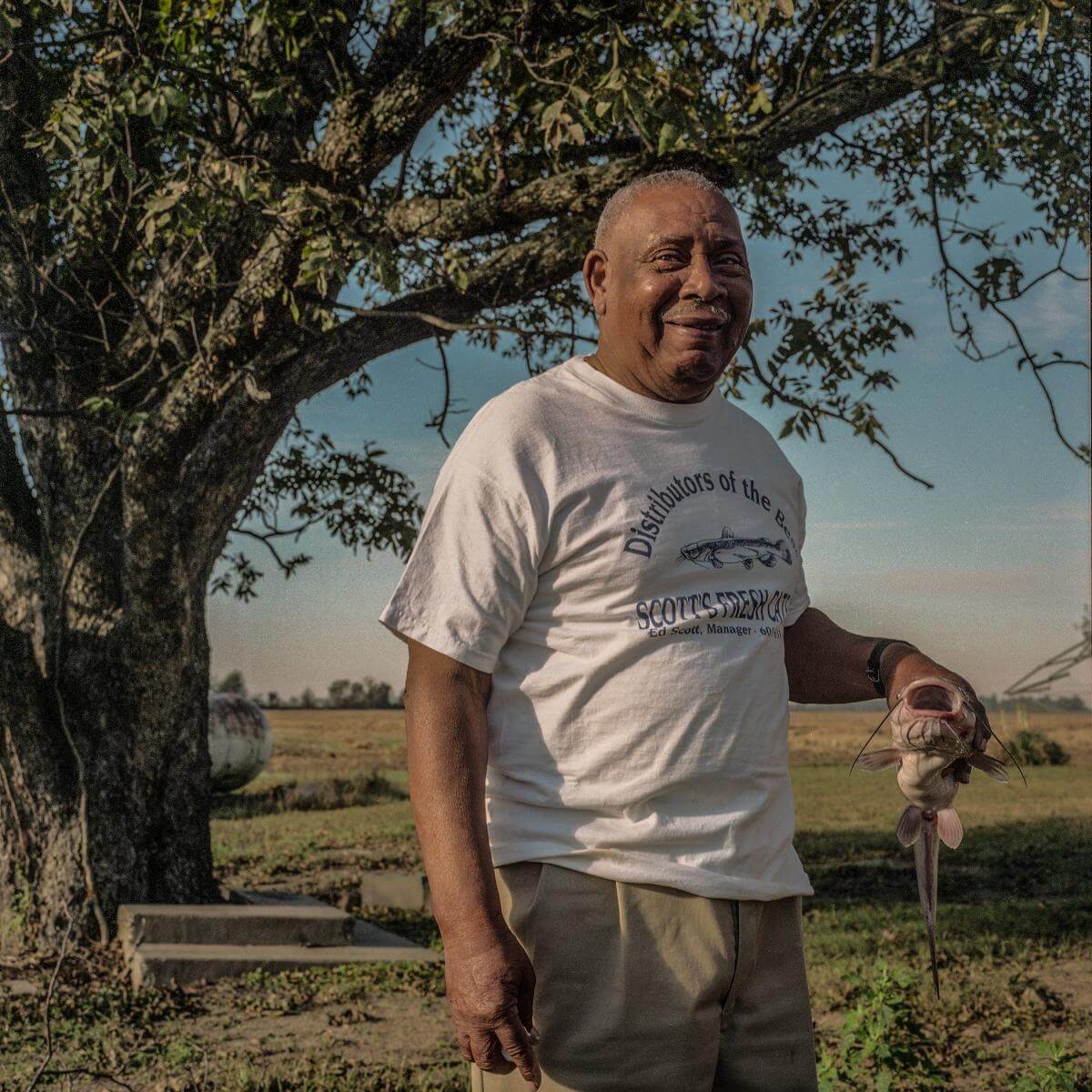
Ed Scott Jr. and I sat together in the cool-dark A/C. I sat on a stool, he reclined in an electric wheelchair. It was my first visit with him. He recounted more to me, of his tours in World War II ducking Nazi sniper fire with General Patton. How his return home to racism in Mississippi was, as James Baldwin wrote, like "a certain hope had died."1James Baldwin, "Letter from a Region in My Mind," New Yorker, November 17, 1962, https://www.newyorker.com/magazine/1962/11/17/letter-from-a-region-in-my-mind.
"[The people back home] didn't care about us no way," Scott said, speaking of whites' reception of black veterans. "They didn't want to see you with that uniform on back then. I was proud of that uniform, but I wasn't proud of Mississippi. Wasn't proud of Mississippi at all."
On the plight of the black soldier, Baldwin writes that he was "almost always given the hardest, ugliest, most menial work to do."2Baldwin, "Letter from a Region." After the war, Ed Scott stayed on the farm to help his father, who had then amassed hundreds of acres of Delta farmland. Scott's dream was not that the work wouldn't be ugly, or hard, or even menial. But that it would be his own work. That he would be his own master.
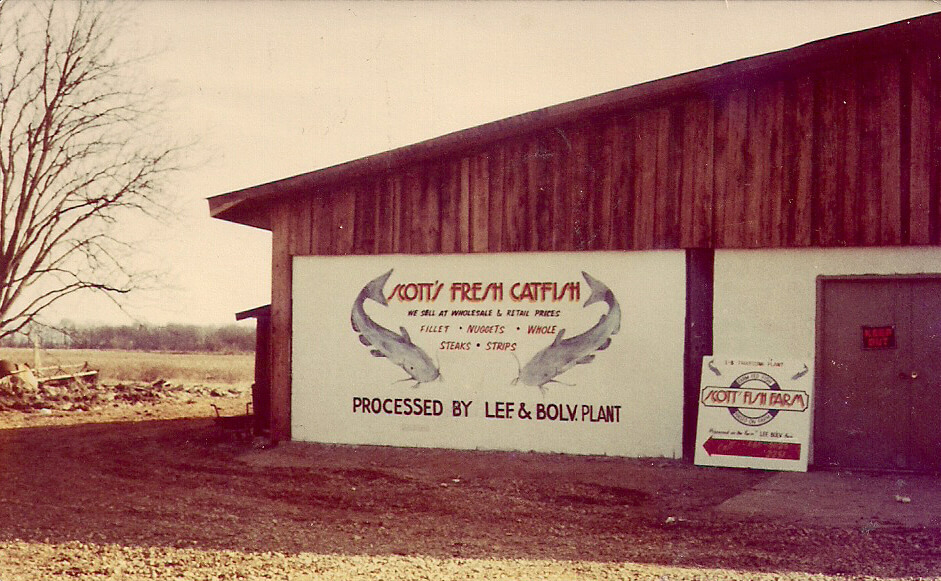
Scott made miracles in the cotton field, not far from Fannie Lou Hamer's visionary Freedom Farm. He carried food, prepared by his wife Edna and their children, to civil rights marchers and followed Dr. King to Selma and across the storied Edmund Pettus Bridge. He cleared a million dollars in rice in 1978. In 1983, at the height of his climb, Scott became the first ever non-white owner and operator of a catfish plant in the nation's history. It was a dream fulfilled. It was an act of necessary resistance against an industry, a government, and a society whose very identities seemed predicated on the subservience of black laborers.
"My motto is don't stop chasing your dream," Scott liked to say. "And that was my dream. To grow these catfish. Which I did."
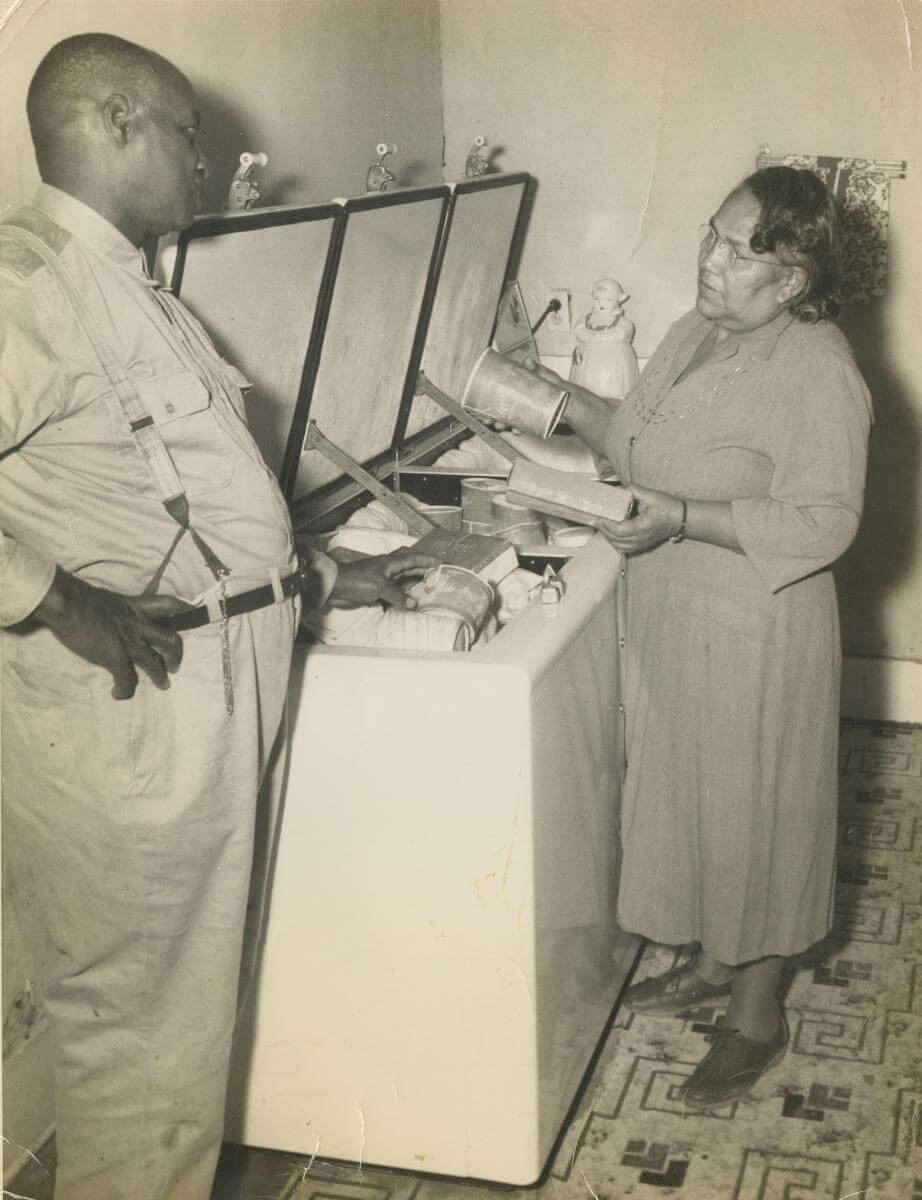
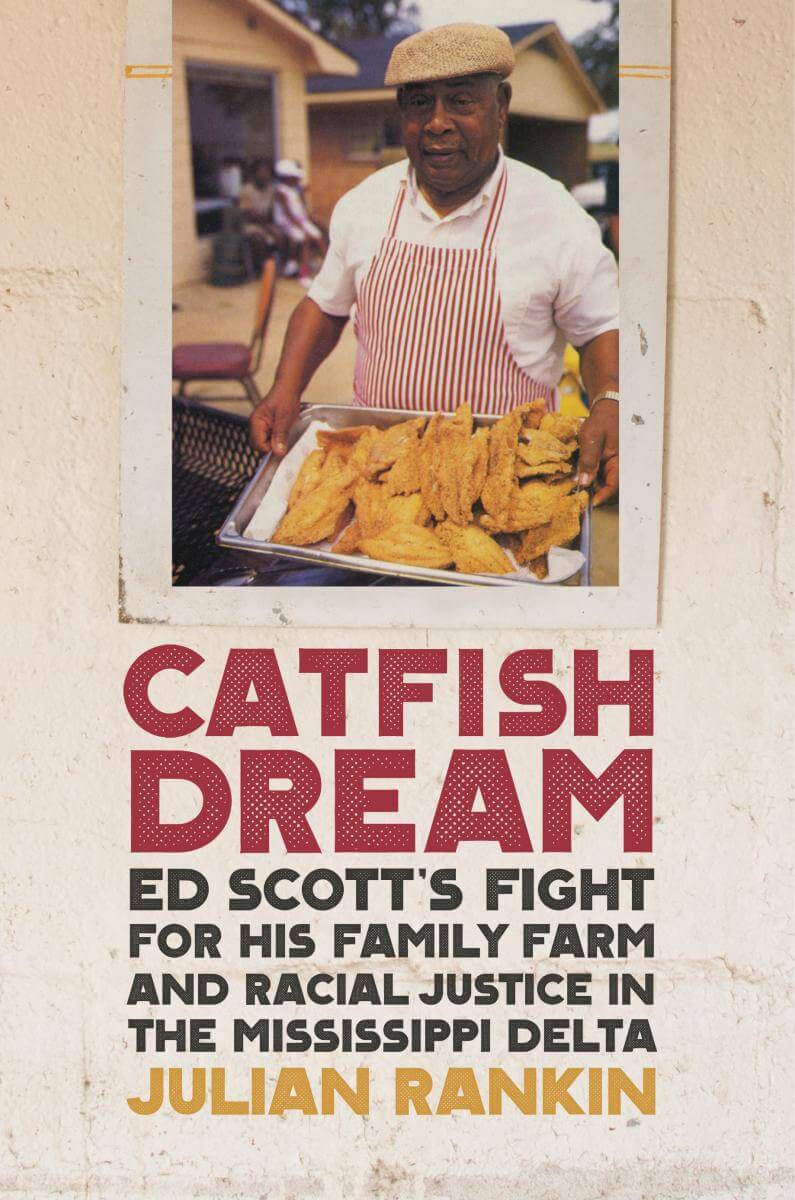
From that first meeting with Ed Scott in 2013, I knew I wanted to write a book about his life. Over the course of the next several years, I would interview Scott, his family, his contemporaries, his lawyer. The Scott odyssey is now told in the pages of Catfish Dream: Ed Scott's Fight for His Family Farm and Racial Justice in the Mississippi Delta (University of Georgia Press, Southern Foodways Alliance Studies in Culture, People, and Place series).
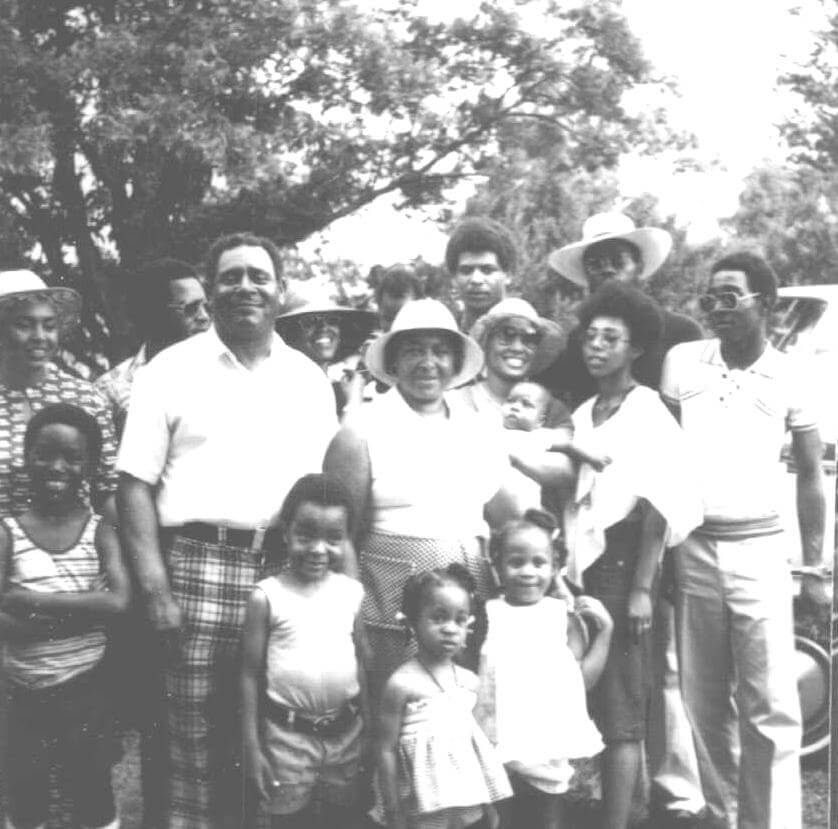
Ed Scott was not alone on the journey. He modeled himself after his father, Edward Scott Sr., a sharecropper-turned-landowner who brought the family from Alabama to Mississippi in 1919. (When Scott's mother, Juanita, pleaded to Edward Senior for a return home, away from Mississippi meanness, Edward Senior replied, resolutely, "I believe I could stay in Hell one year if I knew I could move out the next.") Ed Scott took the reins of the farm and joined forces with his wife, Edna Ruth Scott, whose own father was a community organizer and prodigious farmer in nearby Mound Bayou. He partnered with his siblings and children and extended family and neighbors—including the group of black women nicknamed "the Dependables" who served as his catfish special forces. The Scotts' roots run deep. They believe in legacy and namesake.
"You never know why God let that last child be named Edward," said Rose Marie Scott-Pegues, Ed Scott's eldest daughter. "He was more like his father than any of [the other] children. [His] thing is, 'I don't want you to sell any of my land. Ever.' And I'm looking at this a million years from now. . . . This land will still be Scotts' land.
I exited the Scott home after my first visit with the Scotts, into the Delta heat as if from a sheltered cave. The orator's cadence had slowed and warped time. It had felt like days, or decades, or all time. As I drove away, these are the things I was thinking about.
1990
Worms ain't got no feets. A page in a handmade book. A caption to a hand-scrawled illustration. An earthworm with four legs and Converse. Drawn by Annette, my afternoon babysitter, a high school senior, a young black woman who chewed her gum only until the sugar ran out. This in blink-and-you'll-miss-it Shaw, Mississippi, not far from where I would later sit with Ed Scott and hear him unfurl his tale. Out of the dirt and onto the page, through the dreamy veil of imagination, the worm with feets came. My first acknowledgement of mythmaking.
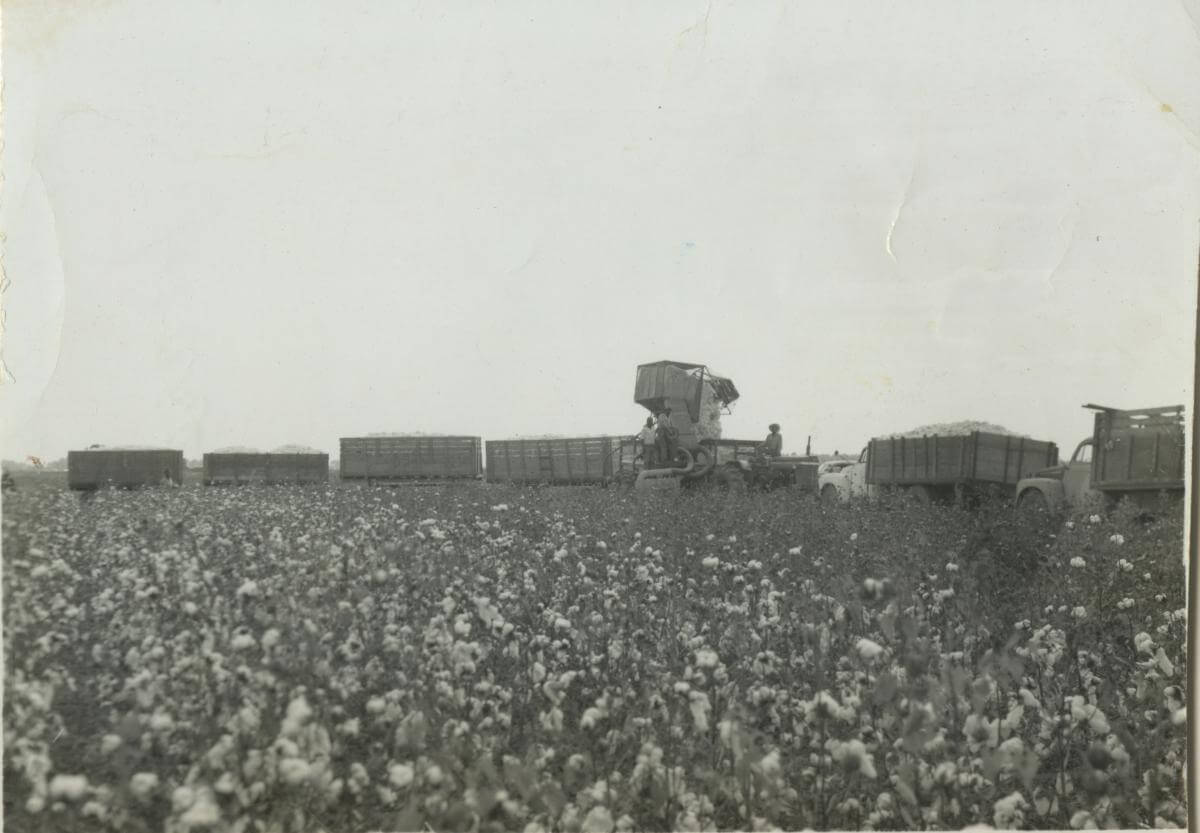
What does the Delta grow? Cotton, yes, the empire of it. The stalks like phalanxed soldiers and the bolls their thorny white heads. Propagated in postcards and genre paintings as widely as it was ginned and shipped. That is to say, all over the globe. Then rice, which Comet and Uncle Ben's came down to bid on. It, mostly white, too. Soybeans came. And corn. More than you could haul. Then catfish; out of the muddy river and into the aerated pond. But Mississippi's fertile crescent grows more than its commodities. It spawns paradox and polemic. Starkness and cacophony. Plenty and need. And of course, black and white.
My childhood home backed up to the Shaw High School practice field. For most of the hours of the day, it was quiet, until the band marched out to play. They stomped the earth and cut divots in the grass with their heels and rattled my existence. To me, their appearance was alchemy. Like rolling thunder shaped into flesh and bone. Fulfilling the latent potential of the field.
Other things the Delta grew then and still does. One-of-a-kind stores, forever "un-chained," with esoteric signs. Autocrats, plutocrats, democrats. Ramblers and gamblers. Day laborers, night laborers, nightcrawlers. Cottonmouths. Plantation houses on Indian Mounds. Jukes. Blues. Open roads. Dark and lonely cells. Government assistance. Government neglect. Lots not yet vacant but long past occupied. Ribs, bibs, bibles. Sunday dinner. Roadside eats. Potato logs on a hot tray under a heat lamp. Lessons. Teachers. Strong women—mothers and daughters, activists and administrators—who hold it all together. It spawns proximity, to the sinful roots of the nation and to graveyards and to ghosts. And also distance, an elusive recalcitrance to ever being pinned down or fully made sense of or tied neatly together. Undone shoelaces swinging on a tuba player in a marching band stampede. The notion that worms ain't got no feets coupled with the inkling that in the Delta, they probably do.
I was thinking about these things on the day after I first spoke with Ed Scott. Because in 1990, when my eyes were opening to the whole wide world, the Scotts were fighting it just a few counties away. Using a catfish as a club and barely hanging on. And I'd had no idea.
2013
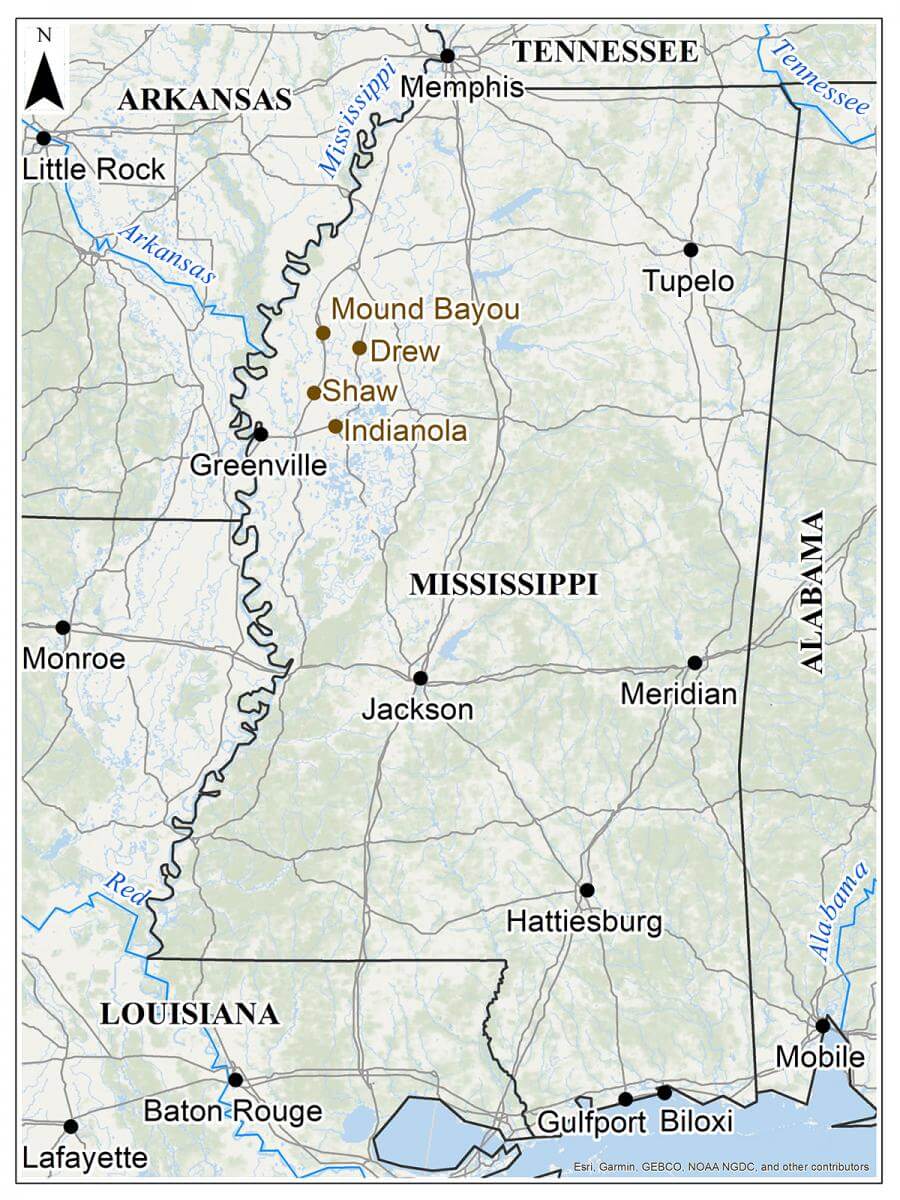
Ed Scott's grandson, Daniel Scott, took me through the ruins of the catfish plant. It had opened in 1983 to fanfare with a ribbon cutting and music and a contest to see which of the workers could hand-filet fish the fastest. Commissioner of the Mississippi Department of Agriculture and Commerce Jim Buck Ross looked on in his cowboy hat. He later said in a press release that "an operation with this early success is certainly a credit to our people, creating new employment at a time it is most needed."3"Mississippi Boasts First Black-owned Catfish Plant in U.S.," Mississippi Department of Agriculture and Commerce press release, March 3, 1983.
This plant shouldn't have existed. It had been an old tractor shed, and Scott built his crowning achievement atop the bones after the local white processor refused to sell him stock so that he could process his crop like all the other farmers. When he found this out, he set up a tour of that Indianola, Mississippi plant. On the way through, the tour guide asked Scott whether he had stock in the plant or a relationship with any live haulers who would take his fish. "Nope," Scott said.
"Well, what the hell you going to do with your fish, eat 'em?!"
"Something like that," Scott told the man. "I'm down here now seeing what you're doing. I'm going to clean my own fish."
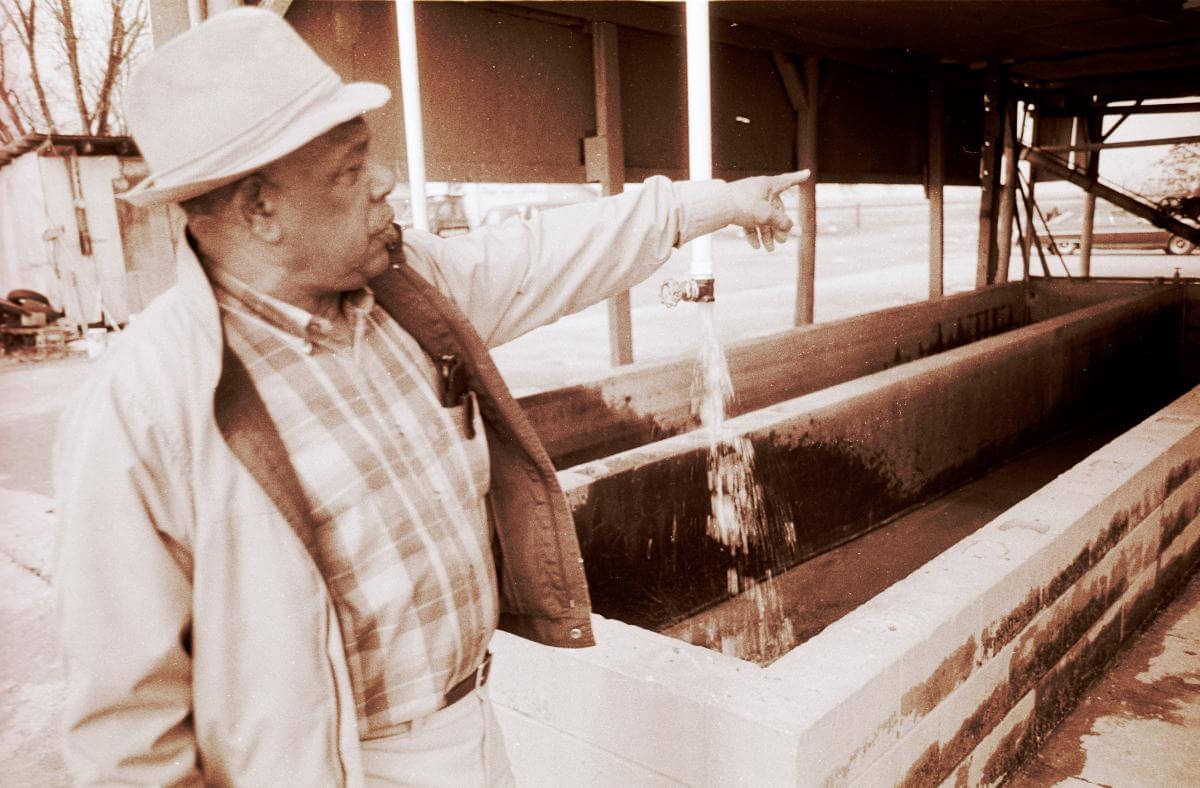
To tour the plant was to be forced to imagine what was and what might have been. Paint had faded, beams had fallen. An old television sat on the floor beneath a ceiling that was no more. Handwashing and "employees only" signs refused to budge, even while the rest of the building slowly reverted back to Delta wild. The plant closed around 1990, surviving even after the government foreclosed on the land and snatched the fish from the ponds. And in tandem with the white-dominated industry, the government constricted the flow of catfish that Scott had been buying, cash, to process and take to market himself. The plant closed at a time when national chains like McDonald's and Church's Chicken were experimenting with catfish on the menu. There was great promise for the Scotts nationally, coupled with great resistance against them locally. Under the pressure, the Scotts lasted for as long, and longer, than anyone could have imagined.
"And it was real sad because people was trying to get him out of business," said plant worker Lillie Watson-Price. "Oftentime he didn't get the finances that he need to continue to grow his own fish. . . . So what he started doing is buying the fish. Or getting it on credit. And that only lasts for so long. And they would come, and bring the fish and bring the fish and bring the fish. It was good, for a while. . . ."
"Watch your step, too," Daniel Scott told me on the way through the plant site. "That was like a storage room. That was the break room. They would change clothes, the workers."
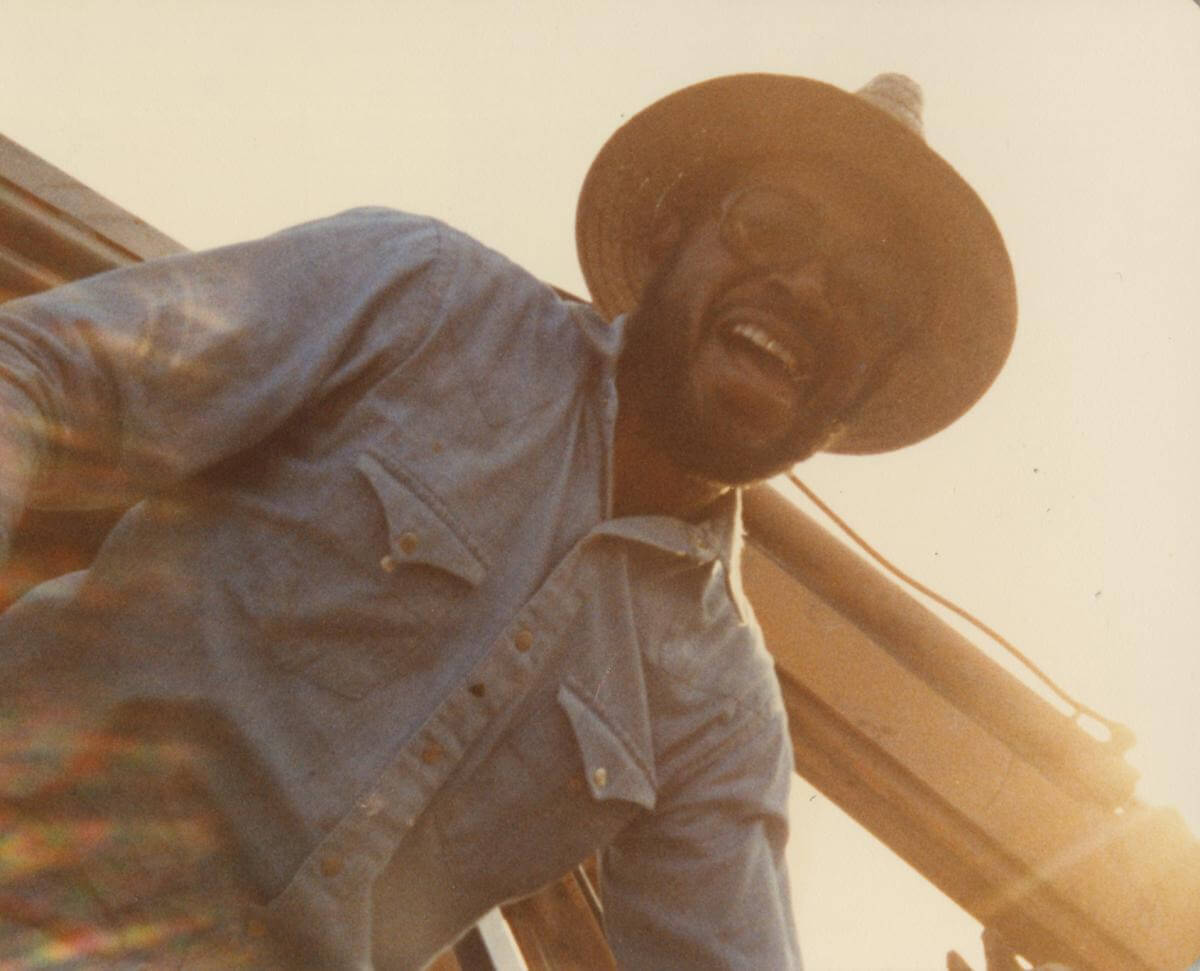
Daniel recalled his time at the plant as a teenager. He was working the skinning line and lost a fingernail. Snatched right off. Another time, he nearly cut off his finger on the bandsaw. If I could have gone back to 1990, in the plant's final days, I would have seen the Dependables processing tens of thousands of pounds of fish a day. I would have heard them laughing, seen them grinning, felt their pride at working a dignified job, however odious and blood-soaked it may have been. The workers were almost exclusively African American, as they were at the other processing plants. There, carpal tunnel and sexual assault was rampant. But here, Scott's workers prospered. I could have peeked around a corner and seen them joshing between shifts, throwing cubes of ice, concealed in their pockets, at each other's backsides. At lunchtime, I would have walked a hundred feet across the gravel parking lot to the Scotts' home to eat, where Edna Scott had opened her own kitchen and cafeteria to feed the workers and surrounding farmers with fried fish and the bounty from her garden patch.
James Baldwin, reluctant optimist, spoke about the gap between dreams and reality. "Until the moment comes, when we, the Americans, we, the American people, are able to accept the fact . . . that on that continent we are trying to forge a new identity, that we need each other, that I am not a ward of America, I am not an object of missionary charity, I am one of the people who built the country—until this moment comes there is scarcely any hope for the American dream."4James Baldwin, Debate: Baldwin vs. Buckley, the Cambridge Union Society, Cambridge, UK, February 18, 1965, broadcast by the National Educational Television Network, https://www.youtube.com/watch?v=VOCZOHQ7fCE.
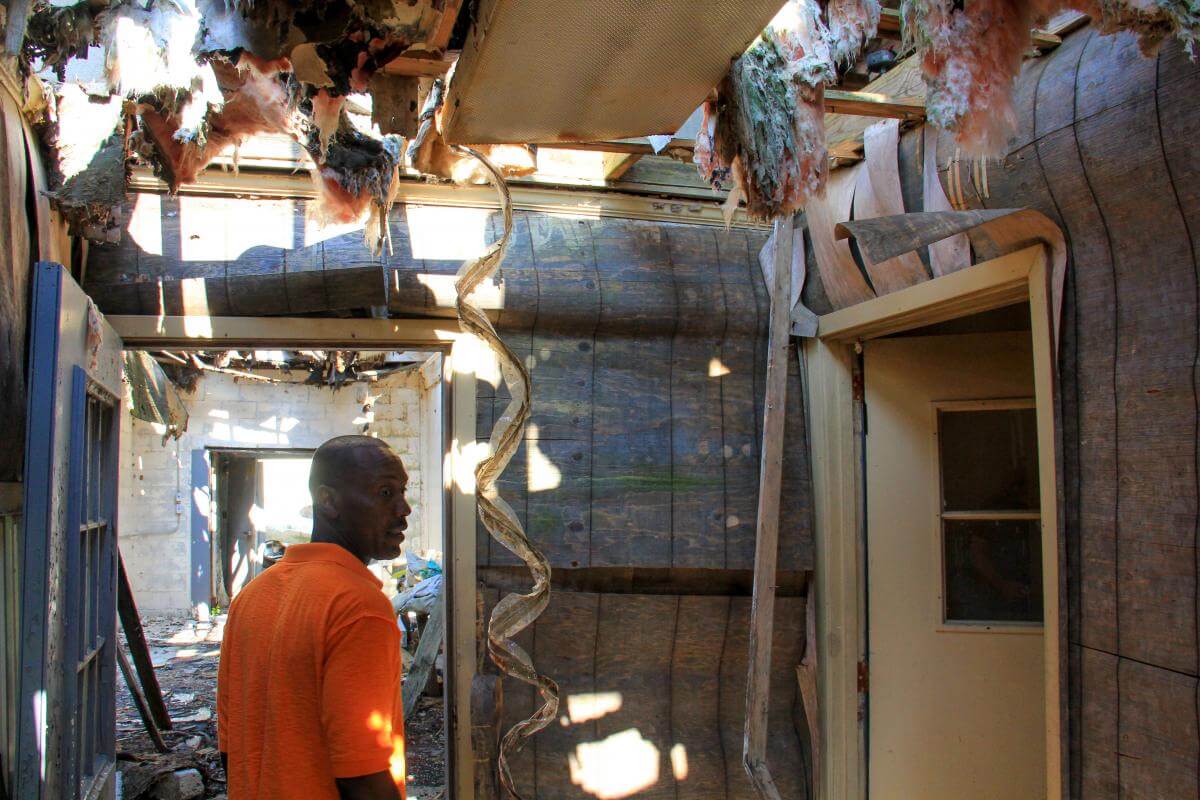
When I was small, I heard much about problematic patriarchs. They littered my history books and struck smart poses. In civics class, we studied rhetorical structure and theoretical justice. I heard tell of trickle-down economics and bootstraps. There was an absence. All the people left out of this scheme.
Within the unfair system, there are outliers like the Scotts who make strides against the odds. Their summits are worth celebrating, even as they remind us that such climbs are precarious. They illustrate what the American dream should mean. A parcel of land, hard won, that endures across the generations. An enterprise, built through collaboration, with wealth that flows outward and downstream. A system made not solely by patriarchs but by extended families who share in the labors and define their collective futures.
"Those bees are back," said Daniel Scott, pointing to the rafters of the disintegrating processing plant. "You hear them. I thought they was gone. It's crazy, ain't it? How time will do shit?"
Ed and Edna Scott's children—especially Isaac Scott and Willena Scott-White—have restored the lost acreage, gone for thirty years to unjust foreclosure. The overgrown fields have been disked and re-planted with rice and soybeans, steadfast crops of twenty-first century Mississippi. Isaac Scott, who learned to farm from his father, now employs GPS on his combine. Willena Scott-White has plans for the Delta Farmers Museum and Cultural Learning Center in Mound Bayou to keep the stories of black farmers alive. The Scotts taught me that America's story is still being written, and all are authors of it.
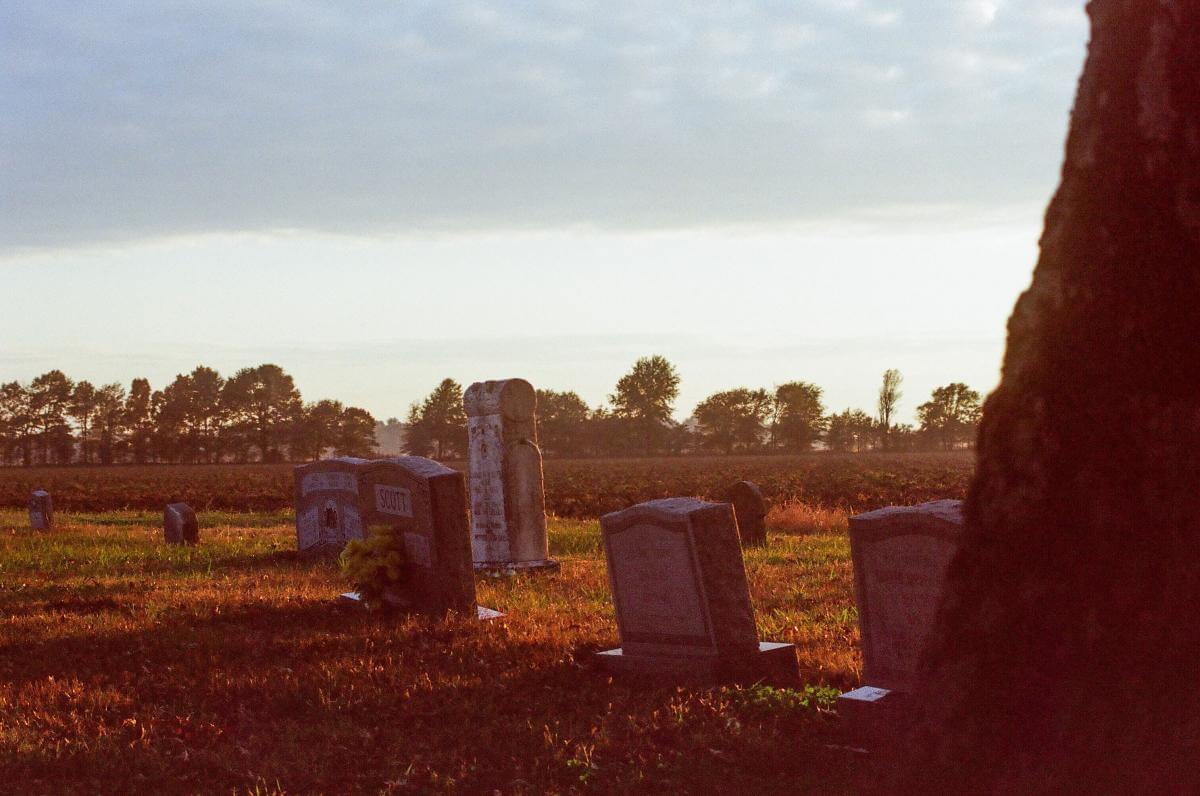
Though many of the Scotts have passed on, the land remains. Near the ruins of the plant, a handful of gravestones occupy a shaded plot, in various degrees of wear. Edward Senior is buried here. He died in 1957 but looked on as his son made history. Ed Scott and Edna Scott, who passed in 2015 and 2016, are buried here too. The family cemetery is well-manicured and regularly visited. The pioneers who rest in the earth are rooted still. On Scott family land. Always, Scott family land.
About the Author
Julian Rankin is the founding director of the Center for Art & Public Exchange at the Mississippi Museum of Art in Jackson, Mississippi. He is the recipient of the Southern Foodways Alliance's first annual residency at Rivendell Writers' Colony.
]]>Review
The yeoman farmer is a central figure in debates over the historical dispossessions that created the place we now call Appalachia. For historians like Ron Eller, these self-sufficient small landholders dominated the agrarian past, and first became exploited as residents of company towns when coal, timber, and other corporate interests began in the late nineteenth century to appropriate the land and wealth of the mountains for their own profit.1See Ronald D. Eller, Miners, Millhands, and Mountaineers: Industrialization of the Appalachian South, 1880–1930 (Knoxville: University of Tennessee Press, 1982). During the 1960s and 1970s, activists promoted a related golden-age vision of egalitarian pastoralism in pre-industrial Appalachia, which they contrasted with the ugliness of strip mining, black lung disease, and other contemporary depredations to amplify their calls to "save the land and people." Then, in 1996, Wilma Dunaway swept aside romantic visions of the Appalachian past with prodigious quantitative research, an earlier historical timeline (back to 1700), and the perspective of world systems theory. "On the eve of the Civil War," she concluded, "Appalachians were much more likely than other Americans to be impoverished, illiterate, and landless."2Wilma A. Dunaway, The First American Frontier: Transition to Capitalism in Southern Appalachia, 1700–1860 (Chapel Hill: University of North Carolina Press, 1996), 21.
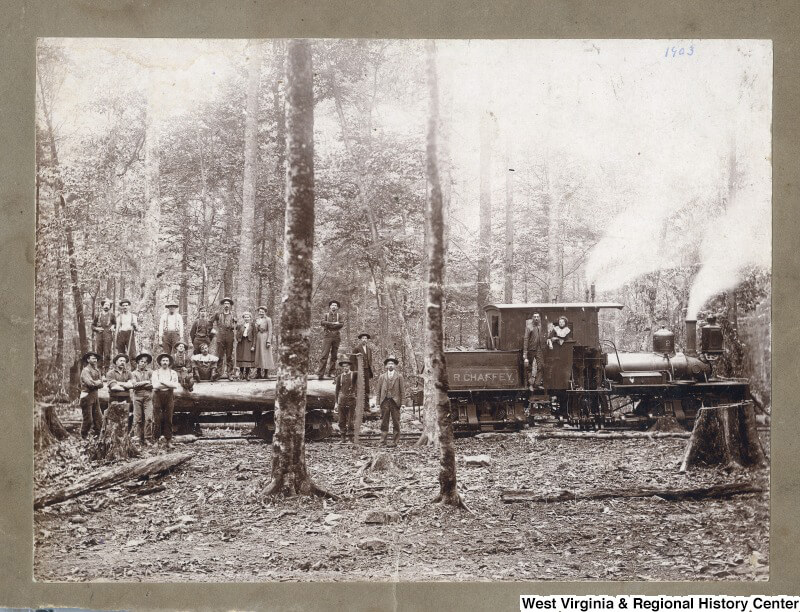
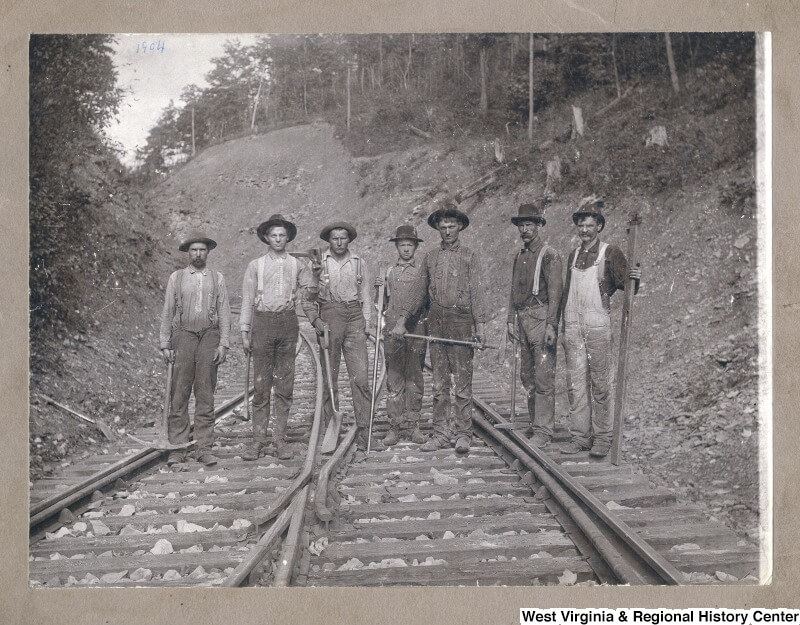
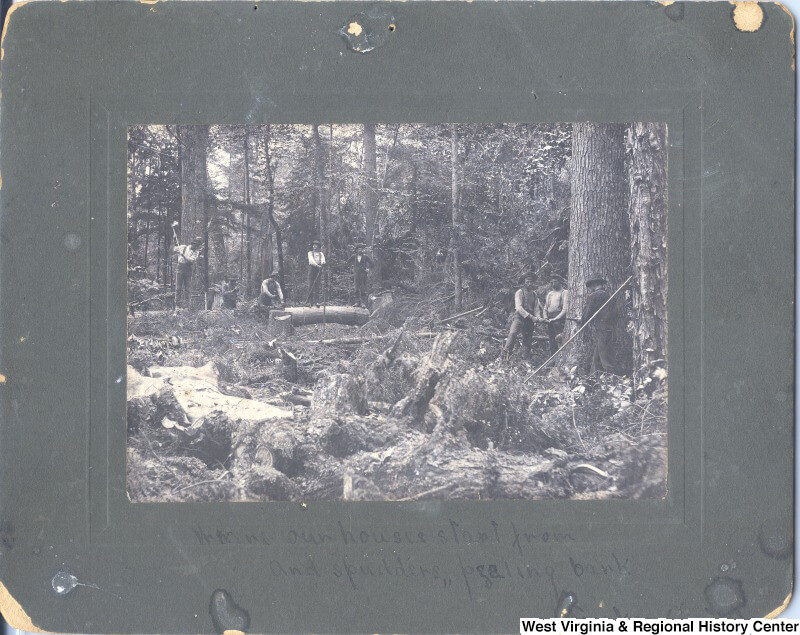
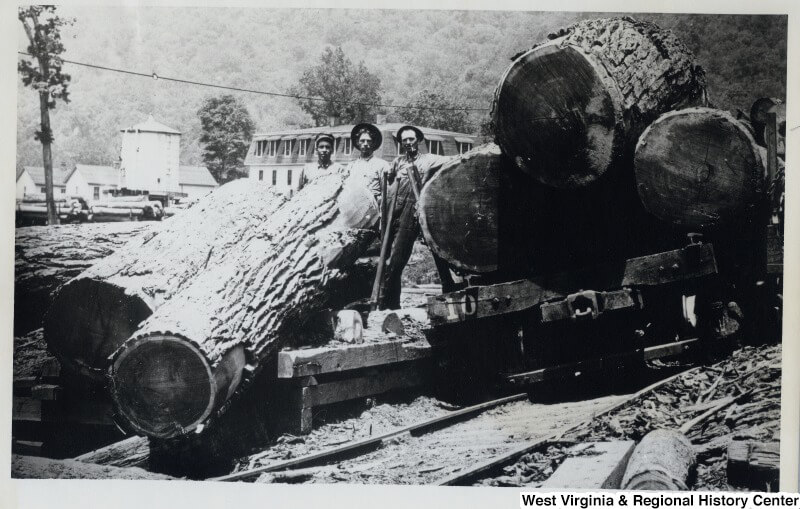
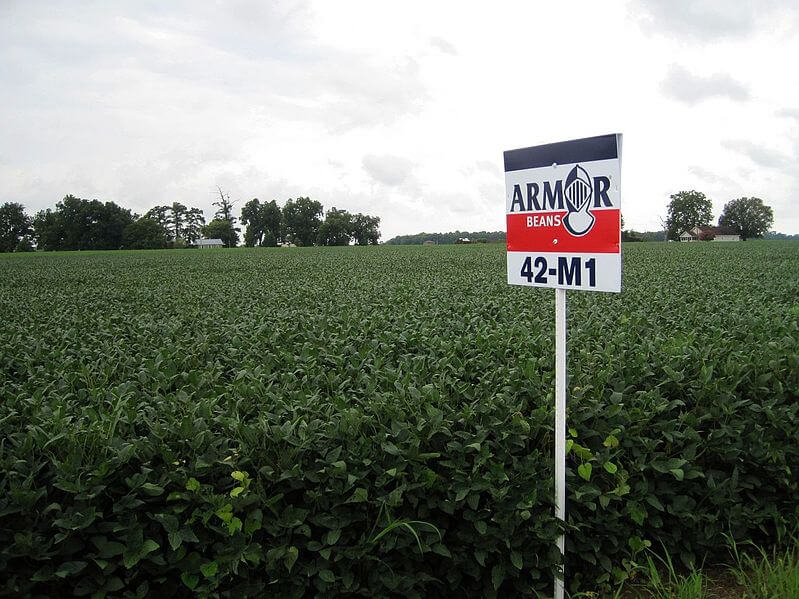
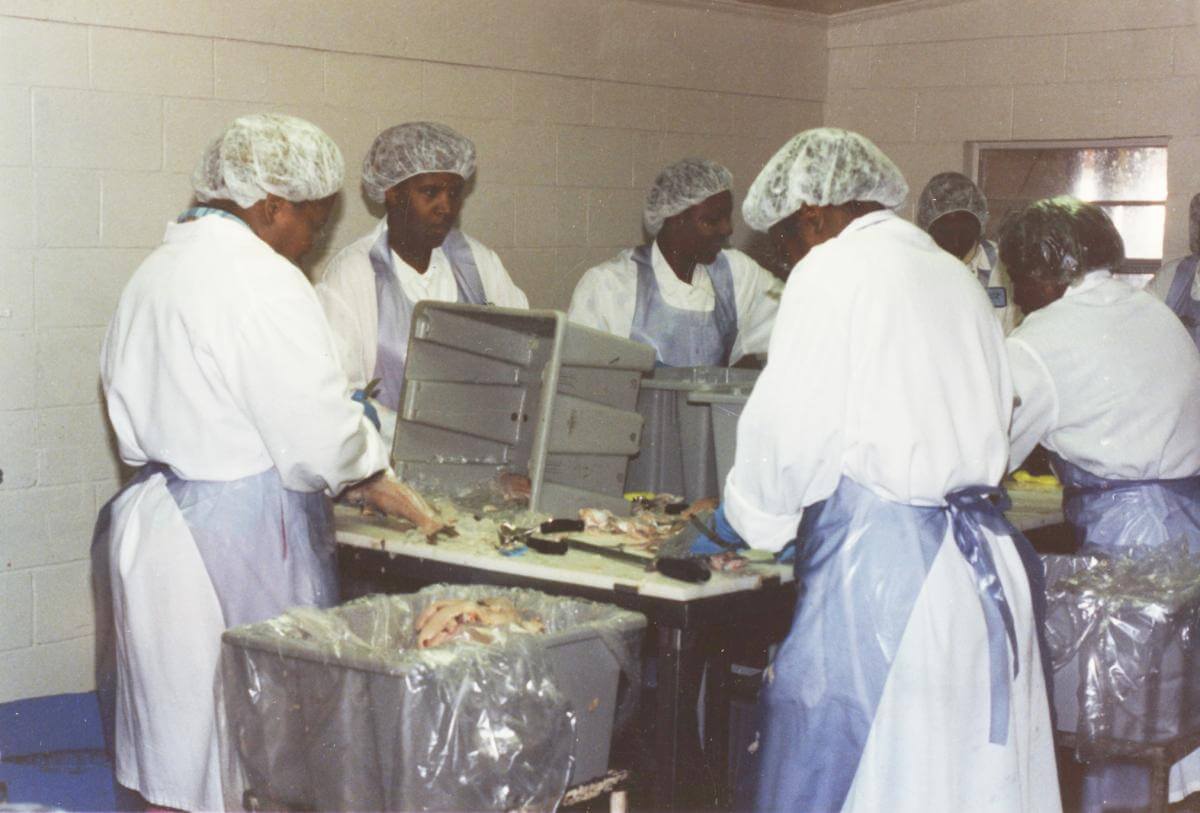
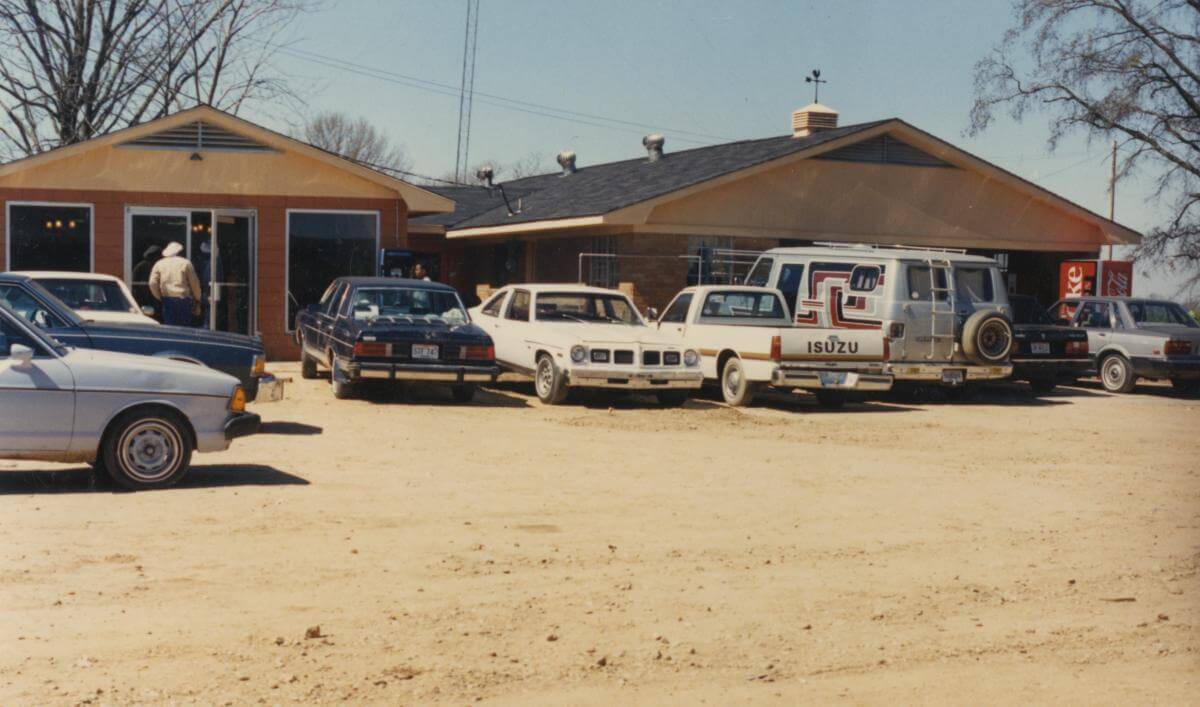
Steven Stoll's Ramp Hollow intervenes in these and related debates by recasting the nature of agriculture and the meaning of land ownership among the European colonialists and their descendants who settled the Appalachian frontier. Stoll likens Appalachia's early settlers to peasants all over the world, who depend on access to a common "ecological base." In the Appalachian instance, this "base" is the forest: "This is a vast renewable fund of resources that provides spaces for fields, food for gathering, fodder for cattle, and habitat for wild game. The base gives everything but costs nothing" (33). Through the practice of swidden, sometimes pejoratively called slash-and-burn agriculture, settlers cleared portions of the forest and cultivated crops, but their clearings were limited; more importantly, they utilized the forest as a source of wild plants, game, and mast for their free-ranging livestock. Although their economy was "makeshift," without extensive surplus or accumulation, these early settlers rarely starved, Stoll asserts, and they should not be considered poor.
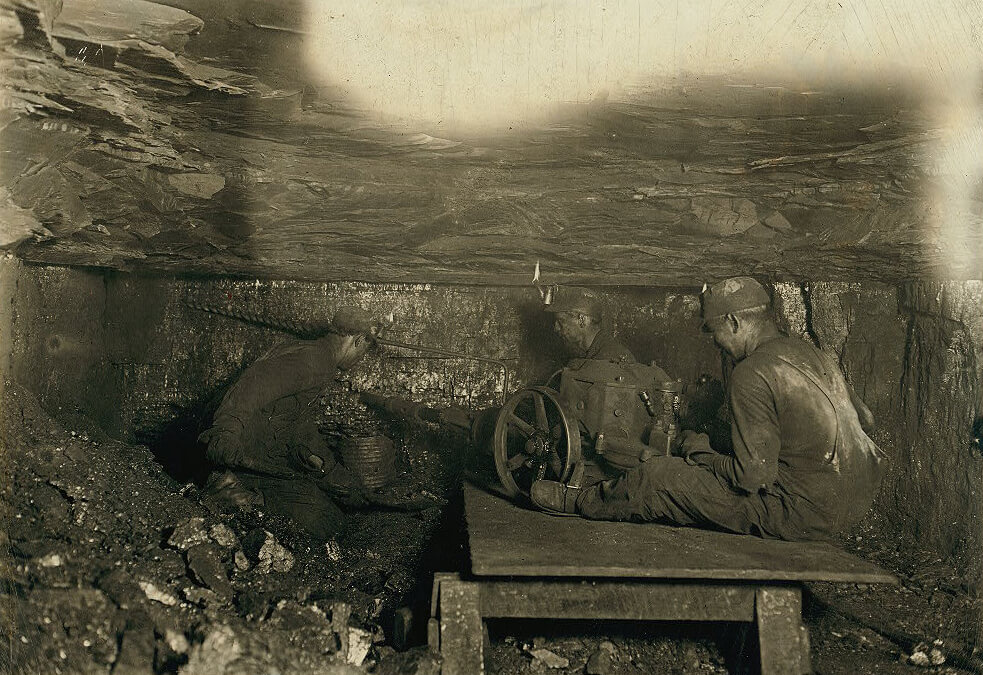
As the western edge of European settlement, the mountainous backcountry of eighteenth-century Appalachia briefly represented a space of relative freedom from state enforcement of property rights. Although elites gained formal title to millions of mountainous acres through grant or purchase, they tended to view the land as "wilderness" and unworthy of investment or even much attention, according to Stoll. A chaos of competing land claims emerged, as well as, in effect, the practice of "land to the tiller." Use-rights prevailed. Squatters and small landholders utilized the vast forest without regard to absentee elites and their abstract legal instruments, which went unenforced, thereby irrelevant, and they engaged in a vigorous barter economy with one another.
Although historians and activists have focused largely on the land-grabbing actions of coal companies in the late nineteenth century as the definitive dispossession of Appalachia, Stoll takes us back to the federalism of Alexander Hamilton in the early republic. Taxation—an obligation that could only be fulfilled in legal currency—was the means to force subsistence agrarians toward a cash economy and extend the administrative reach of centralized government into the recesses of the mountains. "Taxation does not merely fund the state," Stoll observes, echoing the arguments of James C. Scott and other anti-statist anarchist scholars. "It creates its territorial and financial power" (122).3See James C. Scott, The Art of Not Being Governed: An Anarchist History of Upland Southeast Asia (New Haven, CT: Yale University Press, 2009). Armed resistance to Hamilton's tax on distilled spirits, which did not distinguish between commercial and household production, arose from the high value of whiskey in barter exchanges and the onerous compulsion to send money from a cash-poor economy to a distant central government—all on the heels of a war for "independence." Although the Whiskey Rebellion succeeded in discontinuing the excise tax, the coercive extension of a sovereign state—with a unified system of land ownership, property rights, law, currency, taxation, and administrative regularity—would eventually facilitate destruction of the ecological base and subsistence practices of Appalachian agrarians.
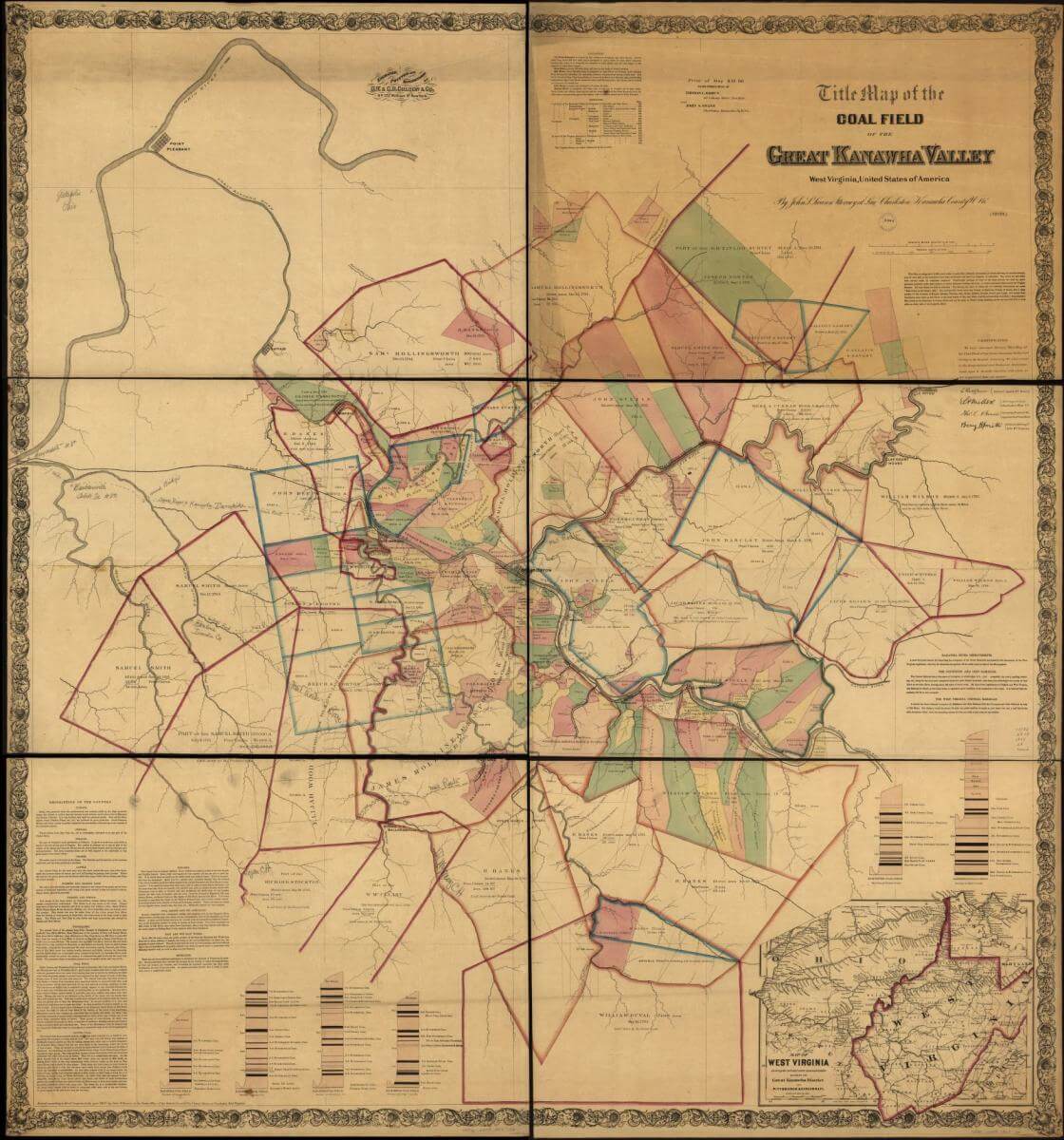
Stoll's tale of rural industrialization in the second half of the nineteenth century focuses on what became West Virginia, and is familiar to scholars and many residents of central Appalachia: extension of the railroads into southern West Virginia, corporate acquisition of mineral rights and vast landholdings, opening of the "billion dollar coalfields," growth of company towns and the exploitative trap of scrip (non-legal tender in which miners received wages), company stores, occupational death, the mine guard system of private security thugs. True to his emphasis on subsistence agrarians, however, Stoll builds on work by Ron Lewis to emphasize the wholesale timbering of the mountains, which accompanied coal mining and devoured the ecological base of the forest.4See Ronald L. Lewis, Transforming the Appalachian Countryside: Railroads, Deforestation, and Social Change in West Virginia, 1880–1920 (Chapel Hill: University of North Carolina Press, 1998). Combined with the contradiction of a growing population seeking sustenance from a shrinking base of land (analyzed in detail by Dwight B. Billings and Kathleen M. Blee), these multiple dispossessions spelled an end to the makeshift agrarian economy.5See Dwight B. Billings and Kathleen M. Blee, The Road to Poverty: The Making of Wealth and Hardship in Appalachia (Cambridge: Cambridge University Press, 2000).
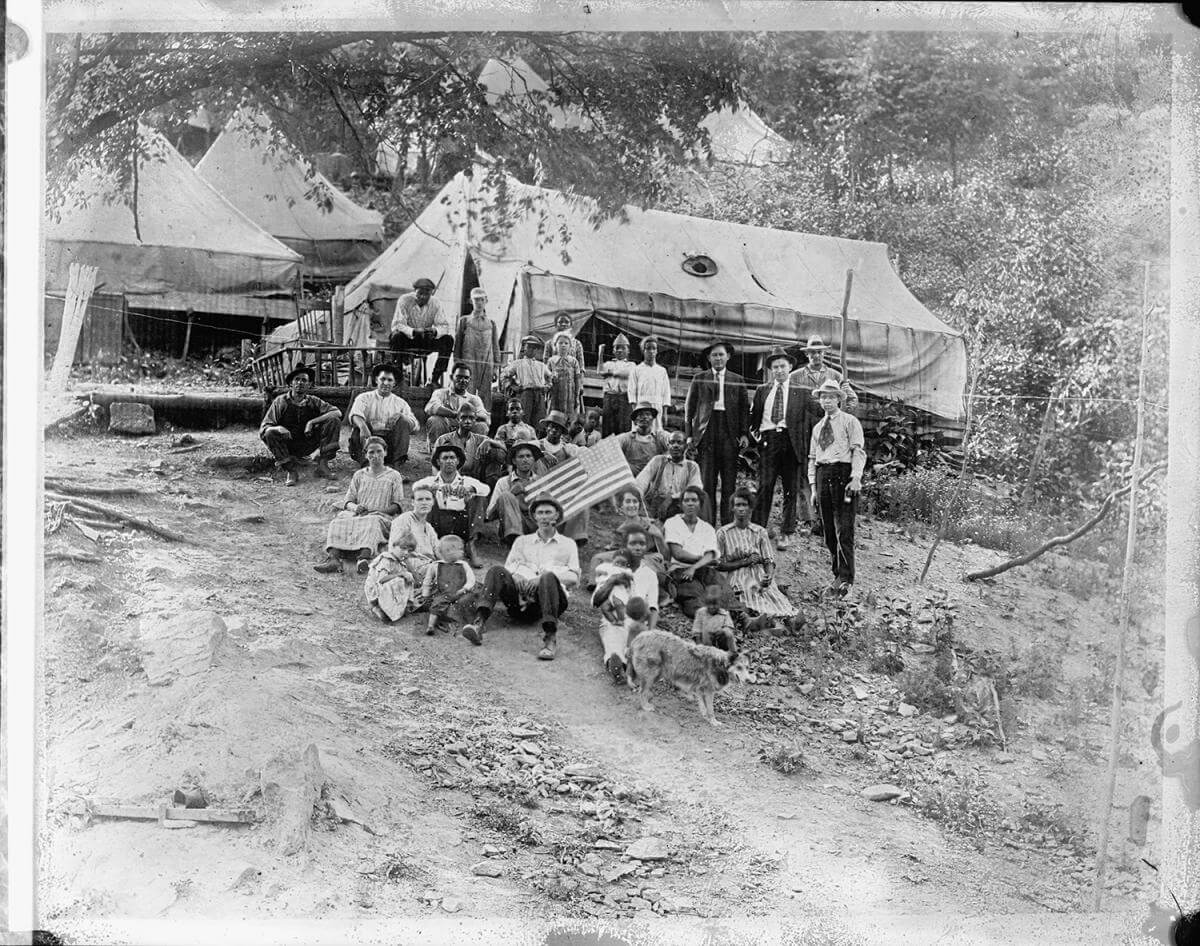
Stoll directs special attention—and some of his most blistering critique—to the ideologues of capitalist modernity, those self-interested promoters of the benefits of wage labor, efficiency, discipline, and "productive" (i.e., profitable for them and their kind) use of the land. Declaring makeshift agricultural practices a miserable, impoverished throwback that impeded the self-evidently desirable processes of modernization, "Atlantic elites" gradually appropriated the means of subsistence of mountain farmers, then pronounced them miserable and poor. This critique of dominant ideology forms an important bridge toward Stoll's larger purpose in Ramp Hollow, which is to defend the integrity of peasants and the viability of their agricultural practices—when not disrupted by various "development" schemes—all over the world. Indeed, the book begins in West Virginia and ends in West Africa, where Stoll decries the contemporary enclosure movement whereby governments are dispossessing entire peasant villages by transferring "idle" common lands to corporations that produce agricultural commodities for global markets.
Reviewers typically feel an obligation to register a complaint or two about a book, and I am no exception. I was disappointed by Stoll's lack of attention to gender relations and the gendered division of labor, especially in view of his definition of the makeshift agricultural economy as a household mode of production. Although he acknowledges that the agrarian household was a "coercive institution" (216), what he means by that is the authority of patriarchs over their children, who "owed their families a certain term of labor before gaining the right to strike out for themselves" (216). Neither patriarchal authority over wives nor the fact that daughters never gained "the right to strike out for themselves" seems to occur to him. Consistent with his Marxist analytic (and neglect of Marxist-feminism), Stoll focuses exclusively on class relations; in the context of coal camps, this includes analyzing the contradictory role of the household garden as a means to lower the cost of miners' and their families' social reproduction (and thus wages) as well as potentially sustain them during strikes. The labor in those gardens, as in social reproduction more generally, remains unexplored.
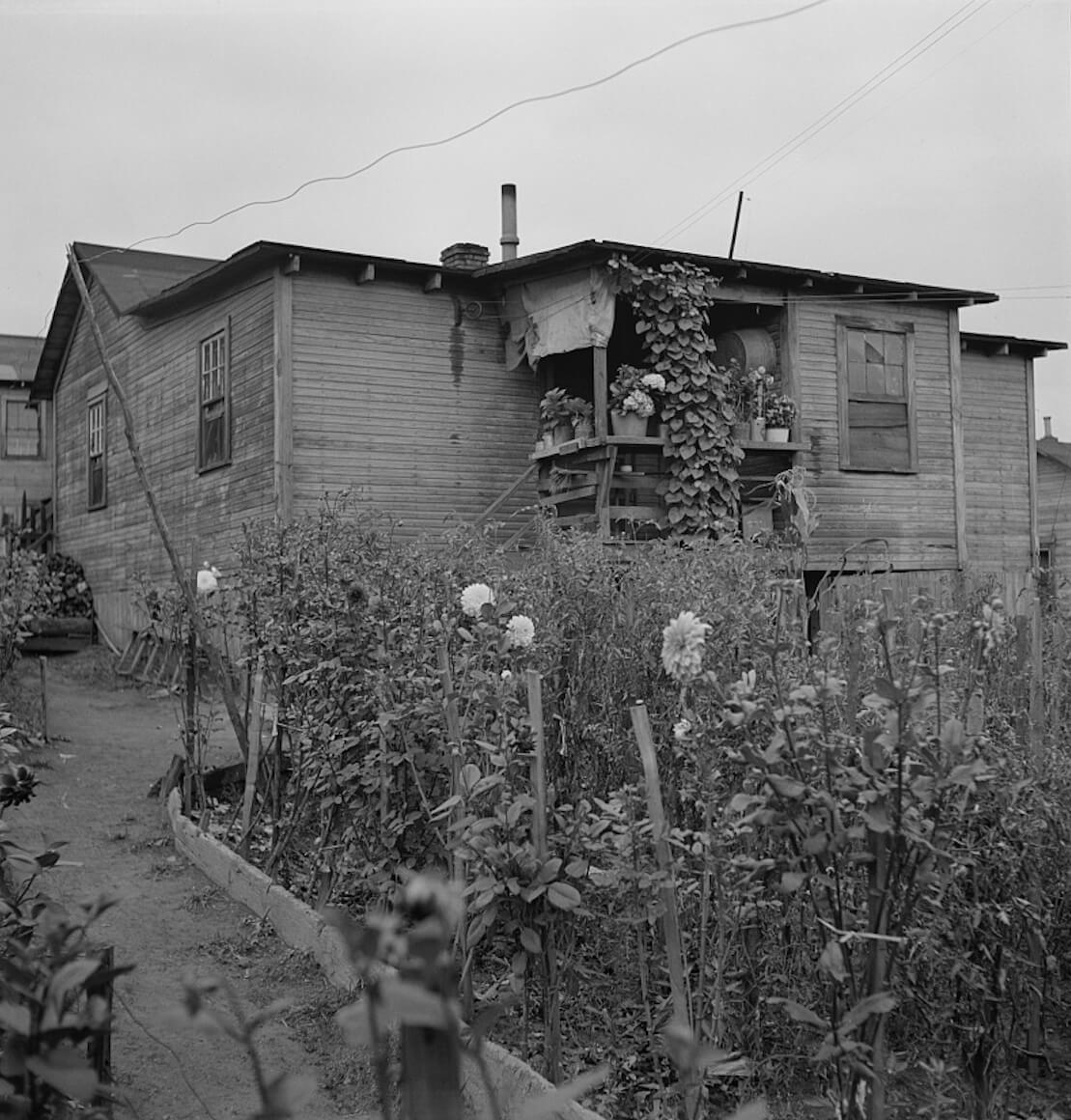
To its great credit as a work of history, Ramp Hollow is unusual in its direct relevance to contemporary politics. This is true for not only areas of the world where land grabs and enclosures proceed apace, but also central Appalachia, where the struggle to envision and create post-coal—and potentially "post-capitalist"—futures is ongoing. In his final chapter, Stoll offers a "thought experiment" in the form of "The Commons Communities Act" (272–274), which proposes publicly-owned commons, complete with a variety of incentives and protections for those who live there, each with an ecological base sufficient to sustain residents through "hunting and gathering, cattle grazing, timber harvesting, vegetable gardening, and farming" (272). Although his proposal is understandably crafted for rural contexts, given Stoll's concerns throughout the book, the commons is not necessarily so. Indeed, the argument that different forms of public commons may be key to the reinvigoration of civic life and the prospects for democratic, place-based economies seems to be spreading.6See Herbert Reid and Betsy Taylor, Recovering the Commons: Democracy, Place, and Global Justice (Urbana and Chicago: University of Illinois Press, 2010); Kathryn Newfont, Blue Ridge Commons: Environmental Activism and Forest History in Western North Carolina (Athens: University of Georgia Press, 2012); and George Monbiot, Out of the Wreckage: A New Politics for an Age of Crisis (New York: Verso, 2017). Regardless of the specifics of such proposals, they reinforce Stoll's overarching argument: capitalist hegemony is not inevitable, and collective access to land is key to the future of Appalachia.
About the Author
Barbara Ellen Smith is professor emerita at Virginia Tech and a member of the editorial board of Southern Spaces. She has long studied and participated in economic justice movements in Appalachia.
]]>Introduction
At present, the people of Appalachia continue to endure the contraction and retreat of extractive industry with little more than big-box retail for employment. They work for local hospitals and county governments at a time when both depend on a withering tax base. Many residents hunt, fish, and garden to make up the shortfall in their household incomes. The Appalachian Regional Commission has not come up with a solution; neither has the leadership of the United States. It seems unlikely, though I would not say impossible, that corporations will show up in southern West Virginia or eastern Kentucky and open factories and offices. I wrote the Commons Communities Act after months of thinking about how the people of the southern mountains might find work with dignity, working for themselves and their families without owing their existences to corporations. I thought that government could help to solve this problem and do what it should do: stand between citizens and the power of capital.
It is difficult to find anything Appalachians have gained by voting for Republicans. Yet a majority in every county in West Virginia voted for Donald Trump in 2016. His promise to revitalize the coal industry lacks a footing in reality. Sensing this, one voter gave him a desperate endorsement, saying, "He's the only shot we got." If Trump studies West Virginia's congressional delegation, he might conclude that he doesn't need to do very much. But the people can do better than that. They can make their representatives justify the trust placed in them. They can demand more of their government. They can assert a right to land and livelihood and reparations from the corporations that used and abused them for so long. Maybe that can be the basis for a positive political identity.1For an argument in favor of collective identities in the service of an ethical politics, see Critchley, Infinitely Demanding. I have especially learned from David Whisnant's "Developments in the Appalachian Identity Movement," which though published in 1980 still resonates. "At its worst . . . regional identification is an isolationist impulse." He deconstructs an essentialist mountain identity. And yet, "The political value of regional identity lies in its usefulness as a basis for broad solidarity and coalition." Whisnant, David. "Developments in the Appalachian Identity Movement: All is Process." Appalachian Journal 8, no. 1 (1980): 41–47.
I favor democratic socialism and a reinvention of the nation-state as a conduit for meeting human needs rather than for accumulating capital. I also favor a realm of democratic autonomy, and that might have more political traction. If Congress and the president can cooperate, such a realm can exist as a function of the United States itself. But it can also exist outside of centralized government, sponsored by West Virginia or Kentucky or Tennessee. Or people can do it themselves, by squatting on abandoned land and defending their right to the commons.2In the words of two historians, "Making visible activities that neoliberalism renders invisible expands the range of ideas for producing social livelihoods and economic development." Amanda Fickey and Michael Samers, "Developing Appalachia: The Impact of Limited Economic Imagination," in Studying Appalachian Studies: Making the Path by Walking, ed. Chad Berry, Phillip J. Obermiller, and Shaunna L. Scott (Urbana: University of Illinois Press, 2015), 123.

There is talk and some action regarding returning land. Various organizations have held public meetings to elicit policies directly from citizens. Even Congress is thinking along these lines. In 2016, Representative Harold Rogers, a Kentucky Republican, introduced the Reclaim Act. The law would empower the Department of the Interior to distribute funds to states and Indian nations aimed at developing land in communities "adversely affected by coal mining." I would push this thinking toward creating a reconstituted commons. What if people who wished to do so lived by hunting and gardening as part of a social project that encouraged political participation? What if citizens possessed use-rights over a sustaining landscape?
Historians don't often write legislation. My attempt is consistent with the argument of this book. Consider it more a thought experiment than a ready-made policy. Any actual solution would require the knowledge of people who live in the mountains and the sponsorship of organizations and activists working on these questions. The following owes something to the New Deal economist Milburn Wilson, the geographer J. Russell Smith, the historian Lewis Cecil Gray, the Kentucky farmer and writer Wendell Berry, and also to Mahatma Gandhi, Lewis Mumford, and E. F. Schumacher.3Appalachian Voices is one such organization. The Reclaim Act is H.R. 4456, 114th Congress. Introduced in the House in February 2016. I call it . . .
THE COMMONS COMMUNITIES ACT
Whereas coal mining is diminishing in the southern mountains, leaving thousands unemployed, and whereas coal contributes to climate change and the disruption of human societies all over the world; whereas a rural policy should incorporate ecological principles with food production on a small scale, and whereas the United States once included millions of households engaged in production for subsistence and exchange; whereas when people take care of landscapes, landscapes take care of them,
SECTION 1. The United States shall create a series of commons communities, each designed to include a specified number of households within a larger landscape that will be managed by them, the residents. This landscape will provide the ecological base for hunting and gathering, cattle grazing, timber harvesting, vegetable gardening, and farming. The ecological base will be owned as a conservation easement or land trust under the authority of the states and/or counties where each community resides.
SECTION 2. Commons communities would be organized according to the design principles developed by the economist Elinor Ostrom, who was awarded the Nobel Prize in Economic Sciences in 2009 for her work on the economic governance of common resources. Each community shall include well-defined boundaries and members. Each will devise rules for appropriation suitable to the environment, along with sanctions and penalties for those who violate the rules and take too much or otherwise abuse the resource. Each must establish a means of conflict resolution and governance. In the event that residents need to sue the community or other residents, they would use the county, state, or federal courts.4Ostrom (1933–2012) shared the Nobel Prize with Oliver E. Williamson. The act would rely on Ostrom's Governing the Commons: The Evolution of Institutions for Collective Action (Cambridge: Cambridge University Press, 1990). For design principles, see pages 90–101.
SECTION 3. Commons communities will not be limited to Appalachia but could be established anywhere a sufficient ecological base exists, including the outskirts of cities and suburbs. This law must not be construed to favor one location or ethnic group.
SECTION 4. Social services and education will be paid for by an income tax on the top one percent of household incomes in the United States and an Industrial Abandonment Tax, attached to any corporation that closed its operations in any city or region of the United States within the last twenty years of the date of this Act and moved elsewhere, leaving behind toxic waste and poverty.
SECTION 5. Resident households with incomes under $50,000 a year will pay no federal income tax. Residents will own their own homes, paying for them with low-interest mortgages and a $1.00 down payment.
SECTION 6. No nonresident, trust, or corporation is permitted to purchase property in a commons community.
SECTION 7. The organization of commons communities will proceed through the Department of Agriculture. The Department will initiate the identification of suitable lands for condemnation by eminent domain or land already owned by counties, states, or the United States. The Department will determine how much land is needed to sustain a given number of residents.
SECTION 8. Allied Programs.
SUB-SECTION A. Income tax incentives will encourage teachers and medical doctors to live in commons communities and work in the schools and nearby hospitals.
SUB-SECTION B. College-age members of any commons household may apply for free tuition at their state university. Tuition shall be paid for by the Industrial Abandonment Tax.
SUB-SECTION C. Commons communities will receive special programs intended to link them to the Internet. Cooperation between communities will incorporate schools, artists and writers in residence, and scientists engaged in the study of the environment. This Act provides funds for the publication of a journal or magazine of commons life to be written and published by the residents of the various communities.
SUB-SECTION D. Another program will link gardeners with markets for their produce, including grocery stores and restaurants. Proceeds from this Market Garden Initiative will not be subject to state or federal income tax.
SUB-SECTION E. University experiment stations in every state where commons communities exist will send representatives to teach the latest methods of garden production, with the approval and consent of residents.
SECTION 9. If the members of a commons community no longer wish to be associated with the federal government, they may become independent at any time with a majority vote consisting of two-thirds of adult residents, at which time all federal programs associated with this Act will cease. Ownership of the commons would not change and residents would keep their homes.
The act might look like Arthurdale and the Division of Subsistence Homesteads all over again. But it has no factory, no originating debt, and no presumption that people must subsist entirely from gardens. It emphasizes scientific conservation, cultural expression, entrepreneurship, and democracy. It would not prevent any resident from earning money in any job or profession. Some within Appalachia might object to the participation of the federal government. But government can do things that communities cannot by themselves, like purchase land, relieve taxes on citizens and levy them on corporations, advance citizen participation, and pay for college. Government can help the residents of commons communities remain connected to the wider world of economic opportunity and political participation. But the act allows for its own dissolution. Residents would have the authority to end the government's participation and keep their gains.5On corporate subsidies, Niraj Chokshi, "The United States of Subsidies," Washington Post, March 18, 2015, www.washingtonpost.com/blogs/govbeat/wp/2015/03/17/the-united-states-of-subsidies-the-biggest-corporate-winners-in-each-state/?utm_term=.314361798972.
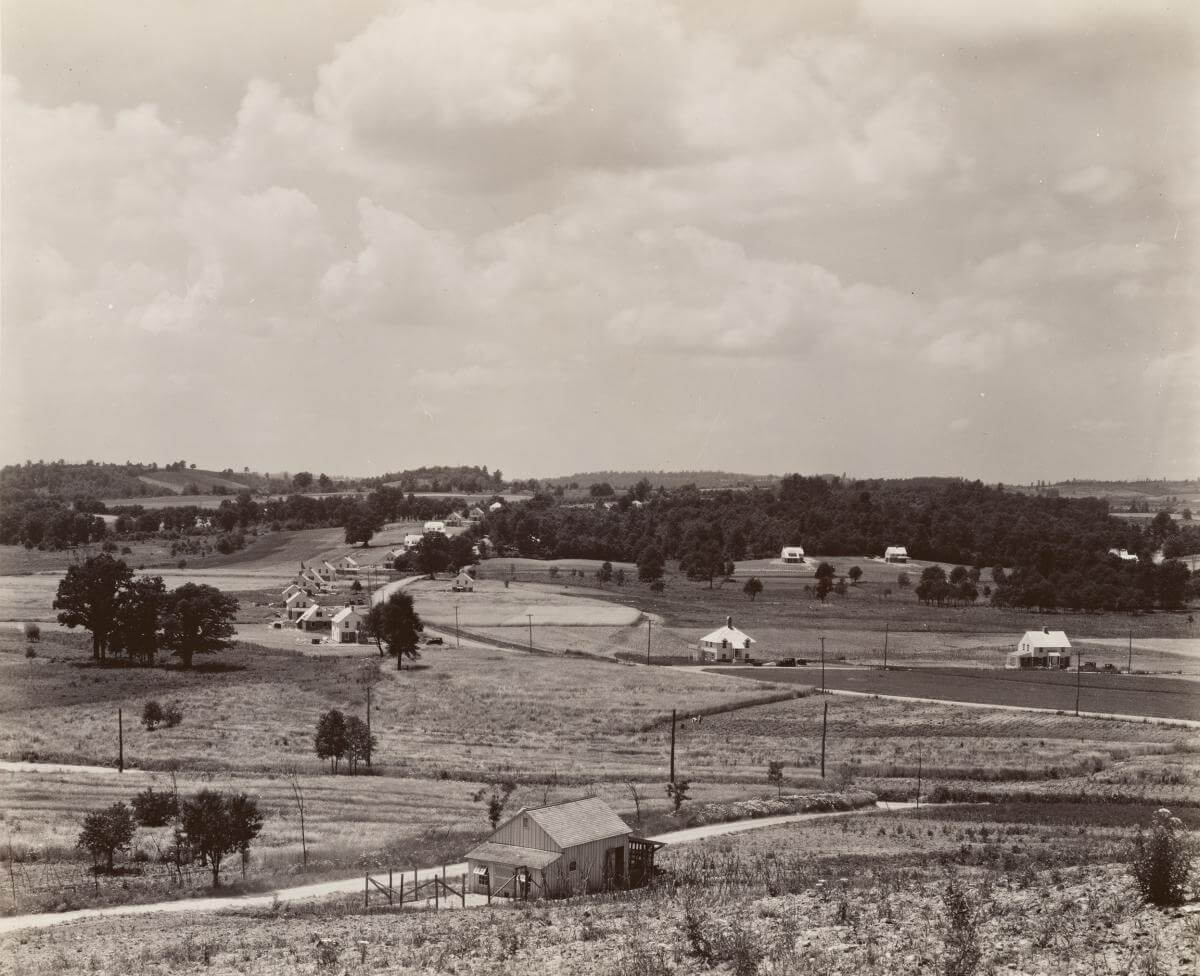
Top, View of Arthurdale project, Reedsville, West Virginia, 1935. Photograph by Walker Evans. Courtesy of the New York Public Library Miriam and Ira D. Wallach Division, digitalcollections.nypl.org/items/96818680-baca-0132-6504-58d385a7b928. Bottom, Homes and land cultivation, Arthurdale project, Reedsville, West Virginia, 1935. Photograph by Walker Evans. Courtesy of the New York Public Library Miriam and Ira D. Wallach Division, digitalcollections.nypl.org/items/94ba4f90-baca-0132-01de-58d385a7b928.
The act seeks to preserve and encourage a makeshift economy that has been practiced for two centuries among mountain farmers, as well as among people in other parts of the United States. Readers in New York, Chicago, or Los Angeles might not appreciate the extent to which rural Americans depend on forests and other environments for food and cash. In the 1980s, Timothy Lee Barnwell photographed and interviewed Appalachians who practiced agrarian economy. Charlie Thomas of Bush Creek, North Carolina, said, "Even when I was growing up we raised almost everything we ate. You'd buy a little coffee if you wanted it, but we never drank it, and buy or trade for what sugar you needed, and we used honey for that. We've always kept bees for our own honey." A series of interviews conducted in southern West Virginia during the 1990s is now part of the Library of Congress. "People around here . . . on Coal River, just about every one of them does the same thing," explained Dave Bailey. "They pick the grains, they pick the black berries, they fish, they hunt . . . they get the molly moochers [the morchella or morel mushroom] . . . They do that, their kids is going to do it, their grandkids is going to do it, and that's the way it is on Coal River." Others interviewed detailed their extensive knowledge of trees and plants. None of these West Virginians need the Commons Communities Act to continue living as they always have, from whatever forested commons they can still find. The act is meant to promote this social ecology. By combining land and livelihood—by fostering possession against a history of dispossession—it would reconnect communities and landscapes in a structure for sustaining both.6Tim Barnwell, The Face of Appalachia: Portraits from the Mountain Farm (New York: W. W. Norton, 2003), 121, 122, 126. The project is Tending the Commons: Folklife and Landscape in Southern West Virginia in cooperation with the Coal River Folklife Project and the American Folklife Center at the Library of Congress. Dave Bailey interviewed by Mary Hufford on April 12, 1996 (AFC 1999/008), http://hdl.loc.gov/loc.afc/afccmns.104007; Virgil Jarrell interviewed by Mary Hufford on May 23, 1996 (AFC 1999/008), http://hdl.loc.gov/loc.afc/afccmns.117004.
The political economy of the act combines private and communal property. Residents may buy and sell their homes, pass them to the next generation, and do anything else with them permitted by local law. They would act differently in their role as managers of common woods and waters. Economists have rarely understood the logic of collective use. The most common argument says that every user has an incentive to cut every last tree, shoot every last large-bodied mammal, and let his cattle graze every last acre of wild meadow, leaving nothing for anyone else. The forest is reduced to stumps; the high meadow is overrun with thistle. This is the misleading parable of the "Tragedy of the Commons," most famously described by the biologist Garrett Hardin in 1968.7Garrett Hardin, "The Tragedy of the Commons," Science 162 (December 13, 1968): 1243–48.
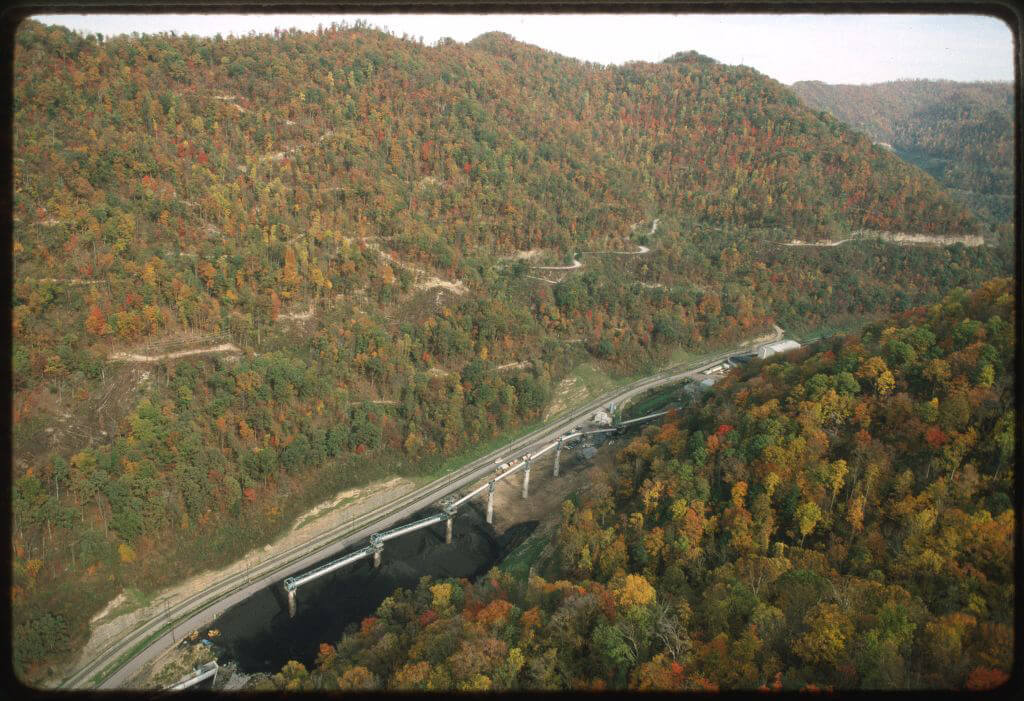
Hardin based his model on a self-serving conception of human nature. His essay has nothing to do with how actual people govern actual shared resources, cases that Hardin seems to have known little about. His first mistake was to think that a commons is a free-for-all. No such set of resources is open to everyone, but only to members, defined in various ways. Consider the forests of New England in the nineteenth century. Colonial towns owned them and controlled access, allowing some to cut trees and others to hunt and fish with permission. Lobster fishermen in Maine operate according to their own rules and institutions, with little government involvement, resulting in one of the most successful fisheries in the world. But they decide who can and cannot benefit. Thus everyone who depends on common property has an incentive to maintain it. This is not to say that everyone is always satisfied. Community management requires governance to mediate disagreement and limit the consequences of conflict. The point is that it's simply not true that common property always degenerates into scarcity.8According to Richard Judd, "These local common resource regimes established two central principles for the emerging New England conservation tradition: communities bore collective responsibility for managing their resources in a productive fashion, and they were to allocate these resources equitably." Judd, Common Lands, Common People: The Origins of Conservation in Northern New England (Cambridge, MA: Harvard University Press, 1997), 7–8, 41–45; James Acheson, Capturing the Commons: Devising Institutions to Manage the Maine Lobster Industry (Hanover, NH: University Press of New England, 2003), 206; Allan Greer, "Commons and Enclosure in the Colonization of North America," American Historical Review 117, no. 2 (April 2012): 365–86.
But Hardin cannot be dismissed altogether. His fable reasonably describes resources that no group can manage, like the open ocean and the atmosphere. And not all collective uses of land have succeeded. (In fact, we know very little about how the functional forest commons fared in West Virginia, how well users governed themselves.) Without regulations and penalties, without clear borders and firm institutions, they can result in devastation. This is why Elinor Ostrom studied them—to figure out why some failed and others thrived.9Kathryn Newfont, Blue Ridge Commons: Environmental Activism and Forest History in Western North Carolina (Athens: University of Georgia Press, 2012), 276.
We all live in communities. In a sense, no one really lives in the United States but in neighborhoods, towns, and counties. Strengthening those bonds within environments that allow for economic autonomy seems like a way of creating space between people and the nation-state. It might also offer a way to endure during times of climate disruption, when the United States might not be capable of compensating for any number of possible disasters. The Commons Communities Act proposes land reform and collective governance. It proposes nothing new, but rather something very old, a sense of ownership without the enclosure and the abuse of power characteristic of private property.10Ibid.
And yet, I have my own objections to the Commons Communities Act. Small-scale development programs appeared decades ago, with mixed results. The same reformers and intellectuals who rediscovered the small town and the Indian pueblo during the New Deal urged communitarian approaches all over the world. But these schemes harbored certain false assumptions, well described by the historian Daniel Immerwahr. Development agencies believed that the members of a village acted from shared principles and that local elites would fairly apportion money entrusted to them. But villages in the Philippines and India turned out to be more complicated—and divided—than the sanguine Americans had thought. Immerwahr suggests another problem. When a nation-state invests in a community, where does its influence end? What role would the United States play in a commons community?11Daniel Immerwahr, Thinking Small: The United States and the Lure of Community Development (Cambridge, MA: Harvard University Press, 2015).
The act might also be criticized for shunting the problem of industrial abandonment onto the poor, just like the Division of Subsistence Homesteads. In this way, it seems like a neoliberal policy intended to reduce the cost of state services and lower taxes on the rich. And while under the act the corporations that caused so much human and ecological ruin would be required to pay for houses and schools, this doesn't change or challenge a political economy in which humans and environments serve as inputs in the circulation of capital. For corporations, compensating for social destruction is merely part of the cost of doing business. Eliminating these contradictions so that citizens benefit would require a government and a set of laws dedicated to human welfare.
The act includes scholarships so that the children of Appalachian households might attend college, but it does not come close to addressing the larger cultural problem of why high school kids in Appalachia often don't apply. In Hillbilly Elegy (2016), J. D. Vance eloquently explains why it's so difficult for Appalachians to find a way out of unemployment and improve the quality of their lives. Some see themselves as different from those outside their families or counties. People in other parts of the country view them harshly, with many of the same racialized stereotypes present a century ago. All of this makes geographic and social mobility difficult. Vance's own story suggests that a strong mentor with the capacity to see beyond limited local opportunities can overcome self-defeat. Vance's mentor was his grandmother. "She didn't just preach and cuss and demand. She showed me what was possible . . . and made sure I knew how to get there." Her home provided Vance stability and peace, "not just a short-term haven but also hope for a better life."
Vance got out. He graduated from Ohio State University, the Marines, and Yale Law School before joining a Silicon Valley investment firm. But his very success implies the depth of the problem he confronted. The most unsettling currents in Hillbilly Elegy lie in the necessity of leaving and in its emphasis on a strong and uncompromising grandmother. If meaningful work and a decent occupation only exist elsewhere, then most Appalachians will be abandoned. If escape depends on someone who rises above despair and abuse, then most will be stuck. The role of public policy and a political solution to poverty is to attempt to help everyone in the same situation rather than rely on extraordinary circumstance and plain luck to produce successful individuals. Vance's book is inspiring as a memoir, but it might be construed as saying that the tragedy of Appalachia is the sum of its individual failings or the insularity of its families.12J. D. Vance, Hillbilly Elegy: A Memoir of a Family and Culture in Crisis (New York: Harper Collins, 2016): 148–49, 206. Domestic violence, drug abuse, and hopelessness on such a scale have social causes. They require solutions that do not place the burden on the sufferers themselves to transcend their circumstances.
About the Author
Steven Stoll is a professor of history at Fordham University and the author of The Great Delusion (Hill and Wang, 2008) and Larding the Lean Earth (Hill and Wang, 2002). His writing has appeared in Harper's Magazine, Lapham's Quarterly, and the New Haven Review.
]]>Southern Spaces, an open access, multimedia, peer-reviewed journal, invites innovative scholarship on regions, places, and cultures of the US South as well as their global connections. We encourage interdisciplinary submissions that emphasize spatial interpretation and utilize digital media.
Southern Spaces welcomes submissions that:
- critically and creatively examine real and imagined spaces and places
- make connections and comparisons between southern regions and/or locales and sites in the wider world
- use textual, visual media, archival, and ethnographic materials—including artistic expressions—to address questions of spatial justice

Currently Southern Spaces seeks submissions that engage with the geographies of:
- historical memory and memorialization
- economic inequality and everyday precarity
- political boundaries (redistricting, voter suppression)
- forced migration, slavery, and human trafficking
- racial violence, hate crimes
- LGBTQ+ perspectives, rights, and spaces
- demographic shifts in urban, suburban, and rural populations
- immigration, refugees, and citizenship
- incarceration, internment, and the carceral state
- public health, healthcare policy and access
- climate change and environmental history
Examples
Southern Spaces accepts submissions within seven genres of open access, multimedia scholarship:
- Articles are long-form, interpretive, or critical pieces that incorporate multimedia (including digital scholarship) and scholarly analysis to pose an original argument or research-based claim. All Southern Spaces articles undergo peer review.
- Reviews offer critical evaluations of recently published books, films, digital projects, music, events, and other art or scholarship related to the study of space and place.
- Interviews are filmed or transcribed conversations with scholars, authors, artists, or others working in areas related to the study of space and place in the US or global south.
- Photo and media essays are curated collections of original photography or other multimedia that perform critical scholarly analysis. While primarily photographic or media-based, these essays also include a writing component.
- Short videos are five to twenty-five minutes and utilize visual—as opposed to textual or rhetorical—techniques to advance a critical argument or an aesthetic perspective. Southern Spaces frequently publishes ethnographic, documentary, and lyric videos.
- Presentations include media associated with public scholarly presentations as well as audio or visual recordings of presenters. Such presentations include lectures, conference highlights, panels, and performances.
- Blog posts are shorter, less formal essays or announcements of interest to the critical study of space, place, and southernness.
The following pieces provide examples of the critical, interdisciplinary, and multimedia scholarship we seek:
- Busch, Andrew M. "Crossing Over: Sustainability, New Urbanism, and Gentrification in Austin, Texas." Southern Spaces, August 19, 2015. https://southernspaces.ecdsdev.org/2015/crossing-over-sustainability-new-urbanism-and-gentrification-austin-texas.
- Conis, Elena. "DDT Disbelievers: Health and the New Economic Poisons in Georgia after World War II." Southern Spaces, October 28, 2016. https://southernspaces.ecdsdev.org/2016/ddt-disbelievers-health-and-new-economic-poisons-georgia-after-world-war-ii.
- Cooper, Brittney. "#SAYHERNAME: Towards a Gender Inclusive Movement for Black Lives." Southern Spaces, January 26, 2016. https://southernspaces.ecdsdev.org/2016/sayhername-towards-gender-inclusive-movement-black-lives.
- Flippen, Chenoa. "Diversity and Its Discontents: A Review of Behind the White Picket Fence." Southern Spaces, October 20, 2015. https://southernspaces.ecdsdev.org/2015/diversity-and-its-discontents-review-behind-white-picket-fence.
- Goldstein, Holly Markovitz. "St. Augustine's 'Slave Market': A Visual History." Southern Spaces, September 28, 2012. https://southernspaces.ecdsdev.org/2012/st-augustines-slave-market-visual-history.
- McClintock, Diana. "Gordon Parks at Atlanta's High Museum of Art." Southern Spaces, May 28, 2015. https://southernspaces.ecdsdev.org/2015/gordon-parks-atlantas-high-museum-art.
- Pooley, Karen. "Segregation's New Geography: The Atlanta Metro Region, Race, and the Declining Prospects for Upward Mobility." Southern Spaces, April 15, 2015. https://southernspaces.ecdsdev.org/2015/segregations-new-geography-atlanta-metro-region-race-and-declining-prospects-upward-mobility.
- Solomon, Eric. "Queer Memory: Loss, Martyrs, and Memorialization in Southern Florida." Southern Spaces, August 11, 2016. https://southernspaces.ecdsdev.org/2016/queer-memory-loss-martyrs-and-memorialization-southern-florida.
- Suitts, Steve. "States' Rights Resurgent: The Attack on the Voting Rights Act." Southern Spaces, August 29, 2013. https://southernspaces.ecdsdev.org/2013/states-rights-resurgent-attack-voting-rights-act.
- West, E. James and Ann Pancake. "Closer to the Ground: A Conversation with Ann Pancake." Southern Spaces, May 30, 2017. https://southernspaces.ecdsdev.org/2017/closer-ground-conversation-ann-pancake.
- Yaeger, Patricia. "Beasts of the Southern Wild and Dirty Ecology." Southern Spaces, February 13, 2013. https://southernspaces.ecdsdev.org/2013/beasts-southern-wild-and-dirty-ecology.
Submit all inquiries and materials to Southern Spaces managing editor Madison Elkins at seditor@emory.edu. Submissions are especially welcome before October 15th, 2017, but will be considered on a rolling basis. There is no submission fee or article processing charge. Visit our submissions page for more information. Southern Spaces does not consider previously-published work or simultaneous submissions. At the time of publication, authors may choose to retain copyright of their work or select a Creative Commons license. All publications, along with their associated media, are securely archived by the Emory Center for Digital Scholarship. Southern Spaces also accepts print and media submissions by post at Robert W. Woodruff Library, 540 Asbury Circle, Emory University, Atlanta, GA, 30322.
]]>Public Health Crossings
Top, Colonel Bailey K. Ashford, ca. 1893. Courtesy of Wikimedia Commons. Image is in public domain. Bottom, William H. Hunt, Governor of Puerto Rico, 1901–1904. Courtesy of Wikimedia Commons. Image is in public domain.
Nearly a year before Finlay's mosquito theory was finally confirmed in Cuba, a US physician discovered in Puerto Rico the source of the pervasive anemia that had afflicted the population for more than a century. On August 10, 1899, Bailey K. Ashford, then a young post surgeon of the US Army, revealed that hookworm caused the mysterious weakness and extreme pallor that he had observed in peasants for nearly a year.1The broad term "peasant" includes the diverse farmers and laborers of Puerto Rico's mountainous coffee region. This operational definition is not meant to override social and property distinctions within the region. See Sidney Mintz, "A Note on the Definition of Peasantries," Journal of Peasant Studies 1 (1973): 91–106. See also Frederick Cooper, Allen F. Isaacman, Florencia E. Mallon, William Roseberry, and Steve J. Stern, Confronting Historical Paradigms: Peasants, Labor, and the Capitalist World System in Africa and Latin America (Madison: University of Wisconsin Press, 1993). Ashford was not the first fascinated by the mysterious affliction; for decades physicians and intellectuals in Puerto Rico had made it the central concern of essays and novels. Unlike yellow fever in Cuba, hookworm was not characterized by dramatic seasonal outbreaks in port cities. Instead, it was a sluggish disease endemic in the island's mountainous interior. Whereas in Cuba most yellow fever victims were nonimmune Spanish immigrants, in Puerto Rico most hookworm victims were peasants—commonly known as jíbaros—whose families had harbored the disease for generations. Moreover, whereas the control of yellow fever required killing the mosquito vector and eliminating its breeding places, the control of hookworm disease required direct medication of patients.
Like many young physicians of the era, Ashford was intensely curious about tropical diseases—a fixation that led him to link anemia to hookworm after he examined the stool sample of a jíbaro in the microscope.2Bailey K. Ashford, A Soldier in Science: The Autobiography of Bailey K. Ashford (San Juan: Editorial de la Universidad de Puerto Rico, 1998 [1934]), 3. Aware of the historical consequences of his discovery, he rushed his patient to the "local photographer to immortalize him," turning the Puerto Rican jíbaro into the "prototype of anemic millions all over the Caribbean, all over the tropical belt that girdles the portly belly of Mother Earth."3Ibid., 5.
If Ashford's photographic record connected the jíbaro to hookworm sufferers around the world, at a local level public and financial support for initiating an anti-hookworm campaign was far from secure. After several years of frustration seeking support, Ashford finally found a sponsor in Governor William H. Hunt, one of the leading figures in organizing the new civil government of Puerto Rico. In 1904, his administration allocated funds to establish the Puerto Rico Anemia Commission, launching the first large-scale campaign to study and treat hookworm disease in the hemisphere.4William H. Hunt, Message of the Honorable William H. Hunt to the Second Legislative Assembly (San Juan: Bureau of Printing and Supplies, 1904), 20–21. With its emphasis on testing for hookworm, preventing soil pollution, and offering pharmaceutical control, the commission rendered visible the vast population suffering from hookworm disease. As the campaign gained popularity, anemia ceased to be a disease in its own right; instead, it became a symptom of what doctors referred to as hookworm disease, or uncinariasis. As the architect of the campaign, Ashford recruited prominent Puerto Rican doctors, including Pedro Gutiérrez Igaravídez, Francisco Sein, Agustín Stahl, and Francisco del Valle Atiles, to collaborate with the commission. Through their efforts thousands of peasants were introduced into the realm of medicine and institutional health care.
Bailey K. Ashford immortalized his first hookworm patients in a photograph. The caption reads: "Photograph of a number of natives of Puerto Rico, showing pernicious anemia due to Ankylostoma duodenale." Source: Bailey K. Ashford, "Report to the Surgeon General," December 22, 1899, Otis Historical Archives, National Museum of Health and Medicine, RG 2.3, box 10. Originally published in José Amador's Medicine and Nation Building in the Americas, 1890–1940 (Nashville, TN: Vanderbilt University Press, 2015). Courtesy of Vanderbilt University Press.
Despite the crucial significance of Puerto Rico in the development of US public health, the place that this campaign occupies in the history of US tropical medicine and international philanthropy has been underappreciated.5One notable exception is Nicole Trujillo-Pagán, Modern Colonization by Medical Intervention: US Medicine in Puerto Rico (Boston, MA: Brill, 2013). For hookworm disease in Puerto Rico, see Francisco A. Scarano, "Desear el jíbaro: Metáforas de la identidad puertorriqueña en la transición imperial," Illes i imperis 2 (1999): 65–74; José Quiroga, "Narrating the Tropical Pharmacy," in Puerto Rican Jam: Essays on Culture and Politics, edited by Frances Negrón-Muntaner and Ramón Grosfoguel (Minneapolis: University of Minnesota Press, 1997), 116–26; and Fernando Feliú, "Rendering the Invisible Visible and the Visible Invisible: The Colonizing Function of Bailey K. Ashford's Antianemia Campaigns," in Foucault and Latin America: Appropriations and Deployment of Discursive Analysis, edited by Benigno Trigo (New York: Routledge, 2002), 153–68. Despite its contribution, this literature focuses mostly on imperial discourses and practices, not on the popular responses to the hookworm campaign or its transnational implications. In many ways, Ashford's accomplishments have been overshadowed by the yellow fever work of Carlos Finlay, Walter Reed, and William C. Gorgas in Cuba. Moreover, relative to the historical understanding of hookworm campaigns in the US South, Costa Rica, Brazil, the Philippines, and Mexico, the campaign in Puerto Rico has earned little more than a footnote in standard accounts of US public health history.6On hookworm eradication in the US South, see John Ettling, The Germ of Laziness: Rockefeller Philanthropy and Public Health in the New South (Cambridge, MA: Harvard University Press, 1981); and Matt Wray, Not Quite White: White Trash and the Boundaries of Whiteness (Durham, NC: Duke University Press, 2006), 96–132. On Costa Rica, see Steven Palmer, From Popular Medicine to Medical Populism: Doctors, Healers, and Public Power in Costa Rica, 1800–1940 (Durham, NC: Duke University Press, 2003), 155–82. On Brazil, see Gilberto Hochman, A era do saneamento: As bases da política de saúde pública no Brasil (São Paulo: Editora Hucitec, 1998). On Mexico, see Anne-Emanuelle Birn, Marriage of Convenience: Rockefeller International Health and Revolutionary Mexico (Rochester, NY: University of Rochester Press, 2006), 61–116. On the Philippines, see Warwick Anderson, Colonial Pathologies: American Tropical Medicine, Race, and Hygiene in the Philippines (Durham, NC: Duke University Press, 2006), 104–29. Yet this campaign, like no other, was the first that raised public awareness about the disease and served as a model for hookworm eradication campaigns worldwide. To date, too few have paid close attention to the haphazard process that helped build this campaign, the people who sought treatment, and the role of Puerto Rico in launching Rockefeller philanthropic public health initiatives. Integrated into one history, these public health crossings illuminate overlapping stories of colonial agency and imperial rule, of peasants and physicians coming to understand hookworm disease in view of each other, and of the transformation of the Puerto Rico campaign as a model for stemming the disease in the rest of the tropical world.
Top, Group of United States Government and Native Physicians, including Dr. Bailey K. Ashford, Puerto Rico, ca. 1890. Image courtesy of Flickr user Internet Archive Book Images. Image is in public domain. Bottom, Medical Illustration of uncinaria Americana. Illustration originally published in Diagnostic methods, chemical, bacteriological and microscopical: a text-book for students and practitioners (Philadelphia: P. Blakiston's Son & Co., 1909), 192. Image uploaded by Flickr user Internet Archive Book Images. Image is in public domain.
That the story of Ashford and Puerto Rico's hookworm campaign remains mostly hidden is hardly surprising considering the place they occupy in the history of imperial medicine. Four factors in particular explain this lack of attention. First, the battle between Ashford, the physician, and Charles W. Stiles, the zoologist, to identify and name the intestinal parasite that causes the disease was won by Stiles. Working with a hookworm specimen provided by Ashford, in 1902 Stiles found that the parasite belonged to a new species, Uncinaria americana, although later he changed the name to the more sensational Necator americanus (American Killer).7For the nomenclature dispute between Ashford and Stiles, see Ettling, Germ of Laziness, 29–33. Second, Ashford's life does not fit the traditional historiography of empire since he was not the conventional emissary of the white man's burden or US imperialism.8José Rigau, "Bailey K. Ashford, más allá de sus memorias," Puerto Rico Health Sciences Journal 19, no. 1 (2000): 51–55. On the contrary, in 1899, the same year he "discovered" the cause of anemia, he married María Asunción López, daughter of the island's first newspaper publisher, and from then on devoted himself to curing the afflicted. He spoke and wrote fluently in Spanish, and, despite the paternalistic tone of his words, he frequently and genuinely praised the work, wits, and moral compass of the peasants he treated. He raised his children in Puerto Rico, and remained on the island off and on until his death in 1934. Third, while Puerto Rico was indeed a colonial laboratory, in the early decades of the twentieth century the island was represented as a docile counterexample to Cuba and the Philippines, and today it remains politically linked to the United States; these facts have tended to make historians of imperial medicine less interested in the campaign. Finally, shortly after the Rockefeller Sanitary Commission took up Ashford's ideas for eradicating hookworm, a new rhetoric of public health efficiency and rigor declared the Puerto Rican model expensive and unreliable. Hence, to rediscover the significance of the campaign initiated in the colonial periphery, it is first necessary to restore the influence that the Puerto Rican campaign once enjoyed.
Paying close attention to the development of the Puerto Rican campaign in the context of expanding US imperial medicine highlights its significance beyond its local success. The campaign came into existence through the interactions of new colonial administrators, US and Puerto Rican health specialists, and the inhabitants of the mountainous coffee region. As Paul A. Kramer has pointed out, "colonial dynamics are not strictly derivative of, dependent on, or respondent to metropolitan forces," but are instead part of a dense network of forces that continuously remake each other.9Paul A. Kramer, "Race, Empire, and Transnational History," in Colonial Crucible: Empire in the Making of the Modern American State, edited by Alfred W. McCoy and Francisco A. Scarano (Madison: University of Wisconsin Press, 2009), 199–209. While many Puerto Rican elites participated actively in building the infrastructure envisioned by the commission, others oriented their efforts toward civic organizations disseminating hookworm information or toward opposing the campaign based on their political alliances. In addition, popular participation often pushed municipal and colonial officials to establish treatment stations, rather than simply to respond to the US disciplinary strategies. Peasants, for example, appropriated specific elements of colonial rule that most directly benefited their health interests, and rejected those that did not. Across the Atlantic, US physicians followed closely events unfolding in Puerto Rico to assess the political and medical impact of this health intervention among the white rural poor. In this field of exchanges and possibilities where new ideas about the disease and its cure emerged, the boundaries between colonial possession and the imperial state blurred, and new medicalized stereotypes about populations were forged, transformed, and contested.
Hookworm (Extract from Review of Program presented to Scientific Directors), 1942. Memo by Rockefeller Foundation. Courtesy of the 100 Years: The Rockefeller Foundation website, Rockefeller Archive Center, Rockefeller Foundation.
This chapter interprets the back-and-forth flow of new medical knowledge from US military doctors through local physicians to hookworm patients and from Puerto Rico to the United States as evidence of two significant public health crossings. The first crossing illustrates the extent that physicians and patients shaped, and were shaped, by the hookworm campaign. This campaign is remarkable because its complete novelty to the medical community and the mountainous dweller led to creative interactions that shaped the flow of information and popular expectations.10For the interplay of elite and popular responses to the United States, see Eileen J. Suárez Findlay, Imposing Decency: The Politics of Sexuality and Race in Puerto Rico, 1870–1920 (Durham, NC: Duke University Press, 1999), 110–34. The second crossing demonstrates the linkages between colonial medicine and US public health philanthropy. Years of exchanges between colonial officials, physicians, and journalists made Puerto Rico a constant point of reference among the US physicians and the public at large. When in 1909 the Rockefeller Foundation decided to undertake the hookworm program in the US South, the image of tens of thousands of redeemed Puerto Ricans was not too far from the minds of its staff. Their focus would be to adapt the lessons of the colonial laboratory to the United States.
Hookworm in the Coffee Region
During the second half of the nineteenth century, the increased cultivation of coffee in Puerto Rico's central mountain range generated favorable conditions for hookworm infestation. By the 1870s, the coffee grown in the highlands had become the island's principal agricultural export, surpassing the sugar produced in the coastal zones. In the next two decades, coffee production nearly tripled, accounting for more than 75 percent of the value of Puerto Rico's gross export. The expansion of large coffee estates in the highlands and the attendant impoverishment of small landholders resulted in an increased number of landless families. Peasants in turn were forced to become renters or agregados (service tenants), joining the growing number of wage laborers on coffee plantations. Fueled by the coffee boom, highland migration soared and for the first time the central mountainous region displaced the coast as the most densely populated area of Puerto Rico.11For the coffee boom in nineteenth-century Puerto Rico, see Laird W. Bergad, Coffee and the Growth of Agrarian Capitalism in Nineteenth-Century Puerto Rico (Princeton, NJ: Princeton University Press, 1983), especially chapter 4. By the time the United States invaded Puerto Rico in 1898, 63 percent of its 953,243 inhabitants were peasants living in the coffee region.12Irene Fernández Aponte, El cambio de soberanía en Puerto Rico: El otro '98 (Madrid: Editorial Mapfre, 1992).
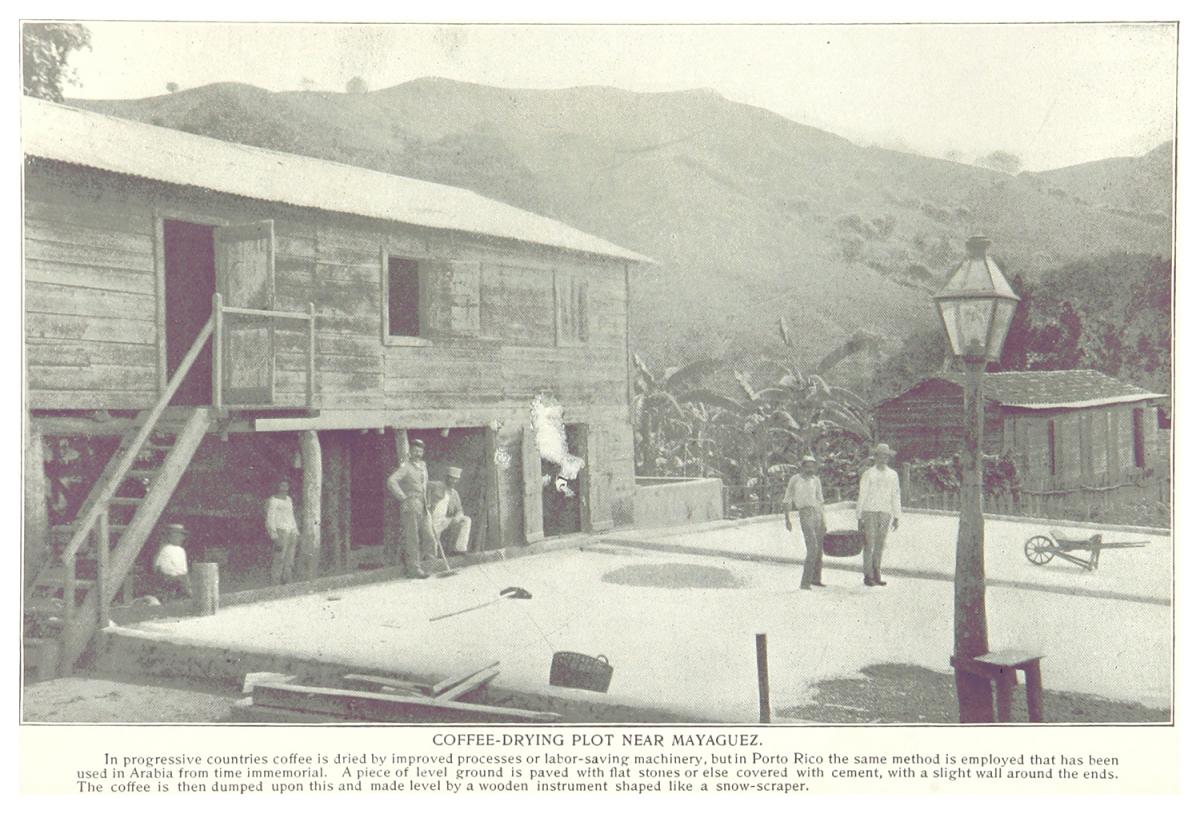
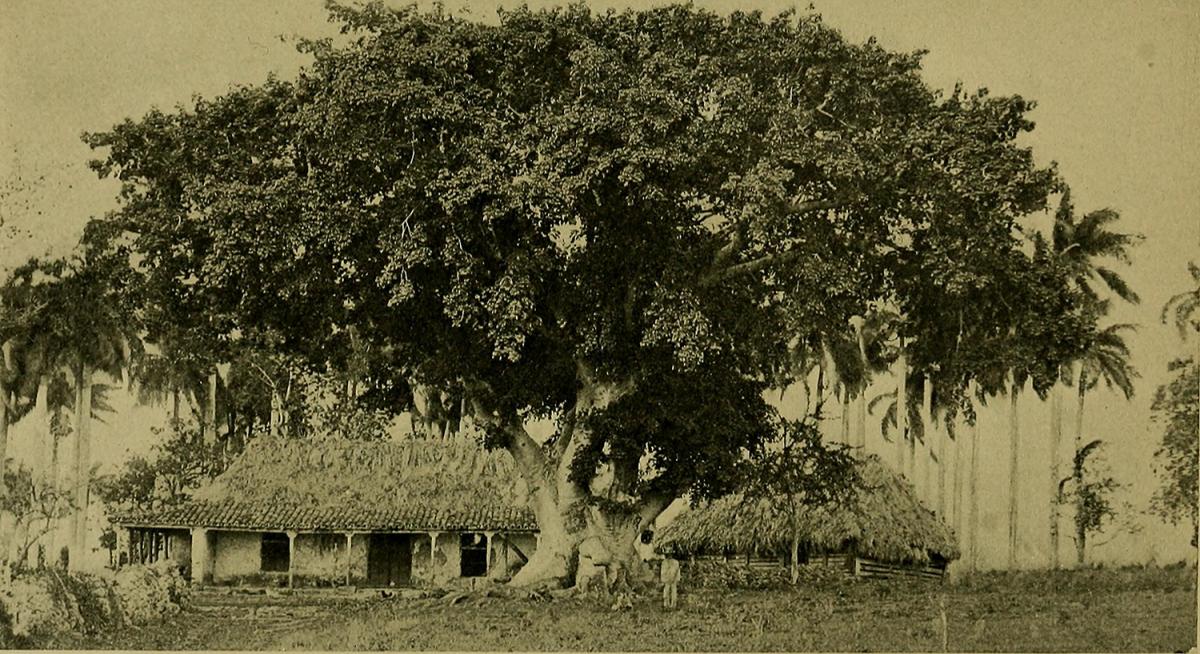
Top, Coffee-Drying Plot near Mayaguez, Puerto Rico, 1899. Courtesy of Wikimedia Commons. Image is in public domain. Middle, Botanical illustration of coffea arabica, 1794. Courtesy of Wikimedia Commons. Image is in public domain. Bottom, Coffee Plantation, Puerto Rico, 1899. Originally published in Frederick A. Ober, Puerto Rico and Its Resources (New York: D. Appleton and Co., 1899). Photograph uploaded by Flickr user Internet Archive Book Images. Image is in public domain.
The generalized misery of landless peasants and the cyclical nature of work in coffee plantations favored hookworm infestation. Coffee picking generally began during the rainy season, the period between the months of June and November. Migrant laborers frequently harvested coffee under pouring rain, moving from plantation to plantation looking for work as the bean matured in different localities. The hookworm larvae, like the coffee variety grown in the region (Coffea arabica), thrived on rain, humidity, and protection from direct sun. It was under the shade of trees such as guamá, moca, capá prieto, and the búcare that the laboring men, women, and children picked the matured bean, and their bare feet would come into contact with soil polluted by feces, which harbored hookworm larvae. The larvae then entered between the soft skin of the toes, passed through the bloodstream to the lungs, and traveled from there to the throat, stomach, and finally to the intestines, where it colonized the intestinal lining. As the day passed, the worker would experience an itching sensation between his or her toes, and by the next day, an unbearable dermatitis—commonly known as mazamorra—would develop. Once in the intestinal lining, the hookworm could live for up to ten years. The female parasite in the intestines reproduced rapidly, releasing thousands of eggs through the feces to hatch in the moist soil and reinitiating the infection cycle. The simple harboring of the worms, however, did not immediately provoke symptoms. Symptoms were directly proportional to the intensity of the infection. In normal adults, a moderate infection might cause pallor, nausea, and anemia, whereas a severe infection entailed a series of digestive and nervous disorders that could lead to death. In children, moderate to severe infections could impair mental and physical development.13James J. Plorde, "Hookworms," in Sherris Medical Microbiology: An Introduction to Infectious Diseases, edited by Kenneth J. Ryan and C. George Ray (Norwalk, CT: Appleton and Lange, 2010), 844–46.
Years of seasonal labor and shifting patterns of migration resulted in a hookworm epidemic that mostly afflicted the population of the coffee region. The intensity and scope of hookworm infestation depended on the contingent forces of poverty and environmental vulnerability. The virtual absence of public health infrastructure and the lack of outhouses on coffee plantations contributed to the situation. "Uncinariasis has its great breeding place in the coffee plantations of Porto Rico," the two leading doctors of the eradication campaign reported, "and here a barefooted people pollute the soil and are infected and reinfected by it until the life of every man, woman, and child is punctuated by a vast number of reinfections."14Bailey K. Ashford and Pedro Gutiérrez Igaravídez, Uncinariasis in Porto Rico: A Medical and Economic Problem (Washington, DC: Government Printing Office, 1911), 11. Ashford's diagnosis in 1899 laid the groundwork for a new colonial pact that increasingly made the state responsible for the protection and well-being of the population in the coffee region. Public health advocates invoked the figure of the jíbaro to move beyond the relief work of private charity to develop a centralized public health infrastructure.15On nineteenth-century charity work, see Teresita Martínez Verge, Shaping the Discourse on Space: Charity and Its Wards in Nineteenth-Century San Juan, Puerto Rico (Austin: University of Texas Press, 1999).
This centralizing goal built on an ideology of excess and discipline that connected the anemic peasant to other social maladies. As noted in Chapter 1, in the second half of the nineteenth century, narratives of caution linked the disease's symptom to an endless number of excesses—from alcohol abuse to a lack of work ethic to sexual promiscuity—that enervated the human body and paved the way for the feebleness so common among the inhabitants of the highlands. Doctors, writers, and journalists popularized the idea that the widespread feebleness of peasants was not only the result of inadequate nutrition, poor housing, and lack of hygiene, but also of racial mixing and the tropical environment. Francisco del Valle Atiles, for example, wrote a lurid sociological tract about the reprehensible lives of peasants, warning about the possibility of social dissolution. In El campesino puertorriqueño (The Puerto Rican Peasant; 1887), he complained that Puerto Rico's path toward progress was hindered by the "lack of vitality" of the jíbaro and an overabundance of "incapable arms" in agricultural enterprises.16Francisco del Valle Atiles, El campesino puertorriqueño: Sus condiciones físicas, intelectuales y morales, causas que determinan y medios para mejoralas (San Juan: Tipografía de González Font, 1887), 8. The mobilization of these narratives served in part to forge consensus about the need to transform the peasant population into a citizenry capable of hygienic regulation and regimented work before it could be included as part of a broad political base.17See Astrid Cubano-Iguina, "Political Culture and Male Mass-Party Formation in Late-Nineteenth-Century Puerto Rico," Hispanic American Historical Review 78, no. 4 (1998): 631–62.
Hookworm Treatment broadside, Durham, North Carolina, ca. 1913. Broadside by Durham County Board of Commissioners. Published by E.M. Uzzell & Co. Courtesy of Documenting the American South, University Library, University of North Carolina at Chapel Hill.
After the discovery of hookworm in Puerto Rico, physicians and their patients began to transform the understanding of peasant malaise. While the ways peasants described their symptoms were not radically different from those of the preceding generation, their understanding of the disease and their efforts to combat it dramatically changed. For one, under US rule, anemics seeking treatment became hookworm patients. If Ashford and the many doctors who joined his crusade were central in introducing these new ideas, so too were the people who ventured for the first time into dispensaries. Campaign officials used reports, pamphlets, posters, brochures, newspapers, and photographs to disseminate medical information, but peasants too spread the word about medical professionals, treatment protocols, and their own pursuit of health. In other words, the new colonial context mediated the emergence of distinct forms of what medical anthropologist João Biehl calls "biomedical citizenship" among peasants mobilizing to demand treatment.18João Biehl, "The Activist State: Global Pharmaceuticals, AIDS, and Citizenship in Brazil," Social Text 22, no. 3 (2004): 105–32. Despite the island's high rate of illiteracy and low rate of schooling, peasants flocked to hookworm stations and municipal offices, requesting access to physicians and medicines. For instance, by 1910 Ashford and Gutiérrez Igaravídez estimated that over 272,000 people had received treatment through the Anemia Commission, and another 30,000 through private physicians. This explosion in popular participation and mobilization of popular expectations in the pursuit of health is one of the most enduring—albeit less recognized—consequences of the campaign. Peasants were more than colonized subjects; they were actors who defined part of the terms under which the campaign developed.
Top, The results of the hurricane, 1899. Originally published in George W. Davis's Military Government of Porto Rico from October 18, 1898, to April 30, 1900 (Washington DC: US Government, 1902), 612. Courtesy of the Library of Congress Hispanic Division, loc.gov/rr/hispanic/1898/sanciriaco.html. Bottom, Path of Hurricane San Ciriaco over the island of Puerto Rico, 1899. Originally published in George W. Davis's Military Government of Porto Rico from October 18, 1898, to April 30, 1900 (Washington DC: US Government, 1902), 612. Courtesy of the Library of Congress Hispanic Division, loc.gov/rr/hispanic/1898/sanciriaco.html.
The origins of this campaign began not in an unpolluted scientific laboratory but amid the devastation left by a terrible hurricane that transformed all aspects of life in the coffee region, and set in motion waves of migrants who sought relief by moving to coastal towns. Some of them would become the first hookworm patients. In time, the development of the campaign in Puerto Rico would provide inspiration for the initial hookworm efforts of the Rockefeller Foundation, a private philanthropic organization founded by John D. Rockefeller in 1913, in the US South and Brazil. But we begin with a poetic rendition of the hopelessness felt after the hurricane.
The Whirlwinds of Health
The verses of the canción "La invasión Yanqui" reveal the deep sense of despair felt by people living in the coffee region after Hurricane San Ciriaco hit the island in August 1899. In a few hours, the coffee crop was swept away and the farms that produced it were reduced to half their value. In the town of Jayuya, whole coffee plantations slipped down the mountains into the river. Over 2,700 deaths were registered and 500 more people disappeared.19On the impact of San Ciriaco, see Stuart Schwartz, "The Hurricane of San Ciriaco: Disaster, Politics, and Society in Puerto Rico, 1899–1901," Hispanic American Historical Review 72, no. 3 (1992): 303–45. Capturing this devastation, the canción conveys the generalized scarcity and destitution the poor suffered:
El café se va a perder (The coffee will spoil)
no queriendo el extranjero; (if the foreigners don't want it;)
entonces, ¿con qué dinero (so with what money)
nos vamos a sostener? (will we support ourselves?)
Después de esta invasión (After this invasion)
vendrán los días peores; (the worst days will come;)
tendremos que ir desfilando. (we'll have to run off.)20Anonymous, "La invasión Yanqui," in La poesía popular en Puerto Rico, edited by María Cadilla (San Juan: Sociedad Histórica de Puerto Rico, 1999), 322.
After critiquing the unwillingness of the United States to provide a secure foreign market for coffee, the narrator asks, "¿A dónde diablos los pobres / tendremos que dir rodando?" (Where the hell will we poor folk go?) In asking this question, the poetic voice—or rather, the voices in the communal register of this composition—portrays the US military intervention as an added catastrophe for the very poor.21On the importance of 1898 in Puerto Rico, see Francisco A. Scarano, "Liberal Pacts and Hierarchies of Rule: Approaching the Imperial Transition in Cuba and Puerto Rico," Hispanic American Historical Review 78, no. 4 (1998): 583–602; Silvia Álvarez Curbelo, Mary Frances Gallart, and Carmen Raffucci, eds., Los arcos de la memoria: El '98 de los pueblos puertorriqueños (San Juan: Postdata, 1998); Fernando Picó, 1898: La guerra después de la guerra (Río Piedras, PR: Ediciones Huracán, 1987); and Lillian Guerra, Popular Expression and National Identity in Puerto Rico: The Struggle for Self, Community, and Nation (Gainesville: University Press of Florida, 1998).
But hidden in the canción's political commentary was the migration of destitute coffee dwellers from the highlands to the coast to look for aid. Among them, a lucky few found food and shelter in the town of Ponce, where the surgeon general placed Ashford in charge of a large field hospital to care for the "sick poor drifting down."22Bailey K. Ashford, "Report to the Surgeon General," December 22, 1899, Otis Historical Archives, National Museum of Health and Medicine, RG 2.3, box 10. Abundant food, however, failed to reduce the high incidence of anemia. Local physicians suggested that these migrants were suffering from malaria, diarrhea, or an obscure fever, but their histories and symptoms did not match those claims. After reviewing a copy of Patrick Manson's Tropical Diseases, Ashford examined the feces of the patients with a microscope, found eggs, and established that an intestinal worm was the cause of the disease.23British physician Patrick Manson (1844–1922) published the first manual of tropical diseases in 1898. While he recognized that the term "tropical disease" defined ailments linked but not exclusively confined to the tropical latitudes, he inaugurated a new medical specialty that associated the tropics with specific diseases. See David Arnold, "'Illusory Riches': Representations of the Tropical World, 1840–1950," Singapore Journal of Tropical Geography 21, no. 1 (2000): 6–18. Following Manson's guidelines, he gave them a thymol-derived vermifuge to expel the worms from their bodies. Ashford reported to the US surgeon general that while it was "not probable that those degraded to the level of people whose life is bounded by the tropical plantation, enjoying little beyond cutting cane and picking coffee, [could] have a high standard of personal cleanliness," hookworm was caused by direct contact with soil polluted with human feces "while at work." Ashford, unlike many physicians of the time, not only believed that anemia was caused by hookworm, but recognized that the poor working conditions in plantations sustained the life cycle of the intestinal parasite.
A 'Hammock Case' at the Utuado Station in 1904, Puerto Rico, 1911. Originally published in Bailey K. Ashford and Pedro Guitérrez Igaravidez's Uncinariasis (Hookworm disease) in Porto Rico: a medical and economic problem (Washington DC: US Government Print Office, 1911). Photograph uploaded by Flickr user Internet Archive Book Images. Image is in public domain.
The medication of poor patients was quite rare in turn-of-the-century Puerto Rico. Throughout the nineteenth century, health care was limited to private charities, institutionalized philanthropy, and individual municipalities, and the extent of medical assistance was largely arbitrary. In a 1900 letter to the US civilian governor, Dr. Fawcett Smith, the director of the Superior Board of Health of Puerto Rico, complained that the "sanitary condition" of the island was "primitive, disgraceful, and dangerous to the public." To compound matters, municipal physicians were political appointees who, besides being "scandalously maltreated" and "absurdly" remunerated, were always at risk of losing the favor of the town mayor. The new bureaucracy established by the colonial state did not help, either. According to Smith, the fact that the Superior Board of Health occupied a "subordinate position as a Bureau of the Department of Interior" of the United States led to a "radically defective" administration.24Fawcett Smith to Charles Allen, November 26, 1900, Fondo Fortaleza, Archivo General de Puerto Rico, box 74. Smith's conclusions were as dismal as the failed attempts of US authorities to improve the health of Puerto Ricans. In the following years, despite the imposition of new sanitary measures by the colonial government, diseases continue to increase the mortality rate. After five years of US rule, the average death rate per thousand had increased from 28.9 percent in 1898 to 33.48 percent in 1903.25Bailey K. Ashford and Pedro Gutiérrez Igaravídez, Summary of a Ten Years' Campaign against Hookworm Disease in Porto Rico (Chicago: American Medical Association, 1910), 3.
This dire statistic not only challenged the alleged benevolence of US rule on the island, but also became a source of public embarrassment for supporters of imperialism in the United States. A successful hookworm campaign in Puerto Rico could counter the image of a failing imperial project back in the mainland. Despite the desire of US imperialists to turn the image of Puerto Rico around as soon as possible, attempts to establish the hookworm campaign throughout the island developed gradually and unevenly. In broad terms, the Puerto Rican campaign took place in three distinct phases: an extensive survey in 1903; two subsequent campaigns carried out by the Puerto Rico Anemia Commission in 1904 and 1905; and campaigns under the direction of the Anemia Dispensary Service of the Department of Health, Charities, and Corrections from 1906 to 1909. As institutional structures for hookworm control developed throughout the highlands, the interest in redeeming the jíbaro was both renewed and redefined.
A Typical 'Severe Case', Arecibo, Puerto Rico, 1909, contributed by Dr. Roses Artau. Originally published in Bailey K. Ashford and Pedro Guitérrez Igaravidez's Uncinariasis (Hookworm disease) in Porto Rico: a medical and economic problem (Washington DC: US Government Print Office, 1911). Photograph uploaded by Flickr user Internet Archive Book Images. Image is in public domain.
Convinced that more information was needed to garner the support of the colonial government and medical profession, Ashford and Dr. Walter W. King of the Marine Hospital Service conducted a survey of one hundred cases in Ponce in 1903. While nearly every patient had to overcome the fear of their first medical examination, most of them felt relief after the first treatment. A combination of a thymol-derived vermifuge and salts purged the intestinal worms from patients, relieving patients from anemic exhaustion—the most common symptom of the disease—in about twenty-four to 48 hours. The benefits of taking the medicine must have freed them from their initial apprehension, making the risk associated with the novel treatment worthwhile and easy to promote. In September 1903, Ashford and King published their results in American Medicine. They noted that 30 percent of the deaths charged to "anemia" were caused by hookworm and estimated that the disease affected approximately 90 percent of the rural population.26Bailey K. Ashford and Walter W. King, "A Study of Uncinariasis in Porto Rico," American Medicine 6 (1903): 391–92. In the following issue, the journal editors endorsed a massive eradication campaign on the island. A month later, Governor Hunt promised Ashford that he would take measures to "stop the inroads of this terrible disease." To combat the general skepticism expressed by local physicians, Hunt urged Ashford to publish the principal findings in "the Spanish language" to promote their "circulation over the island" before requesting the doctors' support.27William H. Hunt to Bailey K. Ashford, October 9, 1903, Colección Ashford (hereafter CA), Universidad de Puerto Rico, Recinto de Ciencias Médicas, book 1. This approach required the translation and recognition of colonial knowledge about hookworm to win over Puerto Rican physicians.
Portrait of Col. William Crawford Gorgas, ca. 1916. Photograph by Farnham Bishop. Courtesy of Wikimedia Commons. Image is in public domain.
Anxious to gain momentum for the campaign, Ashford also initiated lobbying efforts abroad to rally the support of Puerto Rican physicians. In December 1903, he made public a letter from Colonel William C. Gorgas, now the US chief surgeon of the Department of the East, which endorsed the "vital necessity of combating [hookworm] disease" on the island.28William C. Gorgas to Bailey K. Ashford, December 3, 1903, CA, box 6; Gorgas to Ashford, January 22, 1904, CA, box 6; Ashford to Gorgas, January 28, 1908, CA, box 6. Ashford's work in promoting outside support, especially the validation from the person responsible for the yellow fever eradication in Cuba, proved effective. Later that month, Ashford delivered a speech in Spanish to the members of the Asociación Médica de Puerto Rico (Puerto Rico Medical Association). He framed the eradication campaign as a patriotic duty that would benefit the "whole population." Ashford called on the "well-to-do, refined, educated class" to join the campaign and "lead gently in our sanitary reform.29Bailey K. Ashford, "First Announcement of the Causes of Anemia in Porto Rico to the Medical Profession of the Island," CA, box 1, document 5. His presentation must have been persuasive. Following the event, the Puerto Rican Medical Association committed itself to the crusade against hookworm in order to uplift the "enervated and atrophied spirit of our race."30Manuel Quevedo Baez to Bailey K. Ashford, December 16, 1903, CA, box 5. William P. Craighill, a member of the US Corps of Engineers who was present at the event, was "proud" to witness the command and eloquence that Ashford demonstrated while addressing the "enlightened and progressive members of the medical profession."31William P. Craighill to General O'Reilly, March 14, 1904, Papers of the Office of the Adjutant General, National Archives and Records Administration, RG 97, box 478, document 65329.
Although the medical community in Puerto Rico began to promote the hookworm campaign, not all Puerto Ricans welcomed Ashford's efforts. Sharp political disputes meant that it took longer than expected to dispel the widespread belief that the anemia was caused by hunger. Conservative politicians aligned with pro-Spanish forces claimed that the narrow focus on the disease would distract attention from the terrible malnutrition and devastated economy created by the United States' arrival.32On the pauperization of the Puerto Rican population, see Guerra, Popular Expression, 19–45. "We believe that to deal with this malady neither medicines nor physicians are of value," the editors of the Heraldo Español complained. "Anemia in our country does not mean anything other than hunger."33El heraldo español, June 15, 1904, 1, CA, box 6. Emphasis in the original. See also Bailey K. Ashford, Walter W. King, and Pedro Gutiérrez Igaravídez to Beekman Winthrop, September 23, 1904, CA, box 6. Similar criticism also came from organized labor. Leaders of the Federación Libre de Trabajadores (Free Federation of Workers) claimed that the anemia suffered in Puerto Rico "was occasioned by the lack of sufficient and nourishing food."34See "Puertorican Labor Conditions," CA, box 6, document 175a. During his 1904 visit to Puerto Rico, Samuel Gompers, the president of the American Federation of Labor, blamed greedy employers for the general conditions of poverty, pointing out that the miserable wages did not allow workers to buy enough food.35"Samuel Gompers Aclamado en CA, box 6, documents223a–e.
The American camp at Bayamon, Puerto Rico, 1890. Photograph uploaded by Flickr user Internet Archive Book Images. Image is in public domain.
For several years Puerto Rico's newspapers debated the existence of hookworm disease and its treatment, but the intensity of the debate gradually subsided when the colonial government initiated a concerted effort against hookworm. In January 1904, Governor William Hunt asked the legislature of Puerto Rico to allocate $5,000 to "begin an effective campaign" against hookworm disease.36Hunt, Message, 20–21. Within a month, the Puerto Rico Anemia Commission, composed of Drs. Ashford, King, and Gutiérrez Igaravídez, set up a provisional field hospital in Bayamón, a town where Gutiérrez Igaravídez—the only Puerto Rican member of the commission—had secured the support of Dr. Agustín Stahl, one of the most prominent physicians on the island. Stahl offered his services at no cost and allowed the commission to erect the facilities on the grounds of the municipal hospital. The commission reported an "immediate betterment in the patients" after the expulsion of the parasites, and regarded the follow-up treatments of returning patients as proof of the campaign's value. In two weeks, the commission reported, 1,254 patients had been examined and treated, which relieved many doubts among local doctors. "Many physicians," the commissioners observed, "visit the scene of our work and express their conviction that uncinariasis is an extensive epidemic in Puerto Rico."37Bailey K. Ashford, Walter W. King, and Pedro Gutiérrez Igaravídez to Beekman Winthrop, n.d., CA, box 1, document 132. When the Bayamón field hospital closed on April 1904, the San Juan News reported that Ashford was publicly praised for "valuable services and efforts on behalf of the poor sick from anemia." In a farewell ceremony, Stahl "presented the doctor with a distinction, and in a few well-chosen words told him that the 150 signatures attached thereon represented the whole community."38On May 1, 1904, Agustín Stahl held a public ceremony at the Bayamón hospital to commemorate Ashford. See "Dr. Ashford Is Honored," San Juan News, May 3, 1904, 1. After the commission's departure, Stahl continued treating patients until June 15, when the existing medicines ran out.
Field Hospital at Utuado, Puerto Rico, 1911. Originally published in Bailey K. Ashford and Pedro Guitérrez Igaravidez's Uncinariasis (Hookworm disease) in Porto Rico: a medical and economic problem (Washington DC: US Government Print Office, 1911). Image is in public domain.
The dispensary camp proceeded to Utuado, a coffee town still suffering from the devastation left by San Ciriaco. After a couple days of delay, the provisional hospital located on high grounds across the Viví River was opened to the public on May 9. The commission believed that with a population of forty thousand, the remote town provided a sufficiently confined environment to study the disease and its treatment. Immediately after the first cases of anemia were treated, a ripple effect drew thousands of men, women, and children to the field dispensary. "Beginning with 10 to 20, by the latter part of July, we were receiving from 125 to 150 new patients daily," Ashford and Gutiérrez Igaravídez reported. "The rate continued to increase, and these, with the old patients returning, made our clinic from 300 to 600 per day."39Ashford and Gutiérrez Igaravídez, Uncinariasis in Porto Rico, 106. As word about the free medical treatment spread, many hookworm patients traveled—some by foot, the severely ill in hammocks—from remote areas to the dispensary.40Bailey K. Ashford, Walter W. King, and Pedro Gutiérrez Igaravídez, Report of the Commission for the Study and Treatment of "Anemia" in Porto Rico (San Juan: Bureau of Printing and Supplies, 1904), 14–15. Those too ill to return to their houses were admitted to the tent hospital.
Top, Interior of Hospital Tent, Puerto Rico, 1911. Originally published in Bailey K. Ashford and Pedro Guitérrez Igaravidez's Uncinariasis (Hookworm disease) in Porto Rico: a medical and economic problem (Washington DC: US Government Print Office, 1911). Photograph uploaded by Flickr user Internet Archive Book Images. Image is in public domain. Bottom, the Activity of the Larva of Nectoramericanus, Puerto Rico, 1911. Originally published in Bailey K. Ashford and Pedro Guitérrez Igaravidez's Uncinariasis (Hookworm disease) in Porto Rico: a medical and economic problem (Washington DC: US Government Print Office, 1911), 159. Photograph uploaded by Flickr user Internet Archive Book Images. Image is in public domain.
Profiting from the experience in Bayamón, patient treatment at Utuado became systematized. Patients arrived early in the morning, some of them after walking for several days on the road, to be examined before noon. After filling out a medical form, they submitted fecal samples for microscopic examination. Once their clinical history was recorded, each patient received a brief lecture on hookworm and an identification card with their case number.41"Comisión de la Anemia de Puerto Rico: Manera de tomar las medicinas," CA, box 5; Bailey K. Ashford, Walter W. King, and Pedro Gutiérrez Igaravídez, Preliminary Report of the Commission for the Suppression of Anemia in Porto Rico (San Juan: Bureau of Printing and Supplies, 1906), 8. They also learned about the use and construction of latrines to prevent the spread of the disease. With much of the money spent, on June 15 the commission ceased to accept new patients, and on August 15 ended the treatment of all patients. In a little over four months, 4,482 patients had been treated in Utuado and its laboratory staff had examined a deluge of over 17,564 fecal specimens.42Ashford, King, and Gutiérrez Igaravídez, Report of the Commission, 93. As they had in Bayamón, the commissioners left a stockpile of medicines with the town doctor before leaving.
Their efforts, however, did not go unnoticed by local residents, the media, or high-ranking officials. The Utuado dispensary was visited by the director of health, charities, and correction; the supervisor of health; Puerto Rican congressional delegates; and Governor Hunt. The pages of La democracia noted that the commission had left a "general current of affection and gratitude" among the people of Utuado. Upon the commission's departure, "a crowd assembled around the kind guests to give them their last goodbye." Within hours, the "spontaneous" farewell had turned into an enthusiastic caravan parading down the town streets. A procession of cars led by various town notables "accompanied [the Anemia Commission] some kilometers outside the town."43"Los verdaderos americanos en Puerto Rico," La democracia, August 31, 1904, 1. Ashford, King, and Gutiérrez Igaravídez later reported that the "former scepticism as to the curability of the disease by medicine" had given way to belief.44Ashford, King, and Gutiérrez Igaravídez, Report of the Commission, 14–15.
The Dispensary Frenzy
In 1905, the commission had an opportunity to develop a more extensive eradication program based on their success in Bayamón and Utuado. Officials quickly learned that the "cured jíbaro" was the "most potent weapon" for convincing skeptics and promoting the campaign.45Bailey K. Ashford to Agustín Stahl, April 18, 1905, CA, box 5. The commission requested continued funding from Governor Beekman Winthrop for this "methodic and scientific organization." It also encouraged the cooperation of "municipalities and their charitable institutions" in transforming a tentative initiative into a centrally coordinated campaign.46Ashford, King, and Gutiérrez Igaravídez, Report of the Commission, 100–101. Governor Winthrop agreed, and the legislature appropriated $15,000 to expand the commission's work. Relative to the magnitude of the enterprise, the sum was quite modest, but it helped transform the experimental and localized initiative into an island-wide campaign focused on the coffee region.47Ashford, King, and Gutiérrez Igaravídez, Preliminary Report, 6.
After several months of repairs and renovations, the commission's headquarters opened on the crest of a hill near the central plaza of Aibonito, a coffee-growing town close to a major thoroughfare. This location facilitated communication with other municipal "substations" opening around the region. Ashford and Gutiérrez Igaravídez served as coordinators in Aibonito, training doctors, evaluating petitions, and corresponding with colonial officials.48Ibid., 8–9. They wrote to plantation owners, encouraging them to construct latrines, instruct their workers about soil pollution, and send hookworm-afflicted individuals to the treatment station. Their pleas, however, did not have the expected results. Plantation owners were rarely willing to incur the added expense of building latrines and, during the picking season, most of them refused to allow workers to visit a treatment station or to walk away from the fields to relieve themselves.49Agustín Stahl, "La uncinariasis y La Liga," Boletín de la Asociación Médica de Puerto Rico 3, no. 4 (1905): 7.
The Entrance to the Dispensary, Aibonito, 1905. Originally published in Bailey K. Ashford and Pedro Guitérrez Igaravidez's Uncinariasis (Hookworm disease) in Porto Rico: a medical and economic problem (Washington DC: US Government Print Office, 1911). Photograph uploaded by Flickr user Internet Archive Book Images. Image is in public domain.
In spite of increased financial resources and hopes of centralization, the commission did not follow a standard procedure as it decided where to extend the campaign. Since the commission responded to individual requests from municipal governments, the establishment of additional dispensaries varied greatly, depending on a town's location, the initiative of its officials, and available resources at the time of the request. The process frequently began with a letter from a town's mayor or municipal doctor to either Ashford or the governor of Puerto Rico. Each town negotiated the extent of the fiscal and administrative responsibilities it would assume, which sometimes determined the outcome of their request. A keen awareness of public health developments in other nations also shaped how some of the petitions were framed. Dr. Martin O. de la Rosa, a physician from the town of Comerio, insisted that "the government of the island, in keeping with the practices of other nations, [was] obligated to finance" a hookworm station in his town.50"Informe del Dr. Martín O. de la Rosa a los Doctores Ashford, King y Gutiérrez, miembros de la 'Puerto Rico Anemia Commission,'" CA, box 4.
As word about the new dispensaries spread from one town to another, the pressure on municipal officials intensified. Municipal doctors did what they could to provide treatment, and hookworm sufferers to demand it, even before many of the petitions for local population stations were submitted to the commission. From January to March 1905, the doctor of the town of San Sebastián improvised a modest treatment facility in his municipality. After over six hundred patients overwhelmed municipal officials with their "requests for medicine," in May the town mayor begged the US governor to provide him with the "necessary medicines to cure our anemics."51Agustín Font to William H. Hunt, May 26, 1905, CA, box 4. The commission awarded San Sebastián medical supplies on the condition that the town doctor travel to Aibonito to receive training at headquarters.52A. H. Frazur to Alcalde de San Sebastián, June 9, 1905, CA, box 4. Similarly, Francisco Sein, the doctor for the town of Lares, organized a rudimentary treatment program after facing increased pressure from peasants. Sein already had experience promoting the control of hookworm. At his own expense, he had published a booklet urging coffee planters, schoolteachers, and neighborhood commissioners to ask people to construct outhouses to "banish the pernicious habit" of soil pollution. He saw the publication as a first step for the "benevolent, worthy, and necessary undertaking" of a "more extensive anti-anemic campaign" in the future.53Francisco Sein, La anemia: Medidas que deben observarse para evitar su propagación (Lares, PR: Tipografía de Bergas, 1905), 3, 7–8. Two months later, the commission supported opening the substation in Lares.54A. H. Frazur to Alcalde de Lares, June 15, 1905, box 4, CA.
Municipal petitions and popular demand thus brought the campaign into remote regions of the coffee highlands. After accepting a town's request, the commission provided medical supplies, laboratory equipment, and, if possible, a field technician. More importantly, it trained the town's doctor to standardize the administration of medicine and to record patient data. The municipality, in turn, provided the service facilities and staff. By the end of the 1905–1906 campaign, ten municipalities had established stations through this process. At four of these stations, the arrangement was for the town to bear all expenses and the physicians to offer their services at no cost as long as the commission furnished the medicines.55The other six towns that provided physicians and facilities were Barros, Coamo, Comerio, Guayama, Moca, and Utuado. List of towns, CA, box 4. The volunteers included prominent physicians such as Agustín Stahl and Enrique Rodríguez González of Bayamón, Isaac González Martínez and Pedro Malaret of Mayagüez, Francisco Sein y Sein of Lares, and Tulio López Gaztambide and Miguel Roses Artau of Arecibo.56Ashford, King, and Gutiérrez Igaravídez, Preliminary Report, 8–9. Through the efforts of Puerto Rican physicians, 18,865 patients had their fecal samples examined, a prescription dispensed, and their medical condition recorded. The commission registered a total of 76,410 visits, including those of patients who returned to the stations for second and third treatments.
Not to be outdone by the efforts of the colonial state, in 1905 the Puerto Rico Medical Association created the Liga de Defensa contra la Anemia (Defense League against Anemia) to complement the work of the commission. The inaugural session was held at the Ateneo Puertorriqueño (Puerto Rican Athenaeum), the meeting place of the island's intellectual elite. The league called on "patriots" of "all classes and social conditions" to recognize the urgent need to fight the disease, hoping that the campaign would turn around Puerto Rico's reputation as an unwholesome and sickly place. One speaker called hookworm a "cruel illness that mercilessly depopulates our fertile landscape."57Mariano Ramirez, José Carbonell, Pedro del Valle, and González Martínez to Bailey K. Ashford, July 19, 1905, CA, box 5. For league members, the solution to this problem was not simply treating hookworm patients, but also curtailing the problem of disposing of human feces. To combat the habit of soil pollution, the league proposed disciplinary measures that included requiring individuals to construct latrines in residences and agricultural fields and fining anyone who polluted the soil.58"Liga de Defensa contra la Anemia," Boletín de la Asociación Médica de Puerto Rico 3, no. 32 (1905): 116–18. On August 6, 1906, league members ratified eight other articles that recommended provisions for the "most complete extirpation" of hookworm disease. Among the most relevant was the compulsory construction of outhouses in every house and provisional latrines for those working in the agricultural fields, as well as the imposition of fines on anyone who defecated on the soil. A month after these measures were ratified, the colonial government approved the proposed sanitary ordinances.59Circular no. 2398, September 25, 1905, CA, box 1.
Medical and civic discourses overlaid each other in the league's crusade. Strict enforcement of the rules of personal hygiene promised to stop disease transmission and cultivate self-discipline among peasants. Reformers appealed to planters by linking hookworm disease to the workers' lack of productivity and the wasted agricultural potential of the land, arguing that hookworm treatment would resurrect the waning coffee economy. The members of the league were motivated not only by a sense of civic duty that marked their professional and moral superiority, but also by the success of the yellow fever campaigns in Havana and in New Orleans. "How we would judge, and how science and the medical world would judge," wrote Agustín Stahl, "if in the last epidemic of yellow fever in New Orleans the doctors had limited themselves to assisting and treating the sick, giving merely secondary attention to exterminating the generating germ of the disease."60Agustín Stahl, "Difusión de la uncinaria y Liga de defensa contra la anemia," Boletín de la Asociación Médica de Puerto Rico 3, no. 5 (1905): 160. In their efforts to expand the hookworm campaign, public health advocates referred to the eradication of yellow fever for their own interests while continuing to develop a transnational ethos of disease eradication that linked the work of physicians from Puerto Rico and the United States.
Top, Utuado (Puerto Rico), coffee processing facility near sugar cane and orange trees, January 25, 1922. Photograph by Robert S. Platt. Center, Puerto Rico, man raking coffee beans on plantation in Utuado, between 1934 and 1969. Photograph by Clarence Woodrow Sorensen and Eugene V. Harris. Bottom, Puerto Rico, boy harvesting coffee beans on plantation in Utuado. Photograph by Clarence Woodrow Sorensen and Eugene V. Harris. Top, center, and bottom photographs courtesy of the American Geographical Society Library, University of Wisconsin-Milwaukee Libraries.
For most of the campaign, it was assumed that soil pollution was the most significant vehicle of infection. It is hardly possible to assess the short-term impact of the crusade in preventing this practice. The fact that the campaign did not manage significantly to stop the rate of hookworm reinfestation is telling of the difficulty the campaign encountered in changing everyday habits, but it is also telling of the dire economic situation in the coffee region after the hurricane. Growers, seeing their profits rapidly decline, were unwilling or unable to provide latrines for workers. They preferred to invest in replenishing their fields or finding new markets. For most peasants, it was simply impossible to carry out the campaign's directions. They worked all day in fields without service facilities. They could not afford to wear shoes, and much less to construct outhouses. This did not mean, however, that the knowledge that peasants had gained about hookworm was not accepted or widely disseminated. Like that of any other process encouraging people to initiate or change behavior, the reception of the anti-soil pollution message was determined by customary practices, environmental conditions, material limitations, social mimicry, moral enforcement, and repetition.
After two years, the commission's work was to become a permanent, island-wide undertaking. In 1906, the legislative assembly passed a law to "create a permanent commission for the suppression of uncinariasis." By "permanent," colonial authorities meant a four-year commission appointed by and under the direct supervision of the governor. At this point, Ashford and King returned to their military service (although both remained honorary members), Gutiérrez Igaravídez became the director of the commission, and Isaac González Martínez of Mayagüez and Francisco Sein of Lares became the other two members. The island was divided in three districts, with one "central" station in the town of Río Piedras and two district stations in the towns of Lares and Mayagüez. Each of these three stations had a similar number of substations under its supervision, but all depended on the central station to collect data and approve budgets. Work began in July 1906 with the opening of six stations. Five towns required stations with hospital service, while six town physicians provided their services free of charge. In the town of Aibonito, the Puerto Rico American Tobacco Company paid the salary of the physician. By the end of the fiscal year, a total of thirty-five stations had examined 89,233 patients and recorded 425,131 visits. During fiscal year 1907–1908, the commission made no essential changes: thirty-five stations remained open and a total of 81,375 patients were treated.
In the following fiscal year, the colonial government made budgetary provisions for continuing the campaign against hookworm. A 1908 law disbanded the commission, and it was replaced by the "Anemia Dispensary Service," a sub-bureau of the Department of Health, Charities, and Corrections, with Gutiérrez Igaravídez retained as its director. During the next two years, the dispensary service increased the number of stations to fifty-five. The campaign had become the first public health service to provide treatment to the majority of the population of the island. In a summary of the ten-year campaign, Ashford and Gutiérrez Igaravídez noted that by November 1910, 272,256 people had received treatment, and they estimated that another 30,000 had been privately treated. In other words, in ten years nearly 30 percent of the population of over one million had been treated for hookworm.61Ashford and Gutiérrez Igaravídez, Summary, 14–15. According to these estimates, 300,000 persons were treated in a population of approximately 1,118,012.
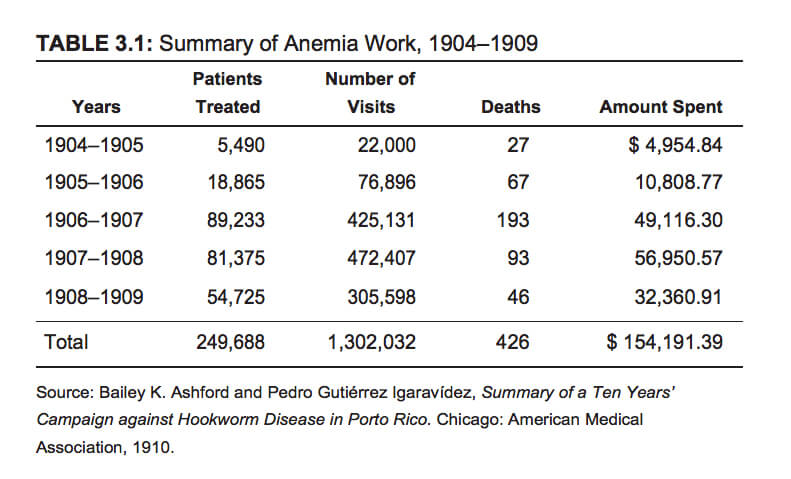
Summary of Anemia Work, 1904–1909, originally published in José Amador's Medicine and Nation Building in the Americas, 1890–1940 (Nashville, TN: Vanderbilt University Press, 2015). Courtesy of Vanderbilt University Press.
Although the campaign enjoyed success in terms of numbers of patients treated, the results were not exactly what had been intended. The rate of reinfestations remained high because the serious issues of social inequality were not considered. In the 1920s, Ashford regretted the misplaced confidence arising from the systematic purge of the hookworms in patients. He lamented that by concentrating solely on medication, the hookworm crusade "totally lost sight of our enemies' allies, poverty and malnutrition."62Bailey K. Ashford, The War on the Hookworm (New York: Chemical Foundation, 1926), 29. What was lacking in those early years was a will to decrease the levels of isolation and poverty. Medical treatment alone, in short, was incapable of alleviating poverty's most disturbing manifestations: the reappearance of an easily preventable disease.
The Pursuit of Health
Typical Facial Expression of the Sufferers, Puerto Rico, 1911. Originally published in Bailey K. Ashford and Pedro Guitérrez Igaravidez's Uncinariasis (Hookworm disease) in Porto Rico: a medical and economic problem (Washington DC: US Government Print Office, 1911). Photograph uploaded by Flickr user Internet Archive Book Images. Image is in public domain.
Unlike physicians, politicians, and journalists, who could circulate different opinions about the campaign in the public sphere or print media, the people who visited the dispensaries and took the medicines had few arenas in which to speak. Yet traces of their immensely varied lives persist, however fleetingly and fragmented, in the archival record produced by those in power. Who were those initial patients who overcame the fear of their first medical examination? How do fragmented accounts provide texture and depth to the actions of peasants pursuing hookworm treatment? What meanings did they give to their pursuit of health? The answers to these questions, tentative as they may be, pose several methodological challenges regarding the use of institutional documents to register popular experiences, especially because, although the campaign produced extensive written records, it did not spark any serious struggle that generated judicial case files or trial transcripts. It is possible, however, to partly recover people's experiences, even within the codified structure of institutional sources, by overlapping journalistic accounts, medical records, and photographs, and asking for important details about individual agency.
The case histories of sixty-one "special" patients treated in 1904 in the town of Utuado were preserved in the first Anemia Commission report. As condensed biographies, they provide a limited but invaluable portrait of who these patients were, where they came from, and how they responded to the campaign. Their life stories demand attention because they reveal the realities of a sick and poor population whose voices were often muted in official accounts. These special patients suffered from hookworm disease, but so did many of their parents and siblings. Of the sixty-one cases, twenty-six reported that they had at least one other family member sick with "anemia," and of that number seven had more than three family members who were hookworm sufferers. Twenty-nine cases reported that at least one family member had died of the disease, and in ten of those cases, three or more family members had died of it. Their work opportunities were limited, but they struggled to make ends meet. More than two-thirds of these patients worked on coffee plantations; some of them were women and others were as young as eleven years old. Other patients were cattle herders, tobacco and banana pickers, domestic workers, and washers. Most of these patients lived in the highlands. Many were itinerant workers who moved from plantation to plantation as the coffee matured. Some of them migrated from the coast for the seasonal harvest. They were not homeless, for the most part, but they lived in dilapidated housing. Some patients lived in Utuado, but most had traveled by foot or in hammocks from distant barrios or towns. These patients arrived at the dispensary pale, emaciated, feeble, hopeful, and afraid. All wanted something: to get relief from the disease weakening them.
Method of Bringing in Very Ill Patients with a Hammock Case, Puerto Rico, 1911. Originally published in Bailey K. Ashford and Pedro Guitérrez Igaravidez's Uncinariasis (Hookworm disease) in Porto Rico: a medical and economic problem (Washington DC: US Government Print Office, 1911). Image is in public domain.
It would be a mistake to read these case histories, which are both official and personal in scope, as transparent windows into popular attempts to negotiate public health. Yet they leave little doubt of the broad spectrum of experiences of those taking advantage of the first campaign that made their health a crucial political project. Six case studies illustrate their labor patterns, family histories, and health pursuits. M. G., an emaciated sixteen-year-old, could not work in the fields because of the disease. He reported that three of his family members had died from hookworm. Like many other patients, he had suffered from mazamorra and took iron pills to fight against his anemic state. After three months of treatment, he brought five other family members as patients.63Ashford, King, and Gutiérrez Igaravídez, Report of the Commission, lii. F. M. was a forty-year-old woman who, prior to being hospitalized, had worked as a laundress and a coffee-picker to help support her husband and seven children. After a week, she regained enough strength to walk and to return to her family responsibilities.64 Ibid., xvii. J. C. S., a twelve-year-old coastal migrant, had been treated previously by Ashford in the coastal town of Ponce, where he sold candies as a street vendor. He was re-infested with the parasite when seasonal harvesting brought him to a coffee plantation in the neighborhood of Arenas. After regaining his strength, J. C. S. ran away to seek work elsewhere.65Ibid., xxiii. L. R., a twelve-year-old girl from the distant town of Jayuya, was brought to the dispensary completely emaciated after traveling on a hammock for five days. She died twelve days later in the field hospital.66Ibid., xxxviii. M. T. was a single woman in her twenties who, like her three brothers, came to the clinic weakened by the disease. After her recovery, she was hired as a laundress in the field hospital.67Ibid., xlv. J. M. B., a thirty-year-old field laborer and the father of five, arrived at the dispensary "profoundly convinced that he was sick, but deeply suspicious and prepared for the worst." After a month of treatment, he was sent home, where he resumed his work.68Ibid., lii.
The presence of the commission in Utuado took on a personal immediacy for some of its patients. V. B, a married coffee and banana laborer, "had a small farm on his own until he became too sick to work it. Sold it for a small sum and moved to town to obtain treatment for his sickness." After his recovery, he "proudly boasted that he was able to support his family and no longer begged."69Ibid., xii. V. B. may or may not have seen work as a social responsibility or a symbol of moral worth, but his action does demonstrate that he viewed recovering from his sickness as important enough to sell his belongings and move to town. Once he regained his health, he touted his ability to care for his family. The commission's cases also capture some of the struggles prevalent in the coffee region after devastation of San Ciriaco. One case involved a fourteen-year-old boy whose father, after losing everything in the hurricane, was interned in an insane asylum. Five years later, the boy remained orphaned, barefoot, and sick. "This is one case," noted the report, "in which poor food, hard knocks, and abandonment broke down what might have been originally a strong resistance."70Ibid., xviii.
Typical Face, Boy, Puerto Rico, 1911. Originally published in Bailey K. Ashford and Pedro Guitérrez Igaravidez's Uncinariasis (Hookworm disease) in Porto Rico: a medical and economic problem (Washington DC: US Government Print Office, 1911). Courtesy of Wikimedia Commons. Image is in public domain.
None of these patients' stories are unequivocal, and medical and popular expectations cannot be entirely separated. Yet there is no doubt that most peasants felt better after the treatment, and some even experienced dramatic transformations in their bodies. Myriad scattered sources buttress this point. In one case history after another, the report used phrases such as "good color," "gained much weight," and "improved appearance" to describe the patient's transformation. The commission noted, for example, that a thirteen-year-old coffee picker had "so completely changed as hardly to be recognizable by his friends."71Ibid., xxvi. Similarly, in another case, this time of a seventeen-year-old tobacco picker, it reported that "his facial expression and color has so much changed that his acquaintances did not recognize him on his return home."72Ibid., xxxiii.
Whether by word of mouth or as direct testimony, these stories, like those of the thousands of other patients, must have traveled up and down rivers and trails to family, friends, and neighbors. Peasants in the highlands heard stories that connected the hookworm campaign to family health, household economies, seasonal labor, missing children, sudden deaths, new employment, treatment measures, and physical transformations. Their acts and responses illustrate the multiple ways in which the campaign influenced crucial aspects of daily life. Given that most coffee pickers harbored the parasite for years, their newfound vitality must have transformed their relationship with their bodies and surroundings. These patients incorporated biomedical language in their vocabulary as they recognized the benefits to their own health. As Luis González, the station physician from the town of Humacao, reported to the commission in 1907:
A few days ago a jíbaro presented himself at the station carrying his feces to be examined but the examination was negative, and I said to him: "You have no anemia," to which he replied: "That is a mistake, Doctor; I caught mazamorra the other day, and I must have it." I had to sit down and explain to the patient that he would have to return later, when his mazamorras should have reached his stomach. He did so, and I found the eggs. The country people around here speak very frequently of the necessity of using shoes, of the "microbe" of uncinariasis, of mazamorra in the stomach.73Ashford and Gutiérrez Igaravídez, Uncinariasis in Porto Rico, 219.
González's words cannot be taken entirely at face value, given the report's emphasis on celebrating the campaign. They reveal not only his enthusiasm for the campaign's mission, but also the reach of medical knowledge among peasants who pressured authorities for information and treatment. Moreover, the actions of Puerto Rican physicians and patients in the campaign strengthen the link between public health and the colonial state, regardless of whether or not they actually welcomed the presence of the United States on the island. The physician from the town of Arecibo, for example, celebrated the US presence in the most unabashed terms: "The most beautiful work, the most transcendental and humanitarian that has been effected under the American flag has been, without the slightest doubt, the campaign against uncinariasis."74Ibid., 217. At the very least, the doctor knew that the colonial government wanted to be regarded as generous and paternalistic and that it might be willing to back up this image with concrete help.
The spectacular response to the campaign sprang from those directly benefiting from hookworm dispensaries. Juan Román, one of the patients treated in Utuado, wrote to Ashford in 1904. His two letters are the only correspondence from an ordinary Puerto Rican found in the Colección Ashford (Ashford Collection) at the University of Puerto Rico. The handwriting, spelling, and grammar are unclear, but there is no mistaking his point. Román stated that he would be "eternally thankful" to Ashford and Gutiérrez Igaravídez for their "success" with his illness. Deferential and proud, he wrote, "I want you to see that, although poor I always have gratitude for those who treated me like you have." It was no small matter to write such a letter. The composition itself was a struggle, but the letter also carried the possibility of personal mobility. Before leaving the station, Ashford had promised Román a position in the insular police. Román reminded Ashford of his promise and that he was now able to serve on the force.75 Juan Román to Bailey K. Ashford, September 23, 1904, CA, box 5, document 321. Writing and sending this letter was more than an act of gratitude. It asserted that health without work is not worth much.
Román was not alone in his desire to move on with his life once he recovered. Francisco Viruet, a fourteen-year-old orphan from Utuado, appeared on the doorstep of Ashford's home in San Juan. According to La correspondencia, the boy said to Ashford, "You have cured me, and I have come to your house so you can educate me or place me." Like many others in the coffee zone, the treatment had clearly shaped the boy's future expectations. Having overcome extraordinary physical weakness, he was now ready to continue his education and improve his social standing, given the opportunity. The paper announced that Francisco was interested in finding a "North American or Puerto Rican protector" to educate him. If this was not possible, Francisco was "willing" to be part of the domestic service in any family willing to take him.76"Como aumenta la clientela del doctor Ashford," La correspondencia, August 31, 1904, 1. Francisco understood the position Ashford occupied in society, and sought the doctor's help in pursuing his own uplift after he recuperated.
In Aibonito, Joaquín Sánchez, who had been cured the previous year at the Utuado dispensary, became a town policeman. Eager to contribute to the campaign, he also volunteered as a sanitary inspector. Sánchez "made reports on the construction of latrines, the conditions in the barrios, and assisted very ill patients to reach the hospital."77Ashford, King, and Gutiérrez Igaravídez, Preliminary Report, 8. He even inspected many of Aibonito's more distant neighborhoods and some nearby municipalities. That Sánchez went beyond the line of duty points to one of the most overlooked consequences of the campaign. Like others who benefited from the treatment, Sánchez took an interest in the campaign not out of a desire to civilize or discipline others, but as a person moved by the campaign's core promise of health. Sanchez's experience instilled in him a heightened sense of civic responsibility that, in the face of widespread illness, prompted him to reach out to members of his own community.
Map of Puerto Rico showing distribution of crop lands, 1899. Map by Herbert M. Wilson. Courtesy of the Library of Congress Geography and Map Division, loc.gov/item/98687184/.
On the ground, however, very few people benefited from the visits of sanitary inspectors. Only in the 1906 campaign was an inspection service formally established, and even then it was limited to the towns of Rio Píedras, Mayagüez, and Lares. During that fiscal year the number of houses visited totaled 5,556 compared to the 89,233 patients treated in stations and the 425,131 total dispensary visits. These numbers demonstrate that, while the campaign was part of an imperial project, neither colonial authorities nor public health officials broke down doors or coerced people into visiting the dispensaries; highland residences were too remote and too dispersed for such actions to be possible. In addition, state presence and infrastructure were nonexistent. Instead, hundreds of thousands of coffee workers walked to the dispensaries in the pursuit of health. Photographic evidence in the town of Utuado shows this much. In some cases, when hookworm stations were not available, the ill marched to the offices of their local physician or town mayor to ask for treatment. The mass experience of receiving a free medical diagnosis, a medicine specific to the disease, and a rapid and effective cure inaugurated a new understanding of the role of people, health care, and the colonial state.
Colonial Circuits
The US campaign against hookworm began on a colonial possession, but its effects soon began to be felt outside Puerto Rico's shores.78In a recent study of US public health in the colonial Philippines, Warwick Anderson argues that colonial administrators transferred and adapted models of public health management back to the United States. See Warwick Anderson, "Pacific Crossings: Imperial Logics in the United States' Public Health Programs," in Colonial Crucible: Empire in the Making of the Modern American State, edited by Alfred W. McCoy and Francisco A. Scarano (Madison: University of Wisconsin Press, 2009), 277–87. Information about the Puerto Rico campaign typically flowed from Ashford to various intermediary agents—journalists, physicians, and other military officials—across the ocean through various media, including oral communications, personal correspondence, and printed texts. For North Americans seeking understanding of the new colonial possession, the images of uplift not only provided a means of justifying an imperial project overseas, but also served to make and maintain US imperial identity at home. This essentialist mode of understanding made Puerto Ricans seem uncivilized, poverty-stricken, preindustrial, and dirty, unlike the civilized, affluent, industrious, and clean residents of United States. Readers of the sensationalistic New York Herald learned that Puerto Rican peasants were "hopelessly ignorant," with weak "bodily structures and facial expressions." The author feared that freed from the restraints of hookworm disease, and without the necessary political education to adequately exercise their right to vote, peasants would jeopardize the progress Puerto Rico had achieved under US rule.79L. L. Seaman, "Disease Perils Beset Natives of Puerto Rico," New York Herald, January 3, 1905, 2. Hookworm disease thus became an integral part of constructing the opposition between colonizer and colonized, although this stark distinction would erode once the eradication of hookworm disease in the US South became a national priority.
American Imperialism. A Thing Well Begun is Half Done, 1899. Illustration by Victor Gillam. Courtesy of Wikimedia Commons. Illustration is in public domain.
Establishing that Puerto Rico was in fact a sick colony prior to the US arrival had great explanatory power in the continental United States. By bringing this representation into the confines of the white man's burden, US accounts located the campaign within a familiar imperial narrative that extended beyond the confines of the island. "In Puerto Rico that 63 per cent of the population are engaged in agriculture has an important bearing on economic conditions, and the prevalence of uncinariasis is a matter of vital concern," the American Monthly Review of Reviews reported in a 1904 illustrated article. "Near one-fourth of the deaths in the island are from anemia," it added, "and the same disease causes fatal ravages in the Philippines and the Southern States, hence all Americans are concerned."80Adam Haeselbarth, "The Puerto Rican Government's Fight with Anemia," American Monthly Review of Reviews 30, no. 174 (1904): 57. The control of hookworm in these locales was an integrative force. It also served to reinforced imperial comparisons of colonial legitimacy. In 1907, William H. Taft, then secretary of war, boasted of the success of US public health efforts in Puerto Rico by comparing the United States to other imperial powers in the region. "Without fostering benevolence," he told an audience in Saint Louis, "this island would be as unhappy and prostate as are some of the neighboring British, French, Dutch, and Danish islands."81William H. Taft, "Some Recent Instances of National Altruism: The Efforts of the United States to Aid the People of Cuba, Puerto Rico, and the Philippines," National Geographic Magazine 18, no. 7 (1907): 433–34. Hookworm was a common disease, prevalent in other colonies in Caribbean, but only the United States cultivated public health benevolence.
Communications that began as a lobbying mechanism for the hookworm campaign in Puerto Rico shifted emphasis based on the intended audience. Recall that Ashford's immediate response after first discovering hookworm eggs was to take the patient to a photographer to immortalize his image. He understood early on that his professional career would advance and that the campaign would enjoy more support if his work achieved international recognition. His correspondence often painted a picture of poverty- and disease-ridden peasants benefiting from the altruism of US imperialism. But Ashford also felt compelled to acknowledge how much his work on the campaign had changed his relation to the island and its people. After two years of working with the commission, he returned to military service. In one of his first trips back to the United States, Ashford confided to his mother: "I leave this lovely island with a host of dearly and beloved friends, and with the keen appreciation that the five or six years of toil for the good of the Puerto Rican peasant is beginning to be felt among the people at large."82 Bailey K. Ashford to Mrs. Francis Ashford, March 4, 1906, CA, box 6.
Top, Victor Heiser. Courtesy of The New York Community Trust. Bottom, Ronald Ross, date unknown. Courtesy of Wikimedia Commons. Creative Commons license CC BY 4.0.
Ashford was fortunate to find in William C. Gorgas a sponsor willing to disseminate his findings to as many physicians as possible. Gorgas had worked with poor rural whites without knowing the cause of their anemia. "When you first pointed out in Puerto Rico that tropical anemia was due to ankylostamiasis," Gorgas wrote to Ashford, "I recognized the fact that the tropical anemia I have been treating for years in Pensacola, Fla., were many cases of that disease."83William C. Gorgas to Bailey K. Ashford, December 3, 1903, CA, box 6. Gorgas acted as a broker of information by passing news about the disease in Puerto Rico on to other colleagues and asking the editors of medical journals in the US South to reproduce Ashford's articles. In one of those requests, Gorgas admitted that because he had seen first-hand the suffering of "poor whites" and the "cracker class" of "our southern states," he was committed to spreading information about the campaign among physicians "who practice among such people."84William C. Gorgas to the editor of the New Orleans Medical and Surgical Journal, January 22, 1904, CA, box 6. Ashford also capitalized on his mounting professional status to broadcast his work. He distributed reports to doctors across the globe, including prominent physicians like Victor G. Geiser in the Philippines and Ronald Ross in England. At the same time, he received requests for hookworm literature from doctors living in distant places such as Ecuador and Hawaii.
Because physicians soon found evidence that the disease that afflicted Puerto Rican peasants was also widespread among poor whites in the US South, calls to launch a similar anti-hookworm program on the mainland swelled. "Since Ashford first showed the prevalence [of hookworm] in that island," the New York Herald noted, "physicians roused to investigation have discovered cases in many of the southern states."85L. L. Seaman, "Puerto Rico Ravaged by Disease that Threatens to Annihilate Natives," New York Herald, December 31, 1904, 2. Initially, the endemic presence of hookworm provided considerable justification for accounts that portrayed both places as benighted and backward. The distinction between the sickly inhabitants of the Puerto Rico and US South blurred, making the jíbaro a mirror image, and not a contrasting one, of poor rural whites. A popular new moniker for hookworm that linked the "cracker class" in the US South to other populations appeared repeatedly in major US newspapers and magazines. In 1902, after listening to Charles W. Stiles present in the first meeting of the Pan American Sanitary Bureau, a New York Sun reporter published his story with the headline "Germ of Laziness Found? Disease of the Crackers and of Some Nations Identified." The reporter emphasized that while the "germ of laziness" affected primarily poor whites in the South, it might also explain the "backward condition" of the people in South America. The author also declared Stiles the "discoverer of uncinariasis or hookworm disease."86Irving Norwood, "Germ of Laziness Found? Disease of the Crackers and of Some Nations Identified," New York Sun, December 5, 1902. See also Ettling, Germ of Laziness, 35–38; and Wray, Not Quite White, 104–108.
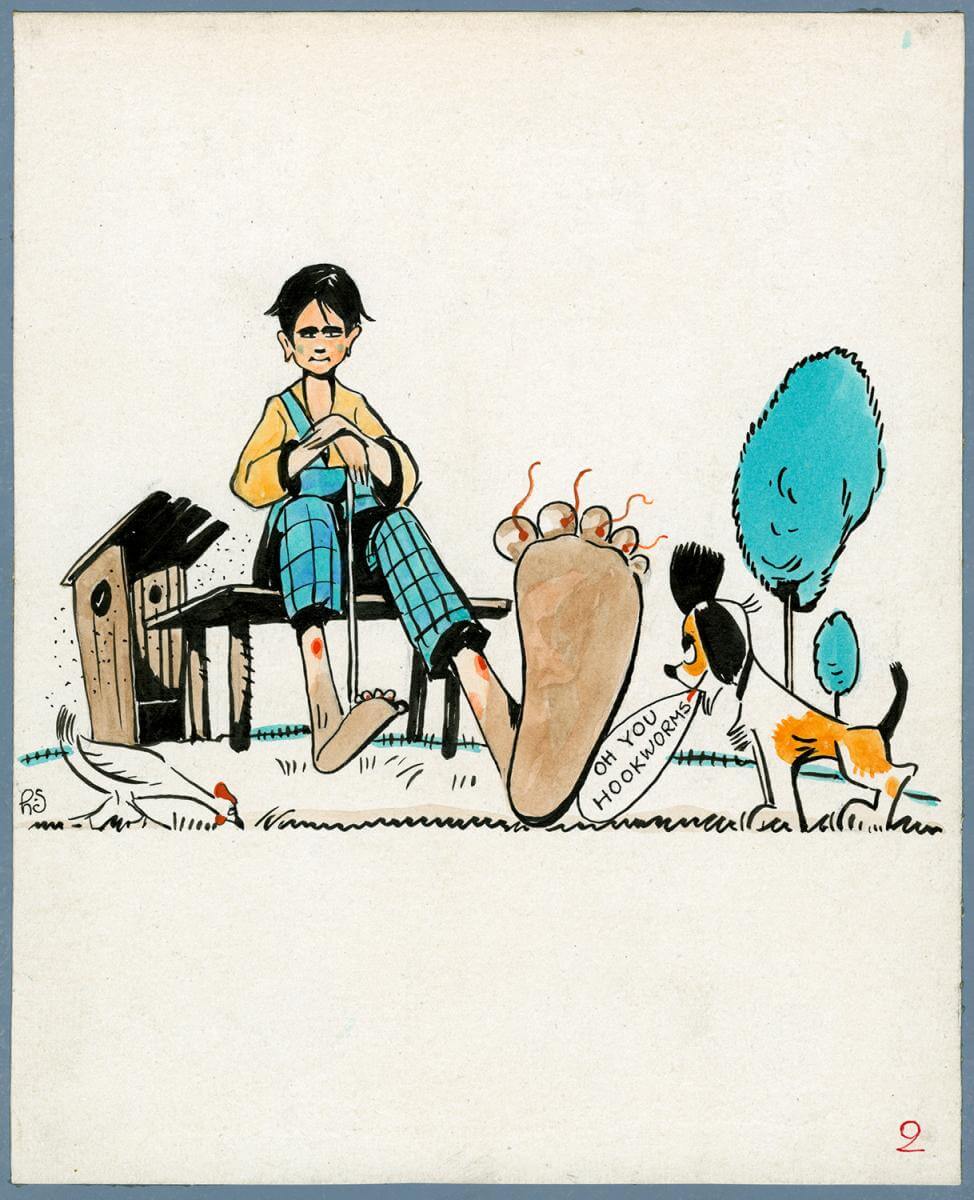
Cartoon #2. Illustration by B. Stephany. Courtesy of 100 Years: The Rockefeller Foundation website, Rockefeller Archive Center, Rockefeller Foundation.
Ashford never embraced the term "germ of laziness," perhaps because he associated it with his rival, Stiles, or because he knew well the struggles of the peasants who visited hookworm stations. Still, the "germ of laziness" helped to reconfigure the racial geography of hookworm disease through associations that connected and crossed regional and colonial distinctions. Newspapers and magazines in the United States reiterated associations between peasants in Puerto Rico and poor whites in the South with banner headlines such as "An Epidemic of Laziness: A Whole Region in Puerto Rico Afflicted with the Lazy Worm," "Getting Tired of Laziness: Puerto Ricans Eager for Treatment to Cure the Disease Caused by the 'Lazy Worm,'" "War on Lazy Worm: Good Effects of the Campaign in Puerto Rico," and "Wiping Out Lazy Disease: Already Nearly 10,000 Cures in Puerto Rico."87"An Epidemic of Laziness, A Whole Region in Puerto Rico Afflicted with the Lazy Worm," New York Times, June 23, 1905; "Getting Tired of Laziness: Puerto Ricans Eager for Treatment to Cure the Disease Caused by the 'Lazy Worm'" New York Herald, June 24, 1905; "War on Lazy Worm: Good Effects of the Campaign in Puerto Rico," Star, September 15, 1905; and "Wiping Out Lazy Disease: Already Nearly 10,000 Cures in Puerto Rico," Philadelphia Reword, September 15, 1905. A photo essay singled out the Puerto Rican campaign to ease existing preoccupations about race and labor in the US South by emphasizing the rehabilitating role of medical science: "Photographic Illustrations of the Campaign Which Has Changed a Lazy Race into One of Energetic Workers."88"Laziness Banished from the Island of Puerto Rico," New York Herald, June 24, 1905. Imperial prejudices about colonial subjects and northern prejudices about poor whites inflected one another through the textual and visual juxtapositions. Yet the fact that the "germ of laziness" was an intestinal parasite that could be purged from the body, and not an intrinsic manifestation of laziness, propelled progressive reformers in the United States to aggressively call for a public health campaign.
The association or conflation of hookworm images in Puerto Rico and in the US South was not exclusive to the print media in the United States. Newspapers in Puerto Rico also joined in public discussion about the hookworm campaign developing in the US South. Much to the dismay of Ashford, who had led hookworm efforts since 1899, La correspondencia published in 1909 "Los pálidos del sur" (The pale ones of the South) a cover story whose illustrations included a picture of Stiles with a caption that claimed that he was the discoverer of hookworm. Compounding the offense, the photos grouped around Stiles's image had been taken by Ashford himself: one was of a boy named Juan Serrano, taken in the Utuado field hospital, and another was of an intestinal cross-section showing the presence of worms.89René Bauch, "Los pálidos del sur," La correspondencia, November 5, 1909. The piece provoked Ashford to voice his "outraged sense of justice." Ashford told the director of La correspondencia that "Puerto Rico alone awakened the continent of the United States to a realization that the disease . . . was responsible for the present epidemic in the United States of the Union." Besides pointing out that his campaign had spearheaded recent public health efforts in the South, he denounced the piece as an example of collective and personal calumny. "Instead of showing to the United States another occasion in which this island we say we love had been of enormous utility to the American people," Ashford complained, "you deliberately permit a writer of your columns to give priority to a man [Stiles] whose inspiration has come from this very island."90Ashford to the director of La correspondencia, November 7, 1909, CA, box 6. Ashford wanted to clarify the record about his scientific and public health achievements as well as to establish the trailblazing role of Puerto Rico in inspiring the efforts of the Rockefeller Sanitary Commission. He was aware that, without the media and financial resources that Rockefeller had to disseminate this information, the origins of the campaign could be forgotten not only on the US mainland but in Puerto Rico as well.
By the time John D. Rockefeller, who sought to redeem his reputation as a robber baron, created the Sanitary Commission for the Eradication of Hookworm, the networks of knowledge exchange that connected Puerto Rico to the United States were well established. To be sure, the guarantee of one million in funding over five years made a crucial difference in the southern campaign. Frederick T. Gates headed the commission, but its administrative and scientific secretaries were educator Wickliffe Rose and zoologist Stiles. Although Stiles knew more than anyone about hookworm disease, he had no on-the-ground experience in directing a public health campaign. On May 29, 1910, Rose sailed to Puerto Rico, where he turned to Ashford for advice about how to carry out a hookworm campaign.91See Ettling, Germ of Laziness, 125–30; William Link, "'The Harvest Is Ripe, but the Laborers are Few': The Hookworm Crusade in North Carolina, 1909–1915," North Carolina Historical Review 67 (1990): 1–27; and J. D. Woody, "The Hookworm Campaign in North Carolina," North Carolina Medical Journal 53, no. 2 (1992): 106–9. Rose spent three weeks traveling the island with Ashford, who provided him with the contact information of hookworm experts in Oxford, London, Liége, Madrid, Brussels, and Cairo. Rose came away from the visit thoroughly impressed, hoping to reciprocate by assisting Puerto Rico with its own efforts against the disease.92Wickliffe Rose to Bailey K. Ashford, June 23, 1910, Rockefeller Sanitary Commission Collection (hereafter RSC), Rockefeller Archive Center. Governor George Colton and Ashford had made it clear that they would not be adverse to financial assistance. At Rose's invitation, Ashford later visited the United States to give a series of lectures on hookworm. Despite their friendly exchanges, Rockefeller's gift was specifically earmarked for the US South. As a result, the commission did not see fit to fund hookworm efforts in Puerto Rico.93Bailey K. Ashford to Wickliffe Rose, October 24, 1911; August 18, 1912; and April 21, 1914, RSC.
Top, Health Exhibit, Sumter County Fair, November 1, 1921. Courtesy of the 100 Years: The Rockefeller Foundation website, Rockefeller Archive Center, Rockefeller Foundation. Bottom, Dispensary scene, teaching by lecture and demonstration, Dr. Caldwell. Courtesy of the 100 Years: The Rockefeller Foundation website, Rockefeller Archive Center, Rockefeller Foundation.
As the impetus for a hookworm eradication campaign in the US South gained popularity on the mainland, the limited effectiveness of establishing parallels between Puerto Rican jíbaros and poor whites became apparent. In the 1900s, as pointed out earlier, US perceptions of Puerto Rico often suffused racializing discourses of southern particularity. Yet, as Matt Wray has argued, because the hookworm campaign in the US South was established at the moment when the legal apparatus of Jim Crow attacked the participation of blacks in politics and the economy, "drawing too many parallels between the poor white inhabitants and other colonized populations posed a problem" for advocates of the New South. Since hookworm promoters wanted "to persuade elites about the racial purity of poor whites, then it would weaken their argument to suggest that poor whites had much in common with colonized, racially inferior people."94Bailey K. Ashford to Wickliffe Rose, October 24, 1911; August 18, 1912; and April 21, 1914, RSC. Hookworm activists had little interest in casting any doubt among wealthy elites about the possibility of turning poor whites into productive white workers by associating them with Puerto Rican peasants. This calibration redefined the process of racial formation to appease fears that the transformation of jíbaros and poor whites by the campaign would make the two populations too similar, rather than help maintain the two populations as distinct.
The networks of hookworm exchanges that Ashford helped create only grew as the decade progressed. In fact, they grew so unwieldy after the Rockefeller Foundation launched its international eradication program that Ashford's significance in them faded over time. Moreover, Ashford eventually began to reconsider eradication as a realistic goal, although his experience in Puerto Rico showed that, at least in the short run, treatment and careful organization of resources could bring dramatic health results to people. He knew that wearing shoes minimized contact with the ground and that using privies broke the transmission route between the soil and the gut. Eradication was attainable, but it was by no means a simple objective. At its root was poverty. In Puerto Rico, as in the US South, and across the "tropical belt," the disease's severity depended on economic circumstances. Limited resources had to address not simply a debilitating ailment, but also structural layers of afflictions.
Conclusion
To historicize the crossing of Puerto Rico's hookworm campaign complicates our understanding of both the men and women who embraced it and its profound impact in the United States. The basic assumptions that have guided scholarly interpretations of this campaign have focused principally either on the medical construction of the peasant or on the campaign as a derivative project of US imperialism. These assumptions have been informed by the most influential source on the campaign: the 418-page autobiography of Bailey K. Ashford. Yet, Ashford's pristine narrative of achievements is disrupted by a wealth of archival evidence, much of it collected by Ashford himself, that shows the ways Puerto Rican doctors and peasants sought opportunities for themselves. Giving attention to these sources opens up interpretations that transcend the imperial gaze and illuminate both on-the-ground responses and interactions between peasants and medical authorities.
Moreover, although the hookworm campaign was part of the post-1898 expansion of American military medicine in the tropics, the campaign in Puerto Rico, in contrast to the public health work in Cuba, took place in a colonial setting under US civilian, not military, rule. Hookworm disease, unlike yellow fever, was not a high-priority disease affecting US commerce, nor was it tied to elite anxieties about white immigration. In Puerto Rico there was no figure like Carlos Finlay who could claim misappropriation of scientific recognition and generate nationalist sentiment. Instead, the campaign was spearheaded by a US military physician who was denied due credit by a US zoologist. Yet not unlike yellow fever in Cuba the meanings of the hookworm campaign extended beyond the so-called object-lessons of colonial administrators. Unequal imperial structures shaped part of the conflicts, negotiations, and compromises that constituted the hookworm campaign, but did not overdetermine its outcomes.
Ramón Frade, El pan nuestro (Our bread), oil on canvas, c. 1905. The painter Ramón Frade elected to represent the Puerto Rican peasant or jíbaro as a dignified figure. The mountainous landscape in the background highlights the hard work of the peasant. From the Collection of the Instituto de Cultura Puertorriqueña (Institute of Puerto Rican Culture), San Juan, Puerto Rico. Originally published in José Amador's Medicine and Nation Building in the Americas, 1890–1940 (Nashville, TN: Vanderbilt University Press, 2015). Courtesy of Vanderbilt University Press.
The campaign did lead to a profound reassessment of the poor peasants. Hookworm activists, rather than portraying them as victims, portrayed them as a source of medical—and paternalist—uplift. Through their efforts the figure of the jíbaro entered the national imaginary in a new way. But what does the redeemed jíbaro look like? One year after the first campaign against hookworm campaign ended in Utuado, Ramón Frade completed a painting thematically opposite to the cautionary tales of the nineteenth century. In Pan nuestro (Our bread; c. 1905), Frade, a painter from the tobacco- and coffee-growing town of Cayey, endowed the Puerto Rican peasant with a hopeful, dignified future. While the painting was clearly influenced by European aesthetic currents, it represented the sublime beauty of the peasant by emphasizing his forward movement. Within the canvas, the majestic mountain and the luminous sky pull back as the peasant walks toward the viewer, carrying in his hand the fruits of his labor.95For a comprehensive biography of Frade, see Osiris Delgado, Ramón Frade León, pintor puertorriqueño (1875–1954): Un virtuoso del intelecto (San Juan, Puerto Rico: Centro de Estudios Avanzados de Puerto Rico y el Caribe con la colaboracion del Instituto de Cultura Puertorriqueña, Academia Puertorriqueña de la Historia, 1989). For an overview of Puerto Rican art, see José Torres Martinó, "Puerto Rican Art in the Early Twentieth Century," in Puerto Rico—arte e identidad, edited by Hermandad de artistas gráficos de Puerto Rico (San Juan: Editorial de la Universidad de Puerto Rico, 1998), 83–88. The visual vocabulary of Frade's painting struck a powerful chord among Puerto Ricans because it was validated by the context in which it was produced. The image of a moving peasant, while idealized, was not far-fetched. After the hookworm campaign started, tens of thousands of coffee workers visited the provisional dispensaries in the pursuit of health. When hookworm facilities were not available, they marched again to the offices of the local physicians and mayors to ask for the treatment they now expected the state to provide. Similarly, when employment opportunities were not available in the highlands, thousands of mountain dwellers moved to the coastal plains or urban centers in search of jobs. These claims produced new anxieties about the stability of social hierarchies, which eventually facilitated the nostalgic construction of the jíbaro as a national icon.
Similarly, personal, institutional, and political interests converged to generate multiple, and at times contradictory, images of the hookworm campaign in Puerto Rico. In the United States, the media's fascination with the campaign reflected its quest to justify US imperial rule. Ironically, in establishing a parallelism between Puerto Rican peasants and poor southern whites, media accounts not only attempted to advocate for a campaign in the US South similar to the one initiated in the colony, but also established an equivalence that distanced both groups from US elite white men. When emissaries from the Rockefeller Foundation set out to undertake the hookworm program in the South, tens of thousands of diseased Puerto Ricans had already been treated. Poor whites became as redeemable as Puerto Rican peasants. This association changed the ways many US residents, especially in the North, thought about the bodies of poor whites and the US South. By bringing their civilizing mission back "home," Rockefeller officials, just like the hookworm advocates had done in Puerto Rico, redefined the stereotype of the poor rural dweller through medicalized images.
In the years following the Puerto Rico campaign, hookworm eradication became a prominent public health issue in other nations. Like the yellow fever campaign in Cuba, the hookworm campaign inspired public health administrators in Brazil. Their efforts to translate the campaign engendered new debates about state power, national identity, and US empire. As the hookworm campaign model reached other corners of the globe, the terms of these debates would shift and transform. They would need to be readjusted before working in distinct, but increasingly entangled, national contexts.
Acknowledgments
Southern Spaces thanks Vanderbilt University Press for their permission to reprint this chapter in its entirety.
About the Author
José Amador is associate professor of Global and Intercultural Studies (Latin American, Latino/a, and Caribbean Studies) at Miami University. His first book, Medicine and Nation Building in the Americas, 1890–1940 (Vanderbilt University Press, 2015), was awarded the Norman L. and Roselea J. Goldberg Prize for best project in the area of medicine. He is also the co-editor of Historia y memoria: sociedad, cultura y vida cotidiana en Cuba (Centro de la Cultura Cubana Juan Marinello, 2003). He has published essays on Puerto Rican Afro-diasporic music and on the founder of the Cuban journal Pensamiento crítico.
]]>