Introduction
The soil in the Mississippi Delta has everything a planter needs. Rooted in shallow soils, elm, cottonwood, and pecan trees line the hilly landscapes of eastern and southern Mississippi. In the bottomland, where the soil is formed by flooding, the endless striations of light and dark colored sediment create moist, rich, and nutrient-dense dirt in which cash crops like corn, soybeans, and cotton thrive. The Mississippi River and all its branches flow over the boundaries of its own banks, flooding the soil and adding new sediment, giving it new life. On the banks of the Mississippi between Coahoma and Sunflower counties, sits Bolivar County and the city of Mound Bayou. Founded in 1887 near Chickasaw burial grounds by a trio of formerly enslaved cousins, Mound Bayou emerged in the Reconstruction era as a burgeoning example of what African American autonomy could become in the dissolution of slavery.1Joel Nathan Rosen, “Mound Bayou,” Mississippi Encyclopedia, July 11, 2017, https://mississippiencyclopedia.org/entries/mound-bayou/. At its height, Mound Bayou, the “Jewel of the Delta,” housed successful Black businesses, a public school system, and a community-run hospital.2Rosen, “Mound Bayou.” Seen as a safe haven from the physical and political interference of white people and power structures, Mound Bayou fought to maintain its autonomy, eventually succumbing to mismanagement and political in-fighting. By the 1960s, while attention was on the southern United States in the fight for civil rights and political enfranchisement, Mound Bayou, like many other Black towns in the twentieth century, languished under the threat of anti-Black, state-sanctioned violence and economic inequity. While historians often place voting rights at the heart of the civil rights movement, in Mississippi, for Black farmers, sharecroppers, and their families, the gut of the matter was food.
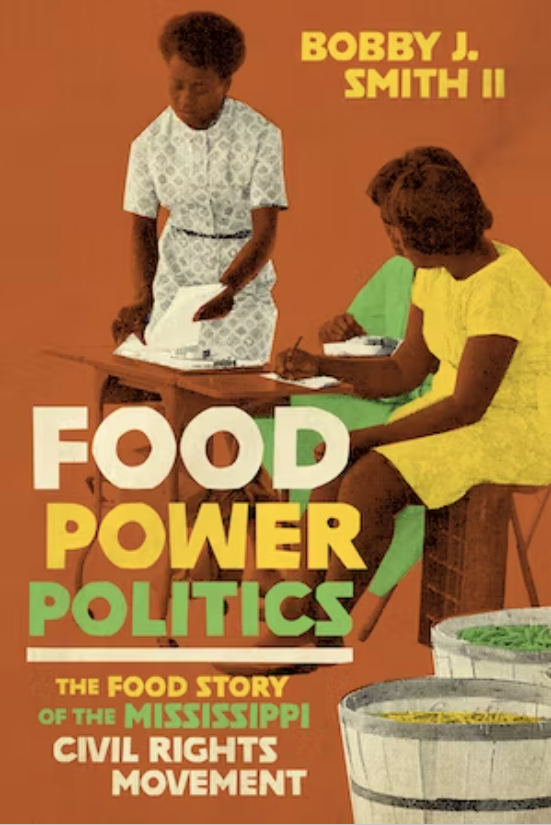
A contribution to critical food studies, Bobby J. Smith II’s 2023 Food Power Politics: The Food Story of the Mississippi Civil Rights Movement, details the role of plantation politics, food scarcity, and Black autonomy across the Delta from the mid-1960s through the early 1980s. In addition to thinking about power, equity, and accessibility, Smith’s work deals specifically with the experiences of Black communities in the Delta—places such as Leflore, Sunflower, and North Bolivar counties—and builds on recent scholarship covering the pinnacles and nadirs of the civil rights movement. According to Smith (a professor of African American Studies at the University of Illinois), the emphasis of scholarship on voting rights and education in the civil rights era neglects the more fundamental problem of subsistence. The primary critical intervention Smith presents in Food Power Politics is his insistence that the subject of food equity allows readers to “identify social, political, and economic blind spots...at the core of social protest and power struggles” both past and present.3Bobby J. Smith, Food Power Politics (Chapel Hill: University of North Carolina Press, 2023), 9. Smith aims to “expand the civil rights story” by illustrating how the lack of access to nutritional food and nourishment motivated sharecroppers, farmers, and rural working-class families on the periphery of Black life in the US to “[pave] the way for new articulations of civil rights activism.”4Smith, Food Power Politics, 142. Examining food access and equity shifts attention to the environmental and psychological vulnerabilities of Black bodies.
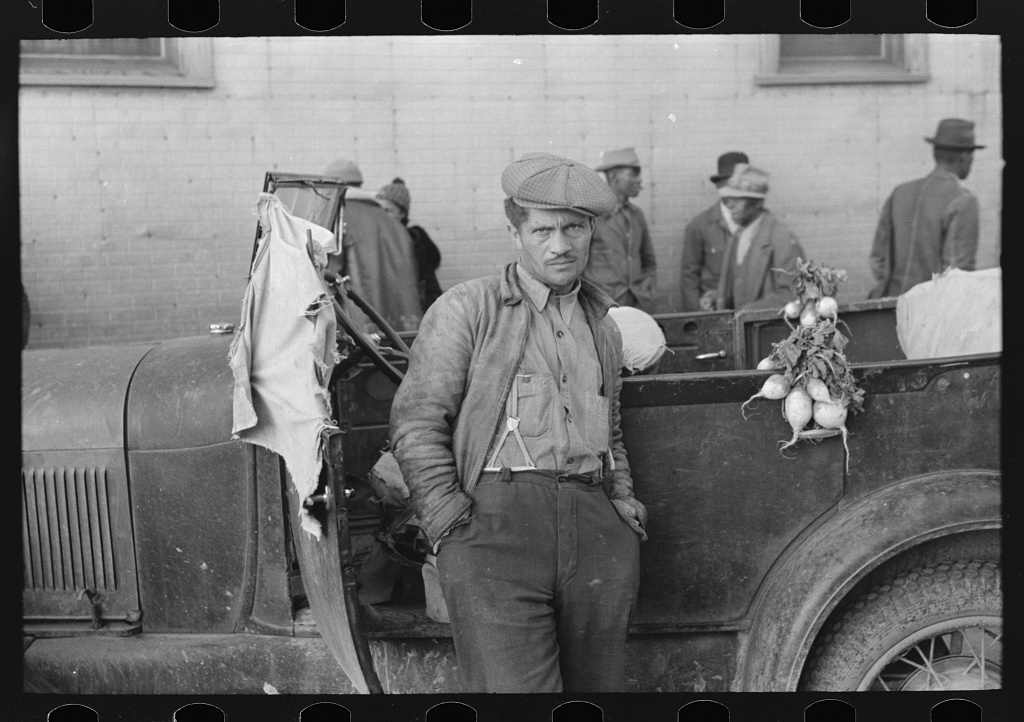
The social, political, and biological aftershocks of the plantation system in and after the era of “King Cotton” are too massive to quantify. As Mikko Saikku reminds us, despite the “great personal fortunes” cultivated across the 19th and 20th centuries through the "biological productivity" of the Mississippi Delta, "[for] most of the people involved in the transformation of the Delta bottomlands, especially black slaves, sharecroppers and agricultural workers, economic gain and social mobility remained severely limited.”5Mikko Saikku, "Bioregional Approach to Southern History: The Yazoo-Mississippi Delta," Southern Spaces, January 28, 2010, https://southernspaces.ecdsdev.org/2010/bioregional-approach-southern-history-yazoo-mississippi-delta/. As a response and challenge to these limitations, Smith constructs the food story of Mississippi by drawing on civil rights era archives and ethnographies. Examining documents from Tougaloo College Civil Rights Collection, the Mississippi Department of Archives and History, and the Mississippi Council on Human Relations, alongside local newspaper reportage, Smith also draws upon a diverse range of print media and correspondence, including personal letters from civil rights activists such as Medgar Evers and Fannie Lou Hamer. He also conducted interviews with activists and agricultural workers active in the 1960s and today in north Bolivar County.
Key to Smith’s analysis are the concepts of food power and emancipatory food power. Food power, most often deployed when describing international wars and political conflict, gestures towards moments where, within “a hierarchical world system” access to food or food related autonomy is “weaponized...as a form of control between nations” to influence outcomes.6Smith, Food Power Politics, 2. Food power guides the first two chapters of Smith’s book through an examination of the 1962 Greenwood Food Blockade and the Lewis Grocer Company’s campaign for a federal food stamps program in Mississippi. State and local government, as well as private corporations, wielded food power against Black farmers, sharecroppers, and working-class people to continue the racist inequities of the antebellum plantation system.
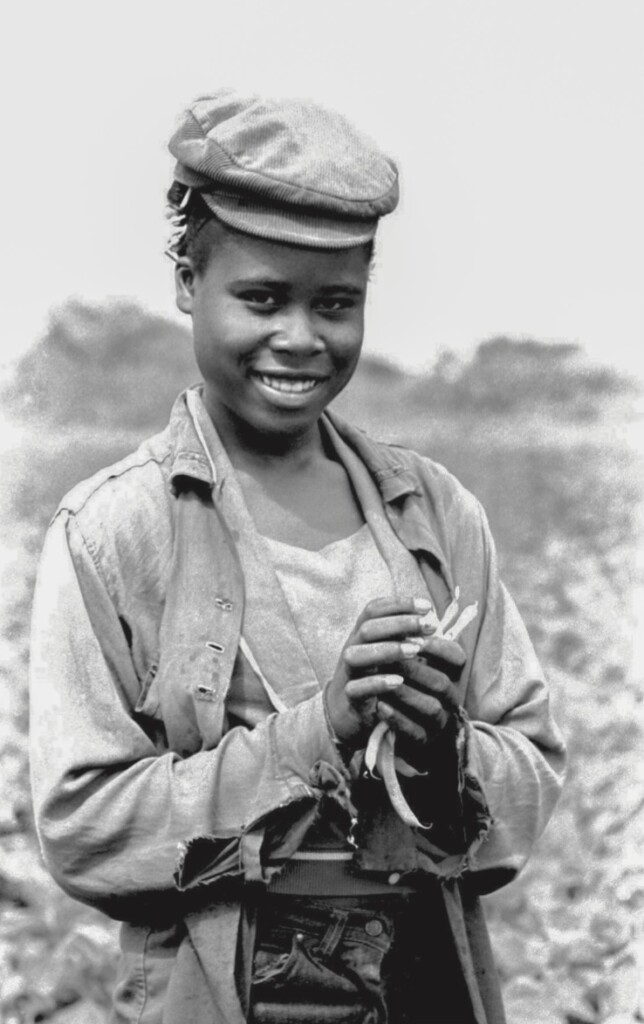
The second half of Food Power Politics illustrates emancipatory food power—ways that Black activists, citizens, and farmers restructured the power dynamics imposed on them by the white plantation class through the creation of an autonomous food economy in service to the needs, desire, and tastes of Black rural people. Smith writes extensively about the North Bolivar County Food Cooperative (NBCFC), founded in 1967, and its contemporary iteration, the North Bolivar County Good Food Revolution (NBCGFR), a predominantly youth-led food justice movement that emerged in 2017. Here, the line between food power and emancipatory food power is not conceptual or theoretical. The emancipatory power of Black food autonomy depends on economic independence fueled, in part, through land ownership, as well as food literacy, agricultural education, and the material labor of Black people. While Smith’s project is rooted in the geographies and spatialities of the Delta, it also surveys other places often minimized or misunderstood through standard histories of the civil rights years.
Food Power Politics asks that we consider the space of the plantation not only as a physical landscape of endless rows of cotton stalks but also as spaces constructed by and in service to white social and economic domination over Black people. The attitude of the plantation can be found in the white-owned grocery store as much as in the field. In considering Black women as mothers, planters, laborers, and activists, Smith asks us to consider Black domestic space, represented iconically in the kitchen table, as the launching pad for political revolution.
Debt, Plantations, and Black Hunger: On Food Power
During and after Reconstruction, the sharecropping system continued to support the hierarchy and politics of the plantation ruling class in the Deep South. While millions of formerly enslaved persons flowed north and west during the Great Migration, those who remained had limited options for employment. Many Black farmers and agricultural workers found themselves working for the descendants of former slave masters on the same plantations where their ancestors labored in bondage. Food access was negotiated through small gardens on plots of land leased from plantation owner. These “truck patches” supplied subsistence nourishment. Additionally, many sharecropper households traded homestead goods with other families, creating networks of care and support. Many also depended upon New Deal era federal food programs. Similar to the exploitative credit system that forced Black farmers to lease land and equipment from plantation owners at outrageous interest rates, access to food in Mississippi during the 1960s was deeply entwined with the afterlife of the plantation system. The fiscal and social politics of the plantation era made itself known through the converged interests of plantation owners and private white grocers such as the Lewis Grocer Company, which conspired to suppress Black political and economic autonomy through the twinned threats of food scarcity and political disenfranchisement.
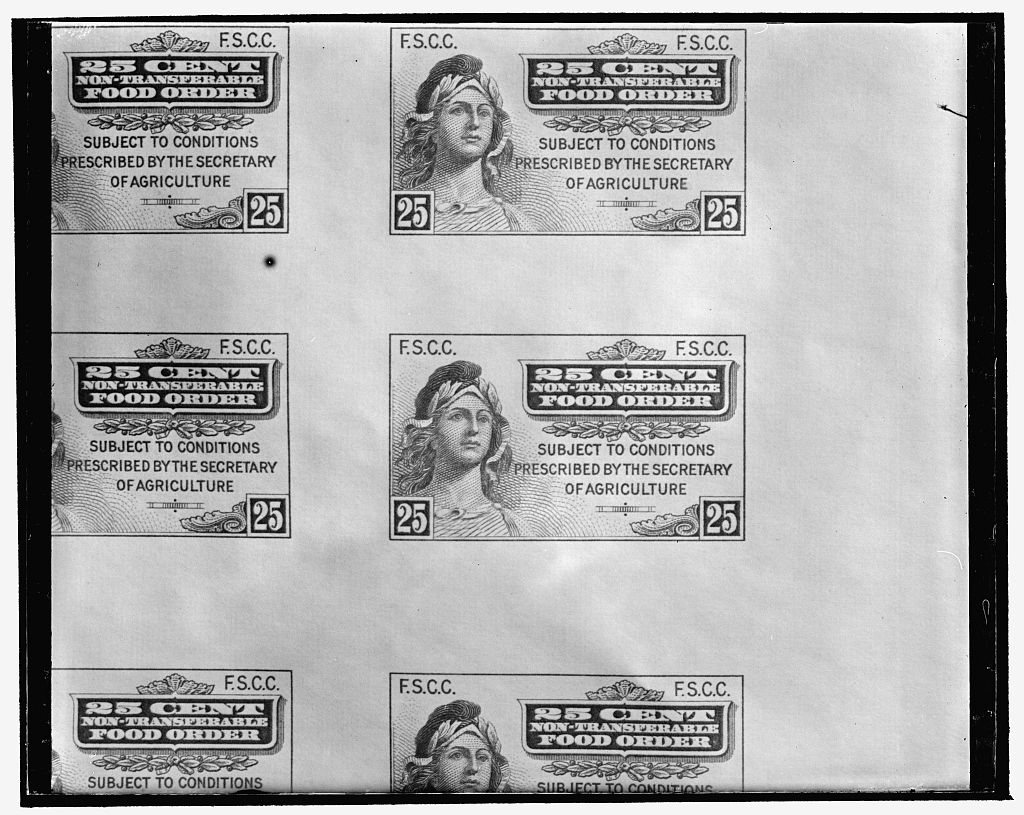
Three factors shaped the proliferation of food-centric oppression for the Black rural and working class in Mississippi during the 1960s: the mechanization of the plantation system, the transition from government-sponsored surplus goods programs to that of the federal Food Stamp Program, and the change in minimum wage laws surrounding farm workers and sharecroppers in the Delta. In the era of “King Cotton,” the means of cultivating and harvesting this cash crop became more dependent on government-leased technology, machinery, and chemicals, and less dependent on manual labor. The sudden decline of job opportunities, the shift from daily to hourly wages for plantation labor, and the emergence of a food stamp system which deepened sharecroppers’ dependence on systems of credit were major forces of oppressive food power wielded over Black farmers and their families by white capitalist elites in the Delta. The triangulation of these events forced sharecroppers and their families into structural over-dependency and debt, creating seemingly inescapable cycles of poverty.
Among these dire systemic restrictions, food scarcity was also strategically deployed by white government officials in LeFlore County through the 1962–1963 Greenwood Food Blockade. The county board of supervisors’ decision to pull out of the federal surplus commodities program, a major food source for Black sharecroppers and farm workers, further spurred food scarcity. Similar strategies of food suppression were deployed in Tennessee in 1960 and in nearby Sunflower County in 1962. These actions aimed not only to starve out the Black rural class and keep them further under the control of credit systems deployed by plantation owners and grocers but also to intimidate the burgeoning rise of Black voter registration taking place across the South. The Food for Freedom program, created by the Student Nonviolent Coordinating Committee (SNCC) and Council of Federated Organizations (COFO) just a few weeks after the start of the blockade, addressed the needs of Black people in Greenwood by providing food, aid, and support through local and regional systems of distribution. With the help of local activists, as well as public figures such as Martin Luther King, Jr. and comedian Dick Gregory, the Food for Freedom program brought attention and material support to those in need and helped to end the blockade in March 1963. In this process, SNCC was able to make a concerted effort to explicitly connect food and activism to highlight the “relationship between food, everyday Black resistance, white supremacy, and state sanctioned violence during the civil rights era.”7Smith, Food Power Politics, 42. Smith illustrates in detail how plantation owners and grocers strategically displaced Black food autonomy with debt-centric practices, which forced Black sharecroppers and farmers to depend on the state for access to food. This history is painfully ironic, given the current political rhetoric in Mississippi that centers public welfare programs as a threat, best exemplified by Mississippi Governor Tate Reeves’s (R) refusal to participate in a federally funded program aimed at supporting food access for children in the summer months. Gov. Reeves's rejection of the program, justified by his dedication to not “expand the welfare state,” illustrates how inequitable practices of food power remain active in Mississippi.8Gloria Oladipo, “Mississippi Quits Child Food Program amid Republican ‘Welfare State’ Attack,” The Guardian, January 13, 2024, https://www.theguardian.com/us-news/2024/jan/13/mississippi-child-school-food-program-welfare-state.
Autonomy and/as Collard Greens: On Emancipatory Food Power
The Food for Freedom program is one of three examples of emancipatory food power that Smith highlights in his book. The most expansive is the NBCFC, a Black-owned and operated food cooperative founded in 1967 with the goal of becoming an autonomous food economy in Mississippi. Spearheaded by activist L.C. Dorsey, with the help of other Black mothers and community members, this cooperative began as a garden project for low-income families. At its peak, the NBCFC operated a farming operation across almost 1,500 acres (owned and leased) to cultivate crops for the poorest families in Bolivar. Pushing against the monocrop culture that had rendered many Black sharecroppers jobless, the NBCFC grew crops that would meet nutritional needs: protein-rich nuts, peas and beans, vitamin-dense greens and okra, as well as staple carbohydrates like rice, potatoes, and corn. During the summer, watermelon vines as well as peach orchards and pecan trees were prioritized for local enjoyment. The NBCFC illustrated how Black autonomy functions beyond the strictures of capitalistic profit.
While land acquisition was central to NBCFC’s vision of food autonomy, so were labor practices and education. The cooperative dedicated over 70% of its labor budget to employing local members, bringing jobs to more than three hundred families. It partnered with the Department of Horticulture at Mississippi University alongside agricultural educators from Atlanta University, Iowa State, and Michigan State to offer courses in farm management, soil conservation, and food production. Food literacy was a primary goal of outreach, instructing Black mothers on how to prepare the foods distributed to them through the cooperative in ways that would support the health and wellbeing of the household. Land acquisition, farm production, and agricultural education centered the NBCFC’s vision of emancipatory food power. That workers were able, even for a short period, to labor in a system that would feed and train them to become more self-sufficient—financially and politically—on the land where they lived, worked, and sought to thrive was a radical feat reshaping what freedom could envision.
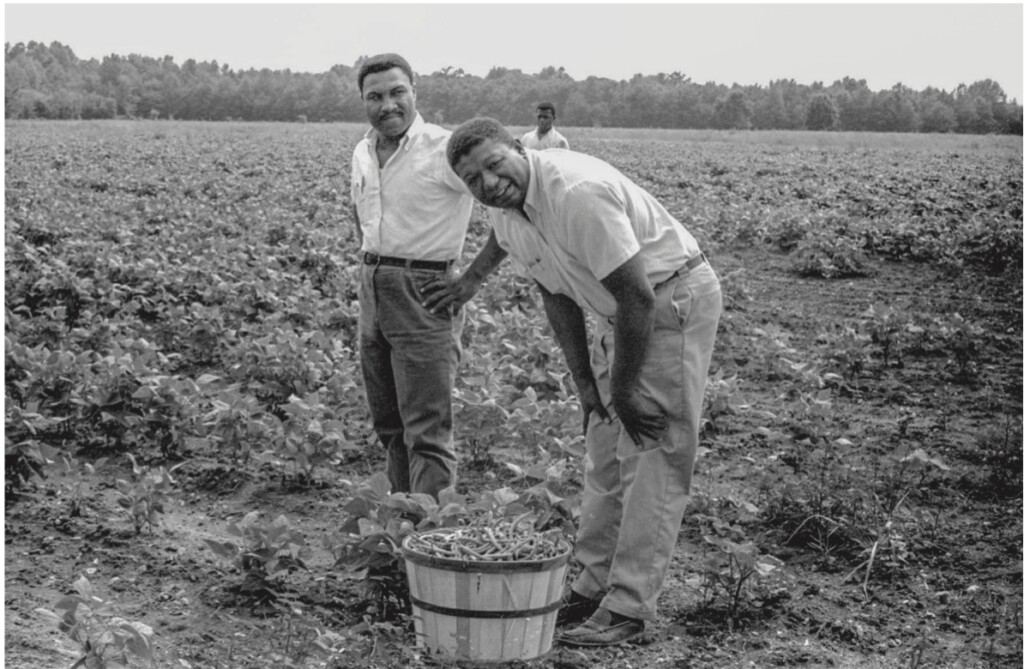
After five years of operation, the NBCFC began a decline in the 1970s due to leadership infighting, disagreements, and the loss of grant funding. The organization was unable to complete its long-term goals of creating an on-site canning operation for national distribution of NBCFC foods and developing a Black-owned and operated farm supply store that might further offer farmers the opportunity to cultivate their own land without interference from white plantation owners. Still, Smith narrates their journey in this unique and palpable moment. The legacy of the NBCFC is alive in the youth-run North Bolivar County Good Food Revolution (NBCGFR).
The joy of Food Power Politics comes in its gesturing towards civil rights beyond voting and government, in expanding understanding of what Black autonomy can be. The most striking cultural memories of the civil rights era, often exemplified by photographic images of Black bodies in pain and duress, contribute to a taste for spectacle that continues. The exploration of hunger as a threat fueled and facilitated by white supremacy is a subject requiring more attention.
Food Power Politics explores spaces and places often overlooked by civil rights historians. Smith explores the Delta from the soil up, balancing a long history of food injustice, narrating the story with an avid appetite for meticulous detail. If any dimension is slighted, it’s the missed opportunity to fully explore the role of Black women activists and their influence on emancipatory food power. Smith is deft to note that, while Black women were and remain active participants in the NBCFC and NBCGFR, the question of how to emancipate Black people from food scarcity, while also emancipating Black women from the invisible labor of the domestic space, remains underdeveloped. While Smith mentions the work of well-known Black food activists such as Fannie Lou Hamer, and other important figures such as Dorsey, Unita Blackwell, and Marian Wright, he and other food studies scholars should further articulate what a Black Feminist approach to food equity might consist of. Such an endeavor would take seriously how Black women’s material and political labor has been intentionally miscategorized and rhetorically devalued within historical narratives. It would also acknowledge the murky history of Black patriarchal structures that relegate, and obscure, the nurturing networks of care constructed by Black women activists to the realm of the domestic and private. In this, we can better understand how a Black Feminist approach to food equity would address an equity of labor and care within the Black domestic space irrespective of gender, class, or sexuality.
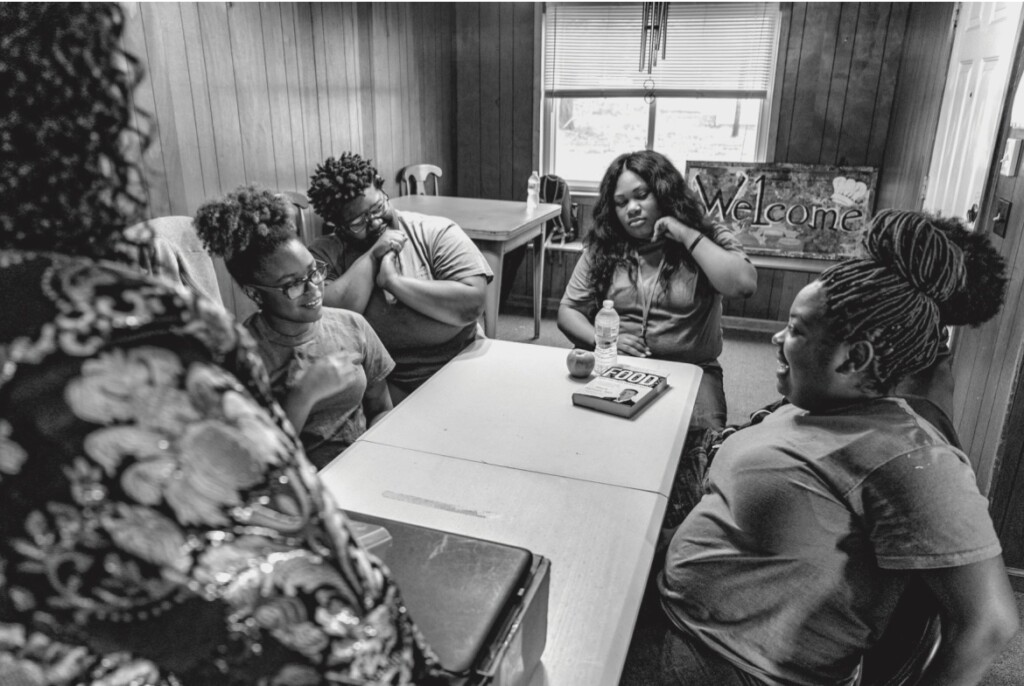
The core aim of Food Power Politics is to construct an alternative history of food power in the Delta, and in that, Smith succeeds. Further, Smith’s text places into perspective the long history of community organizing, direct action, and educational activism that rural and working-class Black Americans have relied on in the face of economic and social dispossession. Instead of debating the legitimacy of trickle-down activism from hyper-visible politicians and celebrities, Smith reminds us that, historically, political victories and social justice reform sprouts from the bottom up. 
About the Author
Ariel Lawrence is a PhD candidate in the English Department at Emory University. Her research focuses on Black women-authored lifewriting across multiple genres, and the articulation of ethical reading practices in and beyond the page.
]]>Introduction
On January 15, 1909, US President-elect William Howard Taft attended a banquet at the Chamber of Commerce along with "the cream of Atlanta and the south's commercial factors, professional men, editors and railroad magnates" where the main course featured a winter trio of roasted opossum, sweet potatoes, and persimmon beer.1"Taft Eats 'Possum, Gives South Pledge," The New York Times, Jan. 16, 1909, 1. Several months earlier and prior to his election, Taft had become the first Republican candidate to venture into the Democratic "Solid South" during a presidential election.2David Charles Needham, "William Howard Taft, The Negro, and the White South, 1908–1912," (PhD diss., University of Georgia, 1970), 31. The Atlanta banquet represented a continuation of Taft's efforts toward sectional reconciliation as he pledged to "weld into a compact unit the North and the South."3"Taft Eats 'Possum, Gives South Pledge," 1. The event highlighted the white supremacist solidarities necessary for such political and economic reunification, with his speech elaborating policies that would assure federal appointments would not go to African Americans and that southern metal and cotton products would find commercial opportunities in Far Eastern markets.4William H. Taft, "The Winning of the South," Political Issues and Outlooks: Speeches Delivered Between August, 1908, and February, 1909 (New York: Doubleday, Page, 1909), 230–234.
For the prominent white male politicians, businessmen, and other leaders seated at the dining tables, roasted opossum was more than just a show of Gilded Age gustatory extravagance. The food held deep cultural meanings. Since the antebellum era, white males of southern plantation households would occasionally oversee or accompany enslaved people's nighttime opossum hunts, claim their spoils, and then relegate the game's preparation to African American cooks. Drawing on this tradition, a generation of white men with rural upbringings came to see opossum hunts as a means of perpetuating antebellum culture by reinforcing and reinscribing racial lines. They mocked and derided opossums as indicative of negative aspects of African American culture while simultaneously celebrating African Americans as possessing a folk knowledge of hunting, preparing, and cooking opossums.5Psyche Williams-Forson examines similar paradoxes in the case of fried chicken in her chapter "More Than Just the 'Big Piece of Chicken': The Power of Race, Class and Food in American Consciousness," in Food and Culture: A Reader, 3rd ed., Carole Counihan and Penny Van Esterik, eds. (New York: Routledge, 2012): 107–118. See also Williams-Forson Building Houses Out of Chicken Legs: Black Women, Food, and Power (Chapel Hill: University of North Carolina Press, 2006). In the decades after the Civil War, whites of all social classes increasingly consumed this survival food, now labeling it a "southern delicacy."6This sort of cultural appropriation persisted for over half a century after the Taft banquet, with the women of the Junior League of Charleston, South Carolina, suing Ernest Matthew Mickler, author of White Trash Cooking, in the mid-1980s for lifting what they claimed was their historical recipe for roasted opossum. For a brief discussion of cultural appropriation in this context, see Angela Jill Cooley, "Southern Food Studies: An Overview of Debates in the Field," History Compass 16, no. 10 (2018): 1–9. The dish, known as "'possum and 'taters," was one of many items of "southern cooking," which, as Diane Spivey points out, signified a "Whites Only Cuisine" during Jim Crow.7Diane M. Spivey, "Economics, War, and the Northern Migration of the Southern Black Cook," The Peppers, Crackling, and Knots of Wool Cookbook: The Global Migration of African Cuisine (New York: State University of New York Press, 1999).
Challenged by the economic competition of freed people who sought urban factory jobs and attempted to purchase rural farms, in addition to the political competition of the Populist movement that aimed to unite Blacks and working-class whites, opossum suppers, particularly in Georgia, provided a Democratic theatre in the decades following Reconstruction. At the 1909 Atlanta supper, staged to garner national attention, Taft appealed to Democrats who sought to regain national political strength. As the New York Times reported: "Five hundred eyes watched until he had been served and bountifully served and had taken his first bite of the tempting dish."8"Taft Eats 'Possum, Gives South Pledge," 1. In the aftermath of this feast, journalist Don Marquis suggested that "the possum, and all the talk back and forth across the festive boards . . . has likely strengthened Mr. Taft's idea that the 'Solid South' is breakable, and that he is the man to break it. . . . How much of the Southern point of view with regard to the negro did Mr. Taft imbibe while eating the possum?"9Don Marquis, "A Glance: Concerning the Possum and the Negro," Uncle Remus's the Home Magazine, March 1909, 26. https://digitalcollections.library.gsu.edu/digital/collection/printed/id/6450/rec/1.
The opossum's momentary rise to glory parallels the shifting of political power during this era of intensifying apartheid. Whites in Georgia and other southern states turned African American reliance on the opossum as a means of sustenance and source of income into a symbol of racial inferiority. This occurred despite the fact that many subsistence-level whites also sought the opossum as a food source. Glorified opossum consumption complemented practices of Confederate memory-making and white sectional identity.10While scholars and writers have given attention to "southern" foods and foodways since the 1970s and 1980s, the opossum remains largely absent from the historiographical record. Most authors have simply highlighted that this food—along with other game such as raccoons and squirrels—formed an important part of the diets of both white settlers and Black slaves in the antebellum era. Sam Bowers Hilliard, Hog Meat and Hoecake: Food Supply in the Old South, 1810–1860 (1972; repr., Athens: University of Georgia Press, 2014), 54; Joe Gray Taylor, Eating, Drinking, and Visiting in the South: An Informal History (1982; Baton Rouge: Louisiana State University Press, 2008), 8; Herbert C. Covey and Dwight Eisnach, What the Slaves Ate: Recollections of African American Foods and Foodways from the Slave Narratives (Santa Barbara, California: Greenwood Press, 2009). Literary scholar David S. Shields discusses the appearance of roasted opossum on a hotel menu in "Possum in Wetumpka," Southern Provisions: The Creation & Revival of a Cuisine (Illinois: University of Chicago Press, 2015), 143–162. With the emergence of food studies as a field in the 1990s, historians have more rigorously used food to study culture, race, class, gender, and political power.
Geography and Ecology of the Opossum
What was the historical geographic range of the Virginia opossum (Didelphis virginiana)? A mid-1950s article by John Guilday indicates an abundant archeological record of the indigenous marsupial in the Lower and Middle Ohio Valley and in Ohio north to the shore of Lake Erie before European colonization.11John E. Guilday, "The Prehistoric Distribution of the Opossum," Journal of Mammalogy 39 no. 1 (1958): 39–43. An absence of remains reveals that the opossum either did not occur or was uncommon in the Appalachian Plateau of northern West Virginia, western Pennsylvania, and southern New York. Guilday shows that species distribution extended beyond the southeastern United States, even though settlers came to associate the opossum with that section of the country. In The Quadrupeds of North America, John James Audubon writes that the opossum was by no means confined to southern states, particularly during the antebellum period. By 1851 the opossum's range extended north to the Hudson River. Audubon believed that populations would soon occupy southern New York and Long Island "as the living animals are constantly carried there."12John James Audubon and the Rev. John Bachman, The Quadrupeds of North America, vol. II (New York: V. G. Audubon, 1851), 124, https://archive.org/details/b22012436_0002/page/124/mode/1up. In New Jersey and Pennsylvania, opossums were common, but they were more abundant southwardly through North Carolina, South Carolina, Georgia, Louisiana and Texas, to Mexico. They also existed in Indiana, Mississippi, Missouri, and Arkansas, and extended to the Pacific, with some populations in California.13Audubon, Quadrupeds, 125.
The opossum—which is remarkably fecund due to its short gestation period and ability to produce two litters a year in warm climates—was one of the most common small mammals before European colonization in the hardwood forests of the southern Coastal Plain and Piedmont ecoregions, according to environmental historian Timothy Silver.14Timothy Silver, A New Face on the Countryside: Indians, Colonists, and Slaves in South Atlantic Forests, 1500–1800 (New York: Cambridge University Press, 1990), 11. Unlike many species of wildlife adapted to these forests, opossums were not negatively impacted by market hunting since their pelts were of low value. The deforestation that accompanied colonial farming practices allowed opossum populations to increase by driving away foxes, wolves, and other predators and by enabling grass and seed-eating mammals, such as rabbits and mice, to proliferate. Audubon's remark that the opossum consumed everything from grain in cornfields to nuts and berries, as well as rodents, rabbits, and hens, indicates that it found plantations and yeoman farms ideal habitats.15Audubon, Quadrupeds, 112.
Many viewed opossums as pests because of their omnivorous eating habits and their ability to destroy food crops. "A 'Possum Sir, is not a critter, but a varmint," remarked an overseer at Belvoir plantation near Pleasant Hill, Alabama, insinuating that the wild animal was not desirable food.16Philip Henry Gosse, Letters From Alabama (U.S.) Chiefly Relating to Natural History (London: Morgan and Chase, 1859), 234, https://archive.org/details/lettersfromalab00goss/page/234/mode/2up. Significantly, English naturalist Philip Henry Gosse, who recorded the overseer's comment while employed as a tutor at Belvoir in 1838, also observed among the neighboring plantations that the meat of both the opossum and raccoon were "scarcely ever eaten by whites, and never in summer." Travel writers, such as Frederick Law Olmsted, offer evidence that whites occasionally ate the meat during the winter. In January 1854, Olmsted recorded the owner of a large plantation in Virginia serving him opossum, which he described as tasting like a "baked sucking-pig."17 Frederick Law Olmsted, A Journey in the Seaboard Slave States, With Remarks on Their Economy (New York: Dix and Edwards, 1856), 92, https://archive.org/details/journeyinseaboar00olms/page/92/mode/2up?view=theater. Ex-slave Anderson Furr, who grew up on a plantation in Hall County, Georgia, offers a different perspective of white consumption: "Dey made N*****s go out and hunt 'em and de white folks et 'em. Our mouths would water for some of dat 'possum but it warn't often dey let us have none."18Interview with Anderson Furr in Federal Writers' Project of the Works Progress Administration, Slave Narratives: A Folk History of Slavery in the United States From Interviews with Former Slaves, vol. IV, Georgia Narratives, Part 1 (Washington, DC: 1941; Project Gutenberg, 2004), https://www.gutenberg.org/files/13602/13602-h/13602-h.htm. Furr's recollection suggests that already, in the antebellum era, opossum consumption factored into a display of racial domination.
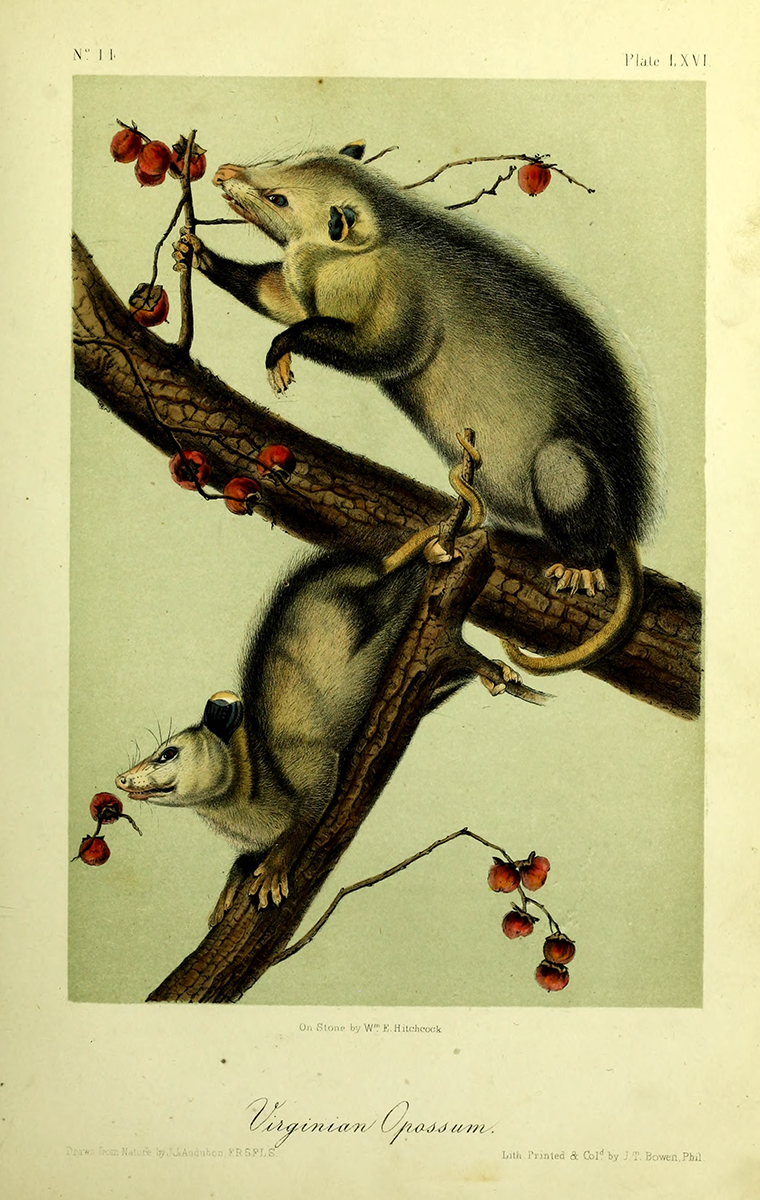
Hunting methods, such as capturing opossums live to fatten at home and clean out their digestive tracts may have helped to improve the taste of this wild game. Yet, associating opossums with native persimmon fruits enabled a popular imaginary that helped to reduce prejudices against prominent whites who occasionally consumed this lowly scavenger. The American persimmon tree (Diospyros virginiana)—an early invading species in disturbed areas and along forest-pasture boundaries—was common throughout the opossum's range. While Native American stories connected opossums with persimmon fruits, the association was particularly strong in antebellum African American songs and folklore, as well as white settler accounts of opossum hunts.19For examples of opossums eating persimmons, see James Mooney, "The Terrapin's Escape from the Wolves," Myths of the Cherokee (Washington, DC: Government Printing Office, 1902), 278–279, https://archive.org/details/cu31924104080076/page/n7/mode/2up. See also Joel Chandler Harris, "Why Mr. Possum Loves Peace," The Complete Tales of Uncle Remus (Boston: Houghton Mifflin Company, 1955), 9. Audubon's illustration of the opossum conveys an ecological association between the plant and animal. Ripe persimmons may have enhanced the flavor of the meat, yet the fruit was not essential to supporting this omnivorous species, which indiscriminately ate plants, insects and animals and opportunistically consumed carrion and trash.
Antebellum Opossum Hunting and Black Culture
Although opossums were a choice component of the antebellum diets of white small landholders and tenants, primary accounts offer more insight into the connections between this food and enslaved people of African descent.20Subsistence farmers engaged extensively in hunting opossums for food, but early to mid-nineteenth-century written sources emphasize on African American consumption. Along with other small game, opossums were an important source of protein and fat in diets that enslavers kept lean and scarce. Ex-slave Peter Randolph explained that in Virginia many slaves made traps with cut timber, often setting fifteen to twenty of them in the swamps to capture opossums, raccoons, hares, and squirrels.21Peter Randolph, Sketches of Slave Life: Illustrations of the "Peculiar Institution" (Boston, MA: Peter Randolph, 1855), 19–20, https://docsouth.unc.edu/neh/randol55/randol55.html. Some slaves, however, used trained dogs to tree opossums at night in wooded areas adjoining plantations. Because hunting and setting traps at night did not directly interfere with daytime farm work, some enslavers permitted those they held in bondage to capture small game for supplementary nutrition. Slaves not allowed to go hunting at night had to be more covert. Ex-slave Solomon Northup recalled that in Louisiana, "There are planters whose slaves, for months at a time, have no other meat than such as is obtained in this manner."22Solomon Northup, Twelve Years a Slave: Narrative of Solomon Northup, a Citizen of New-York, Kidnapped in Washington City in 1841, and Rescued in 1853, from a Cotton Plantation Near the Red River, in Louisiana (Buffalo, NY: Derby, Orton, and Mulligan, 1853), 201, https://docsouth.unc.edu/fpn/northup/northup.html. In interviews for the Works Progress Administration's Federal Writers' Project, the numerous ex-slaves who recollected hunting or eating opossums attest to Northrup's claim that the marsupials were an important meat and that hunger drove consumption of this wild game, often described as greasy and fatty.23See Federal Writers' Project of the Works Progress Administration, A Folk History of Slavery in the United States from Interviews with Former Slaves (Washington, DC, 1941; Project Gutenberg, 2004), https://www.gutenberg.org/ebooks/13847. A few of the interview references to opossums from the WPA slave narratives are referenced in Stephen Winick's blog "A Possum Crisp and Brown: The Opossum and American Foodways" (Washington DC: Library of Congress, August 15, 2019), https://blogs.loc.gov/folklife/2019/08/a-possum-crisp-and-brown-the-opossum-and-american-foodways/.
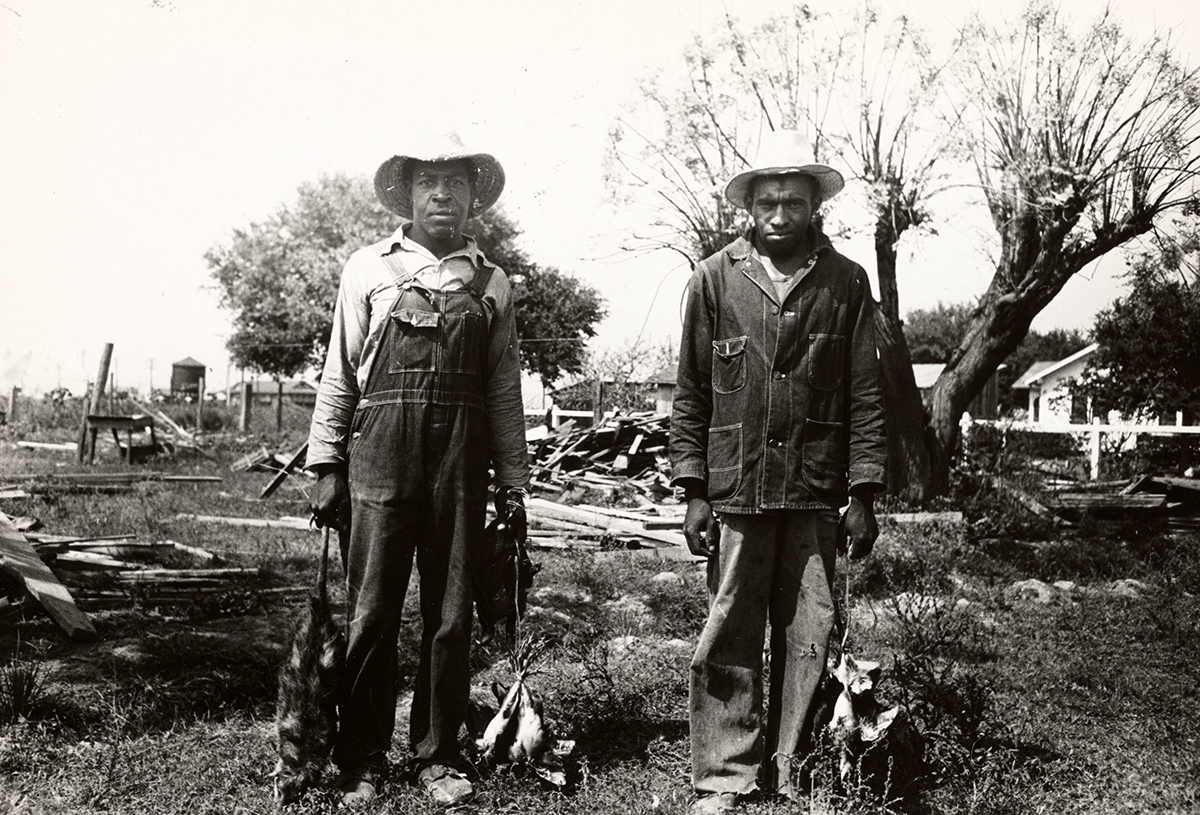
Opossums were more than a survival food for enslaved people. While John Patterson Green, born to emancipated parents in North Carolina, writes that African American opossum consumption "arises not so much from any constitutional partiality on their part, or difference in their tastes [. . .], as from the absence of fresh meats of all kinds," other slaves and freed people expressed the pleasures they experienced from consuming the animal.24John Patterson Green, Recollections of the Inhabitants, Localities, Superstitions and Ku Klux Outrages of the Carolinas (Cleveland, OH: 1880), 181, https://archive.org/details/recollectionsofigree/page/n5/mode/2up]. "The flesh of the coon is palatable," Northrup notes, "but verily there is nothing in all butcherdom so delicious as a roasted 'possum."25Northup, Twelve Years a Slave, 201. The marsupial also enabled enslaved people to access more desirable food. Remembering having "been kept for a long time on corn and potatoes," ex-slave Andrew Jackson of Kentucky revealed that opossums were one of several "expedients to get luxuries."26Andrew Jackson, Narrative and Writings of Andrew Jackson, of Kentucky; Narrated by Himself (Syracuse, NY: Daily and Weekly Star Office, 1847), 27, https://archive.org/details/narrativewriting00jack/page/n27/mode/2up?view=theater&q=pig. Jackson described a scheme of "eating pig for opossum" that entailed obtaining permission to go opossum hunting, skinning several opossums and burying their bodies, killing two pigs and burying their skin and entrails, and then boiling the pork in kettles. The slaves retained the opossum skins as "proof" of the meat's source. Annie Young, from Tennessee, told of a slave caught with a young pig: "Master it may be a shoat now, but it sho was a possum while ago when I put 'im in dis sack."27Interview with Annie Young in The Federal Writers' Project of the Works Progress Administration, Slave Narratives, Oklahoma: A Folk History of Slavery in the United States from Interviews with Former Slaves, vol. XIII, Oklahoma Narratives (Washington, DC: 1941; Project Gutenberg, 2007): 359, https://www.gutenberg.org/files/20785/20785-h/20785-h.htm. Young's trickster humor suggests a realm of everyday practices that lay beyond the master's grasp.28 Consider Jackson's tale alongside Louis Jordan's popular post-World War II hit song "Ain't Nobody Here But Us Chickens" as discussed in George Lipsitz's Rainbow at Midnight (Urbana: University of Illinois Press, 1994), 303–310.
Because opossums were important in survivance, they figured prominently into Black culture. Thomas Talley, an African American folklorist whose parents were former slaves, documented antebellum rhymes used for dancing and entertainment, such as the "Possum-La," "'Possum up the Gum Stump," "An Opossum Hunt," and "Shake the Persimmons Down."29Thomas Talley, Negro Folk Rhymes (New York: The MacMillan Company, 1922), 3, 23–24, 34, 233–234. References to some of these songs or rhymes can also be found in ex-slave narratives recorded through the Federal Writers' Project of the Works Progress Administration. Songs referenced plants, animals, and activities integral to the environments that enslaved people intimately experienced. The deep meanings that the opossum developed through antebellum folklore and foodways—as a connection to the past and an avenue to the future—would make it all the more significant when southern whites tried to claim an exclusivity of this food during Jim Crow.
Postbellum Opossum Hunting and White Supremacy
After the Civil War, hunting, selling, and consuming opossums remained significant among many African Americans. As formerly enslaved people sought to carve out autonomous livelihoods, opossum consumption represented ecologically rooted foraging skills, economic independence, and household sufficiency. Newspapers began to relay impressive—if not exaggerated—hunting accounts. An editor, for example, remarked on New Year's Day 1880 that a Black hunter in Anderson County, South Carolina had caught 127 opossums since the previous fall.30"South Carolina News," Yorkville (SC) Enquirer, Jan. 1, 1880, 2, https://chroniclingamerica.loc.gov/lccn/sn84026925/1880-01-01/ed-1/seq-2/.Although generally considered a male activity, there were exceptions, such as a Black woman's catching fifteen opossums in Muscogee County, Georgia, in 1877.31"Foraging on our Exchanges," The LaGrange (GA) Reporter, Oct. 11, 1877, 2, https://gahistoricnewspapers.galileo.usg.edu/lccn/sn82015287/1877-10-11/ed-1/seq-2/#date1=10%2F11%2F1877&city=LaGrange&date2=10%2F11%2F1877&words=&searchType=advanced¬text=&index=2&sequence=0&proxdistance=5&rows=12&ortext=&proxtext=&andtext=&page=1.
Enslavers may have tolerated—and on occasion, celebrated—antebellum opossum hunting. Yet, when these same men lost control over their labor force and struggled to maintain their livelihoods after the war, Black opossum hunts signaled an infringement on white supremacy. Whites sought to assert control over African American hunting and foraging practices. Attending opossum hunts with their former slaves provided one way for whites to flex their power. Opossum bounties were another. Depicting autonomous Black hunts as pathological and wasteful, one Atlantan wrote: "But we are wandering among the black jocks," adding that an opossum bounty will "protect negro labor and revive their languid interest in the best government."32"Possums and Protection," Atlanta (GA) Constitution, Sept. 20, 1882, 4. Because opossums destroyed crops and raided chicken houses, bounties gave landowners a way to protect their capital from pests and predators.33There may have been other motives behind paying African Americans to hunt opossums. By paying freed people to hunt opossums, former slave owners attempted to assert their authority over Black hunting, which they framed as an idle diversion from necessary farm work.34Scott Giltner, Hunting and Fishing in the New South: Black Labor and White Leisure after the Civil War (Baltimore, MD: Johns Hopkins University Press, 2008), 28.
For white men who had grown up on plantations, postbellum Black opossum hunting could evoke conflicting feelings. Sometimes the activity signaled a threat to white supremacy, while other times it featured in an imagined "South." While the Ramapough Mountain Indians of New Jersey and New York engaged in hunting opossums, a New York Times correspondent asserted in 1886 that they were "not such picturesque35"Picturesque" appears frequently in late-nineteenth century writing describing opossum hunting throughout the southern states. The term was rooted in eighteenth-century British landscape design, but travel writers, such as William Bartram, later used it to describe an attractive or pleasing scene. See "Picturesque," (Washington, DC: National Gallery of Art, last edited 2021), https://heald.nga.gov/mediawiki/index.php/Picturesque. hunters as their brethren of the south" because, instead of using hunting dogs, they relied on guns and deadfall traps (even though slaves and freed people in the southern states also used guns and traps).36"Hunting the Possum," Buffalo (NY) Commercial, Sep. 4, 1886, 1; "Hunting the Opossum. A Place Where He Is Found North of Mason and Dixon's Line," Wood County Reporter (Grand Rapids, WI), Sep. 23, 1886, 6, https://chroniclingamerica.loc.gov/lccn/sn85033078/1886-09-23/ed-1/seq-6/. Stereotypical depictions of place and race formed around the native marsupial. "No one ever located the opossum hunt anywhere but in the gum swamps or among the persimmon trees of the south," the correspondent wrote in popular racist imagery, "where they are ever associated with the spectacle of the bulging-eyed and expectant darky carrying aloft his flaming pine-knot torch, while his lean and lanky dog leads him to the tree where the much prized possum has sought refuge." A racist "plantation song" suggests a chaotic scene:
Afore de n****r could come down de tree would mostly fall—
Then smack among the dogs would light de possum n*g and all,
De dogs would pitch upon 'em both and most tar dem in half,
Old Marster he would stand aside and kill hisself wid laugh.37"Possum Hunting—A Song," Fairfield Herald (Winnsboro, SC), Mar. 12, 1873, 1, https://chroniclingamerica.loc.gov/lccn/sn84026923/1873-03-12/ed-1/seq-1/.
Whites reinforced their belief in Black inferiority by turning this strenuous and risky nighttime activity of Black survival and economic autonomy into a "picturesque" scene and humorous "spectacle." Such depictions omitted the horrific violence of slavery and Jim Crow, as well as the ecological destruction wrought by cotton, tobacco, and other monocrops that increasingly shaped foodways and contributed to the overhunting of wild game.
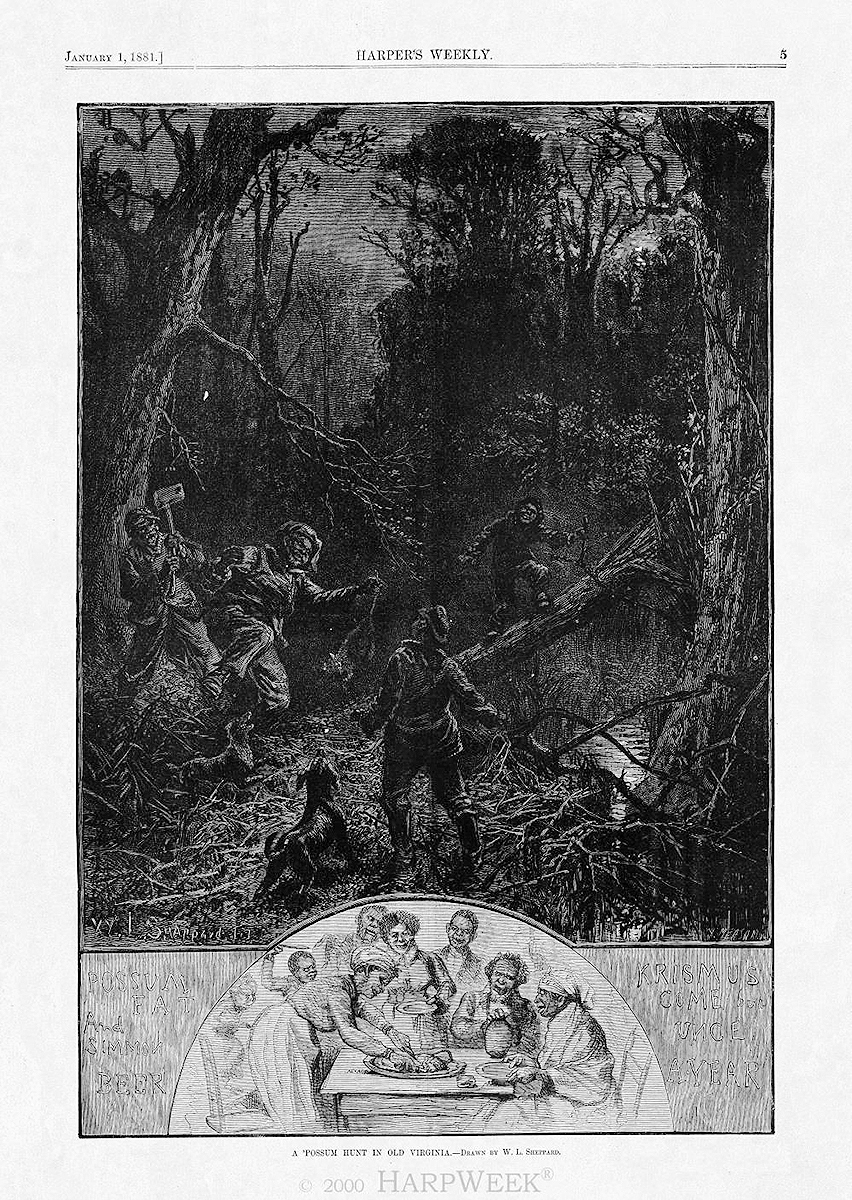
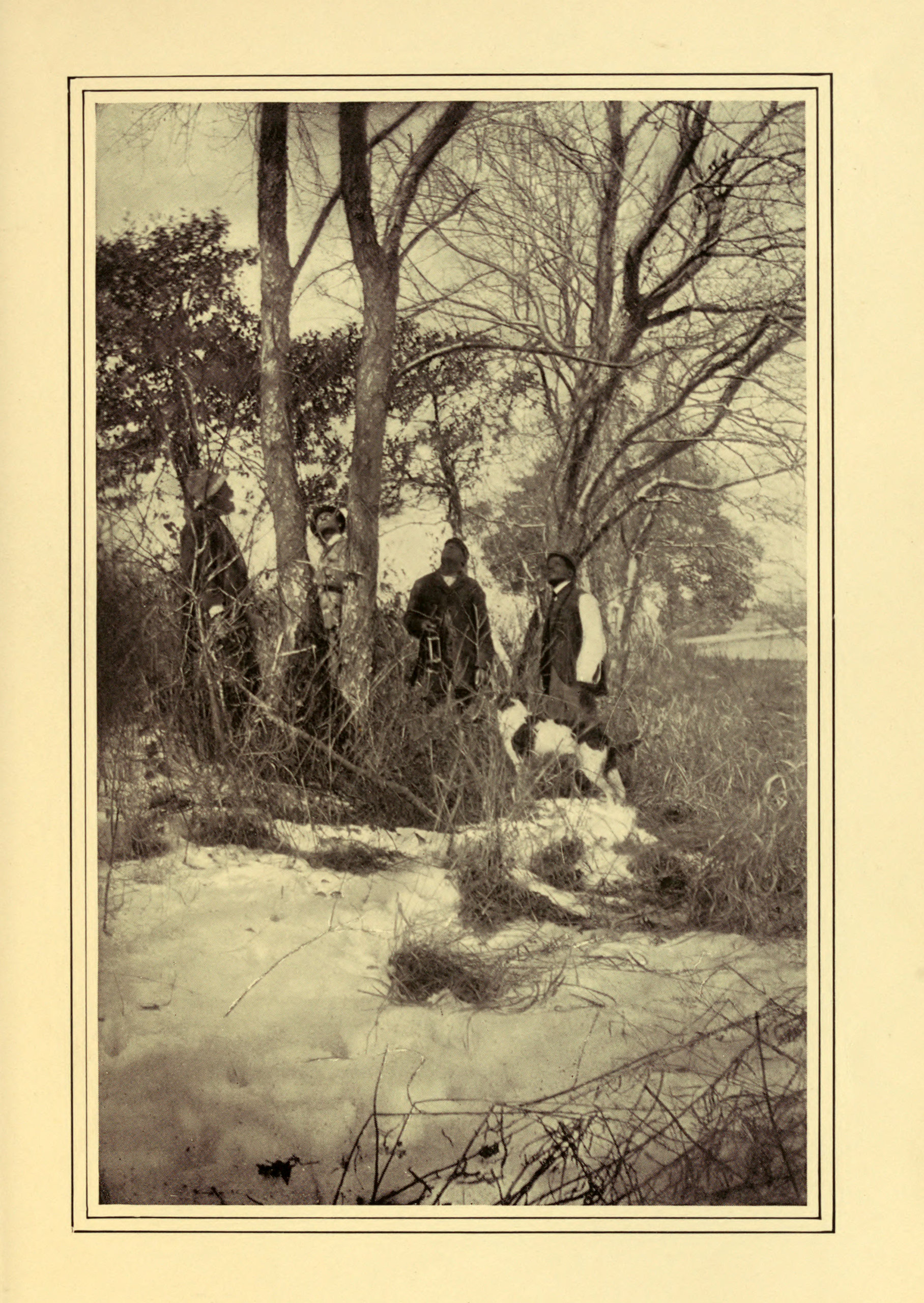
For some white men who grew up on plantations or farms in the southern states, opossum hunting evoked Confederate nostalgia. Drawing on tropes portraying Blacks as ineligible for freedom or citizenship, an Atlanta Constitution editor wrote: "Memory yet dwells with peculiar emotions of pleasure upon those glorious old hunts we used to take in by-gone days before Sambo had been transformed into a fifteenth amendment."39"The Opossum," The Atlanta (GA) Constitution, Dec. 3, 1874, 1. A columnist from Natchitoches, Louisiana, suggested: "It reminds one of the lost days ante bellum to speak of such a delicious treat as cold possum and tater on a winter's night."40"Possum and Tater," The People's Vindicator (Natchitoches, LA), Sept. 15, 1877, 3, https://chroniclingamerica.loc.gov/lccn/sn85038558/1877-09-15/ed-1/seq-3/. As it fed nostalgic memory-making, opossum hunting was more than a way of reenacting a past more often imagined than real; it represented a future where whites could retain aspects of their southern sectional identity. Another Atlanta Constitution writer offered his grandiloquent rumination:
There are some customs that even the reconstruction laws failed to disestablish and some of them are intimately connected with the opossum. The opossum still survives the war and all the sectional strife and we have sometimes hoped that the day would come when [. . .] it might become the basis, if not the emblem, of North American fraternity.41"The Premature 'Possum," The Atlanta (GA) Constitution, Aug. 6, 1882, 4.
A white brotherhood, binding the war-torn sections through the hunting and eating of opossums appealed to an apartheid appetite. As Kyla Wazana Tompkins observes, "acts of eating cultivate political subjects by fusing the social with the biological, by imaginatively shaping the matter we experience as body and self."42Kyla Wazana Tompkins, Racial Indigestion: Eating Bodies in the 19th Century (New York: New York University Press, 2012), 1. The opossum supper—a social occasion where white men came together to consume Black labor—served as a signifier of racist solidarity in the decades after the Civil War.
Cultural Appropriation, Neo-Confederates, and Urban Game Markets
Following Reconstruction, Blacks continued to hunt and eat opossums as they had for generations, as did many rural white farmers. In addition, the ascendant white political leadership ("Redeemers") who were attempting to reclaim racial command over Black labor and southern land, increasingly and publicly engaged in these activities. A plantation imaginary filled with adventuresome opossum hunts contributed to the appeal and surge of opossum suppers among white men, who had grown up on plantations or farms but were now confronting the reality of Black people transitioning from human property to citizens. They scrambled to find and re-hash tropes to narrate white supremacy and reassert racial power. Beyond overseeing Black opossum hunts, these men claimed the opossum as a rightful inheritance while depicting Black consumption as deviant. They drew on longstanding racist tropes that cast Blacks as possessing an excessive animality and fondness for opossums, while situating their own opossum consumption as appropriate, measured, and tastefully respectable. Concurrently with terroristic attempts to overthrow Black freedom struggles during Reconstruction, white men within the Democratic party cultivated the opossum supper as a theatre for leadership rites and as a site for framing anti-democratic contentions and racist tactics as legitimate, authentic, and appropriate.
In the 1870s, opossum supper announcements became common in newspapers of southeastern states and occasionally in some northeastern and midwestern ones where freed people had begun to migrate. Early on, these events involved people of different socioeconomic classes and racial or ethnic backgrounds and occurred for a variety of reasons—from political gatherings to church fundraisers and more intimate domestic occasions. With time, Democratic politicians turned the opossum supper into a social event expressive of white men's solidarity.
With the rebuilding and growth of towns into small cities after the Civil War, markets for selling opossums and other game grew. A shift in urban demographics also contributed to growing markets, with both Black and white consumers. In Atlanta, where the proportion of the city's Black population had more than doubled between 1860 and 1870, a notable opossum trade developed.43Tera Hunter, To 'Joy My Freedom: Southern Black Women's Lives and Labors after the Civil War (Cambridge, MA: Harvard University Press, 1997), 21. Atlanta's opossum market stood out with high demands among restaurant keepers, grocers, and commissioners. The grocery firm Messrs. Hambright & Co., for example, opened a wholesale trade, receiving "an invoice of live opossums nearly every day, sometimes as many as sixty at a time" to distribute to retailers in 1874.44"The Opossum," 1. African American Howard Horton drove daily through the city's streets in a wagon with live and dressed animals from the country.45"The Opossum," 1. Known as the city's "great possum cleaner," Horton, a Republican politician, estimated in 1882 that he had dressed approximately two hundred opossums a season, totaling several thousand in his lifetime.46"Howard Horton on Possums," The Atlanta (GA) Constitution, Oct. 24, 1885, 7. Among his clients were white doctors and businessmen, along with politicians, such as Democratic mayor George Hillyer and governor Alfred Colquitt, who vehemently opposed Republican Reconstruction policies.
The large influx of rural whites and freed people into southern cities fueled the growth of urban game markets throughout the late nineteenth and early twentieth centuries. In 1888, the marsupial had "arisen to a very important place in the commercial world" with one Atlanta commissioner handling three hundred of them a month and reportedly earning about $500.47"'Possum and 'Tater. Georgia Gourmets Now Reveling in the Chief Delight of the Year," reprinted from the Atlanta (GA) Journal in the Sun (New York, NY), Oct. 28, 1888, 5, https://chroniclingamerica.loc.gov/lccn/sn83030272/1888-10-28/ed-1/seq-5/. This "country animal has been a part of the south as long as there has been any south," the author asserted. The next year wholesale grocer J.C. McMillan & Co., located on Marietta Street in Atlanta, had begun keeping 160 opossums in a room, where they were "fed on slops just like a pig" for two weeks before being butchered for the table.48"A Horde of 'Possums. The Animals are Kept in a Room on Marietta Street," The Morning News (Savannah, GA), Dec. 11, 1888, 6, https://gahistoricnewspapers.galileo.usg.edu/lccn/sn86063034/1888-12-11/ed-1/seq-6/. While purifying the digestive tracts of these omnivorous animals helped make their meat more suitable for city consumers, so did the removal of grease and fat through distinct roasting techniques.49Richard Malcolm Johnston's government report indicates some of these class differences. In it, he wrote, "Southerners regard it of all meats the least indigestible, and but for its superabundant fat it would appear more frequently on tables of the whites. In some houses this superfluity was disposed of by placing a layer or more of oak or hickory sticks to the height of 3 or 4 inches at the bottom of the oven, and upon the latticework thus made laying the opossum. By such mode much of the oil was deposited on the bottom. The negro, when cooking for himself, never resorts to these measures, but takes his favorite as he is, indeed preferring him with all his imperfections on his head." Richard Malcolm Johnston, "Opossum Hunting Before the War: From the reports of the Bureau of Education," reprinted in Game Laws in Brief and Woodcraft Magazine 1, no. 1 (New York: Forest and Stream Publishing Company, April 1899), 111, https://babel.hathitrust.org/cgi/pt?id=nyp.33433082123633&view=1up&seq=127&skin=2021.
Enterprising farmers found commercial potential in raising opossums. Their efforts joined other uncommon industries labeled as "freak farms."50For a description of different types of "freak farms," see, "Freak Farms a Big Profit to Their Owners," Evening Star (Washington, DC), Aug. 27, 1911, 3, https://chroniclingamerica.loc.gov/lccn/sn83045462/1911-08-27/ed-1/seq-48/; see also Liberty Hyde Bailey, "The Collapse of Freak Farming," Country Life in America no. 4 (May 1903): 14–16, https://babel.hathitrust.org/cgi/pt?id=mdp.39015028160110&view=1up&seq=26&skin=2021. Thomas Chancey started one of the first opossum "ranches" near Hawkinsville, Georgia, in 1884.51"Opossum Farm Down South," Carroll Free Press (Carrolton, GA), June 20, 1884, 4, https://gahistoricnewspapers.galileo.usg.edu/lccn/sn89053126/1884-06-20/ed-1/seq-4/. Soon after, another began in Spartanburg, South Carolina.52The Anderson (SC) Intelligencer, May 14, 1885, 2, https://chroniclingamerica.loc.gov/lccn/sn84026965/1885-05-14/ed-1/seq-2/. Arthur Pritchard's opossum farm in Elizabeth City, North Carolina, attracted visitors in 1889.53"A Possum Farm," The Democrat (Scotland Neck, NC), Dec. 5, 1889, 1, https://newspapers.digitalnc.org/lccn/sn92073907/1889-12-05/ed-1/seq-1/. With opossums growing in demand and commanding higher prices, commercial enterprises spread to other parts of the country, including Colonel Isaac Davis's opossum farm in Ohio, in 1889;54"The Opossum Farm," Democratic Northwest (Napoleon, OH), Dec. 19, 1889, 4, https://chroniclingamerica.loc.gov/lccn/sn84028296/1889-12-19/ed-1/seq-4/. John Rand's ranch in Louisiana, in 1892;55"State News," St. Landry Clarion (Opelousas, LA), May 7, 1892, 1, https://chroniclingamerica.loc.gov/lccn/sn88064250/1892-05-07/ed-1/seq-1/. an English farmer, H.I. Twigg's establishment in Kentucky, in 1896;56"Two Queer Farms," Hopkinsville Kentuckian, June 19, 1896, 3, https://chroniclingamerica.loc.gov/lccn/sn86069395/1896-06-19/ed-1/seq-3/. an unidentified Texas man who had 200 acres of enclosed persimmon trees and muscadine vines in 1899;57"About Texas Crops," Daily Ardmoreite (Ardmore, OK), June 14, 1899, 1, https://chroniclingamerica.loc.gov/lccn/sn85042303/1899-06-14/ed-1/seq-1/. James Hart's opossum breeding project in Indiana, in 1900;58"From Saturday's Daily," Marshall County Independent (Plymouth, IN), Mar. 23, 1900, 5, https://chroniclingamerica.loc.gov/lccn/sn87056251/1900-03-23/ed-1/seq-5/. and governor John Spark's Alamo cattle ranch in Nevada, which received a shipment of opossums from Florida, in 1903.59"Sparks' Possum Ranch," Morning Appeal (Carson City, NV), Nov. 25, 1903, 2, https://chroniclingamerica.loc.gov/lccn/sn86076999/1903-11-25/ed-1/seq-2/.
While opossum farms existed in several states, the most extensive venture was William Throckmorton's ten-acre persimmon grove in Griffin, Georgia, where "over 700 possums were together so thick that the ground could not be seen between them."60E.W.B., "A 'Possum Farm," The Atlanta (GA) Constitution, June 23, 1889, 10. Of the five hundred opossums Throckmorton shipped in late 1889, some went dressed to cities throughout the state, while most went alive by rail to Washington, DC. Politicians consumed opossums at upscale establishments such as L.B. Folsom's restaurant61Known as the "Reading Room" for keeping newspapers, periodicals, and magazines for patrons, Folsom's became "the meeting place of men famous in Georgia affairs." Notable patrons included politician and former Confederate general Robert Toombs; former Atlanta mayor Captain J.W. English; and Atlanta Constitution editors Henry Grady and Evan Howell. "Folsom's Changes Hands," The Atlanta (GA) Constitution, Oct. 1, 1911, D7. in Atlanta, which reportedly was butchering a hundred of the animals monthly.62"'Possum and 'Tater. Georgia Gourmets Now Reveling in the Chief Delight of the Year," https://chroniclingamerica.loc.gov/lccn/sn83030272/1888-10-28/ed-1/seq-5/. Shipments by enterprising individuals such as Throckmorton fulfilled requests by southern congressmen. Georgia Democratic congressmen John Stewart of Griffin and George Barnes of Augusta were "perhaps the most inveterate 'possum eaters in Congress," according to the Atlanta Constitution.63This story gained significant attention. E.W.B., "A 'Possum Farm," The Atlanta (GA) Constitution, June 23, 1889, 10. The congressmen's consumption of opossum marked a shift from the antebellum era when prominent whites would have seldom consumed this survival food.
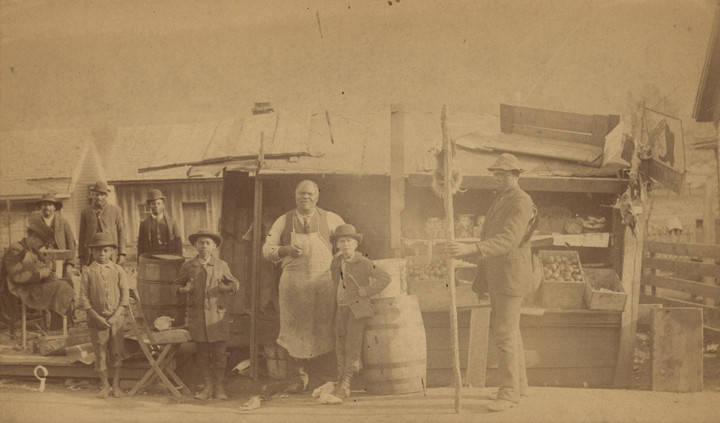
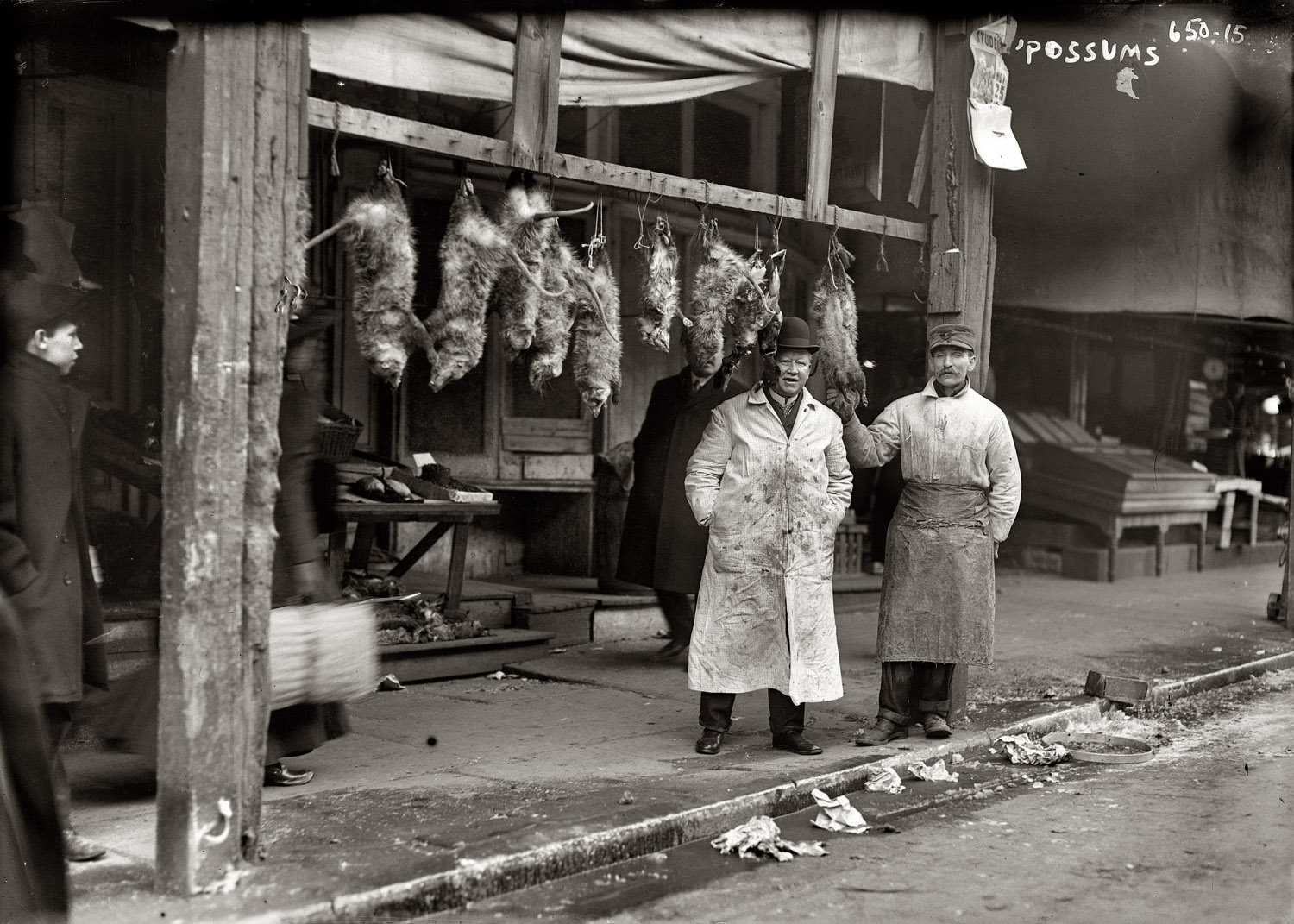
Opossum Stories, Politics, and Populism
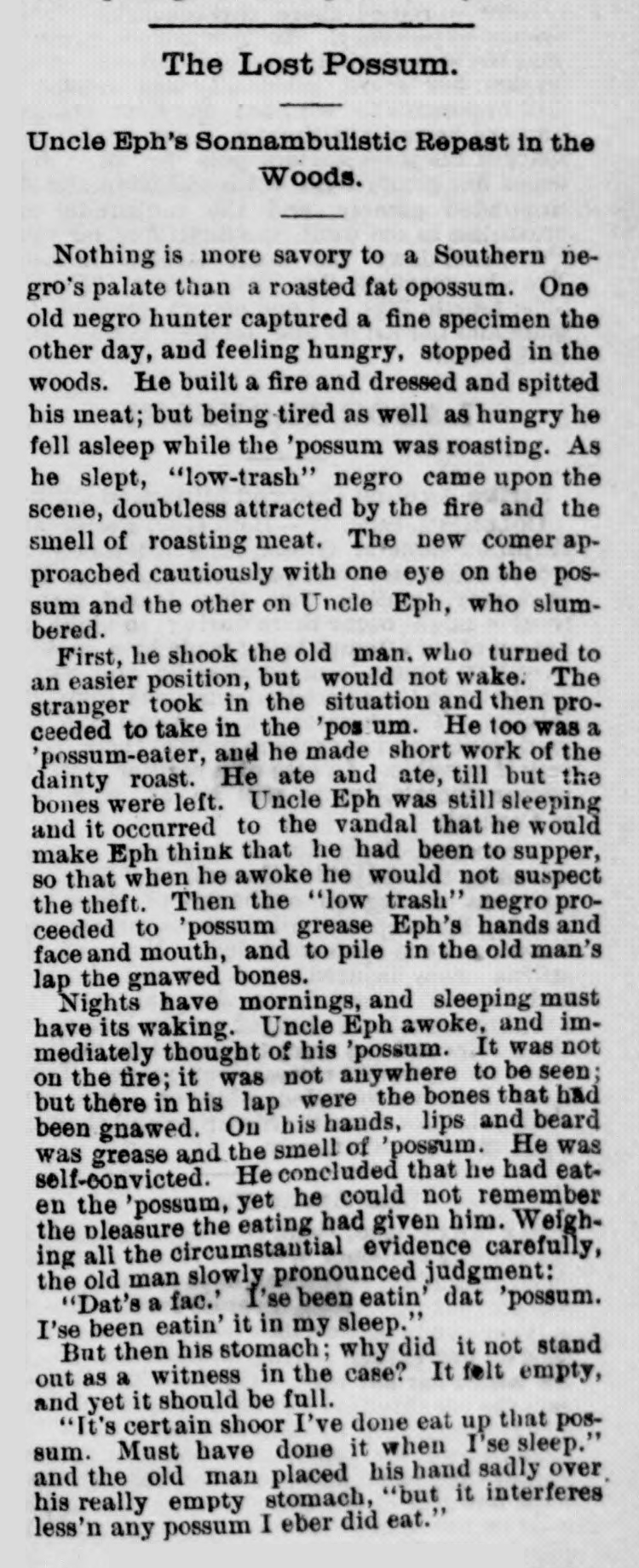
As they sought to legitimize public opossum consumption for themselves, whites engaged in an ongoing dance between accounts of their own tasteful meals of opossum meat and narratives portraying opossum eating among Blacks as a sign of racial and cultural inferiority. Racist stories about opossums and other foods that represented African American social, cultural, and economic autonomy proliferated in the wake of Democratic organizing. In 1868, an opossum trickster story surfaced in a speech at a rally in Walhalla, South Carolina, for Democratic presidential and vice-presidential candidates Horatio Seymour and Francis Blair, Jr.64"Thunder in the Mountains," Charleston (SC) Daily News, Sept. 22, 1868, 1, https://chroniclingamerica.loc.gov/lccn/sn84026994/1868-09-22/ed-1/seq-1/. Drawing on a popular tale that newspapers circulated for over four decades after the Civil War, Greenville journalist Robert McKay conveyed a fictional account of an old hunter who had caught an opossum and fell asleep while roasting it. Another character ate it and deceived the sleeping hunter by leaving the bones in his hands and greasing his mouth so that when he awoke, he believed he had eaten it despite still feeling empty. Rooted in the prewar era, this trickster story was one of the few that depicted a slave stealing from another.65Lawrence Levine, Black Culture and Black Consciousness: Afro-American Folk Thought from Slavery to Freedom (New York: Oxford University Press, 2007), 131. The account sent a message that Blacks could not be trusted, while also asserting that Black people were too unintelligent to know when they had been duped. For McKay, the story showed that freed Blacks "could be made to believe anything. If they would not listen to good advice," he insisted, "they must go on until they found everything eaten up, and then they would be devilish hungry still."66"Thunder in the Mountains," https://chroniclingamerica.loc.gov/lccn/sn84026994/1868-09-22/ed-1/seq-1/. The story depicted Blacks as unintelligent and gullible, and incapable of controlling their insatiable appetites without white authority.
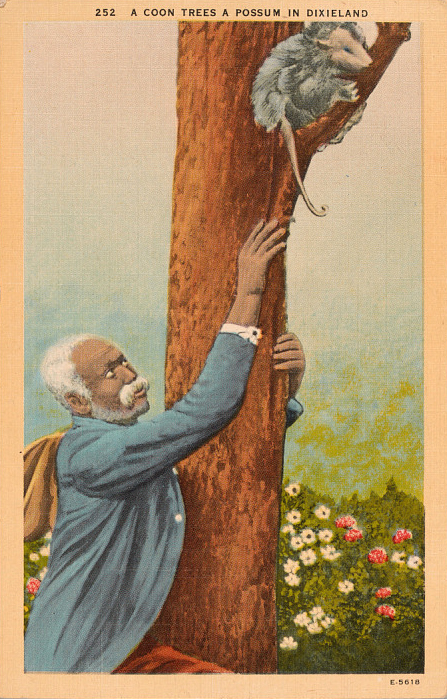
Decades later, white Democrats deployed opossum politics by portraying Blacks as chiefly motivated by appetites. In 1890, a Washington Post writer reiterated McKay's earlier claim that Black opossum consumption revealed animal instincts and inherent political naiveté. However, while McKay had insisted that Blacks were gullible, the Post article added to the narrative by suggesting that the food could be used to garner Black votes. Alexander Dockery, a Democratic member of the US House, had taken "two of his trusted lieutenants some days before the last election and made a trip through the 'Black Belt' [cotton-growing area with large populations of ex-slaves], giving out mysterious invitations to the colored voters to meet" for a supper in Missouri. While the 150 Blacks allegedly in attendance dined on opossums and raccoons, Dockery recited a political speech.67"Dockery's Coon Supper," Washington (DC) Post, Nov. 24, 1890, 2. The takeaway of the story was that, by using game stereotypically associated with ex-slaves, unsavory political actors could easily attract Black Republican voters and deceive them with political promises.68"Thunder in the Mountains," https://chroniclingamerica.loc.gov/lccn/sn84026994/1868-09-22/ed-1/seq-1/. Similar stories proliferated, leading a Washington Evening Star writer to later reminisce that opossum suppers were "great vote-getters in the south."69"'Possum for President in Southern Style," Evening Star (Washington, DC), Dec. 22, 1907, 3, https://chroniclingamerica.loc.gov/lccn/sn83045462/1907-12-22/ed-1/seq-51/. Notably, Dockery's story in 1890 appeared shortly before Democrats began to disenfranchise Blacks by law.
The timing coincides with the rise of the Populist Party, which threatened Democratic Redeemers as it sought, in its beginnings, to unite Blacks and poor whites. Populism was concentrated in the agrarian southern, southwestern, and midwestern states. Its leaders, as one historian has written, "advocated radical changes in the monetary system, regulation of the railroads, and land control as the means by which economic fairness could be assured for all oppressed people."70Sarah A. Soule, "Populism and Black Lynching in Georgia, 1890–1900," Social Forces 71, no. 2 (1992): 395–421. In 1890, Thomas E. Watson of Thomson, Georgia, campaigned on the Farmers' Alliance platform and won a seat in the US House of Representatives. Soon after, he emerged as the state's leading Populist politician and his party threatened Democrats with the possibility of dividing the white vote.
To maintain the existing class and political structure, white Democrats turned to tactics of disenfranchisement and terror against Blacks and poor whites. "The Democrats resorted to murder and beatings to drive blacks away from the Populists," explains historian Charles Postel, adding that Populists also "used terror and intimidation to prevent blacks from voting for Democrats."71Charles Postel, The Populist Vision (New York: Oxford University Press, 2007), 196. Historian C. Vann Woodward points out the high degree of election fraud, noting that there was no way to prevent "wholesale repeating, bribery, ballot-box stuffing, voting of minors, and intimidation" at the polls.72C. Vann Woodward, Tom Watson: Agrarian Rebel (New York: Oxford University Press, 1963), 208. Moreover, Black plantation hands and laborers were hauled by wagon loads and forced to vote the Democratic ticket, some doing so multiple times. Watson lost his 1892 bid for reelection to Congress to Democrat James C. C. Black of Augusta and was defeated again in 1894. Widespread violence and fraud shaped these election outcomes.
Georgia's Opossum Regime
While opossum suppers had grown in popularity throughout the southeastern US in the wake of Emancipation, it is not incidental that Georgia—the last of the former Confederate states to be readmitted into the Union (1870)—would become the spiritual center of these events within a few decades. In the 1890s, cotton-growing states had fallen into an economic depression as prices plummeted and farmers' debts increased.73Steven Hahn, The Roots of Southern Populism: Yeoman Farmers and the Transformation of the Georgia Upcountry, 1850–1890 (New York: Oxford University Press, 2006). Populism created political competition. Freedmen, who had begun seeking factory jobs in cities and attempting to purchase farms in the country, represented economic competition. White racism and lynching intensified.74 Jack Bloom, Class, Race and the Civil Rights Movements: The Changing Political Economy of Southern Racism (Bloomington: Indiana University Press, 1987). Georgia had the second highest number of lynchings from 1890–1900.75Susan Olzak, "The Political Context of Competition: Lynching and Urban Racial Violence, 1882–1914," Social Forces 69, no. 2 (1990): 395–421; George Milton, et al., Lynchings and What They Mean: General Findings of the Southern Commission on the Study of Lynching (Atlanta, GA: The Commission, 1932). Statewide Black voter turnout declined from 55% in 1876 to less than 10% after 1890.76J. Morgan Kousser, The Shaping of Southern Politics: Suffrage Restriction and the Establishment of the One Party South, 1880–1910 (New Haven, CT: Yale University Press, 1974). Lynchings and other forms of vigilante violence helped to ensure a Democratic takeover of government.
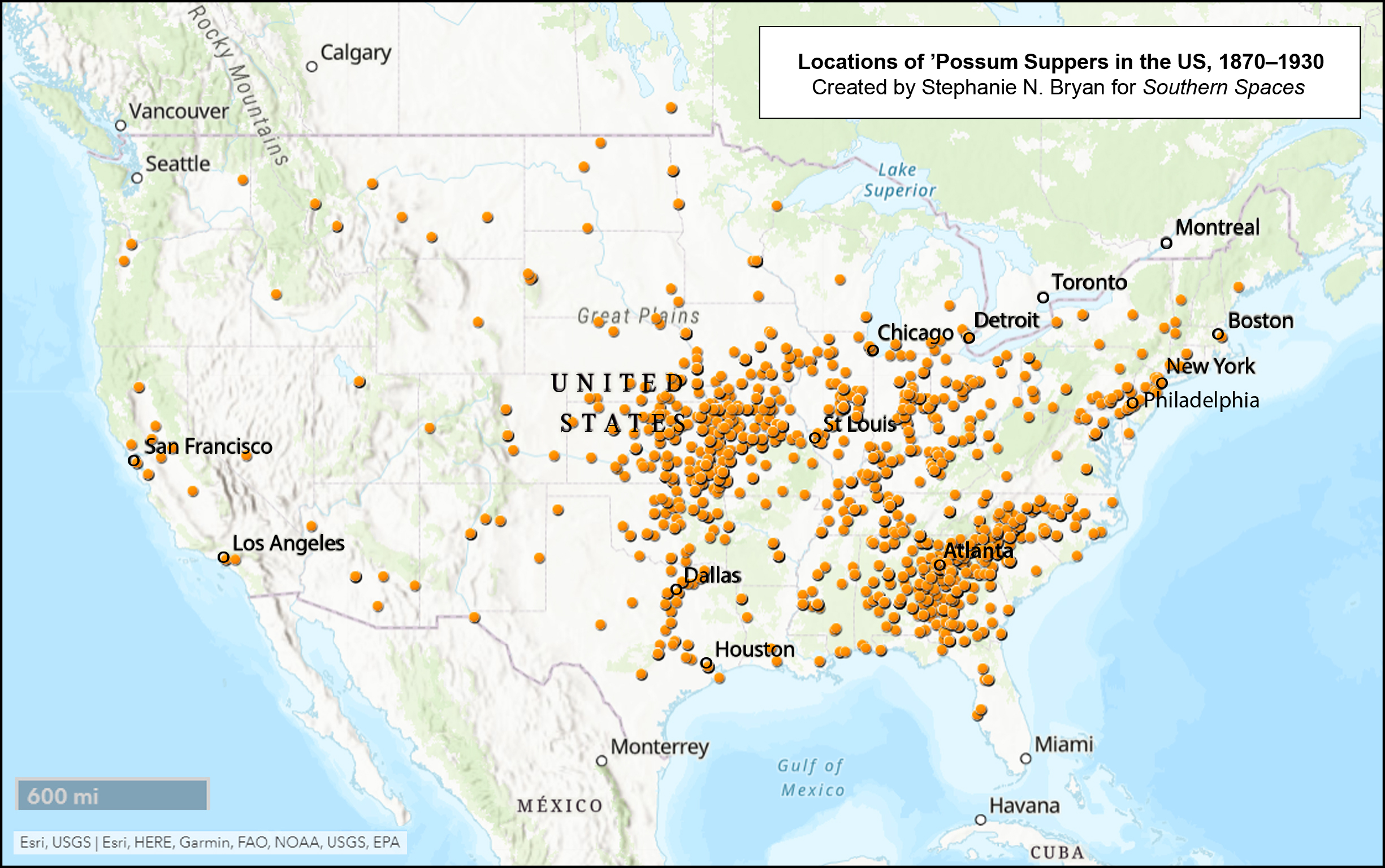
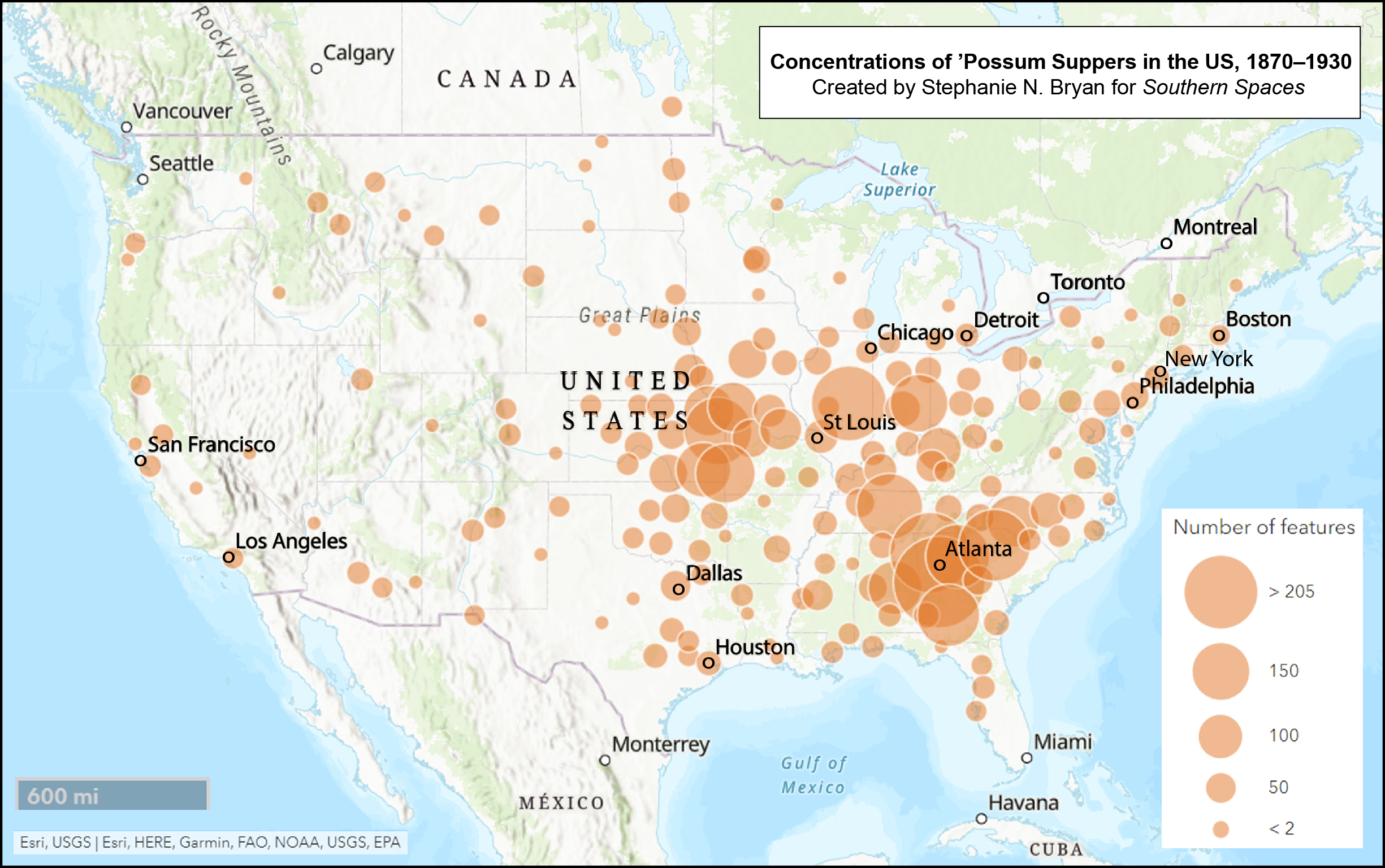
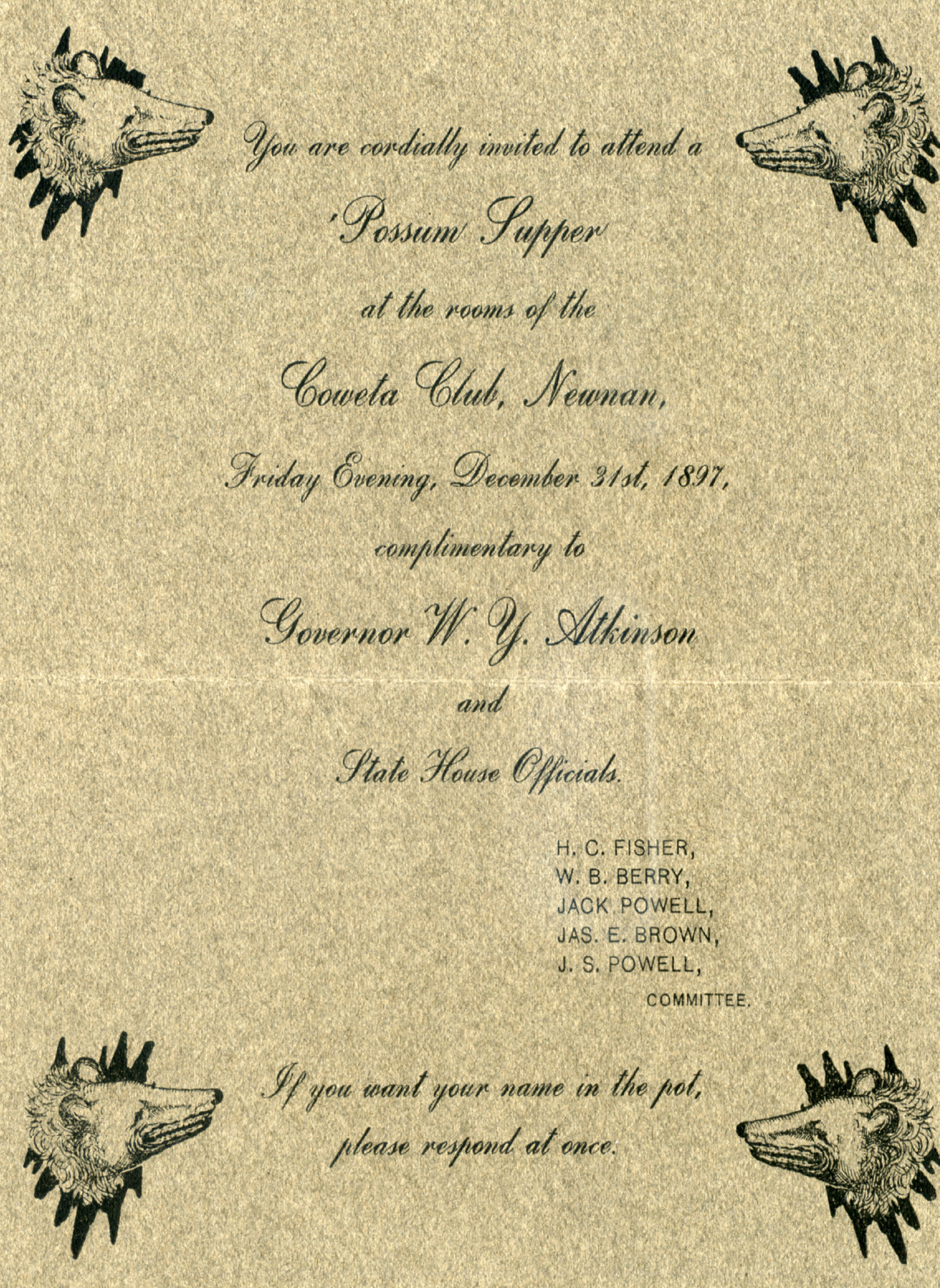
Opossum suppers became an important stage on which political actors could deploy new strategies and solidify networks of accomplices. Beginning in 1894, Colonel Harry Fisher—"railroad man, fertilizer magnate, friend of corporations"—commenced the political opossum suppers of Newnan, Georgia, to advance the Democratic ticket.77"Possum and Politicians: Many Invitations Have Been Sent Out to Newnan's Possum Supper," The Atlanta (GA) Constitution, Dec. 28, 1897, 5, https://chroniclingamerica.loc.gov/lccn/sn86063034/1897-12-28/ed-1/seq-2/. See also "Politicians to Eat 'Possum. The Supper at Newnan to Be a Unique Affair," The Morning News News (Savannah, GA), Dec. 28, 1897, 2, https://chroniclingamerica.loc.gov/lccn/sn86063034/1897-12-28/ed-1/seq-2/. Located about forty miles southwest of Atlanta where many in-state attendees traveled from, Newnan had escaped destruction during the Civil War. Its supper became an annual event, sending out over six hundred invitations "to men of prominence, both inside and outside" of the state. Politicians gathered in anticipation of the official Democratic convention and, while eating opossum, pre-determined the roster of officials for high-ranking positions.
It wasn't long before outside observers began to recognize that the political sway of the Newnan opossum suppers extended beyond southern states. On January 1, 1898, northern newspapers warned of sinister plans circulating "under the cover of savory vapors":
To these feasts are bidden men who have controlled the destinies of the State for years—shrewd politicians, who are anxious to strengthen their influence, statesmen, who gladly seize the opportunity to keep politically in touch with the elect of the State, and persons of a purely convivial nature, who are useful in lending an airy background to the political scheming which is bound to take place under the cover of savory vapors which ascend from the smoking 'possum.78"A 'Possum Supper," Baltimore (MD) Sun, Jan. 1, 1898, 1. For a similar version of this article, see "'Possum and 'Taters," The World (New York, NY), Jan. 1, 1898, 5.
Nearly a decade later, editor, politician, and defender of lynching John Temple Graves reminisced about Georgia's political "'possum regime," which had come to encompass the two-term governorships of Democrats William Y. Atkinson (1894–1898) and Joseph M. Terrell (1902–1907).79John Temple Graves, "The 'Possum Governors" of Georgia," reprinted from the New York American in The Herald and Advertiser (Newnan, GA), Jan. 15, 1909, 1, https://gahistoricnewspapers.galileo.usg.edu/lccn/sn89053456/1909-01-15/ed-1/seq-1/. Atkinson won by a narrow margin in 1894 against Populist candidate Judge James K. Hines and regained reelection in 1896 over another Populist candidate, Seaborn Wright.80James F. Cook, "William Yates Atkinson 1894–1898," The Governors of Georgia, 1754–2004, 3rd ed. (Macon, GA: Mercer University Press, 2005), 181–184. Benefiting from white terror, voter suppression, and fraud, Atkinson ended the threat Populists posed to Democrats in statewide elections.81The 1896 presidential election would further fracture the Populist party across the southern states. Some Populists who supported a fusion with Democrats nominated Tom Watson as the vice-presidential candidate alongside William Jennings Bryan for president. The Democratic National Convention also nominated Bryan, but with Democrat Arthur Sewall as his running mate, both of whom appeared on the Silver Party ticket. Conservative Democrats who disagreed with Bryan's stance on bimetallism and free silver abandoned the party to form the National Democratic Party and instead nominated Senator John Palmer along with his running-mate Simon Bolivar Buckner. With the country experiencing an ongoing economic depression under Democratic President Grover Cleveland, Republican presidential and vice-presidential nominees William McKinley and Garret Hobart, who stood for protectionism and the gold standard, defeated Bryan.
In his capacity of Speaker of the Georgia House of Representatives, Atkinson "had performed countless favors, helping many of his friends gain appointments as solicitors-general and judges of the circuit courts," explains historian Barton Shaw, adding that "Such men eagerly endorsed Atkinson's candidacy, and he also had support in Atlanta's traditional rivals, Augusta, Macon, and Columbus."82Barton C. Shaw, The Wool-Hat Boys: Georgia's Populist Party (Baton Rouge: Louisiana State University Press, 1984), 111. Through these favors, Atkinson "was able to depose the old Bourbon ring perfected by Henry Grady and the Triumvirate," while forging a new legislative ring.83Shaw, The Wool-Hat Boys, 126. His initial gubernatorial campaign against Confederate veteran General Clement Evans was a "coup d'état" that "allowed younger Democrats to take control of the party."84Shaw, The Wool-Hat Boys, 112.
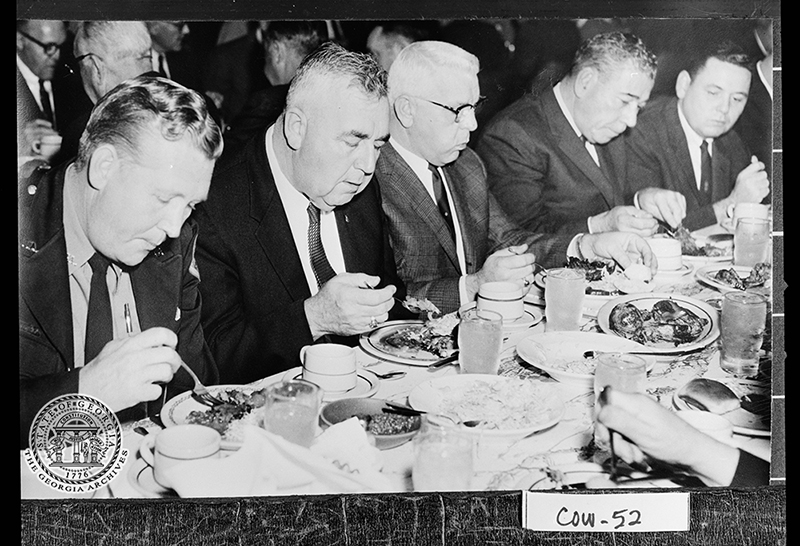
The complexity and behind-the-scenes maneuvering of numerous political factions during this period cast a cloud over why conservative Democrat Allen D. Candler (1898–1902) or Progressive Hoke Smith (1907–1909, 1911) were not considered part of the conspiracy, although it may relate to their efforts to restrict the power of the state railroad commission.85Cook, "Allen Daniel Candler 1898–1902," "Hoke Smith 1907–1909, 1911," Joseph Mackey Brown 1909–1911, 1912–1913," The Governors of Georgia, 185–188; 192–195. For more on Candler claiming to not be part of the "'possum regime" see "Candler on 'Possum Supper," Americus (GA) Times-Recorder, Jan. 14, 1898, 3, https://gahistoricnewspapers.galileo.usg.edu/lccn/sn89053207/1898-01-14/ed-1/seq-3/. Editor Graves offers some insight that Georgia's "'possum regime' was in large measure a railroad regime, and that under it corporations expect the fullness and the fatness which distinguished the adipose of the Georgia 'possum."86Graves, "The 'Possum Governors' of Georgia," https://gahistoricnewspapers.galileo.usg.edu/lccn/sn89053456/1909-01-15/ed-1/seq-1/. Accordingly, capital interests played an important role in the "booming" of certain politicians over others at events such as the Newnan opossum suppers. Barton Shaw explains the monetary benefits gained by those whom legislators appointed: "Solicitors were partly paid in fees, and citizens who could pay the highest price often found the state's charges against them dropped or at least reduced. Judges not only received handsome salaries, but were in excellent positions for advancement. The convict leaseholders always smiled upon those who helped keep up the supply of prisoners. With such support, many judges soon found themselves holding seats in Congress."87Shaw, The Wool-Hat Boys, 125.
The motives behind the Newnan opossum suppers were multifaceted, serving both the personal and collective interests of those in attendance. While they had a dominant Democratic component, occasional guests from other factions superficially presented images of reunion and reconciliation. Honorable George Peck of Chicago, a well-known railroad man who had served as a federal soldier, "referred to himself as the only yankee in the room" in a speech at the function on New Year's Eve 1897.88"'Possum Aftermath," The Atlanta (GA) Constitution, Jan. 2, 1898, 6. "A good deal of fun had been poked at him during the evening because of republicanism" and Confederate General Clement Evans, who attended the event, claimed to have made him "eat Georgia 'possum until he quit and surrendered and went over to the other side."89"Possum Aftermath;" "'Possum and Politics Wrestle for Supremacy Down at Newnan's Feast," The Atlanta (GA) Constitution, Jan. 1, 1898, 5. Although Atlanta Constitution columnist Bill Arp concluded after the event that "a politician will eat anything for office," eating opossum had developed a deeper meaning for prominent white men attending these events, signifying an economic and political alliance, as well as a racial one.90"'Possums and Politics," Watchman and Southron (Sumter, SC), Jan. 26, 1898, 2. "Bill Arp," was a pseudonym for politician Charles Henry Smith: https://evhsonline.org/bartow-history/people/charles-henry-smith-bill-arp-great-american-humorist-writer. Newspapers reported that the 1897 event included a diorama behind the toastmaster's chair comprised of a real persimmon tree, six live opossums, an actual baying opossum dog, and "old Uncle 'Cotton' See, an anxious-looking aged negro with white hair and a 'possum appetite in keeping with his surroundings" of white governors, secretaries of state, attorney generals, judges, and other high officials discussing politics over the feast.91"And Politics for Down at Newnan's Feast to the Governor," The Atlanta (GA) Constitution, Jan. 1, 1898, 5. This nostalgic scene provided a visual display of white power, delineating the rightful place of Blacks not as consumers of opossum, but as providers, cooks, and servers of it.
While Newnan's political opossum suppers were widely publicized in local and national newspapers, the public's attention soon shifted in 1899 to the horrific mob lynching of Sam Hose—a Black man who was bound, tortured, castrated, and set on fire in front of more than four thousand spectators.92For a detailed analysis of this event, see Edwin T. Arnold, What Virtue There Is in Fire: Cultural Memory and the Lynching of Sam Hose (Athens: University of Georgia Press, 2012). Chicago detective Louis P. Le Vin, whom activist Ida B. Wells-Barnett hired to investigate the lynching, concluded, "The real purpose of these savage demonstrations is to teach the Negro that in the South he has no rights that the law will enforce. Samuel Hose was burned to teach the Negroes that no matter what a white man does to them, they must not resist."93Ida B. Wells-Barnett, "Lynch Law in Georgia," (Chicago, IL: Chicago Colored Citizens, 1899), https://www.loc.gov/resource/lcrbmrp.t1612/?st=text&r=0.267,0.55,0.665,0.719,0. William Atkinson, who had moved to Coweta County to practice law following his second term as governor, spoke out to the mob from the city jail in an unsuccessful attempt to prevent Hose's lynching. 94For more on Atkinson's actions and possible motives, see Arnold, What Virtue There Is in Fire, 98–102. As governor, Atkinson had tried on numerous occasions to get the General Assembly to pass his anti-lynching bills. Because he vehemently opposed the lawlessness of mobs and proposed other solutions such as public executions, the anti-lynching stance of Atkinson and other Democrats cannot be equated with racial justice.95Arnold, What Virtue There Is in Fire, 99–100. The Sam Hose lynching led a writer from Thomasville, located near the state's southern border, to comment that Newnan's "reputation no longer rests on possum suppers."96The Daily-Times Enterprise (Thomasville, GA), May 9, 1899, 2, https://gahistoricnewspapers.galileo.usg.edu/lccn/sn88054087/1899-05-09/ed-1/seq-2/. Yet, to some extent the town's reputation did continue to rest on its opossum suppers as the political scheming that occurred at them played a role in the election of governors and other influential white men who disenfranchised Black citizens and worked to maintain the state's Democratic stranglehold.
Symbolic Separations and the Taft Banquet in Atlanta
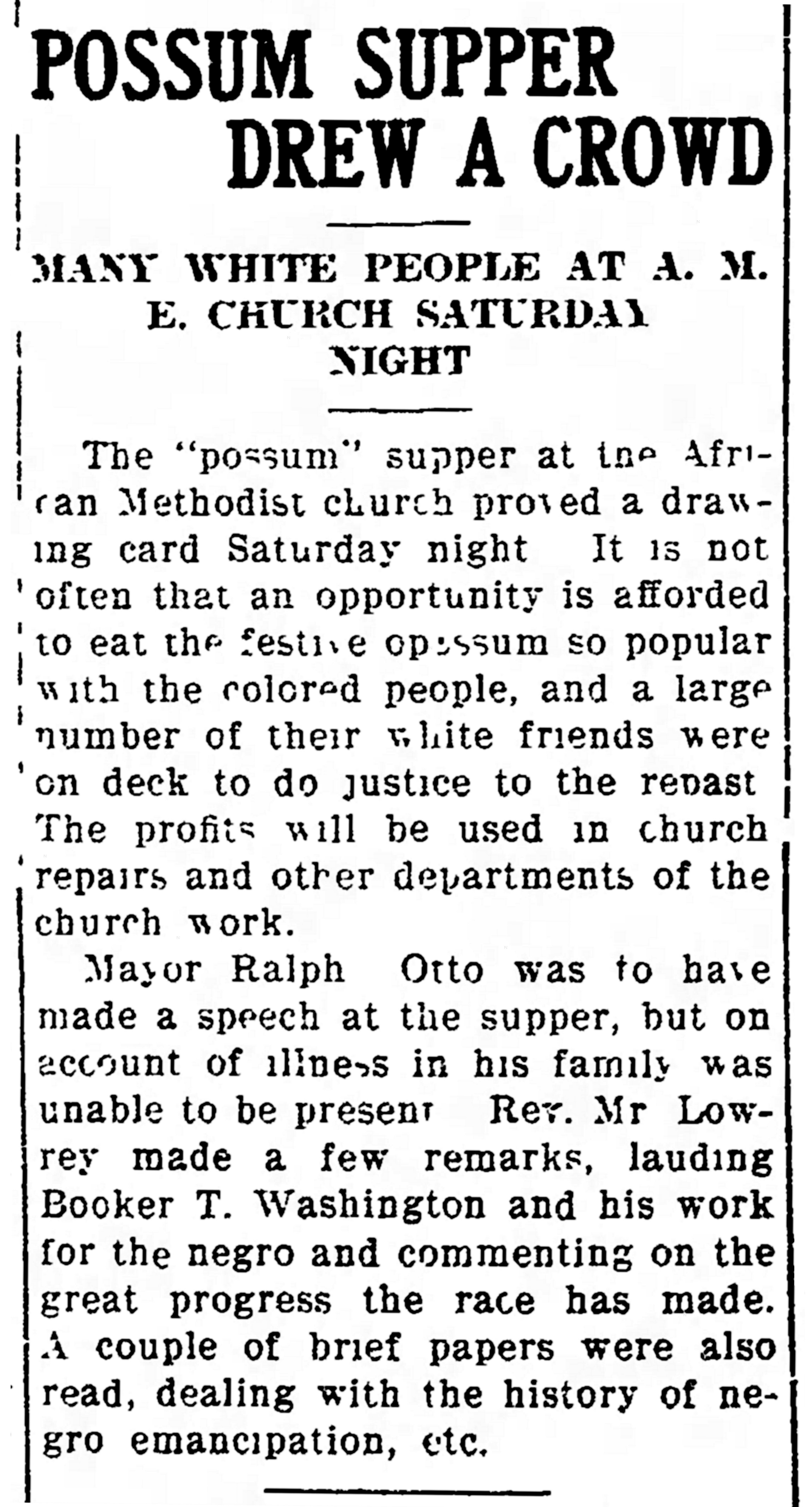
If white Democrats were responsible for the publicized and politicized opossum suppers in southern states such as Georgia, Blacks gained attention for hosting their own events in other parts of the country.97For several examples of newspaper accounts highlighting these events, see "New Year Festivities at Crowe's Hall," Alton (IL) Evening Telegraph, Jan. 3, 1894, 9; "Lovers of 'Possums: Indianapolis Epicures Who Fancy the Toothsome Dish," The Indianapolis (IN) Journal, Part Two, Dec. 28, 1902, https://chroniclingamerica.loc.gov/lccn/sn82015679/1902-12-28/ed-1/seq-13/; "Oh, Carve Dat 'Possum: First Annual Banquet of 'Possum Club a Splendid Success," Durant Weekly News (Choctaw Nation, Indian Territory, OK), Dec. 8, 1905, 2, https://chroniclingamerica.loc.gov/lccn/sn82015679/1902-12-28/ed-1/seq-13/; "Happenings Condensed," Palestine (TX) Daily Herald, Nov. 29, 1905, 2, https://chroniclingamerica.loc.gov/lccn/sn86090383/1905-11-29/ed-1/seq-2/; "Local Briefs," Deseret Evening News (Great Salt Lake City, UT), Feb. 18, 1902, 8, https://chroniclingamerica.loc.gov/lccn/sn83045555/1902-02-18/ed-1/seq-8/; "Another 'Possum Supper," Morning World Herald (Omaha, NE), Nov. 18, 1902, 2; "That 'Possum Supper," The Anaconda (MT) Standard, Dec. 31, 1901, 9; "A Possum Supper," Grand Forks (ND) Daily Herald, Jan. 9, 1903, 4; "'Possum Supper with Hoe Cake Trimmin's; Janitor Duncan and His Colored Friends are Preparing a Big Treat for Office Holders and Others," Colorado Springs (CO) Gazette, Dec. 9, 1903, 3. Migrating Black populations continued to host opossum suppers in northern and western states, keeping the tradition popular into the early twentieth century. No doubt these individuals were aware of the strong association that opossum suppers had developed among southern Democrats, as well as the longstanding stereotypes aimed at destroying the personal and collective power of Blacks. Their actions can be understood as what Psyche Williams-Forson describes—in the case of Black women redefining fried chicken—as a refusal "to allow the wider American culture to dictate what represents their expressive culture and thereby what represents blackness."98Williams-Forson, "More than Just a 'Big Piece of Chicken'," 107–118, 343.
In 1901, Alfred King held an opossum supper at his Illinois home for the white members with whom he had served on a grand jury, along with other guests including the state attorney, sheriff, circuit clerk, and chief of police. "This is the first time," King announced, "that a grand jury in Macon county ever dined with a colored man, but the world do[es] move," indicating a shift in race relations.99"'Possum Supper. First Grand Jury to Dine with Colored Man," The Daily Review (Decatur, IL), Nov. 22, 1901. The elaborate menu—which included a course of oyster soup with celery and crackers, as well as main dishes of roasted turkey, baked opossum, mashed and sweet potatoes, corn, slaw, cranberries, white and corn bread, in addition to lemon and pumpkin pie, various fruits, ice cream and cake, and coffee for dessert—was not unlike that of an opossum banquet hosted by southern white Democrats.100"'Possum Supper," The Daily Review (Decatur, IL), Nov. 22, 1901.
A few years later, in 1903, ex-slave Jefferson Logan, who worked in the Senate cloakroom, was planning his nineteenth annual opossum supper in Iowa to which he invited Republican state officials and politicians. Described as "a wealthy leader of the colored population," newspapers noted that Logan generally secured "a good position each legislative session through his pull with the politicians."101"Possum Supper and Politics," Omaha (NE) Daily Bee, Dec. 2, 1903, 6, https://chroniclingamerica.loc.gov/lccn/sn99021999/1903-12-02/ed-1/seq-6/; see also, "Jeff Logan and 'Possum Dinner," The Minneapolis (MN) Journal, Nov. 16, 1901, 18, https://chroniclingamerica.loc.gov/lccn/sn83045366/1901-11-16/ed-1/seq-19/; "'Possum Supper a Great Success," The Des Moines (IA) Register, Dec. 6, 1902, 7. By 1907, the Adams County Free Press of Corning, Iowa, claimed, "What the banquets of the Gridiron club is [sic] to Washington the 'possum suppers of the Jeff Logan lodge are to Iowa's capital."102"Big Guns at 'Possum Feast," Adams County Free Press (Corning, IA), Dec. 25, 1907, 1. Founded in 1885, the Gridiron Club of Washington, DC, is a prestigious journalistic organization that holds annual dinners in which the president of the United States is generally in attendance. The dinners have gained criticism since they bring journalists close together with the political officials they cover in their news stories.
African Americans such as Jeff Logan, Alfred King, and others refused to relinquish opossum consumption to the purview of whites. In "Possum," Black poet Paul Laurence Dunbar plays upon the beliefs that African Americans possess a folk knowledge of preparing opossums, while drawing humor from the inherent lack of knowledge of whites. Dunbar uses "negro dialect"—a poetic genre103For a deeper discussion of Dunbar's poetry, see, Michael Cohen, "Paul Laurence Dunbar and the Genres of Dialect," African American Review 41, no. 2 (2007): 247–257. that appealed to literate, middle-class whites—to express his frustration and anger toward their ignorance:
Ef dey's anyt'ing dat riles me
An' jes' gits me out o' hitch,
Twell I want to tek my coat off,
So 's to r'ar an' t'ar an' pitch,
Hit 's to see some ign'ant white man
'Mittin' dat owdacious sin—
W'en he want to cook a possum
Tekin' off de possum's skin.104Paul Laurence Dunbar, Lyrics of the Hearthside (New York: Dodd, Mead and Company, 1899), 163–164, https://archive.org/details/lyricsofhearthsi00dunb/page/162/mode/2up.
If Blacks vied to maintain a symbolic separation between Black and white opossum consumption, so, too, did whites in their repeated assertions that it was the job of people of African descent to provide, cook, and serve them opossum.
By the time Taft came to Atlanta in 1909, white opossum suppers strongly leaned on the figure of the faithful Black servant who dutifully captured and delightfully prepared the animal for white consumers.105For more information on the faithful Black servant trope, see Micki McElya, Clinging to Mammy: The Faithful Slave in Twentieth-Century America (Cambridge, MA: Harvard University Press, 2007). Early twentieth-century newspapers occasionally published obituaries that figured into the faithful Black servant trope. For example, an obituary for Sam Coleman of Americus, Georgia, who was to be "buried by his white friends," highlighted his "reputation as an excellent cook," who had "for perhaps twenty years [. . .] cooked barbecue dinners and possum suppers for local epicures." "A Famous Old Cook Expires. The Long Time Cook of the Cue Club is No More," Americus (GA) Times-Recorder, July 8, 1902, 3. Writers for white newspapers were keenly aware of the racial power exuded through depictions of subservient Black labor in opossum suppers. Atlanta Constitution correspondent H.T. McIntosh reported on the "strenuous 'possum-catching campaign" in Worth County to secure a hundred of the animals for the banquet, which entailed a score of Black hunters overseen by Judge Frank Park.106H.T. McIntosh, "Worth County 'Possum Mad," The Atlanta (GA) Constitution, January 9, 1909, 1, 5. Northern newspapers added to the image by relaying that "old Uncle Levi and two mammies" sent by Park to Atlanta were busy slaughtering and preparing the game. And at the banquet, Rev. Dr. J.W. Lee sang the minstrel song "Carve Him to de Heart" while two Black male waiters served opossum to the president-elect.107"Taft Feasts on Possum and the South Gets Promise of Better Things," Sun (New York, NY), Jan. 16, 1909, 1, https://chroniclingamerica.loc.gov/lccn/sn83030272/1909-01-16/ed-1/seq-1/; "South to Gain," Washington (DC) Herald, Jan. 16, 1909, 1. In order to provide Taft "insight of what the south was before the war," the entire event depended on Black labor.108"Banquet to Judge Taft Marks a Social Epoch in Atlanta's History," The Atlanta (GA) Constitution, Jan. 16, 1909, 1.
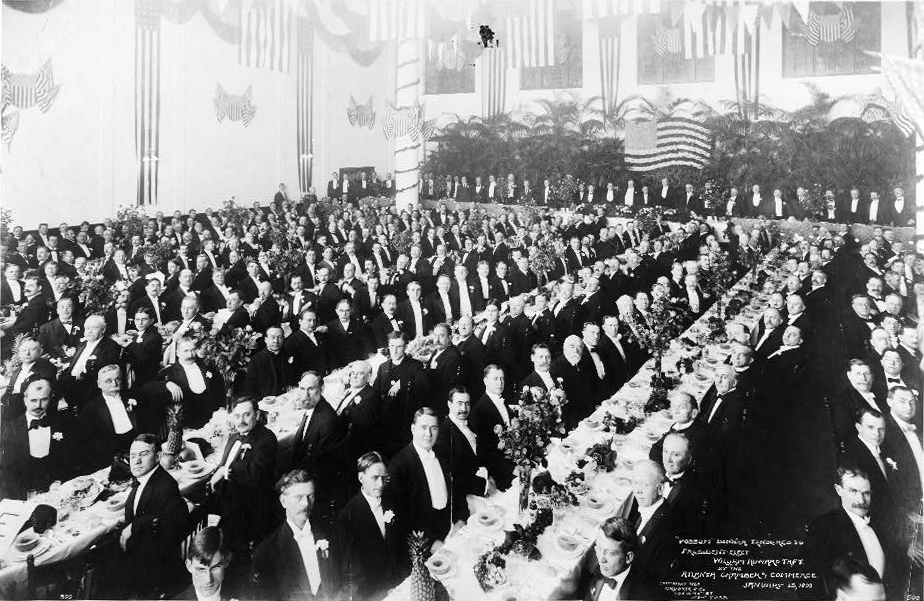
Given the popularity of southern Democratic opossum suppers, Taft knew his actions conveyed racially coded political and economic messages. "Southerners are traditionally partial to this dish," explained a Texas reporter, adding that Taft's request to attend an opossum feast "further endeared himself to the people of this section."109"Plenty of 'Possums," Bryan (TX) Morning Eagle, Jan. 2, 1909, 1. Eating or even just tasting opossum, however, was more than an act of endearment; it provided a way for Taft to become "southern" by performing in a display of white supremacy tied to an imagined antebellum culture. This invented tradition encompassed much more than Black servants catching, preparing, and serving hundreds of opossums to prominent white men at the banquet. Because the menu included numerous, heavy courses that would have required several hours to complete, it is unlikely that Taft or other diners consumed much, if any, of the opossum meat on their plates.110Daniel Frank, "Taft Ate Possum in City Auditorium," The Atlanta (GA) Journal and the Atlanta Constitution, Dec. 2, 1956, 1C. Decades later, columnist Daniel Frank explained that "onlookers noticed that Taft took one taste, and only one taste" of the barbecued opossum set before him at the 1909 banquet. "Waste was part of the point," writes food historian Helen Zoe Veit. "Perhaps nowhere more nakedly than at a banquet did wealthy Americans in the Gilded Age show off their ability to command resources for their own and their guests' pleasure, to select only the very choicest morsels from a choice dish, and to leave most of the carefully prepared, expensive food for the slop bucket or the servants."111Helen Zoe Veit, Food in the American Guilded Age (East Lansing: Michigan State University Press, 2017), 196. Yet, in the case of the opossum, throwing away a food that had been critical to Black survival before and after slavery conveyed a socioeconomic message and a racial one.
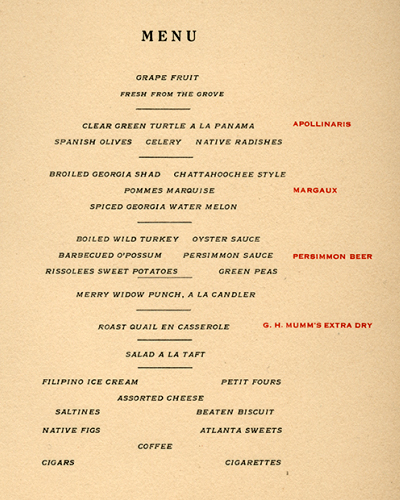
Similar to the opossum suppers of Newnan that had begun decades earlier, the 1909 Atlanta event presented images of reunion and reconciliation. "It is beautifully emblematic of the fading away of sectionalism and the bitterness of the civil war, this spectacle of a northern Republicant-elect [sic] beaming over relays of ''possum and 'taters' in his march through Georgia," oozed a writer from Wisconsin.112"South Should Let Up," Topeka (KS) State Journal, Jan. 19, 1909, 4, https://chroniclingamerica.loc.gov/lccn/sn82016014/1909-01-19/ed-1/seq-4/. The dish, along with its accompaniment of persimmon beer, garnered a great deal of local and national attention in the weeks and days leading up to the Atlanta event. While the opossum was closely tied to sectional identity, other items on the menu carried different messages associated with Taft's agenda and with white prejudices. "Clear-Green Turtle [soup] a la Panama" correlated to a part in Taft's speech where he emphasized the future commercial benefits that the canal offered to southern states. "Filipino Ice Cream," on the other hand, gestured toward Taft's stance on race relations, given that throughout his tour Taft had often linked Filipinos and African Americans as inferior people dependent on whites for improvement.113"Taft Eats 'Possum, Gives South Pledge"; Edward Frantz, "Goin' Dixie: Republican Presidential Tours of the South, 1877–1933," (PhD diss., University of Wisconsin-Madison, 2002), 305; Needham, "William Howard Taft, The Negro, and the White South, 1908–1912," 63.
The banquet menu required careful tailoring. So did Taft's speech. To his white male Atlanta audience, Taft pledged, "I shall become the president, not of a party, but of a whole united people," reinforcing his aim to solidify white northerners and southerners.114"How New York Papers View 'Possum Banquet," The Atlanta (GA) Constitution, Jan. 18, 1909, 2. Some questioned Taft's motives, with South Carolina Senator Benjamin Tillman warning in August 1909 that "southerners should beware of Taft spreading molasses to give 'hungry office-seekers an excuse for deserting the democratic party. . . .'"115Needham, "William Howard Taft, The Negro, and the White South, 1908–1912," 96. Yet, Taft's participation in the banquet was a signal of his tolerance—and tacit support—of the Jim Crow laws enacted to maintain social control. Several months after the Atlanta event, Taft would address another white audience at a banquet in Birmingham, Alabama, claiming that he "would not have the South give up a single one of her noble traditions."116William Howard Taft, "Speech at the Chamber of Commerce Banquet, Birmingham, Ala. (November 2, 1909)," Presidential Addresses and State Papers (New York: Doubleday, Page & Company, 1910), 402, https://archive.org/details/presidentialaddr00unit/page/402/mode/2up?view=theater&q=traditions. Taft would prove to be a consistent ally of conservative whites, giving them a free hand, enabling "a moratorium on all African American appointees throughout not only the South, but also the North" and thereby transitioning "into a new, even more lily-white era" for Republicans.117Frantz, "Goin' Dixie," 314; 317. As historian David Needham explains, "probably the most visable [sic] effort by Taft toward wooing white southerners was his appointment of independent Democrats to high federal positions" and elimination of Black governmental involvement.118Needham, "William Howard Taft, The Negro, and the White South, 1908–1912," 118.
While the opossum "topped the pinnacle of fame [. . .] basking in the sunlight of a nation's tender interest" after the Atlanta banquet, other working-class and stereotypically African American foods had the potential to further convey Taft's political stance in other states.119"Is Champagne Better to Wash Down 'Possum Than Persimmon Beer?," The Atlanta (GA) Constitution, Jan. 4 1909, 5. In looking ahead to Taft's stop in New Orleans, the Grant Parish Democrat suggested that Taft should eat alligator steak, "a great dish among the darkeys" in order "to remain on good terms with Louisiana Republicans."120"Alligator Steak," The Caucasian (Shreveport, LA), Feb. 7, 1909, https://chroniclingamerica.loc.gov/lccn/sn88064469/1909-02-07/ed-1/seq-8/. Subsequently, the Charlotte Observer called for Taft "to stop off in North Carolina and partake in a supper of Chatham County rabbits," which "would doubtless compare favorably with the alligator steak."121The Caucasian (Clinton, NC), Feb. 18, 1909, 1. With these foods "in his system," one newspaper editor remarked: "Mr. Taft may become practically Southern, instead of the visionary theorist that he is, particularly in connection with the negro and the Republicanizing of any of the States [. . .]."122"Alligator Steak," https://chroniclingamerica.loc.gov/lccn/sn88064469/1909-02-07/ed-1/seq-8/.
Conclusion
Taft's 1909 Atlanta banquet marked the opossum's peak as a symbol of white supremacy and sectional reconciliation. After Democrats regained their political power and fully achieved Black disenfranchisement, opossum suppers diminished in popularity and, with some exceptions,123For example, the Atlanta Association of Building Owners and Managers hosted an opossum supper for Franklin D. Roosevelt, then Governor of New York, during his visit to White Sulphur Springs, Georgia, in 1930. "Roosevelt Eats and Hunts 'Possum as Georgia Guest: Partakes of Primitive Meal in Role of Adopted Son," New York Herald Tribune, Nov. 30, 1930, 11. its ties with Confederate nostalgia and Jim Crow politics faded from memory. Writing in 1916, the editor of the Jackson News in Mississippi revisited the lore surrounding the opossum, as well as the racist stereotypes:
We feel that it is a duty to shatter one of those long-cherished delusions concerning 'possums and sweet taters' as a typical Southern dish . . . . It is true that Southern homes, instinctively hospitable and willing to feed the stranger within its gates after his own heart rather than the local notion of the eternal fitness of things, serve 'possum, but generally with a silent protest that politeness alone prevents making manifest. [. . .] The dark and dismal truth is that 'possum is an all but impossible diet . . . . Possum is so largely a matter of excessive and not too fragrant fat that even Sambo, despite his reputation for never having had enough, has been known to grow tired of the same and pass it up for boiled cabbage and turnips.124Quoted in "Shattering Illusions," Gulfport (MS) Daily Herald, Nov. 29, 1916, 2.
After Reconstruction, white Democrats from Georgia had taken the lead in reinventing opossum culinary culture, once strongly associated with African American autonomy and survivance, and claimed it as their own rightful inheritance. This entailed mocking and deriding African American opossum consumption as indicative of inherently inferior racial traits. White obsessions with Black opossum consumption transformed hunting and eating the native marsupial into a nostalgic Lost Cause celebration of a supposed common culture that former enslavers claimed to share with enslaved people of African descent in the antebellum era. Since the making of a plantation imaginary filled with unforgettable opossum hunts and faithful house servants who knew the art of slaughtering, cleaning, and roasting the creature added to the dish's appeal, whites of all classes partook of opossum in part because of its association with idealized former times, remaking it, for a brief present time, into a powerful cultural symbol of Black subordination and white power.
About the Author
Stephanie N. Bryan is a PhD candidate in the history department at Emory University. She holds a Master's in Landscape Architecture from the University of Georgia, with an emphasis on historic cultural landscape management. Her dissertation examines the ways in which marginalized plant and animal species indigenous to the southeastern US—such as opossums, persimmons, muscadines, and pokeweed—survived and sometimes thrived amid destructive land use and entered into diets, cultures, economies, and politics. An earlier version of the article was “highly commended” for the 2019 Sophie Coe Prize.
]]>Red Mountain Garden
 |
| Location of Smith's house, Birmingham, Alabama. Copyright GoogleMaps, 2013. |
My backyard garden is sited on the steep north slope of Red Mountain in Birmingham, Alabama, about sixty vertical feet down from the ridgeline and about 250 feet above downtown.1We now live in North Vancouver, British Columbia, but—since we moved during the Great Recession—we were unable to sell our Birmingham house. I have opted, therefore, to continue using the present tense and referring to the place as "our house," especially because we own no other: in North Vancouver, we are renters. In front of our home extends a suburban landscape of half–century-old houses. There is not a front porch in my entire neighborhood; whether despite or because of this, the homes—which I might generously describe as "midcentury modern"—exude a remarkable kind of 1950s optimism not ordinarily associated with the South, and from every window in the front of our house we can see, on a clear fall day, between five and fifteen miles. (Even in the post-bubble Los Angeles real estate market, this would be a multimillion-dollar view. We bought the place in 2003 for $137,000.) In the winter, when the leaves have finally fallen from the white oaks, the view includes the modern downtown skyline. Behind and above us, however, Red Mountain is too steep to build on, so there's nothing but second-growth hardwood forest and a few limestone outcrops between us and the condominiums at the top of the ridge. Through the woods just behind our lot, about twenty feet above the house, runs the old grade for the Birmingham Mineral Branch of the Louisville and Nashville Railroad, which carried iron ore from the mines that still angle down into the narrow seam of ore-bearing sandstone that runs along the ridge. Today, it's a footpath that intersects, three-tenths of a mile to the east, a paved section called the Vulcan Trail, which itself runs, closed to motor vehicles, exactly a mile to the base of the Vulcan statue. In 1924, when America's leading landscape architecture firm, Olmsted Brothers, put together their proposal A System of Parks and Playgrounds for Birmingham, they recommended this area be part of a "radical expansion" of Green Springs Park (now George Ward Park) at the base of the mountain.2Olmsted Brothers, A System of Parks and Playgrounds for Birmingham: Preliminary Report upon the Park Problems, Needs, and Opportunities of the City and its Immediate Surroundings (Birmingham: Park and Recreation Board of Birmingham, 1925), 12. Reprinted by the Birmingham Historical Society, 2005. "It is worth while," they wrote, "also to provide parks of the mountain type—places where people can climb, can enjoy the wild woods, and can enjoy that sense of freedom and expansion, in contrast to the restrictions of a city, which comes with the contemplation of distant and spacious views, even though in detail these views may be largely over urban districts. Because of its height and its nearness to the city, the Red Mountain ridge is particularly fitted to this purpose."3Ibid., 20. Because the iron mines were still running at full tilt, Olmsted Brothers realistically anticipated the land would be difficult to obtain. They were right. Our neighborhood, initially Lebanese, was built shortly after the mines shut down; the city purchased the steepest section, a strip about two hundred feet wide, less because of civic foresight than because real estate developers couldn't use it. Fortuitously, that strip is today poised to become part of an extensive network of linear parks across the metropolitan region.
 |
| Birmingham skyline through the white oaks. Birmingham, Alabama, March 21, 2008. Photograph by Jon Smith. |
The site is thus classically liminal, on the threshold between city and forest, automobile grid and curving mountainside. Deranged by the mountain, parallel grid lines converge here: below our house, Twenty-second Avenue intersects Twenty-first. We float on red Alabama clay between service and industry, between Birmingham's present skyline of banks and hospitals and its past mine railroad, between midcentury modern houses and neighborhood and second-growth woods that seem much older. More: Red Mountain is almost the last ridge of the great Appalachians running nearly the length of the eastern United States. Topographically if not quite culturally, Birmingham sits where the post-plantation Deep South in which I lived and worked from 1995 to 2010 meets the Appalachian South near which I grew up. When in Absalom, Absalom!, Faulkner's Thomas Sutpen falls Miltonically from the (West) Virginia mountains into the Virginia tidewater, "descending perpendicularly through temperature and climate," the landscape he plummets through on his way down—the Piedmont Virginia of Thomas Jefferson, James Madison, and James Monroe, all of whom would have been alive as he passed through—looks surprisingly like Birmingham's.4William Faulkner, Absalom, Absalom! In William Faulkner, Novels 1936–1940, ed. by Joseph Blotner and Noel Polk (New York: Library of America, 1990), 111.
Edward O. Wilson claims we are hardwired to want to live in places like this one. Across cultures, he argues, "people prefer to look out over their ideal terrain from a secure position framed by the semi-enclosure of a domicile. Their choice of home and environs, if made freely, combines a balance of refuge for safety and a wide visual prospect for exploration and foraging."5Edward O. Wilson, The Future of Life (New York: Vintage, 2003), 135. Yi-fu Tuan phrases the balance more elegantly: "Place is security, space is freedom: we are attached to the one and long for the other."6Yi-Fu Tuan, Space and Place: The Perspective of Experience (Minneapolis: University of Minnesota Press, 1977), 3.
 |
| Start of the raised vegetable bed, with Virginia bluebells lining the path, Carolina silverbell and wildflower patch with Trillium cuneatum in foreground, Alabama snow-wreath left of the bench, and Rhododendron 'Maxecat' at bottom left corner. Birmingham, Alabama, March 30, 2008. Photograph by Jon Smith. |
From the start, and quite unavoidably (given the glory of the site), I imagined my garden as site-specific art, a celebration of both place and space. What I wanted—my wife, far the more experienced gardener, ceded the yard to me, as I was obviously obsessed with it—was a seamless transition from the retro-modern ambience of the house to the woodlands above: a garden that would understand and embody "seeming oppositions as sustaining relations."7Miwon Kwon, One Place After Another (Cambridge: MIT Press, 2002), 166. The hardscape of the yard made achieving this goal much easier: near the house rose a series of whitewashed terraces, their walls still in good condition, with a set of concrete steps heading up toward the gate in the chain link fence. But the steps stopped about two-thirds of the way up; here there were still terraces, but separated by slopes rather than walls, and the path curved around to the right before angling back up the slope to the gate. Outside the gate, the natural curves of the hillside had remained, and we discovered a lush, level area with a limestone outcrop just below the footpath. When we moved in, all of this was overgrown with vines and all the invasive (sometimes botany employs political discourse, too) non-native species mentioned above—mercifully minus kudzu but plus mimosa. Our discovery that the fence even had a gate was the result of an almost archaeological investigation.
Unlike my midwestern in-laws, my parents (a North Carolinian and a New Yorker) were not gardeners; to follow my "family recipe" would have been to plant a few flowering dogwoods (classic understory plants) in full Virginia sun, fail to water them enough, and watch them "mysteriously" die.8Apparently they were not alone. As the leading book on dogwoods puts it: "Take a typical understory plant like C. florida that thrives in the partly shady wood with nice rich organic soils all moist and acidic. Once the plant leaves the nursery for that long trunk ride to its new home, the game is just about over. Despite all encouragement and direction, most homeowners run right home and find the sunniest, driest, and nastiest site with the poorest excuse for soil available to them." See, Paul Cappiello and Don Shadow, Dogwoods (Portland, OR: Timber Press, 2005), 32. Instead, I spent hours and hours online and poring over books checked out from the Birmingham Botanical Gardens library. When I started, I had four or five general ideas, each of which stayed with me through the process, and which I hoped to weave into a seamless whole. I wanted some plants that were native to this area, chiefly to blur the boundary between the public park behind the house and our yard, but also to begin to diversify the ecosystem in the woodland park since even the native species that had recolonized that area over the past half century were still far less diverse than what had once been there. (I also wanted plausible deniability since I was, in a few places, planting on city property, practicing what David Tracey and Richard Reynolds, among others, call "guerrilla gardening.") I wanted to attract and sustain birds, butterflies, and other wildlife, and I had a certain fantasy, drawing on German Schrebergärten and English garden allotments, of the kind of public European footpath that people garden right up to. Second, I wanted plants that reminded me of Appalachian and Piedmont Virginia as much as the site itself did: the classic exile's garden.9For what is quite possibly the definitive treatment of diasporic gardening, see Sarah Casteel's remarkable recent book Second Arrivals (Charlottesville: University of Virginia Press, 2007). Third, since the house, with its wide eaves and long, low midcentury-modern form, drew on a vaguely East Asian stylistic language, near it I wanted plants with a Chinese or Japanese provenance—daphnes, gardenias, camellias, lacecap hydrangeas. (While there were several evergreen azaleas already on the property, however, I was not tempted to add to their number.) Fourth, somewhere under the power-line easement out back where I could see it from my study window, I wanted a small, tropical-looking area full of huge leaves and bright color all summer. Part of this was my nod to the more irreverent and ebullient traditions of African American southern gardening and yard art; part, too, was my nod to global warming, since, defying stereotypical notions of unchanging "place," Birmingham has rather firmly moved in the past fifteen years from USDA Zone 7 to Zone 8.10On December 19, 2006, the National Arbor Day Foundation—hardly a political organization—published, based on the past fifteen years' climate data, its independent revision of the USDA's 1990 map of climate hardiness zones (arborday.org/media/zones.cfm), reinforcing what gardeners had been experiencing—"on the ground," as it were—for some time. I have invested a significant part of my career arguing for certain shared features of the United States and global Souths, and in addition I did want a small eruption of Martha Schwartz-y "artificiality," even if only in the form of decidedly "out of place" shrubs and perennials, since, for example, the bright-orange plastic garden bench in the Design Within Reach catalog was, for two Alabama college professors, not within reach at all. Hence cannas, Formosa lilies, ginger lilies, Hydrangea aspera, a bougainvillea experiment, lobelias, a deciduous Ashe's magnolia—the latter two, native but tropical-looking, to tie the tropical and native areas together. I even put in a couple of Sabal 'Birminghams,' a hardy cultivar one of whose ancestors is almost surely the cabbage palm (Sabal palmetto), the state tree of Florida and South Carolina. (Since I could only afford young plants, they simply look, even now, like large gladioli.) In the drought that ran from 2006 to the end of 2008, the worst in recorded history, when plants native to central Alabama themselves struggled, I learned to overcome my resistance to yuccas, several of which—some native to Alabama, others introduced from Mexico, whose climate we may have begun to borrow—now lend their strikingly sculptural presence to key focal points of the garden. In the late summer of 2007, I installed by my downspouts six rain barrels. Half an inch of rain yields 330 gallons, which, hand-carried up the slope, can keep my ornamental shrubs alive from two to four weeks.
 |
| Young hedge of Rhododendron 'Maxecat,' piedmont azaleas to the left of the hedge. Birmingham, Alabama, April 8, 2008. Photograph by Jon Smith. |
Insofar as the garden abutted a public pedestrian thoroughfare, what I wanted, too, was a sense of surprise for those pedestrians who happened upon it. Though polemical, Lucy Lippard's definition of public art as "accessible art of any species that cares about, challenges, involves, and consults the audience for or with whom it is made, respecting community and environment" is helpful here.11Lucy Lippard, The Lure of the Local: Senses of Place in a Multicentered Society (New York: The New Press, 1997), 264. Frankly, as a modernist I'm not much concerned with accessibility, and, at the risk of sounding overly literal about it, most people seeing the garden from that direction will have had to walk at least half a mile to do so. My garden—small-scale art for the long haul, as Lippard would say—is inevitably about motion too. For now, the footpath behind it serves as an unmarked spur of the paved Vulcan Trail. Precisely because at present the trail doesn't "go" anywhere, many of the people on it are first-timers. Six hundred yards from the paved section, after a shady stretch through invasive English ivy behind our neighbors', the curious come across the spray of native rhododendrons that is slowly forming a flowering evergreen screen between the trail and our property. A break in the row reveals three stone steps (edged in spring with Virginia bluebells) descending into a small garden with mountain laurel, deciduous native azaleas, bottlebrush buckeyes, Alabama snow-wreath, smooth and oakleaf hydrangeas, American beautyberry, a sourwood and a silverbell tree, atamasco lilies defining the curve of a limestone outcrop, Stokes' aster, foamflower, Indian pinks, a few trilliums (T. cuneatum) that were already on the site, and a host of other small native flowers gleaned from Jefferson County's annual landfill digs. Closer to the terraces are my wife's rosebushes (increasingly shaded out as the woods behind continue to grow) and a pair of fastigiate Graham Blandy boxwoods mock-pretentiously guarding the gate in the chain-link fence. In future years, I'd hoped to make the footpath truly pass through, instead of just alongside, a subtly landscaped area, with redbuds, dogwoods, red buckeyes, and, someday, American chestnuts all brightening the woods above the trail. Ideally, people would not realize the area is landscaped at all.12Louise Wrinkle's Mountain Brook garden, often cited in works like Sally Wasowski with Andy Wasowski, Gardening with Native Plants of the South (Boulder, CO: Taylor Trade, 1994), is a model here, or was until she paved her creekside walkway with asphalt. (In some cases, creating such an illusion is not difficult because people are not always very observant. In 2004, a group of non-neighborhood-residents calling themselves "Friends of the Vulcan Trail," on an annual and officious "trail-clearing" mission, veered several yards off the trail to destroy two of my rhododendrons, not to mention a small tree belonging to one neighbor and a mahonia belonging to another.) But the real impulse behind this sort of restorative gardening is what Ken Druse calls "giving back" in The Passion for Gardening: Inspiration for a Lifetime (New York: Clarkson Potter, 2003), 97–143. It's a different aesthetic and ethic from Schwartz's, which I deploy elsewhere in the garden. (Why choose?) Schwartz, notes Tim Richardson, "does not try to manipulate the natural landscape in a subtle way, bending it to her ends by using nature's own palette of trees, shrubs, and flowers. For Schwartz, such an approach is lazy or even dishonest, since her argument is that even the notion that unsullied 'nature' exists out there is patently false," see Tim Richardson, ed., The Vanguard Landscapes and Gardens of Martha Schwartz (New York: Thames and Hudson, 2004), 7. Like most dogmatism, such orthodox postmodernism can overstate its point. Habitat restoration, subtly aestheticized or not, isn't about pretending unsullied nature exists, it's about ameliorating some of the sullying.
 |
| Workers clearing powerline easement, Hydrangea arborescens 'Annabelle' in foreground. Birmingham, Alabama, July 5, 2007. Photograph by Jon Smith. |
Two steps inside the gate in the fence, just where the natural curves of the mountainside give way to the terraced slopes planted with hydrangeas and brugmansia, hellebores and ginger lilies and crested iris, a previous owner—I could never have done this—had bolted through the trunks of two young pine trees to create a frame for an outdoor swing, though when we moved in no swing hung from the 4x4s fixed there. We purchased by mail and assembled one made of—globalization strikes again—sustainably harvested teak. And it is here at night, especially in winter when the mosquitoes are gone and the view is unobstructed by oak leaves, that we will sit and look out over the city of a million people in which we live. Often I can see the glow of my computer monitor through the study window; from the roof above it, the DSL connection over which most of the plants in this garden were researched and ordered runs up the telephone line to the row of poles behind us. This is where I most want to sit, the most liminal place in the whole liminal site. My physical pleasure—visual, auditory, and tactile—in the urban space is inseparable from my pleasure in the place from which I view it. And this latter pleasure is complex.13Partly because of gardening's perceived distance from urban youth subcultures and electronic media, no scholarly cultural studies treatment of its pleasures exists, and the afterword below is not intended to fill that void. For an impressionistic meditation intended to "inspire" other gardeners, see Druse, The Passion for Gardening. Like the bodily pleasure of swing dancing noted by V. Vale, it's been partly the pleasure, after hours each week in front of that monitor (and of students!), of hauling eighty-pound chunks of sandstone to make steps, of spreading compost, of planting and tending mountain laurel and silky stewartia (the latter, I confess, unsuccessfully).14V. Vale, Swing! The New Retro Renaissance (San Francisco: RE/Search Publications, 1998). Yet it is not and, unlike swing dancing, has never been, hip, and while I tend to buy my plants not from big-box chains but from smaller local nurseries or places like Woodlanders in South Carolina (for southeastern native plants), or Greer Gardens in the Pacific Northwest (for rhodies), or several of the edgier nurseries run by globetrotting "plant hunters" (Plant Delights, Yucca Do, or Heronswood when it was run by Dan Hinkley), it isn't consumption as protest. In fact, despite a significant cash outlay, it's not really reducible to consumption, any more than the pleasure of running is reducible to the pleasure (or hassle) of buying running shoes. And though I have consulted gardening books from the 1940s, 1950s, and early 1960s, even laying out a garden incorporating plant combinations and design philosophies favored in those decades does not feel like wearing vintage. As separate, living organisms (i.e., as the Real), all but the most ancient individual plants resist the artifactuality, perhaps even the implicit narcissism, of a skinny tie or, for that matter, a postwar Danish credenza.15"I wonder," asks Tom Rooks, a landscape designer in Michigan extensively quoted by Druse, "what do people do who are in love with things that are completely man-made? Like people who are in love with cars? What we're in love with is so complex and so never-ending, you can never feel you've done everything or learned everything about it." Druse, The Passion for Gardening, 22. Druse's own metaphor that nature is "the senior partner in this collaboration" is schmaltzy but accurately depicts the basic ontological sense that gardening can resist fetishism. Ibid., 232.
Even ten years ago, most critics of southern culture—ignoring the DSL connection and the urban setting—would have discussed my garden labors, if pressed, as evidence of my southern "sense of place," my "attachment to the land," and so on. Confusing me, perhaps, with Walker Percy, others might alternately have read all this as tragically "post-southern": removed from the land of my ancestors, thrust into a world of postmodern space, I desperately attempt to reestablish connection, to re-create place. Conversely, many postmodern geographers, still under the spell of what Edward Soja happily calls "the Edge City maxim, that every American city is growing in the fashion of Los Angeles," would have simply ignored the site, and potentially all Birmingham's parks as well, considering Birmingham, if at all, as a kind of poor man's or proto-Atlanta, itself a kind of poor man's or proto-Los Angeles of simulacra and abstract capitalist space.16Edward W. Soja, Postmetropolis: Critical Studies of Cities and Regions (Madden, Massachussetts: Blackwell, 2000), 401. For the classic postmodern-geography treatment of Atlanta, see Charles Rutheiser, Imagineering Atlanta: The Politics of Place in the City of Dreams (New York: Verso, 1996). Neither approach suffices.
Afterword: The View from British Columbia
In 2010, my wife and I moved to North Vancouver, British Columbia. By 2012, our Birmingham garden was no more. We had been unable to sell the house in the depressed US market, and the folks to whom we were able to rent it were lovely people but in no sense gardeners. (Nor could we have expected them to be.) Scores of plants, including virtually all the rhododendrons, died from lack of watering; others were shaded out by weeds. To make matters worse, sometime in early 2012, a crew from the city of Birmingham came down the trail with a backhoe on some sort of trail widening mission, got the backhoe stuck, and destroyed many more plants in the process of extricating it. For no apparent reason, they also went twenty feet out of their way to cut down my sourwood tree, which had gotten about twelve feet tall. A few plants—generally, those native not simply to "the South" or Alabama, but to Jefferson County in particular—do still thrive back there. The Alabama snow-wreath I planted by the limestone outcrop likes the location so much it has suckered all over the place, almost blocking access to the path. The Piedmont azaleas, bottlebrush buckeyes, oakleaf hydrangeas, and three cultivars of Hydrangea arborescens are all still there, if you know where to look. But for the most part, the garden has been swallowed back up into the mix of invasive plants and second-growth forest that was there before I started the project. Inside the fence, meanwhile, most of the non-native hydrangeas are gone. In fact, when we do put the house on the market next year, we've been told we will have to do considerable work just to restore its "curb appeal."
Part of me wants to interpret all this metaphorically, to read my desiccated, neglected garden as a slightly accelerated version of the Deep South as a whole, whose fate in fifty years as a result of anthropogenic global warming is on track to be, in a single word from NASA climatologist James Hansen, "desertification." After all, how easy it would be—and, I argue in Finding Purple America, how unethical—to fall into pleasant, moralizing tears over my garden as a figure for such a loss, to adapt old southern studies' endlessly replicable melancholia to yet another Lost Cause! Conversely, how easy to lay, from the safe distance of western Canada, the problem at the feet of "the South," so that the whole mess could be attributed to those pickup-driving, coal-burning yahoos, the exception to some putatively eco-virtuous blue-state nation? Both narratives, however, represent their own kinds of obvious mythmaking, their own fantastic "jukeboxes" (in the terms of the book).
Instead, as soon as we got to North Vancouver, I started another garden. Among the more conventional roses, peonies, dahlias, and crocosmia, it contains what may be the only longleaf pine seedling in British Columbia.
About the Author
Jon Smith is associate professor of English at Simon Fraser University. He is the coeditor with Deborah Cohn of Look Away! The US South in New World Studies (Duke University Press, 2004) and the author of Finding Purple America: The South and the Future of American Cultural Studies (University of Georgia Press, 2013). He has been a certified master gardener in Alabama and is currently one in British Columbia.
]]>Presentation
Part 2: Ray overviews the modern extinction of many food seed varieties and the industrialization of US agriculture
About the Author
Janisse Ray was born in Baxley, Georgia, in 1962 and graduated from the MFA program in Creative Writing at the University of Montana in 1997. She currently resides in the Altamaha Community of Reidsville, Georgia, and teaches in the low-residency creative writing program at Chatham University. She has published poetry and non-fiction books, including Ecology of a Cracker Childhood (1999). Ray lives and works on a family farm in southern Georgia.
]]>Presentation
Part 2: Engelhardt’s discussion of state market bulletins’ history, content, readership, circulation, and archival importance
Part 3: Engelhardt overviews the correspondence among bulletin readers and Lawrence
Part 4: Engelhardt asks questions such as, “What do farm bulletins and letters reveal about race, class, and gender history?”
Part 5: Engelhardt relates the influence of market bulletins in Eudora Welty’s “The Wanderers.”
Part 6: Engelhardt Q & A. Topics include how Lawrence’s correspondence inform her writing
Acknowledgements
Many thanks to Northwestern State University of Louisiana's Watson Memorial Library Cammie G. Henry Research Center for the materials from the Warren Way Collection, which were the inspiration for this talk and appear in facsimile in the video. Also thanks to the University Libraries at the University of North Carolina at Chapel Hill for digitizing the 1920s market bulletins from Raleigh, North Carolina, which appear in the video. This presentation, given at Woodruff Library at Emory University, April 24, 2012, was sponsored by Emory's American Studies Program and the Manuscript, Archives, and Rare Book Library with support from the Hightower Fund.
About the Author
Elizabeth Engelhardt, professor of American Studies and Women’s and Gender Studies at the University of Texas, Austin, writes about food, gender, race, and class in the US South. She is lead author of Republic of Barbecue: Stories Beyond the Brisket (2009) and author of A Mess of Greens: Southern Gender and Southern Food (2011). Engelhardt is co-editing (with John T. Edge and Ted Ownby) a forthcoming volume about southern food methodologies.
]]>Essay
If some of y’all never been down South too much,
I’m gonna tell you a little bit about this, so that you’ll understand what I’m talking about
Down there we have a plant that grows out in the woods and the fields,
Looks somethin’ like a turnip green.
Everybody calls it polk salad.
Polk . . . kuh . . . salad . . . ungh.
So growls Tony Joe White in his 1969 hit, "Polk Salad Annie," about a notorious woman and a ubiquitous weed. Pokeweed, or poke sallet ("salad"), grows natively with astonishing vigor across the American South. Despite what Tony Joe suggests, however, pokeweed is not an exclusively rural species, in "the woods and the fields." These dark red stalks with their smooth, flat, succulent green leaves thrive in urban and suburban backyards, along roadsides and through cracks in grocery store parking lots. At the height of their growth in late summer, pokeweed stalks bow over from about eight feet, weighted down by loads of berries that ripen from green to deep purple.
 |
| Allison O. Adams, Poke berries turning purple, Decatur, Georgia, 2011. |
There is a rural-urban divide, however, in the consumption of poke sallet. I wondered if this gap might begin to close with a recent turn in the "locavore" movement toward wild food foraging, which seems to have particularly taken root in southern cities. See, for instance, a lengthy article in the New York Times on August 14, 2011, which features Kelly Callahan, a resident of East Atlanta, who began foraging on the abandoned lots of vacant, bank-owned properties in her area. Gardens planted and left behind to re-seed themselves year after year, trees loaded with fruit—Ms. Callahan saw them going to waste and decided to harvest.
On the "wild" spectrum, however, at least in my reckoning, pokeweed is closer to what we might think of as "feral" food—once domesticated crops that have adapted to an uncultivated environment. But gathering and eating poke is not quite Euell Gibbons and Stalking the Wild Asparagus, either. Poke sallet greens were once commercially canned and marketed. The Allen Canning Company of Siloam Springs, Arkansas, paid gatherers by the pound to bring in the raw product. Allen ran its last batch of canned poke sallet in 2000. As the company's supervisor explained on an Arkansas Extension Service web page, "The decision to stop processing poke was primarily because of the difficulty of finding people interested in picking poke and bring it to our buying locations."
Poke lacks a certain appeal for the urban palate. Take my friend Esther, who bought a well-illustrated book on fungi and became an expert identifier of edible mushrooms. She now scours her Chamblee, Georgia, neighborhood and parks, sometimes bringing home more than a pound of wild-gathered chanterelles (about $50 worth). While chanterelles are just as wild as pokeweed, poke does not show up on the menus of upscale restaurants featuring locally grown fare. You do not find it for sale at city farmer's markets or in Community-Supported Agriculture (CSA) deliveries.
 |
| Allison O. Adams, Kudzu and pokeweed in grocery store parking lot, Decatur, Georgia, 2011. |
My guess is that poke sallet still carries an aftertaste of poverty. Folks ate it because they were poor, and poke grows everywhere. So in urban worlds it is disdained, but it is celebrated at annual festivals in places such as Harlan, Kentucky, and Gainesboro, Tennessee (where festival events include a poke-eating contest).
There are other reasons poke is maligned. Because of its aggressive growth, gardeners consider it a bane, much like kudzu. (In fact, kudzu is just as edible. The new shoots are an excellent green in a quiche; the blossoms, which to me smell like grape Nehi, can be distilled into delicious jellies; and the Japanese commercially cultivate it and use the starch of the roots for tempura batter, tofu, noodles, and gelatinous confections.) I pull most of the poke plants up all summer long because otherwise they would take over my yard. But I always like to leave a few along the back edge of my city lot in Decatur, Georgia. My chickens love to forage on the greens and berries, which the wild songbirds also adore. And I actually think the plants themselves, which I have come to think of as the "long-legged purple ladies," are rather stately.
My Poke Sallet Granny
My maternal grandmother, at least, kept eating poke sallet long after she no longer had to because she loved the stuff. Mee-Ma lived with us in the northeast Georgia mountains when I was in my early teens. She would take a grocery sack on her walks along the country roads near our house and pick the smallest, most tender leaves of the weed. She’d bring a ton of it back to the house, wash it thoroughly, and boil it three times until the house stank like sulfur springs. Then she would scramble it in eggs with bacon grease until the eggs were brownish-green and the house really stank. She’d eat the entire mess with a big hunk of cornbread crumbled in a tall glass of buttermilk.
She didn’t eat the youngest, smallest leaves just because they were the tastiest. Poke is quite poisonous, the roots and berries especially (though not for birds), and the larger leaves can make you very sick. She boiled them three times because that’s how she cooked the toxins out.
In fact, if you read around, the current prevailing wisdom is that only a fool would eat poke sallet, even if you cook it over and over again. My favorite dire warning comes from Wikipedia:
The eating of limited quantities of poke, perhaps of the shoots, may cause retching or vomiting after two hours or more. These signs may be followed by dyspnea, perspiration, spasms, severe purging, prostration, tremors, watery diarrhea and vomiting (sometimes bloody) and, sometimes, convulsions. In severe poisonings, symptoms are weakness, excessive yawning, slowed breathing, fast heartbeat, dizziness, and possibly seizures, coma and death.
Sure enough, according to Jean Weese, a food scientist with the Alabama Cooperative Extension service, "The roots, berries, seeds and mature stems and leaves of pokeweed are poisonous." She identifies at least three types of toxins in the plant and recommends that people avoid eating it, period. "Why would you want to eat something that we know is toxic when there are so many other non-toxic plants out there we can eat?"
There’s no fool like a southern fool waxing nostalgic for her dead granny’s weird cooking, so of course I had to give this a try. Mee-Ma had to have eaten enough poke sallet in her life to kill her several times over, and while she may have suffered from prostration a time or two (mostly due to orneriness), she lived for a long time and died because she was very old. So inspired by her memory and fortified by her persistence, I set about recreating her recipe, which I had not tasted since I was about thirteen.
Preparing Poke Sallet
To begin my poke sallet project, I gathered up a mess from my yard in a basket. I brought it in, washed it thoroughly, carefully removed the stems, and put it through its first braising in salted boiling water.
I drained it, rinsed it, boiled it again in new salted water.
I drained it, rinsed it, and boiled it a third time, this time with a hunk of smoked pepper bacon. Now the house smelled pretty good.
 |  |  |
| Allison O. Adams, Poke after boiling with bacon, Decatur, Georgia, 2010. | Allison O. Adams, Sauteeing poke in bacon grease, Decatur, Georgia, 2010. | Allison O. Adams, Poke scrambled with eggs, Decatur, Georgia, 2010. |
After the last boiling, I noted that the greens were beginning to resemble a traditional palava dish of okra leaves that I had eaten in Liberia a few years ago, which had been delicious, so how bad could this be?
 |
| Allison O. Adams, Palava dish, Liberia, 2008. |
Mee-Ma would have answered that there was nothing that bacon grease couldn’t make taste good. So I melted a generous tablespoon of it in a skillet and let the slimy poke slide in along with some spring onions. As it started to sizzle I added a couple of lightly beaten eggs and some salt and pepper. I cooked them down until the eggs were dry.
It looked familiar. My grandmother would have eaten it, I think, but she would have fussed at me for not having cornbread and buttermilk to go with it. I washed mine down with a big glass of iced tea. It wasn't bad—the poke gave the eggs a darkened flavor that was definitely enhanced by bacon grease. And in spite of some excessive yawning and a wee bit of perspiration, I lived to tell the tale.
My hope for poke is that it will return to popularity not merely for its culinary value, but also for its other useful properties. The rich purple juices of the berries have traditionally been used as ink and dye, and the American Cancer Society cites the potentially curative effects of a certain protein in pokeweed, which has shown some success against tumors in mice and against herpes and HIV in test tube studies. So before you yank that noxious weed out of your lawn, consider its proud past and its possibly noble future.
About the Author
Allison O. Adams is a writer, editor, gardener, and urban flock keeper in Decatur, Georgia. You may follow her blog at southernurbanhomestead.wordpress.com.
]]>Shooting Creek
Making Whiskey in the Backcountry
 |
Whiskey making, while rare in southern England, was highly developed in both Scotland and Ireland by the time of the Ulster emigration. We can credit the Ulster immigrants for helping introduce the tradition to America. Through their influence, whiskey making became commonplace everywhere in the new colony, particularly on the frontier. Frenchman Marquis de Chastelleaux observed that it was the only drink served in the American backcountry.1David Hackett-Fischer, Albion’s Seed: Four British Folkways in America (New York: Oxford University Press, 1989), 729. In the Pennsylvania backwoods of the 1700s, everyone made and drank whiskey, no matter their standing in the community.
The newcomers built both farm-based distilleries and larger-scale commercial operations in the cities, and they had a ready market for their products. From the Philadelphia elite on down to the redemptioners who worked for them, nearly all the easterners downed alcohol with meals, though those who could afford it also purchased imported rum and wine. Men, women, and often even children drank whiskey at various time of day, and the beverage enlivened nearly every kind of gathering, from church meetings and elections to dances and prize fights.2William Hogeland, The Whiskey Rebellion: George Washington, Alexander Hamilton and the Frontier Rebels Who Challenged America’s Newfound Sovereignty (New York: Scribner, 2006), 66. With this kind of consumption pattern among the English, they had little room to ridicule people of the western mountains as habitual drunks. But they did so, even though their words rang with hypocrisy.
 |
| Hosea Thomas' still workers in Endicott, (Franklin County) Virginia, 1915. The Martin, Rake, and Thomas families trace their origins to Ireland where local residents learned to make liquor (known in Ireland as "potchin") to supplement farm income. Photo courtesy of the Blue Ridge Institute of Ferrum College. |
In fact, it was whiskey’s popularity among the English that gave the back-border farmers impetus to produce more than they could consume and haul it back East to sell. Whiskey became the first frontier cash crop and the main source of income when the supplies of animal furs dwindled as woods gave way to farm fields. Whiskey made small loads on a single packhorse profitable, whereas grain alone or most any other farm product could barely pay for the trip. On the western Pennsylvania and Virginia frontiers, whiskey sold for twenty-five cents a gallon. In the more populous areas, a gallon of rye could bring as much as a dollar. No entrepreneur would bother to transport sacks of grain by horse and wagon across mountains when it could be reduced in volume through distillation and bring in more money in the process.3Ibid., 67.
As people moved into the backcountry, it was common to see settlers with copper worms and small still pots slung under their Conestoga wagons or on their packhorses. Some took with them only the knowledge of how to build a rig. Coppersmiths soon set up shop in the mountains and built and sold stills to their neighbors to supplement their farm earnings. Those who had made poteen in Ireland needed only equipment and grain to get started. Those who had no prior knowledge worked with neighbors and learned by doing.4Joseph Earl Dabney, Mountain Spirits, Vol. 1 (Asheville, NC: Bright Mountain Books, 1974), 51. Soon nearly every community had stills and nearly all the farm families had some way of making or procuring whiskey. Eventually distillation spread to other areas of the colonies.
On plantations throughout the colonies, a still house was a common outbuilding in which barrels of whiskey were distilled and aged. By independence, small distilleries were everywhere. Even three of the first five US presidents—George Washington, James Madison, and James Monroe—owned distilleries. Jefferson, who favored wine and beer, was the only one to frown on hard liquor. Adams had no distillery on his farm, but he wrote that he drank hard cider made on his place nearly every day of his life. For presidents and nearly all their fellow citizens, distilled whiskey became the indispensable and ubiquitous American drink. Even with other regions joining in the business of distilling, frontier whiskey continued to hold a good reputation in cities back East for both its taste and its price. Good water was another reason, as were the local ingredients they used to make it. The farther south the farmstead, the more likely it would have shifted from producing oats, barley, sheep, and cattle, common in the British Isles, to wheat, pigs, and corn.5H. Tyler Blethen and Curtis W. Wood, Jr., From Ulster to Carolina: The Migration of the Scotch-Irish to Southwestern North Carolina (Raleigh: North Carolina Department of Cultural Resources, Division of Archives and History, 1998), 33. Corn became far and away the primary grain of the Appalachians as well as the main ingredient for the liquor produced there. The corn varieties—called Indian corn by most—developed by the first peoples were perfect for the climate and rich in taste and carbohydrates, which made for higher alcohol content per bushel and a sweeter product. As settlements shifted from hunting and trapping to sedentary farming, all the ingredients for stilling this new crop were present in one place. Making liquor where the corn was raised added freshness to the flavor as well.
On the frontier as well as back in the settlements, few had any moral problems with whiskey consumption. In fact, hospitality and courtesy of the day required offering liquor. Failing to serve it would have created a serious breach of etiquette. Custom was to furnish whiskey in liberal quantities at all community gatherings, particularly workings such as house-raisings and corn-shuckings, as well as to laborers at harvest time, haying, and fruit gathering. Whiskey also was one of the few medicines available. People used it for rheumatism, malaria, snakebite, and a variety of communicable diseases from colds to gonorrhea.6Wayland F. Dunaway, The Scotch-Irish of Colonial Pennsylvania (Baltimore: Genealogical Publishing, 1979), 197; see also G. D. Albert, History of Westmoreland County, Pennsylvania (Philadelphia: L. H. Everts, 1882), 171, cited in Dunaway, 197. Whiskey was good for helping work, sickness, pain, as well as for making festivities more joyous. Many a song paid tribute to its transformative power. To most it was considered a God-given right.
Taxing Whiskey
In 1794, when Alexander Hamilton and other leaders proposed raising internal revenue for the struggling American government by taxing whiskey, the plan met with open revolt. Farmers who had fought against the British, specifically against taxation without representation, wanted nothing to do with the tax. The Whiskey Rebellion of 1794 ensued. The uprising was best organized in Monongahela County in southwestern Pennsylvania, where Protestants from northern Ireland had settled. The protesters made counterresolutions, staged tax protests, and intimidated, even beat, revenue collectors. Tarring and feathering the revenuers was common. When the rebellion spread into northwestern Virginia and the rest of the mountain region, it became what historian John Alexander Williams called “one of the few expressions of ‘perfect unanimity’ in the mountain region’s entire political history.”7John Alexander Williams, Appalachia: A History (Chapel Hill: University of North Carolina Press, 2002), 118-19. Though President Washington sent troops to Pennsylvania and quelled the uprising before it managed to get out of hand, the insurrection caused the government to drastically redraw its tax policy. While a whiskey tax remained on the books until the 1840s, the feds stopped collecting it for decades to come. Congress could find no one desperate enough to take the job.8Ibid.
Resistance to the whiskey tax politicized and united many local communities in ways that no other issue had before. Even as Secretary of the Treasury Alexander Hamilton was oblivious to whiskey’s centrality, the whiskey rebels showed Americans that citizens had to be involved in their own governance. Whiskey had linked farmers politically, and through protests they made it clear that whiskey was their only source of cash and their way out of debt. Taxing that main means of escape from dire poverty made people fight as if their lives depended on it. Indeed, they proved Hamilton’s assertion to Congress that a whiskey tax was a luxury tax had been simply wrong. Instead, the whiskey tax had pushed people with no money too far.9Hogeland, 67. Had the whiskey rebels got something back from their taxes, say access via road to greater markets or maybe economic help, they may have seen the benefit of paying them and behaved differently when the collectors came calling. But no government services were forthcoming on the frontier. As Sherwood Anderson pointed out in Kit Brandon, these whiskey rebels had to wonder, “What was all this business about taxes? What had government done for us that we should pay taxes?”10Sherwood Anderson, Kit Brandon: A Portrait (New York: Charles Scribner’s Sons, 1936), 118.
From Spirits of Just Men: Mountaineers, Liquor Bosses, and Lawmen in the Moonshine Capital of the World. Copyright 2011 by the Board of Trustees of the University of Illinois. Used with permission of the University of Illinois Press. This excerpt may not be reproduced, published, distributed or posted online without the written permission of the copyright holder.
About the Author
A native son of Franklin County, Virginia, author and filmmaker Charles D. Thompson, Jr. is the curriculum and education director at the Center for Documentary Studies and a lecturer in cultural anthropology at Duke University.
]]>Review
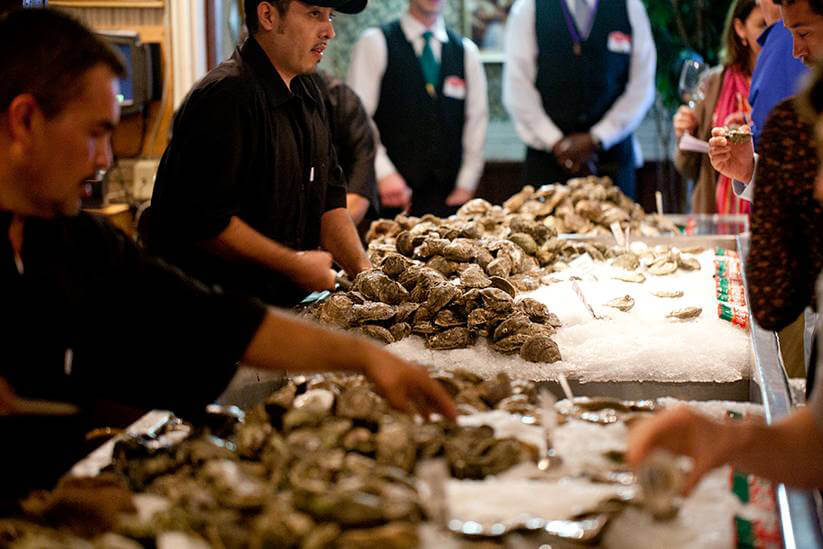 |
| Kelly Yandell, Foodways Texas oyster tasting at Gaido's Restaurant, Galveston, Texas, 2011. |
On a late February Saturday night in Galveston, Texas, I stood shoulder to shoulder with a hundred fellow conspirators, tasting two thousand oysters from all along the Gulf Coast. It was the first symposium hosted by Foodways Texas, an organization dedicated to preserving, promoting, and celebrating the state’s diverse food cultures. We took over a room at Gaido’s, a century-old restaurant that has served its share of succulent oysters. As revelers drank and cheered, Mardi Gras parade floats, barely visible through the early spring fog, advanced noisily down the seawall. Our targets—a consideration of oyster appellations and a revaluing of fish previously dismissed as trash—intermittently floated up through the thick fog of history, ocean, and industrial/scientific rhetoric, raising as many questions as answers. Sweet, fat, briny, buttery, and luscious, the oysters were a phenomenon of excess and local flavor, a bacchanalia fitting the surrounding party.
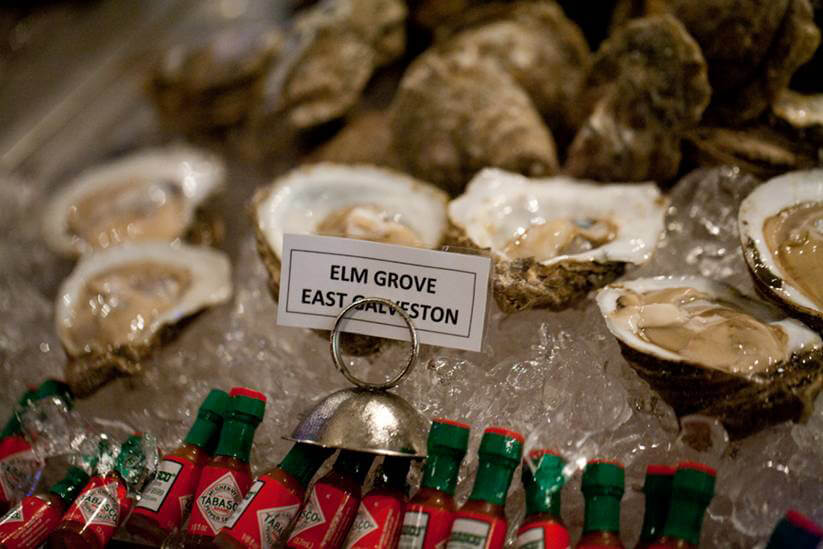 |
| Kelly Yandell, Elm Grove oysters, Galveston, Texas, 2011. |
Mad Island, Elm Grove, Todd’s Dump, Possum Pass, Bayou Cook, Pepper Grove, and Ladies Pass. The sheer number of oysters in one place was notable, however the history came from the laminated nametags accompanying each sampling of oysters. Rather than numeric codes in fine print designating the bed from which oysters were harvested, rather than a tag lumping all together as from the Gulf, for one night the oysters stopped being generic. The Texas oyster beds got their names back. We compared the taste of Mad Island versus Pepper Grove. We debated the salinity of Possum Pass versus Bayou Cook. We found the provenance, and we located and glimpsed the history in the names. Who was Todd and what did he dump? What Ladies gave their legacy to Ladies Pass? Where are the elms that inspired Elm Grove?
 |
| P. J. Stoops, Sorting the "trash," Houston, Texas, 2010. |
Ribbonfish, Almaco Jack, Big Eyes, Rainbow Runners, and Drills. Oysters were not the only food to regain their names at the Foodways Texas Gulf Coast gathering. A panel took on monocultural fishing practices driven by market forces, practices that value one product and dismiss everything else that comes up in the nets or on the line as “trash.” If Redfish are selling, then Ribbonfish get trashed, along with Rainbow Runners. But if we rename the trash as by-catch, and find someone like P. J. Stoops, a walking encyclopedia of the names and qualities of Gulf species, then we might compare the Almaco Jack with the Big Eyes and not throw either away. By restoring the names and the balance, we also might find similarities between predators such as oyster drills and delicacies such as escargot, and discover that devotees of snails in butter and delicate herbs also may like oyster drills—kissing cousins to the land snails—prepared the same way. Such practices could help protect the oyster beds from at least one threat.
 |
| P. J. Stoops, Oyster drills, Houston, Texas, 2010. |
Anahuac, Lonesome, Desperation, Moses Gate, Resignation, Mary’s, Slim Jim, Frenchy’s. For this North Carolina native, Texas provides a fascinating geographic shift from which to examine questions of cultures, landscapes, and artifacts. On this particular evening, though, it was my perspective as a humanities scholar that was most engaged. We could locate oysters and restore nineteenth-century reef names because food historians such as Robb Walsh found maps and newspaper stories from before the beds were scientifically coded and classified by number. We heard the poetry in old names used by local fishermen and women perhaps because Stoops’ background includes an English degree, making him inclined to favor the vernacular over the Latin in by-catch names. The long history of erasure of the local by nationalizing or industrializing scientific rhetoric took a small step back. Even if we do not know how Lonesome, Desperate, or Resigned some early oystermen and women were, we glimpsed stories of families and lives memorialized by names. From the restoration of narratives came a challenge to homogeneity and a celebration of heterogeneity of cultures, people, and places. Could it be that Tejano and Mexican fishing practices joined Cajun, Anglo, and African American ones at the Anahuac (or center) with Frenchy, Jim, and Mary coming along? We might feel an investment in terroir—what food scholar Amy Trubek calls the "taste of place" and the connections of flavors, foods, and cultures—if later we hear that Moses and his Gate are threatened, more than we might if unnamed and generalized reefs are said to have declined.
 |
| P. J. Stoops, Triggers, Squirrelfish, Rosebuds, Almacocs, and Porgies, Houston, Texas, 2010. |
Confederate, Dollar, Gaspipe, Dryhole, Snake Island, Redfish. Names and narratives can be fraught and dangerous. We can use them to romanticize an untroubled past, one without Gas pipes draining into the bay waters and without traces of civil war and its racial divides carved into the coast. We can use nostalgia to forget our responsibilities in the present. Dollars seem quaint rather than profoundly influential on a working bay. Oyster and fish names can stand in place of the names of the many men, women, and children who historically worked in the canneries and factories, on the boats, and in the crews—often for little pay, in brutal conditions. Efforts to restore histories and cultures can fetishize products, price them out of their blue-collar roots, and harvest them out of a healthy balance in the ecosystem.
Lonetree, Little Bird, Eagle Point, Buckshot. Amid contemporary habits of quantifying and generalizing, perhaps the fondness for storytelling demonstrated on that February weekend in Galveston addresses a gap. If food and drink can be thoughtfully combined with narratives and bonding across experiences, then names may make a difference. If we root ourselves and our foods in places, connect people and time, and reflect on cultural exchanges, we might build new commitments and political alliances.
 |
| Kelly Yandell, Freshly cooked oyster drills, Galveston, Texas, 2011. |
Did the oyster appellation experiment cut through the night’s soupy fog? Does the by-catch renaming transform our relationship with the seas? Do I now know a truth about oysters, an essential worth of fish not discarded? I am not sure. I do know that since the gathering a few Texas restaurants have begun hosting tastings organized by appellation. A by-catch booth at a Houston farmers’ market twitters lists of species and possibilities—and followers flock in. Perhaps restoring narratives to products previously obscure, unfailingly fresh, and newly valued will strengthen the connections between stories, oysters, fish, and cultures, and even create space for stories untold. That might be worth a celebratory parade.
About the Author
Elizabeth Engelhardt, associate professor of American Studies and Women’s and Gender Studies at the University of Texas, Austin, writes about food, gender, race, and class in the US South. She is lead author of Republic of Barbecue: Stories Beyond the Brisket (2009) and author of the forthcoming A Mess of Greens: Southern Gender and Southern Food (Fall 2011). Engelhardt is also co-editing (with John T. Edge and Ted Ownby) a forthcoming volume about southern food methodologies. Originally from western North Carolina, she has followed in the footsteps of generations who traveled from the mountains of Appalachia to live in and write about Texas.
]]>Video and Essay
Since early 2010, Steve Bransford has been working on a documentary video portrait of Georgia gardener Ryan Gainey (1944-2016) with Cooper Sanchez and Matthew Chipman. Gainey is an acclaimed garden designer and author of The Well-Placed Weed: The Bountiful Garden of Ryan Gainey (1993). He has served as mentor for a number of leading garden designers throughout the US South, including Sanchez. In the summer, Steve filmed a session with Gainey during which he discussed the botanical and cultural aspects of several fruits. In this segment, he talks about the physical characteristics and historical significance of the fig.
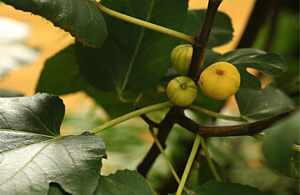 |
| Steve Bransford, Figs from Ryan Gainey's garden, Decatur, Georgia, 2010. |
This video short is one of several satellite pieces connected to their comprehensive film about Gainey, which fuses biography and botanical discourse. Born in the 1940s, Gainey grew up poor and gay in rural South Carolina and attended Clemson University, where he studied ornamental horticulture. Using vernacular plants in classical garden design, he became a successful landscaper in the 1980s. He is renowned for pairing English garden aesthetics with native plants of the southeastern United States.
As is evident in the introduction of this short video, Gainey’s gardens become fields of memory. He participates in seed saving movements that value heirloom plants, both botanically and culturally. He sees plants as part of larger historical narratives, whether they are species grown by Benjamin Franklin or Gainey’s own grandmother. Gainey’s musings on figs (using scientific Latinate terms and discussing Western mythology) demonstrate his devotion to gardening as botany and cultural study.
The completed documentary, "The Well-Place Weed: The Bountiful Life of Ryan Gainey," is available for free viewing on Vimeo.
About the Author
Steve Bransford completed his PhD in American Studies at Emory University in 2008 and now serves as the Educational Analyst for Video within Emory's Academic Technologies division. He has worked as a documentary filmmaker for over ten years and, in 2010, was commissioned to produce a film about the photographer Oraien Catledge for the Mississippi Museum of Art.
]]>Introduction
This here tale begins in the summer of that year, whatever year it was . . . The year don't matter. The national situation don't even matter, because even though we were smack dab in the middle of what we’ve been told was the Depression, folks in the Ozarks was so poor to begin with that they scarcely noticed. No, that's not right, because poverty’s so relative. A better way to put it is that folks in the Ozarks still had everything they needed to subsist and endure, and they didn't want for nothing. So they didn’t even know that people elsewhere all over the country was suffering from want."
—Donald Harington’s “Vance Randolph” character in Butterfly Weed1Donald Harington, Butterfly Weed (New Milford, CT: The Toby Press, 1996), 5.
After supper Uncle Greene . . . began speaking of the Ozarks. ‘Used to be a real happy land for us outlaws,’ he recalled. ‘But for us reformed sons of bitches no country ain’t no great sight better than no other country . . . But I still say . . . that whichever the country, hit’s the backhills that stay interestin’ and closest to everlastin’ . . .’
—Charles Morrow Wilson in The Bodacious Ozarks2Charles Morrow Wilson, The Bodacious Ozarks: True Tales of the Backhills (New York: Hastings House Publishers, 1959), 28.
A former student introduced me to her great-uncle who runs the family hardware store in a small town in the Arkansas Ozarks. The store is the modern-day equivalent of the old-timey gristmill, a place of congregation for anyone with a minute to spare. I began the Arkansas component of a long-term research project in that turn-of-the twentieth century brick building in downtown Marshall. I arrived with tape recorder, notepad, and pen, ready to identify participants for a study of Ozark agricultural biodiversity. One of the many names I scribbled that day was Dean Smyth, short for Willodean. When it came to discussing traditional foodways in the region (and in this essay), Willodean, one of the most charismatic and enthusiastic of my contacts, serves as a guide to the continuity of self-sufficient traditions in the Ozarks.
The research foundation for this essay consists of archival data collected in and about each of the subregions of the Ozark Highlands (see Ozark Relief Map below), in addition to semi-structured interviews and participant observation in the St. Francois Mountains (2002-2004), the Boston Mountains and Salem and Springfield Plateaus (2006 and 2009). This research is a component of an applied anthropology endeavor to document and conserve traditional varieties (heirloom) of crops and the family stories related to them. Students, volunteers, and researchers conduct interviews with people who maintain heirloom seed varieties, document and (hopefully) acquire the seeds, store them (along with the stories) in a seed bank and database, grow them out in campus and gardens, and give them away at Seed Swaps.
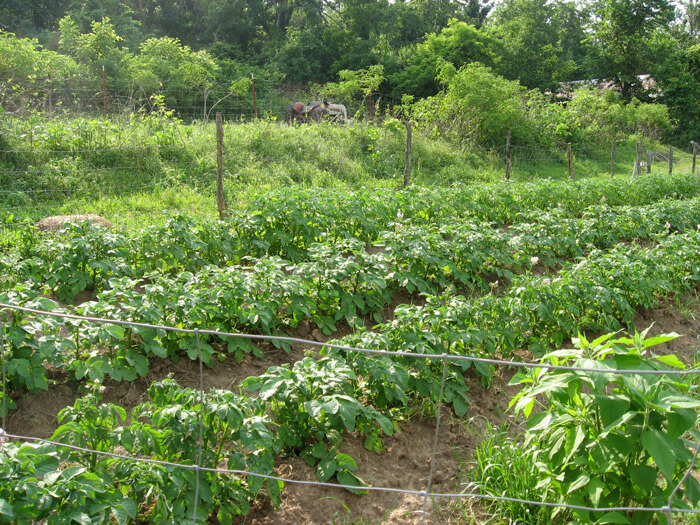 |
| Crystal Bowne, Back-to-the-Land Ozarker Gardens, Newton County, Arkansas, 2010 |
The most traditional, conservative Ozark inhabitants, who constitute the cultural focus of this research, have been ethnocentrically misrepresented in both popular and academic media.3Brooks Blevins, Hill Folks: A History of Arkansas Ozarkers and Their Image (Chapel Hill: University of North Carolina Press, 2002). Anthony Harkins, Hillbilly: A Cultural History of an American Icon (Oxford: Oxford University Press, 2004). Misrepresentations of Ozarkers emerge through a lack of cultural relativism and an inability or unwillingness to comprehend traditional Ozark culture. The cultural anthropology approach, with its methods of participant observation and semi-structured interviews, allows the researcher to move beyond stereotypes and gain an understanding of the interconnections between the motivations, perceptions, and practices of a group of people.4Karl G. Heider, Seeing Anthropology: Cultural Anthropology through Film, 4th ed. (Boston: Allyn & Bacon, 2006). Robert H. Lavenda and Emily A. Shultz, Core Concepts in Cultural Anthropology, 3rd ed. (Boston: McGraw Hill Companies, Inc., 2007).
This study presents Ozark seed savers and agrobiodiverse farmer-gardeners at the beginning of the twenty-first century, but it expands beyond conventional ethnography in two ways. I do not focus strictly on the present; instead I engage past subsistence traditions to elucidate contemporary practices, and I cast a wider net, utilizing a more diverse range of media to illustrate the Ozarks as a refuge for agricultural biodiversity. Drawing upon historical and contemporary photographs, recipes, folk tales, works of ethnographic/historical and autobiographical fiction, as well as excerpts from interviews with Willodean and other Ozarkers, these sources illustrate the diversity, agroecological knowledge, and frugality inherent in the region’s subsistence traditions.
Agricultural Biodiversity
With its adoption of the Convention on Biological Diversity, the 1992 Earth Summit in Rio de Janeiro highlighted the implications of species extinction and imprinted biodiversity upon the public consciousness as a buzzword for species richness and global health.5Hope Shand, Human Nature: Agricultural Biodiversity and Farm-Based Food Security (Ottawa: RAFI, 1997). While biodiversity became synonymous with the importance of not cutting down the rainforest, environmental anthropologists have attempted to expand that narrow conception. Most of the “natural,” pristine, or “virgin” landscapes that early European explorers encountered in the Americas were actually anthropogenic, created through human modification and management.6Bill Balee and Darrell Posey, Resource Management in Amazonia: Indigenous and Folk Strategies (New York Botanic Garden series, Advances in Economic Botany, 1989). Nancy J. Turner, The Earth’s Blanket: Traditional Teachings for Sustainable Living (Seattle: University of Washington Press, 2005). Unlike the common perception of humans as the cause of biodiversity loss, humans have enhanced or created biodiversity in their ecosystems through traditional management systems.7 Gary Paul Nabhan, Cultures of Habitat: On Nature, Culture, and Story (Washington DC: Counterpoint, 1997). Virginia Nazarea, Cultural Memory and Biodiversity (Tucson: The University of Arizona Press, 1998). M.L. Oldfield and J.B. Alcorn, "Conservation of Traditional Agroecosystems," Bioscience, 37 (1997) 199-208. E. Smith and M. Wishnie, "Conservation and Subsistence in Small-scale Societies," Annual Review of Anthropology 29 (2000): 493–524. Nancy J. Turner, The Earth’s Blanket: Traditional Teachings for Sustainable Living (Seattle: University of Washington Press, 2005).
Agricultural biodiversity refers to human-modified components of biodiversity that contribute to the sustenance and health of human populations.8Shand, Human Nature. This includes the domesticated plants and animals that constitute the foundation of agriculture and the non-domesticated plants, shrubs, and trees utilized for subsistence and health and the related soil biota and insects necessary for plant propagation and reproduction.9T. Johns, I.F. Smith, P. Eyzaguirre, "Understanding the Links Between Agriculture and Health" IFPRI, 13 (2006), 12-16. Several approaches characterize agrobiodiverse farming systems: 1) polyculture; farmers grow an assortment of crop species within a field or agricultural landscape; 2) intraspecific diversity; more than one variety of a species exists in the fields; 3) wild-domesticated continuum; farmers allow non- and semi- domesticated species to grow within and around fields; and 4) utility diversity; species in the fields have multiple uses, as livestock feed and human food, medicine, dye, clothing, storage, cordage, etc.10M.A. Altieri, Agroecology: The Scientific Basis of Alternative Agriculture (Boulder: Westview Press, 1995). Shand, Human Nature. Farmers the world over engaged in such practices before the now ubiquitous modern industrial agricultural model replaced diversity and self-sufficiency with specialization.11Altieri, Agroecology. T. Smith and Eyzaguirre, 2006. Eugene Odum, Ecology: A Bridge Between Science and Society (Sunderland, Massachusetts: Sinauer Associates, Inc., 1997). When the farmer focuses strictly on large-scale production of one crop for the market, the animals that previously produced manure for fertilizer, in addition to their meat, eggs, milk, or labor, must now be replaced with tractors, chemical fertilizers, and store-bought food. If the farmer moves to large-scale animal production, s/he must purchase large amounts of feed and abandon diversified production of crops. Instead of using manure as fertilizer, it becomes a point-source pollutant, requiring extensive mitigation measures to prevent groundwater pollution. Either way, a loss of self-sufficiency results.
While much agricultural biodiversity research has focused on farms and full-time farmers, studies reveal the comparatively high diversity of species and varieties in home gardens.12Virginia Nazarea, Heirlooms and their Keepers: Marginality and Memory in the Conservation of Biological Diversity (Tucson: University of Arizona Press, 2005). J.W. Watson and P.B. Eyzaguirre, editors, "Proceedings of the Second International Home Gardens Workshop: Contribution of home gardens to in situ conservation of plant genetic resources in farming systems," 17–19 July 2001, Witzenhausen, Federal Republic of Germany. International Plant Genetic Resources Institute, Rome, 2002. This new angle makes sense in light of the widespread shift from traditional to industrial agriculture throughout the world, transforming home gardens into refuges for culturally important crop species and varieties.13Nazarea, Heirlooms and their Keepers. Agricultural biodiversity researchers have encouraged an investigative approach emphasizing persistence in traditional farming practices within or despite culture change.14B. Orlove and S. Brush, "Anthropology and the conservation of biodiversity," Annual Review of Anthropology 25 (1996), 329-352. In Heirloom Seeds and their Keepers: Marginality and Memory in the Conservation of Biological Diversity, Virginia Nazarea explores “seedsaver gardens as repositories of ambiguities and alternatives that can effectively counteract homogenization and avert cultural and genetic erosion.”15Nazarea, Heirlooms and their Keepers, 16. She encourages researchers to “shift from conceptual, aggregate units such as “organizations” and “populations” (whether local or not) to actual people – people who acquire and pass on knowledge collectively and individually.”16Nazarea, Heirlooms and their Keepers, 19. This essay follows these leads by focusing on the diversity of one particular farmer/gardener to gain insight into traditional agrobiodiverse farming and gardening practices in the Ozarks.
The Biophysical Geography of the Ozark Highlands
The Ozark Highlands region comprises the southern half of Missouri, northern third of Arkansas, and a small fraction of northeastern Oklahoma, which geographers generally delimit by rivers: the Missouri on the north, the Mississippi on the east, the Grand on the southwest. Geographic characteristics that distinguish the Ozarks as a region include the general ruggedness and vertical topography, and the relative age of surface rocks being older than those in adjoining areas.17Milton Rafferty, The Ozarks: Land and Life(Norman: University of Oklahoma Press, 2001). The karst topography of the Ozarks creates many of these geographic characteristics; the soluble rock (dolomite and limestone) dissolves as groundwater filters through it. Much of the precipitation in karst areas carries nutrients critical to plant growth directly into the groundwater, well below rooting depths of most agricultural plants.18Tom Aley, "Karst Topography and Rural Poverty," Ozarkswatch 5.3 (1992), 19-21. Land cover in the Ozarks relates directly to these effects of the karst topography; unlike the surrounding regions, large-scale monoculture agriculture is untenable in the Ozark hills. Deciduous forests of oak-hickory-pine mixes with intermittent cedar glades compose the Ozarks’ primary landscape feature.
 |
| Ozark Relief Map, 2007 |
People from in and around the region refer to the Ozarks in a variety of ways, as the Ozark mountains, hills, highlands, plateau, escarpment, and to residents as Ozarkers, Ozarkians, hillbillies, baldknobbers, ridgerunners, hillpeople, in addition to some others not fit to print.19Rafferty, The Ozarks: Land and Life. Vance Randolph, Pissing in the Snow, and other Folktales (Urbana and Chicago: University of Illinois Press, 1976). Before modernization thoroughly infiltrated the Ozarks, even as late as the 1960s, the Ozarks constituted a discrete cultural province, with communities and isolated homesteads of self-reliant forager/gardener/farmers with their unique folkways and dialect scattered throughout.20Brian Campbell, "Ethnoecology of the Ozarks’ Agricultural Encounter," Ethnology: An International Journal of Cultural and Social Anthropology, 48.1(2009), 1-20. John Soloman Otto and Augustus Marion Burns III, "Traditional Agricultural Practices in the Arkansas Highlands," The Journal of American Folklore, 94 (1981), 166-187. Rafferty, The Ozarks: Land and Life. Vance Randolph, The Ozarks: An American Survival of Primitive Society (New York: Vanguard Press, 1931). With the construction of roads and bridges in previously remote areas, exposure to mainstream media through television and radio, and the concomitant decline of diversified farming as a livelihood, a significant percentage of the Ozark population abandoned or never learned the agrarian lifeway.21Blevins, Hill Folks. W.O. Cralle, "Social change and isolation in the Ozark Mountain Region of Missouri," The American Journal of Sociology 41 (1936), 435–446. Art Gallaher Jr., Fifteen Years Later (New York: Columbia University Press, 1961). James West, Plainville, U.S.A. (New York: Columbia University Press, 1945).
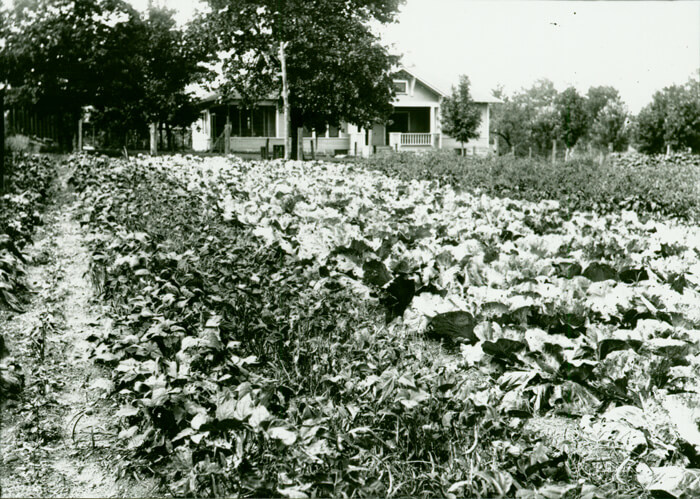 |
| Arthur Keller, Old Stock garden, Baxter County, Arkansas, early 20th century. Courtesy University of Central Arkansas Archives, Butcher-Keller Collection. |
Despite these relatively sudden and vast changes, the Ozark Highlands has retained many farming and gardening traditions, and constitutes a distinct bio-region. Researchers recognize the region as a contemporary refuge for unique open-pollinated (folk, heirloom, old-timey) varieties of agricultural crops.22Campbell, "Ethnoecology of the Agricultural Encounter in Ethnology." James R. Veteto, "The history and survival of traditional heirloom vegetable varieties in the southern Appalachian Mountains of western North Carolina," Agriculture and Human Values 25 (2008), 121–134. K. Whealy, Foreword. In S. Stickland (ed), Heirloom Vegetables: A Home Gardener’s Guide to Finding and Growing Vegetables from the Past (New York: Fireside, 1998). The Ozarkers who engage in agrobiodiverse farming and gardening rarely constitute a “population” or community or discrete cultural unit, but rather are dispersed throughout the region in pockets or “hollers” disconnected from one another. In the rural areas outside of the small Ozark towns, most homes feature a garden that has some mix (depending on the season) of basic staples, such as beans, cabbage, canteloupes, cucumbers, mustard greens, okra, peppers, potatoes, squash, tomatoes, turnip (greens), watermelons, and perhaps some corn. Yet the percentage of those gardens that house open-pollinated varieties rather than hybrids has fallen drastically over the last quarter century; I estimate that less than one quarter of Ozark gardens today can be characterized as “agrobiodiverse,” with at least several open-pollinated crop species in cultivation (not including hybrids and ornamental species). The total percentage of Ozarkers engaged in agrobiodiverse farming and gardening at the beginning of the twenty-first century is likely around ten percent, if not less, and these are spread throughout the region. As Nazarea and Orlove and Brush indicate, this discussion of agricultural biodiversity conservation acknowledges “the complexity of plant populations in dynamic and patchy social contexts.”23Nazarea, Heirlooms and their Keepers. Orlove and Brush, "Anthropology and the conservation of biodiversity," 342. Indeed, the contemporary Ozarks, as much as anywhere else, represents the patchiness and dynamism of agricultural biodiversity.
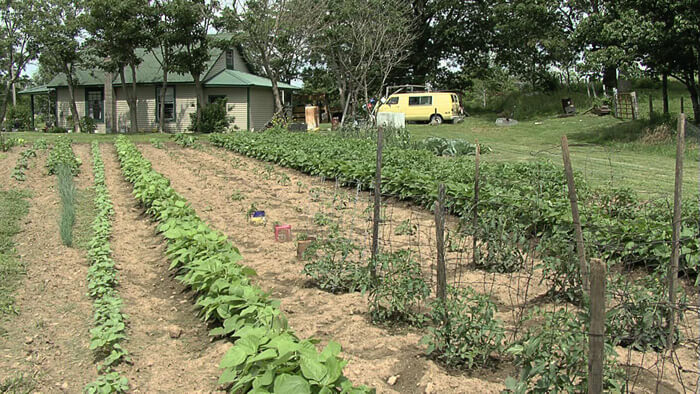 |
| Zachariah McCannon, Old Stock Ozark garden, Newton County, Arkansas, 2007. |
Ozark Settlement history and Demography
Prior to Euro-American settlement, the Ozarks was sparsely populated. There is archaeological evidence (spearpoints and mastodon and mammoth kill-sites) for Paleo-Indian (12000-8000 BC) and Archaic (8000-1000 BC) period occupation of the region. During the Woodland (1000 BC – AD 900) and Mississippian (AD 900-1700) periods the region housed forager-gardeners similar to the pre-modern Euro-American Ozarkers, with the main difference being the agricultural species grown. Deer and elk provided the bulk of the meat consumed; nuts (acorn, hickory, and walnut) and fruits (elderberry, grape, persimmon, plum) constituted the majority of the plant foods; and now-obsolete domesticated species (amaranth, chenopod, little barley, maygrass, sumpweed, sunflower), squash species and small amounts of corn provided a minimal percentage of the diet.24Gayle Fritz, "Identification of Cultigen Amaranth and Chenopod from Rockshelter Sites in Northwest Arkansas," American Antiquity, Vol. 49 No. 3 (1984), 558-572. George Sabo and Jerry E. Hilliard, "Woodland Period Shell-Tempered Pottery in the Central Arkansas Ozarks," Southeastern Archaeology, Winter 2008. From approximately AD 1500 through 1700 there was very little Native American occupation of the interior Arkansas Ozarks.25Kenneth L. Smith, Buffalo River Handbook (Little Rock, AR: The Ozark Society, 2004). During the historic period, from about 1700 until 1808, when they ceded the lands to the US government, the Osage maintained the Ozarks as a seasonal homeland and hunting reserve. The region also served as a refuge for displaced Native American groups (Cherokee, Choctaw, Delaware, Kickapoo, Shawnee) who came into conflict with the Osage as they attempted to settle.26Rafferty, The Ozarks: Land and Life. Of these diverse contemporary Native American groups, the Cherokee have established the most lasting and evident imprint on the region. By the late eighteenth and through the mid-nineteenth century, Cherokee splinter groups left the east and settled in the Ozarks.27Timothy Jones, "Commentary on 'Cultural Conservation of Medicinal Plant Use in the Ozarks.'" Human Organization 59(1)(2001), 136-140. During the 1830s, the Indian Removal Act forced southeastern tribes onto the Trail of Tears. En route to Oklahoma many Cherokee escaped into the Ozark hills. Despite forced removal of known Native Americans from the Ozarks to Indian Territory (Oklahoma) beginning in 1820, many Cherokee maintained anonymity and remained in the Ozarks. Some Cherokee intermarried with Euro-American homesteaders or clandestinely remained with groups of fellow Cherokee, which was not all too difficult because many they had already adopted the general subsistence and architectural strategies of their Euro-American neighbors in the Southeast.
The first Europeans in the Ozarks were French creoles, who almost exclusively exploited the mineral resources and fur-bearing animals. They established settlements on the fringes of the Ozarks, in what is now southeastern Missouri. Spain took formal possession of the region in 1770 and readily distributed land-grants to Americans to protect the territory from the British. France similarly used “Louisiana” strategically, and after re-establishing control of the region, sold it to the United States in 1803. Subsequently, Ozark lands were given to veterans of the American Revolution and the War of 1812 as payment for their military service. Ozark homesteaders of the nineteenth century were predominantly Scots-Irish, accustomed to living on the frontier, in close contact with Native American enemies and allies.28Blevins, Hill Folks. Rafferty, The Ozarks: Land and Life. Typically young men would precede their families and begin the homesteading process, later sending word for the rest of the family to join them. In their relative isolation, they frequently became involved with local women, often of Native American (Cherokee, Choctaw, Quapaw, Shawnee) heritage. Native Americans contributed significantly to contemporary agricultural biodiversity because early homesteaders learned how to harvest and utilize wild species from Cherokee and other Native American residents and also integrated some of their domesticated species into their gastronomy. African-Americans, on the other hand, constituted a small proportion of the Ozark population in the past and present. Early settlers were mostly poor, landless, and without slaves. A few slaveholders settled in the fringe river valleys. During the Civil War and the decade after, many African Americans fled because of the lawlessness and violence.
 |
| Arthur Keller, Display of pumpkin harvest, Mountain Home, Baxter County, Arkansas, early twentieth century. Keller-Butcher Collection, University of Central Arkansas Archives. |
Descendants of the earliest Ozark homesteaders who continue to reside in the region, such as Willodean, are referred to as Old Stock Ozarkers to differentiate them from more recent in-migrants.29Russel L. Gerlach, Immigrants in the Ozarks : A Study in Ethnic Geography (Columbia: University of Missouri Press, 1976). While some Old Stock residents in the twenty-first century continue to engage in seed saving and agrobiodiverse gardening traditions, most have adopted technological conveniences and abandoned traditional practices. More recent Ozark settlers have arrived with specific intentions of perpetuating traditional agrobiodiverse farming practices. Beginning with Depression era “back-to-the-landers” of the Arts and Crafts and Country Life movements through the counter-culture of the 1960’s and ‘70s, people raised in urban environments have sought the Ozarks as a pastoral getaway to experiment with, and sometimes persevere in rural living.30Blevins, Hill Folks, Campbell n.d.
The Ozarks has consistently served as a destination for disillusioned Arcadia-seekers because of the inexpensive land, isolation, beauty and abundance of water. Most of these back-to-the-landers have been “driven back to civilization by snakes, chiggers, heat, cold, and starvation,” but many have also remained.31Blevins, Hill Folks, 200. While exact numbers are impossible to ascertain because there is no census category for this variable and these homesteaders are by choice difficult to document because of their avoidance of mainstream societal institutions, they represent a small percentage (five to ten) of the population in most Ozarks counties, but in some, such as Newton and Stone counties in Arkansas and Ozark County in Missouri, the percentages are much higher. Donald Harington characterizes such back-to-the-land Ozarkers as similar to earlier homesteaders:
Elsewhere in Arkansas the latest blooming hippies have all cleaned up and moved back to the suburbs. Those who persist and endure in Newton County, are the strong ones, fit survivors, like the real pioneers in the nineteenth century, who came as a kind of spillover of the mountain settlement to the east.32Harington, Let Us Build Us a City: Eleven Lost Towns. (New Milford, CT: The Toby Press, 1986), 98-9.
 |
| Arthur Keller, Man standing among tomato plants, early 20th century, Mountain Home, Baxter County, Arkansas, Keller-Butcher Collection, University of Central Arkansas Archives. |
Harington’s romanticized portrayal in this semi-autobiographical work captures the back-to-the-land subset relevant to this research; however it omits the poverty and difficulties of many such inexperienced urban refugees.
Back-to-the-land homesteaders may not have the family tradition or childhood experience in the Ozarks, but they usually bring a range of seeds, many of which are new to the region, and books on homesteading, organic gardening, and seed-saving, and eventually develop local networks to assist them in their adaptation to the landscape. They typically share the frugality of Old Stock residents and engage in traditional, long-abandoned practices such as plowing with mules or horses. They rarely realize their aspirations of self-sufficiency. Back-to-the-landers almost always fall back on some form of occupation to supplement their gardening, farming, and/or foraging. As Tina Marie Wilcox, Ozark Folk Center head gardener and back-to-the-lander explains: “I moved to the Ozark Mountains with the mission of growing all of my own food. I’ve learned that this is easier said than done.” Contemporary Old Stock Ozarkers have no such illusions of making a living through farming, rather they tend to heavily supplement another occupation with foraging, farming, gardening, and hunting. Old Stock Ozark families invariably refuse to sell their garden surplus, preferring to give it away to family and neighbors.
General Characteristics
These subsistence strategies supplement Ozarkers wage income, which tends to be comparatively low. For example, Searcy County, Willodean’s home county, has 667 square miles, with twelve people per square mile, which is a very low population density. According to the US Census Bureau, the median household income in 2008 was $25,807, with approximately one quarter of the county population living below the poverty level. The most common jobs for men in Searcy County include construction (20%), agriculture, foraging, and forestry (13%), and woodworking (12%) (timber and furniture and related production); for women they are health care (17%), education (14%), and food services (12%). 96.8% of the population is characterized as “White Non-Hispanic,” followed by “American Indian” (1.8%). Sixty-eight percent of residents over twenty-five years of age hold a high school degree, while only 8.4% have a bachelor’s degree or higher. The Ozarks in general has been described as “overchurched” in reference to the myriad sects, denominations and evangelical fervor.33Rafferty, The Ozarks: Land and Life. An overwhelming majority, 92%, of Searcy County residents (who participated in the census) reported their religion as evangelical Protestant, (Baptist 57%, Church of Christ 13%, Assembly of God 10%, and other) while the remaining 8% reported themselves as United Methodist. The residents lean toward the right in their political stance, with between 60 and 75% voting Republican in the presidential elections of 2004 and 2008.
Geography and Gastronomy
During the late nineteenth and early twentieth centuries the vast forests of the region attracted the industrial timber industry from outside. Logging companies denuded many of the Ozark hillsides of their virgin white oak forests. The shallow soils, with nothing to hold them in place, washed away, choking streams and rivers. Previously abundant fish and game disappeared as their habitats were destroyed and desperate Ozarkers over-harvested those that remained. Many Ozark homesteaders left, typically heading for California, because they could no longer make a living in the degraded landscape. The US government purchased enormous tracts of this Ozark land for pennies on the dollar and converted it into National Forests.34Rafferty, The Ozarks: Land and Life.
Those families who scraped by in the Ozarks represent the defining sociological character of the region – mirrored by the landscape – ruggedness. They survived because they diversified their subsistence base; they obtained food not only from their own production, but also by their awareness of it in the wild. Charles Morrow Wilson, journalist and chronicler of the Ozarks in the first half of the twentieth century, documented and celebrated the Ozarks as a special place with a uniquely independent population, noting the traditional foodways. Few other primary or secondary sources from this era indulge the reader with ethnographic details about the agricultural biodiversity used in Ozark foodways. A key motivation for his in-depth discussion must be that Wilson had the “Divine permission to grow up on an Ozarks farm in an era when the utilization of the home-grown and home-picked, plucked or otherwise recovered, was in prime.”35 Wilson, The Bodacious Ozarks, 152. As modernity increasingly invaded, Wilson lamented the decline in subsistence traditions:
There is no substitute for experience in the actual growing or gathering, cooking and eating of the foodstuffs. . . . It stays particularly true in the rural Ozarks where many of the most distinguished and delectable dishes were born directly of poverty and isolation. Both of the latter-named phenomena are now on the wane. So is at least some part of the charm of Ozarks cookery. But this is not inevitable. The culinary distinction can be restored and maintained to the extent that people are willing to experiment, to propagate both new and old varieties of edible plants in fields, gardens, orchards and berry beds, and even more definitely to take food materials directly from the open fields, ranges, woods and creeks or rivers.36Wilson, The Bodacious Ozarks, 164-5.
While Wilson worried that these Ozarkian traditions might perish half a century ago, this essay aims to reveal that in terms of agrobiodiverse subsistence his Uncle Green was on track with his opinion “that hit’s the backhills that stay interestin’ and closest to everlastin’.”37Wilson, The Bodacious Ozarks, 28. His assessment resonates with anthropological literature on cultural characteristics of pre-modern mountain regions; they are frequently inhabited by marginal groups with traditions distinct from lowland, mainstream populations.38Robert Rhoades, "Integrating Local Voices and Visions into the Global Mountain Agenda," Mountain Research and Development 20(1)(2000), 4-9. A significant portion of the cultural traditions that distinguish highland populations revolve around subsistence. As long as people seek out the mountains to avoid the mainstream, they subsist by consuming locally adapted species in that landscape. The isolation of the Ozark mountains also allows for a flourishing, clandestine underground economy, which consists of a wide range of economic transactions outside the formal market. These activities range from general barter, undocumented hunting and foraging, and the production and sale of illicit substances such as moonshine, marijuana and methamphetamines.39Rafferty, The Ozarks: Land and Life. Rural Ozarkers usually adhere to a “live and let live” philosophy; whether they approve of, or engage in such activities or not, they tend to ignore them as long as they do not negatively affect their families directly.
Willodean: Ozark Subsistence Traditions in the Present
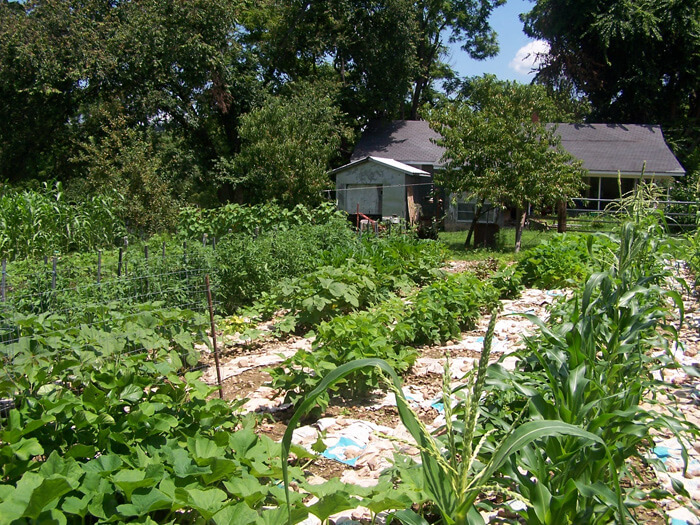 |
| Brenda Smyth, Willodean's garden, Searcy County, Arkansas, July 2009. |
On a spring day in 2009 I visited the home of Kenneth and Willodean Smyth in Marshall, Arkansas. They live a mere six blocks off the main highway, but their fifteen acres boasts a very large garden, fruit trees, nut trees, blackberry brambles, chicken coops, a humble, comfortable residence, and a priceless view of the forested Boston Mountains (Ozarks) in the distance. During the interview Willodean toured me around her gardens, planted approximately a month earlier, showed me the coop for her bantam fan-tail chickens, and led me down into the cellar. The cellar contained a woodstove, an enormous freezer stocked with meats and grains, most notably her family variety cornmeals milled down the road, and a 12’ x 12’ room completely full of canned preserves. She proceeded to rattle off the contents of every group of Mason jars, with agronomic and culinary anecdotes accompanying each. This essay uses those anecdotes as springboards for detailed discussions of the three interconnected concepts that emerge in my analysis of traditional Ozark subsistence: diversity, agroecological knowledge, and frugality.40While animals constitute a very significant component of traditional Ozark subsistence, this research focuses exclusively on the diversity of the home garden and cellar (for more on animals in traditional Ozark agroecology see Brian Campbell, "'A gentle work horse would come in right handy': Animals in Ozark Agroecology," Anthrozoös: A multidisciplinary journal of the interactions of people and animals, 22(3) (2009), 239-253).
Willodean Smyth exhibits agroecological knowledge and frugality in the creative strategies she uses to recycle materials to ensure that nothing goes to waste. Diversity is on display by the range of species and varieties grown and used and in the array of methods of preservation and consumption. Prior to the early twentieth century, the only methods of preservation consisted of salting (meats), pickling (various vegetables), drying (fruits and meats) or burying (typically tubers and some squashes) in the ground. Once canning was introduced and caught on, with much urging from Extension agents, Ozark housewives prided themselves on the amount of food they could “put up,” with estimates of “100 to 400 jars (quarts or half-gallon)” being acceptable.41West, Plainville, U.S.A., 37. The unpublished memoirs of Alice Dillard Smith of Marion County, Arkansas, born in 1894, set the bar even higher:
We use to have to raise our living, can and preserve it for winter use. I was always glad when the first frost fell for that meant my canning was about over, which I always did a lot of. One summer we canned 1600 quarts of fruit and vegetables. We didn’t have to worry about something to eat after the canning season was over; we looked forward to Hog Killing time.42Alice Dillard Smith (born 1894), Unpublished, hand-written memoirs. Marion County, Arkansas.
Diversity
 |
| Carl Mydans, Drying Jars for Canning Time, Missouri Ozarks, May 1936. Courtesy of the Library of Congress. |
Diversity exists not only in the range of species grown in a garden or field, but also in the distinct varieties of a species grown annually or from one year to the next. Old Stock Ozarkers who grow an annual garden frequently maintain some of their parents’ open-pollinated seed varieties. Gardening provides them with their own produce, and saving seed closes the loop, conferring independence, a valued trait. While many Old Stock seed savers do not refer to their family seeds as heirlooms, seed saving became so rare in the late twentieth century that mainstream society applied the term to such inter-generationally saved seeds. Old Stock Ozarkers who maintain family varieties do so for various reasons: to preserve their family history, to grow seed that requires minimal inputs to successfully produce on their farms, and especially to have the correct ingredients for the meals they like the most (e.g. bean dishes, cornbread, fried okra, grits, hominy, soups, squash casseroles). They consistently inform me that hybrid varieties just “don’t taste right” in their family recipes. Willodean maintains her open-pollinated varieties because she enjoys the holistic process of gardening, seeing the seed through the entire cycle.
 |
| Vaughn Brewer, Claudia Gammill, age 89, Stone County, Arkansas, 1979. Courtesy of University of Central Arkansas Archives, Rackensack Collection. |
Willodean continues an Ozark tradition when she plants a wide array of species in her garden; squash, cucumbers, garlic, onions, lettuces, corn, beans, peas, peppers, potatoes, tomatoes, turnips, and more fill every last inch of her tidy one acre patch. Abundant and diverse garden produce historically provided a significant portion of most Ozarkers’ diets. In 1979, Claudia Gertrude Gammill of Stone County, Arkansas asserted: “I made sixty-eight gardens in the same garden spot out here and I have not missed a year.” Her gardens included:
. . . tomatoes. . . peanuts. . . two or three acres in peas, a sorghum molasses patch, the cane to cut for hay for mules and stock to eat. . . Kraut cabbage. . . Three or four acres or five in cotton and corn. . . Taters, turnips, taters of both kinds and all kinds of garden stuff, onions, cabbage, and everthing beans, beans, planted in the corn, what is called white soup beans, . . . a yellow-pale yellow bean that I raised out just in the rows. There is a bunch bean. All of the beans we could eat all winter long.43Rackensack Collection, unpublished oral histories conducted in Stone County, Missouri in association with Jimmy Driftwood. University of Central Arkansas Archives. Conway, Arkansas.
In 1833, an immigrant to the region noted the seed varieties she transported from Germany to the Missouri Ozarks in cloth bags and paper seed packets:
. . . three kinds of green peas, four kinds of beans, three of carrots, three of onions, three of cabbages, two of beets, plus parsnips, cucumbers, gherkins, spinach, rhubarb, kohlrabi, leeks, and four kinds of turnips, two of which were for animal feed. . . gooseberry, blackberry, raspberry, and strawberry seeds, and for her planned orchard apple, cherry, peach, pear, quince, apricot, and plum seeds. Some twenty years later she wrote, "We have 22 apple trees; 10 cherry; 12 peach; 5 quince; 9 plum; 16 pear; 6 apricot; 16 crab-apple. We started by planting from seeds that I brought with me from home.44Erin McCawley Renn, "German Food: Customs and Traditions in the Missouri Ozarks," Ozarkswatch 3(3) (1990), 14-19.
Corn (Zea Mays), an Ozark Staple
Corn has been a key component of Ozark subsistence, appearing in one way or another at each meal.45William McNeal, An Arkansas Folklore Sourcebook (Fayetteville: University of Arkansas Press, 1992). The continuity of culinary traditions perpetuates diverse seed saving because family recipes sometimes require (or taste better with) particular varieties of crops such as corn. Because hominy remains a popular food in traditional Ozark homes, those families continue to grow open-pollinated field corn.
 |
| Zachariah McCannon, Hominy made with Hickory King corn, Stone County, Arkansas, 2008. |
In Bittersweet Country Ellen Gray Massey explains the practicality of hominy:
Making hominy was a way to continue using corn after the growing season in some form other than corn meal. Since the stored dried corn would not spoil, the ingredients were always at hand and it could be made throughout the year as a vegetable dish. Either yellow or white corn can be used, though most preferred white corn because it makes such a pretty white fluffy product. The variety that most preferred was Hickory King (usually pronounced “cane”).46Ellen Gray Massey, Bittersweet Country (Garden City, New York: Anchor Press/Doubleday, 1978), 40.
Ozarkers maintain that neither sweet corn nor hybrid field corn varieties can be used to make hominy appropriately. In 1982, Anna McDowell, of Madison County, Missouri explained:
I can tell you one thing, you can’t make hominy out of this hybrid corn. It’s got to be old fashioned or whatever you call it. I’ve tried it twice since I’ve been here with that hybrid corn, and you just can’t make hominy out of it. Oh, it’ll peel good, but . . . you just can’t cook it done enough. There’s a big difference in it.47Dana Hamilton, My Daddy Taught Me to Doctor Snake Bites! Mozark: Cultural Journalism of Madison County, Missouri High School English Class (Fredericktown Missouri Public Library Collection, 1982), 56.
| Willodean's Hominy with Lye recipe | |
| 6 cups corn 8 or 9 cups of water 1 tbsp lye | |
| Put in stone jar or glass, stir with wooden spoon. Soak overnight in glass or crock container in lye solution. Cook 30 minutes or until eyes come off easy in porcelain or cast iron pot. Stir last 15 minutes constantly. Dip out of kettle and strain. Change water and put corn back in. Boil 20 minutes. Repeat 2 or 3 times or until the water clears up. Fill jars ¾ full and add water and 1 tsp salt to top. Cook 1 hour. 10 lb pressure for 40 minutes. Yield 6 ½ pints. |
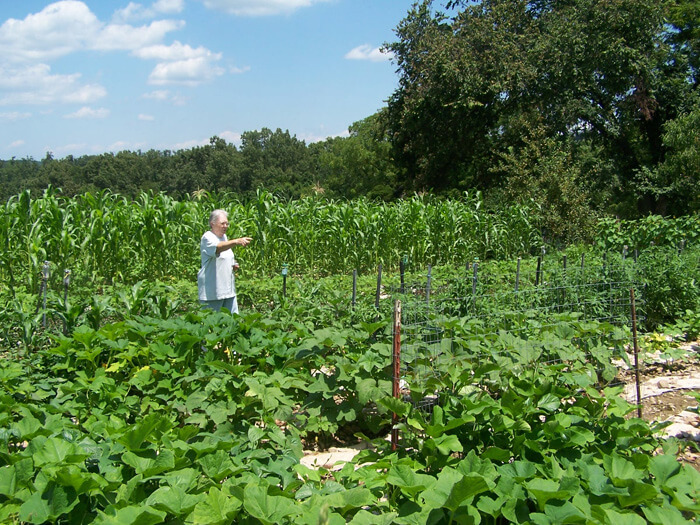 |
| Brenda Smyth, Willodean in her garden, Searcy County, Arkansas, July 2009. |
Willodean conveys ecological knowledge about the cross-pollination of various species and how to maintain pure seed varieties. Specifically she indicates that because she has more than one corn variety in her field she must separate them to prevent cross-pollination. Corn is wind-pollinated; once the tassels emerge and produce pollen the wind blows it onto the silks emerging from the developing ears below. Each kernel has a silk that must be dusted with pollen in order to develop. Corn varieties can easily cross, unless separated by a mile or two, or their planting is staggered to ensure that only one variety is spreading pollen at a time.48Suzanne Ashworth, Seed to Seed: Seed Saving and Growing Techniques for Vegetable Gardeners (Decorah IA: Seed Savers Exchange Press, 2002).
In the Ozarks, I have documented both seed-saving farmers who consciously prevent cross-pollination to ensure seed purity and others who do not concern themselves with cross-pollination, allowing the genetics of their seeds to intermingle. In this case, Willodean planted both Tennessee Red Cob, a field corn used to make corn meal, hominy or grits, as well as a sweet corn variety that would be eaten on the cob. Ozark farmer/gardeners frequently plant one field corn and one sweet corn variety each year.49Massey, Bittersweet Country. To reduce the possibility of cross-pollination, Willodean strategically plants other species in between each variety to block the flow of pollen from one corn variety to the other. She also chronologically staggers their plantings. Another way to prevent cross-pollination is to have someone else grow it, as Willodean explains about her daughter:
She got some black corn at the Seed Swap and she didn’t have space [in her garden]. I didn’t want it to cross with my corn in my garden so she had a neighbor up in Harrison grow it. She says: “It’s the strangest lookin’ corn I ever seen. It’s like a bush, with an ear on every stalk.”
The most common field corn (Zea mays) varieties found as heirlooms from the Ozarks include Bloody Butcher, Hickory Cane (King), Old Joe Dent, Pencil Cob, Possum Walk Special, Red Indian, Tennessee Red Cob, in addition to several popcorn varieties, such as Strawberry and Indian. I have documented many additional varieties that families name after a specific person, such as Ted Horton or Alfred Drury corn. Some of these corn varieties can be recognized as variants of historical varieties that were brought into the area from Appalachia (Hickory “Cane” [King], Tennessee Red Cob). The names indicate an Ozarkian (possibly universal) tendency to name a seed variety after the person who introduced it into the family. A comical exchange occurred when the sixty-year-old son of a seed saving matriarch was sent back to the pantry to retrieve some “Grandma Milsap’s” pinto beans and came back with several bags of bean seeds. He poured the contents of a bag out in his hand: “Is this them mama?” She studied the seeds and finally said: “No. That’s them John Dee beans.” Her son and daughter both giggled, having never heard about these beans, and she clarified: “I don’t know where John got them. They’ve been in the family for years. We don’t plant them anymore, because we don’t really grow field corn anymore and you have to have the field corn to vine’em.” She continued with a genealogical overview of John Dee, which reflects the power of seeds to preserve history and root cultural identity.
This exchange also elucidates a distinctive practice in agrobiodiverse farming: interplanting; in this case, John Dee beans are “cornfield” beans because they vine and climb the corn stalks, simultaneously fixing nitrogen for the corn plants. But because the family no longer grows field corn, they have abandoned this related seed variety. This exemplifies agricultural biodiversity loss and the interconnections between species; as particular traditions cease, related components, such as seed varieties disappear also.50S.B. Brush, Genes in the Field, On-Farm Conservation of Crop Diversity (Boca Raton, FL: Lewis Publishers, 2000).
 |
| Brian C. Campbell, John Dee cornfield beans, Newton County, Arkansas, 2007. |
 |
| Photographer unknown, Avery Brothers’ grandfather’s water-powered gristmill on Big Springs, Stone County, Arkansas, circa 1900. Courtesy of University of Central Arkansas Archives, Rackensack Collection. |
Gristmills were commonplace in rural areas through the mid-twentieth century. They were a place of congregation where people told stories, went on short hunting expeditions, whittled and/or reminisced while their corn was being milled. As early as 1840, there were at least four gristmills for stone grinding corn in each county of the Ozarks.51Blevins, Hill Folks, 22. In the early 1940s, Mr. A. O. Weaver, who “was seen on his mule, with a sack of corn strapped to his saddle, a gun in his hand, and his hound-dogs following along . . . on his way to the old Cedar Grove gristmill, to have his corn ground into meal” remarked:
This ol’ Cedar Grove mill is a real ol’ timer an’ has been grindin’ out corn meal ever since long before the Civil War. It has purtnye [pretty near] raised my family ‘cause there is where I’ve allers [always] took my corn to have it made into meal,. . . We’ve got to have corn meal at our house or we can’t live. I’ve got a big family an’ it takes lots ov bread, an’ when I go to the mill, I allers take my gun an’ dogs along an’ by the time I make the round an’ get back home, I’ve usually got a bunch of squirrels tied to this ol’ white mule, an’ that shore helps a lot at our table ‘cause we all like wild meat, sich as fish, squirrels, ‘possums an’ ‘coons an’ ground hogs, an’ turkeys.52Lennis L. Broadfoot, Pioneers of the Ozarks (Caldwell, Idaho: The Caxton Printers, Ltd, 1944).
 |
| Zachariah McCannon, Searcy County miller Rick Horton discussing local corn varieties with University of Georgia anthropology graduate student James Veteto, Searcy County, 2009. |
Whereas early Ozark gristmills were usually water-powered, contemporary ones typically run on fossil fuels or electricity. The general disappearance of gristmills throughout the United States contributes to the decline in heirloom corn varieties because without a local miller, field or dent corn used for cornmeal, hominy, and grits, is suitable only as livestock feed.53Wilson, The Bodacious Ozarks, 139. The Searcy County miller who grinds Willodean’s family corn works fulltime for the Arkansas Game and Fish Commission as a habitat biologist. He constructs and sells gas-powered gristmills and mills local families’ corn as a hobby. He estimates that only five to 10 percent of the corn brought for him to mill is hybrid, the other 90-95% is open-pollinated family corn. When a family brings him corn to be milled there is a fee for the service, unlike in the past when Ozark families had little (if any) cash money and instead paid a “miller’s fee,” a percentage of the corn. Willodean’s miller sets aside a small percentage of the corn unmilled in a deep freeze as seed stock to ensure that these family heirlooms are not lost. Several years ago one family planted all its seed corn and a severe storm washed it from their fields. The family was overjoyed when they contacted the miller and found that he had saved their corn seeds and their ancestral corn variety was not lost.
Agroecological Knowledge
Ozarkers who engage in agrobiodiverse farming have knowledge of their environment and the species within it that allow them to survive (agroecological knowledge). They utilize both wild and domesticated species, observe their behavior and interrelationships, and apply that information to use in gastronomy and agriculture. In the Ozarks and throughout the world, gourds (C. pepo,and Lagenaria siceraria) have found myriad uses.54Antonio Bisognin Dilson, "Origin and Evolution of Cultivated Cucurbits," Ciência Rural 32 (4)(2002), 715-723. Willodean and other Ozark farmers grow egg gourds (Cucurbita pepo) [also known as “nest” gourds] to use as surrogate eggs to indicate to a hen where she should be laying (rather than in hard-to-reach places) or to check the broodiness of a hen. Likewise, gourds have been grown on chicken houses to reduce or deter mite infestations55 Dilson, "Origin and Evolution of Cultivated Cucurbits." Nancy McDonough, Garden Sass: A Catalog of Arkansas Folkways (New York: Coward, McCann and Geoghegan, 1975), 213. Gourd vines have an especially pungent, putrid smell and contain, like other members of the cucurbit family, a secondary metabolite called cucurbitacin. Cucurbitacin has been documented as an insect repellant and attractant, and a purgative, emetic, and antihelminthic, in addition to other medicinal applications for humans. This particular metabolite may assist the plant in repelling mites that affect chickens. Hard-shelled (Lagenaria) gourds serve as containers of different sorts, birdhouses, and toys, and as the bodies of the earliest banjos and fiddles.56Ballentine UCA Rackensack Oral History Collection
Wild Species
Willodean Smyth, like many contemporary Ozarkers and their ancestors, utilize wild foods, especially berries, in a range of dishes and beverages. Lissie Moffett of Turtle, Missouri, explained: I pick an’ can enough wild berries every summer to do me through the winter. I take my basket on my arm an’ go out into the hills an’ stay all day, pickin’ huckleberries an’ blackberries.57Broadfoot, Pioneers of the Ozarks, 148.
| Willodean's Ozark Mountain Grape Drink | |
| Wash and stir fresh, firm, ripe grapes. Put 1 cup of whole grapes into hot quart jars. Add ½ to 1 cup of sugar (I use 2/3 cups) fill jar with boiling water, leaving ¼ in headspace. Adjust cap, press quart in pressure cooker (5 lbs) or 10 minutes in boiling water bath. Wait about 3 few weeks for flavor to develop. |
A wide range of wild plants continue to be important in Ozark subsistence. Willodean references the most widely used and appreciated wild green in the Ozarks, American Pokeweed (Phytolacca Americana).58William McNeil, An Arkansas Folklore Sourcebook (Fayetteville: University of Arkansas Press, 1992), 193. WPA Collection. She cans wild greens for her family to eat throughout the winter. Wild plants serve more than just culinary uses; they also provide medicine, stimulate growth in other plants, deter pests, and attract beneficial insects and pollinators.59Altieri, Agroecology. Michael Balick and Paul Cox, Plants, People, and Culture: The Science of Ethnobotany (New York: Scientific American Library, 1996). Ozarkers harvest spring culinary greens, in this approximate order: 1) watercress (Nasturtium officinale), sticky thistle (Cirsium species), wild lettuce (Lactuea Canadensis), wild onions [garlic] (Allium species) 2) plantain (Plantago species), dandelion (Taraxacum officinale), pokeweed, Henbit (Lamium amplexicaule), and broad-leaf (Rumex obtusifolius), and curley (Rumex crispus) dock 3) lamb's quarters (Chenopodium album), wild mustard (Brassica species), wild sage (Salvia lyrata) shepherd's purse (Capsella bursa-pastoris), and along creek banks: crow's foot (Ranunculus Trichophyllus) and colt's foot (Tussilago farfara), and then last to emerge in May is sheep sorrel (Rumex acetosella).60Nancy Holssinger, "Wild Greens: Values of the Roadside," Bittersweet 3(3)(1976), 52-57. Loma L. Paulson, "Greens Gathering through Generations," Bittersweet 3(3)(1976), 57-58. Randolph, The Ozarks: An American Survival of Primitive Society, 33. Wilson, The Bodacious Ozarks.
Pokeweed or poke sallit is a perennial plant that grows in just about any disturbed areas regardless of the quality of the soil. The ubiquity of the poke makes it a reliable food source even in the most stressed conditions. A folk tale collected in Stone County, Arkansas, in 1982 illustrates Ozarkers’ reliance on the plant, and their sense of humor:
Renzie Dow went to a place one night to stay. . . The man says come right on in. He says I do not have but one bed. You will have to sleep with me and my wife tonight. Says I will put a bolster [a long pillow] between us.
When time come to eat supper they did not have a thing in the world but poke salet. Renzie Dow was starving to death so he just eat poke salet until man it was a sight on earth, and the old man he reached over and he jerked the bowl away from him. He said . . . “to have some of that for breakfast; do not eat it all.”
Well, Renzie Dow was still just a starving to death. They went to bed and he was still laying there thinking about . . . all of that poke salet that he wanted. About midnight, why the stock just went to shouting out at the barn and all and the old man he had to go out and see what was bothering the stock. This woman . . . whispered to him. . . “now is your time.” Renzie Dow said, “huh?” and she says “now is your time, get over that bolster.” He said “Oh boy, I will get up and eat all of that poke salet.”61Rackensack Collection
The use of pokeweed as food requires knowledge of the plant’s properties, for it is poisonous if not cooked properly. Due to toxicity, only the young tender leaves are picked and boiled in water, and as Willodean explains, “boiled again” to ensure removal of the toxins.
Some plants produce toxic alkaloids and compounds to prevent herbivorous browsing, coincidently creating useful medicines or entheogens that lead to their increased propagation.62Balick and Cox, Plants, People, and Culture: The Science of Ethnobotany. Michael Pollan, The Botany of Desire: A Plant’s-Eye View of the World (New York: Random House Books, 2001). The toxicity of pokeweed results in medicinal properties that Ozarkers have identified.63Justin M. Nolan and Michael C. Robbins, "Cultural Conservation of Medicinal Plant Use in the Ozarks," Human Organization 58(1)(1999), 67-72. Poke’s early spring shoots are considered an invaluable spring tonic.64Holssinger, Wild Greens, 58. McNeil, An Arkansas Folklore Sourcebook, 193. Historically, after the preserves were finished off, Ozarkers had only smoked meat and hunted game to eat in the latter half of the winter, which led to a “thickening” of the blood. Spring greens “thinned” the blood, thereby restoring health. The roots can be used in tinctures or bitters, a combination of alcohol (historically homemade corn whiskey) and medicinal herbs, and in decoctions to treat a range of ailments, especially rheumatism and arthritis, and as a general tonic. Some Ozarkers eat a poke berry a day for similar reasons (spitting out the seeds due to the “pizen” in them).
Traditional Ozark meals consist of cooked greens (sometimes mixed with eggs) and some form of pork served with a variety of beans and cornbread. An Arkansas WPA (Works Progress Administration) researcher in the 1930s recorded a recipe for “Poke Sallit, one of the best-liked spring vegetable dishes,” that concludes “Many persons like to pour pepper sauce on sallit at the table” and provides a recipe for this particular pepper sauce that includes vinegar and “freshly picked ripe bird peppers” (Capsicum Annuum). I have documented and collected heirloom seeds from a range of “bird peppers” in the area that have been variously referred to as Bouquet Peppers, Chiltepins, and Poinsettia Peppers.
 |
| Brian C. Campbell, Poinsettia Peppers in the Seed Bank Heritage Garden, Greenbriar, Arkansas, 2008. |
The WPA recipe continues: “pot licker from poke greens as cooked in this way is particular-good eaten with corn bread.” Pot likker (licker) is the liquid left over after cooking greens and was commonly spread over cornbread. The cooked greens were usually poke, mustard (Brassica juncea) or turnip (Brassica rapa); the latter was the most common cultivated green. In Three Years in Arkansaw, Marion Hughes conveys the importance of turnip greens in early Ozark subsistence when he tells the story of a cow escaping into “John Brown’s garden and eat up his turnip greens, and John he sued [the cow’s owner] for maintenance until rostenears is hard enough to eat.”65Marion Hughes, Three Years in Arkansaw (Chicago: M.A. Donohue & Company, 1904), 44. The ubiquity of corn in traditional Ozark meals continues here, with the reference to “rostenears” [roasting ears]. This treatment of young field corn as a vegetable rather than a grain resembles our contemporary use of sweet corn.66West, Plainville, U.S.A., 45.
Frugality
 |
| Brian C. Campbell, Ladybug on Whippoorwill field pea plant, Faulkner County, Arkansas, Seed Bank Heritage Garden, 2007. |
Growing species and varieties that tend to be well-adapted and resilient in their region, Ozarkers use (and reuse) plants that require limited work and inputs to produce and avoid the outlay of cash as much as possible. Field or cow peas (Vigna unguiculata) exemplify these traits and constitute another key foodways component.
Charles Morrow Wilson describes the Whippoorwill cowpea variety cooked with hog jowls as “distinctive Ozark fare.”67Wilson, The Bodacious Ozarks, 157. The Whippoorwill pea – a hardy cowpea that survives the most extreme Ozark weather and readily self-seeds – was known to numerous Ozarkers as the food that “got them through the Depression.” In a 1979 inverview, the Avery brothers of Stone County, Arkansas said that when they were growing up their parents and grandparents referred to hard times as “eating peas and dance,” because that was all one could do then.68Rackensack Collection
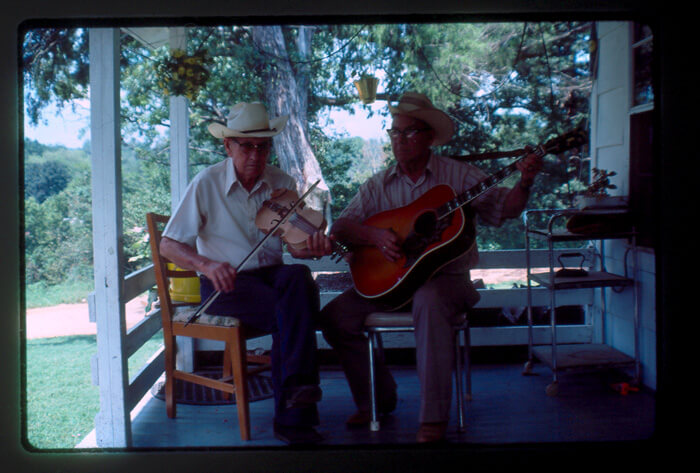 |
| Vaughn Brewer, Lonnie and Asburn Avery, Stone County, Arkansas, September 6, 1979. Courtesy of University of Central Arkansas Archives, Rackensack Collection. |
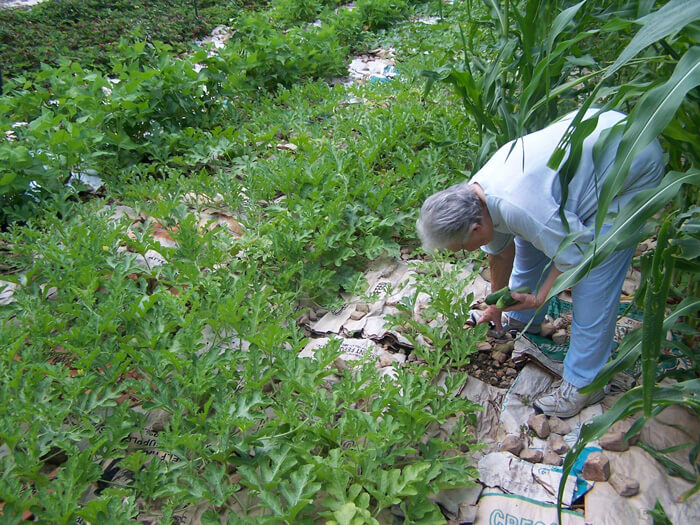 |
| Brenda Smyth, Old chicken feed bags in garden with rocks on them as mulch, Searcy County, Arkansas, July 2009. |
Willodean refuses to throw away feed bags because of their utility as garden mulch. The bags retain soil moisture and prevent weeds from outcompeting her desired crops. She reuses a wide range of containers and other materials. The foam trays from meats or other packaged store produce stacked in her kitchen pantry, remind me of another seed saver who uses these materials as seed drying trays. He is a back-to-the-land farmer who settled in Newton County, Arkansas, in the early 1980s, built his own home, and runs a plant nursery. He and his wife reuse a wide range of materials, from plastic bags and plastic garden pots to foam and cardboard trays for seed drying. In the past, Ozarkers resourcefully made use of torn clothing (rugs, quilts), corn cobs (fuel, pipes, dolls), shucks (chair bottoms, mats, brooms, mattress stuffing), old nails (fishing lures and gigs), and every part of an animal they slaughtered.69McDonough, Garden Sass. McNeil, An Arkansas Folklore Sourcebook. Old Stock seed savers continue to engage in recycling behavior because of their enculturation by parents who struggled through subsistence living and the Great Depression. Back-to-the-land seed savers may have different motivations for their recycling tendencies, such as more modern environmentalist and conservationist ideologies, but they share this dedication to frugality.
 | |
| Brian C. Campbell, Seed Drying Trays, Newton County, Arkansas, 2009. Back-to-the-land farmer and seed saver Herb Culver. |
Before tossing any food to the pigs or chickens (rural waste disposals), traditional Ozarkers would have attempted to convert it into a palatable human dish. Willodean and her husband Kenneth recognize that some potatoes will inevitably get damaged during the harvest and they take measures to ensure that they do not go to waste. On April 6, 1973, Alice Dillard Smith of Marion County, Arkansas, wrote about her first “whipping” from her father, which she received for unintentionally “wasting” an entire crop of watermelons. She recalled:
We lived on a Rocky Ridge farm, which wasn’t good for raising watermelons. But one Spring they were Determined to raise some melons, they made Special hills some way. . . But it was good bit of work an trouble. We had a very nice patch of them an they had worked hard to establish some raised beds to grow them. It was time for melons to start Ripening. I was very small girl then an Id seen people plug melons to see if they were ripe. I didn’t know it would hurt them. So I got a knife one day an made for the patch. I plugged ever melon in the patch, not finding one Ripe one. I carefully placed the plugs back never dreaming I’d ruined them.70Alice Dillard Smith, Marion County, Arkansas, Unpublished, Hand-written Memoirs, acquired by Dr. Campbell from the family during ethnographic research in 2008.
While her mother tried to hide it from her father, the truth came out when he visited the patch, and Alice received a harsh lesson in Ozark subsistence.
At the end of the growing season in late fall, gardeners must salvage what they can before the first frost. Frequently tomatoes and other vegetables are picked before they are ripe and must be used in some unusual dish. Chow-chow fills that role by combining a hodge-podge of ingredients that may not suffice to make their own dish.
When a cucumber grows too large, it is no longer palatable, however Ozarkers, create innovative dishes that convert something that is usually wasted into something useful. Willodean turns the large over-ripe cucumbers into cinnamon rings. Here is a recipe for over-ripe zucchini squash.
| Lucy Monger's Mock Apple Butter | |
| 4 cups zucchini puree 6 tbs vinegar 3 tbs lemon juice | 2 cups sugar 1 tsp cinnamon (or more to taste) |
| Peel zucchini, take out the seeds, and chop coarsely. Place in blender with vinegar and lemon juice. Blend until smooth. Pour into saucepan with remaining ingredients. Blend well and cook on medium heat, stirring occasionally until mixture reaches desired thickness. Cool and keep in fridge or pour into sterilized pint jars while hot and seal. Serve with biscuits or toast. We use the large zucchini that seem to escape picking for this recipe. | |
| Willodean's Green Tomato Relish | |
| 12 cups ground or finely chopped tomatoes 4 cups chopped onions 3 chopped red and green bell peppers 8 cups boiling water 4 cups vinegar | 6 cups sugar ½ cup canning salt 3 tbs mustard seed 3 tbs celery seed (if wanted) 2 tbs turmeric |
| Combine tomatoes, onions, and peppers. Add boiling water, let set 5 or 10 minutes. Drain. Mix vinegar, sugar, salt, mustard, celery seeds and turmeric. Add to tomato mixture boil slowly for 15 or 20 minutes or until ready to can. Pour in jars and seal. Makes 6 pints. | |
The Future of Ozark Subsistence and Agricultural Biodiversity
While Willodean involves her grandchildren in gardening and canning and encourages them to consume healthy homegrown food, many children in the Ozarks are removed from these traditional processes.To encourage the continued transmission of agroecological knowledge and seed saving, several organizations have collaboratively established Seed Swaps. Today, agrobiodiverse farming in the Ozarks does not occur strictly among Old Stock farmers, rather a wide range of back-to-the-lander and new international immigrants. The Seed Swaps present a diversity of seed savers, in their ethnicity (Guatemalan, Mexican, Hmong, Thai) and in their age and farming background. Bo Bennett, a college student, excitedly traded his great grandfather’s seeds for other people’s grandparents’ seeds, exclaiming:
I’ve got some seeds. They’re Moon and Stars Watermelon (Citrullus lanatus). I got these from my grandmother. They were my grandpa’s. He died ten years ago, but she saved this jar of seeds this whole time and never planted them. He grew them every year when he was alive and they were grown by my great-grandfather also.”
 |  |  | ||
| John Hammer, Bo Bennett, UCA student, holding okra seed (left). He traded his grandfather’s Moon and Stars watermelon seed at the Swap. Victor Garcia of Independence County, Arkansas, and Kent Bonar, of Newton County, Arkansas (center). Willodean Smyth with her family heirloom variety Pencil Cob Corn (right). Ozark Seed Swap, Mountain View, Arkansas, 2009. | ||||
When Willodean attended her first Seed Swap and realized the interest so many people had in her varieties, knowledge, and traditions, she glowed. She was energized. She now seeks out local heirlooms more than ever, grows them in her gardens, gives them to the seed bank and at Swaps. She invites young people to her home and shows them how she cans. When she prepared butternut (C. moschata) and coushaw squash (C. mixta) pies for some neighbor “kids” (forty-somethings), they were shocked not to have eaten such food before. “Wow! I’ve never had this before," one remarked. "I can’t believe this food is so much better than store food.” “After hearing that,” Willodean says, “I decided, the good Lord has kept me alive because I’ve got a job to do, to teach young people how to make a garden and can.”
]]>