Thursday, September 26, 2024
In Marshall talking with Joel and Josh. Very real concerns about the river, which is at ten feet, fierce, and rapidly rising. The island is already under water. At fourteen feet the river would be in town. At nineteen feet there would be extensive flooding and costly repairs.
Our niece Jody arrives at the house. She’s going to do a soap-making tutorial with Leslie for the weekend. We lose power later this evening and with it our water. Cell and internet are also out.
My concern is the wind. The ground is saturated from three days of rain. A windstorm could bring down thousands of trees lining our driveway, the road into town, and the forests that make up 73% of the land in Madison County.
Friday, September 27
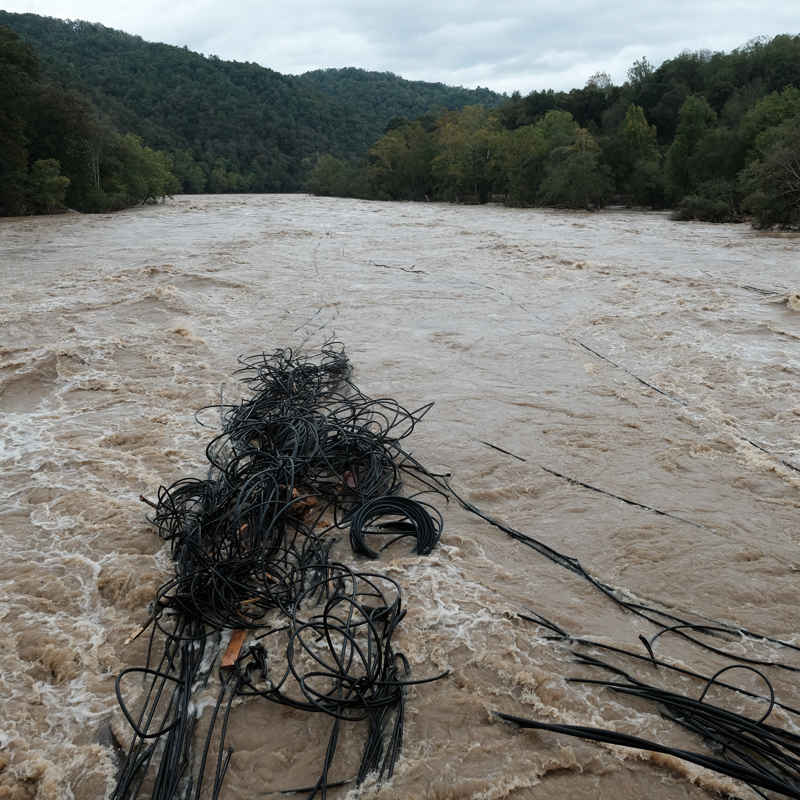
The river crested early this morning at twenty-seven feet, four feet higher than the previous record set in 1916. Yesterday’s concerns are facing today’s reality — the town’s total destruction. The wind never materialized at the house. It’s still raining. Our friend Maia has joined us after being evacuated out of Marshall.
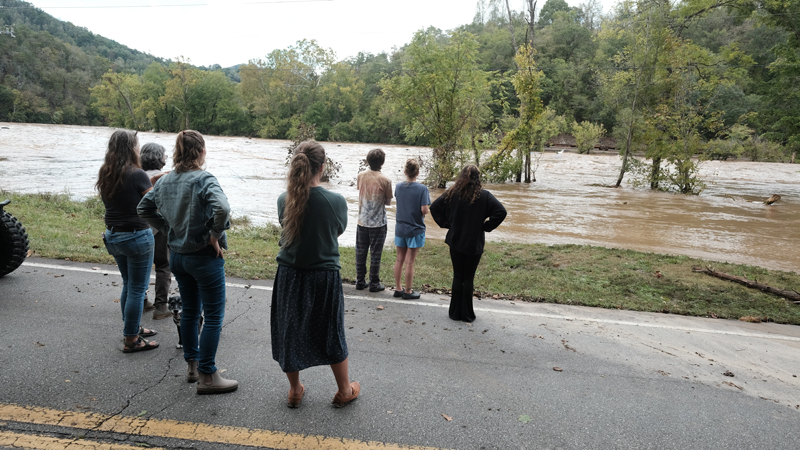
We pile into our car and drive down Little Pine, thinking we’ll go into Marshall. We’re stopped before we get to the Redmon bridge. Neighbors are lining the road looking at the river, which has become one with the road. Fuel tanks, giant tangles of PVC piping, shipping containers — swept away.
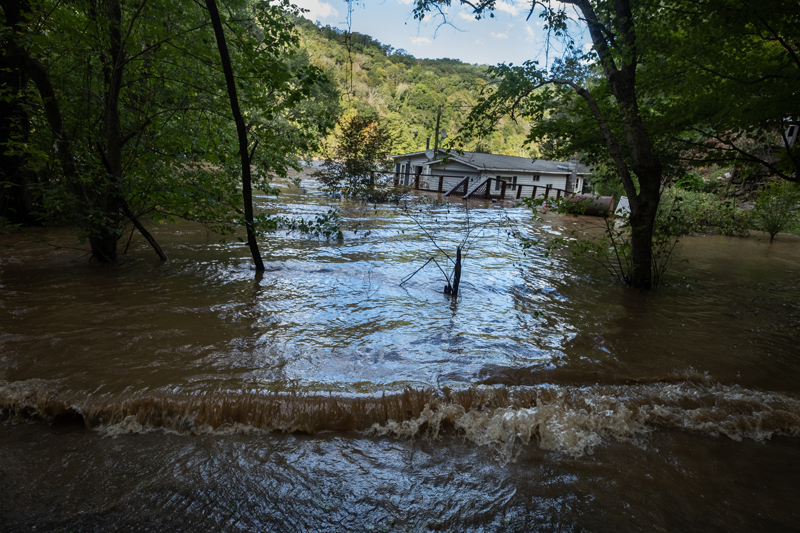
We turn around and drive down Anderson Branch to Barnard. There, worse. Over five feet of water covers the road. Ronnie Meadow’s house inundated. Neighbors wading waist-high water to get his prescriptions and photographs.
Stop at Paul and Laurie’s and get water from their spring. Go home and start cooking and the power comes on. Internet and cell service spotty.
Saturday, September 28
Drive down to Barnard to see if we can get out, and do. Stop at the bridge. Meet some neighbors, make some pictures, come home. Chris, Maia’s boyfriend, got in from Atlanta. We make supper.
Sunday, September 29
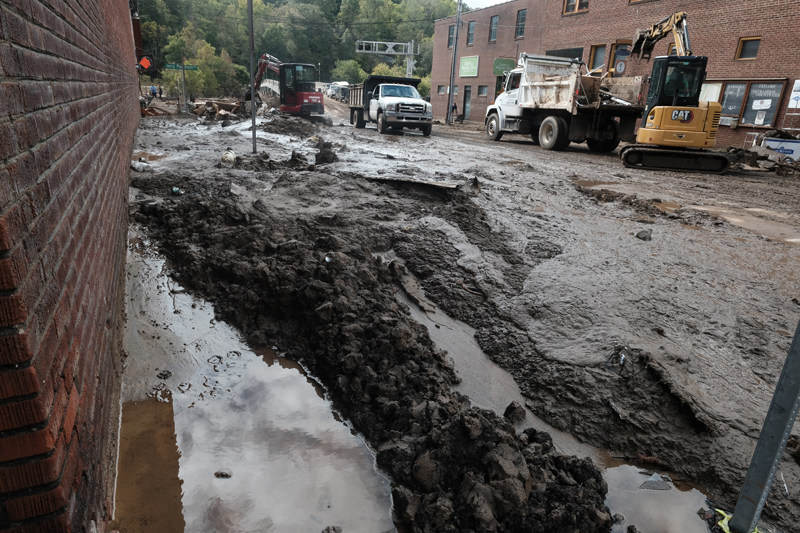
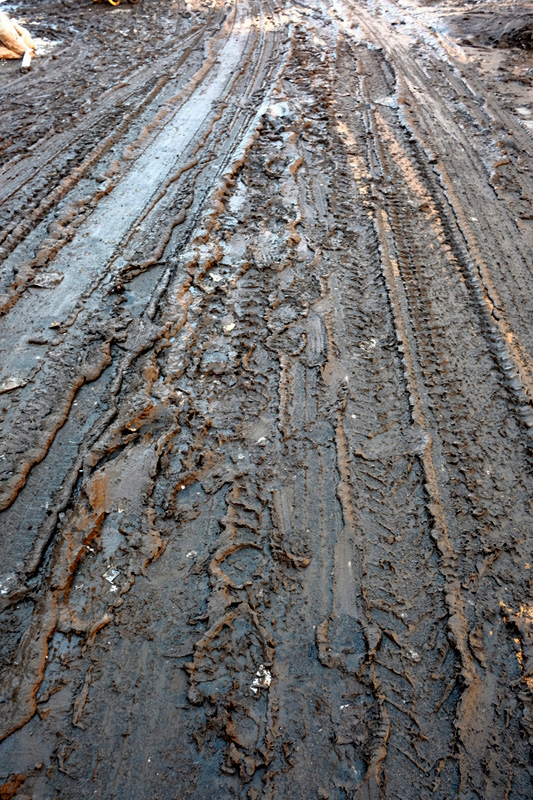
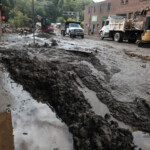
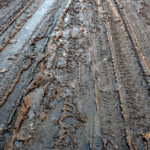
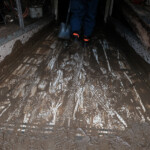
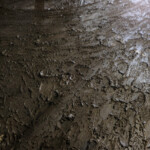
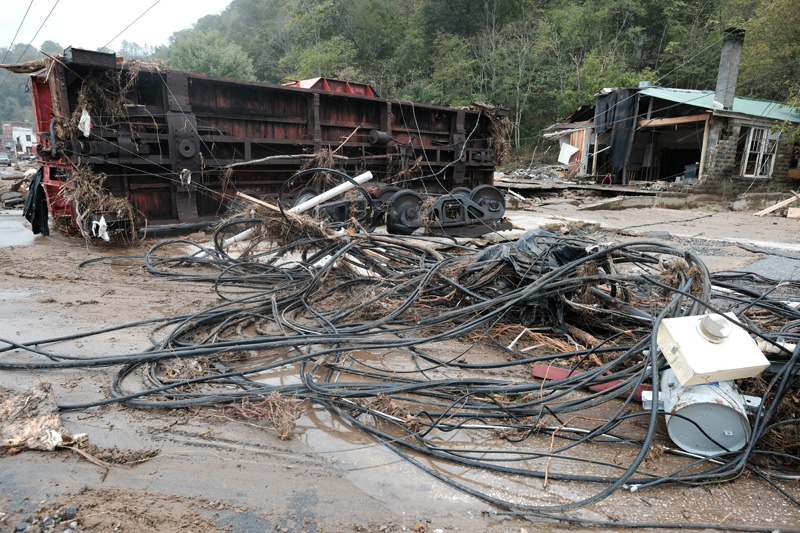
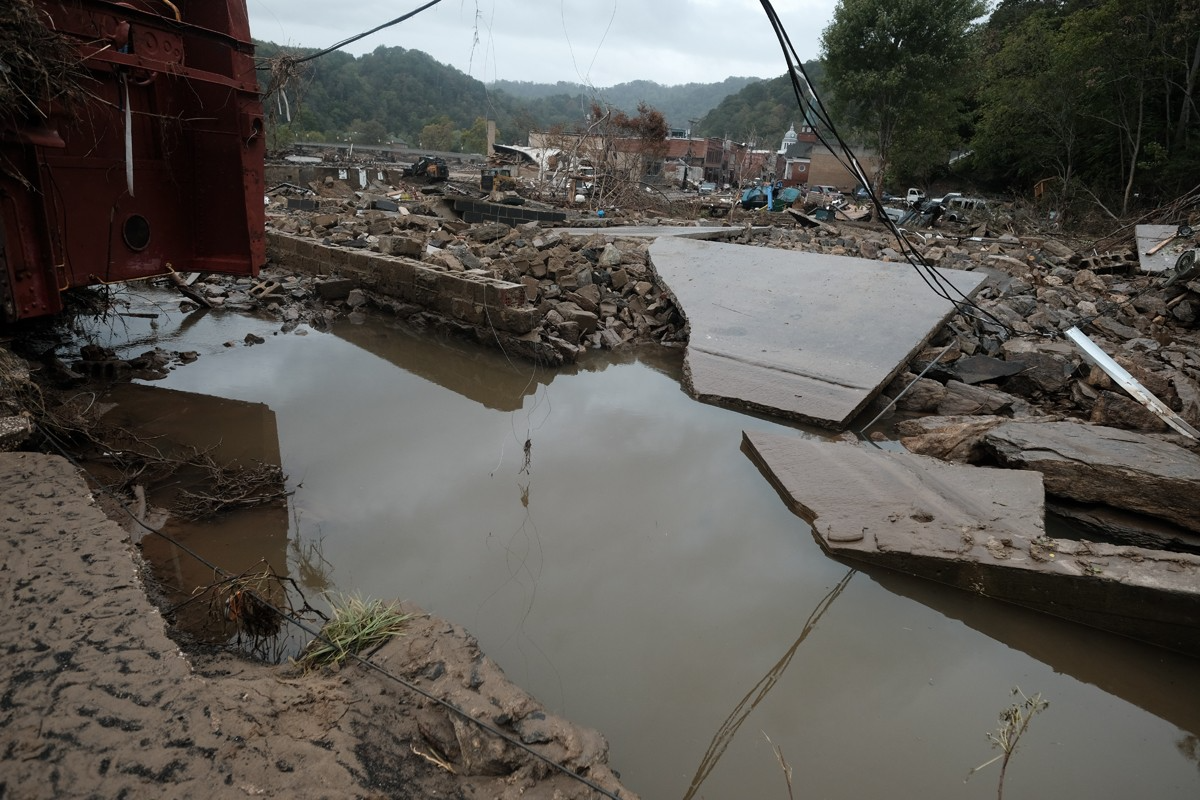
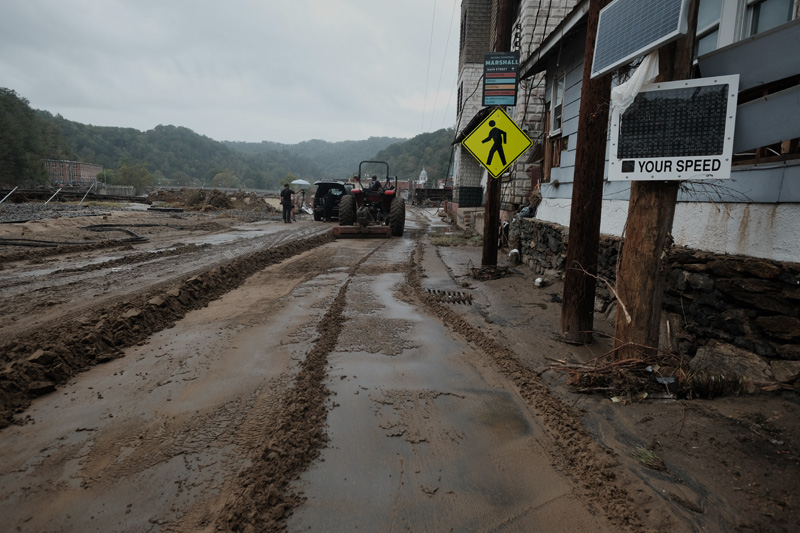
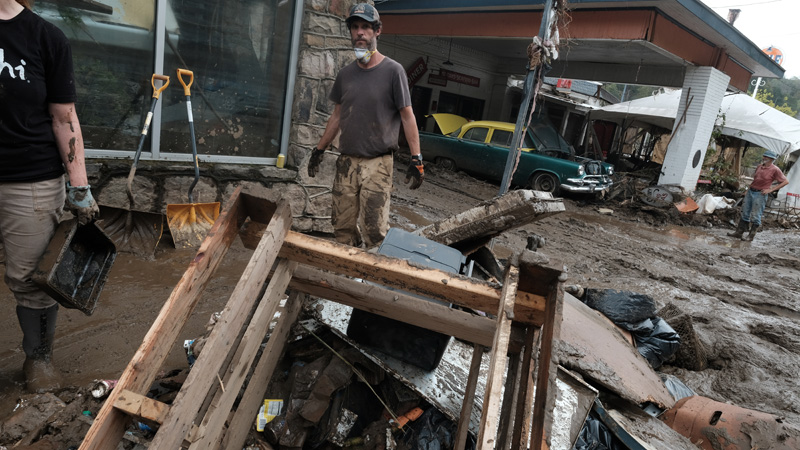
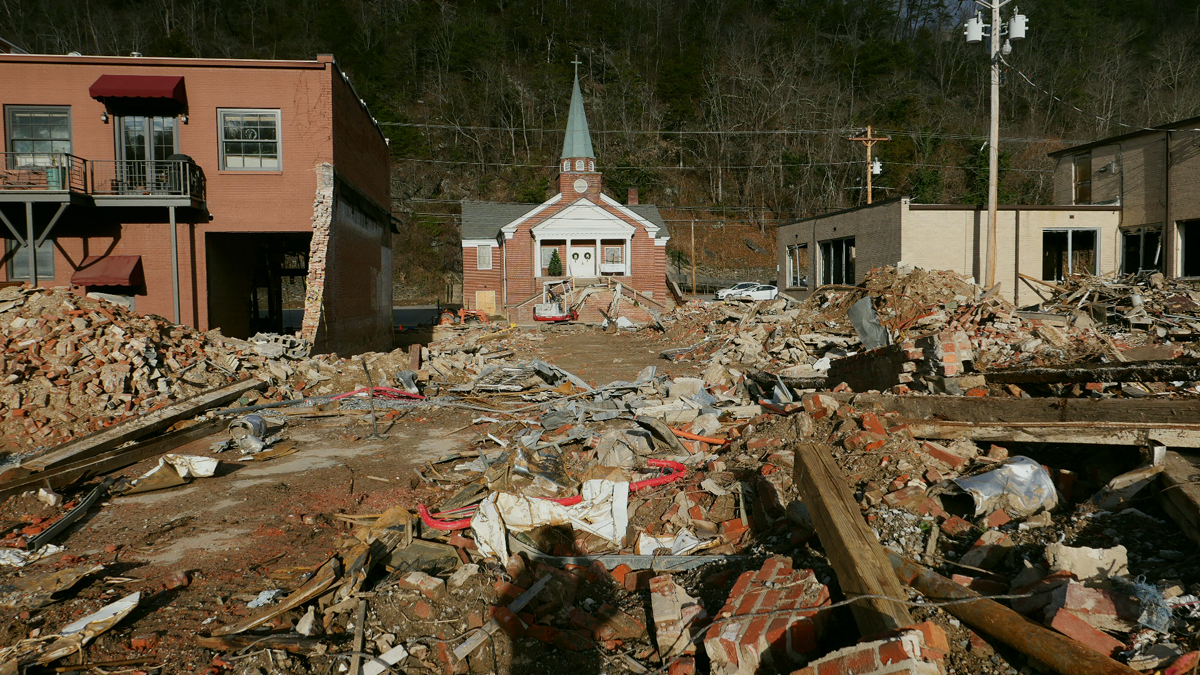
A first look at Marshall. The mud. Everywhere, impossible to avoid. Heavy, sticky. The kind of mud that sucks you in and holds you close. The beginnings of debris piles. Submerged cars and trucks. Rubble where buildings once stood. Stores and restaurants where we’d visited just days before, windows broken, spewing mud from their orifices. And the smell, a mix of water and mud, and propane, a general sense of toxicity.
This is the fourth hurricane related flood I’ve photographed in the last twenty years — Katrina in New Orleans, Hugo in South Carolina, Floyd in Eastern North Carolina, and now, Helene in my backyard.
There are similarities between the four. The mud. The displaced buildings and houses and subsequent debris fields. People’s faces and eyes, at once unbelieving and resilient.
But this is different. It is home, it is friends, neighbors, it is music and dancing, it is church if you want, art most everywhere, eccentricity abounding. It is gone.
I see Morgan, in the midst of mud and debris. Forlorn. No doubt realizing she’s lost her job to the flood. We hug. I move on.
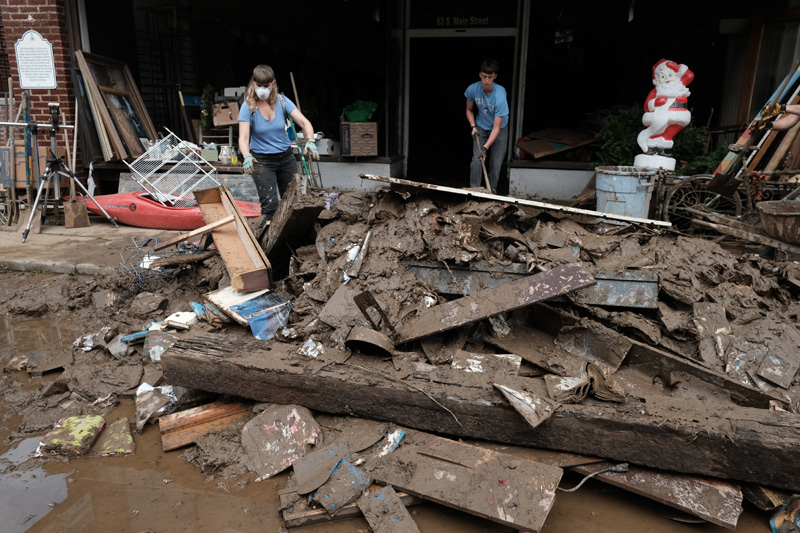
The uniqueness of each building has taken on a sameness of look. Broken windows, water lines above the doorways, stuff beginning to line the street — books, chairs, a sewing machine, an elk head, furniture, boxes of dripping files in front of a lawyers’ office — and mud.


Monday, September 30
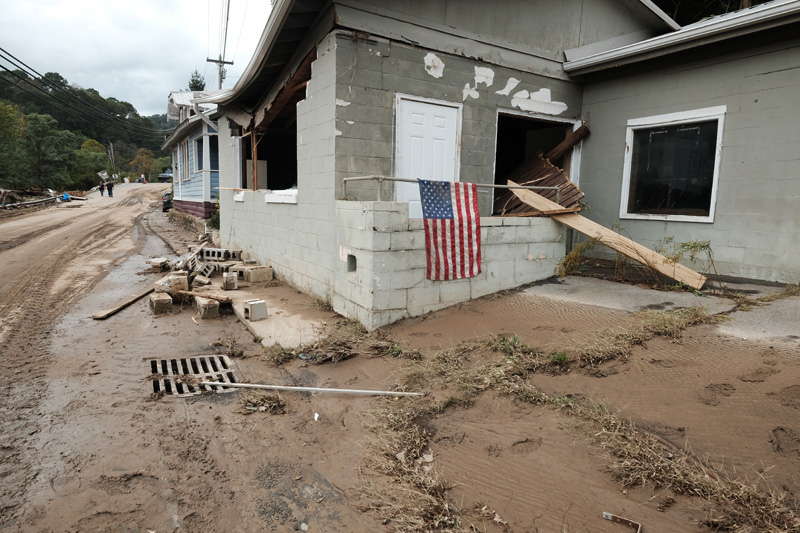
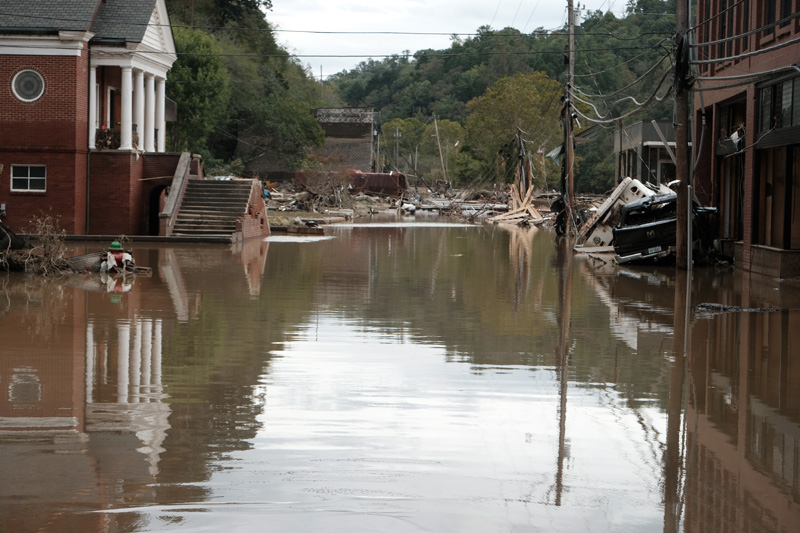
For many people, town residents and storeowners, this is a first look at the town, their places of business, their homes. The shock is palpable. The enormity of the destruction incomprehensible and impossible to accept. There’s tears, many, and embraces. What else to do? It’s a reckoning of what once was and what it has become in the blink of an eye. And what lies ahead.
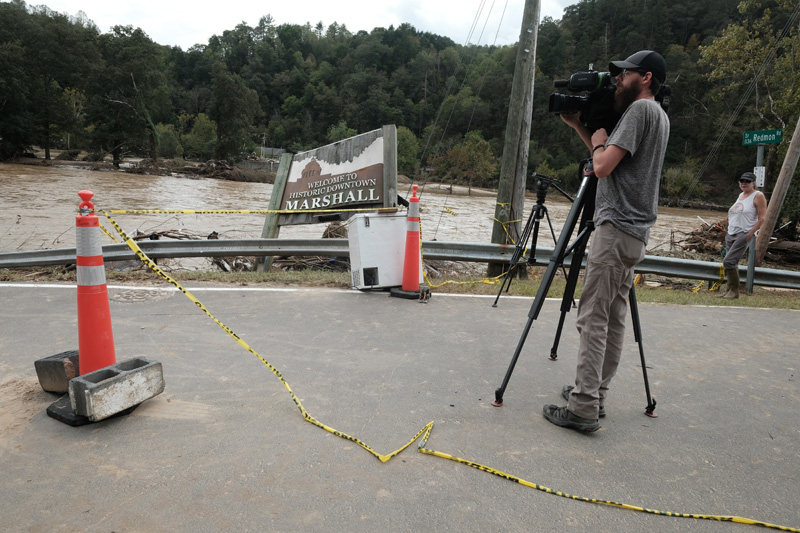
Western North Carolina has long been considered a climate haven. The Southern Appalachian mountains are among the oldest on earth and they offer protection from tornados and hurricanes and other natural disasters. We’ve had floods and landslides in the past, and memorable snowstorms, droughts, and fires. But Helene was unique and has been termed a “geological event” because the accompanying flooding, landslides, and tree damage will have a lasting impact on the landscape. It certainly has had a lasting impact on Marshall and the twenty western counties of North Carolina.
I walk through town for three or four hours, making photographs, talking to friends and neighbors. I think about shoveling mud, but feeling how dense and heavy it is, I realize that it’s a heart attack waiting to happen. I’m clearly the oldest person out there and the work is for the young.
I went to check on my books — 450 copies of my new book, Little Worlds —that were stored in a friend’s warehouse in town. The road in front of the building is foot deep in mud but seems firm at first step. With the second I am shin deep and locked in place, unable to lift my feet. John and Kirsten pull me out, sans shoes, which Kirsten pulls out by laying flat on the ground.
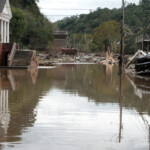
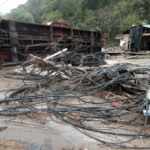
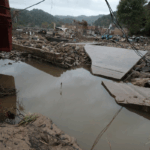
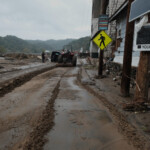
Tuesday, October 1
There’s more people in town today, beginning the task. Some are clearing buildings, adding to debris piles. Others are shoveling and scraping mud. Some are salvaging what little there is to salvage. There’s heavy machinery and a steady line of dump trucks heading to the landfill. The mud remains slick, never-ending, clinging to whatever it touches.
I talk with Jamie Smith and his wife who own the French Broad Exchange, our local used bookseller. They’ve lost over 15,000 volumes to the flood, almost their entire inventory. They’re older, of retirement age, and questioning a return. They don’t own the building and the owner is reluctant to commit to doing any repairs.
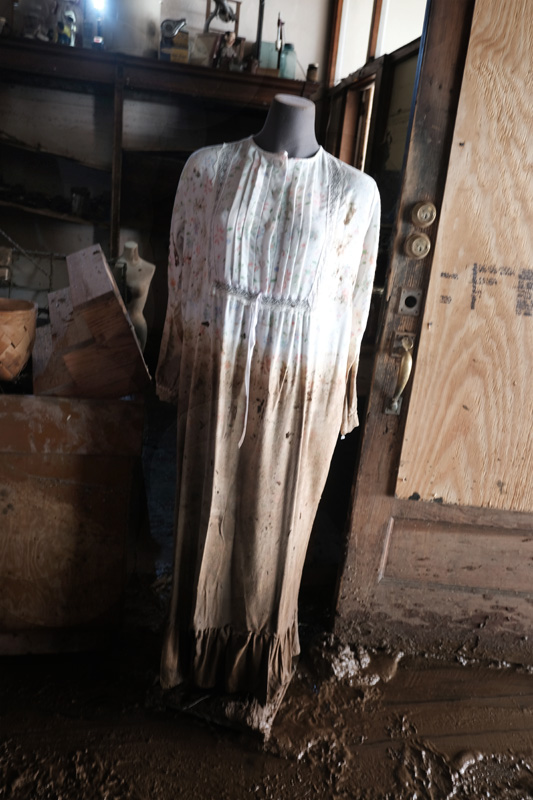
At Penland & Sons Store, the interior looks like a giant has gone in with huge salad forks and stirred the contents — clothing, books, jams and jellies, fresh vegetables. Georgette takes me to a moveable counter with two baskets of my wife’s soap resting on top. The flood lifted the counter to the ceiling and rested it in a new location in the store, never disturbing the soap.
With help from Todd I make it into the building to check on my books. It’s dark inside the warehouse, the floor carpeted with mud and water, tools, lumber. Two-by-ten boards have been placed throughout the building and we walk gingerly to the back. The pallet of books has been moved and is resting on its side in a puddle of water and mud. The covers appear untouched, protected by the cellophane covering. But when I cut into the pallet and pull out a small bundle of books, I see they are all sealed shut, only opened by tearing pages. Disheartening.
Wednesday, October 2
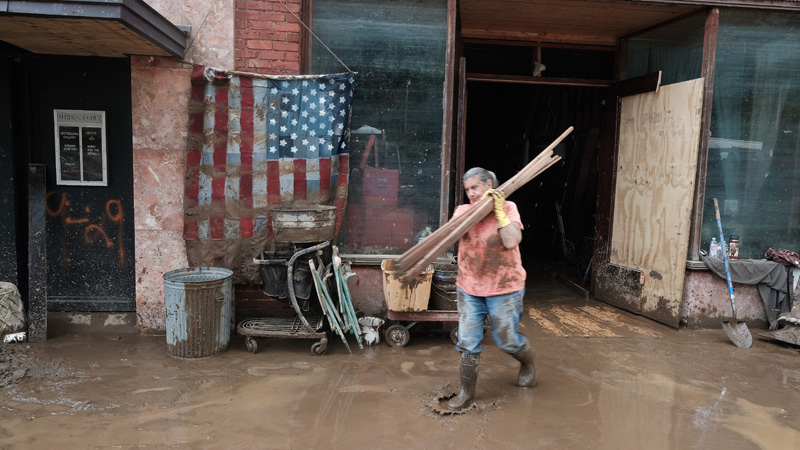
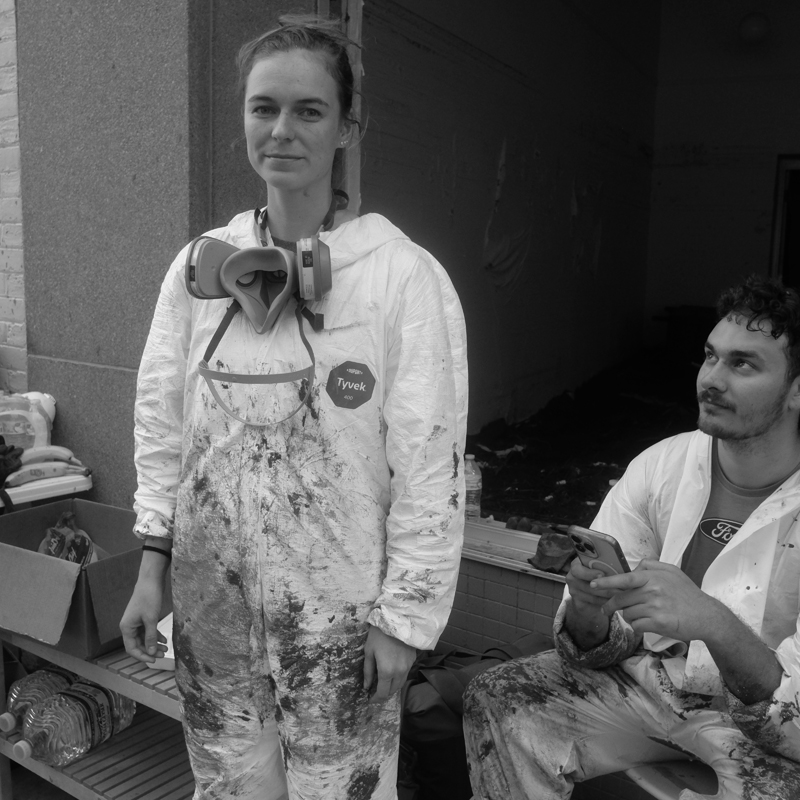
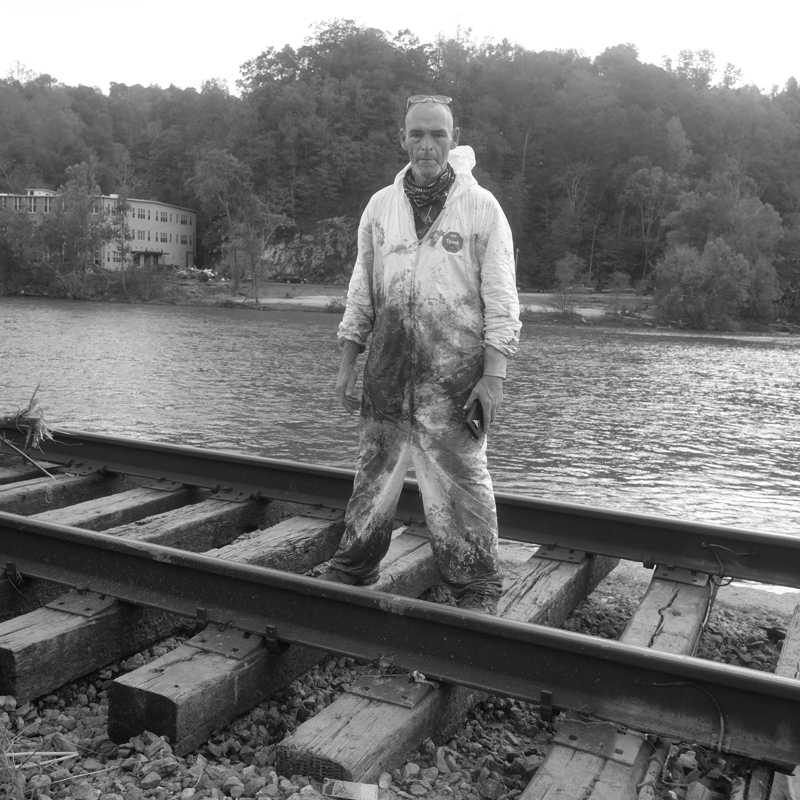
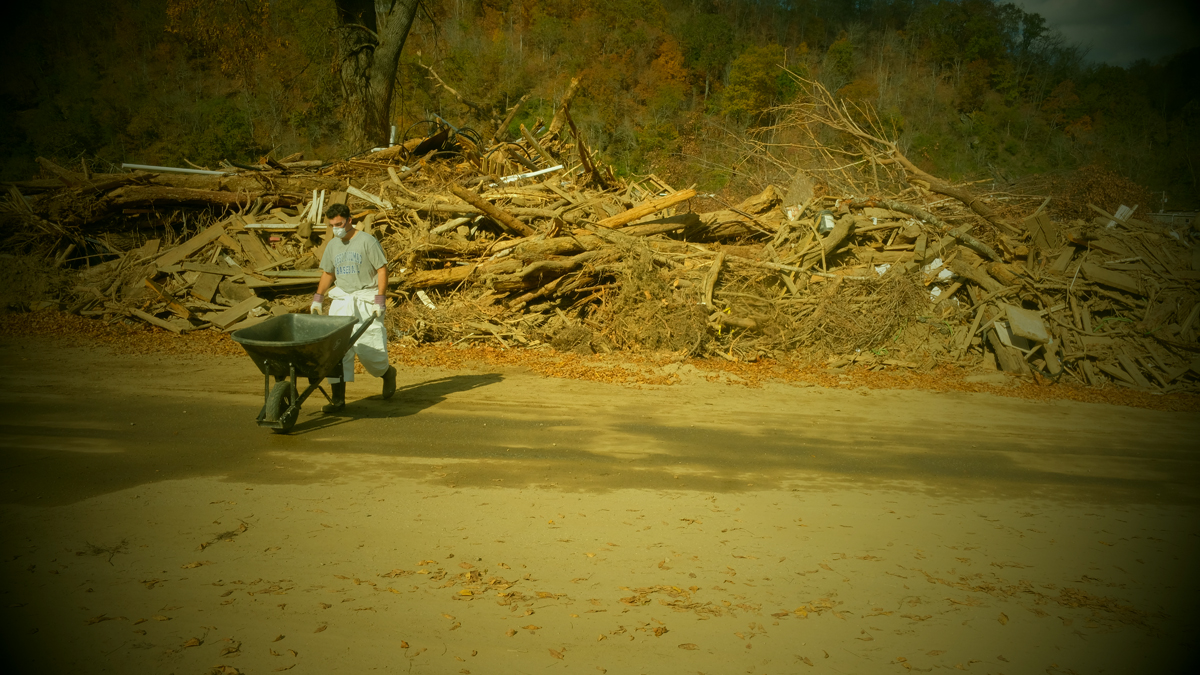
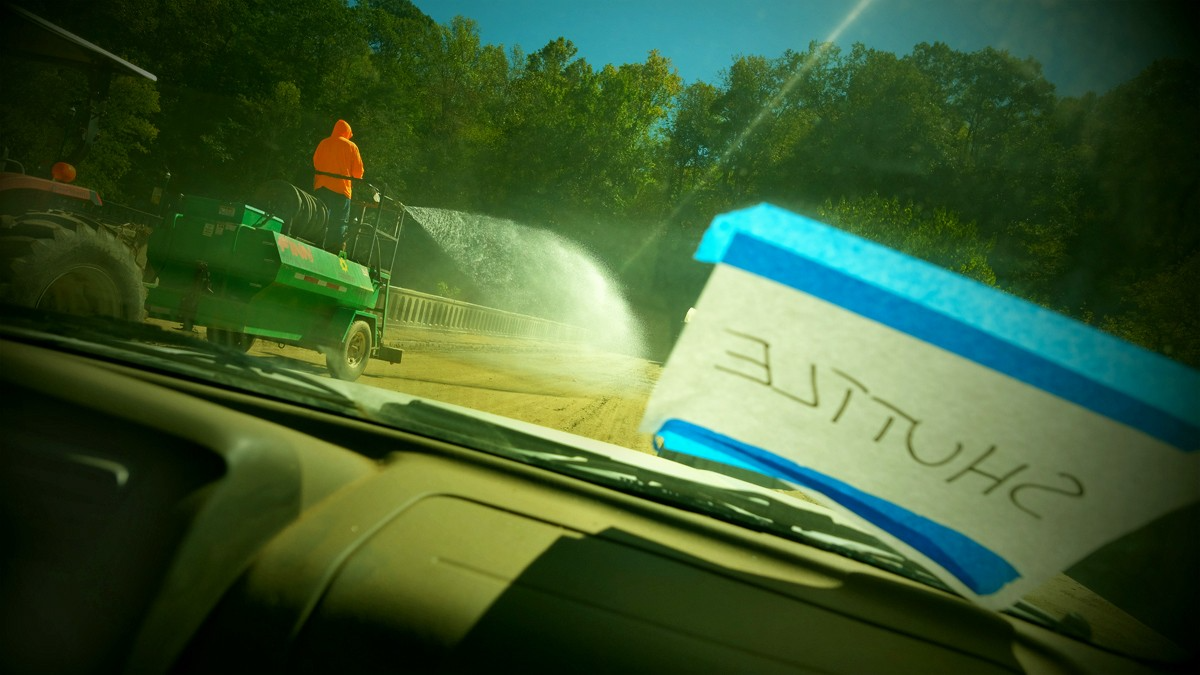
Staging ground has been set up at Nanostead on the Marshall bypass and it is immediately flooded with supplies, equipment, food, and volunteers. The volunteers are coming from all over and they are a diverse group — church groups, college students, elderly retirees, and county residents not impacted by Helene. They don Tyvek suits with boots, gloves and respirators as there are concerns about the toxicity of the mud. They’re shuttled into Marshall in the back of trucks, their gleaming white outfits blinding in the sunlight.
The town is a hub of activity. I’m reminded of stories about Marshall before the coming of I-40 and the bypass. Then, it was on the most direct route between Knoxville and Asheville. This small mountain town had three car dealerships, three grocery stores, two hardware stores, two florists (Sunnyside and Shadyside}, a library, the courthouse, countless attorneys, the jail, and restaurants and general stores.
Now, the streets are crowded and dangerous with an abundance of heavy machinery — track hoes, front end loaders, bulldozers — all piling and loading a steady stream of dump trucks, some with mud, others with debris, and still others with remains of trees. Smaller tractors with scrape blades try to keep the mud at bay.
Inside the buildings the owners, along with friends and volunteers, push and bucket mud into the street. The concern now is mold. A series of warm sunny days heightens the fear. Piles of soggy, stinky, just plain nasty, insulation and sheetrock begin lining the street.
The mood is different today. The townspeople remain depressed and angry. But I also sense an adrenaline rush, a feeling of resilience and determination to rebuild. Perhaps it’s the volunteers, the added hands and young energy. Or the visible evidence of the recovery moving forward. Or how the town is working together.
Food stands are set up to feed the workers. Water. Washing stations.
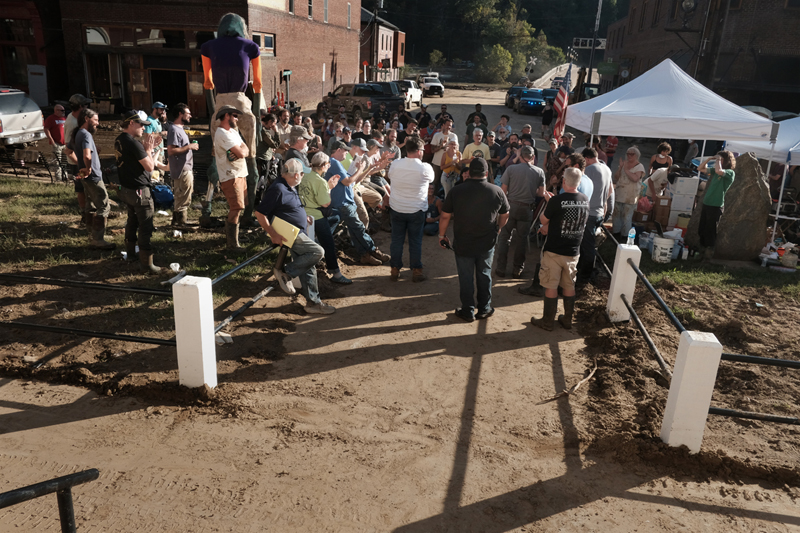
There is a town meeting every evening. An accounting of what was accomplished that day. How many truckloads of debris. The number of buildings mucked out. And also plans for the next day. Who needed what? What could be improved?
The town is shut down after the meeting. No power, no water, standing water throughout, massive and growing debris piles. Ghostly. Police patrol the streets at night. There has been looting.
Thursday, October 3
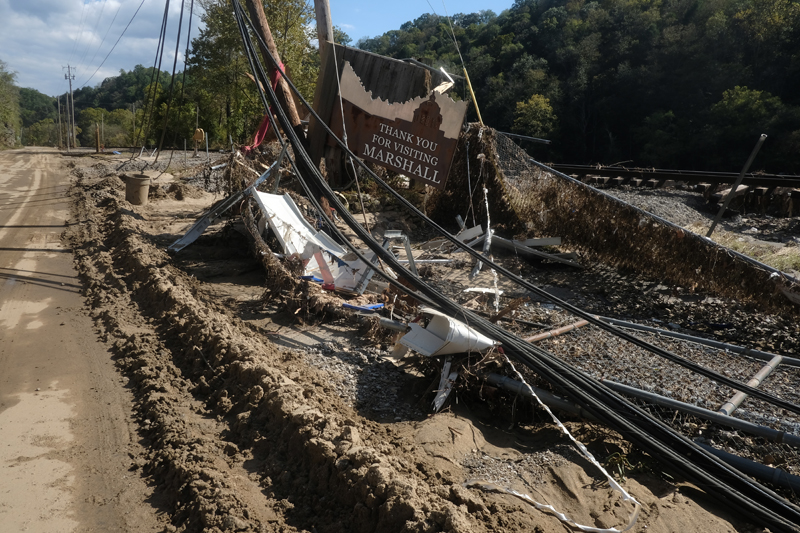
After the storm hit and the level of destruction to our region became evident my ex-Catholic guilt kicked in. I thought my book, Little Worlds, which speaks of a worldwide collapse, had somehow caused the flood. I could hear myself in confession — “Bless me father for I have sinned. I wrote a book that predicted an apocalypse and it came true. I’ve ruined a town and the lives of many people.” But, soon, I realized that, unlike the federal government of Marjorie Taylor Greene’s imagination, I could not control the weather.
But at the same time, both Leslie and I are experiencing survivors’ guilt; the knowledge that we faired well in the storm compared with friends who’ve lost everything. Yes, I lost a lot of books, income. seven years of sweat equity. But the books can be replaced. And a look around Marshall, helps me understand I’ve lost very little.
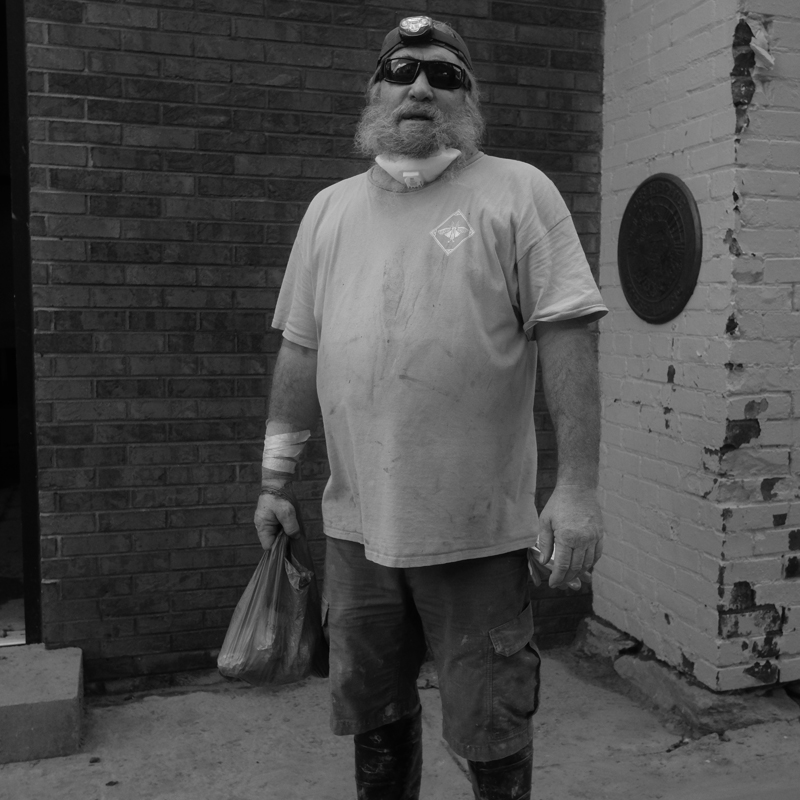
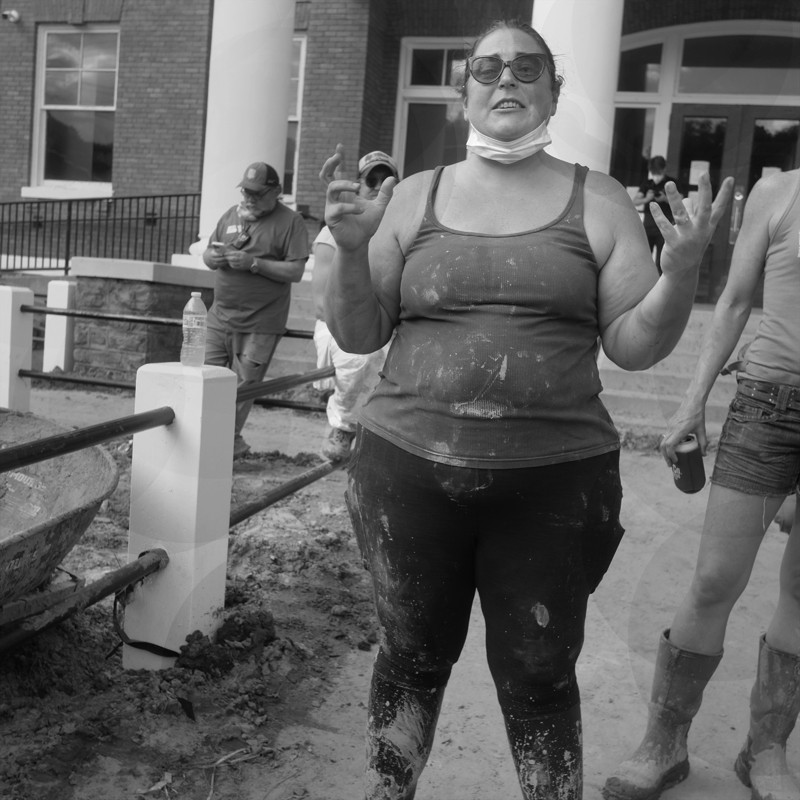
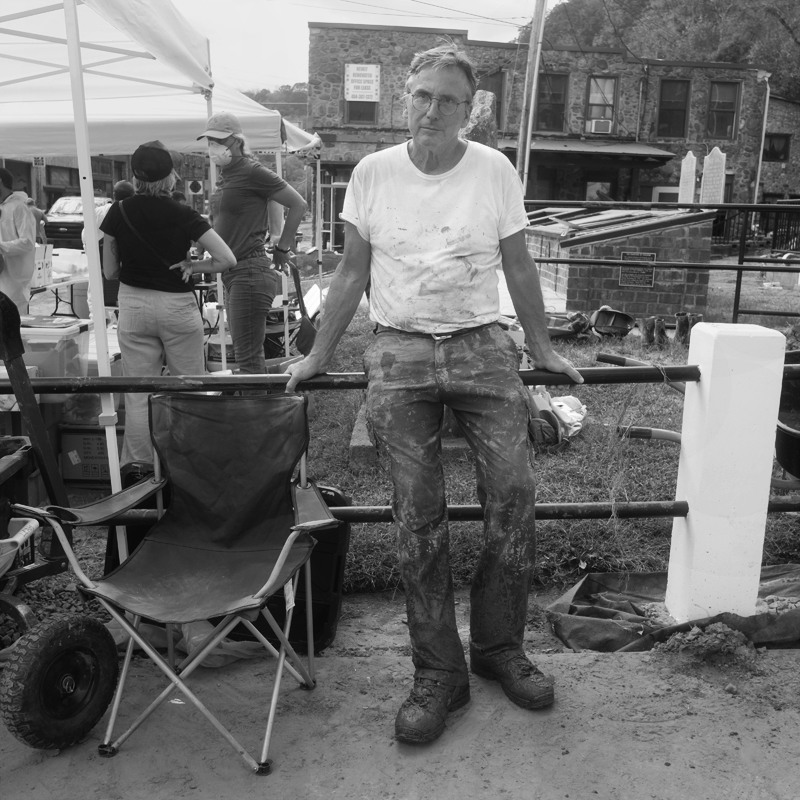
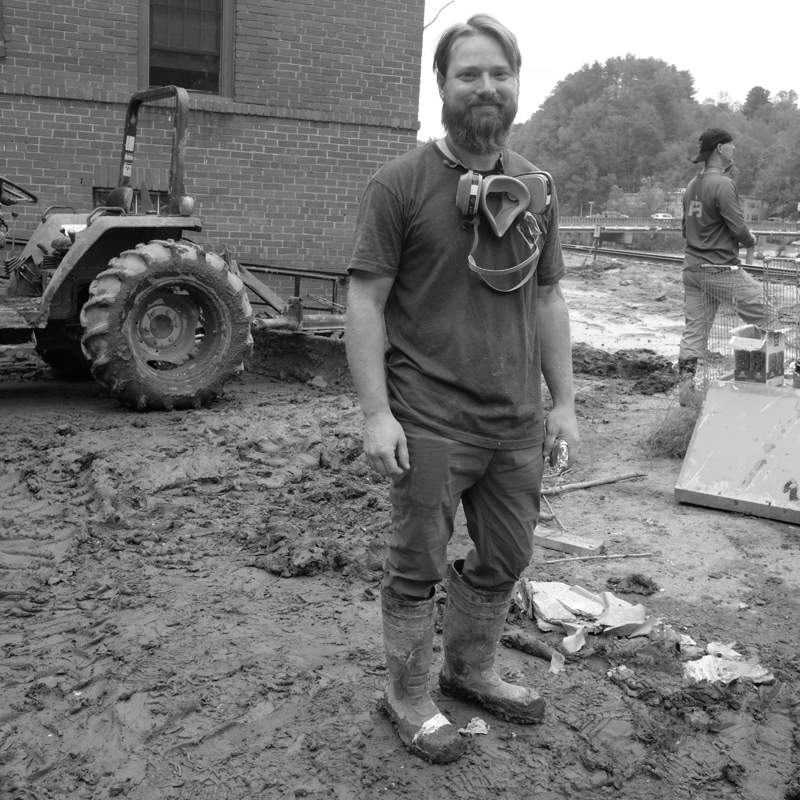
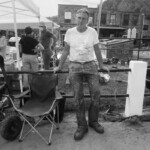
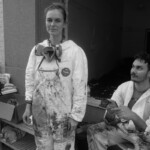
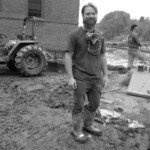
Shooting portraits today. Square format, b/w. Tight. Faces. Some objects. The black and white takes me back to my beginnings in photography and my belief that color can be so distracting. The monochrome heightens the emotions.
One of the real ironies of this catastrophe is water. The tremendous amount of water that flowed through town to cause this level of destruction. And now the tremendous amount of water being used to rid the town of what the flood left. Pressure washing — walls, floors, machinery, salvageable items.
As I walk through town, doorways seem to vomit debris. The piles of rubble, cinderblocks, and brick remind me of a walk with my son through the Valley of the Temples in Agrigento, Sicily. Some of the twenty-five hundred year old Greek temples had been meticulously restored to mimic their one-time magnificence. Others were mounds of crumbling limestone columns, left where nature had placed them. Both here and there, in Marshall and Sicily, I see fractured memories of what once was.
Cars looking like relics dug from a different era. A telephone pole perches over Main Street, hanging by the wires that it once supported.
At Penlands Store, Georgette and Susan and their families sort through mounds of water and mud-soaked pants, shirts, dresses, scarves, hats, belts, boots. Trying to lighten the mood of despair, I jokingly ask Georgette if she has a 42-long sport coat. She gives me the finger.
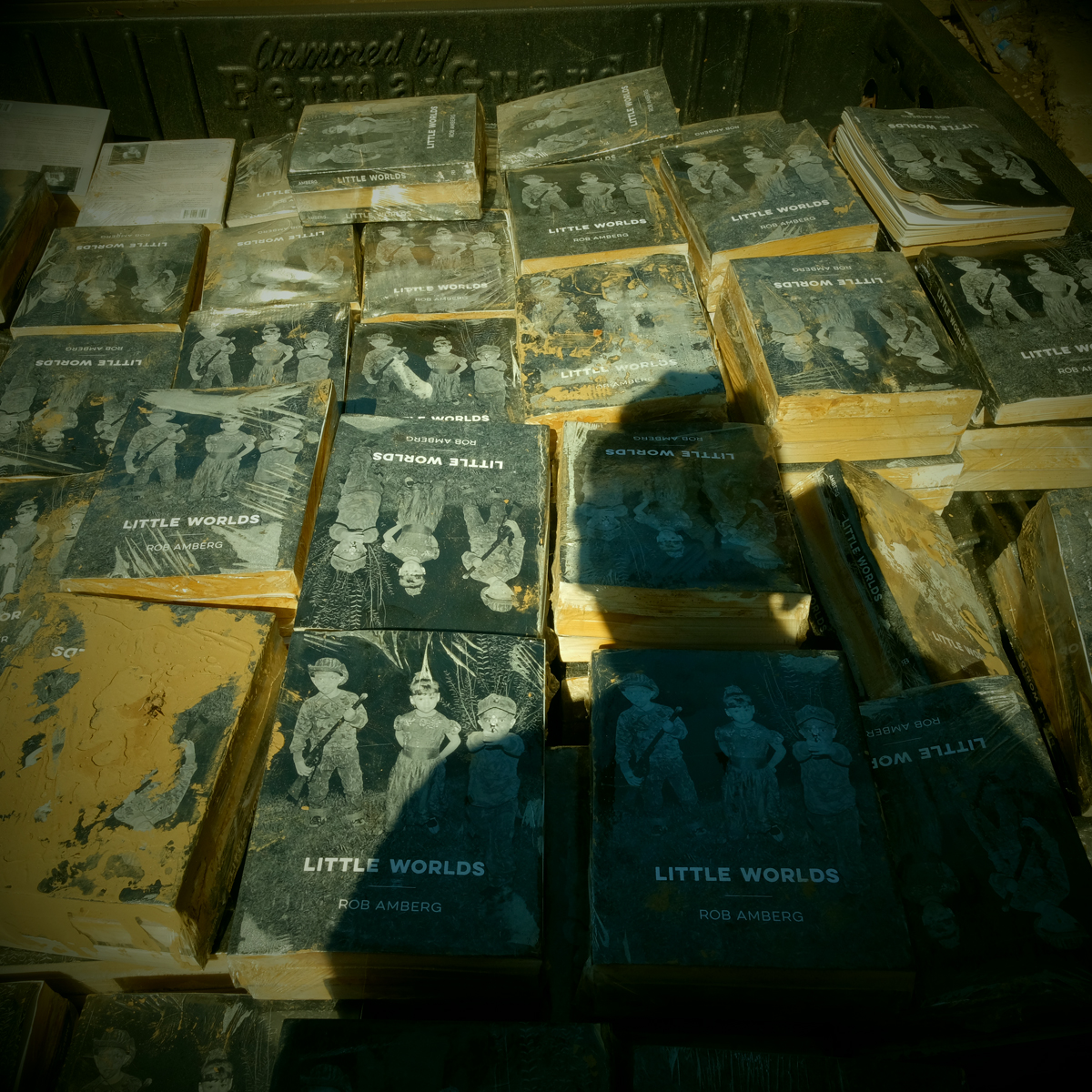
My books have been moved to the upper floor of the warehouse, in the dry and out of the way. I can see them for what they are, and are not. What they are is artifacts, remnants of the great flood of 2024. The covers are readable, clean. What they are not is useable. The pages are glued shut, only opened by tearing. There looks to be 350 of them.

Friday, October 4
The town is crawling with journalists, photographers, videographers, all looking for the defining image or story. Some are working with major publications or media outlets, others are rubber-necking, disaster tourists. All are afraid to get close, to engage, choosing to keep their distance with their long lenses and removed personalities.
Volunteers are here in earnest today, hundreds of them. Arriving to Nanostead, the staging area, and donning brilliant white Tyvek and boots, heavy gloves, masks and respirators. They’re driven by shuttle into town and turned loose. Students from all over, elderly people here with church groups from Oklahoma, California, and Louisiana with memories of Katrina. A soul food truck operated by a family from Florida who stay a week and then have to beat it back to Florida to help with Hurricane Milton. The best fried catfish I’ve ever eaten. Other trucks arrive in regular fashion, bringing food, water, chain saws, generators, more Tyvek.
Throughout the day I see people — hugging, holding hands, crying together, hugging some more. The look remains one of disbelief, confusion, anger, emotional exhaustion. Yet, people are here — together — mucking, hauling debris, ripping out sheetrock and insulation, helping each other. I see my friend Matt, a local building contractor, who sends a crew down to the Natural Foods store where they demo the sheetrock and insulation throughout the store in ninety minutes — a job that would’ve taken the owners days to finish.
Sunday, October 6

There are fewer people in town today and I don’t stay long.
Deb and Jerry Burns at Engine House Design are mucking and removing debris but already thinking about how to redesign the building.
Jamie at French Broad Exchange isn’t sure what he’s doing. The buildings’ owner is not helping with the clean-up and restocking will be a long, slow and expensive process. But he loves the town and being part of it.
Josh has a small crew pressure washing the kitchen at the Old Marshall Jail. I’m mesmerized by their movement with hose and brush, like an elegant dance of light and space. And for a time I dance with them, moving, seeking the right spot, stopping time.




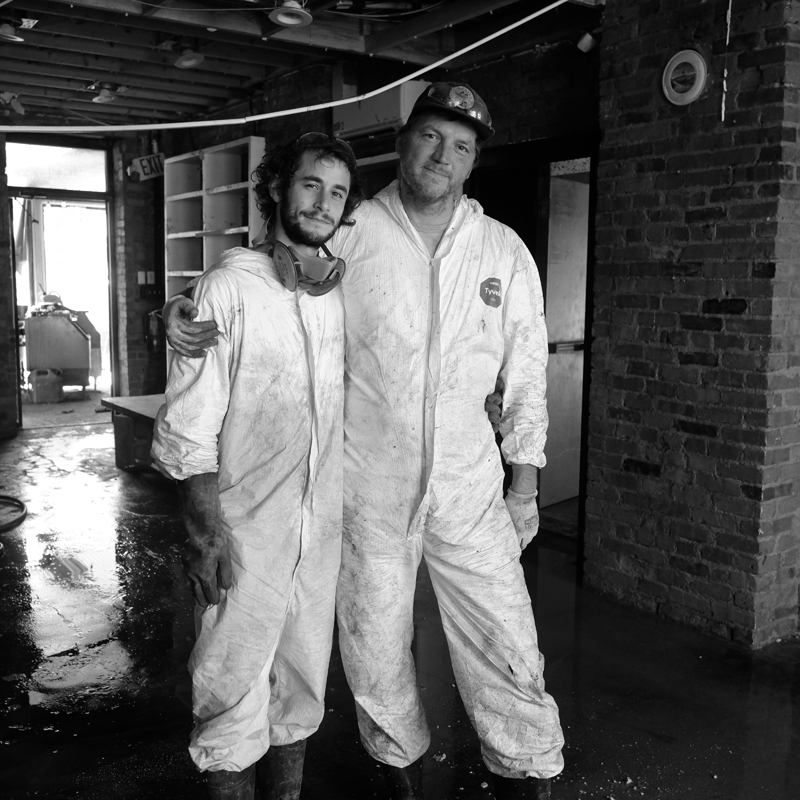




Tuesday, October 8
The town is humming with activity today. Food stations at Nanostead preparing for the noon rush. Downtown, mud remains the ever-present problem. Inside the buildings, pressure washing and sweeping the liquid muck into the street, where it will be piled, picked up, and hauled off. There is a sense about the mud that it will never go away, as if it’s been imprinted and will forever be a part of the town.
There are some buildings, farther along in their rebuild, that have fans set up in their open doorways, drying the building and clearing the air.
There are more volunteers, their gleaming white Tyvek soon to turn brown. They’re mostly young, many students, some from close by, others from far away. It’s heartening.
And the Army has arrived. Probably a couple of platoons of men and women from the 101st Airborne Division from Fort Campbell, Kentucky. They, too, are very young, some not long out of high school. Fit, with shoulders and arms meant for work.
I walk through town hunting artifacts. They’re everywhere. Still-life expressions of what once was.
Wednesday, October 9
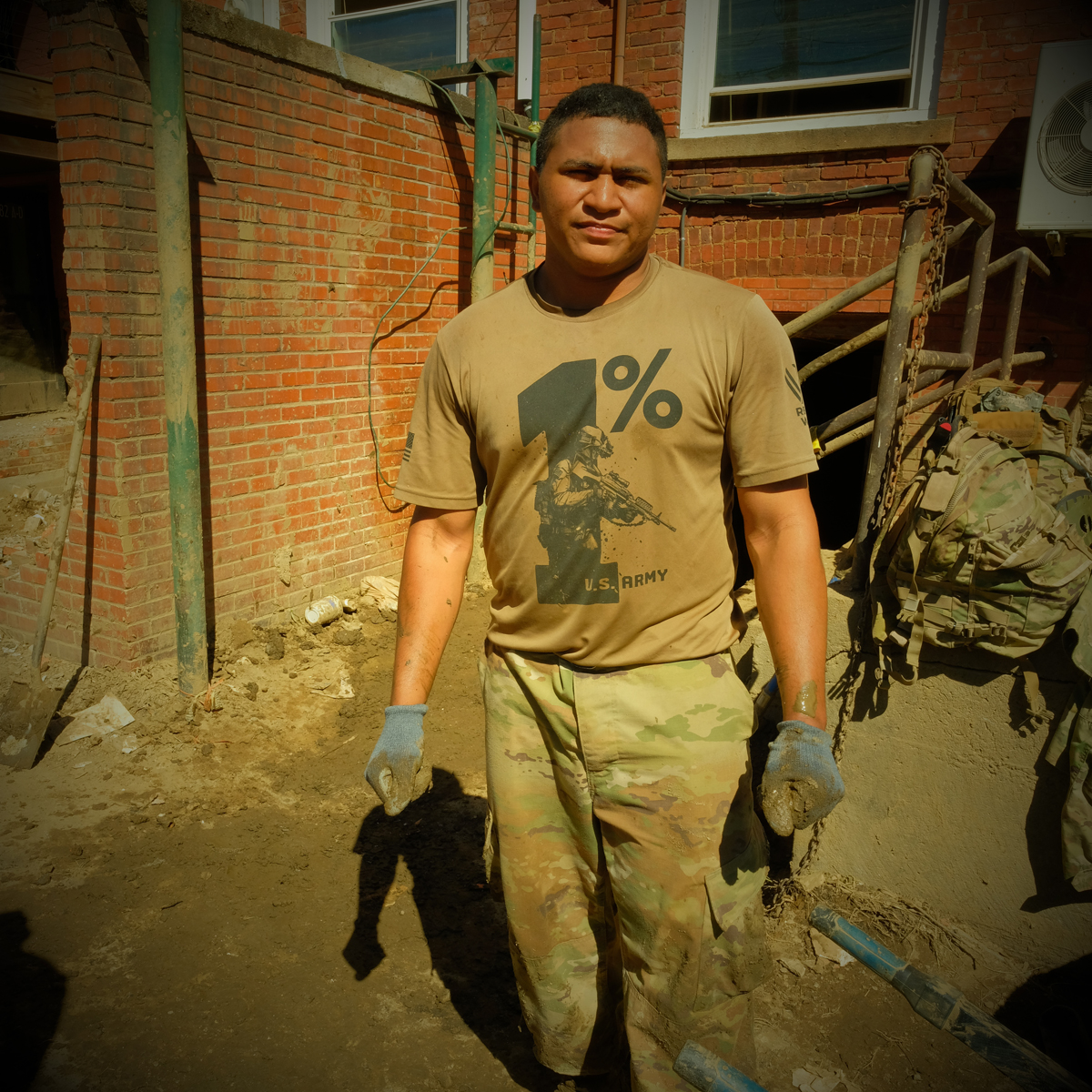
The Army seems to have found its purpose in the basements of downtown Marshall. In those tight, low-ceiling, airless dungeons, up to three feet of river mud has settled. In most cases the only access to the basements is through suspect steps and narrow doorways with no room for machinery.
I have a long history with the Army. My father was a veteran of World War II and both of my parents worked for the Department of the Army throughout their careers. I was an Army enthusiast and went to an all-boys, Catholic, military high school. I considered a career in the military as a potential life goal. I enrolled in advanced ROTC in college and was preparing to enter the Army as a second lieutenant upon graduation.
But change happens if you are open to it. I began reading a broader body of history and literature and hanging out with a more diverse group of people (teachers and students) who introduced me to new ideas and ways of seeing the world. A trip to Italy with my grandmother sealed my distaste for Catholicism and opened me to European opinions of America.
So, when the 101st Airborne marched into Marshall, I was prepared to be resistant at worst, mistrustful at best. But change happens.
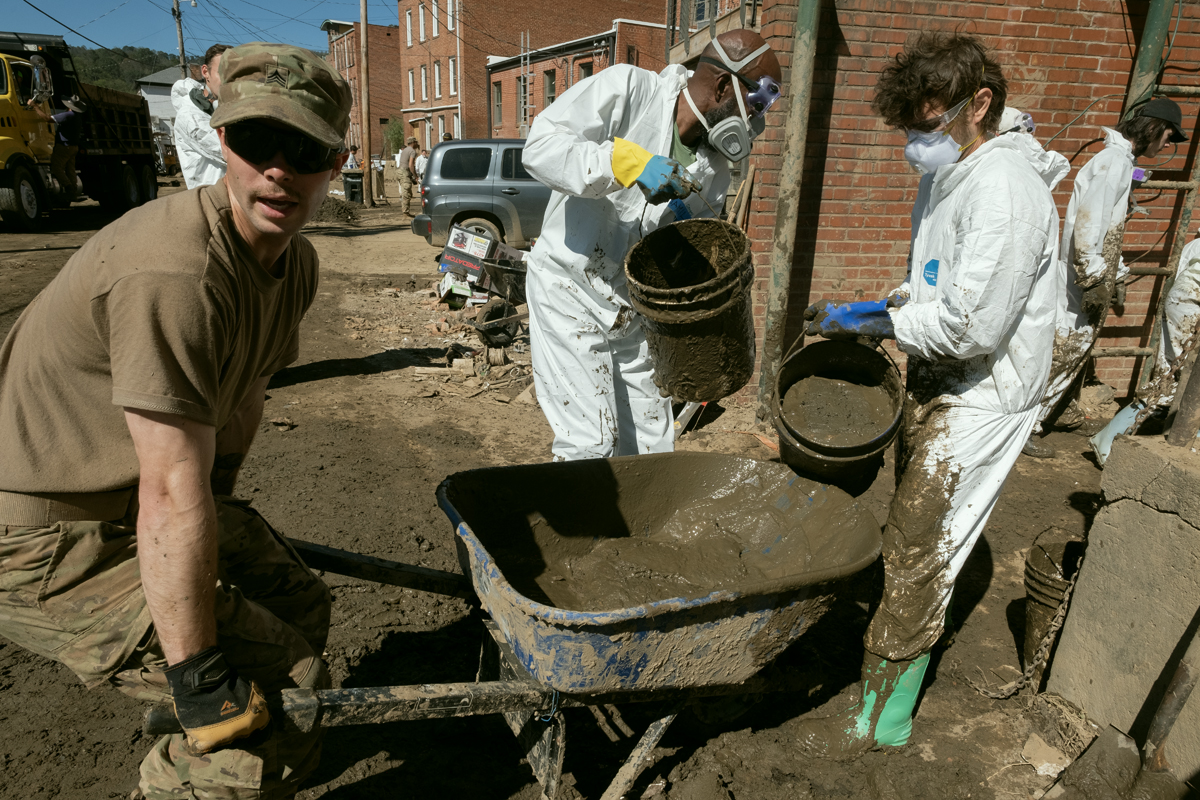
At the Madison County Arts Council building, a crew of fifteen soldiers are gathered around the stairs and doorway to the basement. A group of six or eight of them, two mud buckets each, go into the dark, dank room and begin shoveling. The mud is thick, heavy with water, and stinks; a half a bucketful is almost too heavy to lift. At the doorway stands Lopez. He handles all the buckets, hauling them to the stairs, and handing them to two men above him who empty them into wheelbarrows. It is grueling, nasty work. They work in thirty-minute shifts, a fifteen-minute break, then back at it. It takes two days to clear the building.
There is a side of me that is in awe of these young men and women — their focus, work ethic, stamina, and their ability to find the best solution to a problem and then just doing the work. At the same time I know that when they signed up for the Army they didn’t really have a choice as to what work they did. And I much prefer they are in Marshall, rather than in some far away place shooting up the local population and countryside. The whole town is thankful they are here.
Friday, October 11
The river’s flow looks almost normal today. Nothing else about it is the same. New channels and sandbars. The river banks are stripped clean or a tangle of downed trees, miscellaneous debris, and a gelatinous mix of sand and mud. There’s a shipping container wrapped around one of the bridge pilings. Those trees that survived the flood are festooned with plastic sheeting and bundles of PVC pipe.
The Army and the volunteers are back at it, but roles have changed. The soldiers have been ordered out of the basements by their superiors for fear of mold and toxicity. They’ve been replaced by the young volunteers.
I wade into the warehouse to check on my books. They’ve been moved upstairs, safe and dry, and out of the way. Sealed shut and unreadable.
Saturday, October 12
Al and I go back to the warehouse and gather the books into the back of my truck. We’re going to park them in our barn for some undetermined future use.
I make a photograph of the books in the truck that speaks to me of the totality of my loss. The image filled with mud-splattered books — black and white and brown. In the corner, looming, is my head and torso’s shadow, the books’ covers living in my body’s trace.
Tuesday, October 15
A late afternoon walk through town. Streets mostly empty of people, not the mud, which maintains a lessened but constant presence.
Years ago, when I lived in downtown Marshall, in converted warehouse space on the third floor of what is now the Flow building, the town emptied at 5 o’clock. Dave, the town custodian who doubled as Santa Claus in the Christmas parade, would begin his walk through town with pushcart, shovel and broom. And Marshall would shut down for the night.
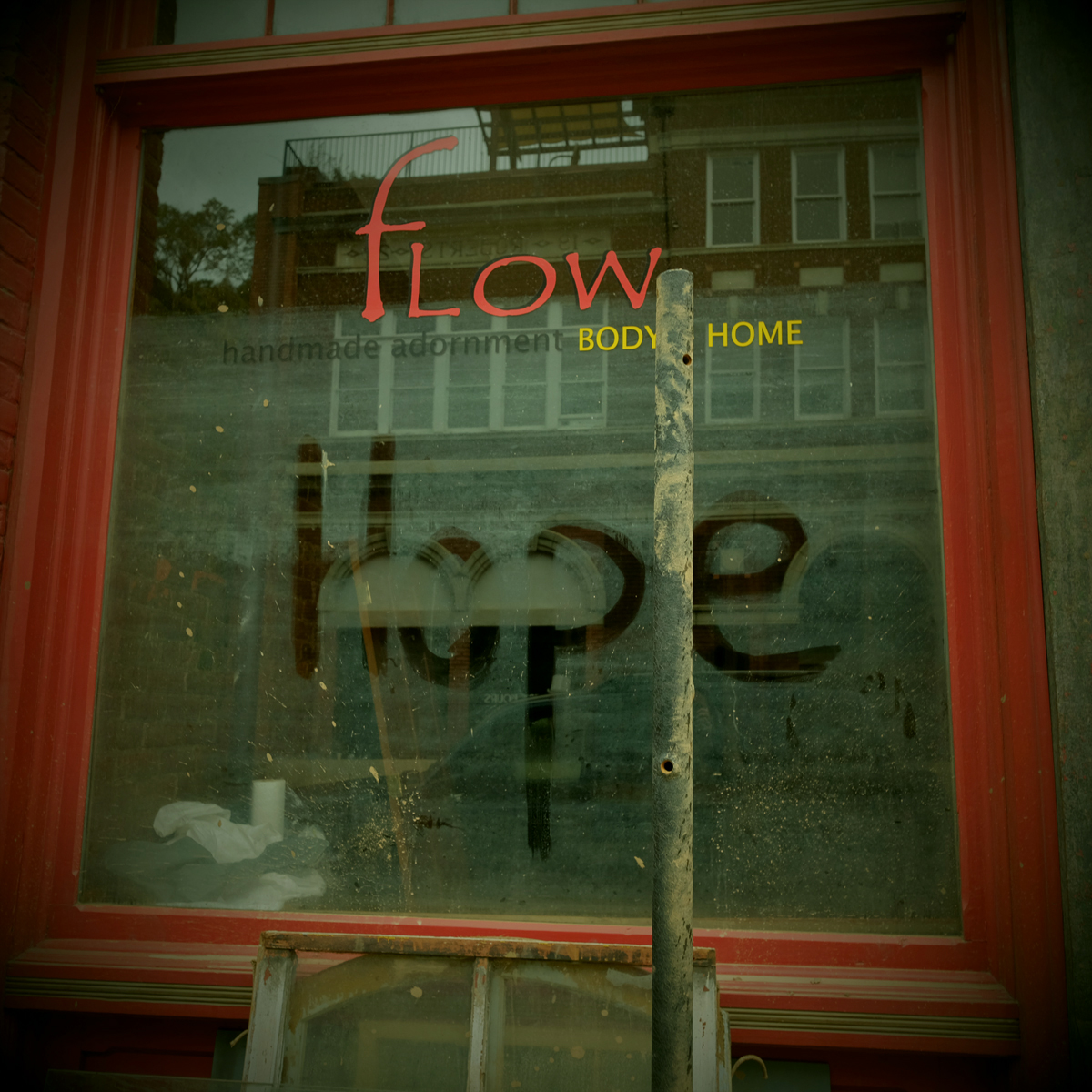
This town closure, of course, is different. Involuntary. Streets passable but slick with mud, buildings open to the air, no power, the town not just shuttered for the night, but essentially dead.
But I do faintly hear music and follow it to the courtyard behind the old Rock Cafe. It’s a small gathering celebrating Deb Burn’s birthday. There’s a chocolate cake, and music, and people dancing around a portable heater.
Saturday and Sunday, October 19 & 20
It’s mostly quiet as I walk through town. There’s people, but not many. Thomas and Mark are washing and sweeping, getting ready to mitigate for mold. The Shadyside florist guy is stunned, everything that was inside his store is now piled high outside.
The relative lack of sound, the quiet of the place, offers the opportunity to see quietly, without the urgency of the cleanup dominating most images. There’s time to feel the light and taste the wind, hear the now muffled sound of the river. There’s beauty in the stillness of the destruction, life as the river has left it.
The roads are dusty now, the recurring mud dry from lack of rain. It’s been three weeks since the storm.

Monday, October 21
A quick visit with Georgette and Susan at Penlands Store. They’ve torn the flooring out of the building and I bring some home with me to maybe use in an art project.


Sunday, October 27
Town has become emotionally exhausting for me and I’ve been staying away more and more. The constant reminder of the loss of my books and the utter destruction of the town. Plus, the upcoming election has me and my friends on edge. We’re hopeful Harris will win but not without fear of a bad ending. We know Madison County will vote Republican.
Wednesday, October 30
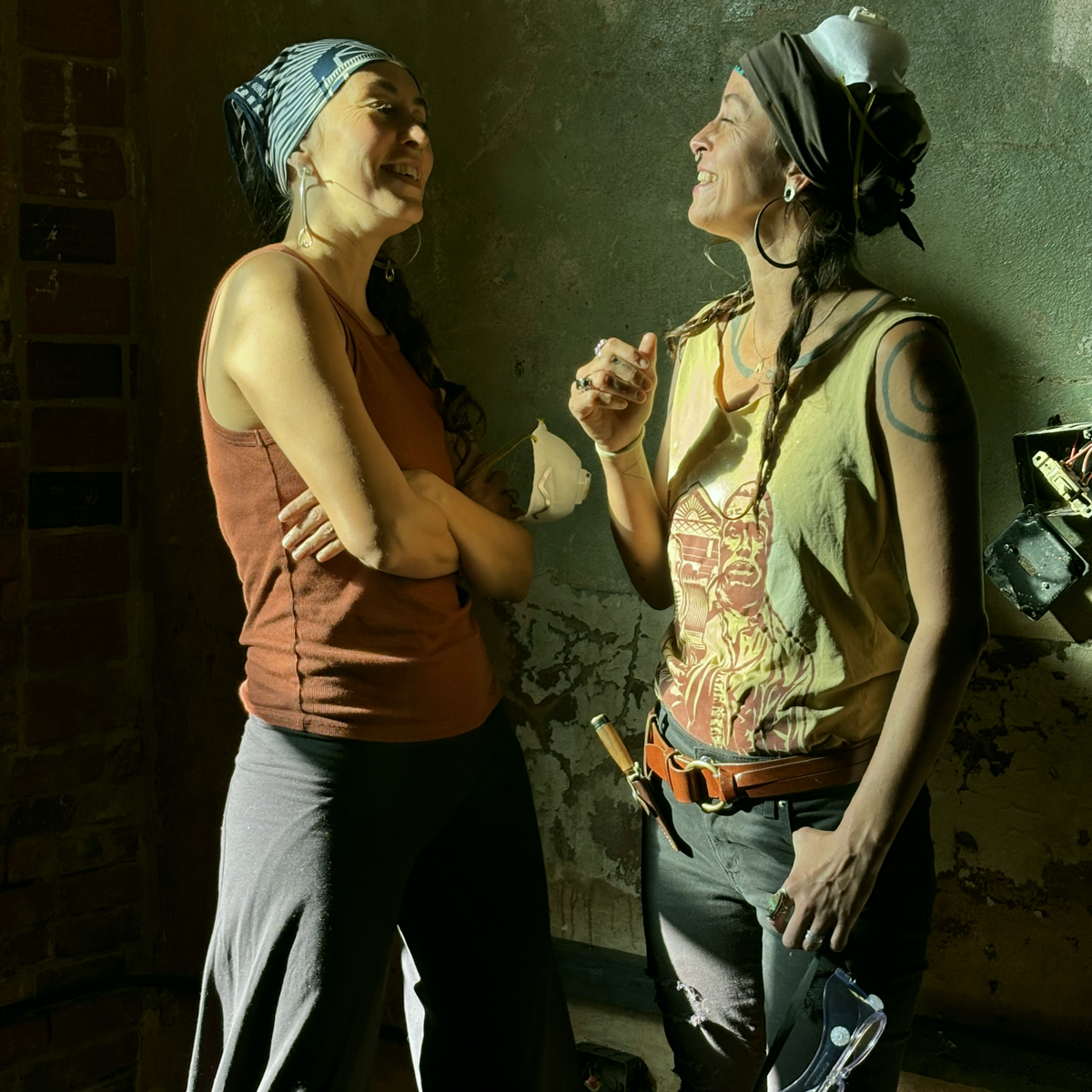
I’m not quite sure how he’s done it but Josh is having ballad swap at the Jail tonight. Balladry has a long and storied tradition in Madison County and the county, especially the community of Sodom, is considered a rich source for acapella ballad singing. Since Josh Copus opened the Old Marshall Jail as a boutique hotel, restaurant and bar, he has been hosting a monthly ballad swap. Six to ten singers, some with multi-generational roots in the tradition, gather at the Jail to swap songs and stories.
It’s pretty much the first event in town since the flood a month ago and the symbolism is hard to miss — the community’s ancient tradition responding to the wrath of our most ancient river, the French Broad.
It's primitive at the Jail, no food, a portable tap serving free beer, limited seating, highly emotional. Everyone is glad to be among other people. Hopeful. Closes with “I’ll Fly Away.”
Saturday, November 2
Meet up with Jack Cecil from the Biltmore Estate and his wife and sister and do a walk around town. He is on the board of trustees for the Duke Endowment, which has donated millions to the rebuilding effort in the region and wants to do more. They’ve asked me to come to their monthly meeting and do a presentation about Marshall.
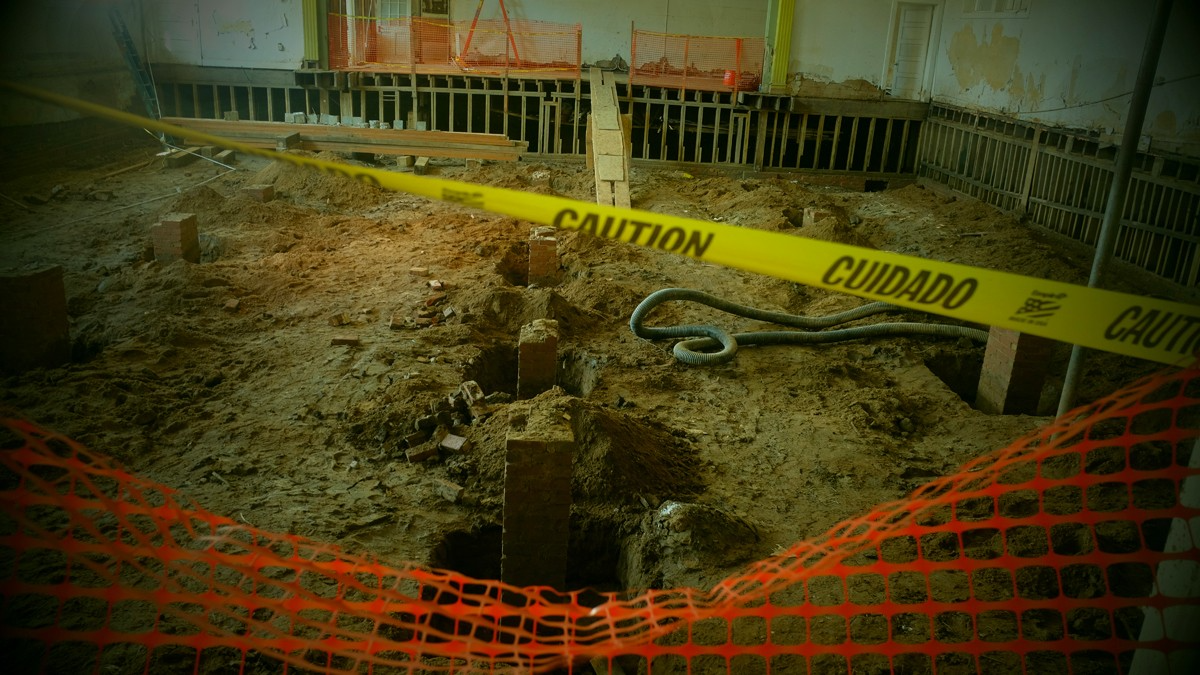
We walk over to the island for a look at the Marshall High Studios. The grounds — the walking trail, basketball court, swing sets, picnic tables, maybe a hundred trees — denuded and gone. Replaced with debris piles, mountains of trees, and a heavy layer of sand. Inside the building — like every other place in town — but bigger, more complicated, very expensive.
The dust. It’s dry. People beginning to worry about fires with all the downed trees, fuel.
Saturday, November 16
The mud is mostly gone, not entirely, but out of the majority of the buildings and off the streets. Debris and dead trees remain a work-in-progress with any one day better than the day before. Many places have been pressure washed and mitigated for mold, swept, and open to the dry air outside.
The town has been feeding on a shared energy to get to this visible progress and today is the expression of that bursting energy. Party is in the air. Not quite two months since the flood and Marshall is ready to cut loose, take a break from the doom and gloom, catch our collective breath and ready ourselves for the next, hardest push.
My friend Lois, a fellow artist and thirty-year resident of the county has decided to have her annual found art fashion show. Lois lost everything to the storm—her home and studio, and every trace of her seventy years of life and fifty years of art. Her response to the grief of losing the physical memory of her life—make more art.
I photographed Lois’s first fashion show at the Madison County Arts Council and many more since then. Funny, outrageous, creative, the shows take full advantage of the overwhelming number of artists in the community. This year is no different in that respect—a celebration of the power of art, and resilience. This year's theme — Tyvek.

Spring, 2025
I think about Helene a lot. Was this our “Get Right With God” moment? Retribution for past sins? Noah? Or was it a random, freak-of-nature storm that devastated the western third of our state. Was nature humbling us? Letting us know that while we consider ourselves safe from most of nature’s fury, it isn’t a sure thing. When I think about the frequency and intensity of these natural and manmade disasters in places like Paradise, California, Maui, Hawaii, Gaza, Ukraine, Los Angeles, it may simply have been our turn.
The adrenaline wore off months ago, about the time winter set in. It carried the town through the intensity of the cleanup — the mucking and striping and pressure washing and mitigating. There is still evidence of the recent destruction — lingering piles of debris, or trees, or mud — but Main Street is clean, drivable, and gives the appearance of nothing being amiss.
But peoples’ moods have darkened with the season; money to rebuild being the main concern. Insurance monies are slow to arrive and federal dollars that flowed quickly during the previous administration are being delayed or rejected by the current crowd in office.
People sit and wait and get frustrated.

Also there’s a shortage of sub-contractors with the entire region devastated. Plumbers, electricians, carpenters, laborers, heavy equipment operators, all hard to find.
Major questions about the rebuild of the town, which lost over a quarter of its buildings, and still lies in the floodplain, something that won’t change. And there is the very idea of the town itself — what is it, who is it for, how is it paid for?
Marshall has been reborn in recent years. What had been the economic, political, and cultural hub of the county for many decades had mostly died during the 1980s and 1990s with better access to the outside world and changing demographics. The 2000s brought new money, ideas, and energy to town and Marshall and the county emerged as a destination for art, cultural tourism, and outdoor adventure. The flood changed all of that.
Some people/businesses will leave. Some will stay. Of the original businesses in town, Penlands Store, Shadyside Florist, maybe Bowman’s Hardware, the VFW building, will stay. Every other business is new within the last twenty-five years and most of them are coming back.
I continue walking. Often through town looking for traces of improvement, or not. There are places in town where it looks like the flood happened yesterday, and others that are open for business. I went with Jim along a stretch of the railroad track near Redmon searching for debris and was not disappointed. Same in the woods and field next to Ronnie Meadow’s house.
There are gatherings in town. Mal’s bar has opened for music a few different times and there was a big Punk concert at the Arts Council. The venues are unfinished, almost primitive, without plumbing, but offering a place to come together. Everyone is hungry for it.
Summer, 2025
Was speaking with Pete the other day and we agreed that town felt different. And we couldn’t really say what that difference is. The physical changes are obvious, but beyond that, the emotional and attitudinal shifts areharder to identify. It seems the overall, never-ending need for money is dwarfing the strong sense of community that existed before the flood. And the uncertainty of what is coming next, knowing Marshall will be altered, possibly shattered beyond repair.
As I’m finishing this essay, I must acknowledge several of the catastrophes that have hit the nation since Helene devastated our region. Fires in Los Angeles and Maui, tornados in the Midwest and Plains, another flood in eastern North Carolina, and the unprecedented high-water disaster in Texas.
Storms are growing in frequency and intensity, with devastating effects on people, the natural world, and property. How to reverse course? How to rebuild? How will governments and insurance companies pay for ever-more-costly reconstructions? Our current national government seems intent on removing itself from the responsibilities of emergency management, leaving it up to the states who can’t afford the costs to clean up and rebuild.
Marshall and our neighboring town of Hot Springs are rebuilding, slowly. People are supportive. Music is regularly happening and a couple of restaurants are open. During the day the streets are busy with construction workers —carpenters, plumbers, electricians —putting the towns back together. There is no safe place. All of us are vulnerable; some people much more than others, but there is no hiding from the fact that we live in a deteriorating global environment. And as the scientists have predicted, it will only get worse. 
About the Author/Photographer
Rob Amberg has photographed and written about western North Carolina since moving there in 1973. Internationally published and exhibited, his photographs are represented in numerous public and private collections. Rob has received fellowships and awards from the National Endowment for the Humanities, the John Simon Guggenheim Foundation, The Center for Documentary Studies, and others. His books include Quartet: Four North Carolina Photographers (2007); The Living Tradition: North Carolina Potters Speak (2009); and his Madison County trilogy: Sodom Laurel Album (2002), The New Road: I-26 and the Footprints of Progress in Appalachia (2009), and Little Worlds (2024). Books and prints are available on his website: robamberg.com. Amberg lives in Madison County, North Carolina.
Donations for Marshall’s recovery can be made to:
The Madison County Arts Council
The Downtown Marshall Association
]]>
Introduction
One night in the spring of 2006, I found myself on the edges of Richmond, Virginia’s Shockoe Bottom neighborhood with a group of reluctant adolescents from my church youth group, Holga camera in hand. Prone to light leaks thanks to its plastic body, the Holga was a toy camera that allowed me to shift from 35mm to medium format 120mm film. What I liked most about the Holga was its less-than-automatic approach to winding through the frames. With a half turn, one could capture images on top of each other, creating a visual palimpsest of moody, blurred, and imperfect scenes. Walking along the James River, I could see ripples of water over my right shoulder while sounds of cars racing along the highway crept into my left ear.
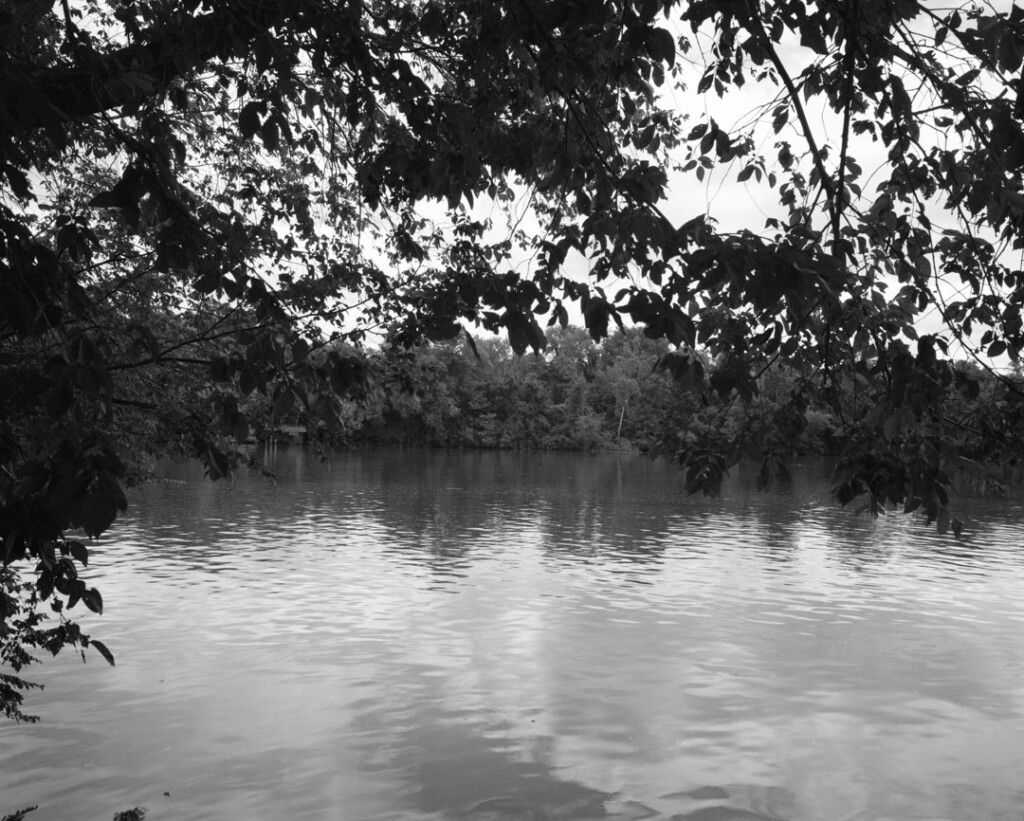
Our local historian tour guide took us down the river path while detailing the experiences of the enslaved. She spoke about how they emerged from the hull of the ship in complete darkness, after months at sea, disoriented, terrified, and unable to communicate with their captors and, in some cases, with each other. She asked us to close our eyes and imagine what it would be like to stand there, chains rubbing away at our wrists and ankles, as we were dragged along towards an unfathomable fate. The next week I developed the film in the dark room at school. My favorite image, which I submitted to workshop that week, was a shot of my tour guide, looking off into the distance, the nearly barren branches of trees etched uncannily across her face. Her body and the natural world merged into one.
How do you represent the horrific legacy of slavery without the bodies of the enslaved? Historically, abolitionist writers and editors built their political critiques on these vulnerable bodies. This manifested as a hyper-focus on the enslaved body as a site/sight of physical domination under the various machinations of white terror. This representation of Black pain, suffering, and duress proliferated with the spread of photography. From the images of lynched bodies in the post-emancipation era, to the photos of civil rights activists being beaten by police in the 1960s, to our contemporary moment of hyper-surveillance and police brutality, US society can view Black suffering’s ever-mounting evidence.
Photographer and visual artist Dawoud Bey explores the history of slavery through landscape photography in his exhibition Elegy which I visited in January 2024 at the Virginia Museum of Fine Arts. Elegy features three photographic collections and two short films that address the legacy of chattel slavery across landscapes in Virginia, Louisiana, and Ohio.
Born in 1953 in Queens, New York, Dawoud Bey, ever drawn to sound, aspired to be a musician before he became a photographer. Bey received his BFA in Photography from Empire State College in 1990, but his career began in New York in the 1970s where he developed a distinct street style featuring predominately Black subjects in everyday life. Influenced by James Van Der Zee and Roy DeCarava, Bey spent much of his career photographing Black faces. Looking through images from collections such as Harlem USA, Class Pictures, or The Birmingham Project, it feels as if you are inundated by the unrelenting gaze of Bey’s subjects staring directly into the camera. Such a dynamic inverts expectations; the subjects are looking at us, into or through us, with as much intention and discernment as we direct towards them.
Compared to his previous work, the large-scale landscape photography featured in Elegy asks viewers to see, and hear, the haunting presence of slavery projected against the landscape without the anchoring presence of Black bodies or Black faces. Bey’s most recent work allows us to recontextualize nature photography by eschewing the innocence of the pastoral scene in order to understand how the bodies of the enslaved, fugitive in their varying trajectories, maintained complicated relationships with nature on American soil. Elegy also contends with the legacies of slavery in the landscape when historical revisionism and erasure has paved over the evidence.
“Stony the Road We Trod” & “350,000”
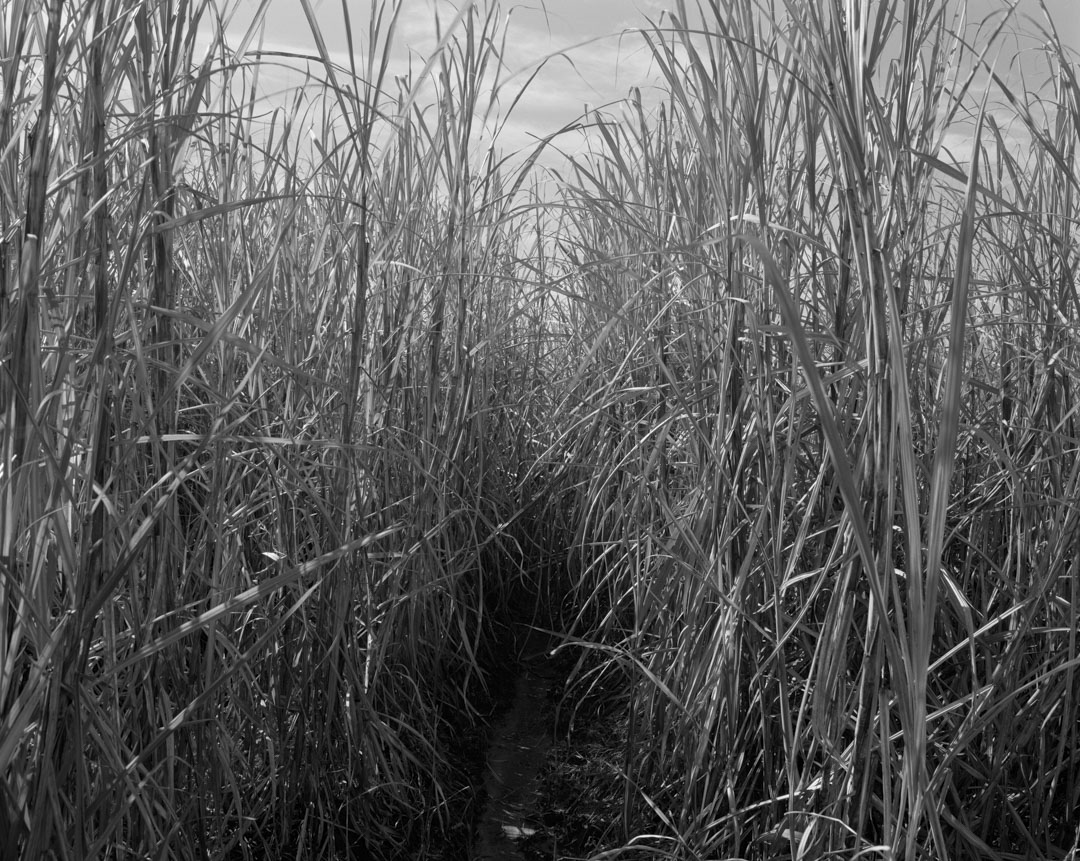
The first section of Bey’s Elegy, “Stony the Road We Trod,” (a lyric from James Weldon Johnson’s “Lift Every Voice and Sing”), features large-scale gelatin silver prints of the slave trail in Richmond. Tracking the route the enslaved took from Manchester Docks to Shockoe Bottom, Bey examines the landscape along the James River with a botanist’s eye. Each image presents the trail from different perspectives, each shot painted in varying tones of light and shadow that create depth and texture. You imagine the tall stalks of grass prickling your calves, the creeping vines of the foliage wrapping themselves around your ankles, and the overhanging branches grazing the sides of your face; you concede to the invasive nature of the landscape. To see the landscape this closely, one would have to get dirty and bend to the level of the soil. There is no way to keep yourself clean. When the camera pulls back, the fullness of the path feels almost endless. The light peeks through the trees, promising a new twist or turn, but there is a sense that it may never stop.
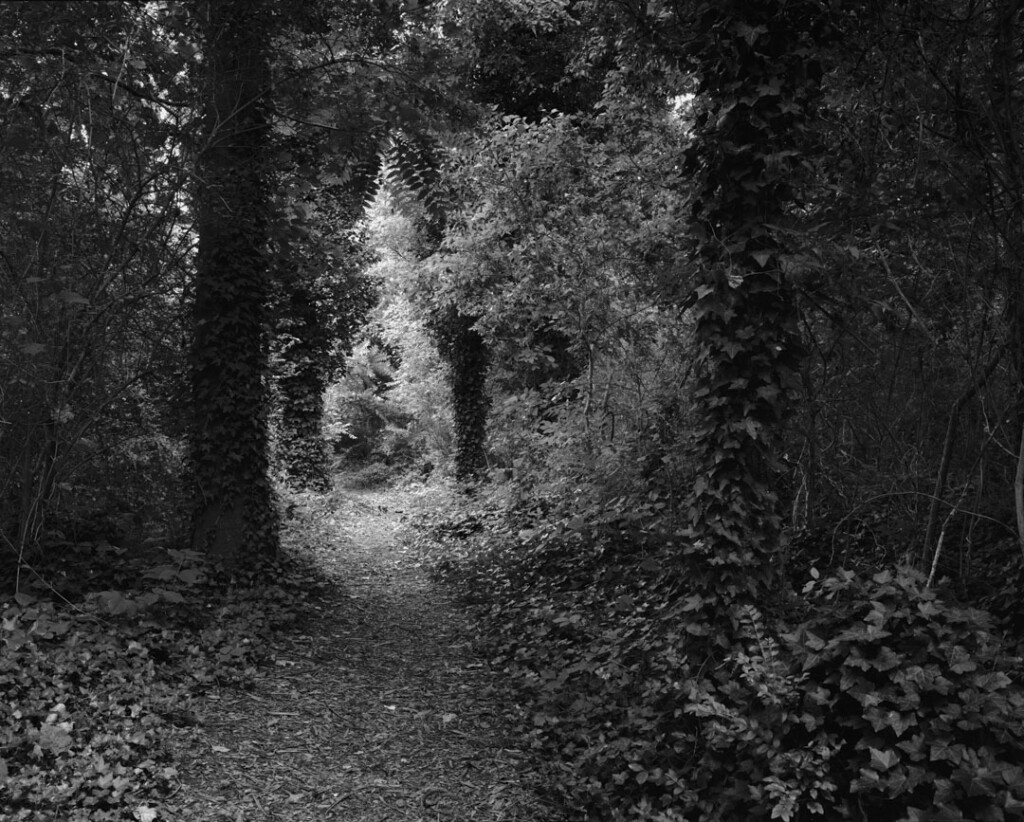
The first of Bey’s two short films, “350,000,” realizes this interminable momentum by offering the perspective of thousands of enslaved persons who traveled along the trail from the middle passage into bondage. Entirely in black and white, “350,000” is presented as a single extended tracking shot which relies on a haunting soundscape to situate the audience within the sensory experience of bondage. The film begins as it ends: with breath, not calm, but a sharp and sudden gasp, like the sound of a drowning body finally breaking through the line between water and air. This sound echoes Christina Sharpe’s concept of aspiration or “keeping and putting breath back in the Black body” within the “hostile weather” of an anti-Black climate, an act both “violent and life-saving.”1Christina Sharpe, In the Wake: On Blackness and Being (Durham, NC: Duke University Press, 2016), 113. The trail is covered in fallen leaves and enshrouded by the endless overhang of trees transitioning from late summer to autumn. Tree limbs refuse to stand upright, but bend inward from left and right, curving into an asymmetrical spiral of light, shadow, and texture. There is some semblance of shade for bodies unseen, but also a sense of being enclosed or entrapped.
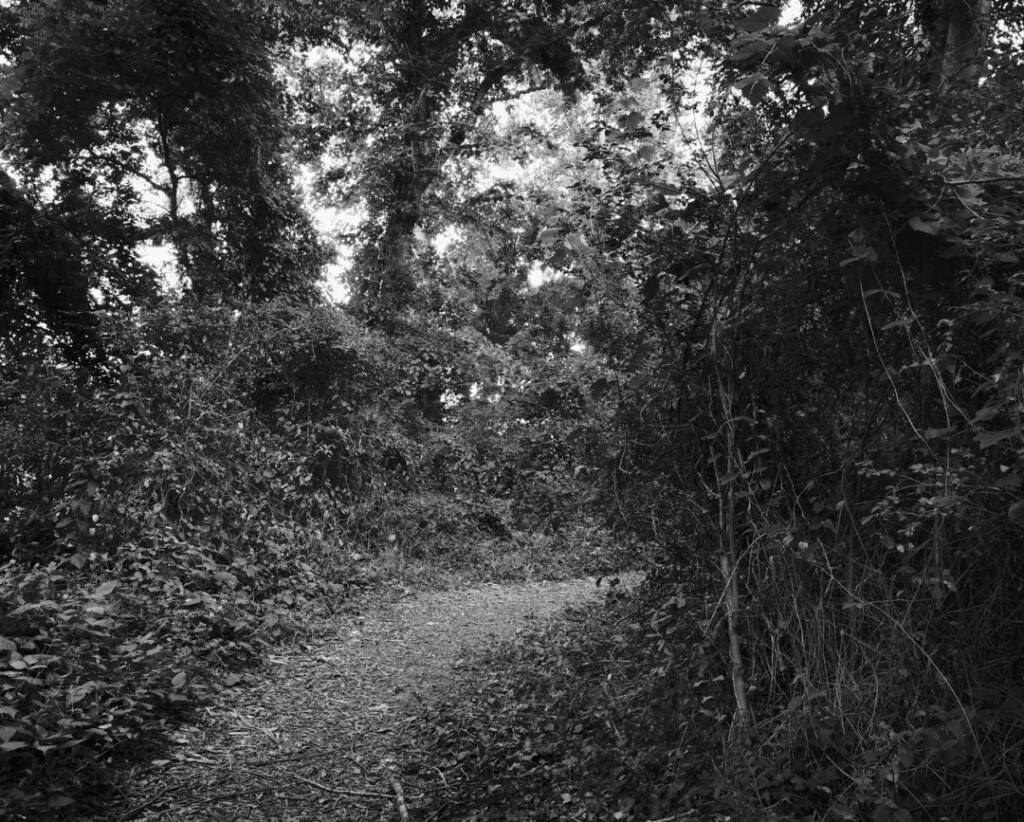
As the camera leads viewers down the winding path, there are slow pans to the left and right, from water to thicket, always searching for stability or familiarity in a strange and dangerous landscape. Even with the constant momentum, there are moments of stillness. The sounds of horse hoofs or rattling chains hover. The camera points upward, lingering on the daylight breaking through the shadows of branches and looming patches of grey-white sky. Photographed in a manner often reserved for flashback or dream sequences, the edges of the screen remain soft and blurred. The lack of any discernable body is disorienting, unmooring, echoing the experience of those trapped for months in the hull of a slave ship. Sound is the only anchor: audible labored breathing; guttural exhalations and moans slipping into a rhythmic chanting; the rattling of chains that resemble windchimes.
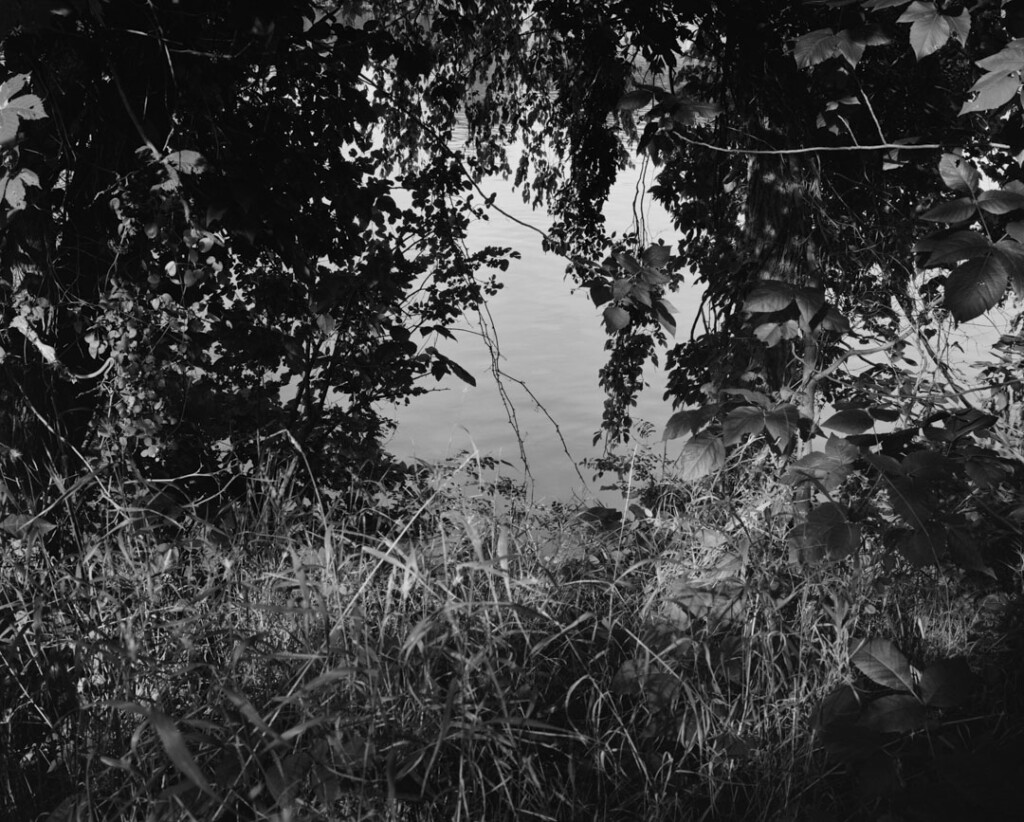
Bey collaborated with dance and movement scholar E. Gaynell Sherrod to choreograph “350,000”and sound designer Paul Bruski at the In Your Ear Studio in Richmond. The soundscape uses Foley techniques as dancers perform, sometimes barefoot, walking across dirt and gravel while holding large metal chains. While dancers often train to stifle or quiet the sound of their breath, Sherrod makes the labored breath of the dancers more audible, in the absence of their physical form.2Dawoud Bey, Gaynell Sherrod, and Imani Uzuri, “Soundings: Collaborations with Dawoud Bey” (Conversation/Panel, Virginia Museum of Fine Arts, Richmond, VA, February 9, 2024). Dancers’ bodies disappear and reform through sound, pulling viewers along slowly and reluctantly through the terrain.
“In This Here Place” & “Evergreen”
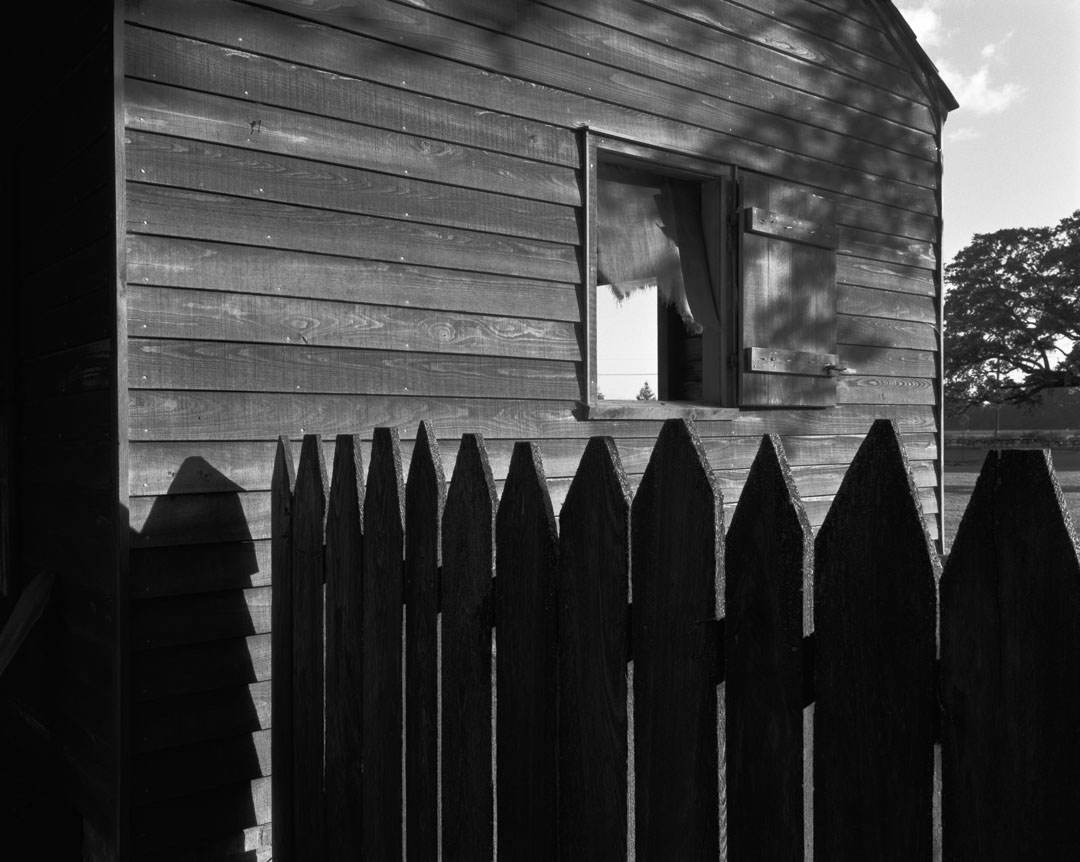
Elegy returns to the photographic on the remains of defunct plantations in Louisiana. “In This Here Place” presents a collection of images from the Evergreen, Oak Alley, and Whitney Plantations along the Mississippi River between New Orleans and Baton Rouge, capturing the slave quarters, some still intact and others commandeered by trees and wild shrubs. These antiquated cabins seem familiar. Looking at Bey’s 2019 “Overgrowth and Fence,” the barely visible cabin swallowed by the bare branches of invasive trees and tall weeds, I am reminded of many neglected houses, once owned in predominately Black neighborhoods in the Deep South, now abandoned on the outskirts of towns.
Many of the images have a spectral quality: each cabin houses the absent-presence of the enslaved. In “Cabin and Benches” the structure is surrounded by long, wooden, unoccupied benches, each shaded by large trees outside the frame. On one side, a rickety wooden shutter is swung open, revealing a small rectangular window blocked by a white curtain pulled back ever so slightly to reveal a tall, thin, black rhombus of darkness. I was convinced that at any point, bodies might emerge from the grey foreground mist, walk towards me, and sit down for some well-deserved rest. In “Cabin and Palm Trees,” the side of the cabin is almost completely obscured by varying leaves of the palm trees—some broad and flat, others a starburst of dense spikes. The window, this time unveiled from the domestic softness of the white curtain, reveals a tall black square, a void from which it felt like someone, shrouded in darkness, could be looking directly at me.

“In This Here Place” takes its name from Baby Suggs’ sermon in the clearing of Toni Morrison’s novel Beloved. Baby Suggs implores Black children to become and be seen, Black mothers to laugh, and Black fathers to dance for their children and their wives. She reminds the members of her community, many who sought their freedom by way of fugitive paths, to love themselves, fully and deeply, precisely because of the white world outside the safety of the woods. “[They] ain’t in love with your mouth,” Baby Suggs announces to the crowd, “they will see it broken and break it again. What you say out of it they will not heed. What you scream from it they do not hear.”3Toni Morrison, Beloved (New York: Vintage Books, 1987), 82. Apt then that “Evergreen,” the second of Bey’s short films featured in Elegy, presents a scream that cannot be ignored.
While “350,000” guides viewers to a single, unbroken shot on one screen, “Evergreen” is a colorful triptych that inundates with multiple shifting visual perspectives. On one screen, the camera hovers over the tops of the trees, moving slowly, as if floating, revealing the rust-tinted tin rooftops of the cabins of the enslaved. Another screen drops to ground level, cutting back and forth between close ups of the lush green grass and sharp stalks of sugarcane leaves piercing from the dirt towards the sky. On a third screen, the camera slowly pans from left to right, one cabin after another, their exterior walls stained with dark copper strokes of rust and oxidation, each one precarious on crumbling brick pillars. As soon you take in one shot on any screen, it switches. The vast perspective of “Evergreen” is awe-inspiring and, at times, overwhelming. I sat through multiple showings, trying to take in one screen at a time, but left feeling there was more to absorb.
The visual palate of “Evergreen”—red-yellow leaves across the ground, brown-blue-green of moss and mold on trees and cabins, and the bright/dull greens of grass and rusty rainwater pooling on the ground and in metal basins—blurs the pastoral and architectural decay. The soundscape intensifies the experience. Bey worked with vocalist and composer Imani Uzuri to articulate the narrative perspective of “Evergreen” where the camera does not reflect a human experience, but that of the disembodied spirits of the enslaved floating and hovering above and across the land.4Dawoud Bey, Gaynell Sherrod, and Imani Uzuri, “Soundings: Collaborations with Dawoud Bey” (Conversation/Panel, Virginia Museum of Fine Arts, Richmond, VA, February 9, 2024). Whispered words, familiar to those who grew up in the Black church, emerge from everywhere and nowhere: come by here, somebody’s praying, just like a dream, there is peace in the valley for me. Unmoored sounds of hands clapping or a tambourine beating echo throughout. Suddenly, a single extended utterance bursts forth, bending between a scream and a wistful soprano note quickly shifting back into a wail. In “Evergreen,” sounds and words intertwine, crashing into each other at an abrupt speed which approaches and dodges the legibility of music and voice. Uzuri offers us Black sound, harmonious and cacophonous, that refuses categorization; musicality stretched to the furthest comprehension.
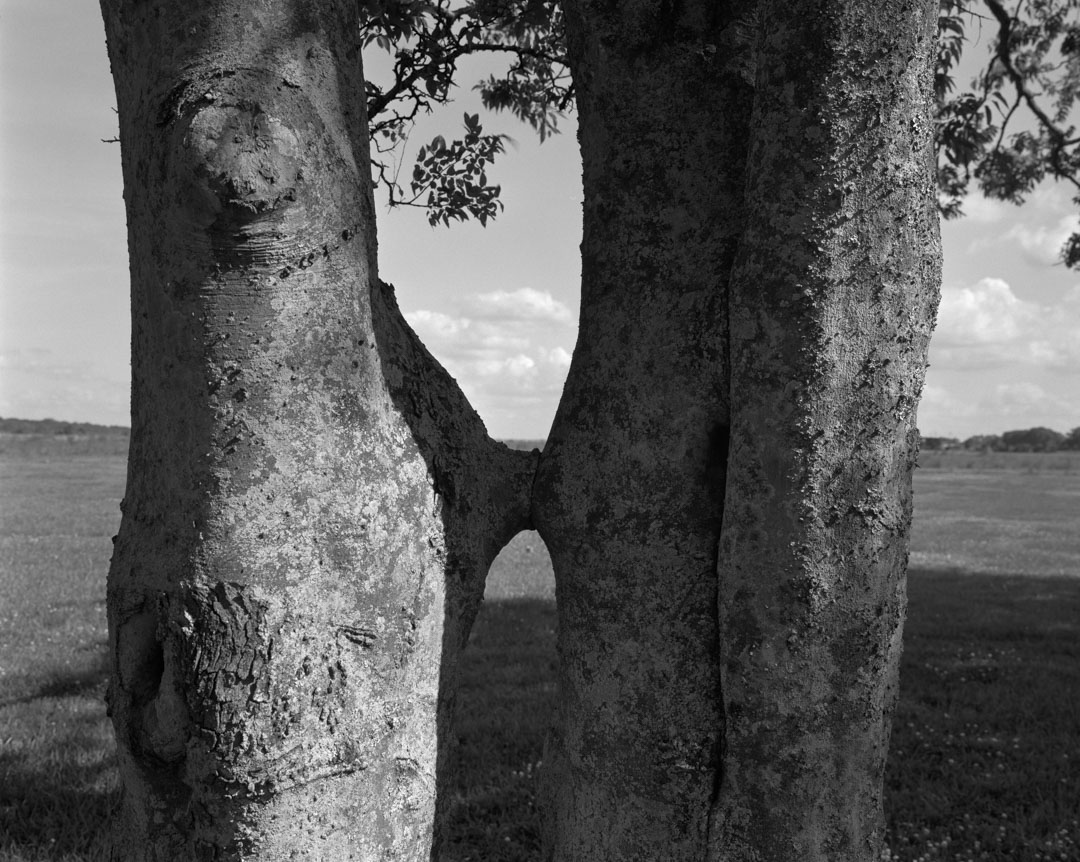
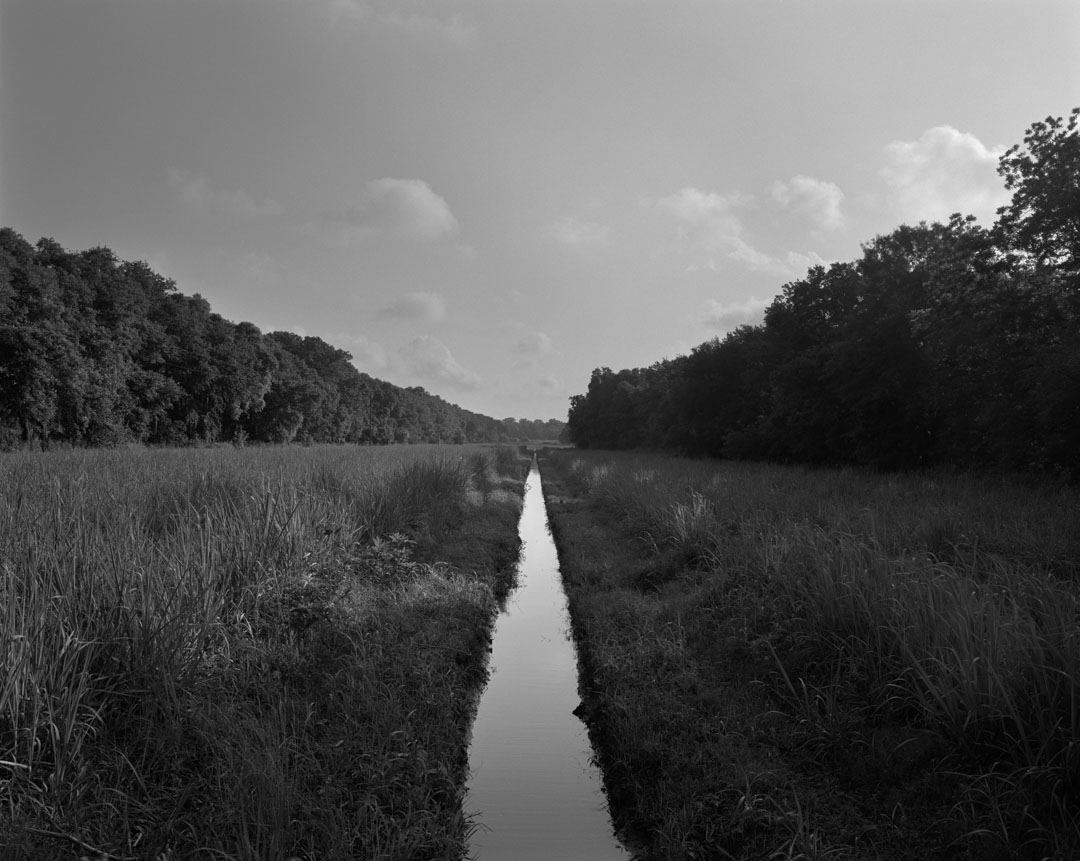
The final shot on the center screen of “Evergreen” is, again, one long tracking shot along the center path of the plantation, this time pulling backwards. Viewing the cabins from this vantage, I was struck by the stark architectural uniformity. Each cabin, equidistant and perfectly mirrored, reminds us that this space, these structures, were not only a landscape of suffering, but a community filled with a legally and culturally vulnerable population. Comparing this shot to images such as “Conjoined Trees and Field” and “Irrigation Ditch,” I notice how Bey deploys center composition to create symmetry and balance that emphasizes a single focal point, usually the subject, in an image. Bey often forces the eyes on a central path, a safe space to visually travel along a hostile territory. Both of these photographs and the last shot in “Evergreen” acknowledge and interrogate the linearity of history. While “350,000” moves viewers forward, assuming some level of literal and conceptual “progress,” we also understand that, for the enslaved, a predatory path unfurled. Pulled backward across the center at "Evergreen," we ask, what force carries us and to what end?
“Night Coming Tenderly, Black”
The title of my review comes from a line in Saidiya Hartman’s Scenes of Subjection where she argues for the “opacity” of “black song” as a phenomenon that “troubles the distinctions between joy and sorrow and toil and leisure."5Saidiya Hartman, Scenes of Subjection: Terror, Slavery, and Self-Making in Nineteenth-Century America, Revised and Updated Edition (New York: W.W. Norton, 2022), 54. In this, Hartman eschews the “overdetermined reading of the sounds of slavery”6Hartman, Scenes of Subjection, 30. prescribed by twentieth century Black thinkers such as W. E. B. Du Bois, and directs our ears to the more powerful, and at times less legible, “wild notes” of the enslaved, composed in part by the “screams lodged deep inside” that “confound simple expression . . . of black enjoyment.”7Hartman, Scenes of Subjection, 55.
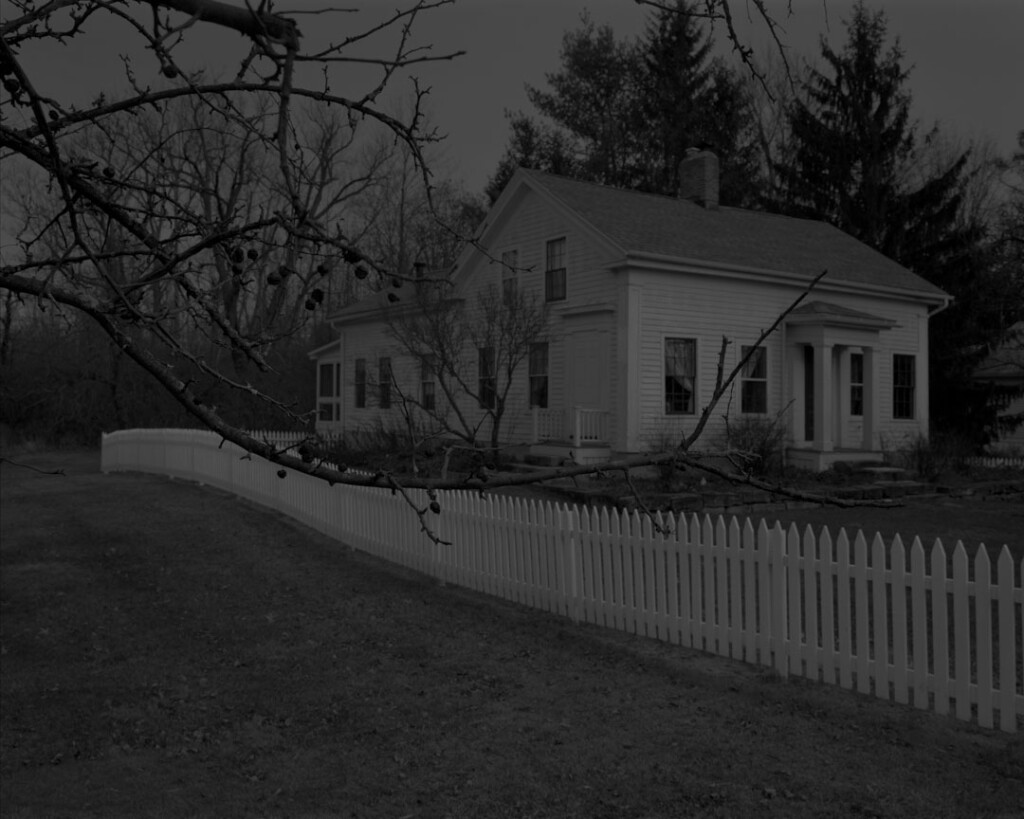
In the almost 160 years since the legal dissolution of slavery in the United States, photography and film have articulated the overdetermined image and, eventual sound, of slavery within the imagination. In both “350,000” and “Evergreen,” Bey’s exclusion of Black bodies forces viewers into a complicated simulacrum of enslaved embodiment. His films interrupt our culturally sedimented expectations not only of what slavery looks and sounds like, but also how it should be experienced. There are no clear heroes or villains in these films, no sense of a triumphant victory of good over evil, not even a sense of who, if anyone, we are following. However, in the midst of this disorientation, we remain anchored by the density of Black sound; we continue to listen through the cacophony to make sense of the experience, not through historical logic, but through a bodily reaction to what unfolds on the screen.
Coming down from “Evergreen,” I entered the final section of Elegy: “Night Coming Tenderly, Black,” its title taken from the last lines of Langston Hughes' poem, “Dream Variations.” This series of photos explores landscapes near Lake Erie in Ohio and Canada and traces the fugitive experience of enslaved persons who liberated themselves, often in the cover of night, from the bondage in southern states. Paying homage to photographer Roy DeCarava, these low-light prints hone the conflicting experiences of fugitivity, wherein a vast, beautiful, open landscape signals exposure and vulnerability while the claustrophobic cover of tree branches means safety and protection. On my way out, I was struck by the last photograph positioned to the right of the exit: a dim shot of Lake Erie, its grey waves rolling into the horizon.

Within the full context of Elegy, viewers can understand the impact of this scene. The slow march from the Manchester docks, from Virginia through the Carolinas, Georgia, Alabama to the plantations of Louisiana, and the perilous journey from the Deep South to the northernmost parts of this country, has prepared us for this sight. If “350,000” began with a painful, sharp gasp, this shot of Lake Erie gestured towards a cathartic exhalation.
Leaving Bey’s exhibit, my mind was abuzz: What ethics, if any, are applicable to the ways that we consume the visual lexicon of slavery? Can the cacophony of Black sound that Bey so intricately deployed bring audiences to understand not only Black pain, but Black humanity? Mostly importantly, returning to the image Lake Erie, can any one photograph, detached from its critical context, represent the history of slavery so often erased and buried? When looking at non-descript images of a nature trail or even sugarcane stalks, do we need to hear the density of Black sound to understand what we are looking at? Elegy is, across all five sections of the exhibit, a fully immersive sensory experience which asks audiences to find in the American landscape a history that time and “progress” has obfuscated. As I exited, I could not shake the thought that, to an untrained or inexperienced eye, the difference between the waves of the James River and the waves of Lake Erie—let alone the currents of the Atlantic as seen from the hull of a slave ship—might be difficult to discern. In which direction does the water flow towards freedom?
About the Author
Ariel Lawrence is a PhD candidate in the English Department at Emory University. Her research focuses on Black women-authored lifewriting across multiple genres, and the articulation of ethical reading practices in and beyond the page.
]]>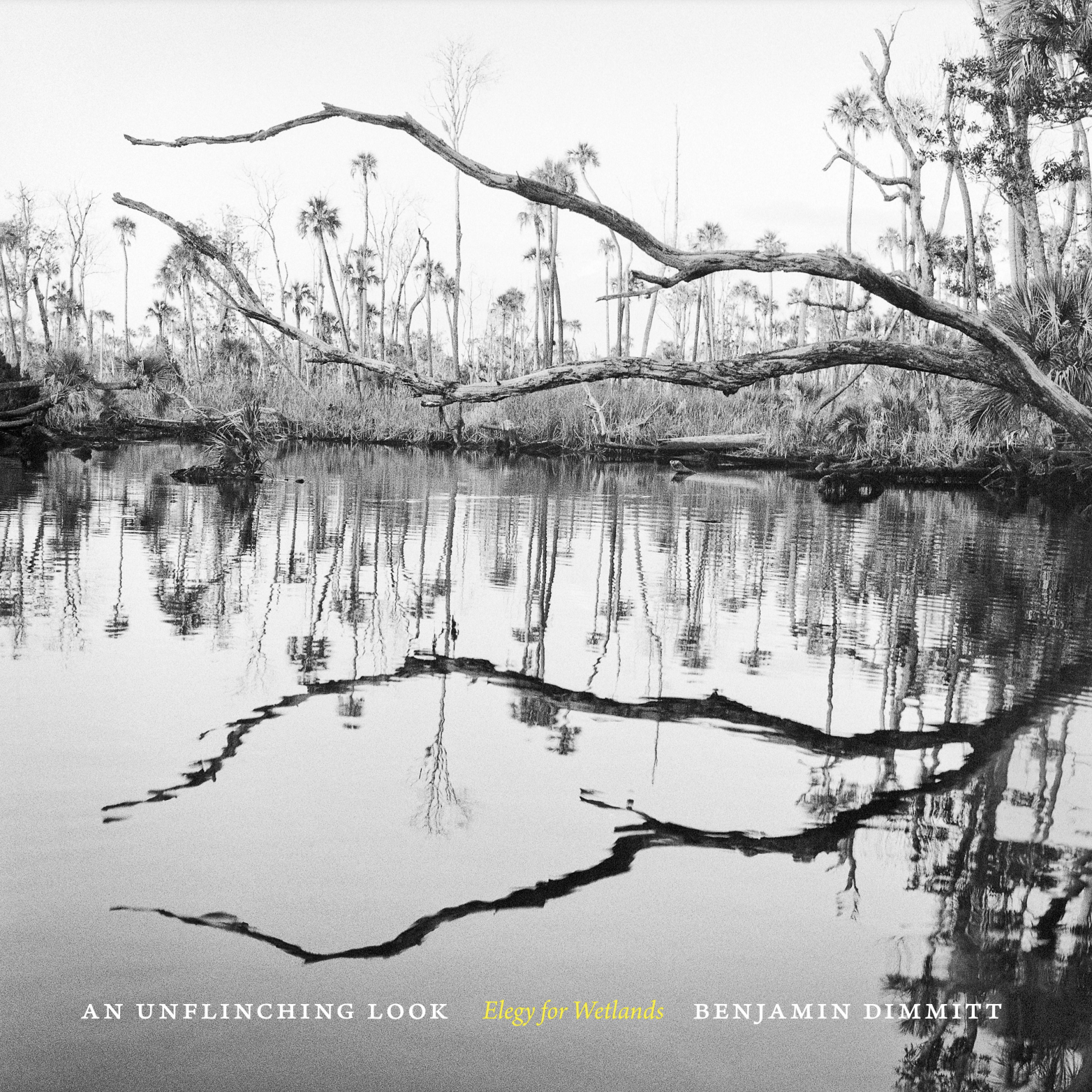
Bransford: Before we talk about An Unflinching Look: Elegy for Wetlands, can you talk about your personal history with the Chassahowitzka National Wildlife Refuge? And then describe the Refuge in terms of both ecology and aesthetics.
Dimmitt: My first trip there was in 1977 with a friend and my brother. The friend wanted to do some fishing. I had never heard of the place, nor had my brother. We drove up from Clearwater, got in his little jon boat and didn't do a lot of exploring, just fished.
I had never seen any place like this before. I had grown up in the Clearwater–Tampa Bay area, which was then probably three hours or more down the road. There are better roads now. And the swamp, as we call it, was very different from what I'd grown up around. There were many freshwater springs that spilt into the beginning of a river. In 1977, the water was clear, cerulean blue, and no one was living there.
We paddled through hardwood forest. The creek is wide in places because that area is perfectly flat. We slowly got into brackish areas and then went into big, open, less fresh, more salty, but still brackish bays. And that's as far as we got. Then we fished.
It was a very long time ago. It was beautiful. I was accustomed to the coast of Florida having barrier islands or beaches, and there were none. Water, just freshwater, merged right out into the Gulf.
Bransford: In broad brushstrokes, can you describe what the Refuge looks like?
Dimmitt: There were ferns and bromeliads everywhere. The humidity was 100% because of the springs constantly pumping out water. Lots of cabbage palm trees, which is the state tree in Florida. Some cypress and cedar trees remain, although most of them were harvested around 1916. There were trees that I wasn’t familiar with, like a type of holly called Dahoon which had little red berries. Maples. Spanish bayonets or yuccas grew on the islands. On slightly higher ground you might see some oaks.
What I loved most were the grasses that grew in the shallow creeks. You could see them by looking over the side of your canoe. The water was crystal clear. Various grasses and large ferns which had giant leaves. When I would stand in the water and make photographs, the current would move the eelgrass, which is about three quarters of an inch wide and many feet long. Those would brush against my legs as I was shooting. I had to learn to not freak out and not imagine that the eelgrass was water moccasins or gators, and just enjoy the caress.
Bransford: When did you start noticing the deterioration of the Refuge's ecosystem? What were some of these changes and the causes?
Dimmitt: Almost all the causes are saltwater intrusion. And second, for ten or twenty years, is the fertilizer getting into the aquifer. That fertilizer comes from the golf courses upstream at The Villages, which is a very large—it spans three counties—active adult retirement community. I believe they have fifty golf courses which must be beautifully kept. They throw a lot of fertilizer on the golf courses and it ends up in the aquifer. The Chassahowitzka and The Villages are both in the same springshed. The fertilizer goes down into the aquifer at The Villages, it ends up encouraging plant growth in the creeks and in the river. What you get is an increase in algae that grows really fast and then blocks sunlight because these are large mats of algae on the surface of the creeks. The algae mats are the size of a room. No sun gets through them and that kills all the smaller plants, which are the food for the smaller animals and on up the food chain. It's called toxic algae for a reason. It smothers life in the creek. That has been going on as long as The Villages has been there.
Another source of the nitrates is septic tanks that burst and go into the aquifer, and just people's yards, the fertilizer that they throw there. Agriculture also adds plenty of fertilizer to the aquifer. This has been going on longer than the impact of the sea level rise.

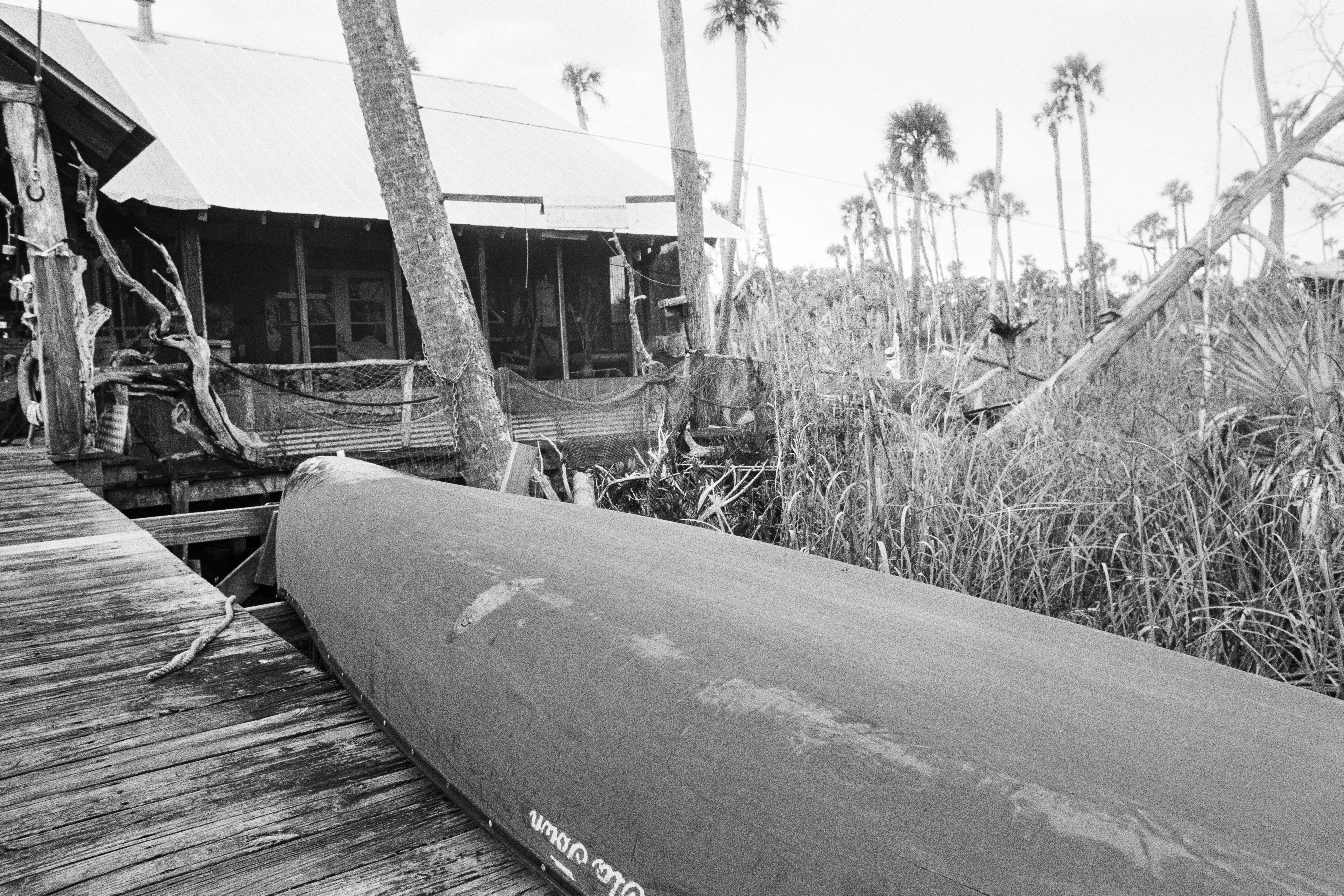
I wasn’t aware of the sea level rise until 2014, but if I look at photographs shot in 2010, I can see the beginning of the environmental damage. When you go to a place like this, it's like any forest. There are young trees and plants and mature trees and really old trees. But around 2014, the damage had become inescapable because all the hardwoods had died, the creeks were getting a lot of toxic algae, and the palms were starting to look sad. Sabal palms are the most salt tolerant trees in this ecosystem, so they're the last to die. And in many of my photographs, you'll see very little other than dead trees and palms that are on their way out. The eelgrass and other grasses are very delicate and can’t handle the increase in salt. The mats of algae cut down the sunlight that the grasses need in the creek.
Martin: It's really a combination. You have pollutants coming from the east and you have the sea level rise coming from the west. Those two are coming together in the same place and having this devastating effect.
Dimmitt: Exactly. There is no one single cause of the devastation. When I started on this project, I talked with someone who had a good working knowledge of the state’s water management practices. He had his own views that the state was looking away from or ignoring the impacts of over-pumping from the aquifer. So, yeah, it's a lot of different things. Even melting glaciers can't be denied here. That's what is lifting the water up and sending it from the Gulf up into these creeks.
Bransford: And the depletion of the aquifer is also important. To maintain all these golf courses at The Villages necessitates a huge volume of water. The water flow in the Refuge has deteriorated as well.
Dimmitt: Yes. It's so interconnected. One thing that Susan Cerulean goes into in her essay at the beginning of An Unflinching Look is that there has always been a lens—which is a use of the word “lens” I had never heard of before, but I got it right away—that exists between saltwater coming into the aquifer and the freshwater that's already in there. As water is pulled out for any and all purposes, including for sale as bottled water, the lens moves further and further inland. So you now have salt water and brackish water in the aquifer, in the local drinking water.
Bransford: Tell us about the genesis of this book, An Unflinching Look: Elegy for Wetlands.
Dimmitt: I visited there a lot in the eighties. I had my bachelor party up there. I won't go into that except to state that there were no mermaids involved. I enjoyed photographing it because it was unusual to me. I'd never seen any place like it in Florida. In 2004 I started a new photographic project called Primitive Florida. I felt that I needed to photograph these vulnerable landscapes. I was concerned about things like worsening storms and overdevelopment, and these phenomena that I learned about in college in the early seventies called global warming, climate change, and rising sea levels. Lo and behold, everything that I had learned about was starting to happen. I didn't visit the swamp between 2012 and 2014, but when I arrived at the cabin in 2014, the wetlands were devastated.
I didn't understand. I got in touch with scientists in the Tampa Bay area where I grew up and went to college. I showed them the photographs and they said, “That's saltwater intrusion. That's rising sea levels. You didn't know about that? It’s happening along the Gulf coast up to the Panhandle.”
I didn't know that it was going to be happening so soon. Eventually I got in touch with one scientist, Dr. Matthew McCarthy, whose study is excerpted in the book, and he was excited to see my photographs from water level because he's spent many years downloading satellite imagery and aerial photographs of the coast while he was working on his graduate thesis.
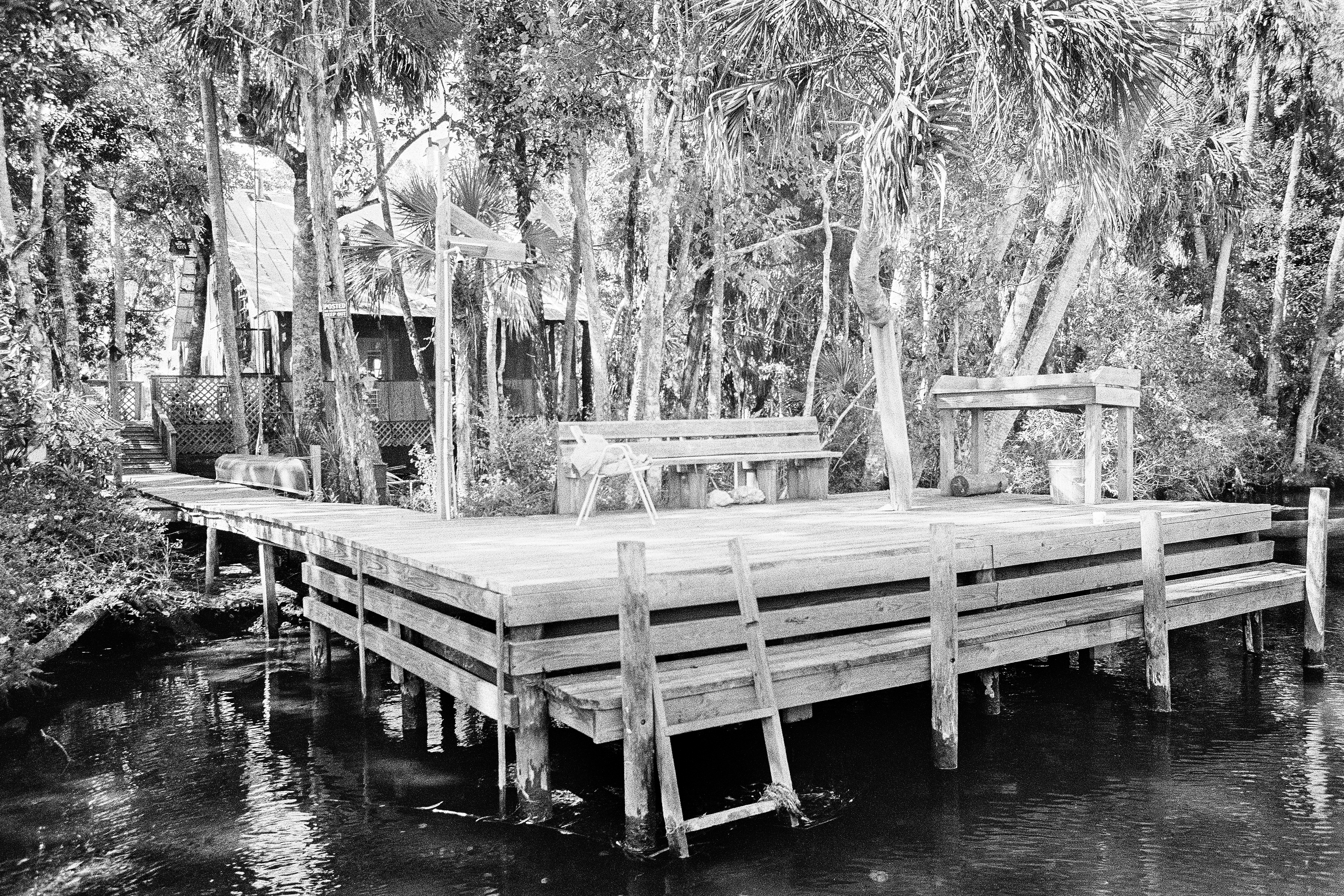
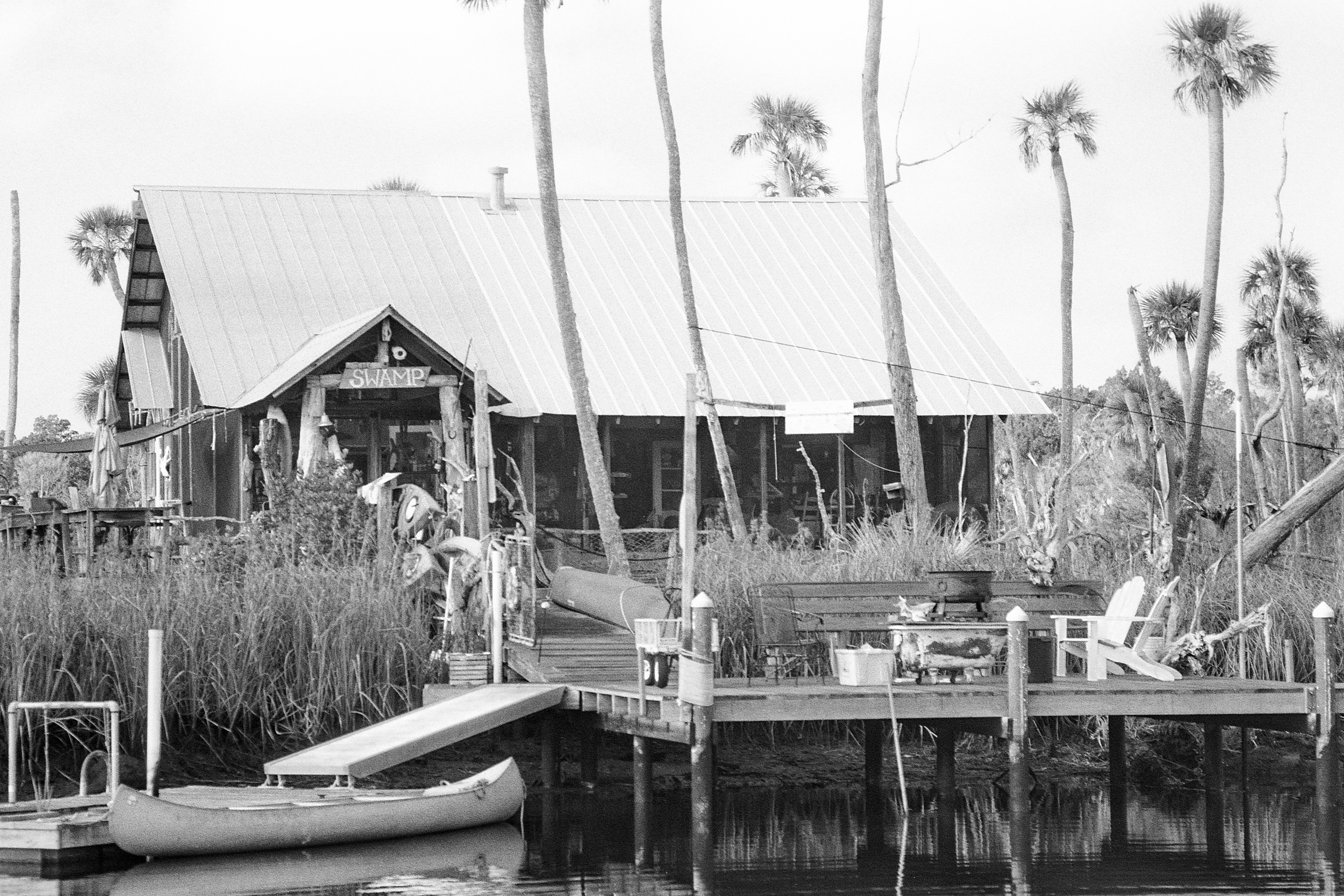
Dimmitt: That's the cabin where I stayed when I visited. My brother was one of the partners in the cabin when it was built; they did a lot of this work themselves. Everything had to be brought in by boat. When the cabin was finished, my brother asked me to take some photographs of the cabin.” He was really proud of it. He said, “I'll take you out in the boat and you can shoot back.” This was the shot I felt was best and I sent it to him. He said to me, “No, you can't see the house.” I said, “Well, bro, you built the cabin in a thick forest” The reason they built the cabin there was because the water is always 70 or 72 degrees. This is right on the creek by a spring, and the house stayed cool in the shade. The first picture (on top) is 1987. The second picture (bottom) is 2021. So that's thirty-four years. That's the same cabin and that's the same dock with some minor improvements.
Martin: This is an example of deforestation that involved no cutting down of trees.
Dimmitt: Absolutely. They wanted the shade. I took the first snapshot and made a lot of prints of it for my brother and the business partner. To reshoot in 2021, it was difficult because I had to find someone with patience to go back and forth and back and forth in their boat while I photographed. I had to figure out what lens I used back in 1987. It took awhile to get something that was good. That's often the case with re-photographic diptychs. It's very time consuming to find exactly where you did the early shot, where you stood, and what lens you used. Usually I did them by myself. But for the cabin shot, I had to rely on someone else to drive me back and forth and shoot a lot of frames.
Bransford: And you still are shooting everything on film, right?
Dimmitt: Yes, the entire project was shot on film. Any images that are square were shot with a medium format camera. When I went to reshoot the 35 millimeter images like this pair, I dug out my old 1980 Nikon F2 and got it cleaned and lubed in Asheville and took it down there. I hadn’t used that camera in probably twenty or thirty years. But yeah, everything's on film.
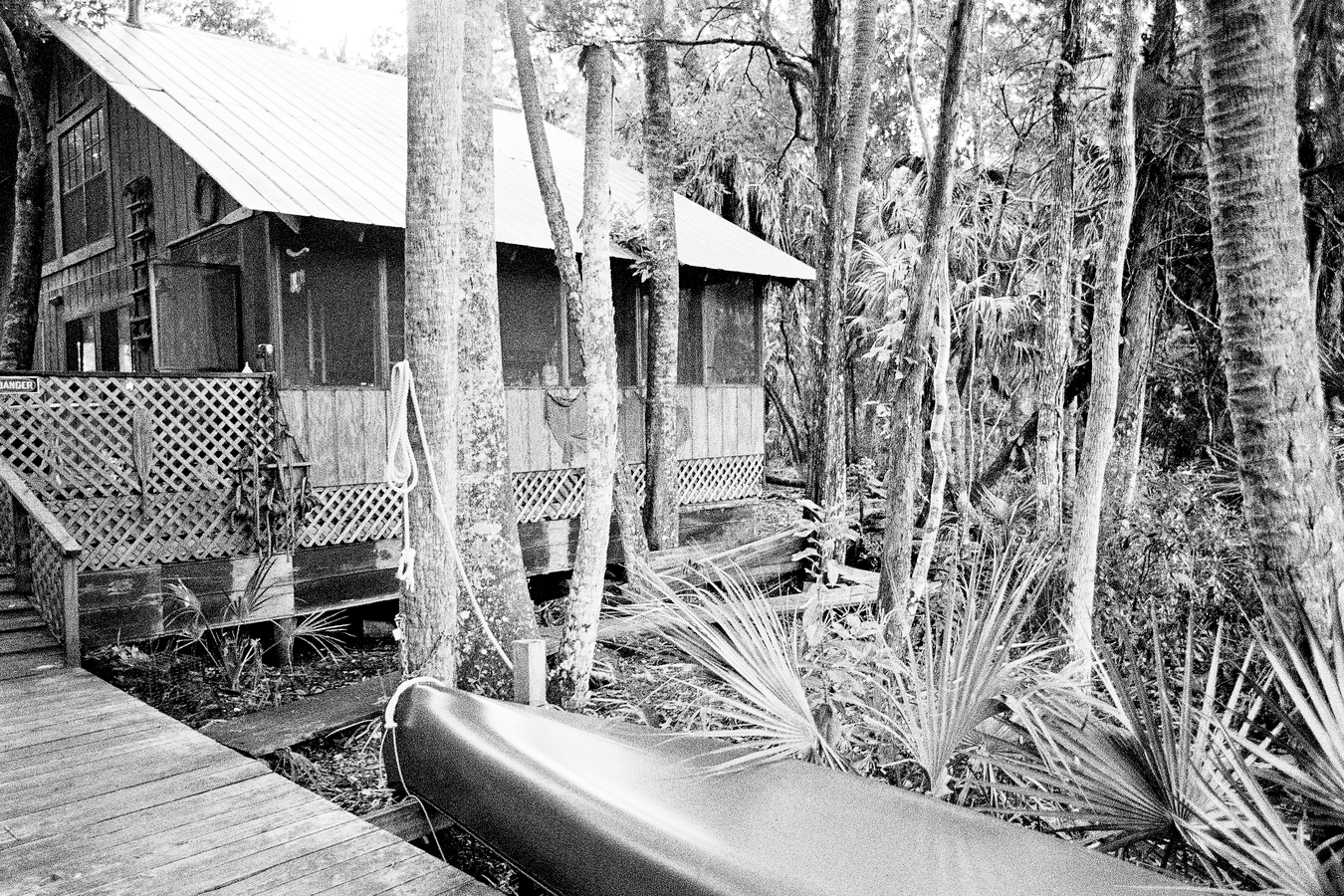

Dimmitt: That's the walkway from the dock to the cabin. The first photograph was made in 1988 and the second one was made in 2020. The earlier photograph lends itself to a vanishing perspective. And for the later one I made a point to shoot from the same position and with the same lens. It's really amazing how all the canopy, all the forest is gone. The saltwater floods around the cabin now at high tides and during hurricanes.
Martin: I'm wondering if I'm seeing what look like saw palmetto in the top photograph and then beneath it, is that Spartina now?
Dimmitt: Yeah, it looks like saw palmetto.
Martin: My gosh. That's a complete change in the ecosystem. Going from a terrestrial with freshwater influence to now saltwater dominated.
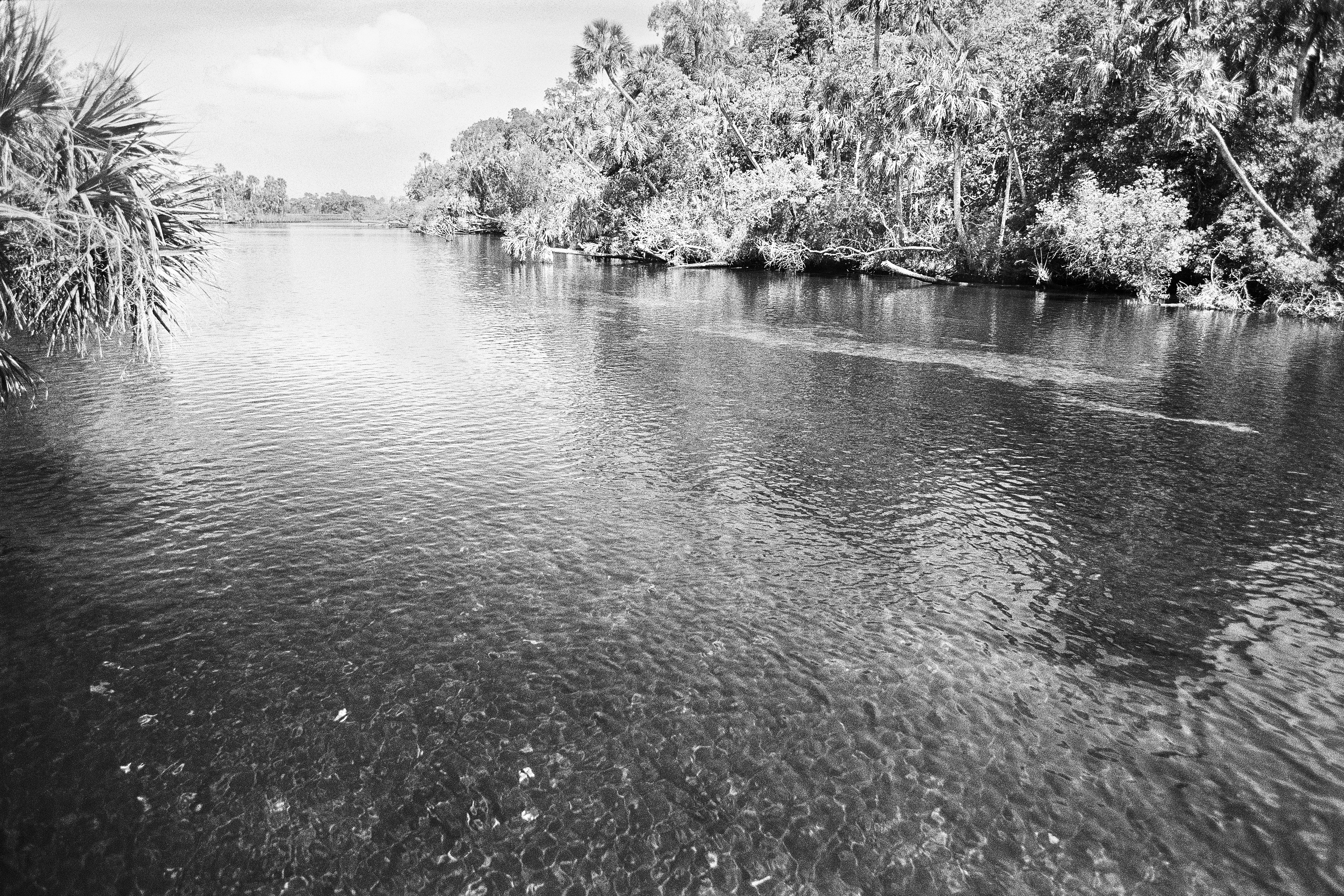
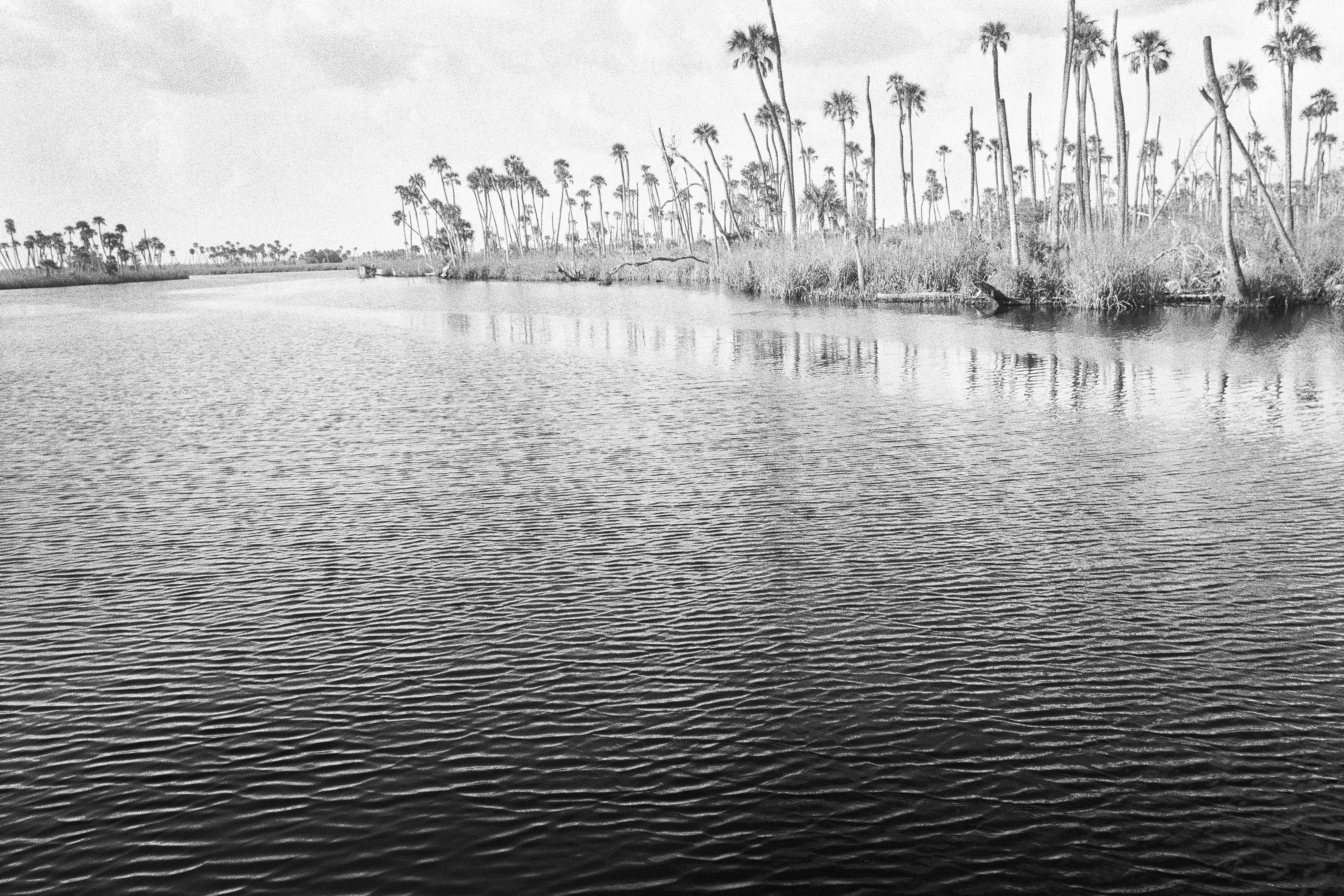
Dimmitt: I believe that this diptych shows the greatest span of time. This is from the dock looking downstream in 1986. And then the follow-up is 2020. It's the greatest span between the first and the second shot. If we were to go there now, half of the remaining palm trees in the back on the right would be gone.
Dimmitt: Next to Pat’s cabin, where I stay, is a neighbor’s cabin that has a boat shed, not a boat house. You climb up through a hole in the roof with the camera bag and tripod. I always worry about getting up the ladder with all my gear. And you can see way upriver and downriver to the Gulf. The left photograph was made in 2006 and the right one is 2022. I did several of these over the years, probably about six or more.

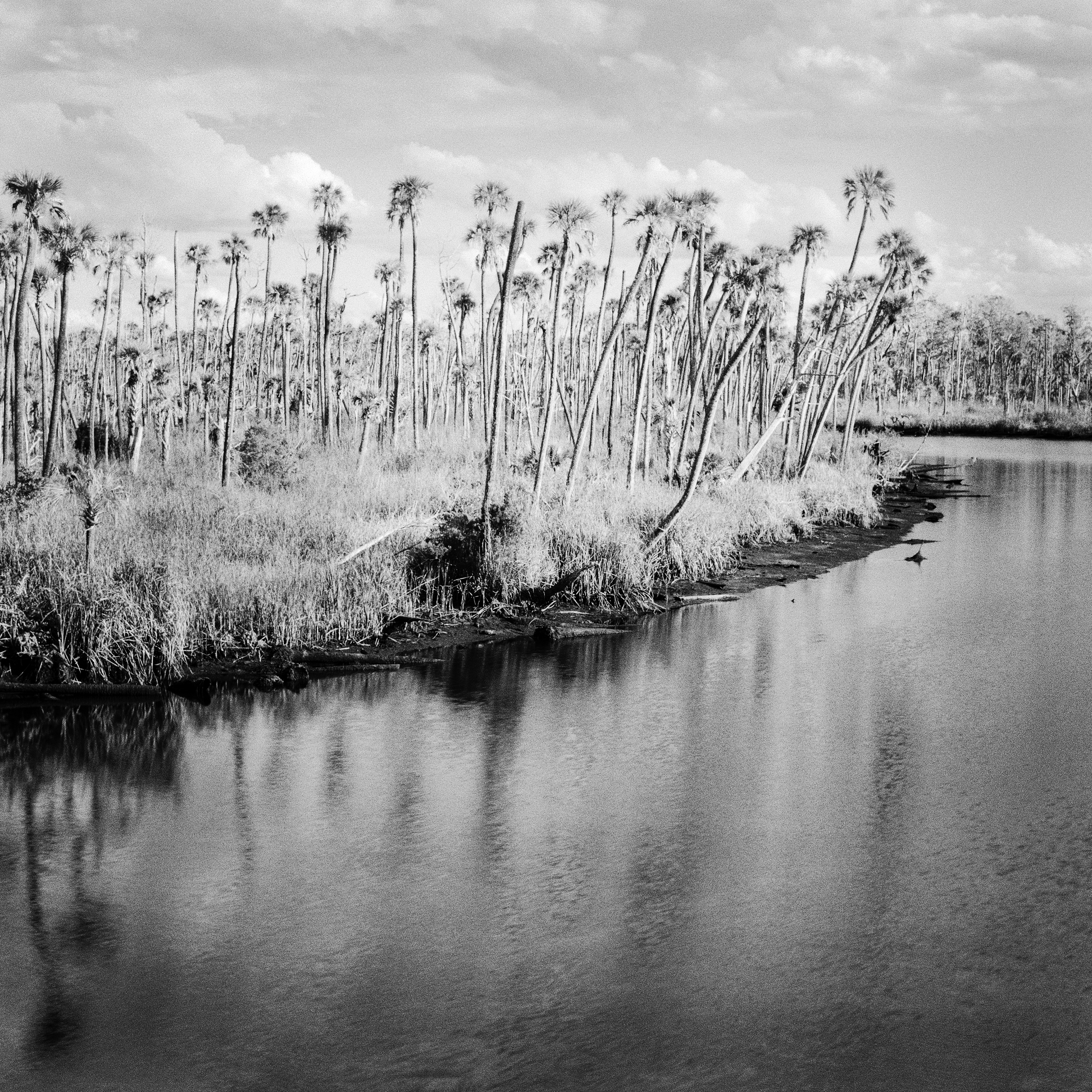
Martin: This is a really good pairing, too, because I think of this as a scientist. I'm a geologist, paleontologist by training. We are used to these really long expanses of time for dealing with environmental change. We say sea level rose, and it took thousands of years. Here, this is less than twenty. And in less than twenty years you've documented this complete shift in the ecosystems as a result of this saltwater intrusion coming upstream and affecting and changing those environments.
Dimmitt: The last time I was there, we had a good show. We saw dolphins or porpoises—I never know the difference from afar—chasing a large school of snook. It's brackish there. It’s a frenzy when the snook get trapped against the shore by the bigger, faster predators. You can't miss it if you're in a canoe or standing on the dock. And then another time, not that many years ago, we were seeing manatees come up and they always get your attention by their breathing sounds: the exhale, and then the inhale. You look out, and they've gone underwater to feed. I've seen them often in that stretch of Crawford Creek, which is where the cabin is and where I did almost all the photography.
Martin: So we're actually getting some marine mammals that are starting to come upstream into that area?
Dimmitt: I know that if they're coming up there, they're looking for food. They could easily be caught or eaten. And the spooked snook are something to behold because they go crazy. They're swimming all over the place trying to get away from the porpoises who are very smart and very fast. It's a bloodbath, but it's interesting to watch.
Dimmitt: This is kind of grim. This is 2004 and 2022.
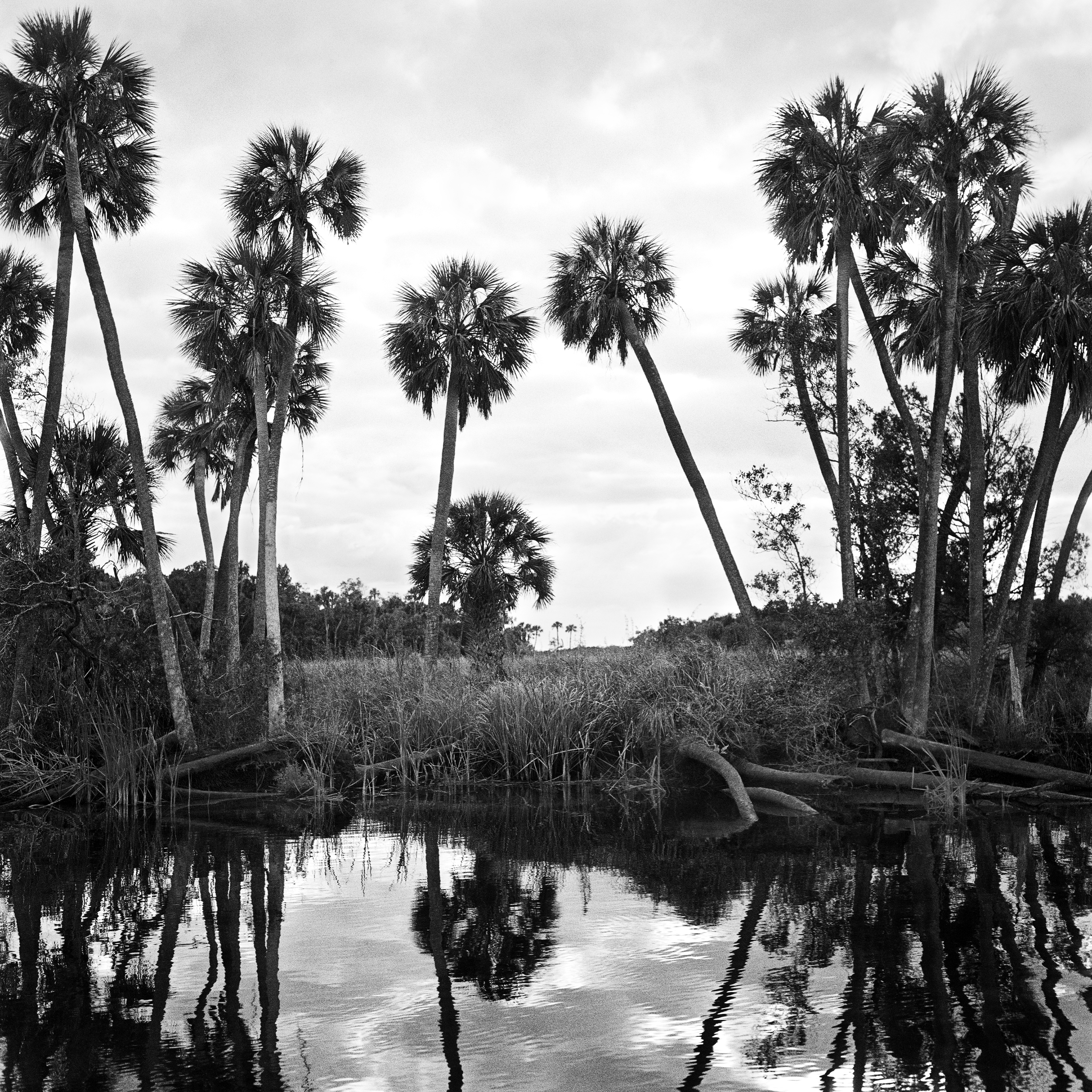
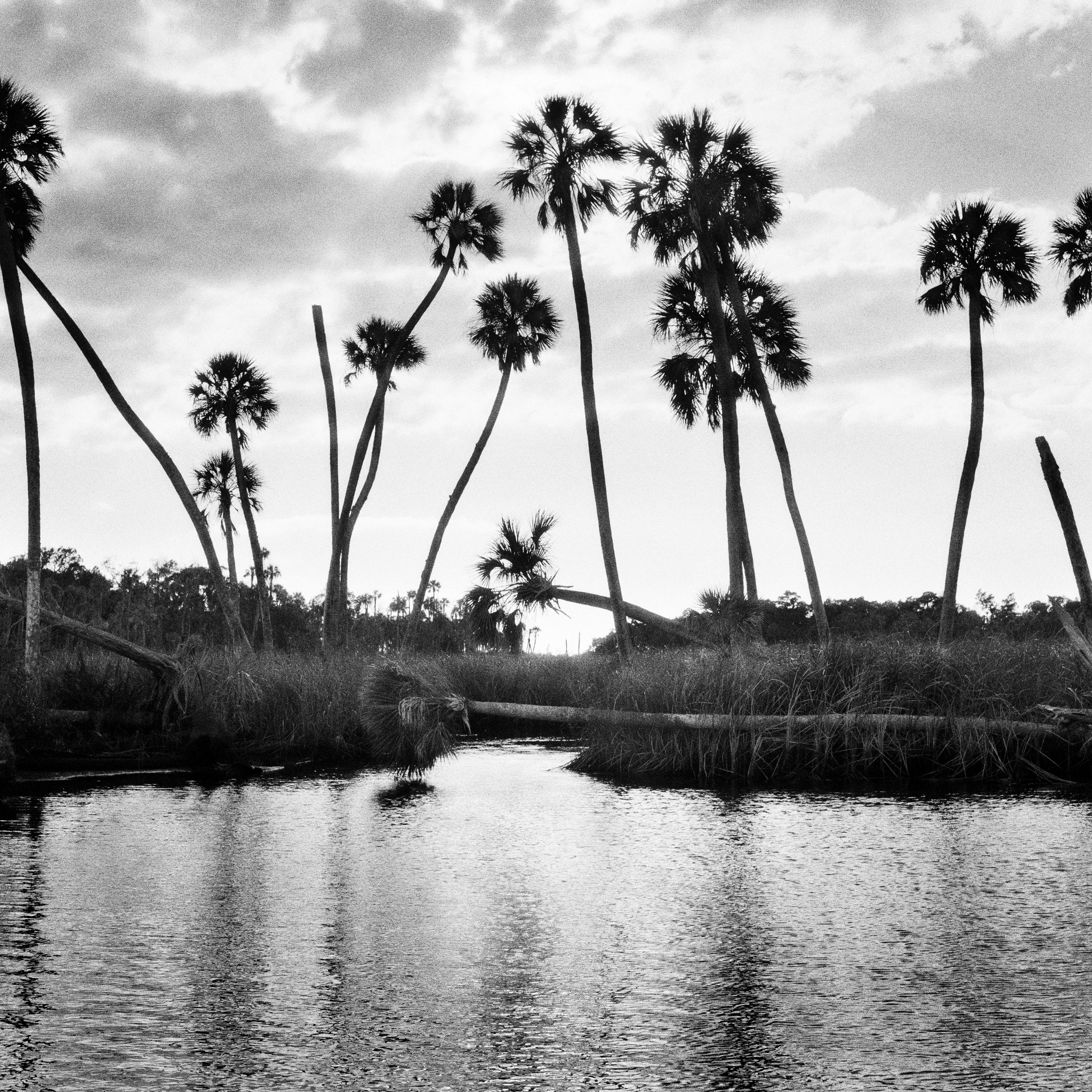
Martin: The total loss of the canopy is so striking to me. In those ecosystems, you originally had shade-tolerant plants and, of course, animals that would have been living in those communities. Then with the loss of that canopy, now you have all that sunlight pouring into those areas and heating them up, as well as the saltwater intrusion. All that is totally changing the ecological communities. And again, this happened in less than twenty years.
Dimmitt: This location is a protected stretch of creeks, maybe twenty or thirty yards out of the wind. What you see between these two photos is not a dramatic difference. My host told me that when fishermen would return in the evening, they'd go up into the grasses and clean their fish, which is why it’s called The Kitchen. And then they can get back out to the Gulf and go back up to the town of Chassahowitzka and pull out or go home. I shot the first one probably in 2004 without a tripod, which is always dicey, with a big, heavy, medium format camera. I kind of like that scene in 2004. When I went back to re-photograph it, I'm again relying on the patience of a friend and sometimes that patience runs short because I'm saying, “No, closer, no, further back.” And you go back and forth in front of it a couple more times, and there's nothing in it for the boat owner. But that was the best I could do. And everything is shot on film, but when you prepare files, when you get the images ready for the publisher, you have to get scans. So I'm working in Photoshop on scans of these negatives that I shot and printed many years ago, and I'm seeing things that I hadn't seen in a long time, and I'm looking at the difference in the two of them side by side and seeing a lot of small differences, and then way off in the background seeing other differences, and the edges of the islands on the left and right. There's some deforestation in there as well. It's a photograph that I enjoy, but it doesn't pack the punch that these other ones do.
Martin: Right. That was one of the aspects that I appreciated is that you had to toggle back and forth between each of the images to appreciate the amount of change that had happened there. And some of it is subtle. So it's something where, if you just had the second photograph, the later photograph by itself, someone who doesn't know that place would say, 'What do you mean, it looks fine, it's totally fine. It's not like there's a condominium or a development there. What's the problem?'
Bransford: Speaking photographically, did you have some compositional strategies of how you wanted to depict the Refuge? Some images have very strong diagonal lines, some obviously have strong vertical lines with the trees, sometimes downed trees dissect the frame horizontally. Other images don't have strong leading lines. The ones with algae or grasses are more abstract, ethereal. Sometimes there's a curved tree in the middle of the frame that grabs our attention or a log in the foreground in the water. Did you have certain compositional strategies of how you wanted to depict the refuge?
Dimmitt: Not at all. In some cases, I am walking around, where it's dry enough, in mud shoes and just looking or in some cases checking to see what some place looks like now. But I don’t have a predetermined way to shoot. That would really bore me. I did almost all of the newer work since 2004 with a square camera. There are only so many things you can do with a square medium format camera. I've had someone tell me it's evident that I had some sort of preconceived notion or was shooting a certain way but that’s not the case. I spent many years on this project. I had to keep it fresh. That might mean working on re-photographic diptychs one day and going on a long paddle to photograph some place new the next day.

This one is a favorite, and I was asked at length about it: how premeditated is this, that sort of thing. We discussed it at the Asheville Art Museum. One of my authors, Alison Nordström, who wrote the book’s long essay on the photography, had this in her slides, and she was saying all sorts of things about it that were wonderful and flattering. And my memory is that it was beautiful. It was very straightforward in that these were palms that had washed up on the edge of a savannah. I was on a narrow dock, and I couldn't move forwards or backwards. So I was completely constricted in how I could compose it, except to change the lenses. I made what I thought was a good photograph. Alison loved it. I didn't mention at the museum book talk, but I feel it now and see it now. It looked like the Pieta to me, it looked like the Virgin Mary with Jesus in her lap. I spent time in Florence in the seventies studying Renaissance painting, etching, lithography, and sometimes all that old Italian Catholic imagery stays in your head. And you’re not even aware of it until later.
Dimmitt: This is another one of those images that was really difficult to photograph. I love it, but it was so busy and there was so much going on. It took a while, maybe twenty or thirty minutes to create some sort of order out of this chaos.

Martin: Something I appreciate in terms of the documentary aspect of this sort of photograph is that the reflection is actually bringing out the sky better. You can see the clouds and the gaps between the clouds that are only implied in the actual sky part of the picture.
Dimmitt: I was asked if I always make my skies white. There are various things I could have done here and I did do in this case, and that's to use a deep yellow filter to try and get some tone in the sky. But it was a very bright sky and there's not much you can do to get tone in it. To further answer your earlier question, I don't have a preconceived notion. This was just very difficult to compose. It's a complicated image visually but I’m very happy with it.
Bransford: You mentioned Alison Nordström, she talks about the opportune slipperiness of these photographs in the sense that they simultaneously inhabit the worlds of art, science, and social action. Was this or is this your intention? Did you come at the project initially from an art photography standpoint and realize gradually that the images also have scientific and even political appeal?
Dimmitt: I'll almost give you a straightforward answer and say yes. And then there's a but. As I mentioned, I started shooting there in earnest in 2004, and I was just photographing something that I thought might disappear or that I just liked an awful lot. And the more I poked around, the more time I took when I went there and paddled in the various parts of the swamp, the more I loved it. And again, I'm from there. This is my native landscape, so I was very happy to be doing what I was doing. And then climate change arrived, and I didn't really change my approach and become a different sort of photographer. I just photographed the impact. There was nothing undamaged. The impact was all encompassing. It was everywhere. You really couldn't escape it, and it got worse every time I went. Someone recently asked me how how many rolls did you shoot? How many times did you go down there? I moved to Asheville in 2014, and that's when I first discovered that the rising seas were starting to do serious damage. The tally I got when asked was around twenty-five trips down there in the eight years that I worked on the project.
I was doing landscape photography. That is what I do. I just happen to like to photograph in wetlands because that’s my native environment. That's my native landscape. I grew up in Clearwater on the bay. I'm working now on a project about mangroves. When I was in Florida last month, I was shooting at Weedon Island in a big, beautiful mangrove forest. That's the kind of subject that I like. The interpretation is up to the beholder.
I imagined that these photographs were good enough that my gallery in Tampa would be interested in exhibiting them. They said they weren’t going to be able to sell them, but they would exhibit them. So we did. And only two or three sold. I was eventually told it should be a book. So I got in touch with the University of Georgia Press, and the director was very excited about the work.
The book then gives you an opportunity to create an editorial viewpoint. And to me, they didn't have an editorial viewpoint. They were just a document of a place that I had made photographs of that was becoming ruined by rising sea levels. Learning about the causes from Dr. McCarthy was something that made me become a little more activist about it, and also learning about my subject and doing research. But the research didn't start until I got a book deal. Learning about The Villages and learning about the state's water management, or water mismanagement, made me even angrier, and that became something my editor convinced me to write about—my feelings. That's why my epilogue is sharper than the rest of my language.
Bransford: I'm glad you mentioned the epilogue. In it, there are the two anecdotes. One of you visiting what I think is the oldest and biggest tree in the refuge and your speculation about what's going to happen to it. And then also the wonderful anecdote of you paddling and not hearing any leaves rustling but hearing the woodpecker sounds. Could you recount those two anecdotes?

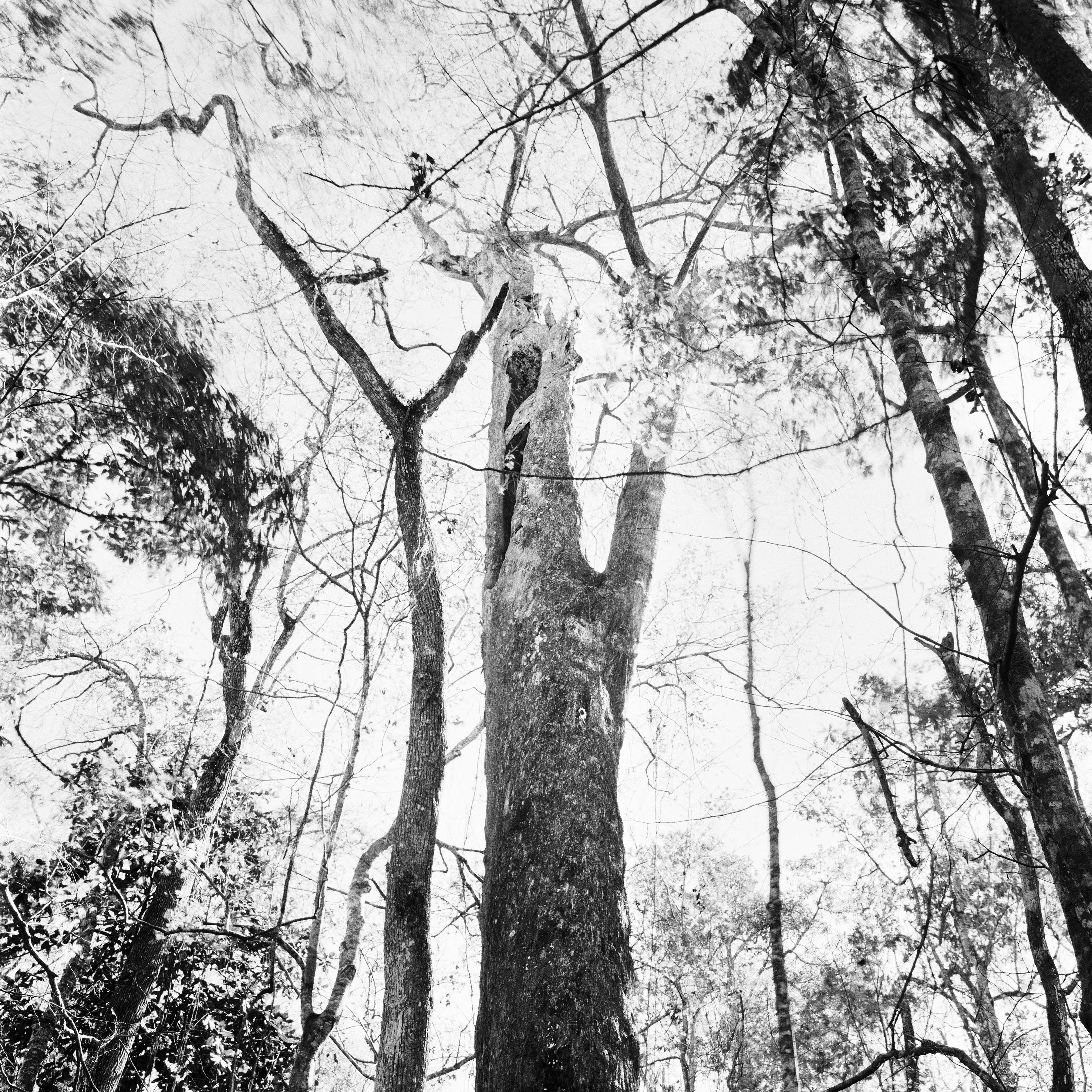
Dimmitt: I'm still surprised that the editor got those two things out of me because writing is not something that I do well or do comfortably. The last remaining old growth cypress tree is not the last one in the swamp, but the last one that anyone could direct someone to. It happened because I asked my host down there, Pat, if he could take me there. He said, “Yeah, but we will have to go to the property owner first.” And I said, “That's fine.” So we did that, and then we walked off in the direction of the tree and I'm relying on Pat. He's been there multiple times. And I'm looking up, and I'm waiting to see some old growth tree.
I practically walked into it. It’s the photograph which has a lot of palm fronds and shadows on its fat trunk. I stopped there and photographed. It doesn't show the upper part of the tree, it just shows the trunk, which is huge. I couldn't really see the tree trunk. I almost walked into it because it was somewhat camouflaged by all of its neighboring palm trees, which were small. I imagined that's how it had lived so long, because it had been unrecognizable. And anyone who is looking for cypress trees would have passed it by because its top had probably been blown off by lightning. And I made a couple of photographs of the tree in the shadows, and then backed away and got a different lens and photographed the top, which is a mess. It may still be there. I think that photograph was done in 2021, but it is really close to a creek and all the creeks are becoming saltier. And that may be what kills that tree. It survived the loggers in 1916, and it probably is not going to survive this.
You mentioned something about sound, and I will tell you that the last photographs I showed you of the palms in the creek where we discussed filtering for the sky and, that sort of thing—if I was there maybe twenty or thirty minutes composing and making the photograph and when I'm doing that, I have everything turned up all the way. I am looking as hard as I can. I'm trying to compose something that reaches into me, is compelling compositionally, all the rest of it, where am I standing, that sort of thing. Sinking up to my calves in mud. And I'm seeing everything, and I'm hearing everything. And when you asked about the woodpeckers, I chuckled because when I get back to the cabin at the end of the day, or if I’m here in the mountains and I get back to the car after a long hike, I can tell you every single thing I heard. I can tell you everything I saw. My sniffer's gone, so I can't tell you every smell. Being in the canoe, paddling around, feeling the breeze. It was a hot day in December. Losing control of the canoe in a breeze, and then I got pushed over to the side of the creek. I dropped the anchor and sat there, there was not a photograph for me to take where I ended up, but I could hear not just one woodpecker; I could hear many, many woodpeckers banging away at the all the dead trees, all the dead hardwoods surrounding me. And it was really disheartening. It was an indication that some bird's happy and there's a lot of food for all the woodpeckers now, but that's just another way in which we learn how bad the ecosystem loss is.
Martin: That caught my interest because the last couple of David Haskell's books have dealt with sound. One of them is The Songs of Trees, and Sounds Wild and Broken is his most recent book about how there are not just landscapes—and what you're doing is documenting landscapes that, of course, are waterscapes as well—but there are soundscapes. So you have the visual aesthetic that is intrinsic to your photography, but sometimes with a picture like that, I, as somebody who goes into those kind of environments, experienced the same thing you did, I also hear the sounds when I look at the photograph. And I'm realizing that it's not just visual, that there are other senses that are being engaged with these places and how climate change and sea level rise, pollution, all of these factors are also affecting those other ways we sense the world around us.
Dimmitt: If I'm at the swamp house with my host and his family, if there is a porpoise–snook battle going on, we always go out to the dock and watch. And you don't see it if you're inside the cabin with all its screens. If you're inside, you hear everything outside. You run out and engage with it. It’s nature at its most brutal. I went to school at Eckerd College near Lake Maggiore, and the sound of ospreys chirping for minutes after minutes after minutes is something I grew up with. It resonated with me.
Bransford: Is there anything else about your book that we didn't cover that you'd like to talk about?

Dimmitt: This photograph of fog on the creek closes my essay in An Unflinching Look: Elegy for Wetlands. Something you feel when you're there. It's 100% humidity. If you shoot in the winter, which I prefer because the light is better in the winter and it's not as hot, then you're going to get fog because at night it cools down. And I just walked out of the cabin and down to the edge of the dock, and that was in front of me. That's a palm that had been alive, well, probably four or five years prior. And it was already hosting plant life of its own. This is my first book. Working with an academic press, they didn't give me any direction. I was completely on my own to make the image selection and to sequence it and I came up with the idea of the gatefolds. They were wonderful to work with, and the designer did, I thought, a beautiful job.

Dimmitt: This is one of the last photographs I took in the swamp. It was the same day that I went out and heard all the woodpeckers. What has stuck with me is this whole place was a thick tropical forest, and now it's nothing. This is Spartina? Is that what the grasses are?
Martin: That's what it looks like. Smooth cord grass.
Dimmitt: There’s another grass that’s round.
Martin: Juncus. That’s also a saltwater indicator.
Dimmitt: Often I will shoot from the canoe handheld without a tripod. It’s not easy to do. And I saw this and I thought it was beautiful. I didn't think about what purpose it would serve in a book as propaganda or beauty or science or any of that. I just shot it. But after I finished the photograph, I realized that I had been fighting logs and tree trunks in the creek the whole time, and the image I just called Impassable Creek. That's because you can't paddle in these places anymore because creeks are so full of dead trees. There's no clearance. And it was like being shackled. There are so many corpses that you can't move freely. Someone who wrote about my project wrote that it reminded him of a Civil War battlefield with corpses everywhere. And this was the first time, in 2022, when I was finishing the book, that I felt that I couldn't move in the swamp.

Dimmitt: When I would walk in some of the drier places, I would just be checking in. And one of the things that caught my eye on this day was that saplings were dying. This is kind of a mess as a photograph, but that's what you see when you're walking around. When it’s too salty for palm saplings, then it's really too salty.

Dimmitt: The earlier photographs in the book are photographs of a place that was pristine and exotic. Photographs of things that I found beautiful and unusual. However, I gradually started to photograph death and destruction on a very broad scale. It just kept getting worse and worse. And it will continue to get worse and worse. Hurricane Idalia had a big impact down there. I don't even want to go see that. I had to adapt to shooting environmental destruction. I didn't know how to do this. I get asked about beauty. One thing I didn't want to do was to suddenly go from taking photographs of some place I found compelling and beautiful to using my camera to make ugly photographs or to make these wetlands look bad. When I was doing the event at the Asheville Art Museum with Alison Nordström recently, she said to me, this is a beautiful photograph. Just one of a dead palm in the river. I'm saying to myself, this image is brutal. This is straightforward damage. And it was, again, shot from a canoe, which makes it difficult to do. The creek bottom was vey soft so I can’t get out and walk. And I did the best I could. It's not a good negative, but I'm grateful that I don't have to print much of these images for exhibits because no one would want to show this work in an exhibit. But this is as straightforward a photograph as I can make. I don’t recall making any effort to photograph it beautifully. And I was surprised that Dr. Alison Nordström thought it was beautiful.
Bransford: Is there a tension there of creating beautiful images of things that are brutal and unsettling? Are they mutually exclusive?
Dimmitt: For me, there isn’t a conflict. I don’t feel that they are mutually exclusive. I guess I gave an insight into that a moment ago. I went from photographing a place that I felt was beautiful to photographing its ruin. It’s my native landscape. These are forms and shapes and trees and brackish water that I grew up with in Clearwater. We lived by the bay and there were roots of large mangrove trees that had died in a freeze long ago. They stayed there on the sand bars for decades. So, I guess I got acclimated to seeing a certain amount of death in my surroundings.
I don't know how to make ugly photographs but I do know that a beautiful photograph encourages a viewer to engage with it. I simply continued using the same sense of aesthetics that I brought to the swamp when I started photographing there decades ago.
I made a commitment to this place when I began this project in 2014. I like to honor my subjects. My goal all along has been to make compelling photographs. The book is about bearing witness to a tragic loss, saying farewell to these beautiful, complex wetlands and making it known that this is happening now along low-lying coasts all around the world and will only get worse.
Introduction—Salt Creek and City Nature
To place Salt Creek geographically, imagine the state of Florida. Zoom in to the west central coast,1This multi-media essay has developed over a long period of time and thanks are due to my home university's Center for Civic Engagement, the Frank E. Duckwall Foundation, the Tampa Bay Estuary Program, and most of all, to my students. Thanks to my comrades at Friends of Salt Creek; my church community at St. Augustine's Episcopal Church (at Salt Creek's headwaters), who have taught me to see my adopted hometown in a new light; to videographer Devin Rice; to Allen Tullos and anonymous readers for Southern Spaces; to Julie Armstrong, Jack Davis, Ray Arsenault, Amanda Hagood, Ray Roa, Chris Meindl, and Jacqueline Hubbard, Esq. then go to St. Petersburg, a midsized city—the second largest in the Tampa Bay area. St. Pete holds down the bottom of Pinellas County, a peninsula upon a peninsula, bracketed by Tampa Bay to the east and the Gulf of Mexico to the west. Water is everywhere.
St. Petersburg has always been two things: a resort town and a product of the segregated South. Known affectionately as the Sunshine City, St. Pete claims the Guinness World Record for sunshine (as a can of local craft beer will tell you, 768 consecutive days). This winter haven boomed in the early twentieth century. White vacationers and retirees flocked here for the weather, often to relax on the green benches (hence the beer) that once lined Central Avenue, the city's main thoroughfare and longtime racial divide. African Americans first migrated here to build the railroad and work the tourist economy, building tight communities over time.
Off the tourist map, Salt Creek remains absent from view, for reasons both geographic and social. Because the water flows in a northeast direction, starting from the middle of Pinellas County then into Tampa Bay, the creek falls off the orderly cadastral map. Avenues go East-West and the streets North-South, while Salt Creek cuts a diagonal course. Most of the creek's banks are culverted, so its "nature" does not adhere to conventional labels of leisurely consumption. Racial divides further hide this fragmented waterway, and the environmental merges with the Sunshine City's flickering, all-too-easily-denied Jim Crow past.
Today only a handful of locals can trace Salt Creek's full course. The best way is to start at the mouth, Bayboro Harbor, just south of the city's previously moribund but now skyrocketing downtown. As one journeys southwest, going upstream, the creek services a working port (properties now eyed for luxury housing). The creek passes under a mangrove cover and empty lots, owned mostly by absentee speculators. The city's sizeable population of street people, who use its shielded banks for shelter, are the principal stakeholders here. Under Fourth Street, a major north-south corridor, Salt Creek opens into mangrove-shrouded Bartlett Pond. Beyond the pond, it crosses under Twenty-Second Avenue South, also a major thoroughfare, before vanishing into a culvert through Harbordale, one of the poorest neighborhoods in Pinellas County. Dammed at the north-south running Dr. Martin Luther King, Jr. Street (or Ninth Street, to old timers), the channel opens into Lake Maggiore, historically an estuarine body of water, now maintained as fresh. Beyond the lake, finally, Salt Creek splits into several other unnamed sources.
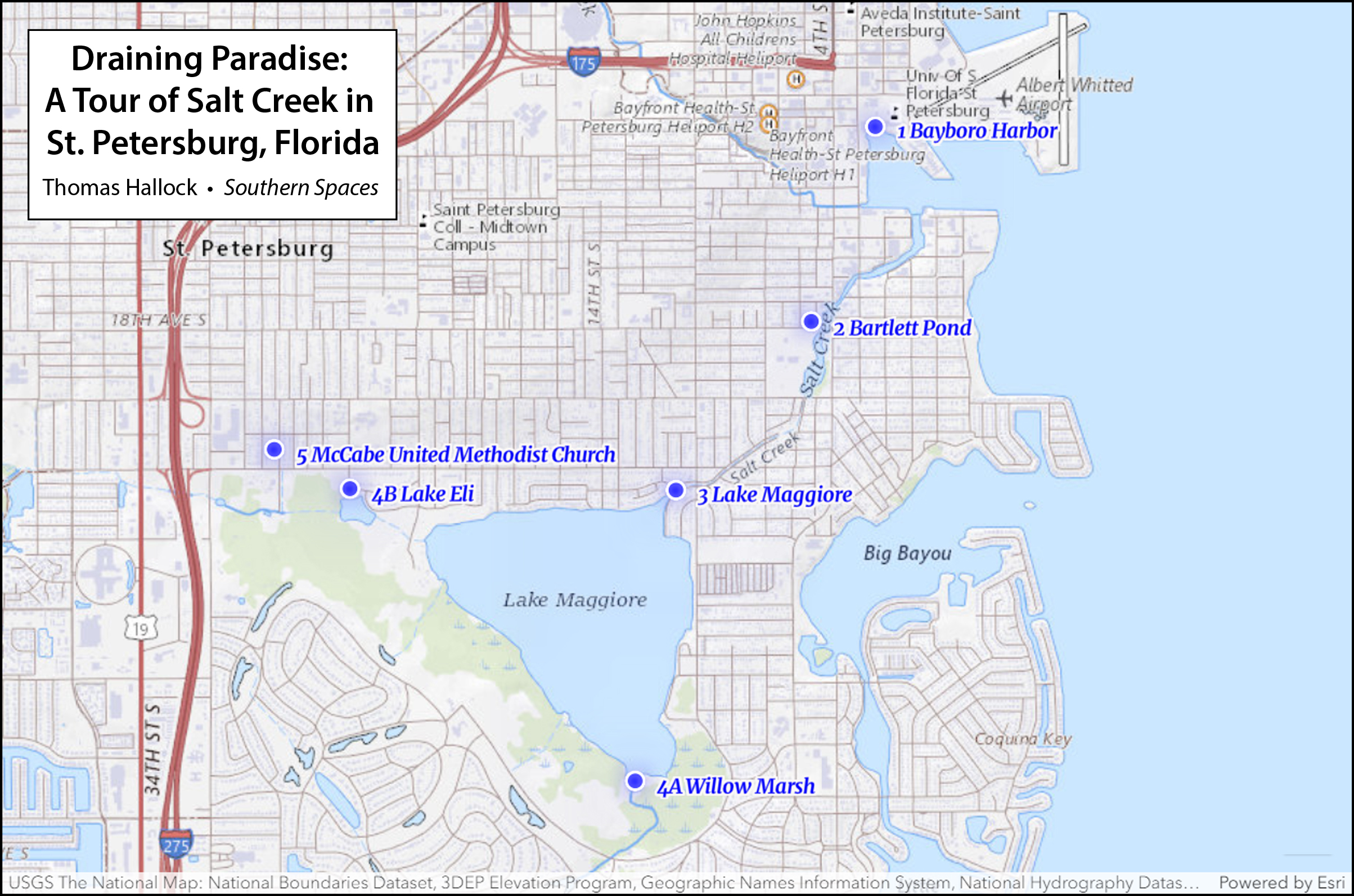
Recovering an urban waterway is no easy task, as it requires travel across both time and space. This tour, "Draining Paradise," attempts to render visible our everyday—yet hidden—lives, where water meets land. Because Salt Creek pays no heed to squared-off boundaries or cornered streets, and because property claims trump natural processes, it suffers neglect. In a city founded upon leisure—moreover, with a disenfranchised working class needed to produce that leisure—what counts as "nature" inevitably falls along social, economic, and racial lines. A continuing legacy of inequity shapes environmental priorities. Yet Salt Creek's history is complicated. Water quality intersects with social structures, though not in any simple or straightforward way. The words and conventions we use to describe natural beauty fill in few gaps, nor do current models of environmental justice fully apply. This aquatic system passes through several different neighborhoods—white and Black, rich and poor, protected and industrialized, through parts of town in clear neglect and others in good health. The social constructs fragment the hydrology until a citizenry can no longer see itself in nature. So how do we teach ourselves to see the parts as one whole? Can we come together as a community by cognitively remapping a forgotten stream? If so, what terms do we use? What's the storyline for a creek that has become a ditch?
I first stumbled upon my problem quite by accident, as an extension of my job as an English professor at the University of South Florida's St. Petersburg campus. I came to USF as a part-time instructor, tasked with developing a course called "Rivers of Florida." For several semesters, I ventured with students in canoes and kayaks onto the state's many spectacular wild and scenic rivers—traveling hours for peak nature experiences amid awesome alligators, long legged wading birds, and floodplains filled with cypress—waving trails of Spanish moss over the slick obsidian water. Despite the beauty of our surroundings, student essays from the "Rivers" classes were mostly pedestrian paeans to the "real Florida" and laments for a vanishing nature. Tired of burning class time and fossil fuels, and bored with cliché writing, I turned to nature close to home—Salt Creek, whose mouth empties right onto our campus.
With little initial support, I threw myself into a curriculum that built nature around the city. The project came to consume my work as teacher, writer-researcher, citizen, and activist. The early stages were marked by confusion and indifference. The problem, from a pedagogical standpoint, starts with semantics. What happens when a stream or creek becomes a culvert or ditch? Why do those words matter? We urban dwellers, who seek out nature close to home, are linguistically bereft: there is no term to describe the successful interface of natural and built environs. Outside cities, we have any number of categories for describing natural landscapes. The "wilderness" and "preserve" define parks, without people; the "georgic" or "bucolic" covers farmland; a "pastoral" is where classical shepherds tended their flock while reflecting upon the corruption in Rome, and today denotes cherished spaces of imagined innocence—like a baseball diamond or the Andy Griffith Show. But nature in the city presents an absence. To address this problem, I set up a classroom model. I founded a fictional group, "Friends of Salt Creek," built a website, and started exploring with my students.2For a timeline see Friends of Salt Creek, Accessed April 11, 2023, https://friendsofsaltcreek.org/; for an example on how the critical terminology overlooks city nature, see survey in Greg Garrard, Ecocriticism (New York: Routledge, 2012), which is organized around a series of chapter-keywords (pollution, wilderness, apocalypse, dwelling, animal, earth), but no urban terms. Like a generation of environmental humanists, I first recognized the shortcomings of advocacy strategies and literary conventions after reading the edited collection by William Cronon, Uncommon Ground: Rethinking the Human Place in Nature (New York: W.W. Norton, 1996); more recently, I discuss cultural categories of nature writing, and the challenges of teaching city nature, see "City Creeks: Lessons in Sustainable Environmental Discourse from a Florida Boom Town," Spaces in-between: Cultural and Political Perspectives on Environmental Discourse, ed. Mark Luccarelli and Sigurd Bergmann (Leiden, Netherlands: Brill Rodopi, 2015), 88–101. Using searchable newspaper articles and government documents, we cobbled together a storyline.
The next step was to theorize. Environmental writer Jenny Price details "Thirteen Ways of Seeing Nature in LA," a classic re-examination of the least "natural" of all places, the Los Angeles River. On the East coast, meanwhile, landscape architect Ann Whiston Spirn has combined activism, teaching and writing in a recovery of Mill Creek, a buried stream that threads through West Philadelphia before feeding the Schuylkill. These models and others provided a conceptual groundwork. Over time, I accumulated equivalents. A trip to New York City took me to the Gowanus Canal, a Superfund site where Walt Whitman once ate oysters. I learned how tourists in London will lay out ten pounds each (five for kids) to slip down the culverted Fleet River, now a covered source but a notorious ditch from the reigns of Queens Elizabeth to Victoria. A sixteenth-century mock epic by Ben Jonson, "On the Famous Voyage," recounts a journey up the filthy Fleet: the open sewer runs foul with "grease, and hair of meazled [leprous] dogs; / The heads, houghs [hocks], entrailes, and hides of hogs."3Jenny Price, "Thirteen Ways of Seeing Nature in LA" (Part 1), Believer 33 (April 1, 2006); Anne Whiston Spirn, "Restoring Mill Creek: Landscape Literacy, Environmental Justice and City Planning and Design," Landscape Research 30, no. 3 (2005): 395–413; Ben Jonson, "On the Famous Voyage," in Complete Poetry, ed. William B. Hunter, Jr. (New York: NYU Press, 1963), 72. The same waterway carries away the cannibalistic offal of Stephen Sondheim's Sweeney Todd, "the demon barber of Fleet Street."
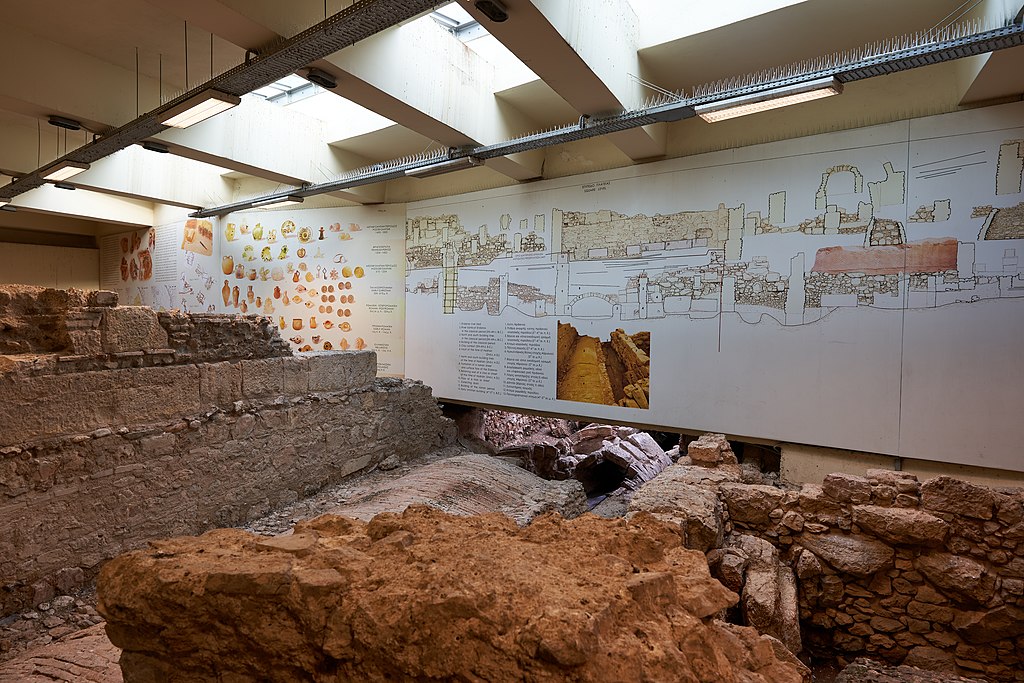
Patterns came together. Urban waterways offer a Realometer, as Thoreau wrote, places where you stand right to face the facts.4Henry David Thoreau describes the "Realometer," distinguished from the "Nilometer" (a gauge to measure the mythologized Nile), in the penultimate paragraph of the chapter "Where I Lived, and What I Lived For," from Walden, or A Life in the Woods (Boston, MA: Ticknor and Fields, 1854). Our city creeks mark charismatic, if uncomfortable points of context between activism and disaster fetish, economics and racial inequity, lost memory and recovery, cool-credibility, and very real marginalization. The more I traveled my own channelized waterway, the more analogs I discovered. Friends and colleagues started volunteering their own favorites. The Chicago River (a graduate school buddy reminds me) previously served as a portage between the Great Lakes and the Mississippi. A stunningly illustrated article in the New York Times charts the harrowing impact of sea level rise on this area.5Dan Egan, "A Climate Crisis Haunts Chicago's Future. A Battle Between a Great City and a Great Lake," New York Times, July 7, 2021, https://www.nytimes.com/interactive/2021/07/07/climate/chicago-river-lake-michigan.html. A colleague who graduated from Columbia's school of journalism reminded me that vestiges of Minetta Brook flow under Minetta Street in Greenwich Village. My writing partner for a series of #Creekshed essays in our local alt-weekly, Amanda Hagood, sent vacation photos of Ala Wai Canal in Honolulu. Another traveling colleague, a classicist, Facebook messaged me a photo of the vestigial Eridanos, Greece—the literal path to Hades—which runs through Athens' Monastiraki Metro stop. The community relations person on my campus insisted I walk the C&O canal on my next trip to to Washington, D.C. And while researching an academic memoir about her hometown of Birmingham, Alabama, my colleague and partner Julie Armstrong traced the entirety of Village Creek—a polluted stream that drains both industrial sites and a neighborhood park where she played as a child.6See Thomas Hallock and Amanda Haygood, "#Creekshed Story Map," May 5, 2022, https://storymaps.arcgis.com/stories/b664d097ee3e408c8eacf5a424075af8; for more information on the Ala Wai canal, a lagoon off Waikiki that displaced wetlands used by island Natives for fishing and agriculture in Waikiki, see Sophie Cocke, "Ala Wai Canal: Hawaii's Biggest Mistake?," Honolulu Civil Beat, May 20, 2013, https://www.civilbeat.org/2013/05/ala-wai-canal-hawaiis-biggest-mistake/; a display of Minetta Brook, which used to run through the lobby of a hotel-apartment, is no longer operable, though reference can be found at "Minetta Green," NYC Parks, Access April 11, 2023, www.nycgovparks.org/parks/minetta-green/history; Village Creek Environmental Human & Environmental Justice Society, Accessed April 11, 2023, https://villagecreeksociety.org; Julie Buckner Armstrong, "Two Days along Village Creek," Learning from Birmingham: A Journey into History and Home (Tuscaloosa: University of Alabama Press, 2023). East Lake was the white working-class neighborhood where Julie grew up. Through the post-civil right's era, it was mostly African American. Because of its increasingly coveted real estate, it became a focal point for the A&E program Flipping Down South.
Why this passion? And why is this work necessary? The recovery of an urban waterway can feel like a very vexed homecoming. Even though social history and economics have shaped our aquatic environs, current land use practices erase the very past that brings value, coherence, justice, and yes, even happiness to our communities. City creeks have a particular way of taking one both to the edges and into the heart of where we now live. We are habituated, as geographer Yi-Fu Tuan reminds us, to link memory and place. Tuan's term, "topophilia," is a well-known coinage for the memories that accrue across space. A crack in the sidewalk carries us back emotionally; a whiff of wisteria fosters connection, and one hopes, concern for a given locale.7Yi-Fu Tuan, Topophilia: A Study of Environmental Perception, Attitudes, and Values (New York: Columbia University Press, 1990). Though simple on the surface, the concept is tough to pin down; topophilia, Tuan reminds us, is not just patriotism, childlike nostalgia, or the marketing copy on a beer can. It means coming to grips with both the pleasures and the problematic.
Take the green bench, which is the name of my local brew of choice, but also a hurtful symbolism. As noted in a recent study of systematic racism in the city, green benches lined the main thoroughfare of Central Avenue from 1916 to 1960. For white residents, these benches were a "symbol of hospitality and place to socialize" on a pleasant winter afternoon; for African Americans, not being allowed to sit there served as an "everyday reminder" of humiliating segregation.8Tuan, Topophilia; Ruthmae Sears et al, "Building Bridges & Racial Equity in St. Petersburg Florida" (Tampa: University of South Florida, 2021), 52. City creeks, likewise, sit uneasily in our idea of nature. They do not offer simple recreation or respite. The active search for broken connections instead takes us beneath the placid surface of a city's daily life.
As a white northern transplant, I have learned how a recovered past opens channels for seeing a difficult present. Every metropolitan area holds its own hydrologic history, buried or forgotten. What I offer in this short trip is a lesson in how cities render nature invisible; how what we count as nature is either valued or subject to abuse, and how those decisions follow social lines; and how past, present, and future landscapes intersect. To cross into our fragmented waterways, I must add, requires humility. The divisions rendered in our shaping of the natural world remain. And so the fundamental challenge: to come together, as one community, cleaning our rivers and streams, while at least recognizing—if not starting to heal—the rifts between us.
Bayboro Harbor
Start at Bayboro Harbor, at the campus where I teach. Faculty, staff and students can rent a kayak, paddleboard, sailboat, or canoe at the waterfront office, and here, I typically begin my nature writing classes. Once called "Fiddler's Paradise," for the crabs foraging in the surrounding mangrove and spartina, this former bayou is where Tampa Bay meets Booker and Salt Creeks—two of the major drainage systems for lower Pinellas. The Gulf Coast of Florida has been home to a series of loosely-defined, overlapping cultures, more local polities than "tribes"; these include "archaic" groups, the Weeden Island culture (300CE–1000CE), followed by the Safety Harbor culture (900CE–1500CE), then Tocobaga (the residents of Tampa Bay who most likely met Spanish explorers in the sixteenth century). Florida's first people fished and gathered crustaceans. The refuse from this bounty formed middens and mounds, many of which appear on early postcards from the city. As St. Petersburg boomed through the twentieth century, during the early years of car culture, these shell mounds were looted for road fill. The Indian works, reminders of a successful synthesis of built and natural environs, remain buried under a hospital's out-parcels and parking garages.9Robert J. Austin, "'Its Origin Steeped in Mystery': The Sorry Saga of St. Petersburg's Shell Mound Park," The Florida Anthropologist 73, no. 2 (June 2020): 113–39; the ongoing status of Native remains, held at the Smithsonian and elsewhere, including (until recently) my university's anthropology department is reviewed in "Notice of Inventory Completion: Department of Anthropology, University of South Florida, Tampa, FL," National Archives Federal Register, Sep. 27, 2011; and Gene Demby and Kumari Devarajan, "Skeletons in the Closet," NPR Code Switch, Oct. 13, 2021, https://www.npr.org/transcripts/1045518876.
Salt Creek, meanwhile, tells the classic Florida story of transformation and rapine. The waterway formerly known as "Salt Run" drains lower-lying land, never particularly suited for human habitation. Starting in 1908, a group called the Bayboro Investment Company (supported by local boosters, fat with congressional pork) oversaw the harbor's dredging, which continued for several years. Imposing steam-fueled engines churned the roots, sand and gravel over bulwarks, carving a fifteen-foot channel from the shallow bayou, transforming the "marshy waste" into "valuable lands." Both Salt and Booker Creeks were straightened and deepened for the purposes of top-down economic interests: to connect with a rail depot one mile to the north, plus harborage for "pleasure yachts." Where there had been "naught but a marsh, inhabited by undesirable tenants" the St. Petersburg Evening Independent boasted, soon would "arise a beautified landscape occupied by happy homes of mankind." Four years later, with more federal funding, the city cleared frontage for a harbor and marina.10"The Bayboro Improvements," St. Petersburg (FL) Evening Independent, March 26, 1908, 1; "Deep Water Harbor Ordinance Up Tonight," St. Petersburg (FL) Daily Times, Aug. 14, 1912, 1.
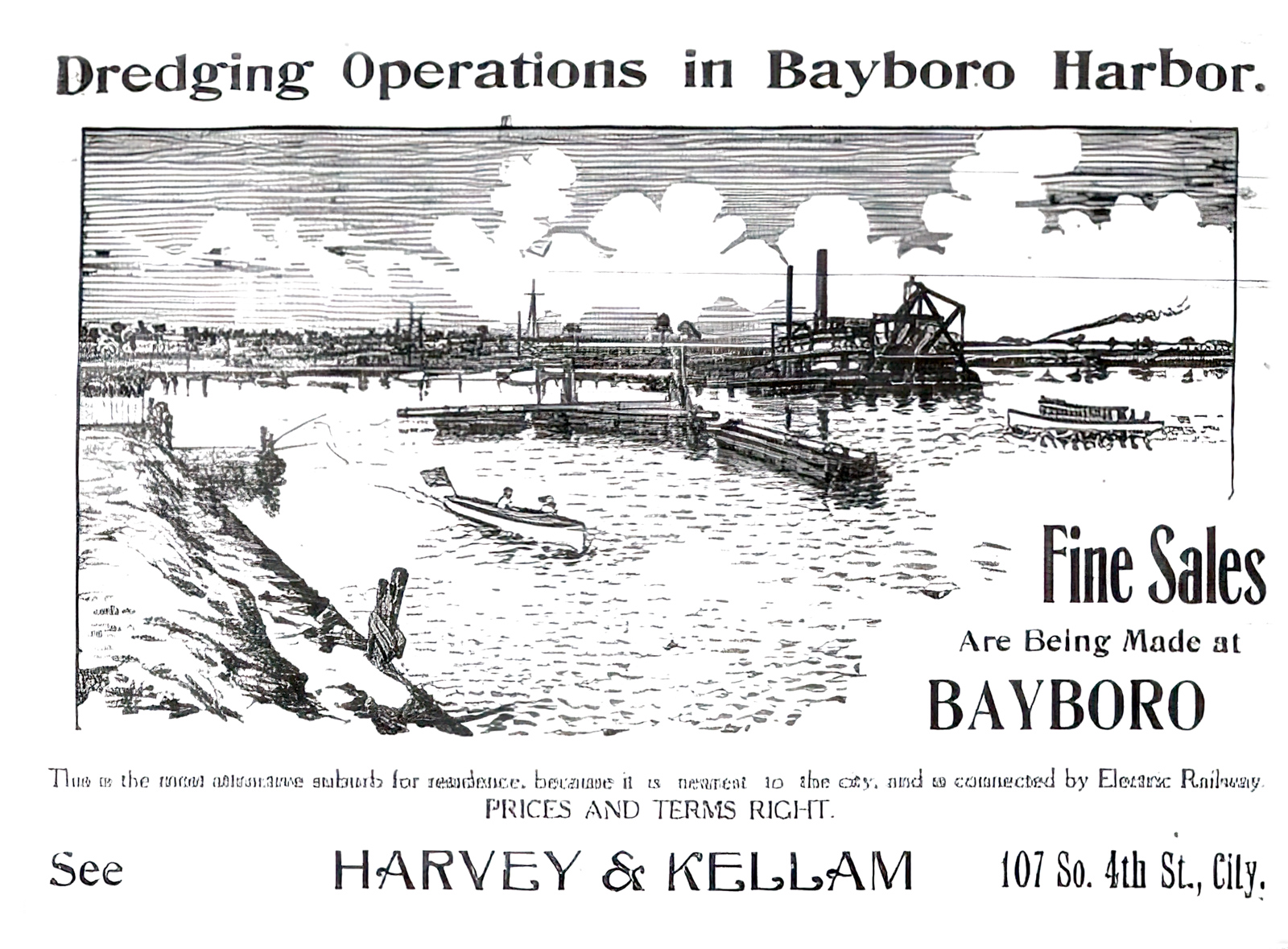
The creek's industrialization had begun. In 1913 the dredgers worked their way further up the channel, yoking the tidal "Salt Run" to Florida's violently enforced economic and social order. As standard histories recount, the area boomed through the first decades of the twentieth century, with a soggy landscape shaped to property developers who then marketed an affordable paradise for white tourists and transplants; this same paradise needed a labor force, and segregation shaped the landscape as much as the pleasures of outdoor leisure. An invisible line along Central had already divided the city into north (white) and south (African American) sides. African Americans moved to St. Petersburg in search of work and the city council sharpened boundaries where people of color could live. A 1931 charter amendment sought "to establish and set apart in said city separate residential limits or districts for White and negro residents." This redlining, impossible to enforce and revised many times, imprinted the city's demographics permanently, shaping everything from voter registration to school funding and supermarket locations.
Has the creek been subject to the same racial violence as Black bodies? It depends on who you ask, though this much is true: segregation in St. Petersburg remains unfinished business. Redlining language remained in the city charter until 1963; through the Jim Crow era, three lynchings were reported in Pinellas County (low for bloody Florida); and various groups such as Pinellas Remembers (which successfully placed an Equal Justice Initiative marker at the site of a 1914 lynching) continue the important, uphill work of healing. Environmental and social histories undoubtedly intertwine—the question is "how?"
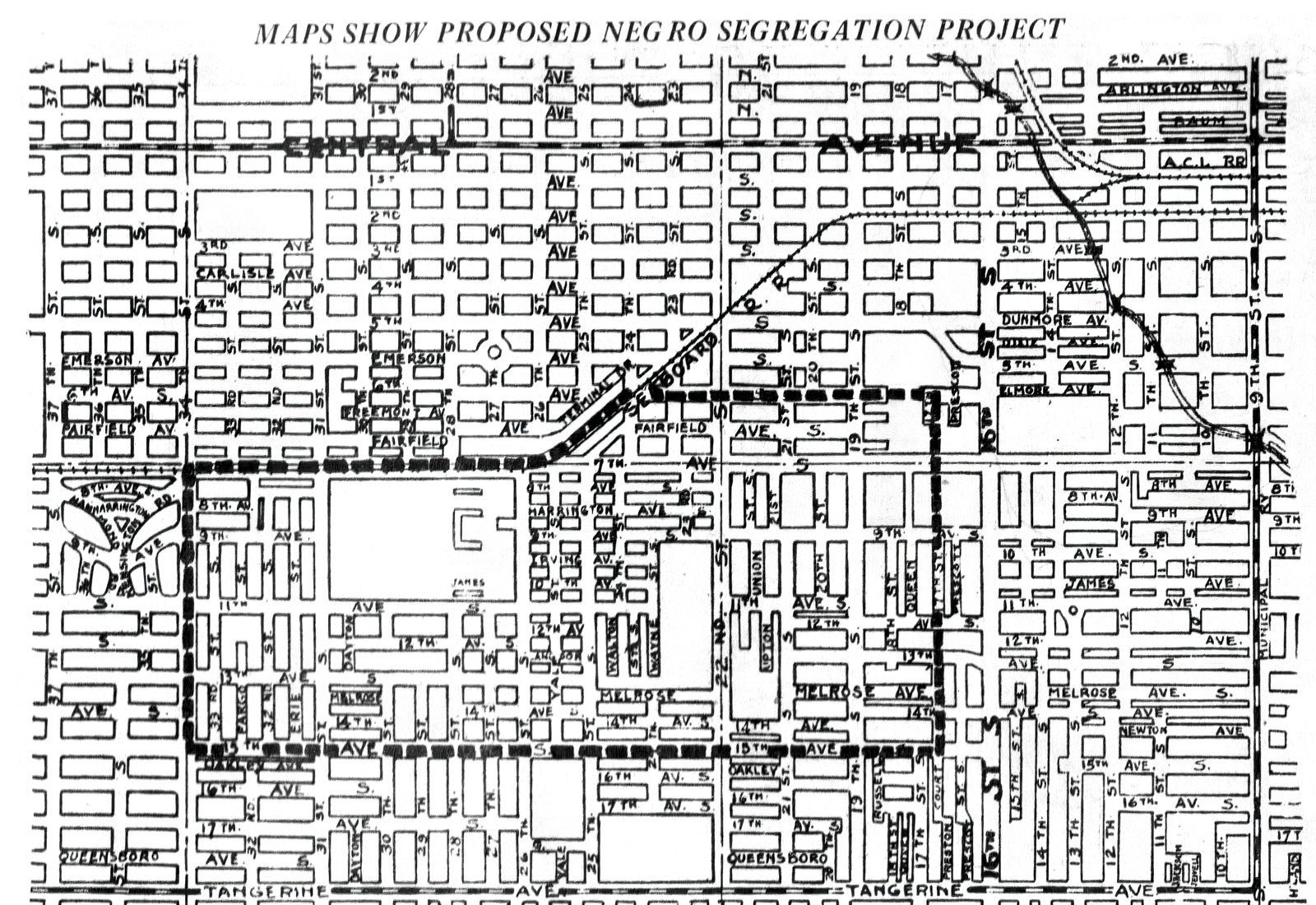
From its early boom years, access to nature came through a front and back door. North of Central Avenue, tourists enjoy Instagram-worthy waterfront parks, showcasing urban amenities alongside Tampa Bay. Today, these parks receive the overwhelming bulk of public funding and remain fiercely guarded by a proud citizenry. The adjacent working waterfront to the south was slated for industry, and set on a course for exploitation. Starting in the 1920s, city leaders commissioned engineering studies, supported business and secured federal money to construct an "industrial harbor." Salt Creek housed oil storage tanks (inevitable spills to follow) and just upstream, a dairy and flash-freeze seafood plants. As industry left in the 1970s, the creek would serve as a site for drugs and illegal sex and squatters, and now, for fast food and a Salvation Army support center. Locals recognize the creek (if at all) from a sharply-arched bridge over Third Street known as "Thrill Hill," or as the place where a sleeping homeless woman tumbled off a seawall and lost her arm to an alligator.
Such are the long string of anecdotes—the stories of drug runners and petty crime, childhood kicks, vagrancy and chicken thieves—that populate the creek's history.11City Council minutes were printed in St. Petersburg (FL) Times, Feb. 14, 1931, 2–3; see also "Open Waters in Salt Creek" St. Petersburg (FL) Times, June 16, 1921, 10. Most recently, the city revised building codes to accommodate Miami developers, who schemed to build high-density housing on the flood plain. That bubble having burst, the area remains scraped.12"Report of Port Exports Announced by Commission," St. Petersburg (FL) Evening Independent, Sept. 16, 1926, 7; "Dairy Concern Adds to Plant on Salt Creek," St. Petersburg (FL) Times, Jan. 1, 1937; "Yacht Basin Boats Face Clampdown," St. Petersburg (FL) Times, Feb. 3, 1960; "Salt Creek Squatters Trouble City Again," St. Petersburg (FL) Independent, Aug. 28, 1961; Jack Alexander, "Drug Raids Nab 11," St. Petersburg (FL) Independent, May 18, 1968.
Salt Creek activists suffer fatigue, even disillusionment, from fighting the combined forces of city hall, Jim Crow's intractable legacy, and poor decisions rationalized by free market economics. Two episodes from the past century illustrate the challenges of turning back the tide. The creek's path traces a low-lying area, or swale. In any other scenario, land this vulnerable to flooding would be set aside for parks and greenspace. Every good planner that has studied a topo map has, in fact, reached that conclusion. In the 1920s John Nolen, the preeminent city planner of his generation, prepared St. Petersburg Today, St. Petersburg Tomorrow—a design that would be considered progressive if it were adopted even now.13John Nolen, City Planning Report: St. Petersburg Today, St. Petersburg Tomorrow (St. Petersburg, FL: St. Petersburg City Planning Board, 1923), https://friendsofsaltcreek.org/wp-content/uploads/2022/02/St-Petersburg-Today-St-Petersburg-Tomorrow-1923-Nolen-Plan-1.pdf; St. Petersburg Conceptual Plan (City of St. Petersburg, FL, May 1974), https://friendsofsaltcreek.org/wp-content/uploads/2022/03/Conceptual-Plan-St.-Petersburg-1974.pdf: 31–32. Nolen suggested a parkway, using Salt Creek to connect gulf to bay with a chain of green "around the lower end of the peninsula." Voters rejected the Nolen plan, however, citing the imposition on private property rights as well as Nolen's reluctance to tighten emerging redline laws. One could blame this shortsightedness on the times. Nolen worked in the shadow of the Rosewood massacre, but fifty years later, the city reached the same conclusion.
Dusting off many of John Nolen's ideas, a 1974 Conceptual Plan also proposed a "green open space network," which included the "natural swale" between Tampa and Boca Ciega Bay. In short, a park along the Salt Creek channel.14R. Bruce Stephenson, Visions of Eden: Environmentalism, Urban Planning, and City Building in St. Petersburg, Florida, 1900–1915 (Columbus: Ohio State University Press, 1997), 65. Neither proposal, almost fifty years apart, made the leap to policy. A common good for the city (sustainable development, equitable access to open space) will lose to private, mostly white interests every time.
In the creek, I confront my own ambivalence towards Florida. I revel in the completely undeserved, over-the-top natural beauty. I also feel overmatched by the state's ugly, obdurate social history. When my own patience runs out, I drop a kayak near the mouth and make a favorite circuit. I enter by the harbor, paddle through the marina, then under the bridges at Third and Fourth Streets, into a hidden wilderness. Past the last dredge line, not far beyond the old trolley bridge, ice cream plant or seafood fast-freeze facility, the docks and crumbling piers give way to a mangrove tangle. Under Thrill Hill, Salt Creek is both wilder and more polluted. The paradox is striking, even in its own way, charismatic. The overlooked canopy serves as a bird sanctuary, where long legged waders roost and nest. Styrofoam and plastic bottles meld with mangrove prop roots. Fecal bacteria levels spike well past acceptable levels. We are still trying to figure out the cause—excrement from the street population, which the city pushed from parks in the tourist center to the poorer southside; guano, which accumulates in the concrete channel because seawalls and dam upstream block the tidal flow; or maybe broken sewer lines.
My route takes me roughly halfway to Lake Maggiore, mostly by industrialized lots left abandoned for speculation. Past the Dollar General and McDonalds, I push through the choking mangroves, then slip under another low-slung bridge at Eighteenth Avenue South. From here the creek opens into Bartlett Pond, a small aperture all but choked off due to overgrowth. I have seen snook roil below the black, murky surface. I've also seen a prize game fish, floating ominously on the surface of the muck. Osprey watch from their nests in the light posts by the athletic fields. Were it not for the hum of traffic, I could be in the 10,000 Islands of the Everglades. Instead I have found Nature in the heart of a city.
This is not where one expects to find a kayak. Citing water quality, Parks and Rec officials have ignored my suggestions to install a put-in off Bartlett Pond. So I engineer my own exit, grabbing the sewer line off a bridge on the opposite side, nudging a gunwale to the shoreline, and throwing my fifty-seven-year-old self onto the muddy bank. From Bartlett Park, I portage back across Fourth Street, past a gas station at the busy intersection of Fourth Street and Twenty-Second Avenue South, back to my once gay and racially-mixed, increasingly gentrified neighborhood. This circuit is not easy, scenic, accessible, or even encouraged. But I find the paddle into every day nature restorative. Wilderness has been erroneously thought of as an escape, rather than as engagement with the here and now. "In wildness is the preservation of the world," Thoreau mused, wandering the clearcuts around Concord. The best wilderness is always close to home.15Henry David Thoreau, "Walking," The Atlantic, June 1862, https://www.theatlantic.com/magazine/archive/1862/06/walking/304674/.
Bartlett Pond
At Bartlett Park, tucked behind Twenty-Second Avenue and Fourth Street, Salt Creek opens into a muddy pool. This little pond adjoins two of St. Petersburg's main thoroughfares, but badly eutrophied and surrounded by mangroves, rarely merits a second look. My wife Julie has lived three blocks away and driven past Bartlett Park for twenty years, but did not know there was actually water behind the brush. A little fishing dock used to provide access on the east side, away from the street and from the park's interior. Vandals, or maybe the homeless on a cold night, burned the outer decking. Repairs to the dock then came slowly and were poorly done. After I called to complain, the parks department blocked off the charred sections, shortening the entire structure.
Environmental racism takes many forms—big and small, from legislation to microaggressions. A perspective at water level renders visible the "slow violence" of local policy, to use Rob Nixon's memorable phrase: the damage "that occurs gradually and out of sight … dispersed across time and space [and] typically not viewed as violence at all." Leisure may not register as a health concern. At least on the surface. But in this city, defined by slow violence, differences in life expectancy across race are measured by decades.16Rob Nixon, Slow Violence and the Environmentalism of the Poor (Cambridge, MA: Harvard University Press, 2011), 2; Sears et al., "Building Bridges," 123. Hypertension kills, green spaces heal.
St. Petersburg and Pinellas County pride themselves on their parks, yet the allocation of amenities follows a classic script in inequity. A Pinellas County park map is literally a reverse image of racial demographics. Docks served by the county's white residents include ADA-compliant handrails, fish cleaning stations, and overhead shelters to protect visitors from the harsh sun or sudden rain. Residents in south St. Pete's poorer Black neighborhood instead get this charred shell, over an overgrown pond my spouse never even knew existed—where health officials deemed the water unsafe to fish or swim.
Economics and social history shape the landscape, but because the history is forgotten and on-the-ground-economics vanish into everyday life, that landscape is tough to read. Bartlett Park embodies this contradiction. Behind the stump of a dock, tennis balls thwock back and forth at the St. Petersburg Tennis Center. Founded in 1926, the municipal courts are a vestige from the early twentieth century, when the neighborhood afforded vacation cottages for winter residents and renting tourists. The court's location seems anomalous, though like every other chapter of the city's history, it can be explained through the local lodestars of leisure and race. The center serves as a throwback to St. Petersburg's peak years as a populist paradise, when white northerners suffering from cold found relief in the mild climate, bay breezes, the foliage, and sport.
The same boom drew African Americans, mostly from across the South, who came here to work a growing service economy. The zoning measures set out to keep the Black population both accessible and cordoned off; these measures, from the middle third of the past century, limited where Blacks could work, live, and travel after dark. African Americans forged communities in neighborhoods that still resound in local lore—the Deuces, Pepper Town, Gas Plant, Campbell Park, Methodist Town. After the waning of de facto segregation, in the early 1970s, once tight communities fanned out across the southern side of the city.17Rosalie Peck and Jon Wilson, St. Petersburg's African American Neighborhoods (Charleston: History Press, 2008), 15–18; Sears et al., "Building Bridges," 108. Black families settled in formerly white neighborhoods on the south side of town, including Bartlett Park. White people moved out, abandoning the neighborhoods, then decades later returned to the same sections—displacing Black families who have now lived there for at least a generation.
The contradictions and shifting dynamics across time and space make Salt Creek difficult to explain. Lime green tennis balls lob over the chain link fence, down the sidewalk, and into the watershed. Environment and community relations cannot seem to find the same page. I struggle personally with my own blindness, fumbling with good intentions. After several years of my teaching along this waterway, graduate students culled together a self-produced book called Salt Creek Journal. During an Earth Day celebration at Bartlett Park, I palmed a copy of the paperback to my city council representative. She actually read the book, then convinced me to form a real group with the same name as the pedagogical fiction—Friends of Salt Creek. For several years, pulled into service, I led the group. We defined goals, calling ourselves a community group centered around nature, not so much preservationist. We met small, consistent successes. Foundation money flowed our way, though before we were logistically prepared to take on projects; we had a grant before we had a bank account. For clean ups, environmental groups like Tampa Bay Watch and the Tampa Bay Estuary Program (who do admirable work advocating for marine health) bring enthusiastic white volunteers from outside, though our constant reminder has been to build from within the neighborhood. The local Keep America Beautiful office wants to drop in cypress trees without asking people who live there.
Conventional narratives of environmental justice, Ellen Griffin Spears observes, have "left out many constituencies—women, workers, indigenous populations, people of color, immigrants—and as a result left out the social justice roots of environmental reform." And so we see the broader trends unfold in local arenas. White environmentalists are not "looking at the community," observes Jacqueline Hubbard, an African American attorney whose family has owned a lakeside home in the area for decades; the result "is a lack of communication and trust."18Ellen Griffith Spears, Rethinking the American Environmental Movement Post–1945 (New York: Routledge, 2020), 4; In my informal interview with Jacqueline Hubbard (Sept. 2, 2022), she mentioned the importance of environmentalists reaching out to churches and groups with well-established records in civil rights; my hope as the author of this article, an online tour, is to have a ready-made program for community presentation.
In retrospect, the lesson feels obvious: restoring the environment starts with community. The questions must always start with, "for whom?" For whom are we working? With whom and why? Bartlett Pond brings fault lines into stark relief. After a long period of asking, the city secured external funds to dredge the eutrophied pond. The mostly white Friends of Salt Creek continue to test waters around the park, hoping to locate the sources of fecal bacteria. But why now? Will the dredging serve the neighborhood's current, mostly Black residents? What will dredging a pond mean for those experiencing homelessness? Is "improvement" merely a bellwether of high-end development downstream? And how does one fight back cynicism? During a May Day clean up, an African American fraternity, the Sigma Betas, led a tree-planting effort that involved local teenage boys. When construction in the park cut off an irrigation line, however, the newly planted trees dried up and died. This story is nothing new. Landscape theorist Anne Whiston Spirn recounts similar frustrations with Philadelphia's Mill Creek. She describes how she led eighth graders along the creek's buried course, then asked the teenagers to develop a landscape plan. The students (more familiar with the realities of the streets than an Ivy League professor) refused to believe any plan they implemented would be suggested. "It won't happen," a student told her; "Someone will wreck it."19Spirn, "Restoring Mill Creek," 404. How do you explain to teenage boys in St. Petersburg, likewise, that the city failed to water plants they put in the ground?
Advocacy puts well intentioned theory to the test. We have to pull out the Thoreauvian "realometer." In our rhetoric and scholarly discourse, one might wax optimistic about bringing together environmental and social justice, building what my local Sierra Club chapter calls a "Black-Green" alliance. But in practice, we learn the hard way, starting by acknowledging the depth of the rift of our divides. We can get the grants but we cannot exact meaningful change. As a white-led group, Friends of Salt Creek seems to have a offered a strategic wedge for easy volunteerism; our group checked the box for "underserved community." Over summer 2021, we drew from a Tampa Bay Estuary Program grant to support an artist in residence program at the local community center. Four artists (two white, two African American) met under a central pavilion, working most closely with kids. The children here are predominantly Black, with many coming from foster homes. White kids go to tennis camp, steps away, taking after-school lessons for $200 per week. Kids from the adjacent Frank Pierce Center are not accustomed to access. The pavilion where we met backs onto the chain-link fences of the neatly rolled courts. At one point, a child passed a gate left open, usually locked, leading to the public court. "Wait," the child asked, "can we go in there?"
The same could be said for the pond. Our entry points to nature are shaped by economics, power, and race. The points of access disclose social boundaries. Where equivalent parks offered sheltered docks and piers, the only dock here is a burnt out stub. The city clears and maintains lakes in other parts of the city, opening code-compliant "windows" through the mangrove; here, the water remains hidden—out of sight and degraded.
This is no accident. Past Bartlett Park, through a hidden gap in the mangroves, Salt Creek cuts diagonally, continuing to run southeast, through one of the poorer parts of the city. Neighborhoods along the creek tumble precipitously from coastal-slash-suburban to impoverished. Median household incomes drop in predictable blocks, as one moves from waterfront from properties along Tampa Bay and west into the city: $78,875 in the mostly white Old Southeast neighborhood, to $44,474 in the Bartlett Park area, to $12,096 in the more African American Harbordale section. A closer analysis provides a much more nuanced intersection of economics and race, not captured by simple caricature, though a trend exists. The city-data website reflects what anyone who lives in St. Petersburg already knows: economics fall along sharp racial lines, effecting in turn, health, access to fresh food, experiences with education and law enforcement, the possibilities of upward mobility, and of course, green space.20"St. Petersburg Florida: Income map, Earnings map, and Wages data," City-Data, Accessed March 31, 2023, https://www.city-data.com/income/income-St.-Petersburg-Florida.html. Structural racism study; see also Sears et al., "Building Bridges," 203-08.
Racial demographics and water quality intersect. At the end of legalized Jim Crow, as African Americans moved into the Harbordale neighborhood, the city let water quality sink. Low oxygen levels during the 1960s resulted in fish kills. Locals likened the smell at low tide to a badly operating sewage plant, the newspaper reported; outsiders (not residents) used the creek as an unlicensed trash pit. The rust colored water tested at almost eight times accepted levels for coliform bacteria. The city was no longer calling this waterway a stream or creek; in newspapers and press conferences the creek was now a "drainage area," or worse, a "ditch."21Willard Cox, "Tests Show [Red] 'Tide' Not Cause of Kills," The Evening Independent, July 6, 1965; "A Fishy Smell at Salt Creek," The Evening Independent, May 2, 1966; "Salt Creek Flow Sickly," The Evening Independent, Sept. 14, 1973; Bill Marden, "Trash, Tide A Problem," The Evening Independent, July 16, 1971. Racism did not cause environmental abuse; water quality was abysmal throughout Tampa Bay. A generation of activists, overwhelmingly white, have "saved the bay"—dramatically improving estuarine health. The poorer areas drained by Salt Creek, following script, are the last to see remediation.
Lake Maggiore
Semantics shape stewardship. At MLK (formerly Ninth, a major north-south street), a dam divides Salt Creek from Lake Maggiore. I am now in the middle-bottom part of the Pinellas Peninsula, on what used to be "Salt Lake," an estuarine habitat typical for coastal Florida. The name changed, however, alongside usage. In the 1920s real estate promoters began pitching new developments around a shallow, still tidal estuarine habitat. A fanciful origin story in the St. Petersburg Times provided the much-needed fiction. The newspaper, upholding real estate interests, staked a dubious claim that "Salt Lake" was discovered by Italian buccaneers, who called it "Maggiore" after a similar body of water on the Swiss-Italian border. In an act of rhetorical desalination, the hucksters presented the Italian as the earlier toponym; the sailors had first found fresh water, though mistakenly, the label "Salt Lake" stuck on later maps. Fiction and finances thus conspired to justify a dam. The Times cited a "peculiar condition" (or what the rest of us call tides) that allowed saltwater species to intrude from the bay. In 1930 a more permanent dam was built, making "Maggiore a freshwater lake for bass fishing." It would remain as such, until no one could recall when the brackish lake was part of an estuarine tidal run. By the 1980s the alligators were so pervasive that water skiers chased them off the slalom course. Neither bass nor gators belong in "Salt Lake," of course, as freshwater species have found their invasive niche in this badly translated Alpine lago.22"Lake Maggiore Believed to be Named by Pirate—To Be a Beautiful Section," St. Petersburg (FL) Times, April 5, 1925; "Lake Maggiore Dam Proposed," St. Petersburg (FL) Independent, Sept. 25, 1930. I am indebted to Jack E. Davis, who grew up on Lake Maggiore and who read a draft of this essay, for the observation about water skiing.
The folly, this not-just-semantic amnesia, has been expensive. Newspapers chronicle a twenty or thirty year cycle of restoration and waste. Eutrophication, fish kill, dredge Crisis, quick fix, repeat. In 1940, ten years after construction of the new dam, the city's Evening Independent would report:
City sanitation crews were burying hundreds of pounds of dead mullet and trout along the eastern shore of Lake Maggiore where they washed up after being killed by what [is] believed to be excessive vegetation gases in the shallow waters of the lake.
The newspaper described a horrific scene. Fish up to two feet long, panting in the grass; sanitation workers removing the rotting carcasses; the city vowing to install a screen to keep saltwater species out of the now-freshwater lake. Again, in 1963, the state game commission concludes that ecologically, the lake has become "old and not conducive to bass reproduction." Fish kills returned in 1968 and 1970, when the city detected chloride, a negatively charged ion that indicated "somehow salt water was getting into" Maggiore. In 1991, the headlines repeat: "Lake Maggiore Sick from Pollution," this time from high concentrations of run-off nitrogen and phosphorous. The following year, sanitation workers hauled off three-hundred pounds of dead menhaden (a coastal and estuarine species), snook, redfish, and yellow fin. Starting in 2004, the city spent two years scraping 1.3 million tons of sediment from the lake bottom. Trucks ran sixteen hours a day, five days a week, transferring the muck to a sod farm and developing area in the swampier part of the county's north end. After high levels of arsenic were detected in the soil, however, the city found itself in a sticky legal battle with the developer who used the fill, eventually settling with a million dollar contamination claim.23"Tons of Fish Die in Lake Maggiore," The Evening Independent Aug. 1, 1940; "Lake Maggiore: Fight Against Aging," St. Petersburg (FL) Times, June 25, 1971; Sue Landry, "Lake Maggiore Sick from Pollution," St. Petersburg (FL) Times, Jan. 16, 1991; "Natural, Normal Fish Kill Hits Lake," St. Petersburg (FL) Times, Nov. 2, 1992; Waveney Ann Moore, "Contaminated Soil to Cost St. Petersburg $1 million, 15 Years after Dredging Project," Tampa Bay (FL) Times, April 12, 2019; Southwest Florida Water Management District, "Final Phase of Lake Maggiore Restoration Project in Full Swing," Water Matters, May–June 2005, https://www.swfwmd.state.fl.us/blog/watermatters-magazine/11/final-phase-lake-maggiore-restoration-project-full-swing. Despite the added cost, toxicity, and history of repeating problems, officials declared victory. "This project attempts to set back the clock on a long history of water quality problems at Lake Maggiore," the Southwest Florida Water Management District (Swiftmud) triumphantly claimed. The irony is deafening. A plan has been set in place, with no heed for the existing pattern of waste. If the clock was "set back," as Swiftmud boasts, then only for the same problems to repeat.24Water Matters, "Final Phase."
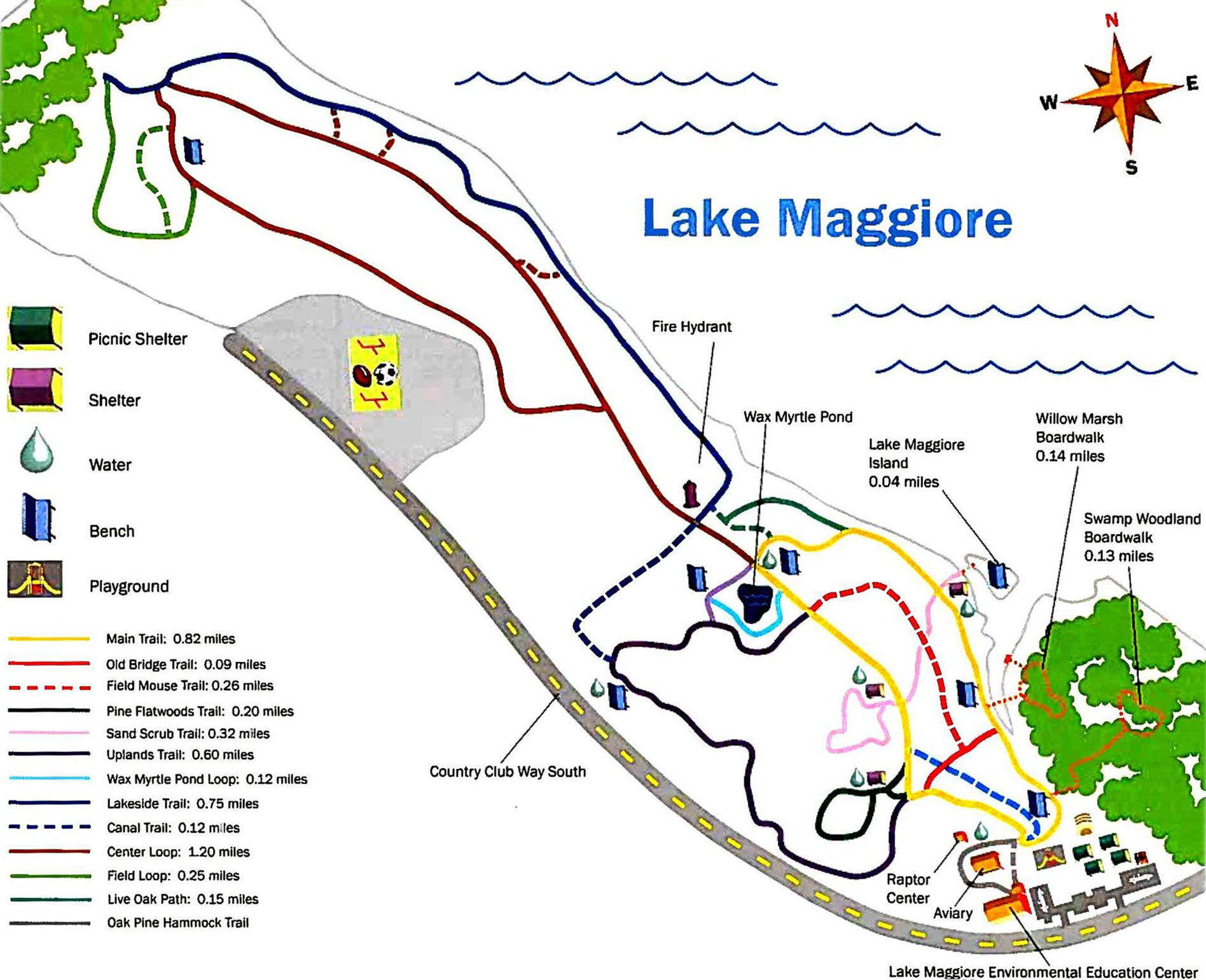
The lake remains awash in contradiction, mismanaged and lexically confused. The dam along MLK seeks to split salt and fresh water. Circle south, past some houses, by a fire station, and a mostly abandoned park. Spin further southwest and much of the land is sheltered by a beloved sanctuary, Boyd Hill Nature Preserve. Along the same tract, adjacent to the preserve, a city dump turns over mulch. At the base of Twenty-Second Street, historically the central corridor for St. Petersburg's African American population, sits a park. The north section fronts Maggiore Shores, originally a white neighborhood, then middle-to-upper-class Black, and today, increasingly white again. Each of the stakeholders holds a claim to the park—some smaller, some larger. Mostly white environmentalists aligned with Boyd Hill argue for removing the dam and restoring the ebb and flow of "Salt Lake." Older home owners in the Maggiore Shores neighborhood (to the north) want cattails around the edges cleared to improve their view; the current water management plan keeps salinity down and serves as flood protection. The only unifying factor is the cattails circling the lake, indicating low water quality. The common denominator is eutrophication; the argument is how to solve the problem. Renamed with a faux history, mispronounced, and managed against its natural flow, this once-tidal lake suffers from being something it is not.
Willow Marsh
On the south shore of the same Lake Maggiore, Salt Creek changes names (again). Then it disappears (again). The precise point of disappearance, ironically, occurs in a beloved nature park, Boyd Hill Nature Preserve, at one of the finest visual prospects in the entire city. A boardwalk on the Willow Marsh Trail faces North, towards downtown. Off in the distance, beyond the lake, cumulus clouds tower over one another, dramatically framing a vast blue horizon and restless skyline. Anhinga roost in a nearby island, and below, any number of species of ducks, moorhen and long-legged waders nudge through spatterdock and duckweed. Common sights are marsh rabbits and alligators, the mother gator often with her yellow-striped young brood. The visitor's map to the preserve marks this particular boardwalk as part of the Willow Marsh Trail, which presumably would make this area "Willow Marsh." Technically, the water forms part of a Salt Creek branch. Trail maps to the preserve, however, do not even mark a stream.
City nature has no place in a "nature preserve." At a point where an urban waterway should be most visible, even celebrated, the comedy of hide-and-seek intensifies. A waterway (now flowing due South) switches names. By the semantically confused lake, it disappears from the map altogether. Why? Because discursive "Nature" and the natural hydrology do not align. Near the Boyd Hill visitors center, hikers have unknowingly crossed Salt Creek. It is the little brook that trickles past an outdoor classroom, by the raptor rehabilitation center, and eventually reaches back to the edge of the nature preserve, where it runs under a chain link fence. Here, the creek becomes a culvert. And with subtle semantic shift, stewardship declines.
The aquatic thread snaps. We lose the connection. In a wealthy suburban neighborhood, the headwaters of Salt Creek runs through a maze of backyard overgrowth, accessible only with permission. To trace the creek now is to trespass. Care falls to individual whim or the conscience of private owners. One particularly zealous environmentalist has dutifully planted native cypress in the bottom, hoping to stabilize the sandy banks and restore habitat; elsewhere, the low-lying area remains mostly a jungle of invasive taro and wild ginger. Further south, where the planner John Nolen proposed a green corridor along the area's natural swale, the St. Petersburg Country Club has engineered the creek's headwaters into a series of water hazards for its golf course. Landscapers mow up to the edges of the artificial ponds along the golf course's back nine.
The hydrology has become impossible to visualize as one piece. Because the waterway is fragmented, no one connects the link from fourteenth fairway to Tampa Bay. Grass clippings run straight into the ditch, Lake Maggiore, into Salt Creek, and eventually into our beloved bay—feeding algae and toxic blooms that have undermined our quality of life, ruined countless fishing trips, and cost the state dearly in tourist revenue.25 The Tampa Bay Regional Planning Council set the loss of tourism revenue for a 2018 red tide bloom at $130.6 million; see The Ripple Effects of Florida Red Tide, (Pinellas Park, FL: Tampa Bay Regional Planning Council, 2019), https://tbrpc.org/wp-content/uploads/2019/01/The-Economic-Ripple-Effects-of-Florida-Red-Tide_unsigned.pdf; A more thorough study set the loss for the same bloom at double the cost, $317 million, see João-Pedro Ferreira, et al. "Impact of Red Tide in Peer-to-Peer Accommodations: A Multi-Regional Input-Output Model," Tourism Economics, March 1, 2022, https://journals.sagepub.com/doi/10.1177/13548166211068276. The neglected stream passes over a dingy concrete weir, amounting to little more than a one-stroke penalty for golfers and repository for lost Titleists.
Again, the aquatic thread splits. There are actually two larger branches feeding Lake Maggiore, the second no easier to trace. In its western course, the stream feeds a lake from a city tract along Dell Holmes Park. From here, it runs due West down a channel, where it parallels a public golf driving range. Canoes and kayaks rarely paddle this channel. The alligators are unusually large. One could go missing here altogether. If I am to put in at Lake Maggiore, I double check my life preserver.
The unnamed, culverted west branch cuts anonymously across public land. I can paddle upstream, with a city mulch processing plant to the left, and a drop-off site for brush to the right. The stream parallels the east-west running Twenty-Sixth Avenue South. Chain-link divides the landfill and private property, in this case two of the more prosperous historically Black churches in the city—St. Augustine's Episcopal and McCabe United Methodist. The location of these churches, or more accurately their relocation, figures into the last half century of city history. Both congregations served Jim Crow neighborhoods closer to the center of town, the middle class Campbell Park and poorer Gas Plant communities. Both neighborhoods were razed in the 1970s and 80s. Following a national trend, in which federal roads targeted Black areas, Interstate i-175 cut the Campbell Park neighborhood in half, running straight over homes where pillars of the African American community lived.
Ten years later, as if by design, the city razed the Gas Plant in the name of urban renewal, leveling a neighborhood to construct a domed stadium. The Tampa Bay Rays (Raze?) now play in the dome, Tropicana Field. But the team's owners (buttressed by city government and a newspaper that depends upon sports for daily copy) declare the thirty-year-old dome obsolete. Once again, the area awaits real estate redevelopment, with little probable return for the people displaced under the banner of "urban renewal" and promises to "get it right." St. Augustine's Episcopal relocated during the 1970s, moving from property now near the interstate, away from a community that has since scattered, and rebuilding on the rich soil of a former nursery near the head of Salt Creek's long swale.
Lake Eli
Where the creek ends remains an open question. According to an environmentalist friend who lives along the south shores of Lake Maggiore, the creek was historically sheet flow, tracing without record or immediate course through pine flatwoods. If I push a kayak further west, past Lake Eli, I trace the drainage ditch, almost to the churches that run along Twenty-Sixth Avenue. Just north of an arrow-straight culvert alongside the parking lot of McCabe United Methodist, the stream unceremoniously ends. The culvert takes a sharp turn at the boundary of church and city land, then runs north, along a straight ditch to north-south running Twenty-Sixth Street. On the other side of the street, Salt Creek finally disappears into underground maze of sewers. And from there, who knows?
Conclusion—Fragmented Headwaters
McCabe's presence at the headwaters embodies a painful chapter of St. Petersburg's history. The congregation of this century old church coalesced around segregated areas, along the eastern edge of the Gas Plant neighborhood. The congregants built the former church themselves, laying their spiritual home on the Black side of a segregation boundary. The interstate and dome destroyed the old structure, and today, the site is now a nondescript concrete parking garage. The current pastor, Reverend Jana Perkins-Hall, speaks clearly of the betrayal:
Black people got together, during that particular time of economic disenfranchisement, pooled their resources and physically built, brick by brick, this place of worship. They were there for fifty years before they were relocated . . . For what?
Perkins-Hall, though not a native, speaks powerfully on behalf of her parishioners: "So what kind of message does that send — spiritually, emotionally, psychologically — to the people who worked for free? That now, in place of a community they called home, is a parking garage?" There is no historical marker, even though stories continue to tell, "that this was once a place of sacred worship." The dislocation remains an unacknowledged erasure. A more visible reminder would at least acknowledge the hurt.26Jana Perkins-Hall spoke at a community forum about Booker Creek and the Tropicana Field site redevelopment, held at the University of South Florida's St. Petersburg campus on Feb. 15, 2019; see, Anna Maria Lineburger, Kelly Kennedy, and Dyllan Furness, ed., Voices of Booker Creek (St. Petersburg: University of South Florida, 2020), 29–30. Just as the teenage boy said to the Penn professor Anne Whiston Spirn: "someone will wreck it."
McCabe United Methodist Church
At McCabe, the unbaptized remnants of Salt Creek disappear into a sewer line, across from the church, at the corner of Twenty-Sixth Avenue and Twenty-Eighth Street. It is smack-dab in the middle Pinellas County, just east of the low sand ridge (a relic dune) that divides the peninsula. How and where the waters ran before development remains a question. Early histories and even the occasional map suggest that the outer reaches of Salt Creek mingled with a bayou to the west, possibly trading headwaters from both the swamp and bay' this memory of an earlier hydrology, however, remains repressed.27Walter Fuller, St. Petersburg and Its People (St. Petersburg: Great Outdoors Publishing Co., 1972), 5. The creek might have run straight across, serving as a liquid connector now lost.
Cities that bury their habitats sacrifice a bit of collective soul. Environmentalists in Los Angeles lament the failure to recognize the human, natural, and even cinematic history of the concretized Los Angeles River. Tourists are drawn to the Fleet River. New Yorkers still want to see the waters that bubbled under Minetta Street in lower Manhattan, and my archaeologist-art history friend clearly felt a connection when she stumbled onto the Eriadnos. With sea level rise, social scientists attend to the psychic costs of disappearing landscapes, citing what they call solastagia or "environmental grief."28Ellis Neville and Ashlee Cunsolo. "Hope and Mourning in the Anthropocene: Understanding Ecological Grief," The Conversation, April 4, 2018, https://theconversation.com/hope-and-mourning-in-the-anthropocene-understanding-ecological-grief-88630; Gren Albrecht et al., "Solastagia: The Distress Caused by Environmental Change," Australasian psychiatry: Bulletin of Royal Australian and New Zealand College of Psychiatrists 15 (2007); Ashlee Cunsolo and Neville R. Ellis, "Ecological Grief as a Mental Health Response to Climate Change-Related Loss," Nature Climate Change 8 no. 3 (2018): 275–281; L.P. Galway , T. Beery, K. Jones-Casey, K. Tasala "Mapping the Solastalgia Literature: A Scoping Review Study." Internal Journal of Environmental Research and Public Health 16:15 (July 2019). The social-historical context adds another layer. My partner Julie walked Birmingham's Village Creek in an effort to connect place and current-day race relations in this iconic civil rights setting. When I trace Salt Creek, I too seek this connection.
Hydrologic systems carry us into our history. They uncover buried pasts, helping us to explain unhealthy divides. Despite Florida's myths of paradise, we remain disconnected from the natural world, from the past that has built itself around us, from one another. Environmentalism needs community, and we best find community in a city's liquid heart. We need to know where the waters run.
About the Author
Thomas Hallock received his PhD from New York University. He is the author of From the Fallen Tree: Frontier Narratives, Environmental Politics and the Roots of a National Pastoral, 1749–1826 (Chapel Hill: University of North Carolina Press, 2003) and the co-editor of Early Modern Ecostudies: From the Florentine Codex to Shakespeare (New York: Palgrave Macmilian, 2008), William Bartram, the Search for Nature's Design: Selected Art, Letters and Unpublished Manuscripts (Athens: University of Georgia Press, 2010), and Travels on the St. Johns River: John and William Bartram (Gainesville: University of Florida Press, 2016). He recently published a series of travel and place-based essays that explain why he loves teaching the American literature survey, A Road Course in Early American Literature: Travel and Teaching from Atzlán to Amherst (Tuscaloosa: University of Alabama Press, 2022).
]]>
A turning point was reached fifty years ago. In 1972, the Club of Rome published the report The Limits to Growth, drawing global attention to the fact that economic growth could not continue indefinitely because of resource depletion. This was also the year in which the first Earth Summit in Stockholm brought together world leaders under the aegis of the United Nations to lay the foundation for global environmental governance. Various international gatherings stimulated research on the environment and the origin of ecological problems, a field that played an increasingly important role in the following years. Thanks to the subsequent emergence of ecologically focused "green" political parties and the rise of various ecological forms of militancy, the critique of an economic model based on limitless growth began to be recognized as a legitimate political concern. Yet at first ecological demands did not acquire a central role; they were seen as one demand among many others that a progressive politics had to consider.
Today, the situation is different. The multiplication of weather-related natural disasters has helped raise awareness of the urgent need to stabilize the climate. Moreover, it is now generally admitted that human activity is responsible for the ecological crisis. Many scientific studies have proved that global warming is the consequence of the accumulation of greenhouse gas emissions caused by the fossil fuel industries and that it is necessary to curtail them. Since 2018, thanks to youth movements such as Greta Thunberg's Fridays for Future, the question of climate change has acquired an unexpected salience among wide sections of the public. A growing part of the population is now aware that the preservation of acceptable living conditions on earth will depend on the ability to effectively combat global warming. The crucial question is no longer if we need to decarbonize our economies, but how, and how quickly.
Despite a large consensus among ecologists of all stripes on the necessity to move to renewable energy, the path to follow is far from agreed upon. Even among progressive parties no consensus exists about the strategy to follow.2For a thoughtful discussion of the different approaches, see Amanda Machin, Negotiating Climate Change: Radical Democracy and the Illusion of Consensus (London and New York: Zed Books, 2013). One of the main disagreements concerns the possibility of effectuating the ecological transition without radical systemic change.
Many ecological parties believe in the possibility of reaching a consensus on the policies that need to be implemented to decarbonize the economy. They are convinced that, since this objective is in the interest of everybody, all reasonable citizens should be able to agree on the measures needed. They warn against attempts to politicize climate issues, claiming that it might create artificial divisions and impede the wide collaboration necessary for the implementation of a sustainable model of society.
In line with this position, most ecological parties avoid taking sides in the confrontation between left and right, and declare themselves to be situated beyond such an axis. This explains why some are ready to enter in coalitions with both right and left political parties, as is the case in Germany and Austria.
From a left populist perspective, the more interesting propositions are those that, like the Green New Deal, advocate a radical ecological bifurcation which involves a rupture with financial capitalism. Such a project is often associated with the arguments used in the United States by the Sunrise Movement and Alexandra Ocasio Cortez, who, on 5 February 2019, presented a path-breaking resolution to deal with climate change to the US Congress. The resolution had the following goals: To reach net-zero greenhouse gas emissions through a fair and just transition for all communities and workers. To create millions of good, high-wage jobs and ensure prosperity and economic security for all people of the United States. To invest in the infrastructure and industry of the United States to sustainably meet the challenges of the twenty-first century. To secure clean air and water, climate and community resilience, healthy food, access to nature, and a sustainable environment for all. To promote justice and equity by stopping current, as well as preventing future and repairing historical, oppression of frontline and vulnerable communities.

The idea of a Green New Deal has actually been discussed since 2008 in various circles in the United Kingdom. A group of economists led by Ann Pettifor was scrutinizing the close links between the financial and economic sectors and the ecosystem. They claimed that in order to address the climate crisis it was necessary to have a radical intervention of the state to regulate the financial system. Furthermore, they stressed the urgency of subordinating the financial sector to the interests of society and the future of the planet. Societies, they asserted, should abandon their dependency on the economic system of globalized financial capitalism that produces ecological disasters as well as economic, political, and social inequalities.3Ann Pettifor, The Case for the Green New Deal (London: Verso, 2019).
The American version of the Green New Deal is more comprehensive because it explicitly links the reduction of greenhouse gas emissions with the objective of fixing social problems. It proposes concrete policies to bring solutions to three fundamental problems: the climate crisis, issues of poverty, and racial inequalities. In order to secure the support of the popular sectors whose jobs will be affected, it contains several important proposals which establish strong links between social, economic, and environmental policies, and prioritizes equality. One of its central ideas is to guarantee work to every unemployed American who wants to work in the construction of infrastructures that respect criteria of efficient energy.
In Britain, the Green Industrial Revolution spelled out in the Labour Party programme under Jeremy Corbyn in 2019 also asserted that social and economic justice cannot be separated from environmental justice. The election manifesto announced that Labour would create one million jobs in the UK to transform industry, energy, transportation, agriculture, and construction, while restoring the natural environment. It would promote measures for a rapid decarbonization of the economy, jointly with investment in sustainable, well-paid, and unionized jobs. It would also create new industries to revive the parts of the country that had been neglected, while working in partnership with the workforce and trade unions in every sector of the economy.
The manifesto also announced that Labour would bring energy and water under democratic public ownership and that they would be treated as rights rather than commodities. Any surplus was to be reinvested or used to reduce bills. Emphasis was put on the fact that public ownership secured democratic control over nationally strategic infrastructures and provided collective stewardship for key natural resources. These measures should bring about a radical decentralization of power in order to give local people and communities greater control over their lives and prospects.
All these different proposals call for an ecological bifurcation that articulates demands of both an ecological and social nature. Their objective is to put the ecological struggle in relation with other types of struggles to create a just and more democratic society. By establishing a political frontier and defining an adversary, they contribute to politicizing ecological issues.
The climate movement must be politicized in order to take into consideration the centrality of labour exploitation, while at the same time social struggles must recognize the urgency of global warming. As defenders of the US Green New Deal assert in A Planet to Win:
A Left populism that mobilizes a genuinely multiracial working class is an essential step in the path to creating a more equal and just society—one that can weather climate change and prevent its most catastrophic effects. That kind of politics draws a sharp line between the masses of the excluded and exploited who are likely to suffer the most, and the rich and powerful who benefit from the status quo.4Kate Aronoff, Alyssa Battistoni, Daniel Aldana Cohen, and Thea Riofrancos, A Planet to Win: Why We Need a Green New Deal (London: Verso, 2019), 183.
Although under different labels, other projects also aim at a radical ecological bifurcation. For example, L'avenir en commun of Jean-Luc Mélenchon's party La France Insoumise. In their programme for l'Union Populaire in the 2022 presidential elections examining the major challenges today, the party advocates a radical change of course and proposes a series of measures to implement an ambitious state-led ecological strategy. This includes 200 billion euros in investments for ecological and social programmes and a vast plan to adapt infrastructures to climate change. Key measures consist in enshrining the principle of the "green rule" in the constitution, whereby no more is taken from nature than can be replenished and collectivizing fundamental common goods such as water and air by democratically controlling their use and protection. Other proposals include establishing an ecological and solidarity-based protectionism to produce in France and a re-localized, diversified, and ecological agriculture that would create 300,000 jobs, fighting against precarious contracts, re-establishing a protective unemployment insurance, rolling back privatization, and introducing a tax for financial transactions. L'avenir en commun stresses the democratic character of this ecological bifurcation and declares: "We must reorganise the republican state according to ecological and democratic objectives. Ecological planning must be based on the commune, the vital level of democracy."5Jean-Luc Mélenchon, L'avenir en commun (Paris: Editions du Seuil, 2021), 45, author's translation.
At the difference of proposals, like the Green Deal of the European Union, these projects recognize that a real ecological transition cannot take place without a confrontation with financial capitalism. It demands breaking with the dominant regime of accumulation characterized by unprecedented financialization and the globalization of capital indexed to the growth of polluting industries. Although disagreements exist about the forms it should take, the struggle to end the fossil fuel industry is generally considered to be of uppermost importance. This industry is responsible for most of the greenhouse gas emissions that cause global warming and ocean acidification. Moreover, it leads to serious environmental damage to local communities.

While the fight against fossil fuels is a priority for stopping global warming, it will not be enough to achieve an ecological bifurcation capable of delivering a new model of development that guarantees democratic rights and social justice. As indicated by the Chinese government's recent announcement of a plan to reach carbon neutrality by 2060 at the latest, such an objective is perfectly compatible with an authoritarian model. And various forms of "green capitalism" might also be able to find ways to thrive without exploiting fossil fuels.
Those who promote a Green New Deal are aware of the magnitude of the problem:
For a stable climate and more equal world, we have to simultaneously unmake our fossil-fuelled lifestyles and build infrastructures that equitably distribute renewable energy. We have to dismantle the most powerful industry on earth incredibly fast, or the things that we build to replace it won't matter. This means tackling fossil capital head on.6Mélenchon, L'avenir en commun, 31.
They also state, "A radical Green New Deal leans in to the inevitable intersections of social, economic, and environmental policy, and prioritized equality."7Mélenchon, L'avenir en commun, 19.
While these proposals are vital, a project that aims to address the ecological question in its multiple dimensions cannot be limited to the struggle against capitalism, as if a bifurcation only needed to take place at the level of production. As historian Dipesh Chakrabarty argues:
While there is no denying that climate change has profoundly to do with the history of capital, a critique that is only a critique of capital is not sufficient for addressing questions relating to human history once the crisis of climate change has been acknowledged and the Anthropocene has begun to loom on the horizon of our present.8Dipesh Chakrabarty, "The Climate of History: Four Theses," Critical Inquiry 35 no. 2, (Winter 2009): 212.
The Anthropocene is a term coined in the 1980s and later popularized by the atmospheric chemist Paul J. Crutzen. In 2000, Crutzen used the term to signal the beginning of a new geological age in which humans have become the dominant force shaping the earth's climate. However, there are disagreements concerning the term's beginnings and main features. Some people prefer to speak of the "Capitalocene" to indicate the epoch's links with the development of capitalism, or the "Plantationcene" to take account of the central significance of slavery and the plantation system in the Americas in producing the current environmental crisis. This debate has given rise to extensive and diverse literature.9A good presentation of the literature can be found in Christophe Bonneuil and Jean-Baptiste Fressoz, The Shock of the Anthropocene: The Earth, History and Us (London and New York: Verso, 2016). Nonetheless, I will limit myself here to the insights in the works associated with the Anthropocene that I find important in the political domain.
Far-reaching consequences can be drawn from the recognition that we have entered a new phase of planetary history with a new climatic regime that endangers the very existence of life on earth. The Anthropocene raises a whole series of philosophical and anthropological issues about the relationship between nature and culture, humans and non-humans. To accept that we are part of nature forces us to adopt a different attitude towards the non-human and to challenge some of the basic tenets of modernity.10The best discussion of this challenge is found in Pierre Charbonnier, Affluence and Freedom: An Environmental History of Political Ideas (Cambridge: Polity, 2021).
It could indeed be pointed out that the rationalism defended by the philosophers of the Enlightenment, whose effects in the political field I discussed in chapter 2, is also responsible for the project of domination of Nature that has led to the Anthropocene. Their rationalist ambition to visualize progress as free from both affects and nature is at the origin of the modern project that sees nature as an infinite resource that could, thanks to infinite technical development, be used to carry out infinite growth.
There are those who claim that the critique of this ambition should make us reject the whole modern project. However, I believe that, just as we are able to break the link between the democratic project of the Enlightenment and its foundation in a rationalist epistemology, we should be able to rescue democratic ideals from the Promethean ambition to dominate nature and the capitalist and colonial socio-economic conditions that allowed the pursuit of this ambition. This requires conceiving democracy differently, questioning the privileged place attributed to a certain conception of freedom as emancipation from all forms of constraints, natural and social, and reclaiming the central value of equality that was eclipsed by the hegemony of liberal discourse. The democratic project must be redefined, freeing it from rationalistic biases, and it should make room for the recognition of the needs of non-humans.
In 1985, reflecting on the emergence of new forms of conflict in Hegemony and Socialist Strategy, Ernesto Laclau and I argued in favour of connecting the demands of the working class with those of the "social movements."11Ernesto Laclau and Chantal Mouffe, Hegemony and Socialist Strategy: Towards a Radical Democratic Politics
(London: Verso, 1985). Furthermore, we proposed envisaging socialism as the "radicalization of democracy"—the extension of democratic ideals to a wide range of social relations.

With the ecological crisis, the project of radicalizing democracy has acquired a new dimension. During the twentieth century, the core of the socialist project was the question of inequality and the fight for social justice, conceived in terms of an equal distribution of the fruits of growth. The struggles of the new social movements add new perspectives to the question of social justice but their focus is on autonomy and liberty, and apart from some ecological movements, they do not fundamentally target the nature of growth.
With the new climatic regime, we have entered a phase in which the struggle for social justice requires questioning the productivist and extractivist models. Growth has ceased being considered a source of protection and has become a danger for the material conditions of social reproduction. It is no longer possible to envisage radicalizing democracy without including the end of the model of growth that endangers the existence of society and whose destructive effects are particularly felt by the more vulnerable groups.
Addressing the new climatic regime requires articulating the anti-neoliberal struggle with the ecological one. The democratic project needs to be reformulated in view of the ecological exigency, and this involves struggles both at the level of production and at the level of reproduction—that is, reproduction understood in the wide sense of the totality of life on the planet, not only human reproduction. Therefore, a critique focused exclusively on capitalism is insufficient and needs to be complemented by concerns about the Anthropocene.
There is another issue I need to raise. While I find proposals for a Green New Deal essential to envisage the policies necessary to fight neoliberalism and its deleterious consequences for the climate, I do not think that those proposals have the capacity, on their own, to generate the common affects that the collective will for carrying out an ecological bifurcation requires. As we have seen, for ideas to acquire force, it is necessary that they meet affects. To awaken affects, ideas need to connect with what Cornelius Castoriadis refers to as the "imaginary significations" that institute the social world proper to a society.12Cornelius Castoriadis, World in Fragments: Writing on Politics, Society, Psychoanalysis, and Imagination (Stanford: Stanford University Press, 1997), 10–13.
In many societies, it is the affective force of the democratic imaginary that has provided the significations that motivate people to act. As recent popular mobilizations testify, democratic values, despite their relegation by neoliberalism, still play an important role in the democratic social and political imaginary. This imaginary is constituted by a repertoire of social significations that are transformed through the effects of a plurality of discursive practices. One of its nodal points is the signifier "democracy," but it is a floating signifier whose meaning is only partially fixed and varies according to different types of articulation. In the nineteenth century, under the impact of socialism, the democratic imaginary was profoundly transformed by the incorporation of social demands. And with the new climatic regime, we are now witnessing new forms of articulation of the democratic ideal. For instance, several proposals have been made to re-signify the meaning of "rights," and diverse initiatives to attribute rights to non-human entities like rivers or forests have taken places in different countries. In 2017, three countries assigned rights and legal statutes to rivers: the Atrato in Colombia, the Whanganui in New Zealand and the Ganges, and the Yamuna in India.13María Ximena González Serrano, "Blog Series 'Nature and Its Rights:' Young Researcher's Seminar April 2020," river-ercproject.eu.
To be able to bring about the necessary ecological bifurcation, the articulation of anti-neoliberal and ecological struggles needs to mobilize affects of political and ecological nature whose articulation can result in the construction of a "people." As I have repeatedly clarified, a "people" is not a sociological category but a discursive construction with a symbolic and libidinal dimension. It consists in federating a diversity of democratic demands and its construction necessitates a principle of articulation, a "hegemonic signifier" around which common affects can crystallize. Thanks to this hegemonic signifier, a chain of equivalence can be established among heterogeneous demands to make them coalesce in a "we" that will act towards a common aim, despite the differences among its components.
What is the hegemonic signifier that could activate the political and ecological affects for creating such a people? I propose envisaging the ecological bifurcation advocated by the Green New Deal in terms of a "Green Democratic Revolution" as a new front in the radicalization of democracy that redefines democratic principles and then extends them to new fields and a plurality of social relations. Understood in that way, the Green Democratic Revolution reactivates and enriches the democratic imaginary and procures the hegemonic signifier needed to create a chain of equivalence. It would play the role of a "myth" in the sense of Georges Sorel, an idea whose power to anticipate the future gives a new figure to the present. It is a narrative that conveys affects that could be more powerful and more credible than competing neoliberal discourses and provide the impulse for the creation of a social majority.
The survival of the planet and the conditions that make it habitable is an objective that concerns a great number of people as well as various movements with heterogeneous demands. Besides trade unions and groups organized around socio-economic issues, we find people involved in a variety of feminist, anti-racist, anti-colonial, and LGBTQ+ struggles. In ordinary circumstances, they generally insist on pursuing their own interests, but in view of the seriousness of the ecological crisis, they might become aware of the need to unite to face the forces responsible for the climate emergency and prevent the advent of authoritarian solutions. All their demands are democratic demands, albeit in different ways, and given their shared opposition to autocracy, they can identify with the vision offered by the Green Democratic Revolution. It is a project that could generate powerful affects across a diversity of groups and resonate with the demands of those who are calling for security and protection while also fighting for equality and against different forms of oppression.

For such an identification to take place it is not necessary that the participants share the same world view, and they can have different religious or philosophical convictions. Their concern for the environment can proceed from different sources and they can follow a diversity of approaches, but these differences should not constitute an insurmountable obstacle. Those involved do not have to agree on a fully fledged political programme. Some will define their aims in terms of "eco-socialism," others will prefer thinking in terms of a "citizen revolution."14For an eloquent defence of the eco-socialist vision, see Paul Magnette, La vie large (Paris: La Découverte, 2022). What they share is a common adversary and the will to maintain a habitable planet to secure the future of a democratic society that can give them the opportunity to pursue their specific struggles in a multiplicity of agonistic public spaces.
By advocating a Green Democratic Revolution, I have been delineating how I think the left populist strategy should currently be envisaged. I contend that such a strategy is the most appropriate for articulating the manifold democratic struggles against different forms of domination, exploitation, and discrimination with the defence of the habitability of the planet. The strength of a left populist strategy lies in acknowledging the partisan character of politics and the importance of mobilizing common affects in the construction of a "we" by drawing a political frontier.
The Green Democratic Revolution asserts that, to bring about a real ecological bifurcation, it is imperative to confront the powerful economic forces that resist it and to break with the neoliberal order. But it also accentuates the democratic character of this bifurcation and visualizes this rupture according to the strategy Erik Olin Wright defines as "eroding capitalism."15Erik Olin Wright, How to Be an Anti-capitalist in the Twenty-First Century (London and New York: Verso, 2019). The objective is not to "smash" capitalism but to displace it through the implementation of a series of what André Gorz calls "non-reformist" reforms and the development of alternative institutions such as cooperative and bottom-up civil-society-centred initiatives that promote economic activities embodying egalitarian relations.
The state needs to be a significant actor in a Green Democratic Revolution because, as many economists recognize, it will not be possible to achieve the necessary transition to renewable energies without ecological planning. It is illusory to imagine that the profound transformations the ecological bifurcation requires could be made by social movements alone. Activists and ecological groupings have an important role to play, but without winning elections and reaching state power it will not be possible to create the conditions to successfully confront the power of fossil capital. To be able to exercise influence on the decisions taken at state level, it is necessary to organize politically. All those who are involved in diverse ecological struggles should realize that they will not be able to make decisive advances if they shun electoral politics.
Envisaging the necessary ecological bifurcation as a Green Democratic Revolution could, I believe, provide the strategy that the left needs to successfully thwart the attempts to harness the sense of vulnerability produced by the social, economic, and climatic crises, and the affects it has generated, to promote authoritarian forms of security and protection. These demands can be articulated in a progressive way, and it would be a serious mistake to neglect them. At the moment, when neoliberalism is trying to recuperate these demands for authoritarian purposes, it is imperative for the left to impede such a move by articulating the idea of protection with the defence of the habitability of the planet, conceiving it in line with what Paolo Gerbaudo calls "protectivism," which he defines as follows: "Protectivism encompasses a great variety of policies, including social welfare, workers' representation, environmental protection and other social support mechanisms."16Paolo Gerbaudo, The Great Recoil: Politics after Populism and Pandemic (London: Verso, 2021), 112. A Green Democratic Revolution aims to defend society and its material conditions of existence and provide security and protection in a way that empowers people instead of making them retreat into defensive nationalism or a passive acceptance of algorithmic forms of governmentality.
Such a project could federate a wide variety of democratic demands because it addresses the challenge of the new climatic regime while providing social justice and fostering solidarity. Activating passions that are central to the democratic imaginary should motivate people to get involved in politics with the aim of establishing the conditions for a society where the democratic principles of liberty and equality are redefined and extended to new domains, including humans and non-humans. I contend that, understood in this way, the left populist strategy is more relevant than ever.
About the Author
Chantal Mouffe is the Professor Emeritus of Political Theory at the Center for the Study of Democracy at the University of Westminster. Her books include Gramsci and Marxist Theory (London: Routledge and Kegan Paul, 1979), Hegemony and Socialist Strategy (London: Verso, 1985) with Ernesto Laclau, Dimensions of Radical Democracy (London: Verso, 1992), and For a Left Populism (London: Verso, 2018).
]]>Preface

Digging Our Own Graves, first published in 1987, concluded with an ominous prediction: "Black lung disease awaits the younger generation of coal miners who are now at work underground." Would that I had been wrong! Today, not only do coal miners still suffer from this lethal but preventable lung disease, they do so at younger ages, some even in their thirties, and they are contracting the most advanced form of black lung at the highest rates ever recorded. More than fifty years after the US Coal Mine Health and Safety Act of 1969 imposed a respirable dust standard on the coal industry, designed to prevent black lung, why do such carnage and suffering persist? This updated version of the original book seeks answers to that question.
My own introduction to black lung began in the winter of 1971–1972, when I came to West Virginia to work for the Black Lung Association. I was barely twenty years old. Extraordinary political transformations were in the making: coal miners, miners' wives, and widows were challenging powerful institutions that had once commanded their acquiescence—the hierarchy of the United Mine Workers, the coal operators' association, county political machines, and the Social Security Administration.1The language of "miners' wives and widows" implies that all miners are male. However, since at the least the 1970s, women have worked in the mines, including underground, albeit in small numbers. I use the language of "wives and widows" because most black lung activists use this language in their organizing and their discussion of black lung compensation (e.g., "widows' claims"). For a young college student from the Midwest, these developments in the mountains of West Virginia beckoned with a romantic excitement. Besides, the mountains were my ancestral homeplace; now I could return to them, not on a summer vacation in the backseat of the family car, but on my own.
Working with the older coal miners and impatient young organizers who made up the Black Lung Association at that time was a formative political experience for me. Coming from a long line of southern subsistence farmers and circuit-riding preachers, I was instilled with a righteous, if vague, sense of populism that made me eager to join the struggles of "working people." But neither my political heritage nor my exposure to campus radicals prepared me for what I found in the coalfields of West Virginia: above all, the stark boundaries and clear perceptions of class antagonism. Virtually every coal miner over the age of sixty-five proudly claimed to have "fought in the battle of Blair Mountain with a machine gun" in 1921 to bring the union into southern West Virginia. They were up against the combined forces of coal company guards, the state police, county sheriffs and their deputies, aerial bombers, and, ultimately, the US Army. I was dumbfounded.
Fortunately, it didn't occur to me to write about any of these experiences until my age and the changing times helped to deepen my understanding of what they might mean. In 1978, more than six years after I had first worked for the Black Lung Association, I began the research for a dissertation on the black lung movement. The political atmosphere was altogether different. A reform movement in the United Mine Workers of America (UMWA) had arisen, succeeded in a special election for leadership of the union, then disintegrated; the black lung movement had seemingly disappeared; and a storm of reaction was sweeping the Appalachian coalfields. The setbacks were frightening, but they made possible a more sober and critical perspective on the earlier period of upheaval.
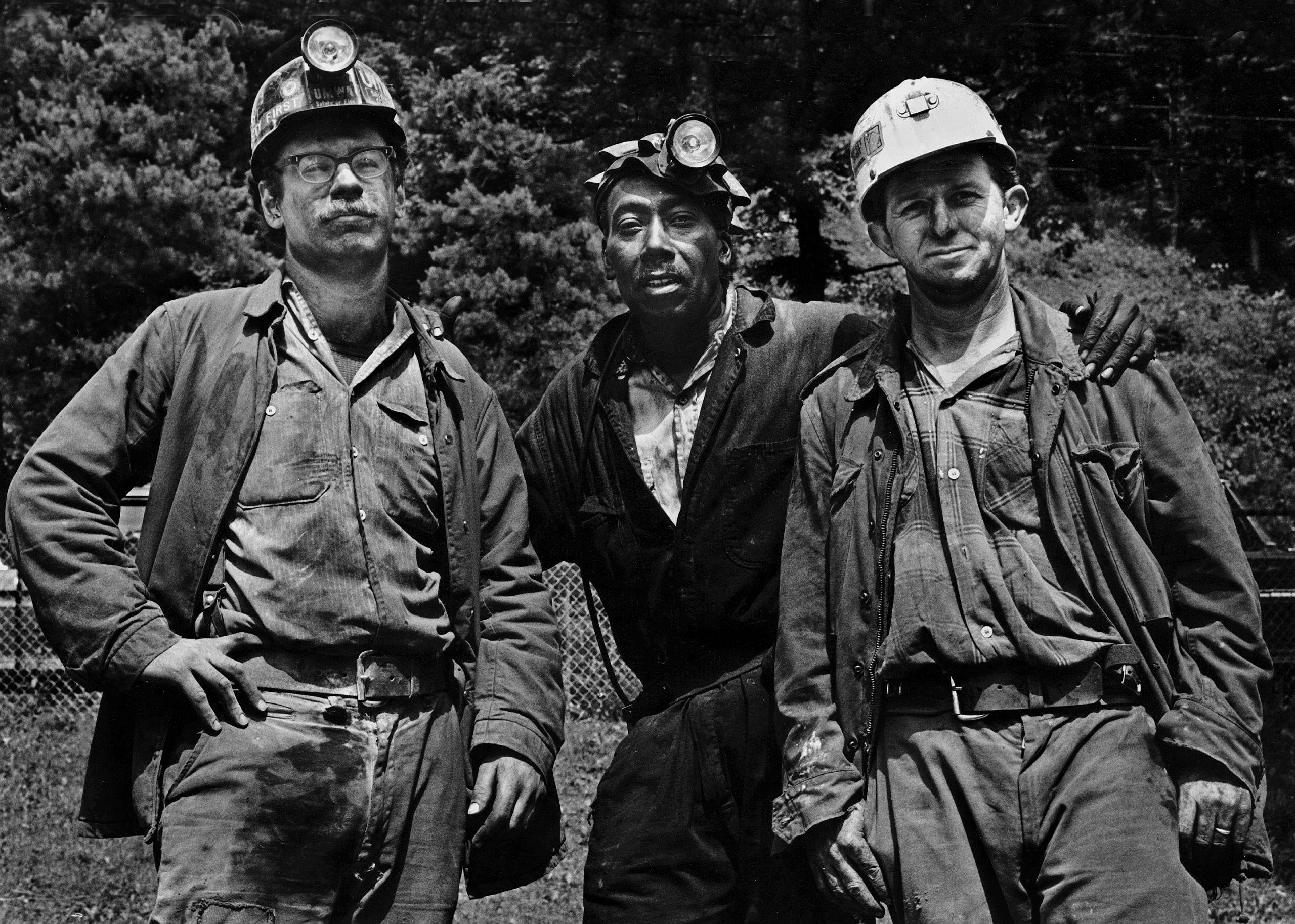
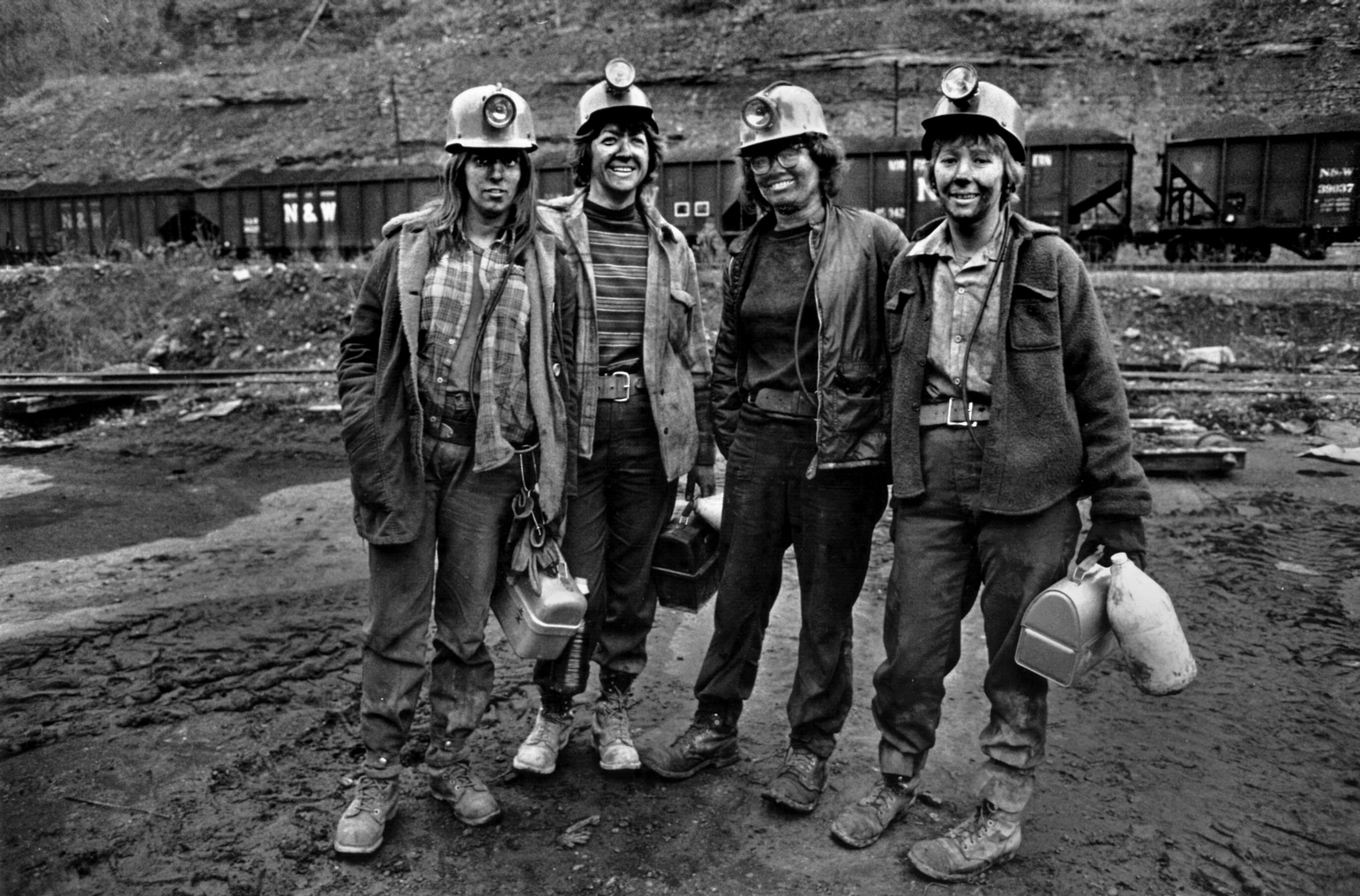
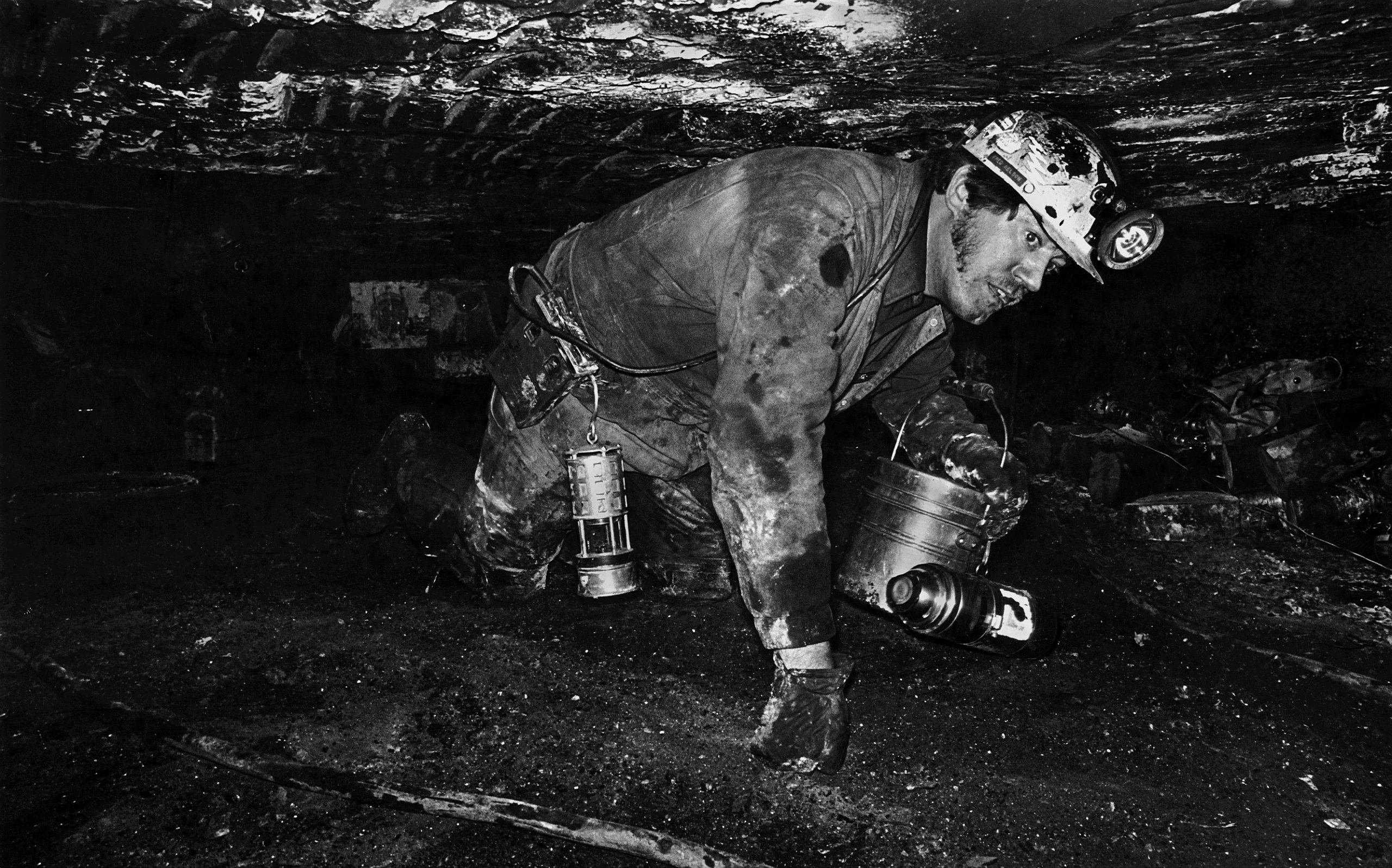
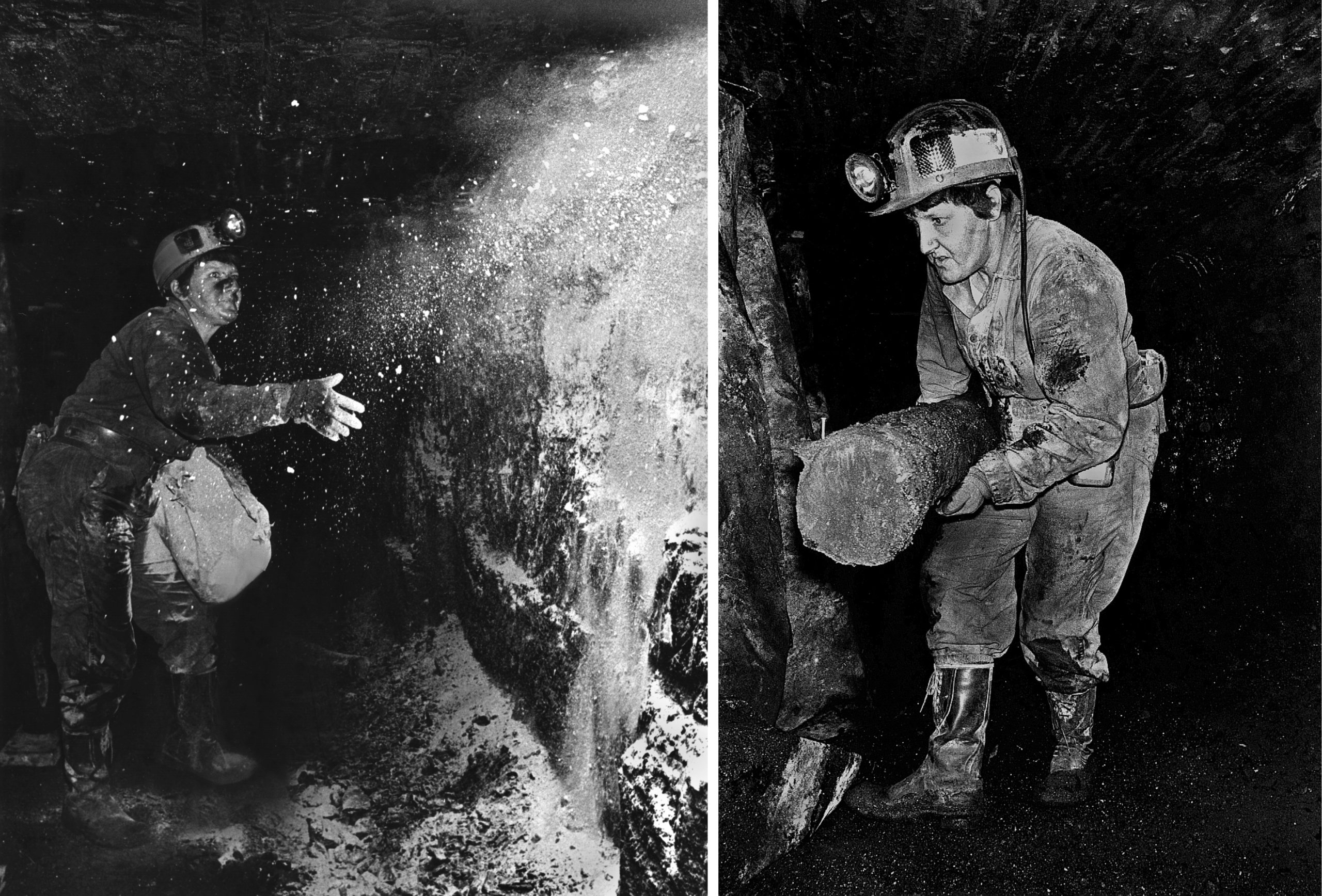
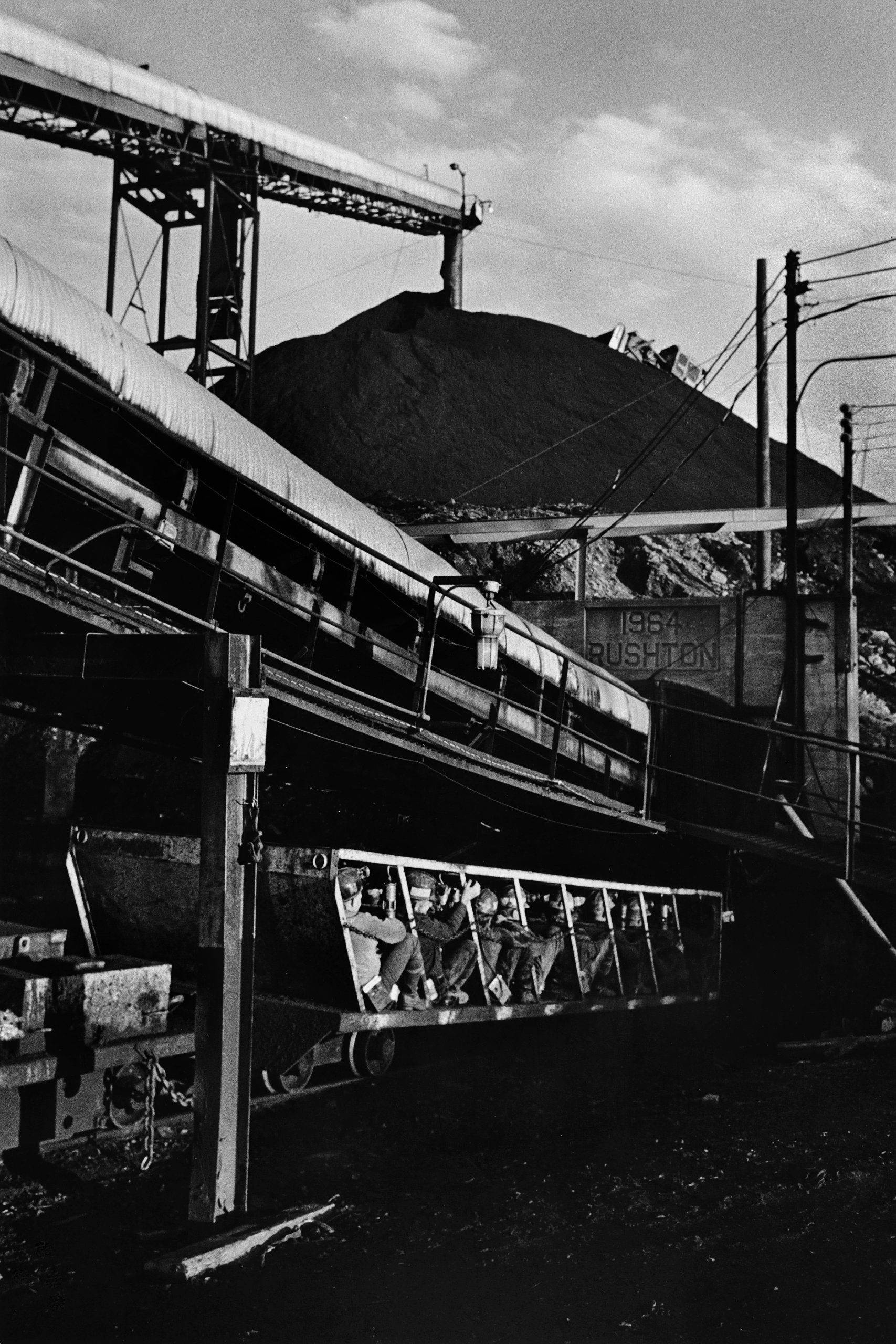
I began this book as a labor history, asking obvious questions that seemed most important at the time: Why did the movement end this way? What did it accomplish? How did it fail? Who or what was to blame? As I dug deeper into the history of the black lung movement, however, these apparently clear-cut questions about victories and defeats began to seem ambiguous, even misleading. The assessment of whether the movement had succeeded or failed depended a great deal on whose goals were used as the standard of measurement—and goals varied considerably among different participants. Moreover, what the larger political culture defined as the movement's greatest accomplishments often turned out to be mainly symbolic; they represented the visible outcomes of formal processes of reform (the passage of legislation, for example), but in and of themselves did not necessarily signify substantial and lasting change. The simplicity of my original questions faded as the labels of victory and defeat, success and failure, appeared more and more ephemeral. The central analytical problems increasingly seemed to involve the maddening complexity of social change itself, which prevented any person or group from controlling the course or outcomes of this movement.
As I delved further into the reforms sought and controversies engendered by the black lung movement, it became apparent that the movement was more than an important episode of labor resistance. At issue in the struggles over black lung, which have reemerged today, is not only how to prevent the disease or compensate those affected by it but also the very definition of black lung. Frequently, the most ideologically powerful opponents that miners have faced in their successive surges of activism are not coal operators or conservative politicians but physicians. At the center of the black lung controversy has been a profound power struggle between miners and physicians over who will control the definition of this disease.2See Daniel M. Fox and Judith F. Stone, "Black Lung: Miners' Militancy and Medical Uncertainty, 1968–1972," Bulletin of the History of Medicine 54, no. 1 (1980): 43–63, for an early framing of the black lung struggle as between miners and physicians over the definition of disease. Their emphasis on medical uncertainty differs from the analysis in my own article, which came out during the same time period: Barbara Ellen Smith, "Black Lung: The Social Production of Disease," International Journal of Health Services 11, no. 3 (1981): 343–359.
As a result of these and other shifts in emphasis, this book is a hybrid. It draws on diverse theoretical traditions in order to analyze not only the organization and development of the black lung movement, but also the history and conflict that underlie the brutal fact of coal miners' diseased bodies. Beginning with how and why black lung originates in the workplace, this book also explores the medical history of the disease and the conflicting meanings that miners and certain physicians, lawyers, and government administrators invest in black lung.
After moving away to a self-imposed exile some twenty-five years ago, I live once again in West Virginia. Contrasts with the 1970s heyday of working-class activism are evident throughout the rural landscape of abandoned gas stations, rusted coal tipples, and boarded-up union halls. The differences are personal as well: when I interviewed black lung activists in the 1970s, I was the age of their daughters and granddaughters; today, I am eligible for Medicare. As I conducted additional interviews in 2019, mostly with retired coal miners close to my age, their bodies as well as their words spoke the story of black lung disease and the physical toll of hard-labor jobs. Conditioned as a white woman to thinking of my embodiment primarily in terms of gender, I was struck again and again by how the privileges of class have shielded me from harm and become subsumed into my body. This updated and revised book, which includes two new chapters and a moving, evocative photo gallery by Earl Dotter, thus entails not only additional research into medical, legal, and economic materials relevant to black lung, but also historical reckonings both political and personal.
Today, as I write this preface, the power relations that miners experience on the job are dangerously asymmetrical, and their outcomes grim. Coal miners in southern West Virginia, once the stronghold of the UMWA in central Appalachia, where those who crossed a picket line invited ostracism if not assault, now work nonunion. Coal companies, facing shrinking domestic markets and in many instances bankruptcy, force workers, coal communities, and American taxpayers to bear the costs of their decline. Black lung can only be fully understood as part of this historical moment, when resistance, remarkably, persists. Digging Our Own Graves analyzes the dreadful resurgence of black lung within the long history of efforts to legitimate this disease and make it visible, prevent black lung in the workplaces where it is produced, and extend dignity and a measure of justice to those for whom prevention comes too late.
Conclusion: Class Power, Scientific Authority, and State Regulation
Nearly two centuries have passed since Dr. James Gregory opened up the lifeless body of John Hogg and hypothesized a connection between the miner's blackened lungs, his respiratory disability in later life, his occupation, and his death. For a time, physicians in Britain and the United States continued to investigate the relationship between occupational exposures and miners' respiratory distress. Toward the end of the nineteenth century, however, during a period of tight corporate control in the Appalachian coalfields and an increasingly restrictive scientific understanding of disease, black lung began to disappear from the medical literature of both countries. In the United States, coal miners eventually precipitated renewed medical attention to black lung by winning a union-controlled health care plan for themselves and their families. Even so, coal workers' pneumoconiosis—much less the broader ensemble of illnesses called black lung—was not accepted as a legitimate, occupationally related disease by the medical profession as a whole.3Journalistic and some scientific accounts equate coal workers' pneumoconiosis (CWP) with black lung. However, an essential component of the black lung movement was miners' and their families' struggle to broaden the definition, beyond CWP, of miners' disabling, occupationally related lung disease. Research by physicians and other scientists familiar with and sympathetic to miners and their health has validated this broader definition. See, for example, Edward L. Petsonk, Cecile Rose, and Robert Cohen, "Coal Mine Dust Lung Disease: New Lessons from an Old Exposure," American Journal of Respiratory and Critical Care Medicine 187, no. 11 (2013): 1178–85. Formal recognition required collective political intervention by coal miners themselves.
Even as social and economic factors have impinged on the medical construction of black lung, so have they shaped the actual production of disease. Black lung originates not simply from the physical presence of dust in coal mines, but from the relative power and respective actions of miners and operators, which influence conditions in the workplace. Miners' eventual success in unionization enhanced their collective power in the workplace, but, depending on UMWA leaders' priorities, unionism at times paradoxically undermined miners' capacity to make that workplace healthy and safe. In the years after World War II, the pact between larger operators and the UMWA produced unimpeded mechanization of the production process, high levels of unemployment, forced migration, and occupational death and disability from black lung. However, that industrial collaboration also produced massive rank-and-file upheaval and a successful effort to reform the union. In the present moment, union weakness and miners' lack of bargaining leverage in the workplace, combined with certain operators' endgame maneuvers to extract coal from thinner seams even while pressing for high levels of labor productivity, once again intensify the extent and severity of the disease.
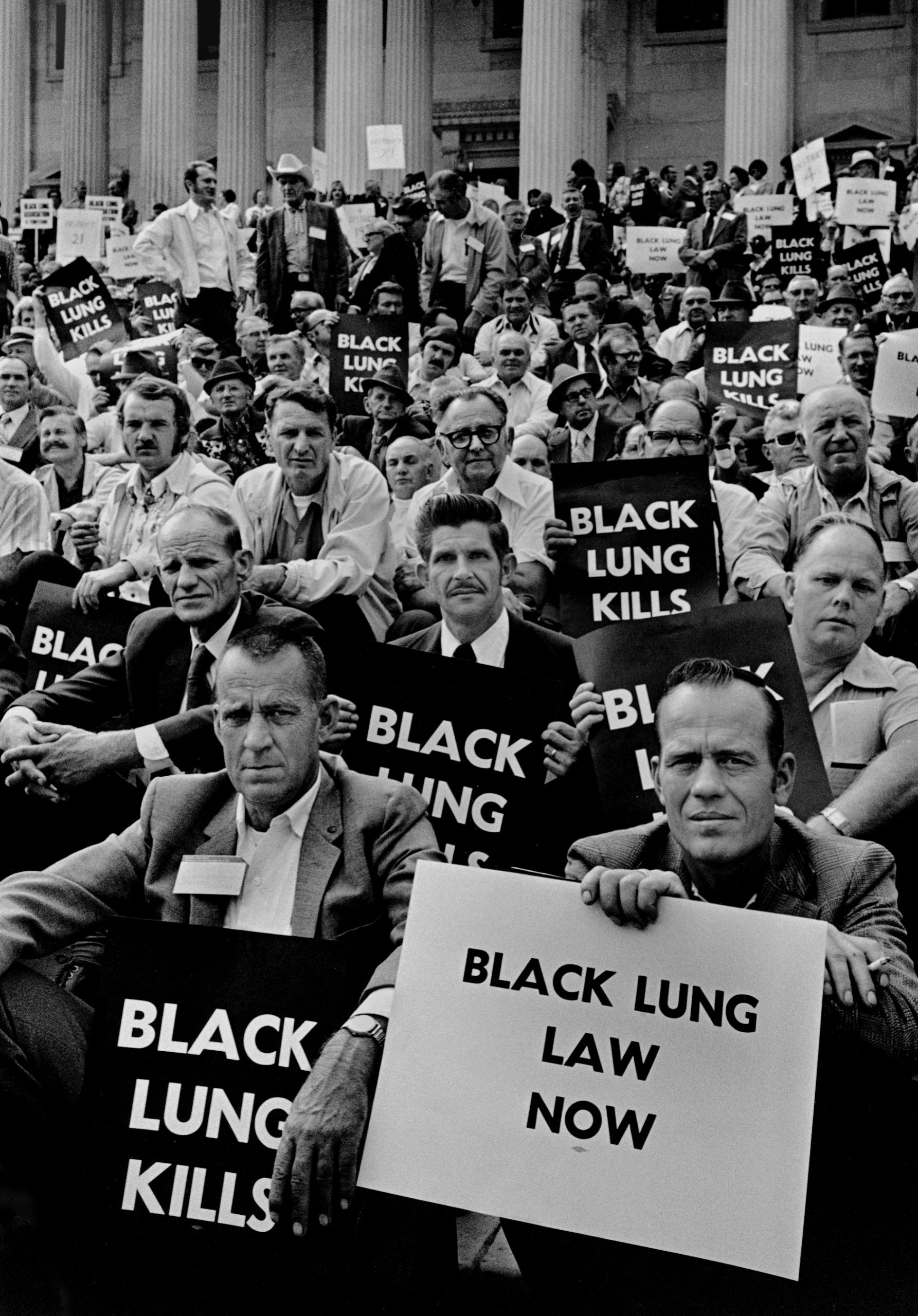
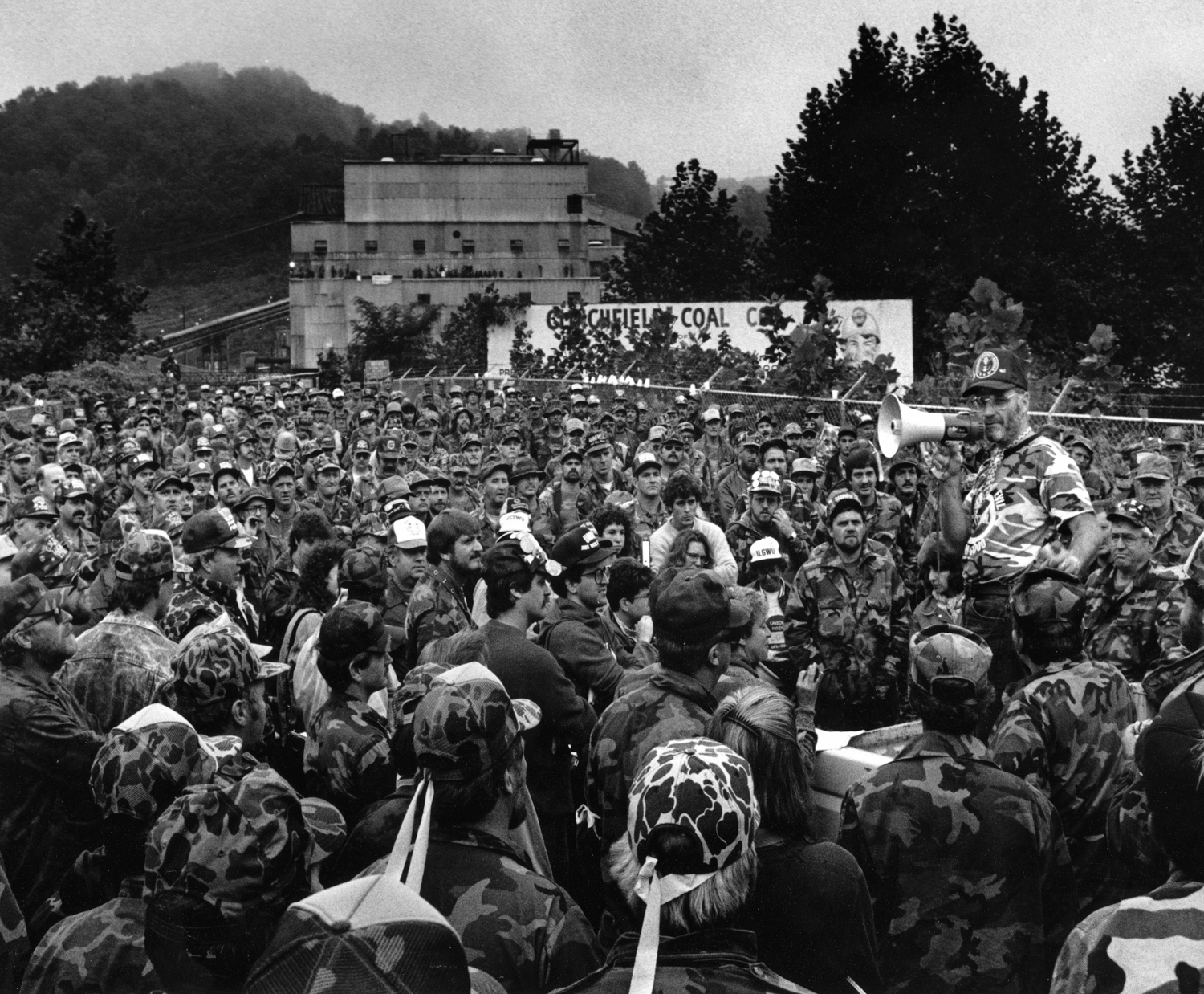
The virulence of black lung today—fifty years after it was supposedly destined for elimination—does not diminish what coal miners, their families, and their allies accomplished in the past. Rather, it attests to the enduring realities of labor exploitation that the black lung movement episodically managed to contest. For its constituents, the movement achieved a unique and unprecedented federal compensation program. Approximately half a million miners and widows have received compensation under the federal black lung program; especially for those ineligible for a pension or other benefits, the monthly payments can mean the difference between destitution and modest survival.4This estimate of the number of black lung beneficiaries is extrapolated from data on the number of claims filed each year, changing approval rates, the annual total cost of claims, and, for some years, reports from the administering federal agency. See, for example, Social Security Administration, Annual Statistical Supplement to the Social Security Bulletin, 2016 (Washington, DC, 2017), Table 9. Beneficiaries who are miners and those who are widows, added together, do not equal the total number of miners judged disabled by black lung, as a widow may receive her husband's benefits after his death. Further, the number of beneficiaries is reported each year as a rolling total, and thus cannot be summed. The coronavirus interrupted my efforts to obtain more precise data. As of December 2018, an individual beneficiary is entitled to receive $660/month, which increases up to a maximum of $1,320 for those with three or more dependents. US Department of Labor, Division of Coal Mine Workers' Compensation, "Benefit Rates Under Part C, 1973–2018," accessed August 16, 2019, https://www.dol.gov/owcp/dcmwc/statistics/PastPartCBenefitRates.htm. The respirable dust standard and other disease prevention measures in the US Coal Mine Health and Safety Act of 1969 are also attributable to the black lung movement. As one element in a larger upheaval throughout the coalfields, the movement contributed as well to the rank-and-file takeover of the United Mine Workers of America and renewal of union leaders' critical attention to occupational safety and health.
Originally and essentially, however, the black lung movement was a struggle over the recognition and, more implicitly, causation of an occupational disease. What seemed at first a straightforward task— achieving legal inclusion of a "new" dust disease under the workers' compensation system—turned out to be a far more complex undertaking. Miners and other activists learned early on that "black lung," as refracted through the lens of scientific medicine, was quite different from the disease for which they sought recognition, compensation, and prevention. In a struggle that has lasted more than fifty years, activists have persistently challenged physicians, lawyers, and policymakers over the meaning of this disease; at different times, they have been able to replace the restrictive scientific construction of a rarely disabling coal workers' pneumoconiosis with their own definition of "black lung." Although focused on arcane disputes over diagnostic methods, disability standards, legal presumptions, and other issues, this conflict over the definition and causation of black lung is intensely political: it involves the ideological content of medicine's view of disease, including the technical perspective that narrows causation to the inhalation of dust, and the powerful role of physicians in labeling work-related disability as legitimate. On the outcome of such conflict rests financial liability for the coal industry that potentially ranges into billions of dollars. The legacy of black lung activism thus entails unsettling questions about the relationship between scientific and technical knowledge, state regulation, and the exercise of class power.
It should be stressed at the outset that not all physicians subscribe to a narrow or purely technical understanding of black lung: recall the role of three doctors (Buff, Rasmussen, and Wells) in the first black lung mobilization during 1968 to 1969 in West Virginia. Dr. Donald Rasmussen continued to work with and advocate for coal miner patients out of his pulmonary lab in Beckley, West Virginia, for five decades, up until his death in 2015.5Sam Roberts, "Dr. Donald L. Rasmussen, Crusader for Miners' Health, Dies at 87," New York Times, August 2, 2015, accessed September 29, 2019, https://www.nytimes.com/2015/08/03/health/research/dr-donald-l-rasmussen-crusader-for-coal-miners-health-dies-at-87.html. Rasmussen's mantle now falls on Dr. Robert Cohen, a pulmonologist who directs the occupational lung disease unit at Northwestern University and frequently testifies before Congress on miners' behalf.6Dr. Cohen testified during the hearings on black lung, "Breathless and Betrayed." See "What is MHSA Doing to Protect Miners from the Resurgence of Black Lung Disease?" YouTube video, 2:58:39, June 20, 2019, House Committee on Education and Labor, https://www.youtube.com/watch?v=sJUDcTf0a_g. Other physicians in the coalfields, such as Drs. Gregory Wagner and Brandon Crum, have devoted much of their professional lives to caring for coal miners with lung disease. After practicing medicine at a clinic on Cabin Creek (West Virginia), Wagner eventually came to direct Respiratory Disease Studies at NIOSH when that agency issued the criteria document that legitimated a broad definition of black lung, inclusive of COPD (chronic obstructive pulmonary disease), and recommended much lower limits on miners' exposure to coal dust and silica.7NIOSH, Criteria for a Recommended Standard: Occupational Exposure to Respirable Coal Mine Dust, publication no. 95–106 (Washington, DC: US Government Printing Office, 1995), xxii, https:// www.cdc.gov/niosh/docs/95-106/default.html. Crum, a radiologist—and, not coincidentally, former coal miner—was first to sound the alarm over black lung's escalating severity, which in 2014 he began detecting among his patients in eastern Kentucky. Four years later, the coal-industry-beholden state legislature responded by disqualifying him from reading X-rays for miners' workers' compensation claims.8Austyn Gaffney, "As Black Lung Strikes Younger Coal Miners, Kentucky Restricts Medical Benefits," NRDC, September 24, 2018, accessed September 29, 2018, https://www.nrdc.org/stories/black-lung-strikes-younger-coal-miners-kentucky-restricts-medical-benefits.

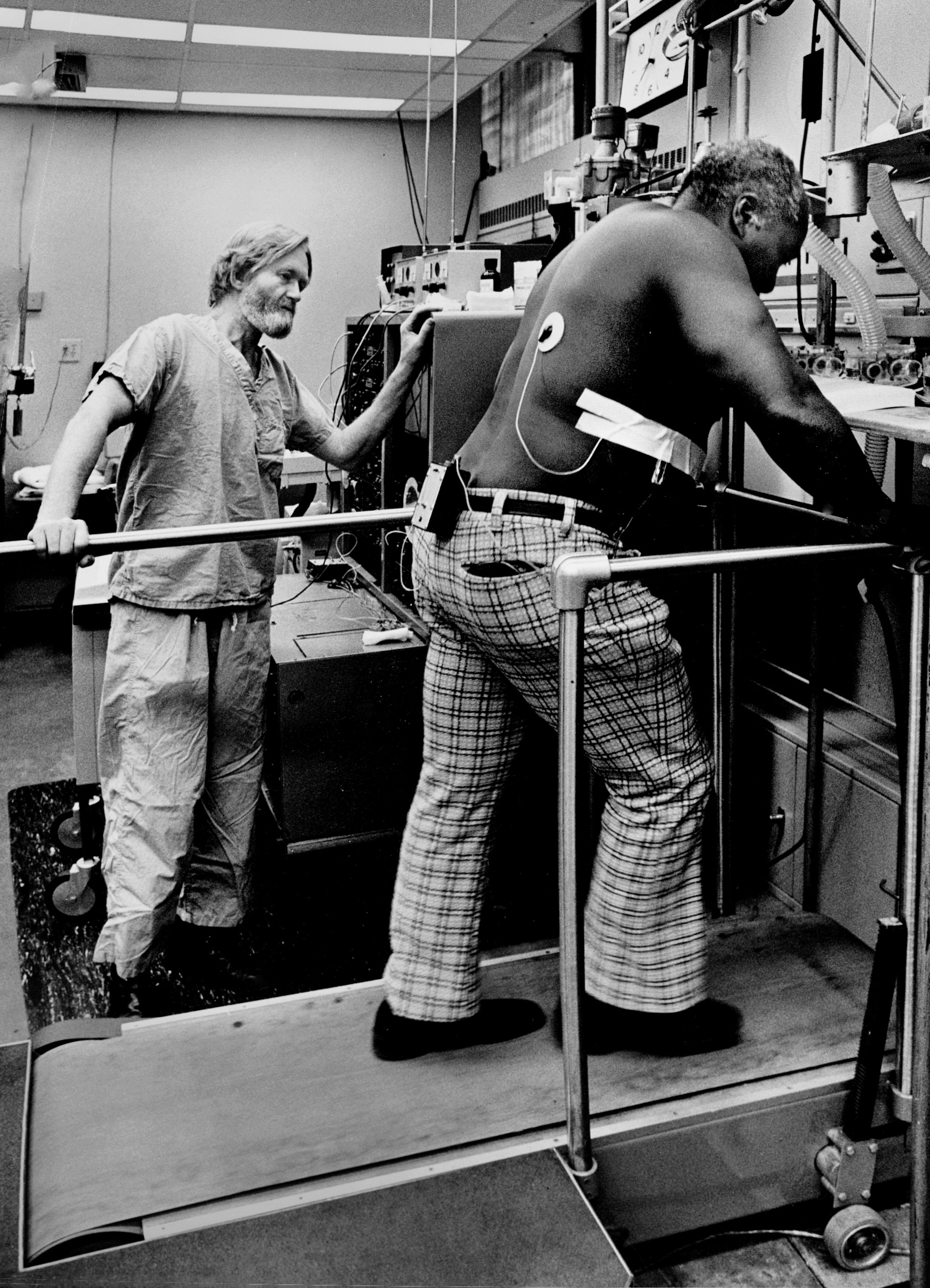



Apart from such individual physicians' political and medical predispositions, however, there remain epistemological tendencies within scientific medicine that militate against the understanding of disease advanced by black lung activists.9This summary of miners' perspectives on the origins of black lung and the role of physicians in advocating a restrictive view of work-related, compensable disease is based on the author's interviews and observations in southern West Virginia at different moments during the past five decades. Within the restrictive medical viewpoint that requires conclusive, scientific proof of occupational causation, black lung is in fact coal workers' pneumoconiosis, a single clinical entity, disabling only in advanced and, even today, relatively rare stages. The disease acquires legitimacy—indeed, effectively comes into existence—only when visible to trained personnel viewing objective diagnostic evidence, that is, X-rays, of an individual miner's lungs. The thousands of miners who believe themselves disabled by black lung yet exhibit no X-ray evidence of advanced CWP might legitimately be considered "disabled"—if the quantitative results of certain tests confirm such a condition. However, the origin of their disability is nonoccupational, above all their own cigarette smoking, or, if nonsmokers, other sources outside the workplace. Although this scientific definition of disease is quite different from physicians' earlier construction of a benign "miners' asthma," the result, in the eyes of many victims, is the same: black lung is trivialized. What many miners view as a collective problem becomes, from the perspective of scientific medicine, individual, quantifiable cases. What they experience as part of the shared social world of coal mining becomes occasional, biological events. What they attribute to their class relationship with the coal operators becomes the product of a single physical agent, dust. In sum, what is collective becomes individual, what is social becomes biological, what is produced by human action becomes the outcome of inert material.
Certain tendencies intrinsic to clinical medical practice are also at stake in the seemingly incommensurable perspectives of miners and certain physicians. Scientific medicine situates disease spatially, within the individual body, and temporally, at the point when signs, symptoms, or other physical alterations develop. Disease is ahistorical as well as asocial; it has no history except a "natural," that is, physical, history. It is said to exist when experienced by the individual and diagnosed by the physician, not at the point when it is being produced. The possibilities for prevention are thus constrained within the very definition of disease.10Howard S. Berliner and J. Warren Salmon, "The Holistic Health Movement and Scientific Medicine: The Naked and the Dead," Socialist Review 9, no. 1 (January–February 1979): 31–52.
Clinical medicine reflects this understanding of disease on a practical level: individual patients present the physician with their distinctive symptoms and complaints; they appear as random, disconnected "cases," and they are granted therapeutic treatment as individuals. There is no social meaning to disease in the sense of an internal relationship between social relations and the individual experience of ill health; primarily individual behaviors, such as diet, exercise, and smoking habits, command attention. Yet, in quantifying disability and allocating it to occupational or nonoccupational sources, physicians implicitly assess the conditions in which miners have lived and worked all their lives. That most physicians have never been in a coal mine (much less worked in one), and that some have never even been in the coalfields, serves to intensify the conflict between physicians and coal miners, who experience the superior legitimacy automatically granted scientific medical knowledge as a complex and powerful form of social control.
The authority of physicians to pronounce miners "healthy" or "disabled" carries important financial consequences. In the context of federal black lung compensation, doctors' assessments of coal miners' health can be decisive in the award or denial of financial benefits that are allocated in large part according to medical eligibility criteria. Doctors act as gatekeepers in a more generic sense as well: they control access to the "sick role," the sole avenue by which adults may legitimately escape the daily responsibilities of their class, race, and gender.11See Talcott Parsons, The Social System (New York: Free Press, 1951). Parsons's conceptualization of the sick role was neither class nor historically specific. For coal miners, as for other workers, the preeminent requirement of their class position is to perform wage labor. Medical criteria for assessing disability (and determining compensation eligibility) that take as the standard for health the functional capacity to work explicitly enforce this requirement. Even if damaged by work, coal miners still must provide medically sanctioned evidence of their "total disability"—i.e., complete inability to continue working—in order to receive financial compensation and legitimate relief from wage labor. In pushing against the limits of this compensation policy, miners and their families implicitly contest not only the ideological authority of physicians to define disease and assess disability; they ultimately threaten the economic power of coal operators by pressing for a broad definition of black lung and relaxed standard of disability that would provide unhealthy miners an alternative to labor in the mines.
This convergence between the restrictive scientific view of black lung and the economic interests of the coal industry is, for many miners and their families, an ultimate source of distrust and conflict with physicians. The narrow definition of disabling black lung as a relatively rare, complicated pneumoconiosis is highly functional to the industry: it circumscribes the scope of occupational lung disease and correspondingly diminishes both the cost of compensation benefits and the importance of prevention. In the context of policy formation, scientific medicine plays a mediating role between the interests of the coal industry and the actions of the state. It facilitates apparent distance between corporate power and public policy, and seems to ground political decision-making in the neutral, technical knowledge of a third party.
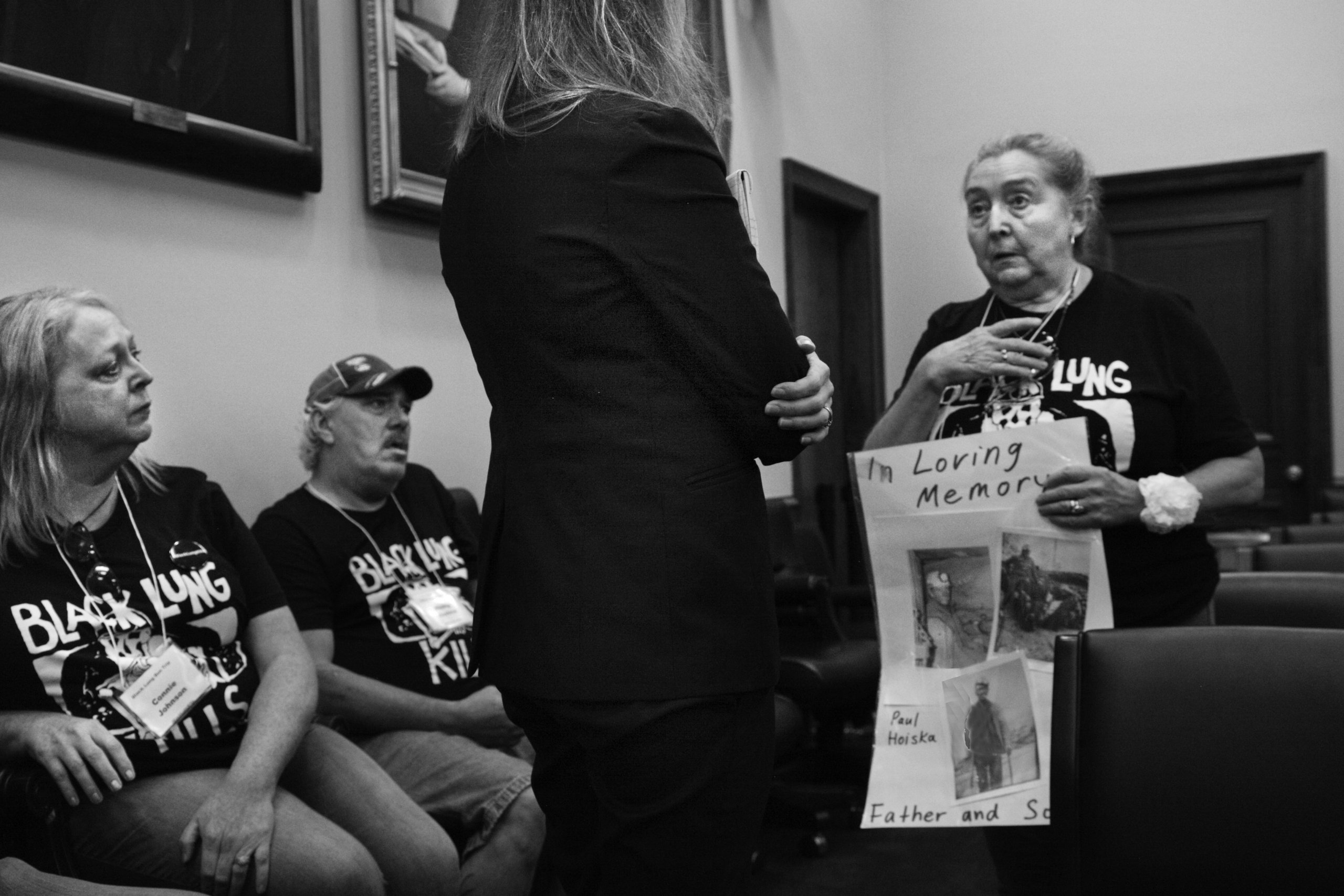
The lessons of the protracted struggle over black lung disease encompass both caution and inspiration, loss and hope. In an era of science denialism, when defense of factual truths and scientific knowledge seems obviously necessary, the case of black lung still stands as a warning about the presumed neutrality and appropriate scope of scientific and technical solutions: beware of technical fixes for problems that ultimately derive from economic exploitation and grossly unequal political power. Activists' original quest for redress through the workers' compensation system offers a related caution: the sprawling administrative machinery of the state, which presents the customary, sanctioned route for institutionalizing reform, entails embedded interests that can thwart activists' aims even as it seems to grant their demands. Finally, the long history of black lung suggests that effective prevention of occupational disease, injury, and death ultimately resides in the ever-changing power relations of the workplace and workers' collective, organized capacity to defend themselves. For these and many other reasons, victories are never secure, achieved once and for all; they must be defended, expanded, critiqued, and revised, as black lung activists have doggedly done for some five decades now.
Today, the industry that for more than a century has defined central Appalachia is dying. Those who would chart a post-coal future must grapple with the industry's legacy of incalculable human and environmental destruction, but they would do well to learn from the additional legacy of coal mining families' solidarity and resistance. Ever since the first investors laid claim to the coal of Appalachia, the people of this region have been revolting in various forms against the appropriation of their land, their labor, and even their lives. Those who fought in the black lung movement are both heirs and contributors to this long history of resistance. Today, many miners pay the cost of coal production in the currency of their very breath, but they also continue to resist. Danny Whitt: "We don't never give up. You know when I'll stop? When the last breath leaves my body."12Author's interview with Danny Whitt, Matewan, WV, September 4, 2019.
About the Author
Barbara Ellen Smith is professor emerita of women's and gender studies in the Department of Sociology at Virginia Tech. She has been active in and writing about movements for social and economic justice in Appalachia and the US South for more than 45 years. Her recent publications include a co-edited book with Stephen L. Fisher, Transforming Places: Lessons from Appalachia (University of Illinois, 2012) and Digging Our Own Graves: Coal Miners and the Struggle over Black Lung Disease (Haymarket Books, 2020).
]]>
After the end of the Civil War, recently freed Black people endeavored to create their own communities. During Reconstruction, and with newfound access to political and economic power, Black towns and institutions emerged wherever Black people lived. Before the end of the Civil War, Union soldiers defeating Confederate soldiers attracted emancipated Black people, who settled near Union encampments. In 1865, and immediately after the end of the Civil War, at a former encampment situated across from the town of Tarboro, North Carolina, and within the floodplain of the Tar River, the land was dubbed Freedom Hill. Twenty years later, a Black community elder named Turner Prince purchased the land, and it was renamed Princeville, the first incorporated Black town in America.1Joe A. Mobley, "In the Shadow of White Society: Princeville, a Black Town in North Carolina, 1865–1915," North Carolina Historical Review 63, no. 3 (1986): 340–84.
Though Princeville may look like other rural towns in eastern North Carolina, it carries significant histories. Shiloh Landing marks the point along the Tar River where enslaved peopled disembarked into brutal lives of forced labor and captivity. Another riverfront site was later accessed by congregants of local churches, arriving in white-robed processions to perform baptismal ceremonies. Princeville, from its infrastructure to its buildings and landscapes, was self-built by Black residents. Many residents were engaged in the timber and mill industries and located their businesses and homes close to the Tar River, built on stilts to help them survive frequent flooding. Powell Park now marks this area and its emotionally charged history—five major floods inundated the town in the twentieth century. Hurricane Matthew ravaged the town in 2016. Princeville's endurance to rebuild in the face of these devastations has made it especially remarkable.

Princeville was socially as well as environmentally vulnerable, due to racism and the sustained threat of white supremacist violence from nearby communities. Despite these risks, Princeville's population continued to grow, and does so to this day. As an indicator of the place attachment expressed by residents, the town's population increased after the rebuilding periods that followed numerous floods.
Like Princeville, the town of Mound Bayou, Mississippi, also came about by untraditional circumstances. It originated from the enslaved African community of Davis Bend, Mississippi, which was created, in the 1820s, by slave-plantation owner Joseph Davis as a "model" slave community on a plantation. By the standards of America's Peculiar Institution, Davis provided a relatively high level of social, health, and economic care, as well as independence, to Davis Bend's inhabitants. Although still enslaved, residents benefited from dental and health care, opened and ran merchant businesses, and were spared overt domination from overseers. After the Civil War and the collapse of cotton prices, Davis Bend failed, and its residents relocated to the Mississippi Delta bottomlands to found Mound Bayou in 1887. The town earned regional notoriety for its numerous Black owned businesses and organizations, as well as for its tradition of protecting Black people's voting rights amid racial violence. The relative success of the town earned accolades from Booker T. Washington, who called it a model of "thrift and self-government."2Melissa Block, "Here's What's Become of a Historic All-Black Town in the Mississippi Delta," Our Land, National Public Radio, March 8, 2017, www.npr.org/2017/03/08/515814287/heres-whats -become-of-a-historic-all-black-town-in-the-mississippi-delta.
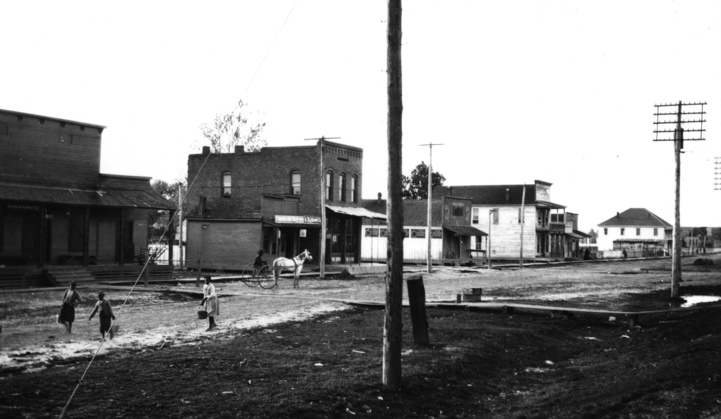
Mound Bayou suffered from declining cotton prices and an uptick in Jim Crow–era oppression. The town distinguished itself, however, by providing safe harbor for Black people seeking modest political and economic independence. Serving as a key organizing ground for the Regional Council of Negro Leadership, Mound Bayou attracted interest from prominent civil rights leaders like Medgar Evers. Regional boycotts, in 1952, of service stations and restrooms refusing to serve Black people were organized in Mound Bayou.3Peter Brown, "Strike City, Mississippi," Anarchy 7, no. 2 (1967): 33–37. And, in 1955, the town served as a safe harbor when Black reporters came to Mississippi to cover Emmett Till's murder trial.4Olive Arnold Adams, Time Bomb: Mississippi Exposed and the Full Story of Emmett Till (Mound Bayou: Mississippi Regional Council of Negro Leadership, 1956). Mound Bayou continues to exist today, though it grapples with the numerous contemporary challenges facing rural southern towns, including population decline and reduced economic opportunities.
Eatonville, Florida, also founded by Black Americans in 1887, represents not only the historical significance of free Black towns but also the contemporary roles Black landscape architects can play in their protection and growth. Eatonville emerged from the lack of human rights protections afforded to Black Americans in the post-Reconstruction era. Named after a white landowner, Joseph Eaton, who was willing to sell land to Black people, the town was originally located on just over one hundred acres in what is now known as Greater Orlando.5United States Department of the Interior, National Park Service, "National Register of Historic Places Registration Form: Eatonville Historic District," September 9, 1997, https://npgallery.nps.gov/GetAsset/e5fa60c5-551d-41d3-bbef-2a52ff3a7b0b. Eatonville was a fully developed town featuring a bustling business district, churches, and one of the largest schools for Black Americans in the region.
Eatonville rose to national recognition due to the writings of one of its most famous residents, Zora Neale Hurston. Their Eyes Were Watching God, Hurston's groundbreaking Harlem Renaissance novel presenting unvarnished writing about everyday life in the Black South, was set in Eatonville and other nearby Black towns. Later, Club Eaton was a popular performance and layover spot for a wide array of Black entertainers.6United States Department of the Interior, National Park Service, "National Register of Historic Places Registration Form."
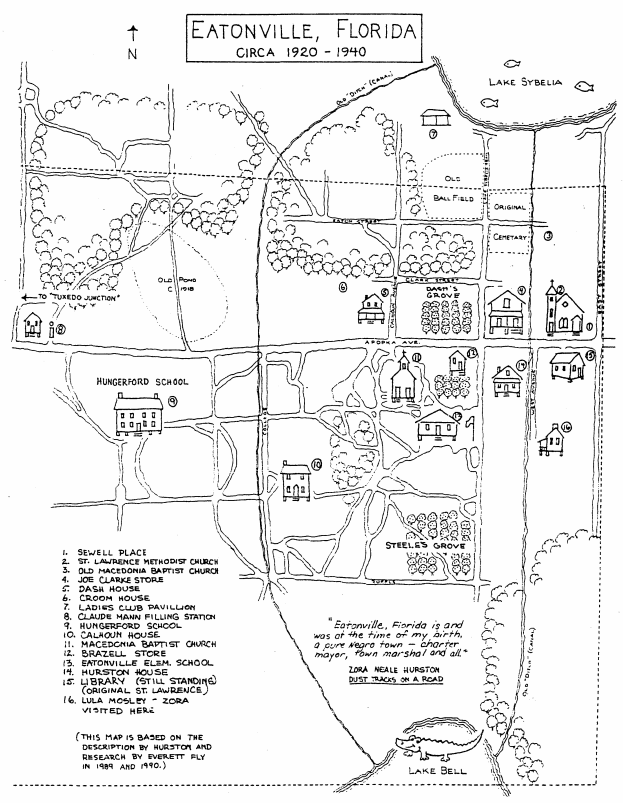
In the late twentieth century, Eatonville was declining, and Orlando's growth was endangering its remaining historic fabric. Everett L. Fly, a Black architect and landscape architect based in San Antonio, Texas, partnered with Eatonville to generate community development guidelines drawing inspiration from Hurston's literary descriptions of the community's character. Furthermore, Fly partnered with Eatonville to launch a Zora Neale Hurston festival. The annual festival extended the visibility of Eatonville's heritage and provided a revenue source to fund future community improvements. In 1988, Eatonville's Historic District was added to the National Register of Historic Places. Eatonville today exists as a town made up of historic pockets intermixed with contemporary development. The town continues to fight for visibility and preservation in the face of Orlando's tourism-driven economic growth.
About the Author
Kofi Boone, FASLA is a professor of landscape architecture at North Carolina State University's College of Design. Boone works at the overlap between landscape architecture and environmental justice with specializations in democratic design, digital media, and interpreting cultural landscapes. He serves on the Board of Directors of the Conservation Network and the Landscape Architecture Foundation.
]]>Review
For more than twenty years, scholars have sought in article after book after conference paper to expand the timeline, reach, and definition of environmental concern and activism. This uncoordinated but multi-pronged effort has given us a fuller sense of activism that emerges from and addresses larger social and economic inequalities. What we call environmental justice is finally getting a full and complete history.
What has yet to be done, until now, is to bring that broader story together with the more traditional history of the environmental movement. Ellen Griffith Spears has accomplished that in her important new history, Rethinking the American Environmental Movement post-1945. In this tightly argued volume, Spears provides the first work that truly synthesizes the different strands of environmentalism, giving them equal narrative and analytical weight. This book represents the culmination of a generation of scholarship on environmentalism that sought to expand our narrative in order to consider environmentalism as a "field of movements" (5) that brings together actors, organizations and institutions from a variety of backgrounds at the local, regional, and national level. The field of movements concept allows Spears to consider the mainstream organizations such as the Sierra Club or the Natural Resources Defense Council on comparable footing with grassroots movements, working to weave all strands of activism into the synthesis. She also includes developments in the history of science and public health, especially in ecology and toxicology, as well as the regulatory responses by the federal government. These are important not only to provide background and context, but also because the often-contested terrain of scientific knowledge and expertise is so central to understanding the movement. Rethinking the American Environmental Movement also engages larger structural changes within the US economy and society, such as mass suburbanization in the 1950s and deindustrialization in the 1970s and 1980s.
Although the title of the book promises an emphasis on the post-World War II era, the first chapter is a robust examination of "Antecedents" to the modern movement. Where, for instance, traditional histories examined conservationism and perhaps Progressive Era smokestack regulation, Spears discusses resistance to slavery, and pre-Civil War public health debates, in addition to the emergence of nature preservation. This builds on important recent work in nineteenth-century environmental history, such as Catherine McNeur's Taming Manhattan and Carl Zimring's Clean and White, and buttresses the argument for long durée connections between social justice and the environment.1Catherine McNeur, Taming Manhattan: Environmental Battles in the Antebellum City, Reprint edition (Harvard University Press, 2017); Carl A. Zimring, Clean and White: A History of Environmental Racism in the United States (New York: New York University Press, 2015); Mark Fiege, The Republic of Nature: An Environmental History of the United States (Seattle: University of Washington Press, 2012).
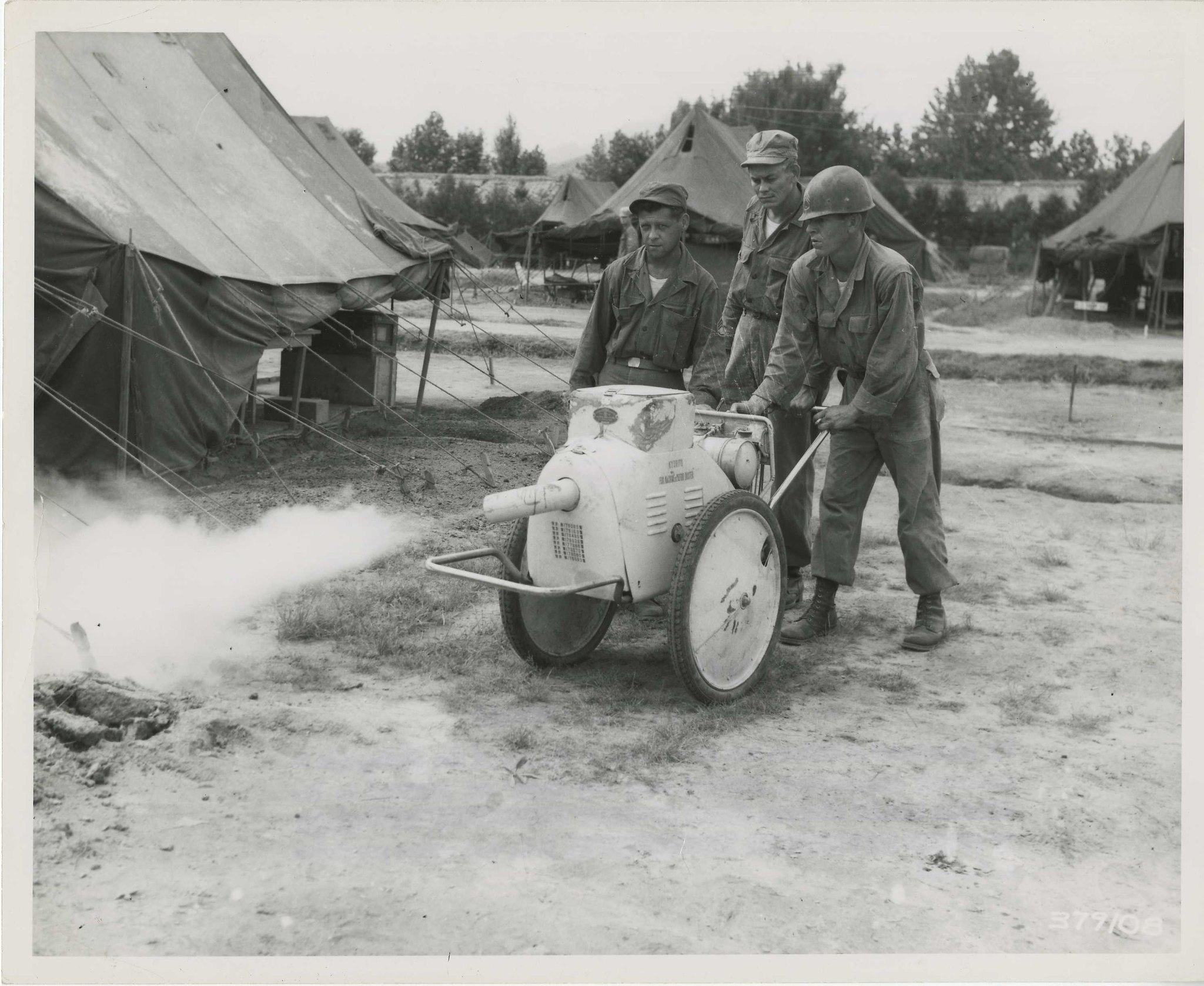
The core of Spears's book centers on the postwar period, which she ably covers while also introducing lesser known developments. For example, any book of this nature has to discuss Rachel Carson, and Rethinking devotes one of its largest section to this groundbreaking author. But instead of putting Carson on a pedestal, where she often sits in public memory, Spears places her in context, showing how she was building on and amplifying the work of grassroots activists and scientists. Americans had been raising concerns about the ecological and public health effects of dichlorodiphenyltrichloroethane (DDT) soon after World War II. This accelerated into a series of lawsuits filed by New York based conservationists protesting the indiscriminate spraying of DDT in the late 1950s. The legal action failed, but the activists caught the attention of Carson, who began investigating the impact of DDT across the country. That research culminated in the publication of Silent Spring in 1962, and Spears ably delineates how and why this book was so important. It was not just an expose about the dangers of chemical spraying; Carson helped bridge the old conservation era to more contemporary concerns about human health, and she "crystallized the recognition that humans were fundamentally altering the environment" (83).
Just as significant as this rethinking of Silent Spring and pesticide activism is what comes before it: a short but important consideration of urban environmental concerns during the 1950s—especially the National Urban League's "fight blight" and block club campaigns that targeted neighborhood cleanup, rats, empty lots, and community health. Spears examines urban activism by African American and other minority populations in more detail later, but by putting this section right before the discussion of Carson, she makes a valuable narrative intervention. Justice-focused activism by minority communities was occurring at the same time that more well-known parts of the movement were emerging, buttressing the argument that these strands of environmentalism are deserving of a longer history, and were not just a product of the environmental justice movement of the 1980s.
In addition to making sure that urban and minority neighborhoods and populations are firmly part of the narrative, Spears gives significant weight to the decades after 1980. This allows her to cover the conservative reaction to environmentalism during the Reagan administration and afterwards, but also climate activism, and recent environmental justice conflicts such as poisoned water in Flint, Michigan, and the Dakota Access Pipeline protests. Rethinking is especially strong on climate activism, representing an important shift over the past decade. The final chapter provides background on concerns over anthropogenic climate change (a subject that has figured in every United Nations environmental since 1972) and the international negotiations and treaties over the limitations of carbon and greenhouse gases in the 1990s. Spears includes a special section on the Dakota Access Pipeline protests in 2016. Because the pipeline violated indigenous rights, was a threat to the water supply of the Standing Rock Reservation, and would also allow for the cheaper transportation of fossil fuels, Spears argues that the NO DAPL protests were a great example of "an intersectional grassroots movement linking indigenous rights, climate change, and water protection" (213).
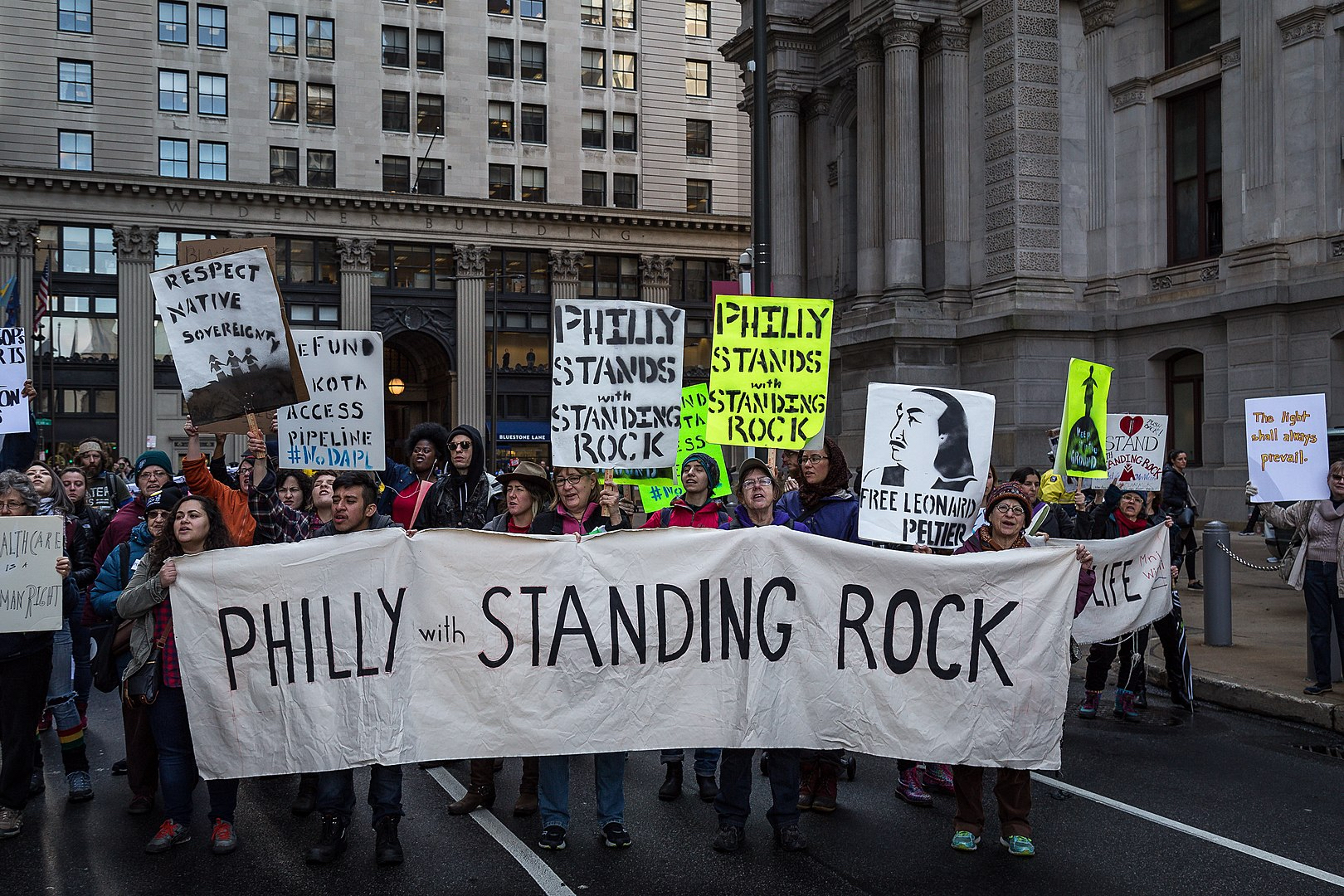
By the end of the Rethinking, readers may feel a little overwhelmed by the field of movements approach, as Spears jumps, for example, from climate activism, to green jobs, food justice, religious work on climate change, and to standalone discussions of Flint and Standing Rock, all in the second half of the last chapter. Critics could argue that this "big-tent" conceptualization risks diluting what they would classify as an environmental movement, but this is the value of Spears's approach. She convincingly shows how environmentalism has never been one particular set of activists or institutions, but a diverse set of organizations, scientists, firebrands and regulatory bodies that have always been in conversation, conflict or coalition with each other. This broad coverage helps readers understand many implicit and explicit connections. And coverage is one of the goals of this kind of book, which seeks to introduce a topic to a broader audience. This makes Rethinking especially admirable. It places activism centered upon injustice and inequality on equal footing with more commonly known parts of the movement. As someone who teaches the history of environmentalism, I believe this is vitally important. Most students begin with strong preconceived notions about environmentalism (Birkenstocks, tofu) that prove tough to dislodge.
This field-of-movements framework does raise a broader question within environmentalist writing and the narrative we tend to tell. Lurking beneath the surface of many histories of environmentalism is the conflict between the movement's different strands, particularly between environmental justice organizations, radical wilderness groups, and the mainstream "nationals." Spears does not shy away from these tensions, showing how radical factions emerged partly in opposition to the perceived "business friendly" policies of groups such as the Environmental Defense Fund, and how grassroots organizations have long been critical of the overwhelming white, middle-class staffing and policy orientation of well-funded national groups based in Washington, DC.
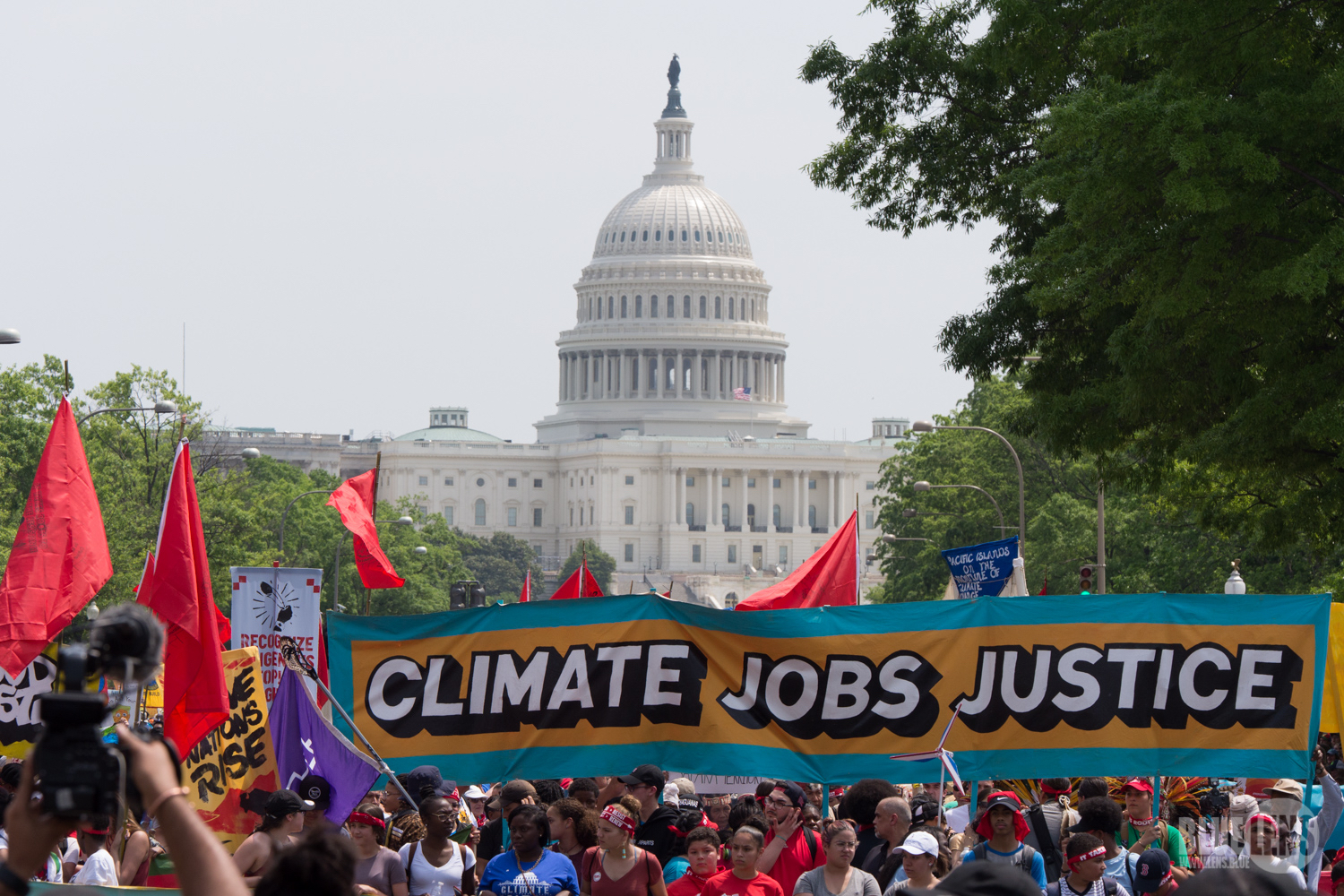
Rethinking lacks an exploration of the roots of these tensions. This is primarily because of the strictures on the length of such a synthetic book—and that there are not yet enough strong critical histories of the mainstream strands of environmentalism. The discussions of the close relationship between corporations and large national groups are a case in point. Spears draws on the work of journalist Mark Dowie, especially his groundbreaking 1995 book, Losing Ground: American Environmentalism at the Close of the Twentieth Century. Dowie was one of the first vocal critics of this relationship, but this book is now a quarter-century old, and there really hasn't been any work that goes beyond his primarily surface level, muckraking analysis.2Mark Dowie, Losing Ground: American Environmentalism at the Close of the Twentieth Century (Cambridge, Mass.: The MIT Press, 1996).
We need more work that takes the connections between corporations and major, national environmental groups at face value, and attempts to understand their roots and trajectories—and their lack of attention to people and geographies of color. One of Spears's primary concerns is the "multiple ways in which the color lines drawn in U.S. society have hampered environmental reform movements" (4). But as strong as it is in exploring the grassroots activism by people of color, Rethinking doesn't explore the color lines that existed in environmental organizations; why they were reluctant, for decades, to address the concerns of marginalized groups, or even make their professional staffs more diverse. This is not because Spears does not want to explore these problems. It's simply that the literature is not there. The white privilege of US environmentalism has only really been critiqued at the margins. We lack a full accounting of its development and impact, particularly on the continual escalation of environmental injustice and inequality.
What are the reasons for these deficiencies, at least within US environmental history? The most obvious arguments would be that the field, or at least the powerful and influential within the field, were for decades overwhelmingly white, male, and middle class, and had a vested interest in a set of narratives about American environmental reform. Perhaps more importantly, there was also a reluctance to attack or even critique these narratives. Not only did generations of scholars have so much invested in these heroes, but also because to many of us, environmentalism has maintained a certain moral certitude as a progressive politics.3The core "heroes" come from the wilderness and early conservation movements. See, for example, Roderick Nash, Wilderness and the American Mind (New Haven: Yale University, 1996 [1965]); Aldo Leopold A Sand County Almanac and Sketches Here and There (London: Oxford University Press, 1949). To tar it with racism, and corporate greed, especially in a post-Civil Rights, neoliberal America, could undermine the whole project.
Finally, scholars are beginning to get over that reluctance. New work by Jennifer Thomson, Paul Sabin and Keith Woodhouse, for example, digs into environmentalism to understand its flaws, contradictions and their ramifications.4Paul Sabin, "Environmental Law and the End of the New Deal Order," Law and History Review 33, no. 4 (November 2015): 965–1003; Jennifer Thomson, The Wild and the Toxic: American Environmentalism and the Politics of Health. (University of North Carolina Press, 2019); Keith Makoto Woodhouse, The Ecocentrists: A History of Radical Environmentalism. (New York: Columbia University Press, 2020). They move beyond a celebratory narrative to embed the environmental movement within the larger political and social developments of the past half-century. Outside the discipline of history, scholars such as David Pellow, Lisa Sun-Hee Park, and Dorceta Taylor have cast critical judgment on the movement, especially when understanding race in environmental politics.5Lisa Sun-Hee Park and David N. Pellow, The Slums of Aspen: Immigrants vs. the Environment in America's Eden, (New York: New York University Press, 2011); Dorceta E. Taylor, The Rise of the American Conservation Movement: Power, Privilege, and Environmental Protection (Durham, NC: Duke University Books, 2016). All of this work is important, but we need more.
Telling a more critical, less rosy story is important because a strong, inclusive and self-reflective, environmental movement is more important now than ever. Writing movement history is always political, especially when the social movements remain ongoing and their success more urgent. With Rethinking the American Environmental Movement post-1945, Ellen Spears has done admirable work in expanding our conception and understanding of the movement's varied streams.
About the Author
Robert Gioielli is an associate professor of History at the University of Cincinnati and the author of Environmental Activism and the Urban Crisis: Baltimore, St. Louis, Chicago (Philadelphia: Temple University Press, 2014). Find him on Twitter at @robgioielli.
]]>Video and Essay
Ossabaw Island is a barrier island on the Georgia coast. The island, which trends northeast–southwest, is about 14.5 kilometers (9 miles) long and 10.5 kilometers (6.6 miles) wide. It is located between latitudes 31° 49.5' and 31° 43.2' N. Of the Georgia barrier islands, Ossabaw is the most geologically unusual. Like the major Georgia islands south of it—Cumberland, Jekyll, St. Simons, Sapelo, and St. Catherines—Ossabaw is a composite island, in which sediments from Pleistocene and Holocene shorelines are directly adjacent or superimposed. However, sediments of the Pleistocene (Silver Bluff) and Holocene shorelines on Ossabaw split near its southern portion, with the Pleistocene trending north–south and the Holocene trending northeast–southwest. The modern shoreline, which formed only in the past few thousand years, wraps around the southern and northeastern corners of the island.
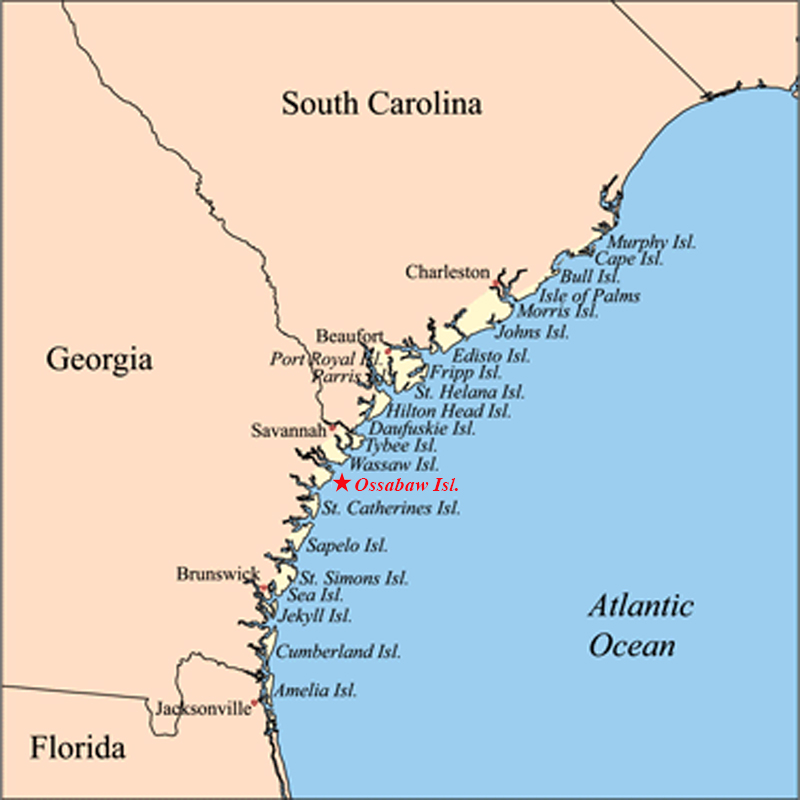
Ecosystems on Ossabaw include salt marshes, maritime forests, beaches, and a few freshwater ponds. Salt marshes are widespread west of Ossabaw, but also occupy much of the middle and eastern parts of the island between sediments of the Pleistocene and Holocene shorelines, dividing its maritime forests. The climate of Ossabaw is temperate to subtropical, with temperatures ranging from an average high of 32° C (90° F) in the summer to 10° C (50° F) in the winter. Average rainfall is about 50 centimeters (20 inches) per year, with most precipitation during the hurricane season (May–September). Hurricanes have rarely affected the Georgia barrier islands until recently, when Ossabaw was hit by Hurricane Matthew (2016), then later Hurricane Irma (2017). Hurricane Matthew, in particular, uprooted many of the older live oaks on the island and otherwise dramatically altered its landscape.
Although Ossabaw is often labeled as "pristine," humans have transformed its landscapes for at least 4,000 years. Its human history is similar to that of its island neighbor, St. Catherines, beginning with Native Americans (the Guale). The Guale had occupied Ossabaw since about 2000 BCE, but European colonization began when the Spanish arrived in the late sixteenth century. A lasting remnant of Spanish colonization on Ossabaw is the presence of feral hogs, some of which are linked to Spanish stock. This relatively large population of hogs has disrupted or otherwise altered ecosystems throughout the island.
The British took control of Ossabaw in the 1730s, by which time the Guale had mostly moved inland or suffered near extinction under the pressure of colonization. Early treaties reserved Ossabaw as hunting and fishing ground for the Creek people until 1758. The British also began enslaving African people for their plantation economy, and in the late eighteenth century American settlers continued using enslaved people as laborers for growing cotton and indigo. Most inland ecosystems of Ossabaw, especially the maritime forests and salt marshes, were altered considerably by this agriculture. Following the American Civil War, a significant population of African Americans stayed on the island, but most moved to the mainland after the Sea Island Hurricane of 1893. Many of their descendants today comprise the Gullah-Geechee community in Pin Point, Georgia.
Through the early to late twentieth century, Ossabaw's ownership changed several times, but the island remained largely undeveloped and sparsely inhabited. The last private owners were members of the Torrey family, starting with Dr. Henry Norton Torrey and Nell Ford Torrey, and ending with their daughter, Eleanor Torrey ("Sandy") West. The Torreys oversaw the building of a large home for themselves, as well as hunting lodges, a beach house, and unpaved roads. In 1961, after Sandy West inherited the island, she and her husband Clifford West began the Ossabaw Island Project. This project brought luminaries of the arts and sciences to the island as a retreat center for study and discussion; notable participants included composer Aaron Copeland, writers Ralph Ellison, Margaret Atwood, and Annie Dillard, as well as ecologist Eugene Odum. This creative initiative also resulted in the Genesis Project, which focused more on the natural sciences and hosted scientists for on-site studies of and education about the archaeology, ecology, and geology of the island.
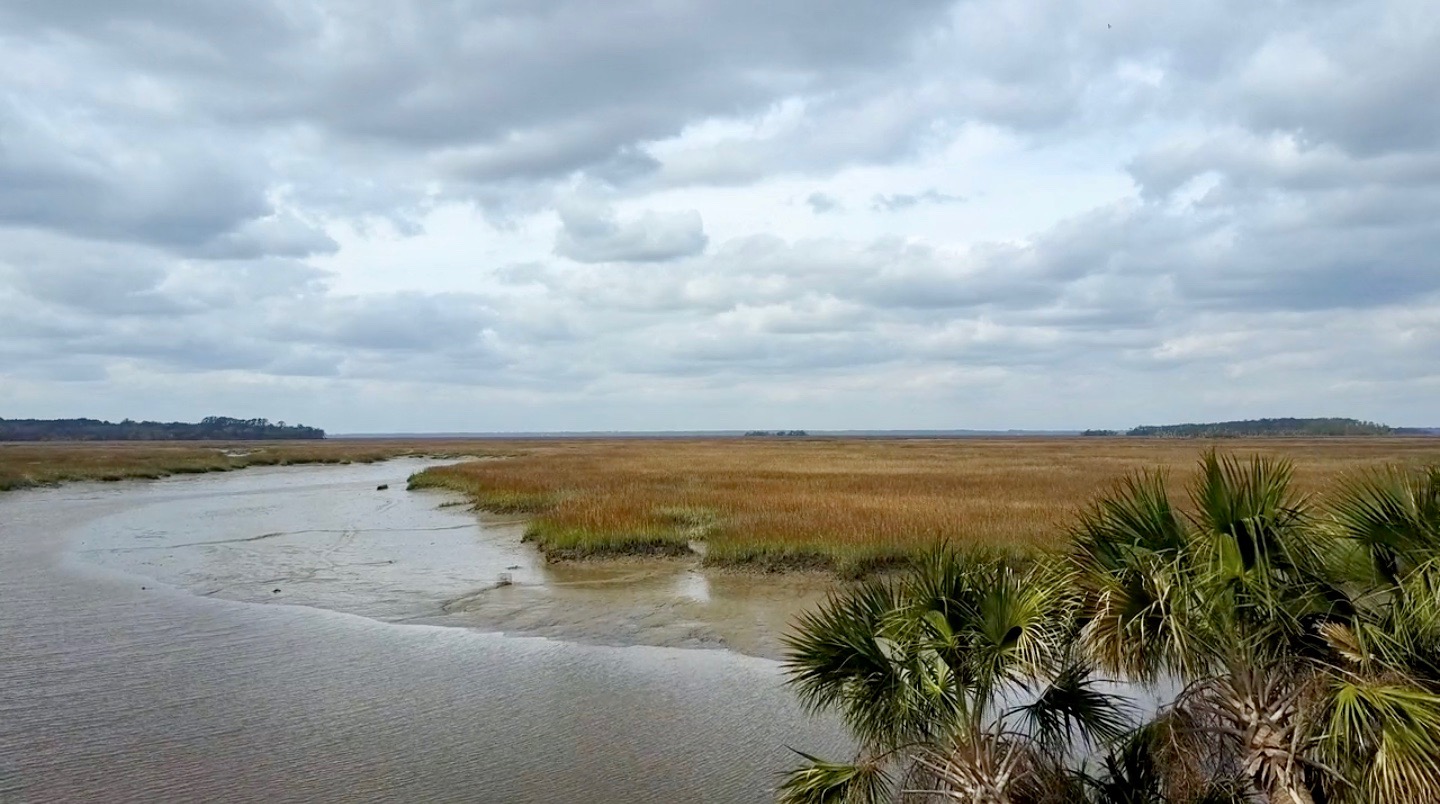
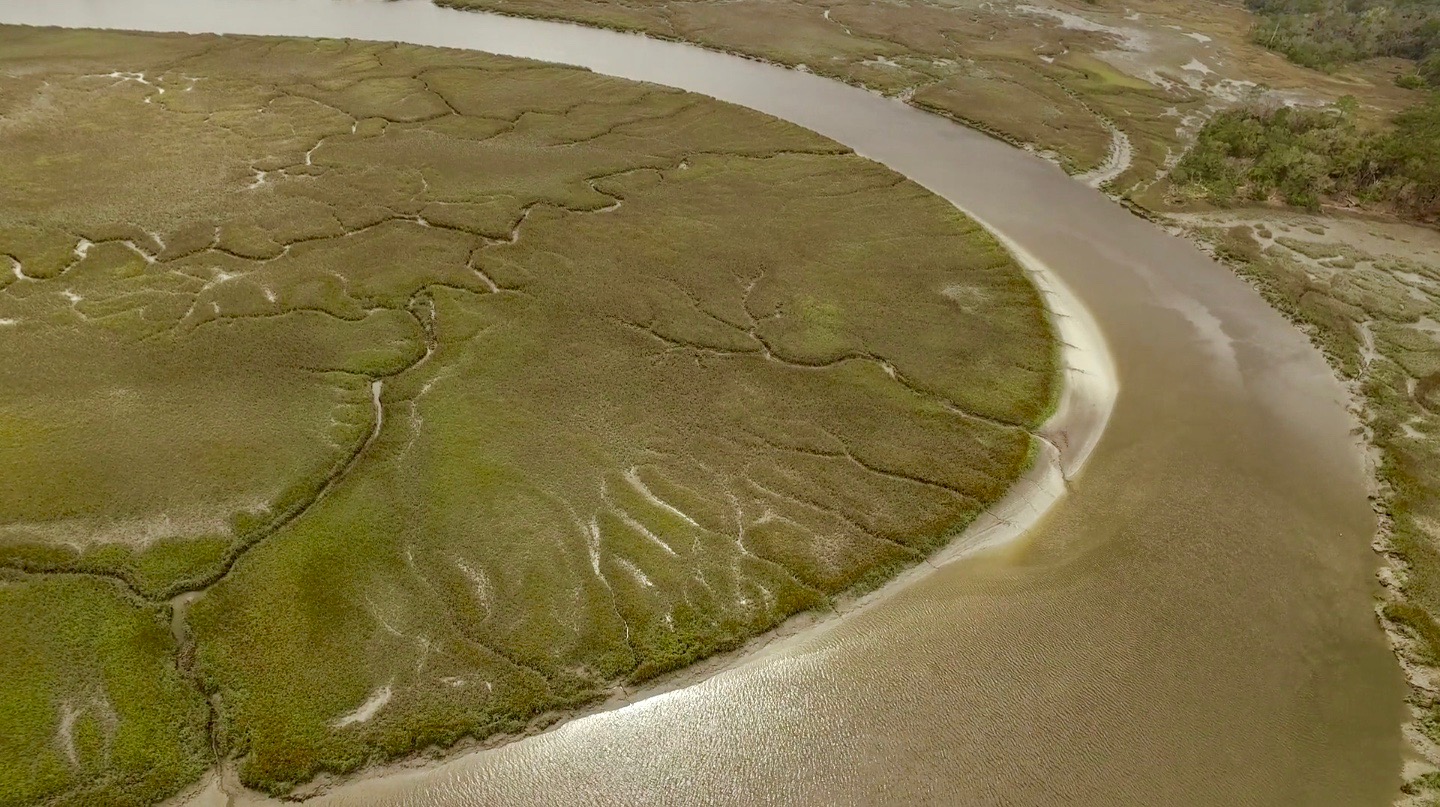
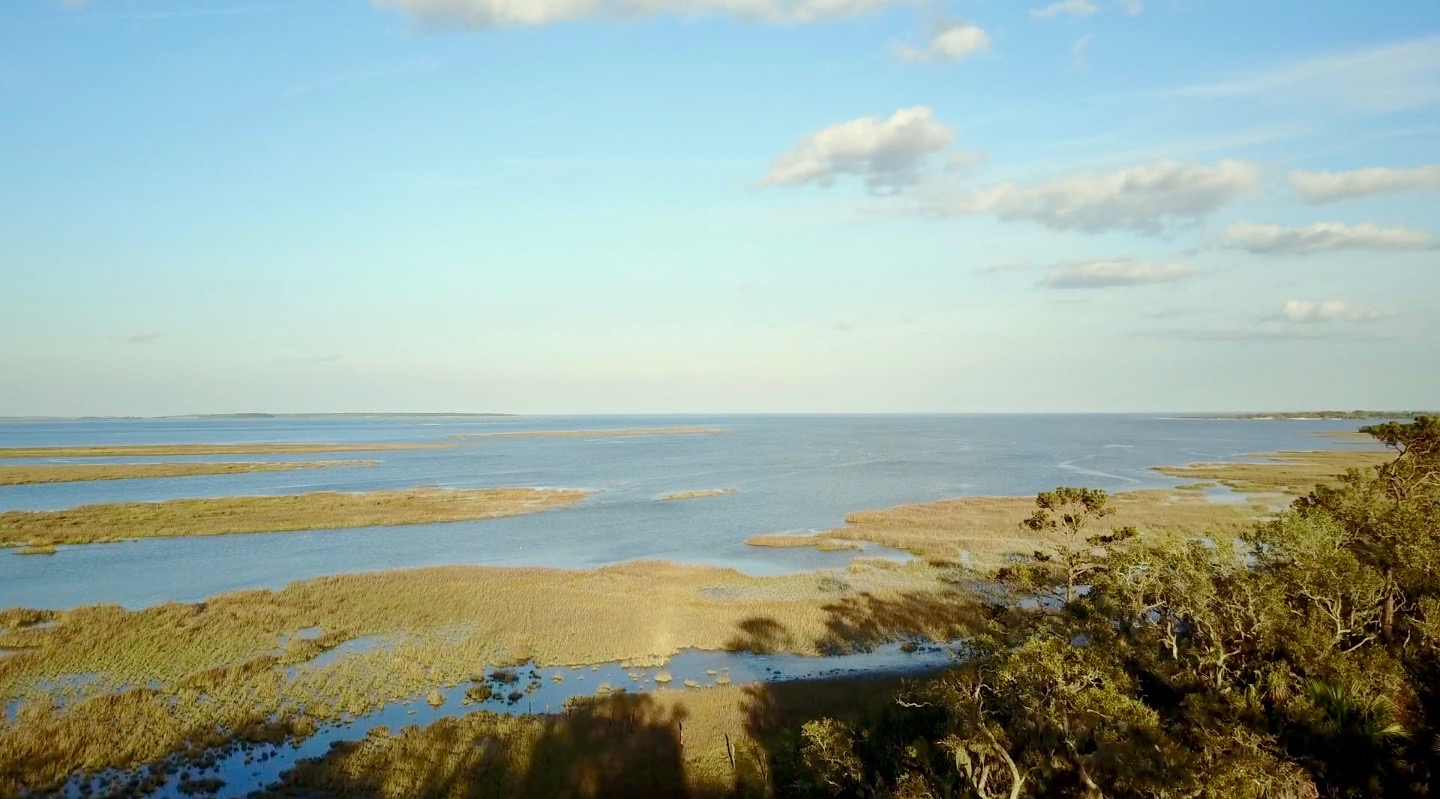
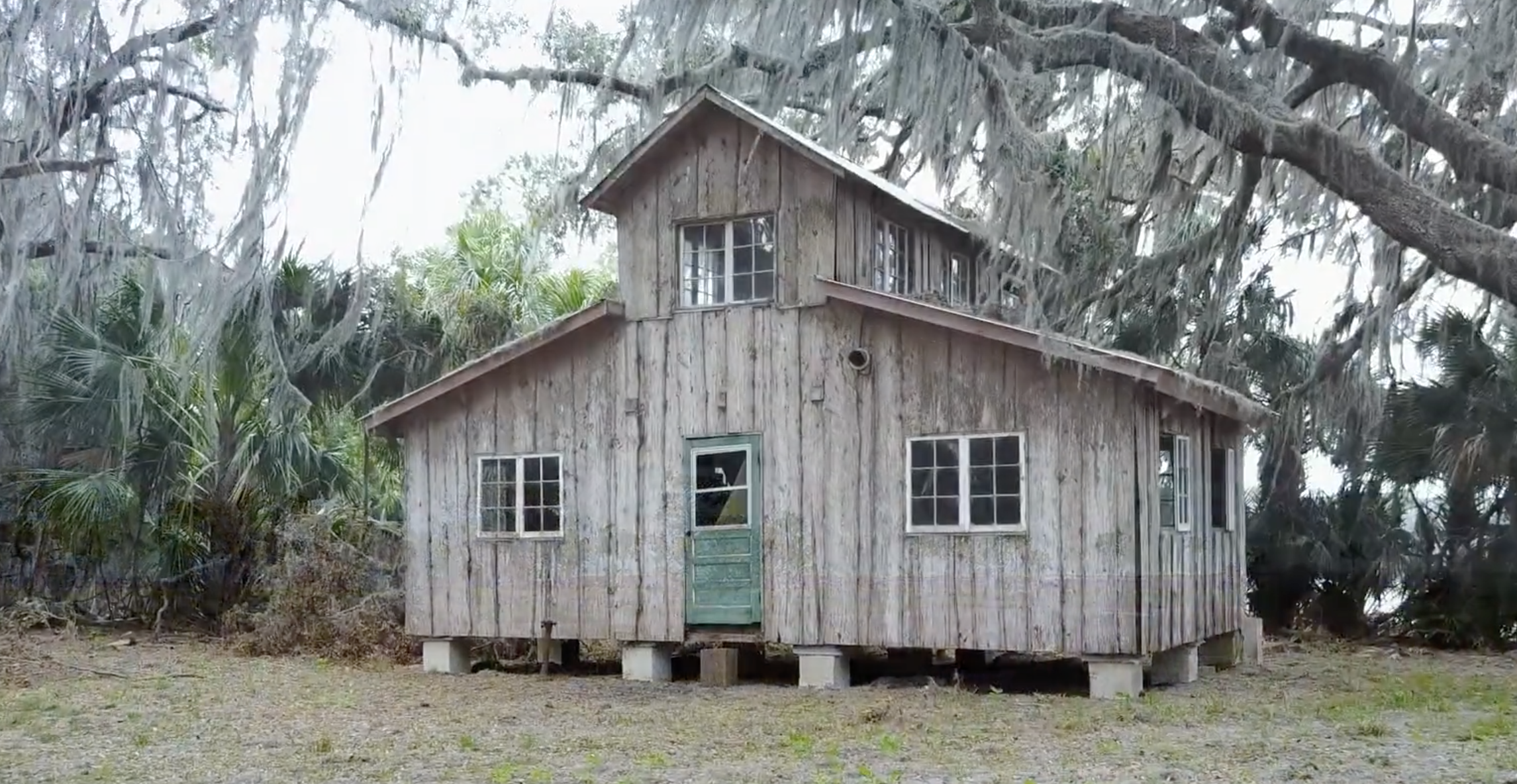
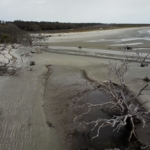
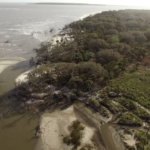
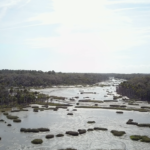
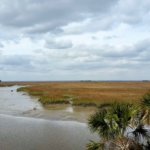
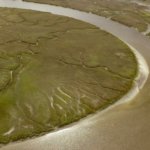
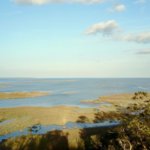



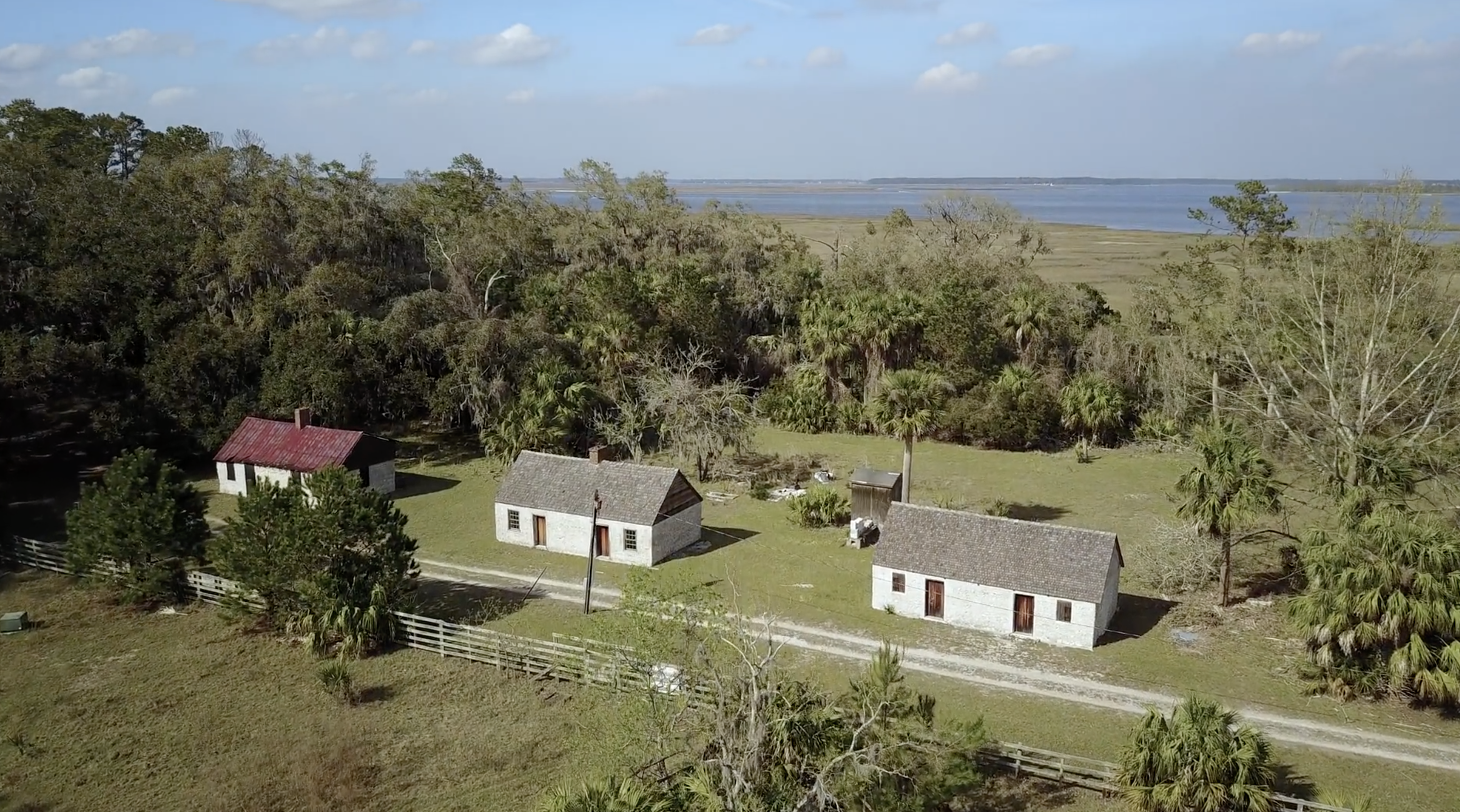
In 1978, Sandy West sold Ossabaw to the state of Georgia to establish it as the state's first heritage preserve, and it has been managed since by the Georgia Department of Natural Resources (DNR). The Ossabaw Island Foundation was established afterwards as a non-profit organization working with DNR to encourage educational, cultural, and scientific programs on the island. Sandy West continued living on the island until just recently; at the time of this writing (January 2020), she was living in nearby Savannah, Georgia, and had just celebrated her 107th birthday.
This Ossabaw flyover video provides a visual sample of the many interconnections between natural and human histories on Ossabaw. Featuring sweeping aerial views and audio annotations explaining the island's varied environmental features, this video is organized around four sequential but overlapping themes: fauna, flora, landscapes, and human structures.
Acknowledgment
Thanks to the Ossabaw Island Foundation for their support on this piece.
About the Authors
Anthony "Tony" Martin is a professor of practice in the Department of Environmental Sciences at Emory University. His publications include Life Traces of the Georgia Coast (Bloomington: Indiana University Press, 2013).
Steve Bransford is the senior video producer at the Emory Center for Digital Scholarship. His documentary feature film The Well-Placed Weed is available on the PBS website and app.
Michael Page is lecturer in Geospatial Sciences and Technology at Emory University.
Leotie Hakkila is an MPH student at the Rollins School of Public Health, Emory University.
Anandi S. Knuppel is a visiting assistant professor in the Department of Religious Studies at Lawrence University.
]]>Essay
In a 2017 essay, National Museum of African American History and Culture director Lonnie Bunch noted that, like much of black history, environmental activism by people of color is often "forgotten" or "hidden in plain sight." Bunch, now director of the Smithsonian Institution, labeled this movement work unacknowledged environmentalism. Environmental reform campaigns led by people of color and other marginalized groups include not only land struggles by formerly enslaved people and by Native Americans, but also agricultural movements and the class-based mobilizations of populist agrarians. Chicano farmworker fights against poisonous pesticides are environmental battles, as are African American civil rights campaigns for equal access to recreational areas and to safe spaces in cities.1Lonnie G. Bunch III, "Black and Green: The Forgotten Commitment to Sustainability," in Living in the Anthropocene: The Earth in the Age of Humans, eds. W. John Kress and Jeffrey K. Stine (Washington, DC: Smithsonian Books, in association with Smithsonian Institution Scholarly Press, 2017), 83–86, 86.
Recovering this history acknowledges that people of color and the poor have shared the passion for wilderness and the natural world that motivates preservationists. In the early twentieth century, for example, African American women and men hiked Niagara Falls and cycled in Yellowstone. George Washington Carver, as we know from historian Mark Hersey's 2011 study, explicitly cast his research and practice of agroecology in terms of conservation.2Mark D. Hersey, My Work Is That of Conservation: An Environmental Biography of George Washington Carver (Athens: University of Georgia Press, 2011).
However, the benefits of environmental citizenship are not and have not been distributed equally. People of color have fought to participate in the enjoyment of nature and the benefits to health those activities offered. "[T]he color line in any guise was inherently environmental," explains historian Mark Fiege. The spatial configuration of cities and towns, reservation boundaries, Jim Crow segregation on either side of the Mason-Dixon line, the contemporary policing of racialized spaces—all can be understood not only as battle lines in freedom struggles but also as unacknowledged elements of urban ecology, a denial of mobility, a constraint on access to space. "The criminalization of urban space," as scholar Yohuru Williams explains, increasingly has been recognized as a question of environmental justice.3Mark Fiege, The Republic of Nature: An Environmental History of the United States (Seattle: University of Washington Press, 2012), 320; Robert S. Emmett, Cultivating Environmental Justice: A Literary History of U.S. Garden Writing (Amherst: University of Massachusetts Press, 2016), 5; Yohuru R. Williams, Rethinking the Black Freedom Movement (New York: Routledge, Taylor & Francis Group, 2016), 115.
The environmental justice paradigm that emerged in the 1980s expands our understanding of what issues and concerns count as environmentalism. Native American groups lobby to redress exploitation of uranium miners. Organizations such as the Black Panthers and the Student Nonviolent Coordinating Committee (SNCC) identified environmental concerns not on the agenda of mainstream groups such as the need for rat eradication and demand for "community control" in urban areas. In their call for self-determination, black nationalists took up the slogan, "Free the Land."4Alondra Nelson, "The Longue Durée of Black Lives Matter," American Journal of Public Health 106, no. 10 (2016): 1734–1737, https://ajph.aphapublications.org/doi/10.2105/AJPH.2016.303422; Russell Rickford, "'We Can't Grow Food on All This Concrete': The Land Question, Agrarianism, and Black Nationalist Thought in the Late 1960s and 1970s," Journal of American History 103, no. 4 (March 2017): 956–980, 957.
Social justice environmentalists have sought not just the inclusion of people of color in the history and practice of conservationism, but a fundamental reorientation of the American environmental movement's concerns and aims. Calling for equal treatment of communities of color and for full participation by marginalized social groups in environmental decision-making, environmental justice proponents emphasize questions of power and rights. Scholars have often described campaigns so rooted in broader social justice movements that they were not recognized as environmentalism. Excluded groups link their appreciation of nature and desire for healthy surroundings to a broader vision of social justice inseparable from full social and political rights.
Stimulated in part by this reorientation, new histories of environmentalism and, to a certain extent, the movement itself have begun confronting the more complex and difficult elements of the conservation movement's past. From its beginnings, conservationism echoed the nation's conflicts over race and inequality. Several prominent early conservationists were also eugenicists. White supremacy and nativism—hostility toward immigrants—were integral to the way many early conservationists understood their work. These ideas infused (and continue to infuse) debates about overpopulation, immigration, and resource policy.5Robert Gottlieb, Forcing the Spring: The Transformation of the American Environmental Movement, rev. ed. (Washington, DC: Island Press, 2005), 24; Jennifer Clapp and Peter Dauvergne, Paths to a Green World: The Political Economy of the Global Environment, 2nd ed. (Cambridge, MA: MIT Press, 2011), 246; Ben Zuckerman, "Nothing Racist About It," Globe and Mail, January 28, 2004, theglobeandmail.com/opinion/nothing-racist-about-it/article741382/.
The early campaigns for wilderness preservation are now understood not only as preserving public lands and limiting habitat destruction but also as a race-making project, defining who could enjoy the full rights of citizenship. As historian Carolyn Finney and others have argued, the designation of national parks and wilderness areas often created "white spaces" by displacing native populations and excluding racial minorities.6Carolyn Finney, Black Faces, White Spaces: Reimagining the Relationship of African Americans to the Great Outdoors (Chapel Hill: The University of North Carolina Press, 2014); Miles A. Powell, Vanishing America: Species Extinction, Racial Peril, and the Origins of Conservation (Cambridge, MA: Harvard University Press, 2016); Alexandra Minna Stern, Eugenic Nation: Faults and Frontiers of Better Breeding in Modern America, 2nd ed. (Oakland: University of California Press, 2016). Nevertheless, a strong, identifiable thread of social justice thought and action runs through US movements for environmental reform. Individuals involved in environmental causes have often participated in actions to oppose racial injustice, eliminate poverty, and achieve gender equality. Such alliances have been essential to the success of the environmental movement.

Struggles over segregated space that highlighted injustices offer some of the clearest examples of unacknowledged environmentalism. When the Montgomery Improvement Association (MIA) campaigned to desegregate the bus system and open jobs to black citizens in Alabama's capital city, five of the organization's eight primary demands presaged environmental justice themes. Laid out in a flyer entitled "Negroes' Most Urgent Needs," the MIA's concerns included "Negro Representation on the Parks and Recreation Board," "Sub-division for housing," "Congested areas, with inadequate or no fireplugs," "Lack of sewage disposals makes it necessary to resort to out-door privies, which is a health hazard," and, "Narrow streets, lack of curbing, unpaved streets in some sections."7"Negroes' Most Urgent Needs," Inez Jessie Baskin Papers, Alabama Department of Archives and History, Montgomery, Alabama, as displayed at the Birmingham Civil Rights Institute, http://digital.archives.alabama.gov/cdm/ref/collection/voices/id/2019. All are urban matters that would today be regarded as environmental concerns.
African American activists were often first to join forces with other people of color facing environmental threats. For example, in 1966, comedian and civil rights activist Dick Gregory was jailed in Washington state for participating in a "fish-in" held by the Nisqually Indians and other tribes to protest restrictions on native fishing rights. Inspired by civil rights sit-ins and organized by the Survival of the American Indian Society, these protests at Frank's Landing in Puget Sound sought to prevent overfishing by commercial fisheries and to restore native treaty rights to fish in the region's bays and streams. At issue were the tribes' ecological heritage and livelihoods, as well as treaty rights and tribal sovereignty. Dr. King telegraphed his support. The Southern Christian Leadership Conference (SCLC) endorsed the effort; the NAACP Legal Defense Fund and the ACLU provided legal assistance.8Telegram from Martin Luther King, Jr. to Dick Gregory, Martin Luther King, Jr. Papers, Civil and Human Rights Museum, Atlanta, Georgia, on view March 14, 2015; "Gregory and Wife Guilty in Indian Fishing Protests," New York Times, December 2, 1966, 69; Charles F. Wilkinson, Messages from Frank's Landing: A Story of Salmon, Treaties, and the Indian Way (Seattle: University of Washington Press, 2000), 55–56; U.S. v. Washington, 384 F. Supp. 312 (W.D. Wash. 1974), aff'd 520 F. 2d 676 (9th Cir. 1975). One of the most important cases in American Indian law, the decision upheld the tribes' rights to an equitable portion of the catch and co-management of the fish stocks in the Puget Sound watershed and nearby offshore waters. The Court's holding was reaffirmed in 2018. See Zultán Grossman, Unlikely Alliances: Native Nations and White Communities Join to Defend Rural Lands (Seattle: University of Washington Press, 2017), 37–63; and John Eligon, "'This Ruling Gives Us Hope': Supreme Court Sides with Tribe in Salmon Case," New York Times, June 11, 2018, https://www.nytimes.com/2018/06/11/us/washington-salmon-culverts-supreme-court.html.
An upsurge in environmental concern in the 1960s drew inspiration and tactics from civil rights organizing. Organizations such as the Environmental Defense Fund and the Natural Resources Defense Council (NRDC) modeled their work on the NAACP Legal Defense and Education Fund. And, a newly elected cadre of African American elected officials built alliances that helped bring attention to the ecological crisis and advance environmental reform.
Following a path pursued successfully by civil rights advocates, environmentalists turned increasingly to the federal government as guarantor of rights. Working with allies in Congress, environmentalists erected a new framework of environmental law in less than a generation, much of it during the Nixon administration. A series of telegenic disasters proved instrumental in eliciting change.
In January 1969, just days after President Richard M. Nixon took office, a blowout at a Union Oil rig spewed oil into California's Santa Barbara estuary. Six months later, in Cleveland, Ohio, the Cuyahoga River, which flowed past the city before dumping its contents into Lake Erie, caught fire. Oil slicks and industrial wastes from innumerable factories and refineries upstream had left the water so polluted that fires had become a frequent occurrence. This particular fire brought the city's mayor to the scene and with him the national press. Cleveland's mayor in 1969 was Carl Stokes, the first African American elected to head a large US city. Not just Cleveland, but the nation faced "a crisis in the urban environment," said Stokes, "a crisis of immense proportions." With the burning river as his backdrop, Stokes linked racial progress and anti-pollution measures.9David Stradling and Richard Stradling, Where the River Burned: Carl Stokes and the Struggle to Save Cleveland (Ithaca, NY: Cornell University Press, 2015), 146, 79, 194.
Public outcry over the Santa Barbara oil spill and the Cuyahoga fire pressured Congress to act, passing the National Environmental Policy Act, which President Nixon signed on January 1, 1970. NEPA did not create the EPA, as some assume; that was accomplished by an executive order approved by Congress later that year. The law did establish the Council on Environmental Quality (CEQ) to advise the President. NEPA also gave citizens valuable tools for addressing environmental problems, mandating public participation in the permitting process. Any proposal for a large development would require an environmental impact statement (EIS) on the likely ecological impact as well as alternative proposals—say, fewer units, fewer trees destroyed, or substitute drainage plans. Developers and the permitting agencies were not required to choose the alternative with the least impact, but the new procedures gave environmental advocates a forum for raising objections and additional time for mobilizing opposition to particularly devastating projects. Considered one of the nation's most effective environmental laws, NEPA has been "emulated in various degrees by almost half the states and by an estimated 80 or more countries abroad."10John McCormick, Reclaiming Paradise: The Global Environmental Movement (Bloomington: Indiana University Press, 1989), 58; Gottlieb, Forcing the Spring, 180; Lynton Caldwell, "Implementing NEPA: A Non-Technical Political Task," in Environmental Policy and NEPA: Past, Present, and Future, eds. Ray Clark and Larry W. Canter (Boca Raton, FL: St. Lucie Press, 1997), 25–50, 37.
Postscript
NEPA's longstanding requirements for public participation in environmental policymaking are being directly targeted by the Trump administration. In January 2020, the Trump EPA proposed new rules that would set tight time limits on environmental assessments, limit the types of projects required to complete a full EIS, and effectively exclude consideration of a proposed project's indirect and cumulative effects on climate. Vulnerable communities could be disproportionately harmed by these regulatory changes. Reversing such policies will require even more robust coalitions than those that resulted in the passage of environmental laws in the first place.
About the Author
Ellen Griffith Spears is an associate professor in the interdisciplinary New College and the Department of American Studies at the University of Alabama. She is author of the award-winning Baptized in PCBs: Race, Pollution, and Justice in an All-American Town (Chapel Hill: The University of North Carolina Press, 2014).
]]>