The first trailer park I ever spent much time in was the Simonton Street Trailer Park, located off upper Simonton Street not far from the Southernmost Point. It was the 1990s, and drunk tourists would stagger past the humble hand-painted sign at the entrance, unaware that within the grove of Australian pines lived the working poor of South Florida. Few residents owned cars, so bicycles were locked to fences and posts, a common sight on the island. The forty-four single-wide trailers seemed to be indiscriminately scattered as if someone had tossed them into the air to see where they’d land.
Here was the last vestige of the Key West that Jimmy Buffet immortalized. Here were today’s pirates and renegades, misfits and malcontents looking for a shaker of salt—and a place to crash. But the island troubadours were now singing a sad song: rents in Key West were higher than those in New York. Keeping a roof over your head was no small matter.
I had a friend who lived in the trailer court, and I was worried about his domestic bliss. “Roommates” seemed to proliferate in number and their names changed in dizzying flux. He’d let one person crash on his sofa, and then that person would bring over three or four other people. In addition to free rent, he’d “lend” them money—money he didn’t have, money they made him fork over, or else.
My friend was a dishwasher at a local restaurant. He couldn’t read or write. He was a victim of unspeakable childhood trauma. He allowed people to stay in his trailer because he wanted to think he was helping others who needed assistance. He himself had no bank account, no savings, and was barely hanging on.

I’d stop by when I could, and usually there’d be a crowd in the trailer of people I’d never seen before. People who had nowhere else to go. The trailer court was the last resort, a de facto shelter but it was just as doomed as the people who lived there.
Don’t look for the Simonton Street Trailer Park these days. It closed in 2019, taken over by a developer who somehow evaded the city ordinance that would’ve required him to build affordable housing units. “Gentrify” doesn’t begin to describe what’s happened in certain communities of South Florida. The average home price in Key West sits at $1 million.1“Key West, FL Housing Market,” https://www.zillow.com/home-values/52767/key-west-fl/, accessed August 24, 2025.
Not many dishwashers–aka “pearl divers”–can swing a mortgage as hefty as that. Instead, they squat within mangrove islands, live aboard derelict vessels, or sleep in parked cars. Many work several jobs, but none of them add up to enough. At one point, a tent city sprang up along the Bridal Path of Smathers Beach. Affordable housing isn’t some kind of policy abstraction in South Florida: it’s a problem that pits dream against reality.
Or as Jeep, a local banjo player, told the Key West City Council when they were deciding the fate of the trailer court: “Somehow, maybe, you guys can figure out how to keep people like me and others in this community.”2Arnaud and Naja Girad, “The Gentrification of Simonton Street Trailer Park,”Key West The Newspaper,” November 4, 2019. https://thebluepaper.com/gentrification-simonton-street-trailer-park/,accessed August 24, 2025.
The erasure of the Simonton Street Trailer Park contains a pointed message about place and identity that forms the intellectual core of Sunset Colonies: A Visual Elegy to South Florida’s Mobile Home Communities. The book centers on the photography of Diego Alejandro Waisman, an Argentine by birth but a resident of Miami for over two decades, where he has established himself as a visual artist dedicated to the discontinuities and disfigurements caused by the sybaritic excess of South Florida. Waisman writes of using the “vernacular” of place to inform his work, and in the vanishing trailer parks of Miami, he has found a trove of distinctive tones.
The data is clear: the mobile home as a mode of domicile has decreased in Florida over the past decade, falling from 9.2 to 8.2% of all housing in the state. Yet unlike Tampa or St. Petersburg, the trailer park was never a defining feature of Miami, with just 1.3% of housing units being mobile homes–a figure that has remained stable over the years.3“Mobile Homes (Census ACS), FLHealthCHARTS, https://www.flhealthcharts.gov/ChartsDashboards/rdPage.aspx?rdReport=NonVitalIndRateOnly.Dataviewer&cid=0408, accessed August 24, 2025.
Waisman’s work directly takes on a persistent stigma that has plagued mobile homes from the beginning: the concept of “trailer trash,” a term that dates back to the 1950s as a way to condign residents of trailers to the ashbin of humanity. It’s certainly easy to bulldoze down a trailer park if conventional wisdom has it that the place was filled with lowlife scum.4 Harold H. Martin, “Don't Call Them Trailer Trash,” The Saturday Evening Post, August 2, 1952, Vol. 225, No. 5.
But Waisman is looking for “evidence” that even within these marginalized places, meaning and purpose can take on a multitude of forms and shapes. The photographs themselves come from his collection, For I Shall Have Already Forgotten You, a line taken from “If You Forget Me” by Pablo Neruda, a poem that appears in reprint like a miracle after the last photograph and thus lands like a thunderclap of grim profundity. Seldom has a title, poem, and art flowed together with such urbane felicity.
While Neruda in the poem might’ve been referring to a lover or to his native Chile, it’s clear that Waisman is fueled by the poem’s pervasive feeling of loss and longing. It begins: “I want you to know one thing.” Waisman takes up that same charge and then uses his camera to capture “everything that exists” within the vanishing world of Miami’s trailer parks.

The unique geometry of Waisman’s work flows from his use of juxtaposition, the constant tension between old and new that in Miami sees skyscrapers arising next to thousand-year-old Tequesta sites. Waisman’s eye for such incongruity takes many forms in his collection. One arresting image features in the foreground a well-tended double-wide of white planks and blue trim while in the background a monstrous banality of rebar rises as if to devour the trailer in one rapacious gulp. Given the demise of the Simonton Street Trailer Park, it’s reasonable to conclude that in time too this landscape will get subsumed by the "predatory capitalism” described as the casus belli of gentrification by anthropologist Louis Herns Marcelin in his fine Afterword.
Other works also play with the tension between old and new. Sometimes the reference juts into the composition like an interloper (below), such as how he centers a “Now Leasing” sign jabbing like a dagger into the belly of a home—this work reads like an act of violence, a needless and wanton gesture of dominance.
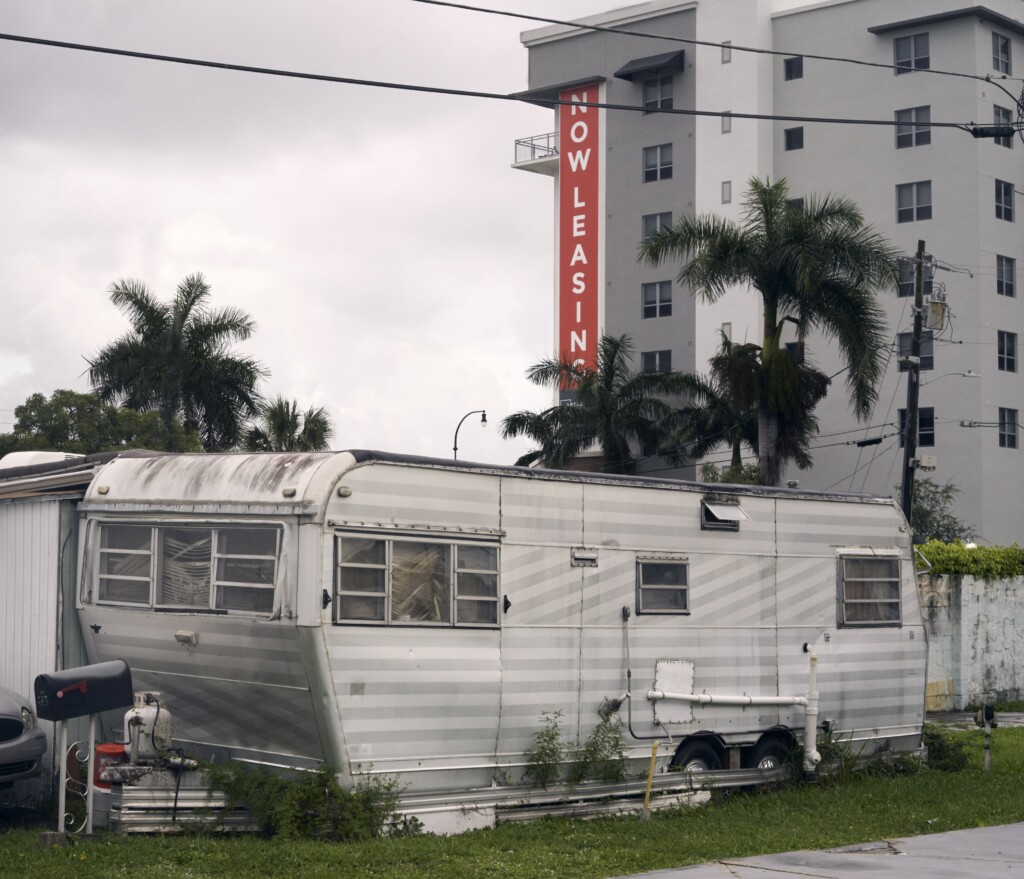
In another, the new building remains to the far right edge, rising up into the sky with a defiance that borders on mockery. The helpless trailers can do nothing but accept this fate, a finality rooted in a dream of Florida that is in open conflict with the grinding truth.
Then, in works that are somber and soulful, Waisman follows the fervid logic of Growth to its deflating conclusion: a scattering of pieces just depict the new environment with the trailer parks completely gone. Another condo project is taking shape, and on the fence surrounding it hangs a festoon of fiction, happy older couples frolicking care-free. The condo being built has no personality, no sense of self, and stands in stark contradiction to the very idiosyncratic decorations of trailers, no two of which are the same.
Waisman explores lines with great precision, finding unique ways to capture how segments can align to produce meaning. For example, in one photograph, the horizontal lines of jalousie windows stand perpendicular to the vertical lines of a metal post and door frame. Both then seem to merge with criss-cross lattice, as a clearly delineated triangle of shade falls across the trailer. The “evidence” here is of the evanescent sort: as South Florida booms, the most vulnerable places must stand in quiet opposition, affirming their own nuance in subtle ways that Waisman’s camera can singularly capture. He has spoken of his photographs as a way of slowing down the gathering decimation of these communities. His work forces us to stop, look, and ponder where exactly the American experiment is headed.
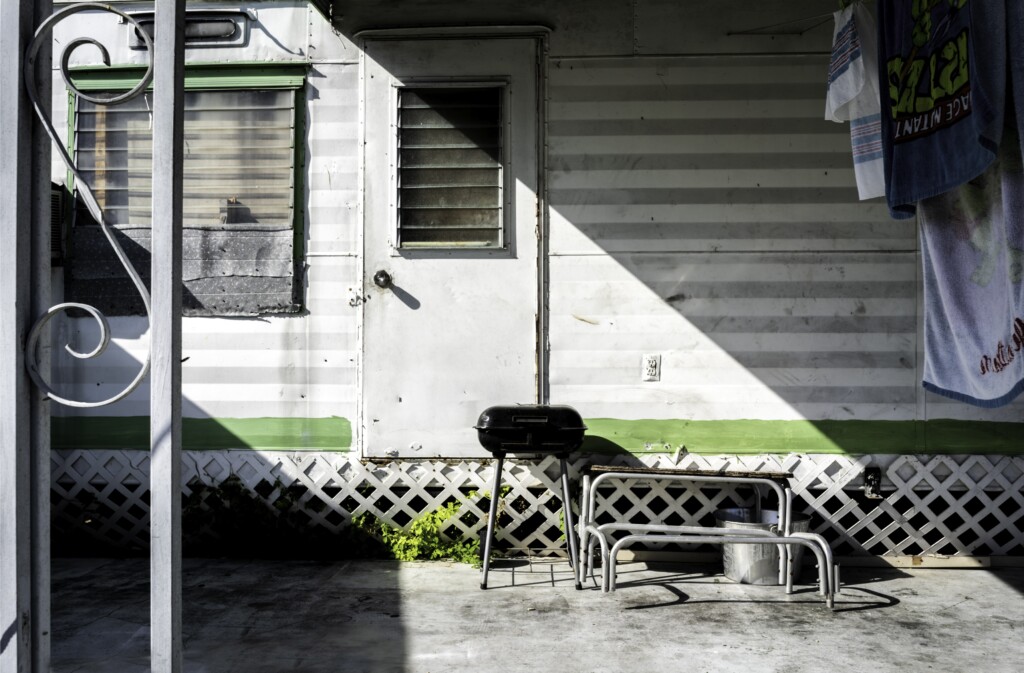
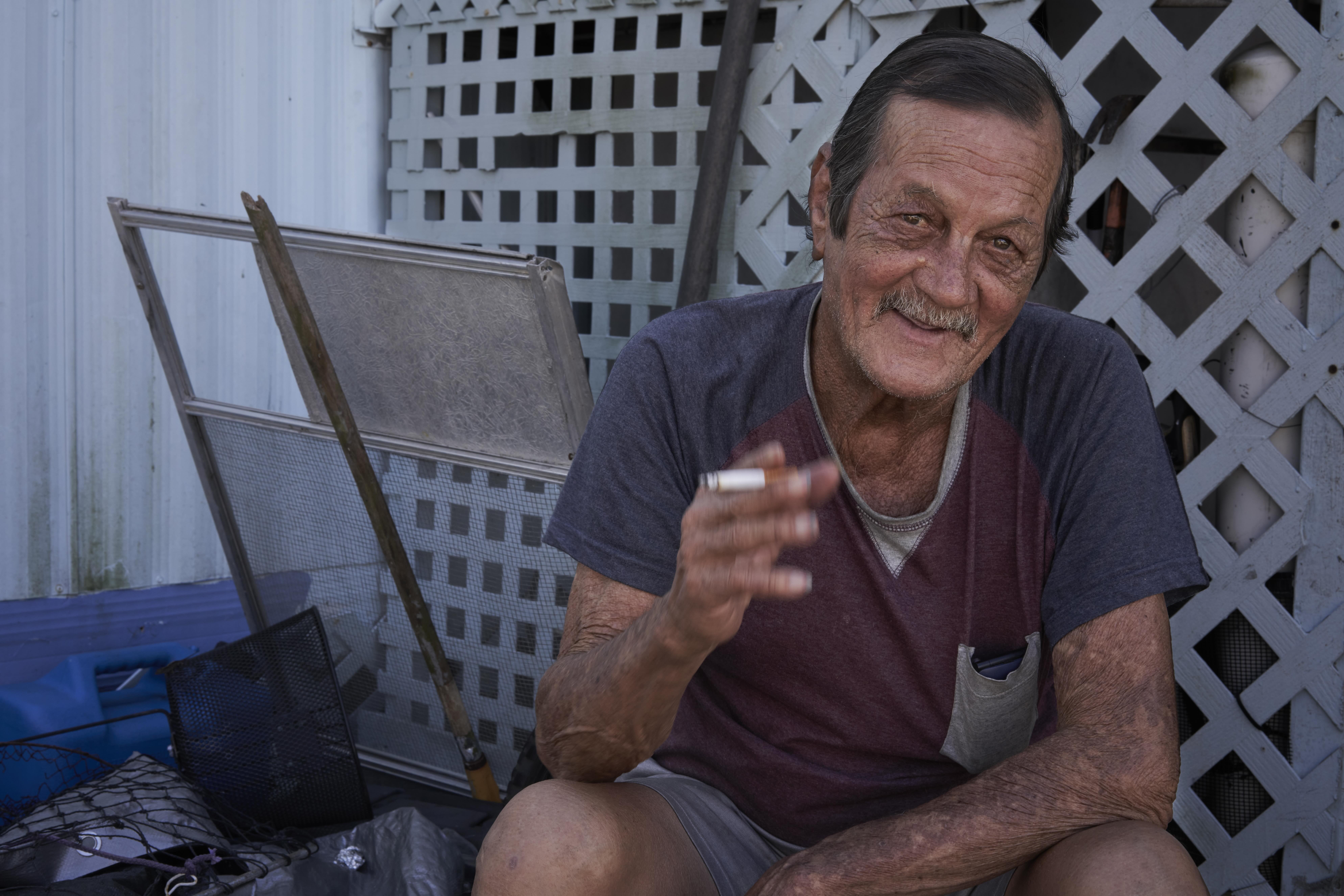
Beyond the geometry is a pulsing humanity that suggests the work of Andres Serrano, whose Residents of New York series from the 1990s conveyed the enduring spirit of Gotham’s unhoused. Waisman’s trailer park dwellers are certainly housed, but in effect his portraits are a kind of memento mori, a moment in time that will not last.
The man holding the cigarette, how long can he make it before the wrecking ball comes for the entire park? And when it’s gone, where will he go? The lattice here serves more like a net that the subject is caught in–that has ensnared all of us. His expression, though, speaks to a consanguinity, a softness that belies the other ravages the man has endured. Here Waisman is playing with juxtaposition again, but this time the viewer must enter this conversation, must hear the man out. There’s no turning away.
And the trailers . . . Waisman has assembled a wide array of examples, using an expansive color palette to capture the distinctive hues of the region. Lime greens, cerulean blues, and cherry reds all speak to the allure of South Beach, yet without the glitterati and glam. Some of the trailers have been lovingly landscaped, while others sit on bare concrete. Some are in pristine condition, and others display repairs that have accreted over time, in clunky layers of rust. Many have their hurricane shutters drawn shut, as if the corrugated metal can’t bear to witness the impending doom.
In addition to the trailers and the people in them, Waisman has added a wrinkle: photographs of ads that ran in newspapers during the 1960s and 70s, all of which extol the virtues of these communities. This is yet another kind of juxtaposition, this one ironically cultural. Waisman rightly views the backstory of trailer parks with a raised eyebrow. Why did so many people work so hard to attract retirees to Florida only to castigate and then obliterate these very communities when they are needed the most? Waisman’s splashes of history are bracing, cold water applied to smug faces. He is suggesting that there used to be a world where lower-income people could live in affordable housing–and a world where Florida led the way in pioneering an alternative to gaudy McMansions. It wasn’t even that long ago, and yet Waisman demands us to answer: what happened?
Waisman isn’t on the prowl for good guys and bad guys. He’s not offering an answer, because artists don’t answer questions, but ask them. And the question is often some variation of Thales: why is there something rather than nothing? What huge forces are shaping the landscape? The key to this collection resides in the title: it’s an “elegy,” visual lament to the dead, the dearly departed cut down by a market-driven mania to maximize profits at the expense of the unfortunate. But Waisman lifts these dead upwards so that we can celebrate the dignity these hardscrabble people display.
Three other essays complete Sunset Colonies. Amy Galpin’s helpful Introduction establishes an academic perspective for assessing Waisman’s collection. Her essay serves as a kind of map that adds context to the photographs that follow. Without Galpin, Waisman’s pieces might come off as a random assortment that could be befuddling.

But what Waisman is doing, very cleverly, is exploring the dynamics of “trailer trash” that has tarnished this community from the beginning. He is exploding this framework by offering a deeply human look at the “trash” whose lives are imperiled by the rampant development that caters to the well-off. The portraits of the residents and their homes speak to the enduring struggle to maintain even as the world seems to be crumbling around them. One image haunts, that of broken sidewalk tile, an apt metaphor for what Waisman has catalogued: the bombardment of a community that will end in permanent exile. 
About the Author
Lee Irby's peer-reviewed publications include works of history, fiction, and poetry. His study of "trailer-trash" culture has received numerous awards, and his novel 7,000 Clams (Doubleday, 2005) was named by the Tampa Bay Times as one of the "10 Books Every Floridian Should Read."
]]>Review
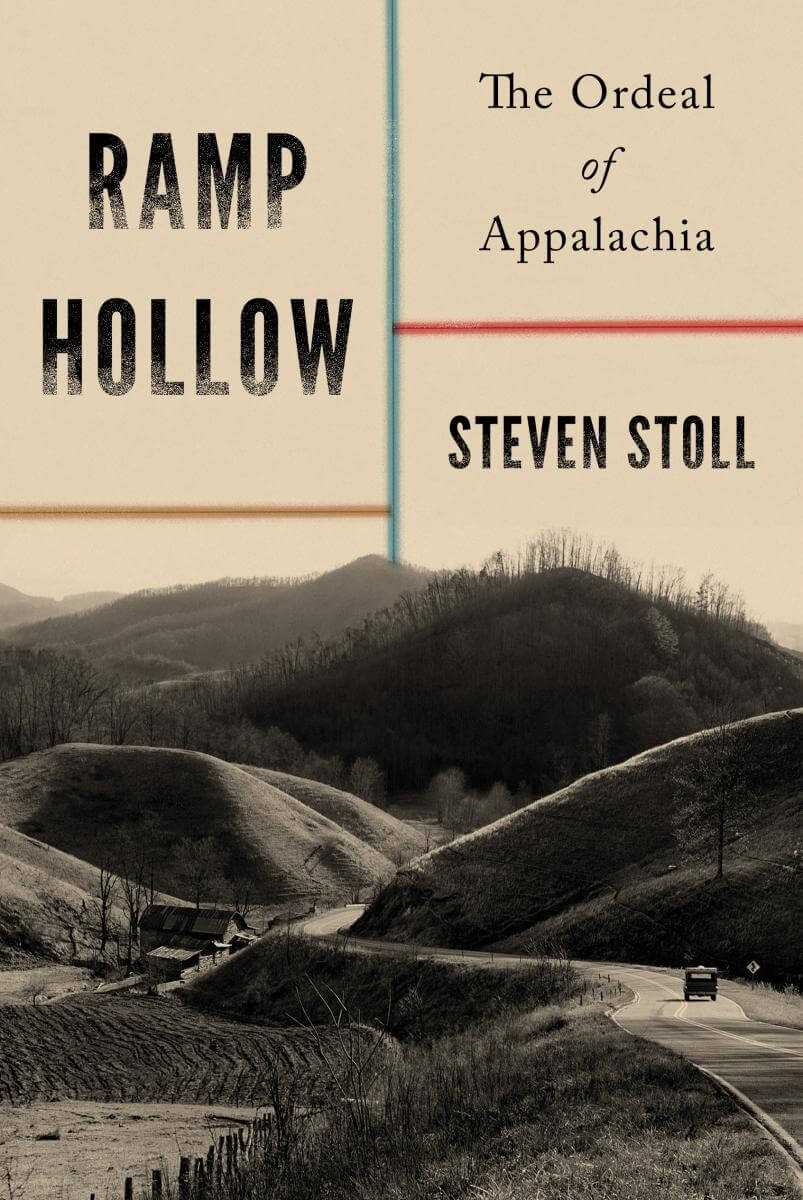
The yeoman farmer is a central figure in debates over the historical dispossessions that created the place we now call Appalachia. For historians like Ron Eller, these self-sufficient small landholders dominated the agrarian past, and first became exploited as residents of company towns when coal, timber, and other corporate interests began in the late nineteenth century to appropriate the land and wealth of the mountains for their own profit.1See Ronald D. Eller, Miners, Millhands, and Mountaineers: Industrialization of the Appalachian South, 1880–1930 (Knoxville: University of Tennessee Press, 1982). During the 1960s and 1970s, activists promoted a related golden-age vision of egalitarian pastoralism in pre-industrial Appalachia, which they contrasted with the ugliness of strip mining, black lung disease, and other contemporary depredations to amplify their calls to "save the land and people." Then, in 1996, Wilma Dunaway swept aside romantic visions of the Appalachian past with prodigious quantitative research, an earlier historical timeline (back to 1700), and the perspective of world systems theory. "On the eve of the Civil War," she concluded, "Appalachians were much more likely than other Americans to be impoverished, illiterate, and landless."2Wilma A. Dunaway, The First American Frontier: Transition to Capitalism in Southern Appalachia, 1700–1860 (Chapel Hill: University of North Carolina Press, 1996), 21.
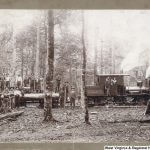
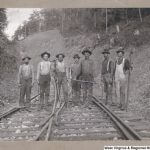

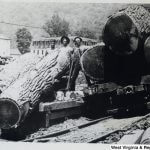
Steven Stoll's Ramp Hollow intervenes in these and related debates by recasting the nature of agriculture and the meaning of land ownership among the European colonialists and their descendants who settled the Appalachian frontier. Stoll likens Appalachia's early settlers to peasants all over the world, who depend on access to a common "ecological base." In the Appalachian instance, this "base" is the forest: "This is a vast renewable fund of resources that provides spaces for fields, food for gathering, fodder for cattle, and habitat for wild game. The base gives everything but costs nothing" (33). Through the practice of swidden, sometimes pejoratively called slash-and-burn agriculture, settlers cleared portions of the forest and cultivated crops, but their clearings were limited; more importantly, they utilized the forest as a source of wild plants, game, and mast for their free-ranging livestock. Although their economy was "makeshift," without extensive surplus or accumulation, these early settlers rarely starved, Stoll asserts, and they should not be considered poor.
As the western edge of European settlement, the mountainous backcountry of eighteenth-century Appalachia briefly represented a space of relative freedom from state enforcement of property rights. Although elites gained formal title to millions of mountainous acres through grant or purchase, they tended to view the land as "wilderness" and unworthy of investment or even much attention, according to Stoll. A chaos of competing land claims emerged, as well as, in effect, the practice of "land to the tiller." Use-rights prevailed. Squatters and small landholders utilized the vast forest without regard to absentee elites and their abstract legal instruments, which went unenforced, thereby irrelevant, and they engaged in a vigorous barter economy with one another.
Although historians and activists have focused largely on the land-grabbing actions of coal companies in the late nineteenth century as the definitive dispossession of Appalachia, Stoll takes us back to the federalism of Alexander Hamilton in the early republic. Taxation—an obligation that could only be fulfilled in legal currency—was the means to force subsistence agrarians toward a cash economy and extend the administrative reach of centralized government into the recesses of the mountains. "Taxation does not merely fund the state," Stoll observes, echoing the arguments of James C. Scott and other anti-statist anarchist scholars. "It creates its territorial and financial power" (122).3See James C. Scott, The Art of Not Being Governed: An Anarchist History of Upland Southeast Asia (New Haven, CT: Yale University Press, 2009). Armed resistance to Hamilton's tax on distilled spirits, which did not distinguish between commercial and household production, arose from the high value of whiskey in barter exchanges and the onerous compulsion to send money from a cash-poor economy to a distant central government—all on the heels of a war for "independence." Although the Whiskey Rebellion succeeded in discontinuing the excise tax, the coercive extension of a sovereign state—with a unified system of land ownership, property rights, law, currency, taxation, and administrative regularity—would eventually facilitate destruction of the ecological base and subsistence practices of Appalachian agrarians.
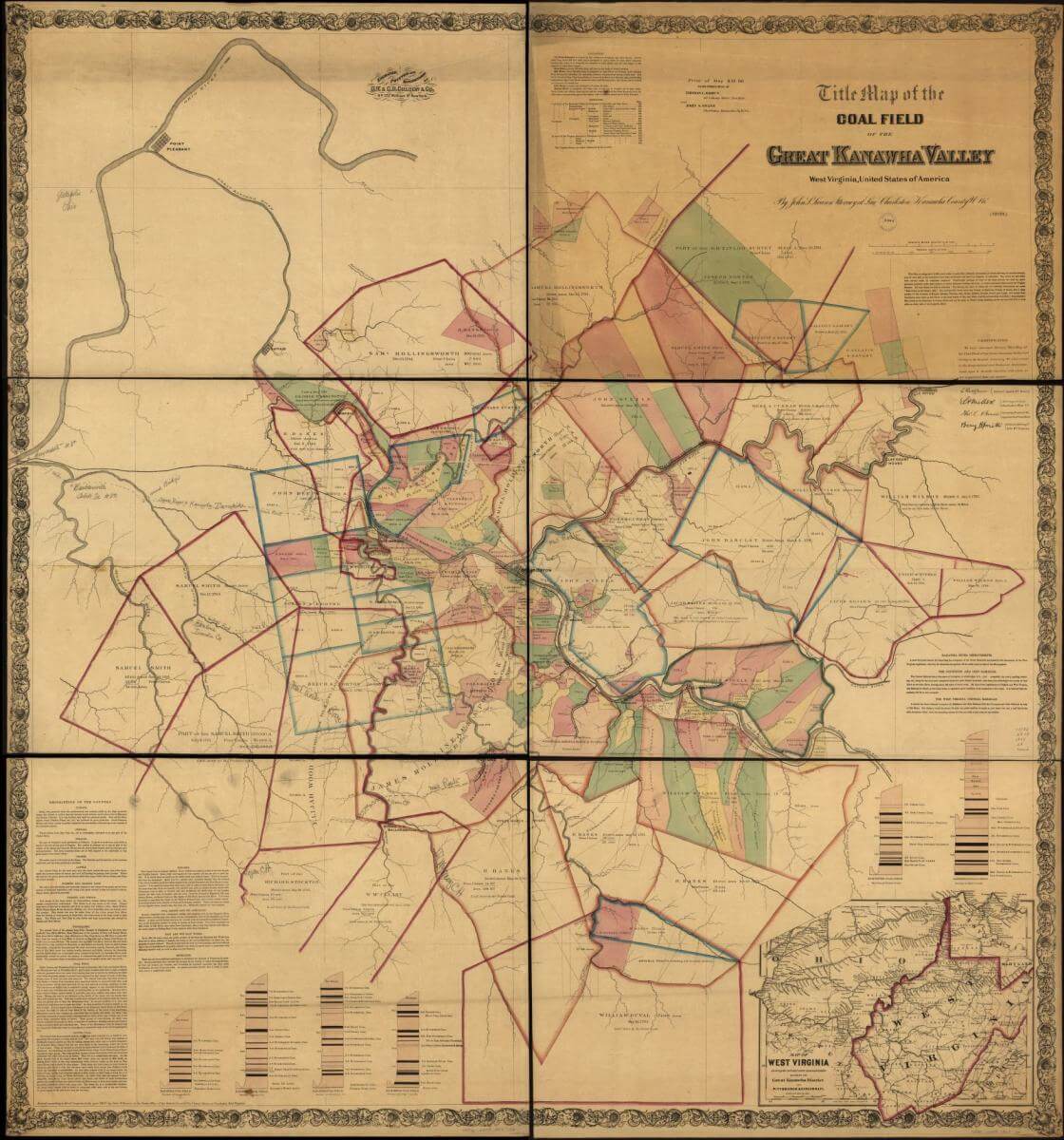
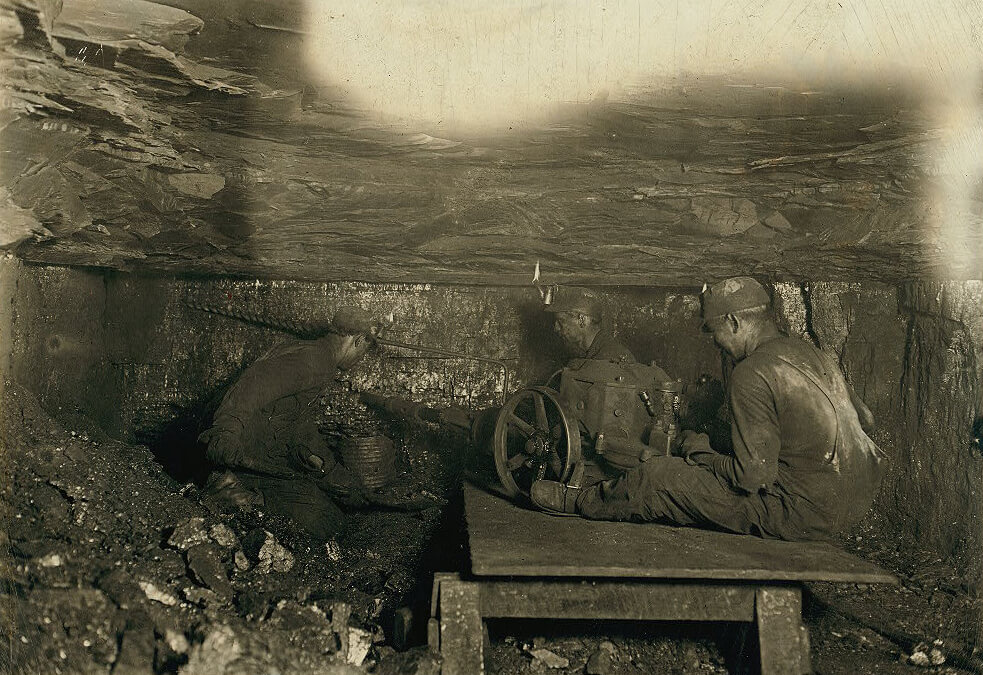
Stoll's tale of rural industrialization in the second half of the nineteenth century focuses on what became West Virginia, and is familiar to scholars and many residents of central Appalachia: extension of the railroads into southern West Virginia, corporate acquisition of mineral rights and vast landholdings, opening of the "billion dollar coalfields," growth of company towns and the exploitative trap of scrip (non-legal tender in which miners received wages), company stores, occupational death, the mine guard system of private security thugs. True to his emphasis on subsistence agrarians, however, Stoll builds on work by Ron Lewis to emphasize the wholesale timbering of the mountains, which accompanied coal mining and devoured the ecological base of the forest.4See Ronald L. Lewis, Transforming the Appalachian Countryside: Railroads, Deforestation, and Social Change in West Virginia, 1880–1920 (Chapel Hill: University of North Carolina Press, 1998). Combined with the contradiction of a growing population seeking sustenance from a shrinking base of land (analyzed in detail by Dwight B. Billings and Kathleen M. Blee), these multiple dispossessions spelled an end to the makeshift agrarian economy.5See Dwight B. Billings and Kathleen M. Blee, The Road to Poverty: The Making of Wealth and Hardship in Appalachia (Cambridge: Cambridge University Press, 2000).
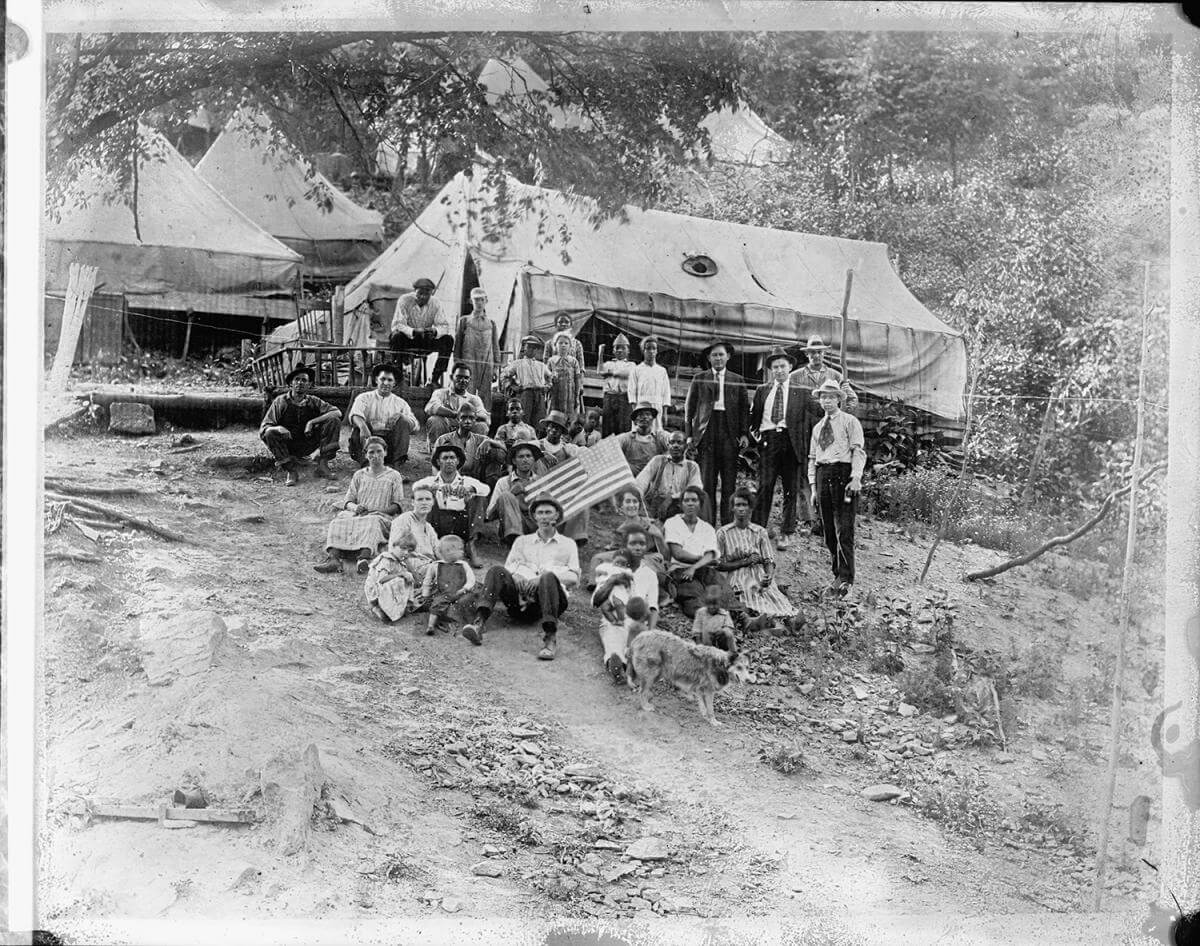
Stoll directs special attention—and some of his most blistering critique—to the ideologues of capitalist modernity, those self-interested promoters of the benefits of wage labor, efficiency, discipline, and "productive" (i.e., profitable for them and their kind) use of the land. Declaring makeshift agricultural practices a miserable, impoverished throwback that impeded the self-evidently desirable processes of modernization, "Atlantic elites" gradually appropriated the means of subsistence of mountain farmers, then pronounced them miserable and poor. This critique of dominant ideology forms an important bridge toward Stoll's larger purpose in Ramp Hollow, which is to defend the integrity of peasants and the viability of their agricultural practices—when not disrupted by various "development" schemes—all over the world. Indeed, the book begins in West Virginia and ends in West Africa, where Stoll decries the contemporary enclosure movement whereby governments are dispossessing entire peasant villages by transferring "idle" common lands to corporations that produce agricultural commodities for global markets.
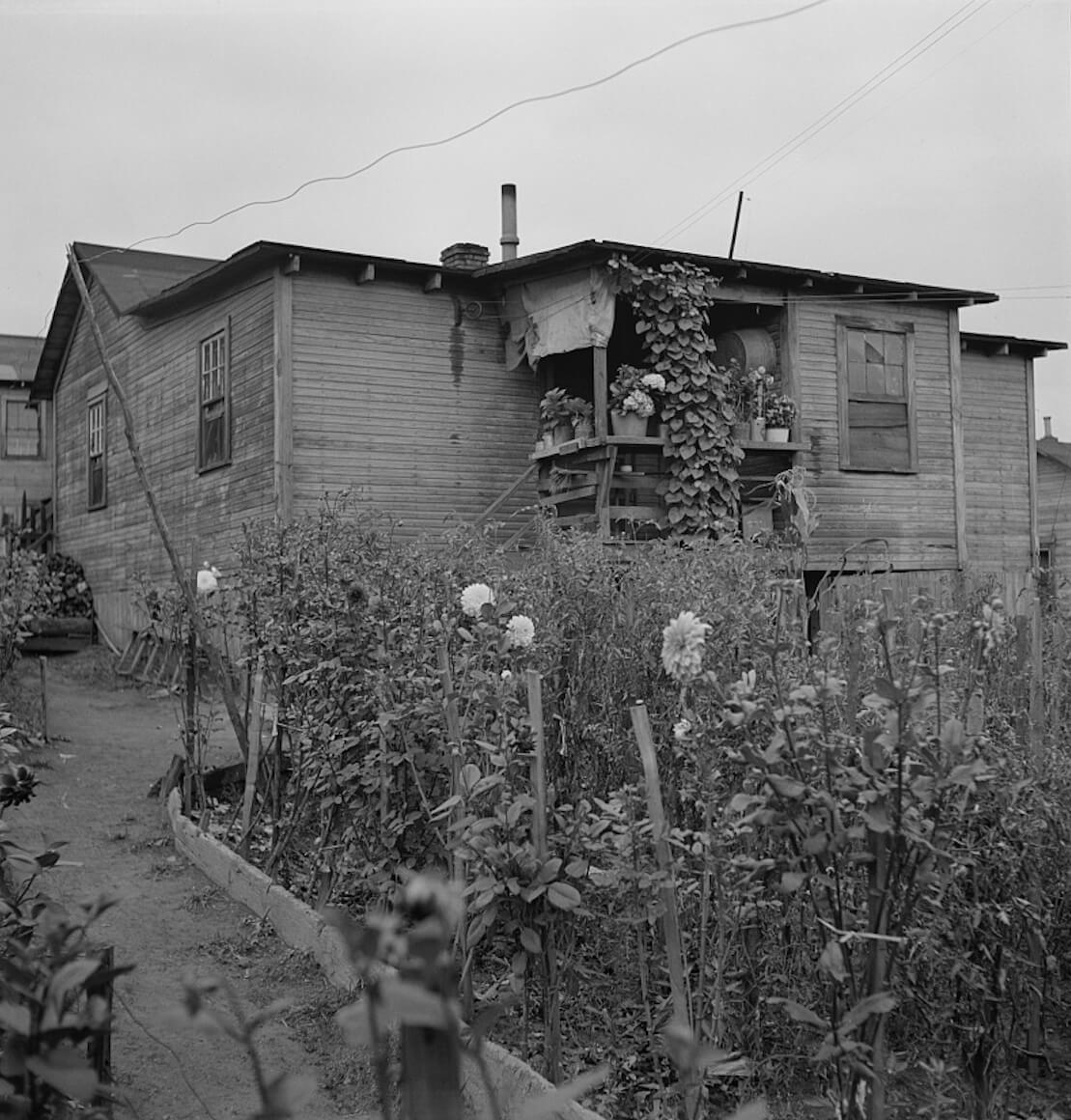
Reviewers typically feel an obligation to register a complaint or two about a book, and I am no exception. I was disappointed by Stoll's lack of attention to gender relations and the gendered division of labor, especially in view of his definition of the makeshift agricultural economy as a household mode of production. Although he acknowledges that the agrarian household was a "coercive institution" (216), what he means by that is the authority of patriarchs over their children, who "owed their families a certain term of labor before gaining the right to strike out for themselves" (216). Neither patriarchal authority over wives nor the fact that daughters never gained "the right to strike out for themselves" seems to occur to him. Consistent with his Marxist analytic (and neglect of Marxist-feminism), Stoll focuses exclusively on class relations; in the context of coal camps, this includes analyzing the contradictory role of the household garden as a means to lower the cost of miners' and their families' social reproduction (and thus wages) as well as potentially sustain them during strikes. The labor in those gardens, as in social reproduction more generally, remains unexplored.
To its great credit as a work of history, Ramp Hollow is unusual in its direct relevance to contemporary politics. This is true for not only areas of the world where land grabs and enclosures proceed apace, but also central Appalachia, where the struggle to envision and create post-coal—and potentially "post-capitalist"—futures is ongoing. In his final chapter, Stoll offers a "thought experiment" in the form of "The Commons Communities Act" (272–274), which proposes publicly-owned commons, complete with a variety of incentives and protections for those who live there, each with an ecological base sufficient to sustain residents through "hunting and gathering, cattle grazing, timber harvesting, vegetable gardening, and farming" (272). Although his proposal is understandably crafted for rural contexts, given Stoll's concerns throughout the book, the commons is not necessarily so. Indeed, the argument that different forms of public commons may be key to the reinvigoration of civic life and the prospects for democratic, place-based economies seems to be spreading.6See Herbert Reid and Betsy Taylor, Recovering the Commons: Democracy, Place, and Global Justice (Urbana and Chicago: University of Illinois Press, 2010); Kathryn Newfont, Blue Ridge Commons: Environmental Activism and Forest History in Western North Carolina (Athens: University of Georgia Press, 2012); and George Monbiot, Out of the Wreckage: A New Politics for an Age of Crisis (New York: Verso, 2017). Regardless of the specifics of such proposals, they reinforce Stoll's overarching argument: capitalist hegemony is not inevitable, and collective access to land is key to the future of Appalachia.
About the Author
Barbara Ellen Smith is professor emerita at Virginia Tech and a member of the editorial board of Southern Spaces. She has long studied and participated in economic justice movements in Appalachia.
]]>Introduction
At present, the people of Appalachia continue to endure the contraction and retreat of extractive industry with little more than big-box retail for employment. They work for local hospitals and county governments at a time when both depend on a withering tax base. Many residents hunt, fish, and garden to make up the shortfall in their household incomes. The Appalachian Regional Commission has not come up with a solution; neither has the leadership of the United States. It seems unlikely, though I would not say impossible, that corporations will show up in southern West Virginia or eastern Kentucky and open factories and offices. I wrote the Commons Communities Act after months of thinking about how the people of the southern mountains might find work with dignity, working for themselves and their families without owing their existences to corporations. I thought that government could help to solve this problem and do what it should do: stand between citizens and the power of capital.
It is difficult to find anything Appalachians have gained by voting for Republicans. Yet a majority in every county in West Virginia voted for Donald Trump in 2016. His promise to revitalize the coal industry lacks a footing in reality. Sensing this, one voter gave him a desperate endorsement, saying, "He's the only shot we got." If Trump studies West Virginia's congressional delegation, he might conclude that he doesn't need to do very much. But the people can do better than that. They can make their representatives justify the trust placed in them. They can demand more of their government. They can assert a right to land and livelihood and reparations from the corporations that used and abused them for so long. Maybe that can be the basis for a positive political identity.1For an argument in favor of collective identities in the service of an ethical politics, see Critchley, Infinitely Demanding. I have especially learned from David Whisnant's "Developments in the Appalachian Identity Movement," which though published in 1980 still resonates. "At its worst . . . regional identification is an isolationist impulse." He deconstructs an essentialist mountain identity. And yet, "The political value of regional identity lies in its usefulness as a basis for broad solidarity and coalition." Whisnant, David. "Developments in the Appalachian Identity Movement: All is Process." Appalachian Journal 8, no. 1 (1980): 41–47.
I favor democratic socialism and a reinvention of the nation-state as a conduit for meeting human needs rather than for accumulating capital. I also favor a realm of democratic autonomy, and that might have more political traction. If Congress and the president can cooperate, such a realm can exist as a function of the United States itself. But it can also exist outside of centralized government, sponsored by West Virginia or Kentucky or Tennessee. Or people can do it themselves, by squatting on abandoned land and defending their right to the commons.2In the words of two historians, "Making visible activities that neoliberalism renders invisible expands the range of ideas for producing social livelihoods and economic development." Amanda Fickey and Michael Samers, "Developing Appalachia: The Impact of Limited Economic Imagination," in Studying Appalachian Studies: Making the Path by Walking, ed. Chad Berry, Phillip J. Obermiller, and Shaunna L. Scott (Urbana: University of Illinois Press, 2015), 123.
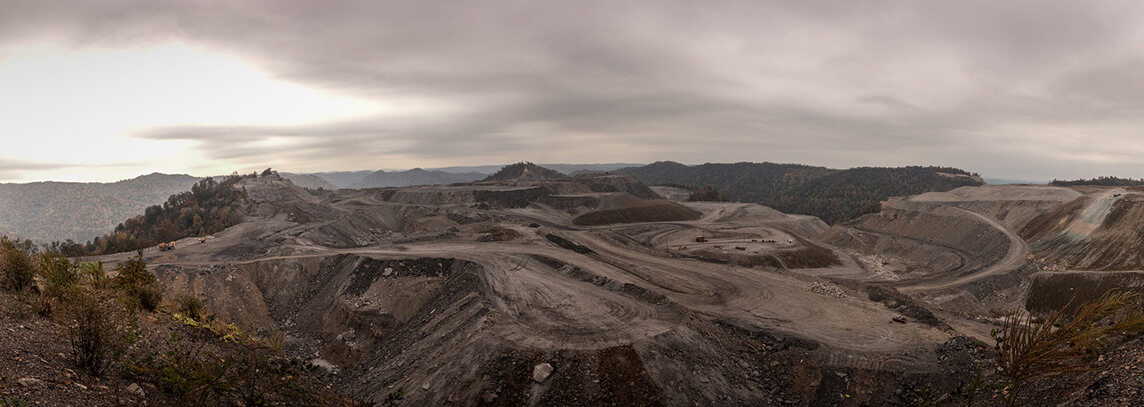
There is talk and some action regarding returning land. Various organizations have held public meetings to elicit policies directly from citizens. Even Congress is thinking along these lines. In 2016, Representative Harold Rogers, a Kentucky Republican, introduced the Reclaim Act. The law would empower the Department of the Interior to distribute funds to states and Indian nations aimed at developing land in communities "adversely affected by coal mining." I would push this thinking toward creating a reconstituted commons. What if people who wished to do so lived by hunting and gardening as part of a social project that encouraged political participation? What if citizens possessed use-rights over a sustaining landscape?
Historians don't often write legislation. My attempt is consistent with the argument of this book. Consider it more a thought experiment than a ready-made policy. Any actual solution would require the knowledge of people who live in the mountains and the sponsorship of organizations and activists working on these questions. The following owes something to the New Deal economist Milburn Wilson, the geographer J. Russell Smith, the historian Lewis Cecil Gray, the Kentucky farmer and writer Wendell Berry, and also to Mahatma Gandhi, Lewis Mumford, and E. F. Schumacher.3Appalachian Voices is one such organization. The Reclaim Act is H.R. 4456, 114th Congress. Introduced in the House in February 2016. I call it . . .
THE COMMONS COMMUNITIES ACT
Whereas coal mining is diminishing in the southern mountains, leaving thousands unemployed, and whereas coal contributes to climate change and the disruption of human societies all over the world; whereas a rural policy should incorporate ecological principles with food production on a small scale, and whereas the United States once included millions of households engaged in production for subsistence and exchange; whereas when people take care of landscapes, landscapes take care of them,
SECTION 1. The United States shall create a series of commons communities, each designed to include a specified number of households within a larger landscape that will be managed by them, the residents. This landscape will provide the ecological base for hunting and gathering, cattle grazing, timber harvesting, vegetable gardening, and farming. The ecological base will be owned as a conservation easement or land trust under the authority of the states and/or counties where each community resides.
SECTION 2. Commons communities would be organized according to the design principles developed by the economist Elinor Ostrom, who was awarded the Nobel Prize in Economic Sciences in 2009 for her work on the economic governance of common resources. Each community shall include well-defined boundaries and members. Each will devise rules for appropriation suitable to the environment, along with sanctions and penalties for those who violate the rules and take too much or otherwise abuse the resource. Each must establish a means of conflict resolution and governance. In the event that residents need to sue the community or other residents, they would use the county, state, or federal courts.4Ostrom (1933–2012) shared the Nobel Prize with Oliver E. Williamson. The act would rely on Ostrom's Governing the Commons: The Evolution of Institutions for Collective Action (Cambridge: Cambridge University Press, 1990). For design principles, see pages 90–101.
SECTION 3. Commons communities will not be limited to Appalachia but could be established anywhere a sufficient ecological base exists, including the outskirts of cities and suburbs. This law must not be construed to favor one location or ethnic group.
SECTION 4. Social services and education will be paid for by an income tax on the top one percent of household incomes in the United States and an Industrial Abandonment Tax, attached to any corporation that closed its operations in any city or region of the United States within the last twenty years of the date of this Act and moved elsewhere, leaving behind toxic waste and poverty.
SECTION 5. Resident households with incomes under $50,000 a year will pay no federal income tax. Residents will own their own homes, paying for them with low-interest mortgages and a $1.00 down payment.
SECTION 6. No nonresident, trust, or corporation is permitted to purchase property in a commons community.
SECTION 7. The organization of commons communities will proceed through the Department of Agriculture. The Department will initiate the identification of suitable lands for condemnation by eminent domain or land already owned by counties, states, or the United States. The Department will determine how much land is needed to sustain a given number of residents.
SECTION 8. Allied Programs.
SUB-SECTION A. Income tax incentives will encourage teachers and medical doctors to live in commons communities and work in the schools and nearby hospitals.
SUB-SECTION B. College-age members of any commons household may apply for free tuition at their state university. Tuition shall be paid for by the Industrial Abandonment Tax.
SUB-SECTION C. Commons communities will receive special programs intended to link them to the Internet. Cooperation between communities will incorporate schools, artists and writers in residence, and scientists engaged in the study of the environment. This Act provides funds for the publication of a journal or magazine of commons life to be written and published by the residents of the various communities.
SUB-SECTION D. Another program will link gardeners with markets for their produce, including grocery stores and restaurants. Proceeds from this Market Garden Initiative will not be subject to state or federal income tax.
SUB-SECTION E. University experiment stations in every state where commons communities exist will send representatives to teach the latest methods of garden production, with the approval and consent of residents.
SECTION 9. If the members of a commons community no longer wish to be associated with the federal government, they may become independent at any time with a majority vote consisting of two-thirds of adult residents, at which time all federal programs associated with this Act will cease. Ownership of the commons would not change and residents would keep their homes.
The act might look like Arthurdale and the Division of Subsistence Homesteads all over again. But it has no factory, no originating debt, and no presumption that people must subsist entirely from gardens. It emphasizes scientific conservation, cultural expression, entrepreneurship, and democracy. It would not prevent any resident from earning money in any job or profession. Some within Appalachia might object to the participation of the federal government. But government can do things that communities cannot by themselves, like purchase land, relieve taxes on citizens and levy them on corporations, advance citizen participation, and pay for college. Government can help the residents of commons communities remain connected to the wider world of economic opportunity and political participation. But the act allows for its own dissolution. Residents would have the authority to end the government's participation and keep their gains.5On corporate subsidies, Niraj Chokshi, "The United States of Subsidies," Washington Post, March 18, 2015, www.washingtonpost.com/blogs/govbeat/wp/2015/03/17/the-united-states-of-subsidies-the-biggest-corporate-winners-in-each-state/?utm_term=.314361798972.
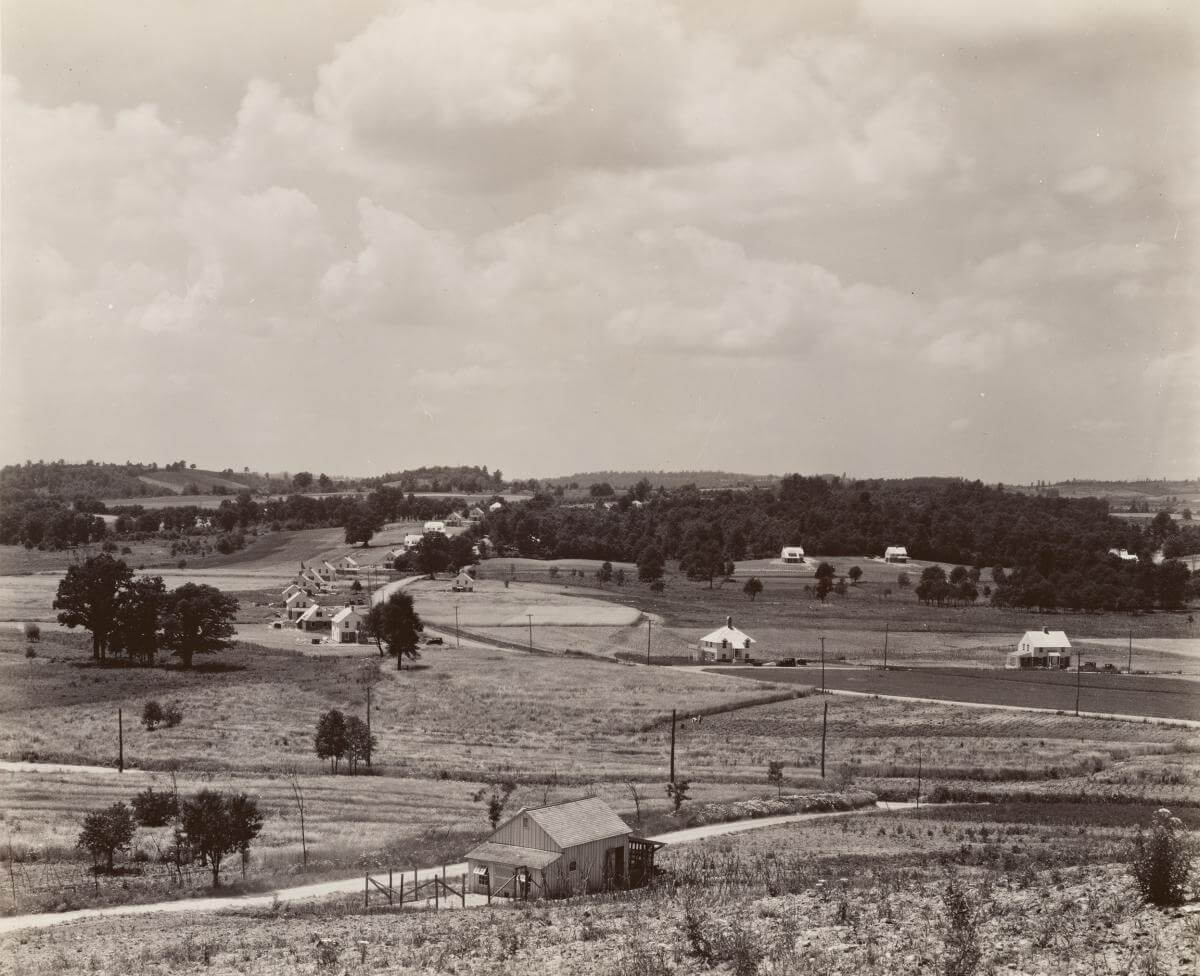
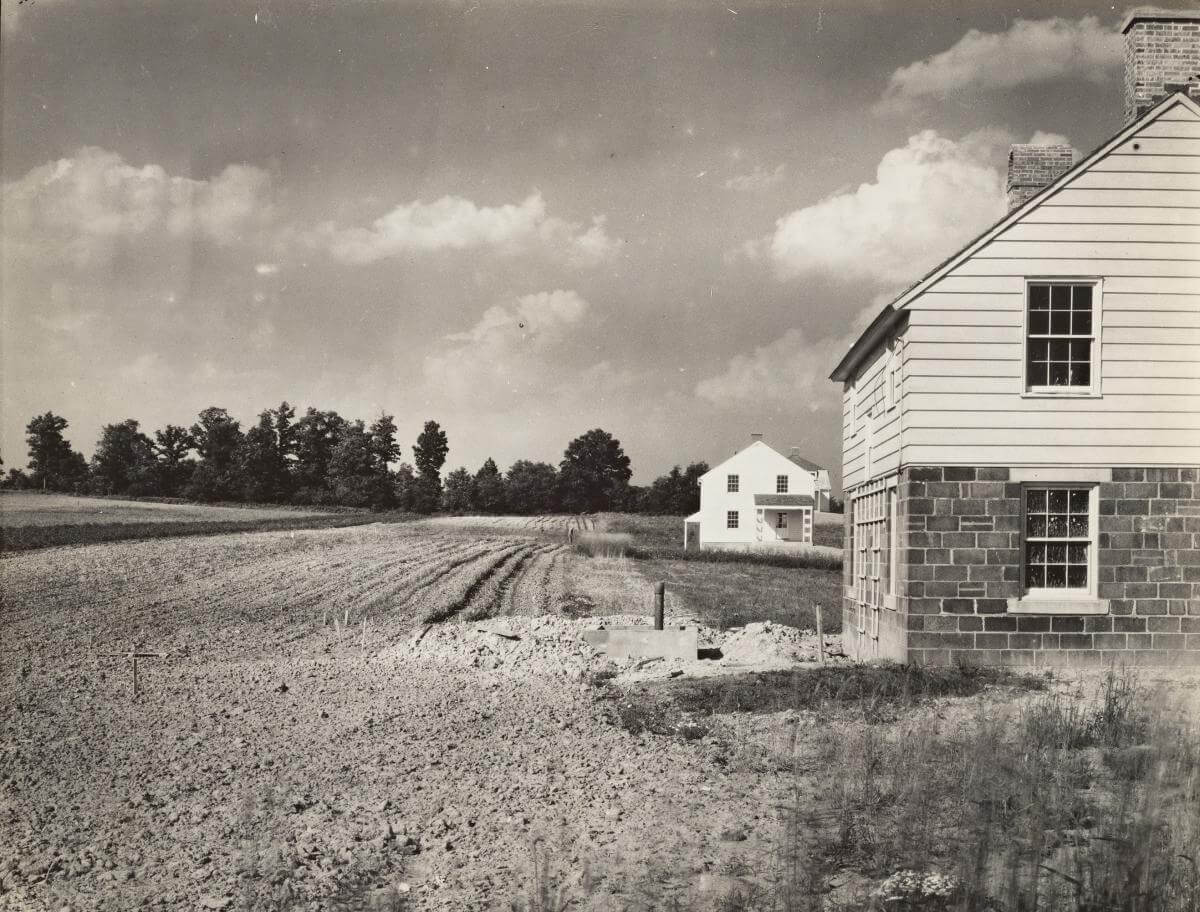
Top, View of Arthurdale project, Reedsville, West Virginia, 1935. Photograph by Walker Evans. Courtesy of the New York Public Library Miriam and Ira D. Wallach Division, digitalcollections.nypl.org/items/96818680-baca-0132-6504-58d385a7b928. Bottom, Homes and land cultivation, Arthurdale project, Reedsville, West Virginia, 1935. Photograph by Walker Evans. Courtesy of the New York Public Library Miriam and Ira D. Wallach Division, digitalcollections.nypl.org/items/94ba4f90-baca-0132-01de-58d385a7b928.
The act seeks to preserve and encourage a makeshift economy that has been practiced for two centuries among mountain farmers, as well as among people in other parts of the United States. Readers in New York, Chicago, or Los Angeles might not appreciate the extent to which rural Americans depend on forests and other environments for food and cash. In the 1980s, Timothy Lee Barnwell photographed and interviewed Appalachians who practiced agrarian economy. Charlie Thomas of Bush Creek, North Carolina, said, "Even when I was growing up we raised almost everything we ate. You'd buy a little coffee if you wanted it, but we never drank it, and buy or trade for what sugar you needed, and we used honey for that. We've always kept bees for our own honey." A series of interviews conducted in southern West Virginia during the 1990s is now part of the Library of Congress. "People around here . . . on Coal River, just about every one of them does the same thing," explained Dave Bailey. "They pick the grains, they pick the black berries, they fish, they hunt . . . they get the molly moochers [the morchella or morel mushroom] . . . They do that, their kids is going to do it, their grandkids is going to do it, and that's the way it is on Coal River." Others interviewed detailed their extensive knowledge of trees and plants. None of these West Virginians need the Commons Communities Act to continue living as they always have, from whatever forested commons they can still find. The act is meant to promote this social ecology. By combining land and livelihood—by fostering possession against a history of dispossession—it would reconnect communities and landscapes in a structure for sustaining both.6Tim Barnwell, The Face of Appalachia: Portraits from the Mountain Farm (New York: W. W. Norton, 2003), 121, 122, 126. The project is Tending the Commons: Folklife and Landscape in Southern West Virginia in cooperation with the Coal River Folklife Project and the American Folklife Center at the Library of Congress. Dave Bailey interviewed by Mary Hufford on April 12, 1996 (AFC 1999/008), http://hdl.loc.gov/loc.afc/afccmns.104007; Virgil Jarrell interviewed by Mary Hufford on May 23, 1996 (AFC 1999/008), http://hdl.loc.gov/loc.afc/afccmns.117004.
The political economy of the act combines private and communal property. Residents may buy and sell their homes, pass them to the next generation, and do anything else with them permitted by local law. They would act differently in their role as managers of common woods and waters. Economists have rarely understood the logic of collective use. The most common argument says that every user has an incentive to cut every last tree, shoot every last large-bodied mammal, and let his cattle graze every last acre of wild meadow, leaving nothing for anyone else. The forest is reduced to stumps; the high meadow is overrun with thistle. This is the misleading parable of the "Tragedy of the Commons," most famously described by the biologist Garrett Hardin in 1968.7Garrett Hardin, "The Tragedy of the Commons," Science 162 (December 13, 1968): 1243–48.
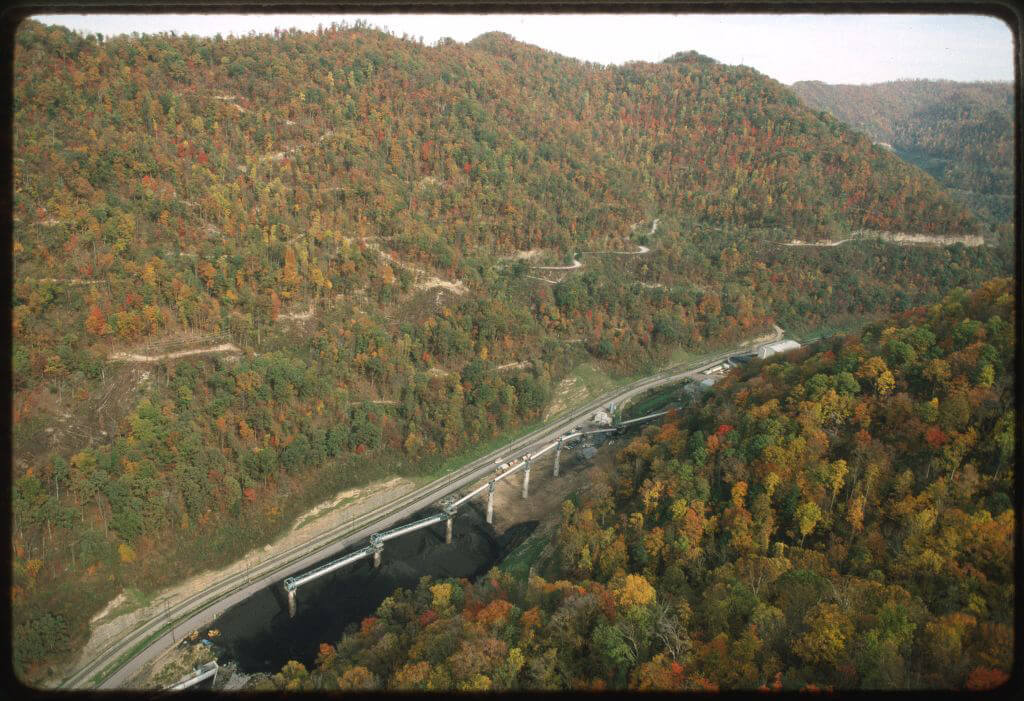
Hardin based his model on a self-serving conception of human nature. His essay has nothing to do with how actual people govern actual shared resources, cases that Hardin seems to have known little about. His first mistake was to think that a commons is a free-for-all. No such set of resources is open to everyone, but only to members, defined in various ways. Consider the forests of New England in the nineteenth century. Colonial towns owned them and controlled access, allowing some to cut trees and others to hunt and fish with permission. Lobster fishermen in Maine operate according to their own rules and institutions, with little government involvement, resulting in one of the most successful fisheries in the world. But they decide who can and cannot benefit. Thus everyone who depends on common property has an incentive to maintain it. This is not to say that everyone is always satisfied. Community management requires governance to mediate disagreement and limit the consequences of conflict. The point is that it's simply not true that common property always degenerates into scarcity.8According to Richard Judd, "These local common resource regimes established two central principles for the emerging New England conservation tradition: communities bore collective responsibility for managing their resources in a productive fashion, and they were to allocate these resources equitably." Judd, Common Lands, Common People: The Origins of Conservation in Northern New England (Cambridge, MA: Harvard University Press, 1997), 7–8, 41–45; James Acheson, Capturing the Commons: Devising Institutions to Manage the Maine Lobster Industry (Hanover, NH: University Press of New England, 2003), 206; Allan Greer, "Commons and Enclosure in the Colonization of North America," American Historical Review 117, no. 2 (April 2012): 365–86.
But Hardin cannot be dismissed altogether. His fable reasonably describes resources that no group can manage, like the open ocean and the atmosphere. And not all collective uses of land have succeeded. (In fact, we know very little about how the functional forest commons fared in West Virginia, how well users governed themselves.) Without regulations and penalties, without clear borders and firm institutions, they can result in devastation. This is why Elinor Ostrom studied them—to figure out why some failed and others thrived.9Kathryn Newfont, Blue Ridge Commons: Environmental Activism and Forest History in Western North Carolina (Athens: University of Georgia Press, 2012), 276.
We all live in communities. In a sense, no one really lives in the United States but in neighborhoods, towns, and counties. Strengthening those bonds within environments that allow for economic autonomy seems like a way of creating space between people and the nation-state. It might also offer a way to endure during times of climate disruption, when the United States might not be capable of compensating for any number of possible disasters. The Commons Communities Act proposes land reform and collective governance. It proposes nothing new, but rather something very old, a sense of ownership without the enclosure and the abuse of power characteristic of private property.10Ibid.
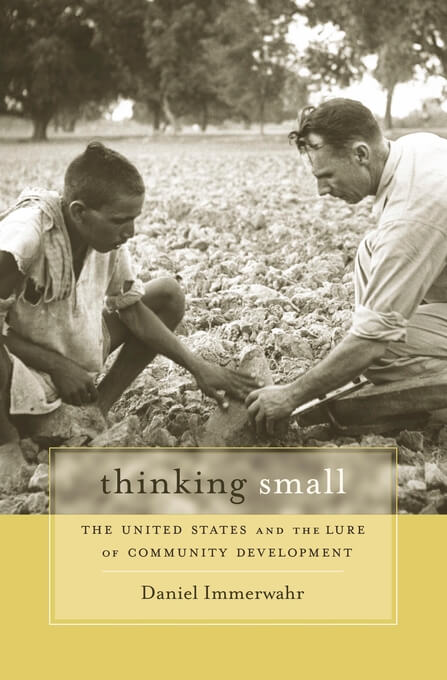
And yet, I have my own objections to the Commons Communities Act. Small-scale development programs appeared decades ago, with mixed results. The same reformers and intellectuals who rediscovered the small town and the Indian pueblo during the New Deal urged communitarian approaches all over the world. But these schemes harbored certain false assumptions, well described by the historian Daniel Immerwahr. Development agencies believed that the members of a village acted from shared principles and that local elites would fairly apportion money entrusted to them. But villages in the Philippines and India turned out to be more complicated—and divided—than the sanguine Americans had thought. Immerwahr suggests another problem. When a nation-state invests in a community, where does its influence end? What role would the United States play in a commons community?11Daniel Immerwahr, Thinking Small: The United States and the Lure of Community Development (Cambridge, MA: Harvard University Press, 2015).
The act might also be criticized for shunting the problem of industrial abandonment onto the poor, just like the Division of Subsistence Homesteads. In this way, it seems like a neoliberal policy intended to reduce the cost of state services and lower taxes on the rich. And while under the act the corporations that caused so much human and ecological ruin would be required to pay for houses and schools, this doesn't change or challenge a political economy in which humans and environments serve as inputs in the circulation of capital. For corporations, compensating for social destruction is merely part of the cost of doing business. Eliminating these contradictions so that citizens benefit would require a government and a set of laws dedicated to human welfare.
The act includes scholarships so that the children of Appalachian households might attend college, but it does not come close to addressing the larger cultural problem of why high school kids in Appalachia often don't apply. In Hillbilly Elegy (2016), J. D. Vance eloquently explains why it's so difficult for Appalachians to find a way out of unemployment and improve the quality of their lives. Some see themselves as different from those outside their families or counties. People in other parts of the country view them harshly, with many of the same racialized stereotypes present a century ago. All of this makes geographic and social mobility difficult. Vance's own story suggests that a strong mentor with the capacity to see beyond limited local opportunities can overcome self-defeat. Vance's mentor was his grandmother. "She didn't just preach and cuss and demand. She showed me what was possible . . . and made sure I knew how to get there." Her home provided Vance stability and peace, "not just a short-term haven but also hope for a better life."
Vance got out. He graduated from Ohio State University, the Marines, and Yale Law School before joining a Silicon Valley investment firm. But his very success implies the depth of the problem he confronted. The most unsettling currents in Hillbilly Elegy lie in the necessity of leaving and in its emphasis on a strong and uncompromising grandmother. If meaningful work and a decent occupation only exist elsewhere, then most Appalachians will be abandoned. If escape depends on someone who rises above despair and abuse, then most will be stuck. The role of public policy and a political solution to poverty is to attempt to help everyone in the same situation rather than rely on extraordinary circumstance and plain luck to produce successful individuals. Vance's book is inspiring as a memoir, but it might be construed as saying that the tragedy of Appalachia is the sum of its individual failings or the insularity of its families.12J. D. Vance, Hillbilly Elegy: A Memoir of a Family and Culture in Crisis (New York: Harper Collins, 2016): 148–49, 206. Domestic violence, drug abuse, and hopelessness on such a scale have social causes. They require solutions that do not place the burden on the sufferers themselves to transcend their circumstances.
About the Author
Steven Stoll is a professor of history at Fordham University and the author of The Great Delusion (Hill and Wang, 2008) and Larding the Lean Earth (Hill and Wang, 2002). His writing has appeared in Harper's Magazine, Lapham's Quarterly, and the New Haven Review.
]]>Southern Spaces, an open access, multimedia, peer-reviewed journal, invites innovative scholarship on regions, places, and cultures of the US South as well as their global connections. We encourage interdisciplinary submissions that emphasize spatial interpretation and utilize digital media.
Southern Spaces welcomes submissions that:
- critically and creatively examine real and imagined spaces and places
- make connections and comparisons between southern regions and/or locales and sites in the wider world
- use textual, visual media, archival, and ethnographic materials—including artistic expressions—to address questions of spatial justice

Currently Southern Spaces seeks submissions that engage with the geographies of:
- historical memory and memorialization
- economic inequality and everyday precarity
- political boundaries (redistricting, voter suppression)
- forced migration, slavery, and human trafficking
- racial violence, hate crimes
- LGBTQ+ perspectives, rights, and spaces
- demographic shifts in urban, suburban, and rural populations
- immigration, refugees, and citizenship
- incarceration, internment, and the carceral state
- public health, healthcare policy and access
- climate change and environmental history
Examples
Southern Spaces accepts submissions within seven genres of open access, multimedia scholarship:
- Articles are long-form, interpretive, or critical pieces that incorporate multimedia (including digital scholarship) and scholarly analysis to pose an original argument or research-based claim. All Southern Spaces articles undergo peer review.
- Reviews offer critical evaluations of recently published books, films, digital projects, music, events, and other art or scholarship related to the study of space and place.
- Interviews are filmed or transcribed conversations with scholars, authors, artists, or others working in areas related to the study of space and place in the US or global south.
- Photo and media essays are curated collections of original photography or other multimedia that perform critical scholarly analysis. While primarily photographic or media-based, these essays also include a writing component.
- Short videos are five to twenty-five minutes and utilize visual—as opposed to textual or rhetorical—techniques to advance a critical argument or an aesthetic perspective. Southern Spaces frequently publishes ethnographic, documentary, and lyric videos.
- Presentations include media associated with public scholarly presentations as well as audio or visual recordings of presenters. Such presentations include lectures, conference highlights, panels, and performances.
- Blog posts are shorter, less formal essays or announcements of interest to the critical study of space, place, and southernness.
The following pieces provide examples of the critical, interdisciplinary, and multimedia scholarship we seek:
- Busch, Andrew M. "Crossing Over: Sustainability, New Urbanism, and Gentrification in Austin, Texas." Southern Spaces, August 19, 2015. https://southernspaces.ecdsdev.org/2015/crossing-over-sustainability-new-urbanism-and-gentrification-austin-texas.
- Conis, Elena. "DDT Disbelievers: Health and the New Economic Poisons in Georgia after World War II." Southern Spaces, October 28, 2016. https://southernspaces.ecdsdev.org/2016/ddt-disbelievers-health-and-new-economic-poisons-georgia-after-world-war-ii.
- Cooper, Brittney. "#SAYHERNAME: Towards a Gender Inclusive Movement for Black Lives." Southern Spaces, January 26, 2016. https://southernspaces.ecdsdev.org/2016/sayhername-towards-gender-inclusive-movement-black-lives.
- Flippen, Chenoa. "Diversity and Its Discontents: A Review of Behind the White Picket Fence." Southern Spaces, October 20, 2015. https://southernspaces.ecdsdev.org/2015/diversity-and-its-discontents-review-behind-white-picket-fence.
- Goldstein, Holly Markovitz. "St. Augustine's 'Slave Market': A Visual History." Southern Spaces, September 28, 2012. https://southernspaces.ecdsdev.org/2012/st-augustines-slave-market-visual-history.
- McClintock, Diana. "Gordon Parks at Atlanta's High Museum of Art." Southern Spaces, May 28, 2015. https://southernspaces.ecdsdev.org/2015/gordon-parks-atlantas-high-museum-art.
- Pooley, Karen. "Segregation's New Geography: The Atlanta Metro Region, Race, and the Declining Prospects for Upward Mobility." Southern Spaces, April 15, 2015. https://southernspaces.ecdsdev.org/2015/segregations-new-geography-atlanta-metro-region-race-and-declining-prospects-upward-mobility.
- Solomon, Eric. "Queer Memory: Loss, Martyrs, and Memorialization in Southern Florida." Southern Spaces, August 11, 2016. https://southernspaces.ecdsdev.org/2016/queer-memory-loss-martyrs-and-memorialization-southern-florida.
- Suitts, Steve. "States' Rights Resurgent: The Attack on the Voting Rights Act." Southern Spaces, August 29, 2013. https://southernspaces.ecdsdev.org/2013/states-rights-resurgent-attack-voting-rights-act.
- West, E. James and Ann Pancake. "Closer to the Ground: A Conversation with Ann Pancake." Southern Spaces, May 30, 2017. https://southernspaces.ecdsdev.org/2017/closer-ground-conversation-ann-pancake.
- Yaeger, Patricia. "Beasts of the Southern Wild and Dirty Ecology." Southern Spaces, February 13, 2013. https://southernspaces.ecdsdev.org/2013/beasts-southern-wild-and-dirty-ecology.
Submit all inquiries and materials to Southern Spaces managing editor Madison Elkins at seditor@emory.edu. Submissions are especially welcome before October 15th, 2017, but will be considered on a rolling basis. There is no submission fee or article processing charge. Visit our submissions page for more information. Southern Spaces does not consider previously-published work or simultaneous submissions. At the time of publication, authors may choose to retain copyright of their work or select a Creative Commons license. All publications, along with their associated media, are securely archived by the Emory Center for Digital Scholarship. Southern Spaces also accepts print and media submissions by post at Robert W. Woodruff Library, 540 Asbury Circle, Emory University, Atlanta, GA, 30322.
]]>Video
Charles D. Thompson, Los Rostros del Tiempo: Faces of Time, 2014.
Reflection
My border odyssey began in 1985 on a farm near Pittsboro, North Carolina. On a hot summer afternoon I walked out of my farm field to meet five men from Mexico. They drove into my driveway in an old beat up blue Impala, got out in the bloodied knee-length white coats and black rubber boots they'd worn that day in the nearby chicken processing plant, and said they had heard I needed help harvesting blackberries on my farm. As I reached to shake their hands, I felt a powerful sense of relief wash over me. I felt like crying.
I had been successful enough with my farm marketing that there was no way I could pick everything I could sell. Orders had piled up, and the farmers' market was just a few days away. The small group of helpers I'd found for one or two days a week earlier in the summer—three high school students and occasionally one of their grandmas who drove them to the farm—had drifted away to other jobs, from fast food work to babysitting. My wife worked off the farm. My neighbors were all either too old or too busy. I had no extended family nearby. Interns hadn't yet started searching for opportunities on farms. I was doing most everything alone, and there just weren't enough hours of sunlight to get all of the two acres of ripe berries harvested. Soft small bramble fruits are especially vulnerable to heat and they weren't going to wait.
 |
I'd already known that Mexican people, men mostly, had started coming to central North Carolina. I knew many of them processed hogs or poultry, and that others worked on dairy or tobacco farms nearby. I'd even gone to Mexico once the year before. But I never dreamed when I went into small-scale organic farming that I'd ever hire laborers to help me, let alone foreign workers.
Yet, on that hot afternoon thirty years ago, I joined the thousands of farmers and other business owners who have hired people who have traveled some three thousand miles and crossed a desert or a river to save their day and ours. They would only work a few hours two or three times a week for me, but they made it possible for me to salvage my blackberry crop, some of my most important income of the year. Choosing to be paid by the flat, they earned pretty good money, too. They literally ran to the fields that day to get started filling the pints as I carried them empty flats and returned with filled ones to the cooling shed.
Over the coming weeks and months we often worked side-by-side. I took a dictionary to the field and began learning Spanish. Already a lover of stories, I wanted to know how they had traveled from their homes and what it was like to cross the border. I learned firsthand about their harrowing journeys and of the risk to provide money for their families. I also learned that every one of those five men were farmers with families still on their land trying to hold on and grow crops in their absence.
We had a love of farming in common. But it hit me hard when I realized that one huge chasm between us was my freedom to stay in place and their need to leave home to keep their farm alive. I was a beginning farmer hiring seasoned agriculturalists from another country to help make my piece of land more profitable. The disparity began to weigh on me.
 |
Thirty years later, I look back to the day the border first crossed me. That day I began to learn that I was caught up in a globalizing system of economic exchange and interdependency. That day I became part of the process too many have dismissed and not enough acknowledge. Since then, I've studied Spanish formally, gone to graduate school, engaged in fieldwork in Mexico and Central America, written about farmworkers, and made films about immigration and agriculture. The borderlands overtook me personally and professionally. I cannot escape their meaning—not just down at the southern line below the United States, but the little borders everywhere in our lives, the borders especially between the people we depend on in so many ways and the policies that vilify them. I now teach and write about all of this, traveling extensively so I can learn and teach others. My own farm is but a memory.
My latest book, entitled Border Odyssey: Travels Along the U.S./Mexico Divide, is a memoir, a travelogue, an ethnography, history, and, as one reviewer put it, a jeremiad about the border. I chronicled every mile of it from the mouth of the Rio Grande in Texas to the Pacific Coast in California. The website and book featured here are my effort to forge better understanding. And the project is also my tribute to Eusebio, Librado, Faustino, Juan, and Jesus, the five who drove in my driveway, saved my blackberry crop, and changed me forever.
About the Author
Charles D. Thompson, Jr. is Professor of the Practice of Cultural Anthropology and Documentary Studies at Duke University. An author and filmmaker, Thompson's latest works are Border Odyssey: Travels along the U.S./Mexico Divide (University of Texas Press, 2015), the films Faces of Time and Brother Towns/Pueblos Hermanos, and the book Spirits of Just Men: Mountaineers, Liquor Bosses, and Lawmen in the Moonshine Capital of the World (University of Illinois Press, 2011).
]]>Review
 |
Any historical account requires a framing device—temporal, thematic, or geographical—establishing the scope of enquiry. A Caribbean history typically invokes fairly settled geographical parameters that delimit the area to insular territories of the Caribbean Sea, with occasional forays into the Guianas and Suriname. While a geographical imaginary can be intuitive and helpful, this emphasis on the Caribbean Sea sometimes obscures meaningful continuities. William Faulkner, for example, influenced iconic Caribbean writers Derek Walcott and Édouard Glissant and also made a pronounced impact on South American writer Gabriel García Márquez.1Valérie Loichot, Orphan Narratives: The Postplantation Literature of Faulkner, Glissant, Morrison, and Saint-John Perse (Charlottesville: University of Virginia Press, 2007). It is salutary to occasionally violate these framing devices—their utility notwithstanding—in the interest of restoring obscured linkages and connections.
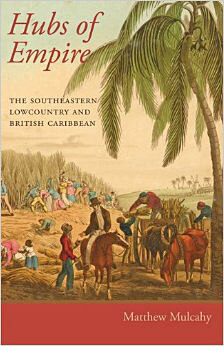
Matthew Mulcahy's Hubs of Empire: The Southeastern Lowcountry and British Caribbean does precisely this, presenting what became Carolina rice country as part of the Anglophone Caribbean's plantation zone. The founding of a settlement that became Charleston, South Carolina, by a group of planters from Barbados in the 1670s functions as the analytical core of the book. This migration between the British Caribbean and the Lowcountry establishes important continuities as the Barbadians brought with them their slaves, planting practices, capital, and racial ideologies.
This is not an entirely novel project, as the links between the Caribbean and the Carolinas are well known; systematic analyses of these connections date at least to Jack Greene's Barbadian cultural hearth thesis from the 1960s.2Jack P. Greene, "Colonial South Carolina and the Caribbean Connection," in Jack P. Greene, Imperative Behaviors and Identities: Essays in Early American Cultural History (Charlottesville: University of Virginia Press, 1992), 68–86. Neither is Mulcahly's the only recent book on the subject, joining Paul Pressly's excellent On the Rim of the Caribbean.3Paul M. Pressly, On the Rim of the Caribbean: Colonial Georgia and the Atlantic World (Athens: University of Georgia Press, 2013). But Hubs of Empire is a remarkably well-accomplished synthesis. To successfully undertake a project of this kind requires mastering a vast secondary literature on the ecology of the area, its pre-Columbian traces, imperial rivalries between Spain, France, and Great Britain, alongside an understanding of the origin and evolution of the plantation system and its attendant slave societies. And to do a thorough job, one cannot ignore the endless and sometimes intense debates that both inform and deform historical interpretation. All this Mulcahy does superbly: he surveys these literatures comprehensively and presents the historiographies nimbly and with admirable balance. In particular, Mulcahy addresses several controversial topics in a clear and balanced way, among them the introduction of rice culture to the Carolinas. One group of scholars argues that African slaves imported to the Lowcountry had prior knowledge of rice culture and it was this expertise that made possible the plantation society of the Carolina Lowcountry. Another group has examined the empirical evidence and finds no evidence that the slaves imported to the Lowcountry came from rice-growing areas of Africa. Central to this controversy are issues of ideology and method that animate research in Atlantic World Studies: were slaves merely the passive objects of history or did they actively shape their own destinies?4David Eltis, Philip Morgan, and David Richardson, "Agency and Diaspora in Atlantic History: Reassessing the African Contribution to Rice Cultivation in the Americas," American Historical Review 112, no. 5 (2007): 1329–1358; Walter Hawthorne, "From 'Black Rice' to 'Brown': Rethinking the History of Risiculture in the Seventeenth- and Eighteenth-Century Atlantic," American Historical Review 115, no. 1 (2010): 151–163. Mulcahy finds a middle ground between these starkly different explanations for the origins of rice culture, one that documents contributions from both Africa and Europe in a way that strikes me as balanced yet well supported by the evidence.
 |
| Barbados, South Carolina, USPS The American Revolution Bicentennial commemorative stamp, 1976. © United States Postal Service. |
By reframing the history of coastal Carolina, Mulcahy succeeds in rendering "both the Lowcountry and the islands less anomalous within the larger context of colonial British America" (8). This is a very important contribution and helps balance typical presentations of US history that tend to interpret colonial history as the inevitable springboard to the formation of the United States.5Jack P. Greene, "Colonial History and National History: Reflections on a Continuing Problem," William and Mary Quarterly, Third Series, 64, no. 2 (January 1, 2007): 235–250. Adopting this Greater British Caribbean frame, Mulcahy shows how Carolina rice culture was more Caribbean than Virginian: the Carolinas and the Caribbean were characterized by larger plantations, wealthier planters, more imbalanced ratios of whites to blacks, and deadlier disease environments than tobacco plantations further north. Mulcahy is also scrupulous enough to note important differences between the Carolinas and the Caribbean: the task system of labor organization central to rice plantations marks a salient distinction to the gang labor system of the sugar islands.
Although Hubs of Empire is excellent, I would have liked for Mulcahy to extend his temporal frame. His narrative covers the early colonial period to the American Revolutionary War. There are good reasons for doing this, especially as Mulcahy describes the coastal Carolinas and the English islands as the Greater British Caribbean. After 1776, the Carolinas joined the American bid for independence while the islands did not. Another reason for this is the book's inclusion in the series Regional Perspectives on Early America put out by Johns Hopkins University Press. But the cultural continuities between the Carolinas and the Caribbean continued well after US independence, begging for an extended analysis through the fall of plantation agriculture in the decades following World War II. The coastal stretch from Savannah to Wilmington remains, even today, quite different from the adjacent piedmont.
 |
| Slaves of the Rebel General Thomas F. Drayton, Hilton Head, South Carolina, 1862. Photograph by Henry P. Moore. Courtesy of the Library of Congress, Prints and Photographs Division, LC-DIG-ppmsca-04324. |
Since the 1790s, The piedmont has been dominated by an ethos shaped by Baptist, Methodist, and Presbyterian strains of Protestant belief that eschew drinking, card playing, gambling, and other activities considered outside the realm of Christian behavior.6Charles Reagan Wilson, "Overview: Religion and the US South," Southern Spaces, March 16, 2004, https://southernspaces.ecdsdev.org/2004/religion-and-us-south/. The coastal areas, in contrast, seem to embrace a more Caribbean manner, where social life readily includes alcohol. The architectural styles of the Caribbean and coastal Carolinas offer other important points of comparison, shaped by similar environmental constraints that exercise powerful influence on modes of living and organizing space. Even linguistically, the cultural continuities between the British Caribbean and the Carolina coast warrant further examination. Mulcahy notes that "the development of pidgin and creole languages occurred throughout the region" and that the "ongoing importance of African languages and the distinct creole languages that emerged over time was yet another factor distinguishing slave culture in the Greater Caribbean from the Chesapeake" (134). There is a respectable body of opinion that supports Mulcahy's larger thesis in arguing that Gullah did not develop autonomously but was rather an outgrowth of creole imported into Carolina as part of the migration from Barbados in the late 1600s.7See Frederic G. Cassidy, "Barbadian Creole: Possibility and Probability," American Speech 61, no. 3 (Autumn, 1986): 195–205. Cassidy's view is challenged by Ian F. Hancock, "Gullah and Barbadian: Origins and Relationships," American Speech 55, no. 1 (Spring, 1980): 17–35.
Overall this is a fine book: balanced, comprehensive, and well written. The story of colonial America needs to be reinserted into its original context, that of the Atlantic World. Later continental ambitions, encapsulated in the term "Manifest Destiny" have produced a distorting lens for the understanding of early America. The use of texts like Hubs of Empire is critical to the recuperation of this historical experience shared alike by what became the United States and its Caribbean neighbors in the sixteenth and seventeenth centuries.
About the Author
Robert Goddard is senior lecturer and director of the Latin American and Caribbean Studies Program at Emory University.
]]>
In the spring of 1974, a dozen white and African American women and their daughters gathered outside the office of the Textile Workers Union of America (TWUA) in Roanoke Rapids, North Carolina.1The union in 1974 was the Textile Workers Union of America, which merged with the Amalgamated Clothing Workers Union in 1976 to form the Amalgamated Clothing and Textile Workers Union of America (ACTWU). As the cameras of Gloria Steinem's PBS series Woman Alive! rolled, the girls, wearing handmade cheerleading uniforms with "TWUA" emblazoned across the front, chanted, "You can rock us, you sock us, but you can't knock us flat! Tell me Mr. Stevens, can you top that?" Their mothers tried to ignore the camera crew. They had created the cheerleading squad the previous year to support unionizing the seven J. P. Stevens plants in Roanoke Rapids, but they were unaccustomed to this kind of attention.
Steinem's episode featured Crystal Lee Sutton.2Joan Shigekawa, Woman Alive! (June 19, 1974; Dallas/Fort Worth, Texas: KERA-TV), Documentary. Accessed in Crystal Lee Sutton's personal papers 986.87, an unprocessed collection housed at Alamance Community College, Graham, North Carolina. For more information about the history and content of the Woman Alive! series, see Woman Alive! produced by KERA-TV Dallas/Fort Worth and WNET/13 New York; made possible by a grant from the Corporation of Public Broadcasting; exective producer, Joan Shigekawa: A Finding Aid, MC 421; Vt-30, Arthur and Elizabeth Schlesinger Library on the History of Women in America, Radcliff College. On May 30, 1973, Stevens had fired Sutton for insubordination after she insisted on copying an anti-union letter posted on the company bulletin board. Sutton then climbed atop a shop floor table and raised a piece of cardboard with "UNION" scrawled on it. She spent the night in jail. Steinem read about Sutton's confrontation with Stevens managers and local police in a New York Times article on the TWUA's organizing drive and wanted to include her in Woman Alive!—an early example of the media coverage and outside support the union received in its six-year struggle with the J. P. Stevens corporation. While the episode called attention to Sutton, it also showed many other mill women front and center.
A bold, multi-faceted effort, the campaign to unionize J. P. Stevens included boycotts, community-based organizing, and publicity campaigns against corporate intransigence and irresponsibility. The union's deployment of these tactics reached many audiences and motivated allies within and beyond the labor movement. This essay contextualizes the mill women's experiences, illuminating the crucial role they played in capturing attention, garnering support, and motivating action from allies. Personal narratives of white and African American women workers tapped into concerns with workplace justice fostered by the women's and civil rights movements. Aware of the limits of Stevens unionization, I examine what women gave to the effort and the distinct forms their activism took.
The Stevens Campaign and the Southern Textile Industry
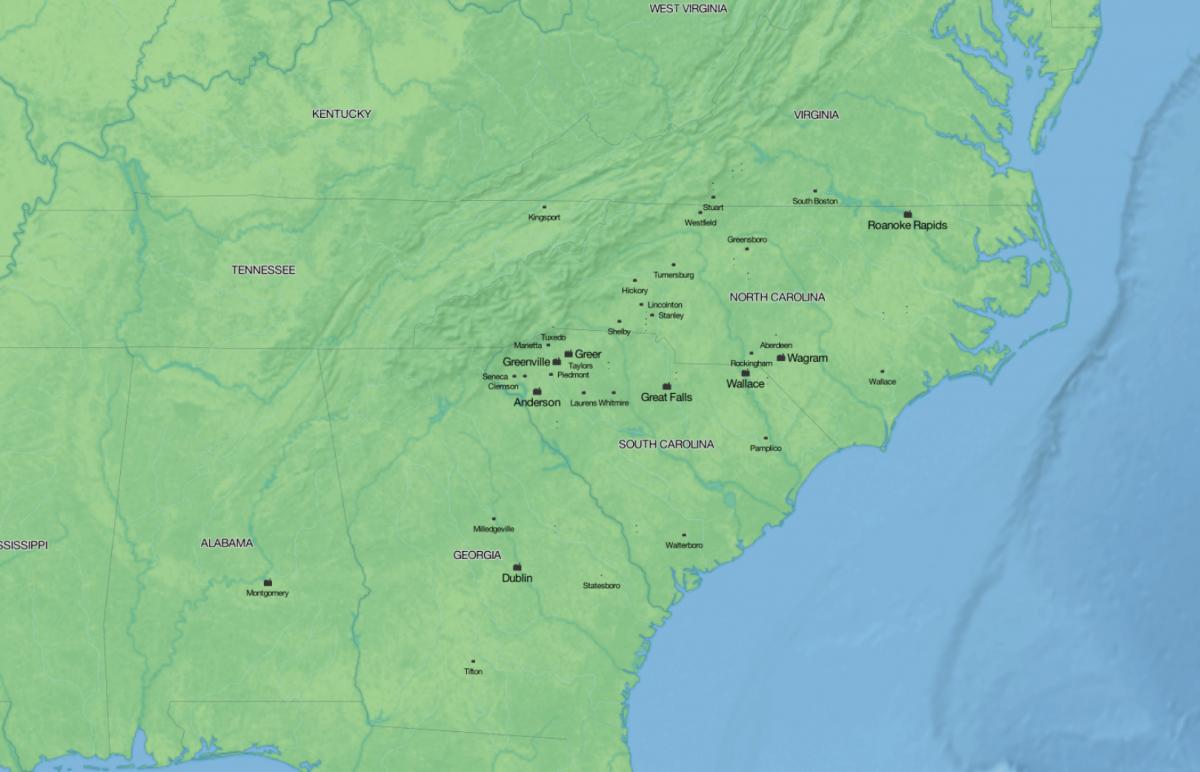
From the 1920s through the 1960s, textile unionists labored to organize mill workers in the southern Piedmont, a region stretching from north Georgia and central Alabama through the middle of the Carolinas and into southern Virginia. Flanked on the west by the Appalachian Mountains and to the east by the Atlantic coastal plain, the Piedmont was a stronghold of textile and apparel manufacturing, which provided the main source of industrial jobs for working-class white families. From the 1920s through the 1950s, white women comprised at least one-third of the textile labor force; in 1929, their numbers in North Carolina peaked at 44.6 percent. By 1960, the United States textile labor force was overwhelmingly white, southern, and female. More than three-fourths of all textile manufacturing in the United States happened in the southern Piedmont, where 45 percent of all textile workers were female. African Americans, barred from all but the least-skilled and lowest-paid jobs in the mills, accounted for less than 5 percent of the work force. Wages in southern textile mills were always lower than the national average for factory workers, with the exception of the 1950s, when average wages in the southern mills equaled those in the North. About 5 percent of Piedmont mill workers belonged to a union in the 1960s, compared to 37 to 46 percent in New England and Mid-Atlantic states. Despite low wages and harsh working conditions, most workers' standard of living improved when they traded agricultural and domestic work for manufacturing.3Timothy J. Minchin, Hiring the Black Worker: The Racial Integration of the Southern Textile Industry, 1960–1980 (Chapel Hill: University of North Carolina Press, 1999), 164–165; Timothy J. Minchin, Don't Sleep with Stevens!: The J. P. Stevens Campaign and the Struggle to Organize the South, 1963–80 (Gainesville: University Press of Florida, 2005), 10–11, 22–24; Linda Frankel, "Southern Textile Women: Generations of Survival and Struggle," in My Troubles Are Going to Have Trouble with Me: Everyday Trials and Triumphs of Women Workers, eds. Karen Brodkin Sacks and Dorothy Remy (New Brunswick: Rutgers University Press, 1984), 41–42; Nancy MacLean, Freedom is Not Enough: The Opening of the American Workplace (Cambridge: Harvard University Press, 2006), 79.
Postwar growth and industrial diversification shrank the textile labor force in the 1950s and 1960s. Title VII of the 1964 Civil Rights Act enabled black workers to demand more and better jobs in the mills. African Americans organized through the National Association for the Advancement of Colored People's (NAACP) "TEAM" project (Textiles: Employment and Advancement for Minorities). They were more likely than white workers to believe unionization was necessary for wage justice and equal opportunity.4Minchin, Don't Sleep With Stevens!, 23–24; MacLean, Freedom is Not Enough, 78–79, 84. Sensing an opportunity in the 1960s, the TWUA sent waves of organizers into the J. P. Stevens mills, the second-largest textile corporation in the United States with more than thirty thousand workers in some seventy mills in Virginia, Tennessee, Georgia, Alabama, and the Carolinas. Stevens proved an unrelenting opponent. Between 1963 and 1973, the National Labor Relations Board (NLRB) found Stevens guilty of violating labor laws in twenty-one of twenty-two cases. Stevens paid $1.3 million in back wages to nearly three hundred workers illegally discharged for union support. In 1974, workers in Stevens's seven Roanoke Rapids plants voted for union representation, a stunning achievement for the interracial group of workers who led the organizing drive. As Stevens fought a contract for the next six years, the Roanoke Rapids struggle transformed from a local conflict to a national campaign. The election victory united labor, civil rights, and women's rights activists behind the newly merged textile and clothing workers' union and its "Don't Sleep with Stevens" boycott.5Minchin, Don't Sleep With Stevens!, 27; Timothy J. Minchin, "‘Don't Sleep with Stevens!': The J. P. Stevens Boycott and Social Activism in the 1970s," Journal of American Studies 39, no. 3 (2005): 512.
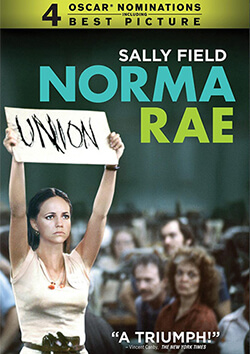 |
| Cover of Norma Rae, directed by Martin Rich, Twentieth Century Fox Film Corporation, 1979. The 2001 DVD re-release cover of Norma Rae features Sally Field's title character in the film's most famous moment. |
In 1979, Hollywood told a fictionalized version of the Stevens campaign in the Academy Award–winning Norma Rae. Scriptwriters framed the movie around Sutton's life story, as told to journalist Henry Leifermann in a 1973 New York Times Magazine article and 1975 book, Crystal Lee, A Woman of Inheritance.6Norma Rae, directed by Martin Ritt (1979; Hollywood: Twentieth Century Fox Home Entertainment, 2001), DVD; Henry Leifermann, "The Unions Are Coming: Trouble in the South's First Industry," New York Times Magazine, August 5, 1973, sec. 6, 10–11, 25–26. Leifermann later published a book based on his interviews with Sutton entitled Crystal Lee, A Woman of Inheritance (New York: MacMillan Publishing, 1975). Sutton revealed her past marital infidelity and that she had never married her second son's father. She feared that anti-union people in town who knew or suspected these things about her would use her secrets to silence her. Sutton later reflected that the New York Times Magazine article freed her from the small town rumor mill because "nobody will ever have anything to hold over me no more."7Sutton, quoted in Victoria Byerly, Hard Times Cotton Mill Girls: Personal Histories of Womanhood and Poverty in the South (Ithaca: ILR Press, 1986), 212. Sutton's unabashed revelations about her checkered past and her unrepentant sexuality caused trouble for her with pro- and anti-union people. "Rumor has got back to me," she recalled, "that people are saying that it's a bunch of whores standing out getting people to join the union." While she was leafleting outside of the mills between shifts, an older white woman refused to take a union card, saying to her, "I been wanting to meet you. I sure do feel sorry for you because of any woman that has little enough respect for herself to [reveal sexual indiscretions in a newspaper article]."8Shikegawa, Woman Alive!, Documentary. In 1974, a dozen pro-union workers wrote to Harold McIver, regional director of the organizing drive, complaining that Sutton exerted too much influence over Eli Zivkovich, the organizer in Roanoke Rapids. One letter insinuated that Sutton and Zivkovich were having an affair: "[Crystal] has got a key to the office. She has got a key to Eli's motel room. So why shouldn't people be talking?"9Letters to Harold McIver from Roanoke Rapids workers, October 29 and 30, 1974, Box 5, Folder "JPS-Roanoke rapids, N.C., General Information and Correspondence," Textile Workers Union of America records, Wisconsin Historical Society, Madison, Wisconsin, Collection 396. (Hereafter cited as TWUA records, WHS, 396.) To the chagrin of Sutton and union leaders, Norma Rae relied heavily on these themes of sexuality, rumor, and internal tensions. But the movie was enormously popular and drew positive attention to the union's Stevens campaign. Sutton toured the country as "the real Norma Rae" in support of the boycott of Stevens's products, always stressing that there were many Norma Raes.
A scene from Norma Rae (1979) illustrating the tension between Norma Rae, a worker at a textile mill, and Reuben Warshowsky, a union organizer. In this scene, Norma Rae's attempt to copy the company's racially inflammatory anti-union letter is mostly faithful to Sutton's biography and official records. The sexually-charged argument between Norma and Reuben, however, was fabricated to demonstrate the unconsumated attraction between the two that the filmmakers wanted in the story. Reuben pushes Norma to prove her political commitment and personal investment in the union campaign, then storms out to relieve the tension by having sex with any woman in town but Norma.
Under pressure from leaders of northern and southern progressive churches and religious groups, women's groups, consumers, and stockholders, Stevens agreed to negotiate contracts in good faith at its mills in Roanoke Rapids and Montgomery, Alabama, the two sites where the union had won elections but did not have contracts. In return, the union agreed to end its boycott and corporate campaign. The 1980 settlement covered only about 12 percent of Stevens workers, but compared to totally nonunion textile corporations, such as Burlington and Cannon, this victory seemed extraordinary. Although national textile employment fell 26 percent between 1973 and 1983, pro-union mill workers in 1980 did not imagine that this victory marked the beginning of the end of their struggle with a failing domestic industry.10Minchin, Don't Sleep with Stevens!, 166–168,177; John Gaventa and Barbara Ellen Smith, "The Deindustrialization of the Textile South: A Case Study," in Hanging by a Thread: Social Change in Southern Textiles, eds. Jeffrey Leiter, Michael D. Schulman, and Phillip J. Wood (Ithaca: ILR Press, 1991), 139–162. For more on the decline of textile manufacturing in the United States and the effects of globalization on textile and apparel industries, see Grace I. Kunz and Myrna B. Garner, Going Global: The Textile and Apparel Industry (New York: Fairchild, 2007); Mary E. Frederickson, Looking South: Race, Gender, and the Transformation of Labor from Reconstruction to Globalization (Gainesville: University Press of Florida, 2011); and Timothy J. Minchin, "Shutdowns in the Sun Belt: The Decline of the Textile and Apparel Industry and Deindustrialization in the South," in Life and Labor in the New New South, ed. Robert H. Zieger (Gainesville: University Press of Florida, 2012). The Stevens campaign built new alliances among feminists, civil rights, and labor advocates and brought publicity to the union's southern effort. Verdicts in the plaintiffs' favor were rolling in from class action discrimination lawsuits filed by African American and women workers against textile corporations. In Roanoke Rapids, Sutton's sister Syretha Medlin evoked the sentiment of her fellow pro-union workers when she said, "This is just wonderful. It's like a whole new life."11Medlin quoted in Minchin, Don't Sleep with Stevens!, 170. On verdicts in class-action discrimination lawsuits, see MacLean, Freedom is Not Enough, 86–87.
Since the 1980s, several labor historians have written about Norma Rae and the Stevens campaign. Timothy Minchin's monograph explores the boycott and corporate campaign from the union's perspective and argues that J. P. Stevens set a precedent for aggressive anti-union attacks in the 1980s. Essays by James Hodges and Robert Zieger describe Crystal Lee Sutton's participation in the unionization effort, critique Norma Rae's poetic license, and celebrate her as a working-class heroine.12 Minchin, Don't Sleep with Stevens!; James A. Hodges, "The Real Norma Rae," in Southern Labor in Transition, 1940–1995, ed. Robert H. Zieger (Knoxville: University of Tennessee Press, 1997), 251–272. See also James A. Hodges, "J. P. Stevens and the Union: Struggle for the South," in Race, Class, and Community in Southern Labor History, eds. Gary M. Fink and Merl E. Reed (Tuscaloosa: University of Alabama Press, 1994), 53–64; Jefferson Cowie, Stayin' Alive: The 1970s and the Last Days of the Working Class (New York: New Press, 2010). In these historians' writings, however, the task of separating fact from fiction obscures the interplay between politics and fantasy, sex and race, and labor and feminism at work in the 1970s. The Stevens campaign reveals how important working-class women's labor feminism and considerations of gender and sexuality were to organizing the textile and apparel industries.13My use of gender and sexuality to analyze the roles of women in labor organizing and economic justice campaigns is greatly influenced by the following scholarship: Jacquelyn Dowd Hall, "Disorderly Women: Gender and Labor Militancy in the Appalachian South," The Journal of American History 73, no. 2 (1986): 354–382; Jacquelyn Dowd Hall, "Public Eyes, Private Women: Images of Class and Sex in the Urban South, Atlanta, Georgia, 1913–1915," in Work Engendered: Toward A New History of American Labor, ed. Ava Baron (Ithaca: Cornell University Press, 1991), 216–242; Jacquelyn Dowd Hall, James Leloudis, Robert Korstad, Mary Murphy, Lu Ann Jones, and Christopher B. Daly, Like a Family: The Making of a Southern Cotton Mill World (Chapel Hill: The University of North Carolina Press, 1987); Mary E. Frederickson, "Heroines and Girl Strikers: Gender Issues and Organized Labor in the Twentieth-Century American South," in Organized Labor in the Twentieth-Century South, ed. Robert H. Zieger (Knoxville: The University of Tennessee Press 1991), 84–112; Mary E. Frederickson, "I Know Which Side I'm On: Southern Women in the Labor Movement in the Twentieth Century," in Women, Work, and Protest, ed. Ruth Milkman (Boston: Routledge and Kegan Paul, 1985), 156–180; Nancy MacLean, "Redesigning Dixie with Affirmative Action: Race, Gender, and the Desegregation of the Southern Textile Mill World," in Gender and the Southern Body Politic, ed., Nancy Bercaw (Oxford: University Press of Mississippi, 2000), 161–191; Dorothy Sue Cobble, The Other Women's Movement: Workplace Justice and Social Rights in Modern America (Princeton: Princeton University Press, 2004); Nancy Gabin, Feminism in the Labor Movement: Women and the United Auto Workers, 1933–1975 (Ithaca: Cornell University Press, 1990); Alice Kessler-Harris, Gendering Labor History (Urbana: University of Illinois Press, 2006); Patricia Hill Collins, Black Feminist Thought: Knowledge, Consciousness, and the Politics of Empowerment (New York: Routledge, 1990), see especially Chapter 3, "Work, Family, and Black Women's Oppression"; Annelise Orleck, Storming Caesar's Palace: How Black Mothers Fought Their Own War on Poverty (Boston: Beacon Press, 2005).
Sick for Justice
On August 28, 1974 in Roanoke Rapids, 3,133 workers streamed through the polling stations in the seven Stevens plants in an NLRB election to determine if the TWUA would represent them. Maurine Hedgepeth, a middle-aged weaver who lost her job in the 1960s because she supported the union, observed the ballot counting that evening in the meeting room in front of the Rosemary mill. The union won by 237 votes. For organizers and union leaders, the success in Roanoke Rapids seemed to signal a turning point: black and white workers could unite against a company as aggressively anti-union as Stevens. "Roanoke Rapids is everywhere," proclaimed North Carolina civil rights activist Reverend W. W. Finlator. Organizer Michael Spzak, who had worked in Greenville, South Carolina, recalls that among labor organizers in the South in the 1970s, "everything was Roanoke Rapids."14 Statement of W. W. Finlator, August 26, 1977, Box 2363, Folder 1, North Carolina State AFL-CIO records, 1945–1981, Special Collections and Archives, Georgia State University Library, Atlanta, Georgia, Collection L1981-20. (Hereafter cited as "NC State AFL-CIO records, GSU Library.") Michael Spzak, recorded interview with the author, March 23, 2011, in author's possession. (Hereafter, cited as "Spzak interview.")
It soon became clear, as one NLRB judge noted, that J. P. Stevens "approached [contract] negotiations with all the tractability and openmindedness of Sherman at the outskirts of Atlanta."15Mimi Conway, Rise Gonna Rise: A Portrait of Southern Textile Workers (New York: Anchor Press/Doubleday, 1979), 11. The quotation from the NLRB judge also appears in Hodges, "J. P. Stevens and the Union," 59. Two years after the euphoria of Roanoke Rapids, the workers still had no contract, and Stevens's persistent labor law violations mired the TWUA in legal battles that siphoned resources away from the organizing. In 1976, the TWUA and the Amalgamated Clothing Workers (ACWA) merged to create the Amalgamated Textile and Clothing Workers Union of America (ACTWU, pronounced "Act Two"). Inspired by the ACWA's successful boycott against the Farah Manufacturing Company in Texas, ACTWU undertook "Don't Sleep with Stevens."16 For information on the Farah Strike, see Emily Honig, "Women at Farah Revisited: Political Mobilization and Its Aftermath among Chicana Workers in El Paso, Texas, 1972–1992," Feminist Studies 22, no. 2 (Summer 1996): 425–452. ACTWU staffer Ray Rogers started a corporate campaign aimed to pressure Stevens executives through stockholders and the financial and insurance companies that supported the company's operations.17Minchin, Don't Sleep With Stevens!, 111–112, 122–124. Hodges, "J. P. Stevens and the Union," 59–61.
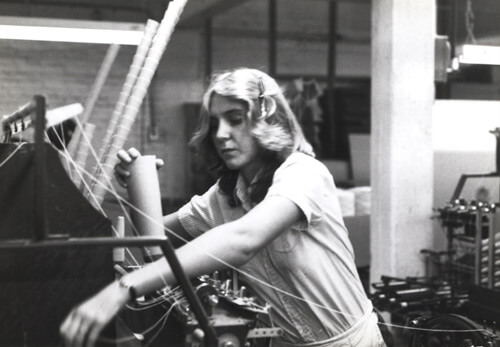 |
| Blonde Woman Working in a Textile Plant, Tennessee, circa late 1970s. Courtesy of Special Collections and Archives, Georgia State University Library, Southern Labor Archives, Amalgamated Clothing and Textile Workers Union, Memphis-Jackson Joint Board Records, L1992_11_112. |
Labor activists and pro-union politicians recognized that with the dramatic growth in economies of the southern states since the 1950s, the future of manufacturing workers in the United States was linked to the South. At the 1977 national labor law reform hearings held in the Roanoke Rapids Civic Center, Congressman Ted Weiss of New York told the Stevens workers there to testify that "the fight that you are waging here in North Carolina and the rest of the South is not just your fight for the workers down here." Wilbur Hobby, president of the North Carolina state AFL-CIO, spoke to the assault on trade unionism through decertification efforts. Civil rights and anti-poverty advocates understood the Stevens campaign to be the next step in keeping alive the 1960s vision of a more equitable and just society. Diana Wilson, a young, African American anti-poverty activist, told the House subcommittee, "People's concerns with union campaigns today are like what black Southerners experienced during the early civil rights days." In March 1977, Coretta Scott King, widow of Martin Luther King Jr., and Bayard Rustin, executive director of the A. Philip Randolph Institute, marched with workers in a protest at Stevens's stockholders meeting in New York.18Conway, Rise Gonna Rise, 130–131, 148, 154–155.
ACTWU allies included politicians, such as US senator Daniel Patrick Moynihan; organizations such as the American Civil Liberties Union (ACLU), the Institute for Southern Studies (ISS), and the National Football League Players Association; and civil rights groups and liberal religious associations. Southerners for Economic Justice (SEJ), formed in 1976 with financial support from ACTWU, became the backbone of the coalition. High profile figures from the 1960s Virginia Durr, Georgia senator Julian Bond, freedom rider John Lewis, Atlanta mayor Maynard Jackson, Rev. W. W. Finlator of the Pullen Baptist Church in Raleigh, North Carolina, and NAACP southern director Ruby Hurley. These veterans joined forces with young, relatively unknown social justice activists coming out of the 1960s New Left and student movements such as Bob Hall, a thirty-two-year-old Florida native and one of the founders of ISS, and Bill Finger, a thirty-year-old civil rights and labor activist from Mississippi who served as SEJ's first executive director. SEJ emphasized its background in the civil rights movement, origin in the South, and independence from ACTWU.19"ACTWU Press Release," December 1978, Box 25, Folder "IUD information," TWUA records, WHS, 396; Minchin, Don't Sleep with Stevens!, 94; "Hearings Before the Committee on Education and Labor (Sub-committee on Labor-Management Relations), H.R. 8410, Labor Reform Act of 1977," August 9, 1977, Box 16, Folder "Misc. Legal Cases," TWUA records, WHS, 396.
SEJ sought to unite activists and organizations around the goal of economic justice. It portrayed the union's campaign as a human rights struggle pitting decent, hard-working women and men against an impersonal corporate giant with a record of discrimination and law-breaking that affronted Christian principles.20"Report from Jim Sessions, SEJ Executive Director," August 8, 1978, Box 12, Folder "Southerners for Economic Justice," TWUA records, WHS, 396. SEJ put pressure on Stevens through letter-writing campaigns, demonstrations and rallies, television and magazine ads, and protesting at stockholder meetings. In January 1978, for instance, SEJ paid for a television commercial, featuring Tom Banks and Ken Reaves of the St. Louis Cardinals, a professional football team that later moved to Arizona, which aired on Greenville, South Carolina, stations just days before the Super Bowl. Banks likened the Stevens campaign to the struggle to organize professional football players.21"Letter to Harold McIver from Bill Finger, with ad script enclosed," December 22, 1977, Box 12, Folder "Southerners For Economic Justice," TWUA records, WHS, 396. SEJ helped the union secure boycott endorsements from civic and religious organizations against Stevens products and the stores that sold them. The United Presbyterian Church identified three Biblical concepts that supported workers' right to organize and passed a resolution that urged its two-and-a-half million members to make a "public witness" through the boycott and "cast their economic ballots in favor of collective bargaining."22"Final report and recommendations on the J. P. Stevens situation, United Presbyterian General Assembly," May 29, 1979, Box 1799, Folder 144, AFL-CIO Civil Rights Department Southeastern Office Records,1974–1984, Special Collections and Archives, Georgia State University Library, Atlanta, Georgia, Collection L1985-16. (Hereafter cited as "AFL-CIO Civil Rights Dept. SE Office records, GSU Library.")
The boycott, as Spzak makes clear, "brought the issue of J. P. Stevens workers to the public eye and into the public arena."23Spzak interview. This did not guarantee change. In a 1976 working paper, SEJ admitted that "the participants in the J. P. Stevens campaign . . . are relatively unknown to most people," making it difficult to "define the merits" of unionization. The participants were "vast numbers of working women who call on the average consumers of Stevens products—another working woman—to help them earn a living for their families."24"Southerners for Economic Justice, Working Paper on J. P. Stevens Campaign," December 1976, Box 1799, Folder 130, AFL-CIO Civil Rights Dept. SE Office records, GSU Library. The personal testimonies of white and African American women workers sought to transform public attention into action. Rank-and-file women displayed their paychecks, private lives, and their bodies as evidence of injustice and as a call to action.
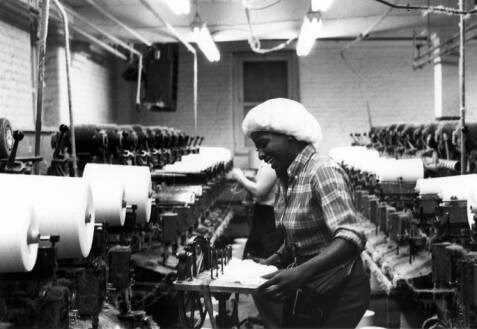 |
| Woman Working with Textiles, ca. late 1970s. Courtesy of Special Collections and Archives, Georgia State University Library, Southern Labor Archives, Amalgamated Clothing and Textile Workers Union, Memphis-Jackson Joint Board Records, L1992-11_73. |
Lucy Taylor was the president of the Roanoke Rapids chapter of the Carolina Brown Lung Association, a group dedicated to getting compensation for mill workers afflicted with respiratory diseases caused by inhaling cotton fibers. She was a fiery public speaker, peppering her speeches with statements like, "They gave me brown lung, I'm giving them hell." Taylor testified at the 1977 annual J. P. Stevens stockholder meeting that at Stevens the "machinery [is] more important than people."25Conway, Rise Gonna Rise, 131, 136. Mildred Whitley of the West Boylston plant in Montgomery, Alabama, explained that after she had a mastectomy, her supervisor told her she could either continue working at the expected pace or go on welfare. SEJ printed her photograph and story in fliers and newsletters sent to supporting organizations, such as the National Alliance Against Racism and Political Repression.26"J. P. Stevens Flier," undated, Box 2, Folder ‘Behavior Control," National Alliance Against Racism & Political Repression Collection, The Schomburg Library, New York City, New York. (Hereafter cited as "NAARPR, Schomburg.") In an interview with the Appalachian magazine, Mountain Life and Work, Addie Jackson of Statesboro, Georgia, linked the treatment of black mill workers to the history of chattel slavery.27"Testimony of Addie Jackson," Mountain Life and Work: The Magazine of the Appalachian South, Volume 53, No. 3 (April 1977), accessed in the Sutton collection, ACC, 986.87. At the labor law reform hearings in Roanoke Rapids in 1977, Louise Bailey, a spinner for thirty-six years, testified that her support of the union in the 1940s got her blackballed for four years. "I feel just sick to my gut," said Bailey, "because when I go in [to work] now, I don't know whether I am going to have a job or not. I know what it is to go hungry. I know what it is when you have a child."28Testimony of Louise Bailey at the congressional field hearings on national labor law reform, the Roanoke Rapids Civic Center, Roanoke Rapids, North Carolina, August 9, 1977, quoted in Conway, Rise, Gonna Rise, 142.
The women's stories made visceral and vivid the abstractions of labor law violations and corporate intransigence. The everyday details in the stories drew the public sympathetically into the workers' lives and complaints: how they had to eat their lunches in the bathrooms because the air in the mill was thick with "cotton dust"; how foremen told crude jokes and vulgar stories to harass and intimidate them; how Stevens monitored bathroom breaks, embarrassing female workers when their "womanly troubles" required more frequent visits; how the company passed them over for promotions and raises because of their sex or race or both. Lucy Taylor's husband quipped that he should sue Stevens for "alienation of affection" because the couple slept in separate beds when brown lung kept Lucy coughing all night. Then he added, "When she gets quiet, I start to worry that she's dead."29The examples of harassment and intimidation that the women described can be found in: Fred Powledge, "The South Will Fall Again," Penthouse, May 1979, 72–79, and Wayne King, "Southern Leaders Form Group to Support Stevens Textile Workers," New York Times, December 12, 1976. Both articles were accessed at Sutton, ACC, 986.87. For personal testimony on women experiencing racial and sexual discrimination in hiring and job placement in the mills, see Conway, Rise Gonna Rise, 109–113. Lucy Taylor's husband quoted in Conway, Rise, Gonna Rise, 86.
Religious Support for Stevens Workers after the 1974 Election Victory
SEJ focused much of its energies on religious leaders and church groups and on publicizing their support. This was especially important in mill towns, where churches provided space for gatherings, were often the center of community life, and lent moral credibility to the activities on their grounds. Chip Hughes and Len Stanley, organizers for the Carolina Brown Lung Association (CBLA) in Erwin, North Carolina, noted that most workers they encountered had grafted their union and CBLA activism onto their church activities. Stanley noted that this was especially true of the women, who organized fish fries and potluck dinners that brought activists and workers together.30Len Stanley from field notes of interview with Betty Bailey, Len Stanley and Thad Moore by Alicia J. Rouverol January 6, 1995, (G-0222), in the Southern Oral History Program Collection (#4007), Southern Historical Collection, Wilson Library, University of North Carolina at Chapel Hill. Chip Hughes recalled the importance of church organizing experience for the elderly women in Erwin. Joseph "Chip" Hughes, recorded interview with the author, December 20, 2011, in author's possession. (Hereafter cited as "Hughes interview.") SEJ's independence from the union allowed it to work through institutions that might have been prejudiced against or wary of organized labor. Spzak recalls that a Free Will Baptist church in Spartanburg, South Carolina, lent its bus to Stevens workers protesting in Columbia.31Spzak interview. Aware that organized religion in the South was often a strong force working against unionization, SEJ sought to organize through sympathetic churches to demonstrate "with maximum visibility the broad range of citizens and southern leaders that support the J. P. Stevens workers" and "minimize the potential for the Stevens campaign to be viewed as a contest between ‘big labor' and ‘big business.'"32"Southerners for Economic Justice, Working Paper on J. P. Stevens Campaign," December 1976, Box 1799, Folder 130, AFL-CIO Civil Rights Dept. SE Office records, Georgia State University Library.
SEJ reported that in 1977 it held more than sixty workshops with ministers, local leaders, and teachers in almost thirty towns and cities and five universities in Tennessee, Virginia, North and South Carolina, Georgia, and Alabama.33"Proposal for SEJ's Third Year," August 8, 1978, Box 12, Folder "Southerners for Economic Justice," TWUA records, WHS, 396. In November 1978, SEJ sponsored a conference, "The Church's Responsibility in the Changing Southern Economy; Case Study: The Church and J. P. Stevens," at Lake Junaluska, North Carolina. Seventy clergy and laity from Tennessee, Virginia, Washington, DC, and the Carolinas participated, representing seven different Christian denominations. In the summer of 1979, SEJ secured a $5,000 donation for the Stevens campaign from the World Council of Churches and organized an economic justice ministry with Sister Mary Priniski in Rock Hill, South Carolina.34"Conference pamphlet, ‘The Church's Responsibility in the Changing Southern Economy; Case Study: The Church and J. P. Stevens,'" November 4 and 5, 1978. "Report from Bill Finger, SEJ Staffer, to Harold McIver," January 19, 1978. "Memo to SEJ Board of Directors, two-month report July 15-Sept. 15, 1979 from Jim Sessions, Director," September 1979. All items from Box 12, Folder "Southerners for Economic Justice," TWUA records, WHS, 396.
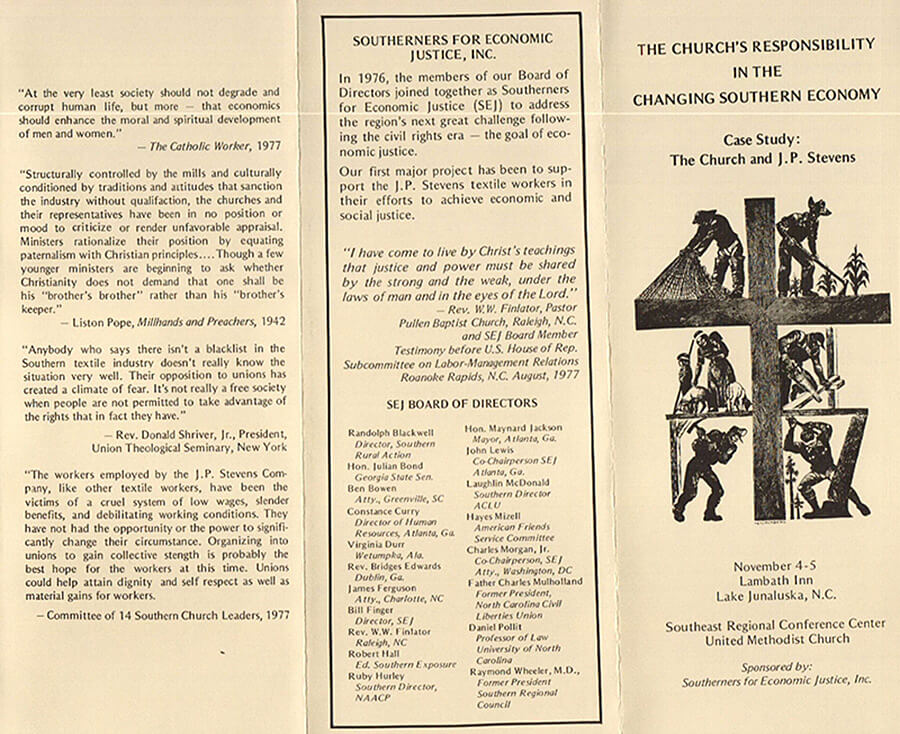 |
| Southeners for Economic Justice (SEJ) pamphlet for the symposium for southern churches held in North Carolina, November 4-5, 1978. Courtesy of the Textile Union of America records, Wisconsin Historical Society, Madison, Wisconsin. |
In Roanoke Rapids in February and November of 1977, Reverend Jim Sessions, then an organizer with the Southern Appalachian Ministry and soon-to-be director of SEJ, and Collins Kilburn of the North Carolina Council of Churches met with ministers of Rosemary United Methodist, First United Methodist, and First Presbyterian churches. "All three are generally supportive of the workers' right to organize," Finger summarized in a report to ACTWU, however they "had some reservations about the boycott." First Union Methodist's pastor had many "high level management people in his church" who did not "believe in the tactic of a boycott," but admitted the NLRB process was an inefficient way to resolve the impasse over a contract. The minister of First Presbyterian, "a patriarch in town [with] some 35 years at the same church," agreed to publicly state that he supported the workers' right to form a union, but felt the boycott "might hurt the town."35"Staff Report by Jim Sessions, Southern Appalachian Ministry," November 3, 1977, and "Report to Concerned Parties by Bill Finger," Box 12, Folder "Southerners for Economic Justice," TWUA records, WHS, 396. While many African American and northern Baptist and Methodist churches and Catholic leaders endorsed the boycott, the support of white southern Protestant churches was more difficult to secure. Getting white southern church leaders to agree to any public acknowledgement of workers' rights—or even just neutrality rather than anti-unionism—was a step forward. Union organizer Joe Uehlein recounts meetings in which he helped Spzak and Sessions talk with anti-union Baptist preachers in Mississippi, explaining that, "Our hope was—and it worked—was to neutralize them so they wouldn't preach against the union."36Joseph Uehlein, recorded interview with the author, March 24, 2012, in author's possession. (Hereafter cited as "Uehlein interview.")
By 1979, an array of religious groups endorsed the boycott: the National Council of Churches, the Women's Division of the United Methodist Church (with nearly one million members), the General Assembly of the United Presbyterian Church, the National Council of Catholic Women, the National Council of Catholic Charities, the Commission on Religion in Appalachia, and the North Carolina Council of Churches.37"ACTWU Press Release," December 1978, Box 25, Folder "IUD information," TWUA records, WHS, 396. At a Roman Catholic Call to Action conference in Detroit, Michigan, in October 1976, the participating bishops issued a statement that advocated the repeal of right-to-work laws and urged the Catholic Church to "commit itself with monies and human resources to aid the struggle of non-union workers to organize in the South, especially the textile industry."38"Catholic Leaders Urge Church to Aid the Organizing Struggle of Textile Workers in the South," Labor Unity 62, no. 13 (December 1976): 11, Sutton, ACC, 986.87. "We believe that those multinational corporations [like] J. P. Stevens . . . must be challenged by Christians in the name of the Lord," extolled the National Coalition of American Nuns. Forty-three-year-old Lucille Sampson, an African American who worked for SEJ after Stevens fired her from its Greenville plant, explained, "They [anti-union co-workers] put you through mental torture. [But] God says, ‘Fear not for I am with thee,' so I'm not afraid."39Quotation from the National Coalition of American Nuns from Minchin, Don't Sleep with Stevens!, 96. Quotation from Lucille Sampson in "Church Women Investigate J. P. Stevens & Company," undated clipping from the newsletter of Church Women United, The Church Woman, page 24, Box 12, Folder "Southerners for Economic Justice," TWUA records, WHS, 396. ACTWU secretary-treasurer Jacob Sheinkman and boycott director Del Mileski claimed that the union's boycott "stirred the nation's conscience" and received more support than the Farah or the United Farm Workers boycotts. SEJ's organizing carried ACTWU's message through networks the union could not or would not work through. Support from preachers, churchwomen, and priests infused the Stevens campaign with a moral urgency and righteous indignation.
Labor Feminism
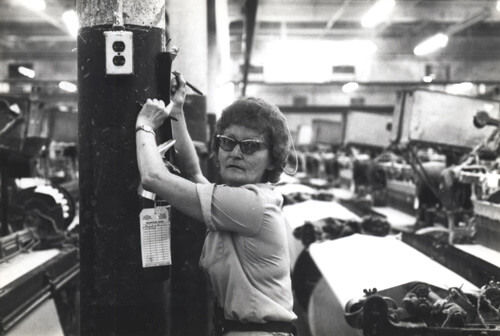 | 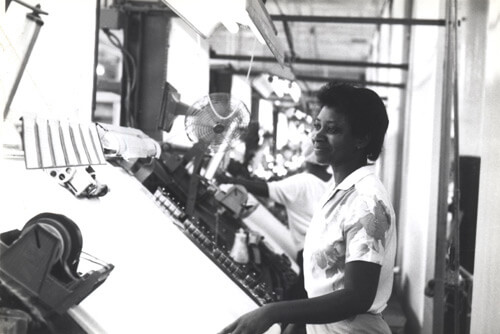 | |
| Woman Working in a Textile Plant, Tennessee, circa late 1970s. Courtesy of Special Collections and Archives, Georgia State University Library, Southern Labor Archives, Amalgamated Clothing and Textile Workers Union, Memphis-Jackson Joint Board Records, L1992_11_88. | African American Woman Working in a Textile Plant, Tennessee, circa late 1970s. Courtesy of Special Collections and Archives, Georgia State University Library, Southern Labor Archives, Amalgamated Clothing and Textile Workers Union, Memphis-Jackson Joint Board Records, L1992_11_91. |
In the last twenty years, historians and feminist scholars have challenged stereotypes and popular images of second-wave feminism, revealing the feminisms of women of color, the gender-conscious activism of working-class women, and the concerns for economic justice that infused many feminist agendas in the 1970s.40See for instance: Benita Roth, Separate Roads to Feminism: Black, Chicana, and White Feminist Movements in America's Second Wave (Cambridge: Cambridge University Press, 2004); Anne M. Valk, Radical Sisters: Second-wave Feminism and Black Liberation in Washington, D.C. (Urbana: University of Illinois Press, 2008); Dennis Deslippe, Rights, Not Roses: Unions and the Rise of Working-Class Feminism, 1945–1980 (Urbana: University of Illinois Press, 2000); Donald Mathews and Jane Sherron De Hart, Sex, Gender, and the Politics of ERA: A State and the Nation (Oxford: Oxford University Press, 1990); Stephanie Gilmore, ed., Feminist Coalitions: Historical Perspectives on Second-Wave Feminism in the United States, (Urbana: University of Illinois Press, 2008); Stephanie Gilmore, Groundswell: Grassroots Feminist Activism in Postwar America (New York: Routledge, 2012); Lisa Levenstein, "‘Don't Agonize, Organize!': The Displaced Homemakers Campaign and the Contested Goals of Postwar Feminism," Journal of American History 100, no. 4 (March 2014): 1114–1138; Annelise Orleck, Storming Caesar's Palace: How Black Mothers Fought Their Own War on Poverty (Boston: Beacon Press, 2005); Anna Enke, Finding the Movement: Sexuality, Contested Space, and Feminist Activism (Durham: Duke University Press, 2007); Melissa Estes Blair, Revolutionizing Expectations: Women's Organizations, Feminism, and the Transformation of Political Culture, 1965–1980 (Athens: University of Georgia Press, 2014). Dozens of women's rights groups endorsed the Stevens boycott, including: the National Organization for Women (NOW), the Coalition of Labor Union Women (CLUW), Church Women United, the National Assembly of Women Religious (NAWR), and the YWCA. Bella Abzug, NOW president Eleanor Smeal, Jane Fonda, and Gloria Steinem spoke in support of the union's campaign. In March 1978, representatives from more than thirty women's organizations met in Washington and established the National Women's Committee to Support J. P. Stevens Workers. The Committee organized letter-writing campaigns aimed at major department store chains, urging them not to sell Stevens products. "As the major purchasers of domestic products," one letter to Woolworth's stated, "we are using our consumer power to help bring justice to the workplace at J. P. Stevens."41"ACTWU Press Release," December 1978, TWUA records, WHS, Box 25, Folder "IUD information," 396; Social Justice 17 (May 1978), accessed in Sutton collection ACC, 986.87; quotation in Minchin, Don't Sleep with Stevens!, 98. The New York chapter of NOW burned Stevens bedsheets in front of Madison Square Garden. The Durham chapter held NOW meetings in the state AFL-CIO's Labor Temple, where they connected their efforts to ratify the Equal Rights Amendment with the Stevens campaign.42"Letters from Harriet Hopkins (coordinator of the NOW Durham chapter) to NC AFL-CIO president Wilbur Hobby," September 10 and 22, 1978, Box 2376, Folder 15; "News from the AFL-CIO: ERA," July 7, 1976, Box 2349, Folder 2, both items in NC State AFL-CIO 1950-81, GSU; "Let's Stand Together: The Story of Ella Mae Wiggins," September 14, 1979, Metrolina Chapter of NOW, Charlotte, NC, in Sutton, ACC, 986.87. See also Minchin, Don't Sleep with Stevens!, 96–98.
Crystal Lee Sutton's speaking tour as "the real Norma Rae" provided the most public example of the connection between labor and feminism in the Stevens campaign and demonstrated how personal narratives engaged a broader public. Norma Rae was a rare Hollywood movie: a sympathetic portrayal of organized labor with a female protagonist. The Washington Post editorialized that "chances were better than good that [audiences] would emerge from the theater cheering for Norma Rae and the Union against the Big, Powerful, Impersonal Company."43"Norma Rae 1, J. P. Stevens 0," Washington Post, October 24, 1980, accessed in Sutton collection, ACC, 986.87. Sutton was disappointed that the film obscured the role of other workers—especially the black workers—who sacrificed their time and often their jobs for the campaign. She also disliked the movie's portrayal of her character as a promiscuous and directionless unwed mother whose romantic interest in the union organizer motivated her activism.44Sutton expressed her displeasure with the movie in several interviews: Mary Bishop, "The Diary of a Union Organizer," Charlotte Observer, May 7, 1978, Section D, 1, 3; Megan Rosenfeld, "Through the Mill with Crystal Lee and ‘Norma Rae,'" Washington Post, June 11, 1980; C. S. Crawford, "Life on Film? One-time Organizer, Crystal Lee Says Movie Is Based On Her Life," Greensboro Daily Times, April 18, 1979; William C. Lhotka, "Real-life Norma Rae Recalls Stevens Fight During St. Louis Visit," St. Louis Post-Dispatch, December 14, 1980, 12A; all accessed at Sutton, ACC, 986.87. Scenes that demonstrate Norma Rae's personal growth hinge on her sexuality: her prior promiscuity, the sexual tension between her and union organizer Reuben Warshowsky, and her revelations about her past to her children. In contrast, director Martin Ritt desexualized Warshowsky to protect "the whole moral fiber of the film" so that it would not seem to audiences that the organizer "was going from one town to another, screwing every dame he made a connection with."45Ritt quoted in Lyn Goldfarb and Anatoli Ilyashov, "Working Class Hero: An Interview with Martin Ritt," in Martin Ritt: Interviews, ed. Gabriel Miller (Jackson: University of Mississippi Press, 2003), 87. The audience, Ritt believed, needed to see Norma Rae's sexuality in order to understand her commitment to the union, but they could not see Warshowsky's sexuality if they were to believe in his integrity.
Whatever misgivings Sutton had about Norma Rae and the script's sexual double standard, she eagerly supported the Stevens campaign. The union ignored the movie's poetic license and embraced its potential to raise public awareness. ACTWU sent publicist Gail Jeffords on a nationwide speaking tour with Sutton. Jeffords wrote to Mileski that Sutton was "a proven media ‘draw,'" and that "ACTWU's position in the Stevens conflict can only be enhanced by taking advantage of her inherent usefulness in public relations." In the first six months of 1980, Sutton was featured in fifty-seven newspapers and made sixty-three appearances on local television and thirty-nine on radio, reaching a potential audience of seventy-five million people.46"Gail Jeffords to Del Mileski," October 16, 1979, and "Gail Jeffords to Murray Finley et al, Final Media Report on Media Coverage for Crystal Lee Sutton," June 30, 1980, both in Box 23, Folder 25, ACTWU Papers, Organizing Department Records, the Kheel Center for Labor-Management Documentation and Archives, School of Industrial and Labor Relations, Cornell University, Ithaca, New York, 5619/007. (Hereafter cited as "ACTWU Paper, Kheel Center, Cornell University.) On Sutton's "Norma Rae" tour, see also Hodges, "The Real Norma Rae," 267.
 |
| A Woman's Place Is in Her Union, button by the Women's Department of the International Association of Machinists and Aerospace Workers, date unknown. Photograph by the Minnesota Historical Society. Featured on the Minnesota Historical Society's Collections Up Close Blog. Courtesy of Minnesota Historical Society. |
Across the country, labor activists arranged screenings of Norma Rae. Reverend Finlator wrote to North Carolina AFL-CIO president Wilbur Hobby recommending that when introducing the film, Hobby should "mention that it was the Women who shut down the machines first—Black and White."47"‘Rev. – W. W. Finlator – Best Regards,' handwritten letter from Finlator to Wilbur Hobby," undated, Box 2363, Folder 1, North Carolina State AFL-CIO records, 1945–1981, GSU Library, L1981-20. In May 1979 in Laurens, South Carolina, the Oaks Cinema cancelled the screenings of Norma Rae after the manager received harassing phone calls and unknown individuals attempted to tear down the cinema's marquee. SEJ organized a petitioning campaign to the stars of the film from moviegoers in Laurens. One handwritten letter accompanying the petitions stated, "We beg you Mr. Liebman [Ron Leibman, who played the union organizer] please don't let us miss Norma Rae. We have heard so much about it and want to see it in our home town where it should be shown." The authors added, "P.S. There is a J. P. Stevens supervisor who works part time at the Oaks Theater."48"Notes on Norma Rae viewings and controversy at the Oaks Cinema," dated April 30–May 18, 1979, TWUA records, WHS, Box 25, Folder "Norma Rae (cancellation)," 396.
Norma Rae and Sutton's speaking tour garnered support for the Stevens campaign from feminists and women's groups. Sutton renewed her ties with Gloria Steinem, who wrote a scathing indictment of Stevens's labor law violations in the Village Voice. Sutton was in conversation with Barbara Kopple, director of the 1977 Oscar-winning documentary of a Kentucky coalminers' strike Harlan County USA, hoping to collaborate on a more factual account of Sutton's experiences with Lily Tomlin in the leading role. Sutton connected the movie's theme of a woman's liberation from her dependency on men with the fight for economic justice in the textile industry. She reminded audiences that in the mills, "women stay on those same jobs year after year with no promotions and few raises [and] it's women who have to smile and flirt to be sure they keep their jobs or don't get impossible jobs."49For more quotations from Sutton that connected economic justice and women's liberation, see Elizabeth Stone, "Norma Rae: The Story They Could Have Told," Ms. Magazine, May 1979, 30–32; Mary Bishop, "The Diary of a Union Organizer," Charlotte Observer, May 7, 1978, Section D, 1, 3; Anicia Lane, "Fact and Fiction: Crystal Lee Sutton Insists She Is Not ‘Norma Rae,'" Signal, April 8, 1980, 10–12. On the number of women in the US labor force in the 1970s, see: "U.S. Department of Labor Employment Standards Administration Women's Bureau ‘Highlights of Women's Employment and Education,'" Box 2443, Folder 18, NC AFL-CIO State Records, GSU. Sutton quoted in "Transcript, International Women's Day Speech," March 8, 1980, Sutton, ACC, 986.87. For scholarly analyses of the themes of unionism and feminism in the movie, see Edward Benson and Sharon Hartman Strom, "Crystal Lee, Norma Rae, and All Their Sisters: Working Women on Film," Film Library Quarterly 12, no. 2/3 (1979): 18–23, and Gay P. Zieger and Robert H. Zieger, "Unions on the Silver Screen: A Review-Essay of F.I.S.T., Blue Collar, and Norma Rae," Labor History 23, no. 1 (Winter 1982): 67–78. She described letting housework take a backseat to the organizing drive in 1973 and the strain on her marriage. "When I got involved with the union there was just no way that I could do [all the housework]," Sutton explained, "And that started causing trouble [at home]."50Sutton quoted in Megan Rosenfeld "Through the Mill With Crystal Lee and ‘Norma Rae,'" Washington Post, June 11, 1980.
Sutton's stories and Norma Rae rang true to many women in the 1970s who discovered a new vocabulary through the women's movement for discussing the challenges they faced as daughters, wives, mothers, and workers.51For an example of southern feminist literature on changing men's attitudes and reforming the institutions they dominated, see Gainesville Women's Liberation Movement, "What Men Can Do for Women's Liberation" in Dear Sisters: Dispatches from the Women's Liberation Movement, eds., Rosalyn Baxandall and Linda Gordon (New York: Basic Books, 2000), 76–77. For an example of an evangelical feminist leader addressing Christian men's unease with women's liberation, see Letha Scanzoni, "How to Live with a Liberated Wife," Christianity Today, June 4, 1976, 6–9. Pat Burgess, for instance, worked at the White Horse and Monaghan Textile plants in Greenville, South Carolina, in the 1970s. When she saw Norma Rae in the theater, she told the Greenville News and Piedmont, "I got so excited I had to holler two or three times." Burgess's coworkers shunned her for passing out union literature. "It's like you're working in a pit of snakes," she said. "Those ladies, I love them, but they're afraid, they define their opinions with what their husbands think."52Sharon Todd, "Two Reviews of Norma Rae," March 25, 1979, Greenville News and Piedmont, Box 26, Folder "Norma Rae Articles," TWUA records, WHS, 396. Charlotte Brody, an activist who lived in Roanoke Rapids from 1976–1979 and worked for the union and the Carolina Brown Lung Association, traveled with Stevens workers to hearings and rallies up and down the eastern seaboard. On the long bus rides, Brody recalls, white and African American working-class women talked about their lives and families. "They were basically saying," Brody recounts, "this is who I always had to be, this is how I always had to fight."53Charlotte Brody, recorded interview with the author, September 3, 2011, in author's possession. (Hereafter cited as "Brody interview.") Some African American women, such as Roanoke Rapids worker Lucy Sledge, had previous organizing experiences with the NAACP and the Halifax County Voters Movement. Many older white women drew on their experiences in church ladies auxiliaries. For most, the campaign was their first chance to be leaders and to speak out as women and workers. Norma Rae was the first time they saw their stories on the big screen.
The extent to which southern working-class women embraced (or even tolerated) the principles and values of women's liberation should not be exaggerated. Brody recalls white working-class women punishing her through gossip and shunning for wearing tight pants and a two-piece bathing suit: "Your politics alone were enough to dismiss you and to suggest that you were less worthy. And then if anybody knew anything about your sexual politics . . . it meant that all forms of misogyny were deserved. It's a lot to stand up to. And people still did."54Ibid. Maurine Hedgepeth, the middle-aged weaver in Roanoke Rapids who had won reinstatement and back pay, met Jane Fonda in 1977. Fonda was one of several actresses under consideration for the role of Norma Rae; she came to Roanoke Rapids to research the campaign and stayed in a rental house owned by the Hedgepeth family. Hedgepeth told Fonda not to take the role because the movie would "throw us in a bad light" and the Norma Rae character was "a loose woman."55Moe Foner, interviewed by Robert Master, Columbia University Oral History Research Office, Notable New Yorkers collection, Session 15, page 359, http://www.columbia.edu/cu/lweb/digital/collections/nny/fonerm/transcripts/fonerm_1_15_356.html, January 23, 1986. Hereafter cited as "Foner interview."
For some workers in Roanoke Rapids, whether pro- or anti-union, the organizing drive and nationwide campaign tapped into social anxieties in the 1970s: desegregation, sexual liberation, Watergate, the oil embargo, soaring inflation, and the ignominy surrounding the Vietnam War. The activism of mill women threatened the gender and sexual normalcy that structured family life and social relationships and supported privileges enjoyed by men and women, including local status and respect. Women such as Hedgepeth had good reason to be invested in the cultural strictures of respectable womanhood. Gossip and rumor had political purchase in Piedmont mill towns. For women labor activists, a sterling reputation as a "good woman" offered protection against accusations of impropriety.56On the sense of social disorder in the 1970s, see Cowie, Stayin' Alive. For an excellent overview of African American experiences integrating the mills in the 1960s and 70s, see Minchin, Hiring the Black Worker. Nancy MacLean argues that "southern white mill workers did not, by and large, militantly act out anxieties about life troubles on black newcomers" in textile mills, but points out that white women "redrew racial boundaries around areas they had more power to control: courtship, family, and church life." "Redesigning Dixie," 179, 184. See also interviews with mill women in Roxanne Newton, Women Workers on Strike: Narratives of Southern Women Unionists (New York: Routledge, 2007); Victoria Morris Byerly, Hard Times Cotton Mill Girls: Personal Histories of Womanhood and Poverty in the South (Ithaca: ILR Press, 1986); and Conway, Rise Gonna Rise, for evidence in the oral histories of white and African American workers that anxieties over racial integration in the mills tended to play out through social exclusivity rather than physical violence. Transgressions against gendered codes of ethics had consequences, from the loss of a job and friends to public shaming and abandonment. Millworkers relied heavily on "who you knew and how you were known" to get and keep a job at the mill. Reverend Joseph Battle, black pastor of the Quankey Baptist Church in Roanoke Rapids, recalled that in 1974 he went to Jessie Shaw, a white man whose family owned a store in town, to get a reference to work at Stevens. Shaw was "the person that folk listened to and if he gave you a reference, you were in."57Reverend Joseph Battle, recorded interview with Rob Shapard and the author, December 4, 2013, in author's possession. (Hereafter cited as "Battle interview.") Good standing in the community was critical to white and African American working-class women. A damaged reputation, from fact or fiction, could mean unemployment and poverty. White and African American women took substantial risks when they stood for the union.
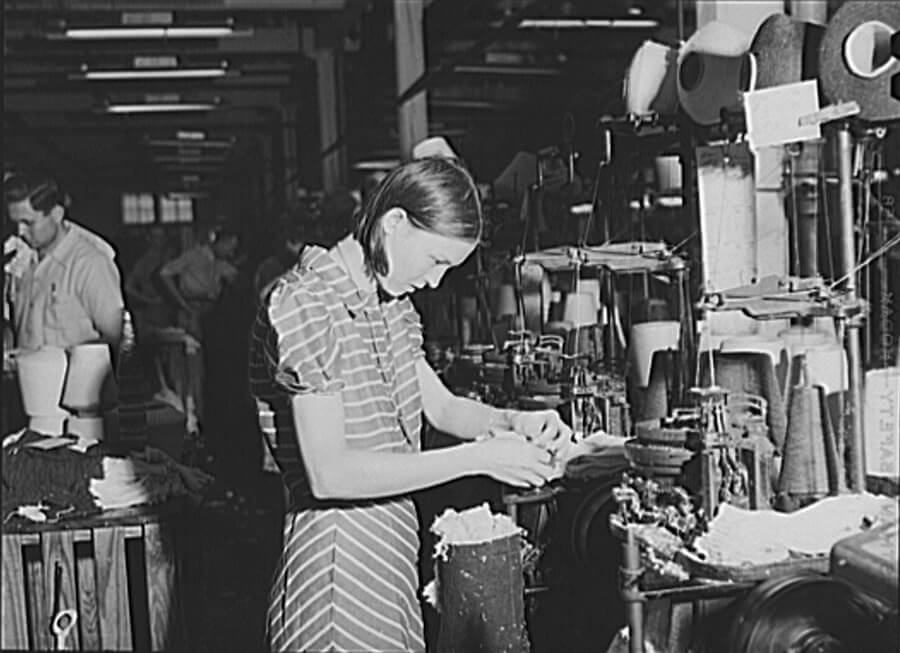 |
| In the Textile Mills in Union Point, Greene County, Georgia, 1941. Photograph by Jack Delano. Courtesy of the Library of Congress, Prints and Photographs Division, LC-USF34-046430-D. |
The working-class women of the Stevens campaign joined a long history of "disorderly" working women who blended indictments of labor exploitation, gender inequality, and racial discrimination in their protests and resistance, from the mill girls who formed the Lowell Female Labor Reform Association in 1844, to the "washing Amazons" of the Atlanta laundresses' strikes in 1877 and 1881, to the female strikers who led the "flying squadrons" across the southern Piedmont in the 1934 General Textile Strike, and the women of the black freedom struggle who led "a rebellion of working-class women" in the 1955 Montgomery bus boycott.58On the Lowell mill girls, see Thomas Dublin, Women at Work: The Transformation of Work and Community in Lowell, Massachusetts, 1826–1860 (New York: Columbia University Press, 1979). On the "washing Amazons," see Tera Hunter, To 'Joy My Freedom: Southern Black Women's Lives and Labors After the Civil War (Boston: Harvard University Press, 1997). On the disorderly women of the 1920s strikes and 1934 General Textile Strike in the southern Piedmont, see Hall et al, Like A Family, and Hall, "Disorderly Women." The "rebellion of working-class women" quotation comes from Ruby Nell Sales, interview by Joseph Mosnier, Library of Congress, Civil Rights History Project, http://findingaids.loc.gov/db/search/xq/searchMferDsc04.xq?_id=loc.afc.eadafc.af013005&_start=58&_lines=125, April 25, 2011. Partial transcript in author's possession.
By the late 1970s, opportunities for living very different lives from their mothers arose for a younger generation of mill women. Cohabitation before marriage was more common, there were legal tools to combat discrimination and abuse, and for all but the most isolated of women, televised evidence of women's "liberation," from demonstrations in Durham, Atlanta, and Gainesville to sitcoms about single mothers like Alice.59See, for instance: Cowie, Stayin' Alive; Enke, Finding the Movement; and Beth Bailey, "‘She Can Bring Home the Bacon': Negotiating Gender in Seventies America," in America in the Seventies, eds. Bailey and David Farber (Lawrence: The University Press of Kansas, 2004). Oral history interviews in the Southern Oral History Program's "The Women's Movement in the South" series U-16, and "The Women's Movement and North Carolina Churches," series R-25 offer many firsthand accounts of how the social justice movements of the 1960s and 1970s changed women's communities and lives in North Carolina and east Tennessee. When Sutton graduated from high school in 1959, she could not imagine any options other than living with her parents or living with a husband. She had never worked closely with African American men or women. In 1974, Sutton befriended Jeannie Bailey and Cheryl Wasmund, two young white women at a Stevens Fabricating Plant who rented a trailer together in town. The three attended interracial union meetings in Sutton's home on Henry Street, next door to one of her foremen at Stevens.60Leifermann, Crystal Lee, 132. Lucy Sledge came from a black working-class family in Halifax County, North Carolina, where her uncle Otis worked for the Stevens mills. In 1970, Sledge represented more than a thousand black workers in Roanoke Rapids in a class-action discrimination lawsuit against the company.61Conway, Rise Gonna Rise, 96–101, 109–113. The TWUA cheerleading squad may not have been the first time mill women brought their daughters into public protests, but because of the women's movement, it was broadcast on public television. "Looking back," said a Roanoke Rapids union activist, the Stevens campaign "really was a working-class women's campaign."62Anonymous union activist, in discussion with the author, October 26, 2013.
At an event in New York City in 1980 celebrating an exhibition of photographs of southern textile workers, Roanoke Rapids weaver Maurine Hedgepeth apologized to Fonda for dissuading her from taking the Norma Rae role. Fonda embraced Hedgepeth and replied, "I've got China Syndrome, Sally [Field] has Norma Rae, we've both got big hits. So it's okay."63Foner interview.
The Norma Raes Win a Contract and Create a Legacy
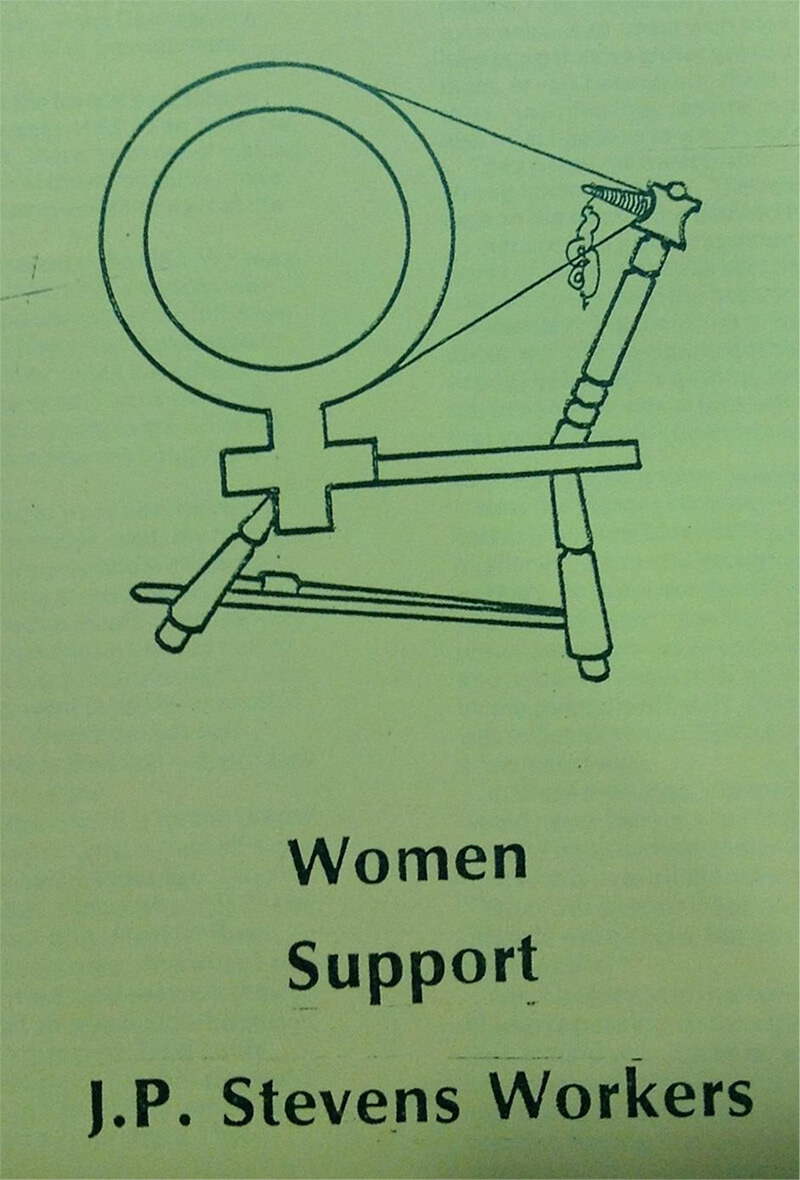 |
| Women Support J. P. Stevens Workers. Courtesy of the National Alliance Against Racism & Political Repression Collection, Manuscripts, Archives and Rare Books Division, Schomburg Center for Research in Black Culture, The New York Public Library. |
In 1980, ACTWU and J. P. Stevens agreed to a settlement. Stevens would not block negotiations over contracts in Roanoke Rapids plants and at West Boylston in Montgomery, Alabama, the two sites where the union had won bargaining rights. Stevens agreed to recognize the union at plants ACTWU was able to organize within the next year and a half. The company agreed to automatic check-off of dues, binding arbitration of grievances, and compensation for the wage increases the workers lost during the years spent trying to secure a contract. In the wake of the settlement, dozens of Roanoke Rapids workers joined the union for the first time. In return, ACTWU called off the boycott and agreed to not single out Stevens as a target in the corporate campaign.64Minchin, Don't Sleep with Stevens!, 166–171.
Success came at a price. In debt, the union laid off many organizers and staffers. Stevens closed the West Boylston plant in 1982; the union negotiated severance pay. ACTWU won more than a third of its elections in the early 1980s, but this was overshadowed by plant closures and layoffs.65Ibid., 175–176; Mary Robinson, Moisture of the Earth: Mary Robinson, Civil Rights and Textile Union Activist, An Oral History, Compiled and Edited by Fran Leeper Buss (Ann Arbor: University of Michigan Press, 2009), 180. Facing import rates that doubled in the 1980s, Stevens, like many textile and apparel manufacturers in the United States, reduced production and shut down many operations. There were more than two million textile and apparel workers in the United States in 1973. By 2009, there were 400,000, nearly all in the Carolinas. Between 1980 and 1985, ACTWU lost more than 50,000 members.66Minchin, "Shutdowns in the Sun Belt," 260, 264. With the 1994 North American Free Trade Agreement, US-owned factories flourished in the maquiladora zone along the Mexican border, exacerbating the decline in textile and apparel manufacturing. The Piedmont lost hundreds of thousands of jobs between 1989 and 1999, and Asian imports continued to flood American markets, especially after China's admission to the World Trade Organization in 2001.67Minchin, "Shutdowns in the Sun Belt," 267. See also Frederickson, Looking South, 241–246.
Production in Roanoke Rapids declined, but the mills—and the union—survived the 1980s. WestPoint Pepperell, Inc. bought J. P. Stevens in a leveraged buyout in 1988 and broke the corporation into three separate businesses. The mills in Roanoke Rapids continued operating under the Bibb Company, and in 1993 Bibb and WestPoint Pepperell merged to create WestPoint Stevens.68Minchin, "Shutdowns in the Sun Belt," 265; Battle's interview. More information on the history of the J. P. Stevens textile corporation can be found at "Global Manufacturing," WestPoint Home, accessed August 9, 2017, http://www.westpointhome.com/about-us.html. When the last mill in Roanoke Rapids closed in 2003, WestPoint Stevens employed about three hundred workers, and the union local was part of the Union of Needletrades, Industrial and Textile Employees (UNITE). Two decades of assaults on organized labor through decertification campaigns, a deindustrialized manufacturing base, and hostility at the state and federal levels of government had considerably weakened the United States labor movement. Less than 10 percent of all textile and apparel workers in the United States were organized.69Frederickson, Looking South, 235. Looking back over the previous thirty years, Bennett Taylor, president of Roanoke Rapids UNITE and one of the many African American workers who worked alongside Crystal Lee Sutton, considered the Stevens legacy with sadness and pride. "J. P. Stevens was, at that time, known as the number one lawbreaker, and for us to organize J. P. Stevens back then," he paused, and took a deep breath, "we made history. I think it's a good legacy. Maybe people don't talk about it enough."70Taylor interviewed in "North Carolina Now," UNC-TV, June 25, 2003, accessed at Sutton, ACC, 986.87.
Mary Robinson was an in-plant organizer in Montgomery and president of the West Boylston local. "I was a nice, little old black girl from the country when I started," she says, "but Stevens made me a woman." When Stevens closed the West Boylston plant, Robinson worked at an axle-factory and then as a bus driver for juvenile disciplinary facilities. She organized the bus drivers and janitors and won representation by the American Federation of State, County, and Municipal Employees. "I try to teach the support personnel what I learned in ACTWU," she said.71Robinson, Moisture of the Earth, 182, 184, 190. Reflections by working-class women who were leaders in the Stevens campaign echo Taylor's pride and suggest that the Stevens legacy has multiple layers. Crystal Lee Sutton declared that getting involved with the union "gave me an opportunity to be the woman I always wanted to be."72Woman Alive!, Documentary. In the 1970s, after her marriage ended and she left Roanoke Rapids and J. P. Stevens, Sutton worked in a hotel and organized her co-workers at the Hilton Inn in Burlington, North Carolina. Her participation in the Stevens campaign gave her a sophisticated grasp of labor politics and her 1980 speaking tour as the "real Norma Rae" honed her skills. In a speech to flight attendants in Dallas, Texas, in 1987, she called for the elimination of the two-tier wage system, explaining how it disproportionately affected women and minorities and discouraged worker solidarity. At a high school in Graham, North Carolina, she warned students about letting racial differences impede class solidarity, telling them, "Green is the color we all need to be concerned about."73"Crystal Lee Sutton's Union Experience," speech given at Graham High School, October 11, 2000; "Crystal Lee Sutton, the ‘real Norma Rae,'" speech given at the Professional Flight Attendants Union in Dallas, Texas, April 22, 1987. Both transcripts accessed at Sutton collection, ACC, 986.87. She embraced her persona as the real Norma Rae and spoke across the United States, in Canada, and the Soviet Union. Since 1979, "Norma Rae" has become a title of sorts, bestowed on female activists to indicate a woman who is sometimes a feminist, usually a workers' rights advocate, and always a strong-willed leader. Journalist Barbara Ehrenreich nicknamed Ai-jen Poo, the founder of the National Domestic Workers Alliance, the "Nannies' Norma Rae."74Barbara Ehrenreich, "The Nannies' Norma Rae," April 26, 2011, New York Times, accessed May 6, 2014, http://tmagazine.blogs.nytimes.com/2011/04/26/the-nannies-norma-rae. In an interview in 1995, Harold McIver, director of the Industrial Union Department's southern campaigns, continually referred to Sutton as "Norma Rae," suggesting the deep intertwining of movie and memory.75Harold McIver, interview by Chris Lutz, Meansville, Georgia, Southern Labor Archives, Special Collections and Archives Department, GSU Library, September 26, 1995.
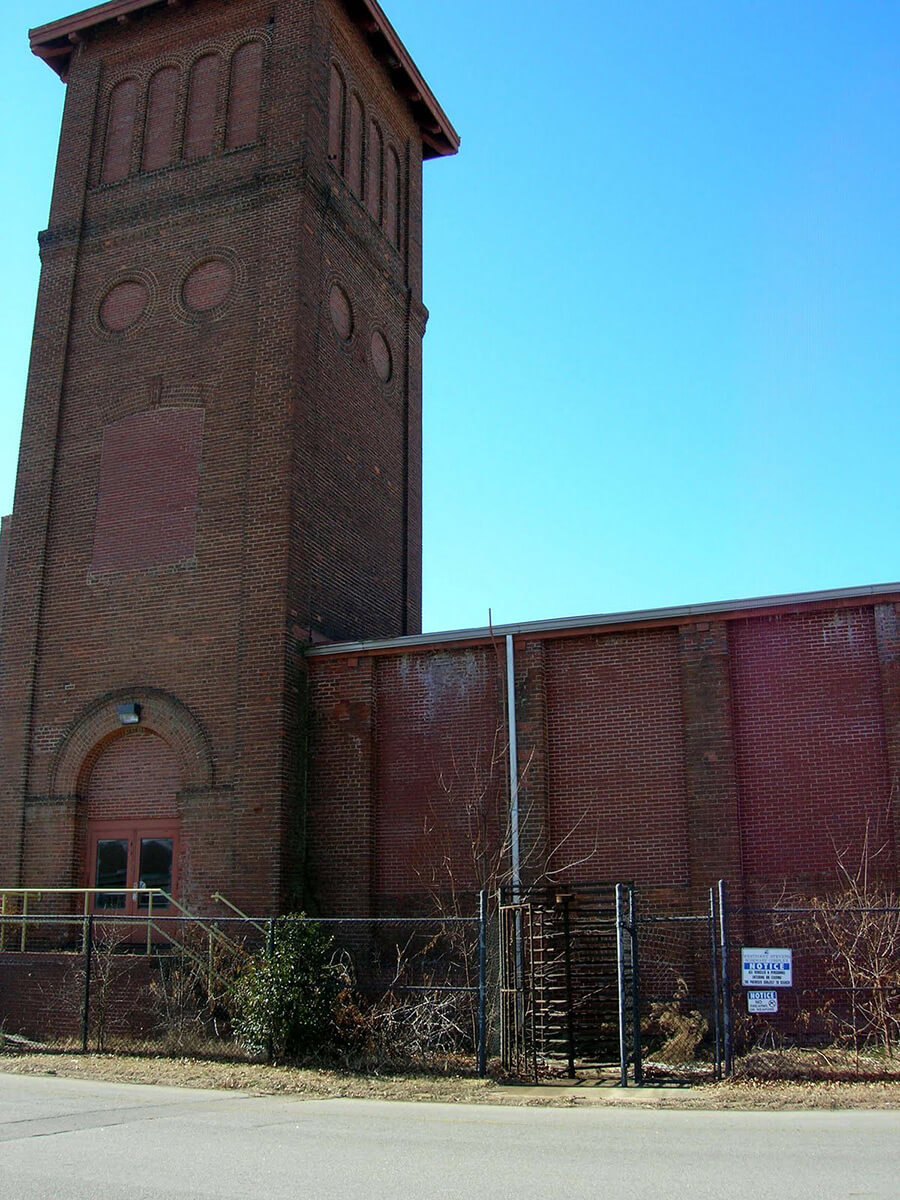 |
| J. P. Stevens Mill, Roanoke Rapids, North Carolina, January 20, 2011. Photographs (above and below) by Donna Longenecker. Courtesy of Donna Longenecker. |
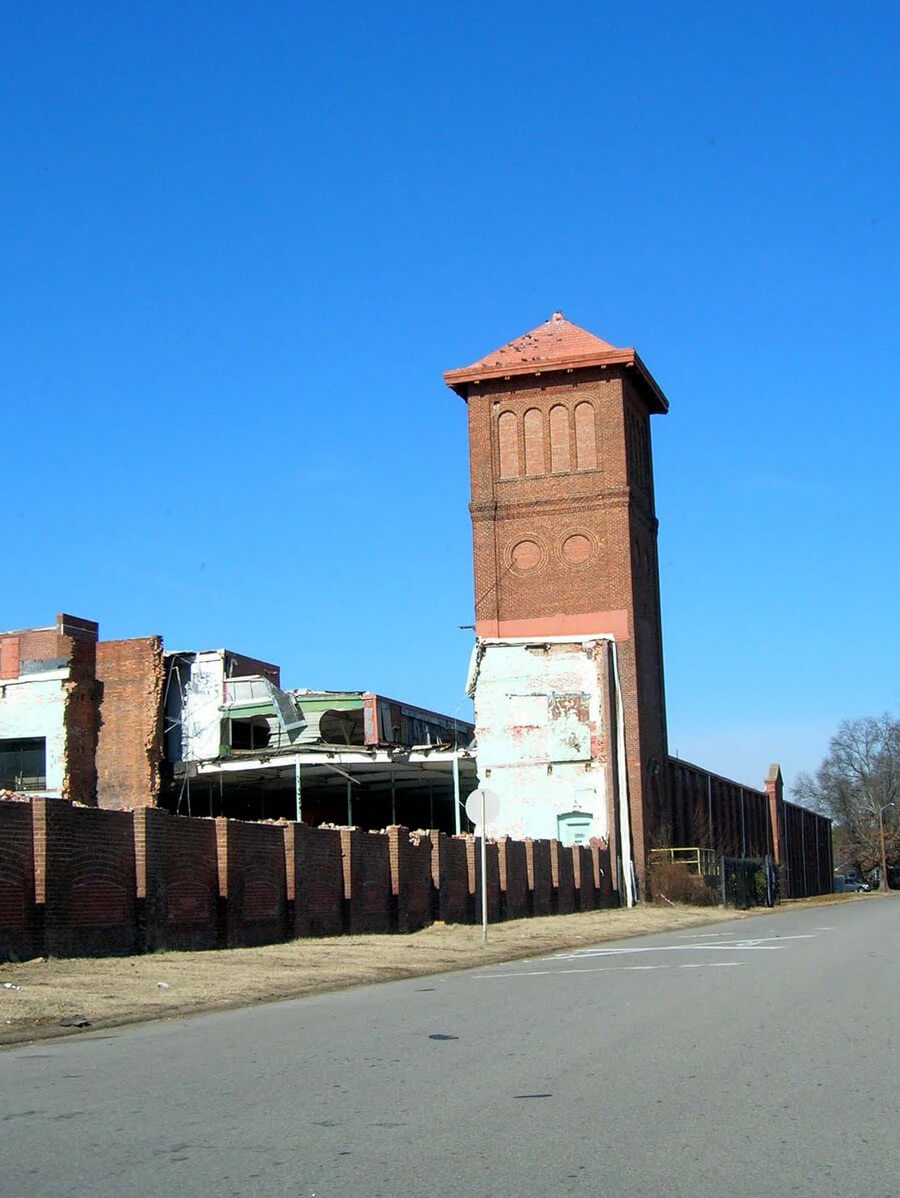 |
Workers such as Mary Robinson regret the loss of their roles as activists. "I sit sometimes and think about all the wonderful people I met during our struggle," Robinson wrote, "and I think I wish that part of it was not over. Life is so short and the good times always go by so fast. But, as long as I can stay close to the labor movement in any way, I will be happy."76Robinson, quoted in Dignity: Lower Income Women Tell of Their Lives and Struggles, ed. Fran Leeper Buss (University of Michigan Press, 1985), 244. For Mildred McEwen, working nights at the West Boylston mill made her feel alone and "empty." Two things comforted her: watching the 700 Club and working for the union: "I think working with the union is a real Christian act because you're working for other people, not just yourself. I could do something else, I don't have to be there [but] I want to see it through."77Whitley quoted in Buss, Dignity, 241–242, and in Labor Unity, November 1980, 7, Sutton, 986.87, ACC. When the mill closed, McEwen left Montgomery to live with her daughter.
In Roanoke Rapids, the legacy of the Stevens campaign took hold in workers' engagement with local politics. Bennett Taylor, James Boone, and Maurine Hedgepeth became active in voter registration drives and local elections. Between 1974 and 1984, voter registration increased by 20 percent in Halifax County (where the mills were located) and nearby Northampton County. For minority residents, registration more than doubled.
Edith Jenkins, one of the first African American women hired as an operative in the late 1960s, supported the 1973–1974 union drive. In the summer of 1985, she organized other black mothers through the Parent Teacher Association to picket the Weldon school superintendent—a white man in a school district that was 90 percent black—after he fired three black administrators. (Weldon is a small town east of Roanoke Rapids in Halifax County.) In 1992, Jenkins won a seat on the school board. "You've got to fight just to survive around here," she said. "That's how we won the union, that's how I won my school board seat."78William Adler, "A New Day in Dixie," Southern Exposure 22, no. 1 (1994): 18.
In 1993, union workers allied with the NAACP to stop a toxic incinerator from being built near a low-income African American neighborhood in Northampton County.79Ibid., 24–25. The Stevens campaign had a lasting impact on its participants, especially the women. Their experiences as organizers and leaders motivated them as activists in other political arenas long after the 1980 settlement. Their years as union activists gave them knowledge, skills, and a sense of confidence and purpose that bolstered them long after the Stevens campaign ended.
The union learned lessons from the Stevens campaign that supported later efforts. ACTWU became UNITE in the 1980s and continued to organize in the South. Plant closures made organizing more difficult, but did not completely halt the union's efforts. In one instance, UNITE organizers followed laid-off garment workers in the Miami, Florida, area into their new occupations in nursing homes and successfully organized about 250 workers.80Bruce Nissen, "A Different Kind of Union: SEIU Healthcare Florida from the Mid-1990s through 2009," in Zieger, Life and Labor in the New New South, 291. Willie Jones, currently the Southern Region Organizing Director for Workers United, worked in the Cone Brothers's White Oak Cotton Mills in Greensboro, North Carolina, in the late 1970s. Jones recalled that when she began working at the mill, the union's leadership "didn't reflect the people that [they] were actually representing." She credits Bruce Raynor, president of UNITE and Workers United, for the change that occurred in the early 1980s. When he took over as director of the southern region, she noted, "women got a chance and minorities got a chance." Raynor started his career as an ACTWU organizer during the Stevens campaign.81Willie Jones, recorded interview with the author, January 15, 2010, in author's possession.
Southerners for Economic Justice continued organizing in the Carolinas after the 1980 settlement. Its "job rights workshops" in unorganized plants in the Carolinas developed into the Worker's Rights Project (WRP), which claimed several state legislative victories, most notably a 1986 South Carolina law making it harder for companies to dismiss injured workers. WRP expanded into the Carolina Alliance for Fair Employment (CAFÉ) in 1987, which then broadened to include concerns over immigration, criminal justice, and domestic violence.82 Janice Fine, "Workers Centers: Organizing Communities at the Edge of the Dream," February 2006, "Publications," Economic Policy Institute, accessed May 6, 2014, http://www.epi.org/publication/books_worker_centers/. With organized labor under attack from corporations, think tanks, well-funded political action committees, and some state governments, the numbers of functioning labor temples and union halls has fallen across the United States, making projects like WRP and CAFÉ all the more valuable for worker education and empowerment.
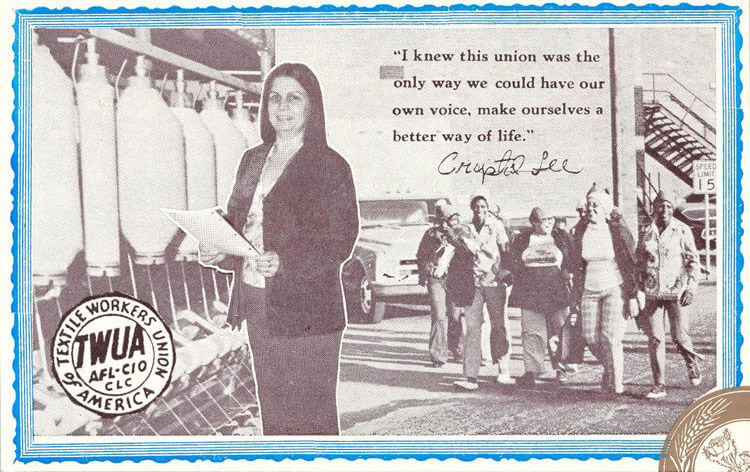 |
| Postcard featuring Crystal Sutton, ca. 1979. Courtesy of The Crystal Sutton Collection, The Learning Resources Center, Alamance Community College, Graham, North Carolina. |
While the Stevens campaign did not have the effect on other corporations that ACTWU hoped it would, it promoted women's leadership and a more community-based approach that many organizers adopted in the 1980s and 1990s.83Groups like Interfaith Workers organize within and without the formal institutions of the labor movement on issues of wage theft, the right to collective bargaining, immigration and labor laws, and corporate responsibility for workers' safety and public health. See "History," Interfaith Worker Justice, accessed May 6, 2014, http://www.iwj.org/about/history. For a recent essay on the alliances between labor and women's groups in North Carolina, see Jennifer Ferris, "Are you One of the 90,000 NC Women Living on the Edge?," March 19, 2014, Women AdvaNCe, accessed June 3, 2014, http://womenadvancenc.org/are-you-one-of-the-90000-nc-women-living-on-the-edge/. For a recent essay on conservative and corporate alliances against labor and religious organizers responses in North Carolina's "Moral Mondays," see Dan T. Carter, "North Carolina: A State of Shock," September 24, 2013, Southern Spaces, accessed June 3, 2014, https://southernspaces.ecdsdev.org/2013/north-carolina-state-shock. Joe Uehlein worked under Harold McIver, organizing furniture workers in 1979 in Tupelo, Mississippi, in an "experimental organizing project where [we] organized through the churches. We set up the women's organizing project. We were doing all this community stuff, which Harold had no patience for." Uehlein reflects on the changes in the union leadership's attitudes in the 1980s, a change he credits to the 1970s Stevens campaign. In Tupelo he hired two women organizers. "I remember it really clearly," he says, "because when [they] showed up, it was like the talk of the union movement." By the late 1980s, the Industrial Union Department had set up the Women's Organizing Project and female staffers and organizers were more common. "A lot of things led to that, but clearly the J. P. Stevens thing, with Norma Rae the movie coming out, Crystal Lee being the leader, that had a lot to do with it."84Uehlein interview. The architects of the Stevens campaign and the working-class women who put themselves front and center to win a contract blazed a trail for future organizers and women workers that has outlasted the mills they organized.
About the Author
Joey Fink is a PhD candidate in history at the University of North Carolina at Chapel Hill. Her dissertation, "The Many Norma Raes," examines the roles of working-class women in the campaign to unionize the J. P. Stevens textile plants in the Piedmont South in the 1970s. While tracing the connections between the women's movement, civil rights groups, and liberal religious organizations in the labor struggle, Fink explores the local contexts and national platforms in which white and African American textile women became leaders and spokeswomen for a workers' rights movement.
]]>Review
 |
| Kelly Yandell, Foodways Texas oyster tasting at Gaido's Restaurant, Galveston, Texas, 2011. |
On a late February Saturday night in Galveston, Texas, I stood shoulder to shoulder with a hundred fellow conspirators, tasting two thousand oysters from all along the Gulf Coast. It was the first symposium hosted by Foodways Texas, an organization dedicated to preserving, promoting, and celebrating the state’s diverse food cultures. We took over a room at Gaido’s, a century-old restaurant that has served its share of succulent oysters. As revelers drank and cheered, Mardi Gras parade floats, barely visible through the early spring fog, advanced noisily down the seawall. Our targets—a consideration of oyster appellations and a revaluing of fish previously dismissed as trash—intermittently floated up through the thick fog of history, ocean, and industrial/scientific rhetoric, raising as many questions as answers. Sweet, fat, briny, buttery, and luscious, the oysters were a phenomenon of excess and local flavor, a bacchanalia fitting the surrounding party.
 |
| Kelly Yandell, Elm Grove oysters, Galveston, Texas, 2011. |
Mad Island, Elm Grove, Todd’s Dump, Possum Pass, Bayou Cook, Pepper Grove, and Ladies Pass. The sheer number of oysters in one place was notable, however the history came from the laminated nametags accompanying each sampling of oysters. Rather than numeric codes in fine print designating the bed from which oysters were harvested, rather than a tag lumping all together as from the Gulf, for one night the oysters stopped being generic. The Texas oyster beds got their names back. We compared the taste of Mad Island versus Pepper Grove. We debated the salinity of Possum Pass versus Bayou Cook. We found the provenance, and we located and glimpsed the history in the names. Who was Todd and what did he dump? What Ladies gave their legacy to Ladies Pass? Where are the elms that inspired Elm Grove?
 |
| P. J. Stoops, Sorting the "trash," Houston, Texas, 2010. |
Ribbonfish, Almaco Jack, Big Eyes, Rainbow Runners, and Drills. Oysters were not the only food to regain their names at the Foodways Texas Gulf Coast gathering. A panel took on monocultural fishing practices driven by market forces, practices that value one product and dismiss everything else that comes up in the nets or on the line as “trash.” If Redfish are selling, then Ribbonfish get trashed, along with Rainbow Runners. But if we rename the trash as by-catch, and find someone like P. J. Stoops, a walking encyclopedia of the names and qualities of Gulf species, then we might compare the Almaco Jack with the Big Eyes and not throw either away. By restoring the names and the balance, we also might find similarities between predators such as oyster drills and delicacies such as escargot, and discover that devotees of snails in butter and delicate herbs also may like oyster drills—kissing cousins to the land snails—prepared the same way. Such practices could help protect the oyster beds from at least one threat.
 |
| P. J. Stoops, Oyster drills, Houston, Texas, 2010. |
Anahuac, Lonesome, Desperation, Moses Gate, Resignation, Mary’s, Slim Jim, Frenchy’s. For this North Carolina native, Texas provides a fascinating geographic shift from which to examine questions of cultures, landscapes, and artifacts. On this particular evening, though, it was my perspective as a humanities scholar that was most engaged. We could locate oysters and restore nineteenth-century reef names because food historians such as Robb Walsh found maps and newspaper stories from before the beds were scientifically coded and classified by number. We heard the poetry in old names used by local fishermen and women perhaps because Stoops’ background includes an English degree, making him inclined to favor the vernacular over the Latin in by-catch names. The long history of erasure of the local by nationalizing or industrializing scientific rhetoric took a small step back. Even if we do not know how Lonesome, Desperate, or Resigned some early oystermen and women were, we glimpsed stories of families and lives memorialized by names. From the restoration of narratives came a challenge to homogeneity and a celebration of heterogeneity of cultures, people, and places. Could it be that Tejano and Mexican fishing practices joined Cajun, Anglo, and African American ones at the Anahuac (or center) with Frenchy, Jim, and Mary coming along? We might feel an investment in terroir—what food scholar Amy Trubek calls the "taste of place" and the connections of flavors, foods, and cultures—if later we hear that Moses and his Gate are threatened, more than we might if unnamed and generalized reefs are said to have declined.
 |
| P. J. Stoops, Triggers, Squirrelfish, Rosebuds, Almacocs, and Porgies, Houston, Texas, 2010. |
Confederate, Dollar, Gaspipe, Dryhole, Snake Island, Redfish. Names and narratives can be fraught and dangerous. We can use them to romanticize an untroubled past, one without Gas pipes draining into the bay waters and without traces of civil war and its racial divides carved into the coast. We can use nostalgia to forget our responsibilities in the present. Dollars seem quaint rather than profoundly influential on a working bay. Oyster and fish names can stand in place of the names of the many men, women, and children who historically worked in the canneries and factories, on the boats, and in the crews—often for little pay, in brutal conditions. Efforts to restore histories and cultures can fetishize products, price them out of their blue-collar roots, and harvest them out of a healthy balance in the ecosystem.
Lonetree, Little Bird, Eagle Point, Buckshot. Amid contemporary habits of quantifying and generalizing, perhaps the fondness for storytelling demonstrated on that February weekend in Galveston addresses a gap. If food and drink can be thoughtfully combined with narratives and bonding across experiences, then names may make a difference. If we root ourselves and our foods in places, connect people and time, and reflect on cultural exchanges, we might build new commitments and political alliances.
 |
| Kelly Yandell, Freshly cooked oyster drills, Galveston, Texas, 2011. |
Did the oyster appellation experiment cut through the night’s soupy fog? Does the by-catch renaming transform our relationship with the seas? Do I now know a truth about oysters, an essential worth of fish not discarded? I am not sure. I do know that since the gathering a few Texas restaurants have begun hosting tastings organized by appellation. A by-catch booth at a Houston farmers’ market twitters lists of species and possibilities—and followers flock in. Perhaps restoring narratives to products previously obscure, unfailingly fresh, and newly valued will strengthen the connections between stories, oysters, fish, and cultures, and even create space for stories untold. That might be worth a celebratory parade.
About the Author
Elizabeth Engelhardt, associate professor of American Studies and Women’s and Gender Studies at the University of Texas, Austin, writes about food, gender, race, and class in the US South. She is lead author of Republic of Barbecue: Stories Beyond the Brisket (2009) and author of the forthcoming A Mess of Greens: Southern Gender and Southern Food (Fall 2011). Engelhardt is also co-editing (with John T. Edge and Ted Ownby) a forthcoming volume about southern food methodologies. Originally from western North Carolina, she has followed in the footsteps of generations who traveled from the mountains of Appalachia to live in and write about Texas.
]]>Introduction
 |
This multimedia essay complements the 2007 Appalshop film Morristown: in the air and sun. Written by independent filmmaker Anne Lewis, the director of Morristown, and Fran Ansley, a Tennessee law professor who served as principal humanities adviser on the project, this essay presents aspects of the Morristown story that we were unable to include in the one-hour documentary: additional context and perspectives for considering factory flight, international labor migration, and the organized demand for economic justice.
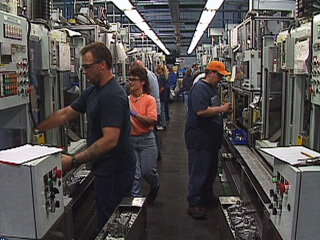 |
| Workers at Toyoda/TRW Plant in Morristown, Tennessee, from Morristown: in the air and sun (2007). |
Filmed between 1991 and 2006 and based primarily in the mountains of east Tennessee, Morristown explores the lived experiences of workers from Tennessee and Mexico who speak about their lives, work, disappointments, and hopes. These conversations are combined with scenes in Tennessee factories, fields, union halls, Mexican-owned stores, workers’ homes, city parks, and employment agencies. The documentary travels to factories and locations in Ciudad Juárez, Chihauhau, and Los Martínez, Guanajuato, Mexico. Morristown concludes with a stunning union victory in 2005-2006 among immigrant workers at a large poultry processing plant.
Although Morristown puts workers’ experiences at its center, it makes space for representatives of business and civic elites in Tennessee and Mexico. In separate interviews, Jack Fishman, the head of the Chamber of Commerce in Morristown, and Roberto Urea, the head of a manufacturers' association in Ciudad Juárez, put forth their opinions about economic development.
 | Jack Fishman: "If your wage rates are excessively high, then you won't attract quality industry and quality jobs." |  | Roberto Urea: "Whether you'd like to pay people more, or you don't want to pay people more, the driving force is not our heart." |
The resulting impression of globalization that Morristown offers is internationalist in its search for class solidarity across borders, but local in its place-based perspectives. The film encourages audiences to question their own assumptions about what they are seeing. It depicts conflict and contradiction among its subjects’ opinions about immigration, labor, and the impacts of globalization.
We are proud of Morristown, and pleased with its reception in the United States and Mexico. We are somewhat frustrated, however, by the constraints that accompany filmmaking. Independent documentaries typically have at least a fifty-to-one shooting ratio—that is, for a finished work that is one hour long, acquired footage is usually more than fifty hours.1See Lance Compa, “Think Globally, Film Locally,” Cornell International Law Journal 41.1 (Winter 2008): 139-142; and Monica Hernandez, “Film Review,” in Ark Magazine, National Organizers Alliance, Issue 24, Fall 2007. Morristown: in the air and sun had an even larger shooting ratio. This raw footage is stored in Appalshop’s archives and made accessible to the occasional scholar or interested individual, but the opportunity for public use is limited.2Appalshop is an organization located in Whitesburg, a small town in the coal fields of eastern Kentucky. In the center’s own words, it is “a non-profit multi-disciplinary arts and education center in the heart of Appalachia producing original films, video, theater, music and spoken-word recordings, radio, photography, multimedia, and books.” The group’s substantial multimedia archive is a national treasure.
Footage was not the only thing that had to be left out of the film. Making Morristown took years and involved a long-term process of building trust with workers and worker organizations on both sides of the US–Mexico border. At times these workers created their own records: union factory women in Tennessee made a scrapbook they hoped to share with fellow factory workers across the border; the film project helped exchange experiences and ideas through interviews that we called Morristown Video Letters.
Other materials were not included because they would detract from the need for a simple narrative line. For instance, the great risks taken by workers while crossing the border are covered very briefly and illustrated with an image of a family running. In this essay we are able to add a first-hand account. Similarly, factual information about the industries where immigrants found employment in east Tennessee was left out of the film. Here we include a chart.
This web-based format gives more freedom to readers, viewers, and listeners. They can interact with the story in different ways—choosing their own pace and sequence, making selections, deciding when to pause, go deeper, or move on.
Although the formats of the film and multimedia essay are different, their politics are the same. Largely without narration, Morristown proceeds through the voices of working class people. As active members of the labor movement ourselves, we know the film itself was possible thanks to the efforts of labor and community organizers, cross-border work by grassroots internationalists, engaged scholarship, and the willingness of working class people in the Southeastern United States and Mexico to share their lived experiences with us. Across many years, miles, and differences, we worked to build relationships of trust outside the boundaries of filmmaking.
In our discussion of the making of Morristown, we offer a linked series of sections. "Going South" takes up the mobility of industrial capital, reporting efforts by Tennessee workers in the 1990s to exert counter-pressure on employers who moved production overseas, and describing a series of cross-border exchange trips that took place between factory workers from Mexico and Tennessee. In "Coming North," we examine reasons for the recent mass migration out of Mexico and what the northward journey means, both for unauthorized migrants entering the country and for families and communities left behind. "Arriving in Morristown" focuses on the arrival of Mexican and Central American immigrants in new interior destinations such as Morristown and their reception by native-born residents. In "Organizing a Southern Industry," we recount the story of a successful organizing drive among immigrant workers at a poultry processing plant in Morristown, a victory that suggests how much all workers stand to gain if the right of immigrants to organize on the job and to function as engaged citizens of the global economy is honored and respected. "Looking Back and Ahead" offers our conclusion.
Going South: A Trip to the Maquiladoras
The movement of industrial capital in search of cheaper labor is nothing new for Tennessee or for the US South. East Tennessee has experienced life at both poles of this dynamic. In the 1960s and earlier, labor-intensive industries such as clothing, textiles, auto parts, and consumer electronics moved their plants from northern cities such as Detroit and Chicago to Morristown, Knoxville, and other cities and small towns along the Interstate 40/81 corridors. They moved to escape union contracts, to minimize their duties under state regulation, and to profit from the incentive programs that have always accompanied industrial recruitment in various versions of the “New South.”
Beginning in the 1980s, many of those same industries moved further still, across the national boundary line and into the global South. Although the nation’s attention was focused predominantly on job loss in northern states like Michigan and Ohio, plant closings brought much of the same personal hopelessness, public neglect, and structural unemployment to the South as they had to the Rust Belt.3On deindustrialization in the United States, see Barry Bluestone and Bennett Harrison, The Deindustrialization of America, (New York: Basic Books, 1984). On deindustrialization in the South, see John Gaventa, Barbara Ellen Smith and Alex Willingham, eds., Communities in Crisis: Appalachia and the South (Philadelphia: Temple University Press, 1990) and Eve Weinbaum, To Move a Mountain: Fighting the Global Economy in Appalachia (New York: New Press, 2004).
Union contracts eroded along with wages and benefits. Social relationships changed. Workers were thrown into competition with other workers, often of different race and national origin. In 1991, Luvernel Clark, then president of Local 1742 of the Amalgamated Clothing and Textile Workers Union, testified before the Office of the United States Trade Representative about the effects of deindustrialization on one enterprise:
 |
A dozen years ago, our factory at Allied was a big, busy place. There were over 3,000 workers employed there. We had contracts with GM, Ford, and other big car manufacturers. But in the early eighties, Allied started shutting down parts of our operation and transferring them to a non-union facility south of here in Alabama. The jobs did not stay in Alabama long. Soon we learned that the work had been moved from there down to a place called Agua Prieta, Mexico. That was the first that a lot of us had heard about all these factories moving to Mexico. We had no idea what really was happening. I am still working now, but I never feel secure.4For Luvernel Clark’s full testimony at the hearing see Frances Lee Ansley, “North American Free Trade Agreement: The Public Debate," Georgia Journal of International and Comparative Law 22 (1992): 392-394.
It was no accident that multinational corporations looking for favorable terms and cheap labor identified Mexico as a favored destination. Launched by the Mexican government in 1964, the Border Industrialization Program (BIP) created the legal infrastructure for a bilateral state-promoted export-processing zone of factories known as maquiladoras (maquilas for short). US-based companies were allowed to produce goods or portions of goods in Mexico that were admitted back into the United States without tariffs as long as production took place within one hundred kilometers of the border.
Conceived as a way to provide jobs for agricultural workers who were returning to Mexico at the end of the “bracero” program that for decades had brought Mexican men to work in US fields, the BIP was slow in getting off the ground. By 1986, there were only 865 maquila plants employing some 227,900 workers along the border. As corporate strategies for globalizing production intensified during the eighties and early nineties, the number of factories at the border steadily grew. After passage of the North American Free Trade Agreement (NAFTA) in 1994 and the immediate drop in the value of the peso, maquiladora employment soared, and the bi-national legal arrangements that underpinned the maquilas were no longer restricted to the border. By 1998, 3,051 Mexican maquilas employed 1,035,957 workers. What had begun as a border-specific exception to Mexico’s relatively nationalist rules on foreign investment and trade became the new neoliberal norm.5William C. Gruben, "Was NAFTA behind Mexico's high maquiladora growth? - Statistical Data Included,” Economic & Financial Review July 2001: 11-21.
As Tennessee felt the impact, groups scrambled to understand what was happening and searched for ways that workers in the increasingly insecure, globalized economy might best respond. In 1989, a coalition of labor unions, religious groups, and community organizations came together to create the Tennessee Industrial Renewal Network (TIRN). Fran Ansley was present at the group’s large founding meeting in Chattanooga as were several factory workers and organizers who later contributed important interviews and insight to the Morristown documentary.6The energy and new relationships that were opened up by TIRN’s founding meeting encouraged Fran to make plant closings the focus of her legal research in the early nineties. See Standing Rusty and Rolling Empty: Law, Poverty and America's Eroding Industrial Base, 81 Geo. L. J. 1757-1896 (1993).
Particularly disturbed by how easy it was for many Tennessee workers to blame the closings on Mexican workers who were “stealing” their jobs, TIRN leaders began looking for ways to promote a more accurate economic understanding in local communities. Drawing on lessons learned by the Highlander Center about the importance of peer education, TIRN sought direct contact between workers in east Tennessee and workers in Mexico.
TIRN reached out to several border groups that were working to expose and address maquila realities: the Border Committee of Women Workers (in Spanish, the Comité Fronterizo de Obreras, or CFO—a grassroots group of women employed in maquiladoras) ; the Border Project of the American Friends Service Committee, a group that partnered with the CFO; and the Coalition for Justice in the Maquiladoras, a network that brought together labor and community activists from the United States and Mexico.7Joe Bandy, "Paradoxes of Transnational Civil Societies under Neoliberalism: The Coalition for Justice in the Maquiladoras," Social Problems 51:3 (August 2004): 410-431. TIRN proposed a two-way worker-to-worker exchange between Tennessee and Mexico, and the CFO and its supporting groups agreed to collaborate.
In July 1991, after TIRN hosted a visit to Knoxville from two maquila workers active in the CFO, a delegation of nine women from TIRN, including Fran, a staff organizer, and seven east Tennessee factory workers, traveled to Mexico.
Anticipating a television series on the future of US manufacturing, a crew from WGBH-Boston filmed the trip. TIRN had agreed to this accompaniment with the understanding that the organization would receive the raw footage after the PBS broadcast. Many months later, staff members approached Anne at nearby Appalshop in Kentucky to ask if she could take the raw tapes and, with worker input, produce a short video.8At the time, Anne was making a film that explored notions of community justice during the mineworkers strike against Pittston Coal, Justice in the Coalfields (Appalshop, 1995). Anne agreed, and the resulting film, From the Mountains to the Maquiladoras, became a key resource for TIRN and for a number of other groups that were then organizing about the loss of US manufacturing jobs, the process of globalization, and emerging US trade policy.9From the Mountains to the Maquiladoras is available in DVD from the Highlander Research and Education Center
Women from Tennessee saw first-hand the transformed operations of companies well known to them, but now in the maquiladora context unfettered by the rules of home. They witnessed the living conditions of people employed in the maquilas and living in makeshift shacks without electricity or running water. Workers shed tears, revealed anxieties, and expressed shock and disorientation. During a visit to a settlement outside of Reynosa, Shirley Reinhardt, a displaced worker from Morristown, stepped aside for a moment to regain her composure.10Like Luvernel Clark, mentioned above, Shirley Reinhardt later gave testimony at a hearing on NAFTA organized by the Office of the US Trade Representative. For her full written testimony submitted to the hearing panel, see Frances Lee Ansley, “North American Free Trade Agreement: The Public Debate," in Georgia Journal of International and Comparative Law, 22 (1992): 388-392. Parts of their oral testimony are also captured in From the Mountains to the Maquiladoras. She said to Fran, “I feel ashamed. I feel ashamed for our government, for our people. I feel so ashamed.”
Returning home, Reinhardt and other TIRN travelers spoke to labor unions, policy-makers, and community groups about why they believed the maquila model and its NAFTA embodiment were a bad deal for workers on both sides of the border.11For more on TIRN’s exchange trips and the work that grew out of them see, Kristi Disney, “Building a Movement on Both Sides of the Border,” in The Global Activist's Manual: Local Ways to Change the World , ed. Mike Prokosch and Laura Raymond, (New York: Thunder’s Mouth Press/Nation Books, 2002), 12-19; Fran Ansley, “Putting the Pieces Together: Tennessee Women Find the Global Economy in Their Own Backyards,” in Women Working the NAFTA Food Chain: Women, Food & Globalization, ed. Deborah Barndt (Toronto: Sumach Press, 1999), 141-160; Fran Ansley and Susan Williams, “Southern Women and Southern Borders on the Move: Tennessee Workers Explore the New International Division of Labor,” in Neither Separate Nor Equal: Women, Race and Class in the U.S. Southeast, ed. Barbara Ellen Smith (Philadelphia: Temple University Press, 1999), 207-244; Fran Ansley, "The Gulf of Mexico, the Academy, and Me," Soundings 78 (1995): 68-104. They organized a car caravan through downtown Morristown to protest NAFTA. They gathered petitions, called on legislators, went to conferences, wrote letters and op-ed pieces for their local papers, and organized rallies.

Eventually the organization sent a delegation to the Seattle demonstrations of 1999 against the World Trade Organization, protests that joined “Teamsters and turtles” to challenge the ambitions of those promoting a free trade agenda.12TIRN’s delegation to Seattle included Barbara Knight, a displaced Philips worker who also became an important contributing voice to Morristown: in the air and sun.
 |
TIRN found that despite its commitment to building cross-border solidarity, it was difficult to maintain active ties with host groups and individuals in Mexico. In 1997, a committee decided to experiment with a scrapbook exchange between women factory workers in east Tennessee and women maquila workers in Juárez. Another worker-to-worker exchange idea resulted in a popular education tool, Morristown Video Letters, an edited selection of interviews with Tennessee and Mexican workers, with voice-over translation into both English and Spanish. TIRN hoped these letters might serve to support on-going dialogue.13Morristown Video Letters is available on DVD, in English and Spanish versions, from the Highlander Research & Education Center.
Coming North: The Long Hard Crossing
TIRN’s video From the Mountains to the Maquiladoras examined the movement of capital—plant closings and conditions in maquila locales where those plants had moved. It did not focus on immigration. In 1991, when the earliest footage was shot, most east Tennessee residents were not aware of the growing numbers of Latino immigrants. But some of the women on the trip—the ones from Morristown—did point out that there were “new people” from Mexico showing up back home. Demographic change in Tennessee was soon evident even to casual observers.
The movement of industrial capital from the United States to the maquilas and the movement of low-wage workers from Mexico to the United States were intimately related. The impacts of NAFTA and related neo-liberal policies were felt throughout Mexico. Resulting pressures fed northward streams of migration. An estimated two million Mexican farmers and farm workers lost their livelihoods as cheap US agricultural products, especially corn, flooded Mexican markets.14Monica Campbell and Tyche Hendricks, “Mexico's Corn Farmers See Their Livelihoods Wither Away: Cheap U.S. Produce Pushes Down Prices Under Free-trade Pact,” San Francisco Chronicle July 31, 2006. The loss was further exacerbated by the sudden devaluation of the peso in December 1994. In one week, the peso went from 4 pesos to 7.2 pesos to the US dollar.15Gary C. Hufbauer and Jeffrey J. Schott, "NAFTA Revisited: Achievements and Challenges," International Institute of Economics, 2005, at p. 10.
The peso devaluation meant many more US factory jobs moved to Mexico where everything from services to utilities to wages had become much cheaper for international investors. Meanwhile, the wages companies offered were worth even less. It became impossible for many working class Mexican communities to survive. The forces that took jobs away from factory workers in east Tennessee forced Mexican workers across the international border. For several Mexican states, human beings became the major export.
Although these changes increased local opportunities for cross-national coalition building, they also triggered resistance. If feelings had been intense about distant Mexicans taking far away factory jobs, local responses were volatile when new people, marked by differences of race, ethnicity and language, began moving next door in a region which had not experienced significant immigration for generations. Workers returning from later TIRN exchange trips found themselves in arguments with friends and neighbors—not only about corporate responsibility and factory flight, but also about the rights and wrongs of immigration.
To tell the story of the new east Tennessee immigrants, we decided that Morristown should follow the migrant stream out of Mexico, across the border, and into the United States, beginning with scenes and narratives about the journey north. We wanted space for Mexicans to tell about making the journey north from their own perspective. What impels such a costly and risky trip? How does an exodus of this scale affect those who stay behind?
 |
Rudy Marquez was one of our first sources. At the time we interviewed him, he lived on a farm outside Morristown, paid for his board with labor, and studied at a community college. Rudy was born in Mexico City. He described his travels after crossing the border years earlier. He and his father picked strawberries in Santa Ana, California, grapes and tomatoes in Fresno, and green beans in Florida. Searching for lower living costs, wider opportunities, and higher pay, they ended up in east Tennessee where they picked tobacco. Although working tobacco was harder, Rudy could earn $350 a week as compared with $150 working other crops.
Another interviewee, Claro Negrete Almeida, spoke with Anne and a Mexican film crew from his home in the state of Guanajuato. He came across the border illegally for the first time in 1972. He had spent many years working in orchards in North Carolina, and he told stories about poor treatment he had received from employers who took advantage of his fears and uncertainties. Thanks to the amnesty program passed during Ronald Reagan's administration in 1986, Claro adjusted his immigration status.16The Immigration Reform and Control Act of 1986 (IRCA). As a result, he was able to move freely across the border, spending seven to nine months of the year in North Carolina and three to five months at home in Guanajuato with his family.
Since there is presently no pathway to legal status available to workers who enter the country without authorization, Claro’s pattern of annual “circular migration” is not an option for an undocumented person today. The costs and dangers of crossing the border continue to mount as federal dollars have poured into its militarization and rates of deportation have soared. Despite the relative freedom of movement Claro's legal status provides, he continues to experience loneliness, dislocation, and bad treatment during his long work stays away from home. “Even if the bars are made of gold,” he says, “it’s still a prison.”
Despite the current burdens of migration, entire villages like Los Martínez, deep in the mountain interior of Mexico, have lost men and boys to the migrant stream. Sixteen-year-old Rosario Duran Camarilla—also from Los Martínez—spoke about how she imagines the United States:
 |
I think it’s very big, many people, I think it’s pretty. My father has always gone there. My brother, this is the first time he’s gone. Neither has papers. They cross the river and you don’t know how they are.
Many boys here say, “How I’d like to go north. We’ll have a good time.” I think it’s very pretty there, but - . . . my father once spent almost three years there. I have a little sister. He left when she was months old and returned when she was three. She asked, “Who is this man?” When he comes back, we don’t know how to talk with him. It’s still very good when he comes. What’s hard is that he spends very little time here and goes back there. He’s back there again.
While describing some of the economic benefits for families who have sent someone north, Rosario’s older neighbor, Isidra Duran De Negrete, talked about what life is like for the women left behind:
 |
It’s very hard for the mother or the wife when the child or the husband goes and they don’t know what’s going to happen. It makes them feel sad. It’s very hard for the wife when the children are hungry and no money comes in from over there.
Now there are people who have trucks, tractors, land, cattle, milk cows, and they live much more easily than before. But this is not everyone, only the ones who go north.
As the words of Olga, Claro, Rosario and Isidra suggest, the forces of contemporary mass labor immigration are complex and include “pushes” from countries of origin, “pulls” from countries of destination, past colonial legacies, and present projects of empire. In the United States, immigration reform is hotly contested and badly needed, but as the interviews in Juárez and Los Martínez suggest, immigration reform can do little to control the huge social currents that have put so many people into motion around the world.
Over the course of the 1990s and into the first decade of the new century, despite ever-increasing attempts to fortify the border, migrants from Mexico and Central America continued to come to the United States. Increasing numbers found their way, as Rudy did, to the Southeast. Migrants did not disperse evenly, but settled in clusters and hot spots. The new Latino migration represented a major and unprecedented demographic change.
The Pew Hispanic Center recently reported on results of the 2010 Census, observing that “states with the largest percent growth in their Hispanic populations include nine where the Latino population more than doubled, including a swath in the southeast United States—Alabama, Arkansas, Kentucky, Mississippi, North Carolina, Tennessee and South Carolina.” A chart linked to Pew’s report shows that Tennessee’s Hispanic population increased from 124,000 in 2000 to 290,000 in 2010, and now constitutes 4.6% of the state’s total. The chart also ranks Tennessee third in the nation in the rate at which its Hispanic population grew between 2000 and 2010—a rate of 134%, smaller only than South Carolina’s 148% and Alabama’s 145%.17“Census 2010: 50 Million Latinos, Hispanics Account for More Than Half of Nation’s Growth in Past Decade,” Pew Hispanic Center Report, March 24, 2011, p. 2. (Rate of change is not the only relevant measure, of course. Although Tennessee is third in the nation in the rate of growth of its Hispanic population, it is 27th in the total number of resident Hispanics, and 37th in the percentage of its overall population that Hispanics now represent.)
Observers have offered various reasons for why many areas of southern states became favored destinations for Latinos.18See, e.g., Fran Ansley and Jon Shefner, eds, Global Connections and Local Receptions: Latino Immigration to the Southeastern United States, (Knoxville: University of Tennessee Press, 2009); Heather Smith and Owen Furuseth, eds., Latinos in the New South: Transformations of Place, (Burlington, VT: Ashgate Publishing Company, 2006); Rakesh Kochhar, Roberto Suro and Sonya Tafoya, The New Latino South: The Context and Consequences of Rapid Population Growth (Washington DC: Pew Hispanic Center, 2005); A.D. Murphy, C. Blanchard, and J. A. Hill, eds., Latino Workers in the Contemporary South (Athens: The University of Georgia Press, 2001). Housing costs lower than those in traditional gateways are one factor, as is the preference of some immigrants for small-town life. For a time, immigration enforcement was patchier in the interior of the country. The availability of paid work is the single strongest determinant. Anita Drever, a University of Tennessee geographer, found that the ten locations in the state with the largest percentage of Latinos in 2000 were all small towns or cities where a particular industry (or a single employer) could easily be identified. Census data are notoriously soft when it comes to measuring Latino populations, so the specific numbers must be viewed with caution, but for comparative purposes the data is quite instructive. Here is a chart showing the results of Drever’s research.
Table 1: Ranked list of towns (census places) with the highest percentages of Latinos in Tennessee and the largest employer of Latinos in these areas
| Rank | City | % Latino | Total | Major Employer of Latinos |
| 1 | Bells | 22.8% | 2,171 | Pictsweet Vegetables (packaging plant) |
| 2 | Monterey | 16.3% | 2,717 | Perdue Farms (chicken processing) |
| 3 | Shelbyville | 14.6% | 16,105 | Tyson Foods (chicken processing) |
| 4 | Morristown | 10.4% | 24,965 | Koch Foods (food processing) |
| 5 | Collegedale | 7.7% | 6,514 | McKee Foods (makers of Little Debbie Snacks) |
| 6 | Springfield | 6.9% | 14,329 | Electrolux Appliance (manufacturing) |
| 7 | McMinnville | 6.8% | 12,749 | Wholesale Nursery Industry |
| 8 | Clarksville | 6.0% | 103,455 | Fort Campbell Military Base |
| 9 | Lenoir City | 6.0% | 6,819 | Monterey Mushrooms |
| 10 | Lewisburg | 5.2% | 10,413 | Walker Die Casting |
Source: Calculations from the US Census 2000, Author’s interviews with the employees of the Chambers of Commerce in the above cities.
Since labor migration was the flip side of plant closings and another aspect of the neo-liberal development model that NAFTA represented, seeking justice for immigrant workers seemed a natural extension of TIRN's work. Labor rights activists struggled for decades to attack the ways that racial division debilitated the southern labor movement.19The literature on this subject is vast. Some starting points: Michael Honey, "The Labor Movement and Racism in the South: An Historical Overview," in Racism and the Denial of Human Rights: Beyond Ethnicity, M. Berlowitz and R. Edari., eds. (Minneapolis: Marxist Educational Press, 1983), 77-96; Eric Arnesen, Waterfront Workers of New Orleans: Race, Class and Politics, 1863-1923 (Oxford: Oxford University Press, 1991); Robert L. Lewis, Black Coal Miners in America: Race, Class and Community Conflict, 1780-1980 (Lexington: University of Kentucky Press, 1987). The increasing presence of Latinos in the workforce and the extreme vulnerability of undocumented immigrants represented a dramatic new turn in an old story.
Immigration raised the possibility of a new kind of labor organizing that might bring together multi-racial coalitions capable of advancing broad demands for social justice in the workplace and beyond. Whether this prospect would be realized was far from certain. But as immigrant workers continued to settle, their responses to the conditions they found began to attract allies, generate campaigns, and demonstrate powerful potential.
Arriving in Morristown: New Kinds of Borders
The US–Mexico maquiladora zone that TIRN delegations had once traveled for days to reach now appeared in Tennessee. Native Tennesseans could meet their Mexican counterparts by visiting any local restaurant kitchen or construction site. And yet differences of race, language, and nationality often separated people as profoundly as physical distance or a geo-political boundary.
Immigrants arriving in Tennessee were entering locales where racial history was at work and racial hierarchies were in place. During slavery and Jim Crow, race was a structural feature of labor markets backed by the full force of law. Although the civil rights movement succeeded in discrediting old racist ideologies and breaking down some barriers to equal opportunity, gross disparities between whites and blacks in the labor force persisted and black unemployment remained at levels far beyond that of whites. These patterns worked to naturalize racial subordination.
Undocumented Latinos disrupted and complicated the existing black-white framework. New political and social alignments seemed likely, though exactly who would align with or against whom was hard to say.20These developments are still too new to assess in any but the most provisional way. Early reports are beginning to sketch a complex and far from homogeneous picture. See, e.,g., Halimah Abdullah, "Hispanic Population Growth Could Realign South's Politics," Miami Herald, April 25, 2011; Mary Odem & Elaine Lacy, eds., Latino Immigration and the Transformation of the U.S. South, (Athens, GA: University of Georgia Press, 2009); Paula D. McClain, Niambi M. Carter, Victoria M. DeFrancesco Soto, Monique L. Lyle, Jeffrey D. Grynaviski, Shayla C. Nunnally, Thomas J. Scotto, J. Alan Kendrick, Gerald F. Lackey, and Kendra Davenport Cotton, “Racial Distancing in a Southern City: Latino Immigrants’ Views of Black Americans,” Journal of Politics 68, no. 3 (August 2006): 571-584. See also Jennifer Gordon and R.A. Lenhardt, “Conflict and Solidarity between African American and Latino Immigrant Workers,” Working Paper #6 of the Series on Immigration of the Chief Justice Earl Warren Institute on Race, Ethnicity and Diversity, 2007.
It was striking to witness the emergence of “brown collar jobs” and the racial reorganization of work.21See Leticia Saucedo, “The Browning of the American Workplace: Protecting Workers in Increasingly Latino-ized Occupations,” Notre Dame Law Review 80 (2004): 303; Lisa Catanzarite, “Dynamics of Segregation and Earnings in Brown-Collar Occupations," Work & Occupations 29 (2002): 300. In east Tennessee, Latino workers were warmly welcomed by many employers. They moved into construction trades previously dominated by white men, but also into occupational categories such as farm work, the laundry industry, hotel housekeeping, and personal service—long coded as labor for blacks or the bottom ranks of working class whites.
Factory job loss and shrinking opportunities in the public sector hit Tennessee's black minority hard. The civil rights movement’s victories, as significant as they were, failed to translate into economic well-being for the black population as a whole. Meanwhile, many Latino immigrants who entered the country without authorization found themselves in low-wage, dirty, and dangerous jobs, where too often their “illegality” justified thinking of them as criminals and treating them as people without rights.22On some of the ways Latino workers fit into employer goals of “flexibilizing” work to their advantage, see David H. Ciscel, Barbara Ellen Smith and Marcela Mendoza, “Ghosts in the Global Machine: New Immigrants and the Redefinition of Work,” Journal of Economic Issues 32 (2003): 333.
Table 2 (below) suggests the income inequality by race and ethnicity in Tennessee, with whites earning dramatically more than blacks or Latinos. While these disparities are echoed at a national level, Tennessee whites, blacks, and Latinos all earn less in absolute dollars than their racial and ethnic counterparts in the US, with Tennessee whites experiencing the greatest difference from the national average.23Table reprinted from Anita Drever, “Tennessee: A New Destination for Latino Migrants,” in Global Connections and Local Receptions: Latino Immigration to the Southeastern United States, Fran Ansley and Jon Shefner, eds. (Knoxville: University of Tennessee Press, 2009). Of course this chart does not allow readers to tease out the working class segments of each racial group, and we suspect the situation of white working class people is more effectively obscured in these statistics, since they are likely a smaller proportion of their racial/ethnic group than are blacks or Latinos. Nevertheless we consider the gross figures worth contemplation.
Table 2: Media Per Capita Earning by Population Group in Tennessee Relative to the United States as a Whole
| Population Group | Median per capita income | % of national per capita income for this group |
| African Americans | $15,117 | 91% |
| Whites | $23,994 | 83% |
| Latinos | $12,688 | 88% |
Source: 2005 American Community Survey
Whatever the racial disparities, economic restructuring meant that working class people in east Tennessee faced economic insecurity during the years when Latino immigration was increasingly evident. It is not hard to imagine that US-born workers in places like Morristown perceived Latino immigrants to be interlopers and competitors rather than potential allies. After all, white workers in the South have repeatedly missed opportunities to act in solidarity with black workers. When the new immigrants arrived in Morristown, racism and xenophobia surfaced.
In 2002, Berkley Bell, the district attorney for Tennessee’s third judicial district, was asked about the impact of Latino workers in the area. He began pleasantly and politely enough, volunteering that the new immigrants were “hardworking Christian people,” and noting that his exposure to immigrants had forced him to modify an earlier preconception that Mexican men were lazy and that Mexican women did all the work. Bell went on, however, to make sweeping assertions that cast the entire Hispanic population as a major source of crime, social pathology, and violence.
In light of Bell’s remarks about "a lot of homicides" among Latinos, we asked a sociology professor at the University of Tennessee about murder in Hamblen County where Morristown is located. Based on Tennessee Bureau of Investigation information, he found such comments as Bell's unsupported.24Thanks to Dr. Ben Feldmeyer of the University of Tennessee Sociology Department for this helpful piece of local research. A large body of scholarship indicates crime rates among Latino immigrants are no higher, and are often lower, than among the native-born population.25For one example of such scholarship, see Robert J. Sampson, “Rethinking Crime and Immigration,” Contexts, Winter 2008, American Sociological Association.
Several elected officials in Morristown showed a similar tendency to blame immigrants for social problems. Hamblen County commissioners told a Knoxville television reporter that undocumented Hispanics were costing Hamblen County “serious money,” and that they might “have to raise property taxes by a million dollars to cover increase[d] costs in schools to hire bilingual teachers." Commissioner Larry Baker was quoted as blaming the property tax increase on too many Hispanics in juvenile court.26"Commissioner: ‘Taxes May Go Up Due to Hispanics,’ ” WVLT Volunteer TV, Knoxville, TN, May 6, 2005.
As tensions between residents and Latino immigrants increased, local leadership did nothing to help citizens understand immigration, much less to address the economic problems facing this small industrial town.
 |
| Counter-protesters during a rally for immigrants' rights and against racial profiling in Morristown, 2003, from Morristown: in the air and sun (2007). |
In spite of the reception they received, the number of Latino workers continued to grow, along with demand for their labor. Workers and their families were becoming part of the local scene–a visible presence in spaces like public parks and soccer fields. But they also maintained close ties with those at home. At Adriana’s Video Mexican Store in Morristown, workers regularly sent dollars back to their families in Mexico where their purchasing power was many times more.
Only someone with a job can send home such remittances, and for Latino immigrants newly arriving in Morristown, work was ordinarily a first priority. In order to secure employment, they turned to various networks and strategies.27For a detailed account of how Latinos came to populate one Tennessee workplace during this period, see Steve Striffler, “Immigration Anxieties: Policing and Regulating Workers and Employers in the Poultry Industry,” in Global Connections and Local Receptions: Latino Immigration to the Southeastern United States, Fran Ansley and Jon Shefner, eds., (Knoxville: University of Tennessee Press, 2009). One channel was a set of specialized temp agencies that opened in Morristown. These agencies functioned as the formal employers of immigrant workers who were then contracted out to places where they labored but were not formally employed. The temp agency protected client companies from worries about liability related to the workers’ legal status and documentation. The agencies generally charged companies twice as much as they paid out to the workers themselves for hourly wages and benefits.
Maximino Garcia, originally from San Antonio, Texas, owned one of the largest of these hiring enterprises. He also ran a loan company, a car lot, an asbestos removal business, and built an evangelical church that ministered to his Latino workforce. “The number one is that we’re always trying to point them to the cross," said Garcia. "We’re always trying to tell them about the Lord.”
Garcia, who was later convicted of illegal trafficking and money laundering, compared Latino workers with black and white native-born workers:
 |
I don’t believe that the Hispanic race is coming in and taking American jobs. I believe that they’re taking jobs that the Americans don’t want and the ones who are griping and complaining are usually the ones that are lazy and don’t want to work. I think that that’s what a lot of the companies look at when they see Hispanics is that these are hard workers. They’re coming in and they’re not going to give us no lip. They’re not going to talk back to us. They’re not going to do nothing. They’re basically going to come in and work, do their jobs.
Garcia's perspective was not the only one voiced by people in Morristown.28On the power—and the inadequacy—of competition as a framework for understanding the relationship between immigrant and native-born workers, see Barbara Smith, “Market Rivals or Class Allies? Relations between African American and Latino Immigrant Workers in Memphis,” in Global Connections and Local Receptions: Latino Immigration to the Southeastern United States, Fran Ansley and Jon Shefner, eds., (Knoxville: University of Tennessee Press, 2009). Shirley Reinhardt, a displaced General Electric worker and TIRN member whose experiences in Mexico were mentioned above, shared a different understanding:29For more about Shirley’s work in Morristown, including a campaign directed at the temp agencies that had burgeoned there as early as the 1980s to broker the labor of native-born factory hands, see Chapter 5 of Eve Weinbaum, To Move a Mountain: Fighting the Global Economy in Appalachia (New York: The New Press, 2004).
 |
It’s a lot like when people in Tennessee went to Michigan to work. The young boys that went north to work, worked for probably a lot less than what the people there would work for.
Farmers say they can’t hire anybody to do the job. Well they can’t hire a slave. They can’t hire a slave and that’s what they’re after. They’re after somebody that’ll work twelve to fourteen hours a day, don’t take any breaks, and work like your life depends on it. And the Mexicans go out there and they work like slaves.
So the Americans say, “Oh boy we’ve got us a good worker here.” Well you’re working them like dogs, and we don’t seem to think there’s anything wrong with that in this country, we think that’s okay.
We want paper towel employees. You just use them as long as it’s beneficial to you and then you throw them away. And you get some more and start all over.
It was not only immigrants who were treated as disposable. Delmas Malone who worked at Berkline Furniture, an old-time Morristown factory, had his wages cut from $12.43 an hour to $6.41. He took early retirement and was given a recliner for his twenty-six years with the company. His wife Betty, a TIRN member, earned $8.88 an hour making televisions at Philips. Betty's pension plan had been terminated and her job appeared to be hanging by a thread. Worried about how they were going to make it, Betty and Delmas mortgaged their farm to go into the chicken-growing business. They assumed all the risk of loss and all the responsibility for waste disposal in a vertically integrated contract that bound them exclusively to the poultry processing plant in Morristown.30For more about east Tennessee poultry growing, see Fran Ansley, “Putting the Pieces Together: Tennessee Women Find the Global Economy in Their Own Backyards,” in Women Working the NAFTA Food Chain: Women, Food and Globalization, Deborah Barndt, ed. (Toronto: Sumach Press, 1999), 141-160.
Organizing in a Southern Industry: Immigrants Step Up
The Morristown Chamber of Commerce, long proud of its highly successful industrial recruitment program, constructed Morristown’s third industrial park with federal and state grants. Soon they began to fill it with companies like Koch Foods, one of the nation’s largest poultry producers and processors. Koch had acquired Morristown’s older, family-owned poultry business and was now looking to expand.
 |
| Street signs, new industrial park, Morristown, Tennessee, from Morristown: in the air and sun (2007). |
Koch’s facility was sparkling and bright on the outside, but there were major problems inside. According to reports of workers at the plant, the speed of the line was brutal, wages were minimal, worker health and safety were regularly put at risk, and the relationship between workers and their supervisors was disrespectful and degrading.31Unfortunately, Koch Foods was not unusual in this respect. For more on the poultry industry, see Steve Striffler, Chicken: The Dangerous Transformation of America's Favorite Food (New Haven: Yale University Press, 2005); William Kandel & Emilio A. Parrado, “Industrial Transformation and Hispanic Migration to the American South: The Case of the Poultry Industry,” in Hispanic Spaces, Latino Places: A Geography of Regional and Cultural Diversity, ed. Daniel D. Arreola, (Austin: University of Texas Press, 2004); and Lance A. Compa, Blood, Sweat and Fear: Workers’ Rights in U.S. Meat and Poultry Plants (New York: Human Rights Watch, 2004). In the face of these conditions, the work force had become predominantly Latino, many of them undocumented. Workers made several attempts to change their conditions, including a targeted strike where all the workers walked off the line and proceeded to the bathroom as a group in protest over the chronic refusal of line supervisors to allow reasonable bathroom breaks. They won verbal concessions whose results were short-lived.
Eventually, a Koch Foods worker contacted a lawyer from Southern Migrant Legal Services in Nashville about the problem of access to bathroom breaks. Other workers stepped forward to point out problems with health and safety practices. They held meetings, documented grievances, and took their concerns to management. When several leaders were fired in retaliation in front of an assembled group, workers reacted with indignation and reached out for support.
In early 2005, after being contacted by workers at the poultry plant, doing preliminary research, and observing workers' energy and resolve, the United Food and Commercial Workers Union (UFCW) launched an organizing drive. The UFCW local that the workers would join was based primarily in grocery stores, a labor force whose work environment and demographics were dramatically different from those of the poultry workers. At a national level the UFCW had substantial membership in meatpacking and poultry plants, and the organization was aware that inclusion of immigrants was crucial to its survival and strength.
The UCFW sent J.R. Richardson, an African-American from Alabama, to be the lead organizer in Morristown. He was accompanied by David Ceballos, a Spanish-speaking union staffer from Arizona. They set up shop in Morristown and began holding meetings with workers.
A few weeks into the campaign, accompanied by the Morristown film crew, union organizers visited workers in their homes who talked about what they had encountered in the plant and why they needed a union. Some of this video testimony was eventually used by the union to help win an agreement with corporate executives in Chicago that the corporation would not interfere in the union election process.
The union drive attracted allies. An affiliated UFCW local in the area had once represented a workforce of several thousand chemical workers whose plant was closing and shipping its equipment overseas. Randy Alexander, president of that local, opened the doors of his tattered union hall to the organizing drive and welcomed the workers from Koch Foods who held meetings there as well as a large rally that attracted supporters from throughout east Tennessee.32This part of the story moved a Houston reporter who visited Morristown that season. Kim Cobb, “On Common Ground in a Common Struggle,” Houston Chronicle, October 24, 2006.
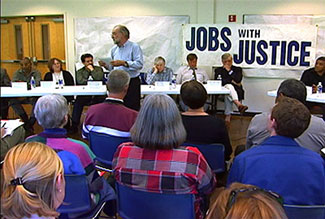 |
| Worker Rights Board Hearing Organized by Jobs with Justice of East Tennessee, from Morristown: in the air and sun (2007). |
Jobs with Justice of East Tennessee (JwJET), an all-volunteer group headquartered in Knoxville, generated civic, church, and labor union support. They convened a Worker’s Rights Board that heard testimony about the right to organize and about the failure of US labor law to adequately protect that right. Jim Sessions, co-chair of the chapter, introduced the panel of witnesses:
The right to organize is a human right and it’s a democratic right and it’s the law. But the law’s not obeyed very much on this matter in this country. That’s what we want to talk about tonight. And we’ll hear how difficult, also the aspirations of people who aspire to that democracy in the work place in our area.
One of the workers who testified was Artemio Jimenez, who had been fired while attempting to organize a Monterrey Mushroom plant in east Tennessee. Although Artemio brought a lawsuit over his firing, he was never allowed to present his facts in court. As an “agricultural worker,” he was expressly excluded from the National Labor Relations Act (NLRA) and its protections.33The exclusion of both agricultural workers and domestic workers from coverage under the NLRA dates back to the New Deal compromise struck with Dixiecrats in order to get that major piece of labor legislation through Congress. This was a race-linked compromise still only partly remedied today. For more information on the great range of workers who have been excluded in different ways from the protection of our present labor laws, see Excluded Workers Congress, “Unity for Dignity: Expanding the Right to Organize to Win Human Rights at Work,” Dec. 2010.
The union campaign at Koch Foods was well organized and highlighted the rights of workers while building understanding among coalition members about immigration, racism, and xenophobia. JwJET involved churches, other unions, and activists throughout east Tennessee including nearby native-born, factory workers who had been part of TIRN.
These support efforts were important, but the workers made the biggest difference in the success of the election drive. Despite threats of firing and deportation, leaders from the factory floor made house calls to recruit fellow workers and gather signed cards. Organizers anticipated employer behavior and explained the election process and US labor law. Morristown workers showed how effectively immigrants could mobilize when their basic trust was earned.
When the NLRB election day finally arrived, organizers were cautiously optimistic, but no one was sure what was going to happen. Fran remembers standing outside the plant with other supporters, waiting for the vote count:
Standing along the highway that morning, together with our JwJET delegation from Knoxville, there were black, white, and Latino organizers and union members from the UFCW, and a couple of guys from the Nashville local union to which the Morristown chicken plant workers would be attached if the election went for the union. There was a faithful young intern from the Highlander Research and Education Center whose highly skilled interpreting and translating services had been integral to the organizers’ efforts and workers’ comprehension, involvement, and morale. There was a union painter from Morristown who had learned about the election at a recent Labor Day event in Knoxville who showed up at the factory gates to lend his support. There was an Appalshop film crew diligently working the crowd for interviews and impressions. There was the president of a dying union local at a soon-to-close chemical plant in Morristown who throughout the organizing drive had opened the doors of his aging union hall to the workers from the chicken plant, welcoming its use for meetings, rallies, child care, buffet suppers, and workshops, and who had now come to stand with them on this fateful day.
The wait seemed interminable, but at last we made out the sound of cheering. Spilling down the hill toward our waiting group came an elated crew of union-designated election watchers. “Ganamos! We won! Ganamos!”
The workers had scored not a mere victory, but a landslide. The margin was 465 to 18.34Fran Ansley, “Labor Rights and Immigrant Workers in East Tennessee: Talking Union in Two Languages,” in Transforming Places: Lessons in Movement Building from Appalachia eds. Steve Fisher and Barbara Ellen Smith (Champaign: University of Illinois Press, forthcoming).
Looking Back and Ahead
The moment of victory was sweet. When Anne was editing the film, it became the apex of Morristown. Winning a union election, however, is no guarantee that workers will build a functioning union with workplace strength. A crucial “first contract” must be achieved. US companies, advised by batteries of management-side lawyers, have refined their ability to stall, delay, and undermine the negotiating process to such a degree that winning a first union contract after a successful organizing campaign has often proven an insurmountable hurdle.
In Morristown, after the pro-union vote, the UFCW and Koch Foods talked for months without reaching agreement. Finally the company declared there was nothing left to discuss and submitted its “last best offer,” a poor set of proposals testing union resolve. Unanimously the workers turned down the company’s offer. A month later, after further bargaining, they approved a union contract that included eye protection, bathroom breaks, health insurance, and higher wages.
Meanwhile, in the spring of 2006, immigrants all over the country poured into the streets by the hundreds of thousands to protest a virulent bill that had passed the US House of Representatives. They demanded reform that would provide a pathway to citizenship for many undocumented immigrants and make reasonable provision for immigrant entry in the future. The workers’ victory in Morristown had been powered by some of the same currents of discontent and determination that had fed the mobilizations for immigration reform.
The Tennessee Immigrant and Refugee Rights Coalition, founded in Nashville in 2001, hired its first organizer for east Tennessee in November, 2005.35For more about the origins of the Tennessee Immigrant and Refugee Rights Coalition, see Fran Ansley, “Constructing Citizenship Without a License: The Struggle of Undocumented Immigrants in the U.S. for Livelihoods and Recognition,” in Inclusive Citizenship: Meanings and Expressions ed. Naila Kabeer (London: Zed Books, 2005),199-215. In April 2006, the Coalition organized rallies all over the state for immigration reform, and they put out the word across east Tennessee for immigrants to join the action planned for Knoxville.
As Fran stood with thousands of other demonstrators in front of the federal building in Knoxville, she saw the members of the workers’ organizing committee from Koch Foods. Delighted at the size and spirited mood of the crowd, the workers announced they had achieved final agreement on a contract and that the company had shut down the plant for the day to allow workers to attend the Knoxville rally!
Neither the Knoxville march nor the signing of the contract resolved all the problems that led Koch Food workers to mobilize for union recognition and for immigration reform. But both of those achievements—and their remarkable joining in the streets of Knoxville on that day—suggest the potential power of strategies that include and unite.
Today the union at the Morristown chicken plant survives but faces tough challenges. Many poultry processing plants remain unorganized, and standards across the industry are low, even at unionized plants. Congress failed to pass federal labor law reform that would have made victories like the one at Koch Foods less of a rarity.36The particular bill that was proposed was known as the Employee Free Choice Act, and it would have made it substantially easier for workers in unorganized workplaces already covered by the National Labor Relations Act to win union recognition. The bill left many important issues unaddressed and many needy workers uncovered by its protections, but it would have been one important step toward changing the rules that are presently slanted so strongly in favor of employers and against workers who seek collective representation.
The movement for immigration reform faces similar challenges. Despite the mass mobilizations of 2006 and much campaigning since, federal reform is currently stalled. Beginning in December of 2006, immigrant workers at places like Koch Foods endured a long brutal season of workplace raids under the administration of George W. Bush.37For a paper on the 2008 immigration raid on a poultry plant in Chattanooga, see Karla Mari McKanders, “The Unspoken Voices of Indigenous Women in Immigration Raids” (November 22, 2010). University of Tennessee Legal Studies Research, Paper No. 133. Under the Obama administration these high-profile raids on immigrant-heavy workplaces have largely ceased. The end of these raids was a welcome improvement. Unfortunately, ICE raids at workplaces have been replaced with beefed-up audits and record-checking procedures that often result in mass firings of immigrant workers. Meanwhile, through other programs of immigration enforcement, rates of detention and deportation have risen to record levels across the country.
At the state level, jurisdictions such as Arizona have pioneered approaches that target immigrants and their families, charge local authorities with enforcing federal law, and effectively turn the criminal justice system into an immigration dragnet. Given that undocumented people cannot obtain a driver’s license, “driving while brown” becomes an activity inviting racial profiling and is punishable by banishment and family separation. Such measures push undocumented people into the shadows, make them even more vulnerable to abuse, and discourage immigrants from turning to local law enforcement when they need help or could offer assistance in the investigation of serious crimes.38See Major Cities Chiefs, “M.C.C. Immigration Committee Recommendations For Enforcement of Immigration Laws By Local Police Agencies” (2006).
At this writing in spring 2011, several states in the Southeast, including Tennessee, Georgia, and Alabama, are actively considering versions of the Arizona anti-immigration legislation.39During the spring 2011 session, Tennessee legislators proposed a bundle of bills modeled on Arizona’s. An example was HB 1380 that sought to require every law enforcement officer in the state—every time he or she “makes a lawful stop”—to question the person's immigration status, contact federal agents if there is "reasonable suspicion" an immigration violation has occurred, and transport the person to a federal holding facility. State and local jurisdictions have also entered into arrangements that more tightly integrate local policing and jails with federal immigration enforcement.40See Melissa Keaney and Joan Friedland, ‘Overview of the Key ICE ACCESS Programs: 287(g), the Criminal Alien Program and Secure Communities,” National Immigration Law Center (2009). Described as targeting “criminal aliens,” these enforcement agreements have led to the deportation of large numbers of undocumented people with no record of serious crime.41See Aarti Kohli and Deepa Varma, Borders, Jails and Jobsites: An Overview of Federal Immigration Enforcement Programs in the U.S., Chief Justice Earl Warren Institute Race, Ethnicity and Diversity (Feb. 2011). The impact on immigrant families and communities is severe.42See, e.g., Elena Lacayo, “The Impact of Section 287(g) of the Immigration and Nationality Act on the Latino Community,” National Council of La Raza Issue Brief No. 21 (2010) (includes case study of Nashville); Andrea Danit Guttin, “Criminals, Immigrants, or Victims? Rethinking the ‘Criminal Alien Program,’" (master’s thesis, University of Texas at Austin, 2009). (case study of Houston); Michael J. Wishnie, “State and Local Enforcement of Immigration Laws,” Journal of Constitutional Law, Vol. 6, No. 5 (May 2004), 1084-1115.
In the workplace, the threat of deportation injects additional fear for immigrant workers considering whether to press for better treatment on the job, fight back against the epidemic of wage theft that plagues today’s immigrant-heavy industries, or join in forming unions. Organizers and advocates report that employers threaten workers with deportation if and when workers complain about conditions or treatment on the job.43See Rebecca Smith, Ana Avendano and Julie Martinez Ortega, ICED Out: How Immigration Enforcement Has Interfered with Workers’ Rights, published by the AFL-CIO, the National Employment Law Project, and American Rights at Work (2009).
After years of working on Morristown and walking with the movements that it traces, we remain convinced that labor rights and immigrants’ rights are mutually dependent and inextricably intertwined. Campaigns and organizations that integrate both kinds of claims create spaces where workers can learn from each other and identify shared interests.44 For more on the intersection of these two movements, see Frances Ansley, “Doing Policy from Below: Worker Solidarity and the Prospects for Immigration Reform,” Cornell International Law Journal, Vol. 41, No. 1 (Winter 2008), 101-114; and Fran Ansley, “Local Contact Points at Global Divides: Labor Rights and Immigrant Rights as Sites for Cosmopolitan Legality,” in Law and Globalization from Below: Towards a Cosmopolitan Legality, Boaventura de Sousa Santos and Cesar A. Rodriguez-Garavito eds. (Cambridge: Cambridge University Press, 2005). However, serious obstacles to building class solidarity across divides of race and nation remain. Exclusionary whiteness runs deep, as does an exclusionary kind of Americanism. Anti-immigrant backlash is alive and well around the United States, and that backlash can be found among working class people and union members as among other segments of the population. But as Morristown documents, there are also working class southerners, both black and white, who can and do respond differently to immigration and to the question of immigrants’ rights, workers who express solidarity and see a basis for common ground. Shirley Reinhardt suggested something like this when she spoke with us before the Koch Foods election about what a victory would mean:
You’re saying to all the others from Mexico, they don’t have to treat you worse than anybody else. You can organize. That’s exactly what you’re saying. Not only are you saying that to the people from Mexico but you’re saying that to the people of Hamblen County, too.
While Morristown is on the side of workers like Shirley Reinhardt, it asks open-ended questions, tolerates ambiguity in the answers received, and intends to leave viewers with plenty to think about. Anne asked US-born people what they thought about the idea of “open borders.” Certainly our idea of a just global order would require something far more complex than that phrase conveys. In fact a good part of TIRN’s work on the question of plant closings and capital flight had urged the need for building and honoring boundaries within which democratic decision-making can take place and within which economic ground rules can be established and enforced. But a just global order is so far from what we have now, would require such profound reorientation of present realities, and is so seldom discussed in the public debates to which most working people in the United States have reasonable access, that simple and unsettling questions seemed the right place to open the kinds of conversations that lead toward global justice.45Fran has argued elsewhere that the problem of “immigration” is really a problem of “development.” See Fran Ansley, “Toward a Just and Humane Immigration Policy,” in Global Connections and Local Receptions: Latino Immigration to the Southeastern United States, Fran Ansley and Jon Shefner, eds. (Knoxville: University of Tennessee Press, 2009). For a fascinating suggestion that labor mobility across borders should be conditioned on labor solidarity and commitment to minimum standards, see Jennifer Gordon, “Transnational Labor Citizenship,” Southern California Law Review, Vol. 880 (2007), 503. When Anne put the question to attorney Mike Whalen, a criminal defense lawyer in Knoxville and local ally of the Latino population, he replied:
Open the borders? (Laughing) That’s what they should do! In the European Economic Community, if you’re British, you can go to France and work. You don’t have to ask anybody’s permission. Here we want economic pacts which allow goods and services and profits and money to cross borders freely but not human beings, because we want some of them to be slaves for the rest of us. We should be talking about that. We should be talking about open border. Don’t hold your breath.
When asked a similar question, factory workers expressed concerns about the impact of unrestricted migration both on wages and on their ability to unionize, but their concerns were tempered with other insights and emotions. Betty Malone talked about what she thought her employer and other powerful supporters of “free trade” were after:
I think basically they would like for our living standards to come down. And they are. They really are. But we’re far from the shape they’re in in Mexico.
They’re just as good as I am. They’re here and I don’t blame them. I’d come across the border every chance I got whether I was legal. If I was illegal that’s just fine too, I’d still come across.
Or as a union painter put it when he stood in front of the chicken plant on the day of the union election:
They’re exploiting too many people around this town. Morristown’s famous for that. [I’m here] for human rights, that’s all. And they deserve it as well as you or me.
]]>Introduction
On a Saturday evening in February 2003, more than four hundred indigenous people from the Guatemala highlands gathered in the assembly hall of the Cherokee County middle school in north Georgia to celebrate the feast day of Santa Eulalia.1We carried out research, location shooting, and interviewing for this project from 1999 to 2004 in northeast Georgia and in Huehuetenango, Guatemala, in the town of Santa Eulalia. The research included interviews, participant observation, and archival research in both Georgia and Guatemala. Santa Eulalia is the patron saint of a town by the same name in the department of Huehuetenango where many of the Q’anjobal Maya immigrants living in north Georgia come from. In addition to Q’anjobales from Huehuetenango, the crowd included Maya from different regions of Guatemala who spoke Mam, Quiché, and Chuj, as well as Mexican immigrants and several Americans who were invited to the event. Marimba musicians played familiar songs on two marimbas that had been imported from Guatemala. Many of the women wore cortes and huipuils, the typical dress for women in highland villages, and in a special ceremony, a new Maya princess was crowned and greeted by the crowd.
This Maya Catholic celebration was an unusual sight in Cherokee County, a predominantly white, Protestant locale about fifty miles north of the city of Atlanta. The Maya first began settling in north Georgia in the 1990s.They arrived along with Mexican and other Latin American immigrants to work in construction and poultry-processing, two thriving industries in the region seeking low-wage labor. Most of the early migrants were teenage and adult men who left crowded job markets in California. As word spread about job opportunities in Georgia, they were soon joined by Maya men arriving directly from Guatemala. And while men still make up the majority of Maya migrants, a growing number of women and children have joined husbands, fathers, and brothers in Georgia, resulting in a noticeable Maya presence in local neighborhoods, schools, and churches. The large celebration in honor of Santa Eulalia in 2003 reflected the shift from a temporary population of male workers to a more permanent Maya community in north Georgia.
This multi-media project explores the history of Maya migration to the US South by focusing on the journeys of two migrant families from Santa Eulalia who became part of the Maya community in north Georgia. Through the stories of Maria and Antonio, Alfredo and Juana, we explore the conditions that led to the mass migration of the Maya, their struggles to adapt to life and work in the modern US South, and the impact of their migration on families and communities back home. We situate their journeys within the political turmoil of late twentieth century Guatemala and the social and economic developments that shaped their lives in the contemporary US South.
Antonio and Maria were among the initial wave of Maya migrants to the United States who left Guatemala in the late 1980s during the violent Civil War years.2In the essay and video we have used only the first names of immigrants and their family members. They arrived in north Georgia with their four children in 1999 after having lived for ten years in Los Angeles. Better job prospects and safer, less crowded neighborhoods drew them to Georgia. Both found work in poultry-processing factories and they enrolled their children in the local public schools. As they did in Los Angeles, the couple became part of a Maya Catholic group that met weekly and organized social and religious events, such as the Santa Eulalia celebration.3Interviews with Antonio (2001, 2002, 2003) and Maria (2003).
Alfredo, Antonio’s nephew, headed for the United States a decade later; the violence had subsided in Guatemala, but the economic and social marginalization of the Maya in the country continued. His wife, Juana, remained in Santa Eulalia with their young daughter and her in-laws while Alfredo searched for work in the United States. Their struggle to maintain marital and familial ties across national borders reflects the predicament of many Maya migrants who either by choice or necessity leave spouses, children, parents, and siblings in Guatemala.
Maya migration to the United States is not a simple story of leaving one country for good and settling in another. As Maya migrants like Antonio, Maria, and Alfredo formed new households, work, and social arrangements in the United States, they also maintained important links with family and community members back in Guatemala. They communicated with parents, wives, children, and siblings through phone and audio- and video-taped messages and sent wages earned in southern workplaces to support families, construct homes, and finance community projects in their hometowns in Guatemala. As they struggled to provide a better future for themselves and their families, Maya migrants forged transnational social and economic ties that connected indigenous hometowns in Guatemala with their new places of settlement in the US South. The text and video that follow explore the hopes and dreams they carried and the challenges, hardships, and accomplishments they experienced in their migration journeys.
Maya Migration to the United States
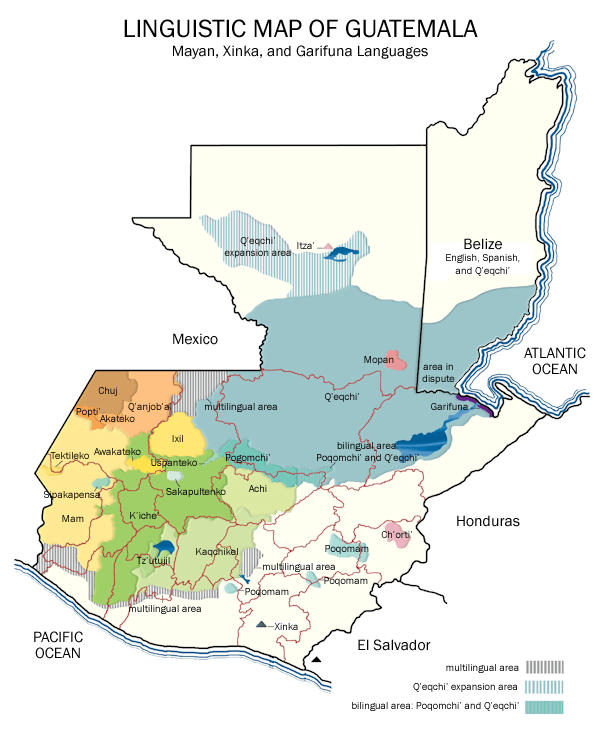 |
| Linguistic map of Guatemala, 2011. |
The Maya of north Georgia are part of the large and diverse wave of immigration from Latin America that has transformed the social, cultural, and economic landscape of the US South since the late 1980s. Mexicans make up approximately 60 percent of the Latino population in the South; Central Americans comprise the next largest group, followed by South Americans from Peru, Venezuela, and Columbia.4Mary E. Odem and Elaine Lacy, Latino Immigration and the Transformation of the U.S. South (Athens: University of Georgia Press, 2009): ix-xxvii. The Maya occupy a distinct position within the population of Latin American immigrants. With over four million people in Guatemala and Mexico, they form one of the largest indigenous groups in the Americas. Although exact figures are not known, it is estimated that as many as 500,000 Maya have migrated to the United States. Most come from poor rural towns and villages in the western highlands of Guatemala where they speak one of more than twenty different Maya languages, and families support themselves as small farmers, rural laborers, or market vendors. Meager farm incomes are often supplemented with wages earned as laborers on coffee plantations. The Maya population in the United States also includes a smaller number of high school and college-educated immigrants who worked as teachers, journalists, and in other professional fields in Guatemala.5Allan F. Burns, Maya in Exile: Guatemalans in Florida (Philadelphia: Temple University Press, 1993); Leon Fink, The Maya of Morganton: Work and Community in the Nuevo New South (Chapel Hill: University of North Carolina Press, 2003); Jacqueline Hagan, Deciding to be Legal: A Maya Community in Houston (Philadelphia: Temple University Press, 1994); James Loucky and Marily M. Moors, The Maya Diaspora: Guatemalan Roots, New American Lives (Philadelphia: Temple University Press, 2000); Cecilia Menjivar, "Liminal Legality: Salvadoran and Guatemalan Immigrants' Lives in the United States," American Journal of Sociology, 111(2006): 999-1037.
The Maya make up approximately 60 percent of the Guatemala population of fourteen million. Centuries of discrimination and exploitation of their land and labor, first by Spanish colonizers and later the Ladino elite, have left indigenous people impoverished and marginalized within their countries (those of mixed European and indigenous ancestry are called Ladinos). Pronouncements of Indian inferiority and backwardness by dominant groups have justified and reinforced the subordination of the Maya in Guatemala from the Spanish conquest to the present day.6Nancy M. Farriss, Maya Society under Colonial Rule: The Collective Enterprise of Survival (Princeton: Princeton University Press, 1986); Marilyn M. Moors, ed., Guatemala Indians and the State, 1540 to 1988 (Austin: University of Texas Press, 1990).
From the colonial era through most of the twentieth century, much of the Maya population lived in the Guatemala highlands where they formed close-knit communities organized in municipios or townships. The inhabitants of a municipio shared a common language and a distinct form of dress, customs, and religious practices. By the 1970s and 80s, however, numerous forces threatened the social bases of indigenous communities—overpopulation and land shortages, plantation demands for labor, the incursions of Catholic and evangelical missionaries, and political violence and repression by Ladino rulers of the country.7Douglas E. Britnall, Revolt Against the Dead: The Modernization of a Mayan Community in the Highlands of Guatemala (New York: Gordon and Breach, 1979); Carol Smith, “Class Position and Class Consciousness in an Indian Community” in Moors, Guatmala Indians and the State, 205-229; John M. Watanabe, Maya Saints and Souls in a Changing World (Austin: Univesity of Texas Press, 1992).
The civil war between military-dominated governments and left-wing guerilla groups was especially destructive to indigenous communities. In 1954, a violent coup supported by the Central Intelligence Agency and right-wing politicians overthrew the democratically elected government in Guatemala. The ensuing political unrest resulted in a military uprising in 1960 that marked the beginning of a thirty six-year civil war. The armed conflict grew especially violent in the 1980s as it spread deeper into rural, indigenous areas. Right-wing governments carried out campaigns of violent repression against labor unions, peasants, activist organizations, and indigenous communities; guerilla groups responded with acts of economic sabotage and strikes against the military.
With the support of US military aid and training, the Guatemala armed forces carried out assassinations of suspected militants and large-scale massacres in regions thought to support guerrilla forces. The political violence eventually resulted in the deaths of two hundred thousand mostly unarmed indigenous people and the destruction of more than four hundred Maya villages. Under General Rios Montt, military dictator in the early 1980s, the government established civilian defense patrols in indigenous areas that required the participation of adult men. Montt was quoted in a New York Times article, as telling an indigenous audience, “If you are with us, we will feed you; if not, we will kill you.” According to the investigations of two human rights commissions, the vast majority of human rights abuses—torture, assassinations, and forced disappearances—were carried out by the Guatemala military and the armed groups they controlled.8Beatriz Manz, Refugees of a Hidden War: The Aftermath of Counterinsurgency in Guatemala (Albany: State University of NY Press); Human Rights Office, Archdiocese of Guatemala, Guatemala Never Again! (Maryknoll, New York: Orbis Books, 1999); “Guatemala Peace Accords,” NACLA on the Americas (May/June 1997) http://www.hartford-hwp.com/archives/47/140.html.
The initial migration to the United States began during this period of armed conflict. At the height of the war, tens of thousands of Maya left villages in the highlands, some headed for Mexico and others for the United States. Even though they were fleeing political violence, most Guatemalans were not accorded refugee status by the US government, but instead were treated as economic migrants. Decisions regarding the status of Central American migrants during the 1980s were influenced more by US foreign policy and Cold War concerns than by the actual conditions Central Americans faced in their origin countries. Migrants from countries whose governments the Reagan administration opposed, such as the socialist Sandinista government in Nicaragua, were far more likely to be considered refugees than those fleeing governments supported by the United States, such as the right-wing military regimes in Guatemala and El Salvador. In 1991, the settlement from a national class-action suit charging bias in the asylum decision process paved the way for 250,000 Guatemalans and Salvadorans to reapply for asylum and many were able to legalize their status.9Susan Gzesh, “Central Americans and Asylum Policy during the Reagan Era,” Migration Policy Institute, Migration Information Source (April 2006) http://www.migrationpolicy.org/article/central-americans-and-asylum-policy-reagan-era/; Menjivar, “Liminal Legality”; James Smith,“Guatemala: Economic Migrants Replace Political Refugees” Migration Policy Institute, Migration Information Source (April 2006) http://www.migrationpolicy.org/article/guatemala-economic-migrants-replace-political-refugees/. This first wave of migrants from war-torn Guatemala initially settled in Los Angeles, Houston, and southern Florida, areas with long-standing Latin American populations.10Burns, Maya in Exile; Hagan, Deciding to be Legal; Loucky and Moors, The Maya Diaspora; Nancy Wellmeir, Ritual, Identity, and the Mayan Diaspora (New York: Garland Publishing, 1998). Antonio and Maria were among the thousands of Maya who left Guatemala during the political unrest and violence of the 1980s.
Born and raised in rural villages in Santa Eulalia, a municipio nestled high in the Cuchumatanes Mountains in the state of Huehuetenango, Antonio and Maria were a young married couple with an infant daughter when they made the difficult decision that he should leave the country. It was a time when Maya men in the highlands were being forced to serve on civilian defense patrols and threatened with violence or death if they refused to participate. Antonio left Santa Eulalia in 1988 and headed for Los Angeles, where his brother-in-law and a number of other townspeople already lived. His brother-in-law helped him find work in a garment factory and within the next one and one-half years, he had saved enough money to bring Maria and their daughter to the United States. Antonio and Maria spent the next eleven years working at various low wage jobs and caring for their growing family, which came to include three more children, two girls and a boy.11Interviews with Antonio (2001, 2002) and Maria (2003).
When the economy worsened in California in the 1990s and the competition for jobs increased, the couple decided to leave Los Angeles and seek better prospects elsewhere. They traveled to north Georgia where they had heard about job opportunities for immigrant workers. They joined many other Central American and Mexican immigrants who were leaving traditional destinations in California and Texas for new destinations in the United States. The Southeast became a strong magnet for Latino immigrants during this decade because of plentiful jobs for low-wage workers in the construction, food-processing, agriculture, and service industries. Immigrants were also attracted by the lower cost of housing and safer neighborhoods that the South seemed to offer.12Mary Odem, “Global Lives, Local Struggles: Latin American Immigration to Atlanta,” Southern Spaces, May 19, 2006, https://southernspaces.ecdsdev.org/2006/global-lives-local-struggles-latin-american-immigrants-atlanta; Odem and Lacy, Latino Immigration and the Transformation of the U.S. South.
A Second Wave of Migration
The 1996 Peace Accords ended the armed conflict between the Guatemala army and guerilla forces. However, economic devastation caused by the war and continued inequality in the aftermath of the war contributed to a second wave of Maya immigration to the United States. The Peace Accords brought about some important changes—demilitarization, creation of a civilian police force, and establishment of a human rights commission. A key part of the peace agreement addressed the rights of indigenous peoples, and reflected the influence of Maya activists and a growing pan-Maya movement in Guatemala. The movement has mounted a serious challenge to the centuries-long denigration of indigenous people and their culture in the country. Maya activists reject the plan of cultural assimilation implicit in the development strategy of the Guatemalan state as well as the left’s tendency to subsume ethnic and indigenous concerns within a rigid class analysis. Instead, they envision a radical transformation of the Guatemalan state into a multicultural nation that supports indigenous rights to self-determination and recognizes indigenous cultures and languages.13“Guatemala Peace Accords.”
While progress has been made in indigenous cultural rights, the Peace Accords and post-war governments did not tackle the pressing issue of land reform, and have ultimately done little to relieve the poverty and marginalization that most Maya experience in Guatemala. Economic globalization and neo-liberal policies have further threatened the livelihood of many small farmers and workers in Guatemala, and have contributed to large-scale migration to the United States. Working-age men and youth make up the vast majority of this migration, but the number of women and children migrants has increased steadily since 1990.14Smith, “Guatemala: Economic Migrants Replace Political Refugees.”
In the late 1990s, twenty-three year old Alfredo, the nephew of Antonio, joined the second wave of migration to the United States while his wife Juana remained in Guatemala with their young daughter. A generation younger than Maria and Antonio, Juana and Alfredo grew up in Santa Eulalia and were children during the most violent years of the Civil War. When they finished grammar school, they experienced both the benefits and hardships of the post-war period.
 |
| William Brown and Mary Odem, Alfredo and Juana on their wedding, Guatemala. |
The oldest son in a rural farm family of seven children, Alfredo decided as a young teenager that he could not make a living farming the family’s small plot of land as his father had done. The only hope for climbing out of poverty (for himself and his family), he believed, was to further his education, which meant leaving Santa Eulalia for Guatemala City. Educational opportunities were very limited for indigenous people in Guatemala, especially in rural areas. At the time, most Maya towns still had no schools beyond the elementary level. Migration to urban areas held the only possibility for secondary education for indigenous youth. With the aim of furthering his education, Alfredo left his home and family at fourteen years of age and headed for sprawling Guatemala City. With no financial help available from his family, Alfredo worked to support himself while pursuing his studies. After five years of a grueling schedule of work and study, he completed high school.15Interviews with Alfredo (2001, 2002).
While living in the capitol city, Alfredo met and fell in love with Juana, another Maya youth from Santa Eulalia who migrated to Guatemala City for more schooling. Her father, a teacher and leader of the Maya cultural movement, directed the Maya language institute in Santa Eulalia. As a result of the 1996 Peace Accords, similar language institutes were established in indigenous towns throughout the highlands. Juana was attending secretarial school in Guatemala City when she and Alfredo began dating and decided to marry. They married in Santa Eulalia in the presence of their parents and relatives, then returned to Guatemala City where Alfredo found a job and enrolled in a university course in computers. A year later Juana gave birth to their first child.16Interviews with Alfredo (2001) and Juana (2001).
The birth of their daughter caused Alfredo to carefully examine the prospects for both his new family and his parents and siblings in Santa Eulalia. As the oldest son, he was expected to provide for his parents in their old age and to help support his younger siblings. Even though he had a job, the economic prospects in Guatemala were gloomy, especially for indigenous people. With the low salaries, high unemployment, and rising inflation that existed in Guatemala, Alfredo realized he could not provide a home for his wife and daughter and contribute to the education of his siblings with his current wages. Once again, he contemplated migration, this time to the United States. Alfredo and Juana faced a painful dilemma: to secure a better future for their family, they had to endure years of separation. When Alfredo left for the United States, Juana moved back to Santa Eulalia with her daughter where they lived with Alfredo’s parents, as was the custom for the wives of departing migrants.17Interviews with Alfredo (2001, 2002) and Juana (2001).
In a process of chain migration, Alfredo headed to one of the places in the United States where relatives and acquaintances from Santa Eulalia had settled. He tried his luck first in Nebraska, where many Eulalenses worked in the meat-packing industry. Difficulty finding a job there led Alfredo to north Georgia, where he joined his uncle and aunt, Antonio and Maria. Alfredo moved into the home they shared with their children and two other young men from Santa Eulalia. With the help of his uncle, Alfredo found work first in the landscaping business mowing lawns, and then in construction where he learned to install electrical wiring in new suburban homes.18Interviews with Alfredo (2001, 2002).
The labor of immigrant workers, like Alfredo and his uncle and aunt, has contributed to the economic growth and competitiveness of southern industries. The reliance on foreign-born workers not only boosted corporate profits, but also lowered the cost of housing, food, and other goods for southern consumers. Latin American immigrants no doubt have benefited from the availability of jobs, but they, along with US-born workers, have faced exploitative conditions in southern workplaces. In the highly competitive global economy, US corporations (in the South and elsewhere) have cut labor costs by creating a more “flexible” workforce through strategies of part-time work, outsourcing, subcontracting, and the recruitment of foreign-born workers. For workers in the United States, “flexibility” has meant the erosion of benefits, job security, safe working conditions, and collective bargaining rights. To achieve labor market flexibility and control, the meat- and poultry-processing industries have increasingly relied on recruiting immigrant workers and using labor contractors to hire large portions of their workforce. Poultry corporations began large-scale hiring of immigrant workers during a period of rapid expansion between 1980 and 2000, when United States consumption of chicken doubled. Native-born and foreign-born workers alike have suffered from the harsh conditions in meat and poultry plants, including production speed-ups, disregard for health and safety standards, and pervasive violation of minimum wage laws.19Angela Stuesse, “Race, Migration and Labor Control: Neoliberal Challenges to Organizing Mississippi’s Poultry Workers,” Latino Immigration, ed. Odem and Lacy, 91-111; Eric Schlosser, Fast Food Nation: The Dark Side of the All-American Meal (Boston: Houghton Mifflin, 2001); Steve Striffler, Chicken: The Dangerous Transformation of America’s Favorite Food (New Haven: Yale University Press, 2005).
The construction trades in the South also relied heavily on recruitment of immigrants from Central America and Mexico to meet the rising labor demand caused by the building boom of the 1990s. Working as dry wall installers, carpenters, plasterers, and bricklayers, immigrant workers helped to build roads, shopping centers, office buildings, and tens of thousands of new homes in metro Atlanta and north Georgia. Their contributions were essential for the completion of the numerous building projects for the 1996 Olympic Games in Atlanta. Eager to hire immigrant workers, southern employers have not been so eager to pay them fair wages or provide safe working conditions. Numerous employers have flagrantly violated immigrant workers’ rights by cheating them out of wages and denying them compensation and medical care for accidents on the job.20Mary E. Odem, “Unsettled in the Suburbs: Latino Immigration and Ethnic Diversity in Metro Atlanta." in Twenty-First Century Gateways: Immigrant Incorporation in Suburban America, ed. Audrey Singer, et al. (Washington, DC: Brookings Institution Press, 2008).
Families and Communities Left Behind
Maya immigrants such as Alfredo have endured harsh working conditions in the United States in order to use their wages to provide a better life for their spouses, children, parents, and siblings in Guatemala. The millions of US dollars sent back to families in Guatemala every year have meant improved housing, access to basic health care, and education beyond the sixth grade for many Maya youth. With the wages he earned in construction and landscaping jobs, Alfredo supported his wife and daughter and also contributed significantly to the support of his siblings. His earnings have enabled his two younger brothers to move to Guatemala City to continue their schooling. Additionally he has helped support his older sister and her two children; she was abandoned by her husband several years after he migrated to California. Alfredo and Juana have also begun construction on a new house in the center of town with the money he has earned. New homes and housing construction, seen throughout Santa Eulalia, are the most visible sign of the impact of migrant dollars on this indigenous town.
Typically Maya immigrants support not only their individual families, but also make financial contributions to community projects, earning them respect and appreciation from their fellow townspeople. Money from migrants has been used to construct new roads and schools and bring potable water to highland towns. One of the major contributions of migrants from Santa Eulalia was the construction of a medical clinic and small hospital so that people would not have to travel four hours to Huehuetenango for treatment. Antonio and Maria took part in the community effort of Eulalenses in Los Angeles to organize fund-raising drives for the clinic in their hometown.21Interviews with Father David López (2002, 2004) and Antonio (2001).
The economic benefits of migration, however, have come at a high cost to Maya families and communities. In many highland towns, the majority of working-age men are living and working abroad, which means that children often grow up without their fathers and wives struggle to manage households on their own, while community institutions try to function with limited involvement of adult men. The separation early in her marriage to Alfredo took its toll on Juana. Like many migrant wives, she experienced loneliness and great anxiety about when and whether her husband would return.22Interviews with Juana (2001, 2003). While most male migrants remain committed to their families in Guatemala, a number have abandoned wives and children, causing them great economic and emotional hardship. In Maya towns, the wives of migrants are watched closely by in-laws and community members to make sure they do not behave in a way that would dishonor their husbands.
Maya migrants in the United States suffered as well from the years of separation from their loved ones. Alfredo deeply missed his wife and young daughter and worried about his mother and father and their ability to manage the farm. He sent audiotapes to Juana and his parents, and talked with them on the phone as often as his finances would allow. He was devastated when he learned during one of these phone calls that his father had died unexpectedly from appendicitis. His father was fifty-two years old. The poor access to health care and doctors in rural Guatemala made deaths from such minor illnesses all too common. Alfredo’s sorrow intensified when he and his family decided that he should not go back to Santa Eulalia for the funeral because of the great cost and the difficulty he would encounter in trying to return to the United States. With the death of his father, Alfredo suddenly became the male head of the family. His responsibility for the care of his mother and siblings increased and made his wage-earning in the United States all the more important.23Interviews with Alfredo (2001) and Juana (2001).
Anti-Immigrant Backlash
In the early twenty-first century, Maya and other Latin American immigrants in Georgia encountered an increasingly hostile political environment. When mass immigration from Latin America began in the late 1980s and 1990s, the media, lawmakers, and political organizations paid only limited attention, more often than not depicting immigrants as hard workers who helped the local economy in various ways. During the first years of the twenty-first century, however, anti-immigrant rhetoric and exclusionary policies rose sharply in Georgia and other new immigrant destinations due to declining economic conditions and the heightened national preoccupation with terrorism and “illegal immigration” following the attacks of September 11, 2001. Public outcry about “illegals” stealing jobs, burdening taxpayers, and increasing crime rates led state and local officials across the Southeast to pass laws and ordinances targeting unauthorized immigrants. These measures sought to block undocumented immigrants’ access to driver’s licenses, housing, employment, social services, and higher education.24Odem, “Unsettled in the Suburbs.”
 |
| William Brown and Mary Odem, People protest immigration policy, northern Georgia. |
Much of the legislation targeting unauthorized immigrants has been passed by state and local governments since 2006, in the wake of rancorous discussions in the US Congress and the national news media over the problem of illegal immigration. The failure to enact immigration reform at the federal level strengthened the efforts of state and local lawmakers to take action against unauthorized immigrants, and a record number of immigration bills came before state legislatures in 2006.
The state of Georgia took the most sweeping action of any state at the time to control illegal immigration with passage of the Georgia Security and Immigration Compliance Act (SB 529) in 2006. The bill was introduced by Republican legislator Chip Rogers from Cherokee County, the same county where Antonia, Maria, Alfredo and numerous other Maya immigrants have settled. Rogers’ bill denies tax-supported benefits, including health care, to immigrants who cannot prove their legal residency; penalizes employers who hire undocumented immigrants; and enlists state and local police in the enforcement of federal immigration laws. The introduction of Senate Bill 529 in Georgia followed in the wake of the punitive legislation (HR 4437) proposed by Republican lawmakers in the US House of Representatives to speed up deportations, criminalize undocumented immigrants, and authorize the construction of a wall at the Mexico–US border. Although the federal legislation failed to pass, SB 529 was passed by the Republican-controlled senate and house and signed into law by Republican Governor Sonny Perdue on April 17, 2006.25Ibid.
 |
| William Brown and Mary Odem, A laborer working in masonry, northern Georgia. |
The law reflects a compromise between politicians seeking aggressive action to end illegal immigration and business groups seeking to maintain an available pool of low-wage immigrant labor. After consulting with business lobbyists, Republican sponsor Chip Rogers crafted the bill so that companies would not be held responsible if an employee used false documents or if a subcontractor hired illegal workers without the knowledge of the employer.
The Georgia Security and Immigration Compliance Act has created a climate of uncertainty and fear among the Maya and other Latino immigrants in the state. Realtors, car dealers, and retailers in immigrant neighborhoods have reported a noticeable decline in Latino customers, which they attribute to the sense of economic and social vulnerability that immigrants now feel. The parks and shopping plazas that had been social and recreational gathering places for Latinos in north Georgia have been noticeably less populated since the legislation went into effect. With the involvement of local authorities in the enforcement of immigration law, the arrest, confinement, and deportation of unauthorized immigrants has climbed dramatically in Georgia. As a result, many families have been separated and immigrants have become more hesitant to notify law enforcement when they are victims of or witnesses to crime. A number of Maya immigrants in North Georgia have been deported and others have been targets of anti-immigrant hostility and harassment.
Pan-Maya Organizing
Although poor in material resources, Maya immigrants have brought with them a tradition of communal organization that has sustained them in face of the discrimination and hardships they have encountered in the United States. Drawing on this tradition, Maya in Georgia and other settlement areas have formed ethnic religious associations that have helped to unify immigrants and strengthen their collective resources. In the initial Maya settlements established in the 1980s in Los Angeles, Houston, and Indiantown, Florida, immigrants formed associations on the basis of hometown origin; members shared a common language, dress, and local customs linked to their particular municipio or town.26Hagan, Deciding to be Legal; Wellmeier, Ritual, Identity, and the Mayan Diaspora; Eric Popkin "Guatemalan Mayan Migration to Los Angeles: Constructing Transnational Linkages in the context of the Settlement Process." Ethnic and Racial Studies 22 (1999): 238-266.
As Maya immigrants increased in number and dispersed to new locations in the country, they began to organize on a pan-Maya basis. In north Georgia a group of Maya that included Antonio and Maria formed a Maya Catholic organization in 1999. It began as a small prayer group that met in the homes of different migrants. By the second year the group had grown from ten to approximately one hundred members and included Maya of diverse language groups (Mam, Quiché, Q’anjobal, Chuj) and regions (Huehuetenango, San Marcos, Quiché, Chimaltenango, and Quezaltenango). When Alfredo joined his aunt and uncle in north Georgia, he became an active member of the organization.
 |
| William Brown and Mary Odem, Men at meeting of Pastoral Maya, northern Georgia. |
The group first called itself El Ministerio de Evangelización a la Virgen de Asunción (the Virgen de Asunción is the patron saint of Guatemala) and later changed its name to Proyecto Pastoral Maya (Maya Pastoral Project) when it joined a national network of Maya Catholic groups, supported by the US Catholic Church. Pastoral Maya seeks to provide spiritual, social, and material support to the Maya migrants struggling to make a living in North Georgia. To build bonds of solidarity among the group, leaders organize a range of programs and activities that include a weekly Saturday evening meeting of prayer, singing, and socializing; the formation of two choirs; Spanish Mass on Sunday evenings in the parish church; regular house visits to Maya immigrants in need; religious services and cultural celebrations for Christmas, Holy Week, Mother’s Day, and Santa Eulalia’s feast day. One of the organization’s first fund-raising projects was to collect $3,000 to purchase a van to provide transportation for the numerous migrants who do not have cars so that they can attend the Saturday meeting, Sunday Mass, and other activities.27Interviews with Antonio (2002, 2003), Pablo (2003) and Efrain (2003).
The largest religious and cultural event organized by the Maya Catholic group is the annual celebration in honor of Santa Eulalia. The event requires months of planning and preparation and the labor and contributions of many immigrants. The feast day celebration has attracted the participation of hundreds of Maya immigrants from north Georgia and the surrounding area and has increased in size each year. Approximately two hundred people from Maya settlements in Canton and Ellijay in north Georgia took part in 2002; the following year more than four hundred Maya migrants attended, including groups from Greenville, South Carolina, and two Alabama towns. By 2004, the number of participants rose to more than six hundred.28Interviews with Antonio (2003) and Pablo (2003).
 |
| William Brown and Mary Odem, A person participating in the annual celebration of Santa Eulalia, Cherokee County, Georgia, 2003. |
The celebration combines Catholic and traditional Maya spiritual practices. It begins with a Catholic Mass led by Father Joseph Fahy of the Atlanta Archdiocese and Father David López, a Maya Catholic priest from Guatemala who visits the community annually to take part in the feast day celebration. Following the Mass is a re-enactment of a traditional Maya religious ceremony that is performed by rezadores (prayer leaders) in Santa Eulalia to pray for harmony and safety during the celebration. In the north Georgia celebration, a young man performs the role of a rezador and recites a prayer to the four directions of the earth.
Central to the Santa Eulalia celebration in Guatemala and in the United States is the marimba and its music. In Guatemala, the marimba is a key symbol of indigenous identity and it continues to play an important role in community life for the Maya who have emigrated to the United States. Soon after their arrival, numerous Maya immigrant groups (in Georgia, Florida, Los Angeles, Arizona, Colorado, and South Carolina) have raised money to purchase and import a marimba from a workshop in the Guatemala highlands.
 |
| William Brown and Mary Odem, Princesa Maya Jolom Konob, Cherokee County, Georgia, 2003. |
Another major part of the fiesta is the coronation of the new princesa “Maya Jolom Konob,” who will represent the Maya community in the upcoming year. Dressed in the distinctive corte and huipuil of the township, the princess performs a Maya ideal of femininity: she demonstrates her knowledge of indigenous culture by performing a traditional dance to the music of the marimba; she demonstrates her education and learning by delivering a speech before the crowd, first in her indigenous language of Q’anjobal and then in Spanish. A new element in the celebration in Georgia is that the princess addresses the crowd in three languages instead of two: Q’anjobal, Spanish, and English.
The work of the Maya association in north Georgia has extended beyond the religious and cultural realm. Leaders have provided assistance when Maya immigrants encountered problems such as inability to pay rent, arrest by local police, and need for housing or work. The Maya organization strengthened its presence and influence through the alliance it formed with a group of interested faculty and students at nearby Kennesaw State University who collaborated on a number of projects, such as student-led English classes and tutoring for the Maya, health seminars, and a traffic safety program for immigrants funded by university and state grants. The projects created learning opportunities and internships for students and gave the Maya access to knowledge, skills, and social contacts that enhanced their community-building efforts. On an individual level, university faculty and students also assisted Maya immigrants in navigating the US legal system and local government bureaucracies.
In the mid-1990s, the Maya association in Georgia became part of a national network of Maya Catholic organizations, a grassroots effort initiated by immigrant leaders Sister Nancy Wellmeir and Father David López in 1994 that has received financial support and recognition by the US Conference of Catholic Bishops. Known as the Proyecto Pastoral Maya, the network is made up of over forty local Maya Catholic groups in states throughout the country including California, Florida, Arizona, Oregon, Washington, Colorado, Nebraska, Georgia, Tennessee, Alabama, and South Carolina.29Interviews with Father David López (2002, 2004) and Father Joseph Fahy.
 |
| William Brown and Mary Odem, New building in a Guatemalan community. |
Since 1999, Pastoral Maya has organized national meetings (Encuentros Nacionales) on an annual basis. The 2003 Encuentro Nacional, which took place in Georgia at Kennesaw State University, brought together fifty-six Maya community leaders from across the country. Most of the participants were men, but as many as a dozen Maya women had a noticeable presence at the meeting. Support and funding for the Conference came from money raised by local immigrant groups, the US Conference of Catholic Bishops, the Archdiocese of Huehuetenango, and the faculty-student group at Kennesaw State University.
Even as the Maya organization established connections with US citizens and institutions, it also fostered transnational ties to indigenous communities back home. Maya immigrants sustained connections to their hometowns in various ways—by collecting money from migrants to finance improvements, such as the building of a medical clinic or school; by raising funds when a community member dies in the United States to return the body to Guatemala for burial in the hometown cemetery; and by sponsoring the visits of priests from hometown parishes in Guatemala to meet with and provide spiritual and social guidance to their parishioners in the United States. Through the range of transnational and local activities, participants in Pastoral Maya express a sense of belonging on both sides of the border—in new settlements in the United States and in communities of origin in Guatemala.
Conclusion
Transnational migration has provided needed economic resources for the Guatemala Maya, while placing great strain on families. The burden of living across borders has fallen most heavily on the women and children left behind in Guatemala. For Juana, when the years of separation and uncertainty about her husband’s return led to anxiety and depression so grave that her family feared for her well-being, Alfredo went back to Guatemala to be with her. He left with the intention of returning to the United States because he still had not earned enough money to complete the home they were building, but he ended up staying in Santa Eulalia. The needs of his family, not only of his wife and daughter, but also of his mother and siblings, held him in Guatemala. They had suffered in his absence, especially Juana, and he had sorely missed them.
Within a year of his return, Juana gave birth to their second child, another daughter, and this time Alfredo would be around to see her learn to walk and talk.
Alfredo’s homecoming eased the emotional hardship for the family, but presented real economic hardship. With the loss of his wages from the United States, he had to work at several jobs to cover living expenses. He eventually started a small business in Santa Eulalia that provides computer, accounting, and other services. His two youngest siblings assist him with running the business. Making enough to get by is a constant struggle. A year after Alfredo returned to Guatemala, his next-oldest brother, who had recently finished high school in Guatemala City, began to make plans to migrate to the United States. Following in the footsteps of Alfredo, he wanted to build a home for his wife, who was pregnant with their first child, and to contribute to the support of his mother and siblings. The family would continue to rely on transnational migration as an important economic strategy.
Antonio and Maria, meanwhile, remained in Georgia. After years of working at low wage jobs in factories and on construction sites, they managed to save enough to open a small store where they sold products from Guatemala and inexpensive clothing and shoes, mostly to other immigrants from Central America and Mexico. They remained active in Pastoral Maya, and Antonio served for several years as the national leader of the organization, which took him to different parts of the country to meet with local chapters.
Although Maria and Antonio have talked about returning to Guatemala and have remained in close contact with Maria’s parents and siblings there, the pull of their children has kept them in the United States. Their oldest daughter graduated from the local high school, a source of great pride for her parents, and the three younger children have continued with their studies in junior high and elementary school. All of the children, even the two born in Guatemala, have been raised in the United States and know of Santa Eulalia only through the stories of their parents.
The stable, relatively prosperous life Antonio and Maria had built in Georgia came to end with the economic crisis of 2007 that ravaged many families and businesses in the United States. The business in their store dropped sharply as Latino immigrants in the area, their main customers, lost jobs and income. Soon, the couple was no longer able to pay rent and had to close the store. Then, after months of struggling to keep up with mortgage payments, they lost the house they had lived in since 2000. With the limited economic prospects they faced in Georgia, Antonio and Maria decided to return to southern California where they could live with Maria’s brother until they got back on their feet.
After three decades of Maya migration to the United States, there are Maya communities in cities and towns throughout the country, from California on the west coast to Georgia on the east. A web of familial and organizational ties link Maya settlements in the United States to one another and stretches across national borders to connect to Maya families, hometowns, and institutions in Guatemala. As the stories of Maria and Antonio, Juana and Alfredo make clear, this web of connections has provided a crucial source of support for the Maya to survive periods of war and ethnic violence, economic vulnerability, and social marginalization. They have not overcome these threats, neither in Guatemala, nor in the United States, but they have managed to lessen their impact and to provide more opportunities and security for their children and families.
Video Credits
Writer/Producer - Mary Odem
Director/Photographer/Editor - William A. Brown
Additional Editing - Brian Cox
Special thanks to Teodoro Maus, Gayla Jamison, George King, Father Joseph Fahy, Juanatano Cano, Jamie Escamilla, David Moscowitz, Alan Lebaron, David Donato Vivres, Mael Vizcarra, Norberto Sanchez of the Norsan Group, and Dutch Knotts.
This video could not have been made without the support of people and community leaders of Santa Eulalia, Guatemala, as well as the Maya immigrant community in North Georgia. This program is dedicated to Antonio, Maria, Alfredo, Juana, and all the Maya who participated in the making of this program.
Supported with travel grants and research grants from Emory University. Civil War footage courtesy of the National Archives. Maya Footage Copyright William A. Brown. Edited at ATLANTA VIDEO.
We carried out research, location shooting, and interviewing for this project from 1999 to 2004 in northeast Georgia and in Huehuetenango, Guatemala, in the town of Santa Eulalia. The research included interviews, participant observation, and archival research in both Georgia and Guatemala.
]]>