Thursday, September 26, 2024
In Marshall talking with Joel and Josh. Very real concerns about the river, which is at ten feet, fierce, and rapidly rising. The island is already under water. At fourteen feet the river would be in town. At nineteen feet there would be extensive flooding and costly repairs.
Our niece Jody arrives at the house. She’s going to do a soap-making tutorial with Leslie for the weekend. We lose power later this evening and with it our water. Cell and internet are also out.
My concern is the wind. The ground is saturated from three days of rain. A windstorm could bring down thousands of trees lining our driveway, the road into town, and the forests that make up 73% of the land in Madison County.
Friday, September 27
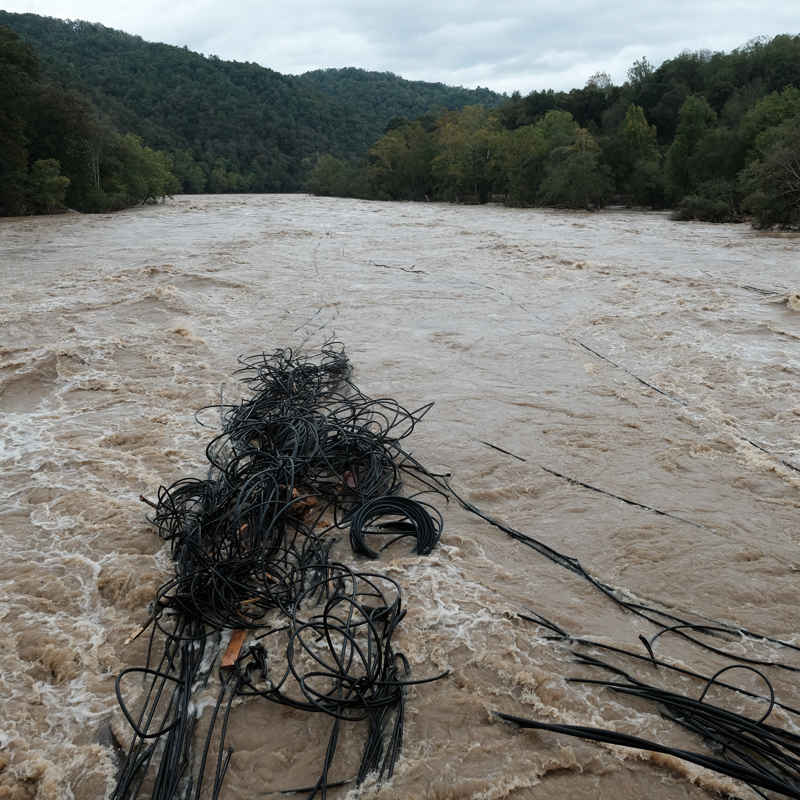
The river crested early this morning at twenty-seven feet, four feet higher than the previous record set in 1916. Yesterday’s concerns are facing today’s reality — the town’s total destruction. The wind never materialized at the house. It’s still raining. Our friend Maia has joined us after being evacuated out of Marshall.
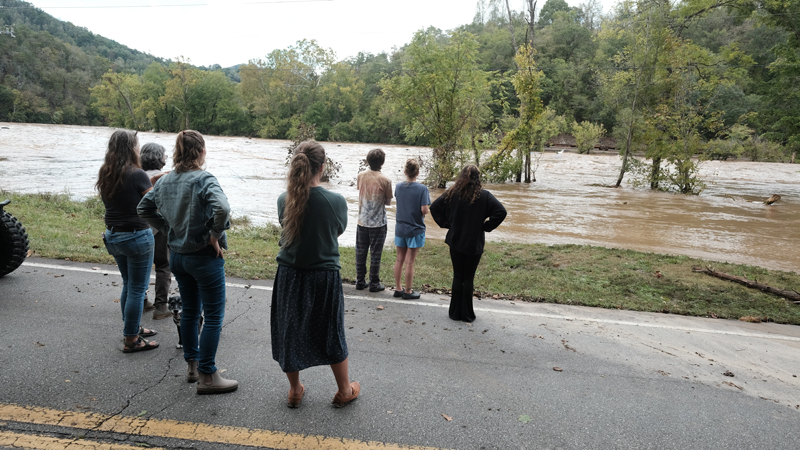
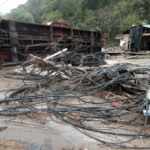
We pile into our car and drive down Little Pine, thinking we’ll go into Marshall. We’re stopped before we get to the Redmon bridge. Neighbors are lining the road looking at the river, which has become one with the road. Fuel tanks, giant tangles of PVC piping, shipping containers — swept away.
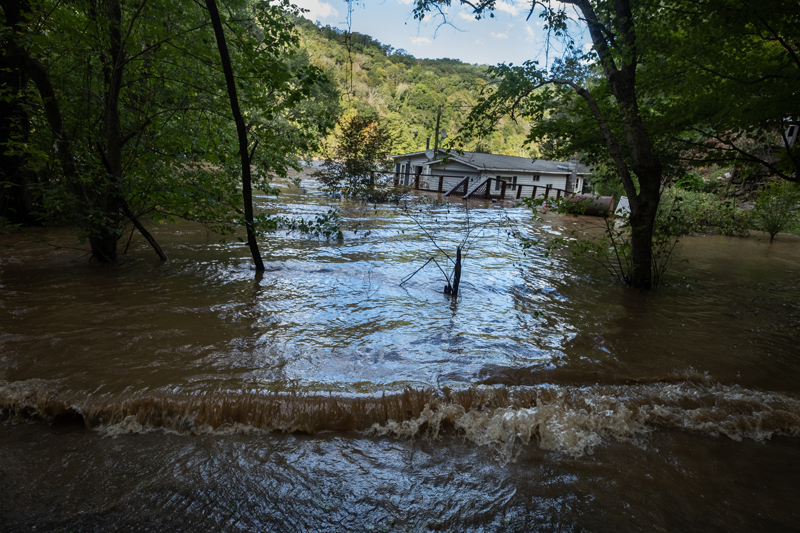
We turn around and drive down Anderson Branch to Barnard. There, worse. Over five feet of water covers the road. Ronnie Meadow’s house inundated. Neighbors wading waist-high water to get his prescriptions and photographs.
Stop at Paul and Laurie’s and get water from their spring. Go home and start cooking and the power comes on. Internet and cell service spotty.
Saturday, September 28
Drive down to Barnard to see if we can get out, and do. Stop at the bridge. Meet some neighbors, make some pictures, come home. Chris, Maia’s boyfriend, got in from Atlanta. We make supper.
Sunday, September 29
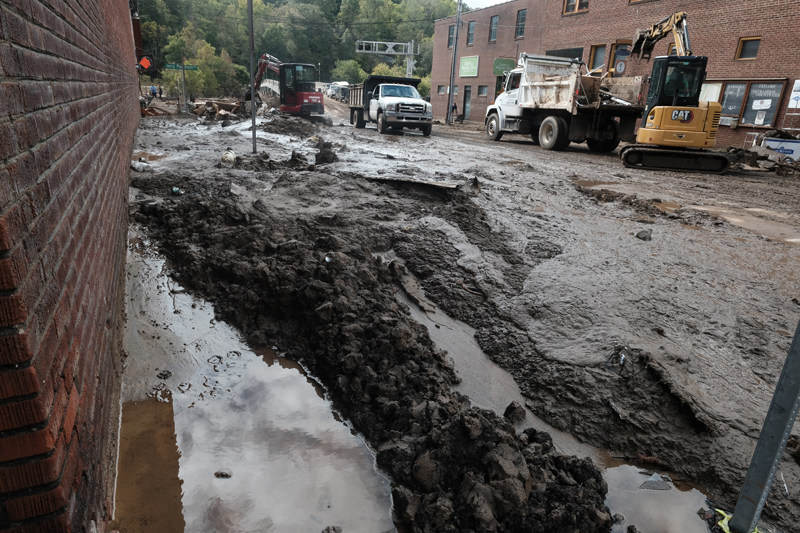
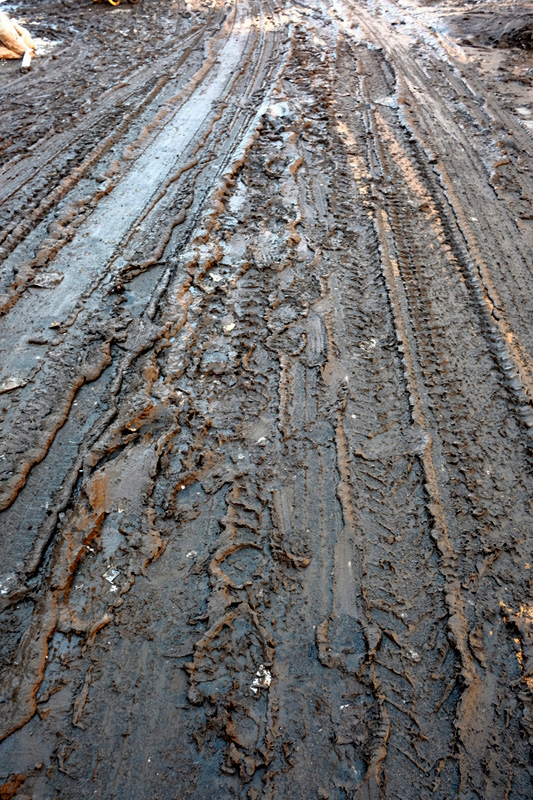
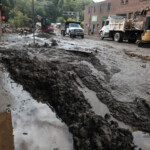
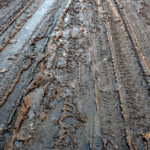
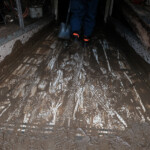
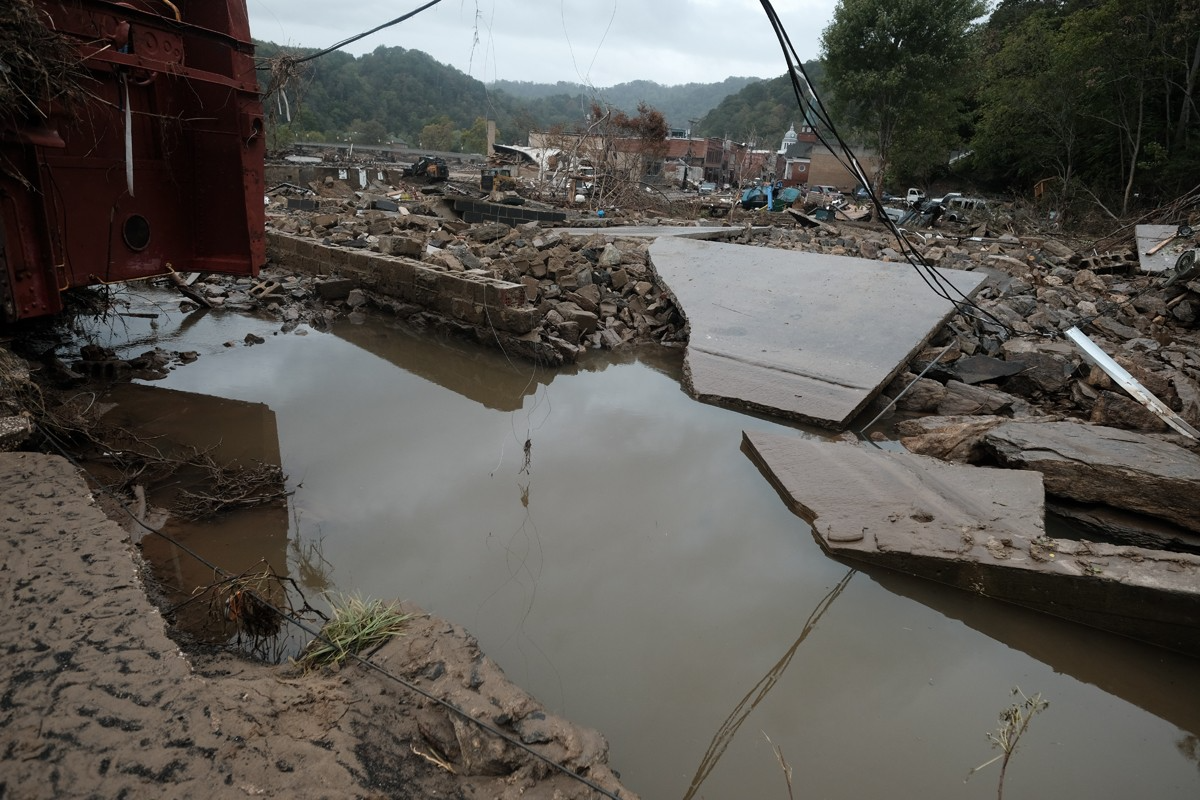
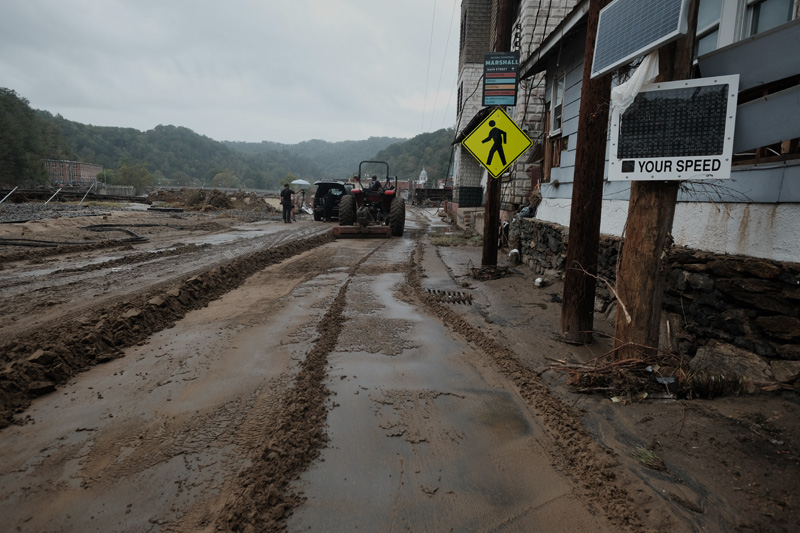
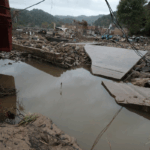
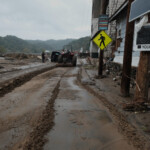
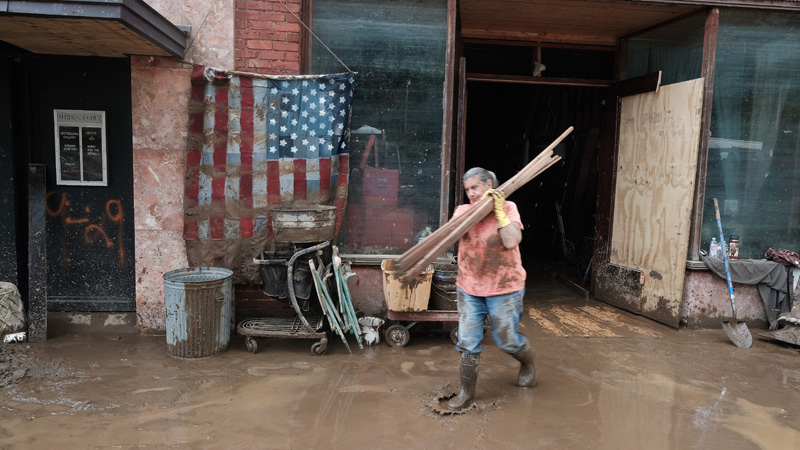
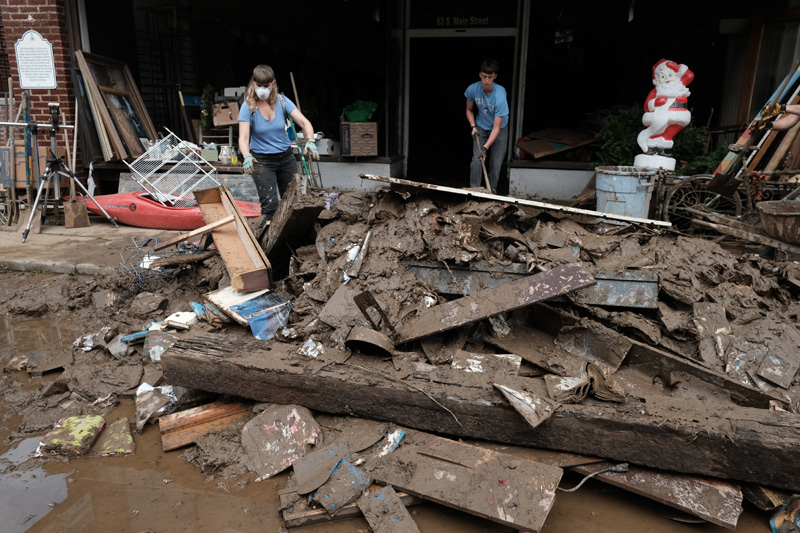
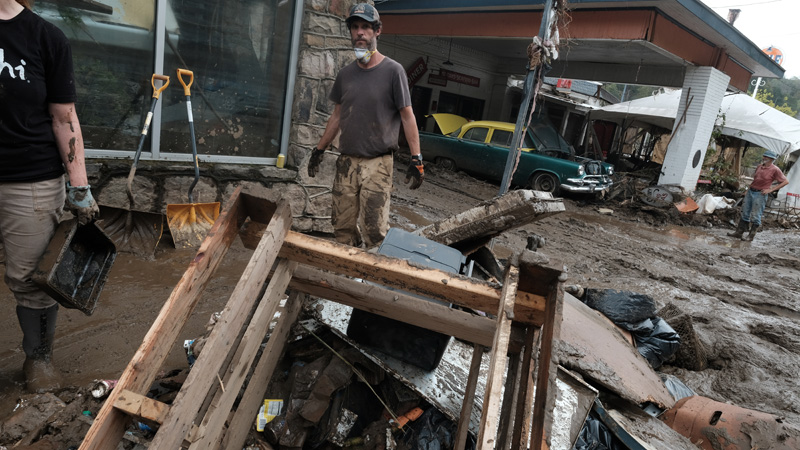
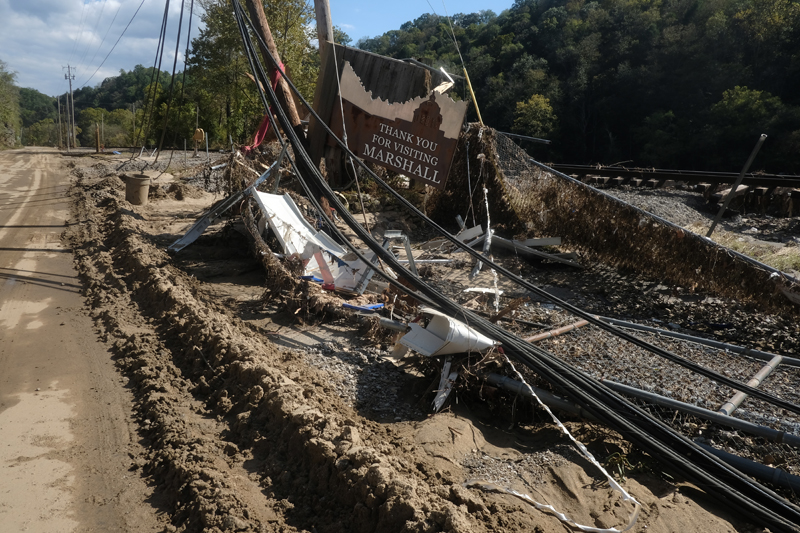
A first look at Marshall. The mud. Everywhere, impossible to avoid. Heavy, sticky. The kind of mud that sucks you in and holds you close. The beginnings of debris piles. Submerged cars and trucks. Rubble where buildings once stood. Stores and restaurants where we’d visited just days before, windows broken, spewing mud from their orifices. And the smell, a mix of water and mud, and propane, a general sense of toxicity.
This is the fourth hurricane related flood I’ve photographed in the last twenty years — Katrina in New Orleans, Hugo in South Carolina, Floyd in Eastern North Carolina, and now, Helene in my backyard.
There are similarities between the four. The mud. The displaced buildings and houses and subsequent debris fields. People’s faces and eyes, at once unbelieving and resilient.
But this is different. It is home, it is friends, neighbors, it is music and dancing, it is church if you want, art most everywhere, eccentricity abounding. It is gone.
I see Morgan, in the midst of mud and debris. Forlorn. No doubt realizing she’s lost her job to the flood. We hug. I move on.
The uniqueness of each building has taken on a sameness of look. Broken windows, water lines above the doorways, stuff beginning to line the street — books, chairs, a sewing machine, an elk head, furniture, boxes of dripping files in front of a lawyers’ office — and mud.



Monday, September 30
For many people, town residents and storeowners, this is a first look at the town, their places of business, their homes. The shock is palpable. The enormity of the destruction incomprehensible and impossible to accept. There’s tears, many, and embraces. What else to do? It’s a reckoning of what once was and what it has become in the blink of an eye. And what lies ahead.
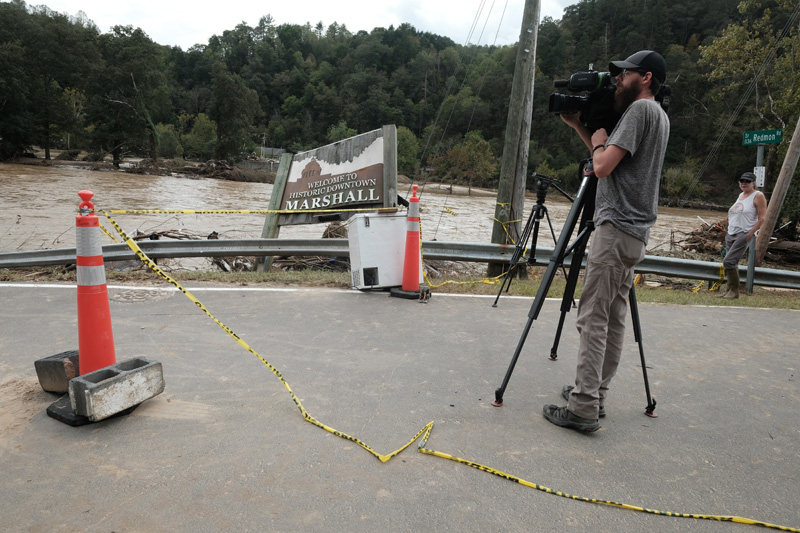
Western North Carolina has long been considered a climate haven. The Southern Appalachian mountains are among the oldest on earth and they offer protection from tornados and hurricanes and other natural disasters. We’ve had floods and landslides in the past, and memorable snowstorms, droughts, and fires. But Helene was unique and has been termed a “geological event” because the accompanying flooding, landslides, and tree damage will have a lasting impact on the landscape. It certainly has had a lasting impact on Marshall and the twenty western counties of North Carolina.
I walk through town for three or four hours, making photographs, talking to friends and neighbors. I think about shoveling mud, but feeling how dense and heavy it is, I realize that it’s a heart attack waiting to happen. I’m clearly the oldest person out there and the work is for the young.
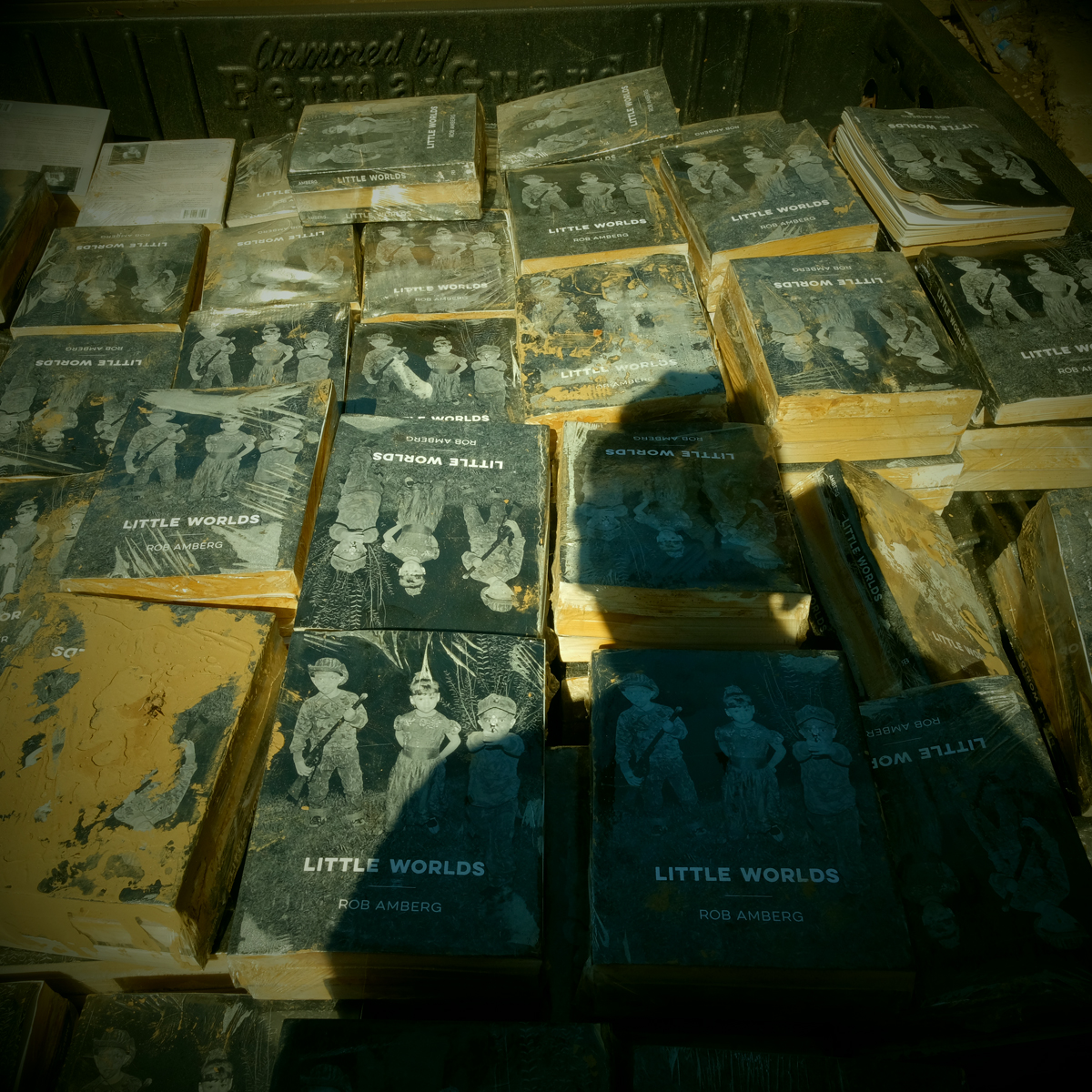
I went to check on my books — 450 copies of my new book, Little Worlds —that were stored in a friend’s warehouse in town. The road in front of the building is foot deep in mud but seems firm at first step. With the second I am shin deep and locked in place, unable to lift my feet. John and Kirsten pull me out, sans shoes, which Kirsten pulls out by laying flat on the ground.
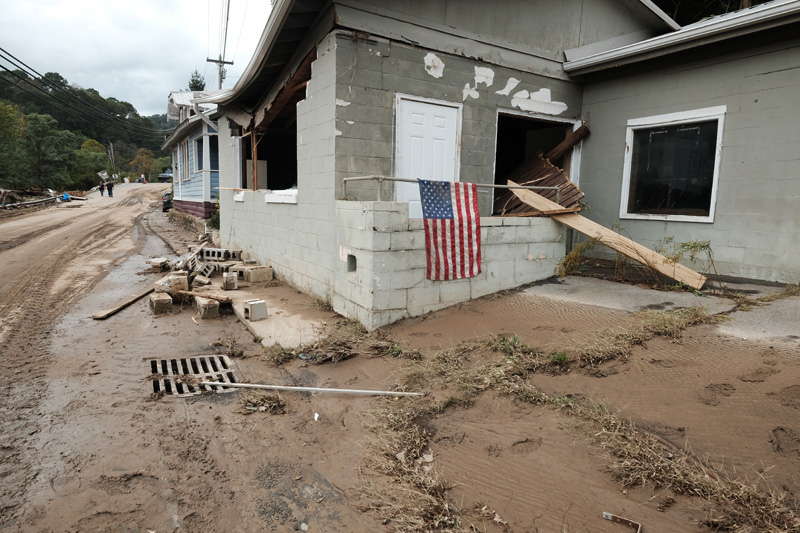
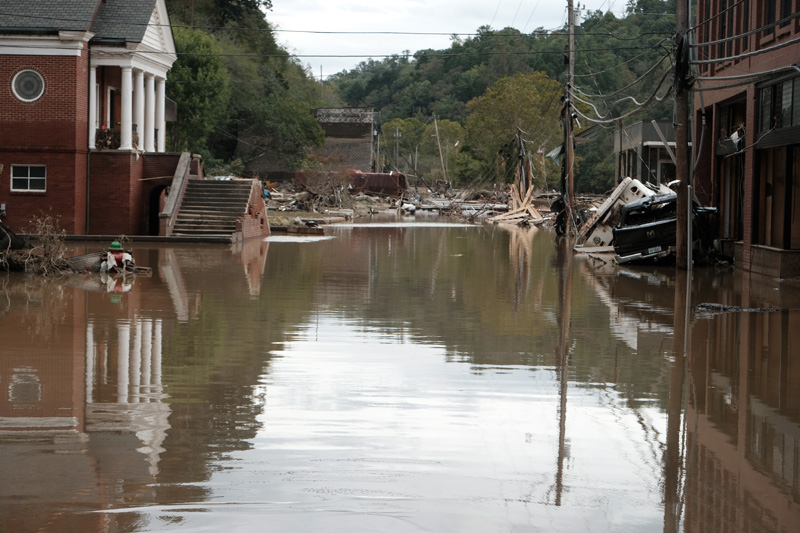
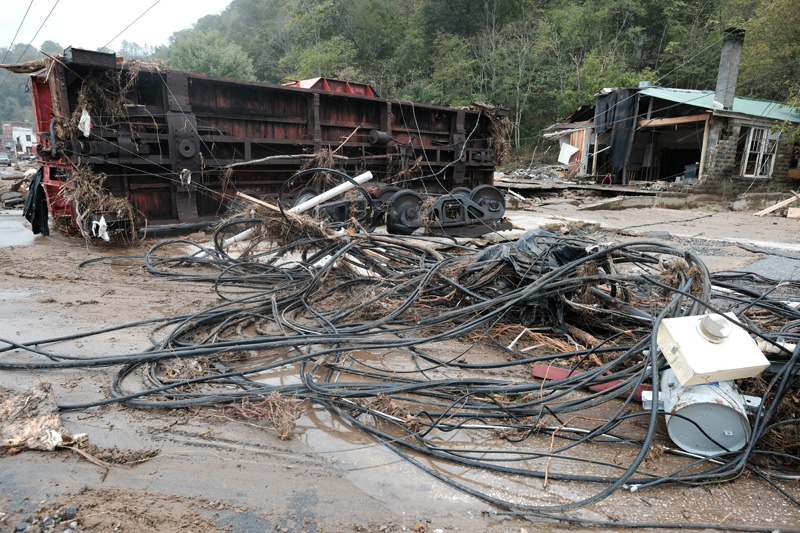
Tuesday, October 1
There’s more people in town today, beginning the task. Some are clearing buildings, adding to debris piles. Others are shoveling and scraping mud. Some are salvaging what little there is to salvage. There’s heavy machinery and a steady line of dump trucks heading to the landfill. The mud remains slick, never-ending, clinging to whatever it touches.
I talk with Jamie Smith and his wife who own the French Broad Exchange, our local used bookseller. They’ve lost over 15,000 volumes to the flood, almost their entire inventory. They’re older, of retirement age, and questioning a return. They don’t own the building and the owner is reluctant to commit to doing any repairs.
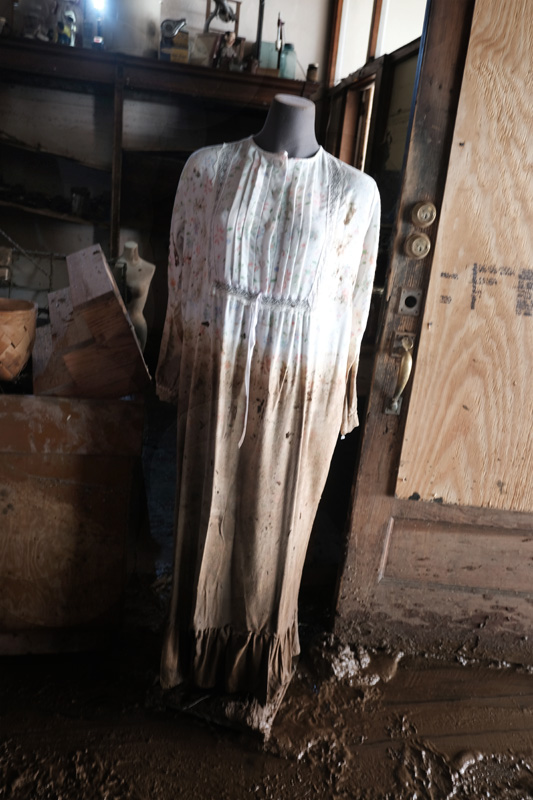
At Penland & Sons Store, the interior looks like a giant has gone in with huge salad forks and stirred the contents — clothing, books, jams and jellies, fresh vegetables. Georgette takes me to a moveable counter with two baskets of my wife’s soap resting on top. The flood lifted the counter to the ceiling and rested it in a new location in the store, never disturbing the soap.
With help from Todd I make it into the building to check on my books. It’s dark inside the warehouse, the floor carpeted with mud and water, tools, lumber. Two-by-ten boards have been placed throughout the building and we walk gingerly to the back. The pallet of books has been moved and is resting on its side in a puddle of water and mud. The covers appear untouched, protected by the cellophane covering. But when I cut into the pallet and pull out a small bundle of books, I see they are all sealed shut, only opened by tearing pages. Disheartening.
Wednesday, October 2
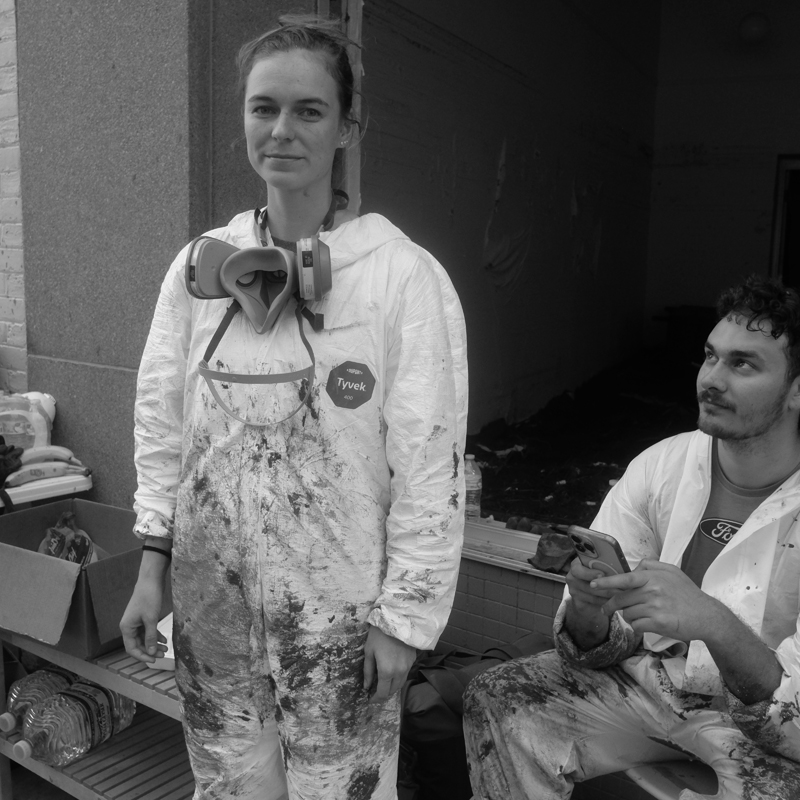
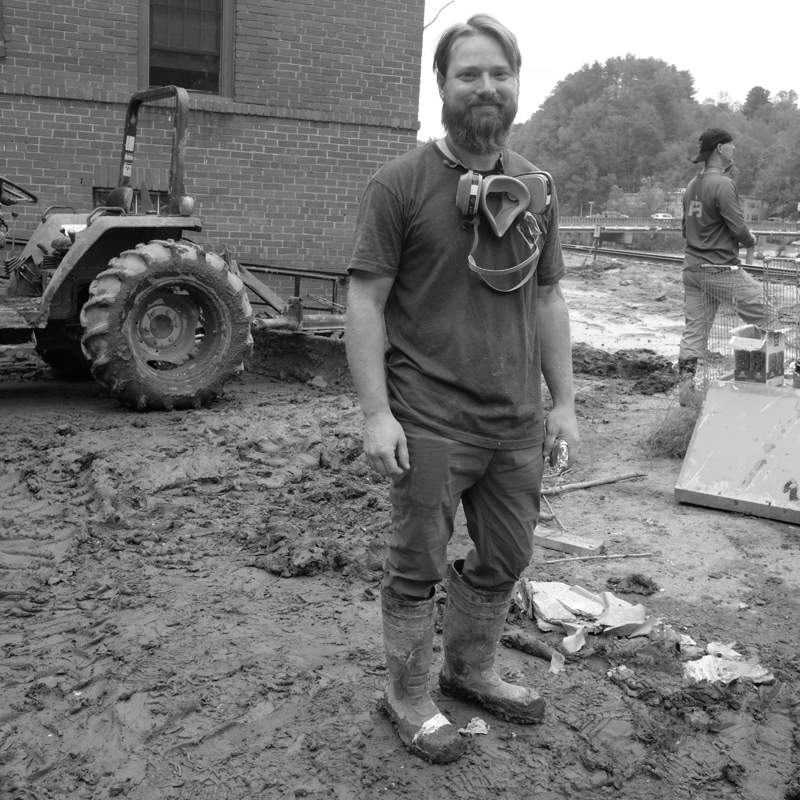
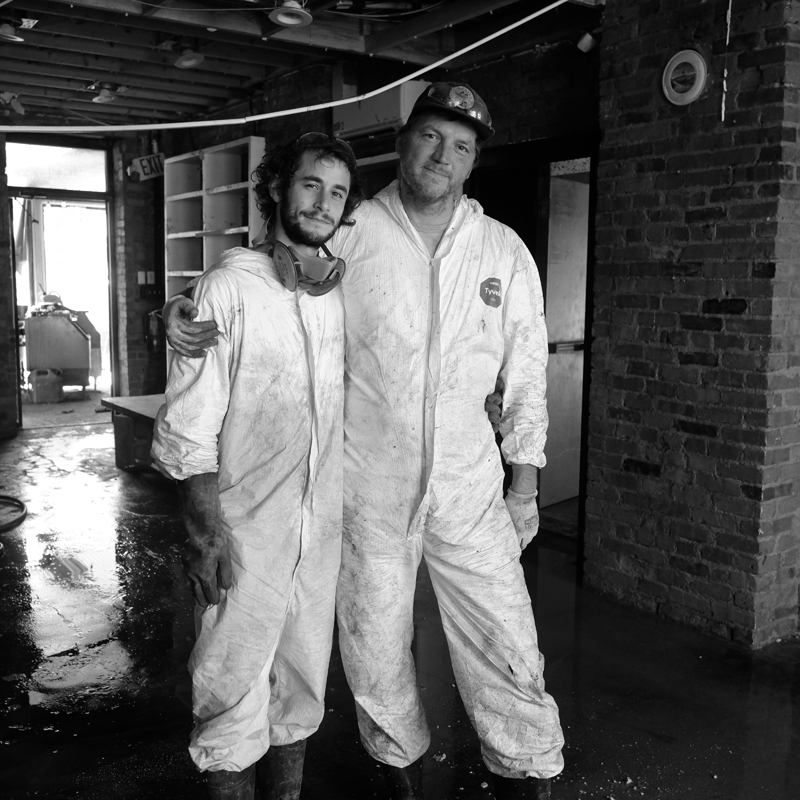
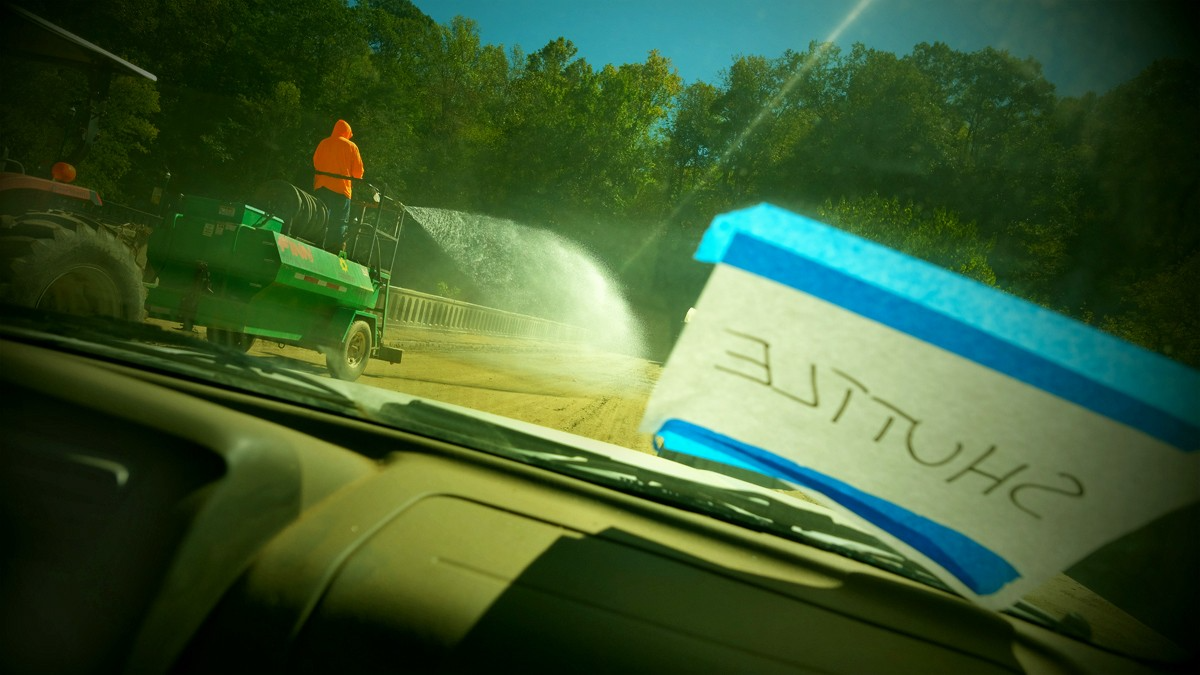
Staging ground has been set up at Nanostead on the Marshall bypass and it is immediately flooded with supplies, equipment, food, and volunteers. The volunteers are coming from all over and they are a diverse group — church groups, college students, elderly retirees, and county residents not impacted by Helene. They don Tyvek suits with boots, gloves and respirators as there are concerns about the toxicity of the mud. They’re shuttled into Marshall in the back of trucks, their gleaming white outfits blinding in the sunlight.
The town is a hub of activity. I’m reminded of stories about Marshall before the coming of I-40 and the bypass. Then, it was on the most direct route between Knoxville and Asheville. This small mountain town had three car dealerships, three grocery stores, two hardware stores, two florists (Sunnyside and Shadyside}, a library, the courthouse, countless attorneys, the jail, and restaurants and general stores.
Now, the streets are crowded and dangerous with an abundance of heavy machinery — track hoes, front end loaders, bulldozers — all piling and loading a steady stream of dump trucks, some with mud, others with debris, and still others with remains of trees. Smaller tractors with scrape blades try to keep the mud at bay.
Inside the buildings the owners, along with friends and volunteers, push and bucket mud into the street. The concern now is mold. A series of warm sunny days heightens the fear. Piles of soggy, stinky, just plain nasty, insulation and sheetrock begin lining the street.
The mood is different today. The townspeople remain depressed and angry. But I also sense an adrenaline rush, a feeling of resilience and determination to rebuild. Perhaps it’s the volunteers, the added hands and young energy. Or the visible evidence of the recovery moving forward. Or how the town is working together.
Food stands are set up to feed the workers. Water. Washing stations.
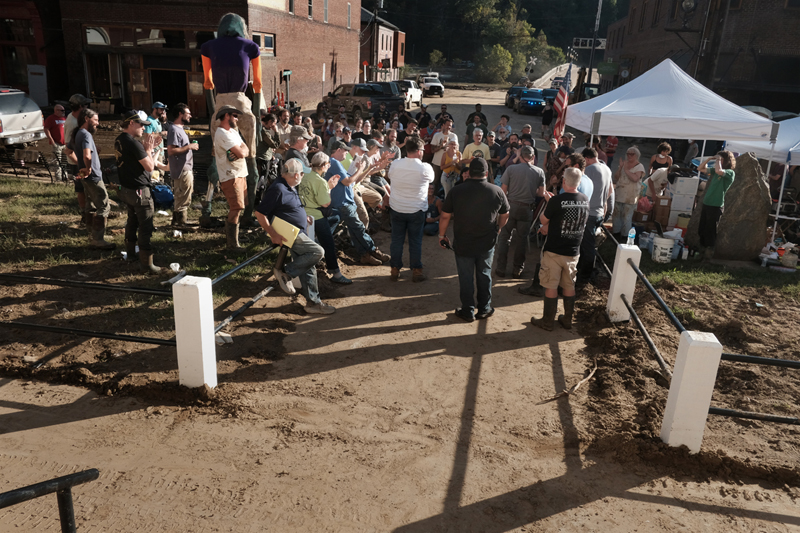
There is a town meeting every evening. An accounting of what was accomplished that day. How many truckloads of debris. The number of buildings mucked out. And also plans for the next day. Who needed what? What could be improved?
The town is shut down after the meeting. No power, no water, standing water throughout, massive and growing debris piles. Ghostly. Police patrol the streets at night. There has been looting.
Thursday, October 3
After the storm hit and the level of destruction to our region became evident my ex-Catholic guilt kicked in. I thought my book, Little Worlds, which speaks of a worldwide collapse, had somehow caused the flood. I could hear myself in confession — “Bless me father for I have sinned. I wrote a book that predicted an apocalypse and it came true. I’ve ruined a town and the lives of many people.” But, soon, I realized that, unlike the federal government of Marjorie Taylor Greene’s imagination, I could not control the weather.
But at the same time, both Leslie and I are experiencing survivors’ guilt; the knowledge that we faired well in the storm compared with friends who’ve lost everything. Yes, I lost a lot of books, income. seven years of sweat equity. But the books can be replaced. And a look around Marshall, helps me understand I’ve lost very little.
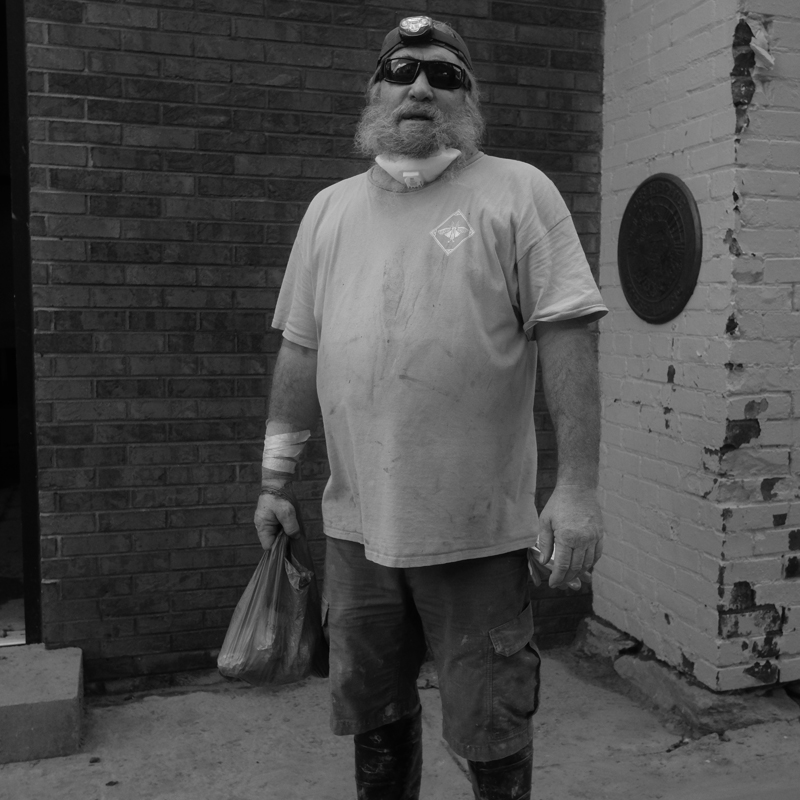
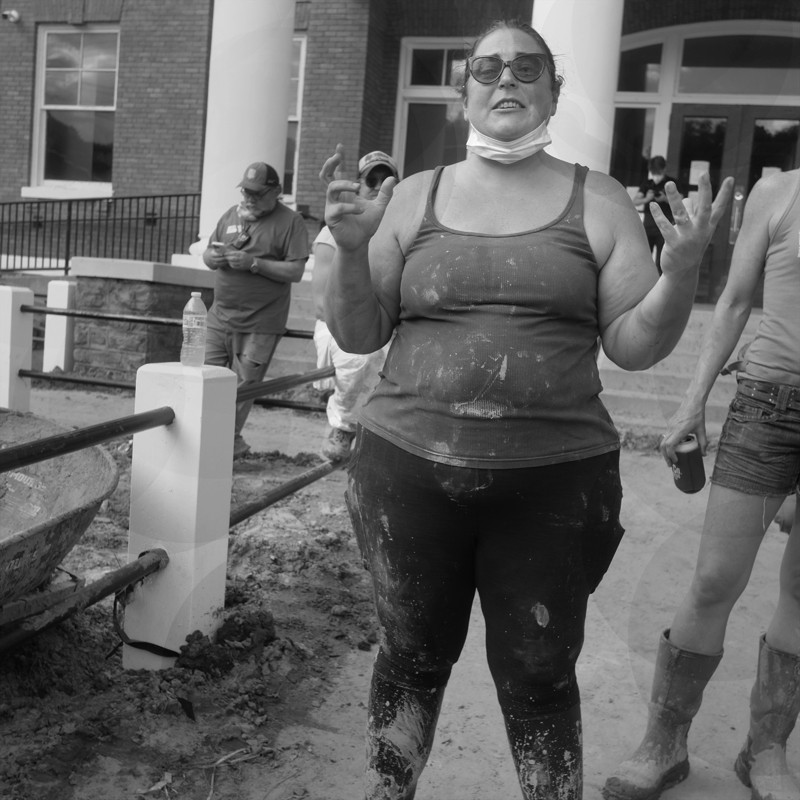
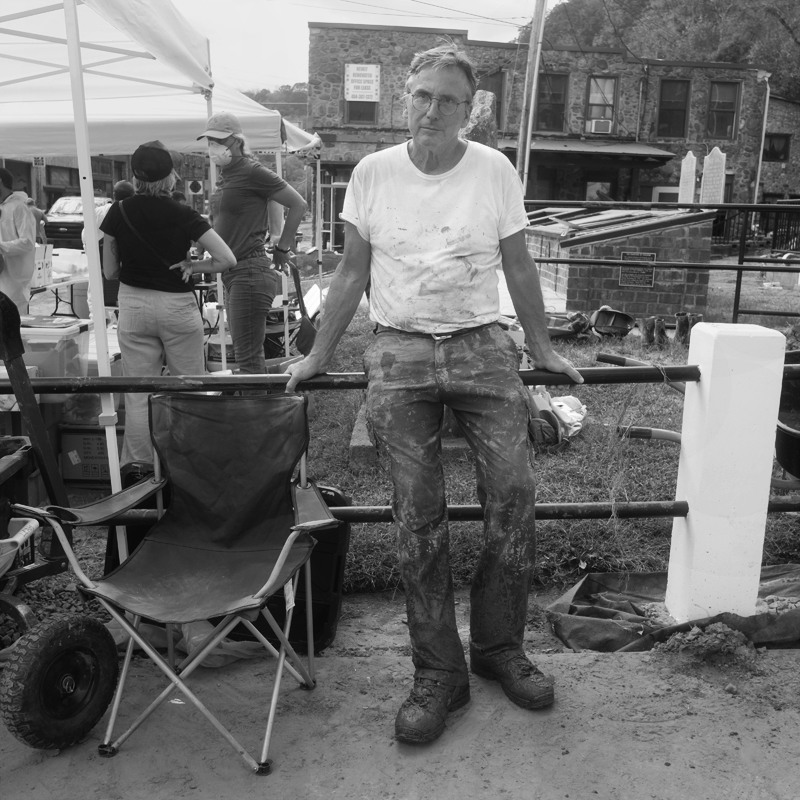
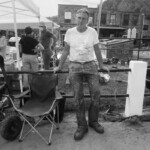
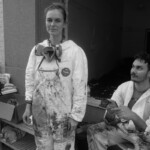
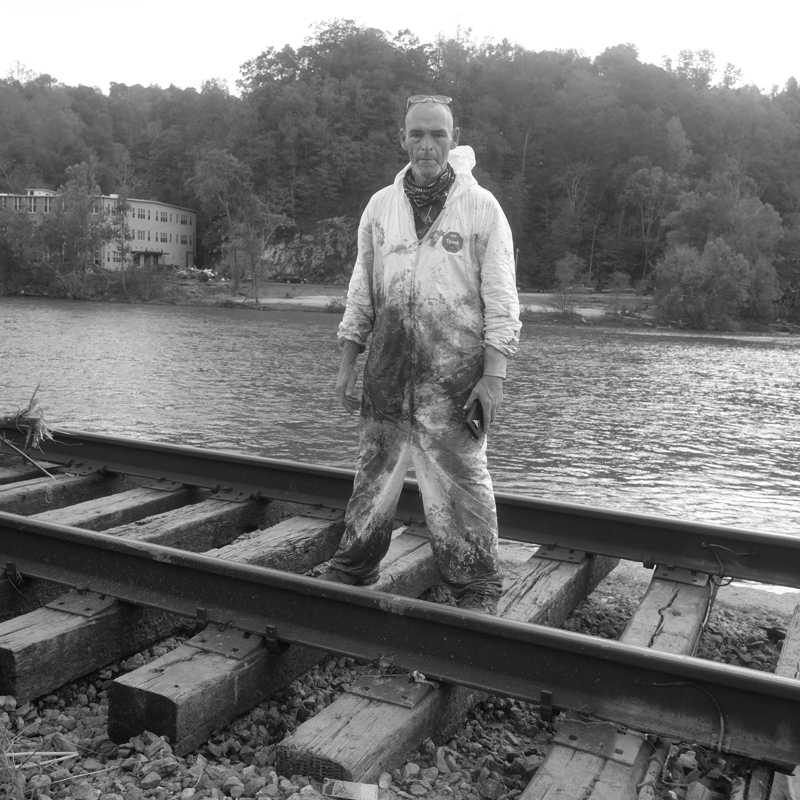
Shooting portraits today. Square format, b/w. Tight. Faces. Some objects. The black and white takes me back to my beginnings in photography and my belief that color can be so distracting. The monochrome heightens the emotions.
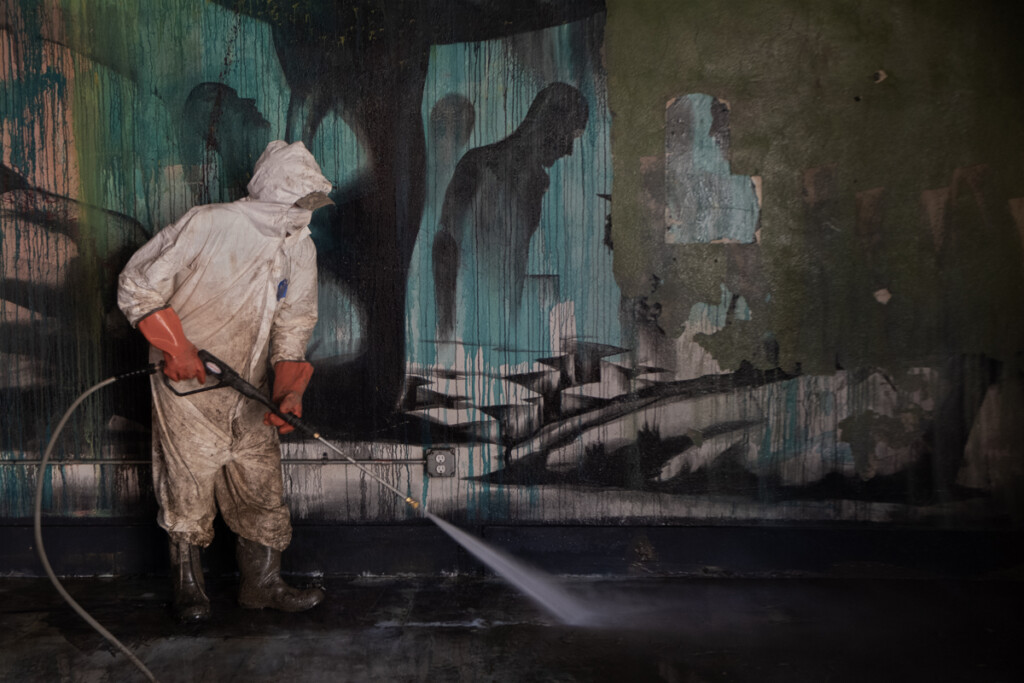
One of the real ironies of this catastrophe is water. The tremendous amount of water that flowed through town to cause this level of destruction. And now the tremendous amount of water being used to rid the town of what the flood left. Pressure washing — walls, floors, machinery, salvageable items.
As I walk through town, doorways seem to vomit debris. The piles of rubble, cinderblocks, and brick remind me of a walk with my son through the Valley of the Temples in Agrigento, Sicily. Some of the twenty-five hundred year old Greek temples had been meticulously restored to mimic their one-time magnificence. Others were mounds of crumbling limestone columns, left where nature had placed them. Both here and there, in Marshall and Sicily, I see fractured memories of what once was.
Cars looking like relics dug from a different era. A telephone pole perches over Main Street, hanging by the wires that it once supported.
At Penlands Store, Georgette and Susan and their families sort through mounds of water and mud-soaked pants, shirts, dresses, scarves, hats, belts, boots. Trying to lighten the mood of despair, I jokingly ask Georgette if she has a 42-long sport coat. She gives me the finger.
My books have been moved to the upper floor of the warehouse, in the dry and out of the way. I can see them for what they are, and are not. What they are is artifacts, remnants of the great flood of 2024. The covers are readable, clean. What they are not is useable. The pages are glued shut, only opened by tearing. There looks to be 350 of them.

Friday, October 4
The town is crawling with journalists, photographers, videographers, all looking for the defining image or story. Some are working with major publications or media outlets, others are rubber-necking, disaster tourists. All are afraid to get close, to engage, choosing to keep their distance with their long lenses and removed personalities.
Volunteers are here in earnest today, hundreds of them. Arriving to Nanostead, the staging area, and donning brilliant white Tyvek and boots, heavy gloves, masks and respirators. They’re driven by shuttle into town and turned loose. Students from all over, elderly people here with church groups from Oklahoma, California, and Louisiana with memories of Katrina. A soul food truck operated by a family from Florida who stay a week and then have to beat it back to Florida to help with Hurricane Milton. The best fried catfish I’ve ever eaten. Other trucks arrive in regular fashion, bringing food, water, chain saws, generators, more Tyvek.
Throughout the day I see people — hugging, holding hands, crying together, hugging some more. The look remains one of disbelief, confusion, anger, emotional exhaustion. Yet, people are here — together — mucking, hauling debris, ripping out sheetrock and insulation, helping each other. I see my friend Matt, a local building contractor, who sends a crew down to the Natural Foods store where they demo the sheetrock and insulation throughout the store in ninety minutes — a job that would’ve taken the owners days to finish.
Sunday, October 6
There are fewer people in town today and I don’t stay long.
Deb and Jerry Burns at Engine House Design are mucking and removing debris but already thinking about how to redesign the building.
Jamie at French Broad Exchange isn’t sure what he’s doing. The buildings’ owner is not helping with the clean-up and restocking will be a long, slow and expensive process. But he loves the town and being part of it.
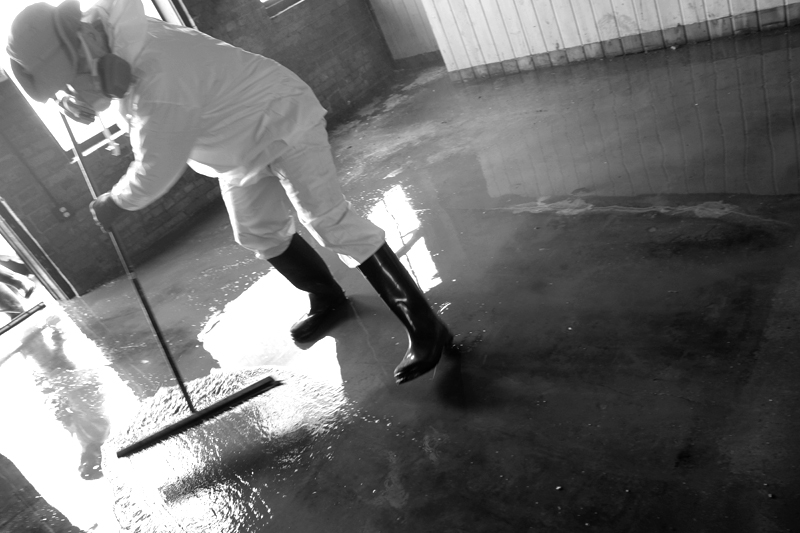
Josh has a small crew pressure washing the kitchen at the Old Marshall Jail. I’m mesmerized by their movement with hose and brush, like an elegant dance of light and space. And for a time I dance with them, moving, seeking the right spot, stopping time.







Tuesday, October 8
The town is humming with activity today. Food stations at Nanostead preparing for the noon rush. Downtown, mud remains the ever-present problem. Inside the buildings, pressure washing and sweeping the liquid muck into the street, where it will be piled, picked up, and hauled off. There is a sense about the mud that it will never go away, as if it’s been imprinted and will forever be a part of the town.
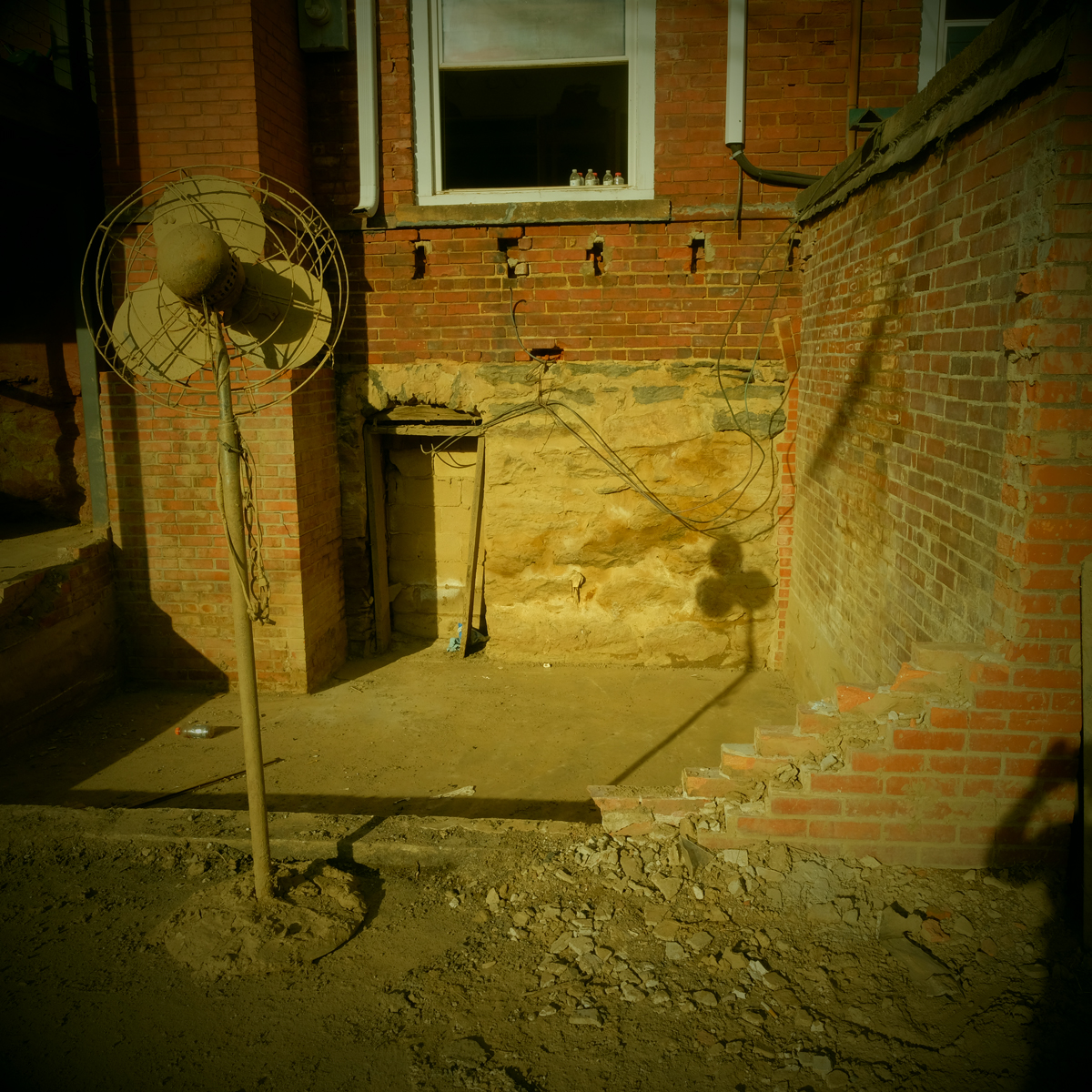
There are some buildings, farther along in their rebuild, that have fans set up in their open doorways, drying the building and clearing the air.
There are more volunteers, their gleaming white Tyvek soon to turn brown. They’re mostly young, many students, some from close by, others from far away. It’s heartening.
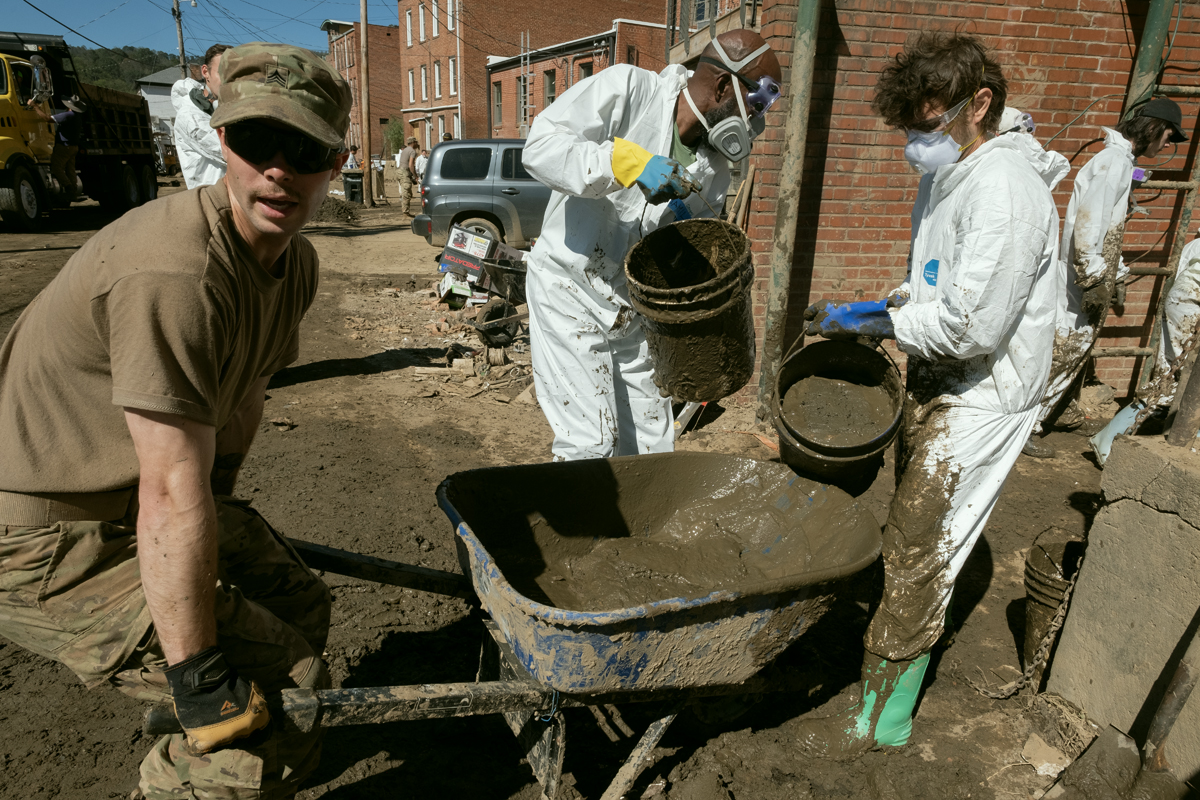
And the Army has arrived. Probably a couple of platoons of men and women from the 101st Airborne Division from Fort Campbell, Kentucky. They, too, are very young, some not long out of high school. Fit, with shoulders and arms meant for work.
I walk through town hunting artifacts. They’re everywhere. Still-life expressions of what once was.
Wednesday, October 9
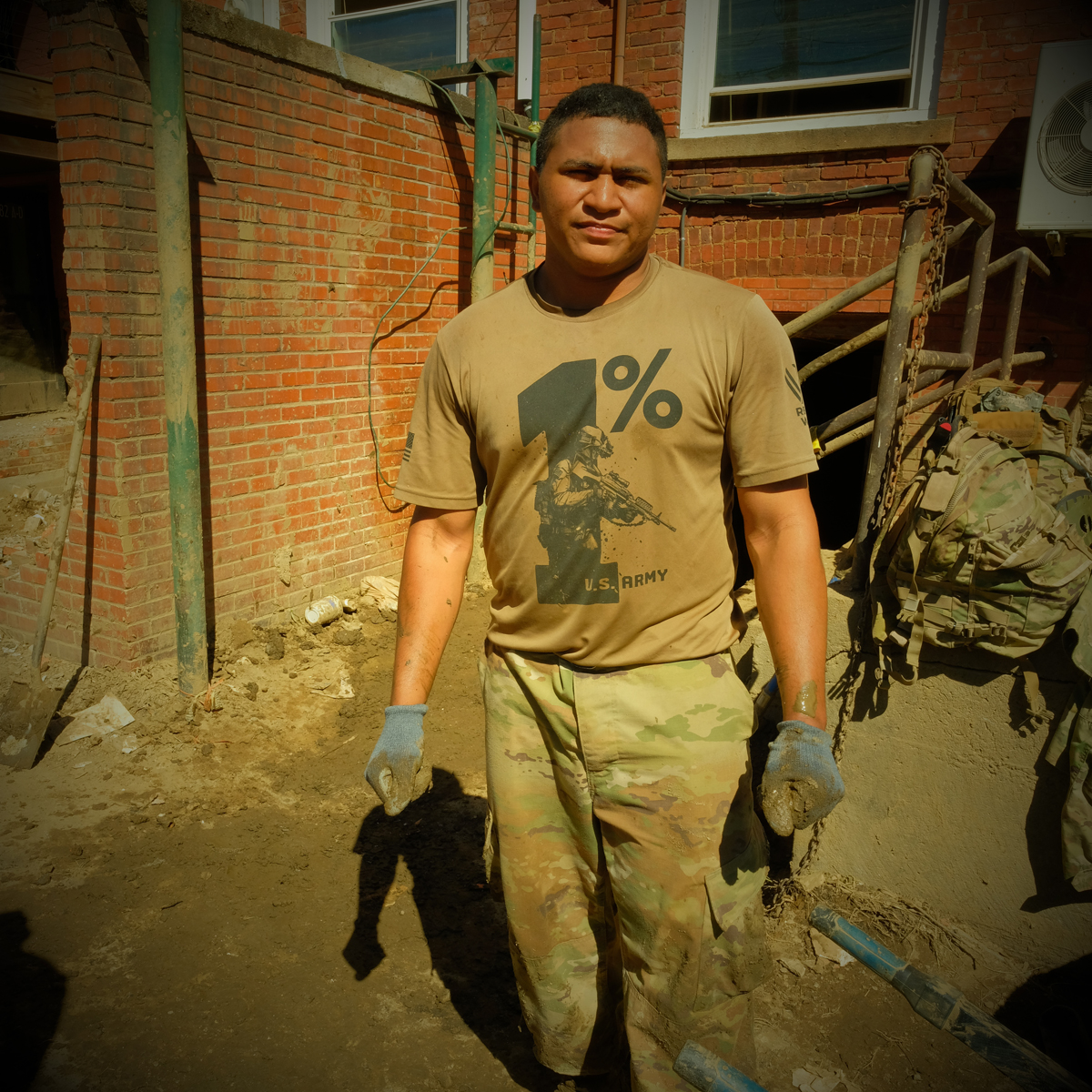
The Army seems to have found its purpose in the basements of downtown Marshall. In those tight, low-ceiling, airless dungeons, up to three feet of river mud has settled. In most cases the only access to the basements is through suspect steps and narrow doorways with no room for machinery.
I have a long history with the Army. My father was a veteran of World War II and both of my parents worked for the Department of the Army throughout their careers. I was an Army enthusiast and went to an all-boys, Catholic, military high school. I considered a career in the military as a potential life goal. I enrolled in advanced ROTC in college and was preparing to enter the Army as a second lieutenant upon graduation.
But change happens if you are open to it. I began reading a broader body of history and literature and hanging out with a more diverse group of people (teachers and students) who introduced me to new ideas and ways of seeing the world. A trip to Italy with my grandmother sealed my distaste for Catholicism and opened me to European opinions of America.
So, when the 101st Airborne marched into Marshall, I was prepared to be resistant at worst, mistrustful at best. But change happens.
At the Madison County Arts Council building, a crew of fifteen soldiers are gathered around the stairs and doorway to the basement. A group of six or eight of them, two mud buckets each, go into the dark, dank room and begin shoveling. The mud is thick, heavy with water, and stinks; a half a bucketful is almost too heavy to lift. At the doorway stands Lopez. He handles all the buckets, hauling them to the stairs, and handing them to two men above him who empty them into wheelbarrows. It is grueling, nasty work. They work in thirty-minute shifts, a fifteen-minute break, then back at it. It takes two days to clear the building.
There is a side of me that is in awe of these young men and women — their focus, work ethic, stamina, and their ability to find the best solution to a problem and then just doing the work. At the same time I know that when they signed up for the Army they didn’t really have a choice as to what work they did. And I much prefer they are in Marshall, rather than in some far away place shooting up the local population and countryside. The whole town is thankful they are here.
Friday, October 11
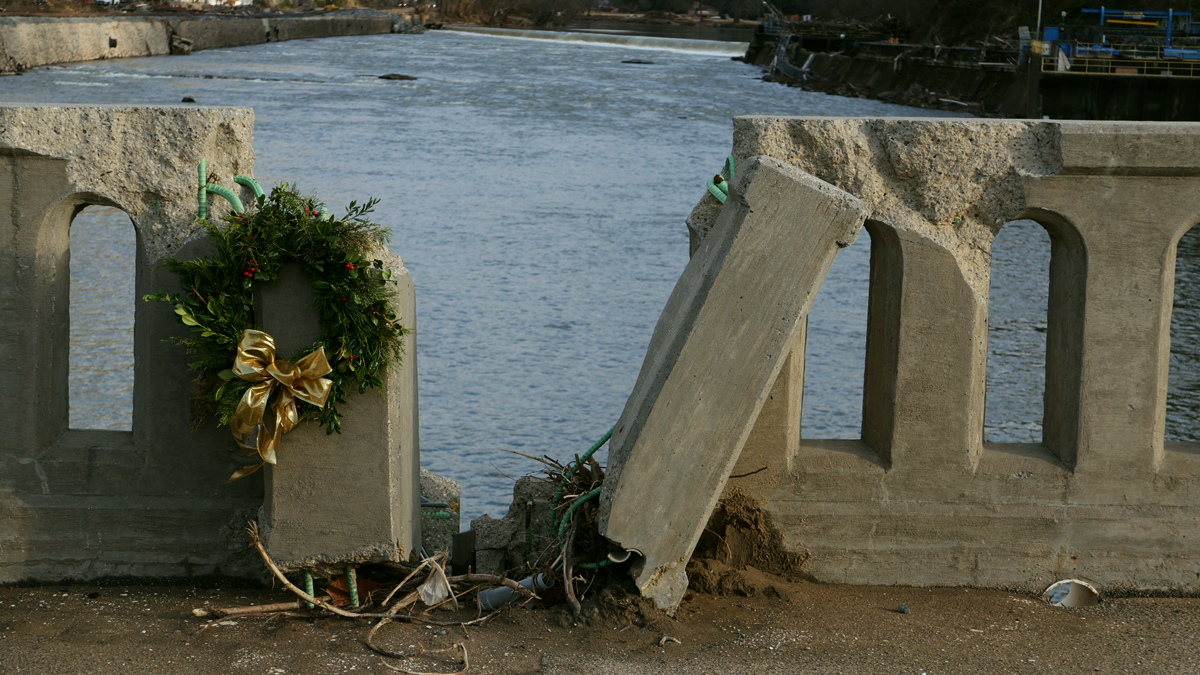
The river’s flow looks almost normal today. Nothing else about it is the same. New channels and sandbars. The river banks are stripped clean or a tangle of downed trees, miscellaneous debris, and a gelatinous mix of sand and mud. There’s a shipping container wrapped around one of the bridge pilings. Those trees that survived the flood are festooned with plastic sheeting and bundles of PVC pipe.
The Army and the volunteers are back at it, but roles have changed. The soldiers have been ordered out of the basements by their superiors for fear of mold and toxicity. They’ve been replaced by the young volunteers.
I wade into the warehouse to check on my books. They’ve been moved upstairs, safe and dry, and out of the way. Sealed shut and unreadable.
Saturday, October 12
Al and I go back to the warehouse and gather the books into the back of my truck. We’re going to park them in our barn for some undetermined future use.
I make a photograph of the books in the truck that speaks to me of the totality of my loss. The image filled with mud-splattered books — black and white and brown. In the corner, looming, is my head and torso’s shadow, the books’ covers living in my body’s trace.
Tuesday, October 15
A late afternoon walk through town. Streets mostly empty of people, not the mud, which maintains a lessened but constant presence.
Years ago, when I lived in downtown Marshall, in converted warehouse space on the third floor of what is now the Flow building, the town emptied at 5 o’clock. Dave, the town custodian who doubled as Santa Claus in the Christmas parade, would begin his walk through town with pushcart, shovel and broom. And Marshall would shut down for the night.
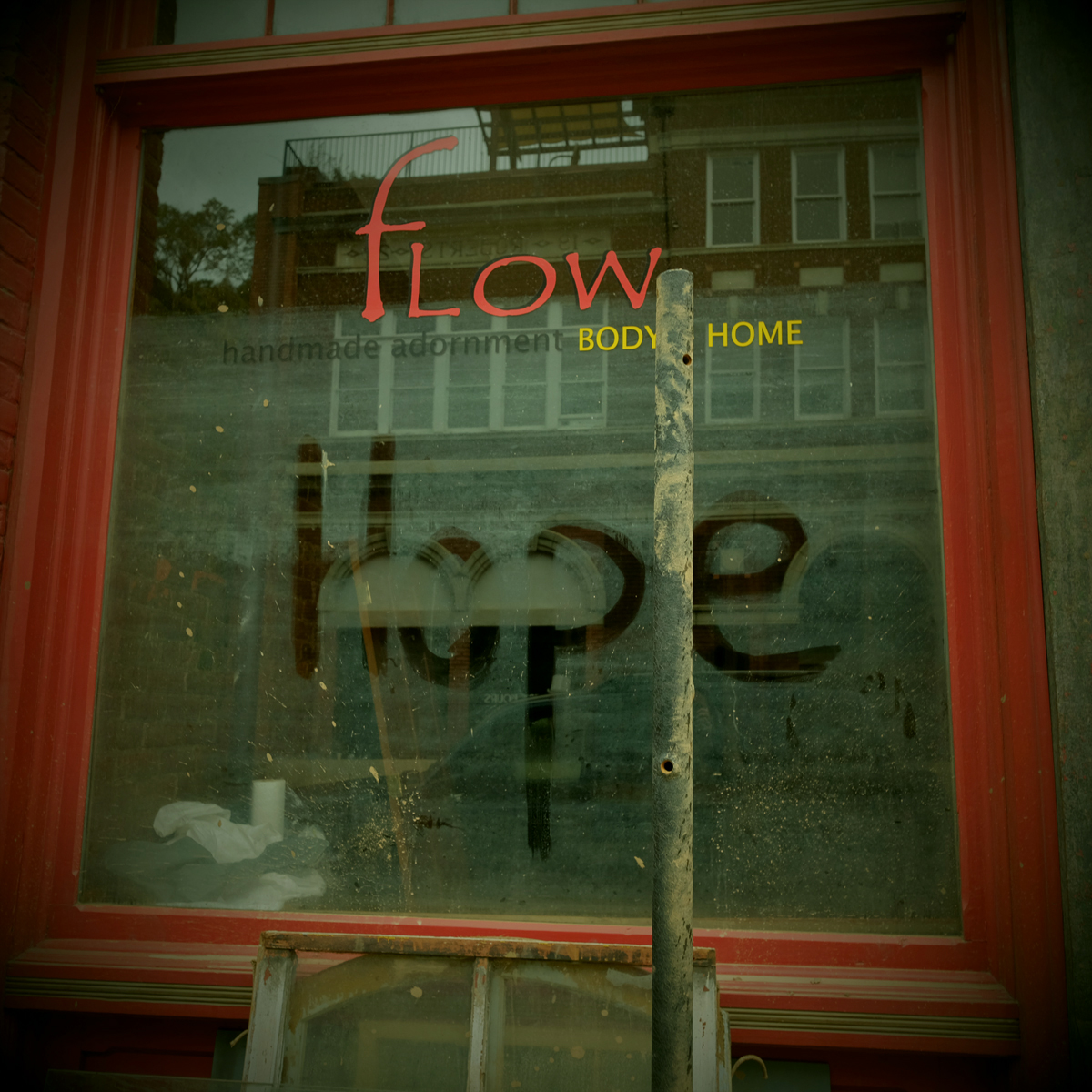
This town closure, of course, is different. Involuntary. Streets passable but slick with mud, buildings open to the air, no power, the town not just shuttered for the night, but essentially dead.
But I do faintly hear music and follow it to the courtyard behind the old Rock Cafe. It’s a small gathering celebrating Deb Burn’s birthday. There’s a chocolate cake, and music, and people dancing around a portable heater.
Saturday and Sunday, October 19 & 20
It’s mostly quiet as I walk through town. There’s people, but not many. Thomas and Mark are washing and sweeping, getting ready to mitigate for mold. The Shadyside florist guy is stunned, everything that was inside his store is now piled high outside.
The relative lack of sound, the quiet of the place, offers the opportunity to see quietly, without the urgency of the cleanup dominating most images. There’s time to feel the light and taste the wind, hear the now muffled sound of the river. There’s beauty in the stillness of the destruction, life as the river has left it.
The roads are dusty now, the recurring mud dry from lack of rain. It’s been three weeks since the storm.
Monday, October 21
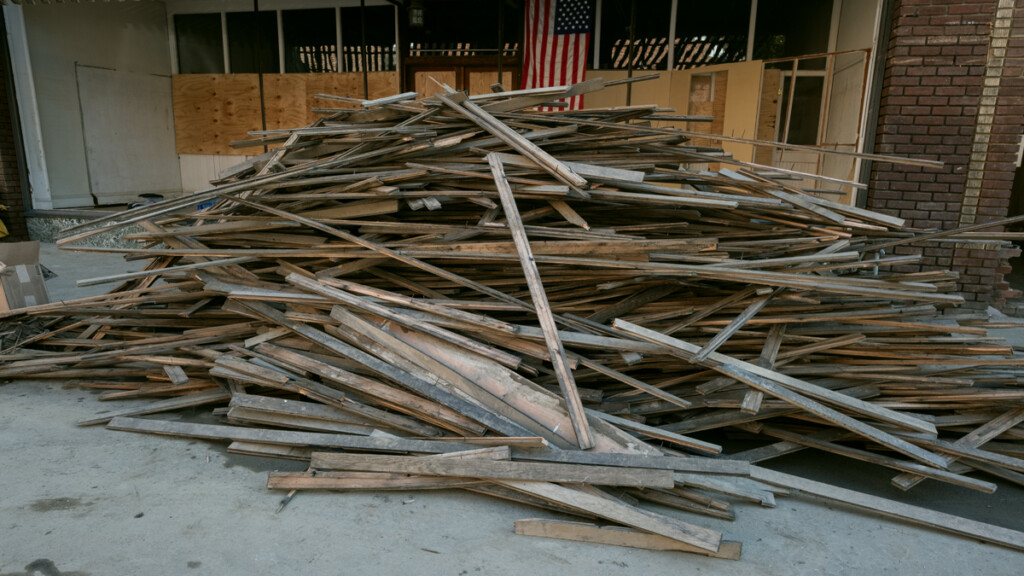
A quick visit with Georgette and Susan at Penlands Store. They’ve torn the flooring out of the building and I bring some home with me to maybe use in an art project.

Sunday, October 27
Town has become emotionally exhausting for me and I’ve been staying away more and more. The constant reminder of the loss of my books and the utter destruction of the town. Plus, the upcoming election has me and my friends on edge. We’re hopeful Harris will win but not without fear of a bad ending. We know Madison County will vote Republican.
Wednesday, October 30
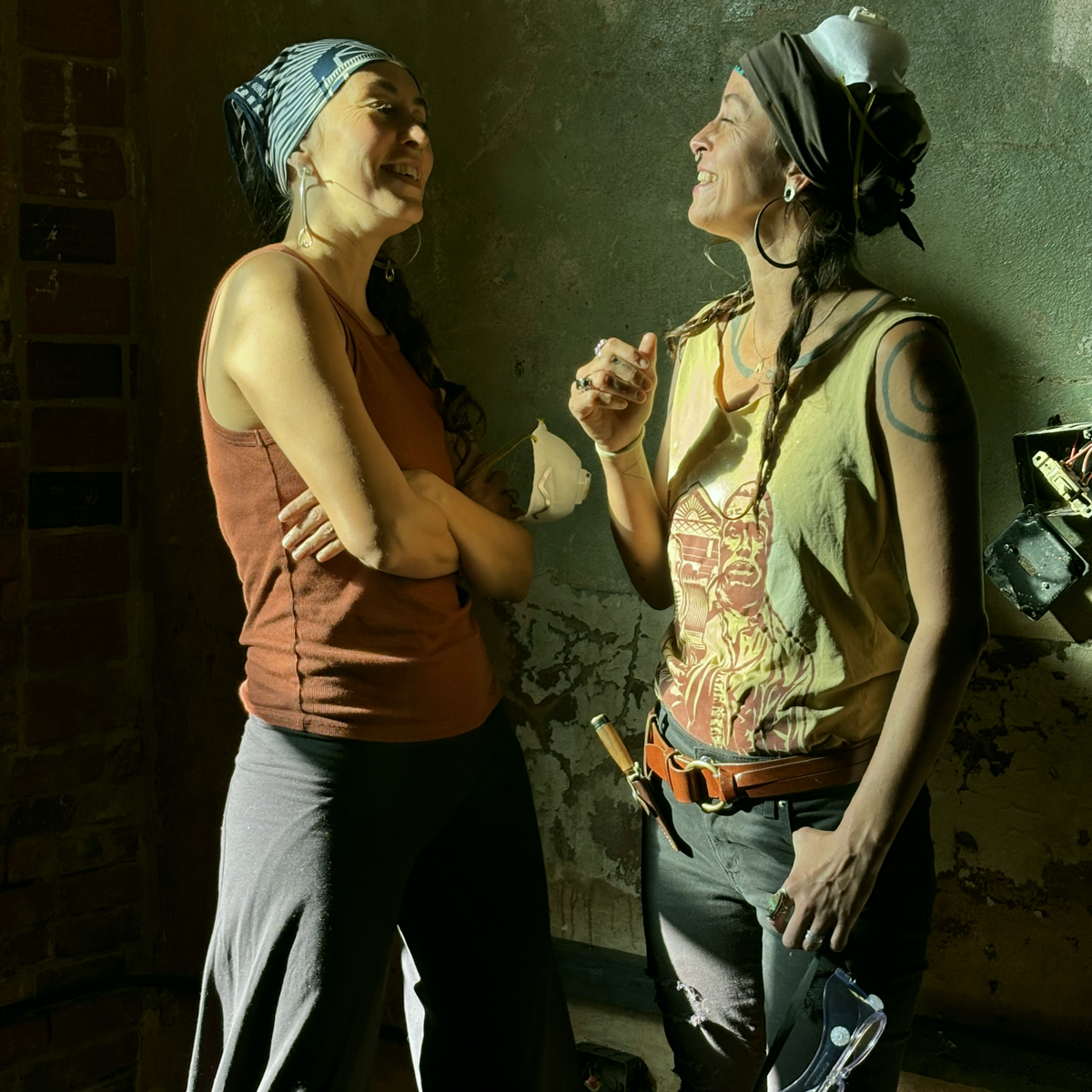
I’m not quite sure how he’s done it but Josh is having ballad swap at the Jail tonight. Balladry has a long and storied tradition in Madison County and the county, especially the community of Sodom, is considered a rich source for acapella ballad singing. Since Josh Copus opened the Old Marshall Jail as a boutique hotel, restaurant and bar, he has been hosting a monthly ballad swap. Six to ten singers, some with multi-generational roots in the tradition, gather at the Jail to swap songs and stories.
It’s pretty much the first event in town since the flood a month ago and the symbolism is hard to miss — the community’s ancient tradition responding to the wrath of our most ancient river, the French Broad.
It's primitive at the Jail, no food, a portable tap serving free beer, limited seating, highly emotional. Everyone is glad to be among other people. Hopeful. Closes with “I’ll Fly Away.”
Saturday, November 2
Meet up with Jack Cecil from the Biltmore Estate and his wife and sister and do a walk around town. He is on the board of trustees for the Duke Endowment, which has donated millions to the rebuilding effort in the region and wants to do more. They’ve asked me to come to their monthly meeting and do a presentation about Marshall.
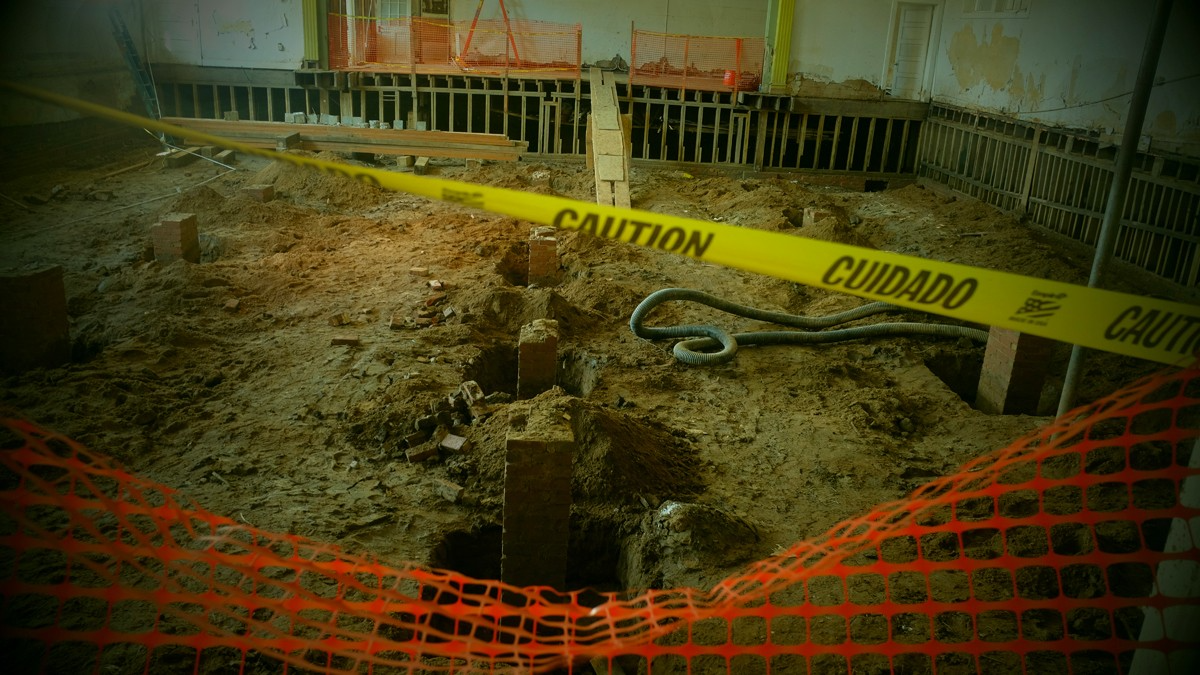
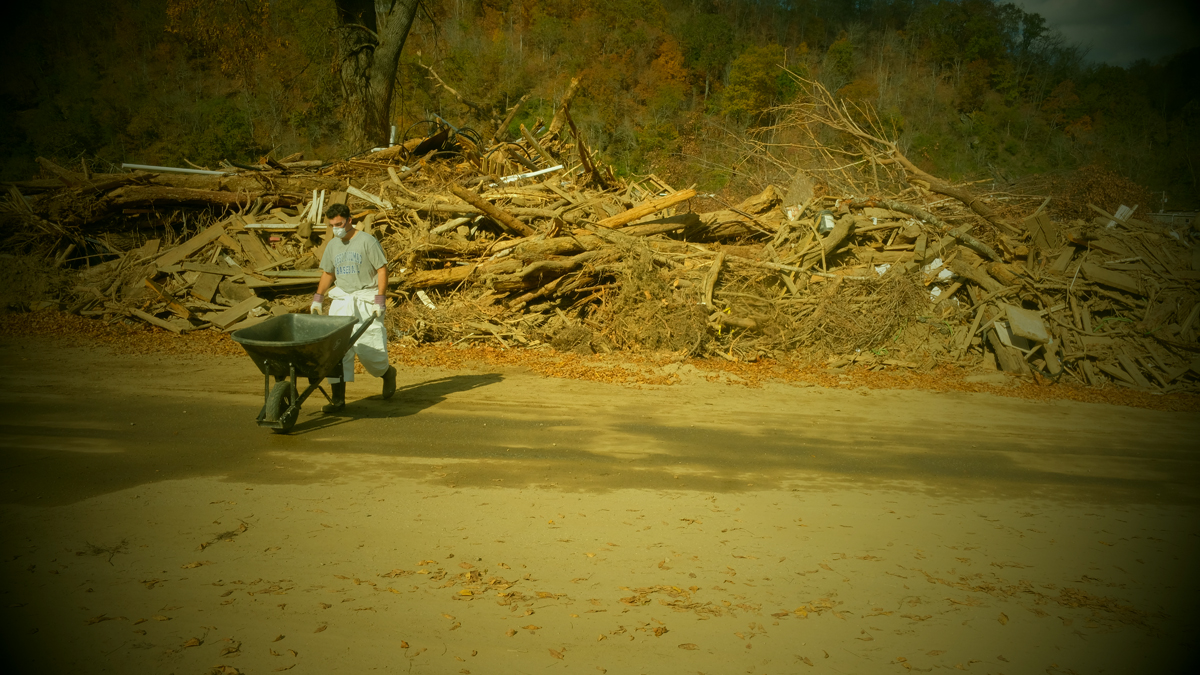
We walk over to the island for a look at the Marshall High Studios. The grounds — the walking trail, basketball court, swing sets, picnic tables, maybe a hundred trees — denuded and gone. Replaced with debris piles, mountains of trees, and a heavy layer of sand. Inside the building — like every other place in town — but bigger, more complicated, very expensive.
The dust. It’s dry. People beginning to worry about fires with all the downed trees, fuel.
Saturday, November 16
The mud is mostly gone, not entirely, but out of the majority of the buildings and off the streets. Debris and dead trees remain a work-in-progress with any one day better than the day before. Many places have been pressure washed and mitigated for mold, swept, and open to the dry air outside.
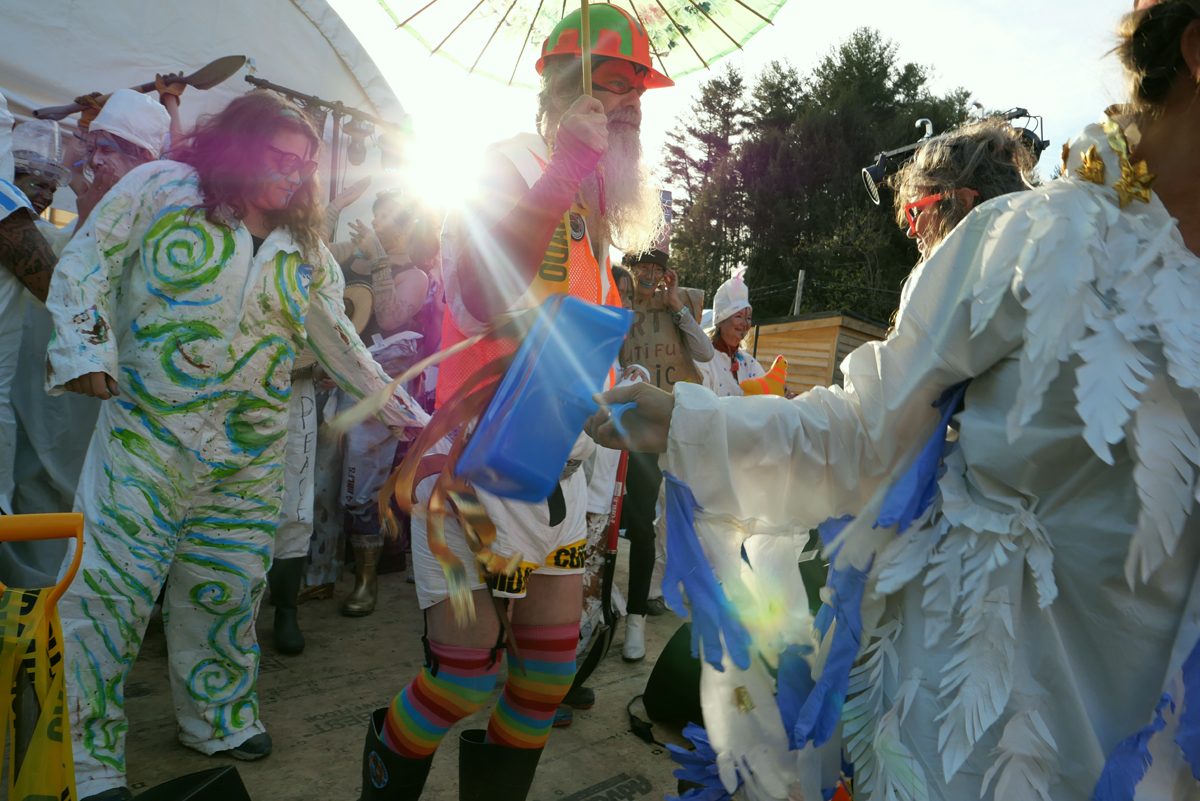
The town has been feeding on a shared energy to get to this visible progress and today is the expression of that bursting energy. Party is in the air. Not quite two months since the flood and Marshall is ready to cut loose, take a break from the doom and gloom, catch our collective breath and ready ourselves for the next, hardest push.
My friend Lois, a fellow artist and thirty-year resident of the county has decided to have her annual found art fashion show. Lois lost everything to the storm—her home and studio, and every trace of her seventy years of life and fifty years of art. Her response to the grief of losing the physical memory of her life—make more art.
I photographed Lois’s first fashion show at the Madison County Arts Council and many more since then. Funny, outrageous, creative, the shows take full advantage of the overwhelming number of artists in the community. This year is no different in that respect—a celebration of the power of art, and resilience. This year's theme — Tyvek.
Spring, 2025
I think about Helene a lot. Was this our “Get Right With God” moment? Retribution for past sins? Noah? Or was it a random, freak-of-nature storm that devastated the western third of our state. Was nature humbling us? Letting us know that while we consider ourselves safe from most of nature’s fury, it isn’t a sure thing. When I think about the frequency and intensity of these natural and manmade disasters in places like Paradise, California, Maui, Hawaii, Gaza, Ukraine, Los Angeles, it may simply have been our turn.
The adrenaline wore off months ago, about the time winter set in. It carried the town through the intensity of the cleanup — the mucking and striping and pressure washing and mitigating. There is still evidence of the recent destruction — lingering piles of debris, or trees, or mud — but Main Street is clean, drivable, and gives the appearance of nothing being amiss.
But peoples’ moods have darkened with the season; money to rebuild being the main concern. Insurance monies are slow to arrive and federal dollars that flowed quickly during the previous administration are being delayed or rejected by the current crowd in office.
People sit and wait and get frustrated.
Also there’s a shortage of sub-contractors with the entire region devastated. Plumbers, electricians, carpenters, laborers, heavy equipment operators, all hard to find.
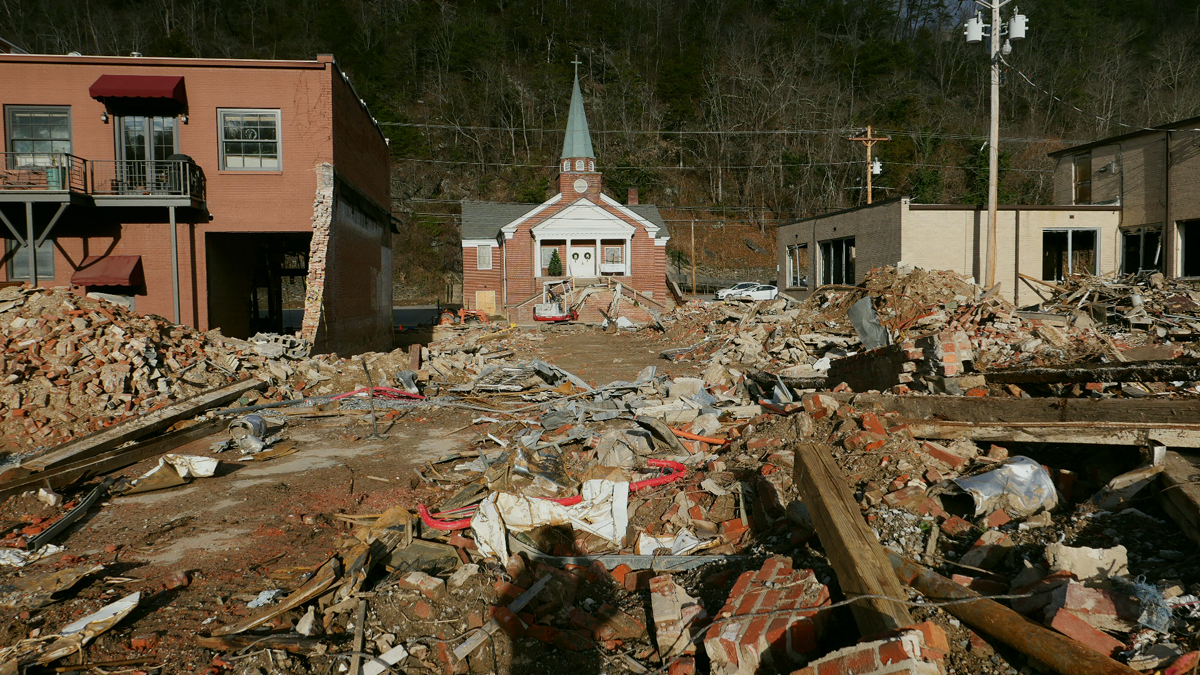
Major questions about the rebuild of the town, which lost over a quarter of its buildings, and still lies in the floodplain, something that won’t change. And there is the very idea of the town itself — what is it, who is it for, how is it paid for?
Marshall has been reborn in recent years. What had been the economic, political, and cultural hub of the county for many decades had mostly died during the 1980s and 1990s with better access to the outside world and changing demographics. The 2000s brought new money, ideas, and energy to town and Marshall and the county emerged as a destination for art, cultural tourism, and outdoor adventure. The flood changed all of that.
Some people/businesses will leave. Some will stay. Of the original businesses in town, Penlands Store, Shadyside Florist, maybe Bowman’s Hardware, the VFW building, will stay. Every other business is new within the last twenty-five years and most of them are coming back.
I continue walking. Often through town looking for traces of improvement, or not. There are places in town where it looks like the flood happened yesterday, and others that are open for business. I went with Jim along a stretch of the railroad track near Redmon searching for debris and was not disappointed. Same in the woods and field next to Ronnie Meadow’s house.
There are gatherings in town. Mal’s bar has opened for music a few different times and there was a big Punk concert at the Arts Council. The venues are unfinished, almost primitive, without plumbing, but offering a place to come together. Everyone is hungry for it.
Summer, 2025
Was speaking with Pete the other day and we agreed that town felt different. And we couldn’t really say what that difference is. The physical changes are obvious, but beyond that, the emotional and attitudinal shifts areharder to identify. It seems the overall, never-ending need for money is dwarfing the strong sense of community that existed before the flood. And the uncertainty of what is coming next, knowing Marshall will be altered, possibly shattered beyond repair.
As I’m finishing this essay, I must acknowledge several of the catastrophes that have hit the nation since Helene devastated our region. Fires in Los Angeles and Maui, tornados in the Midwest and Plains, another flood in eastern North Carolina, and the unprecedented high-water disaster in Texas.
Storms are growing in frequency and intensity, with devastating effects on people, the natural world, and property. How to reverse course? How to rebuild? How will governments and insurance companies pay for ever-more-costly reconstructions? Our current national government seems intent on removing itself from the responsibilities of emergency management, leaving it up to the states who can’t afford the costs to clean up and rebuild.
Marshall and our neighboring town of Hot Springs are rebuilding, slowly. People are supportive. Music is regularly happening and a couple of restaurants are open. During the day the streets are busy with construction workers —carpenters, plumbers, electricians —putting the towns back together. There is no safe place. All of us are vulnerable; some people much more than others, but there is no hiding from the fact that we live in a deteriorating global environment. And as the scientists have predicted, it will only get worse. 
About the Author/Photographer
Rob Amberg has photographed and written about western North Carolina since moving there in 1973. Internationally published and exhibited, his photographs are represented in numerous public and private collections. Rob has received fellowships and awards from the National Endowment for the Humanities, the John Simon Guggenheim Foundation, The Center for Documentary Studies, and others. His books include Quartet: Four North Carolina Photographers (2007); The Living Tradition: North Carolina Potters Speak (2009); and his Madison County trilogy: Sodom Laurel Album (2002), The New Road: I-26 and the Footprints of Progress in Appalachia (2009), and Little Worlds (2024). Books and prints are available on his website: robamberg.com. Amberg lives in Madison County, North Carolina.
Donations for Marshall’s recovery can be made to:
The Madison County Arts Council
The Downtown Marshall Association
]]>
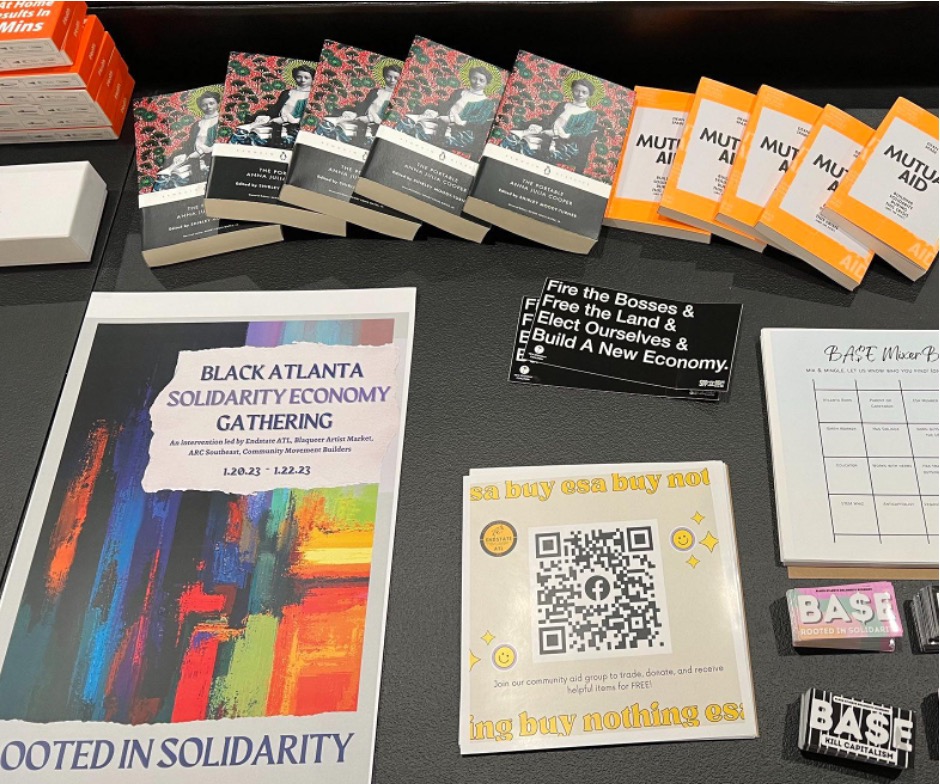
In May of 2023, when the World Health Organization downgraded the coronavirus emergency from a global health pandemic to an "ongoing health crisis," the shift made sense in many ways. Most developed nations have made vaccines available for over two years. Shutdowns and enforced quarantines ended, even in holdout nations. The WHO's announcement signaled that other countries, including the United States, would follow suit if they had not already. This move, however, will have material consequences for grassroots charitable organizations across the US. Endstate ATL (ESA), a group I have worked with since 2021, is one of many non-profit groups that will be affected.
In Georgia, the COVID state of emergency officially ended in May 2022, even as it remained in place at the national level. This allowed organizations like ESA to continue our mutual aid work. But when the US announced the end of the Federal COVID-19 Public Health Emergency (PHE) Declaration on May 11, 2023, enhancements to public assistance and social safety net programs ceased. From this point on, groups like ESA once again will have to jump through multiple bureaucratic hoops to obtain the funding necessary to provide care.
Following the global outbreak of COVID in 2020 many governments created temporary measures to extend aid to vulnerable populations. In the US, these included extensions of unemployment benefits, a moratorium on student loan interest and payments, no-cost COVID testing and vaccinations, Medicare flexibility, and opportunities to provide nontaxable disaster relief funds. The national government also released relief funds to individual state governments, although often these funds did not reach the people who needed them.1Rebecca Riess and Devon M. Sayers, "Alabama Governor Signs Bill to Use Covid-19 Relief Funds to Build Prisons," CNN, October 1, 2021, https://www.cnn.com/2021/10/01/politics/alabama-covid-relief-prison-bills-signed-governor-kay-ivey/index.html. Despite the uneven distribution of aid, many people, specifically children and elders, moved above the poverty line thanks to COVID assistance.2John Creamer, "Supplemental Poverty Measure That Accounts for Additional Government Benefits Lowest on Record at 7.8%," Census, September 13, 2022, https://www.census.gov/library/stories/2022/09/government-assistance-lifts-millions-out-of-poverty.html.
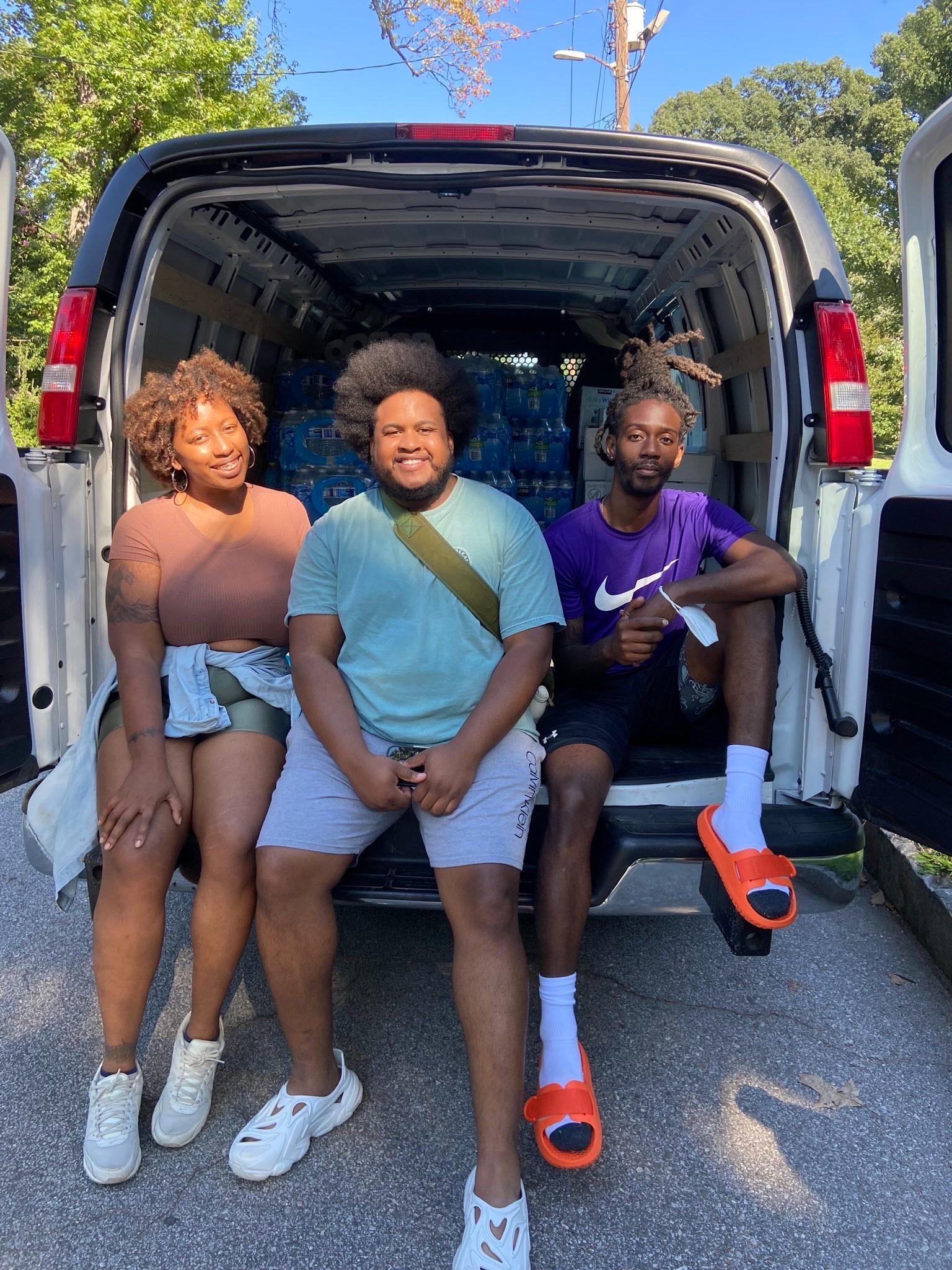
The flexibility surrounding nontaxable disaster relief funds eased mutual aid work. Mutual aid has a long history in the US and Global South, and the onset of the COVID-19 pandemic witnessed an outpouring of community solidarity towards those in need. Mutual aid stands apart from other charity models because of its non-hierachal emphasis on mutualism rather than models that maintain divisions between givers and receivers. Mutual aid is rooted in reciprocity.
Endstate ATL took advantage of these temporary measures for the betterment and aid of our community members. Rooted in southwest Atlanta with a Black queer feminist politic, ESA's work aims to reach those most marginalized through community building, political education, and mutual aid. Through our Black Power Fund, which pays up to three months' worth of utility bills for Black queer households, and our Pack Provides Programs, which provide household supplies, COVID PPE, and infant essentials including formula, clothing, and sanitary products to caregivers of young children, we seek to step in where the state fails to provide support.
Mutual aid allows organizations to provide immediate care and relief to individuals in need without imposing the bureaucratic processes that often keep aid beyond reach. Under a state of emergency, disaster relief payments are not taxable. As such, ESA, and other groups like it, were able to provide direct aid through a less convoluted system of reporting and disbursement. This allowed us to move funds directly and rapidly to people in need and has been crucial to our ability to substantively support people in a timely way. ESA has covered bills for ten households in the past year, as well as covered a year of utilities for the BARRED Business house, which provides stable, community-owned housing for people recently released from prison. We have been able to report these funds as disaster relief.3"Mutual Aid Legal ToolKit," Sustainable Economies Law Center, Accessed June 22, 2023, https://www.theselc.org/mutual_aid_toolkit.
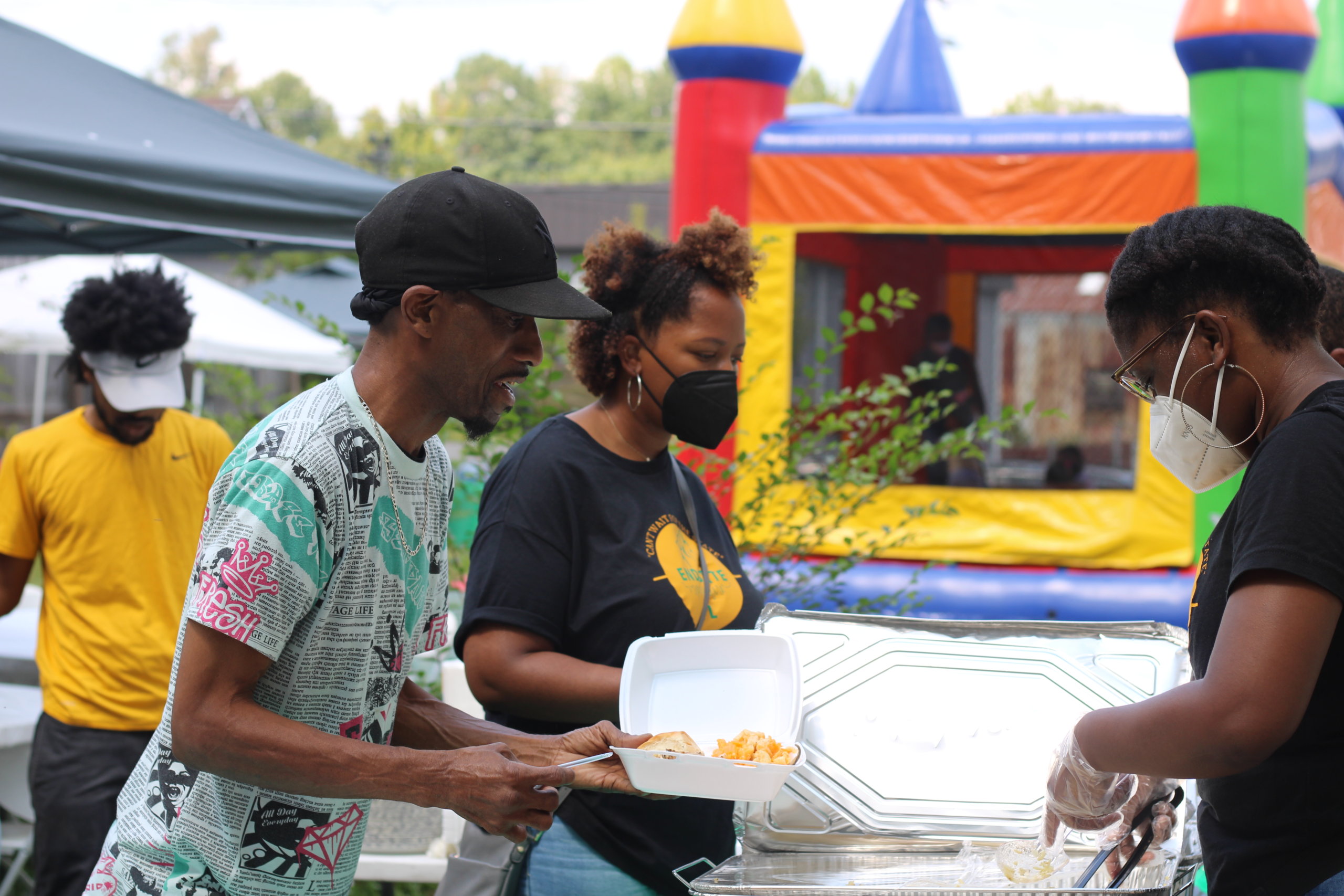
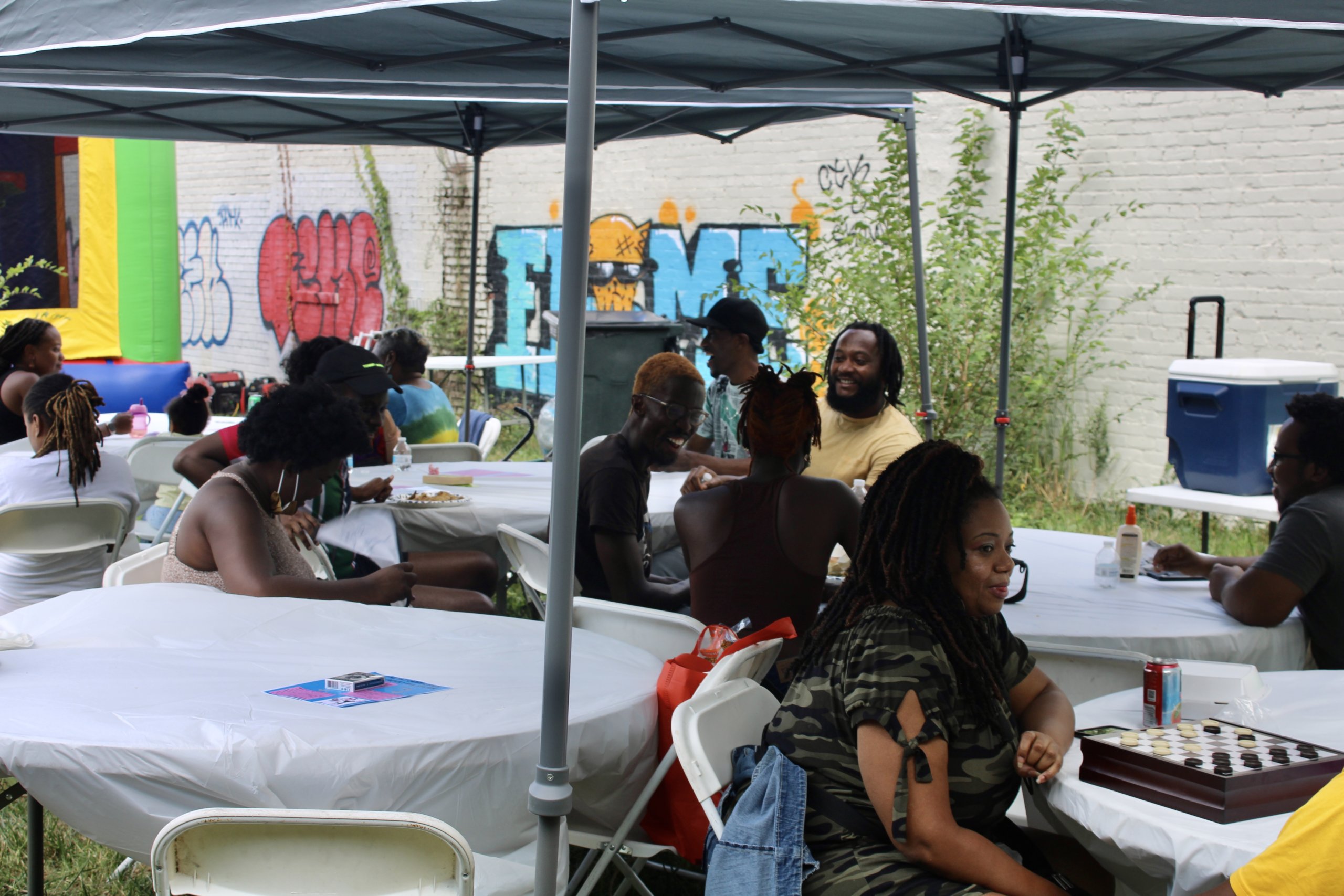
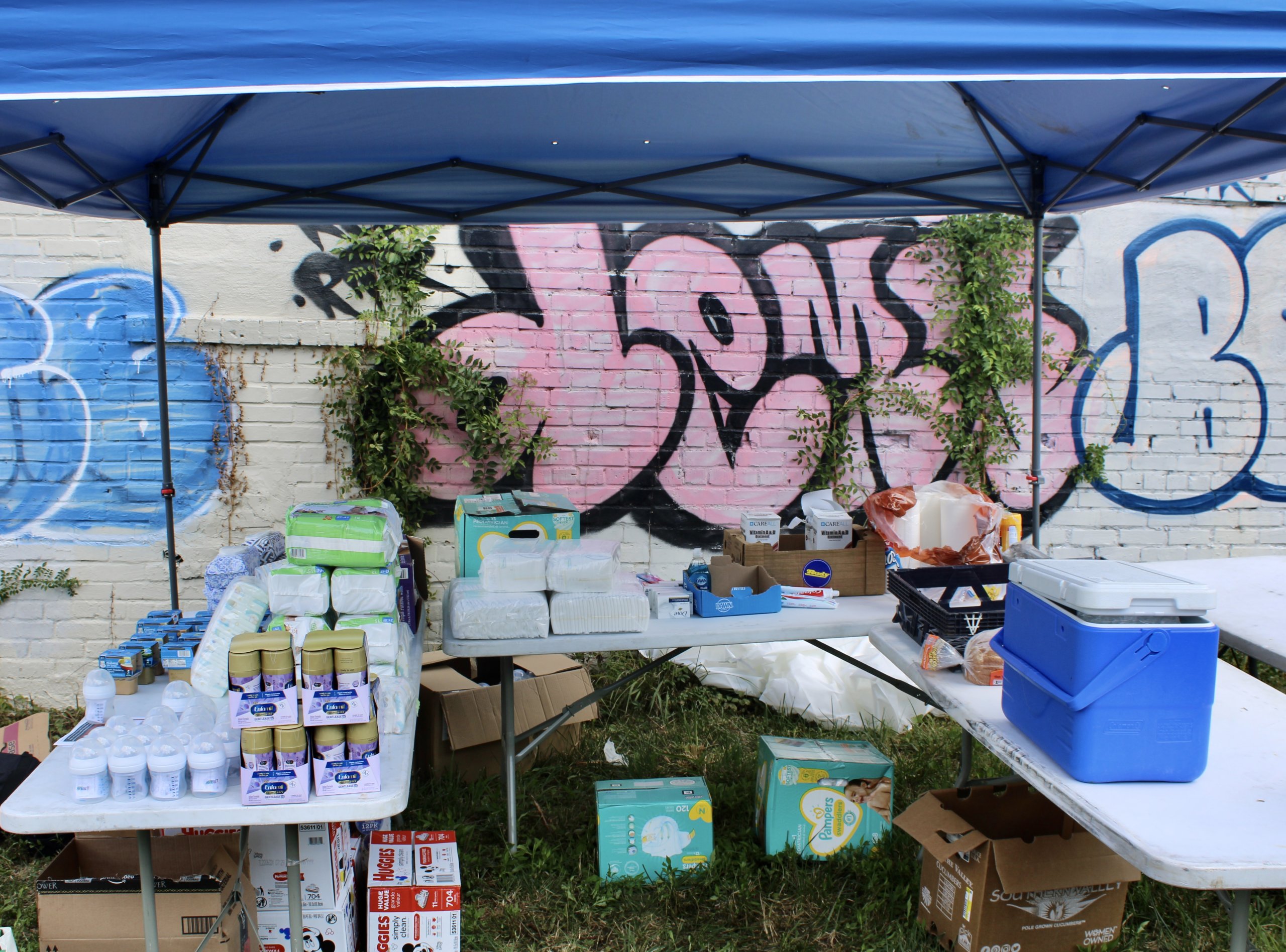
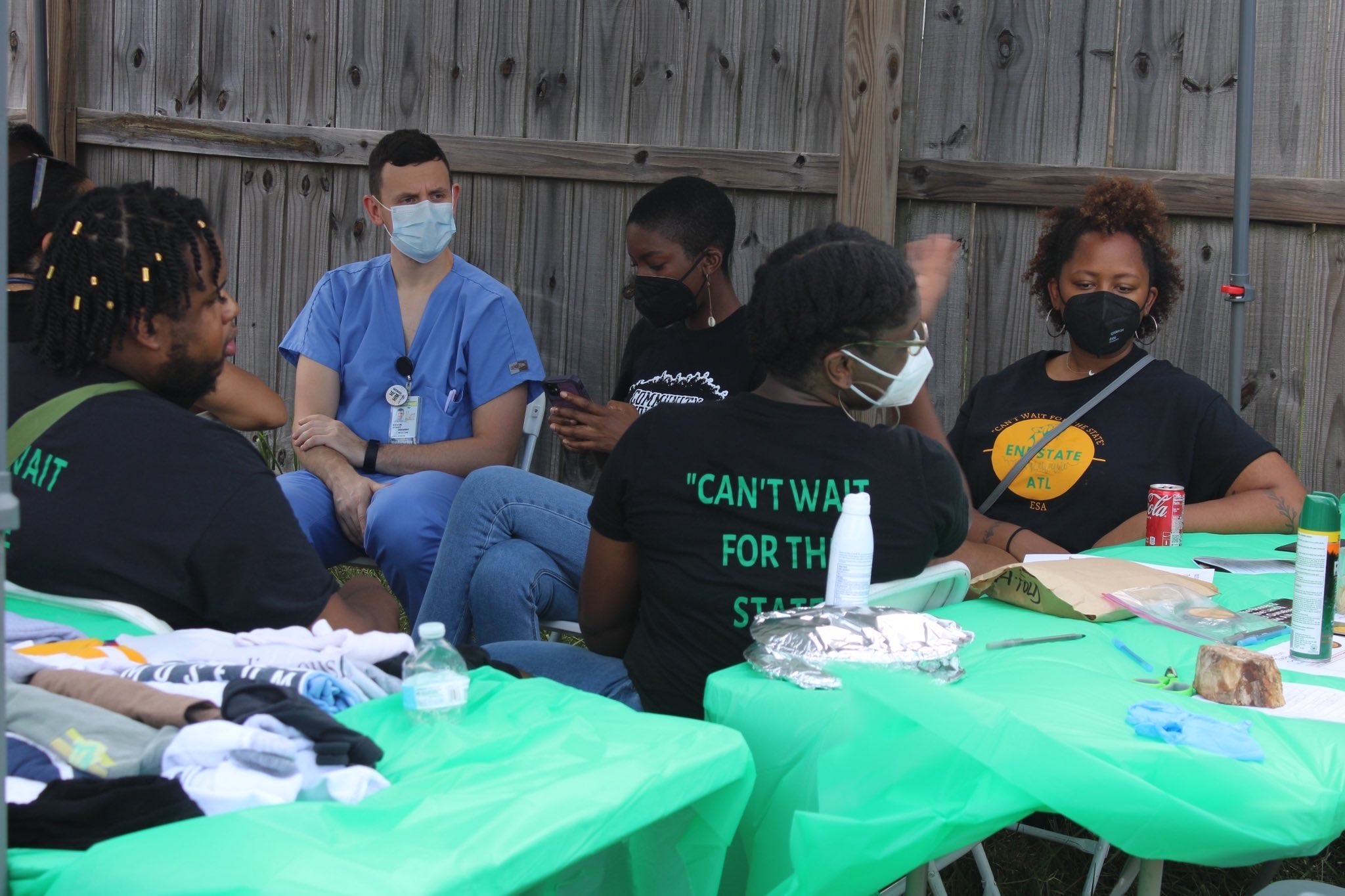
The efforts of mutual aid groups helped supplement aid where state and local leadership failed. Georgia governor Brian Kemp refused to take the COVID-19 pandemic seriously. In 2020, Georgia was the first state in the nation to relax quarantine restrictions, even as Kiesha Lance Bottoms, the mayor of Atlanta, sought to retain many protective measures. Initial reporting that the virus would largely impact the elderly and immunocompromised, combined with anti-fear government propaganda, engendered a sense of invincibility and an attitude of disregard among many Georgians. As of 2021, Georgia had one of the highest COVID mortality rates in the US, and those most impacted were poor, working class, and people of color.4"COVID-19 Mortality by State," CDC, Accessed June 22, 2023, https://www.cdc.gov/nchs/pressroom/sosmap/covid19_mortality_final/COVID19.htm. The refusal of Governor Kemp to implement mandated social distancing or mask requirements, even before vaccines were available, left the entire state population vulnerable to infection. The consequences were devastating, with thousands of unnecessary deaths and debilitating outcomes for those suffering from long COVID.
Pandemic relief payments meant to alleviate the burden of rising interest rates were out of reach for marginalized Georgians. In order to receive national stimulus checks and Kemp's own "special tax credit," individuals needed to have filed and paid taxes for the preceding two years, a barrier that left people who were unemployed or homeless without access to relief.5"Gov. Kemp Announces First Round of This Year's Special Tax Refund," Department of Revenue, May 1, 2023, https://dor.georgia.gov/press-releases/2023-05-01/gov-kemp-announces-first-round-years-special-tax-refund#:~:text=Single%20filers%20and%20married%20individuals,a%20maximum%20refund%20of%20%24500.
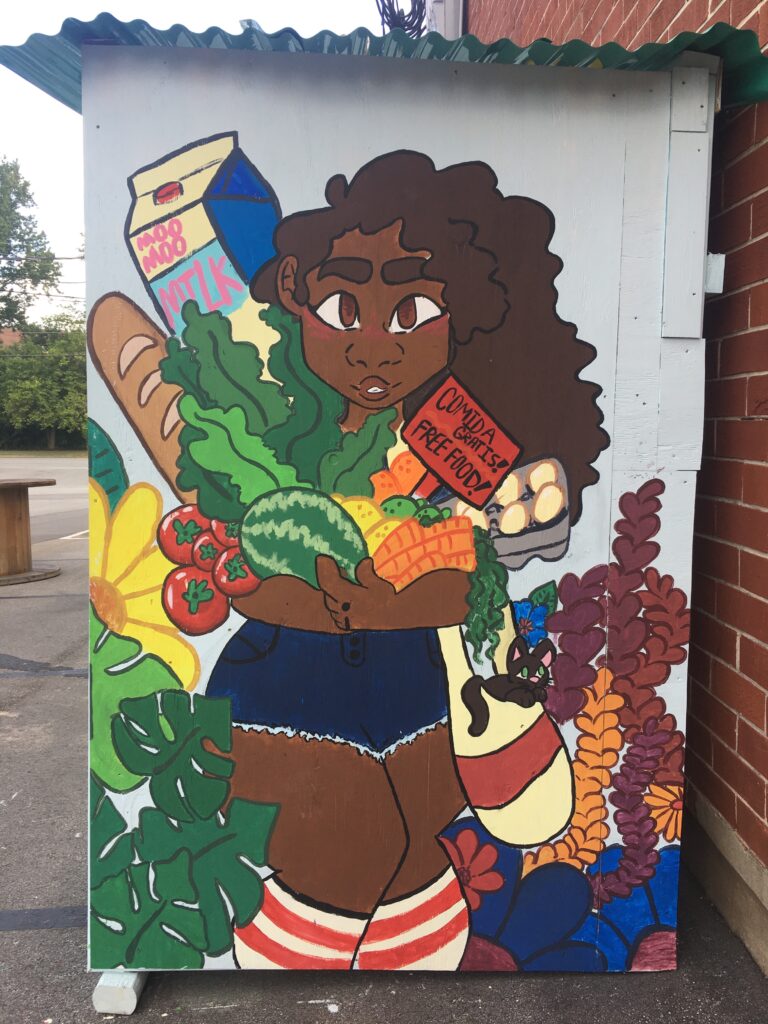
In response to the pandemic, groups emerged such as Bed Stuy Strong, based in Brooklyn, which created a robust grocery delivery system by first relying on the resources at their disposal before evolving into a program that benefited thousands.6Haritha Kumar, "Four Key Takeaways from Mutual Aid Organizing During the COVID-19 Pandemic," Georgetown University Beeckcenter, October 4, 2022, https://beeckcenter.georgetown.edu/four-key-takeaways-from-mutual-aid-organizing-during-the-covid-19-pandemic/. Georgia has similar organizations. Community Movement Builders developed stabilization programs that include rent/mortgage payments as well as groceries in their efforts to impede the gentrification of southwest Atlanta, and Food4Lives a non-profit started by Georgia Tech and Emory students provides food and supplies for the unhoused in the greater Atlanta area.7Katie Burkholder, "Housing as a Human Right: Community Movement Builders Organize Against Gentrification," Georgia Voice, April 21, 2022, https://thegavoice.com/today-in-gay-atlanta/housing-as-a-human-right-community-movement-builders-organize-against-gentrification/; "Who are We?" Food4Lives, Accessed June 22, 2023, https://food4lives.org/about.html. Both organizations preceded the pandemic, but their work became much more indispensable in its wake.
The increase in groups doing this aid work was significant, especially in red states where Republican leadership champions laissez-faire government structures for almost everything but reproductive health, policing, and surveillance. Pandemic or no pandemic, people need help. However, smaller aid groups face difficulties in keeping the work going. ESA has primarily been funded by grants, a funding model that is not easily sustainable. According to one of our members, "A significant struggle we've faced since the end of the COVID-19 pandemic is the philanthropic and public perception that the conditions for folks have changed enough that mutual aid is not necessary even as we continue to field a significant number of requests." Further, all members participate on a volunteer basis, spending much of our time otherwise as graduate students, teachers, doulas, herbalists, and nonprofit workers. Over the last two years, many of us have faced our own destabilizing events, financial uncertainty, bouts of COVID, and family loss. The ability of small groups to come together and push to make a difference in their communities—despite personal difficulties and decreasing assistance from governing bodies—should inspire more activism. But the question remains, how can we continue this work when governmental policies have resumed restricting social safety nets while offering few, if any, alternatives?
Changing policy is one problem organizers face, burnout is another. Studies have suggested that we approach "burnout as a part of activism and as influenced by the organizational context, rather than as something that individual activists experience outside of activism."8Maria Fernandes-Jesus et al., "More Than a COVID-19 Response: Sustaining Mutual Aid Groups During and Beyond the Pandemic," Frontiers in Psychology 12 716202, October 2021, https://www.ncbi.nlm.nih.gov/pmc/articles/PMC8563598/. However, as young Black people organizing in the South, my colleagues and I experience burnout from many directions. We deal with the stress of everyday life, as well as the difficulty of doing our solidarity work, with constant reminders from government leadership that our goals are at odds with theirs.
With the COVID state of emergency ending in the US, aid provided by organizations such as Endstate ATL becomes taxable, dramatically altering the way funds can be mobilized, as well as the process that recipients must go through to receive support. Charitable tax deductions are reserved for individuals and corporations who donate money to qualified charities.9Up until December 2021, entities meeting these requirements were able to claim as much as 100% of their AGI in charitable tax write offs. "CARES Act Charitable Benefits Not Extended For 2022," Stanford Giving, March 14, 2022, https://giving.stanford.edu/stories/cares-act-not-extended-for-2022/. Because ESA puts money "directly" in the hands of marginalized people, such direct contributions to individuals are not tax-exempt. The COVID state of emergency allowed groups like ESA to move funds to individuals more freely—on an emergency basis. The end of the state of emergency means we must restructure our aid programs. The beautiful thing about mutual aid is that even if one group burns out, another group can and likely will step up right behind to fill the gap. In this way, the work continues. We never stop.
About the Author
Ra'Niqua Lee writes to share her particular visions of love and the South. She earned an MFA in fiction from Georgia State University, and she is currently at Emory pursuing a PhD in late nineteenth/early twentieth century African American literature with a focus on spatial and Black queer feminist theories. Her fiction has appeared or is forthcoming in Cream City Review, SmokeLong Quarterly, Indiana Review, Passages North, Best of the Net 2023, Best Small Fictions 2023, and elsewhere. In 2021, the Georgia Writers Association awarded her the John Lewis Writing Grant for fiction. Her flash collection For What Ails You is forthcoming from ELJ Editions.
Acknowledgments
Many thanks to my colleagues. Without their collaborative support, I would not be able to do this work: Julian Rose, Britni Ruff, Christina Foster, Michelle, Jovan Julien, and extra thanks to Hugh Hunter for his early edits.
Public Health in the US and Global South is a collection of interdisciplinary, multimedia publications examining the relationship between public health and specific geographies—both real and imagined—in and across the US and Global South. These essays raise questions about the origin, replication, and entrenchment of health disparities; the ways that race and gender shape and are shaped by health policy; and the inseparable connection between health justice and health advocacy.
Beginning in 2022, the series expands to include 1000-word blog posts, as well as longer commentaries, essays, articles and media productions that address the public health and political implications of the COVID-19 pandemic from multiple perspectives. The series editor for Public Health in the US and Global South is Mary E. Frederickson.
Commentary
As a public health professor at the University of Michigan, I've encountered opinions about the Covid vaccine in my own family that reflect mistrust and hesitancy. I can understand this.1Melissa Creary, "Bounded Justice and the Limits of Health Equity," Journal of Law, Medicine & Ethics 49, vol. 2 (2021): 241–256; Creary, "Legitimate Suffering: A Case of Belonging and Sickle Cell Trait in Brazil," BioSocieties 16 (2021): 492–513; Creary, "Biocultural Citizenship and Embodying Exceptionalism: Biopolitics for Sickle Cell Disease in Brazil," Social Science & Medicine 199 (2018): 123–131; Melissa Creary, Paul Fleming, Sheeba Pawar, and Amel Omari, "Leading with HEART: Working Toward Health Equity with Anti-Racist Teaching," The Pursuit, University of Michigan School of Public Health, April 29, 2021, https://sph.umich.edu/pursuit/2021posts/leading-with-heart.html; Creary, Paul Fleming, Trivellore Eachambadi Raghunathan, "The Impact of Race on Data." University of Michigan Population Healthy Podcast, February 16, 2021, https://sph.umich.edu/podcast/season3/the-impact-of-race-on-data.html; Creary and Anne Pollock, "How COVID-19 has highlighted racism as a health risk." King's College London Podcast, June 11, 2020, https://www.kcl.ac.uk/news/how-covid-19-has-exposed-racism-as-a-health-risk. Like many Black households in the US, my family had little reason to "trust the science," especially that produced during the presidency of Donald Trump, who consistently endorsed racist policies and spewed racist rhetoric.2Karen Grigsby Bates, "Is Trump Really That Racist?" NPR, October 21, 2020, https://www.npr.org/2020/10/19/925385389/is-trump-really-that-racist. While the public health response in the United States to COVID-19 was uneven across federal, state, and local entities, the narrative about disproportionate risk and mortality became apparent early and the public health establishment eventually sprang into action to make a case for health equity in the deployment of testing, prevention, and care.3Tasleem J. Padamsee, Robert M. Bond, Graham N. Dixon, et al, "Changes in COVID-19 Vaccine Hesitancy Among Black and White Individuals in the US," JAMA Network Open 5, no. 1 (2022), https://jamanetwork.com/journals/jamanetworkopen/fullarticle/2788286. A survey published in January 2022, found that COVID-19 vaccine hesitancy had decreased more rapidly among Blacks than among whites since December 2020. Researchers found that Blacks "more rapidly came to believe that vaccines were necessary to protect themselves and their communities."
Even with these efforts, many of my family members initially could not be persuaded to take the vaccine. I was increasingly frustrated and wished they had more faith in science. Yet, even though I was vaccinated, I shared some of their concerns, and as I've written: "how can people who have never experienced equity be trusting of a supposedly new urgent call for equity when it comes to the vaccine?"4Fabiola Cineas, "Black and Latino Communities are Being Left Behind in the Vaccine Rollout," Vox, February 24, 2021, https://www.vox.com/22291047/black-latino-vaccine-race-chicago. If there were a culture that recognized a right to healthcare, would my family feel the same way? If we expected the state to have responsibility for our health and if we had a history of the public health system systematically and consistently providing preventative treatments and care, regardless of partisan politics, would it make a difference in vaccination rates in the present crisis?
In addition to studying health justice and equity in the United States, I have researched health policy development in Brazil. Segments of the Brazilian Black Movement in the 1990s, modeled to a significant extent on the 1960s US Civil Rights Movement, demanded the right to healthcare. Black participants in my Brazilian study deployed policy-based attempts to achieve full access to citizenship—most prominently as a right to health rights.5Creary, "Bounded Justice," 241–256. My work in Brazil explored how patients, non-governmental organizations, and the Brazilian government, at state and federal levels, have contributed to the discourse of sickle cell disease (SCD) as a black disease, despite a prevailing cultural ideology of racial mixture. Drawing on ethnography and oral histories from Rio de Janeiro, Salvador, Brasília, and Porto Alegre, this project charts the simultaneous constructions of race and science through SCD across Brazil. When I lived in Brazil in 2013, I was struck by just how much everyday people, within social movements and as part of civil societies, called on the Brazilian state to manage and provide healthcare access. With this in mind, I compare the public health systems in the United States and Brazil, the right to public health, and the COVID-19 vaccine.

The rollout of Covid vaccines in the United States was painfully slow. The Trump administration's Operation Warp Speed broke records in vaccine development in 2020, but floundered badly when it came to distributing immunizations in early 2021. President-elect Biden set the goal of deploying 100 million vaccinations in the first 100 days of his administration, pledging to streamline delivery throughout the nation. Shots went into arms and by mid-March 2021, a quarter of the population had received at least one vaccine; six months later that number rose to 85 percent.
Although Black Democrats were vaccinated at a lower rate than white Democrats, the values associated with vaccine hesitancy follow the lines of partisan values and ideological orientation. A Michigan study in early 2021 found the following:
. . . in the initial wave of the outbreak in May 2020, Blacks experienced more severe direct impacts: they were more likely to be diagnosed or know someone who was diagnosed, and more likely to lose their job compared to Whites. In addition, Blacks differed significantly from Whites in their assessment of COVID-19's threat to public health and the economy, the adequacy of government responses to COVID-19, and the appropriateness of behavioral changes to mitigate COVID-19's spread. Although in many cases these views of COVID-19 were also associated with political ideology, this association was significantly stronger for Whites than Blacks.
The study found that Black Michiganders had more at stake, and more to lose. They were more likely to be infected with COVID-19, so they were also more likely to adopt behaviors of compliance. A history of racist mistreatment, however, affected their compliance. Those who perceived the impact of COVID-19 as less threatening were less willing to comply with mitigating behaviors. The Michigan study demonstrates how that state is a microcosm of the United States. According to data from mid-2021, the top twenty-two states with the highest adult vaccination rates voted for Joe Biden in the 2020 presidential election, and some of the least vaccinated states were the most pro-Trump. This partially explains the influence that Trump had (and arguably still has) on perceptions of vaccine validity and necessity.
But major resistance remained: in September 2021, 35 percent of the eligible US population remained unvaccinated and of that group, 83 percent said they did not plan to get the lifesaving shots. By the end of 2021, 73 percent of adults eighteen and older had received at least one dose of a Covid vaccine, however, 27 percent remained unvaccinated. Of those, 42 percent reported that they "don't trust the vaccine." Vaccine hesitancy, racial inequities in distribution, and state and local disparities in healthcare funding and facilities, continued to impede vaccine delivery as first the Delta variant and then Omicron took their deadly and debilitating toll.6Staff, "A Timeline of COVID-19 Vaccine Developments in 2021," AMJC, June 3, 2021, https://www.ajmc.com/view/a-timeline-of-covid-19-vaccine-developments-in-2021.
In contrast to the Covid geographies of the US, Brazilians appeared to "love vaccines," as Lucas Fontainha wrote in Undark, a digital magazine exploring the intersection of science and society. "They fight for vaccines," he continued, "they throw vaccine festivals, they kiss all the babies in the line waiting for vaccines, they camp overnight at the clinic to get a vaccine . . . even the anti-vaccination Brazilians vaccinate in secret."7Kiratiana Freelon, "Opinion: In Brazil's Successful Vaccine Campaign, a Lesson for the U.S," Undark, October 14, 2021, https://undark.org/2021/10/14/in-brazil-successful-vaccine-campaign-lesson-for-us/.

Unlike Americans in the US, Brazilians have benefitted from robust public health programs and a strong vaccine infrastructure since the 1970s. That said, throughout the pandemic, Brazilians have had to contend with Jair Bolsanaro, the "Trump of the Tropics," a man filled with authoritarian vitriol and disregard for vaccine science. Many worried that his influence would deter vaccine uptake, especially because 55 percent of the country voted for him. Bolsanaro's sphere of influence remains significant. His lukewarm stance on Covid vaccines and his refusal to pre-order them in 2020 and early 2021, resulted in many deaths. Nevertheless, a citizenry that believes healthcare is a basic right has countermanded Bolsonaro's failure of leadership. As the number of Brasilians dying from Covid increased to over 600,000 in 2021, citizens largely ignored their president, eschewed their free choice option to not vaccinate, and lined up for the shots.8Felicia Marie Knaul, Michael Touchton, Héctor Arreola-Ornelas, et al, "Punt Politics as Failure of Health System Stewardship: Evidence from the COVID-19 Pandemic Response in Brazil and Mexico," The Lancet Regional Health: Americas 4 (2020), https://www.thelancet.com/journals/lanam/article/PIIS2667-193X(21)00082-X/fulltext.
In 1973, Brazil created a national immunization program (Programa Nacional de Imunizações) that led to the near-eradication of polio and measles by 2000.9"National Immunization Program–Vaccination," Ministry of Health, accessed July 6, 2022, https://www.gov.br/saude/pt-br/acesso-a-informacao/acoes-e-programas/programa-nacional-de-imunizacoes-vacinacao. This successful program has been strengthened by the creation of a universal healthcare and public health system (Sistema Único de Saúde or SUS) that invested (in-part) in the delivery of free public healthcare, including vaccinations to every Brazilian, codified by the Brazilian Constitution of 1988.10Jairnilson Paim, Claudia Travassos, Celia Almeida, et al, "The Brazilian Health System: History, Advances, and Challenges," Lancet 377, no. 9779 (2011): 1778–97, https://pubmed.ncbi.nlm.nih.gov/21561655/. Vaccine delivery to Brazilian citizens is integrated into everyday life and normalized through informal connections, familiarity, and hyper-locality. Although Bolsanaro rejects the idea that the nation state owes a responsibility to its citizens, the state and local arms of the government (and the Constitution), disagree.11Vincent Bevins, "Despite Bolsonaro, Brazil Has Barely Any Anti-Vaxxers," Intelligencer, November 10, 2021, https://nymag.com/intelligencer/2021/11/despite-bolsonaro-brazil-has-barely-any-covid-anti-vaxxers.html. Not only is the state obligated by law to distribute free services and pharmaceuticals, but citizens are mandated to be part of the process. Even those who choose private insurance must get their vaccines at SUS.
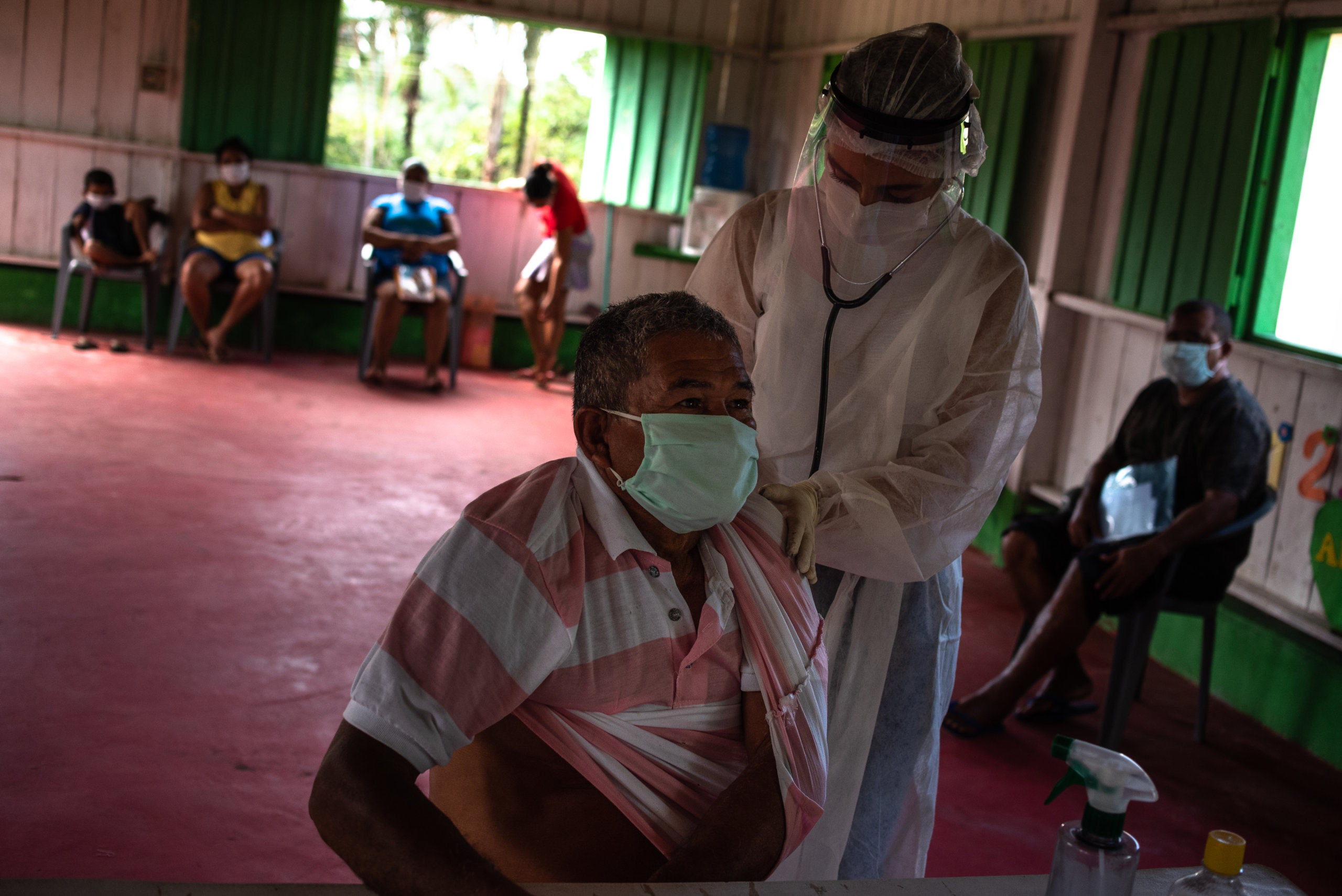
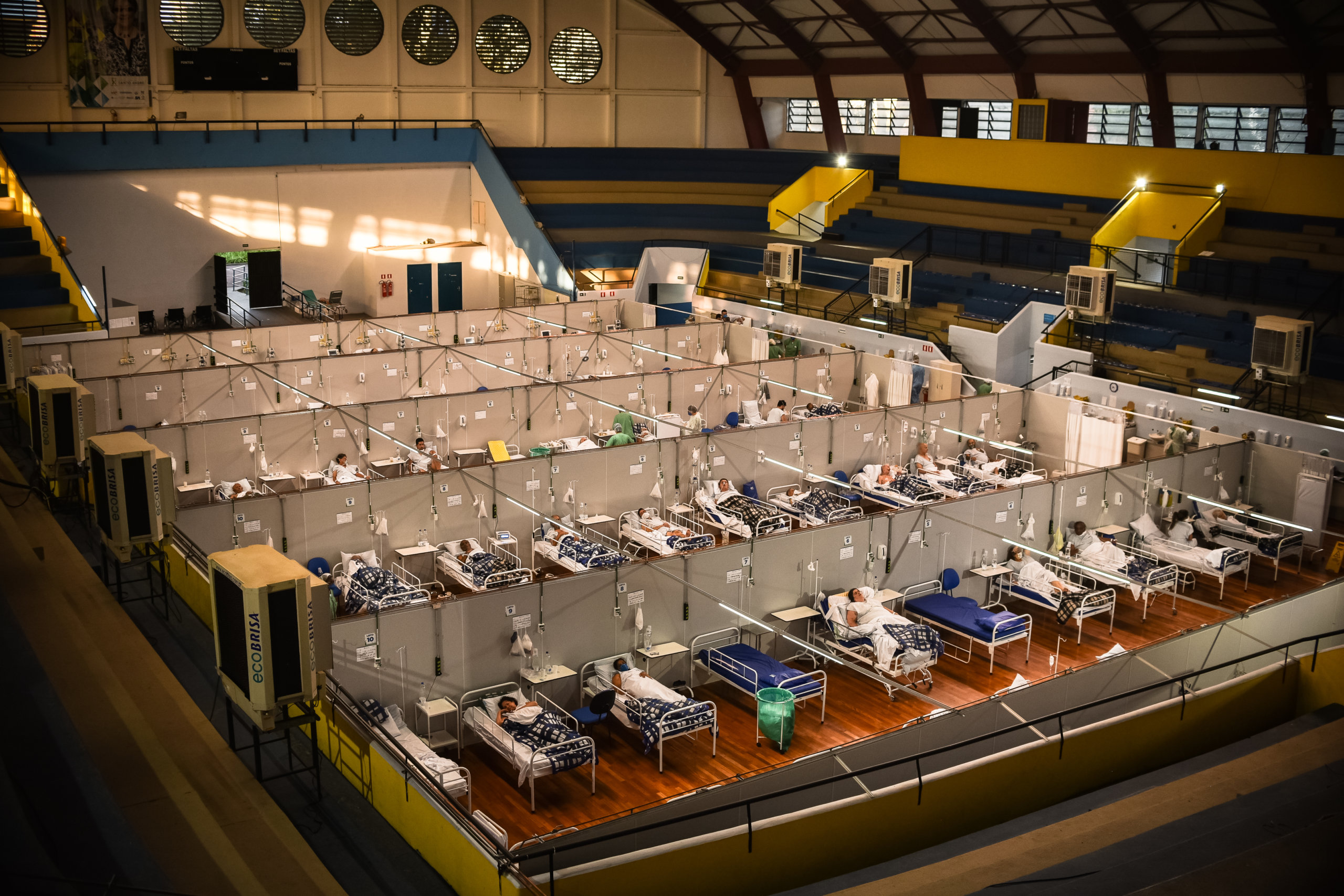
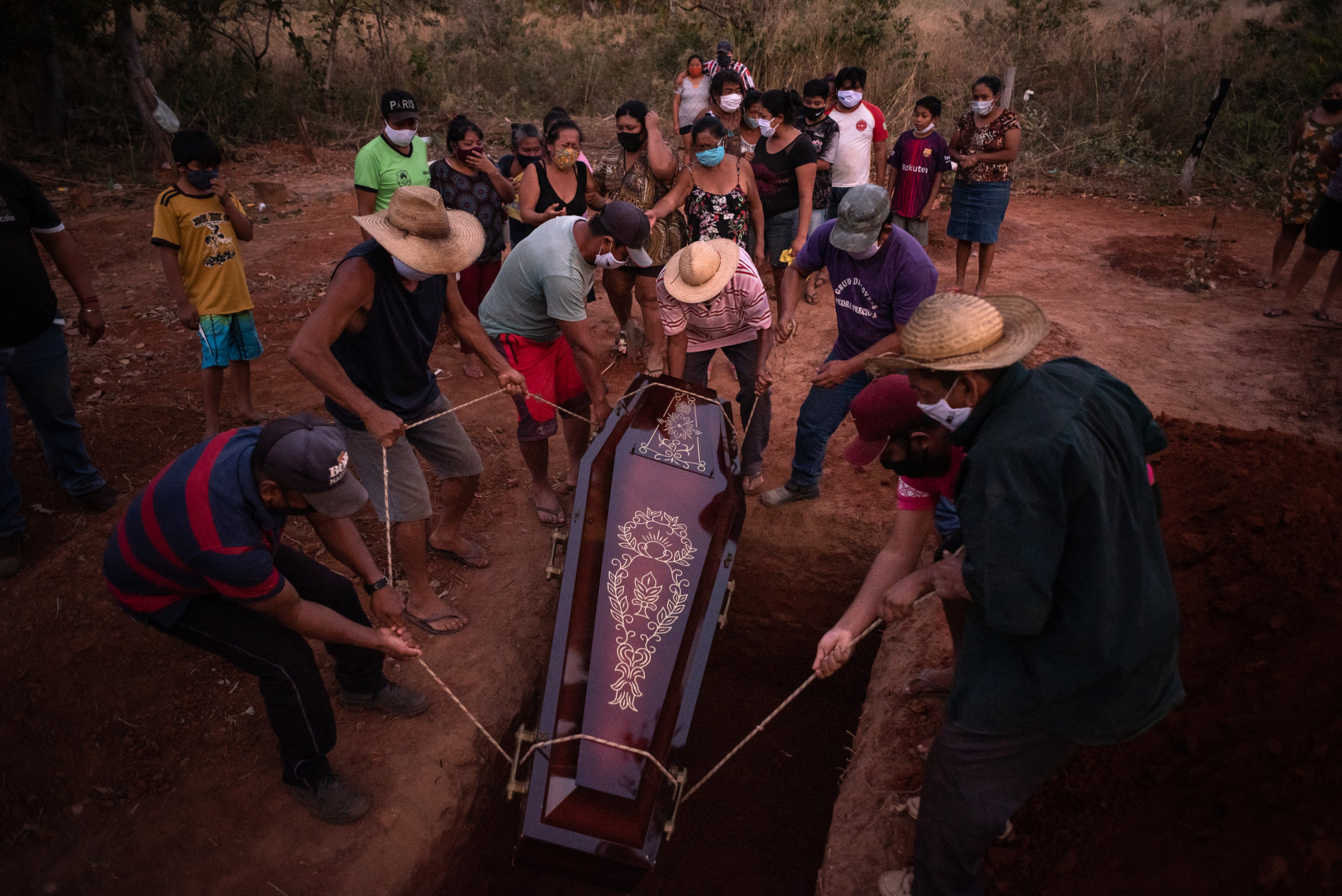
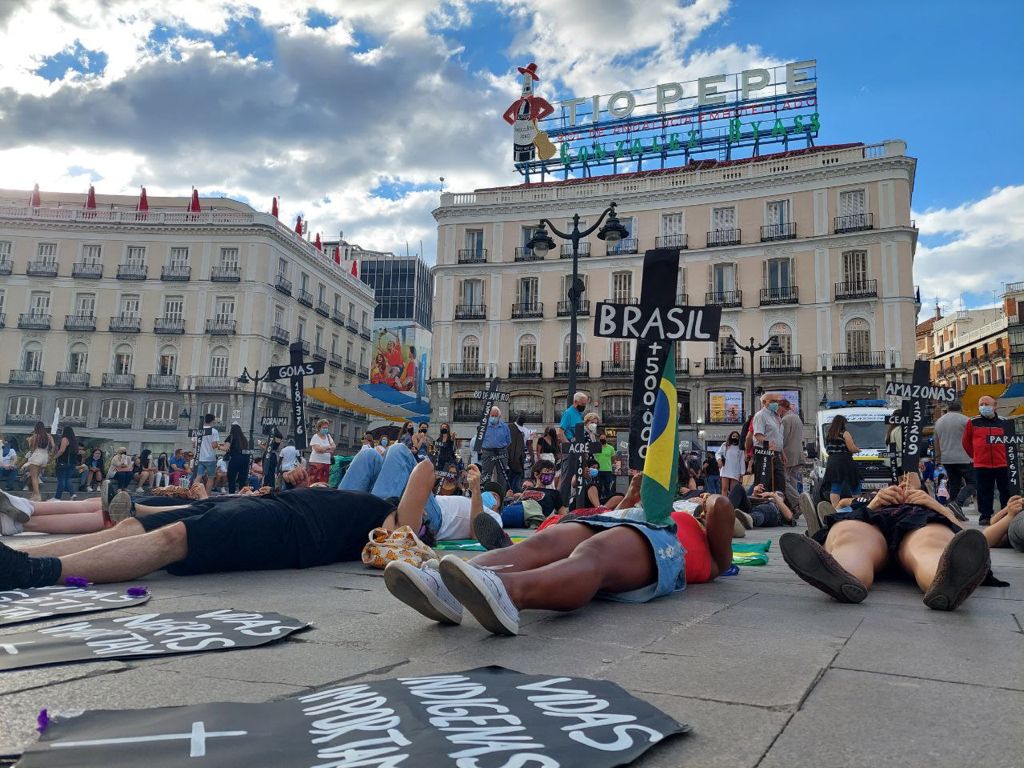
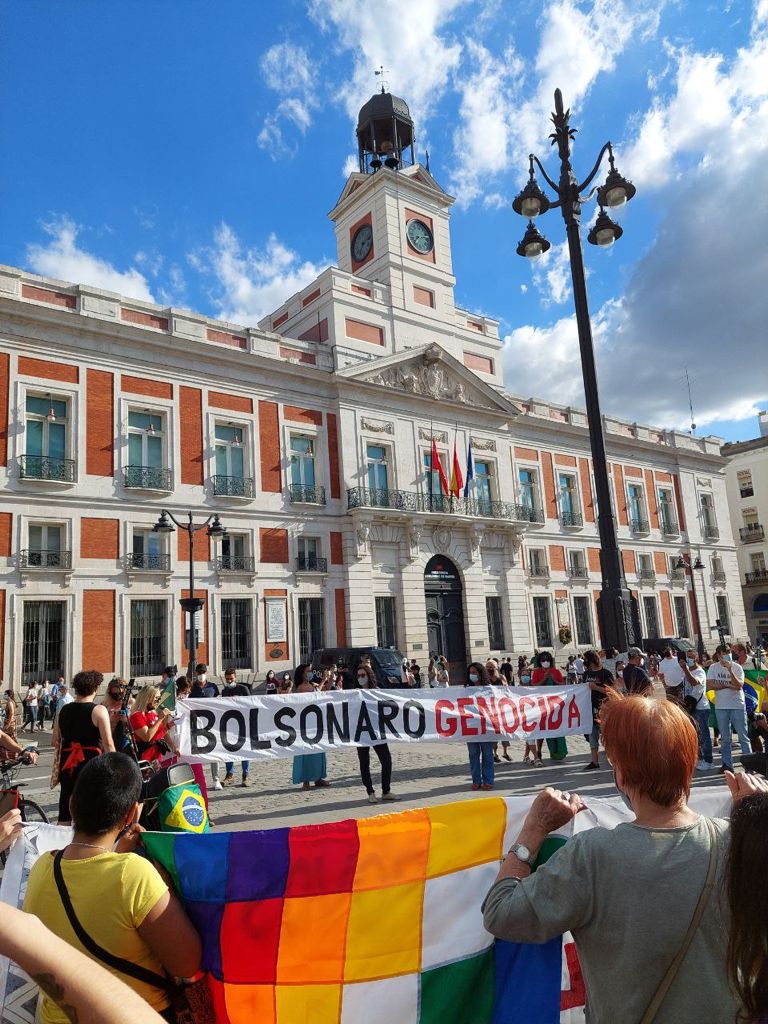

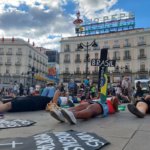
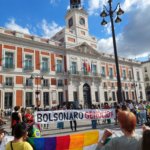

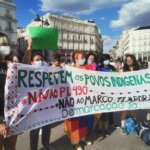
Even when an anti-science president such as Bolsonaro rails against vaccines, there is almost no way for the population to avoid receiving inoculations. In August 2021 in the city of São Paulo, the campaign Virada da Vacina reported that 99 percent of the adults in the city had been vaccinated (Bolsonaro won approximately 45 percent and 60 percent of the vote here in the run offs and general election respectively).12Isabella Menon and Paulo Eduardo Dias, "São Paulo Approaches 99% of Adults with the First Dose of the Covid Vaccine," Folha De S.Paulo, August 15, 2021, https://www1.folha.uol.com.br/equilibrioesaude/2021/08/sao-paulo-se-aproxima-de-99-dos-adultos-com-a-primeira-dose-da-vacina-contra-a-covid.shtml; "See the Calculation Map of all Cities in Brazil," Fohla De S.Paulo, October 7, 2018, https://www1.folha.uol.com.br/poder/eleicoes/2018/veja-o-mapa-de-apuracao-de-todas-as-cidades-do-brasil/?#/cargo/presidente/local/sao-paulo/turno/1/mapa/estadual/municipio/sao-paulo/3550308. Six-hundred locations dispersed the vaccine; sixteen of these were open for walk-in or drive-up around the clock. The state provided DJs, dancing, bands, and artists on stilts to create a carnivalesque atmosphere for those waiting hours in line.
Vaccine culture in Brazil is about accessibility. Locals become part of the campaign. That means you are likely to know and have some regard for the person who comes to you in the name of immunization—in the metro stations, on street corners, or in the park. Public displays boost the vaccine's image. It is harder to retreat into spaces of disinformation when the people you know, or even don't know, seem open to receiving a vaccination. A 2021 study showed that even among vaccine-hesitant individuals in Brazil (10.5 percent of the sample), only 2.5 percent did not intend to vaccinate at all.13Daniella Campelo Batalha Cox Moore, Marcio Fernandes Nehab, Karla Gonçalves Camacho, et al. "Low COVID-19 Vaccine Hesitancy in Brazil," Vaccine 39, no. 42 (2021): 6262–6268. Still, a June 2022 report from The Lancet found that municipalities that supported Bolsonaro in the 2018 elections were those that had the worst COVID-19 mortality rates, especially during the second epidemic wave of 2021.

As of June 2022, 87.3 percent of Brazilians have received at least one dose of COVID-19 vaccine and 79 percent have been fully vaccinated, compared with 79.8 percent of US citizens having received one dose and 67.5 percent being fully vaccinated.14COVID-19 Vaccination Tracker, Reuters, last updated July 15, 2022, https://graphics.reuters.com/world-coronavirus-tracker-and-maps/vaccination-rollout-and-access/. While these numbers are not vastly different, it is of note that Brazil President Bolsonaro remains in power, regularly flouting vaccine regulations and bragging about his unvaccinated status, whereas since 2021 in the United States, President Joe Biden has worked tirelessly to get vaccines in arms, bolster public health, and eliminate health disparities.15Rodrigo Pedroso, "Brazil's Bolosnaro Says He Will Not be Vaccinated Against Covid-19," CNN, October 13, 2021, https://www.cnn.com/2021/10/13/americas/bolsonaro-no-vaccine-intl/index.html; Chuck Todd, Mark Murray and Carrie Dann, "Biden is True to a Key Promise: Getting More Shots in Arms," NBC News, March 19, 2021, https://www.nbcnews.com/politics/meet-the-press/biden-true-key-promise-getting-more-shots-arms-n1261531; HHS Press Office, "Biden-Harris Administration Provides $121 Million in American Rescue Plan Funds to Support Local Community-Based Efforts to Increase COVID-19 Vaccinations in Underserved Communities," HHS, July 27, 2021, https://www.hhs.gov/about/news/2021/07/27/biden-harris-admin-provides-121-million-in-arp-funding-to-local-communities-for-covid-19-vaccines.html.
Early in his tenure, Biden proposed a $1.6 billion increase for the Centers for Disease Control and Prevention to improve core public health capacities in states and territories, modernize public health data systems, train new epidemiologists and other public health workers, and build global capacity to respond to future health threats. Some of these efforts have worked. By August 2021, Pew research reported that around three-quarters of US adults (73 percent) had received at least one dose of a COVID-19 vaccine.
Despite these efforts, too many Americans see vaccine mandates, not as a way toward building public safety, but as extreme government overreach. Republicans and Libertarians have called repeatedly and loudly for "personal freedom" to be prioritized over public safety. Before the Supreme Court blocked the Biden administration's vaccine-or-test requirement for large private businesses in January 2022, there was an outcry for #massnoncompliance. Some scholars have called this political resistance to vaccines based on the tenets of choice and liberty, a "uniquely American predicament."16Alana Wise, "The Political Fight Over Vaccine Mandates Deepens, Despite their Effectiveness," NPR, October 17, 2021, https://www.npr.org/2021/10/17/1046598351/the-political-fight-over-vaccine-mandates-deepens-despite-their-effectiveness. And while the oppositional forces of conservatism and science have been noted as phenomenon elsewhere, including Brazil, the lack of a dominant US culture that trusts and respects public health and expects that the state can and should deliver it can be attributed largely to decades of right wing ideologues across many forms of media.
To date, an Omicron subvariant (BA-5) is the newest variant of concern, threatening a wave of infections and reinfections. As we continue to navigate this global pandemic, we must pay attention to the true influencers of public health. In Brazil, the public health system has a strong history of emboldening citizenry with a message of governmental duty and obligation. We'll see how this may play out in the polls come October for upcoming elections in this country. In the United States, anti-vax politicians, many of whom have themselves received the vaccine for COVID-19, have spread misinformation and anti-government rhetoric about public health. Although conservatism and evangelical religiosity has led to vaccine hesitancy, a Pew Report shows us that most Americans who go to religious services say they would trust their clergy's advice on COVID-19 vaccines. Some advocates of public health have historically prioritized local partnerships with religious leaders and institutions acknowledging this very important sphere of influence.
We must continue to undertake hard conversations about the tensions between individual freedoms and population health much as we did when H1N1 struck our collective shores. As families like my own navigate the implications of a mutating virus that generated a global pandemic, we need trusted resources that are sensitive to historical experiences and the collective common good.
About the Author
Dr. Melissa S. Creary is assistant professor in the Department of Health Management and Policy, School of Public Health at the University of Michigan and the senior director for the Office of Public Health Initiatives at the American Thrombosis and Hemostasis Network (ATHN). She assists ATHN in finding ways to leverage public health research and policy to make a broader impact within the bleeding and blood disorders population. Dr. Creary's areas of specialization include race and racism, genetics, identity politics, health policy, and health equity. She worked for a decade as a health scientist at the Centers for Disease Control and Prevention in the Division of Blood Disorders, has done extensive field work in Brazil, and has more than twenty years of bench, public health, and social science research experience.
Public Health in the US and Global South is a collection of interdisciplinary, multimedia publications examining the relationship between public health and specific geographies—both real and imagined—in and across the US and Global South. These essays raise questions about the origin, replication, and entrenchment of health disparities; the ways that race and gender shape and are shaped by health policy; and the inseparable connection between health justice and health advocacy.
Beginning in 2022, the series expands to include 1000-word blog posts, as well as longer commentaries, essays, articles and media productions that address the public health and political implications of the COVID-19 pandemic from multiple viewpoints. The series editor for Public Health in the US and Global South is Mary E. Frederickson.
Review
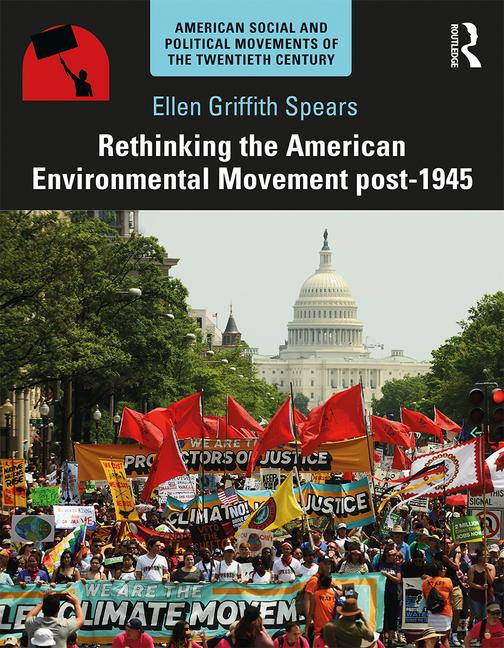
For more than twenty years, scholars have sought in article after book after conference paper to expand the timeline, reach, and definition of environmental concern and activism. This uncoordinated but multi-pronged effort has given us a fuller sense of activism that emerges from and addresses larger social and economic inequalities. What we call environmental justice is finally getting a full and complete history.
What has yet to be done, until now, is to bring that broader story together with the more traditional history of the environmental movement. Ellen Griffith Spears has accomplished that in her important new history, Rethinking the American Environmental Movement post-1945. In this tightly argued volume, Spears provides the first work that truly synthesizes the different strands of environmentalism, giving them equal narrative and analytical weight. This book represents the culmination of a generation of scholarship on environmentalism that sought to expand our narrative in order to consider environmentalism as a "field of movements" (5) that brings together actors, organizations and institutions from a variety of backgrounds at the local, regional, and national level. The field of movements concept allows Spears to consider the mainstream organizations such as the Sierra Club or the Natural Resources Defense Council on comparable footing with grassroots movements, working to weave all strands of activism into the synthesis. She also includes developments in the history of science and public health, especially in ecology and toxicology, as well as the regulatory responses by the federal government. These are important not only to provide background and context, but also because the often-contested terrain of scientific knowledge and expertise is so central to understanding the movement. Rethinking the American Environmental Movement also engages larger structural changes within the US economy and society, such as mass suburbanization in the 1950s and deindustrialization in the 1970s and 1980s.
Although the title of the book promises an emphasis on the post-World War II era, the first chapter is a robust examination of "Antecedents" to the modern movement. Where, for instance, traditional histories examined conservationism and perhaps Progressive Era smokestack regulation, Spears discusses resistance to slavery, and pre-Civil War public health debates, in addition to the emergence of nature preservation. This builds on important recent work in nineteenth-century environmental history, such as Catherine McNeur's Taming Manhattan and Carl Zimring's Clean and White, and buttresses the argument for long durée connections between social justice and the environment.1Catherine McNeur, Taming Manhattan: Environmental Battles in the Antebellum City, Reprint edition (Harvard University Press, 2017); Carl A. Zimring, Clean and White: A History of Environmental Racism in the United States (New York: New York University Press, 2015); Mark Fiege, The Republic of Nature: An Environmental History of the United States (Seattle: University of Washington Press, 2012).
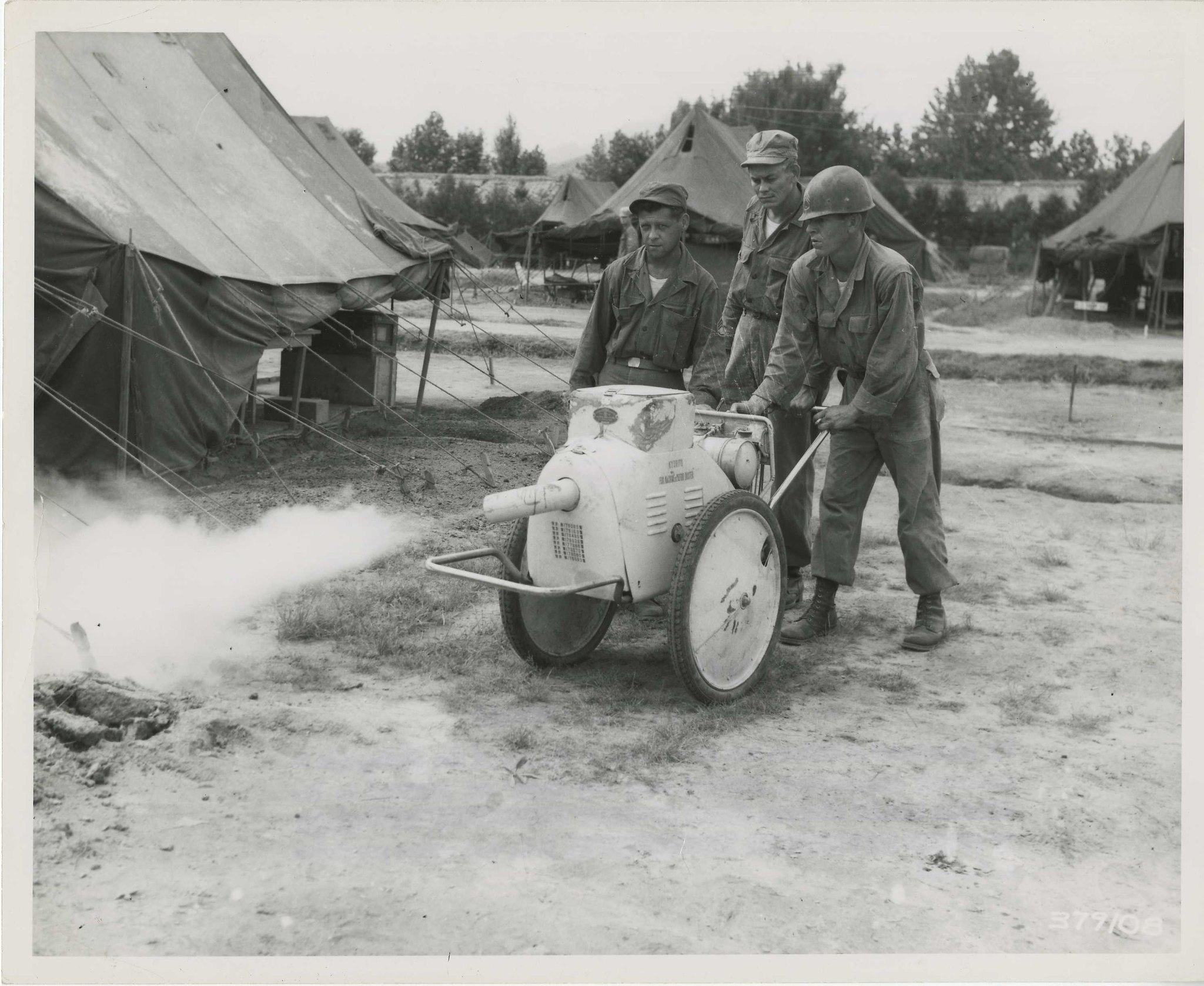
The core of Spears's book centers on the postwar period, which she ably covers while also introducing lesser known developments. For example, any book of this nature has to discuss Rachel Carson, and Rethinking devotes one of its largest section to this groundbreaking author. But instead of putting Carson on a pedestal, where she often sits in public memory, Spears places her in context, showing how she was building on and amplifying the work of grassroots activists and scientists. Americans had been raising concerns about the ecological and public health effects of dichlorodiphenyltrichloroethane (DDT) soon after World War II. This accelerated into a series of lawsuits filed by New York based conservationists protesting the indiscriminate spraying of DDT in the late 1950s. The legal action failed, but the activists caught the attention of Carson, who began investigating the impact of DDT across the country. That research culminated in the publication of Silent Spring in 1962, and Spears ably delineates how and why this book was so important. It was not just an expose about the dangers of chemical spraying; Carson helped bridge the old conservation era to more contemporary concerns about human health, and she "crystallized the recognition that humans were fundamentally altering the environment" (83).
Just as significant as this rethinking of Silent Spring and pesticide activism is what comes before it: a short but important consideration of urban environmental concerns during the 1950s—especially the National Urban League's "fight blight" and block club campaigns that targeted neighborhood cleanup, rats, empty lots, and community health. Spears examines urban activism by African American and other minority populations in more detail later, but by putting this section right before the discussion of Carson, she makes a valuable narrative intervention. Justice-focused activism by minority communities was occurring at the same time that more well-known parts of the movement were emerging, buttressing the argument that these strands of environmentalism are deserving of a longer history, and were not just a product of the environmental justice movement of the 1980s.
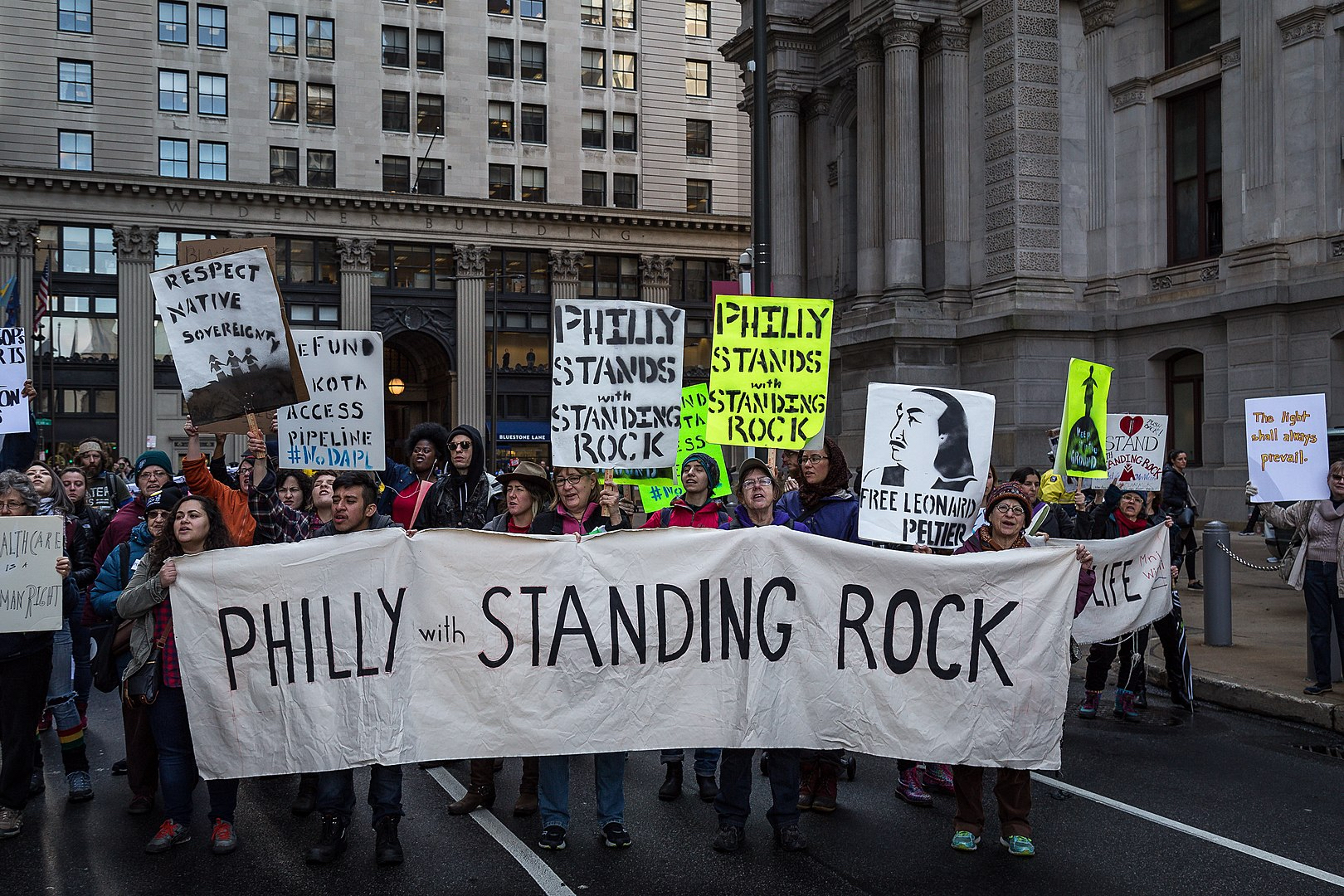
In addition to making sure that urban and minority neighborhoods and populations are firmly part of the narrative, Spears gives significant weight to the decades after 1980. This allows her to cover the conservative reaction to environmentalism during the Reagan administration and afterwards, but also climate activism, and recent environmental justice conflicts such as poisoned water in Flint, Michigan, and the Dakota Access Pipeline protests. Rethinking is especially strong on climate activism, representing an important shift over the past decade. The final chapter provides background on concerns over anthropogenic climate change (a subject that has figured in every United Nations environmental since 1972) and the international negotiations and treaties over the limitations of carbon and greenhouse gases in the 1990s. Spears includes a special section on the Dakota Access Pipeline protests in 2016. Because the pipeline violated indigenous rights, was a threat to the water supply of the Standing Rock Reservation, and would also allow for the cheaper transportation of fossil fuels, Spears argues that the NO DAPL protests were a great example of "an intersectional grassroots movement linking indigenous rights, climate change, and water protection" (213).
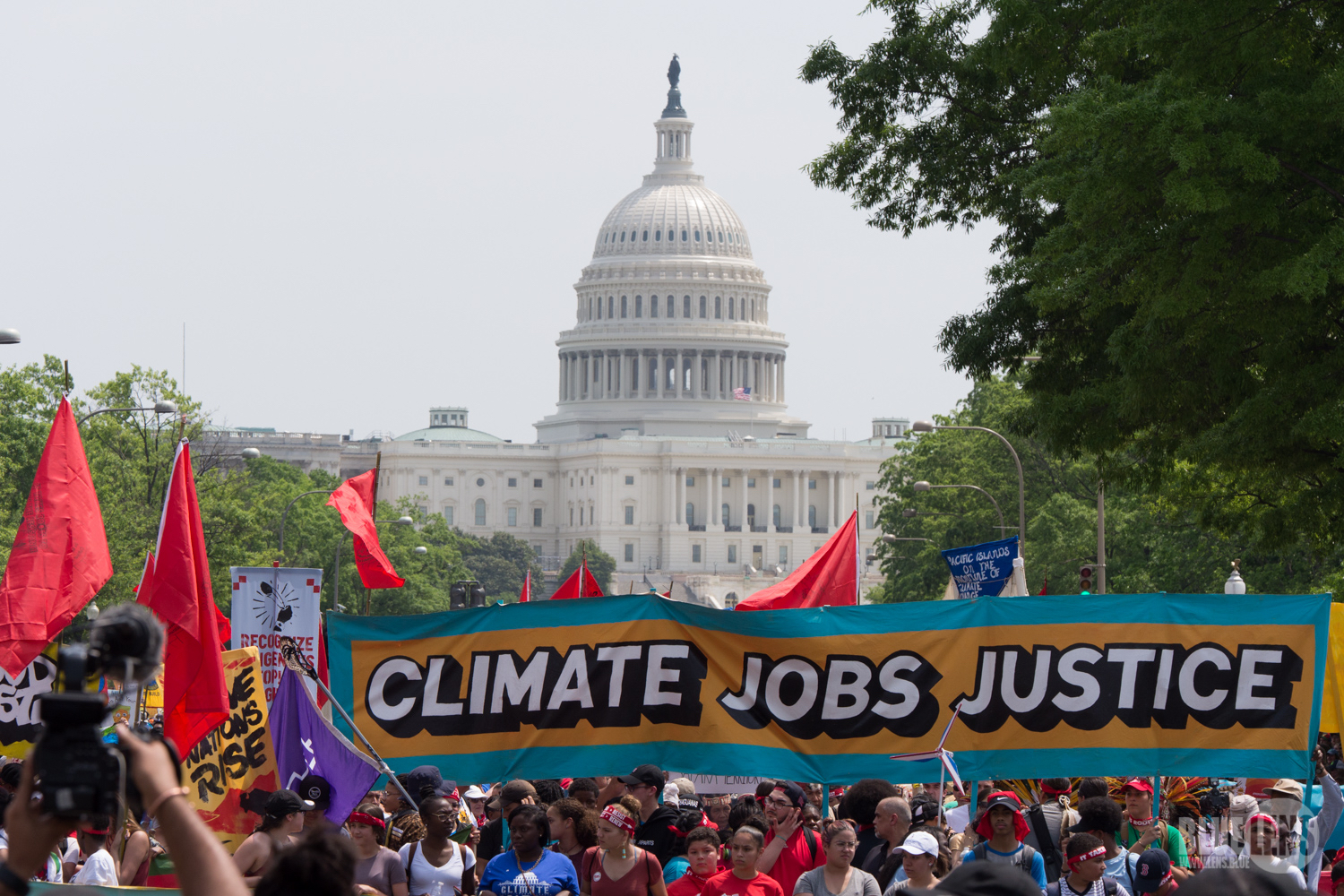
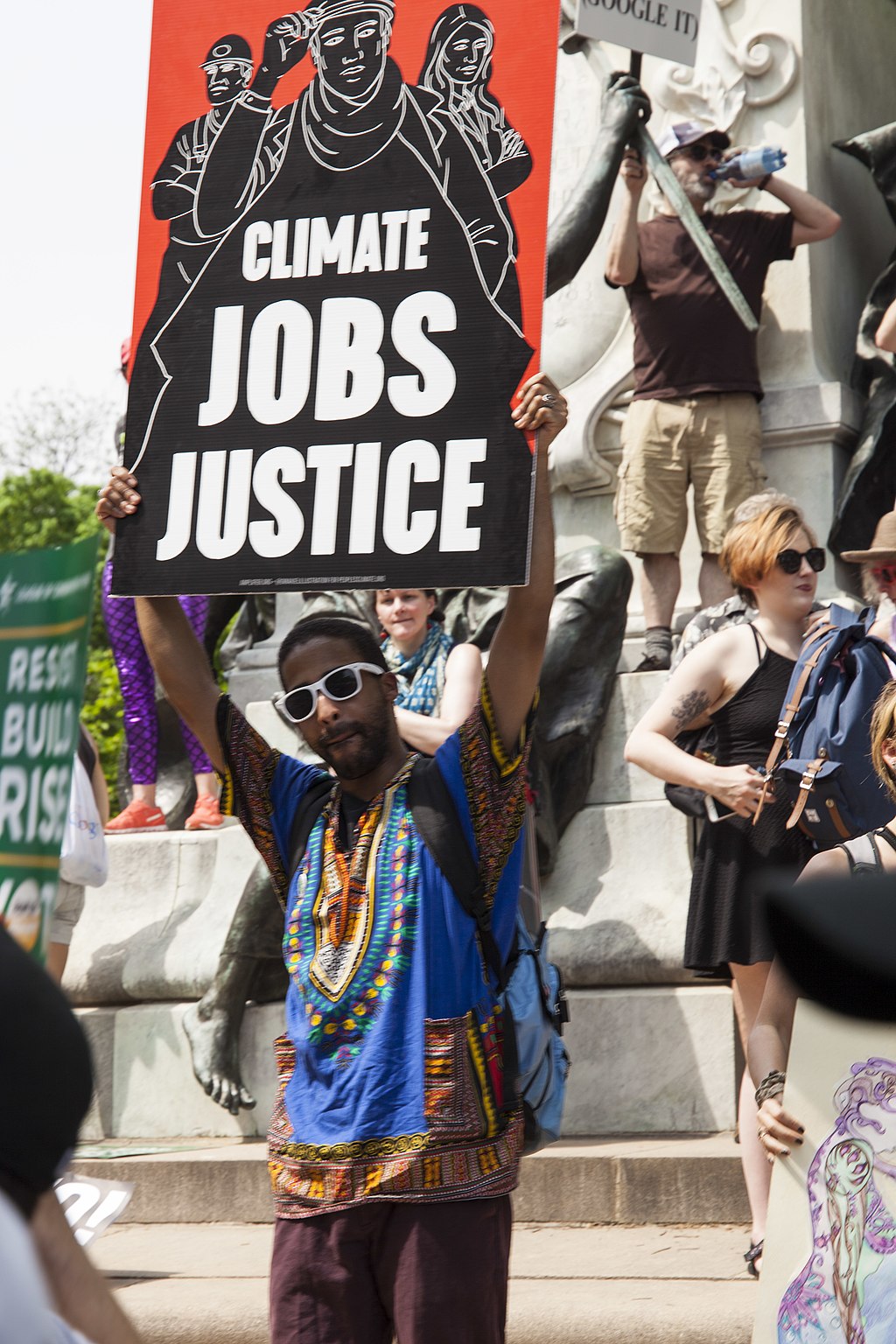
By the end of the Rethinking, readers may feel a little overwhelmed by the field of movements approach, as Spears jumps, for example, from climate activism, to green jobs, food justice, religious work on climate change, and to standalone discussions of Flint and Standing Rock, all in the second half of the last chapter. Critics could argue that this "big-tent" conceptualization risks diluting what they would classify as an environmental movement, but this is the value of Spears's approach. She convincingly shows how environmentalism has never been one particular set of activists or institutions, but a diverse set of organizations, scientists, firebrands and regulatory bodies that have always been in conversation, conflict or coalition with each other. This broad coverage helps readers understand many implicit and explicit connections. And coverage is one of the goals of this kind of book, which seeks to introduce a topic to a broader audience. This makes Rethinking especially admirable. It places activism centered upon injustice and inequality on equal footing with more commonly known parts of the movement. As someone who teaches the history of environmentalism, I believe this is vitally important. Most students begin with strong preconceived notions about environmentalism (Birkenstocks, tofu) that prove tough to dislodge.
This field-of-movements framework does raise a broader question within environmentalist writing and the narrative we tend to tell. Lurking beneath the surface of many histories of environmentalism is the conflict between the movement's different strands, particularly between environmental justice organizations, radical wilderness groups, and the mainstream "nationals." Spears does not shy away from these tensions, showing how radical factions emerged partly in opposition to the perceived "business friendly" policies of groups such as the Environmental Defense Fund, and how grassroots organizations have long been critical of the overwhelming white, middle-class staffing and policy orientation of well-funded national groups based in Washington, DC.

Rethinking lacks an exploration of the roots of these tensions. This is primarily because of the strictures on the length of such a synthetic book—and that there are not yet enough strong critical histories of the mainstream strands of environmentalism. The discussions of the close relationship between corporations and large national groups are a case in point. Spears draws on the work of journalist Mark Dowie, especially his groundbreaking 1995 book, Losing Ground: American Environmentalism at the Close of the Twentieth Century. Dowie was one of the first vocal critics of this relationship, but this book is now a quarter-century old, and there really hasn't been any work that goes beyond his primarily surface level, muckraking analysis.2Mark Dowie, Losing Ground: American Environmentalism at the Close of the Twentieth Century (Cambridge, Mass.: The MIT Press, 1996).
We need more work that takes the connections between corporations and major, national environmental groups at face value, and attempts to understand their roots and trajectories—and their lack of attention to people and geographies of color. One of Spears's primary concerns is the "multiple ways in which the color lines drawn in U.S. society have hampered environmental reform movements" (4). But as strong as it is in exploring the grassroots activism by people of color, Rethinking doesn't explore the color lines that existed in environmental organizations; why they were reluctant, for decades, to address the concerns of marginalized groups, or even make their professional staffs more diverse. This is not because Spears does not want to explore these problems. It's simply that the literature is not there. The white privilege of US environmentalism has only really been critiqued at the margins. We lack a full accounting of its development and impact, particularly on the continual escalation of environmental injustice and inequality.
What are the reasons for these deficiencies, at least within US environmental history? The most obvious arguments would be that the field, or at least the powerful and influential within the field, were for decades overwhelmingly white, male, and middle class, and had a vested interest in a set of narratives about American environmental reform. Perhaps more importantly, there was also a reluctance to attack or even critique these narratives. Not only did generations of scholars have so much invested in these heroes, but also because to many of us, environmentalism has maintained a certain moral certitude as a progressive politics.3The core "heroes" come from the wilderness and early conservation movements. See, for example, Roderick Nash, Wilderness and the American Mind (New Haven: Yale University, 1996 [1965]); Aldo Leopold A Sand County Almanac and Sketches Here and There (London: Oxford University Press, 1949). To tar it with racism, and corporate greed, especially in a post-Civil Rights, neoliberal America, could undermine the whole project.
Finally, scholars are beginning to get over that reluctance. New work by Jennifer Thomson, Paul Sabin and Keith Woodhouse, for example, digs into environmentalism to understand its flaws, contradictions and their ramifications.4Paul Sabin, "Environmental Law and the End of the New Deal Order," Law and History Review 33, no. 4 (November 2015): 965–1003; Jennifer Thomson, The Wild and the Toxic: American Environmentalism and the Politics of Health. (University of North Carolina Press, 2019); Keith Makoto Woodhouse, The Ecocentrists: A History of Radical Environmentalism. (New York: Columbia University Press, 2020). They move beyond a celebratory narrative to embed the environmental movement within the larger political and social developments of the past half-century. Outside the discipline of history, scholars such as David Pellow, Lisa Sun-Hee Park, and Dorceta Taylor have cast critical judgment on the movement, especially when understanding race in environmental politics.5Lisa Sun-Hee Park and David N. Pellow, The Slums of Aspen: Immigrants vs. the Environment in America's Eden, (New York: New York University Press, 2011); Dorceta E. Taylor, The Rise of the American Conservation Movement: Power, Privilege, and Environmental Protection (Durham, NC: Duke University Books, 2016). All of this work is important, but we need more.
Telling a more critical, less rosy story is important because a strong, inclusive and self-reflective, environmental movement is more important now than ever. Writing movement history is always political, especially when the social movements remain ongoing and their success more urgent. With Rethinking the American Environmental Movement post-1945, Ellen Spears has done admirable work in expanding our conception and understanding of the movement's varied streams.
About the Author
Robert Gioielli is an associate professor of History at the University of Cincinnati and the author of Environmental Activism and the Urban Crisis: Baltimore, St. Louis, Chicago (Philadelphia: Temple University Press, 2014). Find him on Twitter at @robgioielli.
]]>Presentation
About the Speaker
James W. Porter is the Meigs Distinguished Professor of Ecology at the University of Georgia and a faculty member in School of Marine Programs, Water Resources and Conservation Ecology. Porter has worked extensively on coral reef ecology, especially the biology, ecology, and assessment of Floridian and Caribbean coral reefs. His research and expertise has brought him to testify before Congress five times on environmental concerns, most recently on the effects of global warming on coral reefs.
]]>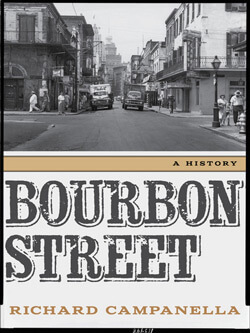
In the early hours of June 29, 2014, a Bourbon Street shootout left twenty-one-year-old Brittany Thomas, a visitor to New Orleans, dead and nine other bystanders injured.1Ken Daley, "Bourbon Street Shooting Leaves 10 Wounded, 2 Critically, Tourism Image Scarred," NOLA.com, June 30, 2014, http://www.nola.com/crime/index.ssf/2014/06/bourbon_street_gunfight_leaves.html; Helen Freund, "Bourbon Street Shooting Victim, 21, Dies," NOLA.com, July 2, 2014, http://www.nola.com/crime/index.ssf/2014/07/bourbon_street_shooting_victim.html. For many, the recent rise of gun violence on Bourbon Street, and in the city's tourism districts more generally, threatens a booming industry. Richard Campanella's Bourbon Street: A History, published three months before the tragedy, places recent gun violence within a much longer history of social, political, and environmental threats that have failed to effect Bourbon Street's oft-predicted demise: "It has survived Prohibition, the Depression, wars, recessions, fires, hurricanes, floods, mobsters, raids, crackdowns, segregation, integration, white flight, hippies, rappers, evangelists, the oil bust, the dot-com bust, and relentless cycles of cultural tastes" (257), a testament, Campanella argues, to Bourbon Street's resilience and to its cultural and economic significance.
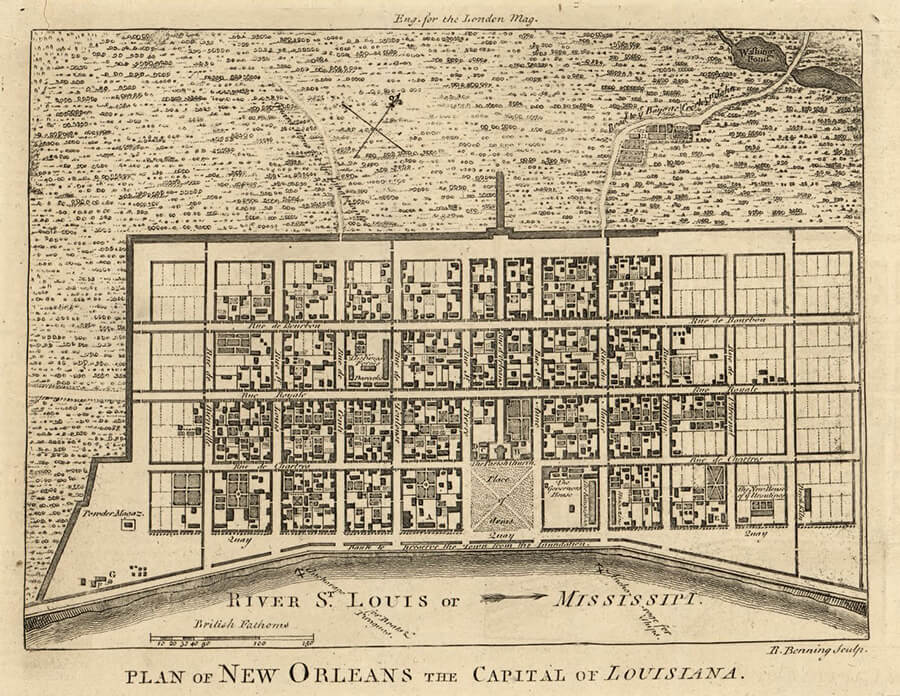
A prolific, award-winning author and commentator on New Orleans's historical geography, Campanella has made a career of heralding the significance of the city's cultural and historic neighborhoods. In Bourbon Street, he turns his attention to the city's most iconic thoroughfare and its development from "pedestrian, unpretentious, and utterly unexceptional" (21) origins as Rue Bourbon in the eighteenth century to its present-day renown as "a signature street, one that [speaks] on behalf of the whole city to the nation and the world" (222). The book is divided into three parts: "Origins," "Fame and Infamy," and "Bourbon Street as a Social Artifact."
"Origins" reprises Campanella's previous studies on the environmental, topographical, and social conditions that shaped the early cityscape from the French colonial period to the antebellum era. As part of the original urban core, Bourbon Street's relatively high elevation and proximity to the river, the "front of town," made it much more economically and environmentally sound than the flood-prone, low-lying swampy areas of the "back of town" (34). In this period, Bourbon Street also represented the "ironic spatial integration" of New Orleans (36), which, as a major port city and the largest slave market in North America, thrust together a diverse, yet socially stratified population.
"Fame and Infamy" forms the heart of the book, tracing the reciprocal evolution of Bourbon Street's international notoriety and the upsurge of the modern tourism industry. Campanella pinpoints "the birthplace and birthday of modern Bourbon Street" (107) as the opening of Maxime's nightclub in January 1926, and chronicles the social, cultural, and economic changes that created the atmosphere of "beachy tropicality and Caribbean escapism" that characterize Bourbon Street's continuous parade in the twenty-first century (228). In between, he traces fluctuating attitudes about the Street as, at turns, "dirty, depressed, and dodgy" (74) and as a successful "stable social and economic space" that fuels the local economy and leaves an indelible imprint on national and global culture (250).
In the book's final section, "Bourbon Street as Social Artifact," Campanella attempts to uncover how cultural and social practice has constructed the street. He provides an ethnography of work and workers, maps the circulation of Bourbon Street as metonym for "pedestrian-scale drinking, eating, and entertainment districts" throughout the world (308), and charts the emergence of "anti-Bourbons"—entertainment zones that offer a putatively more authentic alternative. In the process, Campanella shows how geographic, demographic, and economic features shape the Street's character and success, parses debates over authenticity between critics and aficionados, and touts the recovery following Hurricane Katrina.
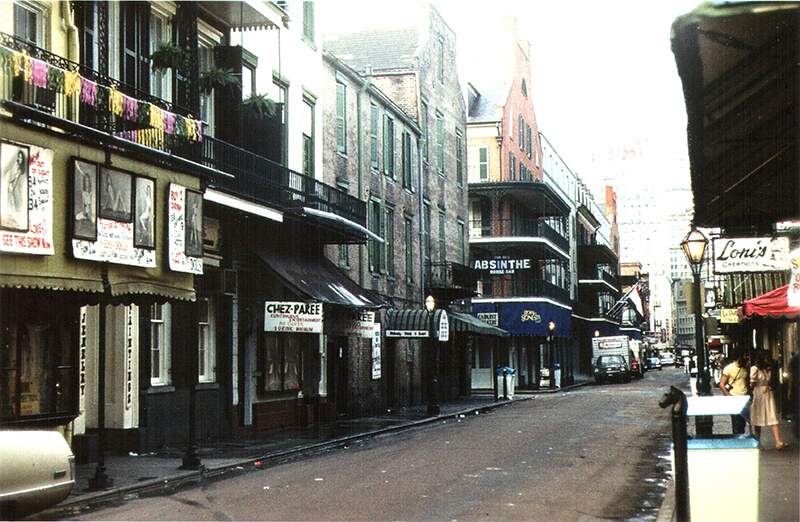
Because much of Bourbon Street's social and cultural history is a synthesis of other New Orleans histories, including Campanella's, the book's most original and compelling contribution is a delineation of the Street's changing cultural geography. Campanella chronicles several social and cultural developments that helped transform the strip: racial segregation and desegregation, the changing soundscape, the ubiquity of souvenir shops, the popularity of female public nudity, the demarcation of queer space, and the innovation of the go-cup that supplanted nightclubs and "completely rewire[d] the social and economic dynamics of Bourbon Street" (211). Campanella's meticulous archival and cartographic research draws on a wealth of primary sources—including census records, city directories, maps, and police reports—to demystify Bourbon Street and reveal its inner workings.
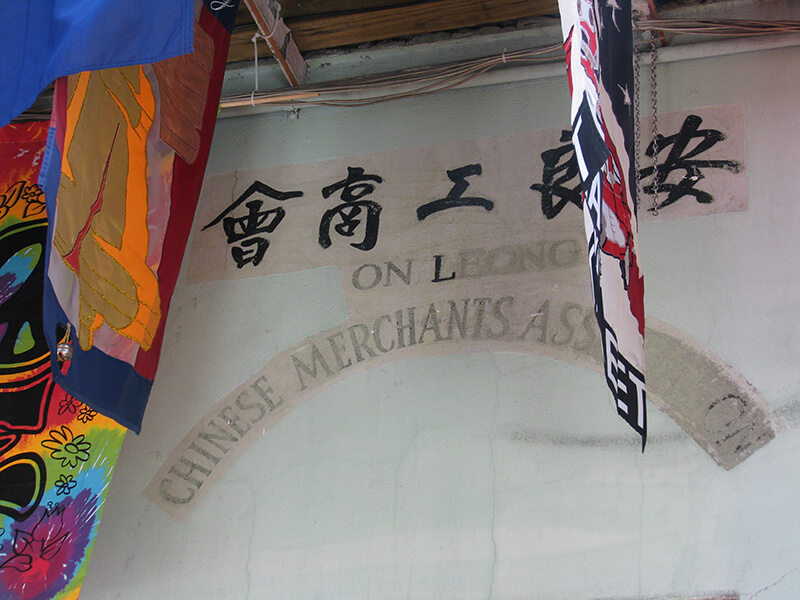
In his descriptions of mid-twentieth-century Bourbon Street, Campanella becomes the ultimate tour guide, immersing readers in the spectacular, cacophonous, and malodorous sensory experience of the booming vice district. He directs readers past racially stereotyped tap dancers and blackface performers on the strictly segregated Street. He offers a sneak peek at the burlesque performances—and far less glamorous dressing rooms of—Evangeline the Oyster Girl, Rita Alexander the Champagne Girl, and Alouette LeBlanc the Tassel Spinner, so named for her skill at "twirling in opposing directions four tassels attached to her breasts and buttocks" (167). Campanella introduces a colorful cast of characters, such as Gaspar Gulotta, the "Little Mayor of Bourbon Street" (146), who mediated between the various factions and personalities that held a stake in the Street's economic and cultural advancement. He takes an unexpected jaunt through Chinatown, where Chinese merchants established themselves during the Great Depression. Campanella also draws on his own primary research—interviews, photographs, observations, and painstaking analyses of pedestrian traffic and balcony occupancy—to give readers a contemporary experience. Campanella shows how by the late twentieth century, Bourbon Street had transformed from a multigenerational, ethnically and racially diverse, working-class, mixed residential and commercial milieu to a tourist strip with "fewer children, fewer blacks, fewer ethnic whites, more transplants, higher housing prices, and higher incomes" (185). Certainly, Bourbon Street's transformation had significant cultural, social, and political implications for the rest of New Orleans, particularly for the African Americans, ethnic whites, and working class families that could no longer afford to live there. But Campanella's study is less concerned with illuminating this mutuality than in promoting Bourbon Street as the quintessential American success story.
Campanella celebrates the "ethnic white working class of downtown New Orleans," whom he credits with Bourbon Street's fame and financial success. The meteoric rise is all the more commendable because it occurred with "no consolidated administration, no president, no coordinator, no lobby, no marketers, and no corporate funding. Bourbon Street as we know it today effectively invented itself, locally, from the bottom up, with each constituent entity experimenting individually and adopting innovations laterally via competitive forces" (146). This American success myth, described by film scholar Julie Levinson as incorporating "the dream of rags-to-riches, the image of the can-do American, the credo of self-reliance, the doctrine of individual enterprise, and the faith in meritocracy" is based on the faulty proposition that "we are unbound by the past, by social identities, or by economic circumstances."2Julie Levinson, The American Success Myth on Film (New York: Palgrave Macmillan, 2012), 11–12. However, Campanella's documentation of a long history of racism and sexual exploitation suggests that the exclusion and subordination of some groups, such as African Americans and women, were as integral to Bourbon Street's success as entrepreneurial experimentation and innovation. Further, Bourbon Street: A History presents myriad examples of special zoning ordinances, exemptions from code-enforcement and litigation, sympathetic task forces and commissions, disproportionate investment in infrastructure and policing, and other accommodations that subsidized economic development. As historian J. Mark Souther and others have shown, these subsidies to the city's tourist core came at the expense of other neighborhoods, "leading to the increasing spatial differentiation into privileged and disadvantaged districts."3J. Mark Souther, New Orleans on Parade: Tourism and the Transformation of the Crescent City (Baton Rouge: Louisiana State University Press, 2006), 226. Political scientist Paul A. Passavant makes a similar argument in "Mega-Events, the Superdome, and the Return of the Repressed in New Orleans," in The Neoliberal Deluge: Hurricane Katrina, Late Capitalism, and the Remaking of New Orleans, ed. Cedric Johnson (Minneapolis: University of Minnesota Press, 2011), 87–129. Campanella's own evidence undermines the free-market fundamentalist premise that on Bourbon Street "those who don't flexibly adapt to demand go bankrupt; those who survive must be effectively and efficiently giving the people exactly what they want" (303).
Campanella even attributes Bourbon's Street's post-Katrina recovery to this type of flexibility and efficiency, explaining that "brave Bourbonites incentivized the first businesses to return, and seeded the re-formation of an economy—not just Bourbon's, but that of the entire city. . . . Unlike so many other entities, Bourbon Street recovered with little if any federal aid and zero charitable assistance. Bourbon Street was not only New Orleans's most successful invention, it was also its most resilient and self-reliant" (310, 311). Yet, as scholarship on post-Katrina New Orleans chronicles, the city's market-driven approach to recovery has been unevenly and inequitably administered, exacerbating an already "uneven landscape of risk and resiliency."4Kevin Fox Gotham and Miriam Greenberg, Crisis Cities: Disaster and Redevelopment in New York and New Orleans (Oxford: Oxford University Press, 2014), viii. For other examples of recent scholarship critical of the market-driven approach to post-Katrina recovery, see Vincanne Adams, Markets of Sorrow, Labors of Faith: New Orleans in the Wake of Katrina (Durham: Duke University Press, 2013); John Arena, Driven from New Orleans: How Nonprofits Betray Public Housing and Promote Privatization (Minneapolis: University of Minnesota Press, 2012); Cedric Johnson, ed., The Neoliberal Deluge: Hurricane Katrina, Late Capitalism, and the Remaking of New Orleans (Minneapolis: University of Minnesota Press, 2011); Lawrence N. Powell, "What Does American History Tell Us about Katrina and Vice Versa?," Journal of American History 94, no. 3 (December 2007): 863–876; Lynnell L. Thomas, Desire and Disaster in New Orleans: Tourism, Race, and Historical Memory (Durham: Duke University Press Books, 2014), 158–173. Black studies scholar Clyde Woods used the apropos phrase "neo-Bourbon/neoliberal agenda" to refer to the political, social, legal, and economic policies that created and maintained this landscape that prioritized tourism interests and private profits over community needs and social justice initiatives.5Clyde Woods, "Katrina's World: Blues, Bourbon, and the Return to the Source," American Quarterly 61, no. 3 (2009): 448. Bourbon Street: A History rejects this type of criticism and sets up a rigid binary between those who appreciate Bourbon Street as "a delectable mélange of historicity and hedonism" and haters who view it as "iniquitous, crass, phony, and offensive" (xiii). This reductive pro-/anti-Bourbon framework elides the complicated, reciprocal processes of touristification and criminalization that prompts investment in tourist spaces and containment of other neighborhoods.6Passavant, "Mega-Events, the Superdome, and the Return of the Repressed in New Orleans."
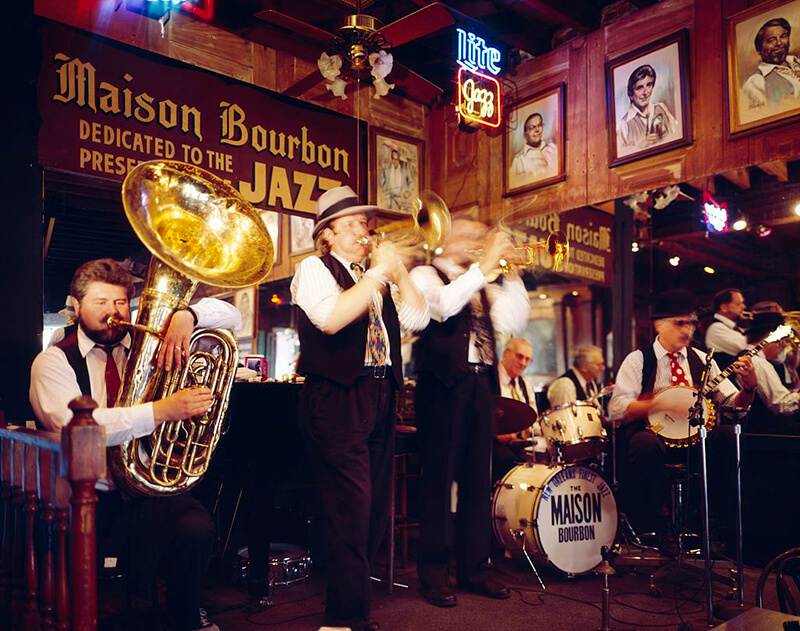
Although Campanella claims to offer "a nonjudgmental analysis of a complex phenomenon from many angles" (xvi), he levels his most strident criticism against "the cultural elite and their aspirants—image-conscious doyens, urbanophiles and preservationists, literati and academics, music connoisseurs and foodies, insecure transplants proving their bona fides, college students making a statement" (297). Their disdain for Bourbon Street, Campanella maintains, rests on elitist and ahistorical notions of authenticity. In contrast, Campanella proposes a relativist notion of authenticity: "Everything is real. Bourbon Street today is just as authentically part of real New Orleans culture as Storyville was a hundred years ago, and as Social Aid and Pleasure clubs, the housing projects, Creoles, and Tremé are today – no more, no less" (300). Yet, Campanella's authority to determine what is real and who is qualified to judge that reality rests, in part, on his own status as a New Orleans insider whose experiences trump the criticisms leveled by the progressives he disparages.7For an analysis of the implications of Campanella's privileging of experience-knowledge, see Emma Lirette, "Category 3 Gentrification: On New Orleans's Population Trends and the Hostility of Internet Commenters," Southern Spaces, April 17, 2013, https://southernspaces.ecdsdev.org/blog/category-3-gentrification-new-orleanss-population-trends-and-hostility-internet-commenters.
Campanella's characterization of black New Orleanians is as problematic as his sweeping condemnation of progressives. Working-class African Americans escape the pitfalls of the authenticity debate because they supposedly "have all the authenticity they need" (297). In a similarly puzzling assessment, Campanella categorizes local nonwhites on Bourbon Street who are neither working in one of the establishments nor passing through on the way home, as being there to "loiter, beg, bicker, and settle scores among each other" (266). One is left to wonder about the experiences of local African Americans (and other groups) who go to Bourbon Street to witness the spectacle and indulge in the free entertainment, those who visit with out-of-town guests, socialize with attendees at black conventions and festivals, celebrate during Mardi Gras or after Saints games, or—as my own son did recently with a group of local black college-age friends—bring in the New Year. While Campanella offers the perspectives of informants who stereotype all black patrons as poor tippers, enact racially discriminatory policies, and deride an outing with high black turnout as "ghetto night" (273), he rarely presents the voices of black New Orleanians or black tourists or examines their complicated relationship to Bourbon Street.
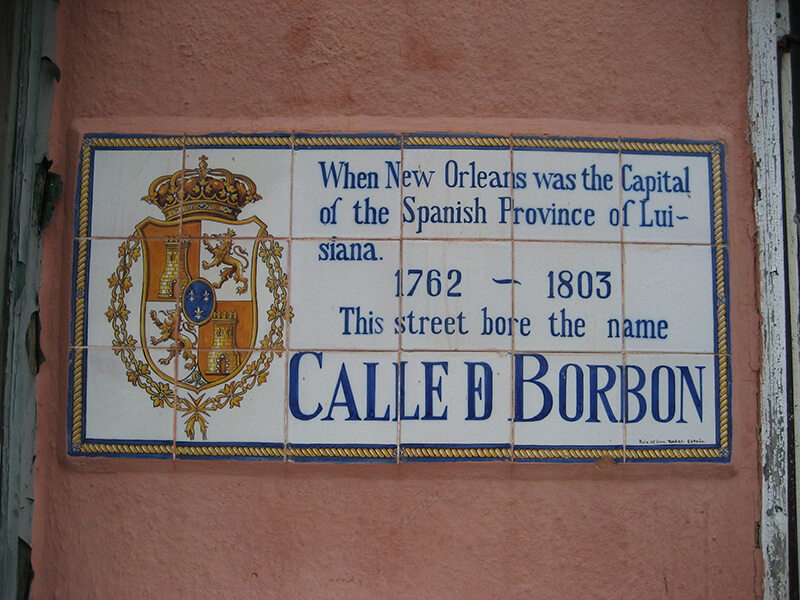
Campanella does an excellent job of mapping "geographies of pleasure" (99) that have made the tourist promenade such a central part of New Orleans's economic and cultural identity. What the senseless Bourbon Street shooting death of African American tourist Brittany Thomas illuminates is that these geographies of pleasure are inextricably linked to the geographies of pain that have also powerfully shaped the city's economy, geography, and historical memory.8By a cruel irony, the June 2014 Bourbon Street shooting occurred just outside Johnny White's bar, the same bar that famously stayed open during and after Hurricane Katrina. The fact that this Bourbon Street institution has served as both a symbol of the city's rebirth and a reminder of its rampant violence and criminalizaton highlights the relationship between geographies of pleasure and pain. See, Benjamin Alexander-Bloch, "Bourbon Street Shooting Sent Bystanders Rushing into Nearby Businesses," NOLA.com, June 29, 2014, http://www.nola.com/crime/index.ssf/2014/06/as_bourbon_street_shooting_occ.html; Richard Campanella, Bourbon Street: A History (Baton Rouge: Louisiana State University Press, 2014), 310.
About the Author
Lynnell Thomas is associate professor and chair of American Studies at the University of Massachusetts Boston. Her research interests include New Orleans tourism, popular culture, and African American history and literature. A native of New Orleans, Lynnell Thomas is part of the post-Katrina diaspora, which informs her teaching and scholarship. Her research is also concerned with the diverse backgrounds and experiences that constitute and contest American identity and values. Her most recent scholarship has examined post-civil rights era tourism, the HBO series Treme, and post-Katrina New Orleans.
]]>Review
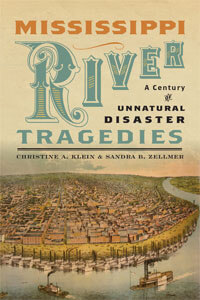 |
The present system of flood control in the Mississippi Valley is a compromise resulting from a long and complicated interplay among interest groups. The current solution to the problem of floodplain settlement strives to balance widely conflicting views on economy, politics, engineering, and the environment, but satisfies only few and faces an uncertain future. In this ambitious, entertaining, but somewhat uneven book, law professors Christine A. Klein and Sandra B. Zellmer combine environmental and legal history in their examination of the relationship between human action and disaster in the Mississippi drainage basin.
Flooding, of course, has always posed a physical threat to human subsistence in the lower-lying parts of the immense watershed that drains some 40 percent of the continental United States. From their arrival on the banks of North America's greatest river and its tributaries, European and American settlers realized that economic development in the flood-prone region would be in direct proportion to the amount of control gained over the hydrological system. It was the relief from flooding—a natural phenomenon of the floodplain—that made the development of agriculture, infrastructure, and industry possible in the alluvial lowlands of the Mississippi Basin.
Reviewing generations of attempts at Mississippi River flood control, Klein and Zellmer show that the enormous task of walling the river off from its floodplain demands investments on a scale unavailable to any individual landowner, county, or state. Governmental involvement in flood control and water resource development in the Mississippi Valley evolved during the nineteenth and twentieth centuries with far-reaching effects on the floodplain's hydrological regime.
In the beginning, the riparian landowners assumed responsibility for the burden of flood control. As the inadequacy of this approach for successful prevention of overflows became evident, state and federal governments began to assume more control. Beginning with Robert W. Harrison, numerous scholars have documented how the subsequent history of water management in the Mississippi Valley shifted the burden to local and state governments and, in the end, to the federal authorities—and US taxpayers. Klein and Zellmer summarize much of this previous research and provide their own analysis on landmark judicial cases. As the economic importance of the floodplain grew with agricultural expansion, the region's largest landowners succeeded in persuading Congress to facilitate development on the alluvial floodplain with investments in flood control structures. Federal participation did not come easy, and representatives of riverside interests had to lobby hard in order to gain legal justification and congressional support for flood control.
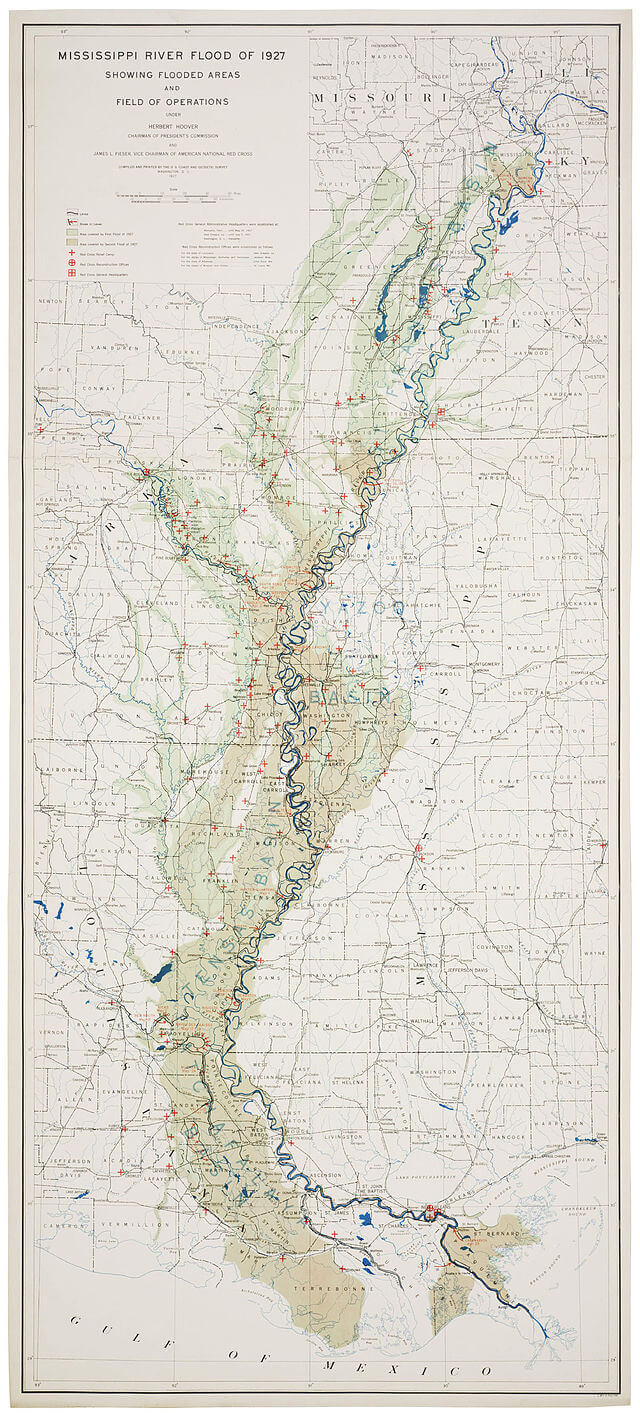 |
| Mississippi River Flood of 1927 showing Flooded Areas and Field of Operations, 1927. Coast and Geodetic Survey. From Records of the Coast and Geodetic Survey, RG 23. |
For more than a century the federal government has—through its participation in flood control—shaped the agricultural, industrial, and urban development of the Mississippi Valley. Federal involvement came slowly, as levee building and other flood control activities were originally perceived to profit too narrow an interest group to justify the enormous investments required. As scholars have documented, however, since the disastrous flood of 1927 ample federal funding has enabled massive human-induced change in the hydrology of the Mississippi and its tributaries.
In response to the great flood of 1927, Congress passed legislation authorizing structural control of flooding along the Mississippi and its tributaries. The Flood Control Acts of 1928, 1936, and 1938 affirmed flood control as a federal activity, and the vast Mississippi River and Tributaries (MR&T) project commenced in the Lower Mississippi Valley in 1941. Numerous additional flood-control acts have authorized "corrective" works along the river and its tributaries, including new levees for containing flood flows and floodways for the swift passage of excess flows.
After generations of work and investments, limits remain to the amount of high water that can be safely transported through the Mississippi Valley. As the Mississippi floods of 1973, 1993, and 2011—and in 2005, Hurricane Katrina—have demonstrated, the potential for serious flooding still exists despite the remaking of the Mississippi's hydrological system at an enormous economic and environmental cost. Especially the disastrous collapse of New Orleans levees in 2005 after a storm surge has cast serious doubts over the reliability of the whole flood control system.
The US Army Corps of Engineers continues to claim that "[t]he MR&T project represents one of mankind's most successful civil works projects and one of the wisest investments." 1U.S. Army Corps of Engineers, Mississippi Valley Division, "Mississippi River and Tributaries Project," http://www.mvd.usace.army.mil/About/MississippiRiverCommission%28MRC%29/MississippiRiverTributariesProject%28MRT%29.aspx. Many disagree and argue that by altering the natural hydrological regime and boosting development on the flood-prone areas, federal flood control measures have—with taxpayers' aid—caused many of the "natural" disasters along the Mississippi and created unprecedented potential for even worse havoc.
Somewhat mistitled, Mississippi River Tragedies: A Century of Unnatural Disaster is above all a wide-ranging and readable legal history "of how law reflects and even amplifies our ambivalent attitude toward nature—simultaneously revering wild rivers and places for what they are, while working feverishly to change them into something else" (front cover flap). Outlining the enormous human-induced change along the Mississippi is a formidable task, but Klein and Zellmer unveil some of the complex interactions between humans and nature along the river. On the other hand, their legal history approach necessitates the inclusion of many complicated landmark cases from different parts of the country that, while intriguing and important, originally had little direct connection to the Mississippi River. While the authors pay attention to the concept of natural disaster and social, economic, and environmental history of the Mississippi basin, their main interest clearly lies in law's agency in floodplain development.
Klein and Zellmer have a personal relationship with the Mississippi, especially with the upper portions of the river, and Mississippi River Tragedies begins with family reminiscences. The first five chapters chart the historical problems of floodplain settlement and growing federal involvement. The authors add little that is new here, except for their competent analysis of relevant legal cases and their implementation on the federal level.2The bibliography contains most of the expected studies of river development in the United States, but excludes some important work pertaining to the Lower Mississippi River. Maybe most surprising is the omission of highly relevant monographs by Pete Daniel, Robert W. Harrison, and Martin Reuss. For example, Klein and Zellmer are able to demonstrate how "misguided federal policies actually discouraged people from leaving riverfront lands, even after the areas had been designated as official floodways for the storage of excess flows" (78). The chapters on 1965's Hurricane Betsy and the Flood of 1993 illuminate events and cases that had lasting legal repercussions for Mississippi floodplain development. Hurricane Katrina and the concept of environmental justice receive their own, rather conventional chapters. At the book's end, Klein and Zellmer make a powerful argument for more sustainable floodplain use, claiming that "[w]e have wasted more than a century pursuing a foolish idea: the floodless floodplain." Now "[i]t's time to try something different: giving rivers room to flood" (203).
Mississippi River Tragedies is by no means a comprehensive appraisal of the human development of the Mississippi basin, but the authors compellingly illustrate the importance of their approach. Americans, of course, have always "improved" nature for the benefit of agriculture and commerce within the existing legal framework. Environmental and social historians too often overlook the judicial basis for the development of natural resources. And while it is impossible for the shortish (some two hundred pages) book to answer all the important questions it raises, Mississippi River Tragedies makes a convincing case for the importance of including law in the historical study of environmental change. Accessibly written, this book is an entertaining introduction to the complex history of the Mississippi during the twentieth century.
About the Author
Mikko Saikku is currently a fellow at the Collegium for Advanced Studies, University of Helsinki in Finland. His research interests include North American environmental history and the history and culture of the US South. His publications include This Delta, This Land: An Environmental History of the Yazoo-Mississippi Floodplain, and Encountering the Past in Nature: Essays in Environmental History (with Timo Myllyntaus).
]]>Review
I adored Beasts of the Southern Wild and have seen it three times: each viewing a quick incursion into the southern surreal. Benh Zeitlin's movie has received a nomination for best film, and Quvenzhané Wallis, his spunky, firebreathing star, may be crowned best actress. In the movie she plays the part of one of Louisiana's Katrina-surviving, throwaway children, but on her own terms she is a gargantua. The poster for the film shows the actress in darkness—her legs striding the ground, arms reaching out like Leonardo's Vitruvian Man and in each hand a giant sparkler irradiating the movie's title in untamable light.
 |
| Film poster for Beasts of the Southern Wild, Twentieth Century Fox, 2012. |
My present passion is luminous trash, glowing debris, garbage that lights up—like the tossed-away sled at the end of Citizen Kane or the illuminated basketball hoops that David Hammons makes out of Harlem debris or the bright garbage that a dirty robot collects in Wall-E. Beasts is a movie where debris and light vie for screen time. The heroine, Hushpuppy, is covered with mud as she traverses the squishy soil around her claptrap, rickety house. In the film's opening scenes the screen floods with light when the Bathtub's bright revelry spills over and neons the Cineplex audience. This film carries the nation's baggage; it investigates a culture of racial neglect, creates a zone of history-making for Katrina's disposable bodies, and provides a steady critique of white capital. The film's rags and wastelands—its killing fields—become powerful emblems of the Southland's (and our nation's) commitment to toxic inequality.
But something else rages in this film; it refuses the realism of social critique and advances instead into hubris land, into a new realm of myth making for the twenty-first century. "We's who the earth is for," boasts Hushpuppy, echoing her father's view of the racially mixed population of the Bathtub. This community bristles with carnivores, meat-eating women and men unashamed of their appetites, alcohol, and impoverishment. Nurtured, imperiled, the child creates a wild set of gods: demiurges, mother figures, aurochs, and sirens to inhabit a world dangerous and ecstatic. She forces us to ask: what myths do we need to live in an era of global warming where every coastal community may soon look like the Bathtub? As Zeitlin said of Isle de Jean Charles, the place where Beasts was filmed: "it's a place where ingenuity rules. Planks, low-lying bridges make up the walkways from house to house, so if your bridge gets knocked out, you fill the gap with a mattress or roofing."1Emily Brennan, "A Filmmaker's Lessons From the Bayou," The New York Times, August 16, 2012, Tr 3. Quvenzhané Wallis deserves an Academy Award because her impassioned presence and plain speaking bestow an unexpected path for assessing the mess we have made; her measured voice endows the film with a new mythos that addresses a world we have broken: a human cosmos that may be dirtied beyond repair.
Where to begin? Charles Wright's poem "In Praise of Thomas Hardy" takes us straight to the heart of light, dirt, and their relation to energy:
Each second the Earth is struck hard
by four and a half pounds of sunlight.
Each second.
Try to imagine that.
No wonder deep shade is what the soul longs for,
And not, as we always thought, the light.
No wonder the inner life is dark.2Charles Wright, "In Praise of Thomas Hardy," in A Short History of the Shadow (New York: Farrar, Straus, and Giroux, 2002), 27.
 |
| Still from Beasts of the Southern Wild, Twentieth Century Fox, 2012. |
Beasts of the Southern Wild is about this four and a half pounds of sunlight. What happens when we take it for granted? What happens as we unravel the fabric of the universe by throwing two and a half centuries of fossil fuel back at the sun?
Beasts begins with a child making a dirt nest for a half grown chick, reminding us that even though primates may have started in the treetops, our home is in the dirt. This mud nest is small, lopsided, and looks uncomfortable, like a practice run for that other dirt-obsessed movie, Close Encounters of the Third Kind. But instead of conjuring light-hungry aliens who come to earth, the nest-building child picks up the chick and listens to its heart; she imagines a chorus of animals: "'I'm hungry. I want to poop.' But sometimes they start talking in codes." How do we make our way into the coded life of other species? In Beasts meat is never processed and prepackaged; it always comes on the bone or in the shell—a reminder of its origins inside other creatures. "Meat is the buffet of the universe," Hushpuppy 's teacher insists. Hushpuppy's father reminds her: "Share with the dog," as if our main task in the Anthropocene, this new era when humans must learn to see themselves as a geologic force preying on the planet, is to know ourselves as a species dependent on other species. As Dipesh Chakrabarty suggests in "The Climate of History": "Changing the climate, increasingly not only the average temperature of the planet but also the acidity and level of the oceans, and destroying the food chain are actions that cannot be in the interest of our lives."3Dipesh Chakrabarty, "The Climate of History: Four Theses," Critical Inquiry 35 (Winter 2009): 219. Or as Hushpuppy says in the trailer: "The whole universe depends on everything fitting together. If one piece busts, even a small piece, the entire universe will get busted."
The vulnerability at the heart of Beasts is staggering. We should have created a planet where children can be safe, but we have not. One in ten American children live in deep poverty; 2.8 million children live in households that have incomes of less than two dollars per person per day—a benchmark for developing countries.4 Paul Tough, "The Birthplace of Obama the Politician," New York Times Magazine, August 19, 2012, 31. Peter J. Hotez, "Tropical Diseases: The New Plague of Poverty," New York Times, Saturday Review, August 19, 2012. Hushpuppy steers through her world in underpants, wearing white plastic boots covered in mud, her parents lost, the camera lens that follows her scratched or marred. She jousts perilously with sparklers; she lights a gas range and burns down her house; neglected and feisty, she is more wild than free, and her thoughtful face summons archetypes of abandonment.
 |
| Quvenzhané Wallis as Hushpuppy. Still from Beasts of the Southern Wild, Twentieth Century Fox, 2012. |
Hushpuppy's near nakedness stirs the film's controversy. Author bell hooks protests oppressive stereotypes that ensure Hushpuppy's victim status and her father's abusiveness and cruelty: his life of drunken delirium. Arlene Keizer, a scholar of African American literature, noted in conversation that Zeitlin's film luxuriates in dirt, disorder, and mental disturbance—as if these were the exclusive properties of the racialized poor. Even the actress who plays Hushpuppy, Quvenzhané Wallis, insists in an interview with Oprah that the heroine should have been allowed to wear long pants. Were the filmmakers conscious of tapping these reservoirs of stereotypical abjection? Why summon inaccurate, dirty cliches about the hopeless lot of underclass blacks, Louisiana, and the marginal Southland, so blindly?
I want to argue that these criticisms, while eloquent, are off the mark. Beasts is not a slice of life or a realist screed; its business is mythological: it proffers a sacred narrative with overtones of awe and cosmic investigation. Querying the social order, it offers strange pedagogies about how we should live in a melting world. Hushpuppy equals the Invisible Man as a "thinker-tinker," a philosopher child who makes up her own world of demiurges and deities; she imagines calving glaciers, starry mothers, and glistening aurochs who want to gobble up cave babies, and in the process she creates creatures so scary and risible that we almost forget their filmic source—a handful of potbelly pigs blown up by the camera and turned into primeval beasts with a patchwork of nutria fur and tacked-on tusks—the bricolage of an odd filmmaker and an even odder child's imagination.
Beasts works through two additional forms of myth making. First, while Hushpuppy's father Wink is scary, he also has a vitality so palpable that his daughter has to absorb it. "Who de man?" he shouts. "I the Man!" she replies. In a scene where one of the white men in her community is teaching Hushpuppy how to eat crab with a knife (and standing suggestively behind her, reminding us of Hushpuppy's sexual vulnerability once her father dies), Wink insists that she "beast it": she must break the crab open with her bare hands and suck its guts out by sheer force of will. Her father may be helpless against the curse of alcohol, but he provides her with meat, with safety from other men (including himself, since he insists that they live in separate houses), and he inhabits the mythic register of the Fisher King, a wounded monarch whose sickness unto death puts his entire kingdom in jeopardy—a wild lord who must be restored to health, or replaced, if the wasteland is to flourish. And in the final scenes Hushpuppy hews to this myth by bringing him a bizarre magic chalice—the closest thing to a talisman that the commodity world owns—a throwaway Styrofoam container filled with gator meat fried by her knife-wielding, light-creating, imaginary mom. The wasteland is with us now and forever—even its myths create trash.
 |
| Hushpuppy and Wink, played by Dwight Henry. Still from Beasts of the Southern Wild, Twentieth Century Fox, 2012. |
This throwaway Styrofoam brings us to Beasts' other mythic register—its quest for a way to represent our species' relation to global warming. Styrofoam is made from oil, and images of acetylene torches, gas stoves, and gas engines remind us that although the film's characters are battered by the forces of global warming and their carbon footprint is small, creating a carbon-free democracy is not their concern. The citizens of the Bathtub practice a dirty ecology, making do with what they can salvage from other waste-making classes. When a Katrina-like storm savages their community, the damage is endless. A giant pig-beast knocks over power lines: these are animals who "eat their own mommas and daddies." In the Bathtub the carbon apocalypse is already upon us. Early in the movie, Hushpuppy's teacher raises her skirt; she shows a thigh tattooed with prehistoric aurochs—"fierce" creatures who signify that "any day the fabric of the universe is going to unravel." A blast of poverty consumes everyone living in Wink's and Hushpuppy's community. After we watch the child, her father, and their chickens, dog, and pig chew up the world during a ritual "feed-up time," the film veers from animal eating to the screen-filling shot of an oil refinery. "Ain't that ugly over there?" Wink says from his repurposed boat. "We got the prettiest place on earth." The Bathtub's houses are made from castaway metal and lumber, its people jettisoned by the currents of capitalism. It's too close to the water: cut off by a levy from the thing-creating world. The oil refinery looks at once mechanical and auratic; its white spires hover in the same place in the pictorial frame as the calving glaciers that start to rain down on the audience, and free child-eating aurochs—the mythic equivalents of carbon's rough beasts, their hour come round at last.
These once-extinct, returning aurochs mark the movie's geologic concern, its interest in eras. Around 1750, humans switched from renewable energy to the large-scale use of fossil fuel—a shift in scale marking the beginning of a new era.5Chakrabarty, 207. Ten thousand years ago the Pleistocene or Ice Age gave way to the warmer Holocene, and civilization began in earnest. But our contemporary era, the Anthropocene, has speeded up our species' access to matter until we now create our own weather events, our own set of fractures. Humans are reborn as geologic agents, as the main cause of change for earth itself. Chakrabarty argues that humans now wield a separate geological force and that we must scale up our imagination of the human, the consciousness of our scope and reach as species being, before we can hope to redeem the planet.6Chakrabarty, 206. This means owning up to the imbroglios we have made, and their unintended consequences. Claiming these unintended consequences becomes Hushpuppy's lament, her motif in Beasts. Angry at her father for going away (near the beginning of the film we see him wandering toward the house, dazed, in a hospital gown; he's been institutionalized against his will for delirium tremens brought on by heavy drinking), she sasses him and he strikes her. She then strikes him back, and he goes down—a man of great will but little strength. The screen flashes with visions of glaciers melting; Hushpuppy transfers her teacher's parable onto her father's ruined body: fantasizing that he is a landscape her bad actions have broken. She dashes to get him medicine and he disappears again, only to reappear as the heavens open: a hurricane nears. Like Lear, Hushpuppy takes the force of the gathering storm upon herself, calling into the wind: "Momma, is that you? I've broken everything."
This is primitive thinking—an animistic sense that her actions have caused the decay of the universe. It is mistaken, childish—and may suggest a deep psychological wound. Children reeling from abuse may internalize themselves as bad objects, blaming themselves because it's too painful—too dangerous—to jeopardize a precarious relationship with their parents. To decide that she is at fault, that she's done the breaking, puts Hushpuppy in a universe of children who've been neglected or traumatized. She blames the world's trauma on herself to keep from alienating her caretaker—a father so unpredictable that even a child's feathery anger might frighten him away. Self accusation makes sense in terms of the film's psychological economy, but it also operates in a mythical or cosmic register.
According to Chakrabarty, Bruno Latour, Tim Mitchell—or a thousand ecologists—the guilty recognition that we have the power to shatter our own universe is exactly the tragic recognition—a true anagnorisis—that we need to embrace; we need to scale up not only our self-knowledge, but our self-image as quasi-subjects with the terrible power to change the planet, not just individually, but as species-being. Beasts names us as a vulnerable species in need of tools that can mirror and refract the depth of our ongoing, entangled acts of pollution, our attachment to things that keep turning into debris, our power to destroy Earth itself. Hushpuppy's animistic thinking is a mistake, but this displacement is also a powerful origin point for a necessary myth, for the dream we need to dream (that is, to make into creed, to make tangible) of our complicity as a dangerous, polluting species.
 |
| Wink and Hushpuppy. Still from Beasts of the Southern Wild, Twentieth Century Fox, 2012. |
I'm arguing that Hushpuppy signals to us, again and again, possible transference points for claiming kin with our carbon voracity. First, she's a determined creatrix who tries to memorialize her own acts of trashing: "If Daddy kill me [for burning down the house] I ain't going to be forgotten," she thinks and hides under a cardboard box while the flames advance as she draws a picture of herself for posterity. "Daddy could have turned into a tree or a bug," she thinks when he disappears, "there wasn't any way to know," and the screen flashes with tent caterpillars and ice floes suggesting the break-up of the universe. When the hurricane rages we see mud-spattered animals trudge through the needling rain. When it's over and Hushpuppy and Wink float in their newly drowned world, Hushpuppy thinks of the waste of dead animals: "They're all down below trying to breathe through the water. For animals that didn't have a Dad to put them in the boat, the end of the world already happened." When the water finally drains out of the Bathtub, Hushpuppy reminds us: "It didn't matter that the water was gone. Sometimes you can break something so bad that it can't be put back together." Or, watching her father die, she exclaims, "The brave ones stay and watch it happen. They don't run," but she still finds herself on a boat skippered by a captain who hoards all his Chick-fil-A wrappers: "the smell helps me to be cohesive." Garbage animates this wasteland, but as the movie veers away from a world filled with animal parts—and unabashed human carnivores who lie down in mounds of crawfish shells or sleep in piles of rags and throw-away clothing that, to bourgeois noses, would smell unclean—it embraces a comedy of processed food that seems to grow its own trash, and Hushpuppy insists that you still have to "fix what you can."
 |
| Still from Beasts of the Southern Wild, Twentieth Century Fox, 2012. |
In Beasts nothing gets mended, except for the audience's amazement at a child's voracious imagination. After the apocalypse, those left in the Bathtub try to drain the polluting water by detonating a levy. The screen goes white when the detonation is successful, and then reveals barren bayous. Hushpuppy's community is forced to go to the "Open Arms Processing Center," a sterile, inhospitable world where "when an animal gets sick here they plug it into the wall." The film starts to fall apart in this civilized bureaucracy. Hushpuppy's imagination slows down, and Zeitlin falters as his mythic backdrop falls away. The film finally picks up when it returns to the wasteland, although it makes a second detour to a buoyant island of happy prostitutes. This detour from carbon catastrophe is beautiful; the screen dazzles with utopian lights that reiterate, in a vague and careless way, a wished-for matriarchy. At the end of this scene little girls dance with loving women wearing old-fashioned white slips—as if the movie wants to promise us a Land of Cockaigne where little girls will always be sexually safe, where mothers can be cooks instead of hookers, and where heat and light are endless.
To return to life as an endangered child in a universe of bureaucracy and endless waste is scary. But the ritual death of the Fisher King, the film's insistence that Hushuppy's father must die and cannot heal the wasteland, keeps us mired in the film's litany of Anthropocene images. Allan Stoekl argues that every twenty-first century addiction flows from our addiction to oil.7Allan Stoekl, Bataille's Peak: Energy, Religion, and Postsustainability (Minneapolis: University of Minnesota Press, 2007). To break this obsession means reformulating our entire subjectivity.
To prevent this, we practice a dirty ecology: recycling a few things while leaking and expending everything else. In other words, dirty ecology is the science of halfway practices. We know that driving and flying and industrial pollution and living in drywall houses destroys the planet, but we continue to do it. Hushpuppy appeals so powerfully because she is an early avatar of who we need to become: a child who clings to Styrofoam but sends her liquor-addicted dead father in his gasoline-addicted-repurposed-Chevy truck-made-into-a-boat off into another world.
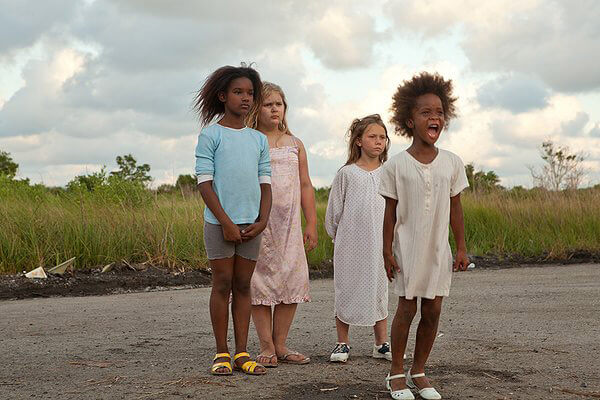 |
| Still from Beasts of the Southern Wild, Twentieth Century Fox, 2012. |
Hushpuppy's cry keeps echoing: "Momma . . . I've broken everything!" Her mythical thinking represents childish animism and a private legacy of psychological damage. But myths also establish long-term models for guiding behavior. They require, first of all, mystery—awe at fact of the universe and our place in it; second, a topos—an explication of cosmic shape that can ground us in a felt geography; third, an epistemology—shaping foundations supported by codes or ideas that establish the norms of the social order; and finally an ethic—a set of rules or maxims about how to live within the parameters of the everyday. Beasts bestows a weird movie mythopoeia for reestablishing each of these needs within our present era: the carbon-drunk Anthropocene.
In this movie's wake, I hope for a long line of girls and boys who will call out to us with the knowledge that we've broken our ecosystem. We must dirty ecology, the science of whole environments, with myths, fictions, half-truths, dirty imagery. Myths are crucial as implements of attachment and ownership for all the unintended consequences we have to live with in order to make a buffet, a movable feast, and a pedagogy out of our cosmic impasse. "If daddy don't get back soon it will be time for me to eat my pets," Hushpuppy says early in the movie to soothe her growing sense of abandonment. Even though Wink imagines that "I got it under control," he also sees that "my blood is eating itself." No one has it under control in the Anthropocene, and unless we recognize this soon we will have to eat things stranger and less appetizing than our pets. What's the world coming to when the best movie of 2012 has a nutria rigger, when it reimagines extinct aurochs as potbellied pigs with plastic horns? Beasts of the Southern Wild is whimsical, but it is also an epic comment on our condition of metamorphosis when humans persist in changing Earth's geologic direction: "Daddy could have turned into a tree or a bug, there wasn't any way to know." Trees and bugs may not need mythologies, but the rest of us do, and to advance the project of reshaping a planetary epistemology, see this movie—and then let's start to fix what we can.
About the Author
Patricia Yaeger is Henry Simmons Frieze Collegiate Chair at the University of Michigan. She was editor of PMLA from 2006–2011 and author of the award-winning Dirt and Desire: Reconstructing Southern Women's Writing. She is working on two books: "Luminous Trash: America in an Age of Conspicuous Destruction" and "Flannery O'Connor in Drag," and is co-editing volumes on literature and energy, "Fueling Culture: Energy, History, Politics" and "American Dirt."
]]>Introduction
Before Hurricane Katrina struck in late August of 2005, the Gulf Coast states of Louisiana, Mississippi, and Alabama had among the highest levels of race, class, and gender inequality and the worst quality-of-life indicators in the nation for their poor, people of color, and women. The extreme inequality in these states reflects a white southern legacy of a government/elite/corporate alliance that promoted slavery and the plantation system; post-slavery agricultural peonage; the convict lease system; concentrated agribusiness; and nonunion, low-wage labor.1V. O. Key, Jr., Southern Politics in State and Nation (New York: A. A. Knopf, 1949); Joel Williamson, The Crucible of Race: Black and White Race Relations in the American South (Oxford: Oxford University Press, 1984); Michael Goldfield, The Color of Politics: Race and the Mainsprings of American Politics (New York: New Press, 1997); Jeffrey S. Lowe and Todd C. Shaw, "After Katrina: Racial Regimes and Human Development Barriers in the Gulf Coast Region," American Quarterly 61, no.3 (September 2009): 803-827.
Strengthened during the political realignment of the 1980s, this alliance, which historically defined the white southern governing philosophy, now threatens to dominate the nation as a whole. Often labeled "neoliberal," and yet fundamentally conservative (or reactionary), this governing philosophy calls for cutting social spending deeply, including spending on welfare programs and benefits, and selling off government assets and functions to private corporations, while reducing or eliminating regulations on profit accumulation.2Lowe and Shaw; Naomi Klein, The Shock Doctrine: The Rise of Disaster Capitalism (New York: Metropolitan Books, 2007).
One outcome of the widespread application of this governing model has been rising inequality across the nation, but especially in the historically poor and racially divided South. Despite hopes that the influx of Hurricane Katrina recovery money into the Gulf Coast states would improve the status of the disadvantaged and ameliorate inequalities, the emerging consensus is that the storm and the response to it simply exacerbated these preexisting social ills.3Lowe and Shaw; Klein; Lynn Weber, "Intersectionality, Gender, and Health: What Katrina Reveals," (paper presented at Social Science & Medicine, Gender & Health Special Issue Workshop: Relational, Biosocial, and Intersectional Approaches, Mailman School of Public Health, Columbia University, New York, 2010); Mark M. Smith, Camille, 1969: Histories of a Hurricane (Athens: University of Georgia Press, 2011).
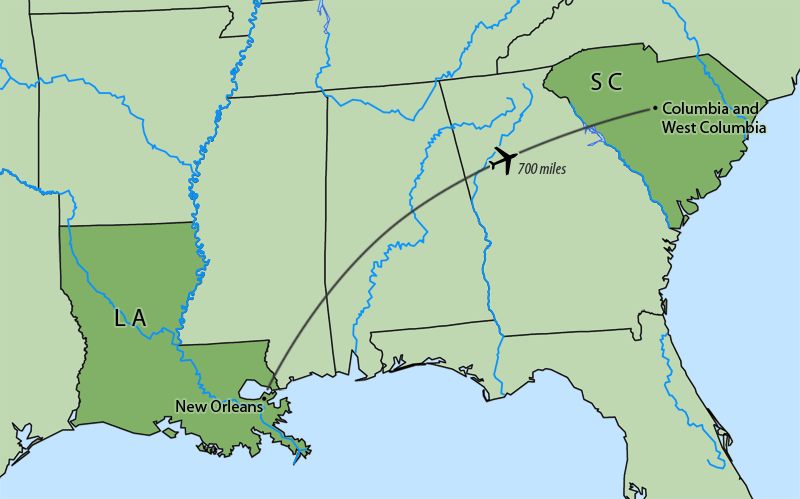 |
| Map showing route from New Orleans, Louisiana to Columbia and West Columbia, South Carolina, 2012. |
This essay presents findings from a study of Katrina evacuees' reception in Columbia and West Columbia, South Carolina. Interviews with residents, volunteers, service providers, and evacuees reveal how people coming to and living in these two southern locales—seven hundred miles away from New Orleans—responded to and made sense of the massive disaster of Hurricane Katrina and the resettlement it precipitated. When Katrina's evacuees came to South Carolina, they entered a state that had the same high levels of poverty and poor quality-of-life indicators as New Orleans and the Gulf Coast. But in part because South Carolina had more systematically and comprehensively embraced neoliberal governing ideas than had even other southern states, evacuees to South Carolina negotiated post-disaster displacement in a place where affordable housing, public transportation, and employment options are among the least available in the nation and where social welfare policies and benefits are among the nation's most restrictive, punitive, and least generous. The story of the evacuees' reception in South Carolina highlights the ways in which political, economic, and social conditions in cities and towns across the US affected their ability to respond to Katrina and the ways that the crisis itself magnified the long-term consequences of government disinvestment in such critical needs as infrastructure, social programs, and services.
I begin with a brief overview of the socioeconomic-political context of the Midlands South Carolina region, including Columbia and West Columbia, and a description of the initial reception of Katrina evacuees in September 2005. Then, after describing data collection, I analyze the reception and resettlement processes associated with housing, transportation, and social welfare benefits and the impact of these processes on the evacuees. Finally, I present evidence that the evacuees' reception in the Midlands was also shaped by, and locally understood in relation to, the region's history of race relations and its experience with other recent migrants: Latinos, Eastern Europeans, and Somali Bantu refugees.
Columbia and West Columbia, South Carolina
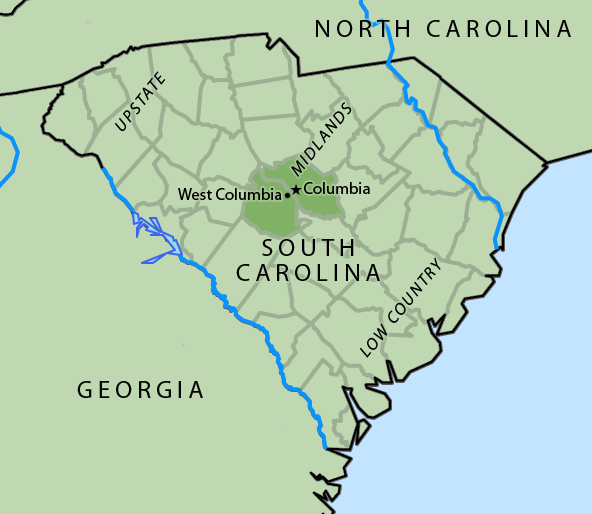 |
| Map showing the Midlands of South Carolina, 2012. Columbia, the state capital, and West Columbia are in the Midlands region of the state. |
The South Carolina Midlands is situated in the center of the state, less than two hours from the Upstate area of Greenville and the growing suburbs of Charlotte, North Carolina, and the Low Country, including Charleston. Columbia, the capital of South Carolina, lies in the Midlands and is the largest city in the state, with a population of approximately 123,000 within city limits and of over 700,000 for the Metropolitan Statistical Area (MSA). Major employers include government, healthcare, the University of South Carolina, and the largest US Army training base in the nation, Fort Jackson.
West Columbia, a largely working-class town of thirteen thousand in adjacent Lexington County, is separated from Columbia by the Congaree River. In the early nineteenth century, West Columbia was established as a mill town that housed workers who ferried across the river to work in Columbia's textile mills, until the first bridge was built in 1827. A century of textile production in Columbia ended in 1996 with the closing of the Olympia and Granby Mills and their later transformation into apartment complexes, grocery stores, museums, and art galleries. West Columbia has become home to Columbia's growing workforce, University of South Carolina students, and young professionals and their families because it has more affordable housing than Columbia. West Columbia and its neighboring communities of Cayce and Springdale (the West Metro Area) also host a major hospital, the regional airport, and a variety of storage and distribution facilities and employers, including United Parcel Service.
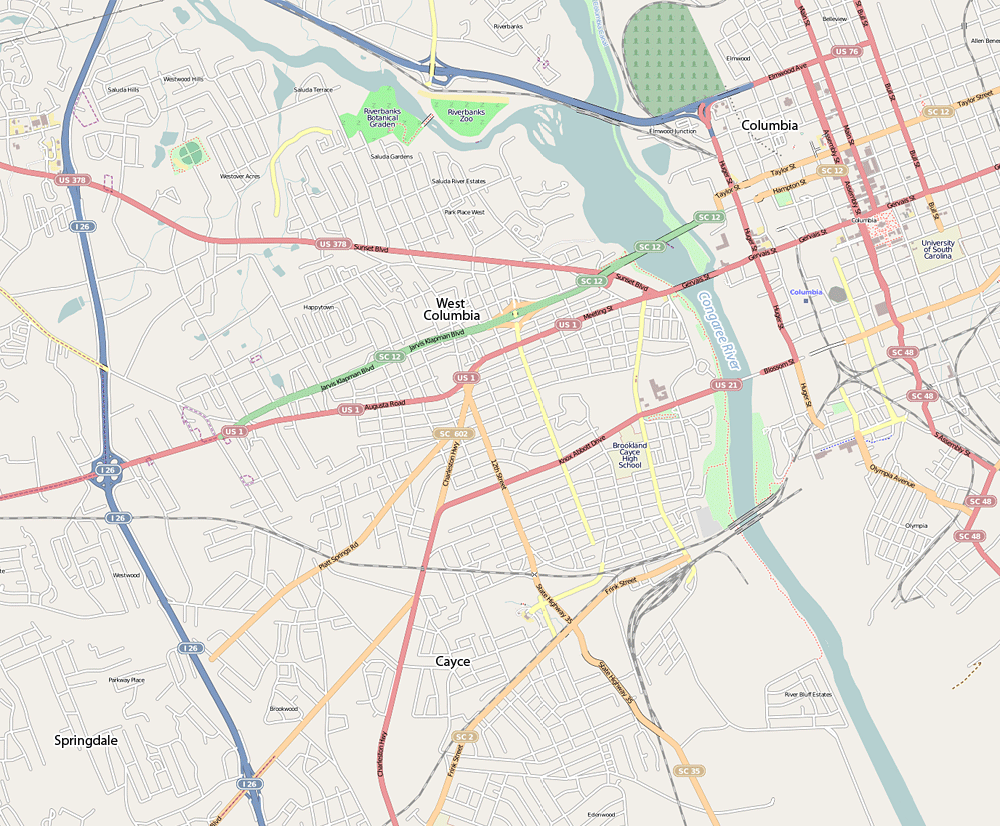 |
| Map of Columbia, West Columbia, Cayce, and Springdale, South Carolina, 2012. ©OpenStreetMap contributors, CC-BY-SA. |
Table 1 presents some demographic characteristics of Columbia, West Columbia, and, where comparable data are available, New Orleans and the United States. Data on poverty and median household income for 2000 demonstrate some basic similarities among the three Southern cities. All have poverty populations ranging from 4.4 (West Columbia) to 11.3 (New Orleans) percentage points above the national median and household incomes ranging from $10,853 (Columbia) to $14,861 (New Orleans) below the national median for all groups—Blacks, Whites, and Hispanics. Hispanics in West Columbia appear to have both higher numbers in poverty and higher household incomes than Hispanics or Blacks in Columbia or New Orleans, figures that likely reflect the larger number of earners in a single household in West Columbia.
Table 1 also presents population change data based on local government surveys conducted in 2006.4Central Midlands Council of Governments, Region Report: West Metro Area, 3, no. 1 (Spring 2006), http://www.centralmidlands.org/pdf/caycewcola06.pdf (accessed February 17, 2011). The data illustrate the more rapid growth of West Columbia, increasing by 8.5 percent since 1990 while Columbia increased by only 5.5 percent. More important, in the last two decades, the population of West Columbia, as in much of the South, has undergone major transitions in race, ethnicity, and class composition—a significant increase in African Americans and in documented and undocumented Hispanics.5Center for Research on Women, Across Races & Nations: Building New Communities in the US South (Memphis, TN: University of Memphis, 2006); State of South Carolina Commission for Minority Affairs, "South Carolina Hispanic/Latino Report" (Columbia: South Carolina Commission on Minority Affairs, 2006), http://www.state.sc.us/cma/data/FINDINGS%20REPORT2006.pdf (accessed February 21, 2011); Heather A. Smith and Owen J. Furuseth, Latinos in the New South: Transformations of Place (Burlington, VT: Ashgate, 2006). By 2004, South Carolina's Hispanic population had the fourth fastest rate of increase in the country, and since 1990, Lexington County (including West Columbia) has consistently been among the ten South Carolina counties with the highest Hispanic population.6Brenda Vander Mey and Ashley W. Harris, "Latino Populations in South Carolina, 1990-2002," working paper (Clemson, SC: Department of Sociology, Clemson University, 2004).
| Table 1. Demographic Characteristics of the United States, New Orleans, West Columbia, and Columbia | ||||
| United States | New Orleans | West Columbia | Columbia | |
| % Individuals Below Poverty, 2000 | ||||
| Total | 12.4 | 23.7 | 16.8 | 22.9 |
| White | 6.7 | 11.0 | 11.4 | 9.8 |
| Black | 23.5 | 33.8 | 33.0 | 26.1 |
| Hispanic | 22.0 | 21.9 | 32.7 | 13.2 |
| Median Household Income, 2000 | ||||
| Total | $41,994 | $27,133 | $31,000 | $31,141 |
| White | $44,687 | $40,049 | $34,558 | $39,877 |
| Black | $29,423 | $24,461 | $18,813 | $21,393 |
| Hispanic | $33,676 | $28,545 | $34,558 | $31,079 |
| Total Population * | ||||
| 1990 | 12,541 | 116,405 | ||
| 2006 | 13,604 | 112,819 | ||
| % Change, 1990–2006 | 8.5 | 5.5 | ||
| Hispanic Population | ||||
| % of Total Population, 1990 | 0.6 | 1.8 | ||
| % of Total Population, 2006 | 7.3 | 3.5 | ||
| % Change, 1990–2006 | 1116.0 | 94.0 | ||
| Black Population | ||||
| % of Total Population, 1990 | 14.9 | 45.8 | ||
| % of Total Population, 2006 | 18.6 | 45.3 | ||
| % Change, 1990–2006 | 24.8 | -1.0 | ||
| White Population | ||||
| % of Total Population, 1990 | 84.1 | 51.8 | ||
| % of Total Population, 2006 | 76.1 | 50.0 | ||
| % Change, 1990–2006 | -9.5 | -3.5 | ||
| * Sources: US Census Bureau, "Demographic Profile Highlights," American FactFinder (Washington, DC, 2000), accessed January 16, 2011, http://factfinder.census.gov/legacy/aff_sunset.html. Data for United States; Columbia, SC; West Columbia, SC; and New Orleans, LA. Since census data are not available for West Columbia beyond 2000, 2006 population data for Columbia and West Columbia are from Central Midlands Council of Governments, Complete Demographic Summary Report (2007), accessed January 16, 2011, http://centralmidlands.org/pdf/west_columbia.pdf and http://centralmidlands.org/pdf/columbia.pdf. | ||||
From 1990 to 2006, the Hispanic population in West Columbia grew by over one thousand percent, while the Hispanic population of Columbia, just across the river, grew by only ninety-four percent.7For a variety of reasons, the Hispanic population is undercounted by census enumerators. The most common factors associated with undercount of Hispanics in the census include complex household makeup or cultural differences in defining households, individual/family mobility, legal (authorized versus unauthorized) status, fear or distrust of government, and language barriers. See Elaine Lacy, "Mexican Immigrants in South Carolina: A Profile" (Columbia: University of South Carolina, 2007). Likewise, West Columbia's African American population grew by 24.8 percent, while Columbia's declined by one percent. As the presence of people of color increased in West Columbia, the white population declined by 9.5 percent, although it still constituted three-fourths of the total. Whites maintain strong political dominance, holding seven of the eight city council seats, as well as the mayoral and city-administrator positions.
The Reception of Katrina Evacuees
 |
| Michael Rieger/FEMA, Hurricane Katrina evacuees board an aircraft for evacuation at New Orleans airport where FEMA had set up operations, Louisiana, September 2, 2005. |
In the weeks after Katrina hit the Gulf Coast, the South Carolina Midlands became an emergency relief center for relocation efforts. Columbia received over four thousand families, some ten to fifteen thousand people. Arriving by airplanes some ten days after the hurricane, the 2,053 evacuees to Columbia were among the last to leave New Orleans. Most had spent days in shelters or on highway overpasses before the evacuation, had left their hometown involuntarily, and had no earlier connection to South Carolina.8Bret Kloos, Kater Flory, Benjamin L. Hankin, Catherine A. Cheely, and Michelle Segal, "Investigating the Roles of Neighborhood Environments and Housing-based Social Support in the Relocation of Persons Made Homeless by Hurricane Katrina," Journal of Prevention and Intervention in the Community 37, no. 2 (2009): 143-154. For the first six months, the displaced were largely accommodated in hotels, but by the end of February 2006, all who remained had moved into rental houses and apartments or to Section 8 housing. Eighteen months after their arrival, eight hundred families in the Midlands area were still receiving FEMA assistance. West Columbia was the receiving site for many of the displaced both during their hotel stays and as they moved to more permanent housing arrangements.
Political leaders in South Carolina made the initial decision to receive evacuees, including the 2,053 airlifted out of the New Orleans area. Congressman James Clyburn (D-SC), the ranking African American and then the majority whip in the US House of Representatives, and Bob Coble, Columbia's mayor at the time, organized the local response, calling on about forty leaders from city government, social services, education, labor, the nonprofit sector, business, law, healthcare, and religion to meet and coordinate activities. The coalition of Midlands leaders and volunteers that emerged to manage the reception named itself South Carolina Cares. Dubbing the evacuees "South Carolina's guests," the coalition developed a model with three core elements:
- creating a one-stop point of entry/reception center-designed to address all of the "guests"' immediate needs, including making contact with family members, FEMA registration, healthcare, schools for the children, clothes, food, and legal advice and assistance
- placing evacuees in hotels and apartments paid for with private funds raised by South Carolina Cares, not in shelters
- matching hotels and individual evacuees with volunteer "hosts" to assist in the relocation.
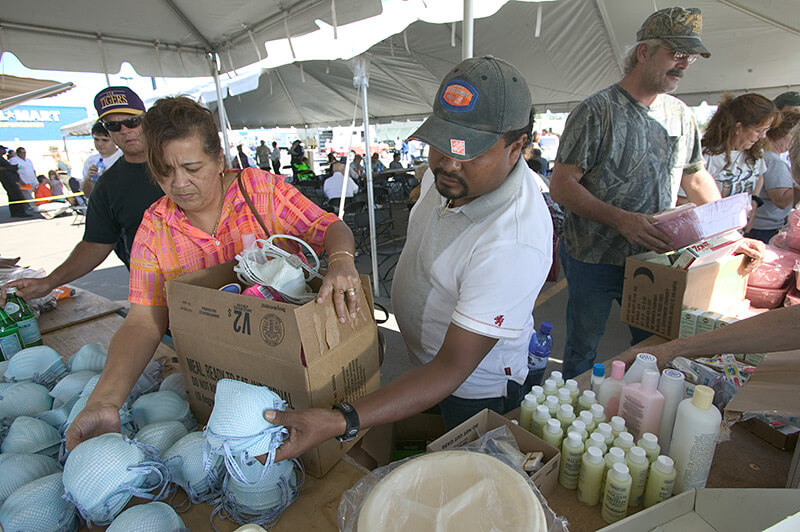 |
| Andrea Booher, Evacuee Umberto Romero gathers food and necessities at the distribution center at the Chalmette Recovery Center set up following Hurricane Katrina, New Orleans, Louisiana, October 22, 2005. |
When Gulf Coast residents began arriving, especially the airlifted group, they were disoriented and upset, having not been told where they were being taken. Many were sick and had gone days without access to food, clean water, and regular medications for chronic conditions. All were under intense psychological strain. South Carolina Cares arranged for food to be donated and delivered to the hotels and provided shuttle buses to and from the center. The reception center operated for two months, and local agencies ran two centers for four more months. Among the people we interviewed who had worked in or had been received by South Carolina Cares, the overwhelming consensus was that the center and the initial reception were a success. People's immediate needs were met, and the evacuees were treated with dignity and respect. Research conducted during the early reception period suggested that the evacuees were largely satisfied with the social climate in the hotels and surrounding neighborhoods and with their "host" relationship, and that each of these factors had positive effects on mental health (e.g., post-traumatic stress disorder, depression, anxiety).9Ibid.
Studying Katrina's Displaced in South Carolina
By 2007-2008, I had been involved for five years with colleagues in Women's and Gender Studies at the University of South Carolina in a program of community-based participatory action research in West Columbia. Because many of Katrina's displaced had been "temporarily" housed in West Columbia in 2005 and still resided there, and because the initial relocation and reception process locally had been largely deemed a success, I initiated a study of the local context of reception. How did West Columbia residents receive the displaced? And conversely, how did Katrina's evacuees experience Columbia and West Columbia?
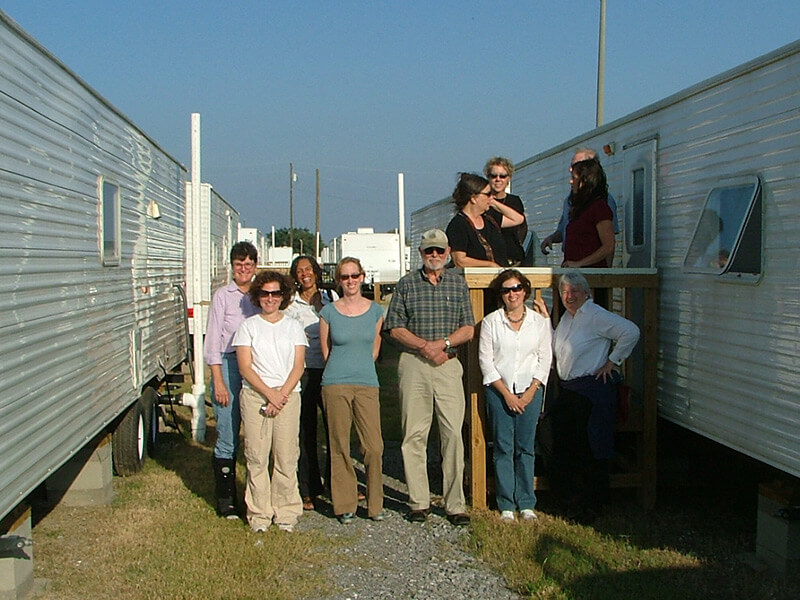 |
| Displaced project researchers visiting a displaced University of New Orleans scholar's FEMA trailer, New Orleans, Louisiana, 2005. Lynn Weber is furthest to the left. |
Three major sources of in-depth interviews inform this project: interviews with forty-eight black, white, and Hispanic English-speaking and twenty-one Spanish-speaking community leaders and residents of West Columbia; twenty-three people who led and worked in the Midlands relocation efforts; and twelve evacuees residing in West Columbia. Interviews lasted between forty-five minutes and two hours and were conducted between May 2007 and September 2008.10Trained graduate-student research assistants and I conducted the interviews, and participants provided informed consent beforehand. All interviews were audiotaped, professionally transcribed, and coded for analysis. Details of the study's methodology are published in Lynn Weber, "When Demand Exceeds Supply," Displaced: Life in the Katrina Diaspora (Austin: University of Texas Press, 2012), 84-86.
Katrina's displaced came to understand that the conditions of life and the resources available to them in Columbia and West Columbia were tied to an inhospitable history of state governance. Although Columbia is a Democratic stronghold, West Columbia is in one of the most solidly Republican counties in the state. Further, Republicans have dominated South Carolina politics since the 1960s. The state is one of the most conservative in the union. The governor's office and both branches of the legislature are controlled by conservative Republicans—a fact that has made the state a testing ground for national Republican-Party policies designed to lead the nation toward extreme conceptions of free market capitalism and social conservatism.11Laura R. Woliver, "Abortion Conflicts, City Governments and Culture Wars: Continually Negotiating Coexistence in South Carolina," in Culture Wars and Local Politics, ed. E. Sharpe (Lawrence: University of Kansas Press, 1999), pp. 21-42; Laura R. Woliver, The Political Geographies of Pregnancy (Urbana: University of Illinois Press, 2002).
In a state that in February 2009 had the nation's highest unemployment rate, Governor Mark Sanford, then head of the Republican Governor's Association, led the charge of southern governors to oppose President Obama's American Recovery and Reinvestment Act of 2009, better known as the stimulus bill. Twice he refused the portion of the stimulus over which he had authority, especially objecting to increases in unemployment and Medicaid benefits that the state might have to continue two years later without federal aid.12Richard Fausset, "South Carolina's Governor May Turn Down Stimulus Money," Los Angeles Times, February 21,2009; Editorial, "Courting Disaster in South Carolina," New York Times, March 30, 2009. This stance reflected a long history in South Carolina of enacting unusually punitive social welfare policies and diminishing social spending to support the poor and working classes, including investments in affordable housing and public transportation. Housing subsidies, food stamps, child welfare benefits—all paid less and/or had stricter eligibility requirements than in New Orleans. Public transportation, at least as necessary in South Carolina, was less available than it had been in New Orleans.
Housing
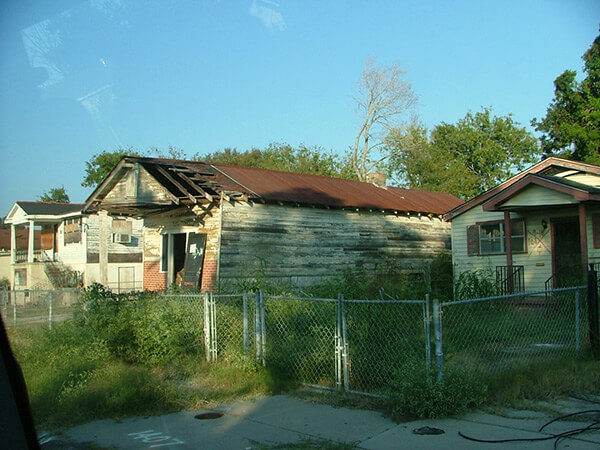 |
| Lynn Weber, Hurricane Katrina damage (above) and Signs about housing demolition (below), Lower Ninth Ward, New Orleans, Louisiana, 2005. |
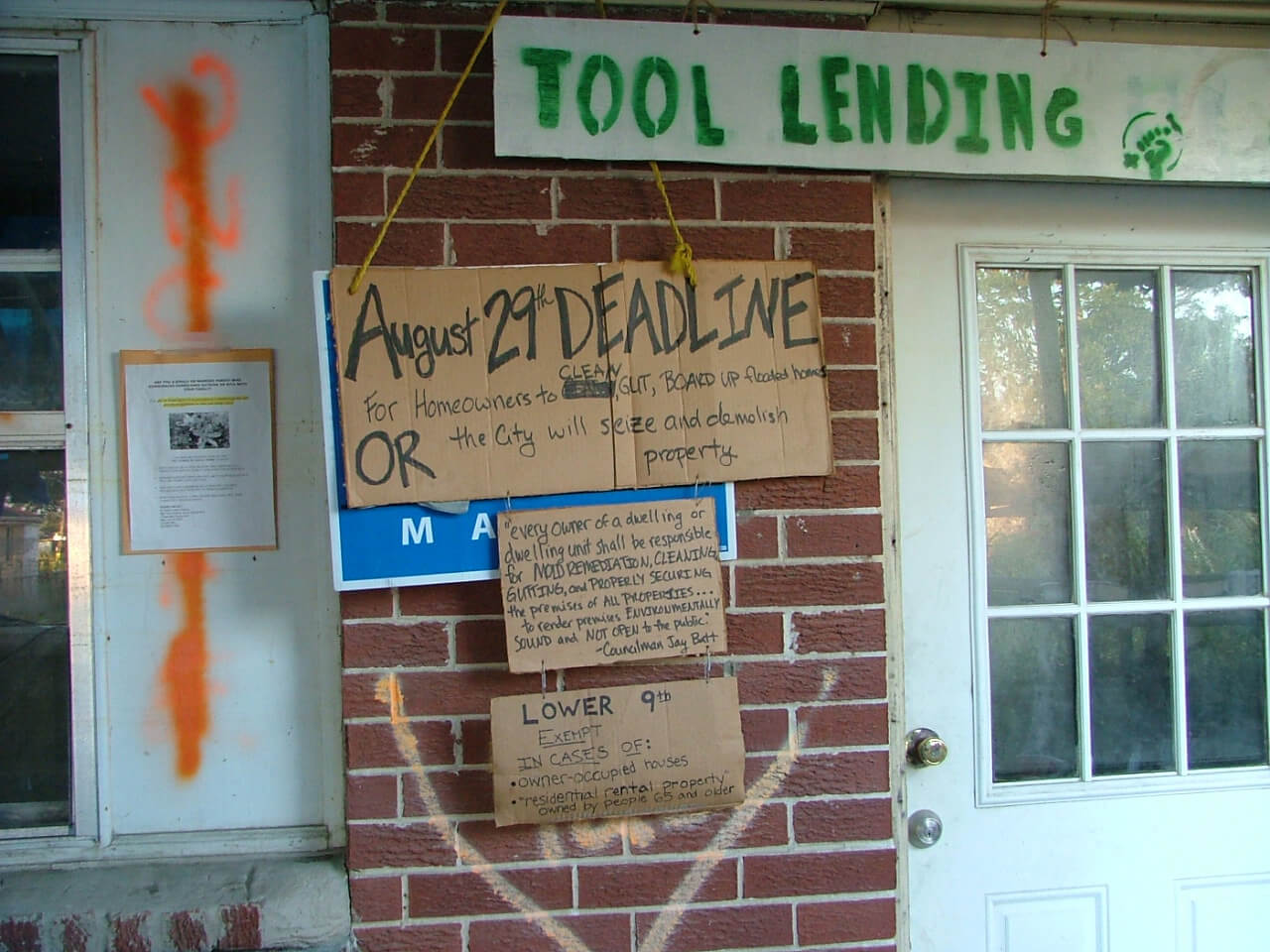 |
Well before Katrina and before the US housing/mortgage crisis officially began in 2007, local, regional, and national housing and economic policies had contributed to a serious shortage of affordable housing along the Gulf Coast and in the evacuee receiving cities across the nation.13Sheila Crowley, "Where Is Home? Housing for Low-Income People after the 2005 Hurricanes," in There Is No Such Thing as a Natural Disaster: Race, Class, and Hurricane Katrina, ed. C. Hartman and G. D. Squires (New York: Routledge, 2006), pp.121-166. For middle class home owners displaced to South Carolina, finding temporary housing, dealing with insurance companies and the government, and deciding on their long-term housing plans were stressors that, though extreme and prolonged, were nonetheless surmountable for most. But the housing crisis was doubly intensified for low-income New Orleanians, especially the elderly and people with disabilities who had rented or lived in subsidized housing.
New Orleans and the entire Gulf Coast placed the lowest priority on rebuilding rental housing units, fifty-two thousand of which were destroyed by the storm. By 2010, five years after Katrina, all four of the city's major public housing complexes, formerly home to five thousand residents, had been destroyed or slated for destruction. Years after Katrina, tens of thousands of low-income displaced people still cannot return to New Orleans because there is no place to return to. Several of our respondents expressed sentiments similar to a thirty-five-year-old African American evacuee who had found part-time employment in Columbia. When asked in April 2008 if he had been back to New Orleans, he said, "I'm just waiting to see what the outcome's going to be. I wanna see how they rebuild New Orleans as far as the people. That's what I wanna see. Yeah, I'm just waiting for the rebuilding of New Orleans."
On the other hand, Columbia and West Columbia had an affordable housing crisis of their own that had been exacerbated by a 10 percent cut in Section 8 housing vouchers (339 vouchers) between 2004 and 2006, a cut attributed to funding formula flaws.14Center on Budget and Policy Priorities, Housing Vouchers Funded in South Carolina under Pending Proposals, November 1, 2006, http://www.cbpp.org/files/11-1-06hous-sc.pdf (accessed February 17,2011). Further, in 2004, the West Columbia City Council blocked a developer's proposal to build a low-income apartment complex in the city. The developer and the National Association of Home Builders sued the city in 2005 on the grounds that the decision affected minorities unfairly. The city paid $600,000 in 2008 to the developer to settle the suit—without a requirement that the complex be built.15John O'Connor, "West Columbia Accused of Blocking Apartments," The State, February 18, 2005; Tim Flach, "West Columbia Paying Out $600.000," The State, March 4, 2008; Tim Flach, "Builders Urge More Attention to Low-Income Homes," The State, March 13, 2008.
A manager for the local housing authority described not only the situation when the displaced arrived but also its deterioration since:
South Carolina Emergency Management thought we could just go and take people in, and I said, "You've got to be kidding me." I said, "You don't understand." At that time, we had about seventeen hundred units of housing. Maybe about 1,650 is what we had gotten down to, but we were seven hundred units down [from demolition/rebuilding projects in process]. We had about five thousand on our waiting list at that time [2005], and my waiting list right now, as of January 14, 2008, just hit ten thousand. So I've got about five thousand units of housing that I can either do through the voucher or the public housing program, but a waiting list of ten thousand. So it's the highest in the thirty years I've been here. It's gonna be three to four years if you apply today.
 |
| Columbia Housing Authority, Cayce public housing, Cayce, South Carolina, 2012. |
Evacuees living in public housing in New Orleans were eligible for public housing in South Carolina. But eligibility and availability are two different things. And many people cannot afford housing officially designated as "affordable." In 2006 the fair market rent for a two-bedroom apartment in South Carolina was $615 per month. The wage necessary to afford this two-bedroom apartment was estimated to be $11.82 per hour for a person working a forty-hour week.16Child Welfare Leagues of America, "South Carolina's Children 2008," http:// www.cwla.org/advocacy/statefactsheets/2008/southcarolina.htm (accessed February 17, 2011). Yet with the exception of registered nurse, the eight highest-growth jobs in South Carolina that year were unlikely to provide full-time, year-round employment. And five of those eight high-growth jobs—food prep and serving workers, waiters and waitresses, janitors and cleaners, retail salespeople, office clerks—provided wages below $11.82 per hour.17South Carolina Department of Commerce, "High-Growth Jobs in South Carolina: Labor Market Information," July 2008, http://www.workforcesouthcarolina.com/media/3163/highgrowthjobs072008.pdf (accessed February 21, 2011).
Beginning in fall 2005, FEMA periodically issued lists of families still eligible for housing assistance. Each time the lists came out, some families were left off even though local caseworkers and the displaced themselves knew they were still eligible. In September 2007, two years after their displacement, eighty families in the area still received housing subsidies. After having demonstrated a continued need for housing assistance and having re-qualified several times, these remaining families were told that they were going to be "weaned" from subsidies over the next eighteen months. Beginning in March 2008, the families were asked to pay $50 toward the monthly rent and to increase that amount by $50 per month up to $250 or one-third of their gross monthly income. By April 2008, the rolls had been reduced from eighty to forty families. While most were still in apartments, some found individual homes to rent, one a trailer, and one a Habitat for Humanity home. Ten moved to HUD foreclosure homes, living rent-free but with the possibility of removal at any time without notice. And some, facing eviction, returned to New Orleans to uncertain employment and housing options.
All of the evacuees we interviewed lived in Section 8 apartment complexes in West Columbia. And all but one were concerned about their long-term ability to afford to stay in the apartment, especially as their contribution to the rent was to increase. People with disabilities and on fixed incomes lamented that they paid higher rents in Columbia than in New Orleans. According to one white woman, even though she and her husband, both living with disabilities, liked the apartment in West Columbia, the rent was $650 a month—more than double what they had paid in New Orleans. As long as the FEMA or the Katrina Disaster Housing Assistance Program (KDHAP) emergency housing programs were paying the rent, she was satisfied. But at the time of her December 2007 interview, the "weaning" plan had begun. Several months later she and her husband had been evicted and had returned to New Orleans after housing assistance ran out.
In March 2008, three months after an initial interview, one of our research team members talked with another respondent at the homeless shelter in Columbia. A middle-aged white man who had had great difficulty finding employment, he was also evicted when full housing assistance ran out. In New Orleans, he had worked in a laundry for a homeless shelter. He described his plight and what he saw on the horizon for the nation:
I worked there in the daytime. I'd get up at 5:00, going to work 5:30, get done at 4:00. I would do the laundry for the homeless. I never thought of me being homeless, never, and yet I lost my house because the insurance company wouldn't cover it. . . . [I've] never been homeless, and it shocked me. I always had a good job. I had three jobs and that's all gone. It wiped it all out. I believe with all this banking crap that happened, there's gonna be a lot of people out of work, a lot of people, and where are they gonna put 'em?
Transportation
Critically needed in West Columbia, public transportation is abysmally inadequate. A United Way needs- assessment in 2004 cited transportation as the most significant barrier to health and human services in the Midlands.18United Way of the Midlands, Facing Facts: United Way of the Midlands Update for 2004: A Study of Issues That Shape Our Region (Columbia, SC: United Way of the Midlands, 2004). In 2002, the Central Midlands Regional Transit Authority (CMRTA) was created as a public entity to manage and operate bus and paratransit services. At the time, projections were that it would not be fiscally solvent after 2009 without significant infusions of funds from local governments of Richland County, including Columbia, and the West Metro Area.19Shalama Jackson, "Lexington County—Public Transportation Dilemma—Bus Service Cuts Thwart Disabled," The State, February 2, 2007; Shalama Jackson, "Funding the Transit System: Low Ridership Might End Services-Lexington County," The State, June 5, 2007.
In 2006, facing drastic cuts, the CMRTA unsuccessfully petitioned city and county governments in Columbia, Richland County, and the West Metro Area for a dedicated source of funding from each municipality. By 2008, reduction in bus routes brought low ridership, since the few routes remaining were not workable for those who most needed them. West Columbia's mayor and city council cited the low ridership as evidence that the service was "not needed" and as justification for continuing to opt out of CMRTA support.20Ibid.
For Katrina's displaced, transportation posed major problems. A middle-aged woman with disabilities described her lack of familiarity with West Columbia and the transportation obstacles confronting her:
Oh, it changed a lot 'cause when I was in New Orleans, I could get out. I know New Orleans like I know the back of my hand. Here I don't unless I got a way to get around, and that I don't have. Unless I pay five dollars for a cab—five dollars I don't have all the time. See, some people can get a ride for nothing. I can't unless I come up with some money . . . and I can't afford it.
Others echoed her frustration: "We don't have no transportation." "I travel much further to go to work." "Here it's too hard to find a job 'cause the stores and everything are two miles away." " . . . everything is spread out, and the bus service sucks."
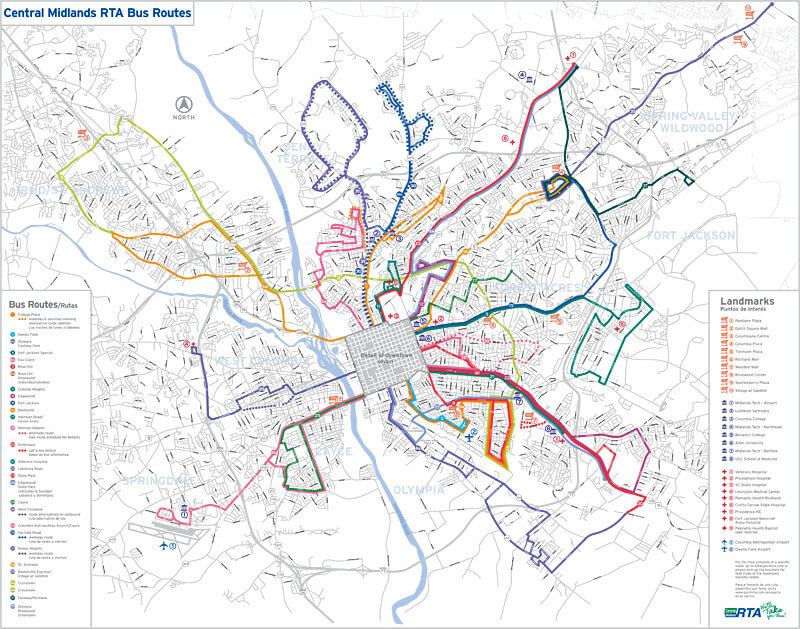 |
| Central Midlands Regional Transit A Bus Routes, Columbia, South Carolina, and surrounding areas. West Columbia, South Carolina, the area to the west of the Columbia River, is underserved by the metropolitan region's public transit system. |
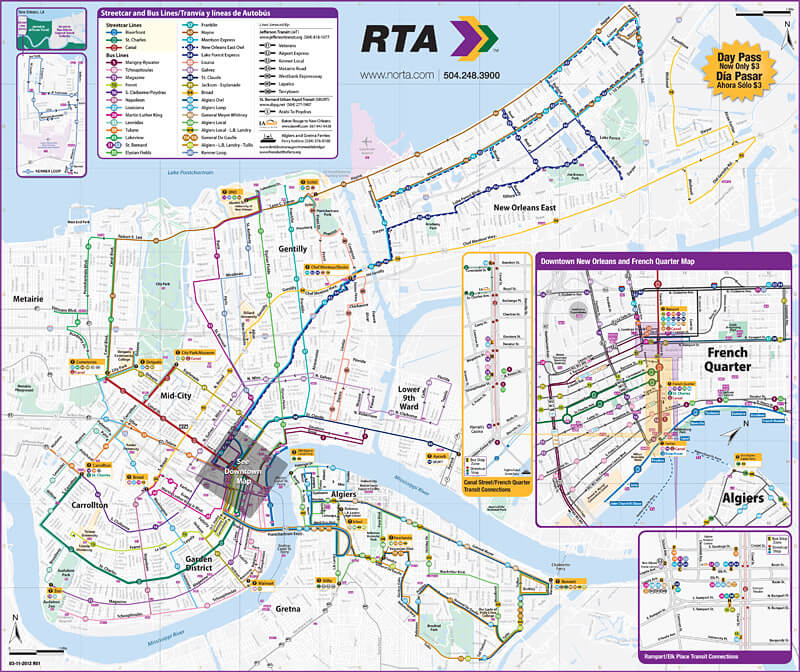 |
| New Orleans Regional Transit Authority system map, New Orleans, Louisiana, and surrounding areas. In contrast to the New Orleans public transit system, the Columbia, South Carolina system "was an absolute nightmare" for many Hurricane Katrina evacuees. |
Service providers in the Midlands heard that story many times. One described the biggest challenge facing the displaced as "public transportation . . . everything is so spread out. We're not a major city. We're a large town in a rural state. And we don't have—get on the bus for seventy-five cents and go everywhere you need to go." A housing authority worker said:
That was the biggest complaint that we had from the clients in that they were so used to the New Orleans transportation system that coming here was an absolute nightmare. They couldn't believe that there were so many areas that they had no transportation to get to. You'd go and find a place to live, but . . . you'd be stranded out there.
We had one client one night who was staying in a hotel out by the airport [West Metro Area]. He was a computer programmer. He got a job with Blue Cross/Blue Shield. . . . Of course, that's twenty-five miles or twenty miles or whatever, which required two different bus transfers. . . . So evidently, he got off on Two Notch Road at the wrong bus stop and had no idea where he was—had nobody he knew he could even call. . . . It was like in October or November, and it was cold, and a policeman finally stopped and said, "Where are you?" He had that nervous breakdown, all of a sudden it just came crashing on him.
The transportation problems for evacuees were so extreme that one who had a car and a job, began fighting local authorities to increase bus service to the West Metro:
I'm trying to help to fight for the bus line to get back here. . . . There is no buses back here at all for these poor people. And how do you take a bus off a line that goes to a hospital? So they got two buses come back here twice a day, early in the morning and then from four to seven at night. So that's what? That's two trips per bus.
A self-described "old rebel" who began his commitment to community activism in the civil rights movement of the 1960s, this evacuee earned the title of "Mayor" when he and others lived for months in hotels, because of the way that he advocated for and with them. He became particularly adamant about access for people with disabilities, some of whom miss work because there are too many wheelchair riders for the spaces on the bus and the routes run too infrequently.
The lack of public transportation drastically changed the lives of the chronically disabled who require regular medical visits. One evacuee needed dialysis three times a week in a place that could not be reached by bus from his home, requiring a fifty-dollar cab ride. Missing treatments because of the lack of transportation, he was forced to visit the emergency room several times. An elderly African American couple, both living with disabilities, described becoming very isolated and depressed. "Getting around," they said, was the hardest thing about Columbia. We “can't get around." They described typical days as sitting in the apartment. They could not afford to return to New Orleans and wondered what would happen when the rent subsidies ran out.
The lack of public transportation also made finding employment especially difficult for low-income displaced. Single mothers seeking work lacked affordable, accessible childcare. In New Orleans, those who lived in particular neighborhoods for years had many more options. One caseworker described a client's difficulties that she said were characteristic of several others:
This woman lives in an apartment complex, and behind her complex, she can literally walk her kids to daycare. She works at a hotel that is within walking distance. She has a neighbor who helps her watch her kids when she has to work late. But her income doesn't cover living expenses for herself and her four-year-old daughter. She already works full-time and overtime when she can. If the woman moves closer to less expensive child care, transportation to her job becomes an issue. No aid is available from any source to address clients' needs for transportation to employment.
Social Welfare and the Safety Net
Since all Deep South states share high poverty rates, low socioeconomic status, and poor health, evacuees who were welfare recipients in New Orleans expected to receive similar benefits when they applied in South Carolina. What they soon realized, however, was that South Carolina—in part because of its extremely conservative, neoliberal economic and social policies—is much more restrictive than New Orleans. A recent study of public assistance in South Carolina summarized the state's harsh position on welfare:
South Carolina's Family Independence Program [FIP, its TANF program] is one of the strictest, least generous, and most work-oriented welfare programs in the country. While most states have adopted the federal five-year time limit on assistance, South Carolina imposes time limits of 24 months of participation in a ten-year period and five years in a lifetime. . . . After the fourth month of employment, only the first $100 in monthly earnings is disregarded; beyond that, benefits are reduced by 32.4 cents for each additional dollar. The meager benefits levels, low disregard, and high reduction rate mean that families lose their eligibility for cash assistance after earning just a small amount of money.21David C. Ribar, Marilyn Edelhoch, and Qiduan Liu, South Carolina Food Stamp and Well-Being Study: Transitions in Food Stamp and TANF Participation and Employment among Families with Children (United States Department of Agriculture, April 2006), http://hdl.handle.net/10113/32788 (accessed February 16, 2011).
In 2005, the maximum monthly benefit for a family of three with no other income was $241 per month. FIP benefits in South Carolina are so low that a family of three with full benefits and no other income qualifies for the maximum food stamp allotment—$349.22Ibid. In 2003, a family of three receiving only FIP and food stamps was at 27.8 percent of the federal poverty level. No child support is provided for FIP recipients, and benefits are disallowed for children conceived while a parent receives FIP. South Carolina ranks fiftieth in per capita child welfare expenditures per month and forty-sixth in overall child welfare.23Child Welfare Leagues of America, "South Carolina's Children 2008," http:// www.cwla.org/advocacy/statefactsheets/2008/southcarolina.htm (accessed February 17, 2011).
As a result of the confluence of limited funding, strict qualification criteria, and a high poverty population, there were already long waiting lists to obtain subsidized housing and welfare benefits in South Carolina. "The Mayor," active in advocating for mass transit, recounted problems with people who resented the Katrina evacuees' preferential treatment in welfare services—even if the services were for only a short time:
A lot of people here was upset with us because they felt that we were getting treated, getting treatments that they should've gotten. . . . like far as for housing and stuff like this. Far as for food stamps, some of these people had been on the list for months and months and months and years and years.
Having to re-qualify without documentation and personal records and doing so in a state that provided less support meant that many evacuees on public assistance had much more difficult experiences than in New Orleans. "I'm having problems about my food stamps," said one disabled woman, as she compared her experiences:
And then sometimes I have it hard paying my utilities because I have so many bills to pay. This month paying all my bills doing everything, I had seventy dollars left to go a whole month on. I cannot go on just seventy dollars. I need help with that. I've called these organizations, a lot of them say we don't have the funds for this, we don't have the funds for that, but I'm trying to do the best I can, you know. So I'm trying to get somebody to help me with my utility bill.
. . . Back in New Orleans I was getting the same thing on SSI [Supplemental Security Income] that I'm getting now, but I was getting more food stamps, see, and I'm not getting it here . . . I feel if we're disabled, why don't you pay our utility bills for us because you know we can't do it out of that small little check and try to pay rent too. We can't do it.
Two case managers expressed shock at how much assistance some evacuees had received in New Orleans. Their comments illustrate the go-it-alone orientation that guides the state's programs:
South Carolina is not so forthcoming with saying, "Here's your welfare check. Here's your food stamps." I mean we had a lot of people who received assistance in New Orleans and were not able to get it here because they didn't meet the criteria under South Carolina's laws.
They received a ridiculous amount of money in food stamps, and then they come here and there's—the criteria is very different . . . and it was like, "Okay," and . . . I mean, I'm looking at them thinking, "What prevents you, really, from getting a job?"
West Columbia in Transition
Besides negotiating difficulties of housing, transportation/spatial location, and social services, evacuees to West Columbia entered a large town undergoing significant change in its racial and ethnic makeup—rapid growth of the Latino, mostly Mexican, population, and increases in the African American population and in young white and black families. In our interviews with West Columbia leaders and residents, these changes were characterized as unsettling by some, a challenge by others, and a welcome addition by still others.
Although Katrina's displaced to West Columbia were almost solely black and white United States citizens, many of West Columbia's leaders framed their perceptions of Katrina evacuees in the context of recent working-class and low-income migrants from Mexico, Central America, Russia, and Somalia. In many of their comments, they made connections between the ability and desire of West Columbia to incorporate new migrants and the perception of strains on an already stressed social infrastructure. In the words of a white woman adult education teacher:
I think people get along fairly well, but I think there's a clearer line between African Americans and whites. . . . Some of the older community are very much not liking the growth of the Hispanic population. . . . I think, again, the older population is resentful for maybe the shift in the population and perceived problems the shift has brought, and they [Hispanics] have brought shifts, and they've brought a need for infrastructure in the sense of federal housing, more use of the hospital system, more department of social services—and those entities promptly have been stretched or challenged with the movement of the population. . . . All in all, the shift will help; it'll help the community grow—and change isn't bad. . . . But it does tax your infrastructure if it's not prepared to handle it.
Others said that Hispanics were not accepted as they "should be" and that they were struggling. West Columbia natives put these struggles in a national context, arguing that the problems are not just local ones. Like many cities, West Columbia is experiencing a transnational migratory stream that is affecting the local society in many ways. As an extension agent, herself mixed-race, described it:
I'll tell you who exactly is working in the West Columbia Wal-Mart are Russian immigrants. . . . They do all the cleaning and the maintenance. They come in in crews. So there's a strong Russian population in West Columbia. I don't know where they're living. I wasn't aware of that at all. He [my husband who manages a Wal-Mart] said they did speak English . . . but they would spend the night at Wal-Mart cleaning, buffering the floors . . . because you don't have to be able to speak English to buffer floors. So that's definitely a competition for the Hispanic market and anybody that's looking for a minimum wage job.
Few people knew about Russian immigrants in West Columbia. Most were aware, however—because their relocation to South Carolina received so much media attention—that 125 Somali Bantu families were resettled in West Columbia and its neighboring communities in 2004, as part of a US State Department plan.24Jenny Burns, "No Pressure: Bible Belt Families Welcome Muslim Refugees,"The State, March 12, 2004; Joy Woodson, "Open Arms Missing to Greet Refugees: Sponsors Lacking as Charities Welcome Persecuted People to New Lives in Columbia," The State, August 24, 2006; Joy Woodson, "Yesterday's Refugee, Tomorrow's Architect," The State, April 20, 2007. West Columbia and Cayce were among the few locations in the country (including Holyoke, Massachusetts) actually opposed to their resettlement.25"Federal Agency Calls Off Bantu Resettlement in Cayce," The State, October 9, 2003; "US City Refuses to Admit Somali Bantu Refugees," The State, October 13, 2003.
This resistance remains vivid in the minds of leaders in West Columbia, most of whom were not involved in the opposition but who felt the negative publicity was a problem. When discussing how West Columbia would receive Katrina’s displaced, over one-third of local leaders compared the displaced either to the Bantu or to the much larger Hispanic migration or to both.
When we asked about the challenges posed if Katrina's displaced chose to remain permanently in West Columbia, comments such as the following, which came from a white male director of a school program, were common:
We made it through the Bantu and life went on, so same here. . . . The challenge is that we already have a plate full of those with social services needs, and I'm sure some people say well, why do I want to bring more of that into my area? What for? We have enough problems.
While local leaders pondered the strain on social services, the evacuees in West Columbia had daily contact with Latino migrants, many of whom lived in the same apartment complexes. Yet this contact did not lead to mutual understanding and support—in large part because language and cultural barriers made communication impossible. Only one of the twenty-one Latinos we interviewed had any knowledge of or contact with Katrina's displaced—because he cleaned in a hotel where many evacuees resided.
Even in the same apartment complex, the isolation felt by Katrina's evacuees seemed heightened by the presence of Latinos, whom they could not understand. One African American couple, lamenting their isolation from familiar people and places, discussed how the presence of Hispanics heightened their feeling of being "cut off" in West Columbia. When asked about friends they had made, the husband said they hadn't made any: "Most people around here is Spanish. They say 'Hey' and move on." A similar response came from a white male evacuee: "Making friends? I don't know nobody around here. . . . They're all Mexican."
The Continuing Disaster
Since the political realignment of the 1980s, the South has led the nation in implementing the conservative economic and social policies that now largely structure the conditions of life across much of the United States. Southern states have vigorously embraced these policies: privatization/outsourcing of government functions, reduced taxes, especially on the wealthy, deregulation of business, and deep cuts in social spending. South Carolina has been more aggressive than even other southern states in reducing taxes, limiting infrastructural supports for public life, and severely restricting and dismantling social welfare programs. Consequently, the most vulnerable of Katrina's displaced found West Columbia and Columbia, South Carolina, to be a particularly harsh environment.
In expressing concern about strains on the infrastructure and social services, many West Columbia natives framed their response to the Katrina evacuees in the context of Somali refugees and Hispanic immigrants. In addition to experiencing difficulties in making a life for themselves in West Columbia, the evacuees also met resentment from some of the local poor, whose wait for housing and social services was extended because the evacuees received priority.
In part because they recognized that the federal government was failing in its response to Katrina, people in the South Carolina Midlands worked hard to provide a welcome for their "guests." Hundreds of people volunteered, and local leadership committed not just to receive the displaced people of Katrina, but to do so with respect—to contradict the disrespect and inhumane response of the federal and state governments. But because volunteer work cannot be sustained for extended periods, the basic needs of healthy and thriving communities—jobs, healthcare, housing, transportation—cannot adequately be met without reliable, substantive, and ongoing government engagement.
 |
| Illustrator's depiction of the Midlands Housing Alliance Transitions Center, 2011. |
The most destitute of Katrina's survivors displaced into the Midlands' social, economic, and political landscape made visible the harshness of the economic and social policies embraced by South Carolina's political leadership as well as the extent of existing social needs. When hotel rooms, meals, and clothes were made available to the displaced, people already homeless in Columbia showed up too. The heightened awareness of existing problems and the success of South Carolina Cares led a coalition of business leaders and homeless advocates to propose a $15 million center for the city's approximately sixteen hundred homeless that is modeled on the Katrina reception center. Although they faced substantial political opposition—particularly around the proposed location—the new, multiservice Transition Center opened in 2011.26Adam Beam, "Group Plans 15 Million Dollar Homeless Center," The State, June 26, 2008; Adam Beam, "Neighbors to Fight Homeless Shelter," The State, October 5, 2008.
The experiences of Katrina's displaced in South Carolina highlight the ways in which conservative social and economic policies have rendered our cities incapable of dealing with the ongoing needs of poor populations and have weakened our infrastructure and support networks. Because they are unequipped to deal with their own poor, Deep South cities are not equipped to deal with displaced disaster survivors for an extended time. Despite the phenomenal outflow of generosity, time, and expertise from individuals to international aid groups, Katrina remains a disaster—for both the poor still in New Orleans and the poor in the Katrina diaspora.
Acknowledgments
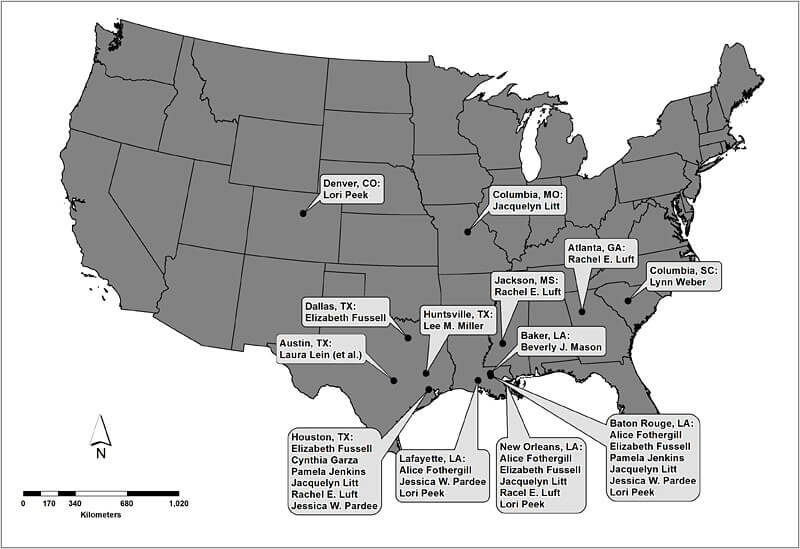 |
| Map of research locations of contributors to Displaced: Life in the Katrina Diaspora. Lynn Weber conducted research in Columbia, South Carolina. |
This article is adapted from "When Demand Exceeds Supply: Disaster Response and the Southern Political Economy," Displaced: Life in the Katrina Diaspora, ed. Lynn Weber and Lori Peek (Austin: University of Texas Press, 2012), 79–103. Thank you to the University of Texas Press for permission to publish this piece.
In addition to recognizing the important and multifaceted assistance of the SSRC Research Network in providing feedback at all phases of this project, I wish to thank the graduate assistants who worked tirelessly on these research projects. For conducting interviews, Steve Hardin, David Asiamah, Manju Tanwar; for coding, data analysis, and other research, Jenny Castellow, Beth Fadeley, Uma Kandasarny, Christina Griffin, Joanne Rinaldi Stevenson. Finally, I greatly appreciate feedback on the manuscript from the Women's and Gender Studies core faculty reading group and especially from DeAnne Messias, who gave me advice throughout the process.
This research was partially supported by the National Science Foundation under Grant CMMI-0623991. Any opinions, findings, and conclusions or recommendations expressed in this material are those of the authors and do not necessarily reflect the views of the National Science Foundation.
About the author
Lynn Weber is professor of psychology and women's and gender studies at the University of South Carolina in Columbia. She is co-editor with Lori Peek of Displaced: Life in the Katrina Diaspora (Austin: University of Texas Press, 2012), from which this essay is adapted.
About the Katrina Bookshelf Series
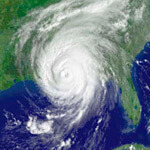 |
The University of Texas Press is proud to introduce the Katrina Bookshelf Series, Kai Erikson, Series Editor.
In 2005 Hurricane Katrina crashed into the Gulf Coast and precipitated the flooding of New Orleans. It was a towering catastrophe by any standard. Some 1,800 persons were killed outright. More than a million people were forced to relocate, many for the remainder of their lives. A city of 500,000 was nearly emptied of life.
If measured by the number of lives it claimed, Katrina does not qualify as the worst disaster in our history. But it was far and away the most destructive disaster in our national experience when one considers the amount of damage it did not only to the physical and social landscapes of the Gulf region but also to the nation more generally. And it was far and away the most telling disaster in our national experience. Katrina stripped away the outer surface of our social structure and showed us what lies underneath—a grim look at race, class, and gender in these United States.
It is crucial to get this story straight so that we may learn from it and be ready for that stark inevitability, the next time. When seen through a social science lens, Katrina is almost the perfect storm in terms of informing us what the real human costs of a disaster are and helping prepare us for the blows that we know are lurking just over the horizon.
A number of studies of Katrina have appeared since the event. Most were brief glances at some fragment of that immense disaster rather than rich, in-depth portraits of it, and many rode the crest of Katrina's celebrity for the time it was in the news. The Katrina Bookshelf Series, by contrast, is the result of a national effort to bring experts together in a collaborative program of research on the human costs of the disaster. The program itself was supported by the Ford, Gates, MacArthur, Rockefeller, and Russell Sage Foundations, and sponsored by the Social Science Research Council. This is the most comprehensive social science coverage of a disaster to be found anywhere in the literature. It is also a deeply human story being told here.
]]>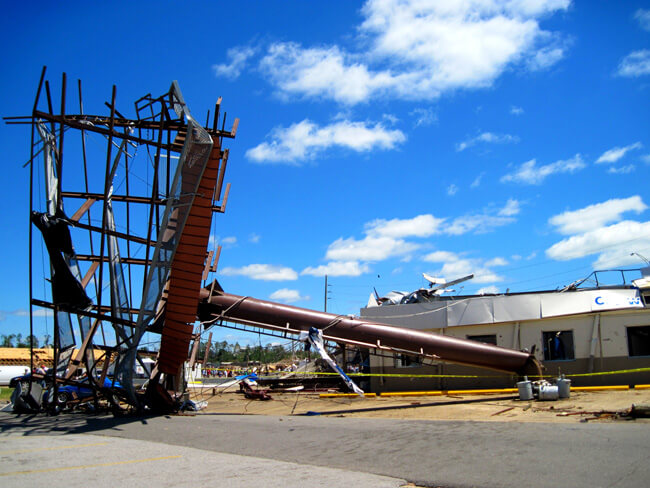 ]]>
]]>