Modeling the Marie-Séraphique
The Marie-Séraphique
Video Permissions
Creative Commons license CC-BY-ND
To inquire about use permissions for all or part of these videos, contact Southern Spaces at seditor@emory.edu.
Introduction
What role does cruising play in marking specific areas of the urban landscape as "queer territory"?1For the purposes of this essay, I use the word "queer" primarily in its capacity as a contemporary umbrella term intended to include the panoply of non-normative sexual and gender identities concatenated in familiar and unpronounceable acronyms like LGBT, LGBTQ+, and LGBTQQIAA. To be sure, other speakers and thinkers deploy "queer" with additional senses—an historical term of derision, a specific identity, a verb. The word can summon all these thoughts and more, regardless of authorial intention; indeed, it can carry whatever freight we readers bring to it. When I intend these specific meanings in this text, I will do my best to flag them. In general, I argue our politics and communities benefit most when we embrace the untidy polysemy of "queer" and explore the openings it provides. Since the 1970s, social scientists have proposed and critiqued various models of queer territorialization. Martin Levine used spot maps of bars and cruising grounds to substantiate a "gay ghetto"; Jen Jack Gieseking analyzed individuals' "mental maps" of queer space; Amin Ghaziani critiqued the enclave theory of "gayborhoods" in favor of what he terms "cultural archipelagos."2Martin Levine, "Gay Ghetto," in Gay Men: The Sociology of Male Homosexuality, ed. Martin Levine (New York: Harper and Row, 1979), 196–218; Jen Jack Gieseking, "Queering the Meaning of 'Neighbourhood': Reinterpreting the Lesbian-Queer Experience of Park Slope, Brooklyn, 1983–2008," in Queer Presences and Absences, eds. Yvette Taylor and Michelle Addison (London: Palgrave Macmillan, 2013), 178–200; Amin Ghaziani, There Goes the Gayborhood? Princeton, NJ: Princeton University Press, 2015; Amin Ghaziani, "Cultural Archipelagos: New Directions in the Study of Sexuality and Space," City & Community 18, no. 1 (2019): 4–22. All these models of queer territory posit collective understandings of place that transcend the social boundaries of queer identity groups.
All three authors also reference cruising, but offer little detail about how cruising works in their models. Using the city of Houston as an example, this essay attends to cruising as an underdeveloped aspect of those models. As Houston's Montrose neighborhood came to be identified as a "gayborhood" between 1960 and 1980, archival evidence shows that cruising narratives played a powerful role in that identification. At the same time, these narratives also show that queer territorialization in Houston was not a smooth process of collective place claiming and recognition. Rather, dissent and conflict over the practice of cruising in Houston shows queer place claiming to be fractured, contested, and structured in part through a politics of respectability inflected explicitly by class but curiously silent on race. Importantly, that fractured and contested structure is due in part to the converging efforts of a wide array of disparate agents: queer sex-seekers, Houston residents, local politicians, civic groups, queer organizations, national anti-pornography groups, and conservative political movements. These narratives also point to complicated relationships between cruising and other markers frequently used to define queer territory, specifically businesses serving a queer clientele.
Cruising: Practice and Concept
Cruising takes the art of the flâneur—passing time watching people, usually in public—and imbues it with the additional potential or explicit purpose of finding a sex partner. As Alex Espinoza has evocatively described, cruising can lead to sex in situ, whether in public locations like parks or semi-public locations like restrooms, but often leads to sex elsewhere in more private spaces.3Alex Espinoza, Cruising: An Intimate History of a Radical Pastime. Los Angeles, CA: Unnamed Press, 2019. It can also happen inside commercial establishments that charge a fee to access other clientele in a semi-private space, like bathhouses, video arcades, and adult book stores. Out of doors, cruising can happen both on foot and, after the popularization of the automobile, by car as well. Cruising is also associated strongly but not exclusively with gay men. In our information age, dating websites and hookup apps on mobile phones—Grindr, Scruff, Growlr, Boyahoy, Jack'd, and others—seem to remove much of the guesswork (but definitely not all the danger) from divining who might be nearby and looking for the same thing. Many men seeking men for sex today came of sexual age through these digital tools, leading writers like John Fielding to ask whether the prominence and distribution of cruising as a queer social practice has waned as a result.4"In the Age of Grindr, Cruising and Anonymous Sex Are Alive and Well," Vice, January 7, 2016, https://www.vice.com/en/article/qbv5n3/cruising-in-the-age-of-grindr-828.
While this essay centers upon the importance of cruising in a particular place and a past era—Houston between 1960 and 1980—the rich scenes it describes should not be misconstrued to suggest that cruising is a thing of the past. Rather, contemporary popular culture, high art, literature, pornography, and vernacular speech continue to reproduce face-to-face cruising in public as part of a globally available gay sexual vocabulary and social practice. Espinoza's Cruising movingly shows the practice is not of a bygone era or one in which only certain (morally questionable) people engage. His book has received critical acclaim in part for its temporal and global scope—ancient Greece, England, Russia and Uganda receive specific attention—but also for his sensitivity both to disability and Latinx experience, as well as his assertion that cruising can offer contact across class and racial lines. That assertion echoes Samuel R. Delany's analysis of cruising in New York as a form of "contact" in Times Square Red, Times Square Blue (1999).5John Birdsall, "Review: 'Cruising' maps the cultural history of L.A.'s hookup spots," Los Angeles Times, July 3, 2019, https://www.latimes.com/books/la-ca-jc-review-cruising-alex-espinoza-gay-history-20190703-story.htm. In short, cruising persists as a culturally relevant practice in the United States and elsewhere, one that often moves across social boundaries and identity categories.
Men seeking men for sex has never been the sole determinant of queer territory. For those who know how to read it however, both then and now, cruising marks public and semi-public spaces as at least temporarily queer(ed) territory. This marking is how cruising functions not only as a social practice but also as a concept. Through documenting the disparate networks of people who came to meet on Houston's cruising grounds—intentional sex-seekers, criminals exploiting stigmas attached to gay sex, ambivalent law enforcement officials, area denizens, and perhaps initially naïve passersby—I argue that the social distribution of knowledge about cruising illustrates that queer territories functioned in part because some who do not identify as "queer" also imagined those territories as connected to queer lives.
This distributed social knowledge is the kind of information that Levine described under "culture area," that Gieseking captured through "mental mapping," and that Ghaziani articulated through his concept of the "cultural archipelago." Although similar in emphasis, these theorists differ significantly in how they imagine the process of place claiming. Levine borrows four criteria from the sociologists Robert Park and Louis Wirth to assess the status of a "gay ghetto": institutional concentration, culture area, social isolation, and residential concentration. Levine mapped bars and cruising areas listed in Bob Damron's 1976 Address Book to illustrate institutional concentration, and conducted a literature review and "exploratory fieldwork" in those concentrated areas to assess the remaining three criteria.6Levine, "Gay Ghetto," 185. His "exploratory fieldwork" consisted of walking around neighborhoods observing gay life and talking with gay people, activities quite parallel to cruising itself. Particularly in his assessment of culture area, Levine describes a remarkably smooth process of place claiming. Within the culture area, "open displays of affection [between men] rarely evoke sanctions; for the most part, people either accept or ignore them. Even police patrols through these spaces pay little attention to such behavior. . . . In other places, such behavior quickly elicits harsh sanctions."7Levine, "Gay Ghetto," 204.
By contrast, Gieseking and Ghaziani attend more closely to a multiplicity of perspectives, change over time, and conflict in social descriptions of place. Gieseking defines mental mapping as "the representation of an individual or group's cognitive map" of a specific place.8Jack Jen Gieseking, "Where We Go From Here: The Mental Sketch Mapping Method and Its Analytic Components," Qualitative Inquiry 19, no. 9 (2013): 712. While most of Gieseking's work is credited as "Jen Jack," this article flips those names. In visualizing both multiple individuals' and group perceptions' of a place, Gieseking finds that mental sketch mapping can "afford participants and researchers alike a way to share and see more multidimensional stories of themselves and their experiences through the lens of space and place."9Gieseking, "Where We Go From Here," 723. For his part, Ghaziani observes that "new residential and leisure queer spaces are forming across the city, and beyond its borders as well." That multiplicity of spaces grounds his proposal "that we redirect the study of sexuality and space away from our preexisting assumptions of spatial singularity—evinced by a steady stream of publications about individual gay districts—toward a cultural archipelagos model of spatial plurality."
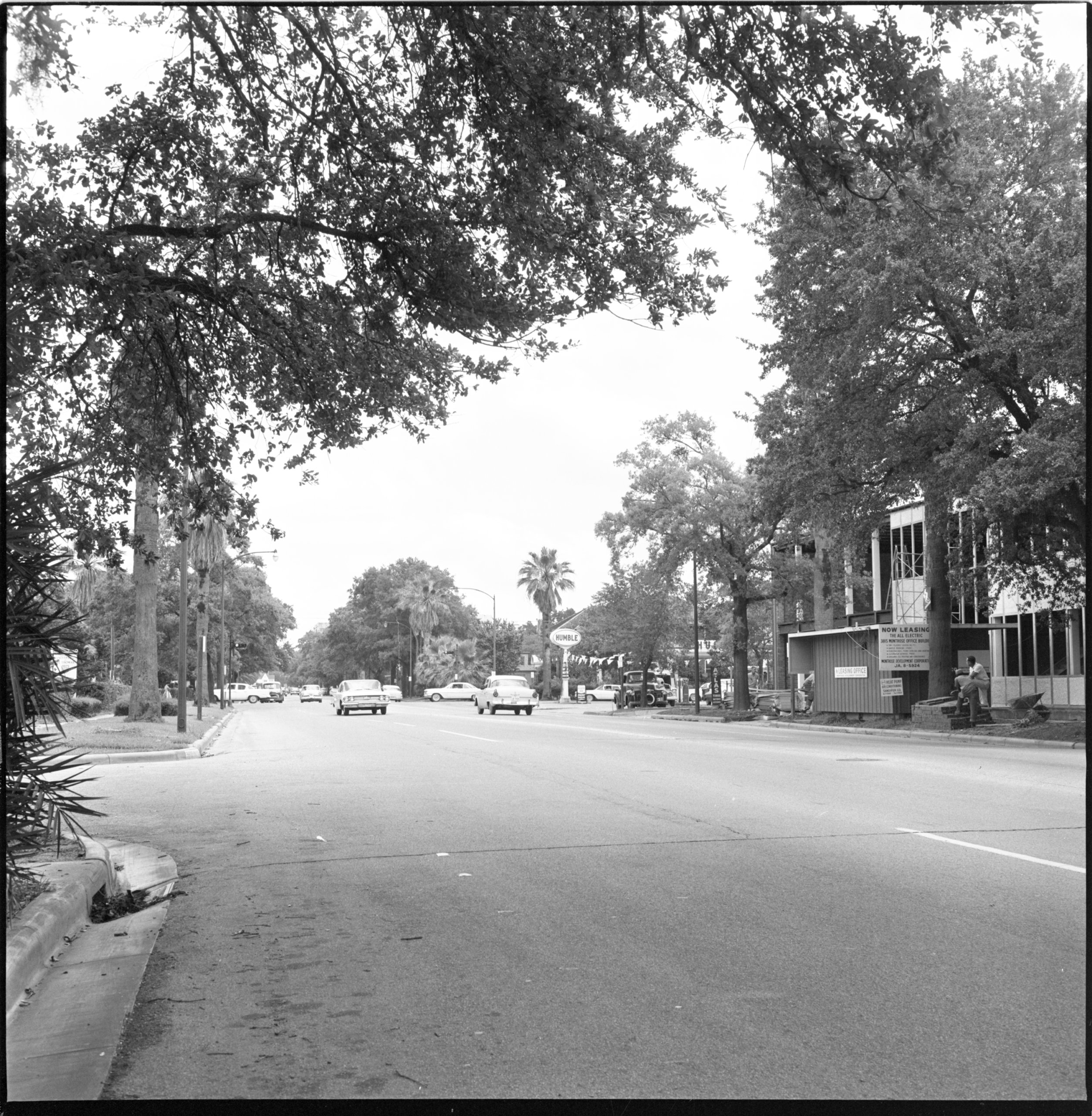
Although Levine's work gives an important foundation, the history of cruising in Houston more closely exemplifies the social dynamics Gieseking and Ghaziani describe. During the twenty-year span centered on the 1969 Stonewall riots in New York, cruising narratives in Houston exhibit a multiplicity of opinions about a multiplicity of spaces, even as public awareness of the Montrose neighborhood as "gay" solidified both locally and nationally. This essay analyzes mainstream and queer sources of the time to construct and juxtapose two datasets: a GIS-enabled mapping of historical queer business data and an archive of narratives of cruising. While the business data offer one visualization of queer territory in Houston, narratives of cruising exceed the capacities of that mapping. Cruising areas have complex relationships to commercialized spaces—sometimes directly connected, at other times peripheral and symbiotic, and at others seemingly divorced. At the same time, these seven cruising narratives I feature here illustrate that efforts to regulate cruising converge from multiple, conflicting sources, including queer newspapers and community10Like "queer," "community" is also a freighted word. While I use it in this essay as a shorthand, I encourage readers to be cautious about the degree of coherence, agreement, organization, and unity they take it to convey. organizations with a range of stances toward queer life.
Mapping Queer Houston
I first came to live in Houston in 1997. When I arrived, the Montrose neighborhood was the epicenter of a thriving queer community. It was home to the largest concentration of Houston LGBT bars as well as many non-profit organizations, from the Montrose Counseling Center to Pride Houston. There were two queer bookstores, a free monthly magazine, and several free weekly papers. Soon, I was working for one of those papers, distributing copies all over the city. That labor helped me question and reimagine my first assumptions about the distribution of queer life in Houston. In this car-addicted place, queer bars and businesses were not just in the trendy Montrose neighborhood, but in far-flung suburban strip malls as well. Even so, Montrose remained the symbolic core.
That was not always the case. In 1911, J. W. Link and his business associates platted and marketed the Montrose Addition as an upscale suburb for middle- and upper-class Houstonians to escape the dirt and heat of the urban core. The Link Mansion built at the corner of Montrose and Alabama streets to advertise the new neighborhood was for some time the most expensive private home in Houston. To understand better how Montrose shifted from that elite suburb to a "gayborhood," I began a project in 2014 inspired by Levine's spot maps. I built a database of over 400 historical queer businesses11The definition of "queer business" here deserves some nuance. The database captures businesses explicitly marketed to a queer clientele. Historical queer advertising usually depicts that clientele as gay men and lesbians, often but not always as separate populations rather than a single market. Businesses were included in the database if they advertised in a Houston-based publication aimed at a queer readership or appeared in a national directory such as Damron's Address Book. This is not to say that queer community owned each business or that queer community was the only clientele. This nuance also matters when thinking about the relationship of cruising to commercial space, whether or not that commercial space can be thought of as queer. identified in Houston's historic queer publications like The Albatross, The Nuntius, and This Week in Texas, and supplemented those publications with other historical sources. I cross-referenced these locations through Houston's city directories to confirm the length of time each business was in operation at every street address given for it. Some bars relocated, for example, often after a fire. Using ArcGIS, I visualized that database from 1941 to 2015 on a contemporary base map of Houston to help orient present day viewers. Finally, I sequenced the 74 maps into a short animation.[2] 12Brian Riedel, "CSWGS Where is LGBTQ Houston?" YouTube video, 3:15, March 15, 2018, accessed December 31, 2019. https://www.youtube.com/watch?v=baSgYQtkTSI&feature=youtu.be&ab_channel=RiceUniversity. This animation was also displayed at Houston's Heritage Society in 2015 as part of the six month installation "Throughout: Houston's GLBT History."
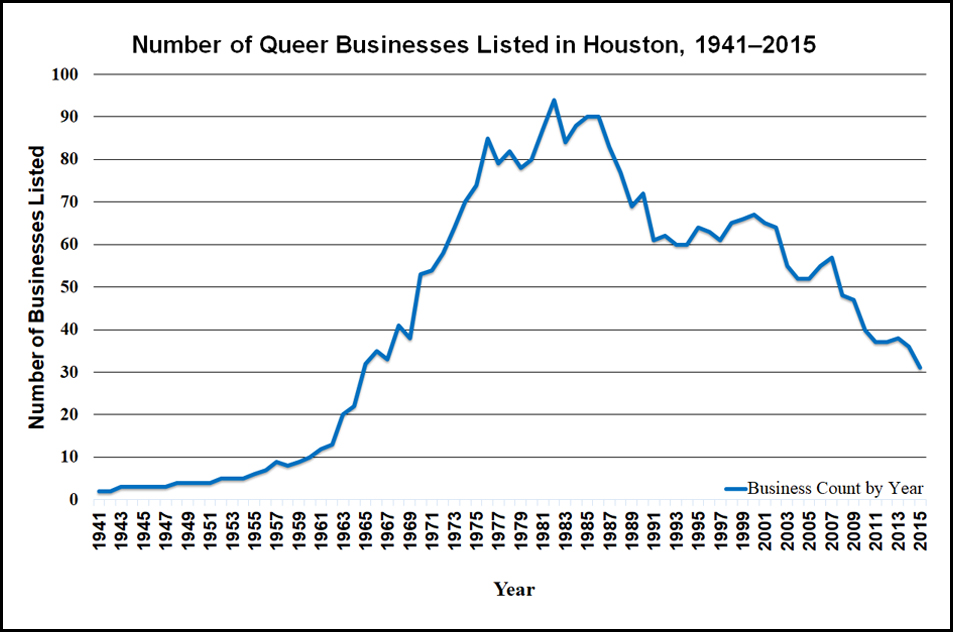
That animation suggests several phases to describe Houston's queer geography and history, phases that can also be visualized through a graph of businesses over time (see graph below). From 1941 to 1955, most businesses catering to queer community (though often not exclusively) operated in downtown, present-day Midtown, or the Rice Village area. The first location in Montrose was Art Wren's, a diner that ran from 1956 to 1971. Art Wren's also gained a national profile; it is one of nine "interesting" Houston locations listed in a 1962 souvenir program of the League for Civil Education's drag fundraiser in San Francisco, "Michelle International."13"Michelle International," League for Civil Education, accessed December 31, 2019, https://www.queermusicheritage.com/fem-michelle.html. Of the nine locations listed for Houston, I have been able to confirm locations for six. Beyond those six, I can confirm an additional seven locations not included in the souvenir program. That Art Wren's is among those six speaks further to the strength of its reputation. Here, "interesting" served as code for "gay"; the words "gay" and "homosexual" never appear in the League's program, even though the drag event raised money to help those arrested in raids on gay bars. By 1969, Houston's queer center of gravity was clearly shifting toward Montrose, but Midtown and downtown were still quite active. By the 1980s, the intersection of Westheimer Street and Montrose Boulevard was the center of queer life in Houston, and new bars and businesses began opening further west and into suburban areas. Even as the geographic distribution of queer spaces widened, the total number of locations peaked at 94 in 1982. During the 1980s, Houston endured the double impact of HIV/AIDS and the long economic fallout of the 1981 oil bust. The number of queer businesses began to stabilize at around 60 in 1991, but would begin dropping again at the turn of the twenty-first century. Montrose remained the dominant center as that number continued to taper. In 2015, just 31 businesses were operating, fewer than Houston had at the time of the Stonewall Riots.
Helpful as it is for visualizing change in queer Houston over time, this mapping project has significant limitations for the kinds of queer community it can be assumed to depict. Just at the level of "queer businesses," a mafia-owned bar with a partially queer clientele in the 1950s is not exactly the same kind of queer business as a lesbian-owned bar in the 1980s that hires a security firm to watch the parking lot.14See "Kindred Spirits," Houston LGBT History, accessed October 1, 2020, http://www.houstonlgbthistory.org/misc-kindred.html. While such a 1950s bar could be any of those Carl Wittman laments in his "Gay Manifesto," the 1980's bar I mention here is quite specific. Marion E. Coleman started Kindred Spirits in Houston as an answer to many lesbians' problems with the bar options then available. She also hired a security firm to guard the parking lot and screen customers. Also, attending only to bars and businesses can skew our perception of queer space along class-inflected lines; professional middle-class and upper-class lesbians and gays eschewed the bar scene as dangerous for some time, even as recently as the 1990s.15See the letter writer to ONE below. In Houston, that pattern structured the Dianas, an almost exclusively white, upper-middle-class social organization of mostly gay men that originated in 1953 as an Academy Awards watch party in a private home.16"History of the Diana Foundation," Diana Foundation, accessed December 31, 2019, https://thedianafoundation.org/page/history-of-the-diana-foundation. That same pattern of discretion also influenced the creation of the Executive and Professional Association of Houston, founded in 1978.17"The Executive and Professional Association of Houston," EPAH, accessed December 31, 2019, https://www.epah.org/. In the more than 300 oral histories gathered through the Old Lesbian Oral Herstory Project, many lesbians—particularly those in middle-class professions like nursing and teaching—preferred softball and house parties to bars as ways to meet other women.18"The Old Lesbian Oral Herstory Project," OLOHP, accessed December 31, 2019, https://olohp.org/index.html. OLOHP owes a great deal to Arden Eversmeyer who trained women to collect oral histories across the United States. I am also indebted to an anonymous reviewer for bringing my attention to The New Orleans Dyke Bar History Project, accessed October 1, 2020, http://www.lastcallnola.org/. Those oral histories document a different perspective: some lesbians in 1970s and 1980s New Orleans preferred to meet each other in bars. See also John Howard's edited volume Carryin' On in the Lesbian and Gay South (New York: NYU Press, 1997). Mapping bar locations sourced in a mostly white-oriented gay press also elides Black, Indigenous, and other People of Color, along with their specific networks and practices.19For example, see see E. Patrick Johnson, Sweet Tea: Black Gay Men of the South, (Durham: University of North Carolina Press, 2011) and Black. Queer. Southern. Women. (Durham: University of North Carolina Press, 2018).
Beyond these limitations, the academic literature on queer territory also suggests the animation should account for the role of cruising as a place-claiming practice. Levine specifies cruising as a form of "institutional concentration" in his model of the gay ghetto, and even symbolizes cruising areas on his maps.20Levine, "Gay Ghetto," 1979. Levine also discusses cruising in chapter 4 of Gay Macho (New York: NYU Press, 1998). However, they appear as static present entities; he does not inquire into their pasts or their futures. Gieseking also positions cruising as one element in the creation of queer territory21Jen Jack Gieseking, "A Queer Geographer's Life as an Introduction to Queer Theory, Space, and Time," in Queer Geographies: Beirut, Tijuana, Copenhagen, ed. Lasse Lau et al. (Roskilde: Museum of Contemporary Art, 2013), 4–21. but takes care elsewhere to mark the limitations of both cruising and any emphasis on territory for the analysis of women's communities.22Gieseking, "Queering the Meaning of 'Neighbourhood,'" 2013. Ghaziani's There Goes the Gayborhood? briefly mentions cruising, framing it as an activity that could occur in any number of venues in the urban landscape.23Ghaziani, Gayborhood, 13. Ghaziani redeploys that same formulation of cruising in a more recent essay while arguing for "a cultural archipelagos model of spatial plurality" as an antidote to "enclave thinking." He argues that "the spatial expressions of sexuality are becoming more diverse and plural."24Ghaziani, "Cultural Archipelagos," 7. Though my mapping project did not visualize cruising areas, the research behind it did surface many narratives of cruising. Analyzing these cruising narratives in parallel with the mapping project, I argue that together they offer strong evidence to support Ghaziani's archipelagic model of queer territorialization in Houston at various moments across the twentieth century. Rather than any single enclave as figured in the footprint of Montrose, for example, these seven cruising narratives point to multiple, contested queer territories spread across Houston in memory and practice.
1930s: "Window Shopping"
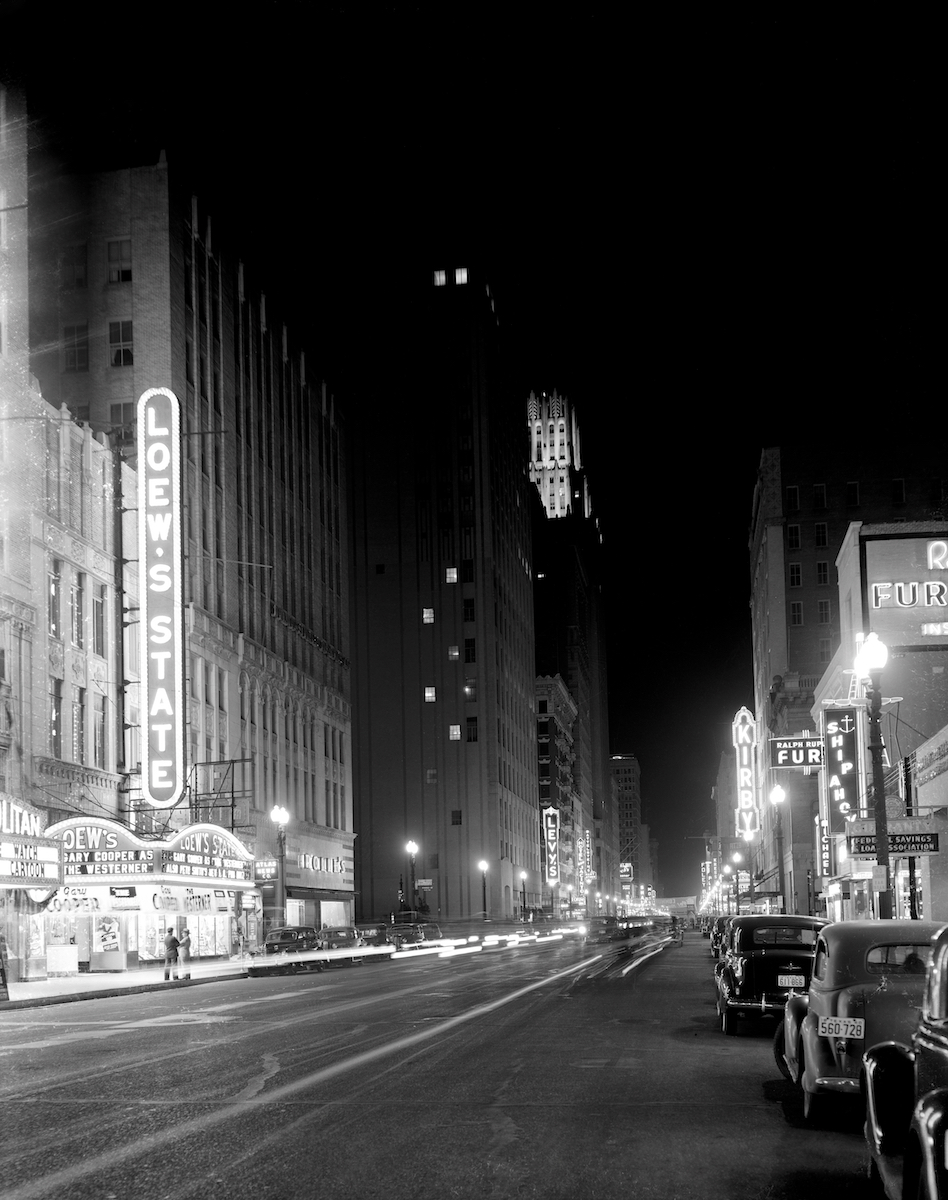
The Houston queer press archive offers glimpses of cruising practices and mental maps that pre-date the temporal frame of my mapping project (1941–2015). In a 1988 article from the Montrose Voice,25"Montrose Voice," University of Houston Digital Libraries, Houston Texas, accessed October 1, 2020, https://digital.lib.uh.edu/collection/montrose. The Montrose Voice was published in Houston from 1980 to 1991. For readers unfamiliar with Houston's queer press history, I strongly recommend browsing the JD Doyle Archives, accessed October 1, 2020, http://www.jddoylearchives.org/. Richard Van Allen relates stories from men who lived in Houston before World War II, and recounts a queer urban geography through their eyes:
"The 'gay circuit'—they didn't know the word 'gay'—was downtown Houston, between Franklin and McKinney and Main Street east to San Jacinto. You could not tell a queer or a fag (the words they used then) from the straight, which was the way the gays wanted it, being fearful for their lives and jobs."26Richard Van Allen, "Houston's Gay Thirties," Montrose Voice, no. 410, September 2, 1988: 9. https://digital.lib.uh.edu/collection/montrose/item/8166/show/8130. This article has echoed in Houston media since then. See also William Michael Smith, "Looking Back at Some of the Hurdles Houston's Gay Community Had to Overcome (Part 1)," June 20, 2014, http://www.houstonpress.com/news/looking-back-at-some-of-the-hurdles-houstons-gay-community-had-to-overcome-part-i-6736836; "Houston's Earliest Gay scenes (Part 2)," Houston Press, June 23, 2014, http://www.houstonpress.com/news/houstons-earliest-gay-scenes-part-2-6748546; "'The Homosexual Playground of the South' (Part 3)," June 24, 2014, http://www.houstonpress.com/news/the-homosexual-playground-of-the-south-part-3-6737870.
Aside from a few bars that, while not intentionally or exclusively gay, served as gathering spaces to those in the know—the Rathskeller, the Old Vienna, the Capitol Bar, Rex's27Sadly, Houston city directories from the 1930s and 1940s did not confirm the addresses and locations for the bars documented in this article, so they are not included on the map. It is tempting to assume they fall within the sixteen-block area described by Van Allen.—what then functioned as queer "territory" was out on the street in that sixteen-block rectangle. According to a man Van Allen calls Dan:
"Of course, we didn't know the word 'cruising' then. We called it 'window shopping' and just like now, you know who was gay and who wasn't without asking. You could feel it, whether they had a limp wrist or not. There was this post down in front of Levy's department store. It had mirrors on four sides, and queers would stop and comb their hair there. Oh, you could spot them. If we did want to trick, we could get a room at the Milby or the Texas State Hotel. More often we went home to our apartments."
Much as Ghaziani describes "the closet era" of "scattered gay places"28Ghaziani, Gayborhood, 12–13. Ghaziani credits the second phrase as Ann Forsyth. prior to World War II, Dan's recollection of imagined gay space is opportunistic rather than exclusive. The social ecosystem of commercial downtown spaces—semi-public bars, shop windows, mirrored posts, and semi-private hotel rooms—created opportunities for strangers to meet for sex while providing a degree of plausible, respectable deniability. Gay networks circulated in parallel with other networks, but at least in Van Allen's account, cruisers would often move across the city landscape to more private spaces after meeting in more public ones.
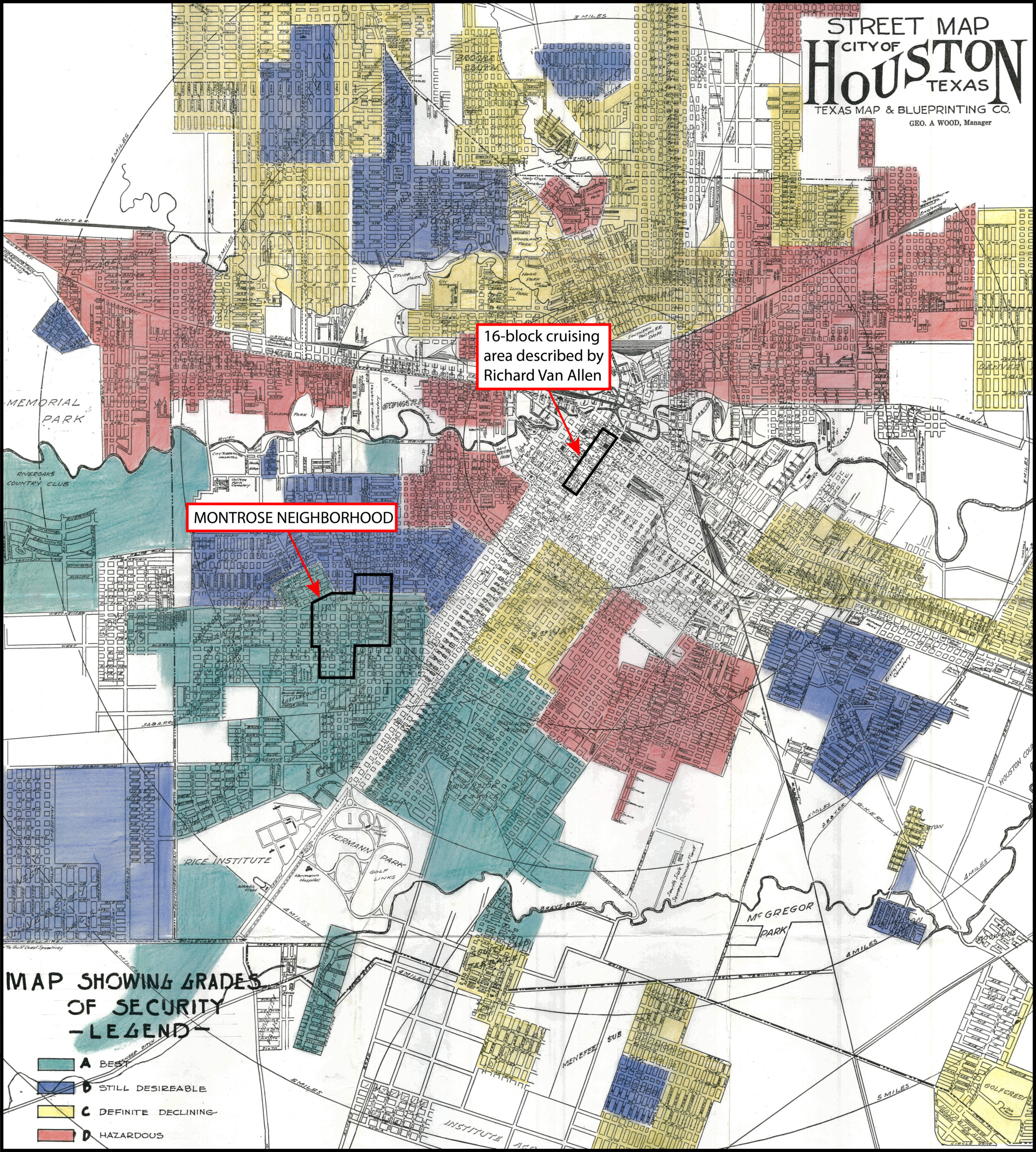
A striking way to situate this "window-shopping" area and the Montrose neighborhood in relation to the rest of 1930s Houston is to superimpose them on a now infamous Home Owners Loan Corporation map from the same era (see map above). The areas shaded red indicate the "hazardous" parts of town, where Black residents tended to live, and where the Home Owners Loan Corporation would not insure mortgage loans. The Montrose neighborhood, some two decades old at the time of this map and mostly shaded green, was the "best" type of neighborhood in which to live. Situated at the city's commercial core, the sixteen-block cruising area Van Allen's article described may well have provided opportunities for same-sex contact across both class and racial lines. And yet, Van Allen's narrators never mark race in their stories. The redlining map suggests at least one explanation for that absence, one that complicates any quick analogy to the kind of racial mixing found in Espinoza's memoir: the opportunistic use of public and semi-public spaces for cruising relied on an appearance of respectability that accounted for the persistence of racial as well as sexual lines in Jim Crow Houston.
1963: A Letter to ONE
From the 1940s through the early 1960s, however, the commercial spaces for queer community in Houston became less opportunistic and more intentional. Take for example a May 23, 1963 letter a Houstonian sent to the nationally distributed gay homophile magazine ONE,29ONE Magazine, ONE Archives at the USC Libraries, Los Angeles, 2018, https://one.usc.edu/archive-location/one-magazine. The magazine ONE was published in California from 1953 to 1967 and distributed nationally. It was the subject of the landmark 1958 US Supreme Court decision ruling that pro-homosexual writing was not of itself obscene. in which the writer offered his perspective on gay territory in the city:
Gay life in Houston seems relatively trouble-free as nearly as I can tell from my somewhat aloof perch (I don't patronize bars or attend parties or socialize much). A newly opened bar a few blocks distant is attracting great crowds on the week ends, with cars parked for blocks around, and always police watching especially toward closing time. The gay folks I meet seem delighted, and gloomily prophes[ize] that it is too good to last—I haven't heard of any trouble so far, though. Percentage-wise it seems to me this area has fully as many gay folk as any area in any of the larger cities in the North and West. Don't know of any other part of Houston where gay life is concentrated, though, except for a cheap theater downtown where the rough trade operates in amazing quantity and frankness—but could hardly call that gay life!30Craig M. Loftin ed., Letters to ONE: Gay and Lesbian Voices from the 1950s and 1960s (New York: SUNY Press, 2012), 114–5. To his credit, Loftin preserves the privacy of these letter writers by masking their precise addresses and substituting pseudonyms for their names.
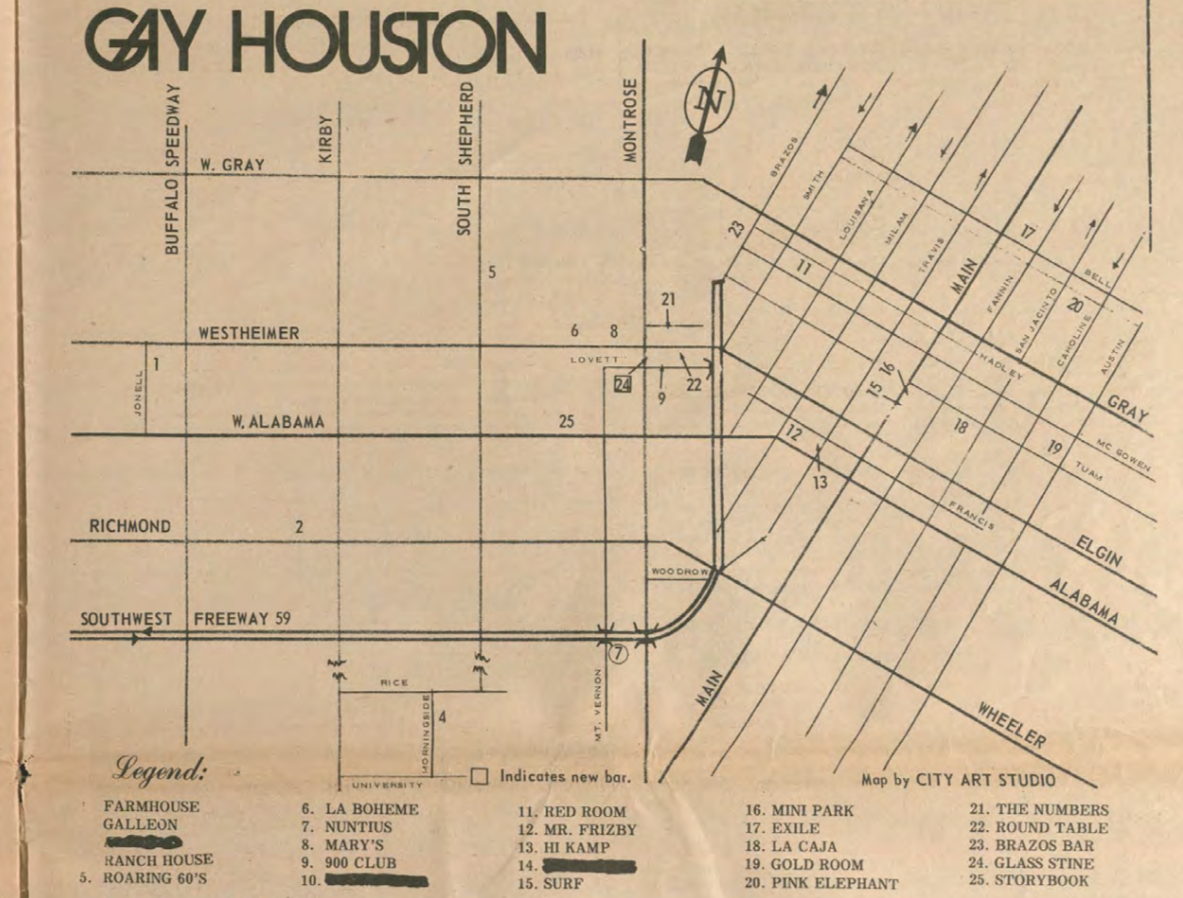
While the writer's self-described "aloof" lifestyle may constrain our estimation of his version of events, the details he provided remain evocative. He spoke to a consciousness that "gay life" could be concentrated, perhaps even that it should be so organized. He also seemed to see himself as living in that concentrated part of town; he did not "know of any other part of Houston where gay life is concentrated" (emphasis mine). Still, he recognized a larger bar scene, though he did not attend it. (The map below provides a visualization of the bars and other businesses of which the writer might have been aware in 1963.)
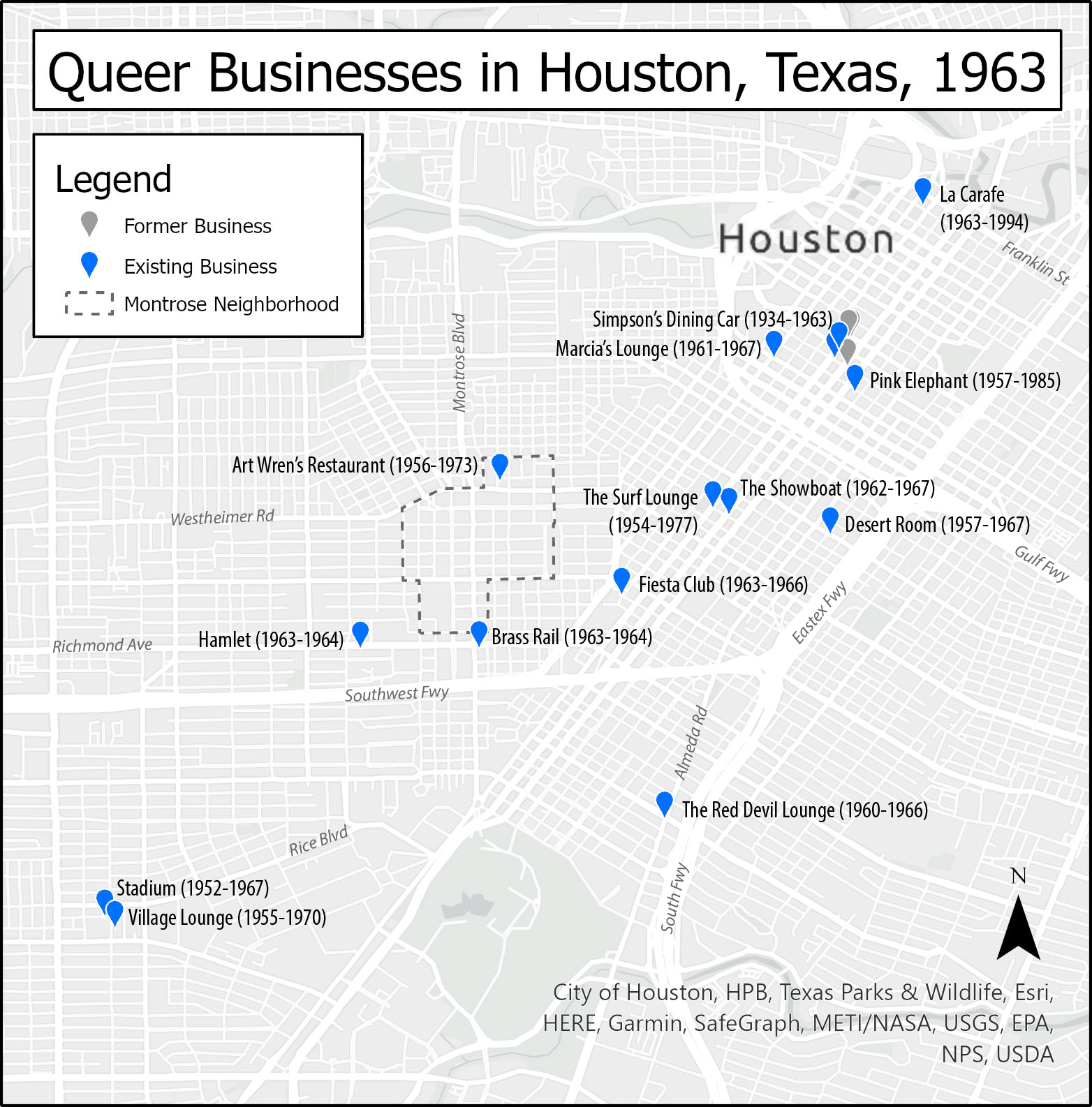
The letter also captured the writer's sense that, for its size, queer Houston was not so out of step with the larger cities of the "North and West." New York, Chicago, San Francisco, and perhaps Los Angeles were his likely referents. Given the date of his letter and his description of a recently opened and wildly popular bar, it is also likely that his referent was Bob Eddy's Showboat, opened in 1962 on Tuam Street in present-day Midtown (labeled on the map above). For the writer, cruising was a primary if ambivalent index for whether "gay life" was "concentrated" in a particular location. The "cheap" theater he referenced is challenging to specify today given the lack of detail. I have yet to find an advertisement or mention of such a downtown theater in the queer press archive of the time; perhaps its rough trade reputation circulated only through hearsay. Whatever theater it was, the letter clearly shows that as late as 1963, this author's imagination of queer space in Houston was explicitly linked to present day downtown and Midtown. Montrose did not figure in his letter at all, even though Art Wren's had operated there for about seven years and had in 1962 already appeared in a local publication in California.
Another key index for the writer's imagination of gay life comes in the phrase "rough trade," a term still in use today. Then and now, the "rough" of "rough trade" signals men whose affect and physical appearance are both more working-class and more masculine—men who are not just "straight" acting and appearing, but who also might actually be more dangerous to approach, though that risk might itself be part of the thrill of approaching them. "Trade" signals that these men may, in fact, see themselves as straight, and that they could be only "dabbling" in same-sex activity. It also signals that these men might be seeking male clients in exchange for money, regardless of their or their client's sexual preferences. The writer to ONE gestured to this sexual ambiguity of "rough trade" when he divorced the downtown scene from what he called "gay life." At the same time, we might wonder how the writer himself was aware of the theater scene. He may have participated in it, at least enough to know just how abundant and frank the rough trade was. In any event, he does not disclose how he came to have that knowledge, even in the pages of a homophile magazine.
Importantly, the writer is also silent on the subject of race, a silence that suggests Jim Crow culture continued to texture both "gay life" and "rough trade" in the 1960s just as it had "window shopping" in the 1930s. At the same time, respectability politics are both explicit and implicit in his "aloof" observations. He marks the scene around the newly opened bar with cars "parked for blocks" and patrons who presumably have disposable income to spend at a bar, all signs pointing toward respectable middle-class status. By contrast, the "rough trade" scene at the "cheap" theater points to lowbrow entertainment and potentially sex work; their "amazing quantity and frankness" also signals their divergence from middle-class respectability.
1965: The "Phantoms" of Avondale
By 1965, however, Houston's locally produced queer press offers suggestive evidence that cruising areas had begun to shift into the Montrose neighborhood. One such piece ran in the first issue (1965) of the short-lived gay periodical, The Albatross.31"Who Are the 'Phantoms' of Avondale?" The Albatross, August 18, 1965, 1. All seven issues of The Albatross were published between 1965 and 1968 in Houston by Bob Eddy, the first owner of the Showboat bar.
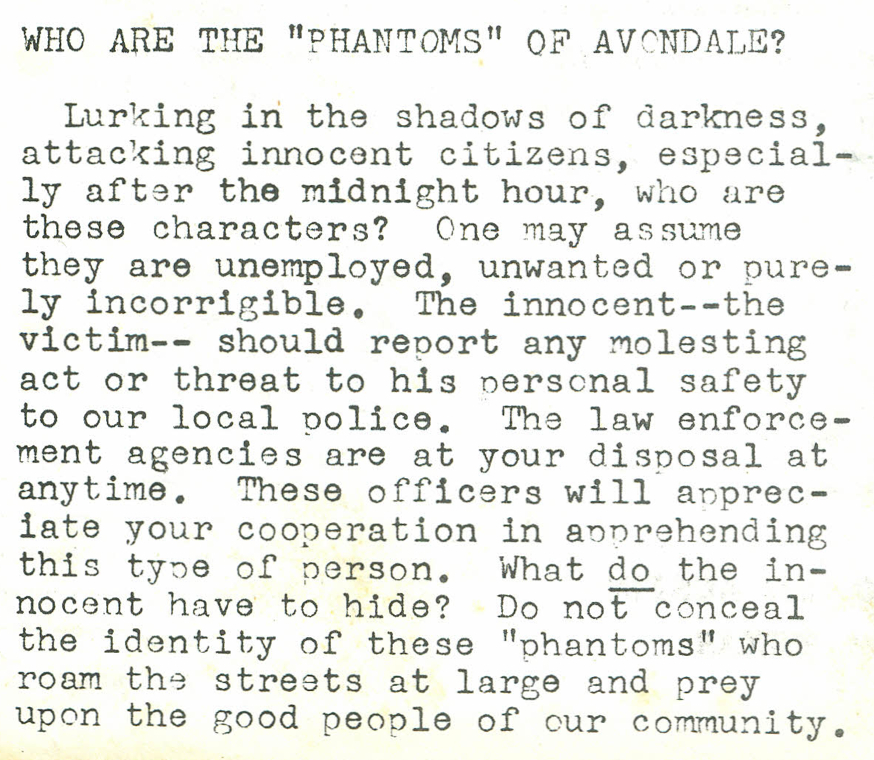
The text is an intriguing window to the mise en scène of Montrose at the time. It appeared on the first page of The Albatross, marking the editors' sense of its importance with that placement. The text calls its readers to act, to report to the police crimes that the text assumes go unreported because the victims feared approaching the police. This attitude was reflected earlier in the ONE letter writer's description of police watching carefully as the bars closed. The Albatross' text specifies the location of attacks to Avondale, a subdivision adjacent to the Montrose Addition, centered on Avondale Street along the north side of Lower Westheimer. This neighborhood identity endures today in the Avondale Civic Association.32"Avondale," Avondale Association, accessed December 31, 2019, http://www.avondaleassociation.org/. The text also specifies a time: past midnight. It thus suggests a picture of who a typical victim might be: a male ("his personal safety" was at stake) walking or perhaps driving in a neighborhood after midnight, who might in fact be able to identify his assailant ("do not conceal the identity of these 'phantoms'") but feared to do so. Race remains stubbornly absent in this narrative, even as the text specifically marks class and criminality in the figure of "good people" who should not fear reporting to the police if they are attacked by the "unemployed, unwanted or purely incorrigible." While the article did not name the practice explicitly, cruising offers explanations for both that fear and why men might be walking or driving in the neighborhood late at night. Even if cruising was not the text's primary concern, the location it describes remains telling. Avondale offered a corridor between the 24-hour restaurant Art Wren's on Westheimer and the bars of Midtown to the east.
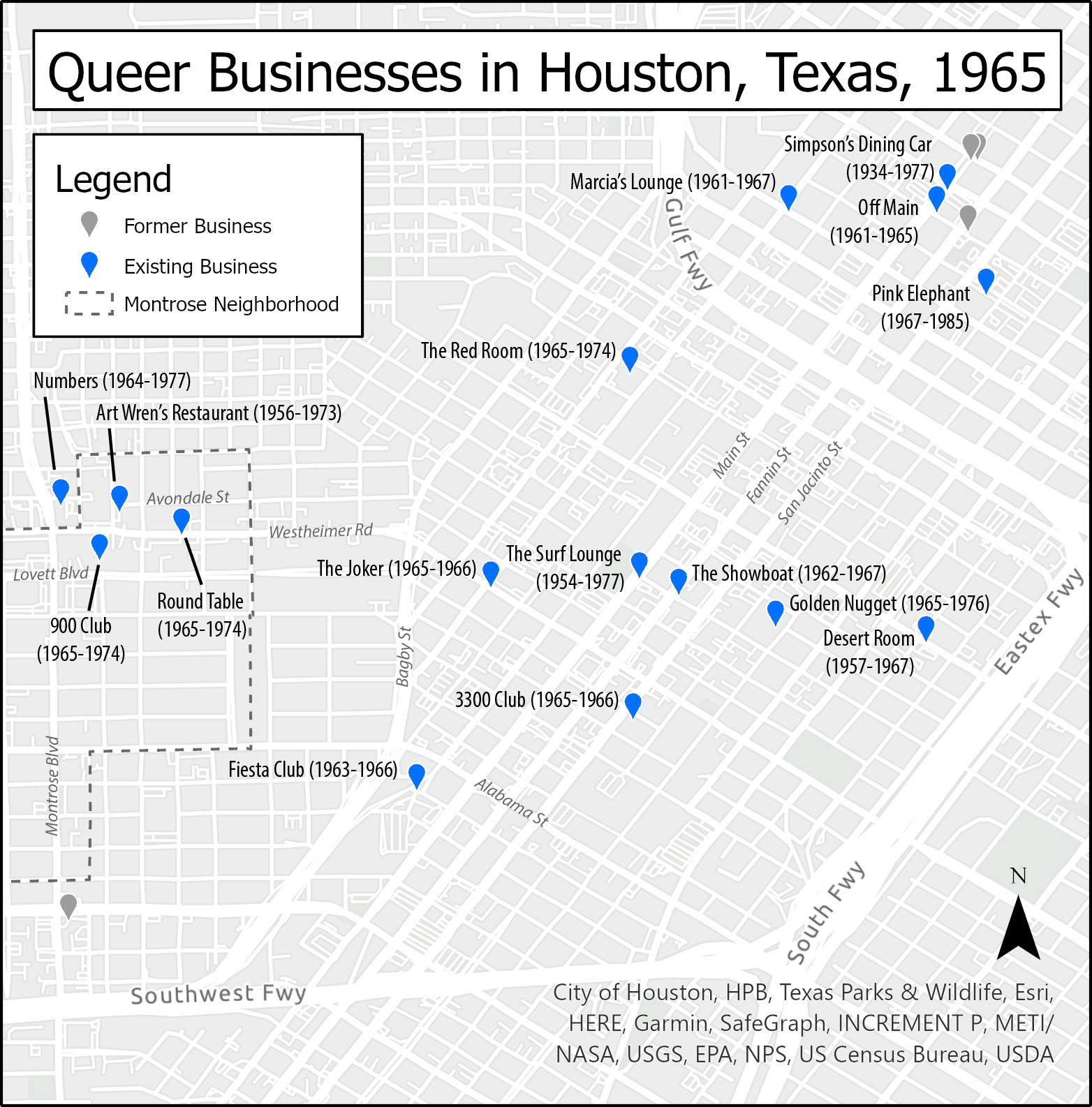
By 1965, three bars had also opened near the Avondale area: Numbers on California, the 900 Club on Lovett Boulevard, and the Round Table on Westheimer. Business owners and newspaper editors whose livelihoods depended on steady commerce likely also understood that the safety of their customers ("the good people of our community") was a prerequisite for their reliable patronage: all the more incentive for Bob Eddy—owner of Houston's Showboat and editor of The Albatross— to launch his paper with the "phantoms" as front-page news.
1970–1972: "Risky Crusing" and "The Heat"
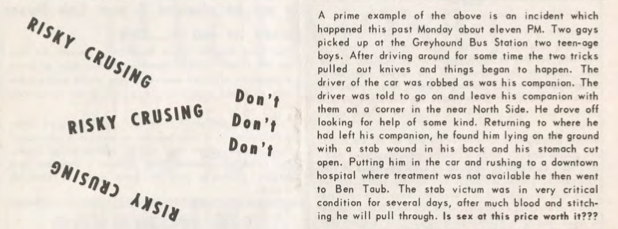
While The Albatross' article was circumspect or perhaps even purposefully vague, five years later The Nuntius33"The Nuntius & Our Community," Houston LGBT History, accessed October 1, 2020, http://www.houstonlgbthistory.org/nuntius.html. The Nuntius was published in Houston from 1970 to 1976. would explicitly center dangerous activities in the title of an article: "Risky Crusing, Don't" [sic].34"Risky Crusing, Don't," The Nuntius 1, no. 20 (August 1970): 12. http://www.houstonlgbthistory.org/Houston80s/Assorted%20Pubs/Nuntius/nuntius-1-2-8-70.pdf. Interestingly, the nonstandard spelling of cruising as "crusing" is consistent in this article; this essay honors that spelling as an historical artifact. The article references areas from Memorial Park to Midtown and the dangers such places offered would-be pleasure seekers. It cheekily opens with a reminder that cruising could "furnish you with a free ride downtown, cost you money, embarrassment and perhaps a great deal of time away from home." The "free ride" at stake here was likely to a police station, but perhaps also to a hospital. The article closes more seriously with the tale of one man who ended up at the Texas Medical Center's Ben Taub General Hospital35Ben Taub General Hospital opened in 1963 in the Texas Medical Center and is named after the Jewish businessman and philanthropist, Ben Taub (1889–1982) who never married. after being stabbed multiple times. It ends with the question: "Is sex at this price worth it?" Despite the core message to avoid danger, the article's geographical details simultaneously functioned as a guidebook. The description of Montrose even plotted a list of specific streets (see map below for an illustration of the "round-robin"):
The round-robin at Lovett Boulevard, Roseland, Hawthorne, Stratford, California, Avondale—well, you know the area better than I. This is not risky but just dangerous as h—. There have been many, many crusy [sic] queens beaten, stabbed, robbed and almost killed from picking up tricks in this area. This bad news area is a definite "No-No."
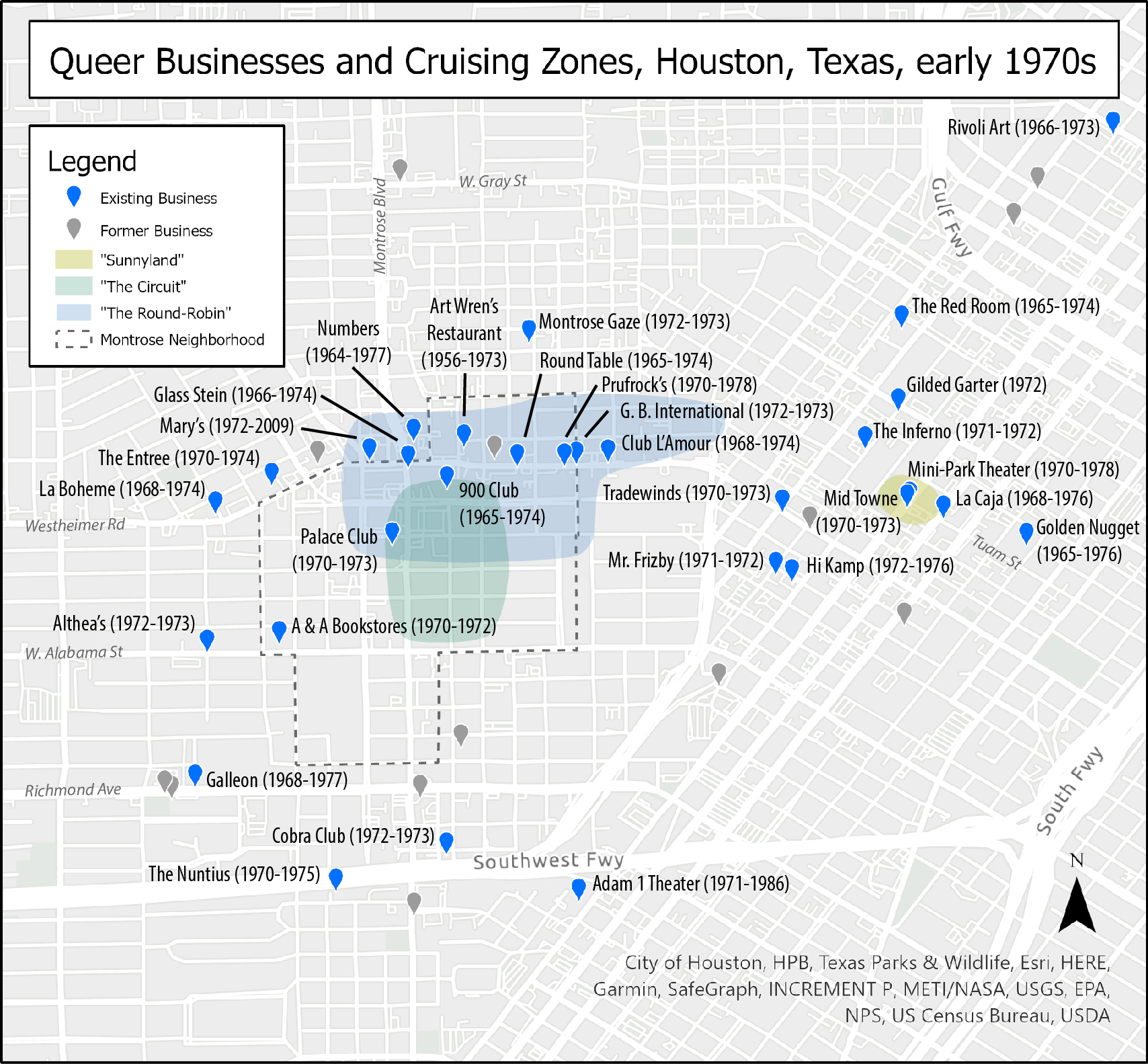
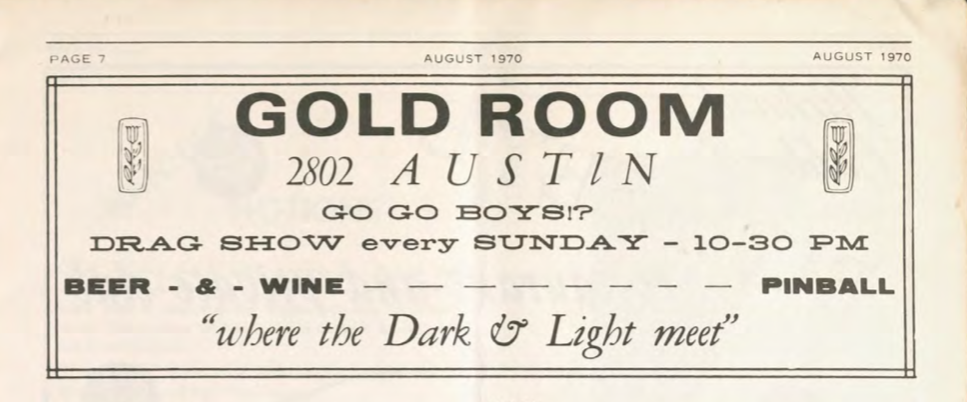
Midtown received an equal measure of detail, including specific landmarks like "Sunnyland Furniture" at Main and Tuam (also illustrated in the map above).36Suniland Furniture was located at 2817 Main Street. See a discussion thread on the Houston Architecture Information Forum, accessed December 31, 2019, http://www.houstonarchitecture.com/haif/topic/26168-suniland-furniture-building-2817-main-st/. But it is not as if these locations were entirely accidental. By 1970, the Montrose "round-robin" encircled a collection of eight queer establishments, with Art Wren's at the center. In Midtown, the intersection of Main and Tuam was also quite close to a number of other venues catering to queer community. The mapping project documented three queer businesses that operated in the 2900 block of Main—The Surf Lounge and two Nuntius advertisers, The Midtown Lounge and the Mini-Park Theater. A block away on Tuam was the successor to the Showboat, La Caja (also a Nuntius advertiser). A few blocks further was the Gold Room, a bar whose majority Black clientele likely inspired the tag line for its advertisement in the same issue of The Nuntius: "Where the Dark & Light Meet."37Gold Room advertisement, The Nuntius 1, no. 2 (August 1970): 7. Cruising was certainly one reason why some queer people went to these parts of town, but it was not the only reason. Moreover, the concentration of queer businesses and the visibility of queer people on the street did not guarantee safety for queer people in these areas, whether that danger came from police, thieves, or tricks gone wrong.38I am grateful to a peer reviewer who suggested comparing crime rates in known cruising areas against crime rates elsewhere in Houston; that work remains a compelling future area for research.
Not all welcomed cruising in public. In early 1972, The Nuntius ran a short article, "Heat on the Circuit," several pages in that describes how "the Houston Police have been making every effort to curb the crusing [sic] in the areas of Lovett, Roseland, and Marshall Streets" (labeled as "The Circuit" in the map above).39"Heat on the Circuit," The Nuntius 3, no. 1 (January 1972): 15, http://www.houstonlgbthistory.org/Houston80s/Assorted%20Pubs/Nuntius/nuntius-3-1-72-ocr.pdf. While the title and opening lines suggest the police (the "heat") should be the readers' main subject of concern, the article gestures toward the residents, "disturbed because of the heavy auto and pedestrian traffic during the late hours at night." The language to describe police efforts to "curb" cruising also suggests its readers might still have had an ambivalent relationship to the police. The article is also a form of soft control; it notified readers that officers were active in the cruising area and those cruising may wish to avoid encountering them. At the same time, the text describes the officers as "very cordial in the stopping and questioning of unauthorized persons frequenting this section." The police forces depicted here show at least a surface of courteous concern. Those with a legitimate (respectable) reason to frequent the area need not fear, but passers-through might still doubt who the final arbiters of that legitimacy would be. Presumably, the "unauthorized" could include both the cruising "hungry hannas" and criminals who prey on them, but we cannot assume that Montrose residents, their visitors, business owners, and bar customers themselves never cruised the streets where they lived, worked, and played. The Nuntius' depiction of the neighborhood shows several subtle but important shifts from the arrangement of queer community and police that marked the Albatross' item on the "'Phantoms' of Avondale." By 1972, queer pedestrians and drivers had become more visible, perhaps even emboldened in a post-Stonewall era, but were still at risk from both criminals and the police. Officers for their part had also become more vigilant. While queer people clearly remained subjects of potential police control, it appears that some were slightly more likely to see themselves as subjects of potential police protection, at least those queers who might be "authorized" to be walking or driving around Montrose as respectable residents, guests, or consumers.
These two articles from 1970 and 1972 also continue the trend of prior cruising narratives; neither mentions race in any explicit way. That absence of racial awareness reflects the dominance of white narratives in Houston's queer press at the time, but is also a curious elision given the rising visibility of Houston's Black queer life both locally and nationally. Beyond the Gold Room's advertisements in The Nuntius, the 1971 Damron Guide also coded the Gold Room as a very popular Black bar.40"Texas Bars, Baths, Etc.: From Bob Damron's Address Book 1971," Houston LGBT History, accessed October 1, 2020: 112, http://www.houstonlgbthistory.org/houston68-71.html. More curious still is that The Nuntius ran multiple stories in 1971 about the Houston Gay Liberation Front picketing the Red Room (see map above for location) because it did not admit Black patrons. Even as activists were calling attention to the segregation of queer spaces in Houston, these two narratives of cruising could omit explicit discussion of race in a multiracial city.
1971: "Come and Browse, or Vice Versa"
Evidence of cruising also appears beyond documents generated specifically by and for queer communities. For example, Mayor Louie Welch's records41Louie Welch Collection, MSS 51, Houston Metropolitan Research Center, Houston, Texas. To be clear about my archival process and research methodology, I did not know at first that Welch's papers held citizens' complaints and police records that would matter to documenting histories of cruising or of Montrose. I came across these records quite by accident while looking to substantiate historian James Sears' assertion that Welch and gay bar-owner George Hauger knew each other. I have yet to find any evidence to prove or disprove the assertion. See James Thomas Sears, Rebels, Rubyfruit, and Rhinestones: Queering Space in the Stonewall South, (New Brunswick, NJ: Rutgers University Press, 2001): 55. preserve a host of documents reflecting political and social currents that converged to regulate cruising. Of particular interest for this essay are citizens' complaints urging local authorities to shut down sexually-oriented businesses like video arcades that would "degenerate" their neighborhoods. That records of these complaints survive today, specifically in Mayor Welch's archive, attests to the power of the social and political forces converging on cruising at the time. Some citizens believed the authorities could and should address the issue, while for their part, the Mayor and other local authorities evidently deemed cruising important enough to track and combat.
Though locally produced, these citizen complaints also stand in complex relationships with national anti-pornography campaigns, religious organizations, and conservative political movements, as analysts like Whitney Strub have argued.42Whitney Strub, Perversion for Profit: The Politics of Pornography and the Rise of the New Right (New York: Columbia University Press, 2011). In the case of Houston, some complaints to the Mayor were clearly driven by national mailing campaigns from organizations like Charles Keating's long-running Citizens for Decent Literature (CDL). Sometimes, these campaigns arrived in the mailboxes of people already deeply engaged, for whom CDL mailings were both affirmations of and ammunition for their existing efforts. When these local complaints target businesses serving a queer clientele, national anti-pornography campaigns enter into a network of converging effects in which battles to define urban space result in the arrests of both consumers of queer pornography and patrons using those video arcades to cruise in semi-private and presumably safer, commercial spaces.
The Police Complaints and Criminal Intelligence Report folders in Welch's papers reveal a chain of communications among the public, the Mayor's Office, and Chief of Police Herman Short. Those communications in turn generated specific police activities directly affecting queer lives. These records show not only that Chief Short's police department was to varying degrees responsive to Houstonians' complaints of perverse activity in their city, but also that it proactively engaged in intelligence gathering to infiltrate and map the social networks they saw as driving both perversion and social instability. The Criminal Intelligence reports track investigations into presumed weapons dealing by Black militants and meetings of leftist groups like the Socialist Workers Party43The Socialist Workers Party is a communist organization in the United States that traces its roots to 1928. In Houston, Texas, the SWP acted in coalition with other organizations on the left, including the Gay Liberation Front. and the Mexican American Youth Organization.44The Mexican American Youth Organization formed in San Antonio, Texas in 1967, and was regarded as a militant form of Chicano activism, especially relative to mainstream organizations like League of United Latin American Citizens. In Houston, MAYO had strong ties to the University of Houston campus, much like the Gay Liberation Front Houston. They also track claims of reciprocal arson among rival gay bar owners, intimidation tactics among national pornography distributors vying for control of the Houston market, and individual members of Houston's nascent Gay Liberation Front.45The Gay Liberation Front formed in New York shortly after the Stonewall riots of 1969, and quickly spread to Canada and the United Kingdom. Though it would frequently collaborate with other left organizations, it was short lived; other lesbian and gay organizations had largely supplanted it by the mid-1970s. In Houston, a branch of GLF formed in the Montrose neighborhood in September 1970 and organized a student group at the University of Houston.
To offer one example in which citizens' complaints of cruising converged with local police priorities and national anti-pornography campaigns, consider the correspondence between the office of the Mayor and a Montrose resident named R. L. Martinson.46Reproducing Martinson's real name is a considered choice. Primarily, he made himself a subject of public record by sustained communication with public officials. Also, unlike the letter writers in Craig Loftin's compilation, his actions at the time would not be interpreted as criminal, regardless of how we today might ethically evaluate those actions. Martinson took several opportunities to urge the city to prevent what he saw as the decay of Montrose. In a letter dated October 29, 1971,47Correspondence from R. L. Martinson to Mayor Louie Welch, 29 October 1971, MSS 51, Box 30, Folder 2, Louie Welch Collection. Martinson reminded the Mayor of a letter from some months before in which he had asked for help "to rid this and other neighborhoods of the filthy atmosphere of the adult book store and lewd movies." While his complaint might at first be taken as a generic complaint about pornography, he then specifically mentions the return of an adult bookstore ("Story Book") at the former location of the "Adult Library and Mini-Theater" at 1323 West Alabama, an advertiser in The Nuntius (though at the slightly different address of 1312 West Alabama; see map above). The location for both operations was only one block from Martinson's residence, today just north of St. Thomas University and west of the Annunciation Orthodox Church.
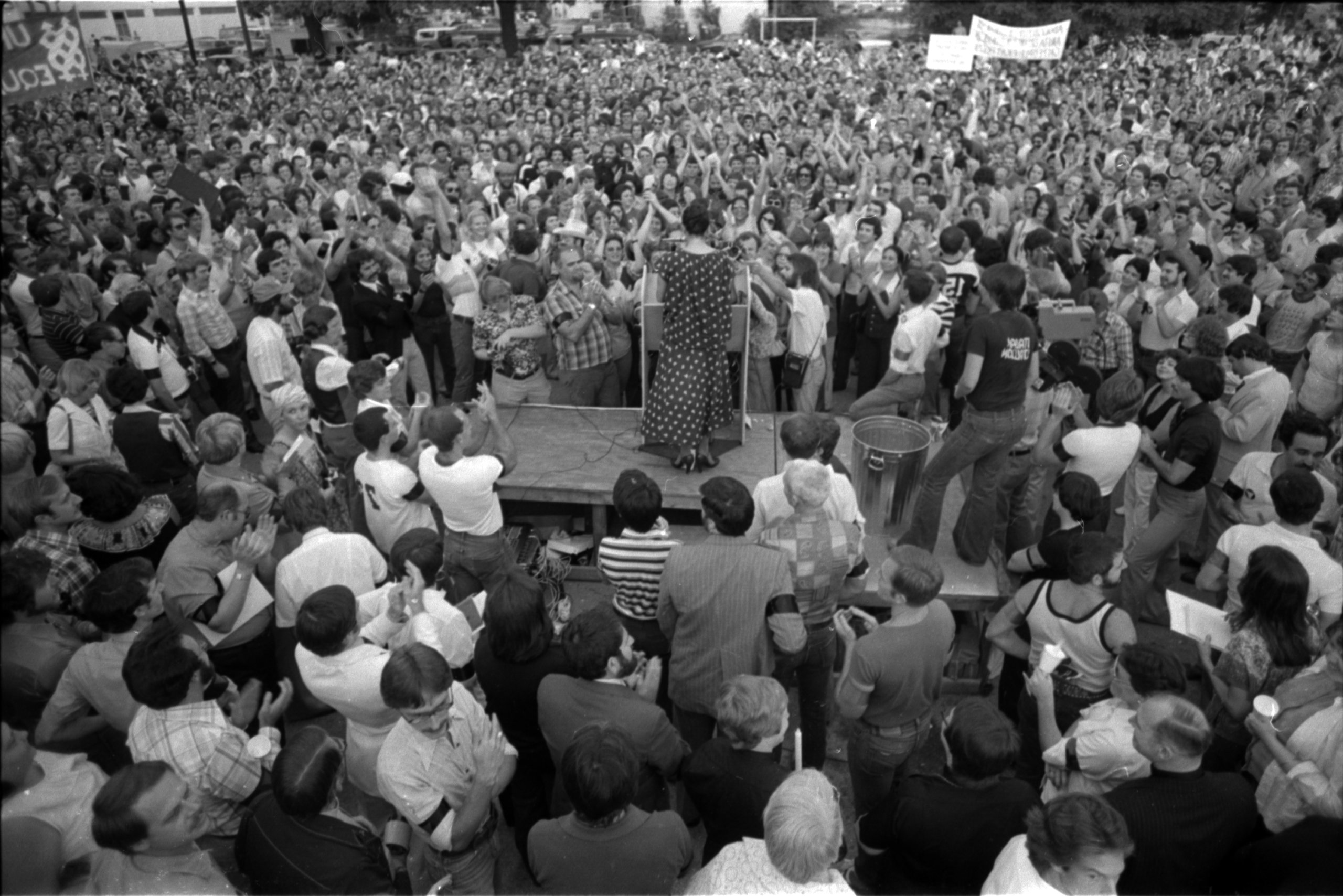
In an all too familiar rhetorical move foreshadowing Anita Bryant's 1977 "Save Our Children" campaign, Martinson focused on protecting "youngsters" from the "crowd of homosexuals and perverts who roam the neighborhood night and day." Whether or not Martinson's "roaming" is the same distinctively spelled "crusing" that The Nuntius warned its readers against, the situation apparently had been sustained for some time, as Martinson writes that he and his neighbors "have suffered enough in the past two years." Indeed, queer newspaper advertising indicates that the Adult Library first opened on Alabama in 1970.48The Houston City Directory intriguingly shows that, immediately prior, the location was occupied by "Miss Adorable Wigs." As a 24-hour venue advertising with the tag line "Come and Browse, or 'Vice-Versa,'" the Adult Library would indeed have attracted the kind of cruising traffic Martinson's "roaming" describes. The "Vice-Versa" also underscores how unlikely it was that customers came to the store just to browse. Presumably, most would browse the movies and the clientele on offer in the relative privacy of the store's video arcade. Perhaps they would select one or more sex partners—especially if the viewing booth they chose offered openings into other booths. In all likelihood, given the purpose of such arcades and the business's tagline, many would also come before they left, whether or not this occurred with a partner.
Martinson's letters also demonstrate his willingness to argue that the laws supported his position and would empower city authorities to act accordingly, though his own narrative is vague about precisely which laws might actually have done so. His October 1971 letter refers simply to "a new law which apparently went into effect September 1." Martinson clearly assumed this law somehow led to the closure of the Adult Library. More specifically, in another letter to the Mayor dated February 12, 1972,49Correspondence from R. L. Martinson to Mayor Louie Welch, 12 February 1972, MSS 51, Box 30, Folder 4, Louie Welch Collection. he writes that "sodomy charges" were at stake. At the time, Texas and most other states did indeed have sodomy laws on their books; in 1972, the Texas statute also included heterosexual non-reproductive acts but would be refined in 1973 to apply only to same-sex acts. However, there was no 1971 adjustment to the Texas penal code and the various sex crime laws described in its Chapter 21. As Texas House Speaker Gus Mutscher lamented of the 62nd session: "The much-discussed penal code reform was the second failure in 'must' legislation for the session. The state bar-recommended revision as presented in HB 419, proved to be controversial enough that sponsors said they would delay action another two years."50Gus Mutscher, "Accomplishments of the 62nd Legislature," 1972, 9. Accessed June 24, 2020. https://lrl.texas.gov/scanned/SessionOverviews/62_Accomplishments_1.pdf.
Beyond Martinson's legal theories and emotions about the reopening of the adult business, his October 1971 letter is remarkable for the social imagination driving his proposed solution: "Let's put these dens of pervertion [sic] in an isolated part of town, if we must have them, and not allow them in residential areas or shopping centers to tempt our youth."51Martinson to Mayor Welch, 29 October 1971. Despite witnessing two years of night and day homosexual presence, Martinson apparently could not imagine even in late 1971 that his neighborhood might already be that part of town. Perhaps his concern was that it would soon become so in the absence of his complaints.
The official acknowledgement of his October letter was swift, even if action was not. The Mayor's office marked it to forward to Chief Short, and sent a brief note to Martinson dated November 3, 1971.52Correspondence from the Office of Mayor Louie Welch to R. L. Martinson, 3 November 1971, MSS 51, Box 30, Folder 2, Louie Welch Collection. Despite that note's assurance that Chief Short would investigate and be in touch in the near future, it appears Martinson did not receive any of the promised updates. In his letter of February 12, 1972, his tone shifts toward impatience as he writes "once more" to "inquire what, if anything is being done about places such as the 'so called' Story Book at 1323 West Alabama."53Martinson to Mayor Welch, 12 February 1972. The invective of this letter targets "perverts" as it marks the frequent traffic of "characters" that circulate without "merchandise" at Story Book and the nearby Grass Hut, a venue other complaints mark as a "pot-parlor."54Correspondence from Coralie Anderson to Mayor Louie Welch, 28 April 1971, MSS 51, Box 29, Folder 12, Louie Welch Collection.
This February letter also surfaces a powerful converging effect: Martinson specifically refers to the January–February 1972 National Decency Reporter, a newsletter from Citizens for Decent Literature. Per Martinson, it reports "crackdowns And Convictions in Ohio, Nebraska, California, among others."55Martinson to Mayor Welch, 12 February 1972. Capitals and underscore in the original. Martinson's February letter received a similarly swift acknowledgement from the Mayor's office, dated February 17, once again noting that the complaint had been forwarded to Chief Short, but this time without any promises of further communication.56Correspondence from the Office of Mayor Louie Welch to R. L. Martinson, 17 February 1972, MSS 51, Box 30, Folder 4, Louie Welch Collection.
Although Martinson may not initially have received the degree of response he sought, action was eventually forthcoming. An internal police memo dated March 21, 197257Internal police memo from Sergeant T. R. Driskell to Lieutenant J. M. Albright, 21 March 1972, MSS 51, Box 30, Folder 4, Louie Welch Collection. went from Sergeant T. R. Driskell of the Vice Division up the chain of command via Lieutenant J. M. Albright to Chief Short, and from him to the Mayor, per a March 22 memo from Chief Short.58Internal memo from Police Chief Herman Short to Mayor Louie Welch, 22 March 1972, MSS 51, Box 30, Folder 4, Louie Welch Collection. The details of Driskell's memo illustrate how Houston police officers enacted the laws available to them as they understood them, while the chain of communication itself shows how closely the Mayor personally monitored police actions regarding the gay community. Driskell reported on the status of the state sales license, which cleared their check. Eight mini-movie machines were noted in the rear of the bookstore. Police surveillance further "revealed" that "homosexuals frequent this place,"59Driskell to Albright, 21 March 1972. although it is unclear precisely what techniques of surveillance and evidence substantiated that claim. It is clear, however, that on March 8, 1972, five patrons were arrested and charged with committing an "Indecent Act" under the then-operative Chapter 21 of the Texas Penal Code. "The manager was not arrested" as "he was not involved."60For those who have ever visited adult bookstores with video arcades, this exclusion might not surprise: a manager is usually up at the front, selling access to the movie and cruising area at the back. That said, I am also grateful for a reminder from an anonymous peer reviewer that "owners of bath houses, bars, or cinemas sometimes faced police crackdowns in other cities, even if they didn't engage in sex themselves." The impact of these converging effects on the Story Book was much broader than this one raid, however. Driskell notes that since July 29, 1971, "there has been a total of 27 arrests for various offenses" at this location. He also reports "we are in the process of trying to get an injunction through Civil Court and have this place closed."
Perhaps unsurprisingly, none of Martinson's letters or the police memos explicitly mention race.
1974: "Rough Trade"
While Houston-based and locally-distributed publications like The Albatross and The Nuntius range from elliptical descriptions of cruising to explicit cautionary tales, Ralph W. Davis's richly photographed December 1974 article about Houston in the nationally-distributed gay travel magazine Ciao! verges on the celebratory.61Ralph W. Davis. "Houston," Ciao!: the World of Gay Travel. December 1974, 10–13; available also via the JD Doyle Archives: http://www.houstonlgbthistory.org/houston74.html. Ciao! was published out of New York City from 1973 through 1980. For more about the impact of Ciao!, see Lucas Hilderbrand, "A Suitcase Full of Vaseline, or Travels in the 1970s Gay World," Journal of the History of Sexuality 22, no. 3, (2013): 373–402. Indeed, "Cruise Areas" constitutes the first major subsection of his four-page article. He rehearses several areas mentioned in prior publications, beginning with the following bolded statement: "The main cruise area is Roseland to Hawthorn to Lovett to Stanford. Lovett and Stanford, and Lovett and Montrose are good corners to linger on at night." After directing readers first to a part of Montrose only five blocks from R. L. Martinson's home, Davis then helpfully notes, "Lovett and Stanford is a little darker than the latter, and some may prefer this for obvious reasons." Those "obvious reasons" would likely include the cover that darkness can provide for either a quick outdoor sex scene or an increased degree of camouflage and anonymity for the long term lingering sometimes required to pick up a trick worth taking elsewhere.
For Davis, not all cruising areas come equally recommended. He specifically evaluates them in terms of their "roughness," with all the gender and class markers animating the 1963 letter to ONE. The cruise area section of Davis' article continues the pattern of past cruising narratives and gives no guidance about the racial mix of men frequenting any specific area. However, the individual bar listings within the article do occasionally reference race and nationality. The clientele of the country/western Golden Spur "includes some tough Latins and blacks"; the Gold Room gets a nod toward the end of the article as "an old established black bar"; the Athens Grill and Bar on the Houston Ship Channel is recommended as "the place to go for Greek sailors who, when a little drunk, swing either way," a variation on the theme of rough trade. None of these three bars are close to any of the cruise areas Davis names, however.
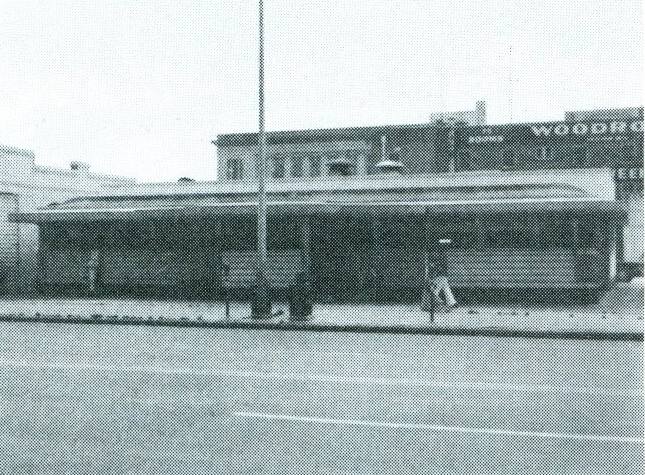
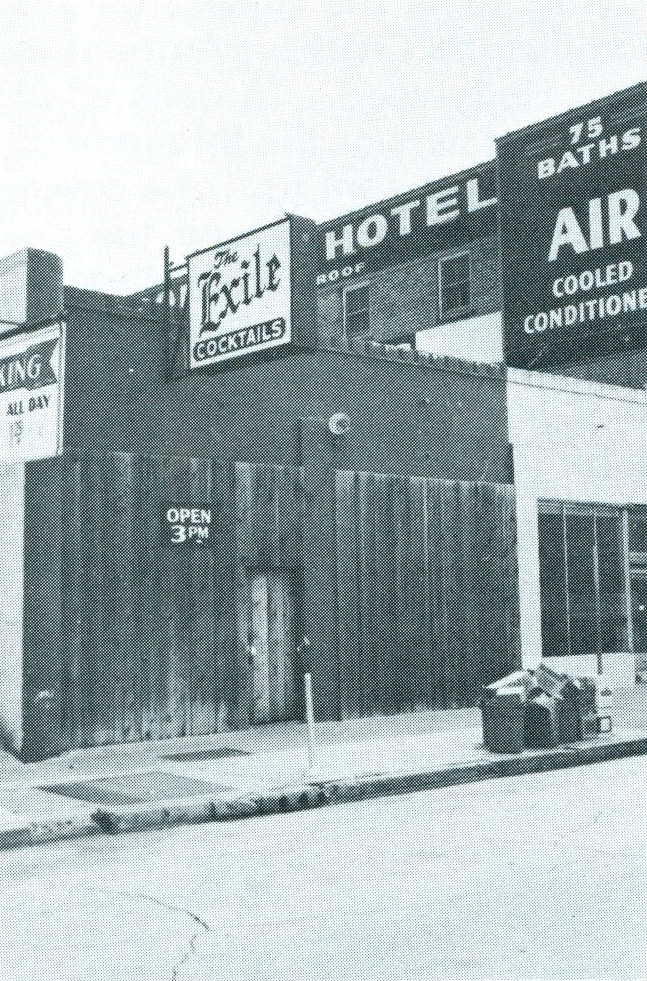
Of those cruise areas, Davis found the roughest one to be the Midtown corner of Bell and Main that hosts Simpson's Dining Car, the Exile Lounge, and, though he does not mention it in writing, the Woodrow Hotel. One hint toward the hotel's role comes when Davis notes "[o]nce Simpson's was a 24-hour restaurant; now it closes at 1 a.m. to avoid serving some of the hustlers and roughs who settle almost all night on the corner of Main and Bell." On the last page of the article, he also describes the Exile as "probably the most recommended of the rough bars."
To complete the implication, an examination of two accompanying photographs of Simpson's Dining Car and the Exile Lounge reveals the Woodrow Hotel looming in the background of both, boldly advertising "75 Rooms," "75 Baths" and "Air Conditioning" on the wall facing Main Street. Industrious Ciao! readers would also have seen that the Damron Guides for 1971 and 1972 also list the Woodrow Hotel.
For hustlers cruising for a living, that single block provided a ready-to-hand circuit of the necessities: food, drink, a steady stream of potential customers, and a private room and bath when it came to business. For out-of-town and local johns looking for the right place to go, Ciao! pointed the way. At Main and Bell, cruising and commerce commingled in a much more intense and intentional way than the Story Book on Alabama.
1976: No Turns
Although the 1972 Nuntius article gives the impression that residents played a minor role—at most complaining to the police who then in turn engage the "unauthorized"—residents do become more organized and vocal agents over time. In September 1975, Virginia Galloway reported in Update Texas that residents had formed the Montrose Citizens Association (MCA).62Virginia Galloway, "Montrose Circuit," Update Texas, Sept 26–Oct 3, 1975, 2. While the organization's name suggests an expansive membership, details on it are scarce; organizational records point only to the name of a lawyer in Montrose: Richard L. Petronella.63Initial research about the MCA surfaced a helpful clue for further work, although the source for that clue is suspicious. See "Montrose Citizens Association Inc." Bizapedia, accessed December 31, 2019, http://www.bizapedia.com/tx/MONTROSE-CITIZENS-ASSOCIATION-INC.html. That website provided the following data: "Montrose Citizens Association Inc. is a Texas Corporation filed on September 2, 1975. The company's filing status is listed as Franchise Tax Involuntarily Ended and its File Number is 0036646201. The Registered Agent on file for this company is Richard L Petronella and is located at 815 Hawthorne, Houston, TX . The company's principal address is 815 Hawthorne St Richard Petronella, Houston, TX 77006-3901." The Association's remarkable strategy eerily echoed R. L. Martinson's proposal to Mayor Welch: relocate the Circuit. Galloway reported that "area gay organizations" collaborated with the MCA to pass out flyers at street corners in the Montrose Circuit on Friday and Saturday nights, informing potential cruisers of the "moving of the historic cruising area" from Montrose to a "non-residential, semi-isolated area nearer downtown" that would supposedly be "more conducive to cruising conditions, since the roads are better and there is good lighting." The flyer included a map of the new location and described the reasons for the move: "an effort to cooperate with neighborhood residents, who are finding the activity on the Circuit increasingly more difficult to live with because of the noise and traffic in the early morning hours." Supposedly, an impending police crackdown could be avoided if the cruisers were to voluntarily relocate. Galloway's reporting gestured quietly to the odd optimism of the scheme: "most were eager to hear of the new area, although actual response by moving is still slight." Houston cruisers in 1975 might have also remembered Ralph Davis' Ciao! article recommending a specific intersection in Montrose as darker than others. "Good lighting" was a curious way to pitch a new cruising ground to that market.
Such tactics aside, MCA's flyer campaign clearly required significant planning and volunteer effort, from designing and printing the flyers to the volunteer time of handing them out at multiple intersections on multiple nights. Although attorney Petronella is the sole name listed on the organization record, clearly he was not acting as a lone agent. Other community organizations were involved, perhaps even the Houston Police Department, especially if the new location for the Circuit would not also be subject to a police crackdown. Presumably, MCA also checked with the residents and business owners in the proposed new location to be sure cruising would not present a problem to them as well.
However, the Montrose Circuit's decade-long reputation as a cruising ground proved harder to break than the MCA campaign at first envisioned. Just a few months later, in March 1976, Mel Plummer (former owner of Update Texas) wrote a column for The Nuntius titled "Houston Cruise Circuit Closed," in which he argues that the flyer campaign failed because the roads at the new location could not handle the volume of car traffic, particularly during the peak weekend hours for the nearby Farmhouse, a three-story gay bar on Albany.64Mel Plummer, "Houston Cruise Circuit Closed," The Nuntius (March 1976): 3. http://www.houstonlgbthistory.org/Houston80s/Assorted%20Pubs/Nuntius2/Nuntius%20SW-031276.pdf. This article repeats and extends a story of the same name run in the previous February issue. See The Nuntius (February 1976): 2. http://www.houstonlgbthistory.org/Houston80s/Assorted%20Pubs/Nuntius2/Nuntius%20SW-020676.pdf. He places responsibility for this failing on MCA for choosing the relocation area on its own, rather than consulting first with "those involved with the Montrose circuit." Plummer's reporting also answered a curious gap in Galloway's account: he specified the gay organizations working with MCA as the Gay Political Caucus, the Metropolitan Community Church, and "other local organizations"—some of whom could also have offered expert guidance on the move. With the failure of the flyer campaign, Plummer reports that MCA escalated its efforts and barricaded the roads one night, purportedly with collaboration from the office of Mayor Fred Hofheinz. Plummer also casts doubt on that last claim, noting that the City had issued no permits and the police did not supervise the barricades. The barricades were not MCA's final option, however. The Association apparently described this new tactic as "their last stand before police harassment would begin to all those who frequented the infamous 'Montrose Circuit.'"65Ibid. The cordiality evoked in the 1972 The Nuntius article had evaporated.
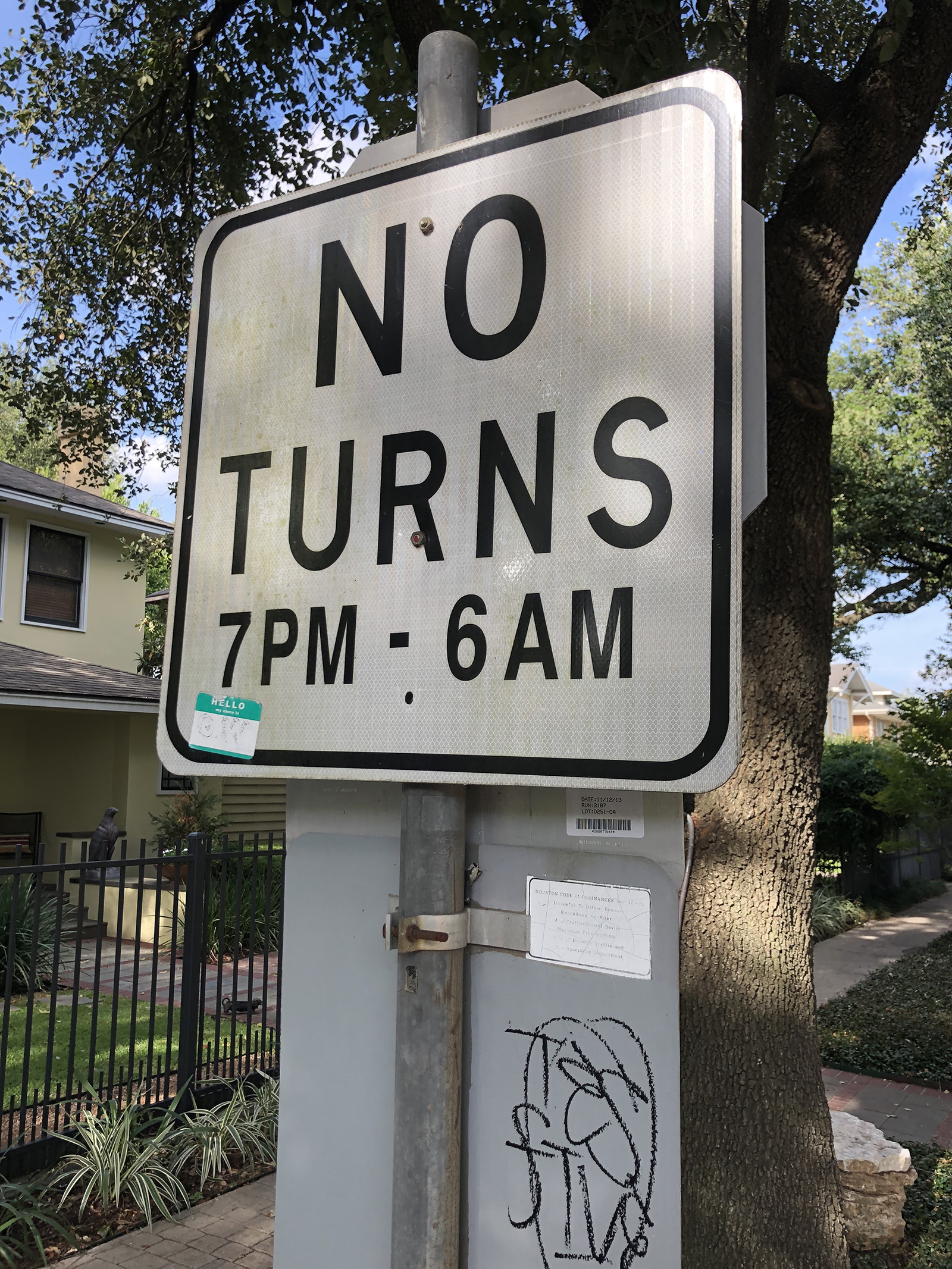
MCA unleashed that final option on Wednesday, January 28, 1976.66Plummer's article reads "January 26," an apparent editing error. With the evident cooperation of the City of Houston, MCA installed signs prohibiting vehicles from making turns between 7 p.m. and 6 a.m. in the Montrose area. These no-turn signs restricted those cruising by car from circling legally through the side streets of the neighborhood, breaking the social pattern connecting cruisers on foot with cruisers in cars. Indeed, Plummer reports that the next night "Houston Police issued 43 traffic citations for illegal turns and five people were taken to jail. This has all but assured that the Montrose Circuit exists no more."67Ibid. Importantly, this "death" of the circuit also became mainstream news; Houston television stations picked up the story with what Plummer describes as "fair and unbiased reporting." To be sure, the crackdown on cruising in Montrose did not spell the death of cruising itself. Even as Plummer asserts that "most Gays have not found a new cruise route," he goes on to observe that "many are returning to the old cruise route before the days of Montrose. This was known to many as Suniland. The area consists of the streets Main, Tuam, Fannin, and Anita."68Ibid. Indeed, these are the very same streets The Nuntius readers might remember as too risky, as places where pleasure mingles with danger. One implication of this strange return is that the shifting of neighborhoods and cruising areas is not uniform, unidirectional, or irreversible.
It is also important for us today to recall that queer folk were not always victims but also sometimes the perpetrators of surveillance and violent crime in 1970s Houston. Such crimes may also have influenced those seeking to shut down or relocate cruising areas. Many of these crimes are all but forgotten. For example, The Nuntius ran a 1971 story about a teenage boy who was picked up by two men in downtown Houston and taken back to their residence in Montrose, "known to the most of us as 'the colony.'"69"Halloween Horror for 16 Year Old Boy," The Nuntius 2, no. 11 (November 1971): 1. http://www.houstonlgbthistory.org/Houston80s/Assorted%20Pubs/Nuntius/nuntius-2-6-11-71.pdf. After what initially seemed to be an evening of drinks and movies, the boy "stated that he was knocked in the head by one of the men and tied up, beaten with a rubber hose and sexually assaulted by the pair."
Other crimes catapulted into the national consciousness. As Montrose residents and cruising men were engaged in their turf wars, Dean Arnold Corll had already begun what would come to be known as the Houston Mass Murders or the Candy Man Murders, in a gruesome nod to Corll's family business. Between 1970 and 1973, he and his accomplices are believed to have abducted, sexually tortured, and killed at least 28 teenage boys. While most of these boys had deep connections to or were taken in the Houston Heights area, the symbolic impact of the murders extended to all of queer Houston when the case was finally exposed in 1973 after one of Corll's accomplices murdered him. At the time, it was the worst serial murder case in United States history. The denouement of the Candy Man Murders played out the same year the American Psychological Association removed its classification of homosexuality as a mental illness in the Diagnostic and Statistical Manual.
More intriguingly still, even as the Montrose Citizens' Association began its 1975 flyer campaign, the Houston Chronicle began reporting on a string of murders in Montrose, mostly of men, many of them graphically violent. Then the Chronicle's January 8, 1976 front page ran the headline "Homosexual Tells Police He Killed 3 Men Here." The first line of that story described the confessor, Joseph Standwick, as "an admitted homosexual."70"Homosexual Tells Police He Killed 3 Men Here" Houston Chronicle, January 8, 1976, Sec. 1, 1. Later coverage would add to that description: "admitted homosexual and male prostitute."71"Homosexual Suspect in 3 Slayings Questioned by Arson Investigators," Houston Chronicle, January 9, 1976, Sec. 1, 12. Such headlines and biased language deepen our understanding of why Plummer might specifically comment on the "fair and unbiased reporting" regarding the no-turn signs and cruising; just weeks before the no-turn signs went up, many Houstonians were imagining a murderous, gay prostitute in Montrose.
In that context, battles over whether gay men could or should claim Montrose as their cruising grounds have an understandable urgency, and not just for cruising men concerned about their own safety. As Ralph Davis wrote in Ciao! in 1974, "[t]he Mayor, in order to reduce growing tension arising between straights and gays, immediately advised bar owners that he would not interfere with business so long as their patrons weren't a public nuisance."72Davis, "Houston," 10. Given prior police raids on the Story Book and any number of other queer establishments, cruising men might mistrust such promises. Cruising in Montrose was steeped in emotions and conflicting interests: straight-gay tensions, business concerns, residents' long-standing noise and traffic complaints, and murderous headlines (none of which ever mentioned race as a motivating factor). To be clear: no extant records indicate that the Montrose Citizens Association explicitly or implicitly connected the Candy Man and Joseph Standwick to men cruising Montrose for sex. Still, the possibility of that connection may help explain how the MCA came to have the support of the Gay Political Caucus and the Metropolitan Community Church, both organizations invested in promoting the respectability of gay people.
Time would prove the MCA's no-turn signs to be a limited success, however. A decade later, a new no-turn sign campaign launched in Montrose, and the occasion spurred many to recall the limitations of the 1976 MCA effort. Connie Woods described the new campaign in the Montrose Voice: "signs went up . . . at four intersections between Alabama and Harold at the request of the Montrose Ltd. Homeowners Association, creating controversy among residents of the neighborhood who were unaware of such requests."73Connie Woods, "New 'No Turns' Street Signs Go Up," Montrose Voice, January 24, 1986, 11. She closed the article with a brief, neutral nod to the past: "Such traffic signs were first established in the Lovett Blvd. and Stanford area on the south side of Westheimer in the 1970s to discourage 'cruising.'" The pages of This Week in Texas (TWT) offered stronger commentary, quoting Montrose resident Charlie Miller: "Responsible people will note that these signs didn't stop cruising when they were erected on the east side of Montrose Blvd. . . . The circuit merely moved, and most likely will relocate again."74"Cruise Area Under Attack," This Week in Texas 11, no. 46. (January 31–Feb 6, 1986): 19–20. http://www.houstonlgbthistory.org/Houston80s/TWT/1986/86-013186.compressed.pdf. TWT also quoted a 1985 letter from the Montrose Ltd. Homeowners Association to the city's Traffic and Engineering Department which made it clear they aimed to limit cruising:
The traffic begins increasing at dusk, is heaviest between 10 p.m. and 3 a.m. and continues until approximately dawn [… ] Most of the vehicles circle 10 or more times, but some have circled 50 or more times in one night. Depending on the day of the week, there are between 10 and 40 cars circling the block […] It's not unusual for four or more cars to be queued at each stop sign, waiting to turn the corner.
TWT readers were eager to share their thoughts in return. Bill Jackson wrote: "My apartment manager is, I believe, president of the homeowners association. I know, based on a conversation with him last fall, that they think anyone walking in the evening is soliciting, if not selling it."75Bill Jackson, "Letter to the Editor," This Week In Texas 11, no. 48 (February 14–20, 1986): 21. http://www.houstonlgbthistory.org/Houston80s/TWT/1986/86-021496.compressed.pdf. For his part, Don Buch argued that no-turn signs "demean and cheapen our Montrose properties and do not address the 'cruising' problem. It is in fact just a political tool for Houston police."76Don Buch, "Letter to the Editor," This Week In Texas 11, no. 48 (February 14–20, 1986): 23. As of this writing, some of the no-turn signs remain: two at the intersection of Marshall and Graustark, and nine along Roseland and Stanford streets. Despite consistent efforts from a variety of forces, the Montrose cruising circuits remained resilient.
Cruising Toward Theory
Taken together, these seven narratives of cruising do not describe an uncontested process of place claiming and recognition as Levine's model implies. Instead, they show territorialization through cruising to be temporally bound, conflicted, and structured in part through a politics of respectability explicitly linked to class concerns but uniformly silent on race. Considered alongside the brick-and-mortar locations of commerce and consumption that informed my earlier ArcGIS animation, these cruising narratives show that queer territories often operate on very different scales within and across multiple spaces. In these stories, the most typical scales of urban territory described are specific street corners, a few adjacent blocks, or occasional larger areas. Sometimes, but not always, these cruising grounds are connected to the commercial spaces privileged in the animation.
As the narratives attest, the practice of cruising has proponents and detractors. Tension over this practice in Houston largely stemmed from the range of agents involved and the variety of positions these agents took up on cruising. Over the years of analysis, the queer press promoted a number of stances on the behavior: discretely framed warnings, explicit admonitions that conveniently double as instruction manuals, and almost celebratory accounts of where specific kinds of action are to be found, ranked by dangers not limited to the threat of an encounter with the police. Queer and non-queer agents also intervened in a coalition to curb cruising. The Montrose Citizens Association had some degree of cooperation from the Gay Political Caucus and the Metropolitan Community Church. That alliance of respectable, community-oriented organizations built on years of residential complaints of noise and traffic even as Houstonians learned about a murderous gay prostitute in Montrose. The City of Houston directly engaged through policing, constituent messaging, and posting signage. Resilient sex-seekers responding to all of these agents seem to have found other places to pursue the chase, in part through cruising grounds remembered from other times. They had many alternatives available in collective, living memory, from cruising spots in downtown, Midtown, Montrose, Memorial Park, the Galleria, and beyond, to the adult bookstores and video arcades across the Houston landscape. At the same time, sex-seekers persisted in cruising areas like the Montrose Circuit, despite continuous efforts to displace them.
Beyond literal embodiments and emplacements, these narratives also illustrate that queer territories become so because both those who do identify as queer and those who do not identify as queer imagine them to be so. The full cast of characters holding these mental maps ranges widely in power, from unnamed neighborhood residents to the Mayor of Houston. These actors can be close to the field, like Richard L. Petronella and R. L. Martinson, and quite distant, like those reading Ralph Davis' article in the nationally circulated Ciao! magazine.77Benedict Anderson's arguments are particularly relevant here. See his Imagined Communities: Reflections on the Origin and Spread of Nationalism (New York: Verso Books, 2006). Patterns of rough trade visible since the 1960s also suggest that some men—at least those who cruise other men for sex and do not identify as queer—also carry mental maps of queer territory, if only to avoid those places lest the label stick to them.
As such, these seven cruising narratives present queer territory in Houston as a fractured and shifting network of sites imagined and contested by multiple populations, some of whom also participate in those scenes. Such an arrangement of queer territory strongly supports Ghaziani's concept of "cultural archipelagos" more than any model of a single, "gayborhood" enclave. Moreover, Gieseking's mental maps offer a well-attuned method to document the multiple social networks imagining those multiple cruising areas, at least for those living today. For the departed, the method of archival research present in works like this one will have to suffice.
These historical cruising narratives also pose several questions for future work, particularly as we explore the practice of cruising as it intersects race. Contemporary narratives like Espinoza's describe cruising as a ground on which men may meet other men of many different bodies, races, and classes. His is not a uniformly utopic stance, to be sure. He writes of people rejected for the color of their skin or the shape of their body while cruising. He acknowledges that many progressive projects, queer theory in particular, are rightly critiqued for "shutting out the lived realities of Black, Asian, Brown, and disabled queers altogether."78Espinoza, Cruising, 204. On the whole, this book leans more toward the utopia of cruising than its critique. And yet, immediately after that acknowledgement, his text embraces utopic potential: "The cruising ground erases these divisions, allowing for a more egalitarian experience not predicated on racial constructions" (Ibid., 204).
So what should we make of a body of Houston cruising narratives in which the division of race is indeed erased, so much so as to render race essentially invisible rather than seen? Perhaps it should not surprise that race goes so consistently unmarked in cruising narratives taken from Houston's white-dominated queer press. The pattern also extends nationally: as the Damron Guides began to mark race and to list cruising areas in the early 1970s, Houston's bars (the brick and mortar) were often coded for race; the archipelagic cruising areas were not. Perhaps the presumption was that, because cruising areas ranged from public outdoor space to semi-private commercial settings and were therefore "open to all," there was no reason to mention, much less mark, race. Here, oral histories with cruisers themselves would offer invaluable evidence about actual practices on the ground.79Literary accounts are also helpful, like Samuel Delaney's in Times Square Red, Times Square Blue (New York: NYU Press, 1999) or The Motion of Light in Water: Sex and Science Fiction Writing in the East Village (Minneapolis: Minnesota University Press, 2004). He was not writing of Houston however. Edmund White's States of Desire: Travels in Gay America (Madison: University of Wisconsin Press, 2014) moves through much of the South, including Houston. At the same time, that silence marked not just queer narratives. Race was similarly absent in the cruising narratives from concerned citizens and police reports. In these narratives, race's systematic absence certainly suggests the primary "problem" was the transgression of respectability in residential neighborhoods, for which the race of the transgressors could be framed as irrelevant. That race is unmarked in all the cruising narratives suggests that a broader logic may have operated, what Peggy Pascoe termed a "modernist racial ideology" that took "color blindness"—not seeing color—as a virtue.80Peggy Pascoe, "Miscegenation Law, Court Cases, and Ideologies of 'Race' in Twentieth-Century America," The Journal of American History 83, no. 1 (June 1996): 48. That ideology links drawing attention to race with racism itself. Even as it disavows racism, then, that ideology rationalizes silence about race, and also allows white privilege and white supremacy to continue, unnamed and unexamined, even in landscapes of contested respectability like cruising grounds.
At the same time, race was very much "on the map" of the queer press in Houston. As early as 1968, The Albatross marked the Gold Room as catering to Black queer Houstonians. The Nuntius covered the Gay Liberation Front picket of the Red Room for not admitting Black patrons (and disparaged the GLF in the process). Ciao! reported that "Latins and blacks" could be found at the Golden Spur. Upfront ran a substantial story on The Houston Committee, a Black social and political club that operated from 1975 into the 1980s.81For more on The Houston Committee, see "Houston Committee," Upfront 1, no. 2 (April 28, 1978): 2. http://www.houstonlgbthistory.org/Houston80s/Upfront/Upfront-V1-1-2.compressed.pdf. These descriptions fuel "mental maps" of a queer, multiracial Houston. However, these narratives of race functioned much as narratives of cruising did: they simultaneously allowed queer Houstonians to seek out racial diversity in some spaces while avoiding it in others.
In a final note toward future work, it is not as though queer territories emerge through cruising in just any location where enough people gather. These seven narratives show that other factors matter, such as relatively immediate access to semi-private spaces like wooded areas in a park (Memorial Park), bathrooms in a shopping mall (The Galleria), or a nearby and affordable hotel (The Woodrow Hotel). That benefit of access to semi-private space also undergirds the complex and varied relationships cruising areas have with specifically commercial space, and with cruisers' socioeconomic status and access to capital more generally. As the downtown window-shopping scene of the 1930s demonstrates, those commercial spaces need not be specifically queer, but must at least enable moments for discrete (respectable) communication, perhaps at a post while combing one's hair. As historian John D'Emilio might put it, such urban commercial centers help create the "conditions of possibility" for individuals to organize their lives, even if only in the ephemeral practice of cruising, through their sexuality.82See John D'Emilio, "Capitalism and Gay Identity," in The Lesbian and Gay Studies Reader, eds. Henry Abelove, et al. (New York: Routledge, 1993): 467–476. Proximity to specifically queer-centered businesses also enabled many cruising areas, albeit in flexible ways. The policed street scene outside a new bar described by the 1963 writer to ONE is quite different from the scene R. L. Martinson complained of almost a decade later—"characters" circulating in commercial space "without merchandise"—but perhaps Martinson was looking for a different kind of goods. While both narrators remark on the increased pedestrian and street traffic, Story Book created a commercialized space for cruising (and its consummation) to occur out of direct public view at the same time as both police forces and local queer press sought to control public street cruising. Said differently, the "good" that Story Book commodified was the affordance of relative privacy. While one could pick up a trick while walking outside a bar and never directly pay for that privilege, Story Book extracts payment for access to fellow sex-seekers in a semi-public and therefore marginally safer place, perhaps even with better odds of finding an available or desirable partner. The cruising scene on the corner of Main and Bell as described in Ciao! offers a different arrangement still, where some but not all of the cruising is predicated on sexual partners exchanging money directly. Also profiting from that scene are the three businesses—a restaurant, a bar, and a hotel—though at least the restaurant operators were ambivalent enough about that source of income to change their hours of operation to avoid the roughest of the rough. As a final thought, these varied relations to commercial space and capital suggest that histories of cruising not only deepen our understanding of how queer territorialization comes to be through archipelagic processes, but they also offer fertile ground for exploring the liberating potentials and structuring limitations of sexuality under capitalism. 
Acknowledgments
This essay was specifically inspired by Amy Stone's call to study the South.83Amy L. Stone, "The Geography of Research on LGBTQ Life: Why sociologists should study the South, rural queers, and ordinary cities," Sociology Compass 12, no. 11 (2018). https://doi.org/10.1111/soc4.12638. Also, while this essay concentrates on men's cruising in Houston, anyone might look for sex partners in public. As Samuel Delaney argues in Times Square Red, Times Square Blue, public spaces that encourage social mixing (sexually primed or not) across class and race lines yield a civic texture worth preserving. Yet in both popular and academic analyses of public sexual behavior, the practice of cruising remains predominantly linked to gay men.84For example, see William Leap, ed. Public Sex/Gay Space (New York: Columbia University Press, 1999). An analysis of queer urban space argued from cruising alone would reproduce that limiting linkage, and yield a proportionately myopic mapping. Also, an analysis of queer rural spaces would require a different set of analytics still, one more attuned to mapping social networks of queer rural denizens (see John Howard's work for example) than mapping brick and mortar locations.85See Gray, Mary L., Colin R. Johnson, and Brian J. Gilley, eds. Queering the Countryside: New frontiers in Rural Queer Studies (New York: NYU Press, 2016).
In a note of gratitude, more people than I can name here contributed in meaningful ways to this essay. I am thankful for my writing group; Melissa Bailar, Anne Chao, and Robert Werth saw this work in its very first stages. I am indebted to the Rice University Feminist Research Group and Christina Hanhardt for formative feedback on what turned out to be the bones of this essay. I am also grateful to JD Doyle, Martin Sunday, and the editors and anonymous peer reviewers of Southern Spaces for their insights and commentary. All errors and omissions remain my own responsibility.
Many thanks as well to Southern Spaces staff member Stephanie Bryan, who helped create the digital maps published here.
About the Author
Brian Riedel is the associate director of the Center for the Study of Women, Gender, and Sexuality at Rice University, where he received his Ph.D. in Anthropology. His work has been published in the Journal of Mediterranean Studies, PoLAR: Political and Legal Anthropology Review, Somatechnics, CITE: the Architecture and Design Review of Houston, and in the anthologies AIDS, Culture, and Gay Men (University of Florida Press, 2010) and Homophobias: Lust and Loathing Across Time and Space (Duke University Press, 2009).
]]>Video and Essay
Ossabaw Island is a barrier island on the Georgia coast. The island, which trends northeast–southwest, is about 14.5 kilometers (9 miles) long and 10.5 kilometers (6.6 miles) wide. It is located between latitudes 31° 49.5' and 31° 43.2' N. Of the Georgia barrier islands, Ossabaw is the most geologically unusual. Like the major Georgia islands south of it—Cumberland, Jekyll, St. Simons, Sapelo, and St. Catherines—Ossabaw is a composite island, in which sediments from Pleistocene and Holocene shorelines are directly adjacent or superimposed. However, sediments of the Pleistocene (Silver Bluff) and Holocene shorelines on Ossabaw split near its southern portion, with the Pleistocene trending north–south and the Holocene trending northeast–southwest. The modern shoreline, which formed only in the past few thousand years, wraps around the southern and northeastern corners of the island.
Ecosystems on Ossabaw include salt marshes, maritime forests, beaches, and a few freshwater ponds. Salt marshes are widespread west of Ossabaw, but also occupy much of the middle and eastern parts of the island between sediments of the Pleistocene and Holocene shorelines, dividing its maritime forests. The climate of Ossabaw is temperate to subtropical, with temperatures ranging from an average high of 32° C (90° F) in the summer to 10° C (50° F) in the winter. Average rainfall is about 50 centimeters (20 inches) per year, with most precipitation during the hurricane season (May–September). Hurricanes have rarely affected the Georgia barrier islands until recently, when Ossabaw was hit by Hurricane Matthew (2016), then later Hurricane Irma (2017). Hurricane Matthew, in particular, uprooted many of the older live oaks on the island and otherwise dramatically altered its landscape.
Although Ossabaw is often labeled as "pristine," humans have transformed its landscapes for at least 4,000 years. Its human history is similar to that of its island neighbor, St. Catherines, beginning with Native Americans (the Guale). The Guale had occupied Ossabaw since about 2000 BCE, but European colonization began when the Spanish arrived in the late sixteenth century. A lasting remnant of Spanish colonization on Ossabaw is the presence of feral hogs, some of which are linked to Spanish stock. This relatively large population of hogs has disrupted or otherwise altered ecosystems throughout the island.
The British took control of Ossabaw in the 1730s, by which time the Guale had mostly moved inland or suffered near extinction under the pressure of colonization. Early treaties reserved Ossabaw as hunting and fishing ground for the Creek people until 1758. The British also began enslaving African people for their plantation economy, and in the late eighteenth century American settlers continued using enslaved people as laborers for growing cotton and indigo. Most inland ecosystems of Ossabaw, especially the maritime forests and salt marshes, were altered considerably by this agriculture. Following the American Civil War, a significant population of African Americans stayed on the island, but most moved to the mainland after the Sea Island Hurricane of 1893. Many of their descendants today comprise the Gullah-Geechee community in Pin Point, Georgia.
Through the early to late twentieth century, Ossabaw's ownership changed several times, but the island remained largely undeveloped and sparsely inhabited. The last private owners were members of the Torrey family, starting with Dr. Henry Norton Torrey and Nell Ford Torrey, and ending with their daughter, Eleanor Torrey ("Sandy") West. The Torreys oversaw the building of a large home for themselves, as well as hunting lodges, a beach house, and unpaved roads. In 1961, after Sandy West inherited the island, she and her husband Clifford West began the Ossabaw Island Project. This project brought luminaries of the arts and sciences to the island as a retreat center for study and discussion; notable participants included composer Aaron Copeland, writers Ralph Ellison, Margaret Atwood, and Annie Dillard, as well as ecologist Eugene Odum. This creative initiative also resulted in the Genesis Project, which focused more on the natural sciences and hosted scientists for on-site studies of and education about the archaeology, ecology, and geology of the island.





In 1978, Sandy West sold Ossabaw to the state of Georgia to establish it as the state's first heritage preserve, and it has been managed since by the Georgia Department of Natural Resources (DNR). The Ossabaw Island Foundation was established afterwards as a non-profit organization working with DNR to encourage educational, cultural, and scientific programs on the island. Sandy West continued living on the island until just recently; at the time of this writing (January 2020), she was living in nearby Savannah, Georgia, and had just celebrated her 107th birthday.
This Ossabaw flyover video provides a visual sample of the many interconnections between natural and human histories on Ossabaw. Featuring sweeping aerial views and audio annotations explaining the island's varied environmental features, this video is organized around four sequential but overlapping themes: fauna, flora, landscapes, and human structures.
Acknowledgment
Thanks to the Ossabaw Island Foundation for their support on this piece.
About the Authors
Anthony "Tony" Martin is a professor of practice in the Department of Environmental Sciences at Emory University. His publications include Life Traces of the Georgia Coast (Bloomington: Indiana University Press, 2013).
Steve Bransford is the senior video producer at the Emory Center for Digital Scholarship. His documentary feature film The Well-Placed Weed is available on the PBS website and app.
Michael Page is lecturer in Geospatial Sciences and Technology at Emory University.
Leotie Hakkila is an MPH student at the Rollins School of Public Health, Emory University.
Anandi S. Knuppel is a visiting assistant professor in the Department of Religious Studies at Lawrence University.
]]>
Like most listeners, I'm sure, what I love best about S-Town is McLemore's irrepressible character and voice. McLemore was an antique horologist and self-described "semi-homosexual" who lived in Bibb County, Alabama, outside the small town of Woodstock. However, although Woodstock is only about thirty miles equidistant from the metropolitan centers of both Tuscaloosa and Birmingham, Alabama's largest city, the podcast deceptively portrays the area as excessively rural and remote. That deception not only gets this part of Alabama wrong, but also perpetuates a longstanding stereotype of the whole South as generally disconnected from the modern world, culturally and geographically. I should confess here that I am ultimately not a fan of S-Town, and this portrayal is just part of the reason why.
Nevertheless, McLemore's unique story still offers a rich opportunity to examine the complex dynamics of sexuality, gender, race, and class at the fringes of the more familiar, metronormative centers of urban queer life. McLemore was a paranoid genius, with the rare ability to see and explain all the invisible connections between his immediate locality and the global forces of capitalism, inequality, war, and environmental degradation currently destroying the planet. Sadly, in addition to other likely causes, including the mercury poisoning he probably contracted from his work on antique clocks, McLemore's paranoia drove him to suicide on June 15, 2015. This loss makes me doubly grateful that Brian Reed, S-Town's creator and narrator, decided to share McLemore's voice with millions of listeners. In a time when so many people happily treat every new music video, online commentary, Presidential tweet, and podcast like S-Town as a revolutionary event, McLemore resists any easy classification or commodification and shows us, instead, the real precarity and messiness of what it means to be human, as well as queer and southern, in the twenty-first century.
In her excellent article about S-Town, Monique Rooney examines the way that McLemore's untimely "voice from beyond the grave" combines with the "intermedia" of other texts and objects within the podcast—including "clocks and sundials," the "elaborate hedge maze that John created, unrecorded conversations, letters, a novel and other print narratives, poetry, songs, film, e-mails, Google maps, theatrical rituals, tattoos and tattooing, texts messages and graffiti"—to create a queerly alternative sense of time that works within and against the linear structure of the overarching narrative form.2Monique Rooney, "Queer Objects and Intermedial Timepieces: Reading S-town," Angelaki: Journal of the Theoretical Humanities 23, no. 1 (2018): 157. This intermedial structure of text and paratext, she argues, "opens the listener to wider networks and spheres" beyond "John's relentlessly caustic and negative views of life in the American South" and offers McLemore himself as "an intermediary" who "confound[s] . . . established hierarches and conventional subject/object relations," especially in terms of temporality, region, and sexuality.3Rooney, 159.
While there's no denying the power of McLemore's voice, I believe that the podcast ultimately restricts that power by constraining it within the closed temporal field of the podcast's strictly sequential form. Although Rooney argues that "S-Town's queerly intermedial form counteracts its ends-driven sequential form and its death-driven themes," the podcast's relentless push toward narrative resolution still wins out.4Rooney, 157, original emphasis. Moreover, while McLemore's recorded voice may be coming "from beyond the grave," his death still means that he can never speak out after the podcast to confront its selective portrayal of him. McLemore is endlessly complex, yet he will never be more complex than the narrative allows. This containment helps explain how he has become a figure of so much public fascination: like any dead celebrity, he can never finally reassert his subjectivity in a way that might change our perceptions and fantasies about him. And this restrictive framework is what frustrates me most about S-Town, for I know that I can never fully separate the McLemore I have come to like from the McLemore that Reed has edited for us.
Other reviewers have challenged Reed's serious ethical problem of seeming to exploit McLemore's death for creative and financial gain.5Jessica Goudeau, "Was the Art of S-Town Worth the Pain? How a Decades-Old Literary Argument Adds Insight to the Debate over the Popular Nonfiction Podcast," The Atlantic, April 9, 2017, https://www.theatlantic.com/entertainment/archive/2017/04/was-the-art-of-s-town-worth-the-pain/522366/; Aja Romano, "S-Town is a stunning podcast. It probably shouldn't have been made," Vox, April 1, 2017, https://www.vox.com/culture/2017/3/30/15084224/s-town-review-controversial-podcast-privacy. Around the same time that plans for a movie adaptation were announced in June 2018, McLemore's estate filed suit against the makers of the podcast for violating his "rights of publicity."6EJ Dickson, "Judge Allows Lawsuit to Proceed Against 'S-Town' Podcast Makers," Rolling Stone, March 25, 2019, https://www.rollingstone.com/culture/culture-news/s-town-lawsuit-john-mclemore-estate-812965/. But I want to consider another ethical concern in the way that Reed manipulates McLemore's voice to produce a certain effect—or rather, affect—for his listeners. Even as S-Town lets us experience McLemore's unusual character directly, this story of his troubled genius and premature death packages his character in a way that implicitly makes us, the listeners, feel different from him, no matter how much we might personally identify with him. As narrator, Reed uses McLemore to imagine a pleasanter, happier type of subjectivity, fashioning himself as a model liberal subject—not necessarily liberal in the pedestrian sense, although he does that too, but in the sense of being a self-contained, autonomous individual who appears, unlike McLemore, more or less separate from, and unaffected by, all the disciplinary and controlling forces of society. In addition, the podcast invites listeners to identify with Reed's narrative voice, eventually sharing his feelings of transcendent mobility and sophistication in opposition to the pain and paranoia that we hear in McLemore. Reed's aural embodiment of this liberal subject position promises listeners a similar sense of freedom and survival in a world of heightened global uncertainty—the forces that McLemore constantly railed against.
This buffering effect is, I think, another part of what gives S-Town its widespread appeal. Of course, it's not necessarily bad or unusual that a creative work would help us find this sense of pathos and security in a troubled world. But what I don't like is the way that Reed creates this affect by figuratively sacrificing McLemore to a worn narrative of southern gothic dysfunction. To create this twenty-first-century subjectivity that seems to transcend place, S-Town traps McLemore hopelessly and eternally in the place that he calls Shittown, Alabama. Although Reed ends the podcast with the story of McLemore's birth, S-Town buries him forever at the clichéd, lonely crossroads of a tragically (never happily) queer and backwards South. And in doing so, no matter what else the podcast might tell us about the real-life experience of being a queer, white, "semi-homosexual" man in semi-rural Alabama, this narrative framework reveals much more about the ideological uses served by mainstream imaginaries of southern queerness—fantasies of what it means to be queer and southern, southern and queer—in twenty-first-century US culture and beyond.7Brian Reed, "Chapter II: Has Anybody Called You?" March 28, 2017, in S-Town, produced by Brian Reed and Julie Snyder, podcast, MP3 audio, 44:22, https://stownpodcast.org/chapter/2. If any movie adaptation were to try to elicit the same kind of feeling in its viewers, I can't imagine it would be any less exploitative.
Policing the South
There's no denying S-Town's popularity. All seven episodes were made available for download on March 28, 2017, and since then tens of millions of listeners have followed Reed's account of McLemore's life and suicide. S-Town establishes itself, much like Reed's prior work, Serial, as a true-crime investigation. McLemore has asked Reed to investigate two things—an alleged murder and a case of alleged police corruption—and Reed sets to work combing the police reports and interviewing locals, although he didn't visit Alabama until a year later.
In Chapter I, Reed establishes a not-so-subtle conflation between Alabama and an imagined picture of the "South" as a whole. He does this in part by overstating the rurality of the setting. For example, Reed's description of where he stays on his first visit to Alabama invokes broader tropes of a sparsely populated, isolated landscape: "I had to leave Bibb County to find a hotel, so I'm in Bessemer, a small city about fifteen miles down the highway, where the far reaches of the Birmingham Metro Area dissolve into the rural counties like Bibb to the west. I'm at a Best Western just off the exit ramp, behind a Waffle House."8Brian Reed, "Chapter I: If You Keep Your Mouth Shut, You'll Be Surprised What You Can Learn," March 28, 2017, in S-Town, produced by Brian Reed and Julie Snyder, podcast, MP3 audio, 31:16, https://stownpodcast.org/chapter/1. While fifteen miles on an interstate highway hardly makes a marathon drive into the "far reaches" of civilization (and why does he have to "find" the hotel, as if the internet, a map, or McLemore himself, hadn't already told him where it was?), Reed effectively "dissolves" the specific landscape of Alabama into a more symbolic landscape of rural counties "like" Bibb whose generic southernness is made all the more evident by their common location "behind a Waffle House."
In Chapter II, Reed determines that rumors about the murder McLemore asked Reed to investigate were exaggerated tales of a fight that occurred at a party "in the middle of the woods" in Tuscaloosa County.9Reed, "Chapter II," 22:48. Reed's attention to the fact that the fight took place in the woods once again occludes the proximity of Tuscaloosa and Birmingham. Reed mentions the quick arrival of the police and ambulance, as well as the nearness of a hospital where the alleged murderer Kabram Burt was taken to treat his injuries after the fight, and the fact that Burt called a friend in Bessemer, which is outside Birmingham, to pick him up at the hospital. Nevertheless, Reed gives the last word about the fight to Burt, who shrugs off the incident as the normal consequence of "liv[ing] like white trash and shit," and the rumors of murder as a normal consequence of living in "a damn small town, man."10Reed, "Chapter II," 26:43, 25:28. Although Reed essentially "solves" the crime for his listeners, he uses Burt's testimony to blur the scene of the crime with a broader notion of southern rurality. The fight might have happened anywhere in this imagined South, because the only spaces that matter here are a gossipy small town and a wooded landscape dominated by "white trash," not the more metropolitan adjacent spaces.
Construing the semi-rural setting of S-Town as excessively rural sets the stage for Reed's portrayal of McLemore as a queer loner who is similarly isolated, the apparent lawlessness of the place echoing the turbulent, anything-but-normal life of this particular inhabitant. And so, just after his explanation to McLemore about the fight, Reed quickly turns to the news of McLemore's suicide, even though in real time McLemore's death occurred several months after that conversation. Squeezing this sequence of events allows Reed to maintain the "true crime" format of the podcast, and he quickly sets to work exploring the details of McLemore's death and the fallout that ensues.
Thankfully, Reed is not entirely interested in solving the question of what finally led McLemore to take his own life. From a literary standpoint I am glad he didn't oversimplify things by trying to pin down a single, simple cause or motive. Based on this narrative open-endedness, I would agree with reviewer Katy Waldman that S-Town looks and sounds like a new kind of literary genre, what she calls "aural literature."11Katy Waldman, "The Gorgeous New True Crime Podcast S-Town is Like Serial but Satisfying," Slate, March 30, 2017, http://www.slate.com/blogs/browbeat/2017/03/30/s_town_the_new_true_crime_podcast_by_the_makers_of_serial_reviewed.html. Yet, where she argues that this new kind of true-crime literature is "even more satisfying because [the case] always stays open," I believe that this feeling of audience satisfaction stems from something that is ideologically more dubious than open-endedness—and that shows how "aural literature" may not be so new after all. For all its novelty, and for all the ways that the podcast's intermedial elements stand "at odds with the sequential form," as Rooney writes, I find that this podcast has much in common with the traditional novel.12Rooney, 157. It deviates from the path of standard-fare detective stories and police procedurals, but detection and policing remain central to the narrative, both figuratively and structurally, thus replicating many of the discursive effects of discipline and control that literary critic D.A. Miller has identified in British novels of the Victorian era.13D.A. Miller, The Novel and the Police (Berkeley: University of California Press, 1988).
Miller demonstrates how Victorian novels use narratives of policing and investigation to establish a covert model of self-policing and self-discipline for the unmarked, bourgeois center of society. These novels, he argues, set up a "scene" of criminality and/or social dysfunction (e.g., the slums of Victorian London) as a space that requires rigorous investigation. The narrative intrusion into this scene establishes its opposite. By going into a dysfunctional space and then withdrawing, the novel constructs and "repairs . . . normality" as a space "not needing the police or policelike detectives."14Miller, The Novel and the Police, 3. Moreover, this pattern defines the structure of the Victorian novel beyond tales of explicit crime and detection. To borrow the words from Dickens's novel Our Mutual Friend (1864–65), Miller adapts the work of Foucault to show how these texts "do the police in different voices," deploying all kinds of modes of discipline, surveillance, and constraint to make the reader a good, orderly subject for the sake of a stable, orderly society. In the narrative restoration of "normality," the protagonist (who, like Reed, is sometimes the narrator) is able to forget or disavow the "system of carceral restraints or disciplinary injunctions" that shape his subjectivity.15Miller, The Novel and the Police, x. And so, by way of our identification with that narrator/character, we readers can forget the disciplinary regimes that govern our "normality," too, because our implicit acquiescence to those regimes similarly means that no visible intervention or investigation is required. When the disciplinary structures of society seem most invisible, we liberal subjects feel like we're free of them.
In S-Town, following McLemore's lead, Reed constructs an imaginary, emphatically rural, and corrupt "Alabama" (as well as a wider "South") full of violence, racism, theft, and intrigue—exactly the kind of "scene" that requires this sort of literary "intrusiveness." Although the podcast starts with a specific investigation into the local circumstances of the alleged murder, Reed blurs that literal act of investigation with subtler forms of exposure and containment when he turns to McLemore's suicide, widening the scope of the figurative investigation beyond the local to McLemore's fraught position within sectional, national, and global contexts. In particular, I want to delve into two aspects of the podcast where Reed performs this novelistic policing: his treatment of Alabama racism and his treatment of McLemore's queerness. Both depictions construct Alabama and the wider South as a backwards, dysfunctional space in need of heavy policing, literally and figuratively. And it is through this clichéd sectional portrayal that we can most clearly understand how Reed exploits McLemore to construct this version of the liberal subject.
The Backwards South, Again
Thankfully, because this is a podcast delivered through sound, and not a written narrative, the power and originality of McLemore's voice constantly break through Reed's efforts to shape what we hear. But then S-Town squanders this opportunity by editing McLemore's voice to fit a more shopworn "southern" script. Like Jeeter Lester soaking his feet in the drainage ditch in Erskine Caldwell's Tobacco Road (1932), it doesn't take long before S-Town sinks into a stream of southern gothic clichés. Yes, Reed is following McLemore's cynical lead, but Reed seems even more insistent in portraying Shittown as backwards and corrupt and runs with McLemore's own comparison of Shittown to the "undercurrent of depravity" expressed in William Faulkner's story "A Rose for Emily" (1930).16Reed, "Chapter I," 32:50. And, even though Reed also mentions similar works by writers Guy de Maupassant and Shirley Jackson, he uses the Zombies' song inspired by "A Rose for Emily" as the closing music for every episode, underscoring connections between the podcast and southern gothic literature.17Literary critics David A. Davis and Gina Caison discuss these southern gothic tropes at length, including the comparison to Faulkner's "A Rose for Emily." Hear their excellent critique on the podcast "S02 Episode 3: Gilded Souths & S-Towns," July 20, 2017, in About South, produced by Gina Caison, Kelly Vines, and Adjoa Danso, podcast, MP3 audio, 38:27, https://soundcloud.com/about-south/s02-episode-3-gilded-souths-and-s-towns.
In later chapters, we learn that McLemore allegedly buried large amounts of gold on his property, and Reed turns us into narrative prospectors by making us wonder if the gold was found by greedy relatives, stolen by the police, or, as Reed implies, dug up in the middle of the night by McLemore's neighbor and most intimate companion in the podcast, Tyler Goodson. As with other elements of this true-life story, the legend of buried gold is of McLemore's making. But, in the telling of it, Reed can't seem to recognize what A Streetcar Named Desire's Blanche Dubois (1947), Queen Diva of the southern gothic, would have noticed in a heartbeat: that the story of buried gold is so old that "Only Poe! Only Mr. Edgar Allan Poe!—could do it justice!" Although Blanche references Poe's poem "Ulalume" (1847) in the play, where the poet visits his dead lover's grave, in this context I'm talking about Poe's 1843 short story about buried pirate treasure, "The Gold Bug."18The story of southerners obsessively digging up land in the search for buried gold also echoes the plot of Caldwell's farcical God's Little Acre (1933).
Finally, there's S-Town's closest literary parallel: John Berendt's popular Midnight in the Garden of Good and Evil (1994). I wasn't much of a fan of that, either. Both works cast their nonfictional gaze upon a supposedly insular "southern" place and regale their audience with sensational, almost shocking "discoveries" of things like actual gay people! and even more complicated gender dynamics! Here are places, they announce, plagued with racism! and full of crimes of passion! where half the locals are too secretive and the other half are far too garrulous! Even things like college football and getting a tattoo start to sound like arcane rituals. In other words, these texts spectacularize all the colorful, grotesque things you might find virtually anywhere else in these United States, southern stereotypes be damned. To me, there's just not much that's very new in the manner of this podcast's representation. From Berendt to Blanche to Faulkner to Poe, S-Town tells a story we've been hearing for a long time.
Clichés are necessary to Reed's portrayal of a gothic South that needs policing. Like the Victorian novel, S-Town constructs an image of Alabama as the place where disorder and depravity reign. In fact, it is so dysfunctional that even the police need policing. Remember that McLemore's initial email to Reed asked for help investigating not only the alleged murder, but also a case of police corruption. And later, when Reed considers that the police might have stolen McLemore's gold when they first arrived on the suicide scene, McLemore's cousin Reta Lawrence returns to this question of corruption: "Isn't that what John first got in touch with me about to investigate, she says, corruption in the local police?"19Brian Reed, "Chapter V: Nobody'll Ever Change My Mind About It," March 28, 2017, in S-Town, produced by Brian Reed and Julie Snyder, podcast, MP3 audio, 16:10, https://stownpodcast.org/chapter/5. Maybe the police did steal the gold. But Reed doesn't actually need to solve any of these questions. As satisfying as it is that all the cases are "left open," as Katy Waldman argues, Reed also needs his southern setting to remain gothic and corrupt in order to create the implicit counterexample of a "normal" world where the police aren't corrupt and a "normal," bourgeois person needn't worry about such things.
Another way that Reed bolsters this extended stereotype of the gothic South is through his treatment of race and racism. When Reed visits a tattoo parlor in Chapter II, he takes pains to point out the racism of the young men in the room, as if any listener could miss it. Reed seems to want to shock listeners, presumably by broadcasting what they might not normally hear in public discourse, at least before the 2016 Presidential campaign, but also by confirming that the old figuration of a racist South needs no qualifications or nuances. What's really shocking, however, is Reed's blatant, and rather clumsy, attempt to distance himself from these white men ideologically and geographically. Reed does nothing to confront or complicate the unexamined whiteness of both his real-life subjects and his own perspective.20Wesley Jenkins, "The Empathy of 'S-Town' Doesn't Extend to Black People," BuzzFeed News, April 21, 2017, https://www.buzzfeed.com/wesleyjenkins/the-empathy-of-s-town-doesnt-extend-to-black-people?utm_term=.fmJA3Xxxe#.jtpwXLBBz; Maaza Mengiste, "How 'S-Town' Fails Black Listeners," Rolling Stone, April 13, 2017, https://www.rollingstone.com/culture/how-s-town-fails-black-listeners-w476524. He quietly tells one of the young men that racism in New York is "quieter" than it is in the South.21Reed, "Chapter II," 8:34. And then, in case we had any doubts, Reed assures his audience that he is certainly not a racist, for he has boldly, bravely taken the step of making all his social media accounts private to prevent his interviewees from seeing a photo of him with his future wife, Solange, who's black.22Reed, "Chapter II," 7:58.
Surely Reed can't really believe that these young men are so disconnected from the rest of the world that they wouldn't be able to google his name and find out more. Even bigots in Alabama have smartphones, as McLemore laments at length in Chapter I. I think Reed actually has a different motive for telling us about his social media accounts, for in doing so he positions himself as different from these other white men in important ways. By reminding us that his fiancé is black, Reed telegraphs that he is a nonracist, liberal subject who is much more connected to the modern world, not just in terms of internet savvy, but also in terms of politics. By reminding us that where he hails from racism is allegedly "quieter" (what would Eric Garner say about such a claim?), Reed suggests that he is much less tied to place than the other whites in that tattoo parlor—that he is much more mobile culturally, economically, ideologically, and geographically. Reed's unmarked whiteness allows him to travel in and out of different spaces, while the marked racism of the other white men will, it seems, prevent them from fitting in anywhere else than sweet home Alabama. With a little digital pruning, Reed will be OK in Shittown, but those boys will never make it in New York.
By layering racism, subjectivity, and place onto each other in this way, Reed also puts listeners in the same liberal subject position as himself. We implicitly identify with his narrative voice as he marks those other subjects as different and flawed. Reed wants us to feel that we, like him, are not constrained by our time and place, even if the racism where we live isn't actually "quieter." Reed's narrative manipulations tell us that we, as untethered individuals, must be liberal in the more pedestrian sense, too. Unlike those white Alabamans who don't seem to question or notice that K3 Lumber, their local lumber mill, implicitly honors the Ku Klux Klan, as Reed suggests at the very beginning of Chapter I, our feeling of autonomy—accentuated by the disembodiment of the aural podcast—guarantees we'll never have a problem with Brian Reed's marriage to Solange.23Reed, "Chapter I," 18:38.
A Queer South
Reed makes similar moves in the way he discusses McLemore's sexuality. Another thing I like about this podcast is the way that McLemore and his relationships defy simplistic analysis or categorization. The most complicated, and the one to which Reed gives the most airtime, is McLemore's close intimacy with his younger neighbor, Tyler Goodson. As McLemore admits in Chapter V, and as we learn more fully in Chapter VI, their relationship may seem to others more like a "usership" than a "friendship" because of the men's codependencies.24Reed, "Chapter V," 49:09. McLemore gives Goodson money and other kinds of material support, ostensibly for all the odd jobs he performs, while Goodson reciprocates with emotional and physical companionship. There is no clear indication that they had sex, but the erotic, even romantic dimensions of their relationship are unambiguous. Goodson agrees to satisfy McLemore's apparent fetish for pain by regularly tattooing his skin, including his nipples, and even whipping him. And, just before his death, the two men spray-paint their names on a local bridge like a queer combination of teenage lovers and, since they did this on Father's Day, daddy and son.25Reed, "Chapter VI: Since Everyone Around Here Thinks I'm a Queer Anyway," March 28, 2017, in S-Town, produced by Brian Reed and Julie Snyder, podcast, MP3 audio, 50:36, https://stownpodcast.org/chapter/6.
Here is a rich opportunity for mapping some of the unlikely networks of gender, power, and pleasure that shape all those sketchy spaces beyond more familiar queer metropoles such as New York and San Francisco. A useful critical pairing would be Scott Herring's work on the Alabama photographer Michael Meads in Another Country: Queer Anti-Urbanism.26See Scott Herring, Another Country: Queer Anti-Urbanism (New York: New York University Press, 2010), 99–124. As Herring demonstrates, Meads's photographs of nude and semi-nude young white men—often in the mise-en-scène of Confederate flags, guns, trophy deer, piney woods, and other objects that signal southerness to the viewer—short-circuit both homonormative assumptions about sexuality and gay identity and metronormative assumptions about sex and homophobia in the rural South.
Anecdotally, I've heard from a goodly number of southern gay white men who say that they like this kind of unsettling dynamic in S-Town. Apparently, to them, as to me, John B. McLemore's character feels at once enigmatic and familiar. He clearly doesn't fit mainstream constructions of either gay or southern identity; and yet, ironically, because of how he blends his intellectualism with a kind of down-home, country campiness, he also seems almost paradigmatically gay and southern. In a comment that he also relates to McLemore's sexuality, blogger Aaron Bady, who is originally from southern Appalachia, also notices this paradox: "John might seem like a one-of-a-kind, but hearing him instantly reminded me of any number of gifted hillbilly eccentrics I've known, red-state liberals whose local roots run deep and murky."27Aaron Bady, "Airbrushing Shittown," Hazlitt, May 1, 2017, https://hazlitt.net/longreads/airbrushing-shittown. The pejorative term "hillbilly" is specific to Appalachia and would not apply to the space of middle Alabama, let alone to McLemore. But, as someone who originates from Appalachia, Bady uses it interchangeably with "redneck" and other terms that generally refer to white southerners historically identified as "poor whites," which is to say, whites whose identities do not fit bourgeois normativities. He also uses these terms in ways that avoid perpetuating negative stereotypes, even as he remains outspoken against the racism, homophobia, and conservatism of so many white southerners.
Nevertheless, Reed's treatment of sexuality is, like his treatment of race and racism, immensely frustrating. In Chapter VI, he tells of how a gay man named Olin Long contacted him to talk about his relationship with McLemore, whom he met through a phone network for gay men in the time before apps like Grindr. They became intimate friends, but not lovers, and Reed dwells on their twelve-year relationship to bolster several assumptions about how hard it must be to be queer in the South, not just for McLemore in particular, but for anyone. (Shane Barnes runs with this notion in his review of the podcast on Vice; Michael A. Lindenberger offers a better take in the Dallas Morning News.28Shane Barnes, "'S-Town' and the Loneliness of Being Gay in the Rural South," Vice, April 13, 2017, https://www.vice.com/en_ca/article/aemwqg/s-town-and-the-loneliness-of-being-gay-in-the-rural-south; Michael A. Lindenberger, "S-Town Humanizes the Haunting Isolation of Gays in Rural America," Dallas Morning News, May 3, 2017, https://www.dallasnews.com/opinion/commentary/2017/05/03/john-bs-loneliness-tells-us-homosexual-life-rural-america.) Olin Long tells of his deep, moving appreciation of the film Brokeback Mountain, a story of repressed, rural gay love that Reed overlays onto Alabama. It turns out that Long has been celibate for nearly six years, and Reed automatically implies that, much like the Cowboy West of the movie, Long's celibacy is more the fault of the Red-State South than a choice he has made. "John and Olin," says Reed, "both kept their sexuality hidden for much of their lives. John talked to Olin and to me about how you had to be very careful about that where he lived."29Reed, "Chapter VI," 20:44. Later, Reed summarizes that "Living in Birmingham, Olin Long says at least he had places to go on a date, places where he could sit with another man in public and get a coffee or a drink. But John had nothing like that. There's not a single bar in all of Bibb County. And even if there was, it's hard to imagine two men feeling comfortable or safe going on a date there."30Reed, "Chapter VI," 21:47.
I certainly do not want to downplay the deep loneliness and fear that so many queer people experience, perhaps especially in rural locales. I also do not want to downplay the serious threats that LGBTQ+ people face in virtually every public space, certainly not limited to conservative southern spaces. In 1999, in Coosa County, Alabama, about seventy miles from Woodstock, Steve Butler and Charles Mullins murdered thirty-nine-year-old Billy Jack Gaither simply because he was gay, as they confessed.31See Allen Tullos, Alabama Getaway: The Political Imaginary and the Heart of Dixie (Athens: University of Georgia Press, 2011), 39–42. And in 2004, in Bay Minette, Alabama, down near Mobile, Christopher Gaines murdered eighteen-year-old Scotty Joe Weaver, in part because he was gay.32See Jen Christensen, "Scotty's Last Moments: The Murder of a Gay Teen—Allegedly at the Hands of His Best Friends—Has Rattled a Small Alabama Town," The Advocate, September 28, 2004. Both were high-profile cases that Long and McLemore almost certainly would have known. But gay life in the South is obviously more than just a matter of fear and violence, as we can easily see in the documentary Small Town Gay Bar (2006)—which discusses Weaver's murder alongside stories of queer resistance, love, and triumph—and in the work of writers and activists like Minnie Bruce Pratt, who hails from Centreville in Bibb County.33See Pratt's lecture "When I Say 'Steal,' Who Do You Think Of?" Southern Spaces, July 21, 2004, https://southernspaces.ecdsdev.org/2004/when-i-say-steal-who-do-you-think and her poem "No Place," Southern Spaces, July 27, 2004, https://southernspaces.ecdsdev.org/2004/no-place.
Or maybe if Reed had read John Howard's work on the history of gay male car culture in rural Mississippi he'd know that being gay doesn't always require brick-and-mortar buildings with rainbow flags in front.34See John Howard, Men Like That: A Queer Southern History (Chicago: University of Chicago Press, 1999), 78–125. As Howard's pathbreaking work reveals, LGBTQ+ people in Mississippi in the middle of the twentieth century, and gay men in particular, did not forge a sense of identity and community simply by meeting in bars or bookstores. Car culture was central: men met men in cars for sex, shared cars to travel back and forth between homes and towns and cities, and gathered in cars in unsurveilled rural spaces. Keeping in mind the different power dynamics attached to race, class, and gender presentation, LGBTQ+ southerners are able to come out and go out in towns and villages as well as cities. And sometimes, as we see in the case studies Howard discusses and in McLemore's own unusual friendship with Tyler Goodson, queer men don't need conventional (hetero) dating rituals to develop lasting relationships.
Moreover, doesn't McLemore tell Reed at the beginning of Chapter II that "Me and Roger Price had went up to the truck stop together to get a little dinner"?35Reed, "Chapter II," 0:28. They weren't on a date, but they were still two men sitting together, and they didn't encounter any homophobia. What does Reed think gay men do on dates that's different from what McLemore and Price did? More to the point, why doesn't Reed do more with McLemore's statement that "everyone around here thinks I'm a queer anyway"?36Reed, "Chapter I," 42:37. Reed uses this line as the title of Chapter VI, but he never really asks why McLemore would have to keep his sexuality "hidden" if his queerness is already, in a manner of speaking, public knowledge.
In any case, Reed backs away from that challenge and tells us that, because of McLemore's semi-rural Alabama situation, the only other potential partners he could find were an older man, "William," the married construction worker who tutored him in sex, and two other men whom he met on the phone line.37Reed, "Chapter VI," 16:58. Eventually, William faded away, and, according to Reed's account of what McLemore and Long told him, those other two men were too grotesque for words. One was "repulsive-looking, a chain smoker with tobacco-stained teeth," and the other had made a date at John's house only because he wanted a quick encounter.38Reed, "Chapter VI," 22:30. When McLemore didn't want to immediately jump into bed, according to Long, the man sat on the porch and "masturbated into whatever that flower bush was there. And then he left."39Reed, "Chapter VI," 23:42.
Alabama is certainly not the only place where you can find bad sex and awkward encounters. But Reed portrays Alabama as homophobic, intolerant, and virtually empty of that thirty-five-percent plurality of LGBTQ+ residents, making no real distinction between the surrounding countryside and Alabama's largest city (let alone larger cities like New Orleans, Miami, or Atlanta). Reed suggests that "Alabama" causes McLemore's loneliness far more than any of his idiosyncrasies or choices. Apparently, the problem had nothing to do with the fact that McLemore could be socially awkward, or that his strong personality might have scared some men away (remember that Reed waited a good while before he started replying to his initial calls and emails), but that he lived in a place where it's just too hard to meet the right guy. Ironically (or perhaps intentionally?), it never even seems to occur to Reed, the savvy creator of a digital podcast, that his queer subject might have moved on from antiquated telephone chatrooms to dating and hookup apps on his smartphone. It's as if the digital revolution missed Reed's version of Alabama altogether.
At least one reviewer has taken Reed to task for trying to force McLemore's sexuality to fit a normative frame of monogamy and romantic love, as if what he must have really wanted was an LTR that he could take on vacation to Fire Island.40Daniel Schroeder, "S-Town Was Great—Until It Forced a Messy Queer Experience Into a Tidy Straight Frame," Slate, April 11, 2017, http://www.slate.com/blogs/outward/2017/04/11/s_town_podcast_s_treatment_of_queer_experience_hobbled_by_straight_biases.html. But Reed's questionable portrayal produces another effect that brings me back to subjectivity. As he tells us about McLemore's failed relationships, Reed makes sure to remind us that his own sexuality is hardly so constrained. Once again, Reed uses his wife, Solange, to do so, telling us that it took him a while to reply to Long's email because it arrived during the time of Reed's wedding.41Reed, "Chapter VI," 7:37. Got it? Reed's sexuality is healthy and fully realized, while Long's and McLemore's erotic and romantic lives must go unfulfilled—because Alabama makes it too hard to come out and find a partner in the first place. To be clear, I'm not saying Reed is being homophobic. Rather, the podcast implies that if Long or McLemore had gotten out of Alabama, they could have found the same kind of happiness that Reed enjoys with Solange. In S-Town, they are tragic victims of location, while Reed is the liberal subject whose life in New York has (ironically) given him the freedom and autonomy to fully embrace his sexuality and find marital bliss.
Liberal Subjects
S-Town imagines a repressive and regressive "Alabama"—one that blurs into an equally backwards "South," regardless of whether it's rural, urban, or in between—in order to paint Brian Reed the narrator, and, by extension, all the podcast's listeners, as modern, mobile, and progressive. As Reed polices the narrative space of this queer and backwards Alabama, he never reveals something new that will change our perception of the state or our own circumstances. We never get past the cliché of a racism somehow predominately, if not exclusively, southern. We never find other ways to live and love that challenge the prescriptions of both hetero- and homonormativity. And we never remedy police corruption. Reed is no more interested in solving anything, including McLemore's suicide, than he is in reforming the actual institutions of the state of Alabama. Instead, just as D.A. Miller interprets in the Victorian novel, Reed uses a twisted Alabama to "repair normality" for listeners. Wherever we might be physically listening to the podcast, S-Town depicts Shittown, Alabama, in a way that makes us feel like we are all living in a better place.
How do we know our place is better? Because we don't need policing the way the people of Shittown do. Because in Shittown people are too openly racist, not like the "quieter" people of New York. Because in Shittown it's too hard to be gay. Because people in Shittown steal your property, dig up your gold, beat each other up in the woods, and so on. In Shittown people conduct dangerous experiments with mercury, even though the European milliners who wrote about the procedure back in the 1800s warned them not to. And, tragically, when the mercury poisoning combines with Shittown's other determining factors to finally drive you crazy, the people there don't even honor your last wishes by calling your friends when you die.
If I sound glib about McLemore's suicide, it's not because I actually feel that way, but because I believe the structure of the podcast is glib. The tone of the podcast honors the true genius of John B. McLemore. But the structure of S-Town tells us that the ultimate tragedy is that McLemore lived in Alabama and never got out. That is not to say that the podcast doesn't portray the citizens of Shittown as liberal subjects in their own right. But, like McLemore, they are always flawed subjects. When Tyler Goodson says in Chapter V that Reed must think he's a "bad person" for taking things off McLemore's land after his death, Reed condescendingly assures him: "No, man, I see you as a complicated, normal person. You know, I disagree with some of your decisions. But you also—you've had a very different life experience than I've had."42Reed, "Chapter V," 44:40, 44:50. A few minutes earlier in the podcast, Reta also worries that she would come across as a "bad person" because of her behavior in the property dispute (Reed, "Chapter V," 38:00). The implication here is that if Goodson had lived anywhere else—let's say New York—maybe he could have been just the same as Reed: well-traveled, successful, and "good." However, all the "bad" forces of Shittown have compromised Goodson by giving him a "very different life experience." Because of these forces, Reed suggests, Goodson will always remain "bad" and "different" from "normal" people, even if he could lift himself out of his poverty with the sudden windfall of McLemore's buried gold.
John B. McLemore, of course, is more extraordinary than Tyler Goodson. And, in terms of the narrative work of the podcast, this difference makes McLemore's fatal emplacement within Reed's southern imaginary an even greater tragedy. Reed expresses this idea in his depiction of McLemore as a crusader in Chapter II:
The shitty misfortunes John fixates on, they're not a bunch of disparate things. They're all the same thing. His Shittown is part of Bibb County, which is part of Alabama, which is part of the United States, which is part of Earth, which is experiencing climate change, which no one is doing anything about. It maddens John. The whole world is giving a collective shrug of its shoulders and saying fuck it.
What I admire about John is that in his own misanthropic way, he's crusading against one of the most powerful, insidious forces we face—resignation, the numb acceptance that we can't change things. He's trying to shake people out of their stupor, trying to convince them that it is possible to make their world a better place.43Reed, "Chapter II," 34:35.
From local corruption to planetary climate change, McLemore sensed all the social, political, economic, and natural forces that were acting upon—and against—humanity, and his tragedy was that he couldn't forget or disavow them. He could not find a way to survive because he could not blind or numb himself—even through pain—to the carceral restraints of our destructive global society. McLemore simply could not repair his own normality.
As the podcast implicitly tells us, however, we listeners still have the chance to forget and disavow. S-Town doesn't show us McLemore's almost panicked obsession with climate change so that we will also begin panicking about climate change. It doesn't tell his story so that we will run out and try to "change things." Rather, the podcast quarantines all that worry within John B. McLemore in order to repair our sense of our normality. Sure, we might worry about climate change a little—for, as D.A. Miller points out, the liberal subject's fantasy of being free from the world's determining forces also allows him to "conceive of himself as a resistance: a friction in the smooth functioning of the social order, a margin to which its far-reaching discourse does not reach."44Miller, The Novel and the Police, 207. Nevertheless, the point of the podcast is that we should be careful not to adopt McLemore's intensity and resist too much. As good liberals, we can fight for a new world of clean energy, interracial love, and queer comradeship, but the podcast suggests that if we fight too hard we might find ourselves buried next to John McLemore in Shittown. For if his brilliant mind couldn't change the forces that seek to discipline and destroy us at every level, how on earth could we?
Ultimately, the podcast is inviting us to identify with Reed, who is obviously freer and happier than all the residents of Shittown. In the logic of this work of aural literature, we must repair ourselves and our normality by imagining ourselves as a liberal subject like Reed the narrator, just as Victorian readers would have done. I don't mean that Reed is trying to shake us back into the "stupor" that McLemore was trying to shake us out of. But daily survival in a world on the brink of mass extinction really does require a lot of forgetting. In so many ways, our survival depends on our belief that we are persons with some power to resist. On its own, that belief will not help us stop climate change, but it's necessary all the same. And the fact that S-Town gives us these feelings of freedom and possibility explains its immense popularity. If a film version could accomplish the same thing—assuming the lawsuit against the podcast's makers allowed an adaptation to proceed—I imagine it would get even higher ratings, although I still cannot see how a film could do so without continuing to misrepresent Alabama and the South, and what it means to be queer in those spaces.
S-Town's literary predecessor, Midnight in the Garden of Good and Evil, ends with a celebration of the restored and persistent pleasures of the southern gothic:
For me, Savannah's resistance to change was its saving grace. The city looked inward, sealed off from the noises and distractions of the world at large. It grew inward, too, and in such a way that its people flourished like hothouse plants tended by an indulgent gardener. The ordinary became the extraordinary. Eccentrics thrived. Every nuance and quirk of personality achieved greater brilliance in that lush enclosure than would have been possible anywhere else in the world.45John Berendt, Midnight in the Garden of Good and Evil (New York: Random House, 1994), 388.
But in the story that Reed tells, nothing grows in the scorched earth of S-Town, where its key "eccentric" found he could no longer thrive. This inability to thrive is symbolized most clearly in the story of McLemore's hedge maze. In Chapter I, Reed dwells at length on the maze that McLemore and Goodson built on McLemore's land—a maze with moveable doors that allowed McLemore to create sixty-four different solutions as well as an insoluble "null set."46Reed, "Chapter I," 29:50. After McLemore's death, the maze fell into disrepair, and the hedges died. Although Reed does not talk about that decay, it is clear even within the podcast that the maze will never reach the "maturity" wished for in the final Chapter.47Brian Reed, "Chapter VII: You're Beginning To Figure It Out Now, Aren't You?" March 28, 2017, in S-Town, produced by Brian Reed and Julie Snyder, podcast, MP3 audio, 24:27, https://stownpodcast.org/chapter/7. The maze signifies McLemore's attempt to impose his own vision of order and wonder on the landscape. But after the podcast, we remain trapped in the maze of Reed's creation. When tourists go to Bibb County to look for the maze, they find they can only know it as they have encountered it in the podcast. As William Thornton writes for AL.com, many who visit the town of Woodstock do not find the Shittown they expect, for the maze is effectively gone and the citizens do not fit the impression that the podcast creates.48William Thornton, "The Seeds of S-Town: Woodstock Looks for Healing," AL.com, September 6, 2018, https://www.al.com/news/2018/09/the_seeds_of_s-town_woodstock.html. It is the podcast's depiction of Shittown that endures most of all.
If we could separate McLemore's voice from the narrative frame, what might we learn? Could he help us build new kinds of spatial narratives in addition to the temporal ones Rooney traces in her article? What might he teach us about being queer? Or even solving climate change? I am particularly interested in the possible links between his self-identification as a "semi-homosexual" and his becoming "unbanked."49Brian Reed, "Chapter III: Tedious and Brief," March 28, 2017, in S-Town, produced by Brian Reed and Julie Snyder, podcast, MP3 audio, 34:16, https://stownpodcast.org/chapter/3. As he claimed to have mostly withdrawn from capitalist financial structures, how did he also imagine his sexuality as never fully fitting a coherent ideological category? How was he trying to occupy a subject position outside the control of capitalist networks and epistemologies that seek to make every individual fully knowable and accountable? What might be the advantages of other LGBTQ+ people following this lead—as southerners such as Minnie Bruce Pratt have been doing for years—fighting for sexual and gender liberation by revising and restructuring, or perhaps just rejecting, the systems of twenty-first-century global capitalism? Back in 1983, before the turn to the umbrella terms queer and LGBTQ+, historian John D'Emilio pointed out that "gay men and lesbians" were especially well positioned to build alternatives to exploitative capitalist regimes—to create models of sociality and community that "broaden the opportunities for living outside traditional heterosexual family units" and "provide a [stronger] material basis for personal autonomy."50John D'Emilio, "Capitalism and Gay Identity," in Making Trouble: Essays on Gay History, Politics, and the University (New York: Routledge, 1992), 13. Up to his death in 2015, John B. McLemore was essentially calling for the same thing, but with even greater urgency.
Maybe if I went back and listened one more time, I'd find the answers to these questions buried in McLemore's monologues. But then I'd still be grappling with the narrative frame that arranges them into a meaningful structure. I'd be right back where I started, and still not a fan of the podcast. Maybe Brian Reed should just release McLemore's full recordings, monologues, and emails, however interminable and insufferable they may be. Listening to an unedited John B. McLemore might not be as entertaining or as pleasant, but it would still be profoundly interesting. Maybe that's what we need to "shake people out of their stupor" and show the rest of the nation that thirty-five percent of its queer population really do have something important to say.
About the Author
Michael P. Bibler is Robert Penn Warren Associate Professor of English at Louisiana State University. He is the author of Cotton's Queer Relations: Same-Sex Intimacy and the Literature of the Southern Plantation, 1936–1968 and co-editor of the collection of essays Just Below South: Intercultural Performance in the Caribbean and the US South. He is currently finishing a book manuscript about literalism and silliness in literature, music, performance, and film from the 1980s to the present, entitled "Literally, Queerly: The Pleasures of Silly Objects and Identities."
]]>Introduction
Sacred Harp singing is defined by its spatial organization as much as by its musical style. In this form of shape-note music, an assembled "class" of singers gathers at annual events called "singings"—weekend days spent in churches or community centers singing songs from The Sacred Harp, a nineteenth-century Georgia tunebook revised every generation or so. The tunebook uses a pedagogical system in which the music's note heads have four distinct shapes corresponding to their position in the scale, associated with the names "fa," "sol," "la," and "mi," which singers recite before singing a song's hymn text. Just as important as the shape-notes to the Sacred Harpers is the "hollow square" orientation in which singers sit, facing each other in rows of pews or chairs organized by voice part (bass, alto, treble, and tenor). Throughout the singing day, a procession of leaders take turns stepping into the hollow center to face the tenor or lead section that carries the melody and direct the class in a song or two of their choice from The Sacred Harp.1For more on Sacred Harp singing, see, especially, Buell E. Cobb Jr., The Sacred Harp: A Tradition and Its Music (Athens: University of Georgia Press, 1989); John Bealle, Public Worship, Private Faith: Sacred Harp and American Folksong (Athens: University of Georgia Press, 1997); Kiri Miller, Traveling Home: Sacred Harp Singing and American Pluralism (Champaign: University of Illinois Press, 2008); David Warren Steel and Richard H. Hulan, The Makers of the Sacred Harp (Champaign: University of Illinois Press, 2010).
For singers, the hollow square is both a practically necessary convention and a deeply meaningful space. Encircled by full-voiced singing to hymn texts such as Isaac Watts's "Within Thy circling pow'r I stand, On ev'ry side I find Thy hand," for singers the immersiveness of the hollow square comes to represent God's encompassing love.2"Akin," music by P. Dan Brittain (1971), words by Isaac Watts (1719), in Hugh McGraw et al., eds., The Sacred Harp: 1991 Edition (Carrollton, GA: Sacred Harp Publishing Company, 1991), 472. For composers, the spatial organization of singings, especially the separation of voice parts, is something to consider and emphasize in writing for the tradition. For singers and scholars seeking to capture the essence of Sacred Harp singings, the hollow square has been a longstanding focus, with advances in recording technology leading to new strategies. In this publication we introduce new immersive 360-degree video and audio recordings we made from within the hollow square in the summer of 2019 and offer context drawing on a larger project about the hollow square's meaning to singers and composers and the history of attempts to capture the experience of this unique sonic space.
Yi Halo and Ambeo VR at Mt. Lebanon
We used new video and audio recording technologies to capture elements of the experience of the hollow square. Our recording equipment included the Yi Halo, a device that captures video via seventeen separate cameras arranged in a circular housing. The Google platform Jump Assembler (now defunct) stitched the footage from all the cameras into a series of 360-degree videos.3Janko Roettgers, "Google Is Shutting Down Its Jump VR Video Program," Variety (blog), May 18, 2019, https://variety.com/2019/digital/news/google-jump-shutting-down-1203219306/. We used the Sennheiser Ambeo VR microphone to capture 360-degree spatial audio via four interconnected microphone capsules. Using the video editing application Adobe Premiere, we connected the 360-degree video to the spatial audio. When the user shifts the 360-degree visual field of view in the YouTube window, the audio shifts correspondingly. This spatial audio can only be experienced when wearing headphones.
After trying out the device at a Decatur, Georgia, all-day singing, we recorded three hours of the annual singing at Mt. Lebanon Baptist Church in rural Fayette County in west Alabama. This lively, midsize singing is in an area long central to the geography of what is now an international music culture with roots in Alabama, Georgia, Mississippi, Florida, and Texas.4On Sacred Harp's shifting geography, see James B. Wallace, "Stormy Banks and Sweet Rivers: A Sacred Harp Geography," Southern Spaces, June 4, 2007, https://southernspaces.ecdsdev.org/2007/stormy-banks-and-sweet-rivers-sacred-harp-geography; Jesse P. Karlsberg, "Folklore's Filter: Race, Place, and Sacred Harp Singing" (PhD diss., Emory University, 2015), https://etd.library.emory.edu/concern/etds/n009w256n?locale=en; Jesse P. Karlsberg and Robert A. W. Dunn, "Mapping the 'Big Minutes': Visualizing Sacred Harp's Geographic Coalescence and Expansion, 1995–2014," Southern Spaces Blog (blog), January 23, 2018, https://southernspaces.ecdsdev.org/2017/mapping-big-minutes-visualizing-sacred-harps-geographic-coalescence-and-expansion-1995-2014. The Mt. Lebanon Singing also serves as this Independent Baptist church's homecoming and as a reunion for the Ballinger family, a number of whose members are active singers. Today the singing also attracts members of singing communities in northeast Alabama, metro Atlanta, and further afield: singers in 2019 had traveled from New York City and Dublin, Ireland, to Fayette County. Trying the singers' patience and good humor, we placed the cumbersome, many-eyed Yi Halo in the singing's cozy hollow square for much of the day. Song leaders stood right next to the device. Steve captured conventional "flat" video from the back of the room, behind the tenor section, while Jesse sat and sang with the tenors.
The resulting recordings, embedded in this publication and accessible through YouTube, present video and audio from the center of the hollow square. This vantage point, typically inaccessible to those who don't lead songs, is the physical and spiritual center of Sacred Harp singings.
Entering the Hollow Square
The hollow square is central to understanding the music and music culture that surrounds The Sacred Harp. Singers associate the hollow square with key values of participation and community. Sacred Harp singers often state that they are "singing for each other and for God," rather than for an audience. Though non-singers such as family members and descendants of singers, congregants at churches hosting singings, and other curious individuals do sometimes come to listen, the layout of Sacred Harp singings, in which singers face each other rather than the listeners in the back, reinforces its participatory ethos.5On how Sacred Harp's spatial organization compares to that of historically related sacred music cultures, see Paula Tadlock, "Shape-Note Singing in Mississippi," in Discourse in Ethnomusicology: Essays in Honor of George List, ed. Caroline Card et al. (Bloomington: Ethnomusicology Publications Group, Indiana University, 1978), 191–207.
The hollow square also bolsters singers' sense of Sacred Harp as a community. Eye contact across the hollow square, where trebles face basses and tenors face altos, has kindled relationships, reinforced friendships, and intensified shared emotional experiences. Sacred Harp's music culture generally discourages talking while a singing is in session. In the absence of commentary on the affective and spiritual experience of singing, nonverbal communication—during singing and between songs as leaders cycle in and out of the square—contributes to singers' understanding of their experience as shared.6On verbal and nonverbal communication, the hollow square, and affective intensity in Sacred Harp singing, see Miller, Traveling Home; Kiri Miller, "'Like Cords Around My Heart': Sacred Harp Memorial Lessons and the Transmission of Tradition," Oral Tradition 25, no. 2 (2010), http://muse.jhu.edu/journals/oral_tradition/v025/25.2.miller.html; Anne Heider and R. Stephen Warner, "Bodies in Sync: Interaction Ritual Theory Applied to Sacred Harp Singing," Sociology of Religion 71, no. 1 (2010): 76–97.
The hollow square also improves the sound of Sacred Harp singings in ways both practically and aesthetically valued by singers. Facing each other makes it easier for singers to stay together. All can see and follow the leader, who beats time, moving an arm down and up to convey tempo. Singing at each other rather than out at an audience concentrates sound, making it easier for singers to hear each other. The accumulated volume enhances the depth of the experience.
Of course, the very best sound is in the center of the hollow square. In this space, the singing is loudest and all four parts achieve their best balance. Many singers who came to Sacred Harp singing as adults remember the first time they stepped into this space as the time they knew Sacred Harp singing would become an enduring part of their lives. Over time many come to think of this locus of Sacred Harp's spatial organization as a sacred space. Singers frequently invite newcomers to join them in the center for a song, believing that this is the best vantage point from which to apprehend what makes the music culture so moving to its participants.
Composing Sacred Harp's Spatiality
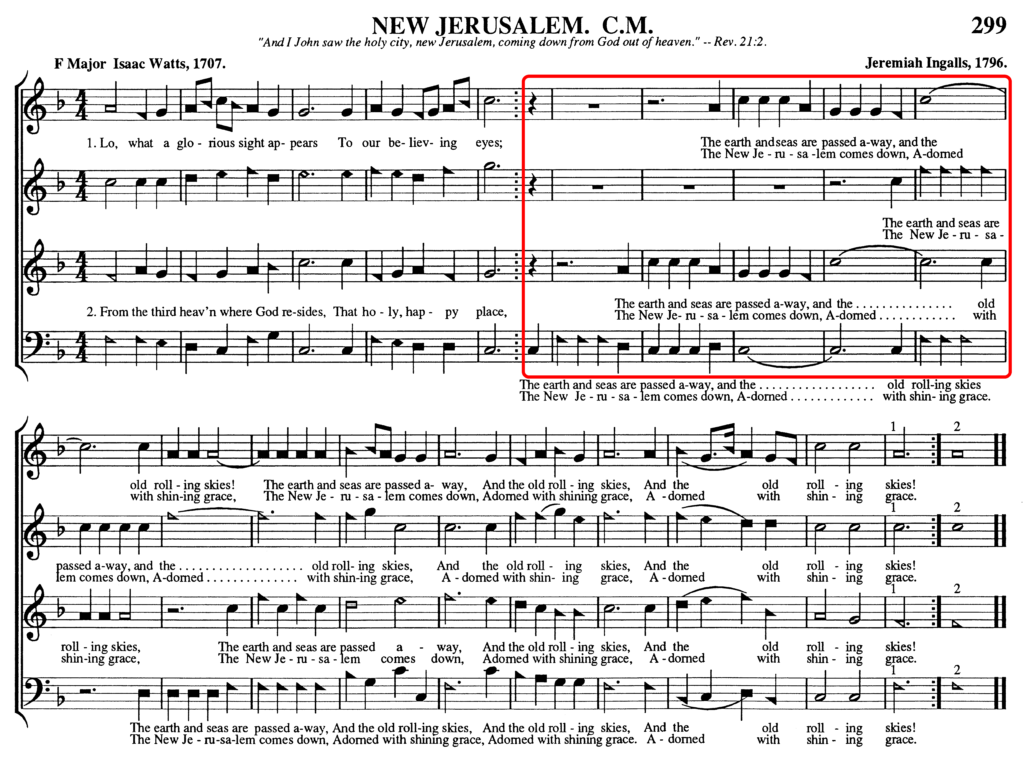
Many of the songs in The Sacred Harp leverage specific features of the hollow square for musical and emotional impact. The three immersive recordings of the Sacred Harp singing at Mt. Lebanon feature songs exemplifying two such approaches: fuging among the voice parts and traded high notes between the tenor and treble parts. Fuging tunes are among the most characteristic and popular song forms in The Sacred Harp. Typical fuging tunes begin with all the parts singing together, followed by a section in which each of the four voice parts enters in sequence, finally coming together again before the conclusion of the song.7Irving Lowens, "The Origins of the American Fuging Tune," Journal of the American Musicological Society 6, no. 1 (April 1, 1953): 46, https://doi.org/10.2307/829998. On fuging tunes, see also Karl Kroeger, American Fuging-Tunes, 1770–1820: A Descriptive Catalog (Westport, CT: Greenwood Press, 1994); Maxine Ann Fawcett-Yeske, "The Fuging Tune in America, 1770–1820: An Analytical Study" (PhD diss., University of Colorado at Boulder, 1997); Jesse P. Karlsberg, "Genre Spanning in the Close and Dispersed Harmony Shape-Note Songs of Sidney Whitfield Denson and Orin Adolphus Parris," American Music 35, no. 1 (2017): 94–132. The most common of these entrance patterns, as found in Jeremiah Ingalls's "New Jerusalem," led by Eli Hinton of Atlanta, Georgia, is propelled forward not just by the cascade of entrances and their progression from lower to higher voices, but by their spatialization. The entrance pattern proceeds counterclockwise around the hollow square, with basses followed by tenors, trebles, and altos.8"New Jerusalem," music by Jeremiah Ingalls (1796), words by Isaac Watts (1707), in McGraw et al., The Sacred Harp, 299.
Generations of composers have adopted this pattern and experimented with alternatives, frequently inspired by the arrangement of the vocal parts around the hollow square. After a short fuging section, Amos Munson's "Newburgh," led by Cheyenne Ivey, a member of a singing family from Henagar, Alabama, leverages the physical separation of the vocal parts to dramatize the celestial distance between the sun and stars. After the basses to the right of the leader enter on the phrase "Thou sun with golden beams" and all four parts sing "And moon with paler rays," the trebles, to the leader's left, reply with a shimmering "Ye starry lights, ye twinkling flames, Shine to your Maker's praise."9"Newburgh," music by Amos Munson (1798), words by Isaac Watts (1719), in McGraw et al., 182.
Composers also rely on the separation of vocal parts to create moments of power and energy by trading prominent high notes in rapid succession between the tenor and treble parts, a feature that singers often refer to as "thunder and lightning." Since these two parts are typically sung by mixed gender groups with similar vocal ranges, this trading back and forth of high notes would be undetectable without the vocal separation that the hollow square provides. In songs like C. Curtis's "Providence," led here by siblings Wanda Capps and Danny Creel from Dora and Hoover, Alabama, respectively, the traded high notes are distinct and clearly audible, contributing dynamic crackling energy to the song. "Providence" features "thunder and lightning" in multiple places. After a short opening section, the song's chorus begins with the trebles singing a musical phrase that peaks on a high note (accompanied by the basses) which is immediately echoed by the tenors. The song continues with similar exchanges, culminating in a figure ricocheting from the tenor to the treble as the song reaches its conclusion.10"Providence," music by C. Curtis (1820), words by Isaac Watts (1719), in McGraw et al., 298.
Recording the Hollow Square
For singers and scholars, Sacred Harp's spatial qualities have made recording the style appealing. Yet the results have persistently struck their makers and audiences as falling short of conveying the experience of being at a singing. The earliest field recordings, made by John W. Work III in 1938 and Alan Lomax and George Pullen Jackson in 1942, used then-available monophonic technology, collapsing the music's richly spatialized four-part harmonies to a single channel of recorded sound.
For Lomax, frustration with the result prompted him to include Sacred Harp singing in his itinerary for the "Southern Journey" field recording sessions he conducted in August through October of 1959 after he first gained access to portable stereo recording technology. The ensuing recordings, released in part as All Day Singing from "The Sacred Harp" (1961), provide considerably greater depth and intimacy than the monophonic recordings from the 1930s and 1940s, and contributed to greater public awareness of and interest in participating in Sacred Harp singing during the folk revival.11Alan Lomax and Alabama Sacred Harp Singers, All Day Singing from "The Sacred Harp," recorded 1959, 33 1/3 rpm record, Southern Journey (Bergenfield, NJ: Prestige, 1961). But Lomax's vantage point at one corner of the hollow square contributed to an imbalance among the parts that bothered contemporaneous Sacred Harp singers. The Sacred Harp Publishing Company, publisher of the most widely used tunebook at singings, responded by recording, producing, and releasing a series of LPs in the 1960s and 1970s, recorded in a studio and mastered to provide what they deemed a more satisfying balance of the parts.12Cobb, The Sacred Harp. When quadrophonic sound systems—one speaker for each Sacred Harp voice part!—proliferated in the 1970s, the same organization planned a release in this format, but the project was eventually shelved.
Conclusion
In the 2020s, as in the 1930s, there is no substitute for experiencing a Sacred Harp singing in person; singings today are held across the United States and beyond every weekend of the year. Yet we think the recordings of these three songs provide new virtual access to the experience of Sacred Harp's spatiality. We invite you to explore the activity in different parts of the singing space by shifting your perspective while navigating the video on your desktop monitor or your phone's YouTube app. If you wear headphones, you can hear the spatial audio shift along with the visual field of view. If you have access to a virtual reality headset, you can immersively experience the perspective these recordings afford. We plan to stage virtual reality viewings of these recordings at the Camp Fasola Sacred Harp singing school and at other singings in 2020. We will also make recordings of other songs accessible through the web in the coming months to expand the selection of songs and leaders captured using this technology. 
Additional Videos
- Philip Gilmore, of Oneonta, Alabama, leads Ananias Davisson's "Idumea" (p. 47b) from The Sacred Harp.
- Ewa Lichnerowicz, of Dublin, Ireland, leads S. M. Denson's "Praise God" (p. 328) from The Sacred Harp.
- Cindy Tanner, of Henagar, Alabama, leads George Coles's "Green Street" (p. 198) from The Sacred Harp.
- Beth Wallace, Eady Porter, Aubrey Zeanah, and Ridley Colvin, of Fayette, Northport, and Demopolis, Alabama, lead O. A. Parris's "My Brightest Days" (p. 546) from The Sacred Harp.
- Judy Caudle, of Eva, Alabama, leads H. S. Rees's "Sweet Morning" (p. 421) from The Sacred Harp.
About the Authors
Steve Bransford is the senior video producer at the Emory Center for Digital Scholarship. His documentary feature, The Well-Placed Weed, is available on Vimeo.
Jesse P. Karlsberg is the senior digital scholarship strategist at the Emory Center for Digital Scholarship. He is the project director and editor-in-chief of Sounding Spirit, a research lab and publishing initiative promoting collaborative engagement with historical American songbooks. Karlsberg is an internationally recognized singer, teacher, composer, and songbook editor in the Sacred Harp tradition.
]]>Queer [__] Revolution?
"The place in which I'll fit will not exist until I make it."
—James Baldwin
"The gay revolution began as a literary revolution." This is the first bold statement in Christopher Bram's 2012 cultural history Eminent Outlaws: The Gay Writers Who Changed America. From before the homophile movement of the 1950s to the post-Stonewall gay liberation movement to the virulent activism of ACT UP and other HIV/AIDS activist organizations to the normalcy wars of the 1990s and the fight for marriage equality, the modern LGBTQ+ rights movement has occurred in the streets and in the press, in the courtrooms and in the bedroom, at the intersections and with the hash tag, challenging and revolutionizing American life.
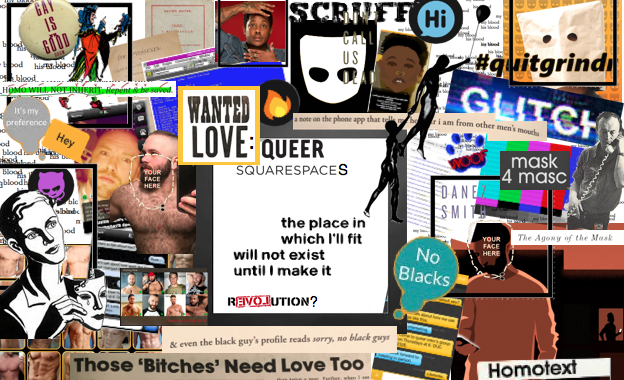
In this article, I suggest that the latest "revolutionary" movement in LGBTQ+ life is not one found in the streets or in published literary forms long familiar to us but in the digital square spaces through which queer intimacy is being reimagined and reenacted. Forms of activism and intimacy have shifted from the mediation of bound rectangles of printed books and pamphlets to the square profiles of gay geospatial social networking and dating applications. It is these square spaces that stand in contrast to the LGBTQ+ normalcy wars of the 1990s and the subsequent proliferation of narratives of assimilation and hetero- and homo-normative relationship structures. Dating and "hook-up" geospatial applications like Grindr, Scruff, Daddyhunt, Growlr, Jack'd, Hornet, Chappy, and others have radically altered the terrain of queer intimacy and precede similar "straight" applications like Tinder that used them as model. As Polly Vernon wrote in "Grindr: a New Sexual Revolution?" (2010): "Grindr is reconfiguring the landscape of human relationships."1Polly Vernon, "Grindr: a New Sexual Revolution?," The Guardian, July 3, 2010, http://www.guardian.co.uk/media/2010/jul/04/grindr-the-new-sexual-revolution/print. Some have described this reconfigured landscape as one of networked intimacy and liquid love, extending Zygmunt Bauman's ruminations into digital terrain.2See Lik Sam Chan, "Ambivalence in Networked Intimacy: Observations from Gay Men Using Mobile Dating Apps," New Media & Society 20, no. 7 (2017): 2566–2581; Mitchell Hobbs, Stephen Owen, and Livia Gerber, "Liquid Love?: Dating Apps, Sex, and the Digital Transformation of Intimacy," Journal of Sociology 53, no. 2 (2016): 271–284. My essay asks several questions to which there are no definitive answers: What do we do with this revolution in queer life? What do we do with this networked intimate landscape? What do we do with this thing called liquid elove?
While others have examined some of these applications' nefarious psychological or public health ripple effects, here I consider two of these applications, Grindr and Scruff, to discuss the vocabularies (a digital lexicon that includes "Masc4Masc," "Woof," and "Tap," among others) and rhetorical methods that queer men deploy to relate to one another anew in both generative and troubling ways. I follow Robert F. Reid-Pharr's assertion that all identities are "essentially permeable and thus impure," and "all names (black, gay, man) are ultimately monuments to the impossibility of ever fully distinguishing self from other."3Robert F. Reid-Pharr, Black Gay Man (New York: NYU Press, 2001), 12. Though impossible to fully distinguish or delineate, and only tenuously related to any authentic representation of self, the square profile spaces of digital dating apps provide stark relief (in literal, discrete boxes) between self and other even if the avatar-self often fulfills the estranged, "other" space in that formulation. In this way, although these apps have revolutionary capabilities and foster a myriad of positive affective encounters both virtual and actual, like earlier moments in queer activist intensity and homotextual production, we are again making code of ourselves in our relational affective structures through mediated digital games of masking, ghosting, haunting, catfishing, kittenfishing, benching, breadcrumbing, cushioning, firedooring, lockering, self-pornographying, among the many other terms in this perpetually expanding digital lexicon.
Finally, I consider lyrical responses to this new "square space" in LGBTQ+ dating practices, namely the poetry of Danez Smith, as a way to illustrate the merging of Bram's high "literary" queer revolutionary tradition with the ongoing "digital" revolution Vernon and others seek to understand. Hopefully, this merger pushes us to think more critically and expansively about the various manifestations of "revolutions" in queer intimacy across time and (real and virtual) terrain as filtered through language, data, "code," and the ever-present "Mask" of queer life.
Mask4Masc: A HomoText(ual) Micro-History
"So we are taking off our masks, are we, and keeping / our mouths shut, as if we'd been pierced by a glance!"
—Frank O'Hara, "Homosexuality" (1954)
A brief historical framing shapes how I think of the generative and troubling dimensions of digital square spaces in contemporary queer life. The figurative "Mask" permeates queer writing and thinking since the first American homotexts, a term I use here to describe explicitly gay/queer-centric publications.4While my conception is perhaps connotatively less complex, I take "homotexts" from a 1978 essay, "Homotextuality: A Proposal," by scholar Jacob Stockinger, who coined the term "homotextuality" to signify one way the then nascent field of gay and lesbian studies might bridge formalist criticism with thematic approaches. The term "homotextuality" itself has a robust history in transnational academic queer literary scholarship, including Robert K. Martin's "Gay Studies in the Victorian Novel" (Newsletter of the Victorian Studies Association of Western Canada 13, no. 1 (1987): 69–71) and Terry Goldie's Pink Snow: Homotextual Possibilities in Canadian Fiction (Peterborough, ON: Broadview Press, 2003). However, as more recent scholars like Catherine A. Davies have written, in the push for a field of homotextual criticism, Stockinger and others often reduced and conflated specific contexts, unique experiences, and cultural moments: the homotextual became the homotext, finite, concrete, fully knowable and not reflective of the spectrum and unknowability of human sexuality, real and imagined. As Davies writes, this model of "homotextuality" seems "to reduce all experiences of same-sex desire to a singular phenomenon" (32). Following Davies, my use of the terms "homotexts" and "homotextuality" herein is not meant to imply singularity or coherent continuity but intersectional moments where what is convergent or divergent might be observed. For me, these moments take place in the "homotexts": fictional, poetic, and nonfictional published works and the "texts" of square spaces. Like Davies, this essay focuses on the "intersections of these divergent lines of gay experience" (Davies 32, emphasis provided). See Jacob Stockinger, "Homotextuality: A Proposal," in The Gay Academic, ed. Louie Crew (Palm Springs, CA: Etc. Publications, 1978): 135–51 and Catherine A. Davies, Whitman's Queer Children: America's Homosexual Epics (New York: Continuum, 2012). In 1906, Edward Prime-Stevenson, writing as "Xavier Mayne," published privately in Italy Imre: A Memorandum, one of the first openly homosexual novels written by an American. Mayne's The Intersexes: A History of Similisexualism as a Problem in Social Life followed two years later, becoming the first study of homosexuality by an American author. Imre's narrative proceeds through parts with subtitles like "Masks" and "Masks and—A Face" and includes lines such as "The Mask—the eternal social mask for the homosexual!—worn before our nearest and dearest" and "I understood perfectly that a man must wear the Mask."5 Xavier Mayne, Imre: A Memorandum (Naples: The English Book-Press, 1906), 146, 111, https://babel.hathitrust.org/cgi/pt?id=mdp.39015019188047;view=1up;seq=7. Mayne's The Intersexes extends these ideas from the fictional to the nonfictional mode and further discusses the pre-U.S. homophile movement's imperative preoccupation with "the Mask":
To hide from his closest friends, from suspicion by the world! Hide it he must. Accounted a diseased human thing, an outcast from men, a beast . . . playing his part like a man . . . . Ever the Mask, the shuddering concealment, the anguish of hidden passion that burns his life away! . . . The Mask, ever the Mask! It becomes like the natural face of the wearer.6Xavier Mayne, The Intersexes: A History of Similisexualism as a Problem in Social Life (Privately Printed, 1908), 86, https://catalog.hathitrust.org/Record/002080887.
In Imre, Mayne writes of the "man-loving man"7Mayne, Imre, 111. as well as "the Friendship which is Love, the Love which is Friendship" in his exploration of Uranian love.8Mayne, Imre, 150. Largely deployed by early "homosexual" thinkers, writers, and advocates like Stevenson, uraninan was once a term used to understand homosexuality, gender variance, and describe same-sex affective bonds. While Imre has a mostly happy ending, the novel still views the "love between two men" as a "nameless horror," one necessitating the mediation of social "masks" to be enacted.9Mayne, Imre, 111.
While I cannot do justice to the richness of either Mayne's Imre or The Intersexes herein, "Xavier Mayne" kicked things off and marked the spot; he put his finger on a queer tension that continues into our present. Foundational to the homotextual literary-activist tradition in the United States is this tension between what Martinican poet-philosopher Édouard Glissant might call transparency and opacity, the desire for love between two men expressed publicly versus a private "anguish of hidden passion" symbolized by the Mask.10Glissant troubles the transparent/opaque binary through his "right to opacity," a right for what one scholar understands as "stubborn shadows." See Nicole Simek, "Stubborn Shadows," symplokē 23, no. 1-2 (2015): 363–373. Glissant states, "As far as I'm concerned, a person has a right to be opaque." See Manthia Diawara's film Un monde en relation (2009). Similarly, he writes in Poetics of Relation, "Opacities can coexist and converge, weaving fabrics. To understand this truly one must focus on the texture of the weave and not on the nature of its components" (190). See Édouard Glissant, Poetics of Relation, translated by Betsy Wing (Ann Arbor: University of Michigan Press, 1997). As Christian Sancto has written, this right need not be understood solely in the judicial-legal sense but as performative. See Sancto, "Visibility in Crisis: Configuring Transparency and Opacity in We Are Here's Political Activism," InVisible Culture 28 (2018). In many ways, this article pays attention to the intersecting performative textures of the mask woven in queer history as one that has persisted, necessarily so for many subjects even as political visibility has increased and expanded legal rights for LGBTQ+ US subjects. Such century's old attention to transparency and opacity in queer cultural production takes on new connotations in the Photoshop age in which it is now possible to modify, highlight, de-focalize what or who can be seen clearly and what or who might be made cloudy. We find this early thinking replicated from 1908 through the official Homophile years of activism beginning in the 1950s, beyond groups like the Gay Liberation Front and the Gay Activist Alliance in the 1970s, through Gay Men's Health Crisis and ACT UP and into our digital present. We can trace the replication of the masked figure through close attention to the genealogy of "coded" thought in queer American life.
From the masked jester of the Mattachine Society to a cover of the Daughters of Bilitis publication The Ladder, post–World War II homophile imagery extends the preoccupation with a necessary secrecy as protection in the era of the Lavender Scare. High literary writers such as Gore Vidal wrote in "code." (Vidal authored pulp fictions under the pseudonyms of Katherine Everard, Cameron Key, and Edgar Box). As Stephen S. Mills writes in his 2014 poem, "A History of the Unmarried," "Frank O'Hara loved Vincent in code: / (F) hearts (V)." This hyper-coded, anonymous and pseudonym-onous form of queer ontology and relationality is the received narrative of queer life at midcentury, when studies of sexual deviancy and the closet-structure were at their apex largely as a result of the social, economic, and indeed existential dangers of visibility.11Another figure of note in this genealogy is William Alexander Percy, who biographer Benjamin E. Wise calls a "sexual freethinker" and who negotiated his same-sex desire against the backdrop of the Mississippi Delta in the first half of twentieth century. Although best remembered for his memoir Lanterns on the Levee (1941), much of Percy's early poetry contains coded referents to Classic Greek tropes of man-man love and friendship in line with other Uranian writers. For an overview of Percy's life and work, see John Howard, "'Our Country'—Benjamin E. Wise's William Alexander Percy," Southern Spaces, April 17, 2012, https://southernspaces.ecdsdev.org/2012/our-country-benjamin-e-wises-william-alexander-percy.
Yet, the pages of homophile periodicals also espoused calls for decoding. The Mattachine Review's September 1958 issue featured the article "Discard the Mask," which in its very title gave the movement an ethical imperative. ONE Magazine featured similar stories, "Homosexuals Without Masks" (November 1958) and "The Tragedy of the Masks" (February 1959).12See Craig M. Loftin's work for deeper critical insight and overviews of much of this ONE Magazine material; Loftin, Masked Voices: Gay Men and Lesbians in Cold War America (Albany, NY: SUNY Press, 2012); Loftin, ed., Letters to ONE: Gay and Lesbian Voices from the 1950s and 1960s (Albany, NY: SUNY Press, 2012). In one of the era's most direct but lesser known homotextual calls for unmasking, Foster Gunnison, Jr., listed as vice-president of the Mattachine Society of Florida, wrote of "The Agony of the Mask" in a 1966 story published in short-lived D.C. homophile periodical The Homosexual Citizen: "Secrecy destroys self-identity . . . To attempt two lives in two worlds at once and still emerge whole would seem to be well beyond the adjustment capabilities of most persons . . . 'The trouble is that for the work's sake you must wear the mask.'"13Foster Gunnison, Jr., "The Agony of the Mask," The Homosexual Citizen 1, no. 4 (April 1966), Don Kelly Collection in Gay Literature and Culture, Cushing Memorial Library, Texas A&M University. In this latter quote within the quote, Gunnison is relating to his readers the feelings of a clergyman who wrote to him and, as Gunnison writes, "shall remain anonymous." Again, the imperative of secrecy and anonymity especially when confronted with the realities of economic survival.14For an overview of Gunnison's papers, see Charles McGraw, "Archives and Sources: The Papers of Foster Gunnison, Jr, and the Politics of Queer Preservation," History Workshop Journal, no. 65 (2008): 179–187.
Across the 1960s, such "anguish" and "agony" over the Mask gave way to a radical if not revolutionary gay and lesbian sensibility in line with the broader social climate and movements. For example: former Students for a Democratic Society member Carl Wittman's 1969 A Gay Manifesto calls for removing the mask of the Mattachine in order to perform a new show: "We've been playing an act for a long time, so we're consummate actors. Now we can begin to be, and it'll be a good show!"15Carl Wittman, "A Gay Manifesto," in We Are Everywhere: A Historical Sourcebook of Gay and Lesbian Politics, ed. Mark Blasius and Shane Phelan (New York: Routledge, 1997): 380–388. Martha Shelley's "Gay is Good," modeled after homophile activist Frank Kameny's earlier coining of that phrase, understood that "the worst part of being a homosexual is having to keep it secret."16"Martha Shelley" is the pseudonym for Martha Altman. For a discussion of her name evolution, see Eric Marcus, "Making Gay History: Martha Shelley," February 21, 2019, in Making Gay History, produced by Nahanni Rous, podcast, mp3 audio, 24:18, https://makinggayhistory.com/podcast/martha-shelley/. See Martha Shelley, "Gay is Good," in We Are Everywhere, ed. Mark Blasius and Shane Phelan, 392. Such activist homotexts responded to publications like Gunnison's "The Agony of the Mask" and still earlier works, such as Xavier Mayne's, in their coalition-building, consciousness-raising calls to visibility as a form of liberation.
And yet, the homotextual periodicals of the gay-Pride era reflect the continuation for masking and secrecy albeit in different forms; post-gay liberation, the inherited coding of queer sexuality and desire for intimate companionship simply evolved to include hanky codes, gay bar and bathhouse secret codes, and other gendered and sexualized forms of inclusion or exclusion. In a letter to the editor published in NEWSWEST, a Los Angeles newspaper for gay people, titled "Those 'Bitches' Need Love Too," San Francisco native Steve Edwards writes, "I only hope that someday we will no longer feel those fears which make us erect such masks, and we will be able to communicate openly and honestly with one another, and without judgment."17 Steve Edwards, "Those 'Bitches' Need Love Too," NEWSWEST, February 19, 1976, Don Kelly Collection in Gay Literature and Culture, Cushing Memorial Library, Texas A&M University. Many proponents of queer digital life celebrate the "open" and "honest" communication that digital applications afford in and for our present, a post-Stonewall line of thinking. The history of liberation is not so simple and the progress narrative too-readily susceptible to critique. The Mask persists, and our attention to both how and where—even if we cannot answer why—it persists is necessary for our coalitional cultural politics.
Few homophile periodicals showed people's faces and much of the material produced by queer writers at midcentury used pseudonyms, like Vidal, replicating Stevenson's "Xavier Mayne" of 1906/1908. While the "ecstasy" of the 1970s might be read as closet doors thrown open and masks removed, I am not alone in arguing that the mask began to take on other forms, wherein the Castro Clone stood in contrast to what Steve Edwards called the "bitchy queen," and the liberated queer world began its own pathway to homonormative standards and expectations. The rhetoric—such as the text-phrase Masc4Masc—and faceless torso profiles common to gay digital dating applications in our current moment are directly related to this history of masking, coding, and erasing certain kinds of sexual and gender identity and performance from mainline queer politics and cultural figurations.18See, for example, Roderick A. Ferguson, One-Dimensional Queer (Cambridge, UK: Polity, 2019). What do we do with the anguish, the agony, and the ecstasy of Masc4Masc in today's queer digital landscape? How is the call for discretion, as in "R U discreet?," any different from earlier terrains of queer intimacy in printed homotexts? Is "Gay is Good" just an appositive for "Grindr is Good," with both "Gay" and "Grindr" standing for gay white masculine-presenting cisgender man? Isn't the Mask still Masc?
This too-brief history gets us to the present, but what do we do in the current digital cruising utopia? My point in setting up this somewhat reductive rhetorical-historical genealogy is to show that before the HIV/AIDS crisis derailed much of this conversation around coding and secrecy in queer life due to its vital-viral and highly publics direct-action politics, many queer homotexts sought to articulate a way of being in the world that directly negotiated the nuances of the "Mask," both within and for queer life. Second, the advent of the digital age and its attendant concerns of mediated spaces of desire and intimate encounter are not by their nature new concerns. Sure, the technology has changed, and the "text" of earlier literary homotexts has been transposed into the text messages exchanged between digital app users. However, as much as this medium shift from text as "literary" to text as "digital"—from the denotative text to the highly visual and spatial domains of digital life—has expanded the definitional dimensions of what we mean when we say textual, rhetorical, spatial, and visual, many of the relational and affective dimensions of digital dating applications echo the coded concerns of earlier generations of queer revolutionaries. In this, LGBTQ+ culture might be more prepared for the hyper-mediated identities and split subjectivities inherent to digital life because of this received history coupled with the already mediated intersectional identities and self-definitions that many of us embody.19Indeed, there is something to be said for a comparative intersectional analysis of the ways in which the "mask" and "masking" have functioned in other historically marginalized and socio-politically oppressed groups using a not explicitly queer framing. For example, in the African diasporic tradition one could trace "masking" from Paul Lawrence Dunbar's "We Wear the Mask" (1896) to W.E.B. Du Bois's "double-consciousness" (1903) to Franz Fanon's Black Skin, White Masks (1952) to Maya Angelou's spoken-word "Mask," among many other entries in a rhetorical genealogy of black thought.
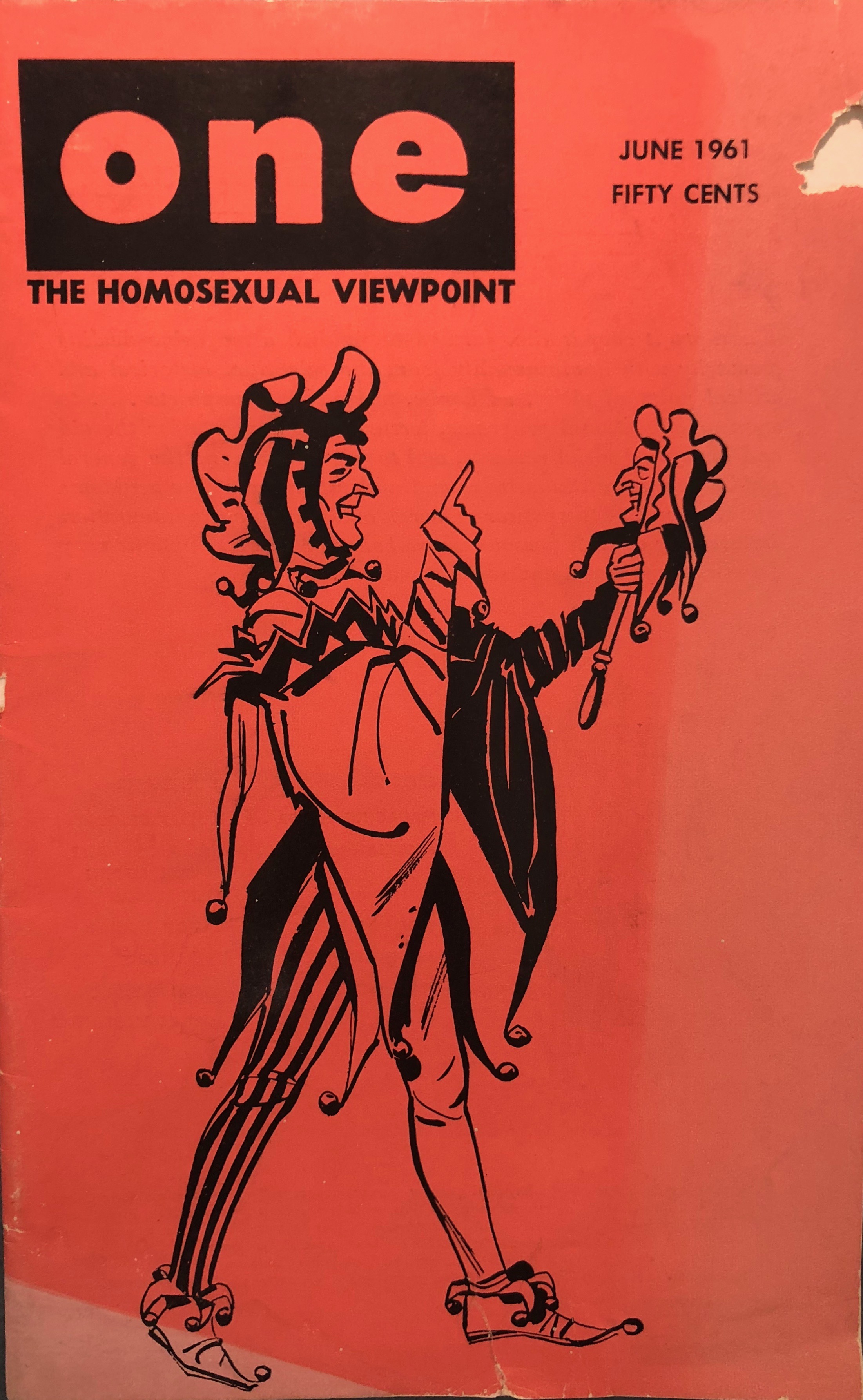
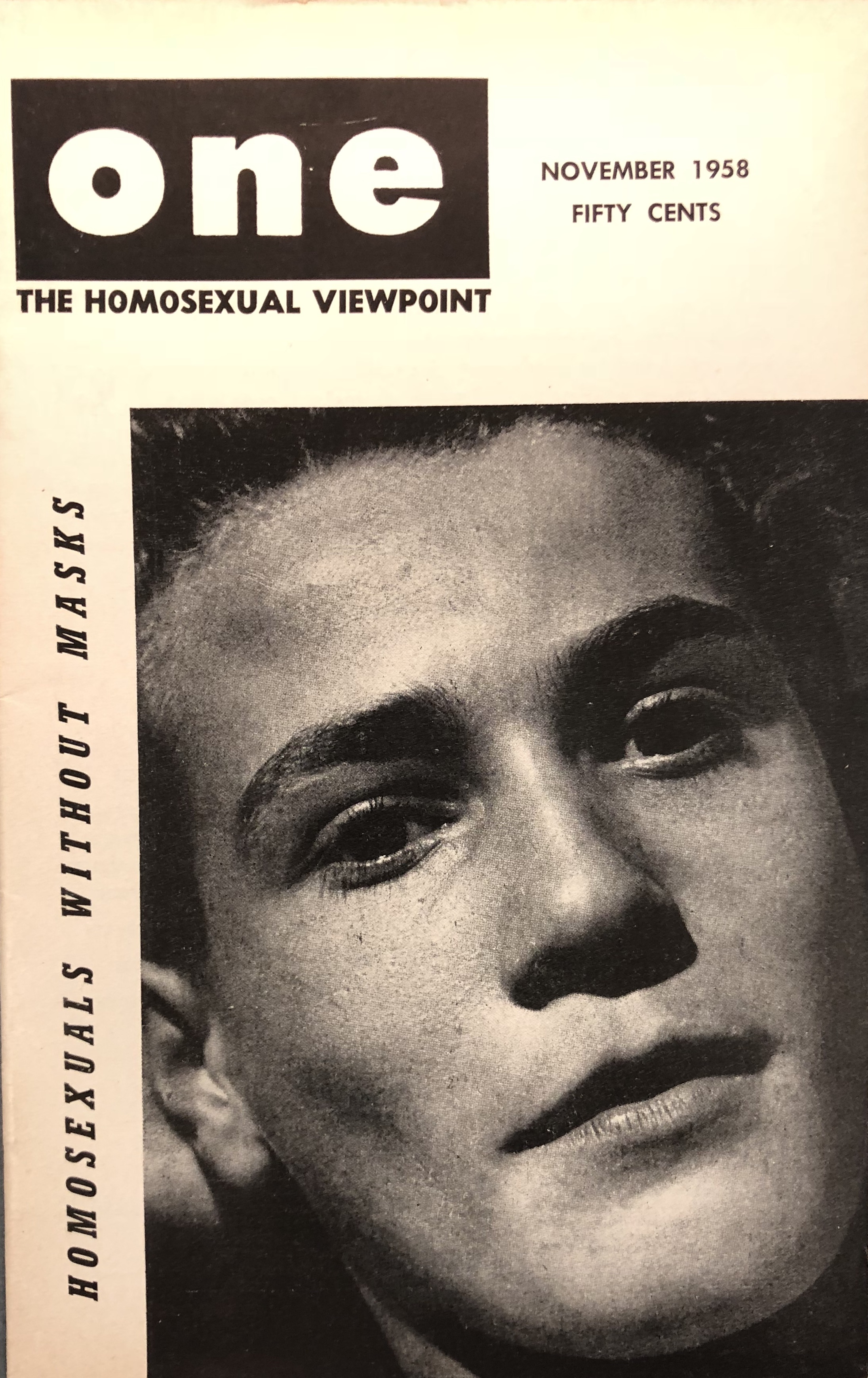
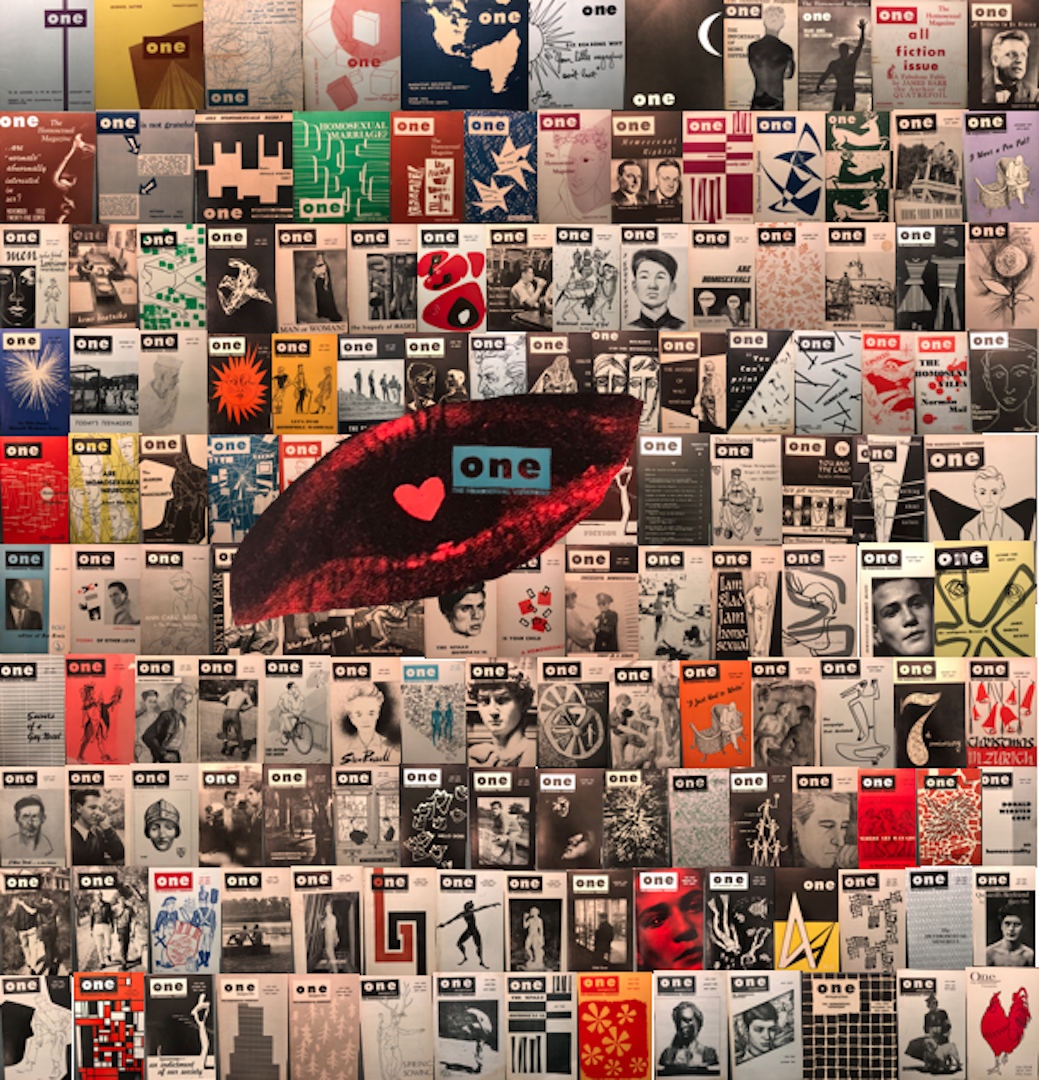
However, in grappling with the often white-cis-gay-male reductive square box of Grindr, we are reminded that masking is a diachronic process through which oppressed groups cope with power structures. Individual acts of masking and collective calls for inclusivity are not concerns unique to Grindr and other digital applications, and to be clear, one can choose to wear the Grindr mask for reasons that are not necessarily non-inclusive or normative. Real and virtual cruising is as complicated as the desire they follow, and I do not suggest here that any group is using Grindr the "right" way. Rather, we may learn from transnational queer-of-color critique how to grapple with those who wear such a Grindr mask and what that mask means for the queer revolutionary present. Much of José Quiroga's work on masks and codes in the Latin American context is essential. Quiroga informs us that, for some, "homosexuality" might be "understood as a constellation—lines of flight, encounters where the code allows for its sparks to fly off in all directions."20José Quiroga, Tropics of Desire: Interventions from Latino America (New York: NYU Press, 2000), 22. As one reviewer of José Esteban Muñoz's work writes, all "cruising is a way of moving with 'no specific destination'; the ultimate goal is 'to get lost [...] in webs of relationality and queer sociality.'"21See Sara Warner, "Cruising Utopia: The Then and There of Queer Futurity (review)," Modern Drama 54, no. 2 (2011): 255-257. Quoted in Joshua Chambers Letson, Tavia Nyong'o, and Ann Pellegrini, "Foreword: Before and After," Cruising Utopia: The Then and There of Queer Futurity (New York: NYU Press, 2019), xiii. Allowing codes to fly off in all directions with no specific destination in "webs" of queer sociality serves as one ethical imperative for how queer people might frame and reframe intimate digital square spaces to consistently resist the reductive hetero- and homonormative structures that exist across twenty-first-century actual-virtual-digital life. Furthermore, in understanding that the "the space of the [digital] mask goes beyond the certainties of assumed identities; it aims, on the contrary, to blur them," we may bring the decades-long norm-confronting work of the queer to bear on the realm of digital queer spaces and the persistent calls to trouble the mask structure for queer life.22Quiroga, 3.
But perhaps this rippling constellation of comments and concerns with masks and codes and inclusivity has gotten ahead of itself. All of this questioning must originate with one question: what are Grindr and Scruff (et al.)? For some, these are still subcultural phenomena, and so I want to take a moment to gloss them. Both Grindr (launched 2009) and Scruff (launched 2010) exist across a spectrum of Web 2.0 geospatial gay social networking applications and mobile platforms targeting narrow intimate markets. As of 2017, Grindr had over 27 million users in 192 countries; Scruff counted 12+ million users in 180 countries. As Andrew DJ Shield has written in "Grindr Culture: Intersectional and Socio-Sexual," with Grindr,
There are no algorithms to match users: instead, Grindr participants initiate contact with (or reject) each other based on one profile photo, about 50 words of text, some drop-down menus, and private chats. By centering on the [square] user photo, Grindr's interface hyper-valuates visual self-presentations, which shapes an individual's experiences on the platform, especially when the user's body provides visible cues about a racial or cultural minority position, gender non-conformity, or disability (150).23Andrew DJ Shield, "Grindr Culture: Intersectional and Socio-Sexual," Ephemera 18, no. 1 (2018): 149–161.
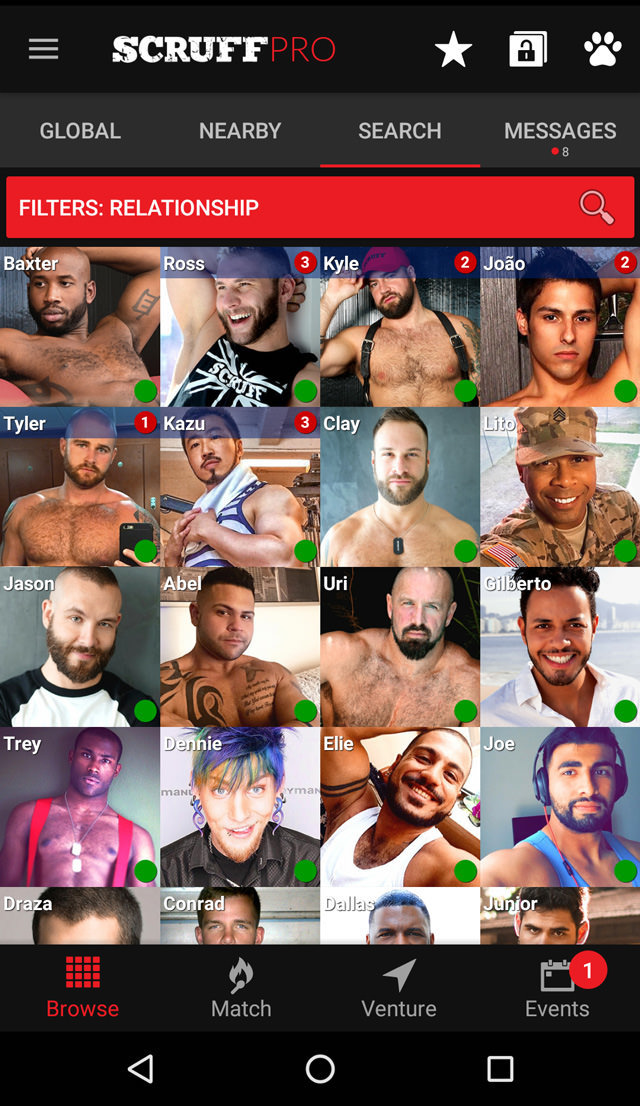
Scruff operates similarly wherein the visual—what is masked or unmasked, concealed or revealed—is, by format and medium, privileged. For both, the textual masks remain in the roughly "50 words of text" that users may select to (mis)represent themselves; both Grindr and Scruff offer a limited range of racial categories, but over time, each has expanded the lexicon of identity constructions, and Scruff, it should be noted, was the first to include space for trans-identification within the homonormative digital app "square-space" framing. Anyone of a certain age can download and use these applications, making them democratic and participatory, in line with Lev Manovich's five principles of new media, and, as spatial and participatory applications, they are in line with Janet Murray's four affordances of digital media.24See Lev Manovich, The Language of New Media (Cambridge, MA: MIT Press, 2001); Janet Murray, Inventing the Medium: Principles of Interaction Design as a Cultural Practice (Cambridge, MA: MIT Press, 2011). Neither Grindr nor Scruff explicitly markets itself as a "hook-up" application; both contain current features like Scruff's Ventures or Grindr's global "Explore" grid that encourage queer travel and exploration and position the platforms as thinking both with and beyond sex. However, most users download the apps for the purposes of cruising or "looking," representing what Tim Dean writes as the heavily mediated nature of gay men's sex lives. As such, the apps operate forcefully as virtual "hook-up" spaces within the queer cultural imagination.25Dean challenges scholars to understand "how erotic contact is mediated" and how we "constitute our objects of research via the languages we use to describe it [...] sex is mediated not only by vernacular but also by expert nomenclatures" (225). He writes, "Looking for UAI' [the scholarly acronym for 'unprotected anal intercourse'] is not something you see on Grindr or cruising websites" (225). See Tim Dean, "Mediated Intimacies: Raw Sex, Truvada, and the biopolitics of chemoprophylaxis," Sexualities, 18, no 1/2: 224–246. In this vein, serosorting (or serodiscrimination) is common on the apps, and many users disclose some degree of sexual health information and sexual practice preferences on their profiles.
Cruising for sexual contact, then, is central to the revolutionary "square spaces" of queer digital intimacy. Rusi Jaspal thinks of Grindr as spatial, as "a new space for sexual self-definition," (189) and Evangelos Tziallas writes of the liberating "self-pornification" the apps enact for many users. These "square spaces," then, are generative of new sexual possibility and definition even if that full possibility has not yet been and may never be attained. Jaspal writes,
Prior to the advent of the Internet, Gay and Bisexual Men used particular social and physical contexts to meet other men, such as saunas/bathhouses, and bars/clubs (Berubé 2003). In the 1970s, for example, many Gay and Bisexual Men employed subtle signifiers (e.g. ''hankie code'', colored handkerchiefs worn in back pockets) to communicate their sexual preferences (Snyder 1989). When the Internet became widely available in the 1990s, it revolutionized the ways in which Gay and Bisexual Men could connect with one another (188).
Like others before and since, Jaspal notes the transitional "revolutionized" landscape of queer intimacy afforded first by the Internet and later by smartphone apps. As John Walker writes, "LGBTQ people have long used digital spaces as a means of connecting with others like themselves . . . Scruff et al. are simply among the latest technological means through which we've learned how to make those connections."26John Walker, "Before Grindr and Scruff: A Brief Oral History of Gay Men Finding Each Other Online," Splinter News, July 19, 2016, https://splinternews.com/before-grindr-and-scruff-a-brief-oral-history-of-gay-m-1793860384. Furthermore, both how we make those digital-intimate connections and how we might use digital technology in the service of our scholarship is a topic queer historian John Howard explores in "Digital Oral History," where he writes, "Digital queer history" both "helps us expose illegitimate hierarchies of productively illicit practices, generating both challenges and possibilities for shattering normative structures of sexual pleasure and desirability" and encourages researchers "to ponder just how far we are willing to bend the rules, as we aggressively push unwieldy old institutions in revolutionary new directions."27John Howard, "Digital Oral History and the Limits of Gay Sex," in Queering the Countryside: New Frontiers in Rural Queer Studies, ed. Mary L. Gray, Colin R. Johnson, and Brian J. Gilley (New York: NYU Press, 2016), 329, 331.
Indeed, this "revolutionary" research is ongoing in many new digital directions as we seek to understand not only the history and development of queer intimacy and affective intensity across various spaces (saunas, bathhouses, bars, clubs, hanky codes, apps, etc.) but also how these newer "square spaces" are playing out in real lives in the here-and-now and how "square space" interactions and encounters might constitute academic evidence within our disciplinary methodologies. First, let me approach the question of Grindr/Scruff as "academic evidence." While many have studied this proliferation of queer dating and hook-up apps since 2007 in terms of the sociological, technological, psychological, or public health impacts of these apps, taking study into those "new directions," here I am more invested both in how queer culture understands them, uses them as means of communication and homotextual composition as well as forms of affective intimate encounter, both virtual and actual, and in their relationship to a long history of LGBTQ+ masking, coding, and inclusionary/exclusionary practices.28For excellent studies in some of these areas, see Rusi Jaspal, "Gay Men's Construction and Management of Identity on Grindr," Sexuality & Culture 21, no. 1 (2017): 187–204; Lik Sam Chan, "The Role of Gay Identity Confusion and Outness in Sex-Seeking on Mobile Dating Apps Among Men Who Have Sex with Men: A Conditional Process Analysis," Journal of Homosexuality 64, no. 5 (2017): 622–637; Evangelos Tziallas, "Gamified Eroticism: Gay Male 'Social Networking' Applications and Self-Pornography," Sexuality & Culture 19, no. 4 (2015): 759–775; Jack Turban, "We Need to Talk about How Grindr is Affecting Gay Men's Mental Health," Vox, April 4, 2018, https://www.vox.com/science-and-health/2018/4/4/17177058/grindr-gay-men-mental-health-psychiatrist. In terms of queer visual rhetoric, it is striking that the logo for Grindr is a mask, usually a black mask against a yellow background or a yellow mask against a black background. Scruff's logo is a bold "S" or its full name in silver against a black background. The niche target audience for each app is somewhat different: Scruff came into being for more mature, hirsute men and pogonophiles in direct contrast to the somewhat younger and smoother early users of Grindr. Such contrast across similar apps remains if often in less stark relief. The evidence attests: although digital applications may represent a certain form of revolution for queer life and a new kind of text for scholars of sexuality to study, the mask—in its textual, spatial, and visual dimensions—persists.
How then are these "square spaces" playing out in real lives in the here-and-now? As one example, as a graduate student I served as co-facilitator of a Queer Men's Discussion Group with an office of LGBT life for two years. During one session, my co-facilitator and I discussed Grindr and Scruff, and while the specifics of that conversation are confidential, the range of responses were vast: from validations of the democratic (even if anonymous) importance such spaces afforded to critiques of their utility for queer life, embodied experience, and issues with inclusivity. In 2016, Gay and Lesbian Review editor Richard Schneider commented on this range of use-value that we are still debating:
Cruising today is more likely to be carried out on smartphone apps like Grindr and Scruff [...] So rapid has been this shift to cyber cruising that its implications for GLBT identity and community have yet to be worked out [...] the cyber world and the classic GLBT world have one thing in common: the possibility of projecting an identity that's either authentic or disguised, out or closeted—or something in between.29Richard Schneider, Jr., "In Time for the Holidays: 'Cruising,'" Gay and Lesbian Review Worldwide 23, no. 6 (2016): 4.
"Identity that's either authentic or disguised, out or closeted—or something in between," again this cyclical tension from the origin of homotextual literary activism, like a spiraling vortex or the seemingly endless image of a Mac's rainbow wheel, returns to us in the digital age. Does one catfish, use other pictures as one's own or ghost, disappear once the allure of the code wears off? R U discreet enough? As we can see, the spaces may have changed, the media may be different, the vocabulary expanded, but the concepts and discourse remain. The ghosts of Xavier Mayne's foundational "Mask" in queer life echo in the ghosting and catfishing encounters mediated by the "filter bubbles" of modern queer digital dating technologies, where the homotext leaps from the printed page of novels and pamphlets to the applications on mobile devices. While this critical, historical, and conceptual framing could go deeper (and it is my hope that this article stimulates further academic and popular conversations), I want to close with a mention of one queer literary figure whose work negotiates the "revolutionary" square space.
The Swipe, the Tap, the Woof, Oh My!: Danez Smith and the Grind of Mediated Digital Desire
". . . everyone on the app says they hate the app but no one stops . . ."
—Danez Smith, "a note on the phone app that tells me how far i am from other men's mouths" (2017)
If Xavier Mayne gave us the evocation of the "Mask" in the wilderness years of pre-gay-rights America with Imre, if Frank O'Hara's poem "Homosexuality" evokes the lyrical (mis)understanding of the mask in 1950s America—"So we are taking off our masks, are we, and keeping / our mouths shut, as if we'd been pierced by a glance!" (1954)—if Mark Doty's 1995 poem "Homo Will Not Inherit" provides us with the landscape of "Downtown Anywhere and between the roil / of bathhouse steam [...] he said to me, I'm going to punish your mouth" of queer spatial intimacies amid post-Stonewall, post-AIDS, 1990s-normalcy-wars, perhaps it is Danez Smith's poetry that gives us both the agonies and the ecstasies of the Grindr mask in our digital age. Danez Smith: the latest queer-literary-activist revolutionary.

Smith's poetry evokes the simultaneously and somewhat paradoxically troubling and generative dimensions of gay digital dating social networks. Smith is a black, genderqueer, and HIV-positive poet and performer whose work often demonstrates how digital intimacy both reinforces and challenges the "essentially permeable and thus impure" nature of identity.30Reid-Pharr, 12. The structure of Smith's first collection (2014) evokes HTML code wherein each section inserts one word into the title [INSERT] BOY: first [INSERT] BOY becomes [black] boy then [papa's lil'] boy, [ruined] boy, [rent] boy, [lover] boy, [again] boy. In the poem "Craigslist Hook-Ups," the speaker recounts three hook-ups orchestrated through online personal ads where the language evokes the expanding lexicon of queer affective terminology: "forgive me father for I have called another man daddy"; "a sloppy chorus of sir yes, please & thank you."31Danez Smith, [INSERT] BOY (Portland, OR: Yesyes Books, 2014), 61, 62. Such language, developed within the queer vernacular and transposed onto Craigslist before becoming lyric evocation in Smith's poems, is potent in its virtual and actual allusions.
However, Smith's second collection Don't Call Us Dead (2017)—their most recent collection is the forthcoming Homie (2020)—directly references the "square spaces" of mobile gay social networking. Indeed the "phone app" of Smith's poem, "a note on the phone app that tells me how far i am from other men's mouths," is most assuredly Grindr. Sometimes through enjambment, Smith's poem juxtaposes the generative aspects of Grindr encounters, virtual and actual, with the troubling ones as in the opening line: "headless horsehung horsemen gallop to my gate / dressed in pictures stolen off Google."32Smith, Don't Call Us Dead (Minneapolis, MN: Graywolf Press, 2017), 32. The figure is "headless," a form of masking common on the apps, which makes him both a "horsehung" horseman, a desired object literally de-faced, and a fraud, "stolen off Google." Smith further evokes how Grindr both concretizes and undermines identity with lines like, "No Fats, No Fems, No Blacks, Sorry, Just a Preference :)" and the accompanying poem entitled "& even the black guy's profile reads sorry, no black guys" to whom Smith addresses the lines "if no one has told / you, you are beautiful & loveable & black & enough & so—you pretty you—am I."33 Smith, Don't Call Us Dead, 32–33. Identity squared-in, then challenged, and ultimately reinforced, sex acts orchestrated and denied, intimacy of various types: Smith's poetry evokes all of the messy complexity of queer digital life through spaces like Grindr, spaces that often reflect the homonormative, transphobic, racist, misogynistic spaces of everyday life. Beyond swipes and taps and woofs, Smith's poetry gives us the get-down-grind of mediated digital desire, what Legacy Russell calls "digital orgasm."34Legacy Russell, "Digital dualism and the glitch feminism manifesto," Cyborgology 10 (2012), http://thesocietypages.org/cyborgology/2012/12/10/digital-dualism-and-the-glitch-feminism-manifesto/. Smith's poetry sees potential (re)generation in what Foster Gunnison, Jr. earlier troubled: the "attempt" at "two lives in two worlds at once," the masks of the virtual and the actual, from which one might "still emerge whole." The attempt may fail, but for Smith there is something potent and beautiful in such failure: "…everyone on the app says they hate the app but no one stops…."35Smith, Don't Call Us Dead, 32. The desire, despite frustration, for more: connection, intimacy, the mediation of two subjects in two separate worlds, a search for some version of (e)love. As David B. Hobbs writes, Smith's poetry "comments on the world and at the same time bends language to hope for the possibility of another."36See David B. Hobbs, "Between the News and a Prayer," The Nation, November 15, 2017, https://www.thenation.com/article/danez-smith-between-the-news-and-a-prayer/. Arguably, this, too, is what the gay geospatial dating applications that Smith riffs off have the potential to do, a possibility to echo and extend the ethic of José Esteban Muñoz's Cruising Utopia: "We must dream and enact new and better pleasures, other ways of being in the world, and ultimately new worlds. Queerness is a longing that propels us onward."37 José Esteban Muñoz, Cruising Utopia: The Then and There of Queer Futurity (New York: NYU Press, 2009), 1.
Furthermore, I want to highlight that beyond references to Grindr and similar apps, digital referents permeate Smith's work. Smith's "elegy with pixels & cum," dedicated to late gay porn star Javier "Kid Chocolate" Bravo, illuminates the dehumanization and objectification of Bravo as well as the glorification, veneration, and immortalization of him afforded by digital life, where "men gather in front of screens to jerk & mourn," again the juxtaposition of liberating carnality and affective intensity.38Smith, Don't Call Us Dead, 48. "[E]legy" is followed by "litany with blood all over," which visually depicts the process of Smith's own seroconversion through digital manipulation: the palimpsestic word cloud of "my blood" and "his blood" becomes increasingly muddied as the separation between the two is impossible to discern, a pool of typography where words mask other words.39Ibid, 51–52. Far from the smartphone's mediation of desire between two autonomous subjects, what these apps reveal through Smith's imagination is a proliferation of desires; the word cloud of Smith's poetry where the digital separation between "him" and "me" becomes increasingly palimpsestic and opaque represents a deliberate blurring, an opacity of unknowingness and unintelligibility, that reflects and replicates the messy masking of the constellation that is desire.
What Danez Smith offers in their poetry is both the context of digital orgasm and an instructive tool, a guide of sorts, to queer digital life for their readers. Smith does this through poetry that reflects the digital form: lowercase lettering throughout, digitally rendered word clouds as poetic meditation, phrases of text struck-through in translucent moments of self-editing, even the separation of poetic sections via two backward slashes evokes the unavoidable presence of digital coding in Smith's lyrical ruminations. Smith's is both digital poetry, written within and for the revolution in queer intimacies and affective human landscapes of the Grindr age, and a lyrical extension of the masked-coded and inclusive coalitional concerns that have permeated homotexts across time in the American queer intimate literary landscape.
Grindr is "Glitch": Or Is the Mask Here to Stay?
"Culture was a way of talking and not talking, it was the code and it was also the mask" (26).
—José Quiroga
I have tried to provide the rhetorical-cultural-spatial-historical, and Smith gives us the lyrical, but perhaps there is more to say about the theoretical potential of Grindr and other apps. I want to end by thinking of Grindr as glitch, a slippery place full of radical cultural potential. In a 2015 article, trans-studies and feminist scholar Jenny Sundén discusses gender as a broken technology, one she thinks of as "accidental error" through the digital term "glitch."40Jenny Sundén, "On trans-, glitch, and gender as machinery of failure," First Monday 20, no. 4 (2015), https://firstmonday.org/ojs/index.php/fm/article/view/5895/4416. While I will not go into Sundén's use of glitch in terms of gender, glitch, etymologically from the Yiddish word glitsh meaning "slippery place," "forces us to pay attention to the materiality and fragility of new media."41Sundén. In this way, Grindr and Scruff are glitchy wherein the possible is sometimes materially attainable via the screen's mediation of fragile and imperfect connections. The proliferation of LGBTQ+ dating and hook-up digital applications clarify and cloud, reveal and conceal, seeking transparency and enacting opacity—a glitch between the virtual and the actual that represents the expansion of the possible as well as the continuation of a m/Mask, a posture once thought of as a "glitch" that was "fixed" via gay liberation and its attendant progressive narratives of closet deconstruction, increased queer visibility, and greater social acceptance.
The digital glitch is often liberating, generative, reductive, ridiculous, troubling: as Zadie Smith questions Facebook and new media gadgetry: "Doesn't it, suddenly, look a little bit ridiculous? Your life in this format?"42Zadie Smith, "Generation Why?," New York Times Review of Books, November 25, 2010, https://www.nybooks.com/articles/2010/11/25/generation-why/. Sure, square spaces are not enough; they're not fully YOU, whatever that you might actually signify; they are not revolutionary enough, not inclusive enough, echoing many of the masks and troubles of our current moment. But as the history of LGBTQ+ movements and the spatial terrain of intimate encounters attests, to quote James Baldwin, "The place in which I'll fit will not exist until I make it."43Baldwin quoted in Claudia Roth Pierpont, "Another Country," New Yorker, February 9, 2009, https://www.newyorker.com/magazine/2009/02/09/another-country. Or as Smith's contemporary Saeed Jones writes, "However many masks we invent and deploy, in the end, we cannot control what other people see when they look at us."44Saeed Jones, How We Fight for Our Lives: A Memoir (New York: Simon & Schuster, 2019), 106. Or, to give the last word to Danez Smith, "We do what we queers do—taking scraps and making an abundance."45Danez Smith, "Reimagining Ourselves in an Increasingly Queer World," New York Times, June 16, 2019, https://www.nytimes.com/2019/06/16/us/danez-smith-lgbtq-essex-hemphill.html. "Grindr is glitch": one slippery place wherein queers continue to make a world that fits them and their forms of loving.
Acknowledgments
First, I would like to thank Don Kelly for his generosity, trailblazing, queer curation, and friendship. Much of the thinking in this piece originated during my tenure with the Don Kelly Research Collection Fellowship in Gay Literature and Culture at Cushing Memorial Library, Texas A&M University. Thanks to the Cushing Library and fellowship team, especially Rebecca Hankins, Michael Jackson, Krista May, Francesca Marini, Leslie Winter, and Jenny Reibenspies for their assistance and warmth during my time in Texas. Thanks as well to the students in my spring 2019 American Studies course, "Queer Intersections, American Outlaws," for helping to expand my thinking on these topics through our discussions. Finally, thanks to those Grindr and Scruff (et al.) users who continue to imagine and enact new possibilities for queer life.
About the Author
Eric Solomon earned his doctorate in English from Emory University and is a visiting assistant professor of English and American Studies at Oxford College, Emory University. His work is featured in Southern Spaces, south, Pop Matters, and Mississippi Quarterly.
]]>Introduction
In August of 1920, Dr. Oscar Dowling, president of the Louisiana State Board of Health, alerted Governor John M. Parker about the increasing availability of a "powerful narcotic, causing exhilaration, intoxication, [and] delirious hallucinations." Dowling, later chairman of the American Medical Association's board of trustees, also wrote the US Public Health Service urging action to prohibit the spread of this drug throughout the country. Surgeon General Hugh S. Cummings replied to express his "complete agreement" with Dowling's concerns. Governor Parker, surprised to learn there was no federal law curbing the drug, wrote John F. Kremer, prohibition commissioner, and alleged, "two people were killed a few days ago by the smoking of this drug, which seems to make them go crazy wild."1David F. Musto, "The Marihuana Tax Act of 1937," Archives of General Psychiatry 26, no. 2 (February 1972): 102. For more on Dowling, see Richard J. Bonnie and Charles H. Whitebread, The Marijuana Conviction: A History of Marijuana Prohibition in the United States, Drug Policy Classic Reprint from the Lindesmith Center (New York: Lindesmith Center, 1999), 43–44. The drug was marijuana.2Though usually spelled "marijuana" today, "marihuana" was the most common spelling in the United States during the early twentieth century. Different spellings from that period also included: marajuana, mariguana, mariahuana, marahuana, marihuano, mariguana, in addition to other common names like "reefer" and "muggles." For consistency, I use "marijuana" throughout, unless directly quoting from sources with varied spellings.
Dowling and Parker's letters marked the early stages of the "marijuana menace"—a panic that coalesced around the alleged spread of marijuana use among criminals and school-age children in New Orleans between 1920 and 1930. In response, both the city and the state of Louisiana passed laws criminalizing the drug's use, sale, and possession. In the weeks that followed the passage of the city ordinance in 1923, police raided houses, restaurants, and soft drink stands to arrest suspected peddlers and users. Police and the press quickly dubbed users as "muggleheads," drawing on the street term for marijuana. A year later, following unanimous passage by the legislature, Governor Henry L. Fuqua signed a statewide law prohibiting marijuana. In the months and years that followed, civic groups and law enforcement officials in New Orleans launched more than one "muggles drive" and declared "war on dealers in marijuana."3For examples of these enforcement measures, see "Cops Make First Marihuana Raids," Times-Picayune (New Orleans), June 17, 1923; "Marijuana War Is Planned by Mrs. Gregson," Times-Picayune (New Orleans), November 30, 1924, sec. Three; "Ax Killer's Trial Set as 'Muggles' Drive Is Ordered," Times-Picayune (New Orleans), April 18, 1929; "Police Open New War on Dealers in Marihuana," Times-Picayune (New Orleans), October 26, 1930.
Previous studies of marijuana prohibition in the United States have given relatively little attention to city- and state-level events such as these, emphasizing instead developments that led to federal marijuana legislation in 1937.4For prominent examples, see Howard Becker, Outsiders: Studies in the Sociology of Deviance (New York: Free Press, 1963); Alfred Ray Lindesmith, The Addict and the Law (Bloomington: Indiana University Press, 1965); David Solomon, ed., The Marihuana Papers (Indianapolis: Bobbs-Merrill Co., 1966); Donald T. Dickson, "Bureaucracy and Morality: An Organizational Perspective on a Moral Crusade," Social Problems 16, no. 2 (Fall 1968): 143–56; Richard J. Bonnie and Charles H. Whitebread, "The Forbidden Fruit and the Tree of Knowledge: An Inquiry into the Legal History of American Marijuana Prohibition," Virginia Law Review 56, no. 6 (October, 1970): 971–1203; Michael Schaller, "The Federal Prohibition of Marihuana," Journal of Social History 4, no. 1 (October 1970): 61–74; Lester Grinspoon, Marihuana Reconsidered (Cambridge, MA: Harvard University Press, 1971); Musto, "The Marihuana Tax Act of 1937"; David F Musto, The American Disease: Origins of Narcotic Control (New Haven, CT: Yale University Press, 1973). The most influential and widely cited, Richard J. Bonnie and Charles H. Whitebread's The Marihuana Conviction (1974), acknowledges the importance of earlier state laws but offers a limited exploration of their origins or municipal counterparts.5Richard J. Bonnie and Charles H. Whitebread, The Marihuana Conviction: A History of Marihuana Prohibition in the United States (Charlottesville: University Press of Virginia, 1974). For instance, although Bonnie and Whitebread note New Orleans's influential role in fostering marijuana menace ideology, they provide only brief analysis on developments in the city and generally ignore passage of the city ordinance in 1923 and state law in 1924. Rather, they argue that until 1926, "very little . . . was done about the marihuana issue until the press seized upon it."6Bonnie and Whitebread, 44. Likewise, in assessing the city's marijuana users, Bonnie and Whitebread write that "use among black and lower-class white elements of New Orleans emerged along with the propensity toward use by youth."7Bonnie and Whitebread, 92. Moreover, younger users were "drawn from the same socioeconomic classes as the adult users."8Bonnie and Whitebread, 44. They offered little evidence for these claims, and believed New Orleans's officials responded to a general spike in crime during the 1920s by using marijuana as a "convenient scapegoat"—dismissing newspaper and law enforcement claims about the dangers of marijuana and its growing user population in the city as "propaganda."9Bonnie and Whitebread, 67, 71, 92. Bonnie and Whitebread's belief that the city's marijuana users came from fringe and minority groups served to bolster their broader argument that racism and xenophobia played a central role in driving marijuana prohibition nationwide. Despite its limited engagement with evidence drawn from the state and local level, this general interpretation has remained largely unchallenged.10For recent examples that draw heavily from Bonnie and Whitebread's interpretation, see Richard Davenport-Hines, The Pursuit of Oblivion: A Global History of Narcotics, 1st American ed. (New York: Norton, 2002); Martin Booth, Cannabis: A History, First U.S. Edition (New York: St. Martin's Press, 2004); Martin A. Lee, Smoke Signals: A Social History of Marijuana—Medical, Recreational and Scientific (New York: Simon and Schuster, 2013); Johann Hari, Chasing the Scream: The First and Last Days of the War on Drugs (New York: Bloomsbury Publishing USA, 2015). For three notable exceptions that have challenged aspects of Bonnie and Whitebread's conclusions and proved highly influential to my own research, see Jerome L. Himmelstein, The Strange Career of Marihuana: Politics and Ideology of Drug Control in America (Westport, CT.: Greenwood Press, 1983); Dale H. Gieringer, "The Forgotten Origins of Cannabis Prohibition in California," Contemporary Drug Problems 26, no. 2 (Summer 1999): 237–88; Isaac Campos, Home Grown: Marijuana and the Origins of Mexico's War on Drugs (Chapel Hill: University of North Carolina Press, 2012).
In contrast, this essay utilizes contemporary coverage from the Times-Picayune newspaper to analyze the impetus for marijuana prohibition and enforcement in New Orleans as well as the spatial and demographic characteristics of the marijuana users arrested. As one of the earliest urban markets for illicit marijuana use, New Orleans offers an excellent case study for testing prominent aspects of the existing historiography. Given what we now know about marijuana's effects, there is certainly much to critique about the often-hyperbolic commentary on its dangers during the 1920s. Nevertheless, contemporary newspaper coverage sheds light on the origins of those claims as well as the hundreds of marijuana arrests that took place in the city. Many of these reports provided information about the suspects, including their names and arrest locations, the quantity of marijuana seized, home addresses, race, and age. What follows is an examination of the sharp rise in commentary on the dangers of marijuana use alongside an analysis of 225 documented arrests during the first seven years of citywide prohibition. These arrests represent only incidents covered in some detail by the Times-Picayune and provide a valuable database for suggesting patterns and trends among the city's users.11Between May 1923 and December 1929, the Times-Picayune published at least three hundred stories with references to marijuana, roughly one per week. The number of articles mentioning marijuana more than doubled during the subsequent seven-year period. From 1930 through federal marijuana prohibition in 1937, the newspaper published more than six hundred and fifty pieces referencing marijuana, demonstrating the continued growth of public concern with the drug. When combined with an analysis of the simultaneous rise in commentary on marijuana's dangers, this essay and accompanying interactive digital map challenge previous interpretations, revealing both a rapid association between marijuana and crime as well as evidence for a predominately young, white user population that helped drive local concern and provided the impetus for legal prohibitions in New Orleans and beyond.
Youth, Crime, and "Marijuana War"
On February 18, 1922, the New Orleans Times-Picayune announced that a new drug habit was growing rapidly in the city. Citing Dr. Oscar Dowling, who first raised the alarm on marijuana some two years earlier, the newspaper reported the "passage of a drastic law to curb the constantly growing practice of selling and smoking marijuana, also known as muggles, will be sought at the next session of the Legislature." Federal assistance also appeared to be on the way. G. W. Cunningham, chief federal narcotic officer for Louisiana, asserted that, "a measure is to be introduced into Congress which would put marijuana in the same class with morphine, cocaine and opium." Cunningham also "rapped the popular impression that marijuana is not harmful"—suggesting its use may have already reached a critical mass in New Orleans. He believed marijuana "was as habit forming as morphine or cocaine" and that "constant smoking will ruin the health."12"New Drug Habit Rapidly Growing, Health Heads Say," Times-Picayune (New Orleans), February 18, 1922. Though a federal law targeting marijuana use would not pass for another fifteen years, the House Judiciary Committee held hearings on the "Prohibition of Peyote and Marijuana in Interstate Commerce" in 1922.
How much the public knew about marijuana is difficult to assess. In October 1921, a Times-Picayune reader wrote about the paper's recent "allusion to the narcotic preparation of a plant called 'marijuana.'" The reader hoped to learn "where it is grown; its effect on the human system and if it is injurious or otherwise." Such questions suggest a general lack of awareness surrounding marijuana in the early 1920s, but that appeared to be rapidly changing. The newspaper's editorial reply included a range of speculation and confusion alongside information on the effects of cannabis drawn from medical journals. It noted correctly that marijuana "consists chiefly of the flowering tops and tender leaves and stalks of the Indian hemp (Cannabis indica)." Yet, it speculated, "the name 'marijuana' is probably a corruption of the 'majoon' of Calcutta, the name given to the hashish made in that city."13"Questions and Answers," Times-Picayune (New Orleans), October 23, 1921, sec. Two. Furthermore, the editorial connected the word hashish with the etymology of the term "assassin"—an oft-cited legend stretching back to Marco Polo and the Crusades.14For extensive analysis of the link between hashish and Islamic assassins, see Jerry Mandel, "Hashish, Assassins, and the Love of God," Issues in Criminology 2, no. 2 (1966): 149–56; Farhad Daftary, The Assassin Legends: Myths of the Ismaʻilis (London: Tauris, 1994); Campos, "Cannabis and the Psychoactive Riddle," in Home Grown: Marijuana and the Origins of Mexico's War on Drugs, 7–38. Just prior to the passage of the federal Marihuana Tax Act, Harry J. Anslinger, first and long-time commissioner of the Federal Bureau of Narcotics, subsequently made this link famous in "Marijuana: Assassin of Youth," The American Magazine 124, no. 1 (July 1937). The Times-Picayune also included an assessment of the drug summarized from existing medical literature:
The effects differ according to the dose and the idiosyncrasy of the individual. One of the first appreciable effects of the drug is the gradual weakening of the powers of controlling and directing the thoughts. This is followed by dreams accompanied by errors of sense, false convertions [sic], and the predominance of one or more extravagant ideas. A minute may seem a year and an hour only an instant; sounds may be exaggerated, and the sense of duration of time and extent of space and the appreciation of personality are lost. Some individuals become pugnacious, while others fall into a state of reverie. After small doses there is a great tendency to causeless merriment. Although less certain in its action than opium, it is said to possess certain advantages over that drug—that it does not induce torpidity of the liver, create nausea or check the secretions, and it is less likely to occasion headache.15"Questions and Answers."
In short, the Times-Picayune editorial tied marijuana to more familiar forms of cannabis, namely eastern hashish, while ably summarizing some of the existing medical information of the drug.16On the heels of pioneering experiments with cannabis conducted in India by Dr. William Brooke O'Shaughnessy, American physicians began debating the potential merits and dangers of cannabis in the 1840s and regularly published their assessments in prominent medical journals. By the late nineteenth century, most agreed that cannabis could be both helpful and harmful and was therefore in need of legal regulation and medical oversight. Nonetheless, after the turn of the century, ongoing difficulty in standardizing medicinal preparations and occasionally frightening side effects in patients led to steady declines in medicinal cannabis use. For an example promptly assessing O'Shaughnessy's work with cannabis, see W.B. O'Shaughnessy, "New Remedy for Tetanus and Other Convulsive Disorders," The Boston Medical and Surgical Journal XXIII, no. 10 (October 1840): 153–55. On the evolution of American physicians' assessment of cannabis medicines, see Adam Rathge, "Cannabis Cures: American Medicine, Mexican Marijuana, and the Origins of the War on Weed, 1840–1937," (PhD diss., Boston College, 2017), http://hdl.handle.net/2345/bc-ir:107531. It was not a difficult leap to more frightful effects characterized by exhilaration, intoxication, and aggressiveness.
As marijuana moved into the public consciousness of New Orleans in the early 1920s, characterizations of its potentially dangerous effects took hold.17For examples, including comparisons between marijuana addiction and stamp collecting as well as a casual mention of marijuana smoking, see "Just What Is Dishonesty," Times-Picayune (New Orleans), July 1, 1923, sec. One-B; "Literature—and Less—Comments on the Books of the Day," Times-Picayune (New Orleans), July 15, 1923. In May 1922, the Times-Picayune proclaimed "'Muggles' Incites Orleans Youths to Crime" and cited Police Detective Paul R. Maureau who blamed the "Mexican drug" for rash of "outbreaks by boy addicts." Maureau claimed one fourteen-year-old automobile thief was a "member of a gang that was accustomed to smoke 'mirauana' or 'muggles' cigarettes, which are supposed to produce recklessness unrivaled by other 'dope.'" Likewise, a juvenile court judge declared that "several boys have admitted using 'mirauana' to 'get up their nerve' for theft and other offenses." One of the boys testified the drug was available as dried leaves or ready-made cigarettes, purchased for twenty-five cents each. Just one cigarette, claimed Detective Maureau, could "contain criminal inspiration for four or five youths." To solidify the link between marijuana use and crime, Maureau affirmed that a man "arrested recently for the murder of a woman was found to be under the influence of 'mirauana.'"18"Says 'Muggles' Incites Orleans Youths to Crime," Times-Picayune (New Orleans), May 29, 1922.
Stories of marijuana use bolstered fear of its spread, prompting a swift response by the city's commission council. On May 18, 1923, the Times-Picayune highlighted the hospitalization of Randall Sharp—"another victim of the Mexican dope, 'Marijuana.'" Physicians at Charity Hospital "declared there is an epidemic of smoking the contraband in New Orleans and that scarcely a day passes without two or three persons being sent there for treatment." The news story further noted an increase of marijuana "in the city within the last few months."19"Mary Warner Epidemic," Times-Picayune (New Orleans), May 8, 1923. Two days later, at the request of District Attorney Marr and a number of medical professionals, City Commissioner Maloney introduced an ordinance "to make illegal the sale of 'cannabis indica,' better known as 'Mari Juana' or the 'Mexican happy smoke.'"20"Council to Act on Sale in City of Mary Warner," Times-Picayune (New Orleans), May 20, 1923; "Use of Mexican Dope Forbidden by City Council," Times-Picayune (New Orleans), May 30, 1923. On May 29, the council officially prohibited possession and sale of marijuana in New Orleans, with violations punishable by a fine of up to $25 and thirty days of imprisonment.21"Use of Mexican Dope Forbidden by City Council"; "A Yarn of Many Threads," Times-Picayune (New Orleans), July 1, 1923, sec. One-B.
A number of factors contributed to the city's efforts to curb marijuana. The drug was frequently among those sold by street peddlers. Its presence alongside other drugs and alcohol seized during police raids bolstered its prominence.22For two examples, see "Police Capture Weed, Wine and Owners in Raid," Times-Picayune (New Orleans), August 26, 1922; "Drug Ring Hunt Seems to Score," Times-Picayune (New Orleans), December 24, 1922. Early reports on marijuana occasionally noted that it arrived in New Orleans via the city's many shipping docks, often tying the drug to Mexican seamen and foreign vessels.23For example, see "Narcotic Leaves Seized on Vessel," Times-Picayune (New Orleans), September 21, 1922. There was also a quick and clear characterization of marijuana's apparent dangers together with dire warnings about its growing use. Prominent physicians and government officials fostered and reinforced these characterizations, and the purported connections between marijuana use and criminal activity.
Nevertheless, the alleged use of marijuana by schoolchildren appears to have been the primary factor in driving city's prohibitory action. A Times-Picayune exposé entitled "The Victim" chronicled what many believed was happening to an alarming number of youthful users. In the parlor of a former mansion turned tenement, reporter Lyle Saxon sat with the mother of a young boy who wept as she said, "To think that this has happened to my little boy, only twelve years old, and a victim of drugs." Her son Seth and his fourteen-year-old brother had sold newspapers after school. All was well until she "began to notice that something was wrong" with Seth: he "would come home with his eyes wide open, staring, but he seemed half asleep. He would say strange things."24Lyle Saxon, "The Victim," Times-Picayune (New Orleans), June 3, 1923, 20. It is worth noting that while marijuana's effects are often widely varied, its use may have the exact opposite effect on a user's eyes—constricting rather than widening. Known as photophobia, this squint is now a common trope in pop culture references to marijuana use. Many of the tropes in this story appear drawn from the temperance movement. For an exploration of how "eyes wide open" was often used as a symbol of madness linked with marijuana use, see Campos, Home Grown, 155–80. Seth would "sleep like a log" and in the morning, his mother would be unable to wake him up for school. He began missing school entirely and bringing home less and less money from the newspaper sales that helped support the family. When asked, "he couldn't account for where it had gone."25Saxon, "The Victim," 20. Seth also began to "stay out all night," until one day he simply did not come home. Missing for three days, his father went in search of him, eventually "coming home with the boy in his arms, his little head hanging down like he was dead." When Seth's parents called the police, they said he "had been smoking marihuana," or "Muggles."26Saxon, 27.
Social workers, physicians, and local police often confirmed the spread of marijuana smoking among school-age children. The findings of Mrs. Emma B. Stanton, who conducted "an investigation among the small boys and youths of the city," escalated the belief that marijuana was widely available. Stanton claimed that she provided a seven-year-old boy with some money and sent him into a saloon. The boy emerged "a few moments later with a little packet of marihuana, rolled in a bit of newspaper—and with the information that a man inside had offered to roll the cigarettes for him because he was too little to roll them himself."27Saxon, 27. An investigation by Lazu Block, chief attendance officer of parish schools, also found evidence of marijuana use among school-age children. At this news, a collective of more than sixty-three affiliated parent-led education clubs (the President's Cooperative Club) met with the district superintendent and adopted "resolutions approving the efforts of the commission council and the chief of police to stop the sale of marihuana or 'muggles' cigarettes."28"Children Using 'Mary Warner,' Officials Fear," Times-Picayune (New Orleans), June 16, 1923.
In July 1923, the Times-Picayune described "Muggles" as the "boon of newsboys and school children who haven't the means to purchase a more expensive drug."29"A Yarn of Many Threads," Times-Picayune (New Orleans). Reporter Lyle Saxon characterized the situation as especially dire: "to curb the smoking of marihuana is an arduous task—as so many boys and men have acquired the habit, and they will brave almost anything in order to get their daily 'shot.'" Saxon believed "the tragedy of the situation is that this drug is striking at the very roots of society in attacking the children." Marijuana use was quickly "making them slaves, not only to the drug, but to those unscrupulous boys and men who find it to their advantages to 'dope' the children, taking from them their hard-earned pennies, gained by selling papers, shining shoes and so on, leaving the children sleeping in alleys, in gutters and in the streets."30Saxon, "The Victim," 27.
Professional medical opinions urged immediate social intervention and police enforcement, stressing the potential dangers of marijuana. "There is little difference in the effects of marihuana and hashish," said Dr. E. J. DeBergue, assistant city coroner. "When first used it produces a form of mild exhilaration. With constant use this exhilaration passes and one uses the drug simply to feel normal." When compared to "more powerful drugs," DeBergue added, "marihuana gives its addicts an appearance of listlessness, numbness, and a general lack of energy. . . . It produces protracted insomnia and may lead to temporary insanity." In short, marijuana was "intensely harmful."31"A Yarn of Many Threads." Dr. John M. Fletcher, professor of psychology at Tulane University, president of the Southern Society for Philosophy and Psychology, and later chairman of the Louisiana Educational Survey Commission, painted a similar picture of marijuana's dangers. Though not a medical doctor, Fletcher analyzed samples of the drug seized during police raids and summarized the existing, if conflicting, characterizations surrounding it. "In use for centuries as a narcotic stimulant," Fletcher noted the effects were "both mental and physical." Users showed "a gradual weakening of the thought processes, together with extreme errors of sense of time and space." Long-term use led to "indigestion, wasting of the body, cough, melancholy, impotence and dropsy." Eventually, Fletcher claimed, "its votary becomes an outcast from society, and his career terminates in crime, insanity and idiocy."32Saxon, "The Victim," 27.
These grave assessments and the growing fear of marijuana's spread among children fueled calls for additional legislative action. In May 1924, newly elected representative Fred W. Oser, a former police reporter for the Times-Picayune and secretary to the commissioner of public safety in New Orleans, brought the city's desire for marijuana enforcement to the state legislature in Baton Rouge. Oser said he often "observed the evils of marijuana," and one of his first actions was to introduce statewide anti-marijuana legislation.33For Oser's quotes see "Red Sticks—Against Marijuana," Times-Picayune (New Orleans), May 14, 1925, 3; "Bills Introduced," Times-Picayune (New Orleans), May 15, 1924, 2. His proposal, which sought to forbid the sale and transportation of marijuana, carried mandatory provisions for a fine and imprisonment and prohibited the trial judge from suspending the sentence. In early June, the judiciary committee of the House favorably reported on the bill.34"Bill Outlaws Marijuana," Times-Picayune (New Orleans), June 4, 1924, 2. Little more than a week later, Oser presented the bill for a vote and insisted there should be no objection from his colleagues. His fellow representatives declared the bill was "splendid and badly needed," insisting, "such a law is absolutely necessary." Oser's bill swept through the chamber, "84 yeas to no nays."35"House Warms Up to Legislative Work," Times-Picayune (New Orleans), June 13, 1924, 4. On July 1, 1924, Governor Henry L. Fuqua signed the legislation into law. The measure allowed for limited sale of specific medically prescribed cannabis preparations, but otherwise prohibited possession, sale, and transportation.36The law restricted prescriptions to medicinal preparations containing a limited percentage of cannabis extract. "Marajuana Outlawed," Times-Picayune (New Orleans), July 2, 1924, 15; "Bills Signed by Governor Fuqua," Times-Picayune (New Orleans), July 13, 1924, sec. One-B, 5; "Orleans Parish Lawmakers to Tell About It at Dinner," Times-Picayune (New Orleans), July 28, 1924, 3.
Backed by the city ordinance and state law, New Orleans law enforcement agents and civic clubs continued their efforts to curb marijuana use, especially among youth. In May 1925, New Orleans coroner, George F. Roeling urged "police cooperation with his department in endeavoring to trace the source from which persons under his care for observation obtain alcohol, habit-forming drugs and 'muggles.'"37"Mentality Tests for Speeders Urged by Coroner Roeling," Times-Picayune (New Orleans), May 31, 1925, 1. A meeting of the New Orleans Federation of Clubs in November included continued allegations of marijuana use by young children. "Marijuana is being sold in drug stores and candy stores throughout the city," declared Mrs. Emma Bell Stanton. "School boys are smoking this pernicious drug in cigarettes, and school girls, automobile riding at night, are becoming intoxicated by it."38"Women to Fight Marijuana Sale," Times-Picayune (New Orleans), November 25, 1924, sec. Part Two, 17. Mrs. Charles Gregson, chair of the Federation of Clubs committee on anti-narcotics, declared "Marijuana War." The first battle aimed to stop use of the marijuana cigarette—what Gregson called "a stepping stone" toward the "use of even more vicious and degrading narcotics."39"Marijuana War Is Planned by Mrs. Gregson." Gregson's use of the term "stepping stone" here may signal the origins of the "gateway drug" theory that ultimately proved highly influential in bolstering a prohibitory stance on marijuana throughout the second half of the twentieth century. Police Detective Henry Asset stressed that the effects of marijuana were "not so deadly in themselves, but in many instances they lead to the use of more powerful drugs."40"A Yarn of Many Threads," Times-Picayune (New Orleans). Mrs. Gregson planned to host a series of lectures for civic clubs and older children on the evils of the drug traffic, and called upon concerned citizens to notify her of places where marijuana cigarettes were sold.41For coverage of Gregson's announcement, see "Marijuana War Is Planned by Mrs. Gregson," 9; "No Man's Land," Times-Picayune (New Orleans), December 14, 1924, sec. Three, 15.
The Louisiana Board of Health called upon Dr. Carleton Simon, a narcotic expert, deputy police commissioner, and lecturer on criminology in New York, to conduct a survey of drug use in the state. Simon's investigation concluded that, "thousands of young men and women in Louisiana are addicted to the use of marijuana, known in underworld haunts as 'muggles' and 'moota.'"42"Thousands of State's Youth Marijuana Addicts, Survey by Criminologist Show," Times-Picayune (New Orleans), August 12, 1926, 6. School officials and parent groups reaffirmed Simon's assessment.43For examples, see "Women to Probe Drivers' License Issuance System," Times-Picayune (New Orleans), October 26, 1926, 3; "National Officer of School Clubs Will Visit," Times-Picayune (New Orleans), October 28, 1926, 5; "Public School Vice Quiz Opens Feb. 23," Times-Picayune (New Orleans), February 20, 1927; "School Alliance Holds Meeting—Stricter Legislation Towards Marijuana Sellers Is Urged," Times-Picayune (New Orleans), May 10, 1927; "School Children Smoke Muggles, Alliance Is Told—Startling Reports Made at Meeting by Mrs. J.G. Skinner," Times-Picayune (New Orleans), May 13, 1928. In January 1927, A. H. Seward, president of the Public School Alliance (PSA), charged that marijuana was "being sold to children in the grammar and high schools."44"Gambling in City Leaves Its Mark on School Boys," Times-Picayune (New Orleans), January 11, 1927, 2. By November, the PSA reported, "a slight increase in the number of marijuana, or 'muggles,' cigarettes sold to and smoked by grammar school children." Some of those children were "as young as those of the fourth and fifth grades" with "traces of this habit . . . seen as early as the third grade."45"More Children Smoke Muggles Alliance Hears," Times-Picayune (New Orleans), November 15, 1927, 2.
![Black newspaper-style text on a white background that reads, "(Sample--Warning card to be placed in R. R. Trains, Buses, Street Cars, etc.) Beware! Young and Old — People in All Walks of Life! This [image of marijuana joint] may be handed to you [image of smiling man and woman] by the friendly stranger. It contains the Killer Drug 'Marihuana' — a powerful narcotic in which lurks Murder! Insanity! Death! [Image of marijuana plant] WARNING! Dope peddlers are shrewd! They may put some of this drug in the [image of teapot] or in the cocktail or in the tobacco cigarette. Write for detailed information, enclosing 12 cents in postage—mailing cost. Address: The Inter-State Narcotic Association (incorporated not for profit) 53 W. Jackson Blvd. Chicago, Illinois, U. S. A."](https://southernspaces.ecdsdev.org/wp-content/uploads/2019/07/rathge_005_psa.jpg "Marijuana Warning Poster, ca. 1971. Poster by Inter-State Narcotics Association. Courtesy of the Wisconsin Historical Society.")
The PSA findings resulted in renewed calls for federal intervention.46Their efforts mirrored earlier attempts out of New Orleans urging federal action on marijuana, dating to Dr. Dowling's letters in 1920. For additional examples, see "We Want Walmsley for Congress," Times-Picayune (New Orleans), March 23, 1924, sec. One-B; "Women Endorse City Bond Issue—Federation of Clubs Will Ask Us Action Against Marijuana," Times-Picayune (New Orleans), November 23, 1926, 19. On the Public School Alliance, see "Alliance Seeks Government Ban on Marihuana," Times-Picayune (New Orleans), December 12, 1928, 37. In December 1928, W.O. Hart, PSA legislative committee chairman, began working with Louisiana Representatives James Z. Spearing and James O'Connor to amend the existing federal Harrison Narcotic Act to include marijuana.47The Harrison Narcotics Act of 1914 regulated and taxed the production, importation, and distribution of opiates and coca products as well as closely monitored the proscribing habits of registered physicians. Congressman Spearing was a longtime member, and two-time president, of the Orleans Parish School Board as well as a member of the Louisiana State Board of Education. "Despite the efforts of the alliance and of its private investigators," declared PSA president A. H. Seward, the traffic in this social leprosy still goes on" and would until Congress passed "suitable legislation, laws with teeth in them."48"Children Smoke Marihuana, Says Head of Alliance—Fight for More Severe Legislation to Be Carried On," Times-Picayune (New Orleans), January 15, 1929, 12; "Alliance Seeks Government Ban on Marihuana," 37. That New Orleans played a central role in raising the issue made news as far away as New York—where headlines seized on the city's "fight to save school children."49"War on Hashish Smoking Is Carried to Congress in Effort to Save School Children," The Brooklyn Eagle, December 20, 1928, 3; "Federal Agents Powerless to End Hashish Traffic," The Brooklyn Eagle, December 21, 1928.
The existence of Mrs. Gregson's "marijuana war," the efforts of civic clubs and the PSA, as well as consistent police enforcement demonstrate that prohibitory marijuana laws in New Orleans remained anything but "dormant."50See Bonnie and Whitebread, The Marijuana Conviction, 44. According to Bonnie and Whitebread, in the fall of 1926, New Orleans police suddenly "arrested more than 150 persons for violation of a law which had lain dormant for two years." It is unclear if they mean the city ordinance or the state law. Nevertheless, given the evidence shown here, there was obviously significant attention focused on marijuana for at least four to six years prior to that particular enforcement sweep in 1926. Contemporary reports clearly show continued enforcement and arrests for marijuana under both the city ordinance and state law throughout this period. There was significant and consistent activity aimed at curbing marijuana use in the city beginning in the early 1920s. For the period between June 1923 and December 1929—roughly the first seven years of enforcement for the city's ordinance—reporting from the Times-Picayune highlighted 225 documented marijuana arrests. The paper's reports shed light on the activities of law enforcement as well as the spatial and demographic characteristics of those arrested. Measuring the prevalence of marijuana use in New Orleans during this period remains difficult given the many source biases and limitations surrounding illicit substances. Examining these reports, however, reveals a user population with characteristics different from those often described by contemporary commentary and subsequent historical studies.
Marijuana Users in Time and Place
One of the most striking differences between the newspaper evidence and the existing historiography on marijuana prohibition is the size of the marijuana market. Most historical studies have suggested marijuana use in the 1920s was a highly regionalized, marginal practice confined to Mexican immigrants and fringe groups and likely exaggerated by contemporary sources.51For examples, see Musto, The American Disease; Bonnie and Whitebread, The Marihuana Conviction; John Helmer and Thomas Vietorisz, Drug Use, the Labor Market and Class Conflict (Washington: Drug Abuse Council, 1974); John F. Galliher and Allynn Walker, "The Puzzle of the Social Origins of the Marihuana Tax Act of 1937," Social Problems 24, no. 3 (1977): 367–76; Himmelstein, The Strange Career of Marihuana. The available evidence from New Orleans suggests otherwise.52The widespread digitization of newspapers and related online databases has undoubtedly made this evidence more accessible to researchers and reinforces the need to reevaluate earlier interpretations. Police activity in the city yielded arrests for possession of a single marijuana cigarette to seizures as large as forty pounds. In 1922, the Times-Picayune recorded three raids netting large quantities. In August, police raided the apartment of Genara Prugillo and Lorenzo Espinoza capturing twenty-one gallons of wine and one hundred and ninety packets of marijuana.53"Police Capture Weed, Wine and Owners in Raid," Times-Picayune (New Orleans). A month later customs officials searched a Mexican steamship moored in New Orleans and seized "two large packages of Mexican Marijuana leaves" valued at New Orleans retail prices exceeding $800.54"Narcotic Leaves Seized on Vessel," Times-Picayune (New Orleans). In December, New Orleans police and federal agents completed an undercover investigation they believed would "smash" a local "narcotic ring." The alleged ringleader was captured with "more than $9,000 of cocaine, morphine and mariahuana."55"Drug Ring Hunt Seems to Score," Times-Picayune (New Orleans). Little more than a year later, New Orleans police made a series of arrests that netted similarly large amounts of marijuana, including seizures of fifteen pounds, five pounds, forty pounds, and ten pounds.56"Marihuana Haul Made By Police," Times-Picayune (New Orleans), January 17, 1924; "American Craze for Marihuana Builds Industry," Times-Picayune (New Orleans), March 10, 1924; "Arrest Marihuana Seller," Times-Picayune (New Orleans), March 10, 1924, 14; "Marijuana Seized Valued at $3,000," Times-Picayune (New Orleans), April 20, 1924, sec. Five, 8; "Decision Upholds Recorder's Stand," Times-Picayune (New Orleans), May 1, 1924; "Alleged Ex-Convict Held, Drug Seized," Times-Picayune (New Orleans), May 31, 1924, 3.
Given such volume, it is hard to dismiss the situation in New Orleans as journalistic sensationalism or law enforcement propaganda although it is easy to criticize the contemporary assessment of the dangers posed by marijuana use given our present understanding. The size and frequency of seizures in New Orleans during the early 1920s attest to the scope of the city's marijuana market. Arrests for simple possession as well as large quantities occurred regularly. Street-level arrests and sting operations often yielded only a few marijuana cigarettes, while quantities seized at larger busts ranged from hundreds of pre-rolled cigarettes to many pounds of bulk marijuana.57For examples of large marijuana seizures, see "Woman Charged Under Drug Act," Times-Picayune (New Orleans), September 27, 1924, 2; "Marijuana Seized," Times-Picayune (New Orleans), July 17, 1925, 23; "Liquors and Drugs Seized by Agents," Times-Picayune (New Orleans), March 23, 1926; "Healy Launches Attack on Vice and Marihuana," Times-Picayune (New Orleans), October 17, 1926; "Marijuana Leads to Arrest of Four," Times-Picayune (New Orleans), January 16, 1927; "Marijuana Drugs Are Seized on Ship," Times-Picayune (New Orleans), February 10, 1927, sec. Part Two; "Woman Is Accused of Marijuana Sale," Times-Picayune (New Orleans), June 28, 1927, sec. Part Two; "Two Marijuana Loads Confiscated," Times-Picayune (New Orleans), October 8, 1927; "Agents on Trail of Large Liquor Smuggling Ring," Times-Picayune (New Orleans), November 11, 1927; "Marihuana, Rum Seized by Federal Officers on Ships," Times-Picayune (New Orleans), February 10, 1928; "$5000 in Marihuana Taken from Ship," Times-Picayune (New Orleans), February 29, 1928; "Marihuana Seized by Captain at Sea," Times-Picayune (New Orleans), March 22, 1929; "Customs Agents Seize Marihuana Valued at $7500," Times-Picayune (New Orleans), October 4, 1929, sec. Part Two. These stories signal a market environment with both large-scale peddlers and small quantity buyers.
The evidence also hints at the existence of a subset of repeat offenders. During the city's "first marihuana raids," for example, police arrested Antonio Bernade and his wife—owners of the Black Cat Restaurant—with "twelve packs of the weed."58"Cops Make First Marihuana Raids," Times-Picayune (New Orleans). Just a week later in a second restaurant raid, police arrested Bernade again, finding marijuana "concealed in a false window."59"Alleged Marihuana Seized," Times-Picayune (New Orleans), June 24, 1923. Less than a month later, police alleged that Mrs. Bernade absconded with the marijuana as officers arrived. Mr. Bernade was arrested a third time on charges of selling marijuana cigarettes to Dominick Potania—"a member of one of New Orleans' best families"—as Potania was leaving the restaurant, giving them reason enough to enter.60"Restaurant Man Sold Marihuana, Police Charge," Times-Picayune (New Orleans), July 8, 1923, 9. A report for this arrest gave a different restaurant address and a slightly differently spelling of his name—Antonio Bernabe. Potania seems to have continued his involvement in the illicit drug market. Six years later, a newspaper report chronicled his arrest alongside Carlo Giacona. According to police, Potania "attempted to conceal a packet of cocaine" while Giacona was "alleged to have had a marihuana cigarette."61"Cocaine, Marihuana Found, Two Jailed," Times-Picayune (New Orleans), May 24, 1929. Giacona was ultimately not tried for this offense, see "Records of the Day—Criminal Court," Times-Picayune (New Orleans), June 15, 1929. Two months later police arrested Giacona again following a raid on his boarding room, where detectives reportedly found "a pound of marihuana seeds."62"Police Nab Youth, Seize Marihuana," Times-Picayune (New Orleans), August 1, 1929. Another repeat offender, Sam Farace, faced criminal charges following his arrest with "a pillow slip containing ten pounds of raw marihuana weed." Just out of state prison, Farace was the proprietor of a "soft drink establishment" that city officials alleged was "a rendezvous for thieves and police characters."63"Alleged Ex-Convict Held, Drug Seized," Times-Picayune (New Orleans), 3. Three years later, during a raid on his family's restaurant, police arrested Farace's younger brother Joseph with two dozen marijuana cigarettes. During that incident, Sam Farace reportedly interfered with the police operation and was "arrested, and charged with disturbing the peace."64"Youth Is Taken in Marijuana Raid," Times-Picayune (New Orleans), April 3, 1927, 15.
The presence of repeat offenders suggests a substantial market for the drug with significant financial incentives. Both offenders and those pushing for stiffer penalties raised the idea that penalties for violation of the city's marijuana ordinance were too weak.65For examples, see "A Yarn of Many Threads," Times-Picayune (New Orleans); "Marihuana Peddler Fined," Times-Picayune (New Orleans), July 3, 1923; "American Craze for Marihuana Builds Industry," Times-Picayune (New Orleans); "Arrest Marihuana Seller," Times-Picayune (New Orleans), 14. Valdo Santos spoke with Times-Picayune reporters following his first arrest on marijuana charges and claimed, "It's not hard to get through. Most of it comes overland, through Texas. We pack it in a suitcase and when we sell out we go back for more. It's easy and a good business. Beats bootlegging and the fines are smaller."66"American Craze for Marihuana Builds Industry." For Santos, this apparently meant big rewards and small consequences. He was arrested again a year later with five pounds of marijuana and forty-eight pre-rolled cigarettes.67"Arrest Marihuana Seller," 14. Police Detective Henry Asset agreed that the punishments for marijuana were not a major deterrent and believed violators easily managed to pay the $25 fine. "Any good peddler," he argued, "can raise that amount."68"A Yarn of Many Threads."
Evidence from the Times-Picayune offers some sense of the diversity of people, places, and situations involved in marijuana arrests. Police regularly targeted soft drink stands, groceries, and restaurants and often implicated them as sites of illicit activity, including the smoking and selling of marijuana.69"Liquor and Mary Warner Seized," Times-Picayune (New Orleans), June 5, 1924, 26. In April 1924, for instance, following an undercover purchase at the restaurant of Manuel Arredondo, New Orleans police confiscated some forty pounds of marijuana. Valued at nearly $3,000, the stash was "concealed in the rear of the place under a trapdoor."70"Marijuana Seized Valued at $3,000," Times-Picayune (New Orleans), 8. Police frequently made marijuana arrests on the streets and sidewalks, including eight young men found smoking in Coliseum Square.71For this instance and others, see "Alleged 'Muggles' Habitues Are Fined," Times-Picayune (New Orleans), July 29, 1923, 3; "More Patrolmen Are Transferred," Times-Picayune (New Orleans), September 10, 1923, 13; "Finds Marihuana in Martina's Store," Times-Picayune (New Orleans), October 17, 1923, 7. Though reports suggest police arrested men far more often, there were also female marijuana peddlers arrested.72The roles women have played in the business of drug trafficking is highly understudied. See Elaine Carey, Women Drug Traffickers: Mules, Bosses, and Organized Crime (Albuquerque: University of New Mexico Press, 2014). Mrs. Carrie O'Donnell was in her grocery store and place of residence when police "found thirty-seven marijuana cigarettes, which complainants said she kept for sale."73"Unable to Find Verboten Law," Times-Picayune (New Orleans), October 2, 1924, 7. Police arrested Mrs. Sadie Garden at home where detectives seized "several thousand marijuana cigarettes, bulk marijuana, a box of morphine and a quantity of grain alcohol."74"Woman Charged Under Drug Act," Times-Picayune (New Orleans), 2. In an era of alcohol prohibition, police frequently seized marijuana alongside liquor.75For just one example, see "Possession Is Charged," Times-Picayune (New Orleans), July 30, 1925, 16.
Reporting also linked marijuana seizures to the city's many ships and sailors. Often, federal customs agents were involved in these incidents. Though the Harrison Narcotic Act did not cover marijuana, a 1915 Treasury Decision banned the importation of cannabis if intended for other than medical purposes.76W. G. McAdoo, Treasury Decisions Under Customs and Other Laws, vol. 29 (Washington, D.C.: U.S. Government Printing Office, 1916), 257. In early 1925, two Mexican seamen faced marijuana charges. Police arrested Antonio Corres on the city docks with "a bag containing marijuana."77"Smuggler Sentenced," Times-Picayune (New Orleans), March 5, 1925, 12. In a separate incident, a customs official trailed Manual Gonzalez as he left the steamship Yuma, leading to his arrest for "possessing six pounds of marijuana."78"Marijuana Seized," Times-Picayune (New Orleans), 23. In a third incident, Juan Horgoros, a "Spanish Seaman," faced marijuana possession charges following his arrest by a customs official.79"Spanish Seaman Held," Times-Picayune (New Orleans), October 21, 1925, sec. Part Two, 17. Four years later, customs agents apprehended William Shanakan and Edward Busamente near the Desire street docks as "the pair attempted to land a small skiff underneath the wharf apron and smuggle ashore seven bags of marihuana." The two men obtained the drug from "unnamed members of the crew of the Honduran steamship Baja California." Shanakan and Busamente floated "with the current alongside the ship on the river side and the bags of the hasheesh weed had been let down from a port-hole to the skiff." Since customs agents could not implicate individual crewmembers, they levied a fine on the entire steamship for "unmanifested contraband."80"Pair Arrested Trying to Land with Marihuana," Times-Picayune (New Orleans), October 10, 1929, 1. Given the regularity with which police and customs agents seized large quantities of marijuana from ships and sailors, it appears the city's market for the drug was substantial and frequently supplied by boat.
Some of these arrests and large-scale smuggling cases lend credence to the belief that Mexican immigrants were responsible for bringing marijuana to the United States and that they made up a significant portion of users. The notion that marijuana use was "a casual adjunct to life" for many Mexican immigrants in the early twentieth century has gone virtually undisputed in the historiography on marijuana prohibition.81For the use of this phrase, see Bonnie and Whitebread, The Marijuana Conviction, 33–34. This broad narrative argues that immigrant Mexican laborers brought marijuana smoking into the United States where it spread to local populations in Texas, California, Colorado, and other states west of the Mississippi River.82Generally known as the "Mexican Hypothesis" or the "Mexican Vector model," this is the most prominent interpretation for marijuana prohibition in the United States. For more on these terms, see Himmelstein, The Strange Career of Marihuana; Campos, Home Grown. In this interpretation, anti-Mexican sentiment and blatant racism provided the impetus for many state and municipal level laws prohibiting marijuana. Recently this interpretation has faced a significant challenge. Historian Isaac Campos has shown that marijuana use in Mexico was anything but a regular habit of everyday life and was largely confined to soldiers, prisoners, and other marginalized groups. Most of the general population avoided the drug, believing it caused "madness, violence, and mayhem." Campos argues that rather than bringing marijuana smoking to the United States, Mexican immigrants relayed the idea that marijuana was an incredibly dangerous drug—"one that triggered sudden paroxysms of delirious violence."83Campos, Home Grown, 2, 5.
Contemporary newspaper coverage in New Orleans reveals evidence for many of these interpretations, but yields limited support for widespread use by Mexican immigrants. Rather, a small number appear disproportionately tied to the early distribution network. Many of the largest seizures of marijuana in the city had connections to steamships from Mexico. There were also reports of a few large seizures involving Mexican suspects and false-bottomed suitcases, neatly built for concealing drugs.84For examples, see "Seven Arrested and 36,000 Grains of Dope Seized," Times-Picayune (New Orleans), June 8, 1923; "Dope Swindle Exposed by Raid on Mexican Club," Times-Picayune (New Orleans), June 9, 1923; "Marihuana Haul Made By Police"; "American Craze for Marihuana Builds Industry," Times-Picayune (New Orleans); "Arrest Marihuana Seller," Times-Picayune (New Orleans), 14. Yet, of the 225 documented marijuana arrests in the Times-Picayune between 1923 and 1929, the newspaper identified only thirty-three total suspects by their ethnicity or race. Mexicans accounted for eleven of that thirty-three, and seven of those eleven came from a single seizure. The paper also identified two additional suspects of "Spanish" origin. Another nineteen suspects not explicitly identified by race or ethnicity did have a traditional Mexican or Spanish surname.85These names include: Martinez (five suspects) with one possible repeat offender, Gonzales (two suspects), Mendoza (two suspects), Busamente (one suspect), Rodrigues (one suspect), Ruiz (one suspect), Garcia (one suspect), Lopez (one suspect), Campos (one suspect), Belasques (one suspect), Torres (one suspect), Spinoza (one suspect), and Santos (one suspect). Those specifically identified as Mexican or Spanish by the Times-Picayune accounted for just five percent of the arrests reported between 1923 and 1929. Adding those with traditional surnames, but unidentified by race or ethnicity, yields twelve percent of documented arrests. The 1930 census data shows 717 citizens in New Orleans listed as "Mexican"—accounting for 0.1 percent of the city's 458,762 residents.
The arrival of Mexican immigrants smoking marijuana did not capture the attention of civic groups and law enforcement, nor did the Times-Picayune give much attention to marijuana use by Mexicans. Neither was anti-Mexican or racist sentiment central to the discussion of the New Orleans city ordinance or state law prohibiting marijuana. Given the city's prominence in launching the "marijuana menace" as a nationwide phenomenon, the absence of blatant anti-Mexican sentiment and the limited number of arrests undermines the intense emphasis on Mexican immigrants found in many histories of marijuana prohibition.86For the most prominent examples of the "Mexican Hypothesis," see Musto, "The Marihuana Tax Act of 1937"; Musto, The American Disease; Bonnie and Whitebread, The Marihuana Conviction.
The same was true of African Americans—another group often associated with marijuana use during this period. Bonnie and Whitebread, for example, suggested that the main users of marijuana in New Orleans were "black and lower-class white elements."87 Bonnie and Whitebread, The Marijuana Conviction, 92. Likewise, in the mid-1930s, FBN Commissioner Harry J. Anslinger often proclaimed a connection between marijuana and black jazz musicians. There is indeed little doubt that marijuana played an influential role in the lives and artistry of many jazz musicians by the 1930s, as many popular songs eluded to marijuana in both implicit and explicit ways.88Bob Beach, "'That Funny, Funny Reefer Man': Reading Reefer Madness Through Jazz Music During the 1930s," Points: The Blog of the Alcohol & Drugs History Society, April 30, 2015, https://pointsadhsblog.wordpress.com/2015/04/30/that-funny-funny-reefer-man-reading-reefer-madness-through-jazz-music-during-the-1930s/. Yet, the arrest records featured in the Times-Picayune include almost no references to jazz musicians or African American marijuana users. Between 1923 and 1929, the paper explicitly identified just sixteen suspects as "negro."89This number accounts for about seven percent of the total arrests covered in this article. According to the U.S. Census Bureau, African Americans made up between 26 and 28 percent of the total population of New Orleans. For census data, see Campbell Gibson and Kay Jung, "Historical Census Statistics on Population Totals by Race, 1790 to 1990, and by Hispanic Origin, 1970 to 1990, for Large Cities and Other Urban Places in the United States" (Washington, D. C.: U.S. Census Bureau, 2005), https://www.census.gov/population/www/documentation/twps0076/twps0076.pdf. In the cradle of jazz, during a period defined by the use of racialized terms to distinguish and denigrate African Americans, the local newspaper evidence reveals little connection between these groups and marijuana use.
The lack of African Americans identified among those arrested for marijuana during this period appears especially stark given that the majority of those arrests occurred in and around today's French Quarter.90It is possible that newspaper reports from these areas simply implied the suspects were African American. That seems unlikely, however, given the frequent use of terms like "colored" and "negro" in other reporting by the paper, crime-related or otherwise. The nearby Storyville, Tango Belt, and Back o' Town neighborhoods were home to many African Americans and were prominently associated with vice, entertainment, and jazz. Storyville was the legendary tenderloin district, a sanctioned site of prostitution until 1917. At its peak, the Tango Belt housed one of the highest concentrations of commercial jazz venues in the city. The Back o' Town was the boyhood home of Louis Armstrong and known as the "colored red-light district."91The adjacent South Rampart Street corridor also had many African American businesses. See "Jazz Neighborhoods—New Orleans Jazz National Historical Park (U.S. National Park Service)," accessed September 4, 2016, https://www.nps.gov/jazz/learn/historyculture/jazz-map.htm. Armstrong left New Orleans in 1922, but apparently did not begin using marijuana until white musicians introduced him to the drug in Chicago later that decade. Armstrong was highly fond of marijuana; he recorded the song "Muggles" in 1928, faced jail time in 1930 for marijuana possession in Los Angeles, and reportedly smoked daily for most of his life. For more on Armstrong and marijuana, see Thomas David Brothers, Louis Armstrong, Master of Modernism (W. W. Norton & Company, 2014). Nevertheless, very few of the documented marijuana arrests in these areas identified jazz musicians or African Americans as the suspects. In May of 1925, for example, a Times-Picayune headline proclaimed, "Vice Squad Again Hits Tango Belt; Score Arrested." Of the fourteen men and six women arrested, only two faced marijuana charges, and neither was identified by the paper as African American.92"Vice Squad Again Hits Tango Belt," Times-Picayune (New Orleans), May 16, 1925.
Though most marijuana arrests occurred near North Rampart Street between Elysian Fields Avenue and Canal Street, there were also smaller pockets of arrests throughout the city, especially south of St. Charles Avenue along the Mississippi River. Interestingly, however, the available home addresses for marijuana suspects show a more even distribution throughout the city when compared with their arrest location. This was true of suspects from working-class areas nearer to the river, especially between Magazine Street and Tchoupitoulas Street, as well as suspects from more affluent areas of the city, including the Garden District and the Uptown/Carrollton area near Tulane University. Based on newspaper reports, the average distance between place of arrest and place of residence was 1.7 miles, with a median distance of 1.1 miles.93Distance data was drawn from 115 records that provided an address for both place of arrest and place of residence. Excluding records where the arrest and residence locations were the same, difficult to locate on a current map, or far outside New Orleans (Biloxi, MS, for example), left seventy-seven records for further analysis. Of those records, the average distance from arrest location to their residence was 1.7 miles, with a median distance of 1.1 miles. The maximum distance was 6.8 miles, the minimum less than 0.1 miles, with a mode of 0.3 miles. These patterns of arrest and home address suggest an illicit market, not unlike those of the present, where the sale of illicit drugs is often concentrated in specific areas of the city, but users regularly come from other neighborhoods to buy.
The dearth of documented arrests for African Americans and Mexicans in New Orleans during the 1920s calls into question long-held historiographic beliefs about the demographics of typical marijuana users.94Though it is difficult to draw firm conclusions, based on the available newspaper evidence it is likely that the vast majority of marijuana suspects were white. Contemporary newspapers generally identified non-whites as "Negro," "Colored," "Mexican," or other similar terms. Thus, when the paper did not provide a race or ethnicity, it seems likely the suspect was white. For another example of identifying and classifying race among arrest records in New Orleans, see Tanya Marie Sanchez, "The Feminine Side of Bootlegging," Louisiana History: The Journal of the Louisiana Historical Association 41, no. 4 (2000): 403–33. Indeed, the available arrest evidence from the Times-Picayune suggests the most common marijuana user in the city was a white male in his early twenties.95About 100 of the 225 documented arrests covered in this essay provided the age of the suspect. Of those with a reported age, the average age was 23.5 years old and the median age was 22.5 years old. Evidence from the Times-Picayune also sheds light on the contemporary concern with the use of marijuana by school age children. The belief that New Orleans youth were falling victim to the marijuana habit was a significant factor in the city's sustained efforts at prohibiting the drug and curbing its use. School officials and civic groups repeatedly claimed that children as young as third and fourth grade used marijuana.96For examples, see "Children Using 'Mary Warner,' Officials Fear"; "Gambling in City Leaves Its Mark on School Boys"; "More Children Smoke Muggles Alliance Hears"; "School Alliance Holds Meeting—Stricter Legislation Towards Marijuana Sellers Is Urged"; "School Children Smoke Muggles, Alliance Is Told—Startling Reports Made at Meeting by Mrs. J.G. Skinner"; "War on Hashish Smoking Is Carried to Congress in Effort to Save School Children"; "Children Smoke Marihuana, Says Head of Alliance—Fight for More Severe Legislation to Be Carried On." Despite the fact that little more than anecdotes supported these assertions, newspaper arrest reports do offer some clues. Of the approximately one hundred arrest reports that provided an age, some twenty-five percent were teenagers. Sixty percent were in their twenties, most under the age of twenty-four. The youngest documented arrest in the Times-Picayune was sixteen-year-old William Casey, seized alongside three other men in their twenties "smoking marijuana cigarettes in the rear room of a soft-drink shop."97"Marijuana Leads to Arrest of Four," Times-Picayune (New Orleans). Two police officers arrested seventeen-year-old Eddie Barker with marijuana cigarettes after he nervously ran away when they approached him on the sidewalk.98"Youth Is Arrested," Times-Picayune (New Orleans), January 15, 1929. Though it is difficult to draw sweeping conclusions from such limited data, there is nonetheless enough evidence here to support insight into the city's concern with youthful marijuana use.
Conclusion: Patterns and Precedents from the Big Easy
As one of the first significant metropolitan markets for marijuana, New Orleans offers fascinating insights into the user population and an excellent test case for existing historiography. Based on newspaper evidence there is little doubt that a thriving illicit market for marijuana existed throughout the 1920s and continued long into the 1930s, as arrests for violation of city and state ordinances continued apace. So, too, did a stern resolve among numerous civic groups, local officials, and law enforcement to curb marijuana use.99For an excellent contemporary summary of various high points in the New Orleans anti-marijuana campaign during the 1920s, see "Crime Trail Widens as Marihuana Fume Descends Upon City," Times-Picayune (New Orleans), April 21, 1929, 22, 24. New Orleans played an outsized role as the "hypodermic needle feeding the entire Middle West with drugs" and as a clear nexus of the "marijuana menace" paradigm.100"Port Termed Hypodemic Needle Feeding Entire Middle West with Drugs," Times-Picayune (New Orleans), March 6, 1926, 1. Locally, two common themes informed the characterization of marijuana as dangerous—a link between the plant and crime alongside a perceived threat to its growing use by young people. The existing historiography offers minimal city- or state-level research on marijuana markets during these years, often dismissing claims of rising use as sensational journalism, police propaganda, and xenophobia. Previous studies have often perpetuated the belief that marijuana use was most prominent among African American musicians and Mexican immigrants, which prompted a racist backlash against the drug that led to its criminalization.101See Himmelstein, "The Rise of the Killer Weed," in The Strange Career of Marihuana, 49–75. Though subsequent scholars have largely ignored his conclusions, Jerome Himmelstein remains a notable exception to this dominant interpretation. In 1983, Himmelstein emphasized the importance of youthful marijuana use in prompting federal action on marijuana in the mid-1930s. Though this essay lends credence to that finding, it also shows the specter of marijuana use among children originated in New Orleans more than a decade earlier. Without discounting the role of overt racism in early marijuana legislation across the United States, the evidence from New Orleans shows a more complicated picture as the demographic and spatial nature of the city's marijuana market contrasts with those common depictions in the existing literature.
New Orleans is perhaps the best place in the United States to witness the emergence and consolidation of anti-marijuana sentiment, serving as the epicenter for what became broadly known as the "marijuana menace." Events that transpired in the Big Easy during the 1920s and 1930s influenced and previewed what emerged at the federal level. The ways in which media coverage, law enforcement, and civic concerns in New Orleans coalesced and reinforced a negative characterization of marijuana repeated themselves elsewhere across the country. The city's concern with youthful marijuana use and the drug's alleged criminogenic effects proved highly influential in the push for federal marijuana legislation. New Orleans produced a tight coterie of local law enforcement, public health, and social welfare officials who carried their anti-marijuana campaign to the federal level. So much so that when Commissioner Anslinger and the FBN launched the now infamous "reefer madness" campaign in the mid-1930s, they drew on existing depictions of marijuana gathered from sources across the country—especially the "muggleheads" of New Orleans.
Acknowledgments
Many thanks to Southern Spaces staff members Stephanie Bryan, who helped create the digital maps published here, and Hannah C. Griggs, who copyedited the map database spreadsheets.
About the Author
Adam R. Rathge holds a PhD in American history from Boston College. His dissertation and book manuscript, "Cannabis Cures: American Medicine, Mexican Marijuana, and the Origins of the War on Weed, 1840–1937," charts nearly a century of medical discourse, social concern, and legislative restrictions surrounding the drug, demonstrating that the origins of our nation's prohibitions on marijuana are much older and more complicated than previous studies have suggested. He is currently Director of Enrollment Strategies at the University of Dayton, where he also teaches undergraduate courses as part-time faculty in the department of history.
]]>
Open Educational Resource (OER) is the name given by proponents of open access to educational material—including course content, assignments, syllabi, and more—freely available to copy and distribute. Increasing the availability of high-quality educational content through OERs is part of a broader movement of open access that disseminates research and critical analysis, reduces barriers to the discovery of scholarship, and enhances education and research initiatives.1"Benefits of Open Access Journals," Public Library of Science, accessed November 17, 2017, https://www.plos.org/open-access/.
A spirit of accessibility and collaboration underpins the creation of OERs. Southern Spaces joins several resources available online for instructors and students interested in incorporating OERs into their teaching and learning, or creating and disseminating their own classroom materials. Open Washington has created a self-paced online workshop that "cover[s] the fundamental aspects of OER including open licensing and public domain" and "provid[es] practical guidance in locating and applying openly available resources."2"How to Use Open Educational Resources," Open Washington, last modified March 3, 2016, http://www.openwa.org/module-1/. The website features OER collections that include videos, images, course materials, and textbooks. Other popular OER repositories include OER Commons, an online public library of OERs, and MIT OpenCourseWare, a "web-based publication of virtually all MIT course content."3"About OCW," MIT OpenCourseWare, accessed November 17, 2017, https://ocw.mit.edu/about/. We hope our own OERs will be useful to Southern Spaces readers as they create syllabi, study guides, and assignments for courses, as well as engage in research projects and conversations about real and imagined spaces.
The Educational Resources section of our website—navigable by clicking "Browse" on the Southern Spaces navigation bar, selecting "Educational Resource" in the menu that appears at the left, then clicking "More"—currently features eight curated educational resources, with more collections forthcoming as the journal continues to innovate in critical regional studies, digital scholarship, and open access publishing.
Educational resources currently available include:
- African American Art and Aesthetic Experiences
- Environments and Ecologies
- Indigenous Souths
- Queer Souths
- Reading and Writing Souths
- Religion
- Social Memory and Memorialization
- Southern Screens
Southern Spaces will update our educational resources as we publish new scholarship, and we will continue to expand the range of subjects our educational materials cover. Upcoming resources will feature collections on music and sound cultures and the Atlanta Metro and Appalachian regions. To offer suggestions for future educational resources, please contact us with ideas and recommendations here.
Using Southern Spaces Open Educational Resources
Southern Spaces seeks to make scholarship accessible and available to a wide audience of researchers and teachers, students in and out of classrooms, library patrons, and general readers. Accordingly, we have created these educational resources for use at multiple educational levels and in various learning situations.
Southern Spaces educational resources are especially suited for discussions of the history of the shifting idea of the American South as well as the emergence of distinct southern regions with their political, social, economic, and cultural expressions. Our long-form interpretive and critical pieces result from extended scholarly engagement with a topic, frequently breaking new ground in critical regional studies, African American, Native, and American Studies, women's and gender studies, public health, and digital humanities. The publications collected in the "Indigenous Souths" educational resource—for example, Sarah H. Hill's expansive studies of Native Removal in Rome and Ellijay, Georgia—stand at the forefront of scholarship on the historical, political, and social dimensions of Cherokee Removal. Similarly, the "Social Memory and Memorialization" educational resource collects innovative Southern Spaces scholarship on such topics as the history of slave labor in the construction of American universities and the Smithsonian; a review of artist Kara Walker's "Blood Sugar" installation; and a video presentation about how Confederate monuments participate in historical erasure.
Our educational resources also emphasize interdisciplinary approaches in the study of southern regions and their global connections. "Reading and Writing Souths," for instance, adapts spatial theory and cultural geography to the study of written expression and literature. Our scholarship on canonical author Flannery O'Connor embodies this approach. Students can examine a photo essay of Andalusia (the farm near Milledgeville, Georgia, where O'Connor spent the last thirteen years of her life), an article that traces the landscapes and characters of her life as they emerge in her letters, a discussion of her importance to novelist Alice Walker in a reconsideration of the "Southern Renaissance," and a visit by poet Sean Hill to the segregated cemetery where she is buried. These sources explore Andalusia and Milledgeville as lived spaces alongside the imagined geographies that O'Connor created. A 2014 blog post, too, presents the many afterlives of the author as they emerge in "Scale Highly Eccentric: A Zine of Portraits of Flannery O'Connor."
We encourage the use of Southern Spaces educational resources in composition and writing classrooms. Our curated collections feature publications that approach a similar theme or subject across multiple genres, creating ways to examine constraints and opportunities unique to each. Studying the rhetorical situation of writing about memory and place collected in "Social Memory and Memorialization," for example, uncovers compelling differences in audience, purpose, tone, style, register, claims, structures, and arguments across the genres we publish. What does poetry offer for Natasha Trethewey's meditations on geography and place compared to a recorded interview or public address? Similarly, studying reviews of films, monographs, photography and art installations, and digital projects create opportunities for teaching the types of analyses, evidence, and organization that scholars use to make critical assessments. The "Southern Screens" and "African American Art and Aesthetic Experiences" educational resources offer robust collections of reviews well-suited for studying composition.
Southern Spaces educational resources also create possibilities for investigating intersections between images and texts. As a digital journal, Southern Spaces delivers audio, video, images, text, and data to facilitate new ways of presenting and interpreting content. "African American Art and Aesthetic Experiences" organizes examples of how visual materials—photographs of homes in Atlanta's Collier Heights neighborhood, the epic quilts of Gwendolyn Ann Magee, or portraits of Low Country Traveler car club members—convey moving narratives and incisive scholarship, as well as examples of how students might integrate media into their own multimodal projects.
Southern Spaces considers the creation and distribution of our educational resources an important part of our mission to make valuable knowledge and insightful critique openly and freely available. We hope these materials generate constructive opportunities for Southern Spaces readers to enhance teaching, learning, and research while reducing costs and barriers.
About the Author
Sophia Leonard is the assistant managing editor of Southern Spaces and a PhD student in English at Emory University.
]]>Introduction
Of countless images over the last century, attempts to frame Appalachia's landscape and people have drawn on a limited number of tropes. Whether Bayard Wootten's photographic illustrations for Cabins in the Laurel,1Muriel Earley Sheppard, Cabins in the Laurel (Chapel Hill: University of North Carolina Press, 1935, 1991 reprint). or the Farm Security Administration (FSA) images of Walker Evans, Elmer Johnson, and Marion Post Wolcott, or photojournalists' frontline depictions of the War on Poverty, the visual encoding of Appalachia has reinforced and recirculated images of a rugged, yet pristine landscape, and a people who are portrayed in equal mixtures of pride and deprivation, perseverance and lack. Without question Appalachia "as a whole" presents a rather problematic construct, embracing a diverse cultural and physical geography with multiple, conflicting borders and covering—by the Appalachian Regional Commission's (ARC) definition—420 counties in thirteen states. The volume of images depicting Appalachia belies diversity, reinforcing instead a homogenized depiction of the "region." That such a broad space and numerous people—congressionally constructed—becomes reduced to one region is itself an oversimplification. A Google image search of "Appalachian photography" reveals visual stereotypes in present-day action, and their limited scope.
While these stereotypical depictions of the region exist across a broad range of media, photography has a way of literalizing this act of framing certain images at the expense of others. But alongside the many attempts to traffic in Appalachian images for commercial or political gain, projects exist that question how photography frames Appalachia: what is contained and what excluded. This effort dates back to some of those images of the FSA Photographic Unit. As Marion Post Wolcott noted, "Constantly we were asked [by Unit Director Roy Stryker] and [we were] asking of ourselves, 'In what direction are we going; are we doing the whole job? How can we fill in the gaps, round out the file…?'"2Betty Rivard, ed. New Deal Photographs of West Virginia, 1934–1943 (Morgantown: West Virginia University Press, 2012), 143. In a similar spirit, Roger May's crowdsourced photography project, Looking at Appalachia (begun in 2014, and ongoing) seeks a broader picture. This collection of images engages in a multivalent and ambivalent approach to framing Appalachia, presenting over four hundred photographs taken by more than one hundred photographers across multiple counties in thirteen states. To visit this collection is to experience "unseeing" the region through multiple frames and lenses. This strategy of "visual counter point," as May describes it, attempts to create a complex and contradictory "crowdsourced image archive [that] will serve as a reference that is defined by its people as opposed to political legislation."3Roger May, "Overview," Looking at Appalachia, 2014, http://lookingatappalachia.org/overview.
Most striking in this "visual counter point" is the degree to which the project is fundamentally frustrating. Each time an image seems to frame Appalachia in a particular way, other images unsettle the frame. As Susan Sontag suggests in Regarding the Pain of Others (2003), "the photographic image… cannot be simply a transparency of something that happened. It is always the image that someone chose; to photograph is to frame, and to frame is to exclude."4Susan Sontag, Regarding the Pain of Others (New York: Picador, 2003), 46. Unlike Wolcott and Stryker's challenge of "doing the whole job," Looking at Appalachia's use of multiple, competing frames undermines any attempt to portray a region in its entirety, or to pin this floating signifier within a fixed, defined border. But, at the same time, each of these images invites us to look at Appalachia—to see Appalachia and what it signifies in this particular image. These multiple, at times contradictory perspectives yield an increasingly complex sense of speakers and voices; as Looking at Appalachia contributor Lou Murrey explains in her commentary on May's project and several other online, collaborative photography projects: "All around Appalachia there are photographers engaged in a dialogue to change and expand perception of the region, allowing folks to declare 'hey, I'm Appalachian too.'"5Lou Murrey, "Out of Frame: Regional Stereotypes in Photography." Appalachian Voices, December 19, 2015. http://appvoices.org/2015/12/19/regional-stereotypes-in-photography/. What is particularly compelling about Looking at Appalachia is that the dialogic qualities of this crowdsourced work find expression in both form and content. Individual pictures declare "I'm Appalachian too," by calling attention to the frames that select these images. As William Schumann has noted in "Place and Place-Making in Appalachia," region is a social and historical construct, emerging through "a process of selectively cultivating some narratives of belonging while erasing other meanings from public discourse."6William Schumann, "Introduction: Place and Place-Making in Appalachia." In Appalachia Revisited: New Perspectives on Place, Tradition, and Progress, ed. William Schumann and Rebecca Adkins Fletcher (Bowling Green: University of Kentucky Press, 2016), 9. The project is fundamentally unsettling to the extent that powerful and idiosyncratic framings do not coalesce into any easy sense of what "Appalachia" signifies, but call attention to acts of inclusion and exclusion. By design, viewers are left in productive confusion, wondering what "region" means in this mixing of frames and images. The project intentionally draws upon the highly problematic ARC-defined boundary for Appalachia for its submission criterion at the same time that it challenges how these borders have framed a regional imaginary. "Appalachia's boundaries," David Whisnant writes, "have been drawn so many times by so many different hands that it is futile to look for a 'correct' definition of the region."7David E. Whisnant, Modernizing the Mountaineer: People, Power and Planning in Appalachia (Boone, NC: Appalachian Consortium Press, 1980), 134. Looking at Appalachia does not offer a "correct" narrative of belonging. It strives to provide a crowdsourced corrective to the dominant visual tropes for Appalachia through its use of multiple, competing frames.
The diversity of images in Looking at Appalachia also reveals the degree to which photographic meaning-making depends upon the power of visual citation. The crowdsourced call to photographers produces clusters of family resemblances in a manner not unlike the same-yet-different clustering that emerges through the social media practice of tagging photographs (for example, the #appalachia hashtag on Instagram.) As Sontag notes, "photographs echo other photographs"8Sontag, Regarding the Pain of Others, 84.; we recognize something in Tamara Reynolds's portrait of a Tennessee man's face (Figure 1), a semiotic resemblance that, when framed as "a face of Appalachia" contributes to the "substantiating archives of images, representative images, which encapsulate common ideas of significance and trigger predictable thoughts, feelings." In these moments of recognition, ideologies take visual form that "commemorate—in no less blunt fashion than postage stamps"—embedded values.9Ibid., 84–86. But as the number of photographers creating these images increases, commemoration becomes an increasingly granular—and increasingly ordinary—act. As Fred Ritchin writes in his discussion of the impact of social media on contemporary photojournalism, the proliferation of images documenting any single event tends to create not only greater variation in the images recorded, but also a greater number of photographs that are "more detail-oriented and everyday, with fewer elaborately constructed attempts at the larger, synthesizing statement."10Fred Ritchin, Bending the Frame: Photojournalism, Documentary, and the Citizen (New York: Aperture, 2013), 11. While an editorial board curates content included in Looking at Appalachia, the project taps into the diffusive power of crowdsourcing with the same intent: to use multiple, idiosyncratic perspectives from professional and amateur photographers alike to refract Appalachia, resisting reduction of these multifaceted photographs into a blunt commemoration.

Visual Dialogues: A Mosaic of Appalachia
In After Photography (2009), Ritchin suggests that the digital photograph acts less as "window" than "mosaic," not only because any digital image consists of pixels, but because once digital, any image exists as a link within a larger network.11Fred Ritchin, After Photography (New York: Norton, 2009), 70. Photography in a networked environment "is far from a mechanical recording; it becomes a collaborative, multivocal interrogation of both external and internal realities in which the initial exposure is only a minimalist starting point."12Ibid., 75. In Looking at Appalachia each photograph speaks to "Appalachia" in its own way, while commenting upon the reality that other images purport. Looking at Appalachia offers a mosaic of disparate images in dialogue with one another. Any image added to the mosaic does not move us closer to completion but only complicates attempts to define a "region." Because the network is always an open-ended structure, an open call for additional contexts, commentaries, and contributions, the project can never be "finished"—even after the editorial board stops adding images. It is in those gaps and contradictions among a large array that the project succeeds in evoking a sense of Appalachia while offering less and less certainty as to what exactly Appalachia contains.
Looking at Appalachia also challenges the power to exclude through the framing of visual design, juxtaposing photographs in a grid layout reminiscent of other photosharing social media services, such as Instagram, Trover, or Flickr. To return to Tamara Reynolds's portrait: this image does not present itself in isolation when we first encounter it. It is already in dialogue with other images—some sharing the same echoes of recognition (perhaps Jaclyn Brown's portrait of Bill Mullaly from Knoxville), while others (an image from the Corazon Latino Festival in Jonesborough) calling attention to all that falls outside the frame of this photograph (Figure 2). Appearing directly above in the image grid is a photograph of a young, blonde-haired woman in sunglasses, head hanging out of a demolition derby car at the Crossville Raceway in Cumberland County. While this image may echo well with other visual tropes for (Southern) Appalachia by way of NASCAR and its mythologized connection to moonshine running, it is not an image that speaks in the same semiotic registers as Reynolds's portrait. Yet both photographs—taken at the same location by the same photographer—contribute to the Appalachian imaginary. Juxtaposed and conflicting images of the same scene call attention to what Judith Butler has termed "frames of recognition"—normative structures that allow recognition of a subject as such, but only through an attempt to exclude or cast off aspects of the subject that "exceed the normative conditions of its recognizability."13Judith Butler, Frames of War: When is Life Grievable? (New York: Verso, 2009), 4. As with the playful series of photographs that went viral in 2015, in which images of a beautifully crafted meal, a woman seated on an empty beach, and a solitary bicycle on an empty road appear in their Instagram frame and in a broader frame that captured everything just outside of that "perfect shot," viewing iconic face and demolition derby car side by side in a grid of competing images reveals how framing is anything but a neutral act, and how any frame depends as much on visual citations of norms that give rise to recognition as it does excluding everything "already outside, which made the very sense of the inside possible, recognizable."14Ibid., 9.
If the imperative of the frame insists, "Look at this (and not that)," then the design strategy of juxtaposing images by diverse photographers with divergent visions compels recognition of what is just beyond the frame—to "look at this and that." The website's overall hypertextual design reinforces this visual tension between framing and what falls outside. Looking at Appalachia greets visitors with a cover image, a logo, links to information about the project, and a menu that invites users to choose a state within the thirteen-state ARC-designated region. The site directs users to select—to frame by state—one set of images of Appalachia over other sets. How viewers engage with the site determines their initial frame of context—whether proceeding alphabetically (Alabama), or via a state considered more central to their understanding (West Virginia) or perhaps beginning with a state that they might only marginally connect with Appalachia (Mississippi). While the site has many points of entry, it offers no final resting point, only a growing number of juxtaposing images, and an increasingly complex mosaic of Appalachia.
Certain images in Looking at Appalachia affirm and commemorate popular cultural assumptions. Consider the contribution of Shelby Lee Adams, a photographer of Central Appalachia who, since the mid-1970s, has garnered considerable attention—and criticism—for creating portraits that would seem to perpetuate stereotypical images of rural deprivation and depravity—what Jason Huettner has called "poverty porn."15Jason Huettner, "Capitalist Realism or Poverty Porn?" Hyperallergic, July 7, 2011, https://hyperallergic.com/28555/capitalist-realism-or-poverty-porn. See also Larry Vonalt, "The Dignity of Shelby Lee Adams's 'Disturbing' Family Photography." Studies in Popular Culture 29.2 (October 2006): 110–121. Adams has only one work included in the project, which, for those only familiar with his more controversial images, may seem a departure of sorts, though one still resonant with Appalachian stereotypes: A portrait of one-hundred-year-old Barbara, from Perry County, Kentucky. The image affirms deeply inscribed indices of the Appalachian "granny" stereotype: her aged face, whiteness, and rugged cheer. But in the mosaic presentation of images on the Kentucky page, her portrait abuts Trey Jolly's landscape of the Daniel Boone Plaza, also in Perry County—a mountaintop removal reclamation site (Figures 3, 4, 5). The nostalgia framing recognition for one photograph only maintains itself as a stereotypical image of Appalachia through exclusion of other images that lie outside the frame—images of extraction and reclamation that are just as much a normative frame as Barbara's weathered and aged face. At the same time, Adams's portrait of this mountain woman asserts itself with equal weight as a counterpoint to the stereotypical framing of Appalachia as a sacrifice zone. Photographs echo one another in ways that both cancel and amplify resonant spatial representations. No single frame can contain Appalachia and its competing significations.
There is reason to closely consider this stereotypical photograph by Adams. In a June 2016 email exchange, May describes Adams as "the first living photographer I entered into conversation with" regarding what it meant to "look at" Appalachia through the lens of a camera and frame it in a particular way. In an essay published on May's blog, Walk Your Camera, Adams situates his work as a visual response to the War on Poverty imagery of the 1960s, which he describes as an ongoing "embarrassment to all."16Shelby Lee Adams, "The Work of Looking." Walk Your Camera, September 7, 2012, http://walkyourcamera.com/looking-at-appalachia-shelby-lee-adams-part-one/. Like Adams, May casts Looking at Appalachia—launched to mark the fiftieth anniversary of the War on Poverty—as an attempt to unravel the "visual definition of Appalachia" that codified over the ensuing half century through the heavy circulation and citation of those images in the mass media.17May, "Overview." While Adams's photographs, like the portrait of Barbara included in Looking at Appalachia, may seem to operate within the same echo chamber of iconic images and visual tropes captured in these Great Society-era photographs, Adams explains that the visual stereotypes that structure Appalachia in the popular imagination are likewise part of his own emplacement in this space. They operate as normative frames that give rise to recognizability. Acknowledging this provides an opportunity to engage in what Adams describes as "the work of looking" in photography:
Our ancestral mountain people are mythologized into our greater existence from our beginnings, a part of our childhood and permanent memories. If we are truly honest with ourselves, we know this cannot be erased. If you are from these mountains, your and my dreams and reality itself are engraved within this collective group consciousness forever. One can choose to repress, but sooner or later, the lives and images of our mountain people will return to us and keep returning until we come to terms with their importance, not just the ones we chose, but all. 18Adams, "The Work of Looking."
He goes on to describe photographs as "catalysts" that can complicate these stereotypes through this work of looking.19Ibid. May admits that his initial response to Adams's photographs was to "dismiss the work as typical stereotyping of Appalachia," yet in confronting those photographs, he likewise had to come to terms with his own embedded stereotypes.20Roger May, "Looking at Appalachia: Shelby Lee Adams—Part Two," Walk Your Camera, September 15, 2012. http://walkyourcamera.com/looking-at-appalachia-shelby-lee-adams-part-two/. By including Adams's portrait of Barbara alongside other photographs that echo competing, iconic images of Appalachia, the project offers its audience an opportunity to catch themselves in the act of recognition, and to question what it is they are recognizing. This play of frames serves as a central feature of how Looking at Appalachia operates, in concept and design—"fram[ing] the frame" that attempts to delimit Appalachia in each of these juxtaposed images. 21Butler, Frames, 9.
It should come as no surprise that Looking at Appalachia traffics in some of the frames of recognition that the project might be expected to attempt to undo. But this crowdsourced collection of images functions collaboratively within a mosaic that shows the recognizable as well as the frame that allows its recognition. Consider the cluster of images depicting bearded men, and the frame of reference within which these images operate. The mountaineer beard is an iconic image of Appalachian masculinity, repeated in university mascot as well as hillbilly stereotype. As beards echo other beards, a visual exchange develops, offering a complex portrait of Appalachian masculinity. A series of three images by photographer Elle Olivia Andersen of Robert Pickens, from Pickens County, South Carolina, offers a frame for the mountaineer that seems to confirm the stereotype—gray-bearded, capped, and wearing overalls (Figures 6, 7, 8). The photographs assert a documentary authority, capturing an "authentic portrait" of Appalachian life. But these images—and this beard—stand in dialogue with other images of bearded men that work against the authority of any one frame. As counterpoint, consider the portrait from Madison, Kentucky, of a younger mountaineer, bearded, but in a hat one would never confuse with an iconic "toboggan" (Figure 9). Other beards appear in other semiotic constellations that suggest an Appalachia outside the frame of any singular attempt to define the "mountain man" (Figures 10, 11, 12). The same visual conversation occurs when the gendered "granny" stereotype in Adams's portrait of Barbara is repeated and contradicted in other photographers' images of Appalachian women, old and young. With each echo of recognition, viewers see "mountain women" and "beards of Appalachia," but as these framed portraits engage one another, they ask, rather than answer: What makes these images recognizable? When you look at Appalachia, what is it that you see?
Frames of Recognition
Butler suggests how frames operate as normative structures giving rise to recognizability and representability: "When a picture is framed, any number of ways of commenting on or extending the picture may be at stake. But the frame tends to function, even in a minimalist form, as an editorial embellishment of the image, if not a self-commentary on the history of the frame itself."22Ibid., 8. Framing is an interpretive act, embedded in the photograph, a material instantiation of various norms of recognizability. "Even the most transparent of documentary images is framed, and framed for a purpose," she writes, "carrying that purpose within its frame and implementing it through the frame."23Ibid., 70. Recognizability is "both jettisoning and presenting" the norms of representation and interpretation, "doing both at once."24Ibid., 73. The "iterable structure" of the frame—the fact that "the frame breaks with itself to reproduce itself"—gives rise to an inherent instability in this interpretive moment.25Ibid., 24. In one sense, Butler notes, "to be framed" implies that one has been set up—the subject of a "false accusation"; but because the frame is always vulnerable to exposing itself, to showing how this interpretive "break" in context operates (jettisoning and presenting), it also marks a potential for "breaking out" of normative structures of recognizability.26Ibid., 11 She writes of these moments of destabilization: "What happens when a frame breaks with itself is that a taken-for-granted reality is called into question, exposing the orchestrating designs of the authority who sought to control the frame. This suggests that it is not only a question of finding new content, but also of working with received renditions of reality to show how they can and do break with themselves."27Ibid., 12.
In a similar move, Looking at Appalachia breaks with itself by offering and destabilizing recognizable norms of Appalachian photography. Returning to the portraits of Robert Pickens (Figures 6, 7, 8), the frame seems to affirm the "quaint but stalwart mountaineer."28John Alexander Williams, Appalachia: A History (Chapel Hill: University of North Carolina Press, 2002), 199. The project as a whole, however, provides multiple iterations of this normative structure that break with themselves through multiple, contradictory framings. Even before Horace Kephart's popular depiction of "mountain whites" in Our Southern Highlanders (1922), the recognizable mountaineer identity has featured a normative whiteness exclusive of the racial and ethnic diversity significant in Appalachian demography.29Williams, Appalachia, 210–211; Horace Kephart, Our Southern Highlanders: A Narrative of Adventure in the Southern Appalachians and a Study of Life Among the Mountaineers (Knoxville: University of Tennessee Press, 1922, 1984 reprint). See also: Patricia D. Beaver and Helen M. Lewis, "Uncovering the Trail of Ethnic Denial: Ethnicity in Appalachia." In Cultural Diversity in the U.S. South: Anthropological Contributions to a Region in Transition, ed. Carol E. Hill and Patricia D. Beaver (Athens: University of Georgia Press), 51–68; Schumann, "Introduction."
Figures 13–16



Numerous portraits within this collection of photographs speak directly to this erasure, and do so by asking viewers to question the recognizability of an Appalachia that reveals its racial and ethnic diversity. To see echoes of the same norms of representation that give us the "stalwart mountaineer," presented in portraits of African American Appalachian men, offers the normative frame of recognition and a break with its own terms for recognizability (Figures 13, 14). Similarly, while immigrant labor populations have moved into and out of the mountains throughout the nineteenth and twentieth centuries, and found their way, for example, into FSA documentation of Appalachian coal towns, ethnic diversity frequently falls outside of the frame of recognizability for "mountain folk."30Rivard, New Deal, 2012. Looking at Appalachia returns these often-erased and overlooked images to a visual dialogue, and does so within recognizable frames that reveal "received renditions of reality" at the same time that they destabilize the authoritative claim of these normative structures. Contemporary photographs of Hispanic mountaineers affirm and destabilize norms of representation (Figures 15, 16). "To learn to see the frame that blinds us to what we see is no easy matter," writes Butler.31Butler, Frames, 100.
Looking at Appalachia's contemporary, crowdsourced images destabilize normative frames of Appalachian nostalgia through photographs of a more mainstream place that works its way in and through recognizable visible tropes of quaint and simple country life. As Williams and others have noted, from the local color writers movement of the late 1800s onward, Appalachia appears as a "reservoir of American folk culture."32Williams, Appalachia, 204. Images outside of this framing reveal acts of selective focus. As Watkins notes of Wootten's 1930s photographs of Spruce Pine and Bakersville, North Carolina, her choice of camera angles and framing emphasized quaintness over development: "Had the camera been placed further back up the street," he notes, in his reading of one image, "the picture would have shown, among other things, a newer department store and a movie theater, more recognizable signs of modernity."33Charles Alan Watkins, "Merchandising the Mountaineer: Photography, the Great Depression, and 'Cabins in the Laurel.'" Appalachian Journal 12.3 (Spring 1985): 227. Williams makes a similar observation: images that "placed [Appalachia] squarely in the American mainstream" historically have been marginalized to make room for more recognizable, nostalgic framings.34Williams, Appalachia, 300. As with depictions of grannies, beards, and mountaineers, Looking at Appalachia does present images that seem throwbacks. Consider Meg Wilson's portrait from Garrard County, Kentucky, of two generations (is it grandfather and grandson?) in a tobacco barn (Figure 17). There are echoes of nostalgia. But the Angry Birds image on the boy's T-shirt connects this scene to traditional Kentucky tobacco farming practices as well as global networks of mobile devices, digital games, and franchise marketing. Similarly, Lou Murrey's candid shot at Skate World in Vilas, North Carolina, frames Appalachia in ways that foreground nostalgia for an imagined simpler and remote American past (Figure 18). A closer look reveals the smartphone in the woman's hand behind the counter, locating this image squarely within the broader context of highly networked American mainstream culture. These moments of contradiction—within and between photographs—create a tension within the project that undermines the authority of these normative frames.
Figures 19–23






Similarly, nature photography in Looking at Appalachia complicates and questions received and expected visual tropes. Chris Jackson's portrait of a young couple walking at the edge of Virginia's Falling Springs waterfall, or Nathan Armes's image of a dirt road on Wayah Bald in North Carolina, echoes photographs framing Appalachian geography as wild refuge (Figures 19, 20). Images of Appalachia as a sacrifice zone reinforce these norms by presenting the opposite—such as Dobree Adams's active mining sites in Perry County, Kentucky, or Pat Jarret's photograph of the Freedom Industries' chemical spill site in Charleston, West Virginia (Figures 21, 22). Other "natural settings" alter these frames: does Amanda Greene's North Georgia Christmas tree farm landscape, with portable toilet in the foreground, offer an image of untouched nature, extractive economy, or something in between (Figure 23)? Or consider Wes Frazer's photograph of a youth in mid-swing over a river in Jefferson County, Alabama (Figure 24). Not only does this image echo other representations of the region as a locus of simple country pleasures (destabilized, of course, by other images in Looking at Appalachia—for example, another Frazer photograph of a tattooed youth huffing inhalants while standing in the same river) but it also depicts Appalachia as a wild and rural refuge from urban and suburban development. But this first Frazer photograph disrupts its own image of Appalachia as simple, rural refuge by including the large pile of trash on the shore. Cropping out the trash would present a very different image. It is not ironic contrast (no more so than an Angry Birds T-shirt within a tobacco barn); rather, it is an acknowledgement of both the complexity of the region and the norms that come into play when we frame Appalachia through these powerful structures of recognizability.
The logic and design of Looking at Appalachia includes as many images as possible in a collaborative mosaic. In a June 2016 email correspondence, May dates the origin of Looking at Appalachia to his reflection on the work of William Gedney, a War on Poverty-era photographer who managed to see more than most photojournalists. May wondered how Gedney "somehow…made photographs of grace, beauty, and simple existence all the while capturing the hardscrabble environs of his subjects."35Roger May, "Looking at Appalachia: William Gedney—Part One." Walk Your Camera, July 1, 2012. http://walkyourcamera.com/looking-at-appalachia-william-gedney-part-one/. May finds in Gedney's work "moments so obviously absent from most of the work…from Appalachia, that one has to wonder why so few photographs like this exist."36Roger May, "Looking at Appalachia: William Gedney—Part Two," Walk Your Camera, August 4, 2012. http://walkyourcamera.com/looking-at-appalachia-william-gedney-part-two/.
That Appalachia has operated far more as a narrative construct than a geographic location—as Williams phrases it, "a place that always will be—and never was"—makes Looking at Appalachia a powerful interrogation of how frames of recognition operate, and how photography can simultaneously affirm and destabilize these powerful visual tropes.37Williams, Appalachia. Looking at Appalachia succeeds in part because crowdsourcing has become a common practice. And perhaps, as Ritchin (2013) suggests, the superabundance of images and image recording devices has moved us into a "postphotographic" era in which "the image output from a camera is no longer thought of as being, or needing to be, above all a recording:
The photographer need not explain clearly, but can share his or her impressions with other viewers who might be able to help to figure it out. Images containing ideas not yet sufficiently explicated, based on the photographer's knowing or sensing that something of importance is happening, can be construed as invitations to a reader to join in the search for meanings. Thus the image becomes, in a sense, open source.38Ritchin, Bending the Frame, 49.
Looking at Appalachia encourages an open relationship to documenting and delimiting the boundaries of representation, suggesting that while we recognize Appalachia in these images, we recognize the possibility of other ways of seeing it.39Ibid., 50. Each photograph speaks to Appalachia in some way, but what it speaks to is often just outside the frame.
About the Author
Mark Nunes is the chair of the Department of Cultural, Gender, and Global Studies at Appalachian State University. He is author of Cyberspaces of Everyday Life (Minneapolis: University of Minnesota Press, 2006), which explores how the Internet restructures our everyday experience of the public and the private, and the local and the global. He is also editor of and contributing author for a collection of essays entitled Error: Glitch, Noise, and Jam in New Media Cultures (New York: Continuum, 2011), which examines how the concepts of "noise" and "error" structure modes of cultural resistance in a network society.
]]>Presentation
Closer Reading: Three Images from the Presentation
Standing at the summit of Signal Hill (used previously by the Spanish military for the transmission of communications), Armstrong figuratively dominates the landscape by sweeping his arms over the mountains. Later he inscribes relevant cartographical information on this photographic image. Armstrong's presence reinforced the intentions of US colonial dominion over Puerto Rico while his panoramic gaze helped create the knowledge that made it possible. He repeats this pose in other photographs, sometimes appearing repeatedly in the same panorama (a result of pasting adjacent views together) and multiplying his gaze indefinitely.
This interior photograph shows a sick "peon" in the presence of an unknown observer, who does not resemble Armstrong in appearance or dress. Anemia caused by hookworm decimated Puerto Rican rural workers. After the discoveries of Dr. Bailey Ashford, an effective clinical treatment became available in 1904.1For more on Ashford and hookworm eradication, see José Amador, "The Pursuit of Health: Colonialism and Hookworm Eradication in Puerto Rico," Southern Spaces, March 30, 2017, https://southernspaces.ecdsdev.org/2017/pursuit-health-colonialism-and-hookworm-eradication-puerto-rico. This photograph from 1910 suggests the continuing misery of rural workers under the colonial state. The observer appears detached from and indifferent to the suffering of the hunched, dying man. Armstrong, in an ominous field book note, suggested that in the on-going process of "Americanization" it might be better if the unfit inhabitants simply "died off."
Armstrong produced extensive cartographic materials on his journeys through Puerto Rico from 1908 to 1912. In the process of making a topographical map, Armstrong traced elaborate itineraries, which he organized in field books complete with descriptions and maps of more than thirty towns and illustrated with more than five-hundred annotated photographs and postcards. He also included visual details of the transportation networks of primary and secondary roads, local trails, and railroads, as well as the agricultural environs. The archival research (upon which this illustrated lecture relies) includes a biography of Armstrong, an analysis of the contents of the field books, and discussion of the effects of the map in the context of the colonial state. The final publication will be a facsimile edition of ten field books, a Spanish translation, and a digital version of the topographical map.
Acknowledgments
This project is funded by the Fundación Puertorriqueña de las Humanidades, an affiliate of the National Endowment for the Humanities. All images and quotes are from the original field books, which are located in the following archives and collections: Colección Puertorriqueña, Biblioteca José M. Lázaro, University of Puerto Rico, Río Piedras; Archivo General de Puerto Rico, San Juan, Puerto Rico; Colección de Héctor Rodríguez Vázquez.
About the Author
Lanny Thompson is a professor of sociology at Universidad de Puerto Rico, Río Piedras. He is the author of Imperial Archipelago: Representation and Rule in the Insular Territories under U.S. Dominion after 1898 (Honolulu: University of Hawai'i Press, 2010).
]]>