The Battle of Atlanta cyclorama painting is a striking visual spectacle. The huge, circular panorama—371 feet long and 49 feet high—displays in vivid, you-are-there style one of the biggest clashes fought in the final ten months of the American Civil War. Exquisitely restored and reopened in February 2019 at the Atlanta History Center, the painting depicts Union forces repelling massive frontal assaults against their position east of the city on July 22, 1864. At the center of the combat action rides Federal Major General John A. Logan, the largest figure in the picture, charging toward the battle line and rallying his blue-coated troops in a large counterattack in the vicinity of the red brick Troup Hurt House. Logan's troops are shown forcing a mid-battle retreat of Confederate infantry units sent forward by their commanding general, John Bell Hood. The Confederate Army of Tennessee's setbacks at multiple points of attack during their eight-hour clash with the similarly named Federal Army of the Tennessee, coupled with the Yankees' retention of strategic high ground and a key railroad supply line, amounted to a major defensive victory for the Union forces.1Steven E. Woodworth, Nothing But Victory: The Army of the Tennessee, 1861–1865 (New York: Alfred A. Knopf, 2005), 567–568.
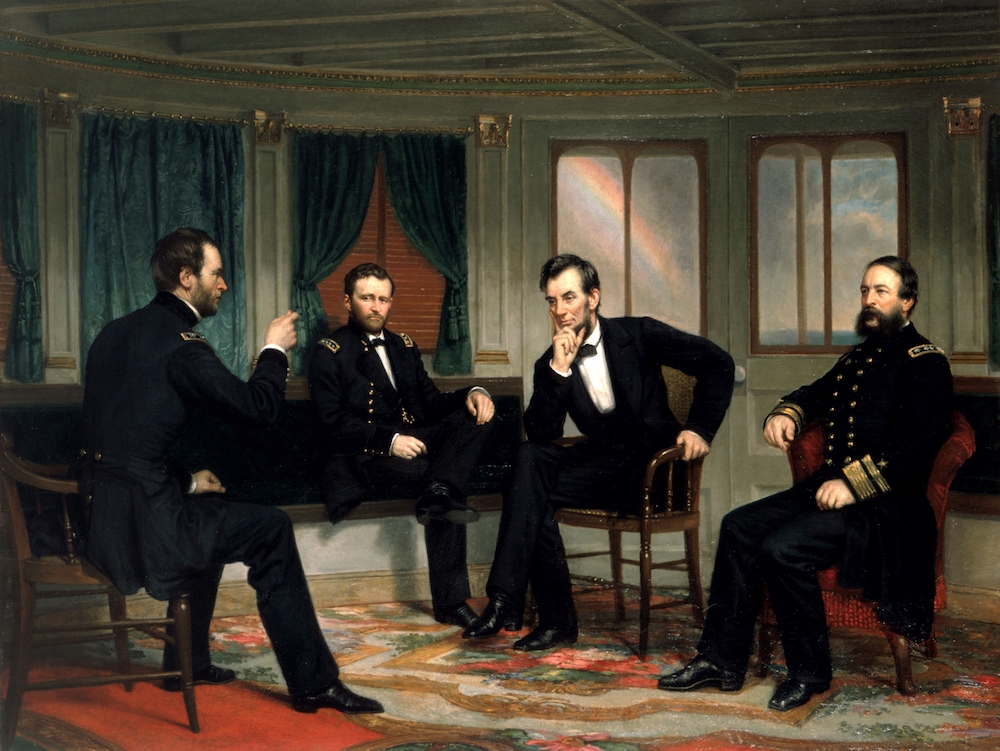
At the end of the fighting on July 22, the Union Army of the Tennessee held its entrenched positions within cannon range of Atlanta, and the Confederate Army of Tennessee had lost a tenth of its fighting strength.2Gary Ecelbarger, The Day Dixie Died: The Battle of Atlanta (New York: Thomas Dunne Books/St. Martin's Press, 2010), 213–214. The Federal triumph presaged victories at nearby battlefields, Ezra Church and Jonesboro, six days and six weeks later, and the capture of Atlanta's three remaining rail lines by the end of August. Cut off from supplies, Hood ordered his troops to evacuate Atlanta on September 1, and the city's mayor surrendered to a Federal military advance party the next day. After Union troops marched into the city, their commanding general, William T. Sherman, sent a telegram to Washington, DC, announcing that "Atlanta is ours, and fairly won." This resounding end to Sherman's Atlanta campaign, combined with the Confederate loss of Mobile Bay and Union gains in the Shenandoah Valley, cinched Abraham Lincoln's reelection in November 1864 and portended the end of armed combat east of the Mississippi River in April 1865.3James M. McPherson, Embattled Rebel: Jefferson Davis as Commander in Chief (New York: The Penguin Press, 2014), 205; Brian Holden Reid, The Scourge of War: The Life of William Tecumseh Sherman (New York: Oxford University Press, 2020), 330. Yet long after Robert E. Lee surrendered to Ulysses S. Grant at Appomattox Court House, deep animosities between former Civil War adversaries continued, and paramilitary and mob violence against freedpeople and their descendants and allies went largely unchecked for decades.4Carole Emberton, Beyond Redemption: Race, Violence, and the American South After the Civil War (Chicago: University of Chicago Press, 2013), 146, 155, 201; Gregory P. Downs, The Second American Revolution: The Civil War-Era Struggle Over Cuba and the Rebirth of the American Republic (Chapel Hill: University of North Carolina Press, 2019), 136; Leon F. Litwack, "Hellhounds," in Without Sanctuary: Lynching Photography in America, ed. James Allen (Santa Fe, NM: Twin Palms Publishers, 1999), 8–37.
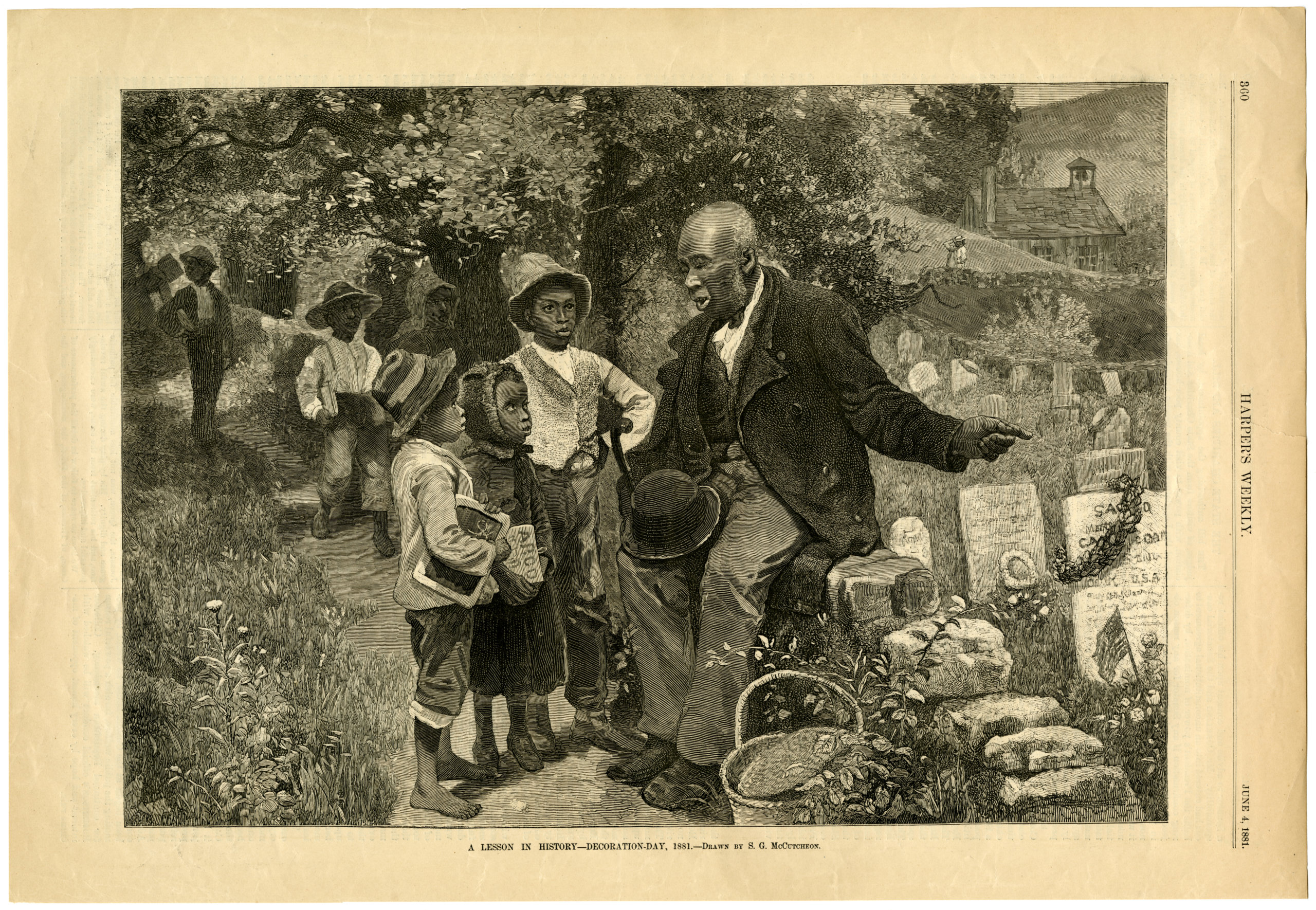
The seemingly endless resurrection, retelling, and reenacting of Civil War history, which continues to the present day, amounts to an ongoing contest between politicized versions of the past, the first renditions of which were produced by people for whom the War was a lived experience. Their commemorative creations included a myriad of images, texts, statues, reunions, Emancipation celebrations, and Memorial Days.5David W. Blight, Race and Reunion: The Civil War in American Memory (Cambridge, MA: Harvard University Press, 2001), 31–97; Caroline E. Janney, Remembering the Civil War: Reunion and the Limits of Reconciliation, (Chapel Hill: University of North Carolina Press, 2013), 73–159. During the final decades of the nineteenth century, these inaugural forms of war remembrance mobilized identities, explanations, and emotions, and they framed political discourse about race, citizenship, and nationhood for years to come. Spectacular, immersive paintings of famous military clashes provided mass entertainment and compelling commemorative meanings for US audiences. At the peak of their popularity, from 1883 to approximately 1900, perhaps as many as three dozen Civil War battle panoramas in the cycloramic format toured cities throughout the US, and paintings of the Gettysburg and Vicksburg battles reached Australia and Japan.6Chris Brenneman and Sue Boardman, The Gettysburg Cyclorama: The Turning Point of the Civil War on Canvas (El Dorado Hills, CA: Savas Beattie, 2015), 14; Ralph Hyde, Panoramania! (London: Trefoil Publications, 1988), 172. Christ's crucifixion, vistas of the ancient world, and natural wonders and disasters were other popular cyclorama subjects.7Stephan Oettermann, The Panorama: History of a Mass Medium (New York: Zone Books, 1997), 343; Angela Miller, "The Panorama, the Cinema, and the Emergence of the Spectacular," Wide Angle 18, no. 2 (1996): 35–69. The sweeping, proto-cinematic visual spectacles achieved enormous but ephemeral popularity; they anticipated but could not compete with motion pictures as an entertainment experience. Like the movies that followed, panoramas provided "a substitute reality presented with the revelatory force of the real."8Miller, "Panorama," 55. Yet, because the paintings presented an "image frozen in time," they lacked "cinema's possibilities for literal reenactment."9Alison Griffiths, "'Shivers Down Your Spine': Panoramas and the Origins of Cinematic Reenactment," Screen 44, no. 1 (2003): 1–37. As the popularity of cyclorama paintings waned, many of the enormous canvases disappeared while others were repurposed as theatrical production backdrops or cut up and sold as small remnants.10Antje Petty, "German Artists—American Cyclorama: A Nineteenth-Century Case of Transnational Cultural Transfer" (presentation, German Studies Association 34th Annual Conference, Oakland, CA, October 7–10, 2010, Oakland, CA), https://mki.wisc.edu/wp-content/uploads/sites/1100/2014/10/Petty_GSA-2010_Panorama.pdf. Today, among all Civil War battle panoramas, the Gettysburg and Atlanta cyclorama paintings are the only survivors on public display, each showcased in a twenty-first-century exhibition space. The Gettysburg panorama is shown at the national military park, located at the battle site in south central Pennsylvania, and the Atlanta image is exhibited at the city's history museum, approximately six miles from where the battle was fought.
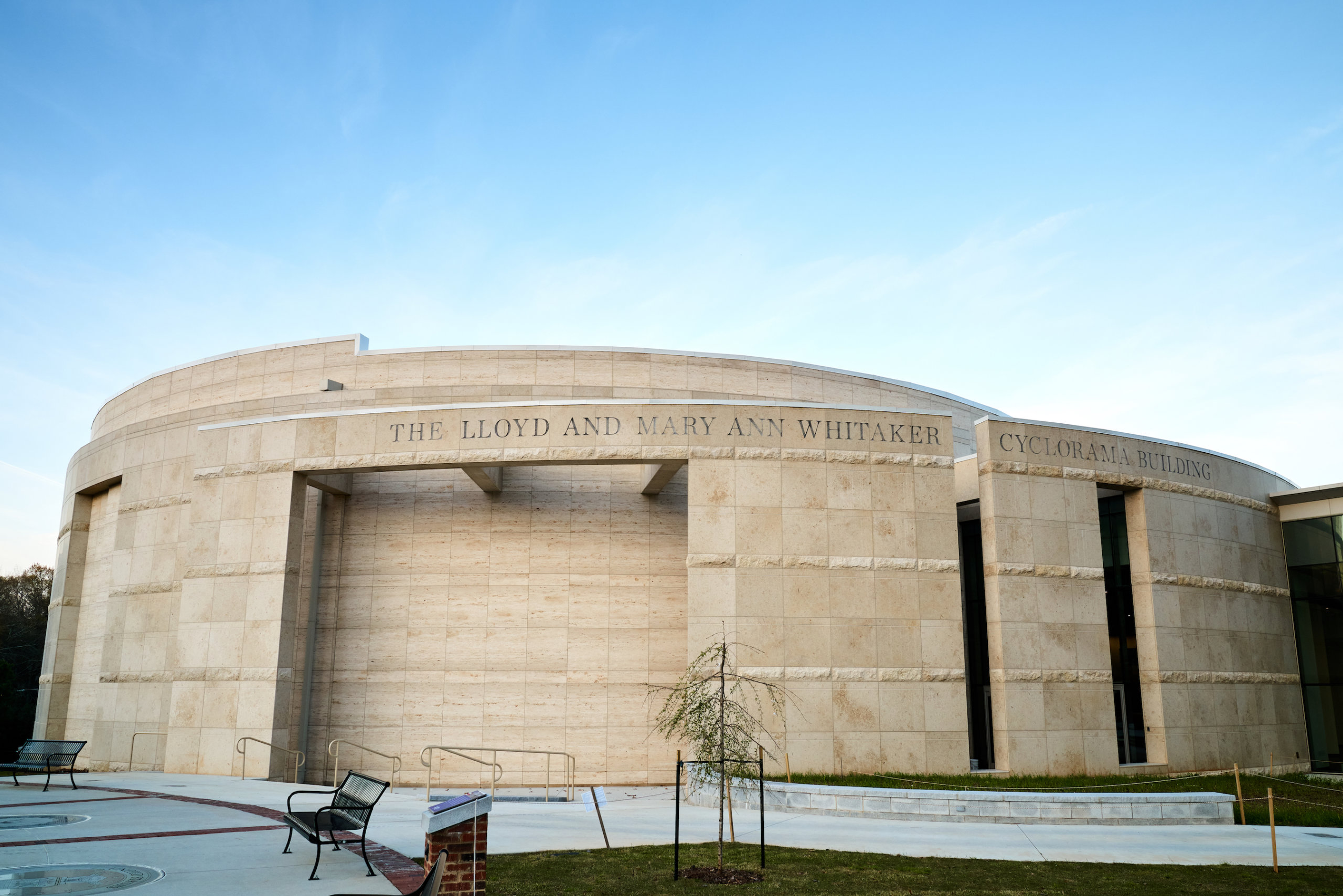
This essay explores the history of the Battle of Atlanta painting, a surviving example of a fad that faded, which in its time expressed and exerted influence on Civil War memories north and south of the Mason Dixon line and served as a technological, thematic, and commercial forerunner to epic cinematic narratives, most notably D. W. Griffith's The Birth of a Nation. As the original version of the Atlanta panorama and an identical copy circulated from city to city, following debuts in Minneapolis in 1886 and Detroit in 1887, the painting's visual retelling of a famous fight validated martial heroics on each side, which meshed with the continuing devotion of many viewers to their side's cause. At the same time, the Atlanta panorama also celebrated an underlying bond between the white male opponents by suggesting that their shared traits, beliefs, and traditions accounted for a common bravery in battle and a sense of common white Americanness that surged in the nineteenth century's final years. The painting expressed and helped perpetuate a militarized commemorative culture that supported a white national identity and abandoned a commitment to Black Americans' civil rights. Peaking in attendance amid a mounting but far from uniform movement toward sectional reconciliation, the Battle of Atlanta cyclorama painting was most importantly a spectacle of a resurgent and increasingly militant and racialized American nationalism. Further, the panorama served as a precursor to D. W. Griffith's extravaganza, which depicted the Civil War and Reconstruction as the historical antecedents for a nationwide regime of white supremacy. In an era when spectacle culture rose rapidly and new, immersive visual entertainments competed for public attention, the Battle of Atlanta panorama and The Birth of a Nation illustrate how vivid and enduring images of a cataclysmic era captured the attention of throngs of people and encouraged their commitments to a narrowly configured version of American nationalism.11Susan Tenneriello, Spectacle Culture and American Identity: 1815–1940 (New York: Palgrave Macmillan, 2013), 2–14.
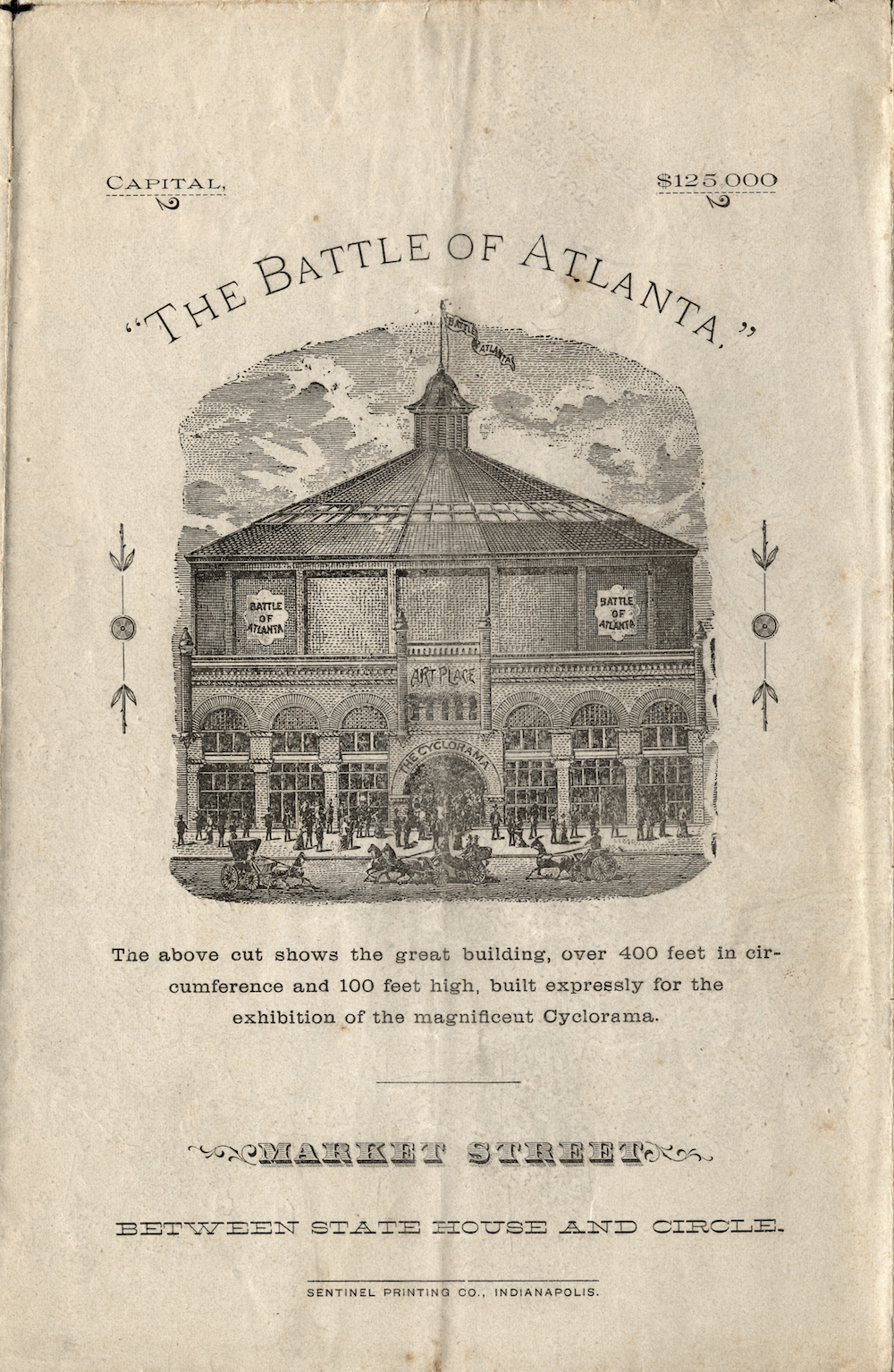
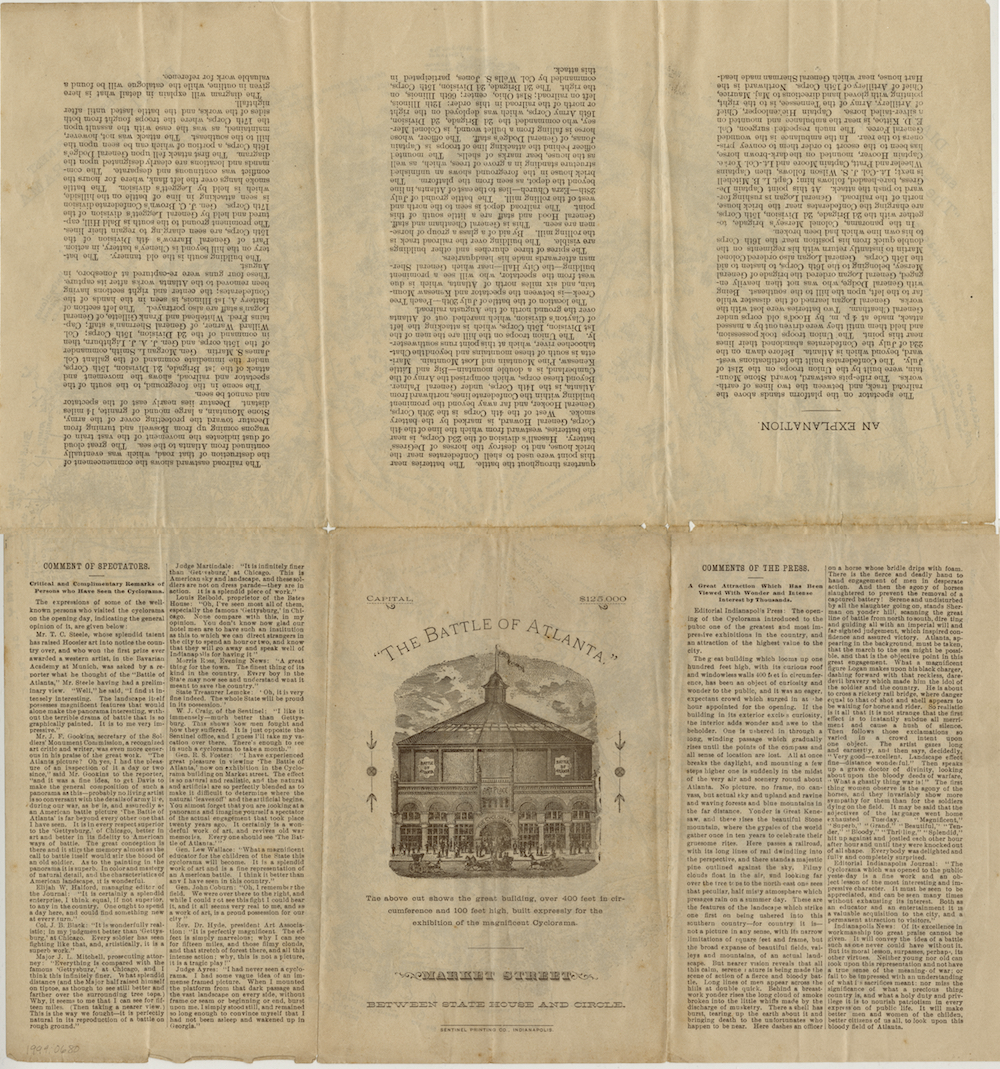
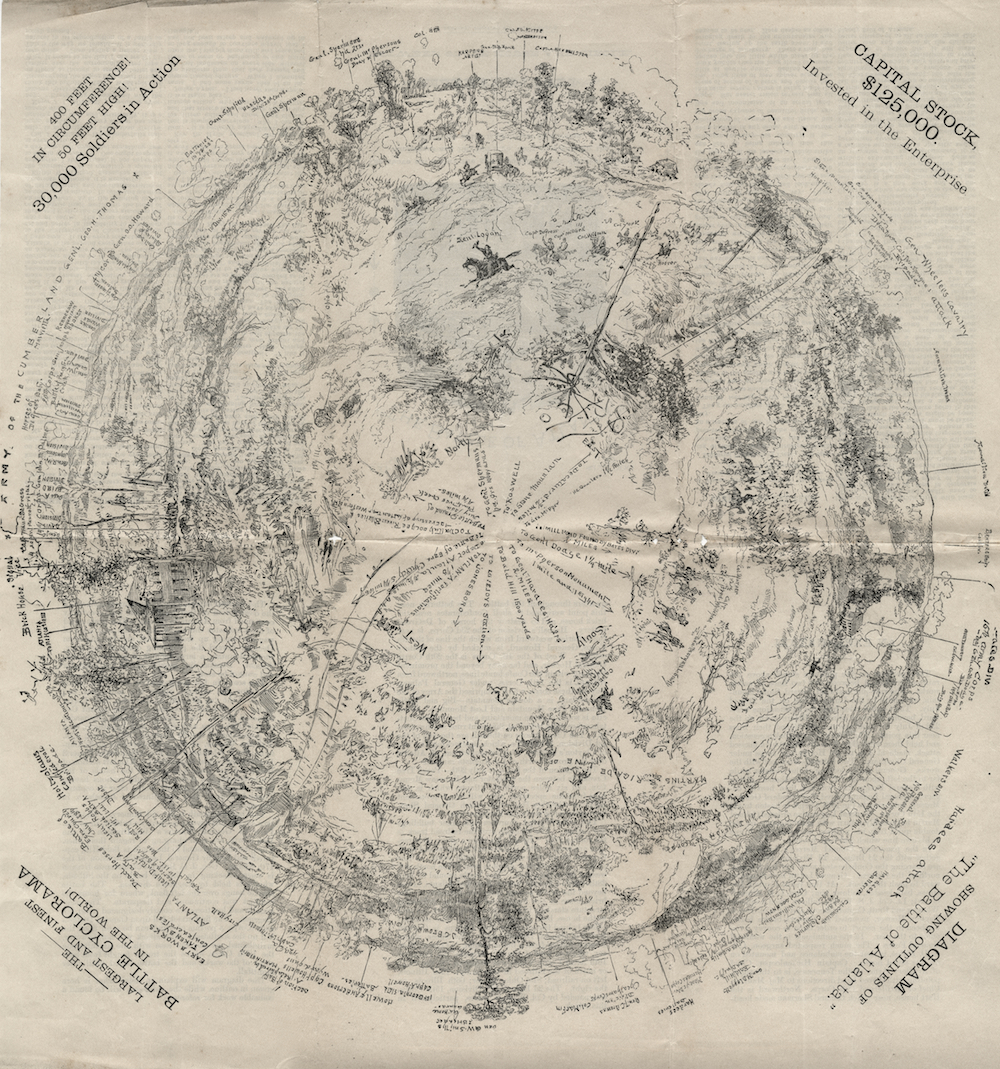
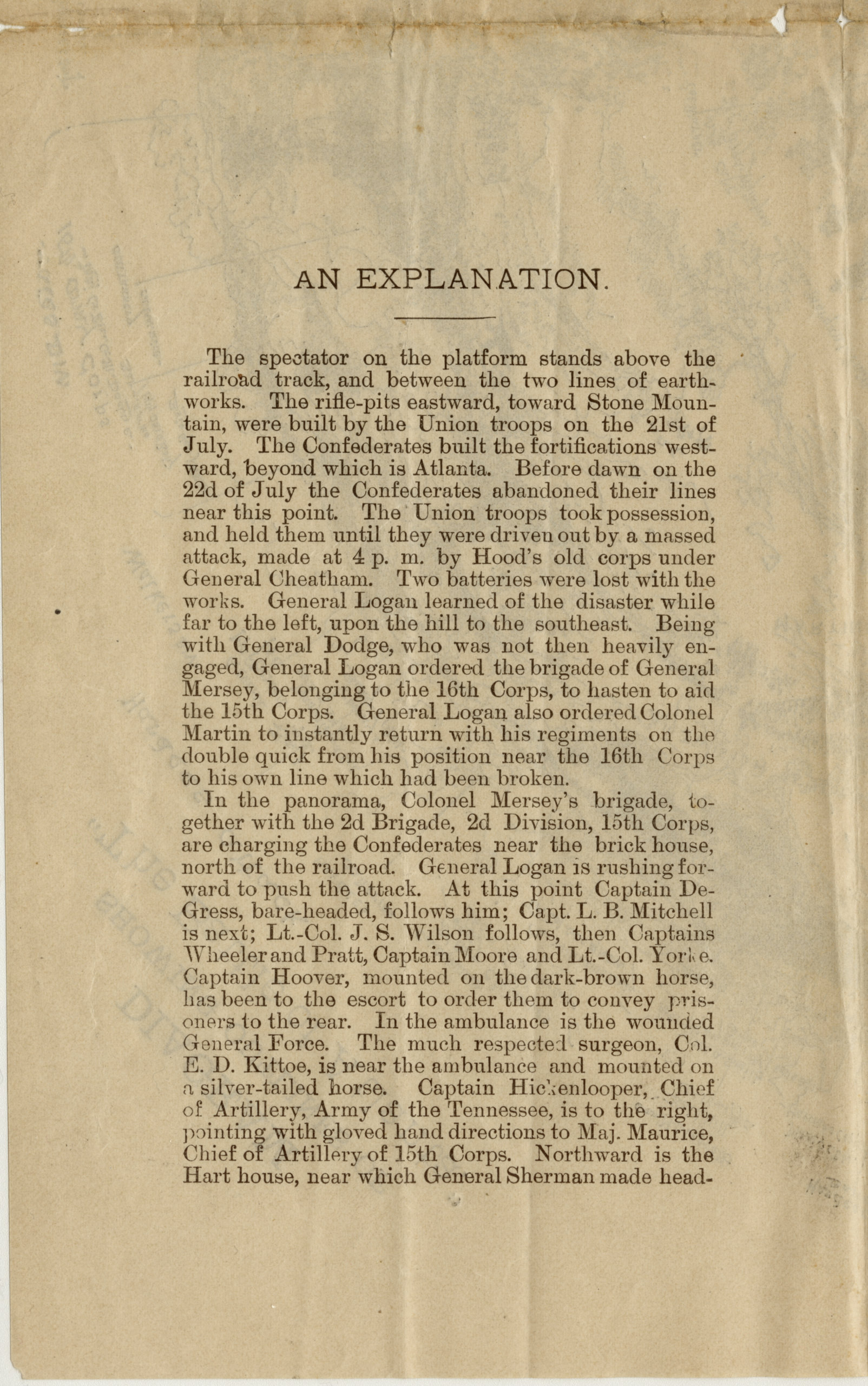
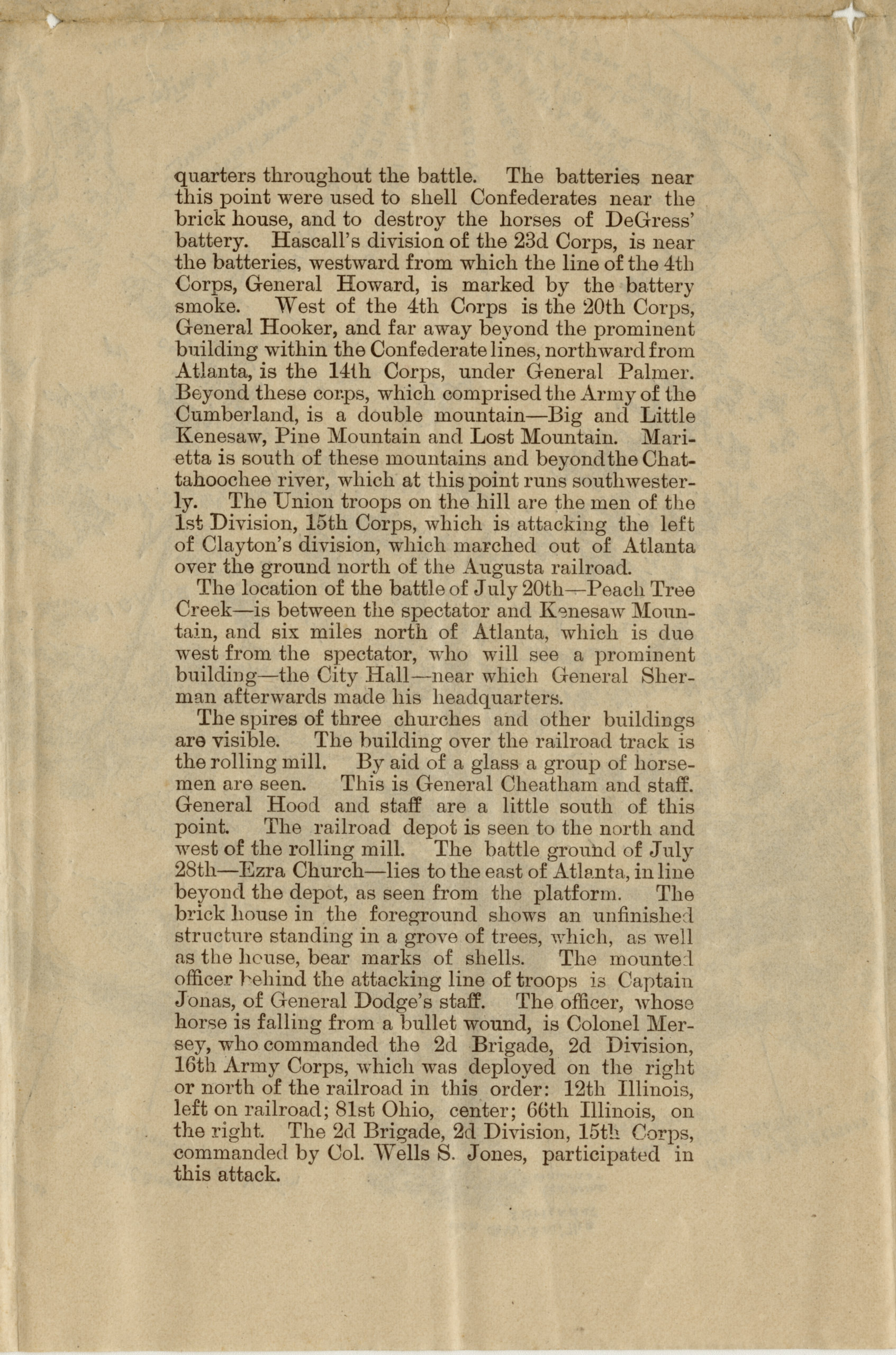
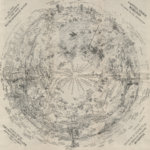
In its heyday, the Atlanta panorama, like other cyclorama battle paintings, was a travelling attraction. A team of European artists working in an American studio produced two identical versions of the Atlanta painting, and promoters moved each canvas from city to city for exhibition. At every stop, riggers installed the panorama in a massive rotunda building, a specially designed structure that enabled visitors to experience "being swallowed up in an imaginary world" while distancing them from their actual surroundings outside.12Evelyn J. Fruitema and Paul A. Zoetmulder, eds. The Panorama Phenomenon: Mesdag Panorama 1881–1981 (The Hague, Netherlands: Foundation for the Preservation of the Centenarian Panorama, 1981), 18. A darkened entrance hall, indoor lighting that brilliantly illuminated the sprawling battlefield tableaux, and a faux terrain—foreground settings with three-dimensional objects—connected almost imperceptibly to the bottom edge of the painted canvas served in unison to absorb spectators into an illusory reality. A meticulously realistic depiction of Atlanta's battlefield topography, military uniforms and equipment, combat events, notable commanders, and amassed infantry were popular features. Spectators were inserted within the 360-degree panorama, which provided an immersive, all-encompassing view of a historic clash. The spectacular visual narrative combined convincing optical illusions with vivid documentary realism, minus gory images of the dead and wounded. Although the artists and promoters aspired to authenticity, the battle story they "lifted from life" and told on canvas was by intent a partial view that omitted more than just the horrors of industrial warfare.13Louise Spence and Vinicius Navarro, Crafting Truth: Documentary Form and Meaning (New Brunswick, NJ: Rutgers University Press, 2011), 11.
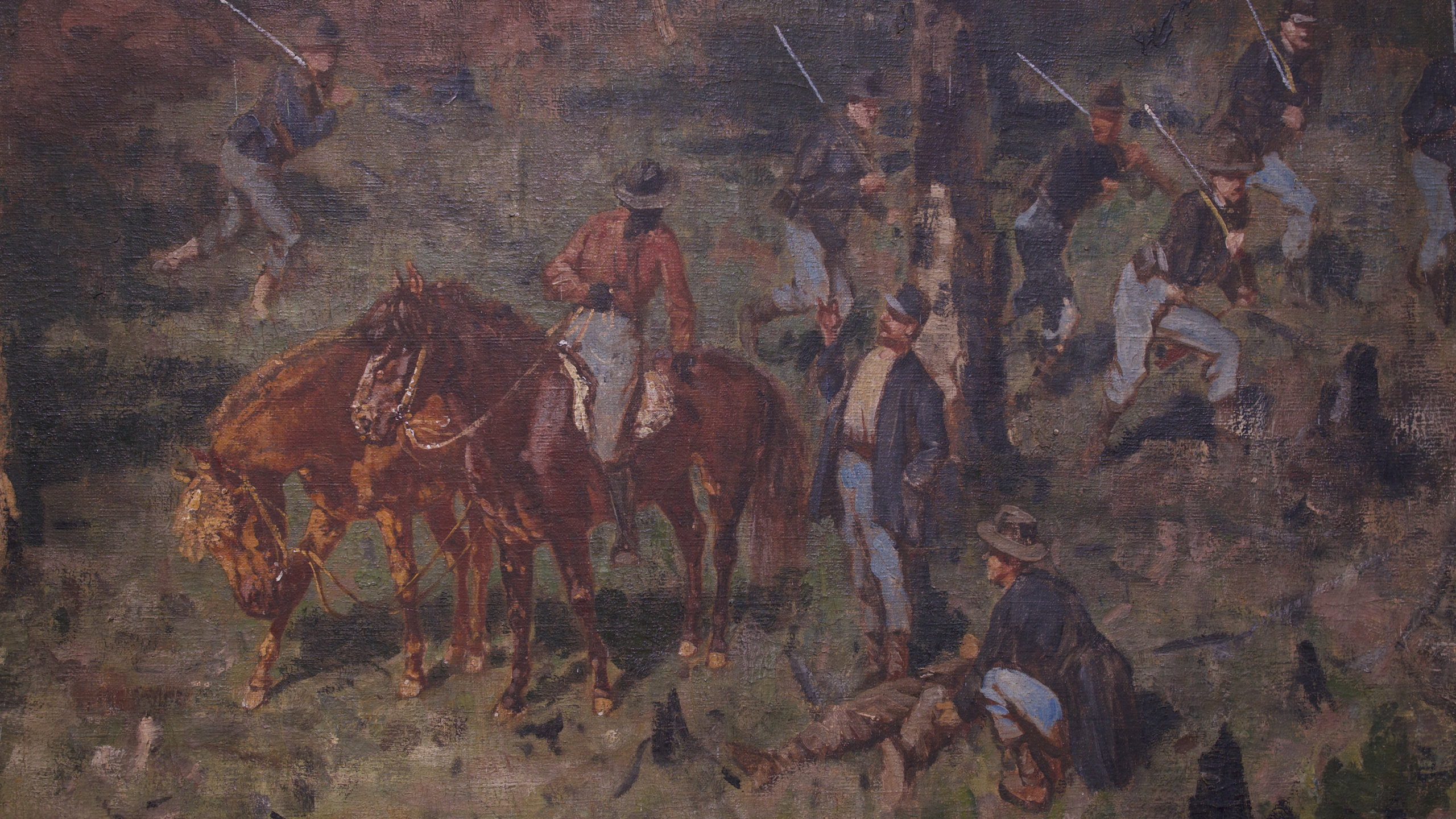
In the 1880s and 1890s, the Atlanta panorama, along with other Civil War battle paintings, provided an immensely popular attraction for audiences seeking to remember the military heroes and events of the 1860s while leaving much of the War out of the picture. No female figures are included on the huge canvas and a single Black male is depicted in civilian clothing far from the July 22, 1864, battle line. While the Battle of Atlanta, like most of the War's battles, pitted Union and Confederate armies against each other that were exclusively or almost entirely white men, enormous numbers of additional people participated in the War effort, including approximately 200,000 Black soldiers who served in the Federal army and countless women on both sides who were war matériel producers, foodstuff suppliers, health care workers, civil servants, undercover agents, and uniformed combatants.14William A. Dobak, Freedom By the Sword: The U.S. Colored Troops, 1862–1867 (Washington, DC: US Army Center of Military History, United States Army, 2011), 501; Thavolia Glymph, The Women's Fight: The Civil War's Battles for Home, Freedom, and Nation (Chapel Hill: University of North Carolina Press, 2020), 10; Judith A. Giesberg, Civil War Sisterhood: The U.S. Sanitary Commission and Women's Politics in Transition (Boston: Northeastern University Press, 2000), 4. The awe-inspiring image of the Battle of Atlanta, like other heroic national narratives of the postbellum era, was a "selective celebration."15Stephanie McCurry, Women's War: Fighting and Surviving the American Civil War (Cambridge, MA: The Belknap Press of Harvard University Press, 2019), 204. It venerated part of the past while marginalizing the significance of race and gender in wartime, in effect affirming a white, patriarchal social and political pecking order that prevailed as the Civil War and Reconstruction receded and the nineteenth century drew to a close. As historian William Blair emphasizes in an insightful analysis of sectional reconciliation and its political implications, reconciliation "involved defining nationalism, and the power relationships within it, resulting tragically in the exclusion of black people in the age of Jim Crow with white solidarity, in part, rallying around traditions in the form of Confederate commemorations."16William A. Blair, "Reconciliation as a Political Strategy: The United States After Its Civil War," in Reconciliation After Civil Wars: Global Perspectives, ed. Paul Quigley and James Hawdon (New York: Routledge, 2019), 217–231.
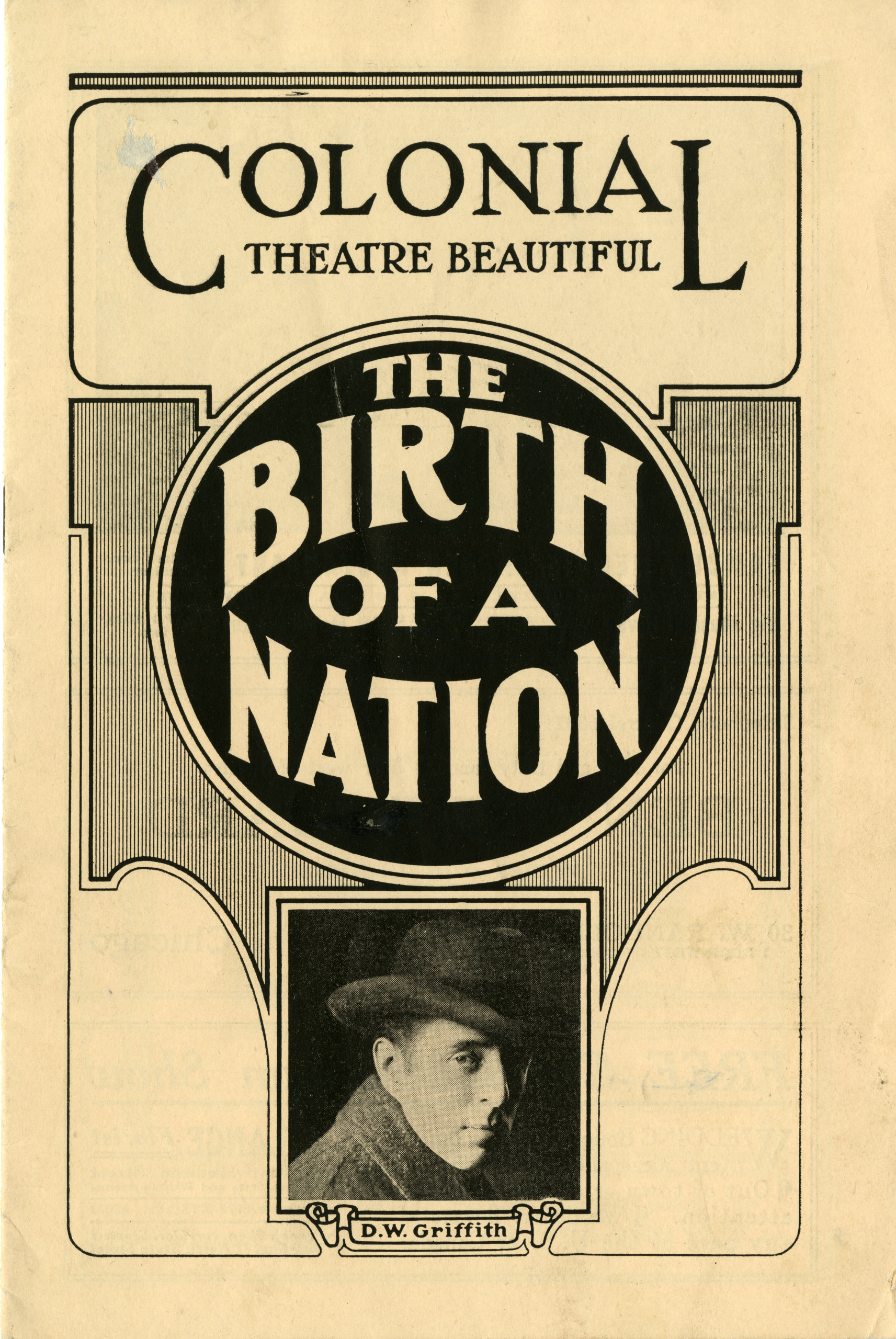
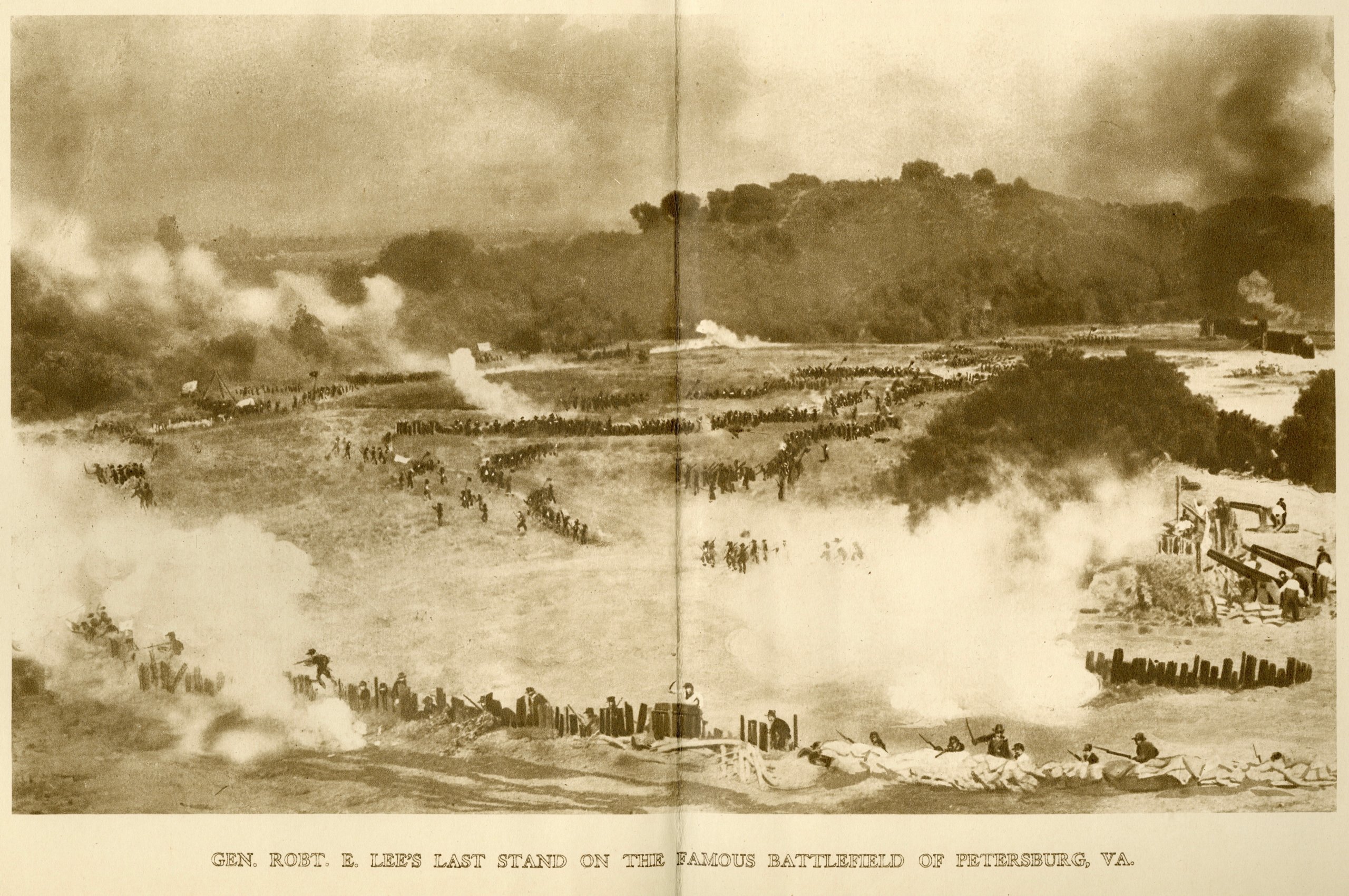
D. W. Griffith's notoriously racist The Birth of a Nation, which premiered in 1915, propagated a narrative account of the Civil War era in which white northerners and white southerners, one-time friends, become unwilling wartime foes but show mutual respect on the battlefield, reconcile after the War, reject the pursuit of Black political equality during Reconstruction, and—led by the Ku Klux Klan—forge a new nation to defend their "common Aryan birthright."17Robert Lang, ed. The Birth of a Nation: D. W. Griffith Director (New Brunswick, NJ: Rutgers University Press, 1994), 134. As historian Leon Litwack observes, the motion picture "mesmerized and misled Americans, revealing the extraordinary power of the cinema to 'teach' history and to reflect and shape popular attitudes and stereotypes."18Leon F. Litwack, "The Birth of a Nation," in Past Imperfect: History According to the Movies, ed. Ted Mico, John Miller-Monson, and David Rubel (New York: Henry Holt and Company, 1995), 136–141. Griffith reused multiple images and tropes that debuted decades earlier and, aided by his filmmaking virtuosity, persisted long after his motion picture was first shown. The Birth of a Nation was a sensational visual spectacle that provided a blueprint for the Hollywood historical film.19Robert Burgoyne, The Hollywood Historical Film (Malden, MA: Blackwell Publishing, 2008), 26. "The panoramic battle scenes" were a "cinematic triumph," Michael Rogin notes in his appraisal of the film. Griffith's depictions were "distant, beautiful, and otherworldly."20Michael Rogin, "'The Sword Became a Flashing Vision': D. W. Griffith's The Birth of a Nation," Representations 9 (Winter 1985): 150–195. Camera shots taken from a tower sixty feet above battling troops gave moviegoers a "sense of both wide scope and elevated historical perspective," as James Chandler points out.21Milton MacKaye, "The Birth of a Nation," Scribner's Magazine 102, no. 5 (1937): 40–46; James Chandler, "The Historical Novel Goes to Hollywood: Scott, Griffith, and Epic Film Today," in The Romantics and Us: Essays on Literature and Culture, ed. Gene W. Ruoff (New Brunswick, NJ: Rutgers University Press, 1990), 237–273. The Birth of a Nation showed audiences how sprawling action sequences, crowd scenes, close ups, and star performances could be woven into a captivating feature-length narrative.22John Belton, American Cinema/American Culture (New York: McGraw-Hill, 1994), 15; Bruce Chadwick, The Reel Civil War: Mythmaking in American Film (New York: Alfred A. Knopf, 2001), 97. Griffith's creation also served as a forerunner to Gone With the Wind, which bore striking similarities to the earlier extravaganza in its production scale, fictionalized historical narrative, melodramatic mode, humiliating images of Black men and women, push back from civil rights activists, and runaway box office success.23Ruth Elizabeth Burks, "Gone With the Wind: Black and White in Technicolor," Quarterly Review of Film and Video 21, no. 1 (2004): 53–73; Jenny Barrett, Shooting the Civil War: Cinema, History and American National Identity (London: I.B. Tauris, 2009), 35; Ellen C. Scott, Cinema Civil Rights: Regulation, Repression, and Race in the Classical Hollywood Era (New Brunswick, NJ: Rutgers University Press, 2015), 157–160.
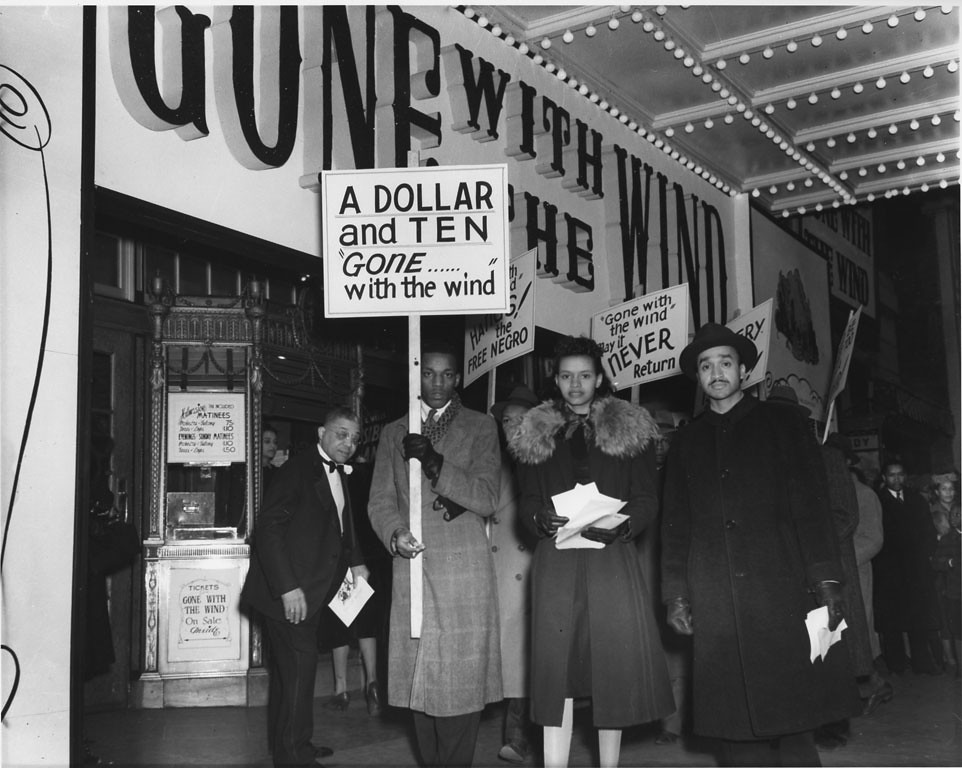
The title of Griffith's film announced his animating concern: nation building. His message was that sectional reconciliation called for white solidarity, paramilitary acts of racial terror, and political and economic oppression of Black people. He deployed Lost Cause historical interpretations and perpetuated derogatory caricatures of Black and multiracial people that originated in the nineteenth century. The Birth of a Nation's "black marauders" and "mulatto villains," according to American Studies scholar Davarian Baldwin, helped justify "a so-called Southern Solution that stood as a form of governance, a system of labor management and land assessment, and an intellectual and cultural master trope."24Davarian L. Baldwin, "'I Will Build a Black Empire': The Birth of the Nation and the Specter of the New Negro," Journal of the Gilded Age and Progressive Era 14, no. 4 (2015): 599–603. The film's disparaging images prompted vigorous but largely unsuccessful protest campaigns waged by the National Association for the Advancement of Colored People (NAACP) and other critics who sought to prevent exhibitions of the movie or censor its most vitriolic content.25Melvyn Stokes, D. W. Griffith's The Birth of a Nation: A History of the "Most Controversial Motion Picture of All Time" (New York: Oxford University Press, 2007), 129–170; Cara Caddoo, "The Birth of a Nation's Long Century," in The Birth of a Nation: The Cinematic Past in the Present, ed. Michael T. Martin (Bloomington: Indiana University Press, 2019), 33–45. Their efforts were blunted in part by President Woodrow Wilson, a former academic historian and past president of the American Historical Association, who tacitly endorsed The Birth of a Nation when he viewed it in the White House in February 1915.26Mark E. Benbow, "Birth of a Quotation: Woodrow Wilson and 'Like Writing History With Lightning,'" Journal of the Gilded Age and Progressive Era 9, no. 4 (2010): 509–533. For all of the film's white supremacist convictions and grotesque stereotypes, as cinema and media scholar Michael T. Martin emphasizes, Griffith's "filmic manifesto" reflected a prevailing historical interpretation of the Civil War era and a widely held belief early in the twentieth century that "race solidarity" was "the organizing principle for the nation's renewal."27Michael T. Martin, "Revisiting (As It Were) the 'Negro Problem' in The Birth of the Nation," in The Birth of a Nation: The Cinematic Past in the Present, ed. Michael T. Martin (Bloomington: Indiana University Press, 2019), 33–45.
The Battle of Atlanta cyclorama painting and The Birth of a Nation formed part of what anthropologist Benedict Anderson describes as a "vast pedagogical industry" that worked to convince Americans that the hostilities of 1861–65 were "a war between 'brothers' rather than between—as they briefly were—two sovereign nation-states."28Benedict Anderson, Imagined Communities: Reflections on the Origin and Spread of Nationalism, Revised Edition (London: Verso, 2006), 201. The visual narratives invited their audiences to recognize what Anderson describes as "a deep, horizontal comradeship" that makes it possible for human beings, even without face-to-face contact, to imagine themselves as a single political community and participate in a common culture of nationalism.29Anderson, Imagined Communities, 6–7. The "figure of the soldier" is central to this storyline, serving as an embodiment of communal values and encouraging Americans, or at least most of the country's white population, to embrace a shared national identity.30Nicola Cooper and Martin J. Hurcombe, "The Figure of the Soldier," Journal of War and Culture Studies 2, no. 2 (2009): 103–104. Military memories conveyed by the Battle of Atlanta panorama and The Birth of a Nation acted as catalytic agents that contributed to a big burst of nationalistic energy.31Wilbur Zelinsky, Nation Into State: The Shifting Symbolic Foundations of American Nationalism (Chapel Hill: University of North Carolina Press, 1988), 155. Linked compositionally and thematically, the cycloramic and cinematic renditions of the Civil War dramatized a version of nationalism that idealized sectional unity while dividing the population by race, ethnicity, and gender. The images provided popular accounts of a storied past and demonstrated Elisa Tamarkin's precept that "nationalism, as a form of feeling, an ideology, and a set of practices, works every bit as seriously at bringing some aspects of the outside in, as it does in keeping others out."32Elisa Tamarkin, Anglophilia: Deference, Devotion, and Antebellum America (Chicago: University of Chicago Press, 2008), xxvi.
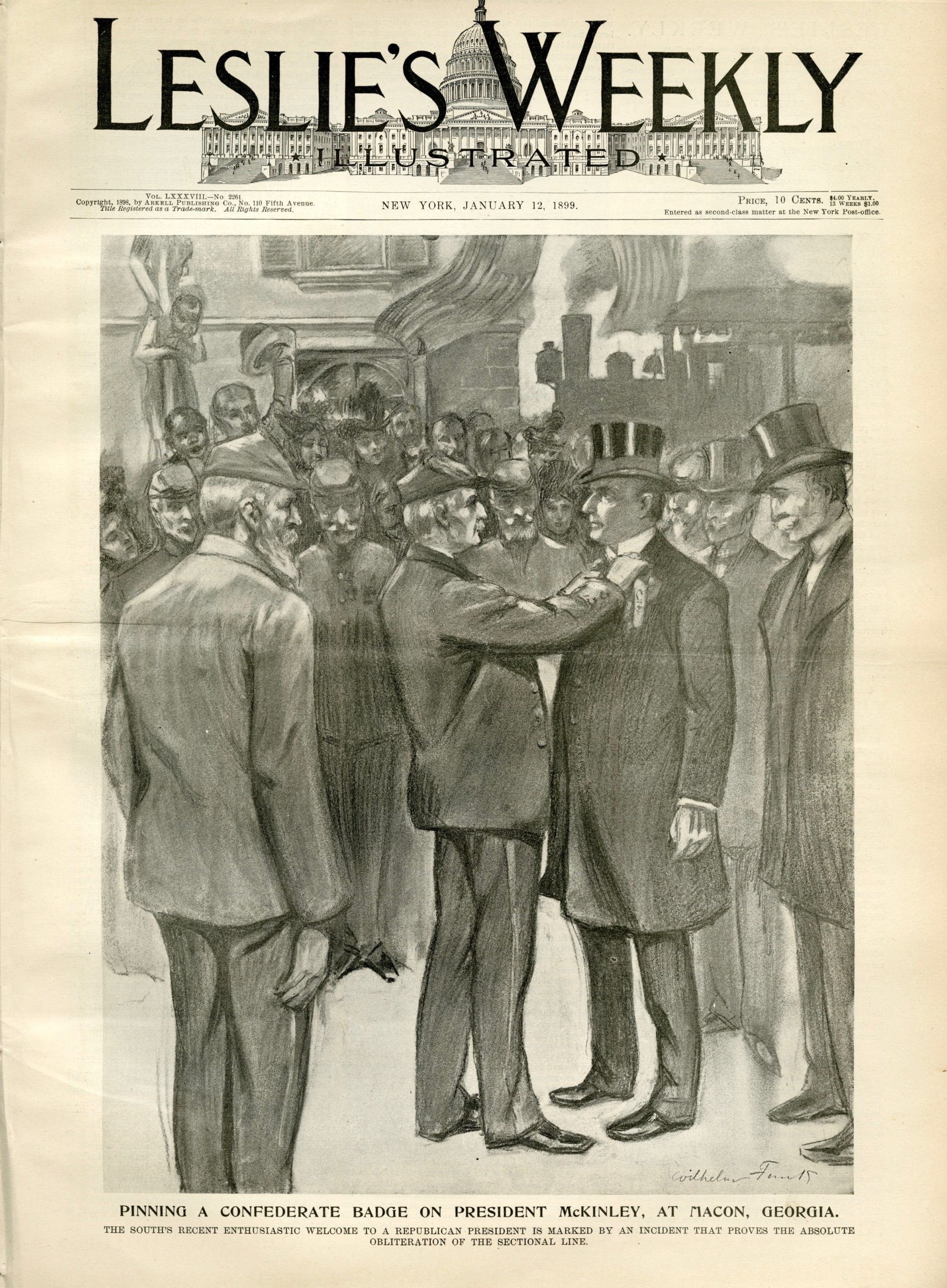
The nation that emerged in the fin-de-siècle US was more than "just an imagined community," as historian Charles Maier observes. It also was a "materialist and armed community," and the US military services forcefully demonstrated their reach in the last decade of the century.33David Armitage, Thomas Bender, Leslie Butler, Don H. Doyle, Susan-Mary Grant, Charles S. Maier, Jörg Nagler, Paul Quigley and Jay Sexton, "Interchange: Nationalism and Internationalism in the Era of the Civil War," Journal of American History 98, no. 2 (2011): 455–489. In December 1890, in the largest military operation since the Civil War, nearly a third of the nation's army descended on the Lakota in South Dakota and suppressed armed Indian resistance to white incursions. A confrontation between the Lakota and the US Seventh Cavalry near Wounded Knee Creek ended in the massacre of about 250 Native Americans.34Heather Cox Richardson, Wounded Knee: Party Politics and the Road to an American Massacre (New York: Basic Books, 2010), 11; Pekka Hämäläinen, Lakota America: A New History of Indigenous Power (New Haven, CT: Yale University Press, 2019), 378. In July 1894, the US Army again demonstrated its coercive power when nearly 2,000 troops, deployed to Chicago and joined by US marshals and local police, broke the Pullman strike.35Clayton D. Laurie and Ronald H. Cole, The Role of Federal Military Forces in Domestic Disorders, 1877–1945 (Washington, DC: US Army Center of Military History, 1997), 145. Once more the Seventh Cavalry went into action, this time on city streets, and striking workers were likened to the "savages" who the soldiers had slaughtered at Wounded Knee several years earlier.36Richard White, Railroaded: The Transcontinentals and the Making of Modern America (New York: W.W. Norton, 2011), 431. American military forces extended their reach beyond the nation's shores in 1898, when the US defeated Spain in a five-month war and took control of Spain's colonies in the Caribbean and Pacific.37A.G. Hopkins, American Empire: A Global History (Princeton, NJ: Princeton University Press, 2018), 337. The war followed what American Studies scholar Matthew Frye Jacobson describes as a "protracted national discussion of what was demanded by America's rising national status as a world economic power—markets, bases, coaling stations, perhaps a canal."38Matthew Frye Jacobson, Barbarian Virtues: The United States Encounters Foreign Peoples at Home and Abroad, 1876–1917 (New York: Hill and Wang, 2000), 42. President William McKinley, in a December 1898 visit to Atlanta, hailed the victory over Spain as evidence that America had "proved itself invincible" and "will remain indivisible forevermore." Speaking at the municipal auditorium, McKinley proclaimed: "Under hostile fire on a foreign soil, fighting in a common cause, the memory of old disagreements has faded into history." In the spirit of sectional reconciliation, he proposed to another Atlanta audience that the national government begin honoring Confederate dead, whose public remembrances were limited at the time to commemorations by individual states and voluntary associations. "Every soldier's grave made during our unfortunate Civil War is a tribute to American valor," McKinley declared.39William McKinley, Speeches and Addresses of William McKinley, From March 1, 1897 to May 30, 1900 (New York: Doubleday & McClure, 1900), 159–160.
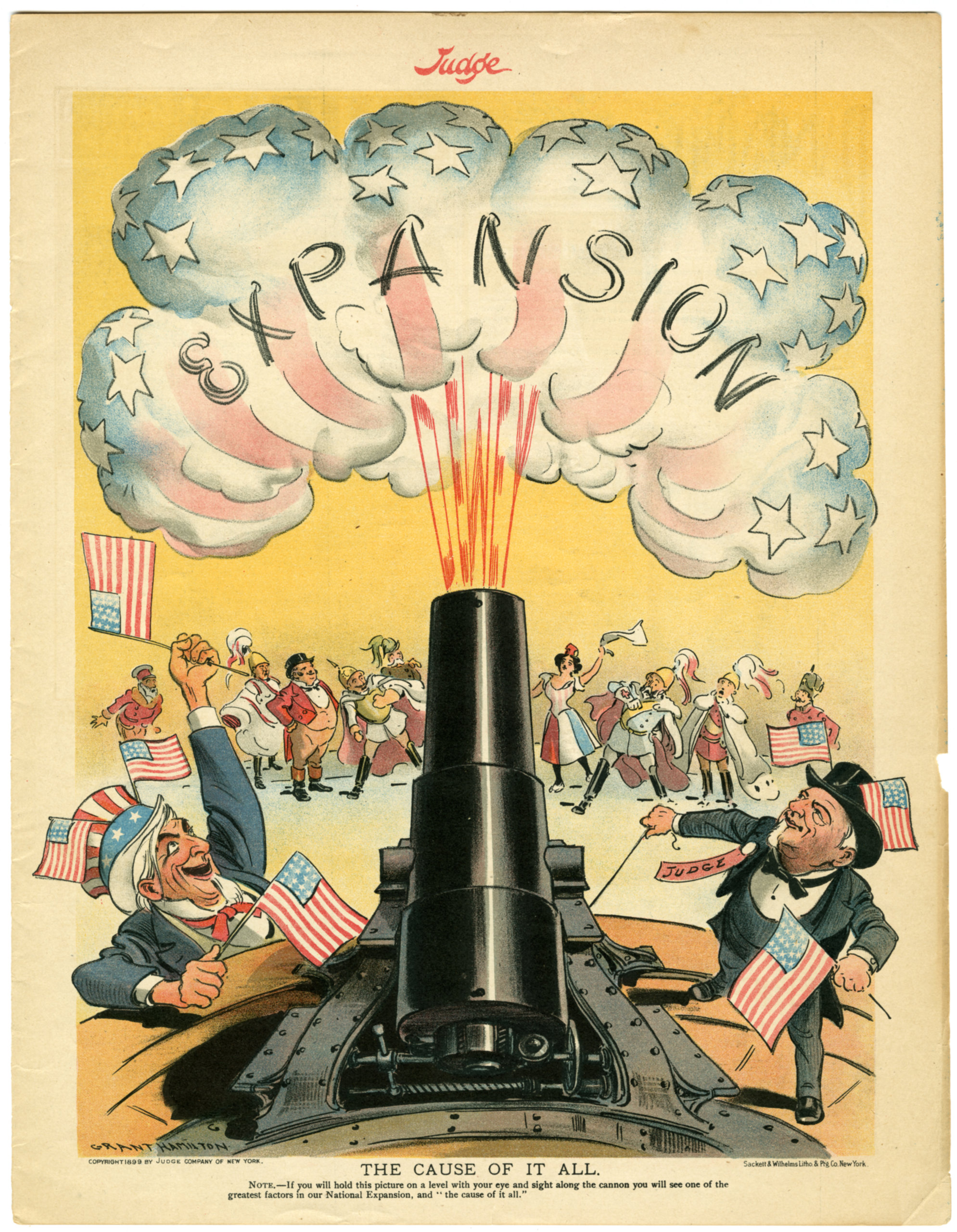
A surge in militant, white nationalism and the growing capacity of the US nation-state to project massive force were part of what historian C. A. Bayly describes as a vigorous, "global stirring of nationality" in the late nineteenth century. Bayly notes that despite a "hardening of boundaries between nation states and empires," people found "ways of linking, communicating with, and influencing each other across those boundaries."40C. A. Bayly, The Birth of the Modern World, 1780–1914 (Malden, MA: Blackwell Publishing, 2004), 199. Battle cults and cycloramic images of famous war scenes, which flourished first in France and Germany, were among the influential transnational exchanges.41Petty, "German Artists," 1. Profit-oriented European stock companies, geared to growing their international business, bankrolled panoramas of famous battles and shipped some of the most popular paintings across the Atlantic for showings in the US.42Fruitema and Zoetmulder, The Panorama Phenomenon, 28. These exports included a sprawling image of the Battle of Sedan, a major German victory in the 1870–71 Franco-Prussian War, which was shown in New Orleans and Cincinnati in the mid-1880s after a successful debut in Frankfurt, Germany.43Peter C. Merrill, German-American Artists in Early Milwaukee: A Biographical Dictionary (Madison, WI: Friends of the Max Kade Institute for German-American Studies, 1997), 64; Kevin M. Kurdylo, "Investigating an International Treasure: The Diaries of Panorama Artist F. W. Heine," Max Kade Institute Friends Newsletter 17, no. 4 (2008): 7; Beth Irwin Lewis, Art for All?: The Collision of Modern Art and the Public in Late Nineteenth Century Germany (Princeton, NJ: Princeton University Press, 2003), 34. Louis Braun, a Munich art professor who led the team that produced the Sedan painting, was known for creating battle panoramas with strong nationalistic overtones.44Bernard Comment, The Painted Panorama (New York: Henry N. Abrams, 1999), 164.
One of Braun's acolytes was August Lohr, an Austrian painter who worked with him in Munich on the Sedan project and other battle panoramas before moving to Milwaukee, Wisconsin, in 1885 to help entrepreneur William Wehner launch the American Panorama Company.45Merrill, German-American Artists, 64. In a prime example of what historian Antje Petty describes as a "wholesale transfer of European panorama art and craft" to the US, Wehner and Lohr persuaded a group of well-known painters from art schools in German-speaking countries to join them in Milwaukee and produce Civil War cyclorama paintings.46Petty, "German Artists," 3; Merrill, German-American Artists, xi. Their first recruit was Friedrich Heine, an experienced battle painter and former war correspondent and illustrator from Dresden, Germany, who joined his long-time friend Lohr as codirector of panorama production in Wehner's studio.47"The Artists of Atlanta: The Men Who Have Painted the Panorama," Battle of Atlanta Monthly 1, no. 1 (October 1, 1886): 1. Specialists in painting landscapes, human figures, and animals comprised the rest of the artistic team.48Manual of the Cyclorama of the Battle of Atlanta (Detroit, MI: Detroit Cyclorama Company, 1887), 1. Together with Lohr and Heine they painted both versions of the Battle of Atlanta cyclorama panorama.
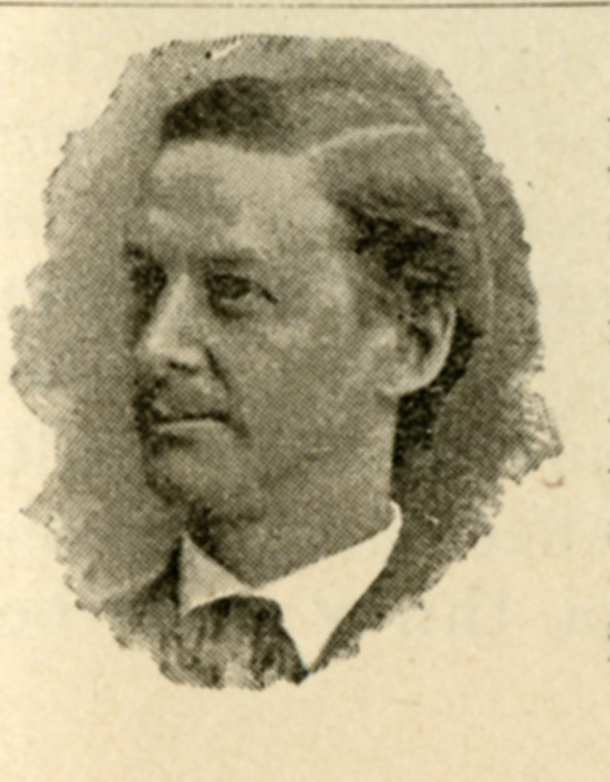
Wehner and his company's artistic team placed a high priority on creating a historically accurate representation of the battle. Promotional materials and souvenir brochures that described the paintings emphasized their verisimilitude and educational value. Old soldiers often visited battle panoramas with family and friends and pointed out where and how they contributed to their side's cause.49Comment, Painted Panorama, 129. The slightest inaccuracy detected by discerning panorama spectators, such as veterans or other eyewitnesses to the battle, would collide with claims that viewers would see a faithful reproduction of the battlefield and combat action. To help meet the paying public's expectations for authenticity, Wehner and his lead artists enlisted the expert assistance of Theodore R. Davis, a former Civil War sketch artist for Harpers Weekly who had witnessed the battle from General William T. Sherman's field headquarters.50Wilbur G. Kurtz, The Atlanta Cyclorama: The Story of the Famed Battle of Atlanta (Atlanta, GA: City of Atlanta, 1954), 25. Davis shared his recollections of the fighting, and he helped the panorama team gather additional information from sketches, photographs, military maps, written records, and eyewitnesses. In the summer and fall of 1885, he accompanied the team on a site visit to Atlanta and its eastern suburban neighborhoods, where the battle was fought.51Manual of the Cyclorama, 2. Several artists completed sketches of the battle area from a forty-foot high wooden tower near the site of the Troup Hurt House and close to the Georgia Railroad, where intense combat action swirled on July 22, 1864. The painters' elevated perch provided an unobstructed view of the proximal battleground landmarks and the surrounding terrain. According to Wehner, local citizens "were astonished to find that their brethren of the North were in possession of facts that enabled them to clearly define every circumstance of the battlefield." Former Confederate officers, Wehner reported, appreciated the efforts to make a "historical painting" and took "special pains to verify statements concerning their positions."52Manual of the Cyclorama, 2.
By design, the geographic spot that the Milwaukee-based artists chose for their aerial studies of the Atlanta battle area corresponded to the central vantage point in the cyclorama rotundas where their circular paintings were subsequently exhibited. This compositional strategy enabled the painters to transfer their outward radiating, 360-degree sightlines and elevated perspective to panorama audiences.53Graham F. Watts, "'The Smell O' These Dead Horses': The Toronto Cyclorama and the Illusion of Reality," University of Toronto Quarterly 74, no. 4 (2005): 964–970. As a result, spectators standing in the middle of a rotunda's raised platform commanded sweeping views of each battlefield event depicted on canvas. Multiple military actions, represented as though they were simultaneous and instantaneous, created the impression of a dramatic continuum across the vast Atlanta battlegrounds.54Gillian Russell, The Theatres of War: Performance, Politics, and Society, 1793–1815 (New York: Oxford University Press, 1995), 76–77; Mary A. Favret, War at a Distance: Romanticism and the Making of Modern Wartime (Princeton, NJ: Princeton University Press, 2010), 216.
Battle of Atlanta Cyclorama Painting
1: Confederate Attack
At 4:30 p.m., Confederate troops under Brigadier General Arthur Manigault and other advancing brigades moved out from behind Atlanta's defenses and spearheaded an attack that poured through a weakness in the US 15th Army Corps line at the Georgia Railroad, overwhelmed their entrenched foes, and seized the DeGress Battery, shown near the Troup Hurt House, and other artillery pieces. This dramatic action threatened to turn the battle into a rout. However, the sudden momentum shift in the Confederate's favor was short-lived. US Army field officers marshaled their forces and led a sweeping counterattack, shown in the painting as blue-clad soldiers charging toward the Troup Hurt house and surging elsewhere to restore their broken infantry line.
2: Logan Rallies the US Troops
Following the break in the US Army's 15th Corps line, Major General John A. Logan, hat in hand and aboard his horse Slasher, is shown galloping toward the battlefront, followed by his staff and a hatless Captain Francis DeGress, whose battery Confederate infantry had captured. Earlier in the afternoon, Logan succeeded Major General James B. McPherson, killed in action, as commander of the Army of the Tennessee, the principal US Army in the Battle of Atlanta. When Confederate attackers broke the 15th Army Corps line, swift action by Logan and other US Army field officers repulsed the Confederate assault and averted a battlefield disaster for the Union army. In his new role as army commander, Logan marshaled reinforcements, summoned artillery support, and rode along the lines of his counterattacking troops, exhorting them with the rallying cry of "McPherson and Revenge."
3: US Army Counterattack
US Army Brigadier General Joseph Lightburn, shown on his chestnut-colored horse near the front of his brigade, led his soldiers towards a clash with Confederate attackers who, a little more than an hour earlier, had poked a big hole in the US Army 15th Corps line and threatened more serious damage. Lightburn's brigade was part of a concerted assault in which three Divisions of the 15th Army Corps surged forward, threw back the Confederates, and restored the Union line where it had been broken. The counterattacking infantry gained ground quickly, supported by artillery fire directed in part by Major General William T. Sherman, commander of the US forces advancing on Atlanta. However, Sherman's battlefield role was limited. He appears in the painting as a distant figure on horseback in front of his field headquarters at the Augustus Hurt house, observing combat action three quarters of a mile away from his perch.
4: Fighting For the High Ground
The most intense fighting in the Battle of Atlanta was at Bald Hill, a broad expanse of high ground, largely cleared for farming, which provided a commanding position for the army that controlled it. The day before the battle, US Army Brigadier General Mortimer Leggett's Division captured the hill—subsequently renamed Leggett's Hill—from Confederate defenders. During the battle, successive waves of Confederate attacks beginning in the early afternoon hit Leggett's Division and other US Army infantry units defending the hill, thinning their ranks and forcing them to give ground. The painting depicts Confederate Major Carter Stevenson's Division in a late afternoon assault, charging across the open ground toward Leggett's troops posted along the tree line. Stevenson's attack failed and ferocious fighting at Bald Hill continued until dark, when the Confederates fell back and the US Army reclaimed the ground it had yielded.
5: Battling Along the Tracks
Confederate troops charged toward the Troup Hurt House via a short section of the Georgia Railroad that lay below ground level at a knoll. This railroad cut, shown in the painting after the attack, illustrates the tactical, battlefield importance of rail lines and trackwork. Railroads also had a larger strategic significance. The Battle of Atlanta occurred where and when it did because the US Army targeted a vital railway. At battle's end, the Union Army had reasserted its control of the Georgia Railroad, fended off its foes, and emerged with its biggest victory in the Atlanta Campaign. In subsequent clashes, US troops severed the city's remaining railways, after which the Confederate Army left Atlanta on September 1 and Union troops entered the city the next day. Atlanta's fall was a major Civil War turning point. It contributed to Abraham Lincoln's re-election in November 1864, the Union's eventual restoration, and slavery's end.
Making a Spectacle of Nationalism
Theodore R. Davis explained in an 1886 article, "How A Great Battle Panorama is Made," that as soon as cyclorama visitors reached the central viewing platform they would seemingly "stand in the midst of a real battle."55Theodore R. Davis, "How a Great Battle Panorama is Made," St. Nicholas 14, no. 2 (1886): 99–112. The simulated, bird's-eye view of the Battle of Atlanta placed audiences just behind the Federal Army of the Tennessee's generals, junior officers, and soldiers and closest to where a hard charging Confederate brigade had broken the Union infantry line at the Troup Hurt House and Georgia Railroad. Federal Major General John A. Logan is shown galloping toward the battlefront, spurring on his troops as they surge forward in a counteroffensive that restores their line and retakes a famed group of cannons, the DeGress battery, that temporarily changed hands. Logan's vivid likeness and his pictorial prominence far surpass the representation of his commanding officer, General William T. Sherman, who is barely visible on a high hill above the battlefield, observing the action below from the grounds of his field headquarters. The Confederate army's commander, John Bell Hood, does not appear in the Battle of Atlanta painting.
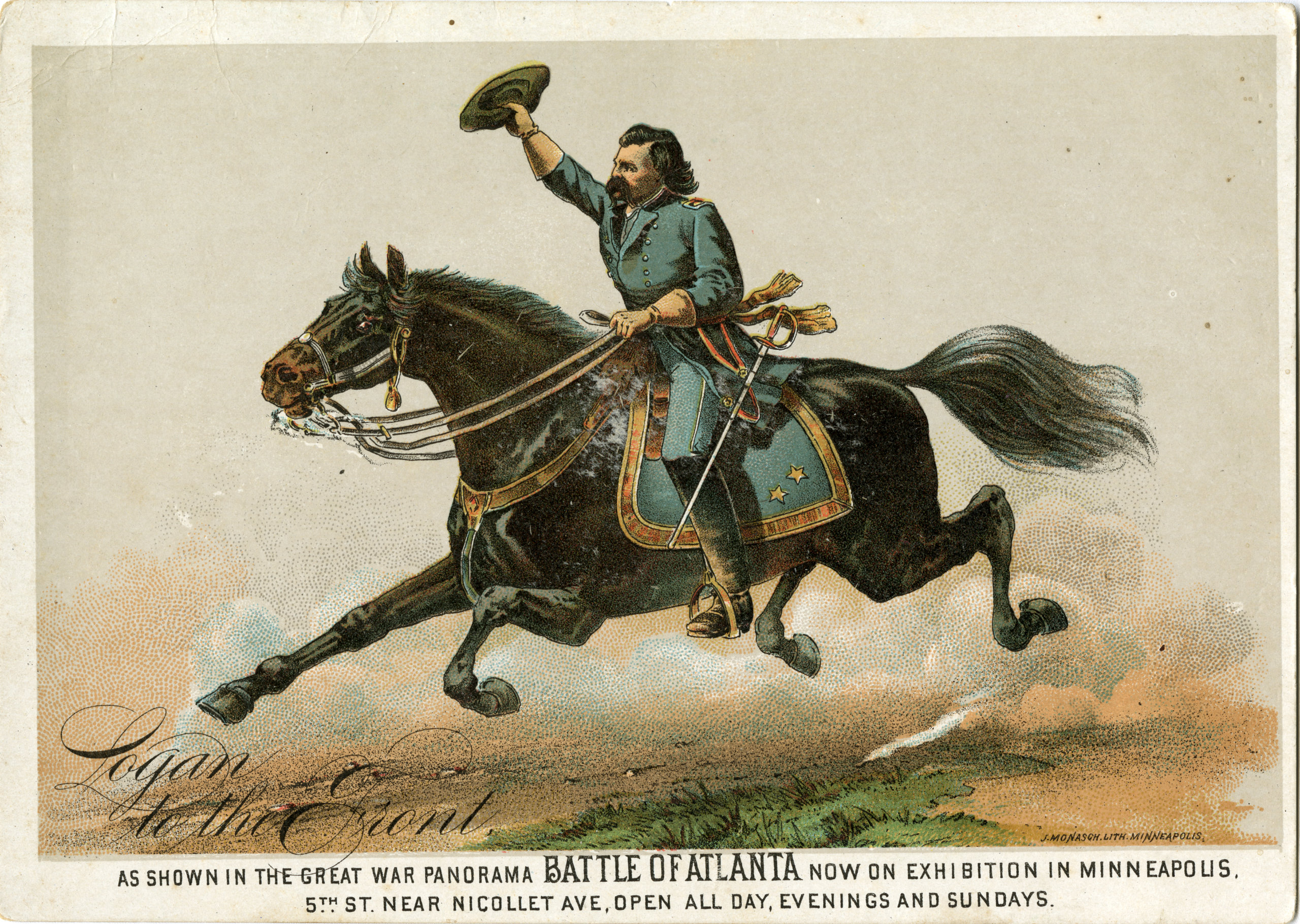
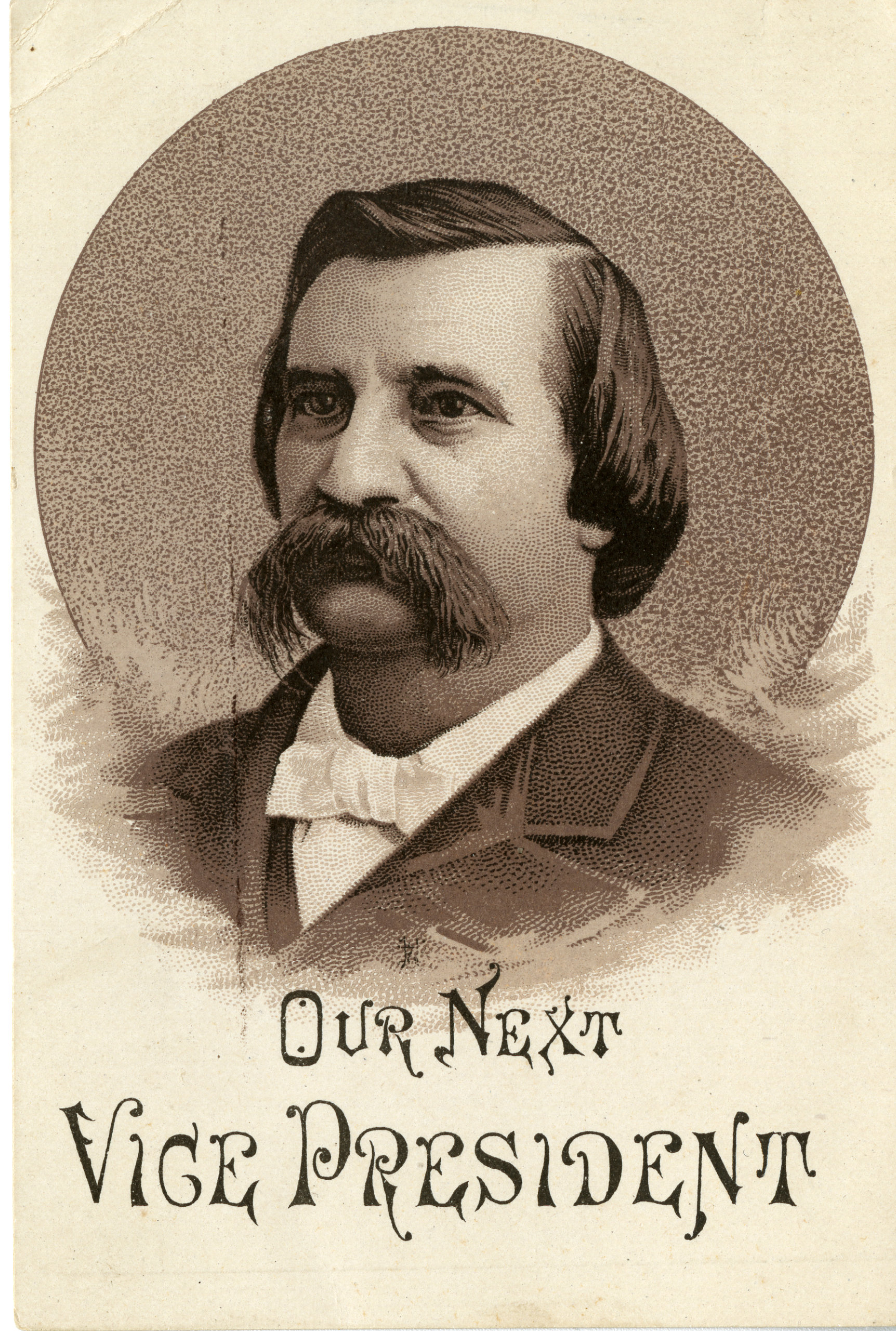
When the Battle of Atlanta panorama premiered in Minneapolis in July 1886, promotional placards with a tagline of "Logan to the Front!" depicted the general known as Black Jack in full gallop, his raven mane and handlebar moustache flowing as he held out his broad-brimmed hat at arm's length to encourage his surging troops. "Logan's Great Battle" was the advertising pitch in a Detroit newspaper when a copy of the "most reliable Panorama on earth" opened at that city's cyclorama rotunda in February 1887.56Advertisement, Detroit Free Press, February 27, 1887, 3. Black Jack's panoramic image and the accompanying promotional publicity burnished his reputation as one of the most successful Civil War generals on either side who did not attend West Point. He was the consummate Volunteer Soldier of America.57Stuart McConnell, Glorious Contentment: The Grand Army of the Republic 1865–1900 (Chapel Hill: University of North Carolina Press, 1992), 193. Logan parlayed his military fame and his close identification with the winning side into a long, postwar career as a powerful and steadfastly partisan Illinois Republican who served in the US House and Senate and was a prime mover of the Grand Army of the Republic (GAR), the largest Union veterans group. Logan's most enduring act as the GAR's commander-in-chief was his order in 1868 calling for all GAR posts to set aside May 30 as Memorial Day.58James P. Jones, John A. Logan: Stalwart Republican From Illinois (Tallahassee: Florida State University Press, 1982), 19. His ambitions for higher political office culminated in the Republican vice-presidential nomination in 1884, when he ran on the losing ticket headed by James G. Blaine. At the time of Logan's unexpected death at age sixty in December 1886, he was a leading contender for his party's top spot in the next presidential election. In the words of Logan's twentieth-century biographer James P. Jones, Black Jack "fought in the political arena with the ferocity he exhibited on the battlefield."59Jones, John A. Logan, 227. Yet because of his personal financial straits, the oft-repeated story that Logan commissioned the Battle of Atlanta painting to further his political ambitions is almost certainly apocryphal.
The panorama and its initial publicity in midwestern cities featured Logan's rousing leadership in the thick of battle. Although partial to the Union army's famous general and the troops he spurred on, the painting celebrated soldiers on both sides and their fervent commitments to their respective military missions. Each army faced a formidable foe, and the vivid display of combat mettle by clashing Federal and Confederate forces added luster to their individual martial reputations. This pictorial salute to the rank and file appealed to many white Americans who, beginning in the 1880s, avidly sought detailed visual and text accounts of Civil War military events and heroics but also eagerly put aside divisive sectional issues such as slavery, secession, and emancipation.60Timothy P. Caron, "'How Changeable Are the Events of War': National Reconciliation in the Century Magazine's 'Battles and Leaders of the Civil War,'" American Periodicals:A Journal of History and Criticism 16, no. 2 (2006): 151–171. As a broadening but still incomplete embrace of "reconciliation through recollection" gathered national momentum, according to historian David Blight, the ideological divides of the war faded from view.61Blight, Race and Reunion, 164, 217. The upshot was that "nationalism displaced the emancipatory meaning of the war," writes Thomas Bender in A Nation Among Nations: America's Place in World History. The hagiographic treatment of battle-tested Union and Confederate veterans instrumentalized the solider as the embodiment of the nation. As Bender explains: "All were brave; all fought for what they believed. All the old soldiers were heroes."62Thomas Bender, A Nation Among Nations: America's Place in World History (New York: Hill and Wang, 2006), 180.
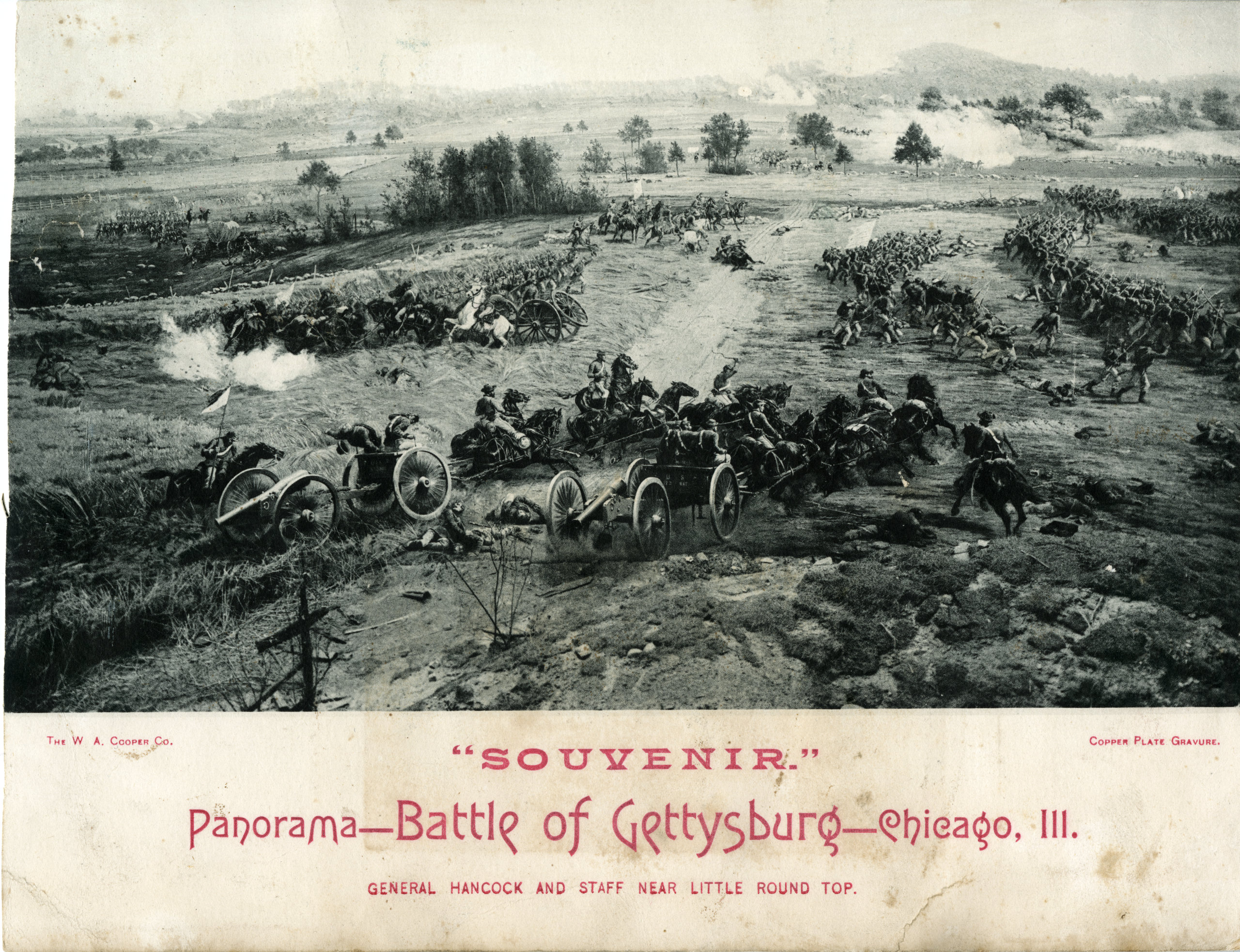
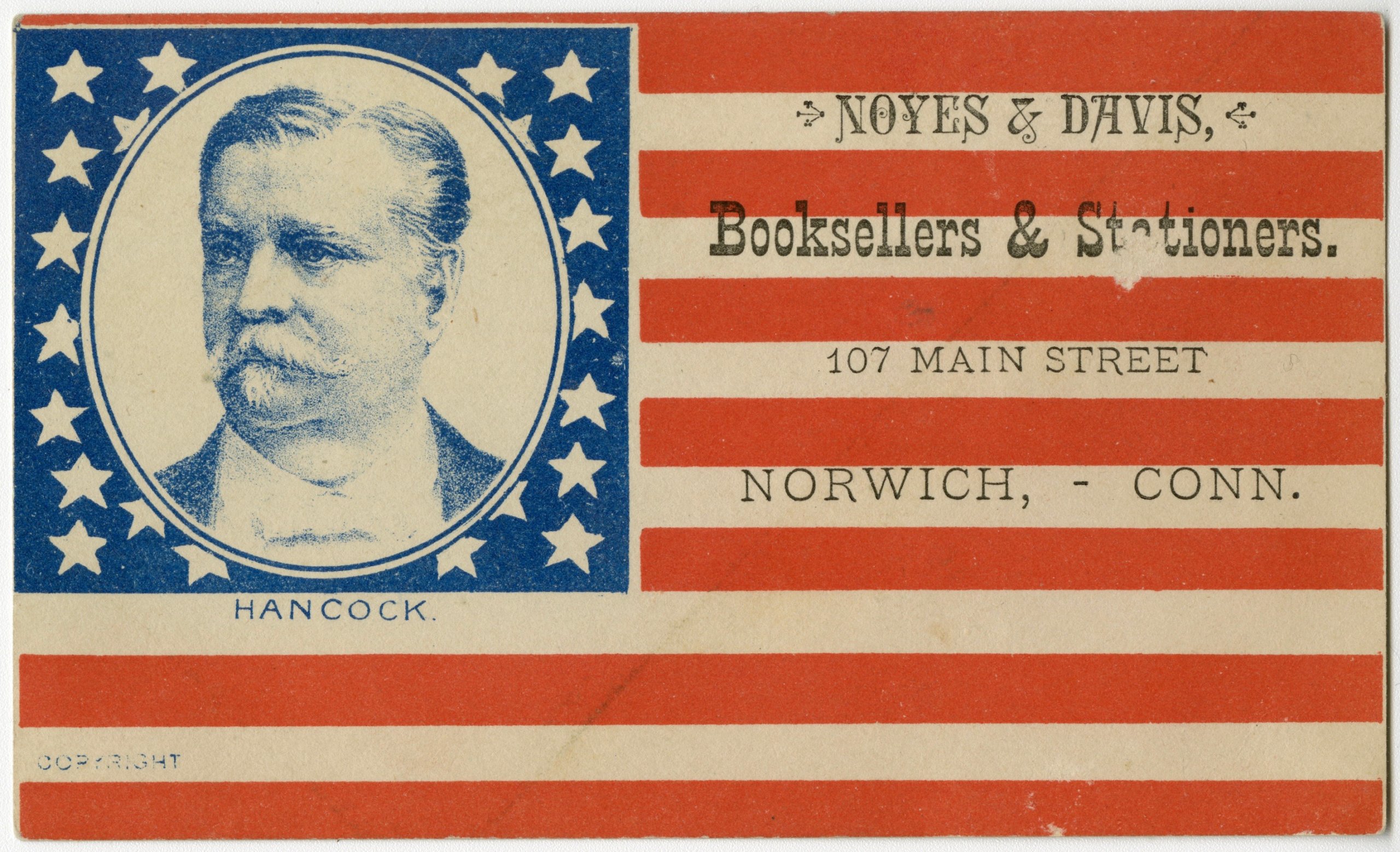
The drama of a heroic commander was a central element in the Battle of Atlanta painting: "Logan to the Front!" However, the even bigger picture was the panorama's portrayal of courageous soldiers amassed against each other in a powerful display of collective battlefield moxie. The Gettysburg painting, like its Atlanta counterpart, combined the "energy and the bravery of the many" with the "drama of the hero."63Peter Paret, Imagined Battles: Reflections of War in European Art (Chapel Hill: University of North Carolina Press, 1997), 66. No Black soldiers fought at Gettysburg, but several Black male laborers are depicted on the Union side in the panorama.64Brenneman and Boardman, Gettysburg Cyclorama, 188. The absence of a Black combat role in the battle meant that in the "telling and retelling of events," as historian Kenneth Nivison notes, "Gettysburg became . . . an icon of selective remembrance."65Kenneth Nivison, "Fields of Mighty Memory: Gettysburg and the Americanization of the Civil War," in The Battlefield and Beyond: Essays on the American Civil War, ed. Clayton E. Jewett (Baton Rouge: Louisiana State University Press, 2012), 291–309. The sprawling tableaux commemorated the most famous battle of the Civil War by hailing the bravery of white soldiers on both sides, The panorama also paid monument-like homage to a heroic general on horseback, foreshadowing his postbellum political career.66Benjamin T. Arrington, The Last Lincoln Republican: The Presidential Election of 1880 (Lawrence: University Press of Kansas, 2020), 110–112. Premiering in Chicago in 1883, three years before the Atlanta painting opened in Minneapolis, the visual narrative showed Major General Winfield Scott Hancock astride his horse, urging his infantry and artillery forward after their line was attacked by Confederate troops. The bold assault on the Union center, part of what is now known as Pickett's Charge on day three of the battle—the High Water Mark of the Confederacy—was met with a devastating response, and the entire attack failed in the Civil War's most hallowed combat encounter. After the war, Hancock, who was severely wounded at Gettysburg, capitalized on his military fame to remain a heralded public figure and, like Logan, pursue national office. In 1880 Hancock was narrowly defeated when he ran as the Democratic party's candidate for President. The Union war hero carried all the former slave states but only a single northern state, New Jersey, in his presidential lost cause.67Charles W. Calhoun, From the Bloody Shirt to Full Dinner Pail: The Transformation of Politics and Governance in the Gilded Age (New York: Hill and Wang, 2010), 75.
When the Atlanta and Gettysburg panoramas circulated from city to city, they offered a popular commemorative formula—"two brands of the same valor"—that attracted an enormous number of spectators.68Nivison, "Fields of Mighty Memory," 292. Over 286,000 paying customers viewed the Atlanta painting during its approximately eighteen-month Detroit run.69"The Cyclorama," Detroit Free Press, October 28, 1888, 20. Notwithstanding "many cracks in the plaster of national reunification," to borrow historian John R. Neff's succinct description, the Civil War combatants in the paintings exemplified the "deep horizontal comradeship" that enabled many late nineteenth-century white Americans to imagine themselves as members of a single community.70John R. Neff, Honoring the Civil War Dead: Commemoration and the Problem of Reconciliation (Lawrence: University Press of Kansas, 2005), 205. The soldiers are portrayed as "the model of manly character," which historian Kristin Hoganson describes as a set of traits—including loyalty to one's fellows, fearlessness, and a calibrated combination of belligerence and chivalry—that elicited popular acclaim for veterans of both sides.71Kristin L. Hoganson, Fighting for American Manhood: How Gender Politics Provoked the Spanish-American and Philippine-American Wars (New Haven, CT: Yale University Press, 1998), 24. The combatants shown in the cyclorama paintings function as a "point of origin" for the larger imagined brotherhood, as evidenced by the broad political authority conferred on Civil War veterans in the postbellum years. "The soldier is a foundational figure," Nicola Cooper and Martin J. Hurcombe explain in their interpretation of the warrior's role in society. Cooper and Hurcombe add that "he" "is central to the history, self-image, and identity of the nation."72Cooper and Hurcombe, "Figure of the Soldier," 103.
After the War, according to Hoganson, a "military style of politics" emerged from "the idea that the state rested ultimately on soldier-citizens," and even nonveterans who vied for political office cited "the military valor of men from their class, race, region, or ethnicity or their own soldierly attributes." Hoganson emphasizes that this style of politics "made American political culture more inclusive for men" while carrying with it "exclusionary implications for women."73Hoganson, Fighting for American Manhood, 25–26. And, just as celebratory memories of male military service sidelined full citizenship for females, selective commemorations that omitted or minimized the wartime roles of Black Americans contributed to mainstream indifference or outright hostility toward racial equality.74Cecilia E. O'Leary, To Die For: The Paradox of American Patriotism (Princeton, NJ: Princeton University Press, 1999), 129. In the waning years of the nineteenth century, Martin A. Berger observes in Sight Unseen: Whiteness and American Visual Culture, whites harboring racially discriminatory attitudes and beliefs unselfconsciously transferred their values onto the images around them. The art of exclusion was among the creative ways that "silently reinforced" Jim Crow practices, which denigrated and did violence to Black people for years to come.75Martin A. Berger, Sight Unseen: Whiteness and American Visual Culture (Berkeley: University of California Press, 2005), 173–174.
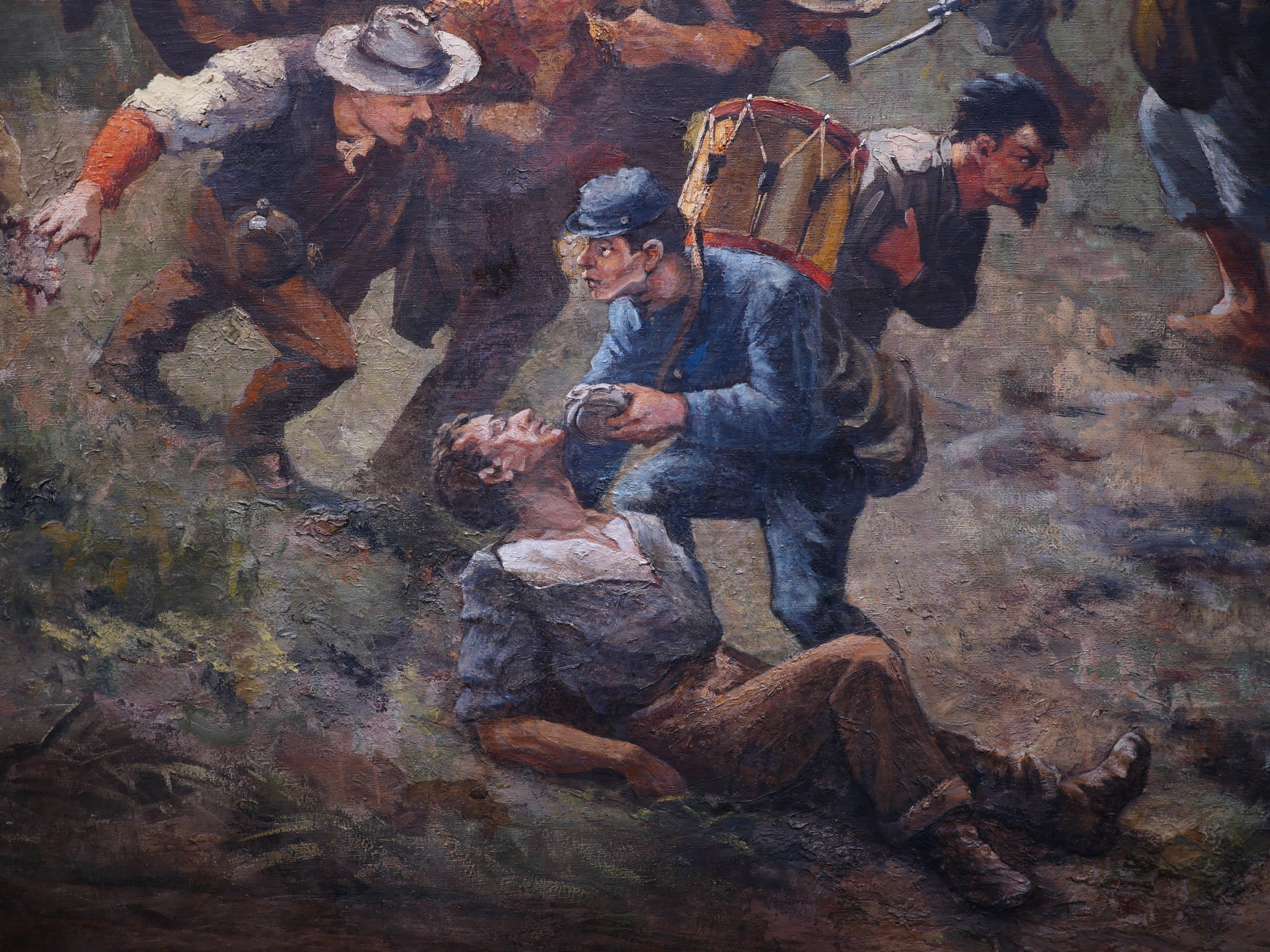
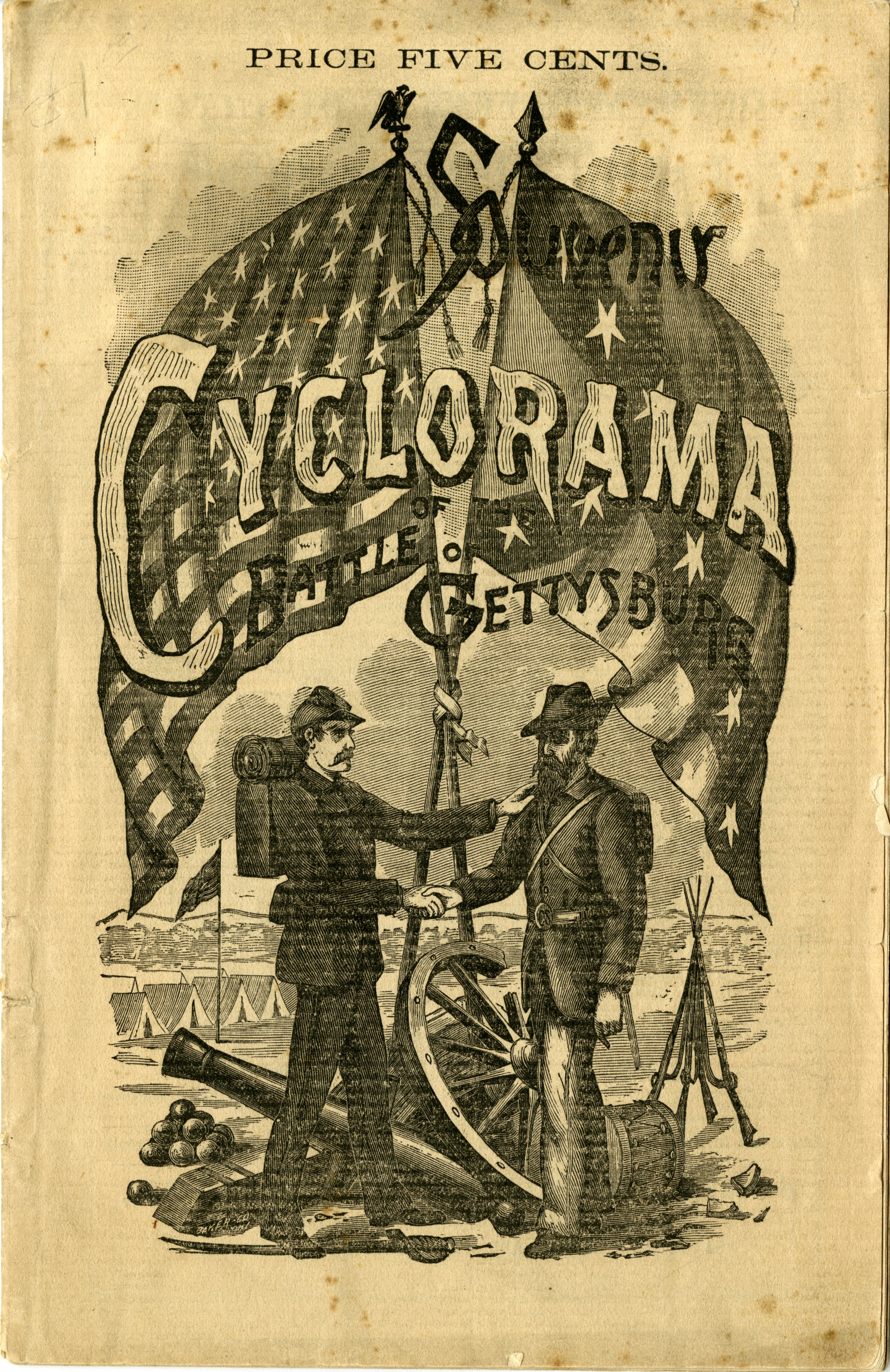
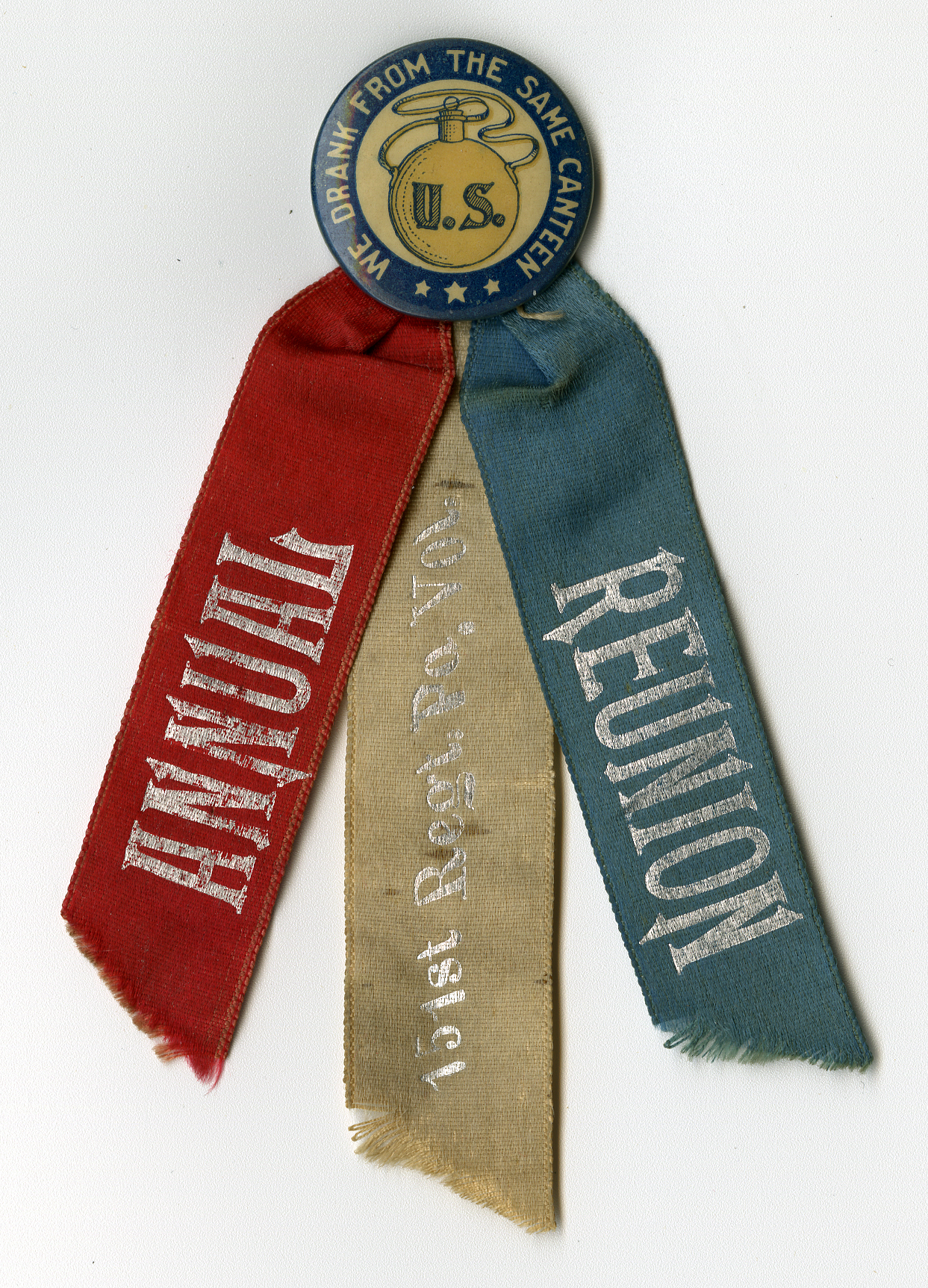
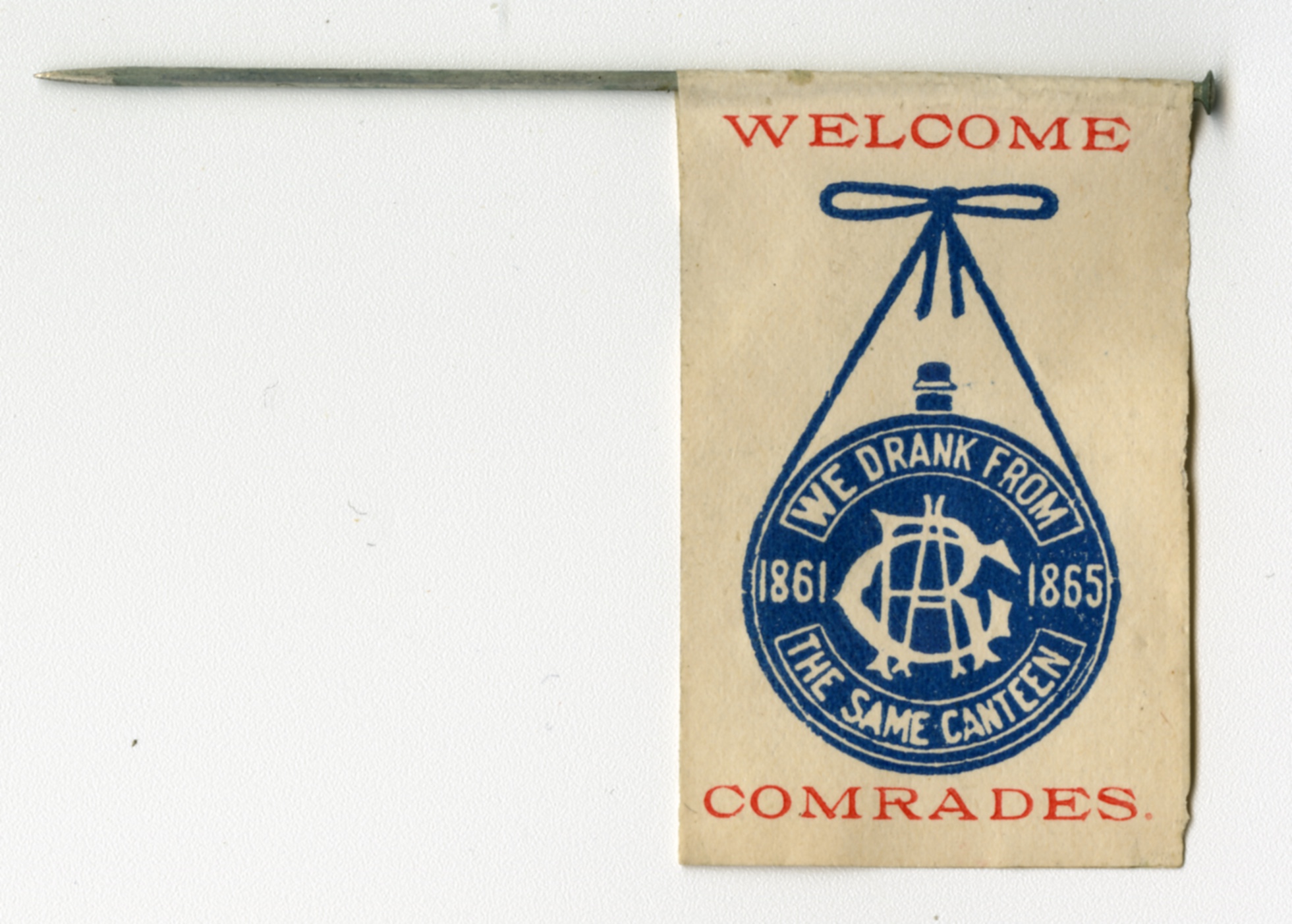
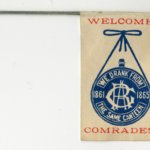
The Civil War battle scenes on sprawling paintings expressed the increasingly dominant narrative of national belonging that encouraged audiences to transcend sectionalism and coalesce around a common white identity.76Jimmy L. Bryan, "Introduction," in The Martial Imagination: Cultural Aspects of American Warfare, ed. Jimmy L. Bryan (College Station: Texas A&M University Press, 2013), 1–11. Vivid, smaller-scale versions of this panoramic theme, included on the canvases themselves or accompanying souvenir programs, cast a spotlight on comradery and common Americanness. In their painting, the Atlanta panorama artists foreground a poignant depiction of a Union warrior sharing his canteen with a wounded Confederate soldier. This image of battlefield magnanimity amid the chaos of combat illustrated the possibilities for intersectional, postwar harmony. The emotionally compelling connection between erstwhile enemies, legendarily siblings who rediscovered each other under dire circumstances, represented in a condensed, visual form the four years-long "brother's war" and the opportunity for reunion of a national "family." Canteen sharing with foes or friendly troops suggested a common humanity or, in other words, "white male unity," as historian Lauren K. Thompson points out in her study of soldier fraternization during the Civil War.77Lauren K. Thompson, Friendly Enemies: Soldier Fraternization throughout the Civil War (Lincoln: University of Nebraska Press, 2020), 154. In another emblematic and evocative image, a souvenir program for the Gettysburg cyclorama depicted soldiers from the two sides clasping hands. This oft repeated symbol of mutual respect and sectional affinity expressed in a single gesture an underlying bond between white, wartime opponents that gained new cache in the century's final years. In the century to come, the images of canteen sharing and hands clasping also served as visual and thematic through-lines to D. W. Griffith's The Birth of a Nation and other cinematic Civil War narratives.
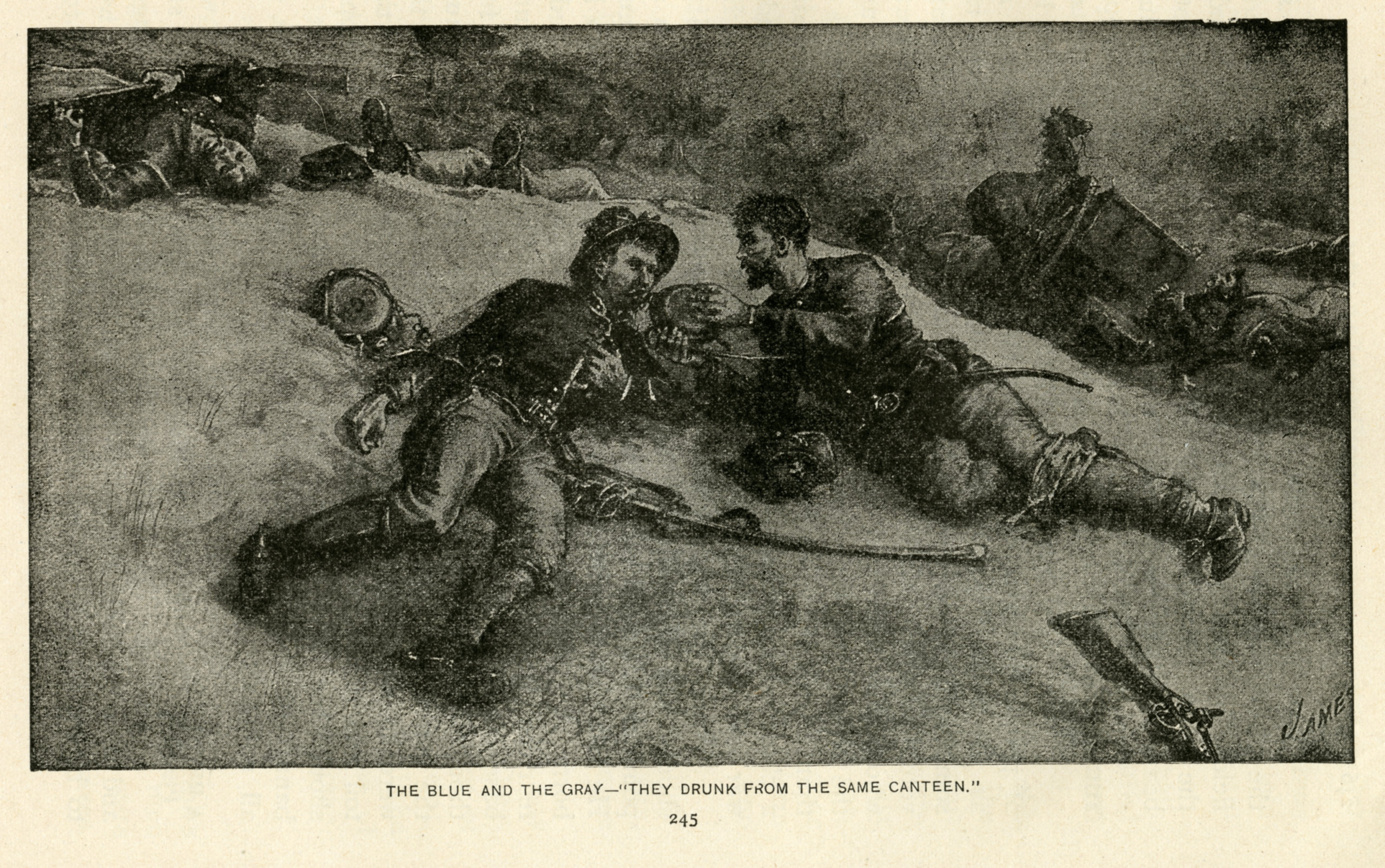
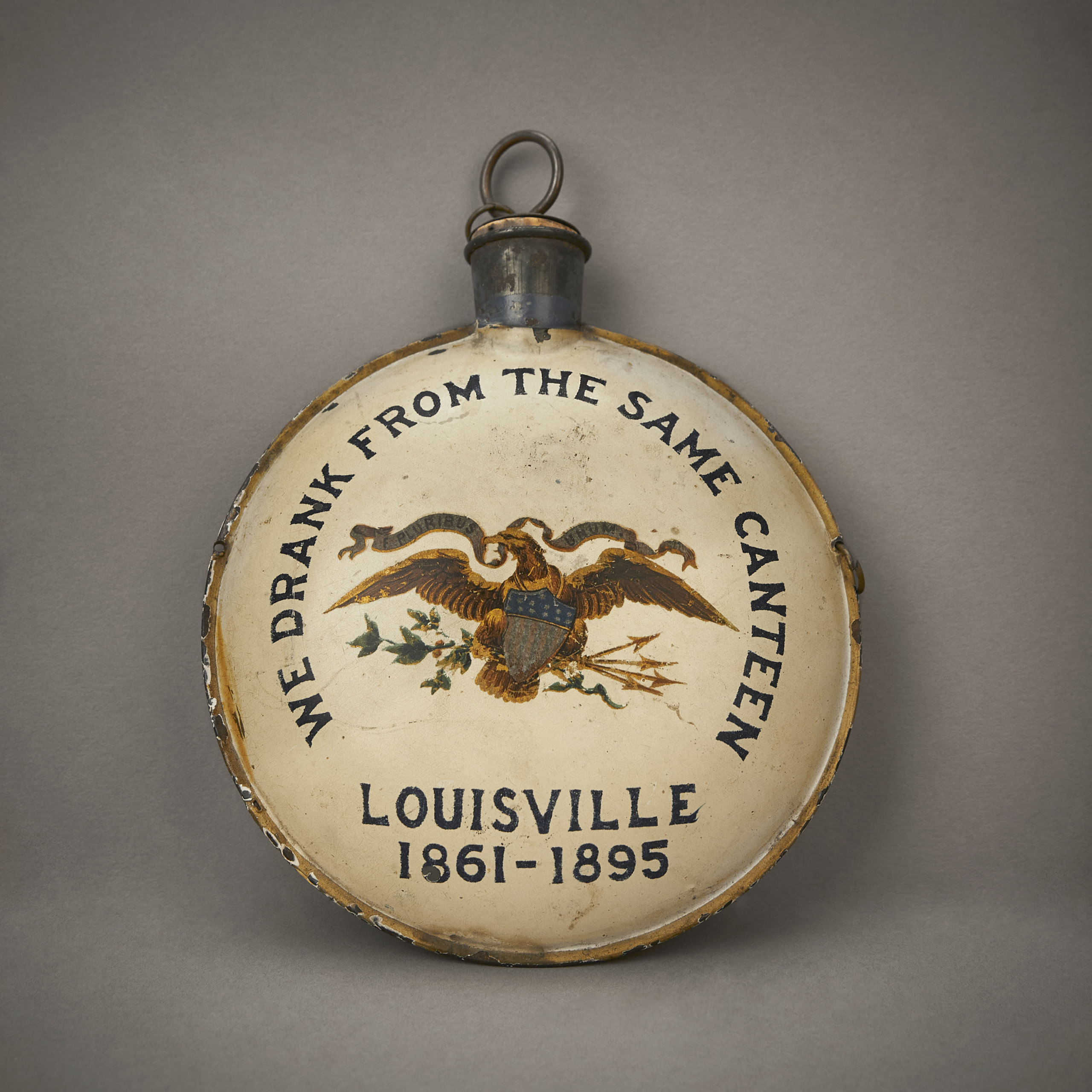
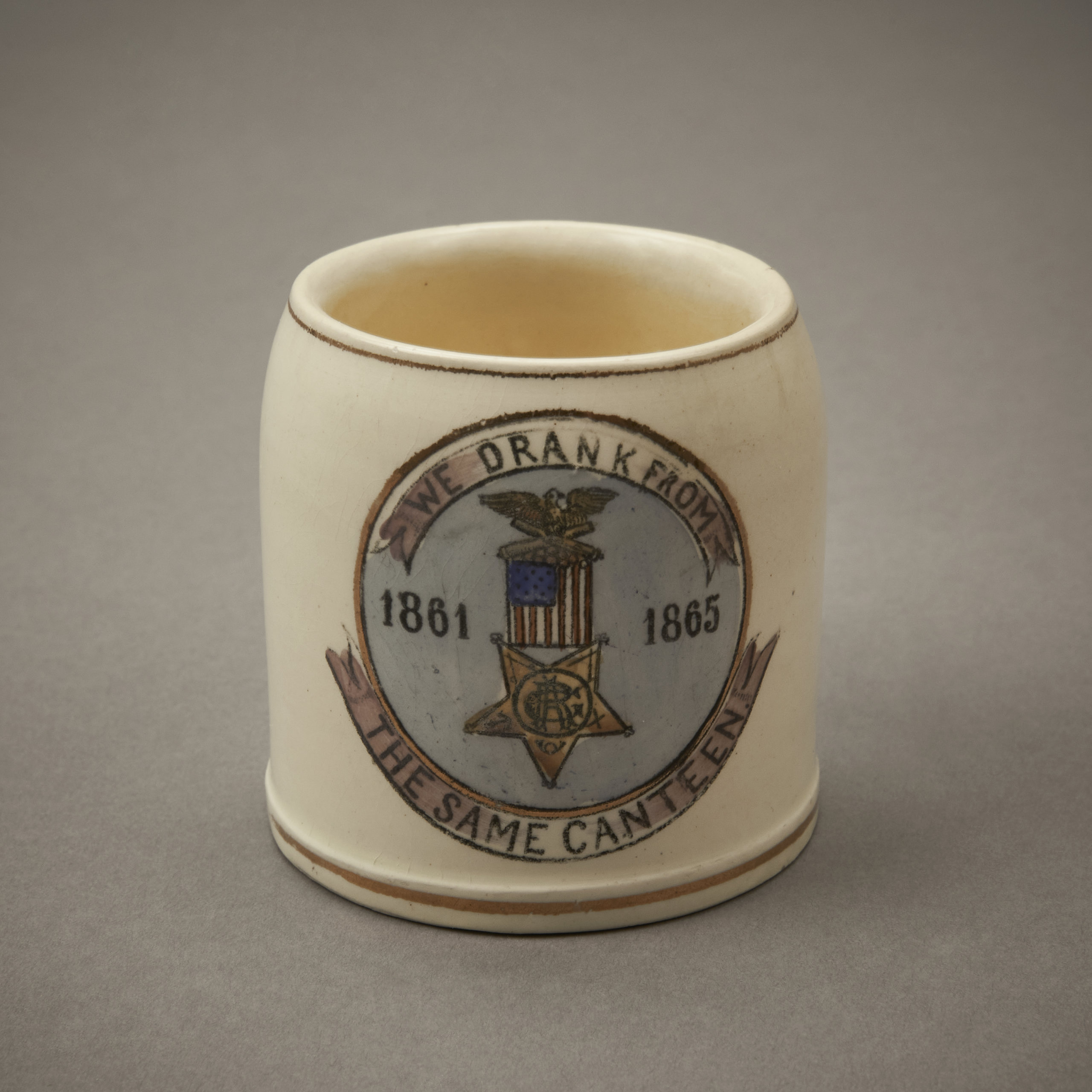
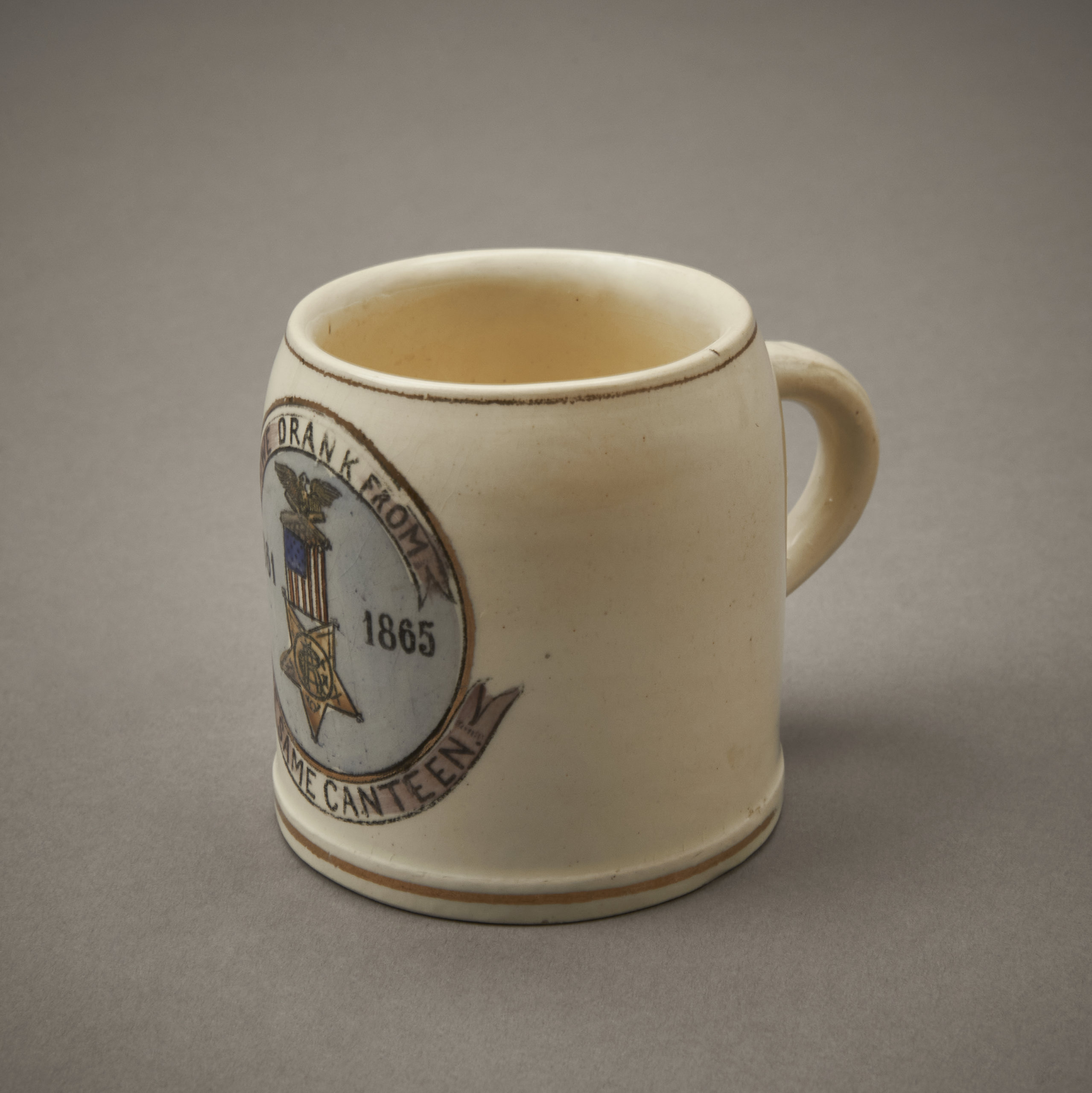
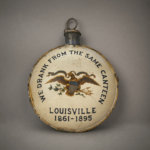
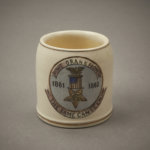
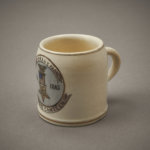
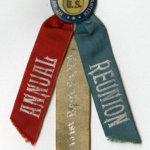

At the peak of the cyclorama vogue in the US, four versions of the Gettysburg panorama and two copies of the Atlanta painting circulated simultaneously from city to city.78"Watching Pickett's Charge," New York Times, March 5, 1887, 3; "The Battle of Atlanta Today," Detroit Free Press, February 26, 1887, 5; Battle of Atlanta advertisement, St. Paul Daily Globe, March 8, 1887, 3. They toured at the same time as other Civil War battle panoramas, and the intense competition for viewers prompted promoters to take down the gigantic paintings and replace them with new ones at a rapid pace.79Oettermann, Panorama, 239. In a span of six years, the Battle of Atlanta panorama initially exhibited in Minneapolis also was shown in Indianapolis, Chattanooga, and Atlanta, where it has remained on display almost without interruption since 1892. As impresarios moved the panoramas from one city to another, they sometimes altered images to increase their appeal to a local audience. Paul Atkinson, an entrepreneur who bought the Battle of Atlanta panorama in 1890, prepared it for exhibition in Chattanooga by commissioning an artist to convert a group of Confederate prisoners to retreating Union soldiers. Atkinson recalled that when the alteration was completed, "he had a bunch of Yankees running like the mischief."80Alma H. Jamison, "The Cyclorama of the Battle of Atlanta," The Atlanta Historical Bulletin, no. 10, July 1937, 58–75. The ruse continued when Atkinson moved the painting to its final stop, where the Atlanta Constitution heralded the attraction as the only Civil War battle panorama "in which confederate soldiers are shown in the moment of victory." The newspaper reported that "Mr. Atkinson, who is always on the stage, will give away any information desired in regard to the battle, and he is remarkably well up on his history, and tells many interesting stories of incidents in the fight."81"Right at Home," Atlanta Constitution, February 23, 1892, 9.
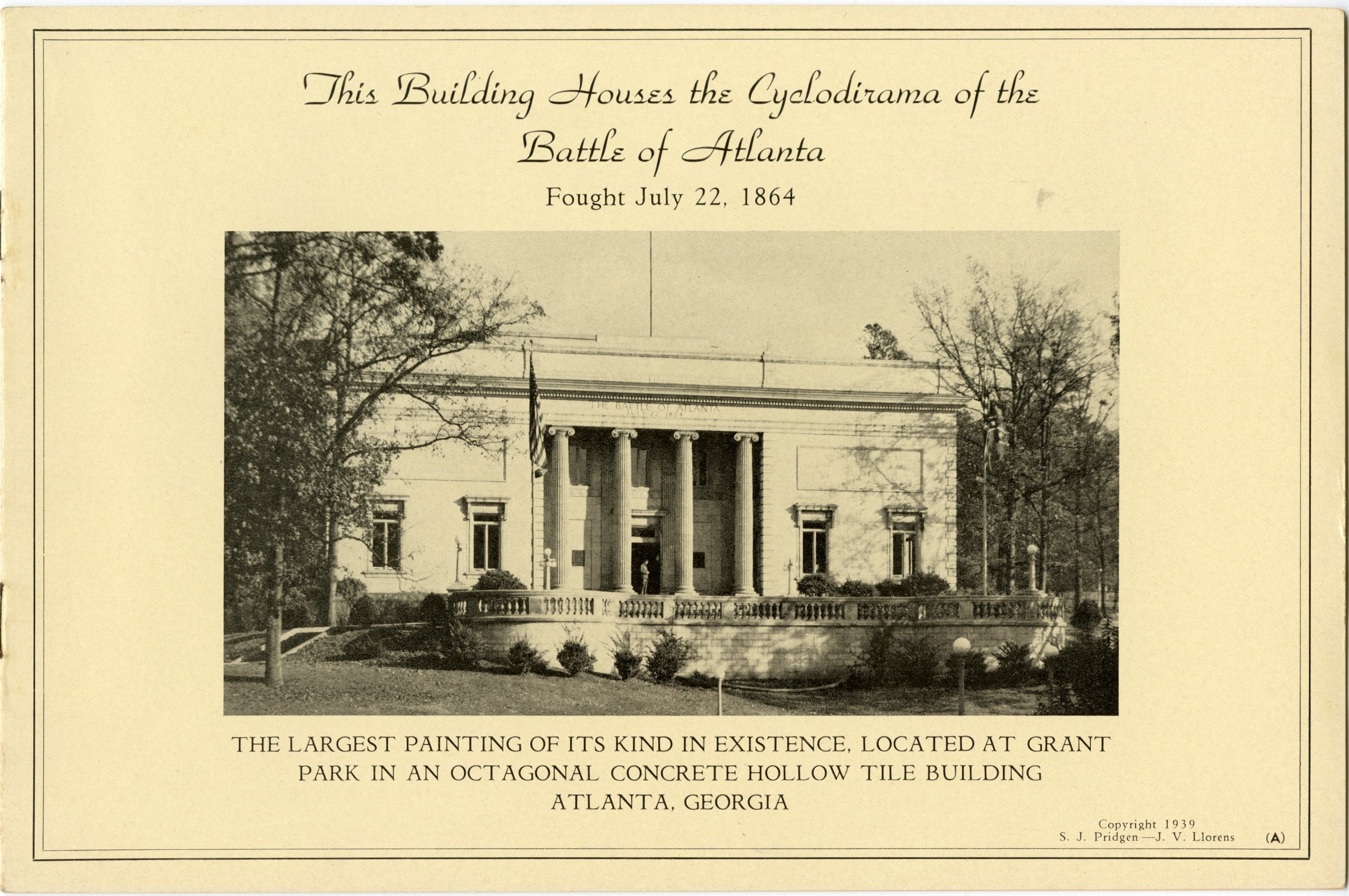
Try as they might, promoters could not keep the cyclorama boom going, and the paintings fell out of fashion at the turn of the century.82Comment, Painted Panorama, 257. They "acquired a certain aura of quaintness," according to historian Angela Miller.83Miller, "Panorama," 58. An early indication of the downturn was the low sales price for the Battle of Atlanta painting when it changed hands in its namesake city eighteen months after its opening. "It Went for a Song," the Atlanta Constitution announced, fetching just $1,110.84"It Went for A Song," Atlanta Constitution, August 9, 1893, 7. The panorama trade was a risky business, and a painting that did not make a profit in one city could leave promoters without the means to dismantle and move the canvas to a new location. It might be left to languish where it was last displayed. Yet some entrepreneurs continued to invest in cyclorama paintings until their commercial appeal declined precipitously.85Fruitema and Zoetmulder, The Panorama Phenomenon, 28. The mammoth canvases were particularly vulnerable to rapidly increasing competition from motion pictures. Movies were more easily distributed and displayed, offered an immersive viewing experience, and surpassed cyclorama paintings by adding photographic realism and movement to the mix.86Erkki Huhtamo, Illusions in Motion: Media Archeology of the Moving Panorama and Related Spectacles (Cambridge, MA: MIT Press, 2013), 363; Miller, "Emergence of the Spectacular," 41–42, 58. Still, the rapidly ascendent medium inherited important elements from its predecessor. Long shots of landscapes combined with close-ups of human figures and a seamless blending of different scenes into a single composition linked the two media to a common visual grammar.87Griffiths, "'Shivers Down Your Spine,'" 21. During cinema's early years, from 1894 through approximately 1908, panoramic shots of natural or human-made wonders were among the most popular subjects.88Tom Gunning, D. W. Griffith and the Origins of American Narrative Film: The Early Years at Biograph (Urbana: University of Illinois Press, 1991), 216. "Film was quick to embrace the panorama," according to media scholar William Uricchio, who cites evidence (possibly incomplete) that in the first years of motion pictures "panorama" or "panoramic views'" were the leading copyright entry recorded for movies in the US.89William Uricchio, "A 'Proper Point of View': The Panorama and Some of Its Early Media Iterations," in Early Popular Visual Culture 9, no. 3 (2011): 225–238. However, films at that time were too short, some less than a minute, to tell the story of famous battles that had been depicted so vividly in cyclorama paintings.90André Gaudreault and Tom Gunning, "Introduction" in American Cinema, 1890–1909: Themes and Variations, ed. André Gaudreault (New Brunswick, NJ: Rutgers University Press, 2009), 1–21. Filmmakers concentrated on exhibiting brief, attention-grabbing visual novelties and snippets of sensational events that comprised what film historian Tom Gunning describes as the "cinema of attractions."91Gunning, D. W. Griffith, 6.
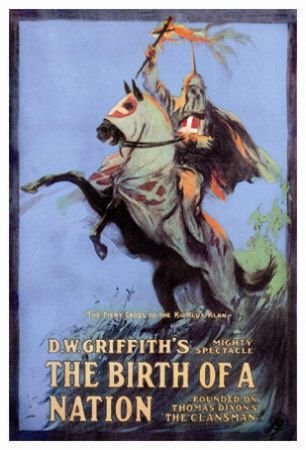

D. W. Griffith was at the forefront of the transition from short movies that "show" to longer films that "tell." His work, beginning with his directorial debut in 1908, typified what Gunning refers to as the "cinema of narrative integration."92Gunning, D. W. Griffith, 6. Griffith used a variety of innovative filmmaking techniques to narrate events and develop his characters. His methods included displaying two or more simultaneous events in rapid succession to connect story lines, panoramic shots to depict scenes of expansive action, and close-ups to draw attention to individual performers. Griffith did not introduce these techniques, but he experimented with them, and he was among the first American directors to anticipate the popular appeal of multiple-reel, feature-length films.93Stokes, D. W. Griffith's The Birth of a Nation, 74–77; Burgoyne, The Hollywood Historical Film, 25. He also recognized the Civil War's cinematic potential, which increased as the semicentennial of the War approached and then peaked as veterans' reunions and other commemorative activities marked the fiftieth anniversary of major events.94Robert Jackson, "The Celluloid War Before The Birth: Race and History in Early American Film," in American Cinema and the Southern Imaginary, ed. Deborah Barker (Athens: University of Georgia Press, 2011): 27–51; David W. Blight, "Quarrel Forgotten or a Revolution Remembered? Reunion and Race in the Memory of the Civil War, 1875–1913," in Union and Emancipation: Essays on Politics and Race in the Civil War Era, ed. David W. Blight and Brooks D. Simpson (Kent, OH: Kent State University Press, 1997): 151–217. Between 1908 and 1915, Griffith directed twelve Civil War movies, culminating in his three-hour epic The Birth of a Nation, which was made to celebrate the golden anniversary of the War's end.95Paul C. Spehr, The Civil War in Motion Pictures: A Bibliography of Films Produced in the United States Since 1897 (Washington, DC: US Government Printing Office, 1961); Belton, American Cinema/American Culture, 125. When it was released in February 1915, according to Leon Litwack, "the motion picture as art, propaganda, and entertainment came of age."96Litwack, "The Birth of a Nation," 136. For the newly revived Ku Klux Klan, the movie's release and distribution were a boon for membership recruitment.97Nancy MacLean, Behind the Mask of Chivalry: The Making of the Second Ku Klux Klan (New York: Oxford University Press, 1994), 13.
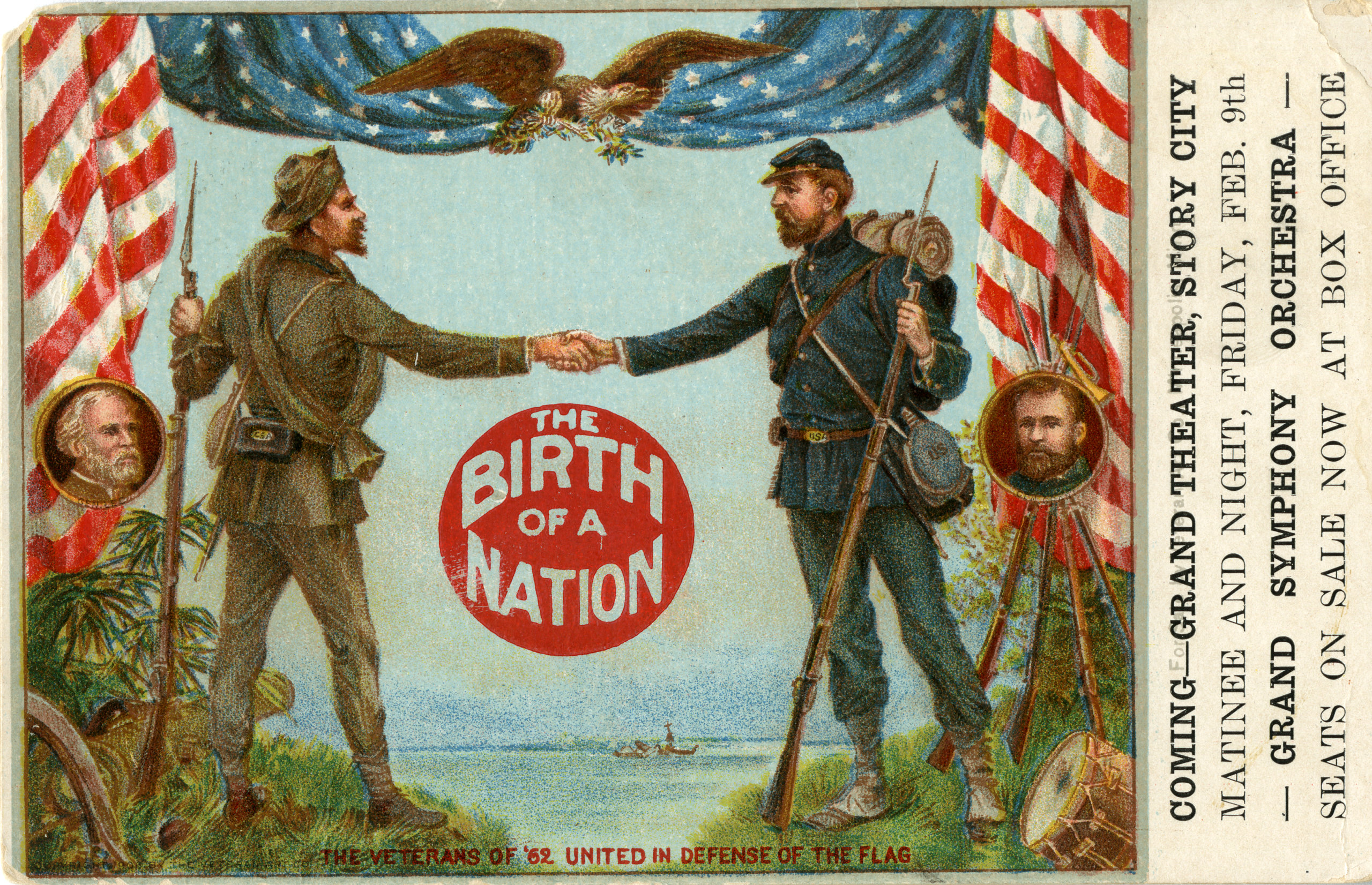
Griffith and movie producer Roy Aitken led a promotional campaign for The Birth of a Nation that film historian Bruce Chadwick describes as unprecedented in scope. They hired public relations director Ted Mitchell, and "the trio seemed to think of everything," according to Chadwick.98Bruce Chadwick, The Reel Civil War, 130. Advertising blitzes for the motion picture began two weeks before the film arrived in towns on its national tour. Publicity managers heralded the film's opening with parades that featured performers dressed as Klansmen. Promotional materials included widely distributed postcards that displayed Union and Confederate soldiers clasping hands as they held their rifles at rest. Movie programs sold at theaters listed the film's cast and described how Griffith made his motion picture extravaganza. Aided by President Woodrow Wilson's implicit endorsement and despite vigorous protests by the NAACP, the film played to packed theaters nationwide and reaped enormous profits. It produced more than $60 million in revenue in its first run, and its biggest box office business was in northern and western cities, where, according to historian Gary Gallagher, "patrons likely were dazzled by Griffith's technical skill and masterful staging and little bothered by his racism."99Richard Schickel, D. W. Griffith: An American Life (New York: Simon and Schuster, 1984), 281; Chadwick, The Reel Civil War, 132; Gary W. Gallagher Causes Won, Lost, and Forgotten: How Hollywood and Popular Art Shape What We Know About the Civil War (Chapel Hill: University of North Carolina Press, 2008), 45.
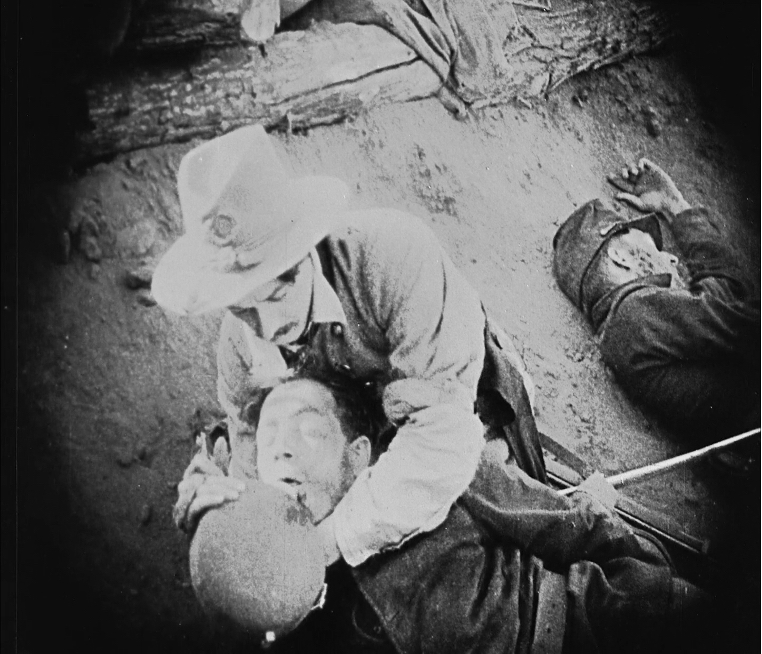
Griffith tells his version of the Civil War and Reconstruction by recounting the epic saga of two fictional, white families, the southern Camerons and the northern Stonemans. The two clans represent the temporarily divided sides in the "house of the nation," which, in Griffith's melodramatic tale, were destined to reunite and reassert white supremacy after a cataclysmic war and a tragic, postwar era of Black domination.100Elisabeth Bronfen, Specters of War: Hollywood's Engagement With Military Conflict (New Brunswick, NJ: Rutgers University Press, 2012): 26; Hernan Vera and Andrew Gordon, "Sincere Fictions of the White Self in the American Cinema, The Divided White Self in Civil War Films" in Classic Hollywood, Classic Whiteness, ed. Daniel Bernardi (Minneapolis: University of Minnesota Press, 2001): 263–280. The hero is Ben Cameron, who serves as a Confederate army colonel during the movie's first half and then forms and leads the Ku Klux Klan in the immediate postwar years, which are covered in the film's second half. Griffith's Civil War segment repeats images and themes that appeared thirty years earlier in cyclorama battle paintings, including a canteen-sharing moment in which Ben Cameron provides succor to a Union soldier. More broadly, Griffith followed the panoramic formula by combining the "drama of the hero" and the "energy and the bravery of the many" into a unifying story that transformed America's bloodiest conflict into a "brother's war." Sweeping battle scenes shot from afar blur the distinction between the opposing sides. Dramatic close-ups of hand-to-hand combat and striking displays of selfless acts provide evidence of bilateral gallantry. The causes for which the Union and Confederate armies fought do not enter the picture. "As important as the Civil War was," historian Stephen Weinberger explains, "Griffith does not present it as a conflict between right and wrong or good and evil."101Stephen Weinberger, "Austin Stoneman: The Birth of a Nation's American Tragic Hero," Early Popular Visual Culture 10, no. 3 (2012): 211–225.
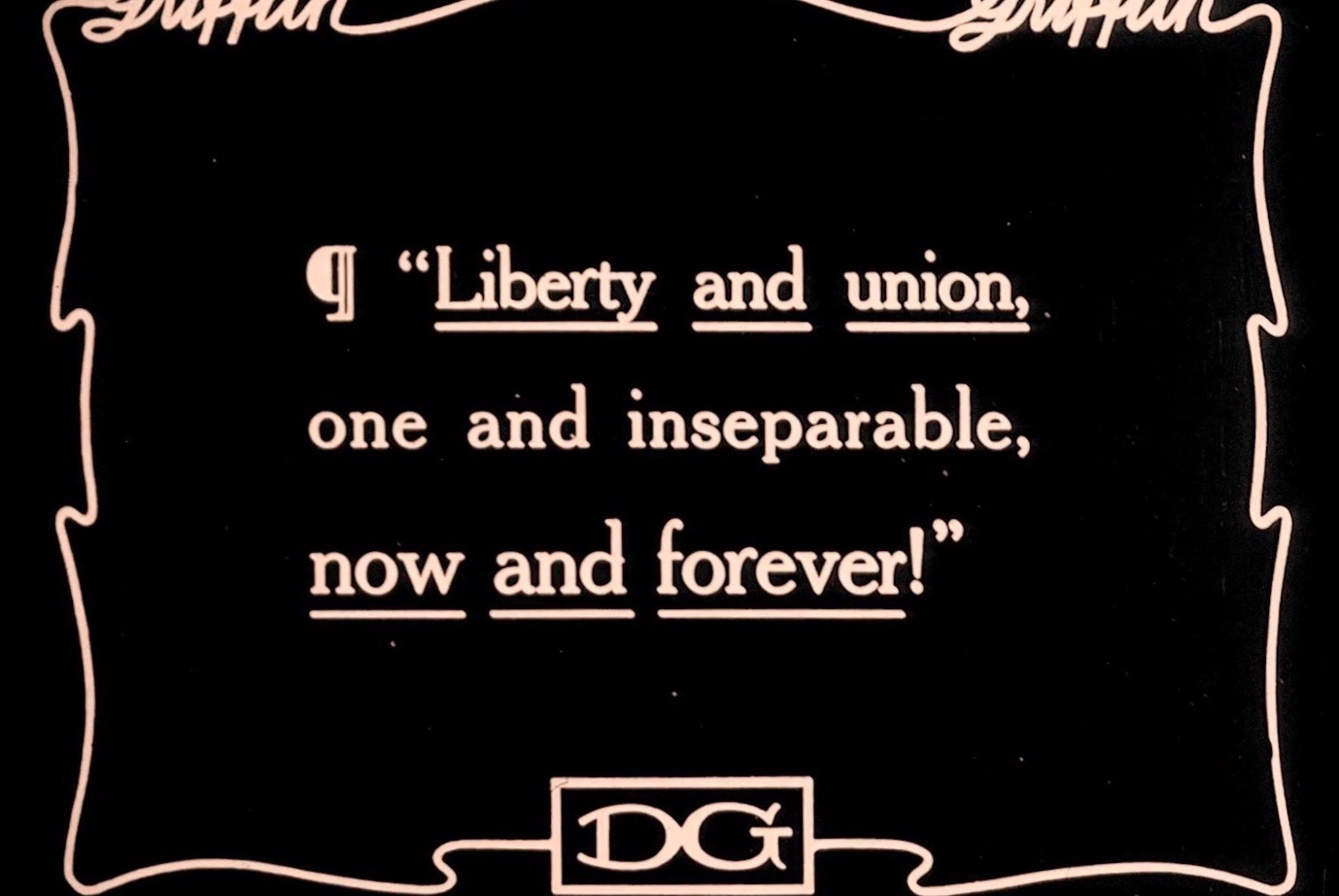
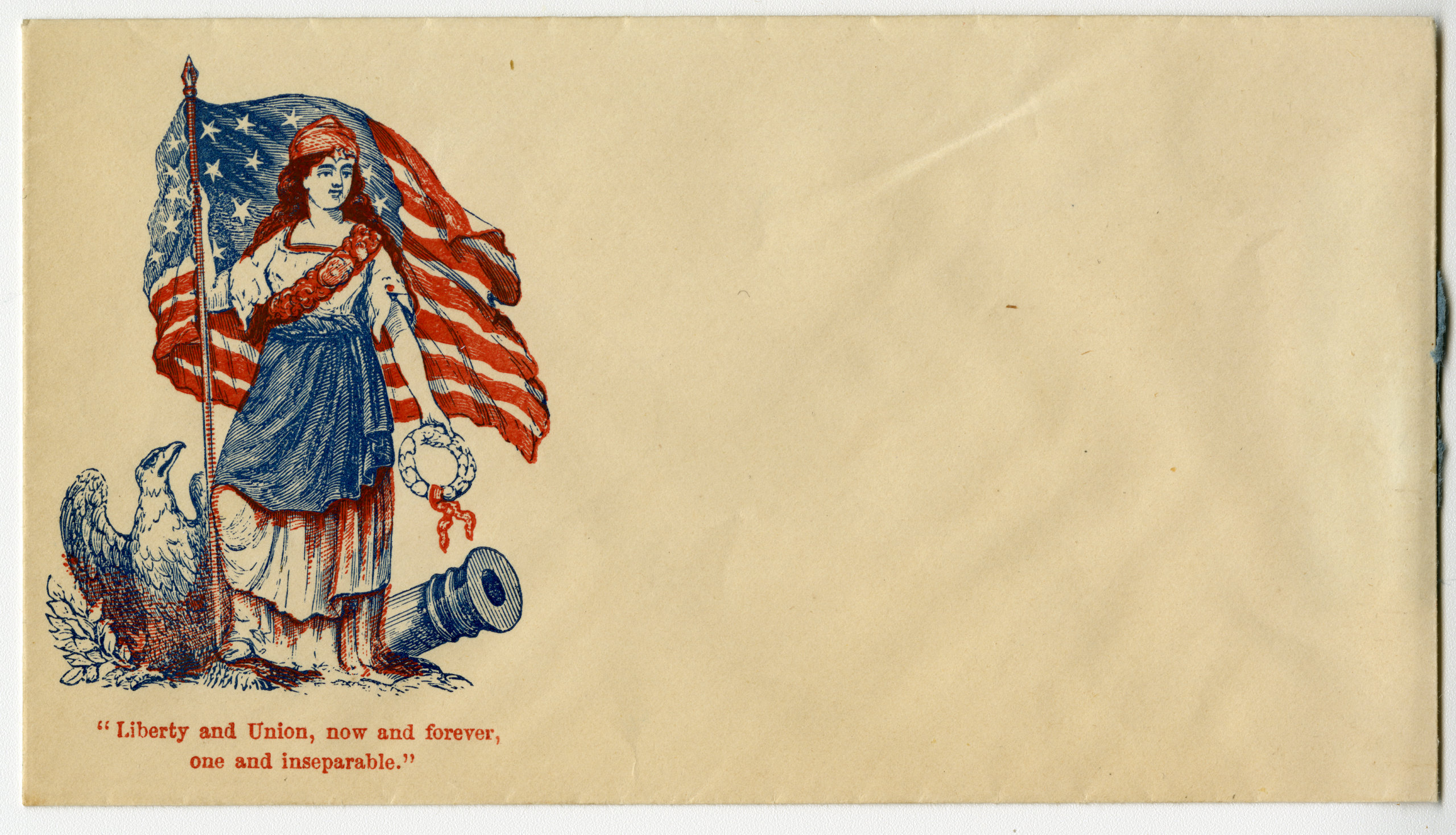
To a large extent, the cycloramic-cinematic parallels end when The Birth of a Nation picks up the story of Reconstruction in its second half. Griffith presents the postwar period as a contest between right and wrong, and the combatants are as markedly different, literally black and white, as the Civil War contestants were similar.102Ibid., 213. Black people and women take center stage, a notable contrast with their nearly complete absence from the cyclorama paintings. Griffith portrays Black characters as "incapable of self-government or self-control."103Barrett, Shooting the Civil War, 130. His white women are vulnerable and victimized; they must be protected and rescued by chivalrous white heroes. Ben Cameron's leadership of the Ku Klux Klan's vigilante violence against "black villains," including a lynching, is a portrayed as a legitimate exercise of power in defense of "white women in distress."104Amy Louise Wood, Lynching and Spectacle: Witnessing Racial Violence in America, 1890–1940 (Chapel Hill: University of North Carolina Press, 2009): 153. Cameron is a "hero on horseback," Griffith suggests, the leader of an invisible army whose bravura performance and legacy equal or surpass the achievements of the generals who appear in Civil War panoramas. In Griffith's telling, Ben Cameron is a foundational figure around whom the forces of a divided nation coalesce, just as his own family reconciles with their northern counterparts in pursuit of a common cause. Cameron's paramilitary conquests are followed by a celebratory Ku Klux Klan parade and two Cameron-Stoneman weddings, which strengthen the bond between the fictional families and serve as Griffith's allegorical summation of how white southerners and white northerners reunite and give birth to a nation. In the movie's final moments, a title card appears that cunningly and ironically transforms a wartime rallying cry for the Union—which originated with Daniel Webster's famous 1830 Senate oration—into a white nationalist vision of American civilization predicated on racial purity and hierarchy: "Liberty and union, one and inseparable, now and forever!"105Christopher Childers, The Webster-Hayne Debate: Defining Nationhood in the Early American Republic (Baltimore, MD: Johns Hopkins University Press, 2018), 112–113; Steven R. Boyd, Patriotic Envelopes of the Civil War: Iconography of Union and Confederate Covers (Baton Rouge: Louisiana State University Press, 2010), 81.
The history of militarized commemorative culture in the US is lengthy. It began long before the Battle of Atlanta panorama circulated from city to city, and it endures long after The Birth of a Nation's multiple runs in movie theaters nationwide. From the revolutionary era to the present day, war stories—including visual narratives—have helped spawn American nationalism and shape the national polity.106Sarah J. Purcell, Sealed With Blood: War, Sacrifice, and Memory in Revolutionary America (Philadelphia: University of Pennsylvania Press, 2002), 6–7; Gerald R. Webster, "American Nationalism, the Flag, and the Invasion of Iraq," The Geographical Review 101, no. 1 (2011): 1–18. The US experience is not unique; military commemorations, even for lost causes, have spurred nationalistic commitments in many places and eras. War is unique; it has a singular capacity to inculcate or invigorate links between large numbers of people who would otherwise have little reason to cohere into a national "community" or continue to participate in one.107Raymond Haberski, "War and American Thought: Finding a Nation Through Killing and Dying," in American Labyrinth: Intellectual History for Complicated Times, ed. Raymond Haberski and Andrew Hartman (Ithaca, NY: Cornell University Press, 2018), 183–197. During the nineteenth century, as described by historian Susan-Mary Grant, "in Europe as in the United States, nations increasingly came to understand themselves and trace their origins through the wars they had fought and the military leaders [who] exemplified their particular brand of nationalism." Artistic and literary representations of battles and heroes expressed the national stories.108Susan Mary-Grant, "Constructing a Commemorative Culture: American Veterans and Memorialization from Valley Forge to Vietnam," Journal of War and Culture Studies 4, no. 3 (2011): 305–322. The Atlanta panorama and The Birth of a Nation helped shape that story in the US by providing popular forms of a "spectacle pedagogy" that taught many Americans how to see and think nationalistically about the Civil War.109Charles R. Garoian and Yvonne M. Gaudelius, "The Spectacle of Visual Culture," Studies in Art Education 45, no. 4 (2004): 298–312. The shared viewing experience and famous military subjects of these vast pictorial spectacles served to instill and express a national identity, albeit one that excluded many people.
The cycloramic and cinematic wartime commemorations helped communicate who qualified in post-Civil War America for full membership in the nation and who did not. As nationalistic spectacles, the two visual narratives brought some aspects of the outside in while keeping others out. However, the painting and the movie differed in how they excluded large numbers of people from the national picture. While the Battle of Atlanta panorama displayed indifference, The Birth of a Nation showcased violent intolerance. In the years between their premiere showings, over a span of three decades, a militarized and racialized nationalism gained increasing traction in the US before tightening its grip even more during and after World War I.110O'Leary, To Die For, 242–245. One hundred years later, the extent to which that grasp continues its hold on the country is an open question, with some indications that a more inclusive American nationalism is fitfully gaining strength or at least proponents. Still, plenty of evidence points to the enduring power of an exclusive and militant nationalism, traceable to antecedents in the post-Civil War era and taking a toll today in myriad ways, from endless wars to mass deportations, targeted voter suppression, police militarization, extrajudicial killings of Black men and women, xenophobic terror attacks, and demagogic political leaders who use false narratives and racist rhetoric to incite nativist violence. 
About the Author
Daniel A. Pollock, MD, is a medical epidemiologist at the Centers for Disease Control and Prevention (CDC) in Atlanta, Georgia, where he leads a unit responsible for national surveillance of healthcare-associated infections and COVID-19's impact on healthcare facilities. Since arriving in Atlanta in 1984, he has pursued an independent scholarly interest in the city's Civil War history, and he has conducted nearly 200 tours of Battle of Atlanta sites.
Acknowledgments
Many thanks to colleagues in the Emory Center for Digital Scholarship (ECDS) and the Southern Spaces editorial staff, with special thanks to Wayne H. Morse, Jr., Allen Tullos, Kayla Shipp, Jay Varner, Steve Bransford, and Michael Page. Thank you as well to Tesla Cariani at ECDS and Paige Knight at Emory University Libraries for their assistance. Use of the Battle of Atlanta panorama images in this monograph was made possible through ECDS's partnership with the Atlanta History Center (AHC). Thanks to Gordon Jones and Jesse Garbowski at AHC for their lead roles in that partnership.
]]>Essay
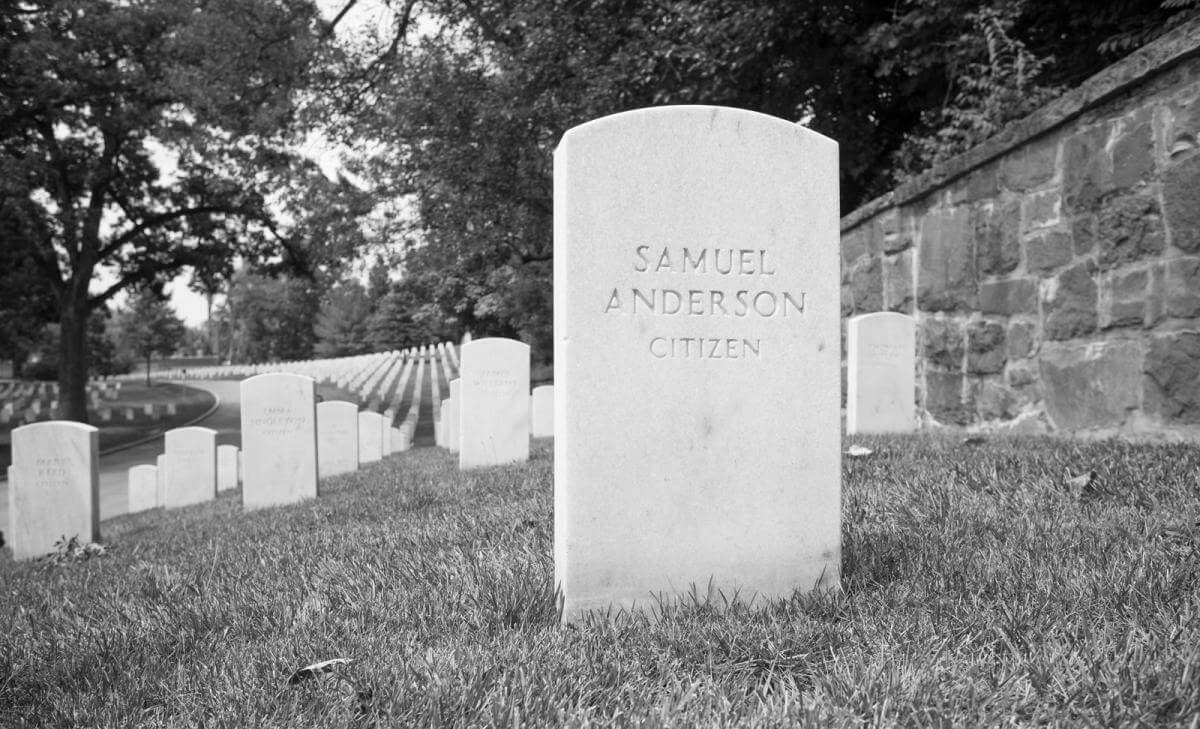
The tours that I lead at Arlington National Cemetery begin here. We are standing in Section 27, a location in the northeastern corner of the cemetery bordered by the wall to our right that separates this hallowed ground from the Marine Corps Memorial, popularly known as the Iwo Jima Monument. This is a silent corner of the cemetery, far from the tourists who stream up the hill to the Kennedy gravesite and the Arlington House. Breaking the contemplative quiet are the occasional maintenance vehicles that keep the cemetery pristine, as well as the Netherlands Carillon next door that tolls the time in Big Ben fashion. But the headstones make the greatest impression as they sweep up, then down, and then up again along the rolling terrain. Puzzling to a newcomer are the words "citizen" and "civilian" on the headstones in what is supposed to be a military cemetery. Yet they tell a story central to Arlington and mirror an even larger story of black Americans who lived through the transitions from slavery to segregation.
Here rest roughly 3,800 people whose individual stories likely will never be reclaimed and whose actions during a crucial moment in our past shaped the definition of freedom. Many of the headstones contain no name. The situation frustrates me because, whether the bodies have been identified or not, the people within these grounds did not leave records that allow doing justice to their memory. We know only that they were African Americans who died in the vicinity of Washington. More can be teased out of the military records of another 1,500 who fought with the US Colored Troops and who also lie in this section. But we cannot learn much about Samuel Anderson, "Citizen," or what brought him here. We can merely situate him within a broader movement of people who either fled the bonds of slavery or struck out on their own as free blacks to seize a greater range of choices opened by the Civil War. Section 27 evokes a past containing the experiences of the enslaved who lived here, the contrabands who congregated during the war here, and the emancipated citizens who earned their subsistence until evicted from here. This sweep of black history at Arlington from 1802 to 1900 even offers surprises: a sister-in-law of Robert E. Lee was a freed slave who lived most of her life on what is now patriotic ground.
Although I do appreciate the cemetery for its wider purpose, I cannot help but recognize that the place owes its existence to a slave plantation founded in 1802 by George Washington Parke Custis. It has been common to say that he built the mansion that sits on the heights overlooking the Potomac River and Washington, but this labor was accomplished primarily by his slaves. Custis inherited them from his natural grandmother the widowed Martha Dandridge Custis, whose second husband was George Washington. The father of the nation also became the adoptive father of Custis, giving him parental advice that betrayed exasperation over the lackadaisical manner in which the boy pursued his studies. With bequests from the Mount Vernon estate, which included nearly 200 slaves spread across three plantations, Custis lived a fairly comfortable life.
Most contemporaries considered Custis an indulgent master, an assessment that both acknowledged him as a good person and criticized him as a loose manager. He does not seem to have been overly harsh, yet even this judgment must be tempered by the reality of life under a master-slave relation. At least half a dozen slaves ran away from Arlington over the years before he died in 1857. And there was an incident with an overseer on one of Custis's three plantations (not Arlington) in which slaves may have been drowned, although the person accused claimed it was nothing more than accidental. Whatever the truth, the master of Arlington does not seem to have been culpable.
He also was a leader in the American Colonization Society, a movement considered to be progressive at the time. The assumption was that white and black people could not live together, that freedom for the enslaved necessitated voluntary relocation to countries like Liberia. This was about as far as progressive Virginians could go without adopting the radical policy of widespread abolition. Here again, Custis was typical of slave owners in arguing for colonization not from recognition of the humanity of his charges but as an effort for white people to avoid being overwhelmed by an ever-increasing, and potentially hostile, black population.1The African Repository, and Colonial Journal 3 (February 1828): 356–60. His belief in this effort allowed for the immigration of one of his enslaved families to Liberia—William and Rosabella Burke, who sent letters about their experience to Mary Custis Lee, the wife of the future Confederate general. Contemporaries and historians have noticed the affection that was shown to Mary in the letters from former slaves. This appeared to be heartfelt and represents one side of a complicated relationship in which white people considered black people as property while living in a world in which master and slave confronted each other personally.
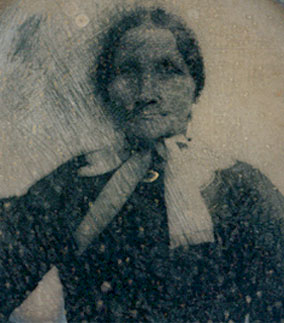
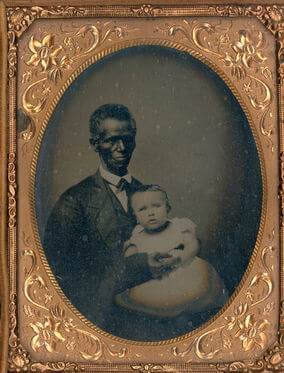
The other side of this master-slave relationship lies in the story of Maria Syphax, one of the more famous former slaves on the Arlington plantation/cemetery. In 1826, Custis freed Syphax and her family and gave them seventeen acres of ground on the plantation. He had also hosted her marriage with Charles Syphax, a household slave, in the Arlington mansion—a rare occurrence. It turns out that Custis had fathered Maria with Ariana Carter, a household slave of his mother at Mount Vernon. The US Congress in 1866 recognized Maria's claim to the property, granted out of Custis's "paternal instinct," in legislation that allowed her to live out her life on the grounds until her death in 1886.2Boston Daily Advertiser, May 19, 1866; Lowell Daily Citizen and News, May 22, 1866; US Statutes at Large, 39th Cong., 1st Sess. (Washington, DC, 1866), 589–90. The illegitimate birth resulted from a relationship we can scarcely reconstruct, but even if it contained tenderness on the part of the slave it occurred within a power relation difficult to separate from sexual molestation. It was a common situation throughout the antebellum South. Thomas Jefferson may be the most famous transgressor with Sally Hemings, but he had company. Historians place the number of mulattoes in the South at between 10 and 12 percent in 1860, although the product of mixed-race unions constituted more significant proportions of city dwellers: 39 percent of free blacks and 20 percent of slaves. These were the numbers reported in a society that publicly frowned upon amalgamation of the races. There were certainly more mixed-race offspring than appear in the record.3Robert William Fogel and Stanley L. Engerman, Time on the Cross: The Economics of American Negro Slavery, 2 vols. (Boston, MA: Little, Brown, 1974), 1:132; James Ford Rhodes, History of the United States from the Compromise of 1850 to the McKinley-Bryan Campaign of 1896, new ed. (New York: Macmillan, 1920), 340. See also Population of the United States in 1860, Compiled from the Original Returns of the Eighth Census (Washington: Government Printing Office, 1864), x. The union made Maria the half-sister of Custis's only surviving white child, Mary, who became the wife of Robert Edward Lee in a ceremony at Arlington in 1831.
Often away on military duties, Lee reentered the Arlington picture in 1857 with the death of his father-in-law. Custis left the duties of executor of his estate to Lee, who confronted a situation that required him to act like a typical Southern planter. Custis had amassed enormous debt and left the responsibility of sorting out the family's fortunes to his son-in-law. This was not an easy task. Custis had not only stretched his finances but also promised his heirs more proceeds than the estate could fulfill. At the same time, his will ordered that the slaves who constituted the labor force, and main asset beyond land, be freed in five years. Although we do not know for certain if this happened, some of Custis's slaves contended that he told them they would be freed immediately upon his death. Remaining in slavery angered them, as did being driven harder by the departed master's son-in-law to recoup losses. Not surprisingly, some ran away, setting up an inevitable confrontation.
In recent decades the story of these runaways has grown in the scholarly literature on Lee, which depicts him as supervising the whipping of three recaptured fugitives from Arlington. The account rests upon the testimony of former slave Wesley Norris in 1866, but the story appeared before the war in Northern newspapers. Lee administered punishment to slaves as many of his class did—by using a third party. The punished included the sister and cousin of Norris, who said that Lee also ordered the whipper to wash their scars in brine to enhance the pain. After the war, Lee privately called the report untrue but did not refute the allegation publicly. Historians today accept the account as accurate in the larger details.4John W. Blassingame, ed., Slave Testimony: Two Centuries of Letters, Speeches, Interviews, and Autobiographies (Baton Rouge: Louisiana State University Press, 1977), 467–68. For the best analysis of this instance, see Elizabeth Brown Pryor, Reading the Man: A Portrait of Robert E. Lee through His Private Letters (New York: Viking, 2007), 269–72.
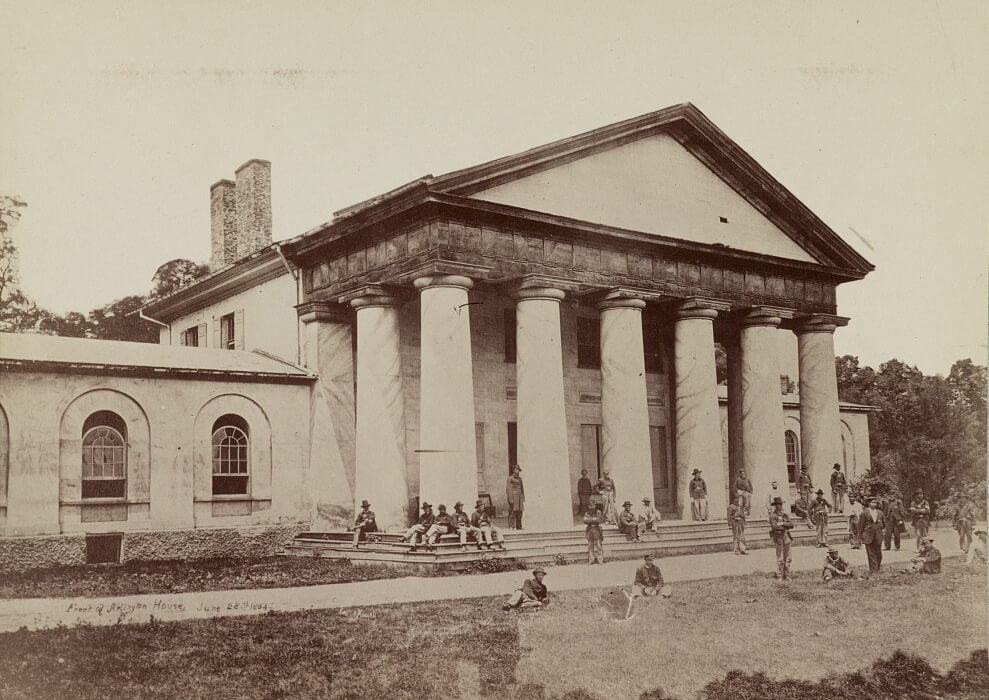
Because of these stories, Arlington has provided a terrific site for me to convey to touring groups, which have included schoolteachers, that this place features elements very common to slave plantations in the Upper South. Here we encounter runaways, mixed-race offspring, whippings to enforce order, kindness toward slaves, harshness toward them, crushing debt, frustration on the part of the masters and the enslaved, paternalistic ideals by white people, experiments with the colonization movement, and the fact that the columned Arlington House that we admire today exists because of laborers who had little choice other than to build it. None of this was extraordinary.
The Civil War changed the equation and ushered in an era when formerly enslaved people, in conjunction with US military forces, created on these grounds one of the more successful government-supported programs for black people in US history.5For a good study of the evolution of Arlington through Freedman's Village, cemetery, and beyond, see Micki McElya, The Politics of Mourning: Death and Honor in Arlington National Cemetery (Cambridge, MA: Harvard University Press, 2016).
As the war came to Washington, so did the contrabands. The term was coined by Major General Benjamin F. Butler for slaves escaping from masters and reaching Union hands. As a way to circumvent the Fugitive Slave Law, Butler defined fugitives as contraband because they allowed whites to go to war while black labor produced the matériel to conduct it. Particularly after Congress banned slavery in the District of Columbia in April 1862, contrabands from Maryland and Virginia flowed to the nation's capital. And they kept coming until they overflowed the camps in the city, causing cramped conditions and diseases that claimed the lives of many. Someone who witnessed this firsthand was Harriet Jacobs, a famous escaped slave whose story gained renewed interest during the war. She was among the many who saw the need for greater relief in the Alexandria and Washington area.
The chief quartermaster of Washington looked over the river for a solution and chose Arlington to relocate these refugees. Founded in May 1863, the Freedman's Village was intended to be a temporary way station to teach freed people self-sufficiency. The government also used the labor of able-bodied men and women to support the operation. While providing workers with ten dollars per month plus rations and living space, the army taxed them five dollars per month to be put toward a contraband fund for the support of people too young, too old, or too infirm to labor. By January 1864, dwellings had been constructed along with a church, hospital, and home for the aged—all aligned on well laid-out streets with a park in the center. Workshops included blacksmiths, wheelwrights, carpenters, tailors, and shoemakers. But the larger concern was agriculture, with the villagers in their first season producing 200 tons of hay and 191 tons of corn fodder, as well as potatoes and other vegetables.
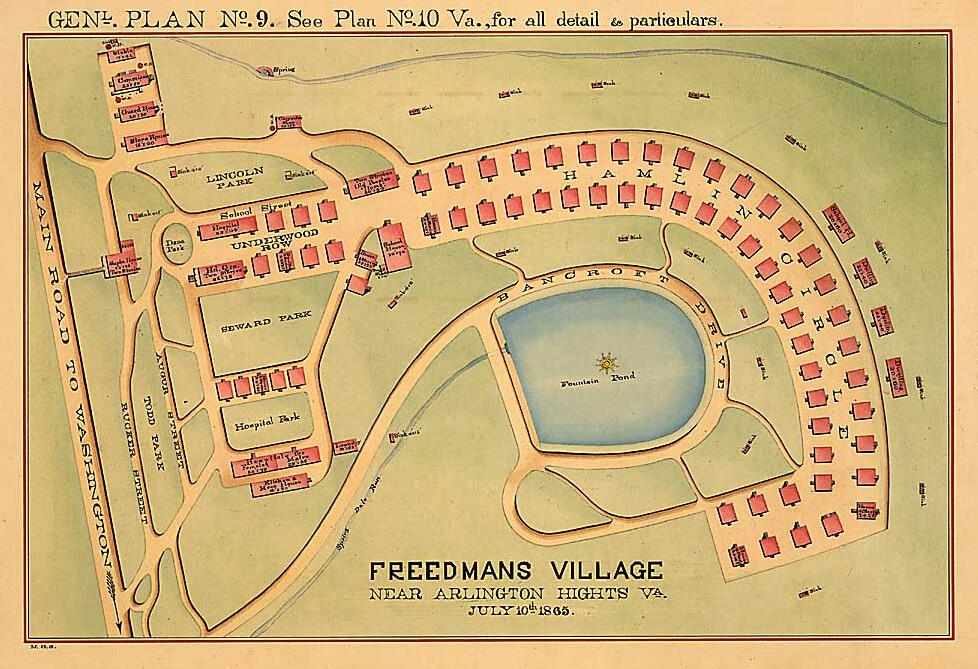
Conflict, nonetheless, existed that showed that African Americans would follow their own minds and, when necessary, resort to collective protest. Danforth B. Nichols, a civilian superintendent of the village appointed by the army, angered many who considered him overly restrictive and abusive. Former slaves testified that he drank and treated them unkindly. One slave indicated, "Mr. Nichols was not kind to the people under him in the camp; he used to knock them about and kick them right smart." He added, "I can not tell the number of persons he used to abuse, but there were a great many."6Ira Berlin et al., eds., Freedom: A Documentary History of Emancipation, 1861–1867, ser. 1, vol. 2, The Wartime Genesis of Free Labor: The Upper South (New York: Cambridge University Press, 1993), 295. Matters improved little when Nichols was replaced by a military officer in the Quartermaster Department. African Americans petitioned to higher authorities for redress. They also protested the manipulation of rents, or one to three dollars per month charged on top of the contraband fund. The pushback led army officials to consider the experiment a failure and, after the war, to try to disband the village.
But the village endured. By 1865, it had come under control of the Freedmen's Bureau, a government-funded agency run by the military to aid the transition of slaves to freedom. In 1868, an effort to shut down the village was launched. Black people resisted, aided by the fact that Northerners did not mind the delicious irony of black people prospering on the property of General Lee, whose leadership had caused so many Union deaths. Four years earlier, the grounds also had become a national cemetery, with Quartermaster General Montgomery C. Meigs determined to bury bodies as close to Arlington House as possible to discourage the Lees from returning. By 1888, 170 families (nearly 800 individuals) were still living in the village.
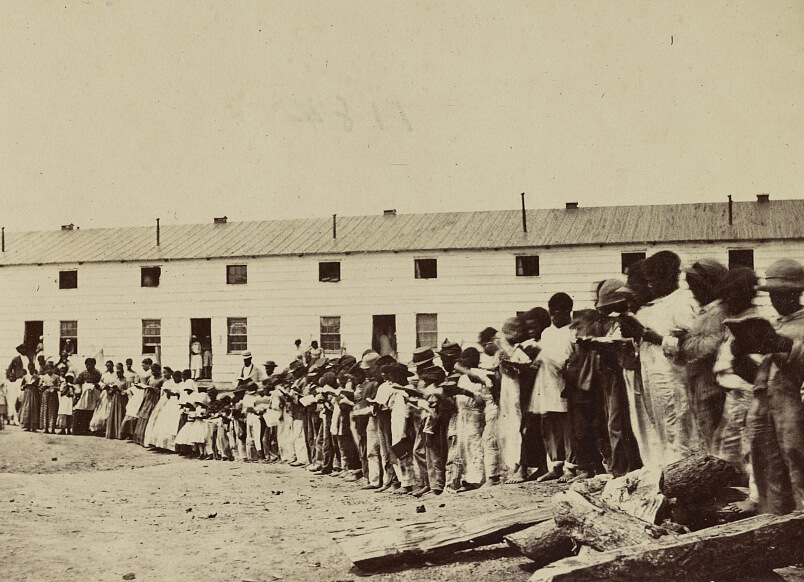
The village did not exist in isolation but nourished black activism as part of the greater Alexandria County community. As the war ended, villagers and community blacks petitioned for the right to vote. By the summer of 1867, because of Radical Reconstruction, most black males in Alexandria County were voting Republican. Arlington estate straddled two of Alexandria County's three districts, giving the Freedman's Village political clout at the local level. Blacks held council seats, the county treasurer's office, the county clerk's office, and more.7Joseph P. Reidy, "'Coming from the Shadow of the Past': The Transition from Slavery to Freedom at Freedmen's Village, 1863–1900," Virginia Magazine of History and Biography 95, no. 4 (October 1987): 403–28. This led to an effort in 1888 by Democrats to break this power by purging villagers from the voting rolls, claiming that living on a military reservation did not make them residents of the state of Virginia. Despite their activism, black people could not control the burial of their race at Arlington. Leaders like Frederick Douglass bristled at the segregation, asserting that black soldiers should lie with the white heroes of the Union. But this area became known as the "lower cemetery," which all understood to mean the colored section.
Development pressure coupled with the political climate that turned against African Americans spelled the demise of the Freedman's Village.8Reidy makes this most sensible conclusion, situating the demise of the village within a broader context. The cemetery needed to expand, and the village lay in the southeast area of the grounds. Prime property. A government study calculated what residents had put into their homes and came up with the figure of $75,000 to reimburse them. This compensation came in 1900 as the villagers were evicted and the buildings torn down. Today, not a trace of the village remains.
Such are some of the stories that wash over me as I stand in Section 27, a place that allows for discussion of a wide range of black history that engages with the Civil War. It bothers me that there are no signs that can inform visitors who lie here, although I am the first to admit that something done without proper thought could mar the sanctity of the spot and the cemetery in general. It is not an easy solution. It also saddens me that we will never know the personal stories of the people whose headstones appear before us. Many undoubtedly improved their lives; some likely died disappointed. The fact that these graves exist testifies to the determination of a people who tried to change their lives. They seized a moment, for good or for ill.
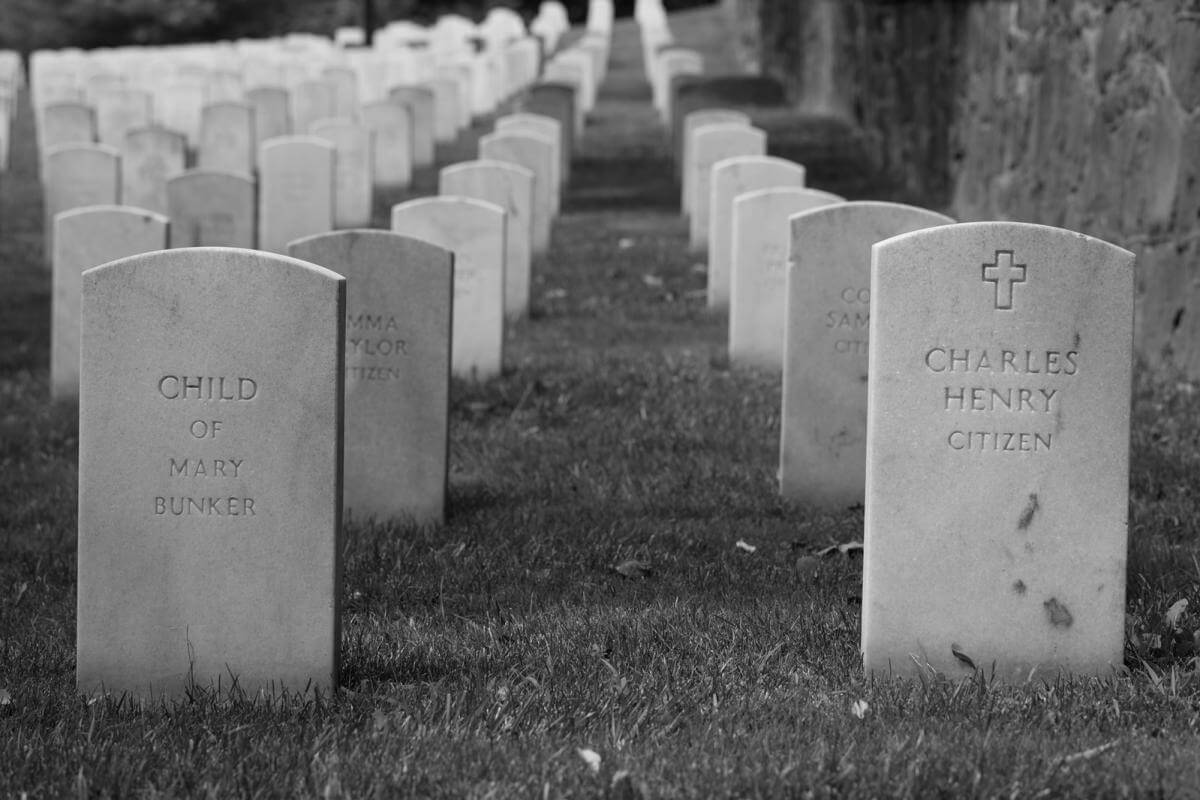
And their headstones have left behind a comment that undoubtedly was unintentional. "Citizen" was adopted by bureaucrats to distinguish these dead from soldiers, and nothing more. But the historian in me cannot help but note an ironic statement being made. In 1857, the US Supreme Court declared in the Dred Scott decision that people of sub-Saharan African descent were not citizens. It pleases me to see a word carved on the stone of Samuel Anderson, a stone that lies in a US government facility, that declares otherwise.
About the Author
William A. Blair is the Walter L. and Helen P. Ferree Professor of American History and the director of the George and Ann Richards Civil War Era Center at the Pennsylvania State University. His research centers on the making of Confederate identity during the Civil War and the use of ceremonies such as Memorial Days and Emancipation Days after the war to construct political identities.
]]>Review
Warning the governor of Kentucky that the white South stood on the brink of destruction in 1860, secession commissioner Stephen F. Hale wrote that Lincoln's election "inaugurates all the horrors of a San Domingo servile insurrection, consigning her citizens to assassinations and her wives and daughters to pollution and violation to satisfy the lust of half-civilized Africans."1Charles B. Dew, Apostles of Disunion: Southern Secession Commissioners and the Causes of the Civil War, Fifteenth Anniversary Edition (Charlottesville: University of Virginia Press, 2016), 120. Hale sent his letter to Governor Beriah Magoffin of Kentucky. Hale's letter appeared nearly seventy years after the Haitian Revolution began and fifty-five years after Haiti won independence from France. Nevertheless, as Carl Lawrence Paulus demonstrates in The Slaveholding Crisis: Fear of Insurrection and the Coming of the Civil War, Hale's lurid images and graphic language resonated with many white southerners fearful about the lessons a free black republic might hold for the nearly four million people held in chattel bondage in the United States.
The contention that "the fear of a revolt—or revolution—being mounted by the enslaved became a defining characteristic of the slaveholding South" is not new (3). One of the strengths of The Slaveholding Crisis is its broad survey of the antebellum period through the perspective of American exceptionalism, which, according to Paulus, proslavery leaders "defined as the ability to employ either a congressional or states' rights approach to defend and perpetuate the institution of slavery" (5). Planters utilized the ideology of US uniqueness to attack anyone who attempted to interfere with slavery by accusing abolitionists of being dupes of the scheming British. The spatial dimensions of Paulus's book are noteworthy as he considers how Haiti, the British West Indies, Texas, and Mexico influenced slaveholder and abolitionist thought, US domestic politics, and ideas about the role of the United States in the world. The Slaveholding Crisis is certainly not the first book to pursue these influences; nevertheless, Paulus examines how each of these places, in turn, helped shape the development of ideas about American exceptionalism.
![Incendie du Cap [Burning of Cape Francais], Saint-Domingue, 1820. Frontispiece by unknown creator. Originally published in Saint-Domingue, ou Histoire de ses revolutions (Chez Tiger, 1820). This image is a frontispiece from a history of the Haitian Revolution, published in France about ten years before US planters took action to suppress slave rebellions on a federal scale. Courtesy of Wikimedia Commons. Image is in public domain.](https://southernspaces.ecdsdev.org/wp-content/uploads/2019/07/Rothera_002_RevolteGeneral.jpg "Incendie du Cap [Burning of Cape Francais], Saint-Domingue, 1820. Frontispiece by unknown creator. Originally published in Saint-Domingue, ou Histoire de ses revolutions (Chez Tiger, 1820). This image is a frontispiece from a history of the Haitian Revolution, published in France about ten years before US planters took action to suppress slave rebellions on a federal scale. Courtesy of Wikimedia Commons. Image is in public domain.")
Incendie du Cap [Burning of Cape Francais], Saint-Domingue, 1820. Frontispiece by unknown creator. Originally published in Saint-Domingue, ou Histoire de ses revolutions (Chez Tiger, 1820). This image is a frontispiece from a history of the Haitian Revolution, published in France about ten years before US planters took action to suppress slave rebellions on a federal scale. Courtesy of Wikimedia Commons. Image is in public domain.
In 1789, many US citizens gloried in the spread of the ideals of the American Revolution to Europe. France seemed poised on the brink of becoming a "sister republic" and revolutionary optimism spread like wildfire. As the French Revolution became more radical, its ideas ignited the Caribbean and, in turn, revolution in Haiti petrified white people in the United States. "White racial communion," asserts Paulus, "trumped American ideological conflict between the Federalists and the Jeffersonian Republicans and the leadership of the first two political parties in the United States shared a similar reaction to the black revolution in the West Indies" (15). At times, Paulus lacks nuance in explaining the complexity and subtlety of the US-Haiti relationship. He also neglects significant recent work by Garry Wills and Ronald Angelo Johnson about the mutually beneficial relationship between the United States and Haiti in the late 1790s.2Garry Wills, "Negro President": Jefferson and the Slave Power (Boston, MA: Houghton Mifflin, 2003); Ronald Angelo Johnson, "A Revolutionary Dinner: US Diplomacy toward Saint Domingue, 1798–1801," Early American Studies: An Interdisciplinary Journal 9, no. 1 (Winter 2011): 114–41; and Ronald Angelo Johnson, Diplomacy in Black and White: John Adams, Toussaint Louverture, and Their Atlantic World Alliance (Athens: University of Georgia Press, 2014). Jefferson wanted nothing to do with Haiti. President John Adams and Timothy Pickering, his secretary of state, on the other hand, negotiated a treaty and developed strong bilateral relations with Toussaint Louverture. Paulus contends that South Carolina congressman Robert Goodloe Harper fretted about a potential invasion from the French West Indies, although he also worked with Pickering and Adams to support Louverture. Harper introduced Haitian envoy Joseph Bunel to various members of Congress so Bunel could convince politicians that Louverture had no interest in fomenting insurrection.3Compare Paulus, The Slaveholding Crisis, 23–24 and Johnson Diplomacy in Black and White, 58–67.
Revolutionaries carried ideas throughout the Atlantic World and spread ferment from one location to another. And so, it seems, did refugees. The arrival of French refugees from Haiti to the United States in the 1790s increased slaveholder fears as "the specter of Haiti's successful revolution appeared in everyday life" (20).4For other studies of the Haitian Revolution's impact on the United States see Ashli White, Encountering Revolution: Haiti and the Making of the Early Republic (Baltimore, MD: Johns Hopkins University Press, 2010) and James Alexander Dun, Dangerous Neighbors: Making the Haitian Revolution in Early America (Philadelphia: University of Pennsylvania Press, 2016). Virginia slaveholders became apprehensive about black Virginians, both free and enslaved. Numerous historians have argued that slaves proved adept at transmitting information among themselves.5Although Paulus does not cite Julius S. Scott, "The Common Wind: Currents of Afro-American Communication in the Era of the Haitian Revolution" (PhD diss., Duke University, 1988) or Janet Polasky, Revolutions without Borders: The Call to Liberty in the Atlantic World (New Haven, CT: Yale University Press, 2015), both offer extended analysis of networks of communication among enslaved and free people throughout the Atlantic World. Certainly, Haitian events influenced rebellions in the United States.6Matthew J. Clavin, Toussaint Louverture and the American Civil War: The Promise and Peril of a Second Haitian Revolution (Philadelphia: University of Pennsylvania Press, 2010). Revolution in the French West Indies "likely inspired Gabriel [Prosser] and his fellow insurrectionists to secure emancipation through violence" (29). Like Washington and Louverture, Gabriel, when he led a slave rebellion in Richmond in 1800, chose the title of general, not king. Haiti also played a "noteworthy role" in Denmark Vesey's 1822 uprising (42).
Paulus tends to depict planters as a homogenous class, not distinguishing between those who lived on the Atlantic and Gulf Coasts and in other slaveholding areas. Paulus might have considered whether planters in Tennessee and Missouri, or other landlocked states, were as obsessed with revolutions in the Caribbean as their counterparts in South Carolina and Louisiana. Geography may have created different ideas about revolutions, but this remains uncertain and, in any case, is not his book's major concern. Although terrified of revolt, planters believed northerners would suppress any rebellion and refuse to allow the slaughter of white people. Proslavery ideologues, however, soon began questioning this assumption. The postal system facilitated the distribution of incendiary abolitionist material such as David Walker's Appeal. Slaveholders expressed disgust when mayor Harrison Gray Otis of Boston refused to punish Walker. Otis distanced white Bostonians from Walker's radicalism and condemned his pamphlet, but this proved cold comfort to agitated slaveholders who "cared very little for Bostonian sympathies" (56). Nat Turner probably knew little about Walker's Appeal, but that did not stop planters from portraying Walker as the evil genius behind Turner's 1831 rebellion in Virginia. In response, slaveholders abandoned the "necessary evil" defense of slavery in favor of the "positive good" argument and sought to punish abolitionists. Planters began to fear that they could no longer count on northerners to protect them in the case of a slave rebellion.
Title page of Appeal, Boston, Massachusetts, 1830. Book by David Walker. Published by David Walker. Courtesy of Johns Hopkins University Sheridan Libraries, archive.org/details/walkersappealinf00walk/page/n4.
Paulus argues that a weighty change occurred in the 1830s: most planters "no longer saw a weak national government as key to slavery's perpetuation" and determined that "the South required more than the Constitution and its abstract protections" (90). President Andrew Jackson vowed to halt the antislavery mailing campaign and stop abolitionists from utilizing the postal system to drown the southern states in antislavery literature and periodicals. Jacksonian officials such as postmaster general Amos Kendall allowed the censorship and destruction of mail. The House of Representatives enacted James Henry Hammond's "Gag Rule" and tabled all antislavery petitions. Space, and control over space, mattered very much to planters, who no longer saw abolitionists as "moralists who, so consumed by their beliefs, did not understand the consequences of their actions." Rather, they believed them to be "evil enemies who purposely wanted to kill whites in the South indirectly by provoking slave revolt" (124). Some people in the northern states echoed these ideas and joined planters in denouncing abolitionists as traitors in league with Great Britain.
Emancipation in the British West Indies in 1833 increased US proslavery paranoia. Most planters believed Britain's plan of gradual, compensated emancipation would destroy West Indian economy and society. They also worried about their own future in a world where freedom seemed to be on the rise, and slavery on the defensive; perhaps they might end up like feckless Caribbean planters. Planters found some encouragement elsewhere. Some greedily turned their eyes toward Texas, a republic that had won independence from Mexico in 1836.7Paulus's analysis would have been strengthened by considering the essays in Jesús F. de la Teja, ed., Tejano Leadership in Mexican and Revolutionary Texas (College Station: Texas A&M University Press, 2010). Presidents Jackson, Van Buren, and Harrison shied away from Texas annexation, but President John Tyler and Secretary of State Abel Parker Upshur believed that Texas was a winning issue that could help Tyler secure a second term in 1844. Upshur argued that slavery helped guarantee US exceptionalism and worked to make Washington "the epicenter of proslavery power" (151). Parker and Tyler believed that the proslavery movement should use the levers of government power.
Senator Robert J. Walker of Mississippi became the voice for Texas annexation, framing it as "colonization without the cost." He and others "had no qualms saying that Texas, as a new member of the Union, would funnel black Americans away from the free states" (163). Walker's argument proved powerful, especially during the election of 1844, but also double-edged. "Northern Democrats who voted to approve annexation did not forget the proslavery guarantee from Robert Walker. They came to expect Texas to serve as a funnel for black population to move southward, away from their homes and cities" (166).8Paulus suggests the planter elite lost power in the 1840s. This contradicts a recent account of how politically powerful southerners created an aggressive foreign policy of slavery. See Matthew Karp, This Vast Southern Empire: Slaveholders at the Helm of American Foreign Policy (Cambridge, MA: Harvard University Press, 2016), reviewed in Southern Spaces at https://southernspaces.ecdsdev.org/2018/slaveholding-empire-southerners-federal-authority-and-slave-power-abroad. Walker's notion of Texas as a safety valve proved enticing to many northern Democrats and Paulus ably demonstrates the importance of space and place in driving political issues in the United States.
The fallout from Walker's argument became apparent in congressional debates over David Wilmot's 1846 Proviso barring slavery and involuntary servitude from any lands acquired from Mexico. Paulus's language becomes too exuberant when he asserts, "some members stood agape as the seemingly torpid monster of sectionalism rose back to life in the United States Capitol" (173). His analysis in previous chapters demonstrates that sectionalism was hardly torpid. Still, he is correct that the Wilmot Proviso had a potent impact on national politics. Many white southerners felt slighted, but they misread northern minds. Votes by northern Democrats in favor of the Proviso "had less to do with slavery and more to do with the black population of the United States" (185). Northerners remembered Walker's promises. They expected Texas to absorb black people and for new territory to be reserved for white men and their posterity. Proslavery ideologues, on the other hand, believed the Wilmot Proviso to be "the first step in the Abolitionist Power's plan to destroy the slave states and the plantation owners who governed them, not just the institution of slavery" (189). In addition, the proslavery movement turned against American exceptionalism. During the 1850s, southern radicals "came to believe that the exceptional nature of the Constitution had fallen by the wayside" (220). Ultimately, throughout the Secession Winter of 1860–1861, they repeatedly declared that the Constitution no longer protected them and, instead, represented "the provenance of their ruination" (234).
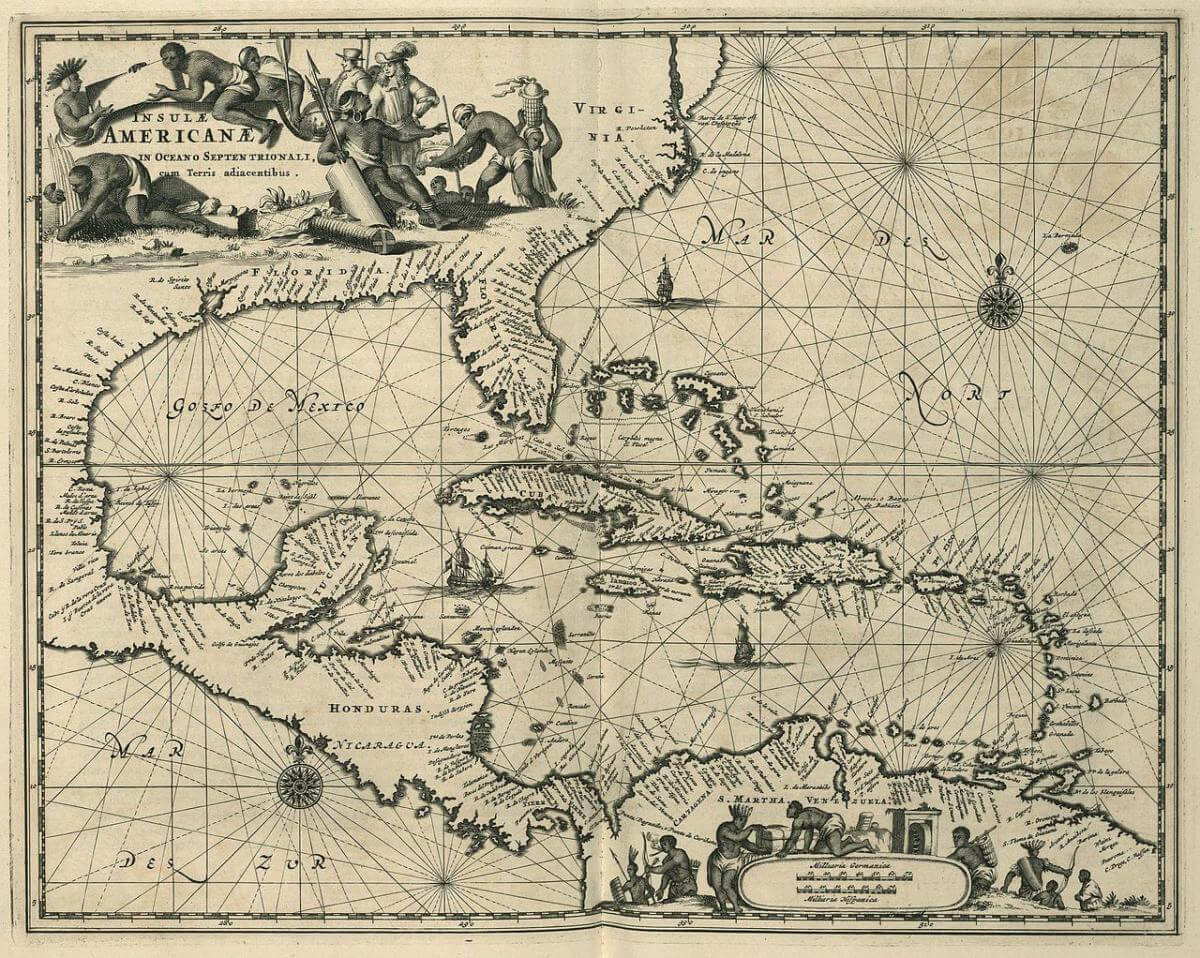
Throughout The Slaveholding Crisis, Paulus uses "American" to refer to the United States rather than the Americas, a practice he shares with many historians. This is troubling in a book that analyzes connections between the United States and the world. For instance, he writes: "The proslavery movement convinced itself that the South could not chance the fate of an American version of Toussaint rising in America while a Republican president held the reins of the military" (9). Paulus does not discuss other slaveholders in the Americas, save British planters. If he had, he might have considered whether slaveholders in Cuba, Brazil, and other countries developed similar exceptionalist ideas or suffered from similar fears. He could have been attentive to another spatial dimension—slaveholders in other geographies of the Americas.
Paulus also tends to be overly broad in his assessment of "proslavery southerners" (8)—there were plenty, after all, who never gave up on the Union. Secessionists exerted a mighty effort over many years to convince people to leave the Union and many never accepted their logic. Stephen F. Hale's lurid words, cited at the beginning of this review, captured a deep-seated fear seven decades in the making and resonated with the plantation South. But such sentiments proved unable to push Missouri, Kentucky, Maryland, or Delaware out of the Union and it took the firing on Fort Sumter and Lincoln's call for troops to cause Virginia, North Carolina, Arkansas, and Tennessee to secede. These matters aside, The Slaveholding Crisis offers a thought-provoking analysis of how space and place drove slaveholders to refine their ideas about American exceptionalism and, ultimately, leave the Union.
About the Author
Evan C. Rothera is a lecturer in the Department of History at Sam Houston State University. His current book manuscript analyzes civil wars and reconstructions in the United States, Mexico, and Argentina between 1860–1880.
]]>Review
Sensory history is an exciting new approach to writing history. It offers a fresh take on past perceptions. Sensing between the lines of written sources, the sensory historian recasts history as sense-making activity, not merely a litany of dates and deeds. Ideally, readers can feel the pulse of a given period, sniff the atmosphere, and see events in a different light.
Mark M. Smith is the doyen of sensory history in the US. In Sensing the Past: Seeing, Hearing, Smelling, Tasting, and Touching in History (Oakland: University of California Press, 2007) he laid out a manifesto for bringing history to our senses. In How Race Is Made: Slavery, Segregation, and the Senses (Chapel Hill: University of North Carolina Press, 2006) he explored the sensory dynamics of racialization in the American South. In The Smell of Battle, The Taste of Siege, he turns his attention to the Civil War.
Smith begins by evoking the antebellum sensorium offered in an 1852 essay, "The Cultivation of the Senses," published in Harper's New Monthly Magazine that portrayed the senses as shapers of character and agents of civilization, provided they were exercised properly: "[the] eye should not be injured by resting on a vulgar confusion of colors, or clumsy, ill-proportioned forms; the ear should not be falsified by discordant sounds, and harsh, unloving voices; the nose should not be a receptacle for impure odors; each sense should be preserved in its purity" (1). This preoccupation with sensory order and decorum was particularly intense in a city such as Charleston, South Carolina, built on slavery, where every social relation exhibited gradations of command and obedience. The slave did not speak unless spoken to; there was a strict curfew prohibiting movement at night; the singing of slaves at work in the fields was music to the ears of the white slaveholder.
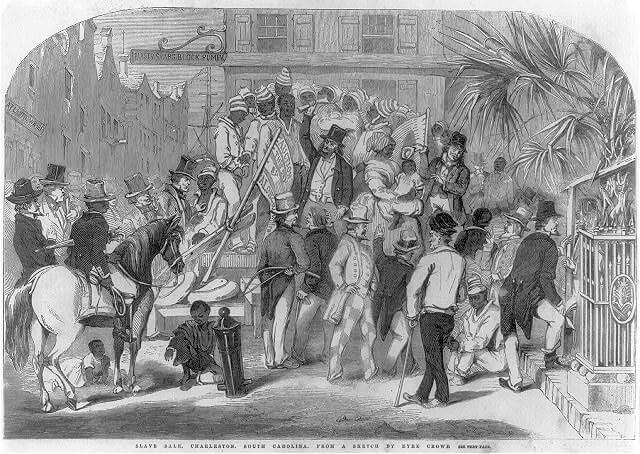
However, the ostensibly serene city of Charleston also shivered with fear at the prospect of a slave revolt. Silence was ominous as well as golden: "If they [the slaves] want to kill us," one female diarist wrote, "they can do it when they please, they are as noiseless as panthers" (18). The senses of the white population were already on edge leading up to 1861–1864 when, as Smith puts it: "The nation that had prided itself on its civilized control of the senses lost that control" (6).
Smith's book is structured around five events, each analyzed through a different sensory modality, while at the same time noting shifts in the salience of certain sensations as the event unfolded. The effect is captivating, and generative of many insights into, for example, military tactics, survival strategies, and commemorative practices.
In "The Sounds of Secession," Smith invites readers to listen in to transformations in the Charleston soundscape from the first murmurs of dissension sparked by Abraham Lincoln's election through the "storm of cheers" that greeted the signing of the Ordinance of Secession in November 1860 to the deafening bombardment of the Union stronghold at Fort Sumter in April 1861. Thousands of Charlestonians exited their homes to witness the conflagration in the harbor: "Unused as their ears were to the appalling sounds, or the vivid flashes from the batteries, they stood for hours fascinated with horror" (33).
In "Eyeing First Bull Run," Smith discusses how commanders on both sides were preoccupied with drawing up maps, building observation towers, constructing battle lines, ordering columns, and framing engagements—that is, with visualizing the impending battle. However, the first casualty of the Manassas battlefield was the certainty of sight and seeing. Due to dense woods, billowing clouds of dust and smoke, and dilapidated uniforms, it quickly proved impossible for the soldiers to keep in line, or to distinguish friend from foe. Many resorted to shooting blind. Somehow the Confederate forces prevailed, perhaps on account of their oft-remarked spine-tingling rebel yell.
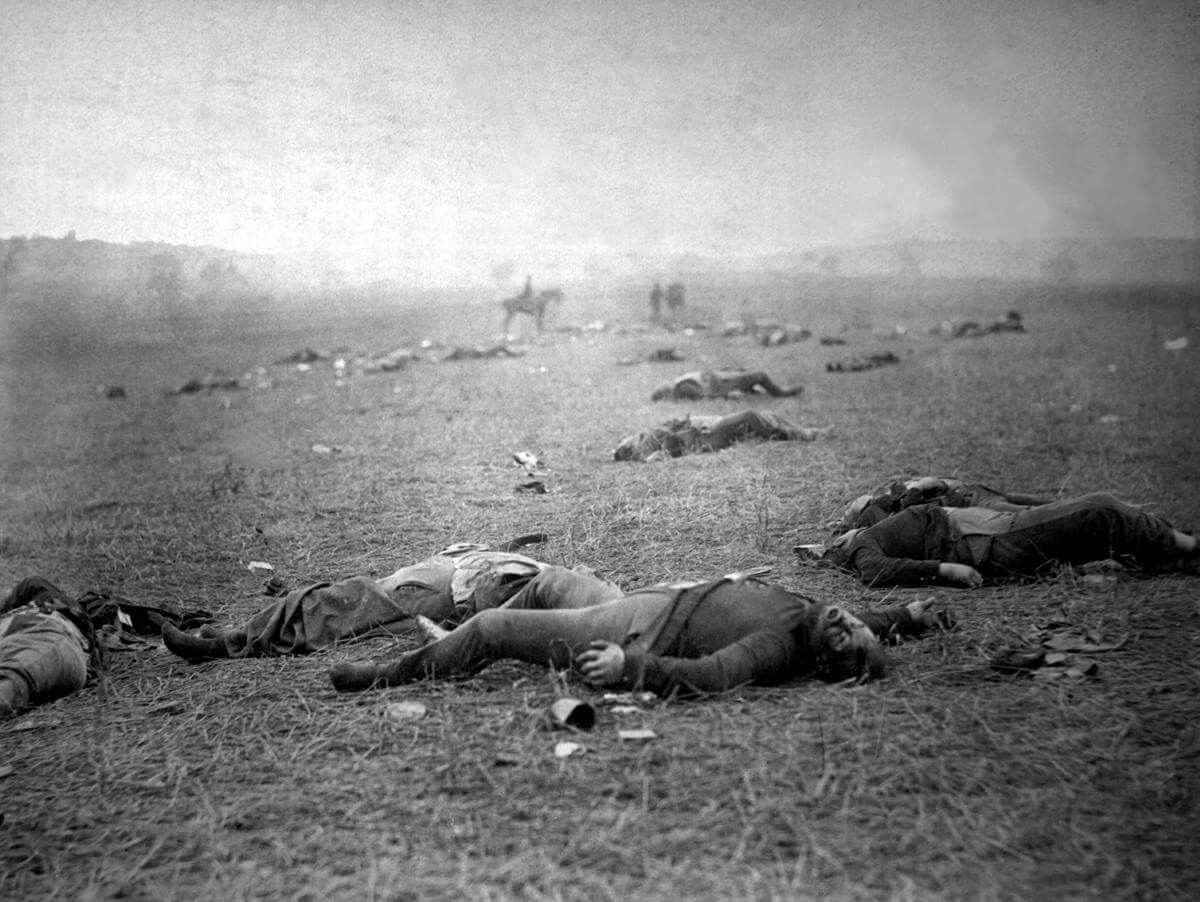
Incidents of the war. A harvest of death, Gettysburg, Pennsylvania, July 1863. Photograph by Timothy H. O'Sullivan. Courtesy of Wikimedia Commons. Image is in public domain.
Smith surveys the carnage at the Battle of Gettysburg, documented by the new technology of photography. The sensation that made the most lasting impression, however, was not that of sight but of stench. As one female diarist wrote:
Not the presence of the dead bodies themselves, swollen and disfigured as they were and lying in heaps on every side was as awful to the spectator as that deadly, nauseating atmosphere which robbed the battlefield of its glory, the survivors of their victory and the wounded of what little chance of life was left to them . . . A sickening, overpowering, awful stench announced the presence of the unburied dead upon which the July sun was mercilessly shining and at every step the air grew heavier and fouler until it seemed to possess a palpable horrible density that could be seen and felt and cut with a knife. (79)
Gettysburg was a "degenerative moment," Smith writes (7). It would take many grandiloquent speeches and solemn reconciliatory gestures to dispel the miasma and make it stand for something meaningful, a turning point.
Examining the Union siege of Vicksburg, Smith tells a harrowing tale of a city "taken by hunger." The Union forces under Grant dug in around the base of the terraced city, and kept up a constant bombardment of "shistling" bullets and pounding shells. Residents found shelter in newly dug caves, which provided a limited defense, and took a toll on the residents' comfort and dignity. "We went in this evening and sat down," one diarist wrote, and "the earthy, suffocating feeling, as of a living tomb, was dreadful to me. I fear I shall risk death outside rather than melt in that dark furnace" (98). Besides being reduced to a "troglodyte existence," the residents' diet was reduced and reduced again to "spoiled greasy bacon and bread made of musty pea-flour" (110). Ignominy as much as starvation precipitated surrender.
In the final chapter, Smith delves into the H.L. Hunley, a proud piece of Confederate technology, designed to break the US Navy's blockade of Charleston Harbor. The Hunley was an "underwater machine" consisting of a forty-foot-long refitted boiler (forty-eight inches in diameter) in which eight men turned cranks attached to the propeller shaft. A long arm protruded from the front of the vessel with a torpedo attached to its tip. Smith makes much of the cramped quarters, which imposed an unnatural proximity, and of the cranks' constant turning, which was reminiscent of slaves ginning cotton: "The Hunley men weren't slaves [they were volunteers], but they . . . willingly placed themselves in the condition of slaves—in the fight to preserve slavery" (128). Thanks to its underwater stealth, the Hunley succeeded at torpedoing and sinking the USS Housatonic, sowing great consternation, even though the entire crew drowned at their stations. This experiment in underwater warfare was not repeated.
Smith's epilogue revisits General Sherman's March, a swath of destruction up to sixty miles wide through the Confederate heartland, assaulting senses and resources, doling deprivation and misery while laying waste to buildings and crops in an effort to break Confederate will. Particularly loathsome to the defeated Southerners was the sight of the Union flag and the riling notes of "Yankee Doodle," not to mention the taunts. "Did you ever think of this when you hurrahed for Secession?" one Union soldier asked a white man in Columbia, as he gestured to the flames engulfing the city. "Your mouth is silenced now and it is worth every damn year of this bloody war. How do you like it, hey?" (144–45).
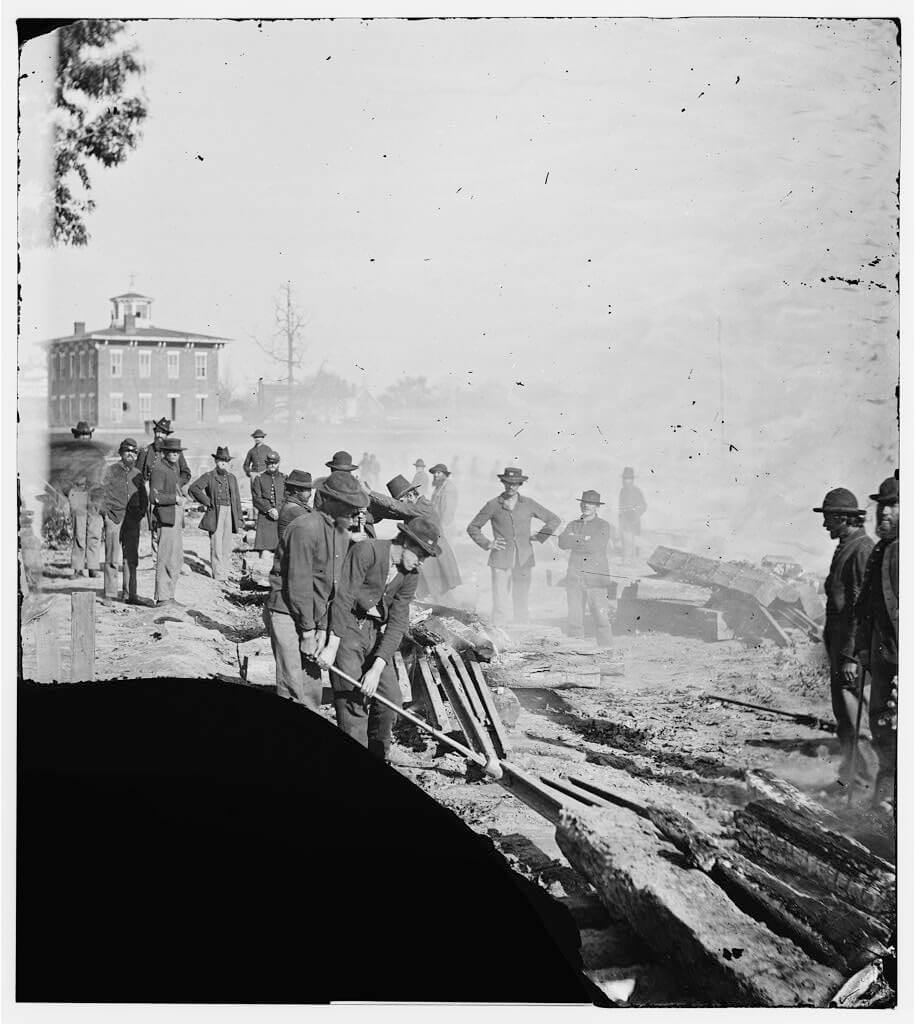
Smith's sensory history of the Civil War brings a dramatic new perspective to bear on this transformative event that gave rebirth to a nation. He tells a compelling story, based on diaries, letters, and other archival material. A number of questions remain unanswered, however. What of the sounds and expressions of the enslaved when out of earshot of the slaveowners? What did singing mean to them, and what messages did the songs convey? Smith has touched on these questions elsewhere, in Listening to Nineteenth-Century America (Chapel Hill: University of North Carolina Press, 2001), for example, but he does not address them in this book. For that, one might start with Lawrence W. Levine's Black Culture and Black Consciousness (New York: Oxford University Press, 1978). Levine succeeds at rendering the inaudible sensible in ways that Smith does not, for Smith's book is more a "history from above" (attuned to the anxious perceptions of the dominant society) than "from below" (attentive to the sonic and other practices of persistence and resistance of the subaltern).
The Smell of Battle, the Taste of Siege is a foundational work, both in sensory history and in the emergent field of conflict and the senses.1 Nicholas J. Saunders and Paul Cornish, eds., Modern Conflict and the Senses (New York: Routledge, 2017). It yields many important insights into the lived experience of the Civil War, and is certain to inspire further research into what ranks as the most traumatic event in US history.
About the Author
David Howes is a professor of Anthropology and Director of the Centre for Sensory Studies at Concordia University, Montreal. He is also the Director of the Concordia Centre for Interdisciplinary Studies in Society and Culture (CISSC). He teaches courses on law, commerce, aesthetics, and the senses in cross-cultural perspectives.
]]>Review
The defeat of the Confederacy, the prospect of military occupation and Republican state government, and the financial collapse of many plantations and businesses sent a number of white southerners in pursuit of life in a foreign land during the late 1860s. Between 1865 and the early 1870s approximately five thousand white and black southerners trekked to Mexico (28, 37).1Wahlstrom finds "a select number" of black southerners in Mexican settlements after the Civil War, and that the "dual movement of southerners" was "greatly skewed toward white migrants" (xxii, 26). A much larger contingent of African Americans, estimated at four thousand, had already arrived in northern Mexico by the Civil War years as fugitive slaves (41). Todd W. Wahlstrom examines this resettlement by studying colonies in the Texas border state of Coahuila. Much of The Southern Exodus to Mexico chronicles the rise and fall of ambitious colonization plans of such ex-Confederates as Matthew Fontaine Maury (scientist and naval officer from Virginia) and former Louisiana governor Henry Watkins Allen (12, 22). Wahlstrom revises earlier histories, engaging Andrew Rolle's The Lost Cause: The Confederate Exodus to Mexico (1965) that describes Confederate flight as "an attempt to snatch some sort of victory out of defeat"2Andrew Rolle, The Lost Cause: The Confederate Exodus to Mexico (Norman: University of Oklahoma Press, 1965), ix. and as an expression of delusional efforts to preserve Dixie in the Mexican highlands. Wahlstrom seeks to revise Rolle's contention that the southern exodus was a "failure" through revealing "the scope of the vision behind it" (xv). Although Rolle largely ignores the northern Mexican borderlands, Wahlstrom also emphasizes colonization in Coahuila, arguing that border states contributed to a "hemispheric south" where planters and railroad promoters envisioned business and trade networks across the Mexican borderlands and into Latin America during the last third of the nineteenth century (xxvii). Wahlstrom also considers the experiences of African Americans and non-slaveholding whites. Contra Rolle's account, southern emigrants to Mexico did not solely represent a "Lost Cause" flight of renegade whites, but a commercial vanguard. Economic interests yielded unlikely collaborations between Confederate exiles and Mexican liberals who returned to power in 1867 (85). Most of these commercial efforts involved agricultural enterprises, ranging from grand schemes for cotton plantations to the homesteads of black and white yeoman settlers who saw Mexico as an "agricultural paradise just waiting for southern migrants to build up its economy" (23).
Mexico might seem an unlikely destination for defeated Confederates, as its government formally abolished caste distinctions and chattel slavery after it gained independence in 1821. Additionally, Mexico had engaged in a war with pro-slavery Anglo settlers in Texas during the 1830s, and was still reeling from the effects of US invasion and occupation from 1846 to 1848. Nevertheless, a unique set of political circumstances made settlement appear promising in the summer of 1865. Under the imperial rule of Maximilian, the republican opposition forces of Benito Juárez were at low ebb, despite growing US pressure for France to decrease its presence in Mexico. Even after Mexico's loss of its northern territory to the US in 1848, vast areas remained beyond government control. Imperial forces, republican resistance, local strongmen, and indigenous peoples all contested Mexico's shifting borderlands.3See Pekka Hämäläinen, The Comanche Empire (New Haven, CT: Yale University Press, 2008).
Over three centuries after Álvar Núñez Cabeza de Vaca and Estevanico traversed the region, nineteenth-century Coahuila remained a "middle ground" between Apache, Comanche, and Kickapoo Indians, indigenous peoples who migrated into the area to either avoid white settlement or raid white settler outposts. Readers of James Brooks, Pekka Hämäläinen, and Brian DeLay will recognize the "network of violence, theft, and trade" that characterized Coahuila's society during much of the nineteenth century (63–68).4See James F. Brooks, Captives and Cousins: Slavery, Kinship, and Community in the Southwest Borderlands (Chapel Hill: University of North Carolina Press, 2002) and Brian DeLay, War of a Thousand Deserts: Indian Raids and the U.S.-Mexican War (New Haven, CT: Yale University Press, 2009). Wahlstrom does not go as far as these three historians in describing Indian nations as primary powers of this territory, as he finds their sway over Coahuila to be somewhat diminished by the 1860s (64–66). These indigenous groups figure primarily as vexatious raiders in The Southern Exodus to Mexico, not as existential threats to ex-Confederate settlements.
Confederate migration to Mexico is one point in a longer arc of Spanish and Mexican efforts to attract settlers to their northern borders in order to control the region. Andrés Reséndez documents the motives that led Mexican officials and, particularly, an ambitious northern Mexican commercial class to attract US settlement and trade during the first half of the nineteenth century.5Andrés Reséndez, Changing National Identities at the Frontier: Texas and New Mexico, 1800–1850 (New York: Cambridge University Press, 2005), 37.
Wahlstrom's research makes clear that the US-Mexico War did not diminish economic and settlement patterns. Instead, ex-Confederate migration mapped onto earlier patterns of migration from southern US states to the borderlands of Texas, New Mexico, and the adjacent areas of Tamaulipas, Nuevo León, Coahuila, and Chihuahua. There, white southerners from a slaveholding society found familiar class and labor dynamics. While Mexico was a multiracial nation that espoused the equality of all citizens before the law, it retained sharp divisions between Spanish-descended creoles, mestizos, and indigenous groups. Throughout the nineteenth century, Mexican liberals "argued that white immigration would bring economic advancement," modernization, and a whitening of the Mexican population (21). For their part, many white colonists brought a "racial exclusivity that only included elite Mexicans in the colonization plans." These transplants did not share the goal of transforming their host nation through assimilation or absorption (85).
For many African Americans who escaped slavery or the new forms of bondage that emerged after the Civil War, Mexico often represented freedom from racial oppression.6Quintard Taylor, In Search of the Racial Frontier: African Americans in the American West, 1528–1990 (New York: W.W. Norton, 1999), 41, 60. Sean Kelley, in a study of runaway slaves before the Civil War, vividly describes how Texan African Americans viewed Mexico as the land of liberty.7Sean Kelley, "Mexico in His Head": Slavery and the Texas-Mexico Border, 1810–1860," Journal of Social History 37, No. 3 (Spring 2004): 709–723. While employment by white colonists—often former slave owners—brought an unspecified number of black southerners to Mexico, Wahlstrom argues that their migration "corresponds with other forms of African American agency in the postwar period" (133). However, Wahlstrom also states that black southerners often relocated "under duress" with their former masters (39). In such instances, this agency involved escaping the oversight of former slave owners, as was the case of Thomas C. Hindman, an ex-Confederate general who witnessed the flight of former slave Charlie and the "defection" of other former slaves to Mexico (39). A desire to acquire land and earn economic independence attracted blacks to Coahuila, even though many white colonists envisioned for them only a subservient role on estates that recreated southern plantation life (46, 132, 133). At times, black southerners attempted to form their own colonies. Wahlstrom describes the efforts of William Ellis, whose short-lived 1894 colony in the Laguna area of Durango stands outside the temporal scope of his study but warrants consideration as an emblematic representation of both Mexico's potential and peril to blacks. The settlers experienced "exploitation" as agricultural workers as well as a "swath of yellow fever." Ultimately, when the settlement disbanded, the seventy remaining blacks left the Laguna colony to work in nearby mines. Wahlstrom simply asserts that "seventy of these colonists picked up their hopes and went to the mining town of Mapimí to continue their pursuit of freedom" (46). However, William Beezley's discussion of mining in northern Mexico during this period casts a stark shadow on these optimistic notes; miners endured grueling labor conditions in unlit, poorly ventilated shafts, working with simple hand tools and suffering from exposure to mercury and other toxic compounds.8William Beezley, Judas at the Jockey Club and Other Episodes of Porfirian Mexico, 2nd ed. (Lincoln: University of Nebraska Press, 2004), 74–76. Relocation to Mexico offered freedom from Jim Crow; nevertheless, opportunities for economic advancement were often limited for African American emigrants.
Wahlstrom's emphasis on leading colonizers such as Matthew Maury, and the political machinations between elite southerners and Mexican officials, obscures insights into the everyday experiences of black and white southern emigrants. While Mexico's leaders found "common ground" with former Confederates in their quest for white immigration, popular Mexican reactions to this influx of American settlers, aside from frequent references to "banditry," do not appear in The Southern Exodus to Mexico (21). An overall impression emerges that white southern colonists created isolated, self-contained enclaves characterized by a southern Protestantism in sharp relief to Mexican Catholicism (143). Wahlstrom's study affords little insight into the competing concerns over religion, language, legal procedure, intermarriage, and schooling that marked the settlement of other Mexican colonies. Aside from passing references to marriages and women and children held as captives, this history centers almost entirely on male settlers. Nancy Brigham, a widowed woman who settled with a group of Texans in the Córdoba colony of central Mexico, is one of the few women mentioned. Wahlstrom ventures that "her involvement reflects the appeal of Mexico as grounds for economic revival, a way to resuscitate her family's future" (24). Nevertheless, beyond ambitions for new farmland and speculative business prospects, Wahlstrom does not investigate how settlers attempted to recreate Dixie on the Mexican borderlands in cultural or spatial terms.
Instead, Wahlstrom traces US investment in Mexican railways, contending that economic interests were central to early efforts to link the two nations. He documents the competing efforts of former Union general William S. Rosecrans, who promoted a Mexico Pacific and Rio Bravo Railroad from New Orleans to Mazatlán, and Edward Lee Plumb, who planned to connect Laredo to San Blas on Mexico's Pacific Coast (115–117). As both proposals ultimately failed, Wahlstrom can only make limited claims about the "bilateral benefits of trade and economic development to Mexico and the South" (117). He nonetheless argues that these promoters "helped instill new pathways of prosperity and steer[ed] a course of transnational connections between the United States and Mexico during the second half of the nineteenth century" (127). Such glowing descriptions aside, the efforts of Confederate exiles in Mexico produced few tangible results in railroad and industry in the decade following the Civil War.
The final chapter of The Southern Exodus to Mexico makes a more convincing case that southern emigration to Mexico was a harbinger of a "New South" where white leaders embraced industry, finance, and commerce to progressively diversify an agrarian economy, while maintaining a conservative approach to labor and race relations (124–125). At a general level, Mexico's leaders shared these conservative tendencies (21). The transition from imperial rule to liberal governance made economic interests paramount in Mexico's immigration efforts. Several of the Mexican officials who brokered for southern colonists in the 1860s later worked to forge a borderlands economy through the promotion of railroads, mining, and commercial agriculture under Porfirio Díaz. Santiago Vidaurri, a regional strongman and ally of Díaz who exercised political and military dominance over Coahuila, facilitated these emerging trade connections (71–72).
Glorias de México!, with bust portrait of Porfirio Díaz, Mexico City, 1904. Broadside, on recto, by Antonio Vallegas Arroyo and José Guadalupe Posada. Courtesy of the Caroline and Ewan Swann Collection, Library of Congress Prints and Photographs Division, LC-DIG-ppmsc-04473.
Wahlstrom details how this particular migration period anticipates a coming era of US empire-building, where extensive commercial interests, especially in agriculture, created semi-colonial regimes in Mexico and Central America. Importantly, however, Confederate migration does not mark the beginning of US or imperial interest in Mexico. Juan Mora Torres, who also explores the emergence of a transnational economy in northeastern Mexico, dates the foundation of this "hemispheric" economy to the cotton trade that flourished before and during the Civil War.9Juan Mora Torres, The Making of the Mexican Border: The State, Capitalism, and Society in Nuevo León, 1848–1910 (Austin: University of Texas Press, 2001), 8. The Southern Exodus to Mexico makes a more convincing case that white southerners endeavored to promote cross-border business after the Civil War and that the increased publicity of Mexico's economic potential strengthened the case for foreign investment and more direct transportation linkages (111–112, 127). Ultimately, Wahlstrom provides few examples of lasting economic success or significant social transformations within these attempted southern colonies.
About the Author
Jamie Starling is assistant professor of history at the University of Texas Rio Grande Valley. His research explores the United States Mexican Borderlands. His current project, "From the Moment I Made My Wedding Vows My Sorrow Began," focuses on domestic abuse and women's rights in the nineteenth-century Borderlands.
]]>Review
 |
| The Assessment (Spc. Nick Weishaar), 2012, Oil on board by Victor Juhasz. Reproduced by permission of "The Joe Bonham Project." |
Created in cooperation with the Metropolitan Museum of Art and organized by Smithsonian Museum of American Art curator Eleanor Jones Harvey, "The Civil War and American Art" at the Smithsonian American Art Museum (SAAM) was an impressive exhibition. The setting—SAAM's home in the Old Patent Office—could not have been more appropriate. Walt Whitman called the stately edifice, designed by Charleston-born architect Robert Mills, "that noblest of Washington buildings." He knew it as a makeshift hospital during the Civil War, but at the gala opening last fall I found fashionable guests strolling the marble floors where wounded soldiers had sprawled after the First Battle of Bull Run.
While waiting for the exhibition doors to open, I had the good luck to meet a gifted combat artist, retired Marine Corps veteran Michael D. Fay. He led me next door to a small but stunning exhibit he had mounted at the Pepco Edison Place Gallery, with help from fellow members of the International Society of War Artists. In "The Joe Bonham Project" (named for the soldier in Dalton Trumbo's 1938 novel Johnny Got His Gun), more than a dozen artists focused their eyes on veterans wounded in Iraq or Afghanistan, while most Americans were looking elsewhere.1 A CBS interview with Michael Fay is at http://www.cbsnews.com/8301-18563_162-57427637/sketching-veterans-recovering-from-war-so-their-stories-arent-lost/. His blog, "Fire and Ice," is at http://mdfay1.blogspot.com. Through their pictures, I was suddenly visiting the patients at Walter Reed Hospital, reliving the scenes and emotions Whitman had experienced at the Patent Building.
Weapons and triage procedures change with the decades. Our capacities for taking lives, and for saving them, seem to increase over time. But the combat artist seated with his sketchpad still looks very much the same. A photo of Fay at work reminded me of a self-portrait that Winslow Homer drew during the Civil War. Thanking my new friend for the time-warp and the comparative vantage point, I hurried back up the marble steps of the Patent Office to explore the ways an earlier generation of American artists dealt with a brutal war on their own soil.
 |  | |
| Michael D. Fay at work at a big airbase called TQ (Al-Taqaddum), Iraq, March 2006. Photograph courtesy of the artist. | Life in Camp, Part 2: Our Special, 1864. Color lithograph by Winslow Homer. From Louis Prang & Company. |
SAAM guests were thrust into the Civil War exhibit space almost as abruptly as soldiers were thrust into battle at Manassas Junction over one hundred-and-fifty years ago. As the doors opened, the guests were confronted by Winslow Homer's Sharpshooter, showing a Union marksman perched in a Virginia pine tree, ready to kill or be killed. Homer's "very first picture in oils," the painting was completed in New York after his initial trip to the front during General George McClellan's Peninsula Campaign of 1862. In 1863, working as an illustrator for Harper's Weekly and taking art classes at night, the aspiring artist told a friend he hoped to obtain "not less than sixty dollars" for the piece, "as that was what Harper paid him for a full page drawing on wood."
 |
| Sharpshooter, 1863. Oil on canvas by Winslow Homer. Courtesy of the Portland Museum of Art, 1992.41. |
 |
| Near Andersonville, 1866. Oil on Canvas by Winslow Homer. Courtesy of the Newark Musem, 66.354. |
 |
| Prisoners from the Front, 1866. Oil on Canvas by Winslow Homer. Metropolitan Museum of Art, Accession Number 22.207. |
Edging past Homer's iconic sniper, visitors to the DC venue had plenty to see—a display of sixty art works, plus a sampling of wartime photographs, drawn from over two dozen museums and private collections. The Georgia photographs of George N. Barnard were on loan from the Nelson-Atkins Museum in Kansas City, while the Greenville County Museum of Art in South Carolina provided John Ross Key's wide-angle view called Bombardment of Fort Sumter, Siege of Charleston Harbor, 1863 (1865). (Key, a second lieutenant in the Confederate Engineer Corps, was the grandson of Francis Scott Key.) Veteran museumgoers might never have seen some of the important slavery-related canvases, such as Eastman Johnson's The Old Mount Vernon (1857), from the Mount Vernon Ladies' Association; Thomas Waterman Wood's Southern Cornfield (1861), from the T. W. Wood Gallery in Montpelier, Vermont; or the luxuriant and frightening forest landscape of Thomas Moran's Slave Hunt, Dismal Swamp, Virginia (1862) from the Philbrook Museum in Tulsa, Oklahoma.
Among the many striking Winslow Homer images, one stood out as unfamiliar. It was lost for nearly a century and has rarely left the Newark Museum since its acquisition in 1966. An enslaved black woman in a doorway warily observes Confederate soldiers in the background as they herd unarmed Union captives, whose boots identify them as cavalrymen. At last, in 1987, Homer scholars Marc Simpson and Sally Mills unearthed the painting's original title, Near Andersonville. We now know the work relates to a foiled Yankee cavalry raid conducted in late July, 1864, as federal forces struggled to capture Atlanta. With General Sherman's approval, General George Stoneman's mounted troops hoped to grab headlines by pressing south to liberate Andersonville; instead, most were captured and marched to the infamous prison.
In the DC exhibition, Harvey placed Near Andersonville opposite Homer's more famous image, Prisoners from the Front, which has long been an icon of Civil War painting. Homer completed both pictures early in 1866 and they went on view in New York in April, twelve months after Appomattox. Both show recently captured soldiers, but they are opposites in almost every other sense. One presents a white, all-male military group portrait, while the other features a lone enslaved African American woman. One shows distinct Rebel prisoners front-and-center, in a balanced standoff with a federal officer, while the other places distant Union captives at the painting's edge, intermingled with their captors. One drew immediate praise and recognition, jumpstarting Homer's illustrious career, while the other disappeared into the attic of a wealthy New Jersey family whose daughter gave her life in an effort to educate freed slaves on South Carolina's Sea Islands during the so-called "Port Royal Experiment."2On the first owner of Near Andersonville (Sarah Louise Kellogg) and her New Jersey family, see Peter H. Wood, Near Andersonville: Winslow Homer's Civil War (Cambridge: Harvard University Press, 2010), 3-10, 20-27. On the Northern teachers in the Sea Islands during wartime, see Willie Lee Rose, Rehearsal for Reconstruction: The Port Royal Experiment (Indianapolis and New York: Bobbs-Merrill, 1964).
In May, these oils and others migrated north to New York City's Metropolitan Museum of Art, permanent home of many of the show's finest paintings. These include Homer's post-war masterworks—The Veteran in a New Field (1865) and Dressing for the Carnival (1877). A less familiar Met-owned work—one that Harvey "unpacks" in a suggestive fashion—is Christmas-Time, The Blodgett Family (1864), by Homer's New England acquaintance, Eastman Johnson, from Lovell, Maine. (The older artist's paintings concerning race and the South often seem to be echoed, directly or indirectly, in Homer's earliest works.) In Johnson's intriguing depiction of the Blodgett family, a toy black soldier usurps center stage in an upper class Manhattan parlor. These paintings, at home at the Met, remain there now that the exhibition has closed.
Sadly, the largest art display of the Civil War Sesquicentennial expired without traveling west of the Hudson River or south of the Potomac. Most interested Americans—whether engaged by nineteenth-century art, the war itself, or some combination of the two—missed the show. For them, Dr. Harvey's related three-hundred-page volume, The Civil War and American Art, provides a different but equally absorbing experience. The weighty book, produced handsomely by Yale University Press, is carefully researched, clearly written, and brimming with illustrations. More enduring than the short-lived exhibition, this substantial tome could be the guiding text for an entire American Studies course.
Strong recent scholarship on Civil War history and on the era's relevant paintings provide Harvey with more than enough ground to cover. Consequently, many related topics are set aside at the start. No space is reserved for still-lifes, portraits, or sculpture from the period, all of which have been examined elsewhere. Likewise, invocations of the war by later generations—Jacob Lawrence's gouache paintings of The Legend of John Brown (1941), for example, or Larry Rivers' riffs from the 1960s on The Last Civil War Veteran—are left to those who have made the study of American memory a viable cultural field of its own.
This narrowing allows Harvey room to broaden her chronological focus, covering the quarter century from 1852 to 1877, and to reach beyond the stark Johnny-Reb-and-Billy-Yank themes popular during the Centennial years. Instead, she uses five well-illustrated chapters to probe other tensions. "Abolition and Emancipation" addresses black-white issues; "Wartime Photography" summarizes the interactions of painting and the expanding world of the camera. (A complementary exhibition at the Met, called "Photography and the Civil War," ran through Labor Day, 2013, and also produced an outstanding catalogue.) A third broad section of Harvey's book follows artists exploring "The Human Face of War" (relations between men and women, the battlefield and the home front), while a final chapter probes the war's "Aftermath" and changing interpretations of Reconstruction-era art.
The most original and controversial chapter of The Civil War and American Art is the first one, an extended essay on "Landscapes and the Metaphorical War." Different curators surely would have chosen a more predictable unifying theme, so some readers may feel disappointed. But others will be surprised and challenged by the stress on portrayals of land and sky, from the arctic to the Andes. Suitably, the book's engaging cover image—The Camp of the Seventh Regiment near Frederick, Maryland (1863), by Sanford Robinson Gifford—highlights a respected, though little-remembered, landscape painter caught up in the war.
 |
| Guerilla Warfare. Picket Duty in Virginia, 1862. Oil on canvas by Albert Bierstadt. Courtesy of WikiPaintings.org. |
Inside, before readers reach the Table of Contents, they encounter more full-color announcements of the landscape theme. Another atmospheric Gifford painting, titled A Coming Storm (1863), spreads across two introductory pages. The artist completed the oil just as he finished his third and last tour with the New York Seventh Regiment National Guard. This painting, set far from the conflict, was owned by the admired Shakespearian actor Edwin Booth, and it gained widespread attention at the end of the war. The canvas went on display at the 1865 spring show of the National Academy of Design in New York City, only days after Booth's brother murdered President Lincoln. "Gifford's painting," Harvey explains, "became a touchstone for grieving New Yorkers who flocked to see it on display."3"Had it not been for the circumstances surrounding its exhibition in April 1865 in the wake of Lincoln's assassination, A Coming Storm would have been simply another picture of turbulent weather, open to interpretation as indicative of the emotional turmoil at the midpoint of the war." Instead, the canvas became an instant emblem of the nation's emotional state. "That pathos prompted Herman Melville, by then a friend of Gifford's, to write a poem specifically about the triangulation of painting, owner, and fallen president." Eleanor Jones Harvey, The Civil War and American Art (Smithsonian American Art Museum, Washington, DC, in association with Yale University Press, New Haven, 2012), 63.
Another early opening image is a vivid detail from Guerrilla Warfare. Picket Duty in Virginia, by a painter recently returned from his first trip to the West. He spent five days visiting Gifford's own "Silk Stocking" Seventh Regiment at the front in Virginia in 1861 (with fellow-artist Emanuel Leutze) and then composed his image using several stills made by his photographer brother, Edward Bierstadt. In foregrounding Guerrilla Warfare, Harvey not only heralds the links between painting and photography, she reiterates the landscape connection. For the work's creator, Albert Bierstadt, avoided the draft in 1863 by hiring a substitute and then headed back to the Overland Trail, where he rapidly became the foremost landscape painter of the American West.
Is Harvey, a scholar of American landscape art, simply imposing her specialty on a captive audience, or is there a convincing logic to her emphasis? There is much to be said for anniversary exhibitions and art books that are not created by committee, but instead take advantage of public interest to allow a well-versed expert to inflect a major overview with some of his or her own expertise and reflective judgments. Harvey's text makes convincing use of the reddening sunsets and ominous clouds that were already a standard part of the landscape genre, showing how the vocabulary of land, shore, horizon, and sky took on new metaphorical meaning in the face of social and political calamity.
 |
| The Meteor of 1860, 1860. Oil on canvas by Frederic Edwin Church. Courtesy of WikiPaintings.org. |
Indeed, Harvey goes further, arguing the relevance of volcanoes, icebergs, earthquakes, and celestial events. When a meteor appeared in 1859, poet Walt Whitman and others associated it with the meteoric rise and martyrdom of John Brown, whose assault on the federal arsenal at Harper's Ferry that year seemed an omen of war. When a larger meteor penetrated the earth's atmosphere the following year, the artist Frederic Edwin Church created Meteor of 1860 (1860), an eerie canvas that captured the anxious public mood. "Landscape painting," Harvey contends, "became the emotional barometer of the mood of the nation" (19). To confirm the point, she includes Church's later painting, Aurora Borealis (1865), conceived in the difficult spring of 1864. It shows an American vessel frozen in the ice in a darkened polar landscape. "As the ice grips the SS United States, and by proxy the nation, the auroras snake across the Arctic winter sky like a grim warning from God, a bleak foreshadowing of doom" (54).
 |
| Aurora Borealis, 1865. Oil on canvas by Frederic Edwin Church. Courtesy of the Smithsonian American Art Museum, 1911.4.1. |
For the southern soldier-artist Conrad Wise Chapman, whose work is well-represented in The Civil War and American Art, the most vivid wartime landscapes featured views to and from the fortifications of Charleston Harbor. Chapman painted small-scale oils of an Atlantic sunrise over Rebel-occupied Fort Sumter and a Lowcountry sunset seen from the same military vantage point. He is highlighted in Harvey's opening illustrations with a full-page detail from The Flag of Sumter, Oct. 20, 1863 (1863-1864) in which a tattered but defiant flag and its tired but upright guard look down from the battered ramparts toward the blockading Union fleet anchored in the distance—small and silent against the skyline. (A similar lone sentry, gazing toward the horizon, appears in Sanford Gifford's painting, Basin of the Patapsco from Federal Hill, Baltimore, 1862.) Like Gifford, his closest northern counterpart, Chapman survived the conflict and continued to paint.
Not all enlisted artists were so lucky; consider John S. Jameson. Only seven of his pictures are known to exist, so he earns no mention in The Civil War and American Art, but who can guess where his career might have led, had he not died in 1864, at age twenty-two? Jameson, born in Hartford in 1842, was a prodigy in both music and art. He was already gaining recognition as a rising organist and landscape painter when he enlisted in the First Connecticut Cavalry. In late June, 1864, after several months at the front, he was captured at Reams' Station, Virginia, during the last stage of an arduous cavalry raid. Jameson was shipped to Andersonville Prison, the overcrowded, unsanitary, and disease-ridden POW stockade in southwest Georgia. By August, roughly one hundred Union captives were expiring there every day, and at the end of the month the young sergeant joined their ranks.
 |  | |
| John S. Jameson, 1866. Portrait from the Internet Archive, OL6903201M. | Saranac Waters, 1863. Oil on canvas by John S. Jameson. From The Athenaeum. |
Jameson had been one of the earliest and youngest members of the Artists' Fund Society, a group of roughly fifty painters in New York who held an annual sale of their work in order to raise money to assist members in distress and to aid the families of deceased members. When word of his death reached New York City the following spring, society members voted to disburse $1,500 to Mrs. R. S. Jameson, the artist's widowed mother. At the Society's next annual meeting, "the young, brave, and enthusiastic John S. Jameson" was eulogized by president John F. Kensett, a prominent landscape artist who had worked diligently aiding the wartime work of the US Sanitary Commission. (Two of Kensett's own paintings, similar but contrasting views of Paradise Rock at Newport, are featured in the exhibition and interpreted in the catalogue.)
In his remembrance of Jameson, Kensett recalled "the rare qualities of his mind" and lamented that someone with such "exquisite taste and accomplishments, and fine promise of future excellence in his art," had—through his "patriotic sense of duty to his country"—been interred in "the loathsome fields of Andersonville." Not surprisingly, the president ended the meeting with a visual invocation, one which Harvey rightly quotes as an affirmation of her perspective on landscape art during the era of the war. "The four years of civil conflict which has covered God's green fields with fraternal blood—carrying ruin and desolation into countless homes—has ended," Kensett intoned with a painterly flourish. "The storm long threatened, which burst with such terrific and long-continued fury over the land, has given place to skies purified, to a nation redeemed and re-united."4Sixth Annual Report of the Artists' Fund Society (New York, 1865-66).
I closed Harvey's book with an expanded sense of the relation between environment and people, atmospherics and events, in the era of the Civil War. But my timely encounter with artist Mike Fay stirred other associations as well. I recalled painters I have known who started their impressive careers during World War II.5A summertime neighbor, Dwight Shepler, created on-the-spot watercolors of the Normandy Invasion, and my friend Jack Garver started painting as an enlisted man while recovering in a French hospital. From now on, I resolved, if I thank soldiers for their service, I also need to salute the artists who depict their wartime world.
About the Author
Peter H. Wood is an emeritus professor of American history at Duke University. A former Rhodes scholar and Guggenheim Fellow, he is the author of several books on early American slavery, including Black Majority: Negroes in Colonial South Carolina from 1670 through the Stono Rebellion (New York: Alfred A. Knopf, 1974), Strange New Land: Africans in Colonial America (New York: Oxford University Press, 2003), and three recent books on black images in the work of Winslow Homer, including Near Andersonville: Winslow Homer's Civil War (Cambridge, MA: Harvard University Press, 2010).
Acknowlegements
I would like to thank the Joe Bonham Project and Michael D. Fay for permission to include their works in this review. I would also like to thank the Newark Museum for permission to reproduce Winslow Homer's Near Andersonville, 1865–1866, which was a gift to the museum of Mrs. Hanna Corbin Carter, Horace K. Corbin, Jr., Robert S. Corbin, William D. Corbin, and Mrs. Clementine Corbin Day in memory of their parents Hannah Stockton Corban and Horace Kellog Corbin, 1966. Thanks as well to the Portland Museum of Art for permission to reproduce Winslow Homer's Sharpshooter, 1863, which was a gift to the museum of Barbro and Bernard Osher.
]]>Introduction to the Battle of Atlanta Project
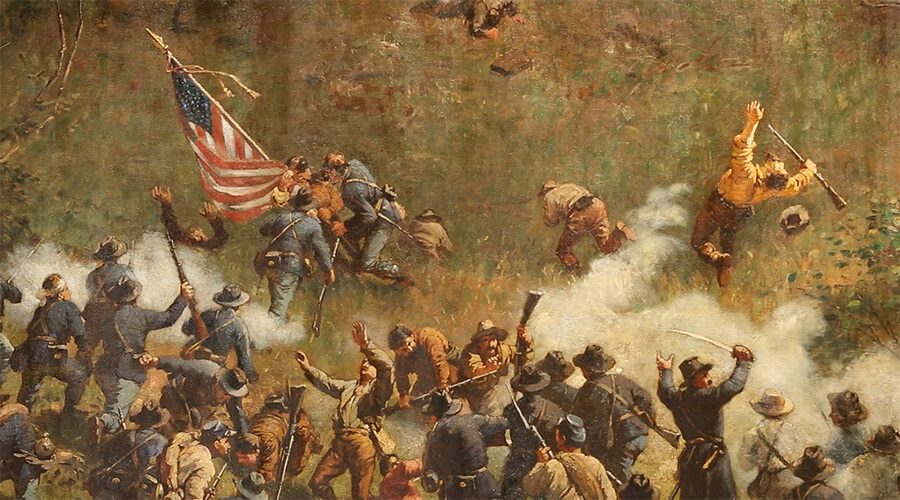 |
| Confederate and Union troops in close combat, Battle of Atlanta Cyclorama, Atlanta, Georgia, 1886. Painting by the American Panorama Company. |
The fall of Atlanta was a major turning point in the Civil War, and this essay begins with a summary of the city's importance to both sides, their struggle for its control during the spring and summer of 1864, and the Federal military campaign across Georgia that began shortly thereafter. The essay then covers, tour stop by tour stop, the major battlefield sites and events of July 22, 1864. For the most part, the tour stops are sequenced in chronological order of the battlefield events, beginning with the prelude to the battle, followed by stops where the first fighting occurred, proceeding to the site where the clash was most intense, and concluding with the locations of the final and most famous combat action of the day. The mobile application includes condensed descriptions of each tour stop and provides recommendations for the tour route and parking. It is designed for use en route (passengers only) and at each destination (drivers and passengers). The essay includes more detailed explanations of military maneuvers and battlefield events, lengthier profiles of the opposing army commanders, and a more extensive account of the battle's aftermath. It explores in greater depth the commemorative monuments, veterans' reunions, and various other ways that a single, bloody contest continued to be remembered long after the fighting stopped."The Battle of Atlanta: History and Remembrance" delves into the recorded past of a particularly fierce engagement between the United States and the Confederate States on July 22, 1864. The fighting that day was one of the biggest battles of the final ten months of the Civil War, and the Yankee victory east of the city was followed by daily bombardment of Atlanta and the Union's capture of the "Gate City of the South" on September 2, 1864. The famous Atlanta cyclorama painting depicts a Federal counter offensive launched at approximately 4:30 p.m. on the day of the battle against Confederate infantry that forced a long line of Yankees to retreat earlier in the afternoon. "The Battle of Atlanta: History and Remembrance" combines a narrative of battlefield events, photographs, postcard views, images from the cyclorama, maps, and other visual and textual artifacts with a web-based mobile application designed to inform trips to battlefield sites by car or bus. The mobile guide combined with this essay can be used to learn about the Battle of Atlanta without a visit to what remains of the battlefield and without additional background reading. "The Battle of Atlanta: History and Remembrance" presupposes no specialized knowledge of Atlanta or the Civil War, and it is intended for a variety of users and audiences.
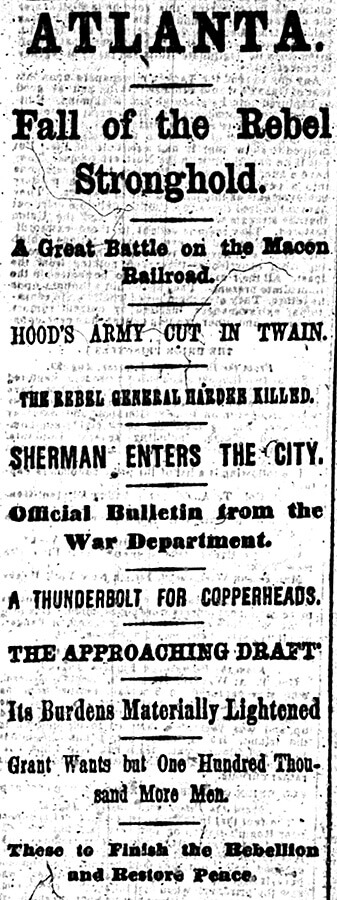 |
| News of Sherman's capture of Atlanta on September 2, 1864 electrified the North, New York Times, September 3, 1864. |
Northern Civil War commanders made the capture of Confederate cities—specifically Atlanta and Richmond—and the crippling or destroying of the armies defending them, the major objectives in the Georgia and Virginia military campaigns that they launched in early May 1864. The Yankee military leaders had agreed on a coordinated, two-theater strategy for exhausting their foes by maneuver and attrition, and they achieved their goal—Confederate defeat—within twelve months.1Edward Hagerman, "Union Generalship, Political Leadership, and Total War Strategy," in On the Road to Total War: The American Civil War and the German Wars of Unification, 1861–1871, eds. Stig Förster and Jörg Nagler (Cambridge: Cambridge University Press, 1997), 168. Atlanta became a target because of its unique political, economic, and psychological importance to the Confederacy. It was a principal railroad hub, a vital source of material support for the war effort, and a bastion of hope for the South as its military fortunes waned. The demolition and burning of the city in November 1864 and the battles and bombardment that preceded its ruin are indelible in Civil War history and lore. The events in and around Atlanta are part of a violent past that over time, and in a variety of ways, have triggered a cultural struggle over the war's meaning. Public and private forms of expression, each with their own history, offer different versions of remembrance that—because memory often exerts a greater impact—deserve as much attention as battle facts. Gone with the Wind, for instance, as a bestselling novel and blockbuster movie has shaped popular perception of the Civil War more than the combined works of all professional historians. The evocative power of Atlanta and the Civil War endures, evident in iconic images and texts, commemorative rituals, monuments, and other forms of remembrance.
The Battle of Atlanta pitted Confederate and Yankee forces against one another in a large combat zone that extended over areas now known as East Atlanta, Kirkwood, Edgewood, Reynoldstown, Little Five Points, Inman Park, and Poncey-Highland. Busy highways, streets, and urban neighborhoods have long since transformed the battlefield terrain, but today's visitors can tour many topographic features, historic monuments and landmarks, as well as remnants of a Civil War fort and rifle pit. A visit to the Battle of Atlanta Cyclorama painting on display in Grant Park is an excellent accompaniment to the tour. The enormous artwork in the round, completed in 1885–86 using firsthand accounts of the fighting, illustrates the lay of land on July 22, 1864, and depicts the clash between Federal and Confederate troops in a particularly dramatic turning point, at about 4:30 in the afternoon. While some visitors prefer touring the Atlanta cyclorama before going to the battlefield sites, reversing that sequence and beginning with Civil War landmarks provides guidance to the sweeping troop movements, lines of attack, and contested terrain portrayed in the sprawling panorama.
The absence of a historically preserved battlefield means that visitors seeking firsthand knowledge about the places and events that figured prominently in the Battle of Atlanta must go beyond the almost effortless engagement with history available at well-preserved Civil War sites, such as Kennesaw Mountain, Gettysburg, and Vicksburg. Visits to the Atlanta battlefield, even via virtual tour, require greater self-reliance and a more active process of combining historical accounts, maps, and images with present-day visual evidence to ferret out what happened, where, and why. The rewards are great. By juxtaposing information from then and now, visitors traveling through contemporary Atlanta gain a new and powerful perspective on the city, its neighborhoods, and their place in history. Exploring seemingly ordinary sites is a way to gain a new awareness of history, even if the sites are often encountered during our everyday routines. Landscape historian John R. Stilgoe encourages us to scrutinize those places, put them in spatial context, and arrange them in time. "Enjoy the best kept secret around," Stilgoe writes, "the ordinary everyday landscape that rewards any explorer, that touches any explorer with magic."2John R. Stilgoe, Outside Lies Magic: Regaining History and Awareness in Everyday Places (New York: Walker and Company, 1998), 2.
Physical traces of the Battle of Atlanta evoke insights and exchanges that touch on broader questions about the Civil War, its causes and consequences, and the historical memory of major battles and the armies that fought them:
- The fact that African American slaves were bought and sold in Atlanta and were used to build earthen fortifications that encircled the city in an effort to fend off an invading Union force invites questions about slavery's role in causing, perpetuating, and ending the war.
- The implications of the fight for Atlanta occurring amid a US presidential election campaign highlights the connection between war and politics and the ways in which the outcome of a single, hard-fought battle can exert effects well beyond the immediate military contest to sectional and national history.
- The arduous, fifteen-mile night march by a Confederate army corps just prior to the Battle of Atlanta focuses attention on the motivation and morale of the rebel soldiers and, more broadly, the factors that propelled warriors on both sides to repeatedly head into combat despite the extraordinary dangers and hardships they faced.
- The Yankee armies' eventual capture of Atlanta, expulsion of its civilian population, and burning of the city prompts consideration of whether the Civil War ushered in the total wars of the twentieth century or was fought within the prevailing nineteenth-century constraints on military action against noncombatants.
Placing the battle in the context of a larger landscape and longer timeline makes the fighting between the Yankee and Confederate armies on July 22, 1864, more meaningful than focusing exclusively on the details of the single military contest. A three-hour Battle of Atlanta tour is an opportunity to gain new knowledge about tactics, topography, and combat action and to contemplate the broader context and significance of a specific clash. "The Battle of Atlanta: History and Remembrance" is a guide for both explorations; it is designed for use before, during, or after a battlefield tour.
The Atlanta Campaign and the March to the Sea
The Battle of Atlanta was the bloodiest and single most important clash in the Atlanta Campaign of the Civil War. It was the campaign's climactic fight but not its conclusion.3Steven E. Woodworth, Nothing But Victory: The Army of the Tennessee, 1861–1865 (New York: Alfred A. Knopf, 2005), 567. The four-month campaign was a series of maneuvers, battles, engagements, and skirmishes between advancing Federal and retreating Confederate forces that culminated in the Federal capture of Atlanta on September 2, 1864. The fall of the "Gate City of the South" was a turning point in the Civil War, virtually assuring Abraham Lincoln's bid for a second term as president at a time when his political prospects were dimming and the outcome of his 1864 election campaign against Democratic opponent George B. McClellan was uncertain. Other Union successes influenced the northern electorate, specifically Admiral David Farragut's closure of the Confederate port of Mobile, Alabama, in early August and General Philip Sheridan's victories in the Shenandoah Valley of Virginia in September and October. However, the Yankee capture of Atlanta electrified the North, and, more than any other event on or off the battlefield, it turned around Lincoln's political fortunes.4James M. McPherson, "Two Strategies of Victory: William T. Sherman in the Civil War," Atlanta History 33, no. 4 (Winter 1989–1990), 10.
McClellan, who had served as general-in-chief of the armies of the United States from November 1861 to November 1862, was gaining popularity among northern voters as a peacemaker who could restrain warring sectional leaders, Lincoln and Confederate President Jefferson Davis, from irretrievably tearing apart the Union. The main plank of the Democratic platform called for an immediate cessation of hostilities, and McClellan personally singled out reunion, but not emancipation, as his one condition for peace. War weariness and McClellan's increasing popularity in the North gave hope to Confederate military and political leaders in the summer of 1864. Even though the Confederates had lost ground in their war effort, a favorable outcome in the northern presidential election could reverse their fortunes and lead to a peace settlement on favorable terms. Conversely, loss of either Richmond or Atlanta to the invading Yankee armies would spell disaster for the Confederates because either outcome would likely propel Lincoln to electoral victory, which in turn meant that the Union would continue to prosecute the war and emancipation would remain a principal war aim.
 |
| Confederate General Joseph E. Johnston, commander of the Army of Tennessee during the first months of the Atlanta Campaign. Albumen print. |
Much depended on how Confederate armies fared in Virginia and Georgia. Because the Confederate and Union forces in Virginia were bogged down in trench warfare near Petersburg beginning in mid-June, the stakes mounted in the more mobile Atlanta Campaign. In northwest Georgia, the three Federal armies under the overall command of Major General William T. Sherman fought and maneuvered their way southward toward Atlanta. Sherman was optimistic from the outset, writing to his wife Ellen on May 22, 1864: "I think I have the best army in the country, and if I cant [sic] take Atlanta and Stir up Georgia considerably I am mistaken."5Brooks D. Simpson and Jean V. Berlin, eds., Sherman's Civil War: Selected Correspondence of William T. Sherman, 1860–1865 (Chapel Hill: University of North Carolina Press, 1999), 639. Despite several battlefield setbacks, most severely at Kennesaw Mountain on June 27, the Union armies gained ground and forced the outnumbered Confederate Army of Tennessee, led by General Joseph E. Johnston, to fall back repeatedly to new defensive positions. When the Yankees circumvented Johnston's fortified position along the Chattahoochee River and began crossing the river on July 8, 1864, the Confederates retreated to an outer line of trenches defending Atlanta. By July 17, 1864, all three Union armies had reached the south bank of the Chattahoochee River, a half-day's march from the city. That same day, Confederate President Davis relieved Johnston of his army command and replaced him with General John Bell Hood. Davis was dissatisfied with Johnston's failure to halt Sherman's advance toward Atlanta. Hood offered the promise of more aggressive action against the Yankees, and as expected he soon went on the attack.
In each of the final four battles of the Atlanta Campaign, with Hood in command, the Confederate forces assaulted advancing or maneuvering Federal troops: at Peachtree Creek on July 20, east of Atlanta on July 22, at Ezra Church west of the city on July 28, and finally to the south at Jonesboro on August 31. In each instance, the Confederates were defeated with heavy losses. While the fighting raged at Jonesboro on August 31, a contingent of Federal infantry reached the Macon and Western Railroad several miles to the north and seized control of this last Confederate supply line into Atlanta. The next day, Union troops routed the remaining Confederate forces at Jonesboro, and that night Hood began a general withdrawal from Atlanta. Sherman allowed Hood's army to escape without pursuit, but Hood's aggressive fight for Atlanta had left him with fewer than forty thousand troops.
On September 2, long lines of Federal soldiers began marching into the city that they would occupy for nearly eleven weeks. Newspapers throughout the North reported their triumph on September 3, and President Lincoln offered national thanks to Major General Sherman and the officers and soldiers under his command. Harper's Weekly declared, "There is not man who did not feel that McClellan's chances were diminished by the glad tidings from Atlanta."6Anonymous, "The effect of the news from Sherman," Harper's Weekly, September 17, 1864, 594. Entering Atlanta, Sherman shifted his attention away from Hood's army to the work of transforming the city into a military base that could be held by a small garrison rather than a large force. On September 7, Sherman issued orders evicting the city's remaining residents, an action that he said was "not designed to meet the humanities of the case, but to prepare for the future struggles."7Brooks D. Simpson and Jean V. Berlin, eds., Sherman's Civil War: Selected Correspondence of William T. Sherman, 1860–1865 (Chapel Hill: University of North Carolina Press, 1999), 707. When Hood's battered army regrouped and threatened the Union's railroad supply line between Chattanooga and Atlanta in early October, Sherman headed to north Georgia in pursuit. After several weeks of maneuvering and inconclusive fighting, both sides withdrew and moved in opposite directions. The Confederate army marched to north Alabama, and the Union troops returned to Atlanta. Sherman recognized that he could not continue to occupy an inland city deep in enemy territory without again risking the loss of his vital supply line. Instead he won approval from his superiors for a new campaign. He would abandon Atlanta and lead an army of sixty-five thousand in a march across the Georgia heartland toward the sea. Sherman would shift his base of operations to a coastal location that could be supplied by the navy and en route his soldiers would lay waste to anything in their path that could support the Confederate war effort.
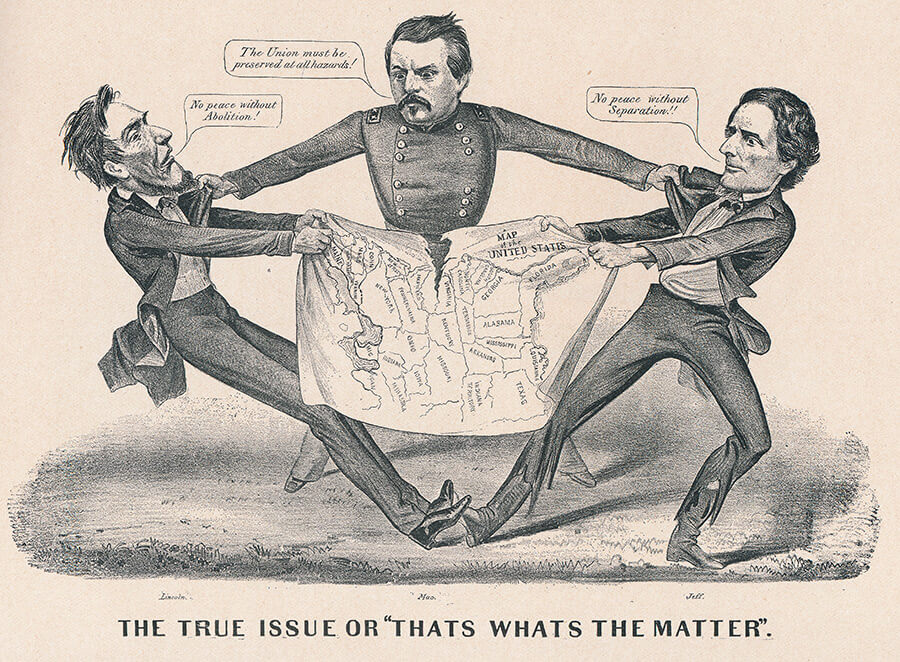 |
| The true issue, George P. McClellan, former Union major general and Democratic Party candidate for president in 1864, separates leaders of the Union and Confederacy. Lithograph print by Currier & Ives, ca. 1864. |
On November 11, in preparation for the new campaign, Yankee engineers in Atlanta began demolishing the railroad depot and numerous other structures in the city that could have military value to the Confederates. On the final nights of the Federal occupation, November 15–16, Union soldiers set fire to unoccupied buildings, and the uncontrolled flames spread, threatening the entire city. By morning, much of the downtown was in ashes, and the city was still smoldering when the last of the Union troops departed on their March to the Sea. Sherman's soldiers trekked southeastward through virtually undefended, rich plantation country, fanning out across a sixty-mile-wide swath of territory from Atlanta to Savannah. Along the way, they foraged liberally, confiscated farm animals and crops, and wrecked railroads, farm buildings, cotton gins, and grist mills. When the campaign ended with the fall of Savannah on December 21, all that remained of the eastern Confederacy was Virginia, the Carolinas, and northeast Georgia.
Atlanta in 1864
When the Union occupation of Atlanta began in early September 1864, fewer than three thousand civilian inhabitants lived in the city, a sharp drop from the war-time high of nearly twenty-two thousand and less than half of the population in 1860.8Ralph B. Singer, "Confederate Atlanta" (PhD diss., University of Georgia, 1973), 235, 253. The Civil War provided Atlanta with a windfall opportunity to enlarge its role as a railroad hub and manufacturing center. Located at the terminating point of four major railroads and far from the conflict's opening fronts, the city flourished during the first years of the war as the Confederate demand surged for rails, cannons, cartridges, shells, and clothing. As the war progressed, the city increasingly served as a hospital and convalescent center and attracted thousands of new residents to work in skilled trades, transportation and communications, wholesale and retail businesses, and the service sector. During the antebellum years, Atlanta had emerged as the center of a regional railroad network that by 1864 linked all that remained of the Confederacy east of the Mississippi. Atlanta was the distribution center for troops, munitions, food, and supplies of all kinds for the army. The city's vital importance to the Confederate war effort made it a primary target for the Federal forces invading Georgia in May 1864. As the war grew nearer during the spring and summer, Atlantans left on every available outbound train, and morale and productivity plummeted among the residents who remained. Well before the city fell on September 2 it had ceased to be of practical service to the Confederacy, but it remained a prize they could ill afford to lose because of its important bearing on the northern presidential contest and the morale of southern whites.
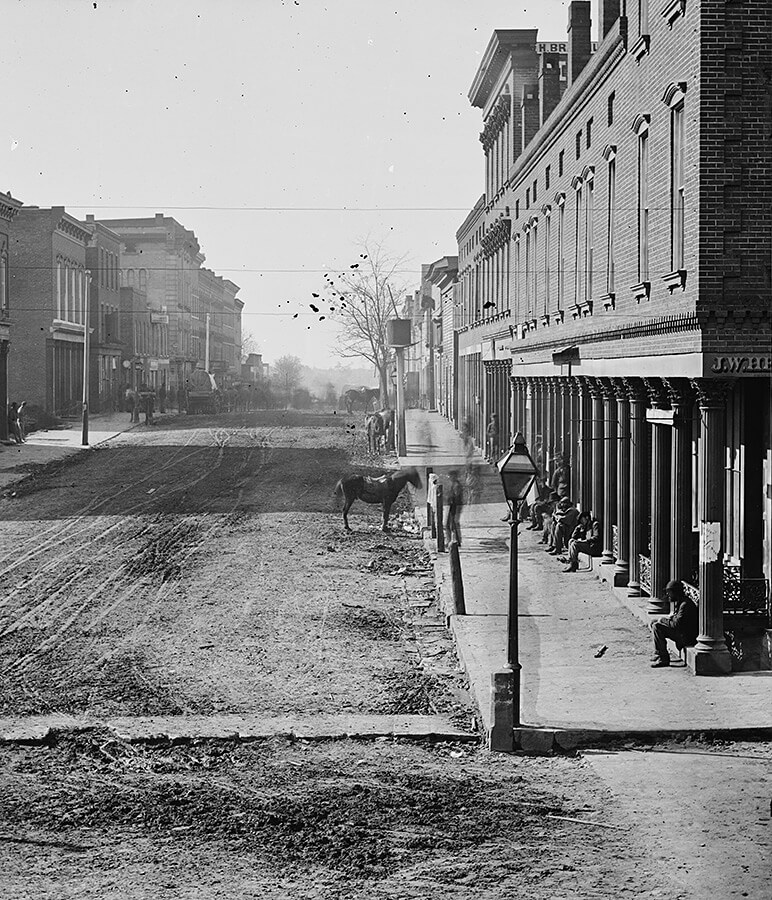 | 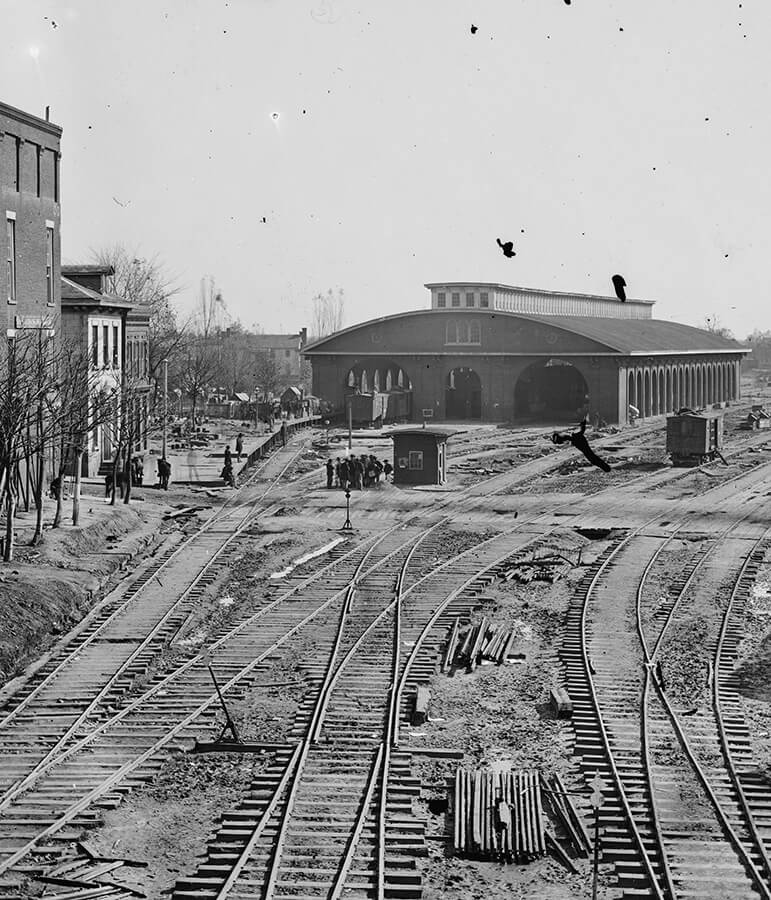 | |
| Whitehall Street, Atlanta's central business district, 1864. Wet plate negative by George Barnard. Courtesy of Library of Congress. | Railroad depot, Atlanta, Georgia, 1864. Wet plate negative by George Barnard. Courtesy of Library of Congress. |
Atlanta's slave population, enumerated at 2,523 by the city tax collector in November 1863, was relatively small compared to coastal cities, but enslaved labor contributed substantially to the city's economy and the Confederate war effort. Slaves in Atlanta carried out non-agricultural tasks, including iron forging, cabinet making, carpentry, brick masonry, blacksmithing, and—most frequently—unskilled labor such as domestic service. As the number of Confederate military hospitals increased, slaves replaced civilians and soldiers initially assigned to routine hospital labor. By the first half of 1864 most of the hospital attendants at several Atlanta hospitals were slaves. African American slaves also worked on Atlanta's inner ring of fortifications, the construction of which began after Federal forces advanced into central and eastern Tennessee in the summer of 1863 and Confederate armies were defeated at Gettysburg and Vicksburg in July 1863.9Robert J. Fryman, "Fortifying the landscape: An archeological study of military engineering and the Atlanta Campaign," in Archeological Perspectives on the American Civil War, eds. Clarence R. Geier and Stephen R. Potter (Gainesville: University Press of Florida, 2000), 49. The War Department assigned Captain Lemuel P. Grant of the Confederate Corps of Engineers the task of designing and building the defensive fortifications. Grant, by offering owners $25 a month, employed enough slaves to bring the work force to the level needed to tear down homes and barns, clear woods, move earth, and build the fortifications at a brisk pace. By April 1864 an elaborate earthwork cordon encircled Atlanta, consisting of elevated artillery positions ("forts") connected to each other and fronted by infantry trenches, rifle pits, and closely-packed, sharpened obstacles designed to deter enemy assaults.10Ibid., 51.
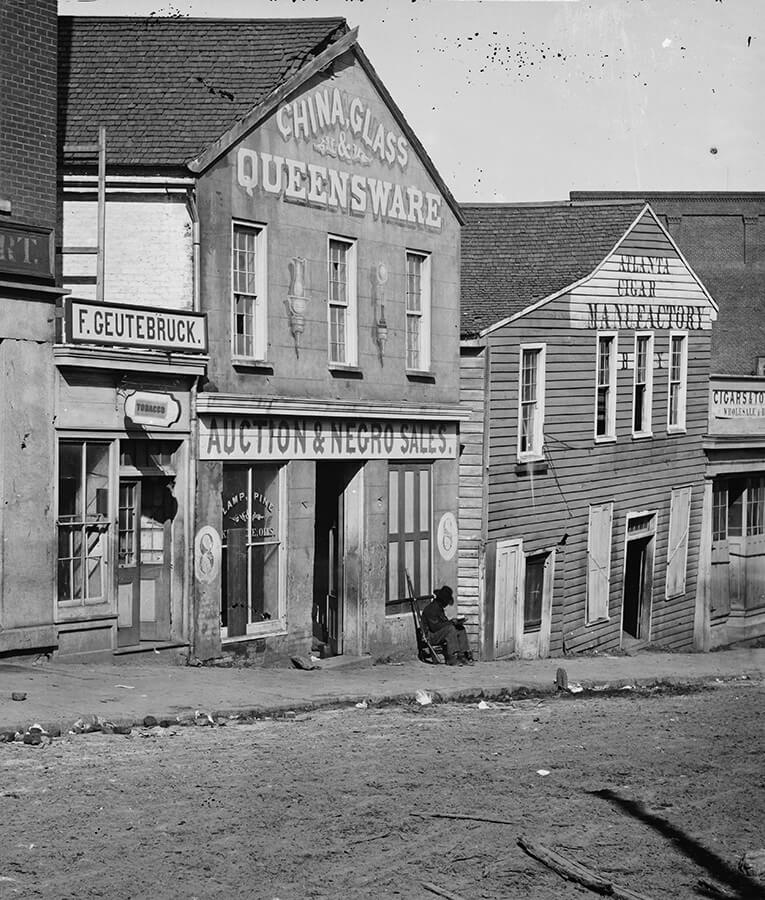 |
| Auction and negro sales, Whitehall Street, near present-day Peachtree Street, Atlanta, Georgia, ca. 1864. Wet plate negative by George Barnard. Courtesy of Library of Congress. |
Atlanta bordered a heavily forested, mineral-rich area to the north and the cotton belt to the south. Although some farmers cultivated land in Atlanta's immediate environs, the city stood a hundred miles north of the region in which large landholders (with three hundred or more acres) were relatively common. "Plantation" homes near Atlanta were much smaller and less impressive than Hollywood's Tara Hall of Gone with the Wind. The terrain surrounding Atlanta was predominantly rolling wooded hills, interspersed with clearings for small farms, homes, and mills, loosely connected by narrow wagon roads, trails, or streams. The invading and defending armies were vulnerable to this lay of the land, mainly wilderness and not well known by either side. Too sizeable to advance quickly on the available country roads or through densely wooded areas, both sides carried out large troop movements quickly and effectively on rails or alongside railroad lines. The predominant east-to-west flows of the Chattahoochee River and Peachtree Creek, the largest bodies of water north of Atlanta, offered natural—albeit unsuccessful—lines of defense for the Confederate forces in July 1864.
The Battle of Atlanta—Overview
The three Federal armies commanded by Sherman, the Army of the Cumberland, Army of the Tennessee, and Army of the Ohio, together numbered approximately one hundred thousand troops as they approached the city, but only about twenty-seven thousand of them fought in the Battle of Atlanta.11Woodworth, Nothing But Victory, 568. Sherman held the remainder in reserve. Hood's Army of Tennessee was fifty thousand strong, a decided numerical disadvantage for the Confederacy, but Hood moved about thirty-five thousand troops into attack against the smaller number of Union soldiers on the battlefield.12Albert Castel, Decision in the West: The Atlanta Campaign of 1864 (Lawrence: University of Kansas Press, 1992), 412. The Battle of Atlanta resulted from Hood's attempt to catch Sherman off guard as the Federal left wing, the Army of the Tennessee, marched from the vicinity of Decatur, six miles east of Atlanta, toward the fortified city. Hood gambled that he could overwhelm the advancing Federals with a long flank movement and surprise rear attack coupled with a frontal assault intended to further disrupt the invaders' line. Both Confederate attacks failed to dislodge the Union troops, who prevailed against wave after wave of assaults.
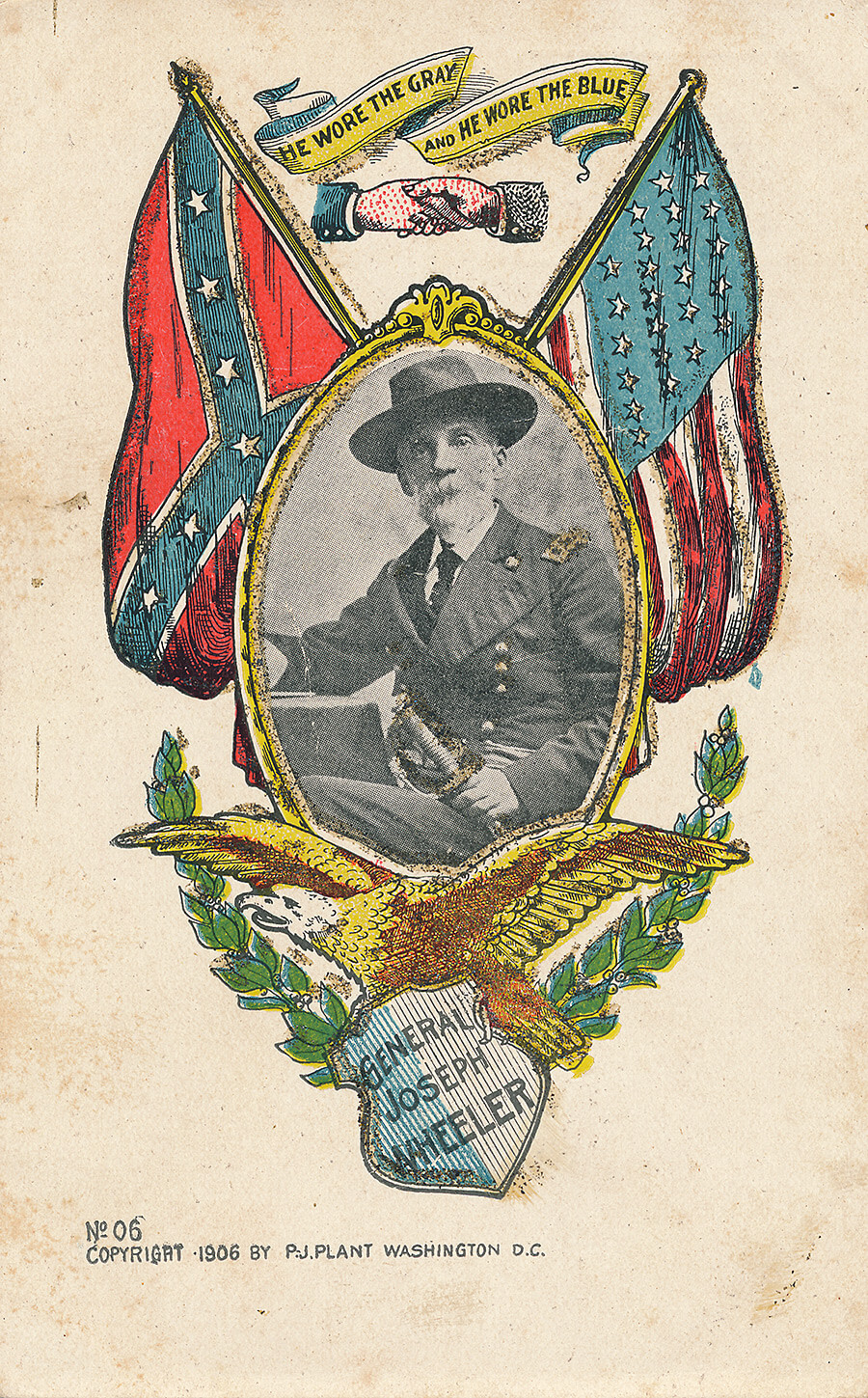 |
| General Joseph Wheeler, one of two former Confederate generals commissioned as major generals in the US Army prior to the 1898 war with Spain, 1906. Image by P. J. Plant. |
Concurrent with the main fighting in the Battle of Atlanta, on the afternoon of July 22, 1864, Confederate General Joseph Wheeler's cavalry achieved short-lived success against a lightly guarded Federal outpost in Decatur. There, approaching the town's public square, Wheeler's horsemen dismounted and attacked a Federal infantry brigade that was protecting a lengthy wagon train of supplies and ordnance. Although Wheeler's troopers forced the Yankees to retreat, the Federals escaped with almost their entire wagon train intact. Before Wheeler could overtake the fleeing Union troops, he was called back to reinforce the Confederate infantry who were meeting stiff resistance in the main battle about four miles west of Decatur. Wheeler's cavalry provided only slight assistance. Years later, Wheeler achieved distinction as one of two former Confederate generals who President William McKinley commissioned as major generals in the US army as the country prepared for the 1898 war with Spain.13G. J. A. O'Toole, The Spanish War: An American Epic 1898 (New York: W. W. Norton, 1984), 196. Fitzhugh Lee was the other appointee. Union veteran McKinley recognized that appointments of former Confederates to high rank in a new and popular armed struggle against a foreign foe would help reduce sectional bitterness, still lingering in the North and South over thirty years after the Civil War. Wheeler, just twenty-seven-years old when the Battle of Atlanta was fought, declared his readiness to return to field command: "Although I am sixty-one years old I feel as strong and capable as when I was forty, or even much younger, and I desire very much to have another opportunity to serve my country."14John P. Dwyer, From Shiloh to San Juan: The Life of "Fighting Joe" Wheeler (Baton Rouge: Louisiana State University Press, 1989), 220. The main combat in the Battle of Atlanta continued until darkness, and by then the Federals had won a major defensive victory. They held their ground and inflicted severe losses. Southern casualties numbered approximately 5,500.15Castel, 412. including the death of a division commander, Major General William H. T. Walker, and the loss of an unusually large number of field officers. Federal losses totaled 3,722 killed, captured, and wounded,16Woodworth, Nothing But Victory, 568. and the dead included Major General James B. McPherson, commander of the Army of the Tennessee and the only Union army commander killed in action during the Civil War. Few Union officers had risen through the ranks more quickly than McPherson and were as popular with their fellow officers and troops. His death was deeply mourned not only by Grant and Sherman but also by the Confederate commander in the Battle of Atlanta, John Bell Hood, who had been McPherson's classmate and close friend at West Point. Hood lamented that "No soldier fell in the enemy's ranks, whose loss caused me equal regret."17John B. Hood, Advance and Retreat (New York: De Capo Press, 1993), 182.
Following the battle, the Federal Army of the Tennessee worked overnight to strengthen its field position in anticipation of a renewed assault by Hood. However, when the fighting ended on July 22, the Confederates abandoned their efforts to crush the advancing Federal left wing. Their concerns turned to defending Atlanta's remaining railroad supply lines from the west and south. With their army severely depleted, the Confederates had limited means to contest the Federal maneuvers against those vital supply lines that began again four days after the Battle of Atlanta. The Federal victory on July 22, 1864, did not precipitate an immediate Confederate withdrawal from the city, but it went a long way toward forcing Atlanta's fall six weeks later.
Battle of Atlanta Tour Stops
General Sherman's Headquarters during the Battle
Union Major General William T. Sherman established his field headquarters just before the Battle of Atlanta on high ground east of the city, where the Jimmy Carter Presidential Library is now located.
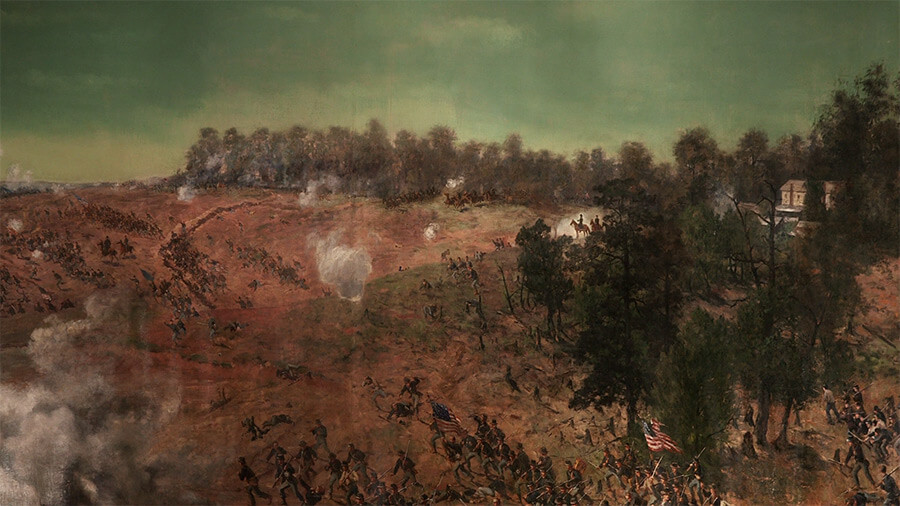 |
| Sherman surveying the battlefield, in front of the Augustus Hurt House, east of Atlanta, July 22, 1864, Battle of Atlanta Cyclorama, Atlanta, Georgia, 1886. Painting by the American Panorama Company. |
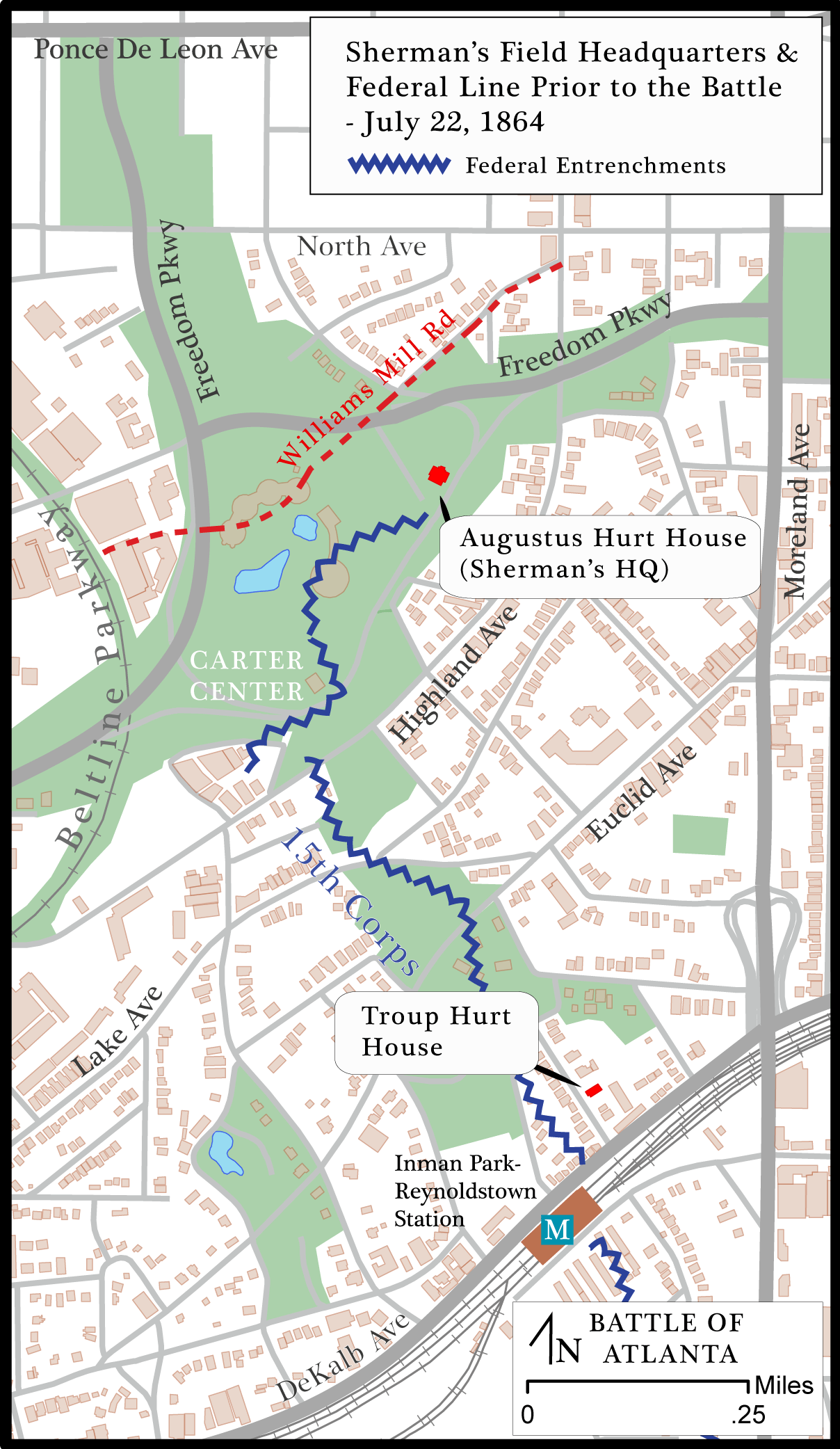 |
| Sherman's field headquarters and Federal line prior to the battle, July 22, 1864. Battle of Atlanta map by Michael Page, 2014. |
On the morning of July 22, 1864, Federal General William T. Sherman, commander of the three Union armies closing on Atlanta, rode on horseback from his field headquarters, a pitched tent at what is now the intersection of Briarcliff and North Decatur Roads, near the present-day Emory University campus, to temporary headquarters, two and one-quarter miles to the southeast and in closer proximity to the city's center. Sherman established his new command post at Augustus Hurt's two-story, wood-frame home and hill top plantation, located on the present-day site of the Jimmy Carter Presidential Library. In 1864, Hurt's estate was on cleared land and commanded a sweeping view to the west and south. When Sherman arrived, he ventured beyond the unoccupied home and down a hillside for a closer look at Atlanta. From a vantage point near the western edge of the present-day presidential library campus, Sherman used field glasses to view the city that was a prime objective of his military campaign. He scanned the eastern section of Atlanta's inner fortifications located about one mile away, along present-day Boulevard and Glen Iris Drive, and observed Confederate batteries and soldiers. This provided direct confirmation that the Rebels remained in Atlanta in force, in contrast to Sherman's earlier supposition—already contradicted by Union reconnaissance—that the Confederate army had evacuated the city.
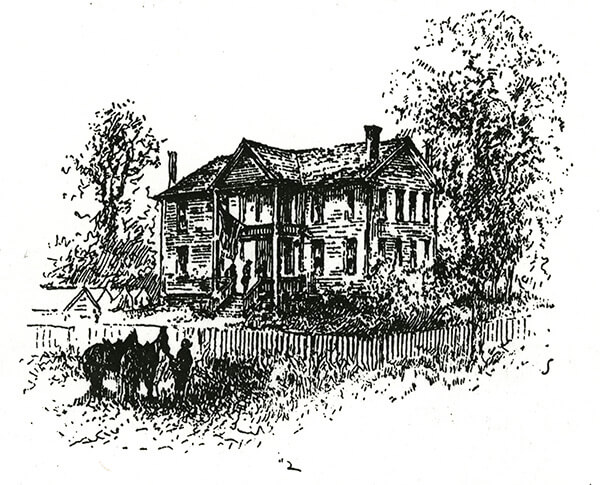 |
| Augustus Hurt House, Sherman's temporary headquarters, Atlanta, Georgia, ca. 1864, Battles and Leaders of the Civil War, vol. 4. Sketch by Theodore Davis. |
Sherman also had a clear view of the rolling terrain just three-quarters of a mile to the southeast, where the late afternoon fighting would reach its peak around the home of Troup Hurt (Augustus Hurt's older brother). Sherman was in position to see Confederate troops break through the Union line and capture a four gun Federal battery, which posed a dire threat to the Army of the Tennessee. The proximity of Sherman to this fighting enabled him to direct cannon fire that hindered the Confederate advance. A counterattack by Federal infantry ended the Confederate threat. After the battle, Union troops demolished Augustus Hurt's plantation home and used the wreckage for fire wood. The hill top location of the house, near the eastern edge of the present-day presidential library campus, was effaced during construction of the campus grounds and parkway during the 1980s.
Sherman's panoramic view of Atlanta is close to what a present-day visitor can see from the western edge of the Carter Presidential Library campus, just above Freedom Parkway and looking at the city's downtown skyline. Although the tree line south of the presidential library now obscures the sweeping view of the battlefield from Sherman's observation point, his advantageous position can be visualized from the cyclorama painting's depiction of the Union commander on horseback, surveying the combat scene from high ground, and by locating the Augustus Hurt and Troup Hurt houses on a battlefield map.
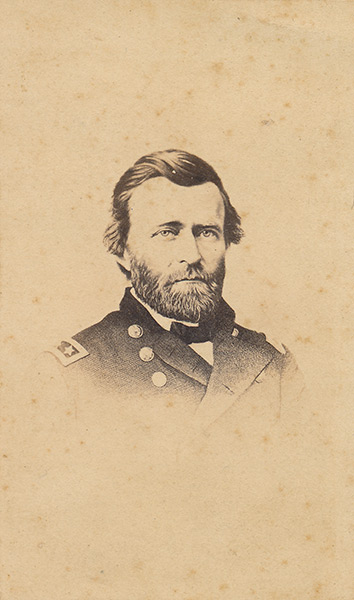 |
| Lieutenant Ulysses S. Grant, general-in-chief of the Union armies. Carte de visite, albumen print. |
Sherman emerged from the Civil War second only to Ulysses S. Grant in renown as a Union general, and the personal bond that the two generals established earlier in the war enabled them to collaborate effectively as each led campaigns that culminated in US victory. Sherman, after graduating sixth of forty-two in the West Point class of 1840, did not show promise of the strategic innovations, logistical genius, and military triumphs that were to follow. Unlike many of the conflict's other top generals, he did not serve in Mexico during the Mexican War, and his military record in the initial stages of the Civil War was lackluster. Because of his volatile temperament and erratic behavior, Sherman was relieved of his assignment as commander of Union forces in Kentucky in late 1861. Sherman's star started to rise in the winter and spring of 1862 when his military partnership with Grant began in earnest. He contributed to Federal victories in western Tennessee in February 1862, when Grant led combined land and naval assaults against the Confederate strongholds at Forts Henry and Donelson. That April, Grant gave Sherman credit for saving the day at Shiloh when, in one of the bloodiest battles of the war, Union forces came close to disaster but turned the tide on the second day of fighting. The following year, when under Grant's leadership the Federals prevailed at Vicksburg, Mississippi, Sherman's frank advice and skillful field command solidified their relationship. For the remainder of the war, each time Grant was promoted to a new rank and role, Grant moved Sherman into his previously held position: first as commander of the Army of the Tennessee, then as commander of the Military Division of the Mississippi, i.e., leader of all Union forces in the western theater.
 |
| Robert E. Lee, commander of the army of North Virginia. Carte de visite, albumen print. |
Shortly after Lincoln named Grant general-in-chief of the Union armies in March 1864, Grant and Sherman conferred at length on plans for the spring campaigns. Beginning in early May 1864, Grant sought to pressure the Confederates on all fronts. In the east, Grant would attack Robert E. Lee's Army of Northern Virginia, which was defending Richmond; Sherman would invade Georgia and target the Army of Tennessee, initially under the command of Joseph E. Johnston and then John Bell Hood, which was protecting Atlanta. Grant and Sherman agreed on a strategy of simultaneous conquest of the two main Confederate armies and the urban centers they guarded. Keeping the Rebel forces separated would enable the northerners to take advantage of their numerical superiority in each theater. Movements against cities became a major focus of Union commanders who sought total defeat and unconditional surrender of the Confederacy.18Megan Kate Nelson, Ruin Nation: Destruction and the American Civil War (Athens: University of Georgia Press, 2012), 10. By mid-July, Sherman's tenacious pursuit of Johnston had covered ninety miles and reached the northern and eastern outskirts of Atlanta. On July 20, Confederate forces, now under the command of Hood, were thwarted in their sweeping attack on the advancing Federal right wing three miles north of the city at the Battle of Peachtree Creek. Sherman, five or six miles southeast of the Peachtree Creek battlefield, was in position to hear the fighting but did not learn the outcome until about midnight, when a dispatch arrived from the victorious Union general, George H. Thomas, commander of the Army of the Cumberland.
 |
| Union Major General William T. Sherman, officer of the Federal Army, advancing on Atlanta, ca. 1860. Wet plate negative. Courtesy of Brady National Photographic Art Gallery. |
Sherman, traveling with Major General John M. Schofield's Army of the Ohio on the Federal left wing, had moved his headquarters early on July 20 to what is now the northwest corner of North Decatur and Briarcliff Roads. As the battle raged at Peachtree Creek, Union troops pressed toward the city: General James B. McPherson's Army of the Tennessee marching westward from Decatur towards Atlanta along the tracks of the Georgia Railroad and Schofield's Army of the Ohio moving from the northeast, to McPherson's right, reconnoitering the Confederate defenses, cutting roads, and opening communications. The only major action on July 21 occurred when McPherson ordered General Frank P. Blair, leading the Seventeenth Corps of the Army of the Tennessee, to capture Bald Hill, an elevation commanding the eastern approach to the city that the Confederate defenders used to hold McPherson's advancing troops at bay. On the morning of July 21, General Mortimer Leggett's division of Blair's Corps, after a bitter struggle, captured the hill—later re-named Leggett's Hill—from a Confederate division under the command of General Patrick R. Cleburne of Hardee's Corps. Leggett's troops immediately entrenched themselves and placed cannons in position to fire shells into Atlanta. By nightfall, the Federal left wing had advanced to a lengthy front some two-and-a-half miles from the center of Atlanta on what had been the eastern portion of the Confederates' outer defense line. The Confederates abandoned that entire line overnight, withdrawing to the city's inner fortifications, and allowing Sherman to move to his new headquarters at the Augustus Hurt House the following morning, July 22, 1864.
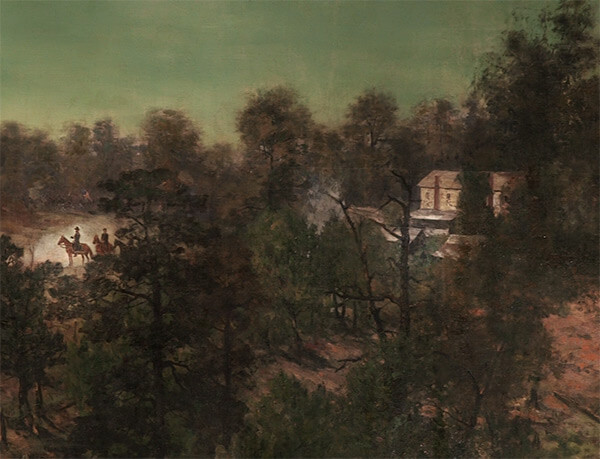 |
| Augustus Hurt House, Sherman's headquarters on July 22, 1864, Battle of Atlanta Cyclorama, Atlanta, Georgia, 1886. Painting by the American Panorama Company. |
When Sherman learned before dawn that Hood had abandoned the outer arc of Atlanta's defenses, the Yankee commander mistakenly concluded that the Confederates had evacuated the city. He immediately ordered a massive Union pursuit. However, by the time Sherman arrived at the Augustus Hurt House, Federal reconnaissance had discovered that Hood's infantry still occupied the inner fortifications surrounding Atlanta. Sherman countermanded his pursuit order, and he personally surveyed the fortified Confederate position after arriving at the hillside just west of the Augustus Hurt House. Sherman and his staff moved so far forward toward the city's fortifications that they drew Confederate artillery and rifle fire, forcing their retreat to the Hurt home. Sherman was joined there at about 11 a.m. by McPherson, who persuaded Sherman to reconsider another order, which would have sent the Federal Sixteenth Corps on a mission to tear up railroad track back to and beyond Decatur. Sherman was concerned that Confederate reinforcements would arrive by rail from Virginia and had already sent McPherson's cavalry to the rear to tear up track.19Steven E. Woodworth, Sherman (New York: Palgrave Macmillan, 2009), 128. McPherson was worried that sending the Sixteenth Corps infantry on a similar mission would leave the Union's Army of the Tennessee vulnerable to an attack against its thinly defended far left flank. Sherman agreed to postpone his order until 1 p.m. If the Confederates did not attack by then, the Sixteenth Corps infantry would proceed with its wrecking assignment. As events unfolded, Sherman's agreement to reinforce the Union's left flank proved to be a crucial move for the Yankees and a major misfortune for the Confederates as they launched their surprise attack at about noon.
General Hood's Observation Post and Oakland Cemetery
Confederate General John Bell Hood observed part of the Battle of Atlanta from a vantage point on high ground near the present-day Oakland Cemetery Visitors Center (Bell Tower).
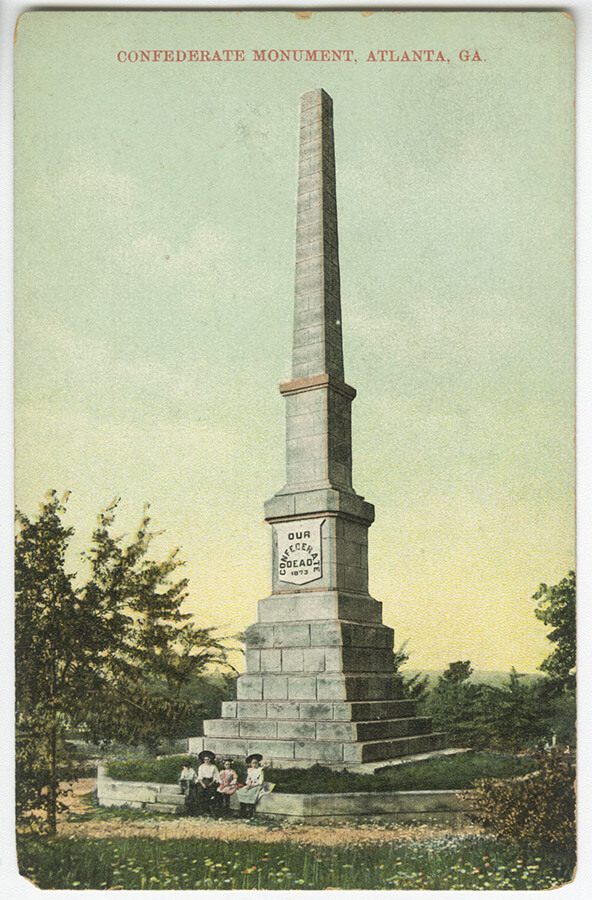 |
| Confederate Obelisk, dedicated to the memory of "Our Confederate Dead," Oakland Cemetery, Atlanta, Georgia. Postcard made in Germany, ca. 1910. |
Established in 1850, when its original six acres were purchased east of the city for use as a municipal burial ground, Oakland Cemetery was first known as Atlanta Cemetery. In 1856, several hundred yards north of the original cemetery, James E. Williams, who would serve as Atlanta's mayor after the Civil War (1866–1868), built a residence on high ground. On the afternoon of July 22, 1864, the second floor of the Williams House served as a vantage point from which General John Bell Hood, commander of the Confederate forces, and his staff observed troop movements and perhaps battlefield action. Hood witnessed two Confederate divisions, Brown's and Clayton's, move from within Atlanta's inner fortifications and march eastward astride the Georgia Railroad tracks (now the MARTA commuter rail line and CSX railroad tracks visible from the cemetery) to attack the Federal Fifteenth Corps, Army of the Tennessee, in the vicinity of what is now Dekalb and Degress Avenues, one and one-quarter miles from the Williams House. A Georgia Historical Commission marker located in the northern part of Oakland Cemetery, near the Bell Tower (visitors center), indicates the site of the Williams House. Hood, who was able to ride a horse despite his debilitating war wounds and leg amputation, also may have used the nearby home of Lucius J. Gartrell for an observation post during the battle.20Robert E. Zaworski, The General and the House on the Hill (Alpharetta, GA: BookLogix, 2001), 39. Gartrell's house was located on high ground north of the railroad tracks, opposite Oakland Cemetery.
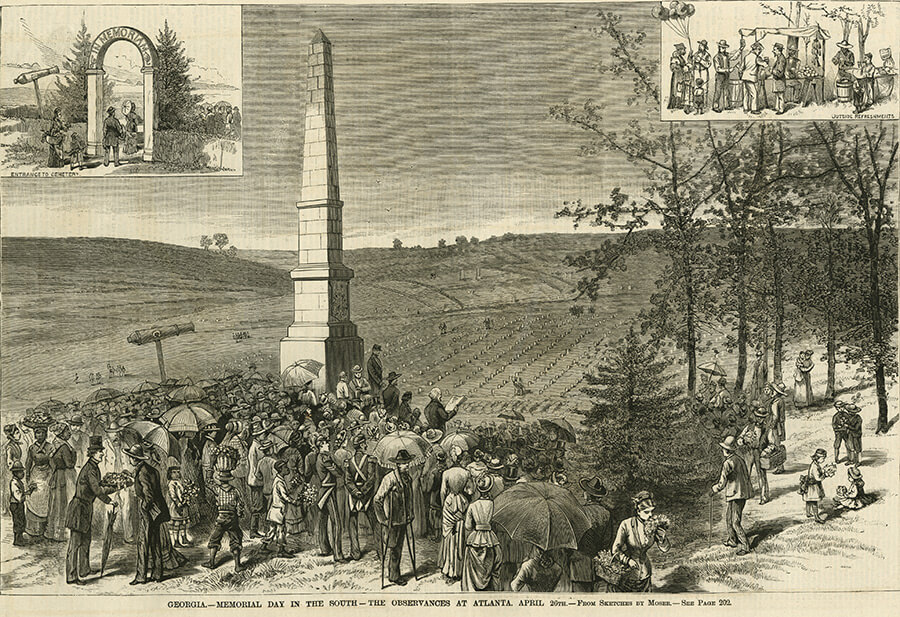 |
| Confederate Memorial Day ceremonies, Oakland Cemetery, Atlanta, Georgia, April 26, ca. 1881, Leslie's Illustrated Weekly. Sketch by James Henry Moser. |
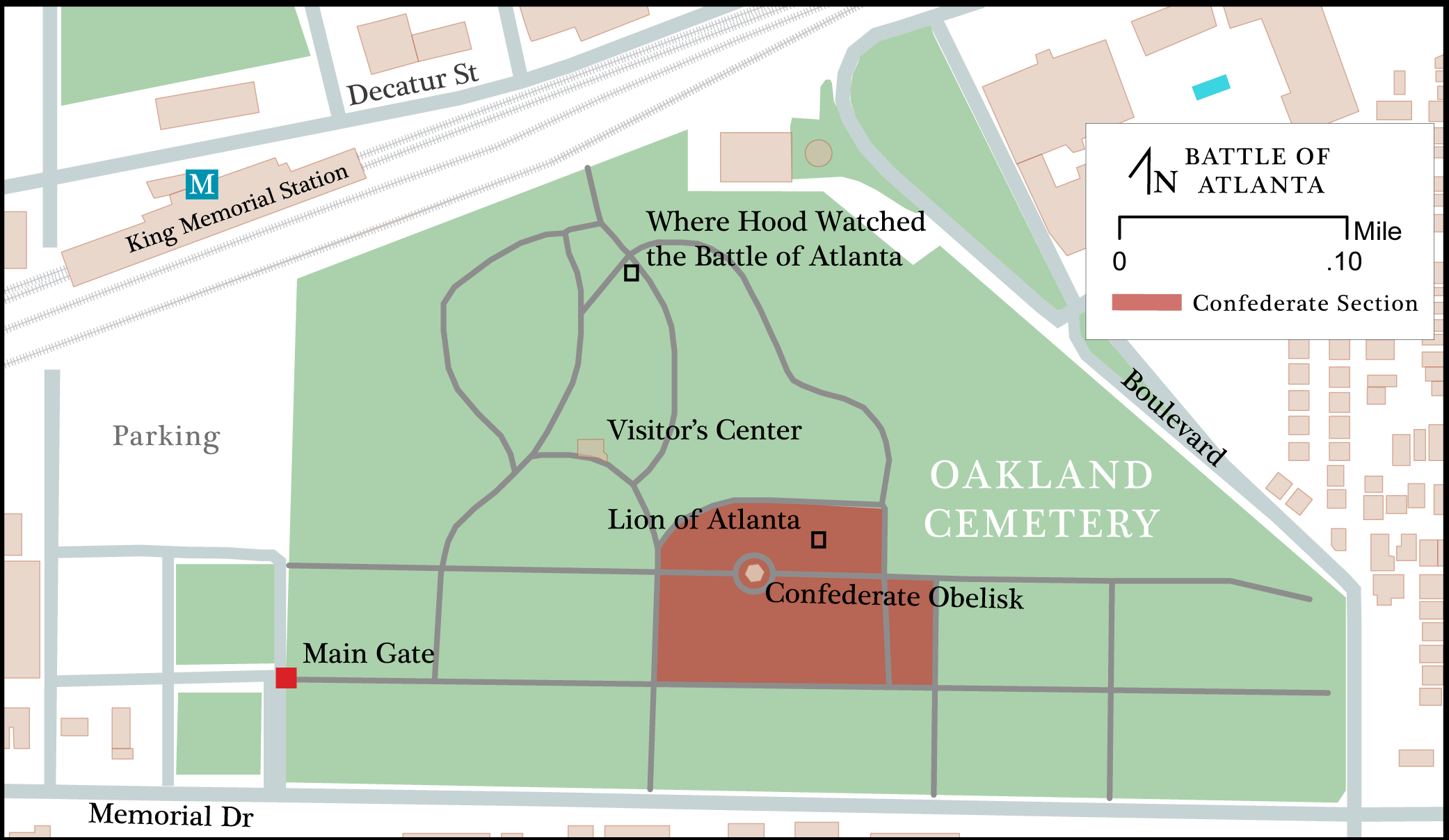 |
| Oakland Cemetery, Atlanta, Georgia. Battle of Atlanta map by Michael Page, 2014. |
John Bell Hood graduated forty-fourth in a class of fifty-two from West Point in 1853 and was the youngest of the eight full generals of the Confederacy. At the military academy he had been in the same class as James B. McPherson, John M. Schofield, and Philip H. Sheridan of the Federal Army, the first two of whom fought against Hood in the Battle of Atlanta. Future Confederate generals also attended West Point at the same time as Hood. J. E. B. Stuart and William D. Pender, both of whom graduated in 1854, would emerge with Hood as outstanding young officers in Lee's Army of Northern Virginia during the pinnacle of its success in the summer of 1862. In combat that summer, under Lee's command at Gaines Mill, Second Manassas, and Antietam, Hood saw how bold assaults could turn the tide of battle. Hood performed impressively, if not decisively, in all three battles, reinforcing for him the importance of daring leadership and hard fighting—displayed at Atlanta two years later. Battlefield aggressiveness, not tactical brilliance, distinguished Hood as a brigade and division commander in the Army of Northern Virginia. When promoted to army commander, his skill at independent command was found wanting. Still, he emerged from some of the bloodiest, early battles in the Civil War physically unscathed and with a reputation for combat bravery. His luck ran out as the war went on. At Gettysburg in July 1863, Hood sustained a severe wound to his left arm, after which he recovered only limited use of that extremity. Two months later at Chickamauga, Georgia, a bullet shattered his right thigh bone, and Hood's right leg was amputated just below the hip. As a result of his wounds, Hood could not walk without crutches and required a body servant to get dressed, mount a horse, and complete many other activities of daily living.
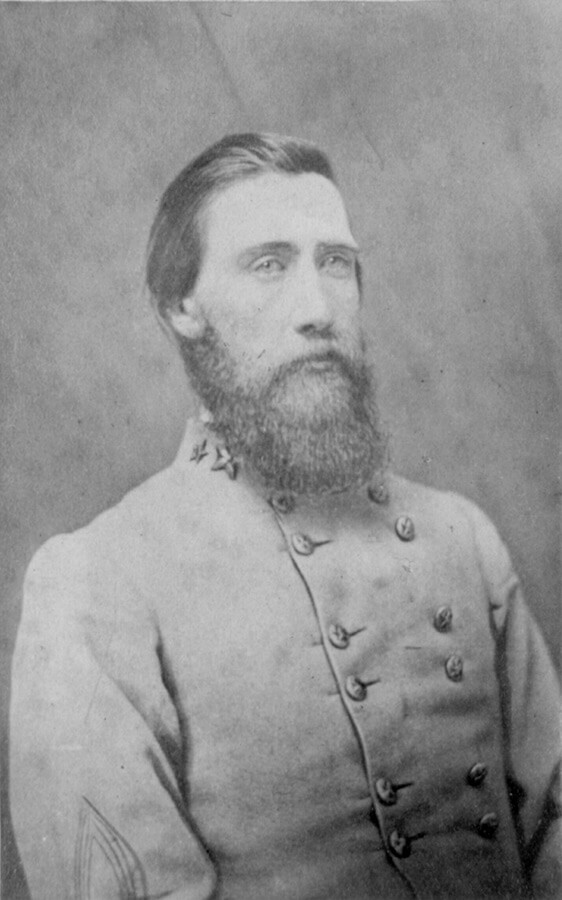 |
| Lieutenant General John Bell Hood, commander of the Confederate Army of Tennessee. Photographic print. |
Hood's leadership at Chickamauga won him a promotion to lieutenant general on February 11, 1864, and later that month he joined the Army of Tennessee in Dalton, Georgia as a corps commander. He served in that role until July 17, 1864, when Confederate President Jefferson Davis lost patience with General Joseph E. Johnston's command of the Army of Tennessee and replaced Johnston with Hood. When asked by Davis, Lee had advised against this change in command. "Hood is a bold fighter," Lee said. "I am doubtful as to other qualities necessary."21Clifford Dowdey, ed., The Wartime Papers of Robert E. Lee (New York: Bramhall House, 1961), 202. When news of the change in Confederate command reached Federal General William T. Sherman, he asked Schofield, Hood's classmate at West Point, about Hood. Schofield replied that Hood was "bold even to rashness" and "courageous in the extreme."22William T. Sherman, Memoirs of William T. Sherman (New York: The Library of America, 1990), 544.
Oakland Cemetery provides a tangible link to Atlanta and the Civil War, both as a site where Hood established an observation post during the Battle of Atlanta and as the most prominent public space in the city used by residents and visitors to commemorate the war dead and the Lost Cause of the Confederacy. Oakland extended beyond its original boundaries through a series of expansions, and by 1867 it reached its current size of eighty-eight acres. During the Civil War a section immediately east of the original six acres was set aside for war dead. Now known as the Confederate section, this plot of land is the burial site of nearly seven thousand soldiers, including three thousand unknowns. Many of the Confederate dead were reinterred in Oakland Cemetery after members of the Atlanta Ladies' Memorial Association and their spouses raised funds in 1867 to remove bodies from the shallow graves on the battlefields near Atlanta. The last row of the Confederate section "C" contains the remains of Federal soldiers who were captured and died in Confederate hospitals. The Federal headstones have shields on them. The Confederate headstones have either "CSA" (Confederate States of America) or "Confederate" on them.
 |
| Advertisement for the Lincoln Memorial in Washington, DC, sculpted from Tate, Georgia, marble, National Geographic 53, no. 2 (February 1928): 4. |
The Ladies Memorial Association also erected two large monuments that mark the space set aside for the war dead: a sixty-five-foot-tall obelisk of Stone Mountain granite and a six-foot-high statue of a grieving lion carved from a fifteen-ton piece of Tate, Georgia, marble and modeled after the renowned Lion of Lucerne in Switzerland. The base of the Confederate Obelisk was set in place on October 15, 1870, the day of Robert E. Lee's funeral. The shaft memorializing "Our Confederate Dead" was unveiled on Confederate Memorial Day, April 26, 1874. The obelisk is the focal point for the entire Confederate section and for decades provided the backdrop for annual Confederate Memorial Day celebrations. At the time of the obelisk's dedication it was the tallest structure in Atlanta, equivalent in height to a three-story building. The Lion of Atlanta, like the much larger Swiss statue, symbolizes the agonizing death struggle of an armed force in defeat, overwhelmed by its opponent but honored for bravery. In Atlanta, the monument commemorates the unknown Confederate dead, whose remains are buried in the surrounding plot; in Lucerne, the carving that Mark Twain called "the most mournful and moving piece of stone in the world"23Mark Twain, A Tramp Abroad (New York: Oxford University Press, 1996), 259. is dedicated to the approximately 600 Swiss Guards who died while unsuccessfully defending the French royal family in August 1792, during the French Revolution.24David P. Jordan, The King's Trial: The French Revolution vs. Louis XVI (Berkeley and Los Angeles: University of California Press, 2004), 38. In each instance, a dying lion, mortally wounded by a lance driven through its back, clutches an emblem of the lost cause for which it fought: a Confederate battle flag in Atlanta and the French fleur-de-lis in Lucerne. The Lucerne statue was sculpted in 1820–1821 with the support of Swiss aristocrats seeking the backing of Bourbon monarchs who had been restored to the French throne.25Arnold Lunn, The Cradle of Switzerland (London: Hollis & Carter, 1952), 147. Following the instructions of the Ladies Memorial Association, Thomas M. Brady of Canton, Georgia sculpted the Atlanta version, completing the statue in 1894.26Anonymous, "Atlanta's Monuments to Confederate Dead," Atlanta Constitution, July 23, 1898, 15. It was dedicated on April 26 of that year. Twenty five years later, sculptor Daniel Chester French used white marble quarried in Tate, Georgia, for his colossal Abraham Lincoln Memorial statue in Washington, DC. Thus, marble from the same small town in Pickens County went to sculpt a memorial to thousands of unknown Confederate dead as well as a monument to the war's best known casualty.
 |  | |
| Lion of Lucerne postcard, Lucerne, Switzerland, ca. 1910. Model for the Lion of Atlanta. | Lion of Atlanta, commemorating the unknown Confederate dead buried in the surrounding plot in Oakland Cemetery, 2009. Photograph by Matt Miller. |
Commemorating the surrender of Confederate General Joseph E. Johnston to Federal General William T. Sherman in 1865, near Durham, North Carolina, April 26 is Confederate Memorial Day in Georgia and in many former states of the Confederacy. Johnston's surrender, following Lee's on April 9 to Grant at Appomattox Court House, Virginia, removed the last large Confederate Army from the field. Until 1984 Confederate Memorial Day was a statutory Georgia holiday, marked in Atlanta by a procession of as many as ten thousand people from downtown to Oakland Cemetery for ceremonies and speeches.
Fort Walker and Rifle Pit
Confederate Colonel Lemuel P. Grant designed over ten and half miles of earthwork fortifications and connecting trenches that encircled Atlanta and included Fort Walker, the sole remnant of the city’s inner defensive works.
 |
| Fort Walker, Grant Park, Atlanta, Georgia, ca. 1910. Vintage postcard. |
 |
| Fort Walker, located in present-day Grant Park, Atlanta, Georgia, with Union troops encamped north of the fort, October, 1864. Photograph by George H. Barnard. Courtesy of US Military Academy Special Collections. |
Fittingly, the Fort Walker site in Grant Park is the sole remnant of the earthen works constructed under Lemuel Grant's supervision. Other remnants of Atlanta's defensive works were evident into the twentieth century, only to be obliterated in the post–World War II era by urban growth.27Ibid., 52. Fort Walker remains a notable Atlanta Civil War site, protected by its location in a municipal park but vulnerable to natural erosion and effacement by human visitors. It was first restored in the 1880s,28Gail Anne D'Avino, "Atlanta Municipal Parks, 1882–1917, Urban Boosterism, Urban Reform in a New South City" (PhD diss., Emory University, 1988), 42. after which it became a popular destination for visitors and a frequent subject of picture postcards. The fort was restored again in the 1930s, when the Works Progress Administration laid flagging stone—still present—to protect the broad area above the earthen wall, where the original Confederate gun battery had been placed.29Marguerite Steedman, "Atlanta Fort Restored," Atlanta Constitution, May 2, 1937, 7. Until they were removed in the 1980s, several Civil War cannons were on display at the Fort Walker site. At the time of the Battle of Atlanta, the city was completely encircled by over ten miles of carefully planned and well-constructed fortifications that stood on average one-and-a-half miles from the city's center. These strong defensive works were completed for the most part by April 1864. Their construction was supervised by Lemuel P. Grant, after whom Atlanta's Grant Park is named. Subsequent extensions of the city's defensive perimeter in the spring and summer of 1864 increased its length. Among the add-ons was Fort Walker, a small bastion located in the southeast corner of Grant Park that was originally constructed as a separate four-gun parapet and subsequently incorporated into the main defensive line.30Robert J. Fryman, "Fortifying the Landscape: An Archeological Study of Military Engineering and the Atlanta Campaign," in Archeological Perspectives on the American Civil War, eds. Clarence R. Geier and Stephen R. Potter (Gainesville: University Press of Florida, 2000), 53. The fort was named for Confederate Major General William H. T. Walker, who was killed in the Battle of Atlanta.
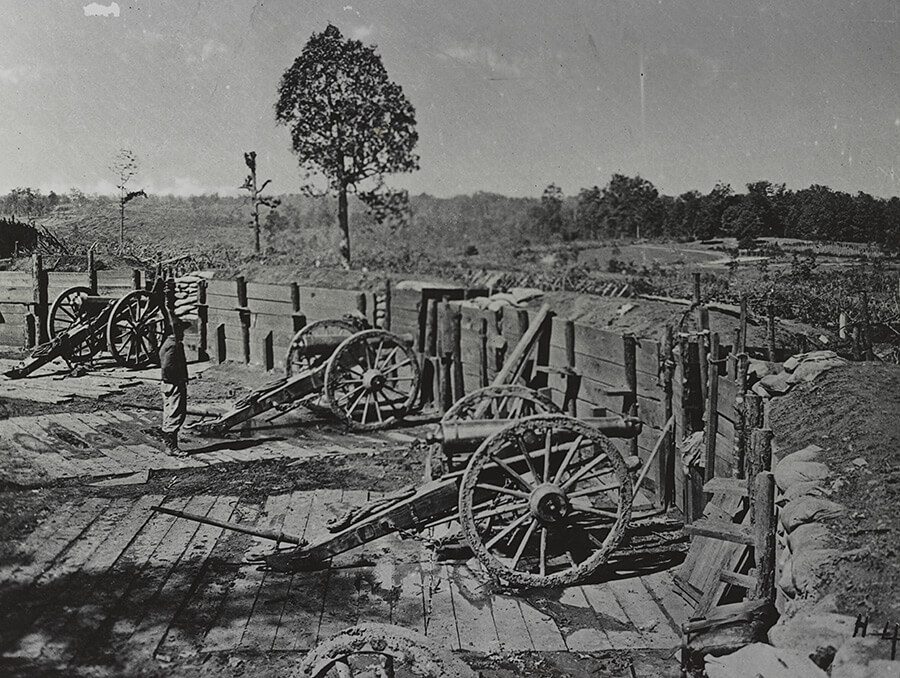 |
| Confederate fort near Atlanta, Georgia, part of the city's inner ring of fortification, 1864. Photographic print by George H. Barnard. Courtesy of Library of Congress. |
The actual look of Atlanta's earthwork fortifications in 1864 is preserved in the visual record created by George N. Barnard, a pioneering nineteenth-century photographer who documented Sherman's campaigns throughout the final year of the Civil War. Barnard also took photographs of the city itself, before, during, and after its wreckage and burning by the Yankees. His images of the city's forts after they fell to the Federals depict rugged earthen structures supported by timber frameworks, located on hilly prominences, and connected by lengthy entrenchments that could be occupied by infantry. The forts were fitted for artillery batteries, which were placed on level platforms behind gun embrasures. The grounds in front of each fort had been cleared of trees and brush for one thousand yards, leaving open lines of fire for the defenders' artillery and rifles. Some forts also were protected by abatis, felled trees with sharpened branches facing toward the enemy, and chevaux-de-frise, rows of criss-crossed, sharpened logs.
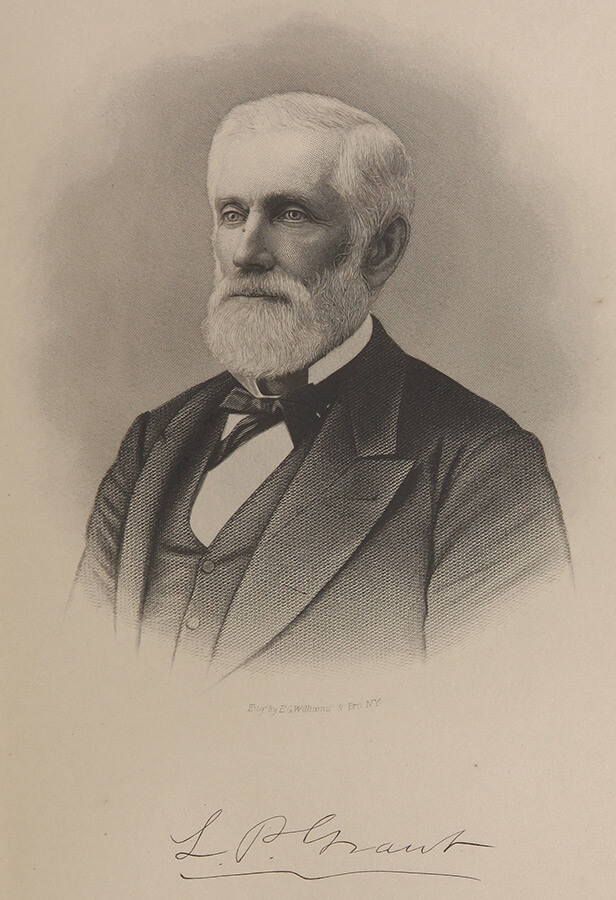 |
| Lemuel P. Grant, Confederate engineer responsible for the construction of Atlanta's inner fortifications, 1889, Wallace P. Reed, History of Atlanta, Georgia: With Illustrations and Biographical Sketches of its Prominent Pioneers, vol. 2 (Syracuse, New York: D. Mason and Company, 1889), 168. Manuscript, Archives, and Rare Book Library, Emory University. |
Lemuel Grant, a native of Maine who at age twenty-two had moved to Atlanta before the name of the place had been changed from Terminus and Marthasville, was originally trained as a civil engineer and had no military training or experience prior to his commission in 1862 as a captain of engineers in the Confederate army. Lemuel Grant's lack of familiarity with military fortifications and the range of field artillery had consequences. The distance between the fortified line and the city's center was less than the maximum range of the Federal field artillery, and beginning July 20, 1864, the advancing Federal forces were able to cannonade Atlanta without breaching or even testing the city's fortifications. Union commander William T. Sherman decided against a direct infantry assault after reconnoitering the fortifications following the Battle of Atlanta.
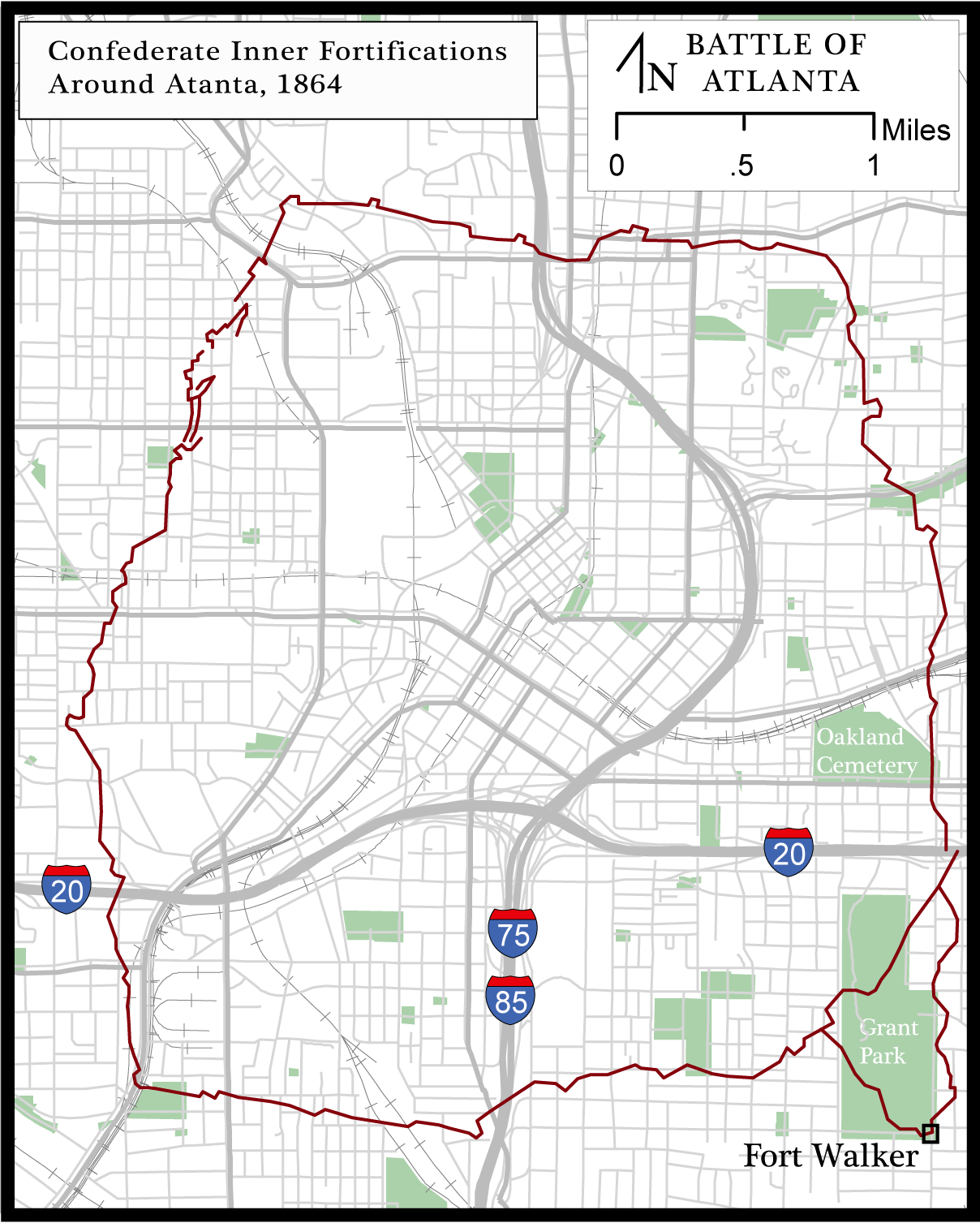 |
| Confederate inner fortifications around Atlanta, 1864. Battle of Atlanta map by Michael Page, 2014. |
A visit to the hilltop Fort Walker site and observation of the surrounding topography show why it was a key point in Atlanta's defenses. The location provides a commanding view of the valley below and an advantageous position for a gun battery. At the base of the site is a rifle pit, visible as a shallow, semi-circular trench in front of the fort wall. In 1864, troops would have had sufficient space within the trench to stand without exposing more than their eyes and rifle barrels in a narrow opening covered by a protective timber head-log.
Rifled cannons and side arms in the Civil War were nineteenth-century technological innovations that had the potential to add substantial firing range and destructive power to both armies. Yet, gunfire between the opposing battle lines in the Civil War was typically mass volleying of rifled muskets shot at close range from linear ranks. The rifled musket's rate of fire was not fast enough in the Civil War to enable departures from standard battle lines, which resembled tightly packed Napoleonic formations. Artillery served mainly as weapons of support for infantry and cavalry, either in defending positions or bolstering attacks. Long range fire was the specialty of rifled cannons, enabling accurate cannonading at a mile and maximum ranges in excess of two miles. Casualties inflicted by artillery typically accounted for a small proportion of Confederate and Federal losses. The majority of battlefield injuries and fatalities resulted from rifle fire, and protracted shooting at close range, often under a hundred yards, characterized many Civil War battles. Firefights often dragged on until exhaustion set in or nightfall ended the combat for the day, as was the case in the Battle of Atlanta. Casualties mounted because the fighting lasted so long—approximately eight hours on the Atlanta battlefield—and less because of technological advances in weaponry.
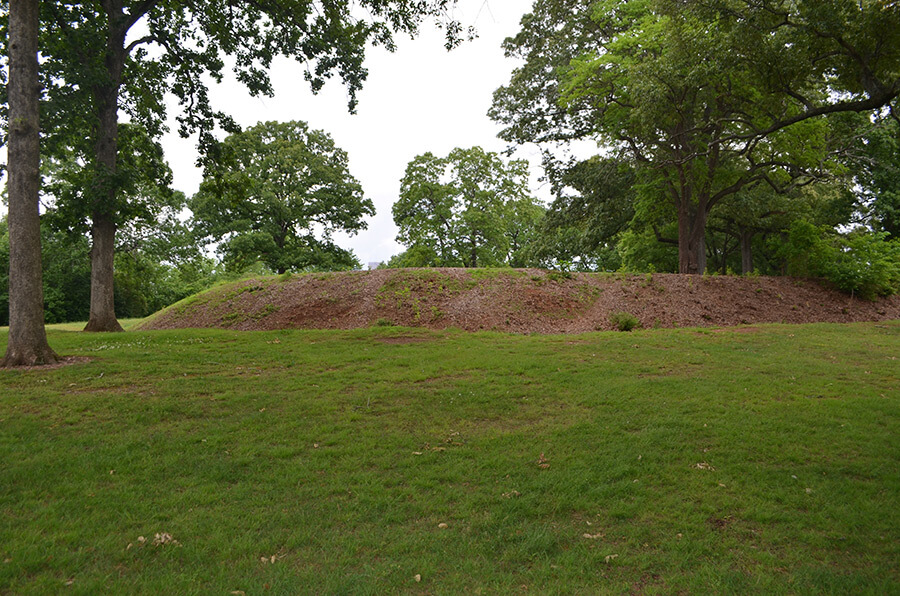 |
| Remnant of Fort Walker and rifle pit, Grant Park, Atlanta, Georgia, May 10, 2014. Photograph by Daniel Pollock. |
Prior to the third year of the Civil War, battlefield tactics remained largely unchanged from earlier nineteenth-century conflicts. By 1864, two major military innovations had gained acceptance. First, the principal armies began to engage in continuous campaigning for months rather than sporadic, pitched battles that lasted hours or days. Second, soldiers on both sides had learned to dig systems of trenches and light field fortifications, which strengthened their positions and protected against enemy rifle fire. Throughout the Atlanta Campaign, Confederate military engineers oversaw construction of defensive works, such as the Kennesaw Mountain Line and Chattahoochee River Defense Line, that they prepared before the arrival of the retreating Army of Tennessee. Just prior to the battles for Atlanta, the Confederate Army in retreat toward the city constructed a nine-mile line of entrenchments outside and to the north and east of the much heavier, inner fortifications. The southerners abandoned their outer defensive line on the night of July 21 and withdrew to the city's stronger, inner line. From there they marched into positions to attack the Federals the next day. The inner fortifications were not breached during the Battle of Atlanta, but the heavy earthen works could not thwart the Federal bombardment of the city that intensified after the Yankee victory or block the subsequent military maneuvers that forced the Confederates to surrender their stronghold on September 2.
Hardee's Night March
Lieutenant General William J. Hardee led a fifteen-mile overnight trek of between seventeen and eighteen thousand Confederate soldiers that culminated in their opening attack in the Battle of Atlanta.
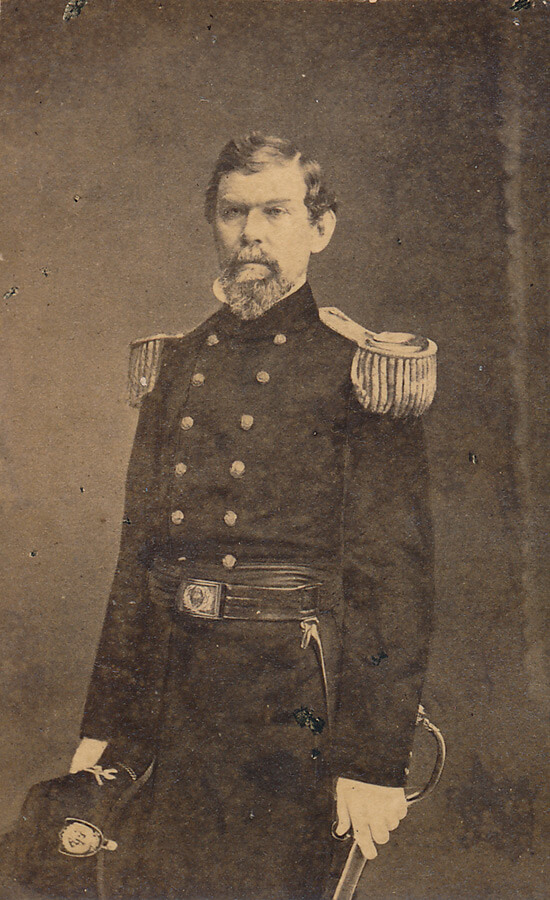 |
| Lieutenant General William J. Hardee, corp commander, Army of Tennessee. Carte de visite, albumen print. |
During the July 21 fighting at Bald Hill, Hood learned from his cavalry scouts that McPherson's advancing Army of the Tennessee, despite its increasingly strong position, was vulnerable to an attack on its left flank or rear. As the Federal army moved closer to Atlanta, Sherman sent the cavalry division that had been guarding McPherson's left flank eastward toward Covington and the Alcovy River to burn bridges and destroy Georgia Railroad tracks heading to Augusta. Sherman wanted to disrupt enough track to prevent the southerners from using the railroad to move troops and supplies from Virginia. As a result, with the Union cavalry miles away, the left end of McPherson's line presented a weak spot protected by only two brigades. If the Confederates marched south of the city then swung east and north around McPherson's exposed flank they could rout the Yankees in a surprise attack and capture or destroy the large number of Federal supply wagons parked in the Decatur town square.
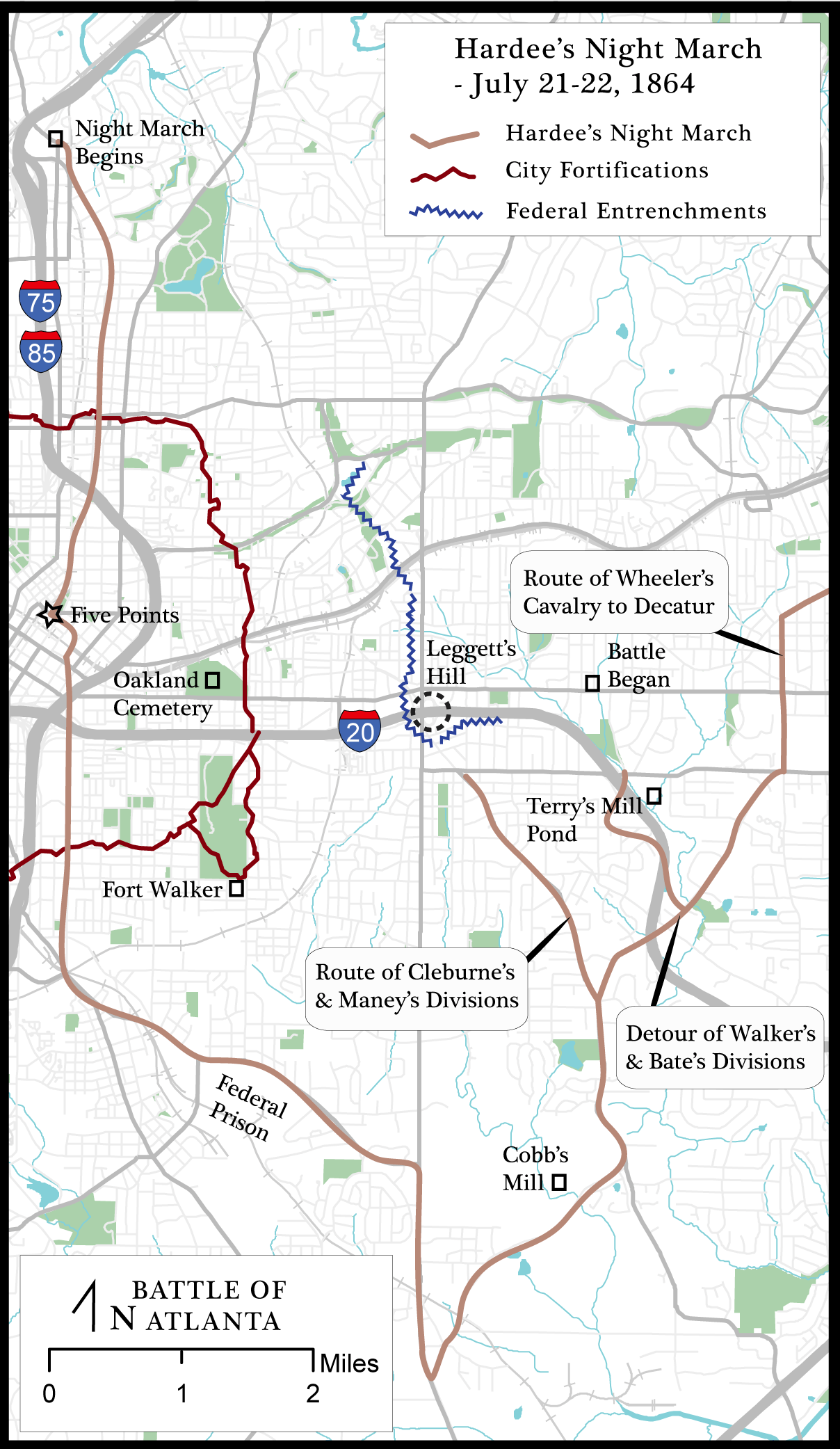 |
| Hardee's Night March. Battle of Atlanta map by Michael Page, 2014. |
To achieve these goals, and to prevent McPherson from moving south and cutting the railroad between Atlanta and Macon, Hood devised an ambitious plan of attack on July 21 that was reminiscent of a bold flanking maneuver that Stonewall Jackson successfully executed in May 1863 against the right wing of the Federal Army of the Potomac at Chancellorsville, Virginia. Hood decided to divide his forces, keeping two corps, commanded by Alexander Stewart and Benjamin Cheatham, behind the city's inner fortifications while sending William Hardee's Corps, accompanied by Joseph Wheeler's cavalry, on a wide circling maneuver south and east of the city. Hardee and Wheeler would move out of Atlanta at nightfall, swing around McPherson's left flank, and then pounce on the Yankee's rear at daybreak, rolling up their line and destroying the supply wagons gathered in Decatur. In conjunction with this attack, Cheatham's Corps would move from behind the fortifications on Atlanta east's side in a direct frontal assault against the center of the Federal line held by McPherson and Schofield's troops. Meanwhile, Stewart's Corps would hold Thomas's Army of the Cumberland in check north of the city, preventing Federal reinforcements of McPherson and Schofield's armies and then engaging Thomas once the battle became general.
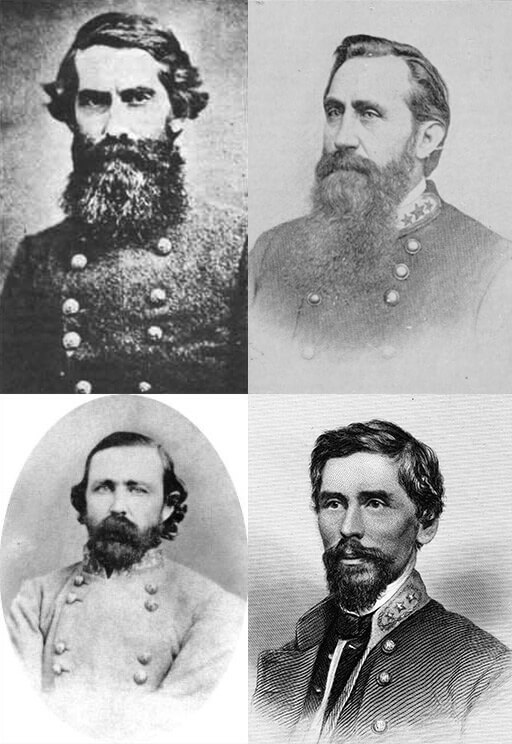 |
| Hardee's division commanders, Confederate division commanders whose units completed Hardee's Night March, clockwise from upper left, William H. T. Walker, William B. Bate, Patrick R. Cleburne, and George E. Maney. Compilation by Christopher Sawula, 2014. |
Hardee's Corps, with the exception of Cleburne's division, began its circuitous fifteen-mile march after dark on July 21. Walker's, Bate's, and Maney's divisions marched out the McDonough Road (Capitol Avenue and Hank Aaron Drive of today) to a point near the present-day state capitol, where they were joined by Cleburne's division. Cleburne's division, withdrawn into Atlanta after fighting all day at Bald Hill, joined the other three infantry divisions and Wheeler's cavalry around midnight. Once assembled, the entire column amounted to between seventeen and eighteen thousand foot and horse soldiers. Moving beyond the city limits, the trek continued in a southeasterly direction for five or six miles on the McDonough Road (along present-day McDonough Boulevard, except for the final mile and a half, which is now Moreland Avenue). After reaching its southernmost point, at or near the South River, Hardee's Corps and Wheeler's cavalry turned northeast on Fayetteville Road, then a winding, red dirt track that led to Decatur.
Hardee's Corps marched a mile and a quarter on the Fayetteville Road to Cobb's Mill on Intrenchment Creek, three miles below the southern end of McPherson's line. Hardee's troops reached Cobb's Mill at dawn, several hours behind schedule, and Hardee and his division commanders met William Cobb at his house north of the Creek. They recruited mill owner Cobb and a mill worker named Case Turner to serve as guides. To this point the route had been relatively clear, but Cobb and Turner said the way ahead included a tangled wilderness of forest and undergrowth and Terry's Mill Pond, a wide span of water resulting from the impoundment of Sugar Creek, northwest of where the Fayetteville Road crossed the creek. The wilderness march ahead would be particularly slow going for the Confederate foot soldiers, all of whom had marched all night and many of whom had fought at Peachtree Creek on July 20. The Confederate column continued its advance northward on the Fayetteville Road for a mile and a half beyond Cobb's Mill to a road fork where Hardee's Corps split into two columns. Cleburne's and Maney's divisions took the left fork and marched northwest. When they reached Flat Shoals Road (which existed in 1864), they deployed on either side of the road and moved toward the left flank of McPherson's army, which was aligned in an entrenched position in what is now East Atlanta. Walker's and Bate's column took the right fork and moved northeast on the Fayetteville Road, toward their eventual encounter with Union infantry positioned in what is now Atlanta's Kirkwood neighborhood. However, instead of keeping on the road, Walker turned northwest as it crossed Sugar Creek, followed by Bate's column, likely in an effort to keep contact with Cleburne's and Maney's divisions. Wheeler's cavalry continued on the Fayetteville Road towards Decatur and the Federal wagon park.
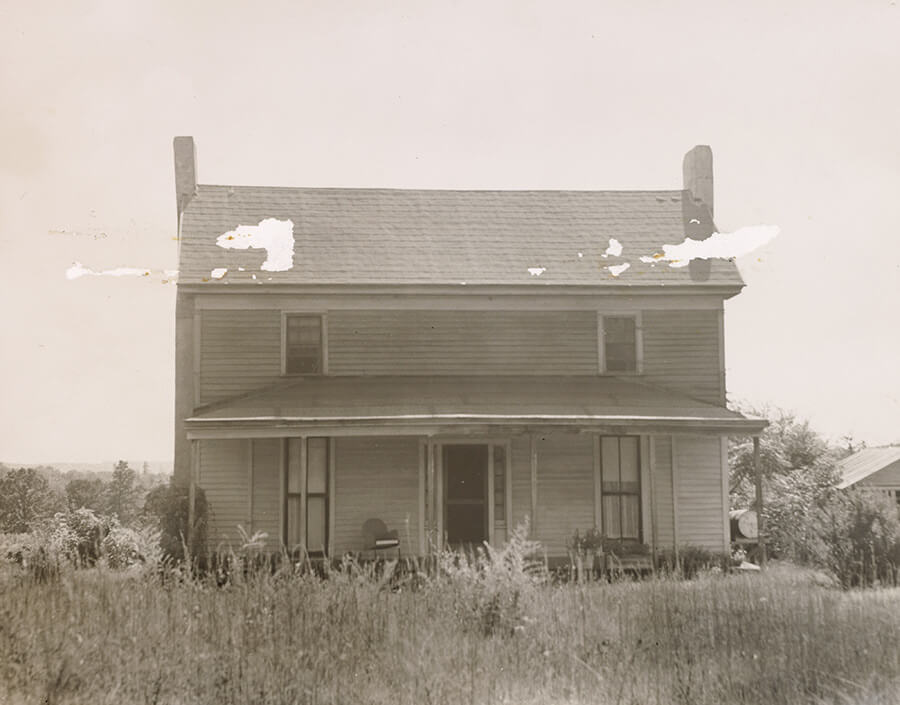 |
| William Cobb's house, where Confederate corp commander William J. Hardee and staff stopped on their night march, July 21–22, 1864. Photo of unknown origin, May 1, 1905. |
Walker's and Bate's divisions made slow progress along Sugar Creek's densely overgrown banks. The country road had been wide and clear, but maintaining alignment in the heavily wooded terrain bordering the stream contributed to mounting delays. The plodding march through wilderness slowed further when the Confederates encountered Terry's Mill Pond. The mill pond, which no longer exists, was at least a half-mile long, almost equally as wide, and reached depths of ten feet. Veering left around the western side of the mill pond took considerable time and further delayed the Confederate attack, already hours behind schedule. A Georgia historical marker titled "Terry's Mill Pond," locates the north end of the pond on Glenwood Avenue near its I-20 interchange.
 |
| Historical markers at Intrenchment Creek, April 28, 2014. Photograph by Daniel Pollock. |
After marching all night and through the morning, Hardee's Corps arrived late but ready to advance against McPherson's Army of the Tennessee shortly before noon on July 22. Since Hardee did not know where McPherson's left flank terminated, he had sought to align his four divisions abreast, facing northward. Just prior to battle, Hardee's four divisions formed a crescent from left to right: Maney on the extreme left, west of Flat Shoals Road; Cleburne deployed to Maney's right, on and east of Flat Shoals Road; Walker in the Sugar Creek Valley, just north of Terry's Mill Pond and south of present-day Memorial Drive; and Bate on the far right, adjacent to present-day Memorial Drive. However, by the time Hardee's Corps was ready to strike McPherson's Army, the Federal left wing had changed its configuration so that the Confederates would assault a well-protected flank rather than the Yankees's rear. At Chancellorsville, Stonewall Jackson had placed his troops behind the Eleventh Federal Army Corps as he had planned to do, but east of Atlanta, Hardee's Corps completed its long march six hours behind schedule and was not in position to mount the devastating attack on the Union rear that Hood had envisioned.
Death of General Walker
A Federal soldier mortally wounded Confederate division commander Major General William H. T. Walker while he was scouting the Union infantry’s position just before the Battle of Atlanta.
 |
| Walker Monument, original placement in 1902, Confederate Veteran, July 1902. |
After a lengthy, circuitous march, the Confederate corps under Lieutenant General William J. Hardee's command expected to catch the Yankee flank unprotected, as Stonewall Jackson did at Chancellorsville, but instead during the morning of July 22, Federal Major General James B. McPherson had moved his reserve forces into position to protect his army's left flank. The Yankee position resembled a capital "L," with the lower, horizontal portion well placed to intercept the impending Rebel attack, which otherwise would have struck a weak spot at the end of the Federal left wing. As Hardee's Corps prepared to break from its cover and begin its delayed assault, Federal skirmishers were positioned in the field ahead. Confederate Major General William H. T. Walker, while readying his division for attack, rode forward on horseback to reconnoiter the area and likely was killed at that moment, near Sugar Creek, by a Federal Sixteenth Corps infantryman. Case Turner, the civilian guide who accompanied Walker on the final stretch of the night march, and several Confederate veterans of the Battle of Atlanta provided differing accounts of when and where the general was mortally wounded. However, Walker clearly was one of the first casualties of the battle, and with or without him leading the way, his troops were among the first to make contact with Yankees. An upright cannon monument to mark the approximate location of Walker's death was placed on Glenwood Avenue, a short distance west of present-day I-20, and dedicated on July 22, 1902. In 1936, the monument was moved to its present location, a short distance east of I-20 at the intersection of Glenwood and Wilkinson Drive, after research by Colonel Howard Landers of the Army War College indicated that Walker was killed near the newer site.
Walker, an Augusta, Georgia, plantation owner and a distinguished veteran of the regular US Army, was physically brave and aggressive and temperamentally argumentative and volatile. His multiple wounds in the Seminole and Mexican wars earned him the nickname "Old Shot Pouch" and compromised his health to such an extent that he could sleep only while sitting up. An ardent defender of slavery and a staunch secessionist, Walker submitted his resignation from the regular US army on December 15, 1860, even before South Carolina left the Union. He was the first officer to give up his commission. Walker spurned the Montgomery government's initial offer to make him a Confederate colonel, holding out for a higher rank. He eventually was appointed a brigadier general, then major general in the Vicksburg Campaign.
Walker bitterly opposed Confederate Major General Patrick Cleburne's proposal in January 1864 that the South arm slaves, train them as soldiers, and free those who fought for the Confederacy. At a meeting of Army of Tennessee corps and division commanders convened by Hardee on January 2, 1864—for the sole purpose of hearing Cleburne's arguments for arming and emancipating slaves—Walker exploded in anger and denounced Cleburne as an abolitionist and a traitor. Later that month, Walker assured that an intermediary hand-delivered a copy of Cleburne's memorandum to Jefferson Davis, a calculated maneuver in which Walker bypassed his corps and army commanders and violated military protocol. The Confederate president's response was what Walker sought. Davis ordered General Joseph E. Johnston, then commander of the Army of Tennessee, to suppress the proposal and forbid any further discussion of arming and emancipating slaves. Cleburne's death at the Battle of Franklin on November 30, 1864, helped enforce the official gag order. No copy of Cleburne's proposal surfaced again until 1884.31Mark M. Hull, "Concerning the Emancipation of the Slaves," in A Meteor Shining Brightly: Essays on Maj. Gen. Patrick R. Cleburne, ed. Mauriel P. Joslyn (Milledgeville, GA: Terrell House Printing, 1998), 169.
 |
| Wilbur Kurtz at Terry's Mill Pond historical marker, Glenwood Drive and Wilkinson Drive, Atlanta, Georgia, Atlanta Journal and Constitution Magazine, March 1957. |
Walker's heated response to the Confederate emancipation proposal helped solidify his reputation as a firebrand. In life and death, he epitomized the antebellum ideology expressed most fervently by the slaveholding elite and its political leaders about the justness of a society in which masters and slaves purportedly both benefited from the bonds of mutual obligation. The upright cannon dedicated to Walker's memory on July 22, 1902, in East Atlanta became one of many landmarks constructed in the South at the turn of the century that commemorated the heroes and cause of the Confederacy. Because these public monuments typically valorized individual heroism above the causes for which the war was fought, they also served a larger purpose of white, sectional reconciliation. Southern war remembrance at the turn of the century emphasized a resurgent American nationalism that marginalized the problems of slavery, race, and emancipation. As historian David Blight notes:
"In the half century after the war, as the sections reconciled, by and large, the races divided. Race was so deeply at the root of the war's causes and consequences, and so powerful a source of division in American social psychology that it served as the antithesis of a culture of reconciliation. The memory of slavery, emancipation, and the Fourteenth and Fifteenth Amendments never fit well into a developing narrative in which the Old and New South were romanticized and welcomed back to a new nationalism, and in which devotion alone made everyone right, and no one truly wrong in the remembered Civil War."32David W. Blight, "Healing and History: Battlefields and the Problem of Civil War Memory," in Rally on the High Ground: The National Park Service Symposium on the Civil War, ed. Robert K. Sutton (Fort Washington, PA: Eastern National Press, 2001), 25.
 |
| Major General Oliver Otis Howard, former commander of the Union Army of the Tennessee. Photographic print, ca. 1908. |
The dedication of the Walker monument on the thirty-eighth anniversary of the Battle of Atlanta was a gala celebration that the Atlanta Constitution featured the following day. Among the two thousand attendees were Union veterans, including retired Federal General Oliver Otis Howard, who had a minimal role in the battle but succeeded McPherson as commander of the Army of the Tennessee on July 27, 1864. Howard told the Atlanta Constitution that he had known Walker at West Point and that "Nothing gives me more pleasure than to take part in an affair of this kind."33Anonymous, "General Howard Talks of Battle of Atlanta," Atlanta Constitution, July 22, 1902, 2. Howard's post-war career included a stint as Commissioner of the Freedmen's Bureau, established by Congress in May 1865 to help former slaves make the transition to freedom. Howard also had a pivotal role in launching the university named in his honor in Washington, DC, and served as its president from 1869 to 1873. At the Walker monument's dedication, the event's main speaker was Julius L. Brown, the leading fund raiser for the monument, who lauded Howard's attendance in the rhetoric of North-South reconciliation: "What stronger evidence could be given that all sectional strife is ended, and that we are now united as one people, no matter what the demagogues may say?"34Anonymous, "Honor to General W. H. T. Walker," Confederate Veteran 10, no. 9 (1902), 402–407.
Where the Battle Began
Federal infantry and artillery batteries positioned on high ground in the vicinity of the present-day Alonzo Crim High School fended off the opening Confederate attack in the Battle of Atlanta.
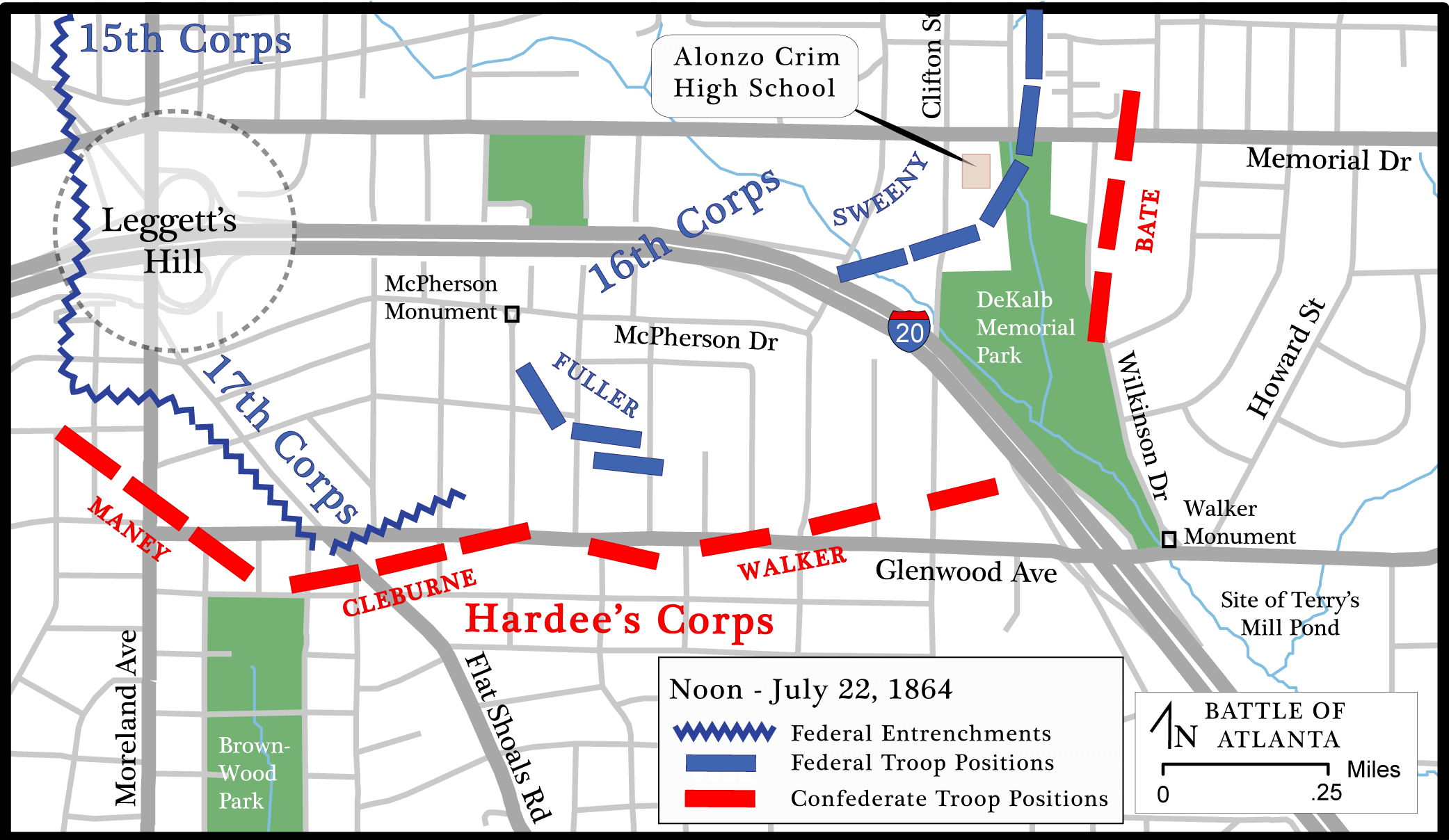 |
| Noon, July 22, 1864. Battle of Atlanta map by Michael Page, 2014. |
Shortly after noon on July 22, 1864, two Confederate divisions under the command of Brigadier General Hugh Mercer (who replaced the fallen William H. T. Walker) and Major General William B. Bate emerged from the heavily wooded, underbrush laden terrain east of Atlanta after an arduous fifteen-mile march and, moving north and northwest respectively, launched the first attack in the Battle of Atlanta. These two divisions, half of the Confederate infantry led by Lieutenant General William J. Hardee on the long march that had begun at nightfall on July 21, expected to move forward unopposed against the rear of Federal Major General James B. McPherson's Army of the Tennessee. Instead, Mercer's and Bate's divisions encountered Union infantry and artillery occupying an advantageous position along high ground in the vicinity of present-day Alonzo Crim High School, at the intersection of Clifton Street and Memorial Drive. Most of the Union troops, elements of the Federal Sixteenth Corps commanded by Major General Grenville M. Dodge, had arrived in their positions late in the morning, and Yankee reinforcements rapidly moved into action when the opening shots were fired. As a result, the Federals had the upper hand in the first clash of the Battle of Atlanta, and they used their advantage to repel the Confederate's surprise attack.
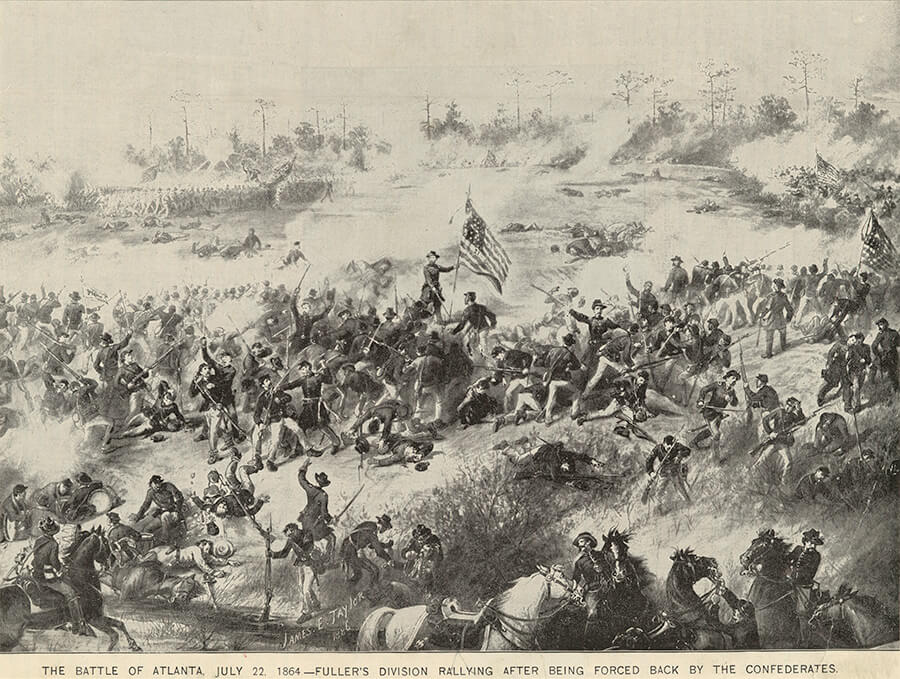 |
| Post-war illustration of Union Brigadier General John Fuller planting the US flag on the Atlanta Battlefield, July 22, 1864. Print by James E. Taylor. Courtesy of the New York Public Library. |
When the fighting started, the three Union corps that comprised McPherson's Army of the Tennessee were deployed along a several mile front that resembled a capital "L", with the longer vertical portion extending north–south alongside or near the present-day Moreland Avenue (which did not exist in 1864), and the shorter horizontal segment extending east–west, parallel to the present-day Glenwood Avenue and Memorial Drive. The Fifteenth Corps, commanded by Major General John A. Logan, was located near the top of the long part of the "L," facing Atlanta to the west and spread across the Georgia Railroad (the tracks of which ran along the railroad bed now used by Metropolitan Area Rapid Transit Authority (MARTA) and CSX Transportation).
Logan's line connected on its right with the left of Major General John M. Schofield's Army of the Ohio's Twenty-Third Corps, which was located in the vicinity of Sherman's temporary headquarters at the Augustus Hurt House (near the present-day Jimmy Carter Presidential Library). The Twenty-Third Corps infantry was only lightly engaged in the Battle of Atlanta, but its artillery had a role in the late afternoon fighting near the Troup Hurt House. Logan's left connected with the Seventeenth Corps under Major General Frank P. Blair. Brigadier General Mortimer D. Leggett's division of the Seventeenth Corps was positioned at Bald Hill, the high point of a lengthy ridge that ran in a north–south direction along the course of present-day Moreland Avenue. Bald Hill, which Union troops renamed Leggett's Hill after the battle, was located at the intersection of what is now Moreland Avenue and I-20. Highway construction during the early 1960s leveled the hill. To Leggett's left was Brigadier General Giles Smith's division of the Seventeenth Corps, which held a line that extended southeast from the hill along Flat Shoals Road (present-day Flat Shoals Avenue) to Glenwood Avenue. Together, the Federal Twenty-Third, Fifteenth, and Seventeenth Corps formed an approximately two-mile entrenched line (the vertical portion of the "L") that extended from the grounds of the present-day Carter Presidential Library southward to what is now the intersection of Flat Shoals Road and Glenwood Avenue in East Atlanta.
The shorter, horizontal segment of the Federal army's "L"-shaped line was filled by three brigades of Major General Grenville M. Dodge's Sixteenth Corps, two from the division commanded by Brigadier General Thomas W. Sweeny and one from the division of Brigadier General John W. Fuller. Sweeny's and Fuller's divisions had been in reserve before moving into their battlefield positions on the morning of July 22. Sweeny's brigades moved first, marching south from the present-day Candler Park to a position at the far end of the lower part of the "L," near today's Alonzo Crim High School, at Clifton Street and Memorial Drive. The head of Sweeny's column, a brigade commanded by Colonel August Mersy, was aligned along an east–west road (present-day Memorial Drive) perpendicular to the rest of Sweeny's line, a brigade commanded by Brigadier General Elliott W. Rice, which was behind Mersy's troops and positioned along Clay Road (present-day Clay Street). After Sweeny's column arrived, Morrill's brigade of Brigadier General John W. Fuller's division moved southward from where it had been in reserve, behind the Seventeenth Corps line at Leggett's Hill. Fuller's troops were deployed to Sweeny's right and occupied a position extending from present-day Memorial Drive southeastward toward the present site of the McPherson Monument. Together, Sweeny and Fuller's troops formed a line approximately three-fourths of a mile long, Artillery batteries from both divisions were placed on the hill where the high school is now located. These batteries faced south and east, the directions from which the Mercer's and Bate's Confederate divisions soon would sweep forward. The attacking Confederates did not expect to encounter three brigades with cannons aimed at them from high ground. Still, they charged again and again.
The advantageous elevation held by the Union troops can be appreciated today from the eastern edge of grounds of the Alonzo Crim High School. Looking eastward along Memorial Drive and across the adjacent terrain provides a view of the lay of the land from the Yankees' vantage point. Their commanding defensive position enabled them to strike a decisive blow against the Confederate column that attacked from the east. However, in a nearby sector of the battlefield the Federal defense was vulnerable. Between the two segments of the "L" formed by the Union Army was a half-mile gap that would cause serious problems for the Yankees.
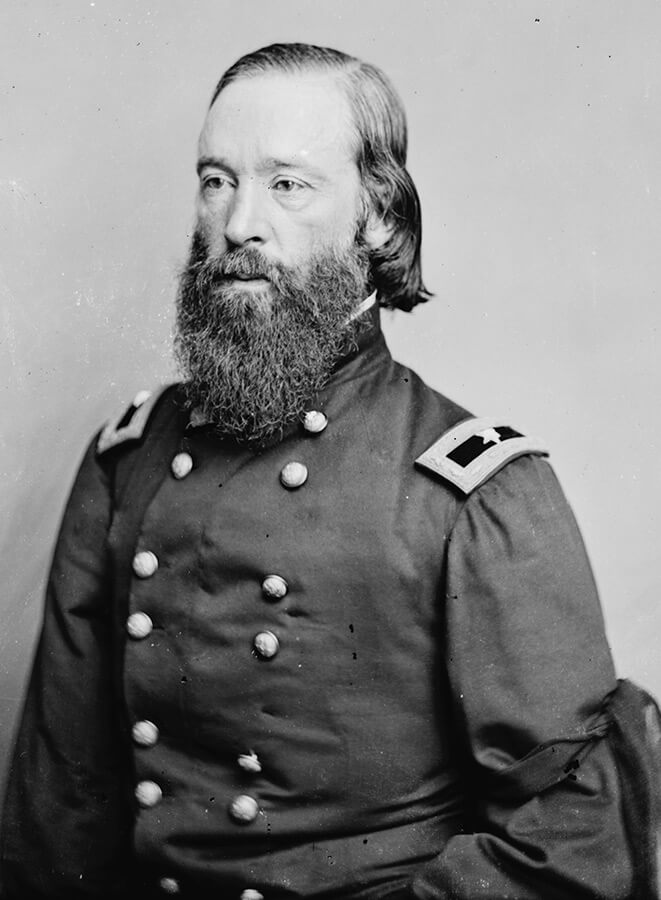 | 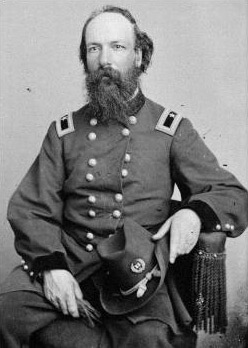 | |
| Union Brigadier General Thomas W. Sweeny, ca. 1865. Wet plate negative. | Union Brigadier General John W. Fuller, ca. 1865. |
The fighting between Fuller's and Sweeny's units of Dodge's Sixteenth Corps and Bate's and Mercer's divisions of Hardee's Corps was among the few engagements late in the Civil War in which the opposing forces met in the open field, with no earthen works to protect either side. The Federal infantry, supported with artillery fire, beat back the Confederates, but a Rebel column maneuvered into the half-mile gap in the Yankee's line and made threatening progress against Morrill's right flank. Georgia and South Carolina infantry, under the command of Brigadier General States Rights Gist of Mercer's division, caught Morrill's right exposed and opened intense fire. At this critical moment in the battle, Fuller realigned Morrill's brigade, which formed a line on either side of its division commander and charged eastward toward Gist's Brigade. Fuller's action is depicted by in a post-war illustration by James E. Taylor that shows the brigadier general planting the national colors and marking the new battle line for his brigade. Gist attempted to rally his troops, but they were driven back and forced to withdraw. Gist was injured and four months later was one of six Confederate generals killed at the Battle of Franklin, Tennessee. He is remembered for his battlefield bravery and his unusual first and middle names, inspired by the clash between South Carolina and the Federal government known as the Nullification Crisis of 1828 to 1833.
The successful Federal counterattack against Gist's Brigade, spearheaded by Fuller, brought to an end the first phase of the Battle of Atlanta. The Federal Sixteenth Corps had been well positioned to ward off the threat posed by Hardee's Corps to the rear of the Union Army. By repulsing Hardee's two right divisions, the Federal Sixteenth Corps took the sting out of the Confederates' surprise attack. The subsequent assault by Hardee's two left divisions, under Cleburne and Maney, would be a charge against the entrenched Federal flank, far from the Union rear. Still, the initial Confederate exploitation of a gap in the Yankee line, presaged greater gains, albeit temporary, from the ensuing attacks against the Federal Seventeenth and Fifteenth Corps.
Death of General McPherson
A Confederate infantryman killed Major General James B. McPherson, when the commander of the Federal Army of the Tennessee inadvertently rode behind enemy lines early in the Battle of Atlanta.
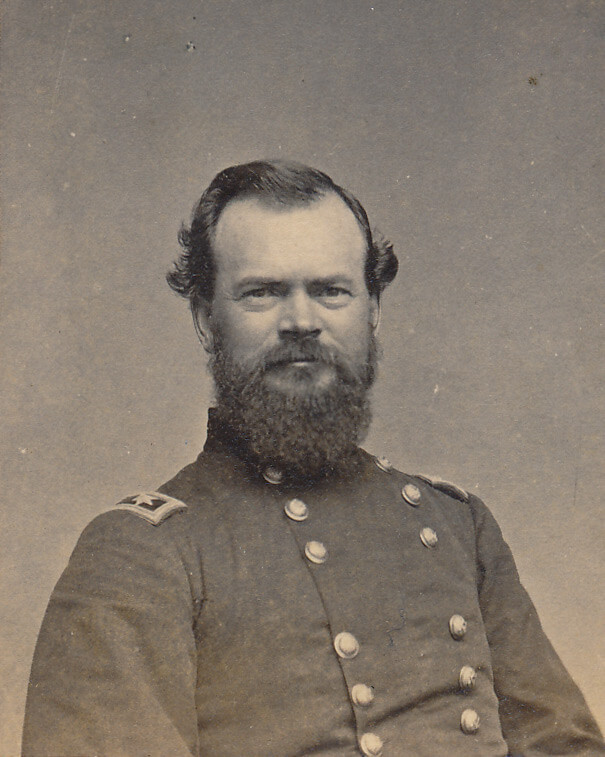 |
| Union Major General James B. McPherson. Carte de visite, albumen print. |
Federal Major General James B. McPherson, in command of the Army of the Tennessee, feared an impending attack by the Confederate Army of Tennessee on the morning of July 22, 1864. He met briefly with General William T. Sherman, overall commander of the Union armies advancing on Atlanta, at the Augustus Hurt House, Sherman's temporary headquarters. McPherson quickly convinced Sherman to reinforce the Federal left wing rather than send troops to the rear to tear up railroad tracks. When the conversation concluded, McPherson and his staff left on horseback to inspect the line of the Army of the Tennessee. Years later, Sherman recalled this final meeting: "McPherson was then in his prime (about thirty-four years old), over six feet high, and a very handsome man in every way, was universally liked, and had many noble qualities. He had on his boots outside his pantaloons, gauntlets on his hands, had on his major-general's uniform, and wore a sword belt, but no sword."35Sherman, 550. After completing his inspection, McPherson stopped to confer with two of his corps commanders, Major General John A. Logan and Major General Frank P. Blair, near the Georgia Railroad (now the MARTA commuter line and CSX railroad tracks), at the present-day intersection of Dekalb and Whitefoord Avenues. A historic marker at that location, titled "Noon Under the Trees," describes the lunchtime meeting and its sudden conclusion: "This pleasant respite of discussion & cigars was broken by volley firing to the S.E. The Battle of Atlanta had begun." McPherson quickly mounted his horse and galloped south to the sound of the mounting gunfire, Within minutes he arrived at a hill near the intersection of present-day Memorial Drive and East Side Avenue, where he watched infantry and artillery units of Dodge's Sixteenth Corps fend off the initial Confederate assaults on their positions. The knoll from which McPherson viewed the opening phase of the battle remains visible as high ground on Memorial Drive, where a Georgia Historical Marker near East Side Avenue describes "McPherson's Last Ride." When he was satisfied that Dodge's troops were holding their ground, McPherson turned his attention to the one-half mile gap in the Federal line that separated the Sixteenth and Seventeenth Corps. By now, the two Confederate divisions on Hardee's left, commanded by Major General Patrick R. Cleburne and Brigadier General George Maney, were poised for attack. Cleburne's division struck first, hitting the seam between the two Union corps, and was later joined by Maney's division, to Cleburne's left, which began applying pressure to front of the Seventeenth Corps.
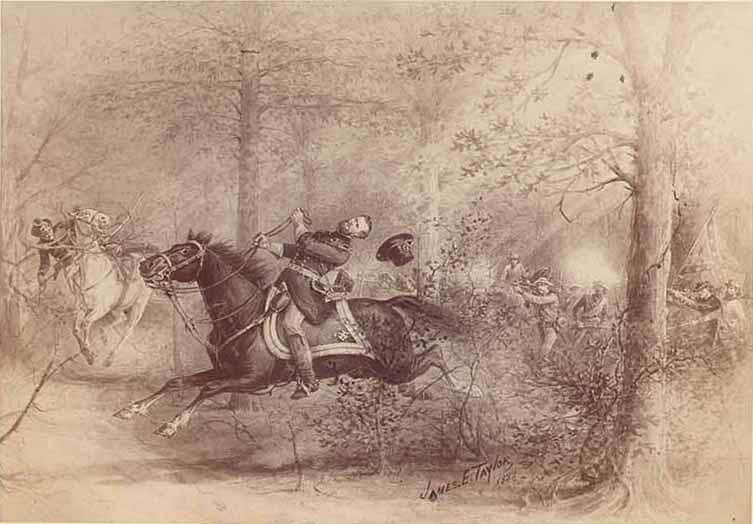 |
| Death of General McPherson. Illustration by James E. Taylor, 1888. Courtesy of Notre Dame Archives. |
McPherson rode toward this engagement, across the gap in the Federal line, and along a narrow forest road that ran in an east–west direction parallel to present-day McPherson Avenue. The road had been overtaken by Cleburne's advancing infantry, a contingent of which encountered McPherson on horseback, accompanied by a lone aide. Confederate skirmishers called upon McPherson to surrender, but his only response was to tip his hat, turn his horse, and try to escape. He was shot from his saddle by a single bullet and soon died where he had fallen to the ground. When Federal troops temporarily reoccupied the wooded area where McPherson had been killed, they retrieved his body, which was then transported by wagon to Sherman's temporary headquarters at the Augustus Hurt House. An upright cannon monument, erected in 1877 and located at the intersection of Monument and McPherson Avenues in East Atlanta, marks the spot where McPherson was killed.
McPherson was the highest ranking Union general killed in combat during the Civil War. His death, at age thirty-five, was deeply mourned by Sherman and Grant, both of whom considered McPherson to be a protégé whose accomplishments would surpass their own. The day after the Battle of Atlanta, Sherman wrote in a letter to the adjutant general of the US Army that "we have lost not only an able military Leader, but a man who had he survived was qualified to heal the National Strife."36Brooks D. Simpson and Jean W. Berlin, eds., Sherman's Civil War: Selected Correspondence of William T. Sherman, 1860–1865 (Chapel Hill: University of North Carolina Press, 1999), 671. McPherson graduated first in his West Point class of 1853, obtained his top choice of post-graduate duty in the Corps of Engineers, and was assigned during the pre-war years to projects in the New York and San Francisco harbors. In San Francisco, he met and became engaged to Emily Hoffman, a member of a socially prominent and staunchly pro-Confederate Baltimore family. The start of the war sealed the Hoffman family's opposition to her engagement, but she and McPherson remained committed to their marriage plans. Once the war began, those plans were put on hold, and McPherson was assigned to service under Grant. McPherson's battlefield achievements in Tennessee in 1862 and at Vicksburg, Mississippi, the following year, coupled with Grant's complete confidence in him, account for his meteoric rise through the ranks. At Grant's behest, McPherson was promoted to brigadier general and then major general. In March 1864, when Grant was promoted to general-in-chief of the Union armies, Sherman took Grant's place as overall commander in the Western theater, and McPherson assumed command of Sherman's old Army of the Tennessee. Before learning of his new role, McPherson planned a twenty-day furlough and embarked on a trip to Baltimore to marry Emily Hoffman. En route, he learned of his promotion and was ordered to travel immediately to Huntsville, Alabama, to help plan the Atlanta campaign. He reluctantly abided by his orders and returned from his furlough. He and Emily Hoffman never saw each other again. McPherson led the Army of the Tennessee throughout the Atlanta campaign, until he was killed on July 22, 1864. On August 5, General Sherman wrote to Emily Hoffman: "Why should deaths darts reach the young and brilliant instead of older men who could better have been spared. Nothing that I could record will Elevate him more in your minds Memory, but I could tell you many things that would form a bright halo about his image."37Ibid., 682.
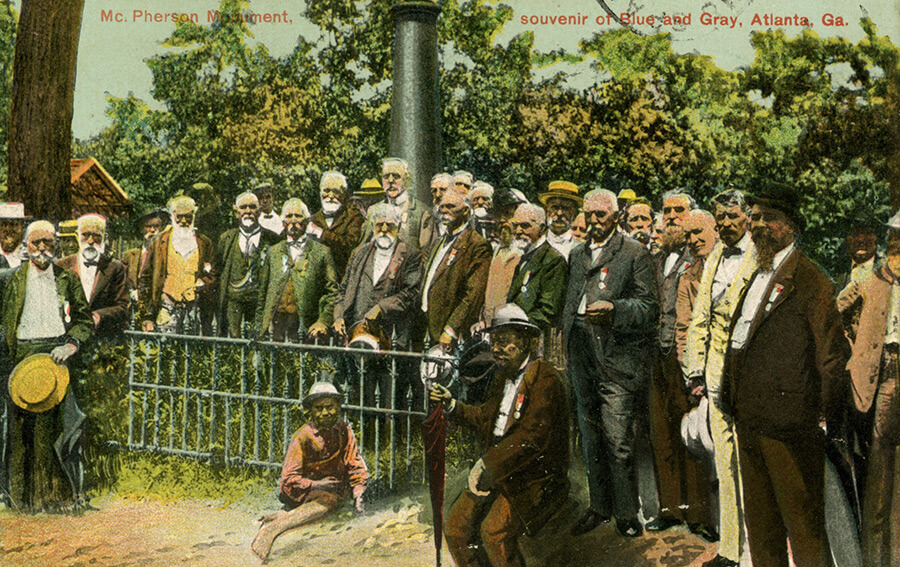 |
| Blue-Gray reunion at the McPherson Monument, Albert Shaw, center-forward, with umbrella, July 1900. Illustration. |
In 1877, a group of US Army officers stationed in Atlanta at the tail-end of the military occupation of the South committed themselves to erecting a monument to memorialize McPherson at the exact location in East Atlanta where he had been fatally shot. The officers used their personal funds to purchase the land where the monument still stands. The US War Department provided a large iron cannon, which was mounted in an upright position on a block of Stone Mountain granite bearing the simple inscription "McPherson." Custody of the monument, once erected, was transferred to the Society of the Army of the Tennessee, one of many veterans' groups, North and South, which sought to uphold the memory, reputation, and accomplishments of their specific groups in the post-war years. The Society of the Army of the Tennessee already had honored McPherson with a much grander monument in Washington, DC, an equestrian statue of their former commander, located less than three blocks from the White House in what is now known as McPherson Square. President Grant, members of his cabinet, and General Sherman, who had been promoted to general-in-chief of the US Army, attended the dedication ceremonies on October 19, 1876. The main speaker was John A. Logan, who succeeded McPherson as Commander of the Army of the Tennessee in the Battle of Atlanta and, after the war, served as a national leader of the Grand Army of the Republic (GAR), the largest of all the Union veterans groups. Logan delivered a two-hour oration in which he traced McPherson's life and hailed him as a martyr and irreplaceable comrade.
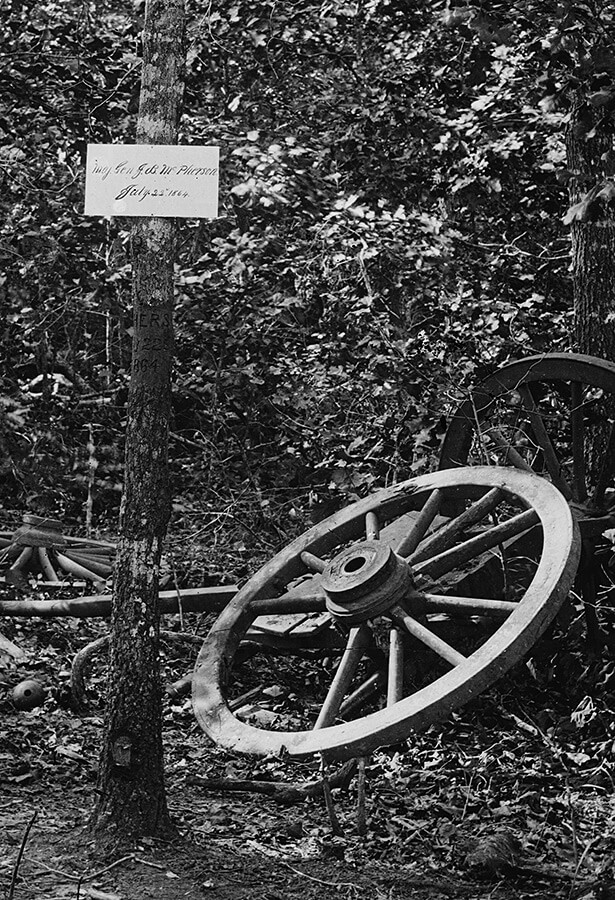 |
| Scene of General McPherson's death, Atlanta, Georgia, ca. 1864. Detail of wet collodion by George Barnard. |
The McPherson monument in East Atlanta, the nearby Walker monument, and thousands of other outdoor memorials erected throughout the North and South in the postwar era served as focal points for public remembrance of particular heroes and events. Monuments figured prominently in rituals of remembrance, such as dedication ceremonies, Memorial Day celebrations, and veterans' reunions. Speakers at these events often offered testimonials to the valor and virtue of the commemorated individuals, their military units, or even the entire cohort that fought the Civil War. Their remarks typically ignored or glossed over the sectional differences over slavery that plunged the nation into Civil War and instead emphasized post-war reconciliation between the North and South. For example, when Confederate and Union veterans met in Atlanta for a national Blue-Gray reunion in July 1900, a highlight of the three-day event was a well-orchestrated gathering of veterans at the McPherson monument that included former generals and other high ranking officers from both sides. The Atlanta Constitution, paraphrasing the remarks of Albert Shaw, commander-in-chief of the largest Union veterans' group, the Grand Army of the Republic, editorialized that "there were neither rebels nor traitors in a cause where all answered the call of constituted authority." The Constitution encouraged its readers to leave the "argument as to causes to the historians" and added that "Atlanta, wrecked and burned by war, has arisen as an evangel of reconciliation, equal to the present and the future without surrendering a single iota of the past."38Anonymous, "Blue and Gray Beautifully Intertwined," Atlanta Constitution, July 20, 1900, 6.
Leggett's Hill
Entrenched Union infantry on Leggett's Hill held off intense attacks by Confederate troops, that attempted to capture the high ground at this location, the most important strategic position in the Battle of Atlanta.
 |  | |
| Union Brigadier General Mortimer D. Leggett. Carte de visite, albumen print. | Union Brigadier General Manning F. Force. Carte de visite, albumen print. |
Bald Hill—named Leggett's Hill by the Yankees after the struggle for its control on July 22, 1864—was the scene of ferocious fighting in the Battle of Atlanta. Opposing troops fired on each other at murderously close range and at times engaged in hand-to-hand combat, aided by bayonets and clubbed rifles. Some Federal units entrenched on the hill fended off Confederate attacks from the flank, rear, and front, jumping from one side of their earthworks to the other to repel charges from different directions. The southerners suffered severe casualties in their nearly continuous wave of attacks on July 22, but they came close to dislodging the Yankees from the strategic high ground before being checked. Brigadier General Mortimer D. Leggett, whose division of the Union's Seventeenth Corps captured the round-topped eminence on July 21 and successfully defended it the next day, praised the performance of Brigadier General Manning F. Force and his brigade. Leggett noted in a speech to a veteran's group after the war that the hill ought to have been named "Force's Hill," to fairly credit the Federal officer and his troops for their unsurpassed steadiness and gallantry in combat. Wounded in the face during the fighting for the hill on July 22, Force was awarded the Congressional Medal of Honor on March 31, 1892. The Battle of Atlanta Cyclorama shows Force in a horse-drawn ambulance being carried to Sherman's temporary headquarters at the Augustus Hurt House.
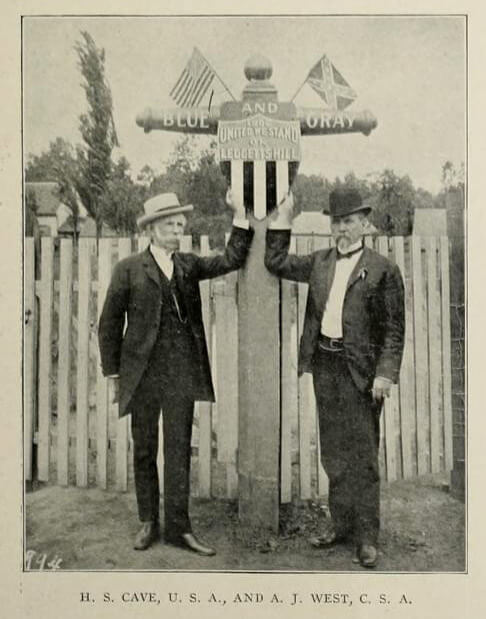 |
| Blue-Gray reunion, Leggett's Hill, 1906, Confederate Veteran. |
Leggett's Hill was the highest elevation on the north–south ridge line along which present-day Moreland Avenue is located and also the high point between Atlanta and Decatur. As depicted in the cyclorama and described by Wilbur Kurtz, the hill's crest was an open field that stretched from north to south for over a quarter of a mile. The hill's north, south, and east sides rose gently and were largely cleared; the western face was relatively steep and wooded. By securing the summit on July 21, the northerners won a commanding view of the entire battlefield and were in position to train cannon fire on Confederate troops when they mounted counterattacks the next day. The hill also was in artillery range of Atlanta, approximately two miles away, and the Yankees fired cannon shot into the city shortly after seizing the high ground on July 21. When the Confederates' counterattacks failed on July 22, they ceded control of the single most important strategic position east of the city. Leggett's Hill remained a battlefield landmark until the early 1960s, when it was leveled during construction of I-20. A Georgia Historical Commission marker is located at the former hill site, on the west side of Moreland Avenue as it passes over the interstate highway.
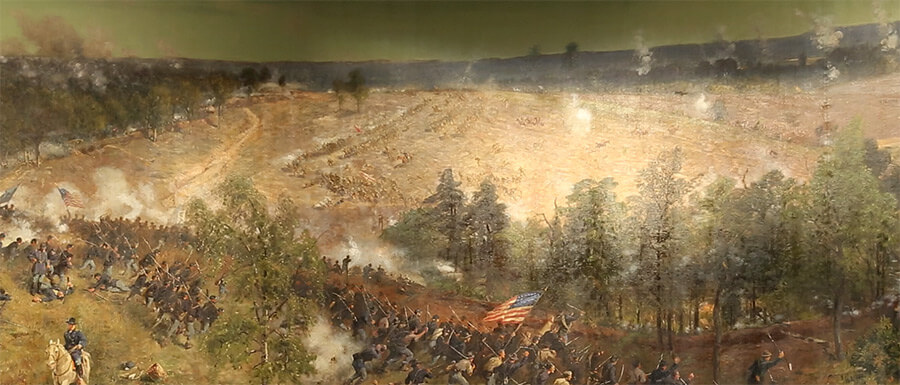 |
| Leggett's Hill, high ground east of Atlanta where Confederate infantry repeatedly attacked entrenched Federal troops, Battle of Atlanta Cyclorama, Atlanta, Georgia, 1886. Painting by the American Panorama Company. |
Major General Patrick R. Cleburne's division of Hardee's Corps took advantage of a gap in the Federal line and launched the fierce Confederate struggle to retake Leggett's Hill on July 22. At the conclusion of Hardee's fifteen-mile night march, the two divisions on the left of Hardee's Corps, commanded by Cleburne and Brigadier General George Maney, had arrived just south of the hill shortly before noon. Cleburne's division was deployed on and east of Old Flat Shoals Road (now known as Flat Shoals Avenue) and Maney's division was positioned to Cleburne's left, west of the road. Cleburne and Maney's divisions faced the section of the entrenched Federal line held by Brigadier General Giles A. Smith's division that bent southeastward from Leggett's Hill along Old Flat Shoals Road, ending at present-day Glenwood Avenue. This section comprised the right angle in the "L" shaped Federal line that extended north along present-day Moreland Avenue (the vertical segment of the "L") and east along present-day Glenwood Avenue and Memorial Drive (the horizontal segment of the "L"). A half-mile gap between Smith's division of the Federal Seventeenth Corps and the Sixteenth Corps in Sugar Creek Valley to the east—a break in the line between the right angle and the horizontal part of the "L"—provided an opening that Cleburne's division could exploit. Cleburne's troops poured through the gap beginning about one in the afternoon, and, in the process, his skirmishers encountered and killed Federal Major General James B. McPherson. Cleburne's division, later joined by Maney's, pressed forward in a series of costly, brigade-level attacks on entrenched northern positions. During two hours of intense fighting, the southerners captured a short portion of the Union line and established themselves in the gap between the Federal Sixteenth and Seventeenth Corps. However, the Confederates failed to dislodge the vulnerable portion of the Seventeenth Corps line defending Leggett's Hill.
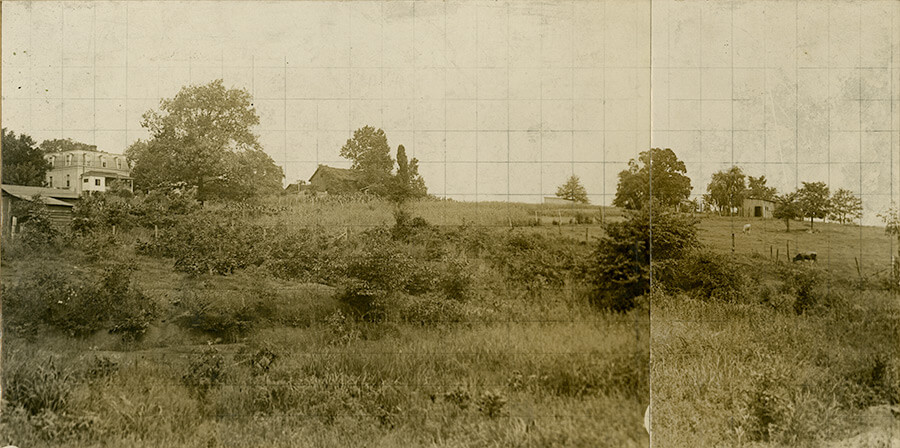 |
| Southeast side of Leggett's Hill, June 24, 1929, Atlanta Journal-Constitution. Photograph by Walter Sparks. |
Only late in the afternoon when the southerners launched a more coordinated attack from multiple directions did they drive Giles A. Smith's division from its entrenchments along Flat Shoals Road to a new position that compressed the Federal forces on Leggett's Hill and threatened a more serious rupture in the Union line. From his observation post near Oakland Cemetery, sometime between 3 and 4 p.m., Confederate Army commander General John B. Hood committed Major General Benjamin Franklin Cheatham's Corps to the offensive, sending Cheatham's three divisions from behind Atlanta's fortifications to the battlefield east of the city. These attacks took aim at the long north–south section line of the Federal Army of the Tennessee, along present-day Moreland Avenue. Major General Carter L. Stevenson's Confederate division, on Cheatham's far right, advanced against Leggett's Federal division defending the hill. Stevenson's troops are depicted in the cyclorama charging eastward across the barren hill top toward Leggett's troops entrenched at the edge of woods on the hill's western slope. Shortly after 6 p.m. the Rebel assaults came together in a simultaneous attack in which Cleburne and Stevenson's division forced all of Smith's division and part of Leggett's to fall back until the two units were completely intermingled. Despite the confusion, the veteran US troops rallied and, aided by artillery, they repelled the southerners, forcing their final retreat from Leggett's Hill. In a post-war speech to a veteran's group, Leggett summed this up phase of the Battle: "The struggle to recover the hill from us was fierce and desperate beyond description. The carnage at this point was terrible and sickening. The ground from close to our works to one hundred yards or more away was literally covered with dead."39Mortimer D. Leggett, The Battle of Atlanta: A Paper Read by General M. D. Leggett Before the Society of Army of the Tennessee, October 18th, 1883 at Cleveland (Cleveland, OH: J. A. Davies Printer, 1883), 22.
Confederate Line
Two Confederate divisions moved eastward through this sector and aligned themselves for a frontal assault against nearby Federal infantry, an attack that opened the climactic phase of the Battle of Atlanta.
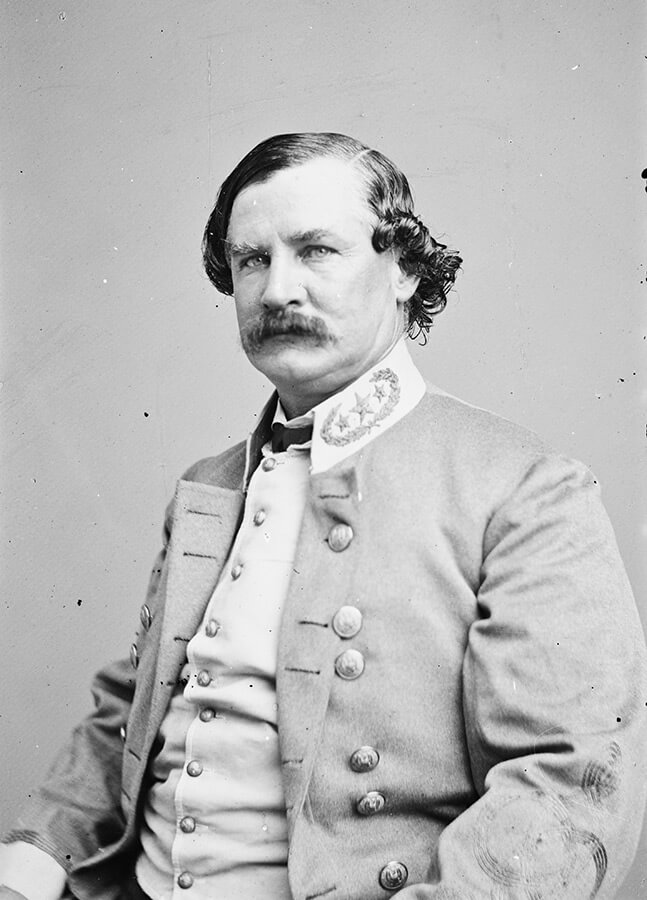 |
| Confederate Major General Benjamin F. Cheatham, ca. 1865. Wet collodion. |
The Confederate effort to repel the advancing Federal Army of the Tennessee became a two-pronged attack during the afternoon of July 22, 1864, when the army commander General John Bell Hood ordered Major General Benjamin Franklin Cheatham's Corps forward into battle, joining Major General William J. Hardee's Corps, which had been engaged since shortly after noon. For the first three hours of the Battle of Atlanta, the Confederates mounted attacks against the far left of the Union line, which was positioned south of the Georgia Railroad, in the vicinity of Leggett's Hill and entrenched along its crest. For some of that time, Hood was in position near Oakland Cemetery, looking and listening for signs that Hardee's Corps was making progress against the Federals. Hoping to help Hardee's troops take Leggett's Hill, Hood—between 3 and 4 p.m.—instructed Cheatham's Corps to attack the Federal Seventeenth Corps, which remained in control of the treeless high ground, and move simultaneously against the Federal Fifteenth Corps, which straddled the Georgia Railroad in an extended, north–south line near present-day Moreland Avenue. Prior to attack, Cheatham's Corps occupied the eastern section of Atlanta's inner fortifications, which was located in the vicinity of present-day Boulevard, between Grant Park and Ponce de Leon Avenue. Cheatham mobilized his three divisions from behind the fortifications, deploying his troops in a battle line that extended for more than a mile.
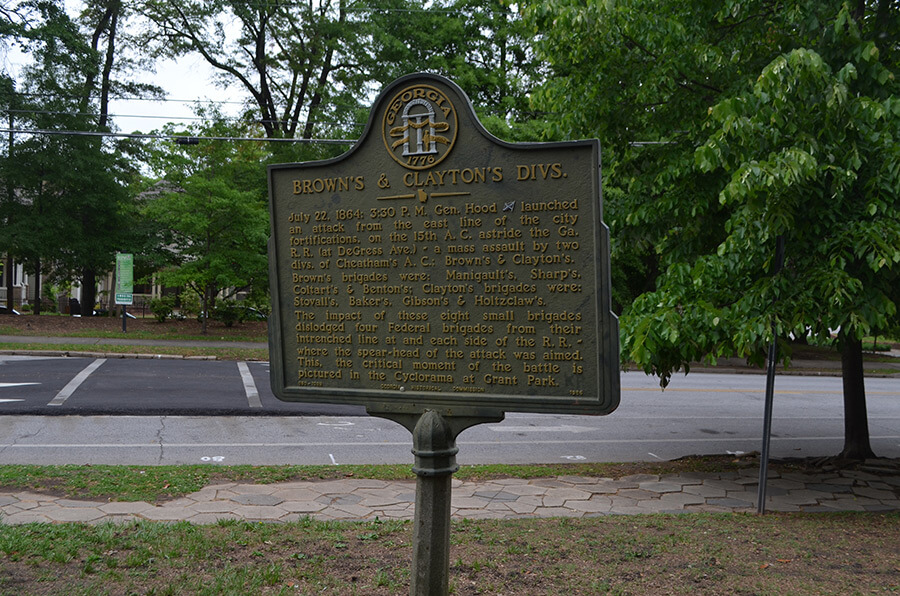 |
| Historical marker of Confederate line prior to Battle of Atlanta attack, Inman Park, Atlanta, Georgia, May 10, 2014. Photograph by Daniel Pollock. |
The division on Cheatham's right, commanded by Major General Carter L. Stevenson, attacked first, moving from behind the fortifications located between present-day Grant Park and Oakland Cemetery and charging eastward against the Federal Seventeenth Corps defending Leggett's Hill. Cheatham's other two divisions, led by Brigadier General John C. Brown's in the middle and Major General Henry D. Clayton's on the left, followed Stevenson's division into combat. Brown's and Clayton's troops marched eastward, aligned themselves in battle formation in present-day Inman Park, and from there attacked Union forces entrenched on either side of the Georgia Railroad. A historical marker placed in a small triangular park at Delta Place and Edgewood Avenue describes the frontal assault that Brown and Clayton's divisions launched against the Federal Fifteenth Corps, which was commanded by Brigadier General Morgan L. Smith. This division had been led by Major General John A. Logan until early in the afternoon of July 22, when Logan replaced McPherson as commander of the Federal Army of the Tennessee.
 |
| Cover page, William Hardee's infantry tactics textbook, 1861. Confederate Imprints, 1861–1865, Manuscript, Archives, and Rare Book Library, Emory University. |
The tactic of attacking or defending in long lines of battle was inherited by Civil War field commanders on both sides from the Napoleonic era, reinforced by US army officer training in the same military schools and further instilled by shared combat successes with traditional linear formations in the Mexican War. When the Civil War began, the standard tactical manual used by the North and South was Hardee's Rifle and Light Infantry Tactics, written by former US Army officer and then Confederate corps commander William J. Hardee. Hardee emphasized the importance of placing the majority of combat forces in closely packed lines. The typical battle line for offensive and defensive purposes aligned troops shoulder to shoulder two or three ranks deep. These formations were difficult to maneuver in the field, and their effectiveness depended on prior drilling and battlefield discipline. However, once deployed, linear formations offered the advantage of a high density of firepower delivered with successive volleys as each rank of infantry alternately fired and reloaded or as one rank relieved another if necessary.
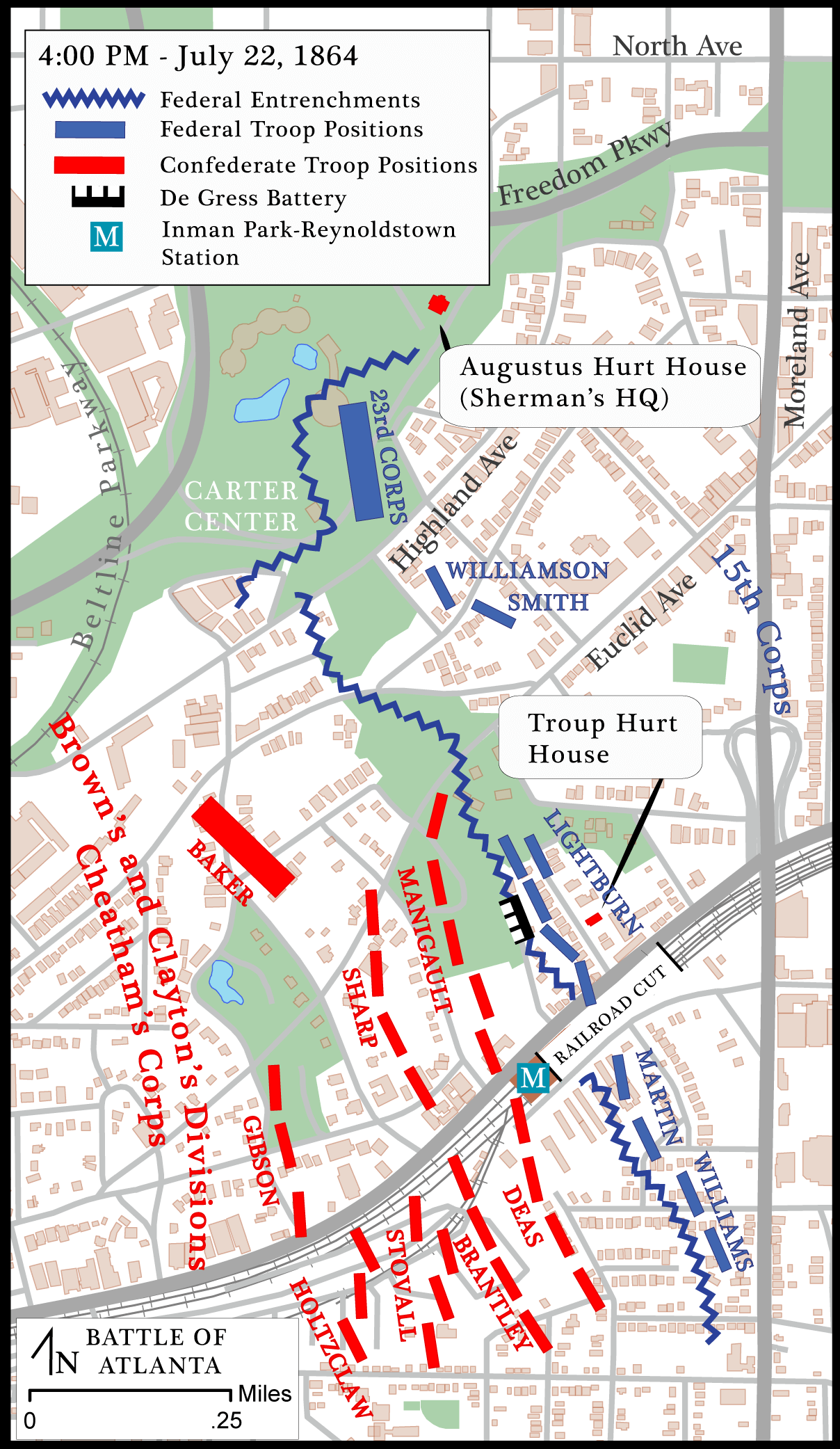 |
| 4 p.m., July 22, 1864. Battle of Atlanta map by Michael Page, 2014. |
In a classic frontal attack, wave after wave of infantry would strike against a short sector of the enemy's line. A succession of attacks was intended to weaken and eventually break the opposition's line at a vulnerable spot, which immediately endangered the remaining segments. On defense, the battle line enabled concentrated volleys of fire against attackers, and, by 1864, both Union and Confederate infantry learned to strengthen their lines of defense with extensive use of protective earthworks. Even if attackers got inside an enemy's position, exploiting that advantage was difficult because of heavy losses during the attack, lack of reinforcements, or a counterattack by the defenders. The result was frequent failure of frontal assaults, particularly in the latter stages of the Civil War. Among these failures were the unsuccessful attacks launched by Cheatham's Corps against the Federal Army of the Tennessee in the climactic phase of the Battle of Atlanta. Still, the Confederate divisions led by Brown and Clayton achieved a notable breakthrough in the Union line before a ferocious counterattack led Major General John A. Logan turned them back.
Battlefield Terrain
Rolling terrain in present-day Springvale Park is a remnant of the Civil War-era countryside outside Atlanta and the spot from which Confederate troops launched an attack against the nearby, entrenched Federal line on July 22, 1864.
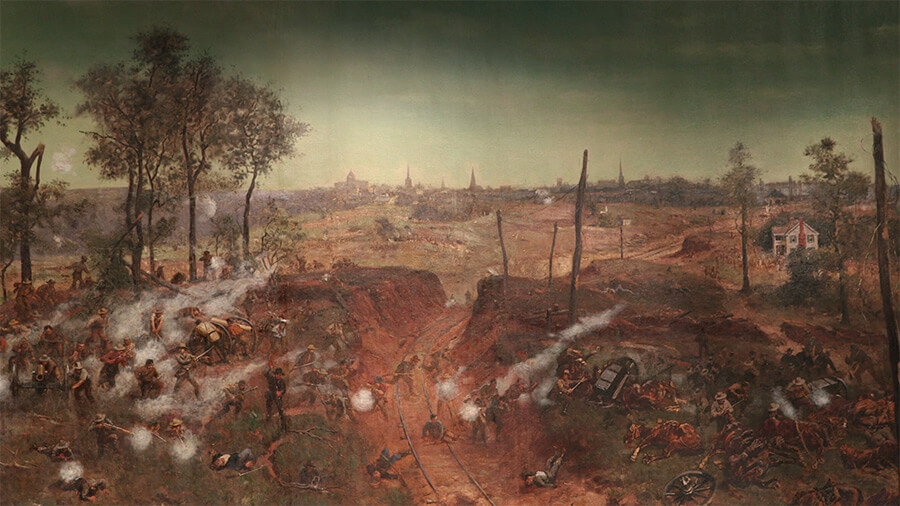 |
| A cut in the Georgia Railroad, where Arthur Manigault's brigade spearheaded the Confederate's attack against an entrenched Union line, Battle of Atlanta Cyclorama, 1886. Painting by the American Panorama Company. |
As the fighting for Leggett's Hill grew fiercer during the afternoon of July 22, 1864, the left of Confederate Corps Commander Benjamin Franklin Cheatham's line—Brown and Clayton's divisions—advanced eastward from behind the city's inner fortifications and moved into position for an assault against the Federal Fifteenth Corps, which was astride the Georgia Railroad in an entrenched north–south line west of present-day Moreland Avenue. The movement of a second corps onto the battlefield was part of Confederate Army Commander John Bell Hood's original plan of attack. However, that plan began to fail when Hardee's Corps arrived on the battlefield hours behind schedule and encountered an unexpectedly well defended Federal left flank. Further, when Hardee's Corps was intensely engaged with the Federal left wing during the first three hours of battle, Hood kept Cheatham's Corps out of action instead of supporting Hardee's attack. Still, even though the second prong of the Confederate attack was delayed, it achieved partial success when Brown's division found a weak spot in the Union line, broke through, and threatened to overwhelm the Federal Fifteenth Corps. Brigadier General Arthur M. Manigault's Brigade of Brown's division spearheaded this Confederate attack. They poured through the railroad cut located in the vicinity of the Inman Park MARTA Station, then broke the Union line at the Troup Hurt House and seized the four guns of Captain Francis De Gress's Battery H of the First Illinois Light Artillery. More Confederate units followed Manigault's Brigade in an attack that dislodged the center of the Yankee Fifteenth Corps across a half-mile front on either side of the Georgia Railroad.
A Georgia Historical Commission marker and a commemorative monument erected by the Sons of Confederate Veterans are located at the site where Manigault's attack advanced, a ravine in what is now Atlanta's Springvale Park, approximately four hundred yards from the Federal line, which was positioned along present-day Degress Avenue. A remnant of the ravine is still visible and provides a rare, surviving indication of what the battlefield terrain was like: a rolling, thickly wooded countryside riven with deep hollows, barren knolls, and widely separated tracts of cleared land on which were built houses, farms, mills, roads, and the single-track Georgia Railroad.
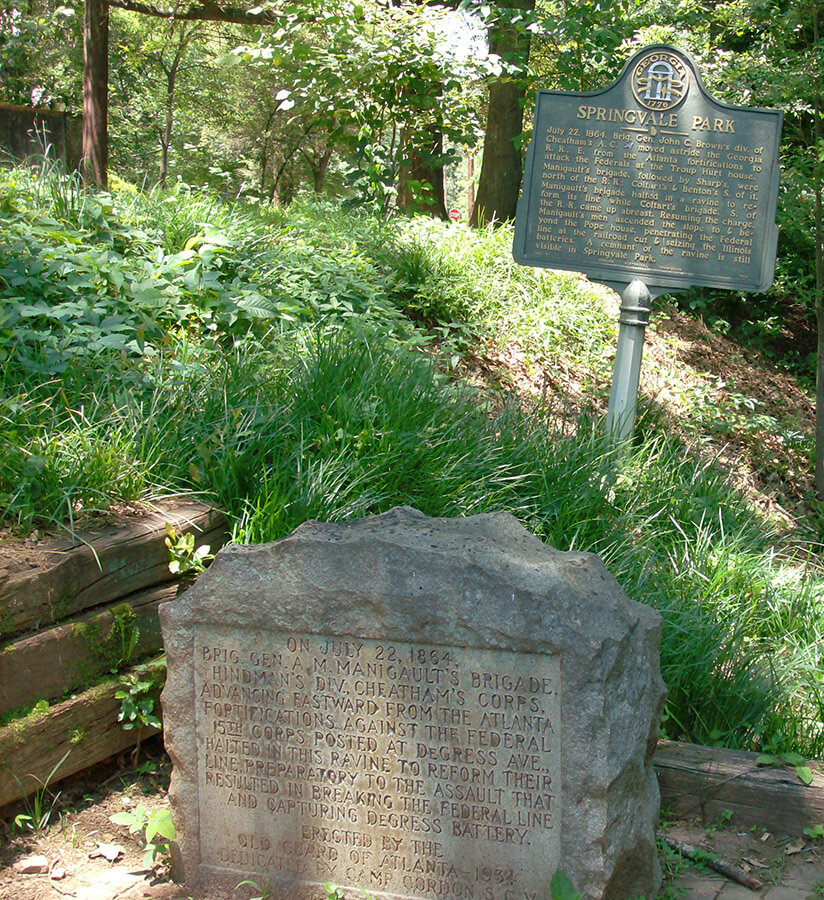 |
| Springvale Park historic markers and surrounding park, Southern Confederate Veterans Monument and Georgia Historical Commission marker describing Manigault's brigade and its role in the Battle of Atlanta, Springvale Park, Atlanta, Georgia, 2009. Photograph by Matt Miller. |
A narrow window of opportunity to preserve more of Atlanta's battlefields was missed when they were omitted from the initial set of national military parks that the US government established in the 1890s: Chickamauga-Chattanooga, Antietam, Shiloh, Gettysburg, and Vicksburg. The 1890s were a critical time for preserving Civil War battlefields because many of them remained largely untouched and many veterans with personal knowledge of the battles could recall troop movements, positions, and combat encounters. Further, the post-war reconciliation between white Americans, North and South, was surging, and veterans from both sides joined unified efforts aimed at securing federal support for battlefield preservation. Their yearning to reconnect with the past, memorialize fallen comrades, and leave a tangible legacy of Civil War battles to future generations translated into money to preserve battlefields. However, the veteran generation soon ran into Congressional opposition to further funding for battleground conservation. In 1899, influential veterans and Congressional proponents voiced strong support for adding Atlanta to the list of national military parks, but their campaign fell short. Local journalist Wallace P. Reed bemoaned their failure in his Atlanta Constitution column published in 1900: "We have been criminally careless of our history. For generations to come artists and tourists from every part of the world will come here and they will ask a thousand questions about these famous places. Who will answer them? We have about 125,000 people here and only a few hundred are able now to point out the location of the old battlefields."40Wallace P. Reed, "Our Many Friends; Both Blue and Gray," Atlanta Constitution, July 17, 1900, 6.
The next national wave of Civil War battlefield preservation peaked in the 1920s and 1930s, but by then it was too late to properly save Atlanta's battlefields. Atlanta historian and artist Wilbur G. Kurtz noted in 1931 that "Nothing obliterates the aspect of a battlefield so much as the modern steam-shovel and the encroachments of urban building enterprise."41Wilbur G. Kurtz, "Civil War Days in Georgia: At the Troup Hurt House: A Famous Battlefield Domicile; Its Environs, and Events Associated With It During the Forenoon of July 22, 1864," Atlanta Constitution Sunday Magazine, January 25, 1931, 4. A local campaign in 1937 seeking federal funds to preserve what remained of the city's battlegrounds was unsuccessful, despite renewed enthusiasm for Civil War preservation spurred by the popularity of Margaret Mitchell's Gone with the Wind. In 1951, the legislature established the Georgia Historical Commission and charged it with preserving, restoring, and marking historic sites. The following year, the commission hired Kurtz to research, write, and place historic markers that pinpoint and explain the notable events of the Atlanta Campaign. Kurtz's historic markers were all erected prior to the Civil War centennial, 1961–1965. The inscriptions he wrote for each plaque continue to serve as the primary roadside guide to Atlanta's battlefields. They provide a means of connecting the historical narrative of the Battle of Atlanta to the ground on which the battle was fought, even though most of the terrain has been irrevocably altered.
Troup Hurt House and De Gress Battery
The Confederate capture of the Troup Hurt House and the De Gress Battery, followed by a successful Yankee counterattack, were the climactic events in the Battle of Atlanta.
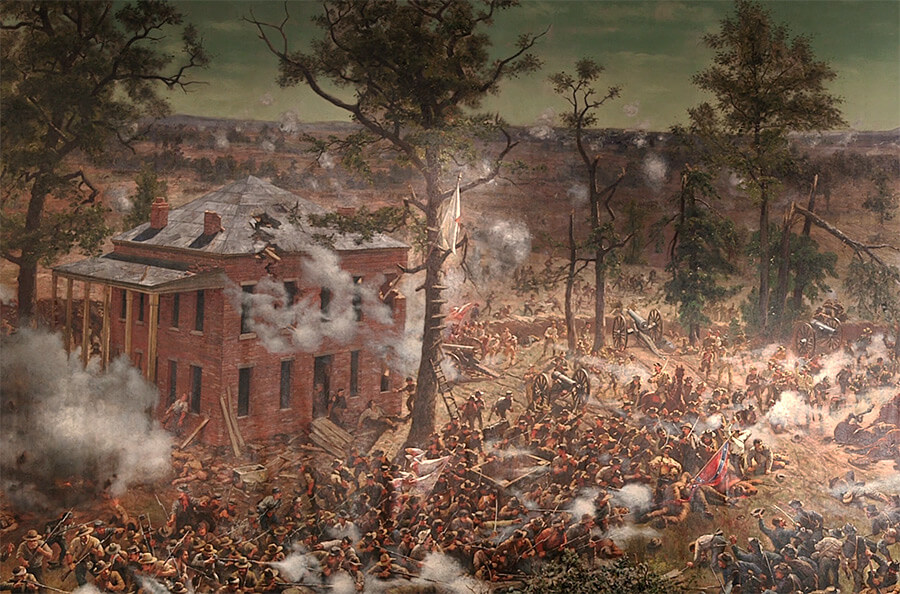 |
| The Troup Hurt House and the four-gun De Gress Battery (right of the house), which were temporarily captured by Confederate infantry on the afternoon of July 22, 1864, Battle of Atlanta Cyclorama, 1886. Painting by the American Panorama Company. |
The most famous moments in the Battle of Atlanta occurred during a fierce mid-afternoon Confederate assault on the entrenched Federal Fifteenth Corps, followed shortly thereafter by a Union counterattack in the vicinity of the Troup Hurt House, in what is now the city's Inman Park neighborhood. The Battle of Atlanta Cyclorama captures the decisive moment, at approximately 4:30 p.m., when Federal Major General John A. Logan rallied his troops to restore the broken Union line and repel the Confederate infantry of Brigadier General Arthur M. Manigault's brigade of Brown's division, who were firing from behind an improvised barricade of cotton bales in front of the Troup Hurt House. A historical marker on Degress Avenue in Inman Park is located at the site of Troup Hurt's two-story brick home, no longer standing, which was on high ground north of the single track Georgia Railroad (now the right of way for the MARTA commuter line and CSX railroad) and three-quarters of a mile south of the house of Augustus Hurt, younger brother of Troup Hurt. The Augustus Hurt House served as Federal Major General Willaim T. Sherman's temporary headquarters during the battle. The cyclorama painting depicts Sherman in front of the house, mounted on his horse, surveying the battlefield action.
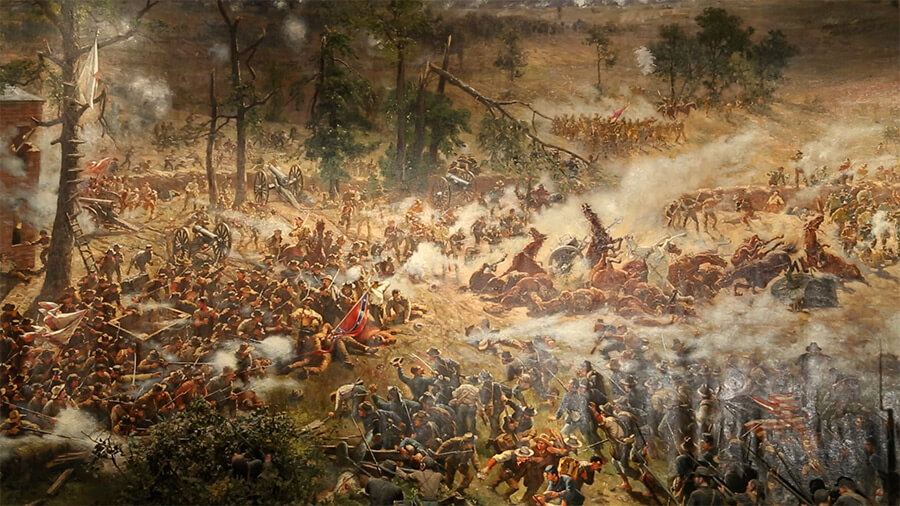 |
| Enlarged detail of the Troup Hurt House and the four-gun De Gress Battery (right of the house), which were temporarily captured by Confederate infantry on the afternoon of July 22, 1864, Battle of Atlanta Cyclorama, 1886. Painting by the American Panorama Company. |
Manigault's brigade, advancing eastward, spearheaded the mid-afternoon Confederate assault by penetrating the Federal Fifteenth Corps line at its weakest point, which was a thinly defended railroad cut and a nearby wagon road. Years earlier, when railroad construction engineers laid down track for the Georgia Railroad, they burrowed through a hillside to maintain a shallow gradient in the vicinity of the present-day Inman Park MARTA station. The railroad cut they created is no longer visible, but the Battle of Atlanta Cyclorama provides a vivid image of the deep earthen channel, the rolling terrain on either side of it, and Atlanta to the west. On July 22, 1864, Manigault's brigade, after moving from Atlanta's inner fortifications and meeting stiff resistance, broke the Union line near the railroad cut, where the Federal Fifteenth Corps's second division, temporarily commanded by Brigadier General Joseph A. J. Lightburn, was particularly vulnerable to attack.
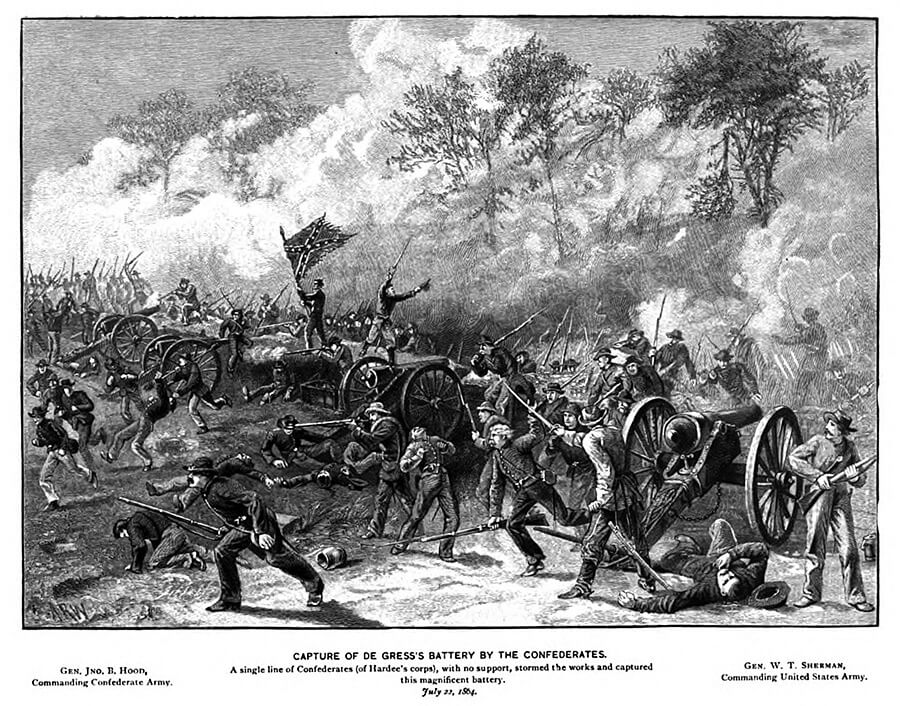 |
| Capture of De Gress Battery by Confederate infantry, Joseph M. Brown, The Mountain Campaigns of Georgia: Or, War Scenes on the W. and A. (Buffalo, New York: Art-Printing Works of Matthews, Northrup, and Company, 1890), 69. |
Manigault's South Carolinians and Alabamians, followed by Colonel Jacob H. Sharp's brigade of Brown's Confederate division, poured through the cut and forced the Union defenders to retreat. Manigault's troops fanned out to the north and captured the Troup Hurt House and Captain Francis De Gress's twenty-pound Parrott battery of four guns. A historic marker at the north end of Degress Avenue, before it turns sharply east, indicates the location of the De Gress battery, which the Yankees had placed on high ground facing Atlanta. Sharp's contingent, in close support of Manigault's Brigade, fanned out to the south, striking a Federal brigade positioned just south of the Georgia Railroad. Other elements of Brown's and Clayton's Confederate divisions joined the attack north and south of the railroad. Together, the combined action of these two divisions opened a half-mile gap in the Union line that if further exploited could have turned the tide of the battle against the Federal Army of the Tennessee. However, the Confederate successes were short-lived, and they were soon driven back by a ferocious Yankee counterattack.
General Sherman, observing the battlefield action from his position just over one-half mile north of the Troup Hurt House, personally directed cannon fire against the Rebel front and behind it, thwarting further gains and preventing reinforcements. Union Major General John A. Logan, who earlier that afternoon had replaced the fallen Major General James B. McPherson as commander of the Army of the Tennessee, was alerted to the dire threat posed by the breakthrough. Logan gathered reinforcements and galloped on his black stallion Slasher toward the collapsed front of the Federal Fifteenth Army Crops. When Logan arrived on the scene, three Federal division commanders were already preparing a counterattack. "Black Jack" Logan, whose dark complexion and jet-black hair and moustache made him a striking physical presence on the battlefield, was renowned for his combat leadership. He led the advancing Union infantry, supported by artillery fire, in a counterstrike that hurled back the Confederates, recaptured the De Gress Battery, and restored the Fifteenth Corps line across the half-mile front that had been lost less than a half hour earlier. The Federal troops did not pursue their retreating foes, and fighting in the vicinity of the Troup Hurt House came to a close. Combat continued until dark at Leggett's Hill.
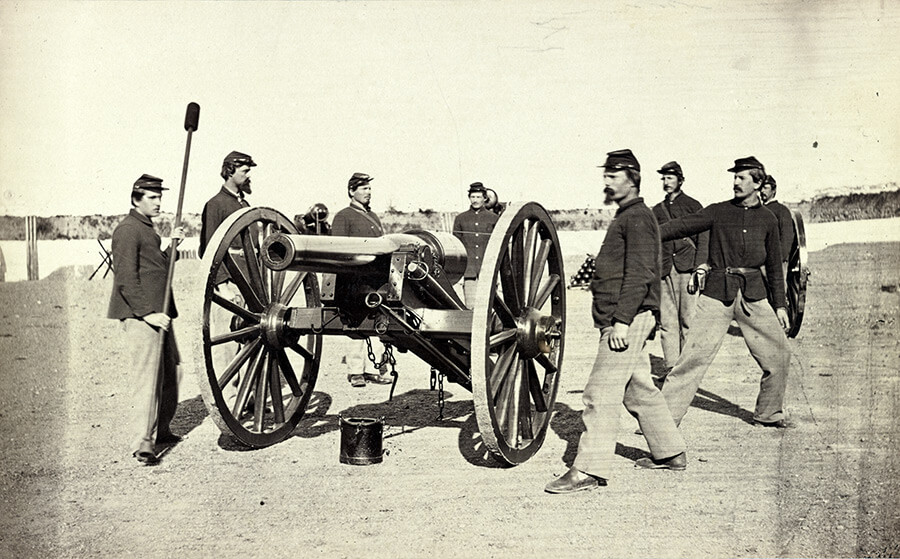 |
| A twenty-pound Parrott Gun and its crew at Fort Richardson, Arlington Heights, Virginia, 1861–1865. The De Gress Battery was comprised of four rifled cannons of this type. Albumen print, ca. 1865. |
Logan's combat performance in the Battle of Atlanta added to his reputation, and he emerged from the Civil War a military hero. Historian Albert Castel credits Logan more than any other individual for the Union victory on July 22, 1864, citing "his skillful handling of his troops, his coolness and determination, and above all his inspiring presence."42Albert Castel, "'Black Jack' Logan," Civil War Times Illustrated 15, no. 7 (1976), 44. Logan was among the most accomplished of the "political" generals, a group of officers who had pre-war careers that were dominated by political service, had little or no military training or experience prior to appointment to general rank, and typically had limited if any success in combat. Logan was an exception and was praised by Sherman for having "nobly sustained his reputation and that of his veteran army" after succeeding McPherson as commander of the Army of the Tennessee in the Battle of Atlanta.43US War Department, The War of the Rebellion: Official Records of the Union and Confederate Armies, Series I, Volume 38, Part I (Washington, DC: Government Printing Office, 1891), 75. Still, Logan's lack of West Point credentials deterred Sherman from promoting him to permanent command of the Army of the Tennessee, a snub that infuriated Logan. Instead, Sherman appointed West Point graduate Oliver Otis Howard five days after the Battle of Atlanta.
Before the war, Logan had served as a highly partisan Democratic member of Congress from southern Illinois, and in 1866 he returned to politics as a Radical Republican, serving either in the House or Senate almost without interruption until his death in 1886. In 1884, he was the unsuccessful nominee for vice president on the Republican ticket headed by James G. Blaine. He also co-founded the largest Union veterans group, the Grand Army of the Republic (GAR), and served three times as the GAR's commander-in-chief. On May 5, 1868, shortly after his first term began, Logan issued a general order to all GAR posts that established Decoration Day as the northern counterpart to the previously established Confederate Memorial Days. He designated May 30 for all Union veterans to decorate the graves of comrades "who died in defense of their country during the late rebellion."44George F. Dawson, Life and Services of Gen. John A. Logan as Soldier and Statesman (Chicago and New York: Belford, Clarke & Company, 1887), 123. On May 30, 1868, commemorative ceremonies were attended by thousands of people in twenty-seven states.
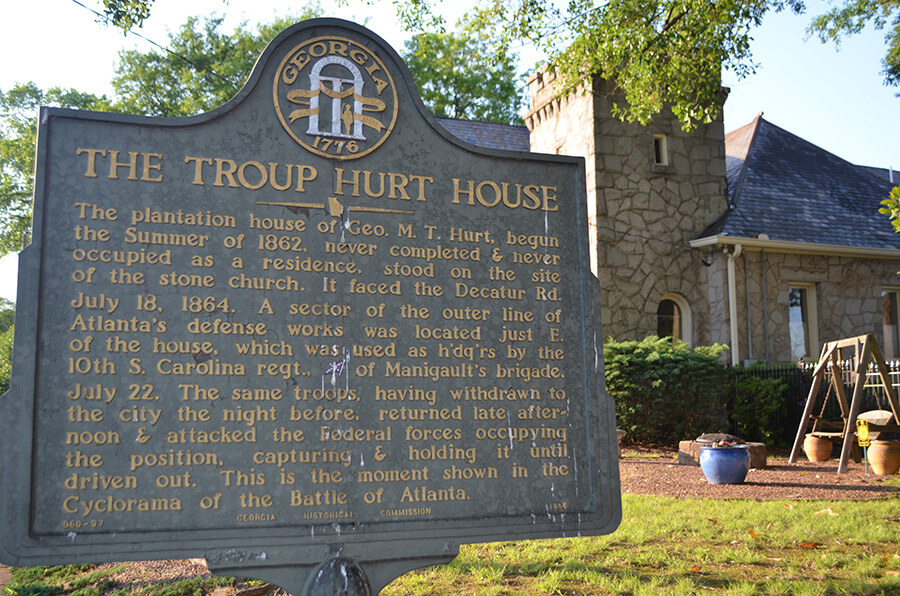 |
| Troup Hurt House site and location of present-day converted church, Degress Avenue, Atlanta, Georgia, May 10, 2014. Photograph by Daniel Pollock. |
During the 1870s, northerners and southerners began to participate together in Memorial Day celebrations, which increasingly served the purpose of sectional reconciliation. The national ritual was known as Decoration Day, and the versions in the South—which were observed on different days in different states—were called Confederate Memorial Day. In the 1880s, the GAR actively campaigned to change the name of Decoration Day to Memorial Day, and gradually every northern state made Memorial Day a public holiday. The Memorial Day service in Chicago on May 30, 1895, was a high point in the national celebrations. On that day, a monument to Confederate dead was dedicated in the city's Oak Woods Cemetery, the burial site of over six thousand Confederate soldiers who had died as prisoners-of-war at nearby Camp Douglas. Some fifty thousand Chicagoans lined the parade route to the cemetery to catch a glimpse of such notables as Confederate general James Longstreet and Union general John Schofield. In the twentieth century, Memorial Day became an occasion to honor all Americans who died in service. In 1968, Congress passed the Uniform Monday Holiday Act, which established Memorial Day as the last Monday in May.
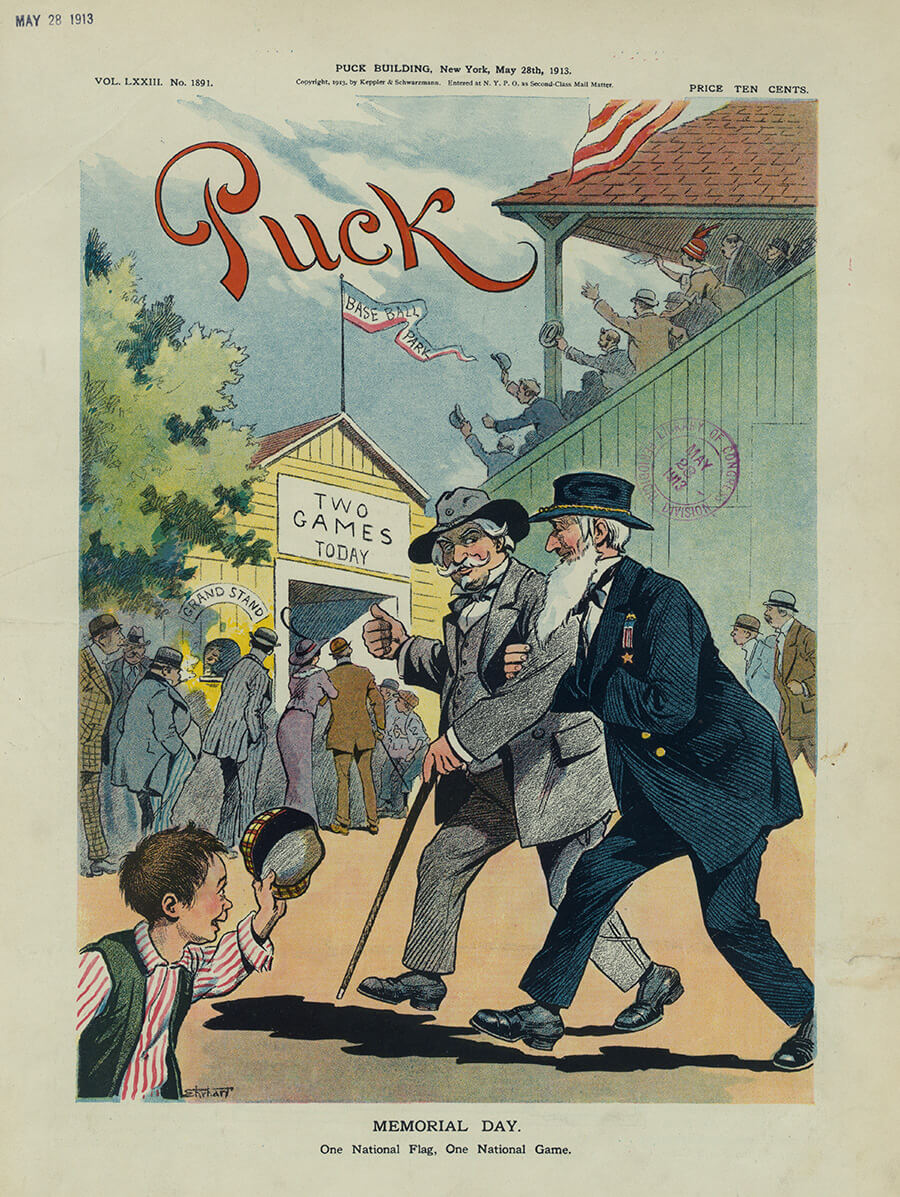 |
| Memorial Day, photomechanical print by Samuel D. Ehrhart. Published by Keppler & Schwarzmann, Puck Building, May 28, 1913. Courtesy of Library of Congress. |
Popular images produced early in the twentieth century valorized fallen Civil War soldiers who fought on opposing sides and depicted Memorial Day as an occasion for surviving "Blue and Gray" veterans to enjoy leisure time together. Memorial Day observances, along with visits to battlefields, public monuments, and military cemeteries and participation in veterans' reunions, involved millions of Americans in Civil War remembrance. A main event in Memorial Day celebrations throughout the nation was the local parade in which Civil War veterans, some riding in carriages or automobiles and others still spry enough to walk, served as living links to the past. They brought memories of the war to life. However, these historical memories focused mainly on individual service and sacrifice, and they tended to obscure more divisive elements of the Civil War experience, most notably the causes of the nation's deadliest conflict and the war's wrenching aftermath. Historian David Blight writes that late nineteenth- and early twentieth-century sectional reunion was a victory for a reconciliationist vision of Civil War memory that could not have been achieved without overwhelming a competing emancipationist vision and resubjugating many of the people whom the war had freed from slavery. Blight adds:
"For Americans broadly, the Civil War has been a defining event upon which we have often imposed unity and continuity; as a culture we have often preferred its music and pathos to its enduring challenges, the theme of reconciled conflict to resurgent, unresolved legacies. The greatest enthusiasts for Civil War history and memory often displace complicated consequences by endlessly focusing on the contest itself."45David Blight, Race and Reunion: The Civil War in American Memory (Cambridge, MA: Belknap Press of Harvard University Press, 2001), 3–4.
Grant Park and Cyclorama
The Battle of Atlanta Cyclorama, an enormous, nineteenth-century panorama painting, depicts combat action and battlefield landmarks in a vivid, true-to-life style.
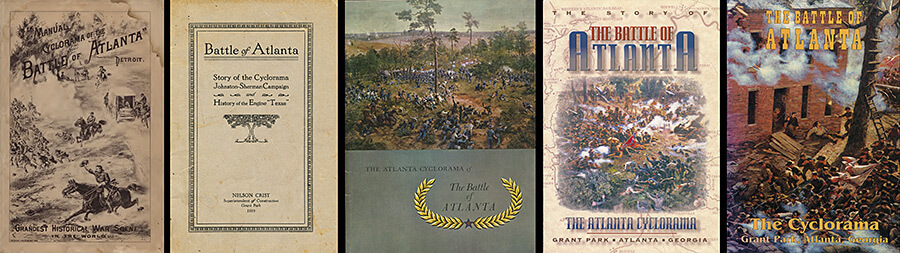 |
| Cyclorama brochures, 1887 to present. Compiled by Christopher Sawula, 2013. |
Nineteenth-century cycloramas, enormous circular paintings exhibited in specially designed round or polygonal buildings, achieved great popularity by immersing their audiences in a visual experience designed to make viewers feel transported to another place and time. Like movies and computer-simulated environments later, cycloramas intentionally blurred the lines between image and reality by surrounding the spectators with a sweeping panoramic vista that filled their vision and excluded any sense of their real whereabouts. The panorama itself was painted in a meticulously true-to-life style that captured a spectacular event or scene, such as a famous battlefield incident, stunning natural landscape, or sweeping view of a great city. To heighten the impact of the indoor spectacle and distance visitors from the outside world, the only way to reach the painting was through a dimly lit corridor and up a staircase leading to a centrally located viewing platform. As spectators arrived in the viewing area, they were immediately surrounded by an enormous canvas, typically fifty feet high and four hundred feet in circumference. Viewers' movements were restricted to the elevated viewing platform placed at a distance from the painting. This focused their attention on the pictured story or scene, rather than painterly details, and created the impression that they were surveying a vast spectacle from an aerial vantage point. A canopy concealed the overhead lighting and the upper edge of the canvas, while a railing or three-dimensional landscape in the foreground hid the lower edge of the painting. In the words of panorama historian Bernard Comment, "Everything was arranged so that nothing extraneous could encroach on the display and disturb the spectator's field of vision."46Bernard Current, The Painted Panorama (New York: Harry Abrams, Inc., 2000), 8. In attempts to heighten the visual experience, cycloramas often added musical accompaniment, sound effects, and authoritative narration to the pictorial spectacle.
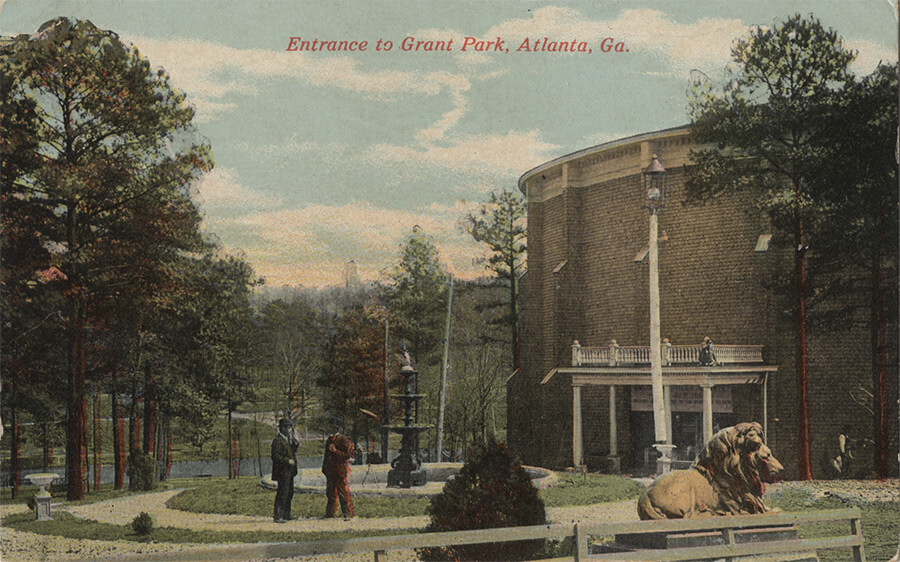 |
| Original cyclorama building, Grant Park, Atlanta, Georgia, erected 1898. Color postcard, ca. 1910. |
The Battle of Atlanta Cyclorama in Grant Park enables contemporary audiences to simulate this nineteenth-century viewing experience. As viewers ascend to the central viewing platform they catch their first glimpse of the giant painting, one of two Civil War battle cycloramas still on display in the United States. The other is the Battle of Gettysburg at the Gettysburg National Military Park. After the spectators take their seats at the Atlanta cyclorama, the viewing platform begins a slow, circular rotation in front of the canvas and a recorded narration of the combat action, accompanied by background music, gunshots, and other sound effects, starts to play. In an experience that closely parallels a nineteenth-century visit to the cyclorama (displayed or housed in Atlanta since 1892), viewers are suddenly immersed in a climactic battlefield scene. Their vantage point is high above the fighting, as if viewing the action from a platform forty feet off the ground at the present-day intersection of Moreland and Dekalb Avenues. They witness the decisive moment, the Union counterattack led by Major General John A. Logan, launched at approximately 4:30 p.m. on July 22, 1864, and aimed at restoring the Federal line broken by a Confederate assault spearheaded by Brigadier General Arthur M. Manigault's Brigade. The cyclorama presents a panoramic view of the fighting as a complete circle, starting and ending with the intense confrontation at the Troup Hurt House and the nearby De Gress Battery. As segments of the painting are progressively illuminated, the audience sees Federal infantry moving forward to restore their broken line near the Troup Hurt House; Sherman surveying the battlefield from his headquarters at the Augustus Hurt House; Logan galloping to the front to lead the Union counterattack; a distant cloud of gun smoke arising from the fighting in Decatur; Federal infantry moving forward to restore their broken line near the Troup Hurt House; and Confederate Major General Carter L. Stevenson's division charging across the open ground atop Leggett's Hill. The narrator intones dramatically: "Only the old muzzle-loading guns, bayonets, and artillery made up the arsenal of weapons during the War Between the States, yet with few such weapons the casualties of these four years was staggering, as they were here at Leggett's Hill, where assault after assault [sic] being repelled and the slopes becoming mounds of the slain."
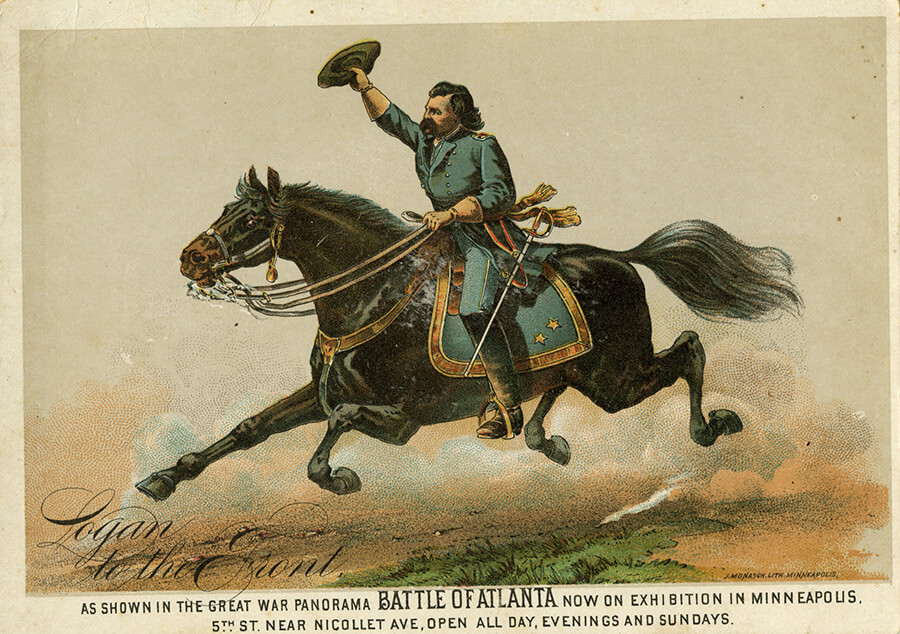 |
| Union Major General John A. Logan, riding Slasher. Minneapolis Cyclorama promotional flyer, ca. 1886. |
The artists who painted the Atlanta cyclorama in a Milwaukee studio in 1885–1886 were recruited from Germany and Austria by the studio's owner, William Wehner, a German-born, Chicago entrepreneur who sought to capitalize on the American public's renewed interest in the Civil War in the 1880s coupled with the popularity of battlefield panoramas. Several of the artists recruited by Wehner had worked in Munich on a panorama of the Battle of Sedan, a German victory that was decisive in the Franco-Prussian war of 1870–71. He induced the artists to move to Milwaukee, where, he said, "You German artists will find congenial friends" among the many German-speaking residents.47Francis Stover, The Panorama Painters' Days of Glory (Milwaukee, WI: Milwaukee County Historical Society, 1969), 4. Wehner also recognized that US audiences would insist on historical accuracy in paintings of Civil War battles, and to that end he hired Theodore R. Davis of Asbury Park, New Jersey, as technical advisor to the painters. Davis was on familiar ground in depicting the Battle of Atlanta. As a staff illustrator for Harper's Weekly during the war, Davis created an extensive visual record of combat action, battlefield topography, and local landmarks. Former Union Major General John A. Logan wrote of the artist's wartime experience, "Unquestionably Mr. Davis saw more of the war than any other single person."48Theodore R. Davis, "Grant Under Fire," The Cosmopolitan 14, no. 111 (January 1893), 333. Davis accompanied Sherman on the Atlanta Campaign, and he witnessed much of the Battle of Atlanta from Sherman's headquarters at the Augustus Hurt House. In the summer of 1885, Davis and the panorama artists visited Atlanta, where they sketched aerial views of the battlefield terrain from a forty-foot tower that they erected near the present-day intersection of Moreland and Dekalb Avenues. Union and Confederate veterans and local Atlanta residents also provided information about the battle site and events. Wehner reported that "The Federal and Confederate officers who have contributed their aid, embrace nearly every principal commander now living who took part in the scene."49William Wehner, "Battle of Atlanta: The Picture and the Painters," in "Atlanta," Battle of July 22, 1864 (Detroit, MI: Kerby Printing Company, 1887), 2.
Wehner's artists returned from their Atlanta site visit to Milwaukee to complete the painting, which was first publicly exhibited in Minneapolis in June 1886, remained on display there until March 1888, and was shown in Indianapolis and Chattanooga before its Atlanta opening in February 1892.50Anonymous, "The City: The Panorama Was Viewed by Select Invited Audience," Minneapolis Tribune, June 29, 1886, 5; Anonymous, "The Battle of Atlanta Is Here," Atlanta Constitution, February 12, 1892, 7. In Atlanta, the painting was displayed in a specially constructed cyclorama rotunda near the city's downtown, on Edgewood Avenue, between Courtland Street and Piedmont Avenue. A second Battle of Atlanta panorama painting, also completed in Wehner's Milwaukee studio, made its debut in Detroit in February 1887.51Anonymous, "A Great Historical Painting: Formal Opening of the Detroit Cyclorama Company's Battle of Atlanta," Detroit Free Press, February 28, 1887, 5. Wehner instructed his corps of painters to produce both battle panoramas at the same time after he recognized that the artists could not all work on the same canvas simultaneously.52Anonymous, "A Battle on Canvas," St. Paul Daily Globe, April 15, 1886, 4. What became of the version shown in Detroit and whether it survives are not known.
A story persists that the Battle of Atlanta panorama was commissioned by John A. Logan to boost his candidacy for the vice-presidency on the Republican ticket headed by James G. Blaine in 1884. This account seems dubious because work on the painting began in 1885, after the presidential election. A more likely explanation of the painting's origins is that William Wehner sought to profit from the revival of interest in the Civil War during the Gilded Age, which coincided in the United States with a vogue for cyclorama experiences. Cycloramas were produced to earn money, and they were bought and sold frequently as investors sought to cash in. The Battle of Atlanta painting changed ownership several times before George V. Gress, a civic-minded Atlanta merchant, purchased it in 1893. Gress moved the panorama to Grant Park in 1894 and donated it to the city in 1898. Gress already had made a major donation to the city in 1889, when he purchased a menagerie from a bankrupt circus and gave the animals to the city, along with housing and cages, to establish a zoo in Grant Park.
After Gress deeded the cyclorama painting to the city, Atlanta's park commissioners committed funds to restore the panorama and repair the circular wooden building in Grant Park where it was exhibited. The refurbished attraction was re-opened just in time for a Confederate reunion in Atlanta on July 22–23, 1898, the thirty-fourth anniversary of the Battle of Atlanta. The cyclorama painting remained on display in the fragile wooden structure, near the Auburn Avenue entrance to Grant Park, until 1921, when the panorama was moved to a new marble building—its present home—close to the center of the park and adjacent to the Atlanta Zoo.
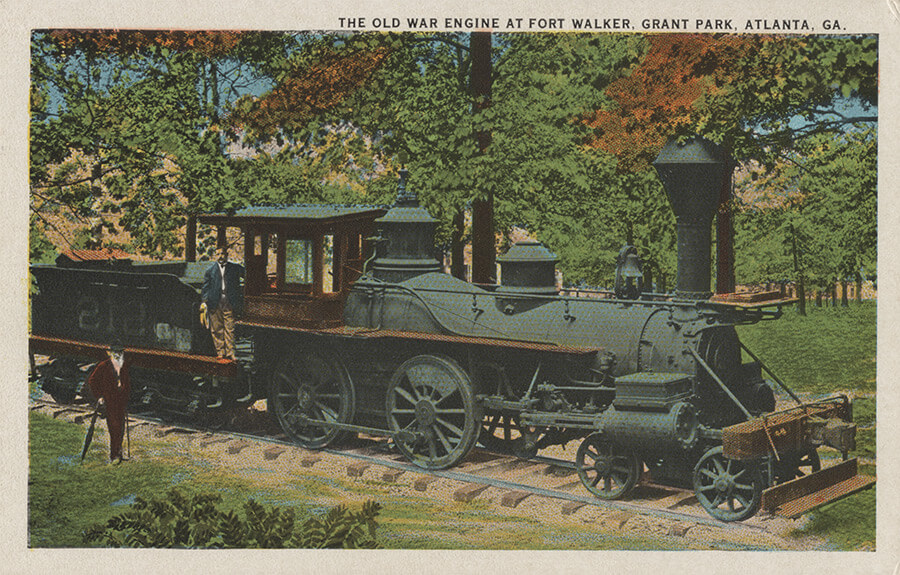 |
| The Texas Imperial, the Texas locomotive that overtook the Andrews Raiders in 1862, on display in Grant Park in the early twentieth century. Postcard, ca. 1910. |
Grant Park is named for Lemuel P. Grant, who oversaw construction of Atlanta's fortifications in 1863–1864 and served the city in many official roles after the war. Grant made a fortune in railroad construction and real estate development, and in 1882 he donated a hundred acres on the southeast edge of the city for the public park that eventually would bear his name. As Grant Park took shape, Civil War attractions were added to park amenities that included shaded walkways, flower gardens, a lake for boat rides, and the city's zoo. In addition to the cyclorama, Grant Park's war-related points of interest were the reconstructed Fort Walker, complete with mounted cannons placed above the remnants of Confederate earthworks; a nearby walkway named in honor of James B. McPherson, the federal general killed in the Battle of Atlanta; and the locomotive Texas, which overtook the train that the Andrews Raiders had commandeered on April 12, 1862, in their failed effort to disrupt the Confederate's railroad supply line between Atlanta and Chattanooga. Grant Park became a common destination for Civil War veterans who gathered there for reunions and civilian visitors who combined trips to the cyclorama with stops at the park's other war-related sites.
In 1907, a local hotelier offered a prize for the best description of "How to Spend Four Days Sight-Seeing in Atlanta." The Atlanta Constitution published two essays submitted in the contest, and each one included Grant Park in the recommended itinerary. One essayist elaborated on the park's appeal: "A beautiful afternoon may be spent at Grant park, enjoying the wonderful beauties of the place, viewing the cyclorama, where one learns more of battles in ten minutes than in ten months of reading. A walk through the park to Fort Walker will be an inspiration, both for the magnificent view seen from the eminence, and the inspection of the old fortifications that make this a historic spot."53Anonymous, "How to Spend Four Days Sight-Seeing in Atlanta," Atlanta Constitution, February 25, 1907, 3. The Atlanta Constitution did not report whether this contest entry won the $5 prize.
Some scholarly critics, writing in recent years, contend that the apparent mastery of battlefield details in late nineteenth-century cycloramas and the mass appeal of the paintings have reinforced a nationalistically inspired view of Civil War history that is entertaining but narrowly configured.54Angela Miller, "The Panorama, the Cinema, and the Emergence of the Spectacular," Wide Angle 18, no. 2 (April 1996), 56. The panoramas depict fierce and close combat between Confederate and Union troops and convey the extraordinary courage of soldiers on both sides, emphasizing their common valor and sacrifice. However, critics argue, what these dramatic visual narratives largely omit are the deep divisions and bitterness that tore a nation apart and threw it into four years of bloody conflict. "America is defined in populist terms," notes one scholar in her analysis of the Battle of Atlanta Cyclorama. "The cultural identity articulated by the painting is that Americans of the North and South are white, male, working class, and united by a rebellious spirit."55Shelly Jarenski, "'Delighted and Instructed': African American Challenges to Panoramic Aesthetics in J. P. Ball, Kara Walker, and Frederick Douglas," American Quarterly 65, no. 1 (March 2013), 128. Literally embodying sectional reconciliation among whites is the severely wounded Confederate soldier depicted in the arms of a Federal infantryman, aiding his foe in the heat of battle. They are brothers who enlisted on opposite sides and had not seen each other for three years. Also notable but not easily seen are the single African American and single female figures in the painting. They are included in the whirl of rear-line action, well behind the lines of rifled infantryman, galloping officers, exploding shells, and waving battle flags.
Aftermath
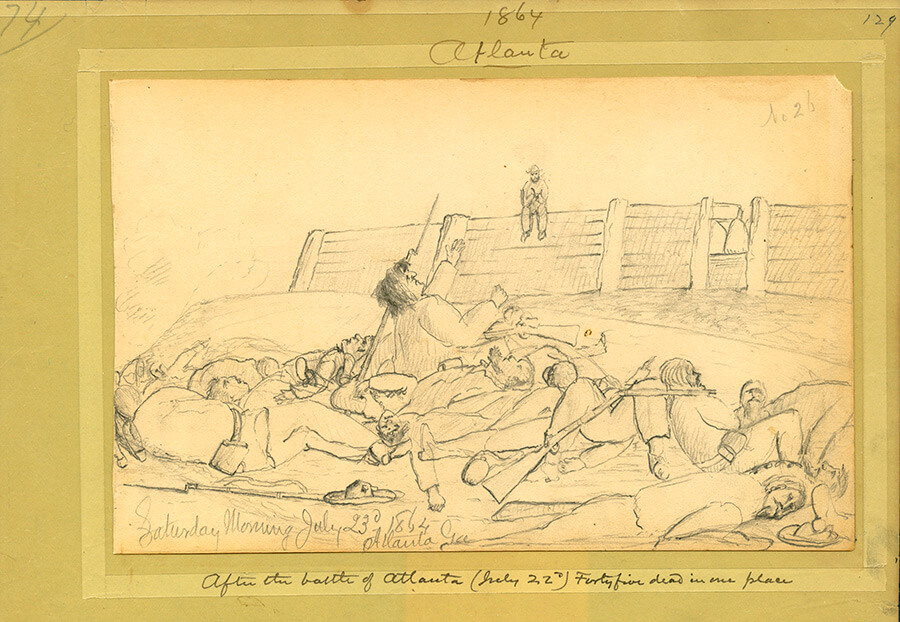 |
| Confederate dead after the Battle of Atlanta, July 23, 1864. Sketch by Henry Dwight. Courtesy of Ohio Historical Society. |
Losing the Battle of Atlanta was a major blow to the Confederacy. The flank attack attempted by Hardee's Corps and frontal assault launched by Cheatham's Corps amounted to a major opportunity, perhaps the final one, for the Confederate Army of Tennessee to crush at least one of the advancing Federal armies and turn the tide of the Atlanta Campaign. Instead, after eight hours of fighting on July 22, 1864, John Bell Hood's army had lost more than 10 percent of its fighting force to death, injury, or capture, and the carnage on the Atlanta battlefield was shocking to see, even for battle-hardened veterans. A Union surgeon, A. W. Reese, who visited the scene the day after the battle, recalled in vivid clinical detail:
Immediately in front of our lines the ground was, literally, piled with dead bodies of rebel soldiers—they laid, actually, in win[d]rows and piles. Their bodies were mangled, torn, and battered by balls in every conceivable manner and shape. Many of them were shot through the head and laid in a ghastly puddle of their own brains which had oozed from their shattered skulls.56A. W. Reese, Personal Recollections of the Late Civil War in the United States. With Scenes, Incidents, and Memoirs of Earlier Times,1870, 532 (Western Historical Manuscript Collection, Columbia, MO).
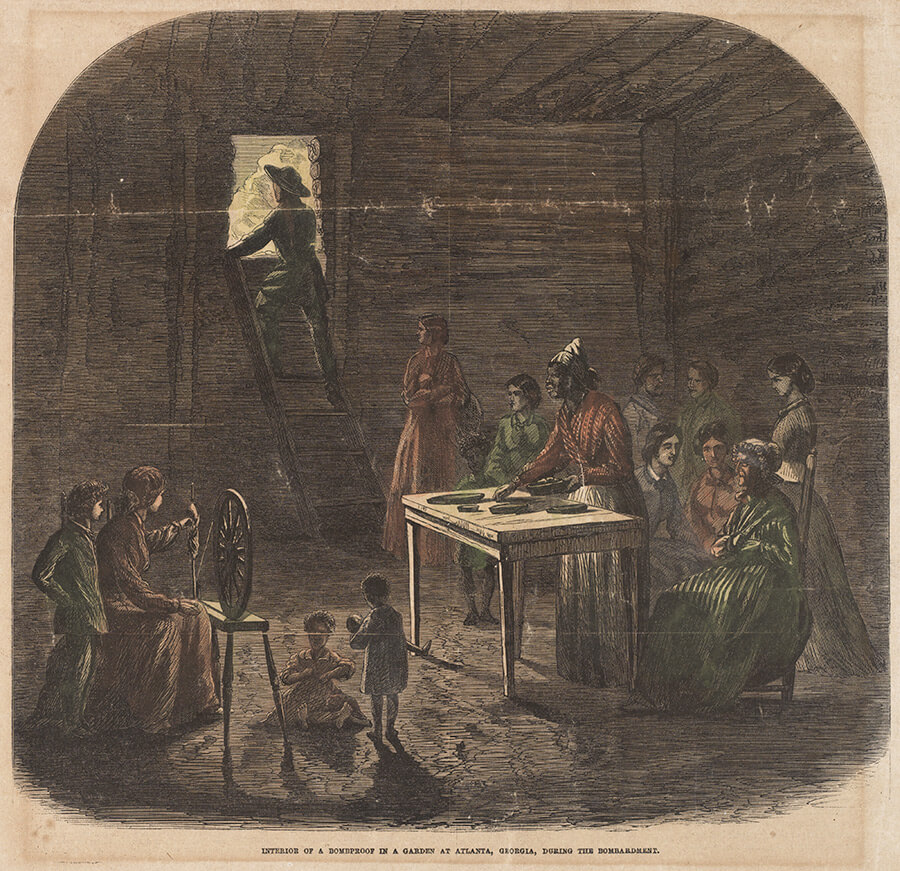 |
| Bombproof shelter, interior of a bombproof garden in Atlanta, Georgia, ca. 1864. Print courtesy of the Atlanta History Center. |
Although Sherman's armies had inflicted heavy losses, the Confederates defending Atlanta still held a well-fortified city and kept open two vital railroad supply lines that approached from the southwest and south. Four days after the Battle of Atlanta, Sherman turned his attention to severing those railway lifelines. As his artillery bombarded the city, he moved the Army of the Tennessee from its position east of the city to a new position to the west, where it would be in striking distance of the railroads as they entered on the same right-of-way. In Atlanta, Hood watched the Federal movement, and, in an effort to thwart it, he sent four divisions from behind the fortifications to attack the Union troops. The resulting Battle of Ezra Church on July 28, was another stinging defeat for Hood's army, the third loss in eight days. By one estimate, the Army of Tennessee sustained more than twelve thousand casualties in its failed attempts to win a decisive victory against the invading Yankees.57Thomas L. Connelly, Autumn of Glory: The Army of Tennessee, 1862–1865 (Baton Rouge: Louisiana State University Press, 1971), 455. However, the Confederates maintained possession of the two railways and overwhelmed two Union cavalry divisions Sherman had sent on raids south of the city.
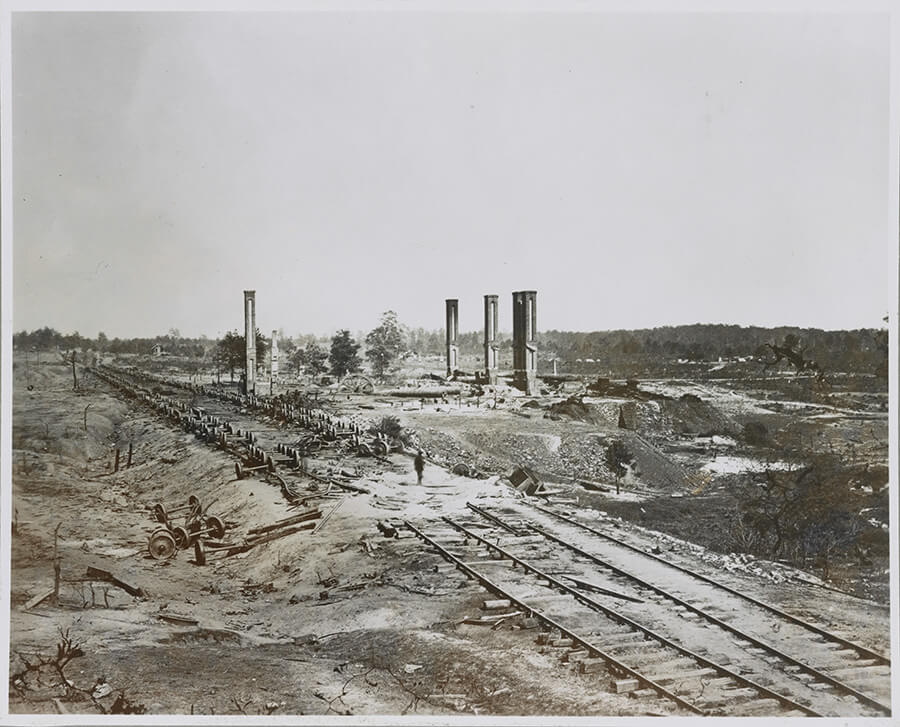 |
| Aftermath of September 2, 1864, Confederate destruction of ammunition-laden railcars, near present-day Fulton Cotton Mill lofts, Atlanta, Georgia. Gelatin silver print by George Barnard. Courtesy of Library of Congress. |
Sherman increased the volume and pace of the shelling of Atlanta that his gunners had started on July 20. On August 9, the bombardment intensified to its highest level, and the artillery pounding continued for two weeks as the remaining civilians in the city huddled in "bombproof" shelters. The cannon fire damaged or destroyed numerous buildings and occasionally injured or killed civilians, perhaps causing twenty deaths.58Stephen Davis, "How Many Civilians Died in Sherman's Bombardment of Atlanta?" Atlanta History 45, no. 4 (2003), 19. Incessant shelling did not force Hood's army to evacuate, and it continued to receive supplies.
Sherman called an abrupt halt to the bombardment on August 25, and the following night he moved the bulk of his three armies from their trenches north and west of Atlanta on a sweeping march to the south and then east. On August 28, the Federal infantry reached the Atlanta & West Point Railroad, the western-most of the two open rail lines, and they destroyed miles of track. Union troops continued eastward toward their main objective, the Macon and Western Railroad, the more important of the two Confederate supply lines.
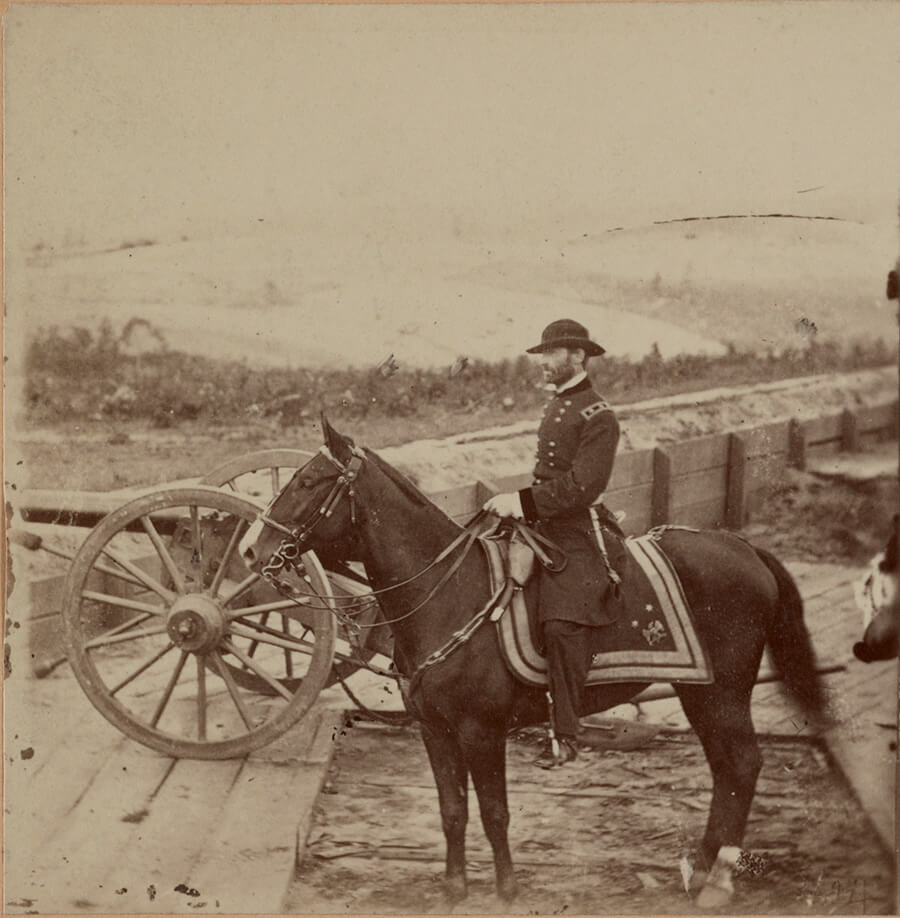 |
| "Old Tecumseh," Union Major General William T. Sherman at Confederate Fort, Atlanta, Georgia, October 1864. Stereograph by George Barnard. Courtesy of Library of Congress. |
As the Federals approached the last open rail line at Jonesboro, a railroad town eighteen miles south of Atlanta, Hood sent two of his army corps to meet them. In an effort to counter the Union threat, Hood's troops launched a poorly executed assault on August 31. At approximately the same time that the Confederates first attacked the Yankee infantry outside Jonesoboro, other Union forces reached the railway north of the town and severed it. The next day, September 1, the Yankees attacked and broke the Confederate line at Jonesboro, forcing the Rebels to retreat southward toward Lovejoy's Station. When a courier brought Hood news that Jonesboro had fallen and the railroad was cut, he issued orders for the evacuation of Atlanta. Beginning late in the afternoon of September 1, Hood and the remainder of his army still in the city began marching out, southeastward along McDonough Road. In the early hours of September 2, a rear guard of Confederate cavalry set fire to five locomotives and eighty-one boxcars (twenty-eight of which were filled with ammunition), that lay idle along the Georgia Railroad tracks in an evacuated area near Oakland Cemetery and the Atlanta Rolling Mill (present-day Fulton Cotton Mill lofts on Boulevard). The exploding boxcars left a path of devastation a half-mile wide, leveled the Rolling Mill, and ignited a blaze that burned until dawn.
 |
| Ruins of Atlanta railroad depot, demolished before Sherman's departure, 1864. Wet collodion by George Barnard. Courtesy of Library of Congress. |
Early on September 2, shortly after the last Confederate cavalry unit vacated Atlanta, a civilian contingent led by Mayor James M. Calhoun surrendered the city to an advance party of Sherman's army. By noon, Union soldiers were marching into Atlanta, and the two-and-a-half month Federal occupation of the city began. Sherman, who was near Lovejoy's Station when Atlanta was captured, received dispatches on the morning of September 3 notifying him of Hood's evacuation and the city's surrender. Later that day Sherman telegraphed US Army Chief of Staff Henry W. Halleck: "So Atlanta is ours and fairly won."59Simpson and Berlin, eds., 696. Four days later, on September 7, Sherman rode into the city.
The Atlanta Campaign was over, and Sherman soon would make plans for a fall push, his March to the Sea. To secure Atlanta as a base of Union military operations, Sherman decided that Atlanta's remaining residents would have to leave. He issued an expulsion order in the first week of September, which was met with popular outcry and vehement protests from Confederate General John Bell Hood. Atlantans had endured the battles around the city, the bombardment of their homes and businesses, and now faced forced evacuation. Sherman justified the expulsion order on military and public safety grounds.
 |
| Trout House, Masonic Hall and Federal encampment on Decatur Street during Union occupation of Atlanta, Georgia, 1864. Wet collodion by George Barnard. Courtesy of Library of Congress. |
In early October, Hood led his army northward in an effort to cut Sherman's supply line, the railroad from Chattanooga, and force the Federals out of Atlanta. Sherman chased after Hood, and the opposing armies engaged in sporadic and inconclusive fighting for a month. Hood's elusive army eventually moved to northern Alabama, at which time Sherman gave up his pursuit and returned to Atlanta. Sherman made plans and secured approval from his superiors Grant and Halleck for a sweeping march across the central Georgia countryside in the direction of Savannah on the Atlantic coast. Sherman then ordered the destruction of all remaining structures in Atlanta's business and industrial areas that had military value. The wrecking of Atlanta began on November 11 and continued for four days and nights. Union engineers were instructed to preferentially knock down structures rather than burn them, but Yankee soldiers who were not part of the demolition squads began to set fire to private buildings, especially homes. On the final night of the Union occupation, November 15–16, troops set much of the downtown ablaze. When Sherman and his rear guard moved eastward the following morning, the last fires were smoldering and much of the city was in ruins. Pausing on the outskirts, Sherman later recalled: "We stood upon the very ground whereon was fought the bloody battle of July 22, and could see the copse of wood where McPherson fell."60Sherman, 655.
 |
| The Federal Fourteenth and Twentieth Corps moving out of Atlanta, Georgia, November 15, 1864, Harper's Illustrated Weekly, January 1, 1865. |
Union photographer George N. Barnard photographed Atlanta before, during, and after the damage wrought by Sherman's armies. Arriving in mid-September, Barnard produced well-known views of Atlanta's battlefields, fortifications, and businesses. One of the first scenes he photographed was the site of McPherson's death, a spot marked by an inscribed wooden placard nailed to a thin tree. Barnard revisited the site in November 1864 or May 1865, when he took a second set of photographs. In late September 1864, Barnard also devoted attention to General Sherman, who posed for portraits with his staff at a former Confederate fort west of the city. Barnard was particularly busy in October and early November 1864 when he created many of his best known images of the Atlanta and the fortifications surrounding it. He photographed homes that served as headquarters for Union officers, storefront businesses including a slave market on Whitehall Street (now Peachtree Street),61Michael Rose, Remembering Atlanta (Nashville: Turner Publishing Company, 2010), 17. the centrally located rail car shed, both before and after it was demolished, and teams of Yankee soldiers tearing up and twisting railroad track. Barnard's images provide an enduring impression of Civil War Atlanta and a stark record of the wreckage.
About the Author
Daniel A. Pollock, MD, is a medical epidemiologist at the Centers for Disease Control and Prevention (CDC) in Atlanta, Georgia, where he leads a unit responsible for national surveillance of healthcare-associated infections. Since arriving in Atlanta in 1984, he has pursued an independent scholarly interest in the city's Civil War history, and he has conducted over 150 tours of Battle of Atlanta sites.
Acknowledgements
"The Battle of Atlanta: History and Remembrance" is a collaborative project of the Emory Center for Digital Scholarship (ECDS) and Robert W. Woodruff Library.
Project co-directors: Daniel A. Pollock and Allen Tullos
Principal researcher and author: Daniel A. Pollock
Project coordinator and digital strategist: Brian Croxall
Principal web app software developer: Jay Varner
Photograph and historical collections researcher: Christopher Sawula
Project librarian: Erica Bruchko
Cartographer: Michael C. Page
Web app interface designer: Kevin Glover
Principal videographer and video editor: Steve Bransford
Assistant videographer and video editor: Dina Warnock
Assistant videographer: Raymond McCrea Jones
Southern Spaces managing editor: Jesse P. Karlsberg
Southern Spaces assistant managing editor: Sarah V. Melton
Southern Spaces staff: Meredith Doster (layout), Alan Pike (videography and development), Clinton Fluker (images), Emma Lirette (text linking), Katie Rawson (early development), and Eric Solomon (text linking)
Copyediting and proofreading: Marlo Starr
Production assistance: Franky Abbott, Matt Miller
Initial software developer: Kyle W. Bock
ECDS co-director: Wayne Morse
Emory Library and Information Technology Services (LITS) Software Engineering Team
Software team manager: Mike Mitchell
Project manager: Tonia Edwards
LITS Library Tech Services: Jonathan Bodnar, Bethany Nash
LITS Scholarly Communications: Lisa Macklin, Melanie Kowalski
Atlanta Cyclorama and Civil War Museum: Monica Prothro, Yakingma Robinson
Content review: Steve Davis, Charlie Crawford, and Dave Buckhout
Thanks to: Carol Anderson, Julie Braun, Holly Crenshaw, Ginger Cain, Kathryn Dixson, and John Klingler
Proposal consultant: Deb Watts
The responsibility for the final essay text ultimately resides with the author.
]]>Review
The Virginia Historical Society (VHS) in Richmond, Virginia, has mounted an ambitious, highly original, and innovative exhibition on the history of the Civil War, "An American Turning Point: The Civil War in Virginia." The exhibit was organized with the partnership of the Virginia Sesquicentennial of the American Civil War Commission and supported with funding from the National Endowment for the Humanities and numerous private foundations. The VHS consulted with a roster of well-known historians.1The consulting historians include Stephen V. Ash, Charles F. Bryan, Jr., Catherine Clinton, Joseph T. Glatthaar, Ervin L. Jordan, Jr., James C. Kelly, and Chandra Manning. Informed and enriched by the latest scholarship on the Civil War, this exhibition brings together the soldiers' and the civilians' experiences and interconnects the battlefield and the home front, with one section on "Waging War (The Battlefront)" and another on "Surviving War (The Home Front)."
The result is sometimes refreshingly blunt, sometimes opaque, but deeply moving, reinterpretation of the experience of the war in Virginia. The highlight for any visitor is likely to be the first-person, three-dimensional visual simulation of a runaway slave, called "The Journey to Freedom." Taken as a whole, the exhibition succeeds in introducing important new themes in Civil War scholarship to the public. Perhaps nowhere has this been more necessary during the Civil War sesquicentennial than in Richmond, where the monuments to the past loom large.
 |  |
| William G. Thomas III, Statue of Robert E. Lee, Monument Avenue, Richmond, Virginia, 2011. | William G. Thomas III, Statue of Stonewall Jackson, Monument Avenue, Richmond, Virginia, 2011. |
Indeed, one hundred and fifty years ago in 1861, Richmond became the capital of the Confederacy. This was a city whose white residents were supremely confident in the future of slavery and in the prospects for the new nation they were forming. Generations after the defeat of the Confederate States of America, however, Richmond stubbornly clung to its "lost cause." Led by its veterans and ladies associations, the city put up a massive monument to Robert E. Lee unveiled in 1890 and sculpted by Jean Antonin Mercié. Monuments to Thomas J. "Stonewall" Jackson and other Confederates followed. Decades later in the 1920s and 1930s Lee's biographer and the editor of the Richmond News Leader, Douglas Southall Freeman, lived just a few blocks from the monument. Freeman placed Lee at the center of his histories of the Civil War and indeed at the core of Virginia identity: "Their stock had produced Lee; they had seen him, had known him, had obeyed his orders and at his behest, had challenged Cemetery Ridge and had starved in the Petersburg trenches. Association with him was the glory of their generation."2Douglas Southall Freeman, The South to Posterity: An Introduction to the Writings of Confederate History (New York: Charles Scribner's Sons, 1939, reprinted 1998), 59.
 |
| Ellen Glasgow, c. 1890. Image courtesy of the Library of Congress. |
Writer Ellen Glasgow, born in Richmond in 1873, tried in her own way to break this spell, attempting to expose "all the harsher realities beneath manners, beneath social customs, beneath the poetry of the past, and the romantic nostalgia of the present." In 1921 she told the Richmond Women's Club: "Here in Virginia, we need liberation not from the past, but from our old moorings which have held the past and ourselves anchored in stagnant waters." Despite her privileged upbringing, Glasgow urged Virginians to embrace the "dynamic past" and to move beyond "discarded theories," reject tradition, and look to the future. "We are most like Jefferson," she explained, "not when we repeat parrot-like the principles he enunciated, but when we apply these great principles to ever changing conditions." The implications of Glasgow's comments should not be underestimated, because Jefferson's idea of state's rights, expressed in the Virginia and Kentucky Resolutions, had such outsized prominence among lost cause writers. Glasgow was recovering a different legacy of Jefferson, one distinctly out of favor among her peers in Richmond. Glasgow went so far as to claim that Jefferson "has been used as an anchor to keep us moored for generations in the backwaters of history." Still, even Glasgow made a place for Lee in her pantheon of Virginia's forward-looking heroes, claiming that Lee "marched onward, not backward." Glasgow's Lee was quickly forgotten, as was her larger quest to see the past as a dynamic force, not for holding back, but enabling change.3Ellen Glasgow, "The Dynamic Past," in Emily Clark and Paul Green, eds., The Reviewer 1:3 (March 15, 1921), 73-80. In a remarkable statement Glasgow explained Jefferson as a "progressive statesman" who "almost one hundred years ahead of his time, proclaimed the principle upon which Abraham Lincoln was elected to the Presidency." Mary Johnston in the inaugural edition of The Reviewer wrote evocatively of the rise of a Richmond literary scene: "And all around Richmond move the ghosts of battles long ago. . . Action and reaction are here, aromatic, pungent, old and new, and the old and new blended into one what is both old and new. This is not a city of one aspect." See also Edward L. Ayers, The Promise of the New South: Life after Reconstruction (Oxford: Oxford University Press, 1993), 359. And Daniel Singal, The War Within: from Victorian to Modernist Thought in the South, 1919-1945 (Chapel Hill: University of North Carolina Press, 1983), 90-114.
The past looms especially large in Richmond in part because Douglas Southall Freeman's voluminous histories mesmerized his and later generations with the idea "that there was historical logic in the right of secession . . . that the South fought its fight gallantly . . . with fairness and decency." To say the least, these sentiments glossed over the war's complicated history, especially the centrality of slavery but also the war's unremitting violence, ruthless guerrilla conflict, poor medical care, and dismal prisoner-of-war treatment.4Freeman, The South to Posterity: An Introduction to the Writings of Confederate History, 204. The recent Civil War histories stress the complexity, ambiguity, fluidity, and contingency of the war by focusing on broader themes. A useful overview is Drew Gilpin Faust, "We Should Grow Too Fond of It: Why We Love the Civil War," Civil War History 50:4 (2004): 368-383; along similar lines see Edward L. Ayers, "Worry About the Civil War," in What Caused the Civil War: Reflections on the South and Southern History (New York: W. W. Norton, 2005), 103-130. In 2011 alone dozens of new Civil War histories appeared and to provide an exhaustive list here would not be possible. The following recent works are especially indicative of the new Civil War history: Daniel Sutherland, A Savage Conflict: The Decisive Role of Guerrillas in the American Civil War (Chapel Hill: University of North Carolina Press, 2009); Gary Gallagher, The Union War (Cambridge: Harvard University Press, 2011); Drew Gilpin Faust, This Republic of Suffering: Death and the American Civil War (New York: Knopf, 2008); Stephanie McCurry, Confederate Reckoning: Power and Politics in the Civil War South (Cambridge: Harvard University Press, 2010); Stephen Ash, A Year in the South 1865: The True Story of Four Ordinary People Who Lived Through the Most Tumultuous Twelve Months in American History (New York: Perennial, 2004); and Edward L. Ayers, In the Presence of Mine Enemies: War in the Heart of America, 1859-1863 (New York: W. W. Norton, 2003).
Today, Richmond appears to be revising these views and heading toward a more realistic, and complete, history of the Civil War. Indeed, Richmond is finally embracing its dynamic past. The Tredegar Civil War Center opened an exhibit ten years ago featuring the experience of the war from Northern, Southern, and African American perspectives, marking one of the city's first efforts at a more inclusive history of the war. More recently, Edward L. Ayers, president of the University of Richmond, has led a citywide re-examination of the war and its legacies by sponsoring a series of community conversations about "The Future of Richmond's Past."
Slavery's relationship to the Civil War has been the most contested terrain of the war's history, and the VHS presents visitors with a clear, unvarnished explanation right away: "Slavery caused the war, but the war was not begun to free the slaves." Not much elaboration follows this forthright assessment. Instead, visitors can turn to two multimedia installations on the subject: the first-person "Journey to Freedom," and, second, a sequence of voice-over quotes about the secession crisis and slavery. I found the latter confusing and difficult to follow. Against a background of crowd noises and political banter, we hear quotes from a Southerner then a Northerner, i.e. Harriet Beecher Stowe, Robert Toombs, Abraham Lincoln, Lydia Maria Child, Jefferson Davis, Stephen Douglas, Frederick Douglass, and various competing editors, ministers, and public figures. The multimedia display includes animated images, newspaper graphics, lithographs, and photographs, each swirling on the screen as the quotes are performed. All of the animation makes it difficult to keep track of who is who and what "perspective" they represent. This somewhat disorienting effect left me uncertain, at first, if the editor of The Charleston Mercury was speaking for or against of all things, emancipation.
The "Journey to Freedom," on the other hand, is one of the most evocative and effective museum installations I have seen recently. The first-person viewing stage is nearly fifteen square feet and includes three seven foot high screens. The immersive visual effect comes from standing in a rotating 360 degree panoramic perspective. The visitor chooses a persona—either a thirty-five year old male shoemaker or a twenty-six year old female field hand. You are given instructions by an older enslaved character before choosing a direction and setting out to escape. The landscapes through which you navigate are beautifully rendered films, accompanied by sounds from the Virginia fields, forests, swamps, and woods. You feel like a runaway and you are surrounded by the 360 degree landscape. At key points you have to make decisions about whether to stop to gather food, tools, or information. For example, when you reach a railroad track or a river, several enslaved (or possibly free black) characters are on scene and you can choose to ask them questions or to slip past them unnoticed. All of your decisions lead ultimately either to recapture by Confederates or to freedom by reaching the Union army lines. At the end of your "journey" the narrator summarizes your decisions and explains the consequences, risks, and odds of escape. This historical simulation was so captivating that I had to play it four times and each sequence was slightly different. In addition, I watched as several high school students played the game. They spent more time on this interactive simulation than any other part of the exhibition. One cannot "play" this game without understanding slavery's terrifying choices more fully and realistically.5For a useful account of this exhibit's development, see Lauranett Lee's excellent post "Field Notes: Journey to Freedom," December 10, 2010 (https://vahistorical.wordpress.com/2010/12/10/field-notes-journey-to-freedom/). The VHS opened the blog to public comment but it has drawn few outside contributions.
 |  |
| Virginia Historical Society, Who Freed the Slaves? display, Richmond, Virginia, March 2011. Courtesy of the Virginia Historical Society. | Virginia Historical Society, Group in An American Turning Point exhibit, Richmond, Virginia, April 2011. Courtesy of the Virginia Historical Society. |
Unfortunately, the VHS chose to include a section in this exhibition titled "How did Slaves Support the Confederacy?" The question itself suggests that slaves actually supported the Confederacy, and we will learn how they did so. One wonders if this section was meant to appease the foaming "black Confederate" myth-makers who wish to rewrite history textbooks to depict the Confederacy as racially egalitarian. Upon closer examination, however, the VHS clearly indicates in this section that slave labor was forced to work in settings that aided the Confederacy, including, for example, at Tredegar Iron Works, on railroads, in mines, and on plantations. But the distinction could easily be lost on a visitor who could not be blamed for leaving with the idea that blacks supported the Confederacy.6Washington Post, October 20, 2010 (http://www.washingtonpost.com/wp-dyn/content/article/2010/10/19/AR2010101907974.html) and October 24, 2010 (http://www.washingtonpost.com/wp-dyn/content/article/2010/10/22/AR2010102203429.html). Various Sons of Confederate Veterans sites have suggested that tens of thousands of African Americans fought for the Confederacy—as an example, see the "Black Confederate" site at http://www.scvcamp469-nbf.com/theblackconfederatesoldier.htm. See also Kevin Levin's excellent blog: Civil War Memory on "Black Confederates in Virginia Textbooks" (http://cwmemory.com/2010/10/20/black-confederates-in-virginia-textbooks/). See also Ta-Nehisi Coates, "Understanding Virginia's Textbook Lie," The Atlantic, October 20, 2010 (http://www.theatlantic.com/national/archive/2010/10/understanding-virginias-history-textbook-lie/64859/)
 |
| Detail of Siah Carter on the USS Monitor, James River, Virginia, 1862. Courtesy of the Library of Congress. |
On the other hand, the VHS exhibit includes some surprising and powerfully rendered stories. There is a full section on Dr. Alexander T. Augusta, the highest ranking black officer in the war, a surgeon born into slavery in Norfolk, Virginia, who became a leading figure advocating for black civil rights in the war and after. The story of Siah Carter, a twenty-two year old enslaved African American, who rowed out to the U.S.S. Monitor to freedom in 1862. A series of interactive maps describe in rich, horrifying detail the guerrilla warfare that engulfed parts of western Virginia, and the formation of West Virginia is carefully explained.
To its credit, the VHS invested considerable effort in the quality and quantity of its multimedia interactive exhibits. Some succeed in conveying the vast sweep of the conflict in ways impossible otherwise. "A Landscape Turned Red" charts the major battles in Virginia (thirty six in all) and allows visitors to choose a battle and see all of the highlighted counties whose men fought there. In a battle such as Fredericksburg, with over 72,000 Confederate and over 100,000 Union men engaged, the map highlights nearly all of the counties in the North and South except those in southern Ohio, Indiana, Illinois, Missouri, Iowa, and Tennessee. At first, this deluge of information does not seem very useful, and the map takes a long time to load the data. When one begins to compare battles, however, a broader and deeper sense of the conflict begins to be revealed. The composition of the battles changes—who fought at each place and from where they originated. No single print map could show this dynamic flow of the war, as soldiers are pulled into conflicts far from home to meet adversaries from equally distant places. The Civil War is so often considered a local war of brothers versus brothers but this map indicates is vast and impersonal scale and scope. In this way and others, the modern nature of the conflict is laid bare for visitors.
Anyone who goes to this exhibition should be prepared for the nearly constant, and occasionally distracting, soundscape. Select the Battle of Cloyd's Mountain on May 9, 1864 on the interactive map and you will see miniature regimental units charge across the screen and turn red as they suffer casualties. Much screaming of men and neighing of horses accompany the gory display; however, the effect on visitors may be less troubling than dissonant. The game seems to reduce the death and dying that took place on Civil War battlefields to something like Pac-Man. On the other hand, in "The Face of Battle" exhibit, visitors can walk into a 360 degree virtual battlefield, in this case Kernstown, and stand in a panoramic mural of its reenactment. Overhead, the sound of battle rages with shots, screams, and whinnies. The effect is sobering and depressing, a melancholy reminder that war is indeed hell and murder and suffering.
No review of this exhibition is complete without mentioning the medical "sick call" interactive game, a feature enormously popular with younger audiences. The visitor plays doctor and is presented with a series of symptoms and complaints. Rheumatic fever? Choose Dover's Powder. Sores? It's syphilis, so prescribe mercury rub.
At the entrance to the VHS's exhibition, visitors can record their reactions to the exhibit in a comment book, and dozens of school children took the opportunity to write enthusiastic compliments. A few comments, unsurprisingly, complain that the exhibition is "pro Union" and unbefitting of the "Virginia" Historical Society. One mocks Martin Luther King, asking "when will the white boys be free at last." More than a few criticize the staff of the VHS as condescending and unfriendly.
 |
| Jim Belfield, Arthur Ashe monument, Richmond, Virginia, 2006. |
Despite its sometimes stuffy reputation, the VHS deserves recognition for bringing this exhibition forward. The path to a more complete and inclusive history in Richmond has not been easy. In the 1990s the battles over history in Richmond became loud, public, and heated. First, in 1994 some Richmonders wanted a monument to native son and tennis great Arthur Ashe. Controversy erupted over where to place the Ashe monument. In a city with almost no statues to commemorate leading black figures, such as John Mitchell, editor of the Richmond Planet, or Oliver Hill, civil rights attorney, the Ashe monument seemed long overdue. Yet, The Richmond Times Dispatch argued that putting Ashe on Monument Avenue, with Lee, Jackson, Stuart, and Maury, "would strip Ashe's memory of context and deprive it of meaning." The city newspaper took a traditionalist stance, arguing further that Ashe's proponents were out to "settle a racial score." When some who opposed the Ashe monument began advocating, disingenuously, for a monument to blacks who supported the Confederacy, The Richmond Times Dispatch gave the idea serious consideration, even suggesting that a monument commemorate blacks who fought "for both sides."7Richmond Times Dispatch, December 15, 1994 and October 10, 1995.
In 1995 the city council of Richmond decided to place Ashe's monument on Monument Avenue. Protests by so-called heritage associations followed, and for years afterward KKK fliers opposing the monument could be found on car windshields nearby. Controversy erupted yet again in 1999 surrounding the city's plan to decorate the downtown Canal Walk with murals of important Virginians, including Robert E. Lee in his Confederate uniform and Nat Turner, who led one of the largest slave revolts in American history.8For a brief account, see Richmond Times Dispatch, July 27, 1999.
In the last decade, however, Richmond's city leaders and institutions have begun taking a fresh approach to their histories. In 2007 the Richmond Slavery Reconciliation Statue, prominently placed in Shockoe Bottom, recognized the city's role in the transatlantic and interstate slave trades, and the city opened a "slave trail" series of historical markers.9See "Slave Trail Seeks to Free City History," VCUInSight, May 10, 2009, (https://vcuinsight.wordpress.com/2009/05/10/slave-trail-seeks-to-free-citys-history/) and "Is $22,000 too much to pay for 17 slave trail markers?" April 14, 2011, (http://wtvr.com/wtvr-slave-trail-bought-by-city-of-richmond-20110413,0,3094068.story)
The VHS exhibition marks a turning point for the Society. Long associated with the history of its collections, including for example the papers of Robert E. Lee and other Confederate leaders, the Society has patiently worked to broaden its interpretations and present the public with exhibitions deeply informed by current scholarship. They are succeeding. This first-rate exhibition on the war in Virginia offers visitors to the Virginia Historical Society a new dynamic look at the past, one that will be sure to leave them more deeply engaged with their history.
About the Author
William G. Thomas III is a professor of history at the University of Nebraska-Lincoln. He is the author of The Iron Way: Railroads, the Civil War, and the Making of Modern America (Yale University Press, 2011) and Lawyering for the Railroad: Business, Law, and Power in the New South (LSU Press, 1999). Dr. Thomas was the founding director of the Virginia Center for Digital History at the University of Virginia and is the co-editor of the Valley of the Shadow project at UVA.
]]>Essay
The sesquicentennial of the Civil War catches the nation in the middle of a conversation. Evidence about Americans’ opinions is contradictory and confusing. On one hand, public commemorations show a sensitivity to African Americans unimaginable at the time of the centennial of the war. On the other hand, polls reveal that nearly half the people in the nation believe that states’ rights rather than slavery led to war—and younger people are more inclined than their elders to think this way, contradicting all that their textbooks tell them. Secession balls, Confederate History Month pronouncements, and reenactments of Jefferson Davis’s inauguration steal headlines. It is hard to read the mind of this South.
 |
| Richmond Times-Dispatch, Display at the Civil War Centennial Center, Richmond, Virginia, c. 1965. Courtesy of the Valentine Richmond History Center. |
The messages were clearer fifty years ago, at the time of the centennial. Then, in the early 1960s, the American Civil War was framed by racial division, by Cold War nationalism, by the space race, by a South of unaccustomed prosperity and enduring customs of defiance.
 |
| Richmond Times-Dispatch, Civil War Centennial Center, Downtown Richmond, 1962. Courtesy of the Valentine Richmond History Center. |
No other place embodied that particular spirit of 1961 quite as well as Richmond, the former capital of the Confederacy. Virginia established the most active commission for the centennial and invested $1.75 million in the effort, much of it for a new building in Richmond. The building combined elements of a department store, a battlefield reenactment, and a UFO. Its saucer of a roof covered life-sized dioramas, uniformed mannequins engaged in battle. The museum boasted the latest technology: Princess phones played recorded messages and elaborate electric maps traced troop movements. A Mercury space capsule proudly perched nearby, an incongruous and yet resonant symbol of the unified nation that emerged from the crucible of war a century before.
Despite the impressive props and setting, the centennial commemoration faced awkward challenges. The events began as Virginia’s elected officials and largest newspapers continued to fight against the Supreme Court and the federal government. Massive resistance shut down schools in several districts between 1956 and 1959 rather than allow black children go to school with white children. The early centennial events in Virginia invoked states’ rights even as they celebrated reunification of the nation.
 |  | |
| Richmond Times-Dispatch, Couple looking at map at the Richmond Civil War Centennial Center, Richmond, Virginia, c. 1965. Courtesy of the Valentine Richmond History Center. | Richmond Times-Dispatch, Ralph Rogers peering into a space capsule on exhibit at the Civil War Centennial Center, Richmond, Virginia, 1963. Courtesy of the Valentine Richmond History Center. |
 |
| Richmond Times-Dispatch, Statues of Confederate soldiers being carried out of the Virginia Civil War Centennial Center, Richmond, Virginia, 1966. Courtesy of the Valentine Richmond History Center. |
There was no mention of black Virginians in any of the materials from the centennial commission, which relegated slavery and black people to the shadows. The NAACP reminded “all that the Civil War was fought to preserve the union and end slavery. . . . No attempt to glorify the Confederacy can be valid for it was founded upon . . . slavery . . . the most immoral of all human relations.” The NAACP urged that Americans use the centennial to establish “the justice and equality which were the dream of the founding fathers and . . . the inalienable rights of every American citizen.” Many white Northerners agreed.
The Civil War commemorations of the centennial arrived just as the Civil Rights struggle reached an apogee. The anniversaries of the battles at Manassas, Gettysburg, and Atlanta coincided with struggles in Washington, Selma, and Birmingham. And as the pace of the black freedom struggle quickened, centennial activities slowed. The 35,000 visitors at Manassas in 1961 turned into 5,000 in Appomattox in 1965, only months before President Johnson signed the Voting Rights Act of 1965 into law. The Civil War centennial seemed irrelevant by the time it limped to a close.
Virginia and the South have changed in profound ways in the fifty years following that centennial, but the burden of explaining the Civil War remains. Virginia’s Sesquicentennial Commission, the largest in the nation, began its work in 2006 with a statement that would have been unimaginable in 1961: “It is important to know that it is not a celebration. There is no joy to be found in a war that caused the deaths of over 620,000 Americans, divided families, tore apart a nation, and left cities in ruin. Rather, it is a commemoration. It is a solemn remembrance of the Americans—men, women and children, black and white, from the north and the south—who lived, fought and died for that which they believed.” The first two major conferences of the commission, one at the University of Richmond in 2009 and another at Norfolk State University the following year, dealt frankly with slavery and race.
All across the country, the commissions and other organizations have been working to acknowledge the 150th anniversary of the Civil War, determined to do better this time. And they are. While it is easy to find people to spout the old Confederate party lines (largely because they tend to cluster together in obvious places, including online and in letters-to-the-editor sections of newspapers), inclusive and honest programs in Richmond, Charleston, Washington, and elsewhere show that many people are looking for ways to inspire a more accurate understanding. Some African Americans are willing to attend these events, hopeful that they will finally hear and see recognition of their ancestors’ full humanity. Many white Southerners attend, ready for a more honest accounting of the events that defined the US South for generations.
No matter how much organizers strive to acknowledge the profound human costs and stakes in the Civil War, the programs are, inevitably, unequal to the task. Words and symbols and good will, museums and lectures and conversations, cannot atone for centuries of injustice, and no one thinks they can. No integrated church service, concert, or program, no matter how powerful, can or should erase history. Skeptics of all political persuasions can easily cast every representation of the war and slavery as inadequate, which of course they are.
Monuments have fallen mute. Our faith in buildings and enduring symbols has been shaken. No one knows what a statue of the contradictions at the heart of the American Civil War might look like, how to symbolize a war that began so haphazardly, that cost such an unanticipated loss of lives, that ended with the surprising and precious redemption of emancipation. The technicolor clarity of 1961 has turned to muted sepia, the image blurred at the borders. The subject demands a more powerful lens and a steadier focus than we possess.
Those of us involved in efforts to remember the Civil War and emancipation in the South can find much to be encouraged about. It is foolish as well as self-defeating to dismiss all the good will and striving for mutual understanding at work. The hard fact, though, is that we are only at the beginning of a long struggle to comprehend all the lessons of a war that brought so much suffering, and so much good, a century and a half ago.
]]>Presentation
Part 2: Peter Wood details the history of Winslow’s painting, “Near Andersonville.”
Part 3: Homer’s possible motivations for painting “Near Andersonville"
Part 4: Examining soldiers in the painting, Wood offers a brief history of Andersonville Prison and the Battle of Petersburg
Part 5: Theories for the diverging sets of planks in the lower portion of Homer’s painting
Part 6: Discussion of several features in the painting: gourds, the building, the woman’s clothes and her mixed race lineage
About the Presenter
Peter H. Wood is an emeritus professor of American history at Duke University. A former Rhodes scholar and Guggenheim Fellow, he is the author of several books on early American slavery, including Black Majority, published by Knopf in 1974, and Strange New Land, published by Oxford University Press in 2003. Near Andersonville: Winslow Homer's Civil War (Harvard University Press, 2010) is his third book on Black images in the work of Winslow Homer. Professor Wood's Emory lecture was presented on February 22, 2011.
]]>