Introduction
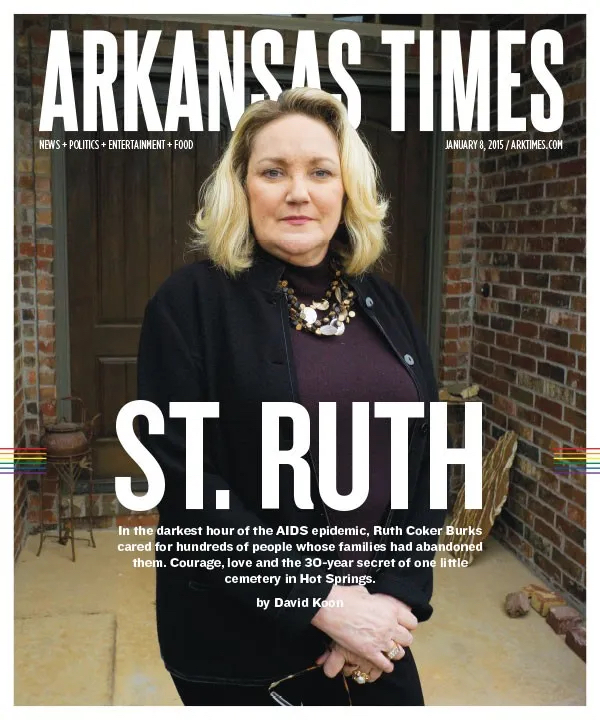
Ruth Coker Burks (born Frances Ruth Coker in 1959) is an Arkansas woman who was a caregiver and AIDS activist in central Arkansas from the mid-1980s to the mid-1990s during the height of the HIV/AIDS epidemic. In 1986, when Burks began her informal care work, she was a mid-twenties single mother who sold timeshare condominiums on Lake Hamilton near her hometown of Hot Springs in central Arkansas. Over the next few years, her informal end-of-life care expanded into daily care work, AIDS activism, and education. Newspaper and magazine profiles, television interviews, a popular memoir, and social media posts have documented her efforts as the ‘Arkansas Cemetery Angel’ (we will refer to Ruth Coker Burks as Ruth since this is how she is named in her memoir and in most press coverage). Laudatory media coverage also led to pointed criticisms of the limits of Ruth’s efforts and to potential flaws in her memory. Rather than evaluating the accuracy of Ruth’s account or those of her critics, this article investigates what her rich, if fragmentary, archival materials, along with her published memoir and newspaper accounts, can reveal about care work, gender, and the lived experience of the AIDS epidemic in Arkansas. More broadly, it begins to address what the publicity (and controversy) around Ruth’s life story offers the study of queer memory in southern spaces.
Ruth’s career as an AIDS caregiver and activist began with a case of mistaken maternal identity and a contested family cemetery. As described in newspaper profiles and her memoir, All the Young Men (2020), in 1986, while visiting a friend in the hospital in Little Rock, Arkansas's capital city, Ruth noticed a neglected patient, Jimmy, who was dying of complications from AIDS. When she went into Jimmy's hospital room, he mistook Ruth for his mother, who refused to visit him. After she confronted the nursing staff, who largely avoided Jimmy's room and failed to convince his mother (over the phone) to come to visit her dying son, Ruth returned to Jimmy's room. And it was as his ‘mama’ that Ruth sat by his bedside for hours, holding his hand and comforting him as he died. This moment of assumed maternal identity marked the beginning of Ruth's decade of informal care work.1Ruth Coker Burks and Kevin Carr O’Leary, All The Young Men: A Memoir of Love, AIDS, and Chosen Family in the American South (New York: Grove Press, 2020), 3–11; Michael Garofalo, “Lessons in Love,” StoryCorps, December 5, 2014, https://storycorps.org/podcast/storycorps-449-lessons-in-love/; David Koon, “Ruth Coker Burks: The Cemetery Angel,” Arkansas Times, January 8, 2015, https://arktimes.com/news/cover-stories/2015/01/08/ruth-coker-burks-the-cemetery-angel.
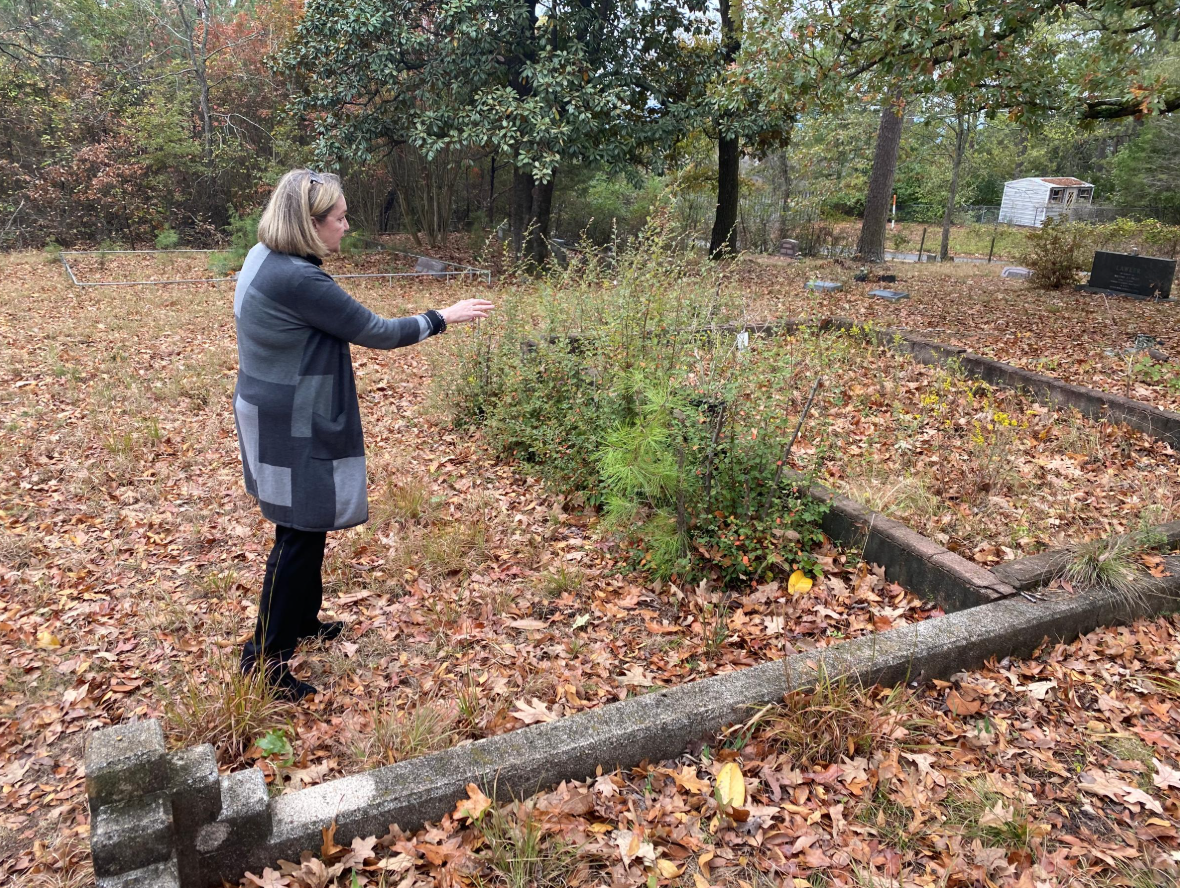
Alongside care work and public activism, Ruth provided a final resting place for some men she cared for in the Files Cemetery in Hot Springs, an hour's drive southwest of Little Rock in the Ouachita Mountains. It was for Jimmy, who had mistaken Ruth for his mother, that she turned to Files Cemetery.
From the first chapter of Ruth’s memoir, the Files Cemetery is described as a site of commemoration, refuge, and conflict.2Burks and O’Leary, All the Young Men, 11–14. In the following decades, this cemetery has become an essential site of LGBTQ+ memory in Arkansas. Layers of informal commemoration at the Files Cemetery and Ruth’s fragmentary archival record speak to the kinds of alternative archives of AIDS activism—beyond the public sphere—that Stephen Vider has examined in his discussion of community caregiving during the AIDS epidemic as part of his more extensive study of the importance of domestic spaces in LGBTQ+ politics in the United States.3Stephen Vider, The Queerness of Home: Gender, Sexuality, and the Politics of Domesticity after World War II (Chicago, IL: University of Chicago Press, 2021). As far as we know, the Files Cemetery is one of only a few cemeteries in the United States that became a documented resting place for people who died during the HIV/AIDS epidemic.4Two other documented final resting places for those who died during the HIV/AIDS epidemic are the Congressional Cemetery in Washington, DC and the Hart Island Potter's Field in New York City. The Files Cemetery operates at a much smaller and more informal scale than either of these.
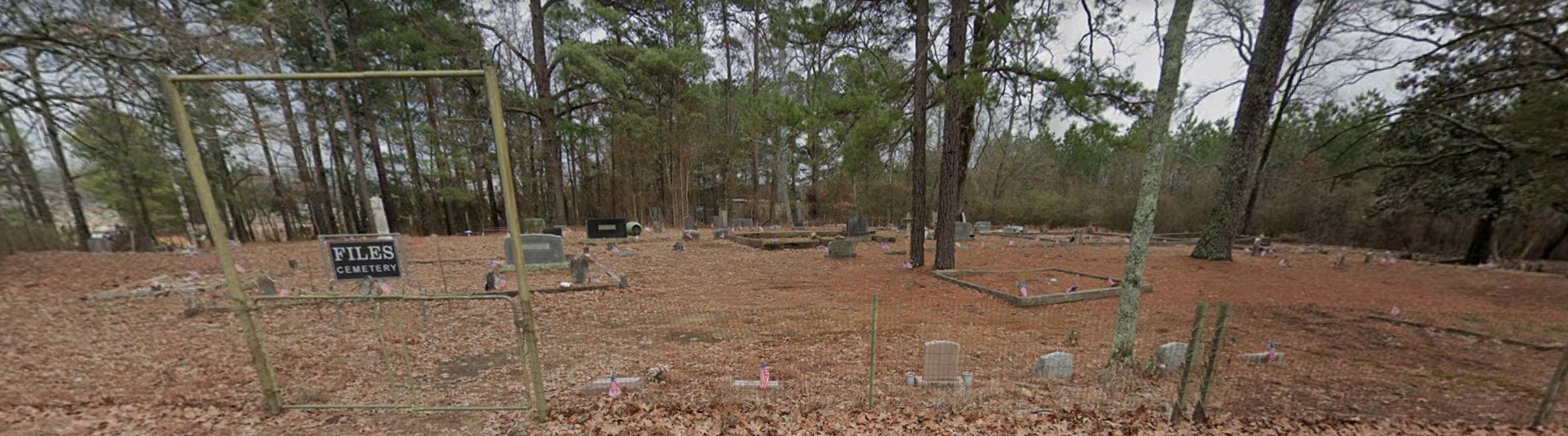
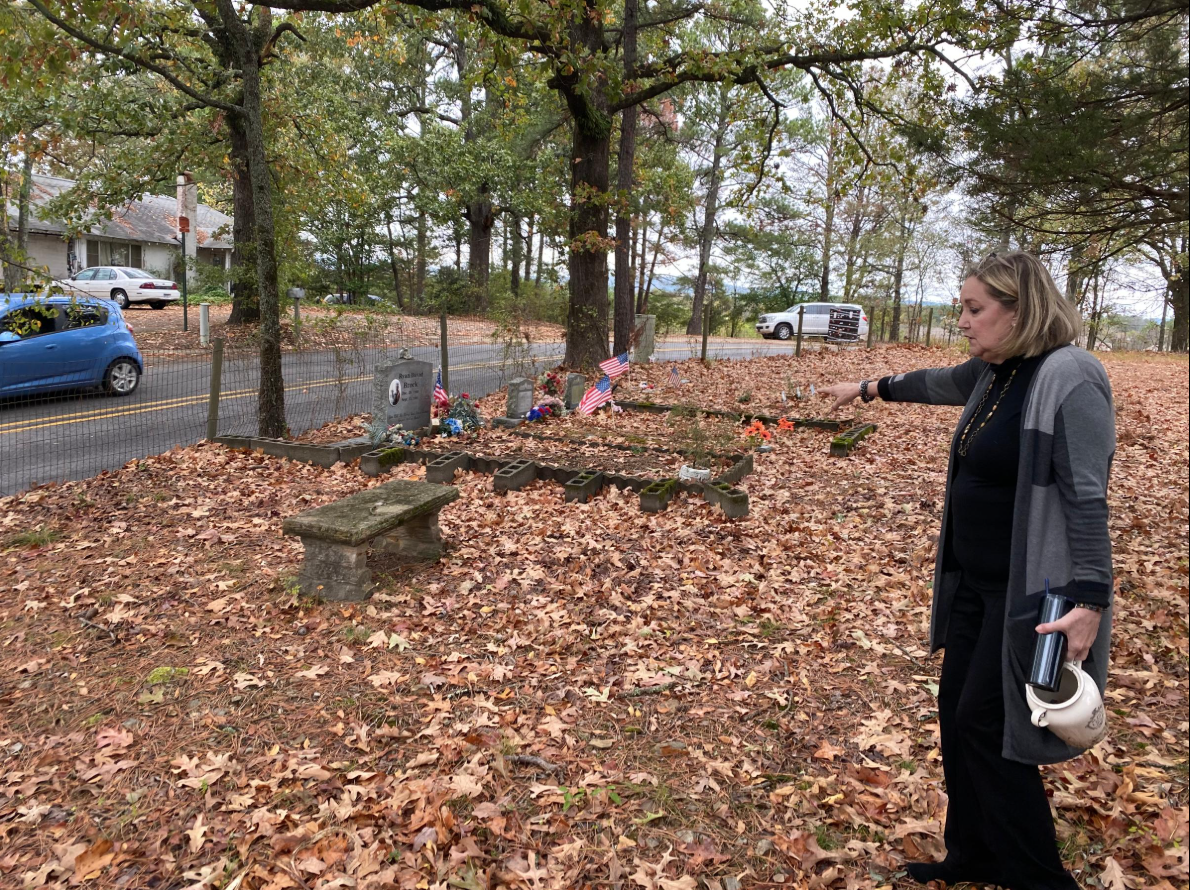
There also is scattered but evocative evidence of continuing engagement with the Files Cemetery as a space for queer memory-making. Facebook posts from March 2019 record how the drag troupe, the Arkansas Sisters of Perpetual Indulgence: The Abbey of the Hillbilly Harlots, cared for the cemetery’s grounds and planted rose bushes. A series of photographs of the Files Cemetery taken at regular intervals from spring 2020 to fall 2024, which are part of a forthcoming donation to the Center for Arkansas History and Culture, reveal earlier layers of informal commemoration (including notes, beer bottles, Mardi Gras beads, and devotional objects) near the resting places of some of the men. In 2020, a grave was added to the cemetery (of which Ruth was unaware.) Some of these later commemorative efforts at individual graves did not involve Ruth and were potentially enacted by local critics of Ruth, as evidenced by one stone that was partially funded by a critical host of a YouTube podcast.
Praise extended to the national and international levels. The first prominent news article on Ruth, which predated the Arkansas Times' profile, was a twelve-minute interview with NPR's StoryCorps in 2014. The December 7, 2020, issue of People magazine featured a glowing article, “They Call Me the AIDS Angel.”5Jason Sheeler, “They Call Me the AIDS Angel,” People, December 7, 2020. Exemplifying Ruth's newfound fame, the Guardian published an article on February 3, 2021 titled, "The Aids Angel: How Ruth Coker Burks Comforted Dying Gay Men." That same year, however, the Arkansas Times published a more critical piece by Austin Gelder about a “missing monument.” Gelder's piece centered on accusations that Burks had exaggerated some of her claims and failed to establish a much-discussed monument at the Files Cemetery in honor of those for whom she had cared.6Austin Gelder, “Ruth Coker Burks and the Missing Monument,” Arkansas Times, July 8, 2021, https://arktimes.com/arkansas-blog/2021/07/08/ruth-coker-burks-and-the-missing-monument. National press coverage trended from the laudatory to the skeptical with pointed questions about Ruth's claims about the number of men for whom she cared, the number of gravesites at the Files Cemetery, and her contested ownership of the cemetery.7Alexander Kacala, “Doubts Surround Viral Story of ‘AIDS Angel’ Who Says She Helped Hundreds of Dying Men,” NBC News, October 29, 2021, https://www.nbcnews.com/nbc-out/out-news/doubts-surround-viral-story-aids-angel-says-helped-hundreds-dying-men-rcna4163. These critiques came largely from residents of Hot Springs, some of whom knew Ruth, some of whom wanted a more thorough history of the events, some who are invested in the history and its public telling, and also those who feel that her version of events is somehow maligning the city. A YouTube podcast, RUTHLESS: The Real Story Behind the ‘Cemetery Angel of Arkansas’ is representative of this critique and is discussed in more detail below. In the wake of this praise and criticism, the Center for Arkansas History and Culture at the University of Arkansas at Little Rock has collected Ms. Burks’ archival materials in an ongoing effort to preserve LGBTQ+ history in Arkansas. The CAHC's archival work complements that of Invisible Histories—an organization who "believes archiving is resistance to oppression and history leads to liberation"—to document queer histories and spaces of memory in the southern United States.8"Invisible Histories." Accessed January 3, 2025. https://invisiblehistory.org/.
This article discusses the history of Ruth's care work and activism in central Arkansas in the broader context of scholarship on gender and care work during the HIV/AIDS epidemic. We will survey the gendered construction of care work and motherhood in Arkansas in Ruth’s memoir and archival materials. Then, we will tackle the life histories of the predominantly white and Latino working class and rural men she cared for and what her archive—with its evocative fragments and enduring silences— reveals about the lived experience of the AIDS epidemic for some people in Arkansas. We conclude with Ruth’s critics and what her story can teach about the contested memory of the AIDS epidemic. This article does not attempt to evaluate the accuracy of the claims of either Ruth or her local critics, but rather examines the possibilities and limits that her archive, and the published materials about her, open up. The historical importance of Ruth’s care work and the validity of some of the criticisms of her are not incompatible. Rather than a binary understanding, we are interested in what Ruth’s archive reveals about the history of the AIDS epidemic and the construction of the role of the idealized caregiver for some women in Arkansas.
Care Work and AIDS Activism in Arkansas
Ruth was one of many women across the United States who played leading roles in AIDS activism and care. As the ACT UP Oral History Project states, “Women were an integral part of the AIDS crisis—first, and foremost, as People with AIDS, but also as leaders of the AIDS Activist Movement, and as caregivers.”9“Women and AIDS,” ACT UP Oral History Project, digital archive, https://www.actuporalhistory.org/actions/women-aids. Ruth’s trajectory reflects what scholars have argued was the complex array of personal, political, social, and spiritual motivations behind many women’s activism during the AIDS epidemic in the United States.10See, for example, Ulrike Boehmer, The Personal and the Political: Women’s Activism in Response to the Breast Cancer and AIDS Epidemics (Albany: State University of New York Press, 2000); Angelique Harris, “Emotions, Feelings, and Social Change: Love, Anger, and Solidarity in Black Women’s AIDS Activism,” Women, Gender, and Families of Color 6, no. 2 (2018): 181–201; For a more expansive history of women’s activism in the United States, see Dawn Durante, ed., Women’s Activist Organizing in US History (Urbana: University of Illinois Press, 2022).

Ruth was a single mother who sold lakeshore timeshares in Hot Springs when she began her informal care work. Her work's flexible and commission-based practices facilitated Ruth’s initial care work. AIDS activism and end-of-life care were not how recently divorced Ruth planned to spend her twenties and early thirties. “All I want sometimes is to be a wife and be in the Junior League.”11Burks and O’Leary, All the Young Men, 74. While Ruth did not come from a well-off background, she hoped to advance in the social scene of Hot Springs. Ruth’s care work encompassed a shifting range of activities from 1986 to 1995. Initially, she focused on visiting the hospital, comforting dying men, and providing supplemental food for those still alive.12Burks and O’Leary, 62; Paula Cocozza, “The AIDS Angel: How Ruth Coker Burks Comforted Dying Gay Men,” The Guardian, February 3, 2021, https://www.theguardian.com/society/2021/feb/03/aids-angel-ruth-coker-burks-dying-gay-men. As she described at one point (she had started dumpster-diving to get adequate cooking supplies), “I could be like this little grocery-delivery person.”13Burks and O’Leary, All the Young Men, 96. Word of mouth drove her first few years of care work as anxious Little Rock and Hot Springs hospital staff contacted her. “More calls started coming. I guess the nurses and doctors all went to the same places to drink and unwind because I later found out they got to talking. ‘Oh my God, we had this insane woman come in, and she went right in the AIDS patient’s room.’ . . . I had two calls that first month, which I thought was crazy. Then three the second.”14Burks and O’Leary, 24–25.
This soon shifted to men calling her directly, either for themselves or for a friend or loved one. As Ruth notes, by 1988, this “network of calls from the hospitals and gay men giving out my number” kept her more than busy, along with caring for her young daughter and trying to make a living.15Burks and O’Leary, 54, 83. It is important not to reify the assumption that persons with HIV/AIDS were always gay men, even if that is often how Ruth discusses her experiences in central Arkansas in her memoir. Ruth’s archive and the ambiguities surrounding the Files Cemetery underline the importance of not projecting contemporary categories onto the past and respecting privacy in the telling of these histories.
From 1986 to 1989, Ruth worked quietly, and from 1989 onwards, she was much more public in attempting to raise awareness and draw local media attention to the AIDS epidemic in central Arkansas. Building on her connections to some of “the town elders” of Hot Springs, Ruth also gave talks at Rotary Clubs across Arkansas and quietly facilitated donations from well-to-do residents of Hot Springs. In her description of one of her early speeches at Rotary, “I talked about the people with AIDS in town, how they needed food and access to care, but what we mainly needed was education.”16Burks and O’Leary, All the Young Men, 125, 129–134, 184, 257. Formalizing her activism, Ruth assisted Norman Jones, who ran the Arkansas non-profit, Helping People with AIDS (HPWA.) Ruth’s work with HPWA encompassed everything from the distribution of accessible sex education materials to creative publicity efforts, including the production of humorous T-shirts with the phrase “I believe in Jesus. Do you?” transformed into “I DO. DO YOU?” about safer sex practices.17Burks and O’Leary, 270–271.
The sharply diverging reactions to Ruth in the present-day echo in her recollections of care work and AIDS activism from the mid-1980s to the mid-1990s. Ruth claims that initially, she was perceived as a prim “‘church lady’” by many of the men she cared for. However, she remembers that to most of Hot Springs, she was viewed as “this insane woman” and “that crazy Ruth Coker Burks,” who wouldn’t stop talking about AIDS and gay rights.18Ruth Coker Burks, "All Her Sons: The Cemetery Angel," interview by Seth Doane, Video, December 1, 2019, CBS Sunday Morning, https://www.cbsnews.com/news/all-her-sons-ruth-coker-burks-the-cemetery-angel/; Burks and O’Leary, All the Young Men, 24, 94, 156.


Along with public-facing activism, Ruth’s informal hospice care evolved from providing company at the bedside of dying men to helping ‘her guys’ live as long as they could by securing housing assistance, filling out death certificates, seeking social security payments, filling AZT prescriptions at often hostile local pharmacies, HIV testing, and ultimately AIDS education.19Koon, “Ruth Coker Burks: The Cemetery Angel”; Burks and O’Leary, All the Young Men, 57–58, 72, 81–83, 86–88, 112–113. Ruth regularly visited hospitals in Hot Springs and Little Rock and frequently cared for people in their homes. At times, she appears to have operated as an informal pharmacy herself, distributing leftover AIDS medication across central Arkansas.20Garofalo, “Lessons in Love”; Burks and O’Leary, All the Young Men, 173. These shifts did not mean she stopped providing personal daily attention. For example, in her time with one of the men for whom she cared, Chip, she visited daily, fed him, bathed him, and read him the newspaper.21Burks and O’Leary, All the Young Men, 234. In his study of queer public history and the home, Vider challenges the often-presumed division between political action (outside of the home) and care work (inside the home). Rather than framing the home as a space away from politics, Vider argues that the home and the care for people with AIDS in their own homes constitute an essential site for activism.22Vider, The Queerness of Home, 179–213. The contours of Ruth's care work reflect Vider's argument.
While Ruth’s individualized efforts to keep ‘her guys’ fed are distinct from the more extensive history of food justice organizing in the twentieth-century United States that Emily Twarog studies in Politics of the Pantry (2017), food was at the center of Ruth’s work, especially in the late 1980s, and her subsequent gendered construction as a caregiving angel.23Emily E. LB. Twarog, Politics of the Pantry: Housewives, Food, and Consumer Protest in Twentieth-Century America (New York: Oxford University Press, 2017). In early media profiles from 2014 and 2015, Ruth estimated that she cared for "nearly 1,000 people" and "hundreds of dying people" from the mid-1980s to the mid-1990s.24Garofalo, “Lessons in Love”; Koon, “Ruth Coker Burks: The Cemetery Angel.” As discussed below, these numbers have been contested. While it is beyond the scope of this article to fully address how Ruth’s efforts intersected with formal and informal care networks in Arkansas, there were additional organized efforts, including the important work of RAIN (Regional AIDS Interfaith Network), which was profiled in a 2016 Arkansas Times piece, among others.
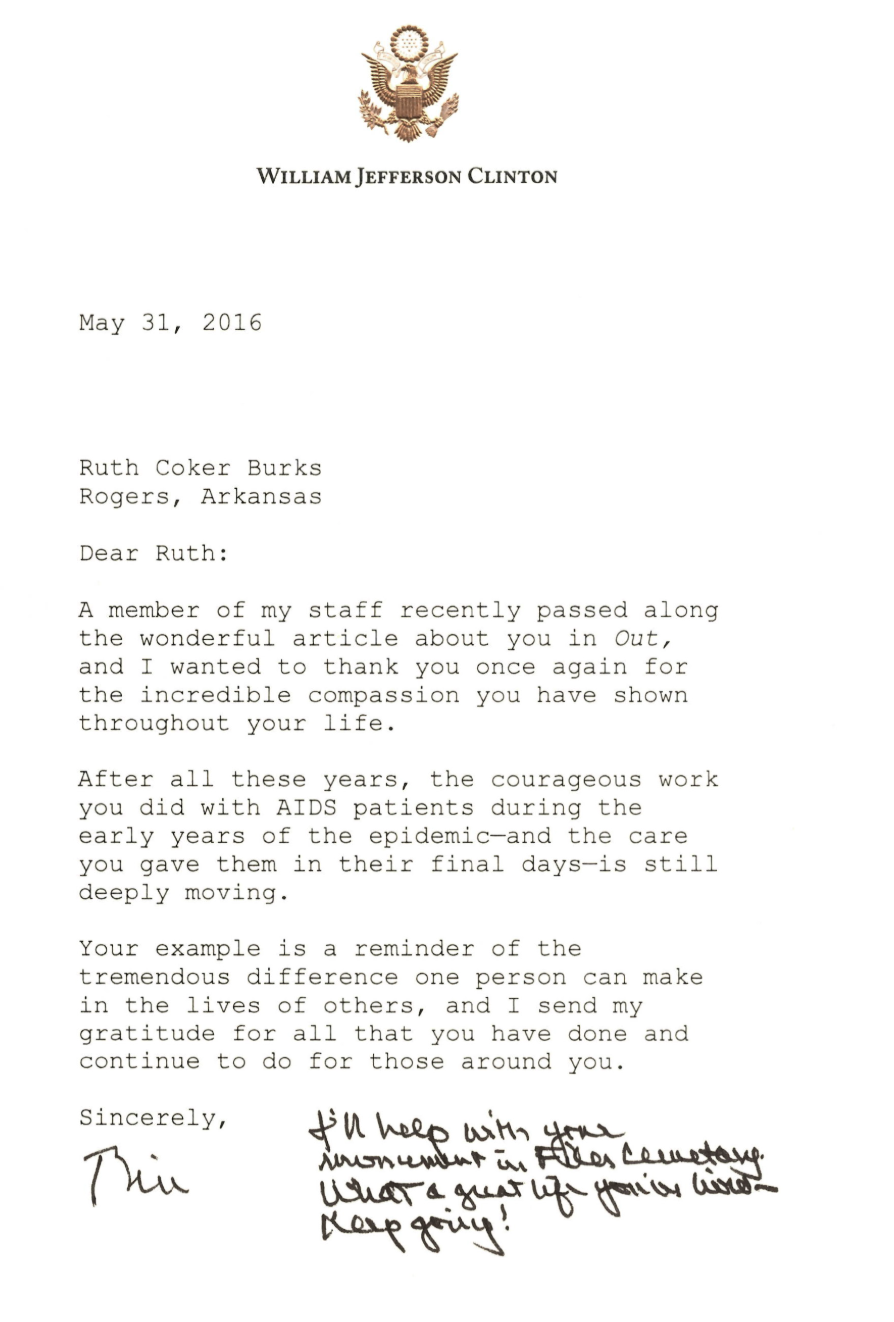
Ruth’s unprocessed archival collection at the Center for Arkansas History and Culture provides some indications of how her care work intersected with broader caregiving networks in Arkansas. Specifically, her archives include a binder of letters of recommendation and typed endorsements from prominent community members regarding Ruth’s nomination for the Arkansas Community Service Award, the establishment of an HIV/AIDS program at Levi Hospital, and the nomination of Ruth for the position of Executive Director of the Arkansas AIDS Foundation. In one letter, the assistant director of the American Psychological Association recommended Ruth for the Arkansas Community Service Award with the argument that “Ruth’s efforts in promoting the conference have remained unflagging. Most impressively, Ruth has served without remuneration, preferring that we hire two part-time local coordinators from our community of those directly affected by AIDS. As one of our local coordinators has suffered an unfortunate precipitous decline in health. Ruth has generously stepped forward to assume his responsibilities while insisting that he still receive the full salary offered for the position.” A local attorney wrote in a separate letter of recommendation, “I would like to recommend Ruth Burks as the person to get this program started. Ruth has demonstrated her commitment to the care of those who are HIV positive and we are fortunate to have someone already in the community who is prepared to immediately take on such a responsibility.”25These recommendation letters are part of Ruth's collection donated to and being processed by the Center for Arkansas History and Culture. Box 6, Folder 20, Ruth Coker Burks papers, Center for Arkansas History and Culture, Little Rock, Arkansas.
Ruth's memoirs and archives only get us so far in researching the experience of AIDS in Arkansas and of women activists during the AIDS epidemic. Ruth remembers primarily, but not exclusively, caring for white and Latinx men. Her life story and archival materials tell us little about the impact of HIV/AIDS on Black communities in Arkansas (15.5% of the Hot Springs population in 1990) or the work of Black women in AIDS activism both at the state and national levels. Recent scholarship has drawn attention to the central role of Black women to AIDS activism and care work in the United States. In her influential study of Black women activists, Angelique Harris argues for the importance of the intersecting emotions of love, compassion, community solidarity, anger, and frustration in AIDS activism and care work.26Harris, “Emotions, Feelings, and Social Change,” 181–183, 186–188, 191–195.
While this article centers upon Ruth’s life and her account of primarily caring for white and Latinx men, it is critical to acknowledge how racial disparities in healthcare profoundly shaped the history of HIV/ AIDS. Unfortunately Ruth’s archive does not tell us much about the impact of the AIDS epidemic on Black people in Arkansas. However, our study of Ruth’s memoir and archival fragments builds on Cherisse Jones-Branch and Gary Edwards’ compelling model of biographical essays in Arkansas Women: Their Lives and Times (2018) and Jayme Stone’s 2010 study of Black women as activist mothers in the Arkansas Delta.27Cherisse Jones-Branch and Gary T. Edwards, eds., Arkansas Women: Their Lives and Times, Southern Women: Their Lives and Times (Athens: University of Georgia Press, 2018); Jayme Millsap Stone, “‘They Were Her Daughters:’ Women and Grassroots Organizing for Social Justice in the Arkansas Delta, 1870–1970” (Memphis, TN, University of Memphis, 2010), https://digitalcommons.memphis.edu/cgi/viewcontent.cgi?article=1238&context=etd. Our examination of the richness and limits of Ruth’s archive expands on these authors’ approach of using various sources to demonstrate women's diverse and multifaceted historical roles.
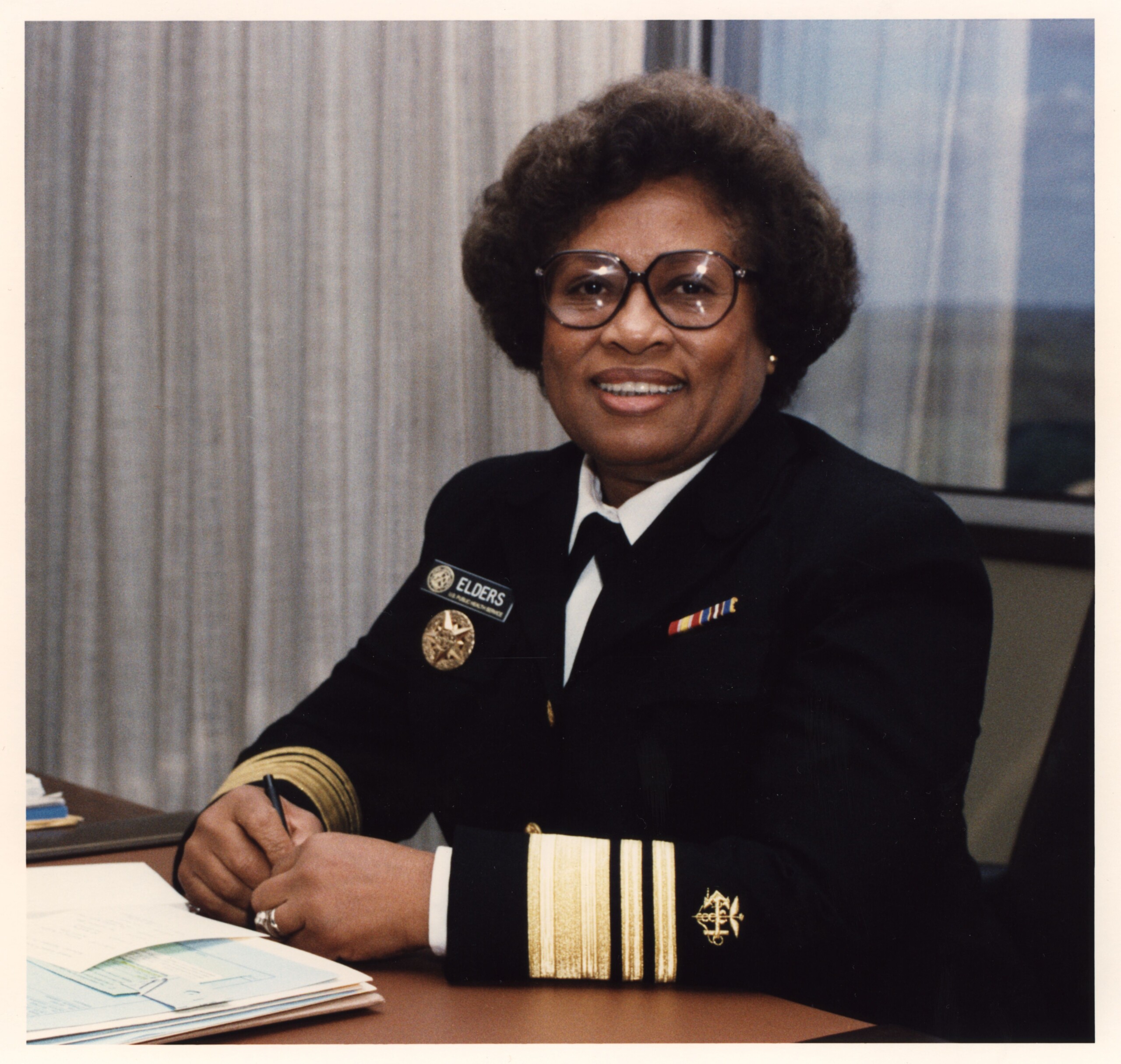
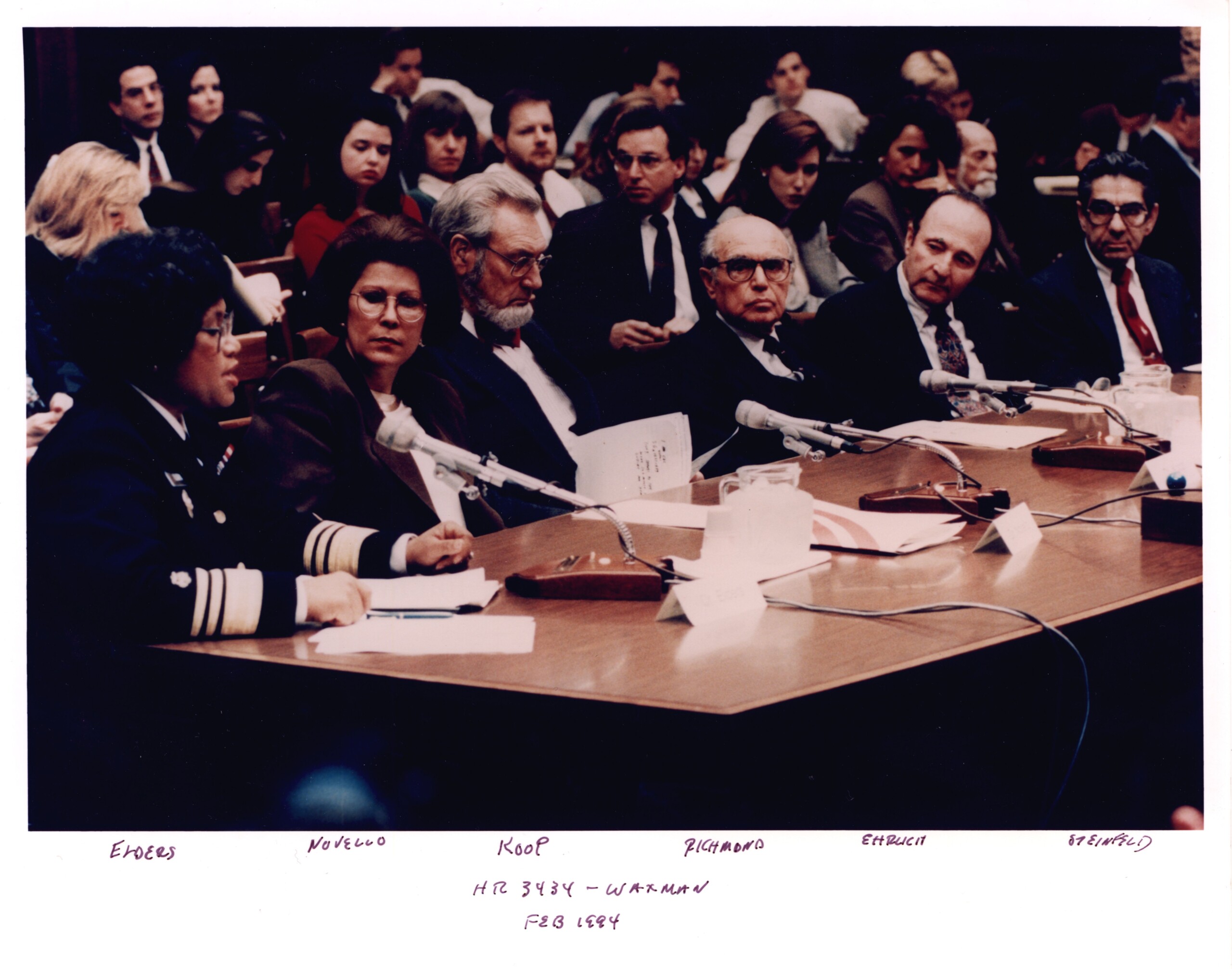
If contested understandings and expectations of gender run through Ruth’s memoir and archives, and the discrimination experienced by many of the men she cared for, Arkansas’s enduring racial divisions implicitly shaped her narrative and its silences. In the words of Catherine Fosl and Daniel Vivian, “the same race, gender, and class divides that mark US society are evident within LGBTQ communities, making histories of queer people of color, women, and trans people more difficult to access, especially by those who do not identify as such.”28Catherine Fosl and Daniel Vivian, “Investigating Kentucky’s LBGTQ Heritage: Subaltern Stories from the Bluegrass State,” The Public Historian 41, no. 2 (2019): 221. Ongoing archival projects in Arkansas are beginning to address these histories. The Historical Research Center at the UAMS Library has collected and preserved the papers of Dr. Joycelyn Elders, Director of the Arkansas Department of Health (1987–1993) and Surgeon General of the United States (1993–1994), who played an important role in the AIDS epidemic both in Arkansas and nationally.
To understand Ruth’s story—and what her archives and cemetery mean for queer memory in the southern United States—we must address how Ruth embraced and struggled against an ideal of “southern femininity” in the 1980s and early 1990s. Ruth’s memoir is a record of the constricted gender expectations imposed on her and her strategic use of her identity to help the men for whom she cared. In her 1991 essay, Frances Ross provides a formative background on changing notions of femininity and how women addressed social problems in turn-of-the-twentieth-century Arkansas.29Frances Mitchell Ross, "The New Woman as Club Woman and Social Activist in Turn of the Century Arkansas," The Arkansas Historical Quarterly 50, no. 4 (1991): 317–351. These norms remained decades later, as Anna Zajicek, Allyn Lord, and Lori Holyfield argue in their article on the women’s movement in northwest Arkansas: “To become activists in the civil rights movement, these women had to challenge the ideals of southern femininity and create a new sense of self.”30Anna M. Zajicek, Allyn Lord, and Lori Holyfield, “The Emergence and First Years of a Grassroots Women’s Movement in Northwest Arkansas, 1970-1980,” The Arkansas Historical Quarterly 62, no. 2 (2003): 155. Ruth also grappled with ideals of femininity while embracing the gendered role of caregiver.
In her memoirs and archival notes, Ruth does not directly discuss feminist politics in Arkansas. However, her complex experiences as a caregiver and activist contribute to what Janet Allured referred to as alternative “wellsprings” of “southern change-seekers” in her study of second-wave feminism in Louisiana.31Janet Allured, Remapping Second-Wave Feminism: The Long Women’s Rights Movement in Louisiana, 1950–1997 (Athens: University of Georgia Press, 2016), 49. Moreover, when we examine Ruth’s experiences, it is vital to consider the historical context of Arkansas in the mid-1980s, a little over a decade after the intense political backlash against the proposed Equal Rights Amendment. As Janine Parry argues, “the Equal Rights Amendment in Arkansas had swiftly moved from being perceived by many observers as ‘virtually assured’ of ratification in January of 1973 to being openly reviled at the next legislative session.”32Janine A. Parry, “‘What Women Wanted’: Arkansas Women’s Commissions and the ERA,” The Arkansas Historical Quarterly 59, no. 3 (2000): 283. While distinct from Ruth's story, these conflicting political currents indirectly shaped her activism and experiences.
Constructing Care Work and Motherhood in Arkansas
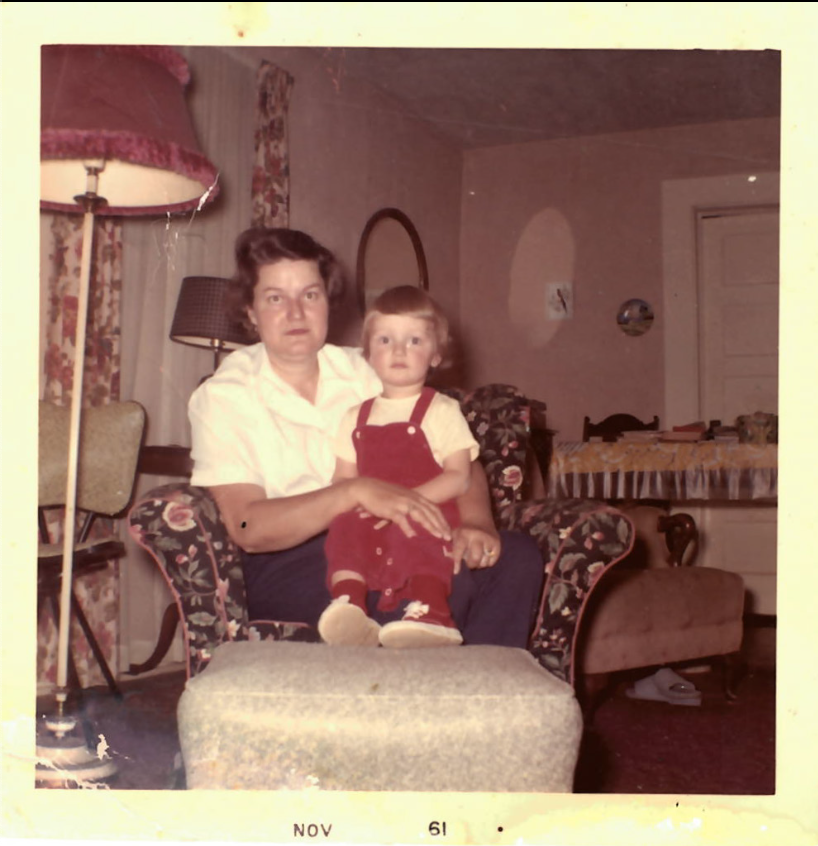
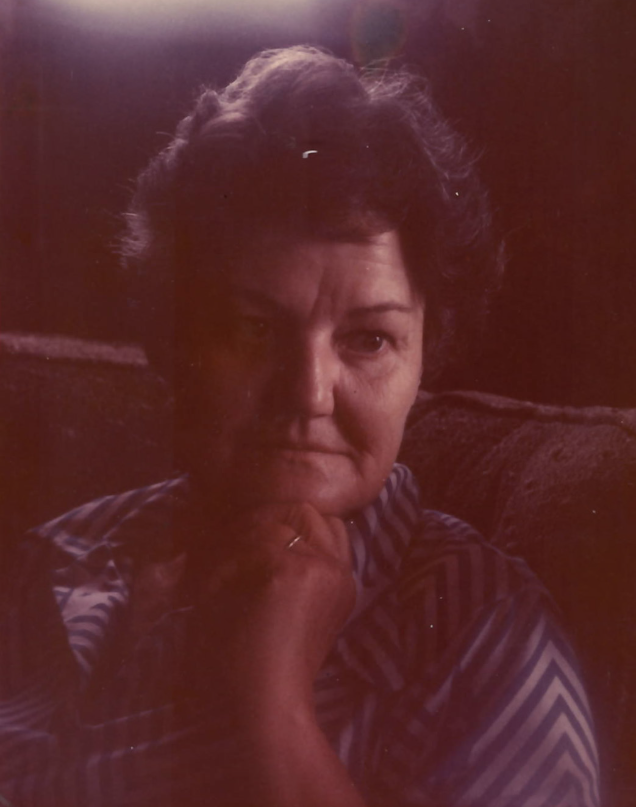
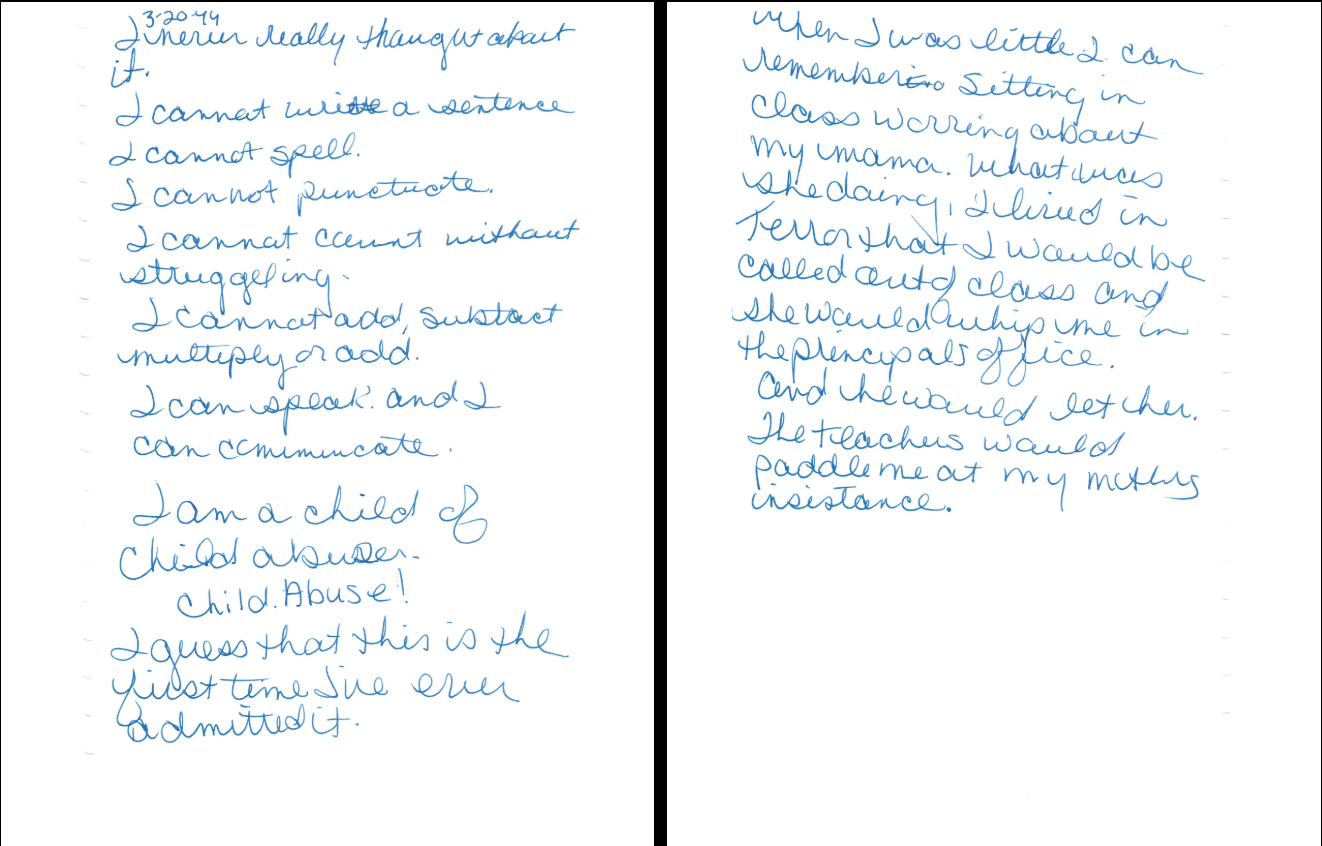
Ruth’s written and archival ephemera record the gendered expectations of care and motherhood often imposed on women in late twentieth-century Arkansas. Her autobiography contains a steady commentary on the contested meaning of motherhood in her life and care work. The figures of abusive mothers, absent mothers, and idealized alternative mothers run throughout the book. Ruth’s deeply damaging mother and her own constant worries that she might cause her young daughter harm through her AIDS work are recurring themes.33Burks and O’Leary, All the Young Men, 100–102. Ruth’s memoir and archives contain glimpses of the range of substitute mothers these dying men sought, including Ruth, the Virgin Mary, and even Dolly Parton.
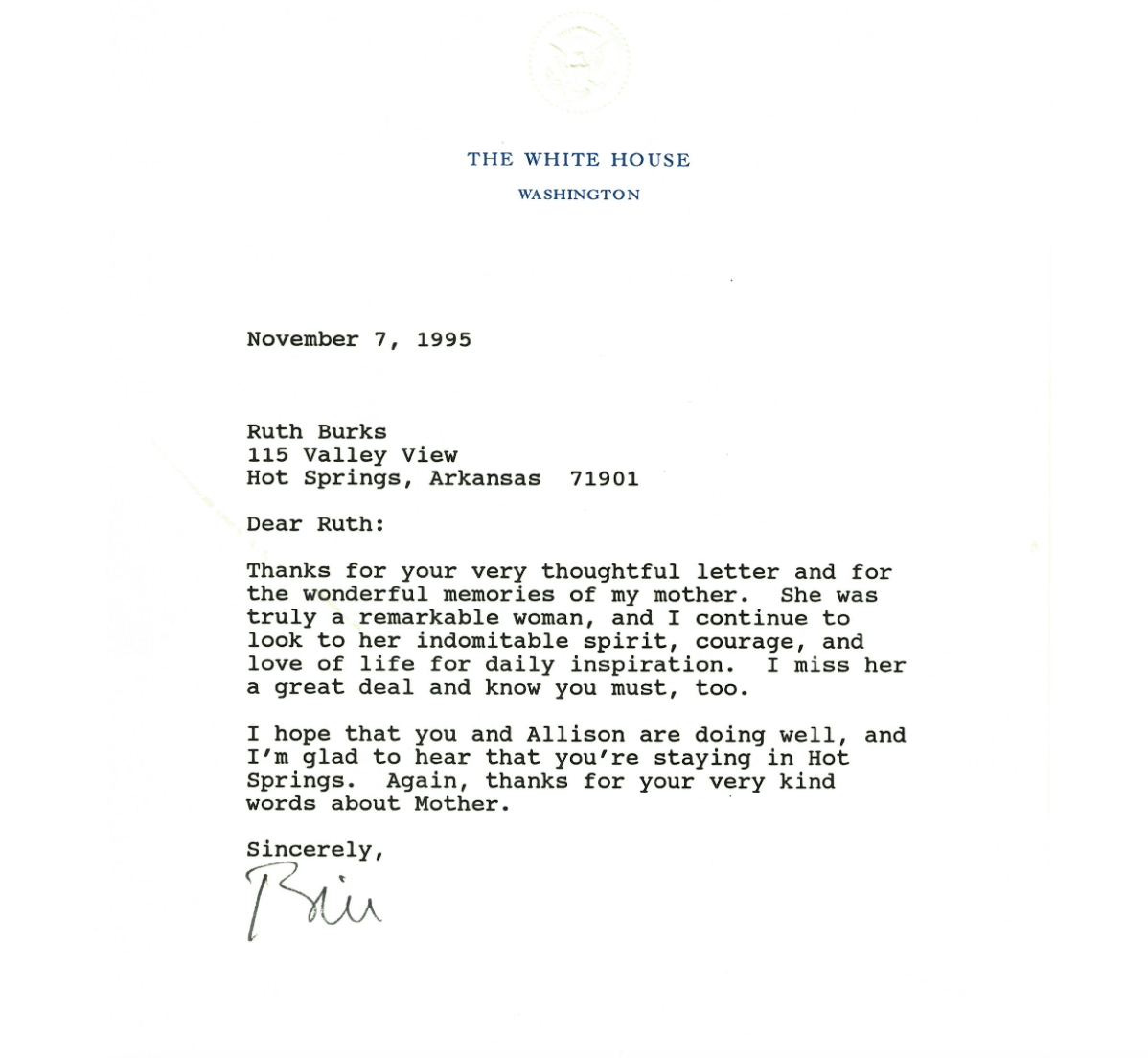
As mentioned, Ruth's career as an informal caregiver in the mid-1980s began with a case of mistaken maternal identity. With only a few exceptions, the men's families for whom Ruth provided care rejected their sick and dying sons.34Garofalo, “Lessons in Love.” “So many arrived [back in Arkansas] thinking Mama would take them back. Sometimes I would go to their homes with them, mostly just to save me a trip of driving back out there when she wouldn’t.”35Burks and O’Leary, All the Young Men, 55.
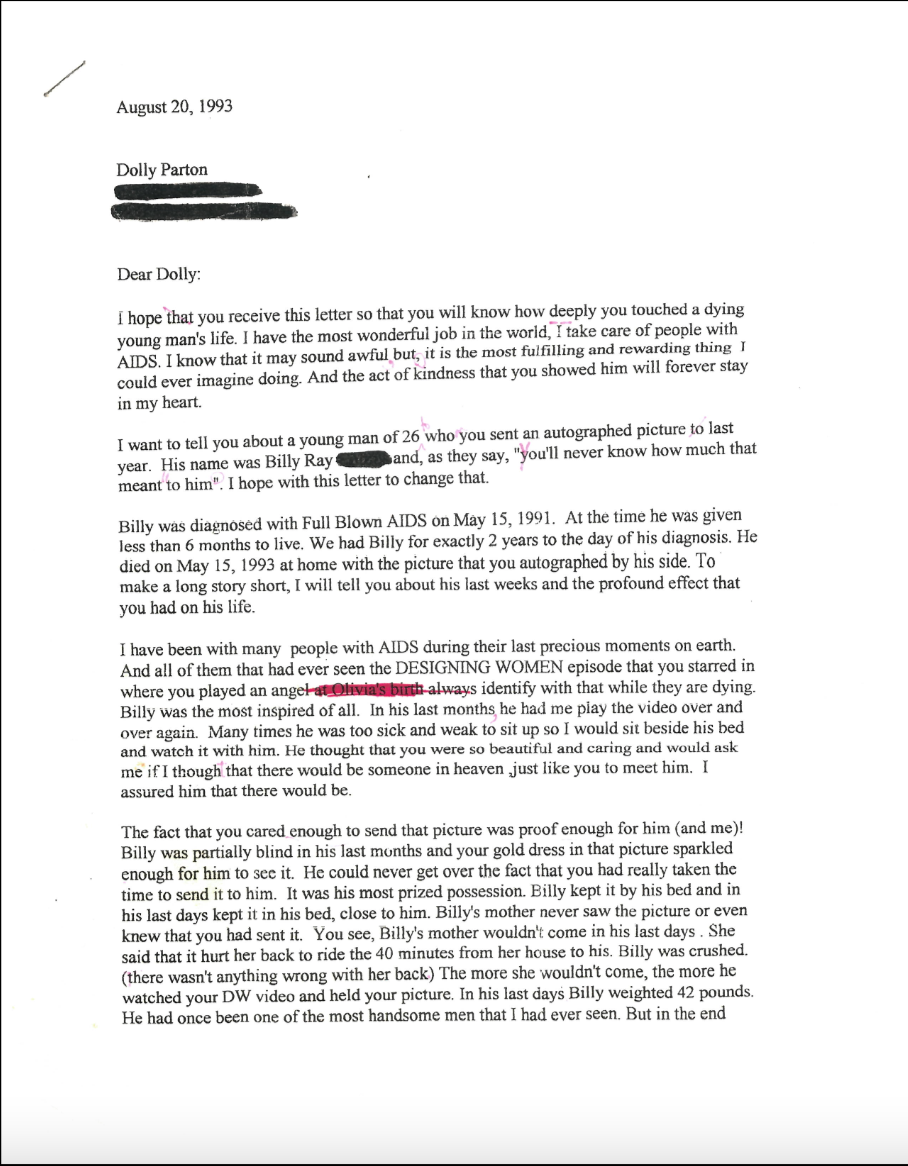
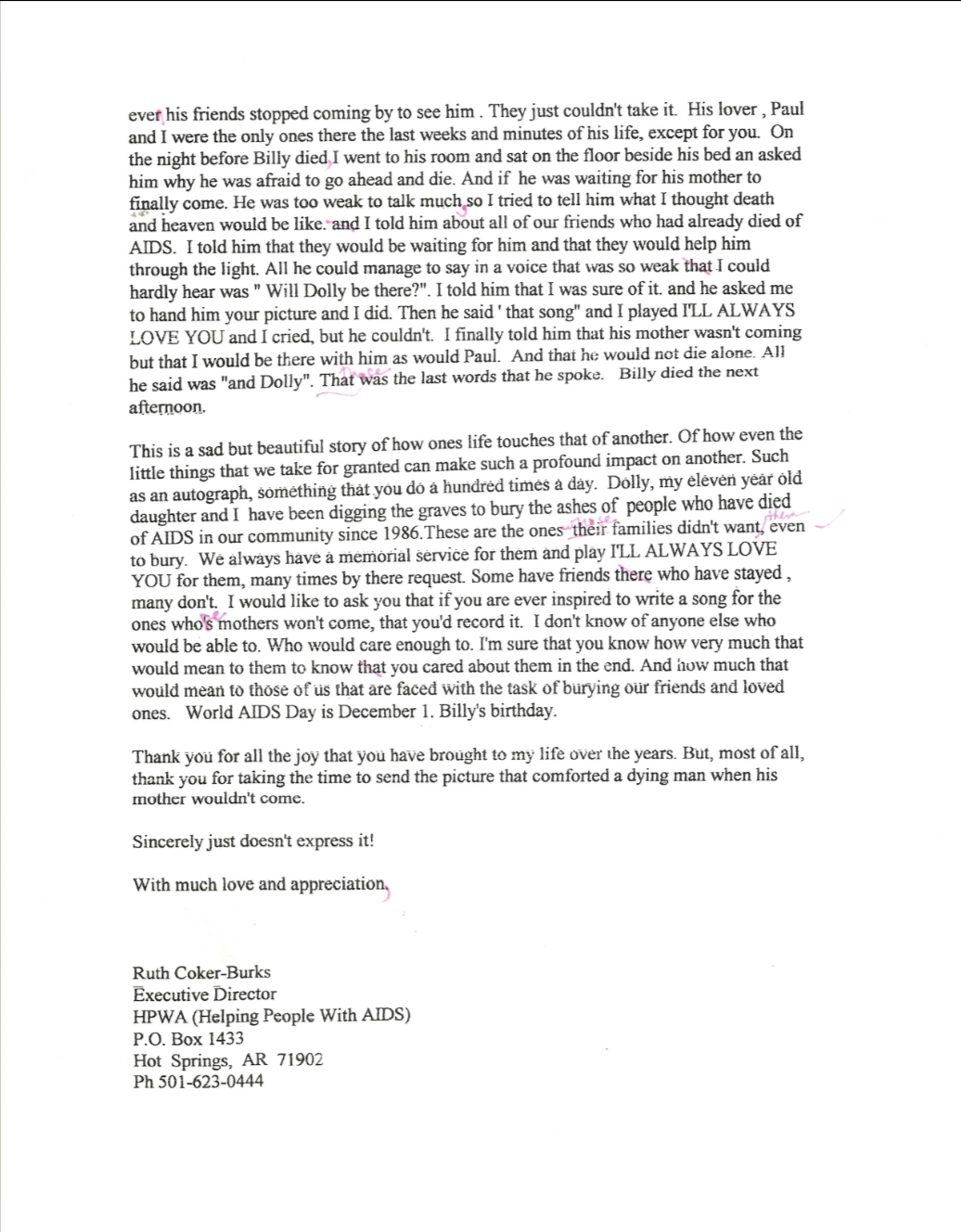
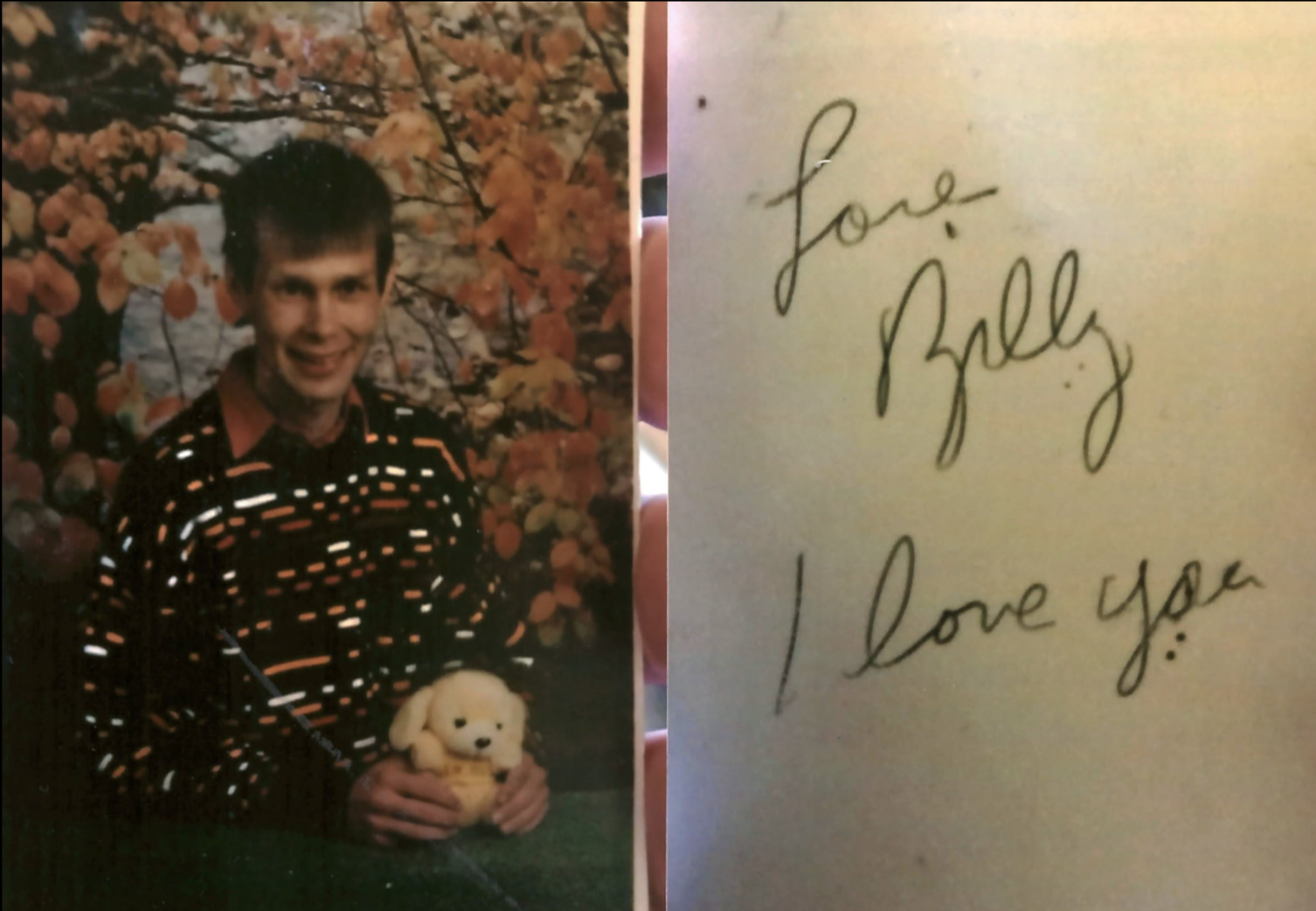
Alongside this parade of neglectful parents, another narrative of idealized mother figures runs through Ruth’s life history and archives. A letter she wrote to Dolly Parton on August 20, 1993, on behalf of Billy Ray Collins soon after he died, fashioned the beloved country music singer as a substitute maternal figure for the dead man. Ruth wrote the letter thanking Dolly for a picture that she had sent to Billy, a devoted fan. “Billy’s mother never saw the picture or even knew that you had sent it,” the letter begins “You see, Billy’s mother wouldn’t come in his last days. . . . Billy was crushed.” Ruth's letter underlined a profound sense of loneliness: “But in the end, even his friends stopped coming by to see him. They just couldn’t take it. His lover, Paul, and I were the only ones there in the last weeks and minutes of his life, except for you.” Ultimately, Ruth had to tell the dying Billy that his mother would not visit him. “I finally told him that his mother wasn’t coming but that I would be there with him as would Paul. And that he would not die alone. All he said was ‘and Dolly’.” In Ruth’s memory of Billy’s final days, recorded in a letter to Parton, a photograph of the singer was transformed into an icon standing in for Billy’s absent mother.36See, Box 6, Folder 16, Ruth Coker Burks papers, Center for Arkansas History and Culture, Little Rock, Arkansas. Billy was certainly not the only one of Ruth’s guys to reach out for their mothers and be denied at the end of their lives. This is a recurring theme in Ruth’s memoir.
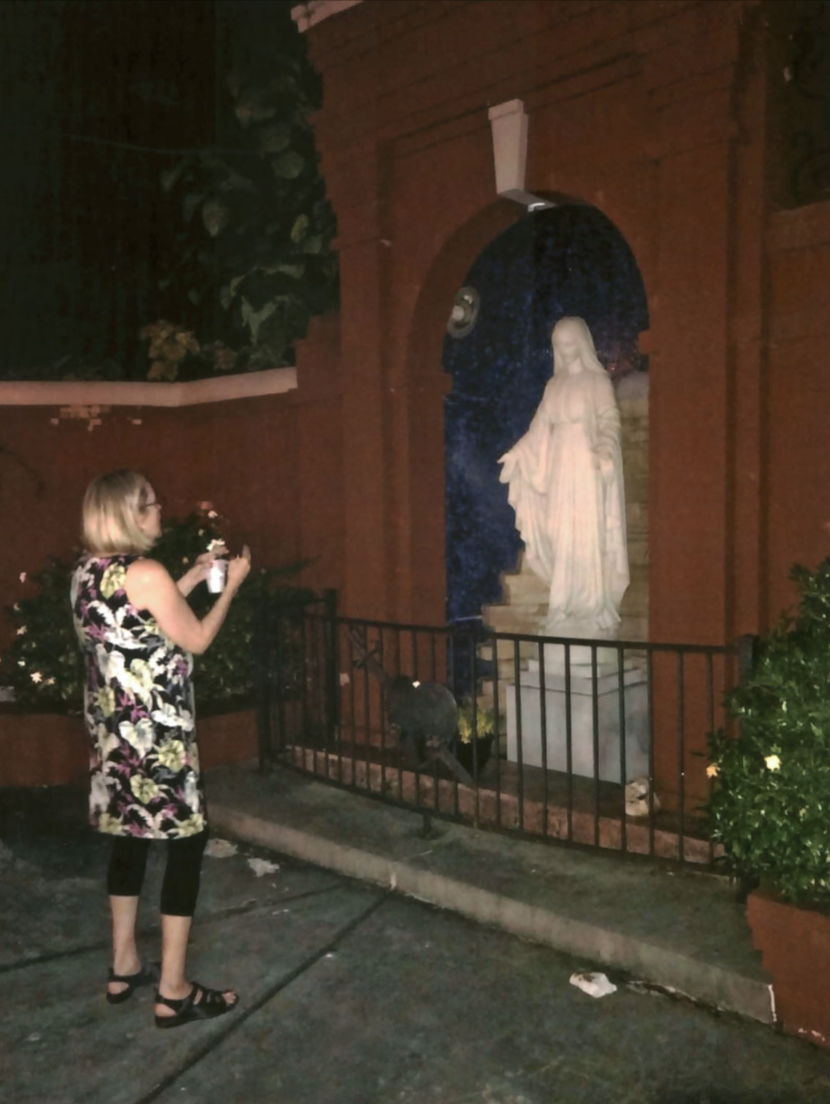
This search for an alternative maternal figure is perhaps best exemplified by Ruth’s visits with the men she cared for to that most idealized, and unrealizable, of mothers: the Virgin Mary. They often visited a small grotto at St. Mary of the Springs Catholic Church in Hot Springs. “There’s a statue of the Virgin Mary there,” writes Ruth, “in a red-brick shrine, hidden from the street. She’s on a pedestal, so she looks down on you, but there’s kindness in the stone of her eyes. . . . Whatever their religion, or lack thereof, my guys often like to visit her . . . sit on the brick and talk to her.”37Burks and O’Leary, 232.
All the Young Men
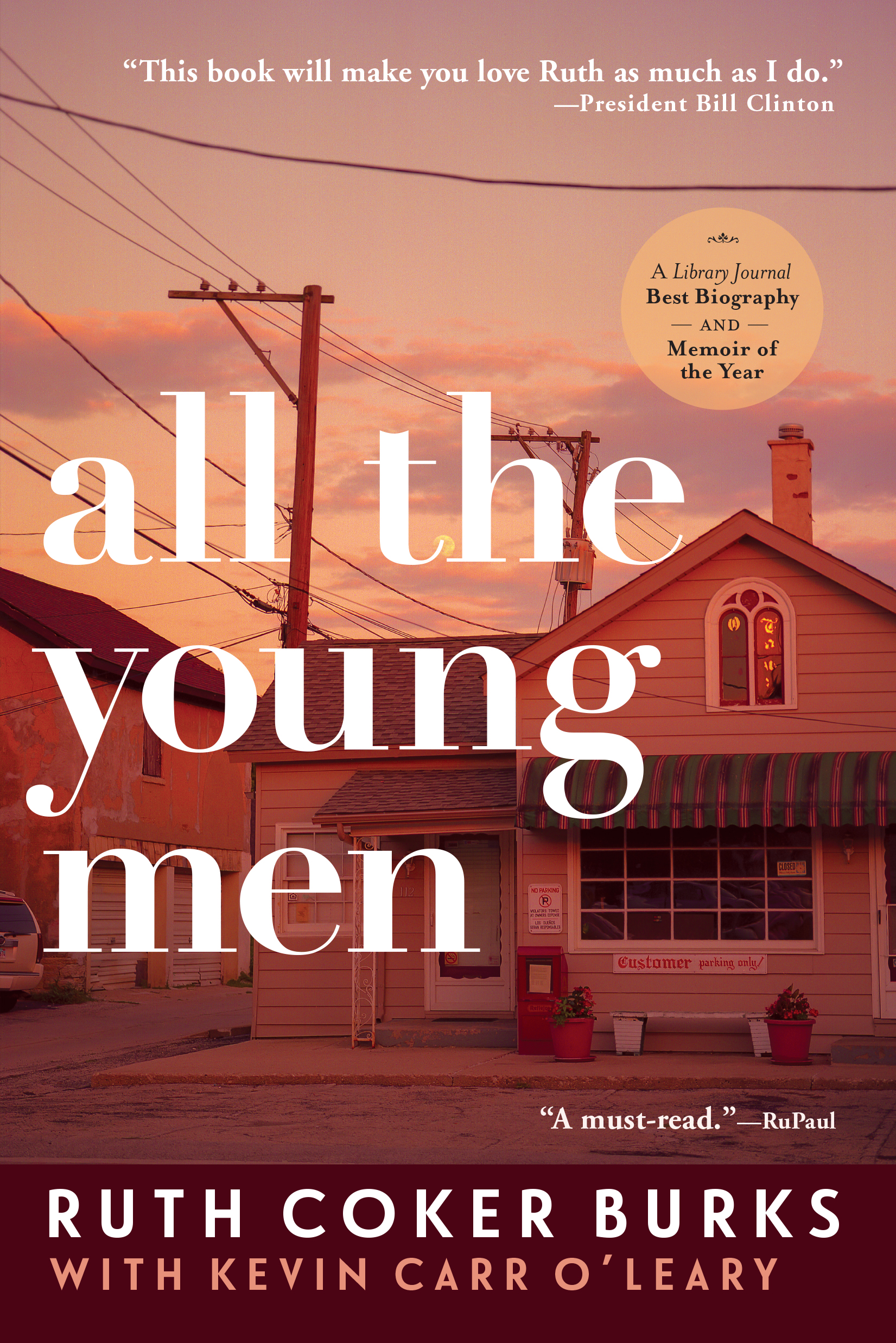
At the heart of Ruth’s memoir, and of recent criticisms of her memory, are the men, including Chip and Billy, who she cared for and those she later buried, such as Jimmy, in the Files Cemetery. Who were the titular ‘young men’ of Ruth’s autobiography, or as some of her critics lament, the lost ‘forty names’ of the Files Cemetery?38Gelder, “Ruth Coker Burks and the Missing Monument.”
Based on Ruth’s account, she cared for hundreds of men dealing with HIV/AIDS in central Arkansas from 1986 to 1995.39Garofalo, “Lessons in Love”; Koon, “Ruth Coker Burks: The Cemetery Angel”; Burks, "All Her Sons: The Cemetery Angel.” The ashes of a small number of them are interred in the Files Cemetery. These men had returned to Arkansas in search of care after living in New York or Washington, DC, or when they had left more rural parts of the state for Hot Springs or Little Rock. In Ruth’s telling, many of these young men only reluctantly returned to Arkansas for care that their families denied them.40Burks and O’Leary, All the Young Men, 30–31, 76–77. “My guy who made it all the way to DC,” wrote Ruth upon visiting Chip’s grave, “only to end up in the place he’d escaped from.”41Burks and O’Leary, 343.
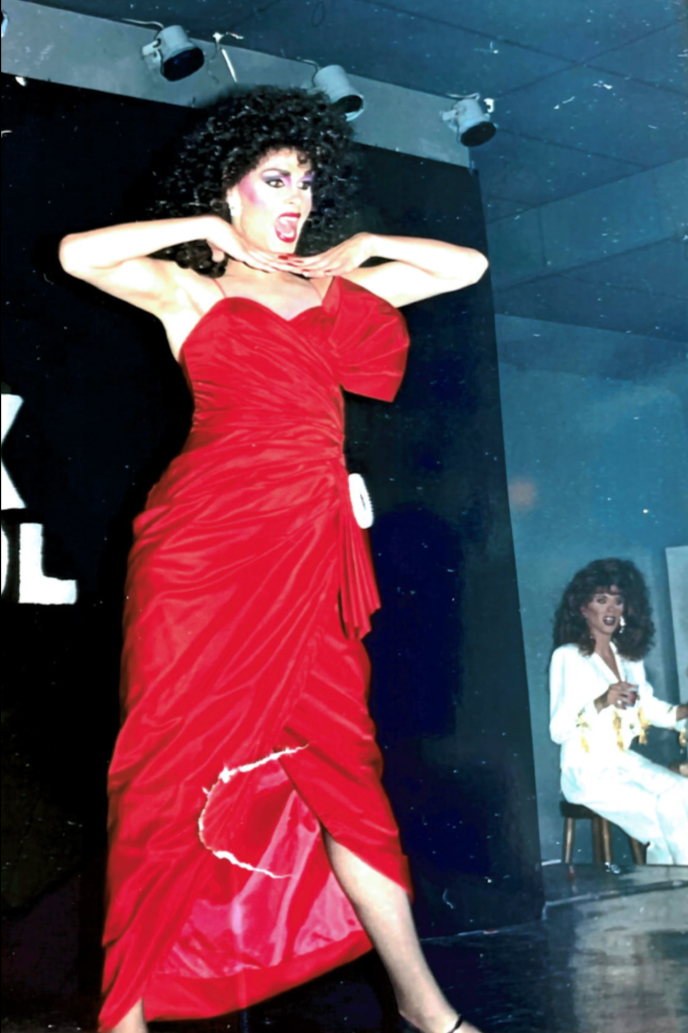
She cared for primarily working-class (sometimes indigent) young white and Latino men. Specifically, Ruth’s memoir, archives, and interviews record her work with numerous white country boys from the hills of Arkansas, Mexican immigrants in Hot Springs, and working-class drag queens. Many came from Mount Ida, Dardanelle, and other rural towns in central Arkansas.42Burks and O’Leary, 148–149, 165–167. Exemplifying this, Ruth’s beloved Billy, a luminescent drag queen, was “the movie star from Dardanelle.”43Burks and O’Leary, 166. Her guys included everyone from Jim, her first patient; to Tim Gentry, “a hillbilly dandy”; to Roger, whose family tried to wash away his sins in a creek baptism; and to the aforementioned Billy, the charismatic drag queen from Dardanelle who prominently featured in many newspaper profiles of Ruth and her book.44Koon, “Ruth Coker Burks: The Cemetery Angel”; Matthew Kincanon, “Ruth Coker Burks Describes Her Lifetime Caring for AIDS Patients to the Gonzaga Community,” The Gonzaga Bulletin, March 1, 2017, https://www.gonzagabulletin.com/news/ruth-coker-burks-describes-her-lifetime-caring-for-aids-patients-to-the-gonzaga-community/article_0e5de906-fdeb-11e6-b294-d72df02858f2.html; Burks and O’Leary, All the Young Men, 70. They also included men from Mexico who worked in tree planting or at the Hot Springs racetrack Oaklawn Park, including Angel Mestizo, whom Ruth recounts assisting as he simultaneously sought medical care and to avoid deportation.45Burks and O’Leary, All the Young Men, 274–277. The marginalized status of many of these men led them to Ruth, who, as she frequently reminds her readers and interviewers, lacked any formal medical training. As Paul Wineland, Billy's former partner, notes in the 2014 StoryCorps interview, "You were the only person that we could call. There wasn’t a doctor. There wasn’t a nurse. There wasn’t anyone. It was just you."46Garofalo, “Lessons in Love.”
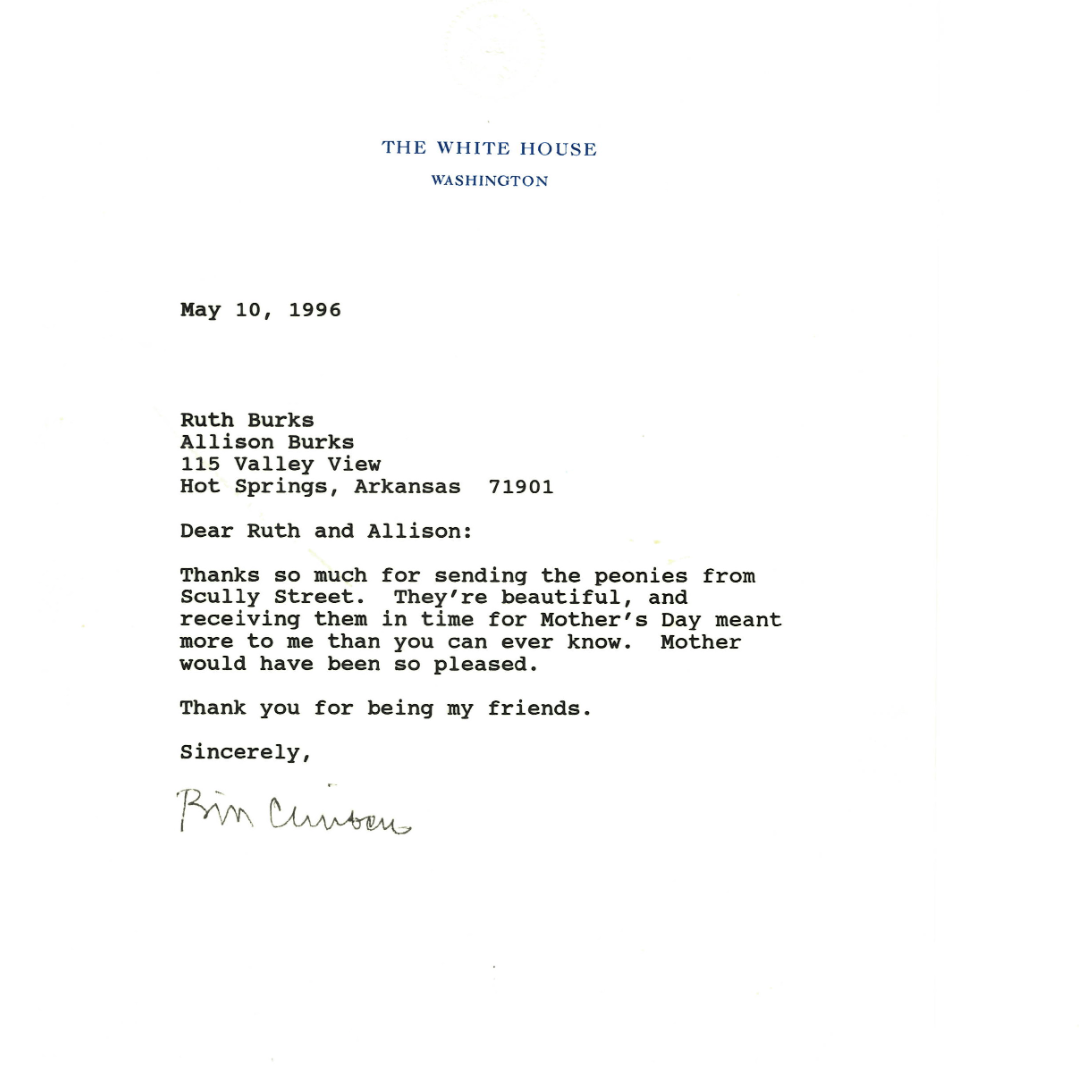
Occasionally, Ruth did comment on the class divisions. She provided concise descriptions in her efforts to keep her childhood friend, Arkansas Governor Bill Clinton, informed about the AIDS epidemic: “But I knew he didn’t know the gay men I saw—the poor, the rejected, the ones with nobody to care for them.”47Burks and O’Leary, All the Young Men, 92. In discussing a professional ballet dancer whose partner came home to die in Arkansas, Ruth described “this ballet dancer who seemed so out of place and of a different class than the Hot Springs guys.” Ruth remembers the drag queens she saw at Our House in Hot Springs as goddesses who transformed the city. “The performers came and went . . . It was like Dynasty, but that was absurd because we were in Arkansas, which meant these people didn’t have the means to have a fabulous life. But there they were in fabulous gowns. . . . They were goddesses. The idea that I could breeze by someone like this in Hot Springs.”48Burks and O’Leary, 161, 267.
Not all of the men lacked political or social connections. Chip exemplifies this. While he was from Glenwood, which Ruth described as “one county over from Hot Springs and about forty years behind,” Chip had enjoyed a rising career working for the Democratic Party in Washington, DC. Chip lived with Ruth and her daughter for a few weeks, and she cared for him as he died.49Burks and O’Leary, 230, 233–235. This simultaneous intensity and brevity helps explain some of the gaps in her detailed knowledge of these men: “I felt at home, yet still at a distance from what these men were going through.”50Burks and O’Leary, 53. Ruth often provided daily care for weeks or months before their families sometimes stepped in for their last few days of life.51Burks and O’Leary, 260–266.
While Arkansas was the site of flight and reluctant return in Ruth’s memoir, Hot Springs served as a refuge for many rural gay men. At the gay bar Our House, “almost all the regulars had left their hometowns to create their own lives here in Hot Springs.”52Burks and O’Leary, 5, 37, 166. For a fuller queer history of Arkansas, see Brock Thompson, The Un-Natural State: Arkansas and the Queer South (Fayetteville: University of Arkansas Press, 2010).

If Hot Springs was a refuge, the Files Cemetery emerged as a site for queer memory. Flagging the commemorative importance of this small cemetery, Ruth says “I wanted them to be counted, to have their lives matter, and I wanted them to have control over their destinies, no matter how limited they might seem to others. If I felt they were strong enough, I brought them to Files Cemetery and asked them to tell me where they’d like to be buried.”53Burks and O’Leary, 58.
A significant challenge of working with Ruth's archives and autobiography is the enduring ambiguities surrounding the number of cremations interred in the Files Cemetery either by her from the mid-1980s to the mid-1990s, or in the following years as the cemetery became informally associated with LGBTQ+ memory in Arkansas. Estimates of the number of men whose ashes Ruth interred range from five to approximately forty. In her early interview with StoryCorps, Ruth stated, "I’ve buried over forty people in my family’s cemetery because their families didn’t want them."54Garofalo, “Lessons in Love.” As one longtime resident of Hot Springs, Tim Looper, notes, there are five identifiable graves of men who died during the HIV/AIDS epidemic, and he remembers explicitly going to six funerals there.55Kacala, “Doubts Surround Viral Story of ‘AIDS Angel’ Who Says She Helped Hundreds of Dying Men.” Ruth has long maintained that dozens of other cremations have been interred at Files; she mentions fifteen names in her memoir. She insists that given the passage of time and her health problems, she does not remember the names of all the men she cared for.56Koon, “Ruth Coker Burks: The Cemetery Angel”; Kacala, “Doubts Surround Viral Story of ‘AIDS Angel’ Who Says She Helped Hundreds of Dying Men.” Moreover, she claims that initially in the 1980s, she concealed what she was doing in the Files Cemetery so that those who would have opposed burying abandoned people associated with AIDS there would not find out.57Burks and O’Leary, All the Young Men, 27–28. Further complicating the matter, Ruth claims that she started to receive anonymous ashes in the mail once she was interviewed about HIV/AIDS in local news outlets, and she proceeded to inter these ashes as well.58Burks and O’Leary, 133–136. Finally, the ashes of people Ruth did not know personally have also been interred at Files, as it became a potent space of LGBTQ+ memory. During an August 2020 visit to the cemetery, Ruth noticed a recently added memorial to a queer-identifying young man whom she had never met.
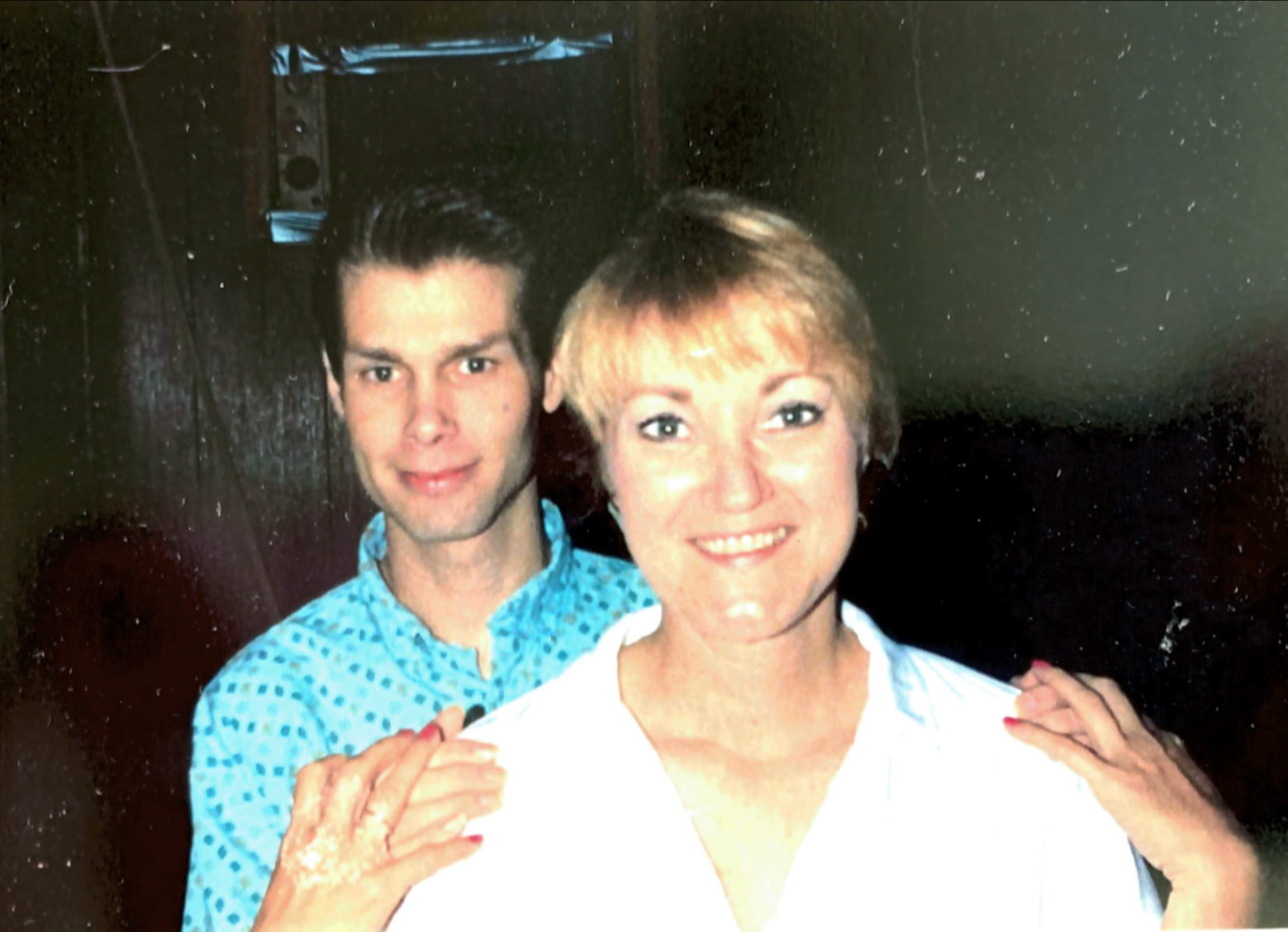
Ambiguity, anonymity, and informality have been central elements of Ruth's work from the beginning. In response to praise during her StoryCorps interview, Ruth said, "You know, they always say 'fake it ‘til you make it,' and I faked my way through the whole thing. I didn’t know what I was doing. I didn’t know anything."59Garofalo, “Lessons in Love.” Respecting the anonymity of many men is central to Ruth's understanding. "I'd go to an apartment to bring food, and another man would be there,” she writes. "There were people I recognized, though I pretended not to know anything about them."60Burks and O’Leary, All the Young Men, 97–98. Ruth's publisher noted in 2021, "Many of the men Ruth helped and eventually buried approached her asking for anonymity due to not wanting to be outed."61Kacala, “Doubts Surround Viral Story of ‘AIDS Angel’ Who Says She Helped Hundreds of Dying Men.”
The cemetery is a throughline in Ruth's memoirs and interviews. She returns to this commemorative geography at the end of All the Young Men as she narrates the journey from Rogers, in the northwestern corner of Arkansas, where she currently lives, back to her hometown of Hot Springs. “I make my way, finally, to Files Cemetery. The carpet of pine needles crunches under my feet as I make the rounds. The mockingbirds still caw above me. I clear brush here and there on the graves, saying hi to Misty before walking over to see Angel, Carlos, and Antonio.”62Burks and O’Leary, All the Young Men, 344. Alongside its status as a refuge and commemorative space, the cemetery is a site of considerable pain for Ruth, not only in terms of the family conflict that resulted in her contested ownership of many cemetery plots and the memory of the men she buried there, but also the more recent debates over what she did (or did not do) in caring for them.
Ruth's Fragmentary Archive
There are scattered, evocative references to Ruth’s archival materials throughout All the Young Men, whether to her pink leather daybook or to the collection of newspaper clippings related to her successful efforts to mobilize the Downtown Merchants Association of Hot Springs for Worlds AIDS Day on December 1, 1993.63Burks and O’Leary, 154, 337, 339. Her fragmentary archive complements recent public history scholarship on queer history and memory in rural areas of the United States. For example, a 2019 special issue on “Commemorating Queer History" in The Public Historian explored how museum exhibits and historical sites, especially in smaller towns and more rural areas, engage queer history.64See Rebecca Bush, “Woman, Southern, Bisexual: Interpreting Ma Rainey and Carson McCullers in Columbus, Georgia,” The Public Historian 41, no. 2 (2019): 94–115; Christopher Hommerding, “Queer Public History in Small-Town Wisconsin: The Pendarvis Historic Site and Interpreting the Queer Past,” The Public Historian 41, no. 2 (2019): 70–93; Fosl and Vivian, “Investigating Kentucky’s LBGTQ Heritage.” As Christopher Hommerding argues, such histories in non-urban areas “[give] lie to the notion that queerness outside of urban centers was historically hidden, invisible, and cut off from queers in other locations.”65Hommerding, “Queer Public History in Small-Town Wisconsin,” 73. Moreover, public historians such as Fosl and Vivian have foregrounded the challenge of “an uneven, often spare historical record” and the need for “better geographic representation” of queer histories in southern spaces.66Fosl and Vivian, “Investigating Kentucky’s LBGTQ Heritage,” 221–222.
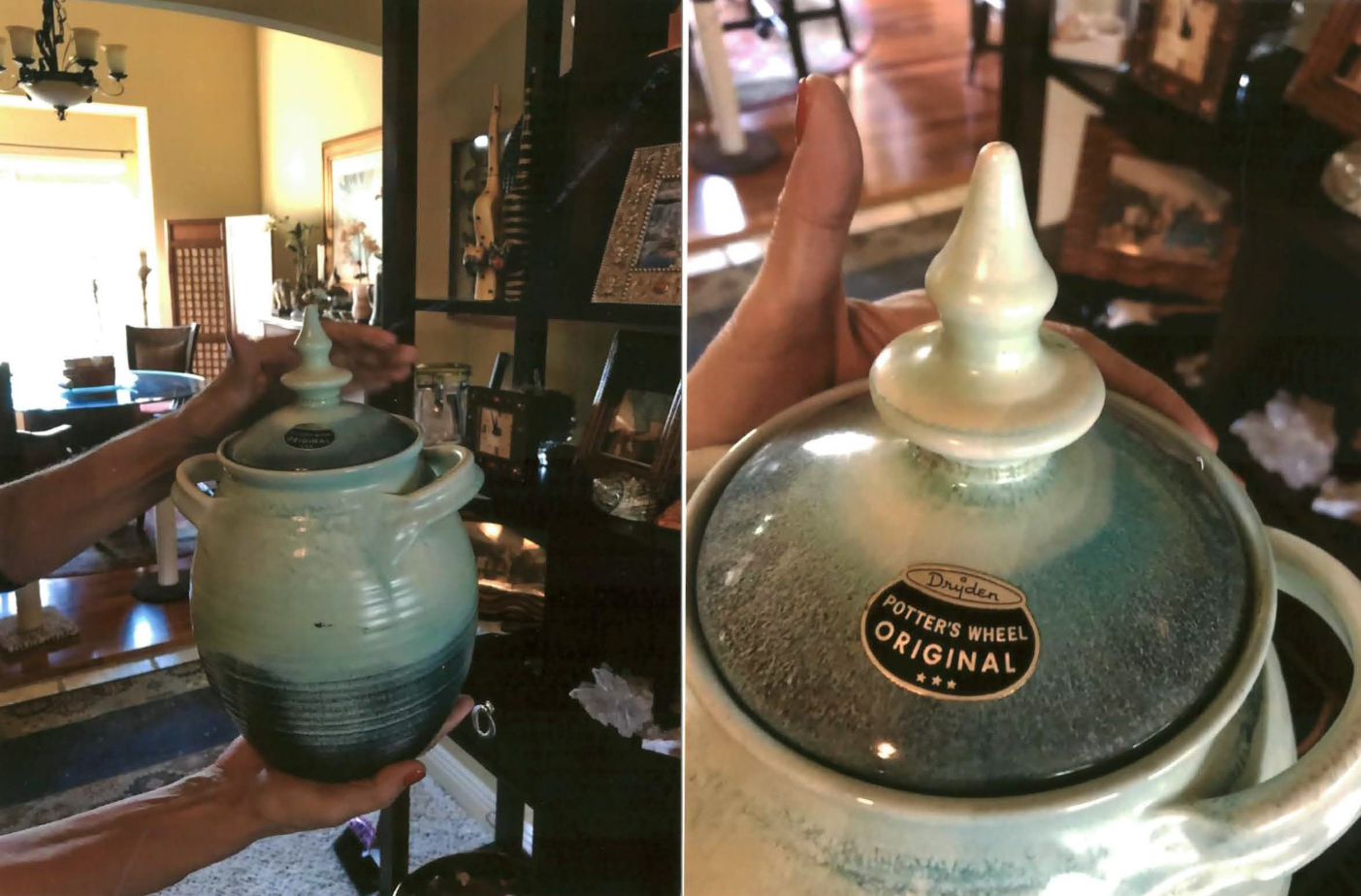
In 2022, Ruth donated her archival materials to the Center for Arkansas History and Culture (CAHC) in two batches. The first, more significant donation of materials primarily consisted of biographical and professional information, including planners, personal writing, news clippings, Christmas cards, and scattered photographs from Ruth’s activism and travels in the 1990s. This also included ephemera such as AIDS education t-shirts, drag ball gowns (one of which Ruth wore to Bill Clinton’s first inaugural ball), and the final pottery urn from Dryden Pottery that Ruth never used. The second, smaller donation comprised photo albums, newspapers, magazines, and All the Young Men publication materials. We wish that Ruth had kept better records, but this is the regrettable reality of many archives. Perhaps a better question than why Ruth did not keep better records is what this rich, if incomplete, archive can tell us about the history of HIV/AIDS.
Ruth’s daily planners illustrate the simultaneously rich and fragmentary nature of the collection. The planners in the archival collection include more blank pages than written ones, with some pages marked with only a single name. These fragmentary entries are mundane, a day-to-day account of an individual woman’s hopes and fears. Many are simple notes or reminders, the importance and context coming from either conversation with Ruth or other external sources.
Ruth’s archive reveals what it must have felt like in those difficult early years when she claims she primarily acted alone. As she puts it in the epilogue of her autobiography, “There was no one behind me. I had no choice but to help them.”67Burks and O’Leary, All the Young Men, 343. David Koon began his 2015 profile of Ruth in the Arkansas Times as “one lonely person” attempting to “budge the vast stone wheel of apathy.”68Koon, “Ruth Coker Burks: The Cemetery Angel.” This theme of isolation and hostility runs throughout her memoir. As Ruth notes of one church supper, other parishioners “eyed me suspiciously, but they always eyed me suspiciously, even before I was the town pariah.”69Burks and O’Leary, All the Young Men, 152.
But Ruth was not the only individual caring for AIDS patients in central Arkansas. All the Young Men can be read as a record of “the town elders” of Hot Springs who quietly assisted her. This is best exemplified by Clay Farrar, a prominent Hot Springs lawyer. Clay introduced Ruth to a network of Rotary Clubs where she spoke about her care work and AIDS activism and connected with prominent men who were willing to provide support quietly. Several bankers in Hot Springs occasionally assisted Ruth with monetary donations or by requesting favors in the medical profession.70Burks and O’Leary, 182–184, 257–258.
Certainly, a range of individuals and non-profits attempted to help those dealing with HIV/AIDS in Arkansas in the 1980s and early 1990s; however, Ruth’s searing memory but factual inaccuracy in insisting that she acted alone evokes the experience of the HIV/AIDS epidemic for the men she cared for, many of whom—working class, indigent, and abandoned—were from the hills of Arkansas or were Mexican immigrants far from their families. These men were on society’s margins in multiple abject ways. As Ruth describes visiting Angel in the hospital, “Angel and I smiled at each other, together in our lonely place.”71Burks and O’Leary, 277.
This sense of isolation is also represented in Ruth’s archival materials, for instance, in two poems she wrote in the early 1990s, “Shades of Black” and “THIRTYONE.” In writing about her first patient, Jimmy, in “Shades of Black,” the death Ruth recalls is sudden and lonely; there is only Ruth and a dying man crying out for his absent mother. Ruth went into the room alone, held this man’s hand, watched him die, and walked out of the hospital room alone. “Remembering the day that brought me here. He was the first one who just died. Right then, right there. I walked into his room, he took my hand, he nodded and then he died.”72See, Box 6, Folder 16, Ruth Coker Burks papers, Center for Arkansas History and Culture, Little Rock, Arkansas.
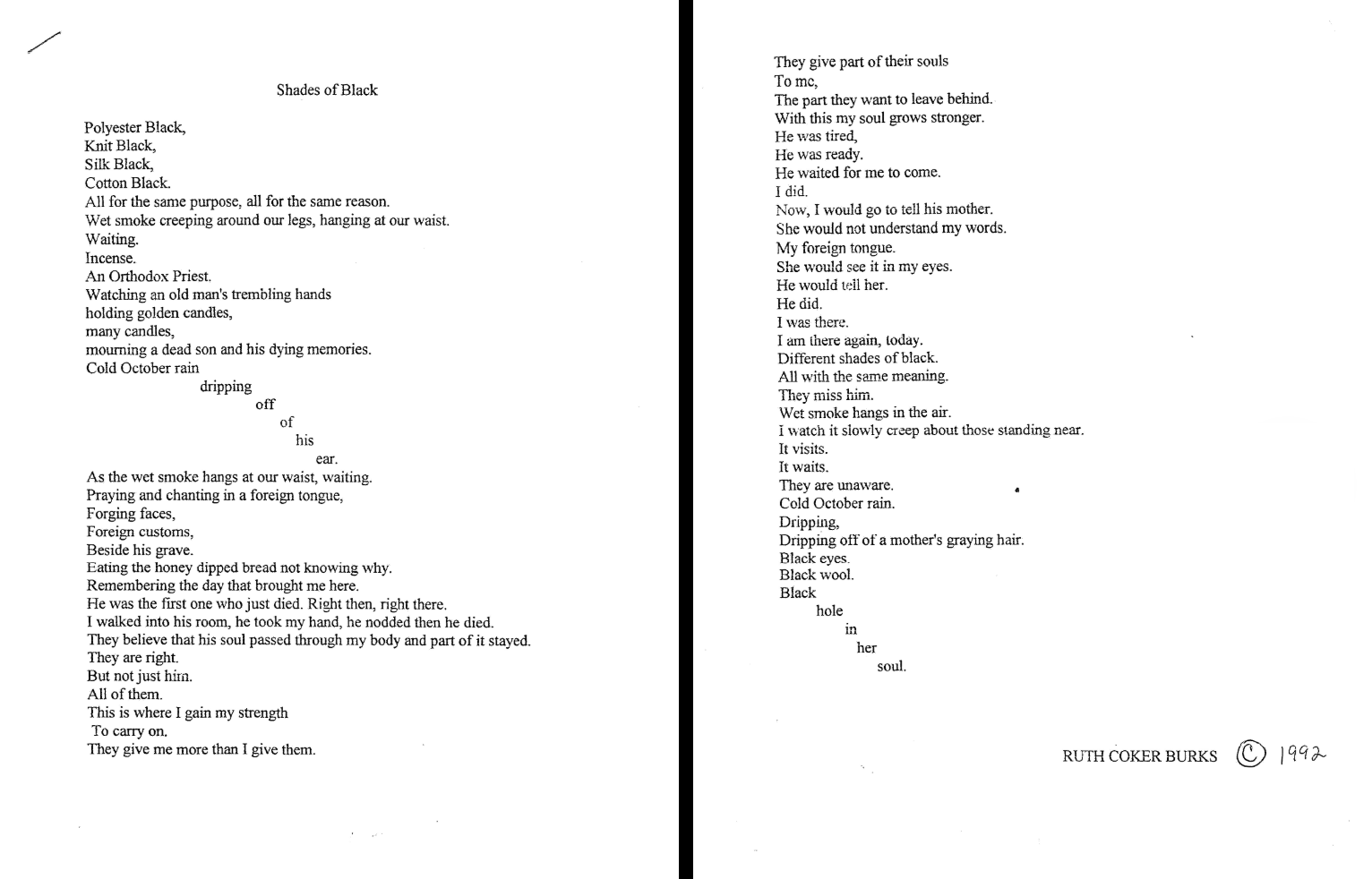
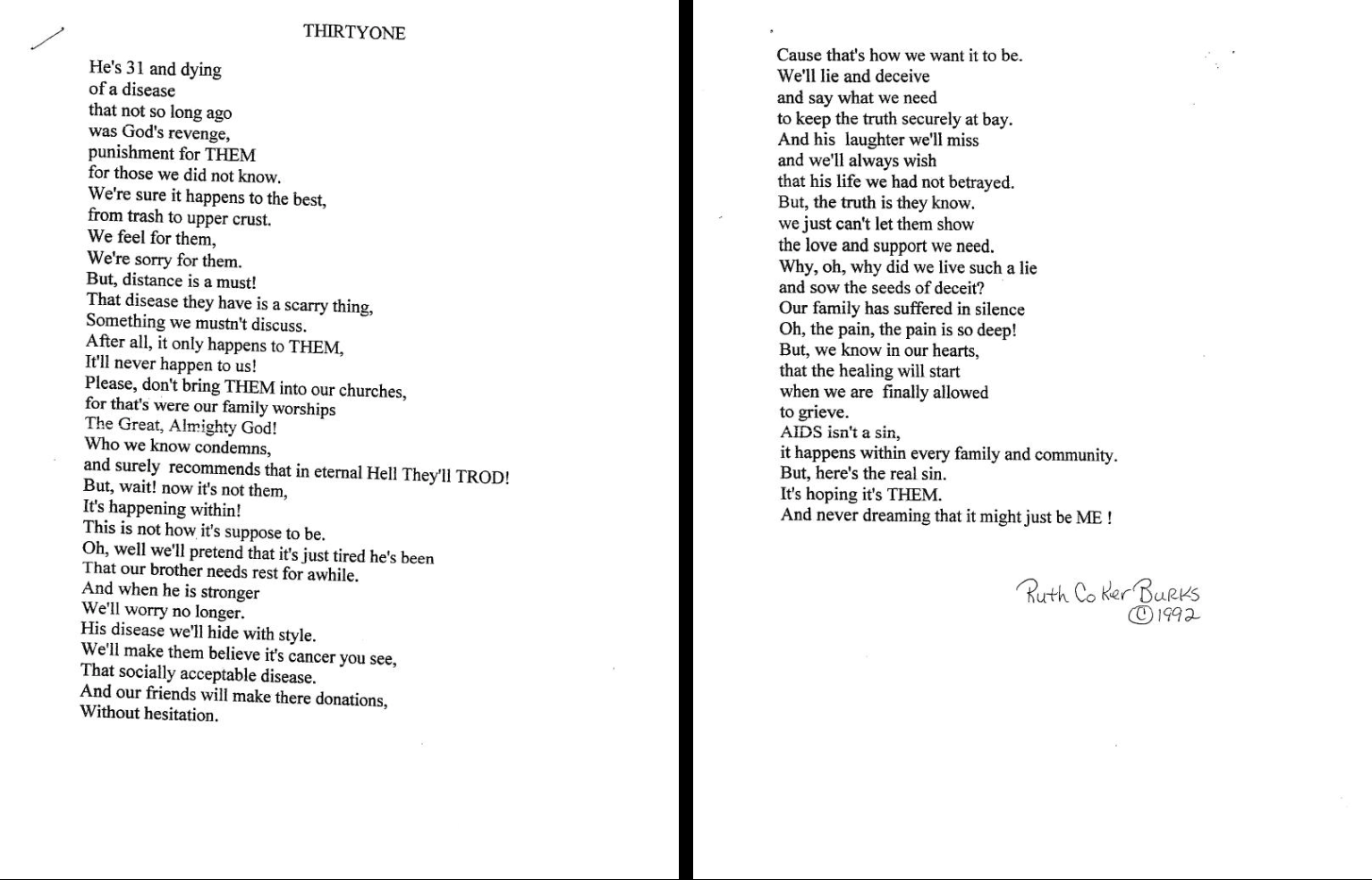
In “THIRTYONE,” the sense of isolation is deployed in anger against society and religious institutions. Ruth writes: “He’s 31 and dying of a disease that not so long ago was God’s revenge, punishment for THEM. While Ruth was sharply critical of the hostility of many religious institutions in Arkansas from the mid-1980s and mid-1990s, she remembers her care work and activism relative to her religious faith. As she has repeated in conversations with us, “I never lost my faith; I just lost faith in everyone else’s faith.”73See, Box 6, Folder 16, Ruth Coker Burks papers, Center for Arkansas History and Culture, Little Rock, Arkansas.
Criticism in Context
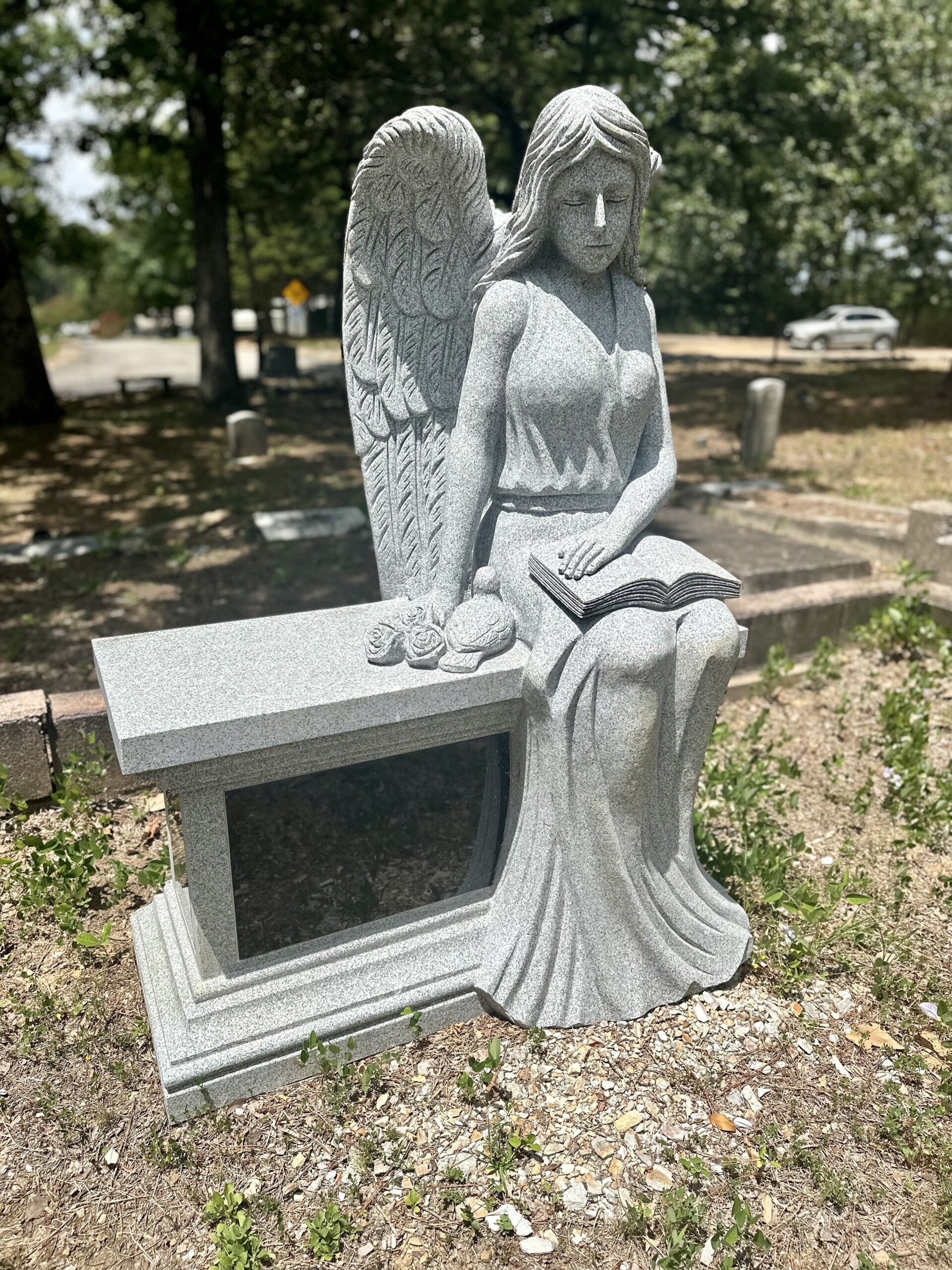
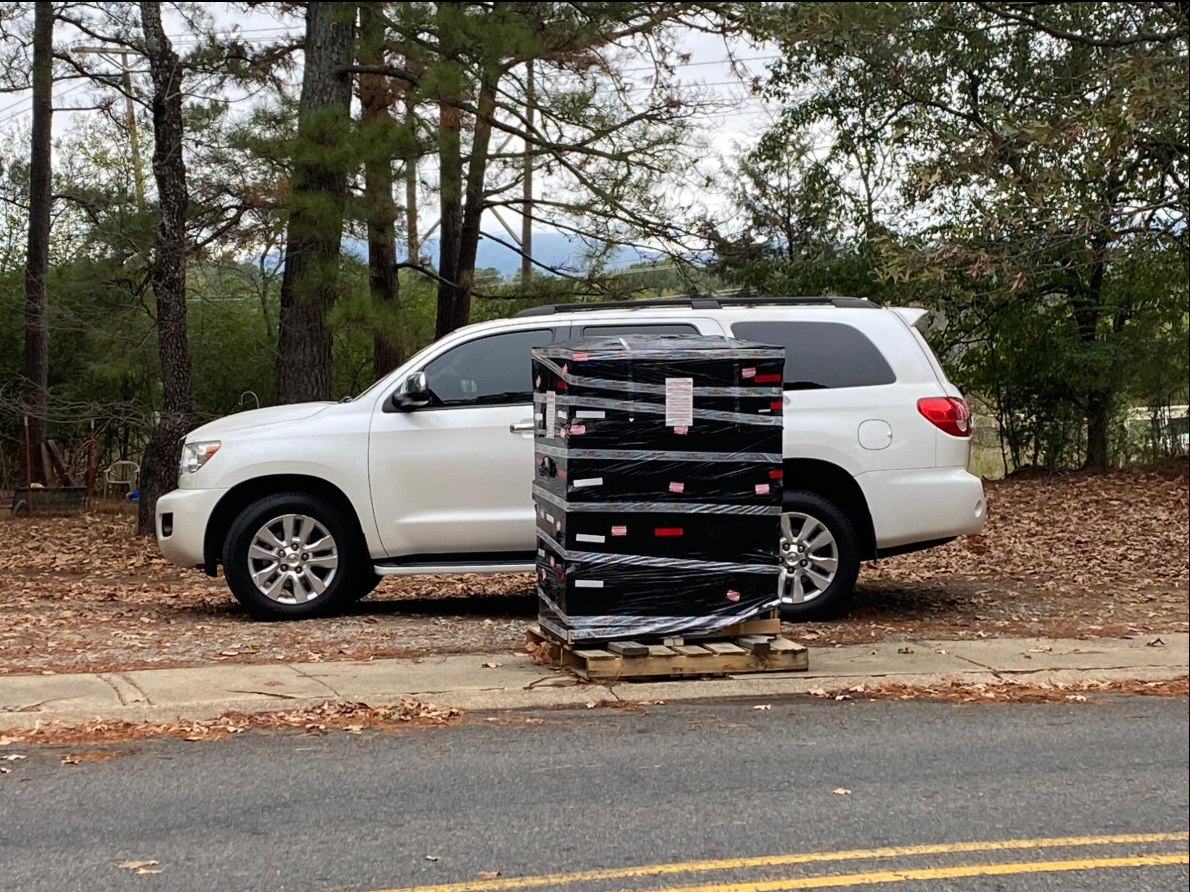
In time, media coverage of Ruth shifted from the laudatory into two overarching criticisms. First, Ruth either kept shoddy records of the men whose ashes she interred in the Files Cemetery or was guilty of exaggerating the number she cared for or buried. Second, she has either been unwilling or unable to put up a monument to these men at the Files Cemetery despite advocating for a memorial for years. Some of her critics suggest that a successful GoFundMe campaign (to raise money for a cemetery memorial and Ruth’s medical bills) was entirely used for the latter purpose and not for the former. For example, in a 2021 piece, the Arkansas Times journalist Austin Gelder discussed how there was not yet a memorial, local disappointment in the limited impact of Ruth’s newfound celebrity on Hot Springs, and debates over ownership and oversight of the Files Cemetery. In a subsequent piece for NBC News, Alexander Kacala expanded on these concerns over funding, management of the Files Cemetery, and local disappointment (and anger.) Kacala also suggested that Ruth may have exaggerated or even fictionalized some of her claims, particularly regarding the number of men for whom she cared.74Kacala, “Doubts Surround Viral Story of ‘AIDS Angel’ Who Says She Helped Hundreds of Dying Men.” It is important to note that in late 2022, Ruth arranged for a monument to be constructed and delivered to the Files Cemetery.
As Gelder notes, most of her critics still “commend Burks . . . [and] don’t want to detract from her good deeds” while insisting on clarity.75Gelder, “Ruth Coker Burks and the Missing Monument.” In turn, Kacala surmises that beyond the good deeds that Ruth did in the 1980s and early 1990s, “over the years either she or the media have sensationalized the story for some sort of gain.”76Kacala, “Doubts Surround Viral Story of ‘AIDS Angel’ Who Says She Helped Hundreds of Dying Men.” Some in Hot Springs are more critical, including Robert Klintworth, a former friend of Ruth who cared for the Files Cemetery for many years (Klintworth provides much of the criticism in both the Arkansas Times and NBC News pieces). Klintworth claims he and his partner, Paul Wineland (who was Billy's partner before his death), cared for the cemetery and provided Ruth with significant assistance in remembering details and names for her book, but that the rewards of the “book deal, a movie deal, and international recognition” have accrued to Ruth alone.77Gelder, “Ruth Coker Burks and the Missing Monument.” Paul Wineland was also central to the 2014 StoryCorp profile, which fed the media's interest on Ruth’s story.
Along with Klintworth, Tim Looper cared for the cemetery for several years after 2015. Looper also is one of Ruth’s prominent local critics, and has argued that Ruth exaggerated her narrative and/or does not remember events accurately.78Kacala, “Doubts Surround Viral Story of ‘AIDS Angel’ Who Says She Helped Hundreds of Dying Men.” Looper maintains, for instance, that Ruth’s first hospital visit occurred in Hot Springs and not in Little Rock, as she writes in her memoir. According to Ruth, some local drag troupes have also provided informal care for the cemetery. In 2023, Hot Springs resident Jim Thompson began to care for the seemingly neglected cemetery, as reported by the local news.79Rolly Hoyt, “One Man’s Mission Helps Restore a Site of Arkansas Cemetery Holding Remains of AIDS Victims,” THV 11, October 26, 2023, https://www.thv11.com/article/news/local/arkansas-files-cemetery-aids-restoration/91-39e9dad1-7ece-4244-b854-4e1d2091c5bc.
A June 2024 YouTube video podcast, RUTHLESS: The Real Story Behind the ‘Cemetery Angel of Arkansas’ alleges to uncover the “scam” perpetrated by the “grifter” Burks. The three-hour video is a sensational retelling of the 2021 Arkansas Times article. Looper is the principal source and the recurrent themes include the alleged exploitation of gay deceased men for fame and fortune, the accusation of profiting from a never-constructed (but since built) memorial, the flagging of factual errors and inconsistencies in the memoir, Ruth’s alleged failure to recognize other individuals and entities who provided aid, and a general sense that her version of events has disparaged Hot Springs and Arkansas. Posted comments about the video are overwhelmingly critical of Ruth, but it is beyond the scope of this article to evaluate these claims.
The CAHC is working to process Ruth's and others' archival papers from these years. However, it would take a large research budget (and a significant scholarly team) to, 1) carefully and responsibly reconstruct the life histories of the men buried in the Files Cemetery, 2) locate the interred cremations within the Files Cemetery with both precision and respect for anonymity, and 3) carefully and empathetically adjudicate the conflicting claims by drawing on state and local records. Complicating any research efforts is the reality that almost all of the direct witnesses of what Ruth did are long dead, and the remaining few include both fervent supporters and biting critics. These conflicting accounts rely on individual memories of traumatic events that occurred at least thirty years ago.
Many of the critiques voiced in newspaper articles and videos are valid. We too would like to know more about the men's life histories and see the Files Cemetery physically transformed into the commemorative site it already is in the minds of so many. In telling and retelling Ruth's story, it is clear that many details and claims remain constant, alongside some ambiguities and exaggerations. Ruth is not necessarily the appropriate target for all of these legitimate concerns. Or to reframe Kacala’s observation as a question, if elements of Ruth’s story have been ‘sensationalized’ over the years, to what end have they been sensationalized for a reading public in Arkansas and beyond?
Our preliminary research suggests that the presentation of Ruth as an almost saintly figure began with the 2014 StoryCorps interview and the 2015 Arkansas Times profile. In the StoryCorps interview, Michael Garofalo notes, "Ruth is one of those rare people who doesn’t run away from suffering. She runs toward it without hesitation."80Garofalo, “Lessons in Love.” David Koon’s article in the Arkansas Times in 2015 was titled, “Ruth Coker Burks, the Cemetery Angel.” A photograph of Ruth overlayed with the text, “St. Ruth,” was the cover story of the initial print edition (the “St. Ruth” title was removed from the online version). It was more often in the headlines of stories, rather than in the body of articles, that she was presented in saintly or angelic terms.
These binary understandings of Ruth, either as a living saint and the Arkansas cemetery angel, or as a fantasist and teller of tall tales, do not map onto the reality of her evocative and fragmentary archive. Returning to the questions we posed at the beginning of this article, what can Ruth’s archive tell us about the history of the AIDS epidemic in Arkansas and the construction of the role of the idealized caregiver for some Arkansas women at the time?
One answer that her archive does provide is that contestation and debate have long been integral to Ruth's care work and activism and that she has always had both enthusiastic supporters and harsh critics. Based on newspaper clippings from her archival donation, the criticism of Ruth and her work began in the early 1990s. In a 1993 letter to the editor published in the Sentinel-Record (Hot Springs, AR) that echoes some of the later criticism, the author states that Ruth “claims too much credit . . . her statistics are out of this world,” and that Ruth made AIDS patients stand out in the cold during a World AIDS Day service. Other local newspaper pieces saved by Ruth from the early 1990s had less to do with Ruth herself and instead reflected rampant prejudice against gay men. An undated letter to the editor states that the author is withdrawing their membership to the Downtown Merchants Association of Hot Springs due to the Association’s support of AIDS Awareness Day since, in the words of the outraged author, “AIDS is a behaviorally transmitted disease and does not need awareness or anything other than saying 'no' to homosexual activity or drug use. How much does it cost to teach that?”81See, Box 6, Folder 2, Ruth Coker Burks papers, Center for Arkansas History and Culture, Little Rock, Arkansas.
Criticisms of Ruth are not the only subject of the news clippings that she assiduously collected. There are several undated articles praising Ruth and her work. These positive assessments from the early 1990s foreshadow the recent praise of Ruth's care work and activism. One letter by Robert Gale (the vice-president of Helping People with AIDS) refuted the claim that Ruth was not the executive director of HPWA, and praised her efforts in that role. At least two articles in Ruth’s collection mention her professional work at her day job at Prudential Lakefront Real Estate.
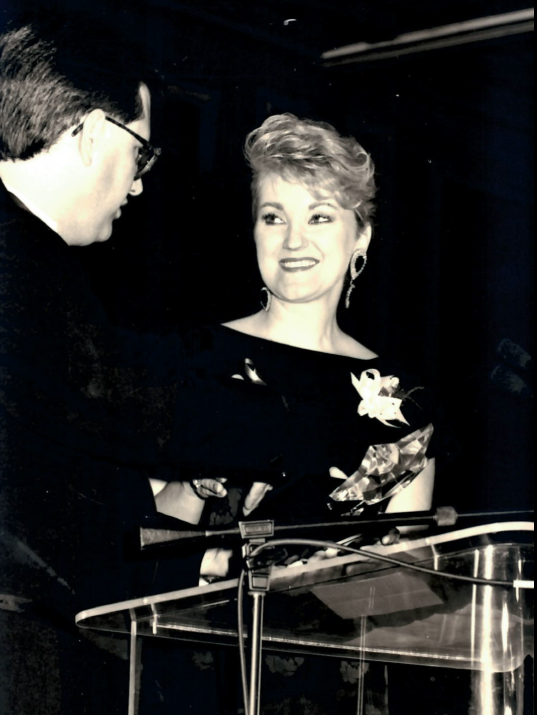
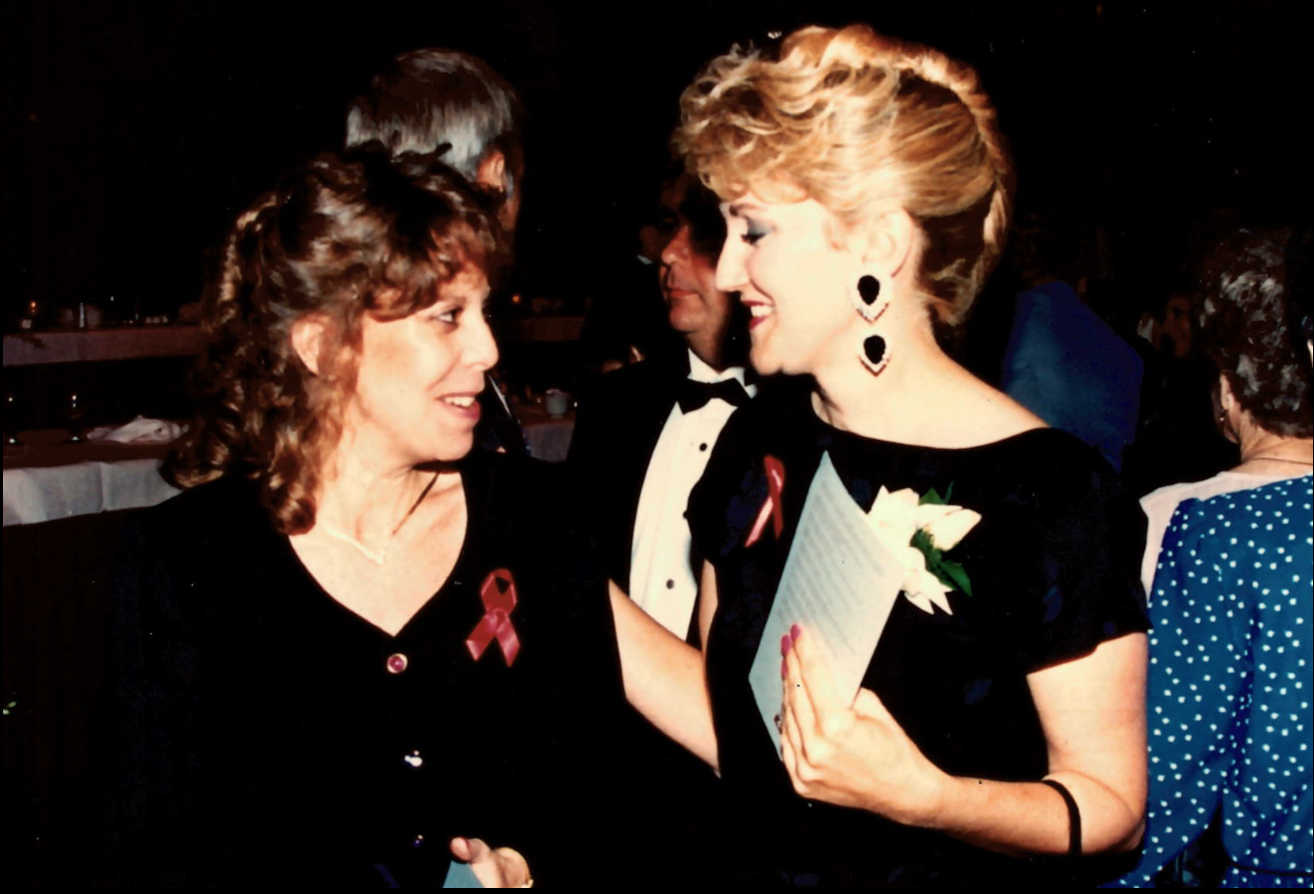
Ruth’s archival collection includes a binder of letters of recommendation and typed endorsements from prominent citizens regarding Ruth’s nomination for the Arkansas Community Service Award, the establishment of an HIV/AIDS program at Levi Hospital, and the nomination of Ruth for the position of Executive Director of the Arkansas AIDS Foundation. These letters provide further evidence of the sustained care work that she offered. For example, a local attorney wrote that “Ruth has demonstrated her commitment to the care of those who are HIV positive, and we are fortunate to have someone already in the community who is prepared to immediately take on such a responsibility.”82See, Box 6, Folder 20, Ruth Coker Burks papers, Center for Arkansas History and Culture, Little Rock, Arkansas.
The testimony of some of Ruth’s critics lends credence to her sustained, if controversial, presence. Kacala includes an extended quote from Hot Springs resident Daymon Jones, a long time survivor of the AIDS epidemic in Hot Springs, who is harshly critical of Ruth. In Jones’ own words, “I have contempt for her … She makes it look like my town was hostile to people with HIV. It’s the fact that she has used that stereotype to portray my town and my community as something horrible and that was not the story.” Jones was particularly annoyed at what he saw as Ruth’s pushy methods in attempting to provide him with unwanted help. Again, in Jones’s own terms, “What really got me riled up [was] how she does it. . . . She said, ‘Well you know I can bury you, too, when you die.’ Well Ruth, I have no intention of dying right now, and even if I do, I have a family cemetery. ‘They won’t let you in, you know that.’ Oh yes they will. We discussed this already. She tried to use fear to make herself look like she was somebody that was going to help.”83Kacala, “Doubts Surround Viral Story of ‘AIDS Angel’ Who Says She Helped Hundreds of Dying Men.
Jones’ comments clearly illustrates that some people living with AIDS in Hot Springs found Ruth’s efforts unnecessary and even offensive. At the same time, the anecdote also suggests that by the early 1990s, Ruth was locally well-known for AIDS-related activism and care work and that she regularly discussed her cemetery as a possible final resting place for those excluded elsewhere.
Conclusion
What can we make of the competing media narratives depicting this individual woman to be either a saint, selflessly salving the wounds of AIDS patients, or a sinner, exaggerating what she did and pocketing the cash? We want to argue that the legitimate anger aimed at the incomplete historical record of these men's lives and the decaying state of their final resting place is standing in for a much larger problem—the terrible treatment accorded those dealing with HIV/AIDS in Arkansas in the 1980s and 1990s by many medical institutions, by civil society, by their families, and by religious congregations. As Ruth put it, with hopefulness, “if I sound the alarm . . . the cavalry will come.”84Burks and O’Leary, All the Young Men, 183. Yet the cavalry never arrived, at least for many of the men for whom Ruth cared. These conclusions are born out in the two persistent emotions that weave their way throughout her story: her searing anger at the failure of others to not do more, and her deep, enduring love for these men whom she often only knew briefly at the very end of their lives. This echoes Harris’s influential analysis of the role of a range of emotions in Black women activists' perspective on their AIDS activism, especially the entanglement of love, compassion, and solidarity with frustration and anger.85Harris, “Emotions, Feelings, and Social Change,” 191–195.
Maybe this rush to canonize or vilify Ruth is an effort to displace this broader societal failure. Suppose Ruth was an angelic caregiver for those dying of AIDS. In that case, it absolves all those in Arkansas (and elsewhere) who either did nothing or actively discriminated against gay men. In turn, if Ruth was an imperfect record keeper with a shaky memory, she could become the target of all the legitimate anger of how these men were treated in life and death.
The archive of Ruth’s life, activism, and care work, and its fragments offers a much more sobering history of AIDS in Arkansas: a colossal tragedy and a systemic failure. Not a failure on the part of Ruth or the other individuals who, at a tremendous personal sacrifice, helped those dealing with HIV/AIDS, but rather a systemic failure on the part of many medical institutions, state government, and civil society. Returning at the very end of her autobiography to the very beginning of her story (when she walked into Jimmy’s hospital room in Little Rock in 1986), Ruth puts it a different way: “The question I get most, the one I hate, is why I went into his room. And why I helped people. Again and again . . . the answer is, How could I not? The real question is, How could you not?”86Burks and O’Leary, All the Young Men, 345.
Ultimately, it is not a question of what Ruth Coker Burks did (or did not do) to become the Arkansas Cemetery Angel, but rather what the depictions of Ruth as an angel and a saint in print and the media reveals about the memory (and continuing reality) of AIDS in Arkansas. At its most potent, Ruth's memoir and archives—alongside the Files Cemetery—not only illustrate the deep commitment of one inspiring individual, however imperfect, to help those suffering at society's margins, but also provide a glimpse into the lives of the men she cared for, whether in documenting their loneliness, their heroic efforts to live as long as they could, or in their fashioning of substitute mothers and chosen family. 
Acknowledgements
The authors would like to thank Nathan Marvin, Marta Cieslak, and David Baylis for their encouragement, generous feedback, and insights that contributed to the development of this article.
About the Authors
Andrew Amstutz is an assistant professor of history at Queens College, CUNY. He has published articles in Comparative Studies of South Asia, Africa and the Middle East, Philological Encounters, and South Asia. Prior to joining Queens College, he taught at the University of Arkansas at Little Rock.
Jess Porter is executive director of the Center for Arkansas History and Culture, the University of Arkansas at Little Rock's archive. He is a geographer and former chair of UALR's history department.
Phoenix Smithey is the head of special collections and university archivist at the University of Central Arkansas. Smithey is active with the Academy of Certified Archivists, the Society of Southwest Archivists, and the Arkansas Humanities Council. She teaches in the fields of archival management and archival preservation.
]]>Introduction: The Selected Shepherd: A “Fair, Just Place”
Let us live beyond the here and now by nurturing each other and supporting one another’s works.—Assotto Saint, “Why I Write”1Assotto Saint, “Why I Write,” Spells of a Voodoo Doll: The Poems, Fiction, Essays and Plays of Assotto Saint (Richard Kasak Books: New York, 1996), 3–8, 5.
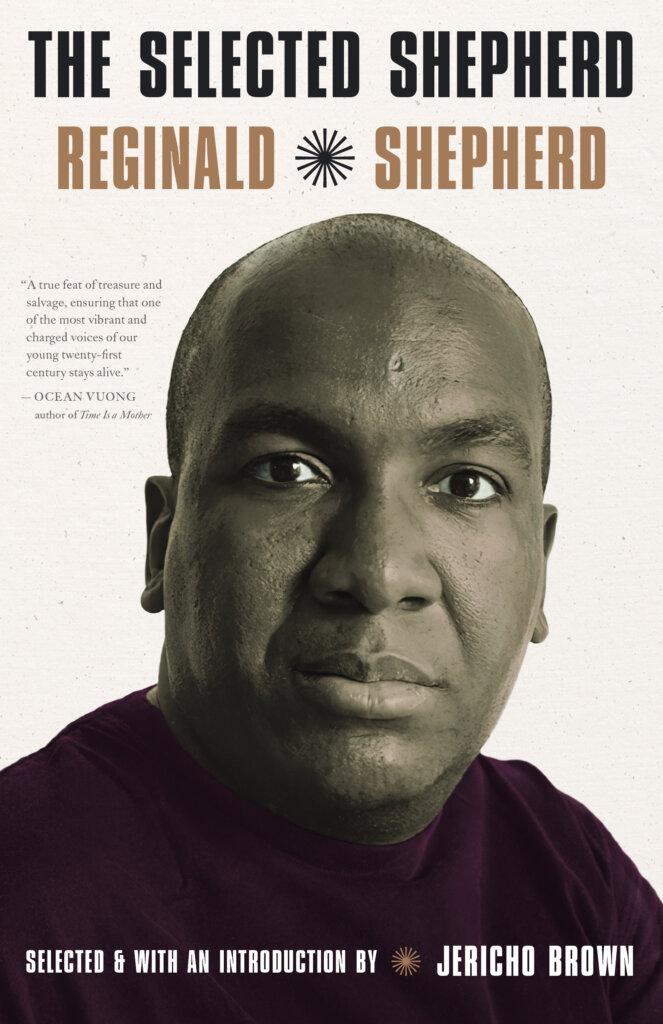
In the first lines of his introduction to The Selected Shepherd (University of Pittsburgh Press 2024), editor Jericho Brown writes of the impossible effort of introducing “a dead man,” the late poet Reginald Shepherd , to readers: “You mean to honor him knowing that you cannot present him as he might present himself.” Brown’s work with The Selected Shepherd allows Shepherd to introduce himself to readers as he would were he still with us: directly through his poetry. Brown describes Shepherd as an unpredictable, fearless, and brilliant poet who wrote “a little more wildly” across each of his six published collections.
Following a short biographical sketch and brief framing narrative written by Eric Solomon, Southern Spaces presents an edited conversation between Eric and Jericho Brown about the work, resonance, and legacy of Reginald Shepherd.2This conversation took place at the Emory Center for Digital Scholarship on August 6, 2024. Brown previously spoke with Natasha Trethewey for Southern Spaces in 2010. See Jericho Brown, “Naming Each Place,” Southern Spaces, March 4, 2010, https://southernspaces.ecdsdev.org/2010/naming-each-place/.
Reginald Shepherd was born Reginald Berry on April 10, 1963, in New York City. When he was five years old, he was issued a birth certificate with the name “Reginald Shepherd” after his mother’s successful suit against the absent man legally proven to be his father. His mother, Blanche Berry, raised him and his sister Regina in the Bronx where he remembers going by “Reggie” until he adopted the more formal “Reginald” in his mid-twenties. (Shepherd addresses the permutations of his name in the essay “What’s in a Name?”3Reginald Shepherd, “What’s in a Name?,” A Martian Muse: Further Essays on Identity, Politics, and the Freedom of Poetry, edited by Robert Philen (Ann Arbor: The University of Michigan Press, 2010): 193–198.). After his mother’s death when he was fourteen—a fact that would shape much of his future poetry—Shepherd moved to his mother’s hometown of Macon, Georgia, to live with family until he left, after graduating from high school, at age seventeen. He enrolled as an undergraduate at Bennington College, leaving in his junior year to move to Boston where he worked at the Boston Public Library, before returning to Bennington to finish his BA four years after his initial expected graduation date. He earned two MFA degrees, one from Brown University and a second from the University of Iowa. Shepherd published five books of poetry [Some Are Drowning (1994); Angel, Interrupted (1996); Wrong (1999); Otherhood (2003); and Fata Morgana (2007)] with a sixth volume published posthumously, Red Clay Weather (2011). He also published two books of essays [Orpheus in the Bronx (2007); A Martian Muse (2010)] and edited two poetry anthologies [The Iowa Anthology of New American Poetries (2004) and Lyric Postmodernisms (2008)].
Shepherd met his partner, Robert Philen, in Ithaca, New York, in 1999, and the two moved to Pensacola, Florida, in July 2001. After a battle with colon cancer, Shepherd died on September 10, 2008, in Pensacola. Though he accomplished much in his career, Shepherd remained aware of the structural inequities that prevented men like him from accessing what he called “fair, just” places of belonging in the academic and literary worlds. “Sometimes I stand in the poetry section of Barnes and Noble and wonder how many authors there come from backgrounds like mine. They can be counted on the fingers of one hand,” he writes in an essay published the year before his death. “Unlike the vast majority of those in academia or the literary world, I have nothing to fall back on. Since leaving Georgia at seventeen, I have been on my own… I have gone from place to place, from circumstance to circumstance, and still I haven’t found that fair, just place, but I continue to search, hoping and believing that there’s a place for me.”4Shepherd, “To Make Me Who I Am,” Orpheus in the Bronx: Essay on Identity, Politics, and the Freedom of Poetry (Ann Arbor: University of Michigan Press, 2007), (7–38), 36–37. Sixteen years after his death, Jericho Brown’s The Selected Shepherd has helped secure the poet’s “fair, just place” on the bookshelves of our great poets.
Searching for Shepherd
Reginald Shepherd’s six volumes of poetry continue to amass a dedicated following from fans, fellow poets, and scholars. Shepherd’s work contains an intoxicating blend of image, metaphor, allusion, formal innovation, and often dizzying complexity. His work incorporates references from Hart Crane to Wallace Stevens to Walter Benjamin to Sam Cooke to Barry White while always remaining the work of an original voice and visionary.
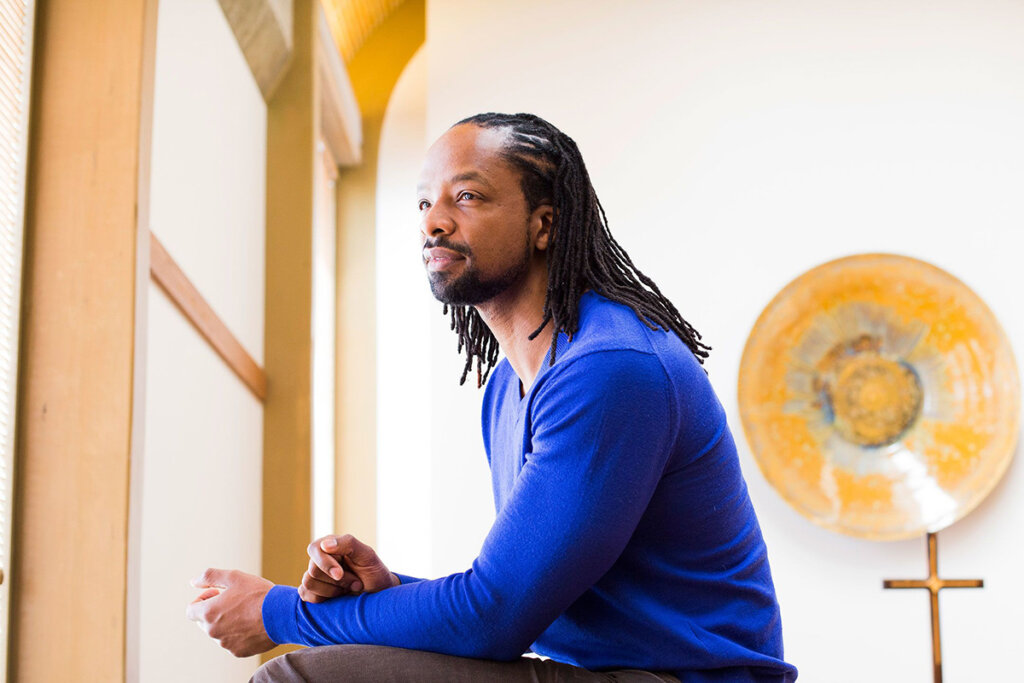
“I was around twenty-four years old when I first read Reginald Shepherd’s poem ‘Semantics at 4 P.M.’ in an edition of the Best American Poetry edited by Rita Dove,” Jericho Brown writes. Transfixed, Brown recalls asking other poets why he had not been made aware of Shepherd’s work beforehand. He continues, “the poem itself does not identify its speaker as gay, but if there is a queer voice, I believed I was reading it.” For Brown, Shepherd became an example of a “gay, Black poet who was alive,” and for those of us lucky enough to have discovered Shepherd’s work, it is the vitality and the voice—queer, brilliant, difficult, propulsive—that resonates long after the initial encounter. Though Brown’s work with The Selected Shepherd will now make a first encounter more accessible for many readers, I would argue that one does not find or search for Shepherd’s poems. As Brown’s story illustrates, you don’t find the poems; his poems find you. Or, as Brown states, poets “are the makers of the beauty that people didn’t know they needed until they see it.”5Jona Colson, “On Truth, Queerness, and Social Media: A Conversation with Jericho Brown,” Literary Hub, November 10, 2020, https://lithub.com/on-truth-queerness-and-social-media-a-conversation-with-jericho-brown/.
Similar to Brown, I (Eric) was twenty-three when I first came to Shepherd’s poetry by happenstance at a time when I needed to “see” his work. I was in an MFA poetry workshop as a MA student in English studying men and masculinities—i.e. not a poet—but we were allowed to take creative writing workshops as our schedules permitted. I recall vividly feeling like an “outsider” to what I perceived to be the “real” poets in the room (classic imposter syndrome), and I found my work at the time out of step with the much more highly innovative and experimental work of my colleagues.
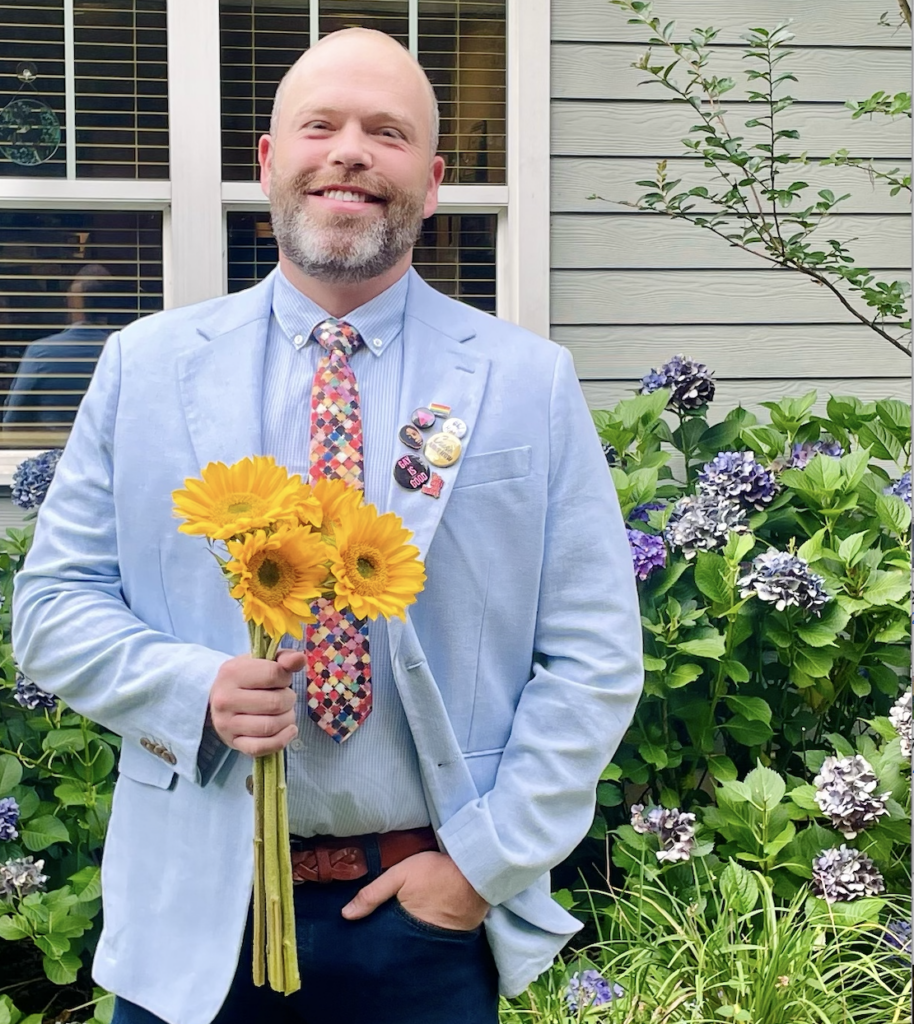
In retrospect, I was attempting in my juvenilia poems to rescue the stories of our queer dead from the tragic detritus to which their lives had forever been relegated in our collective memory. In one poem titled “Appendix,” I elegized Scotty Joe Weaver, an eighteen-year-old gay man from Bay Minette, Alabama, who was killed by two of his roommates in 2004. In another, I attempted to grapple with the death of Matthew Shepard, whose name now serves on official federal hate-crime legislation. One colleague recognized in my meditations on the queer dead something he called a poetic sense of rescue and reclamation, and he invited me to consider Reginald Shepherd when it came time to give presentations on the work of one contemporary poet in our MFA workshop.
Unlike Brown, by the time I found Shepherd, he had passed away. At my friend’s suggestion, I ordered copies of his published work, in which I found poetry full of life and resonance and contradiction and complexity and difficulty but not obscurity. Though they made me feel, I did not then, nor do I now, fully understand what I feel when I encounter and re-read a Shepherd poem. As Brown observes in The Selected Shepherd, Shepherd’s work is not easy by design. Shepherd thought poetry should be “hard enough” to sustain multiple re-readings, not written in such a way that it could be “used up” by readers after a few encounters.6Shepherd, “On Difficulty in Poetry,” A Martian Muse (33–45), 34. For Shepherd, poems should be able to contain different resonances with each return. In a conversation with Krista Tippett, Brown similarly states, “I think poems are better built out of what we don’t understand, not what we do already know, but what we’re trying to figure out and better understand.”7“Jericho Brown: Small Truths and Other Surprises,” On Being with Krista Tippett, June 6, 2019, https://onbeing.org/programs/jericho-brown-small-truths-and-other-surprises.
In searching for and finding Shepherd, equal in importance to the poems for me were something you will not find in The Selected Shepherd: his essays where the poet further attempted to understand his craft, his poetics, as well as identity, politics, and his life journey from the Bronx to Georgia to Boston to Brown University to Iowa and eventually to Florida. In the essays, Shepherd reveals his personal struggles as well as the difficulty of his relationship with academic institutions and the literary world. He also displays his vast critical knowledge and broad reading practice. Shepherd, comments Brown, “was a man who seemed to have read all the books you keep meaning to read.” Further, his insights on what we might call a queer literary canon are must-reads for those of us who study LGBTQ+ culture, past and present.
“My aim,” writes Shepherd, “is to rescue some portion of the drowned and the drowning, including always myself.”8Shepherd, “Why I Write,” Orpheus in the Bronx: Essay on Identity, Politics, and the Freedom of Poetry (Ann Arbor: University of Michigan Press, 2007), (188–198), 188.It seems to me that Shepherd’s “aim” exists in conversation with our queer cultural tradition: those of us in subsequent generations keeping “alive” some portion of the work of those who have gone before, many of whom were lost far too soon. When necessary, we rescue them from the dustbin of memory and place their stories and their works back on the central shelves of literary culture as Jericho Brown has done with The Selected Shepherd. Whether in our creative work or our work as editors, curators, scholars, documentarians or memory-makers, we claim places for our queer kin. As Brown writes, “we know poets don’t die. And if they do, people who love poetry can always resurrect them.” And in rescuing them, in resurrecting them, we rescue, always, ourselves. As Shepherd writes, no matter the challenges we face, we queer folk refuse to “forget beauty, however strange or difficult.”9Shepherd, “Why I Write,” 197.
Interview: Jericho Brown on Selecting Shepherd
Eric Solomon: Thank you, Jericho, for being here for this conversation in our Southern Spaces series “Queer Intersections.” I’ve organized the questions in two parts. First, is thinking about your editing of The Selected Shepherd . And then perhaps we can talk about how Reginald Shepherd’s work helps us think about Jericho Brown.
In choosing poems for The Selected Shepherd, you present a generally equal number from each of his six collections, with a little bit more from Angel, Interrupted. What were you looking for as you were editing?
Jericho Brown: When I got the opportunity to do this, I had somehow already started doing it in my head. It was the kind of thing, you know that phrase “comes to fruition”? it was the kind of thing that I don't even think I was aware of it until I was asked to do it. But I had started doing it somewhere in my brain as a Reginald Shepherd reader, as a person who teaches his poems, as somebody who's interested in his work, as someone who is actually taken by the ways in which his work could be uneven, even.
I don't love every Reginald poem. I don't love every poem by anybody with that many books. I had already started this system of ranking of this particular poet's work, which I think happened because there were so few Black queer poets on the national scene when I was first figuring out that I wanted to be a poet. There were so few that I could hold them all. I could read all of everything they said in every interview. I could read every book. I could read every essay that they had written. Now there are more than I can keep up with. But because there were so few, picking poems for me was at first a matter of going after what I already knew and trying to figure out which book -- was that in Otherhood? Was that in Wrong? Trying to remember exactly which book each poem is in. Rereading the books put me in a position where I could see what Reginald Sheppard's concerns were, or his obsessions, throughout his work. But more than that, it gave me the opportunity to see how he changed from book to book.

My goal in selecting the poems was to register those changes. I wasn't going to be able to make a book that only was the poems about nature, only was the poems about queer desire, or only poems about his mother. It was never thematic. It was always craft based. For instance, in Angel, Interrupted, he's very clearly trying to write a longer poem. In Otherhood, he's trying to figure out what to make of fragments. In Wrong, he's following up an influence through trying to see what would happen if Wallace Stevens wrote the queer love poem. All of that had a lot to do with how I went about selecting poems. As you mentioned, there are more poems from Angel, Interrupted and from Otherhood, but I just needed more poems to make it clear what those books were doing because they were doing it in a different way.
My favorite book by Shepherd is Wrong because I think it's the most honest that he is in all of his books. I think there are fewer poetic craft tricks. I really love Wrong. I love the long poem “Nights and Days of Nineteen-Something” and “Semantics at Four P.M.” Wrong feels to me when I'm reading it that it's a short book. I can hold on to it in a different way and walk around with it. At some point in “Nights and Days of Nineteen-Something,” he writes,
It was never sex I wanted, the grand etcetera
with a paper towel to wipe it up. I wanted him
to talk to me about Rimbaud while
I sucked him off in the park, drunk
as any wooden boat and tasting of old cigarettes
and Bailey’s Irish Cream, my juvenilia. Don’t talk
with your mouth full. (In the clearing
at the bottom of the artificial hill, his two hands
covered every part of me until I couldn’t be seen,
a darkness past the burnt-out lamppost.
There's something about that kind of audacity. And the way that it includes him. It is indeed that sort of thirst, that primal energy that we associate with desire. But it's also this guy who likes to read Rimbaud. Which is a specific and a particular guy. It's also somebody who's very aware; most of that particular poem includes cruising outside and having sex outside. But also being very aware of the natural landscape that surrounds him as he is following that primal desire, that urge to make love. I'm really taken by that poem and by a lot of the work in Wrong. I would read these books like crazy. I loved Reginald Shepherd, and I would look forward to the next book.
When it became clear to me that he was dying, I felt a kind of sadness. Not because I knew the man. I felt a sadness because I wouldn't be able to see what he was going to pull off next. I thought he was brilliant, and I loved his prose, and I loved following his blog -- at the time that people had blogs. You could wake up and go to the internet and see a beautiful new essay about poetry from Reginald Shepherd, which always included names of poets you never heard of. And because you had never heard of them, you could look them up. You had more reading to do. In many ways, he was like my teacher. I had a lot of respect for him. And I'm glad Terrance Hayes and the editors at Pitt asked me to do it.
Shepherd and Myth
Solomon: I love your craft-based approach being one to register the changes across the six collections and to pull poems that spoke to those changes. And I was reflecting on my own reading of Shepherd. I first encountered his work in 2008, 2009 -- Wrong meant something to me as well. Reading it now, in the light of what you're saying about honesty and audacity and that kind of drive that you see with desire in the poem.
Before we get into thinking about the resonances between Shepherd's work and your own, speaking of those essays that he would post on his blog, he says something about myth, and I'm curious how you understand the role of myth as you were selecting Shepherd's work. He writes in 2007 that “myth can also be used to place one's own experiences, thoughts and feelings in a larger context, opening them up to realms beyond the individual, making them less purely personal.”10Reginald Shepherd, “Mythology in Poetry,” Reginald Shepherd’s Blog, August 17, 2007, https://reginaldshepherd.blogspot.com/2007/08/mythology-in-poetry.html#:~:text=Myth%20can%20also%20be%20used,of%20the%20myth%20of%20Odysseus. How do you see myth in Shepherd's work? Is it speaking to that kind of audacity and that honesty? How is it functioning? As you were selecting poems, did you find yourself drawn to examples of the Adonis, Orpheus, and Narcissus figures?
Brown: No, he uses Greek myths so much that you wouldn't have to plan it out. It's going to happen. Any book you would do selecting Reginald Shepherd's poems, there are so many allusions to Greek mythology that you wouldn't be able to get around it. He had questions about this himself. If you check out the interview he did in Callaloo with Charles Rowell, he talks about that relationship to Greek myth, but also what that might suggest about his relationship to whiteness in general -- which I was really taken by.11Charles Rowell and Reginald Shepherd, “An Interview with Reginald Shepherd,” Callaloo 21, no 2 (Spring 1998), 290–307.He was always honest, and even though he was participating in it, he would also question the ways in which what he thought of as beauty had been informed by whiteness, by white beauty standards. Of course that included not just who he was attracted to physically, but his reading and how that reading played out and how it worked out. And we're all doing that in some way or another. You can only write as wide as your reading is. If you have various kinds of cultures coming in, then that will come through.
People think differently about what writing is and how it's done. What the “we” means in a poem and what the “I” means. That's different considering who you're talking to. And if everything you read is informed by the same classical rendering, then you're going to have a lot of Greek myth in your poems and you're going to have a lot to question about why that Greek myth is there. What does it really mean? And many poets do it. Many poets of color, many African-American poets, even Indigenous poets are making use of, or identifying with, mythological figures from the Greeks. And part of the reason we do that is this understanding that this is something our readers will share. I think Shepherd was very serious about making use of Greek myth because he was very serious about beauty, and he understood that poems must be beautiful.
You said something earlier about the book Wrong, and it having meaning for you. Even the titles of Shepherd’s books are so tragic: Otherhood, Some Are Drowning, Wrong, Fata Morgana, Red Clay Weather. It does not sound like a good time. Greek myths lend themselves to tragedy. And Reginald Shepherd, I think, needed a kind of, how do I say this, a backdrop or a landscape of tragedy on which his poems could grow and through which he could build artifice. The Greek myths are full of rapes. They're full of wars. I think it was very important to what he was doing, but I chose poems thinking, okay, in these poems, Reginald Shepherd is making a lot of leaps, a lot of what seems to be non-sequitur leaps. And Orpheus happens to be in here. But in this poem, in another book, for instance, things are very narrative, but Orpheus happens to be in here. So, Orpheus is going to be there.
Solomon: Myth is just a vehicle for him, one of the traditions that he's drawing from and reimagining throughout his work. I know that you were registering changes as you were selecting, but myth is, as you're saying, omnipresent. You couldn't get around it, but it wasn't a strategic thing as you were selecting the poems.
My next question is about the relation of Shepherd with your work. Certainly, the use of myth is a common thread, but I'm thinking in another interview you talked about how poets love flowers, and the use of flowers that connects your work with queer culture. As I was reliving these poems through your work with The Selected Shepherd, I noticed ways in which Jericho Brown and Reginald Shepherd's poetry were in conversation with each other. Have you reflected on these resonances? Either as you were selecting the poems, or post the volume coming out?
Brown: It's hard to tease out.
Solomon: Maybe it's easier for a scholar looking in.
Brown: Yeah, I actually like hearing that. I like finding out what I'm doing and how people relate it to the poets that I'm influenced by. Because I always see things I've never seen before. I recently realized I’ve been reading this poem by Shepherd for years -- I can't think of what poem it is -- but there's a certain kind of phrasing that he uses that I use toward the end of a poem of mine called “Say Thank You, Say I'm Sorry.” As I was reading on a podcast, I'm like, “Oh, I stole that syntax.” I don’t use the same words. I realized there's a lot about my work in terms of syntax that I probably learned from Shepherd.
There are other poets who helped with this, but Shepherd helped me realize that what was most important about my writing would be how singular it was, or is. That I had to somehow either be myself or create a version of my self, and that had to be the speaker of my poems. The way Jericho Brown makes use of sentences. What I sound like in a poem has to be only what I sound like in a poem. So, part of what Shepherd does for me, reading his work through and through, is you realize nobody else wrote these poems.
No one could have written a book like Wrong but Reginald Shepherd. No one could have written “My Mother Was No White Dove,” or “Semantics at Four P.M.” but Reginald Shepherd. And I think he is the person who led me to understand that. It’s like when musical artists appear on the radio, I know its them. The deejay at the radio doesn't have to say “here's the new song by . . . .” I just know, because I've been listening to music, and I know what they sound like. There's really never a question when Mary J. Blige comes. And I figured out through Shepherd that in my own work, when people are reading a Jericho Brown poem, they need to be like, is that Jericho Brown?
So, what does that mean about a consistency of heart, a consistency of intellect, of line, of phrasing, of a kind of experimentation? Which I think was his goal. How do I continue to question myself and to challenge my idea about what a poem is and yet remain who I am throughout the poem? How is it still me? And obviously “me” changes and grows. And yet there's a way that when we look at that last book and we look at that first book by Reginald Shepherd, we can see that it's the same guy, but it's so different. That last book is so different from anything else he's written mostly because he wrote it on his deathbed. He was dying when he was finishing that book. He didn't even get to put the book in order. His partner, Robert Philen, ordered it, but it's all Shepherd’s poems. Which is why there's so many in that last book. I kind of got frustrated because there's so many very long poems, one right after another. And I'm like, “Bro, Shepherd wouldn't have done that.” [laughter] Those long prose poems. But I also noticed maybe he would have done it because it was his first time writing prose poems. I'm fascinated by what those poems yield.
Solomon: Yeah. You're comparing what you learned from Shepherd, that sense of voice, with your own. It is a Jericho Brown poem. It is Reginald Shepherd poem. That can be consistent even if, as you said, the experience of selecting these poems was to track the way he changed in terms of his craft across the six collections. Even though it's changing, there's always a sense that when you read a Reginald Shepherd poem, you know it’s him. And I will say that's also true of a Jericho Brown poem.
Brown: Aw. [laughter] Thanks Eric.
Shepherd's Queer Eros
Solomon: You're welcome. Another thing that I notice as someone who considers myself to be a queer cultural historian, I'm always down for seeing tongue-in-cheek play with the queer community or, “mock” is not quite the right word, but just send us up a little bit. Remind us not to take ourselves too seriously. I think Shepherd does something like that in “The God's at Three A.M." Or where you do it in your poem “Host” which, I think is subversive; it has a message. It's not just pure satire, but it is reminding us as queer people to be better to one another.
Brown: Yeah. To be better to one another is interesting. I never knew I wrote that. But I'm happy to hear it. I'm not against hearing that. I think what attracts me to those poems that you're talking about by Shepherd and by any queer writer, is the same thing that attracts me to poems that I'm attracted to by certain Black writers, whether they are queer or not. Because they're “in-house.” There's a way that you can read Shepherd’s “The Gods” and what you and I see in that poem we know other people are just not going to see. Because we've actually been to that bar. [laughter] And we understand that we could go to any city in America and still go to that bar and see those characters. [laughter] And we can see ourselves. Like, who am I in this poem? And yeah, that’s what is meant in a poem by me, like “Host.” Obviously, there's a reader who won't have had that experience, and they're sort of observing it from the outside, and maybe even identifying with it, but in a different way. It's the same thing as when, Future has this lyric where he says, “Y'all move that dope.” And I'm always amazed. When that song was such a huge song, every time I went to a club, every time I turned on the radio, I would hear that song. And I remember thinking, none of these people dancing to this song are drug dealers. [laughter]
Solomon: Were they “in the know”?
Brown: Yeah, like if I was really moving dope, that song probably had a certain kind of meaning to me when it came out, but when I'm listening to this song, I'm just thinking about grading papers. [laughter] I'm not trying to move dope. I'm just trying to stay up late enough to finish a poem.
I do think some things you can extrapolate or translate beyond that immediate in-house audience, but having an in-house audience I think is the actual backbone to voice. If we're having a conversation about Reginald Shepherd, we're talking about a poet who was always willing to be himself, to always have his own experiences in his poems. And so, sneaking around to make love outside, which I think queer people actually know less about than they used to.
Solomon: I agree.
Brown: But sneaking around to make love outside is an in-house conversation. It can translate. It can extrapolate to anybody sneaking around to do anything. But my experience reading those poems is “Oh, there I am.” Thank you, Reginald Shepherd, for writing this thing about yourself that shows that I'm not crazy, that shows that I exist.
Solomon: And that you're not alone.
Brown: Exactly.
Solomon: A whole history of what we might call cruising.
Brown: Yeah, that I miss. Yeah. [laughter] A whole history of cruising.
Solomon: That some people don't think we need anymore, right?
Brown: Yes. Well, I mean, maybe that's not what this interview is about, so I'll let that go. I don't know if people think we need that anymore. I just know you can meet a guy online and whatever happens from that happens. And you can meet a guy at the grocery store. And if you meet a guy at the grocery store, my personal history has shown that there were more options for what I could do with the guy and what the guy could do with me. When I meet a guy online, it's either I have to make love to you now or marry you? [laughter]
Solomon: There aren’t as many options ... And I love that Shepherd invites us to have this kind of conversation about his work.
Brown: Yeah, exactly.
Solomon: In a way that if I were someone different, if you were someone different, and we were sitting here talking about Reginald Shepherd, maybe we wouldn't be talking about “The God's at Three A.M .” The idea of cruising that you mentioned. I think that's beautiful that his work allows for all these entry points.
Brown: He would love that. And I think that we should also mention that this is all happening for Shepherd from his first book onward at a time when he is in those anthologies with Joseph Beam and Marlon Riggs and Essex Hemphill -- who also heavily used Greek myth. But there's no mixing up Hemphill and Shepherd. Among Black queer writers, even Carl Phillips at the time, there is this idea: we are going to say what our actual experience is in our poems, and we are not coding it. The code will be the fact that we reach out to you, Jericho, in that library when you're nineteen years old. In this library, actually, which is where I found Essex Hemphill’s poems.
Solomon: What you're saying reminds me of Assotto Saint’s “Why I Write” where he says (and I’m paraphrasing) we have an obligation to not file away our experiences in a desk drawer. I think that is very much clear in Shepherd's work and in your work and in Hemphill, and Riggs, and the people that you're mentioning.
Shepherd and the Natural World
You write in the Introduction to The Selected Shepherd, about framing his work around three primary concerns: 1) an understanding of the natural world as endangered; 2) his grief over the death of his mother when he was fourteen, and 3) his desire for the white male body and self-identification as a “snow queen,” and his processing of what this desire might mean.
Can you talk about the way Shepherd “reflects on the beauty of the natural world through an understanding of that world as endangered.” How did his thinking change from Some Are Drowning to Red Clay Weather? Or was it always the natural world as under threat? Did you notice different nuances as you were moving through?
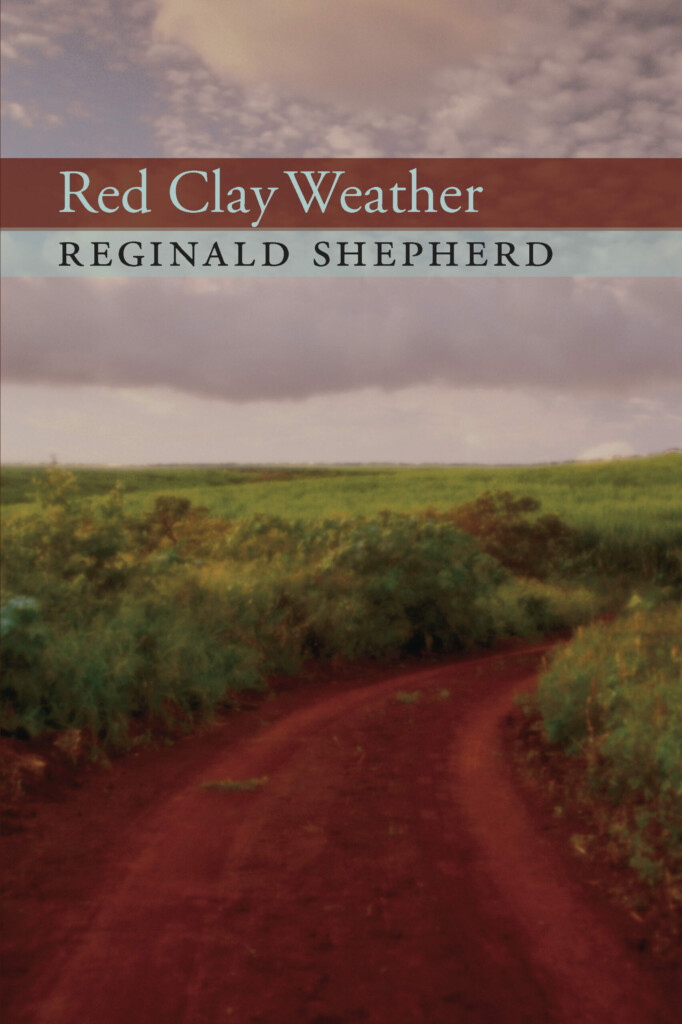
Brown: I think that maybe the one thing Shepherd would have in common with a poet like Mary Oliver is this idea that you protect and conserve the natural world not because of conservation, not because of its resources, but because it is holy. Every image from the environment is always a reason to be excited about nature. But we understand in many of the poems that that which we should be excited about could end.
For me, coming up with these concerns first had to do with separating what is a concern or a subject from that which is artifice. Greek mythology is not a subject, it’s an artifice. He's not writing a poem about the Greek myths. He's making use of classical allusion in order to say something about these other things.
Poets have to use what they have. And what we do have is a bunch of trees, flowers, and grass. We have the sky. We got some dirt. Those things seem to have already been here. They seem to have some capacity to be here if you get rid of us. And I think that particular concern is also the reason why poets can tell you the name of every flower. You just don't know what every flower looks like. You wouldn't be able to actually point to a narcissus. [laughter].
Because you read that part of the intro, I'll read what I say right after that, which I think deals with that, that first concern:
In each book, Shepherd reflects the beauty of the natural world through an understanding of that world as endangered. In his first book, Some Are Drowning, this endangerment appears in direct proportion to the fact of whiteness. And then I quote, “My true love's eyes / are nothing like my own, are bland as the suburban lawn / he mows on a summer Sunday afternoon, backyard / cookout with domesticated dog (And the beef cattle / graze x world? And the deforestation proceeds by x miles / per minute?).”
And that endangerment status matters all the more as environmental elements often get presented as characters with agency. Here are a few lines from “Surface Effects in Summer Wind” from Wrong:
I'm learning to remember the sound
days make: one sky disdaining the idea
of clouds, sunlight surviving
its centrifuge, breeze keeping blessed September
at bay.
Notice September is what's at bay. Then in the same poem a few lines later, he writes:
Midnight,
look at the things I've done
in your name, in my dark, walking out
into the street that changes nothing
Midnight gets called on and talked to directly. September gets held at bay. That which you think of as the natural occurrence, the natural world, has a mind and a life of its own. And the speaker in Shepherd's poems understands that and is always speaking directly to that mind and that life of the natural world.
Solomon: So, there's a sense of that agency of the natural world and that agency being under threat by human actions.
The Day the 'World Ended': Shepherd's Perpetual Return
The second concern is from the very first page of Some Are Drowning to the very last page of Red Clay Weather. It’s everywhere in his poetry. It calls to mind other poets who have talked about what it means to have that sort of exigence—what motivates you to write; what, in many instances, traumatically or tragically, happened that somehow gave you the engine to write. In his poetry and essays, Shepherd writes constantly about – and is processing -- the grief over the death of his mother. In the poem “Vampires,” for example, which you select, he writes “a song like every song for the dead” or in “For My Mother in Lieu of Mourning,” which is in Fata Morgana: “Would you have frozen in these lines? You were their possibility: now love must find another shape.” Really powerfully returning over and over again to what it was like to lose his mother when he was fourteen years old.

I know you spoke with Natasha Trethewey in 2010 in Southern Spaces, and I think about hearing Trethewey speak about that existential wound, the murder of her mother, and also at such a young age. And Shepherd speaking in an essay that he would publish, talking about the day “the world ended” on March 31st, 1978, which was the day of his mother's death.12Reginald Shepherd, “To Make Me Who I Am,” Orpheus in the Bronx: Essays on Identity, Politics, and the Freedom of Poetry (Ann Arbor: University of Michigan Press, 2007), 22. Two questions here. One, how did you live with the loss of Shepherd's mother in these poems as you were reading them? How did that return for you? And then the second question is more for Jericho Brown: does that sense of a wound that writers write from jive with you? Does that make sense to you? What was it like living with that concern that you identify in Shepherd's work?
Brown: I just think it's his best work. I think it's his most beautiful poems. I think when his mother comes into a poem, I'm probably going to like the poem. I think that she was his way into and back to blackness. She was a specter to him. There's a way that she haunted him, and therefore, blackness haunted him. Whenever he talks about music in his work, his mother's coming up. If Sam Cooke, Donny Hathaway, or Otis Redding is in the poem, then his mother's in the poem. Also, the color black itself seems to always appear in a poem where his mother appears, if not talking about Black people, just the fact of a black shirt or a black shoe. I think it's also beautiful because it's not Hallmark washed. It's not a Mother’s Day card. The relationship between the speaker and his mother in these poems is fraught. There's fear as well as love. There's regret. There's also a calling out of neglect in some cases. Reginald Shepherd used to write that his mother knew that if she gave him a book, he would be occupied for the duration of the time that it took him to read the book. So, she could do whatever she wanted. She went through the trouble of making sure he was schooled at the best possible places, in spite of the fact that she was impoverished. He grew up until he was fifteen in the projects, in the Bronx. He has poems about that. I'll give a couple of examples.
I’ll start with this one as it will give me an opportunity to talk about some of the things in Shepherd's work that I'm really interested in.
“My Mother Dated Otis Redding”
My mother is laughing in the hallway with her friends I don’t like much, maybe the numbers runner who gives me dollars to go see movies while they fuck, a mattress propped in the doorway where there’s no door. I know what’s “fuck,” and “dick,” and “pussy.” They’re “tipsy,” she says, they’re having a good time. “Don’t I deserve a good time now and then?” I’m looking through the telescope I just got from a catalogue, while they break out the Tanqueray; I don’t know what that is. They’re putting on some records, it’s 1970, Nixon’s president; there’s a dock in one song and I don’t know how to whistle, but I know what’s a dock, and a bay. There aren’t many stars because of the streetlights, it’s the Bronx, the singer sounds sad, he’s dead. My mother says, “You know, I went to high school with him, back in Macon,” and everybody says “I’ll bet,” and she laughs. I wish I was his son, I wish they’d all go home. It’s late and I just want to go to bed, but she just wants to have a good time. I turn my telescope on the Puerto Rican couple fighting, kissing in a window across the concrete courtyard, three parrots escaped from the loading dock freezing in a trash tree, it’s November, neighborhood kids throwing rocks at each other from bicycles, my mother standing in the hallway with a paper cup of Tanqueray, or lying in the hallway in a pool of her own shit.
That's a poem that's hard on the mother, but also interested in what the mother affords. The mother affords this telescope. The mother affords an awareness of stars. The mother affords an awareness of the speaker's neighbors, of other cultures. The mother also affords this way into Otis Redding's history and music. And then the poem is also political in this way that I think might be in-house for Shepherd. He mentions Nixon; he mentions 1970. What many people don't know is that they would build these projects very purposely without doors in the apartments; you wouldn't have a door on a closet, or a door on a bathroom, or door dividing your bedroom from a hallway. And that was designed to take the idea of deserving privacy out of the minds of people who had to live in the projects. That was real. That was on purpose.
So, part of what he's getting at here goes beyond the mother. And I think what I learned from that poem has to do with how no matter what you start with, the poem's got to include everything. It's got to reach out into the world and somehow be about more than just whatever its obvious subject is.
Here's another poem where Shepherd is talking about his mom:
“My Mother Was No White Dove”
My Mother Was No White Dove no dove at all, coo-rooing through the dusk and foraging for small seeds My mother was the clouded-over night a moon swims through, the dark against which stars switch themselves on, so many already dead by now (stars switch themselves off and are my mother, she was never so celestial, so clearly seen) My mother was the murderous flight of crows stilled, black plumage gleaming among black branches, taken for nocturnal leaves, the difference between two darks: a cacophony of needs in the bare tree silhouette, a flight of feathers, scattering black. She was the night streetlights oppose (perch for the crows, their purchase on sight), obscure bruise across the sky making up names for rain My mother always falling was never snow, no kind of bird, pigeon or crow ...
Which I think is also a beautiful poem because it allows his mother to be a person. And there's a way that when we think about poems -- we found this out during the Iraq War -- the way Laura Bush thinks about poems is that is that they're all sweet. And that's not what poems are. I'm sorry to tell you. So, there's this way we get his mom being his mom, but also a human being, which I really love. Saying your mother is no white dove is a way also of calling to the beauty of one's mother's blackness.
Beautiful White Men: Shepherd's Desire
Solomon: I love hearing you read it. Hearing the rhythm and the way in which it was constructed. One of the things that stood out to me as you read it was the use of the word “snow,” which for readers of Shepherd’s, there's a lot of use of the word snow -- allusion, metaphor, imagery -- throughout his collections, throughout his poetry. And I wonder if this is a convenient segue, or too heavy-handed, but I am curious to get to the last concern that you identify, across his poetry, which is perhaps the most controversial still. I know it was divisive for some readers during Shepherd's lifetime. And that’s his self-identification as a “snow queen.” And where readers today might land. I am thinking about, Shepherd's attraction, veneration, of the white male body.

He writes in the 1986 essay “On Not Being White”: “I write about men, and most of them are white. And I write about white men, and most of them are beautiful. So, I write about beautiful white men.”13 Reginald Shepherd, “On Not Being White,” in In the Life: A Black Gay Anthology, ed. Joseph Beam (Washington DC: Redbone Press, 1986), 30. You can see that in his poems. Do you think that lands differently in 2024? Has anything changed in thinking about Shepherd’s potentially divisive, or confusing, as you put it in your Introduction, presentation of himself.
Brown: I don't know if it's any different. I don't know why, but I guess I just never cared. [laughter] I mean, I do care, but only intellectually. I don't get it, but I don't need to either. Even Shepherd didn't get it. I mean, he says so; he says this is weird. [laughter] There is a poem where he's looking at a very attractive Black guy reading a book and saying, what's wrong with me that I'm not attracted to you? Why not you? You're reading a book. It seems like an admission that the problem that Shepherd has is with himself, with his own idea of his own beauty or possibility for the beauty of blackness. And to be quite honest, I only feel sorry about that.
But all emotions and all ideas are welcome to be expressed in poetry. Only the Black poet can actually write about Black self-loathing that is the result of whiteness. And that's a real thing among us. And not just in the United States. I went to Nigeria a few months ago [laughter] and was just fascinated by how many blonde wigs there were. We've decided something about blonde hair that in and of itself is supposed to have a meaning toward what we think of as beautiful.
So, I don't trip about that from Shepherd. And no shade, but you know these writers who call themselves Black pessimists who are all married to white people, maybe I haven't read enough of it, but I don't see the part of their work where they're like, why is my wife white if I care about Black people so much?
Solomon: So, at least there's a self-reflection that’s happening in Shepherd.
Brown: Yeah. I'm much more attracted to that than I would be attracted to somebody participating in that without understanding that's what they are participating in. There's an awareness. It’s like when I vote Democrat. Like I'm not crazy. I'm not stupid. I also would like to at least have a home to come to. Like, I don't want, like, no shade, but I don't want porn to be illegal. So, I'm not interested in project 2025. And I'm voting for her, but I don't think of Kamala Harris as some kind of freedom fighter or some kind of rebel. I don't think that that is inherent in the fact of her blackness, either.
So, these poems are in the book because they come up so much and that's what he was interested in. And I am so happy that they're there because I would love to see critics and scholars on race and on whiteness -- fields that did not exist during Shepherd's time -- take these poems up.
Solomon: There's a complexity in these poems and in his essays that should lead to studying Shepherd’s approach to the white male body. His will to process and understand.
Brown: He also probably felt, given what was happening among Black queer writers at the time, a bit of a pariah. But it's not like he's the only Black queer person dating white guys. I think him feeling like a bit of a pariah has to do with him expressing it through his poems. When something comes up in a poem, it ends up identifying you like that's who you are. I think we might not be friends with, but we're friends with somebody who's friends with, a Black guy who only dates white people. [laughter]
Solomon: If you think about it, Shepherd publishing in the 90s into the 2000s, the post- In the Life generation, Joseph Beam and the Black man loving Black man is the revolutionary act of the 80s, there is a sense that he is publishing as a poet in contrast to those other writers and poets.
Brown: Yeah. The thing about Shepherd that makes him different is his move that, okay, you call me out about this thing. All right. So that's where I'm going. That's what I'm going to do in this next whole book. We got to see how much of that thing I am. And his way of doing things was put the poems first. And, if that's the experience he had for his poems, that's what was going to be in the poems. I'm really fascinated by that and even envious to some extent. Poets are the people who have to say the brave thing. Who have to say the thing that is true in spite of the fact that nobody else seems to be saying it. Even if that truth makes us look bad.
Solomon: Or is uncomfortable.
Brown: Yeah. And I never felt that I was doing that in my work as much as I feel it now. I feel like, “Oh, damn, I really don't want to talk about this.” I would actually rather not say this in a poem, because once I do, it becomes who I am. You can say this controversial thing in a poem, in Reginald Shepherd's case, he would say in poems that he wanted to suck white cock, which, I've never said it in my life, but -- and he understood this -- after that, you forget that that same person might want a sandwich too, might want a bowl of cereal, might like watching “Charlie's Angels,” might prefer orange to red. [laughter] There's a whole world involved with being a human being. And yet poets have to deal with the fact that once we put it on the page, we understand we will be identified that way, and in many ways dehumanized for that identification. So, Shepherd is an opportunity for me to not dehumanize somebody. But I don't get it. I don't like it, but I like him. I can still be interested in him, even if I'm not interested in that particular facet. And I as I said before, I think that that interest is allowed because he's aware.
From Shepherd to Brown
Solomon: So next is a series of questions that I teased up about how Shepherd can help us think about your work, poetic philosophy, and approach.
In an essay, “To Make Me Who I Am,” Shepherd writes about the importance of certain kinds of music being present in his poetry. For instance, in relationship to his mother as you mentioned. He adds, “Patti Smith was my first image of what a poet might be. She turned social ostracism, into rebellious outsider-hood, loneliness into proud isolation from the uncomprehending mass.” Do you have a Patti Smith? When you think about Jericho Brown before he was Jericho Brown? Was there a person who served as some type of image for you of what a poet might be?
Brown: I think that's a great question. There were always Black poets that I knew about as a kid growing up. I'm always fascinated about people not having an awareness of poetry. I don't know, it's because of the time that I grew up in. I don't know if it's because of what the Black church was then and how it's different now. I learned who Maya Angelou and Nikki Giovanni and Langston Hughes were in church. My idea of a poet were the poets. It is true that when I was a kid listening to Stevie Wonder, I felt like, “Oh, wow, this is poetry!”

I guess the big poet, for me, might be the same as the big poet for a whole bunch of other people. And that's Langston Hughes. Yeah. He seemed to me when I was a kid a kind of unifying force. I was always taken by the fact that the poems are so musical. I loved, and still to this day love, his particularly short poems: “My Friend,” “Island,” “Suicide Note.” He was amazing at creating moments of sublimity. These poems are sublime. When he's good, he's just so good. I don't like “Make America Great Again” or when he goes long. I always thought of him as The Poet because he was given to me as the poet most aware of his people. You know, the self that was made up of many selves; the I that understands there's a we. Later, the more I read his poems, I was taken that he always seemed to be reaching outside of himself.
Hughes was that poet for me. He was the first poet made accessible to me, and I knew when I got him I was getting poems. I never felt locked out of anything. I will also add, I understand people's idea of poetry as a marginal literature. But I didn't understand that at all when I was a kid. I thought poetry was the literature. To this day, I have questions about it. I think there are more poems sitting on people's refrigerators and in their mirrors above their dressers, and right by their door so that they can read them as they walk out, or inside the visor of their car. I think there are more poems in people's lives than there are novels. So, I don't know why we're so marginal. [laughter]
Solomon: Yeah. I wouldn’t argue that.
Brown: Shepherd also in his definition of Patti Smith as that beginning is thinking about how to make use of all the ways that he has been hurt, all the ways that he has been oppressed, both personally and as a Black queer person, and turning that into something else. And part of what he's saying is that Patti Smith was an example of that. I don't think I was self-conscious enough or aware enough as a young person that that was indeed my lot in life. Because I didn't feel that way then, that's not what my need of a poet was.
I liked Sylvia Plath too when I was a kid. I liked Anne Sexton. I liked Gwendolyn Brooks a whole lot. I thought she was amazing. And I mentioned Stevie Wonder. Very early on, Wonder gave me the idea that art could be a contribution to the culture; that you can make a feeling and change the entire culture. I love that. In particular, thinking about blackness. We are having that happening right now with an artist like Kendrick Lamar. Where the music is informing the way the people think about themselves. Which means that blackness, yet again, gets expanded.
So, my idea of what a poem is, and what I do when I write one, is to expand that which is expansive. I do the work of showing you just how big it can be; that it can include all these other things -- definitely Black culture, definitely queer culture, but also the wide American culture.
Identity and Poetry
Solomon: Art has the capacity to expand and not collapse any of our identities. One of the fascinating things for me as a reader of Shepherd's essays is the fact that Orpheus in the Bronx is subtitled Essays On Identity Politics and the Freedom of Poetry and he's constantly ruminating on what identity is and how it makes its way into his poetry or not. And I see some connections here. He states in one interview, “I prefer to call myself a writer who is gay and Black, or a writer who is Black and gay, and to call myself a gay Black writer. I would give the priority to me being a writer. And I certainly think that an engine of my writing is my experience of blackness, my experience of gayness, of marginality, and exclusion. But that doesn't mean that the writing arising from that experience is wholly determined by that experience.”14Charles Rowell and Reginald Shepherd, “An Interview with Reginald Shepherd,” Callaloo 21, no 2 (Spring 1998), 294.
And Shepherd writes in “The Others’ Other” in a similar way: “I have always intensely disliked what I call identity poetics, the use of poetry as a means to assert or claim social identity.”
He continually is thinking through this in his essays: what is the role of identity or “identity politics” in the making and the crafting of a poem. And I really like what you've said before about learning to write about race and sexuality and blackness, in your words, “as if they are givens” and not as if you're “exposing or exposed.”15Marian Kaufman, “Interview with Jericho Brown,” Bayou Magazine, https://bayoumagazine.org/interview-with-jericho-brown/.] I see connections between what Shepherd wrote and what you’ve written. But I also see how they're different. Do you still feel that the priority here is on the writing? What role does politics play in the composition of a Jericho Brown poem?
Brown: I think Shepherd and I were going about this probably the same way, but I also think the difference is that he's worried about bad poems, and I'm not worried about bad poems. People get so frustrated. I mean, I get it. When a really bad book wins a really big prize, you're worried about poetry. [laughter] But if we're doing the immortal thing, let the thing be immortal. It'll work out. It'll happen. But people get really -- and I think Shepherd could have too -- bogged down in the present moment; and in like, oh, why is this a poem? Because you said you were Black three times in it?
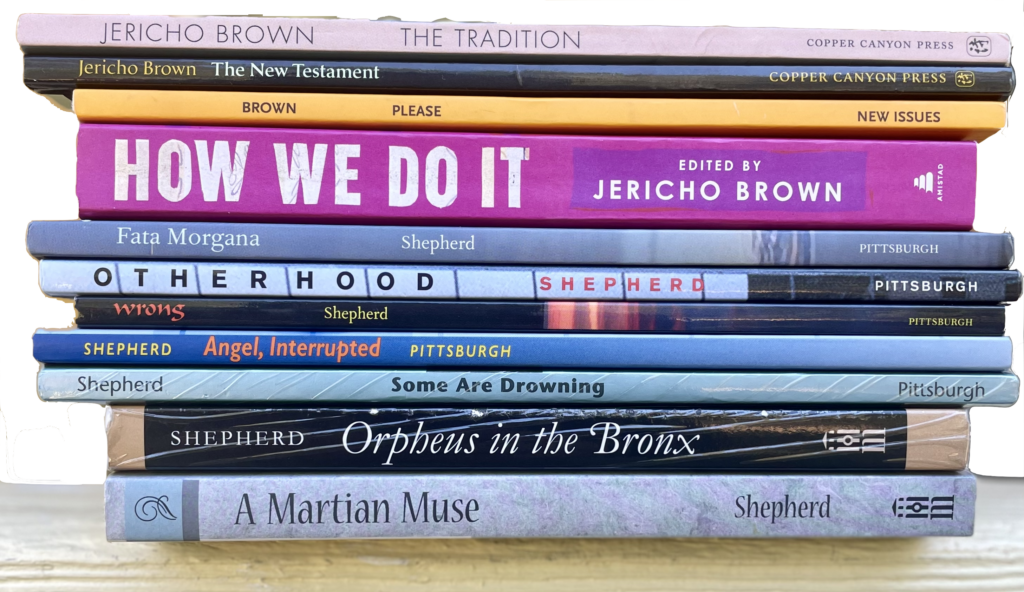
I kind of like the idea that maybe a poem is a poem because you say “Black” three times in it. [laughter] I don't care. [laughter] One of the wonderful things about having served on the National Book Award jury was seeing how many poets that I love and admire and respect approached poetry. Even if I don't like them anymore, [laughter] I still think they're poets. They are people with a lot of reading under their belts. I very distinctly remember being on that jury and seeing people bring up books that I thought were objectively bad. But they liked that mess, and with all their reading history, thought those were great poems. And then the opposite would happen. I'd be like, “Here's this book that's really good.” And they'd be like, “Jericho, no, not that book.” As long as I'm aware of that, I'm not really worried.
I think everything comes out. People get what they need. It's important that we get to hear from as many poets as possible so that we know people are getting what they need. But I also think if something doesn't turn me on, I'm not defensive enough to write an essay. Other people are, and I'm glad they're out there. There are people who are meant for that: something turns you off, you write an essay, go for it. And people talk about it on Twitter [X]. I'm down. Go for it. I love it. Lore, lore. I'm always for more lore. But I just don't get into it because it doesn't fuel my own writing.
My writing, on the other hand, can be fueled by disagreement. I can see someone's poetics being in disagreement with my poetics and my poems can prove them wrong. [laughter] Through craft, through the fact of the poem, but not in a way where I'm calling him on the phone and cussing them out -- which I actually would like better.
Maybe I'm going too far in this question, but I'm always amazed by how people get mad at folks in a community as small as Poetry Land. Where you could just call them. Like if there's a mix up, call me. You don't have to write an essay because you read something wrong. You can send me a DM. Send me an email. Text me.
I think everything goes in a poem and that my job when I'm writing a poem is to allow whatever falls into it to fall into it. And if I'm allowing everything to fall into it, then all that I know will fall into it. Orpheus might be there. Kendrick Lamar might be too. And an experience from when I was sixteen and unhappy might be in there, and an experience from when I was fourteen and happy might be all in the same poem.
And I think that's what Shepherd believes. But I think instead of him saying that he's saying something that puts him on the defensive about identity politics, which I don't get into just because I don't know what that means. And every time I try to define it, every time I look it up, every time I talk to people about it, nobody seems to agree about what identity politics means.
And the other thing I don't know that I see people saying a lot lately is race baiting. I don't know what race baiting means. And I clearly don't need to know to make my work happen. I think poems are political. I don't think there's any way around that. I haven't read the poem that is not. I think people are too. I think lives are. And I think poems are living things. When I'm working on a poem, I'm much more interested in the line, and much more interested in rhyme, and the sounds of things, and the construction of the sentences themselves than I am in what the sentences say. I figure out what the sentences say down in revision land. But when I'm in first draft land, I don't care about that stuff. Then when I'm revising the poem, I'm revising based on a system of sentences and sounds and line and rhyme and meter.
Solomon: There's a sense that you're in agreement with Shepherd on the line itself being the writer constructing the poem. Then these other things may be brought to bear on it in revision or as it’s received in the world. I think that that's powerful. Shepherd is writing these essays in a moment that is different than our moment. During the culture wars of the 90s into the early 2000s, there was this need to define, maybe more so than now in what we might call our queerer moment, when it comes to thinking about identity.
Paying it Forward
One of the things that you mentioned earlier and that I find to be a powerful ethic in Shepherd's work, especially some of his essays, has to do with going to Shepherd to find poets that you should know about. He was always uplifting and amplifying all kinds of different, lesser known, or marginalized poets. That was something that he was committed to: good work getting out there. You've returned to Shepherd here, in the ethic of bringing him to readers today. Are there poets that we should be reading and be talking more about?

Brown: I like everybody, so it's always hard for me. I really do. Nobody believes me, but I do. When I don't like a poet, it's probably because had a run in with them. [laughter] There are poets I don't like. I mean, suddenly your work can get bad to me if you've been disrespectful to me or my students. Or maybe I'm not into it. There aren't a lot of poems out there that I dislike; there are poems that I'm neutral about -- most poems. Most poems happen and I'm like, okay, well moving on. I get Poem a Day, like everybody else and I read poems every day. And sometimes I’m like, ”Oh, God, I gotta send this poem to my ten friends.” And sometimes I'm like, “Okay, girl. Well, you got in there. Go on, go with your bad self.”
So, I like Taylor Johnson, and I think everybody should be reading his work. And I'll stop there.
Solomon: Inevitably someone's going to feel left out.
Brown: Well, it's not just about feeling left out. But there was this other question you had here just about queer poets. I like Brian Teare, Randall Mann, James Allen Hall, Aaron Smith, Danez Smith, Philip B Williams. All of those folks are like the queer men. I like Ellen Bass. I have never disliked a poet whose first name is Robert: Robert Creeley, Robert Frost. I definitely like Robert Duncan. Robert Lowell.
For me, poets write the Bible. You have this book, and what? You don’t like a part of it? [laughter] You don't like Second Thessalonians? You don't you don't like Acts? Which gospel do you not like? You might like some things more than others. People love Song of Solomon because they see it as a love poem. People like any scripture where Jonathan comes up because they like to think about David having a good time. I just think poetry is in and of itself, actually attractive, likable, interesting, complex, a living thing. I like a lot of poets who I think I get on their nerves.
I like Kim Addonizio. I've always liked Terrance Hayes's work. Jeffrey McDaniel. And there are some people whose work I don't get into, but that's just because I don't get into it.
Solomon: And we don't have to name them, right?
Brown: No, I mean, I could. if you want me to say people I don't like, I could do that, too. We could gossip. [laughter] We could talk about who we ought to get rid of. Because they're out there, too. I'm like, oh my God, how is this person still working? You know? That's what y'all doing? I like a lot of very different things. It's easier for me when I'm dealing with students to make recommendations because I've seen their work and I'm like, “Oh, you should read this or that poem.” Everybody's hard on Mary Oliver, but she wrote “The Summer Day.” It's a great poem. Y'all can get crazy if you want. And Sharon Olds wrote “May 1968.” It’s a great poem. You can wear her out all you want. She gave us that. I love Yusef Komunyakaa. If you live in Arkansas and your name is Jeffrey, I probably think you're a great poet. You could spell that “Geo,” “Gef,” “Jeff,” however you get to do. I like a lot of poets because I read a lot of poetry. [laughter]
Solomon: I like finding a sense of connection or commonality with particular poets based upon a student's work. That's how I was introduced to Reginald Shepherd for the first time: someone said, “I see something in your work, read this poet.”
Brown: I like Catherine Barnett. I like Deborah Landau. I generally like poets name Catherine. All poets named Marie or Mary are always good. Mary Shivers. Marie Howe. [laughter]
I'm using that to show that you can't, you can't narrow it down. it is better to create a family tree for yourself. And that includes figuring out who you do love. When you figure out who you love, figuring out who they love. If you can do that, that's a reading life. You can read for the rest of your life that way.
I didn't even say Lucille Clifton's name. Lucille Clifton is my favorite poet. Second to her is probably Louise Glück. She's good. Leave her alone.
Poetry, Theory, Resilience
Solomon: Those of us who've spent time with Shepherd know that he's constantly invoking names like Adorno, Benjamin, Lacan. And he has written, “Unlike many poets, I have never been afraid of theory.” You're a poet, a public intellectual, a teacher. What role does theory play in your creative life? In your intellectual life? Is it something that you begin with? He says it's a “challenge and incitement” for him.16Shepherd, “To Make Me Who I Am,” 31.
Brown: I generally like to read anything that feels like it wants to be read. Anything from novels to criticism to theory to poetry that makes me feel there's an urgency behind it. Sure, I went to graduate school, got a PhD, so I've read these people. Most recently Bettina Judd, a theorist whose work has been so helpful to me. People get frustrated with theorists because they speak abstractly, in the air. And that seems sometimes contradictory to the impulse of poetry to speak on the ground and in images and that which is concrete.
Poets give often the singular situation in order to show that which is common, or known among us. Whereas theorists are doing this other thing where they want to catch the common situation, and then you get to apply it to your individual situation. What I've most recently learned from a writer like Judd has to do with maybe the first question you asked which was about the wound and whether or not I write from it. And maybe I didn't answer that question. Maybe I avoided it.

I think the hardest thing about writing for me has to do with the fact that much of where my earlier writing came from I have healed, or am trying to heal. And knowing that, I am interested in what part of my life, in my personality, only exists because of that wound or because of those wounds. And I want to heal that too. If there is something in me that is a descendant of the abuse I got at the hands of my father, I don't want that thing in me anymore. And some of that I won't be able to get rid of, and it's not like it's bad. I'm like the best friend anybody can have because I am the person who looks forward to cussing people out on somebody else's behalf. But I was never a person that could do that for myself until recently. That's because I always saw myself as a person in a family. And in the family where I grew up, you take care of everybody else, but you don't take care of yourself.
I think that's the case, not just for me. I think it's for my sister. I think it's for my mom. There's this sense that your life is about other people and that you put your life on the backburner, and that's the right thing to do. I just ain’t that person no more. And I don't want to be that person. And so, if I'm not that person, where are my poems coming from? That person wrote Please. So where are my poems going to come from if they're not coming from that wound? And what I've learned from Judd's work is that my present feeling, my present way of being will always have something from which I can pull a poem.
Solomon: It's a powerful reorientation. It makes me think of Whatever Happened to Queer Happiness? I've been thinking with that book by Kevin Brazil. He's questioning why we return to certain kinds of narratives as queer culture. Why we're reproducing certain kinds of stories about loss, about the AIDS dead, for example. And that seems to be even for non queer writers, that's how they imagined queer life. One of the things he talks about is how difficult that reorientation is -- to become someone who can write from a place that's not still dealing with that wound in the same way. You're saying healing, which I think is really powerful. It's not healed. It’s that process. So, I look forward to seeing what you write from this space.
Brown: Me too. Yeah.
About the Authors
Jericho Brown is author of The Tradition, for which he won the Pulitzer Prize. He is the recipient of fellowships from the MacArthur Foundation, Guggenheim Foundation, the Radcliffe Institute for Advanced Study at Harvard, and the National Endowment for the Arts. Brown’s first book, Please, won the American Book Award. His second book, The New Testament, won the Anisfield-Wolf Book Award. He is the director of the Creative Writing Program and a professor at Emory University.
Eric Solomon is an instructor of English and affiliate faculty with the Center for the Study of Southern Culture at the University of Mississippi. He is editor of the “Queer Intersections” series with the journal Southern Spaces; chair of the LGBTQ+ Historic Preservation Advisory Committee with Historic Atlanta; and serves as cultural historian with the Mayor’s LGBTQ+ Advisory Board for the City of Atlanta. In 2021, Solomon launched The #TUOR Project, a digital story tour of sites of importance in Atlanta’s queer past.
Cover Image Attribution
Reginald Shepherd collage created by and courtesy of Eric Solomon, 2024.
]]>
In this short book, distinguished political scientist Adolph L. Reed, Jr. offers remembrances from his early life below the Mason-Dixon line as a member of the last African American generation who came of age during Jim Crow. Reed writes with a purpose—not to chronicle his own pivotal events, hardships, or personal demons, nor to proclaim general truths. Instead, he aims to prevent misconceptions he fears are taking root about the uniform nature of the segregated South and forestall mistaken present-day lessons that ignore the role of class in the racial order of the Jim Crow South.
Reed considers himself a southerner with "a small asterisk."1Reed, Adolph L. Jr., The South: Jim Crow and Its Afterlives (New York: Verso Books, 2022), 9. Born in the Bronx, he was in grammar school in Washington DC, in 1954 when the Supreme Court handed down Brown v. Board of Education. Later, his parents, natives of the Arkansas Delta and New Orleans, moved back to the South where he grew up in Pine Bluff, Arkansas,and the Crescent City. Reed attended college in Chapel Hill, North Carolina and Atlanta and traveled the region while doing summer jobs. He taught at colleges and universities in Atlanta and worked in the city government during the second term of its first Black mayor, Maynard Jackson. He then returned north where he has spent most of the last forty years—primarily at Yale, Northwestern University, and the University of Pennsylvania—teaching and writing about the importance of the working class and the role of class in racial politics.
Although entitled The South, Reed's book illuminates how he and others experienced several different "Souths," where culture, class, ideology, and the laws emerging from segregation varied by geography in practice and form. Reed came to understand that Black people of all ages had to learn differing local white rules of Jim Crow if and when they moved to new places across the southern states—and even in the same city where rules applied differently store-by-store or block-by-block with varying degrees of racial humiliation. For example, one white-owned shop in New Orleans allowed Reed's family to try on clothes before purchase, but in others not shoes or not hats. Some stores permitted no Black person to try the fit of any merchandise. Mistakes in knowing a local "calculus of tolerance" could involve much more than indignity for old or young. "Fourteen-year-old Emmett Till," Reed writes, "was murdered in nearby Mississippi on a family visit from Chicago in 1955 because he unknowingly violated a local rule of subordination in a way that was interpreted as 'getting fresh' with a white woman."2Reed, 12.
"If bristling at Jim Crow's injustices were especially prominent in my consciousness," Reed writes, "it was partly because, as a result of moving around, I was always struggling to learn the local rules and grammar of subordination and how to craft a normal kid's and adolescent's life within them." As the son of well-educated Black teachers, Reed adds, "Where I lived and my family's class position also made it easier to cultivate and express indignation." 3Reed, 13.
The pervasive but varying conditions of white supremacy meant that the places where Black people could be their own free selves, away from everyday racial dangers and indignities, lay within their own segregated communities—especially in Black churches and schools where few whites often entered. As a child living in Pine Bluff, Arkansas, Reed had contact with hardly any white persons because his middle-class father taught at the local historically Black college and his parents kept him close to home near the campus.
Black families deployed a variety of defenses. Traveling on a ferry boat with his grandmother, Reed asked her why chicken wire had been strung between the segregated seating areas. "Well, you see," she stage-whispered, "a lot of crazy people ride this ferry, and they have to sit on the other side."4Reed, 11–12.
Reed's vignette echoes forms of sly resistance, such as that recalled by Mississippi civil rights leader Aaron Henry, growing up under Jim Crow a generation earlier. As a boy, Henry repeatedly complained to his mother that the local white children were able to attend school for seven months but he could only go to school for five. "Aaron," his mother finally responded, "you my boy—and you don't need but five. The rest of them jokers they got to have seven." "Hell, I been cocky ever since," Henry insisted.5Worth Long, "Aaron Henry from Clarksdale," Southern Changes, 5, no. 5 (1983): 9–12. https://southernchanges.digitalscholarship.emory.edu/sc05-5_001/sc05-5_007/.
Passing as white occupies a full chapter as Reed explores the making of racial identities. During his teenage years in New Orleans, passant blanc was often accepted in the Black community as a personal choice, not so much a betrayal of the race. Reed remembers that in the city's Seventh Ward, a family of first cousins with the same surname occupied two sides of a duplex house. "The family on one side lived as black; that on the other side lived as white, and they all acknowledged one another."6Reed, 92–93. In his own family, an adult with light skin color occasionally posed as white to get some prized local delicacy or quicker service from an all-white restaurant, or to momentarily avoid a racial indignity.
Some white leaders openly acknowledged what a large number of various skin complexions meant in the real life of a society where a "one-drop rule" about race-mixing was used to demarcate the presumption of racial inferiority. Reed remembers the legendary Huey Long's brother, Earl, observing in 1960 that a single serving of red beans and rice would be enough to feed all the people in south Louisiana who were truly white (without any mixed ancestry). Alabama's two-term populist governor, James "Big Jim" Folsom, said as much in 1962, after noting the presence of a large number of light-skinned African Americans in his audience. "There's a whole lot of integratin' goin' on at night" in the state's Black Belt, he declared.7Carl Grafton and Anne Permaloff, Big Mules & Branchheads: James E. Folsom and Political Power in Alabama (Athens: University of Georgia Press, 1985), 68.
In concluding his chapter on "The Obsolescence of 'Passing,'" Reed remembers he came to understand at the New Orleans Jazz and Heritage Festival during the 1990s how much the vagaries of race and identity had changed with the end of Jim Crow, especially for young middle class people whose status allowed them to mingle as one at such shared events. "People who may have identified as Cubans and Hondurans, South Asians, Italian (largely Sicilian) Americans, Isleños from the Canary Islands, and other nominal whites formed a physically and behaviorally indistinguishable blur with whoever may have been (Black) Creoles."8Reed, 103.
Throughout The South, Reed investigates continuities and changes in racism and race relations that took place as he experienced the last phases of Jim Crow and the emergence of a second "New South" in Atlanta. His recollections end around 2017 as New Orleans begins removing its most prominent Confederate statues at a time when he was often in the city due to the illness and death of his mother. As if paying tribute to his mother's generation, Reed writes a full-throated analytic attack on the mythology and symbols of the Lost Cause, ripping apart their defenders' rationale for honoring enslavers who undertook a "criminal insurrection."9Reed, 123.
Reed is quick to warn that dwelling on the modern defenders of the erstwhile slave society (touting "heritage not hate") or lingering on "explicit racial hierarchies that defined Jim Crow era" should not replace a "deep examination of the discrete processes that ground and reproduce inequality in the present."10 Reed, 110. The segregationist system of white supremacy not only was more complex and opaque than popularly portrayed today but also was not "merely about white supremacy for its own sake," Reed writes. "It was the instrument of a specific order of political and economic power that was clearly racial but that most fundamentally stabilized and reinforced the dominance of powerful political and economic interests."11Reed, 137. In other words, because "the core of the Jim Crow order was a class system," Reed insists that "a simple racism/antiracism framework isn't adequate for making sense of the segregation era . . . or challenging the forms of inequality and injustice that persist."12 Reed, 140.
This part of Reed's book is not surprising for those who know his career. As a scholar and activist who spent most of his professional life teaching and writing about race and political thought in the United States, Reed has uplifted the importance of class in understanding the dynamics of racial disparities and for dismantling structures of inequality and exploitation. However, most of his remembered experiences with Jim Crow in this book do not directly support his enduring thesis. His argument about the central role of class in The South serves as a coda to his fifty years in advancing the working class as a subject of academic study and political agenda more than a conclusion revealed from the book's remembrances.
In some respects, Reed didn't need to make a case for the importance of class in the life of the South's Jim Crow. It had been done before by himself and others, some of whom he cites in his concluding chapter. One source he did not reference but surely knows is Dr. Martin Luther King, Jr. On March 25, 1965, at the end of the Selma-to-Montgomery march, King delivered a powerful address to the nation—one overshadowed in popular culture by his 1963 Lincoln Memorial "I Have a Dream" speech. In front of the first capitol of the Confederacy, King delivered a speech that included a popular history lesson.
Citing C. Vann Woodward's The Strange Career of Jim Crow, King told the crowd that "the segregation of the races was really a political stratagem" of the South's elite "to keep the southern masses divided and southern labor the cheapest in the land. You see," he explained, "it was a simple thing to keep the poor white masses working for near-starvation wages in the years that followed the Civil War."
King recalled the South's Populist movement when its leaders "began awakening the poor white masses and the former Negro slaves to the fact that they were being fleeced" and "began uniting the Negro and white masses into a voting bloc that threatened" to dislodge elite white control of the South's political power. "To meet this threat, the southern aristocracy began immediately to engineer this development of a segregated society" that became "the roots of racism and the denial of the right to vote," King told thousands who had marched with him for voting rights. "Through their control of mass media, they revised the doctrine of white supremacy. They saturated the thinking of the poor white masses with it." They established segregated laws often making it "a crime for Negroes and whites to come together as equals at any level. And that did it . . ."
"If it may be said of the slavery era," King proclaimed, "that the white man took the world and gave the Negro Jesus, then it may be said … that the southern aristocracy took the world and gave the poor white man Jim Crow."13"Address at the Conclusion of the Selma to Montgomery March," March 25, 1965, The Martin Luther King Jr. Research and Education Institute, Stanford University, Audio, 29:21, https://www.learnoutloud.com/Free-Audio-Video/History/American-History/How-Long-Not-Long/90591.
In remembering the Jim Crow he experienced, Adolph Reed has added nuance and insight to understanding the segregated South as it came to a formal end. In this book and others, Reed has placed himself in the company of southerners who came before him, scholars and activists alike, who devoted their life's work to the search for strategies and means to build a necessary interracial coalition to make democracy work in the nation—and to finally entomb Jim Crow with no chance for an afterlife.
About the Author
An adjunct with Emory University's Institute for the Liberal Arts, Steve Suitts is the author of Hugo Black of Alabama: How His Roots and Early Career Shaped the Great Champion of the Constitution (Montgomery, AL: NewSouth Books, 2017). Earlier in his career, Suitts served as the executive director of the Southern Regional Council, vice president of the Southern Education Foundation, and executive producer and writer of "Will the Circle Be Unbroken," a thirteen-hour public radio series that received a Peabody Award for its history of the civil rights movement in five Deep South cities.
]]>Interview
Southern Spaces: How did you begin the project that became this remarkable documentary The Joneses?
John Howard: Jheri (at the time Jerry) Jones and I met forty years ago as coworkers—freight clerks and passenger ticket agents at the Greyhound bus station in Jackson, Mississippi. I was a high school senior. Jheri was a recently divorced father of four who was beginning to transition. Despite the fact that we now live four or five thousand miles apart, we have been friends ever since.
The documentary project spun out of my first book, Men Like That: A Southern Queer History, which began as an Emory dissertation, submitted in 1997. I had these really superb advisers: Mary Odem, Catherine Nickerson, and, of course, Allen Tullos was chair of my committee. Martin Duberman was an external member. Thanks to their incredibly helpful interventions, it was possible to turn that dissertation rather quickly into a University of Chicago Press monograph, Men Like That, that came out in 1999. Doug Mitchell was the key editor, a towering figure in queer publishing. After that, various ideas were floated about how to reach a broader public. Several people recommended verbatim theatre. There were some good examples of this. In 2005 University of Alabama Press published a revised edition of Ben Duncan's memoir The Same Language and I really liked playwright Carl Miller's adaptation for Menagerie Theatre Company in Cambridge (UK). Soon there would be the example of E. Patrick Johnson's very important work on black gay men in the South that he was performing as a one-man show. Johnson had experience in performance studies, and he was using his oral history narratives in that way, which I found very compelling.
I was even more interested in the suggestions to turn Men Like That into a documentary film. Around 2007 Ash Kotak, a friend and neighbor in central London, and I began to talk. I teach his 2000 stage play Hijra, which I think of as a queer/trans subaltern romcom. It's an extraordinary work that will be turned into a film. Ash was insistent that this be a character-led project. We had to forefront an individual who could provide queer, trans, and Mississippi history as part of that character's backstory. We considered several people. An early title was The Strange Career of Jon Hinson based upon a US congressman from Mississippi who twice was caught in compromising situations and queer spaces in the D.C. area, and yet was reelected to Congress for his conservative Republican values. Eventually, he was caught again and run out of office. We thought about Aaron Henry, the great leader of the NAACP in Mississippi, but, to be candid, his wife likely would have quashed any such project.
I told Ash about Jheri's SRS, then called sex reassignment surgery, now called gender confirmation surgery. I was the only friend or family member able to be there when she opted to have that procedure in Belgium. Even with the cost of flights and the initial recovery period in a hotel, it was cheaper to do so there than in the United States. Hearing her story, Ash insisted that Jheri had to be at the center of any documentary that spun out of Men Like That.
We made attempts to get initial funding, including the AHRC (the Arts and Humanities Research Council in the United Kingdom). They gave us the nicest, or worst, rejection: essentially, "this is superb; we have a few concerns around the edges. So be sure and reapply, and we'll give you the money." Well, life intervenes. And sadly, in my case, that involved being drafted into the headship of my department at King's College London. So I was not going to be as deeply involved as I had wanted to be, nor would Ash.
We approached Faction Films in London, where Caroline Spry, formerly with Channel 4, helped steer the project to completion. Among other tasks, Ash and I were asked to interview potential directors. It came down to two: an amazing South African, Oscar-nominated director named Murray Nossel, and a very soft-spoken Londoner named Moby Longinotto. Murray and I really got along in our interview, but I didn't like his initial ideas about how we might frame the project. He wanted a journey of discovery. He wanted me to travel back to Mississippi to ask Jheri for advice, which, for reasons that will become apparent, I don't ever do. That struck me as a bit contrived. All this is unfair to Murray, because this was a single interview and it was just an idea he threw out there. So I want to give a clear shout-out to Murray, I would love to work with him! But it was after viewing the films of both Murray and Moby Longinotto, and especially after seeing Moby's film, Small Town Boy, that Ash and I agreed wholeheartedly that Moby was the person for this project. So, he got busy and on a shoestring budget made a quarter-hour short by 2009.
Q: What was it about Small Town Boy that made you think Moby was suited for Jheri's story?
Howard: It's a beautiful, charming documentary about courage in Somerset, a small-town setting. It's about one brave boy and a group of people who put him out there as the alternative carnival queen, in drag. Moby was able to get extraordinary shots: the fifteen-year-old walks down the street and a fifty-year-old man almost assaults him. And there's great patience and quiet, controlled pacing that seems true to village life. Where, as a filmmaker, you go, stay, and get to know someone for an extended period. You wait for things to happen, and they do.
Q: Do you have any insight into the first meeting between Moby and Jheri and her family?
Howard: Moby hit it off with everyone. As was so apparent in his film No Time for Tea at Raj TV, Moby is adept, attentive, and respectful in cross-cultural settings, easily fitting into local patterns and rhythms. The Joneses soon became accustomed to his regular visits, initially on his own, doing the camera work, and over time with slightly larger teams.
Q: What were those visits like? Did Moby live in Mississippi for months at a time and stay with the family? Did he return over a period of years? How embedded was he?

Howard: He'd go initially for shortish visits. As budgets were slightly increased over time, he would go and stay longer. Stories emerged over years. Different plot lines seemed to come about quite naturally. And the family grew more trusting of Moby and the entire endeavor. More could be said and revealed. Early on, Jheri was talking about using a pseudonym, as we had done in Men Like That. That was going to prove impossible. So much happened over the years that they, all of them, came out in new ways.
Q: I'm struck by your comments that you were there with Jheri in Belgium during her gender confirmation surgery. That's not brought up in The Joneses. Do you know more about how that transpired and how she was able to make connections with care providers in Belgium?
Howard: I do. Jheri got online just before the turn of the millennium, asking trans people in various forums how to get the most affordable but safest surgery possible. She had been transitioning since the late seventies, with Dr. Ben Folk at the University Medical Center in Jackson who prescribed hormones. But she knew she was going have to go out of state for the surgical procedure. Increasingly it seemed it would be more affordable to go out of the country. So that's what she did. It was her first time outside the United States, aside from a cruise to Mexico. It was quite a gutsy thing to do. In The Joneses, Jheri explains how she had to save her money over a long period of time and get to Brussels. Because I live in London, I was able to go and spend several days with her, the only friend or family member who could afford it. An amazing moment happened there, and though I've told this story before, it's important to understanding the genesis of the film project.
Right after her procedure, as Jheri had requested, I rang her eighty-six-year-old mother back in Smith County, Mississippi. Reverting to my old southern accent, I said, "Miz Jones? This is John Howard. I'm calling long distance from Brussels, Belgium. I just wanted to let you know that the surgery was a success. Jheri's still unconscious, but doing fine."
"He is?" she asked.
"Yes, ma'am," I said with emphasis, "she's doing all right."
"Well," she hesitated, "that's good. Please tell her I love her."
That's the story that convinced Ash Kotak that Jheri and her family should be featured. The project held out hope for other reconciliations in fraught familial relationships that went back decades. It also seemed likely to reveal strongly held prejudices, as well as aspects of trans life as yet untold.
For example, around this time, there was a cultural outpouring of stories about sex reassignment surgery. In 2007 Dr. Marci Bowers of Trinidad, Colorado, was getting a lot of attention, and Channel 4 and a US partner made a six-episode series called "Sex Change Hospital" that aired on More4 in the UK and WeTV in the US. Dr. Bowers, by the way, was among the many Jheri consulted by email. It seemed trans media representations at that moment centered on surgery and on good-looking young people. We did not want to do that. We wanted to talk about the distinctive challenges of trans aging, assisted living, end of life care, the Deep South's religious challenges, and LGBT working-class issues more broadly—one of which remains crucially important around the world: employment discrimination.
Q: There are so many determining economic, social, and political pressures in the Joneses situation in Mississippi. How did they understand their economic precarity?
Howard: It's a great question. The documentary can only do so much. The difficulties in Mississippi and the misdeeds and mismanagement of the Mississippi legislature over decades requires a reckoning all its own. But several related things that emerge around structural, systemic oppression of LGBTI people involve intimidation, violence, and employment discrimination. There are scenes in The Joneses where Jheri and her son Trevor reference their experiences of bullying and intimidation in the public schools of Mississippi. Jheri many decades ago; Trevor a couple decades ago. Jheri worries about her grandchildren experiencing bullying if their schoolmates find out they have a trans grandmother.
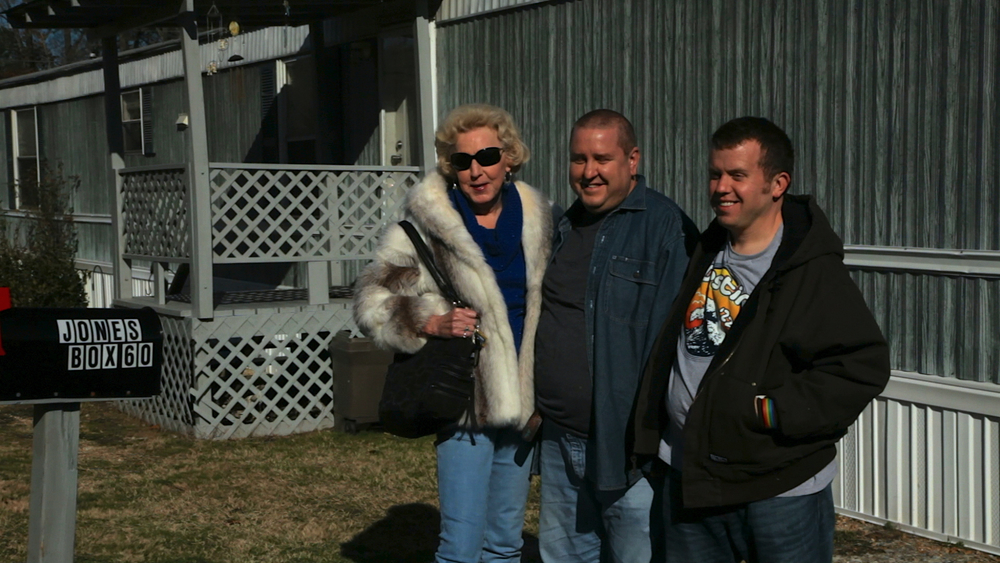
Trevor was most resistant to the project, not only because of fears of his own coming out as a gay man, but also due to the potential for violent reprisals—worries that I still have around the everyday discrimination and potential violence they face not just in the trailer park, but elsewhere in Mississippi and when they travel. When Jheri tells about her varied job history, it's implicit that after she transitioned, she had to create a whole new job history. What you can't know from The Joneses is that she was hounded out of her job at the Greyhound bus station by some really vicious employees. She was fired from a job at a construction company because management discovered she was trans. She recently told me that she now finally has a job she can't be fired from, because she's a freelance bookkeeper, working mostly for her son Wade, which we do witness onscreen. She still has to work. Retirement is not an option.
To sustain this large family, two members of which are disabled, there's not enough income. There's reference to living at the poverty line. It was very important that the problems of employment discrimination, the precarity of their lives, be central to The Joneses. Much can only be suggested, but it looms over the entire project. This is a poor, working-class family struggling to get by. The nature of the household is forged by economic precarity. Back in 2004, Jheri suggested to Trevor and Brad that it was in their best interest to sell the small house that they had inherited from their mother and move into the trailer with her.
Q: Do you wish that there had been more explicit attention on the structural economic pressures in the documentary? More than is shown through the abandoned storefronts and empty streets of Pearl?
Howard: Yes, to be honest. I was pleased that early on viewers see Jheri preparing for work, and out she goes with her thermos to her car. She's driving to the Salvation Army, where she worked in payroll for a time. If we had tried to film at Salvation Army, she would've been fired. Nonetheless, we do get her narratives of the various kinds of jobs she's held through the years. She doesn't mention chicken farming, and there was other low-wage work that she's unable to speak about. We see Brad working around the home. He does the yardwork. He helps Jheri prepare to cook and cleans up afterward. He walks the pets and does almost all other domestic chores. I wish we could have gotten inside Trevor's workplace, but he works manual labor at a national chain and it seemed very risky.
John Marszalek III's excellent new book Coming Out of the Magnolia Closet shows with great force how employment discrimination informs all aspects of life for lesbian and gay Mississippians. What I've called quiet accommodationism—what his narrators describe as a need for discretion, their refusal to fly the rainbow flag—is borne of the need to keep their jobs and maintain their livelihoods, their tenuous hold on economic security. One narrator after another is fired, suspended, or denied promotion when the boss discovers their sexual orientation.
Q: Equally important in The Joneses are questions of religious belief and practice which the documentary puts into tension and contradiction. From fundamentalist punitive judgment and rejection to joining the inclusive Safe Harbor Jackson congregation. The Joneses are shown joining hands and praying at meals and seem to have adapted Christianity to suit their emotional needs.
Howard: I agree. I think this is one of the The Joneses great successes. I had confidence in Moby's ability to get inside these spaces. They make for some of the most compelling scenes and produce the most important arc in the documentary. We're dealing with a trans matriarch who has four sons, two of whom live with her and one of whom has two children. Jheri grew up in Primitive Baptist traditions, and she is not giving those up. She continues to attend Primitive Baptist churches. Moby manages to get inside one and captures the scene of a well-suited preacher beginning a sermon, stating that "God is love." That sermon rapidly degenerates into condemnations of "sins of the flesh," exhortations against the congregants' "own evil ways." Evil! Moby frames shots in which crocheted blankets are folded over the end of each pew. You get a sense of church ladies' work, their labor in trying to provide cold comfort to these hard pews. But their loving communal labor is in stark contrast to the fierce hellfire-and-brimstone rhetoric from the pulpit.
What we also learn is that Jheri's son Trevor had great trouble coming out as a gay man, even in a trans-headed household. Trevor's biological mother Doris converted to Jehovah's Witness and was rabidly anti-gay. That placed an enormous obstacle in Trevor's reckoning with his own sexuality and identity. In that White Sands Baptist Church cemetery, we have Trevor breaking down, telling his mother at her grave site, I'm gay and I'm not ashamed of it. I know you counseled otherwise, but I must live this way, with honesty. Then, near the end, Trevor and Brad formally join a congregation they had been attending, the LGBTQ+-affirming Safe Harbor Church. Once again, music plays a crucial role. A female pastor inducts them and asks the members of the church to take an oath to support these two new members. There's a powerful hymn, in stark contrast to the Primitive Baptist Church, about love growing and overflowing, with the entire congregation joining hands. It's a much more welcoming and affirming message than those Protestant hymns many of us know so well. Music plays a vital role as these two Joneses are welcomed into this unusual Mississippi church.
Q: Is The Joneses reaching audiences in Mississippi? Do you have a sense that the people who would benefit from this narrative and from having these lives depicted honestly, with the sort of struggles and joy that they have, are accessing the film?
Howard: How can queer youth and LGBTI people of all ages find media representations that feel true to their own experiences? Trevor spends several years in a trans-headed household; even so, it's difficult to come out. He told me that a particular character on a soap opera helped him think things through. The filming also helped him, because it was a process of affirmation and bringing the Jones family closer together.
As for audiences for The Joneses, Jheri was flown to New York and San Francisco for the East and West Coasts premieres; the trio that live in the trailer drove to premieres in Hot Springs, Arkansas, and New Orleans. They were able to participate in the project's dissemination. As of the beginning of 2020, The Joneses has not premiered in Mississippi. It has been shown in Alabama, and most importantly perhaps, it's now available on iTunes, Amazon, and so forth. Hopefully, interviews such as this one will make it more widely known.
As for the struggles of LGBTI youth in Mississippi and the kinds of barriers that trans and non-binary youth are breaking down, it's exciting. People are coming out at younger ages. They're feeling more empowered. There are straight-gay alliances in high schools, though in my hometown the principal actively opposed it, drawing national media scrutiny. Trans youth are doing something heroic and courageous. More power to them. What we thought we could show is how trans elders such as Jheri were the trailblazers.
Q: How were the musical choices made in the documentary? Rarely does it happen that a film crew goes to Mississippi and doesn't replay all the blues clichés. There is a little snippet of blues, but there is also composed acoustic music. And the soundtracks that Jheri has going in the background, and the church music.
Howard: We were paying attention. And while I was reluctant to be too assertive with Moby, it was around music that I was most willing to make suggestions. I would just express to him my worry that we would get the old, hackneyed, twangy blues guitar. The bent notes that are cliché to many of us who see a lot of "Southern" cultural productions. Even in the quarter-hour short in 2009, Moby was paying attention to the ambient music in the household: salsa, classical (at that time on Mississippi Public Radio. No more.), and disco—which is hugely important in Jheri's life and creates moments of affirmation. For me, that musical score is just about perfect. And it begins with composer Joel Pickard's opening number: acoustic guitar with cello underneath when the camera pans over family photo albums and helps viewers understand the chronology they're about to experience. It's extraordinarily powerful. Along with portrait photography and dance, the range of music is a cohesive factor in The Joneses. Interestingly, the one blues track, chosen carefully and used as background when Jheri is describing Mississippi history and the closed society is Tom Dickson's "Labor Blues." I found that an amazing choice, which I had no hand in.
Q: As I was watching The Joneses a second time, I caught myself picking up all sorts of queer cultural cues, especially visually, that are peppered throughout. The rainbow ensemble Jheri wears in her first appearance as she sings "Diamonds are a Girl's Best Friend." A shot of a coffee can tinman sculpture that hangs on a trailer porch recalls the friend of Dorothy and an apocryphal story of the Stonewall Riot origins. A shot of pink flamingos suggests John Waters and Divine. Jheri's dancing and kitchen calisthenics remind me of Little Edie in Grey Gardens. How much was Moby doing deliberately? How do you understand The Joneses in the context of queer cultural history?
Howard: It's highly self-aware and honors various traditions that you've picked up on. It bears multiple viewings. There are more things you can find, not only related to the South but to global capitals' mediation of "Southernness," especially Londoners, especially film and art school types. They know William Eggleston, and you'll notice in the early credits there's a visual citation of him. If not direct citations, there are evocations of photographers Eudora Welty and Zoe Strauss at whom I recommended that Moby take a look in advance of his first trip. And William Christenberry. Moby improves on one of the location stills I was asked to produce early on for promotional purposes, the ubiquitous roadside Golgothas. These are peppered throughout, including lingering as well as fast-paced shots of photo portraits that are on the walls in the Jones home. This works as a way of accessing psychological states and suggesting the back stories for them as individuals and collectively as a family. Moby was able to do so much largely within four walls by virtue of patience and years-long determination to carry the project to completion. He worked his way through the cultural minefield of cliché and hackneyed musical scores and visual representations that we've all worked to undo and deconstruct.
Also hovering over the film, not directly addressed, are the drag cultures that nurtured and sustained Jheri in her earliest days of transitioning. She performed on Jackson drag stages as Lady Gay Chanel in the 1970s and 1980s, specializing in Ethel Merman numbers, and I hope future work, as by the Invisible Histories Project, will have more to say about this. But again, this subject seemed relatively well covered in televisual media, as compared to working-class queer issues, economic struggle, and religious persecution. RuPaul came out of the Atlanta drag scene, and we now have eleven seasons and countless tie-ins and spin-offs that frequently reference distinctive Deep South pageant and performance cultures.
Q: Having dealt with so much across several years, there's an optimism that concludes The Joneses. In terms of the family, what's happened since?
Howard: The family came together, was made stronger, understood themselves better, and were better able to talk with each other. Roughly midway through The Joneses, Trevor tells Jheri, the problem is we never talked. We never talk things through. The production encouraged that and helped make it happen. There are comings out and reconciliations. And this is where the Joneses are now, the year that Jheri celebrated her eightieth birthday. She's still working, working out, and looking for love, arguably in all the wrong places. [Laughter] She's certainly looking for love. But she has to be careful as she discloses to some dates and to new boyfriends. She experiences a lot of rejection, she tells us. At least she no longer faces the "threat of murder," after her surgery.
Brad and Trent are in many ways in the same place physically, sharing that home with Jheri, working in the same jobs, but I think they feel closer to their family members and feel proud of having done this. Trevor's story is most astounding. You'll remember he was the one who was most resistant to being filmed, sending me an all-caps message on Jheri's email account very early in the process: essentially, "GO AWAY. WE DON'T WANT TO PARTICIPATE IN THIS PROJECT."
As we learn in the film, Trevor was forced to drop out of high school to give full-time care to his biological mother Doris, who was in the late stages of morbid obesity, nearing the end of her life. Very recently, Trevor studied for and obtained his GED, and he's considering training as a nurse. He has a boyfriend of two years. Recall that when he spoke on camera as early as 2009 he said he hadn't achieved at his age what he wanted, which left him feeling "worthless" and "inferior." He talked about wanting one person to love and live with. Now, this person is about fifteen miles away, and they spend time in one another's homes.
As for the grandchildren, Nick and Trinity: Because this was a years-long project with countless setbacks, Jheri's grandchildren became teenagers and began to ask questions. You have this extraordinary story of the grandchildren being told that their grandmother—how does Wade put it?—was "technically speaking their grandfather." That trans grandparent coming out to her grandchildren—being helped along with photo albums that visualize her backstory—with their own father, Wade, also explaining is a crucially important part of the story that we never could have imagined when we first began making the documentary.
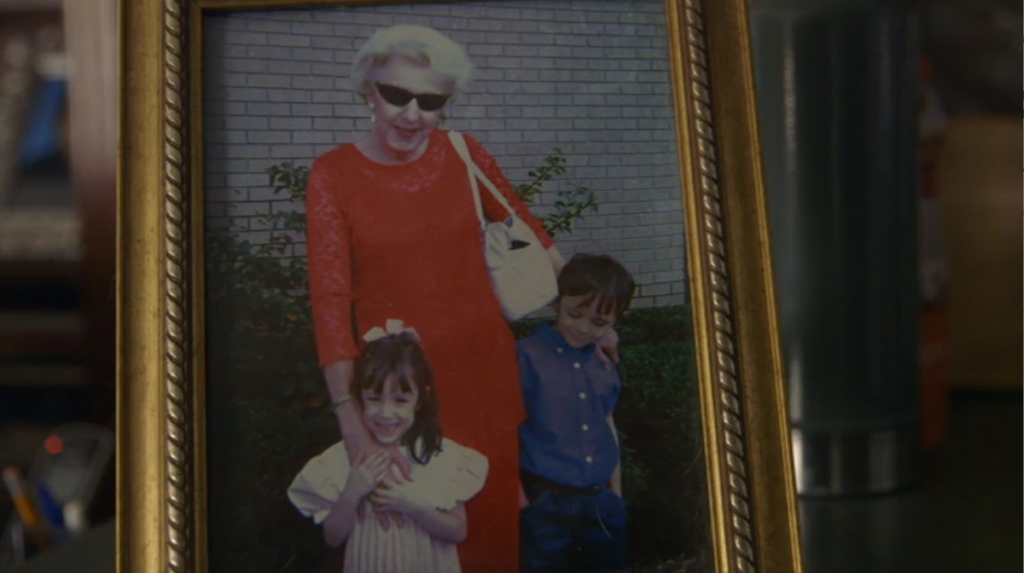
Nick has been in the Marines stationed in Virginia for the last two years and is considering re-enlistment. He regularly visits with his grandma. Nick coined this term "Grandmapa" in The Joneses that helped him reckon with her life history. Now she is known as his grandma, and they have a wonderful relationship. Trinity is very quiet throughout. Jheri interpreted that as affirmation, but now finds that she has a better relationship with Nick than with Trinity. Trinity graduated from high school and attends the local community college.
Q: In observational documentary you're dealing with who you see and who was around, and there isn't a lot of interracial interaction in The Joneses.
Howard: What you see represents the historic shift from de jure Jim Crow segregation to largely de facto segregation. However, there are positive signs. Pearl, Mississippi, was virtually an all-white town for most of the twentieth century, and when we began the project, the trailer park was almost all white. That changed into a multiracial environment. On one of his afternoon walks with Moby, where over time he reckons with his grandmother and is engaged in a kind of moral reflection, Nick references his "homies," his friends of color within the trailer park. Yet, viewers only get glimpses outside the walls of the mobile home.
The first worker seen in the film, other than one of the Joneses, is a black carpenter. Followed by a white mechanic, then the voice of a female African American caregiver at Trent's assisted living facility: "Where the hug at? Where's the hug at?" This becomes a trope from the opening title photo, taken probably twenty years ago, to the final stills, shot specifically for the project. Institutionalized for much of his life, Trent doesn't quite know how to hug. He doesn't know what to do with his arms when he's photographed. And that gesture for me is one of the most compelling, complicated reckonings with the difficulties of disability and care facilities, and how those phenomena are racialized and disproportionately visited on working-class people.
Perhaps most importantly, the one biracial, if not multiracial, gathering we see in The Joneses is the LGBTQ+-affirming congregation of Safe Harbor Church.
Q: Considering the different paths that brought filmmakers and viewers into this one home, what do you think Jheri hopes for The Joneses to accomplish? And how do you as the producer and Moby as the director perceive it doing activist work? It's so local, specific, and intimate, yet should have resonance far and wide.
Howard: Your question challenges us to think through explicitly activist productions with precise political aims compared with quieter, subtler films that begin as a day in the life and proceed to five plus years in the life. The Joneses resonates with different audiences. The Joneses short went to Brazil, Mexico, the United States, Canada, and Europe. Think about the captioning and the translation that happened, the recirculation of queer ideas and vocabularies. How does this very particular, very queer household in central Mississippi resonate with diverse audiences in other rural or small-town locales? I think the work of Mary Gray is very good on this, her book Out in the Country. Even the most transphobic early cultural productions on cable television can be reworked by latter-day trans-viewers to provide basic information and affirming representations. Jheri has been very explicit: I want to spread the word about trans-knowledge and trans-empowerment.
A group I briefly mentioned above is the Invisible Histories Project. They're an increasingly better funded network for generating new oral history narratives about LBGTI people in the South, as well as archival collecting and preservation. Something Invisible Histories wants to do that we weren't able to develop in The Joneses is explore Jheri's time as a drag performer in the 1970s in gay bars in Jackson, as part of that vital queer bar infrastructure largely made possible by owner-operator Jack Myers. By the way, Malcolm Ingram's stunning 2006 documentary Small Town Gay Bar, set in Mississippi, is an exemplary feature, in this regard.
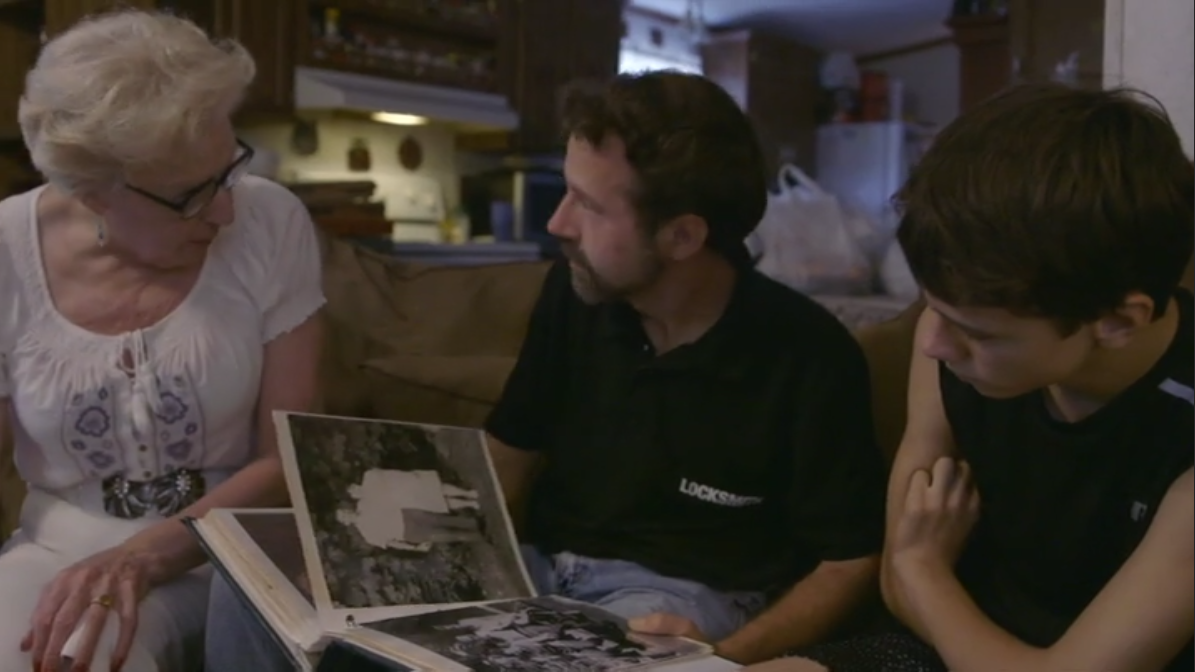
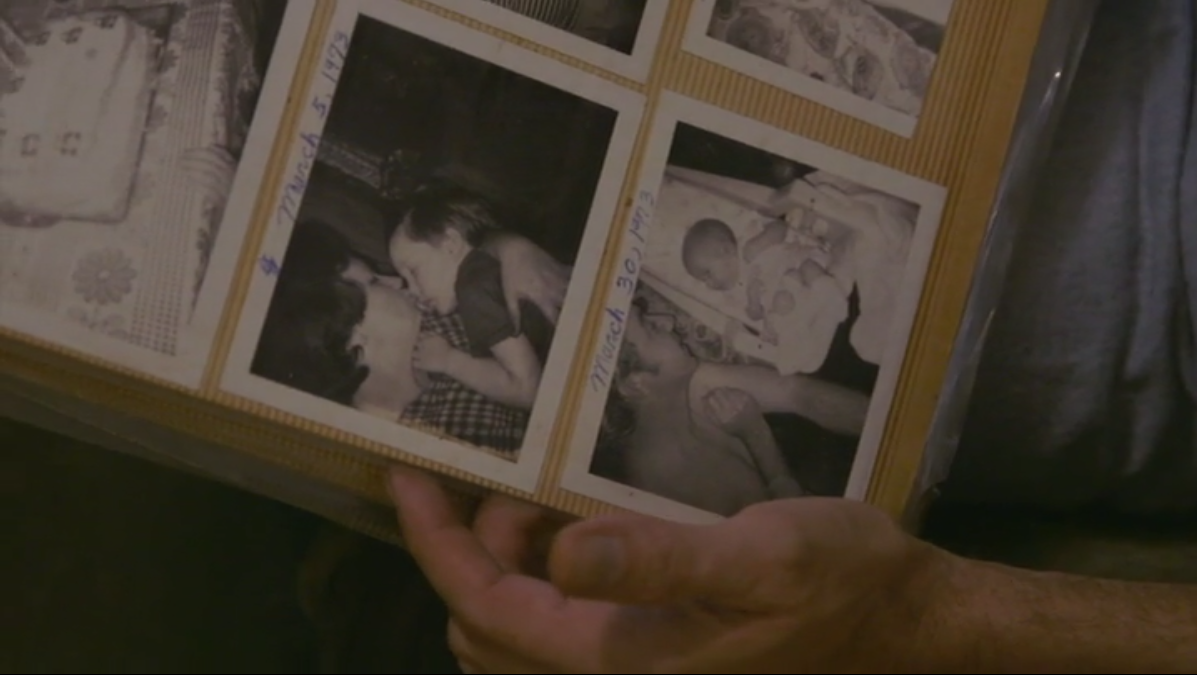
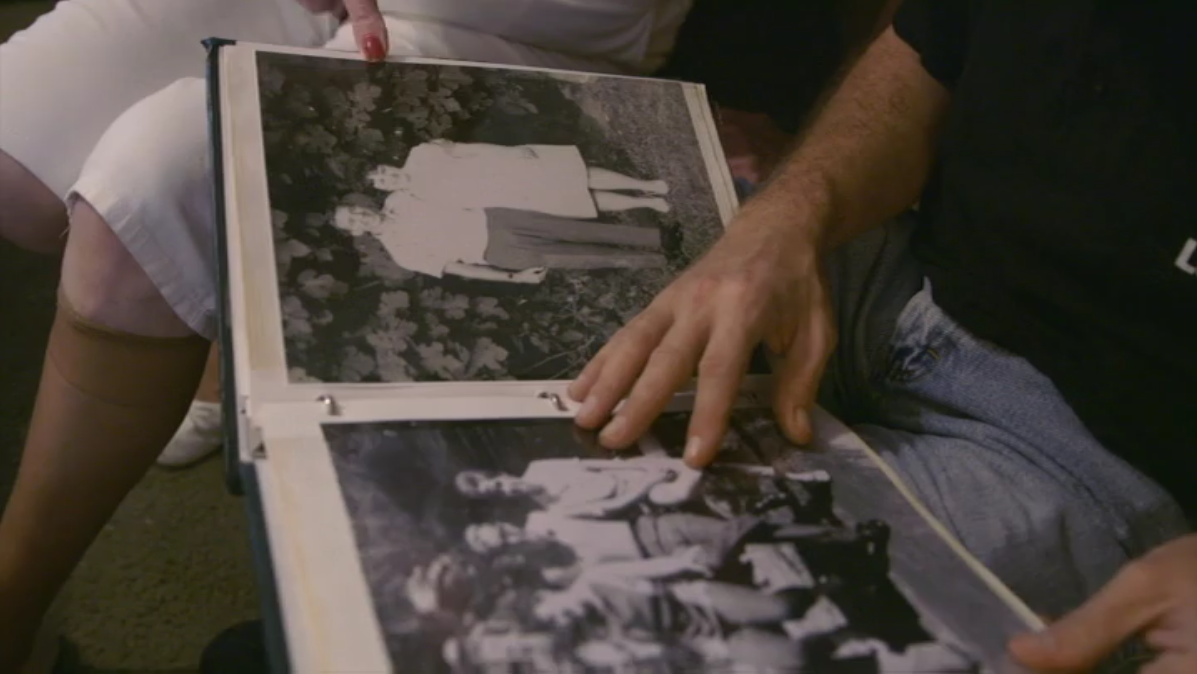
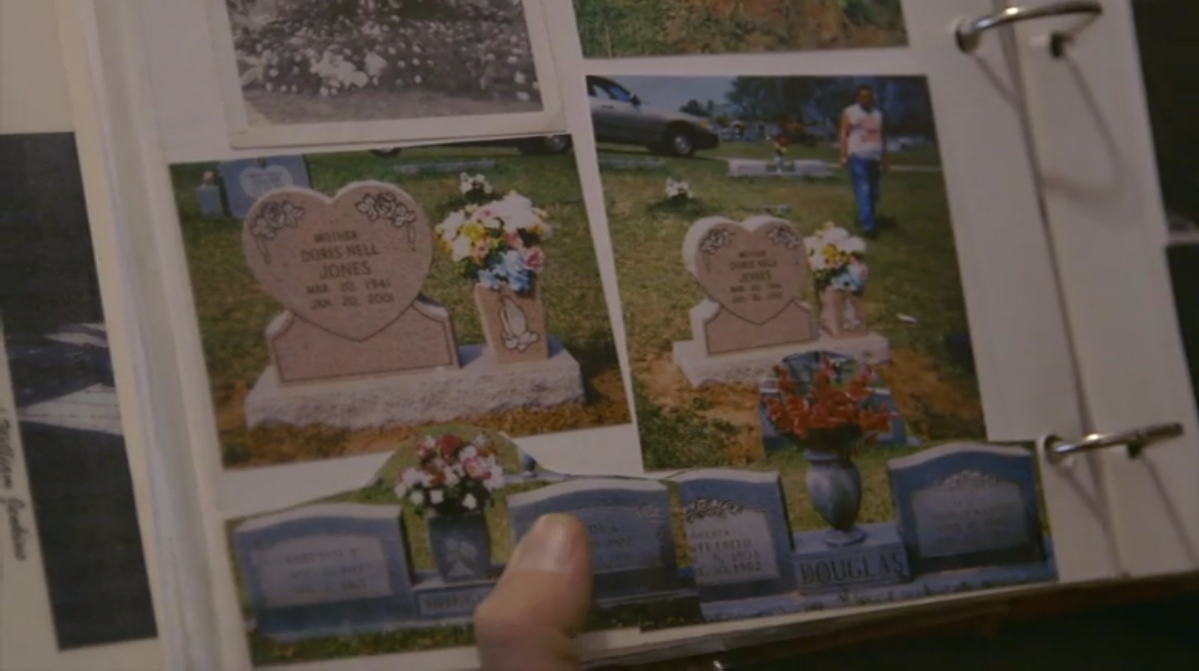
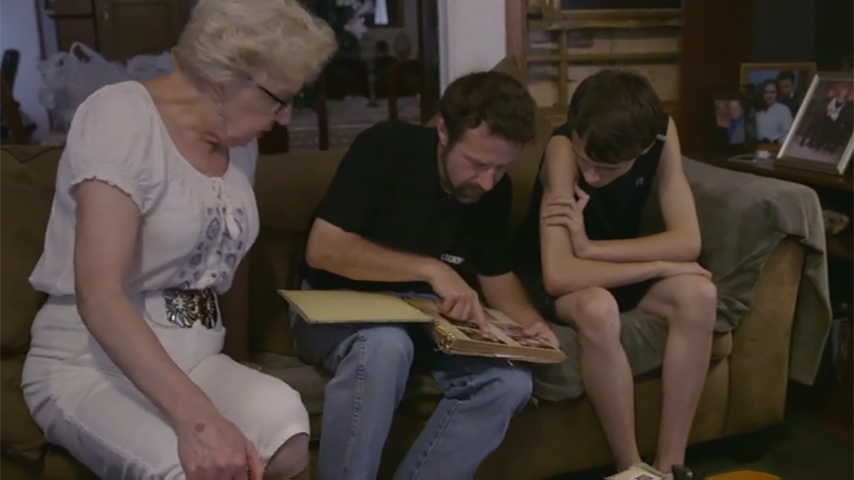
.jpg)

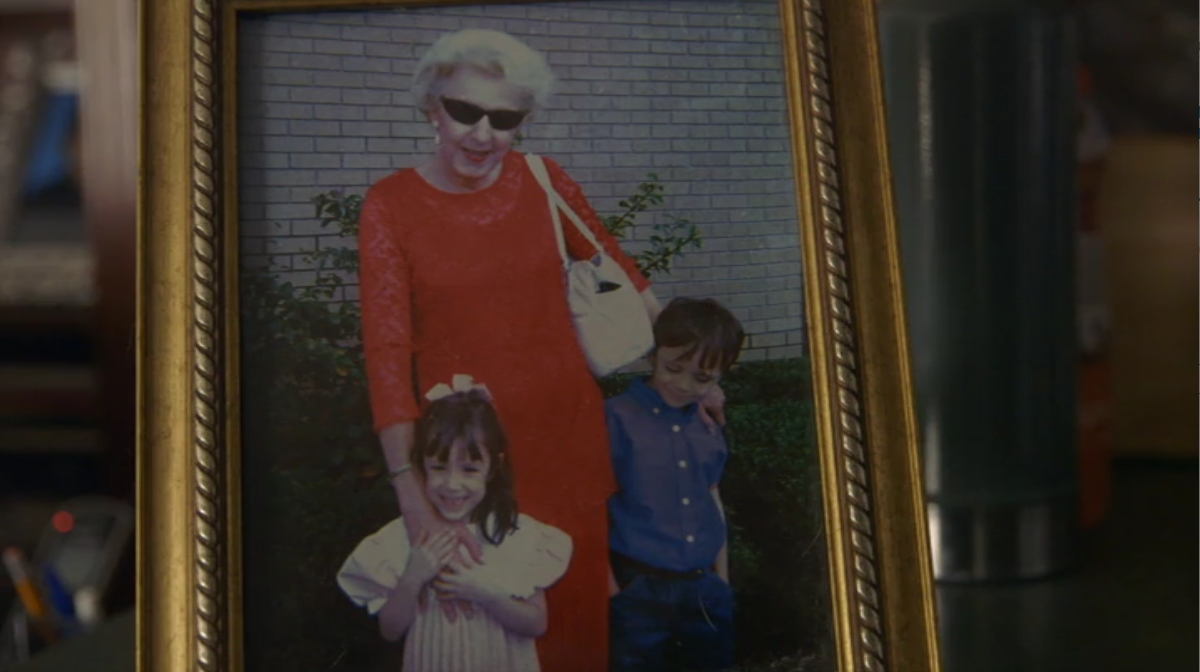
Invisible Histories also wants to safeguard the Jones family photo albums in climate-controlled archives so that primary documents of Jheri and her family members, letters, diaries, and the traditional stuff of academic historical writing can be maintained long-term. As well as the play script Jheri has written! This is a complex project around institutions historically hostile to LGBTI people. During one of my latest trips to the University of Mississippi, someone pointed out that there were raids on LGBT students, specifically on gay male students, having sex in various places on the campus as recently as the 1980s. So how to convince LGBTI individuals to part with their keepsakes, documents, artifacts and entrust them to institutions in states that until very recently had sodomy laws and continue to have discriminatory employment practices and "religious" exemption clauses based on sexual orientation and gender identity. That's going to require some painstaking work liaising between LBGTI individuals and groups and state universities, repositories, and museums, that are increasingly eager to collect this material. Notions of how and what we archive will have to change. The work involved in negotiating these relationships is fraught, but worth the effort.
Some of The Joneses' most important work suggests ways in which we can challenge well entrenched heteronormative, and now homonormative, constructs. How to think about family and flexible kinship networks in richer ways? At one point, Brad describes a dream he had. He's married; they have a child; and that child does not have the cognitive disabilities Brad does. He's also talking about something as seemingly mundane as teeth. You know, what if that child had "perfect teeth"? And for me, this is one of the subtle but, again, very important moments where you see the cruel juxtapositions of living in the poorest state in the richest nation on earth. Right? So you have these outsized consumerist expectations that are delivered to you via mass media. But then you have the hard realities on the ground that most people here cannot afford dentistry much less orthodontics. That was so powerful for me. Because I've known farm people, certainly of my mother's generation, who talk about the resentment they felt because their parents couldn't afford to get their teeth fixed and therefore they could not have that "winning smile." Again, a seemingly mundane phrase, but a phrase that speaks so much about American culture. You know, one must perpetually perform some aspect of American success ideology—whether it's a coming out narrative, a recovery testimony, or a religious conversion experience—and do so beautifully, working on one's attractiveness, which too is referenced in the workout routines in the film, the frequent trips to the gym, the way that one must not only be healthy but be attractive according to normative beauty standards. Brad speaks something quite profound in those moments.

I would have liked to have been consulted on the captions, because I think we missed some really interesting turns of phrase. Jerry uses the old temperance phrase "teetotal," which just gets transcribed as "total." An opportunity is missed in a word or a phrase. But on the whole, I'm astounded that the project was completed. I'm astounded that it's widely available. And all in all, I'm so proud of what Moby especially achieved with Ash, Caroline and, obviously foremost, the Joneses.
What finally are the documentary's activist impulses and key contributions? They concern endurance, perseverance, resilience, and hope. When you face elevated risks of bullying—a weasel word that really means verbal intimidation, sustained harassment, and physical assaults—when you are daily confronted with increased risk of violence, when as a trans person you're much more likely to be murdered, and yet you endure. You live, survive, even thrive, despite poverty, into your eighties. Each day in the life is an enormous victory.
Another narrative that ended up on the cutting room floor: In the vacant lot directly across from the family's trailer, a young gay neighbor, no doubt harassed by locals, took a gun and killed himself. As I watch The Joneses, this looms with ominous force, as Nick takes those reflective afternoon strolls, as Brad walks the dog. It's an unspoken haunting.
Given all those intense pressures and
threats, given the violence of homophobia and transphobia, given the much
higher suicide rates for LGBT people, maybe, just maybe, when young viewers witness
Jheri, Trevor, and Brad persevering in Mississippi, they will decide that they
too can persevere. In this way, the Joneses give hope and inspiration, the crucial
prerequisites of any activist endeavor.
About the Interviewers and Interviewee
John Howard is Emeritus Professor of Arts and Humanities, King's College London.
Allen Tullos is the senior editor of Southern Spaces, co-director of the Emory Center for Digital Scholarship, and a professor in the Department of History at Emory University.
Eric Solomon earned his doctorate in English from Emory University and is a visiting assistant professor of English and American Studies at Oxford College, Emory University. His work is featured in Southern Spaces, south, PopMatters, and Mississippi Quarterly.
Sophia Leonard is a PhD candidate in the Department of English at Emory University.
]]>Introduction
As a child, Ann Pancake dreamed of escaping from West Virginia. Achieving this goal as a young adult, however, only served to strengthen her emotional and cultural bonds to the Mountain State. Over the last two decades, Pancake has become one of the leading Appalachian writers of her generation. Her work addresses many themes in its concern with the everyday lives of West Virginians and the making of regional and national identities. Pancake engages the history of Appalachia and its people, revealing the impact of deindustrialisation, rural poverty, and environmental destruction.
Ann Pancake, Seattle, Washington, 2014. Photograph by Catherine Alexander. Courtesy of the author.
Published by the University Press of New England in 2001, Pancake's first collection of short stories, Given Ground, earned the praise of Elizabeth Judd in the New York Times for "depicting an ignored part of the country with a clear and admiring eye." Pancake, wrote Judd, possesses the "unusual gift for portraying difficult lives with a plain-spoken accuracy that makes them seem suddenly exceptional."1Elizabeth Judd, "Books in Brief," New York Times, August 12, 2001. Six years after Given Ground came Pancake's first novel, Strange as this Weather Has Been.2Ann Pancake, Strange as this Weather Has Been (Berkeley, CA: Counterpoint Press/ Shoemaker & Hoard, 2007). Widely praised for its literary vision and striking language, the novel presents an unflinching portrait of a poor West Virginian family living in the shadow of a strip mine. Writing in the Iowa Review, Jeremy Jones declared Strange as this Weather Has Been to be "a true novel . . . brimmed with beauty and poetics but aimed at change and justice."3Jeremy Jones, "Ann Pancake's STRANGE AS THIS WEATHER HAS BEEN," Iowa Review, January 8, 2011. Pancake's most recent collection of short stories, Me and My Daddy Listen to Bob Marley, arrived in 2015 to considerable acclaim; Publisher's Weekly recommended it as a "gritty, stylish assembly."4"Me and My Daddy Listen to Bob Marley," Publisher's Weekly, December 8, 2014.
Cover of Ann Pancake's Strange as this Weather Has Been (Berkeley, CA: Counterpoint Press/Shoemaker & Hoard, 2007). Cover design by Gerilyn Attebery featuring Jeff Chapman-Crane's The Agony of Gaia, which was created in response to the devastation caused by mining techniques such as mountaintop removal.
Pancake's distinctive style and incisive portraits of Appalachian life have led to acclaim and awards. West Virginian novelist Jayne Anne Phillip characterised Pancake as "Appalachia's Steinbeck." Georgian writer and environmental activist Janisse Ray has described her writing as "shockingly pure, like holding gold in your hands." For critics such as Dan Chaon, Pancake's work is "astonishing . . . tender, alive, full of heart and empathy but never sentimental, full of clenched drama and secrets and surprises but always subtle."5Quotes taken from Pancake's personal website, http://www.annpancake.blogspot.com. Pancake has received the Bakeless Literary Award for short story writing, a Whiting Award, an NEA grant, a Pushcart Prize, and creative writing fellowships from Washington, West Virginia, and Pennsylvania. Strange as this Weather Has Been won the 2007 Weatherford Award by the Appalachian Studies Association, was a finalist for the 2008 Orion Book Award, and was chosen as one of Kirkus Review's ten best fiction books of 2007. Most recently Pancake was chosen as the first recipient of the Barry Lopez Visiting Writer Fellowship at the University of Hawaii.
This interview considers the formative role of Pancake's childhood in Appalachia, and the impact of her time in college and working abroad on her literary aesthetic. Pancake considers her work from a variety of perspectives, tackling questions of violence, historical memory, race, and culture, before discussing the publication of her most recent collection and her plans for the future.
[This interview took place on Wednesday, March 9, 2016 with supplementary correspondence in July and October. It has been edited for clarity. Many thanks to Ann Pancake for being so generous with her time and her willingness to talk about her life and work. Thanks also to the Hagley Museum in Wilmington, Delaware, for providing the setting and the equipment for this discussion.]
Growing Up
JAMES: Hi Ann. Thanks for taking the time to talk with me. Perhaps you can start by offering a brief introduction to readers who might be unfamiliar with your life prior to the publication of Given Ground.
Welcome to Romney, Romney, West Virginia, November 13, 2011. Photograph by Flickr user Ron Cogswell. Creative Commons license CC BY 2.0.
ANN: Sure. Until I was eight years old I lived in Summersville, West Virginia. That's in Nicholas County, an important coal producing part of the state. That was the period of my life in which I became aware of the coal industry and of strip mining, partly because we could see strip mining from our house, and my dad talked to me about strip-mining and the damage it caused. When I was eight we moved to Romney, West Virginia, which is where my dad's family has been for a couple hundred years, and it's agricultural—there's no coal up there. I lived in Romney until I was eighteen, and then I went to West Virginia University.
When I graduated with my BA at twenty-two, I went overseas, partly because I didn't think there was anything to write about in West Virginia, and also because I didn't have a job and the unemployment rate was really high in West Virginia. I got a job in Japan and taught there for a year. In my twenties I also taught in American Samoa for two years and I taught in Thailand for almost a year. I did a good bit of travelling in Asia and the South Pacific. I got my MA in English at the University of North Carolina at Chapel Hill and shortly after, went into the doctorate program at the University of Washington, where I was from 1993 until 1998.
JAMES: I've read about your wanting to get away from West Virginia when you were growing up.
Center of Romney, WV, Romney, West Virginia, April 24, 2004. Photograph by Flickr user Taber Andrew Bain. Creative Commons license CC BY 2.0.
ANN: By the time I was a teenager I really wanted to see other parts of the world and get out of West Virginia. I thought the state was boring and very limited . . . at the same time, my whole life I'd had this highly complicated relationship with it because I was also much prone to homesickness. So I was both deeply attached to West Virginia but also feeling very much the pull to see places outside. I still have that conflicted relationship. Appalachia has an almost mysterious pull on people who grow up there, even on people who aren't native but who have lived there a long time. As a teenager, I felt very strongly the push/pull relationship with West Virginia I feel still.
JAMES: Do your siblings have the same fraught relationship with West Virginia?
ANN: Yes, I'd say the five of us who left the state do have a deep attachment that is also fraught. My only sibling who stayed is my brother who has a lot of addiction problems, which is why he will never leave. My sister, as I think you know, made a documentary film about mountaintop removal in West Virginia called Black Diamonds – she lived in Baltimore while she made it and lives in Philadelphia now, but she feels a profound connection to West Virginia like I do. We're all pretty attached to it. West Virginia is like no other place I've ever been, culturally. You can't find it or replicate it.
JAMES: One of your brothers is an actor and your sister is involved in film and documentary production.6Sam Pancake and Catherine Pancake. Ann and Catherine collaborated on the production of Black Diamonds, a 2006 documentary film about mountaintop removal and the fight for coalfield justice in West Virginia. Did your parents encourage you to develop an interest in the arts as children and was that typical where you grew up?
ANN: My parents did encourage us in the arts, and it was not typical in our community, but my parents both went to college, which was also not typical. Only a small percentage of people in our home county finished college, even now, and that was even a smaller percentage in the 1970's. But my parents expected us to go to college, and we had access to many books, which a lot of families did not. My mom was an art teacher in high school so we were also given art materials from the time we were little. We were very fortunate that way. Most of us were born pretty creative, and I think it was wonderful to grow up playing all the time with these creative siblings because we could make up games and imagine things together. I believe this early kind of play was instrumental to how we later developed as artists, Sam and Catherine and I. At least it was for me. Growing up in West Virginia was poor in some ways, but it was rich in imaginative activity, and it was rich in its proximity to the natural world.
JAMES: What kind of literature did you read growing up?
ANN: Oh . . . stories about being outside. Books about dogs! Old Yeller, Where the Red Fern Grows, Sounder, that kind of thing.7Fred Gipson, Old Yeller (New York: Harper & Bros., 1956). Wilson Rawls, Where the Red Fern Grows (New York: Laurel-Leaf Books, 1961). William Armstrong, Sounder (New York: Harper Collins Publishers, 1969). It wasn't that common to get kids' books that were set in rural areas, most seemed to be set in cities, so if I got my hands on books with rural settings, they resonated more. Where the Lilies Bloom was important to me. It was set in Appalachia. My Side of the Mountain was another one I really liked.8Jean Craighead George, My Side of the Mountain (New York: Scholastic, 1959). Bill Cleaver and Vera Cleaver, Where The Lilies Bloom (New York: Harper Collins, 1969).
Cover of William H. Armstrong's Sounder (New York: Harper & Row, 1969). Cover illustrations by James Barkley.
JAMES: What kind of things would you write as a child?
ANN: When I began to write, I usually wouldn't finish things, but I would write the starts to disaster stories or adventure stories. I didn't understand what "literature" was or why you would read it, so as a teenager, I read authors like Stephen King. But by the time I was sixteen, along with the disaster stories and horror stories, I wrote a few pieces set in West Virginia, pieces that were realism and based on my own experiences. Even then, I knew that those stories felt different in my body.
JAMES: Living so close to the boundaries of other states, how did you identify as a West Virginian?
ANN: Growing up, many of us were very aware we were West Virginian. As a kid in West Virginia, you get a lot of messaging from the larger culture and from the states surrounding you that your place is more backwards, that you are hicks. And, of course, the media delivered that message all the time about "hillbillies." So I understood us as underdogs and I understood that others looked down on us. That sense of identity didn't come from my parents, it came more from the dominant culture. And anytime we ventured out of West Virginia (not that it was common) I was very aware of how West Virginia was different, and how people considered us lesser than them.
College and Travel
Nighttime shot of Woodburn Hall on the West Virginia University Campus, Morgantown, West Virginia, April 22, 2007. Photograph by Flickr user J. Robinson. Creative Commons license CC BY-NC-ND 2.0.
JAMES: Why did you decide to stay in West Virginia for college?
ANN: It was an economic thing. I didn't know how to get scholarships anywhere else, and my dad planned to pay for it, so he said we needed to go to school in state. I did get a good scholarship from WVU after my first semester.
JAMES: How was college? Was it strange being close to and yet apart from your family?
ANN: College was really difficult for me socially. I did fine academically, but going to Morgantown was a culture shock, even though it was only a hundred miles from Romney. Now I know a small college would have been much better for me. I don't know what WVU is like now, but at that time we had a large number of out of state students, partly because our tuition was so cheap, and the whole time I was there I only had one professor who was actually from Appalachia. I experienced a lot of culture clash at WVU and little sensitivity to that on the part of the faculty and the administration. I think it's different there now.
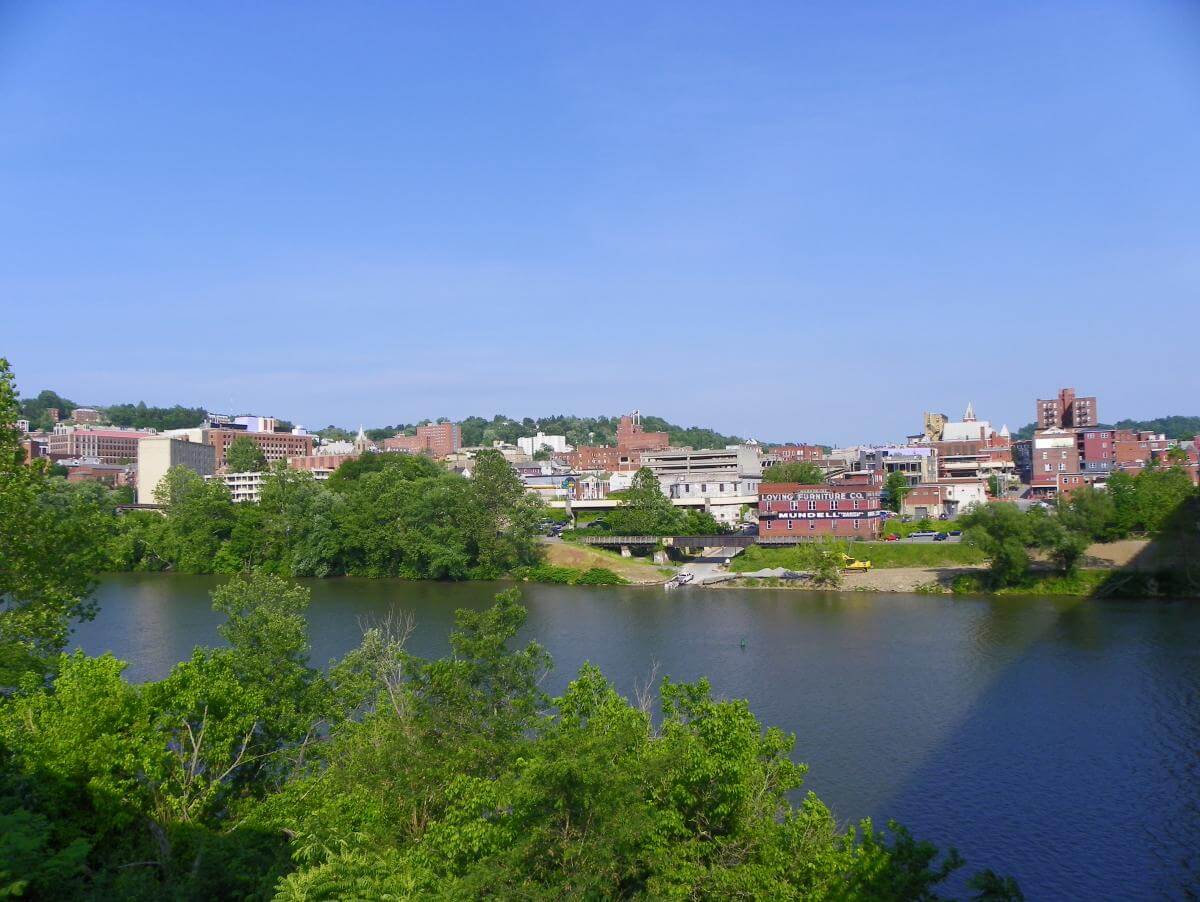
Morgantown, West Virginia Skyline, Morgantown, West Virginia, June 4, 2011. Photograph by Flickr user J. Stephen Conn. Creative Commons license CC BY-NC 2.0.
JAMES: In what ways did you experience this culture clash?
ANN: Our accents marked us. You'd open your mouth, and others would make assumptions about your intelligence and class and politics and your level of sophistication. It made you want to keep quiet. I think now about interviews Catherine and I did for her documentary, and how people in southern West Virginia would preface things by saying, "Now, I can't talk good," and then they'd say something incredibly insightful. In their accent.
JAMES: Early in Strange as this Weather Has Been you describe the loneliness of your protagonist Lace at West Virginia University in a way that feels intensely autobiographical.9"I told myself once I go to WVU, I'd never look back. Truth was, though, after a month away, I was feeling a kind of lonesomeness I'd never known there was…they had hills in Morgantown, but not backhome hills, and not the same feel backhome hills wrap you in. I'd never understood that before, had never even known the feeling was there." Pancake, Strange as this Weather has Been, 4.
ANN: Yeah it is very autobiographical. I mean, I stayed, I didn't quit, but yeah a lot of that is autobiographical.
JAMES: Lace ends up dropping out of West Virginia University to return to the mountains. Did you ever think about following that trajectory?
ANN: Oh yeah, I thought about dropping out, but again, the alternatives were worse. By that time in my life, I'd worked fast food and done line work and waited tables and worked in a grocery store—I realized that if I dropped out, those kinds of jobs would be my future.

Osaka Nightlife, Osaka, Japan, October 23, 2016. Photograph by Flickr user Pedro Szekely. Creative Commons license CC-BY-SA 2.0.
JAMES: After college you just split for Japan.
ANN: Yeah [laughs]
JAMES: Why?
ANN: I heard about a job there from a friend, heard that the owner of a language school in Japan was coming to campus to interview, and I interviewed, and I got it. I had never, ever thought about going to Japan. But I was working at Wendy's, after graduating with my BA in English, no teaching certificate. Unemployment in West Virginia was 12% then. It could have been anybody that showed up, from Norway or South Africa, I think I would have gone.
JAMES: In terms of teaching abroad, particularly teaching English as a foreign language, do you feel that process of thinking about the construction of language had an impact on your own writing?
ANN: Hmm . . . that's a really good question. I think what had an impact was less the actual teaching of English than being in cultures that weren't American and weren't Appalachian. By being in such a radically different culture, I recognized that Appalachia itself had its own distinct and interesting culture, and I started to understand how different our language was from Standard English. It's hard to describe how mind-expanding it was to go from West Virginia to Japan. I'd not even been on a commercial airplane. As an artist and a writer from West Virginia living in Japan, I would feel like I had eyes opening all over my head. Also the Japanese relationship to art and to perception . . . their attentiveness and receptiveness to beauty in the everyday was something they gave to me.10In an earlier interview with Robert Gipe for Appalachian Journal, Pancake cited the impact of the Japanese 'wabi sabi' aesthetic, noting its similarities with Appalachian culture—"an aesthetic that values the old and flawed and rusty." Robert Gipe and Ann Pancake, "Straddling Two Worlds," Appalachian Journal, 2011.
Language and Regional Dialect
ANN: When I first started writing about West Virginia, I wrote with dialect by default, more or less unconsciously, because I wasn't yet very aware that we spoke a dialect nor was I aware that our accent was as strong as it was. I became more aware of the dialect in my stories as I got older and left West Virginia. I write very intuitively. When I'm doing early drafts I hear the story in my head or I hear sounds in my head or the characters talking in my head, and if I'm writing about West Virginia, those voices and sounds naturally come as dialect. Over the decades I have come to think more consciously about the politics of dialect. Dialect in literature can be used in a demeaning way, to set aside the characters who use dialect as "less than" the writer, the reader, and the characters who don't use dialect. Or, one can use dialect in a culturally sensitive and less politically regressive way. I, of course, aim for the latter. I want to use dialect in ways that empower the people I write about and in ways that show how beautiful and inventive Appalachian language can be.
JAMES: It feels like there is a form of double movement here where, to teach English as a foreign language, you became very aware of your own dialect, and the pressure to mould your own patterns of language into a standardised form of English. How aware of that conflict were you?
US 50 Looking West, Romney, West Virginia, 1942. Photograph originally published as part of the Farm Security Administration, Office of War Information Collection in the Library of Congress Prints and Photographs Division. Courtesy of Wikimedia Commons. Image is in public domain.
ANN: When I first left West Virginia and was teaching ESL and then attending graduate school, I felt compelled to use Standard English exclusively and to clean up my accent. Once in Japan when teaching kindergartners, I walked in a classroom after six months or so and said "Good morning, how are you?" And they came right back with, "Fahhhn, Thank you." And I was kind of horrified, that without my knowledge, I had taught these forty, five-year-old Japanese kids English with an Appalachian accent without knowing I was doing that. So certainly during my twenties and during graduate school I tried to mask or change my accent. I don't worry about that so much anymore, although I know when I'm not home, my accent is much diminished. But I'm lucky because I can go back and forth, speak without the accent and speak with it, whereas some of my siblings have lost their accent and can't get it back.
JAMES: Do you worry about losing your accent? How does your accent relate to your identification with West Virginia?"
ANN: I have worried about it. But I know now it's not going to be lost because I'm fifty-three and if I go home I can go right back into it. It's not as strong as when I was little, but it's still in there.
JAMES: And after Japan you returned to the States, and then went to teach in American Samoa?

"Welcome to American Samoa," Nu'Uuli, Eastern District, American Samoa, February 22, 2008. Photograph by Flickr user Ben Miller. Creative Commons license CC BY-ND 2.0.
ANN: Yes, after Japan, I lived in Albuquerque, New Mexico for a year. After that, I taught in American Samoa. This was again economic necessity and also a desire for adventure.
JAMES: Did living in American Samoa affect the way you felt about yourself as an American?
ANN: That's a good question. In American Samoa, I lived for the first time in a place that had been colonized by the United States. I became acutely aware of colonization in the South Pacific and also more aware of the relationship between the US and other countries, the way America exerts power over other countries and exploits them.
JAMES: Did you see similarities or connections between class inequalities or exploitation in West Virginia, and American Samoa as part of a larger colonial project?
ANN: I did, I did. The connections became even more clear to me when I started living in parts of the US that weren't Appalachia, and as I began to understand dominant middle class white culture in the US. As I came to recognize the class discrepancies within the US and realized how little economic and political power Appalachia had, I saw the relationship between Appalachia and exploited non-Western countries. I realized how Appalachia can be seen as a resource colony for the larger United States. And those connections became more defined during graduate school when I started to read postcolonial theory and post-Marxist theory. The only places I've seen people as poor as they are in parts of southern West Virginia was in Indonesia and Thailand.
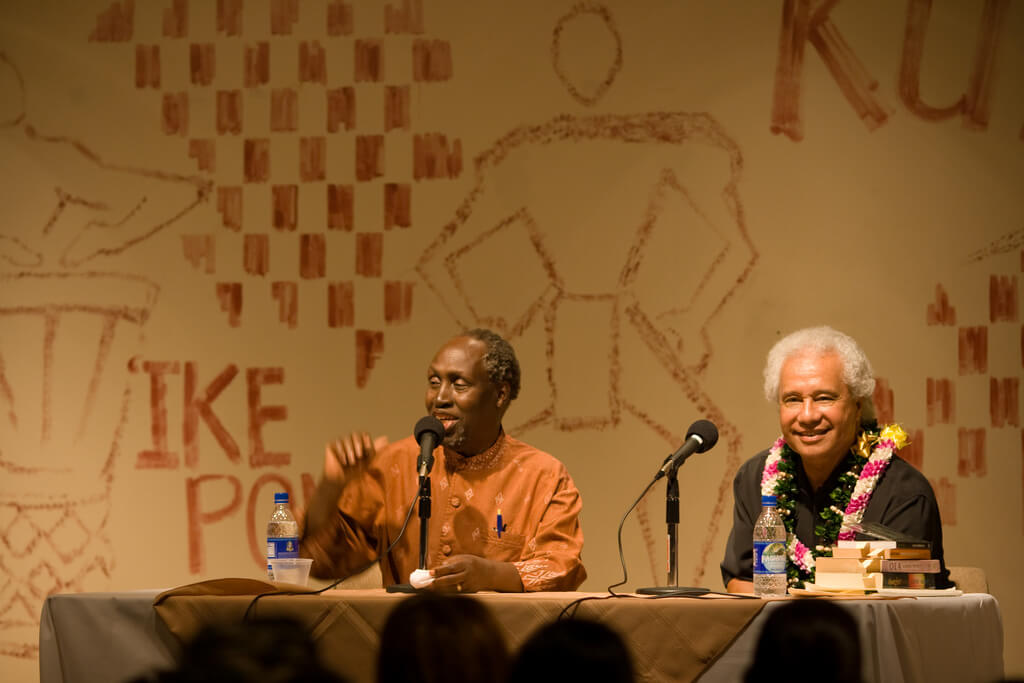
Samoan author Albert Wendt (right) with Kenyan writer Ngũgĩ wa Thiong'o (left), University of Hawaii at Manoa, Honolulu, Hawaii, April 30, 2008. Photograph by Flickr user Kanaka Rastamon. Creative Commons license CC BY-NC 2.0.
JAMES: Did that experience impact your direction in graduate school?
ANN: Yes. I wrote my master's thesis on a Samoan writer, Albert Wendt, using postcolonial theory. The driving question of my PhD dissertation was how Americans sustain their delusion that we have essentially a classless society given the glaring economic disparity in this country. I explored that question through nineteenth and twentieth-century literature and film. When Americans can't blame class discrepancy on racism, they often explain poverty as temporary. The idea is that the lower classes will eventually catch up, in time. This has been used to explain the "Appalachian problem," when Appalachia's poverty is not attributed to how dumb and lazy we are.
JAMES: Alongside your dissertation were you still writing fiction?
ANN: I was writing fiction whenever I could. That usually meant during breaks between quarters. While I was writing so much intellect-driven scholarly work, the pressure to write intuitive fiction would build, so when I had a break, the fiction would kind of come boiling out.
Early Work and Literary Style
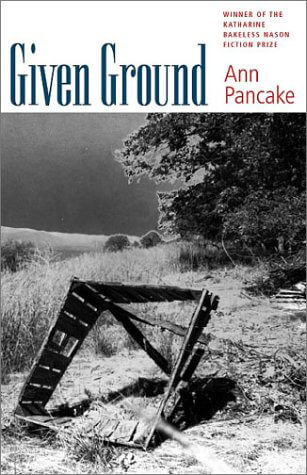
Cover of Ann Pancake's Given Ground (Hanover, NH, Middlebury College Press, University Press of New England, 2001).
JAMES: Your first published collection Given Ground was released not too long after you finished graduate school. Was that writing you had been collecting and publishing over a period of time?
ANN: Yes. The oldest story in that book, "Getting Wood," I wrote in 1987. Those stories were not written as a collection but pulled together over a period of years.
JAMES: How did you pick the stories you wanted to put into the collection?
ANN: I pulled together Given Ground when I needed to publish a book for tenure. I put into it every story I'd written that seemed finished enough, and then received feedback from a few friends. I jettisoned one story, then wrote "Redneck Boys" to complete the book. Half of the stories had been published in literary journals already, so that was a kind of confirmation that they were solid enough to put into the collection. However, if I hadn't had the pressure of tenure, I wouldn't have tried to publish that book because I didn't think it was strong enough to find a publisher. Not yet.
JAMES: Did the reaction to the book surprise you? Or is critical acclaim not something you really put a lot of weight on?
ANN: The award, the Bakeless Prize, was a huge surprise. And I was surprised, too, by how the book has been received. It's not an easy book in a lot of ways. The sensibility and style are idiosyncratic, I think. The subject matter is dark. I've come to understand that it's not ever going to reach a broad audience, but those readers it does reach, it reaches deeply, and that's fine with me.
JAMES: To what extent can that idiosyncrasy be traced back to West Virginia? Or, to your broader nomadic experience as a young adult?
ANN: The idiosyncrasy in my writing is mostly rooted in having grown up in WV, although I may not have recognized those idiosyncratic parts without the perspective of having lived in wildly different cultures outside West Virginia. But part of the idiosyncrasy I think I was just born with.
JAMES: You've been praised for moving away from a literary tradition rooted in formula and caricature, and for the complexity of your characterisation of both Appalachia's land and people. Was that always explicit in your work?
ANN: I was aware that I was resisting stereotype by the time I was writing in college. There are plenty of amazing Appalachian writers who work with complex representations of our region and who influenced me. Still, much writing about Appalachia over the past 150 years, especially writing that has gotten wide distribution, has been by outsiders, and a lot of that perpetuates the usual stereotypes. I've come to believe that the general reading public expects those stereotypes, so publishers expect them, too. But what I also understand are the political ramifications of stereotypes—they demean the people, make it easier to justify their exploitation, easier to see them as worthless. So I've always been very sensitive about complicating or overturning the usual caricatures and stereotypes.
JAMES: Could you name some of those writers, and say how their work appeals to you and what makes it unique?
Jayne Anne Phillips (seated on far right) featured on a panel with (from left to right) Kaylie Jones, Marlon James, and Elizabeth Nunez at the Brooklyn Book Festival, Brooklyn, New York, September 12, 2010. Photograph by Flickr user Navdeep Dhillon. Creative Commons license CC BY 2.0.
ANN: Some writers from West Virginia who work with complex representations of the region and who influenced me as a younger writer include Breece Pancake, Jayne Anne Phillips, Denise Giardina, Davis Grubb, and Chuck Kinder.11Breece Pancake, The Stories of Breece D'J Pancake (Boston, MA: Little, Brown,1983). Jayne Anne Phillips, Black Tickets (New York: Dell Pub., 1979). Jayne Anne Phillips, Machine Dreams (New York: E.P. Dutton/Seymour Lawrence, 1984). Jayne Anne Phillips, Lark and Termite: A Novel (New York: Alfred A. Knopf, 2009). Denise Giardina, The Unquiet Earth: A Novel (New York: Norton, 1992). Denise Giardina, Storming Heaven: A Novel (New York: Ballantine Pub. Group, 1987). Davis Grubb, The Night of the Hunter (New York: Harper, 1953). Davis Grubb, The Voices Of Glory (New York: Scribner, 1962). Chuck Kinder, Snakehunter (New York: Knopf, 1973).All of these writers grew up in West Virginia. Each has a different vision of the place, but each vision presents our culture with a nuanced depth perception that complicates the one-note picture of Appalachia so often perpetuated by outsider writers. They offer characters struggling with internal contradictions; they provide context and history that help shed light on the state's darker elements; they carry a sense of place deep in their bodies; and they do amazing things with our language.
There are also West Virginia writers younger than I am who deserve far more recognition than they've received so far, writers who are writing better, in my opinion, than most of their peers outside the region: Jessie Van Eerden; Matthew Neil Null; Glenn Taylor. Only Glenn has received much notice from the wider literary establishment.12For recent work see Jessie Van Eerden, My Radio Radio (Morgantown, WV: Vandalia Press, 2016). Matthew Neill Null, Honey from the Lion (Wilmington, NC: Lookout Books, 2015). M. Glenn Taylor, A Hanging at Cinder Bottom (London Borough Press, 2015).
JAMES: The way you write about Appalachia is clearly very striking, but also something which can be co-opted into broader cultural/media narratives of Appalachian rural poverty that offer a simplistic and frequently unflattering image of Appalachian life—do you grapple with this as a writer, how aware of it are you, does it affect your craft or editing process?
ANN: I'm very aware of how easily one can lapse into stereotype when writing about Appalachia. Appalachian people in the world are confronted with stereotypes about themselves constantly, so we're sharply conscious of them. Still, in early drafts, I might fall into a stereotype because I haven't gotten to the stage of the work where I'm complicating things. So, to answer your question, when I'm writing about violence in Appalachia, I try to be careful to complicate the issue. I try to tell the truth, and I try to tell it with context and by offering different perspectives on the violence and by making the perpetrators and the victims full human beings as opposed to flat caricatures.
West Virginia is its own culture within Appalachian culture, and Appalachian culture, in turn, shares some qualities with US southern culture. If I'm around Southerners there is a feeling of familiarity and home, more so than if I'm around people from Pennsylvania, even though Pennsylvania is fifty miles from where I grew up. I've also been influenced as a writer primarily by writers from the South and from Appalachia.
Map of county secession votes of 1860–1861 in Appalachia. Map drawn by E. Hergesheimer. Image courtesy of Wikimedia Commons. Creative Commons license CC BY-SA 4.0.
JAMES: I wanted to talk a little about your use of violence in your writing. One of the recurrent themes in your work is ghosts, especially in relation to the Confederacy and the Civil War. How does that historical violence, or its afterlife, translate into and overlap with physical or literal violence?
ANN: That's a good observation and a good question. I'm not sure how exactly to answer it. Appalachia does have a violent past: the violence of the Civil War and the "Indian" wars before that; the violence inflicted on the environment starting from the time of industrialization; the violence surrounding the labor movement in the early part of the twentieth century; the forms of violence the larger nation imposes on Appalachia in its appetite for Appalachian resources. Appalachian people are not more violent than other Americans, however, despite popular narratives to the contrary. In fact, before the drug epidemic, West Virginia consistently had the lowest violent crime rate in the nation. Still, I believe that all that violence in our past continues to manifest in our present.
The violence to the environment continues, and there is not the political will to stop it, and there is much violence suffered by Appalachia's people. Although often that's self-inflicted: addiction, overdose, suicide. I believe that self-inflicted violence is related to environmental destruction and economic exploitation. I recognize that my work contains a fair amount of literal violence. Some of that is just factual, reflecting the region's history. Some of the violence in my work, though, probably comes out of my love and hate for the region, my fears of and for the region, and my deep desires for the region. The violence may arise from all that conflicted unconscious material.
"Early Memorial" and "Stonewall Jackson," Interpretive Signage, Romney, West Virginia, November 13, 2011. Photograph by Flickr user Ron Cogswell. Creative Commons license CC BY 2.0.
JAMES: How much of that fear comes from a sense of displacement, or fracture? Earlier you talked about becoming aware of your identity as a West Virginian through interacting with people from surrounding states. You describe a sense of "we are this because we are not something else." How much of that can be traced back to the Civil War?
ANN: West Virginia's paradoxical place in the Civil War is one of the reasons I find West Virginia fascinating. The state separated from Virginia to be part of the Union in 1863, and popular belief is that we did this because we were against slavery. The truth about our secession is much more complicated and is tied also to the schemes of industrialists. There were certainly Union sympathizers in West Virginia and Union troops. My county, Hampshire, was very Confederate, though, with slave-owners, including my own family. Romney was right on the border, and Romney changed hands between the Union and the Confederacy fifty-four times during the war. I grew up playing in Civil War trenches a mile behind my house.13The trenches Pancake is describing are the Fort Mill Ridge Civil War Trenches, among the best preserved Civil War trenches in the nation. "Fort Mill Civil War Trenches", National Parks Service, http://www.nps.gov/nr/feature/places/13001121.htm.The remnants of the war were very present when I was growing up. And there are stories my family has passed down from the war—my family was Confederate identified, so their stories are about the Yankees coming in and raiding the farm.
JAMES: That feeds into another question I wanted to ask about the role of race in your work—I believe West Virginia is the third or fourth whitest state in the country.14According to the latest United States Census estimates, West Virginia is the fourth-whitest state in the Union.
ANN: West Virginia is very white, but there are and were African-Americans there. It's true, they don't often appear in my work, and I don't think I have any who are main characters. I believe this is the case because I don't want to misappropriate or misrepresent them. My personal relationship with race growing up taught me a lot. My county was very racist and still is, but my parents were much more liberal than most people there. My parents tried to bring us up with a "colorblind" philosophy: everyone is the same regardless of skin color, which also of course isn't true, but it was pretty enlightened for those times and that place. In junior high and high school I had an African-American boyfriend. I haven't talked about that or written about it much, I probably should. That certainly opened my eyes to racism, by the time I was fourteen, because of the kinds of insults I would receive and also because I started to see through my boyfriend's perspective. It also called into question my belief in Christianity. I started to reject the church at that time in large part because I saw very clearly its hypocrisy concerning race, at least where I lived.
JAMES: In your work you're very aware of trying to offer a representative account of West Virginian life. Are you more reluctant to write about African American experience?
ANN: Yeah, I'm much more comfortable writing about class. It's good that you bring that up, people don't usually ask me about it. The truth is, I do have experience with race in Appalachia. I need to ask myself why I don't write more about it.
JAMES: I want to read a short moment from your short story "Ghostless" which encapsulates one of the reasons I enjoy your writing so much:
The cold came high in my chest, but the wind had finally laid and from some distance I could feel the heat off the horse. The hide-odor off the horse, that soily smell he carried even in winter. I pushed my face into it, into the hollow behind the shoulder, before the belly swell . . . . I still had horse on my hands, and I smeared them across my Sunday pants, listening, the wood fire brightening my back.
That's gorgeous. The physicality of your writing, its tactile nature, your relationship to senses and sensory language. Where does that come from and how has it developed over time?
ANN: I write by sinking myself as deeply as I can into a place or a person, then imagining how the character's senses would respond to a situation, or imagining how I personally would react sensorily to a place. Certainly touch and smell in particular are powerful for me in the way they evoke memories. The way they are more animal. I also revise a whole lot, so as I do more drafting, more of that sensory detail comes in.
Me Up the Hollow, Romney, West Virginia, December 14, year unknown. Photograph by Ann Pancake. Courtesy of Ann Pancake.
JAMES: And growing up in West Virginia played an important role in developing that detail in your work?
ANN: Now that I've lived out of West Virginia I've come to understand that growing up in Appalachia usually means growing up closer to the ground than one might in other places. Growing up in Appalachia in the 70's was pretty raw. You were not sheltered in the ways the middle-class is sheltered in Seattle. We had a lot of tactile interaction with the natural world, plants and animals, we were raised working big gardens and running the woods, and we saw our food get killed and skinned out and butchered. We ate that. I think as little kids we were very directly in touch with our senses. We weren't inside, we weren't on computers. I could also identify how poor people were by how they smelled, because the really poor people didn't have plumbing, so couldn't wash like we could. I see this as a metaphor for how white poverty is sometimes invisible in this country.
JAMES: How do you keep that visceral relationship to West Virginia in your writing?
ANN: I try to get home at least twice a year, and the place is very deeply embedded in my memory and in my body, so it's present to some extent even when I'm not there. When I do return, I can settle back into the land pretty quickly. At the same time, the culture in West Virginia has changed since I was a kid. Also, at this point in my life and my career, I'd like to be writing more about places that aren't West Virginia. That'll happen some in my next book.
Presents, Pasts, and Futures
Cover of Ann Pancake's Me and My Daddy Listen to Bob Marley (Berkeley: Counterpoint Press/Shoemaker & Hoard, 2015). Cover design by Briar Levit.
JAMES: Your latest collection Me and My Daddy Listen to Bob Marley remains centered in West Virginia, but in a different way. There seems to be more scope for hope or forward momentum than in your earlier writing.
ANN: I'd agree with that, I think part of it is time of life. I'm at a point in my life where I just can't bear to be spending all that time in darkness like I could while writing Given Ground and some of my earlier work. I also think that, just in order to survive as an American in 2016, I've had to try to figure out ways to look towards light exactly because we are in such a dark time, from a certain perspective. I also think—I wrote about this in an essay for the Georgia Review—I'm finished with writing about how things are hurt in Appalachia.15Ann Pancake, "Towards Light," Georgia Review, 2009. I'm tired of documenting destruction. I'm committed to writing that imagines unconventional ways to relate to the natural, including the natural world in Appalachia. Some of the stories in Me and My Daddy Listen to Bob Marley such as "Sab" or "The Following" play with redefining relationship with the natural world.
JAMES: In the story that opens Me and My Daddy, "In Such Light," that progression definitely comes through. Trauma and hurt persist, but it holds more scope for maturation than many of your earlier stories.
ANN: I'd agree.
JAMES: Do you think that literary shift is connected to a broader recognition within the United States that the country needs to move away from a reliance on coal and seek less destructive and more sustainable forms of energy?
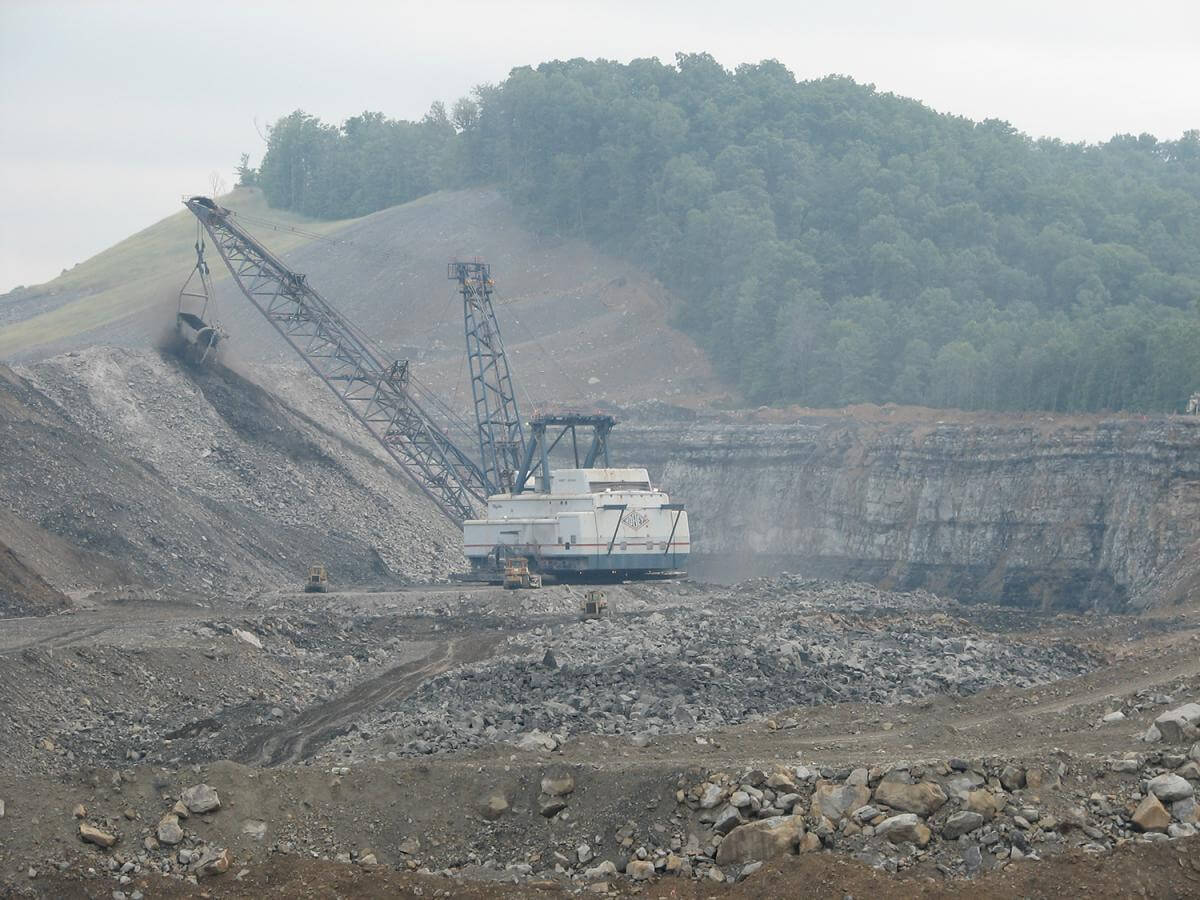
Dragline, West Virginia, ca. 2007. Photograph by Vivian Stockman. Courtesy of Ann Pancake.
ANN: I think my literary shift is connected to a recognition that we won't survive as a species unless we think very, very differently about live beings that aren't human in this world. As for the shift away from coal, it is true that in Appalachia less coal is being mined now, but that's in part because of the boom in natural gas. Areas of West Virginia that were untouched by coal mining are now being devastated by hydrofracking. However, I do think we're at the beginning of the end of coal. And I think there is a wider movement, particular among younger generations in West Virginia, which understands that our state must move beyond dependence on natural resource extraction if we are to survive as a culture and as a people. This gives me optimism.
JAMES: It's been almost fifteen years since the publication of your first short story collection. What do you think are the most notable differences between Me and My Daddy and Given Ground?
ANN: Given Ground was written almost entirely intuitively and without much consideration of an audience. I wrote that book mostly for myself, not because I'm a narcissist, but because I couldn't imagine that many people would want to read those stories. For those reasons, it's more music-driven, less concerned with plot, and less accessible than Me and My Daddy. Me and My Daddy I obviously wrote after finishing my novel, and the novel required that I learn how to work with plot and that I make my writing more accessible. I wanted an audience for Strange as this Weather Has Been. I think those influences and considerations bled over into my writing of Me and My Daddy. Teaching creative writing and writing a novel has made me more conscious of craft, has made me use a little more intellect when I write fiction. I'm not convinced, however, that that is a good thing.
JAMES: Why did you choose that particular title?
ANN: [Laughs] My publisher decided that. I had named the book "Bone Dowser" which was also the original name of the story in the collection now called "The Following." My publisher thought we'd sell more books with the title Me and My Daddy Listen to Bob Marley. I'm sure he's right.
JAMES: If that was a conversation which had happened fifteen years ago, do you think the outcome would have been the same?
ANN: [Laughs] would I have been as malleable do you mean? No I probably would have been more resistant. I've become less resistant, and I don't have as much investment in that kind of stuff anymore. That's a good question!
JAMES: Part of maturing is coming to terms with what exactly you are able to do through your work and through your activism, and being able to channel that in ways and into things which are productive.
ANN: Yeah, exactly.
Breakneck Scenic Overlook, Romney, West Virginia, July 29, 2014. Photograph by Justin Wilcox. Courtesy of Wikimedia Commons. Creative Commons license CC BY-SA 4.0. Pancake family land appears in the lower section of the photo.
JAMES: Do you ever feel like you're writing about a West Virginia that doesn't exist in the same way anymore?
ANN: In some ways West Virginia has changed significantly since I grew up there. One change that I mourn is the way the dialect and accent are being lost among younger people. Exposure to mass media is homogenizing our language. The place is also under greater environmental attack and is suffering a drug addiction epidemic. Those changes, though, I understand very well, because of my research and experiences and because of addiction problems in my family, so when I write about that West Virginia, I'm writing about one that still exists.
JAMES: You live in Seattle now, quite far removed from Appalachia. Is your relationship with the land different now, and if so in what ways?

Seattle Skyline view from Queen Anne Hill, Seattle, Washington, February 17, 2010. Photograph by Wikimedia Commons user Daniel Schwen. Creative Commons license CC BY-SA 4.0.
ANN: I'm not immersed in the land here like I was growing up in West Virginia. Also, the land here doesn't speak to me like back home does. It doesn't give me sounds and stories. Still, I love the mountains in Washington. But it feels more like a friend, while back home land feels like family -- and that includes the way family can be fraught. My relationship to the land back home is very painful because there is so much ongoing destruction of it. In Washington, there is certainly destruction, but because of the kind of economic and political will here, there are vast tracts of land that aren't going to be destroyed, at least not anytime soon, and I can escape into those. That helps to ameliorate the pain I feel about back home. But I won't ever be rooted in the land in Washington like I am rooted in Appalachia.
JAMES: What's the next step? You mentioned that moving forward you are looking to write about Appalachia, but in different ways, and then looking to write about other things as well.

ANN: I can't be really specific about the project I'm working on now because it's in its very early stages, but it's a book that explores the ways we can have different relationships with the natural world and with things that aren't human. It's nonfiction. So there's that strand of it, which runs simultaneously with the ways I see Appalachia as a microcosm of what's happening globally in terms of the environment and as a harbinger of where we're headed without a revolution in our common sense. Finally, there' s a thread about my family, whom I see as a kind of microcosm of Appalachia, in the ways my family's addiction, fear, economic exigencies, and mental illness have caused the destruction of land I love where I grew up.
The book is part memoir, part imagining forward. It asks how we might live well in a time of mass extinction. A modest thesis, I know. I'm obsessed with the question because I've witnessed all my life a place I love be destroyed. Appalachia has always been called backwards, but in the last couple of decades, the rest of the country caught up with Appalachia and recognized the natural environment everywhere is being devastated.
Appalachia Forest Action Project volunteers learning about the land, Rock Creek, West Virginia, May 21, 1994. Photograph by Mary Hufford. Image courtesy of the Library of Congress American Folklife Center.
Most recently, the land where I grew up, in Romney, has been destroyed by the parts of my family who are entangled in my brother's drug addiction. I see this family dynamic and tragedy as a microcosm of larger destructive forces in Appalachia. I see Appalachia, in turn, as a microcosm of larger destructive forces in the United States, especially capitalist corporate forces. So in this new book, I plumb that question—"how do we live well while natural places and beings are being annihilated at an unprecedented rate?"—by tracing my own personal history of loss as a West Virginian.
Part of my answer to the question involves radically reconceiving our relationships with natural beings. To do that, we need to become intellectually flexible enough to see rationalism and mechanistic science as just one way of knowing among several, with no one way superior to the other, and each with its own purpose. In other words, I'm suggesting we give more validity to intuition, the unconscious mind, the imagination, and ideas of the sacred.
About the Interviewer
E. James West is a teaching fellow in the Department of History at the University of Birmingham and a postdoctoral fellow at the Eccles Centre for American Studies at the British Library. His research centers upon on African American history and literature since 1865, with a particular interest in African American media and print culture.
]]>Presentation and Review
Civil rights narratives often empower and embolden, promoting faith in possibilities, hope for rectifying inequities. More sober assessments show that, though we've come a long way—thanks to mighty black struggle and interracial coalition—there's still far to go. Honoring local achievements while warning of persistent injustice, Jim Grimsley's bold memoir of a racist white upbringing forecloses sentimentality with resolute honesty, charting slow, hard-earned change and the author's ongoing efforts to unlearn the lessons of childhood. Integration's chief foe, he suggests, is the hardwired racism of "good people" (72)—a phrase you'll never hear in the same way again.
In 1966, Jimmy Grimsley, thirty other white students, and three new African American classmates Rhonda, Ursula, and Violet forged a "tepid and partial desegregation" (40) of their sixth grade classroom in rural Jones County, North Carolina, where public schools officially desegregated under a begrudging gradualist "Freedom of Choice" plan. Describing himself as "a good little racist" (18), Jimmy was the first to hurl an epithet at chubby Violet. When she spoke back with poise and pride, giving as good as she got, Grimsley began the most important educational journey of his life: unlearning entrenched habits of race and gender. "Skin color and difference" (ix), as he labels them, were linked to the body, its desires, sexual norms, and deviances. Grappling with his own sense of difference, Jimmy was more willing than most to question dominant structures of white authority and racial inequality.
Quizzical, effeminate, a hemophiliac forbidden boys' rough play, Jimmy remembers thriving after his working-class family moved into the town of Pollocksville where he could walk to the library and read widely. He absorbed novels and teen magazines, and caught glimpses of new classmates Rhonda and Ursula's Ebony and Jet. He credits the media, including television, with introducing him to dominant racist, as well as emergent anti-racist, representations: Bill Cosby's role in I Spy and Nichelle Nichols's in Star Trek. Remembering his sixth-grade self, Grimsley appears perplexed, since "adults rarely explained" (8) the unprecedented circumstances of judicial desegregation, speaking only in "coded, guarded" (10) language.
 |
| Photograph of a young Jim Grimsley, age 11, Jones County, North Carolina, 1966. Courtesy of Algonquin Books. |
The transformations from sixth to seventh grade, from lackadaisical Mr. Vaughn's class to the precise Mrs. Ferguson, from foe to friend of black classmates, helped expose southern white culture's feigned warmth, courtesy, and piety. While hindsight affords Grimsley insight into the significance of his middle school years, at the time—about most matters of importance—Jimmy "had no idea" (6) and had never imagined the stark realities that delineated his racial experience.
Just when I, as a reader, suspect Grimsley is overstating his youthful naiveté—characterizations of "the Southerner" clanging, only occasionally qualified by "white"—he unearths racism's roots with brute force. In the chapter "The Learning," Grimsley shows how bias, seemingly timeless and naturalized in nursery rhymes, in fact, emanates from adults' repetitive aggressive assertions of supremacy. If racist verses structure childhood games—sung on playgrounds, chanted outside churches—a vast repertoire of nigger jokes reveals how entrenched and persistent white anxieties remain, situating prejudice in the here and now. This repertoire documents a cruel and pernicious counterpart to the long, affirmative tradition of African American trickster tales. With grace, Grimsley retells not a single joke, nary a punch line. He nonetheless explains their gruesome logic, pinpointing their myriad implications. In short, his father's and friends' jokes are variations on the theme of inferiority, castigating blacks as lazy, ugly, smelly, dirty, sloppy, unruly, faulty, sorry. Seemingly told in jest, they united whites around racist ideology. "When we laughed at the joke[s], we accepted the premise" (79).
Though Grimsley remembers hearing these jokes in many places—"at a country store or a service station, places where men talked to other men" (79)—he recalls local churches as teaching the worst lessons. There, racist discourse flowed between adults, between Sunday School and worship services, as well as mid-week meetings, at both the Baptist and Methodist churches he attended. Grimsley's chapter "Divinely White" spotlights the broad influence of Jim Crow Christianity's supremacist symbolism. He repeats no clichés about the most segregated hour of the week—that was a given. Instead, he writes that "the stratification . . . went beyond this" (93), beyond the small-town hierarchies ranging from Pentecostal to Episcopalian. "The Christian Bible" he adds, "depicted God's son as a white-wooled lamb, God's adversary as a prince of . . . darkness, salvation as a cleansing that leads to shining whiteness. God, Christ, and all the angels wore white. Death and sin were robed in black" (94). Regardless of what was preached from the pulpit—about Ham, about biblical justifications of slavery—Grimsley remembers the so-called good book making the racist points, over and over, with crude color-coded metaphors.
 |
 |
| Location of Jones County in North Carolina (top) and location of Pollocksville in Jones County, North Carolina (bottom). Maps by Southern Spaces, 2015. |
Faithfully reporting his county's dismal history of Native expulsion and African slavery, sexual assaults on black women and lynchings of black men, Grimsley implicitly denounces violence, hatred, and ignorance. More so, How I Shed My Skin carefully and candidly calibrates levels of fear and knowing among his fellow white southerners. As he demonstrates, whites with disabilities in Jones County, including his father, rejected chin-up resilience and vented their rage at African Americans. At the other end of a narrow spectrum, Grimsley has no truck with milquetoast liberalism. As he testifies, "nearly every white person I have spoken to about this time [said] 'We were not allowed to use the word "nigger" in my family.' One should remember," Grimsley instructs, "that most Southern mothers also proscribed such words as shit, fuck, and cunt, often to no effect whatsoever" (87–88). The power of How I Shed My Skin lies in its ability to illuminate the many inequalities ingrained beneath a veneer of pervasive politeness.
In addition to racism, Grimsley connects the dots of sexism, homophobia, and other categories of difference, notably class. As in many southern jurisdictions unable to afford one good school system, much less two, when Jones County consolidated its black and white facilities, white parents birthed a segregation academy. A new sort of dual system emerged. Grimsley, his siblings, and other poor whites remained in the public schools. There, his aesthete's sensibilities rarely connoted queerness, and he was seldom bullied. In the majority-black high school, tracked into the majority-white college-prep curriculum, Grimsley observes integration in some spaces: the football field, the stands, post-game dances, and the smoking patio. He notices and worries about classmates involved in discreet biracial romances. While he expects violent reprisals for color-line transgressions, none materialize. His white friend Mercy, who dated black student body president Andy, simply abandons her drunken father's home and moves in with other relatives. Determined to get out, all three students survive high school and end up at Chapel Hill. After graduating from the University of North Carolina, Grimsley migrates to the queer mecca of New Orleans.
By memoir's end, Violet (one of the three students who integrated Grimsley's middle school, the one who spoke back to him with such confidence) has conspicuously dropped out of the narrative, even as Grimsley documents a tentative multiracial circle of friends. At Jones Senior High, black students stage walkouts after a white teacher spouts racist slurs and a black teacher's job is threatened. But against elder white prophesies, desegregation doesn't incite an apocalypse. Students adjust, and the conflicts between insensitive white teacher-administrators and their black charges are managed, although not resolved.
In How I Shed My Skin's conclusion, Grimsley is one of only two white graduates to attend his fortieth high school class reunion. There, a black preacher first tells a joke at his expense then makes an anti-Semitic comment—southern religiosity (whether black or white) again unmasked. Still, the author sounds a hopeful note, crediting Violet with opening his mind in middle school.
I find most compelling Grimsley's recollections of song and dance. Dances were a rare site of integration in motion, on the ground, at the gym, after ballgames: a democracy on the dance floor. Though his "church taught that dancing was of the devil," he enjoyed "moving to music" (193). Grimsley "never danced with a boy in high school, or dated" one (198), "but when I was dancing I understood that I was one of many, not so different, not apart from the rest" (199). Only in these utopian moments does this highly individualistic autobiography gesture toward Mab Segrest's powerful collectivist Memoir of a Race Traitor from 1999.
 |
In contrast to the dance floor, the gospel chorus remained color-coded. Inherited from the all-black high school, the chorus had no white members after consolidation. In a shrewd, subtle critique of Hollywood happy endings that play to audience expectations, Grimsley notes that, as a novelist or screenwriter, he might have invented a scene in which he sings alongside Violet, "proving that the separation between the races could one day be conquered" (225), systemic racism overcome by one-to-one biracial friendships. Instead, Grimsley as memoirist is frank as ever, realistic and sorrowful, acknowledging the slow pace of change and the maudlin appeal of instant reconciliation. His meditation on genre morphs into a stunning dialectic on the individual and collective, the loner-outsider desiring connection: "I would like to have lived in the world where I could have sung in that chorus, where what mattered would have been only the way my voice blended with the others, and the sound we made. I think I could have added to the music" (227).
Refusing easy redemption songs, Jim Grimsley yearns for communion. While his sexuality sets him apart—venturing to New Orleans and beyond, rarely to return—his yearning evidences a desire to be a part, to take part, his hopes steadfast in collective, common humanity. With piercing, instructive honesty, How I Shed My Skin revisits a painful time and place—different, yet not so different from the here and now—to show how racism's unexamined habits take deep and early hold.
About the Authors
John Howard is professor of American Studies at King’s College London. He is the author of Concentration Camps on the Home Front: Japanese Americans in the House of Jim Crow (2008) and Men Like That: A Southern Queer History (1999), both from the University of Chicago Press.
Jim Grimsley is professor of practice in English and Creative Writing at Emory University. He is the author of four previous novels, among them Winter Birds, which won the 1995 Sue Kaufman Prize for First Fiction from the American Academy of Arts and Letters, and received a special citation from the Ernest Hemingway Foundation; Dream Boy, winner of the American Library Association GLBT Award for Literature (the Stonewall Prize) My Drowning, a Lila-Wallace-Reader’s Digest Writer’s Award winner; and Comfort and Joy.
]]>Presentation
Part 1: Tom Rankin introduces the life and work of Paul Kwilecki and his relationship to Decatur County, Georgia.
Part 2: Rankin discusses the evolution of Kwilecki's photographic style and the process of assembling the book, One Place.
Part 3: A discussion of Kwilecki photographs that reveal insider-outsider tensions in Decatur County.
Part 4: Kwilecki's subjects and the continuity of his perspective across decades of "staying put."
About the Author
Tom Rankin is professor of the Practice of Art and Documentary Studies and director of the MFA program in Experimental and Documentary Arts at Duke University. His books include Sacred Space: Photographs from the Mississippi Delta (University Press of Mississippi, 1993), Deaf Maggie Lee Sayre: Photographs of a River Life (University Press of Mississippi, 1995), and Local Heroes Changing America: Indivisible (Norton, 2000), among others. Rankin writes frequently about photography and the documentary tradition and his photographs have been widely exhibited.
Publication Update
In January 2019, Southern Spaces updated this publication as part of the journal's redesign and migration to Drupal 7. Updates include image and video adjustments, as well as revised recommended resources and related publications. For access to the original layout, paste this publication's URL into the Internet Archive: Wayback Machine and view any version of the piece that predates December 2018.
]]>Review
 |
| Untitled (Near Minter City and Glendora, Mississippi), 1970, printed 1999. Photograph and dye-transfer print by William Eggleston. From At War with the Obvious, Metropolitan Museum of Art, Accession #2012.286. © Eggleston Artistic Trust. |
In a William Eggleston photograph currently on display at the Metropolitan Museum of Art, a young African American woman wearing a lime green dress and a shower cap walks down a road. She is centered and small. The landscape around her—the flat farmland, the big sky, the tin-roofed shack, and the two-lane highway—marks the place as the Mississippi Delta. It is the kind of road local people drive to reach Memphis or Clarksdale or walk to reach churches and stores and the gravel lanes that lead home. It is the kind of place where civil rights activists fear meeting sheriffs and folklorists dream of finding blind blues musicians. Farm Security photographers worked here two decades earlier, shooting pictures of southern rural poverty, and in 1970, the want remains. This is not a very promising place to make a life, no matter what the woman is carrying in her bag. It is also, after Walker Evans, not a very promising place to try to make an original photograph.
The color—the lime green dress—is the key. The dress makes this William Eggleston photograph new. Against the dress, the green grass and corn stalks fade. The light in the overcast sky takes on a kind of lurid hue. The dress, not the landscape, pops out. It is lush, overripe, frame bursting. In Untitled (Near Minter City and Glendora, Mississippi) and other photographs taken in the 1970s, Eggleston begins constructing a new way of looking at the US South, a full color, sideways vision.
 |
| Wagonload of cotton coming out of the field in the evening. Mileston Plantation, Mississippi Delta, Mississippi, 1939. Photographic negative by Marion Post Wolcott. Courtesy of Library of Congress Prints and Photographs Division, FSA/OWI Black-and-White Negatives Collection, LC-USF34-052257-D. |
In the last decade, Eggleston's sensibility has become wildly popular, but when he created his style, it stood in direct contrast to the way twentieth-century photographers had taught people to see the South. In the work of Farm Security Administration photographers, widely circulated in the 1930s and 1940s and rediscovered in the 1960s, the South was clear and crisp, black and white, geographically open before the camera and yet lost in time, its signs of modernity knocking incongruously against worn machines, buildings, and people. Walker Evans, in particular, achieved new levels of fame as the Museum of Modern Art reissued his book American Photographs (1939) in 1962 and mounted a retrospective and a published catalog in 1971. Eggleston worked through and against this legacy, bringing pop-art color and drama, a bohemian love for the margins, and Cartier-Bresson's compositional techniques to contemporary versions of Evans's subject matter.
The Met's show is part of a more than decade-long celebration of this artist. Born in Memphis in 1939, Eggleston grew up there and in Sumner, Mississippi, at his grandparent's home. While Eggleston has worked across the United States including Califorinia, New York, and New Jersey, as well as in Kenya, Egypt, China, England, Italy, and Russia, his photographs of Memphis, its suburbs, and the Delta are his most famous. He also worked extensively in Louisiana. To be fair, Eggleston has never really been neglected by the art world. Early in his career, before his first major solo show, he won Guggenheim and National Endowment for the Arts Fellowships. His friends included artist William Christenberry and curator Walter Hopps. In the late 1960s, he met the influential MOMA curator John Szarkowski and showed him what Szarkowski later described as a suitcase full of drugstore photos.1"William Eggleston," Wikipedia, accessed June 26, 2013, http://en.wikipedia.org/wiki/William_Eggleston. Szarkowski was impressed enough to give Eggleston his first major solo show, the now famous 1976 MOMA exhibition, and to publish the accompanying book, William Eggleston's Guide. That show, remembered wrongly as MOMA's first exhibition of a single photographer's color work, was panned by art critic Hilton Kramer, as "Perfectly banal, perhaps. Perfectly boring, certainly."2Hilton Kramer, "Art: Focus on Photo Shows," The New York Times, May 28, 1976, 62. The New York Times called it "the most hated show of the year."3Gene Thompson, "Photography Found a Home in Art Galleries," The New York Times, December 26, 1976, 29. The criticism gave Eggleston a kind of notoriety. Two years later, he won another NEA award. In the eighties and nineties, film directors and musicians such as John Huston, David Byrne, David Lynch, and Gus Van Sant befriended him and invited him to take photographs on their movie sets.
More recently, Eggleston has had major exhibitions at galleries and museums around the world including the Cartier Foundation in Paris in 2001 and the Hayward Gallery in London in 2002. In 2004, Eggleston received a Getty Images Lifetime Achievement Award at a ceremony at the International Center for Photography in New York. The Whitney staged a major retrospective, William Eggleston: Democratic Camera, Photographs and Video, 1961–2008, that traveled to the Cocoran Gallery of Art in Washington in 2009. That year, Steidl, a German publisher known for its meticulously printed art photography books, began publishing Eggleston's images, including the multiple volume works Chrome (2011) and Los Alamos Revisited (2012). This year, the Tate Modern in London opened a permanent exhibition of his photographs. Currently, his early color photographs are on display in New York at the Metropolitan Museum of Art in a show entitled At War with the Obvious.
This show surveys Eggleston's early color photographs from the 1970s, including all the images in his first publication, a portfolio entitled 14 Pictures, fifteen images from William Eggleston's Guide, and seven additional images taken between the late 1960s and the mid-1980s. All are dye-transfer prints, their colors thick and rich and dazzling. Eggleston had started experimenting with color transparency film and then color negative film in the mid-1960s. Yet until Eggleston discovered the dye-transfer process, he had no way to make a good, archival quality print in color. On a trip to Chicago in the early 1970s, Eggleston discovered the process while reading a photography lab price list. Dye transfer was the most expensive service offered. "I went straight up there to look," he remembered years later, "and everything I saw was commercial work, like pictures of cigarette packs or perfume bottles, but the color saturation and the quality of the ink was overwhelming. I couldn't wait to see what a plain Eggleston picture would look like with the same process."4The Colourful Mr. Eggleston, directed by Reiner Holzeimer and Jack Cocker (BBC, 2009).
Eggleston, from an affluent family, never had to work to earn a living and had the resources to pay for dye transfers. When Eggleston stressed his "democratic method" of working, he did not mean a printing method for the masses. He meant instead a way of looking at things in the world. In a documentary for BBC television, he remembered "I had been working down in Oxford or Holly Springs, [Mississippi,] one day, and that night, at the bar, somebody asked me what I'd been photographing and I told him, 'Oh just dirt by the side of the road. I've been photographing democratically.'"5Holzeimer and Cocker, The Colourful Mr. Eggleston. A similar quote graces the wall of the Met's exhibition: "I had this notion of what I called a democratic way of looking around, that nothing was more or less important."
 |
| Untitled, 1971. Photograph and dye-transfer print by William Eggleston. From At War with the Obvious, Metropolitan Museum of Art, Accession #2012.300. © Eggleston Artistic Trust. |
Critics have seized these comments to describe Eggleston's vision. Michael Glover, who recently named Eggleston "the world's greatest photographer," has argued, "He is besotted by the imaginative possibilities of the ordinary. He wants us to rinse our eyes until we see, without prejudice, the exquisite poignancy of the seeming banalities of the everyday."6Glover, Michael. "Genius in Colour: Why William Eggleston is the World's Greatest Photographer," The Independent, April 22, 2013, accessed June 26, 2013, http://www.independent.co.uk/arts-entertainment/art/features/genius-in-colour-why-william-eggleston-is-the-worlds-greatest-photographer-8577202.html What Glover missed, however, was that this attention to the everyday and the ordinary was not new. Evans had pioneered this kind of content—presenting the contingent, the ephemeral and the fleeting as art—in the photographs he took three decades earlier. Eggleston remembered first seeing Evans's American Photographs as well as Henri Cartier-Bresson's book The Decisive Moment in 1959, two years after he got his first camera. In the images now on exhibit at the Met, Eggleston uses a small, quick camera and color to build a vision that evokes as well as challenges Evans's aesthetic.
Shot straight-on from eye-level in black and white, Eggleston's Untitled, 1971, an image of a Coca-Cola and peaches sign, could be a Walker Evans image. The color—the blue sky cut by power lines, the faded Coca-Cola logo, the orange letters spelling "PEACHES!" begin to suggest something new, but it is the angle of the shot—looking up from the lip of a rusty corrugated tin roof at the sign—and the depth of field that complete the transformation. Eggleston manages to make this typical Evans subject his own by erasing flatness and adding color. Even more like an Evans is a straight, eye-level 1974 shot, also untitled, of a dull yellow shack with an orange closed sign in what must have been a take-out window. The rusty air conditioner, covered by a little awning that echoes the bigger awning over the door and window, is just the kind of detail Evans would have picked up on to juxtapose the old and the new if window air conditioners had been invented during his classic period.
 |  |
| Washstand in the dog run and kitchen of Floyd Burroughs' cabin. Hale County, Alabama, 1935 or 1936. Photographic negative by Walker Evans. Courtesy of Library of Congress Prints and Photographs Division, FSA/OWI Black-and-White Negatives Collection, LC-USF342-008133. | Untitled (near Jackson, Mississippi), ca. 1970, printed 2002. Photograph and dye-transfer print by William Eggleston. From At War with the Obvious, Metropolitan Museum of Art, Accession #2012.295 © Eggleston Artistic Trust. |
Like a 1936 Evans photograph from Hale County, Alabama, a 1970 photograph, Untitled (Near Jackson, Mississippi), depicts an intimate interior space where a piece of clothing hangs on a wall over a bed. Clothes and the intimate spaces inside homes where people live and sleep and dress are all Evans's subjects, but the materials the objects in Eggleston's image are made of—concrete walls and synthetic cloth—push the viewer into the 1970s. Color helps, and the red fleece lining of the coat's hood pops out against the coat's silvery white lining and navy exterior and the dirty, grey wall. Yet unlike Evans and photographer and filmmaker John Cohen, who worked in Appalachia in the 1960s, Eggleston shoots at an angle, incorporating corners—walls hitting the ceiling at the top and the corner of a baby bed at the bottom—into the right edge of his image. The corners of the photographic frame amplify the corners of the subject here, producing a sense of interior space and depth. In these images, Eggleston reworks subjects Evans shot from the front by shooting instead at odd angles and adding color and dimensionality.
 |
| Untitled, 1974. Photograph and dye-transfer print by William Eggleston. From At War with the Obvious, Metropolitan Museum of Art, Accession #2012.280.12. © Eggleston Artistic Trust. |
During the depression era, Farm Security Administration photographers made many images of vehicles, lines of parked automobiles, trucks with their beds full of people, and mules pulling carts through 1930s towns. Eggleston both evokes this imagery and transforms it. In a 1974 photograph, Untitled, he photographs a farm truck—old in the present of the photograph but not so old that it could have been around in the 1930s—sitting alone in a field. Again, he works an angle. The rusty red and white truck fills the horizon line but its right front corner, the place where the bumper and headlights meet the side, pushes out at the viewer, the inverse of the corners that dominate his interior scenes. Working from below eye-level like late-nineteenth century and early-twentieth century industrial photographers, Eggleston makes the truck—like train engines and turbines in industrial images—appear monumental. He uses the same effect to photograph a tricycle in Untitled (Memphis), 1970, the image that appears on the front cover of William Eggleston's Guide. The contrast between the monumental machine aesthetic and the subject matter—a child's toy in suburbia—is even stronger here.
In other photographs on display at the Met, Eggleston moves in close and transforms fragments of his South into pop art. In the early 1970s, his work circulated in an art world saturated with color, drama, and the aesthetics of advertising. Eggleston met Viva, a Warhol superstar, at his 1976 MOMA exhibition. After they began an affair, Eggleston visited the Factory and met Warhol. Some of his photographs, however, were already infused with a pop-art feel. The green bathroom—a tub and the tiles around it in Untitled (Memphis), circa 1972—is shot straight ahead from the front, but the three sides of the rectangle where the tub resides, the light on the back tiled and plastered wall, and the arched ceiling create a sense of depth and drama, a contradictory space of shiny chrome and moldy grout. In Untitled (Memphis), circa 1970, the blue-black interior of an oven, its depth cut by two chrome racks and a spot of light center right on its floor, creates a similar effect. In Untitled, 1974, red, yellow, and blue plastic animal figures pose on the hood of a blackish car at night, an artificial light bouncing off the scratched and shiny surface behind them like a spotlight on their act.
 |
| Untitled (Greenwood, Mississippi), 1980. Photograph and dye-transfer print by William Eggleston. From At War with the Obvious, Metropolitan Museum of Art, Accession #2012.301. © Eggleston Artistic Trust. |
Untitled (Greenwood, Mississippi), 1980, perhaps Eggleston's most famous image, belongs with this set. The color is key—the ceiling and walls of this room have been painted a deep, blood red. Once again, Eggleston uses the corner—the intersection of two walls and the ceiling in the low center of the shot to create a sense of space. Just above the corner, slightly left of center in the image, is a light fixture with a bare bulb and an on/off chain. Three white extension cords plugged into the fixture and stapled to the ceiling lead out to the walls and sizzle against the ceiling color. Eggleston remembers shooting the image while lying in bed with friends talking—that they also had been doing other things is implied—and the bottom edge of a poster depicting the positions of the kama sutra in the photograph amplifies the sexual atmosphere. "I think red is a very difficult color to work with," he says in an interview for the BBC video. "I don't know why. It's as if red is at war with all the other colors."7Holzeimer and Cocker, The Colourful Mr. Eggleston.
In that video, Eggleston describes another red photograph on display at the Met, also Untitled (Greenwood, Mississippi), 1970. A naked man stands in the center of the frame with one hand scratching his head and the other on his hip, his slightly sideways stance putting his balls and penis on full display. An unmade bed stretches across much of the left side of the frame. Behind him to the right is another Eggleston corner, revealing the room's depth. Red light saturates the scene. Black graffiti spells out "God" and "Tally Ho" and "Mona" on the walls as a lit cigarette lies untended on the edge of the dresser. The atmosphere is more debauched than menacing before Eggleston provides the BBC with a description. The man is his friend T. C., a dentist and a drug addict, who was later murdered in this house with an axe blow to the head.
 |
| Untitled (Sumner, Mississippi, Cassidy Bayou in background), 1971, printed 1999. Photograph and dye-transfer print by William Eggleston. From At War with the Obvious, Metropolitan Museum of Art, Accession #2012.283. © Eggleston Artistic Trust. |
Only one image here makes any reference to a subject that dominates much photography made in the South in the 1960s and 1970s: race relations. In Untitled (Sumner, Mississippi, Cassidy Bayou in background), 1971, a white man wearing a dark suit and a black man wearing a white service jacket stand in the woods beside a car whose door is open. According to Eggleston, the photograph depicts his uncle—"married to my mother's sister"—and Jasper—"he was a household servant and he helped raise me." Though in relation to the front of the car, Jasper stands behind Eggleston's uncle, the photographer shoots at an angle that minimizes this statement of deference and places both men in the rough center of the image along a low horizontal line. Jasper and Eggleston's uncle hold their heads at the same angle and make the same facial expression. They both have their hands in their pockets as they lean back slightly on their heels with their toes pointed outward. According to Eggleston, "It's like they've been together for so long they've started [he starts to say something, breaks off, laughs, and then continues talking] standing the same way."8Ibid. In Eggleston's photograph, Jasper appears as an echo of his employer. The fusion of intimacy and inequality here would be at home in a daguerreotype of a young Confederate soldier and the young slave who accompanied him to war, and yet the clothes and the car drag the image into the 1970s present. Jarringly contradictory, the image suggests both continuity and change.
Eggleston made the photographs on display here in a particular historical movement: after mass activism, the passage of landmark civil rights laws, and the urban rebellions of the 1960s transformed the South and the nation. Officially, at law, the United States was a desegregated country. In this context, some whites (and not just southerners) took up Confederate symbols as signs of rebellion. As the southern rock of the Allman Brothers and Lynyrd Skynyrd filled the soundscape, Eggleston could not resist playing this game. According to Szarkowsi, when Alfred H. Barr, Jr., then the director of MOMA, first saw slides of the Eggleston photographs being considered for the 1976 show, he observed that "the design of most of the pictures seemed to radiate from a central, circular core." Someone passed this along to Eggleston. According to Szarkowski, "after a barely perceptible hesitation," Eggleston replied "that this was true, since the pictures were based compositionally on the Confederate flag."9John Szarkowski, William Eggleston's Guide (Cambridge, MA: The Museum of Modern Art, 1976), 11. Eggleston, colorful in both his life and his art, pushed at the boundaries of artistic and social conventions.
Earlier in the twentieth century, Walker Evans created a black and white, crisp and flat aesthetic that also worked as an ideology. He represented the South "straight," stripped of artifice and even artfulness. Direct and frank and clear, he worked to strip himself and his emotions from his images. And on multiple levels, Evans's "documentary style" worked for a liberal government and its supporters, people with faith in the transparency of the photographic image and its ability to reveal backwardness and poverty. But it also worked for a mid-twentieth century art world, ready to break with the studied artifice of earlier art photography and the Romantic landscapes of Ansel Adams and others.
By the 1970s, Evans's photographs made with a large format camera seemed out of step with a post-civil rights movement South where even the contradictions lacked clarity. Against straightness and flatness, Eggleston worked the angles and added dimensionality and depth. Against crisp lines and black and white clarity, he offered bleeding colors. Against faith in the legibility of photographic representation, he presented private moments and intimate spaces, vignettes in stories lacking a script. Against images often devoid of emotional display—the evenhandedness of both liberal earnestness and art in the age of academic criticism—he offered eroticism, bodily pleasures, desire, and decadence.
Eggleston's South is not the folksy land beloved by music fans and folklorists for its "authentic" way of life and rustic charm, its old buildings and old sounds and old signs. It is not the civil rights South, full of earnest and moral activism. Here, threat lurks not under a Klan hood but inside a red room where a drug-addicted dentist lives his last days. A tricycle is monumental but also ominous, and a Confederate flag can work as a compositional device. Eggleston's South is a place where the horrors of history suggest no solution, no forward motion in anything as orderly as progress. The current Eggleston revival suggests that this South makes sense to contemporary art lovers (at least) in our own historical moment.
About the Author
Grace Elizabeth Hale is a professor of History and American Studies at the University of Virginia, where her research and teaching centers upon twentieth-century US cultural history, the US South, documentary studies, and sound studies. She is the author of A Nation of Outsiders: How the White Middle-Class Fell in Love with Rebellion in Postwar America (New York: Oxford University Press, 2011) and Making Whiteness: The Culture of Segregation in the South, 1890–1940 (New York: Pantheon, 1998).
]]>Review
Released on July 1, 2012, Anne Braden: Southern Patriot examines the remarkable life of civil rights activist Anne Braden in the context of the social justice movements of her time: labor rights, civil rights, anti-war activism, women’s liberation, and gay rights. Based on oral history interviews and rich with archival photographs and footage, this documentary narrates Braden's challenge to systemic racism and economic inequality in the United States. Intended to reach a broad audience through television airings, distribution to high schools and colleges, and presentations by grassroots organizations and churches throughout the United States, Anne Braden has screened in Austin, Louisville, Lexington, Oakland, San Francisco, Philadelphia, Cincinnati, and Vancouver with more viewings scheduled. Kentucky Public Television (KETKY) has rebroadcast Anne Braden five times since first airing it on October 29, 2012.
Filmmakers Anne Lewis (associate director, Harlan County, USA) and Mimi Pickering (Director, The Buffalo Creek Flood) worked with Braden to make this documentary, recording a series of conversations over more than two years. Initially a reluctant subject, Braden confides on camera that being the focus of such attention "embarrasses me highly." Eventually, she grew more trusting of these two filmmaking veterans, relaxed and told her story. But Braden never relinquished control of her narrative. As Anne Lewis put it, Braden "refused to be reduced to sound bites and would command me to be patient if I tried to steer her in any way." Cinematically straightforward, Anne Braden: Southern Patriot resembles Henry Hampton’s Eyes on the Prize: America’s Civil Rights Years (Part 1, 1986; Part 2, 1989) in narrative style, content, and editing.
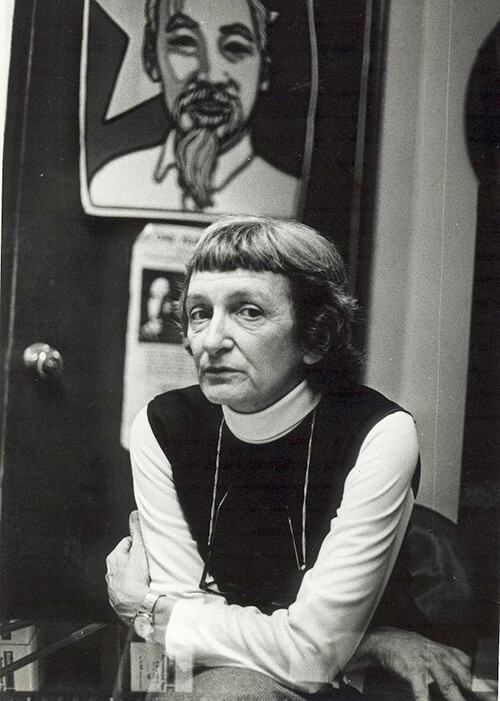 |
| Anne Braden in the SCEF office where she edited The Southern Patriot, Louisville, Kentucky, October 1962. Reproduced by permission from the Wisconsin Historical Society. |
The DVD cover of Anne Braden shows its subject in a white turtleneck and black jumper, strikingly like a priestly garment and clerical collar. Although the documentary brushes aside her life-long devotion to organized religion, this image embodies the film’s argument—that she was a martyr to the causes she believed in, gave her life for others, and made sacrifices that far transcended the ordinary. Anne Braden details how as a child of the white southern middle-class, Braden grew up to critique the language of white supremacy and use her sharp intelligence and pragmatic skills as a journalist at the Anniston Star, the Birmingham News, and the Louisville Courier, to investigate case after case of racial injustice in the South and the nation. Her 1948 marriage to Carl Braden, the son of recent immigrants, forged a personal and political alliance that merged her commitment to racial integration with his close ties to the labor movement and the Socialist Party.
A first-person documentary based largely on biographer Catherine Fosl’s book, Subversive Southerner (2006), Southern Patriot is narrated principally by Braden. Fosl makes multiple appearances, recounting in a riveting statement early on that throughout Braden's long career, she never "took her hand off the plow" of social justice, and once her course was set, she did not look back. Interviews with a number of activists who worked with Braden across the decades recount stories of her dedication and vision. Brief, laudatory vignettes by Cornel West, Bernice Johnson Reagon, Reverend C.T. Vivian, and Angela Davis underscore the importance of Anne Braden’s path-breaking work on civil rights and discuss the implications of her activism for the twenty-first century.
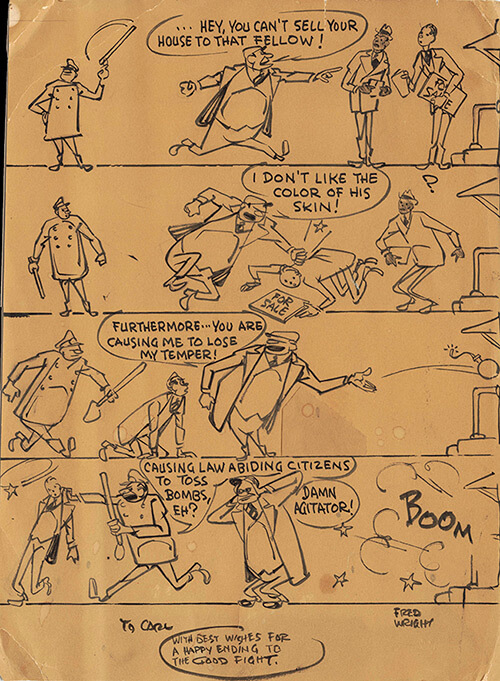 |
| Fred Wright, The Wade House Bombing Comic Strip, 1954. Reproduced by permission from the Wisconsin Historical Society. |
The film recounts Anne and her husband Carl's 1954 decision to purchase a house in an all-white Louisville neighborhood for Andrew and Charlotte Wade, a young African American couple. The Wades moved in on May 15, 1954, two days before the US Supreme Court's Brown vs. Board of Education decision striking down school segregation. Anne Braden documents in harrowing detail how this modest suburban home, first damaged by rocks and gunshots, and then partially destroyed by a bomb, became the focal point for desegregation in Louisville. The hostile white neighbors who had threatened the Wades' safety multiple times were never seriously questioned about these crimes. Rather, the state of Kentucky charged the Bradens with arson and sedition. Carl spent seven months of a fifteen year sentence in prison and lost his job at the Courier-Journal. In a low-pitched voice-over, Braden narrates over newspaper articles from the trials, photographs of the bombing, and film clips, including portions of an interview with Andrew Wade. She analyzes the context of this pivotal civil rights case, concluding that: "The anti-Communist sort of hysteria that was gripping the country and the anti-Black hysteria that was certainly gripping the South, all got rolled up in a ball and hurled at us. We were traitors to the country, to our race, we were Communists; we were evil; we were the devil."
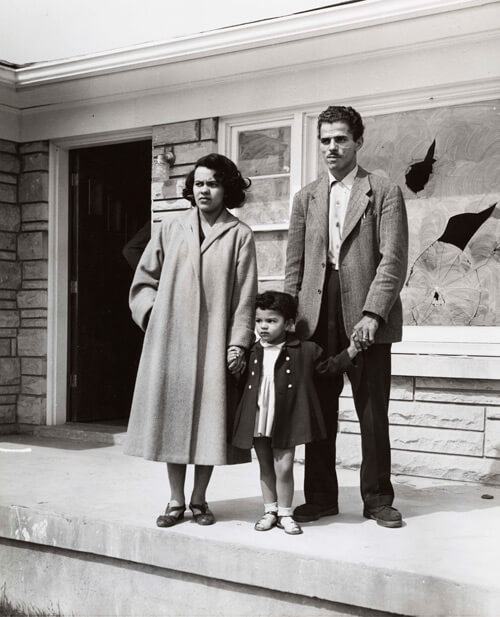 | 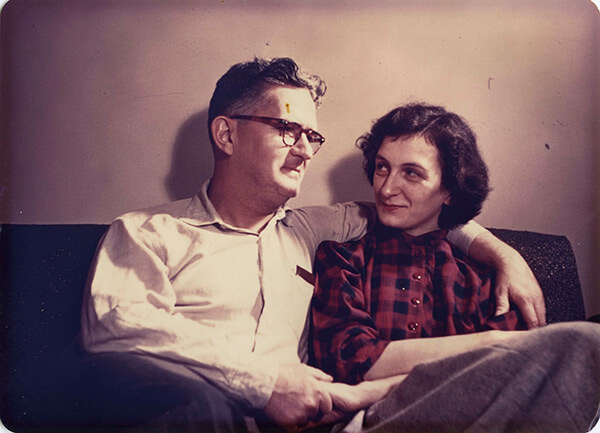 |
| Andrew Wade and his wife and daughter stand in front of their damaged house, May 16, 1954, from the Louisville Courier-Journal. Reproduced by permission from the Wisconsin Historical Society. | Social activists Carl and Anne Braden, taken about the time of their marriage, 1948. Reproduced by permission from the Wisconsin Historical Society. |
The Bradens deepened their commitment to activism. Their reputation as "subversives" followed them into the wider civil rights movement. Throughout the 1950s and 1960s, the Bradens worked in relative isolation, especially in the South, and were treated like political and social pariahs in their hometown. Until decades after Carl’s death from a heart attack in 1975, even groups dedicated to social change spurned their participation. Blacklisted from employment, Anne and Carl Braden accepted an offer from the Southern Conference Education Fund (SCEF), an outgrowth of the New Deal era's Southern Conference for Human Welfare. They worked as SCEF organizers out of Louisville on a comprehensive civil rights agenda aimed at ending segregation and extending the power of trade unions. For years Anne Braden used her talents as a journalist to edit SCEF’s widely read radical left newsletter The Southern Patriot.
 |
| Cover of Free Thomas Wansley: A letter to white Southern women from Anne Braden, 1972. Print by John Wilson. Courtesy of Emory University's Manuscript, Archive, and Rare Book Library. Page 1 - Page 2 - Page 3 - Page 4 |
The film Anne Braden: Southern Patriot shows how Anne Braden found her voice as a southern white woman after following the advice of William Patterson, the African American founder of the radical Civil Rights Congress. Braden recounts on camera how Patterson told her: "You don’t have to be part of the world of the lynchers; you can join the 'Other America,' the people who struggled against slavery . . . the white people who supported them, the people who all through Reconstruction struggled." He listed all those who have worked against injustice, she remembers, and at this point when "I was hardly dry behind the ears . . . that’s what I needed to hear." Braden heeded Patterson’s counsel, cast her lot with those in the "Other America," and shaped a broad vision of solidarity that encompassed past generations of American dissidents, those involved in current struggles, and those who would continue to fight for social and economic justice. Relatively slow to embrace women’s liberation, Anne Braden came to see feminism and eventually gay rights as natural extensions of the civil rights movement. In December 1972 she penned "A letter to white Southern women," (included in a PDF on the Anne Braden DVD), whom she addressed as "my white sisters." She made a powerful plea to white women of the South, who she argued "belong in this fight," to join a campaign to free Thomas Wansley, a young black man arrested at age sixteen who had spent a decade in prison on a fabricated rape charge. Braden reflects on this case in Anne Braden and restates her argument that: "no white woman reared in the South—or perhaps anywhere in this racist country—can find freedom as a woman until she deals in her own consciousness with the question of race." Only women, she argued, could destroy "the myth of white Southern womanhood" by not remaining silent as black men die or go to prison.
Braden’s message and influence are made clear in Anne Braden, but the question of her motivation is one that the film skirts. What forces drove her to take up the cause social justice in such a decisive way? What gave Anne and Carl the courage, year after year, to dedicate everything they had to changing the world, to making real their shared vision of a beloved community built on racial equality and economic justice? How did she weave together the seemingly diverse elements of her background, religion, and education to take on the challenges of racial and economic justice in the second half of the twentieth century? How did she become a radical?
 |
| Anne Braden speaking at a rally, Louisville, Kentucky, 2002. Reproduced by permission from the Wisconsin Historical Society. |
Anne Braden was an activist who left a rich bequest in the dozens of multi-racial activist groups that continue her work. By the final years of her life (she died in 2006) even longstanding arch-enemies acknowledged Braden as a heroine. Predominantly white liberal groups that had previously shunned her began presenting her with awards. The American Civil Liberties Union gave her the first Roger Baldwin Medal of Liberty, and the Southern Regional Council bestowed its Lifetime Achievement Award. Once the tide turned Anne received multiple honorary degrees, and after her death, even the state of Kentucky went from vilifying her to paying "honor and tribute" in an official resolution. Anne Braden called these actions, "apologizing for fifty years of history." Anne Braden: Southern Patriot celebrates Braden’s long career, from 1948–2006, and what activist Angela Davis termed, her "inveterate optimism, even in the worst of times [and] her refusal to give up."
About the Author
Mary E. Frederickson is a professor of history at Miami University, Oxford, Ohio, where her research and teaching centers upon women’s history and labor studies. She is the author of Looking South: Race, Gender, and the Transformation of Labor (University Press of Florida, 2011) and Gendered Resistance: Women, Slavery and the Legacy of Margaret Garner (University of Illinois Press, forthcoming 2013). During 2012–13, professor Frederickson has been a Mellon fellow at the James Weldon Johnson Institute working on a social and legal history of sickle cell disease. She will be a visiting professor in the Graduate Institute of Liberal Arts at Emory University in 2013–14.
]]>Introduction
 |
The True Image explores the history and output of Scotch-Irish stonecutters in the early backcountry of Pennsylvania and the Carolinas. For none of them do we have any personal information—not a diary or journal or letter, not even a mention of them in anything but official records like deeds, probate files, and court minutes. Many of the gravestones they made, however, still stand in the Presbyterian churchyards of specific communities. Their dated stones memorialize particular people. Elsewhere the lives of these people and their neighbors are more fully recorded. So we can learn the context in which the stonecutters worked. Both
historical documents and oral lore have preserved it. I draw upon these in trying to glimpse and understand the world shared by stonemason and patron. The gravestones, in fact, offer additional ways to enter that world, for they were its sculpture gallery. The inscriptions upon them also compose an anthology of favored verse, and the cemeteries themselves must have prompted storytelling by people passing through. They certainly led William Henry Foote, a minister and early Presbyterian historian of the region, to open chapters about individual churches with descriptions of gravestones and tales of people they commemorated. The stones helped him and others carry history in mind, mull it over, debate it, hold up the lives of earlier generations as warnings or models. In Chapter 6 of The True Image, I too take the reader past some of the stones and stop to tell stories they prompt. The excerpt that follows offers ones that circulated after the death in 1771 of the Reverend William Richardson, pastor of Waxhaw Presbyterian Church in Lancaster County, South Carolina. The accounts have a wide range of implications.
The Reverend William Richardson
The Bigham gravestone for the Reverend William Richardson stands in a Davie Family enclosure at Waxhaw Presbyterian Church. The front of this memorial is engraved with an armorial design, a portrait of the minister in his pulpit, and a capsule biography:
He lived to Purpose:
He preach'd with Fidelity:
He pray'd for his People:
And being dead he speaks.
The rear of the stone adds one factual detail:
He left
to the amount of
£ 340 Sterg
To purchase religious books for
The Poor.1The stone and that of the minister's sister Mary Davie are now inside a brick-walled enclosure built in 1927. General William Richardson Davie's tomb dominates this Davie memorial. It stands at the east side, at the end of a path from the entrance on the west. The stones of William Richardson and Mary Davie were removed from their original sites in the churchyard and placed alongside the path, facing south, each protected by a sheath of granite that partly overhangs both faces of the stones. Consequently, neither one can now be photographed in its entirety with the intended play of sunlight and shadow. A murky shot of the William Richardson stone used in Peter N. Moore's World of Toil and Strife: Community Transformation in Backcountry South Carolina, 1750–1805 (Columbia: University of South Carolina Press, 2007), 39, illustrates the problem. Moore's article "The Mysterious Death of William Richardson: Kinship, Female Vulnerability, and the Myth of Supernaturalism in the Southern Backcountry," North Carolina Historical Review 80, no. 3 (July 2003): 283, has a photograph of a rubbing of the same stone. It leans against a tree and is partly illuminated by sunlight. Text carved in relief is nearly invisible in this rubbing. After hearing me lecture on the Bighams, Daniel and Jessie Lee Farber photographed the stone with sunlight streaming up across the surface from a mirror held below. I photographed sections of the stone separately with a light held above and to the right to imitate lighting seen by the carver. I know of no photograph of this or the Mary Davie stone that is satisfactory.
This is a thin presentation of the life of the minister. Richardson was born in Egremont, in present Cumbria, England, the youngest son in a family of apparently fairly well-to-do drapers. He studied for the ministry at the University of Glasgow, emigrated to America in 1750, and became a protégé of an important New Light minister, Samuel Davies of Virginia. Sent as a missionary to the Cherokees in October 1758, Richardson was out of his depth and had no success whatever in the assignment. He converted no one, resigned, and left expecting war.
 |
| Daniel W. Patterson (photographer), The Reverend William Richardson headstone (1771), detail of the lower front, Waxhaw Presbyterian Church, Lancaster County, South Carolina. Gravestone attributed to the Bigham workshop. |
But on his way to the Cherokee country Richardson had acted at the direction of the presbytery to install the Reverend Alexander Craighead in the Rocky River Presbyterian Church. The next year he married Craighead's eldest daughter, Agnes, and was himself installed as the minister at the Waxhaw Presbyterian Church in Lancaster County, South Carolina. He induced his sister Mary and her husband Archibald Davie to send his namesake, their five-year-old son William Richardson Davie to him in America and then to come themselves and settle on land adjoining his own in the Waxhaws. Richardson served with distinction until his death twelve years later. His personality was conciliating enough to attract Presbyterians from several mutually antagonistic groups into the Waxhaw congregation, and he established and ministered at times to some twelve other churches in the region.
It was his death, however, that most generated legends—and at least four different interpretations of the event. Truth is hard to reach in these materials, but exploring them does yield insights into the backcountry Presbyterian culture. The earliest account was written by the Reverend Archibald Simpson, a friend of Richardson since their student years at the University of Glasgow. Simpson too had emigrated to America and held a Presbyterian church near Charleston. In his diary entry for August 26, 1771, a month after Richardson's death, he wrote,
On Friday night, when I came to town, was informed by report of the death of my dear friend and comrade, the Rev. Mr. Richardson, and this day had it confirmed. This has afflicted me much, and is, in many respects, the loudest call I ever met with to prepare for the eternal world. Oh! that I may be ready and may give up my accounts with joy! His death is a very great loss to the part of the country where he lived. He was a burning and a shining light, a star of the first magnitude, a great Christian, a most eminent minister of Jesus Christ. He left a disconsolate widow, but no children. His death was something remarkable. He was of a strong and robust make, and in general healthy, but of a heavy, melancholic disposition, subject from his very youth to vapory disorders. His labors for some years were very great. About three or four years ago he began to decline; his vapory disorders increased, his intellect seemed to fail. He turned very deaf, and lost much of his spirits and liveliness in preaching, but was still very useful to his own people. About three months ago he seemed sickly, but his people and family thought he fancied himself worse than he was, as he did not keep his bed, but appeared as usual, and only kept his house. Some time in June [i.e., July] one of his elders was visiting him, and in order to divert him had entered into some argument with him, in which Mr. R. talked with a good deal of spirit, and afterwards went up stairs to his room, but was to be down to dinner as usual. Accordingly, when dinner had waited for some time, they went up stairs and found him dead on his knees, one hand holding the back of a chair, and the other lifted up as in prayer. So that he seemed to have expired in the act of devotion, and to all appearance had been dead some time: a most desirable death indeed. O Lord God! let me die the death of the righteous, and let my latter end be like his.2George Howe, History of the Presbyterian Church in South Carolina, 2 vols. (Columbia, SC: Duffie and Chapman, 1870–73), 1:418–19.
 |
| Map of South Carolina Waxhaws region, 2012. Map shows location of Waxhaw Presbyterian Church in Lancaster County, South Carolina. |
This account stresses several years of physical and mental decline and, underlying it, a temperament vulnerable to depression. This tendency is reported also in several other Presbyterian ministers of the region, including Richardson's father-in-law Alexander Craighead, James Hall in Iredell County, and Henry Patillo in Orange. David Caldwell's son Samuel Craighead Caldwell had a more severe mental disturbance and had to leave his Sugaw Creek pulpit. The Reverend Eli Washington Caruthers defends another, the Reverend Richard Hugg King, against the suspicion of his congregation that he must be "a little disordered in his mind" but reports that there "had been a case or two of religious melancholy among his relations on his mother's side." Caruthers also describes the religious melancholy that afflicted a daughter of David and Rachel Caldwell.3William Henry Foote, Sketches of North Carolina, Historical and Biographical: Illustrative of the Principles of a Portion of Her Early Settlers (New York: Robert Carter, 1846), 193, 218; Eli W. Caruthers, A Sketch of the Life and Character of the Rev. David Caldwell, D.D. Near Sixty Years Pastor of the Churches of Buffalo and Alamance: Including Two of His Sermons, Some Account of the Regulation, Together with the Revolutionary Transactions and Incidents in Which He Was Concerned, and a Very Brief Notice of the Ecclesiastical and Moral Condition of North-Carolina while in Its Colonial State (Greensborough, NC, 1842), 258–61; Raleigh, North Carolina Office of Archives and History, Division of Historical Resources, State Archives, Private Collections, Eli W. Caruthers, "Richard Hugg King and His Times: Reminiscences of Rev. Eli Caruthers, of Orange Presbytery, NC (Prepared by order of Presbytery, Copied by Davis Foute Eagleton, Great Grand Son of Rev. Richard Hugg King. Austin College, Sherman, Texas, October, 1912)," typescript, 60. The zeal with which New Light Presbyterians emphasized guilt and sin had its debilitating side.
A differing account of Richardson's death was recorded by a waspish Anglican itinerant named Charles Woodmason, who had met Richardson and regarded him as a cut above the other Presbyterians. In a "Memorandum" written at some later time, Woodmason recorded that the minister
was found dead on his Knees in his Study, with a Bridle round his Neck, reaching to the Ceiling. He was leaning against a Chair (as was his Custom in Prayer) and his Hands uplifted. In this Posture He was found by a female Servant. The Wife pretended Great Grief—sent for the Neighbours &c. the Elders met—and all concluded that it was an Act of his own thro' Religious Melancholy—Therefore (to bring no disgrace on the Kirk) they called no Coroner, but buried Him as next day—the Widow following the Corps with Great Sorrow to the Grave. But some that knew the Temper of the Wife and her Relations—made this Affair Public—And it was insisted on that the Corps should be taken up out of the Grave and examined which was done. And Marks of Strangulation found on the Neck—and Bruises on the Breast. On Examination of Persons, it appeared That all the Servants were sent abroad into the Field that Morning and none left in the House but the Wife—And that her Brother had been there in Interim for a short Space. It was found too that no Man could destroy himself by the Manner in which the Bridle was found about his Neck. And it was more than probable that it was put round the Neck, and the Body plac'd in that Posture after he was strangled.4Charles Woodmason, The Carolina Backcountry on the Eve of the Revolution: The Journal and Other Writings of Charles Woodmason, Anglican Itinerant, ed. Richard J. Hooker (Chapel Hill: University of North Carolina Press, 1953), 133–134.
 |
| Daniel W. Patterson (photographer), The Reverend William Richardson headstone (1771), Waxhaw Presbyterian Church, Lancaster County, South Carolina. Gravestone attributed to the Bigham workshop. |
Woodmason's account incorporates details about the death that had circulated as gossip and settled into legend, but they are intermixed with mistaken information and with his own biases. He apparently mistook Richardson's brother-in-law for his wife's brother, Thomas Craighead, who later became pastor of the Waxhaw church but was in 1771 living in North Carolina. It was also Woodmason's mistaken belief that Richardson had married the "Daughter of his Predecessor in the Meeting House, one Campbel." Her father, Woodmason charged, "had bred up his Children in all the Bigotry and Zeal to the Church of Scotland, as possible—And this Zeal had infected his whole Flock." Their childless marriage, he believed, added to Mrs. Richardson's "Melancholy and Splenetic Disposition." Richardson's congregation, he says, refused to allow him to introduce Watts's hymns or the Lord's Prayer in services, but he used both in his family devotions "to the Great Disgust of his Wife and her Relations. Thro' these People he led a most bitter Life—and was very unhappy."
Woodmason's attack on Mrs. Richardson tells more about the animosity between Anglicans and the Presbyterians in the backcountry than about the Richardson marriage. He was resentful, for example, that one of his communion services was intentionally "interrupted by a Gang of Presbyterians who kept hallooing and whooping without Door like Indians." He calls them "Ignorant, mean, worthless, beggarly Irish Presbyterians, the Scum of the Earth, and Refuse of Mankind."5Woodmason, 17, 60. Richardson's own will, however, undercut Woodmason's view of his wife. He provided for her with care uncommon in the era. The will implies genuine affection rather than "a bitter Life" and unhappiness with her.
A third account was given by George Howe in his History of the Presbyterian Church in South Carolina. It opens with a concession that the circumstances of Richardson's death "are differently rehearsed by the popular traditions." Howe chose, however, to set down a view much more sympathetic to Mrs. Richardson:
According to one story, which has the appearance of truth, Mrs. Richardson had gone early in the day to a social gathering, "a quilting," leaving him alone. He had recently fitted up a room as a library and study in the upper story of his house, which was his constant resort. During the day, his brother-in-law, Mr. Archibald Davie, had been at the house and saw nothing unusual about him. Late in the evening, Mr. William Boyd, of Rocky Creek in Chester District, which had recently been settled by emigrants from the north of Ireland, came to the house, requesting on the part of that people, that he would make an appointment among them for religious service. At the same time Mrs. Richardson returned, and to Mr. Boyd's enquiry for Mr. Richardson, replied that he was probably in his study, and immediately withdrew to prepare dinner for her visitor. Mr. Boyd being desirous of an interview with Mr. Richardson, knocked at the study door, and receiving no reply, ventured to look through the key-hole, and saw him, as he supposed, on his knees at his devotions. After waiting for a considerable time, Mr. Boyd expressed to Mrs. Richardson some anxiety for an interview with him, and she ascended the stairs, and on opening the door, uttered a piercing scream which brought Mr. Boyd to her side. They found Mr. Richardson dead, in a kneeling position, and a bridle around his neck. The neighbors were called, and the facts made known. An apprehension prevailed among these friends that the interests of religion and the fair fame of so eminent a minister would suffer, if he should be known as a felo de se. The circumstance of the bridle was therefore suppressed, and he was said to have died at his devotions. Mrs. Richardson, who was a lady of much personal beauty, married in the course of the year Mr. George Dunlap, a gentleman of worth. The marriage was perhaps regarded as more hasty than a proper respect for Mr. Richardson's memory would justify. The circumstances of Mr. Richardson's death became more and more public, various tales and unfounded suspicions grew into greater consistency as they passed from mouth to mouth, until the cruel suspicion arose that Mrs. Richardson herself had a hand in her husband's death. This proceeded so far, that a most superstitious and revolting test of her innocence or guilt was at length resorted to. About a year after his interment, the whole community was collected around his grave, the body of Mr. Richardson was exhumed and exposed to view, and Mrs. Richardson was subjected to the shocking ordeal of touching his corpse, on the absurd idea which at that time prevailed, that blood would flow, if the murderer should touch the corpse of his victim. She was compelled by the cruel necessity of the case to lay her hand on the forehead of her deceased husband, and tradition says that Archy Davie, the brother-in-law of Mr. Richardson, pressed her hand down upon it. The afflicted woman could not restrain her tears, but wept aloud. Yet nothing unusual followed; no divine interposition resolved the mystery, and the transaction was ridiculed or sadly deplored by the majority of the people as a farce discreditable to those who had been the chief actors in it. The belief, however, continued in the minds of some, that Mr. Richardson had died by other hands than his own.
Howe, placing his trust in the reading that the Reverend Simpson gave of Richardson's mental instability in the last years of his life, assumed that the minister committed suicide. He wrote that the doubts of those who questioned this "were all founded on the popular belief among Christians, that God would never so forsake his children as to leave them to the awful death of a suicide. It is forgotten in all this, that the people of God and his ministers are not exempted in this life from any of the forms of human disease—that the diseases of the mind are as real as those of the body, and are often connected with them—and that one of the most frequent results of mental malady is the attempt to put an end to one's own life."6Howe, Presbyterian Church, 1:417–18.
This view, then, attributes the trial by ordeal to two beliefs traditional in the Presbyterian community, one deriving from early folklore and the other from an assumption locally held by people of faith. Both beliefs would have gone unquestioned in the early seventeenth century. As an educated Presbyterian in the mid-nineteenth century, Howe had discarded them. A century earlier in the Carolina uplands the age of reason had produced as yet only a community divided in its opinions about the two beliefs.
The Richardson case has been revisited in the past decade by Peter N. Moore, a historian studying the Waxhaw community. In his reading, "no compelling historical evidence" supports the legend of the trial by ordeal; he argues that Woodmason, had the story circulated in his time, would surely have used it to ridicule the Presbyterians. Moore thinks the "focus on supernaturalism and folk justice" hides the actual issues in the episode. He sees these as "the complex relationship between kinship, gender, and inheritance law" in the colonial era. In support of this position, Moore establishes the date of Agnes Craighead Richardson's remarriage to George Dunlap. It took place two years after the death of her first husband, a properly respectful period.7Peter N. Moore, "Mysterious Death," 289. He accepts Woodmason's report that a bridle was associated with Richardson's death and that the corpse was probably exhumed and examined. He then asks why—"if Agnes neither hated her husband for his religious views nor longed to remarry"—was she the object of such suspicion. His answer is that this question "goes to the very heart of eighteenth-century backcountry society and culture, where gender and kinship interlocked to safeguard the social power of propertied men and place widows in a potentially vulnerable position."8Woodmason, 290.
 |
| Waxhaw Presbyterian Church, Lancaster County, South Carolina. Built around 1800, it was the third meeting house of the congregation. This is the only known photograph of a meetinghouse the carvers themselves would have seen. Courtesy of Nancy Crockett. |
Richardson's will left his widow the house and its desirable 150-acre tract of land, and his slaves, livestock, most of the household furnishings, many books, and all tools, and in addition the monies owed Richardson by various debtors—in sum, at least seventy percent of Richardson's personal estate. The rest went to nieces and nephews and two acquaintances. To his brother-in-law Archibald Davie he left only his bridle and saddle and instructions to pay to Davie's two youngest children a £100 balance on a note Richardson regarded as owed to himself.
To Moore this suggests that the source for the rumors and hostility to Agnes Richardson was an envious and frustrated Archibald Davie, angling to get her to leave the community or remarry and forfeit the inheritance, which would go to his oldest son, William Richardson Davie, a minor. Archibald Davie would then manage the estate. But Moore goes a step further. He concedes that Richardson may have committed suicide, but argues that murder was also a strong possibility. His candidate for the murderer is Archibald Davie, who, by Howe's account, came to Richardson's house the day the minister died and was the chief actor against Agnes during the exhumation. "If Davie were bitter about Richardson's generous provisions for Agnes," Moore writes, "he would have been furious" when he learned that Richardson bequeathed the debt Davie owed him to Davie's own two children and "perhaps even furious enough to return the ironic gesture by strangling Richardson with the very bridle he had willed to Davie."9Ibid., 296.
Moore's theory assumes the accuracy of the reports that Richardson died strangled by a bridle, that Davie visited Richardson on the day of his death, and that later Davie himself pressed Agnes's hand down on the forehead of her dead husband. It also presupposes that Davie knew the contents of the will before Richardson's death. These four assumptions, however, also remain unproved.
Moore sees Agnes Richardson as a woman likely to rouse antagonism and also vulnerable. She was, of course, well connected. Her father Alexander Craighead and her brother-in-law David Caldwell were two of the ministers most respected by Presbyterians in the Carolinas. But the father was dead, and Caldwell lived 130 miles away. In the Waxhaw community she had no authoritative male relative who could quash rumors or face down her accusers. Other versions and interpretations of the legends give glimpses of the liabilities of the Presbyterian temperament, the antagonism between Anglicans and the Presbyterians from Ulster, and the gradual shifts in certain Presbyterian beliefs. To these Moore's exploration of the material adds understanding of the precarious position of "a woman suddenly occupying a prominent place in a man's world, standing uncertainly on the shifting line that defined gender norms in early America."10Ibid. One further question the entire story raises is what effect the death and the surrounding circumstances had upon Richardson's namesake, William Richardson Davie. He left no record of this, but took training in law rather than the ministry and found rationalism more convincing than Christianity.