How To Navigate
We’ve arranged Stand & Witness as a guided tour. We recommend that you move through the exhibition according to the numbered tour stops or “hotspots.”
To start the guided tour, click (don’t hover over) the red hotspot located at the first stop. Once clicked, the embedded video and navigation will load. The navigation will indicate the stop, for instance, at the first stop, it will say “1 of 10.” There are forward and backward arrows to move to the next and previous stops.
To view the videos in fullscreen, click the left-facing arrow located in the bottom right of the embedded video player to reveal “Show controls” and then click the “Fullscreen” button.
If you lose your way, click the magnifying glass at upper left corner of the screen, then click on the hotspot where you left off or would like to go next. On a mobile device, you’ll need to click the upward-facing arrow next to “10 Items” to reveal hotspots.
Introduction
In many ways, artists are first responders—to repurpose a term often used in public health. Soon after COVID-19 shutdowns began in March 2020, artists took to their studios, desks, and Zoom to bear witness to the pandemic and the tragic experiences of morbity and mortality that upended millions of lives. Throughout the pandemic, artists continued to serve on the emotional frontlines of COVID-19 interpretation.
Unlike the 1918 influenza pandemic, which is often referred to as the “forgotten pandemic,” COVID-19 took place in an era of global connection and social media, allowing for new audiences and shared artistic production. While scientists worked to understand the novel SARS-CoV-2, many artists leaned into the disruption that COVID-19 caused, discovering innovative strategies to interpret the impact of the pandemic individually and collectively. Artists across the globe investigated the heartbreak, poignancy, and isolation of the pandemic. Some turned to forms of humor. Novelists and poets wove narratives. When theaters were forced to close, performers found innovative ways to stage their productions and attracted new audiences on Zoom. Impelled by the pandemic, artists from around the world gathered online in August 2020, for the Edinburgh International Festival’s “Artists in the Age of Covid.” They examined new work and forms. They pondered the future of the arts, post-pandemic, and they asked, “what is the irreplaceable impact of the arts?” Stand & Witness: Art in the Time of Covid addresses that question.
Stand & Witness: Art in the Time of COVID-19 brings together an international group of artists, poets, authors, and performers to help us understand the individual and collective experiences of a pandemic that reshaped cultures and societies.
The title Stand & Witness is excerpted from “From 'Trading Riffs to Slay Monsters',” a poem by Yusef Komunyakaa and Laren McClung published in Four Quartets: Poetry in the Pandemic, (North Adams: MA, Tupelo Press, 2020).
Sponsored by the David J. Sencer CDC Museum, Office of Communications and the CDC COVID-19 response. Additional support provided by the Consulate General of Canada to the U.S. Southeast. The Stand & Witness exhibition ran from June 17–October 25, 2024 at the CDC Museum in Atlanta.
About the Authors
Louise E. Shaw served as curator of the David J. Sencer CDC Museum from 2002-2023, where she developed history and art exhibitions relevant to the work of CDC and public health. Previously she led Nexus Contemporary Art Center (now Atlanta Contemporary Art Center) and served as assistant curator at the Atlanta Historical Society (now Atlanta History Center).
Heather E. Rodriguez (contractor, Chickasaw Nation Industries) is the assistant curator at the David J. Sencer CDC museum. During her time at the museum, she has spearheaded the COVID-19 Collection Project and helped curate several exhibitions. Her areas of interest are the intersections between public health, sex, race and ethnicity, and United States culture.
Steve Bransford is senior video producer at the Emory Center for Digital Scholarship.
Public Health in the US and Global South is a collection of interdisciplinary, multimedia publications examining the relationship between public health and specific geographies—both real and imagined—in and across the US and Global South. These essays raise questions about the origin, replication, and entrenchment of health disparities; the ways that race and gender shape and are shaped by health policy; and the inseparable connection between health justice and health advocacy.
Beginning in 2022, the series expands to include 1000-word blog posts, as well as longer commentaries, essays, articles and media productions that address the public health and political implications of the COVID-19 pandemic from multiple perspectives. The series editor for Public Health in the US and Global South is Mary E. Frederickson.
Introduction
One night in the spring of 2006, I found myself on the edges of Richmond, Virginia’s Shockoe Bottom neighborhood with a group of reluctant adolescents from my church youth group, Holga camera in hand. Prone to light leaks thanks to its plastic body, the Holga was a toy camera that allowed me to shift from 35mm to medium format 120mm film. What I liked most about the Holga was its less-than-automatic approach to winding through the frames. With a half turn, one could capture images on top of each other, creating a visual palimpsest of moody, blurred, and imperfect scenes. Walking along the James River, I could see ripples of water over my right shoulder while sounds of cars racing along the highway crept into my left ear.
Our local historian tour guide took us down the river path while detailing the experiences of the enslaved. She spoke about how they emerged from the hull of the ship in complete darkness, after months at sea, disoriented, terrified, and unable to communicate with their captors and, in some cases, with each other. She asked us to close our eyes and imagine what it would be like to stand there, chains rubbing away at our wrists and ankles, as we were dragged along towards an unfathomable fate. The next week I developed the film in the dark room at school. My favorite image, which I submitted to workshop that week, was a shot of my tour guide, looking off into the distance, the nearly barren branches of trees etched uncannily across her face. Her body and the natural world merged into one.
How do you represent the horrific legacy of slavery without the bodies of the enslaved? Historically, abolitionist writers and editors built their political critiques on these vulnerable bodies. This manifested as a hyper-focus on the enslaved body as a site/sight of physical domination under the various machinations of white terror. This representation of Black pain, suffering, and duress proliferated with the spread of photography. From the images of lynched bodies in the post-emancipation era, to the photos of civil rights activists being beaten by police in the 1960s, to our contemporary moment of hyper-surveillance and police brutality, US society can view Black suffering’s ever-mounting evidence.
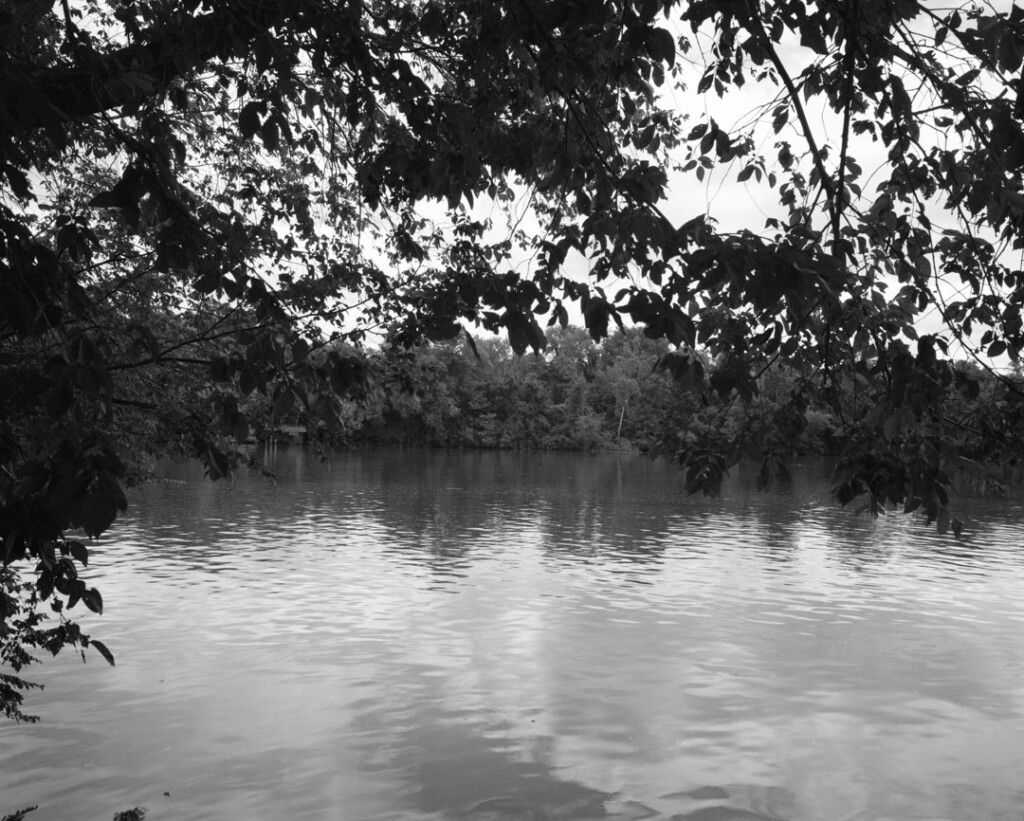
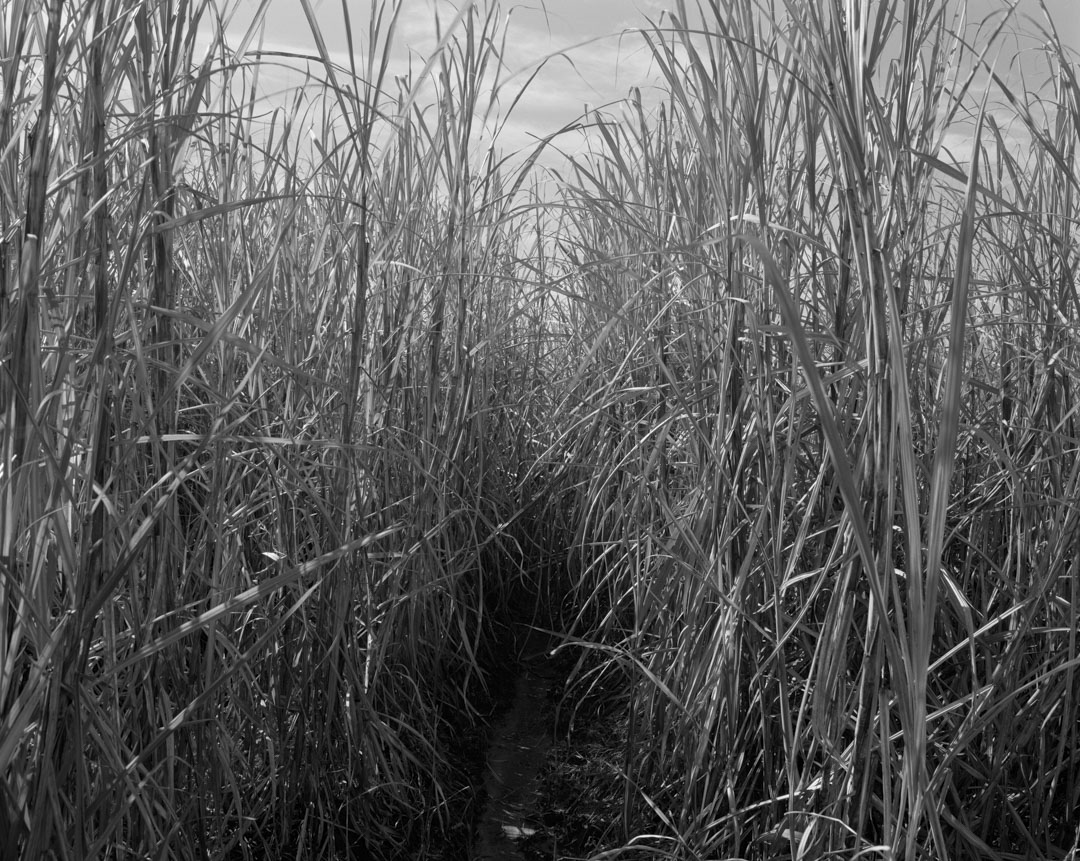
Photographer and visual artist Dawoud Bey explores the history of slavery through landscape photography in his exhibition Elegy which I visited in January 2024 at the Virginia Museum of Fine Arts. Elegy features three photographic collections and two short films that address the legacy of chattel slavery across landscapes in Virginia, Louisiana, and Ohio.
Born in 1953 in Queens, New York, Dawoud Bey, ever drawn to sound, aspired to be a musician before he became a photographer. Bey received his BFA in Photography from Empire State College in 1990, but his career began in New York in the 1970s where he developed a distinct street style featuring predominately Black subjects in everyday life. Influenced by James Van Der Zee and Roy DeCarava, Bey spent much of his career photographing Black faces. Looking through images from collections such as Harlem USA, Class Pictures, or The Birmingham Project, it feels as if you are inundated by the unrelenting gaze of Bey’s subjects staring directly into the camera. Such a dynamic inverts expectations; the subjects are looking at us, into or through us, with as much intention and discernment as we direct towards them.
Compared to his previous work, the large-scale landscape photography featured in Elegy asks viewers to see, and hear, the haunting presence of slavery projected against the landscape without the anchoring presence of Black bodies or Black faces. Bey’s most recent work allows us to recontextualize nature photography by eschewing the innocence of the pastoral scene in order to understand how the bodies of the enslaved, fugitive in their varying trajectories, maintained complicated relationships with nature on American soil. Elegy also contends with the legacies of slavery in the landscape when historical revisionism and erasure has paved over the evidence.
“Stony the Road We Trod” & “350,000”
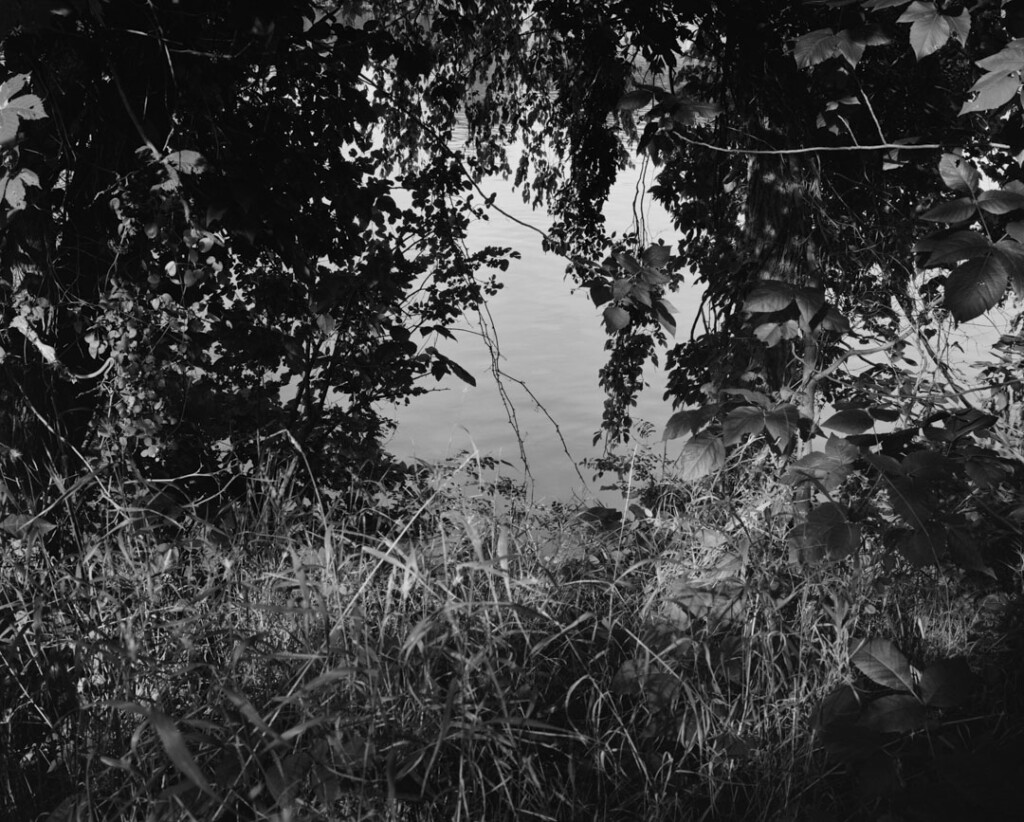
The first section of Bey’s Elegy, “Stony the Road We Trod,” (a lyric from James Weldon Johnson’s “Lift Every Voice and Sing”), features large-scale gelatin silver prints of the slave trail in Richmond. Tracking the route the enslaved took from Manchester Docks to Shockoe Bottom, Bey examines the landscape along the James River with a botanist’s eye. Each image presents the trail from different perspectives, each shot painted in varying tones of light and shadow that create depth and texture. You imagine the tall stalks of grass prickling your calves, the creeping vines of the foliage wrapping themselves around your ankles, and the overhanging branches grazing the sides of your face; you concede to the invasive nature of the landscape. To see the landscape this closely, one would have to get dirty and bend to the level of the soil. There is no way to keep yourself clean. When the camera pulls back, the fullness of the path feels almost endless. The light peeks through the trees, promising a new twist or turn, but there is a sense that it may never stop.
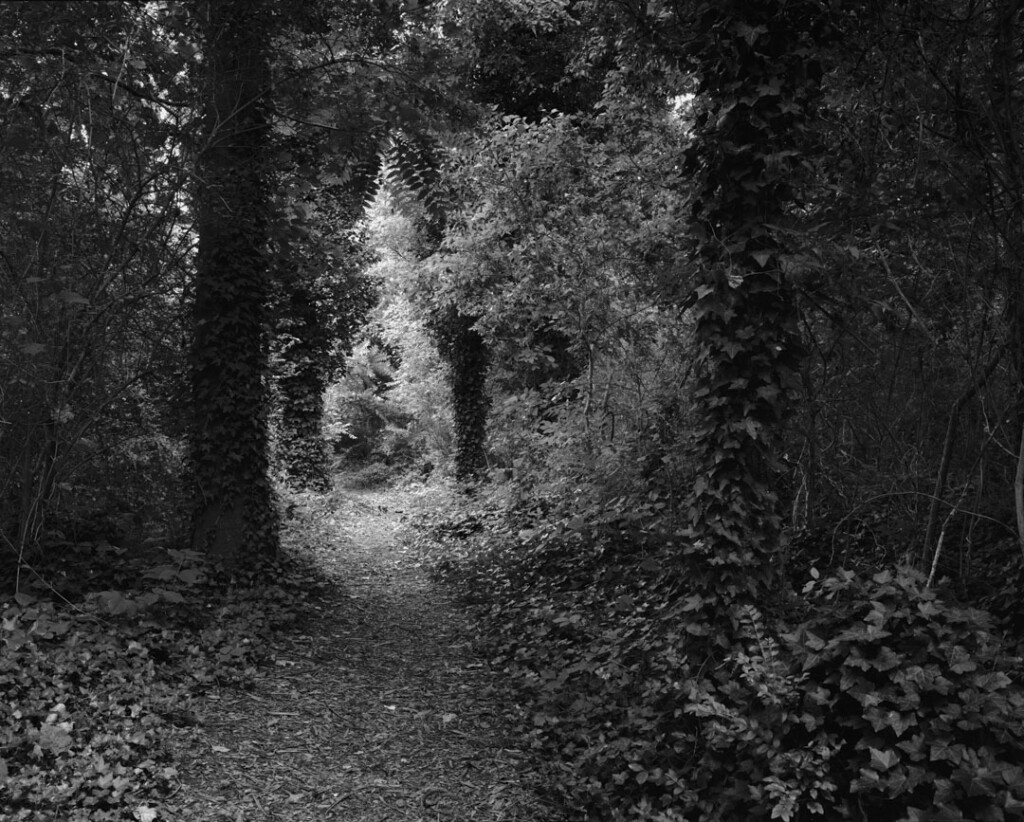
The first of Bey’s two short films, “350,000,” realizes this interminable momentum by offering the perspective of thousands of enslaved persons who traveled along the trail from the middle passage into bondage. Entirely in black and white, “350,000” is presented as a single extended tracking shot which relies on a haunting soundscape to situate the audience within the sensory experience of bondage. The film begins as it ends: with breath, not calm, but a sharp and sudden gasp, like the sound of a drowning body finally breaking through the line between water and air. This sound echoes Christina Sharpe’s concept of aspiration or “keeping and putting breath back in the Black body” within the “hostile weather” of an anti-Black climate, an act both “violent and life-saving.”1Christina Sharpe, In the Wake: On Blackness and Being (Durham, NC: Duke University Press, 2016), 113. The trail is covered in fallen leaves and enshrouded by the endless overhang of trees transitioning from late summer to autumn. Tree limbs refuse to stand upright, but bend inward from left and right, curving into an asymmetrical spiral of light, shadow, and texture. There is some semblance of shade for bodies unseen, but also a sense of being enclosed or entrapped.
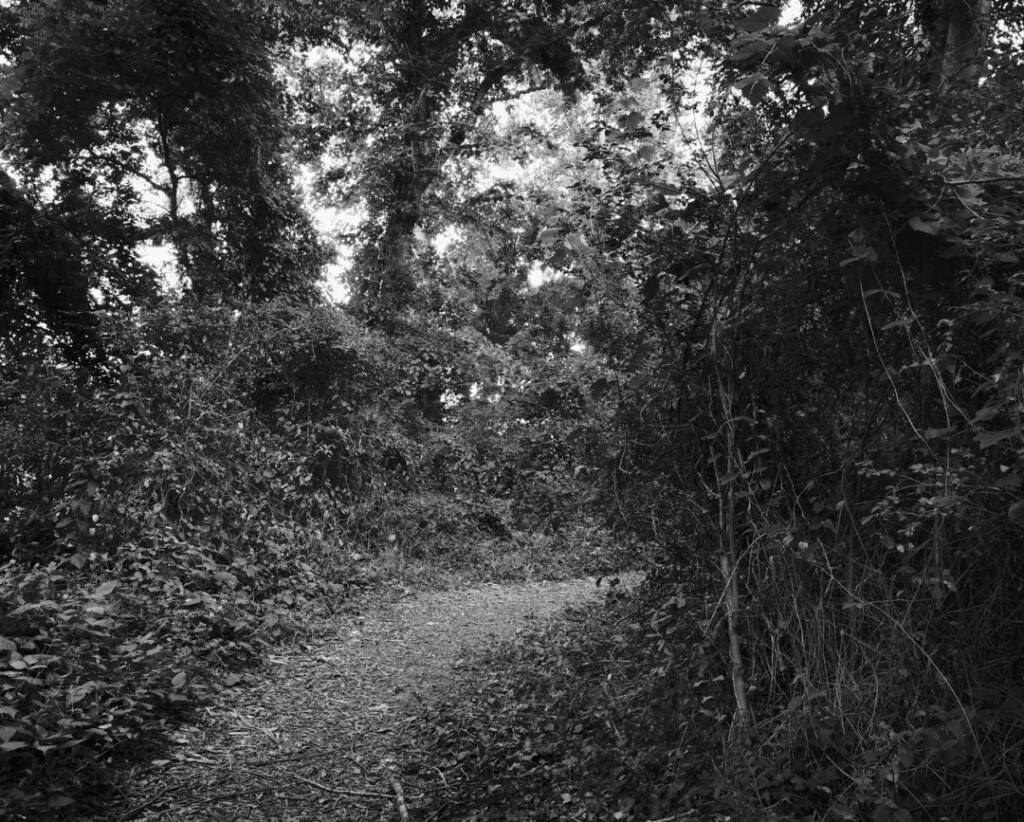
As the camera leads viewers down the winding path, there are slow pans to the left and right, from water to thicket, always searching for stability or familiarity in a strange and dangerous landscape. Even with the constant momentum, there are moments of stillness. The sounds of horse hoofs or rattling chains hover. The camera points upward, lingering on the daylight breaking through the shadows of branches and looming patches of grey-white sky. Photographed in a manner often reserved for flashback or dream sequences, the edges of the screen remain soft and blurred. The lack of any discernable body is disorienting, unmooring, echoing the experience of those trapped for months in the hull of a slave ship. Sound is the only anchor: audible labored breathing; guttural exhalations and moans slipping into a rhythmic chanting; the rattling of chains that resemble windchimes.
Bey collaborated with dance and movement scholar E. Gaynell Sherrod to choreograph “350,000”and sound designer Paul Bruski at the In Your Ear Studio in Richmond. The soundscape uses Foley techniques as dancers perform, sometimes barefoot, walking across dirt and gravel while holding large metal chains. While dancers often train to stifle or quiet the sound of their breath, Sherrod makes the labored breath of the dancers more audible, in the absence of their physical form.2Dawoud Bey, Gaynell Sherrod, and Imani Uzuri, “Soundings: Collaborations with Dawoud Bey” (Conversation/Panel, Virginia Museum of Fine Arts, Richmond, VA, February 9, 2024). Dancers’ bodies disappear and reform through sound, pulling viewers along slowly and reluctantly through the terrain.
“In This Here Place” & “Evergreen”
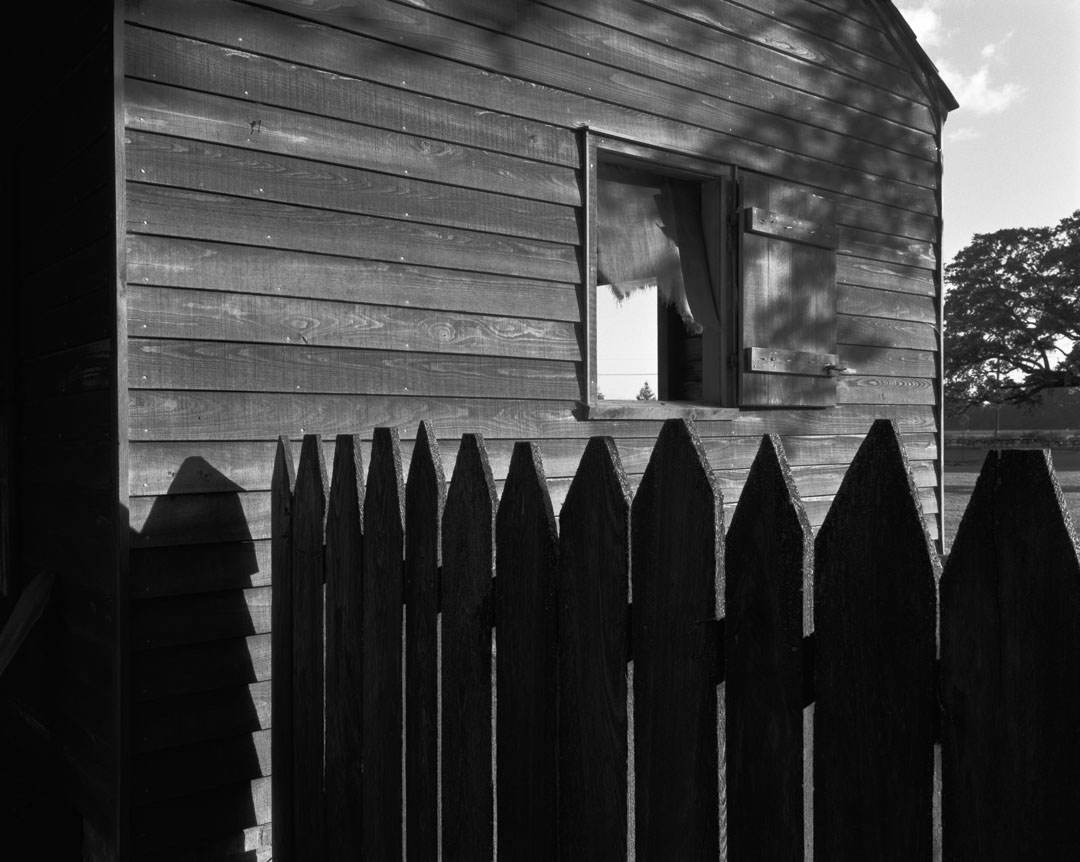
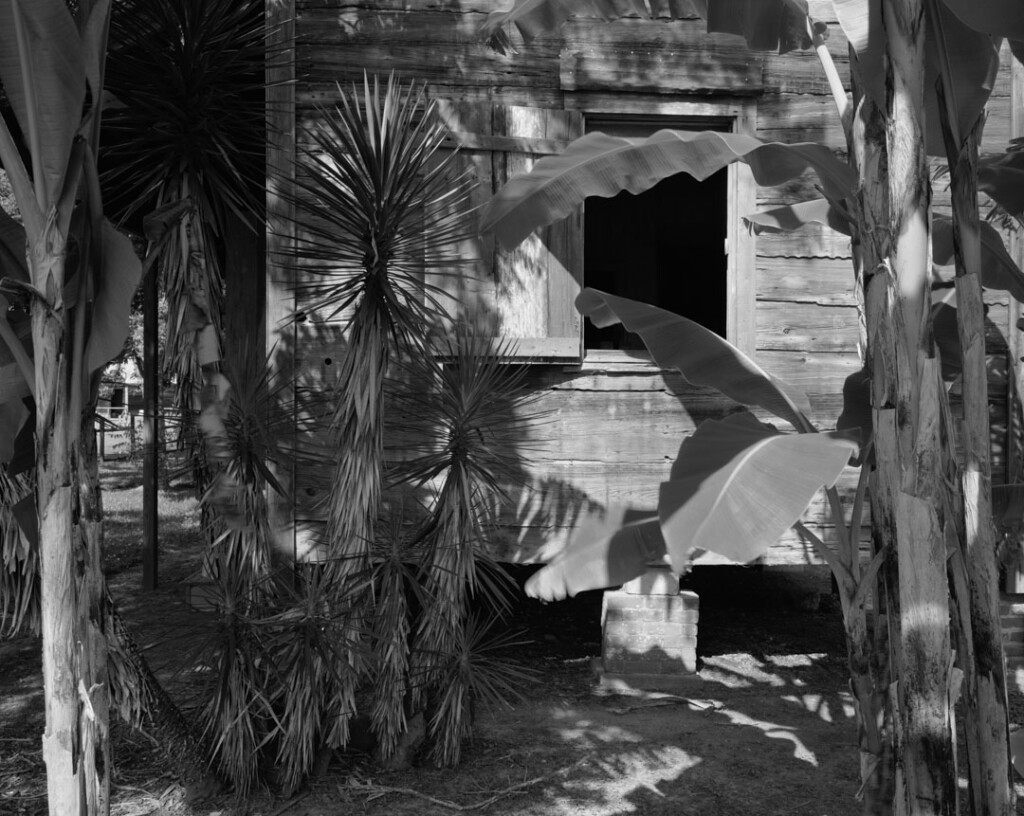
Elegy returns to the photographic on the remains of defunct plantations in Louisiana. “In This Here Place” presents a collection of images from the Evergreen, Oak Alley, and Whitney Plantations along the Mississippi River between New Orleans and Baton Rouge, capturing the slave quarters, some still intact and others commandeered by trees and wild shrubs. These antiquated cabins seem familiar. Looking at Bey’s 2019 “Overgrowth and Fence,” the barely visible cabin swallowed by the bare branches of invasive trees and tall weeds, I am reminded of many neglected houses, once owned in predominately Black neighborhoods in the Deep South, now abandoned on the outskirts of towns.
Many of the images have a spectral quality: each cabin houses the absent-presence of the enslaved. In “Cabin and Benches” the structure is surrounded by long, wooden, unoccupied benches, each shaded by large trees outside the frame. On one side, a rickety wooden shutter is swung open, revealing a small rectangular window blocked by a white curtain pulled back ever so slightly to reveal a tall, thin, black rhombus of darkness. I was convinced that at any point, bodies might emerge from the grey foreground mist, walk towards me, and sit down for some well-deserved rest. In “Cabin and Palm Trees,” the side of the cabin is almost completely obscured by varying leaves of the palm trees—some broad and flat, others a starburst of dense spikes. The window, this time unveiled from the domestic softness of the white curtain, reveals a tall black square, a void from which it felt like someone, shrouded in darkness, could be looking directly at me.
“In This Here Place” takes its name from Baby Suggs’ sermon in the clearing of Toni Morrison’s novel Beloved. Baby Suggs implores Black children to become and be seen, Black mothers to laugh, and Black fathers to dance for their children and their wives. She reminds the members of her community, many who sought their freedom by way of fugitive paths, to love themselves, fully and deeply, precisely because of the white world outside the safety of the woods. “[They] ain’t in love with your mouth,” Baby Suggs announces to the crowd, “they will see it broken and break it again. What you say out of it they will not heed. What you scream from it they do not hear.”3Toni Morrison, Beloved (New York: Vintage Books, 1987), 82. Apt then that “Evergreen,” the second of Bey’s short films featured in Elegy, presents a scream that cannot be ignored.
While “350,000” guides viewers to a single, unbroken shot on one screen, “Evergreen” is a colorful triptych that inundates with multiple shifting visual perspectives. On one screen, the camera hovers over the tops of the trees, moving slowly, as if floating, revealing the rust-tinted tin rooftops of the cabins of the enslaved. Another screen drops to ground level, cutting back and forth between close ups of the lush green grass and sharp stalks of sugarcane leaves piercing from the dirt towards the sky. On a third screen, the camera slowly pans from left to right, one cabin after another, their exterior walls stained with dark copper strokes of rust and oxidation, each one precarious on crumbling brick pillars. As soon you take in one shot on any screen, it switches. The vast perspective of “Evergreen” is awe-inspiring and, at times, overwhelming. I sat through multiple showings, trying to take in one screen at a time, but left feeling there was more to absorb.
The visual palate of “Evergreen”—red-yellow leaves across the ground, brown-blue-green of moss and mold on trees and cabins, and the bright/dull greens of grass and rusty rainwater pooling on the ground and in metal basins—blurs the pastoral and architectural decay. The soundscape intensifies the experience. Bey worked with vocalist and composer Imani Uzuri to articulate the narrative perspective of “Evergreen” where the camera does not reflect a human experience, but that of the disembodied spirits of the enslaved floating and hovering above and across the land.4Dawoud Bey, Gaynell Sherrod, and Imani Uzuri, “Soundings: Collaborations with Dawoud Bey” (Conversation/Panel, Virginia Museum of Fine Arts, Richmond, VA, February 9, 2024). Whispered words, familiar to those who grew up in the Black church, emerge from everywhere and nowhere: come by here, somebody’s praying, just like a dream, there is peace in the valley for me. Unmoored sounds of hands clapping or a tambourine beating echo throughout. Suddenly, a single extended utterance bursts forth, bending between a scream and a wistful soprano note quickly shifting back into a wail. In “Evergreen,” sounds and words intertwine, crashing into each other at an abrupt speed which approaches and dodges the legibility of music and voice. Uzuri offers us Black sound, harmonious and cacophonous, that refuses categorization; musicality stretched to the furthest comprehension.
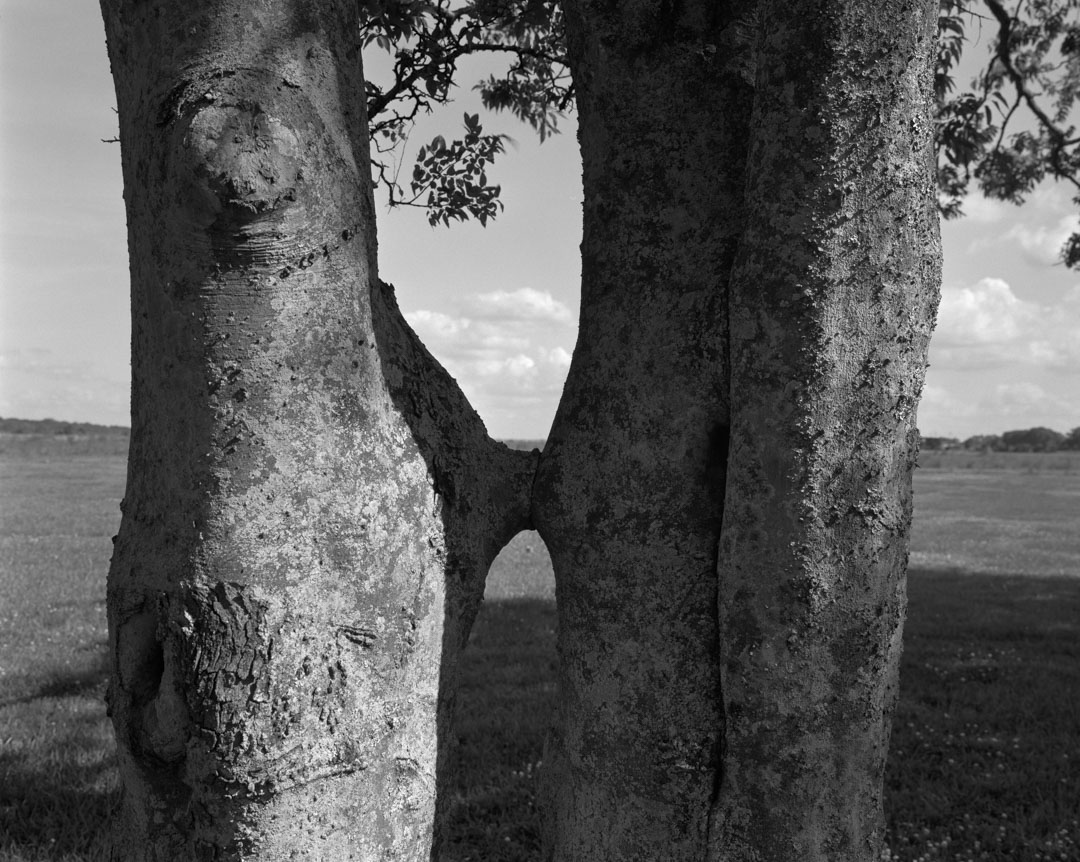
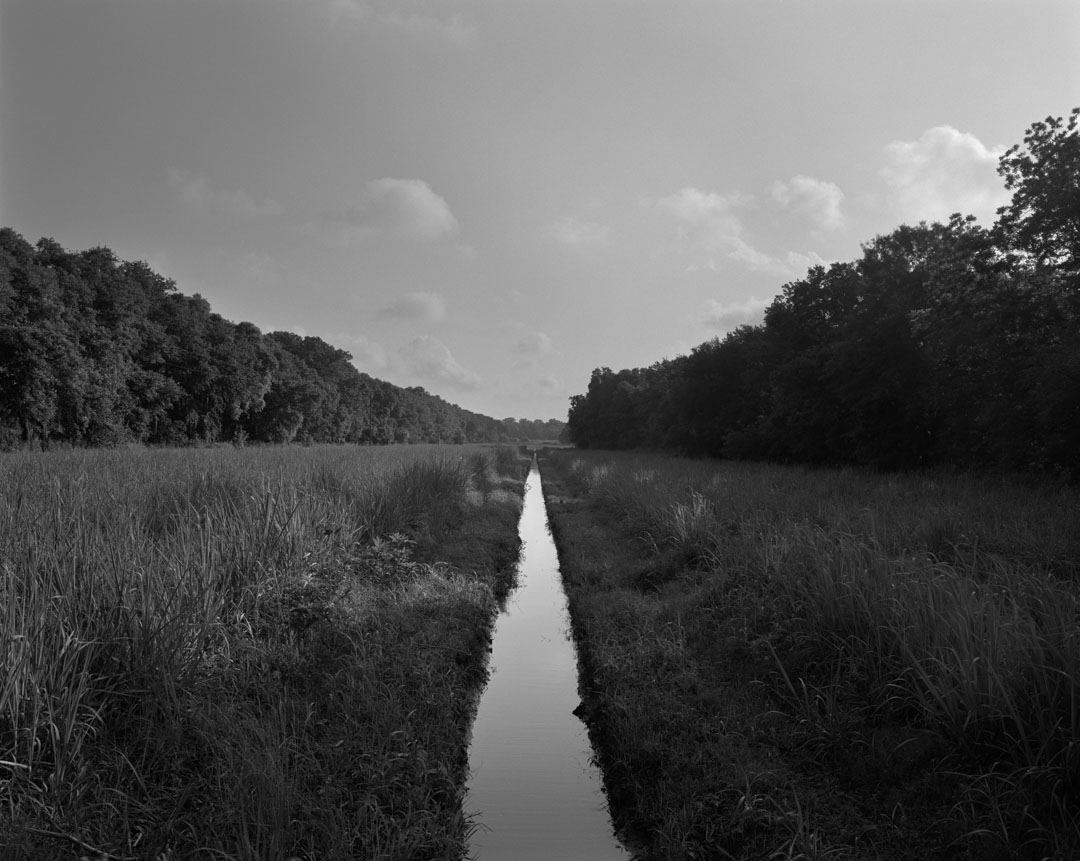
The final shot on the center screen of “Evergreen” is, again, one long tracking shot along the center path of the plantation, this time pulling backwards. Viewing the cabins from this vantage, I was struck by the stark architectural uniformity. Each cabin, equidistant and perfectly mirrored, reminds us that this space, these structures, were not only a landscape of suffering, but a community filled with a legally and culturally vulnerable population. Comparing this shot to images such as “Conjoined Trees and Field” and “Irrigation Ditch,” I notice how Bey deploys center composition to create symmetry and balance that emphasizes a single focal point, usually the subject, in an image. Bey often forces the eyes on a central path, a safe space to visually travel along a hostile territory. Both of these photographs and the last shot in “Evergreen” acknowledge and interrogate the linearity of history. While “350,000” moves viewers forward, assuming some level of literal and conceptual “progress,” we also understand that, for the enslaved, a predatory path unfurled. Pulled backward across the center at "Evergreen," we ask, what force carries us and to what end?
“Night Coming Tenderly, Black”
The title of my review comes from a line in Saidiya Hartman’s Scenes of Subjection where she argues for the “opacity” of “black song” as a phenomenon that “troubles the distinctions between joy and sorrow and toil and leisure."5Saidiya Hartman, Scenes of Subjection: Terror, Slavery, and Self-Making in Nineteenth-Century America, Revised and Updated Edition (New York: W.W. Norton, 2022), 54. In this, Hartman eschews the “overdetermined reading of the sounds of slavery”6Hartman, Scenes of Subjection, 30. prescribed by twentieth century Black thinkers such as W. E. B. Du Bois, and directs our ears to the more powerful, and at times less legible, “wild notes” of the enslaved, composed in part by the “screams lodged deep inside” that “confound simple expression . . . of black enjoyment.”7Hartman, Scenes of Subjection, 55.
In the almost 160 years since the legal dissolution of slavery in the United States, photography and film have articulated the overdetermined image and, eventual sound, of slavery within the imagination. In both “350,000” and “Evergreen,” Bey’s exclusion of Black bodies forces viewers into a complicated simulacrum of enslaved embodiment. His films interrupt our culturally sedimented expectations not only of what slavery looks and sounds like, but also how it should be experienced. There are no clear heroes or villains in these films, no sense of a triumphant victory of good over evil, not even a sense of who, if anyone, we are following. However, in the midst of this disorientation, we remain anchored by the density of Black sound; we continue to listen through the cacophony to make sense of the experience, not through historical logic, but through a bodily reaction to what unfolds on the screen.
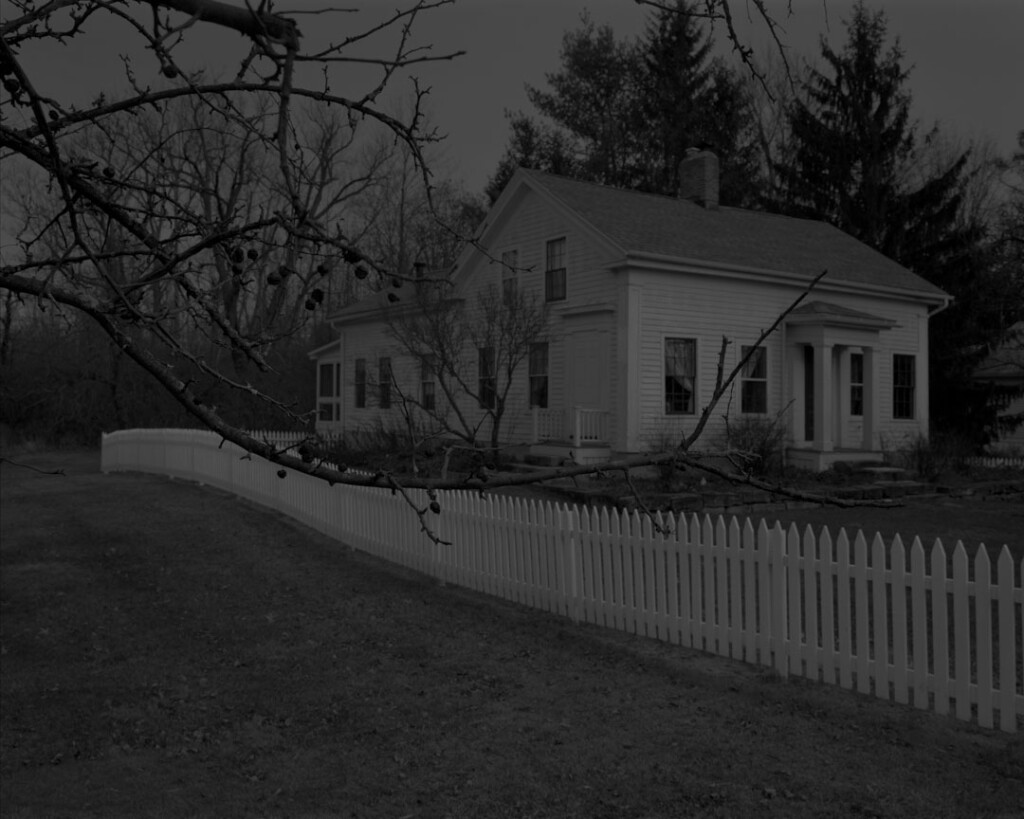
Coming down from “Evergreen,” I entered the final section of Elegy: “Night Coming Tenderly, Black,” its title taken from the last lines of Langston Hughes' poem, “Dream Variations.” This series of photos explores landscapes near Lake Erie in Ohio and Canada and traces the fugitive experience of enslaved persons who liberated themselves, often in the cover of night, from the bondage in southern states. Paying homage to photographer Roy DeCarava, these low-light prints hone the conflicting experiences of fugitivity, wherein a vast, beautiful, open landscape signals exposure and vulnerability while the claustrophobic cover of tree branches means safety and protection. On my way out, I was struck by the last photograph positioned to the right of the exit: a dim shot of Lake Erie, its grey waves rolling into the horizon.
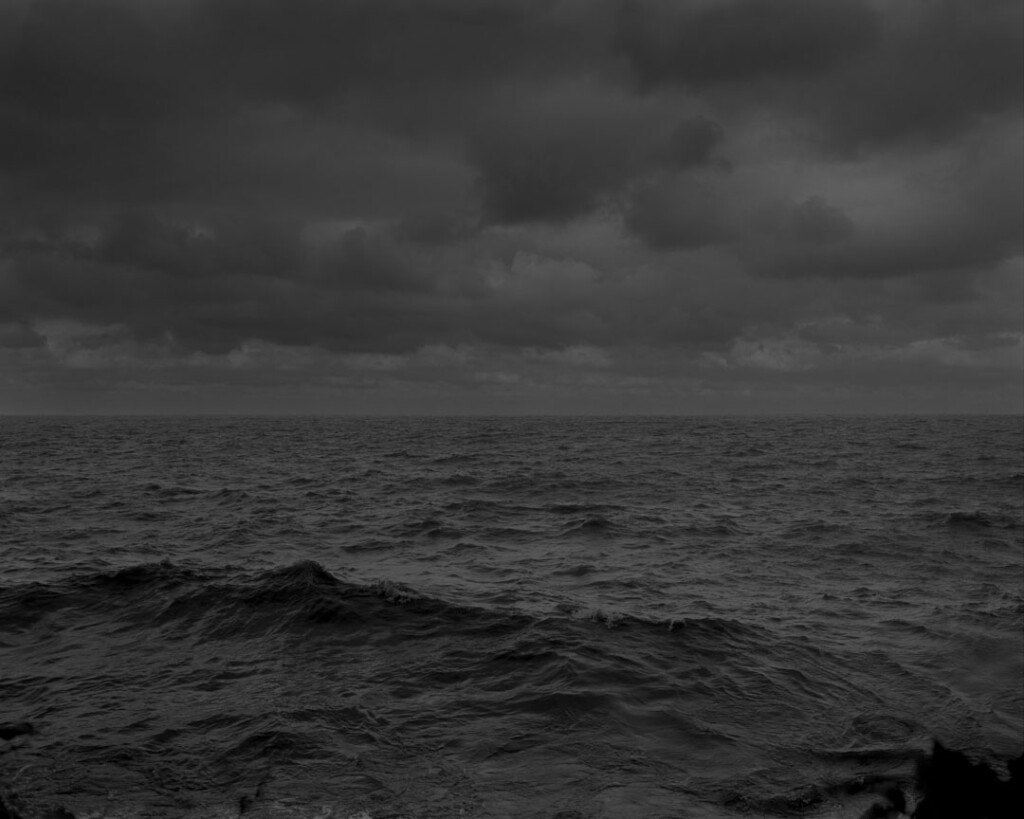
Within the full context of Elegy, viewers can understand the impact of this scene. The slow march from the Manchester docks, from Virginia through the Carolinas, Georgia, Alabama to the plantations of Louisiana, and the perilous journey from the Deep South to the northernmost parts of this country, has prepared us for this sight. If “350,000” began with a painful, sharp gasp, this shot of Lake Erie gestured towards a cathartic exhalation.
Leaving Bey’s exhibit, my mind was abuzz: What ethics, if any, are applicable to the ways that we consume the visual lexicon of slavery? Can the cacophony of Black sound that Bey so intricately deployed bring audiences to understand not only Black pain, but Black humanity? Mostly importantly, returning to the image Lake Erie, can any one photograph, detached from its critical context, represent the history of slavery so often erased and buried? When looking at non-descript images of a nature trail or even sugarcane stalks, do we need to hear the density of Black sound to understand what we are looking at? Elegy is, across all five sections of the exhibit, a fully immersive sensory experience which asks audiences to find in the American landscape a history that time and “progress” has obfuscated. As I exited, I could not shake the thought that, to an untrained or inexperienced eye, the difference between the waves of the James River and the waves of Lake Erie—let alone the currents of the Atlantic as seen from the hull of a slave ship—might be difficult to discern. In which direction does the water flow towards freedom? 
About the Author
Ariel Lawrence is a PhD candidate in the English Department at Emory University. Her research focuses on Black women-authored lifewriting across multiple genres, and the articulation of ethical reading practices in and beyond the page.
]]>
Bransford: Before we talk about An Unflinching Look: Elegy for Wetlands, can you talk about your personal history with the Chassahowitzka National Wildlife Refuge? And then describe the Refuge in terms of both ecology and aesthetics.
Dimmitt: My first trip there was in 1977 with a friend and my brother. The friend wanted to do some fishing. I had never heard of the place, nor had my brother. We drove up from Clearwater, got in his little jon boat and didn't do a lot of exploring, just fished.
I had never seen any place like this before. I had grown up in the Clearwater–Tampa Bay area, which was then probably three hours or more down the road. There are better roads now. And the swamp, as we call it, was very different from what I'd grown up around. There were many freshwater springs that spilt into the beginning of a river. In 1977, the water was clear, cerulean blue, and no one was living there.
We paddled through hardwood forest. The creek is wide in places because that area is perfectly flat. We slowly got into brackish areas and then went into big, open, less fresh, more salty, but still brackish bays. And that's as far as we got. Then we fished.
It was a very long time ago. It was beautiful. I was accustomed to the coast of Florida having barrier islands or beaches, and there were none. Water, just freshwater, merged right out into the Gulf.
Bransford: In broad brushstrokes, can you describe what the Refuge looks like?
Dimmitt: There were ferns and bromeliads everywhere. The humidity was 100% because of the springs constantly pumping out water. Lots of cabbage palm trees, which is the state tree in Florida. Some cypress and cedar trees remain, although most of them were harvested around 1916. There were trees that I wasn’t familiar with, like a type of holly called Dahoon which had little red berries. Maples. Spanish bayonets or yuccas grew on the islands. On slightly higher ground you might see some oaks.
What I loved most were the grasses that grew in the shallow creeks. You could see them by looking over the side of your canoe. The water was crystal clear. Various grasses and large ferns which had giant leaves. When I would stand in the water and make photographs, the current would move the eelgrass, which is about three quarters of an inch wide and many feet long. Those would brush against my legs as I was shooting. I had to learn to not freak out and not imagine that the eelgrass was water moccasins or gators, and just enjoy the caress.
Bransford: When did you start noticing the deterioration of the Refuge's ecosystem? What were some of these changes and the causes?
Dimmitt: Almost all the causes are saltwater intrusion. And second, for ten or twenty years, is the fertilizer getting into the aquifer. That fertilizer comes from the golf courses upstream at The Villages, which is a very large—it spans three counties—active adult retirement community. I believe they have fifty golf courses which must be beautifully kept. They throw a lot of fertilizer on the golf courses and it ends up in the aquifer. The Chassahowitzka and The Villages are both in the same springshed. The fertilizer goes down into the aquifer at The Villages, it ends up encouraging plant growth in the creeks and in the river. What you get is an increase in algae that grows really fast and then blocks sunlight because these are large mats of algae on the surface of the creeks. The algae mats are the size of a room. No sun gets through them and that kills all the smaller plants, which are the food for the smaller animals and on up the food chain. It's called toxic algae for a reason. It smothers life in the creek. That has been going on as long as The Villages has been there.
Another source of the nitrates is septic tanks that burst and go into the aquifer, and just people's yards, the fertilizer that they throw there. Agriculture also adds plenty of fertilizer to the aquifer. This has been going on longer than the impact of the sea level rise.

I wasn’t aware of the sea level rise until 2014, but if I look at photographs shot in 2010, I can see the beginning of the environmental damage. When you go to a place like this, it's like any forest. There are young trees and plants and mature trees and really old trees. But around 2014, the damage had become inescapable because all the hardwoods had died, the creeks were getting a lot of toxic algae, and the palms were starting to look sad. Sabal palms are the most salt tolerant trees in this ecosystem, so they're the last to die. And in many of my photographs, you'll see very little other than dead trees and palms that are on their way out. The eelgrass and other grasses are very delicate and can’t handle the increase in salt. The mats of algae cut down the sunlight that the grasses need in the creek.
Martin: It's really a combination. You have pollutants coming from the east and you have the sea level rise coming from the west. Those two are coming together in the same place and having this devastating effect.
Dimmitt: Exactly. There is no one single cause of the devastation. When I started on this project, I talked with someone who had a good working knowledge of the state’s water management practices. He had his own views that the state was looking away from or ignoring the impacts of over-pumping from the aquifer. So, yeah, it's a lot of different things. Even melting glaciers can't be denied here. That's what is lifting the water up and sending it from the Gulf up into these creeks.
Bransford: And the depletion of the aquifer is also important. To maintain all these golf courses at The Villages necessitates a huge volume of water. The water flow in the Refuge has deteriorated as well.
Dimmitt: Yes. It's so interconnected. One thing that Susan Cerulean goes into in her essay at the beginning of An Unflinching Look is that there has always been a lens—which is a use of the word “lens” I had never heard of before, but I got it right away—that exists between saltwater coming into the aquifer and the freshwater that's already in there. As water is pulled out for any and all purposes, including for sale as bottled water, the lens moves further and further inland. So you now have salt water and brackish water in the aquifer, in the local drinking water.
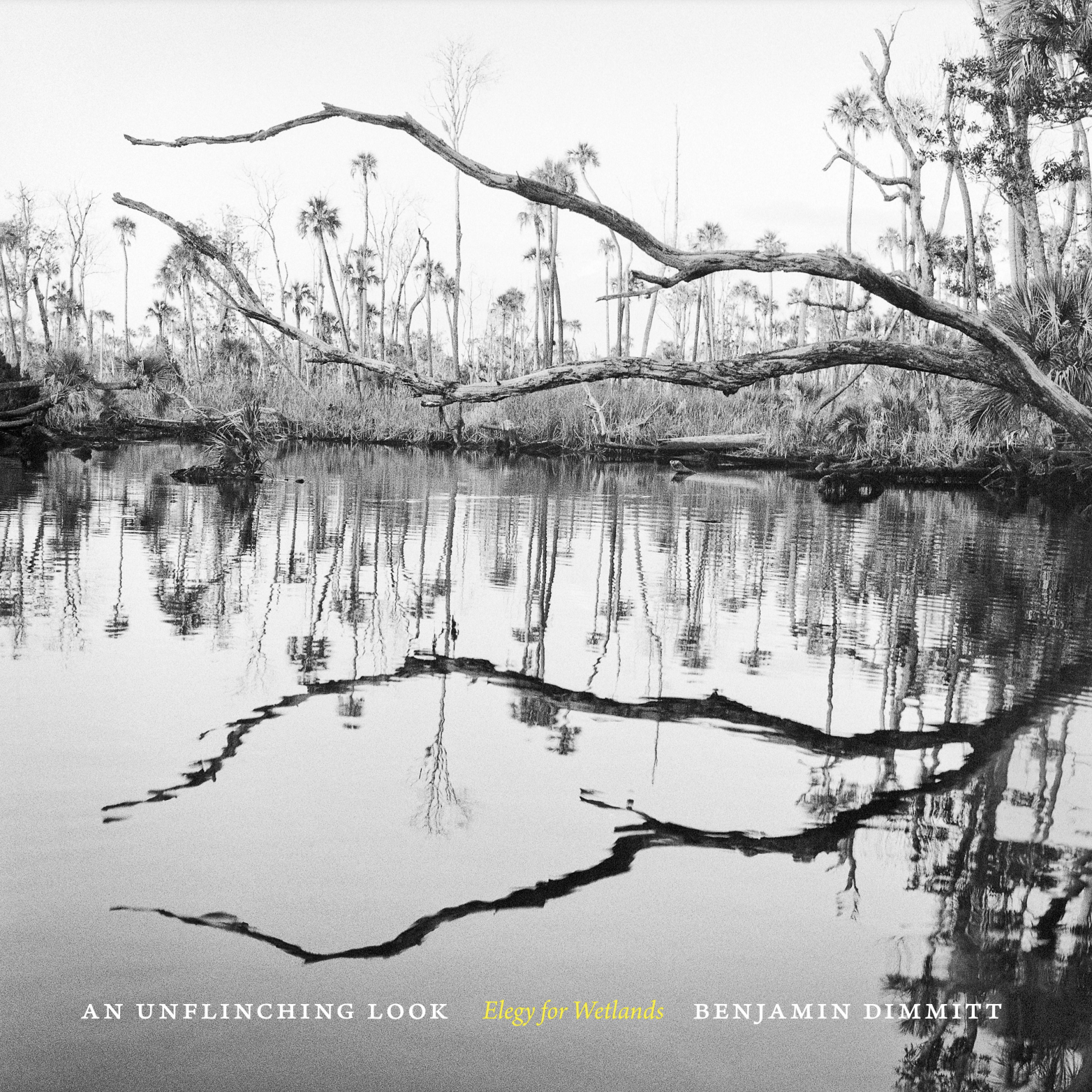
Bransford: Tell us about the genesis of this book, An Unflinching Look: Elegy for Wetlands.
Dimmitt: I visited there a lot in the eighties. I had my bachelor party up there. I won't go into that except to state that there were no mermaids involved. I enjoyed photographing it because it was unusual to me. I'd never seen any place like it in Florida. In 2004 I started a new photographic project called Primitive Florida. I felt that I needed to photograph these vulnerable landscapes. I was concerned about things like worsening storms and overdevelopment, and these phenomena that I learned about in college in the early seventies called global warming, climate change, and rising sea levels. Lo and behold, everything that I had learned about was starting to happen. I didn't visit the swamp between 2012 and 2014, but when I arrived at the cabin in 2014, the wetlands were devastated.
I didn't understand. I got in touch with scientists in the Tampa Bay area where I grew up and went to college. I showed them the photographs and they said, “That's saltwater intrusion. That's rising sea levels. You didn't know about that? It’s happening along the Gulf coast up to the Panhandle.”
I didn't know that it was going to be happening so soon. Eventually I got in touch with one scientist, Dr. Matthew McCarthy, whose study is excerpted in the book, and he was excited to see my photographs from water level because he's spent many years downloading satellite imagery and aerial photographs of the coast while he was working on his graduate thesis.
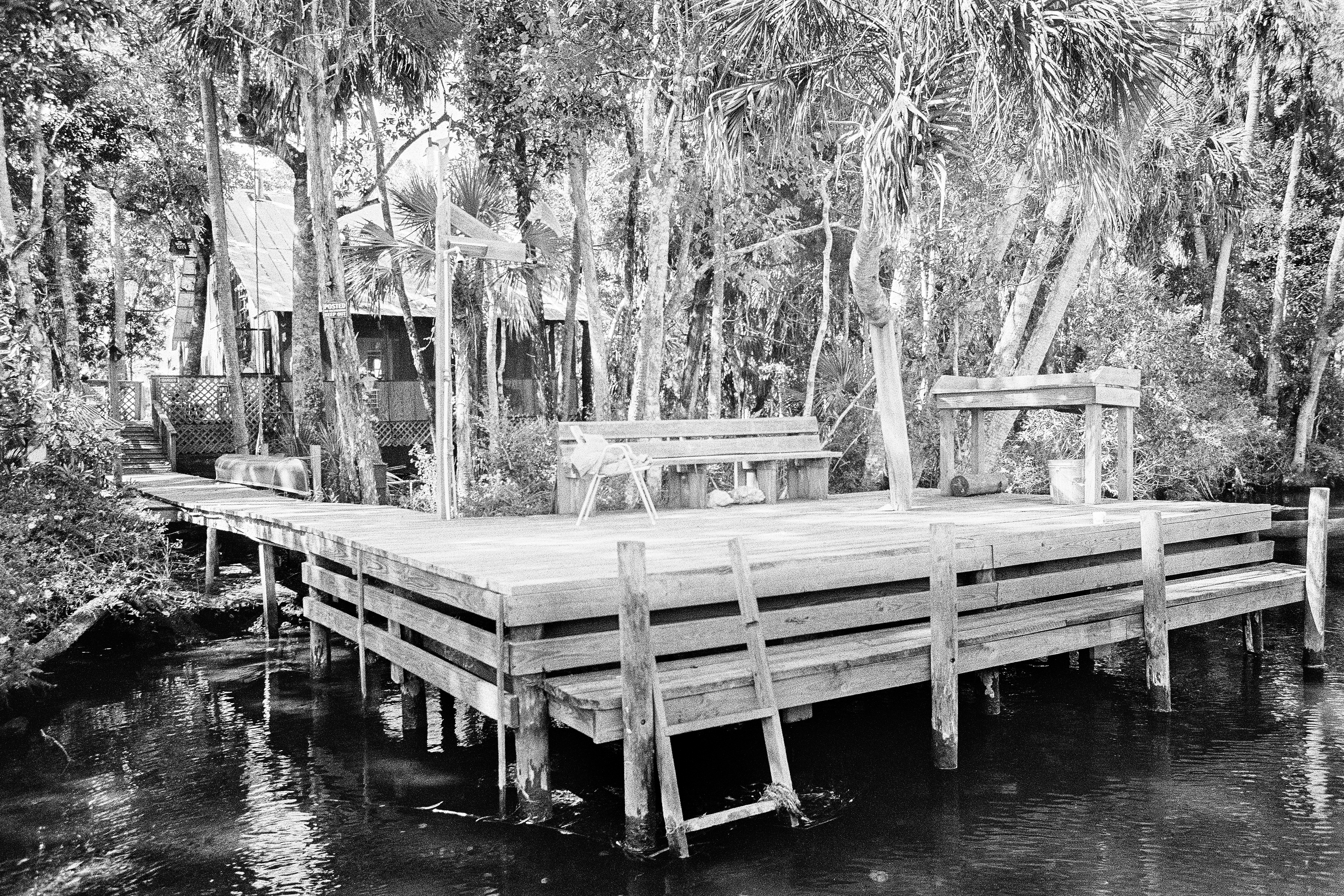
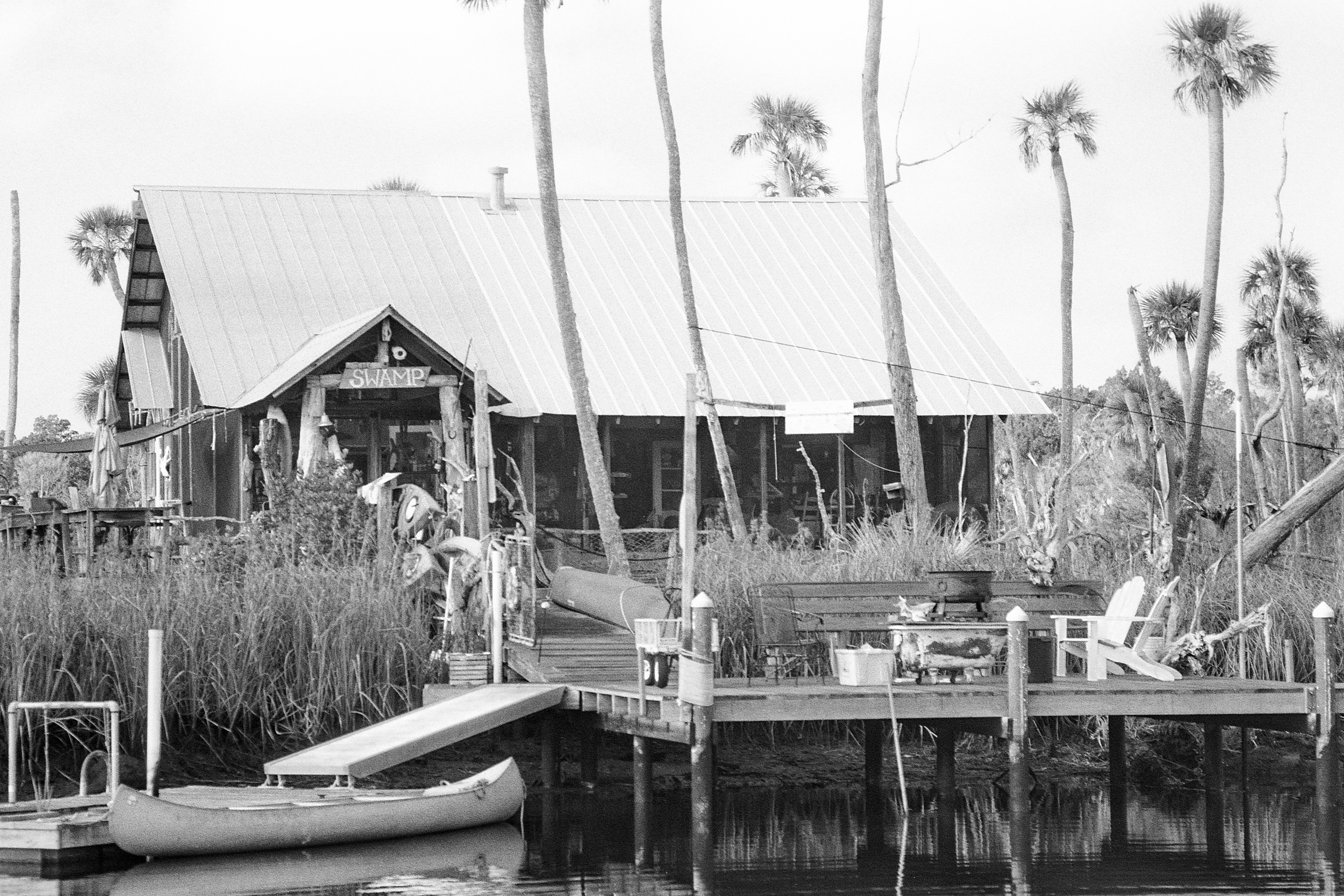
Dimmitt: That's the cabin where I stayed when I visited. My brother was one of the partners in the cabin when it was built; they did a lot of this work themselves. Everything had to be brought in by boat. When the cabin was finished, my brother asked me to take some photographs of the cabin.” He was really proud of it. He said, “I'll take you out in the boat and you can shoot back.” This was the shot I felt was best and I sent it to him. He said to me, “No, you can't see the house.” I said, “Well, bro, you built the cabin in a thick forest” The reason they built the cabin there was because the water is always 70 or 72 degrees. This is right on the creek by a spring, and the house stayed cool in the shade. The first picture (on top) is 1987. The second picture (bottom) is 2021. So that's thirty-four years. That's the same cabin and that's the same dock with some minor improvements.
Martin: This is an example of deforestation that involved no cutting down of trees.
Dimmitt: Absolutely. They wanted the shade. I took the first snapshot and made a lot of prints of it for my brother and the business partner. To reshoot in 2021, it was difficult because I had to find someone with patience to go back and forth and back and forth in their boat while I photographed. I had to figure out what lens I used back in 1987. It took awhile to get something that was good. That's often the case with re-photographic diptychs. It's very time consuming to find exactly where you did the early shot, where you stood, and what lens you used. Usually I did them by myself. But for the cabin shot, I had to rely on someone else to drive me back and forth and shoot a lot of frames.
Bransford: And you still are shooting everything on film, right?
Dimmitt: Yes, the entire project was shot on film. Any images that are square were shot with a medium format camera. When I went to reshoot the 35 millimeter images like this pair, I dug out my old 1980 Nikon F2 and got it cleaned and lubed in Asheville and took it down there. I hadn’t used that camera in probably twenty or thirty years. But yeah, everything's on film.
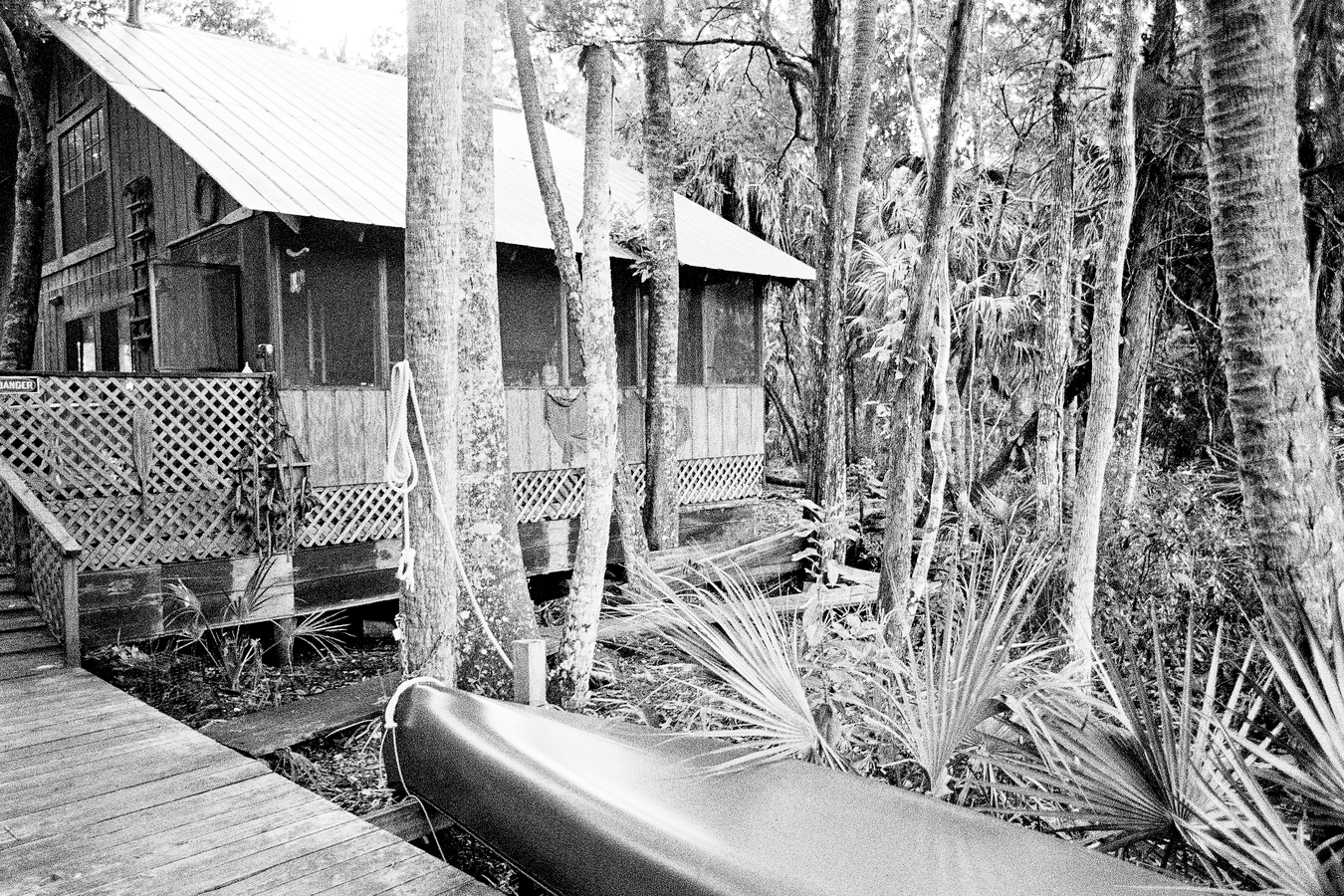

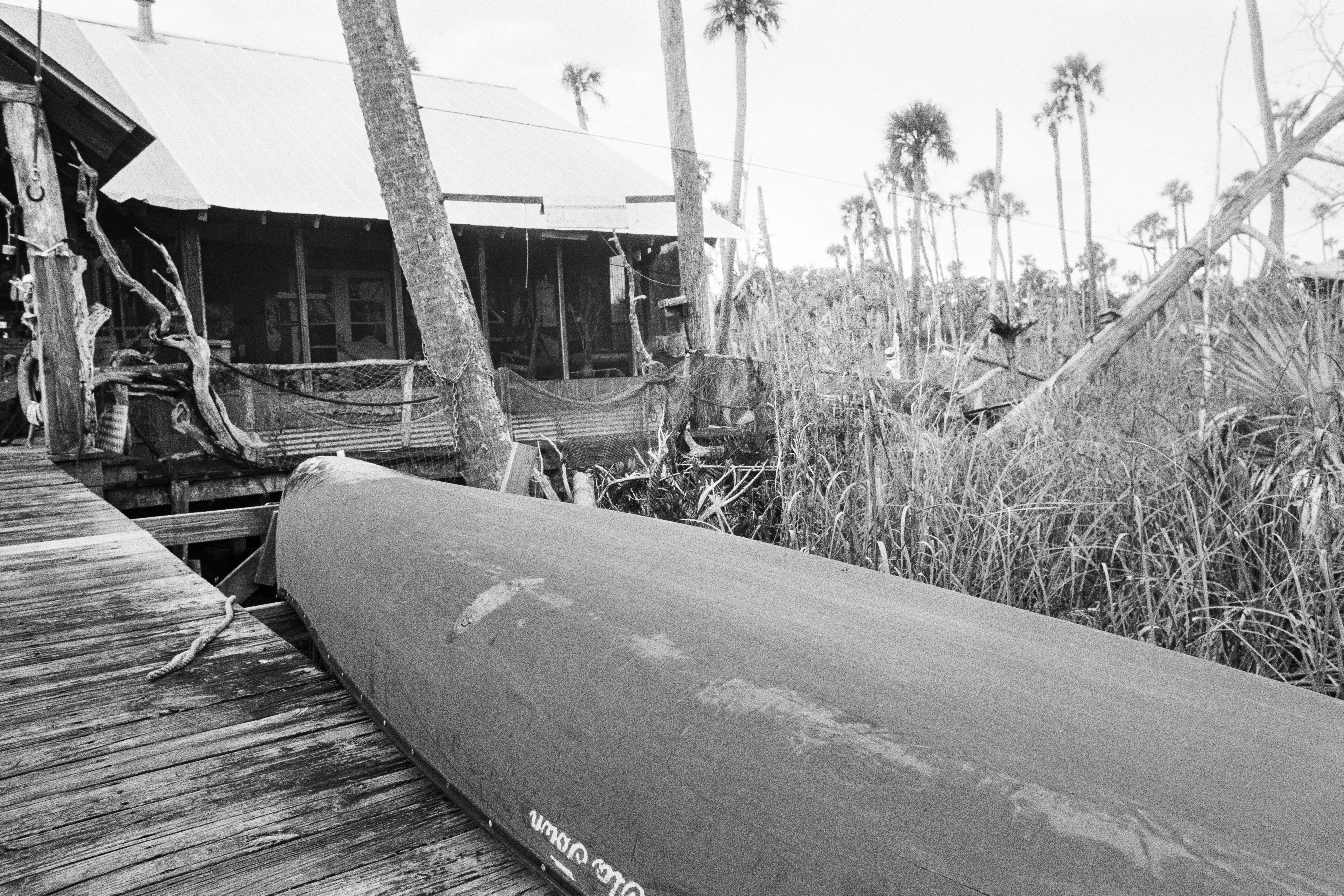
Dimmitt: That's the walkway from the dock to the cabin. The first photograph was made in 1988 and the second one was made in 2020. The earlier photograph lends itself to a vanishing perspective. And for the later one I made a point to shoot from the same position and with the same lens. It's really amazing how all the canopy, all the forest is gone. The saltwater floods around the cabin now at high tides and during hurricanes.
Martin: I'm wondering if I'm seeing what look like saw palmetto in the top photograph and then beneath it, is that Spartina now?
Dimmitt: Yeah, it looks like saw palmetto.
Martin: My gosh. That's a complete change in the ecosystem. Going from a terrestrial with freshwater influence to now saltwater dominated.
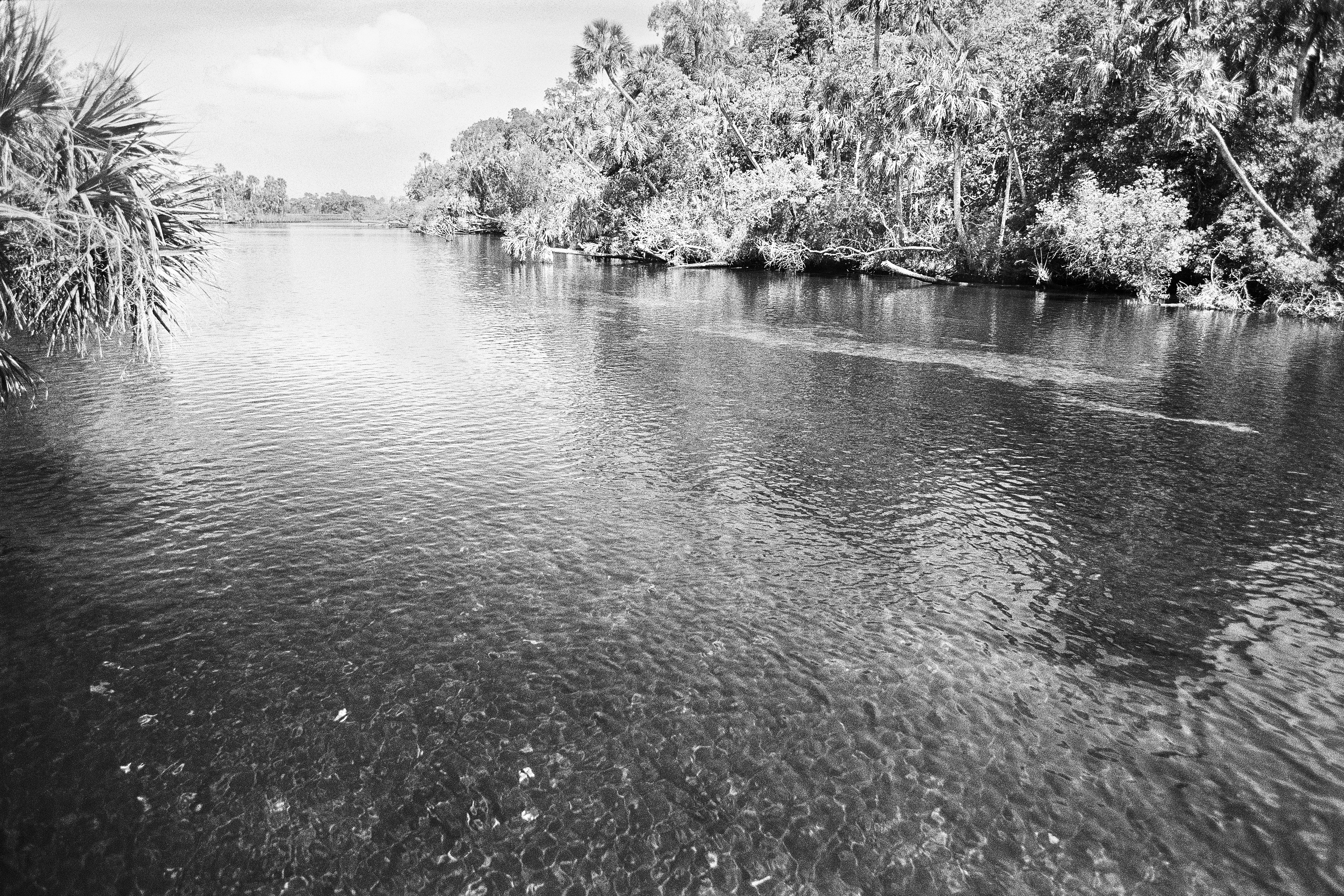
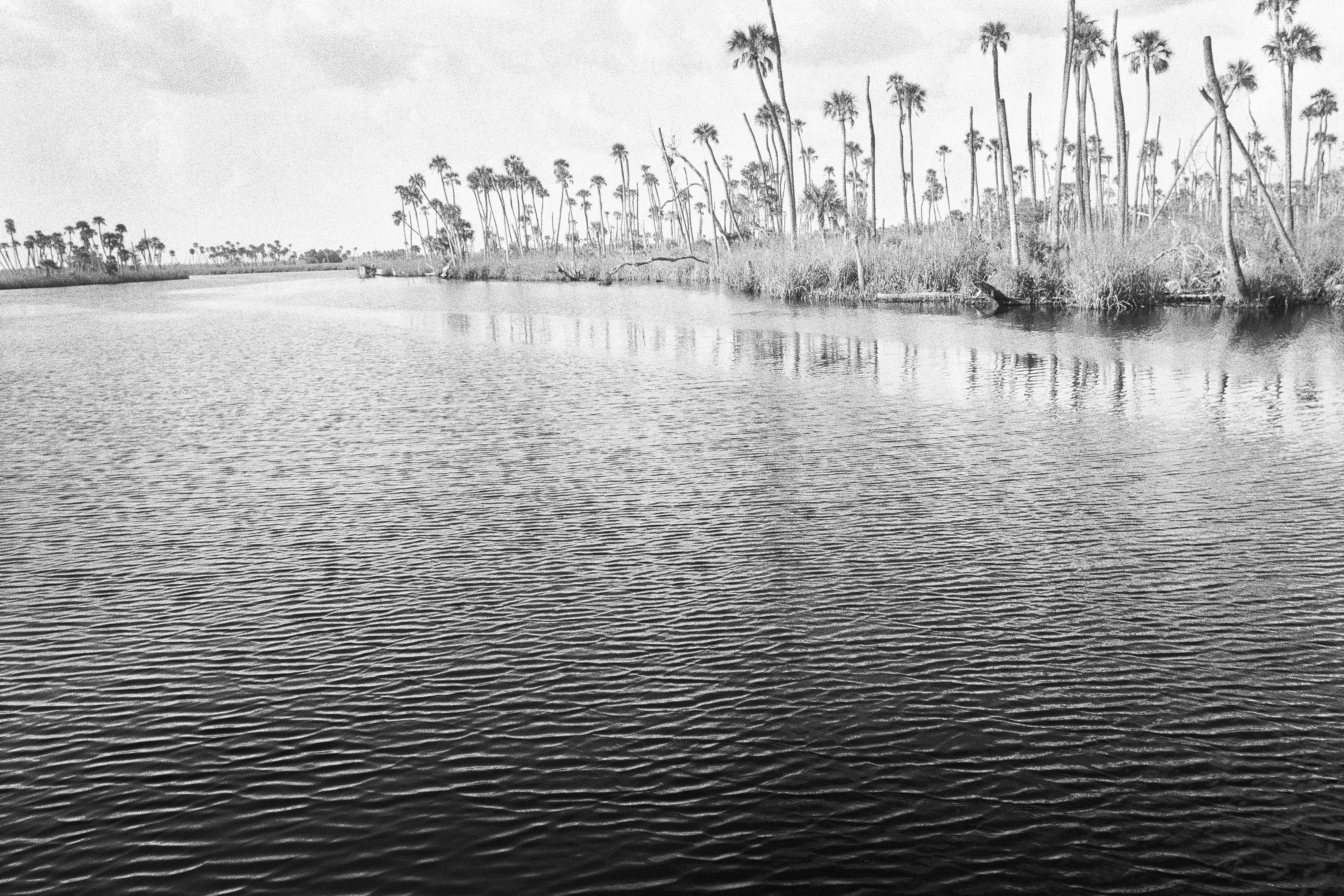
Dimmitt: I believe that this diptych shows the greatest span of time. This is from the dock looking downstream in 1986. And then the follow-up is 2020. It's the greatest span between the first and the second shot. If we were to go there now, half of the remaining palm trees in the back on the right would be gone.
Dimmitt: Next to Pat’s cabin, where I stay, is a neighbor’s cabin that has a boat shed, not a boat house. You climb up through a hole in the roof with the camera bag and tripod. I always worry about getting up the ladder with all my gear. And you can see way upriver and downriver to the Gulf. The left photograph was made in 2006 and the right one is 2022. I did several of these over the years, probably about six or more.

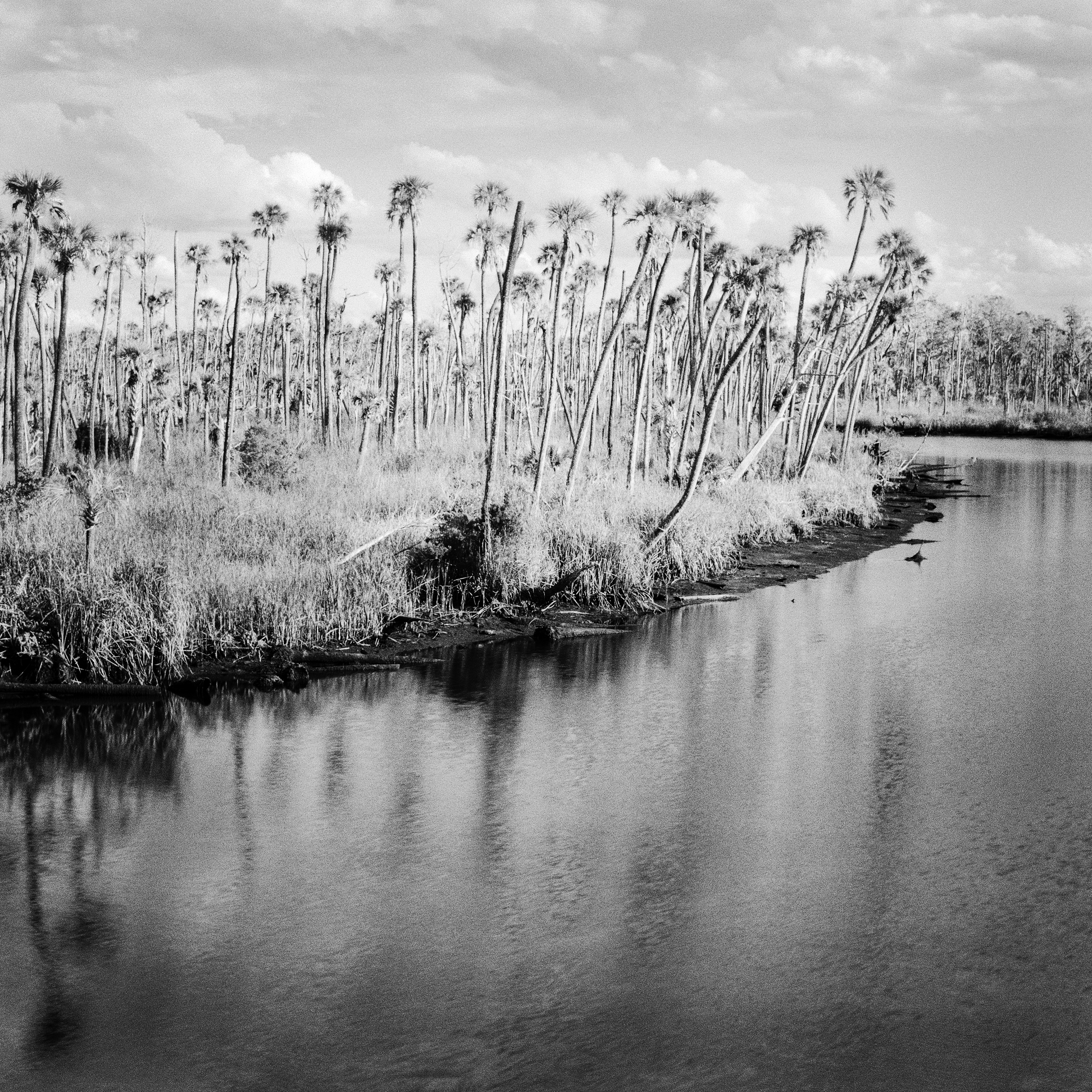
Martin: This is a really good pairing, too, because I think of this as a scientist. I'm a geologist, paleontologist by training. We are used to these really long expanses of time for dealing with environmental change. We say sea level rose, and it took thousands of years. Here, this is less than twenty. And in less than twenty years you've documented this complete shift in the ecosystems as a result of this saltwater intrusion coming upstream and affecting and changing those environments.
Dimmitt: The last time I was there, we had a good show. We saw dolphins or porpoises—I never know the difference from afar—chasing a large school of snook. It's brackish there. It’s a frenzy when the snook get trapped against the shore by the bigger, faster predators. You can't miss it if you're in a canoe or standing on the dock. And then another time, not that many years ago, we were seeing manatees come up and they always get your attention by their breathing sounds: the exhale, and then the inhale. You look out, and they've gone underwater to feed. I've seen them often in that stretch of Crawford Creek, which is where the cabin is and where I did almost all the photography.
Martin: So we're actually getting some marine mammals that are starting to come upstream into that area?
Dimmitt: I know that if they're coming up there, they're looking for food. They could easily be caught or eaten. And the spooked snook are something to behold because they go crazy. They're swimming all over the place trying to get away from the porpoises who are very smart and very fast. It's a bloodbath, but it's interesting to watch.
Dimmitt: This is kind of grim. This is 2004 and 2022.

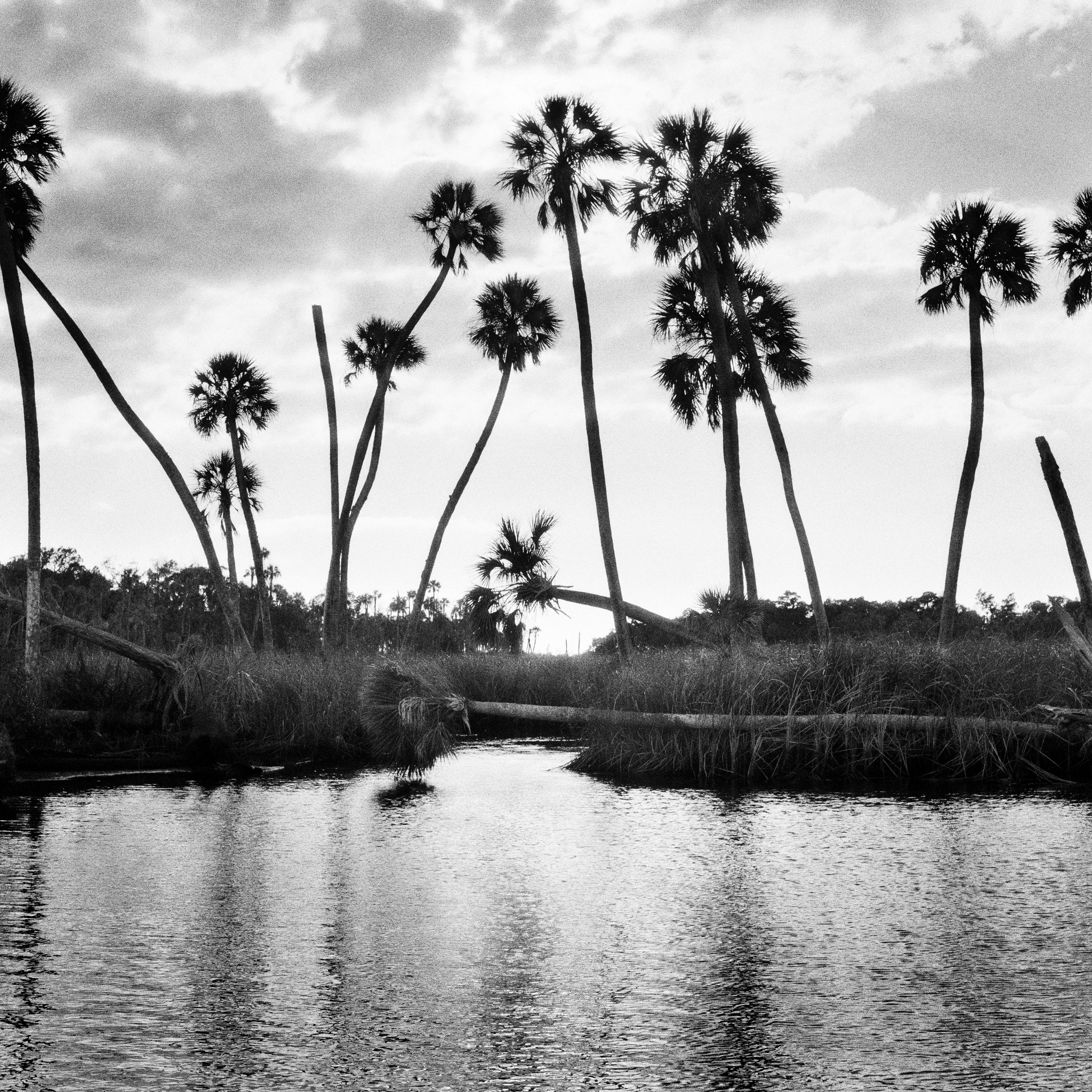
Martin: The total loss of the canopy is so striking to me. In those ecosystems, you originally had shade-tolerant plants and, of course, animals that would have been living in those communities. Then with the loss of that canopy, now you have all that sunlight pouring into those areas and heating them up, as well as the saltwater intrusion. All that is totally changing the ecological communities. And again, this happened in less than twenty years.
Dimmitt: This location is a protected stretch of creeks, maybe twenty or thirty yards out of the wind. What you see between these two photos is not a dramatic difference. My host told me that when fishermen would return in the evening, they'd go up into the grasses and clean their fish, which is why it’s called The Kitchen. And then they can get back out to the Gulf and go back up to the town of Chassahowitzka and pull out or go home. I shot the first one probably in 2004 without a tripod, which is always dicey, with a big, heavy, medium format camera. I kind of like that scene in 2004. When I went back to re-photograph it, I'm again relying on the patience of a friend and sometimes that patience runs short because I'm saying, “No, closer, no, further back.” And you go back and forth in front of it a couple more times, and there's nothing in it for the boat owner. But that was the best I could do. And everything is shot on film, but when you prepare files, when you get the images ready for the publisher, you have to get scans. So I'm working in Photoshop on scans of these negatives that I shot and printed many years ago, and I'm seeing things that I hadn't seen in a long time, and I'm looking at the difference in the two of them side by side and seeing a lot of small differences, and then way off in the background seeing other differences, and the edges of the islands on the left and right. There's some deforestation in there as well. It's a photograph that I enjoy, but it doesn't pack the punch that these other ones do.
Martin: Right. That was one of the aspects that I appreciated is that you had to toggle back and forth between each of the images to appreciate the amount of change that had happened there. And some of it is subtle. So it's something where, if you just had the second photograph, the later photograph by itself, someone who doesn't know that place would say, 'What do you mean, it looks fine, it's totally fine. It's not like there's a condominium or a development there. What's the problem?'
Bransford: Speaking photographically, did you have some compositional strategies of how you wanted to depict the Refuge? Some images have very strong diagonal lines, some obviously have strong vertical lines with the trees, sometimes downed trees dissect the frame horizontally. Other images don't have strong leading lines. The ones with algae or grasses are more abstract, ethereal. Sometimes there's a curved tree in the middle of the frame that grabs our attention or a log in the foreground in the water. Did you have certain compositional strategies of how you wanted to depict the refuge?
Dimmitt: Not at all. In some cases, I am walking around, where it's dry enough, in mud shoes and just looking or in some cases checking to see what some place looks like now. But I don’t have a predetermined way to shoot. That would really bore me. I did almost all of the newer work since 2004 with a square camera. There are only so many things you can do with a square medium format camera. I've had someone tell me it's evident that I had some sort of preconceived notion or was shooting a certain way but that’s not the case. I spent many years on this project. I had to keep it fresh. That might mean working on re-photographic diptychs one day and going on a long paddle to photograph some place new the next day.

This one is a favorite, and I was asked at length about it: how premeditated is this, that sort of thing. We discussed it at the Asheville Art Museum. One of my authors, Alison Nordström, who wrote the book’s long essay on the photography, had this in her slides, and she was saying all sorts of things about it that were wonderful and flattering. And my memory is that it was beautiful. It was very straightforward in that these were palms that had washed up on the edge of a savannah. I was on a narrow dock, and I couldn't move forwards or backwards. So I was completely constricted in how I could compose it, except to change the lenses. I made what I thought was a good photograph. Alison loved it. I didn't mention at the museum book talk, but I feel it now and see it now. It looked like the Pieta to me, it looked like the Virgin Mary with Jesus in her lap. I spent time in Florence in the seventies studying Renaissance painting, etching, lithography, and sometimes all that old Italian Catholic imagery stays in your head. And you’re not even aware of it until later.
Dimmitt: This is another one of those images that was really difficult to photograph. I love it, but it was so busy and there was so much going on. It took a while, maybe twenty or thirty minutes to create some sort of order out of this chaos.
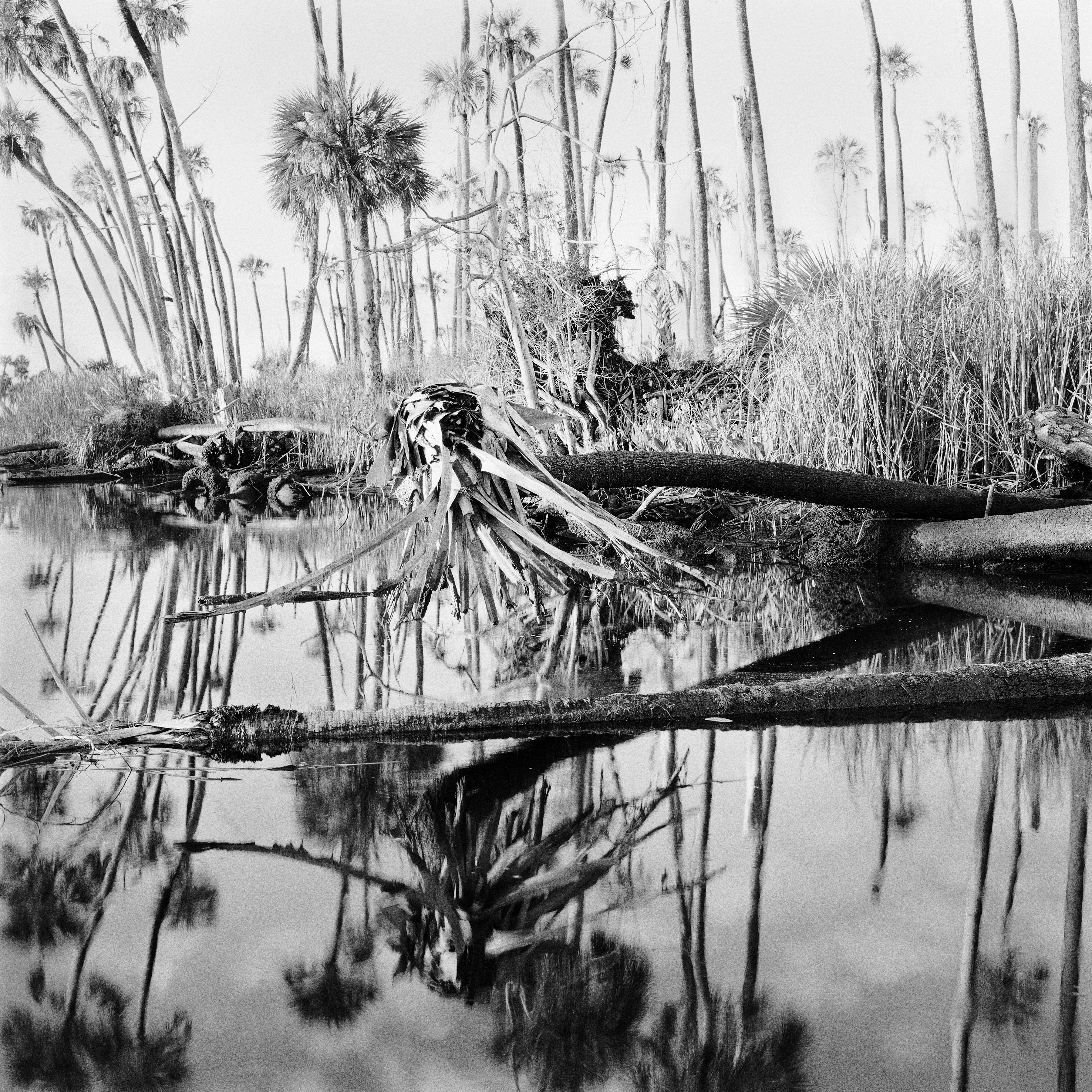
Martin: Something I appreciate in terms of the documentary aspect of this sort of photograph is that the reflection is actually bringing out the sky better. You can see the clouds and the gaps between the clouds that are only implied in the actual sky part of the picture.
Dimmitt: I was asked if I always make my skies white. There are various things I could have done here and I did do in this case, and that's to use a deep yellow filter to try and get some tone in the sky. But it was a very bright sky and there's not much you can do to get tone in it. To further answer your earlier question, I don't have a preconceived notion. This was just very difficult to compose. It's a complicated image visually but I’m very happy with it.
Bransford: You mentioned Alison Nordström, she talks about the opportune slipperiness of these photographs in the sense that they simultaneously inhabit the worlds of art, science, and social action. Was this or is this your intention? Did you come at the project initially from an art photography standpoint and realize gradually that the images also have scientific and even political appeal?
Dimmitt: I'll almost give you a straightforward answer and say yes. And then there's a but. As I mentioned, I started shooting there in earnest in 2004, and I was just photographing something that I thought might disappear or that I just liked an awful lot. And the more I poked around, the more time I took when I went there and paddled in the various parts of the swamp, the more I loved it. And again, I'm from there. This is my native landscape, so I was very happy to be doing what I was doing. And then climate change arrived, and I didn't really change my approach and become a different sort of photographer. I just photographed the impact. There was nothing undamaged. The impact was all encompassing. It was everywhere. You really couldn't escape it, and it got worse every time I went. Someone recently asked me how how many rolls did you shoot? How many times did you go down there? I moved to Asheville in 2014, and that's when I first discovered that the rising seas were starting to do serious damage. The tally I got when asked was around twenty-five trips down there in the eight years that I worked on the project.
I was doing landscape photography. That is what I do. I just happen to like to photograph in wetlands because that’s my native environment. That's my native landscape. I grew up in Clearwater on the bay. I'm working now on a project about mangroves. When I was in Florida last month, I was shooting at Weedon Island in a big, beautiful mangrove forest. That's the kind of subject that I like. The interpretation is up to the beholder.
I imagined that these photographs were good enough that my gallery in Tampa would be interested in exhibiting them. They said they weren’t going to be able to sell them, but they would exhibit them. So we did. And only two or three sold. I was eventually told it should be a book. So I got in touch with the University of Georgia Press, and the director was very excited about the work.
The book then gives you an opportunity to create an editorial viewpoint. And to me, they didn't have an editorial viewpoint. They were just a document of a place that I had made photographs of that was becoming ruined by rising sea levels. Learning about the causes from Dr. McCarthy was something that made me become a little more activist about it, and also learning about my subject and doing research. But the research didn't start until I got a book deal. Learning about The Villages and learning about the state's water management, or water mismanagement, made me even angrier, and that became something my editor convinced me to write about—my feelings. That's why my epilogue is sharper than the rest of my language.
Bransford: I'm glad you mentioned the epilogue. In it, there are the two anecdotes. One of you visiting what I think is the oldest and biggest tree in the refuge and your speculation about what's going to happen to it. And then also the wonderful anecdote of you paddling and not hearing any leaves rustling but hearing the woodpecker sounds. Could you recount those two anecdotes?

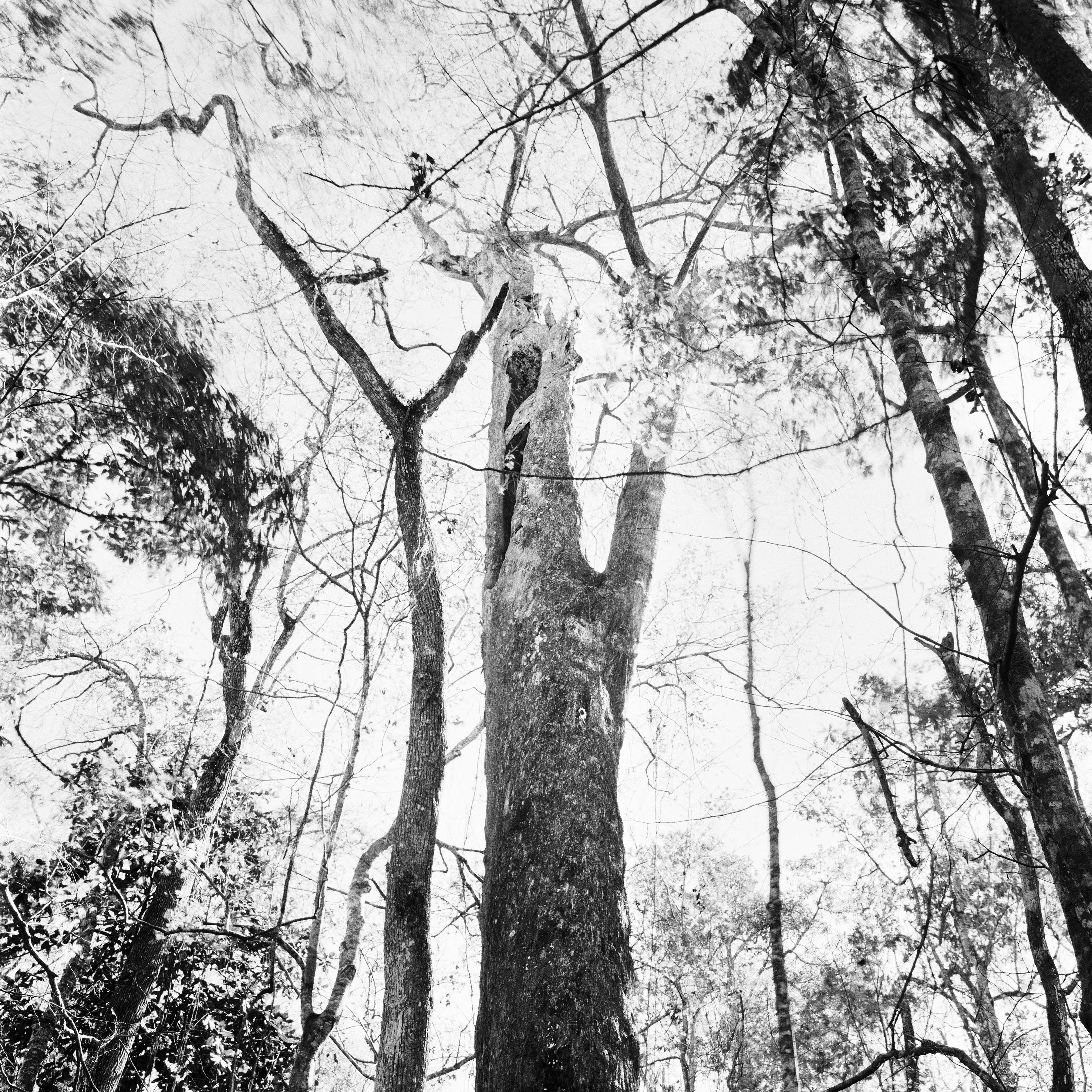
Dimmitt: I'm still surprised that the editor got those two things out of me because writing is not something that I do well or do comfortably. The last remaining old growth cypress tree is not the last one in the swamp, but the last one that anyone could direct someone to. It happened because I asked my host down there, Pat, if he could take me there. He said, “Yeah, but we will have to go to the property owner first.” And I said, “That's fine.” So we did that, and then we walked off in the direction of the tree and I'm relying on Pat. He's been there multiple times. And I'm looking up, and I'm waiting to see some old growth tree.
I practically walked into it. It’s the photograph which has a lot of palm fronds and shadows on its fat trunk. I stopped there and photographed. It doesn't show the upper part of the tree, it just shows the trunk, which is huge. I couldn't really see the tree trunk. I almost walked into it because it was somewhat camouflaged by all of its neighboring palm trees, which were small. I imagined that's how it had lived so long, because it had been unrecognizable. And anyone who is looking for cypress trees would have passed it by because its top had probably been blown off by lightning. And I made a couple of photographs of the tree in the shadows, and then backed away and got a different lens and photographed the top, which is a mess. It may still be there. I think that photograph was done in 2021, but it is really close to a creek and all the creeks are becoming saltier. And that may be what kills that tree. It survived the loggers in 1916, and it probably is not going to survive this.
You mentioned something about sound, and I will tell you that the last photographs I showed you of the palms in the creek where we discussed filtering for the sky and, that sort of thing—if I was there maybe twenty or thirty minutes composing and making the photograph and when I'm doing that, I have everything turned up all the way. I am looking as hard as I can. I'm trying to compose something that reaches into me, is compelling compositionally, all the rest of it, where am I standing, that sort of thing. Sinking up to my calves in mud. And I'm seeing everything, and I'm hearing everything. And when you asked about the woodpeckers, I chuckled because when I get back to the cabin at the end of the day, or if I’m here in the mountains and I get back to the car after a long hike, I can tell you every single thing I heard. I can tell you everything I saw. My sniffer's gone, so I can't tell you every smell. Being in the canoe, paddling around, feeling the breeze. It was a hot day in December. Losing control of the canoe in a breeze, and then I got pushed over to the side of the creek. I dropped the anchor and sat there, there was not a photograph for me to take where I ended up, but I could hear not just one woodpecker; I could hear many, many woodpeckers banging away at the all the dead trees, all the dead hardwoods surrounding me. And it was really disheartening. It was an indication that some bird's happy and there's a lot of food for all the woodpeckers now, but that's just another way in which we learn how bad the ecosystem loss is.
Martin: That caught my interest because the last couple of David Haskell's books have dealt with sound. One of them is The Songs of Trees, and Sounds Wild and Broken is his most recent book about how there are not just landscapes—and what you're doing is documenting landscapes that, of course, are waterscapes as well—but there are soundscapes. So you have the visual aesthetic that is intrinsic to your photography, but sometimes with a picture like that, I, as somebody who goes into those kind of environments, experienced the same thing you did, I also hear the sounds when I look at the photograph. And I'm realizing that it's not just visual, that there are other senses that are being engaged with these places and how climate change and sea level rise, pollution, all of these factors are also affecting those other ways we sense the world around us.
Dimmitt: If I'm at the swamp house with my host and his family, if there is a porpoise–snook battle going on, we always go out to the dock and watch. And you don't see it if you're inside the cabin with all its screens. If you're inside, you hear everything outside. You run out and engage with it. It’s nature at its most brutal. I went to school at Eckerd College near Lake Maggiore, and the sound of ospreys chirping for minutes after minutes after minutes is something I grew up with. It resonated with me.
Bransford: Is there anything else about your book that we didn't cover that you'd like to talk about?

Dimmitt: This photograph of fog on the creek closes my essay in An Unflinching Look: Elegy for Wetlands. Something you feel when you're there. It's 100% humidity. If you shoot in the winter, which I prefer because the light is better in the winter and it's not as hot, then you're going to get fog because at night it cools down. And I just walked out of the cabin and down to the edge of the dock, and that was in front of me. That's a palm that had been alive, well, probably four or five years prior. And it was already hosting plant life of its own. This is my first book. Working with an academic press, they didn't give me any direction. I was completely on my own to make the image selection and to sequence it and I came up with the idea of the gatefolds. They were wonderful to work with, and the designer did, I thought, a beautiful job.

Dimmitt: This is one of the last photographs I took in the swamp. It was the same day that I went out and heard all the woodpeckers. What has stuck with me is this whole place was a thick tropical forest, and now it's nothing. This is Spartina? Is that what the grasses are?
Martin: That's what it looks like. Smooth cord grass.
Dimmitt: There’s another grass that’s round.
Martin: Juncus. That’s also a saltwater indicator.
Dimmitt: Often I will shoot from the canoe handheld without a tripod. It’s not easy to do. And I saw this and I thought it was beautiful. I didn't think about what purpose it would serve in a book as propaganda or beauty or science or any of that. I just shot it. But after I finished the photograph, I realized that I had been fighting logs and tree trunks in the creek the whole time, and the image I just called Impassable Creek. That's because you can't paddle in these places anymore because creeks are so full of dead trees. There's no clearance. And it was like being shackled. There are so many corpses that you can't move freely. Someone who wrote about my project wrote that it reminded him of a Civil War battlefield with corpses everywhere. And this was the first time, in 2022, when I was finishing the book, that I felt that I couldn't move in the swamp.

Dimmitt: When I would walk in some of the drier places, I would just be checking in. And one of the things that caught my eye on this day was that saplings were dying. This is kind of a mess as a photograph, but that's what you see when you're walking around. When it’s too salty for palm saplings, then it's really too salty.

Dimmitt: The earlier photographs in the book are photographs of a place that was pristine and exotic. Photographs of things that I found beautiful and unusual. However, I gradually started to photograph death and destruction on a very broad scale. It just kept getting worse and worse. And it will continue to get worse and worse. Hurricane Idalia had a big impact down there. I don't even want to go see that. I had to adapt to shooting environmental destruction. I didn't know how to do this. I get asked about beauty. One thing I didn't want to do was to suddenly go from taking photographs of some place I found compelling and beautiful to using my camera to make ugly photographs or to make these wetlands look bad. When I was doing the event at the Asheville Art Museum with Alison Nordström recently, she said to me, this is a beautiful photograph. Just one of a dead palm in the river. I'm saying to myself, this image is brutal. This is straightforward damage. And it was, again, shot from a canoe, which makes it difficult to do. The creek bottom was vey soft so I can’t get out and walk. And I did the best I could. It's not a good negative, but I'm grateful that I don't have to print much of these images for exhibits because no one would want to show this work in an exhibit. But this is as straightforward a photograph as I can make. I don’t recall making any effort to photograph it beautifully. And I was surprised that Dr. Alison Nordström thought it was beautiful.
Bransford: Is there a tension there of creating beautiful images of things that are brutal and unsettling? Are they mutually exclusive?
Dimmitt: For me, there isn’t a conflict. I don’t feel that they are mutually exclusive. I guess I gave an insight into that a moment ago. I went from photographing a place that I felt was beautiful to photographing its ruin. It’s my native landscape. These are forms and shapes and trees and brackish water that I grew up with in Clearwater. We lived by the bay and there were roots of large mangrove trees that had died in a freeze long ago. They stayed there on the sand bars for decades. So, I guess I got acclimated to seeing a certain amount of death in my surroundings.
I don't know how to make ugly photographs but I do know that a beautiful photograph encourages a viewer to engage with it. I simply continued using the same sense of aesthetics that I brought to the swamp when I started photographing there decades ago.
I made a commitment to this place when I began this project in 2014. I like to honor my subjects. My goal all along has been to make compelling photographs. The book is about bearing witness to a tragic loss, saying farewell to these beautiful, complex wetlands and making it known that this is happening now along low-lying coasts all around the world and will only get worse.
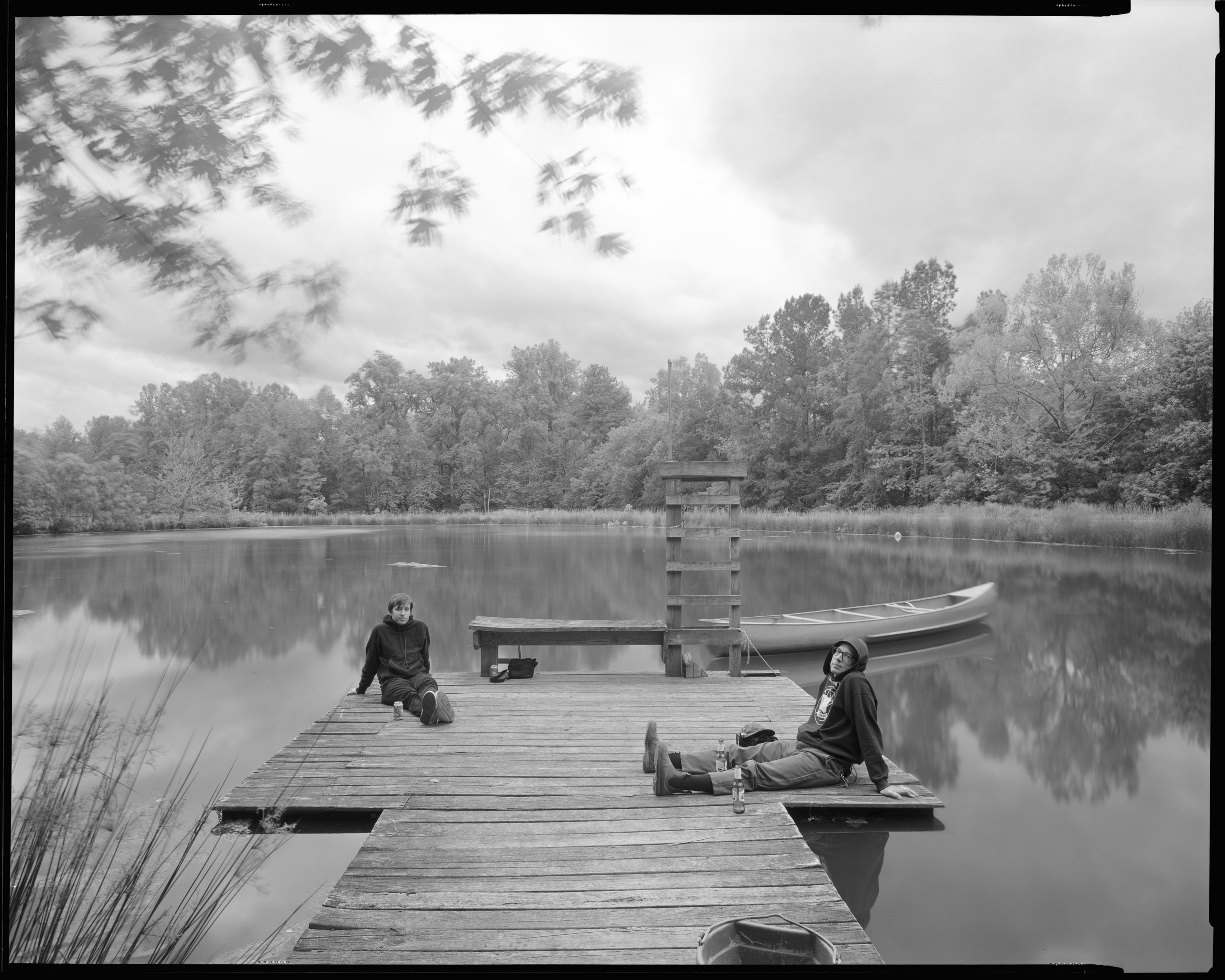
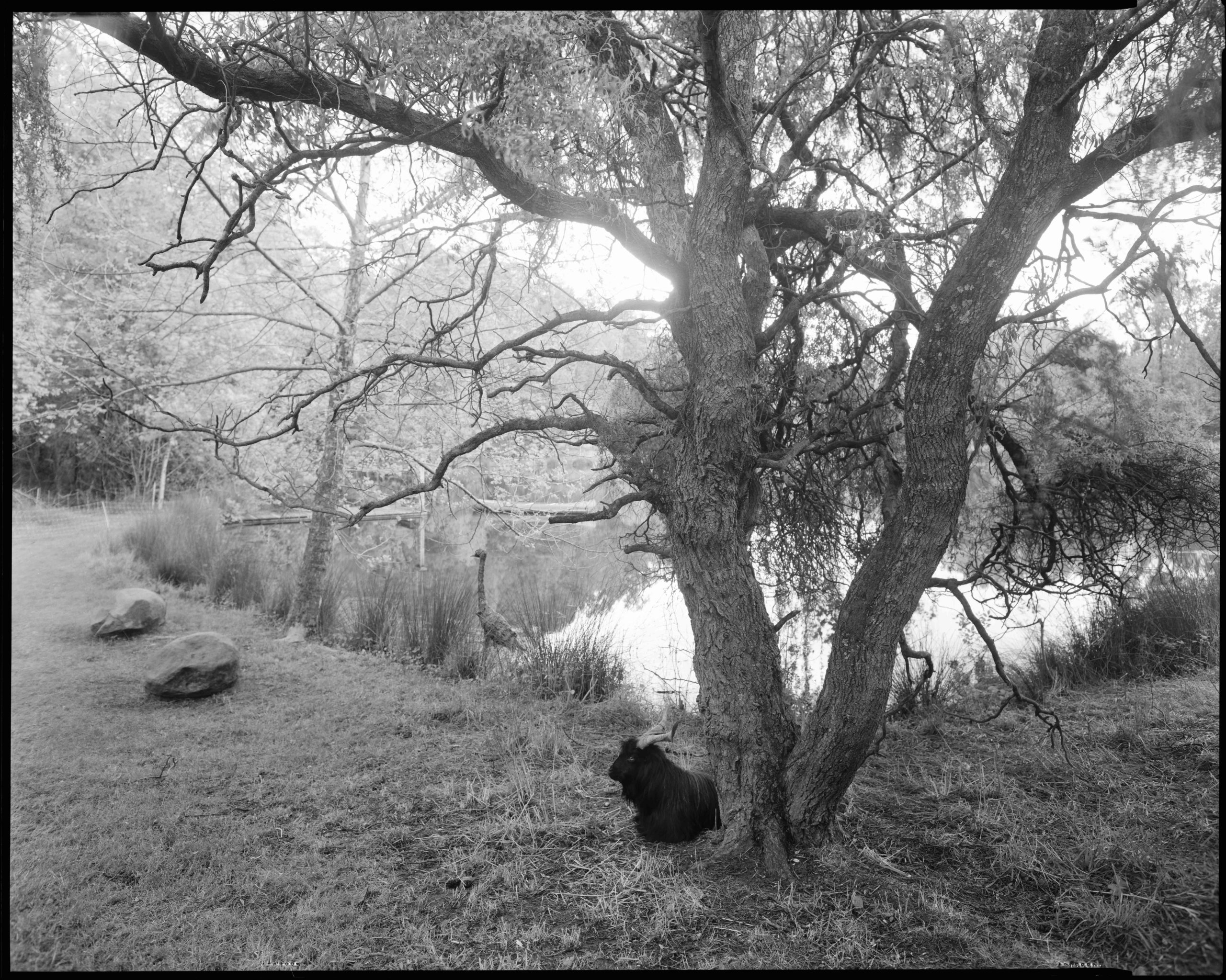
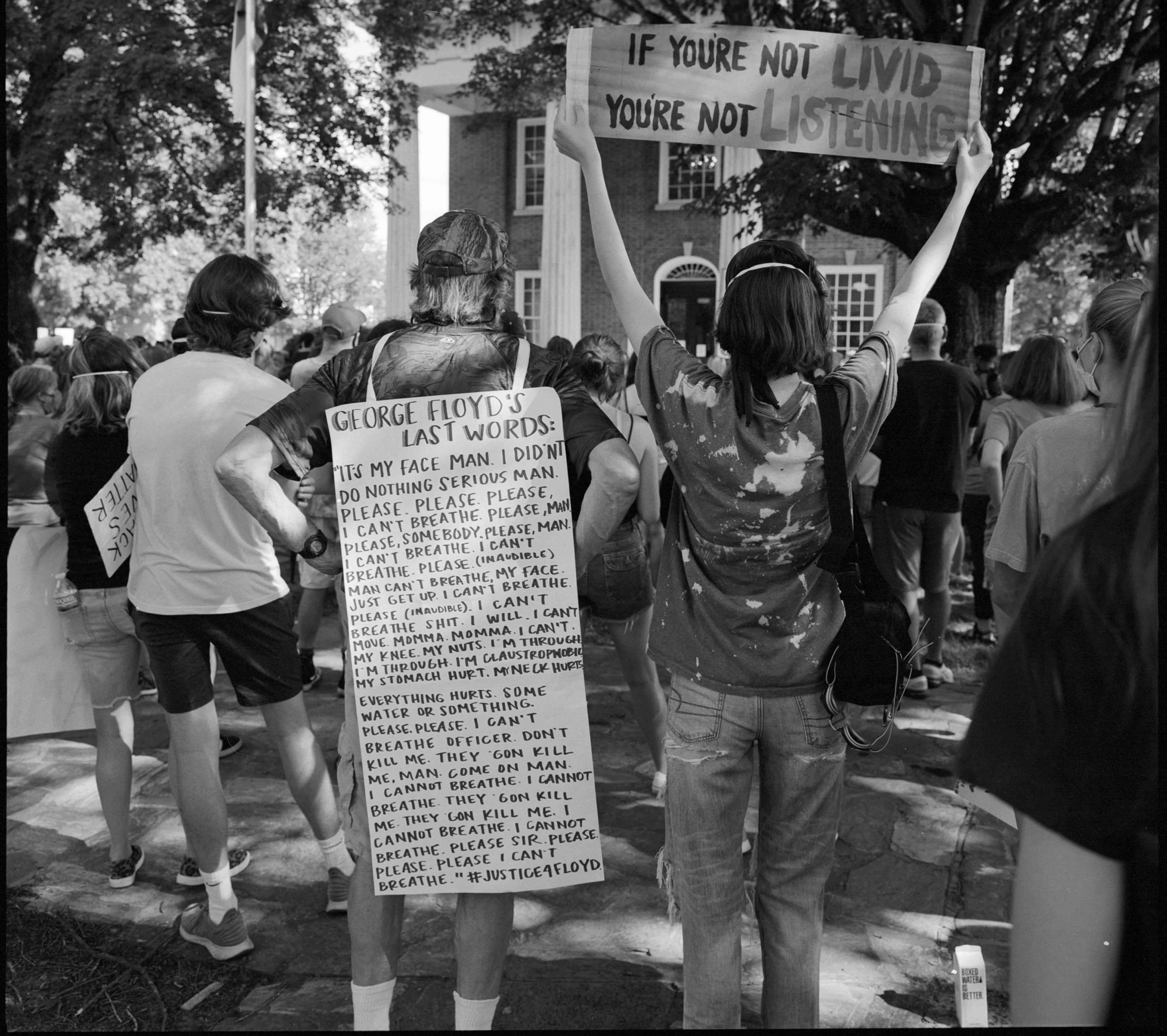
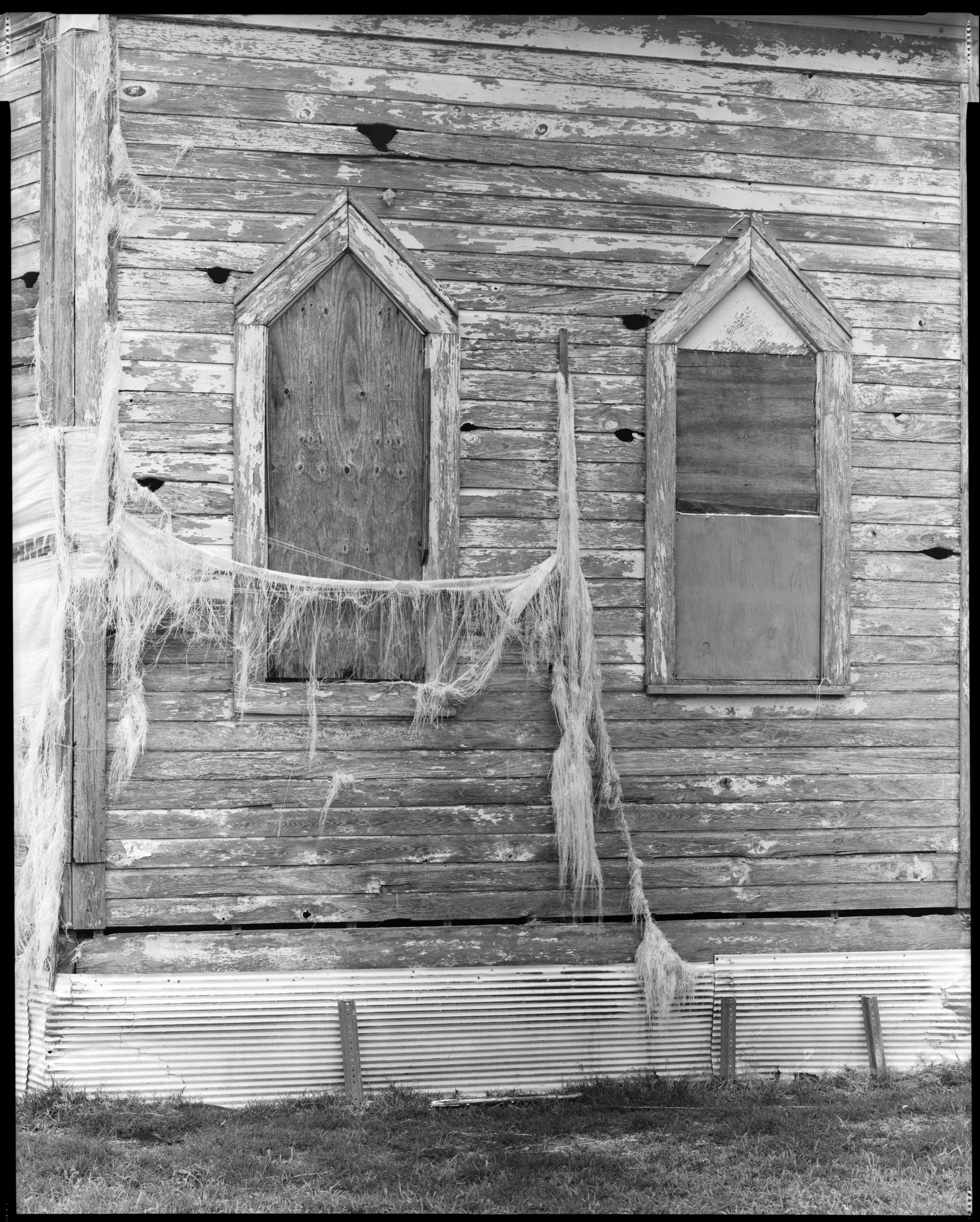
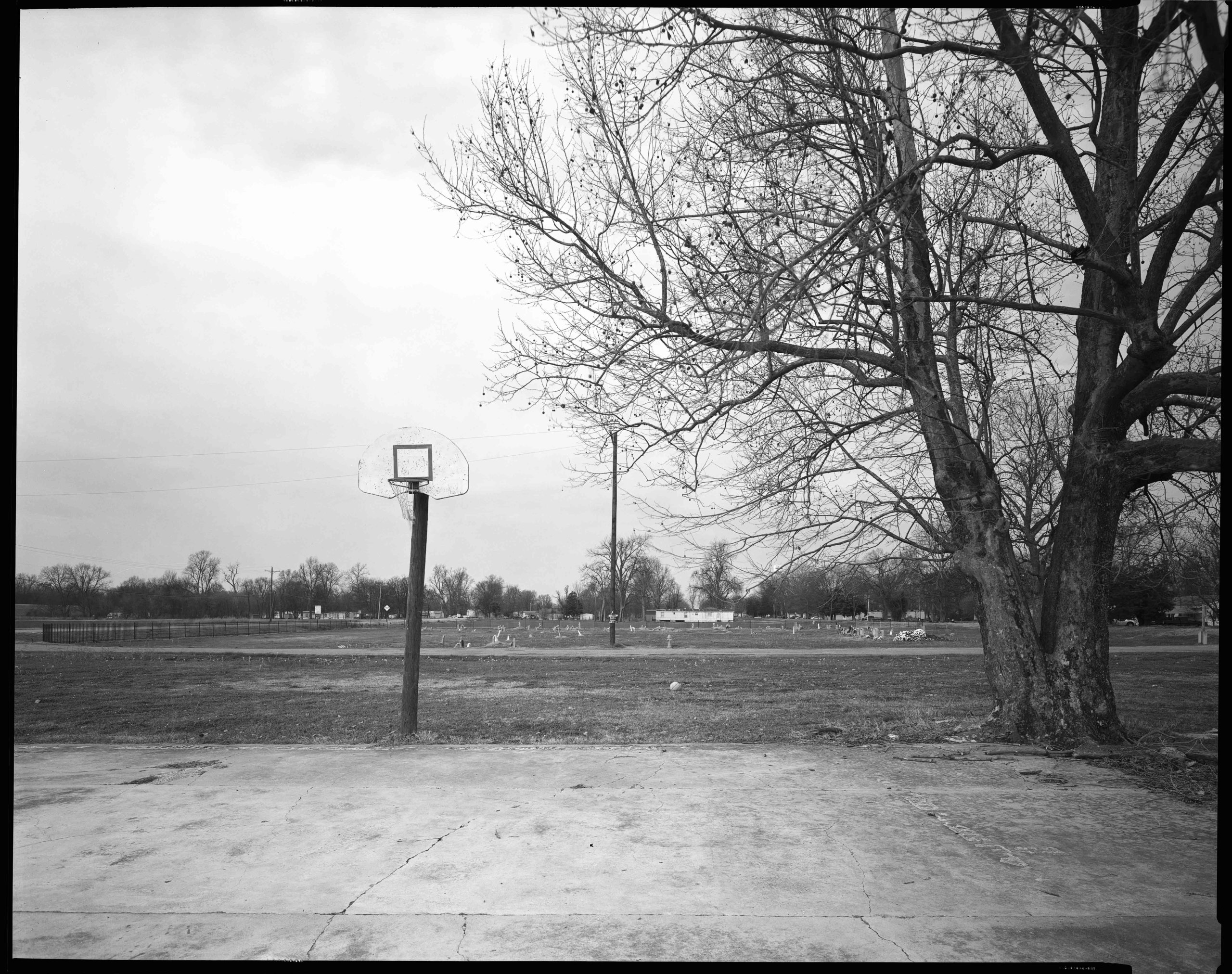
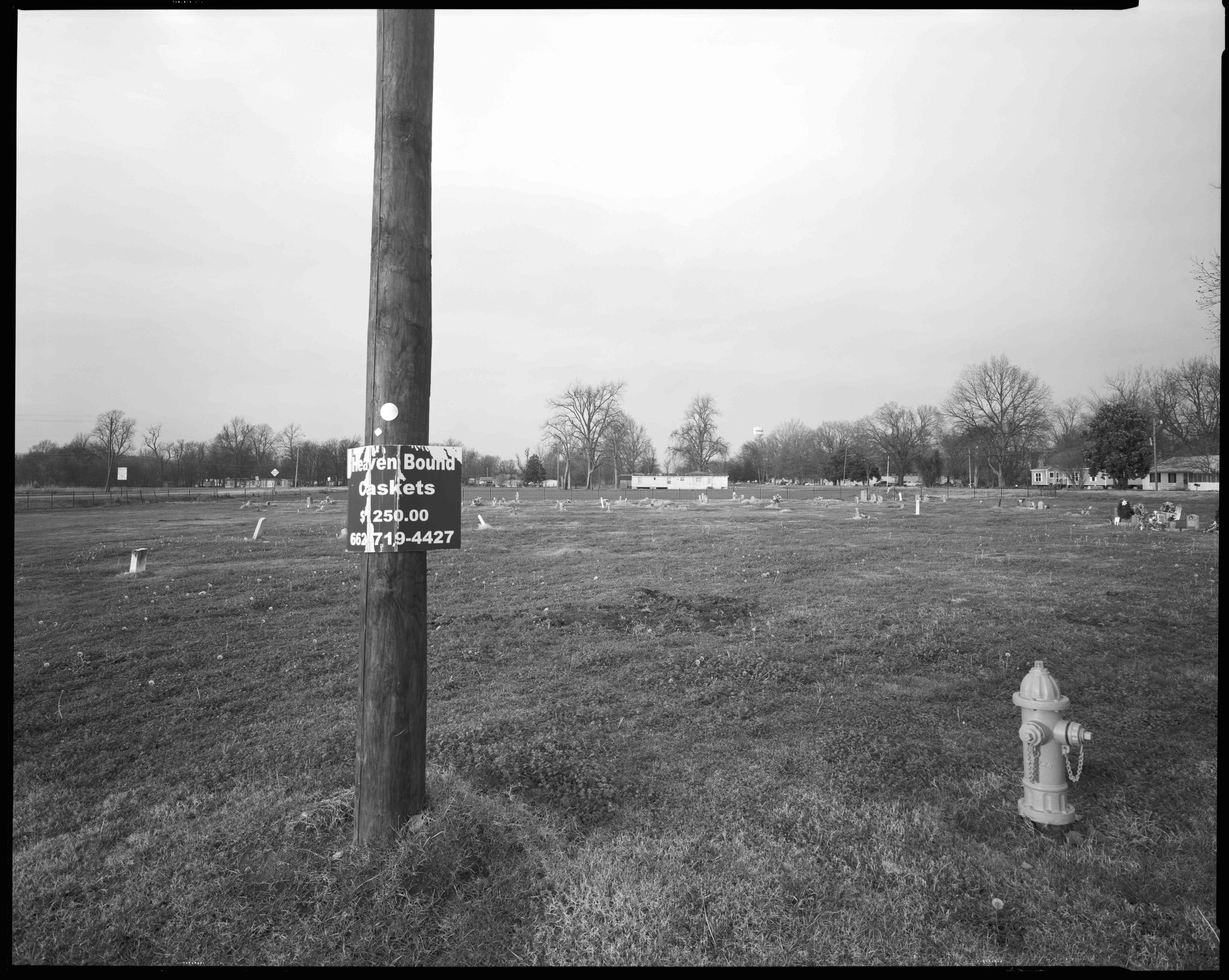
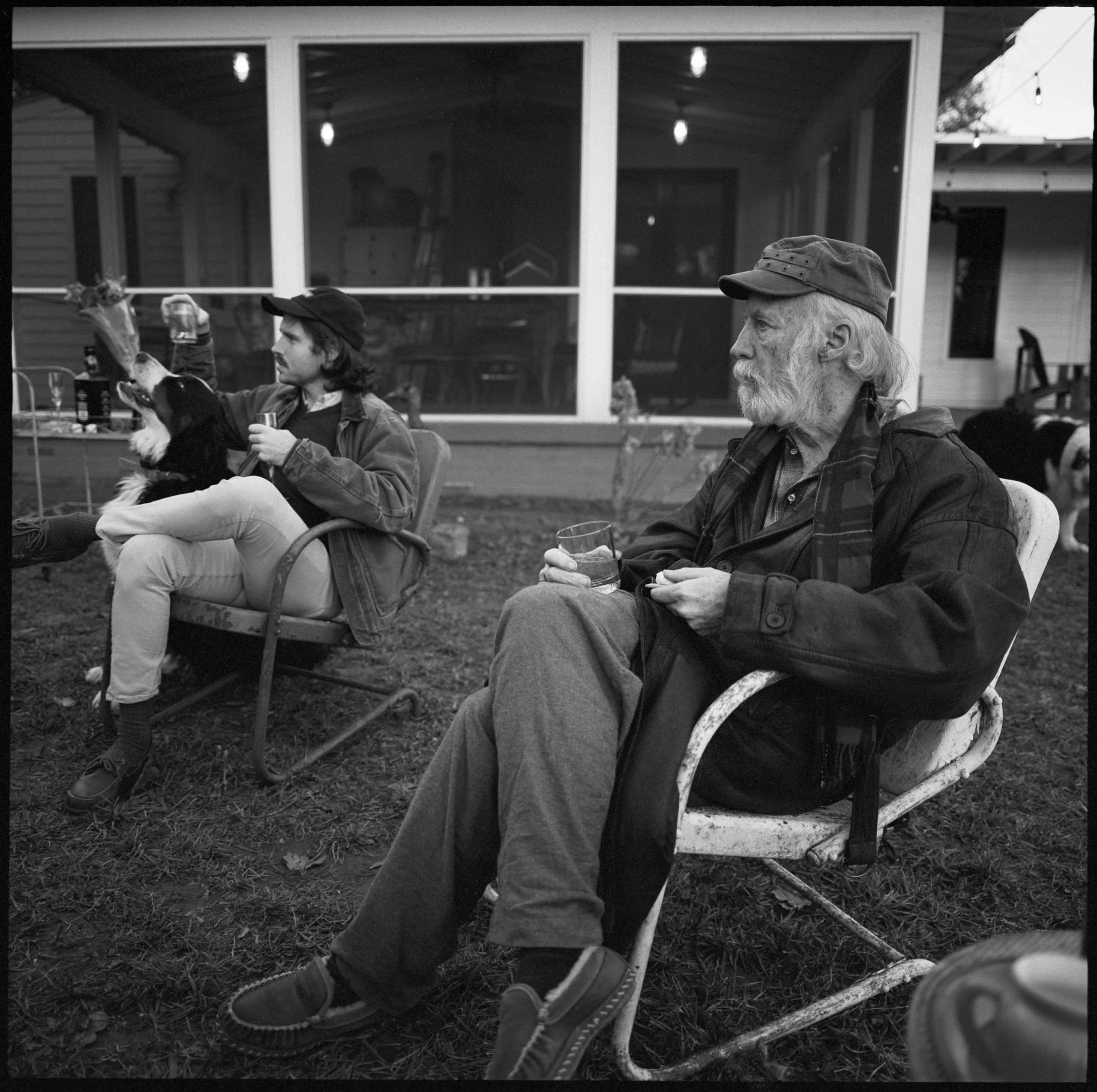
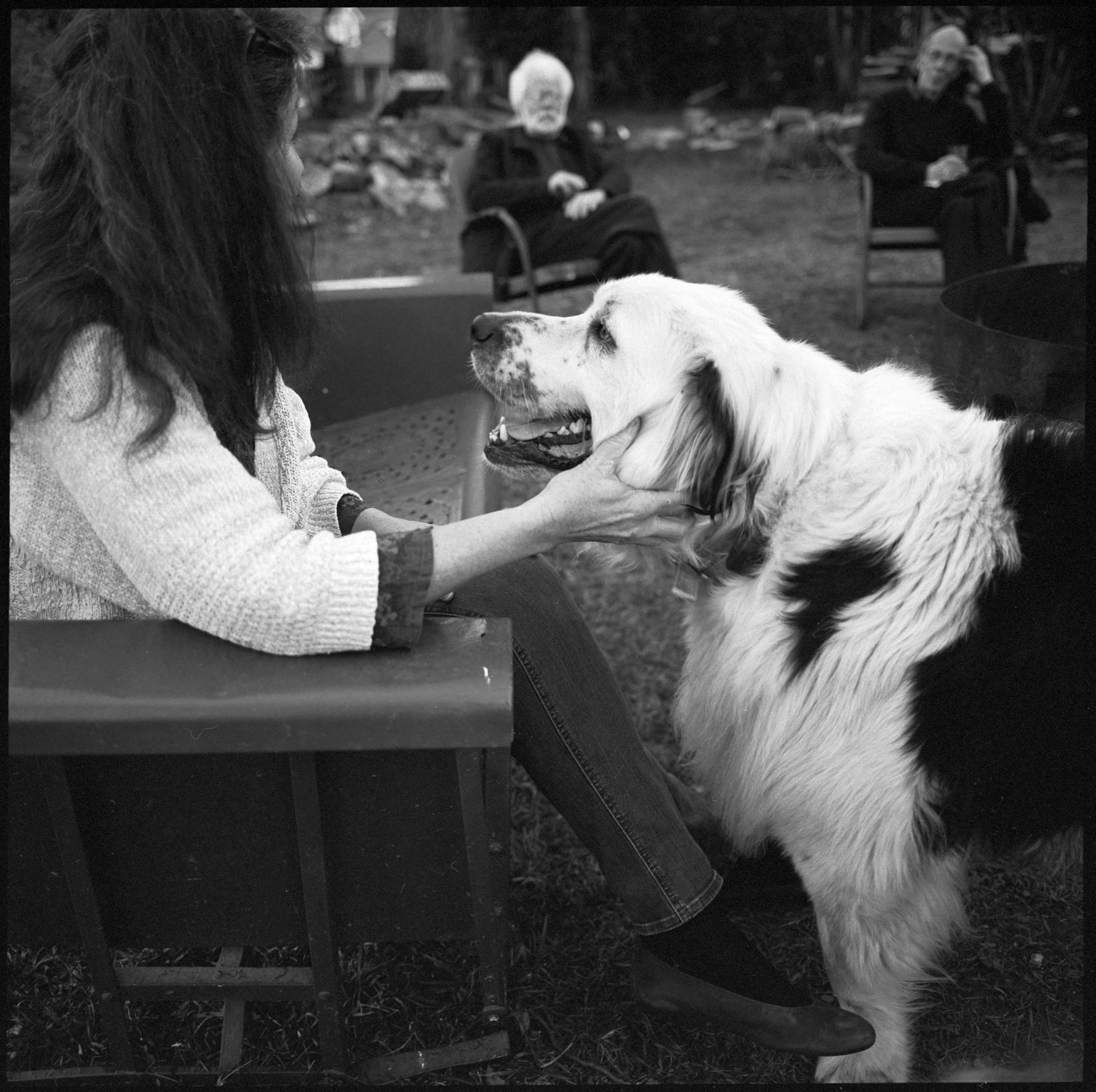
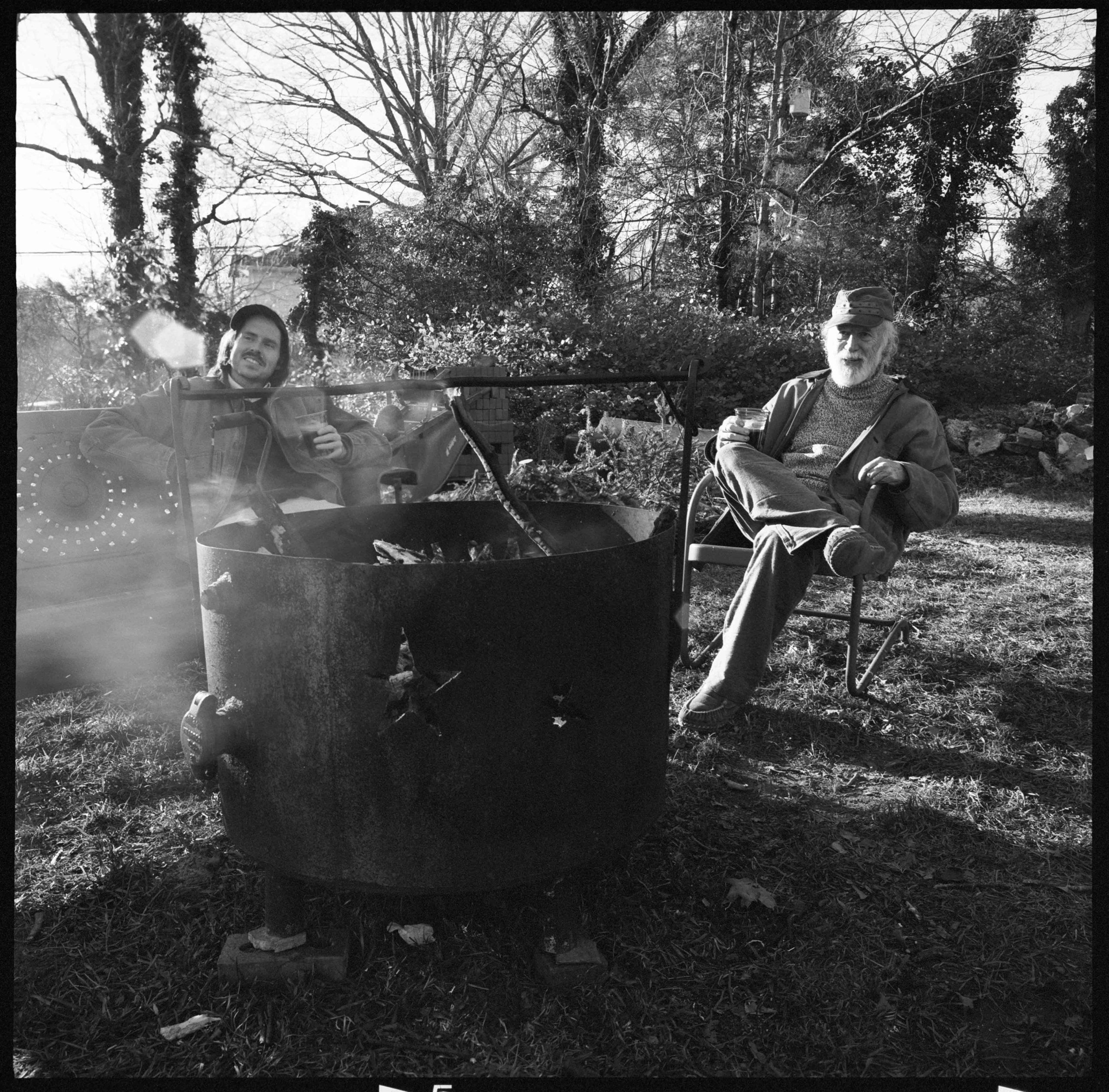
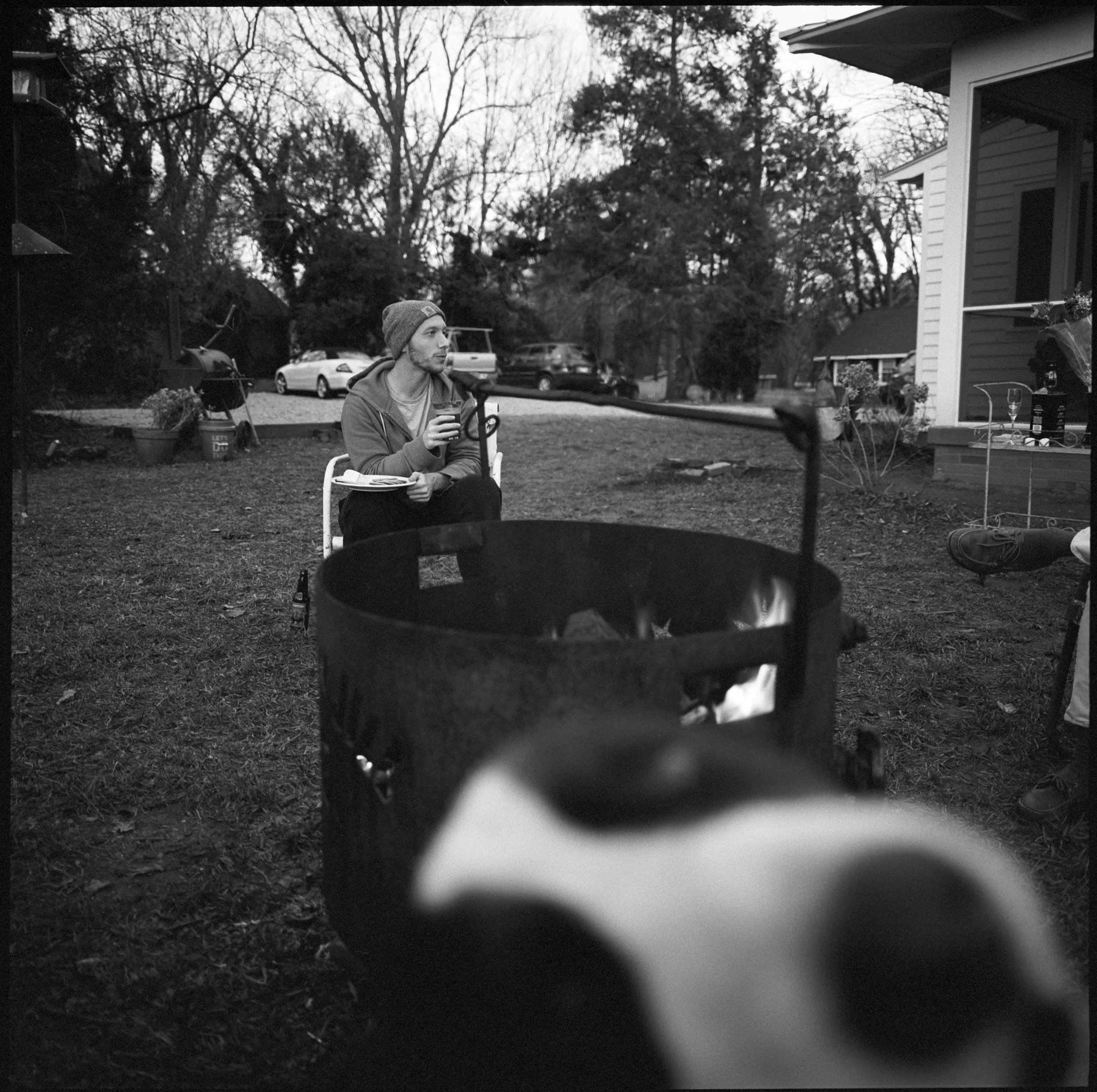
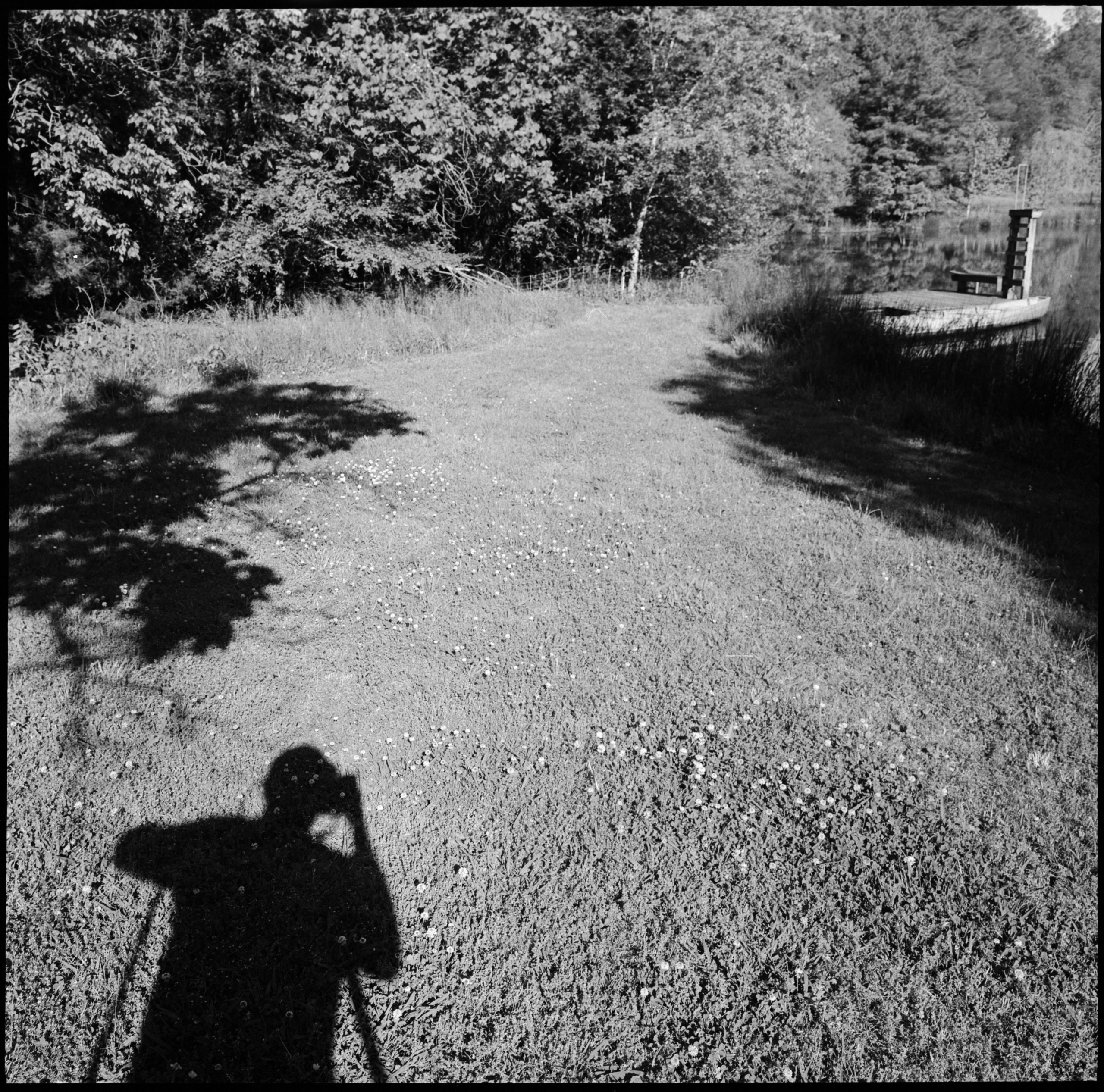
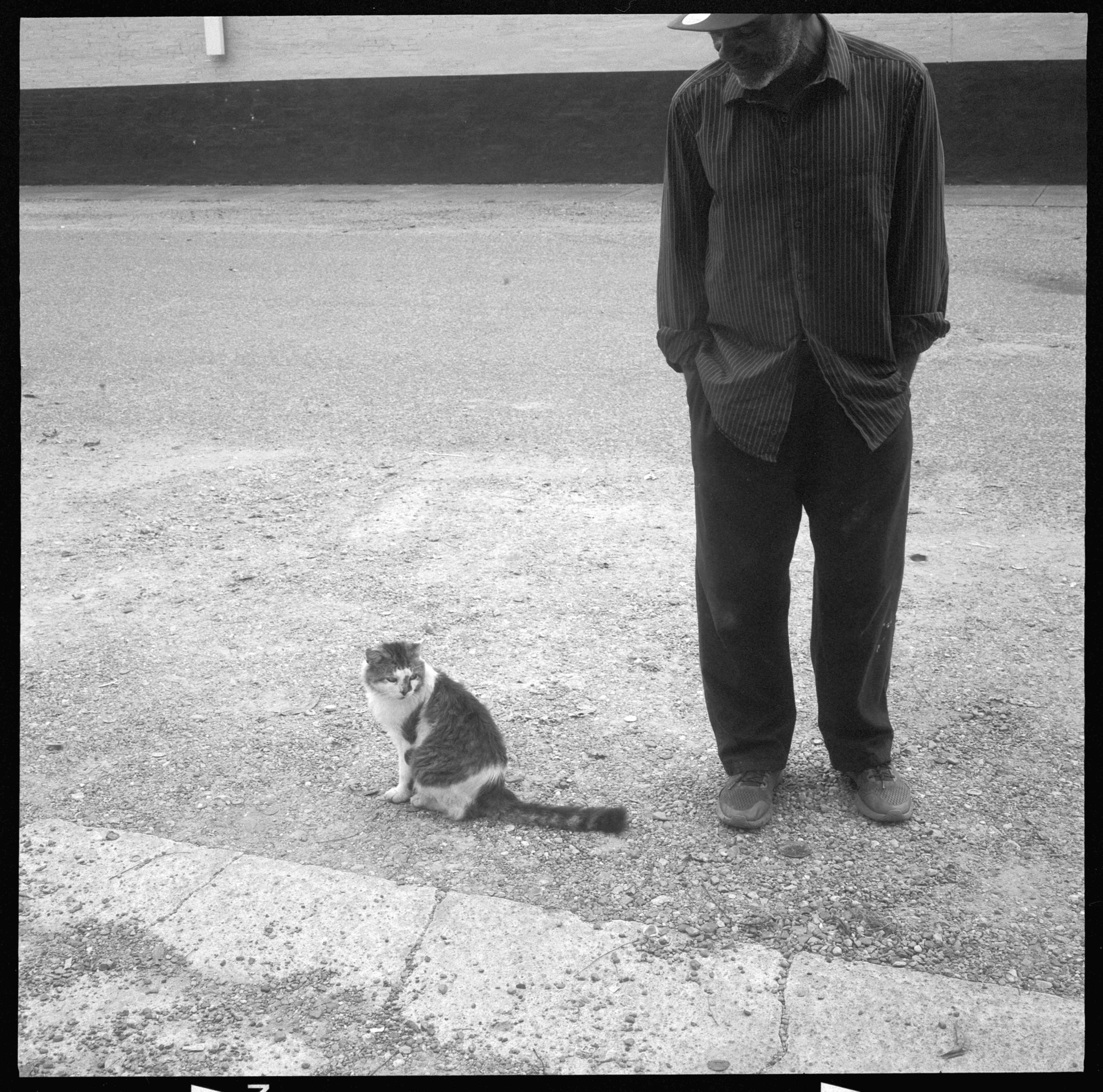
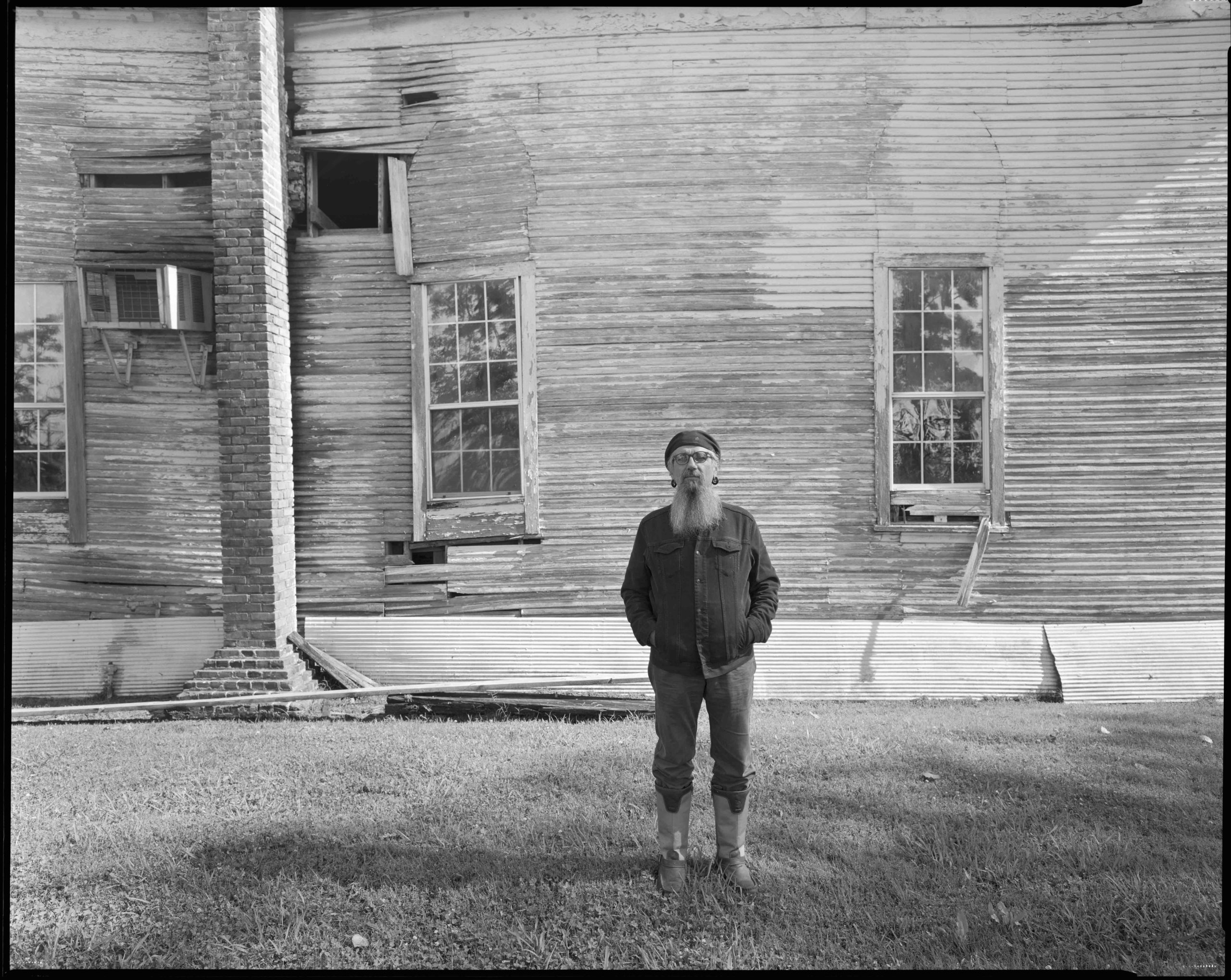
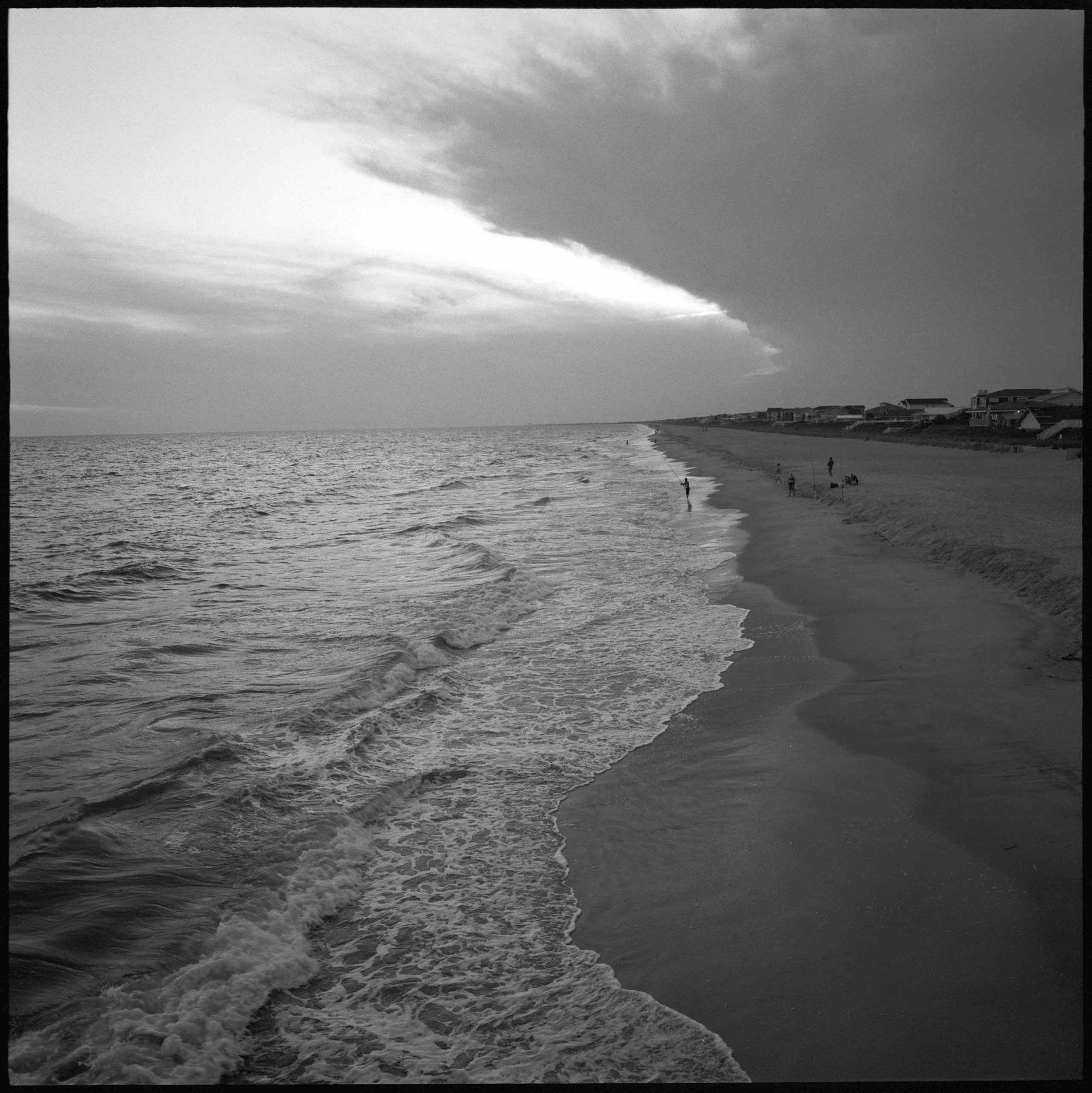
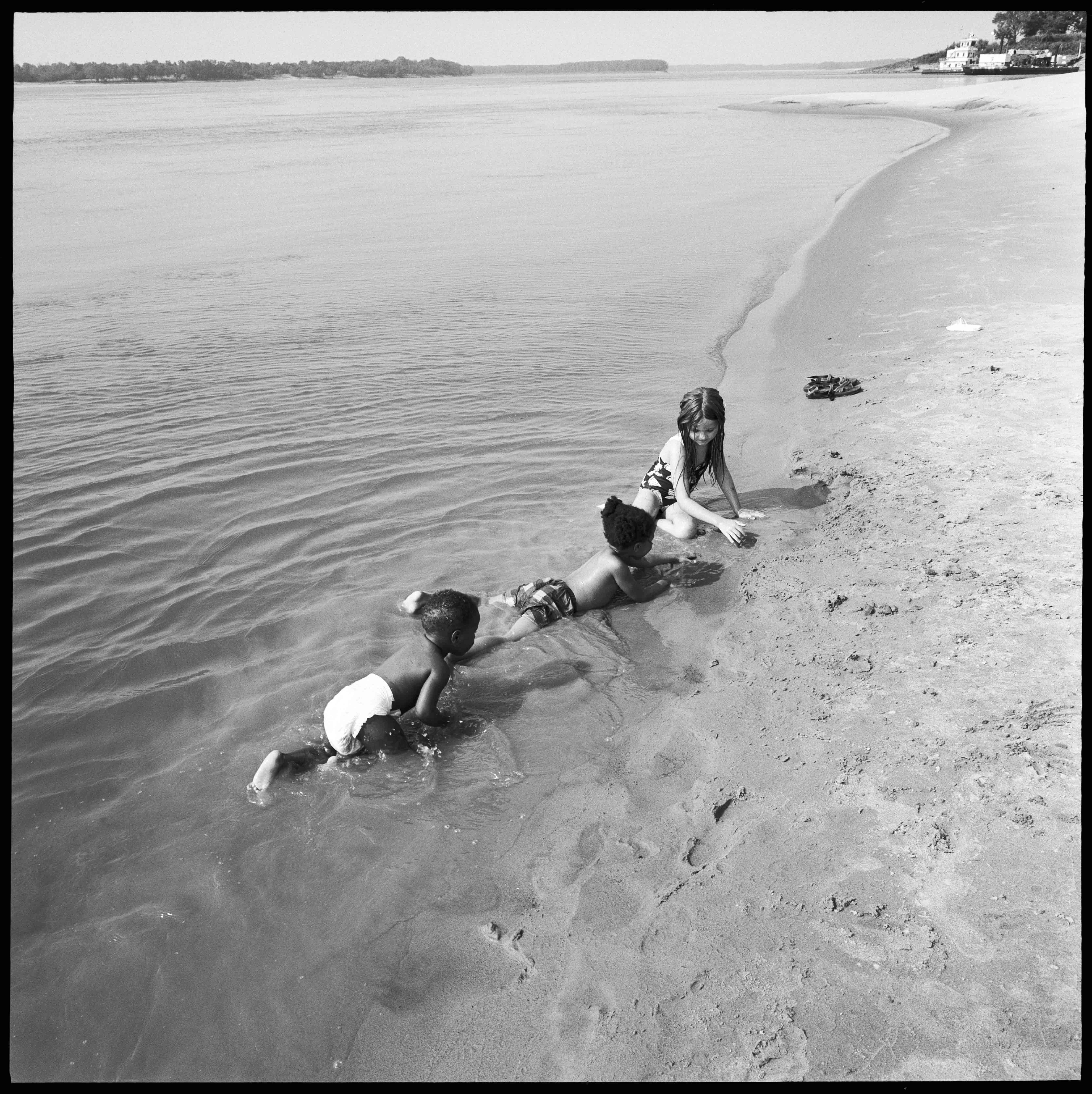
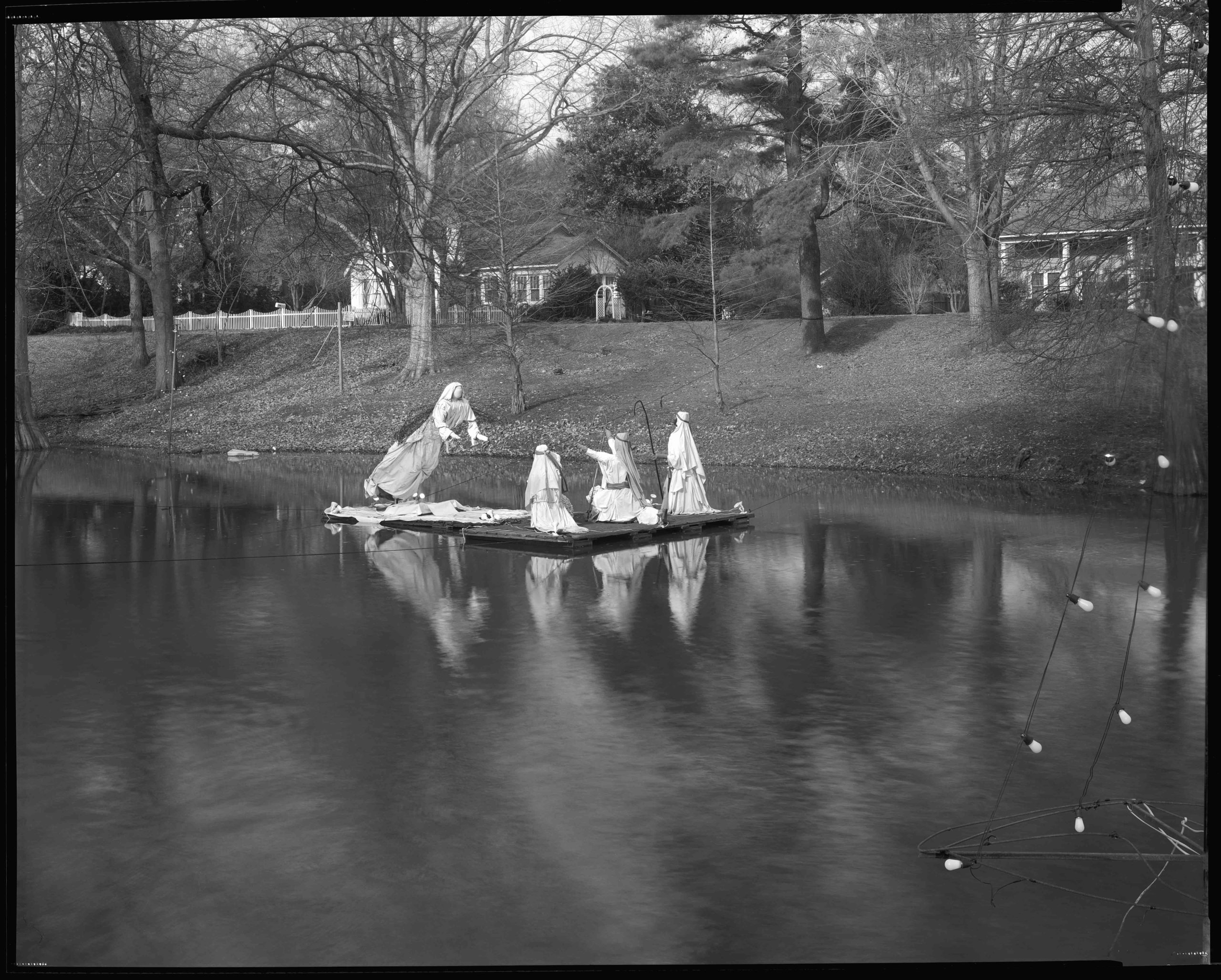
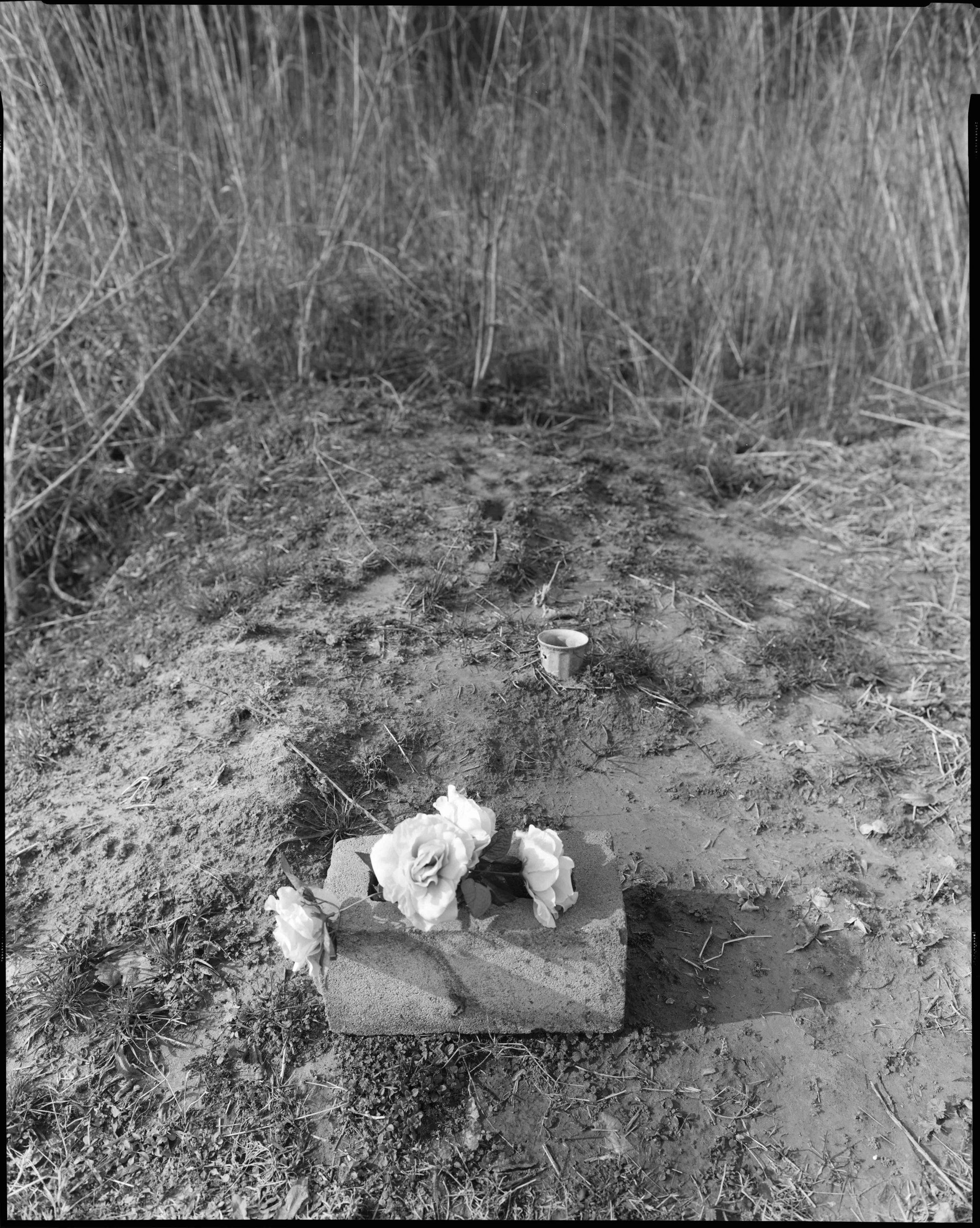
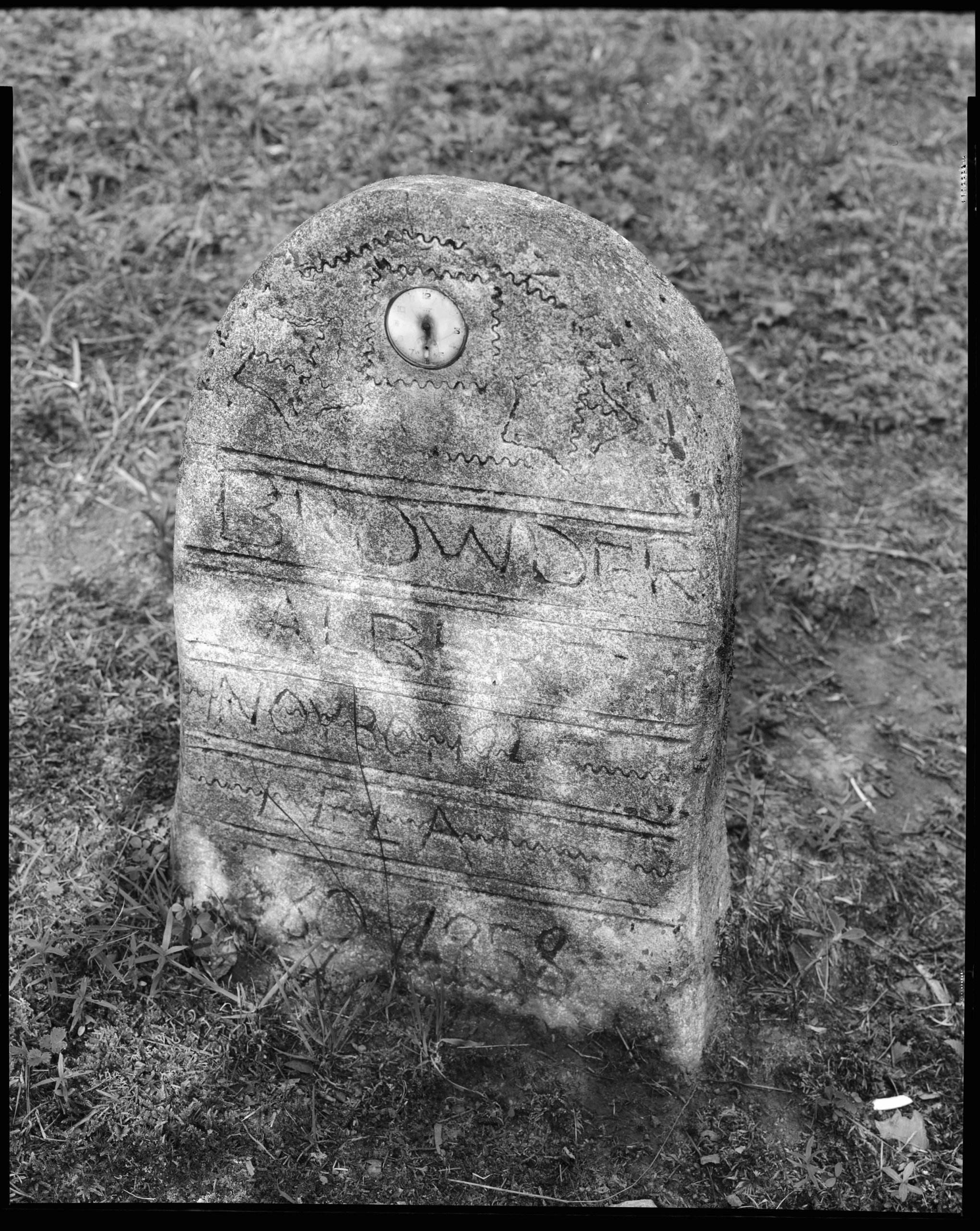
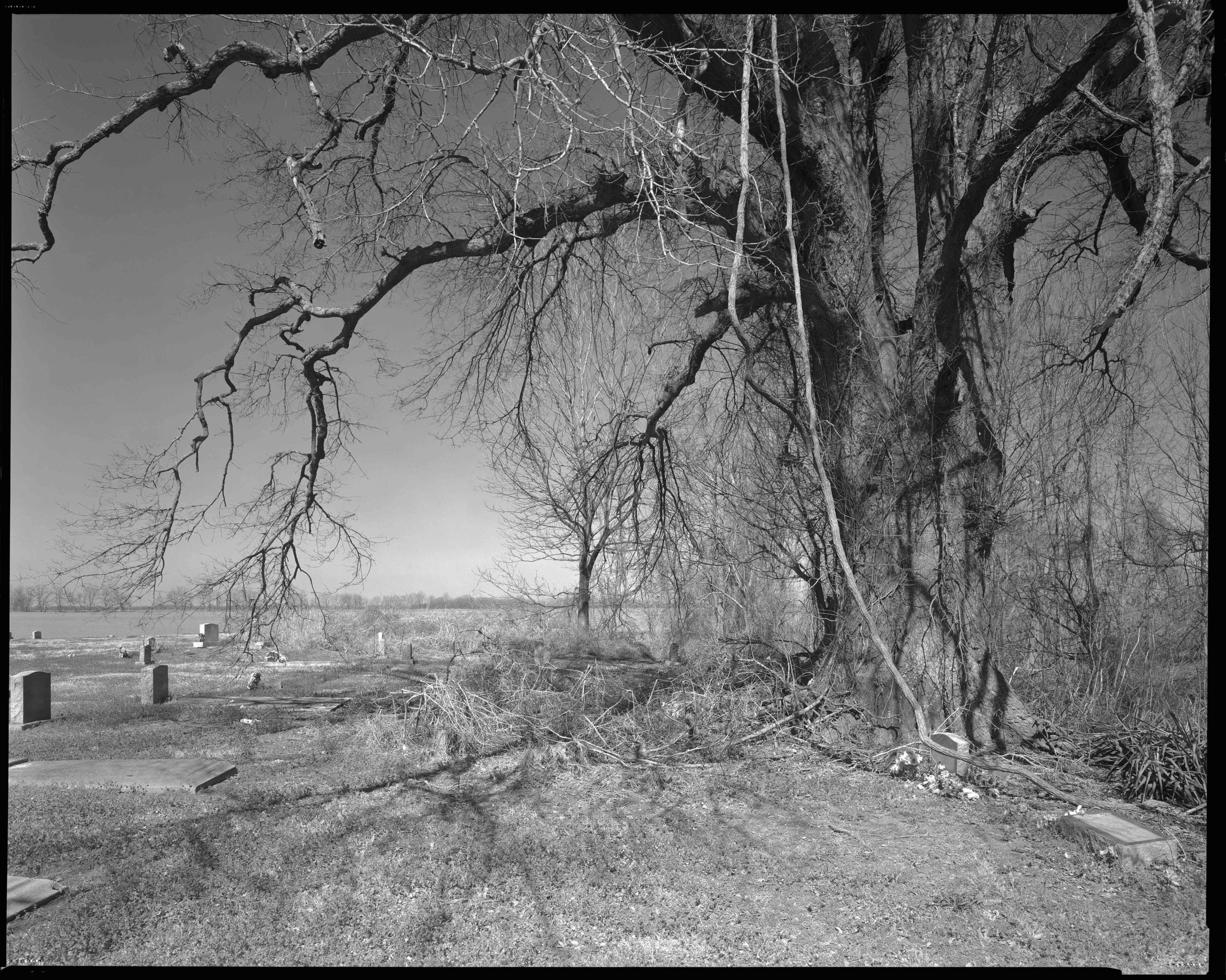
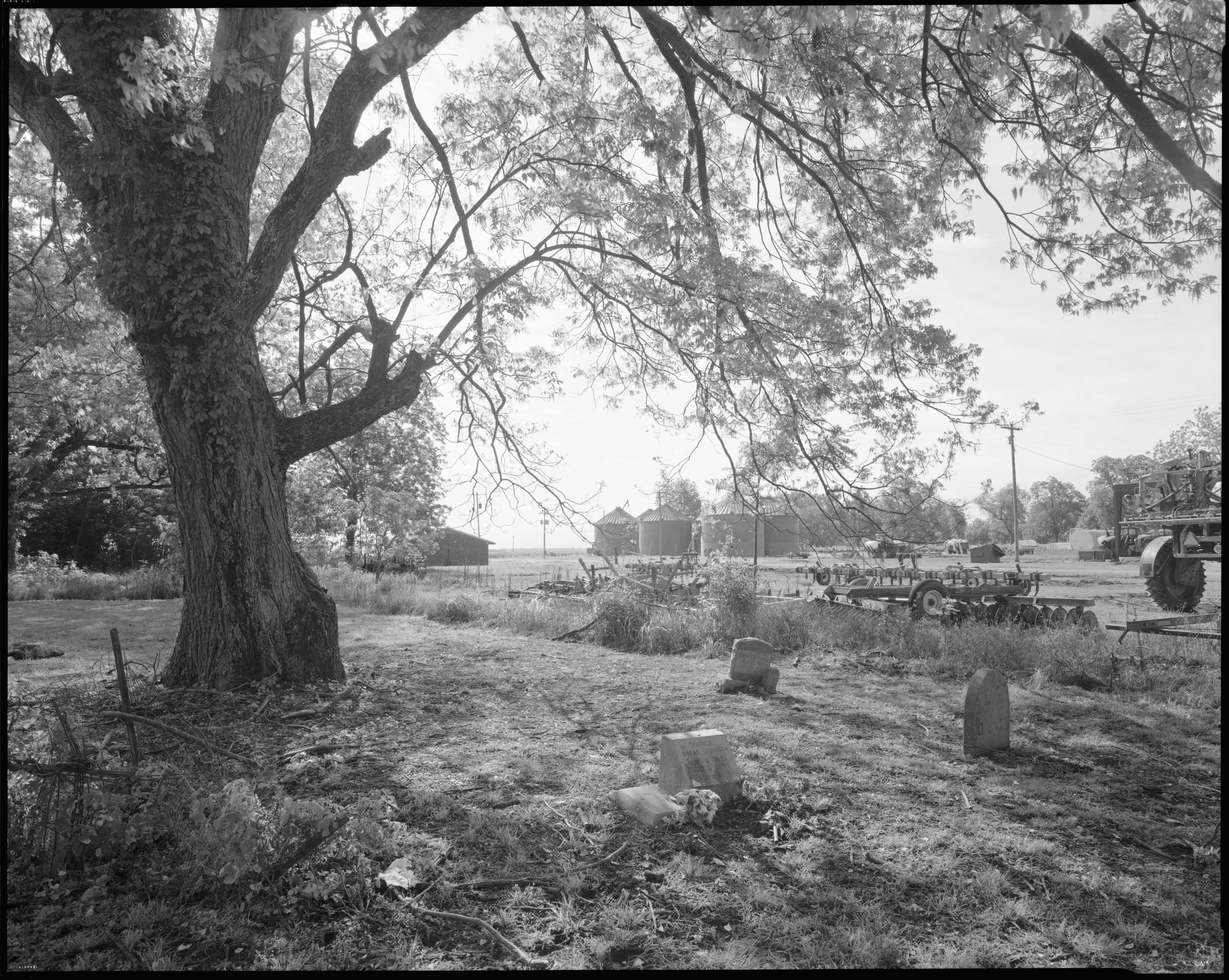
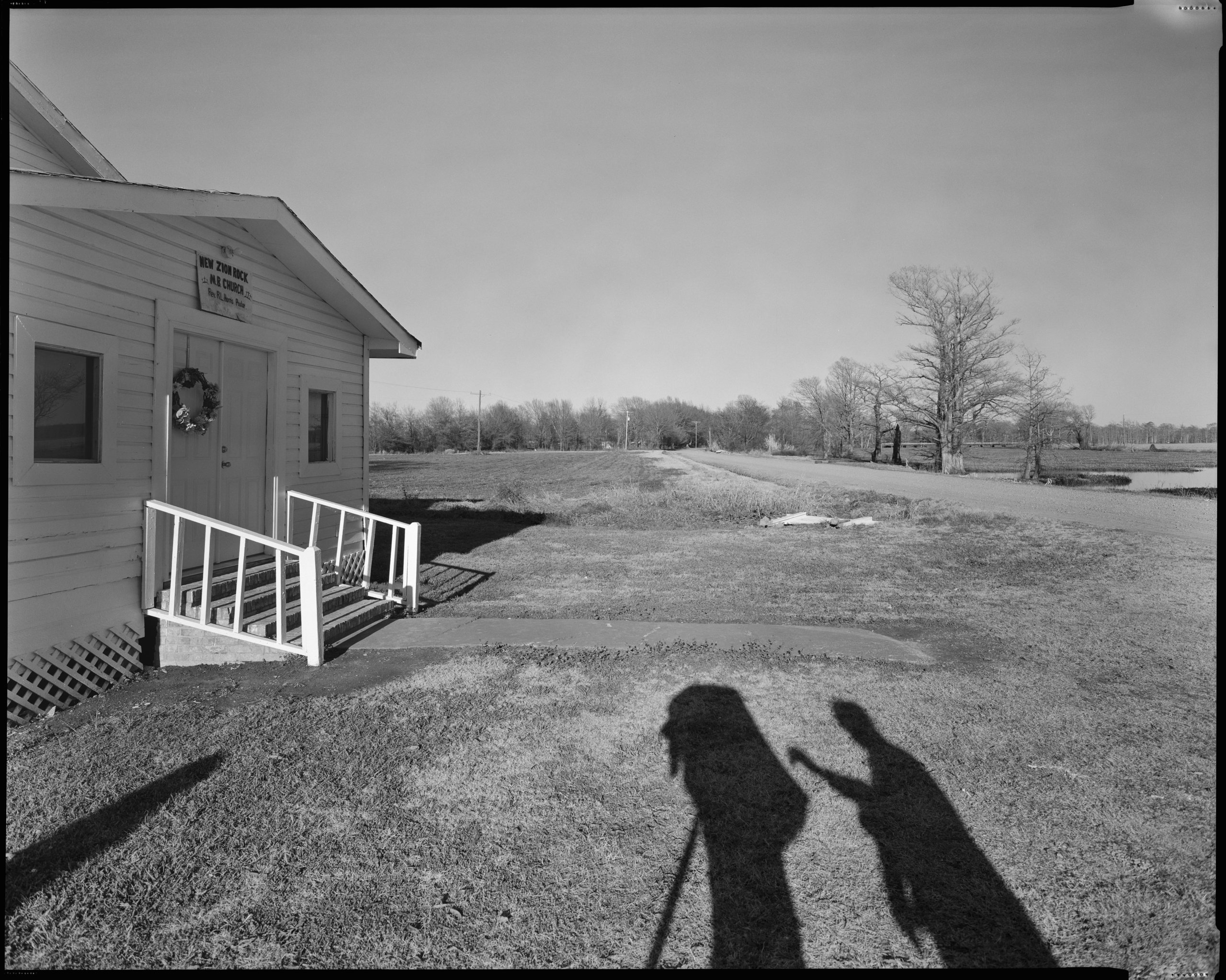
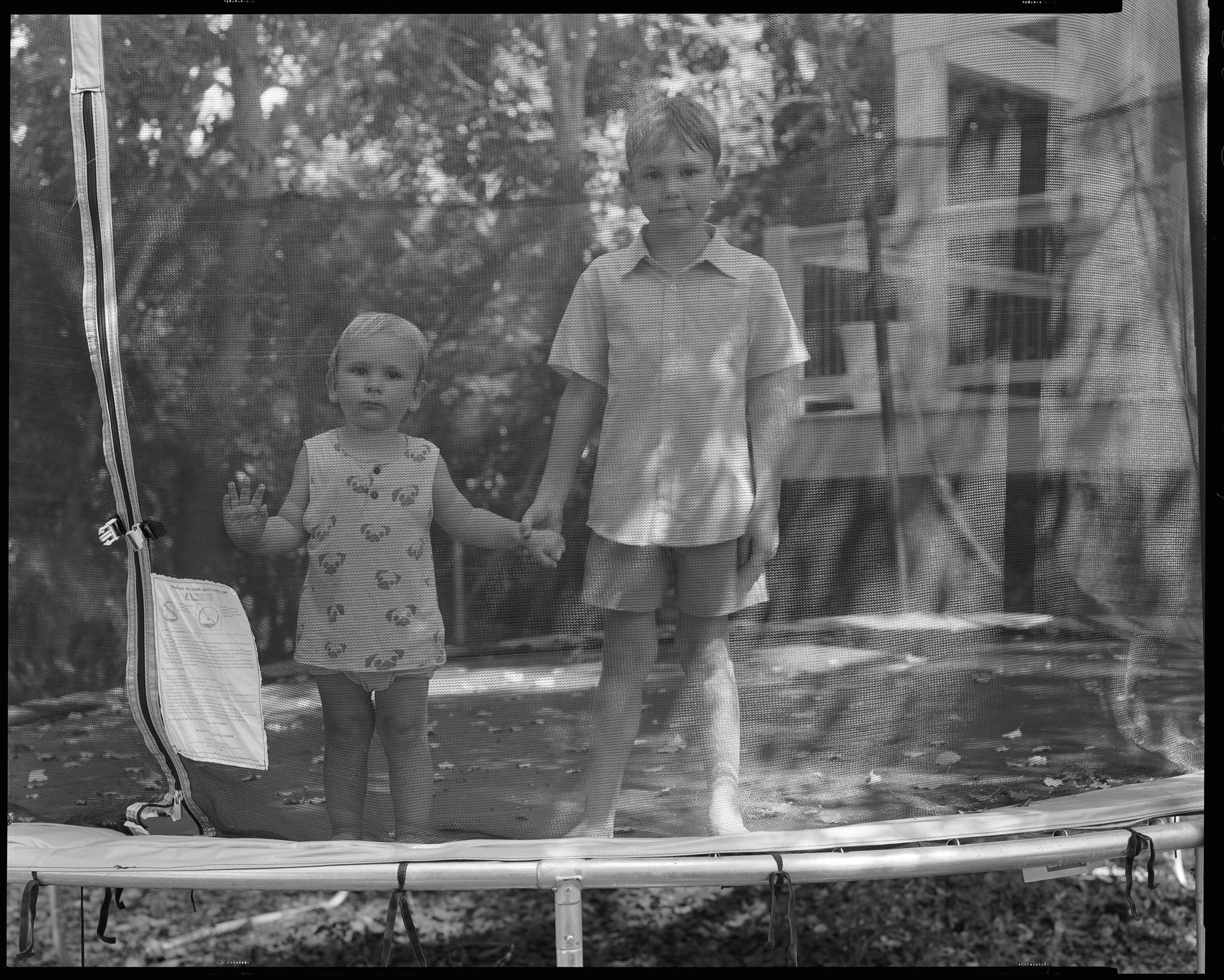
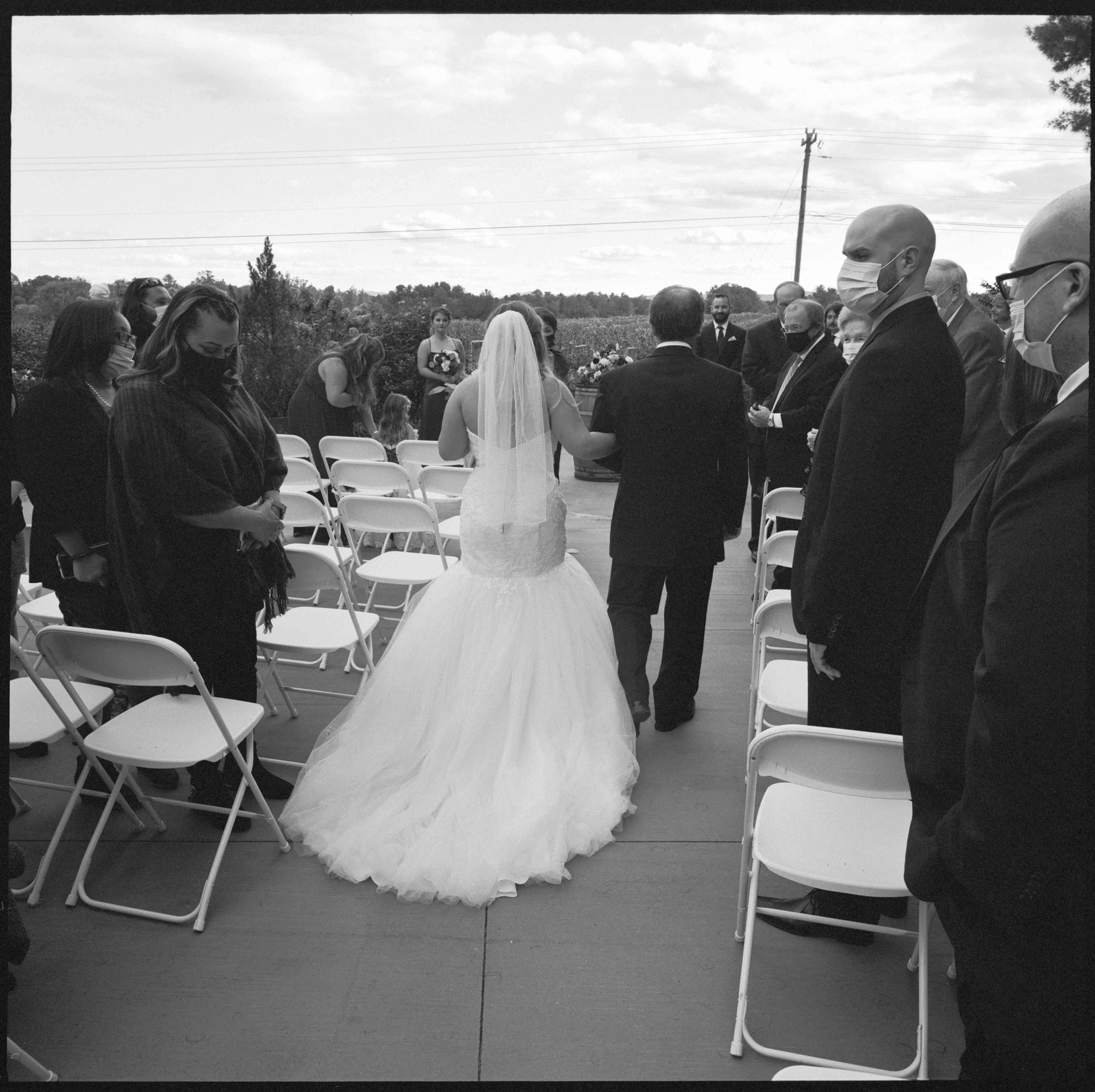
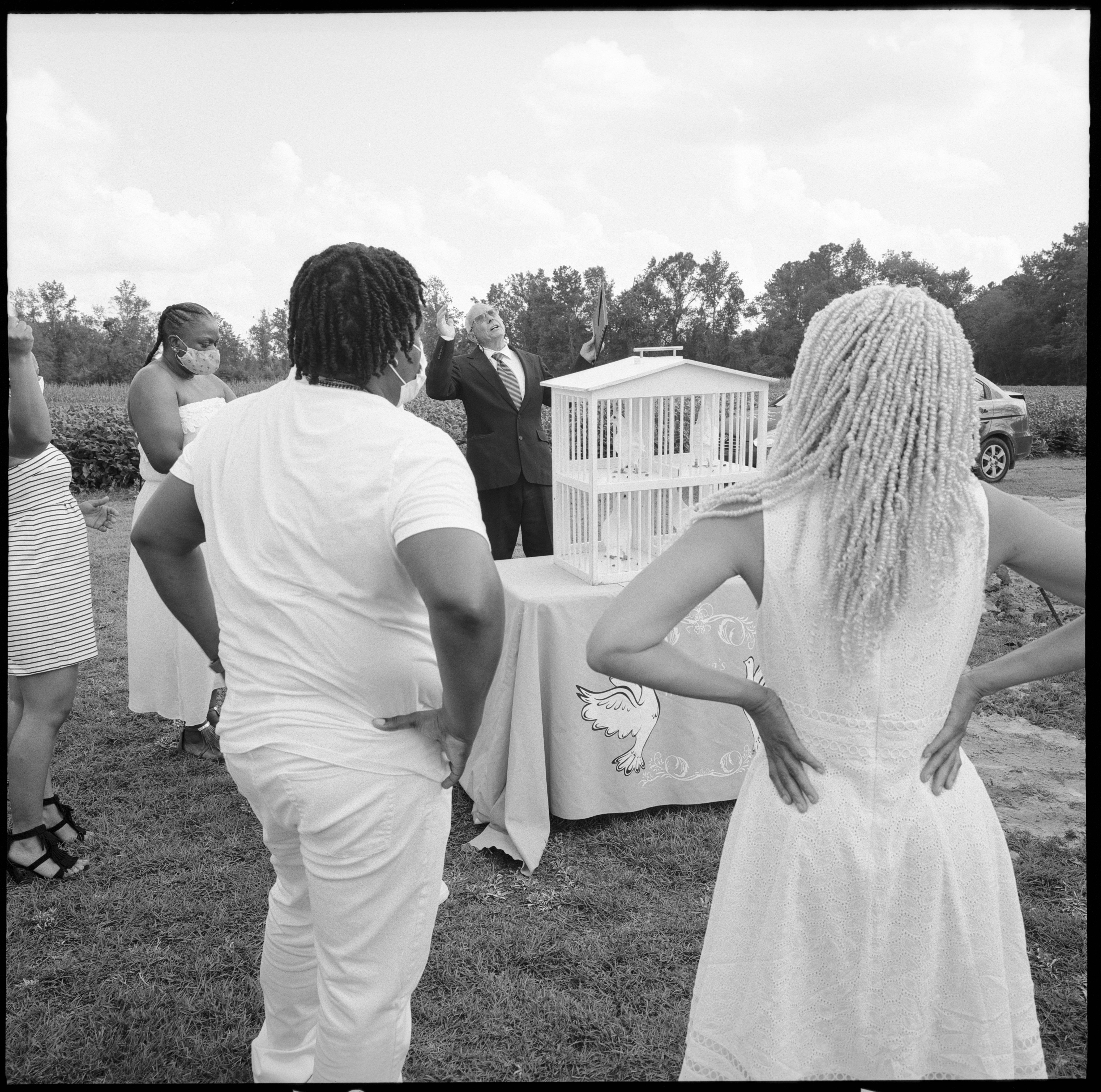
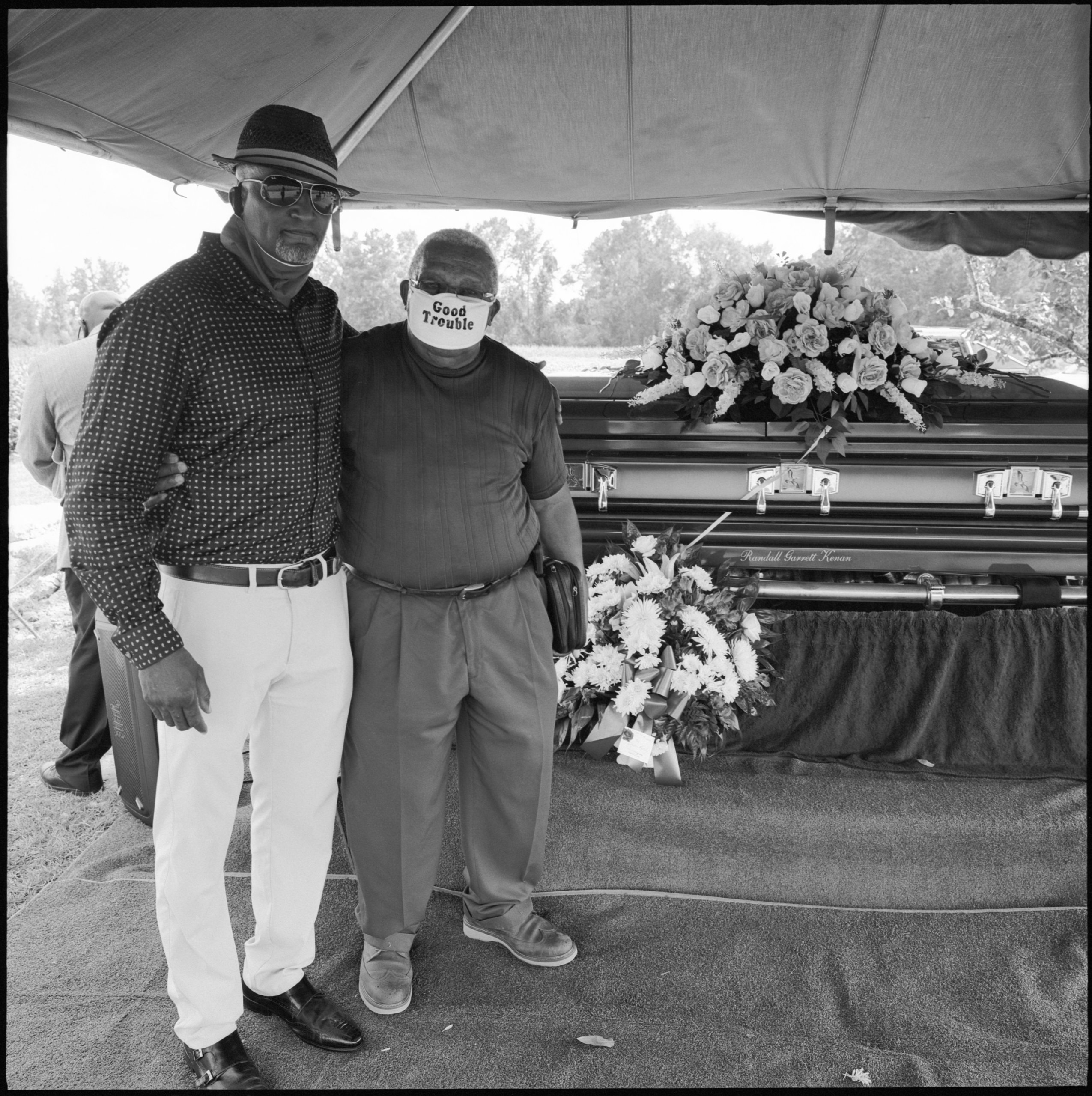
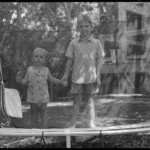
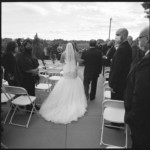
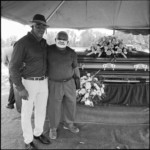
There are no truly universal feelings about the shared experience of Covid, but there is, I believe, a collective impression that we’ve all experienced a tangle of time, a displacement from the normal markers and seasons, a confronting of the inequities that accompany a pandemic, a fuller view of vulnerability and mortality. Amidst the diversity of ways we’ve managed the many interruptions and anxieties, the unknowing and the seeming to know, there’s shared understanding of a narrowing and shortening of our movements, maps, and itineraries. Through it all I’ve photographed. Sometimes in direct response to covid—with a sense that there’s something rare and exceptional about the moment—and at other times just doing what I always do.
I’ve come to understand that any photograph made during Covid is a ‘Covid photograph.’ To be sure, I recognize that some images made over the last couple of years are directly observing a response to Covid. Images of health care workers, vaccine researchers, shuttered businesses and empty offices, empty stands at athletic events, all of those and more are deeply identified with the pandemic. But so are all the other images, photographs made with full recognition of our altered routines and attitudes, the lightness and darkness that we observe having shifted. There is no way to separate the act of making pictures from a recognition of the injuries caused by the weather that surrounds. The Covid weather tightened our geography, led to a perspective that sees closer and perhaps with more intimacy, intended or not. Anytime we find ourselves looking at a singular sameness, we hope for deeper clarity and precision of sight. If there is hopefulness here, it is in the realization that there’s forever more to see in the most ordinary; another way to compose, to transform the world into an image, to confront the temporal luminance before us in an otherwise dimming day.
There is a recognizable evil tyranny in assuming that our worlds never fall apart, in taking the day-to-day for granted. We like to think we know better (“Here today, gone tomorrow,” and all that). Whatever we know doesn’t prevent us from the familiar condition that when at home the protagonist so often wishes to be away, and when away the deepest wish is often to be at home. Making pictures throughout Covid has been energized by an acceptance of a shrinking physical daily terrain, of being isolated in smaller places. My reply was to busy myself by affirming through images the fullness of wonders and contradictions close to home.
Photographers—and photographs—get all they have from embracing the darkness and light equally, shadows adjacent to highlights, contrast next to flatness, what is present alongside what has gone, low fertile valleys juxtaposed with the dry peaks. The opposites are coequal and mutually dependent, elemental to how we see. The last line from Psalms 139:12 is “the darkness and the light are both alike to you.” Alike, I argue, in that both arrive daily, and perpetually offer us a frontier to explore, render, and move to reveal, a time and place to take full visual advantage of the mystery and the uknown.
About the Author
Tom Rankin is Professor of the Practice of Art and Documentary Studies at Duke University where he directs the MFA in Experimental and Documentary Arts. For fifteen years he was director of the Center for Documentary Studies at Duke. His books include Sacred Space: Photographs from the Mississippi Delta (Jackson: University Press of Mississippi, 1993); Deaf Maggie Lee Sayre: Photographs of a River Life (Jackson: University Press of Mississippi, 1995); Local Heroes Changing America: Indivisible (New York: W.W. Norton & Co., 2000); One Place: Paul Kwilecki and Four Decades of Photographs from Decatur County, Georgia (Chapel Hill: University of North Carolina Press, 2013); and Goat Light (Durham, NC: Horse and Buggy Press, 2021) coauthored with Jill McCorkle. His photographs have been collected and published widely and included in numerous exhibitions. A frequent writer and lecturer on photography, culture, and the documentary tradition, he is the general editor of the Series on Documentary Arts and Culture with the University of North Carolina Press.
Public Health in the US and Global South is a collection of interdisciplinary, multimedia publications examining the relationship between public health and specific geographies—both real and imagined—in and across the US and Global South. These essays raise questions about the origin, replication, and entrenchment of health disparities; the ways that race and gender shape and are shaped by health policy; and the inseparable connection between health justice and health advocacy.
Beginning in 2022, the series expands to include 1000-word blog posts, as well as longer commentaries, essays, articles and media productions that address the public health and political implications of the COVID-19 pandemic from multiple viewpoints. The series editor for Public Health in the US and Global South is Mary E. Frederickson.
I. Introduction
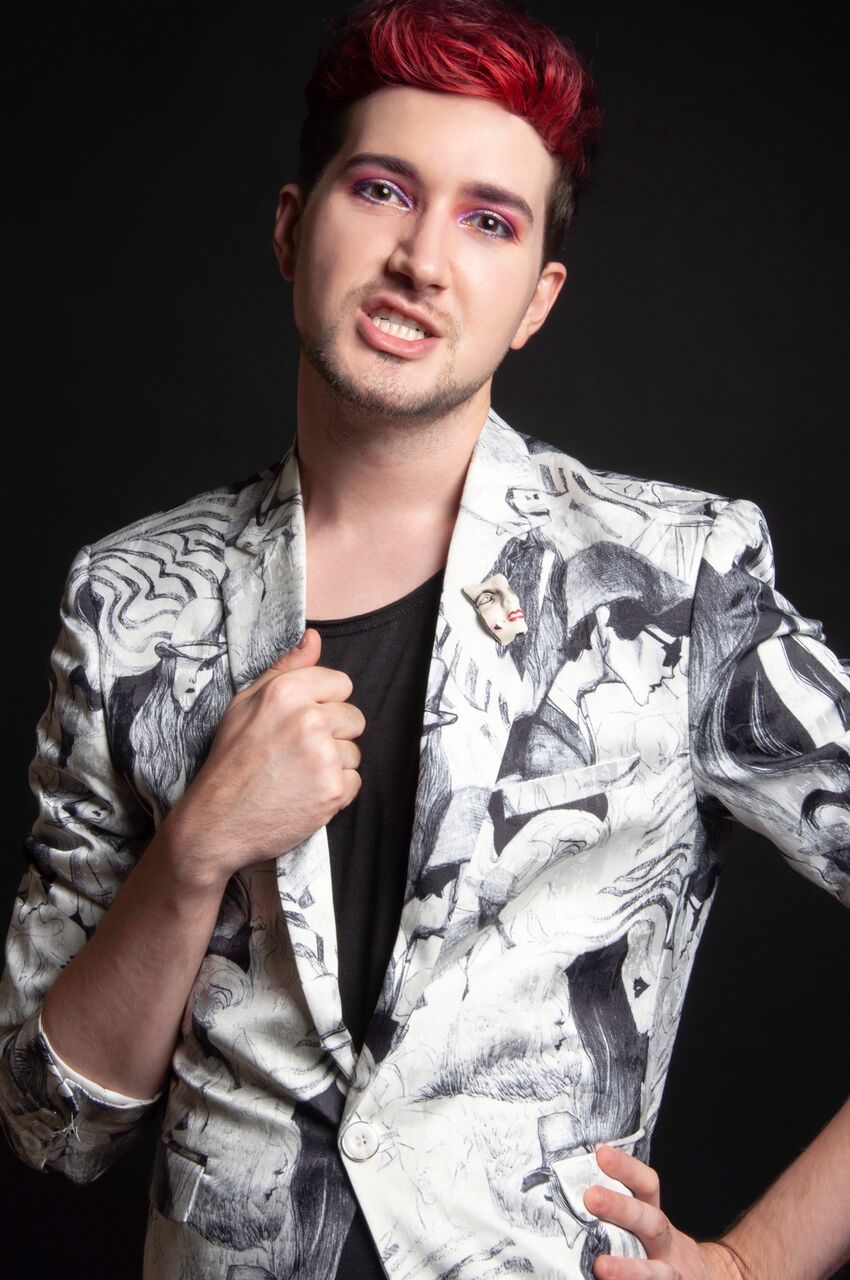
In February 2017, playwright and composer Max Vernon debuted their first Off-Broadway musical The View UpStairs at the Lynn Redgrave Theater in New York City. Following The View's success with another hit musical later that same year, which sold out theaters and nabbed a stack of awards, Vernon firmly established their reputation as a "radical" creative mind known for "gigantic" productions in immersive staging that render an "unexpected and marvelous" audience experience.1Excerpts taken from the following reviews found on Max Vernon's website: Lina Landstroem, "Queer History on Stage: A Review of The View UpStairs by Max Vernon," Public Seminar, March 1, 2017, https://publicseminar.org/2017/03/when-a-bar-was-your-home/; Zackary Stewart, "KPOP," TheaterMania, September 22, 2017, https://www.theatermania.com/off-broadway/reviews/kpop_82533.html; Elisabeth Vincentelli, "Review: A Gay Nightclub Tragedy, Decades Before Orlando, in 'The View UpStairs'," The New York Times, March 7, 2017, https://www.nytimes.com/2017/03/07/theater/the-view-upstairs-review.html. The View UpStairs animates the real life Up Stairs Lounge gay bar environment on the eve of an arson attack on June 24, 1973. The tragedy stands as the deadliest fire on record in New Orleans history, and it once figured as the deadliest US attack on LGBTQ+ people until Orlando's Pulse Nightclub massacre in 2016. Considering the production's immersive staging and use of melodramatic mode, I interpret The View UpStairs as an adaptation in a genealogy of liberatory queer performance tracing back through the "drag reviews" and "deeply interactive, cross-dressing . . . nellydramas" staged at the Lounge in the 1970s.2Robert W. Fieseler, Tinderbox: The Untold Story of the Up Stairs Lounge Fire and the Rise of Gay Liberation (New York: Liveright Publishing, 2018), 227. The View activates a legacy of intersectional coalition that is vital to contemporary social justice activism confronting the racist, nationalist, and anti-LGBTQ+ violence emboldened in a post-Trump America. The View builds new forms of solidarity across impossible limits of time, place, and subjectivity by dissolving distinctions between 2017 and 1973, New York and New Orleans, actors and audience.
II. The Up Stairs Lounge, 1970–1973
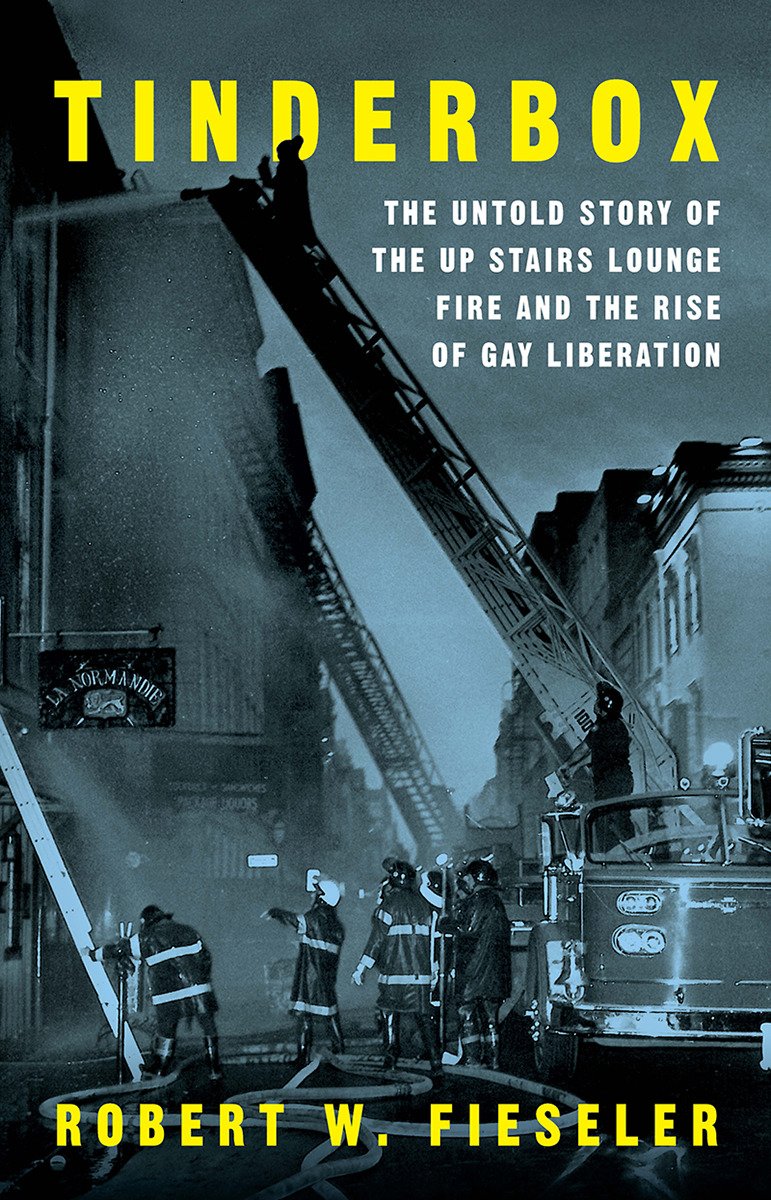
As a Los Angeles native and NYU alum, Vernon was drawn to the Up Stairs Lounge fire not so much for its tragedy but because the "fire [had] been erased" from history.3Max Vernon, interview by author, September 8, 2017. Robert W. Fieseler underscores in Tinderbox (2018) that "more stories about the Up Stairs Lounge appeared in major news outlets after the [2016] Pulse shooting than in the previous four decades."4Fieseler, Tinderbox, xix. While Vernon was understandably shocked by the tragedy's erasure, the complexities surrounding the arson, its immediate but mostly local news coverage, and its swift muting from public discourse resist hasty conclusions about the cause or consequence of such silence. On the one hand, the contemporaneous frontpage spread in the Times-Picayune had broken a multigenerational "social compact" whereby New Orleans dominant society had tolerated queer society as long as it remained apolitical and out of sight.5See the front page spread of The Times-Picayune (New Orleans, LA), June 25, 1973, Monday Morning Edition, 1. The Up Stairs Lounge arson and media coverage acknowledged a thriving gay culture within the French Quarter. The arson's silencing became a tragedy suppressed from public consciousness. Media coverage also non-consensually "outed" many closeted survivors for whom employment, housing, and other basic needs depended upon privacy. For them, media silence was more than a welcome salve; it was necessary for survival. This ethical complexity between historical recovery work and guarding survivors' privacy presented a daunting challenge: How to restore cultural visibility when so many victims and survivors would not have wanted public exposure, whose agency to "come out" (or not) was taken from them? This exigency guided Vernon's creative work. It underscores why this musical is decidedly not about the arson but, rather, a dramatic "View" of life from the perspective of "composite" characters adapted from Up Stairs patrons, anonymously recovering the kinds of human connections that the bar made possible before and until June 24, 1973, at 7:53 p.m. when "[f]lames gathered on a front step."6Vernon, interview by author; Fieseler, Tinderbox, 70.
Aside from some library microfiche newspapers and a few Times-Picayune articles online, Vernon primarily referenced Clayton Delery-Edwards's 2014 book The Up Stairs Lounge Arson. Few other resources existed while Vernon was writing.7Clayton Delery-Edwards, The Up Stairs Lounge Arson: Thirty-Two Deaths in a New Orleans Gay Bar, June 24, 1973 (Jefferson, NC: McFarland, 2014); Vernon, interview by author; see also Johnny Townsend, Let the Faggots Burn: The UpStairs Lounge Fire (Bangor, ME: BookLocker, 2011). Townsend's 1989–90 archival work informed Delery-Edwards's research. Delery-Edwards, a native of New Orleans, was drawn to the fire when he "watch[ed] news coverage in 1973."8Delery-Edwards, The Up Stairs Lounge Arson, 2. His book was only the second book about the tragedy after Johnny Townsend's self-published and poorly documented interviews in Let the Faggots Burn (2011).9Townsend, Let the Faggots Burn, vii. Delery-Edwards's work was the clear, better choice for Vernon's research.10It is important to note that some inconsistencies exist in Delery-Edwards's text, as well. Today, Robert W. Fieseler's Tinderbox (2018) is considered a more thorough, accurate record of the fire.
The title of Delery-Edwards's first chapter, "Beer, Prayer and Nellydrama," scans as an early outline for the plot of The View. Delery-Edwards describes the Lounge as a cultural space that sought to insulate patrons from homophobic violence, what Vernon would imagine in a musical number, "The World Outside These Walls."11Max Vernon, The View UpStairs (New York: Samuel French, 2017), 45. The Up Stairs Lounge operated amid tumultuous years (1970–1973) of gender politics: "Roe v. Wade, the Women's Liberation movement, [and] the Gay Liberation movement spurred by the 1969 Stonewall Riots" and its one-year anniversary parade.12Vernon, The View UpStairs, 45. Police brutality and institutional violence compelled LGBTQ+ people to remain closeted for survival, though Delery-Edwards explains that some sought escape via "life in a big city . . . Someplace like San Francisco. Or New York. Or New Orleans."13Delery-Edwards, The Up Stairs Lounge Arson, 10. However, these urban spaces and the gay bars they provided were not reliably safe. "Police would raid gay bars for no real cause," he writes, "beating up the patrons without fear of repercussion, and arresting people for infractions not much more serious than shaking hands."14Delery-Edwards, The Up Stairs Lounge Arson, 10. It was this kind of police raid that precipitated the New York City Stonewall Uprising in the early morning of June 28, 1969, when LGBTQ+ people—particularly those who were Black and Brown—fought back.15Although the most well-known, the Stonewall Uprising was not the first instance of LGBTQ+ resistance. The Cooper Do-Nuts Riot (1959) as well as the Compton's Cafeteria Riot (1966), both in California, precede Stonewall. Many have argued that Stonewall became central to the development of Gay Liberation largely as a result of practices of memory (organized activism) that arose to commemorate the event, such as the Christopher Street Liberation Day (1970), often cited as the first gay pride event in the country.
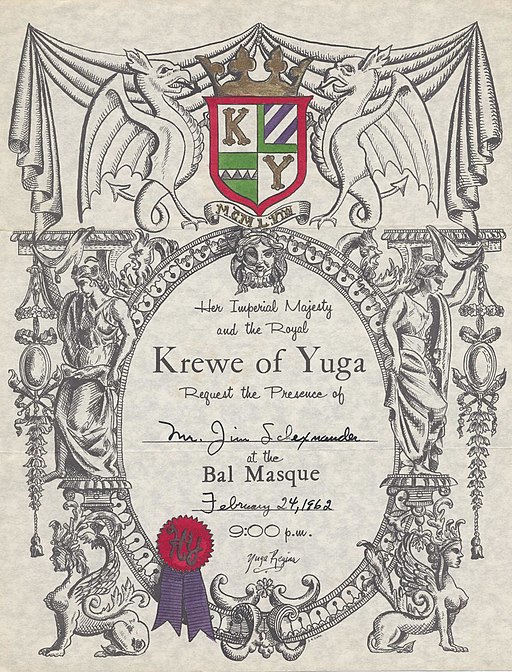
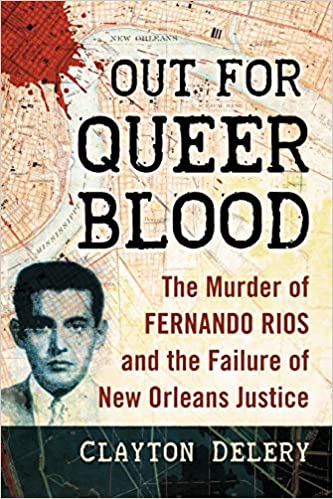
By 1973, the Gay Liberation movement that had been radicalizing in localized spaces before Stonewall was now galvanizing on a national scale, yet political activism still had not animated New Orleans. Ironically, the city's (and specifically the French Quarter's) deep history as a site of celebrated deviance may have delayed political radicalization.16Ryan Prechter, "Gay New Orleans: A History" (PhD diss, Georgia State University, 2017), https://scholarworks.gsu.edu/history_diss/60/. Fifteen years before the Up Stairs arson, two significant events in New Orleans gay history occurred within seven months of one another, and their ambiguous correlation underscores gay New Orleans apolitical climate at the time. In 1958, the first gay Mardi Gras krewe—"the Krewe of Yuga"—was formed, and later that year, three white Tulane students murdered Fernando Rios, a gay Mexican man, in what would now be called a homophobic hate crime.17The three white Tulane murderers intended to "roll a queer," or assault a gay person, the night they killed Rios. Trial testimony revealed that the murderers bragged about the assault after they left Rios for dead. Clayton Delery-Edwards, Out for Queer Blood: The Murder of Fernando Rios and the Failure of New Orleans Justice (Jefferson, NC: McFarland, 2017), 97. The murderers confessed to the crime but were acquitted. Meanwhile, New Orleans gay society continued to grow and thrive apolitically via the privacy of burgeoning gay Mardi Gras organizations. According to Delery-Edwards, gay society's response to Rios's murder was perhaps only recognizable in social migration toward newly founded gay krewes: "[Rios's] death and the fear it engendered motivated some gay men to join these fledgling organizations."18Delery-Edwards, Out for Queer Blood, 148. The city's cultural climate—Mardi Gras, gay krewes, cross-racial musical and cultural engagement, sex work, bohemian artistry, jazz, and substance-infused revelry—made the Quarter a mecca for gendered and sexual play, so long as participants abided by the social compact of apolitical invisibility and navigated onerous and Janus-faced local mores (e.g., public cross-dressing was allowed, but only on Mardi Gras).19James Karst, "Halloween Cross-Dress Costumes Lead to 21 Arrests in 1952: Our Times," The Times-Picayune, October 18, 2015, https://www.nola.com/news/crime_police/article_4522e6d7-b6bb-5143-a772-ee5712675293.html. LBGTQ+ people could enjoy a fragile sense of stability in the semi-closeted niche of the Quarter's gay bars. This local culture blunted the sense of urgency of a national "Stonewall moment," even after the tragedy at the Up Stairs Lounge.
Tucked away from Bourbon Street, just around the corner at Iberville and Chartres, the Up Stairs Lounge provided its patrons with social engagement, Christian community, and queer performance theater. The Lounge's "out-of-the-way location meant that you had to have a definite reason to go there," explains Delery-Edwards, while a continual schedule of events such as "costume parties, tricycle races . . . and the weekly Beer Bust" kept patrons returning for alcohol, comradery, and escapism.20Delery-Edwards, The Up Stairs Lounge Arson, 29. Up Stairs became a hub for the Metropolitan Community Church (MCC), a Los Angeles based Protestant LGBTQ+ congregation that was founded and led by the openly gay Reverend Troy Perry.21Delery-Edwards, The Up Stairs Lounge Arson, 21. In spring 1971, Reverend David Solomon established the New Orleans branch, and by fall, MCC services were relocated to the Lounge.22Fieseler, Tinderbox, 25, 31–32. Over the year that the Lounge hosted MCC services, congregants became accustomed to continuing "fellowship" at the bar's "Sunday Beer Bust," so much so that even after the MCC moved to another location in 1972, "the congregation kept close ties with the Up Stairs Lounge and maintained the tradition of fellowship."23Fieseler, Tinderbox, 34. The Lounge owners, concludes Delery-Edwards, "had been very successful at creating a warm, welcoming environment."24Delery-Edwards, The Up Stairs Lounge Arson, 29.
Early on, a few Up Stairs regulars built a stage and began to perform "light-hearted melodramas," often casting men as women characters, stylistically to "make the plays funnier" and practically "because the Up Stairs regulars included far more men than women."25Delery-Edwards, The Up Stairs Lounge Arson, 24–25. Given the plays' gender parody and over-acted pathos, the Up Stairs patrons "stopped calling these plays melodramas and started calling them 'nellydramas.'"26Delery-Edwards, The Up Stairs Lounge Arson, 25. Several of these productions were written and directed by Bettye McAnear, and "the Up Stairs Players were known to veer from her script in repeat performances by letting audience members interrupt the action to shout the big lines. In response, casts started ad-libbing to throw off the crowd."27Fieseler, Tinderbox, 33. These highly interactive, gender-playful nellydramas animated the Lounge stage for nearly all of its three years, a fitting performance genre for a gay bar given how melodrama, as Jonathan Goldberg argues, can "work . . . the system against itself, exposing how opposition is possible without imagining the reform of institutions that seem to be impediments to human flourishing."28Jonathan Goldberg, Melodrama: An Aesthetics of Impossibility (Durham, NC: Duke University Press, 2016), 160. Up Stairs patrons and performers would have faced hostility beyond the walls of the bar, but in performing nellydramas, they created oppositional space, even without the capacity to affect systemic change. Plus, they were a lot of fun. Nellydramas were so beloved in the gay Quarter that even after the fire, the performances returned.29Fieseler, Tinderbox, 227.
Although the Lounge celebrated the nellydramas' gay parody, the Lounge owner initially "discouraged drag queens from coming into the bar," perhaps indicating the era's still-nascent articulation of minority gender identities.30Delery-Edwards, The Up Stairs Lounge Arson, 29. The art of drag reviews in the 1970s took gender performance much more seriously than mere gender parody; a drag queen's success was often evaluated by her "performative act of passing" as convincingly feminine.31Bryant Alexander, "Querying Queer Theory Again (Or Queer Theory as Drag Performance)," Journal of Homosexuality 45, no. 2–4 (2003): 351. Acceptance of drag performance was mixed, even among gay communities that had already radicalized politically. Betty Luther Hillman notes of San Francisco's Gay Liberation Movement: "While some liberationists appropriated drag as a symbolic statement against gender norms, others saw drag as exacerbating stereotypes of 'effeminate' homosexuality. Still others aligned with radical feminists who saw female impersonation and drag as an affront to women . . . These debates coalesced into contradictory stances on the political and cultural meanings of drag and drag queens as constituents of gay liberation."32Betty Luther Hillman, "'The most profoundly revolutionary act a homosexual can engage in': Drag and the Politics of Gender Presentation in the San Francisco Gay Liberation Movement, 1964–1972," Journal of the History of Sexuality 20, no. 1 (2011): 158.
When the Up Stairs Lounge welcomed Marcy Marcell (née Marco Sperandeo) as its first drag queen in 1972, it could be argued that the bar was making a bold statement about inclusion in their social community. Or, given that she "was a smash" right from the start, the decision may have just been about boosting beer sales.33Delery-Edwards, The Up Stairs Lounge Arson, 29. Regardless, Marcy "was soon a regular performer . . . her shows took place on Sunday evenings at eight."34Delery-Edwards, The Up Stairs Lounge Arson, 29. The Lounge owner eventually embraced these delightfully subversive "drag reviews," recommencing them at the bar he established after the Up Stairs Lounge burned.35Fieseler, Tinderbox, 227. On the night of the fire, Marcy was scheduled for her regular Sunday performance, but she procrastinated at home, feeling a premonition. She was watching a "Bette Davis movie" when reports of the fire appeared on television.36Delery-Edwards, The Up Stairs Lounge Arson, 50 (ellipses original); See also Townsend, Let the Faggots Burn, 184–185.
Shortly after the Sunday evening Beer Bust on Sunday, June 24, 1973, the patrons inside the Up Stairs Lounge heard the buzzer ringing from the front door of the bar. When a "patron [and] MCC congregant" opened a door to descend the staircase, fire exploded in a backdraft through the stairwell, clawing into the bar.37Fieseler, Tinderbox, 71. In minutes, the fire ripped through the Up Stairs Lounge as patrons and employees attempted to flee for exits in a building that failed to meet New Orleans fire codes.38Fieseler, Tinderbox, 183. When the pandemonium was over, thirty-two victims had perished, either immediately or in the following days as a result of injuries.39Fieseler, Tinderbox, 187. After the fire department turned off their hoses and first responders began sorting through the rubble, rumors arose that a drunken gay patron named Roger Dale Nunez had initiated a fight, been kicked out of the bar, and threatened on his way out "to burn this place to the ground."40Fieseler, Tinderbox, 66.
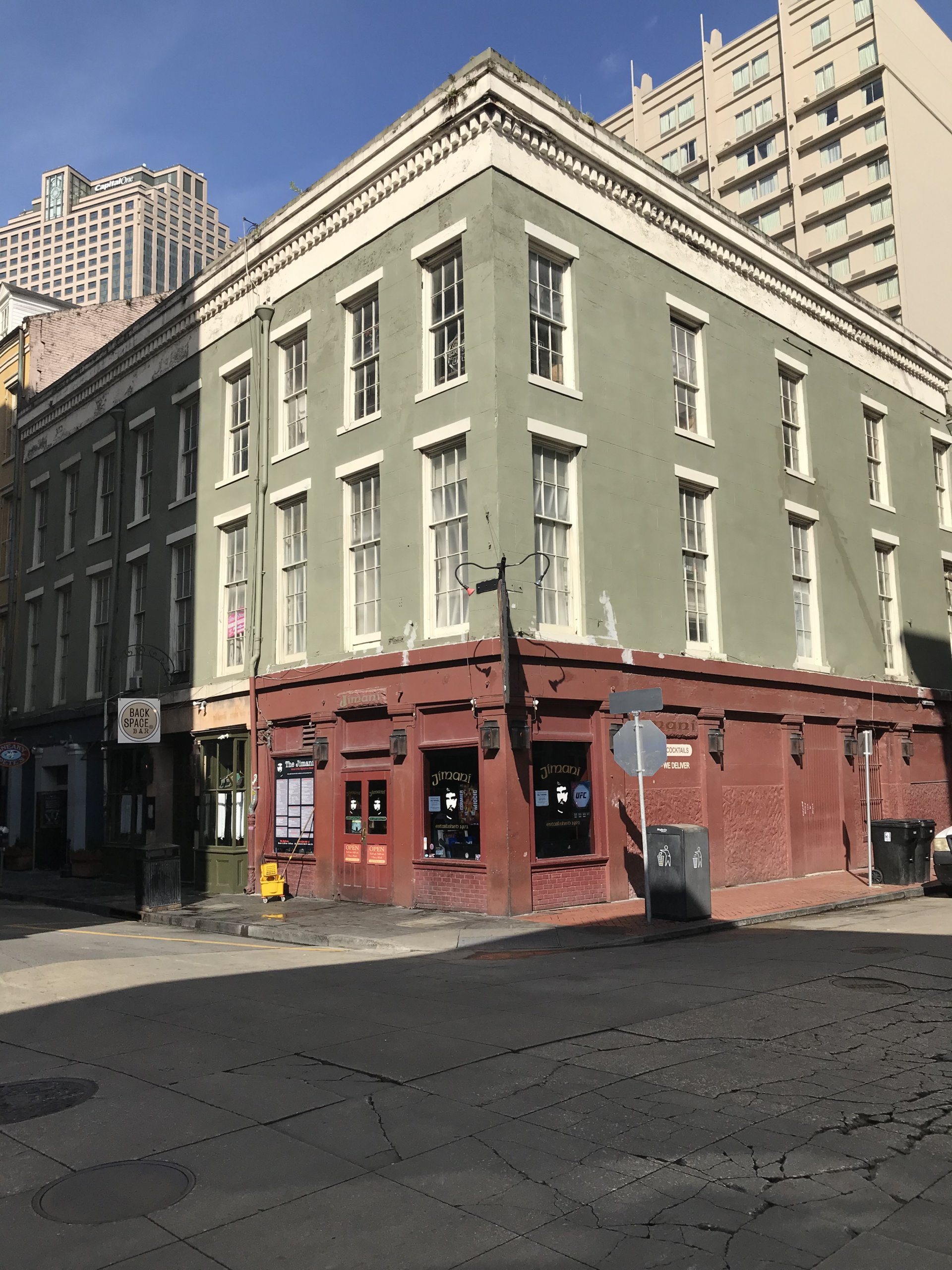
When historians consider why the Up Stairs fire did not stir pro-gay radicalization in New Orleans, Nunez's identity as a gay man frequently comes up: he was part of the LGBTQ+ patronage, not a hostile anti-gay assailant. But there are other, more systemic factors that played into the arson's erasure from public discourse and memory: mishandlings by police forensics, a foiled criminal investigation, political urgency to diminish public attention to a gay bar, homophobic misrepresentation by local media, and outright public contempt for the victims' sexuality. By August 1973, Nunez had evaded arrest by an apathetic police force. Some parents and families of victims had refused to claim the bodies of their dead sons and brothers. To this day, the bodies of four victims—three unidentified victims and one military veteran—lie in a "city-affiliated cemetery for indigents."41Fieseler, Tinderbox, 191. No protestors stormed City Hall. Few challenged the homophobic culture or city codes. The Up Stairs Lounge arson would not galvanize enduring change or create the organized, "sustained gay activism" that Stonewall's one-year anniversary had inspired nationally.42Delery-Edwards, The Up Stairs Lounge Arson, 164. The Up Stairs Lounge would not become a "Southern Stonewall."43Delery-Edwards, The Up Stairs Lounge Arson, 164.
However, the fire was not altogether ignored. For a small network of LGBTQ+ individuals aware of the Lounge through the MCC, the tragedy compelled support from beyond New Orleans. Both Delery-Edwards's and Fieseler's books document the days after the fire when nonlocal, gay activists arrived in New Orleans, including Los Angeles leaders Troy Perry (MCC founder) and Morris Kight (President of Gay Community Services Center of Los Angeles).44Fieseler, Tinderbox, 111–112. Perry, Kight, and others came to help local survivors and rouse LGBTQ+ support, but people in New Orleans, especially survivors of the fire, were largely resistant to what they perceived as outside meddling by "fairy carpetbaggers."45Delery-Edwards, The Up Stairs Lounge Arson, 63, 146–149. This name-calling queered the Reconstruction-era slur created by unreconstructed white southerners for northerners who descended upon the defeated South supposedly for personal gain.46Delery-Edwards, 63, 146–149. Closeted gay New Orleanians who survived the Up Stairs fire only to be forcibly "outed" as gay in its aftermath desired a private space to heal. The Lounge owner was especially critical of Perry and Kight, suggesting that they were a "divisive force," and that "perhaps there [was] some correlation between the amount of gay activism in other cities and the degree of police harassment."47Fieseler, Tinderbox, 228. It was clear that many of the survivors of the fire were hostile toward these "fairy carpetbaggers."
At the same time, it was the work of MCC members, the Gay Community Service Center of Los Angeles, and a wide range of LGBTQ+ activists and donors from beyond New Orleans who provided financial relief for survivors as well as families and loved ones of those who perished. In January 1974, Kight met with "concerned members of the New Orleans Community" and deployed the "National New Orleans Memorial Fund" to disperse $6,000 to support those impacted by the arson, an amount that would grow to "nearly $18,000."48Delery-Edwards, The Up Stairs Lounge Arson, 147. "[I]n some ways," writes Delery-Edwards, "the most important political activity connected to the fire wasn't local at all; it was a brief, national project intended to provide aid and support to survivors of the Up Stairs."49Delery-Edwards, The Up Stairs Lounge Arson, 146. Through their skills in fundraising and national outreach, the "fairy carpetbaggers" facilitated donations from "all over the country: New York, Boston, Philadelphia, Baltimore, Atlanta, Jacksonville, Detroit, Chicago, Houston, Phoenix, Denver, Boulder, San Jose, Los Angeles, and San Francisco."50Delery-Edwards, The Up Stairs Lounge Arson, 147.
New York, Boston, Baltimore, Atlanta, Chicago, Los Angeles, San Francisco: all of these US cities and six more have staged Max Vernon's The View UpStairs since its debut in 2017. Add to the list a 2018 production at the Hayes Theatre Company in Sydney, a 2019 run at the Soho Theatre in London, and an upcoming 2022 performance at Nippon Seinenkan Hall in Tokyo, and the impact of Vernon's musical underscores the representational power of this local New Orleans narrative for national and international audiences. The View UpStairs immerses its audience in an emotionally powerful depiction of that 1973 French Quarter blaze by engaging melodramatic modes of performance similar to the Lounge's nellydramas and drag shows. Vernon's musical adaptation makes room for relationality across generations and geographies of LGBTQ+ experience.
III: "Possibilities in the Impossible": Immersive Staging, Queer Melodrama, and Adaptation
In January 2017, friend and colleague Dr. Ryan Prechter emailed me an article previewing The View UpStairs. We were both incredulous and ecstatic: Ryan's doctoral research on the Up Stairs arson had appeared in his post-1900 history of gay New Orleans, but circa 2017, very few people in the general public had heard of the fire.51Ryan Prechter, "Gay New Orleans: A History." Googling for tickets, I saw our future. We would attend the production and try to meet the playwright: How did you learn about this occluded event in New Orleans gay history? Why tell the Up Stairs Lounge story now, after all these years? All of these events transpired, and while I was, and remain, awestruck to experience Vernon's production and professional generosity, I could not help but feel apprehensive, too. The scenario that led to the staging of The View UpStairs—whereby an Los Angeles-bred and New York City-based activist/writer imaginatively travels to New Orleans to adapt the closeted Up Stairs patrons into characters engaging a national gay rights discourse—felt eerily similar to the history of the arson's immediate aftermath. I also could not ignore that something about Vernon's production felt different from that history, unexpected.
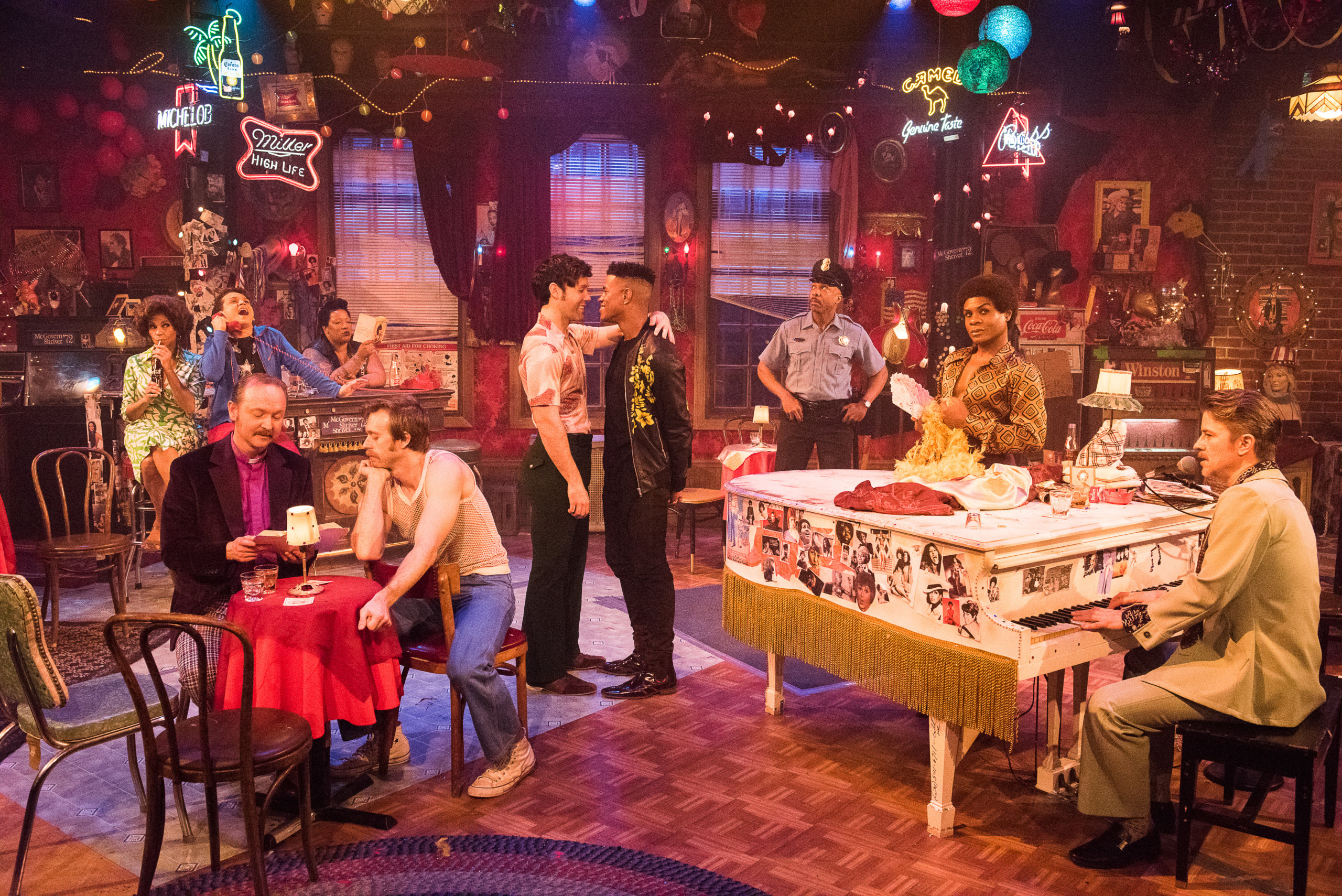
Walking into the Lynn Redgrave Theater for the 8:00 p.m. performance of The View UpStairs on Saturday, March 27, 2017, Ryan and I pass through double French doors into what looks like a dingy cabaret with a beat-up piano, retro cigarette dispensers, dank velvet curtains, a dildo chandelier, and rafters strung with Mardi Gras beads.52The View UpStairs, written and composed by Max Vernon, dir. Scott Ebersold, chor. Al Blackstone, performed by Jeremy Pope, Taylor Frey, Frenchie Davis, Benjamin Howes, Michael Longoria, Ben Mayne, Randy Red, Nancy Ticotin, Richard E. Waits, and Nathan Lee Graham, New York, Lynn Redgrave Theater, March 25, 2017. Surrounding the cabaret seems to be a compact auditorium with riser seating on three sides. We enter, not into the lobby but, onto the stage, a disarming immersive design with dainty two-top tables and chairs. Some audience members are finding their reserved seats on the set. Ryan and I purchase drinks from the staged and operational Up Stairs bar and find our seats in the front row of the risers. We play Where's Waldo with the queer iconography around the room. Posters of Dolly Parton, Barbara Streisand, and David Bowie cover the walls. A nude Burt Reynolds lounges above velvet curtains. Ryan explains that in a well-known photograph of Up Stairs Lounge's bartender-manager, the same poster adorned the bar wall in 1973.53Delery-Edwards, The Up Stairs Lounge Arson, 20. Our game continues until an attractive blonde man in a mesh shirt and retro-coiffed moustache slides next to my colleague and starts chatting him up: "I've never seen you here before. Are you new?" When the play begins, we recognize him as the Dale character (Ben Mayne)—a nod to the historic arson suspect Roger Dale Nunez.
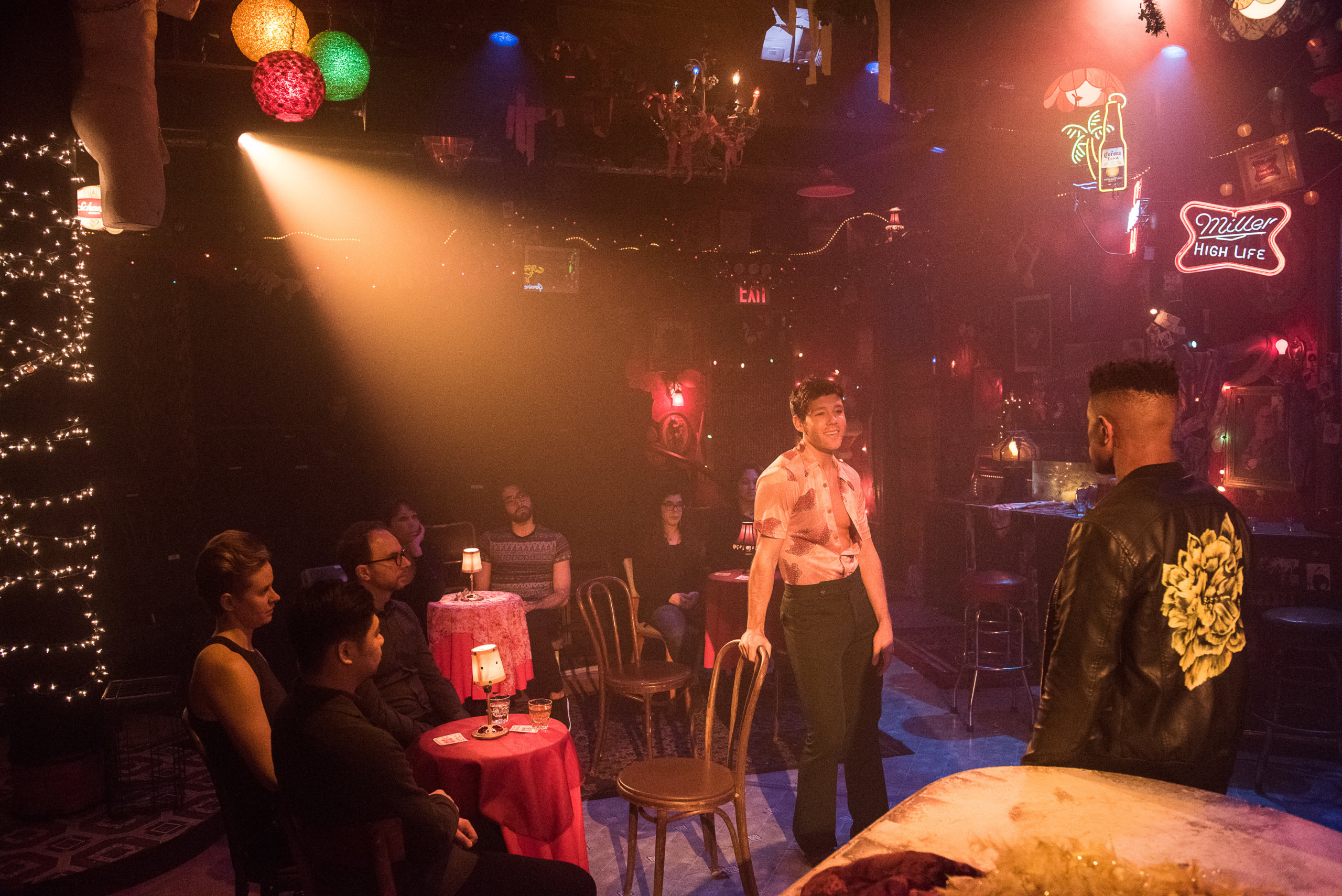
This intimate dissolution of the fourth wall pulls the audience into a participatory experience that clearly embodies Josephine Machon's definition of "immersive theatre," as The View's production creates a conspicuous confluence of space and time disrupting passive reception, and compelling the audience to actively engage with our bizarre surroundings in a room that is simultaneously 1973 and 2017, stage and audience, New Orleans and New York.54Josephine Machon, Immersive Theatres: Intimacy and Immediacy in Contemporary Performance (New York: Palgrave Macmillan, 2013); See especially "The Scale of Immersivity," 93–102. Vernon explains in their author's notes that the musical "was originally performed in an intimate, immersive setting, casting the audience as patrons in the bar when they walked into the theater. This allowed for actors to ad-lib with audiences in a way that was often hilarious, and also made the fire sequence more immediate and terrifying."55Vernon, The View UpStairs, 7. The act of casting audience members underscores "a pivotal criterion" of Machon's immersive theatre: "Where an event is wholly immersive the audience-immersant is always fundamentally complicit within the concept, content and form of the work. As a consequence, . . . the naming of 'the audience' as such becomes a vexed term in itself . . . the special and active exchange that occurs between the performance and the audience member[] illustrat[es] the breakdown of division between audience and creative crew."56Machon, Immersive Theatres, 98. The orientation of the audience's entrance onto the stage inaugurates their entry into a "contract for participation" in the audience-immersant role, whereby "the structures of the immersive world . . . invite varying levels of agency and participation."57Machon, Immersive Theatres, 99–100. The View's immersive staging compels the audience to assume a participatory role that recalls the The Up Stairs Players' highly-interactive nellydramas.
Vernon's immersive, interactive staging and the emotional intimacy it facilitates between audience-patrons and cast-patrons further reimagines the melodramatic genre of the original Up Stairs nellydramas. However, I interpret The View's use of melodrama not as genre but as mode in Linda Williams's definition; the "melodramatic mode" in theater is "a modality of narrative with a high quotient of pathos and action" deployed to render a moral conclusion.58Linda Williams, "Melodrama Revised," in Refiguring American Film Genres: History and Theory, ed. Nick Browne (Berkeley: University of California Press, 1998), 51. This modality manifests in The View's immersive production and is compatible with Vernon's explicit script instructions that actors should perform their characters in controlled realism, eschewing hyperbolic "melodrama" in the colloquial sense.59Vernon cautions, "While it's important to carve out true emotional beats for the characters, never let the piece veer into melodrama." Vernon, The View UpStairs, 6. Realistic performance by cast-patrons staged in immersive proximity and engaged with audience-patrons produces affective attachment through the immediacy of narrative action, and Vernon most certainly leverages this mode to foster a moral conclusion, as I examine below. As the 1973 cast-patrons assemble on stage, piano man Buddy (Randy Redd) launches into the catchy opening number, and the band "rock[s] the f*ck out."60Vernon, The View UpStairs, 9–11. The lights drop, and enters the protagonist Wes (Jeremy Pope), a gay Black millennial fashion designer. In the present day, he buys the burnt-out former Up Stairs Lounge to launch the "flagship for [his] store."61The View UpStairs, 73; At the time of this publication, the former Up Stairs Lounge now houses office space and the kitchen for The Jimani sports bar.Lamenting the building's condition, especially the "ugly curtain" draped across the blackened windows, Wes "snorts . . . cocaine," inaugurating his drug-induced "trip" back to June 24, 1973.
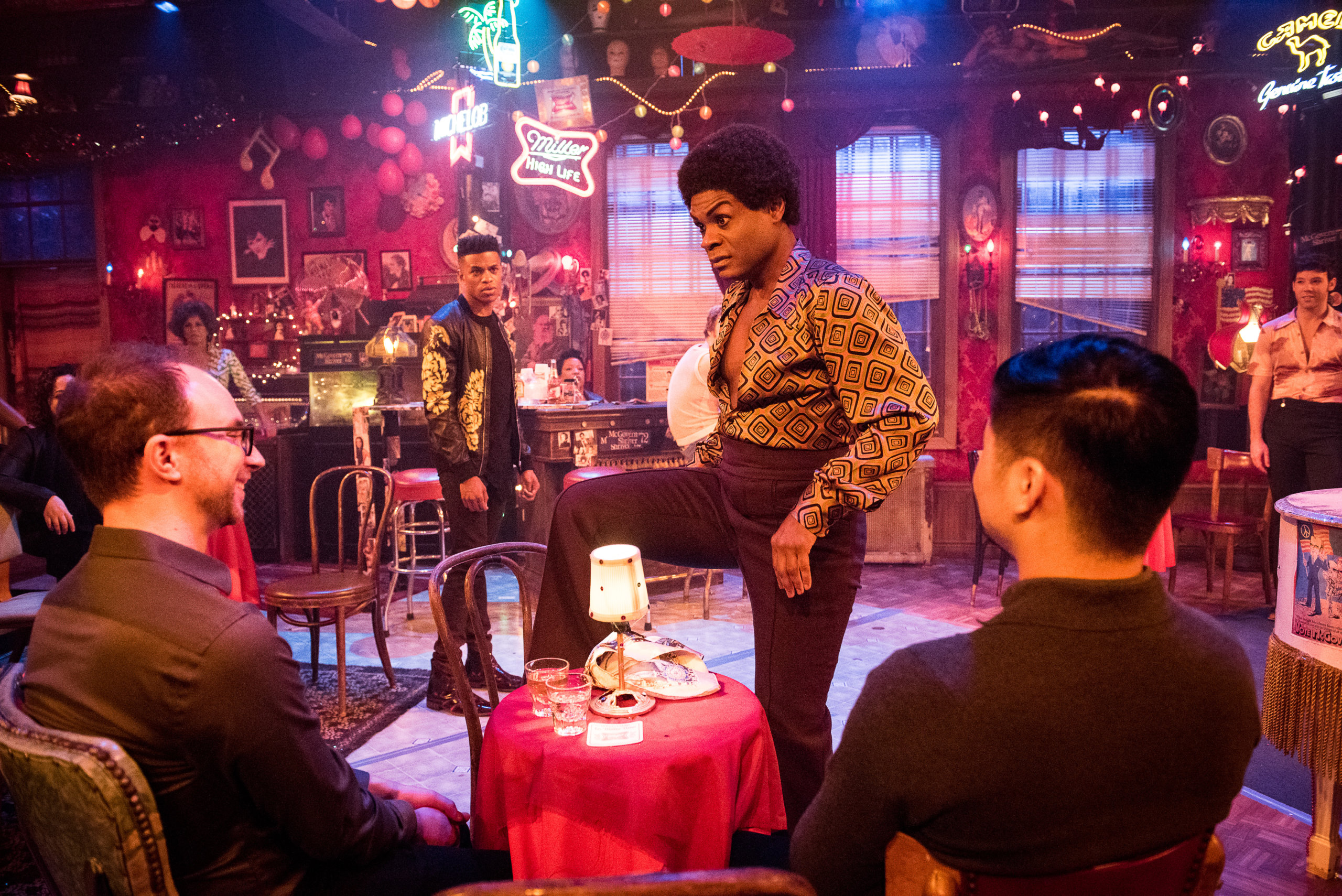
Wes's future-past presence disrupts the Up Stairs patrons, and the ensuing commotion introduces Vernon's composite characters. The bartender-manager Henri (Frenchie Davis) slings drinks while Willie, played by the indomitable Nathan Lee Graham, struts around the bar stealing the stage, as a "flaming, demented former ballerina" is wont to do.62Vernon, The View UpStairs, 8, 5; Vernon, interview by author. MCC priest Richard (Benjamin Howes) leads a church service attended by all of the aforementioned characters and one "runaway hustler" named Patrick (Taylor Frey) who becomes Wes's love interest.63Vernon, The View UpStairs, 5; For a rich discussion of performance theater that stages LGBT+ engagement in religious liturgy, see Lusie Cuskey, "The Liturgy that Dare Not Speak Its Name: Religious Engagement and Affective Memory as a Site of Queer Activism in Musical Theatre," Ecumenica: Performance and Religion 13, no. 1 (2020): 52–68. Vernon's characters do indeed gesture toward real patrons who were at the bar on the night of the arson, but his adaptation precludes historical reenactment. "Many of these characters are composites of real people who frequented the UpStairs," Vernon writes in their script, "but out of respect and creative license I've changed names and certain details."64Vernon, The View UpStairs, 8; Vernon, interview by author. Adaptation helped Vernon navigate the ethical precarity of depicting people who were largely closeted at the time of the fire and who risked losing everything if outed in 1973 New Orleans.65Vernon explains, "And so, I think in many ways, where they have these anti-sodomy laws in the South, and where regularly, if a gay bar was raided and they took your ID, your name could be printed in the paper, and you could lose your job. You could lose housing. I think they didn't have the same freedoms as New York to be as visible, so they had a different mode of survival of how they had to exist in these spaces like the Up Stairs Lounge." Vernon, interview by author.
Adapting composite characters in melodramatic mode also facilitates The View's stance on intersectional coalition, which nods to the historic Lounge's rare, inclusive history as one of "a few fringe establishments [that were] brazen enough to encourage interracial mingling"; the bartender-manager "even let[] women into the bar at a time when gays and lesbians were strictly separated."66Robert W. Fieseler, "The UpStairs Lounge Fire Killed 32 People. Its Legacy Still Haunts Black Gay New Orleans," The Daily Beast, May 13, 2019, https://www.thedailybeast.com/the-upstairs-lounge-fire-killed-32-people-its-legacy-still-haunts-black-gay-ne. Gay communities are hardly immune to the racism and sexism that permeates dominant society. For example, in 1973, one of the oldest operating gay bars on Bourbon Street, Café Lafitte in Exile, "had a sign on the door . . . It said 'No Blacks, No Fems, No Women.'"67Fieseler, "The UpStairs Lounge Fire Killed 32 People." However, the Up Stairs Lounge was different, and Vernon emphasizes the bar's unique inclusivity especially in their composite characters. For example, although the bartender-manager was historically a gay white man in "a gay white man's community," he "was known to be especially friendly to all comers," regardless of race or gender identity.68Regina Adams quoted in Fieseler, "The Up Stairs Lounge Fire Killed 32 People." In this spirit, Vernon composes the bartender-manager character Henri, a "[t]ough as nails, no-nonsense, old-school butch lesbian" played in the original production by Grammy-nominated Frenchie Davis, a show-stopping Black woman singer, social activist, and educator.69Vernon, The View UpStairs, 7. While casting a Black performer in Davis was unique to this production, her "old-school butch lesbian" identity is proscribed, as is Willie's Black identity and Inez's and Freddy's Puerto Rican identities (characters who enter the plot later on).70Vernon, The View UpStairs, 5. While the Lounge's inclusivity was certainly progressive for its era, one cautions against overstating the diversity of its patronage, which was still largely white men even as Black, Latino/a/x, and women patrons were welcome. The Lounge owner's initial refusal to allow drag queens into the bar, for example, demonstrates the need for a nuanced understanding of the 1970s Up Stairs Lounge as a site of complex, overlapping, and sometimes contradictory social politics.
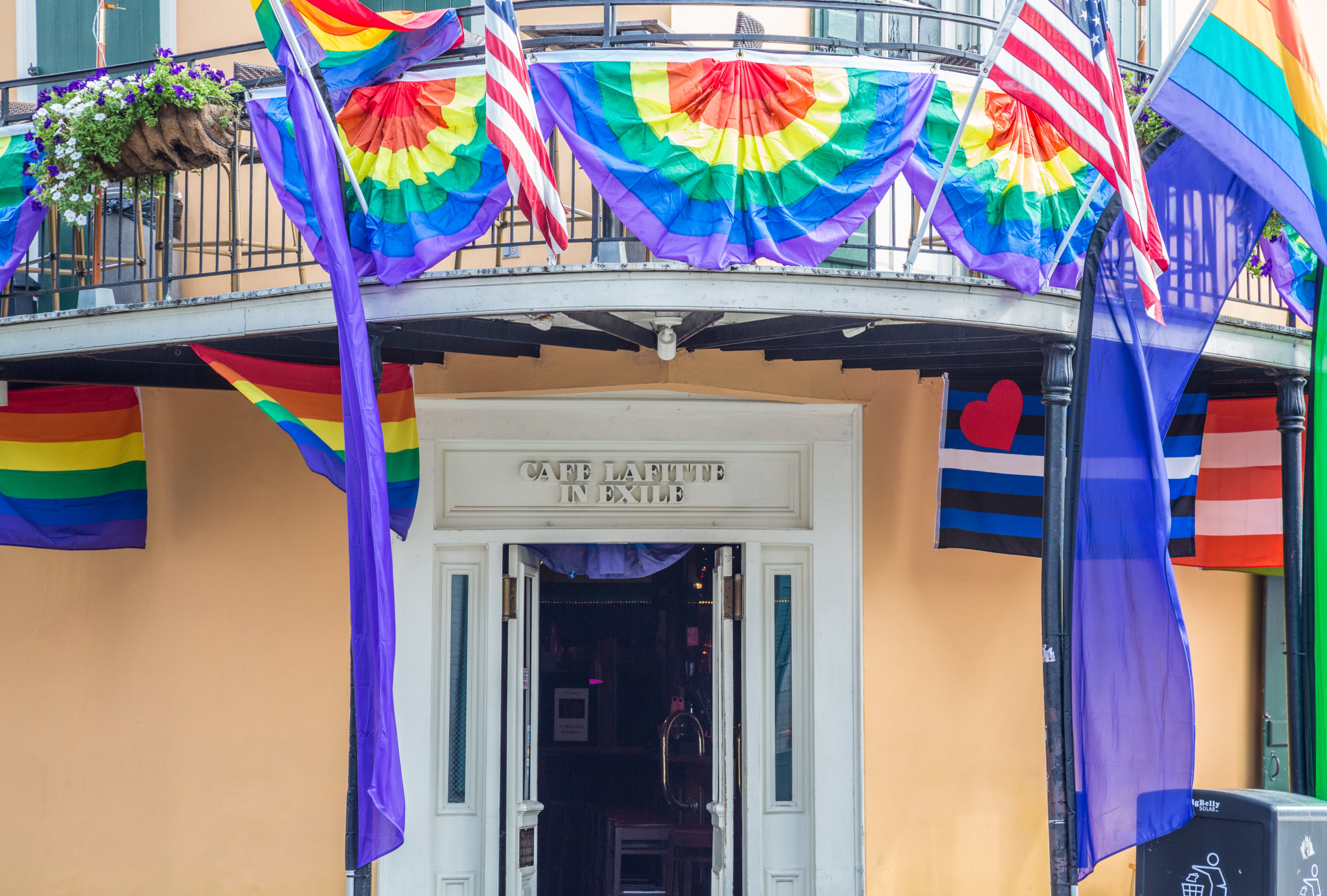
These historical complexities further contextualize Vernon's 2017 production, as they intentionally wrote and casted characters from underrepresented backgrounds to promote coalition across complex and intersecting subjectivities, even across distinctions between performer/audience. As José Esteban Muñoz explains, "performance permits the spectator, often a queer who has been locked out of the halls of representation or rendered a static character there, to imagine a world where queer lives, politics, and possibilities are representable in their complexity."71José Muñoz, Disidentifications: Queers of Color and the Performance of Politics, (Minneapolis: University of Minnesota Press, 1999), 1. He further champions that "Queer performance . . . is about transformation, about the powerful and charged transformation of the world, about the world that is born through performance."72Muñoz, Disidentifications, xiv. For the cast- and audience-patrons of The View, the world born through performance creates possibilities for futures even freer than the noteworthy yet limited atmosphere of the 1973 Lounge. Vernon expresses this cautious ethos most clearly in the lyrics of the opening number "Some Kind of Paradise." The playwright explains, "It's not just 'Paradise!' . . . no matter what the time period, the world is always going to be kind of shitty and imperfect and evolving and in-process."73Vernon, interview by author. In fostering relationships across so many "evolving" and overlapping identities, generations, and performance subjectivities, Vernon challenges cast-patrons and audience-patrons together as actor-agents called to realize a more equitable future that was once im/possible in history and has evolved to remain differently im/possible in the present.
The View recasts the subjectivities of and relationships between the 1973 Lounge patrons and contemporary cast- and audience-patrons. Confronting the limits of these impossibilities through melodramatic mode and immersive theatre facilitates new possibilities. "The formal use of melodrama," Goldberg explains, "brings to a point of crisis the ideologies of gender and sexuality."74Goldberg, Melodrama, 21. Escalating these "ideologies" to their dramatic limits, the intense pathos can foster transformation by "imitat[ing] ways past the impasses of the impossible gender/political situation; it discovers new possibilities of relationality": "The indeterminations of the remediated nature of melodrama allow for the possibilities in the impossible."75Goldberg, Melodrama, 156. Indeed, Vernon's goal in writing and composing The View was to "imitate a way past the impasses" that have foreclosed millennial LGBTQ+ access to the experience and wisdom of generations before them, as manifest in The View through Wes's impossible social and romantic intimacy with a pre-AIDS generation of doomed queer characters.
IV. Exposed Seams: Constructing Identity in Performance
The View's plot centers on Wes's character development as he gets to know each of the cast-patrons before his trip back in time ends at 7:53 p.m., one moment before the fire overtakes the bar: the fire never enters the stage, the tragedy never reenacted. In this way, the narrative emphasizes the interpersonal connections across generations rather than spectacularizing trauma. We learn that, characteristic of millennial stereotypes, Wes struggles with anxiety and disillusionment fostered by obsessive relationships to "little white pills," social media, reality television, and fashion labels.76Vernon, The View UpStairs, 58. Spending time with the baby boomer patrons, he learns to appreciate face-to-face human engagement unmitigated by Instagram, even falling in love with Patrick without Grindr or Tinder or texting. Meanwhile, Wes learns how the patrons struggle to survive, rendering visible the ways in which much of 1970s LGBTQ+ life was encumbered by violences that still threaten in the twenty-first century: conversion therapy (Patrick's song "Waltz"), homelessness (Dale's song "Better than Silence"), and immigration (Inez's song "The Most Important Thing"). The exposition builds with these personal encounters until, suddenly, police sirens blare. The bar's beloved Puerto Rican drag queen Freddy/Aurora Whorealis (Michael Longoria) staggers in with his mother Inez (Nancy Ticotin), bloody and beaten. The Cop (Richard E. Waits) barges in, harasses patrons, demands identification, and threatens violence until the patrons pay him off.77Vernon, The View UpStairs, 39–42. The violence began on the street; when the Cop assaulted Freddy and Inez, a suitcase carrying his drag costume fell open. They escape arrest for violating the New Orleans cross-dressing ban, but the drag wardrobe is lost. Freddy laments, "What am I going to wear?"78Vernon, The View UpStairs, 49. Enter Wes—a fashion designer.
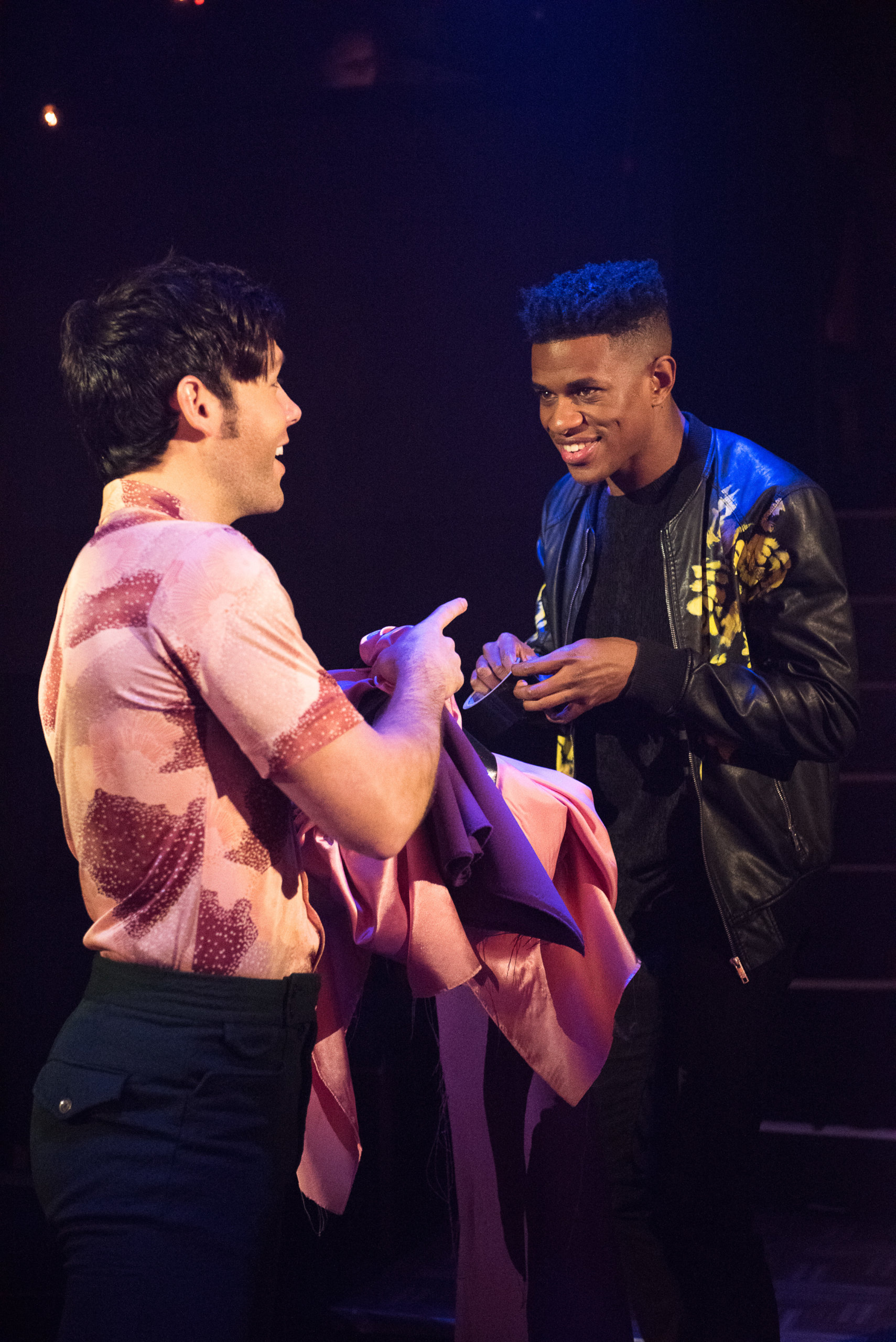
The ensuing scene builds to the musical's narrative climax as the characters facilitate Aurora Whorealis's drag performance. Channeling Scarlett O'Hara in the iconic green curtain dress scene from Gone with the Wind, Wes rips down the drapes wilting across the bar windows and seizes a roll of duct tape. In a flash, the entire Lounge mobilizes to help Freddy become Aurora. Again, the immersive staging engages the audience in the excitement and chaos of the moment. Freddy and Inez run stage right into the audience risers where they style Aurora's hair and makeup just two feet from the nearest audience-patron. Stage left and up the risers, Wes and Patrick immerse themselves near the last row to construct Aurora's wardrobe. Audience-patrons twist in their seats, craning their necks to follow the action. The spatial arrangement builds awkwardness and delight in our unexpected eye contact with other audience-patrons—an embodied moment of chaotic pathos that coincides with the character-patrons' experiences.79Mélissa Bertrand, "Performative Theatre: A Queer Theatre?" Whatever 3 (2020): 229. This staging evinces Mélissa Bertrand's concept of "trans-theatre," which I develop more thoroughly later in this essay. Here, Bertrand's emphasis on the body in queer performance implicates not just the performer, but the audience: "the body is given a major role . . . For the audience, it also implies to question the way we position ourselves as viewers of the show. The power of the gaze must be redefined, and queer sequences of theater can help rethink it." The triumphant progression to Aurora Whorealis's drag performance builds as the cast sings "Completely Overdone." Wes shrieks in delights at his frock: "It's like Count Dracula and Miss Whoopi Goldberg in Sister Act having a kiki in outer space!"80Vernon, The View UpStairs, 52.
The staged construction of Aurora Whorealis's overdone look recalls Bryant Alexander's critical affection for the exposed seams of so-called "bad" drag: "Sometimes I like seeing the seams . . . it is the seams that seemingly call my attention to the constructedness of the venture."81Alexander, "Querying Queer Theory Again," 351. He suggests that visible drag "seams" offer a metaphor for resisting a dangerous homogenizing trend that emerged in the early 2000s, one that deployed "queer" as an "inclusive signifier" to unify all manifestations of LGBTQ+ subjectivity.82Alexander, "Querying Queer Theory Again," 349. Alexander warns that "queer" discourses gloss over difference and risk silencing "any discussion that links perception, practice, performance and the politics of sexual identity to race, ethnicity, culture, time, place and the discourses produced within these disparate locations."83Alexander, "Querying Queer Theory Again," 349–50. The View's on-stage construction of Aurora Whorealis's drag look refuses such homogenizing erasure by drawing attention to the character's particularity as Puerto Rican, gay, man, son, and drag queen in pre-radicalized 1973 New Orleans. Revealing the multiple facets of Freddy/Aurora highlights not only individual particularity but also shared experience, as homophobic police brutality keenly resonates with a 2017 pro-LGBTQ+ audience in New York City sitting less than a mile from the Stonewall Inn. Freddy, a Spanish-speaking son of a Puerto Rican immigrant, complicates the Black/white dichotomy that has long falsely characterized the multiethnic, multinational US South. Aurora Whorealis, a blonde drag star with a communally constructed look, rejects singular constructs of identity as she "werks" a wardrobe manufactured from manifold referents across time, place, and subjectivity.
Aurora's multilayered frock in the original production (designed and created by Anita Yavich) evokes generations of pop culture and fashion icons that would have been impossible to assemble in 1973. Evoking Scarlett's curtain dress in/as drag, The View alludes to the season two premiere of RuPaul's Drag Race, "Gone with the Window," wherein contestants create a look from a set of window coverings and compete in drag performance.84"Gone with the Window." RuPaul's Drag Race, season 2, episode 1, "Gone with the Window," produced and hosted by RuPaul, aired February 1, 2010, on Logo. Wes exclaims, "I love this! I feel like I'm on Project Runway," further highlighting the precursor series that influenced RuPaul.85Vernon, The View UpStairs, 50. The curtains are crafted into a "nun's habit" that Aurora wears as she takes the stage to sing "Sex on Legs."86Vernon, The View UpStairs, 66. After the first chorus, she throws off the habit to reveal a frock clearly reminiscent of Madonna's "Vogue" looks, merging the superstar's 1990 music video and subsequent MTV Video Music Awards performance. But Wes's version of the dress uses "knick-knacks taken from the bar": the iconic cone bra fashioned in duct tape (music video), seventeenth-century panniers out of red solo cups (VMAs).87Vernon, The View UpStairs, 67. Though the costume begins with Scarlett's South, the underdress moves to New York City and reclaims "voguing" as an invention of Black and Latina/x queens of ball drag culture in the 1960s–1980s.
Aurora further strips off her panniers and climbs atop the grand piano for the song's climax; her cones explode into party hats with clown heads as confetti shoots out toward the audience. As the song winds down, Aurora relinquishes the clown bra for a final version made from Mardi Gras beads in concentric circles of purple, green, and gold. What stable category of gender identity lies beneath Aurora's cone bra? Clown heads and confetti. Mardi Gras gender play. Absurd constructed spectacle. Vernon's production asserts that a search for one singular, glossing identity misses the point; gender identity is always performative, always performance, indeed is constituted through the performance.88The performativity of Aurora Whorealis's manifold, evolving identifications might also be read through Bertrand: "At the crossroads between the notions of an actor•tress carrying a character's fictional identity through its own body, and that of a performer assuming their personal history and using it as a creative material, a new dynamic emerges, a more dialectical and complex positioning. In shows integrating queer themes, physical identity is located on a breach, on a border. This type of event includes what I would call 'bodies in trans-' or a 'theatre in trans-'." This is understood through the multiple terms that the prefix suggests, "'trance (transe in French), transition, transformation, transidentity, transgression, transfer…" Bertrand, "Performative Theatre," 215, (ellipses original). Exposing the seams of Aurora's constructed look and salvaging icons from disparate histories leverages drag performance as activism that simultaneously constitutes selfhood. Aurora's drag show reclaims these shared histories for the historic Up Stairs patrons and the cast- and audience-patrons participating in her reclamation in the present day.
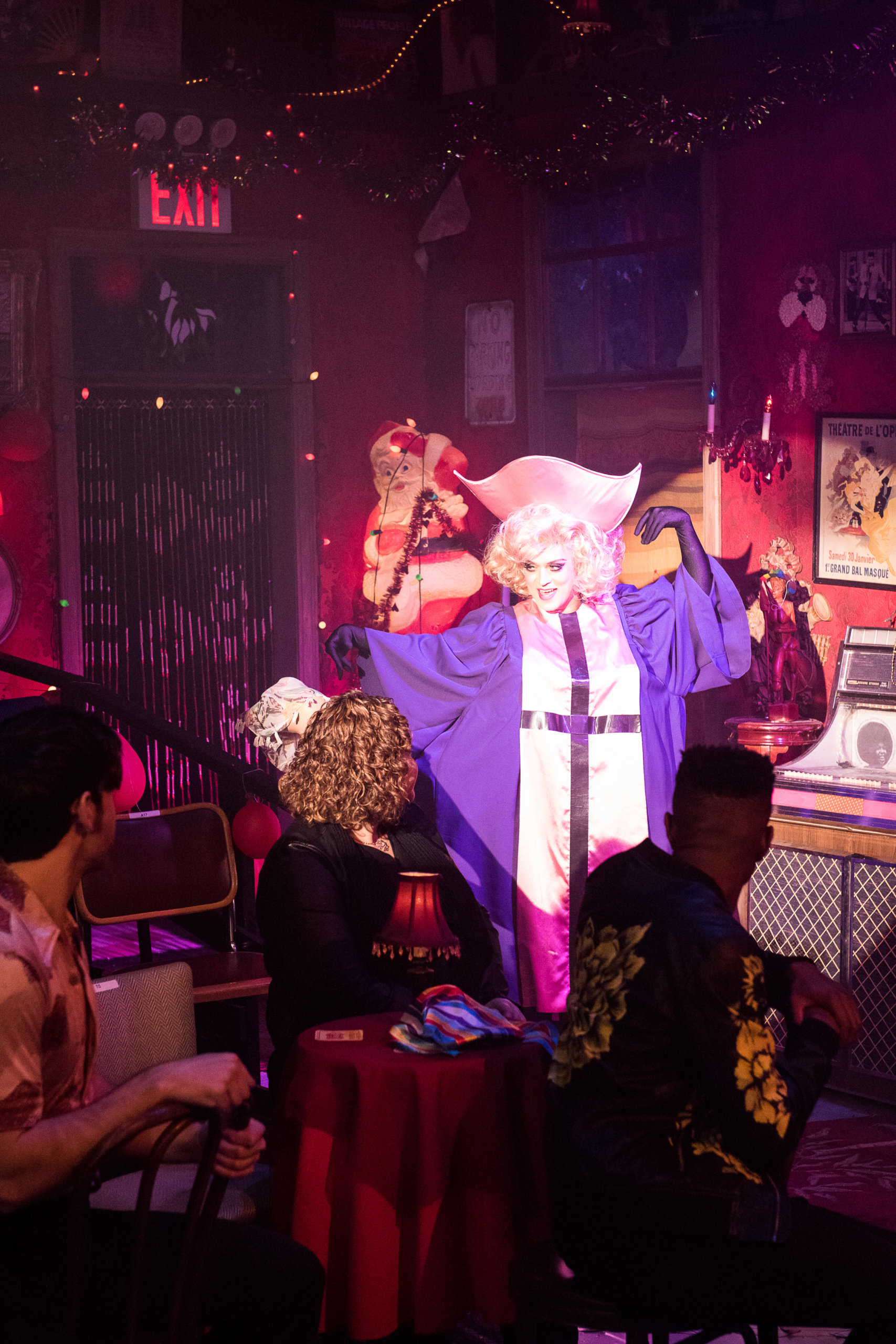
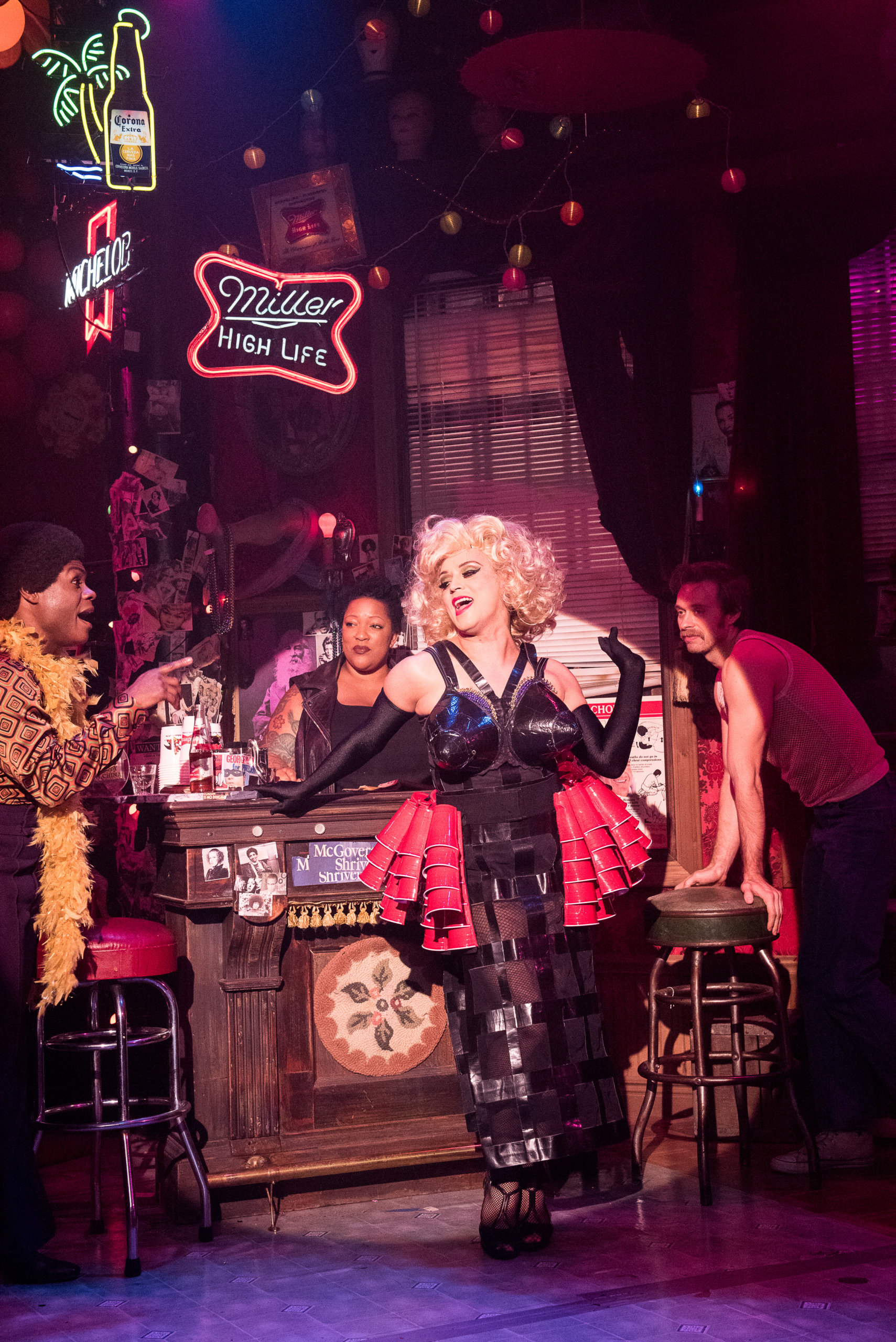
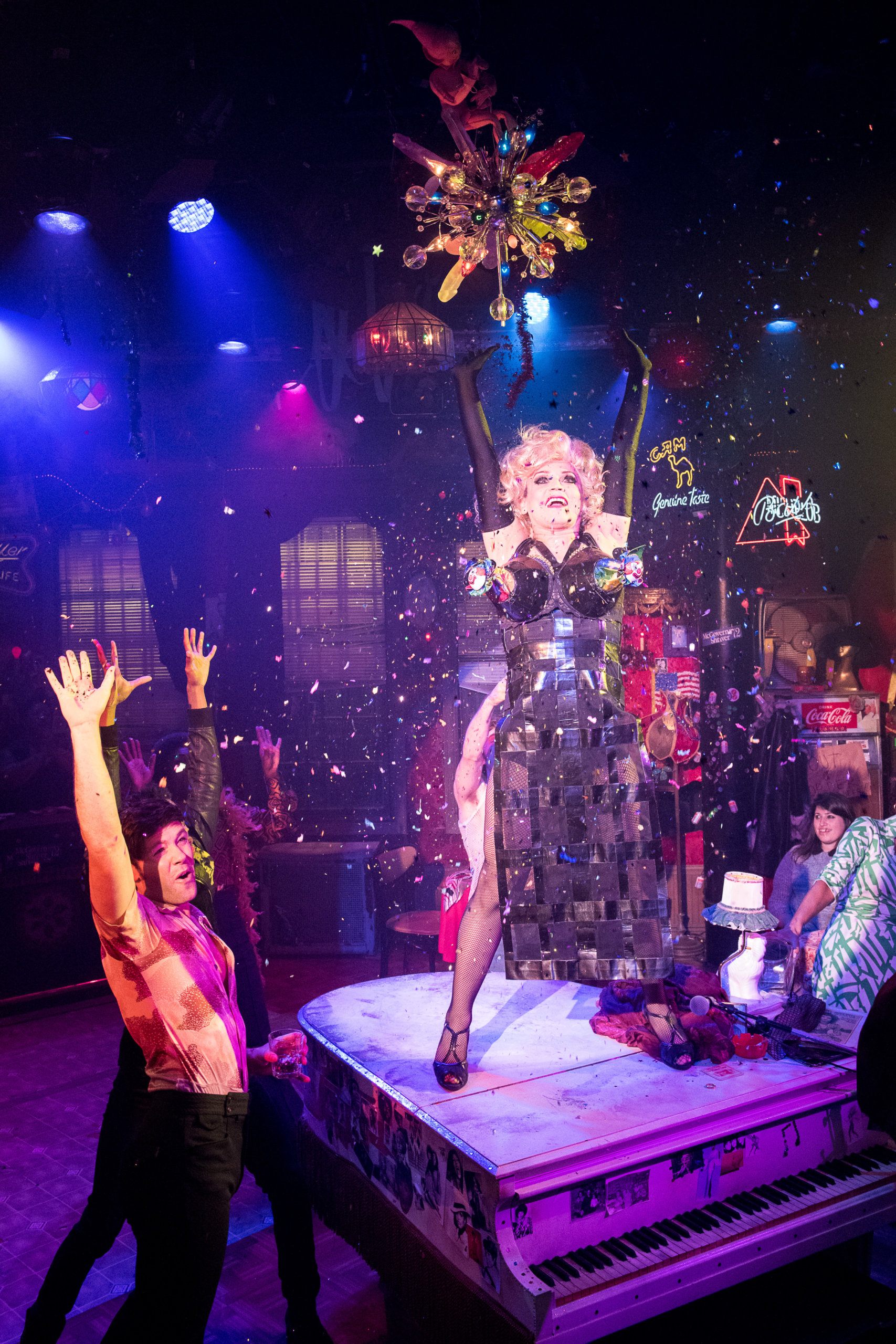
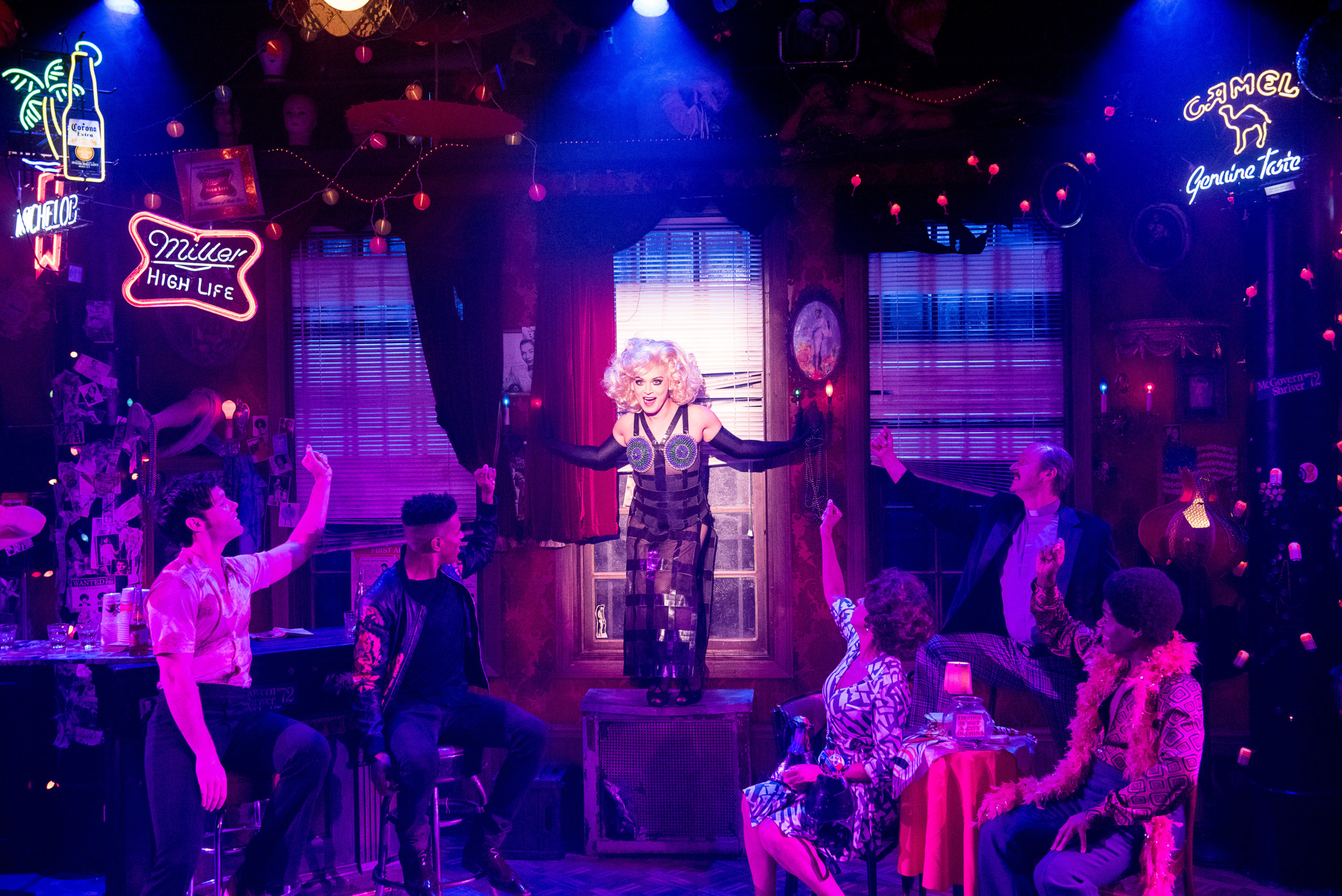
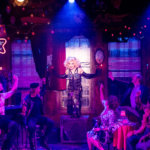
In constructing Aurora's costume, Wes self-actualizes, too. He creates and manifests the fashion designer facet of his identity: "I forgot how good it feels to actually create . . . This cheap roll of duct tape is giving me life!"89Vernon, The View UpStairs, 53. The act of creation returns to Wes a sense of self, underscoring Katie R. Horowitz's important intervention in gender performativity theory that drag is not merely discursive but constitutive of identity.90Katie R. Horowitz, "The Trouble with 'Queerness': Drag and the Making of Two Cultures," Signs: Journal of Women in Culture and Society 38, no. 2 (2013): 303–326. "[D]rag [is] in fact productive of the identity that [many gender scholars] claim it merely expresses," Horowitz explains, "drag does far more identity work than an argument premised on the distinction between stage performance and the performance of everyday life can convey."91Katie R. Horowitz, "The Trouble with 'Queerness,'" 311. She cites her field research at an LGBTQ+ bar in Cleveland, Ohio, where many of the drag kings and queens expressed that they feel their "drag self is in many ways more real than [their] real (i.e., offstage) self."92Katie R. Horowitz, "The Trouble with 'Queerness,'" 312. This inextricability of staged versus "offstage" identity resonates in Mélissa Bertrand's 2020 concept of "trans-theatre," which extends Josette Féral's "performative theatre" to the role of the body in queer performance. For Bertrand, a trans-theatre "go[es] beyond the dualisms that oppose, among other things, theatricality and performativity, the fictional identity of the character and the physical identity of the performer."93Bertrand, "Performative Theatre," 216. Undermining the distinction between what is "real (i.e., offstage)" and what is performed on stage, both Bertrand's and Horowitz's frameworks explicate why Wes is so enlivened by the staged act of creation; the act (i.e., action and performance) both manifests his character development and moves the plot forward.
V. "We all want the same thing": LGBTQ+ Genealogy, Futurity, Coalition
Importantly, Wes's self-constituting act also necessarily reclaims racial histories of enslavement evoked by the Gone with the Wind allusion, mirroring Aurora's reclamation of voguing. In Margaret Mitchell's scene, also depicted in the 1940 film, Scarlett commands Mammy to make her a costume from "moss-green velvet curtains" to perform southern belle planter-class drag so she can seduce "three hundred dollars" from Rhett Butler.94Margaret Mitchell, Gone with the Wind, 50th Anniversary Commemorative Edition (New York: Avon Books, 1986), 535, 513; Sam Killerman, "Vocabulary Extravaganza," The Safe Zone Project, accessed February 3, 2019, https://thesafezoneproject.com/activities/vocab-extravaganza/; My use of "drag" to characterize Scarlett's performance in the green velvet dress is intentional. As Killermann defines, the term "drag queen" indicates "someone who performs femininity theatrically." Scarlett's embodiment, before donning Mammy's green dress, is marked by hard labor, starvation, and poverty, all which manifest on her body: "breasts . . . so small," a "scrawny neck and hungry cat eyes and raggedy dress" (Mitchell, 534 and 525). In order to seduce Rhett into giving her the money, she must perform a specific form of femininity, the carefree southern belle who is so "bored" from a life of leisure that she decided "to take a trip and have a good time" (Mitchell, 565). This is, of course, a complete lie, and she must conceal the truth by suppressing her fury at him, feigning tears, and hiding her eyes when she feels she has triumphantly hooked him (Mitchell, 564–571). When Rhett discovers the deception, he says, "You wanted something from me and you wanted it badly enough to put on quite a show" (Mitchell, 570). In the same way that drag queens perform a wide range of femininity across race, class, age, and culture, so too does Scarlett perform drag southern belle. Vernon's queer adaptation rewrites the racial logic of labor inherent in Mammy's formerly enslaved status; Wes seizes the challenge of garment creation with agency and self-determination. The inverse of racial obedience to white supremacy, Wes demonstrates his generative power to constitute meaning out of salvaged refuse, a clear metaphor for the reclamation and adaptation of violent, erased histories. As his lover Patrick affirms, "You just made a dress out of nothing."95Vernon, The View UpStairs, 47. The plot's climax in the drag show figures a key moment of Wes's character development; he realizes his own creative power, demonstrating how artistic production can galvanize queer (and) Black agency by reclaiming histories and historic icons as tools of affective change in the present. In creative work, Wes constitutes his identity from a traumatic history, demonstrating agency over his own future. As Patrick and Wes affirm in their lover's duet, "It's our story and the ending's ours to write."96Vernon, The View UpStairs, 82.
Patrick and Wes's ethic mirrors the playwright's own. Perhaps the most important feature of The View's constitutive performance was Vernon's own goal in composing the musical. Vernon explains in our interview that writing The View was motivated by a need for mentorship from a lost LGBTQ+ generation, not only the Up Stairs victims but all who perished in the 1980s AIDS epidemic:
It was about wanting to understand my own history. Growing up I didn't have any queer mentors to help me figure out how to exist in this world. And, you could say maybe that's because of the AIDS epidemic: a link in the chain of mentorship might have been broken. I wanted to go back to the seventies to exist in a pre-AIDS world to kind of understand my lineage as an LGBTQ person and understand where I came from and if that could, at all, help me figure out how to navigate this time period that we're in [today in 2017], which is very fraught and bizarre.97Vernon, interview by author.
For Vernon, composing The View fostered new relationship possibilities across impossible limits of time and space—as well as the ontological divide separating the living and the dead—which helped to constitute their "own history" and queer identity.98Taraneh, "Pop-Culturalist Chats with Max Vernon," Pop-Culturalist, September 18, 2018, http://pop-culturalist.com/pop-culturalist-chats-with-max-vernon/?fbclid=IwAR2EbOmNg5fbr_MtK_sVsnrKuIWRH0_kSHncmNtBrhnxCw4_K6botNev9Dc. By reaching back into history through performance, their creative work taps into a very personal longing and loss.
On World AIDS Day 2018, Vernon posted a public Facebook memorial honoring their uncle who, if not for AIDS, might have been an LGBTQ+ mentor:
I do not know a whole lot about my uncle Robert, the only other queer person from my family history . . . He became addicted to Heroin- not sure if it was the needles or gay sex that caused him to seroconvert, but he became HIV positive and most of my memories of him growing up involve visiting him in hospitals.
Towards the end of his life I know he cleaned up, worked as a janitor, and had a solid community of friends around him in Minneapolis. My uncle Robert died of aids when I was around 10 years old. He left me a package of rainbow socks bc I think in the back of his mind he knew I was also queer. At this point I only have one pair left- the green socks, and they're full of holes. I can't bring myself to throw them out though... Anyway that's my #worldaidsday story. With Prep, etc it's a different era today (at least in this country) but I mourn the collective loss for our community, and I hope my many friends who are + know how much I love and appreciate them.
99Max Vernon, "I do not know," Facebook, December 1, 2018, https://www.facebook.com/MaxVernonMusic/posts/101.


The absence of knowledge about their uncle Robert's life compounds Vernon's grief over his death and orients their relationship to a queer genealogy through the AIDS epidemic. Vernon begins with the pain of not knowing, and they conclude with a metaphor of incompleteness in the gifted "green socks . . . full of holes." Their need for connection underscores a lost intergenerational relationship with "the only other queer person in [their] family history." Denied inheritance of familial queer genealogy, Vernon created The View UpStairs, imitating a mentorship with their uncle's generation that works around the impossibility of time, space, and death.
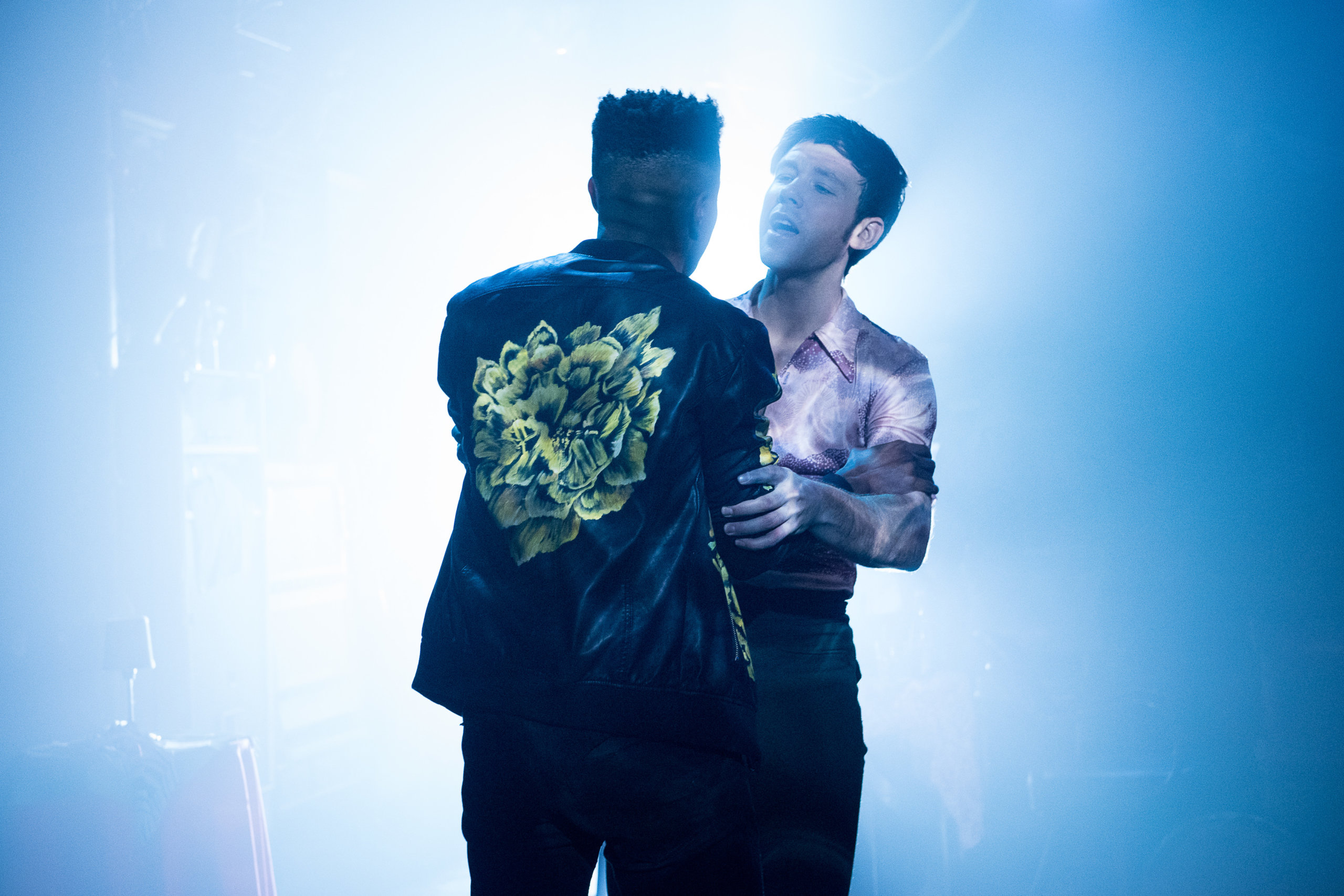
Likewise, The View brings its cast- and audience-patrons into new modes of relationality with imagined subjectivities of LGBTQ+ people who lived pre-AIDS and were abandoned by their nation in the epidemic. It compels the audience to collectively face the epidemic's "impossible gender/political situation," to use Goldberg's phrase, of a pre-radicalized LGBTQ+ New Orleans alongside the enduring legacy of the Reagan administration's institutional abandonment (1981–1989)—a legacy that would doom the 1973 patrons' future and continue to shape the present for the 2017 cast- and audience-patrons.100During Reagan's two-term presidency, nearly 253,000 new cases were diagnosed, and 230,000 or 91% of those diagnosed died as a result of the disease between 1981 and 1992, "HIV and AIDS---United States, 1981--2000," Morbid and Mortality Weekly Report 50, no. 21 (Atlanta, GA: Center for Disease Control and Prevention, June 1, 2001): 430–434.. https://www.cdc.gov/mmwr/preview/mmwrhtml/mm5021a2.htm. Wes explores this generational tension in "The Future Is Great," which voices queer millennial reflection to subvert belief in the teleological progression of LGBTQ+ rights. Talking to the 1973 patrons, Wes sings, "But I guess you're also lucky / living in the seventies. / There's no need for wearing condoms / you can slut it up guilt-free. / Nowadays we have fancy drugs / to help us all forget… / how the eighties came killed all your friends / you just don't know it yet."101Vernon, The View UpStairs, 58. Wes's simultaneous envy and fear for the Up Stairs generation demonstrates how LGBTQ+ millennials would come to experience HIV/AIDS under vastly less deadly conditions, many through secondhand history (e.g, "With Prep, etc. it's a different era today"). Having lost their uncle to that epidemic, Vernon, a millennial themself, feels the loss keenly and craves historical wisdom to constitute their own selfhood amid another hostile, anti-gay, transphobic, and racist recent presidential administration.
Throughout the musical, dialogue alludes to then recently inaugurated Donald Trump until the post-fire denouement when The View's contemporary intervention reaches fever pitch. Wes grieves the Lounge victims and traces its legacy through Pulse and the 2016 election. "This shit isn't better!" he shouts, "They're killing us. Fifty people just died in Orlando . . . Look at who's running this country! . . . OUR VICE PRESIDENT BELIEVES IN CONVERSION THERAPY!"102Vernon, The View UpStairs, 92. Jeremy Pope's performance of Wes's climactic line is desperate and immediate; he manifests the very real fear that the cast- and audience-patrons feel intimately as we anticipated the first of what would be many racist, nationalist, and anti-LGBTQ+ policies that the Trump/Pence administration would eventually enact.103The first directly anti-LGBTQ policy was announced that following July in 2017, when Trump tweet-announced the so-called "Trans Ban" in the US military that "the Administration began implementing . . . on April 12, 2019." "Transgender Military Service," Human Rights Campaign, last modified October 1, 2019, https://www.hrc.org/resources/transgender-military-service. In the immediacy of Wes's terror, the audience is brought to crisis and shared experience with the 1973 patrons. Wes reminds us that "this shit isn't better," a wake-up call against declining vigilance in a post-Obergefell political moment, and perhaps also a rebuke of guaranteed future betterment idealized in Dan Savage and Terry Miller's It Gets Better Project.104The home page of the It Gets Better Project reads, "The It Gets Better Project inspires people across the globe to share their stories and remind the next generation of LGBTQ+ youth that hope is out there, and it will get better" (emphasis mine); It Gets Better Project, accessed June 25, 2020, https://itgetsbetter.org. In either or both contexts, historic-, cast-, and audience-patrons are experientially united, haunted by dangerous futures. We are compelled to recognize how we constitute an intersectional collective despite the (im)possibilities of time, space, and subjectivity by confronting a national genealogy of hostile anti-LGBTQ+ policy tracing back from Trump, through Clinton, Reagan, Eisenhower, and beyond.105The homophobic policies of Trump and Reagan are outlined above. Importantly, anti-LGBTQ+ policy has been enacted by conservative and liberal administrations; President Bill Clinton instituted the discriminatory "Don't Ask, Don't Tell" military policy in 1993 forcibly closeting LGBTQ+ service people and signed the Defense of Marriage Act into law in 1996, prohibiting federal recognition of gay marriage. Eisenhower famously authorized the McCarthy-era Lavender Scare that terrorized homosexual Americans under anti-communist pretenses.
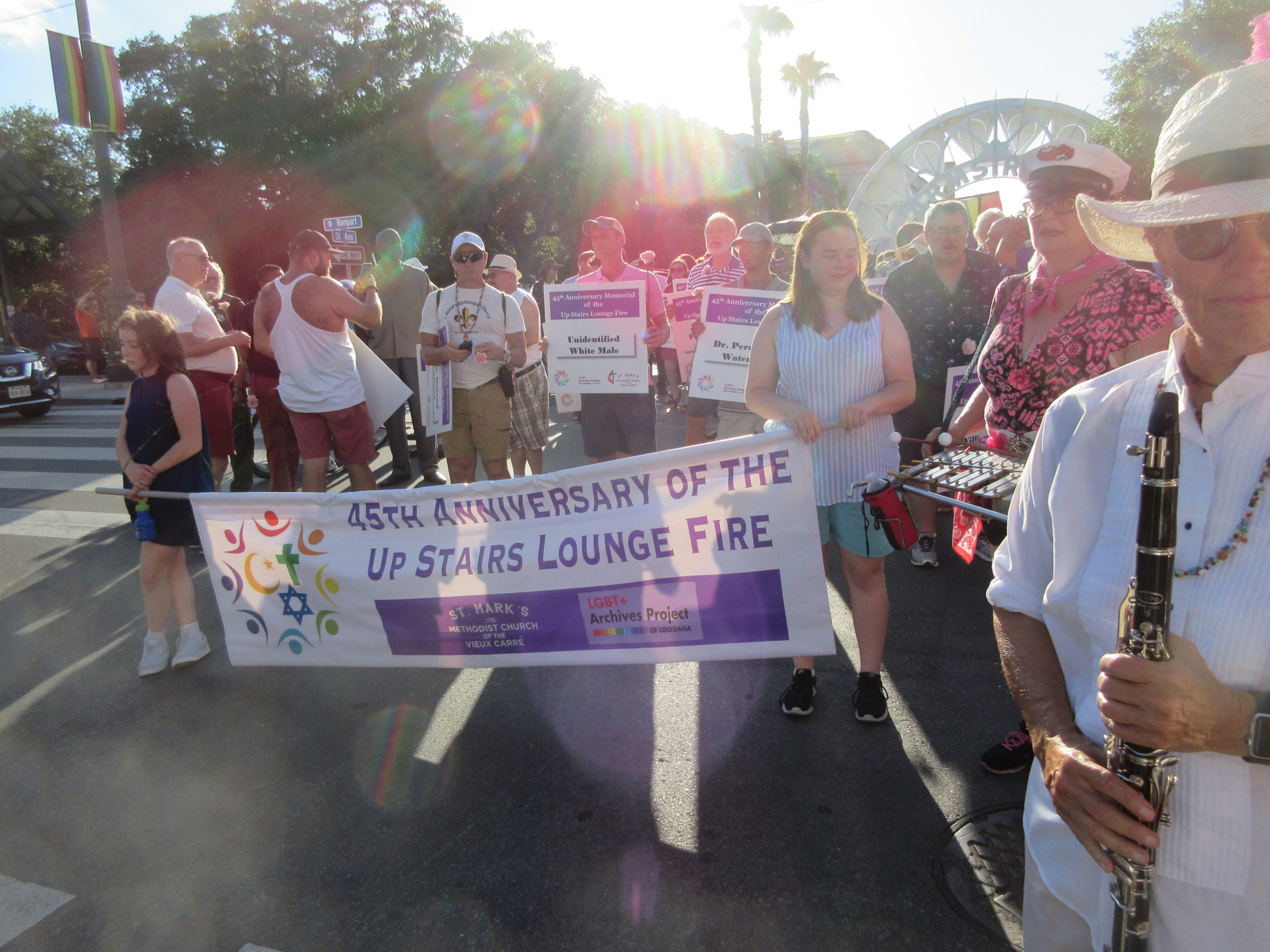
The View's immersive melodramatic pathos as executed in Pope's captivating performance manifests Goldberg's claim that melodrama can "work[] the system against itself" to foster opposition without necessarily changing the structures that inhibit LGBTQ+ life.106Goldberg, Melodrama, 160. The musical "open[s] a space of irresolution," and in that space, "[m]elodrama remediates [in the] double implication of the verb."107Goldberg, Melodrama, 4, xv. That is, The View confronts the impasse of time-space possibility for LGBTQ+ mentorship, and it thereby enacts the primary and secondary definitions of the verb "remediate." It conceptually remedies, or fixes again, oppressive ideological structures that inhibit "human flourishing" by recovering the erased arson attack and calling for resistance in the present day. The production also acts as a continual intermediary, mediating between what is possible (i.e., intimacy between cast- and audience-patrons) and what is impossible (i.e., mentorship by deceased historic-patrons and AIDS victims). The melodramatic mode in Vernon's adaptation does not simply re-present: it constitutes new possibilities for coalition against impossibility, however limited they may be.
The View UpStairs's immersive, melodramatic adaptation of nellydrama and drag performances that animated the 1973 Up Stairs Lounge subverts potential toward national voyeurism that recoiled local arson survivors at the arrival of those "fairy carpetbaggers." Vernon refuses to stage the fire's carnage, exploit the individual bar patrons, or reduce the event to mere symbol. In adapting the Lounge's performance genres, The View constructs a collective that links the cast and audience back to the generation who drank, prayed, performed, and lived in so many 1970s gay bars around the United States, imagining future possibilities for limitlessly diverse forms of LGBTQ+ subjectivity, relationality, and resistance. Indeed, such possibilities resonate most clearly in the words of Vernon's adapted MCC Reverend Richard: "We have too many people against us to be against each other. Maybe we have different ideas on how to get there, but we all want the same thing."108Vernon, The View UpStairs, 48.
About the Author
Stephanie Rountree is an assistant professor at the University of North Georgia. She is co-editor of Remediating Region: New Media and the U.S. South (Baton Rouge: LSU Press 2021) and Small-Screen Souths: Region, Identity, and the Cultural Politics of Television (Baton Rouge: LSU Press, 2017).
Acknowledgements
This essay manifests years of discussions with Dr. Ryan Prechter on his doctoral research on gay New Orleans and The View UpStairs. He introduced me to both the historic Up Stairs Lounge fire and Vernon's musical. Without his collaboration, this article would not exist. Similarly, I am deeply grateful to the external reviewers and editorial team at Southern Spaces, whose generous feedback helped shape my argument in important ways.
]]>
Water Graves investigates how contemporary writers and artists of the greater Caribbean (such as Jason deCaires Taylor) reinvest sites of racialized violence and environmental degradation—as so many manifestations of "unritual"—with a new sense of the sacred that allows for remembrance and re-humanization. Rituals—be they initiations, funerary rites, or collective acts of remembrance—confer "humanity" on those who practice them and sacredness on the places of these practices. The unritual comprises moments and spaces of desecration. Unritual occurs when rituals are ignored, violently suppressed or obstructed outright, and where so-called "natural" spaces are commodified, exploited, and profaned. Closely appended to Loichot's unritual are the notions of "undead" and "unrest"; the liminal zone of (non)being they demarcate emphasizes the unritual's alienating, unsettling, and dehumanizing effects before and beyond the grave.
Off the coast of Grenada, several meters below the Caribbean surface, stands Jason deCaires Taylor's Vicissitudes. It is an installation of statues which, at first glimpse, shows a group of men and women arranged in a large circle, holding hands as they gaze outward along the ocean floor. The figures bear bright red, pink, and violet protrusions of coral, undulating gossamers of seaweed, and the occasional sea star. The texture and topography of these statues' skin—their pores, wrinkles, and scars—provide the ideal environment for aquatic life to take root and repopulate this portion of ocean floor. Vicissitudes also offers another, more haunting kind of repopulation, this time by the specters of the Triangular Trade: the innumerable captives thrown overboard after dying in transit during the Atlantic crossing and condemned to perish, away from ancestral lands and families that could offer funerary rites or remembrance. As the installation confronts the degradation of coral environments, its underwater surroundings also beckon and materialize the (un)dead of the African Diaspora whose memory—likewise rarefied and threatened—inhabits these statues alongside the coral. Vicissitudes, a monument that explores the creative and memorial agency of Caribbean underwater spaces, serves as one of many objects that Valérie Loichot examines in her book, Water Graves: The Art of the Unritual in the Greater Caribbean.
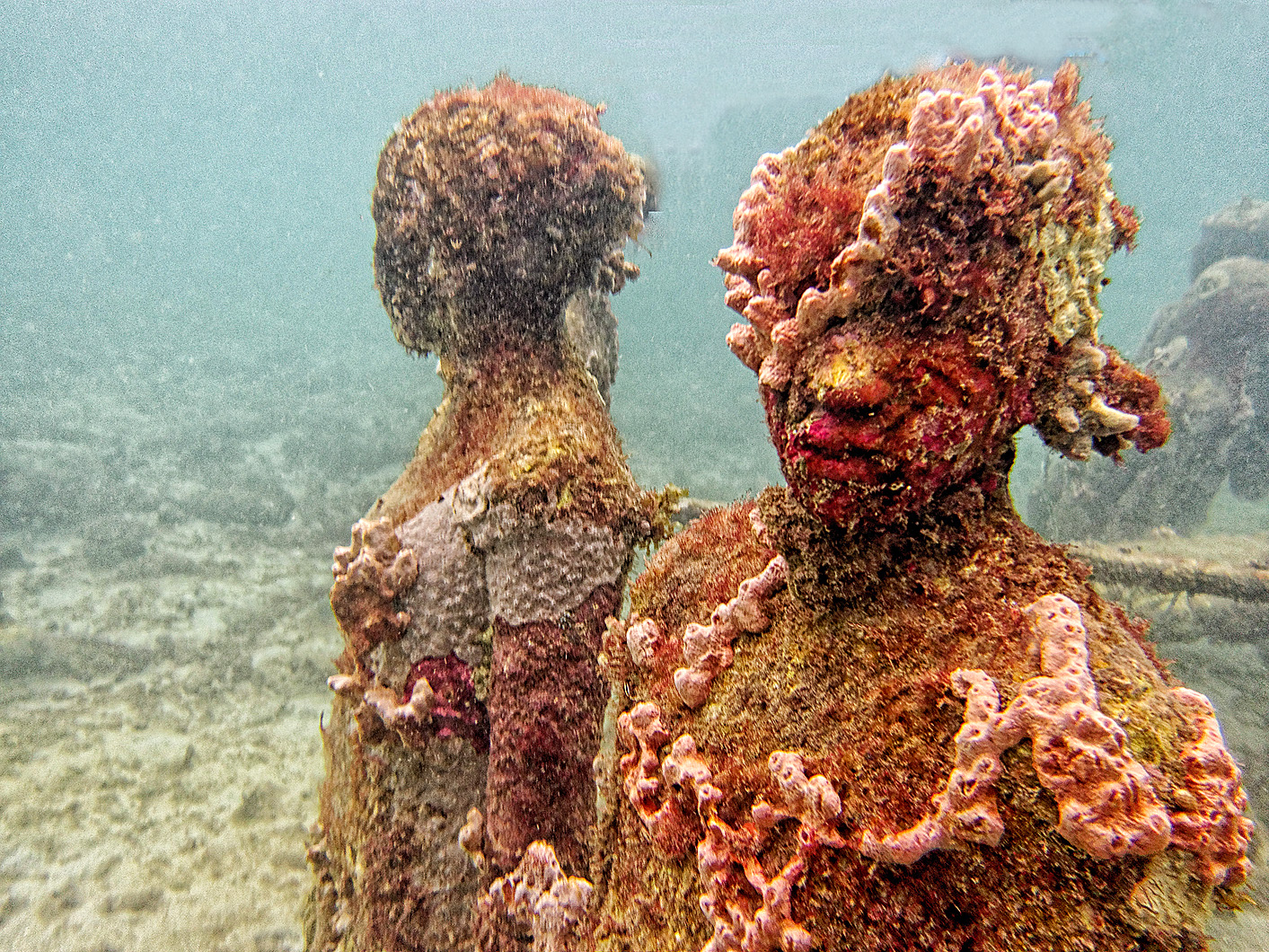

An interdisciplinary exegesis in the fields of Postcolonial Studies, Caribbean Studies, African Diaspora Studies and Ecocriticism, Water Graves investigates objects across many mediums that, like Vicissitudes, work through or heal the effects of unritual. The oeuvre of poet-philosopher Edouard Glissant serves as the opening and the theoretical springboard for the rest of the book. Here, Loichot engages the notion of "relational sacred," which draws heavily from Glissant's concepts of creolization, relaying, and entour or "surroundings."1As Loichot explains, "Entour signifies for Glissant the whole environment comprising the poem, human and nonhuman animals, vegetation, rocks, lavas, and 'nature' and 'culture.' The latter terms lose meaning since they exist in a continuum, not in a system of opposition" (28). For another in-depth look at Glissant's entour, see Carrie Noland, "Éduoard Glissant: A Poetics of the Entour," in Poetry After Cultural Studies, ed. Heidi R. Bean and Mike Chasar (Iowa City: University of Iowa Press, 2011), 143–172. This "relational sacred"—which extends the expressions of memory or ritual beyond religious confines—informs more specifically how the objects featured in Water Graves's chapters (objects of literature, music, film, visual arts, poetry, and photography) repair the effects of unritual.

Loichot's "Graves for Katrina" examines the work of mourning effected by visual artists in the wake of Hurricane Katrina. Featuring the photography of Eric Waters and the paintings and mixed-media exhibitions of Radcliffe Bailey and Epaul Julien, this chapter considers the (mis)use and subversion of frames as devices that circumscribe the spatial, temporal, and conceptual boundaries of a work. For instance, Bailey's installation, Windward Coast–West Coast Slave Trade (2009–18)—which is comprised of a large sea-like arrangement of salvaged piano keys from which emerges a lone, "African" head—eschews "framing" within a singular meaning or temporality. By evoking at once the "victims of the Middle Passage, Katrina, or [prophetically] the Haitian Earthquake" Bailey's installation goes beyond the temporal frames that would separate these events (101, 66). These overlapping and recursive temporalities, argues Loichot, prompt spectators to see similar logics of "unritual" at work in all of them, logics that signal the longue-durée effects of racialized slavery whereby Black people remain subject to violence and dehumanization.

As the objects of Bailey, Waters, and Julien spill out of conventional "frames" or conceptual boundaries, Loichot's analysis flows into the murky waters of Katrina and its racial and environmental violence in "Mami Wata the Formidable." Loichot wades through the ethical ambiguity of Kara Walker's exhibit/book, After the Deluge, and Beyoncé's visual album, Lemonade, which represent—and potentially reproduce—the violence of slavery and Katrina. Yet, in this representation and acknowledgement, Walker and Beyoncé—like Mami Wata, the titular voudou figure who grants life and death to those lost at sea—also sanctify the victims of the violence their objects traverse. Through Julia Kristeva's notion of "muck," Loichot shows the creative and "sacred" potential of Walker's and Beyoncé's portrayals of violence as the "abject substance [that] paradoxically—and horrifyingly—becomes the amniotic fluid of a new birth" (112).
"Drowned," delves further into fluid spaces—this time of the ocean floor—via Jason deCaires Taylor's Cancún Underwater Museum and Édouard Duval Carrié's paintings. These works, Loichot contends, project spectators into the space of the drowned while teasing out the links between environmental degradation, those thrown overboard during the Middle Passage, and the migrants who drown while crossing the Mediterranean today. From these underwater spaces of death, "Stone Pillow and Bone Water" turns to the "hard materiality of words" which are likened to the raw material that M. NourbeSe Philip and Natasha Trethewey shape into poetic "graves, stones, or monuments to the neglected, forgotten, or desecrated dead" (177). Loichot details how Philip deconstructs and reshapes the juridical/scientific language implicated in justifying racialized slavery: "As herself both a lawyer and a poet, Philip must rectify the law . . . by giving humanity and sacred back to the victims of the legalized unritual, through her poetic creation. Poetry—poiesis as act of making—relays a faulty even criminal, law" (204).

As the variety of objects featured in Water Graves indicates, Loichot's relational methodology echoes and enacts principles of Édouard Glissant's notion of "Relation," particularly that of "relaying" understood as: "an act of solidarity between those touched by the unritual, such as humans and their hurt ecologies. [Relaying] calls for disciplines like literary and artistic interpretation, history and science, to join forces where they meet the epistemological abyss of the unknown" (19). By bringing the notion of entour—which implicates so-called "natural" surroundings in "human" creativity and activity—to bear on its analyses, Water Graves effectively broadens the scope of the unritual to include the natural world, underlining connections between racial violence and environmental destruction. One of the strengths of this relational methodology resides in its juxtaposition of disparate objects. These juxtapositions not only highlight the connections among seemingly distinct historical phenomenon; they also bring into conversation creative works that confront the systems responsible for propagating the unritual. The hybrid figures in Beyoncé's Lemonade (lasiwène or the siren) and Jason deCaires Taylor's Vicissitudes, for example, challenge ontological boundaries that condition spaces of racialized violence and environmental degradation—boundaries between life and death, human and coral, sacred and profane, memory and oblivion. Loichot's treatment of these two objects—which come from different entours and mediums—reveals the poetical, creolizing, and memorial potential of underwater spaces in the Greater Caribbean. As Loichot puts it, "[t]he water is thus not a dividing line but a site of passage, flux, communication and confusion between . . . realms" (154).
Though my appraisal of Water Graves remains predominantly laudatory, I will signal two critiques in terms of its methods and conceptual vocabulary. Loichot's powerful juxtapositions showcase the poetic possibilities of creating a network of oeuvres motivated by the desire to heal and move beyond the unritual. But Water Graves's relational approach sometimes sidesteps the paradoxes highlighted by this kind of comparative work. As Shu-mei Shih proposes in her essay "Comparison as Relation," relating ostensibly dissimilar objects allows one to deconstruct boundaries (disciplinary or otherwise) erected by "certain interests" or "the workings of Power" (which Water Graves certainly does).2Shu-mei Shih, "Comparison as Relation," Comparison: Theories, Approaches, Uses, ed. Rita Felski and Susan Friedman (Baltimore: John Hopkins University Press, 2013), 79. Yet, it is equally important, Shih notes, to "evacuate and analyze" how these economic, national, or other interests nevertheless infuse the objects of comparison and their relations.3Shih, 84. That Beyoncé's album (and related concerts) garnered hundreds of millions of dollars within neoliberal capitalism—a socioeconomic system predicated on exploiting women, people of color, and vulnerable workforces in developing countries—constitutes an aporia that Water Graves acknowledges without exploring.4As indicated by the Pew Research Center, wage gaps continue to track along gender and racial lines in the U.S. Eileen Patten, "Racial, gender wage gap persists in U.S. despite some progress," Pew Research Center, July 1, 2016, https://www.pewresearch.org/fact-tank/2016/07/01/racial-gender-wage-gaps-persist-in-u-s-despite-some-progress/. Though Water Graves recognizes the album's imbrication with capitalist profit—casting Beyoncé as an embodiment of the capitalistic deity Mami Wata—it doesn't investigate how the economic "interests" underwriting her album inflect and/or constrain the work of healing or moving beyond the unritual.5bell hooks, "Beyoncé's Lemonade is capitalist money-making at its best," in The Guardian, May 11, 2016, https://www.theguardian.com/music/2016/may/11/capitalism-of-beyonce-lemonade-album. As bell hooks points out, both Beyoncé and Serena Williams are featured in the album wearing sports clothing, as Beyoncé's sports clothing line—Ivy Park—would appear the same year as Lemonade, thereby walking a fine line between dissident discourse and advertisement. This is not to say that Beyoncé's discourse is invalidated by this antagonism, nor that one can totally disengage from the "workings of Power," particularly in the era of globalization; rather, I mean to emphasize the importance of situating the discourse of a given object within its material conditions and outcomes, especially as these conditions and outcomes often constitute sites of unritual, which complicate our readings of these objects and the ways in which they relate to each other.

My second critique relates to the use of terms historically operationalized in colonial contexts to exclude non-European populations. Although its creolizing methodology works across disciplinary and cultural frameworks, Water Graves employs certain universalizing notions, notably "humanity," whose investment in a colonial epistemological tradition is not always fully interrogated. As the philosopher and novelist Sylvia Wynter writes in "Unsettling the Coloniality of Being/ Power/Truth/ Freedom," the term "humanity" has historically been invoked to exclude racialized persons from its prerogatives, and has, in fact, depended on the racialized "Other," relegated to a space of unritual in order to mark its boundaries. Indeed, Wynter tracks how the conceptions of "human" and "humanity" came to correspond with "reason" and "rationality" in Renaissance Europe (and continue to do so today), whereas the conditions of "subrationality" and uncivilization were used to characterize colonized populations.6Sylvia Wynter, "Unsettling the Coloniality of Being/Power/Truth/Freedom: Towards the Human, After Man, Its Overrepresentation—An Argument" in CR: The New Centennial Review 3, no. 3 (2003): 266, 301. In other words, under the guise of describing the entire "human race," the term "humanity" has come to reify and universalize Western values and ideals. Although Water Graves's introduction construes "humanity" in an inclusive way—proposing that rituals "of the sacred" writ large are "a defining mark of humanity"—the text leaves unattended its watermark of exclusion and eurocentrism (7). The uninterrogated use of "humanity," then, potentially constitutes a discursive site of "unritual"—what Loichot's objects and analysis strive to "heal"—as its eurocentric and exclusionary connotations of so-called "rationality" and "civilization" implicitly accompany its evocation. Explicitly deconstructing the history and usage of "humanity" while signaling a plurality of humanities would not only eliminate the tension created by the colonial baggage of this term, but would also dovetail with Glissant's conception of Relation which rejects universalizing concepts, while insisting on multitudinous humanities.
Water Graves is an important and compelling study for anyone interested in the Caribbean, Afro-Diasporic experiences, colonialism, and slavery, as it engages with the enduring aftereffects of their histories, including how artists reinscribe them with new meanings. Loichot's work merits praise for its epistemological and methodological originality as she extends Glissant's concepts of Relation and relaying. In literary, artistic, and musical objects from across the Caribbean, Loichot skillfully interweaves questions of (post)colonial legacies, environmental degradation, and social justice in order to explore these objects' often unexpected correspondences as well as their tensions. Ultimately, Loichot demonstrates how literary and artistic exegesis "relate" with its artistic objects in ways that not only explore the memory and trauma of the unritual and its resacralization, but that also engage new modalities and transdisciplinary vocabularies for comparing creative works across the broader Caribbean.
About the Author
Aaron Witcher is a PhD Candidate in French and Francophone Studies at The Pennsylvania State University.
]]>The Battle of Atlanta cyclorama painting is a striking visual spectacle. The huge, circular panorama—371 feet long and 49 feet high—displays in vivid, you-are-there style one of the biggest clashes fought in the final ten months of the American Civil War. Exquisitely restored and reopened in February 2019 at the Atlanta History Center, the painting depicts Union forces repelling massive frontal assaults against their position east of the city on July 22, 1864. At the center of the combat action rides Federal Major General John A. Logan, the largest figure in the picture, charging toward the battle line and rallying his blue-coated troops in a large counterattack in the vicinity of the red brick Troup Hurt House. Logan's troops are shown forcing a mid-battle retreat of Confederate infantry units sent forward by their commanding general, John Bell Hood. The Confederate Army of Tennessee's setbacks at multiple points of attack during their eight-hour clash with the similarly named Federal Army of the Tennessee, coupled with the Yankees' retention of strategic high ground and a key railroad supply line, amounted to a major defensive victory for the Union forces.1Steven E. Woodworth, Nothing But Victory: The Army of the Tennessee, 1861–1865 (New York: Alfred A. Knopf, 2005), 567–568.
At the end of the fighting on July 22, the Union Army of the Tennessee held its entrenched positions within cannon range of Atlanta, and the Confederate Army of Tennessee had lost a tenth of its fighting strength.2Gary Ecelbarger, The Day Dixie Died: The Battle of Atlanta (New York: Thomas Dunne Books/St. Martin's Press, 2010), 213–214. The Federal triumph presaged victories at nearby battlefields, Ezra Church and Jonesboro, six days and six weeks later, and the capture of Atlanta's three remaining rail lines by the end of August. Cut off from supplies, Hood ordered his troops to evacuate Atlanta on September 1, and the city's mayor surrendered to a Federal military advance party the next day. After Union troops marched into the city, their commanding general, William T. Sherman, sent a telegram to Washington, DC, announcing that "Atlanta is ours, and fairly won." This resounding end to Sherman's Atlanta campaign, combined with the Confederate loss of Mobile Bay and Union gains in the Shenandoah Valley, cinched Abraham Lincoln's reelection in November 1864 and portended the end of armed combat east of the Mississippi River in April 1865.3James M. McPherson, Embattled Rebel: Jefferson Davis as Commander in Chief (New York: The Penguin Press, 2014), 205; Brian Holden Reid, The Scourge of War: The Life of William Tecumseh Sherman (New York: Oxford University Press, 2020), 330. Yet long after Robert E. Lee surrendered to Ulysses S. Grant at Appomattox Court House, deep animosities between former Civil War adversaries continued, and paramilitary and mob violence against freedpeople and their descendants and allies went largely unchecked for decades.4Carole Emberton, Beyond Redemption: Race, Violence, and the American South After the Civil War (Chicago: University of Chicago Press, 2013), 146, 155, 201; Gregory P. Downs, The Second American Revolution: The Civil War-Era Struggle Over Cuba and the Rebirth of the American Republic (Chapel Hill: University of North Carolina Press, 2019), 136; Leon F. Litwack, "Hellhounds," in Without Sanctuary: Lynching Photography in America, ed. James Allen (Santa Fe, NM: Twin Palms Publishers, 1999), 8–37.
The seemingly endless resurrection, retelling, and reenacting of Civil War history, which continues to the present day, amounts to an ongoing contest between politicized versions of the past, the first renditions of which were produced by people for whom the War was a lived experience. Their commemorative creations included a myriad of images, texts, statues, reunions, Emancipation celebrations, and Memorial Days.5David W. Blight, Race and Reunion: The Civil War in American Memory (Cambridge, MA: Harvard University Press, 2001), 31–97; Caroline E. Janney, Remembering the Civil War: Reunion and the Limits of Reconciliation, (Chapel Hill: University of North Carolina Press, 2013), 73–159. During the final decades of the nineteenth century, these inaugural forms of war remembrance mobilized identities, explanations, and emotions, and they framed political discourse about race, citizenship, and nationhood for years to come. Spectacular, immersive paintings of famous military clashes provided mass entertainment and compelling commemorative meanings for US audiences. At the peak of their popularity, from 1883 to approximately 1900, perhaps as many as three dozen Civil War battle panoramas in the cycloramic format toured cities throughout the US, and paintings of the Gettysburg and Vicksburg battles reached Australia and Japan.6Chris Brenneman and Sue Boardman, The Gettysburg Cyclorama: The Turning Point of the Civil War on Canvas (El Dorado Hills, CA: Savas Beattie, 2015), 14; Ralph Hyde, Panoramania! (London: Trefoil Publications, 1988), 172. Christ's crucifixion, vistas of the ancient world, and natural wonders and disasters were other popular cyclorama subjects.7Stephan Oettermann, The Panorama: History of a Mass Medium (New York: Zone Books, 1997), 343; Angela Miller, "The Panorama, the Cinema, and the Emergence of the Spectacular," Wide Angle 18, no. 2 (1996): 35–69. The sweeping, proto-cinematic visual spectacles achieved enormous but ephemeral popularity; they anticipated but could not compete with motion pictures as an entertainment experience. Like the movies that followed, panoramas provided "a substitute reality presented with the revelatory force of the real."8Miller, "Panorama," 55. Yet, because the paintings presented an "image frozen in time," they lacked "cinema's possibilities for literal reenactment."9Alison Griffiths, "'Shivers Down Your Spine': Panoramas and the Origins of Cinematic Reenactment," Screen 44, no. 1 (2003): 1–37. As the popularity of cyclorama paintings waned, many of the enormous canvases disappeared while others were repurposed as theatrical production backdrops or cut up and sold as small remnants.10Antje Petty, "German Artists—American Cyclorama: A Nineteenth-Century Case of Transnational Cultural Transfer" (presentation, German Studies Association 34th Annual Conference, Oakland, CA, October 7–10, 2010, Oakland, CA), https://mki.wisc.edu/wp-content/uploads/sites/1100/2014/10/Petty_GSA-2010_Panorama.pdf. Today, among all Civil War battle panoramas, the Gettysburg and Atlanta cyclorama paintings are the only survivors on public display, each showcased in a twenty-first-century exhibition space. The Gettysburg panorama is shown at the national military park, located at the battle site in south central Pennsylvania, and the Atlanta image is exhibited at the city's history museum, approximately six miles from where the battle was fought.
This essay explores the history of the Battle of Atlanta painting, a surviving example of a fad that faded, which in its time expressed and exerted influence on Civil War memories north and south of the Mason Dixon line and served as a technological, thematic, and commercial forerunner to epic cinematic narratives, most notably D. W. Griffith's The Birth of a Nation. As the original version of the Atlanta panorama and an identical copy circulated from city to city, following debuts in Minneapolis in 1886 and Detroit in 1887, the painting's visual retelling of a famous fight validated martial heroics on each side, which meshed with the continuing devotion of many viewers to their side's cause. At the same time, the Atlanta panorama also celebrated an underlying bond between the white male opponents by suggesting that their shared traits, beliefs, and traditions accounted for a common bravery in battle and a sense of common white Americanness that surged in the nineteenth century's final years. The painting expressed and helped perpetuate a militarized commemorative culture that supported a white national identity and abandoned a commitment to Black Americans' civil rights. Peaking in attendance amid a mounting but far from uniform movement toward sectional reconciliation, the Battle of Atlanta cyclorama painting was most importantly a spectacle of a resurgent and increasingly militant and racialized American nationalism. Further, the panorama served as a precursor to D. W. Griffith's extravaganza, which depicted the Civil War and Reconstruction as the historical antecedents for a nationwide regime of white supremacy. In an era when spectacle culture rose rapidly and new, immersive visual entertainments competed for public attention, the Battle of Atlanta panorama and The Birth of a Nation illustrate how vivid and enduring images of a cataclysmic era captured the attention of throngs of people and encouraged their commitments to a narrowly configured version of American nationalism.11Susan Tenneriello, Spectacle Culture and American Identity: 1815–1940 (New York: Palgrave Macmillan, 2013), 2–14.
In its heyday, the Atlanta panorama, like other cyclorama battle paintings, was a travelling attraction. A team of European artists working in an American studio produced two identical versions of the Atlanta painting, and promoters moved each canvas from city to city for exhibition. At every stop, riggers installed the panorama in a massive rotunda building, a specially designed structure that enabled visitors to experience "being swallowed up in an imaginary world" while distancing them from their actual surroundings outside.12Evelyn J. Fruitema and Paul A. Zoetmulder, eds. The Panorama Phenomenon: Mesdag Panorama 1881–1981 (The Hague, Netherlands: Foundation for the Preservation of the Centenarian Panorama, 1981), 18. A darkened entrance hall, indoor lighting that brilliantly illuminated the sprawling battlefield tableaux, and a faux terrain—foreground settings with three-dimensional objects—connected almost imperceptibly to the bottom edge of the painted canvas served in unison to absorb spectators into an illusory reality. A meticulously realistic depiction of Atlanta's battlefield topography, military uniforms and equipment, combat events, notable commanders, and amassed infantry were popular features. Spectators were inserted within the 360-degree panorama, which provided an immersive, all-encompassing view of a historic clash. The spectacular visual narrative combined convincing optical illusions with vivid documentary realism, minus gory images of the dead and wounded. Although the artists and promoters aspired to authenticity, the battle story they "lifted from life" and told on canvas was by intent a partial view that omitted more than just the horrors of industrial warfare.13Louise Spence and Vinicius Navarro, Crafting Truth: Documentary Form and Meaning (New Brunswick, NJ: Rutgers University Press, 2011), 11.
In the 1880s and 1890s, the Atlanta panorama, along with other Civil War battle paintings, provided an immensely popular attraction for audiences seeking to remember the military heroes and events of the 1860s while leaving much of the War out of the picture. No female figures are included on the huge canvas and a single Black male is depicted in civilian clothing far from the July 22, 1864, battle line. While the Battle of Atlanta, like most of the War's battles, pitted Union and Confederate armies against each other that were exclusively or almost entirely white men, enormous numbers of additional people participated in the War effort, including approximately 200,000 Black soldiers who served in the Federal army and countless women on both sides who were war matériel producers, foodstuff suppliers, health care workers, civil servants, undercover agents, and uniformed combatants.14William A. Dobak, Freedom By the Sword: The U.S. Colored Troops, 1862–1867 (Washington, DC: US Army Center of Military History, United States Army, 2011), 501; Thavolia Glymph, The Women's Fight: The Civil War's Battles for Home, Freedom, and Nation (Chapel Hill: University of North Carolina Press, 2020), 10; Judith A. Giesberg, Civil War Sisterhood: The U.S. Sanitary Commission and Women's Politics in Transition (Boston: Northeastern University Press, 2000), 4. The awe-inspiring image of the Battle of Atlanta, like other heroic national narratives of the postbellum era, was a "selective celebration."15Stephanie McCurry, Women's War: Fighting and Surviving the American Civil War (Cambridge, MA: The Belknap Press of Harvard University Press, 2019), 204. It venerated part of the past while marginalizing the significance of race and gender in wartime, in effect affirming a white, patriarchal social and political pecking order that prevailed as the Civil War and Reconstruction receded and the nineteenth century drew to a close. As historian William Blair emphasizes in an insightful analysis of sectional reconciliation and its political implications, reconciliation "involved defining nationalism, and the power relationships within it, resulting tragically in the exclusion of black people in the age of Jim Crow with white solidarity, in part, rallying around traditions in the form of Confederate commemorations."16William A. Blair, "Reconciliation as a Political Strategy: The United States After Its Civil War," in Reconciliation After Civil Wars: Global Perspectives, ed. Paul Quigley and James Hawdon (New York: Routledge, 2019), 217–231.
D. W. Griffith's notoriously racist The Birth of a Nation, which premiered in 1915, propagated a narrative account of the Civil War era in which white northerners and white southerners, one-time friends, become unwilling wartime foes but show mutual respect on the battlefield, reconcile after the War, reject the pursuit of Black political equality during Reconstruction, and—led by the Ku Klux Klan—forge a new nation to defend their "common Aryan birthright."17Robert Lang, ed. The Birth of a Nation: D. W. Griffith Director (New Brunswick, NJ: Rutgers University Press, 1994), 134. As historian Leon Litwack observes, the motion picture "mesmerized and misled Americans, revealing the extraordinary power of the cinema to 'teach' history and to reflect and shape popular attitudes and stereotypes."18Leon F. Litwack, "The Birth of a Nation," in Past Imperfect: History According to the Movies, ed. Ted Mico, John Miller-Monson, and David Rubel (New York: Henry Holt and Company, 1995), 136–141. Griffith reused multiple images and tropes that debuted decades earlier and, aided by his filmmaking virtuosity, persisted long after his motion picture was first shown. The Birth of a Nation was a sensational visual spectacle that provided a blueprint for the Hollywood historical film.19Robert Burgoyne, The Hollywood Historical Film (Malden, MA: Blackwell Publishing, 2008), 26. "The panoramic battle scenes" were a "cinematic triumph," Michael Rogin notes in his appraisal of the film. Griffith's depictions were "distant, beautiful, and otherworldly."20Michael Rogin, "'The Sword Became a Flashing Vision': D. W. Griffith's The Birth of a Nation," Representations 9 (Winter 1985): 150–195. Camera shots taken from a tower sixty feet above battling troops gave moviegoers a "sense of both wide scope and elevated historical perspective," as James Chandler points out.21Milton MacKaye, "The Birth of a Nation," Scribner's Magazine 102, no. 5 (1937): 40–46; James Chandler, "The Historical Novel Goes to Hollywood: Scott, Griffith, and Epic Film Today," in The Romantics and Us: Essays on Literature and Culture, ed. Gene W. Ruoff (New Brunswick, NJ: Rutgers University Press, 1990), 237–273. The Birth of a Nation showed audiences how sprawling action sequences, crowd scenes, close ups, and star performances could be woven into a captivating feature-length narrative.22John Belton, American Cinema/American Culture (New York: McGraw-Hill, 1994), 15; Bruce Chadwick, The Reel Civil War: Mythmaking in American Film (New York: Alfred A. Knopf, 2001), 97. Griffith's creation also served as a forerunner to Gone With the Wind, which bore striking similarities to the earlier extravaganza in its production scale, fictionalized historical narrative, melodramatic mode, humiliating images of Black men and women, push back from civil rights activists, and runaway box office success.23Ruth Elizabeth Burks, "Gone With the Wind: Black and White in Technicolor," Quarterly Review of Film and Video 21, no. 1 (2004): 53–73; Jenny Barrett, Shooting the Civil War: Cinema, History and American National Identity (London: I.B. Tauris, 2009), 35; Ellen C. Scott, Cinema Civil Rights: Regulation, Repression, and Race in the Classical Hollywood Era (New Brunswick, NJ: Rutgers University Press, 2015), 157–160.
The title of Griffith's film announced his animating concern: nation building. His message was that sectional reconciliation called for white solidarity, paramilitary acts of racial terror, and political and economic oppression of Black people. He deployed Lost Cause historical interpretations and perpetuated derogatory caricatures of Black and multiracial people that originated in the nineteenth century. The Birth of a Nation's "black marauders" and "mulatto villains," according to American Studies scholar Davarian Baldwin, helped justify "a so-called Southern Solution that stood as a form of governance, a system of labor management and land assessment, and an intellectual and cultural master trope."24Davarian L. Baldwin, "'I Will Build a Black Empire': The Birth of the Nation and the Specter of the New Negro," Journal of the Gilded Age and Progressive Era 14, no. 4 (2015): 599–603. The film's disparaging images prompted vigorous but largely unsuccessful protest campaigns waged by the National Association for the Advancement of Colored People (NAACP) and other critics who sought to prevent exhibitions of the movie or censor its most vitriolic content.25Melvyn Stokes, D. W. Griffith's The Birth of a Nation: A History of the "Most Controversial Motion Picture of All Time" (New York: Oxford University Press, 2007), 129–170; Cara Caddoo, "The Birth of a Nation's Long Century," in The Birth of a Nation: The Cinematic Past in the Present, ed. Michael T. Martin (Bloomington: Indiana University Press, 2019), 33–45. Their efforts were blunted in part by President Woodrow Wilson, a former academic historian and past president of the American Historical Association, who tacitly endorsed The Birth of a Nation when he viewed it in the White House in February 1915.26Mark E. Benbow, "Birth of a Quotation: Woodrow Wilson and 'Like Writing History With Lightning,'" Journal of the Gilded Age and Progressive Era 9, no. 4 (2010): 509–533. For all of the film's white supremacist convictions and grotesque stereotypes, as cinema and media scholar Michael T. Martin emphasizes, Griffith's "filmic manifesto" reflected a prevailing historical interpretation of the Civil War era and a widely held belief early in the twentieth century that "race solidarity" was "the organizing principle for the nation's renewal."27Michael T. Martin, "Revisiting (As It Were) the 'Negro Problem' in The Birth of the Nation," in The Birth of a Nation: The Cinematic Past in the Present, ed. Michael T. Martin (Bloomington: Indiana University Press, 2019), 33–45.
The Battle of Atlanta cyclorama painting and The Birth of a Nation formed part of what anthropologist Benedict Anderson describes as a "vast pedagogical industry" that worked to convince Americans that the hostilities of 1861–65 were "a war between 'brothers' rather than between—as they briefly were—two sovereign nation-states."28Benedict Anderson, Imagined Communities: Reflections on the Origin and Spread of Nationalism, Revised Edition (London: Verso, 2006), 201. The visual narratives invited their audiences to recognize what Anderson describes as "a deep, horizontal comradeship" that makes it possible for human beings, even without face-to-face contact, to imagine themselves as a single political community and participate in a common culture of nationalism.29Anderson, Imagined Communities, 6–7. The "figure of the soldier" is central to this storyline, serving as an embodiment of communal values and encouraging Americans, or at least most of the country's white population, to embrace a shared national identity.30Nicola Cooper and Martin J. Hurcombe, "The Figure of the Soldier," Journal of War and Culture Studies 2, no. 2 (2009): 103–104. Military memories conveyed by the Battle of Atlanta panorama and The Birth of a Nation acted as catalytic agents that contributed to a big burst of nationalistic energy.31Wilbur Zelinsky, Nation Into State: The Shifting Symbolic Foundations of American Nationalism (Chapel Hill: University of North Carolina Press, 1988), 155. Linked compositionally and thematically, the cycloramic and cinematic renditions of the Civil War dramatized a version of nationalism that idealized sectional unity while dividing the population by race, ethnicity, and gender. The images provided popular accounts of a storied past and demonstrated Elisa Tamarkin's precept that "nationalism, as a form of feeling, an ideology, and a set of practices, works every bit as seriously at bringing some aspects of the outside in, as it does in keeping others out."32Elisa Tamarkin, Anglophilia: Deference, Devotion, and Antebellum America (Chicago: University of Chicago Press, 2008), xxvi.
The nation that emerged in the fin-de-siècle US was more than "just an imagined community," as historian Charles Maier observes. It also was a "materialist and armed community," and the US military services forcefully demonstrated their reach in the last decade of the century.33David Armitage, Thomas Bender, Leslie Butler, Don H. Doyle, Susan-Mary Grant, Charles S. Maier, Jörg Nagler, Paul Quigley and Jay Sexton, "Interchange: Nationalism and Internationalism in the Era of the Civil War," Journal of American History 98, no. 2 (2011): 455–489. In December 1890, in the largest military operation since the Civil War, nearly a third of the nation's army descended on the Lakota in South Dakota and suppressed armed Indian resistance to white incursions. A confrontation between the Lakota and the US Seventh Cavalry near Wounded Knee Creek ended in the massacre of about 250 Native Americans.34Heather Cox Richardson, Wounded Knee: Party Politics and the Road to an American Massacre (New York: Basic Books, 2010), 11; Pekka Hämäläinen, Lakota America: A New History of Indigenous Power (New Haven, CT: Yale University Press, 2019), 378. In July 1894, the US Army again demonstrated its coercive power when nearly 2,000 troops, deployed to Chicago and joined by US marshals and local police, broke the Pullman strike.35Clayton D. Laurie and Ronald H. Cole, The Role of Federal Military Forces in Domestic Disorders, 1877–1945 (Washington, DC: US Army Center of Military History, 1997), 145. Once more the Seventh Cavalry went into action, this time on city streets, and striking workers were likened to the "savages" who the soldiers had slaughtered at Wounded Knee several years earlier.36Richard White, Railroaded: The Transcontinentals and the Making of Modern America (New York: W.W. Norton, 2011), 431. American military forces extended their reach beyond the nation's shores in 1898, when the US defeated Spain in a five-month war and took control of Spain's colonies in the Caribbean and Pacific.37A.G. Hopkins, American Empire: A Global History (Princeton, NJ: Princeton University Press, 2018), 337. The war followed what American Studies scholar Matthew Frye Jacobson describes as a "protracted national discussion of what was demanded by America's rising national status as a world economic power—markets, bases, coaling stations, perhaps a canal."38Matthew Frye Jacobson, Barbarian Virtues: The United States Encounters Foreign Peoples at Home and Abroad, 1876–1917 (New York: Hill and Wang, 2000), 42. President William McKinley, in a December 1898 visit to Atlanta, hailed the victory over Spain as evidence that America had "proved itself invincible" and "will remain indivisible forevermore." Speaking at the municipal auditorium, McKinley proclaimed: "Under hostile fire on a foreign soil, fighting in a common cause, the memory of old disagreements has faded into history." In the spirit of sectional reconciliation, he proposed to another Atlanta audience that the national government begin honoring Confederate dead, whose public remembrances were limited at the time to commemorations by individual states and voluntary associations. "Every soldier's grave made during our unfortunate Civil War is a tribute to American valor," McKinley declared.39William McKinley, Speeches and Addresses of William McKinley, From March 1, 1897 to May 30, 1900 (New York: Doubleday & McClure, 1900), 159–160.
A surge in militant, white nationalism and the growing capacity of the US nation-state to project massive force were part of what historian C. A. Bayly describes as a vigorous, "global stirring of nationality" in the late nineteenth century. Bayly notes that despite a "hardening of boundaries between nation states and empires," people found "ways of linking, communicating with, and influencing each other across those boundaries."40C. A. Bayly, The Birth of the Modern World, 1780–1914 (Malden, MA: Blackwell Publishing, 2004), 199. Battle cults and cycloramic images of famous war scenes, which flourished first in France and Germany, were among the influential transnational exchanges.41Petty, "German Artists," 1. Profit-oriented European stock companies, geared to growing their international business, bankrolled panoramas of famous battles and shipped some of the most popular paintings across the Atlantic for showings in the US.42Fruitema and Zoetmulder, The Panorama Phenomenon, 28. These exports included a sprawling image of the Battle of Sedan, a major German victory in the 1870–71 Franco-Prussian War, which was shown in New Orleans and Cincinnati in the mid-1880s after a successful debut in Frankfurt, Germany.43Peter C. Merrill, German-American Artists in Early Milwaukee: A Biographical Dictionary (Madison, WI: Friends of the Max Kade Institute for German-American Studies, 1997), 64; Kevin M. Kurdylo, "Investigating an International Treasure: The Diaries of Panorama Artist F. W. Heine," Max Kade Institute Friends Newsletter 17, no. 4 (2008): 7; Beth Irwin Lewis, Art for All?: The Collision of Modern Art and the Public in Late Nineteenth Century Germany (Princeton, NJ: Princeton University Press, 2003), 34. Louis Braun, a Munich art professor who led the team that produced the Sedan painting, was known for creating battle panoramas with strong nationalistic overtones.44Bernard Comment, The Painted Panorama (New York: Henry N. Abrams, 1999), 164.
One of Braun's acolytes was August Lohr, an Austrian painter who worked with him in Munich on the Sedan project and other battle panoramas before moving to Milwaukee, Wisconsin, in 1885 to help entrepreneur William Wehner launch the American Panorama Company.45Merrill, German-American Artists, 64. In a prime example of what historian Antje Petty describes as a "wholesale transfer of European panorama art and craft" to the US, Wehner and Lohr persuaded a group of well-known painters from art schools in German-speaking countries to join them in Milwaukee and produce Civil War cyclorama paintings.46Petty, "German Artists," 3; Merrill, German-American Artists, xi. Their first recruit was Friedrich Heine, an experienced battle painter and former war correspondent and illustrator from Dresden, Germany, who joined his long-time friend Lohr as codirector of panorama production in Wehner's studio.47"The Artists of Atlanta: The Men Who Have Painted the Panorama," Battle of Atlanta Monthly 1, no. 1 (October 1, 1886): 1. Specialists in painting landscapes, human figures, and animals comprised the rest of the artistic team.48Manual of the Cyclorama of the Battle of Atlanta (Detroit, MI: Detroit Cyclorama Company, 1887), 1. Together with Lohr and Heine they painted both versions of the Battle of Atlanta cyclorama panorama.
Wehner and his company's artistic team placed a high priority on creating a historically accurate representation of the battle. Promotional materials and souvenir brochures that described the paintings emphasized their verisimilitude and educational value. Old soldiers often visited battle panoramas with family and friends and pointed out where and how they contributed to their side's cause.49Comment, Painted Panorama, 129. The slightest inaccuracy detected by discerning panorama spectators, such as veterans or other eyewitnesses to the battle, would collide with claims that viewers would see a faithful reproduction of the battlefield and combat action. To help meet the paying public's expectations for authenticity, Wehner and his lead artists enlisted the expert assistance of Theodore R. Davis, a former Civil War sketch artist for Harpers Weekly who had witnessed the battle from General William T. Sherman's field headquarters.50Wilbur G. Kurtz, The Atlanta Cyclorama: The Story of the Famed Battle of Atlanta (Atlanta, GA: City of Atlanta, 1954), 25. Davis shared his recollections of the fighting, and he helped the panorama team gather additional information from sketches, photographs, military maps, written records, and eyewitnesses. In the summer and fall of 1885, he accompanied the team on a site visit to Atlanta and its eastern suburban neighborhoods, where the battle was fought.51Manual of the Cyclorama, 2. Several artists completed sketches of the battle area from a forty-foot high wooden tower near the site of the Troup Hurt House and close to the Georgia Railroad, where intense combat action swirled on July 22, 1864. The painters' elevated perch provided an unobstructed view of the proximal battleground landmarks and the surrounding terrain. According to Wehner, local citizens "were astonished to find that their brethren of the North were in possession of facts that enabled them to clearly define every circumstance of the battlefield." Former Confederate officers, Wehner reported, appreciated the efforts to make a "historical painting" and took "special pains to verify statements concerning their positions."52Manual of the Cyclorama, 2.
By design, the geographic spot that the Milwaukee-based artists chose for their aerial studies of the Atlanta battle area corresponded to the central vantage point in the cyclorama rotundas where their circular paintings were subsequently exhibited. This compositional strategy enabled the painters to transfer their outward radiating, 360-degree sightlines and elevated perspective to panorama audiences.53Graham F. Watts, "'The Smell O' These Dead Horses': The Toronto Cyclorama and the Illusion of Reality," University of Toronto Quarterly 74, no. 4 (2005): 964–970. As a result, spectators standing in the middle of a rotunda's raised platform commanded sweeping views of each battlefield event depicted on canvas. Multiple military actions, represented as though they were simultaneous and instantaneous, created the impression of a dramatic continuum across the vast Atlanta battlegrounds.54Gillian Russell, The Theatres of War: Performance, Politics, and Society, 1793–1815 (New York: Oxford University Press, 1995), 76–77; Mary A. Favret, War at a Distance: Romanticism and the Making of Modern Wartime (Princeton, NJ: Princeton University Press, 2010), 216.
Battle of Atlanta Cyclorama Painting
1: Confederate Attack
At 4:30 p.m., Confederate troops under Brigadier General Arthur Manigault and other advancing brigades moved out from behind Atlanta's defenses and spearheaded an attack that poured through a weakness in the US 15th Army Corps line at the Georgia Railroad, overwhelmed their entrenched foes, and seized the DeGress Battery, shown near the Troup Hurt House, and other artillery pieces. This dramatic action threatened to turn the battle into a rout. However, the sudden momentum shift in the Confederate's favor was short-lived. US Army field officers marshaled their forces and led a sweeping counterattack, shown in the painting as blue-clad soldiers charging toward the Troup Hurt house and surging elsewhere to restore their broken infantry line.
2: Logan Rallies the US Troops
Following the break in the US Army's 15th Corps line, Major General John A. Logan, hat in hand and aboard his horse Slasher, is shown galloping toward the battlefront, followed by his staff and a hatless Captain Francis DeGress, whose battery Confederate infantry had captured. Earlier in the afternoon, Logan succeeded Major General James B. McPherson, killed in action, as commander of the Army of the Tennessee, the principal US Army in the Battle of Atlanta. When Confederate attackers broke the 15th Army Corps line, swift action by Logan and other US Army field officers repulsed the Confederate assault and averted a battlefield disaster for the Union army. In his new role as army commander, Logan marshaled reinforcements, summoned artillery support, and rode along the lines of his counterattacking troops, exhorting them with the rallying cry of "McPherson and Revenge."
3: US Army Counterattack
US Army Brigadier General Joseph Lightburn, shown on his chestnut-colored horse near the front of his brigade, led his soldiers towards a clash with Confederate attackers who, a little more than an hour earlier, had poked a big hole in the US Army 15th Corps line and threatened more serious damage. Lightburn's brigade was part of a concerted assault in which three Divisions of the 15th Army Corps surged forward, threw back the Confederates, and restored the Union line where it had been broken. The counterattacking infantry gained ground quickly, supported by artillery fire directed in part by Major General William T. Sherman, commander of the US forces advancing on Atlanta. However, Sherman's battlefield role was limited. He appears in the painting as a distant figure on horseback in front of his field headquarters at the Augustus Hurt house, observing combat action three quarters of a mile away from his perch.
4: Fighting For the High Ground
The most intense fighting in the Battle of Atlanta was at Bald Hill, a broad expanse of high ground, largely cleared for farming, which provided a commanding position for the army that controlled it. The day before the battle, US Army Brigadier General Mortimer Leggett's Division captured the hill—subsequently renamed Leggett's Hill—from Confederate defenders. During the battle, successive waves of Confederate attacks beginning in the early afternoon hit Leggett's Division and other US Army infantry units defending the hill, thinning their ranks and forcing them to give ground. The painting depicts Confederate Major Carter Stevenson's Division in a late afternoon assault, charging across the open ground toward Leggett's troops posted along the tree line. Stevenson's attack failed and ferocious fighting at Bald Hill continued until dark, when the Confederates fell back and the US Army reclaimed the ground it had yielded.
5: Battling Along the Tracks
Confederate troops charged toward the Troup Hurt House via a short section of the Georgia Railroad that lay below ground level at a knoll. This railroad cut, shown in the painting after the attack, illustrates the tactical, battlefield importance of rail lines and trackwork. Railroads also had a larger strategic significance. The Battle of Atlanta occurred where and when it did because the US Army targeted a vital railway. At battle's end, the Union Army had reasserted its control of the Georgia Railroad, fended off its foes, and emerged with its biggest victory in the Atlanta Campaign. In subsequent clashes, US troops severed the city's remaining railways, after which the Confederate Army left Atlanta on September 1 and Union troops entered the city the next day. Atlanta's fall was a major Civil War turning point. It contributed to Abraham Lincoln's re-election in November 1864, the Union's eventual restoration, and slavery's end.
Making a Spectacle of Nationalism
Theodore R. Davis explained in an 1886 article, "How A Great Battle Panorama is Made," that as soon as cyclorama visitors reached the central viewing platform they would seemingly "stand in the midst of a real battle."55Theodore R. Davis, "How a Great Battle Panorama is Made," St. Nicholas 14, no. 2 (1886): 99–112. The simulated, bird's-eye view of the Battle of Atlanta placed audiences just behind the Federal Army of the Tennessee's generals, junior officers, and soldiers and closest to where a hard charging Confederate brigade had broken the Union infantry line at the Troup Hurt House and Georgia Railroad. Federal Major General John A. Logan is shown galloping toward the battlefront, spurring on his troops as they surge forward in a counteroffensive that restores their line and retakes a famed group of cannons, the DeGress battery, that temporarily changed hands. Logan's vivid likeness and his pictorial prominence far surpass the representation of his commanding officer, General William T. Sherman, who is barely visible on a high hill above the battlefield, observing the action below from the grounds of his field headquarters. The Confederate army's commander, John Bell Hood, does not appear in the Battle of Atlanta painting.
When the Battle of Atlanta panorama premiered in Minneapolis in July 1886, promotional placards with a tagline of "Logan to the Front!" depicted the general known as Black Jack in full gallop, his raven mane and handlebar moustache flowing as he held out his broad-brimmed hat at arm's length to encourage his surging troops. "Logan's Great Battle" was the advertising pitch in a Detroit newspaper when a copy of the "most reliable Panorama on earth" opened at that city's cyclorama rotunda in February 1887.56Advertisement, Detroit Free Press, February 27, 1887, 3. Black Jack's panoramic image and the accompanying promotional publicity burnished his reputation as one of the most successful Civil War generals on either side who did not attend West Point. He was the consummate Volunteer Soldier of America.57Stuart McConnell, Glorious Contentment: The Grand Army of the Republic 1865–1900 (Chapel Hill: University of North Carolina Press, 1992), 193. Logan parlayed his military fame and his close identification with the winning side into a long, postwar career as a powerful and steadfastly partisan Illinois Republican who served in the US House and Senate and was a prime mover of the Grand Army of the Republic (GAR), the largest Union veterans group. Logan's most enduring act as the GAR's commander-in-chief was his order in 1868 calling for all GAR posts to set aside May 30 as Memorial Day.58James P. Jones, John A. Logan: Stalwart Republican From Illinois (Tallahassee: Florida State University Press, 1982), 19. His ambitions for higher political office culminated in the Republican vice-presidential nomination in 1884, when he ran on the losing ticket headed by James G. Blaine. At the time of Logan's unexpected death at age sixty in December 1886, he was a leading contender for his party's top spot in the next presidential election. In the words of Logan's twentieth-century biographer James P. Jones, Black Jack "fought in the political arena with the ferocity he exhibited on the battlefield."59Jones, John A. Logan, 227. Yet because of his personal financial straits, the oft-repeated story that Logan commissioned the Battle of Atlanta painting to further his political ambitions is almost certainly apocryphal.
The panorama and its initial publicity in midwestern cities featured Logan's rousing leadership in the thick of battle. Although partial to the Union army's famous general and the troops he spurred on, the painting celebrated soldiers on both sides and their fervent commitments to their respective military missions. Each army faced a formidable foe, and the vivid display of combat mettle by clashing Federal and Confederate forces added luster to their individual martial reputations. This pictorial salute to the rank and file appealed to many white Americans who, beginning in the 1880s, avidly sought detailed visual and text accounts of Civil War military events and heroics but also eagerly put aside divisive sectional issues such as slavery, secession, and emancipation.60Timothy P. Caron, "'How Changeable Are the Events of War': National Reconciliation in the Century Magazine's 'Battles and Leaders of the Civil War,'" American Periodicals:A Journal of History and Criticism 16, no. 2 (2006): 151–171. As a broadening but still incomplete embrace of "reconciliation through recollection" gathered national momentum, according to historian David Blight, the ideological divides of the war faded from view.61Blight, Race and Reunion, 164, 217. The upshot was that "nationalism displaced the emancipatory meaning of the war," writes Thomas Bender in A Nation Among Nations: America's Place in World History. The hagiographic treatment of battle-tested Union and Confederate veterans instrumentalized the solider as the embodiment of the nation. As Bender explains: "All were brave; all fought for what they believed. All the old soldiers were heroes."62Thomas Bender, A Nation Among Nations: America's Place in World History (New York: Hill and Wang, 2006), 180.
The drama of a heroic commander was a central element in the Battle of Atlanta painting: "Logan to the Front!" However, the even bigger picture was the panorama's portrayal of courageous soldiers amassed against each other in a powerful display of collective battlefield moxie. The Gettysburg painting, like its Atlanta counterpart, combined the "energy and the bravery of the many" with the "drama of the hero."63Peter Paret, Imagined Battles: Reflections of War in European Art (Chapel Hill: University of North Carolina Press, 1997), 66. No Black soldiers fought at Gettysburg, but several Black male laborers are depicted on the Union side in the panorama.64Brenneman and Boardman, Gettysburg Cyclorama, 188. The absence of a Black combat role in the battle meant that in the "telling and retelling of events," as historian Kenneth Nivison notes, "Gettysburg became . . . an icon of selective remembrance."65Kenneth Nivison, "Fields of Mighty Memory: Gettysburg and the Americanization of the Civil War," in The Battlefield and Beyond: Essays on the American Civil War, ed. Clayton E. Jewett (Baton Rouge: Louisiana State University Press, 2012), 291–309. The sprawling tableaux commemorated the most famous battle of the Civil War by hailing the bravery of white soldiers on both sides, The panorama also paid monument-like homage to a heroic general on horseback, foreshadowing his postbellum political career.66Benjamin T. Arrington, The Last Lincoln Republican: The Presidential Election of 1880 (Lawrence: University Press of Kansas, 2020), 110–112. Premiering in Chicago in 1883, three years before the Atlanta painting opened in Minneapolis, the visual narrative showed Major General Winfield Scott Hancock astride his horse, urging his infantry and artillery forward after their line was attacked by Confederate troops. The bold assault on the Union center, part of what is now known as Pickett's Charge on day three of the battle—the High Water Mark of the Confederacy—was met with a devastating response, and the entire attack failed in the Civil War's most hallowed combat encounter. After the war, Hancock, who was severely wounded at Gettysburg, capitalized on his military fame to remain a heralded public figure and, like Logan, pursue national office. In 1880 Hancock was narrowly defeated when he ran as the Democratic party's candidate for President. The Union war hero carried all the former slave states but only a single northern state, New Jersey, in his presidential lost cause.67Charles W. Calhoun, From the Bloody Shirt to Full Dinner Pail: The Transformation of Politics and Governance in the Gilded Age (New York: Hill and Wang, 2010), 75.
When the Atlanta and Gettysburg panoramas circulated from city to city, they offered a popular commemorative formula—"two brands of the same valor"—that attracted an enormous number of spectators.68Nivison, "Fields of Mighty Memory," 292. Over 286,000 paying customers viewed the Atlanta painting during its approximately eighteen-month Detroit run.69"The Cyclorama," Detroit Free Press, October 28, 1888, 20. Notwithstanding "many cracks in the plaster of national reunification," to borrow historian John R. Neff's succinct description, the Civil War combatants in the paintings exemplified the "deep horizontal comradeship" that enabled many late nineteenth-century white Americans to imagine themselves as members of a single community.70John R. Neff, Honoring the Civil War Dead: Commemoration and the Problem of Reconciliation (Lawrence: University Press of Kansas, 2005), 205. The soldiers are portrayed as "the model of manly character," which historian Kristin Hoganson describes as a set of traits—including loyalty to one's fellows, fearlessness, and a calibrated combination of belligerence and chivalry—that elicited popular acclaim for veterans of both sides.71Kristin L. Hoganson, Fighting for American Manhood: How Gender Politics Provoked the Spanish-American and Philippine-American Wars (New Haven, CT: Yale University Press, 1998), 24. The combatants shown in the cyclorama paintings function as a "point of origin" for the larger imagined brotherhood, as evidenced by the broad political authority conferred on Civil War veterans in the postbellum years. "The soldier is a foundational figure," Nicola Cooper and Martin J. Hurcombe explain in their interpretation of the warrior's role in society. Cooper and Hurcombe add that "he" "is central to the history, self-image, and identity of the nation."72Cooper and Hurcombe, "Figure of the Soldier," 103.
After the War, according to Hoganson, a "military style of politics" emerged from "the idea that the state rested ultimately on soldier-citizens," and even nonveterans who vied for political office cited "the military valor of men from their class, race, region, or ethnicity or their own soldierly attributes." Hoganson emphasizes that this style of politics "made American political culture more inclusive for men" while carrying with it "exclusionary implications for women."73Hoganson, Fighting for American Manhood, 25–26. And, just as celebratory memories of male military service sidelined full citizenship for females, selective commemorations that omitted or minimized the wartime roles of Black Americans contributed to mainstream indifference or outright hostility toward racial equality.74Cecilia E. O'Leary, To Die For: The Paradox of American Patriotism (Princeton, NJ: Princeton University Press, 1999), 129. In the waning years of the nineteenth century, Martin A. Berger observes in Sight Unseen: Whiteness and American Visual Culture, whites harboring racially discriminatory attitudes and beliefs unselfconsciously transferred their values onto the images around them. The art of exclusion was among the creative ways that "silently reinforced" Jim Crow practices, which denigrated and did violence to Black people for years to come.75Martin A. Berger, Sight Unseen: Whiteness and American Visual Culture (Berkeley: University of California Press, 2005), 173–174.
The Civil War battle scenes on sprawling paintings expressed the increasingly dominant narrative of national belonging that encouraged audiences to transcend sectionalism and coalesce around a common white identity.76Jimmy L. Bryan, "Introduction," in The Martial Imagination: Cultural Aspects of American Warfare, ed. Jimmy L. Bryan (College Station: Texas A&M University Press, 2013), 1–11. Vivid, smaller-scale versions of this panoramic theme, included on the canvases themselves or accompanying souvenir programs, cast a spotlight on comradery and common Americanness. In their painting, the Atlanta panorama artists foreground a poignant depiction of a Union warrior sharing his canteen with a wounded Confederate soldier. This image of battlefield magnanimity amid the chaos of combat illustrated the possibilities for intersectional, postwar harmony. The emotionally compelling connection between erstwhile enemies, legendarily siblings who rediscovered each other under dire circumstances, represented in a condensed, visual form the four years-long "brother's war" and the opportunity for reunion of a national "family." Canteen sharing with foes or friendly troops suggested a common humanity or, in other words, "white male unity," as historian Lauren K. Thompson points out in her study of soldier fraternization during the Civil War.77Lauren K. Thompson, Friendly Enemies: Soldier Fraternization throughout the Civil War (Lincoln: University of Nebraska Press, 2020), 154. In another emblematic and evocative image, a souvenir program for the Gettysburg cyclorama depicted soldiers from the two sides clasping hands. This oft repeated symbol of mutual respect and sectional affinity expressed in a single gesture an underlying bond between white, wartime opponents that gained new cache in the century's final years. In the century to come, the images of canteen sharing and hands clasping also served as visual and thematic through-lines to D. W. Griffith's The Birth of a Nation and other cinematic Civil War narratives.



At the peak of the cyclorama vogue in the US, four versions of the Gettysburg panorama and two copies of the Atlanta painting circulated simultaneously from city to city.78"Watching Pickett's Charge," New York Times, March 5, 1887, 3; "The Battle of Atlanta Today," Detroit Free Press, February 26, 1887, 5; Battle of Atlanta advertisement, St. Paul Daily Globe, March 8, 1887, 3. They toured at the same time as other Civil War battle panoramas, and the intense competition for viewers prompted promoters to take down the gigantic paintings and replace them with new ones at a rapid pace.79Oettermann, Panorama, 239. In a span of six years, the Battle of Atlanta panorama initially exhibited in Minneapolis also was shown in Indianapolis, Chattanooga, and Atlanta, where it has remained on display almost without interruption since 1892. As impresarios moved the panoramas from one city to another, they sometimes altered images to increase their appeal to a local audience. Paul Atkinson, an entrepreneur who bought the Battle of Atlanta panorama in 1890, prepared it for exhibition in Chattanooga by commissioning an artist to convert a group of Confederate prisoners to retreating Union soldiers. Atkinson recalled that when the alteration was completed, "he had a bunch of Yankees running like the mischief."80Alma H. Jamison, "The Cyclorama of the Battle of Atlanta," The Atlanta Historical Bulletin, no. 10, July 1937, 58–75. The ruse continued when Atkinson moved the painting to its final stop, where the Atlanta Constitution heralded the attraction as the only Civil War battle panorama "in which confederate soldiers are shown in the moment of victory." The newspaper reported that "Mr. Atkinson, who is always on the stage, will give away any information desired in regard to the battle, and he is remarkably well up on his history, and tells many interesting stories of incidents in the fight."81"Right at Home," Atlanta Constitution, February 23, 1892, 9.
Try as they might, promoters could not keep the cyclorama boom going, and the paintings fell out of fashion at the turn of the century.82Comment, Painted Panorama, 257. They "acquired a certain aura of quaintness," according to historian Angela Miller.83Miller, "Panorama," 58. An early indication of the downturn was the low sales price for the Battle of Atlanta painting when it changed hands in its namesake city eighteen months after its opening. "It Went for a Song," the Atlanta Constitution announced, fetching just $1,110.84"It Went for A Song," Atlanta Constitution, August 9, 1893, 7. The panorama trade was a risky business, and a painting that did not make a profit in one city could leave promoters without the means to dismantle and move the canvas to a new location. It might be left to languish where it was last displayed. Yet some entrepreneurs continued to invest in cyclorama paintings until their commercial appeal declined precipitously.85Fruitema and Zoetmulder, The Panorama Phenomenon, 28. The mammoth canvases were particularly vulnerable to rapidly increasing competition from motion pictures. Movies were more easily distributed and displayed, offered an immersive viewing experience, and surpassed cyclorama paintings by adding photographic realism and movement to the mix.86Erkki Huhtamo, Illusions in Motion: Media Archeology of the Moving Panorama and Related Spectacles (Cambridge, MA: MIT Press, 2013), 363; Miller, "Emergence of the Spectacular," 41–42, 58. Still, the rapidly ascendent medium inherited important elements from its predecessor. Long shots of landscapes combined with close-ups of human figures and a seamless blending of different scenes into a single composition linked the two media to a common visual grammar.87Griffiths, "'Shivers Down Your Spine,'" 21. During cinema's early years, from 1894 through approximately 1908, panoramic shots of natural or human-made wonders were among the most popular subjects.88Tom Gunning, D. W. Griffith and the Origins of American Narrative Film: The Early Years at Biograph (Urbana: University of Illinois Press, 1991), 216. "Film was quick to embrace the panorama," according to media scholar William Uricchio, who cites evidence (possibly incomplete) that in the first years of motion pictures "panorama" or "panoramic views'" were the leading copyright entry recorded for movies in the US.89William Uricchio, "A 'Proper Point of View': The Panorama and Some of Its Early Media Iterations," in Early Popular Visual Culture 9, no. 3 (2011): 225–238. However, films at that time were too short, some less than a minute, to tell the story of famous battles that had been depicted so vividly in cyclorama paintings.90André Gaudreault and Tom Gunning, "Introduction" in American Cinema, 1890–1909: Themes and Variations, ed. André Gaudreault (New Brunswick, NJ: Rutgers University Press, 2009), 1–21. Filmmakers concentrated on exhibiting brief, attention-grabbing visual novelties and snippets of sensational events that comprised what film historian Tom Gunning describes as the "cinema of attractions."91Gunning, D. W. Griffith, 6.
D. W. Griffith was at the forefront of the transition from short movies that "show" to longer films that "tell." His work, beginning with his directorial debut in 1908, typified what Gunning refers to as the "cinema of narrative integration."92Gunning, D. W. Griffith, 6. Griffith used a variety of innovative filmmaking techniques to narrate events and develop his characters. His methods included displaying two or more simultaneous events in rapid succession to connect story lines, panoramic shots to depict scenes of expansive action, and close-ups to draw attention to individual performers. Griffith did not introduce these techniques, but he experimented with them, and he was among the first American directors to anticipate the popular appeal of multiple-reel, feature-length films.93Stokes, D. W. Griffith's The Birth of a Nation, 74–77; Burgoyne, The Hollywood Historical Film, 25. He also recognized the Civil War's cinematic potential, which increased as the semicentennial of the War approached and then peaked as veterans' reunions and other commemorative activities marked the fiftieth anniversary of major events.94Robert Jackson, "The Celluloid War Before The Birth: Race and History in Early American Film," in American Cinema and the Southern Imaginary, ed. Deborah Barker (Athens: University of Georgia Press, 2011): 27–51; David W. Blight, "Quarrel Forgotten or a Revolution Remembered? Reunion and Race in the Memory of the Civil War, 1875–1913," in Union and Emancipation: Essays on Politics and Race in the Civil War Era, ed. David W. Blight and Brooks D. Simpson (Kent, OH: Kent State University Press, 1997): 151–217. Between 1908 and 1915, Griffith directed twelve Civil War movies, culminating in his three-hour epic The Birth of a Nation, which was made to celebrate the golden anniversary of the War's end.95Paul C. Spehr, The Civil War in Motion Pictures: A Bibliography of Films Produced in the United States Since 1897 (Washington, DC: US Government Printing Office, 1961); Belton, American Cinema/American Culture, 125. When it was released in February 1915, according to Leon Litwack, "the motion picture as art, propaganda, and entertainment came of age."96Litwack, "The Birth of a Nation," 136. For the newly revived Ku Klux Klan, the movie's release and distribution were a boon for membership recruitment.97Nancy MacLean, Behind the Mask of Chivalry: The Making of the Second Ku Klux Klan (New York: Oxford University Press, 1994), 13.
Griffith and movie producer Roy Aitken led a promotional campaign for The Birth of a Nation that film historian Bruce Chadwick describes as unprecedented in scope. They hired public relations director Ted Mitchell, and "the trio seemed to think of everything," according to Chadwick.98Bruce Chadwick, The Reel Civil War, 130. Advertising blitzes for the motion picture began two weeks before the film arrived in towns on its national tour. Publicity managers heralded the film's opening with parades that featured performers dressed as Klansmen. Promotional materials included widely distributed postcards that displayed Union and Confederate soldiers clasping hands as they held their rifles at rest. Movie programs sold at theaters listed the film's cast and described how Griffith made his motion picture extravaganza. Aided by President Woodrow Wilson's implicit endorsement and despite vigorous protests by the NAACP, the film played to packed theaters nationwide and reaped enormous profits. It produced more than $60 million in revenue in its first run, and its biggest box office business was in northern and western cities, where, according to historian Gary Gallagher, "patrons likely were dazzled by Griffith's technical skill and masterful staging and little bothered by his racism."99Richard Schickel, D. W. Griffith: An American Life (New York: Simon and Schuster, 1984), 281; Chadwick, The Reel Civil War, 132; Gary W. Gallagher Causes Won, Lost, and Forgotten: How Hollywood and Popular Art Shape What We Know About the Civil War (Chapel Hill: University of North Carolina Press, 2008), 45.
Griffith tells his version of the Civil War and Reconstruction by recounting the epic saga of two fictional, white families, the southern Camerons and the northern Stonemans. The two clans represent the temporarily divided sides in the "house of the nation," which, in Griffith's melodramatic tale, were destined to reunite and reassert white supremacy after a cataclysmic war and a tragic, postwar era of Black domination.100Elisabeth Bronfen, Specters of War: Hollywood's Engagement With Military Conflict (New Brunswick, NJ: Rutgers University Press, 2012): 26; Hernan Vera and Andrew Gordon, "Sincere Fictions of the White Self in the American Cinema, The Divided White Self in Civil War Films" in Classic Hollywood, Classic Whiteness, ed. Daniel Bernardi (Minneapolis: University of Minnesota Press, 2001): 263–280. The hero is Ben Cameron, who serves as a Confederate army colonel during the movie's first half and then forms and leads the Ku Klux Klan in the immediate postwar years, which are covered in the film's second half. Griffith's Civil War segment repeats images and themes that appeared thirty years earlier in cyclorama battle paintings, including a canteen-sharing moment in which Ben Cameron provides succor to a Union soldier. More broadly, Griffith followed the panoramic formula by combining the "drama of the hero" and the "energy and the bravery of the many" into a unifying story that transformed America's bloodiest conflict into a "brother's war." Sweeping battle scenes shot from afar blur the distinction between the opposing sides. Dramatic close-ups of hand-to-hand combat and striking displays of selfless acts provide evidence of bilateral gallantry. The causes for which the Union and Confederate armies fought do not enter the picture. "As important as the Civil War was," historian Stephen Weinberger explains, "Griffith does not present it as a conflict between right and wrong or good and evil."101Stephen Weinberger, "Austin Stoneman: The Birth of a Nation's American Tragic Hero," Early Popular Visual Culture 10, no. 3 (2012): 211–225.
To a large extent, the cycloramic-cinematic parallels end when The Birth of a Nation picks up the story of Reconstruction in its second half. Griffith presents the postwar period as a contest between right and wrong, and the combatants are as markedly different, literally black and white, as the Civil War contestants were similar.102Ibid., 213. Black people and women take center stage, a notable contrast with their nearly complete absence from the cyclorama paintings. Griffith portrays Black characters as "incapable of self-government or self-control."103Barrett, Shooting the Civil War, 130. His white women are vulnerable and victimized; they must be protected and rescued by chivalrous white heroes. Ben Cameron's leadership of the Ku Klux Klan's vigilante violence against "black villains," including a lynching, is a portrayed as a legitimate exercise of power in defense of "white women in distress."104Amy Louise Wood, Lynching and Spectacle: Witnessing Racial Violence in America, 1890–1940 (Chapel Hill: University of North Carolina Press, 2009): 153. Cameron is a "hero on horseback," Griffith suggests, the leader of an invisible army whose bravura performance and legacy equal or surpass the achievements of the generals who appear in Civil War panoramas. In Griffith's telling, Ben Cameron is a foundational figure around whom the forces of a divided nation coalesce, just as his own family reconciles with their northern counterparts in pursuit of a common cause. Cameron's paramilitary conquests are followed by a celebratory Ku Klux Klan parade and two Cameron-Stoneman weddings, which strengthen the bond between the fictional families and serve as Griffith's allegorical summation of how white southerners and white northerners reunite and give birth to a nation. In the movie's final moments, a title card appears that cunningly and ironically transforms a wartime rallying cry for the Union—which originated with Daniel Webster's famous 1830 Senate oration—into a white nationalist vision of American civilization predicated on racial purity and hierarchy: "Liberty and union, one and inseparable, now and forever!"105Christopher Childers, The Webster-Hayne Debate: Defining Nationhood in the Early American Republic (Baltimore, MD: Johns Hopkins University Press, 2018), 112–113; Steven R. Boyd, Patriotic Envelopes of the Civil War: Iconography of Union and Confederate Covers (Baton Rouge: Louisiana State University Press, 2010), 81.

The history of militarized commemorative culture in the US is lengthy. It began long before the Battle of Atlanta panorama circulated from city to city, and it endures long after The Birth of a Nation's multiple runs in movie theaters nationwide. From the revolutionary era to the present day, war stories—including visual narratives—have helped spawn American nationalism and shape the national polity.106Sarah J. Purcell, Sealed With Blood: War, Sacrifice, and Memory in Revolutionary America (Philadelphia: University of Pennsylvania Press, 2002), 6–7; Gerald R. Webster, "American Nationalism, the Flag, and the Invasion of Iraq," The Geographical Review 101, no. 1 (2011): 1–18. The US experience is not unique; military commemorations, even for lost causes, have spurred nationalistic commitments in many places and eras. War is unique; it has a singular capacity to inculcate or invigorate links between large numbers of people who would otherwise have little reason to cohere into a national "community" or continue to participate in one.107Raymond Haberski, "War and American Thought: Finding a Nation Through Killing and Dying," in American Labyrinth: Intellectual History for Complicated Times, ed. Raymond Haberski and Andrew Hartman (Ithaca, NY: Cornell University Press, 2018), 183–197. During the nineteenth century, as described by historian Susan-Mary Grant, "in Europe as in the United States, nations increasingly came to understand themselves and trace their origins through the wars they had fought and the military leaders [who] exemplified their particular brand of nationalism." Artistic and literary representations of battles and heroes expressed the national stories.108Susan Mary-Grant, "Constructing a Commemorative Culture: American Veterans and Memorialization from Valley Forge to Vietnam," Journal of War and Culture Studies 4, no. 3 (2011): 305–322. The Atlanta panorama and The Birth of a Nation helped shape that story in the US by providing popular forms of a "spectacle pedagogy" that taught many Americans how to see and think nationalistically about the Civil War.109Charles R. Garoian and Yvonne M. Gaudelius, "The Spectacle of Visual Culture," Studies in Art Education 45, no. 4 (2004): 298–312. The shared viewing experience and famous military subjects of these vast pictorial spectacles served to instill and express a national identity, albeit one that excluded many people.
The cycloramic and cinematic wartime commemorations helped communicate who qualified in post-Civil War America for full membership in the nation and who did not. As nationalistic spectacles, the two visual narratives brought some aspects of the outside in while keeping others out. However, the painting and the movie differed in how they excluded large numbers of people from the national picture. While the Battle of Atlanta panorama displayed indifference, The Birth of a Nation showcased violent intolerance. In the years between their premiere showings, over a span of three decades, a militarized and racialized nationalism gained increasing traction in the US before tightening its grip even more during and after World War I.110O'Leary, To Die For, 242–245. One hundred years later, the extent to which that grasp continues its hold on the country is an open question, with some indications that a more inclusive American nationalism is fitfully gaining strength or at least proponents. Still, plenty of evidence points to the enduring power of an exclusive and militant nationalism, traceable to antecedents in the post-Civil War era and taking a toll today in myriad ways, from endless wars to mass deportations, targeted voter suppression, police militarization, extrajudicial killings of Black men and women, xenophobic terror attacks, and demagogic political leaders who use false narratives and racist rhetoric to incite nativist violence.
About the Author
Daniel A. Pollock, MD, is a medical epidemiologist at the Centers for Disease Control and Prevention (CDC) in Atlanta, Georgia, where he leads a unit responsible for national surveillance of healthcare-associated infections and COVID-19's impact on healthcare facilities. Since arriving in Atlanta in 1984, he has pursued an independent scholarly interest in the city's Civil War history, and he has conducted nearly 200 tours of Battle of Atlanta sites.
Acknowledgments
Many thanks to colleagues in the Emory Center for Digital Scholarship (ECDS) and the Southern Spaces editorial staff, with special thanks to Wayne H. Morse, Jr., Allen Tullos, Kayla Shipp, Jay Varner, Steve Bransford, and Michael Page. Thank you as well to Tesla Cariani at ECDS and Paige Knight at Emory University Libraries for their assistance. Use of the Battle of Atlanta panorama images in this monograph was made possible through ECDS's partnership with the Atlanta History Center (AHC). Thanks to Gordon Jones and Jesse Garbowski at AHC for their lead roles in that partnership.
]]>“If I could attach our blood vessels in order to anchor you to the earth to this present time I would... It makes me weep to feel the history of your flesh beneath my hands in a time of so much loss.” —David Wojnarowicz, Untitled (When I Put My Hands on Your Body), 1990
“This is precisely the time when artists go to work. There is no time for despair, no place for self-pity, no need for silence, no room for fear. We speak, we write, we do language. That is how civilizations heal.” —Toni Morrison
Introduction
At ten years old, visual artist Forrest Lawson remembers being bullied on the playground of his Fort Myers, Florida, elementary school. Other boys targeted him with a particular pejorative word mostly used against gay men. Lawson's teacher would observe this bullying, eventually reporting it to his parents. Late one night, Lawson remembers his father pulling him aside, asking him about what was going on at school, and giving him a directive that has come to shape how he understands his ethic as an artist: “Stiffen your wrist, otherwise you’ll have to learn how to fight.”
“Although it took many years to process this statement personally in terms of my own coming-out as a gay man and my relationship with my father,” Lawson says, “I’ve realized that my artwork is how I’ve learned to fight. It’s how I fight back in the ways I know how for myself and for others. I consider my work as activism, operating in a mode promoting social justice and change for all LGBTQ+ people. My wrist might not be ‘stiff’ in the way my dad intended, but I think my artistic mission is mighty.”
Now twenty-nine, Lawson is pursuing a MFA degree in Sculpture and Fine Arts at the University of Georgia. He first began exploring art as an undergraduate student at the University of Central Florida, where he received a BFA degree. Lawson has shown his work in numerous group exhibitions, and in 2019 he was honored with the Grand Prize of ArtFields in Lake City, South Carolina. From June 2–27, 2020, his work was on display in “Eros, C’est la Vie,” a show “celebrating queer artwork and artists” at Gallery 110 in Seattle. Gallery proceeds from this show will be donated to Gay City in Seattle, and Lawson will donate his personal proceeds to Black Visions Collective. Through October 31, 2020, Lawson’s work was featured in “Existimos (We Exist),” which “brings a community of queer artists voices out of the shadows to transgress, transfigure, transpose, transform, and transcend the limitations of a binary world where queer becomes a verb and not a noun.” In our wide-ranging conversation, I asked Lawson about growing up gay in Florida, the origins of his artmaking, his artistic influences, moments of shared LGBTQ+ trauma which motivated much of his art, how he’s learning to integrate queer joy and other positive affects in his subject matter, and how the current pandemic has shaped his artistic exploration of loneliness. We end our conversation remembering and honoring the forty-nine lives lost at the Pulse nightclub shooting in central Florida.
Convoluted Beginnings: Heterize, Placebo, "Closeted"
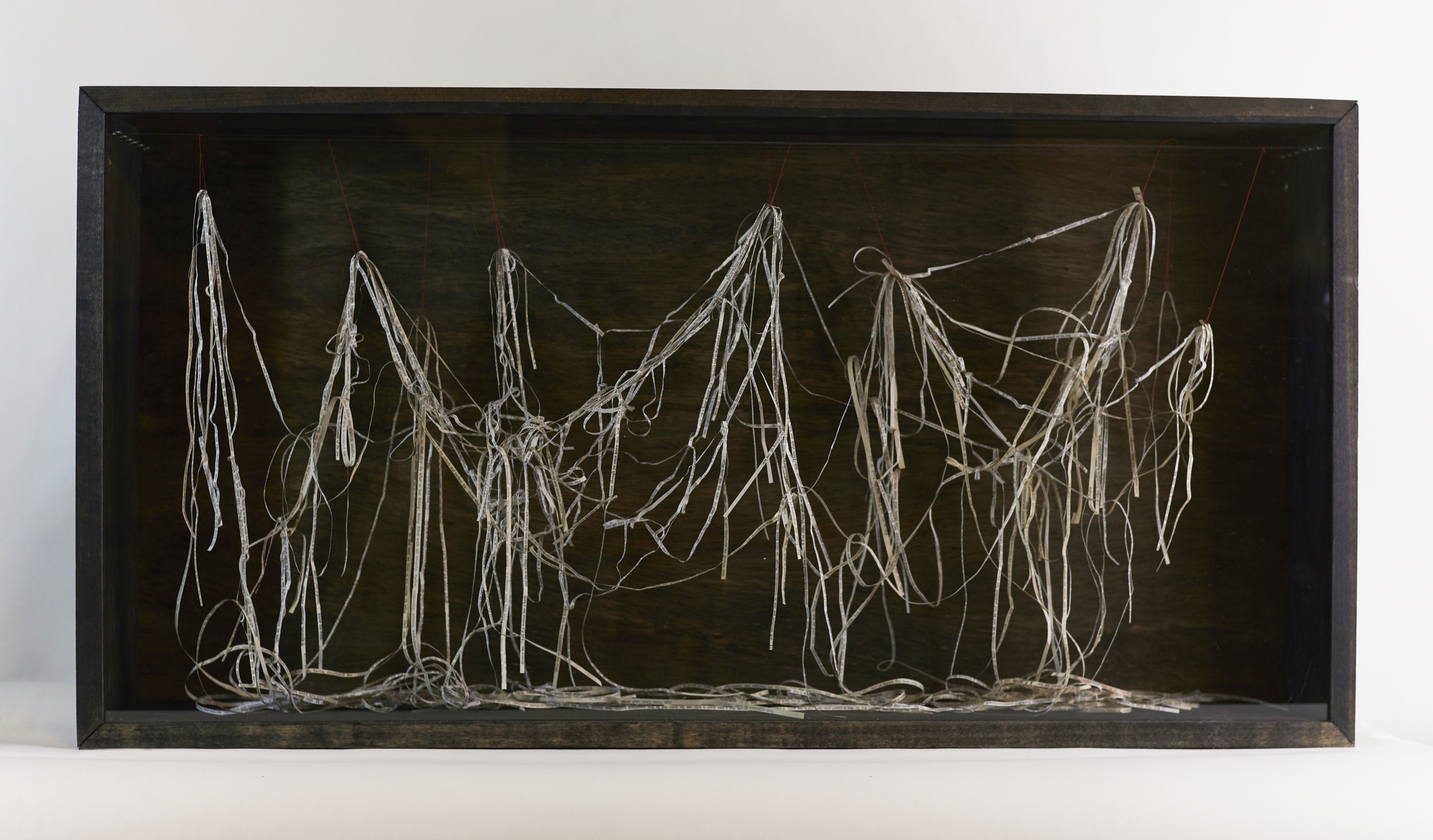
Solomon: We might as well begin with Florida. According to 2018 data from the UCLA Williams Center, LGBT adults comprise 4.6 percent of the adult population in your home state of Florida, which is statistically tied with Georgia as the highest percentage of any “southern” state. And this number, of course, reflects only those who disclose. While sixty percent of the state is protected against discrimination on the basis of gender identity and sexual orientation in private employment, housing, and public accommodation through local measures, there is currently no statewide law, and the June 15, 2020 Supreme Court decision specified only employment discrimination nationwide.1As Skyler Swisher wrote in an article for the South Florida Sun Sentinel in 2019, sixty-eight percent of Floridians support LGBT anti-discrimination laws, which led some to hope 2020 would be “the year for Florida to protect gay and transgender people from discrimination.” Yet, one attempt, the Florida Competitive Workforce Act, died in the civil justice subcommittee in March 2020. There’s no statewide ban on conversion therapy and twenty seven percent of LGBT Floridians live below the poverty line. The seesaw potential of queer progression and regression is not unique to Florida, but I wonder if you have observed that 60/40 split, that separation between 60 percent of the state, which does protect LGBT people, and the other 40 percent. Could you tell me about your background growing up gay in Florida?
Lawson: Florida certainly isn’t unique in this, and an exception to this rule is hard for me to imagine. I was born and raised in the part of Florida that I would say is proud to count themselves among the 40 percent that don’t protect LGBTQ+ people. The area is also considerably below the median income line with a large blue-collar work force. The scarcity of work as well as an ingrained preconception about queer people contributes to many being unwilling to disclose their sexuality. Self-preservation. But it’s also true that a significant part of my work and practice actually comes from how I grew up in my very conservative, “southern,” working-class household in Fort Myers, a little-known town between Naples and Fort Charlotte in southwest Florida. I was raised in a very "non-progressive" environment, I guess is the best way to describe it. I grew up in the closet like most southern people do, and that contributes to the direction I’ve taken with my work, especially with the beginning. My practice started with me exploring shared feelings and traumas in the closet and how to create a sense of solidarity within a community that I did not yet have access to in any concrete sense. Because I grew up in such a small conservative town, I didn’t really have a visible queer community of my own; there wasn’t a large group of people that I could gravitate towards to seek mentorship. What I did have was the church, within which I felt I constantly had to negotiate my own identity as a child. I continue to deal with the daily onslaught of Christian pushback as a queer adult. And I think you see that in my art.
Solomon: So much of your work speaks directly to the intersection of faith and sexuality in places such as Fort Myers, which resonates with many other spaces and experiences for queer people across the South. Two of your first pieces were titled Convoluted, and they feature a series of biblical passages often used to condemn homosexuality.2Bible passages included in Convoluted’s web: Genesis 19, Leviticus 18:22, Leviticus 20:13, Mark 10:6–9, Romans 1:26–32, Romans 13:8–10, 1 Corinthians 6:9–11,17–20, 1 Corinthians 7:2, 1 Timothy 1:8–11, Hebrews 13:1–5, Jude 1:5–8. It is my understanding that you cut those passages out of a King James Bible in order to “convolute” them and symbolize how some people bend, misconstrue, misinterpret, and mistranslate biblical teachings in the present in order to align with their socially conservative worldviews. That all biblical teaching and meaning making is a convoluted process. Is that what you were envisioning for these two works?
Lawson: That’s exactly how I imagined the pieces would be interpreted. Art and religion can both be misinterpreted, and with the Convoluted pieces I wanted to make sure what I was saying was “on the nose,” more or less. As much as it came from a place of frustration, the process became somewhat cathartic. When I was growing up, I tried to research as much about specific Bible passages mentioning homosexuality as some sort of defense when the subject was inevitably brought up around the dinner table. There are several passages that refer to Jesus helping heal a man’s servant, and looking back at the Greek and Hebrew translations, the word is also used to describe a same sex partner. I made the mistake of asking a pastor about it, thereby confessing my lack of faith, and his response was disappointing to say the least. He dogmatically insisted that the Bible was not open for interpretation. Not getting answers from faith leaders, I turned to art. The Convoluted Bible pieces were the first major breakthroughs that I had in thinking that I could be an artist and take this path. Like you said, they’re about the mistranslations and miscommunications of Bible teachings. I grew up in a Southern Baptist setting so it was all about how preachers and pastors and Sunday school teachers would miscommunicate many of the core biblical teachings in service of a political endgame that I did not recognize as “Christian” in any sense. Convoluted #1 and #2 are deeply emotional pieces for me; they helped me begin to understand how art could serve as a way to unravel many of the misguided teachings that surrounded me as I grew up as a queer person.

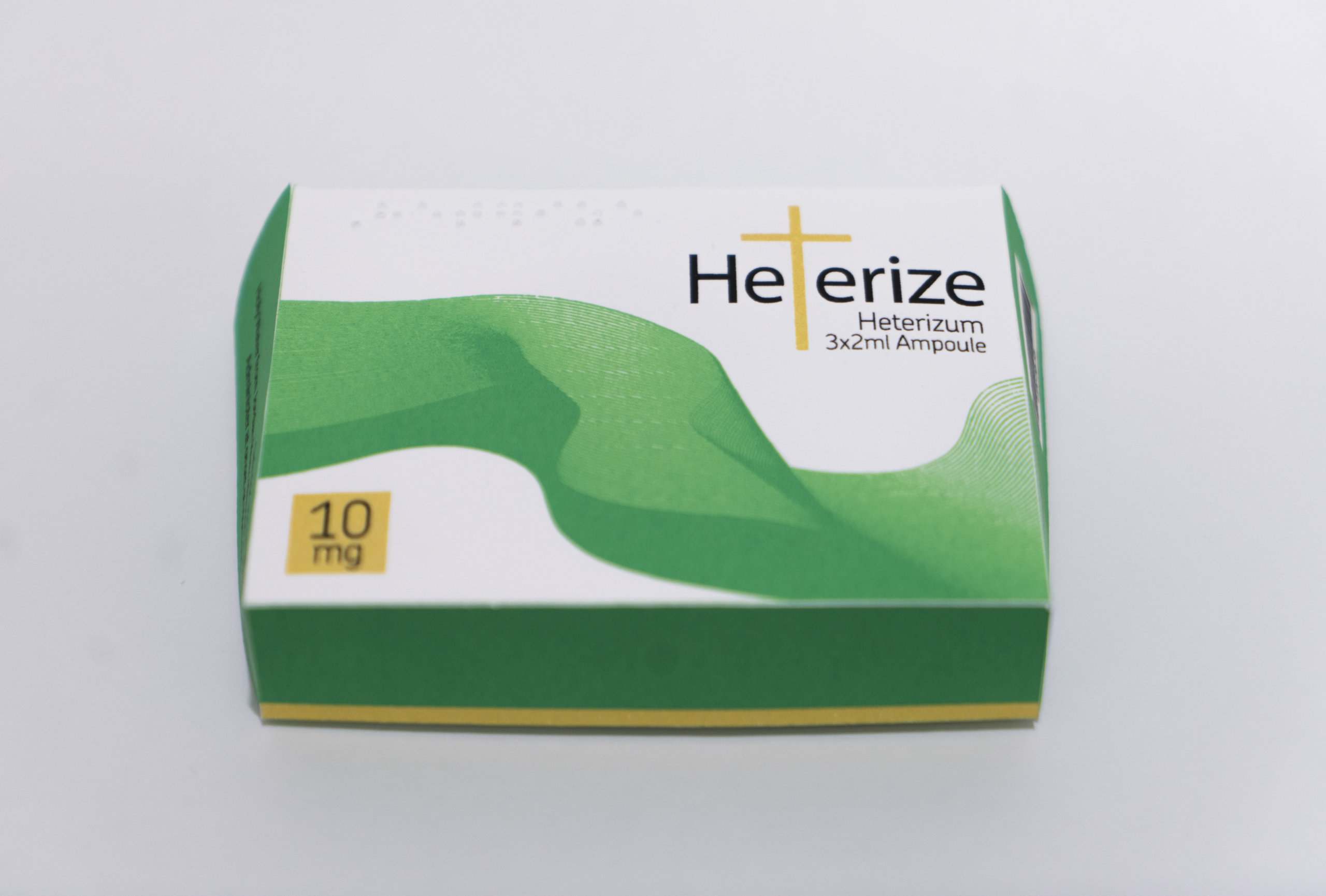
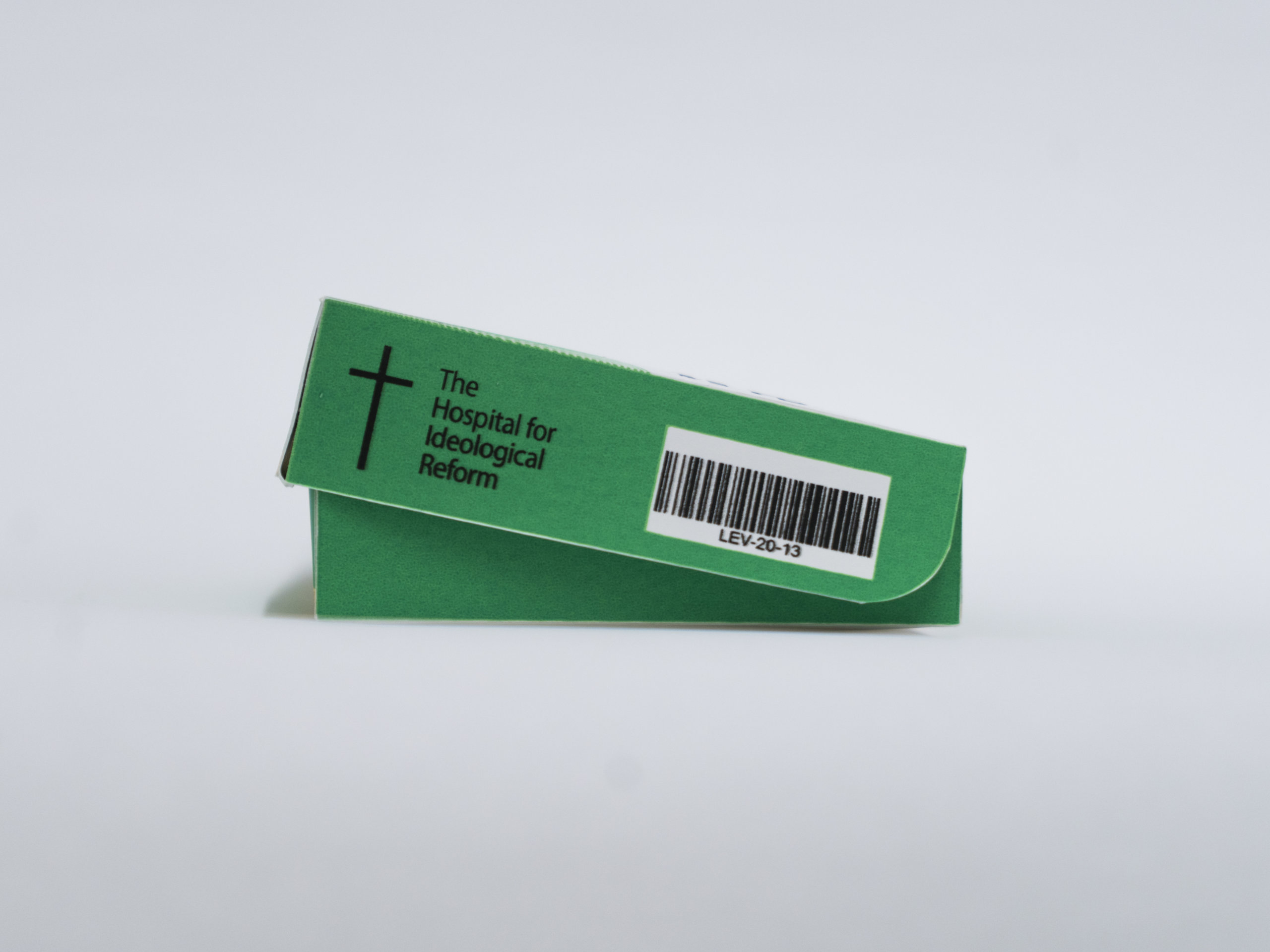

Solomon: Beyond the Convoluted pieces, interrogations of how faith meets sexuality continue to permeate your work. Heterize (2019) merges religious dogma with a convoluted history of pathologizing homosexuality as a “disorder” in need of a “cure” or “fix.” While I think the “Return to Eden” will be familiar to every queer reader who has been taunted with the “It’s not Adam and Steve” line of argument at some point in their life, what was the concept behind Heterize and do you see it as an extension, expansion, and/or revision of your concerns in Convoluted?
Lawson: I see Hetereize as both an extension and an expansion of Convoluted in that it extends my exploration of faith while expanding to discuss medical science’s responsibility to queer subjects.
Homosexuality was considered a mental disorder up until 1973, and the American Psychiatric Association (APA) didn’t officially rule reparative therapies as an ineffective strategy in “changing” sexual orientation until 1998. Dr. Robert Spitzer, one of the key members of the campaign to de-pathologize homosexuality in 1973, published a study in 2003 that many interpreted as an argument for homosexuality as a choice, that homosexuals can change their orientation.3R.L. Spitzer, “Can Some Gay Men and Lesbians Change Their Sexual Orientation? 200 Participants Reporting a Change from Homosexual to Heterosexual Orientation,” Archives of Sexual Behavior 32 (2003): 403–417. It added fuel to many churches’ fire in maintaining and extending their “conversion” practices, using established and “credible” scientific applications alongside spiritual exorcisms rooted in the rhetoric of shame and damnation. All to “fix,” “cure,” “convert” gay and lesbian people.
Heterize is based on my research of churches and organizations that practice conversion or reparative therapy at this intersection of faith and interventionist “medical” treatment. Reparative therapy is still legal in 29 states (2020) but has been widely discredited by the APA and is proven to be detrimental to the mental health of LGBTQ+ individuals who are forced into or even willingly participate in conversion therapy. These conversion centers operate from some of the same misguided principles I explored in the Convoluted series. They promote sexual and spiritual purity, accepting only procreation as divine decree and sole purpose of sexuality and homosexuality as a perversion of that decree. All the while they ignore some of the basic tenants of Christianity. This is why I list “Hospital for Ideological Reform” on a box of Heterize: bigotry under the guise of medical science.
But, again, a box of Heterize also confronts the responsibility and culpability of medical science in conversion therapies. Apomorphine, primarily used to treat Parkinson’s disease but has also been promoted as a treatment for alcoholism and heroin addiction, and the hormone Oestrogen are used in conversion practices to subdue libido as well as induce vomiting at the onset of perceived homosexual arousal. That’s why I list them as supplemental ingredients on the Heterize box. Heterize is meant to confront the absurdity of conversion therapy with its own level of absurdity. Think what it would be like if you could take a pill or inject a drug developed by science to change aspects of who you are, and that your spiritual home taught you that was your only option. It’s an absurd thought when you stop and think about it.
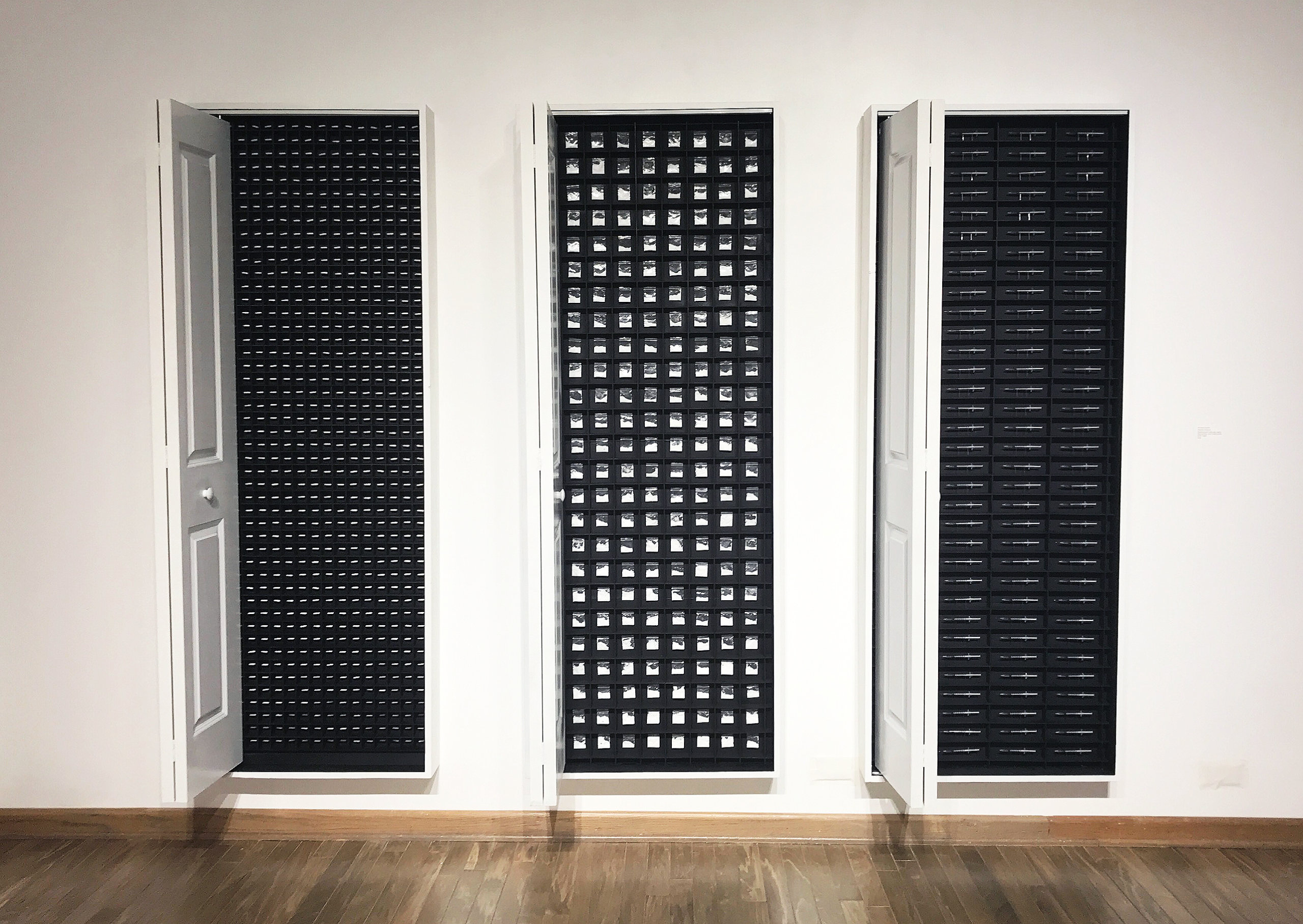
Solomon: Heterize might merge a faith-based critique with a more clinical form, but it’s not the first time you’ve thought about injection/ingestion as treatment within your work. Both operate strongly as a sort of interactive component, one in which viewers would not necessarily directly participate (inject/ingest), but they would feel that artistic invitation implicit in the work itself. I’m thinking here of your works around Placebo, which on one level examine the self-medication many queer people deploy (drugs/alcohol) to cope with the world around them. Each door in your Placebo Triptych, for example, features a different substance, geltine capsules (pills), a white powder, and syringes as if the person living inside each door is composed merely of the substance.
Lawson: Yeah, the Placebo Triptych (2018) is the culmination of various experiments with the idea of how queer people ingest daily words of hatred and devaluation and the accumulation of those daily homophobic micro-aggressions often become the foundation for a profound self-loathing that can often only be “treated” by filling the void with other “pills”: drugs, alcohol, substances. A placebo by definition has no value therapeutically, and I wanted to play off that idea for queer people navigating self-actualization. That just as you can’t be converted or fixed via the intrusion and twisting of religious ideology, there’s nothing that can numb you to the pain of getting beyond where you’ve been to become who you are meant to be as a fully embodied person in the world. Addiction is a problem in the LGBTQ+ community, and I wanted to confront that directly with both the Placebo Triptych and Daily.

Solomon: I know you’ve said the Placebo pieces represent the “cyclical futility of trying to escape the shame of being gay,” and the text in Daily in particular is based upon the journal of a man who underwent reparative therapy who described all the pills he had to take in a day. I wonder how you think of your own “gay shame” journey and the closet structure that figures prominently in much of your work. Could you say a bit more about how you navigated your understanding of sexuality in a place like Fort Myers, where you said earlier there were no visible queer networks and mentors for you? Was there a day when you just decided “I’m coming out”?
Lawson: I didn’t have a real sense of community in Fort Myers, but that doesn’t mean there wasn’t one there that I perhaps didn’t have access to. I didn’t really know of other queer people growing up, and the ones I did know of were through my parents who advised me to keep my distance in their stigmatizing vein of thinking about “deviant” sexuality that did not fit their ideal Southern Baptist man. I came out of the closet the day I graduated high school. But I had “come out” as an artist so to speak much earlier. Becoming an artist wasn’t an option for a very long time despite my having always been creative. As I child I was bullied and in an attempt to become “one of the guys,” I would draw erotic female figures to see if I could get the approval of my straight counterparts. I did that for a few years, maintaining a straight macho façade while continuing to draw and practice my art. I never took any art in high school because it was considered a very “gay” thing to do, and I had to avoid that perception to protect myself where I was. But then, I graduated high school, came out, and went to college in Orlando. I started by majoring in architecture, and I think you can see that structural and conceptual idea of form in my work. Architecture morphed into allowing me to think about how to blend my artistic life with a professional practice, but during my second year, I realized I was having a lot more fun making things, making objects, rather than the strict conceptualization of space and how people maneuver through it. But it’s interesting because now I’m coming full circle and beginning to research more about queer spaces and how we navigate them both in terms of accessibility and as terrains for intimate and affective encounter. The room that we’re able to take up.
Solomon: Wow, that’s powerful: “the room that we’re able to take up.” I want to come back to that idea of how your work is taking a more spatially aware turn lately. But first, you said you were bullied a lot growing up, and I think two of your art projects reflect both the experience of growing up being bullied and being closeted. “Smear the Queer” is a game many children enact on the playground: the target is the person holding the ball, who is labeled the “queer,” who must be “smeared” or tackled. The goal for the “queer” is to run and avoid being tackled. At least that’s what I remember from playing it as a kid. Your Smear the Queer speaks to the bullying many LGBTQ+ youth experience, but I would argue it also helps us understand the symbolic function queerness performs in our cultural consciousness: the one who must first be identified then “taken out” is the queer. The queer doesn’t fit. You used casts of your own teeth in the piece? A wisdom tooth at the center surrounded by other teeth jockeying for central position? Were you thinking about wisdom tooth extraction as a kind of metaphor for queer removal when you worked on this piece?

Lawson: I don’t know if I can claim I was thinking about wisdom teeth and surgical extraction specifically, but I was definitely thinking about how I was being excised from my social group and using teeth as a symbol for that. This piece started out with my own experience being bullied. As I said earlier, so much of my background informs my art. For me specifically, I was a quiet, very emotional young man, and I liked to play house with girls over football with the boys. I made other young boys uncomfortable because I wasn’t the ideal representation of a “man” (especially within my Christian private school), and unfortunately, I became a screen on which to project their own misguided ideals of proper masculinity. The wisdom tooth is extracted sometimes because of the perceived misalignment it will cause, even if the tooth is perfectly healthy, and I think this becomes a great proxy for the queer experience. As such Smear the Queer moved beyond my personal experience with bullying and evolved into a response to the number of reported hate crimes in the US. In my research I found that of the reported hate crimes committed towards the LGBTQ+ community, 57 percent of them were towards gay men. In the piece, I use 961 teeth to represent the approximate number of deaths that occurred in 2014 as reported by the Bureau of Justice Statistics (BJS). Yes, the teeth are cast from my original tooth and are arranged around it in the center of the composition. Dyed wax is used to symbolize gums and to represent the shared identity of the victims, connecting each tooth and creating a singularity and a metaphor for the shared struggle. If I thought about excision, it was in the sense of how a hate crime cuts a life short and I wanted to include those 961 teeth to reflect the sheer numbers of hate crimes against LGTBQ folk each year. Of course, one is one too many.
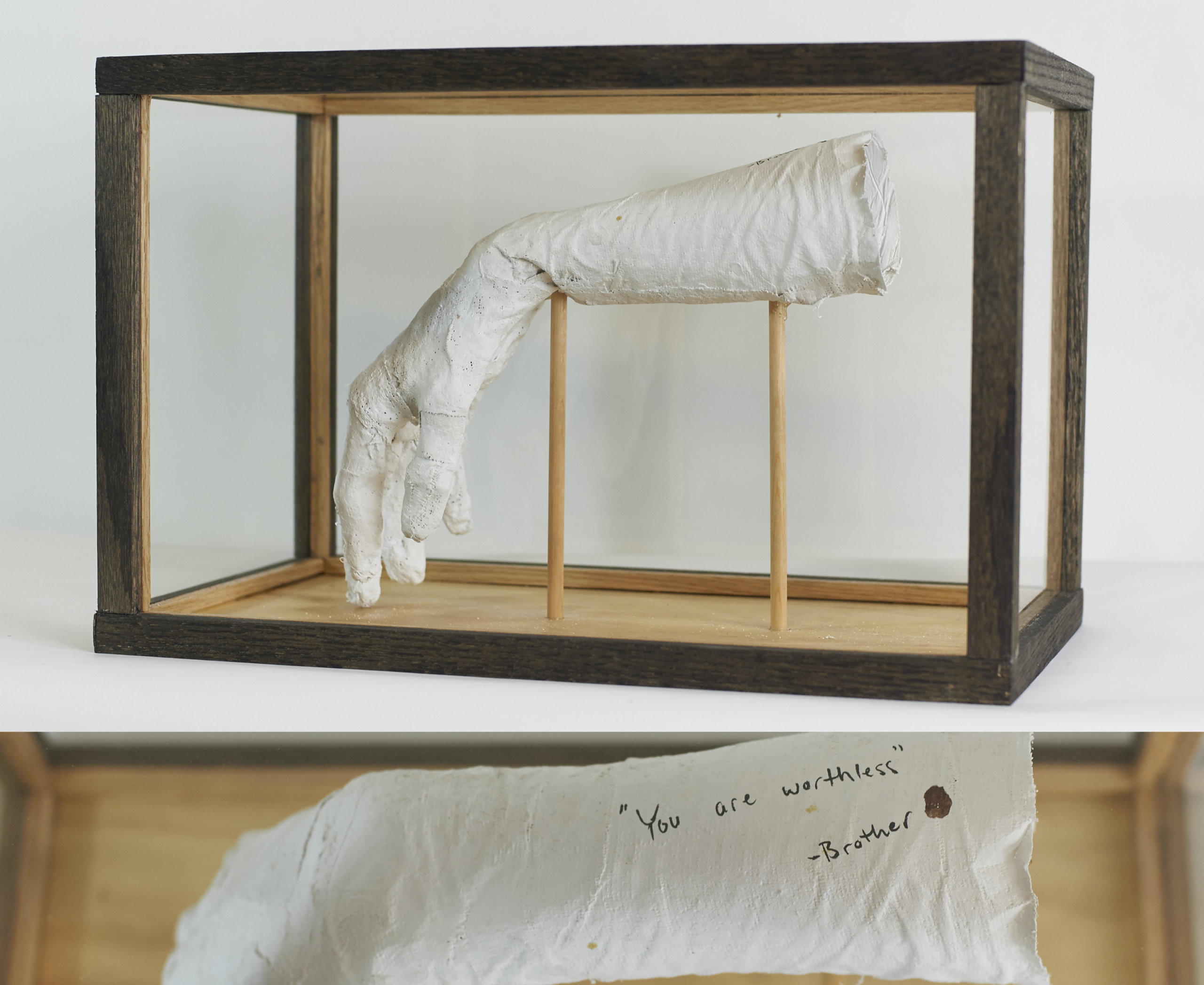
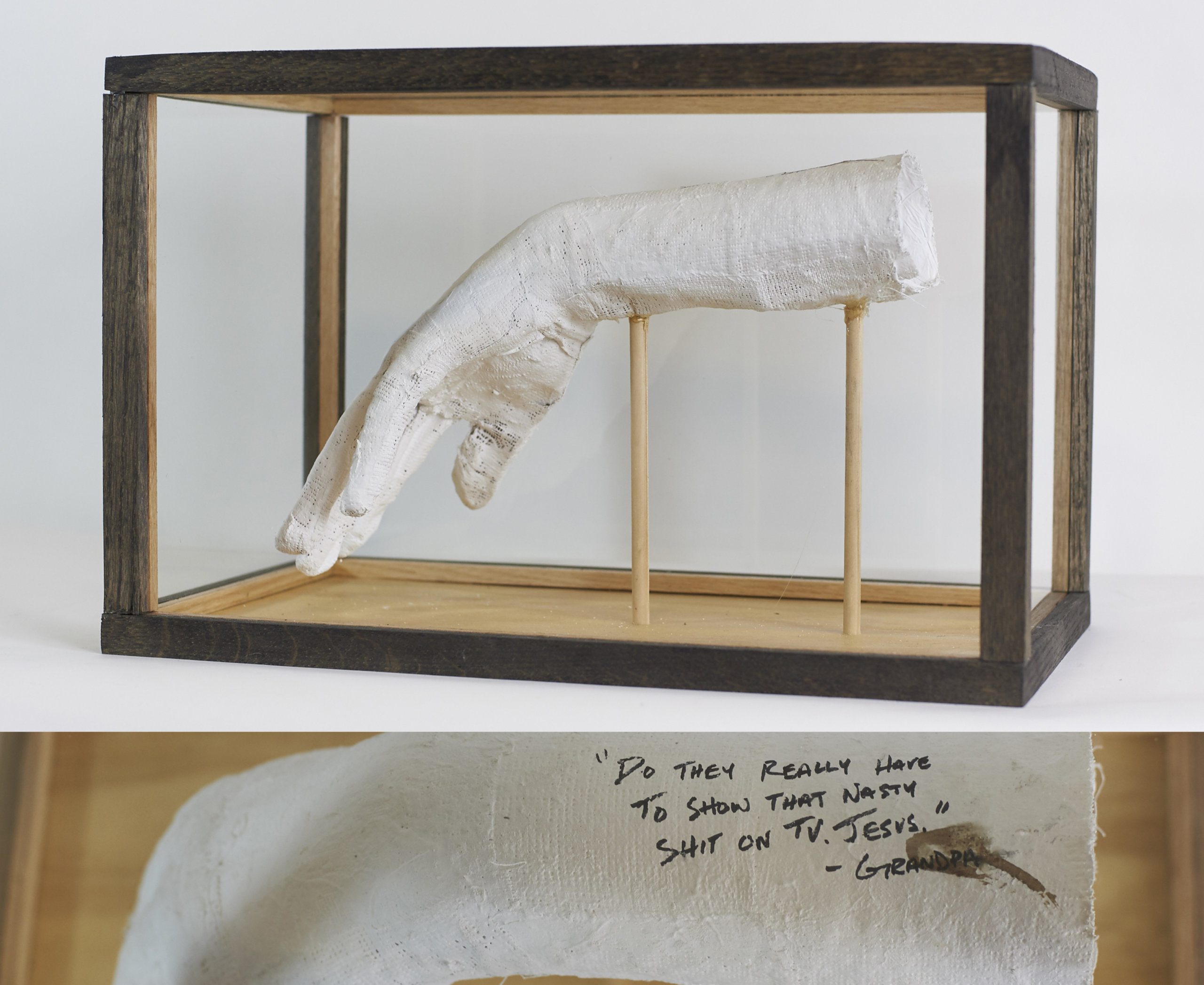
Solomon: Your Limp Wrist cast series also represents how a singular experience can be displayed alongside other singular experiences in order to form a collective, quotidian pattern of bullying and homophobic violence. The wrist cast pieces were featured in an early show of yours under the title “Closeted.” One of the most striking casts is from the subject “David” whose brother told him that he was “worthless.” Others in the series feature similarly jarring language “sharpied” on the cast. Can you describe how you curate the pieces in this ongoing series and how they work in your exploration of the closet?
Lawson: Yeah, the Limp Wrist pieces were probably the most successful works I did as an undergraduate at UCF. In an attempt to reach out to other queer people and form a community, I started taking on participants within my work, trying to figure out how I could mesh my historical references with theirs, and how each of us could independently grow from the process. The Limp Wrists began as a way for us to explore the role of language in making queer people understand our worth as perceived from a member of the straight majority. The written content on each cast represents the most memorable moment when the subject felt someone they loved “drew blood,” or tried to wound them with words that targeted their perceived difference. As such, each cast also features a drop of the subject’s blood to illustrate queer resilience: that we can be wounded to the point of needing a cast, but if we keep going we can become stronger. For example, on my cast I quote my grandpa who I overheard talk about the “nasty shit” on TV, by which he meant gay stuff. That moment made me understand how he perceived queer people, even the one who sat in the room with him and shared his blood. It’s about what we LGBTQ+ folk endure when we are still in the closet to those around us or even to ourselves. We put up with a lot of casual verbal violence even from our kinfolk.
I thought a lot about language and go back to Merle Miller, “it’s not true, that saying about sticks and stones; it’s words that break your bones.” In Limp Wrists, I wanted a way to express how much of what we hear around the thanksgiving table, in front of the TV, in church sermons, and with our “friends” is internalized and becomes a brutal reminder of our social status. It’s a common experience of most queer people I’ve asked. There is always a moment, something that is said either to them or unknowingly about them, that changes their perception of their self-worth. Sometimes it’s from the people we least expect, which is often the most damaging. I hope that one day I’ll run out of arms to cast, but I think these pieces are important to illustrate our queer resilience. I was inspired to create the form of a cast and “sign” it in blood after reading the Queer Nation manifesto, which was handed out by ACT UP at the New York Pride Parade in 1990:
“How can I tell you. How can I convince you, brother; sister that your life is in danger. That everyday [sic] you wake up alive, relatively happy, and a functioning human being, you are committing a rebellious act. You as an alive and functioning queer are a revolutionary. There is nothing on this planet that validates, protects or encourages your existence. It is a miracle you are standing here reading these words. You should by all rights be dead.”
Better Blood Memories
Solomon: I wanted to ask you about family—brothers and sisters—not so much your own family background but how you think about the queer kin with whom you share artistic DNA, if that makes sense. I can look at your work and see so many possible influences. First, how would you describe yourself as an artist? How do you think about your work at this stage in your career as fitting within a certain tradition?
Lawson: I’d say my art begins with a clear sense of concept that then shapes the form of the installations, something akin but not limited to the post-minimalist school of sculptural thought. I don’t have a concrete or specific school of thought surrounding what I do in my practice, but if I were to describe myself it would be an interdisciplinary multimedia artist. I would consider myself more of a sculptor. Two-dimension has slipped my repertoire of talent.
In terms of contemporary influences, I look a lot at Jordan Eagles, a California artist who works a lot with blood and did pieces in the Keith Herring museum. His Blood Mirror is probably one of my favorite pieces. I know I mimic a lot of his thought process and artistic instincts in my own work. Ai Weiwei is another artist who’s driven me to more of an activist place in my work. I’ve been talking with social justice professionals about how what I create are not just objects but have a more tangible function as reflective pieces for social change or disruption. Otherwise, I feel like I’m making the work just for myself, which isn’t the purpose of what I do.
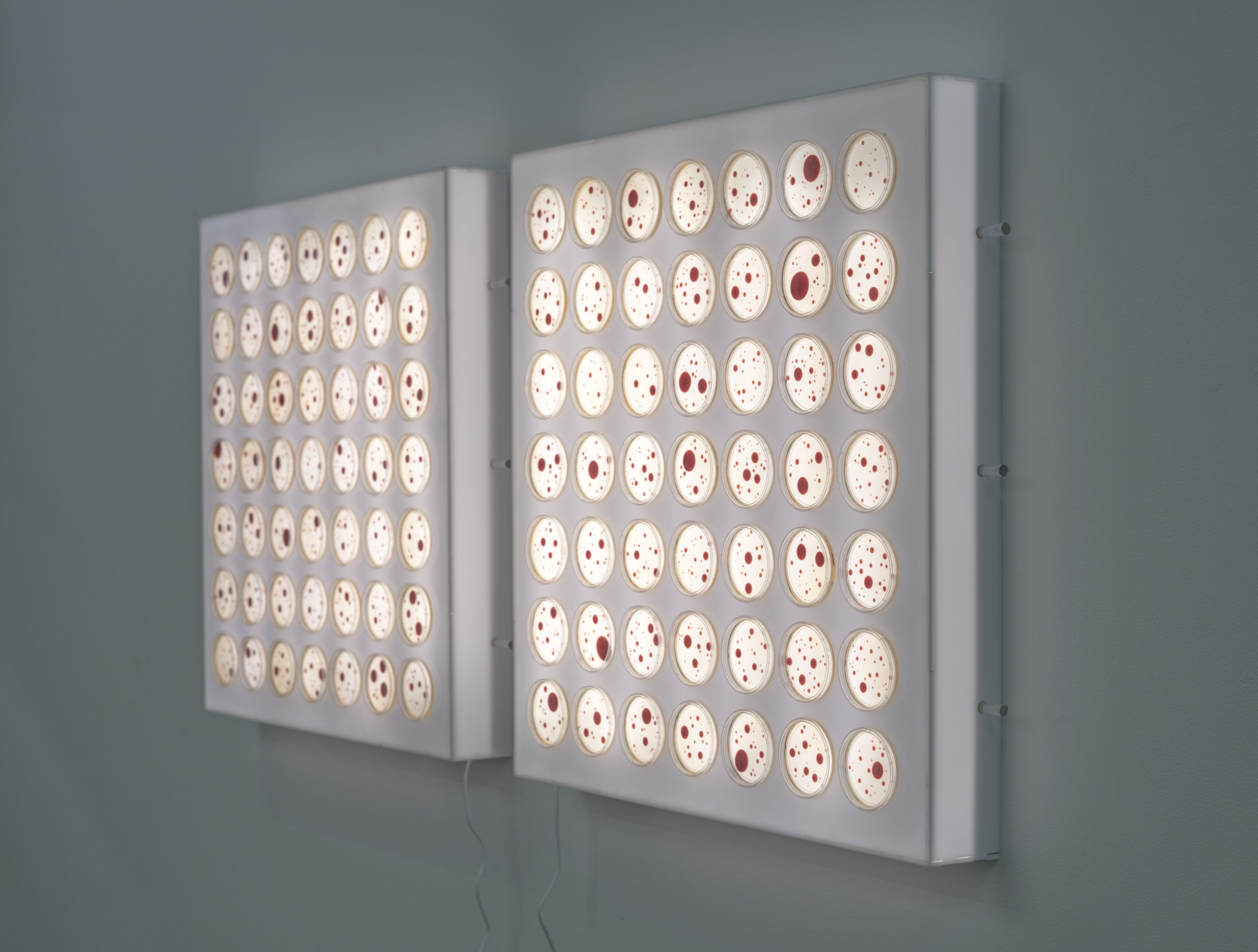
Solomon: Yes, I can see Jordan Eagles for sure in your work. Part of the way my mind works is through connection: always seeing references and ways to synthesize because I think all works of art are ultimately in conversation with other works of art, and we scholars tease out those connections in writing about them. That intricate weaving is something a writer I admire, the late Douglas Crimp, does wonderfully.4Douglas Crimp, Melancholia and Moralism: Essays on AIDS and Queer Politics (Cambridge, MA: MIT Press, 2002). In viewing your work specifically as a queer viewer, I also see traces of many other artists I love. Speaking of Eagles and blood mirrors and a desire for the work to have more purposeful connection, your use of blood as artistic material fits within a certain queer artistic tradition. One of my favorite artists is David Wojnarowicz; he fuses image and text in a way that is perhaps comparable to you as well. I teach portions of his memoir Close to the Knives, and it’s always eye-opening for students. In one of his final artworks before he died of AIDS complications, he superimposes writing over a photograph of human remains. Part of it reads, “If I could attach our blood vessels in order to anchor you to the earth to this present time I would… It makes me weep to feel the history of your flesh beneath my hands in a time of so much loss.”5David Breslin and David Kiehl, David Wojnarowicz: History Keeps Me Awake at Night (New Haven, CT: Yale University Press, 2018), 270–271. I can see this sense of connection through loss in your return to shared LGBTQ+ traumas throughout your work. Your use of blood also seems to echo the subversive political aims of Félix González-Torres, whose work was interactive, conceptual, three-dimensional and often deceptively political. His 1991 billboard depicting an empty unmade double bed with imprints remining on the pillows, produced a year after he lost his lover Ross to AIDS, makes a powerful political statement. He writes, “It was ruled that the bed is the site where we are not only born, where we die, where we make love, but it is also a place where the state has a pressing interest, a public interest.”6Felix Gonzalez-Torres, “Practices: the Problem of Divisions of Cultural Labour,” Art and Design 9 (1994): 91. See Joan Gibbons, Contemporary Art and Memory: Images of Recollection and Remembrance (London: I.B. Tauris, 20017). Despite the power of the imprint, Ross is no longer in that bed with Felix. However, the state, following the 1986 Bowers v. Hardwick decision, remains obliquely in that bed.
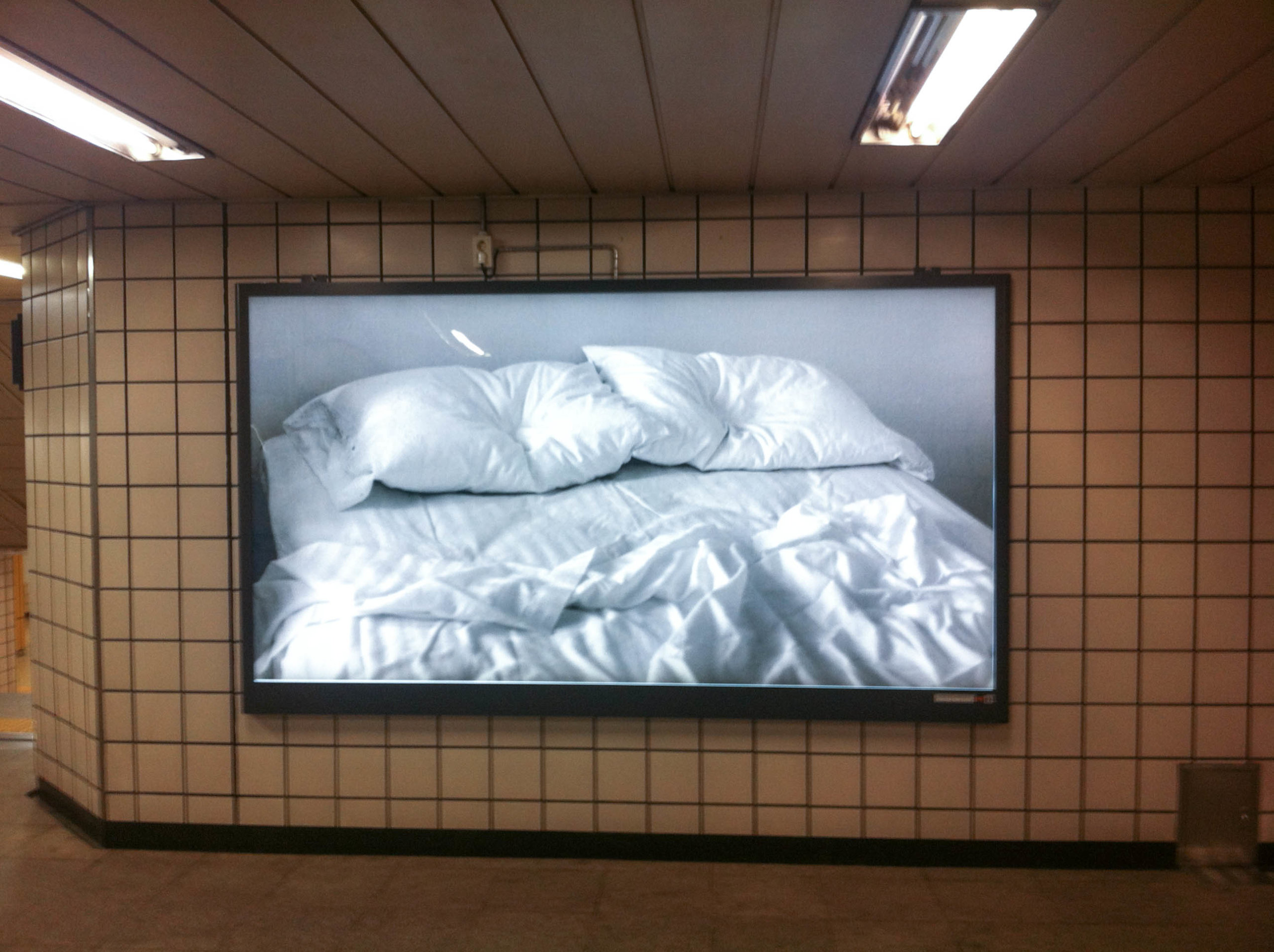
Your blood works provide a ruminative and reflective political ethic similar to González-Torres. When you see the blood in your work, you do not initially know from whom the blood flowed just as you cannot discern immediately from González-Torres’s work who once occupied that bed. And you’re making a statement about the state’s continued role in regulating a particular population’s ability to donate blood.
Do you think about the history of negative connotations associated with queer blood, which stems largely from that “time of so much loss” in the 1980s–1990s, when you and I were born, during the artistic generation of Wojnarowicz and González-Torres and Herring, who you mentioned earlier? How intentionally political are these blood works for you?
Forrest: You’re right. At this point, blood has become a universal instrument or material in my work. My first projects with blood, O-Negative and Better Blood, were to expose the discriminatory FDA blood ban that I think is an unnecessary and dangerous holdover from the early years of the HIV/AIDS pandemic. I had thirty gay participants donate a slide of their blood and I made a book alongside that blood that had the FDA questionnaire that excluded gay men from donating. From there, I shifted to blood prints and blood slides in Biohazard and my current project What Are We to You. In all of this, I’m working with abjection and aesthetics, bringing the disgusting and gross into a beautiful shape and environment. It works well in a vein of subterfuge in that people get really close to it and often not until they read the fine print or the title tag do they realize that they are that much closer to queer blood. It makes people really confront very quickly their own bias and stigma. What does queer blood actually mean? What does anyone’s blood actually signify, for you, the viewer, standing this close to many other people’s blood who just so happen to be gay or bi or lesbian or trans (which you only know if you read the fine print)? Generally, I use blood as a means to impart our shared humanity while politically invoking the FDA ban, the legacy of HIV/AIDS, and the still-common association of queer blood with the infectious and the contagious in the minds of many viewers. I’ve tried hard not to use blood in any shock value way or as a way to jar people. The goal has been one of enlightenment, of introspection, of recognition, and in some sense, of communion with those who’ve gone before who were gone too soon. To memorialize.

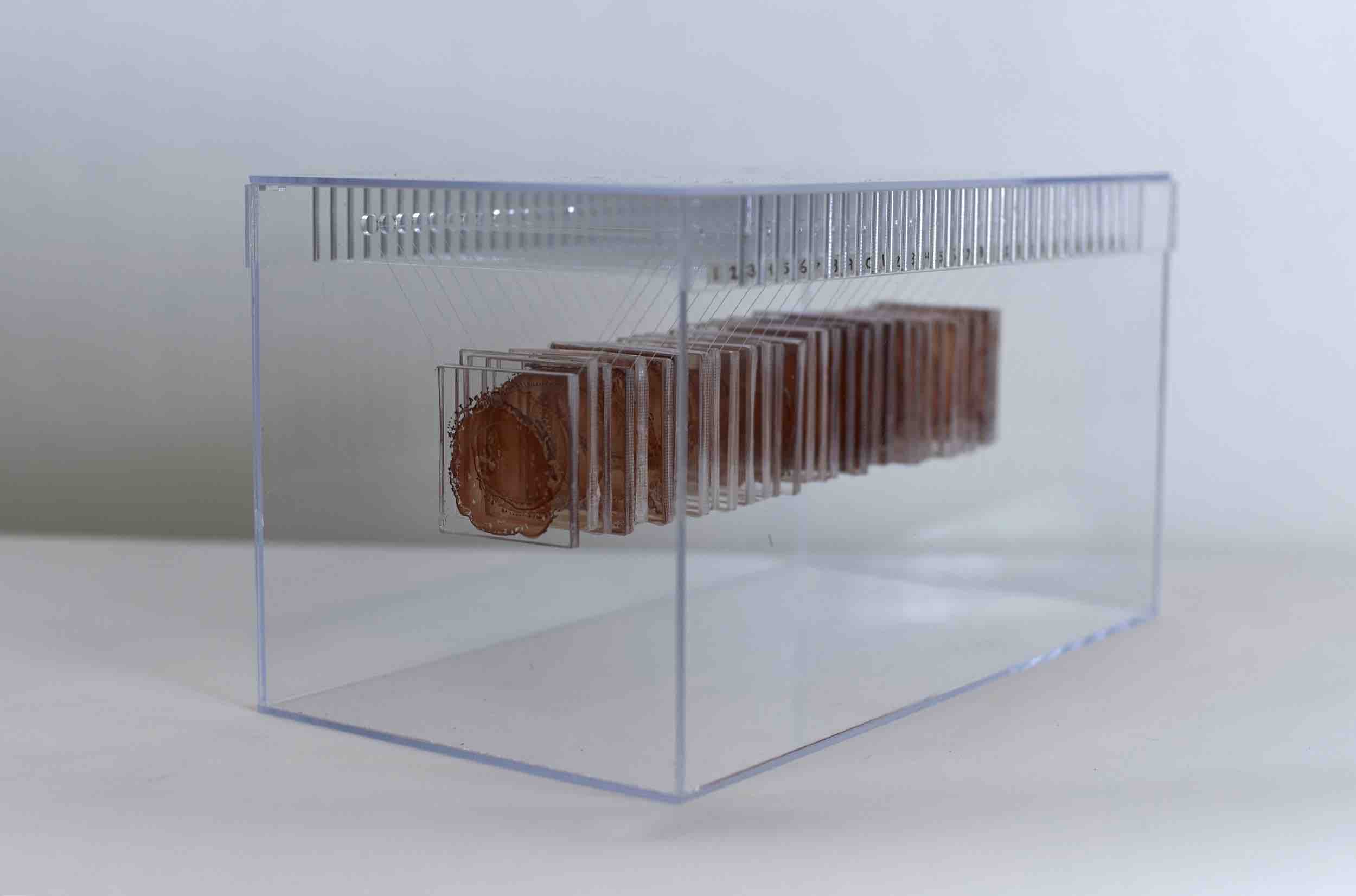
Solomon: Yes, it’s a kind of blood memory like the Rilke quote: not until the memories have turned to blood within us can we understand them. Something like that.7For the connection between Rilke and González-Torres’s work, see Christopher Castiglia and Christopher Reed, “Remembering a New Queer Politics: Ideals in the Aftermath of Identity,” If Memory Serves: Gay Men, AIDS, and the Promise of the Queer Past (Minneapolis: University of Minnesota Press, 2012): 175–215. The full and correct Rainer Marie Rilke quote: “And still it is not enough to have memories. One must be able to forget them when they are many, and one must have the great patience to wait until they come again. For it is not yet the memories themselves. Not until they have turned to blood within us, to glance, to gesture, nameless and no longer to be distinguished from ourselves—not until then can it happen that in a most rare hour the first word of a verse arises in their midst and goes forth from them.” I go back to the inheritance of loss we all live with as gay men. I do think those years of loss are in the DNA of who we are, of how we navigate the world. How we remember and honor those who died. How the pain of the past can be instructive for our present. It’s contemplative, but I wouldn’t say your use of blood is shocking. My friend Jesse Peel describes a moment after his 1987 HIV positive diagnosis when he cut his finger and realized the blood which pooled in the cut “was poison.” He states frankly, “that’s a real mind fuck."8See the Touching Up Our Roots oral history about his life: In the Eye of the AIDS Storm: The Saga of Dr. Jesse Peel, directed and produced by Dave Hayward (2010), DVD. Touching Up Our Roots: Georgia's LGBT History Project. Georgia State University. Jesse Peel’s realization is shocking! But Forrest, I don’t find your use of blood shocking at all. Is it a “mind fuck”? Perhaps. Because you are asking reflective, metacognitive questions of your viewer. But the way you use the material of blood is so precise, ordered, neat, adding a degree of symmetric beauty to what some may view as the materially abject. There’s something about using a substance that has been historically vilified as infectious, as less-than, as something that needs to be quarantined and cured, there’s something about taking a substance that has that much chaotic weight historically and then shifting it into a register of order where you put the interpretive onus on the viewer not on the person from whom the blood came. It’s powerful re-signification. How are you thinking about your queer bloodwork and the revision of the FDA blood ban in the context of COVID-19?
Lawson: It’s really important to what I’ve been doing recently. Before this, I had actually started a national campaign with a professor of social work at UGA, Dr. Jeremy Gibbs, in order to help end the ban or remove the restrictions to something a lot more reasonable. And then, of course, this whole pandemic happened, and we get immense pressure that helps reduce the ban to three months, which is still absurd. It’s an ongoing debate that I’m sure will continue to inform my art.
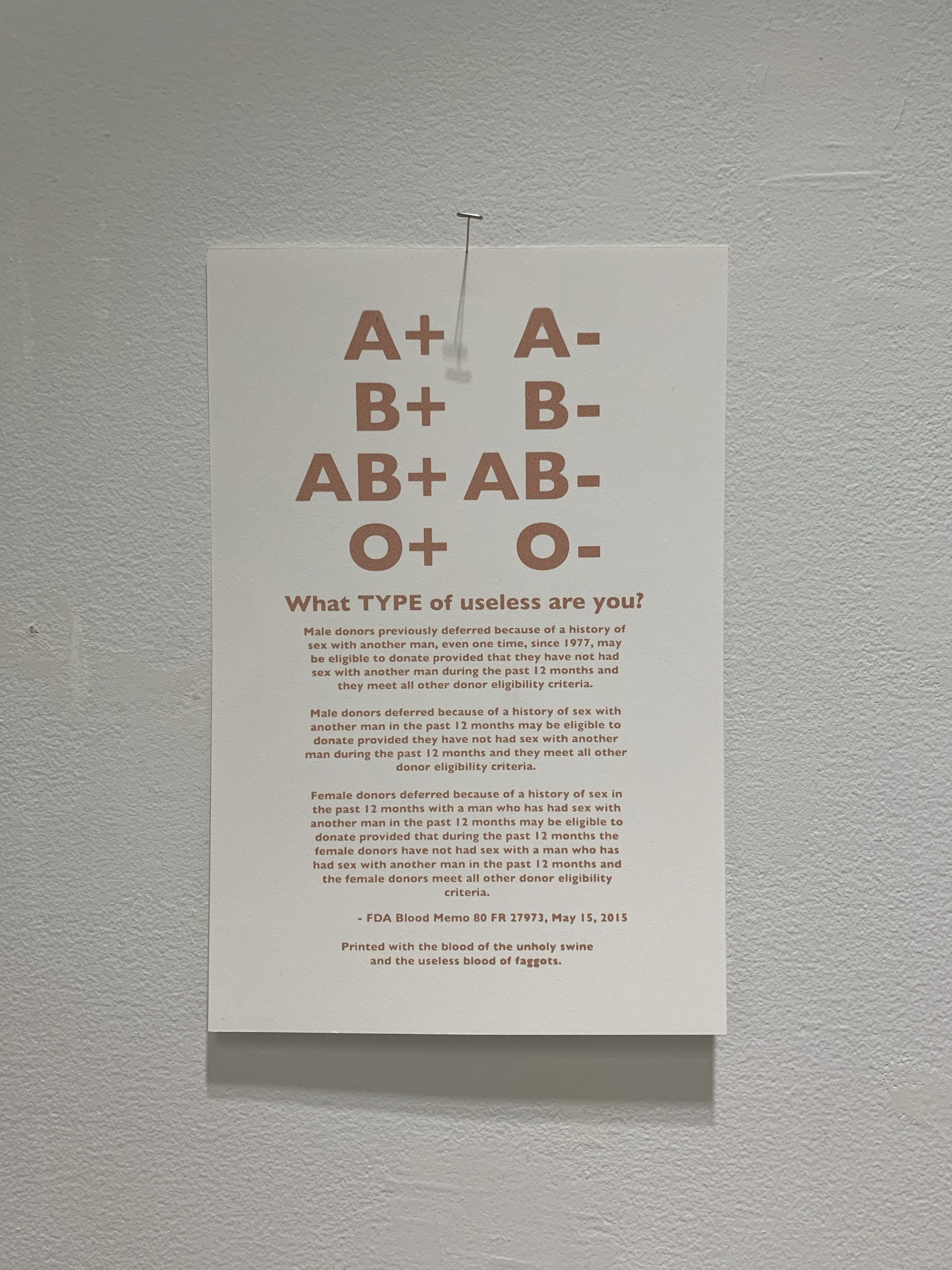
Solomon: And I think that’s part of the ethic of your artwork, to quote González-Torres again: “I do have a political and personal agenda with this work, and in a way they are very interrelated.”9Felix González-Torres, interview by Tim Rollins, Between Artists: Twelve Contemporary American Artists Interview Twelve Contemporary American Artists (New York: A.R.T. Press, 1996), 94.
Lawson: Absolutely. As I say in my artist statement: “Through sculpture and assemblage, my work explores the array of complexities experienced by individuals within the gay community.” It’s both me and the collective; the personal and political are inseparable. Although lately, I’ve been moving more towards a research-based artistic practice, whereas before I would’ve considered my work more emotionally driven, more instinctually responsive to what I was personally living through or seeing around me with my own experience and those of the small community I had in Fort Myers, then Orlando, and now Athens. Since winning ArtFields in 2019, I’m working now on a more national scale, for example, by reaching out to networks of reparative therapy survivors to try to describe a queer experience that I have neither lived nor am fully familiar with.
Solomon: I see that in some of the work you’re sketching during the current pandemic too: that reaching out. How do you connect in pandemic times when connection may lead to death?
Beyond advocacy for abolishing the blood ban and the material conditions of producing and exhibiting the work, which I know have been challenging if not impossible right now, can you say a bit about the ways the current COVID-19 situation has impacted the focus of your work?
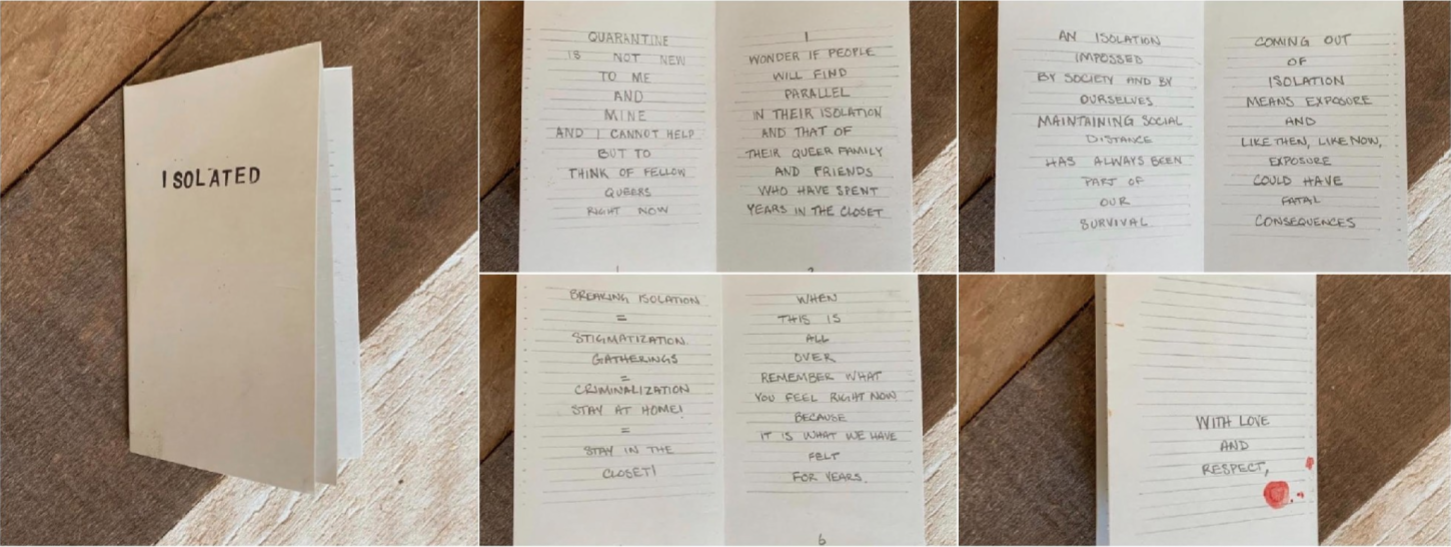
Lawson: Much of my sketching and idea invention lately has me thinking a lot about how the current “quarantine” and our experiences self-isolating as a parallel not only to the HIV/AIDS pandemic but also, for those of us who are well and isolated, to the queer experience as a whole, within the closet and beyond. I’ve started this book series. I’m trying to gather narratives of people’s experiences within the closet and to understand how that particular experience may or may not mirror the kind of isolation we are in now, where we are having to sacrifice parts of ourselves and experiences in order to survive in the world. And I envision this project, like the ones I’ve done so far, will bring a sense of recognition through reflection to those who are losing their minds right now who have never experienced this degree of isolation or loneliness before, things that many queer people have been and continue to be all too familiar with, unfortunately so, day to day as many of us have to navigate a culture that devalues and misunderstands us, sometimes with tragic consequences. I’m also thinking a lot about queer people who are isolated in neither ideal nor safe settings, and I don’t know best yet how to communicate with them. But I do want the work to amplify their voices and experiences. The biggest thing I’d like to accomplish in this newer work is creating that sense of shared experience that represents the full spectrum of affective response such “physically distant” experience elicits for us all, gesturing towards some empathy and understanding. Empathy is perhaps the direction I’m headed most of all: what is it like to walk in the shoes of others? What is it like to understand the microaggressions queer people experience if you yourself have not lived them because of who you are? What is it like to experience loneliness in isolation for the first time? Those are some of the questions I’m exploring and finding shape for.
Solomon: Shared traumatic experiences (bullying, homophobic violence, blood bans) have been the organizing principle of your art up to this point. Have you considered adding other dimensions to your work, different layers of queer affective experience?
Lawson: For sure, I’m trying to shift the mindset in order to shift the art as well. I’m working with game pieces and queer-themed board games as an attempt to play off the trope of queer missed childhoods and return to a sense of playful erotic creative whimsy that we as adult gay men can celebrate without shame or the watchful eyes of judgmental figures. I’m trying to blend the happy with the sad as best I can.
Solomon: It reminds me of “Joy” and “Sadness” in the Pixar film Inside Out. So you’re expanding perhaps the rooms that we’re able to take up, as you mentioned earlier? And I’ve been thinking about that phrase because it struck me so. There’s a passivity to the way you construct that phrase, right: “the rooms that we’re able to take up.” In the passive construction of the phrase, there’s a certain admission of powerlessness.
Lawson: Yeah, and I guess I want to take more of an active control of the narratives I’m crafting with my art, ones that aren’t purely reactionary. Right now I’m shifting in my work to attempt to find methods and forms that celebrate sexuality so as not to exclusively talk about trauma. It’s a reorientation that I’m working through right now. How, for instance, can we build a life against the backdrop of trauma that is still profoundly rooted in joy, in hope, in love, in intimacy? How can art represent the affective register of queer happiness? How can we have the whole emotional house and not just the one sad room? So now I’m stuck in that research mode trying to give those ideas more tangible rooting in my work. I’m looking a lot at queer theory right now, and I’m trying to navigate how best to talk about queer experiences without imparting a sense of total authority on the subject. How are we oriented towards our work? That’s one area of queer theory building off Sara Ahmed’s work Queer Phenomenology that I’ve been thinking through. How am I approaching the work and the themes my work has always been about? How am I “oriented” towards trauma and what “turnings” occur for others to become a part of the work? I know for eight years now my work has been primarily about homophobic experiences—those shared traumas that we as LGBTQ+ folk unfortunately know too closely and the inherited generational trauma that we still encounter from our shared past.
Solomon: And in that reorientation that you’re working through, I know sexuality is making a kind of resurgence in your work.
Lawson: Absolutely. I avoided sexuality for a long time mostly because I had done work in my undergraduate studies that was censored. They were taken out of the gallery setting. I was instructed by one of my mentors that if I ever wanted to establish myself as an emerging artist and make my work pass through that veil I should avoid explicitly carnal and sexual artwork. And I did. But it’s always been an undercurrent. As I said, I started my art as a young person drawing very erotic imagery, and I’m still to this day just drawing penises everywhere, which is both a return to the erotic in my art and that spirit of play and joy that I’m seeking more of in the work lately. And the game pieces are really about the celebration of sex and sexuality—
Solomon: The Joy of Gay Sex if you will.
Lawson: Yeah! I’ve made these BDSM themed playing cards, and I’m redoing the game Operation in a sex-toy setting. One piece I’m working on now, “The Hedonist’s Closet,” is all about the pursuit of pleasure on hookup apps. I don’t think I avoid sexuality anymore perhaps like I did when I was younger in my work. I certainly don’t do it personally! But within the work, I was always afraid that to be in a gallery setting and have some sort of success that there were certain subjects that were still very taboo. That’s really the direction my work is headed now—still very body centered—but joy, pleasure, sex, life, you know all the “simple” stuff. [Laughs]
Pulse: Remembering the 49
Queerly beloved,
we are gathered here today to get through this thing called life
our story stretched across bloodlines, backrooms, and borderlines
. . . . . . . . . . . . . . . . . . . . . . . . . . . . . . . . . . . . . . . . . . . . . . . . . . . . . . . . . . . . . .
We're tired of being so resilient.
Pero, love beats here.
—Maya Chinchilla, “Church at Night”10Maya Chinchilla, “Church at Night,” GLQ 24, no. 1 (2018), 3–8. https://doi.org/10.1215/10642684-4254387.
Solomon: I thought we’d end with a benediction of sorts by considering your works surrounding the Pulse nightclub shooting. I believe your 6/12/2016 piece was how I first encountered your work. This work resonates so deeply with so many of us. In “Church at Night,” Maya Chinchilla responds to the Pulse shooting, asking readers: “Do you remember the names/ of your first gay bar?” I already know the answer to this, but Forrest, what was your first gay bar?

Lawson: It was Pulse. Although I was closeted until I graduated high school, I was with the man who would become my husband for three years prior to that. As awful as it sounds, we maintained staying in the closet for the sake of our own growth and our own safety back in Fort Myers. Once we got of age and were able to go to nightlife situations, we were able to find more of a community then, but that really only happened after I graduated and was able to move up to Orlando, which is a mostly progressive, liberal, open place where I felt a lot more comfortable. I think a lot of queer people did up until Pulse happened… Orlando was one of the first places in Florida to offer employment and family protections, housing initiatives for homeless LGBTQ+ children (Zebra Coalition, The Center), and a vast number of out and proud queer people. It is still, however, the South, and as much as it appears the queer population is thriving, Florida still has a long way to go. It is still home to churches that host “Make America Straight Again” rallies, pastors who call for government eradication of all queer people, and the Pulse tragedy.
Yes, Pulse was the first nightclub that I went to, but there were many other queer spaces I started to navigate as a terrified nineteen-year-old child trying to explore a more “urban” terrain of queer life. Starting my queer artistic journey in Orlando really helped me understand my place within an intersectional community. Race, gender identity, class, faith-based queer groups, I was able to navigate all of that as I came into myself and into my work. And in many ways, my early twenties in Orlando felt like a replacement for the childhood I feel like I missed out on, in the sense of coming to terms with my sexuality. My twenties sort of acted as my teens, much to my detriment I’m sure…
Solomon: … I wouldn’t say that. I think that’s a fairly common experience that often serves as a misguided stereotype of gay experience: the "lost boy" trope, the boy who couldn’t or wouldn’t grow up, when those who traffic in such rhetoric fail to understand the reasons that might motivate queer people to have such a “delayed adolescence.” And yet, Forrest, it seems to me your life thus far has an element to it that subverts so many expectations: you’ve been together with your husband for a long time!
Lawson: Yeah, since we were fifteen years old, so fourteen years now. We got married in 2016, the year after it became legal. The year Pulse happened. We were in Orlando during Pulse, and that moment served as a catalyst for so much of my professional and personal life. I specifically reference the Pulse tragedy in my work with the number 49. A lot of my work features the multiplicity of that number. The blood slide pieces in What are We to You, for example, each contain 49 petri dishes of blood spots. I’ve done other projects such as the wrist band pieces in the 6/12/2016 series, which feature interviews I conducted with 49 people who give their narrative reactions to Pulse and their reactions to Pulse no longer being a safe, queer space. And then I included those reactions within a memorial box alongside one wrist band and one name of a person lost that day in June 2016. Pulse is a place that has a ghostly presence in everything I do.
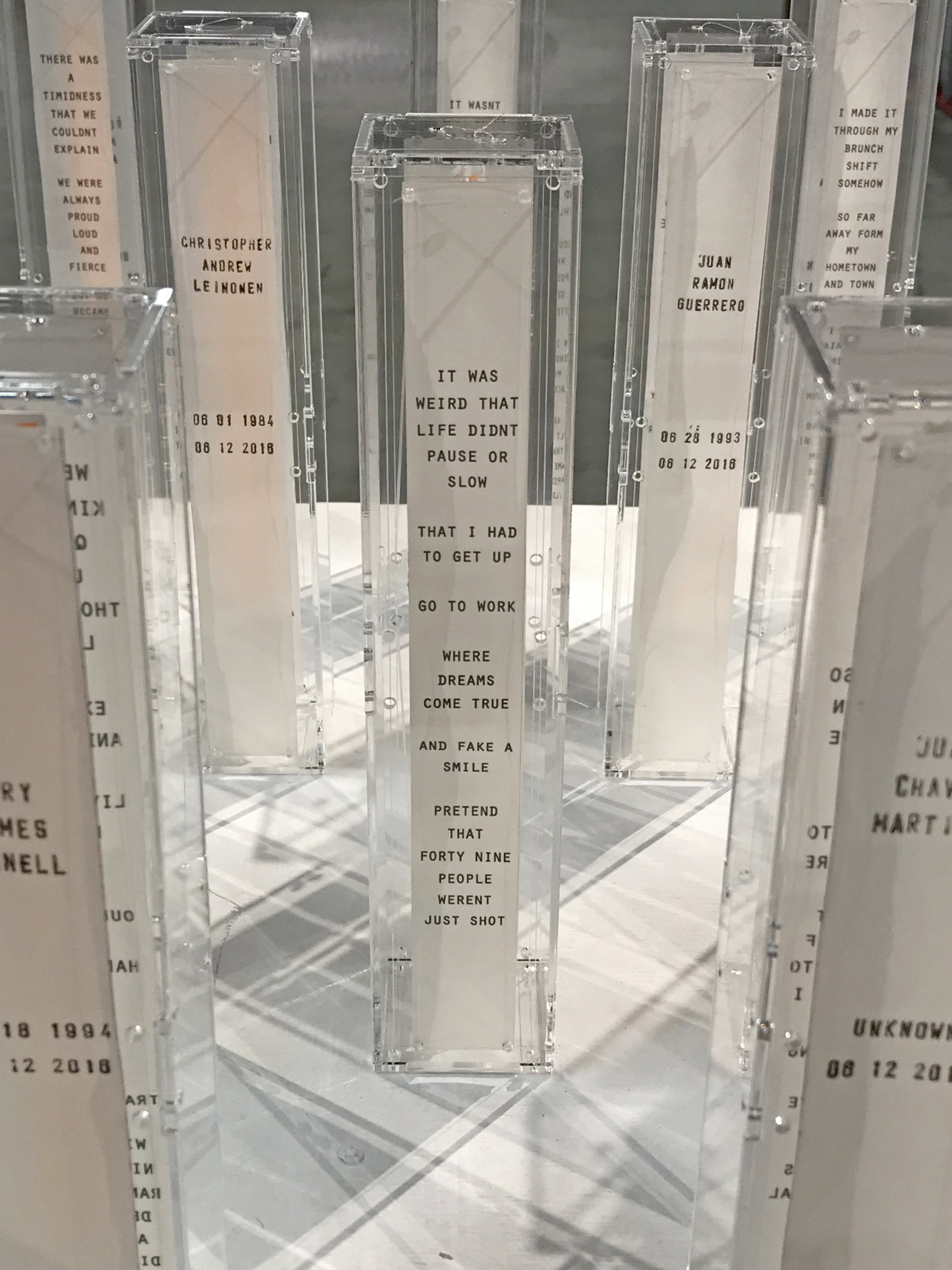
Solomon: Some of the written text within one of the memorial boxes reads, “It was weird that life didn't pause or slow. That I had to get up. Go to work. Where dreams come true. And fake a smile. Pretend that forty-nine people weren't just shot.” In your display, this text is positioned between boxes honoring the young lovers Christopher Andrew “Drew” Leinonen and Juan Guerrero, a thirty-two-year-old man and twenty-two-year-old man who were both celebrating June Birthdays and who died together at Pulse. Many of us witnessed Drew's mother Christine Leinonen's public grief in the aftermath. I can still remember waking up that day to the news, seeing her tears not knowing where her son was. It's become memory in the blood at this point, deep in the marrow. And I can't help but think about how Drew and Juan and so many of those lost were our contemporaries. How you and your husband live, how I live, and they do not. And I think that's such a surreal recognition when we encounter loss: how random it seems that some die while we live.
Lawson: It is surreal. But I suppose that’s the purpose of art, right? We make and create. We keep them alive in the objects we craft to remember them. Four years later, we continue to honor them.
About the Authors
Forrest Lawson is an Orlando-based multimedia sculptor. He is best known for his assemblages dealing with issues presented within the LGBTQ+ community. Growing up in Florida, he blends the experience of southern conservative living with his experience as a gay man. He is a MFA student in Sculpture and Fine Arts at the University of Georgia and has a BFA in Fine Arts from the University of Central Florida. He received the Grand Prize of ArtFields in Lake City, South Carolina, in 2019.
Eric Solomon earned his doctorate in English from Emory University and is a visiting assistant professor of English at the University of Mississippi. His work is featured in Southern Spaces, south, PopMatters, and Mississippi Quarterly.
]]>An Unlikely Bohemia
We are hope despite the times.
R.E.M., "These Days" (1986)
In Athens, Georgia, in the 1980s, if you were young and willing to live without much money, anything seemed possible. Magic sparkled like sweat on the skin of dancers at a party or a club. Promise winked underfoot like the bits of broken glass embedded in the downtown sidewalks. A new world seemed to be emerging out of our creativity, our music and art, and our politics, but also the way we understood ourselves and related to each other.
In my memory, the weight of the air on summer nights made possibility seem like a substance I could hold in my hand. Always, local bands played and people listened—at practice spaces and house parties and venues like the 40 Watt. People went to hear their roommate or boyfriend or coworker play one night and urged everyone to come and see their group the next. Easy to make and easy to hear, live music was everywhere. We used it to reinvent and express ourselves and connect with each other. We used it to live.
After the clubs let out, the scene kept moving until dawn. Small groups climbed the fences at apartment complexes—no one would admit to living in one—and went skinny-dipping. Sometimes people walked to a big Victorian house on Hill Street and danced to mixtapes in the hall between the rolled-back pocket doors until their clothes dripped with sweat and their heads spun. Occasionally, at midnight, a small drama troupe would perform an original play up and down the aisles of the twenty-four-hour Kroger. Film buffs too young to see movies like Sleeper, Raging Bull, and Paper Moon when they came out watched them for free in the air-conditioned quiet of the seventh floor of the University of Georgia's library. Often, people paired up, going home with the person they were seeing or an acquaintance or someone they had just met. One perfect July night, I lay naked with a friend on the cool cement floor of a screen porch as the wet heat thinned and the crickets rasped and we talked about music until dawn. Possibility proved more addictive than the beer everyone drank and the drugs many people took.
We were unlikely people in an unlikely place. No one expected us to do these creative things. No one who mattered thought that we could make a new kind of American bohemia. Yet Athens kids built the first important small-town American music scene and the key early site of what would become alternative or indie culture.
We had grown up anything but alternative. Home was a new version of the South created by desegregation, interstates, air conditioning, and airports. Our parents had mostly enjoyed the rewards, a hard-earned success that had been knocked back in the last decade by the oil crisis, stagflation, and the Reagan recession. Our schools practiced a form of neglect that suggested racial integration was easy, feminism unnecessary, and gay sexuality nonexistent. None of that was true, of course, but white, middle-class kids often skated over the consequences.
On some vague level, we sensed that we were living in a changed and changing world, yet the adults around us seemed to be in denial, clinging to old ideas about life and work and community. The most visible alternative, the hippies and peace activists left over from an earlier generation's counterculture, appeared to have degenerated into caricature. Reading books and music magazines and talking to older Athens artists and University of Georgia professors, we learned about creative communities in Paris and London and New York, places that had nurtured earlier rebels from the Beats and the jazz musicians and the abstract painters to the rockers and the drag queens and the punks. Some of us even got to know nearby "folk" artists and musicians, people who followed their own visions right here at home. We longed to send our yawp over the roofs of the world, too, to live for music and art and sex, to be daring and original and important. Why the hell not? We did not want to be rednecks or racists or conservative Christians or live in subdivisions or work as middle managers. We dreamed not of the Reagan-era Sunbelt but of a different world, a new, new, new South. And in the university's libraries and archives and studios and galleries and concert halls and the town's old buildings, we found resources to try to make that world a reality.
The scene was our answer to what we understood as the failures and limits of our America. And our participation in this collective creativity transformed us. In my case, the scene took in an unhappy accounting major confused about politics and about six years later spit out a feminist and anti-racist scholar determined to live her life as art. Along the way, I waited tables and catered, made rugs and wall-hangings out of old clothes, took up painting and the cello, earned a master's degree in history, and cofounded and ran a local venue. When I left Athens to start a history PhD program elsewhere, I took that magical sense of possibility with me and used it to weather the perils of graduate school and the academic job market. My story was not unique. The scene changed everyone I knew. Middle-aged now, a historian and the mother of college kids myself, I can see how the things we learned—question the givens, find something to do that engages your passions, build community into whatever you do, and stop often for beauty and pleasure—radically transformed the trajectory of our lives.
From the late-seventies origins of bohemian Athens to the early nineties when Seattle became the center of American alternative culture, the Athens scene produced amazingly good music, from famous groups like the B-52s, R.E.M., and Widespread Panic to critics' darlings like Pylon and Vic Chesnutt and acts that built a grassroots fan base one show at a time, like the Squalls and Mercyland. But the scene also transformed the punk idea that anyone could start a band into the even more radical idea that people in unlikely places could make a new culture and imagine new ways of thinking about the meaning of the good life and the ties that bind humans to each other. The history of the Athens scene proves that people you would not expect in places you have not thought about can create a better world. It also reveals how cultural rebellion can transform human experience.
Of course, the music mattered. Athens musicians combined an arty, avant-garde approach that prized originality with its seeming opposite, a commitment to the pleasures of pop culture, rhythms that made you feel and move, and spectacle that made you stare. Reimagining the structures of rock music went hand in hand with having fun. Athens bands helped make this pop-art fusion an important part of the new overlapping music genres of college and alternative and indie rock. Because the Athens scene emerged so early in the transition between punk and indie, it also served as a model for kids trying to make their own music in other places not previously understood as having underground potential. If punk taught people that anyone could play, Athens taught them that this music making could happen anywhere, even in the South, even in small-town America.1Bernard Gendron, Between Montmartre and the Mudd Club: Popular Music and the Avant-garde (Chicago: University of Chicago Press, 2002); Tricia Henry, "Punk and Avant-Garde Art," Journal of Popular Culture 17, no. 4 (Spring 1984): 30. Another, early node of DIY culture in an unlikely place was the scene which formed in Akron and Cleveland, Ohio, two adjacent and then-deindustrializing cities, after the formation of Devo in 1973. See Calvin C. Rydbom, The Akron Sound: The Heyday of the Midwest Punk Capital (Charleston, SC: The History Press, 2018). On the relationship between the Akron scene and Kent State University, see Tim Sommer, "How the Kent State Massacre Helped Give Birth to Punk Rock," Washington Post, May 3, 2018, https://www.washingtonpost.com/outlook/how-the-kent-state-massacre-changed-music/2018/05/03/b45ca462-4cb6-11e8-b725-92c89fe3ca4c_story.html. See also the publication D.I.Y: The Do-It-Yourself New Music Magazine, published in Manhattan Beach, California, in 1980 and 1981. Issues included lists of clubs that would book punk and other kinds of new music, independent record stores, and college radio stations, as well as coverage of scenes in Cleveland, New York, Los Angeles, and a few other cities.
While bands created the most widely circulated forms of eighties alternative culture, the point was never only to make our own music. People in Athens and in other outposts of indie America were working on something more. We were trying to build authentic and meaningful lives in opposition to what we understood as the stifling conventions, false idols, and emptiness of modern middle-class American life. We were trying to save popular music, sure, but we were also attempting to create real places in which real people interacted with each other in order to boost real human flourishing. Surrounded by New Right politics, evangelical social conservatism, and corporate-dominated life, we worked to preserve the very idea of culture as a space of freedom and play and pleasure. And our efforts helped move the ideals we valued—a much more open and tolerant society, an appreciation for and investment in the local, a commitment to beauty and pleasure in everyday life, and a belief that what you do for a living does not define your identity—from the margins to the mainstream of contemporary life.
It is easy to scoff at our naivete and our ignorance—and even our arrogance—and to argue that the DIY notions we imagined as utopia gave way instead to today's start-up mentality, the gig economy, and ballooning inequality. Many people whose opinions I value want the story of Athens to follow a rise and fall arc. But this story distorts and simplifies the history of this scene and ignores the facts. And I am not ready to give up on the promise of alternative culture yet, not in my Athens of the past or in any possible Athens of the future.
Unlike many other places where eighties and nineties alternative culture flourished, contemporary Athens has not become a bohemian stage set for the top 10 percent of Americans, with a little bit of genuine creative culture clawing for survival among the rising rents. It has not been taken over by tech culture and "creative" entrepreneurship like Seattle, Brooklyn, and Austin. And it has not turned slick and rich with retirees and people with "family" money like many other college towns. Gentrification is occurring, but the area remains relatively cheap, isolated, hard to get to, and modest, especially outside the historic districts and areas close to campus. And somehow, within and even on the margins of the scene, wealth is still not something you want to brag about or display unless you want to be considered an idiot or a racist or a Republican. The currency remains DIY culture, and while you can buy other people's creativity and aesthetic sensibility, nothing is as cool as cultivating your own. While the scene is still too white, events like Hot Corner Hip Hop and venues like the World Famous have stretched the boundaries of Athens alternative culture to include African American musicians and fans of indie hip-hop. Today, bohemian Athens still works about as well as it ever did, nurturing a famous band here or there but always churning away at the less glamourous but arguably more important work of transforming the lives of suburban and small-town southern kids and giving them a vision of a bigger and more creative, open, and tolerant world.2Contrast Coran Capshaw, the manager of Charlottesville's most famous musical group, the Dave Matthews Band, with Bertis Downs, R.E.M.'s lawyer and manager, who still runs the business end of that former band. Capshaw is an entrepreneur who runs multiple companies and a real estate empire in the college town where I live now, while Downs spends most of his time as a local and national advocate for public schools.
Pylon's "Danger"
Sonically and visually, Pylon worked the contrast between flat, machine-like minimalism and ragged, southern-accented amateurism. Their songs used a four-on-the-floor disco beat to mash together punk's emotional excess and industrial repetition and detachment. The band may have been "safety conscious," but the raw, pounding sound did not make anyone feel safe. Band members turned uneven development—the collision between Athens as a small southern town and Athens as the home of a modern university and Athens as a peripheral industrial site—into a startlingly original sound, an audio portrait of postmodernity.
After Jim Fouratt left Hurrah, he and a partner opened Danceteria, a New York dance club that also showcased live bands. Video artists Emily Armstrong and Pat Ivers programmed the video lounge there, and they recorded one of Pylon's shows. The surviving footage reveals what Pylon looked and sounded like at the height of their power.3"Pylon-1980," online at https://vimeo.com/50389377. See also http://localeastvillage.com/2012/10/15/nightclubbing-pylon/, which described the video as part of Pat Ivers and Emily Armstrong's archive of punk-era concert footage being digitized for the Downtown Collection at N.Y.U.'s Fales Library.
The song "Danger" begins with a bass drum beat and lead singer Vanessa Briscoe Hay quietly alternating between making a "ssssss" sound and chanting works like "the sound of danger." Drum and voice hold the line as the bass rings out and a scattering of guitar notes compete with a clanging cymbal. Someone thinks to turn up the stage light, and Briscoe Hay's head and upper torso emerge from the dark. Michael Lachowski's bass builds, repeating a bouncing five-note phrase again and again, and the guitar and cymbal clang repeatedly. Briscoe Hay stares straight ahead at the audience, her eyes barely visible under a thatch of brown bangs, and hisses into the mic, impersonating a snake or a valve letting off steam, the sound equivalent of the machine in the garden.4Local East Village, "Pylon-1980."
On stage, Briscoe Hay and Lachowski's bodies and clothes create a kind of visual dissonance. Briscoe Hay wears a church dress gone wrong, its color a bit faded and its shape a little soft. As she shakes and twirls her head, a limp lace sleeve slips down her shoulder. Instead of a necklace, she wears her whistle. Her facial expressions alternate between lack and excess, an underplaying that suggests choked amateurism and an overplaying that evokes the entwined histories of blackface and drag.5Van Gosse, "Pylon Draws the Line," Village Voice, February 25, 1981, describes Briscoe Hay in a performance at the Rock Lounge in New York on Valentine's Day 1981 as, "shoeless with whistle, in a parochial-school blue smock and white blouse" (3).
As the song builds, Briscoe Hay spins like a windup whirling dervish, slowing down and speeding up according to the tension in her spring. As she dances, her moves accentuate her curves. The only sharp things here are her cheekbones. Her accent is somehow flat and yet also lushly southern. Like Cindy Wilson in the B-52s, Briscoe Hay both conjures and contradicts the multiple meanings of performing like a girl. In contrast, Lachowski is tall, hard, and thin, a pole of a man with slow, repressed gestures. He sticks out his tongue, and he turns his head a little, looking away from the crowd on one side and then the other. At times, he seems a little scared. His t-shirt and jeans refuse notice. In the critic Van Gosse's words, Lachowski and guitarist Randall Bewley look "like bike mechanics or sculptors" who perform a kind of "abstract hopping around, cute yet unposed."6Gosse, "Pylon Draws the Line," 3.
About a minute in, Briscoe Hay shakes her brown bangs from her brown eyes and half smiles, half grimaces at the audience as she increases the volume and the emotional intensity of her voice. "Dannnne . . . gerrrr," she sings, like a southern girl struggling to speak a foreign tongue, "Be careful. Be caw . . . tious." Drawing out the "caw" until it mimics the sound of a crow, she over-enunciates and turns her head for emphasis, like a teacher trying to force her students to pay attention. A delay effect sends the vocals echoing in all directions and conjures the large space of a factory or a church. With Briscoe Hay's vocal shift, the song explodes. The drums become fat and big and bullying. Sprays of a few guitar and bass notes and shouted words form achingly simple hooks. Then Briscoe Hay blows a long blast on her whistle right into the mic, and the sound of a safety alert at a factory or a foul in a gym rings out an elementary need. The serial riffs convey both the repetition of machinery and a growing urgency as volume and tempo slowly build. At the end, the guitar and bass sound like they are unwinding. Briscoe Hay begins to scream and moan, and the delay effect unravels her voice. The creamy skin of her chest shows just above her breast where her dress has slipped off her shoulder. Decreasing the volume and cutting the speed, she winds listeners out of the song on a wash of emotions that refuse to coalesce into any coherent form.
In person, Briscoe Hay sounded like a girl—she spoke in a soft, high voice with a deep southern accent. On stage, she developed a grown-up and powerful roar. Part beauty queen and part drag queen, she worked the intersections of white southern conventions of femininity and drag performance, Patti Smith's androgyny and Yoko Ono's arty shock and awe. The Danceteria video conveyed the charisma of the maturing band's live performances, an allure never quite captured on their recordings. Back in Athens, Vanessa's performances made other women think that if a sweet southern girl could do this, then they too might dare to dream.
That November, DB Records released Gyrate, Pylon's first album, recorded the previous spring in a three-day session at Stone Mountain Studios and produced by Kevin Dunn, a former member of Atlanta punk band the Fans who had also helped with the B-52s's and Pylon's singles. In December, Armageddon Records released the album in England. Critics raved. New Music Express named the record "one of the year's most fundamental rock and roll celebrations." Melody Maker worked the unlikeliness angle: "Buried deep in the land of rednecks, peanut farms and wave-yer-hat-and shout-yeehaw boogie bands, there's something stirring." Pylon made its first overseas tour, playing across England and a few dates in Europe in November and December. Back in New York, John Lennon was murdered. Briscoe Hay remembered getting out of a car in Liverpool and accidently stepping into a pile of flowers left as a makeshift memorial.7"Review of Gyrate," New Music Express, December 1980; Robert Holland, "After Hours," Red and Black, February 8, 1980, 5; "Interview with Danny Beard," Tasty World 3 [April 1985], 11; Jay Watson, "Local Groups Get Boost from DB Records," Red and Black, January 13, 1982, 1, 5; Briscoe Hay, "Vanessa's Version"; Briscoe Hay, interview; Bourne, interview; Biddle, interview; Rasmussen, interview. Bewley did the cover art for the album and former art student Bourne, then working in Atlanta at Beard's record store, did the art direction and design.
Reagan had been elected president just as the album came out, and many critics heard something political in the band's unique sound. Glenn O'Brien prefaced his positive review of Gyrate with a rant about the new political moment. He agreed with the president that America still believed in "those great ideals, those hopes and dreams." The problem for O'Brien was that collectively, Americans had lost "our national ability to identify facts, to absorb information and correlate it; in short, our ability to know anything." By really making you feel like dancing, by moving listeners and making them think, Pylon worked as an antidote to this know-nothingness.8Glenn O'Brien, "Glenn O'Brien's BEAT," Interview, March 1981, 62.
For critic Van Gosse, writing in the Village Voice, Pylon's new album was not just great; as the Reagan era began amidst "imperial decline and the sound of cowboy bluster," it was essential. "If there is any conceivable 'rock 'n' roll future,'" he argued, it lay "in the intrinsic values of a music that is kept blindingly simple, unsentimental, uncomfortable: that which embodies the particular contradictions of its historical epoch in three minutes of glorious noise." For Van Gosse, rock and roll meant "nothing more or less than controlled rhythmsmack, an exquisite tension and release embodied in sound." Pylon embodied "this formal truth right now in a way that only the Rolling Stones ever have before." After lovingly describing their sound and raving about the "hypnotic" Briscoe Hay, "shoeless with whistle," he returned to the importance of this kind of band in this kind of time. Before Pylon, "the class acts of post-everything modernism" came from "the most ancient bowels of decayed industrial capitalist, the dreary olde U.K." While many young Americans loved this music, "we're not really rotted enough yet ourselves. What was needed was something with a little frontier chutzpah, some rooty-toot-toot all-American get-up-an-go, to sing of our bodies electric and alone." Pylon, from "the proverbial sleepy college town," was that band.9Gosse, "Pylon Draws the Line," 61–62. Gosse's article offered very high praise considering how much good rock and roll came out in 1980, including Springsteen's The River, John Lennon's Double Fantasy, Pete Townshend's Empty Glass, David Bowie's Scary Monsters, Grace Jones' Warm Leatherette, Captain Beefheart's Doc at the Radar Station, The English Beat's I Just Can't Stop It, and Stevie Wonder's Hotter Than July, and albums by more underground acts like the Talking Heads' Remain in Light, Elvis Costello's Get Happy!, X's Los Angeles, The Clash's Sandinista!, and the Dead Kennedys' Fresh Fruit for Rotting Vegetables.
New York Rocker's March 1981 Pylon cover story and interview "From Athens, Georgia: New Sounds of the Old South" did not so much argue as gush. The band's "utter lack of attitude" offered an antidote to big city jadedness: "Aren't y'all tired of patronizing arty-fartiness pawned off as entertainment?" Pushed to describe Pylon's sound, Lachowski called the band's music "temporary," in contrast to contemporary, rock. In the same issue, Vic Varney explained the new Athens scene under the headline "Nineteen Hours from New York," and New York Rocker printed photos of the next wave of bands: R.E.M., Love Tractor, and the Side Effects.10Karen Moline, "Pylon: From Athens, GA: New Sounds of the Old South," New York Rocker, March 1981, 15–17; Vic Varney, "'Nineteen Hours from New York': Small Town Makes Good," New York Rocker, March 1981. For more interesting writing about Pylon, see Robert Palmer, "Critics' Choices," New York Times, April 4, 1982; Guy Trebay, "Survey of the Week's Events: Pylon/dB's," Village Voice, April 20, 1982; "Pylon/'Crazy,'" New York Rocker, June 1982, 43; Steve Anderson, "Pylontechnics," Village Voice, November 9, 1982, 66; Stephen Holden, "Music: Pylon at the Ritz," New York Times, May 31, 1983, C15; Tom Carson, "Pylon Up Around the Bend," Village Voice, June 14, 1983, 84; Kim Taylor Bennett, "We Talked to Pylon's Michael Lachowski Because He's a Legend," Vice, August 14, 2014, https://www.vice.com/en_us/article/6w3vw6/we-talked-to-michael-lachowski-from-pylon-because-hes-a-legend.
When the 40 Watt Club reopened with new ownership on West Clayton near the old Last Resort space, Pylon was the obvious choice to headline. Varney had exaggerated when he told New York Rocker that Pylon was essentially "commuting to New York." Despite touring with the Gang of Four in the Midwest and Canada and recording a new single, "Crazy"/"M-Train," and a second album, Chomp, band members still lived in Athens and spent a lot of time there. In January 1982, the group played a now-legendary show on campus, selling out the large Memorial Hall ballroom. That fall, Pylon packed the i and i, a warehouse-sized club that for a short time booked the new bands. In April of 1983, when the 40 Watt moved from Clayton Street to a bigger venue on Broad Street, only Pylon could headline the back-to-back closing and then opening shows and pack both rooms. Pylon ruled the scene that the band had done so much to create.11Vanessa Briscoe Hay interviews, T. Patton Biddle interview; Jay Watson, "'Athens' Finest' Play Tonight," Red and Black, January 13, 1982, 5; Moline, "Pylon: From Athens, GA"; T. Patton Biddle, better known as Pat the soundman, has the flyer for the Memorial Hall show with Pylon and Love Tractor on his website at https://www.patthewiz.com/.
In contrast, the New York-based B-52s hit something of a slump. After following up their debut album with 1980's successful Wild Planet, the group finally released Mesopotamia in early 1982, a David Byrne–produced recording that ended up being an EP because the band simply did not have enough new material. Most critics panned it. New York Rocker captured the prevailing sentiment: "This best-dressed act doesn't know what to do for an encore." Still, a lot of Athens folks headed down to Atlanta to catch the B-52s at the Fox, and Fred Schneider plugged his friend Jerry Ayers's band Limbo District, playing later that night at the Atlanta club 688. The next spring, the B-52s released Whammy!, a new album that returned to their original sound and did better commercially than the EP without generating any hits.12Cindy Wilson interview; Jon Piccarella, "The B-52s, Mesopotamia (Warner Brothers)," New York Rocker, April 1982, 43; J. Eddy Ellison, "Athens Own B-52s Rock the Fox, Still Have Their 40 Watt Charisma," Red and Black, May 12, 1982, 2. Of course, the B-52s never played the 40 Watt Club.
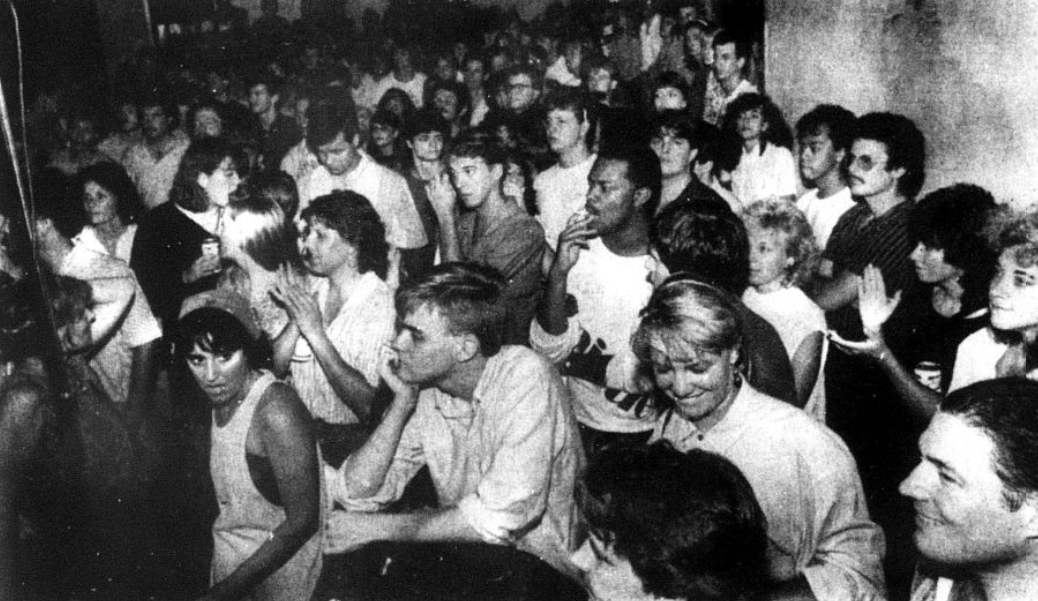
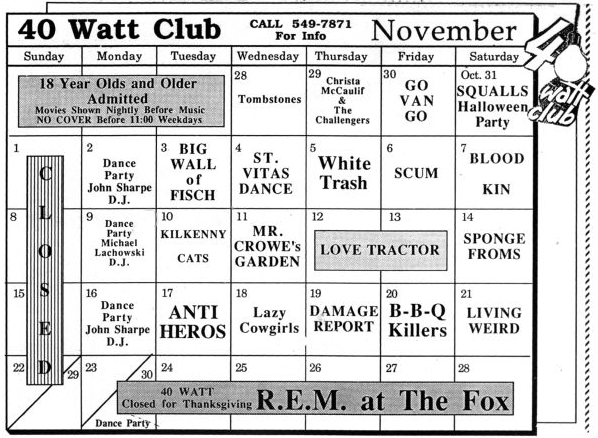
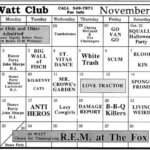


Pylon, too, hit a wall. From an underground perspective, the band seemed wildly successful. In Athens, New York, a few other American cities, and in England, they packed the clubs. Elsewhere, audiences did not seem to know what to make of the group. And while the members of Pylon made enough money to live cheaply in Athens, they weren't exactly comfortable. To reach the next level, they hired a professional booking agent. He landed them a gig most bands would have been giddy to get: the opening slot for U2's U.S. tour in support of their recently released album War. At first, band members said no, but eventually they compromised and agreed to play the first several dates. When they took the stage, crowds impatient to see the Irish band ignored them. As Briscoe Hay recalled, "People were heckling . . . 'Where's U2?' and 'Get off the stage.'" What everyone said was great felt instead like failure. It certainly was not fun. Maybe they did not really want this kind of success. Maybe their music was not for everybody. Maybe their performance-art-turned-band was exactly what they said it was, "temporary rock."13Briscoe Hay, interviews; Michael Lachowski, interviews.
In January 1983, Briscoe Hay told the Athens Observer, "I think if it ever became miserable, we would just disband," and in retrospect she was hinting at what was to come. Band members decided around this time to break up at the end of the year, after they fulfilled their bookings, but they kept their decision secret. In Athens, most people found out when posters went up for "Pylon's Last Show" with opening act Love Tractor. The gig took place in a huge venue known more for its cheap drink nights than live music so everyone could come.14Poster reproduced as an ad, Red and Black, December 1, 1983, 6; Lachowski, interviews; Briscoe Hay, interviews.
A live recording of that farewell show released in 2016 finally gave those of us who missed it a chance to listen in on this essential moment in Athens history. From the opening note of the first song, "Working Is No Problem," Pylon lays out what a critic fittingly describes as "an all-business, no-banter set" of twenty-two songs with hair-on-fire intensity that does not let up until the five-song encore finishes. Over the course of approximately an hour and a quarter of music, the crowd roars out its encouragement. Sometimes, the fans sing along to lyrics like "everything is cool" and even occasionally to guitar hooks, like the woo-woo of "M-Train." At other times, they just yell. No one wants the evening to stop. When it does, Pylon ends with a song that only their earliest fans would get and an homage to their origins in Lachowski's loft studio, their version of the Batman theme song. Superheroes fight evil. To resist the way the market strips away every meaning but money, maybe you just have to refuse to play.15Pylon, Pylon Live (Atlanta, GA: Chunklet Industries, 2016); Stuart Berman, "Pylon: Pylon Live," Pitchfork, July 19, 2016, https://pitchfork.com/reviews/albums/22125-pylon-live/.
Interviewed about the breakup, band members reflected on why they had started making music "as another form of artistic expression." "We accomplished what we set out to do," Lachowski said. "It's not that we are miserable, it's just that we've seen all we're going to see and don't want to put any more time into it." "Our whole reason for doing it was for fun," Crowe argued, "and when the fun wears out and it starts turning into a serious type of job—there's no reason to do it anymore." Briscoe Hay captured the purity and the privilege of the band's attitude: "We wanted to do what we wanted to do when we wanted to do it." As Lachowski explained, "What was frustrating was not trying to live like other bands, but trying to convince everybody that we didn't want to do it that way. . . . We were the only ones that understood why we were not out there with the other bands trying to make it big." But for all the talk about fun, at least one band member was still thinking about the importance of form. "We'll become a cult band now," Bewley predicted on the eve of Pylon's last show. "This is a type of suicide that'll make us more popular in the long run." And he was right.16J. Eddy Ellison, "A Found Farewell: Fans, Followers and Friends Sadly Try to Accept," Athens Banner Herald-Athens Daily News, December 2, 1983, 10–11; Lachowski, interviews; Briscoe Hay, interviews; David Pierce, "The Tasty World Interview: Michael Lachowski," Tasty World 2, 23, 29.
It was a tiny crowd really, fewer people than belonged to a single average-sized fraternity. Cline remembered about sixty people plus hangers on, a hundred tops. Briscoe Hay recalled a tight core of about one hundred people. Lachowski, comparing Athens to the early CBGB's days, argued that both scenes were "so vibrant because they were so tight." Proximity and personal relationships were key. Yet closeness alone was not enough. To be a scene, you needed a story. You needed a narrative to connect what was happening in Athens to a larger vision of the good life. You needed a myth.17Mark Cline interviews; Briscoe Hay, interviews; Lachowski, interviews.
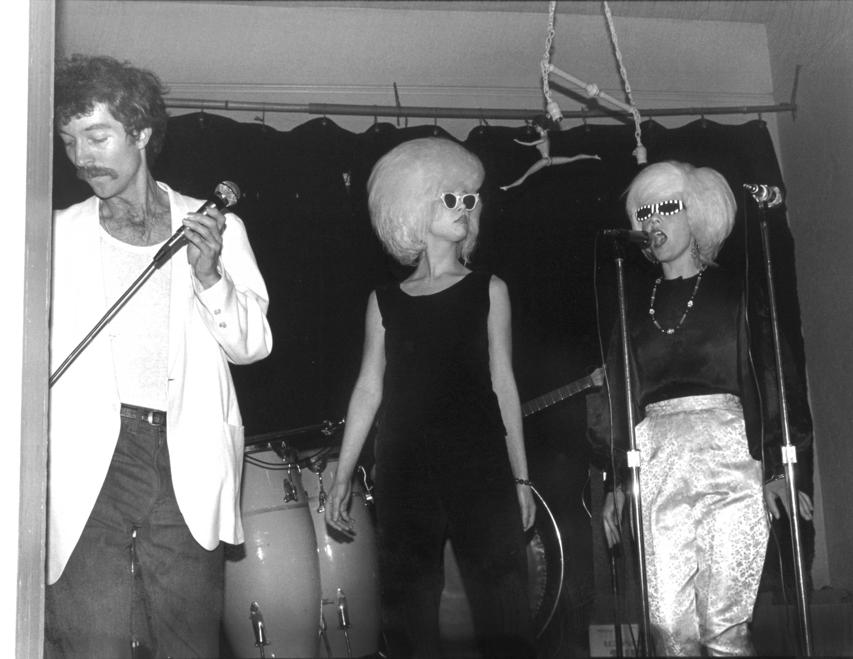
With their attention to "form" and their decision to quit at the height of their fame, Pylon provided this story, doing more than any other single group to fuse the loose, downtown-based network of art students, artists, other outsiders, and their friends that the B-52s had helped spark into what became known as the Athens scene. Performing their music, they also shared their bohemian vision. Life should be about making art for and with friends, combining creativity and pleasure and personal relationships, and living within and sharing a culture that you made yourselves. Money and fame were not necessary. They might even be lethal, killing the experience of creative pleasure.
The B-52s had turned pop art and drag into a form of punk music and proved a little bit of bohemia could flower even in as unlikely a location as a Georgia college town. Pylon, too, started with art and ratcheted up the intensity. Performance art depended on presence to offer messy truths. Pylon made performance art people could dance to, delivering a punk comment on the survival of originality in the machine-made future in a southern drawl more commonly associated with the handmade past. Live, the band's raw, intense music worked the contradictory meanings of repetition, how duplicated sounds and acts could evoke expansiveness or constriction, pleasure or boredom, play or work, and the body or the machine. Critics' darlings, repeatedly named the best band in Athens, Pylon carried their art piece so far that they broke up on the cusp of stardom. The members of Pylon might not have had the language to describe resistance to what people by the end of the century would be calling neoliberalism, but they had the sound.
About the Author
Grace Elizabeth Hale is the Commonwealth Professor of American Studies and History at the University of Virginia. Her previous books include A Nation of Outsiders: How the White Middle Class Fell in Love with Rebellion in Postwar America and Making Whiteness: The Culture of Segregation in the South, 1890–1940.
]]>Introduction
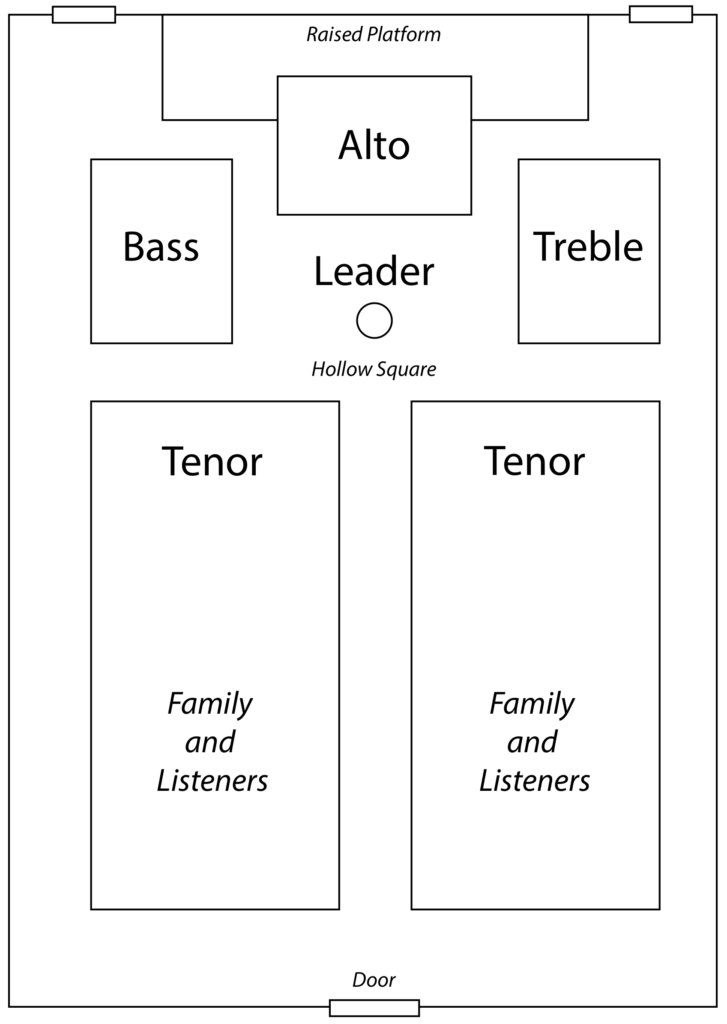
Sacred Harp singing is defined by its spatial organization as much as by its musical style. In this form of shape-note music, an assembled "class" of singers gathers at annual events called "singings"—weekend days spent in churches or community centers singing songs from The Sacred Harp, a nineteenth-century Georgia tunebook revised every generation or so. The tunebook uses a pedagogical system in which the music's note heads have four distinct shapes corresponding to their position in the scale, associated with the names "fa," "sol," "la," and "mi," which singers recite before singing a song's hymn text. Just as important as the shape-notes to the Sacred Harpers is the "hollow square" orientation in which singers sit, facing each other in rows of pews or chairs organized by voice part (bass, alto, treble, and tenor). Throughout the singing day, a procession of leaders take turns stepping into the hollow center to face the tenor or lead section that carries the melody and direct the class in a song or two of their choice from The Sacred Harp.1For more on Sacred Harp singing, see, especially, Buell E. Cobb Jr., The Sacred Harp: A Tradition and Its Music (Athens: University of Georgia Press, 1989); John Bealle, Public Worship, Private Faith: Sacred Harp and American Folksong (Athens: University of Georgia Press, 1997); Kiri Miller, Traveling Home: Sacred Harp Singing and American Pluralism (Champaign: University of Illinois Press, 2008); David Warren Steel and Richard H. Hulan, The Makers of the Sacred Harp (Champaign: University of Illinois Press, 2010).
For singers, the hollow square is both a practically necessary convention and a deeply meaningful space. Encircled by full-voiced singing to hymn texts such as Isaac Watts's "Within Thy circling pow'r I stand, On ev'ry side I find Thy hand," for singers the immersiveness of the hollow square comes to represent God's encompassing love.2"Akin," music by P. Dan Brittain (1971), words by Isaac Watts (1719), in Hugh McGraw et al., eds., The Sacred Harp: 1991 Edition (Carrollton, GA: Sacred Harp Publishing Company, 1991), 472. For composers, the spatial organization of singings, especially the separation of voice parts, is something to consider and emphasize in writing for the tradition. For singers and scholars seeking to capture the essence of Sacred Harp singings, the hollow square has been a longstanding focus, with advances in recording technology leading to new strategies. In this publication we introduce new immersive 360-degree video and audio recordings we made from within the hollow square in the summer of 2019 and offer context drawing on a larger project about the hollow square's meaning to singers and composers and the history of attempts to capture the experience of this unique sonic space.
Yi Halo and Ambeo VR at Mt. Lebanon
We used new video and audio recording technologies to capture elements of the experience of the hollow square. Our recording equipment included the Yi Halo, a device that captures video via seventeen separate cameras arranged in a circular housing. The Google platform Jump Assembler (now defunct) stitched the footage from all the cameras into a series of 360-degree videos.3Janko Roettgers, "Google Is Shutting Down Its Jump VR Video Program," Variety (blog), May 18, 2019, https://variety.com/2019/digital/news/google-jump-shutting-down-1203219306/. We used the Sennheiser Ambeo VR microphone to capture 360-degree spatial audio via four interconnected microphone capsules. Using the video editing application Adobe Premiere, we connected the 360-degree video to the spatial audio. When the user shifts the 360-degree visual field of view in the YouTube window, the audio shifts correspondingly. This spatial audio can only be experienced when wearing headphones.
After trying out the device at a Decatur, Georgia, all-day singing, we recorded three hours of the annual singing at Mt. Lebanon Baptist Church in rural Fayette County in west Alabama. This lively, midsize singing is in an area long central to the geography of what is now an international music culture with roots in Alabama, Georgia, Mississippi, Florida, and Texas.4On Sacred Harp's shifting geography, see James B. Wallace, "Stormy Banks and Sweet Rivers: A Sacred Harp Geography," Southern Spaces, June 4, 2007, https://southernspaces.ecdsdev.org/2007/stormy-banks-and-sweet-rivers-sacred-harp-geography; Jesse P. Karlsberg, "Folklore's Filter: Race, Place, and Sacred Harp Singing" (PhD diss., Emory University, 2015), https://etd.library.emory.edu/concern/etds/n009w256n?locale=en; Jesse P. Karlsberg and Robert A. W. Dunn, "Mapping the 'Big Minutes': Visualizing Sacred Harp's Geographic Coalescence and Expansion, 1995–2014," Southern Spaces Blog (blog), January 23, 2018, https://southernspaces.ecdsdev.org/2017/mapping-big-minutes-visualizing-sacred-harps-geographic-coalescence-and-expansion-1995-2014. The Mt. Lebanon Singing also serves as this Independent Baptist church's homecoming and as a reunion for the Ballinger family, a number of whose members are active singers. Today the singing also attracts members of singing communities in northeast Alabama, metro Atlanta, and further afield: singers in 2019 had traveled from New York City and Dublin, Ireland, to Fayette County. Trying the singers' patience and good humor, we placed the cumbersome, many-eyed Yi Halo in the singing's cozy hollow square for much of the day. Song leaders stood right next to the device. Steve captured conventional "flat" video from the back of the room, behind the tenor section, while Jesse sat and sang with the tenors.
The resulting recordings, embedded in this publication and accessible through YouTube, present video and audio from the center of the hollow square. This vantage point, typically inaccessible to those who don't lead songs, is the physical and spiritual center of Sacred Harp singings.
Entering the Hollow Square
The hollow square is central to understanding the music and music culture that surrounds The Sacred Harp. Singers associate the hollow square with key values of participation and community. Sacred Harp singers often state that they are "singing for each other and for God," rather than for an audience. Though non-singers such as family members and descendants of singers, congregants at churches hosting singings, and other curious individuals do sometimes come to listen, the layout of Sacred Harp singings, in which singers face each other rather than the listeners in the back, reinforces its participatory ethos.5On how Sacred Harp's spatial organization compares to that of historically related sacred music cultures, see Paula Tadlock, "Shape-Note Singing in Mississippi," in Discourse in Ethnomusicology: Essays in Honor of George List, ed. Caroline Card et al. (Bloomington: Ethnomusicology Publications Group, Indiana University, 1978), 191–207.
The hollow square also bolsters singers' sense of Sacred Harp as a community. Eye contact across the hollow square, where trebles face basses and tenors face altos, has kindled relationships, reinforced friendships, and intensified shared emotional experiences. Sacred Harp's music culture generally discourages talking while a singing is in session. In the absence of commentary on the affective and spiritual experience of singing, nonverbal communication—during singing and between songs as leaders cycle in and out of the square—contributes to singers' understanding of their experience as shared.6On verbal and nonverbal communication, the hollow square, and affective intensity in Sacred Harp singing, see Miller, Traveling Home; Kiri Miller, "'Like Cords Around My Heart': Sacred Harp Memorial Lessons and the Transmission of Tradition," Oral Tradition 25, no. 2 (2010), http://muse.jhu.edu/journals/oral_tradition/v025/25.2.miller.html; Anne Heider and R. Stephen Warner, "Bodies in Sync: Interaction Ritual Theory Applied to Sacred Harp Singing," Sociology of Religion 71, no. 1 (2010): 76–97.
The hollow square also improves the sound of Sacred Harp singings in ways both practically and aesthetically valued by singers. Facing each other makes it easier for singers to stay together. All can see and follow the leader, who beats time, moving an arm down and up to convey tempo. Singing at each other rather than out at an audience concentrates sound, making it easier for singers to hear each other. The accumulated volume enhances the depth of the experience.
Of course, the very best sound is in the center of the hollow square. In this space, the singing is loudest and all four parts achieve their best balance. Many singers who came to Sacred Harp singing as adults remember the first time they stepped into this space as the time they knew Sacred Harp singing would become an enduring part of their lives. Over time many come to think of this locus of Sacred Harp's spatial organization as a sacred space. Singers frequently invite newcomers to join them in the center for a song, believing that this is the best vantage point from which to apprehend what makes the music culture so moving to its participants.
Composing Sacred Harp's Spatiality
Many of the songs in The Sacred Harp leverage specific features of the hollow square for musical and emotional impact. The three immersive recordings of the Sacred Harp singing at Mt. Lebanon feature songs exemplifying two such approaches: fuging among the voice parts and traded high notes between the tenor and treble parts. Fuging tunes are among the most characteristic and popular song forms in The Sacred Harp. Typical fuging tunes begin with all the parts singing together, followed by a section in which each of the four voice parts enters in sequence, finally coming together again before the conclusion of the song.7Irving Lowens, "The Origins of the American Fuging Tune," Journal of the American Musicological Society 6, no. 1 (April 1, 1953): 46, https://doi.org/10.2307/829998. On fuging tunes, see also Karl Kroeger, American Fuging-Tunes, 1770–1820: A Descriptive Catalog (Westport, CT: Greenwood Press, 1994); Maxine Ann Fawcett-Yeske, "The Fuging Tune in America, 1770–1820: An Analytical Study" (PhD diss., University of Colorado at Boulder, 1997); Jesse P. Karlsberg, "Genre Spanning in the Close and Dispersed Harmony Shape-Note Songs of Sidney Whitfield Denson and Orin Adolphus Parris," American Music 35, no. 1 (2017): 94–132. The most common of these entrance patterns, as found in Jeremiah Ingalls's "New Jerusalem," led by Eli Hinton of Atlanta, Georgia, is propelled forward not just by the cascade of entrances and their progression from lower to higher voices, but by their spatialization. The entrance pattern proceeds counterclockwise around the hollow square, with basses followed by tenors, trebles, and altos.8"New Jerusalem," music by Jeremiah Ingalls (1796), words by Isaac Watts (1707), in McGraw et al., The Sacred Harp, 299.
Generations of composers have adopted this pattern and experimented with alternatives, frequently inspired by the arrangement of the vocal parts around the hollow square. After a short fuging section, Amos Munson's "Newburgh," led by Cheyenne Ivey, a member of a singing family from Henagar, Alabama, leverages the physical separation of the vocal parts to dramatize the celestial distance between the sun and stars. After the basses to the right of the leader enter on the phrase "Thou sun with golden beams" and all four parts sing "And moon with paler rays," the trebles, to the leader's left, reply with a shimmering "Ye starry lights, ye twinkling flames, Shine to your Maker's praise."9"Newburgh," music by Amos Munson (1798), words by Isaac Watts (1719), in McGraw et al., 182.
Composers also rely on the separation of vocal parts to create moments of power and energy by trading prominent high notes in rapid succession between the tenor and treble parts, a feature that singers often refer to as "thunder and lightning." Since these two parts are typically sung by mixed gender groups with similar vocal ranges, this trading back and forth of high notes would be undetectable without the vocal separation that the hollow square provides. In songs like C. Curtis's "Providence," led here by siblings Wanda Capps and Danny Creel from Dora and Hoover, Alabama, respectively, the traded high notes are distinct and clearly audible, contributing dynamic crackling energy to the song. "Providence" features "thunder and lightning" in multiple places. After a short opening section, the song's chorus begins with the trebles singing a musical phrase that peaks on a high note (accompanied by the basses) which is immediately echoed by the tenors. The song continues with similar exchanges, culminating in a figure ricocheting from the tenor to the treble as the song reaches its conclusion.10"Providence," music by C. Curtis (1820), words by Isaac Watts (1719), in McGraw et al., 298.
Recording the Hollow Square
For singers and scholars, Sacred Harp's spatial qualities have made recording the style appealing. Yet the results have persistently struck their makers and audiences as falling short of conveying the experience of being at a singing. The earliest field recordings, made by John W. Work III in 1938 and Alan Lomax and George Pullen Jackson in 1942, used then-available monophonic technology, collapsing the music's richly spatialized four-part harmonies to a single channel of recorded sound.
For Lomax, frustration with the result prompted him to include Sacred Harp singing in his itinerary for the "Southern Journey" field recording sessions he conducted in August through October of 1959 after he first gained access to portable stereo recording technology. The ensuing recordings, released in part as All Day Singing from "The Sacred Harp" (1961), provide considerably greater depth and intimacy than the monophonic recordings from the 1930s and 1940s, and contributed to greater public awareness of and interest in participating in Sacred Harp singing during the folk revival.11Alan Lomax and Alabama Sacred Harp Singers, All Day Singing from "The Sacred Harp," recorded 1959, 33 1/3 rpm record, Southern Journey (Bergenfield, NJ: Prestige, 1961). But Lomax's vantage point at one corner of the hollow square contributed to an imbalance among the parts that bothered contemporaneous Sacred Harp singers. The Sacred Harp Publishing Company, publisher of the most widely used tunebook at singings, responded by recording, producing, and releasing a series of LPs in the 1960s and 1970s, recorded in a studio and mastered to provide what they deemed a more satisfying balance of the parts.12Cobb, The Sacred Harp. When quadrophonic sound systems—one speaker for each Sacred Harp voice part!—proliferated in the 1970s, the same organization planned a release in this format, but the project was eventually shelved.
Conclusion
In the 2020s, as in the 1930s, there is no substitute for experiencing a Sacred Harp singing in person; singings today are held across the United States and beyond every weekend of the year. Yet we think the recordings of these three songs provide new virtual access to the experience of Sacred Harp's spatiality. We invite you to explore the activity in different parts of the singing space by shifting your perspective while navigating the video on your desktop monitor or your phone's YouTube app. If you wear headphones, you can hear the spatial audio shift along with the visual field of view. If you have access to a virtual reality headset, you can immersively experience the perspective these recordings afford. We plan to stage virtual reality viewings of these recordings at the Camp Fasola Sacred Harp singing school and at other singings in 2020. We will also make recordings of other songs accessible through the web in the coming months to expand the selection of songs and leaders captured using this technology. 
Additional Videos
- Philip Gilmore, of Oneonta, Alabama, leads Ananias Davisson's "Idumea" (p. 47b) from The Sacred Harp.
- Ewa Lichnerowicz, of Dublin, Ireland, leads S. M. Denson's "Praise God" (p. 328) from The Sacred Harp.
- Cindy Tanner, of Henagar, Alabama, leads George Coles's "Green Street" (p. 198) from The Sacred Harp.
- Beth Wallace, Eady Porter, Aubrey Zeanah, and Ridley Colvin, of Fayette, Northport, and Demopolis, Alabama, lead O. A. Parris's "My Brightest Days" (p. 546) from The Sacred Harp.
- Judy Caudle, of Eva, Alabama, leads H. S. Rees's "Sweet Morning" (p. 421) from The Sacred Harp.
About the Authors
Steve Bransford is the senior video producer at the Emory Center for Digital Scholarship. His documentary feature, The Well-Placed Weed, is available on Vimeo.
Jesse P. Karlsberg is the senior digital scholarship strategist at the Emory Center for Digital Scholarship. He is the project director and editor-in-chief of Sounding Spirit, a research lab and publishing initiative promoting collaborative engagement with historical American songbooks. Karlsberg is an internationally recognized singer, teacher, composer, and songbook editor in the Sacred Harp tradition.
]]>