Introduction
Ruth Coker Burks (born Frances Ruth Coker in 1959) is an Arkansas woman who was a caregiver and AIDS activist in central Arkansas from the mid-1980s to the mid-1990s during the height of the HIV/AIDS epidemic. In 1986, when Burks began her informal care work, she was a mid-twenties single mother who sold timeshare condominiums on Lake Hamilton near her hometown of Hot Springs in central Arkansas. Over the next few years, her informal end-of-life care expanded into daily care work, AIDS activism, and education. Newspaper and magazine profiles, television interviews, a popular memoir, and social media posts have documented her efforts as the ‘Arkansas Cemetery Angel’ (we will refer to Ruth Coker Burks as Ruth since this is how she is named in her memoir and in most press coverage). Laudatory media coverage also led to pointed criticisms of the limits of Ruth’s efforts and to potential flaws in her memory. Rather than evaluating the accuracy of Ruth’s account or those of her critics, this article investigates what her rich, if fragmentary, archival materials, along with her published memoir and newspaper accounts, can reveal about care work, gender, and the lived experience of the AIDS epidemic in Arkansas. More broadly, it begins to address what the publicity (and controversy) around Ruth’s life story offers the study of queer memory in southern spaces.
Ruth’s career as an AIDS caregiver and activist began with a case of mistaken maternal identity and a contested family cemetery. As described in newspaper profiles and her memoir, All the Young Men (2020), in 1986, while visiting a friend in the hospital in Little Rock, Arkansas's capital city, Ruth noticed a neglected patient, Jimmy, who was dying of complications from AIDS. When she went into Jimmy's hospital room, he mistook Ruth for his mother, who refused to visit him. After she confronted the nursing staff, who largely avoided Jimmy's room and failed to convince his mother (over the phone) to come to visit her dying son, Ruth returned to Jimmy's room. And it was as his ‘mama’ that Ruth sat by his bedside for hours, holding his hand and comforting him as he died. This moment of assumed maternal identity marked the beginning of Ruth's decade of informal care work.1Ruth Coker Burks and Kevin Carr O’Leary, All The Young Men: A Memoir of Love, AIDS, and Chosen Family in the American South (New York: Grove Press, 2020), 3–11; Michael Garofalo, “Lessons in Love,” StoryCorps, December 5, 2014, https://storycorps.org/podcast/storycorps-449-lessons-in-love/; David Koon, “Ruth Coker Burks: The Cemetery Angel,” Arkansas Times, January 8, 2015, https://arktimes.com/news/cover-stories/2015/01/08/ruth-coker-burks-the-cemetery-angel.
Alongside care work and public activism, Ruth provided a final resting place for some men she cared for in the Files Cemetery in Hot Springs, an hour's drive southwest of Little Rock in the Ouachita Mountains. It was for Jimmy, who had mistaken Ruth for his mother, that she turned to Files Cemetery.
From the first chapter of Ruth’s memoir, the Files Cemetery is described as a site of commemoration, refuge, and conflict.2Burks and O’Leary, All the Young Men, 11–14. In the following decades, this cemetery has become an essential site of LGBTQ+ memory in Arkansas. Layers of informal commemoration at the Files Cemetery and Ruth’s fragmentary archival record speak to the kinds of alternative archives of AIDS activism—beyond the public sphere—that Stephen Vider has examined in his discussion of community caregiving during the AIDS epidemic as part of his more extensive study of the importance of domestic spaces in LGBTQ+ politics in the United States.3Stephen Vider, The Queerness of Home: Gender, Sexuality, and the Politics of Domesticity after World War II (Chicago, IL: University of Chicago Press, 2021). As far as we know, the Files Cemetery is one of only a few cemeteries in the United States that became a documented resting place for people who died during the HIV/AIDS epidemic.4Two other documented final resting places for those who died during the HIV/AIDS epidemic are the Congressional Cemetery in Washington, DC and the Hart Island Potter's Field in New York City. The Files Cemetery operates at a much smaller and more informal scale than either of these.
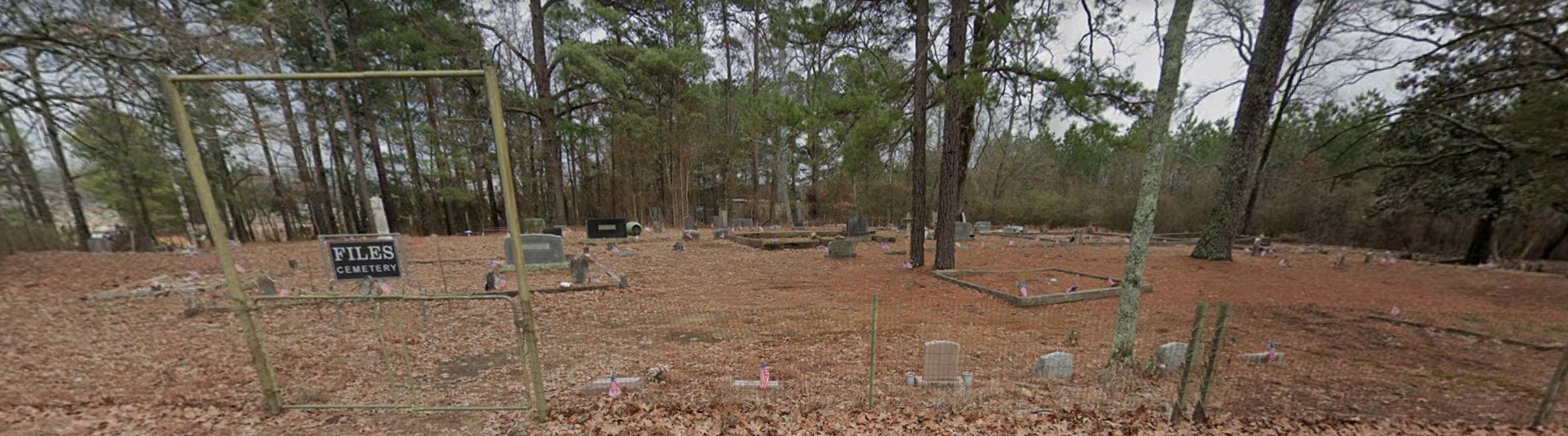
There also is scattered but evocative evidence of continuing engagement with the Files Cemetery as a space for queer memory-making. Facebook posts from March 2019 record how the drag troupe, the Arkansas Sisters of Perpetual Indulgence: The Abbey of the Hillbilly Harlots, cared for the cemetery’s grounds and planted rose bushes. A series of photographs of the Files Cemetery taken at regular intervals from spring 2020 to fall 2024, which are part of a forthcoming donation to the Center for Arkansas History and Culture, reveal earlier layers of informal commemoration (including notes, beer bottles, Mardi Gras beads, and devotional objects) near the resting places of some of the men. In 2020, a grave was added to the cemetery (of which Ruth was unaware.) Some of these later commemorative efforts at individual graves did not involve Ruth and were potentially enacted by local critics of Ruth, as evidenced by one stone that was partially funded by a critical host of a YouTube podcast.
Praise extended to the national and international levels. The first prominent news article on Ruth, which predated the Arkansas Times' profile, was a twelve-minute interview with NPR's StoryCorps in 2014. The December 7, 2020, issue of People magazine featured a glowing article, “They Call Me the AIDS Angel.”5Jason Sheeler, “They Call Me the AIDS Angel,” People, December 7, 2020. Exemplifying Ruth's newfound fame, the Guardian published an article on February 3, 2021 titled, "The Aids Angel: How Ruth Coker Burks Comforted Dying Gay Men." That same year, however, the Arkansas Times published a more critical piece by Austin Gelder about a “missing monument.” Gelder's piece centered on accusations that Burks had exaggerated some of her claims and failed to establish a much-discussed monument at the Files Cemetery in honor of those for whom she had cared.6Austin Gelder, “Ruth Coker Burks and the Missing Monument,” Arkansas Times, July 8, 2021, https://arktimes.com/arkansas-blog/2021/07/08/ruth-coker-burks-and-the-missing-monument. National press coverage trended from the laudatory to the skeptical with pointed questions about Ruth's claims about the number of men for whom she cared, the number of gravesites at the Files Cemetery, and her contested ownership of the cemetery.7Alexander Kacala, “Doubts Surround Viral Story of ‘AIDS Angel’ Who Says She Helped Hundreds of Dying Men,” NBC News, October 29, 2021, https://www.nbcnews.com/nbc-out/out-news/doubts-surround-viral-story-aids-angel-says-helped-hundreds-dying-men-rcna4163. These critiques came largely from residents of Hot Springs, some of whom knew Ruth, some of whom wanted a more thorough history of the events, some who are invested in the history and its public telling, and also those who feel that her version of events is somehow maligning the city. A YouTube podcast, RUTHLESS: The Real Story Behind the ‘Cemetery Angel of Arkansas’ is representative of this critique and is discussed in more detail below. In the wake of this praise and criticism, the Center for Arkansas History and Culture at the University of Arkansas at Little Rock has collected Ms. Burks’ archival materials in an ongoing effort to preserve LGBTQ+ history in Arkansas. The CAHC's archival work complements that of Invisible Histories—an organization who "believes archiving is resistance to oppression and history leads to liberation"—to document queer histories and spaces of memory in the southern United States.8"Invisible Histories." Accessed January 3, 2025. https://invisiblehistory.org/.
This article discusses the history of Ruth's care work and activism in central Arkansas in the broader context of scholarship on gender and care work during the HIV/AIDS epidemic. We will survey the gendered construction of care work and motherhood in Arkansas in Ruth’s memoir and archival materials. Then, we will tackle the life histories of the predominantly white and Latino working class and rural men she cared for and what her archive—with its evocative fragments and enduring silences— reveals about the lived experience of the AIDS epidemic for some people in Arkansas. We conclude with Ruth’s critics and what her story can teach about the contested memory of the AIDS epidemic. This article does not attempt to evaluate the accuracy of the claims of either Ruth or her local critics, but rather examines the possibilities and limits that her archive, and the published materials about her, open up. The historical importance of Ruth’s care work and the validity of some of the criticisms of her are not incompatible. Rather than a binary understanding, we are interested in what Ruth’s archive reveals about the history of the AIDS epidemic and the construction of the role of the idealized caregiver for some women in Arkansas.
Care Work and AIDS Activism in Arkansas
Ruth was one of many women across the United States who played leading roles in AIDS activism and care. As the ACT UP Oral History Project states, “Women were an integral part of the AIDS crisis—first, and foremost, as People with AIDS, but also as leaders of the AIDS Activist Movement, and as caregivers.”9“Women and AIDS,” ACT UP Oral History Project, digital archive, https://www.actuporalhistory.org/actions/women-aids. Ruth’s trajectory reflects what scholars have argued was the complex array of personal, political, social, and spiritual motivations behind many women’s activism during the AIDS epidemic in the United States.10See, for example, Ulrike Boehmer, The Personal and the Political: Women’s Activism in Response to the Breast Cancer and AIDS Epidemics (Albany: State University of New York Press, 2000); Angelique Harris, “Emotions, Feelings, and Social Change: Love, Anger, and Solidarity in Black Women’s AIDS Activism,” Women, Gender, and Families of Color 6, no. 2 (2018): 181–201; For a more expansive history of women’s activism in the United States, see Dawn Durante, ed., Women’s Activist Organizing in US History (Urbana: University of Illinois Press, 2022).
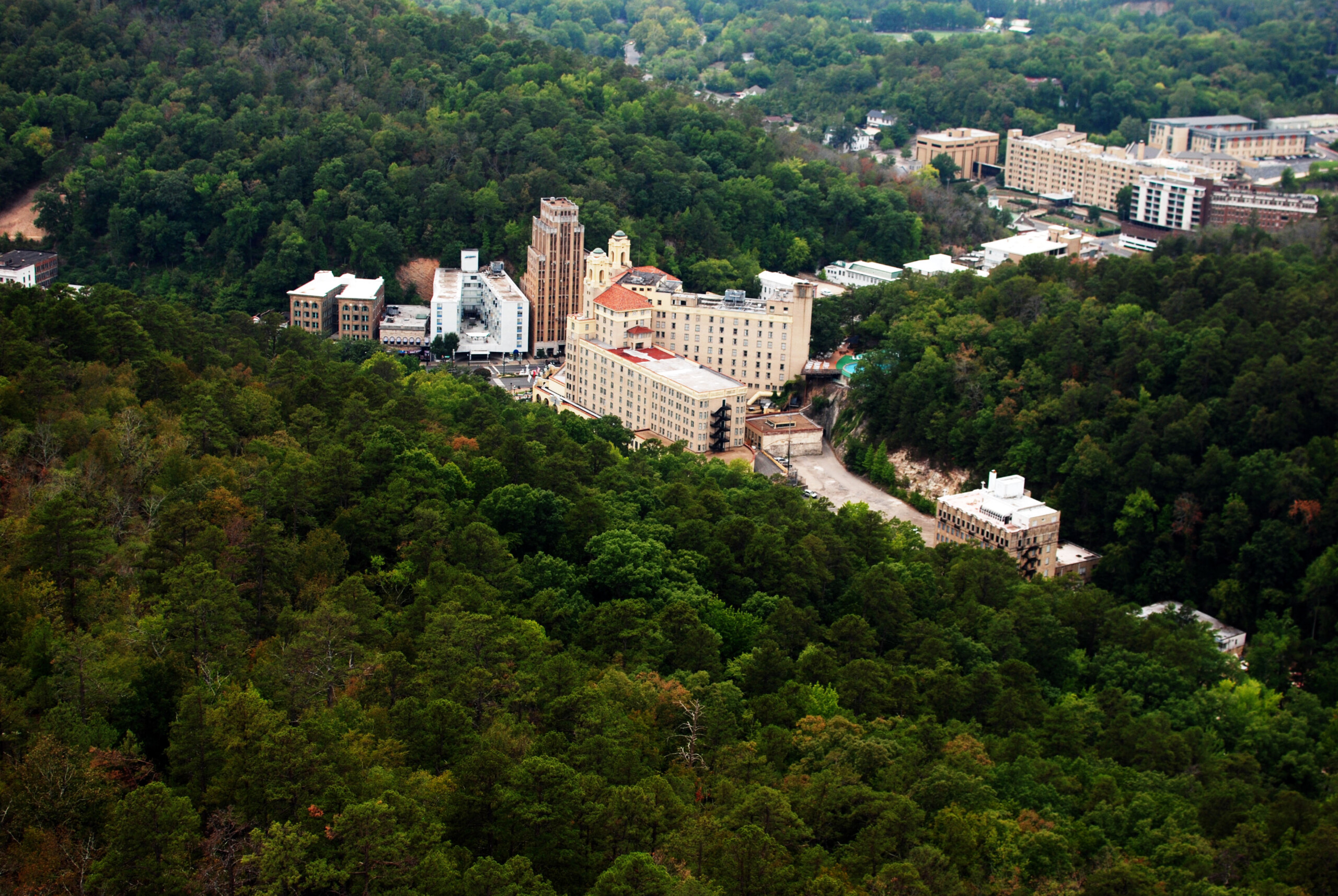
Ruth was a single mother who sold lakeshore timeshares in Hot Springs when she began her informal care work. Her work's flexible and commission-based practices facilitated Ruth’s initial care work. AIDS activism and end-of-life care were not how recently divorced Ruth planned to spend her twenties and early thirties. “All I want sometimes is to be a wife and be in the Junior League.”11Burks and O’Leary, All the Young Men, 74. While Ruth did not come from a well-off background, she hoped to advance in the social scene of Hot Springs. Ruth’s care work encompassed a shifting range of activities from 1986 to 1995. Initially, she focused on visiting the hospital, comforting dying men, and providing supplemental food for those still alive.12Burks and O’Leary, 62; Paula Cocozza, “The AIDS Angel: How Ruth Coker Burks Comforted Dying Gay Men,” The Guardian, February 3, 2021, https://www.theguardian.com/society/2021/feb/03/aids-angel-ruth-coker-burks-dying-gay-men. As she described at one point (she had started dumpster-diving to get adequate cooking supplies), “I could be like this little grocery-delivery person.”13Burks and O’Leary, All the Young Men, 96. Word of mouth drove her first few years of care work as anxious Little Rock and Hot Springs hospital staff contacted her. “More calls started coming. I guess the nurses and doctors all went to the same places to drink and unwind because I later found out they got to talking. ‘Oh my God, we had this insane woman come in, and she went right in the AIDS patient’s room.’ . . . I had two calls that first month, which I thought was crazy. Then three the second.”14Burks and O’Leary, 24–25.
This soon shifted to men calling her directly, either for themselves or for a friend or loved one. As Ruth notes, by 1988, this “network of calls from the hospitals and gay men giving out my number” kept her more than busy, along with caring for her young daughter and trying to make a living.15Burks and O’Leary, 54, 83. It is important not to reify the assumption that persons with HIV/AIDS were always gay men, even if that is often how Ruth discusses her experiences in central Arkansas in her memoir. Ruth’s archive and the ambiguities surrounding the Files Cemetery underline the importance of not projecting contemporary categories onto the past and respecting privacy in the telling of these histories.
From 1986 to 1989, Ruth worked quietly, and from 1989 onwards, she was much more public in attempting to raise awareness and draw local media attention to the AIDS epidemic in central Arkansas. Building on her connections to some of “the town elders” of Hot Springs, Ruth also gave talks at Rotary Clubs across Arkansas and quietly facilitated donations from well-to-do residents of Hot Springs. In her description of one of her early speeches at Rotary, “I talked about the people with AIDS in town, how they needed food and access to care, but what we mainly needed was education.”16Burks and O’Leary, All the Young Men, 125, 129–134, 184, 257. Formalizing her activism, Ruth assisted Norman Jones, who ran the Arkansas non-profit, Helping People with AIDS (HPWA.) Ruth’s work with HPWA encompassed everything from the distribution of accessible sex education materials to creative publicity efforts, including the production of humorous T-shirts with the phrase “I believe in Jesus. Do you?” transformed into “I DO. DO YOU?” about safer sex practices.17Burks and O’Leary, 270–271.
The sharply diverging reactions to Ruth in the present-day echo in her recollections of care work and AIDS activism from the mid-1980s to the mid-1990s. Ruth claims that initially, she was perceived as a prim “‘church lady’” by many of the men she cared for. However, she remembers that to most of Hot Springs, she was viewed as “this insane woman” and “that crazy Ruth Coker Burks,” who wouldn’t stop talking about AIDS and gay rights.18Ruth Coker Burks, "All Her Sons: The Cemetery Angel," interview by Seth Doane, Video, December 1, 2019, CBS Sunday Morning, https://www.cbsnews.com/news/all-her-sons-ruth-coker-burks-the-cemetery-angel/; Burks and O’Leary, All the Young Men, 24, 94, 156.


Along with public-facing activism, Ruth’s informal hospice care evolved from providing company at the bedside of dying men to helping ‘her guys’ live as long as they could by securing housing assistance, filling out death certificates, seeking social security payments, filling AZT prescriptions at often hostile local pharmacies, HIV testing, and ultimately AIDS education.19Koon, “Ruth Coker Burks: The Cemetery Angel”; Burks and O’Leary, All the Young Men, 57–58, 72, 81–83, 86–88, 112–113. Ruth regularly visited hospitals in Hot Springs and Little Rock and frequently cared for people in their homes. At times, she appears to have operated as an informal pharmacy herself, distributing leftover AIDS medication across central Arkansas.20Garofalo, “Lessons in Love”; Burks and O’Leary, All the Young Men, 173. These shifts did not mean she stopped providing personal daily attention. For example, in her time with one of the men for whom she cared, Chip, she visited daily, fed him, bathed him, and read him the newspaper.21Burks and O’Leary, All the Young Men, 234. In his study of queer public history and the home, Vider challenges the often-presumed division between political action (outside of the home) and care work (inside the home). Rather than framing the home as a space away from politics, Vider argues that the home and the care for people with AIDS in their own homes constitute an essential site for activism.22Vider, The Queerness of Home, 179–213. The contours of Ruth's care work reflect Vider's argument.
While Ruth’s individualized efforts to keep ‘her guys’ fed are distinct from the more extensive history of food justice organizing in the twentieth-century United States that Emily Twarog studies in Politics of the Pantry (2017), food was at the center of Ruth’s work, especially in the late 1980s, and her subsequent gendered construction as a caregiving angel.23Emily E. LB. Twarog, Politics of the Pantry: Housewives, Food, and Consumer Protest in Twentieth-Century America (New York: Oxford University Press, 2017). In early media profiles from 2014 and 2015, Ruth estimated that she cared for "nearly 1,000 people" and "hundreds of dying people" from the mid-1980s to the mid-1990s.24Garofalo, “Lessons in Love”; Koon, “Ruth Coker Burks: The Cemetery Angel.” As discussed below, these numbers have been contested. While it is beyond the scope of this article to fully address how Ruth’s efforts intersected with formal and informal care networks in Arkansas, there were additional organized efforts, including the important work of RAIN (Regional AIDS Interfaith Network), which was profiled in a 2016 Arkansas Times piece, among others.
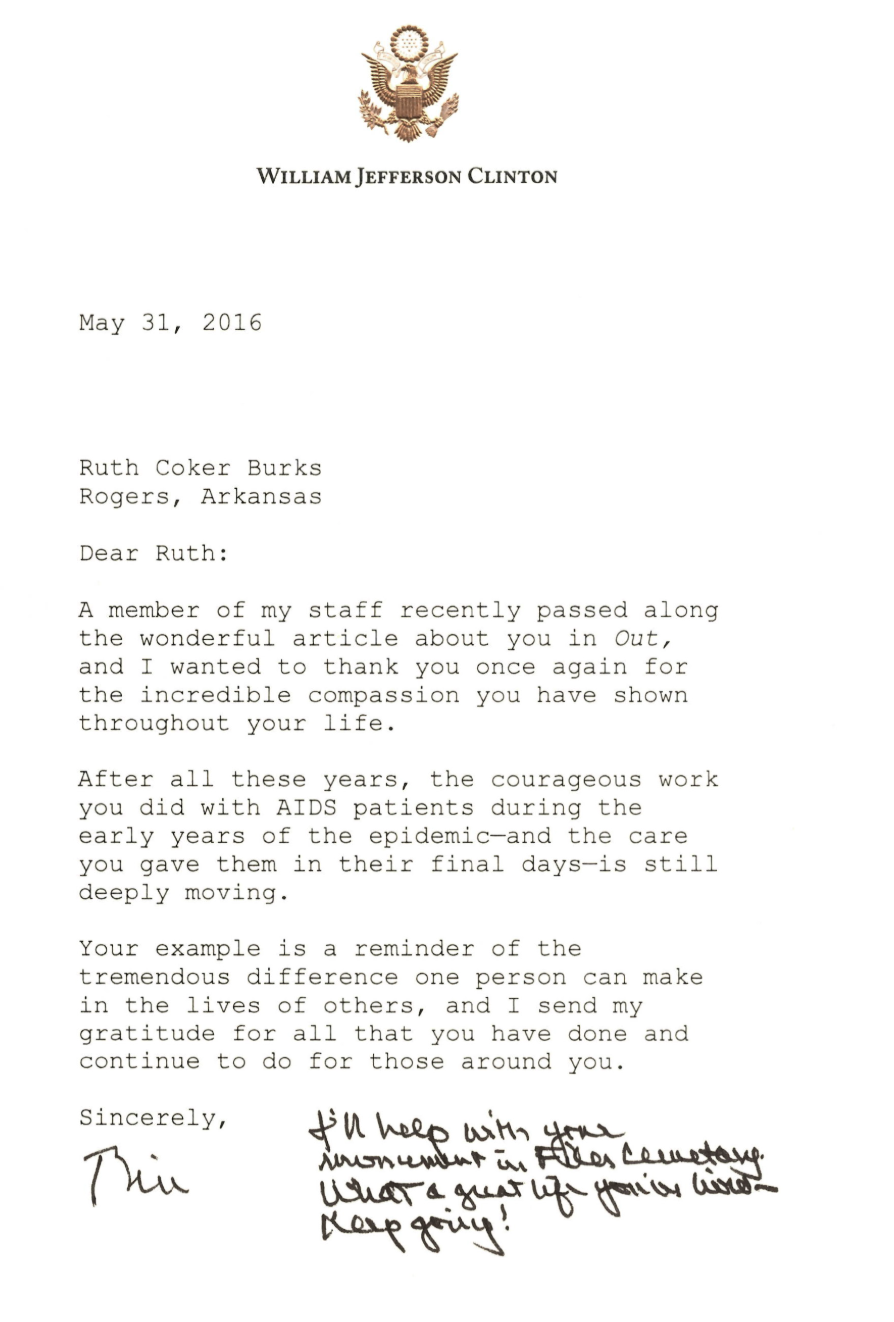
Ruth’s unprocessed archival collection at the Center for Arkansas History and Culture provides some indications of how her care work intersected with broader caregiving networks in Arkansas. Specifically, her archives include a binder of letters of recommendation and typed endorsements from prominent community members regarding Ruth’s nomination for the Arkansas Community Service Award, the establishment of an HIV/AIDS program at Levi Hospital, and the nomination of Ruth for the position of Executive Director of the Arkansas AIDS Foundation. In one letter, the assistant director of the American Psychological Association recommended Ruth for the Arkansas Community Service Award with the argument that “Ruth’s efforts in promoting the conference have remained unflagging. Most impressively, Ruth has served without remuneration, preferring that we hire two part-time local coordinators from our community of those directly affected by AIDS. As one of our local coordinators has suffered an unfortunate precipitous decline in health. Ruth has generously stepped forward to assume his responsibilities while insisting that he still receive the full salary offered for the position.” A local attorney wrote in a separate letter of recommendation, “I would like to recommend Ruth Burks as the person to get this program started. Ruth has demonstrated her commitment to the care of those who are HIV positive and we are fortunate to have someone already in the community who is prepared to immediately take on such a responsibility.”25These recommendation letters are part of Ruth's collection donated to and being processed by the Center for Arkansas History and Culture. Box 6, Folder 20, Ruth Coker Burks papers, Center for Arkansas History and Culture, Little Rock, Arkansas.
Ruth's memoirs and archives only get us so far in researching the experience of AIDS in Arkansas and of women activists during the AIDS epidemic. Ruth remembers primarily, but not exclusively, caring for white and Latinx men. Her life story and archival materials tell us little about the impact of HIV/AIDS on Black communities in Arkansas (15.5% of the Hot Springs population in 1990) or the work of Black women in AIDS activism both at the state and national levels. Recent scholarship has drawn attention to the central role of Black women to AIDS activism and care work in the United States. In her influential study of Black women activists, Angelique Harris argues for the importance of the intersecting emotions of love, compassion, community solidarity, anger, and frustration in AIDS activism and care work.26Harris, “Emotions, Feelings, and Social Change,” 181–183, 186–188, 191–195.
While this article centers upon Ruth’s life and her account of primarily caring for white and Latinx men, it is critical to acknowledge how racial disparities in healthcare profoundly shaped the history of HIV/ AIDS. Unfortunately Ruth’s archive does not tell us much about the impact of the AIDS epidemic on Black people in Arkansas. However, our study of Ruth’s memoir and archival fragments builds on Cherisse Jones-Branch and Gary Edwards’ compelling model of biographical essays in Arkansas Women: Their Lives and Times (2018) and Jayme Stone’s 2010 study of Black women as activist mothers in the Arkansas Delta.27Cherisse Jones-Branch and Gary T. Edwards, eds., Arkansas Women: Their Lives and Times, Southern Women: Their Lives and Times (Athens: University of Georgia Press, 2018); Jayme Millsap Stone, “‘They Were Her Daughters:’ Women and Grassroots Organizing for Social Justice in the Arkansas Delta, 1870–1970” (Memphis, TN, University of Memphis, 2010), https://digitalcommons.memphis.edu/cgi/viewcontent.cgi?article=1238&context=etd. Our examination of the richness and limits of Ruth’s archive expands on these authors’ approach of using various sources to demonstrate women's diverse and multifaceted historical roles.
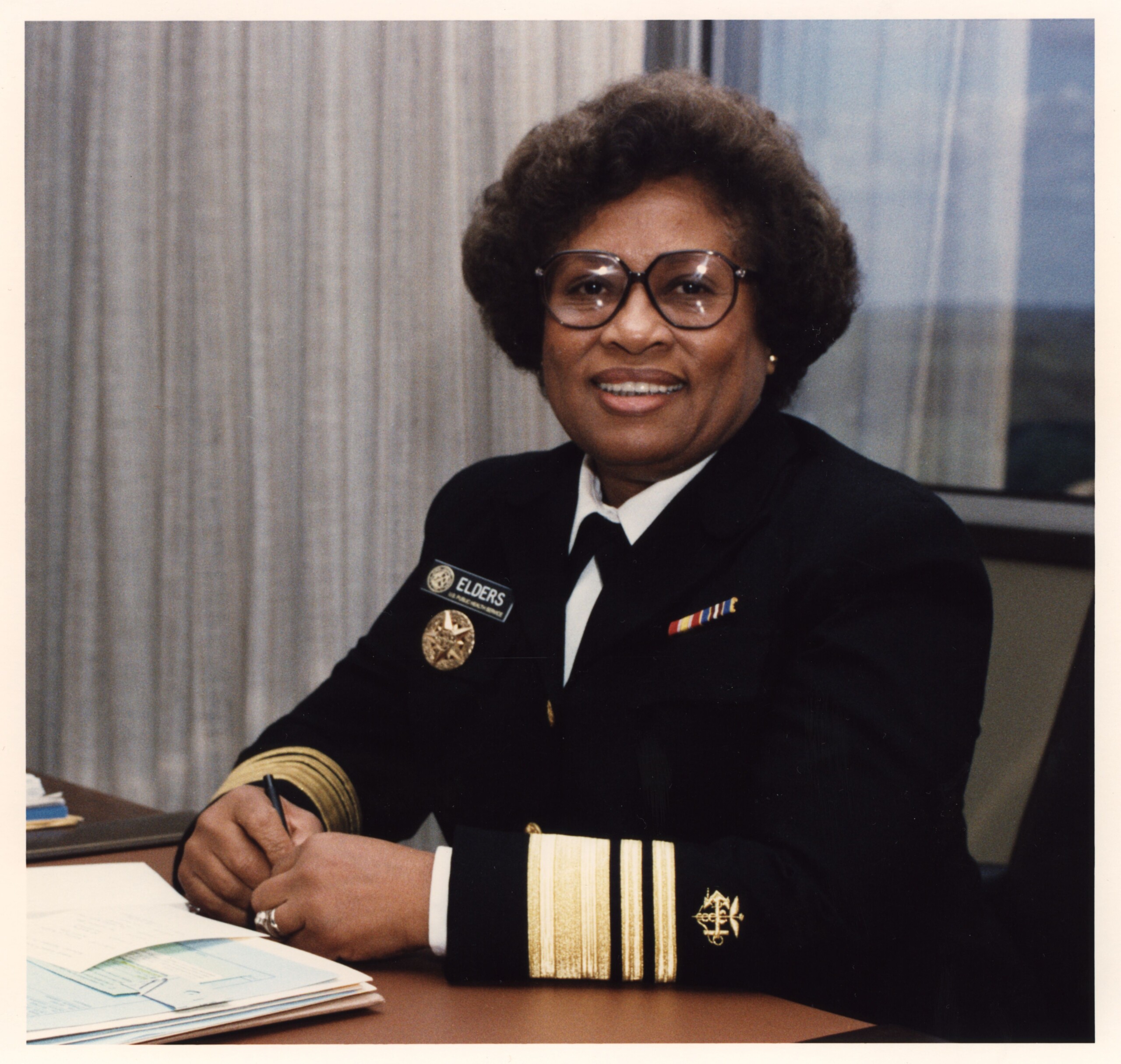
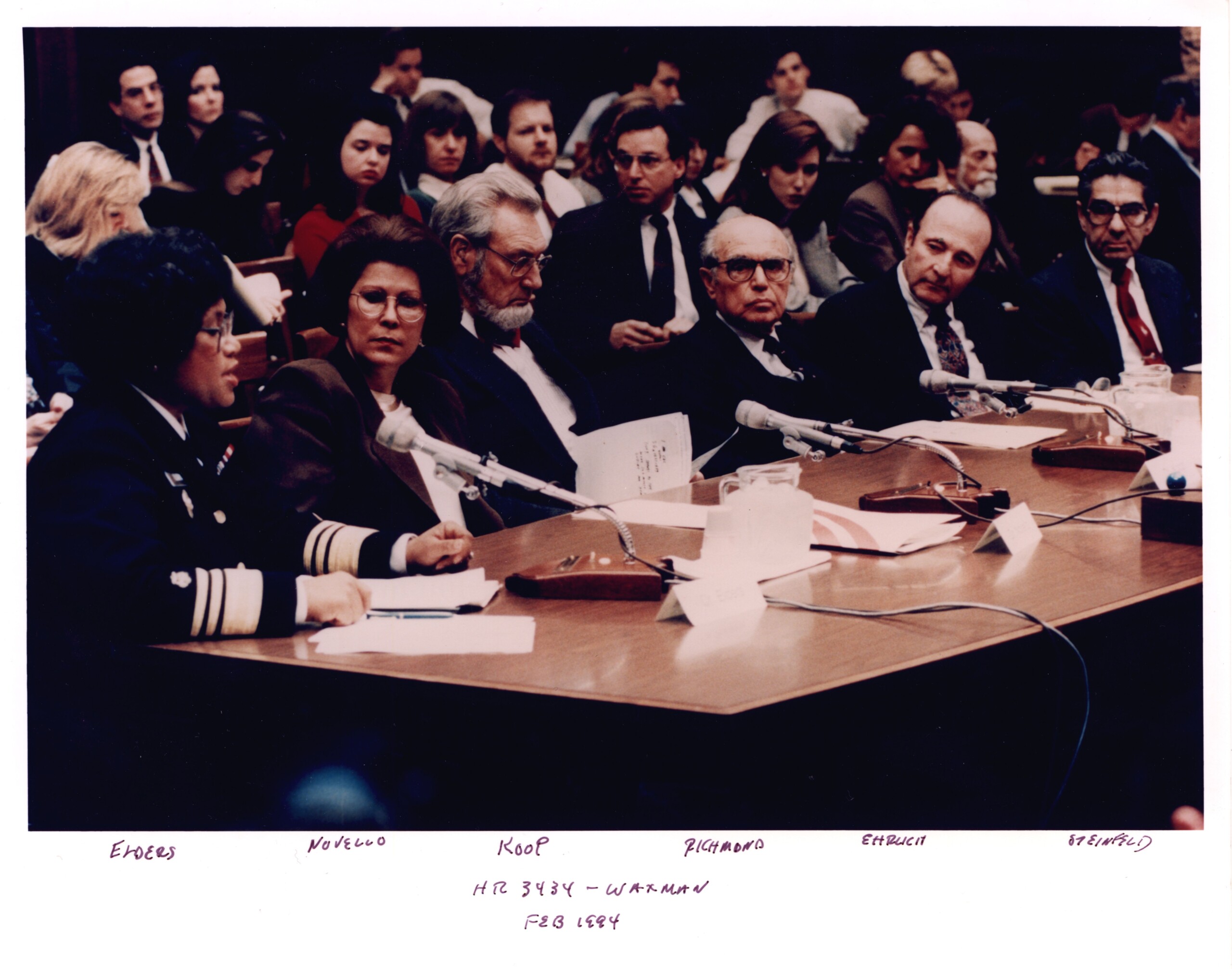
If contested understandings and expectations of gender run through Ruth’s memoir and archives, and the discrimination experienced by many of the men she cared for, Arkansas’s enduring racial divisions implicitly shaped her narrative and its silences. In the words of Catherine Fosl and Daniel Vivian, “the same race, gender, and class divides that mark US society are evident within LGBTQ communities, making histories of queer people of color, women, and trans people more difficult to access, especially by those who do not identify as such.”28Catherine Fosl and Daniel Vivian, “Investigating Kentucky’s LBGTQ Heritage: Subaltern Stories from the Bluegrass State,” The Public Historian 41, no. 2 (2019): 221. Ongoing archival projects in Arkansas are beginning to address these histories. The Historical Research Center at the UAMS Library has collected and preserved the papers of Dr. Joycelyn Elders, Director of the Arkansas Department of Health (1987–1993) and Surgeon General of the United States (1993–1994), who played an important role in the AIDS epidemic both in Arkansas and nationally.
To understand Ruth’s story—and what her archives and cemetery mean for queer memory in the southern United States—we must address how Ruth embraced and struggled against an ideal of “southern femininity” in the 1980s and early 1990s. Ruth’s memoir is a record of the constricted gender expectations imposed on her and her strategic use of her identity to help the men for whom she cared. In her 1991 essay, Frances Ross provides a formative background on changing notions of femininity and how women addressed social problems in turn-of-the-twentieth-century Arkansas.29Frances Mitchell Ross, "The New Woman as Club Woman and Social Activist in Turn of the Century Arkansas," The Arkansas Historical Quarterly 50, no. 4 (1991): 317–351. These norms remained decades later, as Anna Zajicek, Allyn Lord, and Lori Holyfield argue in their article on the women’s movement in northwest Arkansas: “To become activists in the civil rights movement, these women had to challenge the ideals of southern femininity and create a new sense of self.”30Anna M. Zajicek, Allyn Lord, and Lori Holyfield, “The Emergence and First Years of a Grassroots Women’s Movement in Northwest Arkansas, 1970-1980,” The Arkansas Historical Quarterly 62, no. 2 (2003): 155. Ruth also grappled with ideals of femininity while embracing the gendered role of caregiver.
In her memoirs and archival notes, Ruth does not directly discuss feminist politics in Arkansas. However, her complex experiences as a caregiver and activist contribute to what Janet Allured referred to as alternative “wellsprings” of “southern change-seekers” in her study of second-wave feminism in Louisiana.31Janet Allured, Remapping Second-Wave Feminism: The Long Women’s Rights Movement in Louisiana, 1950–1997 (Athens: University of Georgia Press, 2016), 49. Moreover, when we examine Ruth’s experiences, it is vital to consider the historical context of Arkansas in the mid-1980s, a little over a decade after the intense political backlash against the proposed Equal Rights Amendment. As Janine Parry argues, “the Equal Rights Amendment in Arkansas had swiftly moved from being perceived by many observers as ‘virtually assured’ of ratification in January of 1973 to being openly reviled at the next legislative session.”32Janine A. Parry, “‘What Women Wanted’: Arkansas Women’s Commissions and the ERA,” The Arkansas Historical Quarterly 59, no. 3 (2000): 283. While distinct from Ruth's story, these conflicting political currents indirectly shaped her activism and experiences.
Constructing Care Work and Motherhood in Arkansas
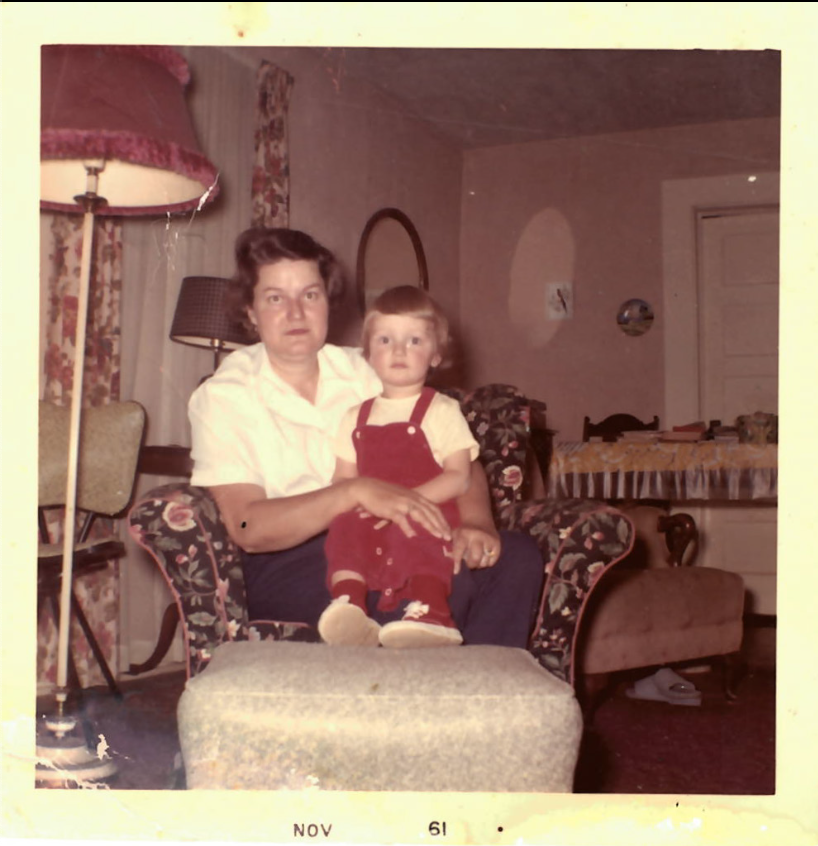
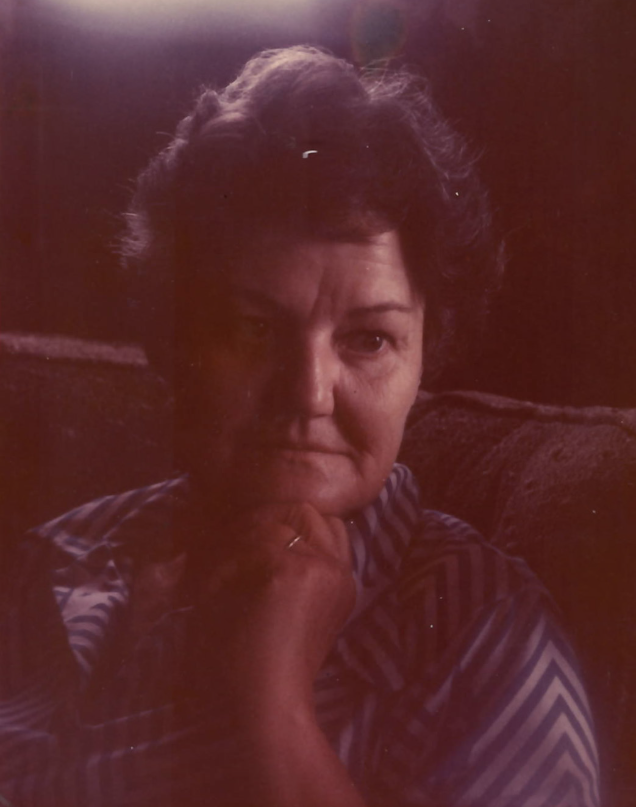
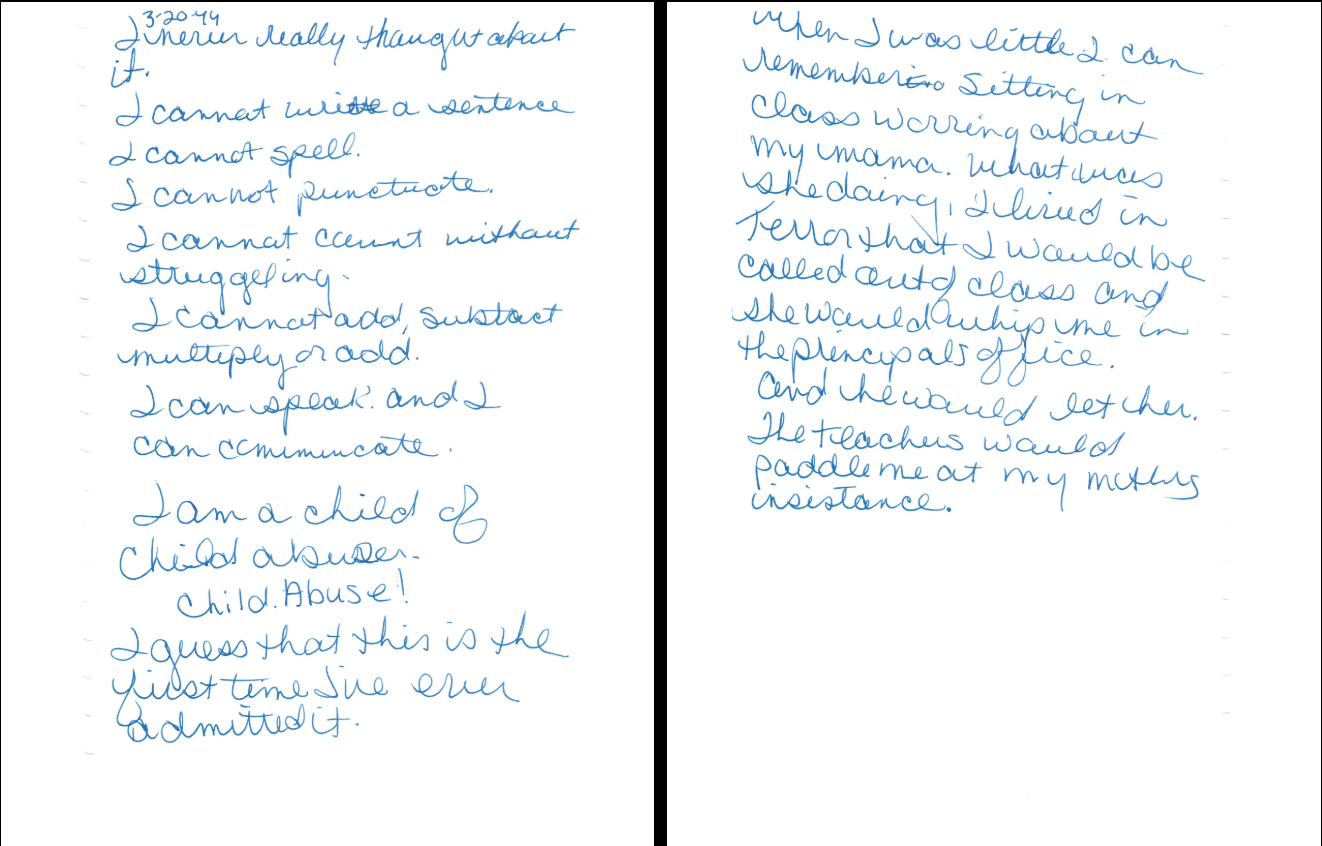
Ruth’s written and archival ephemera record the gendered expectations of care and motherhood often imposed on women in late twentieth-century Arkansas. Her autobiography contains a steady commentary on the contested meaning of motherhood in her life and care work. The figures of abusive mothers, absent mothers, and idealized alternative mothers run throughout the book. Ruth’s deeply damaging mother and her own constant worries that she might cause her young daughter harm through her AIDS work are recurring themes.33Burks and O’Leary, All the Young Men, 100–102. Ruth’s memoir and archives contain glimpses of the range of substitute mothers these dying men sought, including Ruth, the Virgin Mary, and even Dolly Parton.
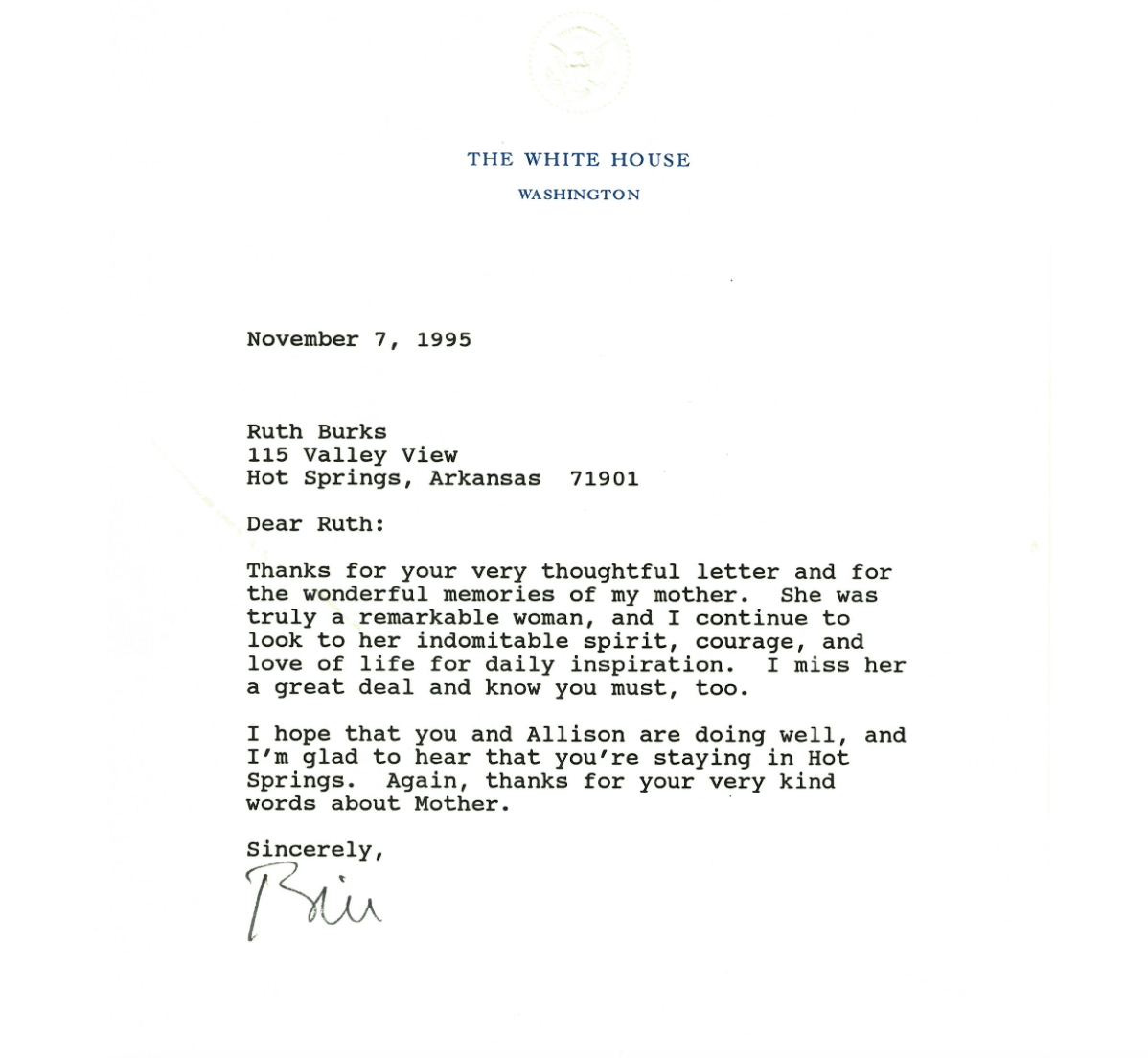
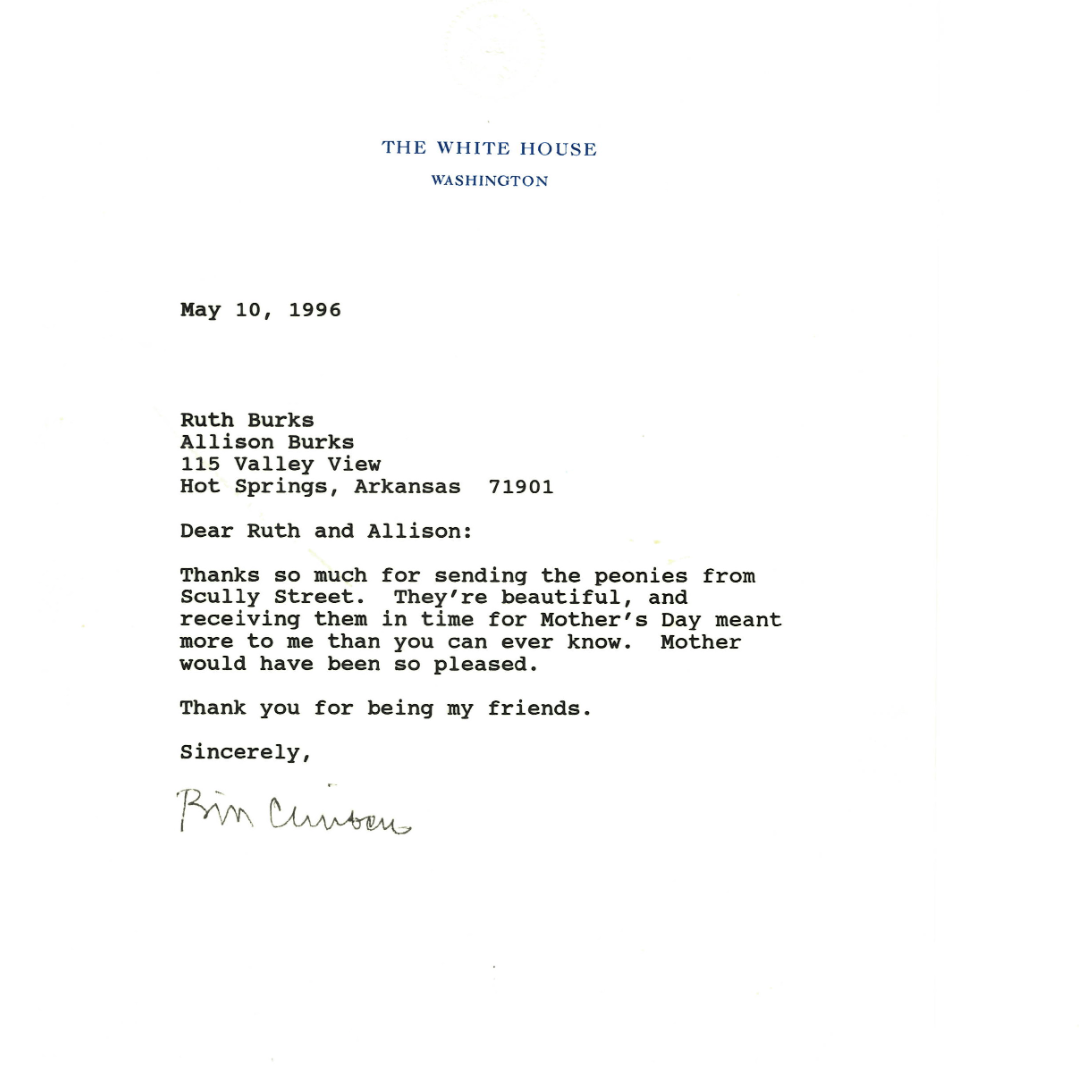
As mentioned, Ruth's career as an informal caregiver in the mid-1980s began with a case of mistaken maternal identity. With only a few exceptions, the men's families for whom Ruth provided care rejected their sick and dying sons.34Garofalo, “Lessons in Love.” “So many arrived [back in Arkansas] thinking Mama would take them back. Sometimes I would go to their homes with them, mostly just to save me a trip of driving back out there when she wouldn’t.”35Burks and O’Leary, All the Young Men, 55.
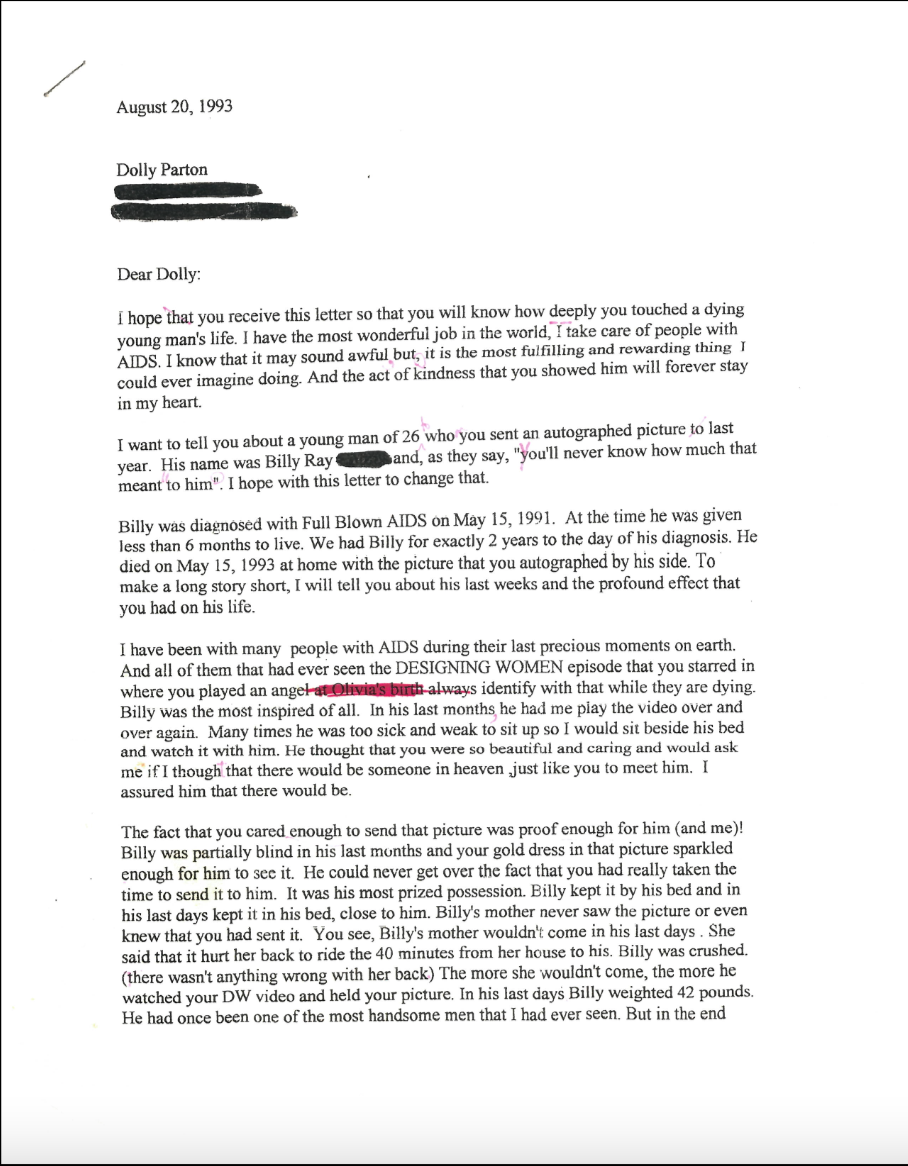
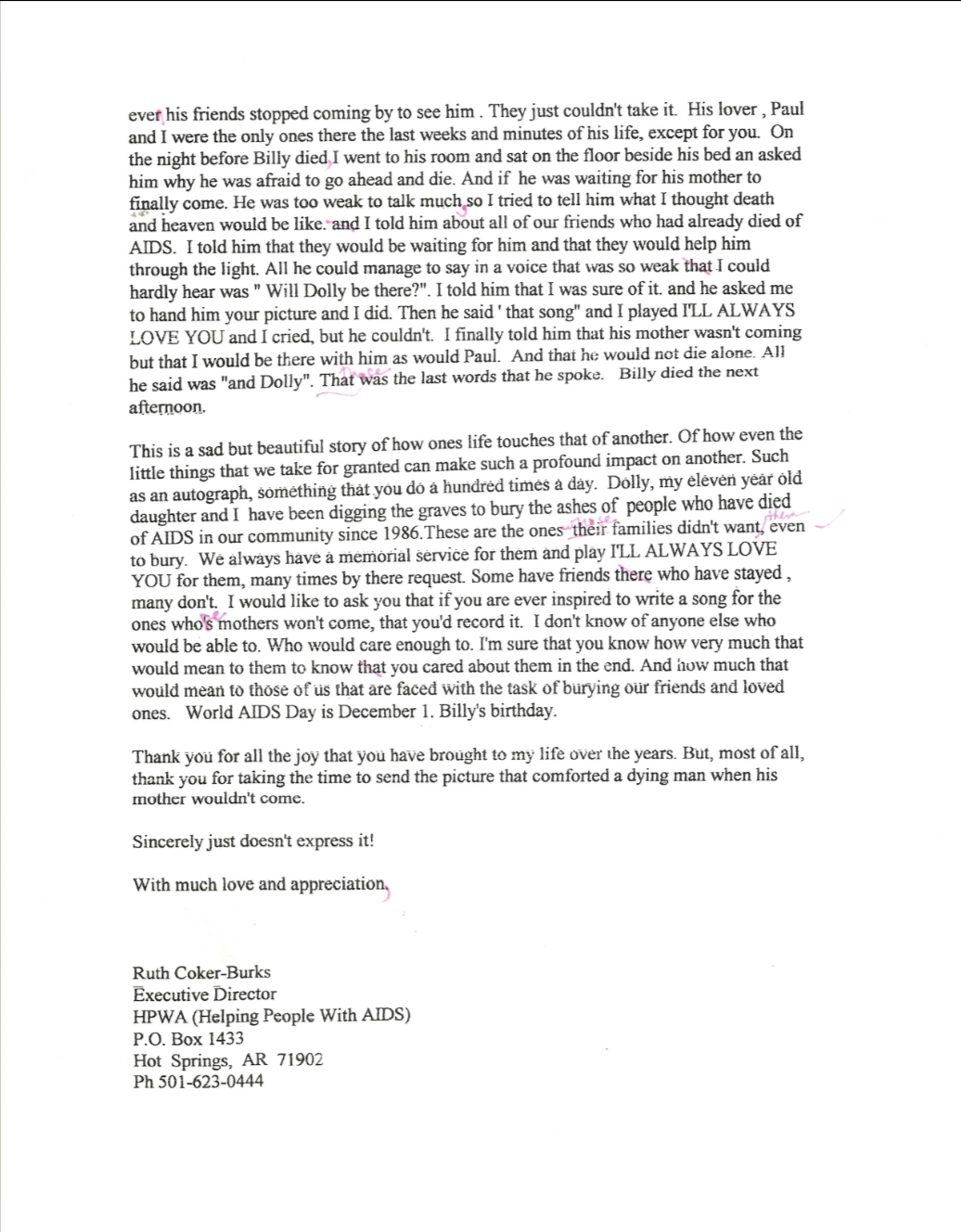
Alongside this parade of neglectful parents, another narrative of idealized mother figures runs through Ruth’s life history and archives. A letter she wrote to Dolly Parton on August 20, 1993, on behalf of Billy Ray Collins soon after he died, fashioned the beloved country music singer as a substitute maternal figure for the dead man. Ruth wrote the letter thanking Dolly for a picture that she had sent to Billy, a devoted fan. “Billy’s mother never saw the picture or even knew that you had sent it,” the letter begins “You see, Billy’s mother wouldn’t come in his last days. . . . Billy was crushed.” Ruth's letter underlined a profound sense of loneliness: “But in the end, even his friends stopped coming by to see him. They just couldn’t take it. His lover, Paul, and I were the only ones there in the last weeks and minutes of his life, except for you.” Ultimately, Ruth had to tell the dying Billy that his mother would not visit him. “I finally told him that his mother wasn’t coming but that I would be there with him as would Paul. And that he would not die alone. All he said was ‘and Dolly’.” In Ruth’s memory of Billy’s final days, recorded in a letter to Parton, a photograph of the singer was transformed into an icon standing in for Billy’s absent mother.36See, Box 6, Folder 16, Ruth Coker Burks papers, Center for Arkansas History and Culture, Little Rock, Arkansas. Billy was certainly not the only one of Ruth’s guys to reach out for their mothers and be denied at the end of their lives. This is a recurring theme in Ruth’s memoir.
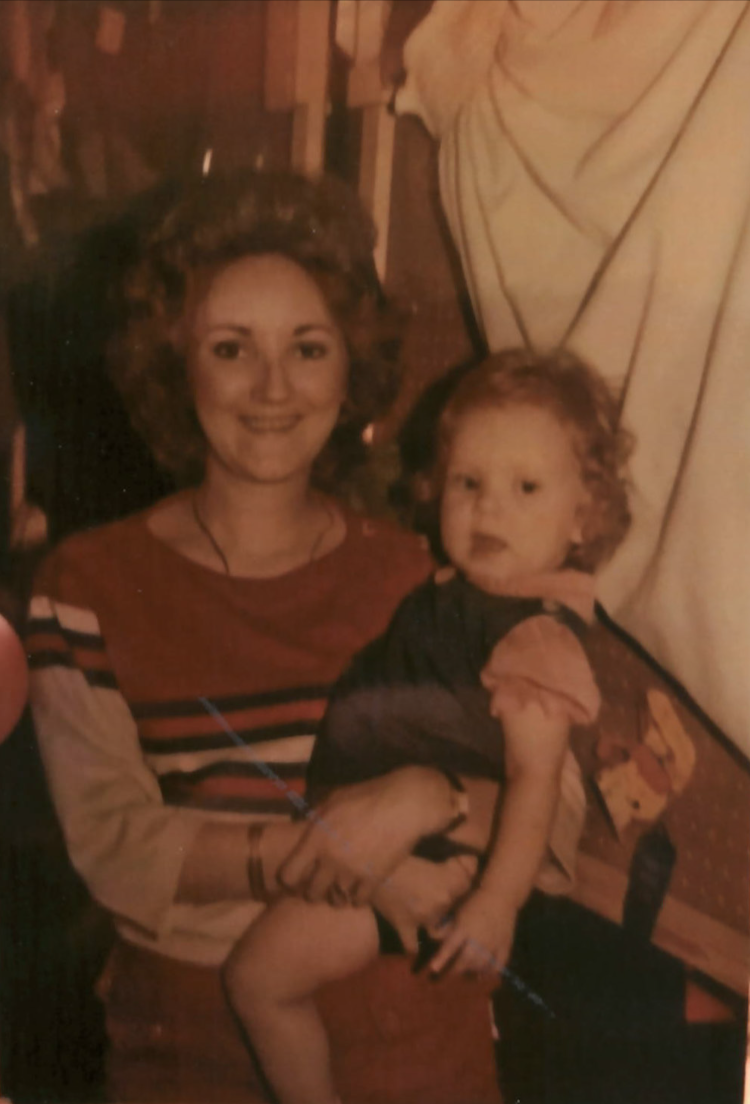
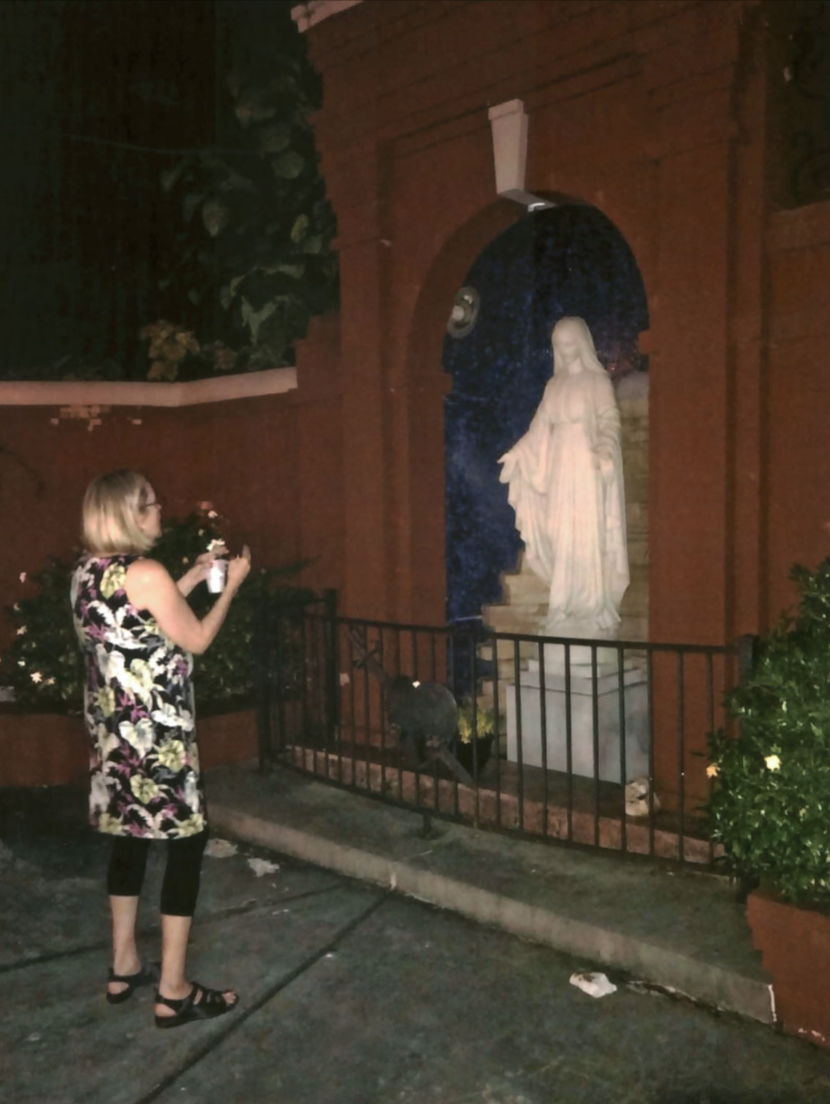
This search for an alternative maternal figure is perhaps best exemplified by Ruth’s visits with the men she cared for to that most idealized, and unrealizable, of mothers: the Virgin Mary. They often visited a small grotto at St. Mary of the Springs Catholic Church in Hot Springs. “There’s a statue of the Virgin Mary there,” writes Ruth, “in a red-brick shrine, hidden from the street. She’s on a pedestal, so she looks down on you, but there’s kindness in the stone of her eyes. . . . Whatever their religion, or lack thereof, my guys often like to visit her . . . sit on the brick and talk to her.”37Burks and O’Leary, 232.
All the Young Men
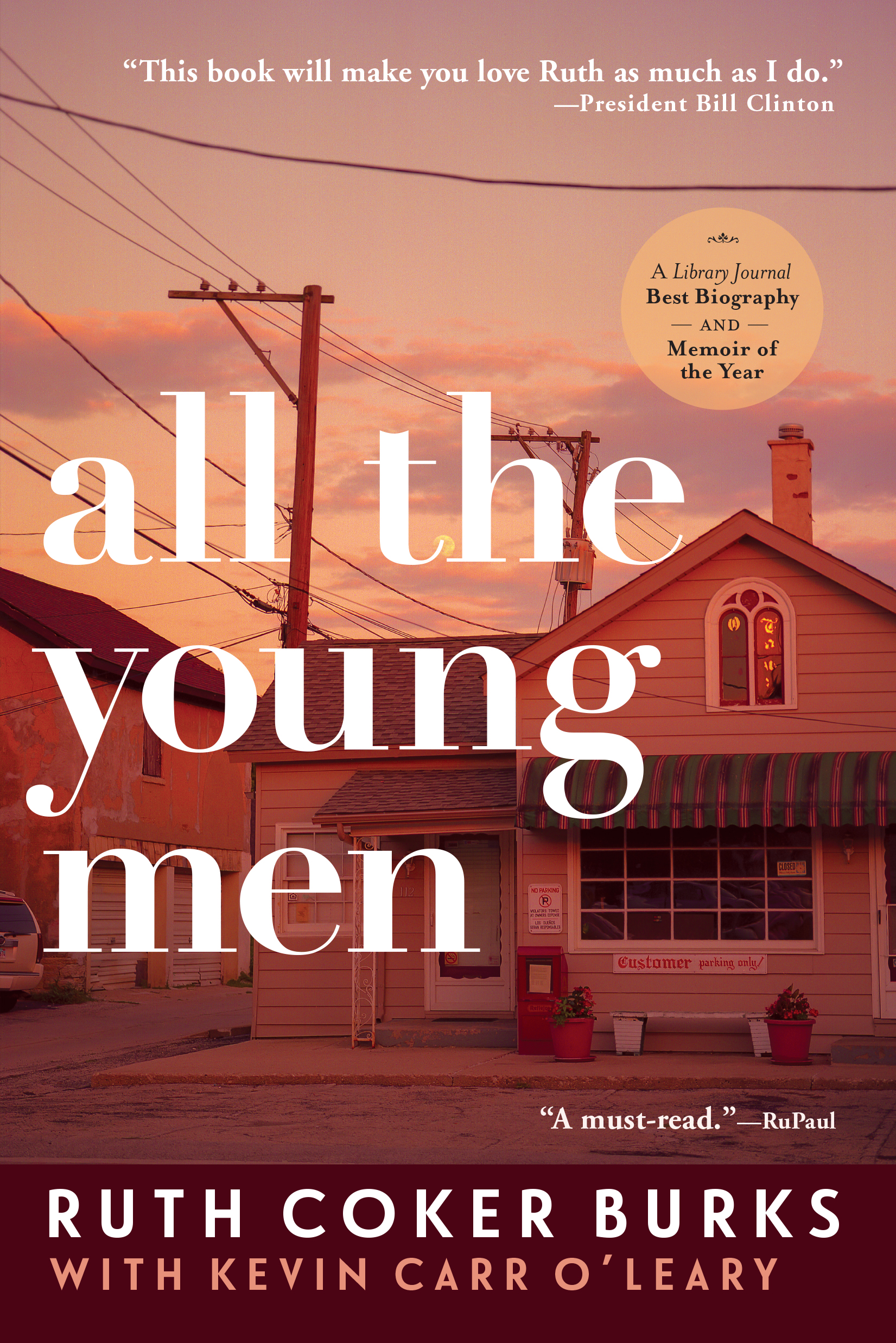
At the heart of Ruth’s memoir, and of recent criticisms of her memory, are the men, including Chip and Billy, who she cared for and those she later buried, such as Jimmy, in the Files Cemetery. Who were the titular ‘young men’ of Ruth’s autobiography, or as some of her critics lament, the lost ‘forty names’ of the Files Cemetery?38Gelder, “Ruth Coker Burks and the Missing Monument.”
Based on Ruth’s account, she cared for hundreds of men dealing with HIV/AIDS in central Arkansas from 1986 to 1995.39Garofalo, “Lessons in Love”; Koon, “Ruth Coker Burks: The Cemetery Angel”; Burks, "All Her Sons: The Cemetery Angel.” The ashes of a small number of them are interred in the Files Cemetery. These men had returned to Arkansas in search of care after living in New York or Washington, DC, or when they had left more rural parts of the state for Hot Springs or Little Rock. In Ruth’s telling, many of these young men only reluctantly returned to Arkansas for care that their families denied them.40Burks and O’Leary, All the Young Men, 30–31, 76–77. “My guy who made it all the way to DC,” wrote Ruth upon visiting Chip’s grave, “only to end up in the place he’d escaped from.”41Burks and O’Leary, 343.
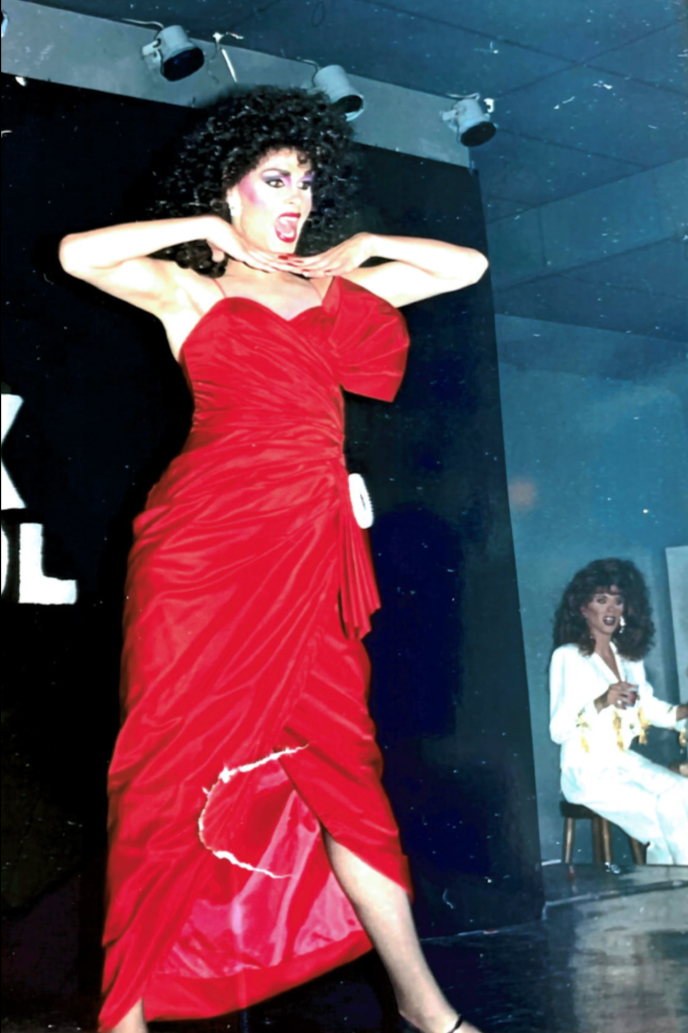
She cared for primarily working-class (sometimes indigent) young white and Latino men. Specifically, Ruth’s memoir, archives, and interviews record her work with numerous white country boys from the hills of Arkansas, Mexican immigrants in Hot Springs, and working-class drag queens. Many came from Mount Ida, Dardanelle, and other rural towns in central Arkansas.42Burks and O’Leary, 148–149, 165–167. Exemplifying this, Ruth’s beloved Billy, a luminescent drag queen, was “the movie star from Dardanelle.”43Burks and O’Leary, 166. Her guys included everyone from Jim, her first patient; to Tim Gentry, “a hillbilly dandy”; to Roger, whose family tried to wash away his sins in a creek baptism; and to the aforementioned Billy, the charismatic drag queen from Dardanelle who prominently featured in many newspaper profiles of Ruth and her book.44Koon, “Ruth Coker Burks: The Cemetery Angel”; Matthew Kincanon, “Ruth Coker Burks Describes Her Lifetime Caring for AIDS Patients to the Gonzaga Community,” The Gonzaga Bulletin, March 1, 2017, https://www.gonzagabulletin.com/news/ruth-coker-burks-describes-her-lifetime-caring-for-aids-patients-to-the-gonzaga-community/article_0e5de906-fdeb-11e6-b294-d72df02858f2.html; Burks and O’Leary, All the Young Men, 70. They also included men from Mexico who worked in tree planting or at the Hot Springs racetrack Oaklawn Park, including Angel Mestizo, whom Ruth recounts assisting as he simultaneously sought medical care and to avoid deportation.45Burks and O’Leary, All the Young Men, 274–277. The marginalized status of many of these men led them to Ruth, who, as she frequently reminds her readers and interviewers, lacked any formal medical training. As Paul Wineland, Billy's former partner, notes in the 2014 StoryCorps interview, "You were the only person that we could call. There wasn’t a doctor. There wasn’t a nurse. There wasn’t anyone. It was just you."46Garofalo, “Lessons in Love.”
Occasionally, Ruth did comment on the class divisions. She provided concise descriptions in her efforts to keep her childhood friend, Arkansas Governor Bill Clinton, informed about the AIDS epidemic: “But I knew he didn’t know the gay men I saw—the poor, the rejected, the ones with nobody to care for them.”47Burks and O’Leary, All the Young Men, 92. In discussing a professional ballet dancer whose partner came home to die in Arkansas, Ruth described “this ballet dancer who seemed so out of place and of a different class than the Hot Springs guys.” Ruth remembers the drag queens she saw at Our House in Hot Springs as goddesses who transformed the city. “The performers came and went . . . It was like Dynasty, but that was absurd because we were in Arkansas, which meant these people didn’t have the means to have a fabulous life. But there they were in fabulous gowns. . . . They were goddesses. The idea that I could breeze by someone like this in Hot Springs.”48Burks and O’Leary, 161, 267.
Not all of the men lacked political or social connections. Chip exemplifies this. While he was from Glenwood, which Ruth described as “one county over from Hot Springs and about forty years behind,” Chip had enjoyed a rising career working for the Democratic Party in Washington, DC. Chip lived with Ruth and her daughter for a few weeks, and she cared for him as he died.49Burks and O’Leary, 230, 233–235. This simultaneous intensity and brevity helps explain some of the gaps in her detailed knowledge of these men: “I felt at home, yet still at a distance from what these men were going through.”50Burks and O’Leary, 53. Ruth often provided daily care for weeks or months before their families sometimes stepped in for their last few days of life.51Burks and O’Leary, 260–266.
While Arkansas was the site of flight and reluctant return in Ruth’s memoir, Hot Springs served as a refuge for many rural gay men. At the gay bar Our House, “almost all the regulars had left their hometowns to create their own lives here in Hot Springs.”52Burks and O’Leary, 5, 37, 166. For a fuller queer history of Arkansas, see Brock Thompson, The Un-Natural State: Arkansas and the Queer South (Fayetteville: University of Arkansas Press, 2010).
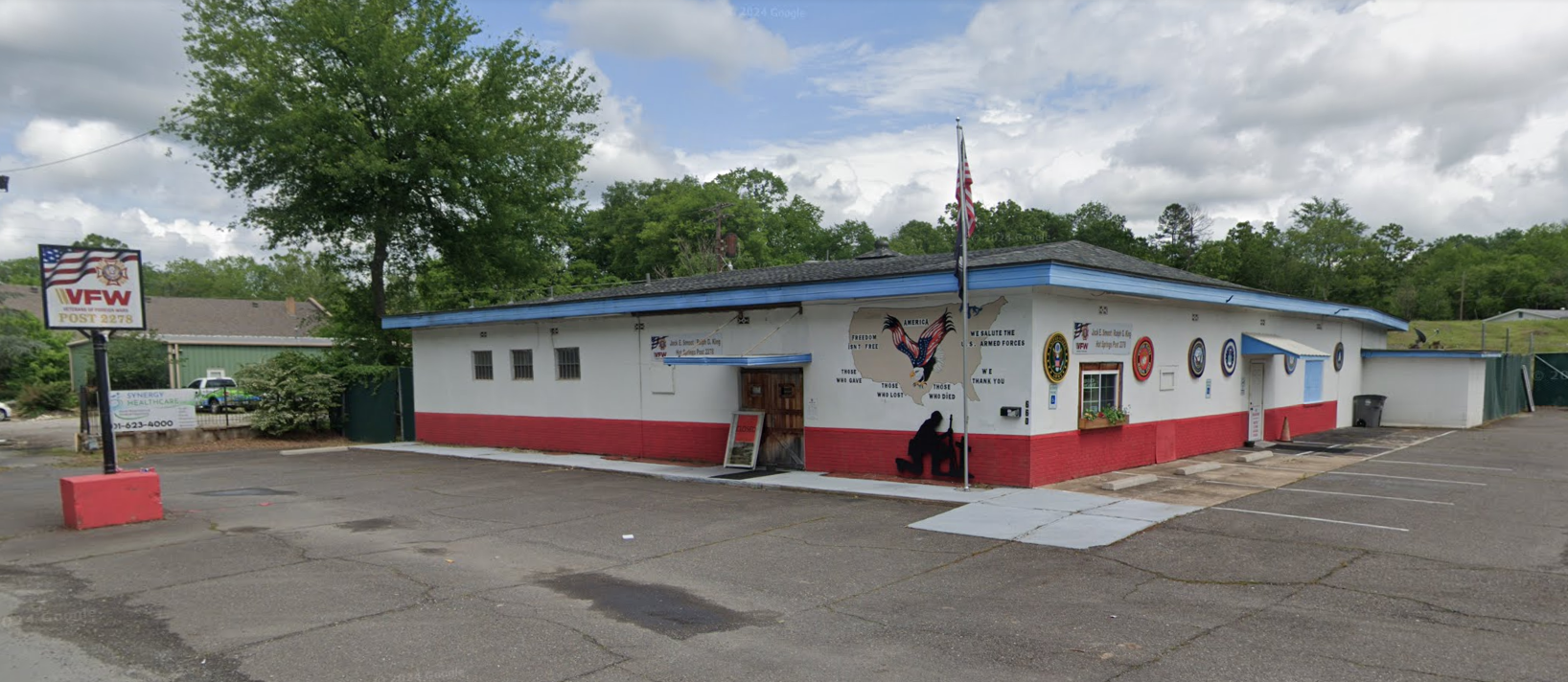
If Hot Springs was a refuge, the Files Cemetery emerged as a site for queer memory. Flagging the commemorative importance of this small cemetery, Ruth says “I wanted them to be counted, to have their lives matter, and I wanted them to have control over their destinies, no matter how limited they might seem to others. If I felt they were strong enough, I brought them to Files Cemetery and asked them to tell me where they’d like to be buried.”53Burks and O’Leary, 58.
A significant challenge of working with Ruth's archives and autobiography is the enduring ambiguities surrounding the number of cremations interred in the Files Cemetery either by her from the mid-1980s to the mid-1990s, or in the following years as the cemetery became informally associated with LGBTQ+ memory in Arkansas. Estimates of the number of men whose ashes Ruth interred range from five to approximately forty. In her early interview with StoryCorps, Ruth stated, "I’ve buried over forty people in my family’s cemetery because their families didn’t want them."54Garofalo, “Lessons in Love.” As one longtime resident of Hot Springs, Tim Looper, notes, there are five identifiable graves of men who died during the HIV/AIDS epidemic, and he remembers explicitly going to six funerals there.55Kacala, “Doubts Surround Viral Story of ‘AIDS Angel’ Who Says She Helped Hundreds of Dying Men.” Ruth has long maintained that dozens of other cremations have been interred at Files; she mentions fifteen names in her memoir. She insists that given the passage of time and her health problems, she does not remember the names of all the men she cared for.56Koon, “Ruth Coker Burks: The Cemetery Angel”; Kacala, “Doubts Surround Viral Story of ‘AIDS Angel’ Who Says She Helped Hundreds of Dying Men.” Moreover, she claims that initially in the 1980s, she concealed what she was doing in the Files Cemetery so that those who would have opposed burying abandoned people associated with AIDS there would not find out.57Burks and O’Leary, All the Young Men, 27–28. Further complicating the matter, Ruth claims that she started to receive anonymous ashes in the mail once she was interviewed about HIV/AIDS in local news outlets, and she proceeded to inter these ashes as well.58Burks and O’Leary, 133–136. Finally, the ashes of people Ruth did not know personally have also been interred at Files, as it became a potent space of LGBTQ+ memory. During an August 2020 visit to the cemetery, Ruth noticed a recently added memorial to a queer-identifying young man whom she had never met.
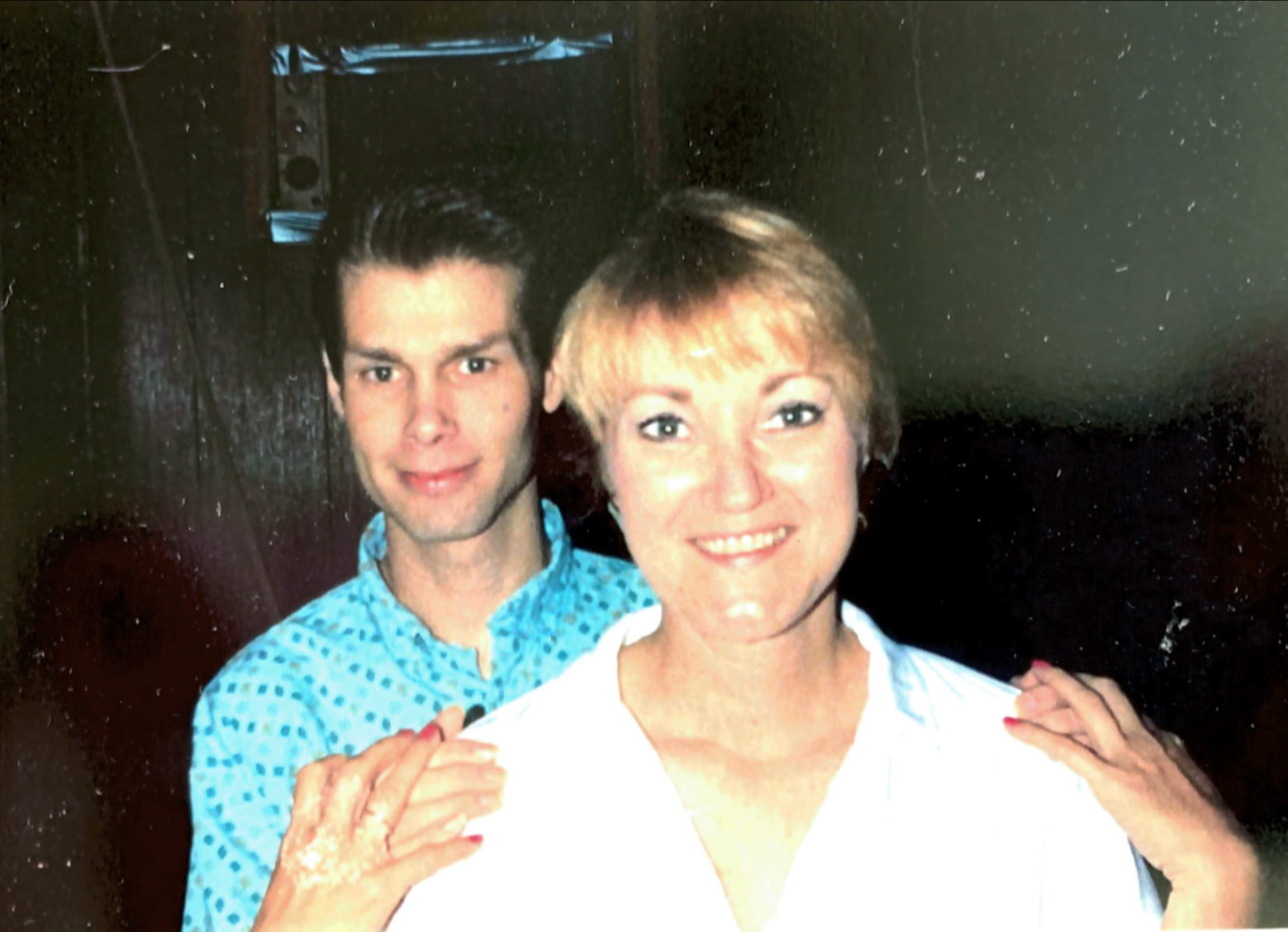
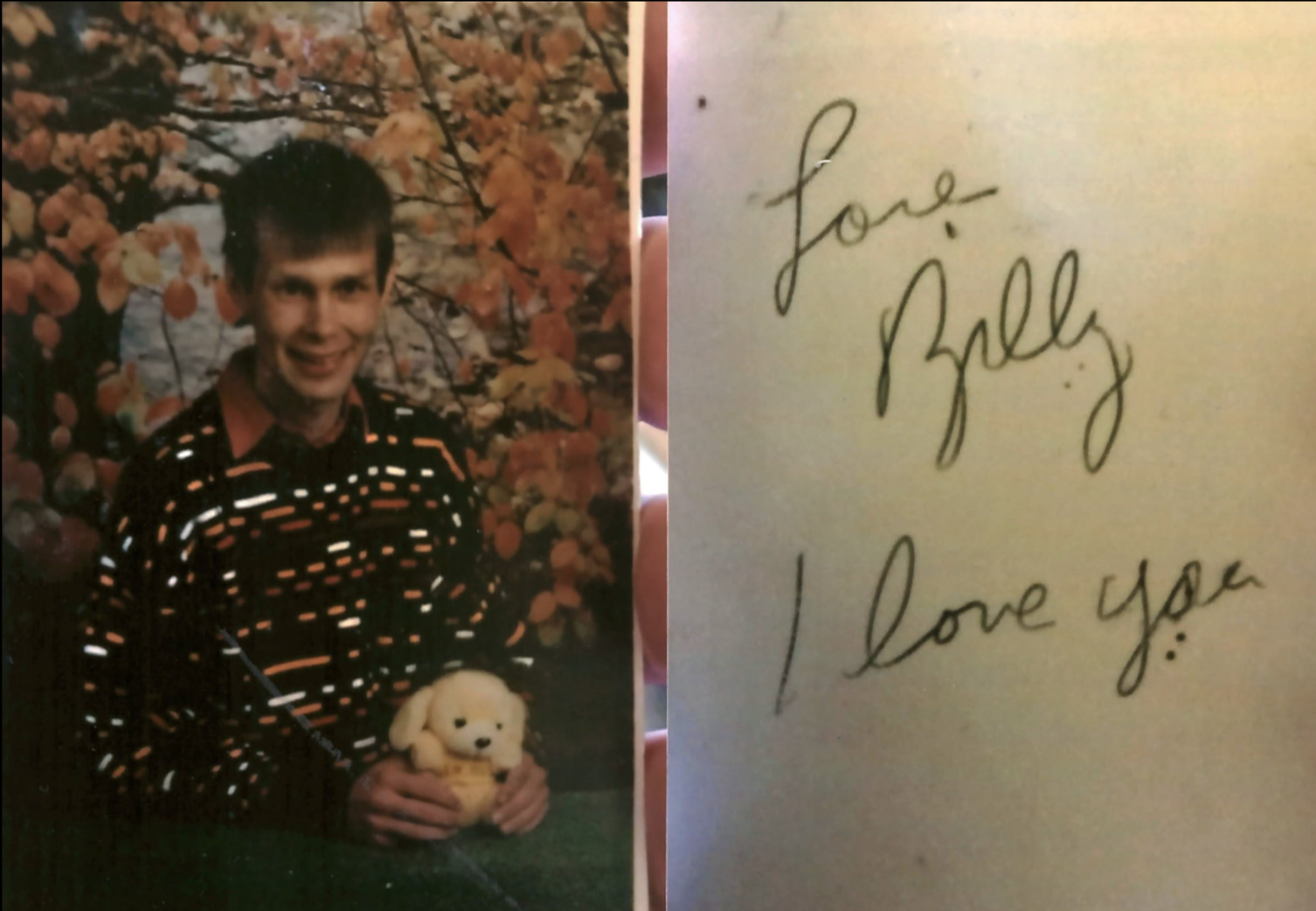
Ambiguity, anonymity, and informality have been central elements of Ruth's work from the beginning. In response to praise during her StoryCorps interview, Ruth said, "You know, they always say 'fake it ‘til you make it,' and I faked my way through the whole thing. I didn’t know what I was doing. I didn’t know anything."59Garofalo, “Lessons in Love.” Respecting the anonymity of many men is central to Ruth's understanding. "I'd go to an apartment to bring food, and another man would be there,” she writes. "There were people I recognized, though I pretended not to know anything about them."60Burks and O’Leary, All the Young Men, 97–98. Ruth's publisher noted in 2021, "Many of the men Ruth helped and eventually buried approached her asking for anonymity due to not wanting to be outed."61Kacala, “Doubts Surround Viral Story of ‘AIDS Angel’ Who Says She Helped Hundreds of Dying Men.”
The cemetery is a throughline in Ruth's memoirs and interviews. She returns to this commemorative geography at the end of All the Young Men as she narrates the journey from Rogers, in the northwestern corner of Arkansas, where she currently lives, back to her hometown of Hot Springs. “I make my way, finally, to Files Cemetery. The carpet of pine needles crunches under my feet as I make the rounds. The mockingbirds still caw above me. I clear brush here and there on the graves, saying hi to Misty before walking over to see Angel, Carlos, and Antonio.”62Burks and O’Leary, All the Young Men, 344. Alongside its status as a refuge and commemorative space, the cemetery is a site of considerable pain for Ruth, not only in terms of the family conflict that resulted in her contested ownership of many cemetery plots and the memory of the men she buried there, but also the more recent debates over what she did (or did not do) in caring for them.
Ruth's Fragmentary Archive
There are scattered, evocative references to Ruth’s archival materials throughout All the Young Men, whether to her pink leather daybook or to the collection of newspaper clippings related to her successful efforts to mobilize the Downtown Merchants Association of Hot Springs for Worlds AIDS Day on December 1, 1993.63Burks and O’Leary, 154, 337, 339. Her fragmentary archive complements recent public history scholarship on queer history and memory in rural areas of the United States. For example, a 2019 special issue on “Commemorating Queer History" in The Public Historian explored how museum exhibits and historical sites, especially in smaller towns and more rural areas, engage queer history.64See Rebecca Bush, “Woman, Southern, Bisexual: Interpreting Ma Rainey and Carson McCullers in Columbus, Georgia,” The Public Historian 41, no. 2 (2019): 94–115; Christopher Hommerding, “Queer Public History in Small-Town Wisconsin: The Pendarvis Historic Site and Interpreting the Queer Past,” The Public Historian 41, no. 2 (2019): 70–93; Fosl and Vivian, “Investigating Kentucky’s LBGTQ Heritage.” As Christopher Hommerding argues, such histories in non-urban areas “[give] lie to the notion that queerness outside of urban centers was historically hidden, invisible, and cut off from queers in other locations.”65Hommerding, “Queer Public History in Small-Town Wisconsin,” 73. Moreover, public historians such as Fosl and Vivian have foregrounded the challenge of “an uneven, often spare historical record” and the need for “better geographic representation” of queer histories in southern spaces.66Fosl and Vivian, “Investigating Kentucky’s LBGTQ Heritage,” 221–222.
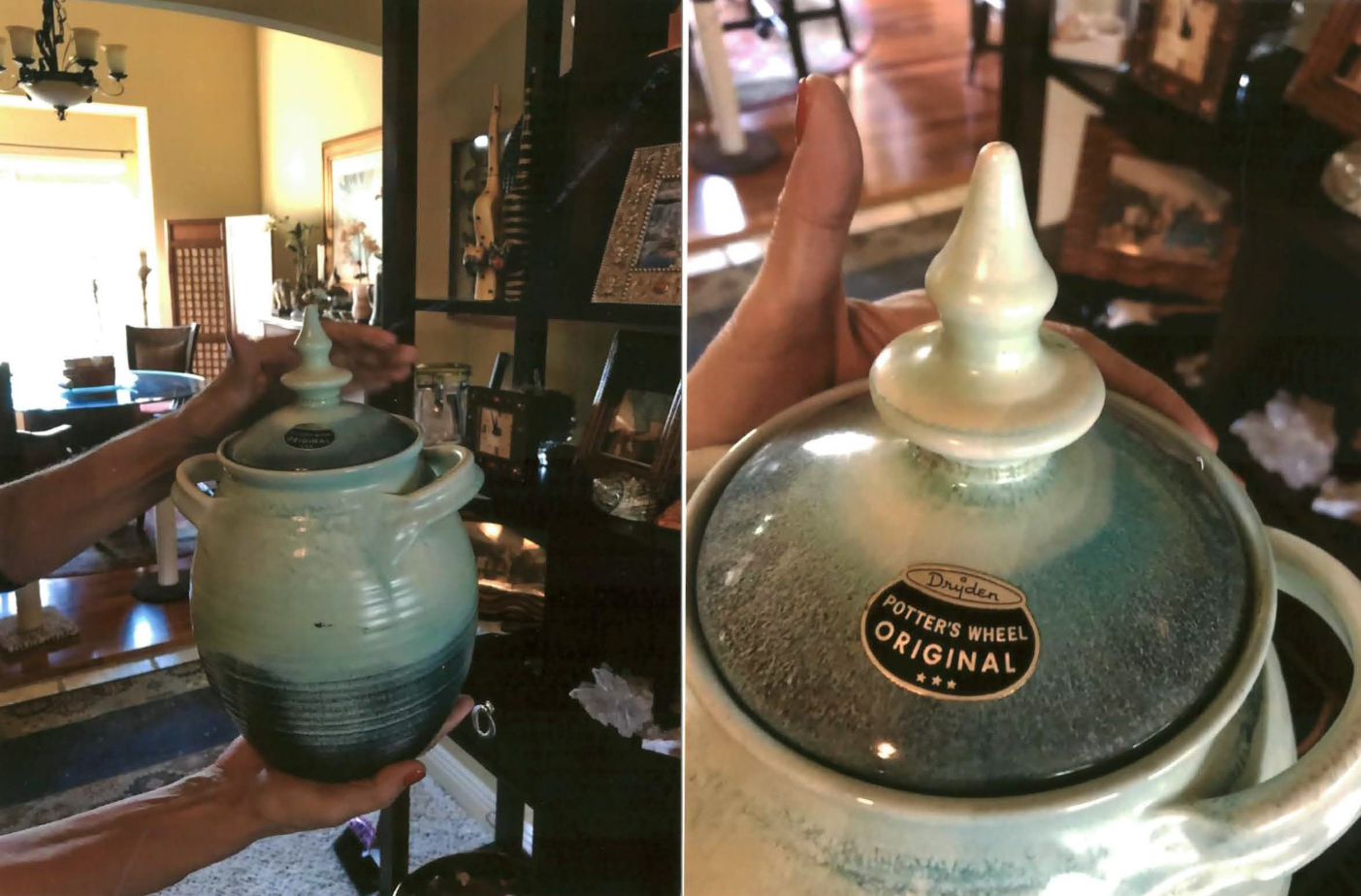
In 2022, Ruth donated her archival materials to the Center for Arkansas History and Culture (CAHC) in two batches. The first, more significant donation of materials primarily consisted of biographical and professional information, including planners, personal writing, news clippings, Christmas cards, and scattered photographs from Ruth’s activism and travels in the 1990s. This also included ephemera such as AIDS education t-shirts, drag ball gowns (one of which Ruth wore to Bill Clinton’s first inaugural ball), and the final pottery urn from Dryden Pottery that Ruth never used. The second, smaller donation comprised photo albums, newspapers, magazines, and All the Young Men publication materials. We wish that Ruth had kept better records, but this is the regrettable reality of many archives. Perhaps a better question than why Ruth did not keep better records is what this rich, if incomplete, archive can tell us about the history of HIV/AIDS.
Ruth’s daily planners illustrate the simultaneously rich and fragmentary nature of the collection. The planners in the archival collection include more blank pages than written ones, with some pages marked with only a single name. These fragmentary entries are mundane, a day-to-day account of an individual woman’s hopes and fears. Many are simple notes or reminders, the importance and context coming from either conversation with Ruth or other external sources.
Ruth’s archive reveals what it must have felt like in those difficult early years when she claims she primarily acted alone. As she puts it in the epilogue of her autobiography, “There was no one behind me. I had no choice but to help them.”67Burks and O’Leary, All the Young Men, 343. David Koon began his 2015 profile of Ruth in the Arkansas Times as “one lonely person” attempting to “budge the vast stone wheel of apathy.”68Koon, “Ruth Coker Burks: The Cemetery Angel.” This theme of isolation and hostility runs throughout her memoir. As Ruth notes of one church supper, other parishioners “eyed me suspiciously, but they always eyed me suspiciously, even before I was the town pariah.”69Burks and O’Leary, All the Young Men, 152.
But Ruth was not the only individual caring for AIDS patients in central Arkansas. All the Young Men can be read as a record of “the town elders” of Hot Springs who quietly assisted her. This is best exemplified by Clay Farrar, a prominent Hot Springs lawyer. Clay introduced Ruth to a network of Rotary Clubs where she spoke about her care work and AIDS activism and connected with prominent men who were willing to provide support quietly. Several bankers in Hot Springs occasionally assisted Ruth with monetary donations or by requesting favors in the medical profession.70Burks and O’Leary, 182–184, 257–258.
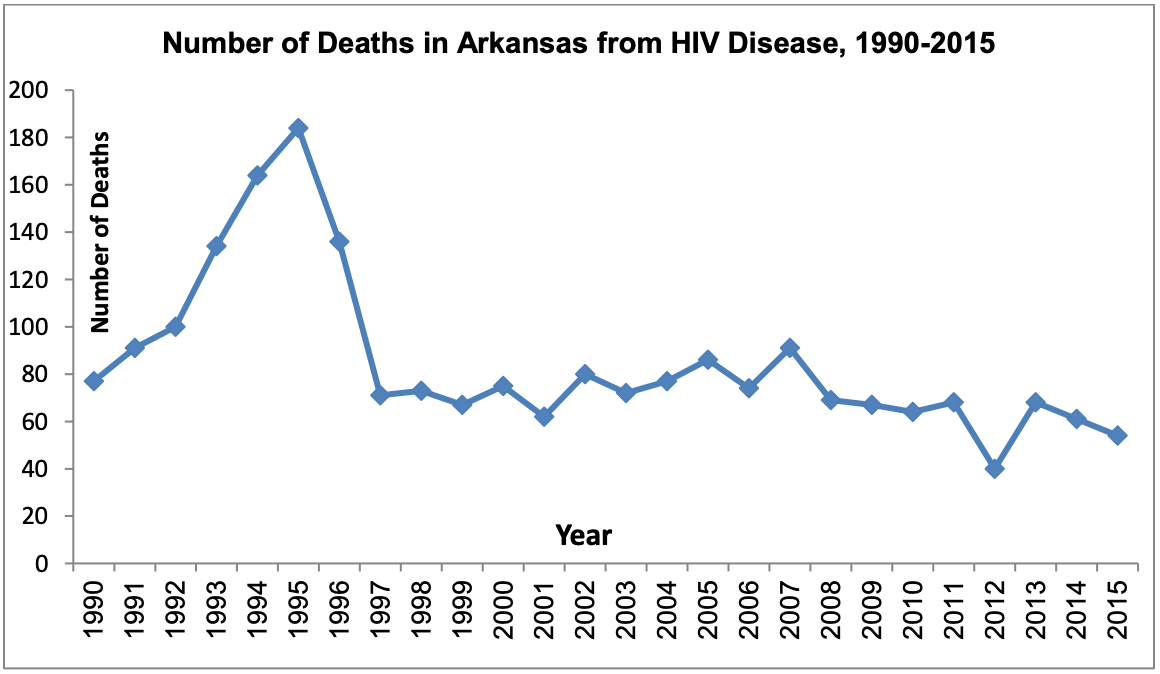
Certainly, a range of individuals and non-profits attempted to help those dealing with HIV/AIDS in Arkansas in the 1980s and early 1990s; however, Ruth’s searing memory but factual inaccuracy in insisting that she acted alone evokes the experience of the HIV/AIDS epidemic for the men she cared for, many of whom—working class, indigent, and abandoned—were from the hills of Arkansas or were Mexican immigrants far from their families. These men were on society’s margins in multiple abject ways. As Ruth describes visiting Angel in the hospital, “Angel and I smiled at each other, together in our lonely place.”71Burks and O’Leary, 277.
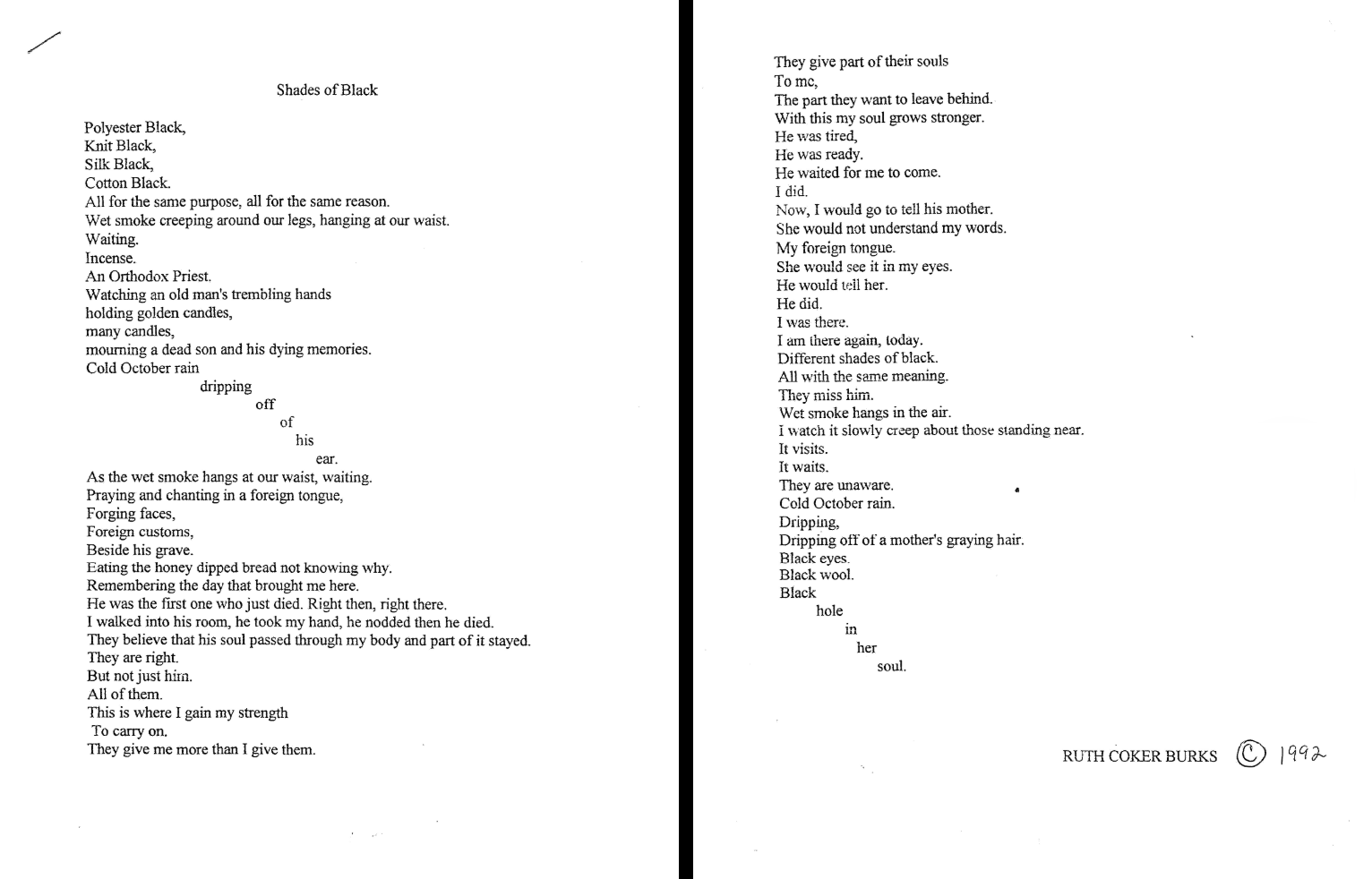
This sense of isolation is also represented in Ruth’s archival materials, for instance, in two poems she wrote in the early 1990s, “Shades of Black” and “THIRTYONE.” In writing about her first patient, Jimmy, in “Shades of Black,” the death Ruth recalls is sudden and lonely; there is only Ruth and a dying man crying out for his absent mother. Ruth went into the room alone, held this man’s hand, watched him die, and walked out of the hospital room alone. “Remembering the day that brought me here. He was the first one who just died. Right then, right there. I walked into his room, he took my hand, he nodded and then he died.”72See, Box 6, Folder 16, Ruth Coker Burks papers, Center for Arkansas History and Culture, Little Rock, Arkansas.
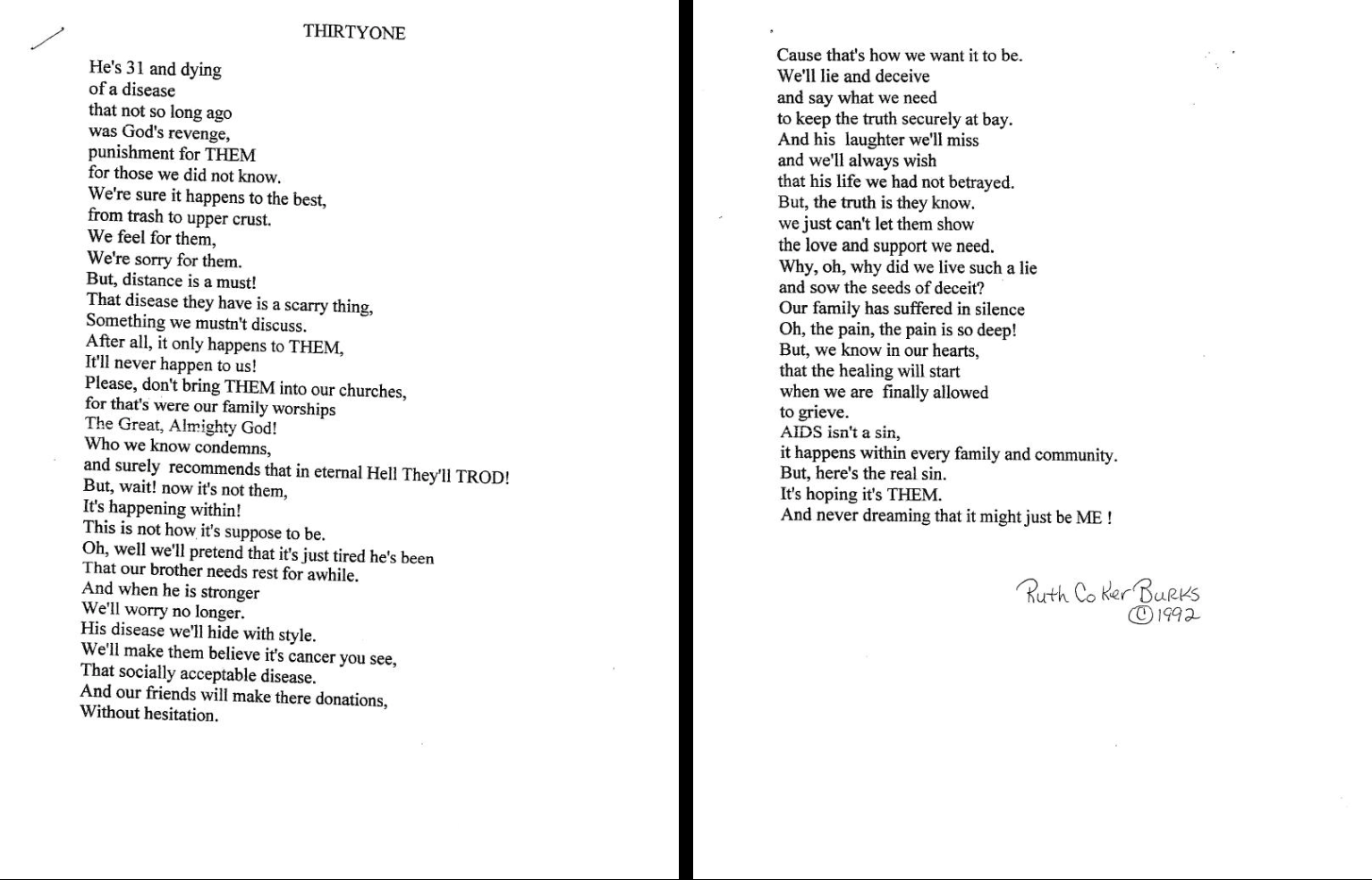
In “THIRTYONE,” the sense of isolation is deployed in anger against society and religious institutions. Ruth writes: “He’s 31 and dying of a disease that not so long ago was God’s revenge, punishment for THEM. While Ruth was sharply critical of the hostility of many religious institutions in Arkansas from the mid-1980s and mid-1990s, she remembers her care work and activism relative to her religious faith. As she has repeated in conversations with us, “I never lost my faith; I just lost faith in everyone else’s faith.”73See, Box 6, Folder 16, Ruth Coker Burks papers, Center for Arkansas History and Culture, Little Rock, Arkansas.
Criticism in Context
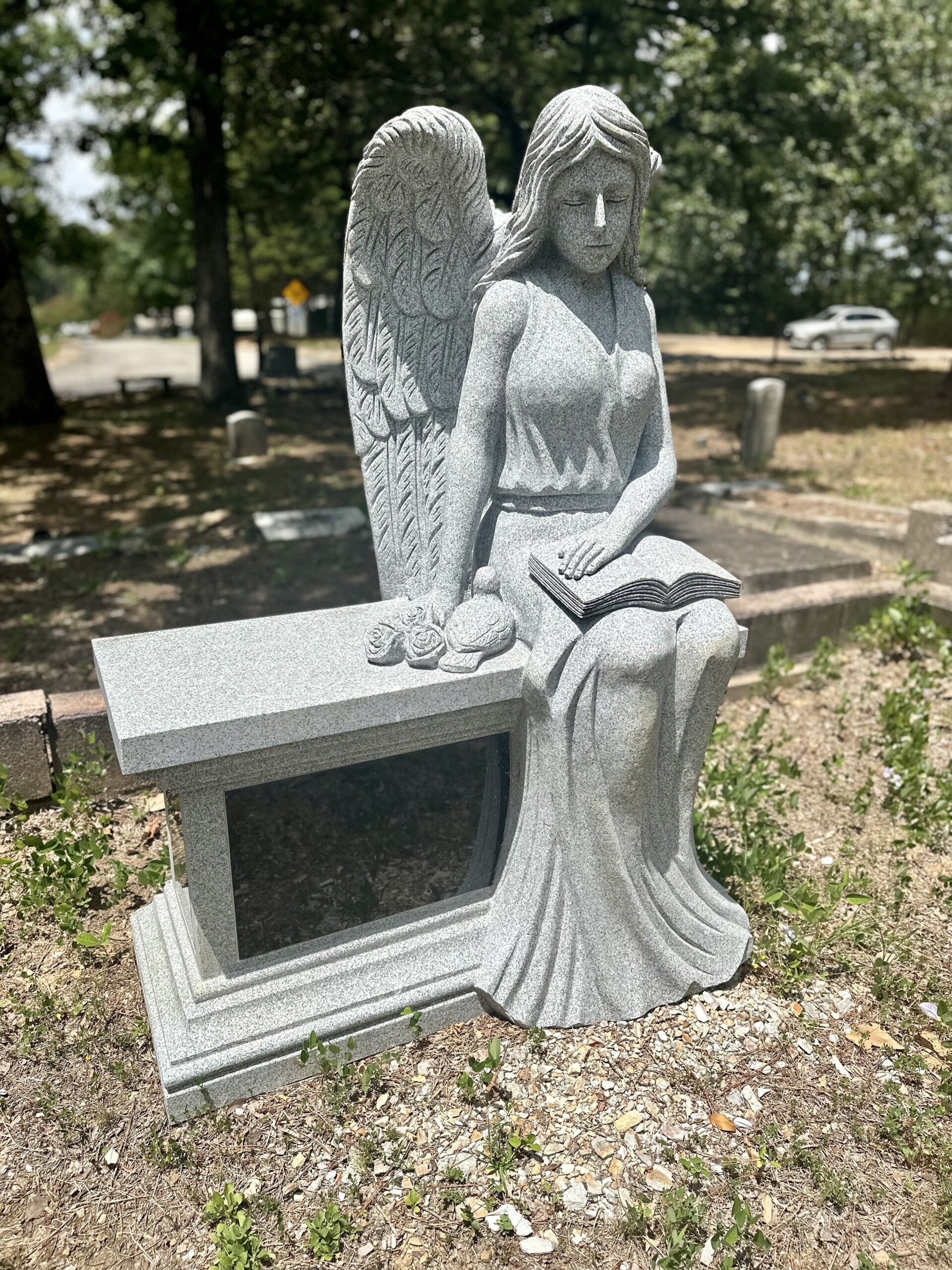
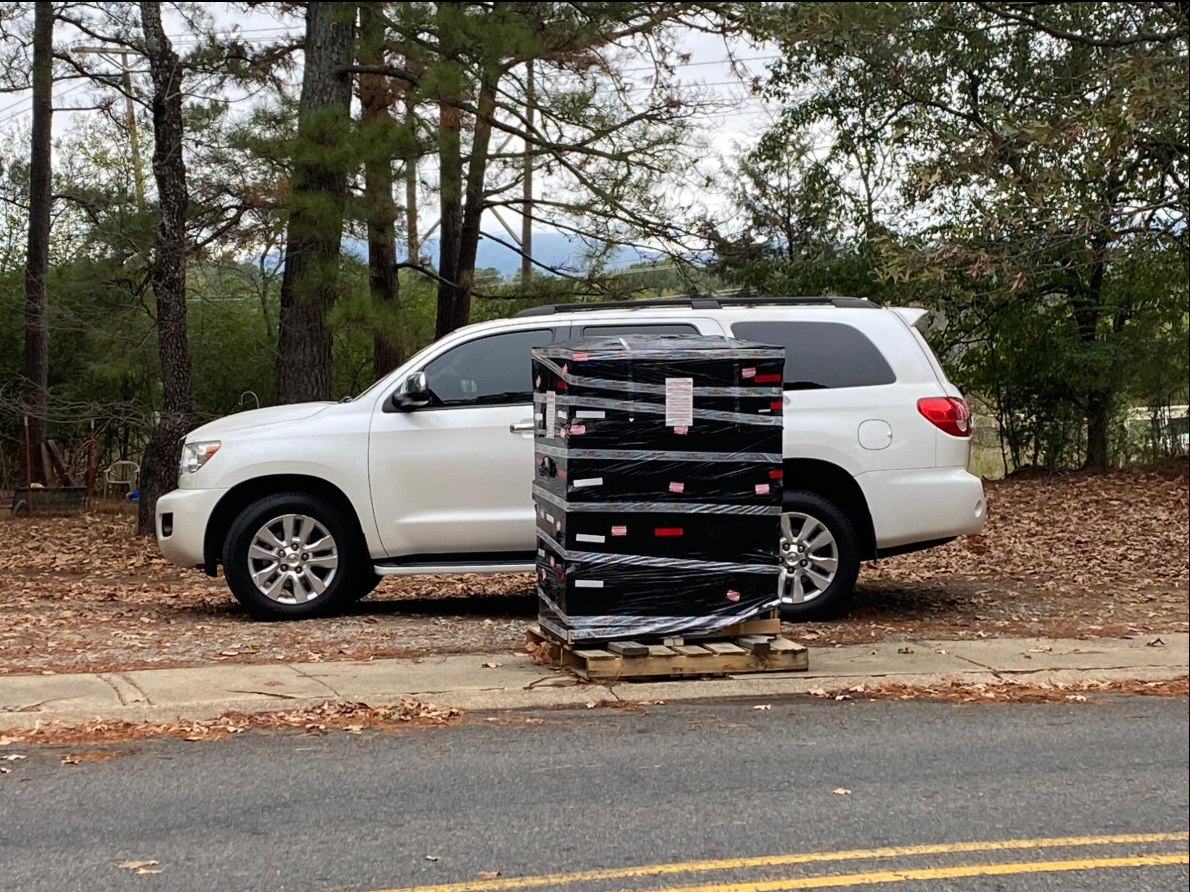
In time, media coverage of Ruth shifted from the laudatory into two overarching criticisms. First, Ruth either kept shoddy records of the men whose ashes she interred in the Files Cemetery or was guilty of exaggerating the number she cared for or buried. Second, she has either been unwilling or unable to put up a monument to these men at the Files Cemetery despite advocating for a memorial for years. Some of her critics suggest that a successful GoFundMe campaign (to raise money for a cemetery memorial and Ruth’s medical bills) was entirely used for the latter purpose and not for the former. For example, in a 2021 piece, the Arkansas Times journalist Austin Gelder discussed how there was not yet a memorial, local disappointment in the limited impact of Ruth’s newfound celebrity on Hot Springs, and debates over ownership and oversight of the Files Cemetery. In a subsequent piece for NBC News, Alexander Kacala expanded on these concerns over funding, management of the Files Cemetery, and local disappointment (and anger.) Kacala also suggested that Ruth may have exaggerated or even fictionalized some of her claims, particularly regarding the number of men for whom she cared.74Kacala, “Doubts Surround Viral Story of ‘AIDS Angel’ Who Says She Helped Hundreds of Dying Men.” It is important to note that in late 2022, Ruth arranged for a monument to be constructed and delivered to the Files Cemetery.
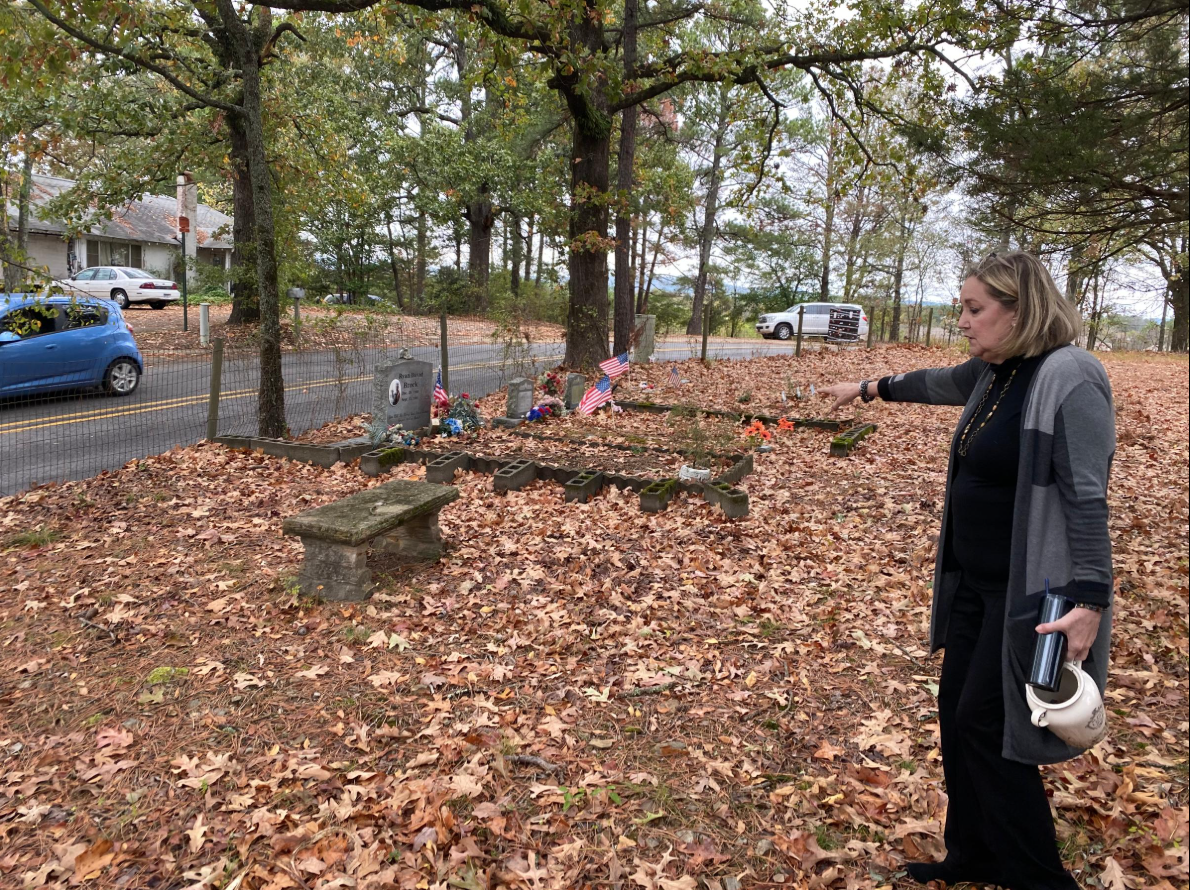
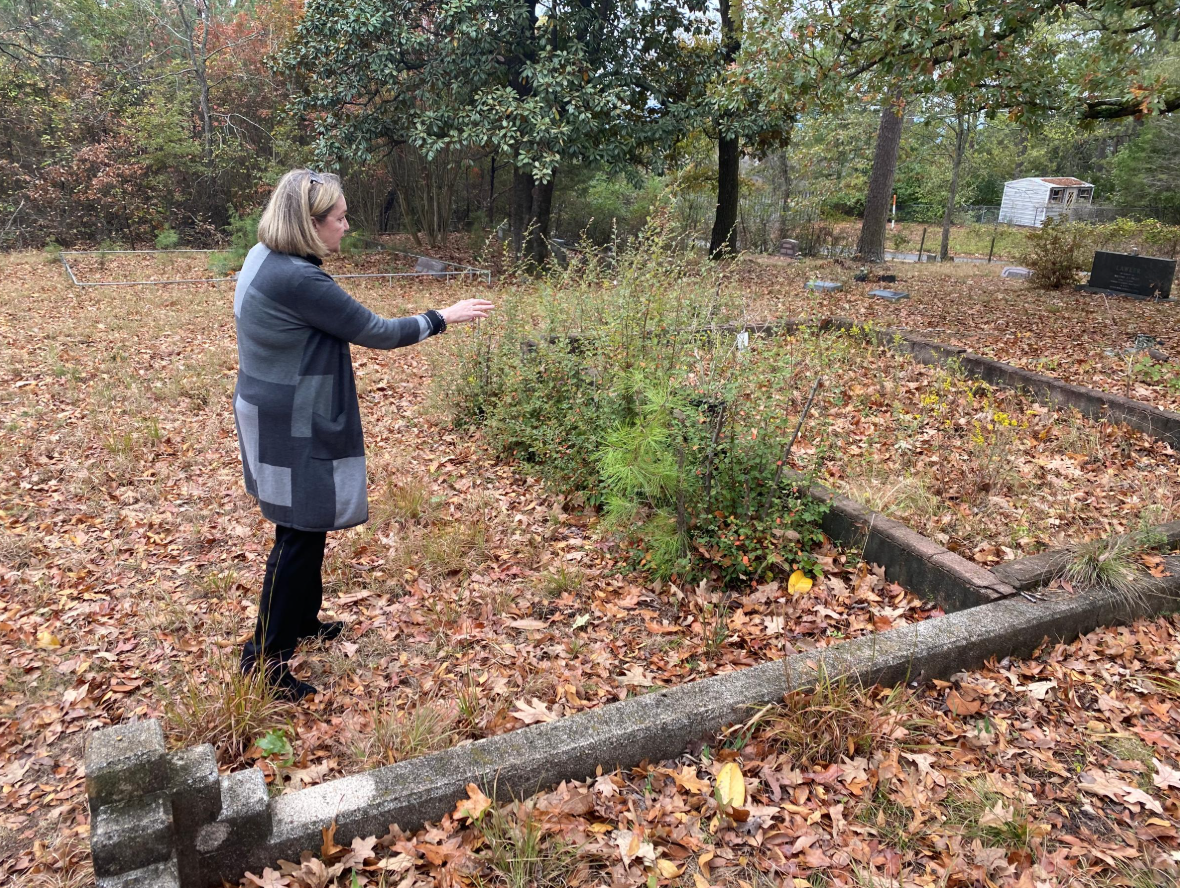
As Gelder notes, most of her critics still “commend Burks . . . [and] don’t want to detract from her good deeds” while insisting on clarity.75Gelder, “Ruth Coker Burks and the Missing Monument.” In turn, Kacala surmises that beyond the good deeds that Ruth did in the 1980s and early 1990s, “over the years either she or the media have sensationalized the story for some sort of gain.”76Kacala, “Doubts Surround Viral Story of ‘AIDS Angel’ Who Says She Helped Hundreds of Dying Men.” Some in Hot Springs are more critical, including Robert Klintworth, a former friend of Ruth who cared for the Files Cemetery for many years (Klintworth provides much of the criticism in both the Arkansas Times and NBC News pieces). Klintworth claims he and his partner, Paul Wineland (who was Billy's partner before his death), cared for the cemetery and provided Ruth with significant assistance in remembering details and names for her book, but that the rewards of the “book deal, a movie deal, and international recognition” have accrued to Ruth alone.77Gelder, “Ruth Coker Burks and the Missing Monument.” Paul Wineland was also central to the 2014 StoryCorp profile, which fed the media's interest on Ruth’s story.
Along with Klintworth, Tim Looper cared for the cemetery for several years after 2015. Looper also is one of Ruth’s prominent local critics, and has argued that Ruth exaggerated her narrative and/or does not remember events accurately.78Kacala, “Doubts Surround Viral Story of ‘AIDS Angel’ Who Says She Helped Hundreds of Dying Men.” Looper maintains, for instance, that Ruth’s first hospital visit occurred in Hot Springs and not in Little Rock, as she writes in her memoir. According to Ruth, some local drag troupes have also provided informal care for the cemetery. In 2023, Hot Springs resident Jim Thompson began to care for the seemingly neglected cemetery, as reported by the local news.79Rolly Hoyt, “One Man’s Mission Helps Restore a Site of Arkansas Cemetery Holding Remains of AIDS Victims,” THV 11, October 26, 2023, https://www.thv11.com/article/news/local/arkansas-files-cemetery-aids-restoration/91-39e9dad1-7ece-4244-b854-4e1d2091c5bc.
A June 2024 YouTube video podcast, RUTHLESS: The Real Story Behind the ‘Cemetery Angel of Arkansas’ alleges to uncover the “scam” perpetrated by the “grifter” Burks. The three-hour video is a sensational retelling of the 2021 Arkansas Times article. Looper is the principal source and the recurrent themes include the alleged exploitation of gay deceased men for fame and fortune, the accusation of profiting from a never-constructed (but since built) memorial, the flagging of factual errors and inconsistencies in the memoir, Ruth’s alleged failure to recognize other individuals and entities who provided aid, and a general sense that her version of events has disparaged Hot Springs and Arkansas. Posted comments about the video are overwhelmingly critical of Ruth, but it is beyond the scope of this article to evaluate these claims.
The CAHC is working to process Ruth's and others' archival papers from these years. However, it would take a large research budget (and a significant scholarly team) to, 1) carefully and responsibly reconstruct the life histories of the men buried in the Files Cemetery, 2) locate the interred cremations within the Files Cemetery with both precision and respect for anonymity, and 3) carefully and empathetically adjudicate the conflicting claims by drawing on state and local records. Complicating any research efforts is the reality that almost all of the direct witnesses of what Ruth did are long dead, and the remaining few include both fervent supporters and biting critics. These conflicting accounts rely on individual memories of traumatic events that occurred at least thirty years ago.
Many of the critiques voiced in newspaper articles and videos are valid. We too would like to know more about the men's life histories and see the Files Cemetery physically transformed into the commemorative site it already is in the minds of so many. In telling and retelling Ruth's story, it is clear that many details and claims remain constant, alongside some ambiguities and exaggerations. Ruth is not necessarily the appropriate target for all of these legitimate concerns. Or to reframe Kacala’s observation as a question, if elements of Ruth’s story have been ‘sensationalized’ over the years, to what end have they been sensationalized for a reading public in Arkansas and beyond?
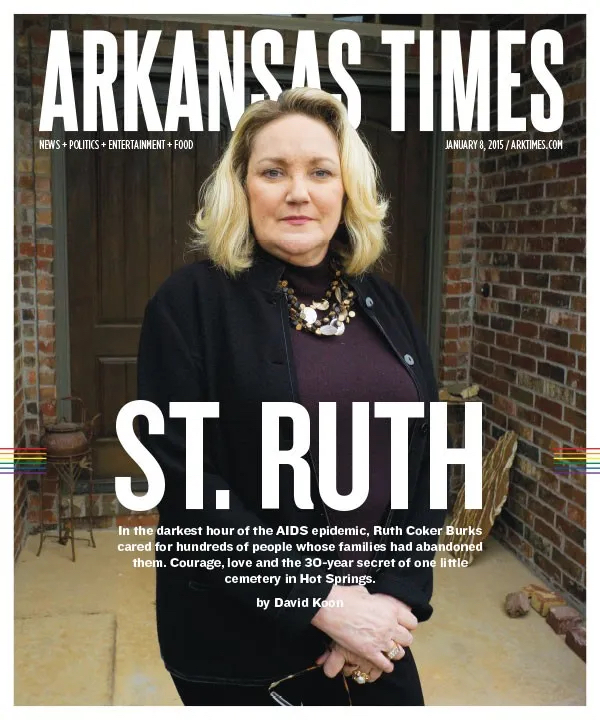
Our preliminary research suggests that the presentation of Ruth as an almost saintly figure began with the 2014 StoryCorps interview and the 2015 Arkansas Times profile. In the StoryCorps interview, Michael Garofalo notes, "Ruth is one of those rare people who doesn’t run away from suffering. She runs toward it without hesitation."80Garofalo, “Lessons in Love.” David Koon’s article in the Arkansas Times in 2015 was titled, “Ruth Coker Burks, the Cemetery Angel.” A photograph of Ruth overlayed with the text, “St. Ruth,” was the cover story of the initial print edition (the “St. Ruth” title was removed from the online version). It was more often in the headlines of stories, rather than in the body of articles, that she was presented in saintly or angelic terms.
These binary understandings of Ruth, either as a living saint and the Arkansas cemetery angel, or as a fantasist and teller of tall tales, do not map onto the reality of her evocative and fragmentary archive. Returning to the questions we posed at the beginning of this article, what can Ruth’s archive tell us about the history of the AIDS epidemic in Arkansas and the construction of the role of the idealized caregiver for some Arkansas women at the time?
One answer that her archive does provide is that contestation and debate have long been integral to Ruth's care work and activism and that she has always had both enthusiastic supporters and harsh critics. Based on newspaper clippings from her archival donation, the criticism of Ruth and her work began in the early 1990s. In a 1993 letter to the editor published in the Sentinel-Record (Hot Springs, AR) that echoes some of the later criticism, the author states that Ruth “claims too much credit . . . her statistics are out of this world,” and that Ruth made AIDS patients stand out in the cold during a World AIDS Day service. Other local newspaper pieces saved by Ruth from the early 1990s had less to do with Ruth herself and instead reflected rampant prejudice against gay men. An undated letter to the editor states that the author is withdrawing their membership to the Downtown Merchants Association of Hot Springs due to the Association’s support of AIDS Awareness Day since, in the words of the outraged author, “AIDS is a behaviorally transmitted disease and does not need awareness or anything other than saying 'no' to homosexual activity or drug use. How much does it cost to teach that?”81See, Box 6, Folder 2, Ruth Coker Burks papers, Center for Arkansas History and Culture, Little Rock, Arkansas.
Criticisms of Ruth are not the only subject of the news clippings that she assiduously collected. There are several undated articles praising Ruth and her work. These positive assessments from the early 1990s foreshadow the recent praise of Ruth's care work and activism. One letter by Robert Gale (the vice-president of Helping People with AIDS) refuted the claim that Ruth was not the executive director of HPWA, and praised her efforts in that role. At least two articles in Ruth’s collection mention her professional work at her day job at Prudential Lakefront Real Estate.
Ruth’s archival collection includes a binder of letters of recommendation and typed endorsements from prominent citizens regarding Ruth’s nomination for the Arkansas Community Service Award, the establishment of an HIV/AIDS program at Levi Hospital, and the nomination of Ruth for the position of Executive Director of the Arkansas AIDS Foundation. These letters provide further evidence of the sustained care work that she offered. For example, a local attorney wrote that “Ruth has demonstrated her commitment to the care of those who are HIV positive, and we are fortunate to have someone already in the community who is prepared to immediately take on such a responsibility.”82See, Box 6, Folder 20, Ruth Coker Burks papers, Center for Arkansas History and Culture, Little Rock, Arkansas.
The testimony of some of Ruth’s critics lends credence to her sustained, if controversial, presence. Kacala includes an extended quote from Hot Springs resident Daymon Jones, a long time survivor of the AIDS epidemic in Hot Springs, who is harshly critical of Ruth. In Jones’ own words, “I have contempt for her … She makes it look like my town was hostile to people with HIV. It’s the fact that she has used that stereotype to portray my town and my community as something horrible and that was not the story.” Jones was particularly annoyed at what he saw as Ruth’s pushy methods in attempting to provide him with unwanted help. Again, in Jones’s own terms, “What really got me riled up [was] how she does it. . . . She said, ‘Well you know I can bury you, too, when you die.’ Well Ruth, I have no intention of dying right now, and even if I do, I have a family cemetery. ‘They won’t let you in, you know that.’ Oh yes they will. We discussed this already. She tried to use fear to make herself look like she was somebody that was going to help.”83Kacala, “Doubts Surround Viral Story of ‘AIDS Angel’ Who Says She Helped Hundreds of Dying Men.
Jones’ comments clearly illustrates that some people living with AIDS in Hot Springs found Ruth’s efforts unnecessary and even offensive. At the same time, the anecdote also suggests that by the early 1990s, Ruth was locally well-known for AIDS-related activism and care work and that she regularly discussed her cemetery as a possible final resting place for those excluded elsewhere.
Conclusion
What can we make of the competing media narratives depicting this individual woman to be either a saint, selflessly salving the wounds of AIDS patients, or a sinner, exaggerating what she did and pocketing the cash? We want to argue that the legitimate anger aimed at the incomplete historical record of these men's lives and the decaying state of their final resting place is standing in for a much larger problem—the terrible treatment accorded those dealing with HIV/AIDS in Arkansas in the 1980s and 1990s by many medical institutions, by civil society, by their families, and by religious congregations. As Ruth put it, with hopefulness, “if I sound the alarm . . . the cavalry will come.”84Burks and O’Leary, All the Young Men, 183. Yet the cavalry never arrived, at least for many of the men for whom Ruth cared. These conclusions are born out in the two persistent emotions that weave their way throughout her story: her searing anger at the failure of others to not do more, and her deep, enduring love for these men whom she often only knew briefly at the very end of their lives. This echoes Harris’s influential analysis of the role of a range of emotions in Black women activists' perspective on their AIDS activism, especially the entanglement of love, compassion, and solidarity with frustration and anger.85Harris, “Emotions, Feelings, and Social Change,” 191–195.
Maybe this rush to canonize or vilify Ruth is an effort to displace this broader societal failure. Suppose Ruth was an angelic caregiver for those dying of AIDS. In that case, it absolves all those in Arkansas (and elsewhere) who either did nothing or actively discriminated against gay men. In turn, if Ruth was an imperfect record keeper with a shaky memory, she could become the target of all the legitimate anger of how these men were treated in life and death.
The archive of Ruth’s life, activism, and care work, and its fragments offers a much more sobering history of AIDS in Arkansas: a colossal tragedy and a systemic failure. Not a failure on the part of Ruth or the other individuals who, at a tremendous personal sacrifice, helped those dealing with HIV/AIDS, but rather a systemic failure on the part of many medical institutions, state government, and civil society. Returning at the very end of her autobiography to the very beginning of her story (when she walked into Jimmy’s hospital room in Little Rock in 1986), Ruth puts it a different way: “The question I get most, the one I hate, is why I went into his room. And why I helped people. Again and again . . . the answer is, How could I not? The real question is, How could you not?”86Burks and O’Leary, All the Young Men, 345.
Ultimately, it is not a question of what Ruth Coker Burks did (or did not do) to become the Arkansas Cemetery Angel, but rather what the depictions of Ruth as an angel and a saint in print and the media reveals about the memory (and continuing reality) of AIDS in Arkansas. At its most potent, Ruth's memoir and archives—alongside the Files Cemetery—not only illustrate the deep commitment of one inspiring individual, however imperfect, to help those suffering at society's margins, but also provide a glimpse into the lives of the men she cared for, whether in documenting their loneliness, their heroic efforts to live as long as they could, or in their fashioning of substitute mothers and chosen family. 
Acknowledgements
The authors would like to thank Nathan Marvin, Marta Cieslak, and David Baylis for their encouragement, generous feedback, and insights that contributed to the development of this article.
About the Authors
Andrew Amstutz is an assistant professor of history at Queens College, CUNY. He has published articles in Comparative Studies of South Asia, Africa and the Middle East, Philological Encounters, and South Asia. Prior to joining Queens College, he taught at the University of Arkansas at Little Rock.
Jess Porter is executive director of the Center for Arkansas History and Culture, the University of Arkansas at Little Rock's archive. He is a geographer and former chair of UALR's history department.
Phoenix Smithey is the head of special collections and university archivist at the University of Central Arkansas. Smithey is active with the Academy of Certified Archivists, the Society of Southwest Archivists, and the Arkansas Humanities Council. She teaches in the fields of archival management and archival preservation.
]]>
During the night of June 19, 2023, the first federally recognized Juneteenth holiday, an unknown vandal or vandals desecrated by fire a much-beloved child's mid-nineteenth-century headstone in Washington, DC's oldest African American burial ground, the Mount Zion–Female Union Band Society cemetery in Georgetown. For a quarter century, visitors to the grave marker have left objects—dolls, toys, and birthday cards—a practice that harkens to the nineteenth century history of the cemetery. Why has this particular child's memorial become the scene of gift-giving? And why did it become a site of apparent racist attack? Equally puzzling is the identity of the child. The simple, crowned bluestone marker bears the following inscription:
Nannie
Born May 26, 1848
Died May 18, 1856
The identity of "Nannie" has been a mystery for generations. Her short life spanned momentous events in local and national African American history. She was born one month after the ill-fated mass escape of enslaved people on the schooner The Pearl, the largest attempted self-liberation event in antebellum US history. She was two years old in 1850 when the slave trade (although not slavery) within the District of Columbia was banned and the Fugitive Slave Act made life precarious for free people of color within the District. She was four when Uncle Tom's Cabin was published, six when fugitive slave Anthony Burns was arrested in Boston and shipped back to Virginia, enraging abolitionists during the same year the Republican Party was founded. Nannie was seven when open mass violent conflict erupted in Kansas. In the month of her death, the US Supreme Court called for re-argument of Dred Scott v. Sanford, leading to the majority opinion in March 1857, authored by Chief Justice Roger Brooke Taney, holding that persons of African descent "had no rights which the white man was bound to respect."
This essay places Nannie's enigmatic gravesite and headstone in the context of the social, political, and spiritual history of the cemetery. We then propose an identity for the girl commemorated as "Nannie," who died one week shy of her eighth birthday, and consider why her resting place has become a compelling site of emotional connection, commemoration, and resistance. Finally, we speculate as to why persons unknown, on the night of Juneteenth, sought to attack this particular site.
The Mount Zion–Female Union Band Society Cemetery
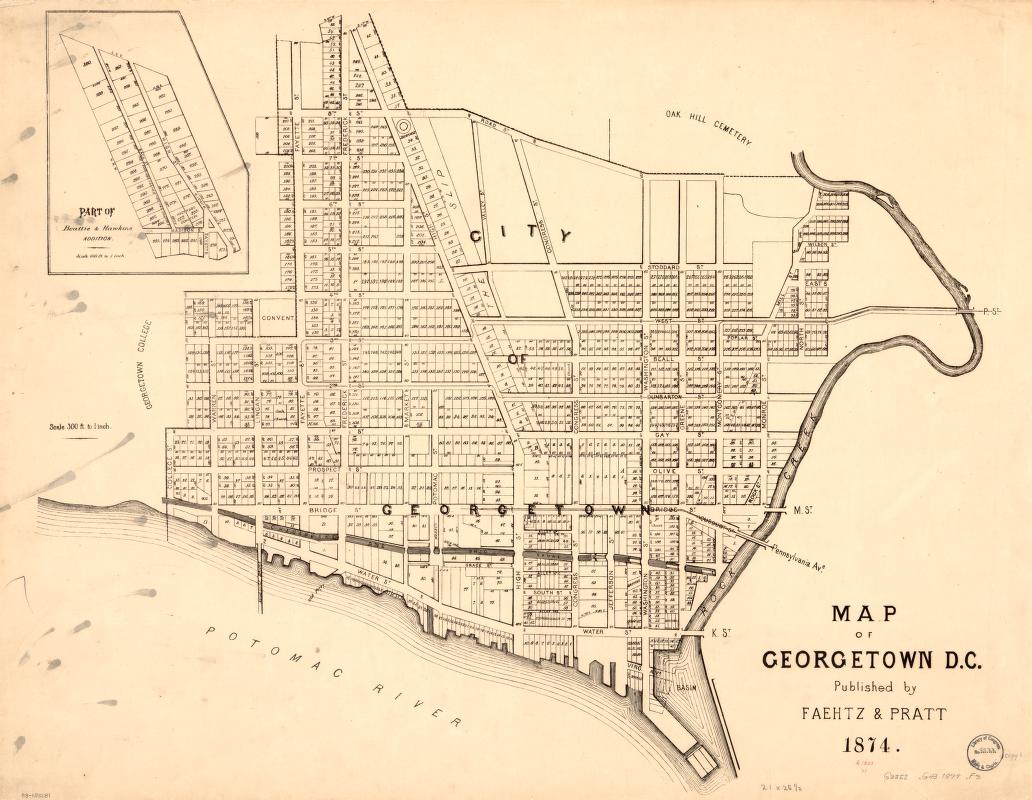
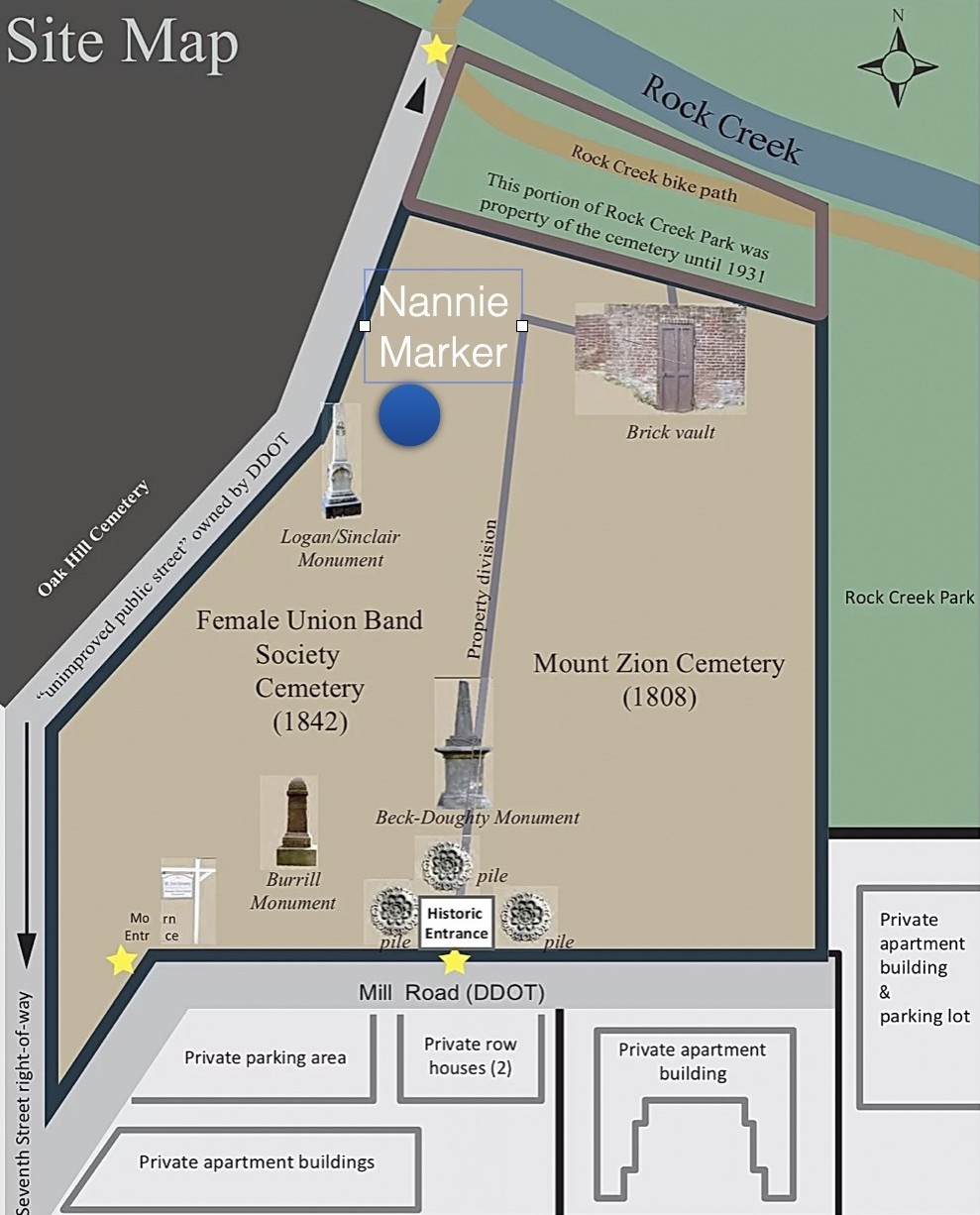
Many District of Columbia residents have incorrectly assumed that Mount Zion Cemetery is composed of a single burial ground. A three-acre property, it actually consists of two separate but adjacent cemeteries of equal size: the old Methodist Burying Ground (now known as Mount Zion Cemetery), and the Female Union Band Society Cemetery.1Stanton L. Wormley, ed. Mt. Zion Cemetery: Washington, DC, Brief History and Interments, comp. by Paul E. Sluby, Sr. (Washington DC: Columbian Harmony Society, 1984); Paul E. Sluby, Sr., Bury me deep: Burial Places Past and Present in and Nearby Washington, D.C.: A Historical Review and Reference Manual (Temple Hills, MD: P.E. Sluby, 2009). In 1931, the Federal Government took one half acre of the earlier cemetery grounds to create Rock Creek Parkway and an adjacent horse riding trail. The grounds are now under the authority of the National Park Service.
The old Methodist Burying Ground was purchased in 1808 by the Montgomery Street Church in Georgetown, one of the first Methodist churches in the country, founded in 1772 (known today as the Dumbarton United Methodist Church).2The church was formerly located on Twenty-Eighth Street between M and Olive Streets, N.W. (formerly Montgomery Street between Bridge and Olive Streets), approximately one-half mile southwest of the cemetery. At the beginning of the nineteenth century the membership of the Montgomery Street Church was almost 50 percent Black and included free and enslaved congregants. Upset with segregated and racist practices, 125 Black members left Montgomery Street in 1816 and formed the first Black congregation in the District of Columbia, known then as the Meeting House or the Little Ark, and today as Mount Zion United Methodist Church. The two Methodist churches, white and Black, continued to share the Methodist Burying Ground until after the Civil War.3The land was purchased from Thomas Beall, who had inherited extensive property from his grandfather Ninian Beall (1630–1717). In the early nineteenth century, Beall owned about fifteen slaves and many properties in Maryland and the District of Columbia, including the properties now known as Dumbarton House, Beall-Washington House, Conjuror's Disappointment and Rock of Dumbarton. He served in the 1790s as the second Mayor of Georgetown and played an important role in establishing the District of Columbia. On Dumbarton Methodist, see: Jane Donovan, Many Witnesses: A History of Dumbarton United Methodist Church 1772–1990 (Washington, DC: Dumbarton United Methodist Church, 1998); J.W. Cromwell, "The First Negro Churches in the District of Columbia," The Journal of Negro History 7, no. 1 (1922): 64–107; Janet Lee Ricks, "Mt. Zion United Methodist Church Marks 185th Anniversary," Washington History 13, no. 1 (Spring/Summer 2001): 71–73.
Around 1832, a group of free women of color formed a benevolent organization, the Female Union Band Society (FUBS). A decade later and for $250, they engaged Joseph T. Mason—schoolteacher and free man of color—to purchase a plot of land adjacent to the Old Methodist Burying Ground to use as a burial ground for the society's members and their families. Court records indicate the land was acquired from Joseph E. Whitehead of New Orleans. Mason ran a school within the Black church that after 1844 was known as Mount Zion Methodist. If Nannie was a free child of color in the vicinity, Joseph Mason most likely taught her as a pupil.
It is also believed that these burial grounds also served as a refuge on the Underground Railroad. Mount Zion Church and the burial holding vault located on the Mount Zion Cemetery property are said to have opperated as hiding site for escaping "passengers" heading north. Over the first half of the nineteenth century, the numbers of enslaved in the District of Columbia declined. By 1850 (when Nannie was two years old) 3,185 of the 13,746 Black inhabitants are listed as enslaved. In DC, enslaved and free persons often lived, worked, and worshipped together, although their life conditions were often precarious.4Pauline Gaksins Mitchell, The History of Mt. Zion United Methodist Church and Mt. Zion Cemetery, 51 (Washington, DC: Records of the Columbia Historical Society, 1984): 103–18. The History of Mt. Zion United Methodist Church is 51st separately bound book; Stella Mae Richard, "Two Hidden Cemeteries in the Georgetown Section of Washington D.C.," Negro History Bulletin, Washington 32, no. 8 (Nov 1969): 29.
In 1849, Oak Hill Cemetery, reserved for white burials, was established by the financier, philanthropist, and former slaveowner William Wilson Corcoran (1798–1888), later denounced as a Confederate sympathizer, who after the Civil War founded the Corcoran Gallery of Art.5In 1830, Thomas Corcoran, William Wilson Corcoran's father and sometime mayor of Georgetown, owned five enslaved people. The 1840 census indicates that William Wilson Corcoran owned one male enslaved person between the ages of ten and twenty-three and three free women of color, who may have been previously enslaved by him; all resided in his household. In 1845, William Corcoran manumitted the enslaved woman Mary and four of her children. (National Archives and Records Administration, Records of the U.S. Circuit Court for the District of Columbia, Records of Manumission, vol. 3, Record Group 60, Washington, DC; cited in Mark Laurence Goldstein, "Capital and Culture: William Wilson Corcoran and the Making of Nineteenth-Century America" (PhD diss., University of Maryland, 2015), 30–31. This woman may appear in the 1850 census as Mary Degges, born 1819, married to Judson Degges, with children Adelia, born 1834 and Mary, born 1837. Corcoran's "Last Will and Testament," September 6, 1887, provides a stipend of $200 to a woman named Mary Neale, "once owned by me, and long since manumitted." This person may be the Mary Neil who evidently married John Neil in 1875, and may have been born as Mary Degges, daughter of the older Mary Degges. This 22.5 acre cemetery sits adjacent to the Female Union Band Society Cemetery and is separated by a sliver of elevated land, Lyon Mill Road, that served as a path leading to a mill within present-day Rock Creek Park. After Oak Hill opened, whites at the Methodist church gradually abandoned the Methodist Burying Ground and began to disinter their white relatives and re-bury them in Oak Hill and other "white only" cemeteries around the city. Early references to the area that became Mount Zion Cemetery are to the "Methodist Episopal Burial Ground of Georgetown," the "Old Methodist Burial Ground," or the "Colored Methodist Burial Ground."6Richard P. Jackson. The Chronicles of Georgetown DC from 1751 to 1878. (Washington DC: R.O. Pokinhorn, Printer, 1878), 270; Wesley E. Pippenger, District of Columbia Interments (Index to Death), January 1, 1858 to July 31, 1874 (Westminster, MD: Heritage Books, 1999), xix. The land in question is north of Q Street and east of Lyons (Mill) Road (now an extension of 27th street) and Oak Hill Cemetery, extending down hilly slopes to Rock Creek. Over time, the eastern section of this burying ground became known as Mount Zion Cemetery (or Mount Zion East) and the western zone as the Female Union Band Society cemetery. By 1879, white parishioners entirely ceased using the Old Methodist Burying Ground and leased it to Mount Zion Church for ninety-nine years, its name officially changing to "Mount Zion Cemetery."
As racist policies and practices pushed many Black residents out of Georgetown over the next half-century, the cemetery suffered neglect and abandonment. The final burial in Mount Zion took place in the early 1950s. The District's department of health condemned the two cemeteries in 1953, prohibiting future burials. In the 1960s, developers sought to buy the land and disinter the remains in both burial grounds. African American activists, including the Afro-American Bicentennial Corporation (ABC), energetically resisted these plans, and in the mid-1970s secured court and appellate rulings that safeguarded the cemeteries' futures as a memorial park, with disinterments prohibited. As part of planning and restoration, many headstones and markers in both cemeteries were relocated and consolidated in 1975, evidently with the intention of restoring and returning them to their original positions. However, given the fragility of the stone tablets, they were left in place and not returned.7Before the moving of the stones, Mount Zion stones were mapped with a good deal of detail; the Female Union Band Society mapping was, it appears, less thorough. Richards, Two Hidden Cemeteries, 29; Mitchell, The History of Mt. Zion United Methodist, 103–118; Kathleen Menzie Lesko, Valerie Babb, Carroll R. Gibbs, Black Georgetown Remembered: A History of its Black Community from the Founding of "The Town of George" in 1751 (Washington, DC: Georgetown University Press, 2016); Steven J. Richardson, The Burial Grounds of Black Washington: 1880–1919 (Washington: DC: Records of the Columbia Historical Society, 1989), 52: 304–326. Burial Grounds is the 52nd separately bound book.
The cemeteries were added to the National Register of Historic Places in 1975. The joint cemetery is now maintained by the non-profit Black Georgetown Foundation (until recently The Mount Zion–Female Union Band Historic Memorial Park, Inc.) The cemeterties' survival and restoration in the face of powerful white-dominated development interests is celebrated as a miraculous point of deep pride. It is located at the very top of Georgetown, one of the wealthiest and whitest quarters of the city, adjacent to Oak Hill Cemetery, where many of the city's elite white residents have been interred since the mid-nineteenth century. It sits besides Dumbarton House, a structure long associated with prominent white slaveowning families, now the national headquarters of the Colonial Dames of America. It overlooks Rock Creek Park, the greenway that connects the metropolitan area's wealthy northwestern suburbs to the downtown seat of government. The cemetery represents, for many, a defiant unofficial monument to Black struggles for self-determination in a historically Black city undergoing rapid gentrification, still denied statehood and Congressional voting representation.8US District Court Judge Oliver Gasch reversed the order allowing disinterment by developers in order to build condos, stating that such action by the heirs and developers "cannot but offend the sensitivities of civilized people." "Equally important," said the judge, "is the fact that not only would such a degradation be perpetrated against the dead, but in this instance the violation of their graves involves the destruction of a monument to evolving free black culture in the District of Columbia." Female Union Band Ass'n v. Unknown Heirs at Law, 403 F.Supp. 540, 547 D.D.C. 1975.
Gravesite Objects as Memorialization Practices
Since organized efforts began in the 1970s to safeguard and restore Mount Zion, volunteers have often come across bottles, pottery shards, sea shells, and related objects. Frequently dismissed by officials as "debris" or "trash," these objects are interpreted by guardians of the cemetery as traces of much older Black memorialization practices, dating back into the era of enslavement.
Strong evidence for this interpretation is provided by a series of newspaper articles, widely reprinted during August and September 1894, documenting popular memorial practices in Mount Zion cemetery. Local African Americans regularly placed objects associated with the life experiences of the deceased on gravesites, including medicine bottles containing residue of medications taken during final illnesses.9Versions of this story are reprinted in the Gazette (York, Pennsylvania), 10 Aug 1894, 5, The Clarion Ledger (Jackson, Mississippi), September 10, 1894 and many other newspapers in August and September 1894. In the articles, Sexton Henry Bowles (c. 1840–1907) explained that familiar toys and tools encouraged the spirits of the dead to "confine their manifestations to the cemetery," rather than haunting the living. On the grave of a "Mr. Johnsing" (perhaps Henry Johnson, who died in December of 1893) his widow placed a wooden hobby horse, "buried up to its haunches," commemorating the dead man's occupation as an express wagon driver, as well as his beloved horse. Each night, she explained, her late husband's spirit would hitch and unhitch the wooden horse, and thus be distracted from tormenting his surviving kin. The half-burial of the horse evoked the object's transitional status, mediating between the realms of the Living and the Dead.
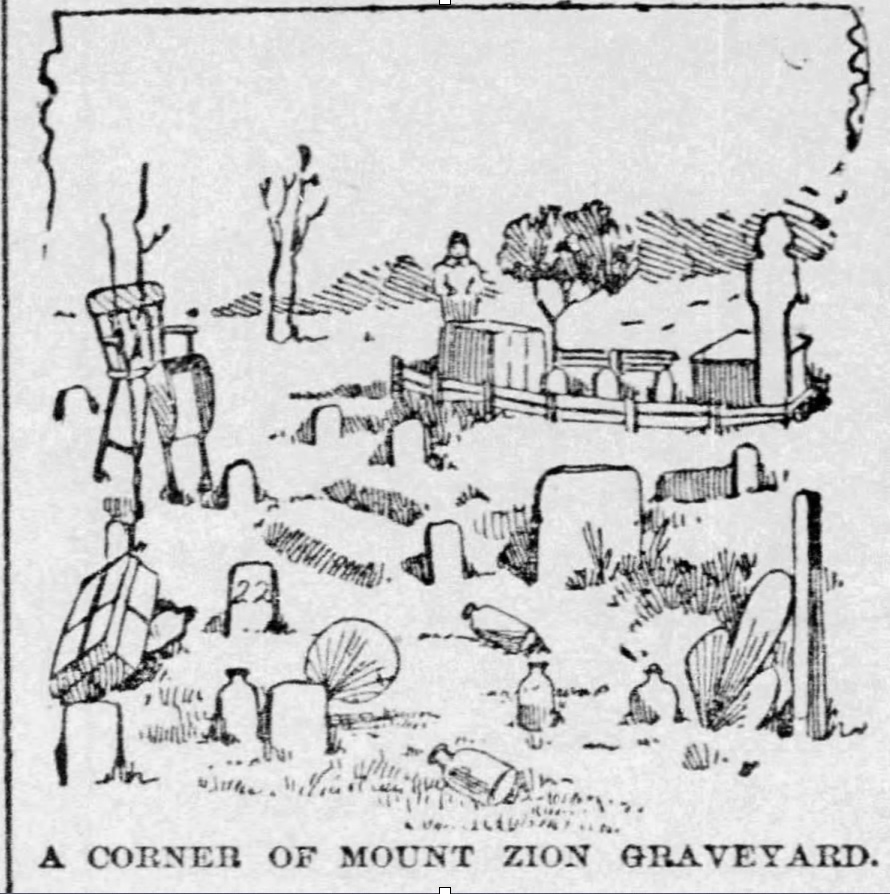
Placed on the grave of a young boy, a high chair and toy wheelbarrow signified objects of importance in his life. A woman named "Lize Lundy," who was fond of wearing a new bonnet to church each Sunday, was honored with her final bonnet and a hand mirror placed on her grave. A particularly complex grave assemblage, perhaps for a military veteran, featured a mound guarded by two large toy soldiers, with smaller soldiers in front of each large soldier; at the mound's center stood three upright bottles. The items may be thought of as "transitional objects," easing the transition from one life stage to another. By repeatedly touching intermediate objects, mourners gradually come to terms with a painful loss and in time relinquish the full burden of their immediate grief.10D.W. Winnicott, Playing and Reality (London: Tavistock Publications, 1971); Melanie Klein, "Mourning and Its Relation to Manic-Depressive States," The International Journal of Psychoanalysis 21 (1940): 125–153; Ellen Schattschneider, "Buy Me a Bride: Death and Exchange in Northern Japanese Bride-Doll Marriage," American Ethnologist 28, no. 4 (2001): 854–880.
These practices are consistent with vernacular African American grave decorations widely documented throughout the Americas, having African antecedents, and transmitted by enslaved and free people across the generations.11Jamieson, Ross W., "Material Culture and Social Death: African-American Burial Practices," Historical Archaeology 29 (1995): 39–58; John Michael Vlach, The Afro-American Tradition in Decorative Arts (Cleveland, OH: Cleveland Museum of Art, 1978). Bottles, shells, pottery and other elements are held to ward off mystical dangers and ease the Dead's transition into the other world and towards ancestral status.12Thompson, Robert Farris, Flash of the Spirit: African & Afro-American Art & Philosophy (New York: Random House, 2010); Vlach, The Afro-American Tradition in Decorative Arts, 142; Savannah Unit Georgia Writers' Project Work Administration, Drums and Shadows: Survival Studies among the Georgia Coastal Negroes (Athens: University of Georgia Press, 1940).
The Nannie Stone in the Modern Era
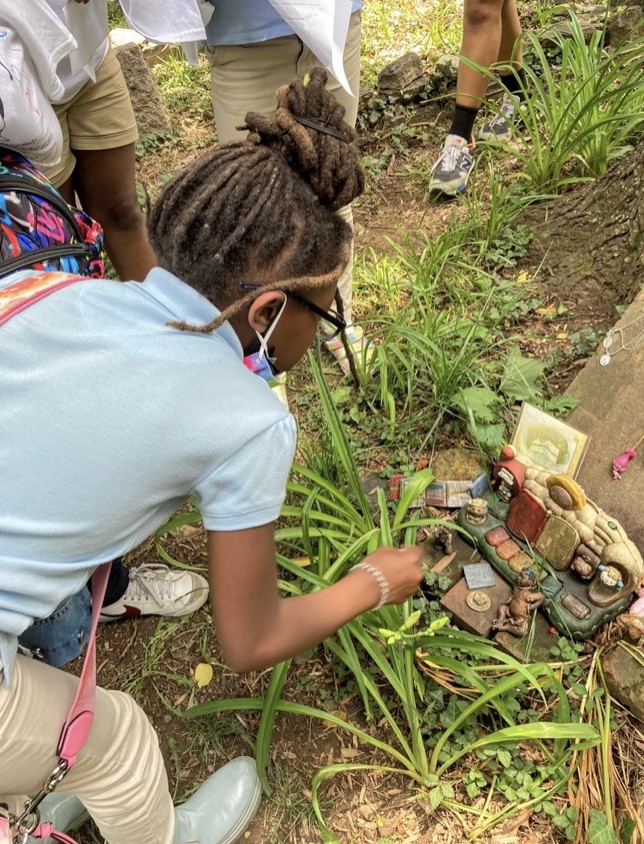
Public attention to Nannie's gravesite is largely due to the efforts of Omar "Casey" Ibrahim, born around 1936, who during the summer 1997 worked as a volunteer to clear and help restore the cemetery, much of which had been inaccessible due to fallen limbs and extensive weeds and vines. At an October 1997 ceremony, Ibrahim pointed to Nannie's burial site, which was marked only by a fallen-over slab. He urged each person to adopt a gravesite to care for. "I've adopted Nannie . . . I'm going to set her stone up straight and clean all around there. Then I'll put up a little red fence. And then I'll give her a teddy bear and other toys that children like."13Linda Wheeler, "Black Church Honors it Historic Cemetery," Washington Post, October 14, 1997. Mr. Ibrhaim and his daughter continued to place objects at Nannie's memorial for several years. Inspired by this example visitors across the subsequent years have placed objects, including dolls, ribbons, toys, and birthday cards, in front of the Nannie headstone.14Theresa Vargas, "Someone Keeps Leaving Toys and Birthday Cards at a 7-Year-Old's Grave in a Historic Black Cemetery. No One Knows Who," Washington Post, April 17, 2021. The marker has catalyzed speculation and a series of commemorative art works, including by artist Lindsey Brittain Collin, inspired by dolls left at Nannie's graveside.
Nannie's grave marker is currently located within the old "Female Union Band Society" section, at times referred to as "Mount Zion West." The headstone is propped up against a tree. Like many stones in the cemetery it has been moved at least once. Its original location is not marked on the 1970s' survey, but was well within this section—which means that Nannie was almost certainly a child of color who was part of the substantial free Black population residing in Georgetown and other DC neighborhoods. It is possible, however, that she was enslaved for some or all of her short life. Slavery was legal in the District until April 16, 1862, when an act of Congress instituted a compensated emancipation system.15Mary Mitchell, "'I Held George Washington's Horse': Compensated Emancipation in the District of Columbia," Records of the Columbia Historical Society, Washington, DC 63/65 (1963–1965): 221–229; Reidy, Joseph P, "The Winding Path to Freedom under the District of Columbia Emancipation Act of April 16, 1862," Washington History 26, no. 2 (2014): 18–22. The complex relationships between enslaved and free persons of color in the antebellum District of Columbia are examined in Mary Corrigan, "A Social Union of Heart and Effort: the African-American Family in the District of Columbia on the Eve of Emancipation" (PhD diss., University of Maryland, 1996). The broader context of DC emancipation is addressed in Kate Masur, An Example for All the Land: Emancipation and the Struggle Over Equality in Washington, D.C. (Chapel Hill: University of North Carolina Press, 2010).
Considering "Nannie"
Who was Nannie, and why was this striking headstone? The inscription is done professionally and with great care, which suggests that it was paid for by someone of means, or with access to a network of supporters who helped fund the purchase.
Why was only the child's first name used, given that surnames are usually inscribed on Mount Zion–FUBS headstones? Possibly because the child was buried within an extant family plot that was obscured through the relocation of markers in the 1975. Or, if Nannie had been fathered by a prosperous white man with a woman of color, outside of wedlock, the father might have paid for a headstone, but been unwilling to authorize his surname.
The name Nannie, like Anne, is derived from the Hebrew term for favor or grace. Nannie was sometimes a diminutive for Ann, Agnes, Nancy, or other girls' names. "Nannie" was also a girl's name in its own right in the mid-nineteenth century. The 1850 census records about seventeen free women of color named "Nannie" living in the United States. The 1870 census, the first to list all African Americans, lists about two-thousand black women named Nannie. An obelisk to Nannie Diggs, who died October 23, 1923, at age sixty-on, was erected by her daughter Katie Anderson in the same section of the cemetery as the headstone to the mysterious child "Nannie." The records of the Mount Zion–FUBS cemetery list two other Nannies: Nannie Diggs, born 1852 in Virginia, and a Nannie Washington, born 1858, also in Virginia. The most prominent Black Washingtonian bearing the name "Nannie" was the pioneering educator and religious leader, Nannie Helen Burroughs, 1879 –1961, born in Virginia, and a member at 19th Street Baptist. Two months before the death of the young "Nannie" buried in Mount Zion, the Evening Star (DC) reported the death of "Old Aunt Nannie," an enslaved woman at the purported age of 112 years near Powhatan Courthouse, Virginia."16Evening Star (Washington, DC), March 6, 1856, 3.
A Candidate for Nannie: William Teney's Child
Official registers of death were kept in the District of Columbia for Black and white burials from 1855 onwards. However, a register of burials of the Joseph F. Birch Funeral Home, was kept from January 1, 1847 for white and Black burials, and is an invaluable historical resource. Children's deaths were listed by the name of the parent (usually the father) followed by the word "child." The Birch's "Register of Burials, Colored Persons" begins with death #1, January 11, 1847, "Colbert's child," buried in the "Colored Methodist Ground" (the cemetery later known as Mt. Zion). Nineteen pages later, under May 1856, the register lists death #368, "Wm Teney child," as interred in the same Colored Methodist Episcopal Burial Ground. The precise date of death is somewhat ambiguous. The previous line, for death #367, is clearly May 11. Then, for William Teney's child, inverted double commas, indicating ditto, are given for the death date, which would seem to indicate May 11, whereas "our" Nannie, according to her headstone, died one week later on May 18. Nonetheless, other aspects of this child align with our search.17Paul E. Sluby and Stanton L. Wormley, eds., Register of Burials of the Joseph F. Birch Funeral Home, Volume I, (Washington, DC: Columbian Harmony Society, January 1, 1847–April 12, 1864). Also available as FamilySearch microfilm #008135478. Note that a reference to "William Tenney child," is not listed in in Pippenger, District of Columbia Interments.
The most reasonable candidate for William Teney strikes us as a free Black man William Tinny, age twenty or thirty, laborer, born in Maryland, listed with his family in the 1850 census. He is married to Bridget Tinny, born Maryland, age twenty-four, with three children: Sarah Tinny, age seven, born in Maryland c. 1843: Mary Tinny, age five, born in the District of Columbia, c. 1845; Francis Tinny, age three, born in the District of Columbia, c. 1847. Of these three children. Francis, who is born around 1847, is not mentioned in the 1860 census or other subsequent records, and is thus a strong candidate for "our" Nannie. Although Nannie was not a standard nickname for Francis in the period, it seems possible that Nannie was a term of endearment used for her within the family, perhaps rhyming with "Frannie."18Francis's father William appears in a November 15, 1827 District of Columbia manumission record:
"Know all men, by these Presents that I Charles Teney of Washington County in the District of of Columbia for divers good causes and considerations, me thereunto moving [?] and also in further consideration of the sum of one dollar to me in hand paid have released from slavery, liberated and manumitted and set free, and by these present do release from slavery, liberated and manumit and set free my slave woman named Matilda Teney aged about thirty five years, and her three children Anne aged about thirteen years, Andrew aged about three years and William Don Otious aged about 19 months, and able to work and gain a sufficient livelihood and maintenance, which said mentioned slaves were obtained by me as heir at law of my son William Don Otious Teney late of said County deceased, and them the said Matilda and her three children, Ann Andrew and William Don Otious I do declare to be henceforth free, manumitted and discharged from all manner of servitude and service to me and my executors, administrators, or assignees forever. In presence of Lemuel J Middleton and A Balmance."
Two other candidates for "Nannie" are suggested by comparing the 1850 and 1860 censuses: (A) The daughter "Ann" (born about 1848) of freed-people Francis Yates and Caroline (Smith) Yates, who later took the surname Cole, does not appear in the records after 1850. Francis and Caroline married three months before the birth of the "Nannie" memorialized on the headstone. Anna Yates, Black, one year old, died 10 August 1857 and was buried in Ebenezer African Methodist Episcopal burial ground; she may be related, but is clearly a different person; (B) Ann E. Twine, the daughter of coachman David Twine and his wife Caroline Gray Twine, both free persons of color in the District. David Twine was interred in Mount Zion in 1894. A member of Metropolitan A.M.E., David Twine came from a family with long connections to Georgetown and the local Black Methodist community. Both of these girls appear in the 1850 census but are not enumerated in the 1860 census or other records. However, Ann E. Twine may appear in the 1860 census as "Eliza Twine", ten years old, living with an older couple that may be her grandparents. Neither girl is indicated in the DC Register of Burials, so they seem much less likely candidates than the child of William Tenney, who died in May 1856 and who is recorded as interred in the "Colored Methodist Burial Ground."
Francis Tenney (c.1847–c.1856) was born into a free family of color who had been free in the District of Columbia for at least twenty years prior to her birth, and who had struggled intensively to achieve freedom. As noted in the appendices, her family clearly had an extensive network of free kin in the District of Columbia who in 1856 might have pooled resources to enable to purchase and inscription of the well-made headstone.
Desecration
During midday on Monday, June 19, 2023, the first time Juneteenth had been celebrated as a federal holiday, over two-hundred people gathered in Mount Zion-Female Union Bank Society Cemetery to honor the burial ground and the history of African American liberation. The event, organized by the Black Georgetown Foundation, which oversees the two burial grounds, had been widely advertised on social media and radio. Attendees, many of them first-time visitors to the site, were moved by the story of the struggle to preserve and document the cemeteries and the lives of those interred. The event culminated with a gathering in front of Nannie's headstone, where speakers reflected on the enigmas of her life and the history of antebellum Black Georgetown.
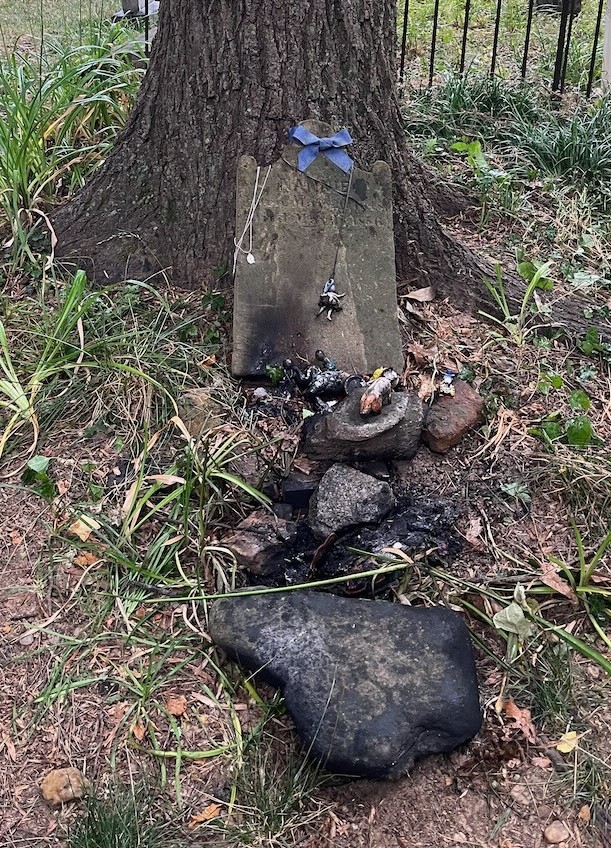
During the night of June 19–20, a person or persons unknown set a fire in front of the Nannie headstone, destroying or damaging toys and objects left as offerings during the previous year and leaving dark burn marks on the stone. The attacker was likely aware of the connection felt by thousands of people to Nannie, the preceding day's events, and the fact that in recent years this marker has, more than any other memorial on the grounds, compelled the greatest number of gifts.
The gravestone desecration and the burning of the objects was a form of racial terror, reminiscent of the burning and bombing of sites of Black assembly and resistance such as churches, and indeed, of the burning of victims of lynching. In the days following the fire, people stopped by the cemetery to give new offerings to Nannie.
Memorialization and #BlackLivesMatter
Why has Nannie's grave marker inspired such an outpouring of offerings and attention by scores of people with no direct kinship link to her? Certainly her young age is compelling, as is the approaching storm of national disunion during the span of her life. Perhaps equally significant are the still-ongoing crises of racism and inclusion in the United States. Her prominent, yet plain marker, is suffused with resonance for past and present injustices. The obscurity of her identity allows Nannie to evoke the "many thousands gone" among persons of color in the District and elsewhere. In the present era of #BlackLivesMatter and the continuous assaults on the rights of persons of color to own their bodies, the story of Mount Zion cemetery, nearly eradicated to serve commercial development interests, is particularly resonant. The restoration of this storied African American burial ground, now surrounded by multiples sites of white, elite privilege, is a powerful testimony to African American resilience and cultural vibrancy.
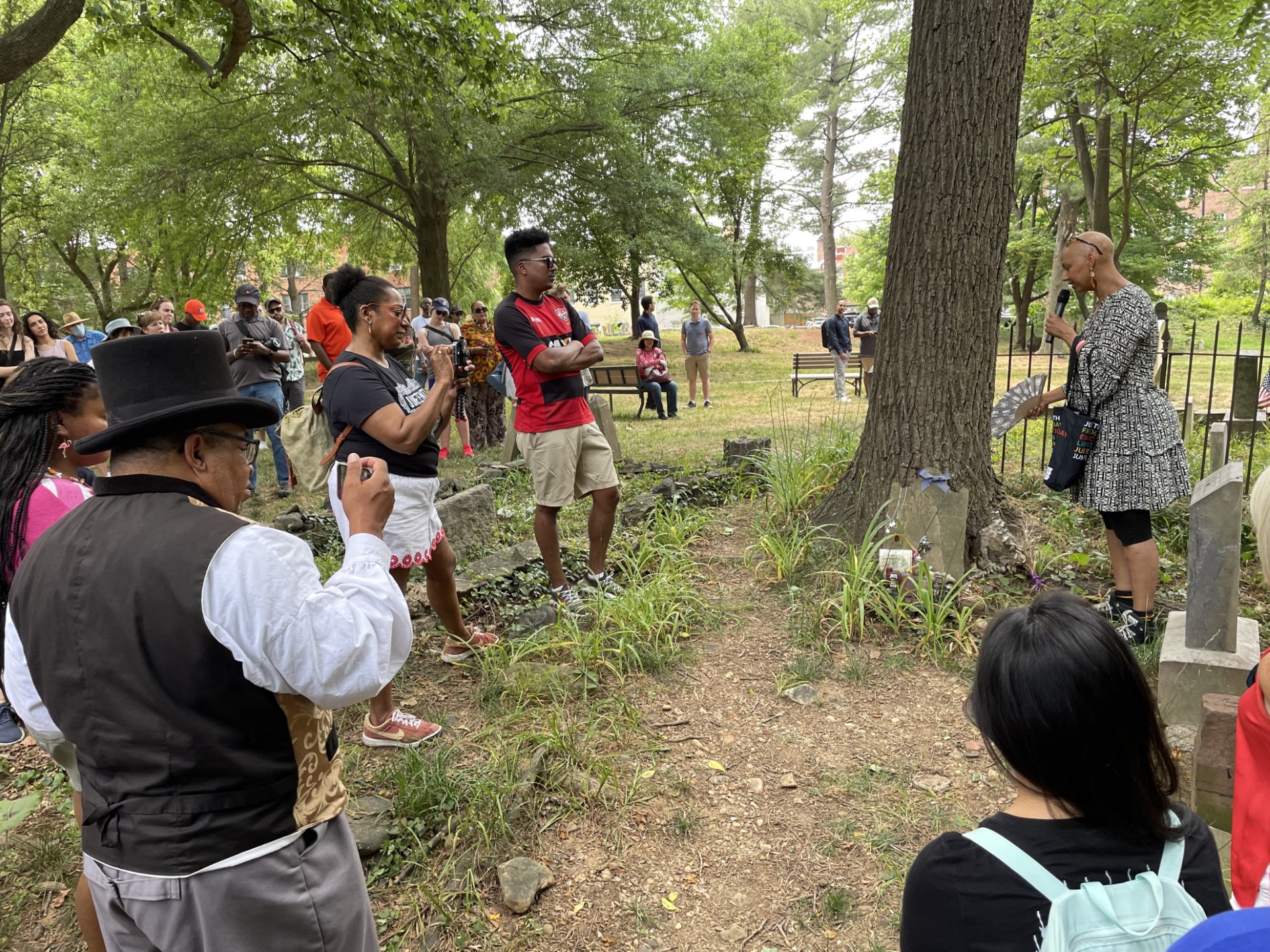
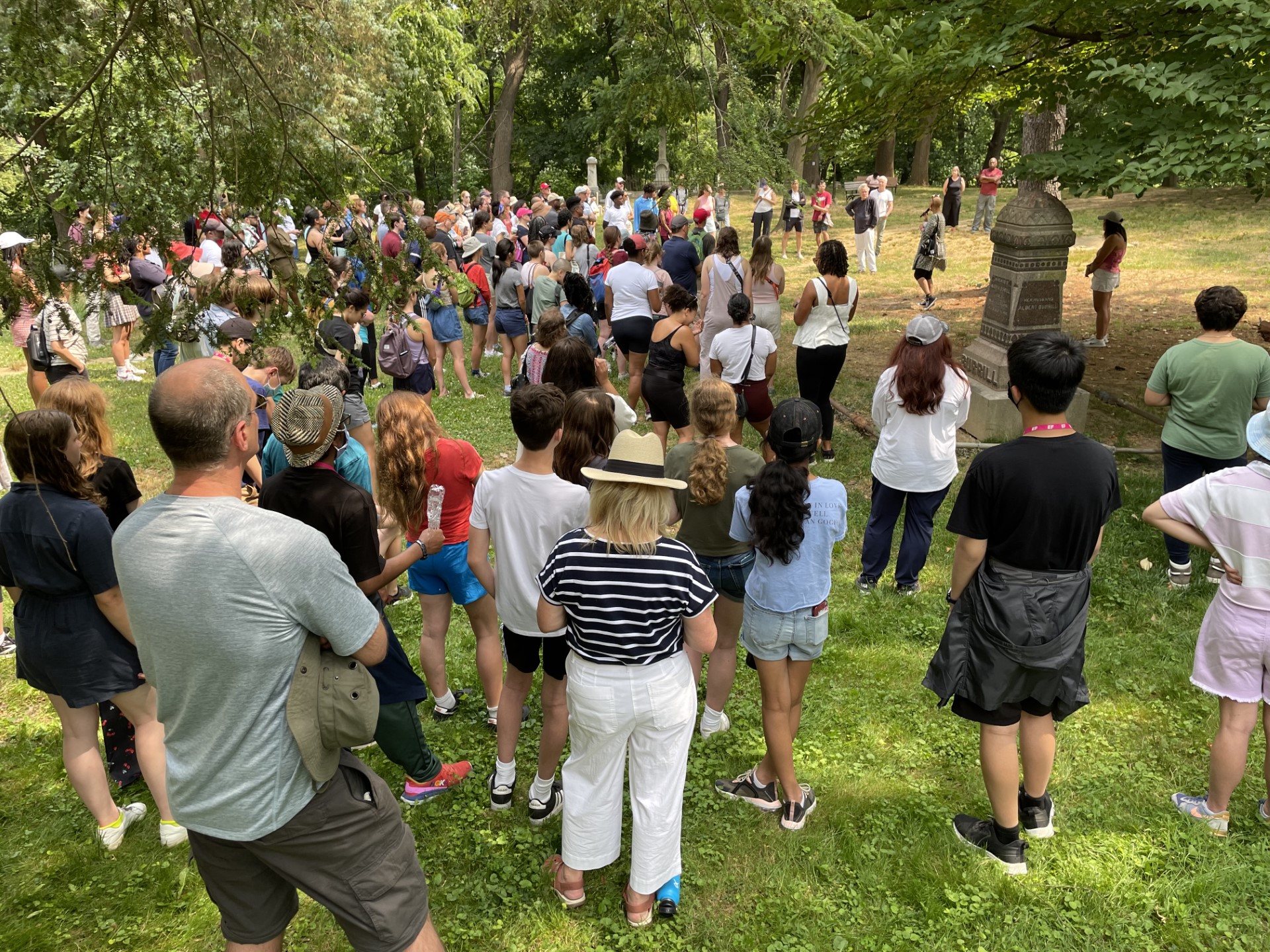
Nannie, for many, has come to represent hallowed ground and the larger history and geography of racial segregation, anti-Blackness, and liberation struggles within the District of Columbia. The centuries-old African-Atlantic practice of grave decoration, ubiquitous in this cemetery in the nineteenth century, has been revived to honor Nannie's memory—poignant testimony to the power of ancestral remembrance—as well as the continuing mission of activism.
About the Authors:
Mark Auslander is the author of The Accidental Slaveowner: Revisiting a Myth of Race and Finding an American Family (Athens: University of Georgia Press, 2011). He is a visiting faculty member in anthropology at Mount Holyoke College.
Lisa Fager, Executive Director of the Black Georgetown Foundation, oversees the Mount Zion and Female Union Band Society cemeteries in Georgetown, Washington DC.
Acknowledgements:
We acknowledge the tireless work and insights of community historians Mary Belcher and Patrick Tisdale, and the many other volunteers associated with the Mount Zion–Female Union Band Society Cemeteries, and the Mount Zion United Methodist Church in documenting the important history associated with the cemetery and the local faith community. Erika Berg located 1894 newspaper accounts of grave decorations in Mount Zion. We are grateful to Carlton Fletcher, Fath Davis Ruffins, Russell Smith, Ibrahim Sundiata, and Jay Ball for many interpretive insights into this narrative. Many thanks to the staff at the Kiplinger Library, Washington historical Society; The Library of Congress Periodicals and Manuscripts rooms; Special Collections and University Archives, The Maryland Room Hornbake Library, University of Maryland College Park; the Smithsonian Institution Archives; the District of Columbia Public Library Washingtoniana/People’s Archive Division and the Georgetown Library Peabody Room; the District of Columbia Archives; the National Archives and Records Administration; the Maryland State Archives; and the Daughters of the American Revolution Library. Particular thanks to Andrew Boisvert of the DAR Library and Damani Davis and Rose Buchanan of NARA Archives 1 for their insights into antebellum District of Columbia records. Omar “Casey" Ibrahim generously shared his memories of recovering the Nannie memorial stone and initiating the modern gift-giving tradition in the 1990s. We are grateful for careful editorial work on this post by Allen Tullos and the Southern Spaces team.
Appendices
]]>An Excerpt from the Introduction

Throughout the nineteenth century, aided by railroads and steam technologies, industrial plantations expanded their footprint into ever new territories across Latin America. The timing was unique: the process occurred right as enslavement, the foundation of these enterprises, was being subjected to unprecedented challenges—from proliferating slave insurgencies to vocal liberal-abolitionist mobilization. But along industrial plantations' margins, vast and socially vibrant free rural communities of African descent made homes for themselves against many odds. Unearthing their worlds sheds light on a distinct history of emancipation that did not fully align with liberalism's trajectory, pushing us to move away from the teleological notion that modern political behaviors within Latin America were variations on their European or North American counterparts.
Across Latin America, Afro-descendant peasants took manifold paths to reach rural worlds of freedom. Some were fugitives from plantation slavery. Others had purchased their freedom in cash or through some form of service-based payments. In places like Santiago, the far eastern province of the Spanish colony of Cuba—the region which this book focuses on—many were only partially free. They had paid a portion of the price for their manumission while continuing to do some work for enslavers. Many of the free people of African descent in these kinds of communities formed families with poor white peasants living nearby. In spite of their differences and internal hierarchies, most such peasantries contended with the same looming threat: ever-expanding planter power and aspirations. As they creatively withstood or moved out of the plantations' way, they opened up and cultivated new land in forest thickets, occupying rugged landscapes traversed by unkempt dirt roads, far from major commercial centers. They bartered and sold the surplus they made in small regional markets and, on occasion, also purchased enslaved people. Their lives were not circumscribed by the plantation's logics, nor by a rigid Black/white divide, even though they contended with both of these forces.
Throughout the nineteenth century, industrial sugar production in Cuba remained centered in the west-central parts of the island, leaving Santiago, home to some relatively small and economically anemic coffee plantations, in a sort of marginal space. Santiago was close enough to be subjected to some of the same policies as the plantation-dominated regions, but far enough to escape many of the socioracial logics that defined sugar plantation communities. These kinds of peripheral communities of free people of African descent, living in the shadows of the plantation (or other regimes of intense slavery-based extraction), could be found, beyond eastern Cuba, throughout Latin America, including rural parts of Puerto Rico, the Dominican Republic, the Pacific lowlands of Colombia, parts of Brazilian Amazonia, and peripheries of the coffee belt in the Brazilian southeast.1Anne Eller, We Dream Together: Dominican Independence, Haiti, and the Fight for Caribbean Freedom (Durham, NC: Duke University Press, 2016); Claudia Leal, Landscapes of Freedom: Building a Postemancipation Society in the Rainforests of Western Colombia (Tucson: University of Arizona Press, 2018); Oscar de la Torre, The People of the River: Nature and Identity in Black Amazonia, 1835–1945 (Chapel Hill: University of North Carolina Press, 2018); Rosa Carasquillo, Our Landless Patria: Marginal Citizenship and Race in Caguas, Puerto Rico, 1880–1910 (Lincoln: University of Nebraska Press, 2006), chapter 1; Lowell Gudmundson and Justin Wolfe, eds., Blacks and Blackness in Central America: Between Race and Place (Durham, NC: Duke University Press, 2010); Hebe Maria Mattos, Das cores do silêncio: os significados da liberdade no sudeste escravista, Brasil século XIX, 3rd ed. (Campinas, Brazil, 2013 [1995]). For work that shows how access to legal process could be limited in some such areas, see Yesenia Barragan, Freedom's Captives: Slavery and Gradual Emancipation on the Colombian Black Pacific (Cambridge: Cambridge University Press, 2021) and "Commerce in Children: Slavery, Gradual Emancipation, and the Free Womb Trade in Colombia," The Americas 78.2 (2021): 229–257. Historians have used the notion of "the peasant breach" to capture the emergence of a class of free rural cultivators out of slavery with relatively ambiguous land ownership rights. This book builds and expands on this work by focusing on the legal dynamics within such peasant communities. Among others, Ciro Flamarion Cardoso, "The Peasant Breach in the Slave System: New Developments in Brazil," Luso-Brazilian Review 25.1 (1988): 49–57; Flavio dos Santos Gomes and João José Reis, eds., Freedom by a Thread: The History of Quilombos in Brazil (New York: Diasporic Africa Press, 2016); Sidney Mintz, Caribbean Transformations (Chicago: Aldine Publishers, 1974), part II, 180–213, and "Slavery and the Rise of Peasantries," Historical Reflections 6 (1979): 213–242; Ira Berlin and Philip Morgan, eds., The Slaves' Economy: Independent Production by Slaves in the Americas (London: Routledge, 2016 [1995]); Stuart Schwartz, Slaves, Peasants, and Rebels: Reconsidering Brazilian Slavery (Urbana: University of Illinois Press, 1992), chapters 2 and 3; David Wheat, Atlantic Africa and the Spanish Caribbean, 1570–1640 (Chapel Hill: University of North Carolina Press, 2016), chapter 5. On the United States and with a focus on legal consciousness as well, Dylan Penningroth, The Claims of Kinfolk: African American Property and Community in the Nineteenth-Century South (Chapel Hill: University of North Carolina Press, 2003).

Looking at a community such as Santiago shows that the plantation was not the only space that defined the Black experience in the Americas. It also helps bring to light other homes for Black freedom beyond well-studied Atlantic port cities.2On Cuba as an island with two histories, one around plantations and another one, beyond, Juan Pérez de la Riva, El barracón: esclavitud y capitalismo en Cuba (Barcelona: Editorial Crítica, 1978), 169–179. This model, however, assumes that there was only one alternative to sugar—one based on livestock production. On a region of Cuba centered on tobacco, in Vuelta Abajo, see William A. Morgan, "Opportunities and Boundaries for Slave Family Formation: Tobacco Labor and Demography in Pinar del Río, Cuba, 1817–1886," CLAR 29.1 (2020): 139–160. A reflexive piece that considers how sugar's ascent has shaped history writing within Cuba, with most categories of analysis emerging out of the study of sugar plantations, is Alejandro de la Fuente, "Apuntes sobre la historiografía de la segunda mitad del siglo XVI cubano," Santiago 71 (1988): 59–118. On the importance of local/regional history and on the impossibility of subsuming Santiago's trajectory to that of sugar planting and of Havana, see Julio LeRiverend, "De la historia provincial y local en sus relaciones con la historia general de Cuba," Santiago 46 (1982): 121–136. The historiography on urban free populations of color is vast. A sample that captures the breadth of this field appears in Jorge Cañizares-Esguerra, Matt Childs, and James Sidbury, eds., The Black Urban Atlantic in the Age of the Slave Trade (Philadelphia: University of Pennsylvania Press, 2013); Whitney Nell Stuart and John Garrison Marks, eds., Race and Nation in the Age of Emancipations (Athens: University of Georgia Press, 2018); special issue "Urban Slavery in the Age of Abolition," ed. Karwan Fatah-Black, IRSH 65 (2020). The inner workings of such rural worlds during the nineteenth century also suggest that attention to liberal abolitionism, nation-centered emancipation and citizenship struggles, or Atlantic abolitionist circulations leaves out another, perhaps less spectacular history of freedom whose protagonists were families, women, and children of African descent who stayed in place and forged locally focused communities. In these corners of Latin America, the nineteenth century was a time of freedom through custom. Here, people operated in a locally grounded legal sphere that consisted of orally negotiated rights, obligations, and social expectations that had the thinnest foundations in written (positive) law. Custom belonged to community justice; its versatility blurred the boundaries between formal and informal law, between legal experts and ordinary litigants, between courts, the governor's office, and hamlets tucked away in forest thickets in the interior. Its logics defied the notion that individuals were entitled to certain rights for life and could carry them across contexts. Instead, within custom-dominated worlds, legal prerogatives were distributed with an eye to local political hierarchies, economic conditions, and reputations. They could be suspended and reassigned.
In the Age of Emancipation, in places like Santiago, free or semi-free Afro-descendant peasantries led a political revolution through custom-centered community justice that remained barely visible to the authorities at the time and, in the long term, even to historians. These peasants did not rely primarily on liberal ideologies of universal freedom, individual autonomy, or notions of inclusive citizenship within national republics, even though on occasion they did invoke them. They did not wait for liberal-nationalist elites to form coalitions with them and to decree freedom from above. Instead, inside courts of law, they usually sought relief in the custom-centered colonial legal framework. In Santiago, these popular legal practices began as far back as the sixteenth century, but became especially active during the nineteenth century, when, for a range of political and economic reasons, manumission rates increased. Day in and day out, enslaved people chipped away at enslavers' authority locally, by negotiating the terms of their manumission and land access. They pulled one another out of plantation slavery gradually, yet consistently, forging communities whose members also played an important role inside courts of law as witnesses, advocates, or bystanders when conflicts arose. Within rural spaces like Santiago that were marked by relative underdevelopment, Afro-descendant peasants creatively defined manumission-based freedoms piece by piece through mundane social practices that had little grounding in positive law, were orally negotiated, and were recognized by local governors and courts of justice. These freedoms were patchwork, often incomplete when measured against liberal-abolitionist yardsticks, precarious, and even reversible. Yet they were very concrete, and in the long term, they served to corrode the legal structures of plantation slavery locally.
In Santiago's musty rooms and busy antechambers, as elsewhere in Latin America, magistrates and litigants puzzled out enslaved people's rights of access to autonomy, property, and family, case by case. Would a woman who had purchased her freedom while pregnant give birth to an enslaved or to a free child? Could enslaved people who had paid half the price of their freedom spend the night with kin living on other properties? To whom did a pig truly belong, the enslaver on whose estate it roamed, or the enslaved who had purchased it with her savings and had tended to it? Could enslaved and free people of color occupy fallow land inside private estates? In Santiago, such claims were not apparently too small to be assessed and extensively documented by local scribes, notaries, and other legal officers. The freedom that such adjudications yielded had a plurality of meanings, some of them contradictory and akin to subordination and dependence. Scholars of the early modern Atlantic world have shown that vernacular understandings of freedom were highly diverse in social practice, going beyond abstract written definitions embedded in legislation.3On manumission-based Black freedom, among others, Erica Ball, Tatiana Seijas, and Terri Snyder, eds., As If She Were Free: A Collective Biography of Women and Emancipation in the Americas (New York: Cambridge University Press, 2020); Mariana Dantas, Black Townsmen: Urban Slavery and Freedom in the Eighteenth-Century Americas (London: Palgrave, 2008); Mariana Dantas and Douglas Libby, "Families, Manumission, and Freed People in Urban Minas Gerais in the Era of Atlantic Abolitionism," IRSH 65 (2020): 117–144; Erika Denise Edwards, Hiding in Plain Sight: Black Women, the Law, and the Making of a White Argentine Republic (Tuscaloosa: University of Alabama Press, 2020); Zephyr Frank, Dutra's World: Wealth and Family in Nineteenth-Century Rio de Janeiro (Albuquerque: University of New Mexico Press, 2004); Oilda Hevia Lanier and Daisy Rubiera Castillo, Emergiendo del silencio: mujeres negras en la historia de Cuba (Havana: Editorial de Ciencias Sociales, 2016); Lyman Johnson, "Manumission in Colonial Buenos Aires, 1776–1810," HAHR (1979): 258–279; Michelle McKinley, Fractional Freedoms: Slavery, Intimacy, and Legal Mobilization in Colonial Lima, h600–h700 (New York: Cambridge University Press, 2016); Aisnara Perera and María de los Angeles Meriño Fuentes, Para librarse de lazos, antes buena familia que buenos brazos: apuntes sobre la manumisión en Cuba (Santiago: Editorial Oriente, 2009). Beyond the Iberian Atlantic, among others, Randy Sparks and Rosemary Brana-Shute, eds., Paths to Freedom: Manumission in the Atlantic World (Charleston: University of South Carolina Press, 2009); Jessica Marie Johnson, Wicked Flesh: Black Women, Intimacy, and Freedom in the Atlantic World (Philadelphia: University of Pennsylvania Press, 2020); Bernard Moitt, Women and Slavery in the French Antilles, 1635–1848 (Bloomington: Indiana University Press, 2001); Judith Shafer, Becoming Free, Remaining Free: Manumission and Enslavement in New Orleans, 1846–1862 (Baton Rouge: Louisiana State University Press, 2003) Within Spanish America, such pluralism did not operate in parallel or at odds with the law; it was part of custom and as such ensconced in the law.4Scholars of law and slavery in American slave societies have emphasized the importance of considering law broadly, beyond the written, to include litigation and petitioning of higher authorities. Such an approach makes visible the participation of subaltern groups in the legal system as well as the plurality of their understandings of law and freedom. This literature is vast. Among others, focusing on Latin America, Manuel Barcia, "'Fighting with the Enemy's Weapons: The Usage of the Colonial Legal Framework by Nineteenth-Century Cuban Slaves,'" Atlantic Studies 3.2 (2006): 159–181; Herman Bennett, Africans in Colonial Mexico: Absolutism, Christianity, and Afro-Creole Consciousness, 1570–1640 (Bloomington: Indiana University Press, 2003); Sherwin Bryant, "Enslaved Rebels, Fugitives, and Litigants: The Resistance Continuum in Colonial Quito," CLAR 13 (2004): 7–46; Camillia Cowling, Conceiving Freedom: Women of Color, Gender, and the Abolition of Slavery in Havana and Rio de Janeiro (Chapel Hill: University of North Carolina Press, 2013); Alejandro de la Fuente and Ariela Gross, Becoming Free, Becoming Black: Race, Freedom, and Law in Cuba, Virginia, and Louisiana (New York: Cambridge University Press, 2020); Keila Grinberg, "Freedom Suits and Civil Law in Brazil and the United States," Slavery & Abolition 22.3 (2001): 66–82; Chloe Ireton, "Black Africans and Freedom Litigation Suits to Define Just War and Just Slavery in the Early Spanish Empire," Renaissance Quarterly 73 (2020): 1–43; McKinley, Fractional Freedoms; Brian Owensby, "How Juan and Leonor Won Their Freedom: Litigation and Liberty in Seventeenth-Century Mexico," HAHR 85 (2005): 39–79; Aisnara Perera Díaz and María de los Ángeles Meriño Fuentes, Estrategias de libertad: un acercamiento a las acciones legales de los esclavos en Cuba (Havana: Editorial de Ciencias Sociales, 2015), 2 vols.; Bianca Premo, The Enlightenment on Trial: Ordinary Litigants and Colonialism in the Spanish Empire (New York: Oxford University Press, 2017) and Children of the Father King: Youth, Authority, and Legal Minority in Colonial Lima (Chapel Hill: University of North Carolina Press, 2005); Frank Proctor III, "Damned Notions of Liberty": Slavery, Culture, and Power in Colonial Mexico, 1640–1769 (Albuquerque: University of New Mexico Press, 2011); Rebecca Scott and Carlos Venegas, "María Coleta and the Capuchin Friar: Slavery, Salvation, and the Adjudication of Status," WMQ 76.4 (2019): 727–762; Aurora Vergara Figueroa and Carmen Luz Cosme, Demando mi libertad: mujeres negras y sus estrategias de resistencia en la Nueva Granada, Venezuela y Cuba, 1700–1800 (Cali, Colombia: Editorial Universidad Icesi, 2018). Beyond Latin America, Mariana Candido, "African Freedom Suits and Portuguese Vassal Status: Legal Mechanisms for Fighting Enslavement in Benguela, Angola, 1800–1830," Slavery & Abolition 32.3 (2011): 447–459; Roquinaldo Ferreira, Cross-Cultural Exchange in the Atlantic World (New York: Cambridge University Press, 2014), chapter 3; Ariela Gross, Double Character: Slavery and Mastery in the Antebellum Southern Courtroom (Princeton, NJ: Princeton University Press, 2000); Kimberly Welch, Black Litigants in the Antebellum American South (Chapel Hill: University of North Carolina Press, 2018). Historians have explored the role of community justice before the rise of modern legal systems, emphasizing local variations, the role of vernacular understandings of justice, and of social and kinship relations associated with personal reputation. Among others, Tommaso Astarita, Village Justice: Community, Family, and Popular Culture in Early Modern Italy (Baltimore, MD: Johns Hopkins University Press, 1999); Laura Edwards, The People and Their Peace: Legal Culture and the Transformation of Inequality in the Post-Revolutionary South (Chapel Hill: University of North Carolina Press, 2009); Daniel Lord Smail, The Consumption of Justice: Emotion, Publicity, and Legal Culture in Marseille, 1264–1423 (Ithaca, NY: Cornell University Press, 2003).
That custom could hold any emancipatory power is by many measures surprising. Within the Spanish colonial tradition, uso y costumbres ("usage and customs") had historically referred to continuity and tradition. This meant that locally negotiated values enabled a population divided by the hierarchies of birth status to coalesce around a tenuous legal-cultural consensus, known as "the peace." For centuries, jurists and state-makers across the Iberian Atlantic had relied on custom to prevent challenges to entrenched hierarchies or, in early modern juridical language, to keep "the peace" ("buen gobierno," "la paz").5Víctor Tau Anzoátegui, El poder de la costumbre: estudios sobre el derecho consuetudi-nario en América hispana hasta la emancipación (Buenos Aires: Instituto de Investigaciones de Historia de Derecho, 2001).
Birth right status structured the distribution of legislated rights in colonial Latin America; certain lineages who controlled power locally could also shape access to customary rights for all. But beyond the imperative of birth status protections, the law also had to manage conflict, which local authorities usually did through custom. State institutions could temper local elites' powers in the name of "the peace."6Other scholars of law and slavery who have pointed out how enslaved people maneuvered prudence-based legal systems beyond the Iberian Atlantic are Edwards, The People and Their Peace; Malik Ghachem, The Old Regime and the Haitian Revolution (New York: Cambridge University Press, 2012); Edward Ruggemer, Slave Law and the Politics of Resistance in the Early Atlantic World (Cambridge, MA: Harvard University Press, 2018). In Santiago, enslaved people invoked the specter of marronage (the action of fleeing slavery) and insurrection to get their way with local institutions and elites and shape law-making; the distinction between the judicial and extra-judicial was therefore not so clear-cut. As one enslaver remarked, enslaved people were more likely to file freedom suits when fears of marronage were rampant among planters.7ANC, ASC, leg. 582, exp. 13,348, "El Síndico Procurador reclama la libertad de la esclava Gertrudis de Madame Fillet Barberousse, 1833." Whether or not the assessment was accurate, it nevertheless suggests that some people with power saw a connection between these two avenues toward freedom. As a result of these related tactics, whether their connections were real or imagined, subaltern sectors of society might be circumstantially permitted to occupy land on privately owned estates. Enslaved people might be granted time off to tend to a vegetable garden, or they might be permitted to purchase their freedom in installments or conditionally, including in return for certain services. To judges' and governors' minds, such equity-based rulings placated the poor and maximized their political utility, since they could then be mobilized as vassals.8 On casuistic (case-by-case) decision-making as a form of equity-based judgment, Recopilación de Leyes de los Reynos de las Indias (Madrid: Imprenta de la viuda de Joaquín Ibarra, 1791 [1680]), Libro II, Titl. I, Law XXIV, 1:223; Códigos Españoles. Novísima Recopilación de las Leyes de España, Libro III, Tit. IV, Law IV (Madrid: Imprenta de la Publicidad, 1850), 2:16. Also, Antonio Manuel Hespanha, Poder e instituçoes no antigo regime: guia de estudo (Lisbon: Cosmos, 1992), 20–35, and Como os juristas viam o mundo (Lisbon, 2015), 407–424; Tamar Herzog, Upholding Justice: Society, State, and the Penal System in Quito (h650–h750) (Ann Arbor: University of Michigan Press, 2004); Brian Owensby, Empire of Law and Indian Justice in Colonial Mexico (Palo Alto, CA: Stanford University Press, 2008), chapter 3; Premo, The Enlightenment on Trial; Víctor Tau Anzoátegui, Casuismo y sistema: indagación sobre el espiritu del derecho indiano (Buenos Aires: IIHD, 1992); Jesús Vallejo, "Power Hierarchies in Medieval Juridical Thought," Ius commune 19 (1992): 1–29; Joaquín Escriche, Diccionario razonado de legislación y jurisprudencia (Madrid: Imprenta del Colegio Nacional de Sordomudos, 1838), vol. 1, under arbitrio de juez, 325, and vol. 2 (Madrid: Libreria de la Señora Viuda de D. Antonio Oleja, 1847), under equidad, 833–834; Alejandro Guzmán-Brito, Codificación del derecho civil interpretación de las leyes (Madrid: Iustel, 2011), 188–221. Enslaved people had the right to be protected against bodily harm, including hunger. Access to a vegetable garden, an equity-based right, was considered as the satisfaction of such a subsistence right. P. IV, Titl. XXI, Law VI, Los Códigos Españoles. El Código de Las Siete Partidas (Madrid: Imprenta de la Publicidad, 1850), 2:519. On legal actions and marronage as elements of a spectrum of related strategies, rather than as independent tactics, Bryant, "Enslaved Rebels, Fugitives, and Litigants" and Rivers of Gold, Lives of Bondage: Governing through Slavery in Colonial Quito (Chapel Hill: University of North Carolina Press, 2014). These kinds of subsistence rights acquired the weight of custom if exercised over a long period of time. They were more likely in areas where the local elite had a tenuous grip on power. Both Africans and Afro-descendants accessed them and fought for them through the courts, a relatively remarkable phenomenon—in light of the documented difficulty that many Africans had to access courts of law in other parts of Latin America.9Mary Karasch, Slave Life in Rio de Janeiro, h800–h850 (Princeton, NJ: Princeton University Press, 1987).

The practice of allocating rights to enslaved people according to custom—a practice that had existed for hundreds of years in Santiago and elsewhere in Latin America—was not intended to be a liberating act. Indeed, its primary goal was simply to release some of the tensions inherent in birth status hierarchies and slavery, all the while promoting conformity among the enslaved. By the eighteenth century, however, in certain parts of Latin America, some such custom-based openings did hold destabilizing power. This was due to the fact that, more and more, subaltern groups began to claim customary entitlements not just in the name of need but also in the name of merit, and against a background of increasingly vocal abolitionist demands in the Atlantic world. Across Latin America, as manumission became more frequent, so did conflict and debate about its workings. When freedom litigants invoked custom, they often pointed to recently established expectations associated with relations of debt and reciprocation. These customs were less akin to tradition, and more similar to contracts—arrangements that were supposed to reward the parties for their respective contributions to an exchange. Contractual logics therefore became increasingly pervasive in rural Santiago as manumission rates increased. That customary relations could be contractual held politically combustible potential at a time of hemispheric liberal rhetoric emphasizing individual labor rights over fixed birth status. Without a doubt, this particular understanding of custom might have gained greater prominence inside courts of law in the nineteenth century precisely under liberal influences.
Yet, when African and Afro-descendant peasants approached contract-like relations as custom, they also tapped into a second definition of it from within the colonial legal tradition: as an expression of "popular will" and traditions of distributing rights based on individual reputation and political utility, not just lineage.10Bianca Premo, "Custom Today: Temporality, Customary Law, and Indigenous Enlightenment," HAHR 94.3 (2014): 355–379, esp. 359; Paola Miceli, Derecho con-suetudinario y memoria: práctica jurídica y costumbre en Castilla y León (siglos XI–XIV) (Madrid: Universidad Carlos III, 2012); Yanna Yannakakis, The Art of Being In-Between: Native Intermediaries, Indian Identity and Local Rule in Colonial Oaxaca (Durham, NC: Duke University Press, 2008), 119, 123. Though vague, the notion of a "popular will" reflected on local custom's power to metamorphose based on circumstances, to be closer to local realities than positive law, and to unmoor power distribution from birth status, lineage, and tradition.11Premo, The Enlightenment on Trial. By this token, manumission and its locally specific transactional logics triggered, in the words of Michelle McKinley, "ripples of activity"—its legalities were not "frozen."12McKinley, Fractional Freedoms, 168. Such activity accelerated in the nineteenth century, butting against fixed status increasingly more.
While freedom as a liberal-abolitionist artifact and freedom as custom might have evolved in parallel and occasionally intersected, they nevertheless did differ in important respects. The world of customary freedom had plural meanings that arose through practice: the securing of that freedom and its meanings were part of the same process. By contrast, the legal meanings of liberal freedom were far more standardized and abstract because more strictly embedded in written law or liberal manifestos. Customary freedom was also centered on families and on extended networks of support and obligations. Freed people often remained entangled in such obligations after obtaining their manumission, in ways that limited their mobility and choices.13On the precarity of manumission-based freedom, Sidney Chalhoub, "The Precariousness of Freedom in a Slavery Society (Brazil in the Nineteenth Century)," IRSH 56.3 (2011): 405–439; Rebecca Scott and Jean Hébrard, Freedom Papers: An Atlantic Odyssey in the Age of Emancipation (Cambridge, MA: Harvard University Press, 2014). In areas with large free populations of color, individuals who were lateral to the enslave—enslaved relationship—the mothers, fathers, siblings, lovers, neighbors of the manumitted—also informed individual experiences of freedom. Dynamics and hierarchies internal to Afro-descendent communities formed the foundation for manumission's legalities. Belonging to such communities, rather than having autonomy, determined what rights one could acquire locally, an undoubtedly fractious process that yielded hierarchies.
The adjudication of free status (as reputation) through the community also informed popular racial thinking at a key historical moment in the history of racial ideologies in Cuba—the mid-nineteenth century. In Santiago, the peasantry used the language of color to describe free status and local hierarchies. As elsewhere, and as other scholars of Latin America have long pointed out, color status was not fixed but, rather, depended on one's actions and locally defined merits and reputation.14Ben Vinson III, "Introduction: African (Black) Diaspora History, Latin American History," The Americas 63.1 (2006): 1–18, and Before Mestizaje: The Frontiers of Race and Caste in Colonial Mexico (New York: Cambridge University Press, 2018); María del Carmen Baerga, Negociaciones de sangre: dinámicas racializantes en el Puerto Rico decimonónico (San Juan: Ediciones Callejón, 2015); Douglas Cope, The Limits of Racial Domination: Plebeian Society in Colonial Mexico (1660–1720) (Madison: University of Wisconsin Press, 1994); María Elena Martínez, Genealogical Fictions: Limpieza de sangre, Religion, and Gender in Colonial Mexico (Palo Alto, CA: Stanford University Press, 2008); Víctor Goldgel Carballo, "El fantasma de la raza: simulación, caricaturas y cosméticos en la Cuba del siglo XIX," in Miradas efímeras. Cultura visual en el siglo XIX, ed. Cecilia Rodríguez Lehmann and Nathalie Buzaglo (Santiago de Chile: Editorial Cuartopropio, 2017), 177–195; Karen Morrison, Cuba's Racial Crucible: The Sexual Economy of Social Identities, 1750–2000 (Bloomington: Indiana University Press, 2015), chapter 4. The point here is not to rediscover the malleability of race in Latin America. It is, rather, to unearth its politics within a specific context and to offer a method for accessing popular forms of racial thinking that did not gain expression in print culture or in elite political manifestos of the time. Indeed, it is to show that racial thinking was fundamentally entwined with manumission as a process. The state itself had allowed for some malleability of official color taxonomies prudentially. Somewhat privileged people of African descent, who had access to household dependents and enslaved people, questioned official Black/white distinctions in this colonial society before the rise of well-known intellectual theories of whitening or of the well-known ideology of "racial confraternity," such as José Martí's.15On nineteenth-century ideologies and practices of whitening in Latin America, George Reid Andrews, Los afroargentinos de Buenos Aires (Buenos Aires: Ediciones de la Flor, 1989 [1980]) and Blacks and Whites in São Paulo, Brazil, 1888–1988 (Madison: University of Wisconsin Press, 1990), 54–89; Dain Borges, "'Puffy, Ugly, Slothful, and Inert': Degeneration in Brazilian Thought, 1880–1940," Journal of Latin American Studies 25.2 (1993): 235–256; Erika Denise Edwards, Hiding in Plain Sight: Black Women, the Law, and the Making of a White Argentine Republic (Tuscaloosa: University of Alabama Press, 2020); Nancy Leys Stepan, The Hour of Eugenics: Race, Gender, and Nation in Latin America (Ithaca, NY: Cornell University Press, 1991); Winthrop Wright, Café con leche: Race, Class, and National Image in Venezuela (Austin: University of Texas Press, 2013); Laura Gotkowitz, ed., Histories of Race and Racism: The Andes and Mesoamerica from Colonial Times to the Present (Durham, NC: Duke University Press, 2011), especially Parts II and III. Some people lost association with official terms denoting Blackness in the record, all the while their African ancestry was still widely known. They did so, however, without direct knowledge of liberal-intellectual elites' theories of whitening, but rather through local reputational politics. Yet this reconceptualization of status was not so radical. The local elite peasant class still operated within the boundaries of a hierarchical system bearing slavery's imprint. Birth status mattered: Africanness and genealogical proximity to slavery (when one and one's ancestors had been manumitted) were considered a stigma. One's upward mobility depended on the acquisition of retainers, including enslaved people, and therefore on domination. These popular understandings of color status did not necessarily coalesce into a larger current. But Santiago's case proves another point that scholars of Latin America have shown: that popular racial ideologies were regionally specific, because, I argue, rooted in local legal customs of manumission.16Paulina Alberto, Terms of Inclusion: Black Intellectuals in Twentieth-Century Brazil (Chapel Hill: University of North Carolina Press, 2011); Nancy Appelbaum, Muddied Waters: Race, Region, and Local History in Colombia, 1846–1948 (Durham, NC: Duke University Press, 2003); Sarah Chambers, From Subjects to Citizens: Honor, Gender, and Politics, Peru, h780–h854 (University Park: Pennsylvania State University Press, 1999); Barbara Weinstein, The Color of Modernity: São Paulo and the Making of Race and Nation in Brazil (Durham, NC: Duke University Press, 2015).
By mid-century, custom-based entitlements fueled political expectations, as the plantation's footprint expanded into Afro-descendant pea-santries' lands and prerogatives. Through legal reforms, planters and state officials in the Spanish Empire, like their counterparts in Brazil, moved to reduce custom's presence in the courtrooms and replace it with positive law.17Among others, Pedro Cantisano and Mariana Armond Dias Paes, "Legal Reasoning in a Slave Society (Brazil, 1860–1888)," LHR 36 (2018): 471–510; Sidney Chalhoub, "The Politics of Ambiguity: Conditional Manumission, Labor Contracts, and Slave Emancipation in Brazil (1850–1888)," IRSH 60 (2015): 161–191; Keila Grinberg, "Slavery, Liberalism, and Civil Law: Definitions of Status and Citizenship in the Elaboration of the Brazilian Civil Code (1855–1916)," in Honor, Status, and Law in Modern Latin America, ed. Sueann Caulfield, Sarah C. Chambers, and Lara Putnam (Durham, NC: Duke University Press, 2005), 109–130. They wrote down some customs that helped the enslaved, likely knowing that the end of the institution of slavery was in sight and that some such rights would facilitate (from their vantage point) a less conflictive transition to general emancipation. At the same time, the policy of turning custom into legislation eroded local autonomy, crucial to Afro-descendant peasant communities, while placing more control in the hands of legal experts and outside creditors who sought uniform legal contexts. Many enslaved people who had negotiated manumission with their enslavers lost ground when they needed to litigate to enforce the terms of those negotiations because judges could no longer recognize customary arrangements and rights; they had to restrict themselves to enforcing strictly the letter of positive law.
In 1868, eastern Cuba's enslaved and free people of African descent rose up in arms against the attacks on their autonomy and land access. They joined a white liberal elite that had initiated a war of independence against Spain. The Afro-descendant peasantry shaped the goals of this thirty-year-long mobilization (1868–1878, 1879–1880, 1895–1898) to include, beyond national liberation, also general emancipation and racially inclusive citizenship rights.18Carmen Barcia, Burguesía esclavista y abolición (Havana: Editorial de Ciencias Sociales, 1987); Ada Ferrer, Insurgent Cuba: Race, Nation, and Revolution, 1868–1898 (Chapel Hill: University of North Carolina Press, 1999); Bonnie A. Lucero, Revolutionary Masculinity and Racial Inequality (Albuquerque: University of New Mexico Press, 2018); Emilio Roíg de Leuchsenring, La guerra libertadora cubana (Havana: Oficina del Historiador de la Ciudad, 1952). Their support of general emancipation had likely developed out of their earlier efforts to undermine plantation slavery through manumission, the court system, and the customary sphere. Some of the ideological fires driving the three Cuban wars of independence—one of the epic moments of Black liberation in the Western Hemisphere—were kindled by the sense of political entitlement to local autonomy that had emerged through regionally grounded community justice and manumission.
About the Author
Adriana Chira is an assistant professor of history at Emory University. She is the author of Patchwork Freedoms: Law, Slavery, and Race beyond Cuba's Plantations (New York: Cambridge University Press, 2022). Her second project, tentatively titled In the Plantations' Shadows: Black Peasants and Land Ownership by Possession in Cuba, Puerto Rico, and Spanish Equatorial Guinea, 1880–1960, explores a mode of land tenure that many rural communities transitioning from slavery to freedom relied on to subsist. Patchwork Freedoms won the American Historical Association's 2023 Rawley Prize "for outstanding historical writing that explores aspects of integration of Atlantic worlds before the twentieth century.”
]]>Modeling the Marie-Séraphique
The Marie-Séraphique
Video Permissions
Creative Commons license CC-BY-ND
To inquire about use permissions for all or part of these videos, contact Southern Spaces at seditor@emory.edu.
Introduction
I remembered back to my coming-out days in San Antonio, Texas, in the early 1960s and realized that I had lived long enough and been out long enough to be historic.
— Carolyn Weathers
In October of 2015, I met with Carolyn Weathers in her condo in Long Beach, California. I had spent the past few weeks perusing her papers at the ONE National Gay and Lesbian Archives in Los Angeles mostly on a whim: she was one of the few individuals in the archive who hailed from the US South—Texas specifically—and as a queer southerner from Texas myself, I wondered what insights her collection might offer about LGBTQ+ experience in our home state. I never expected to come across photos of gay bars in pre-Stonewall San Antonio or a short story Weathers had written about her time in them. But as seasoned researchers already know and novices quickly learn, the archive is full of such surprises. Agreeing to an interview with me after an archivist put us in touch, Weathers and I spent a temperate, sunny southern California day together, lunching at a local café, walking the nearby boardwalk, and sitting down in her living room for a two-hour recorded interview. This essay combines information from that interview with the short story and photos from the Weathers Collection at ONE to develop a historical case study of LGBTQ+ experience in early 1960s San Antonio.
Structurally, I begin with a brief history of San Antonio to situate us in place before analyzing how Weathers narrativizes her experience in the city in her 1987 self-published short story "Cheers Everybody!" Next, I sketch four real historical bars that Weathers frequented: The Acme, Fernando's Hideaway, The Country, and Mary Ellen's Top Hat. I approach "Cheers" as a historical document that records how Weathers imaginatively used San Antonio to historicize and process her experience of the movement for LGBTQ+ rights. I develop the bar sketches primarily through my interview with Weathers—with occasional references to how she fictionalizes them in "Cheers"—and the archival photos from ONE. Together, these objects of analysis not only reveal the centrality of the gay bar to LGBTQ+ life in early 1960s San Antonio, but they also provide clues as to how the city's colonial and military history affected the formation of racialized gay space. In other words, although attentive to patron activities, demographics, and police encounters, the bar sketches investigate how these histories influenced the creation of gay space, which racialized subjects had access to gay space, and how that space was racialized or imbued with ideas about race as a consequence.1I follow Michael Omi and Howard Winant's definition of racialization: "the extension of racial meaning to a previously racially unclassified social relationship, social practice or group." Michael Omi and Howard Winant, Racial Formation in the United States (New York: Routledge, 2014), 111. Few studies—most of them unpublished dissertations and theses—about LGBTQ+ life in Texas during this period currently exist.2Besides the studies of San Antonio cited later in the essay, some relevant theses and dissertations of interest include: Kyle Edelbrock, "Taking it to the Streets: The History of Gay Pride Parades in Dallas, Texas, 1972–1986" (master's thesis, University of North Texas, 2015); Carl J. Stoneham, "How Prophecy Got Her Queer Back: (Re)discovering the Prophetic at the Rainbow Lounge, 40 Years and Eight Minutes Later" (master's thesis, Texas Christian University, 2010); and John D. Goins, "Confronting Itself: The AIDS Crisis and the LGBT Community in Houston" (PhD diss., University of Houston, 2014). As such, this essay is both a call to expand and further develop such research, as well as an example of how to make archival materials speak to the imbrication of LGBTQ+ identity and community formation within the colonial and racial formations that are central to the production of modernity.
To Historicize the Gay Bar
The origins of San Antonio's two nicknames—Alamo City and Military City, USA—lie in the city's history as a contested colonial space and as home to one of the largest concentrations of military bases in the United States. Founded by Spanish explorers and missionaries on the lands of the Payaya Indians in 1718, San Antonio de Béxar was capital of the Spanish and later Mexican colonial province called Tejas. After its 1821 independence from Spain, the newly established Mexican government began offering free land grants to Anglo-American settlers, who primarily took up residence in lands northeast of San Antonio. These Anglo settlers, who identified as Texians, and Hispanic settlers, who identified as Tejanos, fought against the Mexican Army led by President General Antonio López de Santa Anna during the Texas Revolution: the conflict from which the phrase "Remember the Alamo!" comes.3The actions of those fallen at the Alamo were glorified in Texas history and culture, and today, the Alamo commemorative monument and museum helps attract around 37 million annual visitors to San Antonio, whose tourism and hospitality industry generated an estimated 15.2 billion dollars in 2017.
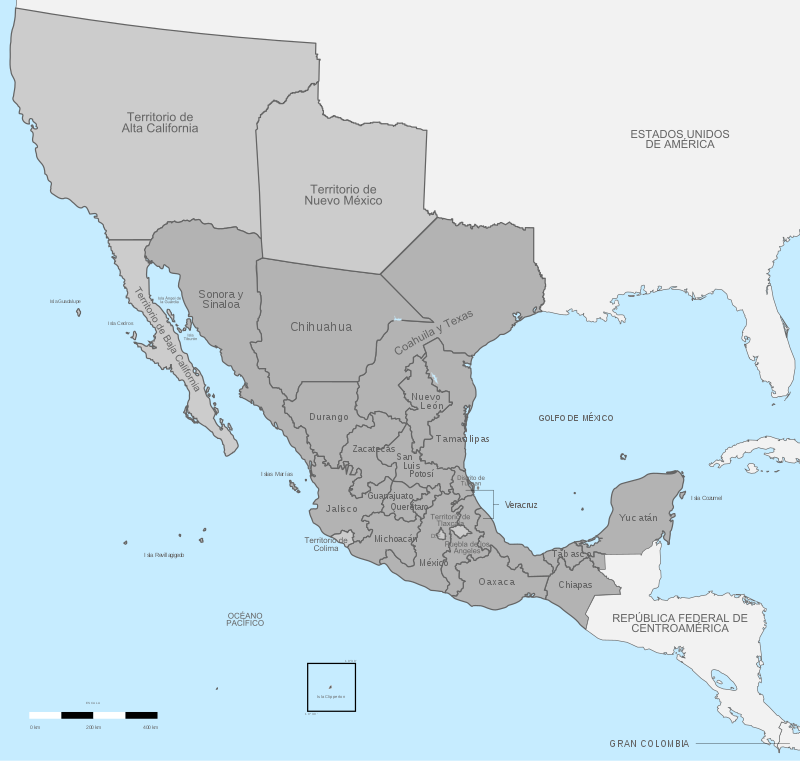
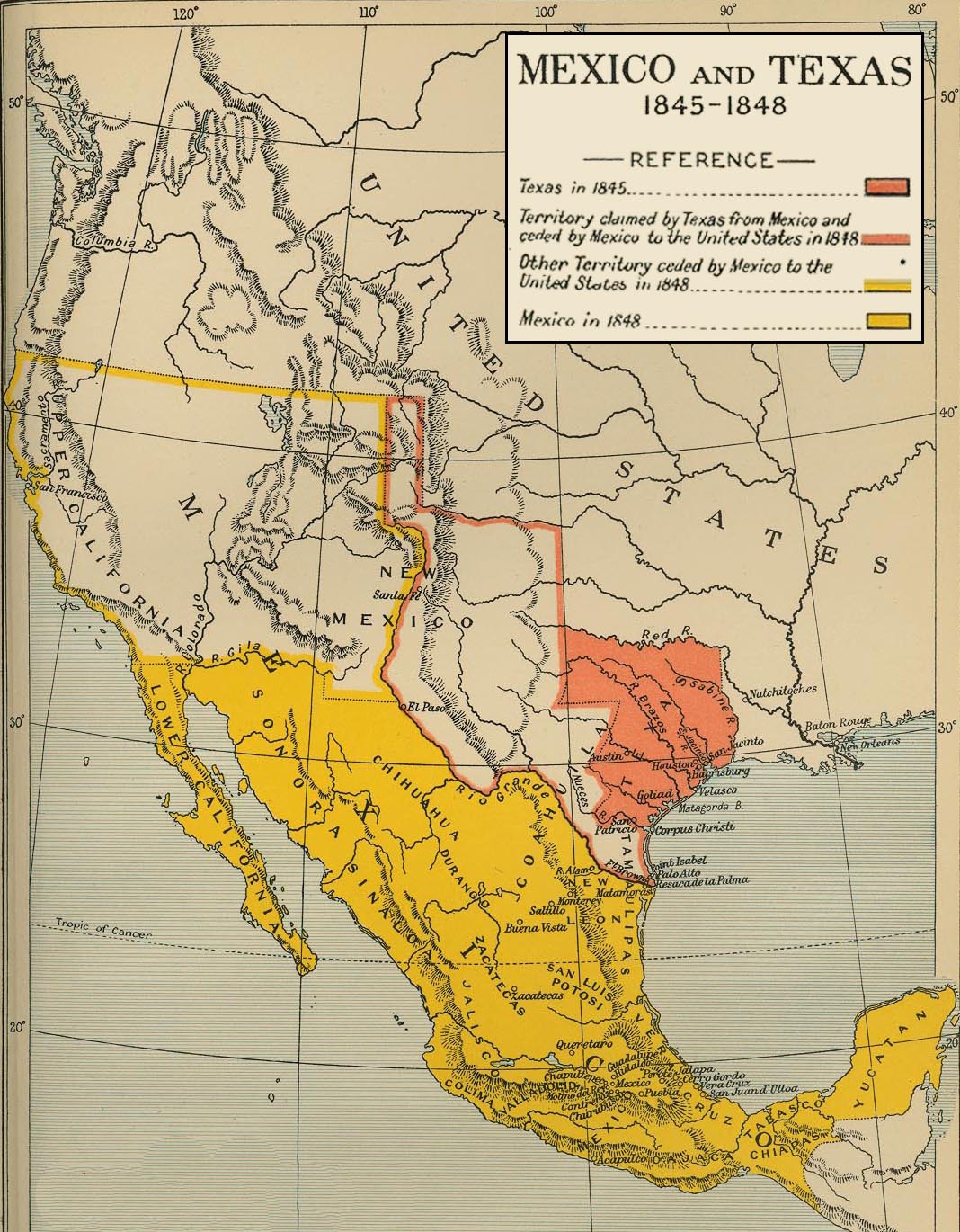
Sparked by the Battle of Gonzales on October 2, 1835, the Texas Revolution resulted from decades of rising tensions between Tejas residents and the Mexican government, ranging from the Mexican state's abolishment of slavery in 1829 to its prohibition of new Anglo settlers in 1830.4The newly independent Mexican government began as the First Empire of Mexico headed by Agustín de Iturbide (1822–1823) before transitioning into a federal republic, with the Constitution of 1824 officially establishing the First Mexican Republic (Primera República Federal), known as the United Mexican States (Estados Unidos Mexicanos). As the EUM sorted out its leadership and organizational structure, it failed to exert strong control and governance from Mexico City over the distant Tejas. Thus, the Mexican government's gradual steps towards abolishing slavery in 1829—which, in the eyes of many Anglo settlers, reneged on Iturbide's promise to let them practice chattel slavery in Tejas—and the prohibition of new Anglo settlers in the Law of April 6, 1830—which was precipitated by fears that the United States would annex Tejas and resulted in Mexican officials and troops being dispatched to enforce Mexican law in the province—encroached on the rights and privileges that settlers had grown accustomed to. The 1833 presidential election of Santa Anna only exacerbated these issues, as he threw out the Constitution of 1824, which allowed him to centralize control of the government by eradicating provincial or state governments, and also imprisoned Stephen F. Austin, the first empresario of Tejas and primary Texian representative, for a year. Less than a year later, on April 21, 1836, the Republic of Texas became official when Texians, Tejanos, and US volunteers defeated Santa Anna and his troops at the Battle of San Jacinto.5Randolph B. Campbell, Gone to Texas: A History of the Lone Star State (New York: Oxford University Press, 2018); David Montejano, Anglos and Mexicans in the Making of Texas, 1836–1986 (Austin: University of Texas Press, 1987). But San Antonio remained a contested colonial space for decades after the Texas Revolution. By 1845, Mexico still did not officially recognize the Republic of Texas, and US Annexation that same year led to the Mexican–American War and Treaty of Guadalupe Hidalgo, which forced Mexican cession of disputed Texas territory (see Figure 1) and its northern territories of Alta California and Santa Fe de Nuevo México (see Figure 2).6Campbell, Gone to Texas; Montejano, Anglos and Mexicans in the Making of Texas. As part of these war efforts, the US Army established its initial presence in San Antonio at Camp Almus, later consolidated as part of Fort Sam Houston in 1890 (the first permanent US military installation in the city). During World War I (1914–1918), the US War Department expanded the fort, with the additions of Camp Bullis, Camp Travis, and Camp Stanley, while laying the foundations for its fledgling aviation program. When the US Air Force gained autonomy after World War II (1939–1945) in 1948, the aviation infrastructure was divided into the Kelly Air Force Base, the Randolph Air Force Base, and the Lackland Air Force Base.7John Manguso, "Fort Sam Houston," Handbook of Texas, Texas State Historical Association, accessed April 1, 2019, https://tshaonline.org/handbook/online/articles/qbf43; Robert Wooster, "Military History," Handbook of Texas, Texas State Historical Association, accessed April 1, 2019, https://tshaonline.org/handbook/online/articles/qzmtg. While Kelly AFB closed in 2001, the other two bases, along with Ft. Sam Houston, currently make up Joint Base San Antonio (JBSA), which contributes around 49 billion dollars annually to the city's local economy.8"2015 Military Economic Impact Study" (San Antonio, TX: Department of Government and Public Affairs, accessed July 1, 2021), https://www.sanantonio.gov/Portals/0/Files/OMA/EconImpact/2015SanAntonioMilitaryEconomicImpact.pdf?ver=2017-02-15-142835-893.
Although contemporary San Antonio's diversified economy (financial services, health care, energy, oil, and gas) attracts international and domestic job seekers, recently earning San Antonio the title of fastest growing city in the United States, population growth in recent decades pales in comparison to the boom between 1940 and 1960, when the city's population more than doubled, rising from 253,854 to 587,718, as a consequence of mass military mobilizations during WWII and a growing military job sector.9The United States Census Bureau designated San Antonio the fastest growing city in the United States in 2018: United States Census Bureau, "Census Bureau Reveals Fastest-Growing Large Cities," release number CB18-78, May 24, 2018, https://www.census.gov/newsroom/press-releases/2018/estimates-cities.html; "Texas Almanac: City Population History from 1850–2000," Texas Almanac, accessed April 5, 2019, https://texasalmanac.com/sites/default/files/images/CityPopHist%20web.pdf. These mobilizations, according to scholars such as John D'Emilio, Allan Bérubé, and George Chauncey, were part of a historical phenomenon that facilitated the formation of urban gay subcultures in US cities.10See Allan Bérubé, Coming Out Under Fire: The History of Gay Men and Women in World War II (New York: Plume, 1991); George Chauncey, Gay New York: Gender, Urban Culture, and the Making of the Gay Male World, 1890–1940 (New York: Basic Books, 1994); and John D'Emilio, "Capitalism and Gay Identity" in The Lesbian and Gay Studies Reader, edited by Henry Abelove, Michèle Aina Barale, and David M. Halperin (New York: Routledge, 1993), 467–476. "Millions of young men and women," D'Emilio notes, "whose sexual identities were just forming," were placed into "sex-segregated institutions," providing them opportunities to explore same-sex sexual desire.11D'Emilio, "Capitalism and Gay Identity," 472. Post-WWII suburbanization, which caused property prices in urban cores to plummet, making it easier to purchase real estate and open gay bars and nightclubs, as well as the founding of homophile civil rights organizations, such as the Mattachine Society (1950–1969) and the Daughters of Bilitis (1955–1995), whose respective publications, the Mattachine Review (1955–1967) and the Ladder (1956–1972), reached readers across the United States, enabled the growth of gay and lesbian neighborhoods, reading publics, and social networks.
In San Antonio specifically, gay and lesbian culture "grew dramatically in the 1950s and 1960s," writes Amy L. Stone, "and built upon a tradition of local nightclubs that had attracted female impersonators . . . in the 1930s and 1940s."12Amy L. Stone, "Crowning King Anchovy: Cold War Gay Visibility in San Antonio's Urban Festival," Journal of the History of Sexuality 25, no. 2 (2016): 300. Also, see Melissa Gohlke's blog post about these nightclubs and female impersonators: "San Antonio's Drag Culture of the 1930s and 40s," The Top Shelf, October 22, 2012, https://utsalibrariestopshelf.wordpress.com/2012/10/22/san-antonios-drag-culture/. According to Melissa Gohlke, "by the early 1950s, San Antonio led the five-state Fourth Army area" (Texas, Louisiana, Arkansas, Oklahoma, and New Mexico) "in off-limits places with fifty-three establishments."13Melissa Gohlke, "Off-Limits and Out of Bounds, World War II and San Antonio's Queer Community," The Top Shelf, February 25, 2013, https://utsalibrariestopshelf.wordpress.com/2013/02/25/off-limits-and-out-of-bounds-world-war-ii-and-san-antonios-queer-community/. Products of the 1941 May Act, which gave military police the authority to surveil and restrict access to places associated with prostitution and homosexuality, these "off-limits" lists, composed and released by military officials, conversely resulted in giving gay bars more publicity and patronage. "All a GI or WAC need[ed] to do [was] read the list," notes Gohlke, "and head out for a night of same-sex recreation."14Gohlke, "Off-Limits." While the military did not standardize anti-homosexual policies until the creation of the Department of Defense in 1949, each branch prohibited and prosecuted homosexuality through psychological screenings and forms of military discharge prior to and throughout WWII.15For further specification on these procedures, see Bérubé, Coming Out under Fire; Chauncey, Gay New York; and Margot Canaday's The Straight State: Sexuality and Citizenship in Twentieth-Century America (Princeton, NJ: Princeton University Press, 2009). If discovered in such venues, military personnel faced certain punishment, if not discharge.16Gohlke, "Off-Limits."
A native white Texan and self-identified lesbian born in 1941, Carolyn Weathers entered the San Antonio gay scene in her early twenties, at a time of increased scrutiny and persecution as a consequence of "antigay laws, the medicalization of homosexuality, nationwide panics about homosexuality as contagion, and anti-Communist organizing against homosexuality."17Stone, "Crowning King Anchovy," 299. Born in the central Texas town of Eastland to a middle-class Baptist family, Weathers spent her early childhood in Cleburne before moving to Brownfield in the Panhandle. The second daughter of an educator, Alida Nabors Weathers, and a Baptist preacher, Jones Weathers, Carolyn followed the geographical trajectory of her only sibling and older sister by two and a half years, Brenda, moving to Dallas, San Antonio, and ultimately Southern California. Kicked out of Texas Women's University in Denton for "lesbianism" in 1957 at the age of seventeen, Brenda introduced her sister to the queer worlds that she discovered in Dallas and San Antonio of the late fifties and early sixties. Carolyn came out in 1961 while living with Brenda in San Antonio. She later joined Brenda in Los Angeles, where they were initially drawn by the countercultural movement of the sixties, ultimately participating in feminist and LGBTQ+ activism during the seventies and eighties. As members of the Los Angeles Gay Liberation Front (GLF-LA), Brenda founded the Alcoholism Center for Women (still in existence), and Carolyn was the first out lesbian on an Los Angeles television show, as well as a participant in the GLF raid of the American Psychiatric Association's 1970 convention in Los Angeles. Carolyn also contributed to the Women in Print Movement, creating Clothespin Fever Press in the mid-eighties with her partner at the time, Jenny Wrenn.18Weathers was featured on AM Los Angeles with Regis Philbin. In 1970, prior to the GLF raid of the APA's L.A. Convention, the GLF raided an APA convention in San Francisco. These raids were to protest the APA's classification of homosexuality as a mental illness. Having completed their post-secondary education in the late sixties, Brenda supported herself primarily through heading substance abuse centers and animal shelters, while Carolyn worked as a librarian for the Los Angeles Public Library. From the time Brenda and Carolyn came out throughout their years of activism, their parents remained supportive and maintained close relationships with each of them. Brenda passed from lung cancer in 2005, and Carolyn, a 2015 recipient of an LGBT Heritage Award by the City of Los Angeles, is currently retired in Long Beach.19Carolyn Weathers, interview by author, October 22, 2015, Long Beach, California, video recording. Biographical information is condensed from the interview.
Both my 2015 interview with Weathers and an analysis of how she narrativizes her experience in San Antonio in a 1987 self-published short story, "Cheers Everybody!" reveal how the city's colonial and military history affected the formation of racialized gay space as well as how Weathers imaginatively used San Antonio to historicize and process her personal experience of the movement for LGBTQ+ rights. When Carolyn wrote "Cheers Everybody!" in the mid-eighties, she wanted to document and comment on her lived experience. As she relates in the 1989 preface to the second edition of her collection of short stories, Shitkickers & Other Texas Stories, "I remembered back to my coming-out days in San Antonio, Texas, in the early 1960s and realized that I had lived long enough and been out long enough to be historic."20Carolyn Weathers, Shitkickers & Other Texas Stories (Los Angeles: Clothespin Fever Press, 1989), 13. "Cheers," then, while a testament to Weathers's lived experience, is also a mid-eighties reflection on pre-Stonewall LGBTQ+ life that is inflected with historical analysis. Writing "Cheers" as a bildungsroman—or coming-of-age tale whose generic conventions and narrative structure consist of tracing a character's psychological growth from youth to young adulthood—allowed Weathers to depict the gay cultural milieu she experienced in pre-Stonewall San Antonio while offering didactic historical messages about LGBTQ+ community formation, substance and alcohol abuse, political organizing, writing, and representation. These messages—conveyed through the political awakening of the story's protagonist—ultimately culminate in the text's primary theme: while the gay bar should be celebrated as the foundation of gay sociality—in that it enables community, friendships, and intimate relationships—it should also be critiqued for its limited ability to psychologically and physically sustain community. Political organizations and influence, LGBTQ+ self-representation, and LGBTQ+-owned businesses and cultural spaces, among other forms of community building and cohesion, are needed to combat systemic oppression and enhance LGBTQ+ people's quality of life.
Written from the third-person perspective of an unnamed narrator, the twenty-nine-page narrative mimics the experience of gay bar hopping, following the partying trail of Jane Jones (the protagonist and Weathers's fictional self) as she moves from The Acme to The Country to Fernando's Hideaway (all actual historical bars).21I originally accessed "Cheers Everybody!" in the Weathers Collection at ONE. However, the collection of short stories in which "Cheers" is included—Shitkickers & Other Texas Stories—can occasionally be found in used bookstores or on Amazon. Peopled with representations of Weathers's sister Brenda and friends, the story intersperses bar scenes with house parties, dinner dates, and downtime with lovers and friends. But the narrative's constant return to the bar suggests its centrality to gay life and community formation in early 1960s San Antonio. Although cities such as Chicago, San Francisco, and Los Angeles were home to the burgeoning homophile movement during this time, which offered alternative, if similarly clandestine, spaces to those of the bar, scholars have neither discovered organized political activity associated with or inspired by organizations like the Daughters of Bilitis or the Mattachine Society in San Antonio, nor have individuals who participated in the pre-Stonewall San Antonio gay scene reported such activity.22As of publication, there are only two other academic studies of pre-Stonewall San Antonio: Melissa Gohlke's "Out in the Alamo City: Revealing San Antonio's Gay and Lesbian, World War II to the 1990s," (master's thesis, University of Texas at San Antonio, 2012); and Amy Stone's Cornyation: San Antonio's Outrageous Fiesta Tradition (San Antonio: Maverick Books, 2017)—from which her article, "Crowning King Anchovy," condenses information. While ONE, a monthly magazine published by ONE, Inc., a gay rights organization founded in Los Angeles in 1952, was available for purchase in San Antonio, Weathers remembers "coming out when there was absolutely nothing but the bars—no thought or hope that there would ever be anything else."23Stone, "Crowning King Anchovy," 300; Amy Stone and Craig Lofton, personal email, August 21, 2013. Stone writes, "Bars, coffee shops, and newsstands that sold ONE Magazine sprang up on the edges of Travis Park, a downtown green space known as a meeting place for gay men"; Weathers, Shitkickers, 13. In short, the gay bar was then the only established subcultural space for gay people to meet other gay people in San Antonio. These gay bars, as Weathers told me, serviced a mixed-gender crowd of men and women on a daily basis and were the source of friendships, hook-ups, and committed relationships. Throughout this essay, I consciously deploy the terms gay and gay women rather than lesbian when referencing patrons of these bars because Weathers specified that lesbian was not used in the gay San Antonio scene when she was there.
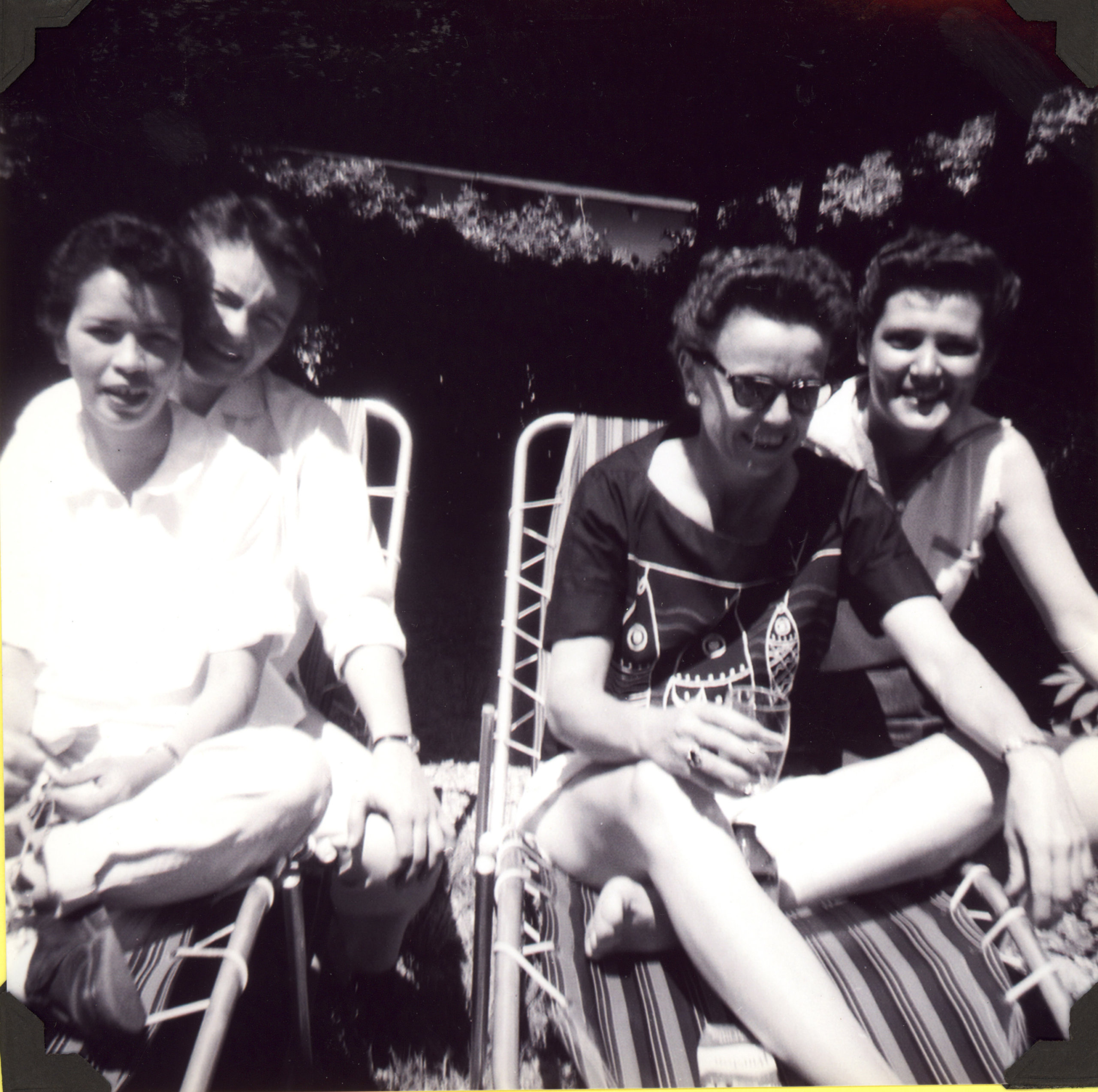
"Cheers" opens with the narrator describing Jane's giddy investment in absorbing and understanding the new gay world that her older sister, Diane, has introduced her to, highlighting Weathers's understanding of the gay bar as an important source of visibility, sociality, and community building in San Antonio:
Jane Jones took everything in. The Acme Bar was packed. Everyone knew most everyone, and she was learning. The Acme Bar was no rathole to her. It was an enchanted room, the first gay bar Diane and Maria took her to when she arrived in the colorful, picturesque city of San Antonio from West Texas two weeks earlier.24Weathers, Shitkickers, 19.
As Jane immerses herself in the gay bar scene, she experiences multiple complicated love affairs, establishes a network of friends, and transitions from the youthful exuberance of initially coming out—as depicted in this first scene—to a more critical and politicized approach towards gay life and experience. She learns how everyday homophobia and institutions such as law enforcement and the military affect gay livelihood.
"Cheers" features military personnel in civilian life through two primary characters, Nan Grinder and Maria, based, respectively, on a mutual friend of the Weathers sisters known as Liz and a lover of Brenda Weathers named Anita Ornelas.25Weathers, interview by author. Nan and Maria are enlisted as WACs (Women's Army Corps).26Founded in 1942 as the women's branch of the US Army, the Women's Army Corps existed until 1978, when it was disbanded as the Army implemented gender-integrated units. The former is notorious for her paranoia and alcoholism while the latter is characterized as a hard-working soldier who exudes "patriotism and earnestness."27Weathers, Shitkickers, 29. Weathers uses this character foiling to point to the precarious existence that all gay WACs, regardless of personalities or work ethic, faced in the homophobic armed forces. For instance, Maria's goal of attaining the Good Conduct Medal is quashed when she's late to guard duty after trying to cover for two gay women making out on base. The next day two gay WACs—Sergeant Rusty and Sergeant Scaggs—report Stacey, one of the women from the make out session, for homosexual activity. Rusty and Scaggs had been "fixtures at Nan Grinder's martini parties," which she would throw as a cover for herself each time she slept with a woman.28Weathers, Shitkickers, 30. Their actions result in Nan's becoming a reclusive shut-in as she fears that anyone, regardless of sexual identity, will potentially out her to military authorities and end her career. All of these experiences paint the military as a dead end for solidarity or long-term community building among gay women. And Weathers's depiction is not unfounded, as oral histories of WACs recorded by Allan Bérubé in Coming Out Under Fire, along with studies of the climate of fear and vast purging of homosexuals in the government and military during this period, such as David K. Johnson's The Lavender Scare, attest to the power dynamics and political tactics forced upon and performed by gay WACs as a means of survival.29David K. Johnson, The Lavender Scare: The Cold War Persecution of Gays and Lesbians in the Federal Government (Chicago: University of Chicago Press, 2009).
Alongside this bleak outlook on the possibility for gay women's community, Weathers includes descriptions of the WAC Shack, a bar for WACs only, to document historical experience while alluding to a future of lesbian bars that would fulfill desires for queer women's space. In "Cheers" and in her interview, Weathers frames the WAC Shack as a source of speculation and fantasy among civilian women who wondered what it must be like to patronize a bar full of women. Although the homosociality of the WAC Shack enabled women to potentially recognize their same-sex desire and offered a place of female bonding, its idealization by gay civilians negated the reality of gay WACs who had to navigate the space. While a place of sociality, the WAC Shack, more so than civilian gay bars, was also a place where patrons would worry that any homosexual behavior would be reported to military officials.
Desire for a queer future also appears when Jane fantasizes about positive cultural representations and access to LGBTQ+ writing. As one friend proudly shows off a book that pathologizes homosexuality and sings the praises of The Children's Hour, Jane asks, "Wouldn't it be something . . . if there were gay bookstores?"30Weathers, Shitkickers, 38. Based on Lillian Hellman's 1934 play of the same name, The Children's Hour (1961) was directed by William Wyler and featured Audrey Hepburn (Karen) and Shirley MacLaine (Martha). Falsely accused of lesbianism by a vindictive student, Karen and Martha, teachers at a private school for girls, get caught up in negative media coverage that isolates them. The film ends in Martha's suicide, as she realizes that she has loved Karen all along and feels responsible for their public humiliation and Karen's failed marriage engagement. "You mean," asks another friend, "bookstores with only gay books in them." "Yeah," Jane replies, "that said nice things."31Weathers, Shitkickers, 38. The group's response is partly cynical ("She wants the world"), partly optimistic ("You never know").32Weathers, Shitkickers, 39. Here, in a story set in the 1960s but self-published in 1987, Weathers invokes the Women in Print Movement, in which she was involved as a publisher and writer. From the late 1960s through the 1980s, feminist and lesbian-feminist print cultures flourished in numerous small towns and cities, with women-run collectives and presses churning out journals, newspapers, newsletters, magazines, novels, poetry chapbooks, etc. These artifacts, as well as their byways—or their sharing by word of mouth, conferences, meetings, feminist and lesbian-feminist bookstores, and the mail—make up what recent scholarship terms the Women in Print Movement (WIPM).33Jaime Harker, The Lesbian South: Southern Feminists, the Women in Print Movement, and the Queer Literary Canon (Chapel Hill: University of North Carolina Press, 2018), 17. For more histories of the WIPM, see Agatha Beins, Liberation in Print: Feminist Periodicals and Social Movement Identity (Athens: University of Georgia Press, 2017); Victoria Hesford, Feeling Women's Liberation (Durham, NC: Duke University Press, 2013); Kathryn Thoms Flannery, Feminist Literacies: 1968–75 (Champaign: University of Illinois Press, 2010); Julie R. Enszer, "A Fine Bind: Lesbian-Feminist Publishing from 1969 through 2009" (PhD diss., University of Maryland, 2013); and Kristen Hogan, The Feminist Bookstore Movement: Lesbian Antiracism and Feminist Accountability (Durham, NC: Duke University Press, 2016). The WIPM provided spaces for women to hone their fiction, poetry, and nonfiction writing, as well as sociopolitical analyses; it also generated connections between nodes of the movement throughout the United States, creating a feminist network with stronger organizing capabilities at local, state, and national levels.
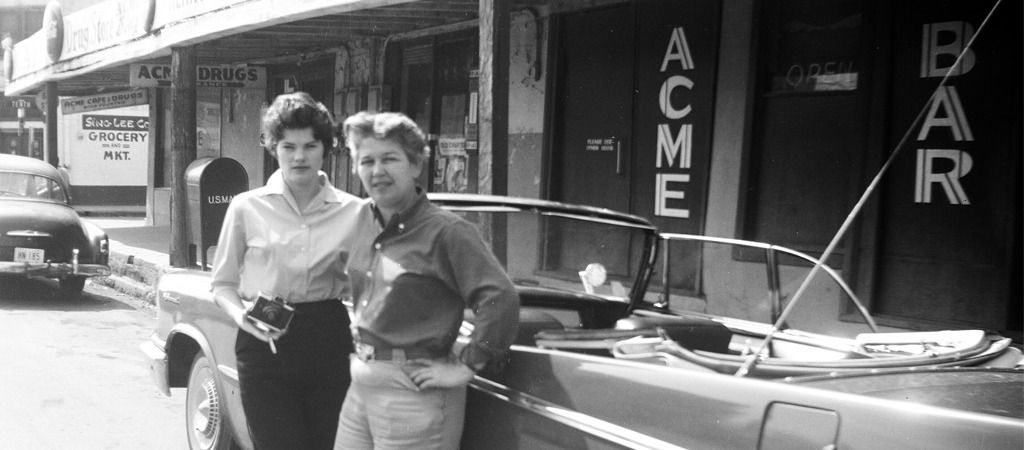
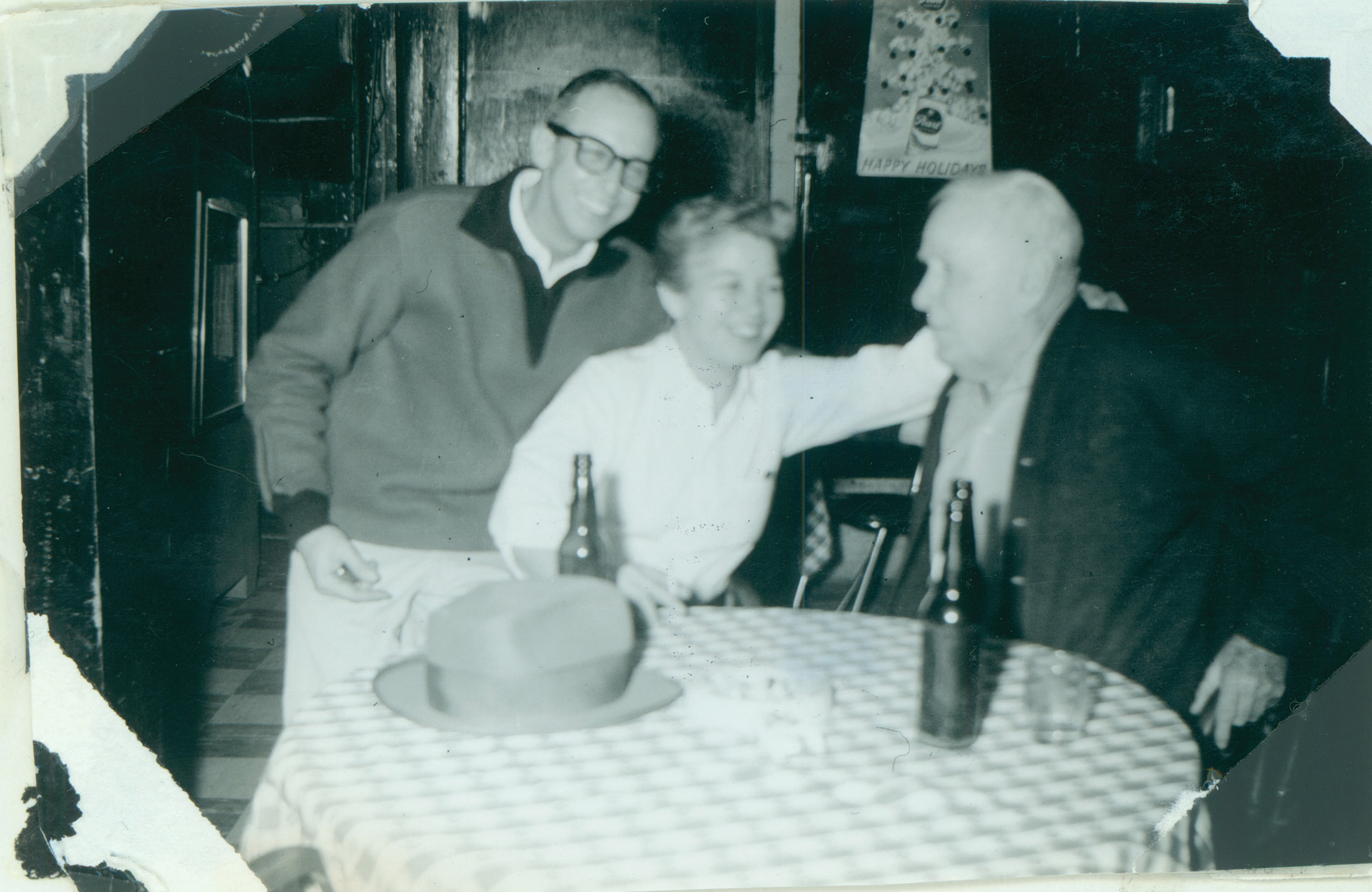
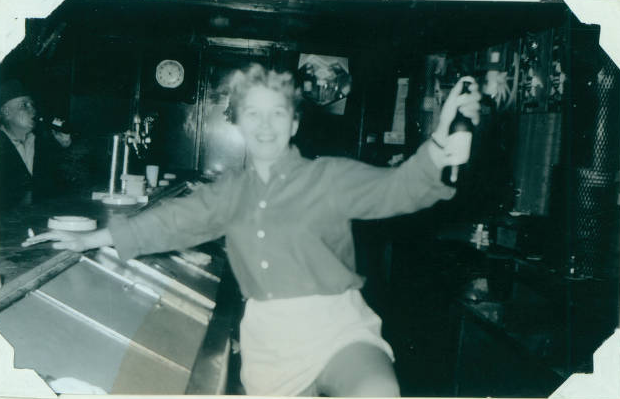
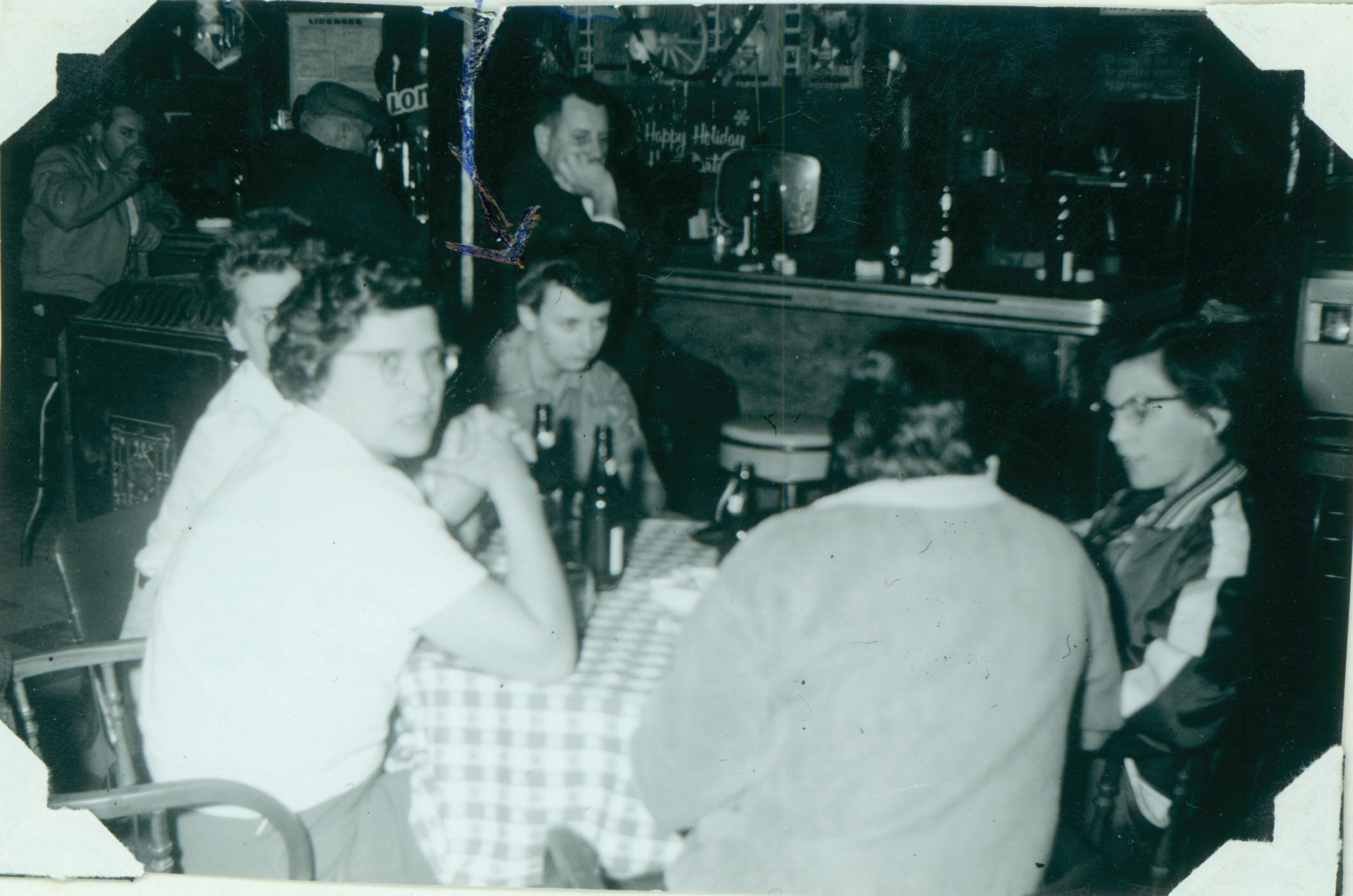
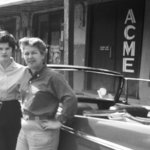
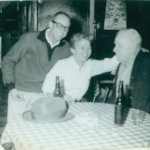
.jpg)

.svg)
These moments of political awakening in "Cheers" further character development within the narrative arc of the bildungsroman and help codify the story's primary theme, both of which are fully rendered in the final scene. In contrast to the opening scene, which depicts an elated novice Jane responding to The Acme, the final scene is contemplative, featuring recognition among Jane and her friends that something needs to change. Trying to figure out what to do on a sweltering San Antonio day, one friend suggests a scored game of throwing pebbles at birds, and Jane replies:
Nan used to . . . only she used rocks; come home from work and right away, after mixing up martinis, go out to her back porch and chonk rocks at the little birds; busted their little heads, too; never winced, never smiled, never nothing; just grim, grim, grim.
No one spoke for a time, just looked at one another and down at the ground. Jane felt there was surely something hanging in the oppressive air. It did not seem to be rain, but no one was sure. It had to break soon. They still did not know what to do.34Weathers, Shitkickers, 44.
This shared emotional response builds upon the story's central engagement with the day-to-day struggles of gay men and women and disenchantment that the story increasingly conveys through Nan, Jane, and her sister, Diane. By the story's end, Nan's mental and physical deterioration disturbs all of her former associates, particularly Jane, while Diane, bored and restless with the daily nine-to-five and happy hour at the bar, considers a move to California. Jane, aware of her own mortality while standing on a concrete ledge overlooking the San Antonio River, realizes that her reckless behavior—her cavalier tempting of death through hard drug abuse and an eating disorder—will eventually kill her. The sociality of the gay bar can neither change the homophobic military regulations that have impacted the mental and physical health of Nan Grinder, provide the environment Jane needs to get sober, nor give Diane the intellectual stimulation, political activism, and sense of purpose that she desires. But rather than gesture towards political organizations, therapy, or social networks beyond the gay bar, the group remains silent until Jane suggests that they go to the bar, which they do.35Weathers, Shitkickers, 44.
In early 1960s San Antonio, the bar remains a necessary distraction and needed escape. Weathers's prefatory words to the story resonate here: "I remember coming out when there was absolutely nothing but the bars—no thought or hope that there would ever be anything else."36Weathers, Shitkickers, 13. By the end of "Cheers," its narrator believes that "the something . . . hanging in the oppressive air" will "break soon."37Weathers, Shitkickers, 44. While historiographical and cultural tendencies to narrativize LGBTQ+ liberation as beginning with the 1969 Stonewall riots38This was a series of violent riots within the Greenwich Village neighborhood of New York City that was set off by a police raid of the Stonewall Inn on June 28, 1969. have come under critique for erasing previous LGBTQ+ activism or dismissing it as more assimilative than radical, Weathers's account in "Cheers" offers documentary testimony through the thin guise of fiction for how some queer people who did not have access to organized political groups understood their lived experience at one time (1960s) and place (San Antonio).39See, for instance, Elizabeth A. Armstrong and Suzanna M. Crage, "Movements and Memory: The Making of the Stonewall Myth," American Sociological Review 71, no. 5 (2006): 724–751; Craig A. Rimmerman, The Lesbian and Gay Movements: Assimilation or Liberation? (New York: Routledge, 2014).
Although "Cheers" describes the centrality of bars to gay life in pre-Stonewall San Antonio, it reveals little about how issues of race and class inflected gay experience in the city at this time. Photographs of these gay bars that Weathers took as a patron hint at racial demographics, but further contextualization of these spaces provided by my interview with her shows that while fluid and mixed in terms of class demographics, these gay bars' racial demographics were very much pre- and over-determined by Jim Crow racial segregation. Of the bar sketches that follow, all of them but Mary Ellen's Top Hat—located at 210 South New Braunfels Avenue in Figure 3—appear in "Cheers," and each sketch will offer deeper insight (through the use of Weathers's personal reflections in our interview) into the racialization of San Antonio gay bars than is provided in Weathers's autobiographical short story. Figure 3 also notes locations for The Acme (505 Austin Street)—the first bar that Weathers entered when she moved to San Antonio and the bar "Jane" first encounters in "Cheers"—the River Walk, and Five Points. Fernando's Hideaway, as depicted in "Cheers" and told to me by Weathers, was located on the River Walk.40Weathers, interview by author. In her thesis, Gohlke locates Fernando's Hideaway at 2100 Frio City Road, but she provides no information about the bar beyond that. It is unclear whether this is a discrepancy in information or Fernando's moved locations at some point. Besides Fernando's Hideaway and The Country II, Gohlke's study does not document the bars that I discuss here. See Gohlke, "Out in the Alamo City." Five Points serves as visual orientation for Fredericksburg Road (to its immediate northwest), which led out to The Country (address now lost).
The Acme
In "Cheers," the narrator describes the neighborhood where The Acme is located, at 505 Austin Street on the outskirts of downtown, as "an eerie area of locked warehouses and abandoned storefronts where life had left, as though an alien spaceship had beamed everyone else up during the night."41Weathers, Shitkickers, 15. A tiny little dive bar, or as Weathers called it, "a dump," The Acme was very popular, always "stuffed full of gay men and women." The co-owners, fictionalized as Ray Davis and Lila Tankersley in "Cheers," were an amiable white gay man and a white elderly woman who Weathers believes was asexual. "Lila" also owned a shop next door called The Acme Pharmacy and had a reputation for hassling patrons of the bar, insisting that they produce their IDs. Unsure of how these two became business partners, Weathers noted that the bar serviced a mixed crowd of civilian and military, working class and upper class, gay folk and occasionally heterosexual couples. For instance, a straight couple, the Rodriguezes, "would come in and join [them] for hamburgers and beers." When asked about the racial make up of the bars, specifically if they were interracial, Weathers specified that Mexican Americans and whites mingled in all San Antonio gay bars, but that this wasn't viewed as interracial mingling because Mexican American and Anglo cultures were heavily intertwined in San Antonio. The idea of race as something that marked Mexican Americans and Anglos as apart from or different from each other became more apparent to her when she moved to Los Angeles, where she was "surprised by how segregated Mexicans and whites were."42Weathers, interview by author.
Given the long history of anti-Brown violence and political disenfranchisement in south, central, and west Texas, if my informant had been a Mexican American woman, then she would have likely told a different story about race. But Weathers's account offers insight into white experience of racial intimacy in San Antonio, while also alluding to potential Mexican American identification with whiteness as produced by San Antonio's colonial and military history. South, central, and west Texas—parts of which were included in the territory of the Republic of Texas and parts of which were considered contested territory between Mexico and Texas until US annexation and the Treaty of Guadalupe Hidalgo (refer back to Figure 1)—have traditionally homed the majority of the state's Latino demographic. Latino populations in north and east Texas have increased in recent years, particularly in Houston and the Dallas–Fort Worth Metroplex. However, because these areas were heavily settled post–Mexican Independence by Anglos practicing chattel slavery, they have been and continue to be home to most of Texas's Black demographic.43See "The Changing Population of the Texas and the Tyler Region," (Tyler: Texas Demographic Center, 2017), https://demographics.texas.gov/Resources/Presentations/OSD/2017/
2017_03_21_TylerCatalyst100.pdf. Figure 4 presents a map of Texas's Black enslaved population in 1845, and Figure 5 a map of Black demographics by Texas county as of 2020–2021. Consequently, the establishment of white supremacy in Texas, in its republic and later state forms, required regionally specific racialized policing practices. Whereas east Texas followed the rest of the US South in contending with white over Black, south, central, and west Texas had to contend with white over Black and Brown.44These regionally specific racialized policing practices are not transhistorical—although their afterlives or permutations of them are—and shift according to changing racial demographics. For instance, by the early 1970s, Houston had a significant Latino demographic in comparison to the rest of predominately rural east Texas. Consequently, as Guadalupe San Miguel Jr. documents in Brown, Not White: School Integration and the Chicano Movement in Houston (College Station: Texas A&M University Press, 2005), Houston Independent School District tried to avoid integrating white and Black students by classifying Latinos as white. That is, Latino and Black students would be integrated, while white students would attend separate institutions.
While the legal practice of chattel slavery meant whites maintained control over Black individuals throughout Texas in its various iterations as province, republic, and state, shortly after the Texas Revolution, alliances between Texians and Tejanos unraveled. Whites in south, central, and west Texas removed Tejanos from positions in government and public office and committed rapes, lynchings, and massacres as a means to assert dominance and instill fear. Although Tejanos enlisted and served in the Confederate Army during the Civil War, the emancipation of enslaved Black people and the white power grab post-Reconstruction to reassert social structures and hierarchies of old that enabled the monitoring and control of Black bodies necessitated the creation of Jim Crow laws, which in south, central, and west Texas were accompanied by Juan Crow laws. Not only intended to ensure Black and Brown disenfranchisement in such forms as voter suppression, racist housing policies, and underfunded educational institutions, Juan and Jim Crow instantiated tripartite racial segregation in an effort to explicitly convey white supremacy and racial difference from Mexican Americans and Black people while also deterring Black and Brown coalitions.45For further information, consult the following: Gloria Anzaldúa, Borderlands/La Frontera: The New Mestiza (San Francisco: Aunt Lute, 1987); William D. Carrigan and Clive Webb, Forgotten Dead: Mob Violence Against Mexicans in the United States, 1848–1928 (London: Oxford University Press, 2017); David Montejano, Anglos and Mexicans in the Making of Texas, 1836–1986 (Austin: University of Texas Press, 1987); and Nicholas Villanueva Jr., The Lynching of Mexicans in the Texas Borderlands (Albuquerque: University of New Mexico Press, 2018). Analyzing Mexican American and Black civil rights movements from the early to mid-twentieth century in Texas, Brian D. Behnken argues that Juan and Jim Crow were, by and large, effective in encouraging Black and Mexican Americans to "work against each other" politically.46Brian D. Behnken, Fighting Their Own Battles: Mexican Americans, African Americans, and the Struggle for Civil Rights in Texas (Chapel Hill: The University of North Carolina Press, 2014), 230. Political organizations such as the League of United Latin American Citizens (LULAC) "sought to include Mexican Americans on the white side of Jim Crow," and some Mexican Americans sought to prove their whiteness through anti-Black practices and violence, such as denying Black people service and setting off bombs in Black homes.47Behnken, Fighting, 68. Specifically, Behnken references a 1950 bombing in South Dallas, in which 15 bombs were detonated at the homes of Black residents who had integrated a white neighborhood. While there were multiple vigilantes involved, many of whom were never apprehended, two suspects were Mexican American men who felt threatened by the presence of Black residents in white neighborhoods. As Behnken elaborates, this political strategy wasn't successful in gaining Mexican Americans long-term equal rights, but many whites, including Texas governors of the period, did "[recognize] Mexican American whiteness," thus demonstrating the malleability of whiteness or how false promises of inclusion within white racial identity were deployed to further anti-Black and Brown sentiment while shoring up white supremacy.48Behnken, 40. Given these racial dynamics, Weathers's words about white and Mexican American mingling in San Antonio gay bars reflect Sharon Holland's thoughts on racial intimacy: rather than tamping down racist ideologies and practices, "proximity and familiarity" might actually "replicate the terms upon which difference is articulated and therefore maintained."49Sharon Patricia Holland, The Erotic Life of Racism (Durham, NC: Duke University Press, 2012), 19.
Fernando's Hideaway
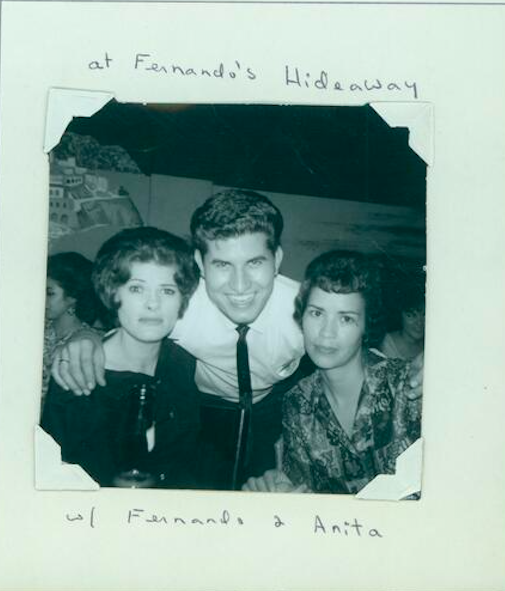
Inspired by the Mexican American bar owner's name and a popular song ("Hernando's Hideaway"), Fernando's Hideaway was in a historic building along the San Antonio River Walk. Construction on the River Walk began in the 1920s, when the city hired engineers to create a dam system that would address the frequent threats of disastrous flooding by the San Antonio River. Plans to convert the river and its banks into a storm sewer system resulted in the founding of the San Antonio Conservation Society, which successfully lobbied against this measure and was tasked with overseeing future development of the area. Delayed by the Great Depression, the River Project—plans to develop the river by adding restaurants, walkways, and shops—was initiated in 1939 through local tax and WPA (Works Progress Administration) funding. Initially headed by architect Robert H. Hugman and later J. Fred Buenz, construction on the River Project by WPA workers ended in 1940, with an opening dedication ceremony coinciding with the city's inaugural Fiesta River Parade in April of 1941. Throughout the forties and fifties, the River Walk featured a small sampling of restaurants, shops, and boating activities that drew in a fair number of locals and tourists alike but was generally considered an unsafe area at night due to crime. From the 1960s up until 2011, however, the face and reputation of the River Walk radically changed, as the city heavily invested in its further development and expansion in order to capitalize on tourism capabilities.50Consult these sources for a more detailed history and timeline: Lewis F. Fisher, "San Antonio River Walk [Paseo del Rio]," Handbook of Texas, Texas State Historical Association, accessed April 20, 2019, https://tshaonline.org/handbook/online/articles/hps02; "History of the River Walk," The San Antonio River Walk, accessed April 20, 2019, https://www.thesanantonioriverwalk.com/history/history-of-the-river-walk; City of San Antonio, "River Walk," accessed April 20, 2019, https://www.sanantonio.gov/CCDO/riverwalk.
Attentive to the River Walk milieu of Fernando's Hideaway, scenes of the bar in "Cheers" occur amid Fiesta San Antonio, an annual ten-day celebration of the city's history and culture, which started in 1891 to commemorate those fallen at the battles of the Alamo and San Jacinto. According to Weathers, Fernando's was much "fancier" than the other bars and not as "secretive," given its location in an area with heavy foot traffic. The racial, gender, and class make-up of the bar was like The Acme, with straight people often patronizing it as well. The bar's balcony that overlooked the river was a popular spot, and Weathers laughingly recalled a Fiesta memory of Navy men floating in a boat down the river as gay men catcalled "sea food" from the balcony.51Weathers, interview by author. The fact that gay men and women weren't discouraged from patronizing Fernando's despite its public visibility speaks to the assimilative capabilities of white and Mexican American gay bars in the downtown San Antonio district during this period. As Amy L. Stone's work on Cornyation (a mock debutante pageant organized and performed by gay men during Fiesta from 1951 to 1964) reveals, spaces and events associated with Fiesta often allowed for gay visibility within certain limits. "Attended by a public audience of thousands and reviewed in local newspapers," Cornyation, Stone argues, "rendered gay culture visible to some heterosexual observers and implicated gay men as urban citizens worthy of integration into the city," but "this legibility ultimately led festival organizers to ban Cornyation."52Stone, "Crowning King Anchovy," 298. Given Fernando's proximity to Fiesta activities held on and near the River Walk, as well as its accessibility to tourists, perhaps it's plausible to suggest that the general public did not necessarily recognize it as a gay bar and that its existence was contingent, in part, on it servicing a large heterosexual demographic.
The Country
The Country featured in "Cheers" was located outside the city limits on Fredericksburg Road. It is also referred to as Stein's Bar in the short story, but the actual name for it—when folks did not invoke its nickname, The Country—was Kline's Bar. Two white elderly lesbians, Maybelle and Bee, operated The Country and had probably been together since the 1930s. Weathers described The Country as much "nicer" than The Acme: it "sat in some thickets" off the road and had "long tables" and a jukebox in its "cavernous dance hall." Moreover, there was a separate lounge room with a bar at the front of The Country where customers could relax on chairs and sofas while purchasing drinks. The racial, gender, and class demographics of The Country mirrored The Acme's, with many people frequenting both of these bars. This shared patronage was not just because The Country had more room and was the site of "a lot of drunkenness and singing loud to Patsy Cline," but also because gay couples could dance at The Country. Unlike urban gay bars, which didn't allow same-sex dancing due to their close proximity to police stations, The Country permitted same-sex dancing because its distance from police stations gave the bar owners and patrons time to warn each other and switch into heterosexual pairs.53Weathers, interview by author.
Military and Bexar County police occasionally raided The Country, and Weathers, having witnessed one of these raids, fictionalizes the method employed to alert patrons in a way that is very similar to the actual method she shared with me in person: Maybelle would walk around with her yellow bandana in her shirt pocket, which was a sign that cops were coming, and same-sex couples would immediately rearrange into heterosexual pairs. Another precaution included banning two people in the bathroom at once because if, for example, two women were in the ladies restroom during a raid, cops had probable cause to arrest them for homosexual behavior. When the cops entered the bar, "they would," according to Weathers, "go around the room looking for a woman's hand on another woman's knee" or any type of same-sex touching. I asked her if authorities persecuted gay men and women if they dressed in clothes typically associated with the opposite sex, as in, for example, Buffalo, New York, where butches were arrested for wearing less than three articles of women's clothing, and she said gay men and women in San Antonio wore the same casual dress clothes as heterosexuals: "jeans, t-shirts, Bermuda shorts."54An informant recounts this in Elizabeth Lapovsky Kennedy and Madeline D. Davis's Boots of Leather, Slippers of Gold: The History of a Lesbian Community (New York: Routledge, 1993). By her account, there weren't butch–femme pairings in the gay scene, and people didn't use those terms; instead, the only term used was fluff, which referred to more feminine women. Outside of this specification, Weathers's remarks also suggest that drag was not a common feature in these bars, nor was there a significant presence of people presenting as gender variant.55Weathers, interview by author.
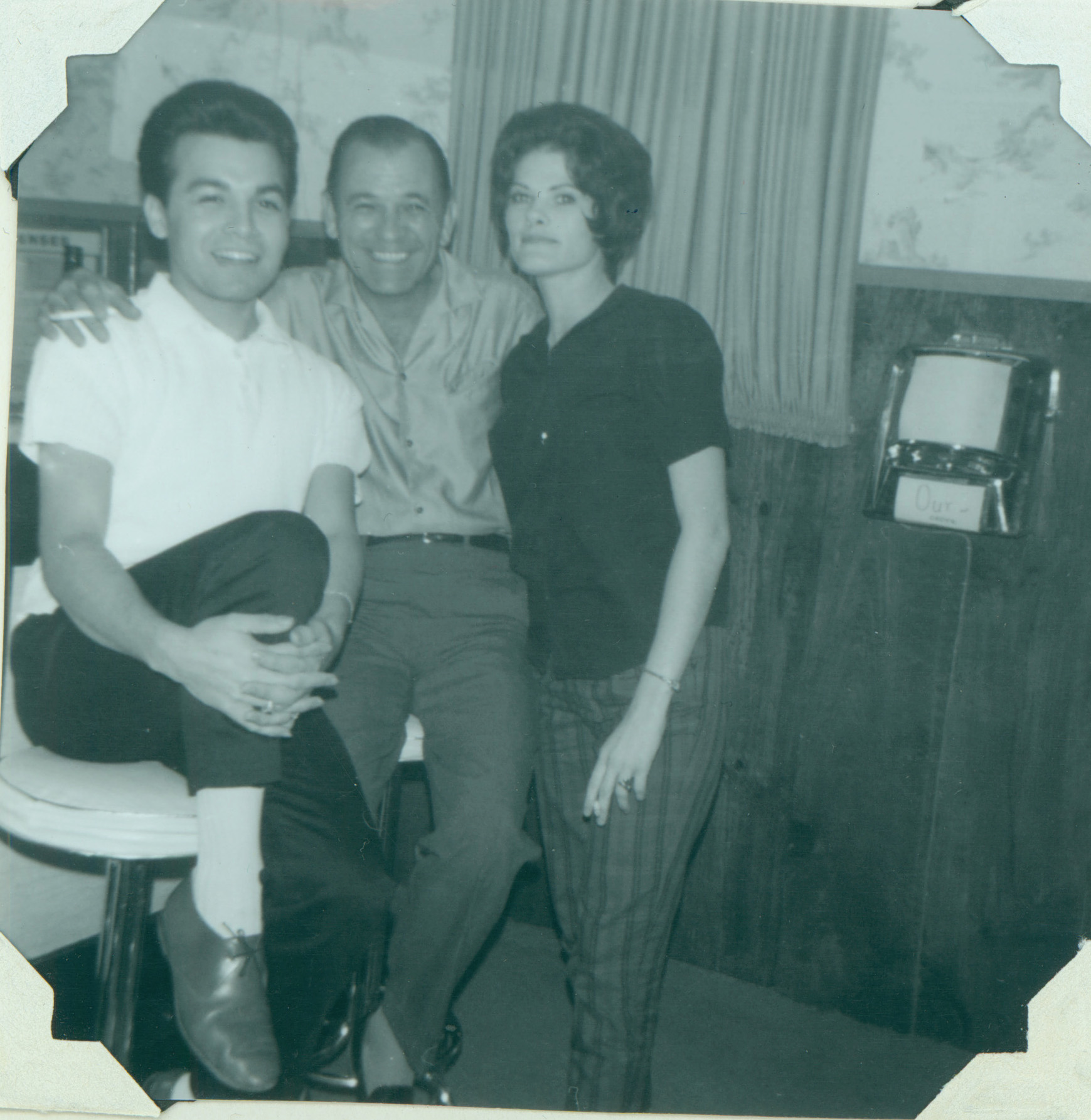
For reasons that Weathers can't remember, Maybelle and Bee ended up closing The Country. A white gay man and white bisexual woman with an arranged heterosexual marriage opened a similar venue called The Country II in a different location not long after.56Weathers, interview by author. In her study of San Antonio gay bars, Gohlke explains that like The Country, this bar was a queer gathering space that allowed for same-sex dancing and touching due to its location outside the city limits. The patrons and bar owners also employed their own technique for warning of incoming cops: flashing the lights on and off.57Gohlke, "Out in the Alamo City." Gohlke and Weathers have been in contact with each other, and Weathers told me that The Country referred to in Gohlke's thesis is, in fact, The Country II. The Country's function as a queer space on the city's periphery that gay people fluctuated between in the process of creating queer community resonates with John Howard's idea of circulating, which he uses to account for how gay men in Cold War Mississippi engendered queer experience and space by remaining in a state of flux.58John Howard, Men Like That: A Southern Queer History (Chicago: University of Chicago Press, 1999), 78.
Mary Ellen's Top Hat
Located at 210 South New Braunfels Avenue on the city's east side, a traditionally Black neighborhood since formerly enslaved people began establishing Freedmen's Towns there after the Civil War, Mary Ellen's Top Hat is the final bar that Weathers remembers from her time in San Antonio.59For more information about Black history and experience in San Antonio, see Alwyn Barr, Black Texans: A History of African Americans in Texas, 1528–1995 (Norman: University of Oklahoma Press, 1996); Bruce A. Glasrud, ed., African Americans in South Texas History (College Station: Texas A&M University Press, 2011); Kenneth Mason, African Americans and Race Relations in San Antonio, Texas, 1867–1937 (New York: Garland Publishing, 1998). Owned by a heterosexual Black woman of the same name, Mary Ellen's was unique because it welcomed Black, Mexican American, and Anglo patrons. According to Weathers, during their revelry at the bar, Mary Ellen would sing Ray Charles songs and Weathers and her friends would act as Mary Ellen's chorus. The bar also had a beer-drinking club called UN CAPPA-FU—a play on "uncap a few." As an interracial space, Mary Ellen's heightened Weathers's awareness about Black experience in the United States through conversations she had with Mary Ellen, a Black male acquaintance nicknamed Mr. Elegance, and white and Mexican American friends and fellow patrons. Becoming noticeably emotional when discussing the racial dynamics of this bar, Weathers recalled that she, Mary Ellen, and Mr. Elegance decided to integrate The Country one night after a heated discussion over Black civil rights. However, they left in separate vehicles, and upon arriving at The Country, Weathers went in without waiting for them. She doesn't know if they were denied entrance or if they even showed up, and that lack of knowledge, as well as her failure to wait for them, is a source of strong regret today.60Weathers, interview by author.
Although heavy media coverage of the civil rights movement brought images of violence and struggle into the everyday lives of white people across the country, when Weathers entered the San Antonio gay bar scene in her early twenties, she was still ignorant and indifferent due to her race, youth, and regional upbringing. Recall that west Texas has always had a significantly smaller Black population in comparison to other parts of the state, which has influenced how anti-Black practices and ideologies manifest and circulate there. West Texas officials did not always enforce Jim Crow laws to the extent that they were enforced in more eastern parts of the state, and anti-Mexican sentiment often predominated among locals given the region's colonial history and significant Latino demographic.61William S. Osborn, "Curtains for Jim Crow: Law, Race, and the Texas Railroads," Southwestern Historical Quarterly 105, no. 3 (2002): 395. The small, predominately white town that Weathers grew up in, Brownfield, was no exception. She struggled to remember incidents of anti-Black violence and racism in her childhood, quickly adding, however, that she did notice anti-Mexican sentiment, especially in relation to the presence of imported Mexican agricultural workers in Brownfield. Weathers's experiences in Mary Ellen's Top Hat reveal that, in facilitating cross-racial dialogue, racially integrated gay bars in San Antonio were potential sites of racial consciousness raising, however limited, among patrons.62Weathers, interview by author.
Conclusion
Absent in these bar sketches are the voices of people of color such as Anita, or Fernando, or Mary Ellen, or Mr. Elegance. What might a Black-owned gay bar have meant to someone like Mr. Elegance? What were his and Mary Ellen's thoughts about gay bars like The Country upholding anti-Black Jim Crow laws? Was Mary Ellen's Top Hat racially integrated because under Jim Crow, white people actually had access to all spaces, or was it a political statement on Mary Ellen's behalf? What did it mean to a Mexican American bar owner like Fernando to deny services to Black gay people and Black people generally? As a Mexican American woman, what was Anita's experience of racism and racialization as she moved from Mexican American-owned bars to white-owned bars to Black-owned bars? The Weathers Collection at the ONE Archives cannot answer these questions, but they should prompt us to consider what research approaches and archival practices are needed to adequately represent a fuller and more inclusive queer history of pre-Stonewall San Antonio and Texas. Now is the time to gather oral histories and create cross-reference lists of Texas queer experience in LGBTQ+, Black, Latino, and Asian American archives so that the research process is streamlined for academics and non-academics invested in interpreting and preserving this history.
Beyond this call to further curate and study Texas queer history, my analysis here does open up other questions that could be more thoroughly explored in future work with the Weathers Collection. For instance, how did military history influence racial dynamics in San Antonio? How might sexual dynamics be understood through the city's colonial history? What were common or popular understandings of gender in the gay community at the time? These are just a few provocations that readers might find in this essay. From this work, I hope readers will notice the gap in racial awareness when considering Weathers's "Cheers" short story and our later interview. That is, the short story itself does not discuss Jim Crow segregation or the different racialized experiences of characters. In fact, none of the characters are openly racialized. If it were not for my interview with Weathers, I could not have provided an analysis of racialized gay space in San Antonio at this time. Both text and context, story and oral history, work together to tell a richer, if still incomplete, version of pre-Stonewall gay life in San Antonio. This essay, then, might serve as an object lesson in how to work with racial silences that are often common in the archival materials of white subjects. And considering that one of the problems of archives—LGBTQ+ and otherwise—is the over-predominance of collections from white subjects, this is not an object lesson to easily cast aside.
About the Author
Amanda Mixon is Assistant Professor of Instruction in the Center for Women's and Gender Studies at The University of Texas at Austin. Her research on US social movements has appeared in the Journal of Lesbian Studies and received support from the American Association of University Women, Duke University, the University of Virginia, and the University of California, Irvine Humanities Center.
]]>Blog Post
I recently bought a crumbling old house in a historically gay neighborhood in Roanoke, Virginia. I met my ex-lover in this house five years ago. At the time they lived with a coterie of other young people. They threw raucous queer parties and housed folks who didn't have anywhere else to go.
A few blocks down the street is another building. There, in 1971, a group of young men and women founded the Gay Alliance of the Roanoke Valley (GARV), the region's first gay liberation organization. This building is now a medical office. I come here once a year to see my endocrinologist. He prescribes spironolactone and estradiol to help my body transform into something approximating that of a woman.
The local neighborhood association puts up signs that read, "A Past with a Future." As I see it, the neighborhood's past is rich with gay history, and the future is my transitioning body and the pink, white, and blue flag I fly in the driveway.
Queer history lives here. It's overlapping in the spaces of my neighborhood. It's in the bones of the buildings. Queer ghosts inhabit the walls. Archaeological troves are remnant in the yards. My dog June digs them up with her ready paws and pearl-white fangs. My gender transformation is hitched to the woodwork and to the water pipes of all the apartment buildings where I have lived. People have lived queerly in these spaces. I have bought a home that not only holds the past but makes space for the future—for my womanhood, my motherhood, and for the chosen family I will assemble underneath this roof.
LGBTQ people have long known that our stories are not to be found in the so-called annals of history, and that we have to look in unexpected places to find our past. Lesbians in Roanoke in the 1980s devoted an entire issue of their newsletter, Skip Two Periods, to "Discovering Our Heritage." The writer, "B. F.," wrote about finding her heritage at the Lesbian Herstory Archives in Brooklyn, in Jonathan Ned Katz's book Gay American History, through the National Women's History Project, and in the published letters shared among nineteenth-century women. She also suggested that lesbian history is found in our families. "Write to your grandmother and ask her about her grandmother," she pleaded. Indeed, queer history is present in the way my parents reacted when I first came out, as they referenced a family member who died of AIDS in 1989 and hinted that I might face a similar fate. We carry queer trauma in our bodies. All of us—straight, gay, cis, trans—live in a world shaped by the queer past.
We have the tools to probe this history on the local level. Since the 1970s, queer history projects have flourished across the United States. New archives are forged from the remains stowed away in activists' attics and closets. Oral history collections are assembled from the stories of our elders, talking about what it was like growing up as a trans person in Appalachia in the 1960s, for example. Doing queer history work provides us with the opportunity to bring LGBTQ people together across generations, to talk about what was and what can be, to find new meaning in the spaces of our lives.
Six years ago, I helped found the Southwest Virginia LGBTQ+ History Project, a community history project that has since engaged hundreds of local people in the process of researching and interpreting queer pasts. This has involved creating a permanent archive in partnership with the local public library system, developing an oral history collection through interviews with our elders, leading monthly walking tours, unveiling digital exhibits, releasing podcasts, and working with local youth on interactive theater and zine-making workshops. This project is how I ended up spending time in this house; it's where I fell in love with a project member who lived here. It's how we know the geography of bars and cruising spaces that once littered the neighborhood, and the all-queer and all-trans houses that still stand. It's how I discovered my gender. Interviewing trans women about their lives, I realized this was also my story. So I came out into the spaces of the project, into the spaces of our city, into a new relationship with queer history. A past with a future.
Every October we celebrate LGBTQ History Month. To me, this month is a reminder that we are still fighting, especially here in the South, for students' right to learn basic LGBTQ history in the classroom. But beyond the metanarrative of what should be taught in school, there are thousands of local queer histories still waiting to be uncovered. This work takes all of us—students, elders, volunteers, professionals. Do you know when the first gay organization was founded in your community? Have you met your trans elders? The work of doing queer history has the power to transform lives. It has the power to give new meaning to the places we call home.
About the Author
Gregory Samantha Rosenthal is the author of Living Queer History: Remembrance and Belonging in a Southern City (Chapel Hill: University of North Carolina Press, 2021).
]]>Excerpt
Georgetown, April 2017
It was early morning when I crossed the Francis Scott Key Bridge from Virginia into Georgetown. College spires loomed in the distance, gray in the dawn light. I was headed to a religious service at Georgetown University that would acknowledge the trauma of a massive slave sale in 1838, a deal that shored up the finances of the struggling college and sent more than two hundred men, women, and children into the cane fields of Louisiana. Most of the families torn apart in the sale could trace their lineage to White Marsh, one of the Jesuit-owned plantations located in Prince George's County, Maryland.
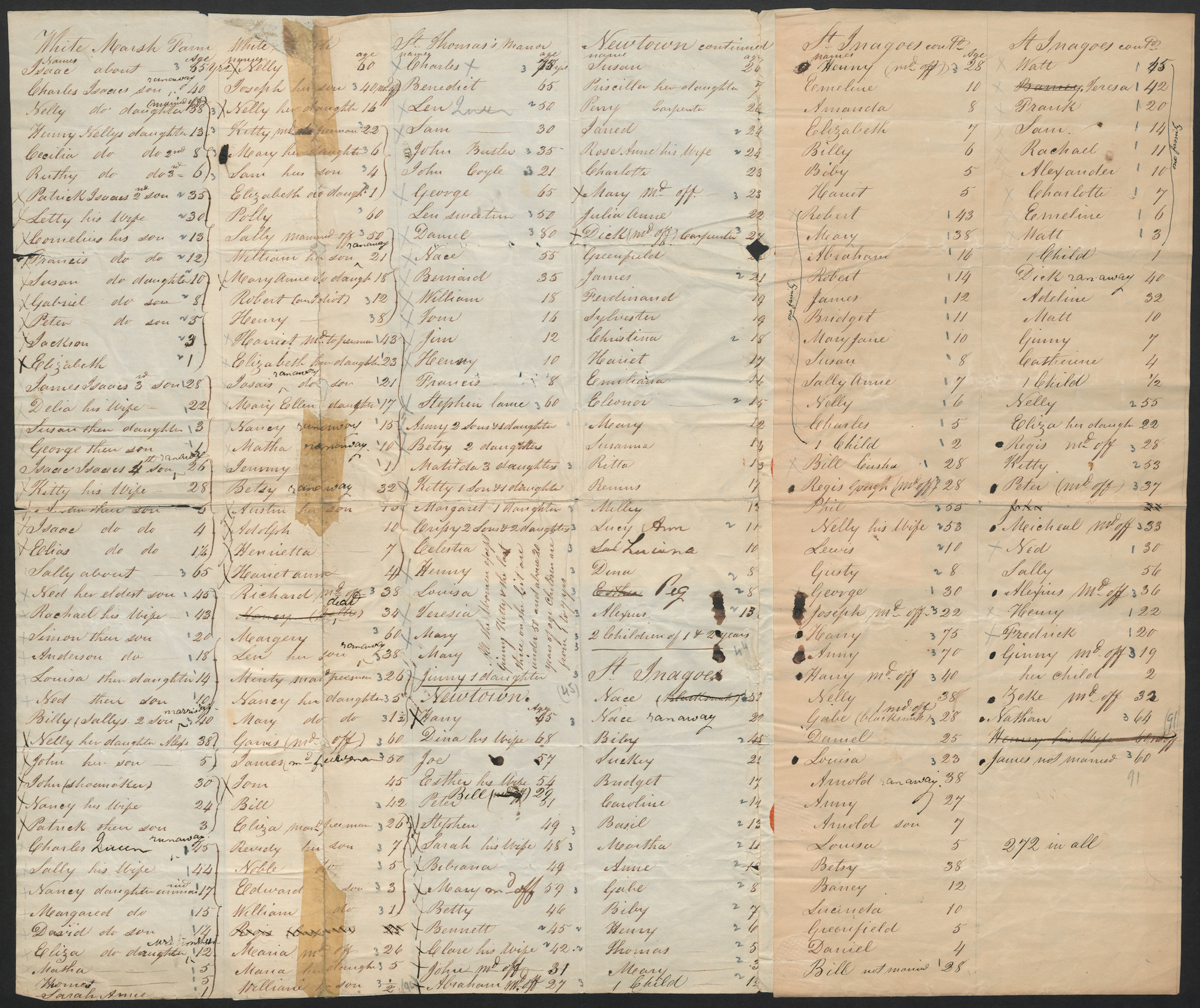
I had been researching the history of the White Marsh families for nearly a decade, uncovering the lawsuits they had brought against the Jesuits and other prominent Maryland slaveholders long before the 1838 sale. Some won their freedom. Others didn't—but each of their cases challenged the legitimacy of slavery in American law. Together they counted among the most significant freedom suits in U.S. history. And there were hundreds of others. Yet their particular stories would lead me, like the Georgetown Jesuits, to reckon with what I did not know about my own family and its role in this story.
More than a hundred descendants, a dozen university officials, and a cluster of Jesuit priests assembled inside Healy Hall for the liturgy and slowly processed into an ornate, wood-paneled auditorium on the third floor. After the opening prayer Sandra Green Thomas rose to address the congregation. Thomas, a descendant of the Harris and Ware families and president of the GU272 Descendants Association, waited a long moment before speaking. "My people were humble," she began. "They provided for their families. They tried to protect their children as best they could from the cruelties of this world, but given what the world is and what people can be, they were not always as successful as they would have hoped." The anguish and fortitude of her ancestors echoed in the firmness of her tone. "Their pain was unparalleled," she observed. "Their pain is still here. It burns in the soul of every person of African descent in the United States. It lives in people, some of whom have no knowledge of its origins but cope with the ever-present longing and lack it causes."1"Liturgy of Remembrance, Contrition, and Hope," Georgetown University, April 18, 2017. Notes and recording in possession of the author. A full recording is available at from Georgetown University at https://www.youtube.com/watch?v=tO4Xsz36kTU, with Sandra Green Thomas's remarks beginning at minute 29:33. Several major research projects have come to the fore around the Georgetown history. First, the Georgetown Slavery Archive (slaveryarchive.georgetown.edu, herein abbreviated GSA) is a repository of archival materials related to the Maryland Jesuits and Georgetown University. Second, the Georgetown Memory Project (www.georgetownmemoryproject.org) is an independent nonprofit dedicated to researching, finding, and advocating for the descendants of the 272. The project released its database of descendants in May 2019 with American Ancestors by the New England Historic Genealogical Society (see the GU272 Descendants, 1785–2000 database, www.americanancestors.org/search/databasesearch/2756/gu272-descendants-1785-2000). Third, historian Sharon Leon has undertaken a highly significant digital history-based analysis of the families on the Jesuit plantations. See Sharon Leon, The Jesuit Plantation Project: An Examination of the Enslaved Persons Owned (and Sold) by the Maryland Province Jesuits, 1717–1838 (https://jesuitplantationproject.org). I have also followed closely the Universities Studying Slavery working group at the University of Virginia since 2014 (slavery.virginia.edu/universities-studying-slavery) and other university reports, especially Stephen Mullen and Simon Newman, Slavery, Abolition and the University of Glasgow, Report and Recommendations of the University of Glasgow History of Slavery Steering Committee (September 2018), and Princeton Seminary and Slavery: A Report of the Historical Audit Committee (slavery.ptsem.edu/full-report). Also see Craig Steven Wilder, Ebony and Ivy: Race, Slavery, and the Troubled History of America's Universities, reprint ed. (New York: Bloomsbury, 2014).
I had met Thomas in New Orleans for the first time a few weeks before the ceremony. I had asked her then what slavery meant to her family, and she had said that slavery was quite simply one thing: theft. To understand American history required dealing with the fact that slavery was premised on a series of lies. The slaveholders, whether Jesuit priests or English tobacco planters, saw themselves differently, of course. We had talked about how they rationalized slavery on the basis of race, religion, law, science, and history and with myriad other prejudices, doctrines, sentiments, and myths.
Now, I wondered how Thomas would broach the lies that slaveholders told and the theft that slavery was. She turned to the heart of the matter, and to the Jesuits whose predecessors had enslaved her ancestors. "I know it is difficult to honestly look at yourself, the way you operate in the world, and your true motivations and priorities." Americans face an uncomfortable truth, she noted. History demanded "self-revelation" about the stories we accept without questioning, about the narratives we use without thinking. She offered forgiveness to the Jesuits, but she sought justice. Thomas spoke for all of the descendants who thirsted for an acknowledgment of their family's particular enslavement, and after she finished thunderous applause erupted in the room.
An expectant hush fell across the auditorium as the Reverend Tim Kesicki, a Jesuit priest and president of the Jesuit Conference of Canada and the United States, rose to address the descendants. He wore a plain black business suit and Roman clerical collar. With an air of earnestness, he spoke slowly, like a pastor to his flock. The long shadow of enslavement, Kesicki said, "remains with us to this day, trapping us in an historic truth." The truth, he admitted, was that the Jesuits had "betrayed the very name of Jesus." Kesicki offered a sweeping apology, confessed the sin of enslavement, and sought "on bended knee" forgiveness for the Jesuits' entire participation in slavery.
But he did not kneel. The remarks, sincere and heartfelt as they were, seemed strangely inadequate. Kesicki wished to acknowledge the sins of the past but was unprepared to deal with the real trauma the Church had caused and offered no meaningful pathway forward. His apology and the request for forgiveness fell flat. Descendants turned their heads away.
In this uncomfortable moment, something more than a Jesuit failure came into view—Kesicki's words symbolized an American failure to deal with a hurtful history. He had not referred to a single descendant or ancestor by name; he had directed his apology to his "sisters and brothers." For hundreds of years the Jesuits had spoken to the enslaved families on similar occasions without addressing them individually, and here at Georgetown the particularity of their enslavement appeared again to be disregarded. Kesicki's apology, nonetheless, marked a subtle but decisive departure in the Jesuits' acknowledgment of their role in slavery. Even the most recent Jesuit histories had failed to fully acknowledge the Society of Jesus's complicity. Indeed, until Kesicki spoke, most attempts to come to terms with this history had downplayed the Jesuit slaveholders' actions: decisions explained, rationalized, and inspected, all pointing to something called "slavery" but not to the families they enslaved. The same vagueness could describe how Americans more generally regard slavery.2Robert Emmett Curran, Shaping American Catholicism: Maryland and New York, 1805–1915 (Washington, D.C.: Catholic University Press, 2012), 36–38. See also Edward F. Beckett, "Listening to Our History: Inculturation and Jesuit Slaveholding," Studies in the Spirituality of Jesuits 28, no. 5 (1996), which explains the Jesuits as paternalists: "To a certain extent, the plantation formed a kind of domestic parish to which slaves belonged" (11). Beckett concludes that Jesuits treated slaves "no worse than" other slaveholders, but following Curran, he emphasizes that the Jesuits encouraged slaves to gain skills. In the most recent and thorough review of Jesuit slaveholding in Maryland, Thomas Murphy, S.J., argues that the Jesuits understood themselves as paternalists and as superior, like all other enslavers in the early American republic. His account is the most balanced examination of the Jesuit role in slaveholding, yet his stance is similarly apologetic. As for their decision to sell supernumerary slaves, Murphy concludes that the Jesuits could not bring themselves to do so and instead sold the physically fit and "missed an opportunity to develop a morally strong case for making profits out of right motives." See Murphy, Jesuit Slaveholding in Maryland, 1717–1838 (New York: Routledge, 2001), 72.
But America's founding, like Georgetown University's, cannot be disentangled from its enslavement of particular families. Our national imagination still sees slavery as an aberration, a detour, from the true story of the country. Many Americans see enslaved people in history as faceless and nameless, victims of a long-ago system that has now disappeared. In such a situation, the nation needs to experience what we at the liturgy experienced: a confrontation, a reckoning, with real people, with real histories, with real families whose descendants live among us. Until such encounters happen more widely, Americans will continue to live in separate historical spheres of understanding, a condition that more than anything limits our ability to come to terms with the past. We cannot, of course, do anything to change what happened long ago, but we can change the way we understand what happened and what it means to us in the present.3A central aspect of the approach taken here is historical imagination. This asks readers to experience a world other than their own and to step outside of themselves into the characters in this history. Recent examples of narrative imagination include Imani Perry, Looking for Lorraine: The Radiant and Radical Life of Lorraine Hansberry (Boston: Beacon Press, 2018); Lisa Brooks, Our Beloved Kin: A New History of King Philip's War (New Haven: Yale University Press, 2018); and Saidiya Hartman, Wayward Lives, Beautiful Experiments: Intimate Histories of Social Upheaval (New York: W. W. Norton, 2019). Each is an inspiration in the form of its narrative and in its attention to re-creating the voices, situations, and daily experiences of people left out of the archive. See also Natalie Zemon Davis, The Return of Martin Guerre (Cambridge: Harvard University Press, 1983).
About the Author
William G. Thomas III is the John and Catherine Angle Chair in the Humanities and Professor of History at the University of Nebraska–Lincoln. He is on the Southern Spaces editorial board, and was co-founder and director of the Virginia Center for Digital History at the University of Virginia.
]]>Introduction
Julio Capó Jr. is a proud Miamian, and much of his work reflects detailed attention to the history of LGBTQ Miami. After seven years at the University of Massachusetts Amherst, Capó returned to his native Miami in the fall of 2019 as an associate professor in the Department of History and the Wolfsonian Public Humanities Laboratory at Florida International University. His first book, Welcome to Fairyland: Queer Miami Before 1940, explores John Sewell's 1933 notion of Florida as "a playground for the Nation" specifically through his deployment of "queer as an analytical tool" with "which to understand contested meanings of nation, race, belonging, and citizenship" in Greater Miami from the 1890s until 1940.1See Julio Capó Jr., Welcome to Fairyland: Queer Miami Before 1940 (Chapel Hill: UNC Press, 2017), 24, 5, 8. Capó explores how influential powerbrokers and everyday people contributed to the process of transforming "Miami into an 'exotic' tropical fairyland linked to the Caribbean and available for purchase."2Capó, 1. "Miami," he writes, "is geographically situated in the U.S. South and tucked in the northern section of the Caribbean Basin."3Capó, 7. Capó's Welcome to Fairyland interprets Miami as "linked to the Caribbean" and as part of a larger US landscape in a historiographical tradition of employing "a transnational lens in the recovery of queer voices, lives, and experiences."4Capó, 7. Queerness is the central analytical tool through which Capó explores Greater Miami. In his history, Capó traces Miami from its early days as a "queer frontier" to how it sustained a reputation as "a site where one could transgress gender and sexual norms."5Capó, 4. The 1950s saw Miami's queer landscape radically change once more, with the 1959 Cuban Revolution and other Cold War era political and cultural shifts. Many bemoaned the fear of losing "Miami after Dark."6Capó, 287.
In this and other ways, Welcome to Fairyland expands the terrain of queer history and southern studies. While it focuses on a seriously understudied period before cogent sexual identities had fully crystallized, the study has important implications for later queer histories with which readers may be more familiar. This includes mid to late twentieth-century narratives of state attacks in the form of the 1956–1966 Florida Johns Committee and Anita Bryant's 1977 Save Our Children campaign. Capó reveals the importance of casting further back to trace organizing strategies Miamians have utilized and how they may serve a more inclusive and socially just present and future.
Capó's curation of the exhibition Queer Miami: A History of LGBTQ Communities with the HistoryMiami Museum (March 15, 2019–September 1, 2019) examines how queer people "carved out spaces for themselves in southern Florida" across the twentieth century. For this interview, I asked Capó about Welcome to Fairyland, the HistoryMiami Museum exhibition, his plans for the future, and his thoughts on the state of queer history.
Welcome to Fairyland: Queer Miami Before 1940
SOLOMON: How did you come to write Welcome to Fairyland? What personal pathways led you to this project? Are there other histories or historians that motivated and inspired you?
Capó: First, let me thank you for the opportunity to share my work and thoughts with you and your readers. I am most grateful. Welcome to Fairyland developed organically and with quite a bit of urgency as I continued to think historically about questions at the intersection of sexual, racial, class, and gender injustice that take many different forms today. I began revising my dissertation, which was a history of LGBTQ Miami in the post-World War II era that paid particular attention to immigrant populations and experiences. I grew frustrated by assumptions I had to make about what pre-1940 Miami looked like. For starters, there were relatively few queer community studies of the early twentieth century, especially for locations in the US South. Miami's history differed greatly from cities we know much more about, such as New York, San Francisco, and Chicago. Never taken too seriously by most scholars, Miami remains a deeply understudied city. As election polls and media reports often suggest, it remains misunderstood by political strategists and advisers. While many people are quick to point the finger at Florida (and cities like Miami) when the votes are counted (or not counted), they are often given few opportunities to better understand its complicated past.
As a historian, I've always believed the past offers us the possibility of instruction and inspiration. It is generative in that we understand the social, political, economic, and cultural architecture on which today's city stands. So, in a nutshell, I went back to the archives hoping to write one concise chapter on queer Miami before the 1940s. My first major find appeared in the criminal records that, once I paired that data with immigration records and colonial records from the Bahamas, taught me that Bahamian male migrant workers were disproportionately arrested for crimes such as sodomy in the city's early days. I realized that this was not a mere chapter in my book. This was very much its own story that deserved all my attention. This was the book I needed to write. And it challenged me to think differently about the research I had already conducted on the mid and late twentieth century.
Solomon: What personal pathways led you to this project?
Capó: My goodness! It's an embarrassment of riches in terms of inspirations for writing Welcome to Fairyland. I have already suggested how social and political injustice inspired me to ask questions that proved most productive in my research. But I also believed that to understand Miami's transnational history, the city's queer past needed to be in direct conversation with arguments and debates that have also taken shape in the fields of gender, Black, southern, Caribbean, immigration, Latinx, and labor and class history. I thought a lot about how scholars such as Cathy Cohen, José Esteban Muñoz, Siobhan Somerville, and Martin Manalansan, among many others, have treated queer as an analytic. I drew inspiration from how Eithne Luibhéid, Marc Stein, Margot Canaday, Amy Sueyoshi, and Nayan Shah have discussed the state's surveillance of immigrant bodies both at the US borders and within them. I found thoughtful transnational approaches in the works of Lara Putnam, Ana Raquel Minian, Andrew Sandoval-Strausz, and so many others. I wanted to contribute to the growing scholarship of Miami's ethnoracial demographics, Caribbean influences, and long history of class warfare that scholars such as N. D. B. Connolly, María Cristina García, and Melanie Shell-Weiss have laid out. And I wanted to expand the parameters and scope of the LGBTQ community study, with its emphasis on space and place, that George Chauncey, Nan Alamilla Boyd, John Howard, among so many others, have set forth. This barely scratches the surface, but I hope it gives a sense of what I was thinking, more broadly, as I approached the archives, the evidence, and the literature as I wrote Welcome to Fairyland.
Solomon: In his 1997 oral history, James T. Sears mentions Florida as the "Mississippi of the homosexual" in the immediate decades following when Welcome to Fairyland ends.7James T. Sears, "The Mississippi of the Homosexual and the Politics of Dialectics," in Lonely Hunters: An Oral History of Lesbian and Gay Southern Life, 1948–1968 (Boulder, CO: Westview Press, 1997). Sears's rhetorical move has always resonated with me, and I mention and challenge it in my first project. I'm from Mississippi, but I've written about Florida extensively. You're from Florida, and Welcome to Fairyland is set in your native Greater Miami. Yet, your study stops before the years (1948–1968) Sears is referencing. How important was it for you to illustrate in detail the development of queer spaces in Miami in terms of your temporal framing?
Capó: Wow, there's a lot to unpack here. Thanks for this important provocation. You know, even though Welcome to Fairyland ends in 1940, as the book's epilogue may suggest, I know quite well what happens in Miami after the 1940s. I wrote a dissertation and have curated an exhibition about that very history. I wanted to understand its origins. At least at the surface, people may be more familiar with the recent history. They have recollections of anti-gay violence spurred on by the Johns Committee, Anita Bryant, the Mariel Boatlift, and more. As I unpack in Welcome to Fairyland, this past is often really violent. It is also, however, a story of queer resistance and resilience.
More directly, what does such a loaded statement mean: Florida was the "Mississippi of the homosexual." Because its framing seeks to make a clear parallel to ground zero for Black civil rights at midcentury, the statement also inherently asks us to separate race and sexuality and imagine anti-Black violence—as well as anti-gay violence—as somehow separate and as possibly contained to a particular geography. One of the events I examine thoroughly in my book, for example, involves the 1937 raid of a Miami gay bar named La Paloma that was conducted by nearly two hundred members of the Ku Klux Klan.

Queer histories have historically been rooted and entangled with—in nuanced and checkered ways—anti-Black violence.
I'm more inclined to think of it this way: Florida was the "Florida" of Blacks and people of color; much of the same anti-Blackness and colonialism created the very conditions for Florida to become the "Florida" of the homosexual. I wonder how scholars such as John Howard would respond to this, as his book Men Like That encouraged us to question our assumptions about the US South, its relationship to gender and sexual liberation and racial politics, and even our perception that liberation was somehow more attainable in urban, rather than rural, spaces, or perhaps even the "North" rather than the "South."
I'm thinking here about the uses and misuses of teleological arguments, but Sears' provocation is a great jumping point for our exploration of temporality and liminal spaces within "the past." Like your reference to growing up in Mississippi, I was born and raised in Miami and, in writing Welcome to Fairyland, I was struck by how much of the history I uncovered in my research had been lost to us. In other instances, I found that this history wasn't exactly lost, but rather made incoherent and illegible. Viewing the watercolors John Singer Sargent produced in early Miami takes on radically new meaning when we pair it with the city's criminal records, or immigration logs, for example. Watching Marilyn Monroe in the 1959 film Some Like it Hot, once you have studied the history of Prohibition at the Miami-Caribbean borderlands, suggests that contemporaries seeing it for the first time might have understood the critical relationship that politics had in sustaining and creating queer communities and culture. Although many of our pasts have indeed been institutionally erased, others have simply lost their meaning over time and are hidden in plain sight but very much alive in meaningful and impactful ways. No one may call Miami "fairyland" anymore; but that moniker's association with doubt can still be found in the area's ongoing efforts to draw in outsiders.
Solomon: Welcome to Fairyland deploys "queer as an analytical tool" and "interprets queer history by maintaining a transnational perspective and by providing an intersectional analysis that factors in how gender and sexuality influenced constructions of class, race, ethnicity, age, and (dis)ability."8Capó, 5. Queer. Transnational. Intersectional. How do you understand the connections between these three terms for your work?
Capó: I think the analytics of queer, transnational, and intersectional are doing a lot of the same work in the book, but in distinct ways. In general they all exist, and I'll shamelessly look to Gloria Anzaldúa for inspiration in Borderlands/La Frontera: The New Mestiza, defying static, singular, fixed positions or statuses. The queer has us move beyond the binary and think expansively about subversion and transgression as it is measured against the normative. A transnational perspective rejects the nation-state and the neat categories it seeks to produce as the dominant form of power and structure. An intersectional approach dictates how different modes of power can simultaneously coexist and that forms of oppression are indeed interlocking and impossible to separate. They are all in flux, fluid, and subject to change. For me, these are the ingredients to doing this history and important and necessary approach for measuring change over time and place.
Solomon: For those seeking to develop research projects or thinking of doing queer history, can you describe the journey of Welcome to Fairyland? How long did the book take you to write? Is the finished project what you thought it would be when you started?
Capó: I've addressed aspects of this already, so I'll just add a few more thoughts. I think I'm a pretty disciplined writer. I'm a former journalist (still contributing to journalism, but now as a trained historian) who understands the importance of deadlines, the mythologies surrounding things such as writer's block, and the necessity of carving out time for writing every day. From concept to page proofs the book took about five years, as I began it during my postdoc. I am really proud of the final product. Once I had processed all the evidence, I realized I had a lot of things I wanted and needed to say. I've always been hyperaware that this history is meaningful, and in very different ways, to many different people—past and present. I'm sure some may not fully appreciate my treatment of the evidence and material, but a work now exists that acknowledges this history as significant and as critical to multiple histories.
I can't really say Welcome to Fairyland was the book I initially sought to write because this book came to fruition as I worked to revise a separate project from discoveries in the archives and from my efforts to respond to gaps in our knowledge. It speaks to the issues I thought—and still think—need much more attention.
Queer Miami: A History of LGBTQ Communities: Miami Across the Twentieth Century
Solomon: You write about the silences within and erasures of the queer archives, drawing from Martin F. Manalansan's understanding of "disarrangements." You also mention your own collecting of historic ephemera as a practice that directly informs your work. What are the roles of historians and nonacademic collectors in preserving queer history?

Capó: There's so much one can say about this, but I'll try to keep it somewhat brief. I think preservation is a key part of activist work. Much of the field of queer history stems from tireless community-based efforts to collect and preserve our past and make it known. Certainly, for the years I address in Welcome to Fairyland, our histories were never meant to be preserved. Those in power sought to erase us. They still do. We have to fight back, but we also have to think harder about how to respectfully recover the voices of those most marginalized within these marginalized groups. And we have to think harder about what constitutes an archive, a legitimate source or evidence, and the places where we can find them.
Many of the sources in Welcome to Fairyland, and perhaps a third of the material objects featured in the exhibition I curated in Miami, are from my personal collection. I have collected t-shirts, piggybanks, postcards, dolls, photographs, letters, rare books, and so many more items—over nearly fifteen years. I've been able to find and acquire some objects through search engines and simple keywords, such as "gay Miami." I think I've been able to piece together something else entirely, though, through my reading and rereading of Miami's past. Things that may not have appeared inherently "queer" at first can be given new meaning in context. I also think I've earned the trust and support of many members of Miami's LGBTQ community, who feel equally invested in recovering this past and having it told and preserved. I am from Miami and I'm openly gay. Over a decade ago now, I worked as an intern at the Stonewall National Museum and Archives in Fort Lauderdale, where I helped catalog some of its unprocessed materials it housed there, especially its Anita Bryant collection. What I want to stress is that this work takes time and dedication. It is, indeed, a community effort.
Solomon: In terms of the Queer Miami exhibition: can you describe your process of curating? How much of your research from Welcome to Fairyland informed or served as foundation for the exhibition? How did your collaboration with the HistoryMiami Museum come about?
Capó: The exhibition covers a bit before the 1890s to the present. That's over a century of material. I had never curated anything before, so I did my homework! I read a lot about the curatorial process, consulted with colleagues and friends, and visited as many exhibitions as I could with a very different eye: as a curator-to-be. This was such a productive and challenging experience for me. I absolutely loved it. I learned so much and have connected with so many members of the community.
Much of the narrative of Queer Miami took shape from threads of Welcome to Fairyland and my dissertation on the post-1945 era, but there are many differences. Unlike a book or an academic article, I had to tell an engaging narrative through objects or other visuals. That's often difficult, especially for the earlier period. We reproduced some ordinances, portraits, paintings, and the like for the early 1910s, but it's very difficult to explain what constituted queerness in Miami when these terms, meanings, and identities were very much in flux and often inchoate; the state also never intended to preserve this history, of course. I did not want this to exclusively be a narrative of criminalization or of surveillance of queer folks, immigrants, the poor, or people of color. I wanted to recover people's voices—as well as their moments of leisure and community-building—whenever possible.
While telling Miami's queer past through objects often proved challenging, an exhibition of this size (five thousand square feet), breadth, and scope permitted me to do a lot of different things. For example, we recovered police footage of gay bar raids (and one at someone's home) from the late 1950s. We recreated a bar counter from that era where people could sit down and watch looped footage of those raids. Altogether, it presents some really powerful testimony. Audiences can see the violence of the state. You see the whiteness of these spaces. Many queer people of color held or attended private parties instead, knowing far too well the risks for them were much greater. You see people fighting back, too. One man throws his drink at the cameraperson, for example. When we think of resistance, we often think of Stonewall-like narratives. That queer people in Miami continued to congregate in and create gay spaces at all—in spite of violence and surveillance—is a testament to their resilience and their efforts to dismantle unjust practices and abuses.
It's productive to challenge ourselves by expanding and redefining our audiences, venues, and methods. I had a similar experience a few years ago when thinking about some of this very same material, but in terms of space and place as part of a study the National Park Service commissioned on LGBTQ historic sites. I contributed a chapter on Miami that narrated existing (surviving) physical sites. This work challenged me to think very differently about material I had been analyzing for years.
Solomon: Can you tell us a little bit about how the Queer Miami exhibit was organized?
Three participants riding in a car in Miami's first Gay Rights Parade, Miami, Florida, 1978. Photograph by Tim Chapman. Courtesy of the Tim Chapman Collection, HistoryMiami Museum.
Capó: The exhibition represents the diversity of Greater Miami's LGBTQ communities across racial, ethnic, class, and national lines. It offers snapshots of this history, exploring how queer people have been policed and criminalized, how they developed cultures of resistance, how their stories link to experiences beyond our borders, and how the movement can move forward mindful of its past.
Beginning with an introduction to Miami and queer history more generally, the exhibition suggests some of the difficulties of uncovering this past, including the use of terms like "queer," the problem of archives for history never meant to be told, and how Miami's queer history is, despite the many instances of violence and oppression, also one of resilience and resistance.
The exhibition is then organized into five sections: 1) Policing, Surveillance, and Criminalization; 2) Community Development, Representation, and Advocacy; 3) Fighting for Their Rights, Fighting for Their Lives; 4) Gateway to the Americas; and 5) Looking Ahead. For the first two, it was important to convey the many ways the state criminalized and surveilled queer people. These sections explore the significance of racist, xenophobic, and anti-Black sentiments in shaping queer culture and spaces and for the formation of strong and creative bonds of resistance. The third section shifts attention to the local and national significance of the 1977 Anita Bryant campaign to overturn a Miami ordinance that shielded gays, lesbians, and bisexuals from discrimination, and to the HIV/AIDS crisis. I wanted to offer a different narrative and chronology, one that highlights Miami's past, rather than ones that are dictated by the telling of Stonewall and other events that have come to dominate our understanding of queer protest, resistance, and change-making. The fourth section observes how Miami's LGBTQ past extended far beyond the city's borders. It's a story with deep roots in parts of the Caribbean and Latin America and must be understood in the context of the Americas. Lastly, the exhibition explores some of the challenges for Miami's LGBTQ people today and highlights many of the organizations and institutions working to improve their lives. We also provide space for people to reflect and leave testimonies of their own histories with the city and offer their recollections and insights. It's a powerful exercise and testament to what liberation can mean when it is committed to social justice in all its forms. I have enjoyed reading these many contributions to the exhibition from visitors more than I can possibly explain.
About the Interviewer and Interviewee
Eric Solomon earned his doctorate in English from Emory University and is a visiting assistant professor of English and American Studies at Oxford College, Emory University. His work is featured in Southern Spaces, south, Pop Matters, and Mississippi Quarterly.
Julio Capó Jr. is an associate professor in the Department of History and the Wolfsonian Public Humanities Laboratory at Florida International University. He is the author of Welcome to Fairyland: Queer Miami before 1940 (Chapel Hill: The University of North Carolina Press, 2017) and curator of Queer Miami: A History of LGBTQ Communities. His work has also appeared in the Journal of American History, Radical History Review, Diplomatic History, Journal of Urban History, Journal of American Ethnic History, Modern American History, GLQ, H-Net, American Studies, and several volumes.
]]>Review
Sensory history is an exciting new approach to writing history. It offers a fresh take on past perceptions. Sensing between the lines of written sources, the sensory historian recasts history as sense-making activity, not merely a litany of dates and deeds. Ideally, readers can feel the pulse of a given period, sniff the atmosphere, and see events in a different light.
Mark M. Smith is the doyen of sensory history in the US. In Sensing the Past: Seeing, Hearing, Smelling, Tasting, and Touching in History (Oakland: University of California Press, 2007) he laid out a manifesto for bringing history to our senses. In How Race Is Made: Slavery, Segregation, and the Senses (Chapel Hill: University of North Carolina Press, 2006) he explored the sensory dynamics of racialization in the American South. In The Smell of Battle, The Taste of Siege, he turns his attention to the Civil War.
Smith begins by evoking the antebellum sensorium offered in an 1852 essay, "The Cultivation of the Senses," published in Harper's New Monthly Magazine that portrayed the senses as shapers of character and agents of civilization, provided they were exercised properly: "[the] eye should not be injured by resting on a vulgar confusion of colors, or clumsy, ill-proportioned forms; the ear should not be falsified by discordant sounds, and harsh, unloving voices; the nose should not be a receptacle for impure odors; each sense should be preserved in its purity" (1). This preoccupation with sensory order and decorum was particularly intense in a city such as Charleston, South Carolina, built on slavery, where every social relation exhibited gradations of command and obedience. The slave did not speak unless spoken to; there was a strict curfew prohibiting movement at night; the singing of slaves at work in the fields was music to the ears of the white slaveholder.
However, the ostensibly serene city of Charleston also shivered with fear at the prospect of a slave revolt. Silence was ominous as well as golden: "If they [the slaves] want to kill us," one female diarist wrote, "they can do it when they please, they are as noiseless as panthers" (18). The senses of the white population were already on edge leading up to 1861–1864 when, as Smith puts it: "The nation that had prided itself on its civilized control of the senses lost that control" (6).
Smith's book is structured around five events, each analyzed through a different sensory modality, while at the same time noting shifts in the salience of certain sensations as the event unfolded. The effect is captivating, and generative of many insights into, for example, military tactics, survival strategies, and commemorative practices.
In "The Sounds of Secession," Smith invites readers to listen in to transformations in the Charleston soundscape from the first murmurs of dissension sparked by Abraham Lincoln's election through the "storm of cheers" that greeted the signing of the Ordinance of Secession in November 1860 to the deafening bombardment of the Union stronghold at Fort Sumter in April 1861. Thousands of Charlestonians exited their homes to witness the conflagration in the harbor: "Unused as their ears were to the appalling sounds, or the vivid flashes from the batteries, they stood for hours fascinated with horror" (33).
In "Eyeing First Bull Run," Smith discusses how commanders on both sides were preoccupied with drawing up maps, building observation towers, constructing battle lines, ordering columns, and framing engagements—that is, with visualizing the impending battle. However, the first casualty of the Manassas battlefield was the certainty of sight and seeing. Due to dense woods, billowing clouds of dust and smoke, and dilapidated uniforms, it quickly proved impossible for the soldiers to keep in line, or to distinguish friend from foe. Many resorted to shooting blind. Somehow the Confederate forces prevailed, perhaps on account of their oft-remarked spine-tingling rebel yell.
Incidents of the war. A harvest of death, Gettysburg, Pennsylvania, July 1863. Photograph by Timothy H. O'Sullivan. Courtesy of Wikimedia Commons. Image is in public domain.
Smith surveys the carnage at the Battle of Gettysburg, documented by the new technology of photography. The sensation that made the most lasting impression, however, was not that of sight but of stench. As one female diarist wrote:
Not the presence of the dead bodies themselves, swollen and disfigured as they were and lying in heaps on every side was as awful to the spectator as that deadly, nauseating atmosphere which robbed the battlefield of its glory, the survivors of their victory and the wounded of what little chance of life was left to them . . . A sickening, overpowering, awful stench announced the presence of the unburied dead upon which the July sun was mercilessly shining and at every step the air grew heavier and fouler until it seemed to possess a palpable horrible density that could be seen and felt and cut with a knife. (79)
Gettysburg was a "degenerative moment," Smith writes (7). It would take many grandiloquent speeches and solemn reconciliatory gestures to dispel the miasma and make it stand for something meaningful, a turning point.
Examining the Union siege of Vicksburg, Smith tells a harrowing tale of a city "taken by hunger." The Union forces under Grant dug in around the base of the terraced city, and kept up a constant bombardment of "shistling" bullets and pounding shells. Residents found shelter in newly dug caves, which provided a limited defense, and took a toll on the residents' comfort and dignity. "We went in this evening and sat down," one diarist wrote, and "the earthy, suffocating feeling, as of a living tomb, was dreadful to me. I fear I shall risk death outside rather than melt in that dark furnace" (98). Besides being reduced to a "troglodyte existence," the residents' diet was reduced and reduced again to "spoiled greasy bacon and bread made of musty pea-flour" (110). Ignominy as much as starvation precipitated surrender.
In the final chapter, Smith delves into the H.L. Hunley, a proud piece of Confederate technology, designed to break the US Navy's blockade of Charleston Harbor. The Hunley was an "underwater machine" consisting of a forty-foot-long refitted boiler (forty-eight inches in diameter) in which eight men turned cranks attached to the propeller shaft. A long arm protruded from the front of the vessel with a torpedo attached to its tip. Smith makes much of the cramped quarters, which imposed an unnatural proximity, and of the cranks' constant turning, which was reminiscent of slaves ginning cotton: "The Hunley men weren't slaves [they were volunteers], but they . . . willingly placed themselves in the condition of slaves—in the fight to preserve slavery" (128). Thanks to its underwater stealth, the Hunley succeeded at torpedoing and sinking the USS Housatonic, sowing great consternation, even though the entire crew drowned at their stations. This experiment in underwater warfare was not repeated.
Smith's epilogue revisits General Sherman's March, a swath of destruction up to sixty miles wide through the Confederate heartland, assaulting senses and resources, doling deprivation and misery while laying waste to buildings and crops in an effort to break Confederate will. Particularly loathsome to the defeated Southerners was the sight of the Union flag and the riling notes of "Yankee Doodle," not to mention the taunts. "Did you ever think of this when you hurrahed for Secession?" one Union soldier asked a white man in Columbia, as he gestured to the flames engulfing the city. "Your mouth is silenced now and it is worth every damn year of this bloody war. How do you like it, hey?" (144–45).
Smith's sensory history of the Civil War brings a dramatic new perspective to bear on this transformative event that gave rebirth to a nation. He tells a compelling story, based on diaries, letters, and other archival material. A number of questions remain unanswered, however. What of the sounds and expressions of the enslaved when out of earshot of the slaveowners? What did singing mean to them, and what messages did the songs convey? Smith has touched on these questions elsewhere, in Listening to Nineteenth-Century America (Chapel Hill: University of North Carolina Press, 2001), for example, but he does not address them in this book. For that, one might start with Lawrence W. Levine's Black Culture and Black Consciousness (New York: Oxford University Press, 1978). Levine succeeds at rendering the inaudible sensible in ways that Smith does not, for Smith's book is more a "history from above" (attuned to the anxious perceptions of the dominant society) than "from below" (attentive to the sonic and other practices of persistence and resistance of the subaltern).
The Smell of Battle, the Taste of Siege is a foundational work, both in sensory history and in the emergent field of conflict and the senses.1 Nicholas J. Saunders and Paul Cornish, eds., Modern Conflict and the Senses (New York: Routledge, 2017). It yields many important insights into the lived experience of the Civil War, and is certain to inspire further research into what ranks as the most traumatic event in US history.
About the Author
David Howes is a professor of Anthropology and Director of the Centre for Sensory Studies at Concordia University, Montreal. He is also the Director of the Concordia Centre for Interdisciplinary Studies in Society and Culture (CISSC). He teaches courses on law, commerce, aesthetics, and the senses in cross-cultural perspectives.
]]>Presentation
Closer Reading: Three Images from the Presentation
Standing at the summit of Signal Hill (used previously by the Spanish military for the transmission of communications), Armstrong figuratively dominates the landscape by sweeping his arms over the mountains. Later he inscribes relevant cartographical information on this photographic image. Armstrong's presence reinforced the intentions of US colonial dominion over Puerto Rico while his panoramic gaze helped create the knowledge that made it possible. He repeats this pose in other photographs, sometimes appearing repeatedly in the same panorama (a result of pasting adjacent views together) and multiplying his gaze indefinitely.
This interior photograph shows a sick "peon" in the presence of an unknown observer, who does not resemble Armstrong in appearance or dress. Anemia caused by hookworm decimated Puerto Rican rural workers. After the discoveries of Dr. Bailey Ashford, an effective clinical treatment became available in 1904.1For more on Ashford and hookworm eradication, see José Amador, "The Pursuit of Health: Colonialism and Hookworm Eradication in Puerto Rico," Southern Spaces, March 30, 2017, https://southernspaces.ecdsdev.org/2017/pursuit-health-colonialism-and-hookworm-eradication-puerto-rico. This photograph from 1910 suggests the continuing misery of rural workers under the colonial state. The observer appears detached from and indifferent to the suffering of the hunched, dying man. Armstrong, in an ominous field book note, suggested that in the on-going process of "Americanization" it might be better if the unfit inhabitants simply "died off."
Armstrong produced extensive cartographic materials on his journeys through Puerto Rico from 1908 to 1912. In the process of making a topographical map, Armstrong traced elaborate itineraries, which he organized in field books complete with descriptions and maps of more than thirty towns and illustrated with more than five-hundred annotated photographs and postcards. He also included visual details of the transportation networks of primary and secondary roads, local trails, and railroads, as well as the agricultural environs. The archival research (upon which this illustrated lecture relies) includes a biography of Armstrong, an analysis of the contents of the field books, and discussion of the effects of the map in the context of the colonial state. The final publication will be a facsimile edition of ten field books, a Spanish translation, and a digital version of the topographical map.
Acknowledgments
This project is funded by the Fundación Puertorriqueña de las Humanidades, an affiliate of the National Endowment for the Humanities. All images and quotes are from the original field books, which are located in the following archives and collections: Colección Puertorriqueña, Biblioteca José M. Lázaro, University of Puerto Rico, Río Piedras; Archivo General de Puerto Rico, San Juan, Puerto Rico; Colección de Héctor Rodríguez Vázquez.
About the Author
Lanny Thompson is a professor of sociology at Universidad de Puerto Rico, Río Piedras. He is the author of Imperial Archipelago: Representation and Rule in the Insular Territories under U.S. Dominion after 1898 (Honolulu: University of Hawai'i Press, 2010).
]]>