Introduction to Victoria:
I first met Ms. Victoria Jewelle reflected in the bathroom mirror in front of me, slowly applying layers of makeup, constructing a face. She loaded a suitcase into her car and drove a few miles to a sports bar off the highway. I followed her into a crowded storage room at the back of the building, where half a dozen drag queens had transformed the space into a temporary dressing room. Eventually the lights dimmed and the queens paraded out one by one. Victoria emerged between two curtains, silhouetted against a solitary spotlight, suspended in time. The moment seemed to end quicker than it began: wigs and dresses zipped away, suitcases rolled out to the parking lot, cars peeling onto US 31.
This cycle repeated in front of me across Alabama—a small-town bar in the state’s northeast corner, a restaurant in a Montgomery strip mall, a gay bar in Dothan, a rustic event venue in Brundidge, and the steps of the Alabama State Capitol. It’s a pattern that has intensified somewhat since the closure of Montgomery’s last gay bar a few years ago, a loss that left Miss Victoria Jewelle criss-crossing the state to, in her own words, “keep our existence alive.”
Ms. Victoria Jewelle has performed for over twenty years in Alabama. Her drag identity emerged somewhat unexpectedly—a missing piece of expression that she outlined for me as an intractable desire to locate an indescribable piece of oneself. “It’s a wild thing to want to be something and you’re not sure how to get there,” she mused. She found this missing piece unexpectedly one night when living in Mobile. The feeling of seeing Victoria Jewelle, her drag identity, looking back at her for the first time made her feel whole.
This sense of wholeness has persisted even as Montgomery’s gay bars have closed, leaving Victoria searching and stringing together spaces to treat as empty vessels. Designed for other purposes, storage rooms and empty banquet halls are reimagined as the drag queens apply their makeup and zip up each other’s dresses. As a documentary filmmaker, I orient to the circumstances presented to me, including physical spaces. This disposition can be limiting—a fidelity to treat places as I see them rather than how others might. As I accompanied Victoria across Alabama, watching her perform against wood panels, rainbow streamers, American flags, and Bible verses, I discovered that, to Victoria, these spaces function as beads on a thread, extending a family legacy. As I worked through the footage, I began to reconfigure these places, bending them to her movements, allowing for her actions to extend without regard for the physical limitations. In this short documentary, Victoria’s movements—applying lipstick, blending makeup, blinking—begin in one place and finish in another. Her actions transport us between locations, linking pieces of her chosen family narrative—one that began for Victoria years ago when her drag mother applied her makeup for the first time.
I think back to Victoria describing a desire for something that couldn’t be located in the everyday world, something that felt, to her, almost indescribable but that she ultimately found staring back in a mirror. I saw the spaces Victoria inhabits as similarly unrecognizable. Temporarily reimagined through the perspective of a drag family searching for a home, these places are unbound by physical restrictions we normally use to organize our world. Victoria, the documentary, seeks to recognize this reimagining through the movements and feelings of a drag queen assembling the pieces of her drag identity. 
About the Filmmaker
John Haley is a documentary videographer, artist, and educator who examines fissures and seams in the American social fabric. His work juxtaposes personal narratives against institutional structures using observational cinematography, testimonies, symbolic imagery, and vivid, recurring soundscapes. Haley’s films have screened at DOC NYC, Palm Springs International ShortFest, Nashville Film Festival, Virginia Film Festival, St. Louis International Film Festival, New Hampshire Film Festival, Santa Fe International Film Festival, Tallgrass, and Sidewalk. His short documentary Sanctuary was named a Vimeo Staff Pick for 2025. Haley’s work has been supported by the Verdant Fund, the McCanna House Artist-in-Residence Program, the Southern Exposure Fellowship, the Anderson Center Residency, and more. He is currently an assistant professor of creative media at the University of Alabama in Tuscaloosa.
Banner: still image from Victoria video copyright 2025 by John Haley.
]]>
Prospect Bluff is one of the more remote historic sites you may ever visit. Perched upon the banks of Florida's Apalachicola River, the old fort is roughly an hour by car from Tallahassee. To get there, drive due west from the Florida capital, down Highway 20. Hang a left at SR65, south towards the Gulf, passing Dollar General towns like Telogia, Wilma, and Sumatra. Cross endless rows of slash pine, and rare red cockaded woodpecker habitat, then make a right at Gadsden Road. Technically the site is closed. Hurricanes shut down the federally protected landmark in 2023, and a gate blocks the dirt road that leads to the fort, though you can walk the remainder. Bring insect repellant. Any discomfort is rewarded by sylvan beauty and the sheer significance of the place. Here, during the long freedom struggle, self-emancipated Blacks organized as a semi-autonomous society, forging community in the piney woods by a stunning blackwater river, joining the British military in the wake of the combined 1812/Creek War. They met opposition, of course. Anxious to stop the flow of enslaved people from the southern borderland, Andrew Jackson ordered Edmund Pendleton Gaines to attack. In 1816, a hot cannonball struck the magazine, not too far from the Apalachicola, and the wooden fort went down in flames. Many of the survivors died, while others stole back into Florida's swampy frontier.
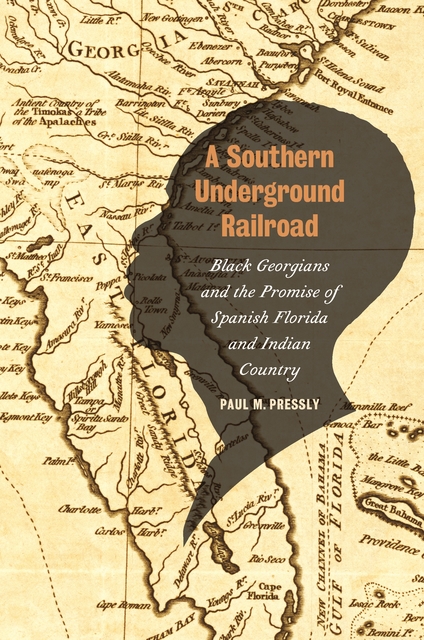
The attack on Prospect Bluff holds center stage in the ninth and final chapter of Paul M. Pressly's impressive study, A Southern Underground Railroad, a heroic effort to recover the nuances of a rich yet impossibly complicated subject — the "southern underground railroad" of eighteenth- and nineteenth-century Florida. Former director of the Ossabaw Island Education Alliance, on coastal Georgia, Pressly understandably starts his study from the Atlantic barrier islands. While Gullah-Geechee people have long been cast as archetypes of preservation, as isolates holding African traditions alive, Pressly emphasizes mobility and freedom, telling a story of routes rather than roots. People of African descent, held captive in Georgia, worked through networks of communication and navigated braided channels of freedom across the St. Mary's River. Pressly teases out stories that largely occurred off-record, against the tangled status of liminal and contested landscape. A Southern Underground Railroad, in short, undertakes an extremely difficult task: to recover the stories of people who left a sparse written archive, from sources kept by those who sought to suppress them, from a milieu that typically falls outside the standard historiographic narrative of the early republic.
You have to work to get to this place. Whether academically or physically, we must actively recover the centrality of early Black Florida — because we know the stories are out there, even as the history hides in plain sight. All too often, scholars defer to default citation of Jane Landers, Black Society in Spanish Florida (1999), acknowledging past research without pushing the narrative forward. Others might recognize Kenneth W. Porter or Canter Brown, Jr. But the "southern" or "saltwater" underground railroad has never been secret. Joshua Giddings chronicled the Black roots of the Seminole War in his overlooked classic, The Exiles of Florida (1858), while Albery Allson Whitman twinned the two themes in an underappreciated epic, The Rape of Florida (1885). As early as the 1560s, with the founding of St. Augustine, Pedro Menéndez de Avilés would partly justify the invasion la Florida as halting a means to the flight of enslaved Caribbean people here. So why the gaps? Stories of self-emancipated people reach us today from the edges of the historical record, overshadowed by a nationalist narrative in the US, and almost always coming from the documentation left by enslavers and oppressors — not by those who found freedom themselves. These stories must be sought out.
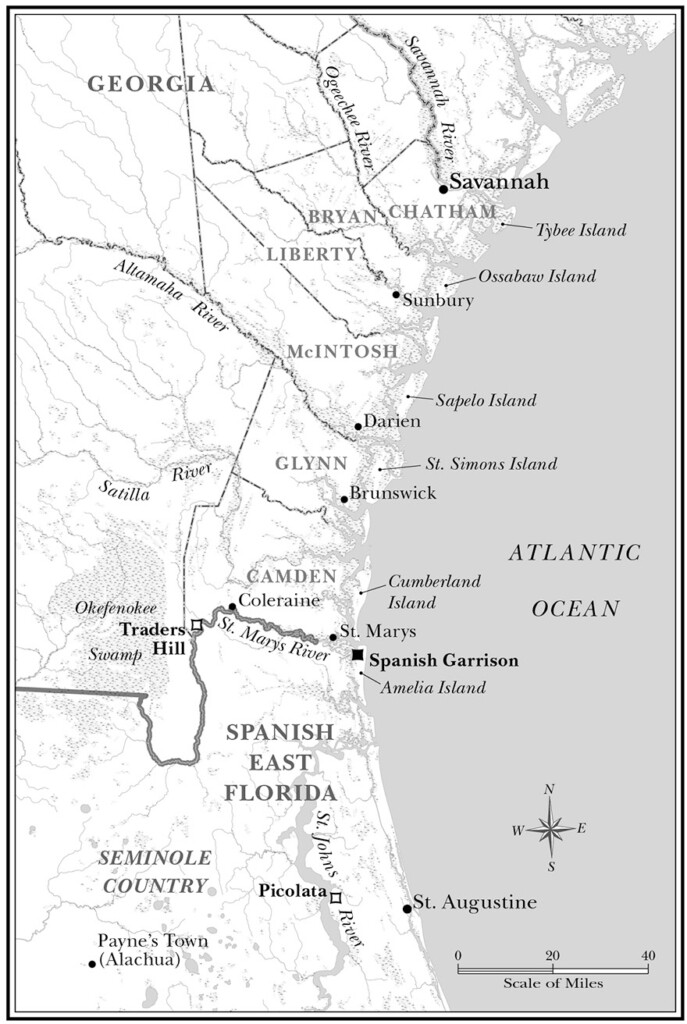
Pressly's exceptionally well researched study works largely from examples. He begins in 1781, with nine individuals on a dock at Ossabaw Island. Led by an expert seaman known as Hercules, the nine freedom-seekers sailed one-hundred miles south to St. Augustine, where they found protection under the British military. Pressly pieces together this story from notices in the Georgia Royal Gazette. By situating a single granular case against broader trends, then alongside corroborating scholarship from elsewhere, Pressly completes a patchwork recovery. The remainder of the book moves chronologically, from the mid-eighteenth century to the Seminole War, when the United States' invasion of a weakened Spanish Florida brought a close to this still-overlooked "underground railroad."
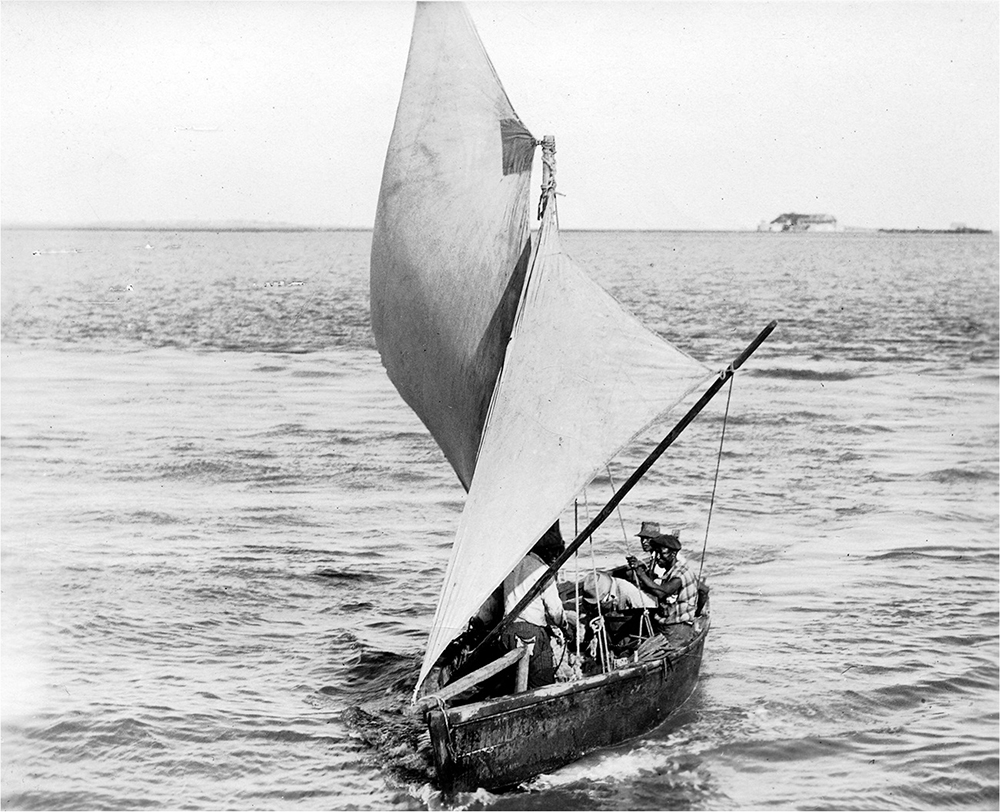
Pressly sets up a tale of two cities, Savannah and St. Augustine, separated by the mazy floodplain of the St. Mary's River. He emphasizes that in negotiating their southern path to freedom, individuals and groups asserted their liberty both apart from white intervention and with full knowledge of broader political movements. "Far from passive individuals," Pressly writes, "they were well aware of the geopolitical landscape, and the enslaved people were ready to seize the moment when the time seemed ripe to make a break for the freedom offered by Spanish Florida to fugitives from British colonies" (12). In chapter two, "The Journeys of Mahomet," Pressly uses the life of an African-born and (presumably) Muslim individual of that name "as a measure of the type of man" (35) who chose maroonage, as well as the "noteworthy presence of women" in a flight that "underscores their determination and courage" (47). Pressly returns to the example of Hercules, who "offers a map for navigating the full spectrum of the landscape for Black people in revolutionary Savannah" (54). Hercules faced any number of options during the Revolutionary conflict, though amidst the disruption, he and other Black fugitives laid the groundwork that would provide freedom for decades to come.
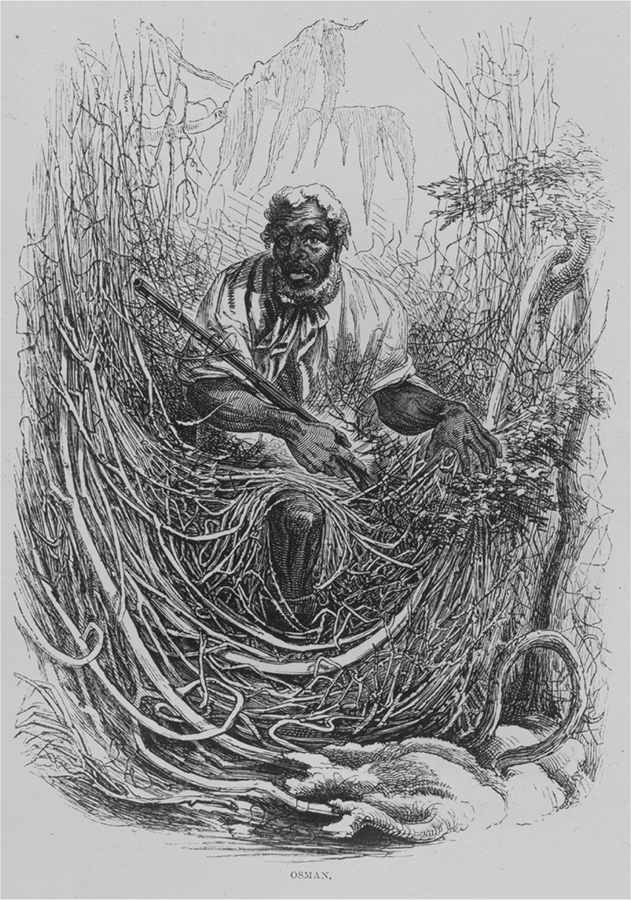
"Entangled Borders" revisits the colonial boundary line of the St. Mary's River during Florida's second Spanish period (1783-1821), when "East Florida and southern Georgia evolved into one large zone of transition," in which "weak central authority" opened the space for "fugitives to find a path forward toward a new life" (76-77). Those escaping bondage often did so in groups, led by a skilled waterman over international boundaries, and the effort required careful planning and fortitude. The Spanish crown had long granted a modicum of rights to free Blacks, and the draw of a more liberated and permeable Florida generated anxiety in what is now the southern United States. Pressly’s chapter, "A Maroon in the Revolutionary South," recounts the "exploits of a man named Titus," whose choices "illuminate several faces of maroonage on the Georgia and Florida coasts and the fluidity of the borders" between them (94). These choices were exceedingly complicated; Titus was a "dancer" (102), having fled Georgia's Ossabaw Island yet remaining close to family and on the fringes of the plantation. His story illustrates a central theme of A Southern Underground Railroad: freedom amidst connection, runaways who were "connected with the realities of the Atlantic world" (111). This should come as no surprise, yet it bears restating: maroonage was complex.
These complexities are visible in the careers of two white men who thrived along the boundaries — John (or Juan) McQueen and William Augustus Bowles. Son of a Charleston merchant, schooled in England, and returning to South Carolina as a sea captain, McQueen swapped sides as economic needs suited him; in 1791, he emigrated to Florida and declared allegiance to Catholic Spain, taking 280 enslaved people with him. An even more bizarre episode involved William Augustus Bowles, a Loyalist who schemed to establish an Indian-British State of Muskogee. The conditions for boundary crossing lead Pressly to one of the more vexing problems of the book, the status of free Blacks among Native people.
In these intercultural cases especially, readers of a certain age may find in Pressly's monograph a southern version of Richard White's Middle Ground (1991). As with White's Ohio Valley, new and provisional identities were forged on an unstable borderland, where no single imperial power held control; on a still-contested frontier, individuals acted upon surprising possibility — then, in the decades after the War of 1812, the middle ground closed. A Southern Underground Railroad draws out the impossibly complicated intersections between chattel slavery and Native American life. After the Revolution, Creek conceptions of slavery shifted from kinship to commodification. Who, then, was a war captive and who was a slave? When Native people attacked a plantation, on which side would captive Blacks fight? Responses varied. Many Black Georgians "were horrified at the thought" of entering "a new form of slavery" among the Creeks (139); yet where most "Black people resisted capture," others "saw the arrival of warriors as an opportunity to break out of their oppressive condition" (140, 141). This historical landscape defies pat explanations. Drawing from an archive that is decidedly committed to perpetrators, Pressly unpacks stories still "wrapped in mystery" (145), reconstructing negotiations that escaped not only "the most determined [white] planters" (149), but no doubt the historian himself! An achievement of this book is threading a coherent narrative from this documentary labyrinth.
Pressly turns the study further south, to Florida, where Black Georgians saw "their best hope for securing freedom" among Seminole "migrants who trickled in from different spaces and for different reasons" (156). In defining the relationship between Black and Native life, Pressly must concede to an historiographic aporia: the impossibility of generalizing any one kind of relation, particularly from documentary evidence left mostly by whites. Would people of African descent on the Florida frontier be classified as freedom seekers, Black Seminoles, or as maroons? Scholars have "puzzled over" what terms to use (158), and the years from 1803 to 1812 especially, defined by a "diversity of conditions," must be understood with a "delicate balance" (175).
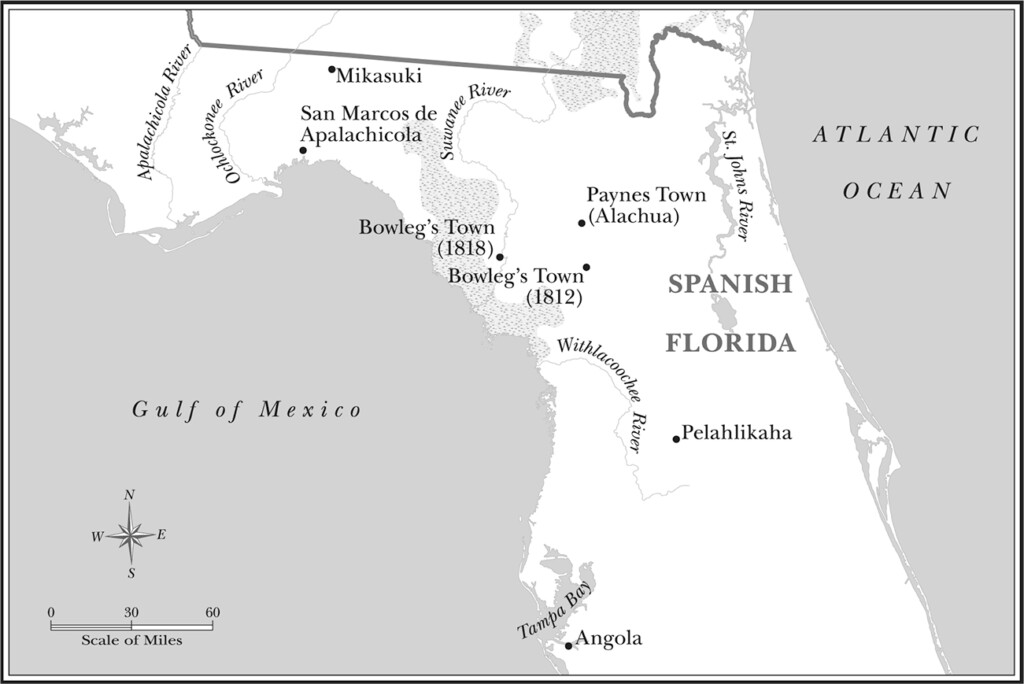
This "distinctly unsettled moment" (180) comes to a close with the US war against the Seminoles, the conflict that brings Pressly to Prospect Bluff. The book’s final chapter reviews the beginnings of this four-decade conflict (roughly, 1812 to 1858). Among the many stories, Pressly traces the fate of freedom seekers (or Black Seminoles, or maroons — any one term is not fully correct) from the Florida Panhandle, to encampments along the Suwannee River, to the "Angola" colony along Tampa Bay. Pressly’s brief Conclusion traces the closing of this southern middle ground, noting that while "the taming of a troublesome borderland for white Southerners was far from complete," the "outcome [was] no longer in doubt." (205). This four-page ending to a such a remarkably detailed study signals something of a disappointment. A Southern Underground Railroad collects case studies, rarely diving into methodology in any overt way, and as the book's short closing note reveals, Pressly rarely points to methodological concerns.
Coming at it from the perspective of a literary critic, and not a historian, I found this book about sandy Florida to be a bit theory-poor. The Conclusion belies that weakness. Keeping within an entrenched narrative, Pressly explains how the Southeast "offers a vital link" between Black Emancipation and the American Revolution. The story of Black Floridians "marks the passing of the torch of liberty from the generation of the Revolution to those who belonged to the era of the Underground Railroad, a grand connecting arc that stretches over a forty-year period" (208).
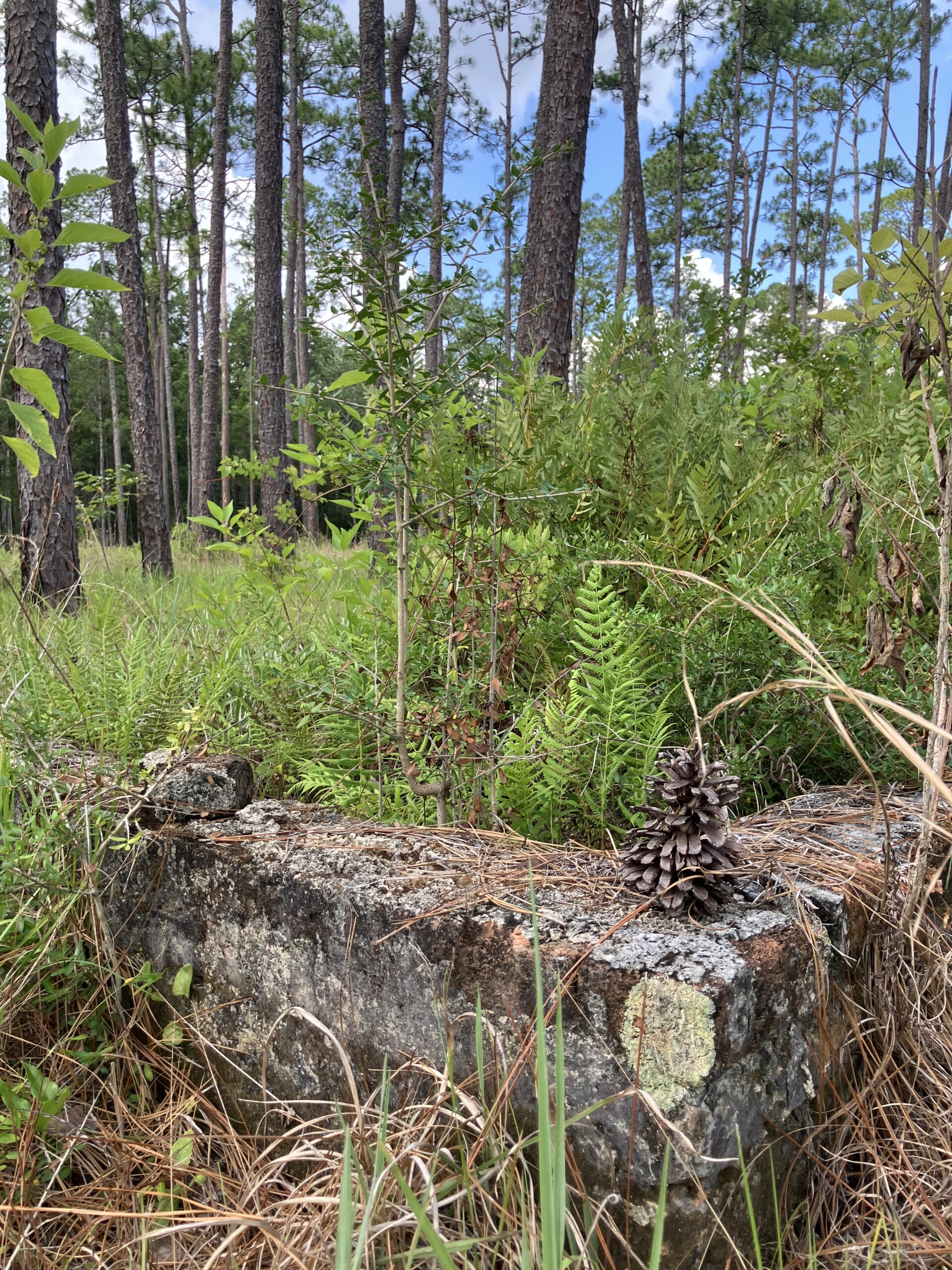
But I would have liked a stronger takeaway. The default to a national narrative feels unsatisfying precisely because conventional methodologies and storylines fail to cohere. The first problem is evidentiary. How does one reconstruct events from escaped people, while relying upon documents by their captors? What other source materials can one consider — oral traditions, art, non-sequential histories? Or, if the documentary record leaves the historian bereft, why not lean into speculation? Pressly's more satisfying moments are when he settles on "puzzling." And lastly, where does a study such as this one lead us today? Following a far more visible trail of print sources, historians of slavery rightly trace a storyline from national liberty to a literature of social reform to Emancipation. But as Langston Hughes wrote, in different context: "I wonder if it's that simple." When, in the United States, will we let the margins define the center? As we remain a nation prone to sliding backwards, where past gains have proven to be far from definitive, would it not be far more effective to take the half-steps, ambiguities, and blended allegiances as normative? These are, as Pressly documents, far more difficult pockets of ambiguity to unpack. They exist off the usual tourist map. They take us down county routes and dirt roads, not to well-marked interstate exits. The many stories of Black Floridians during this period remain to be written. It will take continued efforts, such as A Southern Underground Railroad, to draw them out.
About the Author
Thomas Hallock received his PhD from New York University. He is the author of From the Fallen Tree: Frontier Narratives, Environmental Politics and the Roots of a National Pastoral, 1749–1826 (Chapel Hill: University of North Carolina Press, 2003) and the co-editor of Early Modern Ecostudies: From the Florentine Codex to Shakespeare (New York: Palgrave Macmilian, 2008), William Bartram, the Search for Nature's Design: Selected Art, Letters and Unpublished Manuscripts (Athens: University of Georgia Press, 2010), and Travels on the St. Johns River: John and William Bartram (Gainesville: University of Florida Press, 2016). He recently published a series of travel and place-based essays that explain why he loves teaching the American literature survey, A Road Course in Early American Literature: Travel and Teaching from Atzlán to Amherst (Tuscaloosa: University of Alabama Press, 2022). In 2023, Southern Spaces published Hallock's multi-media article, "Draining Paradise: A Tour of Salt Creek in St. Petersburg, Florida."
]]>
During the night of June 19, 2023, the first federally recognized Juneteenth holiday, an unknown vandal or vandals desecrated by fire a much-beloved child's mid-nineteenth-century headstone in Washington, DC's oldest African American burial ground, the Mount Zion–Female Union Band Society cemetery in Georgetown. For a quarter century, visitors to the grave marker have left objects—dolls, toys, and birthday cards—a practice that harkens to the nineteenth century history of the cemetery. Why has this particular child's memorial become the scene of gift-giving? And why did it become a site of apparent racist attack? Equally puzzling is the identity of the child. The simple, crowned bluestone marker bears the following inscription:
Nannie
Born May 26, 1848
Died May 18, 1856
The identity of "Nannie" has been a mystery for generations. Her short life spanned momentous events in local and national African American history. She was born one month after the ill-fated mass escape of enslaved people on the schooner The Pearl, the largest attempted self-liberation event in antebellum US history. She was two years old in 1850 when the slave trade (although not slavery) within the District of Columbia was banned and the Fugitive Slave Act made life precarious for free people of color within the District. She was four when Uncle Tom's Cabin was published, six when fugitive slave Anthony Burns was arrested in Boston and shipped back to Virginia, enraging abolitionists during the same year the Republican Party was founded. Nannie was seven when open mass violent conflict erupted in Kansas. In the month of her death, the US Supreme Court called for re-argument of Dred Scott v. Sanford, leading to the majority opinion in March 1857, authored by Chief Justice Roger Brooke Taney, holding that persons of African descent "had no rights which the white man was bound to respect."
This essay places Nannie's enigmatic gravesite and headstone in the context of the social, political, and spiritual history of the cemetery. We then propose an identity for the girl commemorated as "Nannie," who died one week shy of her eighth birthday, and consider why her resting place has become a compelling site of emotional connection, commemoration, and resistance. Finally, we speculate as to why persons unknown, on the night of Juneteenth, sought to attack this particular site.
The Mount Zion–Female Union Band Society Cemetery
Many District of Columbia residents have incorrectly assumed that Mount Zion Cemetery is composed of a single burial ground. A three-acre property, it actually consists of two separate but adjacent cemeteries of equal size: the old Methodist Burying Ground (now known as Mount Zion Cemetery), and the Female Union Band Society Cemetery.1Stanton L. Wormley, ed. Mt. Zion Cemetery: Washington, DC, Brief History and Interments, comp. by Paul E. Sluby, Sr. (Washington DC: Columbian Harmony Society, 1984); Paul E. Sluby, Sr., Bury me deep: Burial Places Past and Present in and Nearby Washington, D.C.: A Historical Review and Reference Manual (Temple Hills, MD: P.E. Sluby, 2009). In 1931, the Federal Government took one half acre of the earlier cemetery grounds to create Rock Creek Parkway and an adjacent horse riding trail. The grounds are now under the authority of the National Park Service.
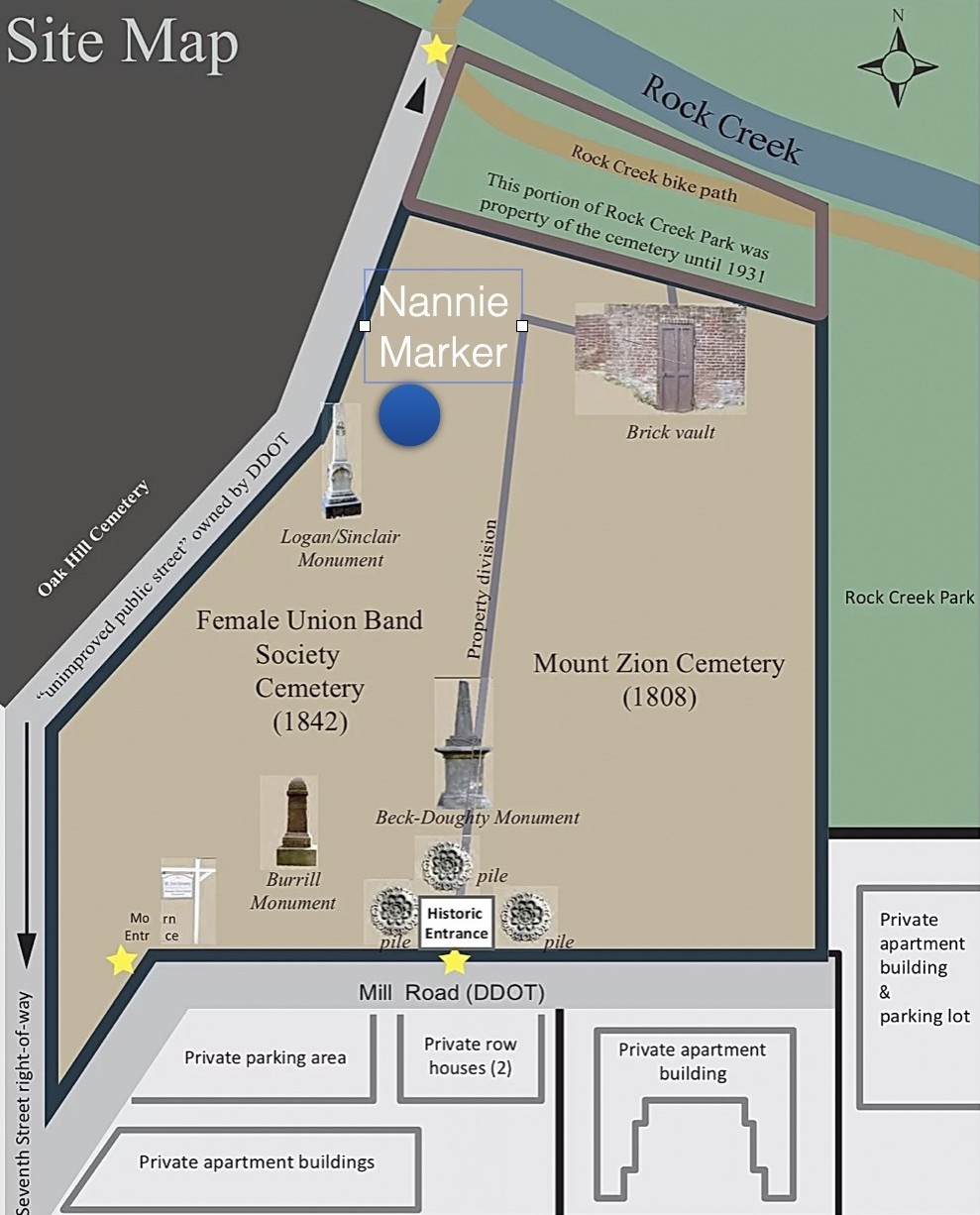
The old Methodist Burying Ground was purchased in 1808 by the Montgomery Street Church in Georgetown, one of the first Methodist churches in the country, founded in 1772 (known today as the Dumbarton United Methodist Church).2The church was formerly located on Twenty-Eighth Street between M and Olive Streets, N.W. (formerly Montgomery Street between Bridge and Olive Streets), approximately one-half mile southwest of the cemetery. At the beginning of the nineteenth century the membership of the Montgomery Street Church was almost 50 percent Black and included free and enslaved congregants. Upset with segregated and racist practices, 125 Black members left Montgomery Street in 1816 and formed the first Black congregation in the District of Columbia, known then as the Meeting House or the Little Ark, and today as Mount Zion United Methodist Church. The two Methodist churches, white and Black, continued to share the Methodist Burying Ground until after the Civil War.3The land was purchased from Thomas Beall, who had inherited extensive property from his grandfather Ninian Beall (1630–1717). In the early nineteenth century, Beall owned about fifteen slaves and many properties in Maryland and the District of Columbia, including the properties now known as Dumbarton House, Beall-Washington House, Conjuror's Disappointment and Rock of Dumbarton. He served in the 1790s as the second Mayor of Georgetown and played an important role in establishing the District of Columbia. On Dumbarton Methodist, see: Jane Donovan, Many Witnesses: A History of Dumbarton United Methodist Church 1772–1990 (Washington, DC: Dumbarton United Methodist Church, 1998); J.W. Cromwell, "The First Negro Churches in the District of Columbia," The Journal of Negro History 7, no. 1 (1922): 64–107; Janet Lee Ricks, "Mt. Zion United Methodist Church Marks 185th Anniversary," Washington History 13, no. 1 (Spring/Summer 2001): 71–73.
Around 1832, a group of free women of color formed a benevolent organization, the Female Union Band Society (FUBS). A decade later and for $250, they engaged Joseph T. Mason—schoolteacher and free man of color—to purchase a plot of land adjacent to the Old Methodist Burying Ground to use as a burial ground for the society's members and their families. Court records indicate the land was acquired from Joseph E. Whitehead of New Orleans. Mason ran a school within the Black church that after 1844 was known as Mount Zion Methodist. If Nannie was a free child of color in the vicinity, Joseph Mason most likely taught her as a pupil.
It is also believed that these burial grounds also served as a refuge on the Underground Railroad. Mount Zion Church and the burial holding vault located on the Mount Zion Cemetery property are said to have opperated as hiding site for escaping "passengers" heading north. Over the first half of the nineteenth century, the numbers of enslaved in the District of Columbia declined. By 1850 (when Nannie was two years old) 3,185 of the 13,746 Black inhabitants are listed as enslaved. In DC, enslaved and free persons often lived, worked, and worshipped together, although their life conditions were often precarious.4Pauline Gaksins Mitchell, The History of Mt. Zion United Methodist Church and Mt. Zion Cemetery, 51 (Washington, DC: Records of the Columbia Historical Society, 1984): 103–18. The History of Mt. Zion United Methodist Church is 51st separately bound book; Stella Mae Richard, "Two Hidden Cemeteries in the Georgetown Section of Washington D.C.," Negro History Bulletin, Washington 32, no. 8 (Nov 1969): 29.
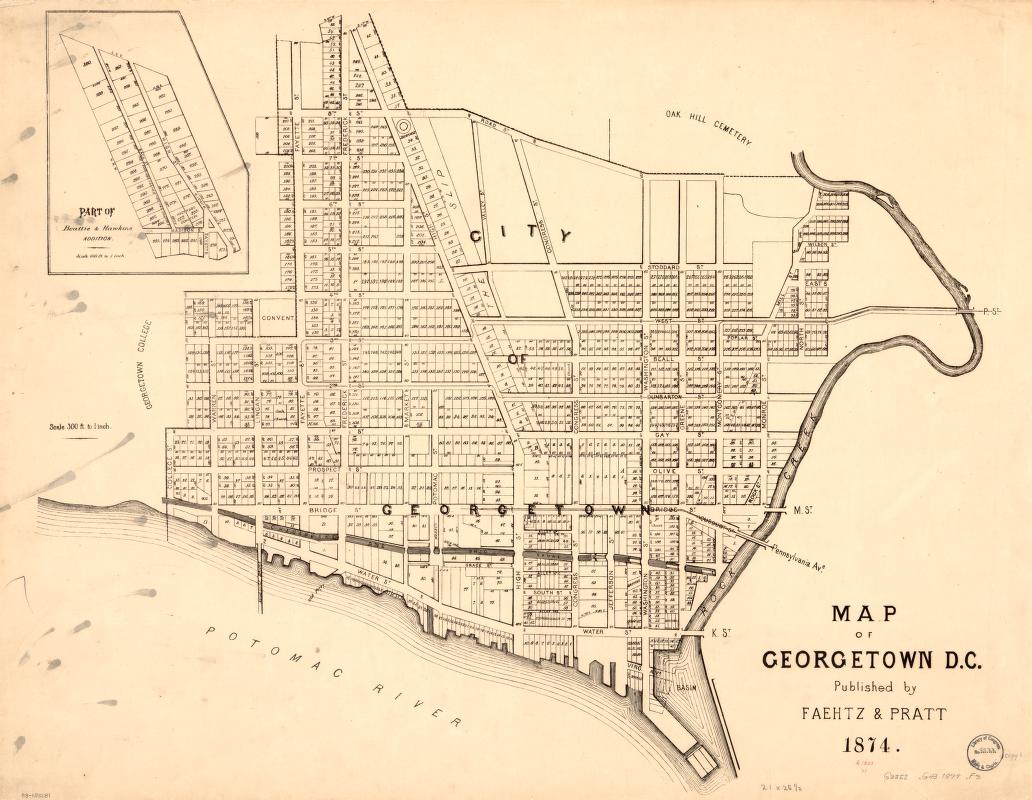
In 1849, Oak Hill Cemetery, reserved for white burials, was established by the financier, philanthropist, and former slaveowner William Wilson Corcoran (1798–1888), later denounced as a Confederate sympathizer, who after the Civil War founded the Corcoran Gallery of Art.5In 1830, Thomas Corcoran, William Wilson Corcoran's father and sometime mayor of Georgetown, owned five enslaved people. The 1840 census indicates that William Wilson Corcoran owned one male enslaved person between the ages of ten and twenty-three and three free women of color, who may have been previously enslaved by him; all resided in his household. In 1845, William Corcoran manumitted the enslaved woman Mary and four of her children. (National Archives and Records Administration, Records of the U.S. Circuit Court for the District of Columbia, Records of Manumission, vol. 3, Record Group 60, Washington, DC; cited in Mark Laurence Goldstein, "Capital and Culture: William Wilson Corcoran and the Making of Nineteenth-Century America" (PhD diss., University of Maryland, 2015), 30–31. This woman may appear in the 1850 census as Mary Degges, born 1819, married to Judson Degges, with children Adelia, born 1834 and Mary, born 1837. Corcoran's "Last Will and Testament," September 6, 1887, provides a stipend of $200 to a woman named Mary Neale, "once owned by me, and long since manumitted." This person may be the Mary Neil who evidently married John Neil in 1875, and may have been born as Mary Degges, daughter of the older Mary Degges. This 22.5 acre cemetery sits adjacent to the Female Union Band Society Cemetery and is separated by a sliver of elevated land, Lyon Mill Road, that served as a path leading to a mill within present-day Rock Creek Park. After Oak Hill opened, whites at the Methodist church gradually abandoned the Methodist Burying Ground and began to disinter their white relatives and re-bury them in Oak Hill and other "white only" cemeteries around the city. Early references to the area that became Mount Zion Cemetery are to the "Methodist Episopal Burial Ground of Georgetown," the "Old Methodist Burial Ground," or the "Colored Methodist Burial Ground."6Richard P. Jackson. The Chronicles of Georgetown DC from 1751 to 1878. (Washington DC: R.O. Pokinhorn, Printer, 1878), 270; Wesley E. Pippenger, District of Columbia Interments (Index to Death), January 1, 1858 to July 31, 1874 (Westminster, MD: Heritage Books, 1999), xix. The land in question is north of Q Street and east of Lyons (Mill) Road (now an extension of 27th street) and Oak Hill Cemetery, extending down hilly slopes to Rock Creek. Over time, the eastern section of this burying ground became known as Mount Zion Cemetery (or Mount Zion East) and the western zone as the Female Union Band Society cemetery. By 1879, white parishioners entirely ceased using the Old Methodist Burying Ground and leased it to Mount Zion Church for ninety-nine years, its name officially changing to "Mount Zion Cemetery."
As racist policies and practices pushed many Black residents out of Georgetown over the next half-century, the cemetery suffered neglect and abandonment. The final burial in Mount Zion took place in the early 1950s. The District's department of health condemned the two cemeteries in 1953, prohibiting future burials. In the 1960s, developers sought to buy the land and disinter the remains in both burial grounds. African American activists, including the Afro-American Bicentennial Corporation (ABC), energetically resisted these plans, and in the mid-1970s secured court and appellate rulings that safeguarded the cemeteries' futures as a memorial park, with disinterments prohibited. As part of planning and restoration, many headstones and markers in both cemeteries were relocated and consolidated in 1975, evidently with the intention of restoring and returning them to their original positions. However, given the fragility of the stone tablets, they were left in place and not returned.7Before the moving of the stones, Mount Zion stones were mapped with a good deal of detail; the Female Union Band Society mapping was, it appears, less thorough. Richards, Two Hidden Cemeteries, 29; Mitchell, The History of Mt. Zion United Methodist, 103–118; Kathleen Menzie Lesko, Valerie Babb, Carroll R. Gibbs, Black Georgetown Remembered: A History of its Black Community from the Founding of "The Town of George" in 1751 (Washington, DC: Georgetown University Press, 2016); Steven J. Richardson, The Burial Grounds of Black Washington: 1880–1919 (Washington: DC: Records of the Columbia Historical Society, 1989), 52: 304–326. Burial Grounds is the 52nd separately bound book.
The cemeteries were added to the National Register of Historic Places in 1975. The joint cemetery is now maintained by the non-profit Black Georgetown Foundation (until recently The Mount Zion–Female Union Band Historic Memorial Park, Inc.) The cemeterties' survival and restoration in the face of powerful white-dominated development interests is celebrated as a miraculous point of deep pride. It is located at the very top of Georgetown, one of the wealthiest and whitest quarters of the city, adjacent to Oak Hill Cemetery, where many of the city's elite white residents have been interred since the mid-nineteenth century. It sits besides Dumbarton House, a structure long associated with prominent white slaveowning families, now the national headquarters of the Colonial Dames of America. It overlooks Rock Creek Park, the greenway that connects the metropolitan area's wealthy northwestern suburbs to the downtown seat of government. The cemetery represents, for many, a defiant unofficial monument to Black struggles for self-determination in a historically Black city undergoing rapid gentrification, still denied statehood and Congressional voting representation.8US District Court Judge Oliver Gasch reversed the order allowing disinterment by developers in order to build condos, stating that such action by the heirs and developers "cannot but offend the sensitivities of civilized people." "Equally important," said the judge, "is the fact that not only would such a degradation be perpetrated against the dead, but in this instance the violation of their graves involves the destruction of a monument to evolving free black culture in the District of Columbia." Female Union Band Ass'n v. Unknown Heirs at Law, 403 F.Supp. 540, 547 D.D.C. 1975.
Gravesite Objects as Memorialization Practices
Since organized efforts began in the 1970s to safeguard and restore Mount Zion, volunteers have often come across bottles, pottery shards, sea shells, and related objects. Frequently dismissed by officials as "debris" or "trash," these objects are interpreted by guardians of the cemetery as traces of much older Black memorialization practices, dating back into the era of enslavement.
Strong evidence for this interpretation is provided by a series of newspaper articles, widely reprinted during August and September 1894, documenting popular memorial practices in Mount Zion cemetery. Local African Americans regularly placed objects associated with the life experiences of the deceased on gravesites, including medicine bottles containing residue of medications taken during final illnesses.9Versions of this story are reprinted in the Gazette (York, Pennsylvania), 10 Aug 1894, 5, The Clarion Ledger (Jackson, Mississippi), September 10, 1894 and many other newspapers in August and September 1894. In the articles, Sexton Henry Bowles (c. 1840–1907) explained that familiar toys and tools encouraged the spirits of the dead to "confine their manifestations to the cemetery," rather than haunting the living. On the grave of a "Mr. Johnsing" (perhaps Henry Johnson, who died in December of 1893) his widow placed a wooden hobby horse, "buried up to its haunches," commemorating the dead man's occupation as an express wagon driver, as well as his beloved horse. Each night, she explained, her late husband's spirit would hitch and unhitch the wooden horse, and thus be distracted from tormenting his surviving kin. The half-burial of the horse evoked the object's transitional status, mediating between the realms of the Living and the Dead.
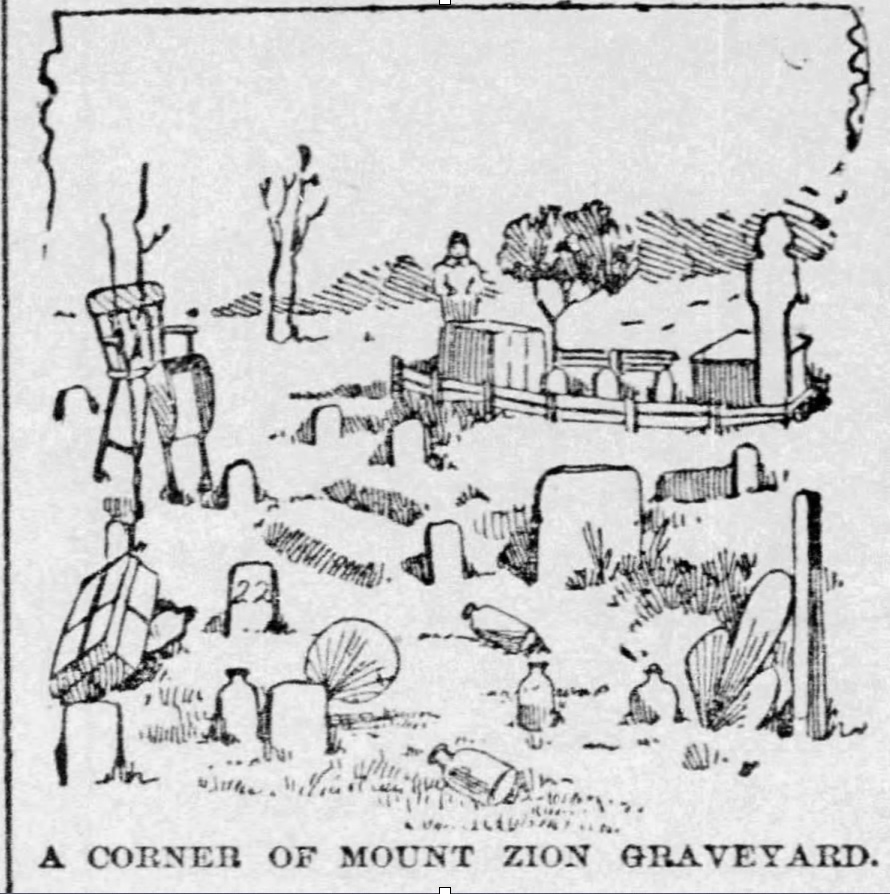
Placed on the grave of a young boy, a high chair and toy wheelbarrow signified objects of importance in his life. A woman named "Lize Lundy," who was fond of wearing a new bonnet to church each Sunday, was honored with her final bonnet and a hand mirror placed on her grave. A particularly complex grave assemblage, perhaps for a military veteran, featured a mound guarded by two large toy soldiers, with smaller soldiers in front of each large soldier; at the mound's center stood three upright bottles. The items may be thought of as "transitional objects," easing the transition from one life stage to another. By repeatedly touching intermediate objects, mourners gradually come to terms with a painful loss and in time relinquish the full burden of their immediate grief.10D.W. Winnicott, Playing and Reality (London: Tavistock Publications, 1971); Melanie Klein, "Mourning and Its Relation to Manic-Depressive States," The International Journal of Psychoanalysis 21 (1940): 125–153; Ellen Schattschneider, "Buy Me a Bride: Death and Exchange in Northern Japanese Bride-Doll Marriage," American Ethnologist 28, no. 4 (2001): 854–880.
These practices are consistent with vernacular African American grave decorations widely documented throughout the Americas, having African antecedents, and transmitted by enslaved and free people across the generations.11Jamieson, Ross W., "Material Culture and Social Death: African-American Burial Practices," Historical Archaeology 29 (1995): 39–58; John Michael Vlach, The Afro-American Tradition in Decorative Arts (Cleveland, OH: Cleveland Museum of Art, 1978). Bottles, shells, pottery and other elements are held to ward off mystical dangers and ease the Dead's transition into the other world and towards ancestral status.12Thompson, Robert Farris, Flash of the Spirit: African & Afro-American Art & Philosophy (New York: Random House, 2010); Vlach, The Afro-American Tradition in Decorative Arts, 142; Savannah Unit Georgia Writers' Project Work Administration, Drums and Shadows: Survival Studies among the Georgia Coastal Negroes (Athens: University of Georgia Press, 1940).
The Nannie Stone in the Modern Era
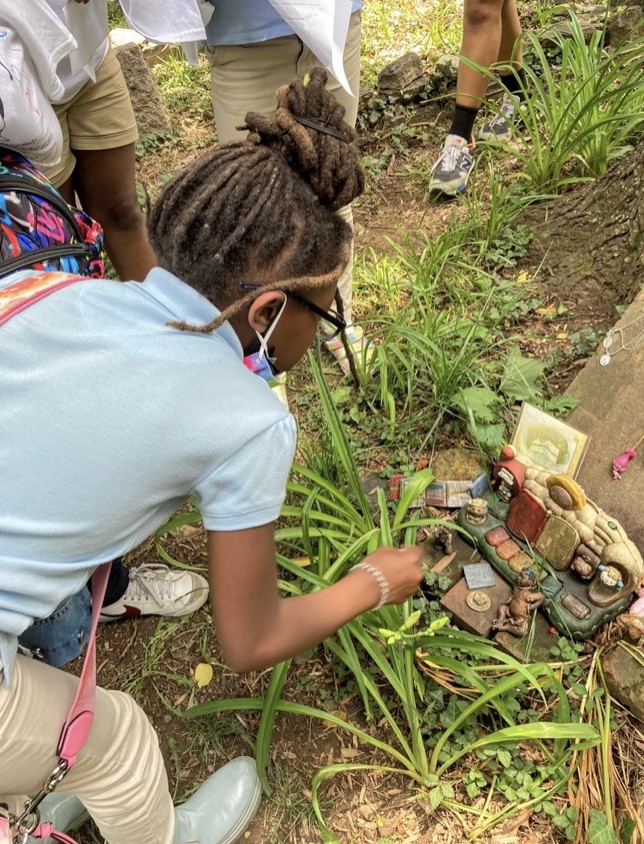
Public attention to Nannie's gravesite is largely due to the efforts of Omar "Casey" Ibrahim, born around 1936, who during the summer 1997 worked as a volunteer to clear and help restore the cemetery, much of which had been inaccessible due to fallen limbs and extensive weeds and vines. At an October 1997 ceremony, Ibrahim pointed to Nannie's burial site, which was marked only by a fallen-over slab. He urged each person to adopt a gravesite to care for. "I've adopted Nannie . . . I'm going to set her stone up straight and clean all around there. Then I'll put up a little red fence. And then I'll give her a teddy bear and other toys that children like."13Linda Wheeler, "Black Church Honors it Historic Cemetery," Washington Post, October 14, 1997. Mr. Ibrhaim and his daughter continued to place objects at Nannie's memorial for several years. Inspired by this example visitors across the subsequent years have placed objects, including dolls, ribbons, toys, and birthday cards, in front of the Nannie headstone.14Theresa Vargas, "Someone Keeps Leaving Toys and Birthday Cards at a 7-Year-Old's Grave in a Historic Black Cemetery. No One Knows Who," Washington Post, April 17, 2021. The marker has catalyzed speculation and a series of commemorative art works, including by artist Lindsey Brittain Collin, inspired by dolls left at Nannie's graveside.
Nannie's grave marker is currently located within the old "Female Union Band Society" section, at times referred to as "Mount Zion West." The headstone is propped up against a tree. Like many stones in the cemetery it has been moved at least once. Its original location is not marked on the 1970s' survey, but was well within this section—which means that Nannie was almost certainly a child of color who was part of the substantial free Black population residing in Georgetown and other DC neighborhoods. It is possible, however, that she was enslaved for some or all of her short life. Slavery was legal in the District until April 16, 1862, when an act of Congress instituted a compensated emancipation system.15Mary Mitchell, "'I Held George Washington's Horse': Compensated Emancipation in the District of Columbia," Records of the Columbia Historical Society, Washington, DC 63/65 (1963–1965): 221–229; Reidy, Joseph P, "The Winding Path to Freedom under the District of Columbia Emancipation Act of April 16, 1862," Washington History 26, no. 2 (2014): 18–22. The complex relationships between enslaved and free persons of color in the antebellum District of Columbia are examined in Mary Corrigan, "A Social Union of Heart and Effort: the African-American Family in the District of Columbia on the Eve of Emancipation" (PhD diss., University of Maryland, 1996). The broader context of DC emancipation is addressed in Kate Masur, An Example for All the Land: Emancipation and the Struggle Over Equality in Washington, D.C. (Chapel Hill: University of North Carolina Press, 2010).
Considering "Nannie"
Who was Nannie, and why was this striking headstone? The inscription is done professionally and with great care, which suggests that it was paid for by someone of means, or with access to a network of supporters who helped fund the purchase.
Why was only the child's first name used, given that surnames are usually inscribed on Mount Zion–FUBS headstones? Possibly because the child was buried within an extant family plot that was obscured through the relocation of markers in the 1975. Or, if Nannie had been fathered by a prosperous white man with a woman of color, outside of wedlock, the father might have paid for a headstone, but been unwilling to authorize his surname.
The name Nannie, like Anne, is derived from the Hebrew term for favor or grace. Nannie was sometimes a diminutive for Ann, Agnes, Nancy, or other girls' names. "Nannie" was also a girl's name in its own right in the mid-nineteenth century. The 1850 census records about seventeen free women of color named "Nannie" living in the United States. The 1870 census, the first to list all African Americans, lists about two-thousand black women named Nannie. An obelisk to Nannie Diggs, who died October 23, 1923, at age sixty-on, was erected by her daughter Katie Anderson in the same section of the cemetery as the headstone to the mysterious child "Nannie." The records of the Mount Zion–FUBS cemetery list two other Nannies: Nannie Diggs, born 1852 in Virginia, and a Nannie Washington, born 1858, also in Virginia. The most prominent Black Washingtonian bearing the name "Nannie" was the pioneering educator and religious leader, Nannie Helen Burroughs, 1879 –1961, born in Virginia, and a member at 19th Street Baptist. Two months before the death of the young "Nannie" buried in Mount Zion, the Evening Star (DC) reported the death of "Old Aunt Nannie," an enslaved woman at the purported age of 112 years near Powhatan Courthouse, Virginia."16Evening Star (Washington, DC), March 6, 1856, 3.
A Candidate for Nannie: William Teney's Child
Official registers of death were kept in the District of Columbia for Black and white burials from 1855 onwards. However, a register of burials of the Joseph F. Birch Funeral Home, was kept from January 1, 1847 for white and Black burials, and is an invaluable historical resource. Children's deaths were listed by the name of the parent (usually the father) followed by the word "child." The Birch's "Register of Burials, Colored Persons" begins with death #1, January 11, 1847, "Colbert's child," buried in the "Colored Methodist Ground" (the cemetery later known as Mt. Zion). Nineteen pages later, under May 1856, the register lists death #368, "Wm Teney child," as interred in the same Colored Methodist Episcopal Burial Ground. The precise date of death is somewhat ambiguous. The previous line, for death #367, is clearly May 11. Then, for William Teney's child, inverted double commas, indicating ditto, are given for the death date, which would seem to indicate May 11, whereas "our" Nannie, according to her headstone, died one week later on May 18. Nonetheless, other aspects of this child align with our search.17Paul E. Sluby and Stanton L. Wormley, eds., Register of Burials of the Joseph F. Birch Funeral Home, Volume I, (Washington, DC: Columbian Harmony Society, January 1, 1847–April 12, 1864). Also available as FamilySearch microfilm #008135478. Note that a reference to "William Tenney child," is not listed in in Pippenger, District of Columbia Interments.
The most reasonable candidate for William Teney strikes us as a free Black man William Tinny, age twenty or thirty, laborer, born in Maryland, listed with his family in the 1850 census. He is married to Bridget Tinny, born Maryland, age twenty-four, with three children: Sarah Tinny, age seven, born in Maryland c. 1843: Mary Tinny, age five, born in the District of Columbia, c. 1845; Francis Tinny, age three, born in the District of Columbia, c. 1847. Of these three children. Francis, who is born around 1847, is not mentioned in the 1860 census or other subsequent records, and is thus a strong candidate for "our" Nannie. Although Nannie was not a standard nickname for Francis in the period, it seems possible that Nannie was a term of endearment used for her within the family, perhaps rhyming with "Frannie."18Francis's father William appears in a November 15, 1827 District of Columbia manumission record:
"Know all men, by these Presents that I Charles Teney of Washington County in the District of of Columbia for divers good causes and considerations, me thereunto moving [?] and also in further consideration of the sum of one dollar to me in hand paid have released from slavery, liberated and manumitted and set free, and by these present do release from slavery, liberated and manumit and set free my slave woman named Matilda Teney aged about thirty five years, and her three children Anne aged about thirteen years, Andrew aged about three years and William Don Otious aged about 19 months, and able to work and gain a sufficient livelihood and maintenance, which said mentioned slaves were obtained by me as heir at law of my son William Don Otious Teney late of said County deceased, and them the said Matilda and her three children, Ann Andrew and William Don Otious I do declare to be henceforth free, manumitted and discharged from all manner of servitude and service to me and my executors, administrators, or assignees forever. In presence of Lemuel J Middleton and A Balmance."
Two other candidates for "Nannie" are suggested by comparing the 1850 and 1860 censuses: (A) The daughter "Ann" (born about 1848) of freed-people Francis Yates and Caroline (Smith) Yates, who later took the surname Cole, does not appear in the records after 1850. Francis and Caroline married three months before the birth of the "Nannie" memorialized on the headstone. Anna Yates, Black, one year old, died 10 August 1857 and was buried in Ebenezer African Methodist Episcopal burial ground; she may be related, but is clearly a different person; (B) Ann E. Twine, the daughter of coachman David Twine and his wife Caroline Gray Twine, both free persons of color in the District. David Twine was interred in Mount Zion in 1894. A member of Metropolitan A.M.E., David Twine came from a family with long connections to Georgetown and the local Black Methodist community. Both of these girls appear in the 1850 census but are not enumerated in the 1860 census or other records. However, Ann E. Twine may appear in the 1860 census as "Eliza Twine", ten years old, living with an older couple that may be her grandparents. Neither girl is indicated in the DC Register of Burials, so they seem much less likely candidates than the child of William Tenney, who died in May 1856 and who is recorded as interred in the "Colored Methodist Burial Ground."
Francis Tenney (c.1847–c.1856) was born into a free family of color who had been free in the District of Columbia for at least twenty years prior to her birth, and who had struggled intensively to achieve freedom. As noted in the appendices, her family clearly had an extensive network of free kin in the District of Columbia who in 1856 might have pooled resources to enable to purchase and inscription of the well-made headstone.
Desecration
During midday on Monday, June 19, 2023, the first time Juneteenth had been celebrated as a federal holiday, over two-hundred people gathered in Mount Zion-Female Union Bank Society Cemetery to honor the burial ground and the history of African American liberation. The event, organized by the Black Georgetown Foundation, which oversees the two burial grounds, had been widely advertised on social media and radio. Attendees, many of them first-time visitors to the site, were moved by the story of the struggle to preserve and document the cemeteries and the lives of those interred. The event culminated with a gathering in front of Nannie's headstone, where speakers reflected on the enigmas of her life and the history of antebellum Black Georgetown.
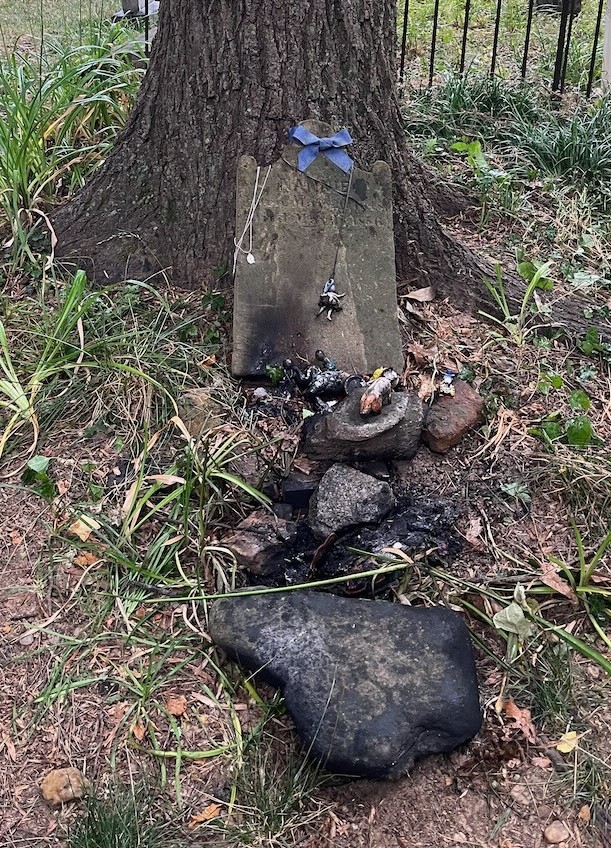
During the night of June 19–20, a person or persons unknown set a fire in front of the Nannie headstone, destroying or damaging toys and objects left as offerings during the previous year and leaving dark burn marks on the stone. The attacker was likely aware of the connection felt by thousands of people to Nannie, the preceding day's events, and the fact that in recent years this marker has, more than any other memorial on the grounds, compelled the greatest number of gifts.
The gravestone desecration and the burning of the objects was a form of racial terror, reminiscent of the burning and bombing of sites of Black assembly and resistance such as churches, and indeed, of the burning of victims of lynching. In the days following the fire, people stopped by the cemetery to give new offerings to Nannie.
Memorialization and #BlackLivesMatter
Why has Nannie's grave marker inspired such an outpouring of offerings and attention by scores of people with no direct kinship link to her? Certainly her young age is compelling, as is the approaching storm of national disunion during the span of her life. Perhaps equally significant are the still-ongoing crises of racism and inclusion in the United States. Her prominent, yet plain marker, is suffused with resonance for past and present injustices. The obscurity of her identity allows Nannie to evoke the "many thousands gone" among persons of color in the District and elsewhere. In the present era of #BlackLivesMatter and the continuous assaults on the rights of persons of color to own their bodies, the story of Mount Zion cemetery, nearly eradicated to serve commercial development interests, is particularly resonant. The restoration of this storied African American burial ground, now surrounded by multiples sites of white, elite privilege, is a powerful testimony to African American resilience and cultural vibrancy.
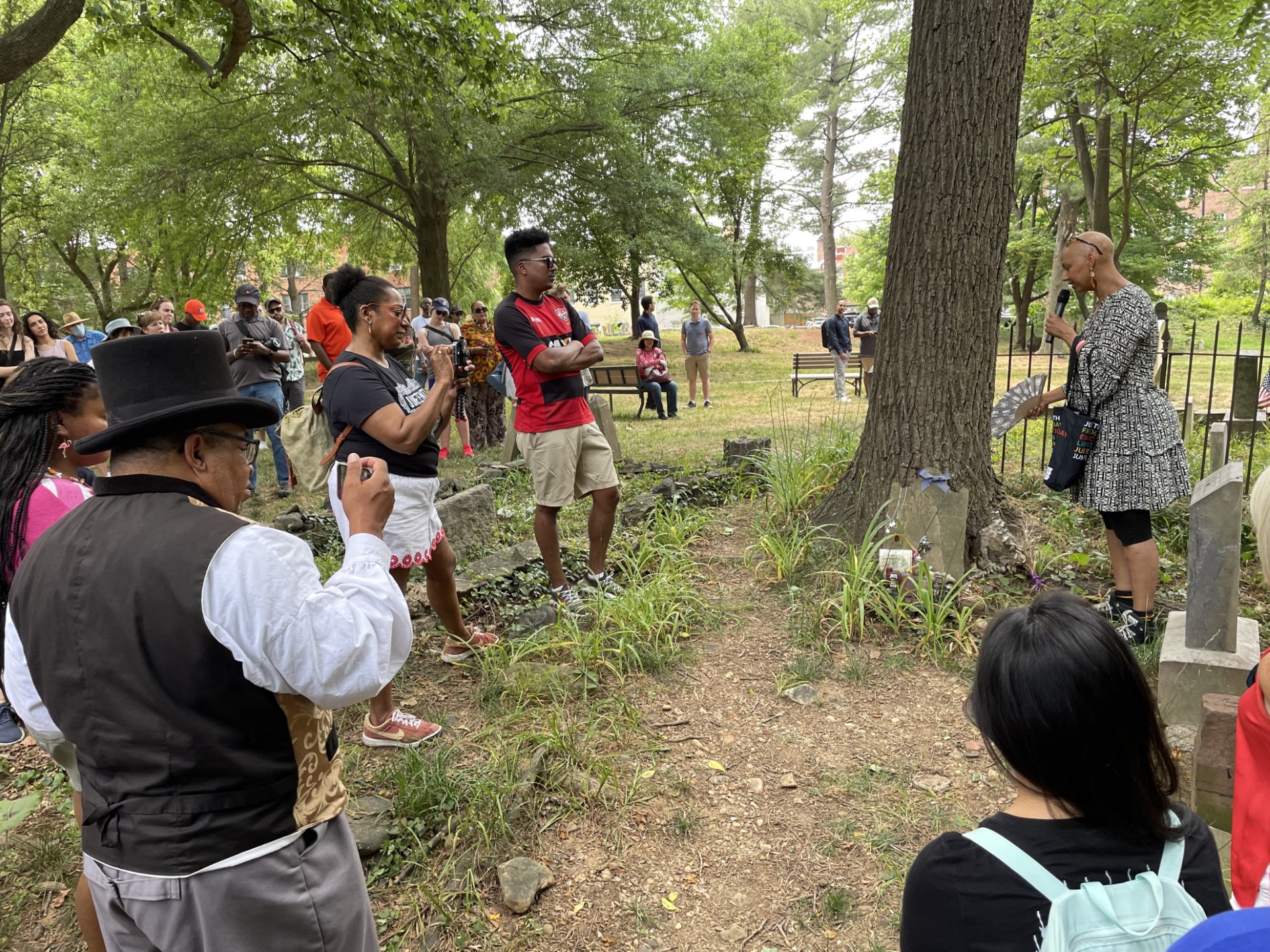
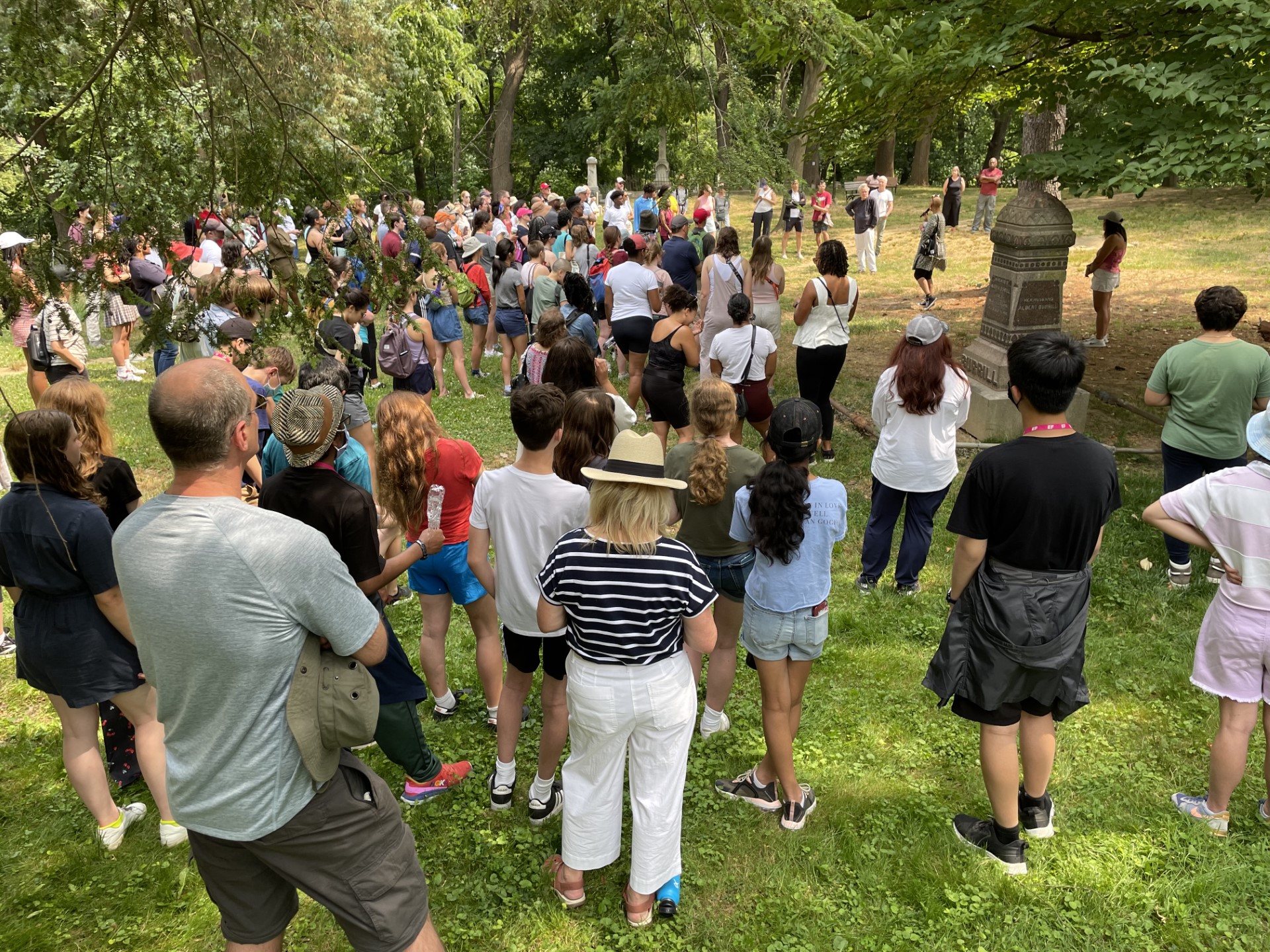
Nannie, for many, has come to represent hallowed ground and the larger history and geography of racial segregation, anti-Blackness, and liberation struggles within the District of Columbia. The centuries-old African-Atlantic practice of grave decoration, ubiquitous in this cemetery in the nineteenth century, has been revived to honor Nannie's memory—poignant testimony to the power of ancestral remembrance—as well as the continuing mission of activism.
About the Authors:
Mark Auslander is the author of The Accidental Slaveowner: Revisiting a Myth of Race and Finding an American Family (Athens: University of Georgia Press, 2011). He is a visiting faculty member in anthropology at Mount Holyoke College.
Lisa Fager, Executive Director of the Black Georgetown Foundation, oversees the Mount Zion and Female Union Band Society cemeteries in Georgetown, Washington DC.
Acknowledgements:
We acknowledge the tireless work and insights of community historians Mary Belcher and Patrick Tisdale, and the many other volunteers associated with the Mount Zion–Female Union Band Society Cemeteries, and the Mount Zion United Methodist Church in documenting the important history associated with the cemetery and the local faith community. Erika Berg located 1894 newspaper accounts of grave decorations in Mount Zion. We are grateful to Carlton Fletcher, Fath Davis Ruffins, Russell Smith, Ibrahim Sundiata, and Jay Ball for many interpretive insights into this narrative. Many thanks to the staff at the Kiplinger Library, Washington historical Society; The Library of Congress Periodicals and Manuscripts rooms; Special Collections and University Archives, The Maryland Room Hornbake Library, University of Maryland College Park; the Smithsonian Institution Archives; the District of Columbia Public Library Washingtoniana/People’s Archive Division and the Georgetown Library Peabody Room; the District of Columbia Archives; the National Archives and Records Administration; the Maryland State Archives; and the Daughters of the American Revolution Library. Particular thanks to Andrew Boisvert of the DAR Library and Damani Davis and Rose Buchanan of NARA Archives 1 for their insights into antebellum District of Columbia records. Omar “Casey" Ibrahim generously shared his memories of recovering the Nannie memorial stone and initiating the modern gift-giving tradition in the 1990s. We are grateful for careful editorial work on this post by Allen Tullos and the Southern Spaces team.
Appendices
]]>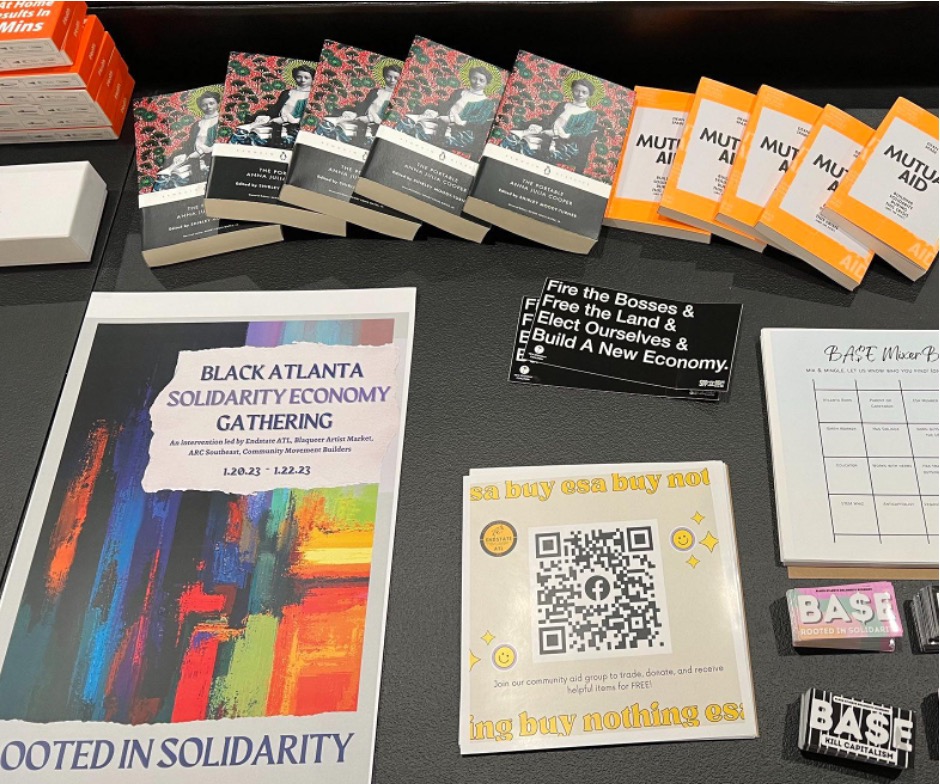
In May of 2023, when the World Health Organization downgraded the coronavirus emergency from a global health pandemic to an "ongoing health crisis," the shift made sense in many ways. Most developed nations have made vaccines available for over two years. Shutdowns and enforced quarantines ended, even in holdout nations. The WHO's announcement signaled that other countries, including the United States, would follow suit if they had not already. This move, however, will have material consequences for grassroots charitable organizations across the US. Endstate ATL (ESA), a group I have worked with since 2021, is one of many non-profit groups that will be affected.
In Georgia, the COVID state of emergency officially ended in May 2022, even as it remained in place at the national level. This allowed organizations like ESA to continue our mutual aid work. But when the US announced the end of the Federal COVID-19 Public Health Emergency (PHE) Declaration on May 11, 2023, enhancements to public assistance and social safety net programs ceased. From this point on, groups like ESA once again will have to jump through multiple bureaucratic hoops to obtain the funding necessary to provide care.
Following the global outbreak of COVID in 2020 many governments created temporary measures to extend aid to vulnerable populations. In the US, these included extensions of unemployment benefits, a moratorium on student loan interest and payments, no-cost COVID testing and vaccinations, Medicare flexibility, and opportunities to provide nontaxable disaster relief funds. The national government also released relief funds to individual state governments, although often these funds did not reach the people who needed them.1Rebecca Riess and Devon M. Sayers, "Alabama Governor Signs Bill to Use Covid-19 Relief Funds to Build Prisons," CNN, October 1, 2021, https://www.cnn.com/2021/10/01/politics/alabama-covid-relief-prison-bills-signed-governor-kay-ivey/index.html. Despite the uneven distribution of aid, many people, specifically children and elders, moved above the poverty line thanks to COVID assistance.2John Creamer, "Supplemental Poverty Measure That Accounts for Additional Government Benefits Lowest on Record at 7.8%," Census, September 13, 2022, https://www.census.gov/library/stories/2022/09/government-assistance-lifts-millions-out-of-poverty.html.
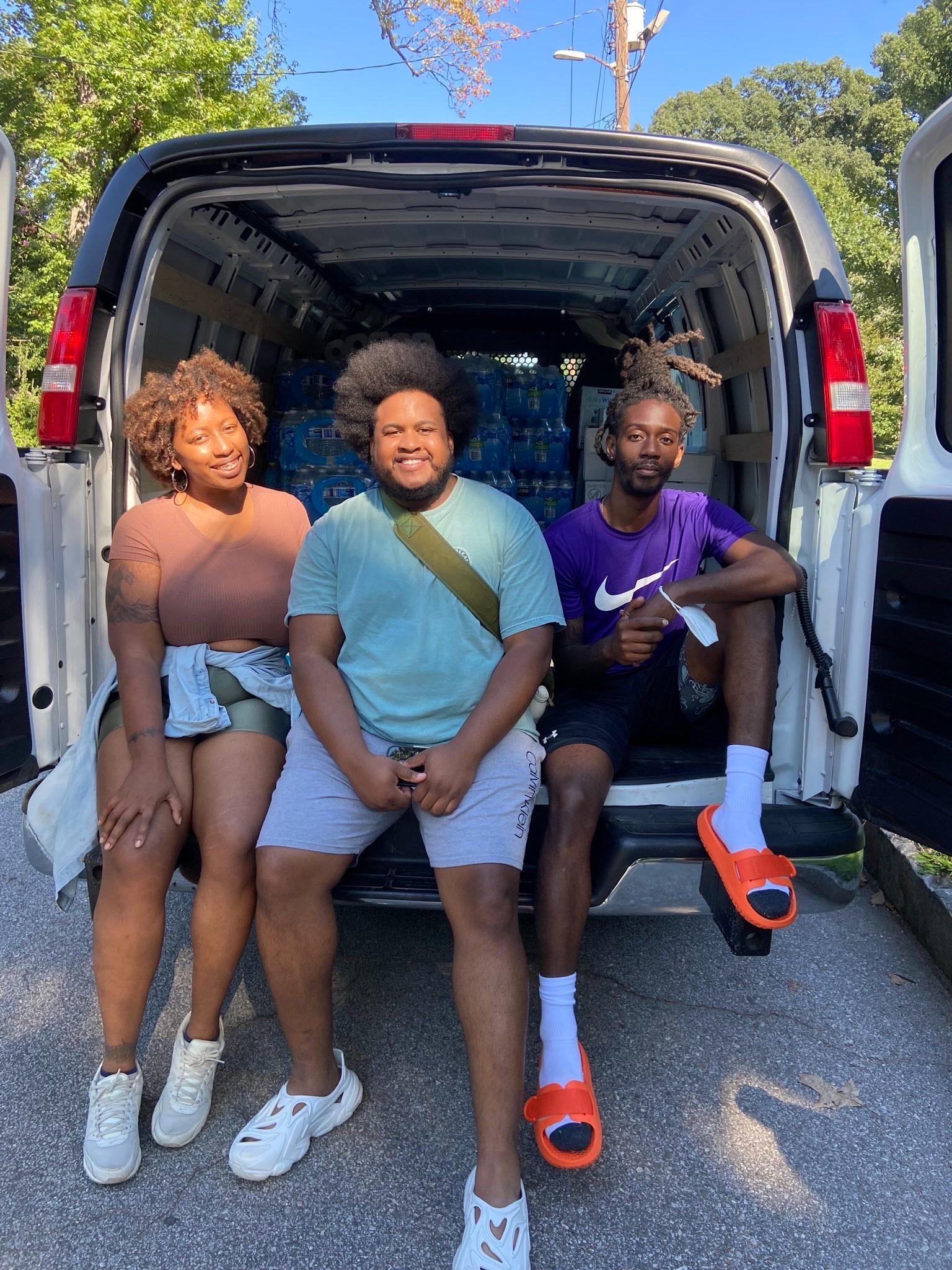
The flexibility surrounding nontaxable disaster relief funds eased mutual aid work. Mutual aid has a long history in the US and Global South, and the onset of the COVID-19 pandemic witnessed an outpouring of community solidarity towards those in need. Mutual aid stands apart from other charity models because of its non-hierachal emphasis on mutualism rather than models that maintain divisions between givers and receivers. Mutual aid is rooted in reciprocity.
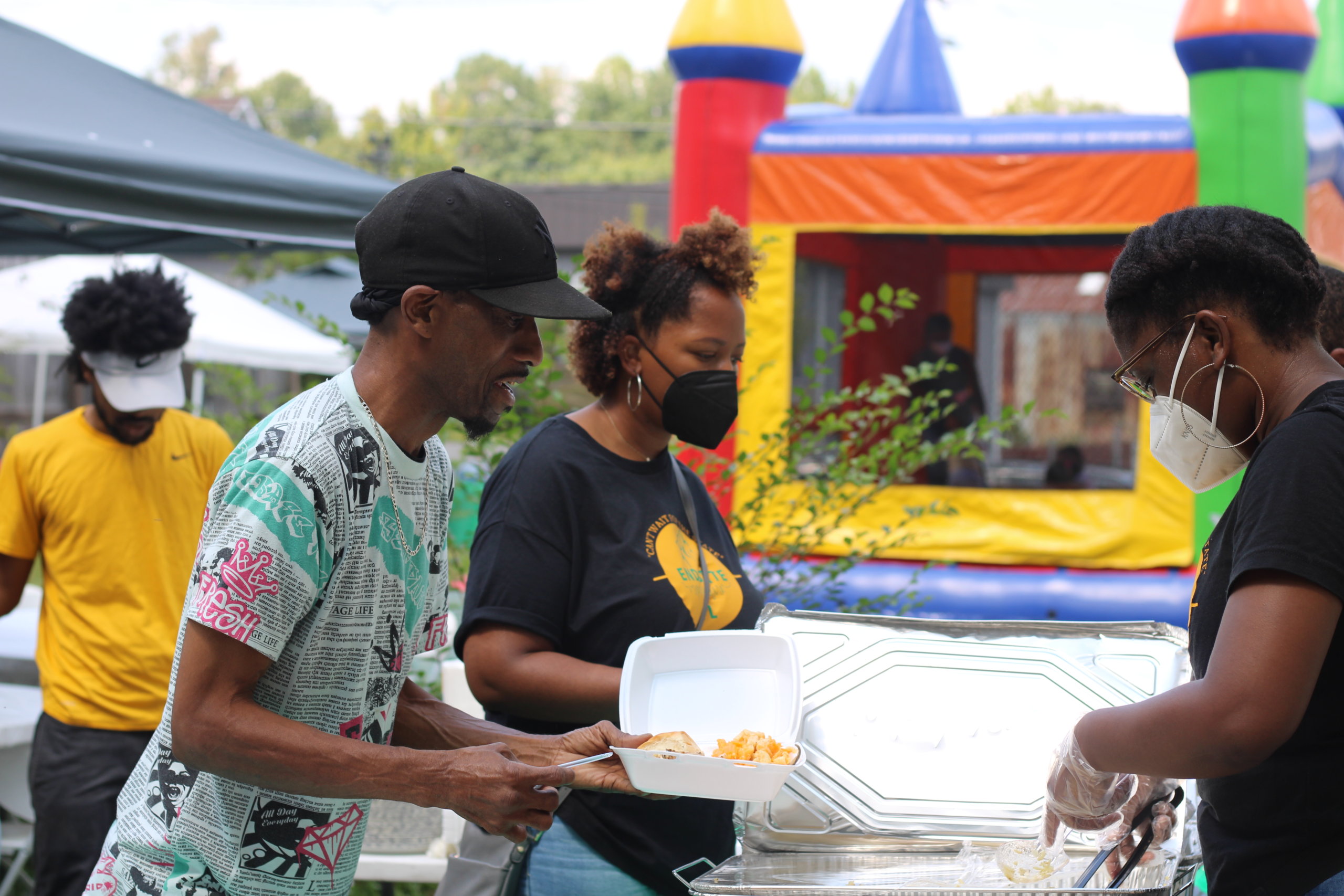
Endstate ATL took advantage of these temporary measures for the betterment and aid of our community members. Rooted in southwest Atlanta with a Black queer feminist politic, ESA's work aims to reach those most marginalized through community building, political education, and mutual aid. Through our Black Power Fund, which pays up to three months' worth of utility bills for Black queer households, and our Pack Provides Programs, which provide household supplies, COVID PPE, and infant essentials including formula, clothing, and sanitary products to caregivers of young children, we seek to step in where the state fails to provide support.
Mutual aid allows organizations to provide immediate care and relief to individuals in need without imposing the bureaucratic processes that often keep aid beyond reach. Under a state of emergency, disaster relief payments are not taxable. As such, ESA, and other groups like it, were able to provide direct aid through a less convoluted system of reporting and disbursement. This allowed us to move funds directly and rapidly to people in need and has been crucial to our ability to substantively support people in a timely way. ESA has covered bills for ten households in the past year, as well as covered a year of utilities for the BARRED Business house, which provides stable, community-owned housing for people recently released from prison. We have been able to report these funds as disaster relief.3"Mutual Aid Legal ToolKit," Sustainable Economies Law Center, Accessed June 22, 2023, https://www.theselc.org/mutual_aid_toolkit.
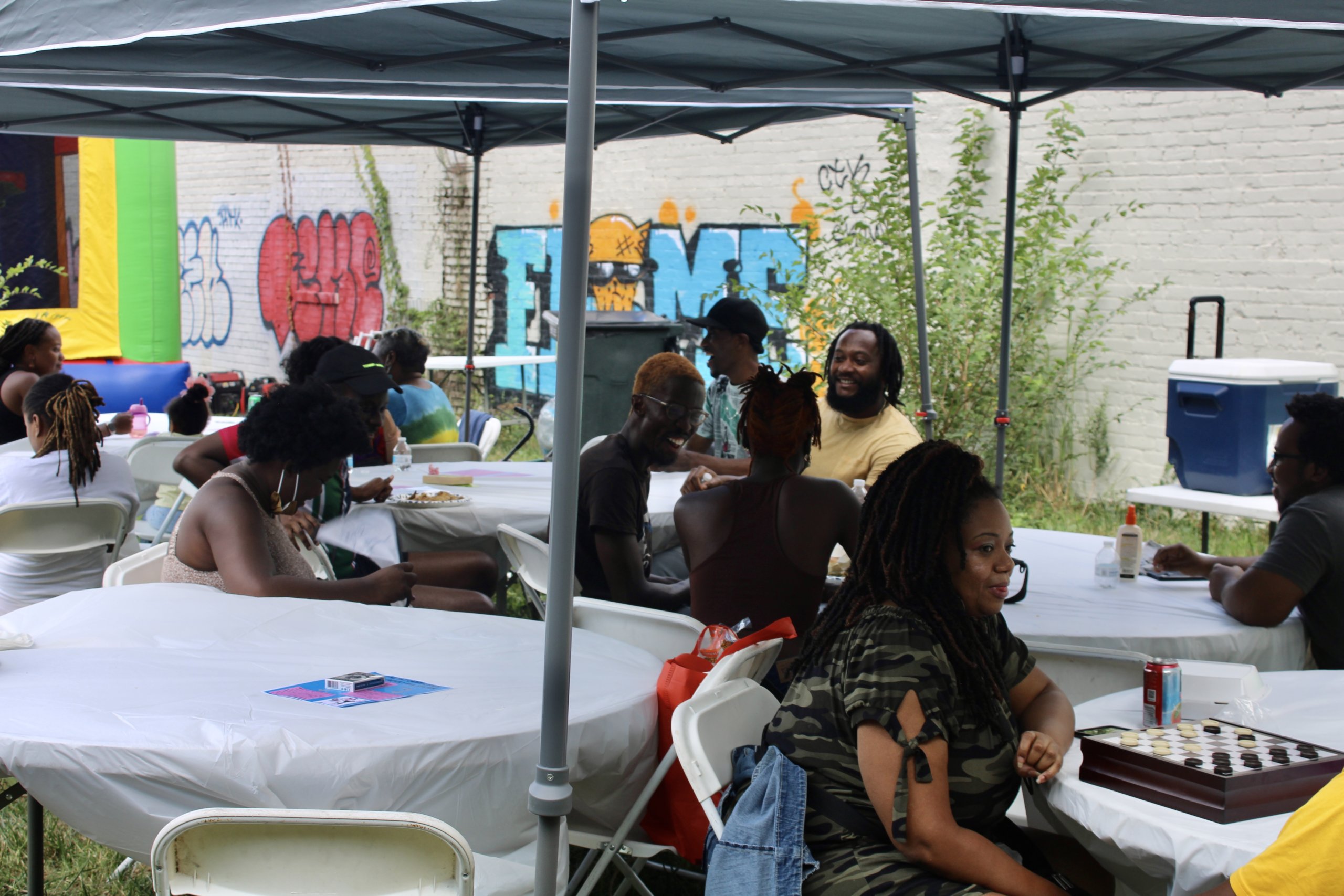
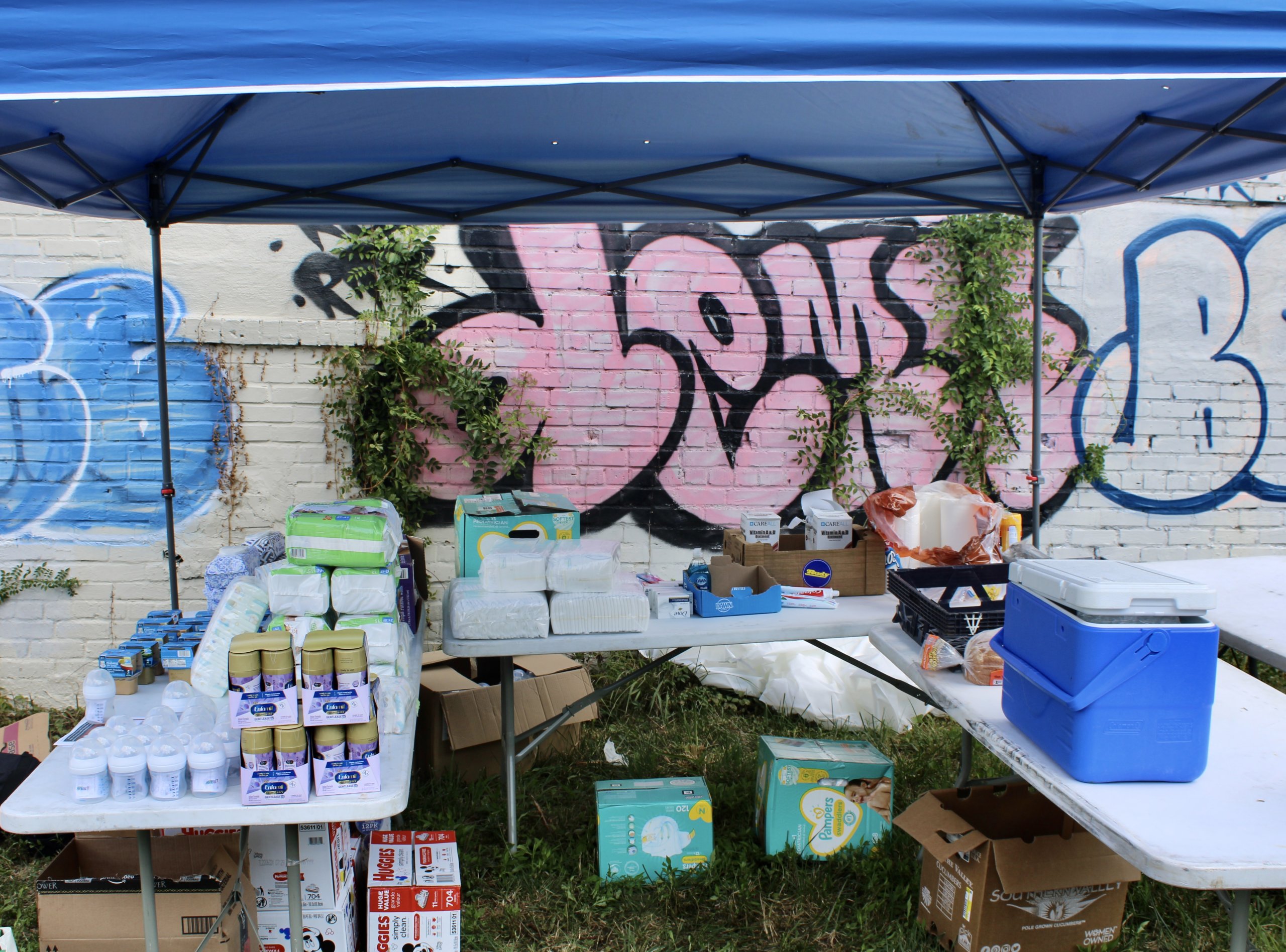
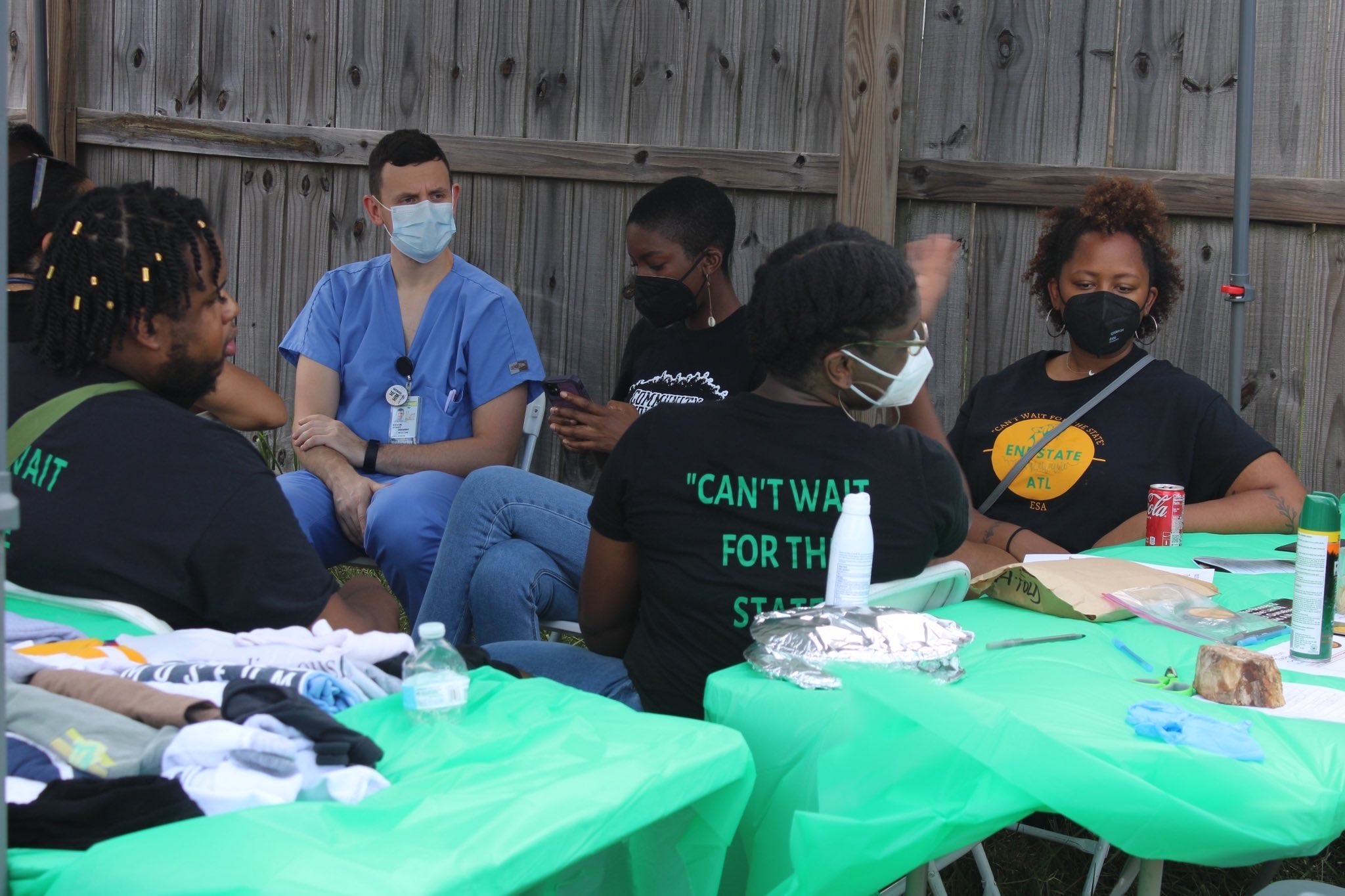


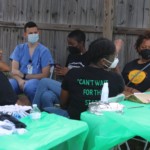
The efforts of mutual aid groups helped supplement aid where state and local leadership failed. Georgia governor Brian Kemp refused to take the COVID-19 pandemic seriously. In 2020, Georgia was the first state in the nation to relax quarantine restrictions, even as Kiesha Lance Bottoms, the mayor of Atlanta, sought to retain many protective measures. Initial reporting that the virus would largely impact the elderly and immunocompromised, combined with anti-fear government propaganda, engendered a sense of invincibility and an attitude of disregard among many Georgians. As of 2021, Georgia had one of the highest COVID mortality rates in the US, and those most impacted were poor, working class, and people of color.4"COVID-19 Mortality by State," CDC, Accessed June 22, 2023, https://www.cdc.gov/nchs/pressroom/sosmap/covid19_mortality_final/COVID19.htm. The refusal of Governor Kemp to implement mandated social distancing or mask requirements, even before vaccines were available, left the entire state population vulnerable to infection. The consequences were devastating, with thousands of unnecessary deaths and debilitating outcomes for those suffering from long COVID.
Pandemic relief payments meant to alleviate the burden of rising interest rates were out of reach for marginalized Georgians. In order to receive national stimulus checks and Kemp's own "special tax credit," individuals needed to have filed and paid taxes for the preceding two years, a barrier that left people who were unemployed or homeless without access to relief.5"Gov. Kemp Announces First Round of This Year's Special Tax Refund," Department of Revenue, May 1, 2023, https://dor.georgia.gov/press-releases/2023-05-01/gov-kemp-announces-first-round-years-special-tax-refund#:~:text=Single%20filers%20and%20married%20individuals,a%20maximum%20refund%20of%20%24500.
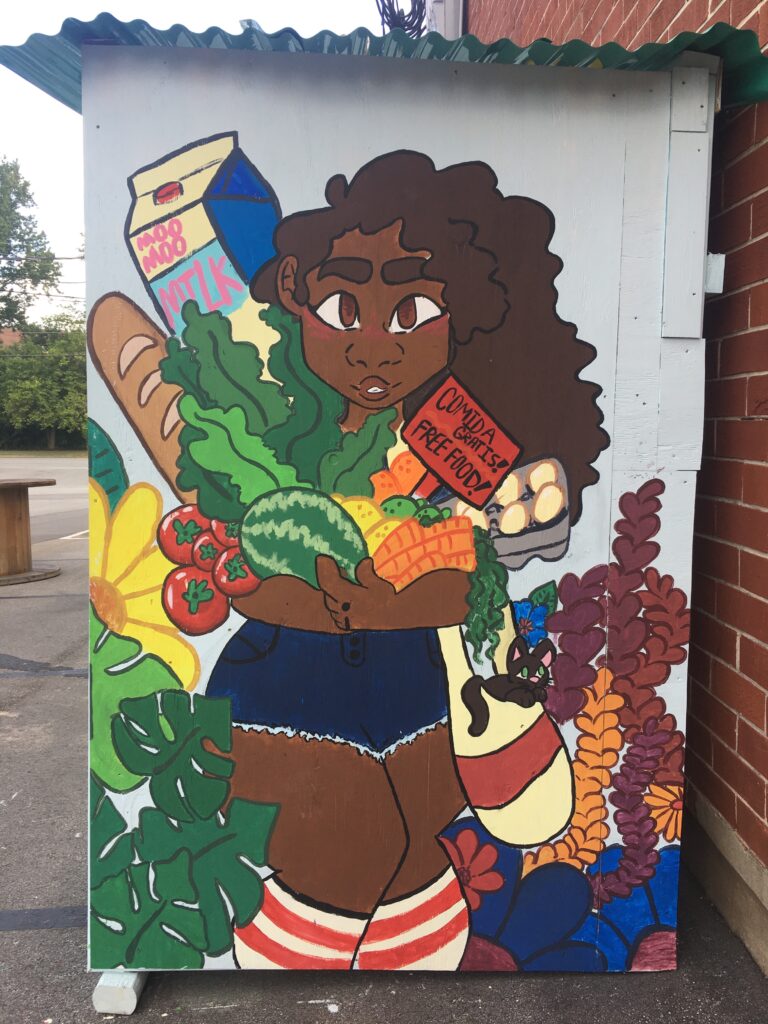
In response to the pandemic, groups emerged such as Bed Stuy Strong, based in Brooklyn, which created a robust grocery delivery system by first relying on the resources at their disposal before evolving into a program that benefited thousands.6Haritha Kumar, "Four Key Takeaways from Mutual Aid Organizing During the COVID-19 Pandemic," Georgetown University Beeckcenter, October 4, 2022, https://beeckcenter.georgetown.edu/four-key-takeaways-from-mutual-aid-organizing-during-the-covid-19-pandemic/. Georgia has similar organizations. Community Movement Builders developed stabilization programs that include rent/mortgage payments as well as groceries in their efforts to impede the gentrification of southwest Atlanta, and Food4Lives a non-profit started by Georgia Tech and Emory students provides food and supplies for the unhoused in the greater Atlanta area.7Katie Burkholder, "Housing as a Human Right: Community Movement Builders Organize Against Gentrification," Georgia Voice, April 21, 2022, https://thegavoice.com/today-in-gay-atlanta/housing-as-a-human-right-community-movement-builders-organize-against-gentrification/; "Who are We?" Food4Lives, Accessed June 22, 2023, https://food4lives.org/about.html. Both organizations preceded the pandemic, but their work became much more indispensable in its wake.
The increase in groups doing this aid work was significant, especially in red states where Republican leadership champions laissez-faire government structures for almost everything but reproductive health, policing, and surveillance. Pandemic or no pandemic, people need help. However, smaller aid groups face difficulties in keeping the work going. ESA has primarily been funded by grants, a funding model that is not easily sustainable. According to one of our members, "A significant struggle we've faced since the end of the COVID-19 pandemic is the philanthropic and public perception that the conditions for folks have changed enough that mutual aid is not necessary even as we continue to field a significant number of requests." Further, all members participate on a volunteer basis, spending much of our time otherwise as graduate students, teachers, doulas, herbalists, and nonprofit workers. Over the last two years, many of us have faced our own destabilizing events, financial uncertainty, bouts of COVID, and family loss. The ability of small groups to come together and push to make a difference in their communities—despite personal difficulties and decreasing assistance from governing bodies—should inspire more activism. But the question remains, how can we continue this work when governmental policies have resumed restricting social safety nets while offering few, if any, alternatives?
Changing policy is one problem organizers face, burnout is another. Studies have suggested that we approach "burnout as a part of activism and as influenced by the organizational context, rather than as something that individual activists experience outside of activism."8Maria Fernandes-Jesus et al., "More Than a COVID-19 Response: Sustaining Mutual Aid Groups During and Beyond the Pandemic," Frontiers in Psychology 12 716202, October 2021, https://www.ncbi.nlm.nih.gov/pmc/articles/PMC8563598/. However, as young Black people organizing in the South, my colleagues and I experience burnout from many directions. We deal with the stress of everyday life, as well as the difficulty of doing our solidarity work, with constant reminders from government leadership that our goals are at odds with theirs.
With the COVID state of emergency ending in the US, aid provided by organizations such as Endstate ATL becomes taxable, dramatically altering the way funds can be mobilized, as well as the process that recipients must go through to receive support. Charitable tax deductions are reserved for individuals and corporations who donate money to qualified charities.9Up until December 2021, entities meeting these requirements were able to claim as much as 100% of their AGI in charitable tax write offs. "CARES Act Charitable Benefits Not Extended For 2022," Stanford Giving, March 14, 2022, https://giving.stanford.edu/stories/cares-act-not-extended-for-2022/. Because ESA puts money "directly" in the hands of marginalized people, such direct contributions to individuals are not tax-exempt. The COVID state of emergency allowed groups like ESA to move funds to individuals more freely—on an emergency basis. The end of the state of emergency means we must restructure our aid programs. The beautiful thing about mutual aid is that even if one group burns out, another group can and likely will step up right behind to fill the gap. In this way, the work continues. We never stop.
About the Author
Ra'Niqua Lee writes to share her particular visions of love and the South. She earned an MFA in fiction from Georgia State University, and she is currently at Emory pursuing a PhD in late nineteenth/early twentieth century African American literature with a focus on spatial and Black queer feminist theories. Her fiction has appeared or is forthcoming in Cream City Review, SmokeLong Quarterly, Indiana Review, Passages North, Best of the Net 2023, Best Small Fictions 2023, and elsewhere. In 2021, the Georgia Writers Association awarded her the John Lewis Writing Grant for fiction. Her flash collection For What Ails You is forthcoming from ELJ Editions.
Acknowledgments
Many thanks to my colleagues. Without their collaborative support, I would not be able to do this work: Julian Rose, Britni Ruff, Christina Foster, Michelle, Jovan Julien, and extra thanks to Hugh Hunter for his early edits.
Public Health in the US and Global South is a collection of interdisciplinary, multimedia publications examining the relationship between public health and specific geographies—both real and imagined—in and across the US and Global South. These essays raise questions about the origin, replication, and entrenchment of health disparities; the ways that race and gender shape and are shaped by health policy; and the inseparable connection between health justice and health advocacy.
Beginning in 2022, the series expands to include 1000-word blog posts, as well as longer commentaries, essays, articles and media productions that address the public health and political implications of the COVID-19 pandemic from multiple perspectives. The series editor for Public Health in the US and Global South is Mary E. Frederickson.
Ignition
In Pendleton, South Carolina, 1849, John B. Sitton had a difficult decision to make. He knew his neighbors were angry at him. He had a position as a postmaster with a small stipend. That job put him at the center of every local event, decision, and dispute. He was situated, too, in the very center of town on the Pendleton Green. The central post office, one of the largest in the area, operated out of the prominent Farmers Hall behind substantial white columns, a Greek revival building that couldn't be missed. The authority of the postmaster and the strength of the federal government, which accorded him power, was underscored by the placement of the post office.
Sitton knew that some of his white neighbors had recently received unwelcome antislavery pamphlets in the mail. Word had spread that there were likely many more of such scurrilous materials in the sack behind his counter, waiting to be sorted and picked up. Pendleton's newly formed "Executive Committee on Vigilance and Safety," which had been established thanks in part to encouragement by their local political luminary, John C. Calhoun, was now fired up.1Stephen A. West sketches out the evolution of these Calhoun-inspired vigilance committees in From Yeoman to Redneck in the South Carolina Upcountry, 1850–1915 (Charlottesville: University of Virginia Press, 2008), 53–55. See also West's article entitled "Minute Men, Yeomen, and the Mobilization for Secession in the South Carolina Upcountry," The Journal of Southern History 71, no. 1 (2005): 75–104. The most thorough and broad context for this incident can be found in Manisha Sinha's book, The Counterrevolution of Slavery: Politics and Ideology in Antebellum South Carolina (Chapel Hill: University of North Carolina Press, 2000), especially chapter 3, "The Discourse of Southern Nationalism," 63–94. Her specific mention of Barrett can be found on page 80, in which Sinha persuasively characterizes the leaders of this movement to create viliance committees as essentially "potentates" seeking to suppress all "unorthodox" views on slavery. Here I wish to fold the role of Black witness back into the analysis because they were an implicit part of the policed audience for this bonfire.
What followed might seem merely like a small, local action: Pendletonians gathered on the village green and read aloud excerpts from offending documents, ran into the post office, and roughly pushed aside Sitton, who was trying to defend, perhaps half-heartedly, the mail. The white villagers found what they sought. On Pendleton Green, the mob burned thirty-eight pamphlets that were literally and figuratively "incendiary."2For a sense of how the word "incendiary" became a defining legal term in this context see Richard R. John, "Hiland Hall's 'Report on Incendiary Publications': A Forgotten Nineteenth Century Defense of the Constitutional Guarantee of the Freedom of the Press," The American Journal of Legal History 41, no. 1 (1997): 94–125.
At first glance, this event might seem inconsequential for the town. Although antislavery newspapers in the North picked up the story, there seem to have been no further episodes of collective burnings in Pendleton. No one appears to have held any ill will against Sitton, the postmaster. Indeed, he was elected mayor a few years later. This event occurred twelve years before the Civil War and was more of a symptom of growing tension than a cause of further rupture. Overall, the event reinforced how righteous white Pendletonians wanted to see themselves as on the vanguard of a battle, defending their way of life against anyone who might see things differently. In particular, it represented something unique about the place and the space—the town elites of Pendleton were insistent about policing ideas that might reach the less elite white neighbors.3West argues in From Yeomen to Redneck that this type of upstate vigilantism was largely carried out by the slaveholding elites and was "aimed to censor political expression that appealed to the interests of non-slaveholders"; for this region of South Carolina, West argues that "it appears more a an attempt by members of the slaveholding minority to police opinions among the slaveless majority," West, Yeoman to Redneck, 65.
And yet, the event was enormously consequential for a young man from Ohio, John M. Barrett. As those pamphlets burned, he sat in jail in nearby Spartanburg County throughout the summer heat. There he was abused and terrorized into giving up a story of those mailings and how they had found their way into the hands of citizens across South Carolina. He never fully took responsibility for these mailings, perhaps because he knew the terrible penalties for such a "crime." Still, the evidence made it clear to his allies and enemies that he was indeed involved in the scheme. Before he could confess or take on the mantle of hero or martyr, Barrett died while out on bail awaiting trial. Newspapers in Indiana, where he died, reported this as a consequence of his suffering in Spartanburg.4The jail time in Spartanburg is linked to Barrett's death in his obituary as reported in New Castle (IN) Courier, reprinted in Indiana State Sentinel (Indianapolis), April 11, 1850.
And the event was consequential, too, for the enslaved population of Pendleton, who knew and saw what was happening. The bonfire was a public spectacle for Black people, as well as any white dissenters. It was a calculated warning.
This essay explores the broader context of these events by understanding the initial spate of mailings that happened in 1835. This examination includes the author and instigator of these mailings, William Henry Brisbane; the Calhounist culture of Pendleton, SC, that fueled this particular demonstration; the sad fate of the young man, John M. Barrett, who was caught up in the materials' distribution; and the people held captive in the middle of it all, the enslaved men, women, and children of Pendleton.
Test Run: 1835 Antislavery Mail Campaign
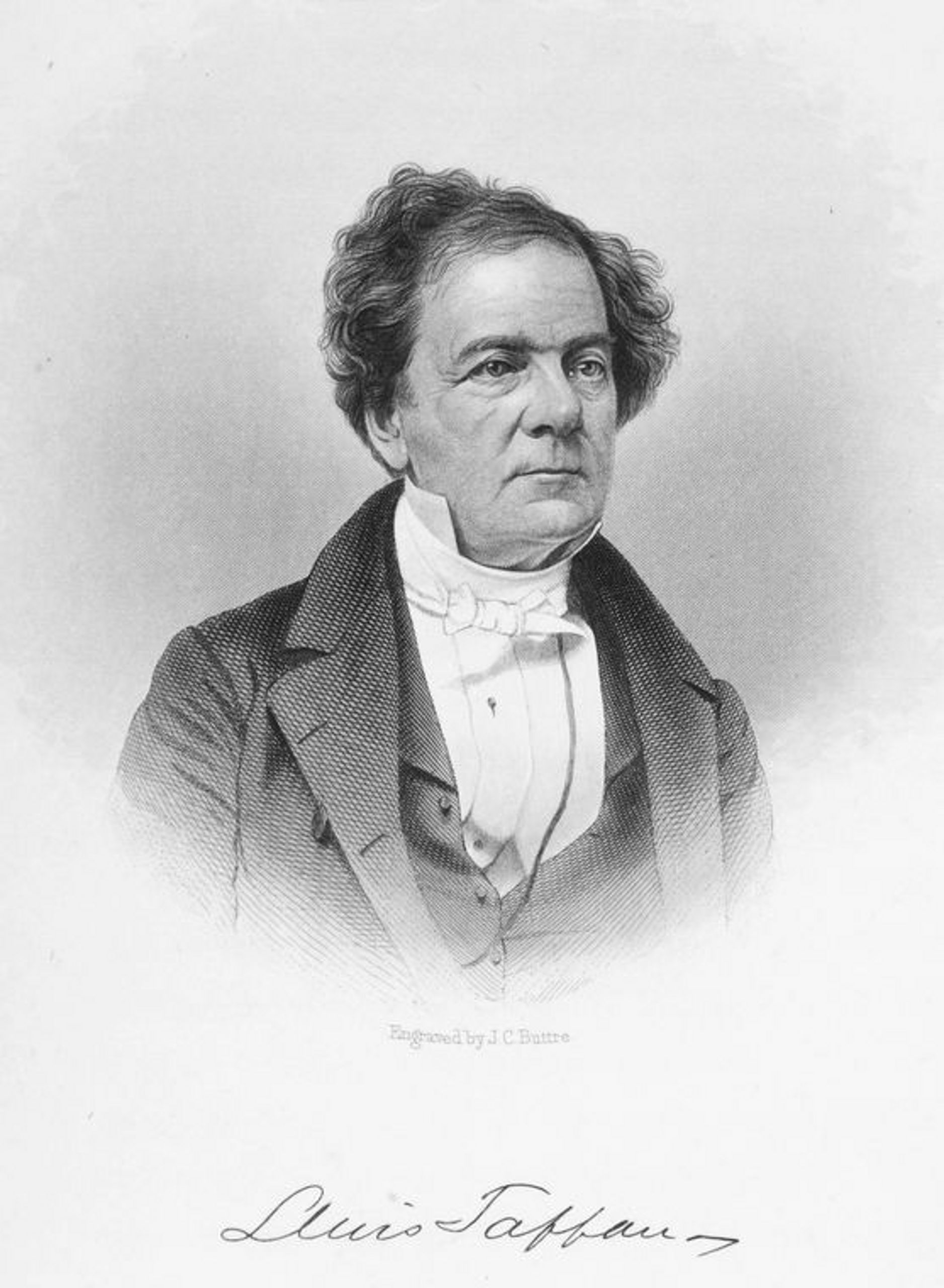
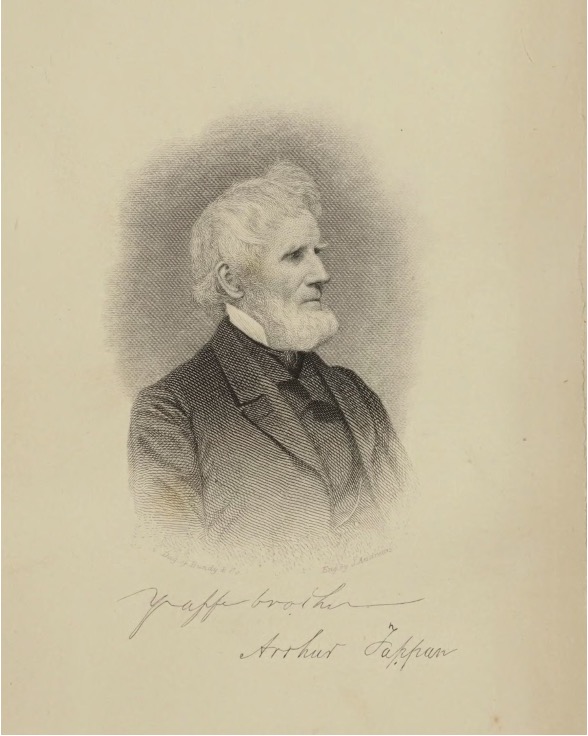
Arthur and Lewis Tappan, a Massachusetts pair of evangelical philanthropists, directed much of their money to activist causes, particularly towards antislavery organizations and endeavors. In 1835, the Tappan brothers funded an extraordinary undertaking: they helped the American Anti-Slavery Society send unsolicited abolitionist messages, newspapers, and tracts to many ministers, prominent business people, and public figures in several states below the Mason–Dixon line. This brash endeavor might well have been, to use the words of one historian, "[a campaign that] sparked the country's first crisis over postal content."5Winifred Gallagher, How the Post Office Created America (New York: Penguin Random House, 2016), 75. See also Richard R. John, Spreading the News: The American Postal System from Franklin to Morse (Cambridge, MA: Harvard University Press, 1998), 257–58.
While mailings fanned out across various states, it was in South Carolina that they were met with the most dramatic fury.6For an overview of how this was received in different states, see Wyatt-Brown, Bertram, "The Abolitionists' Postal Campaign of 1835," The Journal of Negro History 50, no. 4 (1965): 227–386. When a large bundle of them arrived at the Charleston Post Office in late July, some were delivered, but several recipients returned them to the post office with umbrage. Knowing there were more bundles of such mailings in the post office's possession and likely more about to arrive, Postmaster Alfred Huger, an enslaver himself, was flummoxed, caught between his federal duties and his angry white constituency.7For an overview of the 1835 abolitionists' postal campaign, see Susan Wyly-Jones, "The 1835 Anti-Abolition Meetings in the South: A New Look at the Controversy over the Abolition Postal Campaign," Civil War History 47, no. 4 (2001): 289–309. Also Hollis Robbins, "Fugitive Mail: The Deliverance of Henry 'Box' Brown and Antebellum Postal Politics," American Studies 50, no. 1/2 (2009): 5–25.
Aside from activist abolitionists, many political figures, even those who often clashed, could come to some shared perspectives— President Andrew Jackson advocated a federal law that would authorize censoring abolitionist mail.8Manisha Sinha, The Slave's Cause: A History of Abolition. (New Haven, CT: Yale University Press, 2016), 250. Senator John C. Calhoun argued that congressional legislation required northern postal officials to obey southern state legislation that prohibited transmission of abolitionist texts. He saw this as a power derived not from the Constitution but from states' rights and nullification, which were issues dear to Calhoun's heart.9Richard R. John, "Hiland Hall's 'Report on Incendiary Publications'", 99.
Postmaster Huger stalled before eventually deciding to have the abolitionist materials, including copies of the Emancipator newspaper, set aside in a distinct and separate bag. To no one's surprise, vigilantes calling themselves "The Lynch Men" broke into the post office. They burned the offending materials along with an effigy of antislavery activist William Lloyd Garrison. Torch-lit parades to protest these mailings were then held in towns throughout South Carolina.10Devin Leonard, Neither Snow nor Rain: A History of the United States Postal Service (New York: Grove Press, 2017), 25. See also Wyly-Jones, "A New Look," 289–309. As an 1835 lithograph suggests, the riot was well-publicized, and a gauntlet was now thrown: slavery advocates demanded mail censorship.11Attack on the Post Office, Charleston, SC, 1835, political cartoon, 15.0 x 18.5 cm, The American Antiquarian Society, Worcester, MA, https://americanantiquarian.org/earlyamericannewsmedia/items/show/48.
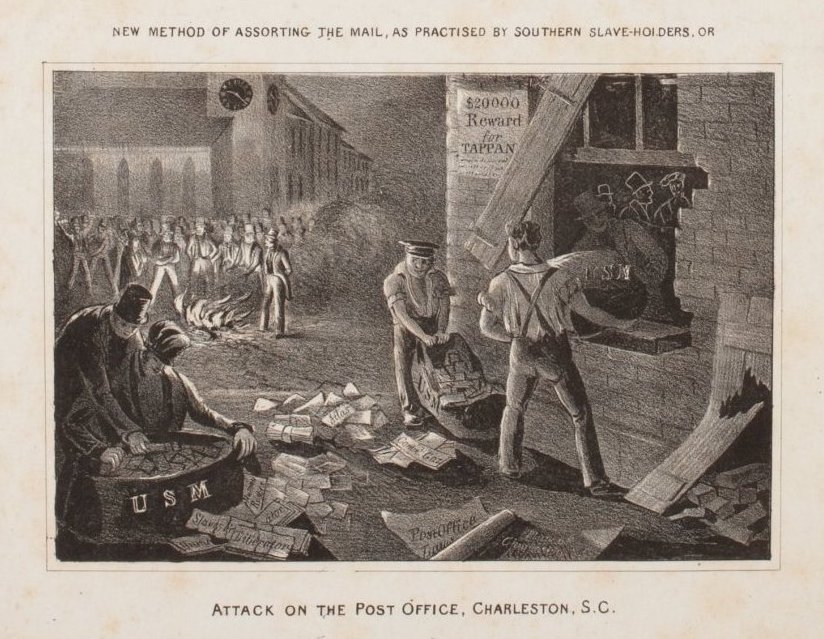
Calhoun's bill was narrowly defeated, but the controversy was directly associated with him—something that northern skeptics and southern supporters were not willing to forget. White South Carolinians knew their course of action when the next abolitionist mailing campaign occurred.
The Firebrand: William Henry Brisbane
Nothing intrigues more than that which is banned. The burnings attracted attention that occasionally thwarted rioters' goals. Abolitionist pamphlets and newspapers and the growing debates over eradicating slavery contributed to a battle for minds. Certainly, too, the white supremacists' bonfires would have affected the Black people who watched or heard about them, signaling to the enslaved that there was opposition elsewhere, that people in bondage weren't alone but had allies in the broader world. That notion was precisely what had stoked the greatest fears of the Charleston "Lynch men": the possibility that abolitionist tracts might incite violent slave uprisings.12Wyly-Jones, "A New Look," 1.
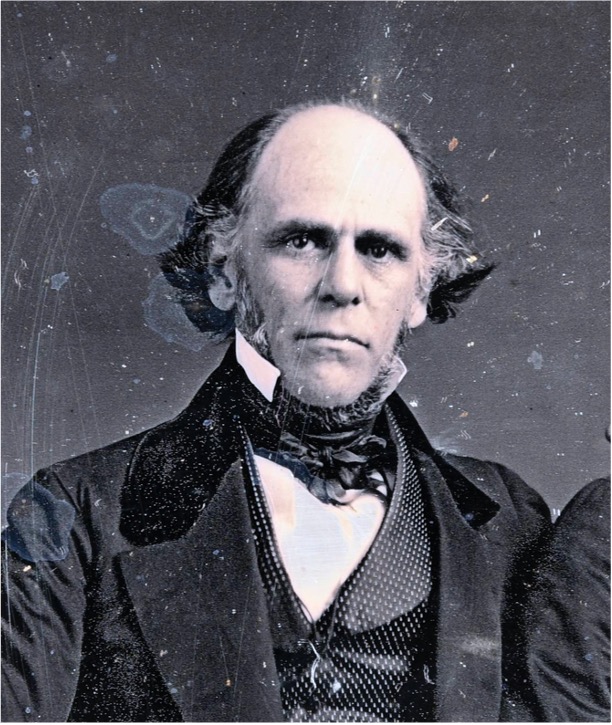
One person who stumbled into conversations about abolition was the Reverend William Henry Brisbane (1806–1878) of Beaufort, South Carolina. A man of inherited wealth and property with considerable holdings that included men, women, and children, he found he could not fully counter abolitionist arguments and gradually came to denounce slavery. Eventually, he liberated most of the people he had control over and went on to help many of them relocate with him, as free people, to Ohio. Brisbane renounced his slaveholding past and joined with antislavery activists in the Midwest and nationally to rail against the cruelties of slavery.13See Blake McNulty, "William Henry Brisbane: South Carolina Slaveholder and Abolitionist," in The Southern Enigma: Essays on Race, Class, and Folk Culture, eds. Walter J. Fraser Jr. and Winifred B. Moore Jr. (Westport: Greenwood Press, 1983), 119–129. Also see a characteristic letter from Brisbane pledging to support captives through an Anti-Slavery Society effort. William Brisbane to Lewis Tappan, January 23, 1841, Doc. no. F1-4881, American Missionary Association Archives, Amistad Research Center, New Orleans, LA.
Having been converted to the antislavery movement partly because of his own exposure to abolitionist pamphlets and arguments in the 1830s, Brisbane eventually aided the cause by authoring his speeches, sermons, and tracts, often with very pointed arguments for those South Carolinians he felt were vulnerable to persuasion.14Brent J. Morris, "'We Are Verily Guilty Concerning Our Brother': The Abolitionist Transformation of Planter William Henry Brisbane," South Carolina Historical Magazine 111, no. 3/4 (2010): 123.
Brisbane began to draft opinions under the pseudonyms of "Brutus," "A True South Carolinian," and other aliases that targeted non-slaveholding white men, particularly those from the inland and upcountry regions of the state (including Pendleton and its adjacent districts and counties)—all areas which featured less dense populations and far less concentrated wealth than was found in the coastal or "Lowcountry" region. The three most northwest counties of the state (Oconee, Anderson, and Pickens—often understood as the "Pendleton District") were perceived as being vulnerable to arguments that might appeal to white citizens feeling unrepresented or disenfranchised by the dominance of the planter politics of the state. Brisbane hoped to win "upstate" or "upcountry" South Carolina citizens over to the antislavery cause by arguing that their own best interests were to resist the political power of the class of elite enslavers and to embrace free labor.15The antislavery pamphlet, "An Address to the Citizens of South Carolina," by "Brutus" circulated in the 1849 campaign (and was actually found with John M. Barrett in Spartanburg). The pamphlet was included in his indictment. State v. John Barrett,
Spring Term 1851, Roll #17, Spartanburg County Court of General Sessions, South Carolina Department of Archives and History, Columbia, SC.
These were hardly radical diatribes. They didn't reference immediate abolition and didn't dwell on the inhumane practices of slavery. But that was the point; these liberal pronouncements against injustices burdening the life of white southerners were designed to pique the interest of otherwise indifferent or complacent citizens.
Brisbane, along with other activists from northern states, planned to launch another wave of mailings that would not overtly advocate emancipation, but would primarily rail against the injustices of a state ruled by an elite. He also hoped this would skirt around some of the further restrictions passed after the 1835 campaign. He and his co-conspirators recruited a young man from Indiana, John M. Barrett, to travel through South Carolina, gathering names and addresses and facilitating the mailings, all under the guise of a "Gazetteer," collecting innocuous data for commercial reference work.
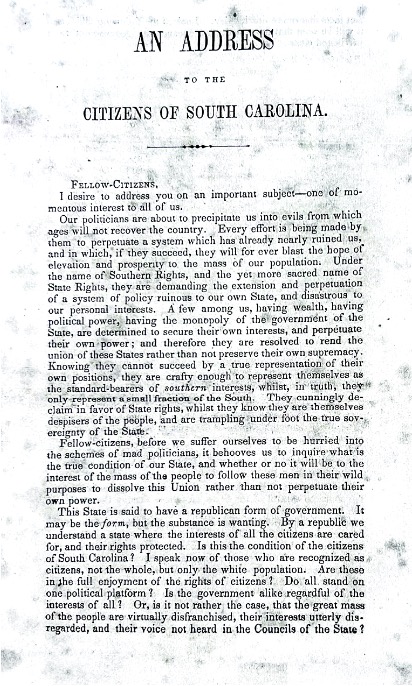
Using information and addresses supplied by Barrett, several of Brisbane's tracts were mailed to South Carolinians in 1849. Most of these did not directly advocate for the immediate abolition of slavery, much less urge uprisings or rebellions. Materials authored by Brisbane and later found in the Spartanburg post office were quoted by the Spartan as pointing out that "the great mass of citizens of the State have no PERSONAL INTEREST in slaves, and they know that the benefits of the institution are confined to a very small number of the whole white population."16"The Rev. Wm Henry Brisbane, The Traitor," Spartan, (Spartanburg, SC), April 24, 1849, reprinted in Liberator (Baltimore, MD), October 19, 1849.
As characterized by the New York Tribune, the materials Barrett was accused of circulating materials that decried "the inequality of representation between the strong slaveholding and comparatively non-slaveholding portions of the state; the rigid monopoly of office by the great slaveholders; the degraded condition and gloomy prospects of the white freemen of South Carolina who do not own slaves, etc."17"Law in South-Carolina," New York Tribune, reprinted in Lancaster (PA) Examiner, August 1, 1849. As this paper continued: "as there is no such thing as answering the facts set forth in them [the materials found with Barrett], the slaveholders have sought to keep them from being read."18"Law in South-Carolina." The New York Tribune indignantly pointed out that Barrett had not advocated for abolition at all: "[Barrett] is accused of . . . enlightening the White Non-Slaveholders of South Carolina with regard to the glaring oppressions to which they are subjected by reason of the dominance of Slavery."19"Law in South-Carolina."
Regardless of such indirect arguments or the northern interpretations of the events, white South Carolinians in power knew a threat when they saw one. Being in possession of Brisbane's work could carry with it a death sentence.20David J. McCord, ed., The Statutes at Large of South Carolina, vol. 7 (Columbia, SC: A.S. Johnston, 1840), 389–90. According to Act 15, theft of an enslaved person was a felony without benefit of clergy, which at that time meant that if convicted, you would be whipped, branded, or "suffer death as a felon."
The Spy: John M. Barrett
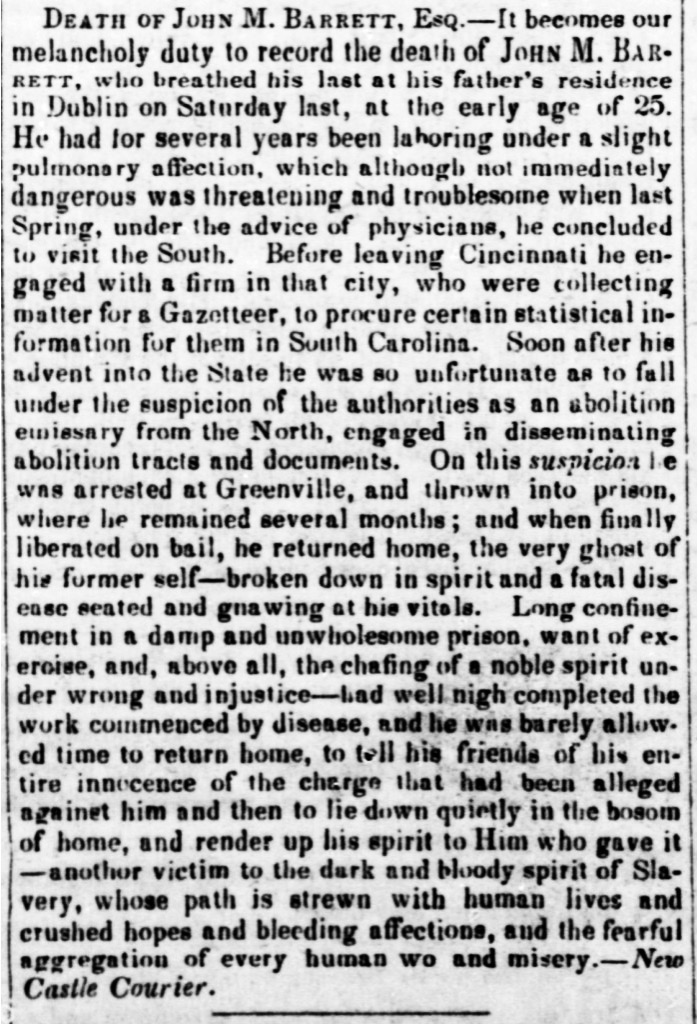
John M. Barrett (1825–1850) was, by his own admission, a passionate Free Soiler. He opposed the expansion of slavery into the United States' free territories and was generally aligned with abolitionist sentiment. Although he was only twenty-three, he agreed to undertake a covert and dangerous mission alone. The Anti-Slavery Society of Ohio, inspired by the 1835 campaign and with the leadership of the Reverend William Henry Brisbane, who by now had relocated to Ohio, sent young Barrett traveling throughout South Carolina. His job was to gather names of prominent clergymen, businessmen, and other white citizens, both those who enslaved people and those who did not.21One overview of the Barrett story can be found in William Sherman Savage, The Controversy over the Distribution of Abolition Literature (Washington, DC: The Association for the Study of Negro Life and History, Inc., 1938), 115–6. A more recently scholarly study can be found in Chapter Two, "Forging a United People," in West, Yeoman to Redneck, 46–65.
The plan seems to be that he would gather information and names of these influential people at various locales and send that information back to his handlers in Ohio, who would generate mailings. Occasionally his handlers would mail him things directly and ask him to forward post them on their behalf. In each imagined scenario, Barrett would be sure to leave town weeks before any incendiary mailings might arrive. This plan left Barrett vulnerable, alone, and far from any rescue if he attracted local attention.
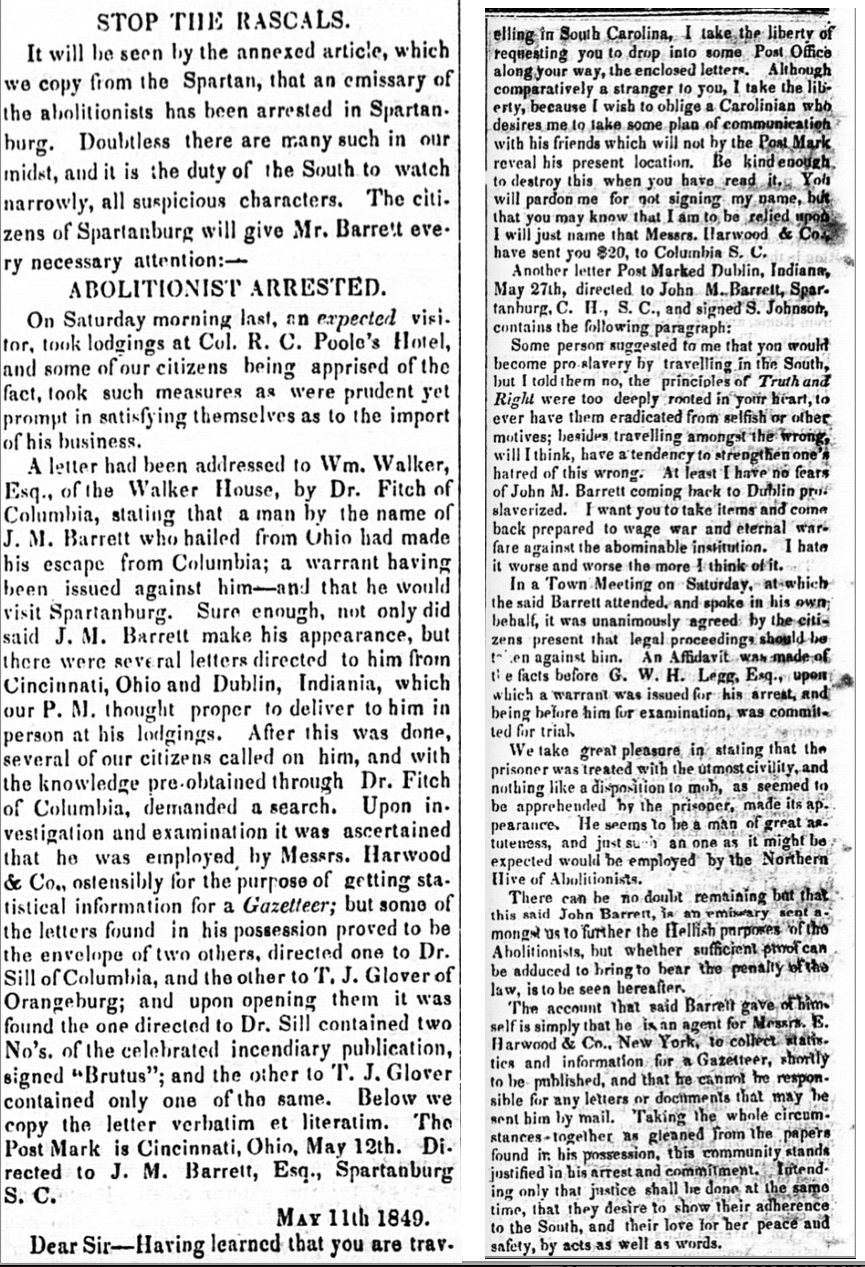
Initially, things seemed to work as intended: post offices across the state received an onslaught of pamphlets. But authorities caught on fairly quickly: first in Columbia, where a warrant was issued for Barrett's arrest. He then turned up in Winnsboro. There he was let loose for lack of evidence.22Morris, "Abolitionist Transformation," 40. Likely in Apil 1849, he made his way through Anderson County and the Pendleton District. When he reached Spartanburg, a letter from Columbia warning that he might make an appearance arrived with local officials. They detained and arrested Barrett when a letter directed to him (under a pseudonym) was found to contain what one paper termed "celebrated incendiary publications."23McNulty, "William Henry Brisbane," 124–5. See also "Abolitionist Arrested," North Star (Rochester, NY), July 20, 1849. Vague and clumsy references to letters in code and cyphers in his correspondence directed to Barrett made his situation look damning. One newspaper from North Carolina noted that if it hadn't been for clumsy cyphers, the entire affair would have seemed quite innocent.24See "Espionage in the Mails," Raleigh (NC) Register, reprinted in North Star (Rochester, NY), October 5, 1849, https://www.loc.gov/resource/sn84026365/1849-10-05/ed-1/?sp=1&r=0.086,0.73,0.275,0.143,0.
When local law officials found Barrett at Colonel R. C. Poole's Spartanburg hotel, the suspect materials, including a "Brutus" tract railing about the disproportionate political power of slaveowners and some cryptic letters from a "B.H.W." were hard to explain away.25Brutus, "An Address to the Citizens of South Carolina." See also the advertisement for Poole's hotel in Spartanburg. "Mansion House," Spartan (Spartanburg, SC), August 18, 1844.. Nor was it difficult to establish that William Henry Brisbane was the author (especially after Brisbane published a confused defense of Barrett and inadvertently confirmed his involvement).26See Brisbane's letter in the National Anti-Slavery Standard (New York, NY), September 6, 1846. In it he ends with a rather incriminating postscript: "Perhaps at some future time I shall be at liberty to communicate with your readers some things connected with this affair that I cannot now do without a breach of private confidence." While Barrett might have been able to explain possessing antislavery materials, explaining away evidence of a conspiracy to distribute such materials was going to be a fraught defense.27See "The Rev. Wm Henry Brisbane, The Traitor," Spartan, reprinted in Liberator (Baltimore, MD), October 19, 1849, and Keowee (SC) Courier, August 4, 1849.
As had happened with Postmaster Huger in Charleston in 1835, the hapless postmaster of Spartanburg, George W. H. Legg, was now caught in the middle of the controversy as he, too, refused to turn over the mail to unauthorized recipients who demanded it for inspection. By August of 1849, a warrant for Legg's arrest was issued, and he was held at least briefly in the same jail as Barrett. Legg, unlike Barrett, was quickly able to post bond.28Legg's ability to post bond is recounted in "More Nullification" from the New York Tribune, reprinted in Brooklyn (NY) Eagle, July 31, 1849. And while he was free, everyone waited for clear directions from the federal authorities, including the attorney general, about policy.29"Violation of Private Letters," Boston (MA) Evening Transcript, August 11, 1849. See also John, "Hiland Hall's 'Report on Incendiary Publications'," 275.
Barrett sat in the Spartanburg jail throughout the summer. And while he sat there, more unwelcome pamphlets and documents began to arrive across the state, stirring up fury and reviving or launching many local vigilance committees. These committees were well organized and increasingly militant.30West, Yeoman to Redneck, 53–55. The Spartanburg Committee announced that "our object will be to prevent by all means in our power the spread of these abolitionist writings among our people if harsh means be necessary 'we will not hesitate to use them,' and any incendiary hereafter caught, may expect rough treatment—by this Committee."
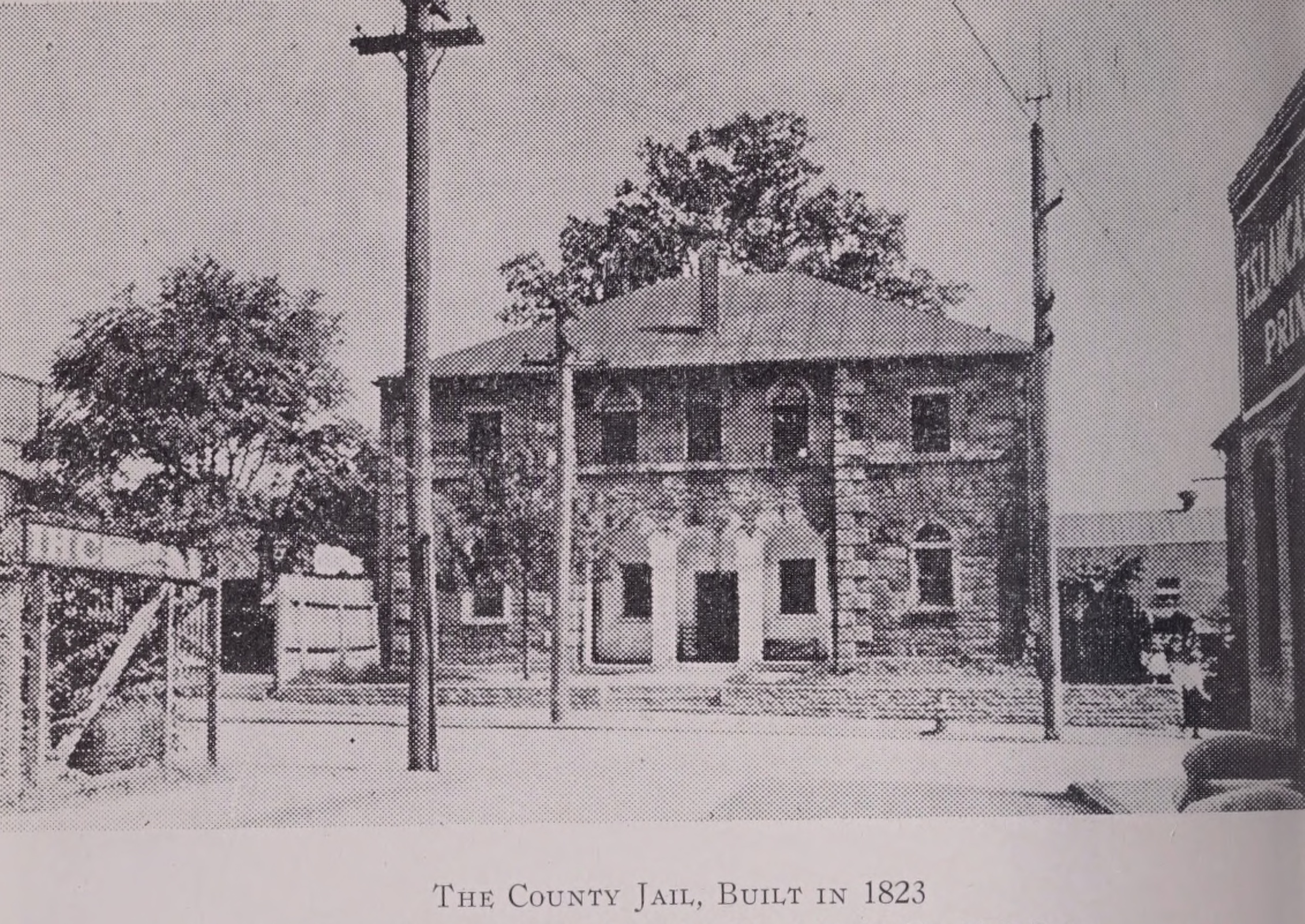
They signaled their threats to lynch Barrett or any others: "In carrying out the views of the duties imposed on us, we may in some instances have to rise above the Law."31"Fellow Citizens," Pickens Keowee (SC) Courier, September 22, 1949. The Liberator quoted Brisbane stating that John Barrett had been threatened with death, "law or no law," and that if he were to stand for trial, Barrett would be sure to face "Lynch's law."32Brisbane, "The Value of the Union," Crisis (Boston, MA), reprinted in Liberator (Baltimore, MD), January 11, 1850.
While there were some contrary expressions, on the whole, white South Carolinians followed the story with indignation and increasing fury.33See "Espionage in the Mails" for a conciliatory editorial from North Carolina arguing that mail censorship was a bad precedent. And even though the disseminated materials promoted the Brisbane-style of argument that white non-slaveholders should oppose slavery because it disproportionately empowered elites, several newspapers in southern states assessed this argument as likely to incite rebellions and uprisings among the enslaved. The Charleston Daily Courier wrote: "There can be no doubt remaining but that this said John Barrett, is an emissary sent amongst us to further the Hellish purposes of the Abolitionists."34"Another Letter," Charleston (SC) Daily Courier, June 18, 1849.
As the story developed, reporters who visited Barrett noted his ill health. A letter from him to his family was republished by the North Star in October of 1849 in which, perhaps to save his life, Barrett continued to assert his innocence and denied any knowledge of Brisbane. He was despairing, though, writing: "I almost feel that I am never to enjoy much happiness in this world. It seems to me that I am doomed to be a companion with misfortune in my course of life."35Barrett's letter to his father, Centerville (OH) Sentinel, reprinted in North Star (Rochester, NY), October 12, 1849.
After several months, his father came down to South Carolina and finally secured his release by paying $200 in fees and posting $1,000 bail. Barrett never returned to Spartanburg for trial. He died a few months after returning to Indiana. As the New Castle Courier reported:
". . . [he was] collecting matter for a Gazetteer, to procure certain statistical information for them in South Carolina. Soon after his advent in the State, he was so unfortunate as to fall under the suspicion of the authorities as an abolition emissary from the North, engaged in disseminating abolition tracts and documents. On this suspicion, he was arrested at Greenville and thrown into prison, where he remained for several months. When finally liberated on bail, he returned home, the very ghost of his former self-broken down in spirit and a fatal disease seated and gnawing at his vitals."36"Death of John M. Barrett, Esq.," New Castle (IN) Courier, reprinted in Indiana State Sentinel (Indianapolis), April 11, 1850.
The paper goes on to explain:
"Long confinement in a damp and unwholesome prison, want of exercise, and, above all, the chafing of a noble spirit under wrong and injustice—had well nigh completed the work commenced by disease, and he was barely allowed time to return home, to tell his friends of his entire innocence of the charge that had been alleged against him and then to lie down quietly in the bosom of home, and render up his spirit to Him who gave it— another victim to the dark and bloody spirit of Slavery, whose path is strewn with human lives and crushed hopes and bleeding affections, and the fearful aggregation of every human wo [sic] and misery."37"Death of John M. Barrett, Esq."
Perhaps because Barrett never lived to see a resolution to his case and died while still professing his innocence rather than admitting guilt, he was never identified or honored as a prominent martyr for the antislavery cause. There was little recognition for his sacrifice aside from a few comments here and there, often quoting the New Castle Courier notice excerpted above. However, his co-conspirators, including Brisbane, would have carried the memory of Barrett's sacrifice with them for the rest of their lives.
The Outraged: Pendleton in 1849
Rumors and truths about Barrett reached towns across the state (often before any mail did). Citizens in Pendleton could read aloud to each other accounts of the unfolding drama of Barrett and the Spartanburg Post Office. They were keyed up for anything untoward that might appear. And then it did.
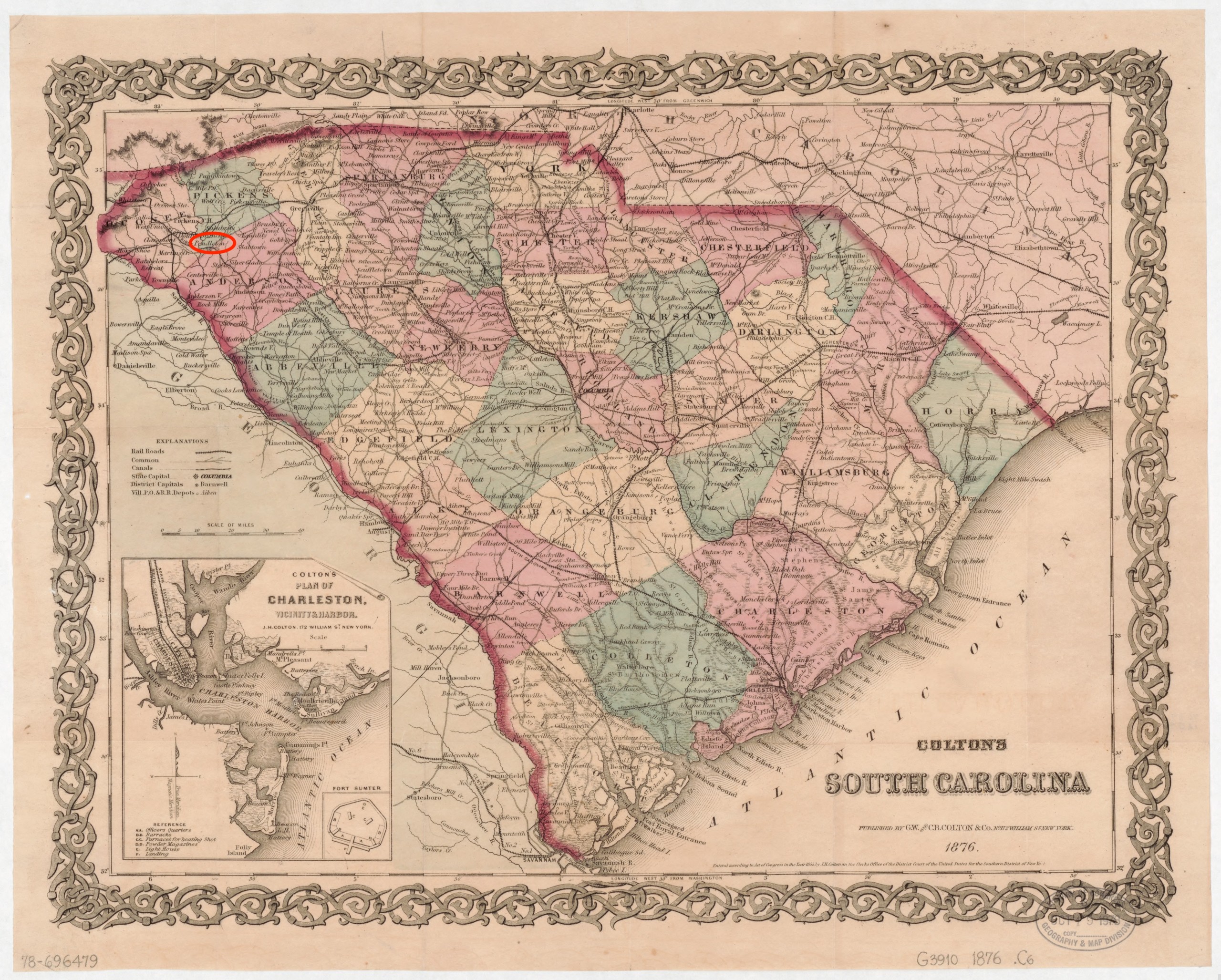
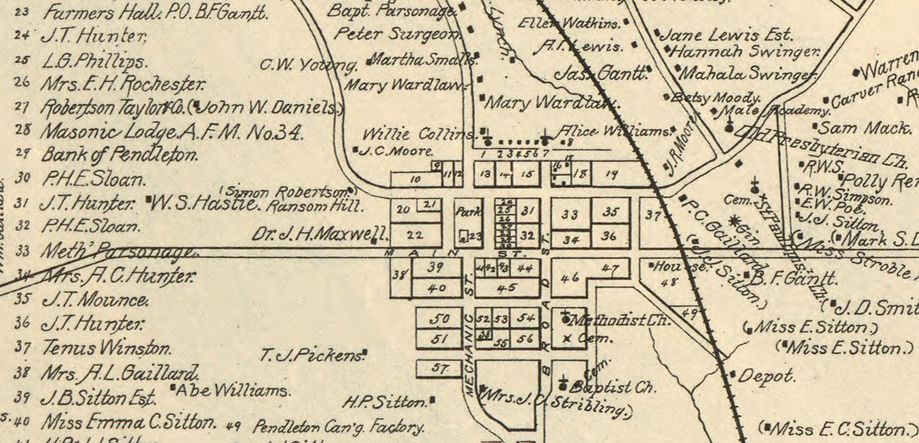
The Pendleton Messenger reported:
"We had quite a stir in our village on Friday lest, when the Southern mail was delivered . . . Col. William Sloan was among the first to receive his, and upon examination, he found a printed, post marked Boston, mailed as a letter, charged with ten cents postage, signed Junius, and addressed to the Hon. John C. Calhoun of the most malicious, offensive, and insulting character to the Southern people. This document was read by Colonel Sloan aloud, and it produced much excitement among the persons assembled."38See the August 17, August 21, September 21, and October 5, 1849 issues of the Pendleton Messenger.
There was no doubt in the minds of Pendletonians about the origin of these documents. The Pendleton Messenger wrote: "the most remarkable thing about them is the particularity and correctness with which they were directed to individuals in this neighborhood and in Pickens District on the route which Barrett traveled, and where it is known and can be proved that he obtained the names of the people."39"Abolition Documents," Pendleton (SC) Messenger, August 17, 1849.
William Sloan, who read his letter aloud to the crowd, was a prosperous local farmer who enslaved several people. He was known as a leading citizen of the town. He and many of his relatives in town enslaved people, and neither he nor Calhoun would have been the working-class white men Brisbane had hoped to reach. Sloan was also evidently comfortable enough in his civic standing, righteousness, and relationship with Calhoun to open a letter addressed to Calhoun.
Sloan and his neighbors, a group styling themselves the "Executive Committee on Vigilance and Safety," pushed their way into the building and overcame the resistance by John Sitton, a carriage maker, and merchant who also operated the post office. Appointed in 1835, he had run it from his home for a few years, but its operations had become so busy as to require a separate location.40After Sitton built a new house for himself off the Pendleton Green in the 1850s, he moved the post office out of Farmers Hall and into his first floor for a few years (perhaps to better protect the mail), but the post office operations were later moved back into the Farmers Hall a few years later. See "Sitton House," Pendleton, City Profile, accessed July 20, 2022, https://www.cityprofile.com/south-carolina/sitton-house.html. By 1849, the Pendleton Post Office was officially situated in the Farmers Hall building on the Green.
A Pendletonian who witnessed the event wrote: "The Executive Committee . . . demanded the letters of the postmaster. On his refusal to deliver them, they entered his office and took them by force."41Frederick Douglass, "Doings in South Carolina," North Star (Rochester, NY), October 12, 1849. Postmaster Sitton was unlikely to have put up too much of a fight. All of the Executive Committee members probably pushed him aside and went over or around a counter in the small space, grabbing the bags they wanted. An architectural drawing of the Farmers Hall in the early twentieth century shows that the space was small.42Thomas M. Sloan, Farmers' Hall, Village Green, Pendleton, Anderson County, SC, photograph, Historic American Buildings Survey, Library of Congress, Washington, DC, https://www.loc.gov/item/sc0102. Sitton was no abolitionist. He enslaved several people. But he did his duty as postmaster as well as might be expected with, at least, performative resistance.
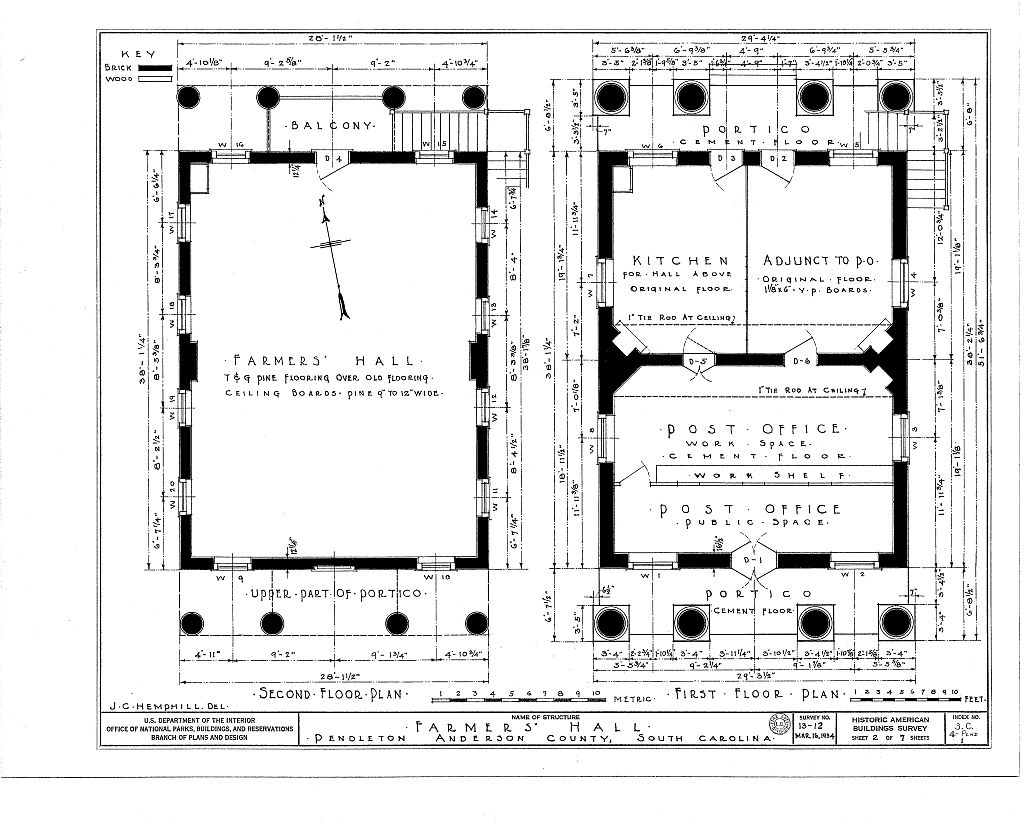
This story differs from the conflicts elsewhere in South Carolina in part because Pendleton was unlike other communities Barrett had gone through. Some postmasters did not resist as Sitton had resisted. James E. Hagood in nearby Pickens had personally and preemptively burned some fifteen to twenty pamphlets when he realized they had arrived in his district. Nor did he wait around for a mob to help him. Newspapers recorded other incidents of irritated recipients of antislavery materials across South Carolina. Individuals across the state proudly announced that they, too, had taken it upon themselves to burn such documents.43"Save Your Ink and Paper," Pickens Keowee (SC) Courier, August 25, 1849. But the collective effort in Pendleton suggests a reaction that speaks to the particularity of that place and time.
While the most intense spate of mailings targeted the Upstate, Pendleton was no backwater filled with poor white citizens who might conceivably be receptive to Brisbane's argument against the entrenched and elite political class that ruled the state. It was, instead, a densely populated and established enclave. Significantly, Pendletonians culturally and politically aligned themselves not so much with the Appalachian Scots-Irish settlers in the mountains or the white working-class of non-slaveholders common in the Piedmont. Instead, the town was quite invested in identifying itself with the wealthy sojourners from the Atlantic coast who often vacationed there to escape the summer heat and who had built numerous mansions encircling the town boundaries. Many of the town people were merchants or tradesmen, not planters, but they certainly aspired to join those more elite ranks that gave their town a reputation for gentility.44A genteel and happy history of Pendleton can be found in Mary Esther Huger, The Recollection of a Happy Childhood (Pendleton, SC: Research and Publication Committee, Foundation for Historic Restoration in Pendleton Area, 1976). See also R.W. Simpson, History of Old Pendleton District: With a Genealogy of the Leading Families of the District (Anderson, SC: Oulla Printing & Binding Company, 1913).
While the Upstate or Piedmont region of South Carolina was generally white-majority with far fewer large slaveholders than the coastal region—and was populated with many small yeoman farmers who made a living on properties with poor soil or with the topographic challenges inherent at the foothills of the Appalachians—Pendleton itself was different. It boasted both female and male academies of some repute. It had a long-running circulating library.45Frances Lander Spain, "Early Libraries in Pendleton," The South Carolina Historical and Genealogical Magazine 50, no. 3 (1949): 115–26. For references to the carriage-making reputation of the town, see "Pendleton," The Historical Marker Database, accessed July 20, 2022, https://www.hmdb.org/m.asp?m=9614. Local white artisans, usually assisted by enslaved workers, operated high-end cabinet making and carriage construction businesses that attracted an elite clientele. Pendleton featured wealthier and more politically influential families than many other Upstate towns. The opulent summer houses, hunting lodges, and manor-style properties built around the town by enslaved labor signaled to inhabitants and visitors that they were now in a special and more affluent place than other Upstate villages of comparative size.
Most of all, this town aligned itself with the reputation and identity of their great patron, the illustrious John C. Calhoun, who had long called for censorship of the mail when it came to abolitionist materials.46West, Yeoman to Redneck, 52. Calhoun didn't just represent their state or district; he was their hometown celebrity and a founding member of The Farmers Society, which had built the impressive columned building that housed the post office.
That the round of mailings included at least one pamphlet directed explicitly to the now quite elderly Calhoun may have especially raised the hackles of Pendleton, always protective of the revered statesman. This connection did not go unremarked: As the Brooklyn Eagle noted: "It appears that [the cause of] Mr. John M. Barrett . . . has been taken up by some of John C. Calhoun's minions in South Carolina."47"More Nullification," New York Tribune, reprinted in Brooklyn (NY) Eagle, July 31, 1849.
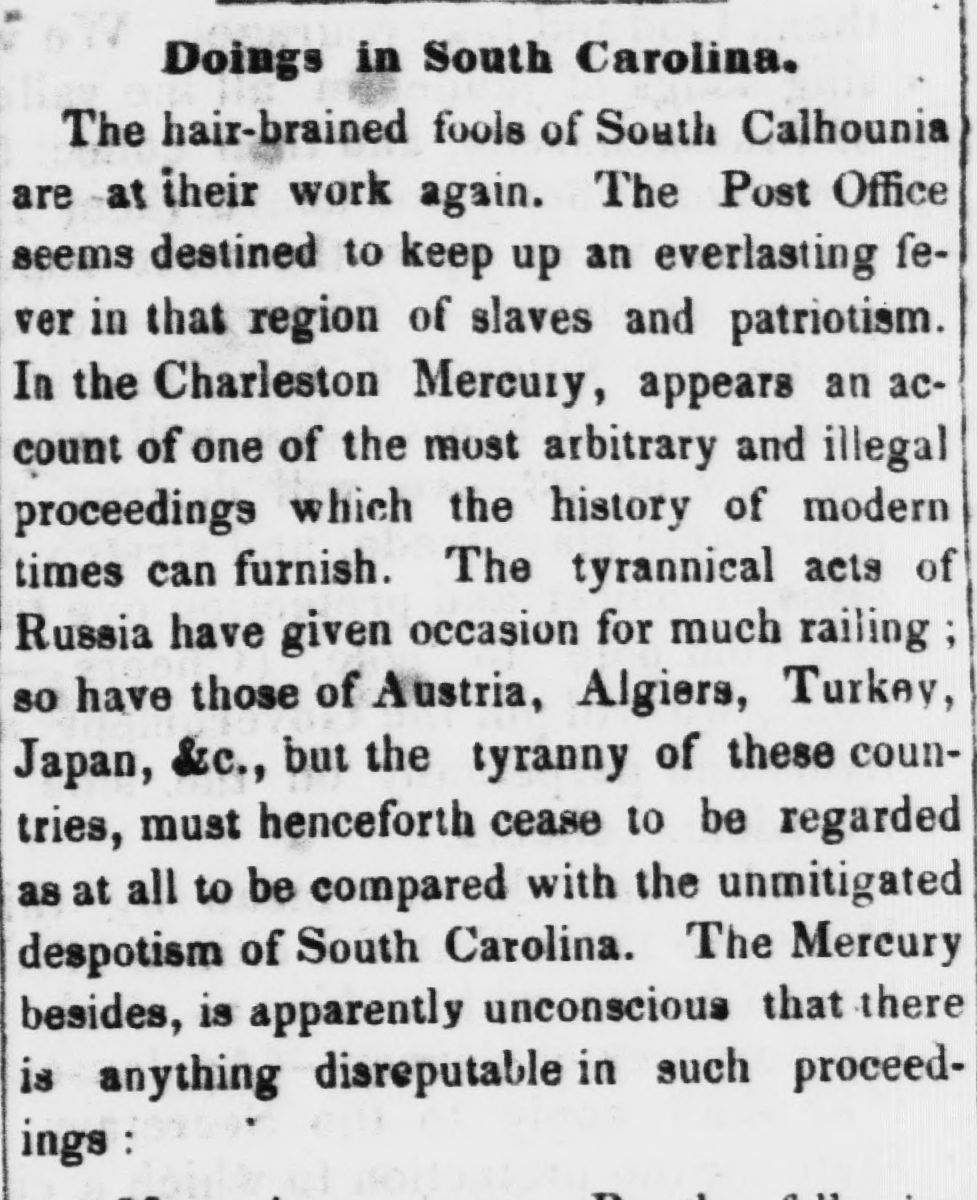
The alignment of Pendleton and Calhoun was common knowledge. In his newspaper Frederick Douglass characterized the activities of the Pendleton vigilantes: "The hair-brained fools of South Calhounia [sic] are at their work again" above a reprinted letter from a Pendletonian about the Barrett case.48Douglass, "Doings in South Carolina."
This, too, is a story of media power. It is not merely incidental that Pendleton, in 1849, had a newspaper office. At the time of the bonfire, the Pendleton Messenger directly faced the conflagration on the Green. The press was right there to witness, observe, opine, and energetically disseminate the happenings. The Pickens Keowee Courier, another leading paper of the area which at that time was run by editors previously involved with the Pendleton Messenger, also dedicated a lot of ink to the Pendleton happenings.49See West, Yeoman to Redneck, 63. West argues persuasively that the hullabaloo about the press coverage of the Barrett case was not soon forgotten. When, in 1859, vigilantes in Greenville seized a man for holding books and pamphlets they found objectionable, they sought to keep it quiet and out of the newspapers.
Long associated with Calhoun, the Pendleton Messenger had first published his most famous writings on nullification in in the 1830s. It shouldn't be surprising that the paper was especially protective of the celebrity politician who put Pendleton on the map. In general, citizens of the Upstate and the media acolytes of Calhoun were determined to be at the forefront of outrage and resistance.50See Susan Hiott, "Pendleton Messenger," South Carolina Encyclopedia, updated May 22, 2018, https://www.scencyclopedia.org/sce/entries/pendleton-messenger/.
While the Pendleton Messenger ended as the town's newspaper in 1851, its building at 1254 Exchange Street on the Green still stands as the locus of a different kind of political and media power. As of 2022, the old Pendleton Messenger building currently houses the office of longtime US Senator from South Carolina, Lindsey Graham.
The Black Witnesses
Burning mail on the Pendleton Green was probably one of the least violent acts many of these white men enacted in any given week. Black men, women, and children, as well as many Native people, had long been held in bondage in the Upstate of South Carolina. They were controlled by the perpetual threat of violence that, as Orlando Patterson famously codified in his study Slavery and Social Death, was one of the defining and vital tools that enabled the practice of enslaving another human being.51See Orlando Patterson, Slavery and Social Death: A Comparative Study with a New Preface (Cambridge, MA: Harvard University Press, 2018). The power of violent coercion, usually through implicit or explicit threats, was necessary to maintain control over others.
The burning of the antislavery mail was simply another manifestation of this threat. It was a violent rhetorical performance and visible event designed for publicity and to send a message to abolitionists and to white non-slaveholders in the southern states that no contrary thinking could be countenanced.
Black people, the resistors and agents of abolition and antislavery long before the creation of any organizations with those names, would not have needed pamphlets with timid arguments to tell them of injustices. But what might they have thought or felt upon seeing the flames in Pendleton?
Direct records of African Americans' thoughts are not currently part of the material archive. And while we have the outrage of Black audiences expressed in northern papers, we must be careful in speculating about the reactions of Black witnesses in Pendleton. But we would be remiss not to speculate. Their historical presence at the scene is indisputable. To affirm a different kind of Black memory work, we must grapple with the notion that many people watching or smelling that bonfire were aware that their presence was impossible, unregistered, and ignored. And yet, their presence was part of the story, perhaps the most crucial part.
Understood in part as an act of publicity and surveillance, the Pendleton bonfire and its newspaper coverage ensured a wider awareness of violence and racial control. Editors knew well that papers elsewhere would pick up and reprint their reporting. The bonfire also had the cruel effect and intent of warning anyone in the Black population not to feel emboldened or hopeful that they might have allies for liberation. The bonfire was, in many ways, for their witness.
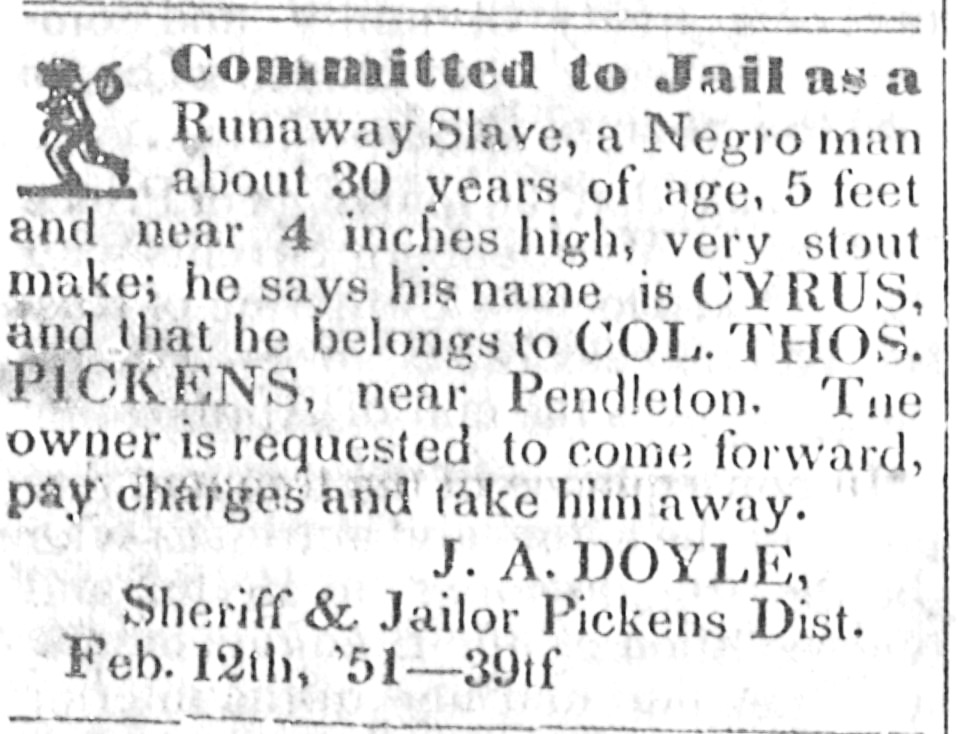
Of course, that message was mixed: white townspeople were kicking up a fuss about a cultural force that had escaped their control. And as they railed against antislavery mail, perhaps it encouraged some Black villagers to self-liberate. Cyrus, for one, enslaved at a labor camp near Pendleton, escaped in 1851.52"Committed to Jail as a Runaway," Pickens Keowee (SC) Courier, February 15, 1851. Although recaptured, he clearly had decided he wouldn't wait for someone to intervene on his behalf.
Anderson courthouse records indicate that in the 1840s a woman named Sylvia hid for eleven weeks in a barn until she accidentally left some clothing in nearby Pendleton and was discovered. The enslaved man in Pendleton who harbored her, Harry, was sentenced to fifty-seven lashes. What happened to Sylvia is unclear but the family and friends of Harry and Sylvia knew to be fearful of the long reach of the Pendleton area authorities.53For the story of Sylvia and Harry, see W. J. Megginson, African American Life in South Carolina's Upper Piedmont 1780–1900 (Columbia: University of South Carolina Press, 2006), 84. W.J. Megginson's work with the Anderson Court records provides many rich examples of the ways in which the culture of the justice system in the upstate of South Carolina controlled Black life. They had carved out some moments of resistance, but the surveillance culture of the Upstate left little room for triumph.
Like most southern-state newspapers of the era, the Pendleton Messenger drew a solid revenue stream from advertising sales of women, babies, children, and men. Almost every issue throughout the 1840s featured such advertisements. In one dated October 27, 1843, the local sheriff's office not far from Pendleton offered for sale Lenah and Jack with their children Beck, Peter, and three "younger ones" in order to pay off their enslaver's debts. From its inception the Pendleton Messenger specialized in silencing the voices and diminishing the personhood of Black people, marketing families like Lenah and Jack's. Literate or not, enslaved persons would have known to be wary of the ways in which news traveled.54"Sheriff's Sales," Pendleton (SC) Messenger, October 27, 1843.
The Pickens Keowee Courier ran advertisements for enslaved people aligning them with sales of animals such as one in February 1, 1851, notifying the public of eighteen people available for purchase.55"Administrator's Sale," Pickens Keowee (SC) Courier, February 1, 1851. The circulation of print in Upstate South Carolina helped set the value of the enslaved and affirm the values of enslavers.
Black activists from afar took note of the frantic reactions to antislavery mailings. "These violent measures resorted to by the slave mongers," wrote Frederick Douglass, "may be regarded as evidence that they see their weakness and the untenableness of their position."56Douglass, "Doings in South Carolina." That fact that updates about John Barrett and the protests were carried in the Anti-Slavery Standard and the Liberator, periodicals with significant Black readership, indicates a kind of displaced testimony to the events, particularly when you consider how these papers frequently reprinted in their entirety articles which had initially appeared in the South Carolina papers.
More concretely, we can return to the site of Pendleton to imagine the role of Black witness. The archival record doesn't record specific witnesses by the people most affected by the event, but when we adjust our attention to see the presence of Black life around that village green, possibilities for seeing the space anew emerge.
Many Black people lived and labored within a short stroll to the Green. Many of the Pendleton men involved in the bonfire, if not all, were enslavers or likely aspirational enslavers. Both Sitton and Sloan, for example, held men, women, and children laboring in bondage on their properties only a few hundred feet from the Green.
A blacksmith's shop was only half a block away from enslaved workers. Indeed, almost every house close to the Green in that period was owned by an individual who shows up as an enslaver on the Federal Slave Schedules of 1850. Black people must have seen the event, perhaps peeking from windows or viewing from alleys. Perhaps from porches at mansions only a block away, enslaved people washing linens or handling horses saw the smoke and heard the yelling. Would they have shrugged and kept their heads down? Likely they realized this agitation represented something more. Were the white people in Pendleton enraged because they were being challenged? Somebody had caused problems and drawn their ire. Doubtless the news traveled.
The enslaved were all around, on acreage outside the town limits as well as close by to attend to domestic tasks. Elam Sharpe, for example, who owned a large house steps away from the Green, held six enslaved people according to the census record of 1840; by 1850 a slave schedule reported he owned thirteen unnamed people. Some of those were women and young children.57"Elam Sharpe," 1850 United States Census (Slave Schedule), Anderson County, SC, NARA series M432, Roll 861, Family Search, accessed July 25, 2022, https://familysearch.org/ark:/61903/1:1:HRWH-H73Z. They might not all have resided at his "in-town" property; some of these women exploited as domestics would undoubtedly have worked in the two-story house in Pendleton. Would these women, occupied with cooking or laundry, have seen a stream of agitated white men passing by their home on the way to the Green? Would have heard the cheering and smelled the smoke? Sharpe's brother-in-law was the editor of the Pendleton Messenger, operating two blocks away, so his household, including the enslaved, would undoubtedly known all about the events. The carriages or horses of the Pendleton Vigilance Committee would have passed by the front porch on the way to the conflagration.
Owned and run by the Maverick family in the 1840s, Montpelier, one of the large plantation labor camps sited on what is now Old Greenville Highway was only a few minutes by wagon from the town center. At least thirty-seven men, women, and children were held in bondage there.58"Samuel Maverick," 1850 United States Census (Slave Schedule), Anderson County, SC, NARA series M432, Roll 861, Family Search, accessed July 25, 2022, https://familysearch.org/ark:/61903/1:1:HRWH-4ZZM. Would word reach them, soon after the event? Would they know people out there in the world were decrying slavery and perhaps have felt a little less alone?
Given the social space of Pendleton, many Black people would have been in the vicinity of the bonfire, watching it or perhaps doing their best to keep far away. Pendleton's population (both the town proper and the broader "Pendleton District") during the early nineteenth century was notably more dense than in many other areas of the Upstate, and their holdings of enslaved people considerable, albeit dispersed among numerous white families. White Pendletonians enslaved people at higher rates than surrounding white populations. According to the 1860 census, the combined population of Oconee and Pickens counties, which encompassed much of the Pendleton District, included 500 enslavers who held 4,195 people in bondage. That's a high number but nothing like comparative statistics in the central or southern parts of the state.59For a good understanding of these numbers, see Megginson, African American Life, 8. Consider how Charles Joyner, in his study of the All Saints Parish in coastal South Carolina (known as the Lowcountry) demonstrated that in the 1860s fifteen wealthy planters enslaved 4,383 people.60Charles W. Joyner, Down by the Riverside: A South Carolina Slave Community (Urbana: University of Illinois Press, 1984), 19. Certainly the Upstate or Pendleton District was quite unlike the Lowcountry. But, the small town of Pendleton was itself quite different from its surrounding areas—and would have felt a bit more like a Lowcountry town in terms of its affluence and its ratio of enslaved people to the white slaveholding populations. The town of Pendleton, as the 1860 census reported, counted 383 white people, one lone free person of color, and 470 enslaved persons.61Population data from 1860 can be found in Joseph Kennedy, Population of the United States in 1860 (Washington, DC: Government Printing Office, 1864), 448–455, accessed July 25, 2022, https://www2.census.gov/library/publications/decennial/1860/population/1860a-32.pdf. Individual enslavers in town held humans in their inventory but so did business entities: The Pendleton mercantile firm of W.H.D. Galliard & Co., for example, listed four enslaved laborers sited on premises near the Pendleton Post Office.62Megginson, African American Life, 8, 114.
Even though many of the affluent white sojourners from the Lowcountry who spent extensive vacation periods in Pendleton left the bulk of their enslaved work crews to endure the rice or cotton plantation labor camps, they would have traveled with a domestic retinue of the enslaved to their Pendleton retreats.
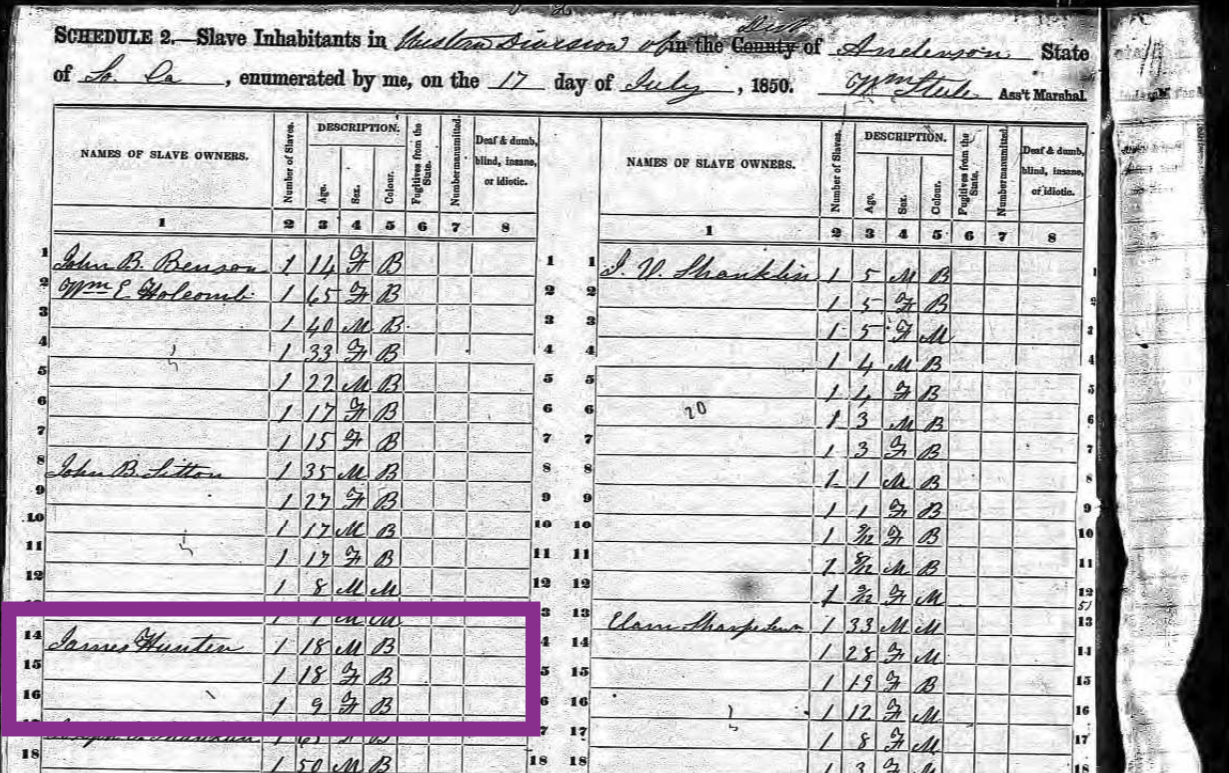
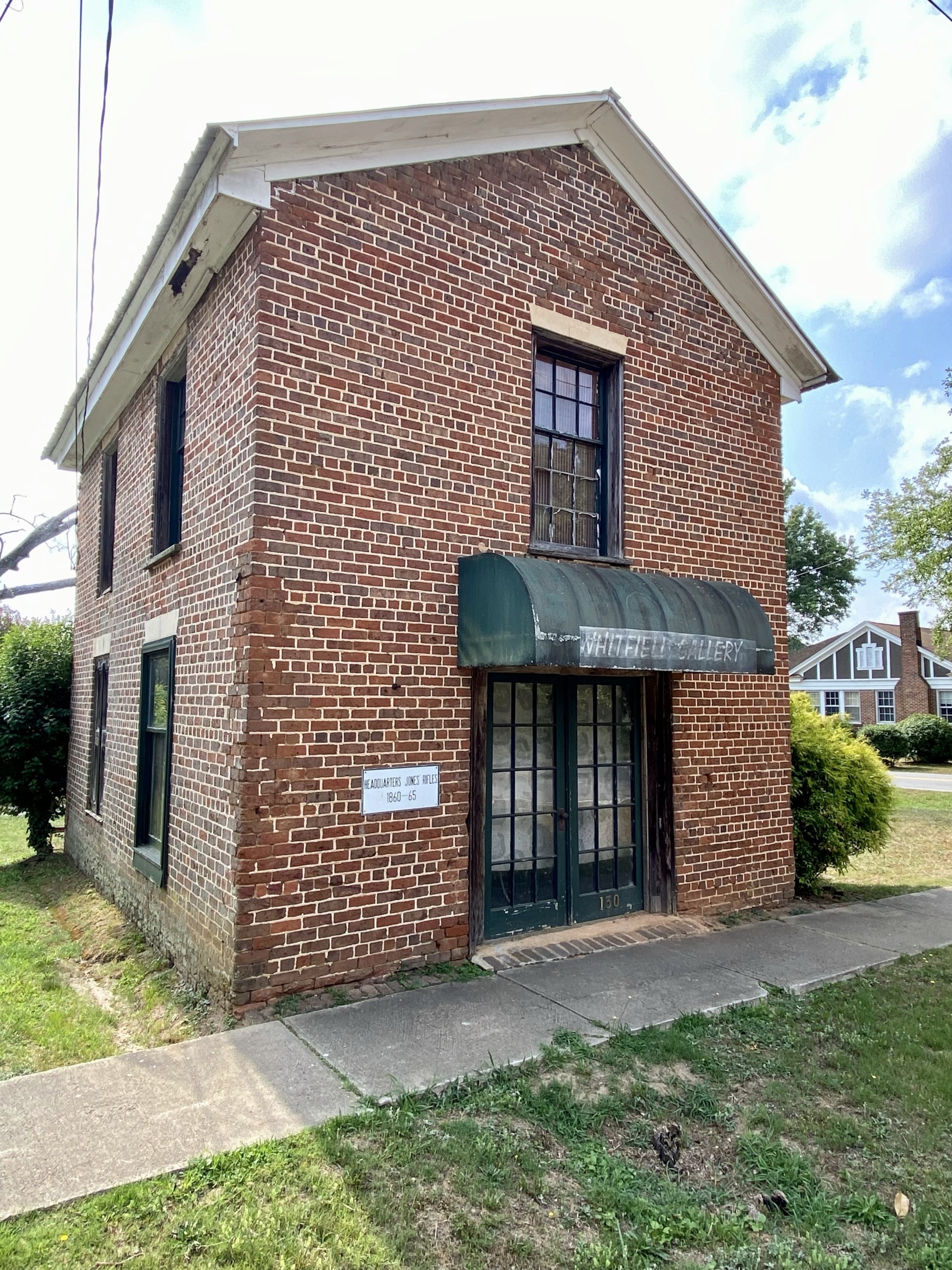
There were more Black people close to the Green for other reasons, too. A few free Black people could even conduct business at the establishments there, but almost every business owner in the town held a few people in bondage. James Hunter, for example, ran a blacksmith shop right off the Green, doubtless assisted in part by one of the three Black people he enslaved, most likely the unnamed eighteen-year-old man listed in the 1850 slave schedule.63"James Hunter," 1850 United States Census (Slave Schedule), Anderson County, SC, NARA series M432, Roll 861, Family Search, accessed July 25, 2022, https://familysearch.org/ark:/61903/1:1:HRW4-GYN2.
There were boarding houses and hotels located within shouting distance of the Green, all of which had travelers with enslaved servants passing through as well as a handful of enslaved people, ensuring that hosting routines went smoothly. They, too, might have seen the fires or the ashes. The Female Academy of Pendleton was located kitty-corner from the Green. While the white students did not board there (they tended to live at houses within walking distance), at least one or two enslaved Black workers stayed on hilly site to tidy the property, clean the classrooms, stoke the fires, and stand ready with carriages and horses to pick the young ladies up and transport them as needed.64For references to the various incarnations of the Female Academy in Pendleton see "South Carolina Education—Anderson County," Carolana, accessed July 20, 2022, https://www.carolana.com/SC/Education/sc_education_anderson_county.html.
A creative cognitive map of Pendleton's enslaved population of 1849 reveals plenty of Black people in proximity to the fiery events. They would have mapped the terrain differently as their perceptions of joined places and slave neighborhoods would not have coincided with officially sanctioned property lines defined by enslavers.65For an overview of this concept see Anthony E. Kaye, Joining Places: Slave Neighborhoods in the Old South (Chapel Hill: University of North Carolina Press, 2007) and "'In the Neighborhood': Towards a Human Geography of US Slave Society," Southern Spaces, September 3, 2008, https://southernspaces.ecdsdev.org/2008/neighborhood-towards-human-geography-us-slave-society/. The entire township, not merely a particular site of bondage, would have encompassed their neighborhood.
The Pendleton Green, town center for white villagers, was likely traversed with great care by Black Pendletonians, who would have understood the performative terrorism and the threat it signified. News carried fast. This was a story for them, about them, and directed at them with cruel menace.
Conclusion
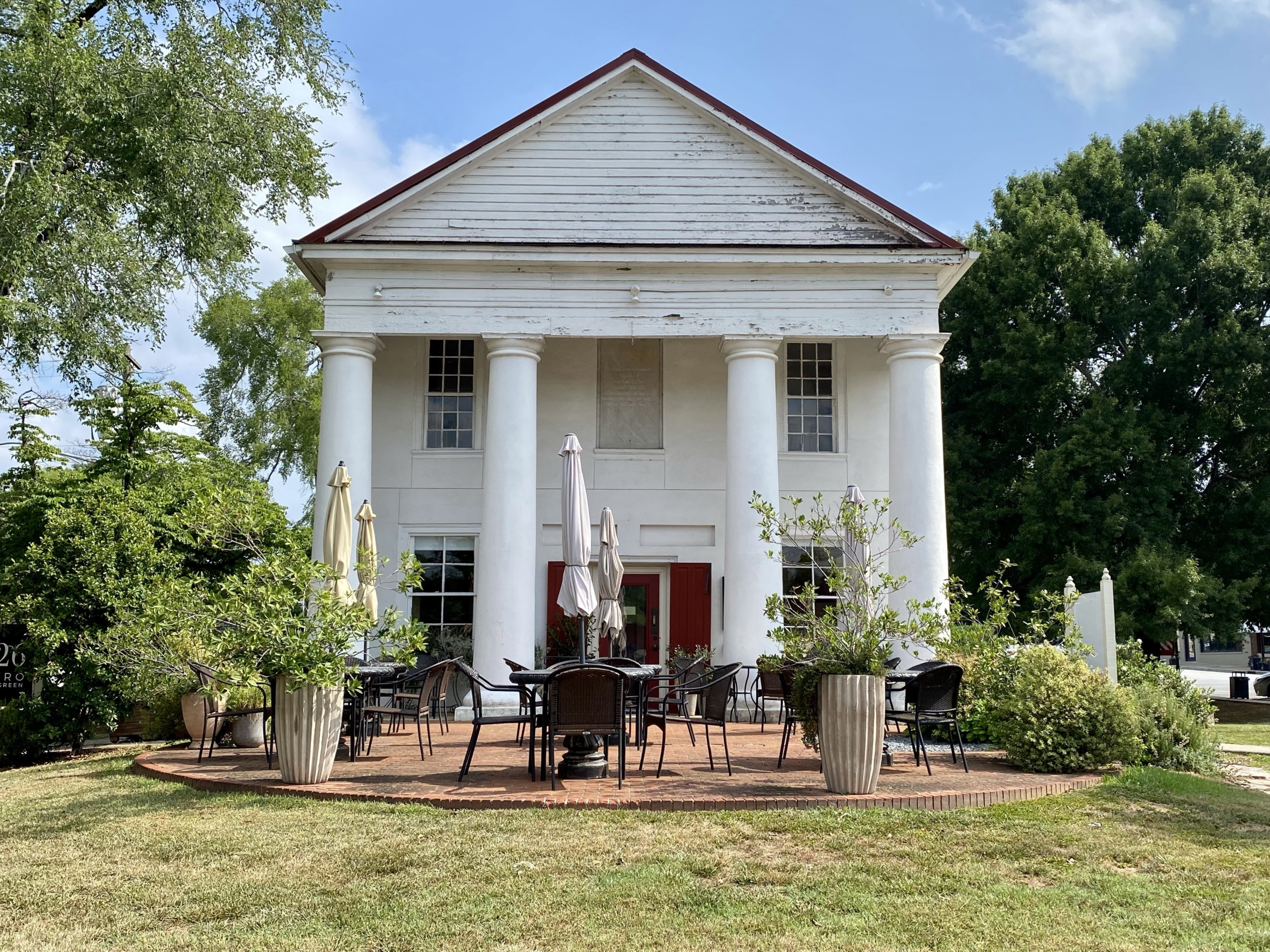
Pendleton today benefits from proximity to nearby Clemson University and tourism. The entire town is on the National Registrar of Historic Places, making it one of the country's largest designated districts.66For details about this historic designation, see "Pendleton Historic District," South Carolina Historic Properties Record, accessed July 20, 2022, http://schpr.sc.gov/index.php/Detail/properties/11705. For the claim that the district is exceptionally large, see "Anderson County, South Carolina," Carolana, accessed July 20, 2022, https://www.carolana.com/SC/Counties/anderson_county_sc.html. It features over fifty buildings dating from the eighteenth and nineteenth centuries. While now promoting restaurants and antique stores more than carriage making or agriculture, it's a lovely place to stroll.67 "Pendleton Historic District, Anderson County (Pendleton)," South Carolina Department of Archives and History, accessed July 20, 2022, http://www.nationalregister.sc.gov/anderson/S10817704013/index.htm.
The Pendleton Foundation for Black History and Culture has worked hard to redirect and enrich much of the public discussion about local history. They have drawn attention to local sites important to Black history; in particular, the significance of the Keese Barn site, only a few hundred steps from the Green, which in the early twentieth century became a gathering place for African Americans.68"About Us," Pendleton Foundation for Black History & Culture, accessed July 19, 2022, https://blackhistorypendleton.org/about.
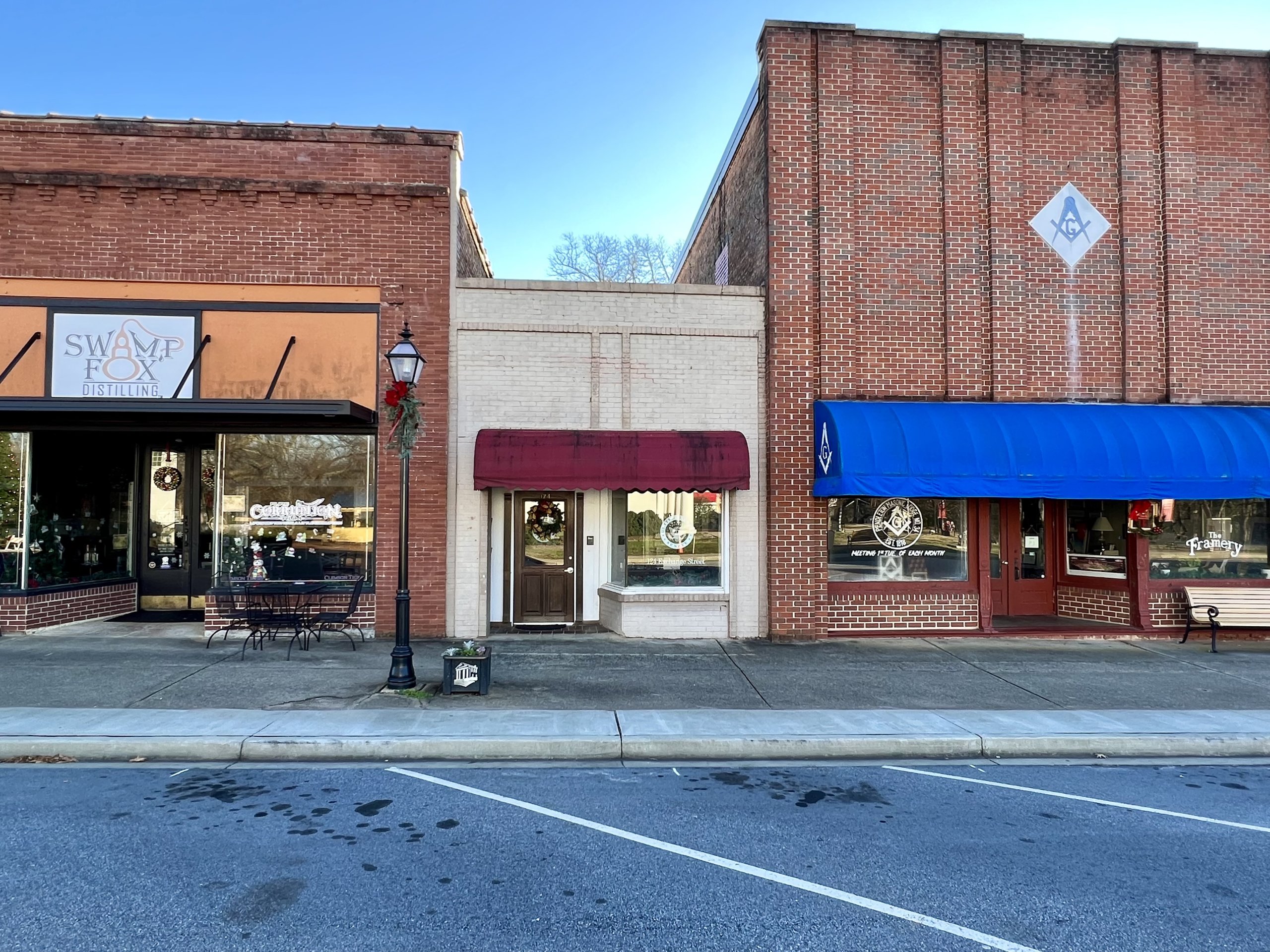
The story of the Green demands a more complex reckoning than the current historic markers allow. The Farmers Hall still stands in its stolid beauty with its colossal columns. A bustling restaurant called the 1826 Bistro on the Green now occupies its first floor, where the post office once operated.69"1826 Bistro," 1826 Bistro, accessed July 19, 2022, http://www.1826bistro.com/. A bookstore overlooks the Green as do gift stores and a Mexican café.70"Home," The Pendleton Bookshop, accessed July 25, 2022, https://www.pendletonbookshop.com/; "Welcome to Vaquaros Mexican Restaurant," Vaquaros Mexican Restaurant, accessed July 25, 2022, https://www.vaquerosinthesquare.com/; "Home," Mountain Made American Handcrafts, accessed July 25, 2022, https://potteryinpendletonsc.com/. Farmers markets, annual festivals, and local protests, particularly those seeking the attention of US Senator Lindsay Graham, whose office overlooks the Green, regularly enliven the public space.71"Home," US Senator Lindsey Graham, accessed July 19, 2022, https://www.lgraham.senate.gov/public/. But the story of the gathering of white supremacists attacking the federal post office and casting pamphlets into a bonfire remains little known.
About the Author
Susanna Ashton is a professor of English at Clemson University. She studies the writing and witness of enslaved people, particularly those from South Carolina. Ashton holds an MA and a PhD in English from the University of Iowa and received her BA from Vassar College. She has held fellowships at Yale, Harvard, Emory, and the University of South Carolina, and has served as a Fulbright Faculty fellow at University College Cork in the Republic of Ireland. Most recently, she was a W.E.B. Du Bois Fellow at Harvard's Hutchins Center for African and African American Studies for 2021-2022. Ashton's current project, John Andrew Jackson, the Hidden Inspiration Behind Uncle Tom's Cabin, is forthcoming from The New Press, 2024. She lives approximately three miles from the Pendleton Green.
Acknowledgments
I thank Doug Seefeldt (Clemson History) for the opportunity to assemble this story for the public. Thanks are also due to Tara Wood and Brenda Burk for their kind assistance. Staff members at the Anderson County Main Library’s Genealogy and Local History section were especially helpful in finding images of Pendleton. Librarian Mary Lanham, especially, was quite generous with her time. Librarian Daniel Bonsall helped me sort through some puzzling Pendleton statistics. Clemson Colleagues Jessica Serrao, Josh Catalano, and Amanda Regan were models of kindly instruction. The staff at the South Carolina Room at the Hughes Main Public Library in Greenville, the Pendleton Branch Public Library, and the South Carolina State Department of Archives and History (particularly Dr. Steve Tuttle) went beyond the call of duty in helping me assemble the materials undergirding this project. The curators at the South Carolina State Dept of Archives and History were especially helpful in getting me court documents related to the trial, including an actual and rather extraordinary copy of the particular Brutus tract the Spartanburg authorities held as evidence against Barrett. A research sabbatical from Clemson University's College of Architecture, Arts, and Humanities allowed me the luxury of time to hone my professional skills as well as complete this modest storytelling endeavor.
I’m grateful to the editorial team of Southern Spaces and the anonymous peer reviewers, all of whom helped me further develop this project and bring it to the public.72This incident of 1849 was first brought to my attention in Stephen West's terrific book, From Yeoman to Redneck in the South Carolina Upcountry, 1850-1915 (University of Virginia Press, 2008) and I thereafter independently kept bumping into complaints about Brisbane in antebellum newspapers from the Carolinas. It took a few years for me to be able to see how an angle on this story might be particularly about the ways that the Upstate of South Carolina, particularly Pendleton, saw its allegiance to the culture of Calhoun and the culture of the coastal Low Country. Even that only made sense when the Black people at the heart of the story could be appropriately understood to be at the center, not the periphery, of the scene.
While little of my specific information in the Black Witness section comes directly from W. J. Megginson's work, African American Life in South Carolina's Upper Piedmont 1780-1900 (University of South Carolina Press, 2006), I am grateful to him for his deeply felt research that undergirds my approach to apprehending the different kinds of possible witness there. Brent Morris' thorough and thoughtful work on the Reverend William Henry Brisbane was also vital to this project and I suggest anyone seeking more information on Brisbane start with Morris' fine writings on the topic.
In this short book, distinguished political scientist Adolph L. Reed, Jr. offers remembrances from his early life below the Mason-Dixon line as a member of the last African American generation who came of age during Jim Crow. Reed writes with a purpose—not to chronicle his own pivotal events, hardships, or personal demons, nor to proclaim general truths. Instead, he aims to prevent misconceptions he fears are taking root about the uniform nature of the segregated South and forestall mistaken present-day lessons that ignore the role of class in the racial order of the Jim Crow South.
Reed considers himself a southerner with "a small asterisk."1Reed, Adolph L. Jr., The South: Jim Crow and Its Afterlives (New York: Verso Books, 2022), 9. Born in the Bronx, he was in grammar school in Washington DC, in 1954 when the Supreme Court handed down Brown v. Board of Education. Later, his parents, natives of the Arkansas Delta and New Orleans, moved back to the South where he grew up in Pine Bluff, Arkansas,and the Crescent City. Reed attended college in Chapel Hill, North Carolina and Atlanta and traveled the region while doing summer jobs. He taught at colleges and universities in Atlanta and worked in the city government during the second term of its first Black mayor, Maynard Jackson. He then returned north where he has spent most of the last forty years—primarily at Yale, Northwestern University, and the University of Pennsylvania—teaching and writing about the importance of the working class and the role of class in racial politics.
Although entitled The South, Reed's book illuminates how he and others experienced several different "Souths," where culture, class, ideology, and the laws emerging from segregation varied by geography in practice and form. Reed came to understand that Black people of all ages had to learn differing local white rules of Jim Crow if and when they moved to new places across the southern states—and even in the same city where rules applied differently store-by-store or block-by-block with varying degrees of racial humiliation. For example, one white-owned shop in New Orleans allowed Reed's family to try on clothes before purchase, but in others not shoes or not hats. Some stores permitted no Black person to try the fit of any merchandise. Mistakes in knowing a local "calculus of tolerance" could involve much more than indignity for old or young. "Fourteen-year-old Emmett Till," Reed writes, "was murdered in nearby Mississippi on a family visit from Chicago in 1955 because he unknowingly violated a local rule of subordination in a way that was interpreted as 'getting fresh' with a white woman."2Reed, 12.
"If bristling at Jim Crow's injustices were especially prominent in my consciousness," Reed writes, "it was partly because, as a result of moving around, I was always struggling to learn the local rules and grammar of subordination and how to craft a normal kid's and adolescent's life within them." As the son of well-educated Black teachers, Reed adds, "Where I lived and my family's class position also made it easier to cultivate and express indignation." 3Reed, 13.
The pervasive but varying conditions of white supremacy meant that the places where Black people could be their own free selves, away from everyday racial dangers and indignities, lay within their own segregated communities—especially in Black churches and schools where few whites often entered. As a child living in Pine Bluff, Arkansas, Reed had contact with hardly any white persons because his middle-class father taught at the local historically Black college and his parents kept him close to home near the campus.
Black families deployed a variety of defenses. Traveling on a ferry boat with his grandmother, Reed asked her why chicken wire had been strung between the segregated seating areas. "Well, you see," she stage-whispered, "a lot of crazy people ride this ferry, and they have to sit on the other side."4Reed, 11–12.
Reed's vignette echoes forms of sly resistance, such as that recalled by Mississippi civil rights leader Aaron Henry, growing up under Jim Crow a generation earlier. As a boy, Henry repeatedly complained to his mother that the local white children were able to attend school for seven months but he could only go to school for five. "Aaron," his mother finally responded, "you my boy—and you don't need but five. The rest of them jokers they got to have seven." "Hell, I been cocky ever since," Henry insisted.5Worth Long, "Aaron Henry from Clarksdale," Southern Changes, 5, no. 5 (1983): 9–12. https://southernchanges.digitalscholarship.emory.edu/sc05-5_001/sc05-5_007/.
Passing as white occupies a full chapter as Reed explores the making of racial identities. During his teenage years in New Orleans, passant blanc was often accepted in the Black community as a personal choice, not so much a betrayal of the race. Reed remembers that in the city's Seventh Ward, a family of first cousins with the same surname occupied two sides of a duplex house. "The family on one side lived as black; that on the other side lived as white, and they all acknowledged one another."6Reed, 92–93. In his own family, an adult with light skin color occasionally posed as white to get some prized local delicacy or quicker service from an all-white restaurant, or to momentarily avoid a racial indignity.
Some white leaders openly acknowledged what a large number of various skin complexions meant in the real life of a society where a "one-drop rule" about race-mixing was used to demarcate the presumption of racial inferiority. Reed remembers the legendary Huey Long's brother, Earl, observing in 1960 that a single serving of red beans and rice would be enough to feed all the people in south Louisiana who were truly white (without any mixed ancestry). Alabama's two-term populist governor, James "Big Jim" Folsom, said as much in 1962, after noting the presence of a large number of light-skinned African Americans in his audience. "There's a whole lot of integratin' goin' on at night" in the state's Black Belt, he declared.7Carl Grafton and Anne Permaloff, Big Mules & Branchheads: James E. Folsom and Political Power in Alabama (Athens: University of Georgia Press, 1985), 68.
In concluding his chapter on "The Obsolescence of 'Passing,'" Reed remembers he came to understand at the New Orleans Jazz and Heritage Festival during the 1990s how much the vagaries of race and identity had changed with the end of Jim Crow, especially for young middle class people whose status allowed them to mingle as one at such shared events. "People who may have identified as Cubans and Hondurans, South Asians, Italian (largely Sicilian) Americans, Isleños from the Canary Islands, and other nominal whites formed a physically and behaviorally indistinguishable blur with whoever may have been (Black) Creoles."8Reed, 103.
Throughout The South, Reed investigates continuities and changes in racism and race relations that took place as he experienced the last phases of Jim Crow and the emergence of a second "New South" in Atlanta. His recollections end around 2017 as New Orleans begins removing its most prominent Confederate statues at a time when he was often in the city due to the illness and death of his mother. As if paying tribute to his mother's generation, Reed writes a full-throated analytic attack on the mythology and symbols of the Lost Cause, ripping apart their defenders' rationale for honoring enslavers who undertook a "criminal insurrection."9Reed, 123.
Reed is quick to warn that dwelling on the modern defenders of the erstwhile slave society (touting "heritage not hate") or lingering on "explicit racial hierarchies that defined Jim Crow era" should not replace a "deep examination of the discrete processes that ground and reproduce inequality in the present."10 Reed, 110. The segregationist system of white supremacy not only was more complex and opaque than popularly portrayed today but also was not "merely about white supremacy for its own sake," Reed writes. "It was the instrument of a specific order of political and economic power that was clearly racial but that most fundamentally stabilized and reinforced the dominance of powerful political and economic interests."11Reed, 137. In other words, because "the core of the Jim Crow order was a class system," Reed insists that "a simple racism/antiracism framework isn't adequate for making sense of the segregation era . . . or challenging the forms of inequality and injustice that persist."12 Reed, 140.
This part of Reed's book is not surprising for those who know his career. As a scholar and activist who spent most of his professional life teaching and writing about race and political thought in the United States, Reed has uplifted the importance of class in understanding the dynamics of racial disparities and for dismantling structures of inequality and exploitation. However, most of his remembered experiences with Jim Crow in this book do not directly support his enduring thesis. His argument about the central role of class in The South serves as a coda to his fifty years in advancing the working class as a subject of academic study and political agenda more than a conclusion revealed from the book's remembrances.
In some respects, Reed didn't need to make a case for the importance of class in the life of the South's Jim Crow. It had been done before by himself and others, some of whom he cites in his concluding chapter. One source he did not reference but surely knows is Dr. Martin Luther King, Jr. On March 25, 1965, at the end of the Selma-to-Montgomery march, King delivered a powerful address to the nation—one overshadowed in popular culture by his 1963 Lincoln Memorial "I Have a Dream" speech. In front of the first capitol of the Confederacy, King delivered a speech that included a popular history lesson.
Citing C. Vann Woodward's The Strange Career of Jim Crow, King told the crowd that "the segregation of the races was really a political stratagem" of the South's elite "to keep the southern masses divided and southern labor the cheapest in the land. You see," he explained, "it was a simple thing to keep the poor white masses working for near-starvation wages in the years that followed the Civil War."
King recalled the South's Populist movement when its leaders "began awakening the poor white masses and the former Negro slaves to the fact that they were being fleeced" and "began uniting the Negro and white masses into a voting bloc that threatened" to dislodge elite white control of the South's political power. "To meet this threat, the southern aristocracy began immediately to engineer this development of a segregated society" that became "the roots of racism and the denial of the right to vote," King told thousands who had marched with him for voting rights. "Through their control of mass media, they revised the doctrine of white supremacy. They saturated the thinking of the poor white masses with it." They established segregated laws often making it "a crime for Negroes and whites to come together as equals at any level. And that did it . . ."
"If it may be said of the slavery era," King proclaimed, "that the white man took the world and gave the Negro Jesus, then it may be said … that the southern aristocracy took the world and gave the poor white man Jim Crow."13"Address at the Conclusion of the Selma to Montgomery March," March 25, 1965, The Martin Luther King Jr. Research and Education Institute, Stanford University, Audio, 29:21, https://www.learnoutloud.com/Free-Audio-Video/History/American-History/How-Long-Not-Long/90591.
In remembering the Jim Crow he experienced, Adolph Reed has added nuance and insight to understanding the segregated South as it came to a formal end. In this book and others, Reed has placed himself in the company of southerners who came before him, scholars and activists alike, who devoted their life's work to the search for strategies and means to build a necessary interracial coalition to make democracy work in the nation—and to finally entomb Jim Crow with no chance for an afterlife.
About the Author
An adjunct with Emory University's Institute for the Liberal Arts, Steve Suitts is the author of Hugo Black of Alabama: How His Roots and Early Career Shaped the Great Champion of the Constitution (Montgomery, AL: NewSouth Books, 2017). Earlier in his career, Suitts served as the executive director of the Southern Regional Council, vice president of the Southern Education Foundation, and executive producer and writer of "Will the Circle Be Unbroken," a thirteen-hour public radio series that received a Peabody Award for its history of the civil rights movement in five Deep South cities.
]]>Excerpt: "Jim Crow Journeys"
The humiliations involved in traveling Jim Crow began before Black travelers even boarded their trains. By the beginning of the 1890s the proliferation of separate car laws had ushered in separate waiting rooms. Although before 1899 only Arkansas, Louisiana, and Mississippi had passed laws requiring the railroads to construct segregated facilities, colored waiting rooms were common across the South well before then. Writing in 1891, Black academic William Scarborough described one of the New South's most unpleasant innovations as the "the novelty of three waiting rooms—one for ladies, one for gentlemen, and one for neither gentlemen nor ladies, but for 'negroes.'" That Negroes were "neither ladies nor gentlemen" was a point that could be inferred from the conditions in these new spaces. "The negro-waiting room is a dirty miserable place, with here or there a broken chair and [a] few miserable benches," wrote Scarborough of the accommodations that he had seen in Chattanooga, Atlanta, Macon, and elsewhere.1"A Step Backward," Frank Leslie's Illustrated Newspaper, September 19, 1891, 98.
Built and maintained by the railroads, colored waiting rooms were sometimes created as a result of new construction and sometimes added to existing structures; but they were almost always smaller, less comfortable, and less convenient than the facilities available to whites. Black novelist Charles Chesnutt noted in an article written in 1901, "If there is any choice of location" when it came to positioning such rooms, "the Negro always gets the worst room and it is seldom well lighted or clean."2Charles W. Chesnutt, "The White and the Black," Boston Evening Transcript, March 20, 1901, 13.
The "Colored Waiting Room" in Seaboard Air Line and Southern Railway Depot in Raleigh, North Carolina, provides one example of the kind of facility he had in mind.3Founded in 1900 and headquartered in Norfolk, Virginia, the Sea Board Air Line Railway ran along the South's eastern coast, terminating in Florida. Despite its name, it owned no airplanes. Before the days of air travel, "air line" (as in a straight line drawn in the air) was a term widely used to describe the shortest distance between two points, and it became part of the name of a number of nineteenth-century railroads whose proprietors wished to emphasize that their routes were more direct than those of competing roads. Black travelers described it in a discrimination complaint filed before the North Carolina Board of Railroad Commissioners in 1898 as "the most poorly equipped room at the depot, being dark and ill ventilated," and "very inferior" to the waiting room used by the station's white passengers. Small and cramped, it seated only twelve people, and one of its rows of seats was located "within a few feet of its restrooms" and faced directly into these facilities. Travelers who sat in these seats had an unavoidable view of "people going in and out the urinals and stalls," and were close enough to be able to smell the bathrooms as well. These busy bathrooms were used not just by colored travelers, but by railroad hands and "the public around the depot, ad libitum," so the stench that they gave off during warm weather assaulted not only the people in nearby seats, but everyone in the waiting room.4"E. A. Johnson, John Dancy, R. H. W. Leak et al. vs. Seaboard Airline and Southern Railroad," in Eighth Annual Report of the Board of Railroad Commissioners of North Carolina (Raleigh: Guy V. Barnes, Printer to the State, 1898), 110.
Conditions in the station's colored waiting room were especially troubling to Black women passengers, whose race exempted them from the privileges usually accorded to female travelers. The Raleigh station had no ladies' waiting room for Black women, who were "not allowed to go into the general ladies' waiting room." They, too, had to occupy Raleigh's tiny, smelly "colored waiting room" and experience its bird's-eye view of the toilet. "Convicts and insane people" were among the travelers who used these rooms, the complainants charged, and "the seats are so arranged that when such people are in there, lady passengers must sit next to them or immediate back of them."5"E. A. Johnson, John Dancy, R. H. W. Leak et al. vs. Seaboard Airline and Southern Railroad."
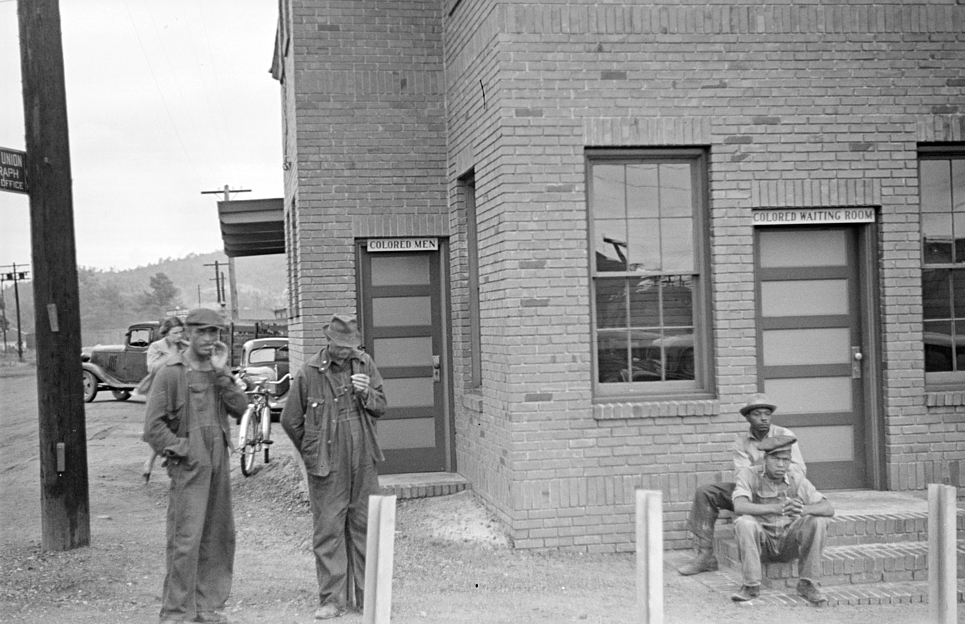
Raleigh's small station was built nearly a decade before North Carolina passed its 1899 law requiring the establishment of separate waiting rooms for white and colored races, and may have had an especially cramped colored waiting room for that reason. But southern railroads designed with segregation in mind were often equally problematic. Completed in 1906, Atlanta's massive Terminal Station replaced an older station and provided more spacious accommodations for Blacks. The station it replaced had only two waiting rooms: a general "Waiting Room for Ladies and Gentlemen," and smaller "Colored Waiting Room" that had once served as its "Ladies' Waiting Room."6Chesnutt, "The White and the Black," 13.
Still, most Blacks probably preferred the old station to the palatial new building. The "whole front" of the new station, according to journalist Ray Stannard Baker, "was given up to white people."7Ray Stannard Baker, Following the Color Line: An Account of Negro Citizenship in the American Democracy (New York: Doubleday, 1908), 223. Its facilities included a grand main waiting room, several ladies' waiting rooms, a gentlemen's reading room, a gentlemen's smoking room, and exactly one waiting room for Blacks—a "small and dirty room" that had to be entered from the side of the building.8"Atlanta Terminal of the Southern Railway," International Railway Journal 8, no. 5 (August 1905): 17. The size, location, and unkempt state of the Terminal's colored waiting room were the result of deliberate decisions made by the railroads that built and maintained the facility. Even the dirt served to underscore the racial hierarchies inscribed in the nation's architecture. When asked why the room was so filthy, the Black porter explained he "was expected not to keep the Negro waiting rooms as clean as the one for whites. The differential had to be maintained."9 Benjamin Mays, Born to Rebel: An Autobiography (New York: Scribner, 1971; Athens, GA: University of Georgia Press, 2003), 78. Differential access was also maintained. The only Blacks permitted to pass through the station's white waiting rooms were redcaps, servants, and porters. Black travelers who used the station had to enter and exit the facility through their "dirty little segregated room," which was situated on a side street more than a hundred feet away from the station's main entrance and taxi stands.
The stationmaster who imposed this policy was "no respecter of persons," according to Baptist minister Benjamin Mays, who lived in Atlanta for much his life. "He treated all Negroes with equal disrespect," preventing Black celebrities such as Marian Anderson from passing through the station's front doors and even extending the ban to a white woman, Florence Reed, whom he considered "contaminated because she was the president of Spelman Negro College." Black college president Rufus E. Clement was even more unwelcome: in the 1940s, a station policeman threatened to shoot him "for the heinous crime of having walked through the white room to the train to avoid having to walk outside in the rain as would have been necessary to get to the Negro waiting room."10Mays, Born to Rebel, 79.
Although far larger than most southern railway stations, Atlanta's Terminal Station was not unusual in its design. Most stations built during the segregation era routed Black travelers through separate entrances. Completed in 1899, Forsyth Station, also in Georgia, was typical in its design. Its small colored waiting room was completely cut off from the rest of the station. It had a front door that opened directly onto the street, and a side door through which Black passengers could access the tracks, but no door connecting it to the station's main waiting room. The only space the station's Black travelers shared with their white counterparts was the station's ticket office, which had a ticket window that opened into the station's colored waiting room.
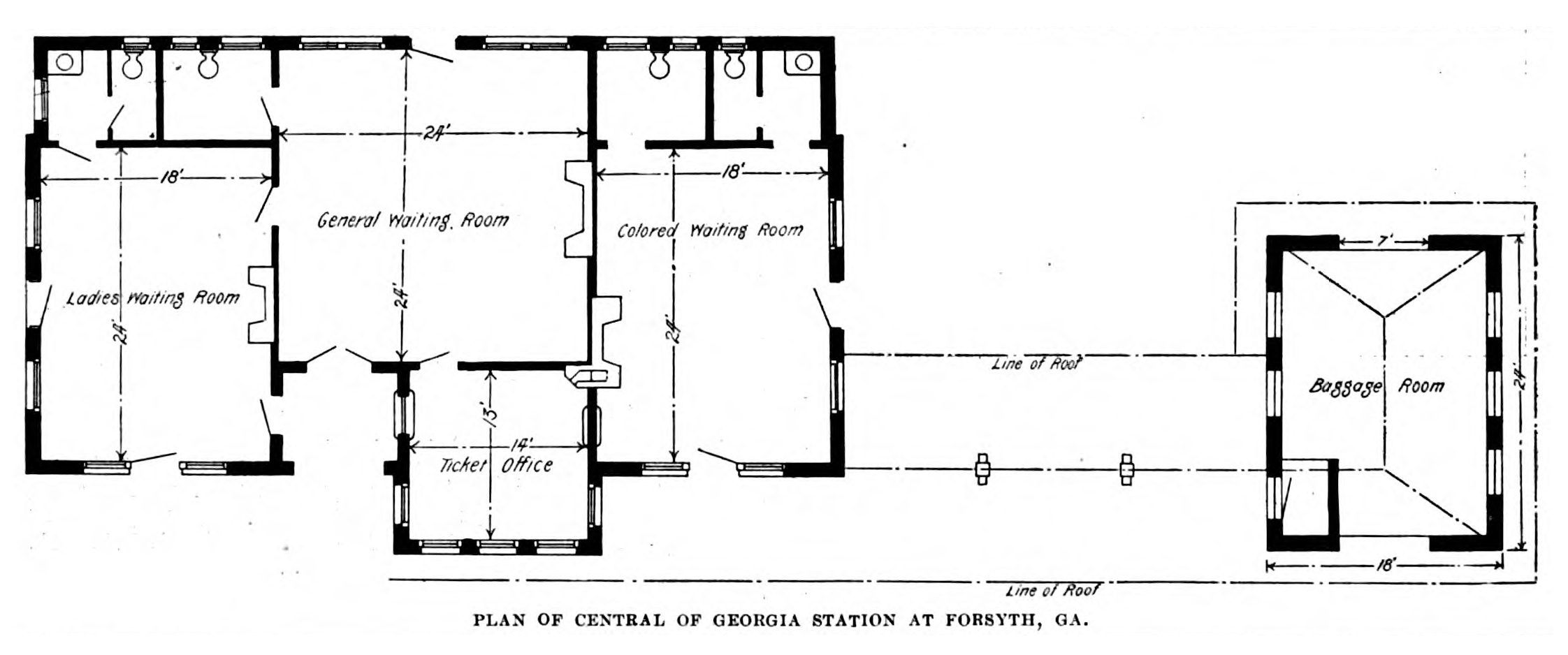
The fact that most railroads had a single ticket booth with segregated ticket windows was less innocuous than it might seem.11A Florida statute passed in 1907 required "Separate Waiting Rooms and Ticket Windows," The Compiled Laws, 1914, of the State of Florida (St. Paul, FL: West, 1915), 2960e. The railroad employees who worked the ticket booths served both windows, but routinely made African American ticket buyers wait until they had finished serving customers on the white side of the booth, regardless of how long their Black customers had been waiting. As a result, however early Black travelers arrived at the train station, they sometimes found themselves forced to purchase their "tickets moments before their train pulled out."12Joan Steinau Lester, Eleanor Holmes Norton: Fire in My Soul (New York: Simon and Schuster, 2003), 24. Sometimes the wait could be fruitless, for by the time the "tired ticket agent" began to serve Black customers, "often there was no time to buy [a] ticket and if they did not get them they had to pay extra on the train." Some unfortunate travelers waited so long at the ticket window that they missed their trains altogether, and even those who managed to secure a ticket could leave the window "burning with indignation and hatred."13W. E. B. Du Bois, "On Being Black," New Republic, 21, no. 272, February 18, 1920.
Such emotions were unlikely to abate as Jim Crow travelers progressed on to their destinations. White railroad station personnel were rude to Blacks, who rarely received assistance getting on or off the train and could not count on help carrying their baggage. Even at small stations with no platforms—where passengers typically disembarked "stepping on the narrow little stool placed under by the conductor"—Black women could not count on assistance from these officials, noted the Black writer Anna Julia Cooper in 1892. Instead, "gentlemanly and efficient" railroad conductors would hand "[white] woman after [white] woman from the steps to the stool, thence to the ground, or else relieving her of satchels and bags and enabling her to make the descent easily." But when "the Black Woman's turn came to alight" these men "would deliberately fold their arms and turn round."14Anna Julia Cooper, A Voice from the South (Xenia, OH: Alpine Printing House, 1892), 90. And as the Jim Crow car became entrenched, Black passengers lost access to the step. At small stations, according to W. E. B. Du Bois, southern railroads began to stop the Jim Crow car, which was invariably the first passenger car, "out beyond the covering in the rain or sun or dust," and require Black passengers to climb on and off without even providing a step.15Du Bois, "On Being Black."
African American travelers who boarded trains in the North often experienced similar rudeness well before they crossed the Mason-Dixon Line. Cairo, Illinois, along with Cincinnati, Ohio, and Washington, DC, were all stops where conductors began to force African American passengers to move from regular seats to seats in the Jim Crow car—often with no grace whatsoever. One Black traveler complained in a 1946 letter to the Chicago Defender that when Illinois Central Railroad trains passed through Cairo, conductors sometimes pushed "women and children around as if they were beasts," addressing them as "'nigger' girls and 'nigger' boys" and telling them they had to move to "the 'nigger' coach."16"Tells of Jim Crow by Railroad," Chicago Defender, October 5, 1946, 14. Complaints about being Jim Crowed in Cairo, Illinois, go as far back as the World War I era. See, for example, "Jim Crow in Illinois," Chicago Defender, July 18, 1914, 8; "Ill. Central Mistreats Colored Passengers," Chicago Defender, September 5, 1914, 1. Likewise, in Cincinnati and Washington, conductors "hollered (under their breath of course) 'Every pig to his pen,' or words to that effect."17"Dan Burley's Back Door Stuff: Looking through the Window of a Jim Crow Train," New York Amsterdam News, November 13, 1943, 8B.
The rudeness continued inside the Jim Crow car. "The conductor appropriates two seats for himself and his papers and yells gruffly for your tickets almost before the train has started," wrote Du Bois, describing race relations in a typical Jim Crow car: "It is best not to ask him for information even in the gentlest tones. His information is for white persons chiefly." The other whites who made themselves at home in these cars were equally discourteous, at least according to Du Bois, who especially disliked the "impertinent white newsboy" who always occupied "two seats at the end of the car and importunes you to the point of rage to buy cheap candy, Coca-Cola, and worthless, if not vulgar, books."
White rudeness, however, was not the most pressing issue that Black passengers faced. Colored waiting rooms often had no heat, and many Jim Crow cars had "no fire" even on the "coldest days." Food was even more of a problem. Few Jim Crow waiting rooms had restaurants, snack bars, or any place where Black travelers could purchase "the refreshments to be found in the big main waiting room."18Langston Hughes, "From Rampart Street to Harlem, I Follow the Trail of the Blues," (December 6, 1952), in The Collected Writings of Langston Hughes, vol. 10: Fight for Freedom and Other Writings on Civil Rights (Columbia: University of Missouri Press, 2001), 245. Nor could African Americans count on being able to buy food once onboard the trains. First introduced on Pullman's Palace sleeping cars in the 1860s, dining cars by the beginning of the twentieth century were all but ubiquitous on long-distance routes. They were designed to offer travelers an attractive alternative to railroad station restaurants, where meals were often hurried and unappealing. But in the South, railroad dining cars were subject to state segregation laws that put them off-limits to Black customers.
While stationary restaurants were free to cater to an exclusively white or Black clientele, railroads and other common carriers were supposed to offer separate but equal facilities to Blacks and whites. They rarely did so, and would have faced insurmountable challenges had they tried to do so, as railroad food services were subject to both restaurant and transportation laws—which were not necessarily complementary or even compatible. On southern trains, any shared coach was to be "divided by a partition, designated for the race to which such passenger belongs," while restaurants were subject to still more stringent regulations.19The Code of Alabama: Adopted by Act of the General Assembly . . . Approved February 16, 1897, prepared by William Logan Martin (Atlanta, GA: Foote and Davies, 1887), chap. 95, art. 2, 3455, p. 975. In Birmingham, Alabama, for instance, facilities that served food could not accommodate Blacks and whites in the same room—unless, as the municipal legislators put it, "such white and colored persons are effectually separated by a solid partition extending from the floor upward to a distance of seven feet or higher, and unless a separate entrance from the street is provided for each compartment."20The General Code of the City of Birmingham, Alabama, of 1930: (Includes All Ordinances of a General and Permanent Nature except as Specified in Sec. 6113). (Birmingham Printing Company, 1930), 215.
The logistics of dining car service made it impossible to fit all of these requirements, and none of the railroads were willing to operate two dining cars. So they adopted a variety of ways to divide up Black and white diners, ranging from excluding Blacks from food services entirely, to creating segregated seating within their dining compartments, to seating African American diners only after all their white passengers had finished eating, to having waiters and other railroad food service personnel take food to the colored car.
In the South the worst of these arrangements usually prevailed. "It can be flatly stated that it is impossible for the Negro to get dining car privileges South of Washington," wrote Howard professor Thomas Montgomery Gregory after completing an investigation of travel segregation for the NAACP in 1916. Gregory came to this conclusion after traveling from New Orleans to Washington on a halting, roundabout trip that took thirty hours, while subsisting on nothing but Coca-Cola. Confined to the Jim Crow car, he had no access to his train's dining car and "the stopovers at stations were not long enough to procure food at the stations if any was provided there for Negroes." Furious, he concluded that "it is not sufficient to say that I should have to take food with me or that I should have lived on grapes and peanuts. If I am to have equal accommodations, I should be able to secure palatable food served in a proper manner."21Thomas Montgomery Gregory, "The Jim-Crow Car: An N.A.A.C.P. Investigation, Part III," Crisis, February 1916, 196.
Gregory's experience was not unusual. Even when Black passengers could purchase food, their options were limited. William Pickens's experience on a ride from Lynchburg to Norfolk, in Virginia, in 1920 was fairly typical. Barred from dining car service, his only hope of food came when the train made a twenty-minute stop in Petersburg to allow white passengers who were "too stingy to pay for dining service and tips" to grab a quick meal at the station's lunch counter. At the end of their meals, just as the train resumed its journey, the lunch counter's staff sent out a basket full of cold leftover food, "which could never be sold to white customers, in an effort to get rid of it among the colored passengers." The food they sent, Pickens noted bitterly, only added "indigestion to insult." For seventy-five cents, you could get "a quarter of an impenetrable dried hen fried the day before yesterday, old bread and a slice of musty pie," whereas "the white passengers in the lunch room may get a hot drink or a fried egg for a few cents." The passengers who bought the overpriced food could not even secure cutlery or any beverages with their meals, as railroad employees were not allowed to bring dishes or flatware into the colored car.22 William Pickens, "Jim-Crowed," Socialist Review 9, no. 2 (1920): 126.
When railroads crossing through the segregated states did open up their dining rooms to Black customers, they observed the requirements of segregation law either by holding a separate seating for Black diners after white diners had eaten, or by setting aside a small number of special tables for Black customers, partitioned off by a curtain—an experience that Blacks found truly humiliating. "The first time that I was seated behind a curtain in a dining car, I felt as if the curtain had been dropped on my selfhood," Martin Luther King Jr. recalled in his autobiography, describing it as one of the moments in which he realized, "I could never adjust to the separate waiting rooms, separate eating places, separate rest rooms, partly because the separate was always unequal, and partly because the very idea of separation did something to my sense of dignity and self-respect."23"Chapter 1: Early Years," The Autobiography of Martin Luther King, Jr., ed. Clayborne Carson, https:// kinginstitute.stanford.edu/king-papers/publications/autobiography-martin-luther-king-jr-contents/chapter-1-early-years.
Excerpted from TRAVELING BLACK: A STORY OF RACE AND RESISTANCE by Mia Bay, published by Harvard University Press. Copyright © 2021 by the President and Fellows of Harvard College. Used by permission. All rights reserved.
About the Author
Mia Bay is the author of To Tell the Truth Freely: The Life of Ida B. Wells (Farrar, Straus and Giroux, 2009) and The White Image in the Black Mind (Oxford University Press, 2000), and coauthor of Freedom on My Mind: A History of African Americans, with Documents (Bedford/St. Martin's, 2012). She is the Roy F. and Jeannette P. Nichols Professor of American History at the University of Pennsylvania.
]]>
Water Graves investigates how contemporary writers and artists of the greater Caribbean (such as Jason deCaires Taylor) reinvest sites of racialized violence and environmental degradation—as so many manifestations of "unritual"—with a new sense of the sacred that allows for remembrance and re-humanization. Rituals—be they initiations, funerary rites, or collective acts of remembrance—confer "humanity" on those who practice them and sacredness on the places of these practices. The unritual comprises moments and spaces of desecration. Unritual occurs when rituals are ignored, violently suppressed or obstructed outright, and where so-called "natural" spaces are commodified, exploited, and profaned. Closely appended to Loichot's unritual are the notions of "undead" and "unrest"; the liminal zone of (non)being they demarcate emphasizes the unritual's alienating, unsettling, and dehumanizing effects before and beyond the grave.
Off the coast of Grenada, several meters below the Caribbean surface, stands Jason deCaires Taylor's Vicissitudes. It is an installation of statues which, at first glimpse, shows a group of men and women arranged in a large circle, holding hands as they gaze outward along the ocean floor. The figures bear bright red, pink, and violet protrusions of coral, undulating gossamers of seaweed, and the occasional sea star. The texture and topography of these statues' skin—their pores, wrinkles, and scars—provide the ideal environment for aquatic life to take root and repopulate this portion of ocean floor. Vicissitudes also offers another, more haunting kind of repopulation, this time by the specters of the Triangular Trade: the innumerable captives thrown overboard after dying in transit during the Atlantic crossing and condemned to perish, away from ancestral lands and families that could offer funerary rites or remembrance. As the installation confronts the degradation of coral environments, its underwater surroundings also beckon and materialize the (un)dead of the African Diaspora whose memory—likewise rarefied and threatened—inhabits these statues alongside the coral. Vicissitudes, a monument that explores the creative and memorial agency of Caribbean underwater spaces, serves as one of many objects that Valérie Loichot examines in her book, Water Graves: The Art of the Unritual in the Greater Caribbean.







An interdisciplinary exegesis in the fields of Postcolonial Studies, Caribbean Studies, African Diaspora Studies and Ecocriticism, Water Graves investigates objects across many mediums that, like Vicissitudes, work through or heal the effects of unritual. The oeuvre of poet-philosopher Edouard Glissant serves as the opening and the theoretical springboard for the rest of the book. Here, Loichot engages the notion of "relational sacred," which draws heavily from Glissant's concepts of creolization, relaying, and entour or "surroundings."1As Loichot explains, "Entour signifies for Glissant the whole environment comprising the poem, human and nonhuman animals, vegetation, rocks, lavas, and 'nature' and 'culture.' The latter terms lose meaning since they exist in a continuum, not in a system of opposition" (28). For another in-depth look at Glissant's entour, see Carrie Noland, "Éduoard Glissant: A Poetics of the Entour," in Poetry After Cultural Studies, ed. Heidi R. Bean and Mike Chasar (Iowa City: University of Iowa Press, 2011), 143–172. This "relational sacred"—which extends the expressions of memory or ritual beyond religious confines—informs more specifically how the objects featured in Water Graves's chapters (objects of literature, music, film, visual arts, poetry, and photography) repair the effects of unritual.

Loichot's "Graves for Katrina" examines the work of mourning effected by visual artists in the wake of Hurricane Katrina. Featuring the photography of Eric Waters and the paintings and mixed-media exhibitions of Radcliffe Bailey and Epaul Julien, this chapter considers the (mis)use and subversion of frames as devices that circumscribe the spatial, temporal, and conceptual boundaries of a work. For instance, Bailey's installation, Windward Coast–West Coast Slave Trade (2009–18)—which is comprised of a large sea-like arrangement of salvaged piano keys from which emerges a lone, "African" head—eschews "framing" within a singular meaning or temporality. By evoking at once the "victims of the Middle Passage, Katrina, or [prophetically] the Haitian Earthquake" Bailey's installation goes beyond the temporal frames that would separate these events (101, 66). These overlapping and recursive temporalities, argues Loichot, prompt spectators to see similar logics of "unritual" at work in all of them, logics that signal the longue-durée effects of racialized slavery whereby Black people remain subject to violence and dehumanization.
As the objects of Bailey, Waters, and Julien spill out of conventional "frames" or conceptual boundaries, Loichot's analysis flows into the murky waters of Katrina and its racial and environmental violence in "Mami Wata the Formidable." Loichot wades through the ethical ambiguity of Kara Walker's exhibit/book, After the Deluge, and Beyoncé's visual album, Lemonade, which represent—and potentially reproduce—the violence of slavery and Katrina. Yet, in this representation and acknowledgement, Walker and Beyoncé—like Mami Wata, the titular voudou figure who grants life and death to those lost at sea—also sanctify the victims of the violence their objects traverse. Through Julia Kristeva's notion of "muck," Loichot shows the creative and "sacred" potential of Walker's and Beyoncé's portrayals of violence as the "abject substance [that] paradoxically—and horrifyingly—becomes the amniotic fluid of a new birth" (112).
"Drowned," delves further into fluid spaces—this time of the ocean floor—via Jason deCaires Taylor's Cancún Underwater Museum and Édouard Duval Carrié's paintings. These works, Loichot contends, project spectators into the space of the drowned while teasing out the links between environmental degradation, those thrown overboard during the Middle Passage, and the migrants who drown while crossing the Mediterranean today. From these underwater spaces of death, "Stone Pillow and Bone Water" turns to the "hard materiality of words" which are likened to the raw material that M. NourbeSe Philip and Natasha Trethewey shape into poetic "graves, stones, or monuments to the neglected, forgotten, or desecrated dead" (177). Loichot details how Philip deconstructs and reshapes the juridical/scientific language implicated in justifying racialized slavery: "As herself both a lawyer and a poet, Philip must rectify the law . . . by giving humanity and sacred back to the victims of the legalized unritual, through her poetic creation. Poetry—poiesis as act of making—relays a faulty even criminal, law" (204).

As the variety of objects featured in Water Graves indicates, Loichot's relational methodology echoes and enacts principles of Édouard Glissant's notion of "Relation," particularly that of "relaying" understood as: "an act of solidarity between those touched by the unritual, such as humans and their hurt ecologies. [Relaying] calls for disciplines like literary and artistic interpretation, history and science, to join forces where they meet the epistemological abyss of the unknown" (19). By bringing the notion of entour—which implicates so-called "natural" surroundings in "human" creativity and activity—to bear on its analyses, Water Graves effectively broadens the scope of the unritual to include the natural world, underlining connections between racial violence and environmental destruction. One of the strengths of this relational methodology resides in its juxtaposition of disparate objects. These juxtapositions not only highlight the connections among seemingly distinct historical phenomenon; they also bring into conversation creative works that confront the systems responsible for propagating the unritual. The hybrid figures in Beyoncé's Lemonade (lasiwène or the siren) and Jason deCaires Taylor's Vicissitudes, for example, challenge ontological boundaries that condition spaces of racialized violence and environmental degradation—boundaries between life and death, human and coral, sacred and profane, memory and oblivion. Loichot's treatment of these two objects—which come from different entours and mediums—reveals the poetical, creolizing, and memorial potential of underwater spaces in the Greater Caribbean. As Loichot puts it, "[t]he water is thus not a dividing line but a site of passage, flux, communication and confusion between . . . realms" (154).
Though my appraisal of Water Graves remains predominantly laudatory, I will signal two critiques in terms of its methods and conceptual vocabulary. Loichot's powerful juxtapositions showcase the poetic possibilities of creating a network of oeuvres motivated by the desire to heal and move beyond the unritual. But Water Graves's relational approach sometimes sidesteps the paradoxes highlighted by this kind of comparative work. As Shu-mei Shih proposes in her essay "Comparison as Relation," relating ostensibly dissimilar objects allows one to deconstruct boundaries (disciplinary or otherwise) erected by "certain interests" or "the workings of Power" (which Water Graves certainly does).2Shu-mei Shih, "Comparison as Relation," Comparison: Theories, Approaches, Uses, ed. Rita Felski and Susan Friedman (Baltimore: John Hopkins University Press, 2013), 79. Yet, it is equally important, Shih notes, to "evacuate and analyze" how these economic, national, or other interests nevertheless infuse the objects of comparison and their relations.3Shih, 84. That Beyoncé's album (and related concerts) garnered hundreds of millions of dollars within neoliberal capitalism—a socioeconomic system predicated on exploiting women, people of color, and vulnerable workforces in developing countries—constitutes an aporia that Water Graves acknowledges without exploring.4As indicated by the Pew Research Center, wage gaps continue to track along gender and racial lines in the U.S. Eileen Patten, "Racial, gender wage gap persists in U.S. despite some progress," Pew Research Center, July 1, 2016, https://www.pewresearch.org/fact-tank/2016/07/01/racial-gender-wage-gaps-persist-in-u-s-despite-some-progress/. Though Water Graves recognizes the album's imbrication with capitalist profit—casting Beyoncé as an embodiment of the capitalistic deity Mami Wata—it doesn't investigate how the economic "interests" underwriting her album inflect and/or constrain the work of healing or moving beyond the unritual.5bell hooks, "Beyoncé's Lemonade is capitalist money-making at its best," in The Guardian, May 11, 2016, https://www.theguardian.com/music/2016/may/11/capitalism-of-beyonce-lemonade-album. As bell hooks points out, both Beyoncé and Serena Williams are featured in the album wearing sports clothing, as Beyoncé's sports clothing line—Ivy Park—would appear the same year as Lemonade, thereby walking a fine line between dissident discourse and advertisement. This is not to say that Beyoncé's discourse is invalidated by this antagonism, nor that one can totally disengage from the "workings of Power," particularly in the era of globalization; rather, I mean to emphasize the importance of situating the discourse of a given object within its material conditions and outcomes, especially as these conditions and outcomes often constitute sites of unritual, which complicate our readings of these objects and the ways in which they relate to each other.

My second critique relates to the use of terms historically operationalized in colonial contexts to exclude non-European populations. Although its creolizing methodology works across disciplinary and cultural frameworks, Water Graves employs certain universalizing notions, notably "humanity," whose investment in a colonial epistemological tradition is not always fully interrogated. As the philosopher and novelist Sylvia Wynter writes in "Unsettling the Coloniality of Being/ Power/Truth/ Freedom," the term "humanity" has historically been invoked to exclude racialized persons from its prerogatives, and has, in fact, depended on the racialized "Other," relegated to a space of unritual in order to mark its boundaries. Indeed, Wynter tracks how the conceptions of "human" and "humanity" came to correspond with "reason" and "rationality" in Renaissance Europe (and continue to do so today), whereas the conditions of "subrationality" and uncivilization were used to characterize colonized populations.6Sylvia Wynter, "Unsettling the Coloniality of Being/Power/Truth/Freedom: Towards the Human, After Man, Its Overrepresentation—An Argument" in CR: The New Centennial Review 3, no. 3 (2003): 266, 301. In other words, under the guise of describing the entire "human race," the term "humanity" has come to reify and universalize Western values and ideals. Although Water Graves's introduction construes "humanity" in an inclusive way—proposing that rituals "of the sacred" writ large are "a defining mark of humanity"—the text leaves unattended its watermark of exclusion and eurocentrism (7). The uninterrogated use of "humanity," then, potentially constitutes a discursive site of "unritual"—what Loichot's objects and analysis strive to "heal"—as its eurocentric and exclusionary connotations of so-called "rationality" and "civilization" implicitly accompany its evocation. Explicitly deconstructing the history and usage of "humanity" while signaling a plurality of humanities would not only eliminate the tension created by the colonial baggage of this term, but would also dovetail with Glissant's conception of Relation which rejects universalizing concepts, while insisting on multitudinous humanities.
Water Graves is an important and compelling study for anyone interested in the Caribbean, Afro-Diasporic experiences, colonialism, and slavery, as it engages with the enduring aftereffects of their histories, including how artists reinscribe them with new meanings. Loichot's work merits praise for its epistemological and methodological originality as she extends Glissant's concepts of Relation and relaying. In literary, artistic, and musical objects from across the Caribbean, Loichot skillfully interweaves questions of (post)colonial legacies, environmental degradation, and social justice in order to explore these objects' often unexpected correspondences as well as their tensions. Ultimately, Loichot demonstrates how literary and artistic exegesis "relate" with its artistic objects in ways that not only explore the memory and trauma of the unritual and its resacralization, but that also engage new modalities and transdisciplinary vocabularies for comparing creative works across the broader Caribbean.
About the Author
Aaron Witcher is a PhD Candidate in French and Francophone Studies at The Pennsylvania State University.
]]>Christina Sharpe, scholar of English literature and Black studies, articulates the concept of "the wake" as a way of thinking about the long term impact of slavery upon African American life. In her work on symbolism in African American literature and visual culture, Sharpe argues that the wake symbolizes the "endurance of anti-Blackness . . . the on-going problem of Black exclusion from social, political and cultural belonging; our abjection from the realm of the human."1Christina Sharpe, In the Wake: On Blackness and Being (Durham, NC: Duke University Press, 2016). More than a metaphor, and sparing no spaces or institutions, the wake exemplifies the ways that white people have constructed African Americans as deviant, criminal, and pathological. As much as any professional group, medical practitioners have contributed to the construction of African Americans as physically, intellectually, and mentally inferior to white people.2Rana A. Hogarth, Medicalizing Blackness: Making Racial Difference in the Atlantic World (Chapel Hill: University of North Carolina Press, 2017); Christopher D. E. Willoughby, "Running Away from Drapetomania: Samuel Cartwright, Medicine and Race in the Antebellum South," Journal of Southern History 84, no. 3 (August 2018): 579–614; Sharla Fett, Working Cures: Healing, Health and Power on Southern Slave Plantations (Chapel Hill: University of North Carolina Press, 2002); Todd Savitt and James Harvey Young, Disease and Distinctiveness in the American South (Knoxville: University of Tennessee Press, 1988); Marli F. Weiner with Mazie Hough, Sex, Sickness, and Slavery: Illness in the Antebellum South (Urbana: University of Illinois Press, 2012). These attitudes continue to plague current approaches to health care, so that many African Americans live every day in the wake of racism that shapes their physical and mental health.
Recently historians have begun to consider the role of psychiatry in the making of these disparities, exploring the intersection of racism and mental health in Harlem, Pennsylvania, and Washington, DC.3Dennis Doyle, Psychiatry and Racial Liberalism in Harlem 1936-1968 (Rochester, NY: University of Rochester Press, 2016); Jay Garcia, Psychology Comes to Harlem: Rethinking the Race Question in Twentieth-Century America (Baltimore, MD: Johns Hopkins University Press, 2012); Martin Summers, Madness in the City of Magnificent Intentions: A History of Race and Mental Illness in the Nation's Capital (New York: Oxford University Press, 2019); Martin Summers, "'Suitable Care of the African When Afflicted with Insanity': Race, Madness and Social Order in Comparative Perspective," Bulletin of the History of Medicine 84, no. 1 (2010): 58–91; Matthew Gambino, "'These Strangers within Our Gates': Race, Psychiatry and Mental Illness among Black Americans at St. Elizabeth's Hospital in Washington DC, 1900-1940," History of Psychiatry 19, no. 4 (2008): 387–400; Gabriel N. Mendes, Under the Strain of Color: Harlem's Lafargue Clinic and the Promise of an Antiracist Psychiatry (Ithaca NY: Cornell University Press, 2015); Anne E. Parsons, From Asylum to Prison: Deinstitutionalization and the Rise of Mass Incarceration after 1945 (Chapel Hill: University of North Carolina Press, 2018). This scholarship builds on the work of psychiatrist and historian Jonathan Metzl. At the Ionia Asylum in Michigan, Metzl documented the ways that the diagnosis of schizophrenia began to skew disproportionately towards Black men in the wake of the Civil Rights movement. Metzl argues that this was an intentional act occurring at the same time as pharmaceutical advertising which cast the Black man as pathologically aggressive, rather than rightfully angry.4Jonathan M. Metzl, The Protest Psychosis: How Schizophrenia Became a Black Disease (Boston, MA: Beacon Press, 2010). Besides Peter McCandless's study of insanity in South Carolina,5Peter McCandless, Moonlight, Magnolia and Madness: Insanity in South Carolina from the Colonial Period to the Progressive Era (Chapel Hill: University of North Carolina Press, 1996). little scholarship has centered on southern states. Two recent books by Wendy Gonaver and Mab Segrest explore some of this missing history. Gonaver's The Peculiar Institution and the Making of Modern Psychiatry 1840–18806Wendy Gonaver, The Peculiar Institution and the Making of Modern Psychiatry 1840–1880 (Chapel Hill: University of North Carolina Press, 2018). traces the linked histories of the Eastern Lunatic Asylum and the Central Lunatic Asylum in Virginia in the context of slavery and emancipation. Segrest's Administrations of Lunacy: Racism and the Haunting of American Psychiatry at the Milledgeville Asylum7Mab Segrest, Administrations of Lunacy: Racism and the Haunting of American Psychiatry at the Milledgeville Asylum (New York, The New Press, 2020). deals with the first hundred years of Georgia's Central State Hospital in Milledgeville from its establishment in 1842.8This review uses the words for the mentally ill that are prevalent in the literature at the time which did not differentiate between the developmentally disabled and mentally ill in the same way we do today. Therefore, words like "Lunatic" and "Idiot" appear in both the names of asylums and in medical literature. They used here only in the ways they are used in the original sources. I consider these books together because they deal explicitly with the impact of racial thinking on psychiatric practices and seek to place state hospitals in the broader context of slavery and its consequences. They also present an intriguing comparison in their access and approach to sources. What we can know about the past is always limited by the silences of the archive, requiring the expertise of historians to read between the lines or seek hidden voices elsewhere.9Britt Peterson, "A Virginia mental institution for Black patients, opened after the Civil War, yields a trove of disturbing records," Washington Post, March 29, 2021, https://www.washingtonpost.com/lifestyle/magazine/black-asylum-files-reveal-racism/2021/03/26/ebfb2eda-6d78-11eb-9ead-673168d5b874_story.html. The challenges of the psychiatric archive are well demonstrated by the work in progress related to the Virginia asylums after the Civil War. Both of these books demonstrate the challenges and the potential of reading in and beyond the archives. Gonaver's The Peculiar Institution and the Making of Modern Psychiatry is an intimate and detailed telling of the multiple lives contained within a forty-year history of Virginia's institutions based on a discrete set of sources. Segrest's Administrations of Lunacy is a history of Georgia writ large, a weaving of scattered and disparate sources from official archives to newspaper reportage that demonstrate the pivotal role that the hospital at Milledgeville played in the state's history. Both authors seek to answer larger questions about the relationship between slavery and psychiatry, and the wake created as they trace the impact of racism on the lives of the mentally ill.
Gonaver's book is based on the kind of access to sources that historians dream of. The records from Eastern Lunatic Asylum in Williamsburg, Virginia (still operating as Eastern State Hospital) remained hidden in a storage closet in the patient library of the hospital. Gonaver undertook training as a volunteer to work in the hospital, where she was then given access to the records which she then organized and assembled into a coherent collection now housed at the Library of Virginia. The collection includes correspondence and drafts of reports but also, significantly, personal diaries and journals from both workers and patients—a rare find in the psychiatric archive. Gonaver supplements these materials with records from official state sources as she seeks to demonstrate the complex network of relationships between the asylum and its local antebellum community, and between its second superintendent, Dr. John M. Galt II, and the field of medicine. Gonaver arranges the book both topically and chronologically and in doing so demonstrates the way that debates about slavery, and about Black-white relations, track with the expansion of the asylum.
Established in 1773 as the first public institution for the mentally ill in the US, Virginia's Eastern Lunatic Asylum was initially a small institution that housed three hundred patients when John M. Galt became the superintendent in 1841. Gonaver starts her history of the asylum at this point because Galt took over at a time of reform in the care of the mentally ill and he sought to bring new ideas to the way he ran the institution. These ideas quickly placed Galt at the margins of American psychiatry, largely because of his attitude towards race. Before the Civil War, Eastern Asylum employed free Black and enslaved people as attendants and staff and admitted both Black and white patients. Gonaver explains Galt's approach to having an interracial clientele, in which "no peculiar strictness is observed" in terms of accommodations for Black and white patients.10Gonaver, The Peculiar Institution, 33. In an 1848 report Galt wrote that African Americans would always be a minority of patients anyway, and that he saw no detriment to their intermingling. This attitude reflected the entwined lives of Blacks and whites at that time, especially in settings of health and healing where there were small numbers of Black patients.11Fett, Working Cures. Gonaver warns us not to read Galt's attitude as any kind of emancipatory rhetoric, but as representing the practical reality of running an institution with limited space and funding.12See Summers, Madness in the City of Magnificent Intentions. In his work on St. Elizabeth's Hospital in Washington DC, for example, Martin Summers explains how segregation based on race rather than diagnostic category finally became untenable when the space would no longer hold.

Gonaver's goal is to show that ideas about race and slavery were central to the formation of American psychiatry. The existence of enslaved people as patients or as workers doesn't in itself tell us a great deal about how that process unfolded. To do that, we need to understand more about how psychiatry itself was evolving in the mid-1800s, and here Gonaver unpacks the contradictions in the therapeutic regimen at Eastern Asylum under Galt. The prevalent treatment practice in the more progressive institutions in Europe and the US at the time was known as moral therapy, which stressed the importance of clean air and physical activity for recovery. Drawing on the example of places such as the York Retreat in the UK, American reformers designed institutions set among acres of landscaped gardens and outdoor grounds.13Nancy Tomes, The Art of Asylum-Keeping: Thomas Story Kirkbride and the Origins of American Psychiatry (Philadelphia: University of Pennsylvania Press, 1984). For paying white patients, moral therapy usually meant walking or light gardening in outdoor spaces, or needlework or carpentry inside. For Black patients, "moral therapy" meant something else entirely, and it is here that we learn the way that mental institutions operated in the wake of slavery. Despite Galt's insistence on 'intermingling,' Gonaver shows that Black patients in Virginia's asylums were effectively separated from white patients through demarcations in labor posing as therapy along lines of race and gender. At Eastern Asylum Black female patients worked in the kitchen and the laundry and Black male patients worked in the fields and farm gardens. This was not work as occupational therapy; it was work as day-long, back-breaking labor without which the institution would not have existed, and the white patients would have gone unfed.
Gonaver describes how Galt used enslaved people to care for Black and white patients, again reflecting patterns of healing relationships that existed on the plantation.14Fett, Working Cures. While Galt did not believe that the African American was equal to the white person in terms of intelligence or emotion, he did defend the work of his Black staff who he felt were just as capable of providing excellent care to patients. This bought him into direct conflict with other psychiatrists, in particular Thomas Kirkbride, a Pennsylvania physician at the vanguard of a movement to reform and modernize the psychiatric institution.15Tomes, The Art of Asylum-Keeping. Kirkbride's large and rambling architectural designs were based on the segregation of patients by gender, race, and diagnostic category. He argued publicly with Galt that it was entirely unsuitable for Black patients to be housed alongside whites, or enslaved people to be used as carers.16Summers, "'Suitable Care of the African When Afflicted with Insanity': Race, Madness and Social Order in Comparative Perspective." Kirkbride's concern was for the reputation of the psychiatric institution. His mission was to sell his new asylum plans to potential buyers (i.e., state governments) concerned with white respectability—the Black patient or attendant was anathema to that idea.
As Galt gave up trying to convince psychiatry's professional bodies of his method's efficacy, Gonaver moves away from an exploration of race relations to include materials that demonstrate intersections with religion and gender. The science of the causes of mental illness in the nineteenth century was hardly precise. Gonaver explores how Galt and his contemporaries were concerned with, as they described it, sensory overstimulation, often taking the forms of excessive religious feeling or female "hysteria." Psychiatry's concern with religious excitement formed part of a large effort to establish scientific knowledge and expertise in place of folk belief (considered superstition), especially in the South in the wake of slavery. This played out in different ways for Black and white patients, and differently again for men and women. As Sharla Fett and other historians have shown, physicians throughout the US were keen to replace traditional healing practices of enslaved Africans as well as the Catholic religiosity of Irish immigrants with what passed for modern scientific rationale.17Fett, Working Cures; Willoughby, "Running Away from Drapetomania;" Deidre Cooper Owens, Medical Bondage: Race, Gender and the Origins of American Gynecology (Athens: University of Georgia Press, 2017). Those deemed excessively religious were barely delineated from the mentally ill in the 1800s and they were frequent admittees to Galt's asylum. His approach to women demonstrated the gender bias inherent to psychiatric and medical practices, where genuine problems such as domestic violence, unhappy marriages, and abandonment were too often read as problems of female hormones. Religious excess in women was considered particularly problematic, as it challenged both domestic and public male authority. Gonaver's discussion of gender speaks to the undercurrent of violence in the nineteenth-century South, the burden of which was borne primarily by Black women. She writes: "The asylum expressly denied women's authority in religious matters, paid inordinate attention to female reproductive organs as the cause of insanity, and promoted a racialized vision of healthy womanhood that ignored the trauma of abuse. In so doing, administrators fostered dependency or passivity in white women, and disproportionately characterized black women as recalcitrant imbeciles, laying the foundation for late nineteenth-century medical and political discourse that . . . portrayed black women as naturally promiscuous."18Gonaver, The Peculiar Institution, 113.


The final chapters of The Peculiar Institution and the Making of Modern Psychiatry deal with the impact of the Civil War on Eastern Lunatic Asylum, which was left vulnerable and chaotic when Galt died from suicide via laudanum overdose in 1862. Caught in the mayhem of Confederate and Union struggles over Richmond and Williamsburg, the asylum was ransacked by both sides. The fate of patients and enslaved workers gave way to broader concerns about the status of freed African Americans in postbellum Virginia. This moment coincided with the emergence of a mental health reform movement across the US. Dr. Kirkbride was assisted in his efforts to reform institutional settings by the work of philanthropic campaigner Dorothea Dix, who advocated for state spending for the construction of new asylums. Neither Kirkbride or Dix cared particularly for the African American patient, and it was in this context that Galt's ideas of an interracial institution came to an end. In 1869, the Freedmen's Bureau took over Howard Grove Hospital in Richmond, and the thirty-six African American patients at Eastern Asylum were moved to this facility. In 1870, it became "Central Lunatic Asylum" and was dedicated solely to the care of African Americans. As Gonaver explains, this was the trend across the country, marking the beginning of Jim Crow segregation in health care. The Peculiar Institution and the Making of Modern Psychiatry concludes with a discussion of how psychiatric discourses about Black patients at the end of the nineteenth century centered around false ideas about biological difference and inherent deviance, setting the scene for a century of neglect, underfunding, and abuse.
This idea that the Black patient was somehow less than human is also a central theme in Mab Segrest's Administrations of Lunacy: Racism and the Haunting of American Psychiatry at the Milledgeville Asylum. Segrest uses Sharpe's metaphor of the "wake of slavery" to explore how a place designed to treat the mentally ill inevitably manifested social relations that were shaped and haunted by the violence of slavery. This is a history that runs in blood and sweat down the walls of Milledgeville—which, as the state of Georgia used the asylum as a dumping ground for a multitude of social problems—housed more than 12,000 people by 1960.
When the Georgia State Asylum for Lunatics, Epileptics and Idiots (sometimes referred to as Milledgeville State Hospital) opened in 1842, racial segregation was central to its design and function. Unlike Galt in Virginia, Milledgeville's first superintendent, David Cooper, knew that racial segregation was essential. As Segrest documents in this vast and ambitious book, administrations of lunacy were also expressions of social relations rooted in dispossession, violence, and white supremacy. Segrest demonstrates the way that people are labelled "crazy" is a function of politics and ideology, in which the meaning of the "South" becomes the cause and symptom of the original disease.
Instead of Gonaver's intensive analysis of the institutional archive, Segrest's work is wider-ranging—due to the kinds of sources she has access to and her own interdisciplinary approach. As a historian, Gonaver strives to stay within the bounds of the archive she has uncovered, and contextualizes that archive with other formal archival sources. While she is theoretically informed and definitely interpretive, the style of writing is much more what we would expect from a "traditional" historian. As a literary scholar, Segrest takes a more creative approach. She builds on work she has written elsewhere about Milledgeville's place in the Georgia imagination—a symbol of the gothic and the grotesque.19Mab Segrest, "The Milledgeville Asylum and the Georgia Surreal," Southern Quarterly; Hattiesburg 48, no. 3 (2011): 114–150,158; Segrest, "Exalted on the Ward: 'Mary Roberts,' the Georgia State Sanitarium, and the Psychiatric 'Speciality' of Race," American Quarterly 66, no. 1 (2014): 69–94, https://doi.org/10.1353/aq.2014.0000. And she is in some ways forced to be so: the records she uses are limited, extending from the mid-1800s to the early twentieth century, and no longer available to the public. They are not systematic or comprehensive institutional records, but contain important fragments from the hospital that Segrest uses to great effect.
Segrest first sets the scene for the antebellum construction of the Georgia asylum, in the small town of Milledgeville that was the state capital at the time. As we saw with Gonaver's history of Eastern Asylum in Virginia, large estates removed from the hustle and bustle of city life were becoming the preferred place for institution-building in the context of moral therapy which stressed the importance of fresh air and clean living for recovery. Milledgeville State Hospital was built in the context of emerging concerns about the poor, indigent, and "feeble minded" as a threat to society. It also emerged at the intersection with new ideas about the capacity of medicine to "cure" the insane, rather than simply hold them in poorhouses.
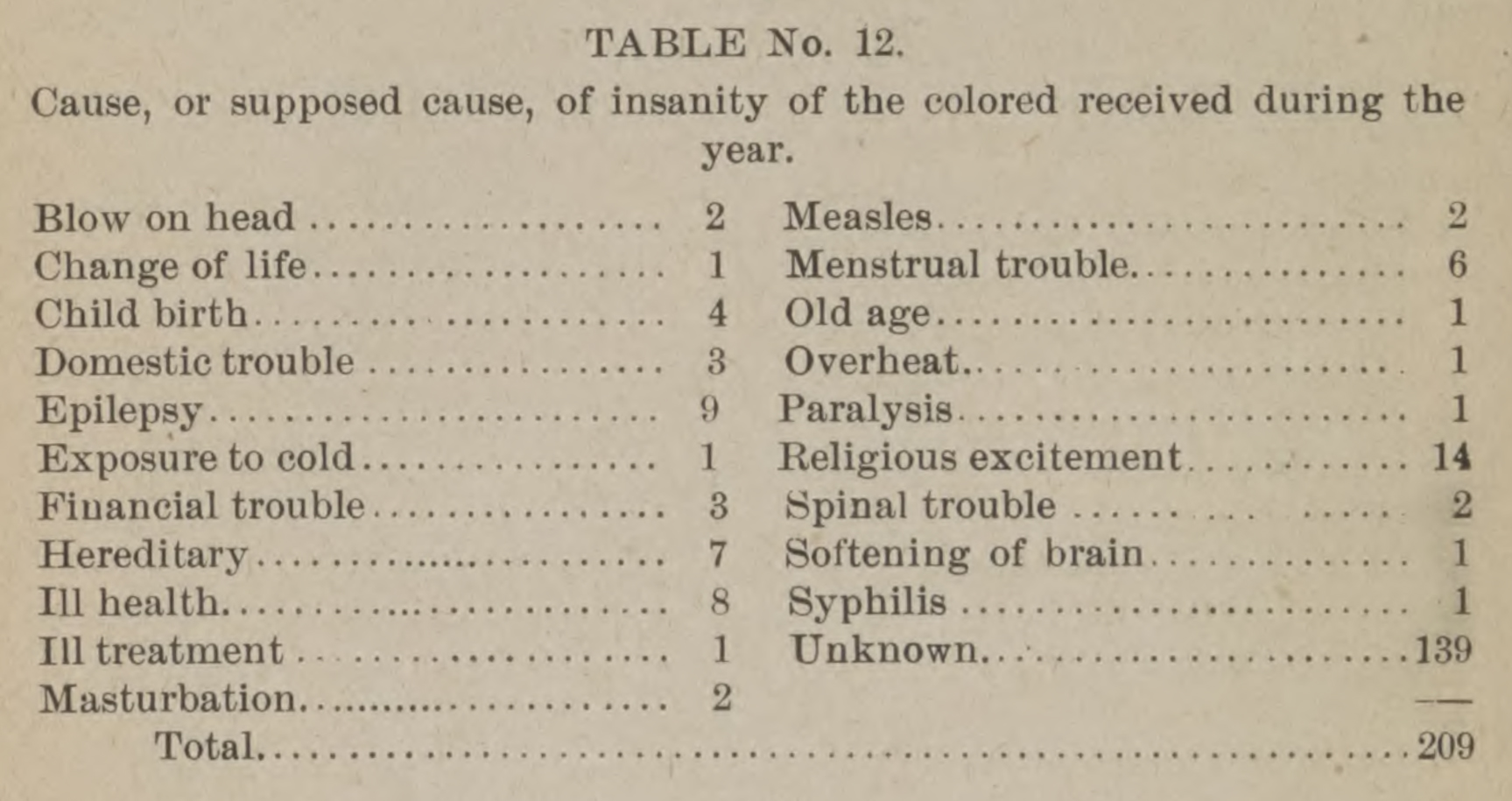
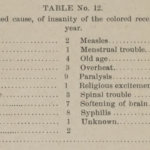

Any noble intentions in the establishment of Milledgeville were immediately undercut by the legislature's choice to eschew a Kirkbride-style facility complete with sweeping vistas and sculptured gardens, for the much cheaper single main building which housed all types of patients together, poorly constructed and badly ventilated. And much like Dr. Galt at Eastern Asylum in Virginia, Milledgeville's first superintendent, Dr. Cooper, was his own kind of eccentric. When he sent his first report for publication in the superintendents' association's journal, he made the mistake of telling the truth about his approach to treatment, which was highly aggressive, using all means of restraint at his disposal, and in a style of prose that his northern colleagues found excessive and unprofessional. He earned a severe scolding from the profession's leaders, which saw him removed within his first three years. But, valuable for Segrest, Cooper's report also included extensive case histories. She uses this "opening" to locate the patients he refers to and trace their own histories to tell us something about the lives that brought them to the insane asylum. Her intent is to read "patient narratives through and against the hospital records, newspaper accounts, literary texts, geographical journeys, and oral histories." Her goal is to overlay the history of one hospital with "the dense historical contexts that shaped its patients" and in so doing to write a "restorative history to its Georgia patients, from whose experiences and our own we can continue to understand slavery's afterlives and shape ecologies of sanity in these also turbulent times."20Segrest, Administrations of Lunacy, 10–11.
In order to show connections between the history of the South and the history of psychiatry, and between the past and the present, Segrest divides the book into five parts, from origins of the asylum to "modernity." Each centers around narratives of patients she identified in the records, and whom she traces with diligence through newspapers and census records to place them in their communities and families of origin. This approach serves to humanize the people whose lived experience was shaped by their contact with the Milledgeville Asylum, but it also shows how that asylum itself acted as a tool of social control in the context of white supremacy. The asylum provided substandard conditions for African American patients while it recreated plantation gender roles by putting Black female patients to work in the kitchen and laundry and Black men in the fields. Segrest points out the close relationship between the nearby Georgia Prison Farm. The word "Milledgeville" becomes synonymous with a multitude of ways in which Black bodies can be put to work in what Douglas Blackmon calls "slavery by another name."21Douglas Blackmon, Slavery by Another Name: The Re-Enslavement of Black Americans from the Civil War to World War II (New York: Anchor Books, 2008).
Segrest locates these practices in the context of psychiatric and medical science that itself descended from the plantation. The turn of the nineteenth into the twentieth century bought scientific obsessions with genetics, heritability, and the problem of the feeble-minded for racial purity. Drawing on writings from racist superintendents such as Doctors Green and Powell, Segrest shows how the attitudes about, and approaches towards, Black patients were "new science, old ideas." It is not simply that Black patients were routinely provided with less rations, less clothing, and inferior buildings, but that these conditions were supported by ideologies of eugenics and mental hygiene, justifying the long term confinement and reproductive sterilization of thousands of people whom the elected politicians of Georgia saw as little more than burdens on the state. Segrest demonstrates the impact of new tools such as the Binet IQ Test and the kind of surveys that put the average Georgian IQ at the bottom of national rankings and led to a rise in admissions and sterilizations numbering in the thousands. In this expansion of psychiatric technologies, the asylum acted as a catch-all for Georgia's disabled who were feared and shunned rather than cared for.

Administrations of Lunacy reaches across disciplines and sources making connections between people and institutions where records are often silent. At times Segrest's approach seems a stretch—she can only guess or hypothesize about motivations or connections that are not made explicit in the records. The book is at its best when Segrest stays grounded in the patient case files she is privy to, bringing to life some of Georgia's most forgotten and marginalized people. Because she is not a traditional historian of psychiatry, she glosses over various internal debates within the profession that shaped its mid-twentieth century approach, especially as a consequence of WWII. Her discussion of links to modernity can feel patched together from other sources, moving far beyond the walls of Milledgeville. But again, this is partly due to the limited records available.

Gonaver's primary source collection ends in 1880, Segrest's in the 1920s. While both authors attempt to make connections between their histories and the present situation in psychiatric and mental health care, neither are experts about the incredibly complex array of forces since the 1960s that have created the current set of disparities for minorities with mental illness.22Kylie M. Smith, "How bigotry created a Black mental health crisis," Washington Post, July 29, 2019. https://www.washingtonpost.com/outlook/2019/07/29/how-bigotry-created-black-mental-health-crisis. The community mental health movement of the 1960s led to the closing of massive institutions like the state asylums in Virginia and Georgia. The chronic lack of funding for alternative services has given way to what has been called "trans-institutionalization."23Bernard E. Harcourt, "From the Asylum to the Prison: Rethinking the Incarceration Revolution," Texas Law Review 84 (June 2006): 1751. Attitudes about racial differences continue to plague modern mental health services where Black and minority patients are over-diagnosed with psychotic disorders, underdiagnosed with depressive disorders, and continue to be underrepresented in service utilization data.24M. Alegria, et al., "Disparity in depression treatment among racial and ethnic minority populations in the US", Psychiatric Services, 59 no. 11 (2008): 1264–1272; D. M. Barnes and L.M. Bates, "Do racial patterns in psychological distress shed light on the Black-White depression paradox: A systematic review," Social Psychiatry and Psychiatric Epidemiology, 52 no. 8 (2017): 913–928; J. Breslau, et al., "Racial/ethnic differences in perception of need for mental health treatment in a US national sample," Social Psychiatry and Psychiatric Epidemiology, 52 no. 8 (2017): 929–937. These are national concerns. Many of the problems of Virginia and Georgia's state hospitals were endemic to all large institutions across the US. What Gonaver and Segrest's studies reveal is how the long history and peculiar institutions of Jim Crow segregation ripple through the decades, finding ways to reap themselves on the minds and bodies of Black Americans. Both books are more than partial histories of psychiatry. They are important studies of the ways that institutions such as psychiatric hospitals act as sites through which we can understand broader social relations particular to time and place. They reveal the multiple ways that the wake—the legacy of slavery—continues to shape our national society.
About the Author
Kylie Smith is an associate professor and the Andrew W. Mellon Faculty Fellow for Nursing and the Humanities in the Emory University School of Nursing. She is also associate faculty in the Department of History at Emory University. Her book Jim Crow in the Asylum: Psychiatry and Civil Rights in the American South will be published by the University of North Carolina Press in 2023.
]]>
After the end of the Civil War, recently freed Black people endeavored to create their own communities. During Reconstruction, and with newfound access to political and economic power, Black towns and institutions emerged wherever Black people lived. Before the end of the Civil War, Union soldiers defeating Confederate soldiers attracted emancipated Black people, who settled near Union encampments. In 1865, and immediately after the end of the Civil War, at a former encampment situated across from the town of Tarboro, North Carolina, and within the floodplain of the Tar River, the land was dubbed Freedom Hill. Twenty years later, a Black community elder named Turner Prince purchased the land, and it was renamed Princeville, the first incorporated Black town in America.1Joe A. Mobley, "In the Shadow of White Society: Princeville, a Black Town in North Carolina, 1865–1915," North Carolina Historical Review 63, no. 3 (1986): 340–84.
Though Princeville may look like other rural towns in eastern North Carolina, it carries significant histories. Shiloh Landing marks the point along the Tar River where enslaved peopled disembarked into brutal lives of forced labor and captivity. Another riverfront site was later accessed by congregants of local churches, arriving in white-robed processions to perform baptismal ceremonies. Princeville, from its infrastructure to its buildings and landscapes, was self-built by Black residents. Many residents were engaged in the timber and mill industries and located their businesses and homes close to the Tar River, built on stilts to help them survive frequent flooding. Powell Park now marks this area and its emotionally charged history—five major floods inundated the town in the twentieth century. Hurricane Matthew ravaged the town in 2016. Princeville's endurance to rebuild in the face of these devastations has made it especially remarkable.

Princeville was socially as well as environmentally vulnerable, due to racism and the sustained threat of white supremacist violence from nearby communities. Despite these risks, Princeville's population continued to grow, and does so to this day. As an indicator of the place attachment expressed by residents, the town's population increased after the rebuilding periods that followed numerous floods.
Like Princeville, the town of Mound Bayou, Mississippi, also came about by untraditional circumstances. It originated from the enslaved African community of Davis Bend, Mississippi, which was created, in the 1820s, by slave-plantation owner Joseph Davis as a "model" slave community on a plantation. By the standards of America's Peculiar Institution, Davis provided a relatively high level of social, health, and economic care, as well as independence, to Davis Bend's inhabitants. Although still enslaved, residents benefited from dental and health care, opened and ran merchant businesses, and were spared overt domination from overseers. After the Civil War and the collapse of cotton prices, Davis Bend failed, and its residents relocated to the Mississippi Delta bottomlands to found Mound Bayou in 1887. The town earned regional notoriety for its numerous Black owned businesses and organizations, as well as for its tradition of protecting Black people's voting rights amid racial violence. The relative success of the town earned accolades from Booker T. Washington, who called it a model of "thrift and self-government."2Melissa Block, "Here's What's Become of a Historic All-Black Town in the Mississippi Delta," Our Land, National Public Radio, March 8, 2017, www.npr.org/2017/03/08/515814287/heres-whats -become-of-a-historic-all-black-town-in-the-mississippi-delta.
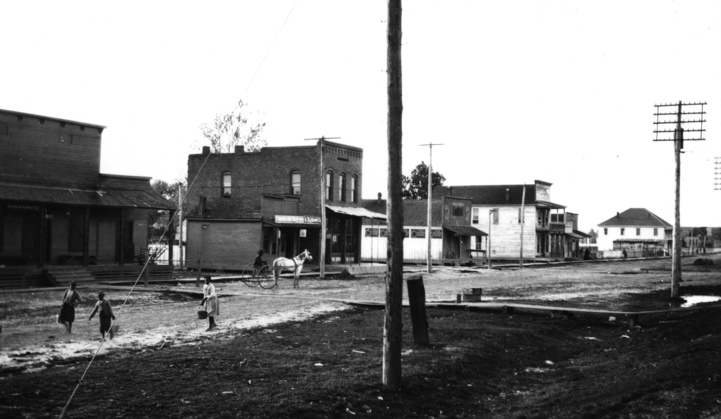
Mound Bayou suffered from declining cotton prices and an uptick in Jim Crow–era oppression. The town distinguished itself, however, by providing safe harbor for Black people seeking modest political and economic independence. Serving as a key organizing ground for the Regional Council of Negro Leadership, Mound Bayou attracted interest from prominent civil rights leaders like Medgar Evers. Regional boycotts, in 1952, of service stations and restrooms refusing to serve Black people were organized in Mound Bayou.3Peter Brown, "Strike City, Mississippi," Anarchy 7, no. 2 (1967): 33–37. And, in 1955, the town served as a safe harbor when Black reporters came to Mississippi to cover Emmett Till's murder trial.4Olive Arnold Adams, Time Bomb: Mississippi Exposed and the Full Story of Emmett Till (Mound Bayou: Mississippi Regional Council of Negro Leadership, 1956). Mound Bayou continues to exist today, though it grapples with the numerous contemporary challenges facing rural southern towns, including population decline and reduced economic opportunities.
Eatonville, Florida, also founded by Black Americans in 1887, represents not only the historical significance of free Black towns but also the contemporary roles Black landscape architects can play in their protection and growth. Eatonville emerged from the lack of human rights protections afforded to Black Americans in the post-Reconstruction era. Named after a white landowner, Joseph Eaton, who was willing to sell land to Black people, the town was originally located on just over one hundred acres in what is now known as Greater Orlando.5United States Department of the Interior, National Park Service, "National Register of Historic Places Registration Form: Eatonville Historic District," September 9, 1997, https://npgallery.nps.gov/GetAsset/e5fa60c5-551d-41d3-bbef-2a52ff3a7b0b. Eatonville was a fully developed town featuring a bustling business district, churches, and one of the largest schools for Black Americans in the region.
Eatonville rose to national recognition due to the writings of one of its most famous residents, Zora Neale Hurston. Their Eyes Were Watching God, Hurston's groundbreaking Harlem Renaissance novel presenting unvarnished writing about everyday life in the Black South, was set in Eatonville and other nearby Black towns. Later, Club Eaton was a popular performance and layover spot for a wide array of Black entertainers.6United States Department of the Interior, National Park Service, "National Register of Historic Places Registration Form."
In the late twentieth century, Eatonville was declining, and Orlando's growth was endangering its remaining historic fabric. Everett L. Fly, a Black architect and landscape architect based in San Antonio, Texas, partnered with Eatonville to generate community development guidelines drawing inspiration from Hurston's literary descriptions of the community's character. Furthermore, Fly partnered with Eatonville to launch a Zora Neale Hurston festival. The annual festival extended the visibility of Eatonville's heritage and provided a revenue source to fund future community improvements. In 1988, Eatonville's Historic District was added to the National Register of Historic Places. Eatonville today exists as a town made up of historic pockets intermixed with contemporary development. The town continues to fight for visibility and preservation in the face of Orlando's tourism-driven economic growth.
About the Author
Kofi Boone, FASLA is a professor of landscape architecture at North Carolina State University's College of Design. Boone works at the overlap between landscape architecture and environmental justice with specializations in democratic design, digital media, and interpreting cultural landscapes. He serves on the Board of Directors of the Conservation Network and the Landscape Architecture Foundation.
]]>