Poem
Zircon
When my great-uncles dug for zircons on
the mountainside and on the pasture hill
a hundred years ago they'd no idea
the little crystal bit they sought would be
a token from the planet's fiery birth.
For zircons are almost as old as earth's
creation in the conflagration from
debris that formed the galaxies of suns.
This tiny stone found in the family dirt's
a kind of clock they say, a register
of time from the beginning since it traps
uranium and other elements
decaying at a steady measured rate.
The zircon lasts when mother rocks around
have crumbled, worn away to sand. It keeps
the fingerprints of isotopes from clouds
of the original primordial dust,
right here where spiders hide in rotting duff.
Acknowledgements
"Zircon", from DARK ENERGY by Robert Morgan, copyright © 2015 by Robert Morgan. Used by permission of Viking Books, an imprint of Penguin Publishing Group, a division of Penguin Random House LLC. This film was produced by Emma Lirette, Clint Fluker, and Tim Rainey II.
About the Author
Robert Morgan is the author of fifteen books of poetry, most recently Dark Energy (Penguin, 2015). He has also published nine volumes of fiction, including Gap Creek (1999), a New York Times bestseller. A sequel to Gap Creek, The Road From Gap Creek, was published in 2013. A new novel, Chasing the North Star, is forthcoming in April 2016. In addition, Morgan is author of three nonfiction books, Good Measure: Essays, Interviews, and Notes on Poetry, 1993; Boone: A Biography, 2008; and Lions of the West: Heroes and Villains of the Westward Expansion, 2011. In 2010 a special issue of The Southern Quarterly, edited by Jesse Graves, was devoted to essays about his work. Morgan was awarded the James G. Hanes Poetry Prize by the Fellowship of Southern Writers and the Academy Award in Literature by the American Academy of Arts and Letters. In 2013 he received the History Award Medal from the Daughters of the American Revolution. As a recipient of fellowships from the Guggenheim and Rockefeller foundations, the National Endowment for the Arts, and the New York State Arts Council, Morgan has served as visiting writer at Davidson College, Furman, Duke, Appalachian State, and East Carolina universities. A member of the Fellowship of Southern Writers, Morgan was inducted into the North Carolina Literary Hall of Fame in 2010. Born on October 3, 1944 in Hendersonville, North Carolina, he has taught since 1971 at Cornell University, where he is Kappa Alpha Professor of English.
]]>Poem
Robert Morgan reads his poem "Bricking the Church," 2014.
Bricking the Church
At the foot of Meetinghouse Hill
where once the white chapel
pointed among junipers and pulled
a wash of gravestones west,
they've buried the wooden snow that
answered sarvis in bloom
and early morning fogs, in brick,
a crust the same dull red
as clay in nearby gullies.
The little churchhouse now looks more
like a post office or school.
It's hard to find
among the brown winter slopes
or plowed fields of spring.
Brick was prestigious back when
they set their minds and savings to it.
They wanted to assert its form
and presence if not in stone
at least in hardened earth, urban weight,
as the white clapboards replaced
unpainted lumber which replaced
the logs of the original
where men brought their guns to preaching
and wolves answered the preacher.
The structure grows successive rings,
and as its doctrine softens
puts on a hard shell
for weathering this world.
Acknowledgments
"Bricking the Church" from Robert Morgan's book Groundwork (Gnomon Press, 1979) appears here by permission of Gnomon Press.
About the Author
Robert Morgan is the author of fourteen books of poetry, most recently Terroir, 2011. He has also published nine volumes of fiction, including Gap Creek, a New York Times bestseller. A sequel to Gap Creek, The Road From Gap Creek, was published in 2013. A new novel, North Star, is forthcoming in 2015. In addition, he is the author of three nonfiction books, Good Measure: Essays, Interviews, and Notes on Poetry, 1993; Boone: A Biography, 2008; and Lions of the West: Heroes and Villains of the Westward Expansion, 2011. In 2010 a special issue of Southern Quarterly, edited by Jesse Graves, was devoted to essays about his work. He has been awarded the James G. Hanes Poetry Prize by the Fellowship of Southern Writers and the Academy Award in Literature by the American Academy of Arts and Letters. In 2013 he received the History Award Medal from the Daughters of the American Revolution. Recipient of fellowships from the Guggenheim and Rockefeller foundations, the National Endowment for the Arts, and the New York State Arts Council, he has served as visiting writer at Davidson College, Furman, Duke, Appalachian State, and East Carolina universities. A member of the Fellowship of Southern Writers, he was inducted into the North Carolina Literary Hall of Fame in 2010. Born on October 3, 1944 in Hendersonville, North Carolina, he has taught since 1971 at Cornell University, where he is Kappa Alpha Professor of English.
]]>Interview
Part 2: Morgan reads “Backwater” and discusses his history of coming to terms with his origins
Part 3: Morgan reads “Heaven” and discusses the place of nostalgia in his poetry
Part 4: Morgan reads “Rearview Mirror” and discusses the paradox of the mirror
Part 5: Morgan describes his relationships with A.R. Ammons and Jake Adam York, as well as the role of place in poetry
Part 6: Morgan discusses the tension between the particular and the universal
Poems
Terroir
That quality that seems unique,
as thriving from a special spot
of soil, air flow and light specific,
and also frost and winter sleep,
conditions of particular year,
as every instance comes just once
with mix of mineral and grease,
what Hopkins chose to call inscape,
or individuation, sounds
so close to terror you'd confuse
the two, as if the finest and
the rarest blend would come with just
a hint of fear or pain, the sting
and shiver of revulsion with
the savor of the earth and sun,
of this once, not returning, sung
for this one ear, on this one tongue.
Backwater
I used to think backwater meant
remote or backward, out of date,
a place of stagnant poverty.
But found the term in history means
across the mountain watershed
where rivers run the other way
to west, to wilderness, to where
the future waits to open out
its shining promise, destiny.
Backwater meant new water then,
where greatness waited, tilted toward
the sunset rivers of hope where
the worst of us, the very worst
of all, might find a seventh chance.
Heaven
And yet I don't want not to believe in,
little as I can, the big whoosh of souls
upward at the Rapture, when clay and ocean,
dust and pit, yield up their dead, when all
elements reassemble into forms
of the living from the eight winds and flung
petals of the compass. And I won't assume,
much as I've known it certain all along,
that I'll never see Grandma again, nor
Uncle Vol with his fabulations,
nor see Uncle Robert plain with no scar
from earth and the bomber explosions.
I don't want to think how empty and cold
the sky is, how distant the family,
but of winged seeds blown from a milkweed field
in the opalescent smokes of early
winter ascending toward heaven's blue,
each self orchestrated in one aria
of river and light. And those behind the blue
are watching even now us on the long way.
Rearview Mirror
This little pool in the air is
not a spring but sink into which
trees and highway, bank and fields are
sipped away to minuteness. All
split on the present then merge in
stretched perspective, radiant in
reverse, the wide world guttering
back to one lit point, as our way
weeps away to the horizon
in this eye where the past flies ahead.
About the Author
Robert Morgan is the author of fourteen books of poetry, most recently Terroir, 2011. He has also published nine volumes of fiction, including Gap Creek, a New York Times bestseller. A sequel to Gap Creek, The Road From Gap Creek, was published in 2013. A new novel, North Star, is forthcoming in 2015. In addition he is the author of three nonfiction books, Good Measure: Essays, Interviews, and Notes on Poetry, 1993; Boone: A Biography, 2008; and Lions of the West: Heroes and Villains of the Westward Expansion, 2011. He has been awarded the James G. Hanes Poetry Prize by the Fellowship of Southern Writers and the Academy Award in Literature by the American Academy of Arts and Letters. In 2013 he received the History Award Medal from the Daughters of the American Revolution. Recipient of fellowships from the Guggenheim and Rockefeller foundations, the National Endowment for the Arts, and the New York State Arts Council, he has served as visiting writer at Davidson College, Furman, Duke, Appalachian State, and East Carolina universities. A member of the Fellowship of Southern Writers, he was inducted into the North Carolina Literary Hall of Fame in 2010. Born in Hendersonville, North Carolina, October 3, 1944, he has taught since 1971 at Cornell University, where he is Kappa Alpha Professor of English. In 2010 a special issue of Southern Quarterly, edited by Jesse Graves, was devoted to essays about his work.
About the Interviewer
Emma Lirette, originally from Chauvin, Louisiana, lives outside Atlanta with her wife and two daughters. She works as a User Experience Researcher in social media and holds a PhD in American Studies and an MFA in Creative Writing. Her book Last Stand of the Louisiana Shrimpers is forthcoming from University of Mississippi Press in September 2022.
Acknowledgments
"Backwater" and "Terroir" appeared in Terroir (New York City: Penguin, 2011) and are reprinted here courtesy of Penguin Books.
"Heaven" and "Rearview Mirror" appeared in Sigodlin (Middletown, CT: Wesleyan University Press, 1990) and are reprinted here courtesy of the author.
]]>"What the Same Body Means in Different Places"
Section one of "Three Poems and a Critique of Postracialism." See the full transcipt of this video below.
I am at work on a book about the interpenetration of locality and racial consciousness in American poetry between Abraham Lincoln's Emancipation Proclamation and Barack Obama's inauguration. Tentatively titled "The Ditch is Nearer: Race, Place, and American Poetry," the project will treat poets from diverse ethnic backgrounds, locating their poems in specific historical and social sites. There is, I argue, a red thread of American poetry that has consistently and productively represented race as a spatial rather than a temporal phenomenon. In this poetic tradition race becomes an emplaced experience (to crib a phrase from the philosopher Edward S. Casey). The resulting poems think about American race relations not just in terms of historical "progress" but also as a function of where those race relations take place.
Today I will be sharing work from my final chapter, which looks at three contemporary African American poets. I should offer a caveat for those of you not in literary studies: I will be rigorously un-social scientific today. My data set is remarkably small—three poems!—and my methodology involves a whole lot of close reading. I'm interested, finally, in how these poets put race and place in play. (Thus, the handout with the full text of the poems). The talk is about forty-five minutes in length; I will look forward to your comments, questions, and suggestions afterward. I usually begin my talks by saying "And away we go . . ." Perhaps it is better, for today's purposes, to say, "Here we are. . ."
2009 was a hard year for the "postracial," a concept whose popularity came and went with an alarming ease following the election of Barack Obama as the forty-fourth President of the United States of America. In the heady days following Henry Louis Gates, Jr.'s July 16, 2009 arrest in Cambridge, Massachusetts—by some accounts, for being black in his own home—historian Peniel E. Joseph offered a keen postmortem on the postracial: "Since America's racial disparities remain as deep-rooted after Barack Obama's election as they were before, it was only a matter of time until the myth of postracism exploded in our collective national face."1Peniel E. Joseph, "Our National Postracial Hangover" Chronicle of Higher Education, 27 July 2009. On the Gates affair, see especially Charles J. Ogletree, The Presumption of Guilt: The Arrest of Henry Louis Gates, Jr. and Race, Class, and Crime in America (New York: Palgrave Macmillan, 2010). A few months later, on the anniversary of the 2008 election, novelist Colson Whitehead published a characteristically biting New York Times editorial entitled "The Year of Living Postracially": "One year ago today, we officially became a postracial society. Fifty-three percent of the voters opted for the candidate who would be the first president of African descent, and in doing so eradicated racism forever." Nominating himself as Secretary of Postracial Affairs, Whitehead promised to reimagine a number of pre-postracial cultural documents for this brave new world: Diff'rent Strokes, What's Happening!!, Sanford and Son, Do the Right Thing, even Toni Morrison's Beloved: "We keep the name—it's so totally, invitingly postracial—but make the eponymous ghost more Casper-like."2Colson Whitehead, "The Year of Living Postracially," The New York Times, November 4, 2009.
In truth, many were dubious about the postracial long before any Rose Garden beer and reconciliation meeting—and with good reason. As Joseph cautions, we should be dubious of the "story of a race-free America purged of its past sins by a watershed presidential election," no matter how charismatic or compelling that story proves. He adds, "the idea of a postracial American future remains an unrealizable but worthy goal rather than a political fait accompli." The perpetually-tongue-in-cheek Whitehead seems to concur: "There are naysayers, however, who believe that we can't erase centuries of entrenched prejudice, cultivated hatred and institutionalized dehumanization overnight." For such "naysayers," the seemingly short life of the postracial was a consummation devoutly to be wished. The postracial was at best a distraction from the work of progressive politics and at worst a way for some conservatives to claim, in the inimitable words of Stephen Colbert, that "Race is over. Race is all over…There is no more racism, now that Barack Obama is President."3The Colbert Report, episode no. 153, first broadcast October 26, 2009 by Comedy Central. Colbert went on to suggest that Cornell West rename his signature book "Race Mattered."
And yet, as David A. Hollinger has recently argued, the concept of the postracial gives rise to a number of urgent and thorny questions, the least interesting of which is, "Are we beyond racism or not?"4David A. Hollinger, "The Concept of Post-Racial: How Its Easy Dismissal Obscures Important Questions," Daedalus 140, no. 1 (Winter 2011): 175.. The dismissal and disavowal of postracialism comes, then, at a cost. Absent such questions, we cannot hope to understand what is at stake in our desires for and imaginings of a postracial United States. In this regard, the rhetoric by which Joseph, Whitehead, and many others critique the postracial is telling: the postracial as a myth, an idea, or a story; fundamentally as an act of desire and imagination. It is in these forms that the postracial will almost certainly survive Barack Obama's first term as President of the United States. This is due in no small part to the fact that people began desiring and imagining a postracial America long before Obama emerged on the national political stage.5See especially Paul Gilroy, Against Race: Imagining Political Culture Beyond the Color Line (Cambridge: Belknap Press of Harvard University Press, 2000).
Today I want to pursue the desirous and imaginative forms of the postracial through recent American poetry. In the following, I will offer readings of poems by three contemporary African American poets who have surveyed the postracial over the past decade: Elizabeth Alexander, Natasha Trethewey, and C. S. Giscombe. In doing so, I argue broadly for the importance of place to constructions of race. In particular, I will chart how these poets conceive of, interrogate, and then steadfastly refuse the concept of the postracial in and for a post-emancipation society. While the postracial remains a powerful fantasy for these poets, local histories of specific places recurrently and productively interrupt their figurations of that fantasy. Deploying the rhetoric of locality, situatedness, and positionality, these poets imagine movingly, I suggest, "unrealizable but worthy" futures without erasing or underestimating those "centuries of entrenched prejudice, cultivated hatred and institutionalized dehumanization."
Put simply, these poets represent race as emplaced experience, as a phenomenon "ineluctably place-bound."6Edward S. Casey, "How to Get From Space to Place in a Fairly Short Stretch of Time: Phenomenological Prolegomena," in Senses of Place, Steven Feld and Keith H. Basso, eds. (Santa Fe: School of American Research Press, 1996), 19. I should note that in this essay and elsewhere Casey's claims are broad. He often uses the collective "we" or "human beings" to describe the purview of his philosophical project (e.g., "we are not only in places but of them" [19]). Nonetheless, as I argue in the broader project of which this essay is a part, Casey's concept of emplacement has particular urgency for raced human beings. In their poems, raced subjects may come to embody genius loci; however, such embodiment makes it all that much harder for those subjects to transcend race.7On the genius loci trope, see Geoffrey H. Hartman, "Romantic Poetry and the Genius Loci" in Beyond Formalism: Literary Essays, 1958–1970 (New Haven: Yale University Press, 1970), 311–36; Roberto M. Dainotto, Place in Literature: Regions, Cultures, Communities (Ithaca, NY: Cornell University Press, 2000); and John D. Kerkering, "American Renaissance Poetry and the Topos of Positionality: Genius Mundi and Genius Loci in Walt Whitman and William Gilmore Simms" Victorian Poetry 43, no. 2 (Summer 2005): 223–248. The resulting representational politics put Alexander, Trethewey, and Giscombe in a long line of American poets who have touted the interpenetration of locality and racial consciousness: James Russell Lowell, Frances E. W. Harper, Emma Lazarus, Sarah Piatt, Paul Laurence Dunbar, Alexander Posey, Effie Waller Smith, Edgar Lee Masters, James Wright, Robert Lowell, Sandra Cisneros, Philip Levine, and Garrett Hongo, among many others. This poetic tradition has consistently and creatively represented race as a spatial rather than a temporal phenomenon. That is, these poets have thought about American race relations not just in terms of historical "progress" but also as a function of where those race relations take place.
Long before she intoned her poem "Praise Song for the Day" at Barack Obama's inauguration, Elizabeth Alexander was well-established as a preeminent American poet. In addition to a slew of prestigious awards, including being named a Pulitzer Prize finalist, a Guggenheim Fellow, and a recipient of the Jackson Prize for Poetry, Alexander was among the first winners of the Alphonse Fletcher, Sr. Fellowship from Harvard University's W. E. B. Du Bois Institute for African and African American Research, which recognized her contributions "to improving race relations in American society and further[ing] the broad social goals of the US Supreme Court's Brown v. Board of Education decision of 1954." Indeed, across six books of poems Alexander has made race relations a recurrent theme; she has also located those relations in an extraordinarily broad set of geographies. As the poet-speaker brags in the poem "Miami Footnote," "I could go to any city / and write a poem."8Elizabeth Alexander, The Venus Hottentot (Saint Paul: Graywolf Press, 2004 [1990]), 50. New Orleans; Johannesburg; Philadelphia; Kingston; London; Cambridge; Miami; Sparta, Georgia: but a few of the locations in and through which Alexander teases out what she deems the strangeness of race.
Alexander's poem "Race" from her 2001 collection Antebellum Dream Book is particularly indicative of her poetics of emplaced experience. The poem's first and final stanzas are strongly narrative, with the opening lines constellating three perhaps unlikely locations:
Sometimes I think about Great-Uncle Paul who left Tuskegee,
Alabama to become a forester in Oregon and in so doing
became fundamentally white for the rest of his life, except
when he traveled without his white wife to visit his siblings—
now in New York, now in Harlem, USA—just as pale-skinned,
as straight-haired, as blue-eyed as Paul, and black.9Elizabeth Alexander, Antebellum Dream Book: Poems (Saint Paul: Graywolf Press, 2001), 22.
The conspicuous line break between "Tuskegee" and "Alabama," and the repetitive revision "now in New York, now in Harlem, USA" backlights two sites closely associated with African American culture and cultural autonomy. In between these is the distant and willfully obscure "Oregon," which remains nondescript throughout the poem. Alexander makes no mention of a specific Oregon locality, be it a bustling timber town or rain-clogged coastal city. Instead, she leaves the setting vague and somewhat mysterious, perhaps evoking the capacious and unsettled "Oregon Territory" of the antebellum United States. In any case, this lack of specificity further differentiates a large western state from the relatively small southern and eastern communities of Tuskegee and Harlem.
Such a play between similarity and difference provides the animating tension of the poem. For instance, Great-Uncle Paul's body remains the same in all places, and he shares with his siblings the same set of physical features: pale-skin, straight-hair, blue-eyes. Difference obtains via location and context. Paul can become "fundamentally white" by relocating to Oregon; likewise a visit to Harlem (sans his white wife) allows him to be—temporarily at least—as his siblings are, black. Race, the poem suggests, is contingent upon the local context in which a body or set of physical features is read. Thus, while the passing narrative is common in African American literature, Alexander's innovation here is to emphasize its spatial dimensions. As the poet noted in a 2010 Southern Spaces interview, the poem asks, at base, "what the same body means in different places."10Elizabeth Alexander, "Natasha Trethewey Interviews Elizabeth Alexander," Southern Spaces, December 10, 2009, https://southernspaces.ecdsdev.org/2009/natasha-trethewey-interviews-elizabeth-alexander. On passing narratives in twentieth-century American literature, see especially Gayle Wald, Crossing the Line: Racial Passing in Twentieth-Century US Literature and Culture(Durham: Duke University Press, 2000).
This is not to suggest that, in the poem, location and context alone determine one's race. Paul and his siblings certainly help to guide the ways their bodies are read in their respective localities. First, the poem takes pains to suggest that local conditions made possible Paul's passing. As Alexander's deft use of conjunction and line breaks make clear, Paul did not need to lie to his fellow Oregonians per se: "Paul never told anyone / he was white, he just didn't say that he was black, and who could imagine, / an Oregon forester in 1930 as anything other than white?" Who, indeed. Unlike Harlem and Tuskegee, Oregon is rarely associated with African American life—and, again, with good reason. A number of racist pre-statehood ordinances culminated an exclusion clause in the 1857 State Constitution: people of African descent were not allowed to set up permanent residence in the new state of Oregon. Although rendered null and void by the Civil War Amendments and rarely enforced thereafter, such laws signaled clearly that African Americans were not welcome in Oregon. (I say this with no small amount of shame. I was born and grew up in Portland, Oregon.) More to the point, this clause was not removed from the State Constitution until 1927. Perhaps as a result, the 2010 US Census cites "black persons" as 1.8% of the population of the state. All of this is to say, it would indeed require a good bit of imagination to figure an Oregon forester in 1930 as being anything other than white.11See especially Elizabeth McLagan, A Peculiar Paradise: A History of Blacks in Oregon (Portland: Georgian Press, 1980).
Nonetheless, there is Great-Uncle Paul, quietly passing as white, a continent away from his southern birthplace and siblings in "Harlem, USA." In the hazy logic of the poem such things are possible "out west," but "back east" race plays out differently. In Harlem race is, paradoxically, both a matter of ontology and performance: "The siblings in Harlem each morning ensured / no one confused them for anything other than what they were, black. / They were black! Brown-skinned spouses reduced confusion." The crux of these lines is "each morning." Because of their pale skin, straight hair, and blue eyes it seems that Paul's brothers must make diurnal practice of their blackness. Although the poem remains circumspect about how exactly one "ensures" the legibility of one's race, such daily repetition gives the lie to the explicit identitarian claim that follows. By placing the exclamation "They were black!" in the same line as the ironic, anticlimactic "Brown-skinned spouses reduced confusion," Alexander neatly undermines any simple or tautological definitions of race and racial identity.
In this way, the poem seems to revise conventional wisdom: with race as with real estate it is all about location, location, location. In Oregon there is no question about Paul's race: he is presumed to be white. In Harlem, there may well be questions about his and his siblings' race. These notwithstanding, Paul's visits to Harlem seem to offer him something profound: "When Paul came East alone he was as they were, their brother." Reversing the direction of American empire, going "back east" from "out west," Paul once again enjoys brotherhood in Harlem. But what's Paul's status while he is in Oregon—something other or less than a brother? The brother-brother pun here is much more powerful than it may seem at first blush. In blurring the lines between affiliation and filiation, Alexander makes both race and family functions of place. In doing so, she also anticipates the poem's haunting penultimate line, "What a strange thing is 'race,' and family, stranger still."
The poem's middle stanza takes an unexpected, if lovely, self-reflexive turn. While the other two stanzas offer us the story—a tale "told, and not told"—this stanza struggles to fill in the local details. In doing so, the poet-speaker is left to her own devices, seemingly without recourse to family lore about her Great Uncle's emplaced experiences:
The poet invents heroic moments where the pale black ancestor stands up
on behalf of the race. The poet imagines Great-Uncle Paul
in cool, sagey groves counting rings in redwood trunks,
imagines pencil markings in a ledger book, classifications,
imagines a sidelong look from an ivory spouse who is learning
her husband's caesuras. She can see silent spaces
but not what they signify, graphite markings in a forester's code.
In seven lines, Alexander deploys the rhetoric of imagination a remarkable four times: "The poet invents heroic moments"; "The poet imagines Great-Uncle Paul"; "imagines pencil markings"; "imagines a sidelong look." Given that the poet-speaker is writing about a distant relative, such acts of creativity might seem at first unexceptional. Yet, by locating imagination at the formal and thematic center of this poem, Alexander acknowledges the difficulty of representing human agents whose race could "fundamentally" change depending on place.
That difficulty, as well as the desirous and imaginative work it requires, brings us back to something like the postracial. This claim may seem a bit preposterous or anachronistic. How can a poem about racial identity in the 1930s—a period of quite vexed race relations—be engaged with the postracial? However, the poem evinces a clear interest in the contemporary as well. Although "Race's" central action is indeed retrospective, this middle stanza is rendered entirely in the present tense, as are the opening words of the poem, "Sometimes I think about Great-Uncle Paul." This story "told, and not told" clearly has something to say to the contemporary moment in and for which Alexander writes.
Characteristically, Alexander orchestrates the play between past and present through subtle motions rather than dramatic gestures. For instance, at the end of the second stanza, Great-Uncle Paul's inscrutability is exacerbated by a quiet conflation of poet, speaker, and poetic subject: "She." "She can see silent spaces / but not what they signify, graphite markings in a forester's code." Is "She" "the poet" or Paul's "ivory spouse"? Given that generational confusions-of-tongues are a central feature of much of Alexander's poetry, it could well be both. In any case, like Isaac McCaslin in William Faulkner's "The Bear," she must read impossible ledgers and sidelong glances in order to reckon Paul's life as a white man in Oregon. Readers of the poem are in a strikingly similar position: We are left to read over her shoulder and then reckon what such life might mean for contemporary understanding of the poem's titular subject. In the end, Paul might have been no more intelligible to his wife than he is to his great niece or her readers. All struggle to read his codes and caesuras.
As the poem transitions back to the story proper, racial intelligibility is once again at the forefront:
Many others have told, and not told, this tale.
The one time Great-Uncle Paul brought his wife to New York
he asked his siblings not to bring their spouses,
and that is where the story ends: ivory siblings who would not
see their brother without their telltale spouses.
What a strange thing is "race," and family, stranger still.
Here a poem tells a story, a story about race.
Paul's request that the brothers meet him without their "telltale spouses" tests the limits of brotherhood—again, in both senses of the word. The brothers' steadfast refusal to leave their wives at home—Paul brings his wife to "New York," not to "Harlem, USA"; the poem is explicit about this—has at stake a concomitant refusal to let Paul continue to live as a white man in Oregon. One can only imagine the "sidelong look" that Paul's "ivory spouse" would give her "Brown-skinned" in-laws. But, crucially, Alexander forces us to do that imaginative work on our own. The poet-speaker does not narrate the resulting events, and the curtain closes on the resulting family drama: "and that is where the story ends."
Atlanta Pastoral
Thus, "Race" concludes without resolution and recursively: "Here a poem tells a story, a story about race." But it is the poem's penultimate line, with its koan-like rhythms and seeming resignation, that lingers: "What a strange thing is 'race,' and family, stranger still." Since the austere title of the poem has the force of grand statement—here is the Elizabeth Alexander poem about "Race," with a capital "R"—such a summation might well prove frustrating. Yet, this aphoristic line captures well the bewilderment brought on by the difficult imaginative work the poem both represents and requires. At the end of "Race" much remains either unexplained or ineffable. Despite having read closely the "silent spaces" of race, the poet-speaker seems to have no better sense for "what they signify." And although the poet-speaker has expressed a desire to forge some sort of racial solidarity with her "pale black ancestor"—she even fabulates that heroic moment in which he "stands up / on behalf of the race"—by the end of the poem the poet-speaker does not seem to know how to feel about her Great Uncle's actions. Even the poem's keyword is placed in quotation marks: "'race.'" Given such ambivalence, what recourse does the poet-speaker have but to strangeness as explanation?
As per usual, Alexander's diction is plain and precise here; it also returns us to place. The Oxford English Dictionary emphasizes the strong geographical resonances of the word "strange": "Belonging to some other place or neighbourhood; unknown to the particular locality specified or implied. Of a place or locality: Other than one's own." Since the word comes from the Old French estrange and from the Latin extrāneus (external, foreign), it also evokes the experience of removal, banishment, and alienation. Thus strangeness is an appropriate rhetoric with which to conclude a poem that has told a story about race and place.
In a Southern Spaces interview with Elizabeth Alexander, US Poet Laureate Natasha Trethewey confessed her deep admiration for Alexander's poem, "Race."12Elizabeth Alexander, "Natasha Trethewey Interviews Elizabeth Alexander." Trethewey's engagement with the poem should come as little surprise given that Trethewey's four books of poems reveal an increasing interest in historical relations between race and place. While Trethewey's geographies are as yet a bit more restricted than Alexander's—Trethewey's poems often focus on the Gulf Coast, especially New Orleans and Mississippi—she too repeatedly charts the multiple localities against and through which the strangeness of race signifies. One thinks immediately of her Ghazal "Miscegenation" from the collection Native Guard: "In 1965 my parents broke two laws of Mississippi; /they went to Ohio to marry, returned to Mississippi. // They crossed the river in Cincinnati, a city whose name / begins with a sound like sin, the sound of wrong—mis in Mississippi."13Natasha Trethewey, Native Guard (Boston: Houghton Mifflin, 2006), 36.
I want to suggest that, by using Alexander's "Race" as quasi-literary theory, we can locate some of the strangeness of race in Trethewey's poetry. Trethewey's sonnet, "Pastoral"—which, to my mind, many critics have underestimated—offers a case in point:
In the dream, I am with the Fugitive
Poets. We're gathered for a photograph.
Behind us, the skyline of Atlanta
hidden by the photographer's backdrop—
a lush pasture, green, full of soft-eyed cows
lowing, a chant that sounds like no, no. Yes,
I say to the glass of bourbon I'm offered.
We're lining up now—Robert Penn Warren,
his voice just audible above the drone
of bulldozers, telling us where to stand.
Say "race," the photographer croons. I'm in
blackface again when the flash freezes us.
My father's white, I tell them, and rural.
You don't hate the south? they ask. You don't hate it?14Natasha Trethewey, Native Guard (Boston: Houghton Mifflin, 2006), 35.
Like "Race," "Pastoral" imagines—dreams, really—an alternative world in which the mixed race poet-speaker is initially accepted into that most exclusive of southern poetic fraternities: "I am with The Fugitive / Poets." Given this reverential opening, the poet-speaker seems to take pleasure in her inclusion in this august (read: white, male) company: "Yes / I say to the glass of bourbon I'm offered." But with the collective utterance of "race" at line 11—a shibboleth if ever there was one—any sense of postracial community vanishes in the time it takes the camera to flash. The poet-speaker is not merely "in / blackface again," but also on the Faulknerian defensive.
Read at some distance, then, "Pastoral" seems like a clear endorsement of Thadious Davis's recent argument about the "apertural space" in and through which Trethewey "claims and reclaims" the South. For Davis, Trethewey's representations of southern identity comprise "a repetitious act of reconstituting nonbelonging and exclusion."15Thadious M. Davis, Southscapes: Geographies of Race, Region, and Literature (Chapel Hill: University of North Carolina Press, 2011), 58. And indeed, this is a poem of nonbelonging and exclusion. But it is also a poem of locality, a fact that Davis and many other critics elide or ignore. Although the poem begins in dreamland, it quickly relocates to—of all places—Atlanta, Georgia.
(Before going any further, let me offer an aside: One simple and overly-deterministic answer to the question, "Why Atlanta?" is biographical. As you might have heard tell, Trethewey teaches at Emory University, where she is the Robert W. Woodruff Professor of English and Creative Writing. But, as with Alexander above and Giscombe below, there seems to be something more at work here than mere biography.)
 |
| Photograph of the Fugitive Poets. From left to right: Allen Tate, Merrill Moore, Robert Penn Warren, John Crowe Ransom, and Donald Davidson, May 4, 1956. Vanderbilt University Special Collections and University Archives. |
Like so much of Trethewey's verse, we might read this poem in ekphrastic terms. It seems likely that Trethewey has in mind here a famous photograph of the Fugitive Poets taken at Vanderbilt University in 1956, during a Rockefeller Foundation-sponsored "reunion." (You have this image on your handout; left to right, that is Allen Tate, Merrill Moore, Robert Penn Warren, John Crowe Ransom, and Donald Davidson. I would draw your attention to the quasi-pastoral backdrop: a couple of large trees likely somewhere on "Vandy's" campus.) But, as she is wont to do, Trethewey flaunts "theories of time and space" in this poem, relocating the Fugitives from mid-century Nashville to present-day Atlanta, from the institutional home of both the Fugitives and the Agrarians to a burgeoning "alpha-minus city." (Another aside: I think that the presence of a "skyline" and intrusive "bulldozers," suggests the increasingly global and super-urban Atlanta of recent years rather than the sleepy Atlanta of the 1930s, '40s, or '50s.)
Indeed, the city of the dream-poem is so busy with construction that the photographer must superimpose the agrarian against the urban and the industrial: "hidden by the photographer's backdrop— / a lush pasture, green, full of soft-eyed cows." This, in turn, gives the lie to the poem's title, "Pastoral." In order to achieve an "idealized or romantic" portrayal of "rural life or characters" (one definition of pastoral) the photographer employs no small amount of manipulation. These dead white men can have their image made against a bucolic backdrop, but, in the logic of the poem, it will remain just that—an image, a superficial obscuration rather than an actually existing reality.16Davis offers little help here, noting, "The Fugitives' rural iconography is made obsolete by the sound of the bulldozers building more of the city, Southscapes, 78."
Thus, the setting of this poem has at least two effects. First, it allows Trethewey to broach a subtle critique of the Fugitive Poets' conservative and patriarchal agrarian politics. Exploiting the close associations between the Fugitives and the Agrarians, the poem emphasizes the prescriptiveness—perhaps even the proscriptive-ness—of the group. (There, after all, is "Robert Penn Warren . . . telling us where to stand.") This critique is then deftly tied to the poem's late-breaking racial politics.
Second, the setting allows the poet-speaker to meet her fellow southern poets on hew own "native ground," as it were, in a contemporary, southern, majority-black urban space. Behind those soft-eyed cows lies a city with both a complicated racial history and a vexed relationship to the region of which it is a part. "Pastoral"'s poet-speaker encounters the Fugitives in what was once called "The City Too Busy to Hate" (or, if you prefer, "The City Too Busy Moving to Hate"). The Atlanta suggested by the poem's present tense is also, in the words of Martyn Bone, a "postsouthern international city" par excellence (Martyn Bone, The Postsouthern Sense Of Place In Contemporary Fiction [Baton Rouge: Louisiana State University Press, 2005], 169). Thus, the process of claiming and reclaiming the South that Davis describes is significantly complicated by that Atlanta skyline.17The paradoxes of Atlanta's uneven development and race relations have been exhaustively documented by Ronald H. Bayor, Larry Keating, Kevin M. Kruse, and David L. Sjoquist. Since the 1996 Olympics, it has become a critical doxa to describe Atlanta as an urban space characterized by its "sense of placelessness"—a "nonplace," if you will.
Indeed, in her final exchange with the Fugitive chorus, the poet-speaker's "nonbelonging and exclusion" are functions of both race and place. "My father's white, I tell them, and rural. / You don't hate the south? they ask. You don't hate it?" The syntax here is telling. By setting off the racial claim from its spatial antecedent, Trethewey forces us to note divisions between both white/black and country/city. It is not just racial difference that marks the poet-speaker; it is also her urbanity. As a result, her only recourse—in yet another Faulknerian echo—is to lineage: Although she may be black and urban, her father is white and rural.
While this back and forth can be read as an index of the poet-speaker's desire for acceptance from this elite poetic fraternity, it also deftly evokes the Fugitives' implicit discomfort with Atlanta's New South development—to say nothing of its increasing diversity. Put simply, the Fugitive Poets are both out of time and out of place in the poem; "nonbelonging and exclusion" work two ways in "Pastoral."18One imagines that Robert Penn Warren and Allen Tate might have admired Trethewey's formal commitments and/or keen interest in Civil War memory. It bears repeating, this is a very well-wrought sonnet in a collection of poems called Native Guard.
Thus Trethewey's imaginative displacement has significant implications for how we read the poem. As I hope I have made clear, I find very compelling Thadious Davis's argument that Trethewey "stakes out her claim of 'native daughter' status without resorting to narratives of uncontested space or to illusions of unequivocal acceptance."19Davis, Southscapes, 57. Yet, as I have been arguing, "Pastoral" is not merely ambivalent on this front. It offers a critique of Trethewey's regional poetic forefathers that is as subtle as it is stirring.
Critique or no, "Pastoral" certainly reveals Trethewey's keen and capacious sense for literary history. Indeed, I think her sonnet is in close (if quiet) conversation with Robert Lowell's "For the Union Dead" (c. 1960)—another poem that situates a mediation on race in an urban space in transition. (Lowell's poem famously describes Augustus Saint-Gaudens's Memorial to Robert Gould Shaw and the Massachusetts Fifty-fourth Regiment against the backdrop of a construction site: "Behind their cage, / yellow dinosaur steamshovels were grunting / as they cropped up tons of mush and grass / to gouge their underworld garage. // Parking spaces luxuriate like civic sandpiles in the heart of Boston."20Robert Lowell, For the Union Dead (New York: Farrar, 1964), 70.) Like Lowell, Trethewey places herself in a long poetic tradition while insisting on the relevance—indeed, the fierce urgency—of the here and now.
Place and Fantasy in Ohio
There are few contemporary poets as committed to the here and now as C. S. Giscombe. Across three books of poetry, as well as several chapbooks and one stunning piece of narrative nonfiction, Giscombe has recurrently and powerfully represented the ways that race, class, and sexuality rise from and converge in specific localities. His 1994 collection, Here, compasses a wide array of geographies, including Birmingham, Alabama, rural Ohio, and the United States/Canadian border. Similarly, his long poem Giscome Road (1998) moves fluidly among Jamaica, California, and northern British Columbia. Finally, Giscombe's most recent work, the prose-poems of Prairie Style (2008), focuses on the US Midwest, which he dubs the "inland." One representative poem reads:
Inland, one needs something more racial, say bigger, than mountains. Before, I'd always come, as if from nowhere, to places. Trek's out of Afrikaans but has entered, as they say, our vocabulary; I've always had a penchant for the place around speech, voice being suddenly absent in the heart of song, for the flattest part of heat.21C. S. Giscombe, Prairie Style (Champaign, IL: Dalkey Archive Press, 2008), 22.
 |
| C. S. Giscombe, 2008. |
Race and sex; comings and goings; train rides and transfers; place names and proper nouns: this is the stuff of Giscombe's poesis. As the poet Ron Silliman notes, Giscombe seeks "the roots of identity in a poetics that is literarily projective: across cultures, centuries, races."22Ron Sillman, in C. S. Giscombe, Giscome Road (Champaign, IL: Dalkey Archive Press, 1994), back cover.
Just how invested is Giscombe in locality? His books of poetry all take pains to list the specific locations where his poems were composed. For instance:
Work on Prairie Style was done at two Pennsylvania locations (25 Coventry Lane in State College and 428 North Spring Street in Bellefonte), in Scotland (at 1 Ogilvie Terrace in Edinburgh), and in Nova Scotia (at 5415 Portland Place in Halifax); Prairie Style was finished at 3431 Wilson Avenue, in Oakland, California.23Giscombe, Prarie Style, xiii.
Yet, for all this geographic precision, two of the dominant themes of his verse are restless transit and constant motion. As he notes in his extraordinary travelogue Into and Out of Dislocation (2000), "border crossings are always sexy. And racial."24C. S. Giscombe, Into and Out of Dislocation (New York: North Point Press, 2000), dust jacket.
As for both Alexander and Trethewey, dreams also play an outsize role in Giscombe's poetry. Indeed, it is often a dream state that renders intelligible for Giscombe's speakers the interpretation of locality and racial consciousness. For this reason, I want to very briefly introduce one of Giscombe's dream-songs, even though I will not have time today to offer a full reading of the poem. This is the first section of "Three Dreams," which you have on your handout:
I was dreaming of Dayton, Ohio, my grade school, etc. Behind the
school the playground extended only up to the road that went to the
Sherwood Twin's drive-in's north screen and we were playing there—
on the grass—at night, full moon on us. Our clothes were on but all of
us in short sleeves and short pants, summer clothes. On the road your
race changed, you'd be black or white depending on what you were on
the grass playground, if you trod on the road. "If you go on the road,"
we said, laughing. Play going on, the game coming to the punchline
again and again, to get or have the other race on the gravel road to the
screen. Laughing behind our hands, covering our faces, this behind
Jane Addams School in Dayton. The change felt like magic, we said,
it went right through you.25Giscombe, Prairie Style, 68–69.
As per usual, this Giscombe poem quickly places itself, in the poet's native Dayton, Ohio, at his grade school, no less. And, as per usual, the poem also includes an immense amount of detailed information about the scene. (Nothing in a Giscombe poem is ever "etc."). The road leads not just to a drive-in theater, but to the "Sherwood Twin's drive-in's north screen." Similarly, the play happens—let's be clear—on the grass. Rest assured, everyone is dressed; in fact, they wear "short sleeves and short pants, summer clothes." Such specificity is both evocative and a bit puzzling. (Why do we need to know this?) Nonetheless, the poem proceeds, and we learn that this is a night-piece of sorts. By the light of the moon undifferentiated black and white children—or, perhaps, black and white adults; the poem never makes this important fact clear—find joy in racial play.
At first blush, this "play going on" seems rife with postracial possibility. Here, one can change one's race by simply crossing the border between grass and gravel. What could be more postracial than that? But the "we" and "our" of the poem remain frustratingly vague, suggesting both "all of us together" and "each race apart." Indeed, upon closer examination, the group seems to be segregated, since the goal of the game is "to get or have the other race on the gravel road." Intra-racial competition becomes, then, the source of the repetitive laughter. Thus, the dream-poem imagines blacks and whites playing alongside one another, not quite playing with one another. At the poem's conclusion, integration remains a magical promise rather than a social-scientific reality.
Speaking of magic, the poem's final two lines offer some—but only after specifying where exactly this play takes place: "Laughing behind our hands, covering our faces, this behind / Jane Addams School in Dayton. The change felt like magic, we said, / it went right through you." A simpler, perhaps more cogent conclusion would omit the clause, "this behind / Jane Addams School in Dayton." Once again, what does this far-from-luminous detail add to Giscombe's otherwise economical description? As with Trethewey's Atlanta and Alexander's Oregon, I want to suggest that "Jane Addams School in Dayton" effectively places this poem in a specific locality; that locality, in turn, complicates the poem's desire for postracial accord.
 |
| Location of Jane Addams (A) Elementary School and Sherwood Twin Drive-In Theater, Dayton, Ohio. Copyright GoogleMaps, 2012. |
Jane Addams (Elementary) School was built in 1937 at 35 Victory Road, on the western edge of Dayton, in the Residence Park neighborhood. At mid-century, Residence Park was home to a diverse community—just the sort of community that might yield the forms segregated play described in the poem. Jane Addams closed its doors in June 2001 and was demolished in late 2005. (The closing was the result of a major "reorganization plan" in the Dayton Public Schools, which sought to address the precipitous drop in Dayton's population during the 1970s, 1980s, and 1990s. Said drop has been attributed to both the loss of manufacturing jobs in the region and a "white flight" to the city's more affluent suburbs.) Alas, the Sherwood Twin met a similar fate. The drive-in, which opened on June 27, 1954 at 5363 W. Third Street, closed down in the fall of 1989. (Again, one can blame vanishing manufacturing jobs and white flight.) Nothing remains, I am told, but the theater's concession stand.
Now, unless someone in the room is from Dayton, Ohio, the preceding may seem a bit superfluous. Yet Giscombe's poem—and in particular his rhetorical emphasis on geographic specificity—invites readers to seek out such seeming trivia. What's important here is that both the school and the drive-in are now gone. This section of "Three Dreams" becomes, then, an elegy of sorts. The speaker-poet seems to mourn not just the slow death of the Dayton he knew but also the innocence implicit in the racial play he described. Such mourning might in turn account for the poem's uncharacteristically nostalgic tone. Remember: "Three Dreams" is narrated entirely in the past tense. The poet-speaker is separated from the "play going on" and the place being described by both time and space. The magic offered by the racial "change" proves not just elusive ("it went right through you") but also potentially illusory.
Max Cavitch has argued persuasively that the elegy is "a genre that enables fantasies about worlds we cannot yet reach, even as it facilitates investments in a world that will outlast us."26Max Cavitch, American Elegy: The Poetry of Mourning from the Puritans to Whitman (Minneapolis: University of Minnesota Press, 2007), 1. Fantasies about worlds we cannot reach; investments in worlds to come—that sounds eerily like the rhetoric with which I opened this talk. Again, to quote Peniel Joseph, "the idea of a postracial American future remains an unrealizable but worthy goal rather than a political fait accompli."27Peniel E. Joseph, "Our National Postracial Hangover: With the Gates Fiasco, the Rosy Glow Has Faded," The Chronical of Higher Education, 27 July, 2009, http://chronicle.com/article/Our-National-Postracial/47462/. Giscombe's elegiac rendering of one such fantasy, of one unrealizable but worthy dream, returns, then, to our place of departure.
Today I have argued for the ways that Elizabeth Alexander, Natasha Trethewey, and C. S. Giscombe interrogate the postracial. We've seen that the postracial remains a powerful fantasy for the poet-speakers of "Race," "Pastoral," and "Three Dreams." And, likewise, we've seen how local histories recurrently and productively interrupt their figurations of that fantasy. By way of concluding, let me revisit the rather glib methodological comment with which I opened this talk, lo these many minutes ago. As I trust the preceding makes clear, I believe that close, historicized reading can be a powerful lens through which to see the relations of race and place. Particularly when we are considering the rather chimerical category of the "post-racial"—something that exists, for now, only in dreams, fantasies, and desires—close reading allows us to trace carefully the imagination of better or different relations. And, let's be clear: Despite their shared investment in the past, the three poems and the critique that I have discussed today all seem future oriented.
In recent years, cultural geographers like Laura Pulido and sociologists like George Lipsitz have touted the fundamental and sometimes "fatal couplings of place and race in our society."28George Lipsitz, How Racism Take Place (Philadelphia: Temple University Press, 2011), 5. In his provocative new study, How Racism Takes Place, Lipsitz argues that "social relations take on their full force and meaning when they are enacted physically in actual places."29Ibid., 5. I couldn't agree more; however, I hold that poetry—and, for that matter, imaginative literature in general—can help to render intelligible the complexity of those social relations in ways that other "data" cannot.
I'm reminded of W. H. Auden's oft quoted and little understood adage, "Poetry makes nothing happen." As I probably don't need to remind this group, in "In Memory of W. B. Yeats" said adage is followed by an extended geographical metaphor: "For poetry makes nothing happen: it survives / In the valley of its making where executives / Would never want to tamper, flows on south / From ranches of isolation and the busy griefs, / Raw towns that we believe and die in; it survives, / A way of happening, a mouth." Yes, poetry might make nothing happen, but it does offer a record of both what has happened and what might happen one day.30For a powerful, related claim about poetry's representation power, see Neville Hoad, "Three Poems and a Pandemic" in Political Emotions: New Agendas in Communication, ed. Janet Steiger et al. (New York: Routledge, 2010). And, as a happening, poetry has a particular power to depict those places "we believe and die in"—places, that is, where race happens. 
Acknowledgements
 |
I would like to thank Allen Tullos for his warm hospitality and David Davis (of Mercer University) for bringing me to Georgia in the first place. Thanks also to the Georgia Humanities Council and the Emory Department of English for co-sponsoring this talk.
]]>Reading
About the Author
John Lane teaches environmental studies at Wofford College where he also directs the Goodall Center for Environmental Studies. His Abandoned Quarry: New and Selected Poems was published by Mercer University Press in 2011. His latest prose book is My Paddle to the Sea, published in November 2011 by The University of Georgia Press. Other recent poetry and prose books include The Dead Father Poems (Horse & Buggy Press, 1999), The Best of the Kudzu Telegraph (Hub City Writers Project, 2008) and Circling Home (University of Georgia Press, 2007). He is a frequent guest blogger on The Best American Poetry, and one of his poems, "The Truth About the Present," was recently featured on The Academy of American Poets' Poets.org site.
]]>Interview with Sandra Beasley
Part 2: Jake Adam York & Sandra Beasley discuss traveling and engaging with the “culinary South,” “traditional” cuisine, and more
Part 3: Jake Adam York & Sandra Beasley discuss embodying other spaces and Beasley reads two poems
Part 4: Jake Adam York & Sandra Beasley discuss living at UVA and the traces of Faulkner; Beasley reads “Making History.”
Text of Poems Read
Another Failed Poem About the Greeks
His sword dripped blood. His helmet gleamed.
He dragged a Gorgon's head behind him.
As first dates go, this was problematic.
He itched and fidgeted. He said Could I
save something for you? But I was all out
of maidens bound to rocks. So I took him
on a roller coaster, wedging in next to
his breastplated body in the little car.
He put his arm around me, as the Greeks do.
On the first dip he laughed. On the first drop
he clutched my shoulder and screamed like
a catamite. When we ratcheted to a full stop
he said Again. We went on the Scrambler,
the Apple Turnover, the Log Flume.
We went on the Pirate Ship three times,
swooshing forward, back, upside down,
and he cried Aera! waving his sword,
until the operator asked him to please keep
all swords inside the car. He was a good sport,
letting the drachmas fall out of his pockets;
sparing the girl who spilled punch on his shield;
waving as I rode the carousel's hippogriff
though it was a slow ride, and I made him
hold my purse. On the way home
he said We should do this again sometime
though we both knew it would never happen
since he was Greek, of course, and dead,
and somewhere a maiden rattled in her chains.
Antietam
We all went in a yellow school bus,
on a Tuesday. We sang the whole way up.
We tried to picture the bodies stacked three deep
on either side of that zigzag fence.
We tried to picture 23,000 of anything.
It wasn't that pretty. The dirt smelled like cats.
Nobody knew who the statues were. Where was
Stonewall Jackson? We wanted Stonewall on his horse.
The old cannons were puny. We asked about fireworks.
Our guide said that sometimes, the land still let go
of fragments from the war—a gold button, a bullet,
a tooth migrating to the surface. We searched around.
On our way back to the bus a boy tripped me and I fell—
skidding hard along the ground, gravel lodging
in the skin of my palms. I cried the whole way home.
After a week, the rocks were gone.
My mother said our bodies can digest anything,
but that's a lie. Sometimes, at night, I feel
the battlefield moving inside of me.
Making History
All I know of the Spanish-American War
is what Virginia boys, kept safe at college,
etched into the mortar with their pencils
so that leaning against a brick wall
a hundred years later, I can make out
Cuba Libre! and Remember the Maine!
I don't remember the Maine, only
that a Cuba Libre is made of rum, Coke,
and lime. What I know of sacrifice is
the tin spoons that always fall into
my dorm room radiator. Cereal:spoon.
Ice milk:spoon. The world is lousy
with spoons. The world is lousy
with lentils, flash bombs, lo-fi, hi-speed.
Somewhere is a petition I should be
signing. Somewhere a parakeet is
driving a tractor, and I am missing it.
A pair of scissors is thrown and the boy
catches it with his arm, the blade sinking
inches deep, so fast there is no blood.
His roommate says What do we do now?
Pull it out, says the boy, but no one wants
to be the one to pull it out. That's when
they turn the camera off. Some nights
I dream we meet: You have to help me,
he says. Cuba is burning. I reach into his arm.
I pull out spoon after spoon after spoon.
Acknowledgments
These poems were published in I Was the Jukebox (New York: W. W. Norton, 2010).
About Sandra Beasley
Sandra Beasley is a poet and nonfiction writer based in Washington DC. In 2011, her third book, Don’t Kill the Birthday Girl: Tales from an Allergic Life, a memoir and cultural history of food allergies, was published by Crown. She is also the author of two poetry collections: Theories of Falling (New Issues Poetry & Prose, 2008), winner of the 2007 New Issues Poetry Prize, and I Was the Jukebox (W. W. Norton, 2010), winner of the 2009 Barnard Women Poets Prize. Beasley’s honors include residencies at the University of Mississippi and LegalArt, artist fellowships from the DC Commission on the Arts and Humanities, the Virginia Center for Creative Arts, and the Sewanee Writers’ Conference, as well as the 2009 Friends of Poetry Prize from the Poetry Foundation, the 2008 Maureen Egen Exchange Award from Poetry & Writers, and the Elinor Benedict Poetry Prize from Passages North at Northern Michigan University. Her poems have appeared in anthologies such as The Best American Poetry 2010, Poetry Daily, Verse Daily, and Best New Poets 2005 and she has been published in journals such as AGNI online, The Believer, Barrelhouse, Blackbird, Black Warrior Review, Copper Nickel, Gulf Coast, and POETRY. As a student at the University of Virginia, she met Henry Taylor, who later became her mentor at American University; when Taylor was a UVA student, he was mentored by George Garrett.
About Jake Adam York
]]>Geography
Natasha Trethewey reads her poem "Geography," 2010. Poem text.
 |  |
About the Poet
Natasha Trethewey is a professor of English and the Phillis Wheatley Distinguished Chair in Poetry at Emory University. Her first collection, Domestic Work, won the 1999 Cave Canem prize, a 2001 Mississippi Institute of Arts and Letters Book Prize, and the 2001 Lillian Smith Award for Poetry. In 2003, her second collection Bellocq's Ophelia won the Mississippi Institute of Arts and Letters Book Prize and was named a Notable Book by the American Library Association. She won the 2007 Pulitzer Prize for her third collection, Native Guard. Her latest work, Beyond Katrina: A Meditation on the Mississippi Gulf, was released in 2010. Natasha serves as a producer for the Southern Spaces series Poets in Place, in which she has published three previous pieces, Congregation, Elegy for the Native Guards and Theories of Time and Space.
]]>Readings
An Interview with Allison Hedge Coke
Part 2: Coke discusses “Packin’ Four Corner Nabs,” a poem about working in a peanut butter cracker factory as a teenager in NC
Part 3: Coke discusses her family and agricultural work, “The Change,” the modernization of tobacco agriculture, suburbanization
About the Poet
Allison Hedge Coke is an award-winning poet and author of Huron, Cherokee, French-Canadian and Portuguese ancestry. Her poetry ranges from North Carolina where she worked in tobacco fields, to California where she worked for an international organization representing indigenous peoples.
She studied at the Institute for American Indian Arts in Santa Fe and at Vermont College, where she completed an MFA in creative writing and post-grad work. As a Naropa Poetry Prize fellow, Red Elk and SUEI poet-scholar, Hedge Coke was twice in residence at Boulder's Naropa Institute with poet Allen Ginsberg.
Hedge Coke is currently an associate professor of English and holds the Paul & Clarice Kingston Reynolds Chair at University of Nebraska at Kearney. Her published books include Blood Run (2006), Off-Season City Pipe (2005), Rock, Ghost, Willow, Deer (2004), Dog Road Woman(1997), and The Year of the Rat (1996). Dog Road Woman won the 1998 American Book Award. She has edited eight additional books and is the senior editor of Platte Valley Review.
]]>Congregation
 |  |
 |  |
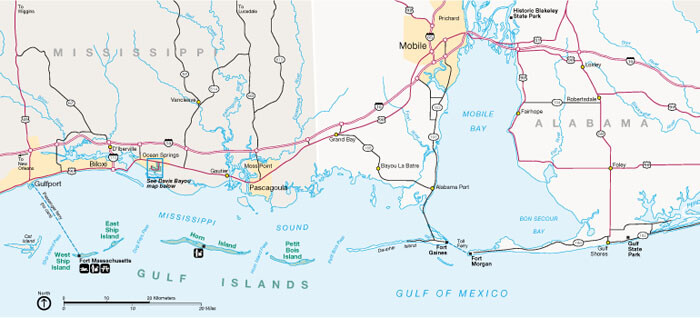 |
| National Park Service Gulf Islands Regional Map of Gulfport, Mississippi and the Gulf Coast |
About Natasha Trethwey
Natasha Trethewey is a professor of English and the Phillis Wheatley Distinguished Chair in Poetry at Emory University. Her first collection, Domestic Work, won the 1999 Cave Canem prize, a 2001 Mississippi Institute of Arts and Letters Book Prize, and the 2001 Lillian Smith Award for Poetry. In 2003, her second collection Bellocq's Ophelia won the Mississippi Institute of Arts and Letters Book Prize and was named a Notable Book by the American Library Association. She won the 2007 Pulitzer Prize for her third collection, Native Guard. Natasha serves as a producer for the Southern Spaces series Poets in Place, in which she has published two pieces, Elegy for the Native Guards and Theories of Time and Space.
]]>Interview with Natasha Trethewey
Part 2: Trethewey discusses “Signs, Oakvale, Missisippi, 1941” and “Flounder” as well as landscapes in Gulfport and New Orleans
Part 3: Trethewey discusses “Monument,” “Elegy for the Native Guards,” “Providence,” “Prodigal I,” and the documentary impulse
Part 4: Trethewey discusses “Secular,” “Saturday Drive,” “Collection Day,” “Saturday Matinee,” and photographs as family artifacts
Part 5: Trethewey discusses “Graveyard Blues,” “Myth,” “Incident,” “Theories of Time and Space,” as well as music and/as poetry
Part 6: Trethewey discusses Atlanta as retreat and homecoming as well as Decatur and place’s possession of memory
Part 7: Trethewey discusses “Miscegenation,” “The South,” “Saturday Matinee,” “Elegy,” “Mexico,” “The Book of Castas” and new work
About Natasha Trethwey
Natasha Trethewey is a professor of English and the Phillis Wheatley Distinguished Chair in Poetry at Emory University. Her first collection, Domestic Work, won the 1999 Cave Canem prize, a 2001 Mississippi Institute of Arts and Letters Book Prize, and the 2001 Lillian Smith Award for Poetry. In 2003, her second collection Bellocq's Ophelia won the Mississippi Institute of Arts and Letters Book Prize and was named a Notable Book by the American Library Association. She won the 2007 Pulitzer Prize for her third collection, Native Guard. Natasha serves as a producer for the Southern Spaces series Poets in Place, in which she has published two pieces, Elegy for the Native Guards and Theories of Time and Space.
About Jake Adam York
Raised near Gadsden in northeast Alabama by his steelworker father and his mother, a history teacher, Jake Adam York studied architecture and English at Auburn University. He received an M.F.A. and a PhD in creative writing and English literature from Cornell University. He is currently an associate professor of English at the University of Colorado, Denver, where he directs the creative writing program. York has published two books of poetry, Murder Ballads (2005), and A Murmuration of Starlings (2008). A third volume, Persons Unknown is forthcoming in October 2010. His poems have appeared in various journals, including Blackbird, Diagram, Greensboro Review, Shenandoah, The Southern Review, and Third Coast. He has also published three pieces, Anniversary, A Field Guide to Northeast Alabama, and In the Queen City: A Reading at the Gadsden Public Library, as part of the Southern Spaces series Poets in Place.
]]>