Many South Vietnamese sought new identities as they resettled in locations such as California, Texas, Washington State, Louisiana, and the DC metro area including Maryland and northern Virginia. Perhaps surprisingly, Tennessee also became home to generations of Vietnamese refugees and immigrants with intense transnational migration histories. One family’s story is that of my own, whose refugee experience does not follow the typical timeline of helicopter escapees and boat people. Rather, as Humanitarian Operation arrivals, my family’s history offers an illuminating narrative.1This essay draws upon excerpts from an oral history conducted by the author with Đỗ Phương Anh Linh in November 2020, as well as stories from March 2025 told by his younger sister, Đỗ Phương Anh Thư.
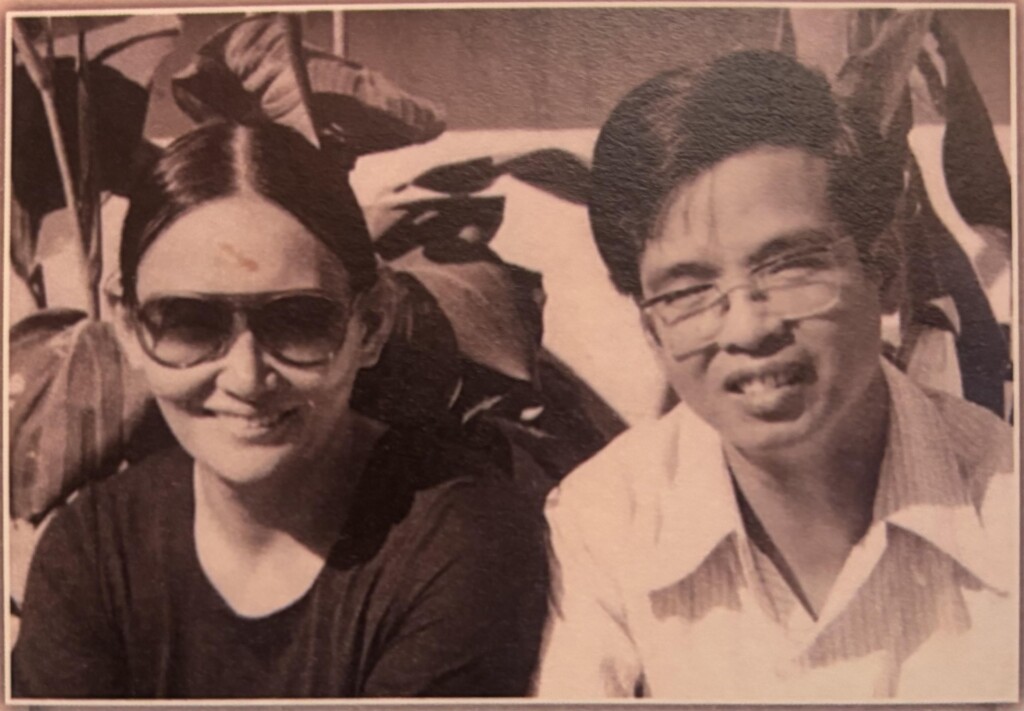
My grandfather, Đỗ Phương Anh, was born on July 3, 1935, in the Quảng Bình province of Central Việt Nam during the French Colonial period. In the late fifties and early sixties, Phương Anh was required to complete mandatory military service for young men in their twenties. A former teacher of Vietnamese literature and theology, he paused his teaching career in 1965 at Trường Trung Học Võ Tánh located in Nha Trang to serve as a lieutenant in the Army of the Republic of Việt Nam (Lục Quân Việt Nam Cộng Hòa), more familiarly known as the South Vietnamese Army. South Việt Nam’s government facilitated mass military mobilization in response to intense war escalation and the deployment of US combat troops. This meant my grandfather would leave his academic job to travel with his family to the provincial city of Sa Đéc. There, he was the military’s paymaster, responsible for distributing wages to the soldiers in the South Vietnamese Army, and was also a logistics officer, managing the local squad’s resources and supplies. He completed his assignment in 1970 and was allowed to return to his teaching position in Nha Trang.
As combat intensified, North Vietnamese forces encroached into South Việt Nam, forcing Phương Anh and his family to relocate to Sài Gòn in April 1975. During the following months, the collapse of the South Vietnamese government led to the detainment of former military personnel and civil servants. Upon his return to Nha Trang in May 1975, my grandfather was confronted by communist officials, arrested, and sent to a re-education camp. Too traumatic and horrific for him to recount, my grandfather’s stories and experiences in those camps are lost to time. Yet, the terrors he saw there would manifest perniciously. Years later, when family members brought up plans to return and visit Việt Nam, in total outrage, my grandfather exclaimed that he would never return to a country where he had experienced such atrocities.
Upon his release in 1982, marking seven years of incarceration, my grandfather faced eviction from his family home in Sài Gòn, forcing him, my father, his siblings, and my grandmother, Lê Thị Kim Hoa, to relocate to government-owned housing. A family of eight, they were crowded into a small, worn-out city property that had no furnishings and limited access to electricity. My father, Đỗ Phương Anh Linh, was born on August 6, 1964, in the city of Nha Trang of southern Việt Nam. Being the oldest son meant he would bear too soon the burden of standing in as the man of the house because of my grandfather’s incarceration. While Phương Anh was in the re-education camp, my grandmother and my father were the only two family members old enough to find jobs. However, neither of them could find decent-paying work in densely-populated Sài Gòn, especially while it was undergoing systematic economic changes as well as recovering from a disastrous war. Circumstances became dire as my father’s family grappled with extreme poverty and starvation. Yearning for new beginnings and exhausted from the suffering and hardship in their homeland, my father’s family decided that they needed to flee to the United States.
At their first getaway attempt, my grandfather and father, together with fifty-three other people, sought to escape Việt Nam by a fishing boat. After seven days of traveling on the South China Sea, commonly known as the East Sea or Biển Đông, a storm caused the boat to malfunction and forced a landing on nearby Côn Sơn island, once a part of French Indochina, but now claimed by the Vietnamese government. Everyone aboard was detained in the island’s prison. My father, age sixteen, was sentenced to one year of jail; my grandfather faced three years. Like many other prisons and detention camps in Việt Nam, conditions were horrible because of food scarcity, compact and crowded living facilities, forced intense physical labor, and a lack of sanitation.
Following my father’s release from the island prison in 1983, he returned to his family in Sài Gòn for a few days before attempting again to escape by boat. This time he travelled without family members to the small city of Cà Mau, where he joined with some seventy other people. Shortly after embarking, the ship’s poor condition caused it to flood. Cast up on a jungle shore, my father tried to find his way back to Sài Gòn, but was stopped by law enforcement at Cà Mau’s city border. He was detained and imprisoned again, this time in Cây Gừa, a local camp.
After months, my father was allowed to return to Sài Gòn and join his family. My grandfather remained imprisoned. The family’s income was left to my grandmother and father. For the following six months, my father’s job was driving people around the city on a cyclo, a three-wheel bicycle taxi. But he, and my grandmother, who sold bowls of sticky rice on the streets, were unable to earn enough to sustain the family and its small children.
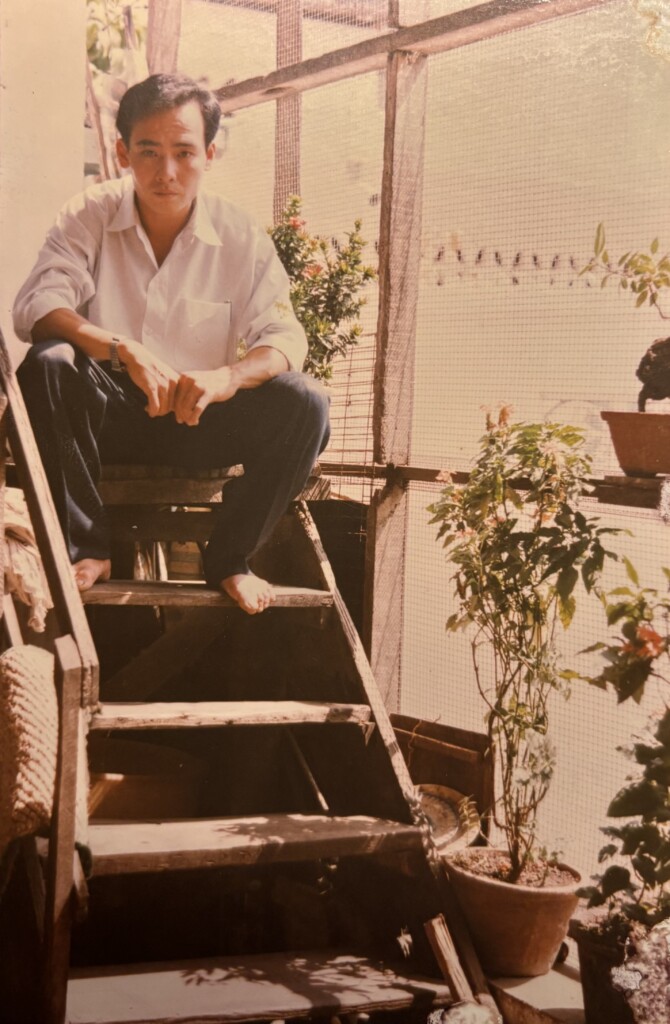
After six months in Sài Gòn, my father and his ten-year-old younger brother, Đỗ Phương Anh Tuấn, attempted another escape. With almost no money they made it to Mỹ Tho to board a Mekong River boat that they hoped would take them to the coast. If they could reach the beaches, my father thought he could figure out a way to flee. As the boat drifted downriver, my father realized that the people who sold him the tickets were scammers. The boat was over-crowded and in a dangerously poor condition. The deck began filling with Mekong water. Everyone screamed in panic and fear, forcing the captain to make an emergency landing at a small island. Here, my father and his brother tried to hide in the jungle brush from soldiers and policemen. In the middle of the night, soldiers monitoring the island caught my father’s younger brother, age ten. My father had no choice but to turn himself in. They were sent to a nearby jail. Once the police determined that they were attempting to escape the country, they were sent to another island prison and subjected to forced physical labor. Sentenced for a year and a half, my father was required to harvest rice for ten hours a day in Việt Nam's hot and humid climate. Among other tasks, Anh Tuấn herded ducks into cages for selling in the farmers’ market. Only a child, he was released early. My father continued to be held.
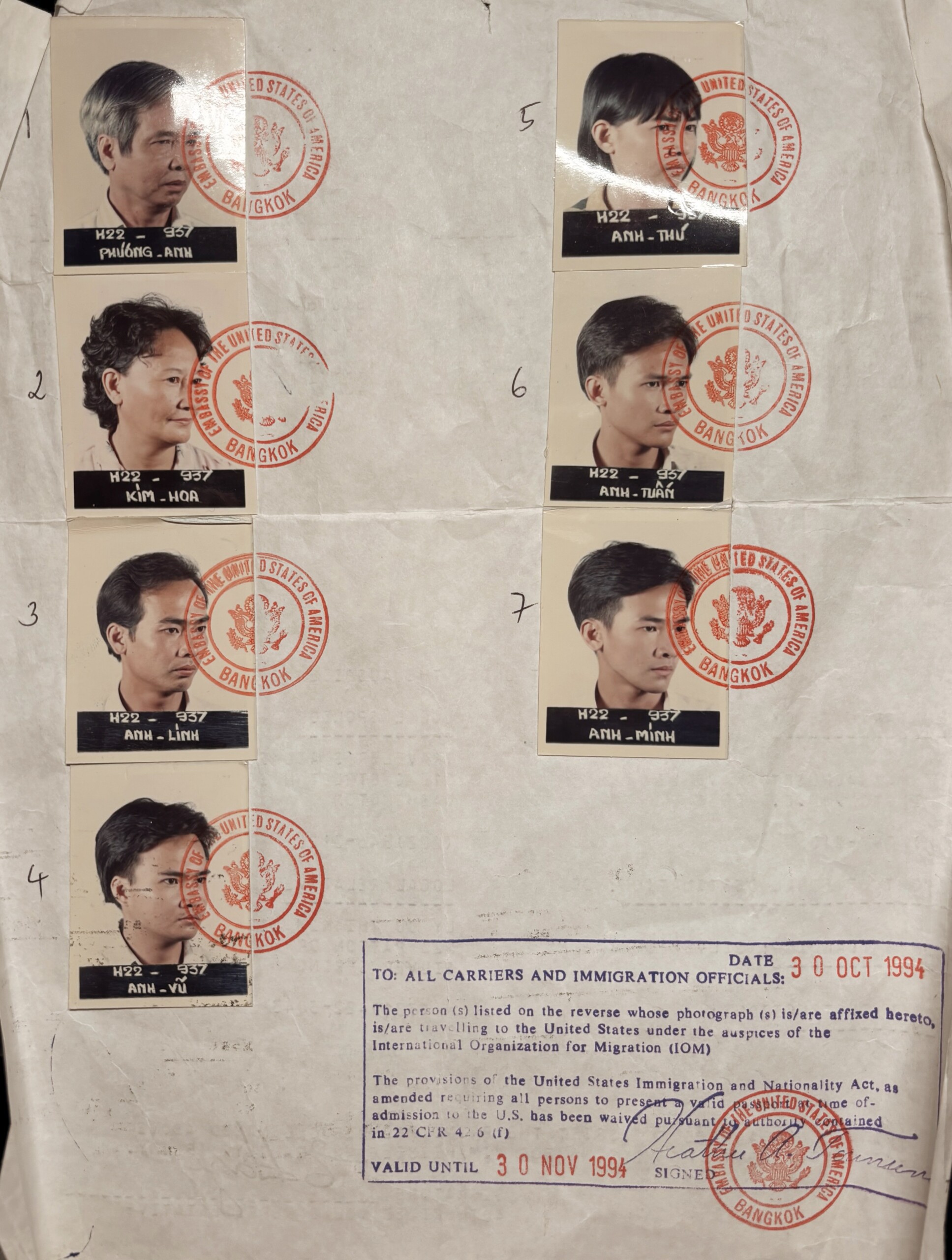
In the early 1990s, the United States began the Humanitarian Operation Program that allowed formerly imprisoned civil servants to seek political asylum. For everyone in my father’s family to be accepted into this program, they had to provide documentation of their time spent within the re-education camps. There was also much paperwork with the US Embassy concerning their applications for a passport and their medical history. After having gone through extended hardship, my father, Đỗ Phương Anh Linh, embarked on this life-changing journey.
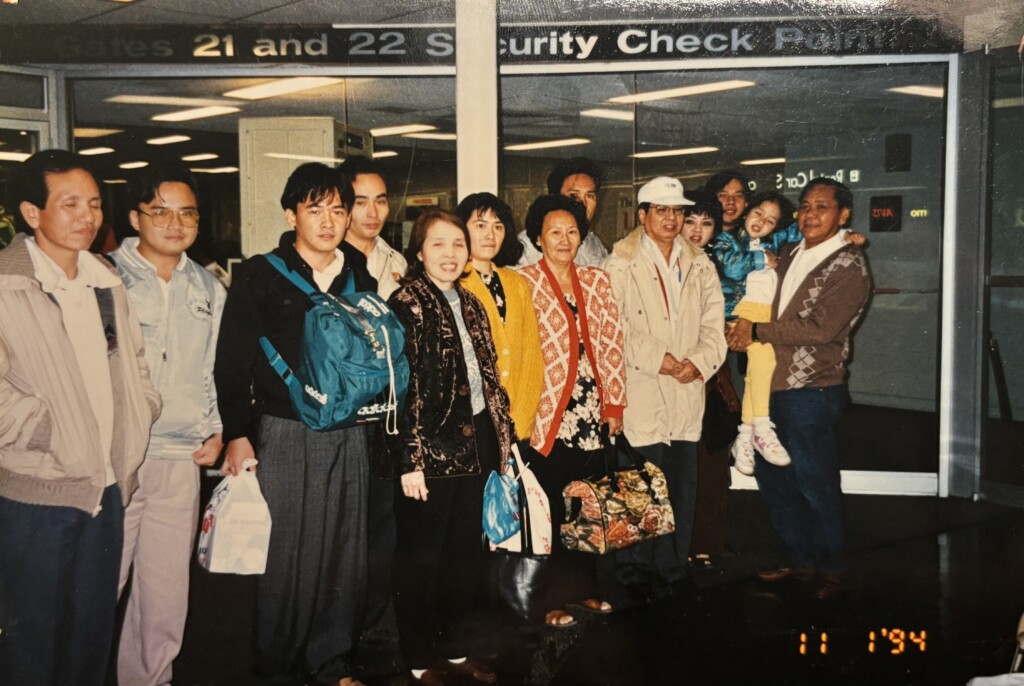
In the final weeks of November 1994, my father, his parents, and all five of his siblings flew to Baltimore to reunite with his aunt, Đỗ Thị Kim Liên, and her family. Having lived in Maryland for about twenty years, Liên, and her husband, Lý Văn Đích, arrived in the United States among the initial waves of refugees following the fall of Sài Gòn. At the Baltimore airport, Đích welcomed his relatives and drove them to the family’s residence in Silver Springs. They immediately found work (for around five dollars an hour) at the dollar stores and laundry mats owned by their cousin, Lý Trang.
It had only been three months since my father arrived in Silver Springs when his uncle, Đỗ Quang Châu, phoned and convinced him to move to Tennessee. Châu, more familiarly known as Father Peter, was the former head pastor of St. Martha’s Catholic Church, the first Vietnamese American parish in the Nashville area. After enduring invasive investigations by Việt Nam’s communist government intent on locating the Catholic Church’s financial accounts and stored funds, Father Peter escaped Việt Nam in 1978 by boat and settled in a refugee camp in Thailand. His mother was sponsored in Cookeville, Tennessee, about an hour-and-a-half east of Nashville. To reunite with her, Father Peter flew from Thailand to Tennessee, officially beginning his religious service to a newly emergent Vietnamese Catholic community. Father Peter sought to establish a church where the Vietnamese could worship in their native language. In the nineties, Vietnamese Catholics were constantly relocated and displaced from various churches across the city, with parish staff falsely alleging that the Vietnamese refugees trashed the facilities. Father Peter ultimately led the construction of a new Catholic church in Ashland City that would be the cultural and spiritual hub for local Vietnamese American Catholics for two decades.
When Father Peter contacted my father, he spoke about the Nashville area’s lower cost of living along with its growing job market. My father was dubious, so he went alone to see for himself. He immediately found work at the Sunday School Publishing Board, a Baptist publishing company that created textbooks for churches in middle Tennessee. Father Peter had close connections with the board’s owner, opening the door for many Vietnamese refugees to work there. As Silver Springs, Maryland, became increasingly more crowded with Vietnamese migrants, the ability to find employment had become difficult. The language barrier for Vietnamese refugees meant they were all competing for similar jobs that required minimal English-speaking skills. In Nashville, it was easier to find work, especially physical labor jobs, that required little to no English. My father’s family was convinced that moving to Nashville was their best plan of action, and after six months they joined him there.
At the time, my father was living with his uncle, Đỗ Hữu Đề, who also worked with the Sunday School Publishing Board. Đề was formerly a police chief in the South Vietnamese government. He had previously traveled to the United States, before the war, to study in a police training academy before returning to his family in Việt Nam. Like many other civil servants in the South following the Việt Nam War, Đề was relocated to a harsh and torturous re-education camp. Đề stayed in this camp for ten years, facing starvation and exhaustion from intense physical labor. He was eventually allowed to leave Việt Nam and came to the United States in 1993, a year before my father’s family. Because of his previous studies in the US, Đề was proficient in English, making him a resource and translator among the Vietnamese immigrants. Đề also taught many Vietnamese, including my father and his siblings, how to drive.
My father’s family’s resettlement in Nashville began with a short stay with their Uncle Đề. Father Peter’s advice proved true, demonstrated by the ease with which everyone found employment. Their new jobs varied from working at the Sunday School Publishing Board, a hammer production site, and an electronic assembling company. Their incomes ensured enough financial stability for the family to move out of Đề’s home into a nearby apartment complex. My father and his siblings applied to Nashville State Community College to attain associate degrees. After about two years of clocking into their jobs, keeping up with their coursework, and all the while learning English, the family had saved enough for a major milestone—purchasing a house in West Nashville, where they continue to reside. Finishing their programs at Nashville State, my father and all of his siblings except for his sister transferred to local universities such as Tennessee State and Middle Tennessee State.
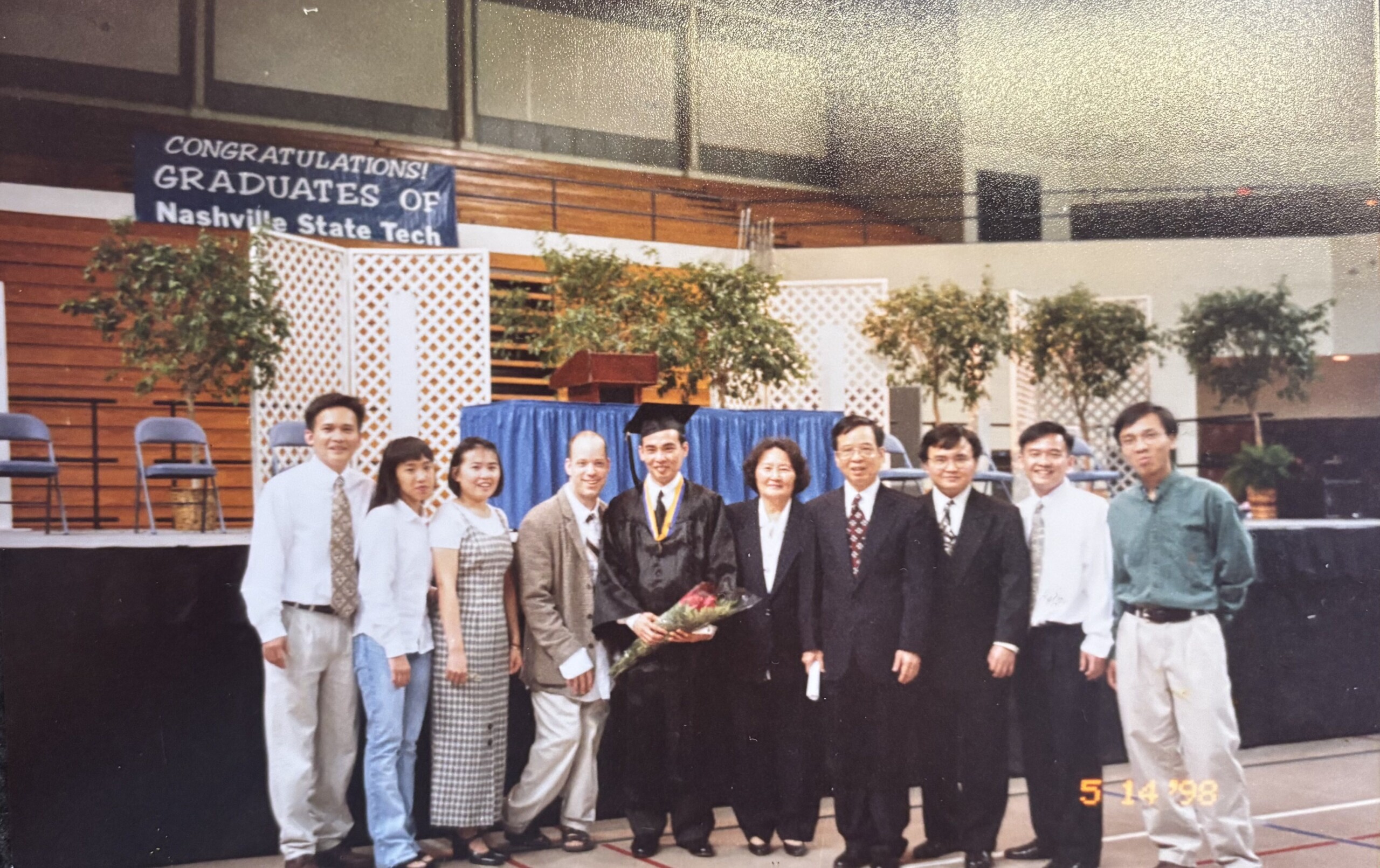
By the time most of the family earned degrees (my father’s was in computer science), they had lived in the United States for over five years, the minimum residency to apply for citizenship. They believed this was important, and necessary, because of the legal rights and protections. They saw the right to vote as the most valuable privilege of gaining citizenship, a freedom they were not afforded under Việt Nam’s communist regime. The United Immigration and Naturalization Service (INS) approved their applications and set appointments for their citizenship test – which included a short written section and an oral examination on US history and civics. They all passed on their first tries and were naturalized at a local courthouse in 2000.
Next, my father returned to Việt Nam to marry his long-distance girlfriend, my mother. He helped her get a green card and become a permanent resident. They travelled back to the US in October of 2001 where they were expecting a baby boy. Through countless obstacles and tribulations, my mother and father were finally able to settle and raise a family.
The new life in Tennessee presented challenges and opportunities. The growing Vietnamese population in Nashville found it difficult to attain the varieties of fresh produce, fermented sauces, and particular meat cuts used in their traditional cooking, creating a sense of nostalgia and longing for their beloved dishes.2There are few reliable sources to estimate how many Vietnamese people live in Nashville. As of July 2023, 3.5% of the population in the Nashville-Davidson metropolitan area identifies as Asian (approximately 24,000 people). https://www.census.gov/quickfacts/fact/table/nashvilledavidsonmetropolitangovernmentbalancetennessee/PST045223 Many Asian groceries in Nashville were owned by Lao refugees and immigrants, none that regularly carried the items desired by the Vietnamese. My father and his family took on the challenge of opening a grocery store—now one of the oldest Vietnamese-owned establishments in the area. Along with hoping to fulfill the demand for Vietnamese foods, they wanted to ensure that if any of the siblings were to ever be unemployed, they would have a safety net at the family business. Opening on September 15, 2000, the Đỗ family named their business Bách Thảo Market to represent the diverse selection of fragrant herbs, root vegetables, and leafy greens for sale.
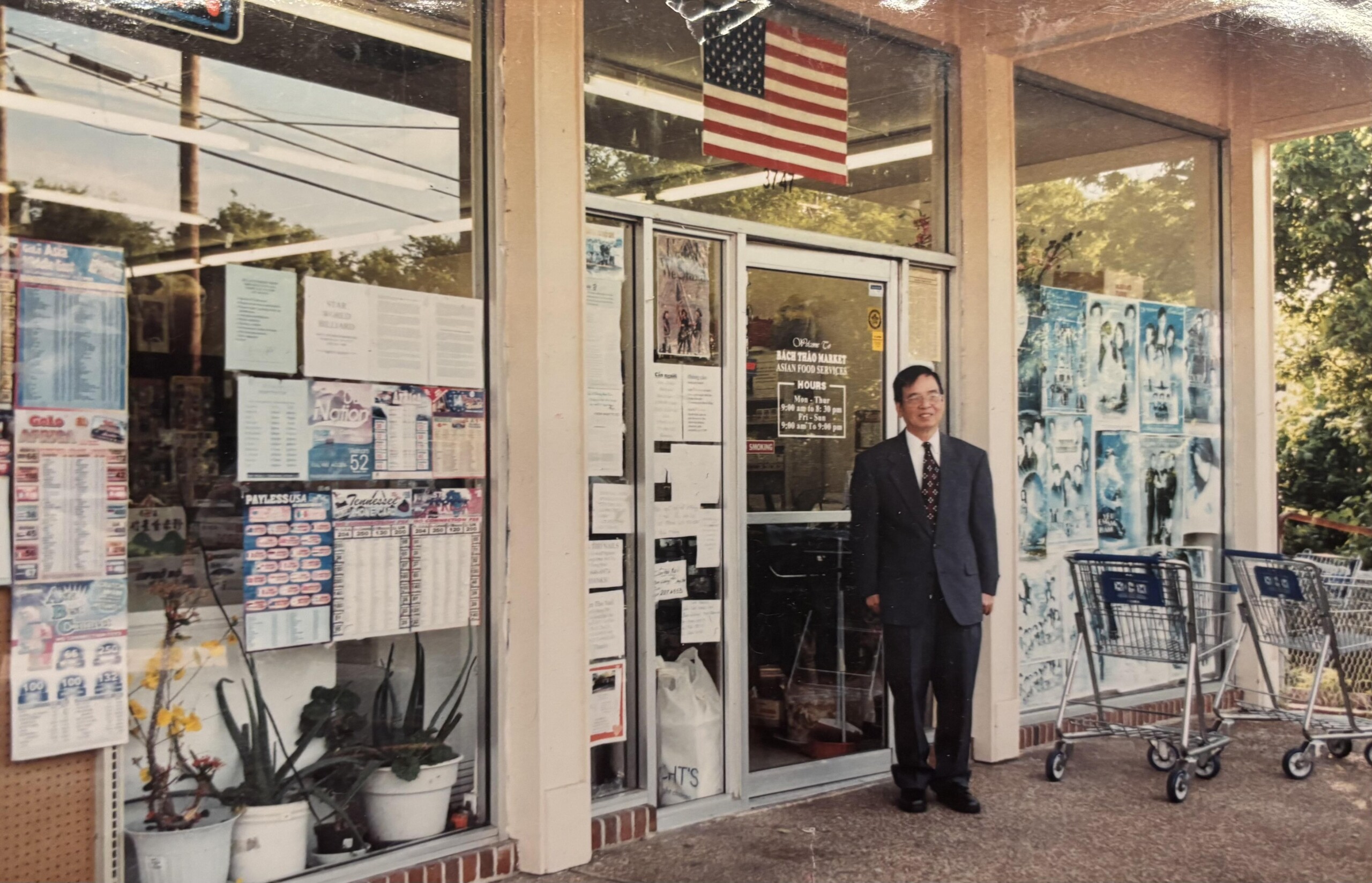
Opening a family business came at a substantial cost. Cleaning out their bank accounts and maxing out credit cards, the Đỗ’s took on a major risk. Driving a box truck fifteen hours each way between Tennessee and Texas, my father was responsible for retrieving two to three pallets of produce and goods that would be sold at Bách Thảo. He carried pillows and blankets with him to create a makeshift truck bed at rest areas on the interstate. My father drove weekly to Texas for seven to eight years until a specialized produce distributor opened in Memphis. In June 2017, Bách Thảo Market was renamed to Little Sài Gòn Market to advertise towards an American clientele, who my family believed would more easily associate Sài Gòn with Vietnamese products versus the less familiar Bách Thảo. Little Sài Gòn Market remains in operation today, owned by Đỗ Phương Anh Thư and Đỗ Phương Anh Minh, the youngest daughter and son among my father’s siblings.
Fifty years after the fall, Vietnamese refugees devastated by war, incarcerated for “re-education,” and displaced to unexpected locations across the United States have created vibrant cultural enclaves. They leave enduring legacies in their new homes, often unknowingly, through simply keeping alive the memories of their motherland. My family’s resilient history, one stream in an intricate Vietnamese American diaspora, suggests the complexity of refugees’ stories and lived experiences—as well as the necessary work of recovering and interpreting this history. 
About the Author
Anhhuy Do is a graduate student in history at Princeton University. Born and raised in Nashville, he is an aspiring scholar of Vietnamese refugees and Asian American history in the US South.
]]>Introduction
Peggy Winn had every reason to believe freedom meant stability for her family, stability in a new place. Under slavery, she had lived in the southern section of Albemarle County, Virginia, on the Cleveland farm. Winn had been born in the same county and avoided the most devastating effects of the slave trade: the sale away from kin. She married Benjamin Barbour when she was twenty, around 1845. Barbour was born in Greene County, just to the north of Albemarle, too far to see her frequently. Either through the local hiring system, slave trade, or other means, he managed to move—or was moved—close enough to Peggy that they could visit, often enough that Peggy's owner and his felt comfortable assenting to the marriage. When, nearly twenty years later, they registered their marriage with Freedmen's Bureau agents in Augusta County, just to the west of Albemarle, they found more stability for their marriage and their two young girls, Mariah and Corra, than was possible before. Emancipation and state recognition of the family removed the principle geographic threat of slavery: forced separation through the slave trade.1Register of Colored Persons of Augusta County, State of Virginia, Cohabiting Together as Husband and Wife, 1866 Feb. 27 (hereafter Cohabitation Register, Augusta County), 28. Cohabitation Registers Digital Collection, Library of Virginia, Richmond, VA, http://digitool1.lva.lib.va.us:8881/R?func=collections-result&collection_id=1522; U.S. Bureau of the Census, Eighth Census of the United States, 1860. Washington, DC: National Archives and Records Administration, 1860, M653, 1,438 rolls, source consulted: s.v. P. Cleveland, 1860 United States Federal Census, Slave Schedules, Albemarle County, Virginia, http://www.ancestry.com/; P. Cleveland to [Thomas P. Jackson], May 6, 1867, Valley of the Shadow: Two Communities in the American Civil War online, http://valley.lib.virginia.edu/papers/B0193, source copy available as National Archives and Records Administration, Records of the Bureau of Refugees, Freedmen, and Abandoned Lands (hereafter hereafter NARA BRFAL), Record Group 105, Box E4269; 1870 U.S. Federal Census, http://ancestry.com/ s.v. Benjamin Barbourn [Barbour], District 3, Augusta, Virginia, M593_1634, page 370B.
Yet sustaining a marriage in a new place with this new status brought challenges. By April 1867, a year after Winn and Barbour registered, they found their relationship the focus of a concerted attack. Since Freedom, Winn lived and worked at the home of Urban Poe, an Augusta County merchant and local political operative. Poe had no interest in Winn continuing her marriage to Barbour, so he forbade the freedman from trespassing on his property and shot at him when he did. Poe brought Barbour before the Freedmen's Court, arguing that Barbour had "slandered his character" by representing that Poe was "living with Barber's wife," when in actuality, Poe argued, "he is no count to her or her children & She wants to leave him." Poe lined up neighbors to bolster his case: the wealthy farmer Robert Van Lear was prepared to support Poe's claim against Barbour, as was Mrs. Henry Palmer. Fortunately for Winn and Barbour, other whites were willing to testify to their longstanding relationship. Contacted by Barbour and by Poe to serve as a witness, Winn's former owner wrote to the local Freedmen's Bureau agent, interceding on Barbour's behalf. The agent quickly dismissed Poe's case.2Valley Virginian, February 21, 1866, p. 3 col. 2, Valley of the Shadow online, http://valley.lib.virginia.edu/news/vv1866/va.au.vv.1866.02.21.xml#03; U.D. Poe to P.P. Cleveland, April 30, 1867, Valley of the Shadow online, http://valley.lib.virginia.edu/papers/B0192 source available NARA BRFAL, RG 105; P. Cleveland to [Thomas P. Jackson], May 6, 1867, Valley of the Shadow online; 1860 U.S. Federal Census, Agriculture Schedule, http://www.ancestry.com/ s.v. Robt Van Lear, Augusta County, Virginia, roll 5, p. 273; Augusta County: Freedmen's Bureau Register of Complaints, May 8, 1866, Valley of the Shadow online, http://valley.lib.virginia.edu/papers/BD4000, source available, NARA BRFAL, RG 105, Box E4237.
 |
| Augusta County Cohabitation Register, page 28. Benjamin Barbour and Peggy Winn were two of fifteen hundred men and women in Augusta County who registered their marriage with the Freedmen's Bureau in 1866. Courtesy the Library of Virginia. |
Winn and Barbour made a place for their marriage in defiance of the slave trade, under constraints to their mobility, and by taking advantage of the postwar government's intervention into black marriage. They met, married, and against odds sustained their relationship for over fifteen years in a Virginia Piedmont wracked by displacement caused by the slave trade and forced removal. They strained against the distance which slavery imposed and innovated, as many others did, by "living abroad" on different farms. Even after emancipation Winn and Barbour continued to live at a distance, but freedom significantly lowered the barriers to living under the same roof and altered the meaning and experience of the same intervals. The couple used federal, state, and local bureaucracies, which imposed a legal structure for marriage on existing relationships that fit poorly with the diversity of living arrangements men and women had taken on, but provided safeguards for African American families, expansive networks to help freedmen repair relationships, and means for black men and women to defend their families in court.
Emancipation-era marriages were enacted over time and at multiple interrelated scales of action, from the level of the plantation household and neighborhood to that of the interstate slave trade and federal bureaucracy. We need to consider all of these levels together to perceive the connections and describe the reach of human actions and practices. The scales at which women and men acted extend from the private sphere to institutions or networks. Attention to scale can sort out actions of local Bureau officials, state legislators, and radicals in Congress while clarifying more complex relations. Men and women whom we often consider to be household actors also engaged in processes and networks that spanned the US South.3Geographers have disagreed about many aspects of the definition of scale. See Peter Taylor, "A Materialist Framework for Political Geography," Transactions of the Institute of British Geographers, n.s., 7, no. 1 (1982): 15-34; Neil Smith, Uneven Development: Nature, Capital, and the Production of Space (Cambridge, Mass.: Blackwell, 1984); Sallie A. Marston, "The Social Construction of Scale" Progress in Human Geography 24, no. 2 (2000): 219-242; Andrew E. G. Jonas, "Pro Scale: Further Reflections on the 'Scale Debate' in Human Geography," Transactions of the Institute of British Geographers, n.s., 31, no. 3 (2006): 399-406; and Edward L. Ayers and Scott Nesbit, "Seeing Emancipation: Scale and Freedom in the American South," Journal of the Civil War Era 1, no. 1 (2011): 3-22.
Formerly enslaved men and women were constantly acting within networks—kinship relations, social hierarchies, labor markets, and bureaucracies—of particular reach, at particular scales, to find whatever stability and autonomy they could for their families. Because these networks often connected local affairs with far-flung places and broad structures of political and economic power, freedwomen and men built marriages both through the quotidian, household practices of love and labor and by leveraging bureaucracies and labor markets. Emancipation-era marriages built intimate bonds and sprawling connections. Marriage muddied the spatial boundaries between fictive emancipation-era private and public spheres.
At the most intimate scale, a wide diversity of living arrangements fell under the single legal framework of emancipation marriage. These arrangements were in part a product of new legal guarantees for marriages of freedpeople, in part the product of relationships given shape under slavery and menaced by the slave market. This market created staggering obstacles: enslaved marriages had endured the large-scale transport of people from the Virginia Piedmont and Tidewater to the antebellum Southwest, as well as significant but more intricate movements, such as those that brought more than one-hundred fifty men and women from Albemarle to Augusta, or movements from north and west that brought hundreds of others to long-settled Hanover County. The legal framework for emancipation-era marriage, which generated the records through which we can know something of those migrations, emerged out of unusual cooperative action between multiple levels of government: conservative state legislatures, local governments controlled by former Confederates, and the United States Bureau for Refugees, Freedmen and Abandoned Lands. This legal framework and the government agents who carried it out had a direct effect on the chances of enslaved men and women to reunite across hundreds of miles.4For scholarship on African American families at these and other scales, see Thavolia Glymph, Out of the House of Bondage: The Transformation of the Plantation Household (New York: Cambridge University Press, 2008); Anthony Kaye, Joining Places: Slave Neighborhoods in the Old South (Chapel Hill: University of North Carolina Press, 2007); Brenda Stevenson, Life in Black and White: Family and Community in the Slave South (New York: Oxford University Press, 1997); Laura Edwards, Gendered Strife and Confusion: The Political Culture of Reconstruction (Urbana and Chicago: University of Illinois Press, 1997); Wilma A. Dunaway, The African American Family in Slavery and Emancipation (New York: Cambridge University Press, 2003); Jacqueline Jones, Labor of Love, Labor of Sorrow: Black Women, Work, and the Family from Slavery to the Present (New York: Basic Books, 1985); Amy Dru Stanley, From Bondage to Contract: Wage Labor, Marriage, and the Marketplace in the Age of Slave Emancipation (New York: Cambridge University Press, 1998); Peter Bardaglio, Reconstructing the Household: Families, Sex, and Law in the Nineteenth-Century South (Chapel Hill: University of North Carolina Press, 1995); Mary Farmer-Kaiser, Freedwomen and the Freedmen's Bureau: Race, Gender, and Public Policy in the Age of Emancipation (New York: Fordham University Press, 2010); recent investigations of families' transition to emancipation build on an earlier historiographical debate: E. Franklin Frazier, The Negro Family in the United States (Chicago: University of Chicago Press, 1939); Daniel P. Moynihan, The Negro Family: The Case for National Action (Washington, DC: Office of Policy Planning and Research, U.S. Department of Labor, 1965); John W. Blassingame, The Slave Community: Plantation Life in the Antebellum South (New York: Oxford University Press, 1972); and Herbert G. Gutman, The Black Family in Slavery and Freedom, 1750-1925 (New York: Pantheon, 1976).
Defining Legal Status
Formalization of marriages between enslaved men and women was a cause for concern among those working at the highest governmental levels long before Freedmen's Bureau agents arrived to take down names in Augusta County, Virginia. In early 1864, as black Kentuckians enlisted in the US Army in increasingly large numbers, Sen. Henry Wilson of Massachussetts proposed a bill setting free women held in bondage there by loyal owners, by virtue of their marriage to United States Colored Troops enlistees. The resulting law, as Amy Dru Stanley has pointed out, was problematic for entwining women's freedom with marriage; it was also unavoidably problematic as a document laying out guidelines for determining "who is or was the wife and who are the children" of the enlistees.5 Amy Dru Stanley, "Instead of Waiting for the Thirteenth Amendment: The War Power, Slave Marriage, and Inviolate Human Rights," American Historical Review 115.3 (June 2010): 733-765; "A Resolution to encourage Enlistments and to promote the Efficiency of the military Forces of the United States," Bills and Resolutions, U.S. Senate, S.R. 82, 38th Congress, 2nd Session.
The Senate's resolution "to encourage enlistments and to promote the efficiency of the military forces of the United States" prescribed two tests for determining who was the valid wife of an enlistee: evidence that the two had "lived together, or associated or cohabited as husband and wife" and continued to do so until enlistment; or, evidence provided by the couple that a marriage ceremony, whether recognized by civil authorities or not, had taken place and the couple had lived together until enlistment. For the purposes of emancipation in spring 1865, the Senate defined a valid slave marriage as requiring either cohabitation or "association" until the husband left for war. In each case, according to Sen. Charles Sumner, the evidence would not be the testimony of the master but the "mutual recognition" of the husband and wife of their marriage. The principles outlined in the bill would be carried through into the emancipation era: marriage was a volitional institution, undertaken by the consent of both husband and wife regardless of the sanction of other citizens, and that living together or associating under slavery constituted evidence of a pre-existing marriage.6 Bills and Resolutions, U.S. Senate, S.R. 82, 38th Congress, 2nd Session; U.S. Congress, Congressional Globe, Senate, 38th Congress, 2nd Session, 114; Sumner also quoted in Stanley, "Instead of Waiting," 751.
The Freedmen's Bureau undertook a program recognizing and registering these marriages by the summer of 1865, a process that proceeded differently in different states. A military order affecting North Carolina, Alabama, and Georgia declared that common law applied to slave relationships but gave little indication how that would be implemented. Other orders went into great detail laying out the calculus of who counted as a freedman's proper wife, particularly in cases where a man claimed multiple wives. In every military district commanders ordered local offices to register freedmen and women's marriages, though in Texas, these orders did not come down until 1867. The resulting records differed from place to place, both in the pieces of information officials thought essential for proper marriage registration, and in how they settled questions about who constituted a couple.7 Farmer-Kaiser, Freedwomen, 26-30; Barry A. Crouch, "The 'Chords of Love': Legalizing Black Marital and Family Rights in Postwar Texas," Journal of Negro History 79.4 (Autumn 1994): 334-351; Gutman, Black Family, 18-25, 419.
There was no straightforward hierarchy between federal law and state action in regulating marriage; the scales of bureaucracy did not nest cleanly. While federal initiative may have prompted action, in Virginia, as in a number of other southern states, the cohabitation registrations came about through state law and for reasons shaped by the concerns of whites. In February 1866, the conservative-controlled Virginia House of Delegates passed a bill requiring the registration of all people of African descent as husband and wife who were cohabiting as of the bill's passage. The bill sidestepped much of the complexity involved in formalizing slave marriages, not accounting, for example, for the possibility that many victims of the slave trade might have multiple marriages, none of which ended in divorce. In this legislation, conservative delegates were primarily concerned with two implications of emancipation: the heritability of property and the fear of that freedpeople, especially children, would become wards of the state. In every county registrars kept lists of children born from enslaved relationships along with the names of their father and mother, even if the marriage in question had dissolved. This law gave black Virginians the kind of freedom the General Assembly believed they were owed after emancipation. For Virginia whites, registering black marriages was part of a desperate attempt to restrain and confine African Americans in the wake of slavery, similar in intent and scope to the Black Codes, the series of vagrancy and apprentice laws created in the same state legislative session.8 Third Edition of the Code of Virginia: Including Legislation to January 1, 1874, George W. Munford (Richmond, 1873), Chapter 104, Section 13; J. Tivis Wicker, "Virginia's Legitimization Act of 1866," The Virginia Magazine of History and Biography, 86.3 (Jul. 1978): 339-344; Jack P. Maddex, The Virginia Conservatives, 1867-1879: A Study in Reconstruction Politics (Chapel Hill: University of North Carolina Press, 1970), 39-41; Laura F. Edwards, "The Marriage Covenant is at the Foundation of All Our Rights" Law and History Review 14.1 (Spring 1996): 81-124; Catherine Jones writes of the consensus postwar Virginians held on the care of children: "The familial household's capacity to harness kinship's obligations to productive units made it prominent in Virginians' visions for the postemancipation future. This understanding of kinship informed the expectations of Virginians who looked to kin obligations to provide for dependent Virginians, notably children," in "Ties that Bind, Bonds that Break: Children in the Reorganization of Households in Postemancipation Virginia" Journal of Southern History 76.1 (February 2010): 78.
Despite state law governing these marriages, it fell to local Virginia offices of the Bureau to register them. Bureau officials were far from happy about this turn. The day after the Virginia marriage law passed, an official in Middlesex County conveyed to the Bureau's assistant commissioner for the state, Colonel Orlando Brown, his approval that freedpeople would receive state sanction for marriage; he hoped, however, that the Bureau would be left out of the registration process and that the freedmen and women would appear directly before county clerks. The local official's missive did little to shift the burden. The Bureau's regional headquarters dispatched to local field offices forms for registering freedmen and women, and certificates to be given to registrants validating their marriages. In Augusta County, Bureau officials began registering freedmen in June 1866 and projected the work to be completed by mid-July. In Frederick County, the work had begun by March 1867, but officials halted the process at least temporarily when they ran out of forms. Officials in Warren County did not begin registration until later in 1867. Counties forwarded registrations to district headquarters. By spring 1867, the civilian state government made efforts to gather registrant information from the Bureau and to have those records logged with local county clerks. Even if the state had little appetite for taking on these responsibilities, it closely guarded its prerogative to record marriages for the purposes of determining the legitimacy of children even as it shared with the Bureau the authority of binding out the children of indigent parents.9 Elizabeth Regosin, Freedom's Promise: Ex-Slave Families and Citizenship in the Age of Emancipation (Charlottesville: University of Virginia Press, 2002), 82; J. H. Remington to Orlando Brown, June 18, 1866, Valley of the Shadow online http://valley.lib.virginia.edu/papers/B1248, source available NARA, Records of the Assistant Commissioner for the State of Virginia, BRFAL, RG105, M1048, roll 18; Garrick Mallery to Orlando Brown, April 30, 1867, Valley of the Shadow online, http://valley.lib.virginia.edu/papers/B1066, source available NARA Records of the Assistant Commissioner for the State of Virginia, BRFAL, RG105, M1048, roll 26; John Thomas O'Brien, Jr., From Bondage to Citizenship: The Richmond Black Community, 1865-1867 (New York: Garland, 1990), 305-308; John Preston McConnell, Negroes and their Treatment in Virginia from 1865 to 1867 (Pulaski: B.D. Smith and Brothers, 1910), 103; Acts of General Assembly, 1866-67, 951; Mary J. Farmer, "'Because they are Women': Gender and the Virginia Freedmen's Bureau's 'War on Dependency'" in The Freedmen's Bureau and Reconstruction: Reconsiderations, ed. Paul A. Cimbala and Randall M. Miller (New York: Fordham University Press, 1999), 177.
In one sense, the bureaucratic transitions in scale worked smoothly: federal law and process intervened, states cooperated. Federal officials working at the local level implemented the legislation quickly and local governments eventually received copies of the registrations. Yet local recording of the marriages demonstrated the vexing transition to state-validated marriage. The problems with legitimizing slave marriages arose because they simply were not the same as marriages in freedom: recognition under the law created new patterns and excluded some old ones. The bureaucratic geography of marriage, descending from the federal government into local counties, intersected with freedmen and women's varying understandings of marriages. For many black Virginians, marriages had not been simple local affairs but relationships between men and women separated far from each other in space and time or living with the constant anxiety that the slave trade would tear them apart.
The cohabitation registers created by Freedmen's Bureau agents did not precisely fit the experiences and intentions of the formerly enslaved. For a variety of reasons, some marriages—in contrast to the requirements of the 1864 congressional act—were registered without the consent of both members. In Smyth County, six men registered marriages listing spouses who had died, presumably to claim their children in as strong terms as they were able. A handful of marriages included one partner as living out of state, where he or she was unlikely to appear for the registration: Dracon Braxton had married Rebecca Scott in October 1840 when they were both twenty-five, but when he appeared before Bureau officers in Hanover, Virginia, he listed her current residence as New Orleans, a testament to marriage vows made under slavery and remembered in emancipation.10Cohabitation Register, Smyth County; Dylan Penningroth, The Claims of Kinfolk: African American Property and Community in the Nineteenth-Century South (Chapel Hill: University of North Carolina Press, 2003), 163-186; Cohabitation Register, Hanover County, 17.
 |
| Smyth County Cohabitation Register, page 2. Registering the lost: Freedmen claimed their family members in the strongest terms possible. In this registry, widowed freedmen in Smyth County recorded their marriages to Maria, Queeny, and Fannie. Adam Brown (line 1) recorded his wife, Sarah's current residence as Texas. Courtesy the Library of Virginia. |
Marriages observed in the absence of a partner could not be marriages legitimized through mutual assent. They depended on a single partner speaking on behalf of the other to make vows as permanent in law as with community sanction. Unavoidable as it was for the purpose of legitimizing children through marriage or formalizing relationships torn by the trade, a framework in which one partner spoke for the couple, immediately caused problems. Women were especially vulnerable. Mary Watkins had been living as Willis Stewart's wife near Staunton and evidently trusted her husband to register their marriage. When Stewart appeared before the local agents, however, he claimed a license to marry another woman, leaving Watkins to care for their unborn child. By walking out, some formerly enslaved women contested marriages. Living in Augusta County, Hannah Reed and David Collins registered their marriage in the summer of 1866. In September, Reed visited her mother in Winchester and by the following August had decided not to return, preferring to live there as another man's wife.11Thomas P. Jackson to Mary A. Watkins, May 27, 1867, Valley of the Shadow online, http://valley.lib.virginia.edu/papers/B0793, NARA BRFAL, RG 105, Box E4265; Cohabitation Register, Augusta County, 26; Thomas P. Jackson to John A. McDonnell, August 28, 1867, Valley of the Shadow online, http://valley.lib.virginia.edu/papers/B0123, NARA BRFAL, RG 105, Box E4269.
The framework itself could produce short-lived marriages. As Anthony Kaye has noted, enslaved men and women in the lower South not only had highly differentiated forms of intimate relationships, they developed a nuanced vocabulary for describing an ascending hierarchy of relations, from the temporary "sweethearting" and "taking up" to more permanent conditions of "living together" and marriage. The legal rubric only recognized the last of these, but it would not be surprising, given the rapidity with which some registered marriages ended, that men and women under slavery anticipated widely different futures and that the Bureau's codification of married people as "those cohabiting together as husband and wife, 1866 Feb. 27" fit awkwardly on new social conditions. Cohabiting did not accurately describe abroad marriages, and men and women in nuanced but unrecognized relationships might ascribe different meanings to what constituted a married couple. Did Hannah Reed and Willis Stewart consider prior relationships, newly codified, as marriage or permanent unions? 12Kaye, Joining Places, 52-62; the Bureau form for registering marriages in Virginia came with the printed heading, "Register of Colored Persons of ______ County, State of Virginia, cohabiting together as Husband and Wife on 27th February, 1866."
In circumstances such as these, Bureau agents expressed confusion over the bureaucratized procedure for ending marriages. Thomas Jackson, Bureau agent in Augusta, asked whether Collins and Reed's marriage might be annulled by erasing their names from the cohabitation register or whether the freedman, with limited resources, would be required to sue for divorce in order to end the marriage. The ninth sub-district headquarters in Winchester replied that the registrations carried out by federal agents had no legal effect on the marital status of the men and women involved, presumably since the marriages had been legalized by the Virginia General Assembly. "The registration," Capt. John A. McDonnell explained, was "only an evidence of marriage. He would be legally married, whether registered or not."13 Thomas P. Jackson to John A. McDonnell, August 28, 1867, Valley of the Shadow; Freedmen's Bureau Records: Thomas P. Jackson to John A. McDonnell, September 9, 1867, Valley of the Shadow. With no legal authority over the shifting relationships themselves, Bureau officials could only make lists.
The reach of federal, state, and local authority governing marriage was fluid during Reconstruction. Few legal guidelines existed before 1866, when the state instituted laws governing marriage of freedmen and women. Over the next year and a half local Bureau agents recorded marriages whose legitimacy resided with the state.
Marriage and Spatial Arrangements
Under slavery, families had taken many forms and spatial patterns. On a Georgia plantation, for example, historian Erskine Clarke found one couple who lived together as husband and wife with their children under the same roof; others had "abroad" marriages, in which the husband and wife lived on separate farms, meeting only on Saturday nights at the wife's quarters; one couple found a way to remain together even while the husband acknowledged wives and children on other plantations, although other enslaved women counted such practices as infidelity and declared their marriages finished. Marriages in Virginia showed similar diversity. The abroad marriage of Barbour and Winn took a familiar form; in Prince Edward County, enslaved men and women on Richard Randolph's large estate tended to intermarry, as many others on plantations elsewhere continued to do through the Civil War; still other enslaved men and women called each other husband and wife despite their forced separation by hundreds of miles. Each model of marriage reflected a spatial arrangement that held potential benefits in a society whose commitment to the slave trade made it fundamentally opposed to the well-being of enslaved families.14Erskine Clarke, Dwelling Place: A Plantation Epic (New Haven, CT: Yale University Press, 2007), 210-11; Melvin Patrick Ely, Israel on the Appomattox: A Southern Experiment in Black Freedom from the 1790s through the Civil War (New York: Alfred A. Knopf, 2004), 66-67; see also Leon Litwack, Been in the Storm So Long: The Aftermath of Slavery (New York: Random House, 1979), 239-247; and Jacqueline Jones, Labor of Love, 32-39.
 |
| James F. Gibson, A Group of "Contrabands," 1862. Emancipation-era families, such as those posing here at the Foller farm in Cumberland County, Virginia, followed a variety of marriage patterns. Courtesy the Library of Congress. |
Abroad marriages proved particularly precarious. George Johnson had asked to marry a young woman on a neighboring farm in northwest Virginia. In order to block the relationship, his owner quickly sent Johnson to work on the family's plantation in Alabama. Within two years, the woman he had hoped to marry died and Johnson returned to work the farm near Harper's Ferry. William Keno lived with his mother Becky on the Dickerson farm in Frederick County, Virginia, not far from the farm on which his father Peter stayed. When John Dickerson purchased land in Florida on which to build a plantation, Keno and his mother were forced from Peter and would not see him again. Even as marriage abroad allowed large numbers of enslaved women and men to find partners, especially on the smaller farms common to Virginia and the upper South, the added flexibility ultimately left these marriages more vulnerable, more likely to be torn apart through forced removal. A marriage at the mercy of two slave owners meant twice the number of men with the opportunity of breaking the marriage.15 Benjamin Drew, A North-Side View of Slavery. The Refugee: or the Narratives of Fugitive Slaves in Canada. Related by Themselves, with an Account of the History and Condition of the Colored Population of Upper Canada (Boston: John P. Jewett, 1856), 53, consulted in Documenting the American South online, http://docsouth.unc.edu/neh/drew/drew.html; also cited in Marie Schwartz, Born in Bondage, 197; Edward E. Baptist, Creating an Old South: Middle Florida's Plantation Frontier before the Civil War (Chapel Hill: University of North Carolina Press, 2002), 66-67.
In spite of the constant threat of sale, slave-owners would occasionally recognize slave marriages with great fanfare. These celebrations carried no civic or legal weight, and did little to threaten the power of slave owners. Far from weakening the regime, what recognition planters gave to slave marriages was calibrated to create a smoothly functioning labor system. Campbell County planter and iron manufacturer David Ross explained early in the nineteenth century that he sought in slave marriage a labor force that avoided quarrels. "I demand moderate labour from the servants," he wrote, "and have left them free only under such control as was most congenial to their happiness. Young people might connect themselves in marriage to their own liking, with consent of their parents who were the best judges." There were very good reasons for Virginia slave-owners to give some social space to their laborers, space that might be obliterated as soon as the price was right.16 Quoted in Gutman, 159; see also Glymph, 219-220, Schwartz, 193-4, and Tadman, 133-178. Calvin Schermerhorn has argued convincingly that when faced with the conundrum of seeking "mastery" through control of labor or "money" by selling enslaved people in their prime years, Tidewater slave-owners chose to sell men and women away with little hesitation. Calvin Schermerhorn, Money over Mastery, Family over Freedom: Slavery in the Antebellum Upper South (Baltimore: Johns Hopkins University Press, 2011).
Despite some evidence of their observance of slave marriage, white men proved to be the single greatest threat to the institution. The Works Progress Administration interviews with Virginia ex-slaves are full of reports of slave marriages formalized by white ministers or owners. Fannie Berry, who lived in Appomattox and then Petersburg, recalled her wedding, when "Miss Sue Jones and Miss Molley Clark (white) waited on me," and when "we had everything to eat" imaginable. This recognition carried no particular safeguards against sale or violation. In nearly the same breath, Berry related to her interviewer how she fended off a local white man's attempted rape by scratching her attacker.17Weevils in the Wheat: Interviews with Virginia Ex-Slaves, ed. Charles L. Perdue, Jr. et al. (Charlottesville: University of Virginia Press, 1976), 36.
 |
| The Resurrection of Henry Box Brown at Philadelphia, who escaped from Richmond Va. in a box 3 feet long 2½ ft. deep and 2 ft. wide. Henry Box Brown's iconic flight North was sparked when he watched his wife and child sold South. Published by A. Donnelly, 1850. Courtesy the Library of Congress. |
The slave trade wreaked havoc on relationships. Henry Brown, an enslaved tobacco worker in Richmond, knew first hand that "no slave husband has any certainty whatever of being able to retain his wife a single hour; neither has any wife any more certainty of her husband." In 1848 Brown watched his wife and child travel with three hundred fifty others from the Richmond slave market south to the Carolinas. Brown's request that his master purchase his wife and child to keep them in Richmond left the man unswayed. "He even told me," Brown recalled, "that I could get another wife and so I need not trouble myself about that one; but I told him those that God had joined together let no man put asunder, and that I did not want another wife, but my own whom I had loved so long." Brown's separation from his wife and child led quickly to his own dramatic migration from the state; his conspirators in Richmond shipped Brown on a railcar to abolitionists in Philadelphia. Brown emerged from his hiding place to recount a story of loss that would have been familiar to thousands of other black Virginians.18Henry Box Brown, Narrative of the life of Henry Box Brown, Written by Himself (Manchester: Lee and Glynn, 1851), Documenting the American South, http://docsouth.unc.edu/neh/brownbox/brownbox.html, 9, 44.
Fluctuating spatial arrangements marked enslaved marriages. At times these marriages involved a man and woman living in the same house, but as often, marriages covered great distances and were instead characterized by fragility and flexibility. Enslaved men and women in Virginia had created a system of intimate relations that could withstand many of the constraints of slavery. In light of the lack of marriageable partners residing on small farms, and without the possibility of moving voluntarily, freedmen and women entered into many different kinds of intimate living arrangements. Most common was living abroad, an arrangement that left marriages vulnerable to forced separation of much wider distances, separations that often meant the end of the marriage.
Marriage and Migration
The migrations freedmen and women experienced over the course of their lives—in many cases spanning a thousand miles or more—shaped their marriages in large and small ways. Emigration from Virginia made up about 45 percent of all interstate migrations of enslaved men and women in the antebellum period. In the 1830s alone, nearly three in ten enslaved people living in the state were forcibly removed from the Tidewater region. In the decade immediately preceding the Civil War, a quarter of the enslaved men, women, and children living in Virginia's Valley were sent away. All told, more than half a million enslaved men and women were taken from the state between 1790 and 1860, about half of these likely removed through the slave trade.19Philip Troutman, "Slave Trade and Sentiment in Antebellum Virginia," PhD Dissertation, University of Virginia, 419; Jonathan B. Pritchett, "Quantitative Estimates of the United States Interregional Slave Trade, 1820-1860," Journal of Economic History 61.2 (Jun. 2001): 468; Tadman, Speculators and Slaves, 12.
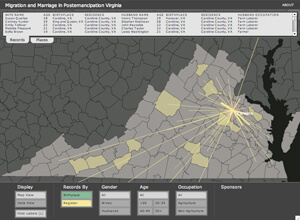 |
| Scott Nesbit, Migration and Marriage in Postemancipation Virginia, 2010. Use this interactive map to explore migration and marriage data used in this essay. |
Intrastate migration was equally robust. Researchers at the Library of Virginia have shared with the public scanned and transcribed versions of the cohabitation records—which the General Assembly instructed be kept at local county courthouses—from all parts of the state. These registers record the names of ten thousand husbands and wives, how long they had been married, their place of residence in 1866, their birthplaces, husband's occupation, and often the names of their children and former owners. Nathan Altice, a programmer at the University of Richmond's Digital Scholarship Lab, has developed an interactive map that allows exploration of the distinct patterns of migration and marriage that emerge from these records. These patterns hold significance for nearly every aspect of emancipation-era life, giving shape to freedmen and women's experience of and possibilities for marriage, child-rearing, work, and politics.
Husbands and wives experienced slavery in such different ways that it is not surprising that their migration patterns differ. In nearly every marriage register, more men than women underwent migrations to a new county. The differences were often dramatic.For example, nearly two out of three migrants to Warren County, in the northern Shenandoah Valley, were men. A number of factors intersected to bring about lower mobility rates among women whose marriages were registered, including the more fluid labor markets for male than female labor. Perhaps the responsibility of caring for children made women slightly less likely to move in their lifetime, either voluntarily or by force.20An equal number of men and women were migrants in Lunenburg Co., the only outlier. Michael Tadman's analysis of the interregional slave trade in the 1850s uses different evidence but similarly indicates that for all age cohorts except slaves between the ages of ten and twenty, more men than women had been sold away from their homes. Tadman, Speculators and Slaves, 29-31. On the different experiences of men and women under slavery, see Glymph, House of Bondage; Jacqueline Jones, Labor of Love; Brenda Stevenson, Life in Black and White.
Whether husbands and wives experienced migration to a different county depended largely on whether they lived east or west of the Blue Ridge Mountains. Those still living in long settled counties in eastern Virginia, which had seen a steady flow of men and women forced to other places, were relatively unlikely to have been born elsewhere. In every Piedmont and Tidewater county more than half of all married people were living in the county of their birth in 1866. Those who had not migrated made up nearly three quarters of those married in the overwhelmingly rural and tobacco-growing Lunenburg County. Maria and William Bagley were similar to most couples still living in Lunenburg: both were born and continued to live there. Since the Bagleys did not share an owner, they likely lived abroad, though this did not keep them from raising eight children in their eighteen years of marriage.21Register, Lunenberg Co.
 |
| Scott Nesbit, Percent of Married Men and Women who had Migrated from their Birth Counties, 2010. The Blue Ridge Mountains separated the Valley and Appalachia sections of Virginia from the Piedmont and Tidewater. They also divided counties in which most men and women had experienced migration from those in which most had not. Interactive Map |
The Great Valley and Appalachian counties suffered tremendous outmigration, but had experienced significant in-migration as well. Of counties west of the Blue Ridge, only in Augusta (52 percent) and Wythe (53 percent) were most freedmenfre and women born where they were married. Only about one in four of those who registered to be married in Floyd County, for example, were born there. More couples in western counties shared migration trajectories similar to those of Madison Hampton, who had moved to Floyd from Rye Valley Virginia in nearby Wythe County, and his wife Edie, who was originally from Suffolk. Like the Hamptons, the many men and women who had been born elsewhere most often had come from other counties in Virginia. In none of the twelve counties included in our database did those born outside the state comprise more than a handful of those registering to be married.22 Dunaway, African-American Family, 18-36; Register, Augusta Co.; Register, Wythe Co.; Register, Floyd Co.
Most black Virginians, particularly those marrying in the eastern counties, chose a wife or husband from the county where they were born. In Caroline County, a tobacco-growing county north of the state capitol in Richmond, nearly three quarters of married men and women shared a birthplace with their partner. In most instances, this meant that both husband and wife were born in Caroline and continued to live there after the end of slavery. Far more couples in the southwest Virginia counties of Roanoke, Smyth, Wythe, and Floyd were like Clara Anderson and Robert Preston. They were born in Tazewell and Bedford Counties, respectively, and were living together in Wytheville when they registered their relationship in 1866. In Appalachia, even those who married spouses from their home counties, such as Martha and Cornelius Harrison, both from Campbell County, migrated together elsewhere disproportionately as the Harrisons did when they ended up in Smyth County.23 Register, Caroline Co. Only 28 percent of couples married in Caroline Co. were born in different counties from each other. Six percent moved together from another county. Two thirds of marriages were comprised of men and women born in Caroline. In Floyd County, 59 percent of couples did not share a birth county. Only nine percent of couples who registered there shared Floyd as their birthplace. Nearly one third of registering couples were migrants to Floyd from the same county; for more, see "Joint Migration" in the accompanying application, "Migration and Marriage in Postemancipation Virginia".
Men and women formed long-term relationships in eastern and western corners of the state alike. In spite of the obstacles to stable relationships, long marriages were not uncommon among black Virginians who registered their marriages in the immediate postwar era—the median length of relationship legitimized in the cohabitation registers was ten years. As one might suspect, a number of the long-term marriages occurred among slaves claimed by the same owner. G. W. and Lucinda Allman had been husband and wife for more than forty years and listed seven adult children; both were born in Lunenburg County, continued to live there in 1866, and listed William Allman as their last owner. Others, however, seem to have traveled a considerable distance to reunite. Brock Wells married Martha Sheler when he was nineteen years old, in 1837, and they probably lived near each other for a number of years, until at least 1846 when their youngest daughter Rosa was born. When asked the residence of their last owner, however, Martha indicated that she had lived at the Epperly farm in Floyd County. Wells had been moved far from southwest Virginia, at the plantation of an "R. Wells," in Missouri. Wells was able to return to his home after the war, however, to rejoin Sheler in Floyd County and live there long afterward.24Cohabitation Register, Lunenburg County, 1; Cohabitation Register, Floyd County, 1; 1880 United States Federal Census [database on-line], Little River, Floyd, Virginia, Roll 1365, Page 354C, Enumeration District 29, http://ancestry.com.
The likelihood that former slaves would report long-term marriages varied neither by the setting in which they took place nor by the migration profile of the county in which they were recorded. Herbert Gutman found that in North Carolina, the percentage of freedpeople reporting long marriages in 1866 was the same in farm and urban settings as in plantation settings. The median length of marriages among freedmen and women in Virginia varied from county to county, but not in a way that maps neatly to the patterns of migration. Floyd County, where men and women were most likely to have experienced migration, had the shortest median marriage, seven and a half years. But Warren County, which also had a relatively high level of migration, was among the counties with the longest median length of marriage, twelve years.25Gutman, Black Family, 102; Cohabitation Registers, Floyd County, Warren County.
Men and women who moved, voluntarily or by force, to counties in the Tidewater often moved only a short distance, from other Tidewater counties or from the Piedmont. Very few men and women born in the western parts of the state ended up in the east. James Brooks, a thirty-five-year-old house servant born in Frederick County in the far northwest corner of the state, who married Lucy Oldon, from the closer county of King George, was the exception that proved the rule. Brooks was one of eight registrants in Hanover County, born outside the Piedmont and Tidewater areas out of more than one thousand; of these eight migrants across regional boundaries, four were from western Virginia, and the others were born in other states.26 Cohabitation Register, Hanover County, 1.
 |
| Scott Nesbit, Migration to Richmond County, 2010. Tidewater counties saw few migrants, forced or not, from the western part of the state. None of the men and women who registered their marriage in Richmond County were born west of the Blue Ridge Mountains. Interactive Map |
Those married in western counties not only were more likely to have migrated, but often moved greater distances and across more varied terrain as well. In Smyth County, in the southwest of the state, fewer than one hundred couples registered their marriages yet men and women from all parts of the state made their homes there. Migrants from eighteen eastern counties had moved to Smyth, along with natives of five other states.27 176 men and women registered their marriages in Smyth County. This represented about one seventh of the black population in Smyth if the black population in 1866 matches that recorded in the 1870 census. The cohabitation registers for most counties listed between 10 percent and 23 percent of the black population of the county; Warren County was an outlier, with records for about 42 percent of the black population recorded in 1870. Some of this discrepancy for Warren can be ascribed to an unusually large number of registrants who listed their current residence as a county other than Warren. Cohabitation Register, Smyth County.
In all counties the majority of migrants came from nearby, though the networks in which black men and women were involved tied counties unevenly. Far more men and women married in Augusta were from Albemarle than any other neighboring county. This was in part true because Albemarle had a much higher black population than did any other neighboring county. The train running west from Charlottesville to Staunton surely played a role as well, as did the relative ease with which men could find work in Augusta and much of the Valley. Far more men and women born in Pulaski County ended up living in Wythe, the adjoining county to the west, than any other county for which we have records. No one from Pulaski registered a marriage in Floyd County, to the immediate southeast. Few men and women from Henrico, the most populous county in the area, seem to have moved to the adjacent county of Hanover. Distance between places could be measured in units other than miles. Henrico and Hanover, sharing a border of over thirty miles, were far more distant from each other than Augusta and Albemarle, whose boundary extended less than half that length. The ties that bound communities together did not depend on abstract measurements but on labor flows and consequent journeys of men and women across political borders.28 Cohabitation Register, Augusta County; on labor supply in the Valley, see John A. McDonnell to Orlando Brown, February 3, 1868, NARA, Records of the Assistant Commissioner for the State of Virginia, BRFAL, RG105, M1048, roll 58, Valley of the Shadow, http://valley.lib.virginia.edu/papers/B1206; Cohabitation Registers, Wythe County and Hanover County.
Virginia's emancipation-era marriages formed a relational geography tying diverse places together in patterns that would be invisible on a political or topographical map. Men and women from Halifax County Virginia, in the heart of the Southside tobacco belt, had more ties to Roanoke County, several days' walk to the west, than they did to the seemingly much closer, Piedmont county of Lunenburg. Men and women experienced their marriages and the journeys they took in two ways. In one way, these scales of action are measurable, covering defined spaces and quantifiable distances in feet above sea level or the number of miles between points on a map. But they were also constructed through experience, stretching and bending mapped spaces, connecting places, shrinking the distance between some locales and neighborhoods while making others seem much greater than a comparison of latitudes and longitudes would indicate.
The ties between counties seemed to depend on the migrants' occupations. Caroline and Louisa Counties were each adjacent to Hanover County; some fifty men from each county migrated to Hanover. These migrations, from equally rural districts, were heavily patterned by occupation. A large majority (85 percent) of married freedmen in Hanover County were agricultural labors. Twenty-five percent of migrants from Caroline County to Hanover County listed non-agricultural occupations; only three migrants from Louisa were non-agricultural laborers. The discrepancy does not arise from an abundance of artisans trained in Caroline; only four percent of registrants married in Caroline County listed non-agricultural occupations. Skilled workers and those who sought non-agricultural work were overwhelmingly drawn, whether voluntarily or by force, from Caroline County to the neighboring county of Hanover.29Cohabitation registers, Caroline County, Hanover County.
The creation of households, in other words, occurred across space, was marked by patterns of forced and voluntary migration, and laid the groundwork for potentially useful networks of kinship. Artisans in places like Caroline, seemed to leave the county disproportionately for its neighboring county to the south; one can imagine that farmers participating in volatile produce markets could benefit from knowledge of commercial networks—even knowledge based on painful experience—in other, far-flung communities. In a number of circumstances, we might imagine such connections doing little good. Fewer than a third of African Americans elected to Virginia state office in Reconstruction, for example, were migrants from another county. Political leadership for Virginia blacks in Reconstruction seemed to depend not on statewide kinship networks or national connections but on deep roots and dense networks within a single locale.30Luther P. Jackson, Negro Office Holders in Virginia, 1865-1895 (Norfolk: Guide Quality Press, 1945). The number includes those born in other states. Twenty-eight office holders were born in places other than the counties they represented. Of these, twelve were born in adjacent counties. Fifty-seven delegates were born in the county they represented. We lack birthplace information for fifteen delegates.
Emancipation transformed the spaces enslaved men and women created through their marriages. A legal framework that guaranteed the end of forced, long-distance removal and the slave trade bolstered black marriages of all sorts. As black women increasingly found ways to avoid close contact with white men, living arrangements began to shift. Legal marriages defensible in court made white attempts to break up black families far less likely to succeed. Yet for all the benefits of emancipation felt immediately by families, repair took time.
The diversity of living arrangements that marked fragile, intimate relationships under slavery continued in freedom. William and Isabella Gibbons, who had married in the 1850s, each followed promising livelihoods soon after emancipation. She remained in Charlottesville teaching in the local freedmen's school and for a few years he secured a position as minister at the African Baptist Church there. By 1867, however, he had taken a position a half day's travel away via the Orange and Alexandria Railroad, in Washington, DC, serving as the minister of a thriving church while returning, when his duties permitted, to his wife and children. Mary Blackburn had lived apart from her free husband, John Patrick, before he bought her in 1860 and they began living together in Middlebrook, a small farming town in the Shenandoah Valley. This relative distance from their neighbor and her former master, Henry Mish, did not protect their three young children from sale, nor did it enable them to find the children in the years immediately after the war.31"Reminiscences of Philena Carkin," 50-53, unpublished manuscript, Philena Carkin Papers, 1866-1875, Accession #11123, Special Collections Dept., University of Virginia Library, Charlottesville, Va.; Gayle Schulman, "The Gibbons Family: Freedmen" Magazine of Albemarle County History 55 (1997): 60-93; Southern Claims Commission: Claim of Mary Blackburn, 1875, Claim no. 1378, Valley of the Shadow online, http://valley.lib.virginia.edu/claims/SCC0518, also available as National Archives, College Park, RG 217, claim #1378.
Black men and women spent considerable time and energy repairing what the slave trade had broken, at times using the newly invigorated federal bureaucracy to accomplish this task. Reuben Skelter registered his marriage to Sally Fitzhugh based on his residence in Caroline County, Virginia, listing her current place of residence as Georgia. Adam Brown testified in the Smyth County register to his twenty-five year marriage to his wife Sarah and made sure agents recorded the names of their five children, but believed that his wife lived in Texas. Ann, who had lived at the Crabtree farm with her four children, documented her marriage to Alfred Crabtree but had no idea where he was living. At the end of the war Violet Ward sought assistance from the network created by Freedmen's Bureau agents to reunite her scattered family. She lived with one of her children in Staunton, Virginia; another child lived in Richmond; her husband and their second child were living in Holmes County, Mississippi. Lost kin notices flooded the Christian Recorder and other black periodicals, documenting the process of family reunion in midstream while giving little indication whether the reunions eventually were accomplished.32Amy Murrell Taylor, The Divided Family in Civil War America (Chapel Hill: University of North Carolina Press, 2009), 196-198; Cohabitation Register, Caroline County, 19; Cohabitation Register, Smyth County; W. Storer How to Orlando Brown, September 16, 1865, Valley of the Shadow online; Michael P. Johnson, "Looking for Lost Kin: Efforts to Reunite Freed Families after Emancipation," in Catherine Clinton, ed., Southern Families at War: Loyalty and Conflict in the Civil War South (New York: Oxford University Press, 2000), 15-34.
Forced migration made some potential reunions painful. Laura Spicer had been sold away from her home to Gordonsville and never remarried. With emancipation, the opportunity came when she and her husband might reunite. Her husband, however, was torn between his former marriage to Spicer and his current family. "The reason why I have not written you before, in a long time," he wrote, "is because your letters disturbed me so very much….I want to see you and I don't want to see you. I love you just as well as I did the last day I saw you," though, he admitted, there were troubling reasons he could not see his wife Laura and their children. "I am married, and my wife have two children, and if you and I meet it would make a very dissatisfied family. " For Spicer and her former husband, there was no straightforward way to translate the marriage that had existed into the emancipation era.33 Henry L. Swint, ed. Dear Ones at Home: Letters from Contraband Camps (Nashville, TN: Vanderbilt University Press, 1966), 241-2.
Conclusion
Bureau agents and black ministers attempted to bring structure to relationships such as these, fitting them neatly into categories of marriage that might form the basis for property relations and for determining dependency of the infirm and young alike. Peter Randolph, who had spent his childhood enslaved in Prince George County, recalled the difficulty of his role as pastor in circumstances in which "hundreds of those who had been separated" returned home and "found their former companions married again" because they had expected never to see their spouses again. The "perplexing part" for Randolph was "to determine which were the right ones to marry," particularly when at the time of the marriage formalization law he was marrying "seven and eight couples a night." The forced migrations men and women experienced over the course of their lives created the emotional strains, difficult religious judgments, and chaotic bureaucratic processes that accompanied marriage formalization.34 Peter Randolph, From Slave Cabin to the Pulpit, the Autobiography of Rev. Peter Randolph: The Southern Question Illustrated and Sketches of Slave Life (Boston: James H. Earle, 1893), 89-90.
Accounting for the migrations men and women had been forced to endure was, as Randolph wrote, the most perplexing part of postemancipation marriage. It was a problem of scale. Marriage seemed, to those formalizing relationships of freedmen and women, to imply fixed temporal and spatial bounds; it had a beginning and end date, required cohabitation, and was by definition monogamous. Marriage required such boundaries if it were to serve as the basis for judgments about property and dependence and if it were to serve as an institution that could anchor the private sphere. The scale at which many freedmen and women had experienced marriage defied all those hallmarks.
Emancipation-era marriages endured multiple transitions in a few short years. Some of these transitions involved movement through space, reuniting couples and families that had been pulled apart in slavery and through the Civil War. Other transitions were legal and contextual, as the meaning of marriage for black men and women shifted dramatically under their feet. In the words of Ira Berlin, Steven F. Miller, and Leslie Rowland, "the personnel was familiar, but the circumstances entirely different." For freedmen and women, managing both transitions involved sophisticated navigation across multiple scales of action. They leveraged bureaucracies, kinship networks, and social hierarchies at the local level and across hundreds of miles to reestablish the most intimate bonds.35Ira Berlin, Steven F. Miller, and Leslie Rowland, "Afro-American Families and the Transition from Slavery to Freedom" Radical History Review (1988): 89-121.
Thinking about marriage at multiple scales allows us to draw new connections between some of the most important writing on emancipation and the family. Thavolia Glymph's powerful account of one particular scale, the plantation household, has shown how the divisions between public and private space in the plantation South were at their heart ideological, violent, and obfuscatory. Anthony Kaye has revealed that enslaved communities in the Mississippi Valley organized themselves at the level of the neighborhood as a coherent, if porous, unit. Laura Edwards has shown how political debate at the state level depended crucially on legal ideas about household economy. Black men and women worked across each of these scales and others to bring about the seemingly most self-contained relationships. The assignation of "public" to state-level action and "private" to household institutions was a fiction. Even the designation of marriage as an institution that existed at a single scale, the household, was a distortion of how intimate ties existed in relation to wider networks.
The notion that the household was a private space coextensive with marriage, the quintessential private institution, was a spatial fiction foundational for the dichotomies of public and private life about which Glymph, Edwards, and others have written so eloquently. Marriage did not function solely within the bounds of the private residence or yard, nor did it exist at a single scale. Black women and men were constantly acting at multiple scales, using governmental agents, employers, and even former slaveholders to buttress their claims to their families. Freedmen and women shaped the physical, social, and cultural space necessary to make their marriages work. Their relationships emerged from an antebellum system that at times constrained their movement to a single farm and at others forced migration far away from kin. Their marriages were bolstered by the seemingly incongruous bureaucratic cooperation between radicals in Congress and conservatives in the Virginia state legislature. And they were built by men and women who had, in all likelihood, either been forced to move or who had been separated from loved ones on account of the intricate, devastating patterns of the slave trade. The men and women entering into these marriages created new geographies suited for freedom. In those geographies, living abroad could create opportunities, husbands and wives found intimate spaces away from those who most threatened them, and families had a chance to retrace the long lines of the slave trade to find loved ones.
About the Author
Scott Nesbit is the Associate Director of the Digital Scholarship Lab at the University of Richmond, where he works on projects involving geographic information systems and the humanities. He is completing a dissertation on spatial changes attending emancipation at the University of Virginia.
About the Interactive Mapmaker
Nathan Altice is the Tocqueville web developer at the University of Richmond's Digital Scholarship Lab. He is currently pursuing his PhD in Media, Art + Text at Virginia Commonwealth University.
]]>Introduction
 |
This multimedia essay complements the 2007 Appalshop film Morristown: in the air and sun. Written by independent filmmaker Anne Lewis, the director of Morristown, and Fran Ansley, a Tennessee law professor who served as principal humanities adviser on the project, this essay presents aspects of the Morristown story that we were unable to include in the one-hour documentary: additional context and perspectives for considering factory flight, international labor migration, and the organized demand for economic justice.
 |
| Workers at Toyoda/TRW Plant in Morristown, Tennessee, from Morristown: in the air and sun (2007). |
Filmed between 1991 and 2006 and based primarily in the mountains of east Tennessee, Morristown explores the lived experiences of workers from Tennessee and Mexico who speak about their lives, work, disappointments, and hopes. These conversations are combined with scenes in Tennessee factories, fields, union halls, Mexican-owned stores, workers’ homes, city parks, and employment agencies. The documentary travels to factories and locations in Ciudad Juárez, Chihauhau, and Los Martínez, Guanajuato, Mexico. Morristown concludes with a stunning union victory in 2005-2006 among immigrant workers at a large poultry processing plant.
Although Morristown puts workers’ experiences at its center, it makes space for representatives of business and civic elites in Tennessee and Mexico. In separate interviews, Jack Fishman, the head of the Chamber of Commerce in Morristown, and Roberto Urea, the head of a manufacturers' association in Ciudad Juárez, put forth their opinions about economic development.
 | Jack Fishman: "If your wage rates are excessively high, then you won't attract quality industry and quality jobs." |  | Roberto Urea: "Whether you'd like to pay people more, or you don't want to pay people more, the driving force is not our heart." |
The resulting impression of globalization that Morristown offers is internationalist in its search for class solidarity across borders, but local in its place-based perspectives. The film encourages audiences to question their own assumptions about what they are seeing. It depicts conflict and contradiction among its subjects’ opinions about immigration, labor, and the impacts of globalization.
We are proud of Morristown, and pleased with its reception in the United States and Mexico. We are somewhat frustrated, however, by the constraints that accompany filmmaking. Independent documentaries typically have at least a fifty-to-one shooting ratio—that is, for a finished work that is one hour long, acquired footage is usually more than fifty hours.1See Lance Compa, “Think Globally, Film Locally,” Cornell International Law Journal 41.1 (Winter 2008): 139-142; and Monica Hernandez, “Film Review,” in Ark Magazine, National Organizers Alliance, Issue 24, Fall 2007. Morristown: in the air and sun had an even larger shooting ratio. This raw footage is stored in Appalshop’s archives and made accessible to the occasional scholar or interested individual, but the opportunity for public use is limited.2Appalshop is an organization located in Whitesburg, a small town in the coal fields of eastern Kentucky. In the center’s own words, it is “a non-profit multi-disciplinary arts and education center in the heart of Appalachia producing original films, video, theater, music and spoken-word recordings, radio, photography, multimedia, and books.” The group’s substantial multimedia archive is a national treasure.
Footage was not the only thing that had to be left out of the film. Making Morristown took years and involved a long-term process of building trust with workers and worker organizations on both sides of the US–Mexico border. At times these workers created their own records: union factory women in Tennessee made a scrapbook they hoped to share with fellow factory workers across the border; the film project helped exchange experiences and ideas through interviews that we called Morristown Video Letters.
Other materials were not included because they would detract from the need for a simple narrative line. For instance, the great risks taken by workers while crossing the border are covered very briefly and illustrated with an image of a family running. In this essay we are able to add a first-hand account. Similarly, factual information about the industries where immigrants found employment in east Tennessee was left out of the film. Here we include a chart.
This web-based format gives more freedom to readers, viewers, and listeners. They can interact with the story in different ways—choosing their own pace and sequence, making selections, deciding when to pause, go deeper, or move on.
Although the formats of the film and multimedia essay are different, their politics are the same. Largely without narration, Morristown proceeds through the voices of working class people. As active members of the labor movement ourselves, we know the film itself was possible thanks to the efforts of labor and community organizers, cross-border work by grassroots internationalists, engaged scholarship, and the willingness of working class people in the Southeastern United States and Mexico to share their lived experiences with us. Across many years, miles, and differences, we worked to build relationships of trust outside the boundaries of filmmaking.
In our discussion of the making of Morristown, we offer a linked series of sections. "Going South" takes up the mobility of industrial capital, reporting efforts by Tennessee workers in the 1990s to exert counter-pressure on employers who moved production overseas, and describing a series of cross-border exchange trips that took place between factory workers from Mexico and Tennessee. In "Coming North," we examine reasons for the recent mass migration out of Mexico and what the northward journey means, both for unauthorized migrants entering the country and for families and communities left behind. "Arriving in Morristown" focuses on the arrival of Mexican and Central American immigrants in new interior destinations such as Morristown and their reception by native-born residents. In "Organizing a Southern Industry," we recount the story of a successful organizing drive among immigrant workers at a poultry processing plant in Morristown, a victory that suggests how much all workers stand to gain if the right of immigrants to organize on the job and to function as engaged citizens of the global economy is honored and respected. "Looking Back and Ahead" offers our conclusion.
Going South: A Trip to the Maquiladoras
The movement of industrial capital in search of cheaper labor is nothing new for Tennessee or for the US South. East Tennessee has experienced life at both poles of this dynamic. In the 1960s and earlier, labor-intensive industries such as clothing, textiles, auto parts, and consumer electronics moved their plants from northern cities such as Detroit and Chicago to Morristown, Knoxville, and other cities and small towns along the Interstate 40/81 corridors. They moved to escape union contracts, to minimize their duties under state regulation, and to profit from the incentive programs that have always accompanied industrial recruitment in various versions of the “New South.”
Beginning in the 1980s, many of those same industries moved further still, across the national boundary line and into the global South. Although the nation’s attention was focused predominantly on job loss in northern states like Michigan and Ohio, plant closings brought much of the same personal hopelessness, public neglect, and structural unemployment to the South as they had to the Rust Belt.3On deindustrialization in the United States, see Barry Bluestone and Bennett Harrison, The Deindustrialization of America, (New York: Basic Books, 1984). On deindustrialization in the South, see John Gaventa, Barbara Ellen Smith and Alex Willingham, eds., Communities in Crisis: Appalachia and the South (Philadelphia: Temple University Press, 1990) and Eve Weinbaum, To Move a Mountain: Fighting the Global Economy in Appalachia (New York: New Press, 2004).
Union contracts eroded along with wages and benefits. Social relationships changed. Workers were thrown into competition with other workers, often of different race and national origin. In 1991, Luvernel Clark, then president of Local 1742 of the Amalgamated Clothing and Textile Workers Union, testified before the Office of the United States Trade Representative about the effects of deindustrialization on one enterprise:
 |
A dozen years ago, our factory at Allied was a big, busy place. There were over 3,000 workers employed there. We had contracts with GM, Ford, and other big car manufacturers. But in the early eighties, Allied started shutting down parts of our operation and transferring them to a non-union facility south of here in Alabama. The jobs did not stay in Alabama long. Soon we learned that the work had been moved from there down to a place called Agua Prieta, Mexico. That was the first that a lot of us had heard about all these factories moving to Mexico. We had no idea what really was happening. I am still working now, but I never feel secure.4For Luvernel Clark’s full testimony at the hearing see Frances Lee Ansley, “North American Free Trade Agreement: The Public Debate," Georgia Journal of International and Comparative Law 22 (1992): 392-394.
It was no accident that multinational corporations looking for favorable terms and cheap labor identified Mexico as a favored destination. Launched by the Mexican government in 1964, the Border Industrialization Program (BIP) created the legal infrastructure for a bilateral state-promoted export-processing zone of factories known as maquiladoras (maquilas for short). US-based companies were allowed to produce goods or portions of goods in Mexico that were admitted back into the United States without tariffs as long as production took place within one hundred kilometers of the border.
Conceived as a way to provide jobs for agricultural workers who were returning to Mexico at the end of the “bracero” program that for decades had brought Mexican men to work in US fields, the BIP was slow in getting off the ground. By 1986, there were only 865 maquila plants employing some 227,900 workers along the border. As corporate strategies for globalizing production intensified during the eighties and early nineties, the number of factories at the border steadily grew. After passage of the North American Free Trade Agreement (NAFTA) in 1994 and the immediate drop in the value of the peso, maquiladora employment soared, and the bi-national legal arrangements that underpinned the maquilas were no longer restricted to the border. By 1998, 3,051 Mexican maquilas employed 1,035,957 workers. What had begun as a border-specific exception to Mexico’s relatively nationalist rules on foreign investment and trade became the new neoliberal norm.5William C. Gruben, "Was NAFTA behind Mexico's high maquiladora growth? - Statistical Data Included,” Economic & Financial Review July 2001: 11-21.
As Tennessee felt the impact, groups scrambled to understand what was happening and searched for ways that workers in the increasingly insecure, globalized economy might best respond. In 1989, a coalition of labor unions, religious groups, and community organizations came together to create the Tennessee Industrial Renewal Network (TIRN). Fran Ansley was present at the group’s large founding meeting in Chattanooga as were several factory workers and organizers who later contributed important interviews and insight to the Morristown documentary.6The energy and new relationships that were opened up by TIRN’s founding meeting encouraged Fran to make plant closings the focus of her legal research in the early nineties. See Standing Rusty and Rolling Empty: Law, Poverty and America's Eroding Industrial Base, 81 Geo. L. J. 1757-1896 (1993).
Particularly disturbed by how easy it was for many Tennessee workers to blame the closings on Mexican workers who were “stealing” their jobs, TIRN leaders began looking for ways to promote a more accurate economic understanding in local communities. Drawing on lessons learned by the Highlander Center about the importance of peer education, TIRN sought direct contact between workers in east Tennessee and workers in Mexico.
TIRN reached out to several border groups that were working to expose and address maquila realities: the Border Committee of Women Workers (in Spanish, the Comité Fronterizo de Obreras, or CFO—a grassroots group of women employed in maquiladoras) ; the Border Project of the American Friends Service Committee, a group that partnered with the CFO; and the Coalition for Justice in the Maquiladoras, a network that brought together labor and community activists from the United States and Mexico.7Joe Bandy, "Paradoxes of Transnational Civil Societies under Neoliberalism: The Coalition for Justice in the Maquiladoras," Social Problems 51:3 (August 2004): 410-431. TIRN proposed a two-way worker-to-worker exchange between Tennessee and Mexico, and the CFO and its supporting groups agreed to collaborate.
In July 1991, after TIRN hosted a visit to Knoxville from two maquila workers active in the CFO, a delegation of nine women from TIRN, including Fran, a staff organizer, and seven east Tennessee factory workers, traveled to Mexico.
Anticipating a television series on the future of US manufacturing, a crew from WGBH-Boston filmed the trip. TIRN had agreed to this accompaniment with the understanding that the organization would receive the raw footage after the PBS broadcast. Many months later, staff members approached Anne at nearby Appalshop in Kentucky to ask if she could take the raw tapes and, with worker input, produce a short video.8At the time, Anne was making a film that explored notions of community justice during the mineworkers strike against Pittston Coal, Justice in the Coalfields (Appalshop, 1995). Anne agreed, and the resulting film, From the Mountains to the Maquiladoras, became a key resource for TIRN and for a number of other groups that were then organizing about the loss of US manufacturing jobs, the process of globalization, and emerging US trade policy.9From the Mountains to the Maquiladoras is available in DVD from the Highlander Research and Education Center
Women from Tennessee saw first-hand the transformed operations of companies well known to them, but now in the maquiladora context unfettered by the rules of home. They witnessed the living conditions of people employed in the maquilas and living in makeshift shacks without electricity or running water. Workers shed tears, revealed anxieties, and expressed shock and disorientation. During a visit to a settlement outside of Reynosa, Shirley Reinhardt, a displaced worker from Morristown, stepped aside for a moment to regain her composure.10Like Luvernel Clark, mentioned above, Shirley Reinhardt later gave testimony at a hearing on NAFTA organized by the Office of the US Trade Representative. For her full written testimony submitted to the hearing panel, see Frances Lee Ansley, “North American Free Trade Agreement: The Public Debate," in Georgia Journal of International and Comparative Law, 22 (1992): 388-392. Parts of their oral testimony are also captured in From the Mountains to the Maquiladoras. She said to Fran, “I feel ashamed. I feel ashamed for our government, for our people. I feel so ashamed.”
Returning home, Reinhardt and other TIRN travelers spoke to labor unions, policy-makers, and community groups about why they believed the maquila model and its NAFTA embodiment were a bad deal for workers on both sides of the border.11For more on TIRN’s exchange trips and the work that grew out of them see, Kristi Disney, “Building a Movement on Both Sides of the Border,” in The Global Activist's Manual: Local Ways to Change the World , ed. Mike Prokosch and Laura Raymond, (New York: Thunder’s Mouth Press/Nation Books, 2002), 12-19; Fran Ansley, “Putting the Pieces Together: Tennessee Women Find the Global Economy in Their Own Backyards,” in Women Working the NAFTA Food Chain: Women, Food & Globalization, ed. Deborah Barndt (Toronto: Sumach Press, 1999), 141-160; Fran Ansley and Susan Williams, “Southern Women and Southern Borders on the Move: Tennessee Workers Explore the New International Division of Labor,” in Neither Separate Nor Equal: Women, Race and Class in the U.S. Southeast, ed. Barbara Ellen Smith (Philadelphia: Temple University Press, 1999), 207-244; Fran Ansley, "The Gulf of Mexico, the Academy, and Me," Soundings 78 (1995): 68-104. They organized a car caravan through downtown Morristown to protest NAFTA. They gathered petitions, called on legislators, went to conferences, wrote letters and op-ed pieces for their local papers, and organized rallies.

Eventually the organization sent a delegation to the Seattle demonstrations of 1999 against the World Trade Organization, protests that joined “Teamsters and turtles” to challenge the ambitions of those promoting a free trade agenda.12TIRN’s delegation to Seattle included Barbara Knight, a displaced Philips worker who also became an important contributing voice to Morristown: in the air and sun.
 |
TIRN found that despite its commitment to building cross-border solidarity, it was difficult to maintain active ties with host groups and individuals in Mexico. In 1997, a committee decided to experiment with a scrapbook exchange between women factory workers in east Tennessee and women maquila workers in Juárez. Another worker-to-worker exchange idea resulted in a popular education tool, Morristown Video Letters, an edited selection of interviews with Tennessee and Mexican workers, with voice-over translation into both English and Spanish. TIRN hoped these letters might serve to support on-going dialogue.13Morristown Video Letters is available on DVD, in English and Spanish versions, from the Highlander Research & Education Center.
Coming North: The Long Hard Crossing
TIRN’s video From the Mountains to the Maquiladoras examined the movement of capital—plant closings and conditions in maquila locales where those plants had moved. It did not focus on immigration. In 1991, when the earliest footage was shot, most east Tennessee residents were not aware of the growing numbers of Latino immigrants. But some of the women on the trip—the ones from Morristown—did point out that there were “new people” from Mexico showing up back home. Demographic change in Tennessee was soon evident even to casual observers.
The movement of industrial capital from the United States to the maquilas and the movement of low-wage workers from Mexico to the United States were intimately related. The impacts of NAFTA and related neo-liberal policies were felt throughout Mexico. Resulting pressures fed northward streams of migration. An estimated two million Mexican farmers and farm workers lost their livelihoods as cheap US agricultural products, especially corn, flooded Mexican markets.14Monica Campbell and Tyche Hendricks, “Mexico's Corn Farmers See Their Livelihoods Wither Away: Cheap U.S. Produce Pushes Down Prices Under Free-trade Pact,” San Francisco Chronicle July 31, 2006. The loss was further exacerbated by the sudden devaluation of the peso in December 1994. In one week, the peso went from 4 pesos to 7.2 pesos to the US dollar.15Gary C. Hufbauer and Jeffrey J. Schott, "NAFTA Revisited: Achievements and Challenges," International Institute of Economics, 2005, at p. 10.
The peso devaluation meant many more US factory jobs moved to Mexico where everything from services to utilities to wages had become much cheaper for international investors. Meanwhile, the wages companies offered were worth even less. It became impossible for many working class Mexican communities to survive. The forces that took jobs away from factory workers in east Tennessee forced Mexican workers across the international border. For several Mexican states, human beings became the major export.
Although these changes increased local opportunities for cross-national coalition building, they also triggered resistance. If feelings had been intense about distant Mexicans taking far away factory jobs, local responses were volatile when new people, marked by differences of race, ethnicity and language, began moving next door in a region which had not experienced significant immigration for generations. Workers returning from later TIRN exchange trips found themselves in arguments with friends and neighbors—not only about corporate responsibility and factory flight, but also about the rights and wrongs of immigration.
To tell the story of the new east Tennessee immigrants, we decided that Morristown should follow the migrant stream out of Mexico, across the border, and into the United States, beginning with scenes and narratives about the journey north. We wanted space for Mexicans to tell about making the journey north from their own perspective. What impels such a costly and risky trip? How does an exodus of this scale affect those who stay behind?
 |
Rudy Marquez was one of our first sources. At the time we interviewed him, he lived on a farm outside Morristown, paid for his board with labor, and studied at a community college. Rudy was born in Mexico City. He described his travels after crossing the border years earlier. He and his father picked strawberries in Santa Ana, California, grapes and tomatoes in Fresno, and green beans in Florida. Searching for lower living costs, wider opportunities, and higher pay, they ended up in east Tennessee where they picked tobacco. Although working tobacco was harder, Rudy could earn $350 a week as compared with $150 working other crops.
Another interviewee, Claro Negrete Almeida, spoke with Anne and a Mexican film crew from his home in the state of Guanajuato. He came across the border illegally for the first time in 1972. He had spent many years working in orchards in North Carolina, and he told stories about poor treatment he had received from employers who took advantage of his fears and uncertainties. Thanks to the amnesty program passed during Ronald Reagan's administration in 1986, Claro adjusted his immigration status.16The Immigration Reform and Control Act of 1986 (IRCA). As a result, he was able to move freely across the border, spending seven to nine months of the year in North Carolina and three to five months at home in Guanajuato with his family.
Since there is presently no pathway to legal status available to workers who enter the country without authorization, Claro’s pattern of annual “circular migration” is not an option for an undocumented person today. The costs and dangers of crossing the border continue to mount as federal dollars have poured into its militarization and rates of deportation have soared. Despite the relative freedom of movement Claro's legal status provides, he continues to experience loneliness, dislocation, and bad treatment during his long work stays away from home. “Even if the bars are made of gold,” he says, “it’s still a prison.”
Despite the current burdens of migration, entire villages like Los Martínez, deep in the mountain interior of Mexico, have lost men and boys to the migrant stream. Sixteen-year-old Rosario Duran Camarilla—also from Los Martínez—spoke about how she imagines the United States:
 |
I think it’s very big, many people, I think it’s pretty. My father has always gone there. My brother, this is the first time he’s gone. Neither has papers. They cross the river and you don’t know how they are.
Many boys here say, “How I’d like to go north. We’ll have a good time.” I think it’s very pretty there, but - . . . my father once spent almost three years there. I have a little sister. He left when she was months old and returned when she was three. She asked, “Who is this man?” When he comes back, we don’t know how to talk with him. It’s still very good when he comes. What’s hard is that he spends very little time here and goes back there. He’s back there again.
While describing some of the economic benefits for families who have sent someone north, Rosario’s older neighbor, Isidra Duran De Negrete, talked about what life is like for the women left behind:
 |
It’s very hard for the mother or the wife when the child or the husband goes and they don’t know what’s going to happen. It makes them feel sad. It’s very hard for the wife when the children are hungry and no money comes in from over there.
Now there are people who have trucks, tractors, land, cattle, milk cows, and they live much more easily than before. But this is not everyone, only the ones who go north.
As the words of Olga, Claro, Rosario and Isidra suggest, the forces of contemporary mass labor immigration are complex and include “pushes” from countries of origin, “pulls” from countries of destination, past colonial legacies, and present projects of empire. In the United States, immigration reform is hotly contested and badly needed, but as the interviews in Juárez and Los Martínez suggest, immigration reform can do little to control the huge social currents that have put so many people into motion around the world.
Over the course of the 1990s and into the first decade of the new century, despite ever-increasing attempts to fortify the border, migrants from Mexico and Central America continued to come to the United States. Increasing numbers found their way, as Rudy did, to the Southeast. Migrants did not disperse evenly, but settled in clusters and hot spots. The new Latino migration represented a major and unprecedented demographic change.
The Pew Hispanic Center recently reported on results of the 2010 Census, observing that “states with the largest percent growth in their Hispanic populations include nine where the Latino population more than doubled, including a swath in the southeast United States—Alabama, Arkansas, Kentucky, Mississippi, North Carolina, Tennessee and South Carolina.” A chart linked to Pew’s report shows that Tennessee’s Hispanic population increased from 124,000 in 2000 to 290,000 in 2010, and now constitutes 4.6% of the state’s total. The chart also ranks Tennessee third in the nation in the rate at which its Hispanic population grew between 2000 and 2010—a rate of 134%, smaller only than South Carolina’s 148% and Alabama’s 145%.17“Census 2010: 50 Million Latinos, Hispanics Account for More Than Half of Nation’s Growth in Past Decade,” Pew Hispanic Center Report, March 24, 2011, p. 2. (Rate of change is not the only relevant measure, of course. Although Tennessee is third in the nation in the rate of growth of its Hispanic population, it is 27th in the total number of resident Hispanics, and 37th in the percentage of its overall population that Hispanics now represent.)
Observers have offered various reasons for why many areas of southern states became favored destinations for Latinos.18See, e.g., Fran Ansley and Jon Shefner, eds, Global Connections and Local Receptions: Latino Immigration to the Southeastern United States, (Knoxville: University of Tennessee Press, 2009); Heather Smith and Owen Furuseth, eds., Latinos in the New South: Transformations of Place, (Burlington, VT: Ashgate Publishing Company, 2006); Rakesh Kochhar, Roberto Suro and Sonya Tafoya, The New Latino South: The Context and Consequences of Rapid Population Growth (Washington DC: Pew Hispanic Center, 2005); A.D. Murphy, C. Blanchard, and J. A. Hill, eds., Latino Workers in the Contemporary South (Athens: The University of Georgia Press, 2001). Housing costs lower than those in traditional gateways are one factor, as is the preference of some immigrants for small-town life. For a time, immigration enforcement was patchier in the interior of the country. The availability of paid work is the single strongest determinant. Anita Drever, a University of Tennessee geographer, found that the ten locations in the state with the largest percentage of Latinos in 2000 were all small towns or cities where a particular industry (or a single employer) could easily be identified. Census data are notoriously soft when it comes to measuring Latino populations, so the specific numbers must be viewed with caution, but for comparative purposes the data is quite instructive. Here is a chart showing the results of Drever’s research.
Table 1: Ranked list of towns (census places) with the highest percentages of Latinos in Tennessee and the largest employer of Latinos in these areas
| Rank | City | % Latino | Total | Major Employer of Latinos |
| 1 | Bells | 22.8% | 2,171 | Pictsweet Vegetables (packaging plant) |
| 2 | Monterey | 16.3% | 2,717 | Perdue Farms (chicken processing) |
| 3 | Shelbyville | 14.6% | 16,105 | Tyson Foods (chicken processing) |
| 4 | Morristown | 10.4% | 24,965 | Koch Foods (food processing) |
| 5 | Collegedale | 7.7% | 6,514 | McKee Foods (makers of Little Debbie Snacks) |
| 6 | Springfield | 6.9% | 14,329 | Electrolux Appliance (manufacturing) |
| 7 | McMinnville | 6.8% | 12,749 | Wholesale Nursery Industry |
| 8 | Clarksville | 6.0% | 103,455 | Fort Campbell Military Base |
| 9 | Lenoir City | 6.0% | 6,819 | Monterey Mushrooms |
| 10 | Lewisburg | 5.2% | 10,413 | Walker Die Casting |
Source: Calculations from the US Census 2000, Author’s interviews with the employees of the Chambers of Commerce in the above cities.
Since labor migration was the flip side of plant closings and another aspect of the neo-liberal development model that NAFTA represented, seeking justice for immigrant workers seemed a natural extension of TIRN's work. Labor rights activists struggled for decades to attack the ways that racial division debilitated the southern labor movement.19The literature on this subject is vast. Some starting points: Michael Honey, "The Labor Movement and Racism in the South: An Historical Overview," in Racism and the Denial of Human Rights: Beyond Ethnicity, M. Berlowitz and R. Edari., eds. (Minneapolis: Marxist Educational Press, 1983), 77-96; Eric Arnesen, Waterfront Workers of New Orleans: Race, Class and Politics, 1863-1923 (Oxford: Oxford University Press, 1991); Robert L. Lewis, Black Coal Miners in America: Race, Class and Community Conflict, 1780-1980 (Lexington: University of Kentucky Press, 1987). The increasing presence of Latinos in the workforce and the extreme vulnerability of undocumented immigrants represented a dramatic new turn in an old story.
Immigration raised the possibility of a new kind of labor organizing that might bring together multi-racial coalitions capable of advancing broad demands for social justice in the workplace and beyond. Whether this prospect would be realized was far from certain. But as immigrant workers continued to settle, their responses to the conditions they found began to attract allies, generate campaigns, and demonstrate powerful potential.
Arriving in Morristown: New Kinds of Borders
The US–Mexico maquiladora zone that TIRN delegations had once traveled for days to reach now appeared in Tennessee. Native Tennesseans could meet their Mexican counterparts by visiting any local restaurant kitchen or construction site. And yet differences of race, language, and nationality often separated people as profoundly as physical distance or a geo-political boundary.
Immigrants arriving in Tennessee were entering locales where racial history was at work and racial hierarchies were in place. During slavery and Jim Crow, race was a structural feature of labor markets backed by the full force of law. Although the civil rights movement succeeded in discrediting old racist ideologies and breaking down some barriers to equal opportunity, gross disparities between whites and blacks in the labor force persisted and black unemployment remained at levels far beyond that of whites. These patterns worked to naturalize racial subordination.
Undocumented Latinos disrupted and complicated the existing black-white framework. New political and social alignments seemed likely, though exactly who would align with or against whom was hard to say.20These developments are still too new to assess in any but the most provisional way. Early reports are beginning to sketch a complex and far from homogeneous picture. See, e.,g., Halimah Abdullah, "Hispanic Population Growth Could Realign South's Politics," Miami Herald, April 25, 2011; Mary Odem & Elaine Lacy, eds., Latino Immigration and the Transformation of the U.S. South, (Athens, GA: University of Georgia Press, 2009); Paula D. McClain, Niambi M. Carter, Victoria M. DeFrancesco Soto, Monique L. Lyle, Jeffrey D. Grynaviski, Shayla C. Nunnally, Thomas J. Scotto, J. Alan Kendrick, Gerald F. Lackey, and Kendra Davenport Cotton, “Racial Distancing in a Southern City: Latino Immigrants’ Views of Black Americans,” Journal of Politics 68, no. 3 (August 2006): 571-584. See also Jennifer Gordon and R.A. Lenhardt, “Conflict and Solidarity between African American and Latino Immigrant Workers,” Working Paper #6 of the Series on Immigration of the Chief Justice Earl Warren Institute on Race, Ethnicity and Diversity, 2007.
It was striking to witness the emergence of “brown collar jobs” and the racial reorganization of work.21See Leticia Saucedo, “The Browning of the American Workplace: Protecting Workers in Increasingly Latino-ized Occupations,” Notre Dame Law Review 80 (2004): 303; Lisa Catanzarite, “Dynamics of Segregation and Earnings in Brown-Collar Occupations," Work & Occupations 29 (2002): 300. In east Tennessee, Latino workers were warmly welcomed by many employers. They moved into construction trades previously dominated by white men, but also into occupational categories such as farm work, the laundry industry, hotel housekeeping, and personal service—long coded as labor for blacks or the bottom ranks of working class whites.
Factory job loss and shrinking opportunities in the public sector hit Tennessee's black minority hard. The civil rights movement’s victories, as significant as they were, failed to translate into economic well-being for the black population as a whole. Meanwhile, many Latino immigrants who entered the country without authorization found themselves in low-wage, dirty, and dangerous jobs, where too often their “illegality” justified thinking of them as criminals and treating them as people without rights.22On some of the ways Latino workers fit into employer goals of “flexibilizing” work to their advantage, see David H. Ciscel, Barbara Ellen Smith and Marcela Mendoza, “Ghosts in the Global Machine: New Immigrants and the Redefinition of Work,” Journal of Economic Issues 32 (2003): 333.
Table 2 (below) suggests the income inequality by race and ethnicity in Tennessee, with whites earning dramatically more than blacks or Latinos. While these disparities are echoed at a national level, Tennessee whites, blacks, and Latinos all earn less in absolute dollars than their racial and ethnic counterparts in the US, with Tennessee whites experiencing the greatest difference from the national average.23Table reprinted from Anita Drever, “Tennessee: A New Destination for Latino Migrants,” in Global Connections and Local Receptions: Latino Immigration to the Southeastern United States, Fran Ansley and Jon Shefner, eds. (Knoxville: University of Tennessee Press, 2009). Of course this chart does not allow readers to tease out the working class segments of each racial group, and we suspect the situation of white working class people is more effectively obscured in these statistics, since they are likely a smaller proportion of their racial/ethnic group than are blacks or Latinos. Nevertheless we consider the gross figures worth contemplation.
Table 2: Media Per Capita Earning by Population Group in Tennessee Relative to the United States as a Whole
| Population Group | Median per capita income | % of national per capita income for this group |
| African Americans | $15,117 | 91% |
| Whites | $23,994 | 83% |
| Latinos | $12,688 | 88% |
Source: 2005 American Community Survey
Whatever the racial disparities, economic restructuring meant that working class people in east Tennessee faced economic insecurity during the years when Latino immigration was increasingly evident. It is not hard to imagine that US-born workers in places like Morristown perceived Latino immigrants to be interlopers and competitors rather than potential allies. After all, white workers in the South have repeatedly missed opportunities to act in solidarity with black workers. When the new immigrants arrived in Morristown, racism and xenophobia surfaced.
In 2002, Berkley Bell, the district attorney for Tennessee’s third judicial district, was asked about the impact of Latino workers in the area. He began pleasantly and politely enough, volunteering that the new immigrants were “hardworking Christian people,” and noting that his exposure to immigrants had forced him to modify an earlier preconception that Mexican men were lazy and that Mexican women did all the work. Bell went on, however, to make sweeping assertions that cast the entire Hispanic population as a major source of crime, social pathology, and violence.
In light of Bell’s remarks about "a lot of homicides" among Latinos, we asked a sociology professor at the University of Tennessee about murder in Hamblen County where Morristown is located. Based on Tennessee Bureau of Investigation information, he found such comments as Bell's unsupported.24Thanks to Dr. Ben Feldmeyer of the University of Tennessee Sociology Department for this helpful piece of local research. A large body of scholarship indicates crime rates among Latino immigrants are no higher, and are often lower, than among the native-born population.25For one example of such scholarship, see Robert J. Sampson, “Rethinking Crime and Immigration,” Contexts, Winter 2008, American Sociological Association.
Several elected officials in Morristown showed a similar tendency to blame immigrants for social problems. Hamblen County commissioners told a Knoxville television reporter that undocumented Hispanics were costing Hamblen County “serious money,” and that they might “have to raise property taxes by a million dollars to cover increase[d] costs in schools to hire bilingual teachers." Commissioner Larry Baker was quoted as blaming the property tax increase on too many Hispanics in juvenile court.26"Commissioner: ‘Taxes May Go Up Due to Hispanics,’ ” WVLT Volunteer TV, Knoxville, TN, May 6, 2005.
As tensions between residents and Latino immigrants increased, local leadership did nothing to help citizens understand immigration, much less to address the economic problems facing this small industrial town.
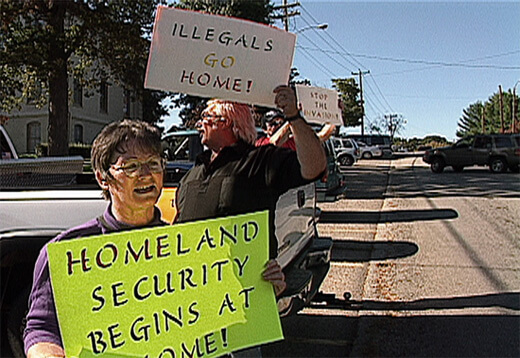 |
| Counter-protesters during a rally for immigrants' rights and against racial profiling in Morristown, 2003, from Morristown: in the air and sun (2007). |
In spite of the reception they received, the number of Latino workers continued to grow, along with demand for their labor. Workers and their families were becoming part of the local scene–a visible presence in spaces like public parks and soccer fields. But they also maintained close ties with those at home. At Adriana’s Video Mexican Store in Morristown, workers regularly sent dollars back to their families in Mexico where their purchasing power was many times more.
Only someone with a job can send home such remittances, and for Latino immigrants newly arriving in Morristown, work was ordinarily a first priority. In order to secure employment, they turned to various networks and strategies.27For a detailed account of how Latinos came to populate one Tennessee workplace during this period, see Steve Striffler, “Immigration Anxieties: Policing and Regulating Workers and Employers in the Poultry Industry,” in Global Connections and Local Receptions: Latino Immigration to the Southeastern United States, Fran Ansley and Jon Shefner, eds., (Knoxville: University of Tennessee Press, 2009). One channel was a set of specialized temp agencies that opened in Morristown. These agencies functioned as the formal employers of immigrant workers who were then contracted out to places where they labored but were not formally employed. The temp agency protected client companies from worries about liability related to the workers’ legal status and documentation. The agencies generally charged companies twice as much as they paid out to the workers themselves for hourly wages and benefits.
Maximino Garcia, originally from San Antonio, Texas, owned one of the largest of these hiring enterprises. He also ran a loan company, a car lot, an asbestos removal business, and built an evangelical church that ministered to his Latino workforce. “The number one is that we’re always trying to point them to the cross," said Garcia. "We’re always trying to tell them about the Lord.”
Garcia, who was later convicted of illegal trafficking and money laundering, compared Latino workers with black and white native-born workers:
 |
I don’t believe that the Hispanic race is coming in and taking American jobs. I believe that they’re taking jobs that the Americans don’t want and the ones who are griping and complaining are usually the ones that are lazy and don’t want to work. I think that that’s what a lot of the companies look at when they see Hispanics is that these are hard workers. They’re coming in and they’re not going to give us no lip. They’re not going to talk back to us. They’re not going to do nothing. They’re basically going to come in and work, do their jobs.
Garcia's perspective was not the only one voiced by people in Morristown.28On the power—and the inadequacy—of competition as a framework for understanding the relationship between immigrant and native-born workers, see Barbara Smith, “Market Rivals or Class Allies? Relations between African American and Latino Immigrant Workers in Memphis,” in Global Connections and Local Receptions: Latino Immigration to the Southeastern United States, Fran Ansley and Jon Shefner, eds., (Knoxville: University of Tennessee Press, 2009). Shirley Reinhardt, a displaced General Electric worker and TIRN member whose experiences in Mexico were mentioned above, shared a different understanding:29For more about Shirley’s work in Morristown, including a campaign directed at the temp agencies that had burgeoned there as early as the 1980s to broker the labor of native-born factory hands, see Chapter 5 of Eve Weinbaum, To Move a Mountain: Fighting the Global Economy in Appalachia (New York: The New Press, 2004).
 |
It’s a lot like when people in Tennessee went to Michigan to work. The young boys that went north to work, worked for probably a lot less than what the people there would work for.
Farmers say they can’t hire anybody to do the job. Well they can’t hire a slave. They can’t hire a slave and that’s what they’re after. They’re after somebody that’ll work twelve to fourteen hours a day, don’t take any breaks, and work like your life depends on it. And the Mexicans go out there and they work like slaves.
So the Americans say, “Oh boy we’ve got us a good worker here.” Well you’re working them like dogs, and we don’t seem to think there’s anything wrong with that in this country, we think that’s okay.
We want paper towel employees. You just use them as long as it’s beneficial to you and then you throw them away. And you get some more and start all over.
It was not only immigrants who were treated as disposable. Delmas Malone who worked at Berkline Furniture, an old-time Morristown factory, had his wages cut from $12.43 an hour to $6.41. He took early retirement and was given a recliner for his twenty-six years with the company. His wife Betty, a TIRN member, earned $8.88 an hour making televisions at Philips. Betty's pension plan had been terminated and her job appeared to be hanging by a thread. Worried about how they were going to make it, Betty and Delmas mortgaged their farm to go into the chicken-growing business. They assumed all the risk of loss and all the responsibility for waste disposal in a vertically integrated contract that bound them exclusively to the poultry processing plant in Morristown.30For more about east Tennessee poultry growing, see Fran Ansley, “Putting the Pieces Together: Tennessee Women Find the Global Economy in Their Own Backyards,” in Women Working the NAFTA Food Chain: Women, Food and Globalization, Deborah Barndt, ed. (Toronto: Sumach Press, 1999), 141-160.
Organizing in a Southern Industry: Immigrants Step Up
The Morristown Chamber of Commerce, long proud of its highly successful industrial recruitment program, constructed Morristown’s third industrial park with federal and state grants. Soon they began to fill it with companies like Koch Foods, one of the nation’s largest poultry producers and processors. Koch had acquired Morristown’s older, family-owned poultry business and was now looking to expand.
 |
| Street signs, new industrial park, Morristown, Tennessee, from Morristown: in the air and sun (2007). |
Koch’s facility was sparkling and bright on the outside, but there were major problems inside. According to reports of workers at the plant, the speed of the line was brutal, wages were minimal, worker health and safety were regularly put at risk, and the relationship between workers and their supervisors was disrespectful and degrading.31Unfortunately, Koch Foods was not unusual in this respect. For more on the poultry industry, see Steve Striffler, Chicken: The Dangerous Transformation of America's Favorite Food (New Haven: Yale University Press, 2005); William Kandel & Emilio A. Parrado, “Industrial Transformation and Hispanic Migration to the American South: The Case of the Poultry Industry,” in Hispanic Spaces, Latino Places: A Geography of Regional and Cultural Diversity, ed. Daniel D. Arreola, (Austin: University of Texas Press, 2004); and Lance A. Compa, Blood, Sweat and Fear: Workers’ Rights in U.S. Meat and Poultry Plants (New York: Human Rights Watch, 2004). In the face of these conditions, the work force had become predominantly Latino, many of them undocumented. Workers made several attempts to change their conditions, including a targeted strike where all the workers walked off the line and proceeded to the bathroom as a group in protest over the chronic refusal of line supervisors to allow reasonable bathroom breaks. They won verbal concessions whose results were short-lived.
Eventually, a Koch Foods worker contacted a lawyer from Southern Migrant Legal Services in Nashville about the problem of access to bathroom breaks. Other workers stepped forward to point out problems with health and safety practices. They held meetings, documented grievances, and took their concerns to management. When several leaders were fired in retaliation in front of an assembled group, workers reacted with indignation and reached out for support.
In early 2005, after being contacted by workers at the poultry plant, doing preliminary research, and observing workers' energy and resolve, the United Food and Commercial Workers Union (UFCW) launched an organizing drive. The UFCW local that the workers would join was based primarily in grocery stores, a labor force whose work environment and demographics were dramatically different from those of the poultry workers. At a national level the UFCW had substantial membership in meatpacking and poultry plants, and the organization was aware that inclusion of immigrants was crucial to its survival and strength.
The UCFW sent J.R. Richardson, an African-American from Alabama, to be the lead organizer in Morristown. He was accompanied by David Ceballos, a Spanish-speaking union staffer from Arizona. They set up shop in Morristown and began holding meetings with workers.
A few weeks into the campaign, accompanied by the Morristown film crew, union organizers visited workers in their homes who talked about what they had encountered in the plant and why they needed a union. Some of this video testimony was eventually used by the union to help win an agreement with corporate executives in Chicago that the corporation would not interfere in the union election process.
The union drive attracted allies. An affiliated UFCW local in the area had once represented a workforce of several thousand chemical workers whose plant was closing and shipping its equipment overseas. Randy Alexander, president of that local, opened the doors of his tattered union hall to the organizing drive and welcomed the workers from Koch Foods who held meetings there as well as a large rally that attracted supporters from throughout east Tennessee.32This part of the story moved a Houston reporter who visited Morristown that season. Kim Cobb, “On Common Ground in a Common Struggle,” Houston Chronicle, October 24, 2006.
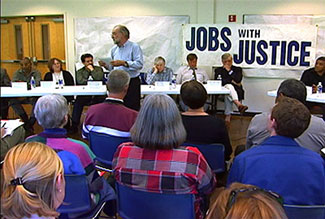 |
| Worker Rights Board Hearing Organized by Jobs with Justice of East Tennessee, from Morristown: in the air and sun (2007). |
Jobs with Justice of East Tennessee (JwJET), an all-volunteer group headquartered in Knoxville, generated civic, church, and labor union support. They convened a Worker’s Rights Board that heard testimony about the right to organize and about the failure of US labor law to adequately protect that right. Jim Sessions, co-chair of the chapter, introduced the panel of witnesses:
The right to organize is a human right and it’s a democratic right and it’s the law. But the law’s not obeyed very much on this matter in this country. That’s what we want to talk about tonight. And we’ll hear how difficult, also the aspirations of people who aspire to that democracy in the work place in our area.
One of the workers who testified was Artemio Jimenez, who had been fired while attempting to organize a Monterrey Mushroom plant in east Tennessee. Although Artemio brought a lawsuit over his firing, he was never allowed to present his facts in court. As an “agricultural worker,” he was expressly excluded from the National Labor Relations Act (NLRA) and its protections.33The exclusion of both agricultural workers and domestic workers from coverage under the NLRA dates back to the New Deal compromise struck with Dixiecrats in order to get that major piece of labor legislation through Congress. This was a race-linked compromise still only partly remedied today. For more information on the great range of workers who have been excluded in different ways from the protection of our present labor laws, see Excluded Workers Congress, “Unity for Dignity: Expanding the Right to Organize to Win Human Rights at Work,” Dec. 2010.
The union campaign at Koch Foods was well organized and highlighted the rights of workers while building understanding among coalition members about immigration, racism, and xenophobia. JwJET involved churches, other unions, and activists throughout east Tennessee including nearby native-born, factory workers who had been part of TIRN.
These support efforts were important, but the workers made the biggest difference in the success of the election drive. Despite threats of firing and deportation, leaders from the factory floor made house calls to recruit fellow workers and gather signed cards. Organizers anticipated employer behavior and explained the election process and US labor law. Morristown workers showed how effectively immigrants could mobilize when their basic trust was earned.
When the NLRB election day finally arrived, organizers were cautiously optimistic, but no one was sure what was going to happen. Fran remembers standing outside the plant with other supporters, waiting for the vote count:
Standing along the highway that morning, together with our JwJET delegation from Knoxville, there were black, white, and Latino organizers and union members from the UFCW, and a couple of guys from the Nashville local union to which the Morristown chicken plant workers would be attached if the election went for the union. There was a faithful young intern from the Highlander Research and Education Center whose highly skilled interpreting and translating services had been integral to the organizers’ efforts and workers’ comprehension, involvement, and morale. There was a union painter from Morristown who had learned about the election at a recent Labor Day event in Knoxville who showed up at the factory gates to lend his support. There was an Appalshop film crew diligently working the crowd for interviews and impressions. There was the president of a dying union local at a soon-to-close chemical plant in Morristown who throughout the organizing drive had opened the doors of his aging union hall to the workers from the chicken plant, welcoming its use for meetings, rallies, child care, buffet suppers, and workshops, and who had now come to stand with them on this fateful day.
The wait seemed interminable, but at last we made out the sound of cheering. Spilling down the hill toward our waiting group came an elated crew of union-designated election watchers. “Ganamos! We won! Ganamos!”
The workers had scored not a mere victory, but a landslide. The margin was 465 to 18.34Fran Ansley, “Labor Rights and Immigrant Workers in East Tennessee: Talking Union in Two Languages,” in Transforming Places: Lessons in Movement Building from Appalachia eds. Steve Fisher and Barbara Ellen Smith (Champaign: University of Illinois Press, forthcoming).
Looking Back and Ahead
The moment of victory was sweet. When Anne was editing the film, it became the apex of Morristown. Winning a union election, however, is no guarantee that workers will build a functioning union with workplace strength. A crucial “first contract” must be achieved. US companies, advised by batteries of management-side lawyers, have refined their ability to stall, delay, and undermine the negotiating process to such a degree that winning a first union contract after a successful organizing campaign has often proven an insurmountable hurdle.
In Morristown, after the pro-union vote, the UFCW and Koch Foods talked for months without reaching agreement. Finally the company declared there was nothing left to discuss and submitted its “last best offer,” a poor set of proposals testing union resolve. Unanimously the workers turned down the company’s offer. A month later, after further bargaining, they approved a union contract that included eye protection, bathroom breaks, health insurance, and higher wages.
Meanwhile, in the spring of 2006, immigrants all over the country poured into the streets by the hundreds of thousands to protest a virulent bill that had passed the US House of Representatives. They demanded reform that would provide a pathway to citizenship for many undocumented immigrants and make reasonable provision for immigrant entry in the future. The workers’ victory in Morristown had been powered by some of the same currents of discontent and determination that had fed the mobilizations for immigration reform.
The Tennessee Immigrant and Refugee Rights Coalition, founded in Nashville in 2001, hired its first organizer for east Tennessee in November, 2005.35For more about the origins of the Tennessee Immigrant and Refugee Rights Coalition, see Fran Ansley, “Constructing Citizenship Without a License: The Struggle of Undocumented Immigrants in the U.S. for Livelihoods and Recognition,” in Inclusive Citizenship: Meanings and Expressions ed. Naila Kabeer (London: Zed Books, 2005),199-215. In April 2006, the Coalition organized rallies all over the state for immigration reform, and they put out the word across east Tennessee for immigrants to join the action planned for Knoxville.
As Fran stood with thousands of other demonstrators in front of the federal building in Knoxville, she saw the members of the workers’ organizing committee from Koch Foods. Delighted at the size and spirited mood of the crowd, the workers announced they had achieved final agreement on a contract and that the company had shut down the plant for the day to allow workers to attend the Knoxville rally!
Neither the Knoxville march nor the signing of the contract resolved all the problems that led Koch Food workers to mobilize for union recognition and for immigration reform. But both of those achievements—and their remarkable joining in the streets of Knoxville on that day—suggest the potential power of strategies that include and unite.
Today the union at the Morristown chicken plant survives but faces tough challenges. Many poultry processing plants remain unorganized, and standards across the industry are low, even at unionized plants. Congress failed to pass federal labor law reform that would have made victories like the one at Koch Foods less of a rarity.36The particular bill that was proposed was known as the Employee Free Choice Act, and it would have made it substantially easier for workers in unorganized workplaces already covered by the National Labor Relations Act to win union recognition. The bill left many important issues unaddressed and many needy workers uncovered by its protections, but it would have been one important step toward changing the rules that are presently slanted so strongly in favor of employers and against workers who seek collective representation.
The movement for immigration reform faces similar challenges. Despite the mass mobilizations of 2006 and much campaigning since, federal reform is currently stalled. Beginning in December of 2006, immigrant workers at places like Koch Foods endured a long brutal season of workplace raids under the administration of George W. Bush.37For a paper on the 2008 immigration raid on a poultry plant in Chattanooga, see Karla Mari McKanders, “The Unspoken Voices of Indigenous Women in Immigration Raids” (November 22, 2010). University of Tennessee Legal Studies Research, Paper No. 133. Under the Obama administration these high-profile raids on immigrant-heavy workplaces have largely ceased. The end of these raids was a welcome improvement. Unfortunately, ICE raids at workplaces have been replaced with beefed-up audits and record-checking procedures that often result in mass firings of immigrant workers. Meanwhile, through other programs of immigration enforcement, rates of detention and deportation have risen to record levels across the country.
At the state level, jurisdictions such as Arizona have pioneered approaches that target immigrants and their families, charge local authorities with enforcing federal law, and effectively turn the criminal justice system into an immigration dragnet. Given that undocumented people cannot obtain a driver’s license, “driving while brown” becomes an activity inviting racial profiling and is punishable by banishment and family separation. Such measures push undocumented people into the shadows, make them even more vulnerable to abuse, and discourage immigrants from turning to local law enforcement when they need help or could offer assistance in the investigation of serious crimes.38See Major Cities Chiefs, “M.C.C. Immigration Committee Recommendations For Enforcement of Immigration Laws By Local Police Agencies” (2006).
At this writing in spring 2011, several states in the Southeast, including Tennessee, Georgia, and Alabama, are actively considering versions of the Arizona anti-immigration legislation.39During the spring 2011 session, Tennessee legislators proposed a bundle of bills modeled on Arizona’s. An example was HB 1380 that sought to require every law enforcement officer in the state—every time he or she “makes a lawful stop”—to question the person's immigration status, contact federal agents if there is "reasonable suspicion" an immigration violation has occurred, and transport the person to a federal holding facility. State and local jurisdictions have also entered into arrangements that more tightly integrate local policing and jails with federal immigration enforcement.40See Melissa Keaney and Joan Friedland, ‘Overview of the Key ICE ACCESS Programs: 287(g), the Criminal Alien Program and Secure Communities,” National Immigration Law Center (2009). Described as targeting “criminal aliens,” these enforcement agreements have led to the deportation of large numbers of undocumented people with no record of serious crime.41See Aarti Kohli and Deepa Varma, Borders, Jails and Jobsites: An Overview of Federal Immigration Enforcement Programs in the U.S., Chief Justice Earl Warren Institute Race, Ethnicity and Diversity (Feb. 2011). The impact on immigrant families and communities is severe.42See, e.g., Elena Lacayo, “The Impact of Section 287(g) of the Immigration and Nationality Act on the Latino Community,” National Council of La Raza Issue Brief No. 21 (2010) (includes case study of Nashville); Andrea Danit Guttin, “Criminals, Immigrants, or Victims? Rethinking the ‘Criminal Alien Program,’" (master’s thesis, University of Texas at Austin, 2009). (case study of Houston); Michael J. Wishnie, “State and Local Enforcement of Immigration Laws,” Journal of Constitutional Law, Vol. 6, No. 5 (May 2004), 1084-1115.
In the workplace, the threat of deportation injects additional fear for immigrant workers considering whether to press for better treatment on the job, fight back against the epidemic of wage theft that plagues today’s immigrant-heavy industries, or join in forming unions. Organizers and advocates report that employers threaten workers with deportation if and when workers complain about conditions or treatment on the job.43See Rebecca Smith, Ana Avendano and Julie Martinez Ortega, ICED Out: How Immigration Enforcement Has Interfered with Workers’ Rights, published by the AFL-CIO, the National Employment Law Project, and American Rights at Work (2009).
After years of working on Morristown and walking with the movements that it traces, we remain convinced that labor rights and immigrants’ rights are mutually dependent and inextricably intertwined. Campaigns and organizations that integrate both kinds of claims create spaces where workers can learn from each other and identify shared interests.44 For more on the intersection of these two movements, see Frances Ansley, “Doing Policy from Below: Worker Solidarity and the Prospects for Immigration Reform,” Cornell International Law Journal, Vol. 41, No. 1 (Winter 2008), 101-114; and Fran Ansley, “Local Contact Points at Global Divides: Labor Rights and Immigrant Rights as Sites for Cosmopolitan Legality,” in Law and Globalization from Below: Towards a Cosmopolitan Legality, Boaventura de Sousa Santos and Cesar A. Rodriguez-Garavito eds. (Cambridge: Cambridge University Press, 2005). However, serious obstacles to building class solidarity across divides of race and nation remain. Exclusionary whiteness runs deep, as does an exclusionary kind of Americanism. Anti-immigrant backlash is alive and well around the United States, and that backlash can be found among working class people and union members as among other segments of the population. But as Morristown documents, there are also working class southerners, both black and white, who can and do respond differently to immigration and to the question of immigrants’ rights, workers who express solidarity and see a basis for common ground. Shirley Reinhardt suggested something like this when she spoke with us before the Koch Foods election about what a victory would mean:
You’re saying to all the others from Mexico, they don’t have to treat you worse than anybody else. You can organize. That’s exactly what you’re saying. Not only are you saying that to the people from Mexico but you’re saying that to the people of Hamblen County, too.
While Morristown is on the side of workers like Shirley Reinhardt, it asks open-ended questions, tolerates ambiguity in the answers received, and intends to leave viewers with plenty to think about. Anne asked US-born people what they thought about the idea of “open borders.” Certainly our idea of a just global order would require something far more complex than that phrase conveys. In fact a good part of TIRN’s work on the question of plant closings and capital flight had urged the need for building and honoring boundaries within which democratic decision-making can take place and within which economic ground rules can be established and enforced. But a just global order is so far from what we have now, would require such profound reorientation of present realities, and is so seldom discussed in the public debates to which most working people in the United States have reasonable access, that simple and unsettling questions seemed the right place to open the kinds of conversations that lead toward global justice.45Fran has argued elsewhere that the problem of “immigration” is really a problem of “development.” See Fran Ansley, “Toward a Just and Humane Immigration Policy,” in Global Connections and Local Receptions: Latino Immigration to the Southeastern United States, Fran Ansley and Jon Shefner, eds. (Knoxville: University of Tennessee Press, 2009). For a fascinating suggestion that labor mobility across borders should be conditioned on labor solidarity and commitment to minimum standards, see Jennifer Gordon, “Transnational Labor Citizenship,” Southern California Law Review, Vol. 880 (2007), 503. When Anne put the question to attorney Mike Whalen, a criminal defense lawyer in Knoxville and local ally of the Latino population, he replied:
Open the borders? (Laughing) That’s what they should do! In the European Economic Community, if you’re British, you can go to France and work. You don’t have to ask anybody’s permission. Here we want economic pacts which allow goods and services and profits and money to cross borders freely but not human beings, because we want some of them to be slaves for the rest of us. We should be talking about that. We should be talking about open border. Don’t hold your breath.
When asked a similar question, factory workers expressed concerns about the impact of unrestricted migration both on wages and on their ability to unionize, but their concerns were tempered with other insights and emotions. Betty Malone talked about what she thought her employer and other powerful supporters of “free trade” were after:
I think basically they would like for our living standards to come down. And they are. They really are. But we’re far from the shape they’re in in Mexico.
They’re just as good as I am. They’re here and I don’t blame them. I’d come across the border every chance I got whether I was legal. If I was illegal that’s just fine too, I’d still come across.
Or as a union painter put it when he stood in front of the chicken plant on the day of the union election:
They’re exploiting too many people around this town. Morristown’s famous for that. [I’m here] for human rights, that’s all. And they deserve it as well as you or me.
]]>Residual Objects at the Border and Immigrant Trajectories
Material leftovers and abject residue are signs of the peculiar transformations . . . perversely, they show us that meaning has been made.
–Sophie Gee, Making Waste: Leftovers and the Eighteenth Century Imagination, p. 17
The photographs are a means of making “real” (or “more real”) matters that the privileged or the merely safe might prefer to ignore.
–Susan Sontag, Regarding the Pain of Others, p. 7
Susan Harbage Page photographs objects found at the international border (objects trouvés), in the Rio Grande Valley, near Brownsville (USA) and Matamoros (Mexico). The photographs, part of her Border Project, depict no immigrants, only the dried out clothes that they left behind after making it across the river. The photographs do not depict guards either, but they show bullet casings and detention gloves that remain.
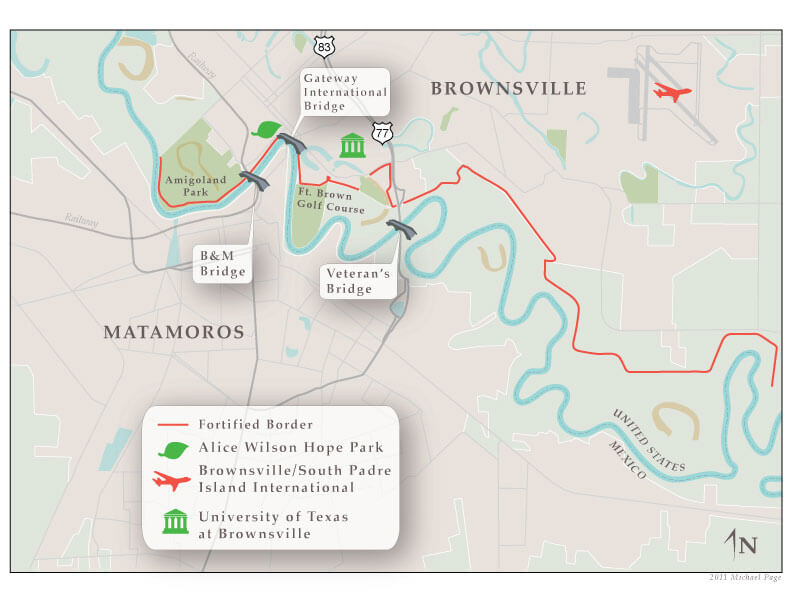
Harbage Page’s photographs concentrate on the beginning that the border represents and are suggestive of the trajectories that immigrants followed afterwards. The residues depicted in these photographs speak tentatively of a successful journey into the United States but also reflect the fate of those for whom the crossing meant imprisonment and deportation. Photographs taken at the border hint at the lives that migrants started in the United States, or suggest journeys truncated by border enforcement violence.1All photographs: Susan Harbage Page, Chapel Hill, North Carolina. Copyright © 2009 and 2010. All rights reserved.

Susan Harbage Page, Path into the United States from the Rio Grande, 2008.
This essay offers an interpretation of the Border Project’s intervention on the immigration public debate. By photographing the border area and the physical remnants of crossings that are not sanctioned by the law, the photographer highlights the institutions of coercion that characterize border control. The photographs offer a critical account of the danger and potential violence involved in the border crossing and, through that critique, suggest the need to come up with new imagined geographies of the border. By concentrating on the border, the photographer illuminates dimensions of this space that are hardly ever considered in a conversation that revolves around fortification, fencing, and security. The objects depicted can be identified as residues of border coercion—evidence that even tightly fenced borders offer, on closer inspection, unrounded edges, gaps, and traces. I suggest that the highlighting of these residues acts as a powerful sign of the unfinished status of even the most secured border, and by extension the possibility of changing the existing terms of the debate and ultimately the shape of the border and the options offered to migrants upon arrival.

Susan Harbage Page, Path into the United States from the Rio Grande, 2008.
Engaging with the space of the border through its openings and the residues of crossing and policing it disrupts the narrative of security that justifies an unending fencing. The fortification of the border is predicated on the dangers of the outside, justifying the extension of immigration policing within border spaces and into domestic areas.
The photographs do not portray the migrants; instead, they show objects such as single shoes that stayed behind, self-fashioned flotation devices, and identity cards. They do not impose identities on the migrants, but suggest their journeys and arrivals into the United States. They do not show encounters between Border Patrol officers and migrants, but they depict the rubber gloves and bullet casings. They do not follow immigrants into detention, but register the residue—detention bracelets and boxes with Department of Homeland Security tags. The objects are suggestive of the men and women who passed through the border; those who were detained, on the run, or abused in the United States; and those who sometimes returned across the border. Some of the items speak of the violence their owners went through, and their sight tells of pain and suffering produced by fortified borders.
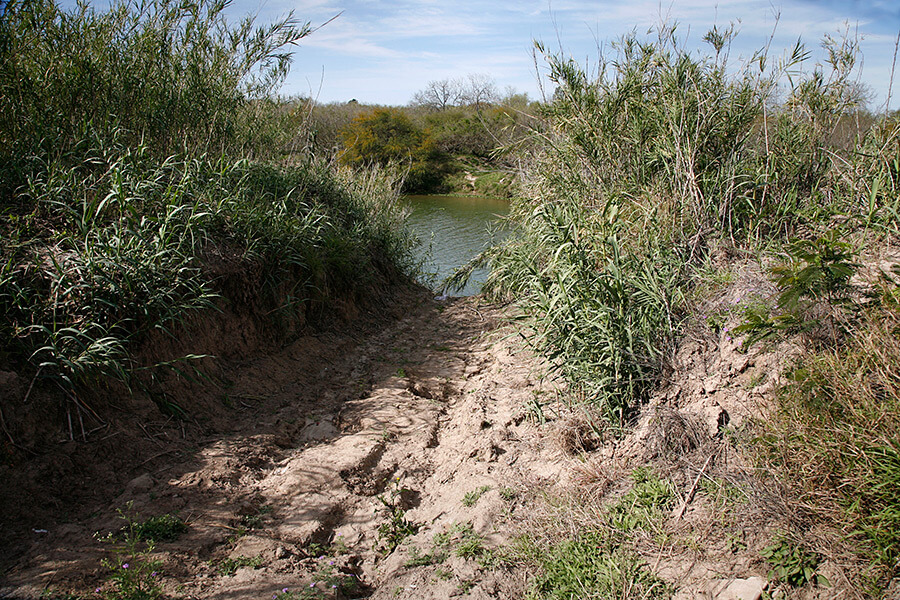
Susan Harbage Page, Looking across the Rio Grande to Mexico, near Brownsville, Texas, 2010.
The clothing and personal belongings are muddy, and sometimes need to be unearthed from layers of mud and dirt. This layering and the different stages of shredding and decomposition of the clothing suggest chronologies.
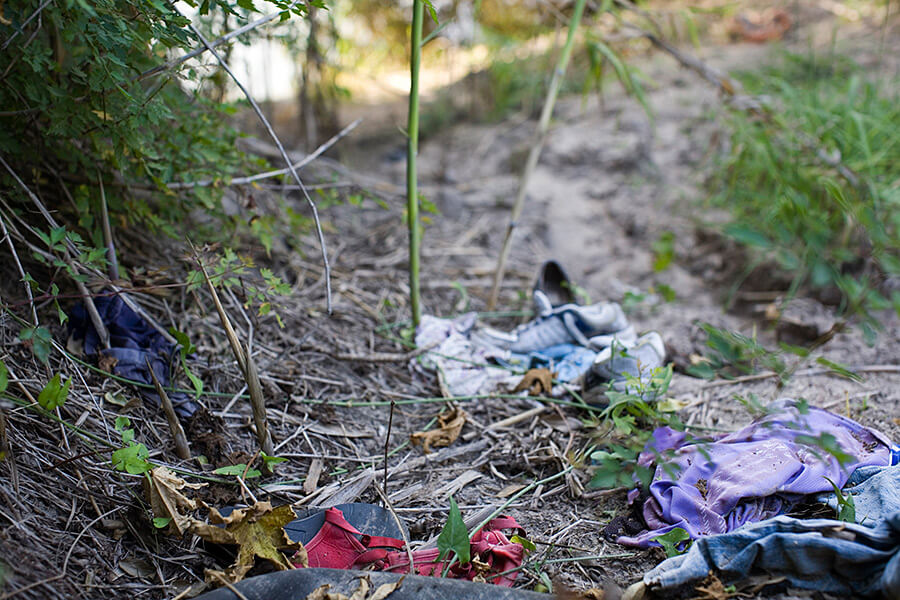
Susan Harbage Page, Clothing left behind on the US bank of the Rio Grande, Brownsville, Texas, 2008.

Susan Harbage Page, Buried comb, Brownsville, Texas, 2010.

Susan Harbage Page, Argyle sock, Brownsville, Texas, 2007.
The photographs portray wet clothing left behind only a few hours before, as well as worn out pieces of clothing. The ground of the border is partly constituted through the accumulation of leftover clothes and personal objects and the repeated transit through the “safest” pathways. Immigrants who cross the river must change into dry clothes once they arrive on the northern side, to conceal the marks of their crossing. They carry a dry set of clothes in a sealed plastic bag, sometimes found empty and tied to the tires used as flotation devices. The actions of thousands of immigrants crossing the border are not inimical to the border but, through their passage, leave behind worn out paths and newly layered border geographies. Just as a fenced border constructs immigrants as dangerous trespassers, Harbage Page’s depiction of a layered and complex border space humanizes them.
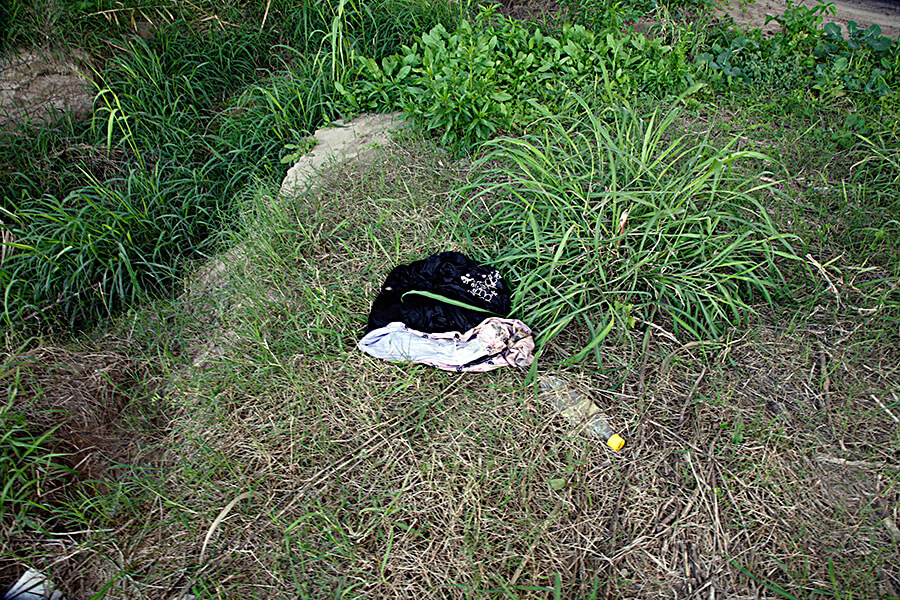
Susan Harbage Page, Clothes and bottle, Brownsville, Texas, 2010.
Objects found and photographed are often private and reveal the identity of border crossers. Some have actual identifying potential, as they contain the border crossers’ DNA.
The portrayal of everyday objects makes migrants present. In contrast to prevalent images of immigrants as outlaws, the recognition of their journeys through the border and the difficulties involved are suggestive of their pain and open the possibility of a different kind of welcoming. The photographs change the framing of the border away from a security-maximizing stance and towards a depiction of immigrants as subjects. The conventional focus on the material strength of the fence and the inviolability of the border excludes immigrants as subjects of concern and of violence, preventing sympathy from those on the inside towards border crossers’ journeys. The security obsession of the immigration debate makes immigrants’ lives not grievable, not valuable. The photographed objects and the image of the border as a populated space and port of entry evoke humanity.2Judith Butler, Frames of War. When Is Life Grievable (London: Verso, 2009), 25.

Susan Harbage Page, Yellow toothbrush, Brownsville, Texas, 2007.
The populated border conveyed by the photographs contrasts with images and acts of humiliation.The law SB1070 in Arizona and, before that, the procession of immigrants dressed in prisoner outfits paraded by Sheriff Arpaio on the streets of Phoenix, offer photo opportunities for the news media.3Arizona Senate Bill 1070, signed into law on April 23, 2010, controversially makes it a misdemeanor to be an alien in Arizona without carrying registration documents and requires law enforcement officials to determine a person's immigration status if there is "reasonable suspicion" that the person is an "illegal alien." It also establishes penalties for harboring or transporting an undocumented immigrant and allows law enforcement to arrest any individual without warrant if they believe this person is “removable from the United States." The quantification of the “success” of enforcement in number of immigrants deported and the imposition of detention quotas on immigration police also dehumanizes immigrants.4Spencer S. Hsu and Andrew Becker, "ICE Officials Set Quotas to Deport More Illegal Immigrants," The Washington Post, March 27, 2010. The tires dragged by Border Patrol vehicles shown in the next photograph are used to erase tracks and identify fresh footprints. The erasure of the traces of border crossing maintains the image of fortification while marking immigrants as trespassers.

Susan Harbage Page, Tires dragged along roads by the Border Patrol to see fresh footprints left by immigrants, Brownsville, Texas, 2010.
The photographs of tagged Department of Homeland Security boxes represent the end of the immigrant journey. They single out the detritus of detention and deportation—traces of immigrants who have been denied spaces to live in the United States.

Susan Harbage Page, Department of Homeland Security boxes, Matamoros, Mexico, 2010.

Susan Harbage Page, Department of Homeland Security box with label, Matamoros, Mexico, 2010.
Personal belongings boxes labeled by the Department of Homeland Security still contain the information and pictures of the detainees and appear piled as trash in the street near the southern side of the Matamoros-Brownsville international bridge.5The practice of formally detaining border crossers (as opposed to simply returning them across the border) has become more prevalent since the implementation of Operation Streamline in 2005. See ACLU and National Immigration Forum, "Operation Streamline Fact Sheet," (Washington, DC: National Immigration Forum, 2009).

Susan Harbage Page, Department of Homeland Security box with contents, Matamoros, Mexico, 2010.

Susan Harbage Page, Garbage can with evidence bags, Matamoros, Mexico, 2010.
Instead of focusing on immigrants detained, policed, fenced, and deported, Harbage Page shows the border as a populated space, whose shape is indebted to the people who pass through. The photographs suggest welcoming, represented in the small Guía del Migrante (Migrant Guide) prepared by Grupos de Protección al Migrante (Migrant’s Protection Groups) and distributed in border towns, whose back cover can be seen below. The leaflet, found on the Mexican side, tells a story of hope for safe passage.

Susan Harbage Page, Migrant Guide, Brownsville, Texas, 2010.
Clothes and objects left behind are as much traces of the identities of migrants as ID cards that non-Mexicans are keen to drop at the border to avoid being returned to more distant countries. This is the transition to a life of invisibility that the existing immigration regulations impose upon migrants without documents. Clothes left behind remind what the inauguration of immigrants’ presence in this country involves. Wet clothes are discarded as immigrants mix with the overwhelmingly Mexican-American population of border towns. The items in the photographs represent first actions taken by border crossers to hide their identity, practices that will continue to characterize their lives as undocumented immigrants in the United States.
The violence involved in border control is narrated through its residues, bullet casings, and detention gloves. Department of Homeland security boxes grant new identities to migrants who were detained—preventing their legal entry for years to come, expediting their deportation if they were to enter again.

Susan Harbage Page, Bullet casings, Brownsville, Texas, 2010.
The photographic evidence of official coercion—bullet casings, gloves, and detention bracelets—disrupt the impressions of fortitude, inviolability, and certainty that the border fence presents.

Susan Harbage Page, Medical glove, Brownsville, Texas, 2008.
The photographs question the assertion of territorial borders. Picturing these objects, tying them to narratives of the travelers who left them behind, and opposing them to the certainty of sovereign borders challenges the rules that seek to hide hesitancy, space for contestation, or room for debate.

Susan Harbage Page, Department of Homeland Security Baggage Check tag, Brownsville, Texas, 2010.
The addition of a map produced by an immigrant that traces her family’s trajectory adds to the welcoming stance of this project by incorporating immigrants as narrating subjects and by recognizing their journeys.6The map traces the journeys into the United States of members of an adult ESL course Harbage Page taught with Lauren McGrail and Dani Moore called Project Focus. It was a collaboration between Voices and Casa Multicultural and was funded by the North Carolina Community College System and the Durham Arts Council, 2000. The image is a page from an alphabet book produced in class. The maps are Polaroid images of a large map in the classroom where each student marked their journey from their home country to Durham, North Carolina with string. The writing was done by Guillermina Flores Godinez. According to the latest census data, among the top ten states in terms of growth in immigrant population between 2000 and 2009, eight were southern states.7Migration Policy Institute, “States Ranked by Percentage Change in the Foreign Born Population” Migration Policy Institute Data Hub (Migration Policy Institute, 2011). These figures explain why the South has been identified as one of the “new” immigration destinations, areas that, unlike California, Florida, New York, and Texas, were not traditional “immigrant states” until the last two decades. Jamie Winders refers to the US South as one of the “nontraditional” destinations for the Latino immigrant population, whose rates of growth have reached up to 500% in certain cities between 1990 and 2005. Jamie Winders, "Changing Politics of Race and Region: Latino Migration to the U.S. South," Progress in Human Geography 29, no. 6 (2005): 683-4. The 2010 census reflects this phenomenon, showing that those “areas that had been home to the most immigrants” show a flat growth in “foreign born population” while some rural and suburban areas with less than 5% of immigrant population in 2000 show increases of more than 60%. Sabrina Tavernise and Robert Gebeloff, "Immigrants Make Paths to Suburbia, Not Cities," in The New York Times (New York: 2010). Even in terms of the absolute increase in foreign-born population, three out of the top ten states, excluding traditional destinations Texas and Florida, are southern: Georgia, Virginia, and North Carolina.8Migration Policy Institute, “States Ranked by Numeric Difference in the Foreign Born Population” Migration Policy Institute Data Hub (Migration Policy Institute, 2011). The Pew Hispanic Center 2010 census tabulations of growth in Hispanic population (i.e., not necessarily foreign born) show that South Carolina, Alabama, Tennessee, Kentucky, Arkansas, North Carolina, and Mississippi figure among the top ten states. Immigrants from Mexico, the Caribbean, Central America and South America constitute approximately 53% of the total foreign born population. In Georgia, Virginia, and North Carolina they make up 54.5%, 36.1%, and 57.3%, respectively. See Tables 3 and 13 in Pew Hispanic Center “Statistical Portrait of the Foreign Born Population in the United States, 2009” in Pew Hispanic Center February 17 (Pew Research Center, 2011). The increase in the immigrant and—in particular—Latino population adds a new dimension to the troubled racial history of the South. These individuals fill the ranks of agricultural and construction workers and face discrimination, vulnerability in the workplace, and racially-targeted immigration enforcement.9Nicholas De Genova, "The Legal Production of Mexican/Migrant "Illegality"," Latino Studies 2, no. 2 (2004), Guillermina Gina Núñez and Josiah McC. Heyman, "Entrapment Processes and Immigrant Communities in a Time of Heightened Border Vigilance," Human Organization 66, no. 4 (2007); Inés Valdez, "Sovereignty and the City: Raiding, Detaining, and Domestic Immigration Policing" (paper presented at the Annual Meeting of the Western Political Science Association, San Francisco, April 3-5 2010); Mathew Coleman, "The "Local" Migration State: The Site Specific Devolution of Immigration Enforcement in the US South," Law & Policy forthcoming (2011).
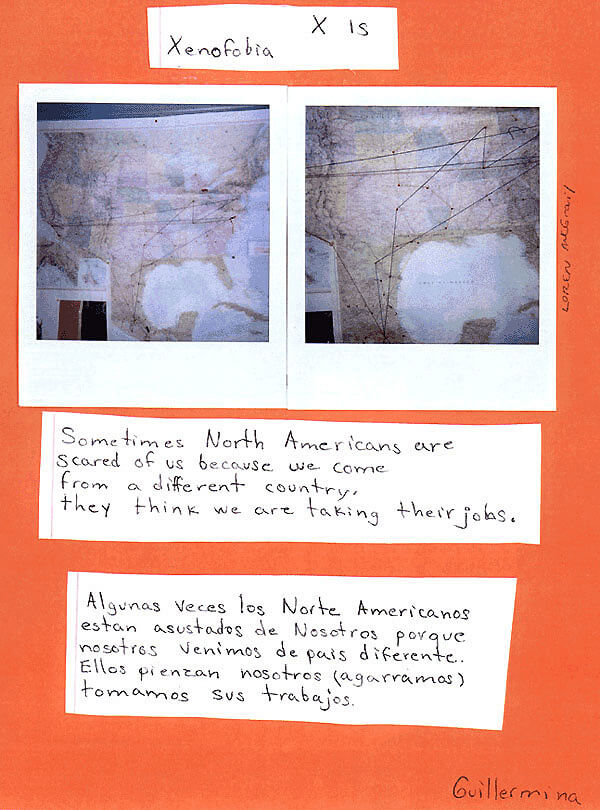
Susan Harbage Page, Map and page from Alphabet Book tracking the journeys of adult ESL students into the United States, Durham, North Carolina, 2001.
Museums and the Upsetting of the Narrative of the "Nation of Immigrants"
If we were to rely on museum collections, we might get an impression of a much richer level of material wealth than truly was the case. This is because most museums save the unusual and the valuable object, and individuals now and in the past consign commonplace objects to the dump.
–James Deetz, Small Things Forgotten: An Archeology of Early American Life
When the objects found at the border are re-photographed in the artist’s studio their narratives are complicated by a new frame suggesting that the items now form parts of an exhibition. The stories they tell are neither confined to the past nor officially sanctioned. The objects contest the invisibility on which border coercion relies and challenge the discourse of fortification. In these images, Harbage Page chose background colors for their similarity to the palette that she encountered in her excursions in the Rio Grande Valley.
At the start of a decade that became characterized by anti-immigrant legislation, the Ellis Island Immigration Museum opened in 1990. Even as the museum celebrated the twelve million immigrants who went through its doors between 1892 and 1954, the US Congress passed restrictive immigration legislation and attached anti-immigrant provisions to crime, welfare, and anti-narcotics legislation.10Desmond King and Inés Valdez, "From Workers to Enemies. National Security, State Building and America’s War on Illegal Immigrants," in Narrating Peoplehood in Plural Societies: The United States, Canada and Denmark in Historical Experience and Theoretical Perspective, ed. Michael Bøss (Aarhus: Aarhus Academic Press, 2011). Ellis Island, as a space of memory, resulted from a complex interaction of actors and perspectives, including the Immigration History Society, the National Park Service, the Statue of Liberty-Ellis Island Foundation, as well as corporate actors in charge of the architecture, oral history recollection, and the catering and gift shop concession.11President Reagan launched the project of the museum on occasion of the centennial of the Statue of Liberty in 1986. He moved Ellis Island to the purview of the National Park Service, merged it with the Statue of Liberty and created a public-private partnership that was led by Lee Iacocca, himself the son of an immigrant and the American dream come true. Luke Desforges, "Front Doors to Freedom, Portal to the Past: History at the Ellis Island Immigration Museum, New York," Social & Cultural Geography 5, no. 3 (2004). In spite of the diverse interpretations of the narratives that the Ellis Island Immigration Museum puts forward, the immigration experience of Western Hemisphere migrants and, in particular, of Mexicans is only marginally acknowledged. Moreover, the identification of 1965 as the definitive end of unjust immigration regulation (through the abandonment of the national origin quotas) obscures the fact that the Hart-Celler Act is the same law that for the first time has limited immigration from Mexico and Latin America.12De Genova, "The Legal Production of Mexican/Migrant 'Illegality.'", Judith Smith, "Celebrating Immigration History at Ellis Island," American Quarterly 44, no. 1 (1992): 85.
Museums, and their inclusions and exclusions of artifacts, play a central role in the “production and legitimation of historical knowledges and social identities” and in the United States’ narrative as a “nation of immigrants."13Desforges, "Front Doors to Freedom, Portal to the Past: History at the Ellis Island Immigration Museum, New York," 437.
Setting aside the question of whether the Ellis Island Immigration Museum is able to critically tackle issues of politically-motivated detention and deportation, or even the racism of popular culture in the early twentieth century, it fails to make explicit connections to the role of race, detention, and deportation in contemporary America. Its narrative carves in stone a “good immigrant” story, while evading critical awareness about the management of current immigration flows.14A wall with over 700,000 names (at the time of writing) exists in Ellis Island. Individuals or families can add their names for a fee of $150. Entries are received for all ports of entry and years of arrival, with the common element being the “celebration of American migration” (see the museum’s site for the wall of honor). The opening of the “wall” to all immigrants is significant and worthy of praise, yet the story that is portrayed by the museum is still devoted to the earlier migratory wave, one restricted in time and not predominantly originating in the Western Hemisphere.
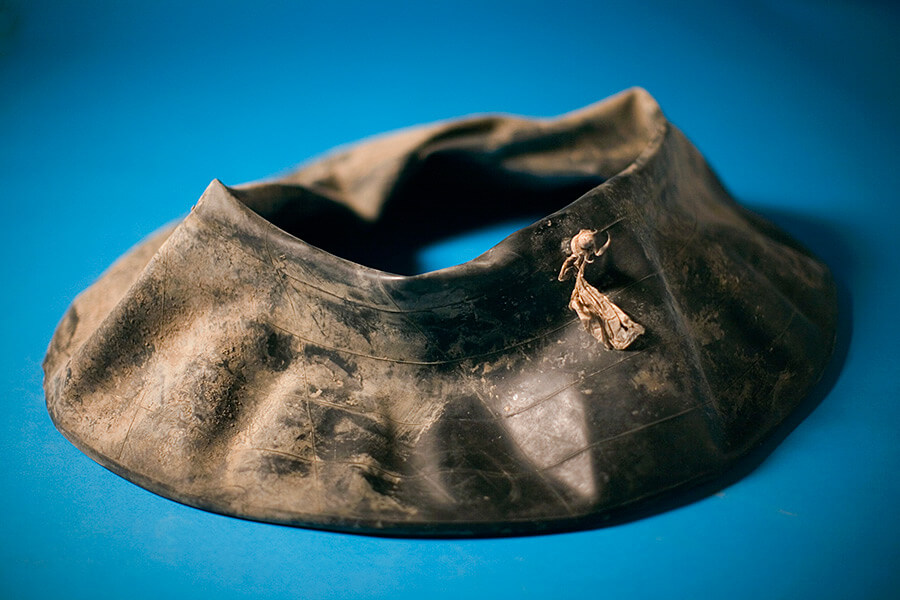
Susan Harbage Page, Archive photo, Tire, 2010.
Invoking the Ellis Island Immigration Museum vis-à-vis Harbage Page’s photographs of the “residues of border control” highlights the connections between nostalgic narratives of a nation of immigrants and the disavowal of contemporary stories of immigration taking shape at the US–Mexico border. The re-staging of the objects picked up in the border interpelates museums and exhibitions that omit these stories. The bullet casings and detention bracelets tagged and photographed in the studio defy (and make retrospective) the inclusionary bent of the “nation of immigrants” narrative. The staging of these objects as if they belonged to an archive or a museum collection plays with the fact that these items would not be granted entry to these realms.15The photographs in fact represent the physical archive that is being created and kept by Harbage Page.
In putting together the archive, the photographer asserts the importance of a marginal area and of seemingly marginal objects. The Border Project’s mundane objects do not passively back up a rehearsed story but convey the continuous flow of individuals, the encounter between border crossers and Border Patrol officers, and the deployment of state power over this liminal space. The photographs and the physical archive prompt conversation that is about the present and imagined futures.

The Border Project insists that immigrant identity is continuously transformed through successful and truncated journeys, newcomers, and settlement. Resisted by the mechanisms of border coercion and fortification, immigrant identity is remade by the individuals who leave their traces along the border.
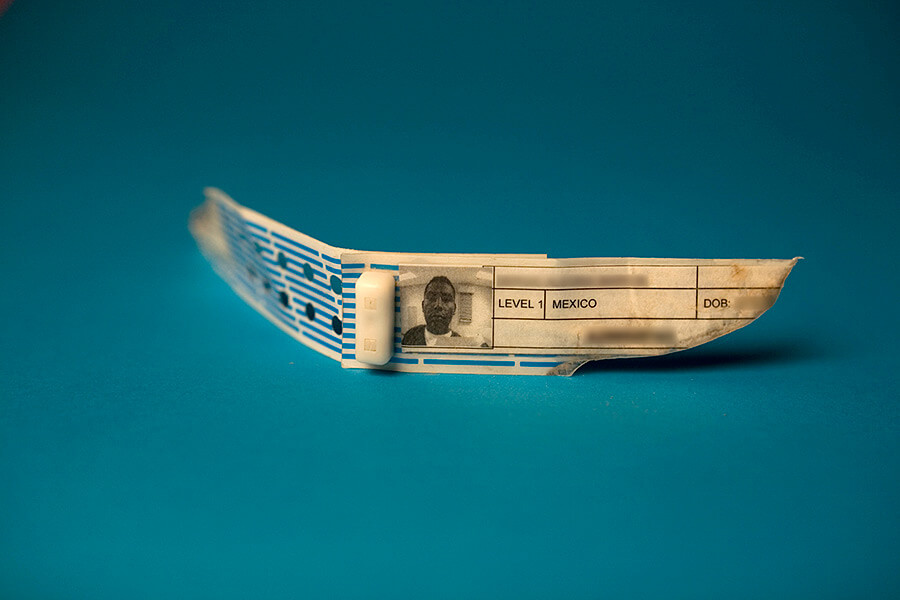
Susan Harbage Page, Archive photo, Detention Center bracelet, 2010.
Susan Harbage Page’s photographs are welcoming not only of the individuals who are evoked through personal objects, but also of new narratives of migration and newly acquired identities. Because these photographs are too closely intertwined with the present and convey urgency, they refuse to memorialize a tightly packaged story of immigration and nationalism. By showing the residues of border crossing and the traces of coercion, these photographs invite a rethinking of the ways immigration is discussed.
About the Authors
Susan Harbage Page is an instructor in the Department of Art and an affiliated faculty member in Women's Studies at the University of North Carolina at Chapel Hill. In 2004, she received her M.F.A. in Photography from the San Francisco Art Institute. Her work has been displayed in over one hundred exhibitions, at venues including the Corcoran Museum of Art in Washington DC and the Boulder Museum of Contemporary Art in Colorado. Susan's research has been supported in part by a faculty research grant from the Center for the Study of the American South at the University of North Carolina (2007) and a North Carolina Arts Council Fellowship Grant (2010).
Inés Valdez will receive her PhD in Political Science at the University of North Carolina at Chapel Hill in the summer of 2011. She has been awarded a Max Weber Postdoctoral Fellowship at the European University Institute in Italy. Her research, forthcoming in the journal Political Studies, examines questions of sovereignty, immigration and democratic theory.
Acknowledgements
The authors thank the editorial staff at Southern Spaces and anonymous reviewers for helpful criticism and guidance.
]]>Introduction
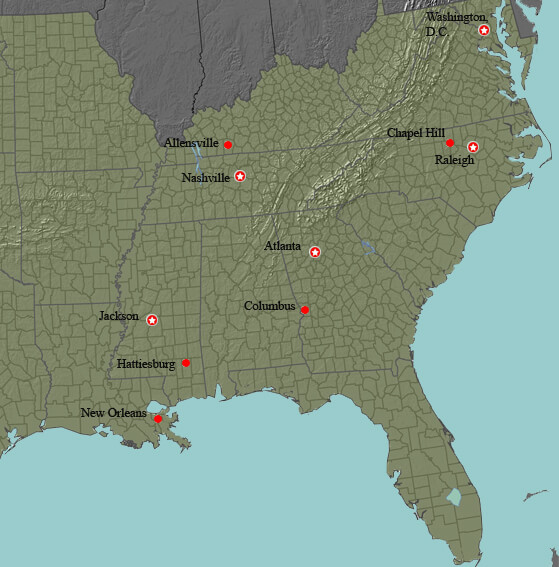 |
| Map of Yoshio Koya's destinations, 2011. |
From February to April 1950, the head of the Institute of Public Health in Tokyo, Yoshio Koya, was sent by the US-led Occupation Army to the US South to study public health, specifically birth control services. US officials were alarmed at the rapid increase in population in postwar Japan. They feared that population pressure and economic instability could once again push the nation into aggressive expansionism, possibly resulting in another war. Advancing communist forces in Asia further aggravated such concern. The southern states were the first in the United States to incorporate birth control as part of public health programs targeting the poor and racial minorities before the war. Koya’s mission was to learn how to launch effective and mass-scale, state-sponsored birth control programs in remote, low-income locales in Japan.
Drawing from his travel accounts and memoirs, this essay follows Koya’s trip to several states in the US South—Louisiana, Mississippi, Tennessee, Kentucky, Georgia, and North Carolina—and explores his observations of race relations in the United States with regard to public health.1Koya did not travel with an interpreter and his English skills were sufficient, if not fluent. All of Koya's books and journals were published in Japanese, with the exception of a few academic journals published in US journals. The translation that appears in this article is by the author. Koya linked the relative increase of black population to the white Americans’ eugenic and economic fears about differential fertility, interracial mixture, and job competition, which ultimately led to the southern states’ efforts to disseminate birth control practices among the rural blacks. Koya applied what he learned in the South to his own birth control experiments in rural Japan: specifically, the field-trial method to disseminate easy, simple, and free contraceptives; the use of nurses as social case workers to directly visit “needy” women for birth control consultation; and the operation of governmental offices to effectively provide these services to the poor. This essay reveals the process through which discriminatory and semi-coercive "public health" practices in the US South were transplanted into birth control programs in postwar Japan and other “overpopulated” areas in the world. By using Japan as a model for global population control, US leaders sought to establish the legitimacy of birth control programs both at home and abroad. I show the reach of eugenic and racist philosophy at work in these "scientific" field experiments and "public health" activities before and after World War II, as well as the spread of these ideas beyond national borders.
I also analyze images and illustrations associated with Koya’s travel accounts, which include drawings, photographs, and maps of the towns and areas he visited. I argue that these images, along with his texts, reveal Koya’s idealized view of American democracy, modernity, and pragmatism. They indicate that Koya identified with white (male) leaders and public health officials rather than with African American women and the rural poor targeted for birth control.
Background
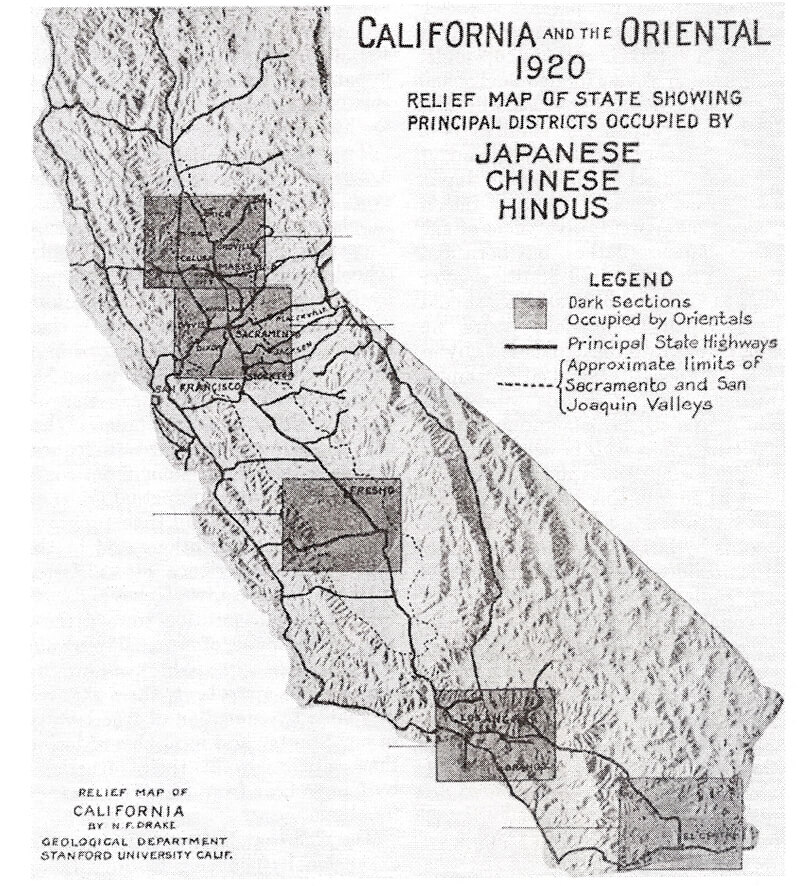 | 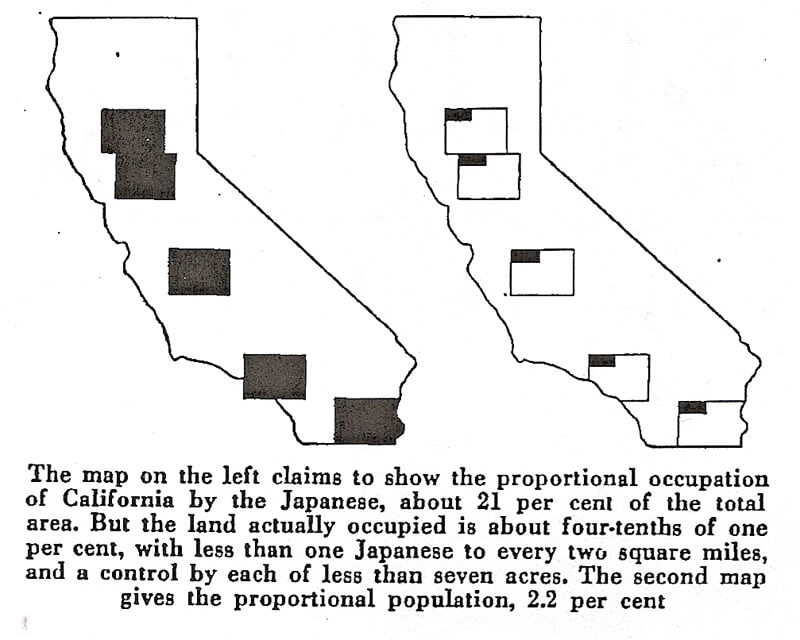 | |
| Earl S. Parker, Map of the "Oriental" population of California in "The Real Yellow Peril," The Independent 105 (May 7, 1921): 476. | Marshall De Motte, Maps of the Japanese population, in "California: White or Yellow?" The Annals of the American Academy 93 (January 1921): 21. |
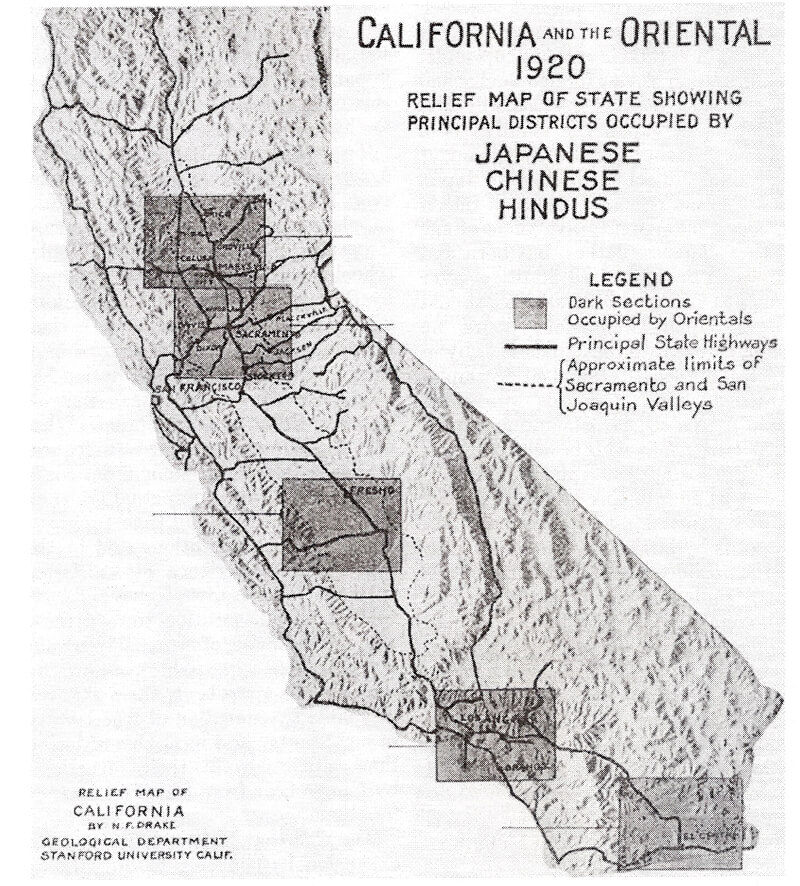
US intellectuals and the general public had been debating the increasing Japanese population since the early-twentieth century. Japan's population increased steadily during the late-nineteenth century as the nation embraced policies influenced by modernization and Westernization. However, Japanese population growth alarmed many Americans only after military expansion entered the equation. After winning the first modern war against China in 1895, Japan shocked the international powers with its victory over a Western nation, Russia, in 1905. Meanwhile, the increasing flow of non-Western immigrants, particularly those from China and Japan, heightened anti-immigration sentiments among the residents on the US West Coast.2The debates over “race suicide” in the United States from the 1890s to the 1930s were deeply linked to the supposed fecundity of Asian immigrants, especially the Japanese. See, Laura L. Lovett, Pronatalism, Reproduction, and the Family in the United States, 1890-1938 (Chapel Hill: The University of North Carolina Press, 2007), 78-108. Popular books written by eugenicists such as Madison Grant’s 1916 The Passing of the Great Race and Lothrop Stoddard’s 1920 The Rising Tide of Color Against White World-Supremacy incited anxiety among white Americans that the United States was deteriorating from within—through immigration from Southern Europe and from Asia. Stoddard alarmingly declared: “the introduction of even a small group of prolific and adaptable but racially undesirable aliens may result in their subsequent prodigious multiplication, thereby either replacing better native stocks or degrading these by the injection of inferior blood.”3Lothrop Stoddard, The Rising Tide of Color Against White World-Supremacy (New York: Scribner, 1920), 252. These fears provoked by eugenicists, coupled with anti-immigration sentiments among residents on the East and West Coasts, contributed to the passage of the Immigration Act of 1924. The law banned further Japanese immigration and was a culmination of previous laws and campaigns targeting Asian immigrants.
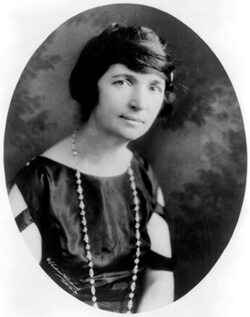 |
| Underwood & Underwood Photography, Margaret Sanger, 1922. Courtesy of the Library of Congress. |
The immigration law did not quell American concerns about the “swarming” people, as the Japanese government appeared to resort to even more violent means to acquire outside territory and resources to sustain their growing domestic population.4Although many Americans imagined that Japan would send its surplus population abroad, in reality the Japanese government was sending its leaders for colonial ruling, wary of the job competition with low-wage indigenous laborers. While leading US scholars such as Warren Thompson were aware that the Japanese government was not actually sending its people abroad on a massive basis, Japan’s lack of natural resources and their quest for foreign markets nonetheless made them a serious threat to Western imperial powers. See, Warren Thompson, Danger Spots in World Population (New York: A.A. Knopf, 1929), 17-48. By the 1930s, population studies emerged as an “objective” scientific field, replacing the “value-ridden” approaches of previous eugenic research. In reality the two fields shared much in common, including their primary interest in differential fertility between classes, races, and nations. Sociologist Warren Thompson’s 1929 book, The Danger Spots in World Population, for example, prominently featured the overpopulation problem in Japan as a primary threat to world peace. These male scholars provided scientific credibility to political campaigns such as immigration restriction and anti-expansionism, while stigmatizing female fertility as a cause of chaos and war. As international relations deteriorated, even feminist activists such as Margaret Sanger, who initially envisioned birth control as a means of female liberation across national borders, started to use the same language of population control in the name of world peace under US leadership. Citing Thompson’s work that named Japan, along with Germany and Italy, as a major "danger spot" of the world, she denounced these fertile nations as "destroyers of our civilization through their ruthless method of waging arrogant warfare against innocent, peaceful peoples."5"News from Margaret Sanger," 6 September 1937, reel 19, Margaret Sanger Papers, Library of Congress, Washington DC
The US Occupation and the Population Problem in Postwar Japan
The United States' preoccupation with Japan's population growth continued after World War II, when the war-torn country faced renewed problems with the return of soldiers from overseas, increasing birth rates, and food shortages. In reality, actual birth rates had started to fall after 1947, and many US officials were aware of those numbers. Nonetheless, US leaders who visited postwar Japan retained the impression that masses of people who were poorly dressed and homeless, including orphans and starving children, roamed about in destroyed towns and cities. This impression led Americans to intervene in solving the “big question” of population growth.6Crawford F. Sams, “Medic”: The Mission of an American Military Doctor in Occupied Japan and Wartorn Korea (Armonk, NY: M. E. Sharpe, 1998), 30, 183; National Academy of Sciences, “Conference on Population Problems held at Williamsburg Inn, Williamsburg, VA,” morning session, June 20, 1952, folder 720, box 85, series 1.5, RG 5, John D. Rockefeller III Papers, Rockefeller Archive Center, Sleepy Hollow, New York (hereafter, RAC); Deborah Oakley, “The Development of Population Policy in Japan, 1945-1952, and American Participation,” PhD dissertation (University of Michigan, 1977), 278. Moreover, in the context of the Cold War Japan represented an important foothold for the United States' further political influence in Asia.7For the conservative drift in the US Occupation policies, see John W. Dower, Embracing Defeat: Japan in the Wake of World War II (W. W. Norton & Company, 1999), 525-526. Social and economic instability caused by overpopulation, the Americans warned, could leave Japan and the rest of Asia vulnerable to communism, which in turn would threaten a reduced "free world." Communist China became an embodiment of this threat.8See, for example, Kingsley Davis, “The Other Scare: Too Many People,” New York Times, March 15, 1959, p. SM13. The leader of Planned Parenthood Federation of America, William Vogt, warned that the loss of Japan and India to communism would indeed be a “serious breach in western defense.”9“Ripe for Reds: World Birth Growth Held Top Problem,” Los Angeles Times, February 29, 1952, p. C1.
Japan Today. Newsreel by Ed Herlihy, 1946.
The US-led Occupation government (the Supreme Command for the Allied Powers, or SCAP) was in a complicated situation in dealing with population growth abroad. After giving a statement to the press endorsing birth control—along with industrialization and urbanization—as a key solution to Japan’s population problem, Crawford F. Sams, head of the Public Health and Welfare Section (PHW) of SCAP, received a series of protests from US Catholics.10Deborah Oakley, “The Development of Population Policy in Japan, 1945-1952, and American Participation,” PhD dissertation (University of Michigan, 1977), 173; Tenrei Ota, Nihon Sanji Chōsetsu Hyakunenshi (One Hundred Years of Birth Control in Japan) (Tokyo: Shuppan Kagaku Sogo Kenkyujo, 1976), 359. Criticism from US Catholics was particularly a concern for General Douglas MacArthur, head of SCAP, who had an ambition to run for a presidential campaign after his duty in Japan; losing a large Catholic constituency would be devastating for his campaign. MacArthur needed to remind Sams about SCAP’s official position to stay clear of the issue of birth control. Oliver R. McCoy diary, May 16, 1949, box 83, record group 12.1, Rockefeller Foundation Archives (hereafter, RFA), RAC, Sleepy Hollow, New York. In addition, Sams feared that a conspicuous population reduction policy by a military conqueror could invite criticism from communist countries as conducting genocide against other races.11Roger Evans, “Rough Notes on RF Mission Conference with General Sams,” October 1, 1948, folder 6, box 1, series 600, record group 1.2, RFA, RAC. Consequently, SCAP decided to assume an official position of “benevolent neutrality” regarding population policy in Japan, meaning that they would neither endorse nor oppose efforts made by the Japanese.
Despite this outward position, US officials maintained an active interest in controlling birth rates in Japan and used less visible methods to guide the Japanese toward effective population policies. To give at least a semblance of Japanese initiative, SCAP members searched for an appropriate Japanese leader to carry out population reduction policies on their behalf. The Institute of Public Health in Tokyo (IPH), established in 1939 with the assistance of the Rockefeller Foundation, was working alongside the PHW to carry out health reforms in postwar Japan. After expelling the IPH’s wartime leader, SCAP appointed Yoshio Koya as its new director.12SCAP feared that under Keizō Nobechi’s directorship, whom they suspected as “engaging in subversive propaganda,” the IPH could revert to a nationalistic organization after the termination of US Occupation. The forced resignation of Nobechi, however, left a negative impression about Sams among the Japanese in the IPH. Balfour to George K. Strode, January 31, 1947; R. B. Watson to Strode, September 12, 1947, folder 18, box 3, series 609, record group 1.1, RFA, RAC; Yoshio Koya, Kōgakukyū no Techō kara (From An Old Man’s Diary) (Tokyo: Nihon Kazoku Keikaku Kyōkai, 1970), 72-73. Through Koya, Sams and his consultant from the Rockefeller Foundation, Oliver R. McCoy, ensured that concrete provisions on birth control instruction were included in the Eugenic Protection Law, a law that legalized therapeutic abortion in 1948.13McCoy diary, March 23, Apr. 16, 1949. Sams further ordered the IPH to carry out training programs for doctors and medical officers on the use of contraceptive methods.14McCoy diary, March 12, 15, May 12, July 27, August 1, 5, 9, 15, 1949, March 10, 1950.
Yoshio Koya was a leading medical scientist in Japan, working closely with the government on racial hygiene and population policies since the prewar years. After graduating from the prestigious Medical School of the Tokyo Imperial University, he spent a year studying at the Kaiser Wilhelm Institute in Berlin-Darlem, Germany in 1926. During his professorship at the Kanazawa Medical University in Japan, he focused on biostatistics and anthropometry: specifically, research on tuberculosis among the rural Japanese and the racial composition of the Ainu people in northern Japan. Together with his colleagues, he started the periodical Minzoku Eiseigaku Kenkyū (Racial Hygeine Research) in 1936. He was also vice president of the Japanese Association of Racial Hygiene (Nihon Minzoku Eisei Kyōkai), established in 1930. Koya's reputation for tuberculosis research earned him a position in the Ministry of Health and Welfare (MHW) in 1939. While maintaining this position, he also began working in the IPH in 1941, and was appointed head of the Division of Welfare Science the following year. Investigating population statistics and the health and hygiene of Japanese subjects were the major tasks of the IPH, which was taken over by the military government during the war. These studies became particularly important after the Manchurian invasion in 1931, as the military government demanded research into the practical matters of colonial ruling, namely the matter of race relations between the Japanese and the colonial subjects.
Notwithstanding his wartime research supporting the government’s pronatalist policies, Koya found a smooth transition to a new advocacy for population restriction after the war. Koya’s core position had not changed at all: he consistently aimed to protect the quality of the Japanese population, and the issue of quantity was only a secondary concern. Koya’s wartime endorsement of pronatalism stemmed from his concern about the declining birth rates and physical condition of urban and “educated” people, as his own research demonstrated. This trend, he argued, was causing a “reverse selection” in Japan, in which the lower socio-economic classes were outnumbering the higher ones. After the war, Koya merely changed his emphasis from encouraging “educated” people to have more children to discouraging the rural poor from having as many.15Yoshio Koya, “Shin-Marusasu Shugi no Shinjun no Kiki” (The Danger of Spreading Neo-Malthusianism) Yūseigaku (Eugenics) 7, no. 8 (1930): 2-5; Koya, Kōgakukyū, 67; “Minzoku Tōtaron” (Racial Extinction Theory) Kagakuken (The Science Sphere) 3, no. 9 (1948): 10.
Koya’s reconnaissance mission to the United States, supported by the US Government Appropriations for Relief in Occupied Areas (GARIOA) fund, represented a major step toward implementing a US-designed population policy in Japan. Koya did not know where he would go until he was given a detailed schedule after landing in San Francisco. From there, he was told, he would head south via Los Angeles, change trains at New Orleans, stay in Mississippi (Jackson, Hattiesburg) for about a month, then in Georgia (Atlanta, Columbus) for a few weeks, and gradually head north through North Carolina (Chapel Hill, Raleigh), before joining the rest of the group in Washington DC16Kōgakukyū, 101; Koya, Tengoku Amerika, Jigoku Amerika (Heaven America, Hell America) (Tokyo: Deido Shuppansha, 1951), 41. Among the eleven Japanese officials representing the MHW, Koya and another official were the only ones taking the “southern route” into the Deep South.
Koya offered a couple of reasons why he was excited to travel the to South. He was aware that the southern states were the first in the United States to include birth control services in state-sponsored public health programs. Having studied the relationship between the Japanese and such neighboring Asian ethnic groups as the Koreans during the war, he was interested in US race relations, where the two most “distinct” races—blacks and whites—cohabited on the same continent. Finally, he wished to learn about the “American spirit” that he associated with the frontier in the West and the South. Having visited Berlin, Paris, Vienna, and Rome before the war, Koya wanted a different experience. He had expressed his feelings to Rockefeller Foundation's McCoy and believed that SCAP officials had taken them into consideration.17Tengoku, 34; Kōgakukyū, 78. Whether or not that was actually the case, Koya’s desires coincided with SCAP’s active—albeit implicit—role in promoting birth control through state-initiated public health services in Japan.
Public Health and Birth Control in the South
In the prewar decades, birth control was a controversial subject in the United States, associated with sexual radicalism and political propaganda as represented by Margaret Sanger’s activism. In the 1920s and 1930s, however, medical professionals, eugenicists, and other birth control advocates—including Sanger—sought to establish birth control as a legitimate medical issue. Clarence J. Gamble, heir of the industrial giant Proctor & Gamble, played a key role in efforts to incorporate contraceptive services into public health programs targeting poor and “needy” women, especially in the South.
At Princeton Graduate School, Gamble worked under Edwin Grant Conklin, a leading biologist and eugenicist, who “laid the intellectual foundation for [his] interest in the quality and quantity problems of human life.”18Doone Williams, Every Child a Wanted Child: Clarence James Gamble, M.D. and His Work in the Birth Control Movement (Boston: Harvard University Press, 1978), 25. After graduating from Harvard Medical School in 1920, Gamble continued his medical research at the University of Pennsylvania. In 1924, he met physician Robert Dickenson, who urged him to “take up the work” of establishing birth control as a legitimate medical practice.19Williams, vii. While working in health clinics in Philadelphia and Cincinnati, Gamble became convinced that it was more effective to give money to prevent babies than to care for them through relief programs once they were born. He also speculated that the diaphragm, which had a relatively high success rate of preventing pregnancies, was not suitable for poor women, since it depended on correct use, foresight, initiative, and will power, habits that Gamble felt they lacked. Based on his experience in hospitals, Gamble initiated programs to test cheap and easy methods of contraception, such as spermicidal jelly and foam powder, among women in remote areas in West Virginia, Kentucky, and Tennessee in the 1930s. In these experiments, he sent public health nurses to visit women’s houses and provide birth control instruction. Gamble’s birth control crusade saw a major breakthrough in 1937, when he gave financial support to George M. Cooper, an assistant director of North Carolina’s state board of health, making it the first state to officially incorporate birth control into public health services. South Carolina, Virginia, Georgia, Mississippi, and Alabama soon followed. Both Gamble and Cooper strongly influenced Koya’s birth control programs in Japan in the 1950s.
Economic and eugenic factors attracted many white birth control advocates and health officials to promote birth control among southern blacks. Birth control, these authorities believed, would reduce the number of those on relief and/or those deemed inferior and undesirable. The so-called “Negro Project” of the Birth Control Federation of America (BCFA), launched in 1938 by Margaret Sanger and Clarence Gamble, specifically aimed to reduce the birth rates of blacks in the rural South.20Linda Gordon, Woman's Body, Woman's Right: A Social History of Birth Control in America (New York: Grossman, 1976), 330-334; Johanna Schoen, Choice and Coercion: Birth Control, Sterilization, and Abortion in Public Health and Welfare (Chapel Hill: University of North Carolina Press, 2005), 47-49; Carole R. McCann, Birth Control Politics in the United States, 1916-1945 (Ithaca: Cornell University Press, 1994), 160-164. To avoid being “misunderstood by Negroes” as a white conspiracy to trigger black “race suicide,” Gamble assured that the program should “appear to be of, by and especially for the colored race.”21For more on "race suicide," see Lovett, 2007. Clarence J. Gamble to Mrs. Rinehart, November 1, 1939, Folder 3, Box 39; Division of Negro Service, PPFA [Planned Parenthood Federation of America], June 23, 1942, Folder 8, Box 39, Margaret Sanger Papers (unfilmed), Sophia Smith Collection, New Hampton, MA. Jessie Rodrique demonstrates that black communities actively took part in the BCFA’s Division of Negro Services in Tennessee and South Carolina with their own agenda and concerns in mind.22Jessie M. Rodrique, “The Black Community and the Birth Control Movement,” in Passion and Power: Sexuality in History, ed. Kathy Peiss and Christina Simmons (Philadelphia: Temple University Press, 1989), 146-149. Nonetheless, as Johanna Schoen argues, the “Negro Project” resembled a kind of “social science laboratory,” as they accepted Gamble’s advice to focus on establishing “demonstration clinics” over Sanger’s suggestion for a grassroots educational campaign.23Schoen, 48. State-supported birth control programs in the South undeniably had in mind the presumed high birth rates of African Americans, often disregarding the fact the birth rates of southerners in general, including whites, were quite high and that infant mortality rates were significantly higher among blacks than whites.24Comparisons of birth rates, death rates (including infant mortality rates), and population by race, state, and county/city are available in Forrest E. Linder and Robert D. Grove, Vital Statistics Rates in the United States, 1900-1940 (Washington DC: US Government Printing Office, 1943), 704-823; Robert D. Grove and Alice M. Hetzel, Vital Statistics Rates in the United States, 1940-1960 (Washington DC: US Government Printing Office, 1968), 114-115, 214-235, 150-162, 800-850; Wilson H. Grabill, Clyde V. Kiser, and Pascal K. Whelpton, The Fertility of American Women (New York: John Wiley & Sons, 1958), 60-67. Regardless of the actual demographic trends of southern blacks, the preconceived idea of white southerners being overwhelmed by fertile blacks was enough for George Cooper and his supporters to successfully persuade reluctant county health officials in North Carolina to establish birth control clinics.25Don Wharton, “Birth Control: The Case for the State,” Atlantic Monthly (1939): 465; “Birth Control: South Carolina Uses It for Public Health,” Life (May 1940): 67.
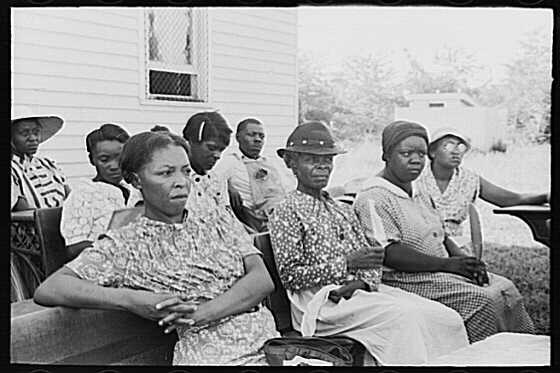 |
| Lee Russell, Audience at Farm Security Administration listening to a speech by a visiting public health official, La Forge, Missouri, 1938. Courtesy of the Library of Congress. |
Along with the discovery of the germ theory and other scientific knowledge, medical experts and eugenicists pathologized the African American body by linking race to susceptibility to certain diseases. Under the name of “public health,” ordinances and programs backed by these new “scientific” theories helped justify Jim Crow segregation and racial discrimination in the southern states. In particular, campaigns against tuberculosis and syphilis established a powerful model for eugenically-informed public health initiatives in the Deep South during the 1920s and 1930s. These prewar public health programs served to solidify the image of the black body as carrier of disease and agent of contamination, thereby instigating social fears about differential fertility and racial mixture between blacks and whites.26See, JoAnne Brown, “Purity and Danger in Color: Notes on Germ Theory and the Semantics of Segregation,” in Heredity and Infection: The History of Disease Transmission, ed. Jean-Paul Gaudillière and Ilana Löwy (New York: Routledge, 2003), 101-131; Tera W. Hunter, “Tuberculosis as the ‘Negro Servants’ Disease,’” chapter 9 in To ‘Joy My Freedom: Southern Black Women’s Lives and Labors after the Civil War (Cambridge, MA: Harvard University Press, 1997), 187-218; Paul A. Lombardo and Gregory M. Dorr, “Eugenics Medical Education, and the Public Health Service: Another Perspective on the Tuskegee Syphilis Experiment,” Bulletin of the History of Medicine 80 (2006): 291-316; Melbourne Tapper, “An ‘Anthropathology’ of the ‘American Negro’: Anthropology, Genetics, and the New Racial Science, 1940-1952,” Social History of Medicine 10 (1997): 263-289.
If universities and research institutes in the northeast were the epicenter of knowledge production, the southern and western states were the testing grounds to apply these “scientific” theories. The eugenics and disease eradication campaigns in the US South and West were also informed by colonial experiences in tropical medicine and disease control abroad, namely the Philippines, Cuba, Puerto Rico, Hawaii, and the Panama Canal. In many ways, the southern states followed the Californian example, as white leaders of both regions shared the racial anxieties about job competition as well as miscegenation. The delayed introduction of public health services in the southern states, particularly those targeting African Americans, meant that most of the eugenic programs in the South were not as organized and institutionalized as their Californian counterparts. It was after most other states in the United States had abandoned these discriminatory programs after World War II that the southern states rigorously adopted eugenic programs of disease and population control that disproportionally targeted African Americans.27Alexandra Minna Stern, Eugenic Nation: Faults and Frontiers of Better Breeding in Modern America (Berkeley: University of California Press, 2005), 5-7, 21; Edward J. Larson, Sex, Race, and Science: Eugenics in the Deep South (Baltimore: Johns Hopkins University Press, 1995), 32-34; John Ettling, The Germ of Laziness: Rockefeller Philanthropy and Public Health in the New South (Cambridge, MA: Harvard University Press, 1981), 29-30, 125, 187.
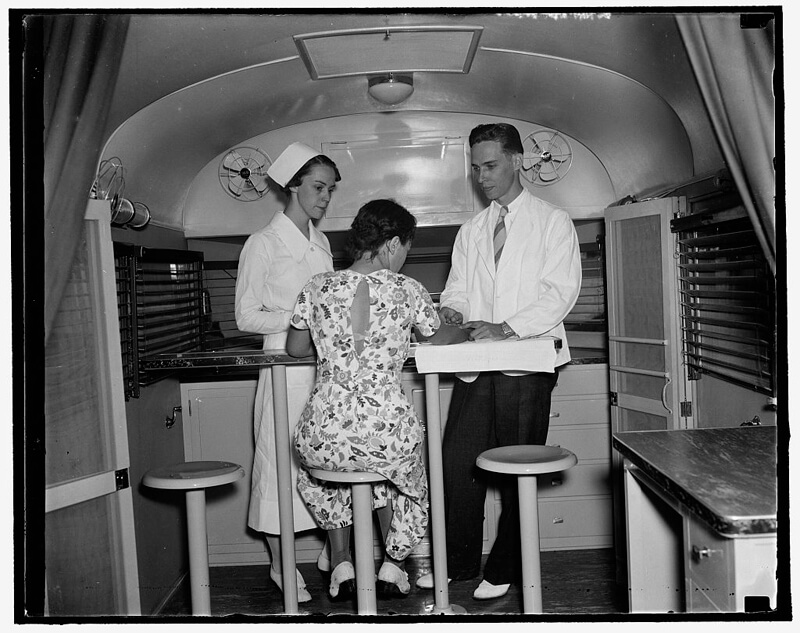 |
| Harris and Ewing, Travelling syphilis laboratory, Washington, DC, 1937. Courtesy of the Library of Congress. |
The development of public health programs in the South remained rudimentary until the first half of the twentieth century. Early endeavors, such as the Rockefeller Sanitary Commission for the Eradication of Hookworm Disease (1909–1914), failed to actually eradicate diseases, although they did stimulate a “public-health awakening” in the South.28After the Rockefeller Sanitary Commission closed down, the International Health Board took over its role. For the Rockefeller Foundation’s public health projects in the South, see John Ettling, The Germ of Laziness; John Farley, To Cast Out Disease: A History of the International Health Division of the Rockefeller Foundation (1913-1951) (Oxford: Oxford University Press, 2004). Linda Gordon argues that the absence of large Catholic constituencies combined with racism accounted for the pioneering roles of southern states in birth control services despite the general lag of other social-service programs.29Gordon, 330. Nonetheless, before the nationwide anti-poverty campaigns of the 1960s, public health services for African Americans were severely limited as funds were scarce and the primary concern for most southerners was to uplift poor whites.30Larson, 93; Schoen, 44. The targets of prewar eugenics/birth control programs, including sterilization, were mainly white immigrant women, with the purpose of protecting white female sexuality and motherhood. See, Wendy Kline, Building a Better Race: Gender, Sexuality, and Eugenics from the Turn of the Century to the Baby Boom (Berkeley: University of California Press, 2001), 59. Most health officials did not dare to dabble in the controversial subject of birth control and found it unnecessary to provide any services to African Americans. White professionals who sponsored birth control services for blacks repeatedly changed their minds and terminated financial support without any continuous follow-up programs. Gamble and Cooper’s programs failed to consistently provide contraceptive advice to poor women and to measure the effectiveness of contraceptive methods offered. Although North Carolina established clinics in more than sixty counties over three years, after Gamble ended his financial support in 1940 many county health officials struggled to secure funds to continue the program.31Williams, 146-148; Schoen, 60.
The development of birth control programs and other public health endeavors in the Deep South before the war had powerful effects even if they were not implemented immediately. The scientific rhetoric supporting racial boundaries and social hierarchies, regardless of the actual etiology or statistical data, influenced many other programs beyond national borders and changes in social and political contexts. What Koya observed in the US South included these sporadic birth control programs targeting African Americans. Oblivious to the fact that blacks were underserved in public health programs, Koya would reach an opposite conclusion about the white officials’ treatment of blacks—that they had “thoroughly taken good care of” this population—based on a trip to the South carefully arranged by the US government.32Tengoku, 88.
Louisiana – Mississippi: An "Exhibition of Races"
As a governmental researcher during the war, Koya wrote prolifically on race relations between the Japanese and neighboring ethnic groups in the Japanese-led empire, the so-called Greater East Asia Co-Prosperity Sphere (Dai Tōa Kyōeiken).33His major publications include: Minzoku Seibutsugaku (Race Biology) (Tokyo: Kōyō Shoin, 1938); Kokudo, Jinkō, Ketsueki (National Land, Population, and Blood) (Tokyo: Asahi Shinbunsha, 1941); Tōa Shokuryō Seisaku (Food Policies in East Asia) (Tokyo: Shūkan Sangyōsha, 1941); Kindaisen to Tairyoku, Jinkō (Modern Wars, Stamina, and Population) (Tokyo: Sōgensha, 1944); Nihon Minzoku Konseishi (A Comprehensive Study of the Japanese Race) (Tokyo: Nisshin Shoin, 1944). To back up the wartime government’s pronatalist position, Koya insisted that the Japanese needed to increase their population in order to effectively rule their Korean colony.34Koya, Kindaisen to Tairyoku, Jinko, 188. He warned that the birth rate of Japanese women in Korea was “far below” that of local women and reiterated the common eugenic argument that “lower” races typically outnumbered the “advanced” ones, as the latter adopted modern practices of birth control. Koya argued that a misguided interpretation of Western individualism and liberalism had led the Japanese to a “hedonistic” lifestyle, in which personal pleasure took precedence over their social duty to produce future citizens. To illustrate this point, one of his studies showed that the birth rate of Japanese in Korea declined upon emigration as a result of their elevated status as colonizers and increased material wealth.35Koya, “Zaijū Yonjūnenkan no Naichi Nihonjin Hanshokuryoku” (Fertility of Japanese Migrants after Forty Years) in Minzoku Kagaku Kenkyu (Race Science Review) vol. 1, ed. Haruo Hayashi and Yoshio Koya (Tokyo: Asakura Shoten, 1943), 183-184; Koya et. al., “Chōsen ni Okeru Naichijin Ijūsha oyobi Chōsenjin no Shusseiryoku ni tsuite” (The Fertility of Japanese Migrants to Korea and the Fertility of Koreans), 201-202. Koya also expressed concern about the flow of Koreans as laborers into mainland Japan and its effect on the survival of the Japanese race. Considering the problem of wartime labor shortages, Koya insisted that foreign laborers should be introduced with caution, after “elevating” the cultural practice and living standards of these foreigners to a level similar to those of the Japanese.36Koya, Kokudo, Jinkō, Ketsueki, 131.
In addition to differential birth rates, the prospects of racial mixture between the Japanese and other Asian ethnic groups worried Koya and eugenicists in the Ministry of Health and Welfare during the war. Because of their warnings about the harmful effects of race crossing, the colonial government’s assimilation policy in Asia remained largely ineffective in practice. These scholars considered the Japanese to be a distinct race—separate from other Asian races—despite its “hybrid” origin. Koya's beliefs represented typical thought among Japanese intellectuals concerning race, in which they simultaneously affirmed and ignored the dynamic process of racial formation. Even as they conceded that different ethnic groups contributed to the original formation of the “Japanese race,” they either dismissed or rejected further racial mixture once the Japanese had achieved a “superior patriarchal race.”
This was a convenient ideology to support the idea of Japan’s inherent leadership role in the Greater East Asia Co-Prosperity Sphere. “Even though we love the peninsular Japanese [i.e. Koreans] as brothers,” Koya recommended, “Japanese intermarriage with Koreans should proceed gradually,” accompanied with deliberate research on the long-term effects of intermixture. He insisted that some Asians with strong “assimilating power,” such as the Chinese Kan race, should be avoided altogether.37Koya, Kokudo, 179-182; Minzoku Seibutsugaku, 71. For more on the Japanese scholars’ ideas on “race” during the war, see Yuehtsen Juliette Chung, Struggle for National Survival: Eugenics in Sino-Japanese Contexts, 1896-1945 (New York: Routledge, 2002), 147-152; Atsushi Nobayashi, “Physical Anthropology in Wartime Japan,” Wartime Japanese Anthropology in Asia and the Pacific, ed. Akitoshi Shimizu and Jan van Bremen (Osaka: National Museum of Ethnology, 2003), 146-147; Eiji Oguma, A Genealogy of ‘Japanese’ Self-Images, trans. David Askew (Melbourne: Trans Pacific Press, 2002), 203-236.; Cullen Tadao Hayashida, “Identity, Race, and the Blood Ideology of Japan,” PhD dissertation (University of Washington, 1976), 24-29.
Through his wartime investigation into the relationship between the core “Japanese race” and other Asians in a multi-ethnic Japanese empire, Koya was keen to learn how another multi-racial country, the United States, handled its differential birth rates between races and interracial mixture. Koya struggled between the official ideal of brotherhood with other Asian groups and the emotional repulsion toward living with them. Aware of racial discrimination toward blacks in the United States, he wondered how white Americans were still able to maintain an ideal of "democracy."
Koya first encountered the living experience of race relations in New Orleans, where he changed trains on his way to Mississippi. As his guide gave him a quick tour across town, he immediately noticed the strict residential segregation. The group first walked through the “Creole district,” where he saw many people with “typical Mediterranean features.” Then, gradually as they exited the area, he saw more “northern European types” with blond hair and blue eyes. It was not until Koya got on the bus and crossed the outskirts of the city that he came across a black residential area. Once the group came back to the city center, they went to a Mardi Gras parade. More than the parade itself, Koya was keen to observe the racial composition of the performers. He noticed many “Latin types” with dark skin, and a fewer number of “northern European types.” What struck him was that, according to his observation, there were very few performers who appeared to be a mix of both types. The city of New Orleans, which seemed to him “like an exhibition of races,” showed him the intolerance of people against the “mixture of different blood” even as they lived side by side. His impression of race relations there conformed to his wartime recommendation against intermarriage between the Japanese and the Koreans.38Kōgakukyū, 118-120.
Arriving at his first major destination, Jackson, Mississippi, Koya probed further into race relations. He spent the first week in the reference room of the city hall studying demographic material and statistics, particularly those that concerned the black population. The data indicating the gap in birth rates between blacks and whites captured his attention. Koya wondered, “What is the US government’s response to this problem?” He found his answer in the budgetary records, in which an “unusually high budget,” according to his judgment, was allocated to housing and public health projects. Because African Americans lived in poor, rural areas which required social development and the improvement of health services, he assumed, the state must have created this “large budget” to deal with the “black problem” of population growth.39Kōgakukyū, 124-125. Koya's was fallacious reasoning, as the US government spared minimal money for public health and welfare services for African Americans before the 1960s.
Koya built upon his assumption through his experience in the “field.” He spent a week researching health and sanitation services by following white public health nurses visiting black communities surrounding Hattiesburg, Mississippi, a booming small city near Jackson. Koya was impressed by the subtle way in which the nurses offered guidance on family planning to black mothers without evoking the larger population question. After general health instruction, a nurse would ask “How many children do you have?” “Are your children all in healthy condition?” “Are they going to school?”—all of which led to: “Do you want more children?” If the mother answered in the negative, the nurse would promptly schedule an appointment at the health center, telling the mother that she would receive free contraceptives.40Kōgakukyū, 124-126.
In one memorable moment at the clinic in Hattiesburg, Koya saw a black mother in the waiting room with a white baby. The woman was breastfeeding the baby, which suggested to him that the child was biologically hers. Surprised by the scene, he talked about it to the director of the clinic. The doctor answered uncomfortably, “I don’t know how that happened, either. But I see these things sometimes in this area.” “But even more disturbing,” he added, “is the opposite case: when a white lady bears a black child. That indeed is a big problem, and can cause a lot of tragedy.”41Tengoku, 91-92; Kōgakukyū, 129. While Koya believed that these stories of race crossing were rare, he perceived the emotional aversion among whites to biologically mixing with blacks. He recalled the words of a white scholar he respected [name unknown]: “We can tolerate intermarriage with American Indians, but we cannot stomach the idea of marrying a Negro. Every white person would choose to marry an enemy, rather than a slave.”42Tengoku, 93; Kōgakukyū, 130-131. This experience confirmed Koya’s impression that birth control programs in the South were partly driven by eugenic concerns among whites about interracial mixture with blacks.
Koya explained that white efforts to control the black population were also linked to pressing economic problems, including job competition between the races. During his research in Mississippi, he came across information on black migration presented by Thomas Jackson Woofter, a scholar on race relations in the South.43Thomas Jackson Woofter was the author of numerous books on the “Negro problem,” including: Negro Migration: Changes in Rural Organization and Population of the Cotton Belt (New York: W. D. Gray, 1920); Negro Problems in Cities: A Study (New York: Negro Universities Press, 1928); The Basis of Racial Adjustment (Boston: Gunn and Co., 1925). Woofter's work showed that the percentage of black farmers in the southern “cotton belt” had decreased from 71.3 % in 1860 to 39.7 % in 1930, while the number of cotton farmers increased from around a million to more than two million. This was not an indication of the net decrease of black population, but instead suggested the large-scale black migration to the North and West.
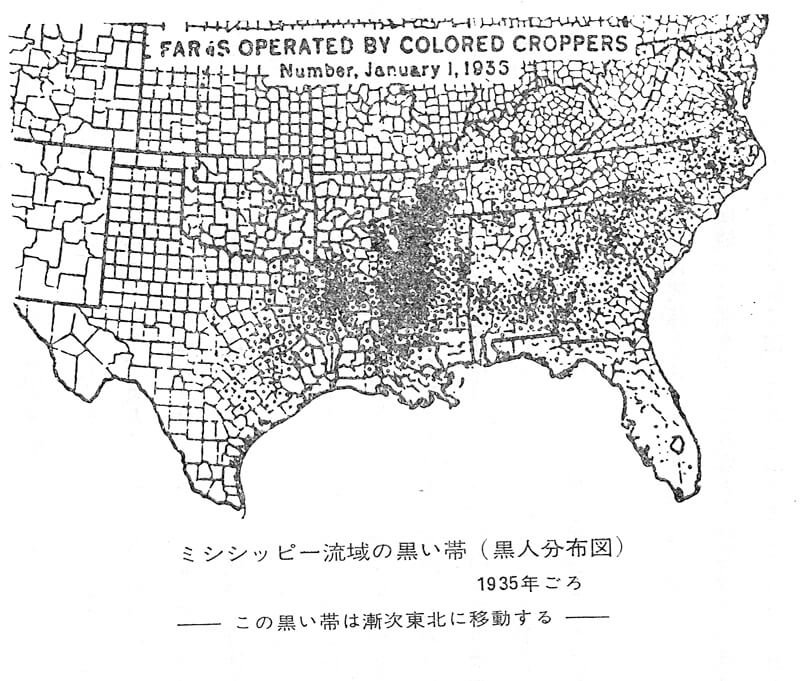 |
| Yoshio Koya, A map of the "Black Belt" around the Mississippi River basin (1935), Tengoku Amerika, Jigoku Amerika, 95. |
To visualize the “threat” of black migration, Koya carried a map of the “Black Belt,” indicated by a concentration of “black dots”—representing the black population—in the Mississippi Delta region. He added a comment to the map that the “Black Belt” was gradually moving northward every year. Koya also found from Woofter’s study that many of the blacks who stayed in the South had shifted job types, indicated by the decrease of day laborers (29%) and the increase of black sharecroppers (58%) and landholders (13%). “All of these black landowners and sharecroppers are descendents of slaves,” Koya wrote, then mistakenly added, “while the ancestors of the present-day white sharecroppers and day laborers were slave owners.”44Kōgakukyū, 126-128; Tengoku, 93-94. Koya used these numbers to support his supposition about the pressing need for white Americans to control the fertility of blacks.
Through his experience and research, Koya detected the fundamental dilemma motivating birth control initiatives in the United States—between an ideal of democracy versus the reality of racial discrimination. Behind any ideal of a “color-blind” society, Koya had perceived the “strong objection among whites to mixture of different blood,” which he justified as a natural biological reaction.45Kōgakukyū, 128-130. White efforts to control the growing black population, he concluded, were a reflection of their negative emotions about living in close physical contact with African Americans.
Mississippi – Tennessee – Kentucky: American Democracy and the Southern Pioneers
Koya was not critical about white US leaders’ attitudes toward black citizens. On the contrary, he was impressed by their “democratic spirit” that led them to provide various public health services and education to this poorest part of the population despite their discriminatory feelings. He was surprised to find that the death rate of blacks in Mississippi (9.1% in 1946), a state known for its low living standards was still below that of Japan (11.9% in 1949). Koya believed that the relatively low death rate was a reflection of the southern states’ efforts in public health. He praised white southerners for taking good care of blacks, even defending them against the criticism from northern liberals about racial segregation in the South. He argued that black population growth occurred by and large as a result of white efforts’ to improve the living standards of blacks.46There is a striking similarity between Koya’s thinking and the logic of US population control advocates in Asia, who claimed that their earlier public health endeavors to reduce death rates there “were contributing to the creation of this population problem.” See, for example, statement by Marshall C. Balfour in National Academy of Sciences, “Conference on Population Problems.”He thought the southern states had gracefully handled the population problem by educating blacks about family planning and providing them with modern contraceptive methods. He concluded that the resulting birth rate of blacks in Mississippi (28.2% in 1946) was lower than that of the Japanese (33.9% in 1949).47Tengoku, 87-89. What Koya did not mention, however, was that the birth rate in Japan in 1946 was actually 23.6%, lower than the number he cited for blacks in Mississippi the same year, and that the numbers were already starting to fall after peaking at 34.6% in 1947.
Koya further speculated that the generosity of white Americans was reflected in the “happy and complacent” attitude that he perceived in the lives of blacks. He believed that blacks were innately “a racial group content to live an easy life despite their poverty.” Of course there were exceptions, he noted, but those blacks had moved to the North or the West, some of them even becoming professionals. He felt that the majority of blacks who stayed in the South were enjoying “a very primitive life” that many of those living a modern life had lost in the process of civilization. As he crossed the cotton fields and wheat fields, he saw many small shacks lived in by blacks. “Even though they know they could live in better houses if they worked harder,” Koya commented, “it seems that they do not find it worth the trouble.”48Tengoku, 94-96. As part of his research on “race biology” during the war years, Koya had investigated the scientific studies on race by Western eugenicists, including the notorious American Charles Davenport.49Minzoku Seibutsugaku, 73; Kokudo, 137-138. In accepting racist and biologically-determinist theories about the “nature” of African Americans, Koya concluded that white Americans provided the black population with more than they actually desired. He contended that it was their own choice, not the perpetuation of social injustice, that accounted for their low status.
Koya’s identification with white American leaders is evident in the images carried during his travel accounts. Most of them were distant, bird’s-eye views of cities and buildings, illustrating American modernity and orderliness: a photograph of downtown New Orleans and his drawing of downtown Jackson.
 |  |
| Yoshio Koya, Photograph of the Mississippi River and New Orleans, in Tengoku Amerika, Jigoku Amerika, 68. | Yoshio Koya, Drawing of Downtown Jackson, Mississippi, in Tengoku Amerika, Jigoku Amerika, 82. |
Koya’s drawing of a Mardi Gras parade in New Orleans showed the event and the crowd from a window of a building. Despite his description of the diversity of races in the parade, he reduced the people in the picture to indistinguishable dots.The only image with “real” people that Koya carried was a photograph taken at a Kiwanis Club gathering among white local elites in Los Angeles, before heading to the southern states.
 |  |
| Yoshio Koya, Jackson, State Capitol Building, in Tengoku Amerika, Jigoku Amerika, 85. | Yoshio Koya, Carnival parade in New Orleans, in Tengoku Amerika, Jigoku Amerika, 72-73. |
These illustrations and photographs together indicate Koya’s own relationship to US society and his approach to social issues as a public health leader; he represented a view of a national leader interested in bringing order and modernity to society. While Koya confessed that the uniformity of the buildings’ architecture was confusing—and even boring—for a traveler, because it made all the cities he visited appear the same, he certainly saw it as a measurement of modernity and progress. When one of his hosts took Koya in front of the building where the state’s health department was located, the host proudly asked him, “Isn’t this a magnificent building? Does Japan have anything like this?” Koya was surprised by the man’s “ignorance about [the progress of] Japan.” In other words, he felt pride that the state of Japanese science and technology was not as backward as Americans assumed, if not more advanced than the level of the United States at the time.50Tengoku, 84-85.
 |
| Photographer unknown, Kiwanis Club meeting in Sun Valley, Los Angeles, in Tengoku Amerika, Jigoku Amerika, 59. |
The images suggest how Koya's top-down approach to social problems reduced ordinary citizens to indistinguishable “subjects” and data. Despite spending weeks in rural Mississippi, Koya provides few details of his experience among the black population, except for his descriptions of public health activities in Hattiesburg. There are no descriptions of any interactions with blacks; he seems to have merely observed them from a distance and interpreted them from the perspectives of white officials and scholars. Most of his observations came from the window of a vehicle that carried him between his primary white destinations.
Koya’s description of his rural experience was devoted almost exclusively to his admiration for the hospitality and generosity of his white hosts. He excitedly imagined himself among a modern-day version of rustic life in the “frontiers.” As a Christian, he was deeply impressed by their professions of democracy and Christian love. He found that his main destination, Mississippi—whose capital Jackson was named for Andrew Jackson—was an ideal place to learn this “American spirit.”51Kōgakukyū, 122. The rural America he saw with yearning eyes was not that of of blacks or poor whites; it was his own imaginary world inhabited by wealthy white southerners.
One major character portrayed quite sympathetically in Koya's accounts was the old director of the health center in Hattiesburg, referred to as “Mr. Blackwelder” and described as a man with “fortitude and a beautiful personality—unique qualities of the descendents of the southern frontier people.” Koya stayed at Blackwelder’s place for a week while he visited black communities in the area. One day, as they rested in a field, Blackwelder told Koya: “I have been doing this for thirty years. I know I’d be able to earn a lot of money if I quit this job and start my own practice. But I cannot do that because I realize how important my work at the health center is for our community.” When he examined a skinny white boy at a local school, Blackwelder joked, “We should take good care of him, too. You never know; he might become our future president.”52Tengoku, 97-99.
Koya was also moved by the “frontier spirit” in Tennessee and Kentucky. The opportunity to visit these states came unexpectedly when he had trouble finding a hotel room for the last few nights in Jackson. After returning from rural sites in Mississippi, Koya found the hotel fully booked. He decided to take a short trip to Nashville to see an acquaintance, Robert Nail, a church elder and school principal. Nail took Koya to his hometown of Allensville in Kentucky, where his family welcomed the special guest from Japan. Koya felt “at home” sharing this visit with his friend's family, landowners, whom he compared to “the wealthy farmers in Tsarist Russia that [he] often read in novels.” Such families, Koya wrote, represented the “backbone of America.”53Tengoku, 104-112, 131; Kōgakukyū,141.
In Nashville Koya recalled an incident in which he felt racial hatred directed toward the Japanese. Randomly entering a movie theater, he saw a Japanese soldier on the screen in a movie about World War II. The soldier was torturing an American POW. Koya was shocked, writing, “The American viewers must imagine the Japanese to be such a violent race.” He had left the theater and was wandering aimlessly in the dark when a man came up and asked whether he was Japanese. The man told him that he had been in Okinawa during the war and that he was happy to see a Japanese person again.54Kōgakukyū, 134-5. Koya believed that while the war had created negative images between Japanese and Westerners, Japan's leaders had been treated with respect. As the historian Yukiko Koshiro observes, many postwar Japanese leaders entertained the idea of Japanese as “honorary whites”—racially Asian, but culturally closer to Westerners.55Yukiko Koshiro, Trans-Pacific Racisms and the U.S. Occupation of Japan (New York: Columbia University Press, 1999). The remainder of Koya's southern journey further confirms his identification with white leaders, especially those in state offices and universities.
Georgia – North Carolina: State Initiatives in Public Health
Koya passed a week in Atlanta, Georgia, attending seminars at the Communicable Disease Center (CDC, now the Centers for Disease Control and Prevention) of the US Public Health Service.56The CDC was originally founded in 1942 as the Office of National Defense Malaria Control Activities. Atlanta was chosen as the location because malaria was considered endemic in the US South. The organization was renamed as “Communicable Disease Center” in 1946, and underwent several name changes before adopting its present title “Centers for Disease Control and Prevention” in 1992. The CDC now operates under the Public Health Service of the Department of Health and Human Services. While the topics of the lectures, such as pest control and cancer prevention campaigns, did not directly relate to his expertise, Koya was keen to learn about the organization and operation of state public health services. He was impressed by the CDC’s goal of “applying new scientific technologies and information to governmental services.”57Tengoku, 115; Kōgakukyū, 146-147. While much of Koya’s wartime research on how to improve Japanese racial fitness did not go beyond desk theory, in the postwar period, with the help of the US Occupation officials and other birth control supporters, he would immediately apply the “new technologies” of contraception to field trials and programs. Koya appreciated the efficiency and practicality of these US governmental services.
In North Carolina, his final destination in the South, Koya talked with scholars and officials specializing in population studies and public health. In Chapel Hill, Koya met with Harold J. Magnuson, a scientist famous for his syphilis experiments. Rupert B. Vance, regional geographer and authority on population demography, happened to be out of office during Koya’s visit. In Raleigh, Koya visited George Cooper, who with the help of Clarence Gamble, had incorporated an emphasis on black population control into the state’s public health services. Over the age of seventy, he was still working at the state’s public health department. Koya was excited to have an in-depth conversation about how to launch birth control programs in Japan. The two doctors talked about the training courses for medical professionals on contraception offered at the Institute of Public Health (IPH) in Tokyo. Assuming that most women did not voluntarily visit clinics for birth control instruction, Cooper advised that IPH initiatives should be followed by even more active measures such as deploying public health nurses as social case workers, a Gamble strategy. Cooper also suggested that Koya should—in the beginning--offer contraceptive devices and drugs for free. Koya was in complete agreement. Despite the inclusion of birth control instruction in the Eugenic Protection Law, few people—usually urban and educated—visited health clinics for birth control consultation in Japan; the most “needy” people in rural, working-class areas showed little interest.58Tengoku, 126-8; Kōgakukyū, 148-150. For Koya, these rural Japanese with high fertility rates corresponded to African Americans in the South.
Koya’s brief conversation with Cooper, whom he credited for “set[ting] up [his] mind about family planning,” had a crucial impact on population policies in postwar Japan.59Williams, 211. Koya would incorporate many of Cooper’s suggestions into legal reforms and birth control programs: specifically, the strategies of directly sending visiting nurses and providing easy and simple contraceptive devices for free to poor families. Cooper likewise counted on Koya to make these birth control reforms in Japan on a national level through official avenues, whereas in the United States, at least until the 1950s, birth control programs lacked uniformity, remained underfuned, and failed to expand beyond the South due to various political pressures and cultural opposition.
"Pioneering in Family Planning"
Koya wasted no time carrying out what he learned in the US South. While many Japanese leaders were alarmed at the growing population in a devastated postwar economy, there were others who continued to support the government’s wartime pronatalist position, which equated national power (military) to population size (number of soldiers). SCAP’s position of “benevolent neutrality” on population issues further deterred the Japanese government from allocating any significant budget for birth control programs. Major US non-governmental organizations, such as the Rockefeller and the Ford Foundations, which later played vital roles in global population control, were hesitant to openly engage this controversial field.
Personal donations from Clarence Gamble first bankrolled Koya’s project. Gamble found the opportunity to extend his birth control cause to Japan in 1949 after his conversation with Frank W. Notestein, director of the Princeton University Office of Population Research. Notestein had headed the Rockefeller Foundation’s 1948 reconnaissance mission in Asia, starting with Japan, to assess population questions. Gamble contacted SCAP officials to find ways to finance birth control programs in Japan and was soon introduced to Koya.60Williams, 207, 211. Venturing into population control in Japan was a continuation of Gamble’s prewar activities in the US South, but (excepting Puerto Rico) it also represented his first project abroad.
In September 1950, with Gamble’s assistance, Koya started the “Three Village Study,” designating three model villages, where he offered free samples of different methods of contraception to find out which method was most effective and easiest to use. In late 1951 Koya assigned public health nurses and midwives to the role of case workers to disseminate birth control information and techniques in rural areas.61Y. Koya, “The New Population Phenomenon and Its Countermeasures: A Study of Three Rural Villages,” Japanese Medical Journal (Nov. 24, 1951). The Three Village Study became the most successful birth control program organized among a rural population before the advent and spread of more “modern” methods of contraception such as the IUD and the pill. Koya published his studies in academic journals in the United States and Japan, including the Milbank Memorial Quarterly and Eugenical News.62See for example, Koya, “The Program for Family Planning in Japan,” Eugenical News 38, n. 1 (March 1953): 1-3; “A Study of Induced Abortion in Japan and Its Significance,” The Milbank Memorial Fund Quarterly (MMFQ) 32, n. 3 (July 1954): 282-293; “A Survey of Health and Demographic Aspects of Reported Female Sterilization in Four Health Centers of Shizuoka Prefecture, Japan,” MMFQ 33, n. 4 (October 1955): 368-392; “Five-Year Experiments on Family Planning among Coal Miners in Joban, Japan,” Population Studies 13, n. 2 (November 1959): 157-163. With the support of the Population Council, he compiled and published his findings in 1963 as Pioneering in Family Planning: A Collection of Papers on the Family Planning Programs and Research Conducted in Japan.
The significance of Koya’s experiments among leaders in family planning was not measured only by the lowered number of births; what mattered most were the people his programs targeted. Koya’s work received favorable responses from US and British eugenicists and demographers, including C. P. Blacker, Irene Taeuber, and Dorothy Nortman.63Ironically, C. P. Blacker advocated for population policies in developing countries out of eugenic concerns about having “too many Asians, too many Arabs” in the world. He believed that the Western leaders in global population control needed to use a strategy he called “crypto-eugenics”—fulfilling the aims of eugenics without mentioning the word. Matthew James Connelly, Fetal Misconception: The Struggle to Control World Population (Cambridge, MA: Harvard University Press, 2008), 163. Nortman, in her review of Koya’s Pioneering in Family Planning, claimed that that his experiments proved that even “marginal people”—rural people, coal miner workers, and people on public relief—could be turned into “contraceptors” in a relatively short period of time through field trials of cheap, simple, and suitable methods of contraception. His results indicated that the “large masses of illiterate people” in the rest of Asia could “restore the balance between births and deaths before achieving Japan’s degree of literacy, economic development, urbanization, and modernization [emphasis added].”64Dorothy Nortman, introductory review to Koya, Pioneering in Family Planning: A Collection of Papers on the Family Planning Programs and Research Conducted in Japan (Tokyo: Japan Medical Publishers, 1963). Before the war, most demographers agreed that birth rates would naturally decline after transitioning from a predominantly agricultural state to an industrialized, urban society. Faced with the “urgency” of overpopulation in Asia, however, Western demographers revised this “transition theory” by arguing that state-sponsored, top-down birth control programs could bring about a rapid decline in birth rates without awaiting the long and tedious process of industrialization. See Simon Szreter, “The Idea of Demographic Transition and the Study of Fertility Change: A Critical Intellectual History,” Population and Development Review 19, no. 4 (1993): 659-701. Nortman’s comments represented the general approach of US leaders to global population control in Third World countries in the decades that followed: education, economic development, and the promotion of health were all secondary to the perceived urgency to bring down birth rates by disseminating cheap and easy contraceptives. The same eugenic and economic concerns that Koya perceived among white leaders in the South also motivated the US-led population programs abroad. Koya’s travel accounts reveal the hypocrisy and racism behind birth control programs in the US South, programs expressive of eugenic ideology that he reproduced in Japan.
Conclusion
Population control in Japan in the early post-World War II years, represented by Yoshio Koya’s activities, served as a testing ground for mass-scale, state-sponsored programs initiated by the United States in Third World countries in the following decades. Japan’s seeming success in bringing down birth rates and achieving peaceful recovery after the war helped establish the efficacy of such programs. The publicity about “successful” population control projects abroad, in turn, brought renewed attention to birth control programs in the US South. In 1960, Charlotte, North Carolina inaugurated its birth control program under the state’s public welfare department; similar experiments followed across the country, but especially in the South, as part of the national “War on Poverty” campaign.65For description of successful federal-funded contraceptive programs in North Carolina and Louisiana led by social welfare agents and health officials, see Schoen, 63-70; Thomas Littlewood, The Politics of Population Control (Notre Dame, IN.: University of Notre Dame Press, 1977), 88-106. The increased funding expanded poor women’s access to birth control services, but at the same time increased the potential for abuse and coercion. Some health officials took advantage of new funding sources and used them to test new, but often unapproved and dangerous, contraceptive devices. By focusing on battling poverty, birth control projects diverted public attention from issues of women’s health and rights.66Sterilization abuses occurred in the 1970s and 1980s in many southern states, including Mississippi and North Carolina. The governors of Virginia, Oregon, North Carolina, South Carolina, and California expressed public apologies to these abuses in 2002-2003. Semi-coercive birth control programs for racial minorities and the poor through public relief and welfare continued in this region in the 1990s, as evidenced by the marketing of new contraceptive hormones for temporary sterilization such as Norplant and Depo-Provera. See Larson, 119-169; Schoen, 75-138; Littlewood, 79-132; Nancy Ordover, American Eugenics: Race, Queer Anatomy, and the Science of Nationalism (Minneapolis: University of Minnesota Press, 2003), 179-194.
Through its focus on Yoshio Koya, this essay has traced some of the ideological roots of these global population control projects—which neglected the needs and concerns of actual women—to public health programs in the US southern states. Public officials, foundation executives, and birth control advocates frequently shared a eugenic logic that resulted in the transplanting of birth control experiments in the rural South to national- and international-scale population control projects in Japan and elsewhere. By testing the techniques and strategies of birth control abroad as a form of development aid, US advocates of birth control and population control were able to evade the moral and political opposition at home. The consequent development of birth control methods and expansion of funding brought reproductive freedom to many, but often at the expense of the reproductive rights of others, especially economically and racially marginalized women.
]]>Introduction
On a Saturday evening in February 2003, more than four hundred indigenous people from the Guatemala highlands gathered in the assembly hall of the Cherokee County middle school in north Georgia to celebrate the feast day of Santa Eulalia.1We carried out research, location shooting, and interviewing for this project from 1999 to 2004 in northeast Georgia and in Huehuetenango, Guatemala, in the town of Santa Eulalia. The research included interviews, participant observation, and archival research in both Georgia and Guatemala. Santa Eulalia is the patron saint of a town by the same name in the department of Huehuetenango where many of the Q’anjobal Maya immigrants living in north Georgia come from. In addition to Q’anjobales from Huehuetenango, the crowd included Maya from different regions of Guatemala who spoke Mam, Quiché, and Chuj, as well as Mexican immigrants and several Americans who were invited to the event. Marimba musicians played familiar songs on two marimbas that had been imported from Guatemala. Many of the women wore cortes and huipuils, the typical dress for women in highland villages, and in a special ceremony, a new Maya princess was crowned and greeted by the crowd.
This Maya Catholic celebration was an unusual sight in Cherokee County, a predominantly white, Protestant locale about fifty miles north of the city of Atlanta. The Maya first began settling in north Georgia in the 1990s.They arrived along with Mexican and other Latin American immigrants to work in construction and poultry-processing, two thriving industries in the region seeking low-wage labor. Most of the early migrants were teenage and adult men who left crowded job markets in California. As word spread about job opportunities in Georgia, they were soon joined by Maya men arriving directly from Guatemala. And while men still make up the majority of Maya migrants, a growing number of women and children have joined husbands, fathers, and brothers in Georgia, resulting in a noticeable Maya presence in local neighborhoods, schools, and churches. The large celebration in honor of Santa Eulalia in 2003 reflected the shift from a temporary population of male workers to a more permanent Maya community in north Georgia.
This multi-media project explores the history of Maya migration to the US South by focusing on the journeys of two migrant families from Santa Eulalia who became part of the Maya community in north Georgia. Through the stories of Maria and Antonio, Alfredo and Juana, we explore the conditions that led to the mass migration of the Maya, their struggles to adapt to life and work in the modern US South, and the impact of their migration on families and communities back home. We situate their journeys within the political turmoil of late twentieth century Guatemala and the social and economic developments that shaped their lives in the contemporary US South.
Antonio and Maria were among the initial wave of Maya migrants to the United States who left Guatemala in the late 1980s during the violent Civil War years.2In the essay and video we have used only the first names of immigrants and their family members. They arrived in north Georgia with their four children in 1999 after having lived for ten years in Los Angeles. Better job prospects and safer, less crowded neighborhoods drew them to Georgia. Both found work in poultry-processing factories and they enrolled their children in the local public schools. As they did in Los Angeles, the couple became part of a Maya Catholic group that met weekly and organized social and religious events, such as the Santa Eulalia celebration.3Interviews with Antonio (2001, 2002, 2003) and Maria (2003).
Alfredo, Antonio’s nephew, headed for the United States a decade later; the violence had subsided in Guatemala, but the economic and social marginalization of the Maya in the country continued. His wife, Juana, remained in Santa Eulalia with their young daughter and her in-laws while Alfredo searched for work in the United States. Their struggle to maintain marital and familial ties across national borders reflects the predicament of many Maya migrants who either by choice or necessity leave spouses, children, parents, and siblings in Guatemala.
Maya migration to the United States is not a simple story of leaving one country for good and settling in another. As Maya migrants like Antonio, Maria, and Alfredo formed new households, work, and social arrangements in the United States, they also maintained important links with family and community members back in Guatemala. They communicated with parents, wives, children, and siblings through phone and audio- and video-taped messages and sent wages earned in southern workplaces to support families, construct homes, and finance community projects in their hometowns in Guatemala. As they struggled to provide a better future for themselves and their families, Maya migrants forged transnational social and economic ties that connected indigenous hometowns in Guatemala with their new places of settlement in the US South. The text and video that follow explore the hopes and dreams they carried and the challenges, hardships, and accomplishments they experienced in their migration journeys.
Maya Migration to the United States
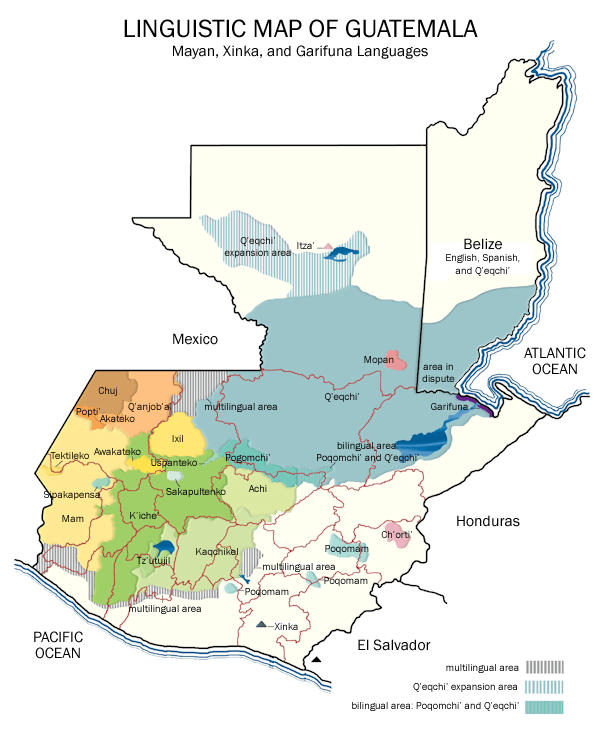 |
| Linguistic map of Guatemala, 2011. |
The Maya of north Georgia are part of the large and diverse wave of immigration from Latin America that has transformed the social, cultural, and economic landscape of the US South since the late 1980s. Mexicans make up approximately 60 percent of the Latino population in the South; Central Americans comprise the next largest group, followed by South Americans from Peru, Venezuela, and Columbia.4Mary E. Odem and Elaine Lacy, Latino Immigration and the Transformation of the U.S. South (Athens: University of Georgia Press, 2009): ix-xxvii. The Maya occupy a distinct position within the population of Latin American immigrants. With over four million people in Guatemala and Mexico, they form one of the largest indigenous groups in the Americas. Although exact figures are not known, it is estimated that as many as 500,000 Maya have migrated to the United States. Most come from poor rural towns and villages in the western highlands of Guatemala where they speak one of more than twenty different Maya languages, and families support themselves as small farmers, rural laborers, or market vendors. Meager farm incomes are often supplemented with wages earned as laborers on coffee plantations. The Maya population in the United States also includes a smaller number of high school and college-educated immigrants who worked as teachers, journalists, and in other professional fields in Guatemala.5Allan F. Burns, Maya in Exile: Guatemalans in Florida (Philadelphia: Temple University Press, 1993); Leon Fink, The Maya of Morganton: Work and Community in the Nuevo New South (Chapel Hill: University of North Carolina Press, 2003); Jacqueline Hagan, Deciding to be Legal: A Maya Community in Houston (Philadelphia: Temple University Press, 1994); James Loucky and Marily M. Moors, The Maya Diaspora: Guatemalan Roots, New American Lives (Philadelphia: Temple University Press, 2000); Cecilia Menjivar, "Liminal Legality: Salvadoran and Guatemalan Immigrants' Lives in the United States," American Journal of Sociology, 111(2006): 999-1037.
The Maya make up approximately 60 percent of the Guatemala population of fourteen million. Centuries of discrimination and exploitation of their land and labor, first by Spanish colonizers and later the Ladino elite, have left indigenous people impoverished and marginalized within their countries (those of mixed European and indigenous ancestry are called Ladinos). Pronouncements of Indian inferiority and backwardness by dominant groups have justified and reinforced the subordination of the Maya in Guatemala from the Spanish conquest to the present day.6Nancy M. Farriss, Maya Society under Colonial Rule: The Collective Enterprise of Survival (Princeton: Princeton University Press, 1986); Marilyn M. Moors, ed., Guatemala Indians and the State, 1540 to 1988 (Austin: University of Texas Press, 1990).
From the colonial era through most of the twentieth century, much of the Maya population lived in the Guatemala highlands where they formed close-knit communities organized in municipios or townships. The inhabitants of a municipio shared a common language and a distinct form of dress, customs, and religious practices. By the 1970s and 80s, however, numerous forces threatened the social bases of indigenous communities—overpopulation and land shortages, plantation demands for labor, the incursions of Catholic and evangelical missionaries, and political violence and repression by Ladino rulers of the country.7Douglas E. Britnall, Revolt Against the Dead: The Modernization of a Mayan Community in the Highlands of Guatemala (New York: Gordon and Breach, 1979); Carol Smith, “Class Position and Class Consciousness in an Indian Community” in Moors, Guatmala Indians and the State, 205-229; John M. Watanabe, Maya Saints and Souls in a Changing World (Austin: Univesity of Texas Press, 1992).
The civil war between military-dominated governments and left-wing guerilla groups was especially destructive to indigenous communities. In 1954, a violent coup supported by the Central Intelligence Agency and right-wing politicians overthrew the democratically elected government in Guatemala. The ensuing political unrest resulted in a military uprising in 1960 that marked the beginning of a thirty six-year civil war. The armed conflict grew especially violent in the 1980s as it spread deeper into rural, indigenous areas. Right-wing governments carried out campaigns of violent repression against labor unions, peasants, activist organizations, and indigenous communities; guerilla groups responded with acts of economic sabotage and strikes against the military.
With the support of US military aid and training, the Guatemala armed forces carried out assassinations of suspected militants and large-scale massacres in regions thought to support guerrilla forces. The political violence eventually resulted in the deaths of two hundred thousand mostly unarmed indigenous people and the destruction of more than four hundred Maya villages. Under General Rios Montt, military dictator in the early 1980s, the government established civilian defense patrols in indigenous areas that required the participation of adult men. Montt was quoted in a New York Times article, as telling an indigenous audience, “If you are with us, we will feed you; if not, we will kill you.” According to the investigations of two human rights commissions, the vast majority of human rights abuses—torture, assassinations, and forced disappearances—were carried out by the Guatemala military and the armed groups they controlled.8Beatriz Manz, Refugees of a Hidden War: The Aftermath of Counterinsurgency in Guatemala (Albany: State University of NY Press); Human Rights Office, Archdiocese of Guatemala, Guatemala Never Again! (Maryknoll, New York: Orbis Books, 1999); “Guatemala Peace Accords,” NACLA on the Americas (May/June 1997) http://www.hartford-hwp.com/archives/47/140.html.
The initial migration to the United States began during this period of armed conflict. At the height of the war, tens of thousands of Maya left villages in the highlands, some headed for Mexico and others for the United States. Even though they were fleeing political violence, most Guatemalans were not accorded refugee status by the US government, but instead were treated as economic migrants. Decisions regarding the status of Central American migrants during the 1980s were influenced more by US foreign policy and Cold War concerns than by the actual conditions Central Americans faced in their origin countries. Migrants from countries whose governments the Reagan administration opposed, such as the socialist Sandinista government in Nicaragua, were far more likely to be considered refugees than those fleeing governments supported by the United States, such as the right-wing military regimes in Guatemala and El Salvador. In 1991, the settlement from a national class-action suit charging bias in the asylum decision process paved the way for 250,000 Guatemalans and Salvadorans to reapply for asylum and many were able to legalize their status.9Susan Gzesh, “Central Americans and Asylum Policy during the Reagan Era,” Migration Policy Institute, Migration Information Source (April 2006) http://www.migrationpolicy.org/article/central-americans-and-asylum-policy-reagan-era/; Menjivar, “Liminal Legality”; James Smith,“Guatemala: Economic Migrants Replace Political Refugees” Migration Policy Institute, Migration Information Source (April 2006) http://www.migrationpolicy.org/article/guatemala-economic-migrants-replace-political-refugees/. This first wave of migrants from war-torn Guatemala initially settled in Los Angeles, Houston, and southern Florida, areas with long-standing Latin American populations.10Burns, Maya in Exile; Hagan, Deciding to be Legal; Loucky and Moors, The Maya Diaspora; Nancy Wellmeir, Ritual, Identity, and the Mayan Diaspora (New York: Garland Publishing, 1998). Antonio and Maria were among the thousands of Maya who left Guatemala during the political unrest and violence of the 1980s.
Born and raised in rural villages in Santa Eulalia, a municipio nestled high in the Cuchumatanes Mountains in the state of Huehuetenango, Antonio and Maria were a young married couple with an infant daughter when they made the difficult decision that he should leave the country. It was a time when Maya men in the highlands were being forced to serve on civilian defense patrols and threatened with violence or death if they refused to participate. Antonio left Santa Eulalia in 1988 and headed for Los Angeles, where his brother-in-law and a number of other townspeople already lived. His brother-in-law helped him find work in a garment factory and within the next one and one-half years, he had saved enough money to bring Maria and their daughter to the United States. Antonio and Maria spent the next eleven years working at various low wage jobs and caring for their growing family, which came to include three more children, two girls and a boy.11Interviews with Antonio (2001, 2002) and Maria (2003).
When the economy worsened in California in the 1990s and the competition for jobs increased, the couple decided to leave Los Angeles and seek better prospects elsewhere. They traveled to north Georgia where they had heard about job opportunities for immigrant workers. They joined many other Central American and Mexican immigrants who were leaving traditional destinations in California and Texas for new destinations in the United States. The Southeast became a strong magnet for Latino immigrants during this decade because of plentiful jobs for low-wage workers in the construction, food-processing, agriculture, and service industries. Immigrants were also attracted by the lower cost of housing and safer neighborhoods that the South seemed to offer.12Mary Odem, “Global Lives, Local Struggles: Latin American Immigration to Atlanta,” Southern Spaces, May 19, 2006, https://southernspaces.ecdsdev.org/2006/global-lives-local-struggles-latin-american-immigrants-atlanta; Odem and Lacy, Latino Immigration and the Transformation of the U.S. South.
A Second Wave of Migration
The 1996 Peace Accords ended the armed conflict between the Guatemala army and guerilla forces. However, economic devastation caused by the war and continued inequality in the aftermath of the war contributed to a second wave of Maya immigration to the United States. The Peace Accords brought about some important changes—demilitarization, creation of a civilian police force, and establishment of a human rights commission. A key part of the peace agreement addressed the rights of indigenous peoples, and reflected the influence of Maya activists and a growing pan-Maya movement in Guatemala. The movement has mounted a serious challenge to the centuries-long denigration of indigenous people and their culture in the country. Maya activists reject the plan of cultural assimilation implicit in the development strategy of the Guatemalan state as well as the left’s tendency to subsume ethnic and indigenous concerns within a rigid class analysis. Instead, they envision a radical transformation of the Guatemalan state into a multicultural nation that supports indigenous rights to self-determination and recognizes indigenous cultures and languages.13“Guatemala Peace Accords.”
While progress has been made in indigenous cultural rights, the Peace Accords and post-war governments did not tackle the pressing issue of land reform, and have ultimately done little to relieve the poverty and marginalization that most Maya experience in Guatemala. Economic globalization and neo-liberal policies have further threatened the livelihood of many small farmers and workers in Guatemala, and have contributed to large-scale migration to the United States. Working-age men and youth make up the vast majority of this migration, but the number of women and children migrants has increased steadily since 1990.14Smith, “Guatemala: Economic Migrants Replace Political Refugees.”
In the late 1990s, twenty-three year old Alfredo, the nephew of Antonio, joined the second wave of migration to the United States while his wife Juana remained in Guatemala with their young daughter. A generation younger than Maria and Antonio, Juana and Alfredo grew up in Santa Eulalia and were children during the most violent years of the Civil War. When they finished grammar school, they experienced both the benefits and hardships of the post-war period.
 |
| William Brown and Mary Odem, Alfredo and Juana on their wedding, Guatemala. |
The oldest son in a rural farm family of seven children, Alfredo decided as a young teenager that he could not make a living farming the family’s small plot of land as his father had done. The only hope for climbing out of poverty (for himself and his family), he believed, was to further his education, which meant leaving Santa Eulalia for Guatemala City. Educational opportunities were very limited for indigenous people in Guatemala, especially in rural areas. At the time, most Maya towns still had no schools beyond the elementary level. Migration to urban areas held the only possibility for secondary education for indigenous youth. With the aim of furthering his education, Alfredo left his home and family at fourteen years of age and headed for sprawling Guatemala City. With no financial help available from his family, Alfredo worked to support himself while pursuing his studies. After five years of a grueling schedule of work and study, he completed high school.15Interviews with Alfredo (2001, 2002).
While living in the capitol city, Alfredo met and fell in love with Juana, another Maya youth from Santa Eulalia who migrated to Guatemala City for more schooling. Her father, a teacher and leader of the Maya cultural movement, directed the Maya language institute in Santa Eulalia. As a result of the 1996 Peace Accords, similar language institutes were established in indigenous towns throughout the highlands. Juana was attending secretarial school in Guatemala City when she and Alfredo began dating and decided to marry. They married in Santa Eulalia in the presence of their parents and relatives, then returned to Guatemala City where Alfredo found a job and enrolled in a university course in computers. A year later Juana gave birth to their first child.16Interviews with Alfredo (2001) and Juana (2001).
The birth of their daughter caused Alfredo to carefully examine the prospects for both his new family and his parents and siblings in Santa Eulalia. As the oldest son, he was expected to provide for his parents in their old age and to help support his younger siblings. Even though he had a job, the economic prospects in Guatemala were gloomy, especially for indigenous people. With the low salaries, high unemployment, and rising inflation that existed in Guatemala, Alfredo realized he could not provide a home for his wife and daughter and contribute to the education of his siblings with his current wages. Once again, he contemplated migration, this time to the United States. Alfredo and Juana faced a painful dilemma: to secure a better future for their family, they had to endure years of separation. When Alfredo left for the United States, Juana moved back to Santa Eulalia with her daughter where they lived with Alfredo’s parents, as was the custom for the wives of departing migrants.17Interviews with Alfredo (2001, 2002) and Juana (2001).
In a process of chain migration, Alfredo headed to one of the places in the United States where relatives and acquaintances from Santa Eulalia had settled. He tried his luck first in Nebraska, where many Eulalenses worked in the meat-packing industry. Difficulty finding a job there led Alfredo to north Georgia, where he joined his uncle and aunt, Antonio and Maria. Alfredo moved into the home they shared with their children and two other young men from Santa Eulalia. With the help of his uncle, Alfredo found work first in the landscaping business mowing lawns, and then in construction where he learned to install electrical wiring in new suburban homes.18Interviews with Alfredo (2001, 2002).
The labor of immigrant workers, like Alfredo and his uncle and aunt, has contributed to the economic growth and competitiveness of southern industries. The reliance on foreign-born workers not only boosted corporate profits, but also lowered the cost of housing, food, and other goods for southern consumers. Latin American immigrants no doubt have benefited from the availability of jobs, but they, along with US-born workers, have faced exploitative conditions in southern workplaces. In the highly competitive global economy, US corporations (in the South and elsewhere) have cut labor costs by creating a more “flexible” workforce through strategies of part-time work, outsourcing, subcontracting, and the recruitment of foreign-born workers. For workers in the United States, “flexibility” has meant the erosion of benefits, job security, safe working conditions, and collective bargaining rights. To achieve labor market flexibility and control, the meat- and poultry-processing industries have increasingly relied on recruiting immigrant workers and using labor contractors to hire large portions of their workforce. Poultry corporations began large-scale hiring of immigrant workers during a period of rapid expansion between 1980 and 2000, when United States consumption of chicken doubled. Native-born and foreign-born workers alike have suffered from the harsh conditions in meat and poultry plants, including production speed-ups, disregard for health and safety standards, and pervasive violation of minimum wage laws.19Angela Stuesse, “Race, Migration and Labor Control: Neoliberal Challenges to Organizing Mississippi’s Poultry Workers,” Latino Immigration, ed. Odem and Lacy, 91-111; Eric Schlosser, Fast Food Nation: The Dark Side of the All-American Meal (Boston: Houghton Mifflin, 2001); Steve Striffler, Chicken: The Dangerous Transformation of America’s Favorite Food (New Haven: Yale University Press, 2005).
The construction trades in the South also relied heavily on recruitment of immigrants from Central America and Mexico to meet the rising labor demand caused by the building boom of the 1990s. Working as dry wall installers, carpenters, plasterers, and bricklayers, immigrant workers helped to build roads, shopping centers, office buildings, and tens of thousands of new homes in metro Atlanta and north Georgia. Their contributions were essential for the completion of the numerous building projects for the 1996 Olympic Games in Atlanta. Eager to hire immigrant workers, southern employers have not been so eager to pay them fair wages or provide safe working conditions. Numerous employers have flagrantly violated immigrant workers’ rights by cheating them out of wages and denying them compensation and medical care for accidents on the job.20Mary E. Odem, “Unsettled in the Suburbs: Latino Immigration and Ethnic Diversity in Metro Atlanta." in Twenty-First Century Gateways: Immigrant Incorporation in Suburban America, ed. Audrey Singer, et al. (Washington, DC: Brookings Institution Press, 2008).
Families and Communities Left Behind
Maya immigrants such as Alfredo have endured harsh working conditions in the United States in order to use their wages to provide a better life for their spouses, children, parents, and siblings in Guatemala. The millions of US dollars sent back to families in Guatemala every year have meant improved housing, access to basic health care, and education beyond the sixth grade for many Maya youth. With the wages he earned in construction and landscaping jobs, Alfredo supported his wife and daughter and also contributed significantly to the support of his siblings. His earnings have enabled his two younger brothers to move to Guatemala City to continue their schooling. Additionally he has helped support his older sister and her two children; she was abandoned by her husband several years after he migrated to California. Alfredo and Juana have also begun construction on a new house in the center of town with the money he has earned. New homes and housing construction, seen throughout Santa Eulalia, are the most visible sign of the impact of migrant dollars on this indigenous town.
Typically Maya immigrants support not only their individual families, but also make financial contributions to community projects, earning them respect and appreciation from their fellow townspeople. Money from migrants has been used to construct new roads and schools and bring potable water to highland towns. One of the major contributions of migrants from Santa Eulalia was the construction of a medical clinic and small hospital so that people would not have to travel four hours to Huehuetenango for treatment. Antonio and Maria took part in the community effort of Eulalenses in Los Angeles to organize fund-raising drives for the clinic in their hometown.21Interviews with Father David López (2002, 2004) and Antonio (2001).
The economic benefits of migration, however, have come at a high cost to Maya families and communities. In many highland towns, the majority of working-age men are living and working abroad, which means that children often grow up without their fathers and wives struggle to manage households on their own, while community institutions try to function with limited involvement of adult men. The separation early in her marriage to Alfredo took its toll on Juana. Like many migrant wives, she experienced loneliness and great anxiety about when and whether her husband would return.22Interviews with Juana (2001, 2003). While most male migrants remain committed to their families in Guatemala, a number have abandoned wives and children, causing them great economic and emotional hardship. In Maya towns, the wives of migrants are watched closely by in-laws and community members to make sure they do not behave in a way that would dishonor their husbands.
Maya migrants in the United States suffered as well from the years of separation from their loved ones. Alfredo deeply missed his wife and young daughter and worried about his mother and father and their ability to manage the farm. He sent audiotapes to Juana and his parents, and talked with them on the phone as often as his finances would allow. He was devastated when he learned during one of these phone calls that his father had died unexpectedly from appendicitis. His father was fifty-two years old. The poor access to health care and doctors in rural Guatemala made deaths from such minor illnesses all too common. Alfredo’s sorrow intensified when he and his family decided that he should not go back to Santa Eulalia for the funeral because of the great cost and the difficulty he would encounter in trying to return to the United States. With the death of his father, Alfredo suddenly became the male head of the family. His responsibility for the care of his mother and siblings increased and made his wage-earning in the United States all the more important.23Interviews with Alfredo (2001) and Juana (2001).
Anti-Immigrant Backlash
In the early twenty-first century, Maya and other Latin American immigrants in Georgia encountered an increasingly hostile political environment. When mass immigration from Latin America began in the late 1980s and 1990s, the media, lawmakers, and political organizations paid only limited attention, more often than not depicting immigrants as hard workers who helped the local economy in various ways. During the first years of the twenty-first century, however, anti-immigrant rhetoric and exclusionary policies rose sharply in Georgia and other new immigrant destinations due to declining economic conditions and the heightened national preoccupation with terrorism and “illegal immigration” following the attacks of September 11, 2001. Public outcry about “illegals” stealing jobs, burdening taxpayers, and increasing crime rates led state and local officials across the Southeast to pass laws and ordinances targeting unauthorized immigrants. These measures sought to block undocumented immigrants’ access to driver’s licenses, housing, employment, social services, and higher education.24Odem, “Unsettled in the Suburbs.”
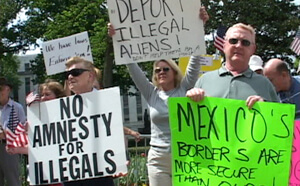 |
| William Brown and Mary Odem, People protest immigration policy, northern Georgia. |
Much of the legislation targeting unauthorized immigrants has been passed by state and local governments since 2006, in the wake of rancorous discussions in the US Congress and the national news media over the problem of illegal immigration. The failure to enact immigration reform at the federal level strengthened the efforts of state and local lawmakers to take action against unauthorized immigrants, and a record number of immigration bills came before state legislatures in 2006.
The state of Georgia took the most sweeping action of any state at the time to control illegal immigration with passage of the Georgia Security and Immigration Compliance Act (SB 529) in 2006. The bill was introduced by Republican legislator Chip Rogers from Cherokee County, the same county where Antonia, Maria, Alfredo and numerous other Maya immigrants have settled. Rogers’ bill denies tax-supported benefits, including health care, to immigrants who cannot prove their legal residency; penalizes employers who hire undocumented immigrants; and enlists state and local police in the enforcement of federal immigration laws. The introduction of Senate Bill 529 in Georgia followed in the wake of the punitive legislation (HR 4437) proposed by Republican lawmakers in the US House of Representatives to speed up deportations, criminalize undocumented immigrants, and authorize the construction of a wall at the Mexico–US border. Although the federal legislation failed to pass, SB 529 was passed by the Republican-controlled senate and house and signed into law by Republican Governor Sonny Perdue on April 17, 2006.25Ibid.
 |
| William Brown and Mary Odem, A laborer working in masonry, northern Georgia. |
The law reflects a compromise between politicians seeking aggressive action to end illegal immigration and business groups seeking to maintain an available pool of low-wage immigrant labor. After consulting with business lobbyists, Republican sponsor Chip Rogers crafted the bill so that companies would not be held responsible if an employee used false documents or if a subcontractor hired illegal workers without the knowledge of the employer.
The Georgia Security and Immigration Compliance Act has created a climate of uncertainty and fear among the Maya and other Latino immigrants in the state. Realtors, car dealers, and retailers in immigrant neighborhoods have reported a noticeable decline in Latino customers, which they attribute to the sense of economic and social vulnerability that immigrants now feel. The parks and shopping plazas that had been social and recreational gathering places for Latinos in north Georgia have been noticeably less populated since the legislation went into effect. With the involvement of local authorities in the enforcement of immigration law, the arrest, confinement, and deportation of unauthorized immigrants has climbed dramatically in Georgia. As a result, many families have been separated and immigrants have become more hesitant to notify law enforcement when they are victims of or witnesses to crime. A number of Maya immigrants in North Georgia have been deported and others have been targets of anti-immigrant hostility and harassment.
Pan-Maya Organizing
Although poor in material resources, Maya immigrants have brought with them a tradition of communal organization that has sustained them in face of the discrimination and hardships they have encountered in the United States. Drawing on this tradition, Maya in Georgia and other settlement areas have formed ethnic religious associations that have helped to unify immigrants and strengthen their collective resources. In the initial Maya settlements established in the 1980s in Los Angeles, Houston, and Indiantown, Florida, immigrants formed associations on the basis of hometown origin; members shared a common language, dress, and local customs linked to their particular municipio or town.26Hagan, Deciding to be Legal; Wellmeier, Ritual, Identity, and the Mayan Diaspora; Eric Popkin "Guatemalan Mayan Migration to Los Angeles: Constructing Transnational Linkages in the context of the Settlement Process." Ethnic and Racial Studies 22 (1999): 238-266.
As Maya immigrants increased in number and dispersed to new locations in the country, they began to organize on a pan-Maya basis. In north Georgia a group of Maya that included Antonio and Maria formed a Maya Catholic organization in 1999. It began as a small prayer group that met in the homes of different migrants. By the second year the group had grown from ten to approximately one hundred members and included Maya of diverse language groups (Mam, Quiché, Q’anjobal, Chuj) and regions (Huehuetenango, San Marcos, Quiché, Chimaltenango, and Quezaltenango). When Alfredo joined his aunt and uncle in north Georgia, he became an active member of the organization.
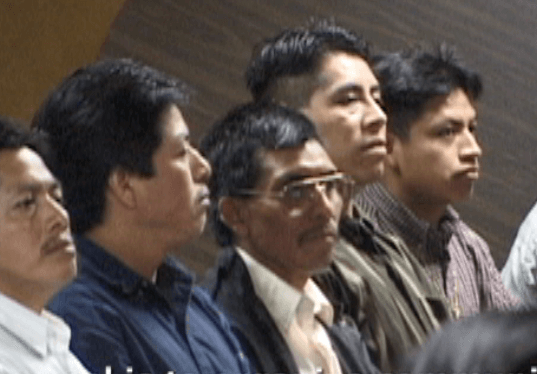 |
| William Brown and Mary Odem, Men at meeting of Pastoral Maya, northern Georgia. |
The group first called itself El Ministerio de Evangelización a la Virgen de Asunción (the Virgen de Asunción is the patron saint of Guatemala) and later changed its name to Proyecto Pastoral Maya (Maya Pastoral Project) when it joined a national network of Maya Catholic groups, supported by the US Catholic Church. Pastoral Maya seeks to provide spiritual, social, and material support to the Maya migrants struggling to make a living in North Georgia. To build bonds of solidarity among the group, leaders organize a range of programs and activities that include a weekly Saturday evening meeting of prayer, singing, and socializing; the formation of two choirs; Spanish Mass on Sunday evenings in the parish church; regular house visits to Maya immigrants in need; religious services and cultural celebrations for Christmas, Holy Week, Mother’s Day, and Santa Eulalia’s feast day. One of the organization’s first fund-raising projects was to collect $3,000 to purchase a van to provide transportation for the numerous migrants who do not have cars so that they can attend the Saturday meeting, Sunday Mass, and other activities.27Interviews with Antonio (2002, 2003), Pablo (2003) and Efrain (2003).
The largest religious and cultural event organized by the Maya Catholic group is the annual celebration in honor of Santa Eulalia. The event requires months of planning and preparation and the labor and contributions of many immigrants. The feast day celebration has attracted the participation of hundreds of Maya immigrants from north Georgia and the surrounding area and has increased in size each year. Approximately two hundred people from Maya settlements in Canton and Ellijay in north Georgia took part in 2002; the following year more than four hundred Maya migrants attended, including groups from Greenville, South Carolina, and two Alabama towns. By 2004, the number of participants rose to more than six hundred.28Interviews with Antonio (2003) and Pablo (2003).
 |
| William Brown and Mary Odem, A person participating in the annual celebration of Santa Eulalia, Cherokee County, Georgia, 2003. |
The celebration combines Catholic and traditional Maya spiritual practices. It begins with a Catholic Mass led by Father Joseph Fahy of the Atlanta Archdiocese and Father David López, a Maya Catholic priest from Guatemala who visits the community annually to take part in the feast day celebration. Following the Mass is a re-enactment of a traditional Maya religious ceremony that is performed by rezadores (prayer leaders) in Santa Eulalia to pray for harmony and safety during the celebration. In the north Georgia celebration, a young man performs the role of a rezador and recites a prayer to the four directions of the earth.
Central to the Santa Eulalia celebration in Guatemala and in the United States is the marimba and its music. In Guatemala, the marimba is a key symbol of indigenous identity and it continues to play an important role in community life for the Maya who have emigrated to the United States. Soon after their arrival, numerous Maya immigrant groups (in Georgia, Florida, Los Angeles, Arizona, Colorado, and South Carolina) have raised money to purchase and import a marimba from a workshop in the Guatemala highlands.
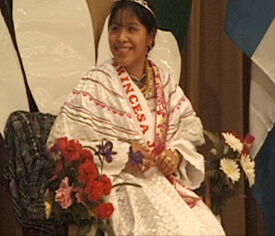 |
| William Brown and Mary Odem, Princesa Maya Jolom Konob, Cherokee County, Georgia, 2003. |
Another major part of the fiesta is the coronation of the new princesa “Maya Jolom Konob,” who will represent the Maya community in the upcoming year. Dressed in the distinctive corte and huipuil of the township, the princess performs a Maya ideal of femininity: she demonstrates her knowledge of indigenous culture by performing a traditional dance to the music of the marimba; she demonstrates her education and learning by delivering a speech before the crowd, first in her indigenous language of Q’anjobal and then in Spanish. A new element in the celebration in Georgia is that the princess addresses the crowd in three languages instead of two: Q’anjobal, Spanish, and English.
The work of the Maya association in north Georgia has extended beyond the religious and cultural realm. Leaders have provided assistance when Maya immigrants encountered problems such as inability to pay rent, arrest by local police, and need for housing or work. The Maya organization strengthened its presence and influence through the alliance it formed with a group of interested faculty and students at nearby Kennesaw State University who collaborated on a number of projects, such as student-led English classes and tutoring for the Maya, health seminars, and a traffic safety program for immigrants funded by university and state grants. The projects created learning opportunities and internships for students and gave the Maya access to knowledge, skills, and social contacts that enhanced their community-building efforts. On an individual level, university faculty and students also assisted Maya immigrants in navigating the US legal system and local government bureaucracies.
In the mid-1990s, the Maya association in Georgia became part of a national network of Maya Catholic organizations, a grassroots effort initiated by immigrant leaders Sister Nancy Wellmeir and Father David López in 1994 that has received financial support and recognition by the US Conference of Catholic Bishops. Known as the Proyecto Pastoral Maya, the network is made up of over forty local Maya Catholic groups in states throughout the country including California, Florida, Arizona, Oregon, Washington, Colorado, Nebraska, Georgia, Tennessee, Alabama, and South Carolina.29Interviews with Father David López (2002, 2004) and Father Joseph Fahy.
 |
| William Brown and Mary Odem, New building in a Guatemalan community. |
Since 1999, Pastoral Maya has organized national meetings (Encuentros Nacionales) on an annual basis. The 2003 Encuentro Nacional, which took place in Georgia at Kennesaw State University, brought together fifty-six Maya community leaders from across the country. Most of the participants were men, but as many as a dozen Maya women had a noticeable presence at the meeting. Support and funding for the Conference came from money raised by local immigrant groups, the US Conference of Catholic Bishops, the Archdiocese of Huehuetenango, and the faculty-student group at Kennesaw State University.
Even as the Maya organization established connections with US citizens and institutions, it also fostered transnational ties to indigenous communities back home. Maya immigrants sustained connections to their hometowns in various ways—by collecting money from migrants to finance improvements, such as the building of a medical clinic or school; by raising funds when a community member dies in the United States to return the body to Guatemala for burial in the hometown cemetery; and by sponsoring the visits of priests from hometown parishes in Guatemala to meet with and provide spiritual and social guidance to their parishioners in the United States. Through the range of transnational and local activities, participants in Pastoral Maya express a sense of belonging on both sides of the border—in new settlements in the United States and in communities of origin in Guatemala.
Conclusion
Transnational migration has provided needed economic resources for the Guatemala Maya, while placing great strain on families. The burden of living across borders has fallen most heavily on the women and children left behind in Guatemala. For Juana, when the years of separation and uncertainty about her husband’s return led to anxiety and depression so grave that her family feared for her well-being, Alfredo went back to Guatemala to be with her. He left with the intention of returning to the United States because he still had not earned enough money to complete the home they were building, but he ended up staying in Santa Eulalia. The needs of his family, not only of his wife and daughter, but also of his mother and siblings, held him in Guatemala. They had suffered in his absence, especially Juana, and he had sorely missed them.
Within a year of his return, Juana gave birth to their second child, another daughter, and this time Alfredo would be around to see her learn to walk and talk.
Alfredo’s homecoming eased the emotional hardship for the family, but presented real economic hardship. With the loss of his wages from the United States, he had to work at several jobs to cover living expenses. He eventually started a small business in Santa Eulalia that provides computer, accounting, and other services. His two youngest siblings assist him with running the business. Making enough to get by is a constant struggle. A year after Alfredo returned to Guatemala, his next-oldest brother, who had recently finished high school in Guatemala City, began to make plans to migrate to the United States. Following in the footsteps of Alfredo, he wanted to build a home for his wife, who was pregnant with their first child, and to contribute to the support of his mother and siblings. The family would continue to rely on transnational migration as an important economic strategy.
Antonio and Maria, meanwhile, remained in Georgia. After years of working at low wage jobs in factories and on construction sites, they managed to save enough to open a small store where they sold products from Guatemala and inexpensive clothing and shoes, mostly to other immigrants from Central America and Mexico. They remained active in Pastoral Maya, and Antonio served for several years as the national leader of the organization, which took him to different parts of the country to meet with local chapters.
Although Maria and Antonio have talked about returning to Guatemala and have remained in close contact with Maria’s parents and siblings there, the pull of their children has kept them in the United States. Their oldest daughter graduated from the local high school, a source of great pride for her parents, and the three younger children have continued with their studies in junior high and elementary school. All of the children, even the two born in Guatemala, have been raised in the United States and know of Santa Eulalia only through the stories of their parents.
The stable, relatively prosperous life Antonio and Maria had built in Georgia came to end with the economic crisis of 2007 that ravaged many families and businesses in the United States. The business in their store dropped sharply as Latino immigrants in the area, their main customers, lost jobs and income. Soon, the couple was no longer able to pay rent and had to close the store. Then, after months of struggling to keep up with mortgage payments, they lost the house they had lived in since 2000. With the limited economic prospects they faced in Georgia, Antonio and Maria decided to return to southern California where they could live with Maria’s brother until they got back on their feet.
After three decades of Maya migration to the United States, there are Maya communities in cities and towns throughout the country, from California on the west coast to Georgia on the east. A web of familial and organizational ties link Maya settlements in the United States to one another and stretches across national borders to connect to Maya families, hometowns, and institutions in Guatemala. As the stories of Maria and Antonio, Juana and Alfredo make clear, this web of connections has provided a crucial source of support for the Maya to survive periods of war and ethnic violence, economic vulnerability, and social marginalization. They have not overcome these threats, neither in Guatemala, nor in the United States, but they have managed to lessen their impact and to provide more opportunities and security for their children and families.
Video Credits
Writer/Producer - Mary Odem
Director/Photographer/Editor - William A. Brown
Additional Editing - Brian Cox
Special thanks to Teodoro Maus, Gayla Jamison, George King, Father Joseph Fahy, Juanatano Cano, Jamie Escamilla, David Moscowitz, Alan Lebaron, David Donato Vivres, Mael Vizcarra, Norberto Sanchez of the Norsan Group, and Dutch Knotts.
This video could not have been made without the support of people and community leaders of Santa Eulalia, Guatemala, as well as the Maya immigrant community in North Georgia. This program is dedicated to Antonio, Maria, Alfredo, Juana, and all the Maya who participated in the making of this program.
Supported with travel grants and research grants from Emory University. Civil War footage courtesy of the National Archives. Maya Footage Copyright William A. Brown. Edited at ATLANTA VIDEO.
We carried out research, location shooting, and interviewing for this project from 1999 to 2004 in northeast Georgia and in Huehuetenango, Guatemala, in the town of Santa Eulalia. The research included interviews, participant observation, and archival research in both Georgia and Guatemala.
]]>Introduction
Filmed during the 1990s and released on PBS in 2000, Goin’ to Chicago is a sixty minute film about the largest internal movement of people in United States history—the Great Migration. Between 1916 and 1970, six million African Americans left the cotton fields and segregation of the rural South for northern, midwestern, and western cities, changing the American cultural and political landscape. This documentary weaves personal stories with archival footage, photographs, and a soundtrack featuring blues, rhythm and blues, and gospel music—much of it recorded specifically for Goin' to Chicago.
This essay features two clips exploring the experiences of migrants to Chicago and the subsequent decline of the industrial opportunities that initially attracted them. Director George King provides insights into filming these clips and his choices for constructing and editing this documentary.
Bronzeville
"Bronzeville," Video excerpt from Goin' to Chicago, a documentary film by George King, originally broadcast on PBS in 2000.
In making Goin' to Chicago, I wanted to recognize the power of expressive culture—language, food, spiritual life, and particularly music. I also wanted to present the Great Migration as contemporary rather than "history," present rather than past. This clip demonstrates how viewers are brought into dynamic environments like Monday nights at Artis’s Bar in South Side Chicago—a site that demonstrates where generations of migrants transported and reinvented the blues. By the 1990s, most blues clubs were outside of the Black neighborhoods where southern African American migrants initially developed the Chicago blues sound during the first half of the twentieth century. At the time of our filming, the blues scene in Chicago had shifted to the city's North Side, catering mainly to younger white patrons, students and tourists. Resisting these trends, Artis’s remained on the South Side, retaining the spirit of the earlier blues in contemporary form: as a chic, urban, juke joint. The musicians featured here, Billy Branch and the SOB (Sons of the Blues) Band, are the sons of former blues musicians. The lead singer describes his rural Mississippi background in connection to musicians such as Muddy Waters and Howlin’ Wolf, who as he describes, grew up working “mighty hard, and they didn’t get paid very much.” The SOB Band demonstrates the power, excitement, sexuality, and humor of classic Chicago blues. They were not just another act recycling familiar material to curious conventioneers. Against the film crew’s and his fellow band members’ expectations, the lead guitarist broke into an electrifying ten minute solo that “peeled the paint off the walls,” and also used up all of our film. It was a spectacular performance, but unfortunately could not be edited into the time constraints of a sixty-minute film.
The next section underscores the consequences of low pay in the rural South by featuring interviews with steelworkers as they recall moving north to find economic opportunity. Blues singer Koko Taylor, who migrated from the Memphis area to Chicago, remembers earning five dollars a day cleaning houses after making three dollars a week in the South. The pay increase did not mean shorter hours. In recognition of how African American migrants fueled Chicago’s economy at the time, John Wiley describes working two jobs for twenty-five years.
 |
| Bud Billiken parade in "simulated newsreel," Goin' to Chicago, 2000. |
The clip ends with a simulated newsreel. This particular example celebrates Bronzeville, a name coined to describe the vitality of Chicago’s South Side in its heyday during the 1930s and ‘40s. The “newsreel” was a device we used in the film to provide factual information in an entertaining manner. The four newsreels in the documentary evolved out of a comment from a researcher that I hired to track down historical film and video of Black Chicago. One day during a phone call she expressed anger and frustration at failing to find much archival footage. “My history was not recorded,” she said. The predominantly white-owned media had never shown much interest in the Black population, unless it was to film a disaster such as a fire. There were little or no filmed records of Black life from the 1940s to 1960s on the South and West Sides. So we decided to create what had not existed. We edited footage from a variety of historical archives and collections into short newsreels complete with buoyant music and narration characteristic of the 1940s.
The example presented here features Bronzeville’s annual Bud Billiken Parade in 1954. This footage was not shot for or used in a contemporary newsreel, but we made it into one by writing appropriate narration, using an upbeat midwestern voice, and adding music. We created our own newsreel company with logo. Complaining that you cannot create artifacts, some historians have criticized these newsreels, but they are intended to be an entertaining, engaging, storytelling device. Giving them the prominent title, "Simulated Newsreel," I hoped they could never be confused with real artifacts. I actually wanted to call them "fake," but PBS objected.
Economic Downturn
The second video excerpt addresses the decline of economic vitality for southern African American migrants in Chicago during the 1960s and ‘70s. It also features various spaces that were demolished for the purposes of “urban renewal” after we filmed in the early 1990s. In this way, Goin’ to Chicago provides a last look at several black Chicago institutions.
"Economic Downturn," Video excerpt from Goin' to Chicago, a documentary film by George King, originally broadcast on PBS in 2000.
This clip opens with David Lindsey and friends performing “Downhome Blues” at Maxwell Street, the famous street market on Chicago’s West Side. In the last century, Maxwell Street transformed from a commercial center for Jewish patrons, to African American, to Hispanic patronage. In 1994 the market was relocated—swept up in the expansion of the University of Chicago. From the 1920s when African American migrants made up the majority of residents in the area, the market was a place to hear the blues—shopkeepers and stall-holders would encourage musicians to set up in front of their places to draw a crowd.
 |
| Laid-off steelworkers, Goin' to Chicago, 2000. |
The next section revisits the steelworkers seen in the first clip. They describe how they were laid off after decades of steady employment. As one laid-off worker, Alvin Robertson, explains, “At my age [fifty-two], I didn’t think I was going to have to look for another job in my whole lifetime.” Their story represents the plight of many migrants who had prospered with jobs in the expanding manufacturing and service industries after World War II in the “City of Big Shoulders.” Twenty years later, industrial jobs migrated west, to non-union southern states, or outside the United States to developing countries.
Economic decline plays into the transformation of once vital neighborhoods on the South and West Sides, where the housing and infrastructure started to crack and crumble. Southern migrant Geri Oliver, owner of the celebrated Palm Tavern, talks about how the once famous 42nd Street strip has deteriorated. The Palm Tavern functioned as an unofficial clubhouse for generations of African American musicians, including Duke Ellington, James Brown, Count Basie, Quincy Jones, and Muddy Waters.
 |
| Maxwell Street Market, Goin' to Chicago, 2000. |
During the 1980s and ‘90s, political neglect, economic inequality, and systemic racism contributed to the continuing decline of Chicago public housing facilities, many of which became lawless, drug-infested environments where residents lived in fear of gangs. The clip ends with four young rappers from the projects describing life in Cabrini Green, one of Chicago’s most notorious projects on the Near North Side. Even though we had hired security, I recall that a fourteen year-old tried to “shake down” the film crew that afternoon. We elected to call his bluff, which proved to be all it was, but by that time Cabrini was not a place to take threats lightly.
Unintentionally, this clip also documents the last days of the Palm Tavern, Cabrini Green and the Robert Taylor Homes housing projects, and the Maxwell Street Market. By the mid-1990s, the federal government mandated the destruction of thousands of public housing units, with plans to develop a mixed income approach to public housing, particularly in these areas of Chicago, though the development process has been controversial because tenant relocation did not keep pace with tenant displacement.
Conclusion
I made Goin’ to Chicago in response to what I perceived as a lack of awareness about the impact of the Great Migration on American politics and culture. At the time there was little non-scholarly nonfiction available on the subject, and no documentaries that centered on the migrations. Many white Americans and younger African Americans were unaware that this social movement even occurred—that in roughly sixty years African Americans had transformed from a primarily rural and southern population to a primarily urban and non-southern one.
It took about five years of research and production to make the film. Sadly, due to cut-backs in public funding, I doubt that this documentary could be made today.
]]>Introduction
In an elementary school in Nashville, Tennessee, Mexican children ask, “Where were the Hispanics with Martin Luther King, Jr. in Memphis?” An Egyptian girl at the same school wonders which water fountain she would have drunk from during Jim Crow. In Memphis, black political and business leaders invoke slavery’s legacy to reject Latino claims for minority set-asides in municipal contracts, arguing that Latinos’ recent arrival makes them no match for four-hundred years of black oppression. Across the US South, immigrant-advocacy groups borrow heavily, sometimes directly, from a civil rights playbook, mapping the 2003 Immigrant Workers Freedom Ride onto the original Freedom Ride and in 2006, rallying in spaces politically memorialized during the civil rights movement.
 |
| Banner from the Immigrant Workers Freedom Ride website, 2003. |
How do we make sense of these entanglements of a South contoured by a historical black-white binary, de-jure segregation and de-facto racism, and a South stretched into transnational flows of bodies, cultures, and capital? In the contemporary South, who can invoke and be part of its past, and to what ends? How do and should the interpretations of southern history affect present actions, and who can access these meanings to interpret and intervene in the present? These questions are pressing in the nuevo South, which has experienced rapid Latino population growth since the 1990s.1Although in this article, we focus on Latino migration (a ‘nuevo’ South), we acknowledge the presence of smaller immigrant and refugee populations, some of which have long histories in the South. These groups have impacted racial and social formations in some southern locales and are the subject of such recent studies as Mark Moberg and Stephen Thomas, “Indochinese Resettlement and the Transformation of Identities Along the Alabama Gulf Coast” and Choony Soon Kim, “Asian Adaptations in the American South,” in Cultural Diversity in the U.S. South: Anthropological Contributions to a Region in Transition, ed. Carole Hill and Patricia Beaver (Athens: University of Georgia Press, 1998); Deborah Duchon, “Home Is Where You Make It: Hmong Refugees in Georgia,” Urban Anthropology 26, no. 1 (1997): 71-92; David Reimers, “Asian Immigrants in the South,” in Globalization and the American South, ed. James Cobb and William Stueck (Athens: University of Georgia Press, 2005); and Jin-Kyung Yoo, “Utilization of Social Networks for Immigrant Entrepreneurship: A Case Study of Korean Immigrants in the Atlanta Area,” International Review of Sociology 10, no. 3 (2000): 347-363. In a South where many argue the past is not dead or even past, how contemporary events are narrated through historical frameworks makes for contentious terrain. From southern history’s obsession with the Civil War to African American history’s extensive writings on Jim Crow and resistance, from debates about southern convergence with the nation to reflections on the South’s “recent” globalization, versions of the South's past are mobilized to interpret or challenge its present.2The reference to the “past isn’t dead” originates with Williams Faulkner, Requiem for a Nun (New York: Random House, 1951). For an academic examination of historical narratives that influence the present, see Ewen Hague et al., “Whiteness, Multiculturalism and Nationalist Appropriation of Celtic Culture: The Case of the League of the South and the Lega Nord,” Cultural Geographies 12, no. 2 (2005): 151-173. For a more popular approach to similar themes, see Jim Webb, Born Fighting: How the Scots-Irish Shaped America (New York: Broadway Books, 2004). For discussions of the Civil War, see Curt Anders, Hearts in Conflict: A One-Volume History of the Civil War (Secaucus, NJ: Carol Pub. Group, 1994). For discussions of African American history, see Kenneth Goings and Raymond Mohl, eds., The New African-American Urban History (Thousand Oaks, CA: Sage Publications, 1996). For discussions of the contemporary South and southern distinctiveness, see Larry Griffin and Don Doyle, eds., The South as an American Problem (Athens: University of Georgia Press, 1995); Dewey Grantham, The South in Modern America: A Region at Odds (New York: Harper Collins, 1994); and James Cobb and William Stueck, eds., Globalization and the American South (Athens: University of Georgia Press, 2005).
As the economies, populations, and cultural practices of southern states have “gone global”— from foreign direct investment to NASCAR to flexible labor—the framework that southern history offers for understanding the present has splintered, particularly vis-à-vis Latino migration.3Cobb and Stueck, Globalization and the American South; Barbara Ellen Smith, Marcela Mendoza, and David Ciscel, “‘The World on Time:’ Flexible Labor, New Immigrants and Global Logistics,” in The American South in a Global World, ed. James Peacock, Harry Watson and Carrie Matthews, 23-38 (Chapel Hill: University of North Carolina Press, 2005). As new immigrants seek a “usable past” within which to place and make sense of their experiences, they implicitly call into question how southern histories are mobilized to define and interpret the present, how specific southern pasts are rendered accessible and meaningful, and how new groups gain or lose legitimacy as “southern.”4Larry Griffin, Ranae Evenson, and Ashley Thompson, “Southerners All?,” Southern Cultures 11, no. 1 (2005): 6-25.
Drawing on more than ten years of research on community change, racial formations/politics, and immigration to southern cities and towns, we call for a deeper historicization of immigrant experiences and of responses to immigration.5See, for example, Barbara Ellen Smith and Jamie Winders, “‘We’re Here to Stay’: Economic Restructuring, Latino Migration, and Place-Making in the U.S. South,” Transactions of the Institute of British Geographers NS 33 (2008): 60-72; Barbara Ellen Smith, “Across Races and Nations: Social Justice Organizing in the Transnational South,” in Latinos in the New South: Transformations of Place, ed. Heather Smith and Owen Furuseth, 235-256 (Aldershot, England; Burlington, VT: Ashgate Publishing, 2006); Jamie Winders, “Changing Politics of Race and Region: Latino Migration to the U.S. South,” Progress in Human Geography 29, no. 6 (2005): 683-699; Jamie Winders, “‘New Americans’ in a ‘New South’ City? Immigrant and Refugee Politics in the Music City,” Social and Cultural Geography 7, no. 3 (2006): 421-435; and Jamie Winders, “An ‘Incomplete’ Picture? Race, Latino Migration, and Urban Politics in Nashville, Tennessee,” Urban Geography 29, no.3 (2008): 246-263. Historicization is key, since migration studies often treats immigration to the South as either so transformative that it replaces local and regional historical geographies of race, place, and labor or so different from past practices that no connection to them can be made. Much work in southern studies remains heavily influenced by black-white visions of the plantation South, Civil-War South, Jim-Crow South, and civil rights South, perspectives that render immigration invisible. Recent demographic reconfigurations of the South, however, call for new approaches to not only the South's present but also its past and future. Because of the tight riveting of race, place, and region in the South, a deeper historicization of immigration and responses to it can enliven southern studies through discussions about the racialization of new Latino populations.6An exception to the failure to historically contextualize immigration to the South is Rubén Hernández-León and Víctor Zúñiga, “Appalachia Meets Aztlán: Mexican Immigration and Inter-Group Relations in Dalton, Georgia,” in New Destinations of Mexican Immigration in the United States: Community Formation, Local Responses and Inter-Group Relations, ed. Víctor Zúñiga and Rubén Hernández-León, (New York: Russell Sage Foundation, 2005).
In this essay, we place southern studies alongside studies of immigration to the South, highlighting their disciplinary, methodological, empirical, and political differences. Although these fields have yet to speak to each other in sustained fashion, they are enmeshed in many southern locales. To illustrate this point, we discuss three moments in which the politics of an immigrant presence and a southern past entangle. We conclude by reflecting on how southern history is and is not put to work to understand and intervene in the politics of the nuevo South.
Re-visioning Southern Immigration
In the last two decades, the geography of Latino migration to and within the United States has become increasingly complex. What was once a phenomenon associated with gateway cities like Los Angeles, Chicago, Miami, and New York has morphed into a national trend. In the South, Latino men and women from across the United States and Latin America have come for reasons ranging from debt crisis and peso devaluation in Mexico to civil unrest in parts of South America, from cooling economies and growing anti-immigrant sentiment in Texas and California to the pull of construction jobs for the 1996 Atlanta Olympics. Within southern locales, Latino communities are notable less for their size than for the speed at which they developed. Although small in comparison to Latino populations in gateway cities, since the 1990s the South’s Latino populations have been growing faster than in other areas of the country.7Richard Fry, Latino Settlement in the New Century, October 23, 2008 (Washington, DC: Pew Hispanic Center), http://pewhispanic.org/files/reports/96.pdf. For discussions of immigration to the South, see Carl Bankston III, “New People in the New South: An Overview of Southern Immigration,” Southern Cultures 13, no. 4 (2007): 24-44; Peacock, Watson and Matthews, eds., The American South in a Global World; Holly Barcus, “The Emergence of New Hispanic Settlement Patterns in Appalachia,” The Professional Geographer 59, no. 3 (2007): 298-315; Furuseth and Smith, Latinos in the New South; Zúñiga and Hernández-León, New Destinations; Helen Marrow, “New Destinations and the American Colour Line,” Ethnic and Racial Studies 32, no. 6 (2009): 1037-1057; Benjamin Shultz, “Inside the Gilded Cage: The Lives of Latino Immigrant Males in Rural Central Kentucky,” Southeastern Geographer 48, no. 2 (2008): 201-218; Robert Yarbrough, “Latino/White and Latino/Black Segregation in the Southeastern United States: Findings from Census 2000,” Southeastern Geographer 43, no.2 (2003): 235-248; Fran Ansley and Jon Shefner, eds., Global Connections and Local Receptions: New Latino Immigration to the Southeastern US, (Knoxville: University of Tennessee Press, 2009); and Douglas Massey, ed., New Faces in New Places: The Changing Geography of American Immigration, (New York: Russell Sage Foundation, 2008).
The broad contours of Latino population growth in the South are simple to document; but the processes and particularities of Latino migration are more complicated than aggregate statistics reveal. Latino migration includes documented and undocumented residents, US-born and foreign-born migrants, seasonal laborers who move among agricultural sites throughout the South and permanent residents who put down roots and begin families. Equally important, Latino populations, especially in southern cities, include men and women who have moved from other US cities, as well as individuals from across Mexico and many parts of Central and South America. In this way, while much commentary, academic or otherwise, discusses Latino/Hispanic migration or “the Hispanic/Latino community” in monolithic terms, there is much national, economic, political, and linguistic diversity among Latinos in the South.
Adding to this complexity is the uneven temporal and spatial dispersion of Latinos. Certain southern states, most notably Texas and Florida, have a longstanding Latino presence and influence. Among so-called “new destinations,” Georgia and North Carolina experienced Latino settlement and population growth before many other southern states and have been “ahead of the curve” in terms of local impacts of and responses to immigrant settlement. Latino migration became a notable trend in Tennessee, Kentucky, and Alabama five to ten years later, as industries such as meat processing and the fast-food and hospitality sectors turned to immigrant labor. In the present economic recession, anecdotal evidence suggests that Latino migration to the South is waning but that return migration is not necessarily increasing. The trends we address in this article, thus, are not reversing, though the pace of immigration and character of immigrant settlement may be changing in ways not yet apparent.
 |
| Stan Schnier, Immigrant workers at the final celebration of the Immigrant Workers Freedom Ride, Flushing Meadows Corona Park, New York, New York, October 4, 2003. |
Across southern spaces, Latino population growth has also been highly uneven. Until Hurricane Katrina and the need for cheap immigrant labor to rebuild New Orleans, for instance, Louisiana had little Latino population growth. Within the historic “Black Belt,” increase in the Latino population has been much smaller, raising questions about the links among race, poverty, and immigrant settlement across the South. Even in states that have notable Latino population increase, there are rural, urban, and suburban differences, with cities typically having a wider range of nationalities and occupational skills represented in their Latino populations. In the neighborhoods of small southern towns and rural areas, Latino residents often overlap more with long-term black and white residents than they do in southern cities, but are also more concentrated in one type of work, such as poultry processing or agriculture. Studying Latino migration to the South necessitates attending to a demographically, geographically, and temporally uneven phenomenon that has only recently come onto the radar of scholars of the South.8For work on Latino migration to the rural South, see Peter Benson, “El Campo: Faciality and Structural Violence in Farm Labor Camps,” Cultural Anthropology 23, no. 4 (2008): 589-629; and Josh McDaniel and Vanessa Casanova, “Pines in Lines: Tree Planting, H2B Guest Workers, and Rural Poverty in Alabama.” Southern Rural Sociology 19, no.1 (2003): 73-96. For work on the geographic diversity of Latino migration to the South, see James Elliott and Marcel Ionescu, “Postwar Immigration to the Deep South Triad: What Can a Peripheral Region Tell Us About Immigrant Settlement and Employment?” Sociological Spectrum 23 (2003): 159-180; Laurel Fletcher et al., “Rebuilding after Katrina: A Population-Based Study of Labor and Human Rights in New Orleans.” International Human Rights Law Clinic, Boalt Hall School of Law, and Human Rights Center, University of California, Berkeley, and Payson Center for International Development and Technology Transfer, Tulane University (June 2006). For work on Latino labor-market participation, see Steve Striffler, “Neither Here Nor There: Mexican Immigrant Workers and the Search for Home.” American Ethnologist 34, no.4 (2007): 674-688. For work on Latino migration to southern cities, see Qingfang Wang and Wei Li, “Entrepreneurship, Ethnicity and Local Contexts: Hispanic Entrepreneurs in Three U.S. Southern Metropolitan Areas,” GeoJournal 68 (2007): 167-182; Winders, “An ‘Incomplete’ Picture?;” and Yarbrough, “Latino/White and Latino/Black Segregation.”
Although these changes are reconfiguring southern landscapes and social terrains, no one can deny the historical and on-going power of a black-white binary in contouring the South’s material and metaphoric spaces. How new immigrants alter this racial binary remains unclear, as does where the South itself fits in discussions of immigration. Many migration scholars argue that immigration has long shaped US racial/ethnic politics and cultural life, particularly within its cities.9Alejandro Portes and Alex Stepick, City on the Edge: The Transformation of Miami (Berkeley: University of California, 1993); Rachel Buff, Immigration and the Political Economy of Home: West Indian Brooklyn and American Indian Minneapolis (Berkeley: University of California, 2001). Outside Florida and Texas, however, the South has been a space of exception, a place where national trends of immigrant settlement and labor have been presumed not to apply.10Jamie Winders and Barbara Ellen Smith, “Excepting/Accepting the South: New Geographies of Latino Migration, New Directions in Latino Studies.” Latino Studies, under review; and Susan Greenbaum, “Urban Immigrants in the South,” in Hill and Beaver, Cultural Diversity. For discussion of the South outside a black-white binary, see Rowland Berthoff, “Southern Attitudes Toward Immigration,1865-1914,” Journal of Southern History 17, no. 3 (1951): 328-360; Light Townsend Cummins, “The Hispanic Heritage of the Southern United States of America,” Revista de historia de America 10, no. 5 (1988): 89-110; and Julie Weise, “Mexican Nationalisms, Southern Racisms: Mexicans and Mexican Americans in the U.S. South,1908-1939,” American Quarterly 60, no. 3 (2008): 749-777. For discussion of immigration and US racial politics, see Gabriela Arrendondo, “Navigating Ethno-Racial Currents: Mexicans in Chicago,1919-1939,” Journal of Urban History 30, no. 3 (2004): 399-427; and James Barrett and David Roediger, “In-between Peoples: Race, Nationality, and the ‘New Immigrant’ Working Class,” Journal of American Ethnic History 16, no. 3 (1997): 3-44.
One of the challenges of historicizing immigration to southern locales, then, is the gap between southern studies and studies of immigration to southern locales, between work on the South's history, culture, and politics and work on its recent immigrants and their reception. Part of this gap reflects differences between the two fields. Much of southern studies emerges from the humanities. With strengths in textual studies, historical analysis, and material culture, southern studies utilizes related methodologies (e.g., literary criticism, archival investigation, musicology, and discourse analysis) to engage such topics as local and regional identities, cultural production, and the idea of the South itself (plantation South, the postbellum South, the segregated South, and so on) as objects of study. In contrast, studies of immigration to the South draw heavily from the social sciences, particularly geography, sociology, anthropology, and political science. Although some new work engages the cultural politics of immigration and identity in southern locales, most utilizes social-science methods such as surveys, participant observation, interviews, and secondary data analysis. Through these sorts of distinctions (which work more as heuristic devices than absolute differences), southern studies and studies of immigration to the South stabilize their objects of analyses in ways that further the gap between the two fields.11For works in southern studies, see Edward Ayers, “Narrating the New South,” The Journal of Southern History 61, no. 3 (1995): 555-566; Griffin and Doyle, The South as an American Problem, and Jennifer Rae Greeson, “The Figure of the South and the Nationalizing Imperatives of Early United States Literature,” The Yale Journal of Criticism 12, no. 2 (1999): 209-248. For works on southern immigration, see Carl Bankston III et al., Sociological Spectrum 23 (2003); Altha Cravey, “Desire, Work and Transnational Identity,” Ethnography 6, no. 3 (2005): 357-383; Arthur Murphy, Colleen Blanchard, and Jennifer Hill, eds., Latino Workers in the Contemporary South, (Athens: University of Georgia, 2001); Smith and Furuseth, Latinos in the New South; Winders, “Changing Politics of Race and Region”; Terry Easton, “Geographies of Hope and Despair: Atlanta’s African American, Latino, and White Day Laborers,” Southern Spaces, December 21, 2007. For engagement with the cultural politics of immigration to the South, see Mary Odem, “Our Lady of Guadalupe in the New South: Latino Immigrants and the Politics of Integration in the Catholic Church,” Journal of American Ethnic History 24, no. 1 (2004): 26-57; and also Mary Odem, Global Lives, Local Struggles: Latin American Immigrants in Atlanta,” Southern Spaces, May 19, 2006.
Southern studies, at least in its more traditional manifestations, and studies of immigration to the South are also driven by different political projects. Southern studies operates through a powerful discursive formation: a South contoured by a black-white binary; reshaped by the experiences of institutionalized racism, racial struggle, and violence; and in a more positive vein, authenticated through particular cultural practices (e.g., biscuits, barbecue, the blues). Studies of immigration to the South, by contrast, coalesce around a political project of drawing attention and legitimacy to immigrants’ presence, needs, and contributions, setting aside contextualization or implications with regard to the South’s historical and cultural geographies of race. Insofar as each pursues an implicitly celebratory project (the uniqueness of the South vs. the significance of immigrants’ needs and contributions), they seek to protect the purview and integrity of the subject that they construct.
Although southern studies and studies of immigration to the South have yet to speak in a sustained dialogue, within many southern locales, the worlds they examine increasingly entangle. In places where long-term residents and new immigrants interact, the South’s history of a black-white binary, racial discrimination, and struggles toward racial justice intertwine with new demographic realities in ways that change both the politics of immigrant reception and experiences and the local and regional contours of racial politics. To understand these sites of entanglement, southern studies and migration studies must be brought together in an interdisciplinary framework that can account for the empirical reality of their overlap. The remainder of this article examines three vignettes, illustrating some ways of approaching these new demographic and representational realities. Through them we consider how the story of immigrant settlement reconfigures understandings and mobilizations of the South’s past to comprehend the present and impact the future.
Nashville: Old Water Fountains in New Times
Nashville, like many southern cities, began to experience notable immigrant settlement in the mid to late 1990s. As its downtown “revitalized” and its bedroom communities expanded into adjacent counties, a booming residential and commercial construction industry developed across the city, attracting immigrant labor. At the same time, Nashville’s service economy grew and created new demand for low-wage workers. The Music City in the late-twentieth century offered much to Latino migrants: readily available work, relatively affordable housing, and, at least initially, little open hostility toward immigrant residents and neighborhoods. Although Nashville had a small but politically visible refugee population dating to the Cuban crisis and including older Vietnamese and Kurdish communities, as well as newer groups from a range of global hotspots, the arrival of Spanish-speaking immigrants, both directly from Latin America and secondarily from other US locales, quickly dwarfed the city’s refugee population, becoming the dominant image of Nashville’s ‘new sonido.’12For research on immigration to Nashville, see Jamie Winders, “Placing Latinos in the Music City: Latino Migration and Urban Politics in Nashville, Tennessee,” in Latinos in the New South, ed. Smith and Furuseth; Winders, “‘New Americans’ in a ‘New South’ City?;” and Winders, “An ‘Incomplete’ Picture?.”
 |
| Stan Schnier, A woman at the Immigrant Workers Freedom Ride holds a sign that asks “What color is an immigrant?”, Flushing Meadows Corona Park, New York, New York, October 4, 2003. |
Recent Census estimates suggest that almost twelve percent of Nashville’s population is foreign born, slightly below the national average of 12.5 percent. Across Nashville-Davidson County, approximately eight percent of the population is Hispanic or Latino, a percentage that has grown rapidly in the last ten years.13Selected Social Characteristics in the United States: 2009. 2009 American Community Survey 1-Year Estimates. US Census Bureau.
http://factfinder.census.gov/legacy/aff_sunset.html?_bm=y&-context=adp&-qr_name=ACS_2009_1YR_G00_DP2&-ds_name=ACS_2009_1YR_G00_&-tree_id=309&-redoLog=true&-_caller=geoselect&-geo_id=16000US4752006&-format=&-_lang=en Accessed 1 November 2010. Immigration has become a hot topic in Nashville, evident in the defeated 2008 referendum on English-only legislation and an overall reconfiguration of the city’s low-wage labor market. Nashville’s politics of immigrant settlement often play out most intensely in less publicized, everyday spaces, from the corner store to the classroom.14For discussion of the politics of immigration in the spaces of daily life, see David Ley, “Between Europe and Asia: The Case of the Missing Sequoias.” Ecumene 2 (1995): 185-210; and Smith and Winders, “We’re Here to Stay.” In Jamie Winders’ research on public schools in southeast Nashville, where there is the greatest concentration of immigrant residents, teachers repeatedly discussed the collision of southern past, present, and future in their classrooms. In teaching about the civil rights movement, as one elementary-school teacher reported, students ask, “Which water fountain would I be able to drink from?” Conjuring images of Jim Crow, a separate-but-unequal color line, and transgression, the question is grounded in a racial ontology in which the answer was always the “good” water fountain marked “white” or the offshoot marked “colored.” Under Jim Crow even children knew how to answer this question. That knowing was the bedrock of a southern, indeed national, grammar of race and place.
What happens when the student asking this question is a child of Egyptian refugees relocated to Nashville or a recently settled Mexican family? Or when this question is asked in elementary schools with large Latino and smaller Kurdish, Vietnamese, Somali, and Sudanese populations? To answer it, teachers in southeast Nashville translate a binary system of racial difference and segregation for children for whom Nashville has always been a multicultural mix of Kurdish and Egyptian families, Sudanese refugees, Mexican children, Honduran men, and a sprinkling of white and black residents. For immigrant children in Nashville, the multiethnic present makes the biracial past seem incomprehensible. As teachers work to translate garbage strikes and segregated fountains to Latino children who look for the “Spanish people” alongside King, and as young students try to understand an old system of difference through their present experiences, these translations reshape southern history and present. In these classrooms, students inadvertently defy silences about the South’s new racializations while lacking the ability to place themselves within its shifting social and racial hierarchies.
These questions raised by children in search of their “place” within southern history, present, and future highlight the tangible impacts of an immigrant presence not only on southern cities like Nashville but also on overarching frameworks for understanding southern past and present. What are the implications of a generation of new southern residents for whom a past in black and white seems all but unbelievable? How will broader understandings and critical examinations of southern history adjust? In southern locales such as Nashville, the cord between past and present is fraying and being rethreaded in public schools, low-wage worksites, and residential neighborhoods, as students, workers, and residents make sense of each other and, in the process, their place in southern past and present. As a southern history of a black-white racial hierarchy that produced segregations and oppressions is joined by a multiethnic, multicultural, and multilingual southern present with its own racial and class inequalities, past and contemporary color lines are interwoven in ways that confound dominant understandings of the South. Southern studies, as currently configured, cannot account for this degree of variation and change.
Memphis: Minority Politics and Class Divisions
 |
| Jeffrey Rohan, National Civil Rights Museum at the Lorraine Motel, Memphis, Tennessee, August 14, 2010. |
The contemporary racial politics and historical memories of racism that inform responses to immigrants in Memphis contrast sharply with those in Nashville. Such differences illustrate a spatial variability that confounds generalizations about the South and mandates contextualization of contemporary migration. Tied economically and culturally to the Delta’s plantation system and governed for decades by the authoritarian paternalism of Boss Crump, Memphis is Deep South, the “largest city in Mississippi,” as some locals put it. As the site of King’s assassination in 1968 and the lynchings that provoked Ida B. Wells’ famous crusade decades earlier (for which she was forced to flee), Memphis has witnessed extreme racist violence and bitter struggles over white supremacy.15Miriam DeCosta-Willis, The Memphis Diary of Ida B. Wells (Boston: Beacon, 1995); and Michael Honey, Black Labor and Southern Civil Rights: Organizing Memphis Workers (Urbana: University of Illinois, 1993). Contestations over historical commemoration, focused recently on the National Civil Rights Museum in the Lorraine Motel where King was shot, re-enact these struggles even as they seek to represent them. Memphis is a city steeped in race.16John Paul Jones III, “The Street Politics of Jackie Smith,” in A Companion to the City, ed. Gary Bridge and Sophie Watson (Malden MA: Blackwell Pub, 2000).
Latino immigrants began arriving in Memphis in large numbers during the 1990s, drawn by jobs in the city’s burgeoning construction and distribution sectors. Long an important stopover for the movement of goods and people along the Mississippi River and across the continental United States, Memphis has become a center for the worldwide distribution of air freight. As the global economy expanded during the 1990s, the FedEx Corporation, headquartered here, grew from a relatively small niche market in overnight package delivery into a global logistics empire. Around the city’s perimeter, warehouses storing goods for "just-in-time" delivery mushroomed in industrial parks. The demand for labor in new construction and warehousing (or distribution) attracted migrants, primarily from Latin America, who often found higher wages in this southern city than in Los Angeles and other historic immigrant gateways.17See Smith, Mendoza and Ciscel, “The World on Time.”
Memphis’ new immigrants arrived in the wake of a bitter election that brought the first African American mayor, W. W. Herenton, to power in 1991.18Marcus Pohlmann and Michael Kirby, Racial Politics at the Crossroads: Memphis Elects Dr. W.W. Herenton (Knoxville: University of Tennessee, 1996). Herenton’s campaign ignited white anxieties about “black rule” and further propelled white flight. In this increasingly majority-black city, he was re-elected handily and repeatedly. As in other southern locales, Memphis’s growing immigrant population attracted little attention during mayoral campaigns, which unfolded along familiar black-white lines complicated by class. Major controversy erupted, however, in 1997, when Hispanic business leaders approached Herenton about inclusion in special municipal contracting programs for minorities. Herenton repudiated their claims by referencing the history of African American slavery and Jim-Crow segregation, suggesting that Latinos’ experience of racial oppression was insufficient for redress through government affirmative action. Ironically, the Latino businesspeople drawing attention to Memphis’ expanding Hispanic population were, in most cases, US born and/or highly acculturated. Their understanding of race, intentional group positioning in racial terms, and efforts to access race-specific remedies attested to their distance from most Latino immigrants, who rarely sought to identify themselves in racial terms for the purpose of political organizing and instead lived and worked in the recesses of Memphis’ economy and neighborhoods.
Complicated racial politics lay behind Herenton’s rejection of Latino claims to minority status. Like many leaders of large urban centers, he presided over a place of deep and seemingly intractable black poverty at a time of declining federal assistance and escalating white flight. Herenton, however, could appear to champion the interests of poor and working-class African Americans who gave him votes, even as he failed to improve their quality of life, when he refuted Latino claims to affirmative action in the name of longstanding black oppression. Exploiting this dispute, white contractors in Memphis sought to eliminate affirmative action in public contracts altogether, legitimating Herenton’s protective stance in the eyes of many black residents and further embittering the city’s racial politics.19See the discussion in Smith, “Across Races and Nations.” Through this and other episodes, Latino racialization and group positioning unfolded in Memphis, challenging overarching representations of the South in racially binary terms and illustrating the complicated interplay of race, class, and national origin.
Contestations over Latino access to racially-targeted remedies have erupted elsewhere in the South, raising thorny questions.20In 2001, for example, a white Georgia legislator introduced a measure into the state legislature to expand the official definition of “minority.” At stake was a small tax break granted to state contractors who sub-contracted to minority-owned businesses. Georgia’s Black Caucus split over its response. Echoing Herenton, one African American legislator asserted, “Many Hispanics are not people of color. They are a language group, an ethnic group. These people never experienced the same things we did.” Others, however, including some with strong credentials derived from their roles in the civil rights movement, disagreed. Rep. Tyrone Brooks of Atlanta, for example, urged, “We’ve got to expand the tent.” White legislators were also divided. Opponents of affirmative action tended to reject the inclusion of Latinos in the definition of “minority.” Others, however, mindful of the Latino electorate’s escalating size and influence, were in favor. In 2002, the bill became law. See Ellen Griffith Spears, “Civil Rights, Immigration, and the Prospects for Social Justice Collaboration,” in Peacock, Watson and Matthews, 235-246. Who should benefit from remedies that ensue from the civil rights movement? Do Latinos, despite census definitions to the contrary, constitute a race; and if so, should they be treated in the same way as African Americans, particularly in a southern context? Should Latino immigrants be encouraged to understand and position themselves in the South’s bipolar racial hierarchy; and if so, where? As in Nashville, how can Memphis address the deeply entrenched color line while responding to new color lines whose boundaries are still being formed? What transformations are required of southern studies to account for these highly variable, context-specific intersections of different systems of inequality?
In Memphis, the class privilege of Latinos who publicly advocated for inclusion as minorities, as well as their ability to identify as white, obscure the disadvantages experienced by many recent, darker-skinned Latino immigrants, who typically are neither business owners nor well-to-do. Who, then, can and should speak for an immigrant population sliced by lines of class, nationality, gender, language, and citizenship status? As our final vignette shows, diverse advocacy organizations are engaging these questions, bumping up against immigration’s ill fit within current understandings of the South.
New Immigrant Activism and an Old Playbook
 |
| Billboard sponsored by the Tennessee Immigrant and Refugee Rights Coalition, a group that supports immigration, Nashville, Tennessee, 2009. |
Mainstream immigrant-advocacy groups like the National Immigration Forum have long based their appeals on a comfortingly egalitarian version of US history as “a nation of immigrants.” In the nuevo South of the early 2000s, as activists mobilized local and statewide organizations to advocate for immigrant needs and rights, they often adopted similar rhetorical strategies. In Tennessee groups waged campaigns that asked residents to “embrace the immigrants they once were.” The implicit racial content of this appeal, which presumes that all Tennesseeans share the same past and want to revisit it, may have resonated with whites; but it suppressed histories of slavery, genocide, colonialism, and forced migration disproportionately linked to people of color, not all of whom identify as “immigrant.” Although such strategies could take place in many locations with growing immigrant populations and intensifying hostility toward them, the uneasy political and rhetorical relationship between immigrant rights and more race-conscious, anti-racist organizing evident in this campaign is particularly pointed in the South, where the meeting ground between current immigrant-rights advocacy and the historic civil rights movement is uncharted, unclear, but unavoidable.
One effort to situate immigrant rights within a civil rights legacy was the Immigrant Workers Freedom Ride (IWFR) of fall 2003. Conceived in the wake of September 11, 2001, when the presumed equation between immigration and terrorism provoked nativist responses across the country and reversed momentum toward immigration reform, the IWFR was designed to galvanize the immigrant-rights movement by strengthening its relationship to organized labor and less directly, civil rights and other faith- and community-based organizations. The original plan was to take one bus of riders through eight cities, but enthusiasm for the idea led to a more ambitious outcome. Eighteen buses originated from ten cities and carried nine-hundred riders along different routes through more than a hundred US cities. The riders converged to lobby Congress, before rallying with a hundred-thousand supporters in a demonstration in Queens, New York.21Francis Calpotura, “Riding with the Wind,” ColorLines 7, no. 1 (2004): 5-7; and Spring Miller, “A Report from Nashville on the Immigrant Workers Freedom Ride, 2003,” Enlaces News, January, 2004.
 |  |
| Associated Press, Map of 1961 Freedom Rides Routes, February 1962. | Map of 2003 Immigrant Workers Freedom Ride Routes. Courtesy of Immigrant Freedom Workers Ride Coalition. |
The primacy of the desired link between immigrant rights and organized labor may account in part for the IWFR’s uneven engagement with the legacies of the civil rights movement, as well as for its failure to confront the sometimes-uneasy relationship between immigrant rights and anti-racist organizing. For the IWFR, the civil rights movement stood largely as a symbolic historical resource that this new initiative could mobilize. As one rider from Houston remarked, the IWFR “purposefully traveled through the South to get the blessings of African American leadership, and to draw on the legitimacy and unassailable moral standing of the civil rights movement.”22Calpotura, “Riding,” p. 6. Although many bus routes never entered the South, those that did included stops in places such as Memphis, Nashville, Selma, and Atlanta, selected for their significance to the civil rights movement. The expectation that legendary civil rights leaders would endorse the IWFR was largely fulfilled, at least by those who spoke at rallies organized to greet the new Riders. In Mississippi, the president of the state chapter of the Southern Christian Leadership Conference exhorted the crowd: “I don’t care if you came from the Mayflower or crossed the border last night. You are entitled to the same human rights as I. You are my brother. You are my sister. You are my people. The fight for freedom is not over.”23Ibid.
At the local level, the extent to which the IWFR spurred new alignments between the causes of immigrant rights and anti-racist organizing varied widely. A report from Nashville indicated that the Ride’s planning process was a “rich exercise in dialogue and coalition-building” among immigrant-rights, labor, and black community leaders.24Miller, “Report,” p. 1. Reverend Jim Lawson, who played a central role in Nashville’s civil rights struggles in the late 1950s and early 1960s, spoke to the Riders and their supporters, giving the mantle of his moral authority to their cause. In Memphis, however, no organization seized the IWFR as an opportunity for organizing or coalition building; and the Riders’ visit to sites like the National Civil Rights Museum drew relatively small crowds. Once again, the ground-level politics of race and immigration were highly dependent on local contexts, in this case local labor, civil rights, and other relevant organizations.
Moreover, the extent to which African American southerners believe that the legacies of the civil rights movement do or should encompass immigrant rights is unclear, as is the extent to which there is recognition of mutual grievances between the two groups. Evidence points to mutual misrecognition and occasional antagonism between African Americans and Latinos in some parts of the South.25Paula D. McClain et al., “Racial Distancing in a Southern City: Latino Immigrants’ Views of Black Americans,” Journal of Politics 68, no. 3 (2006): 571-584. With the goal of recognizing and building on the “common struggle against oppression and racism that immigrants and African Americans in Tennessee share,” the Tennessee Immigrant and Refugee Rights Coalition (TIRRC) launched a project called “Black, Brown and Beyond.” At the same time, however, TIRRC spearheaded a “Welcoming Tennessee Initiative,” proclaiming that “We believe that Tennesseans remember, honor, and value our immigrant roots.” The simultaneity of these two initiatives unintentionally highlighted the ambiguities associated with efforts to position immigrants in the South’s contentious racial history and present. While calling for black-brown alliances that build on mutual, if distinct, oppressions and struggles, TIRRC reinforces the notion that all Tennesseans share and value a sanitized version of America’s immigrant history as entirely voluntary.
Because the appeal to a white-washed immigrant history is directed at a white audience of business leaders, political officials, and opinion makers, rather than at immigrants themselves, it may not represent immigrants’ (or African Americans’) claims or sense of identity vis-à-vis the United States and their “place” within it. Nonetheless, the incompatibility between the pasts that the immigrant rights/civil rights alliance seeks to join – one of immigrant triumph to be “honored,” another of racial oppression to be “overcome”– gestures toward the damning reality that throughout US history, diverse immigrant groups have claimed a position in the racial hierarchy at the expense of African Americans. Equally important, the landless Latino farmers and workers who cross the US–Mexico border in search of livelihoods in the South bring pasts that partake far more of racial oppression (and colonialism, political repression, and genocide, as well as ongoing resistance) than of the triumphalist stories of white ethnics. Do these new immigrants draw on such pasts to locate themselves within the South’s racial histories? Might their histories reconfigure yet again what constitutes “the South”? Or, will new immigrants position themselves in the white-washed immigrant saga of ethnic groups who achieved success by ceasing to be “not white”?26For discussion of immigrants in the US racial hierarchy, see Barrett and Roediger, “In-between Peoples.”
Conclusion
In 1988, Light Townsend Cummins called for a bridge between southern historians who ignore the South’s Spanish heritage and European and Latin American scholars who overlook its post-Hispanic history. Paralleling the experiences of African Americans and Hispanics in southern states, he concluded that “Hispanic southerners present a profitable field for research by those who wish to examine ethnicity and its rich history in the American South.” Fast-forwarding into the nineteenth century, Rowland Berthoff documented the recruitment of immigrant workers into the post-Civil War South in an effort to discipline black workers. Although Berthoff concluded that such efforts were “a minor and futile phase of the New South,” the same cannot be said about the nuevo South in which an immigrant presence is neither minor nor temporary.27Cummins, “The Hispanic Heritage,” 110; Berthoff, “Southern Attitudes Toward Immigration,” 360.
By urging approaches that historicize immigration, race, and place, by interrogating the South’s historical meanings and usefulness for different constituencies, and by comparing immigration experiences across southern locales, we extend Cummins’ call and suggest that current immigrants enter and interrogate the South’s present and past through their indigenous, African, and Spanish hybridities and histories. Insofar as such a move may produce contestations over everything from the meaning and demarcation of the South to the periodization of its history, it carries destablizing implications for southern studies. As Edward Ayers reminds us, however, “There was never a time when Southern culture developed secure from the outside, when people knew just where the borders were, when people knew just what the South was and was not.”28Edward Ayers, “What We Talk About When We Talk About the South,” in All over the Map: Rethinking American Regions, ed. Edward Ayers, Patricia Nelson Limerick, Stephen Nissenbaum, and Peter Onuf (Baltimore: Johns Hopkins University, 1996), 74. To exclude immigrants from that which is southern renders immigrants and the South incompatible, incongruous, and mutually exclusive.
We recognize that our call could be interpreted as an effort to sideline the persistence of anti-black racism. There is well-founded concern among African American leaders that with a shrinking pool of economic resources, diminished political visibility, and a color-blind discourse of happy multiculturalism, a focus on immigrant rights and needs can push anti-black racism and discrimination, as well as the situation of African American communities, out of the limelight.29Winders, “An ‘Incomplete’ Picture?” Within some worksites, anecdotal information points to the use of both ethnic and racial differences to divide workers and a precarious immigrant workforce to deepen black working-class dispossession, especially in times of economic crisis.30Barbara Ellen Smith, “Market Rivals or Class Allies? Relations between African American and Latino Immigrant Workers in Memphis,” in Shefner and Ansley, 299-317. Nonetheless, we also find echoes of African Americans’ oppression among new immigrants who experience racial profiling, intensive labor exploitation, white supremacist violence, and denial of civil rights.31Southern Poverty Law Center, “Under Siege: Life for Low-Income Latinos in the South,” April 2009.
http://www.splcenter.org/get-informed/publications/under-siege-life-for-low-income-latinos-in-the-south Acessed 1 November 2010. These reverberations remind us that a multi-racial/ethnic present is the future and we deny that reality and its links to southern history at our peril.
By historicizing immigration to the South, then, we mean, first, marking an earlier starting point for questions about community change vis-à-vis immigration. As our vignettes illustrate, immigration and responses to it have telescoped the distance between southern past, present, and future. Paying closer attention to the mobilization of southern pasts to frame an immigrant presence helps us understand the complex politics of immigrant incorporation and reception across the South. Second, we mean scrutinizing historical echoes, such as those articulated by Herenton in Memphis, in contemporary discussions and experiences of immigration. Migration scholars miss much about immigration’s ground-level dynamics in southern communities if they do not recognize and pursue the ways in which the racial past is mobilized by southerners, black and white, to interpret and position immigrants. Finally, by historicizing immigration, we mean examining the mechanisms that allow particular narratives of race, place, and the past to become dominant, to the exclusion of other narratives, especially those produced by racialized “others,” including immigrants. Reflecting on whose version of southern history (and which version of the South) is allowed to become dominant in framing an immigrant presence helps us understand the broader power geometries within which immigrant and other marginalized communities seek to make a place.
Absent such historicization, the story of immigration to the South will remain incoherent not simply or even primarily because it is ongoing but also because it does not possess a coherent plot. It has, in other words, yet to become a southern story that both partakes of and is incorporated within regional meanings, identities, histories, and self-representations. Our vignettes illuminate the illegibility of a Latino presence within southern stories and point to a fundamental reason for it: Latinos cannot be rendered “southern” because they remain incommensurable within, and implicitly challenge, southern histories organized through defining racial difference between black and white.
To be sure, immigrants, particularly Latinos, increasingly appear in demographic profiles of the South, their music, food, and cultural practices providing intrigue for both academic and popular renderings of the cosmopolitan and globalized South. As Homi Bhabha reminds us, however, superficial acknowledgement of diversity is not the same as deep engagement with difference. Simply adding a Latino presence to register diversity does not constitute recognition of the difference that immigration potentially makes to southern racial politics and projects.32Homi Bhabha, The Location of Culture (London; New York: Routledge, 1994). Much is at stake in this impasse. Insofar as immigrants are subject to the “deep structure of racial reasoning” that situates them within the traditional racial hierarchies deemed southern, how can we draw on and re-draw history to illuminate, these processes of racialization?33Jacquelyn Dowd Hall, “Open Secrets: Memory, Imagination, and the Refashioning of Southern Identity,” American Quarterly 50, no. 1 (1998): 113. Insofar as immigrants seek to situate themselves within the civil rights movement’s anti-racist appeals, how can that movement’s legacy be understood to encompass their needs and demands? What would an effective, racially and historically sensitive, southern immigrant-rights strategy look like?
Acknowledgments
Portions of this article were presented at the 2009 Association of American Geographers meetings, the 2009 Southern Sociological Society meetings, and the 2010 St. George Tucker Society meetings. We thank Carl Bankston, Peggy Hargis, Louis Kyriakoudes, Jennifer Bickham Mendez, Laura Pulido, and Clyde Woods for their feedback at these gatherings. We also thank Allen Tullos and two anonymous reviewers for their close readings and commentary on our arguments.
]]>