Joan Anim-Addo: Traveling with Imoinda
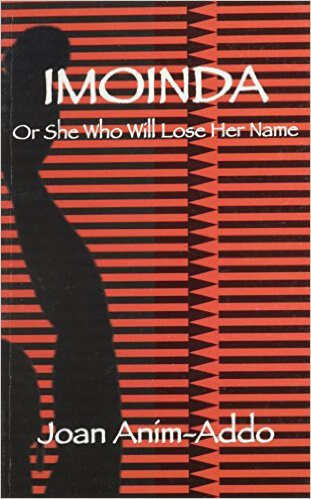
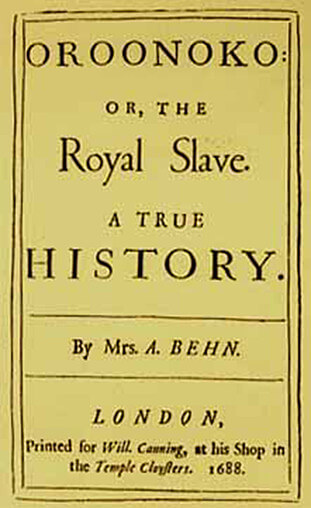
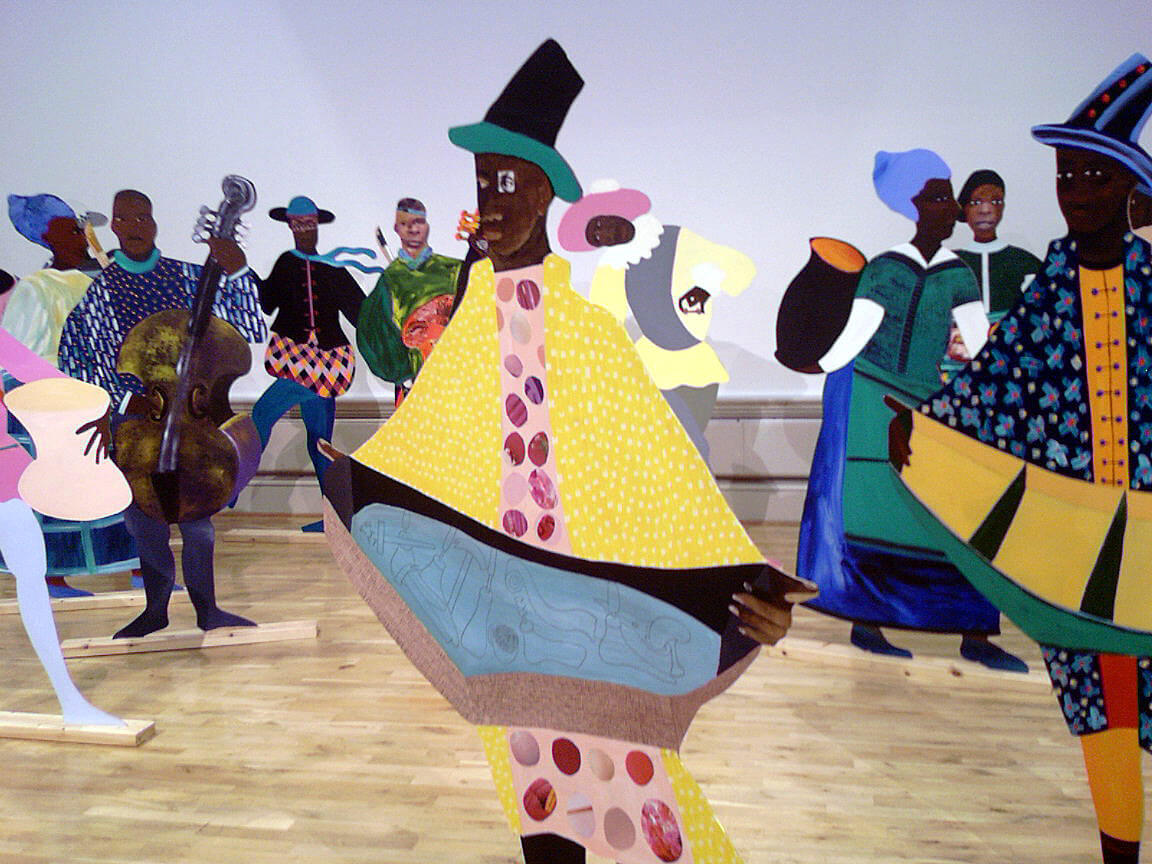
This presentation raises questions primarily concerning art, authorship, and to a much lesser extent, critique, specifically in relationship to my libretto Imoinda or She Who Will Lose Her Name, written in 1997. The piece received a rehearsed reading in 1998 and was first published in 2003. Considering the art involved in this full-length work of musical theater, not only in terms of writing, but also in performance or public spectacle, I am interested to reflect upon what keeps those of us, black women especially, who find ourselves as artists woefully under-resourced in our diverse locations, nonetheless committed to developing what seems, at times, to be an impossible practice. To do this, I borrow the notion of "the thin black line" from the seminal black british visual artists' exhibition curated by Lubaina Himid in 1985. For the purpose of today's reflection, the "thin black line" resonates ideas about resistance, that, retrospectively and disturbingly evoke 1980s Britain with its indifference or hostility to that which, for this discussion, might yet be referred to as "black art."
My idea for Imoinda was to rewrite Aphra Behn's seventeenth century text, Oroonoko or the Royal Slave, as a full-length libretto central to which would be Imoinda, the hitherto silenced black woman in Behn's 1688 novella. By this means, I aimed to authorize Imoinda as an (alter)native narrative to Behn's text. Thus, like Giovanna Covi who first translated the libretto with Chiara Pedrotti, readers and indeed audiences would find that, "Imoinda … does not simply write the story back from the point of view of 'the other' female character; most importantly, it subversively revises the very reality that inspired Behn's fiction."1See Giovanna Covi, "Oroonoko's Genderization and Creolization: Joan Anim-Addo's Imoinda," in Revisiting and Reinterpreting Aphra Behn: Proceedings of the Aphra Behn Europe Seminar ESSE Conference (Entrevaux, France: Bilingua GA Editions, 2002), 83–92. How, as a black British artist, does one go about such a project that also demands staging and the full incorporation of music and voice? It is likely that a perverse commitment is key to such an artistic vision. Yet, commitment first set me traveling with Imoinda, since the realities of under-resourcing became only too evident after the initial authorial stage, the point at which literary artists usually begin to relax.
The impact of under-resourcing that concerns black artists, particularly, becomes magnified in a project such as opera, which in the UK was subsidized in 2007 by the Arts Council to the tune of over fifty-two million pounds, compared to one and three quarter million pounds allocated for jazz, both of which boast similar audience figures in Britain. In the 1990s, black British opera was effectively non-existent, a situation that has barely altered. My desire to counter this through my writing in the 1990s also uncovered questions of authorship and interlinked notions of authority implicit in the attempt to write across boundaries of race, gender, and class, effectively positioning myself out of place as an artist. Who was I to presume to write opera or to consider that black historical engagement might interest an audience preoccupied with "culture"? To begin to historicize Imoinda as an art project and to draw some parallels with 1980s black women artists is also to acknowledge–at best–indifference, alongside a lack of infrastructural support, issues of skills and knowledge gaps, and a commensurate will "to leap our discontinuities," as Kamau Brathwaite has termed it. Much that we have begun to take for granted, for example, finding an agent, or having our work "read," was often unrealistic. The resources refused to find me, and so to achieve the realization of Imoinda fully as art, that is, beyond authorship and in performance, I would develop a push-and-travel relationship to the project, one that, fortuitously, my academic role could support.
To isolate the travel element, I offer a brief chronology that, since the traveling continues, can only be partial, even as it affords an important mapping of how such art might develop, perhaps especially if within one's transnational make-up, the identities black British and black woman are also key. Thus, the final years of the 1990s might be described as important initial "push" years of the project represented by the learning of new skills that allowed a leap of "discontinuities" into much that was unknown, as well as through a consolidating of much practiced writing skills.
Timeline
1996
Talawa Theater Women Writers' Bursary Award kick-started the writing of Imoinda
1998
A June 19 rehearsed reading followed at the Oval House Theater in London under the direction of Warren Wills
1999
An August 1 public performance directed by Juwon Ogungbe followed at the Horniman Museum, representing my 'push' to performance
Visual artist Lubaina Himid, whose "thin black line" I referenced above, writes of art as the practice of "gathering and re-using," and of the time art requires as "measurable in hours during a day certainly but also a sense of time having passed before, a sense of history and most importantly a sense of future, a knowledge of survival."2Lubaina Himid, "Fragments: An Exploration of Everyday Black Creativity and its Relationship to Political Change," Feminist Arts News Vol. 2, no. 8 (1988): 8. Imoinda might easily not have survived into the twenty-first century. I had in my naiveté undertaken an artistic project of tremendous scale without thought of funding, acquiring an agent, a business plan or any such practical consideration. More than doing art, I was claiming a public and contentious arts practice for a black woman. Moreover, I remained blind to the reality of being a nameless, uncommissioned black woman doing opera in the UK, a cultural space in which opera is considered high art for the English middle classes, meaning a more or less exclusively white clientele. Fortunately, serendipity took me to Italy where enquiry about my writing led to the translation of Imoinda and a breathing of new life and renewed optimism into the artistic project. Serena Guarracino, having interviewed me during a break in the Pan-African conference to which I was contributing at the time, wrote afterwards about the "new set of possibilities for contemporary opera" that Imoinda promised. Guarracino's assessment was that Imoinda "challenge[d] the idea of Western opera as a corpus of works whose archaeological mise en scène deprives them of any relevance for the present." Indeed, Imoinda was meant to challenge on many levels, but what was new for me in Italy was the seriousness with which academic and music specialists alike engaged with the text and its possibilities as a staged work. Guarracino noted further that "publication of Imoinda in Italy, home of opera, with an Italian translation" shook "the very ground of Italian opera as it is known in Italy and elsewhere, opening it to the challenge of voices coming from the margins of Western cultural hegemony."3Serena Guarracino, "Imoinda's Performing Bodies: An Interview with Joan Anim-Addo," in I am Black/White/Yellow: An Introduction to the Black Body in Europe, eds. Joan Anim-Addo and Suzanne Scafe (Londong: Mango Publishing, 2007): 212–223.
Guarracino's point about "Western cultural hegemony," had summed up, accurately, I thought, what might be discovered at the core of the art-making that Imoinda represents. It is useful to know, for example, that the interview was conducted in the context of the conference Networking Women: Trans-European and Circum-Atlantic Connections, which took place in Florence in 2004. My own paper was entitled "Pan-Africanist Women: Amy Ashwood Garvey, Jane Rose Roberts and E.V. Kinlock as Networking Women."4See Giovanna Covi, Modernist Women Race Nation: Networking Women 1890–1950: Circum-Atlantic Connections (London: Mango Publishing, 2005). My research at the time concerned black women trying to articulate their freedom within the context of Pan-Africanism. Unsurprisingly, perhaps, my writing of Imoinda was not only interested in presenting challenging black women. Instead, as Guarracino notes, the project as art was itself a challenge, daring "to go to the heart of this very, idiosyncratically Western genre" and daring further, to effectively claim it as "mine," the cultural heritage of a black, first-generation immigrant woman from the Caribbean. Indeed, I dared to conceive of and articulate the operatic performance that I envisioned for Imoinda as "carnival."5Guarracino, "Imoinda's Performing Bodies" 212–223. In other words, my concern was with radical art-making, an almost compelling reason for the project's progress to be hampered in the UK. That itself serves as reminder that opera is not usually considered in terms of radical art and certainly not in the UK. In Italy, "home of opera," it appeared that opera lovers could afford to be more indulgent, generous even, in their embrace of someone at least proposing opera with a difference.
In addition to historicizing Imoinda as art project, I cannot escape in the course of this reflexive exercise acknowledgement of a politicizing that necessarily informs the "thin black line" of resistance to an over-determining of black identity and with it persistent attempts at directing, shaping, and limiting human potential. So, yes, it seemed right to "appropriate the name and conventions of Western opera … while hybridizing them with other forms of musical theater, such as Caribbean carnival and mas." Furthermore, Guarracino gets to the heart of my creative enterprise by acknowledging how much Imoinda itself calls for "a re-thinking of opera's role in the creation of Europe's cultural identity, while at the same time exploring how through opera the former European empire may write, or better, sing back."6Guarracino, "Imoinda's Performing Bodies," 212–223.
The "hybridized" or exotic version promised by Imoinda, of interest enough to composers such as Luigi Don Ciacci and opera specialists like Guarracino in Italy, made not the slightest performance ripple in the UK following the first published bi-lingual edition of the libretto in 2003. Notably, the art deployed by Imoinda was already authorizing the voices of slave women and representing explosive dynamics relative to the tension between subjugation and resistance, a relatively unpopular choice of art project in the UK.
A key change in the performance profile of Imoinda came about in 2008, persuading me to further travels after having listened to composer Glenn McClure's ideas for working with young people to develop a world premiere of Imoinda at the School of the Arts (SOTA) in Rochester, New York. Critique and travel had contributed to this moment. For the second edition of Imoinda, a portable text would be required, one that young people could easily carry around. Covi and Pedrotti's pioneering bi-lingual edition was not pocket-sized, but the 2008 second edition of Imoinda would be. As I explained in a recent interview with the young Italian scholar, Lisa Marchi, an important part of the art of Imoinda lies in the resolution I would reach between "music and affects" or the sound world of the project. Explaining my awareness of "the contrast between what the enslaved Africans were forced to leave behind – their 'vibrational practices,' in Eidshem's terms – and what they would attempt to recover in the new place of the Americas without either familiar instruments or leisure," I posed the solution of this problem as key to the sound world or musical content of the project. Indeed, the sound world was the huge artistic challenge. How to represent it? How to reconcile audience expectations with artistic vision? How to write it down so that it communicated even to a western trained composer, if need be? I had stipulated drums throughout the text although I was only too well aware that I was "working against many operatic traditions." At the same time, not having been "commissioned" to undertake the project, "I had the complete luxury of following through on my own concerns with the affective experience."7Lisa Marchi, "The Transformative Potential of Imoinda: An Interview with Joan Anim-Addo," Synthesis 7 (2015):154–163. http://synthesis.enl.uoa.gr/perspectives-from-the-radical-other-7-2015.html.
Such "luxury" comes at a cost. Is the world ready for Imoinda, the full text? With the "crossing" of the Atlantic and following the luxury of performance, not driven or pushed by me, but handsomely funded by the Rockerfeller Foundation, Imoinda has more recently been subjected to some artistic compromise. The text is now increasingly spoken of and thought about in terms of a "Slavery Trilogy." With music more firmly in place, collaborative issues have become more of a concern. Is the "Slavery Trilogy" that my collaborating composer has begun to market, the same as Imoinda? How far am I prepared to compromise? How prepared am I to lose sight of the African part of the narrative, Part One, for what has become more acceptable, the tale of slavery in the Americas? Imoinda, Part Two has in the course of time metamorphosed into "The Crossing" and was first performed at Tulane University in April 2013. Part Two tells of the journey made by Oko and Imoinda on the slaveship across the Atlantic to the Americas, a theme that is attracting increasing media attention beginning with films such as Beloved and more recently and finally involving black British director Steve McQueen, Twelve Years a Slave.
In closing, I would like to share a couple of minutes of the SOTA production, one that has been very faithful to my vision. The focus on performance in this presentation has been to consider this element of theater writing as crucial to the kind of literary art that Imoinda represents and ultimately an indicator of whether this particular artwork flies at all. Critique or criticism is ultimately of no lesser importance. For those who are interested, I direct you to the Goldsmiths, University of London website that focuses on critical perspectives and published papers on Imoinda. I also encourage those interested to peruse volume seven of the online journal Synthesis titled "Perspectives of the Radical Other" that engages critically with Imoinda as written text and as performance. I offer a few final reflections on authorship and draw again on my responses to Lisa Marchi's interview.
Why did I first insist upon writing? Partly because, at a specific moment, I found myself among a privileged minority of African-Caribbean women who could assume such a responsibility, given that history and its aftermath. It was in part a political decision. I did not emerge from a middle-class cocoon destined to write and to find a privileged place in the world; far from it. So, I consider my writing to be political. Imoinda and the women of that text are speaking, thinking subjects in direct contradiction to what has been generally understood about enslaved women. They reflect an important part of what it means to be human. That humanity is not new though it has been newly allowed to speak.
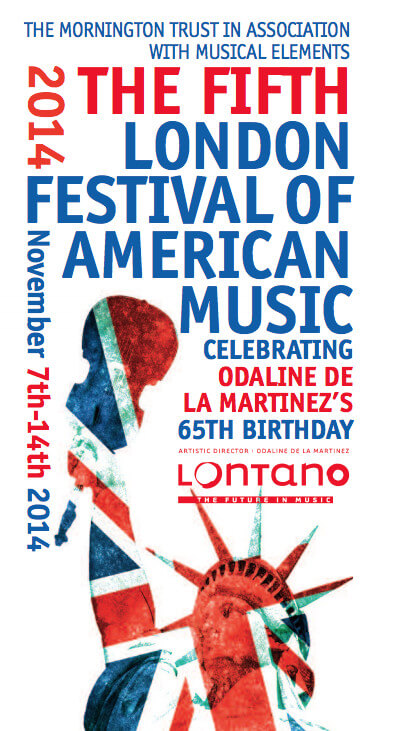
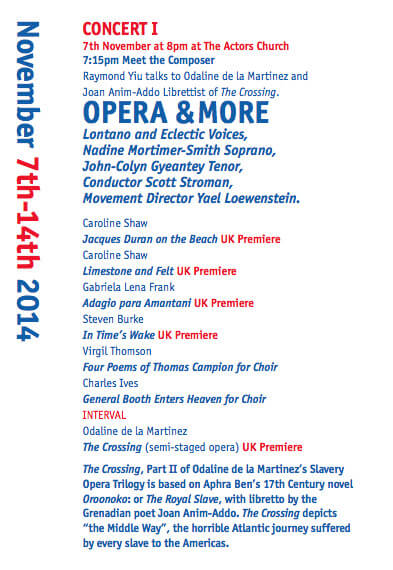
The art that chooses us, I suggest, carries its own restrictions, dependent on our personal location. I have mentioned three identities that signify my own location and indicate something of the challenges of ever making art at all in Britain. Writing and, more importantly, publication in Britain still carries real challenges for those of us who are differently located in relation to the white mainstream. Those of us who place writing at the centre of our art and who are black in Britain dare to forget this at the peril of simply piling up dusty manuscripts. The challenge for black women like me, who insisted on writing and publishing in Britain in the late twentieth century, has been the challenge of claiming – despite the very real restrictions – artistic territory central to which is writing, publication, and performance when society deems such pursuits effectively off limits. To permeate boundaries that effectively dehumanize has been a crucial concern of my art. Hence the representation of speaking black subjects, the invisible ones of a dominant history, projected from page to stage, from community halls to proscenium arches and back again when art calls. Art calls again. No doubt helped by reception across the pond, "The Crossing" is due to be performed at the Actors Church in Covent Garden November, 2014. It is billed in a Festival, "The Fifth London Festival of American Music." Partly as consequence of my engagement with scale, the traveling continues, a questionable exoticism flies, though, for the moment, only when the text is seen to be traveling.
About Joan Anim-Addo
Joan Anim-Addo is professor of Caribbean literature and culture in the department of Engish and Comparative Literature at Goldsmiths, University of London. She is author of the libretto Imoinda, or She Who Will Lose Her Name (London: Mango Publishing, 2008), two poetry collections, a literary history, as well as co-founder of New Mango Season, the Journal of Caribbean Women's Studies.
Arturo Lindsay: Erasing Erasure and Other Ways of Seeing
To see is to know. But how can we know the unseen—the histories, the stories, or even the names of a people that were undocumented, erased?
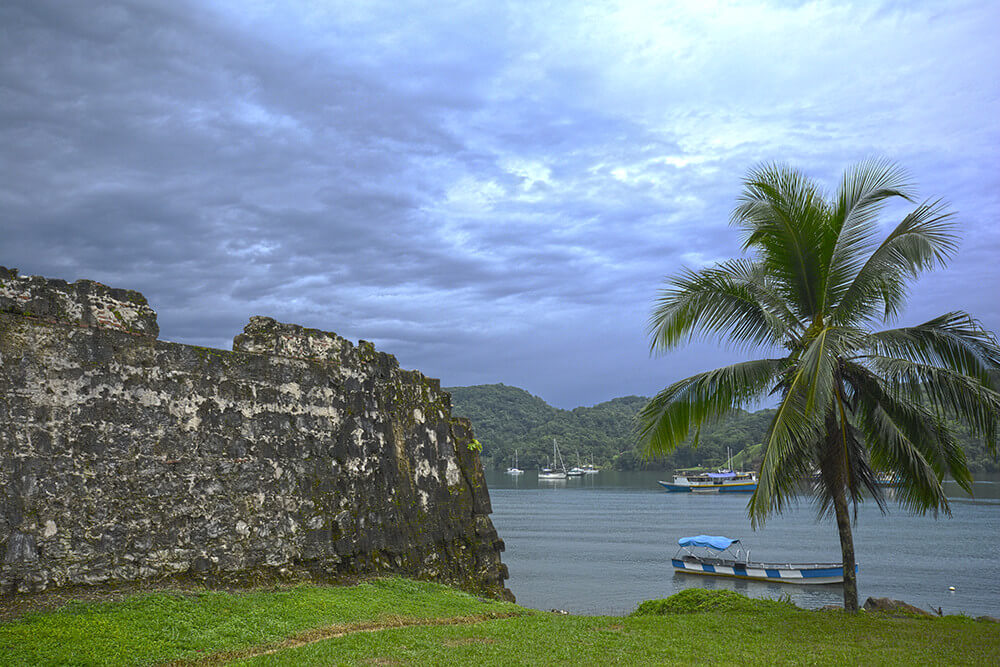
I asked myself that question late one evening as I looked at the sun setting behind the hills on the Bay of Portobelo on the Caribbean coast of the Republic of Panama. The view from my studio faces the remains of a dock that was, at one time, the first encounter with tierra firme for many weary and enslaved black feet whose journeys began months before in Africa.
The setting sun in Portobelo reflects off the cerulean blue sky and puffy white clouds unto the still waters of the bay, producing a rather unique effect of light that seemingly glows from beneath the surface of the water. I wondered—could this light be the souls of those that did not disembark?
The following morning I felt compelled to begin imagining and imaging the anonymous faces of the children that did not arrive in Portobelo on those slavers. My drawing session attracted a few neighborhood children who began guessing who the subjects were in my drawings. Ese parece a Jerónimo. No, no, parece a Tatú, el primo de Gustavo! Their guessing game made me realize that my drawings were probably not that anonymous after all. Maybe, my drawings were informed by the faces of the children I saw every day in my neighborhood. And if that is the case, I thought, maybe the faces in my drawings bear phenotypic resemblances to their ancestors, as well as family members of their ancestors, that perished at sea. The people of Portobelo are, in some cases, direct descendants of Africans that arrived in the village enslaved.
So began my journey. I became obsessed with knowing the faces in my drawings. I wanted to know their stories, their names. Naming the children proved to be easy. I simply looked up traditional ethnic African names from villages in areas where the enslaved were abducted. It is certainly within the realm of possibility that a young girl named Ye from the village of Ejisu might have been on a slaver and the same can be said of a Babatunde of Lagos. Their stories however, eluded me.
I returned to Atlanta that fall with a small portfolio of line drawings of faces that I reworked into a series of prints during an artist residency at Brandywine Workshop in Philadelphia. But their stories continued to elude me. Finally I approached my colleague and art partner, the poet Opal Moore and asked her to live with my children for a while to see if they would tell her their stories.
And they did.
Through the rituals of seeking, seeing, and imaging that is Art, they gave Opal the fragmented stories of their lives in Africa: a moment when the slave catchers arrived in a village called Ndeer, of the women who put the stories of their lives into songs for children to sing, women who charged a favorite daughter, the one who wove stories in baskets, to carry their story in song and basket back to us, the yet-unborn. The story of women who lay fire in every corner and doorway to avoid capture and enslavement; who "climbed the ladder they made of smoke to confront their maker."
The stories they left were the stories of how they had loved.
Opal and I began a collaboration that allowed us to see the faces and hear the voices of the children that others wished to erase. Through art we retold their stories in Atlanta, in Panama, in New York, on Gorée Island in Senegal, in Bellagio, Italy and in various cities in Germany. We retold their stories sometimes together and at times in separate presentations. The important thing however, is that we were able to defy the canon that defines anonymity. Our children had faces, names, and voices!
Opal writes, "Once lost, how can something as intangible as identity, so lightly fixed in a given name, be regained? This question was my point of entry into an artistic collaboration with Arturo and the subject of his series of prints titled, The Children of Middle Passage. We entered into an active artistic conversation that has spanned several years and multiple revisions and re-visionings, resulting in an interdisciplinary, multifaceted art performance work, and now a book."8Opal Moore, "Artist's Statement," in Children of Middle Passage, Arturo Lindsay and Opal Moore, eds. (Lindsay and Moore, 2006)
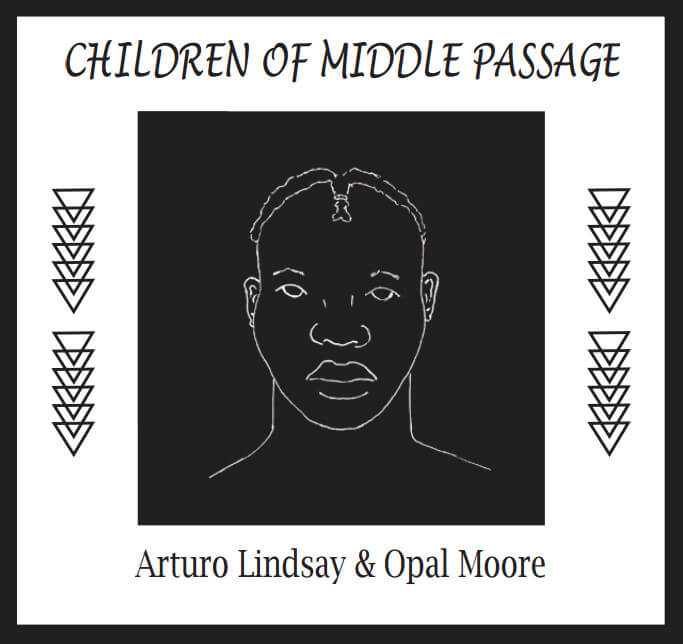
Cover, unpublished manuscript, Children of Middle Passage by Arturo Lindsay & Opal Moore. Screenshot by Southern Spaces.
Our book however, is still a work–in–progress. But, in light of the recent murders of young black men at the hands of the police and other young black men through gun violence I wonder if our book is reminding us that we are still in middle passage.
Maybe Opal has a point. She made a significant change in the title of my series of prints when she said, "The absence of the article "the" in Children of Middle Passage allows us to understand that we are still in middle passage." Historical documents are a valuable source for knowing important moments and events in the past. They are however, told mostly by the victors, the wealthy, the literate, and the elite.
But, is that the whole story? I believe not, especially for Africana Studies students and scholars. The epistemological view of the tabula rasa African, as a person devoid of a culture, language, or religious belief system worthy of preservation was applied as enslavers instituted the practice of erasing African cultures by imposing European customs and values. It was believed that the best slaves were those who were a blank slate capable of adopting, defending, promoting, and even proselytizing the religions and cultures of their enslaver. While it is possible to enslave a person who has his/her own belief system and culture intact, it is impossible to make that person a slave.
That said, it takes art and poetry, music and dance, theater and performance art and, yes, story telling to connect with the spirit of the enslaved person that is resisting erasure. It takes an artist to conjure up a powerful ashé that can erase the erasure transcending time, space, and malevolence. It also takes scholars, critics, and art historians familiar with the aesthetics of ashé to interpret the telling of that story. And finally it takes courageous academics regardless of race, ethnicity, or national origin to force the academy to widen its field of view in order to see; in order to know; and therefore to understand the palimpsest that is our collective histories.
Arturo Lindsay
Arturo Lindsay is professor of art and art history at Spelman College. He is an artist-scholar who consucts ethnographic research on African spiritual and aesthetic retentions in contemporary American cultures.
Robert F. Reid-Pharr: Writing at the Plantation's Edge
The Studia must be reinvented as a higher order of human knowledge, able to provide an "outer view" which takes the human rather than any one of its variations as Subject . . . to attain to the position of an external observer, at once inside/outside the figural domain of our order.
Sylvia Wynter, "The Ceremony Must be Found: After Humanism," 1984
As a result of rallies we got courses in "black literature" and "black history" and a special black adviser for black students and a black cultural center, a rotting white washed house on the nether edge of campus.
David Bradley, "Black and American," 1982
There comes a time when the only thing that one can do is admit defeat. Standing at the tail end of a Black Studies movement established as part of the articulation of anti-segregationist, anti-colonialist African and African American political and cultural insurgencies, one is made painfully aware of a sort of necessary and inevitable social and professional marginalization structuring the everyday existence of the so-called black scholar. The broadly imagined ethical outlines of even the most valued projects of black intellectualism continue as ornamental, overly moralistic, never quite fully valid aspects of the industry/government/education complex that we decorously name the American University. Accommodated in ever more brightly colored, if distantly placed and institutionally vulnerable, houses, the Black, African, Africana scholastic project has only the most limited means by which it might affect a sort of inchoate articulation. When times are good and the funding secure, the history, thought, and culture of the peoples of the African Diaspora might be taken as a sort of reiteration of the central conceits of American and European cultural and intellectual orthodoxy. A single red/brown/yellow/blue face appearing intermittently in recruitment brochures or faculty lounges boastfully reminds us of the meritocratic liberalism that presumably underwrites the basic structures of our most cherished educational and intellectual institutions. More impressive still, the scholar of Black Studies might make great use of an apparently never too tired for service "plus one" account of black subjectivity in which the most traditional ideas of Universalism, Cosmopolitanism, and western Modernity are presumably broadened and deepened through the indication that some representative "black" individual "was there." And when times are lean and narratives of scarcity rub harshly against notions of open-minded largesse, one might enact again, and yet again, a sort of hysterically ineffectual theatrical rebellion, identifying the many always easy to uncover moments of racialist hostility and insensitivity that are among the most profoundly resilient aspects of American and European societies.
Still, regardless of the modes of attack and address, only the most limited consideration of Africa and the African Diaspora can be discerned within the best supported and most cherished precincts of the human sciences. There is so little awareness of the broad ideological structures on which the various practices of professional "humanists" are established that it becomes difficult to imagine that we might either critique or redirect basic modes of research and study. Broach the topic of lists, fields, and curricula with the most generous of colleagues and you will very likely be met with a handwringing and apologetic, if firmly conventional, story of limited resources, fixed traditions, bureaucratic obstacles, and the rigid expectations of a harshly disciplining market. At the moment of challenge, humanistic studies are imagined to exist not so much as a complex of ideologies, discourses, and institutions with an identifiable and relatively short history, but instead as an impossibly distant force, almost metaphysical in nature, that we are able to approach with only the most unstable of intellectual prosthetics.
The crisis of the humanities is first and foremost a failure of the political and ethical imaginaries that stabilize the labor that one presumably does as a practitioner of the human sciences, as a writer. It is the ever more vertiginous social reality confronting intellectuals who approach their work through a sort of willed ignorance of the ideological organization of the Studia. The philosophical and ethical arrangements of the human sciences become much clearer once one appropriates the historical understandings given us by Michel Foucault and amplified by Sylvia Wynter, once we recognize that not only are the conceptual and instrumental arrangements that we use to teach, research, write, and publish decidedly new phenomena, but also that they are inextricably tied up with the violent extraction of value and labor. In a sense then, we are lucky in the United States to have so little opportunity to cover over the absolutely intimate relationship between universities, colonization, and enslavement. Step onto the campus of one of the country's great sites of learning and you are quite likely stepping onto a plantation, an institution in which the expression of so-called high culture was—and is—fueled by the literal entrapment and internment of Africans and their descendants.9The deep connections between especially the most elite American universities and slavery is becoming ever more clear. Brown University, the College of William and Mary, Harvard University, Emory University, the University of Maryland, the University of North Carolina at Chapel Hill, the University of Virginia, Yale University, and Columbia University, among many others, either held slaves directly, utilized slave labor in the building of their campuses, traded slaves as commodities, greatly supported the work of slavery apologists (and later apologists for colonization and segregation), or more likely some rich combination of all these things. The main campus of Johns Hopkins University is built on the former Homewood Plantation. Tours through the still standing main house are a regular part of campus life. For more on this matter see, Craig Steven Wilder, Ebony and Ivy: Race, Slavery, and the Troubled History of America's Universities (New York: Bloomsbury Press, 2013).
Those gates and guards through and by which we pass are not simple adornments, but instead absolutely necessary safeguards within a set of protocols designed to distinguish (European) order from (African) chaos. The disciplinary structures most commonly associated with the humanities operate first and foremost to yoke the "free-floating energy" of the untidy (Negro) to a process by which a disembodied "universalist" (White) Order might be named. The trick, of course, is to accomplish this particular procedure without seeming to do so. There is good reason that there has been so little discussion of the relationship between the history of Atlantic slavery and the development of the "disciplines." That procedure would invite consideration of the rather uncanny overlap of these institutions' developmental timelines, coming to maturity as they did in the eighteenth and nineteenth centuries and "fracturing" in the twentieth. Even more to the point, a truly historicist and anti-white supremacist examination of the history of the human sciences would necessarily have to take into account not only the fact that the descendants of the enslaved and the colonized continue to do the unseen, unwanted, irrational work of the university, dumping trash cans, cleaning toilets, and preparing meals, but also that the scholars whom they service incessantly, even manically, reiterate a set of intellectual protocols built precisely on never noting that their cleverness and disinterestedness are often themselves examples of brittle misunderstanding(s) of the conditions of their own labor.

It comes as no surprise then that the Black Culture Center should be so studiously ignored as it stands mocking and mocked at the plantation's edge. It is not dissimilar from the skulls, bone, teeth, and bits of decomposing cloth that one might encounter in a Catholic reliquary. Fascinating in its vulgarity and decrepitude, the rotting whitewashed house seems to point in two directions at once, naming a desiccated past while demanding a certain horrified attention in the present. Wynter writes:
It is within the same governing laws of figuration and its internal logic that the Black Culture Center was proscribed to exist on the nether edge of the campus. It functioned as the target stimuli of aversion, with respect to the Euroamerican order of the center of the campus, which is then enabled to function as the object stimuli of desire. The relation, functioning dually at empirical and valorizing levels, if stably kept in phase, ensures the stable production of the same shared endogenous waveshapes, in Black students as well as Whites—the same normative seeing/valuing, avoiding/devaluing behaviors. Hence the paradox that, after the turbulence of the 1960s and the 1970s the Black Culture Centers in their nether-edge-of-the campus place function to enable the recycling (in cultural rather than racial terms) of the Order/Chaos dynamics of the system-ensemble.10Sylvia Wynter, "The Ceremony Must be Found: After Humanism," boundary 2 vol. 12, no. 3 – vol 13, no. 1 (Spring–Autumn, 1984): 47.
Here I take some solace in the conditional nature of Wynter's most damning observation. If the fraught relations between Black Studies and "the Euroamerican order of the center" are stably kept in phase, then we condemn ourselves to the reiteration of those normative behaviors and modes of thought established in the crucibles of enslavement and colonization. The very presence of the shabby house at the edge of campus marks the possibility of rupture within these systems. It suggests modes of knowledge and articulation that, if not elegant, are at least not so wholly and innocently disconnected from the means of their own replication as to exist in a sort of creative stasis, operating like the disciplined, defeated professor of literature whose tepid passions never quite reach the level of either offense–or brilliance.
While I knowingly, even lovingly, embrace the disorder that is Black Studies, I cannot bring myself to celebrate that embrace. Sitting here on the ugly side of campus, collecting my thoughts in rooms that though not obviously rotting are nonetheless likely to be swept away come the next great wind, I know that my efforts must be read as at once marginal and suspect. I "have every interest in challenging an order of figuration" that programs my own negation.11Wynter, "The Ceremony," 49. Yet, mine is not a blameless opposition. I do not naively celebrate the obvious fraying of the humanities project. Nor do I yearn for an easy reorganization of priorities, the moving of the white house to the center. Instead I am seeking, however haltingly, for the reinvention of the Studia in a manner that would allow for the articulation of a fully universal humanism and the dismantling of the deeply imbedded white supremacy that so firmly establishes American and European intellectualism. In doing so, however, I must by necessity recognize the Black Studies apparatus itself as having been established within the Order/Chaos ideological nexus that lies at the heart of the human sciences. Thus in the necessarily radical practices of disarticulation that one hopes will soon and very soon take up our attention and our energies, it is quite unclear if the rotting house will survive.
Robert F. Reid-Pharr
Robert F. Reid-Pharr is professor of English at The Graduate Center City University of New York. He is author of Once You Go Black: Choice, Desire, and the Black American Intellectual (New York: NYU Press, 2007), Black Gay Men (New York: NYU Press, 2001), and Conjugal Union: The Body, the Hours and the Black American (Oxford: Oxford University Press, 1999).
Martha Southgate: What Came Before
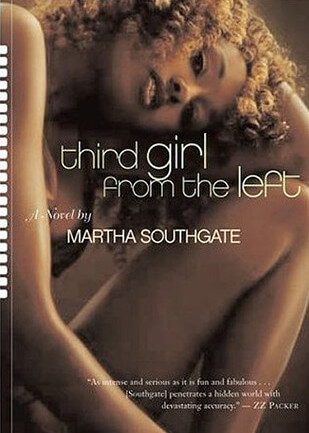
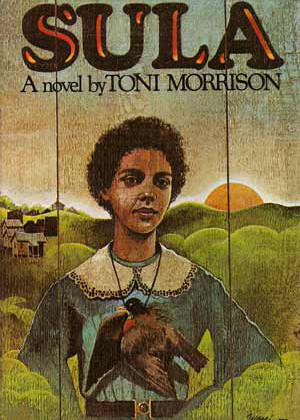
This presentation raises questions regarding the meaning of history and influence as refracted through my novel Third Girl From The Left. This novel was written very much with an awareness of the weight of history both on my fictional characters and on the lives of African Americans.
Not only does this presentation consider history, both within the novel and in everyday life, crucial to one novel's shape, but I also explore the ways in which other novels, among them Toni Morrison's Sula, provided direct inspiration, in some senses parenting this novel into being, informing crucial passages and my understanding of how Third Girl would develop. I offer thoughts on how that parenting might be made more explicit in the examination of certain literature and contemplate the implications of these cross-literary relationships. 
About Martha Southgate
Martha Southgate is author of Another Way to Dance (New York: Delacorte Press, 1996), The Fall of Rome: A Novel (New York: Scribner, 2010), Third Girl from the Left (New York: Houghton Mifflin, 2005), and The Taste of Salt (Chapel Hill: Algonquin Books, 2011). Southgate has received the PEN/Beyond Margins Award, Hurston/Wright Legacy award, the Alex Award from the American Library Association, and the Coretta Scott King Genesis Award for Best First Novel. Her non-fiction work has appeared in The New York Times Magazine, O, Premiere, and Essence.
]]>Welcoming Comment from Natasha Trethewey
Natasha Trethewey, Welcoming Comment, 2014.
About the Speaker
Natasha Trethewey is a Pulitzer-Prize winning poet (Native Guard, Mariner Books, 2006) and former poet laureate of the United States (2012–2014). She directs the Creative Writing Program at Emory University. Many of her poems first appeared in various forms in Callaloo, a journal that for her serves as "an archive that [she] can hold."
Significance of the Occasion: A Letter and Comments from Charles Henry Rowell, Editor of Callaloo
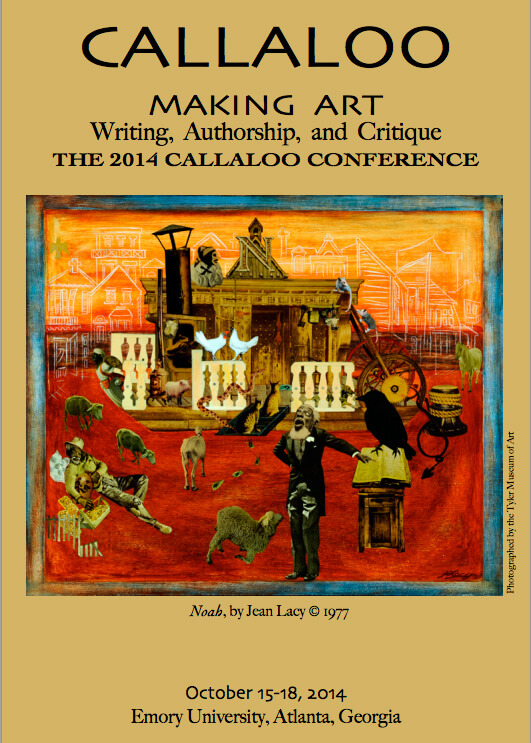 | 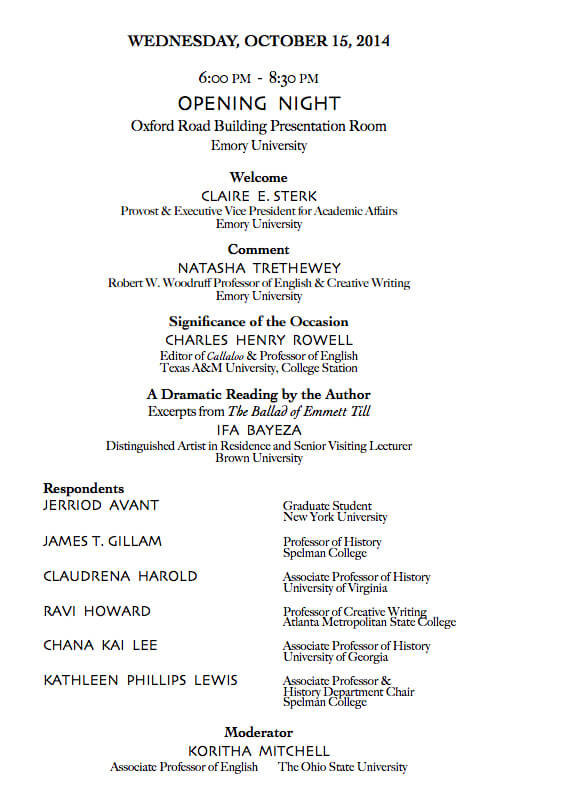 |
Dear Colleagues and Friends,
Welcome to the 2014 Callaloo Conference, our seventh annual gathering, which focuses on "Making Art: Writing, Authorship, and Critique," a subject that seldom, if ever, receives significant headliner attention at academic conferences today.
For the 2014 Callaloo Conference, we have invited distinguished intellectuals and artists to help us return to subjects that we, at our inaugural meeting in New Orleans in March 2008, partially addressed. I say "partially" because at our first meeting we attempted to answer the following questions: What do we do? How do we do it? Why do we do it? That is, "we" as academics and artists. Our aim then was—and it remains so—to bring together our colleagues, creative and critical voices, in open conversation with each other about the work, in written form, in which each of us is engaged. Ultimately, the aim is to foster understanding, appreciation, and respect for the kind of work that is required and expected of us in the academy.
While "Making Art" is in some few ways similar to our New Orleans "summit," we, during this conference here at Emory University, want to take additional and meaningful steps forward. We want to acknowledge that what we write, invent, create—as literary and cultural criticism, as fiction or poetry or drama, as painting or performance art, as music composition or dance—should be equally valued, supported, appreciated, and respected by our colleagues and by the administrators whose watch maintains the values and boundaries imposed by the current organizational structures of contemporary universities.
What we say and do here at Emory University this week should ultimately be read as a message to our colleagues across the United States, as an unmitigated statement intended especially for our colleagues in literary and cultural studies and for those in the multiple disciplines in Africana and related studies. Our message is a simple three-part statement that argues for positive changes in the academic departments or programs that house these disciplines:
- An end to the actions that divide creative and critical/academic voices; an effort to develop and establish means that perpetuate mutual respect; and mutual support for teaching and for the work, its production and publication
- An end to behavior, actions, or words that devalue, denigrate, or privilege one discipline at the disadvantage or expense of another
- An aggressive support of excellence in the production of writing and performance that is creative, critical, and archival
Charles Henry Rowell, Callaloo Conference: Significance of the Occasion, 2014.
I am certain that faculty members in Africana studies departments and programs must realize their need to expand in academic disciplines beyond the boundaries of their origins set some fifty years ago as black studies, to extend beyond courses in literature, history, and the social sciences and to include in their curricula courses in the fine arts, such as film, creative writing, visual art, music (its history, composition, and performance), theater, etc. Then, too, I am convinced that a number of forward-looking faculty members in literary studies and cultural studies in English departments would gladly promote our recognition that, instead of engaging in the traditional myopic behavior of devaluing creative writing and privileging the critical voice over the creative, we should try to bring the two groups together in mutual respect and departmental support, an effort which is the origin of the Callaloo Conference.
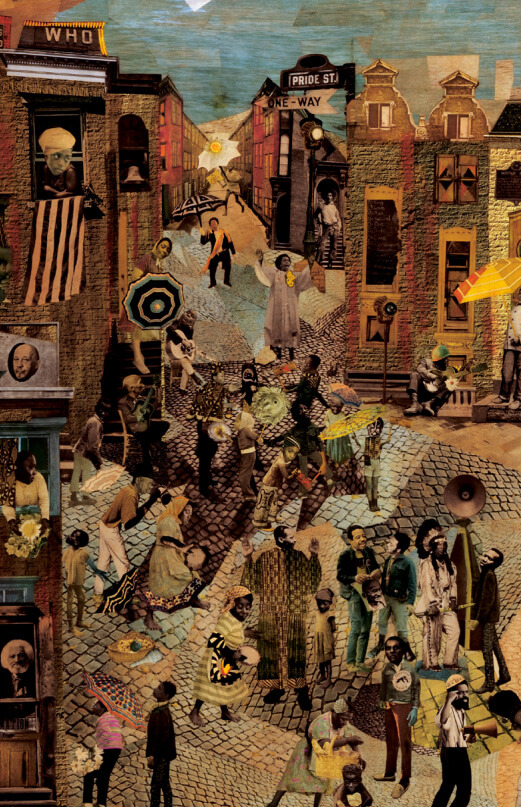 |
| Dancing in the Streets, collage montage on museum board by Jean Lacy, 1976. Photograph by the Tyler Museum of Art. Back cover art of the 2014 Callaloo Conference program. Courtesy of the Callaloo Conference. |
It is our hope that our colleagues back home will observe and critique what we are doing here and set an agenda, in terms of their own college or university needs, that equitably supports and promotes their faculty members: what they do, how they do it, and why they do it. That is, if English departments and Africana departments and programs take seriously our vision here, our institutions of higher education will broadly serve our nation and become stronger for having done so.
Finally, we invite you to join us auditors for our two keynote speakers and to visit the panel presentations and join in the discussions, which are offered for your benefit as well as ours. The conference program that follows indicates that we have also organized evenings of poetry and fiction readings as well as a final morning gathering to hear original musical compositions. We hope that you will continue to visit with us for each of these activities and engage our presenters in what they offer us.
Again, welcome to the 2014 Callaloo Conference.
Yours truly,
Charles Henry Rowell
About the Author:
Charles Henry Rowell is professor of English at Texas A&M University and the editor of Callaloo, a journal of African disapora arts and letters.
]]>Howard Dodson, Making Art at the Schomburg: Africana Archives as Sites of Art Making (Part 1 of 3), 2014.
Art making has been a critical aspect of the human experience since time immemorial. Among the earliest evidence of human beings as art makers are the rock carvings and engravings found throughout the African continent that date back to the sixth to eighth millennium BCE (6000 to 8000 BCE). The purpose of these art renderings is unclear, but their existence is evidence of the creative and aesthetic sensibilities and impulses of their creators. This ability to create art was and is one of the attributes that separates human beings from the rest of the animal kingdom.
This creative impulse, which is part of what makes us human, likely found expression in other media. Among African people, diverse forms of artistic expression defined and gave meaning to their unique cultures. Rituals and ceremonies of a religious, spiritual, or secular nature included music, dance, and dramatic performances as well as sculptures and other visual art objects. In one sense, art was the expressive dimension of African cultures and an integral part of African peoples' day-to-day living and being. Art making then, has likely been an integral part of life-making among African people (and humankind) since the beginning of human societies and human civilizations.
This conference is an exploration and assessment of that millenniums-long phenomenon in contemporary Africana life and culture. Like its sponsor, Callaloo: A Journal of African Diaspora Arts & Letters, this conference's focus is on the literary arts. But its scope embraces other forms of artistic expression and includes people of African descent from the African continent and its diasporas. I have been asked to speak on the theme "Archiving Africana" with an eye towards helping you rediscover Africana archives as repositories of Africana art, as places of historical significance in their own right, and as places and resources for Africana art making and creativity.
Africana archives in the United States trace their origins to the late nineteenth and early twentieth centuries. The need for black people to establish such institutions was expressed by Victoria Earle Matthews in 1895. She said:
The lesson to be drawn from this cursory glance at what I may call the past, present, and future of our Race Literature, apart from its value as first beginnings, not only to us as a people but literature in general, is that unless earnest and systematic effort be made to procure and preserve for transmission to our successors, the records, books, and various publications already produced by us, not only will the sturdy pioneers who paved the way and laid the foundation for our Race literature be robbed of their just due, but an irretrievable wrong will be inflicted upon the generations that should come after us.1Victoria Earle Matthews, "The Value of Race Literature," in The New Negro: Readings on Race, Representation, and African American Culture, 1892–1938, eds. Henry Louis Gates, Jr. and Gene Andrew Jarrett (Princeton, New Jersey: Princeton University Press, 2007), 287–297.
Victoria Earle Matthews, poet, novelist, journalist, and social worker, delivered the address from which this passage is excerpted at the first national conference of black women which was held in Boston, Massachusetts in July 1895. Entitled "The Value of Race Literature," the speech emphasized, "the importance of collecting the writings of black men and women, including histories, biographies, sermons, speeches, essays, and articles in order to preserve the culture and contributions of people of African descent."2Jessie Carney Smith, editor, Notable Black American Women: Book One (Detroit: Gale Research, 1991), 738.
Two years after Matthews's speech, in March 1897, the American Negro Academy, an association of African American "men of science, letters and art or those distinguished in other walks of life" was founded in Washington, DC. It's purpose was to encourage research, writing, and publication of scholarly works dealing with the global black experience. The members were also encouraged to develop an archive of materials by and about peoples of African descent.
Howard Dodson, Making Art at the Schomburg: Africana Archives as Sites of Art Making (Part 2 of 3), 2014.
The Academy and its members were part of a national network of what anthropologist St. Clair Drake used to call the "vindicationist school" of black intellectuals. Responding to what I have called the reigning unwisdom of the late nineteenth and early twentieth centuries—the myth that black people were biologically, intellectually, and socially inferior to whites—these intellectuals sought to refute this myth through their writings and publications. By the first decades of the twentieth century, a network of "vindicationist collectors" had also emerged in the African American community. By 1916, many of them had become members of the American Negro Academy.
In conjunction with the annual meeting of the Academy in December 1916, John Wesley Cromwell, a founding member of the Academy, convened a meeting in his residence in Washington, DC, of black bibliophiles who were members of the Academy. The purpose of the gathering was to establish a Negro Book Collectors Exchange whose purpose would be to centralize all literature written by "colored people." To achieve this objective, the Exchange would establish a union list of books by and about blacks by asking all known "Negro book collectors" to register the names of the authors and titles of books in their collections with the Exchange. Equipped with this master database, the Exchange would serve as a clearinghouse for information on black-related materials and a vehicle for trading duplicate copies of books amongst members. There is no evidence that the Negro Book Collection Exchange ever met again or carried out its ambitious agenda. But the collections of the bibliophiles in attendance became the foundation of today's Africana archives eco-system. The Library of Congress's Africana Collections began with Daniel Alexander Murray's collection. Henry Proctor Slaughter's collection figured prominently in the development of Atlanta University's Africana Collection. Jesse Moorland's gift to Howard University sparked the development of the Moorland-Spingarn Research Center. And Arturo Alfonso Schomburg's Collection at the New York Public Library has evolved into the Schomburg Center for Research in Black Culture. This presentation will focus on the Schomburg Center as an Africana archive and its role as a resource for Africana art making and as an art making institution. While I will focus on the Center's art making activities during my twenty-seven year tenure there, I will also call attention to its earlier role as a place where Africana art was made.
The Schomburg Center: History and Mission
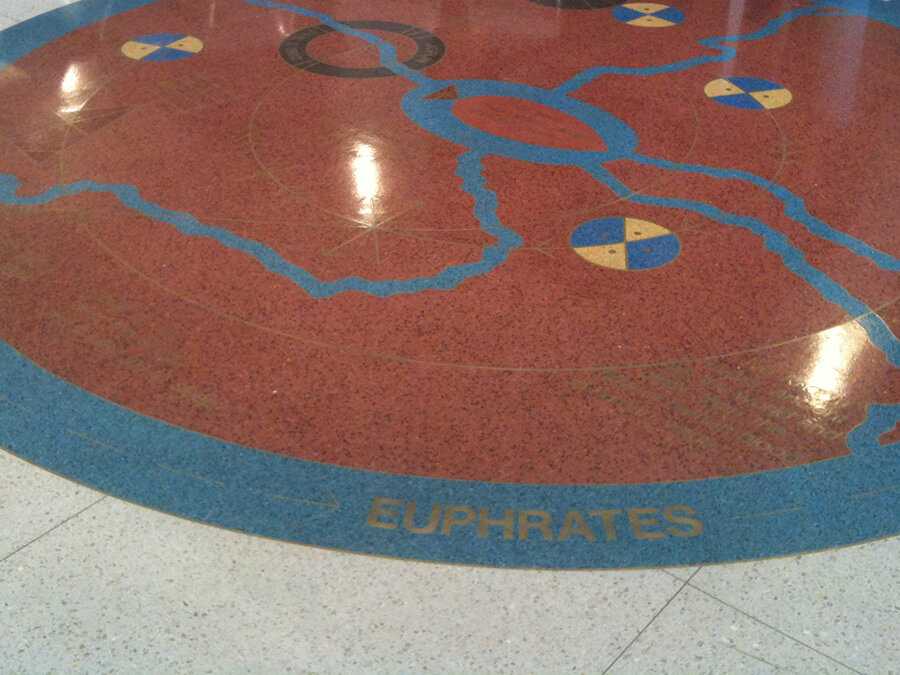 |
| Rivers, Langston Hughes Lobby, Schomburg Center for Research in Black Culture, New York Public Library, New York, New York, May 22, 2011. Flickr photograph by Matt Kingston. This public art installation and peace memorial honors Harlem Renaissance poet Langston Hughes and Arturo A. Schomburg. Creative Commons License CC-BY 2.0. |
The Schomburg Center for Research in Black Culture, a research unit of the New York Public Library (NYPL), is generally recognized as the leading public research library in the world devoted exclusively to documenting and interpreting the histories and cultures of people of African descent. With collections numbering in excess of ten million items including books, manuscripts, correspondence, personal and professional papers of individuals, archived records of Africana institutions and organizations, as well as films, photographs, radio and television programs, and oral histories, the Schomburg Center is also generally recognized as a repository of documentary evidence on the global black experience—an Africana archive. For much of its eighty-nine years, it has been widely recognized as a place where scholars—professional and lay—and the curious general public go to find reliable, accessible, authoritative information on the black experience. For much of black America—then and now—it has been a place where one goes in search of the truth about the black experience, historically and contemporarily. As such it is for many the authoritative Africana Archive—a trusted repository where the information gathered has been assembled with an eye towards discerning the truth about the black experience. This was, in many respects, the intellectual and political intent of Arturo Alphonso Schomburg when he started assembling his founding collection at the beginning of the twentieth century. It was also the intent of his generation of late nineteenth and early twentieth century black bibliophiles and collectors.
Mr. Schomburg's sense of mission as aggregator of information on the global black experience (and I suspect this was true of all of the vindicators of the race), was not simply one of gathering evidence. Collecting was a means to an end, not an end in and of itself. Schomburg, perhaps more than his bibliophile peers, was actively involved in using his archive to pursue an educational agenda. He used the assembled information and knowledge to educate and empower black people; to debunk the myths of black inferiority amongst blacks and whites; and to transform white Americans' consciousness of who people of Africa descent were and what they had achieved as human beings. Throughout his life, both before and after he deposited his collection at the 135th Street branch of the New York Public Library, Schomburg organized and curated exhibitions, published articles in newspapers, scholarly and popular books, and journals, and also lectured widely. He transformed the information and knowledge he had amassed in his archive into educational resources that could be used to elevate the consciousness of black people and challenge the prevailing social, political, and cultural discourses about black people—their history, cultures, and intelligence. His fellow bibliophiles shared his sense of purpose, but Schomburg appears to have had the most comprehensive approach to using his collection as a resource in shaping public understanding of Africana history and culture making.
Howard Dodson, Making Art at the Schomburg: Africana Archives as Sites of Art Making (Part 3 of 3), 2014.
I embraced Mr. Schomburg's practice of using collections to empower people and was further encouraged to do so by an admonition of one of my intellectual and political mentors, historian Lerone Bennett, Jr. He said, and I paraphrase, "the challenge of the hour is to get the books off of the shelves and out of the stacks and into the minds and muscles of the people." Bennett was speaking about books containing knowledge about the black experience and his "people" were people of African descent who he believed could and should use such knowledge to empower themselves. At the base of his dictum was the oft stated assumption that knowledge is power. He believed that black people with knowledge about themselves would be empowered to change their current conditions and create healthy and humane futures for themselves and for their worlds. As instrumentalist as this kind of thinking is, I believe that this is what black scholars and institutions committed to using their intellectual powers to create and support the development of a better world for black people are called to do. My work at the Schomburg Center and now at Howard University and the Moorland-Spingarn Research Center has been guided by these principles.
Archival institutions are best known as repositories of records documenting the past. As such, they are commonly thought of as resources for the study of history. From its inception, the Schomburg Center's collecting mandate was broader than that. It's original name as a resource center in the 135th Street branch of the New York Public Library was "The Division of Negro History, Literature, and Prints." Schomburg's original collection also included African and African American art. Currently, the Africana archives at the Schomburg Center are organized into five divisions based on format. Books, serials, and microforms are managed by the General Research and Reference division. The Manuscripts, Archives, and Rare Books division houses those formats and there is a separate division for photographs and prints. An Art and Artifacts division and a Moving Image and Recorded Sound division house paintings, prints, sculptures, and artifacts and film, audio and video tapes, and sound recordings, respectively. As a consequence, the Schomburg Center as an Africana archive documents Africana art and culture, as well as Africana history. Expressive art forms include the visual arts, dance, theater, music performance, and the literary arts, as well as genres of vernacular culture that incorporate elements of dance, music, and theater in sacred and secular rituals. The Schomburg Center, then, is at once an archive of Africana history, art, and culture. The availability of this rich variety of resources for documenting and interpreting the global black experience makes the center an ideal intellectual and creative partner for scholars and artists who would seek to make art integrating or celebrating the history, heritage, culture, and art of people of African descent.
Making Art at the Schomburg
I want to focus the remainder of this presentation on some of the things we did during my tenure at the Schomburg Center that used its archive and collections to "make art". While this conference is heavily focused on the literary arts, I want to explore some of the ways in which the Schomburg, as an institution, as well as various scholars and artists at the Schomburg, used Africana archival materials to create or make art in a variety of genres, including, but not limited to, the literary arts.
I should say, by way of preface, that technically, archives are organizational records. However, the term is widely used to refer to collections of documentary materials of all kinds. I'm using the broader definition. Most people view archives as the special, almost private, playland of scholars and intellectuals—scholars who essentially critique art and other forms of historical, political, social and cultural production or who mine the evidence contained in the archive to create new knowledge about the past. Because archives are records of the past, the assumption is that they are the special preserves of historians, philosophers, archeologists, and others who specialize in creating new knowledge about the past. Too often, this combination of disciplinary bias and misperception blinds other inquisitive, intelligent, knowledge-seeking people from engaging the content—or even thinking about consulting the documentary resources—of past experience. I'm thinking here of writers, poets, visual artists, musicians, playwrites, actors, producers, journalists, etc. The most naïve of sorts actually have the audacity to ask, "What could the records of these old folks possibly tell me or show me about living a black life in the twenty first century? And as a creative artist and intellectual, what can I learn about the black experience that would be worthy of "elevation" to the status of art?" My response is, "Everything you could possibly dream of or hope for!"
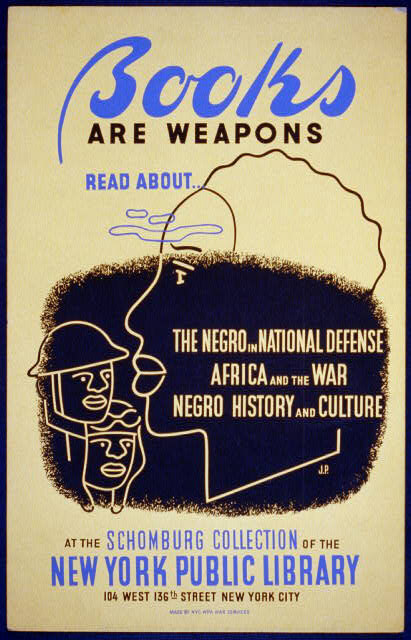 |
| Books Are Weapons, poster by NYC WPA War Services, 1941–1943. Courtesy of the Library of Congress, Prints and Photographs Division, WPA Posters Collection, LC-USZC2-1124. |
My first formal relationship with the Schomburg occurred before I was hired as its director. Almost one year earlier, I was contacted by the New York Public Library to help the Schomburg staff create an exhibit based on the Center's holdings and collections that would compliment its NEH-funded major exhibition on "Censorship in America."
I took the job and eventually worked with the Schomburg Center staff to create the exhibition "Censorship and Black America." But the exhibition wasn't a black face echo of the major theme of the NEH project that focused on book publishing and the printed word. Rather, the Schomburg's exhibition explored the historically documentable thesis that black people, in all aspects of their presence and being in America, were a censored people. Through laws, texts, images, and publications, the exhibitions documented this fact for a broad public audience.
Artistically, though it was my first exhibit, I took significant aesthetic risks. Against the advice of the Schomburg staff and others, I painted the gallery walls black. Images and documents were framed in blonde oak wood with red and white double mats. The text panels and captions featured white text on black matte backgrounds. Aesthetically and intellectually, the exhibit was a stunning work of art fashioned out of the collections of the Schomburg.
Over the years, I came to look at the Schomburg collections as resources for rescuing and reconstructing the historical and cultural heritages of people of African descent, as well as inspirations for creating twentieth and twenty-first century public engagements with that historical and cultural past. During my tenure at the Schomburg, I curated or co-curated more than three dozen of the more than eighty exhibitions on African and Africana themes. Most were either inspired by or based on the objects, content, and themes documented by the Center's archival holdings. Making exhibitions is a time-honored way in which museums, libraries, and archives make art.
I share this with you because all too frequently, scholars and intellectuals come to archival institutions like the Schomburg with singular, and more often than not, limited and limiting questions and expectations. Archives, especially those that document the black experience, have much, much more to offer if you choose to interrogate them. The archives need more interrogators, more artists, more creatives capable of mining their content and using it to create new art.
I'm convinced, moreover, that artists—visual, musical, dance, theater and others—who would create and present works of art about the global black experience need a sustained engagement with an appropriate and compatible Africana archive. Those who have done so have improved the quality of the art they produced because of their willingness to immerse themselves in Africana archives.
The Schomburg Center had been a site of art making long before I arrived on the scene. In addition to collecting books and other documentary materials, Mr. Schomburg was also a collector of Africana art. He sponsored and curated annual exhibitions of African American works during the 1920s at the Brooklyn and Queens YMCA Carlton Avenue branch, the "colored" YMCA, as well as the 135th Street branch of the New York Public Library and future home of the Schomburg Collection. He also provided financial support for several Harlem Renaissance visual artists and both collected and exhibited the works of many prominent black creatives.
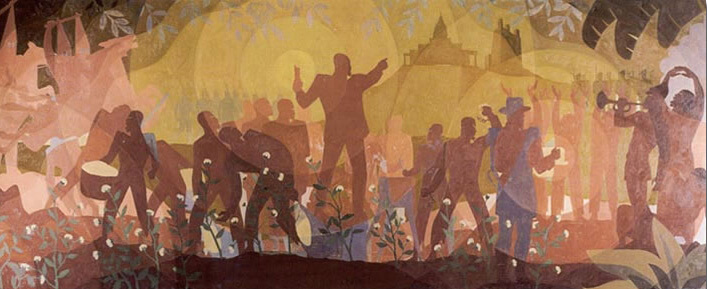 |
| Aspects of Negro Life: From Slavery through Reconstruction. Mural panel by Aaron Douglas, 1934. The Schomburg Center for Research in Black Culture, Art and Artifacts division, The New York Public Library. |
Jacob Lawrence and Aaron Douglas used the resources of the Schomburg Collection to document and inspire many of their works. Lawrence researched virtually all of his visual narrative painting series (Toussaint L'Ouverture, Frederick Douglass, Harriet Tubman and John Brown) at the Schomburg during the 1930s. The American Negro Theater, featuring artists like Sidney Poitier, Harry Belafonte and Ruby Dee, produced plays in the Schomburg building during the 1940s. Numerous other writers, poets, visual artists, musicians, play writes, actors, producers, filmmakers, and journalists found inspiration and authenticity in the archival resources of the Schomburg.
While he was living in New York City, Denzel Washington frequently disguised himself and came to the Schomburg Center to study films, develop his characters, and familiarize himself with the period of a given project using the Center's archives. Documentary filmmakers, especially Bill Miles, St. Clair Bourne, and Bill Greaves used the resources of the Schomburg Center (photographs, documents and storylines) to produce many of their award-winning documentary films.
Deidre Bibby, former curator of art at the Schomburg Center, decided to update the Center's holdings of artworks by Harlem-based African American visual artists. After conducting a survey of the artists of African descent working in Harlem, Bibby organized an exhibition of the works of over forty artists. "Who's Uptown Harlem?" became a stunning art exhibition surveying the nature and quality of Africana art making in Harlem in the 1980s. In addition to the exhibition that publicly showcased the art, the project resulted in the Schomburg Center adding several new works by Harlem artists to its collections.
The acquisition of collections and other special occasions often provided the Center with an excuse to celebrate the life and work of an artist. Some celebrations would take the form of artworks in and of themselves. Major tribute programs were produced and presented in Broadway Theater venues—the Shubert, and Majestic Theaters, and Carnegie Hall—featuring Broadway-quality artists who celebrated the lives and works of Paul Robeson, Lorraine Hansberry, and Ella Fitzgerald, among others. These productions were marketed as gala fundraisers for the Schomburg Center featuring leading artists of the time in tribute to Africana artists past. The 90th Birthday Paul Robeson Tribute at New York's Shubert Theater for instance, featured Christopher Reeves, Uta Hagen, Joeseph "Joe" Papp, and the Duke Ellington Orchestra, and included dramatic excerpts from theater, music, dance, and other artistic productions that showcased and interpreted the life and times of this extraordinary African American artist, intellectual, and political activist.
Bassist and composer, Larry Ridley, and his group, "Jazz Legacy," were artists in residence at the Schomburg for ten years. Each year, they would produce and present two to four concerts featuring the music of an accomplished jazz artist. What was unique about their concerts was that Larry used images of the artists drawn from the Center's archives to illustrate a biographical and historical narration which he had researched at the Schomburg. Though billed as jazz concerts, the events were actually forms of musical edutainment based in jazz idiom that celebrated the artists and their music. Virtually all of the concerts sold out and were videotaped for historic preservation. They now form part of the Center's archives. The Center also produces and presents an annual Women's Jazz Festival, featuring leading women jazz instrumentalists, ensembles, vocalists, and solo artists in live concert performances. Most of these more than twenty years of performances are now part of the Center's archives.
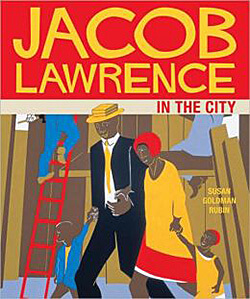 |
| Cover, Susan Goldman Rubin's Jacob Lawrence in the City (San Francisco: Chronicle Kids Books, 2009). |
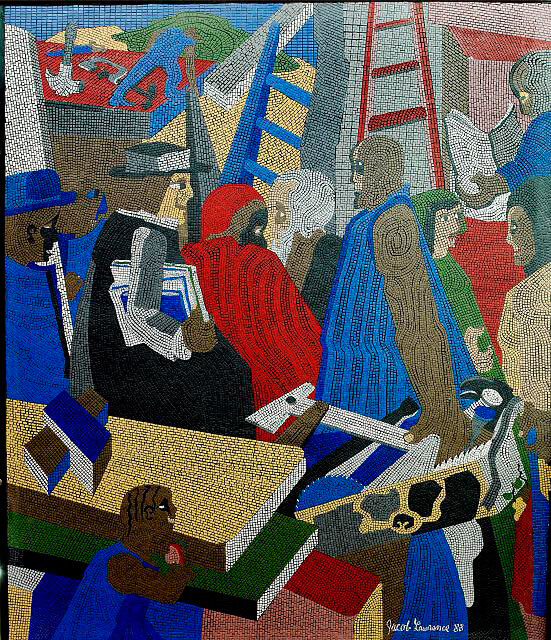 |
| Community, ceramic tile mosaic on lobby wall of the Joseph P. Addabbo Federal Building, Jamaica, Queens, New York by Jacob Lawrence, 1989. Photograph of mosaic by Carol M. Highsmith. Courtesy of Library of Congress, Prints and Photographs Division, Carol M. Highsmith Archive, LC-DIG-highsm-02817. |
The Schomburg Center's Junior Scholars program is actually structured around transforming the content of the archives into new art forms. Established over a decade ago, the program annually engages over one hundred students, aged eleven to eighteen, in a variety of learning experiences dedicated to enhancing their knowledge of black experiences. This is a six-month Saturday school program in Africana Studies that includes readings, research, lectures, films, and other encounters with resources to enhance participants' knowledge of the black experience. Students work together in project groups throughout the year creating songs, theater productions, dances, exhibitions, publications, radio programs, websites, and other interpretive means to convert content into art. The closing program is a day-long presentation of the art the students collectively create.
I share these Schomburg art making stories with you to underscore the fact that archival institutions do not have to be passive repositories. Indeed, in today's world, Africana archives are challenged to develop strategies for mining their collections and producing programs and events that help elevate their public visibility. In today's world, such public recognition of their services to the community is essential to raising public and private funds to support their services.
I'm convinced that producing and presenting exhibitions, concerts, theater productions, dance performances, and other interpretive programs was as critical a factor in establishing the Schomburg's reputation as the leading Africana archive in the country. What we managed to achieve institutionally awaits the curious, inquisitive, innovative creators who have the courage to immerse themselves in Africana studies.
Historians are encouraged to stretch their minds beyond the monographs and journal articles they frequent the archives to research. Beyond these formats lie stories and resources that can be turned into exhibitions, performances, programs, music, poetry, and dramas based on the rich and diverse lives and experiences of African peoples documented and preserved in Africana archives. I also encourage Africana archives to invite groups of writers, dramatists, producers, visual and performing artists, exhibit curators, and journalists to special events where archivists can introduce some of these creative possibilities. Teams of digital humanities scholars will find rich and rewarding opportunities to create new art and scholarship in today's Africana archives eco-system. All that's needed are fresh questions and a creative imagination; the stories and objects are there for the taking, promoting, and interpreting. Africana archives are natural, freely accessible partners to those artists and creatives who would explore the richness and diversity of the global black experience. I invite each and every one of you to find your archive partners. And don't even think about doing anything creative about the black experience without them. I promise that your ventures into their holdings will be richly rewarded. If nothing else, you will create more substantive, authentic art on the peoples and experiences documented in Africana archives.
About the Author
Howard Dodson is director of the Moorland-Spingarn Research Center at Howard University. For more than twenty-five years, he served as director of the Schomburg Center for Research in Black Culture in Harlem. In that role, Dodson assisted the Schomburg Center in its acquisitions of the diaries of Malcom X, the papers of Nat King Cole and Lorraine Hansberry, the collections of Melville J. Herskovits and St. Clair Drake, and the prints of Harlem photographer Austen Hansen. Dodson has published widely, including Becoming American: The African-American Journey (New York: Sterling Publishing, 2009).
]]>Greetings by Natasha Trethewey
I am Natasha Trethewey, the Director of the Creative Writing Program and I’m pleased to welcome you to this year’s Phillis Wheatley Reading, an annual event co-sponsored by the Creative Writing Program and the Department of African-American Studies at Emory University. We’re pleased tonight to present this reading as a part of the Callaloo Conference, which we are hosting this year at Emory, an event that would not be possible without our many generous sponsors across campus, the work of Paula Vitaris in the Creative Writing Program, and especially the planning and organization carried out singlehandedly by the remarkable Sarita Alami to whom I owe the greatest of debts. On behalf of all of us here at Emory I’d like to thank the Callaloo Conference participants, staff, volunteers, and editor Charles Rowell. We are especially delighted that tonight’s event is one of the highlights of the conference, showcasing the work of two of Emory’s own poets, Jericho Brown and Kevin Young, both of whom have new books out this year that we are celebrating.
Jericho Brown
Part 2: Jericho Brown reads “Labor”
Part 3: Jericho Brown reads “Again”
Part 4: Jericho Brown reads “N’em”
Part 5: Jericho Brown reads “Langston’s Blues”
Part 6: Jericho Brown reads “Track Five: Summertime”
Part 7: Jericho Brown reads “Heart Condition”
About Jericho Brown
Jericho Brown is the recipient of the Whiting Writers' Award and fellowships from the Radcliffe Institute for Advanced Study at Harvard University and the National Endowment for the Arts. His poems have appeared in The Nation, The New Republic, The New Yorker, The Best American Poetry, and in Nikki Giovanni's 100 Best African American Poems. Brown holds a PhD from the University of Houston, an MFA from the University of New Orleans, and a BA from Dillard University. His first book, Please (New Issues in Poetry & Prose, 2008) won the American Book Award. His second book, The New Testament, was published by Copper Canyon Press in 2014. Brown is an assistant professor in the Creative Writing Program at Emory University.
Kevin Young
Part 2: Kevin Young reads “Ode to Old Dirty Bastard”
Part 3: Kevin Young reads “Ode to the Harlem Globetrotters”
Part 4: Kevin Young reads “Ode to Chitlins”
Part 5: Kevin Young reads “Bereavement”
Part 6: Kevin Young reads “Charity”
Part 7: Kevin Young reads “Codicil”
Part 8: Kevin Young reads “Expecting”
Part 9: Kevin Young reads “Greening”
Part 10: Kevin Young reads “To Mr. and Mrs. ______ on the Death of their Infant Son”
Part 11: Kevin Young reads “Money Road”
About Kevin Young
Kevin Young is the author of eight books of poetry, most recently Book of Hours, which was featured on NPR's "Fresh Air," and editor of eight others. His previous book Ardency: A Chronicle of the Amistad Rebels won a 2012 American Book Award and Jelly Roll: A Blues was a finalist for the National Book Award and the Los Angeles Times Book Prize and winner of the Paterson Poetry Prize. His book The Grey Album: On the Blackness of Blackness won the Graywolf Nonfiction Prize, was a New York Times Notable Book for 2012, a finalist for the National Book Critics Circle Award for criticism, and winner of the PEN Open Award. The Collected Poems of Lucille Clifton (edited with Michael S. Glaser) won a Hurston-Wright Legacy Award in poetry. Young is currently Atticus Haygood Professor of Creative Writing and English and curator of Literary Collections and the Raymond Danowski Poetry Library at Emory University.
Question and Answer Session
Part 2: Both poets answer a question about genealogy in African American poetry and in their own work
Part 3: Both poets discuss the role of music in their poetry
Part 4: Both poets discuss “place” in their work