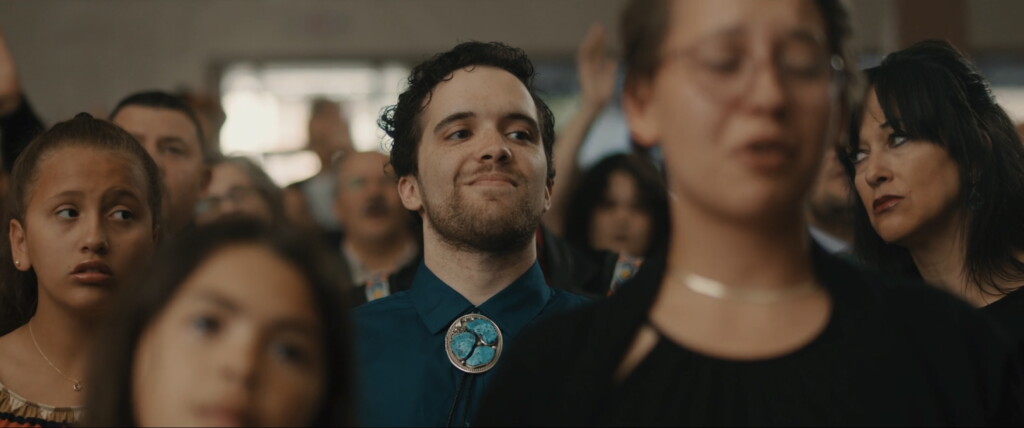
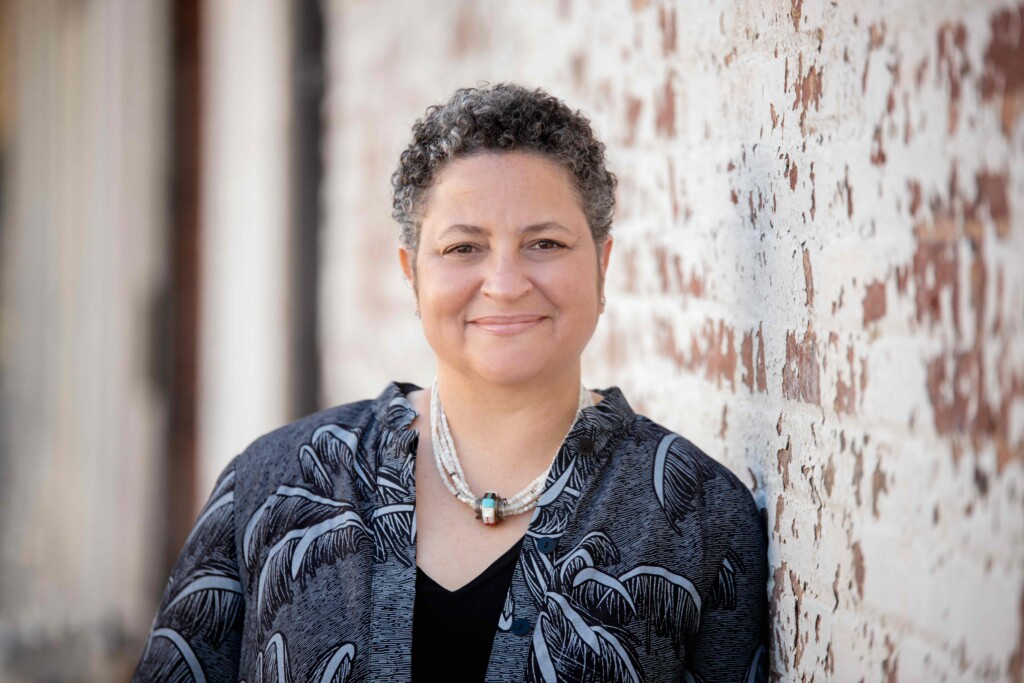
Malinda Maynor Lowery: Lumbeeland is a twenty-nine minute short narrative, live-action film set in the Lumbee Indian community of Robeson County, North Carolina. It features a young Native man who is intent on taking over his grandfather's marijuana trafficking business. He encounters unexpected challenges and finds himself in over his head. He has to face up to what he loses in the process. For me, that narrative was a way of investigating deeper questions around the consequences of actions that we take. “You reap what you sow” was the original concept. What are the intergenerational ways in which we reap what we sow? How are we responsible? Why do we feel guilty for things we didn't do? How are we responsible for things that our ancestors did in good and bad ways, or accountable for choices that we didn't make?
I’m a historian but I’m also a member of the community that I write about. The specifics around the story of Lumbeeland came from experiences of family members who have been involved in drug trafficking and substance misuse. It’s something that we live with, but are not allowed to talk about. It causes shame and it causes anger. You see the devastating consequences of these substances, not just for the individual’s well-being, but also for how substances become commodities in a global market. Individual users are often seen as driving the drug trade, but they're not, or at least not by themselves — any more than I'm driving the bottled water trade.
We have to talk about that problematic commodity and the many people who profit from its trade. What I've never heard talked about was that my relatives who are misusing substances are part of a larger system that they don't have control over. That's not to excuse their behavior or say that there should not be any consequences for the choices that they make. But we should be able to talk about the system that creates these negative choices. And we need to be able to talk about the impact of those choices on communities of people. Substance use is something that affects families in addition to users.
In my family, we were not able to openly address the way we felt angry or powerless or ashamed. To me, this maps directly on to the lifelong engagement I have with history. I'm constantly writing from the standpoint of being responsible for choices that I didn't make. Living with history means we are all responsible, in some way, for choices we had no hand in. And I feel that way about people when we talk about substance use. We need to be thinking about it in terms of who does it impact beyond law enforcement, beyond users, beyond drug traffickers.
It also impacts people who are members of families who may be experiencing incarceration as a result of these activities, and who are experiencing health problems. The story I decided to tell in Lumbeeland engages these themes. It was a way to deal with my own sense of shame and anger about how a drug economy has affected my family and my community.
Film is a good way to elevate one's sense of empathy — you see somebody who's different from you in a new light because that experience is in the context of a story.
This was about seeing myself and the people who are most like me in a different light and enabling Lumbee people to see themselves on the screen. I know all of the people in Lumbeeland in one way, shape, or form. My hope is that the film will help people feel more connected to one another and get a greater sense of compassion for our own struggles. The experience of drug trafficking and drug use is in every Lumbee family. I hope Lumbeeland will not only allow us to be more empathetic, but it will also give us a sense that this is a problem that comes from somewhere and has a history.
I also know from doing history that if we can talk about how this history came to be, we can also talk about how to undo it or how to do it differently. But right now we don't want to talk about this topic. We're afraid, ashamed, and angry, and, I might be rushing ahead, but it's a deeply troubling phenomenon as a Native American person in this country to know who took what you have. Who took our wealth. Who took our property. Who took our language. Who took our culture.
We still have a lot. But what we have had is no longer in our possession. In the case of the Lumbee community, we didn't experience the geographic displacement that so many other tribes did in the Southeast, so today we live next to the people whose families took it. We know who took it but we can't hold them accountable because the system of justice that was instituted without our permission, that we now belong to, but didn't consent to, doesn't allow us to hold those people accountable. That generates anger and shame that drives people to dysfunctional solutions. That’s the big background to Lumbeeland, although it’s not explicitly addressed. I hope to be able to talk about more in other related stories. I think of Lumbeeland as kind of like the Marvel Universe. Not because it's cartoon heroes, it's a real place, but because you can tell many, many kinds of stories with many kinds of people and experiences.
Southern Spaces: Lumbeeland immediately immerses viewers into a family crisis. It's intense and emotionally powerful. The film also displays a great ear for vernacular speech. How did you go about the writing?
Lowery: I'm not a trained screenwriter. I'm a trained historian, nonfiction writer. It was actually much harder for me to write than I imagined when I started. That's partly because of the nature of the topic, but also because historians don't specialize in creating fictional characters out of non-fictional situations. We tend to sit in archives and pull from there what’s relevant.
Historians explore nonfiction by looking at all angles. What I learned was in writing a screenplay, you have to have characters. And those characters have to do things, not necessarily express ideas. Obviously, characters will have ideas and will talk about them. But if you think about of the history of drama in Western European society, from the Greeks to Shakespeare, they are about action. Their characters announce what they are doing.
There are Indigenous forms of drama, but Lumbeeland was very much written in a Greek and British style of drama, like most contemporary film and television. In film, we expect to see what the characters do, not so much hear about it. I had to get familiar with the basic principles of dramatic writing and structure. Who are these people and what do they want? Why do they want this? That was surprisingly hard to come up with because as a historian I do think about people and why they do what they do, but I explain it less by their individual backstories and more by the structures and societies they live in.
I drafted an essay in 2013 that wound up in the Oxford American in 2020. The original title of that essay was “Lumbee Land” and was a kind of love story. But quickly, I began to think: what am I trying to say? What do I really care about? And, especially through writing the sixth chapter of my second book, which is about the drug war in the 1980s, what would I like to say about that? I had to think about character, nature, backstory, and action in a different way. Substance use and misuse is intergenerational trauma that lives unacknowledged in our bodies if we're not actively trying to wrestle with it. Because of action, theater and film are completely embodied art forms as much as dance or music.
The characters in Lumbeeland began to emerge through people that I have known. When I started to have a breakthrough, I imagined the family in the film. I thought hard about what situation would create dramatic interest. This idea about a contest between father and daughter, grandfather and granddaughter or grandson, with a more vulnerable individual caught up in it. It's meant to convey a multi-generational experience as a Lumbee person, as well as how that relates to colonialism and trauma, and how it affects our families. The other reason to make a film was many of the people who shared their experiences with me for the purposes of my book, never wanted to go on record and never wanted to be named.
Because I have a background in documentary filmmaking, it might have been more logical to ask people’s permission to film their lives and film them talking about their lives. But people who are enmeshed in this world do not want a camera in their home, or anywhere near. The necessity to fictionalize came up early on as I was thinking about what do I do with these intense feelings I have about how this problem is affecting our community. It made sense to find a way to put my feelings on the screen through the experiences of these different characters.
Then you've got a thousand decisions to make: What's the setting? What time period? How to make tangible in these characters the theme of “you reap what you sow.” How to unfold the scenes, the rhythm of the shots, the editing, and the music.
Playwrights talk about the thought of the play, the idea of the play. I also worked with Joan Scheckel, a screenwriting, acting, and directing coach who holds workshops and seminars in Los Angeles. She talks about the thought as a nugget, something you can imagine holding in your hand.
I like collaboration and have done so much of it over the course of my career. Film is an inherently collaborative form. I didn't direct Lumbeeland. I had a hard enough time writing it, and I knew I wanted to produce it. The director we worked with, Montana Cypress, is phenomenal. He's a Miccosukee person from the Southeast, an actor, writer, and director. He works with actors who aren’t formally trained a lot in his own films. He gets the nature of the community, the landscape, and the issues that we're dealing with.
The other key moment in bringing the final version to fruition was a set of table reads that we started. We shot the film in May and June of 2023. I had a version that was readable by Labor Day of 2022. We did the reading in Pembroke, our home community. I invited friends and actors who live there to participate. They would say things like, “Don't we want to see a chocolate cake? Or, “We need to see Dock (one of the characters) doing something that Lumbee farmers do — they will hang a snake in a tree to get it to rain.” (And that day, when we were shooting, it actually rained!)
There are culture bearers who have Lumbee knowledge. People I got to know when I was producing an outdoor drama who are invested in the storytelling and cultural production of our people.
Two table reads brought people together to provide suggestions about what they thought would represent our community accurately. They also brought criticisms. And I've gotten criticisms since showing Lumbeeland: Why is this the story that we're picking to be the first narrative film produced, written by, and starring Lumbee people? My answer is that it’s my story, so I have to tell it, and I have a track record of going to the thing that’s hardest for us to talk about. My first film, back in 1996, was about racism both within the Lumbee community and directed towards Lumbee people. And folks didn’t want to talk about that either at that point. But now it’s different.
Southern Spaces: Can you say more about writing the dialogue and your use of vernacular speech? The characters come across as believable.
Lowery: Yes. That's why the table reads are so crucial. And why it's important to have Lumbee individuals — they don't have to be actors — reading the script. They can contribute lines of dialog, add flourishes, dialect notes, grammar, and pronunciation that resonates. A lot of that is in the script at the point when we read it together, but it always gets better when you hear Lumbee people say the words.
What also helped bring the film to life were vivid and relevant cultural elements that have a direct bearing on what the characters are going through. That's church, gospel music, a birthday party, our food. It’s the way we adorn ourselves. The way we talk. The way we invoke the past. The way we tell stories as we go about our lives. The way children will challenge parents, respectfully — it's rarely “You sit down and shut up.” We spend time with and listen to our children. We want to know what they think. And children are expected to pass time with elders. We try to make that vivid and visible in the film. It’s not a standard story about drug dealers and whether or not we should admire what they do. At one one event I did last year, I described Lumbeeland as being about bad people who want good things.
One of the things I really feel that works in the film is the rhythm with which people speak. It's the way we talk to each other. The use of language came straight out of me being Lumbee and having Lumbee collaborators. We had thirty-four people on set, twenty-four of whom were Native American, and twenty-two of those were Lumbee. All of the film’s producers and creative leads were Native, which is still unusual. They had a direct infusion into how it played out.
Actors definitely did some ad libbing. If they weren’t catching the line as written, we’d say, "Okay, say what you think this character would say.”
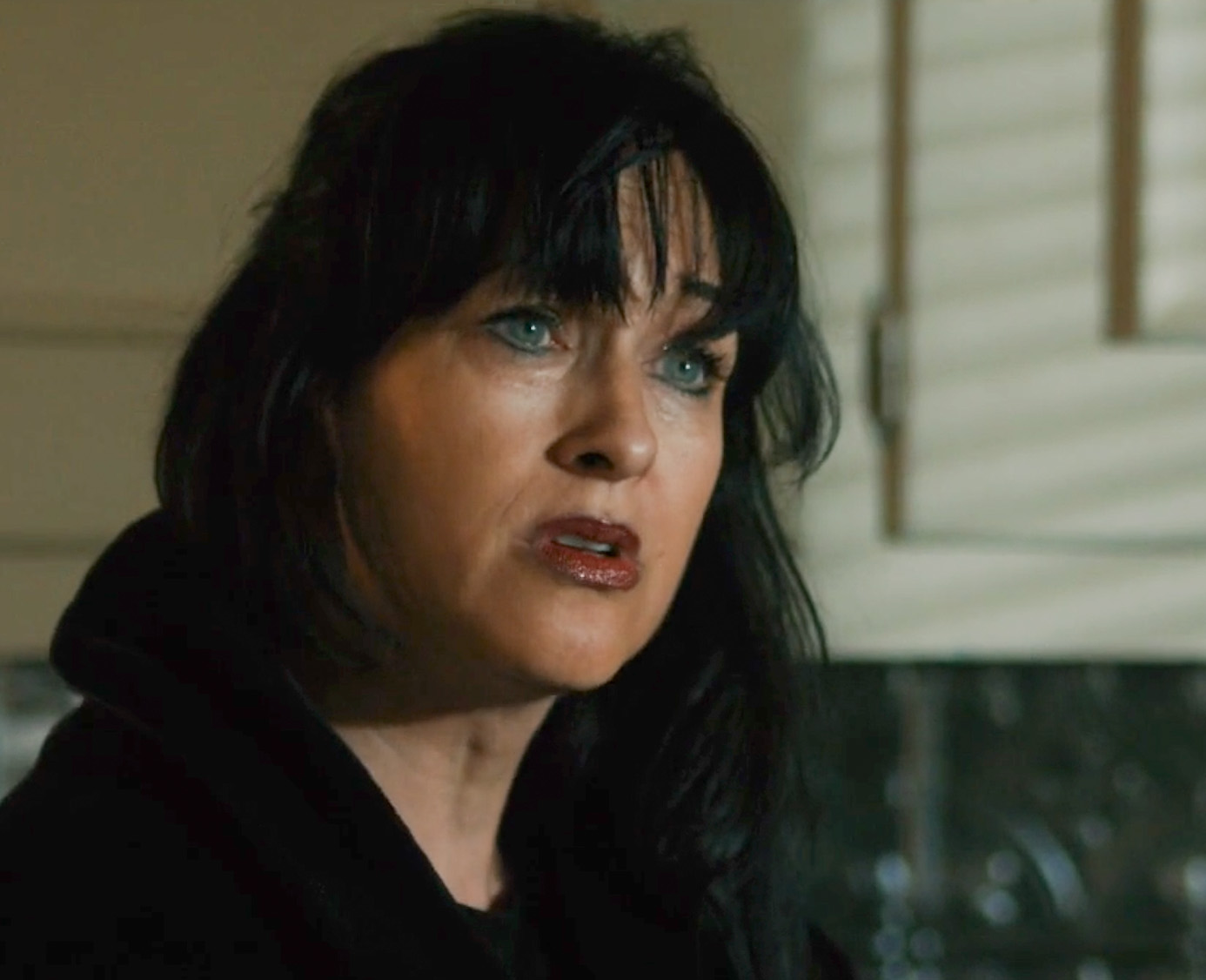
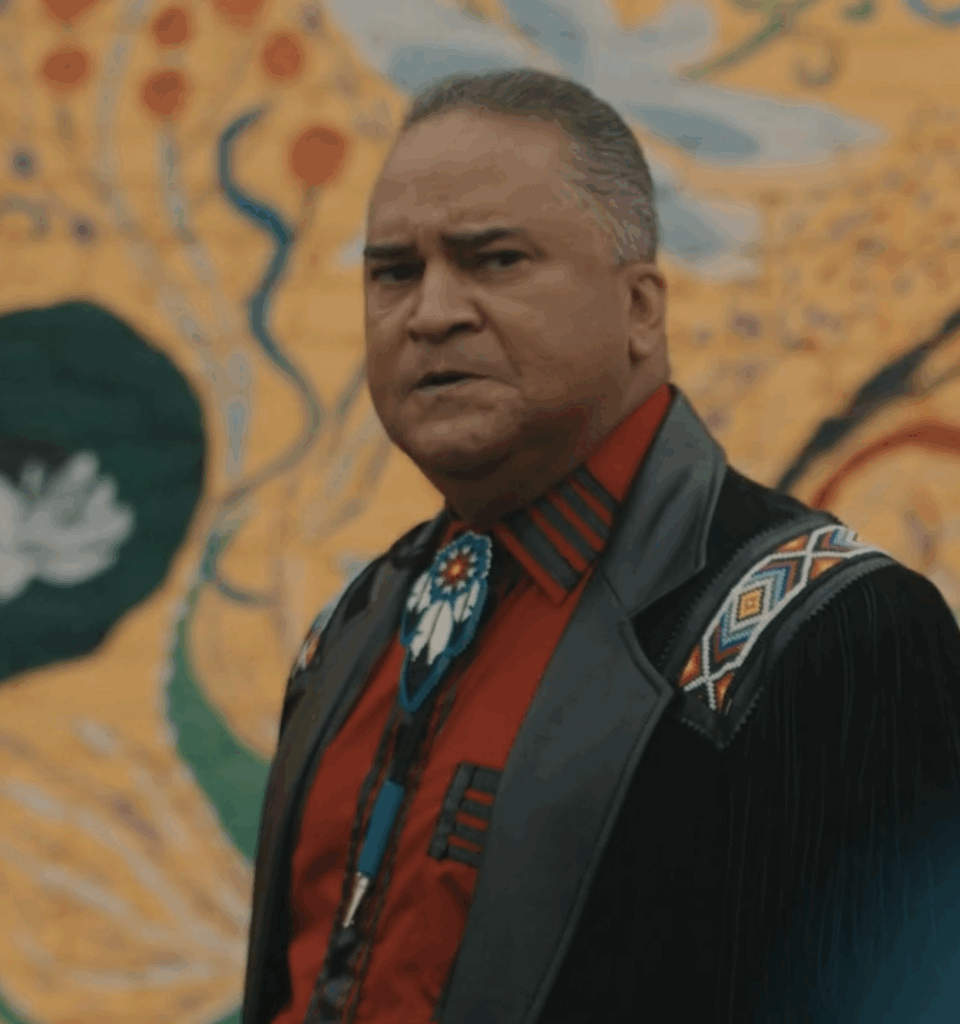
The person who did the most ad libbing was Antoinette Locklear Hurtt, who played Connie. And she got a best supporting actor nomination at a film festival last year. She's a police detective in real life, so she's ready for anything. There are three people in the cast who had acted before. Dollar, the lead character played by Billy Oxendine, a Lumbee, is a formally-trained stage actor. He’s just finished his MFA from the Actor's Studio at Pace University in New York. The other two actors who have appeared on screen are self-taught: Harvey Godwin, who played the grandfather, Dock; and John Scott-Richardson, who played Cortez. Billy had never been on screen, but he was the only person on set who had professional training. Danielle, played by Bethany Harris; Connie, played by Antoinette; and Gage, played by Roger Dale Locklear, had never acted before. They auditioned and we had a very strong sense of what they would be like on screen. They required very little coaching. We wanted them to bring their cultural sensibility.
It was a wonderful lesson to me, never having made a fiction film. You have the words on a page, but it is nothing without the people who are embodying the action. And then the director has to decide: are we going to reshoot this scene or are we going to go with it? A lot of stopping and starting can be disruptive for people who are not actors. But our cast got into the flow of it thanks to cinematographer Erika Arlee, along with Montana, and first assistant director Kristi Ray. And our producer, August Poncé, and consulting producer, Kim Pevia.
Film directors often stop and start within scenes. They're looking for particular timing or for an actor to hit a mark or, a facial expression that they want to capture. They'll stop if they're not getting that right. Montana's approach was to start and roll through the whole scene and to do our best to capture it from start to finish. He was great at knowing when we could push and when he had to stop.
What Montana and Erika wanted to do, and what I felt was in the spirit of the story, was a documentary style. To try to be in it with the characters. But as a writer you always have things that you've seen in your mind. Lumbee families love The Godfather. I'm thinking about that as I'm writing the script. But I'm mostly thinking about father-son, father-daughter relationships as they materialize.
On set, I tried to say, “I wrote the story, but now I'm here to be helpful.” You choose actors that you think are going to work with what’s intended. The biggest priority for me was the way they talked. And they just did it. Montana knew how to bring it out of them.
There’s a scene at the beginning, when Dollar is sitting and playing a video game and his daughter comes in and gives this epic eyeroll. I worked with her a little bit on that because I was like ‘Bethany, you know, you can give shade like nobody else.” Because I know her. And she's like, “Yeah, but that's not how she would do it.” And I was like, “Okay, I get that that's not how you would do it. But the way that you would do it, we're not going to be able to capture on the screen. So just be over-the-top with the eye roll.” And she did it and grinned.
Southern Spaces: There are scenes in Lumbeeland that evoke a film of a few years ago, Winter’s Bone.
Lowery: Yeah. My God, yes. Winter’s Bone was in my mind.
Southern Spaces: For instance, evoking the meanness of the men in similar cultural situations of power.
Lowery: Patriarchs and bosses. It’s just chilling. They don't care about people, but they're going to make you think they care about you. That’s part of the cultural dimension that’s hard to capture and hard to present. Then you get criticized for showing your dirty laundry. But that was what had to be done. And the actor who played Dock, Harvey Godwin, struggled with that. He and I had several conversations. He's not that kind of person, but he knows people who are. And I know people who are.
We tend to assume such people are irredeemable, or maybe that their stories are not worth telling. So I wanted to tread that line. They're often sensationalized. Think about the worst characters, a Hannibal Lecter, who is meant to strike fear in the audience. This film wasn't intended to strike fear in order to exploit entertainment, but to create situations where this character could show different sides of himself. He can make a cake for his grandson and great granddaughter. He can tell her a story. He can tell her that he loves her. And all the while he's also doing sinister things.
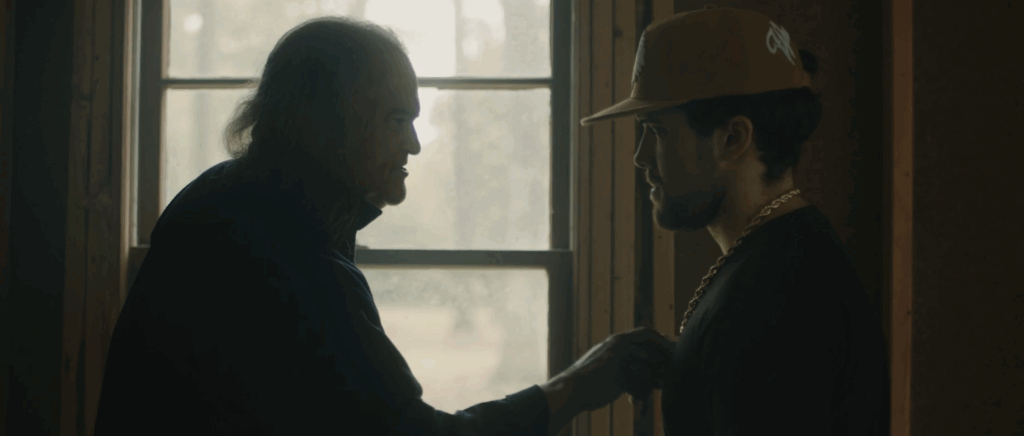
In a dramatic narrative, characters want something and you have to put those wants into relationship with each other, but not always conflict. I didn't want to write a story that was exclusively conflict based. These characters with various wants are in conflict with each other because of the situation that they're in. Some of which they created, and some of which was created for them.
I needed to be honest; to think about people's good and bad sides. How they can want good things and not be able to get them. They can change, even if there's an overarching continuity in how their behavior impacts other people. For instance—and we're not giving anything away—but the scene at the end of Lumbeeland, where Dock is walking up the stairs and putting his head in his hands. That wasn't in the script, but the crew was like, “We need this.” And I was like, “Yeah, let's shoot it. Let’s see what happens.” In the original script, Dock has no remorse, but the crew felt strongly that we need to show him reflecting on what he's done or what he's put in motion.
I didn't feel like I could make something and tell the truth that didn't explore toxic masculinity — in Lumbeeland and in our society — the existence of patriarchy and the damage that it causes. That truth needs to be out there.
The intergenerational tension between Dock and Dollar is one core of the film. How do you write that tension? The first place my mind goes is Dock's backstory, that we're not privy to in this version of the film, but he is in quite a bit of debt to a Lumbee-run drug cartel that he is a member of. He's taking Connie's money, and he is working with his best friend, The Dog, to be able to begin to pay off his debts. He's not double-crossing Dollar just because he has the power to do so. He is manipulating his family members to protect himself. That's the kind of experience of being a member of a family that I wanted to tell through this story. What does it feel like from Dollar’s perspective to be manipulated in this way? But also what does it look like from Dock's perspective to do the manipulating?
We don't have a concrete sense in the short film of why Dock is doing this. But he's using the material at his disposal — his relationships with the people that are closest to him — to get what he wants. He didn't anticipate The Dog dying. So here's this character whose nature is generous and actually indulgent, but he's also impulsive, and his life experience has made him ruthless.
How does this person respond when his best friend dies of an overdose? He thinks he knows who's responsible. And so the Dock-Dollar tension. Dollar also has his own goals, but runs into a problem with Child Protective Services that distracts him from being able to implement whatever kind of hazy plan this very young person, 25-ish, is going to have. He's not very experienced. He's not understanding the consequences of his actions. He's gloating over the success of this plan but he's in denial about what is about to happen to him. Both Dollar and Dock have to run up against obstacles in the theme of you reap what you sow.
I'm making it sound like it's all very planned, but it’s frankly a struggle when you're drafting.
There's a lot of things that I watched along the way. Such as Winter's Bone. Oh, my God, it's chilling how this young woman is in charge of redeeming a father who was never there for her. But she has to do it. Not for his sake, but for her own and for her siblings. That certainly speaks to a layer of my life that I don't talk about very much, but which I wanted to explore in a certain time and place.
Southern Spaces: In Lumbeeland there is not much open space or room to breathe. There is a sense of being enclosed and entrapped.
Lowery: It's so interesting that you highlight that. It was not such an intentional choice. It came about mostly because of budget and what you have time and space to shoot with the people that you brought.
At first, we didn't shoot many exteriors. We shot the drone shot that we use at the end of the film on the very first night. We knew that that was going to be included. But all the other exteriors were shot in a couple of hours about two months after the main production ended. We knew we had to have some because the film is about a specific place, the Lumbee homelands of North Carolina. But we didn't have a budget to drive to place after place. And I think about the other films we've referenced, if it's Winter’s Bone or True Detective or The Godfather, they rely on exteriors to create those worlds.
Ultimately, however, that worked to our advantage in terms of the emotional power of the story. You never get out of these characters’ tight interiors. You are with their bodies and their interior physical spaces. That's partly why it's harder to find moments of hope in the film. Despite all that has been taken from us, we still have elements of our culture and remnants of our land. We have our speech. These are hopeful elements, but because of the very interior nature of the film, it's hard to see them. That wasn't so much a strategic storytelling choice, but something that came out of the situation that we were in. And we had a great situation in which to shoot the film. It was shot in people’s homes — very generous, caring, flexible people who believed in the project and just wanted to see it happen and opened their doors for us. I don’t know if you’ve ever had a film crew in your house for a week but it’s crazy.
Southern Spaces: Although it’s just thirty minutes long, Lumbeeland conveys very intense, unsettling emotions, How is it being received? How have you shown it and what are you planning?
Lowery: We're very happy that it's streaming on a platform called FNX — First Nations Experience. It's a public media platform headquartered in Southern California that streams Indigenous content, mostly US-based. There are platforms that do this in other countries such as New Zealand and Australia. The FNX streaming app launched on May 1, 2025, and we were one of the films they premiered. We've been on the film festival circuit for about a year and won several awards including the Best Live Action Short from Red Nation International Film Festival. But I think the awards I'm proudest of are North Carolina-based, one from the Longleaf Film Festival which is in Raleigh, and another from the Lumbee Film Festival. We had an outdoor screening in Hoke County, North Carolina. We've had screenings in Knoxville, Tennessee, and in Raleigh for an environmental justice conference. Very different types of audiences.
The reception has been much like what you've just said: it makes viewers sad and hopeless, sometimes it makes them feel angry all over again. It helps us understand why we’re on the journey that we’re on. If we can understand how this history came about, we can do something different about it. The people who have who have told me that they resonate with Lumbeeland the most are people on a recovery journey of their own.
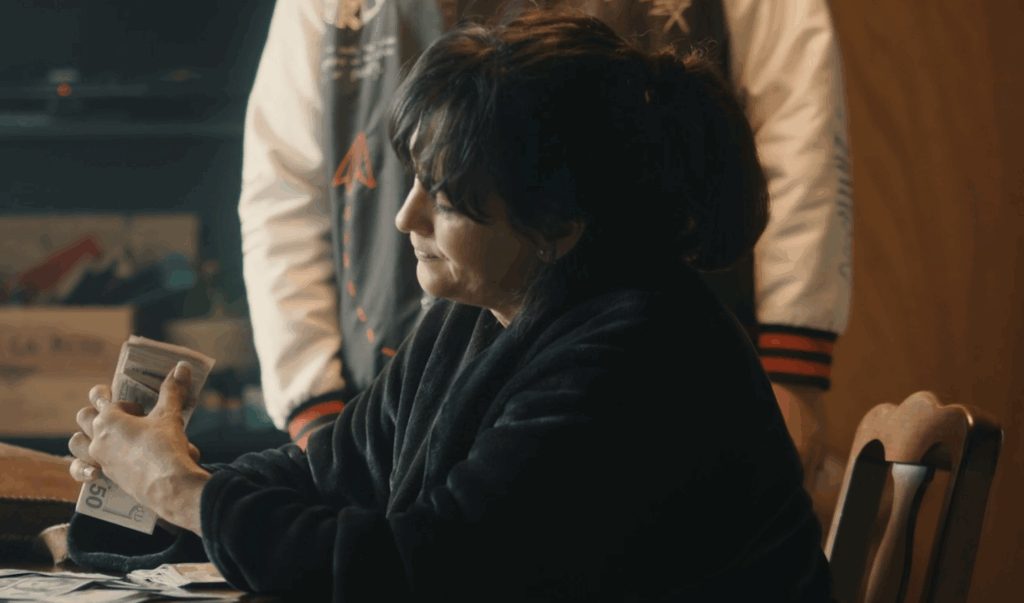
Some people come up and say, “I'm not certain about why you chose to tell this story. I don't feel comfortable with it.” And then people who say, “I saw myself in mid-journey on the screen. Or, “It made me understand it my situation, made me stronger. My mother and grandmother suffered from drug addiction.” And she didn't want her daughter to go through the same thing. Seeing characters on the screen try to break cycles. Like Dollar with his daughter, Danielle, when he tries to be honest with her — “Your mother's not here, but I'm here for you.”
Another Robeson County collaborator said, “If you want this to touch on what we're going through right now, you have to address the epidemic of opiods. We need to see the characters meeting the consequences of their actions.” If we didn't have the ending that we have, it wasn’t going to feel like a true picture.
Southern Spaces: Music is very important to Lumbeeland. How did you make the choices?
Lowery: There are several musical moments that connected for me when I was writing the story. The process gave me a greater appreciation for how rhythm influences writing. In key scenes, there was always some song in the back of my mind. At the opening church service, I didn't think it would necessarily be “Will the Circle Be Unbroken?,” but I've spent a lifetime in Lumbee churches with that type of piano gospel.
Because Dollar is trying to break a cycle, what is the music of our culture that gestures towards closeness and intimacy, but also allows an appropriate distance? It's not like in a Western or mainstream American film in which the only kind of love you get to see is romance or it's a hug plus cry, a formulaic thing. So if a father and daughter are going to share an intimate moment, what's the rhythm of that? What immediately occurred to me was the two-step powwow song where you'll see fathers and daughters, or mothers and sons, or couples, teenage, older, whatever dancing that song around the arena. And I reached out to a hometown drum group, Southern Sun Singers, for one of their recordings. My family has known their founders for thirty years or more, and they granted us the rights to use the song.
Another moment was my late husband, Willie French Lowery, singing, “Great Day in the Morning,” that launches the last act.
We needed a rhythmic shift because we have to go from one character spying on another to a birthday party. We needed a strongly structured song that would have the right tone, but a contrasting tone. Willie was a great songwriter. His songs are exquisitely structured. And I really like the lyrics:
Great day in the morning.
It's coming without a warning.
Ain't no use to getting all upset.
That's one of the things that influenced the emotional tone of the story. It’s my grandmother's saying that if it's not one thing, it's two. Plus we could get the rights to that song because I am the steward of Willie’s music catalog right now. So many people helped with small but crucial things along the way — the record company Paradise of Bachelors, re-released Willie’s first album in 2012 and their owner, Brendan Greaves, did the research on Willie’s archival recordings and pointed me to that song. It’s perfect.
And then, “Keep My Memory,” which was a song by Alexis Raeana, Charly Lowry, and Wylie Withers written in remembrance of murdered and missing indigenous women. I always had in the back of my mind for the ending. This issue is typically talked about as a legal jurisdictional matter, of women whose murderers slip through the cracks. But we often know who kills our women. It's not a mystery. In our community, so much of the harm we experience because of patriarchy is at the hands of our own family members. That’s the thrust of “Keep My Memory,” the rhythm, the instrumentation, the lyrics, the melody. It struck me as the right song choice. It's a bit beyond genre, very contemporary.
Most of what we see about Native people in film and video is about the past. It's rare that you have “now.” Lumbeeland wasn't made in response to Reservation Dogs, but it was being made while Reservation Dogs was on TV. We're always living with the question of how do we make our contemporary realities visible? I think that song “Keep My Memory” does that. And personally it was satisfying to position the music of Alexis (who knew Willie and whose parents knew him well) next to his.
But mostly the music has to work because it feels right. And there's no other reason.
Southern Spaces: And the film’s final scene? It’s not a clean resolution, but a moment that opens up questions.
Lowery: I like films that do that. It was written as a bit of a cliffhanger. You hear a knock on the door. But you don’t see who’s there. The scene suggests that the story’s not over. Is this a pilot for a series or a feature? We don't know. But we want people to wonder what happens to this family. The ending felt true to me. I don't like resolved endings. I want to have more questions than I have answers. 
About the Authors
Malinda Maynor Lowery is a historian and documentary film producer who is a member of the Lumbee Tribe of North Carolina. In July 2021 she joined Emory University as the Cahoon Family Professor of American History.
Steve Bransford is senior video producer at the Emory Center for Digital Scholarship.
Allen Tullos is co-founder and senior editor of Southern Spaces.
]]>
Introduction: The Selected Shepherd: A “Fair, Just Place”
Let us live beyond the here and now by nurturing each other and supporting one another’s works.—Assotto Saint, “Why I Write”1Assotto Saint, “Why I Write,” Spells of a Voodoo Doll: The Poems, Fiction, Essays and Plays of Assotto Saint (Richard Kasak Books: New York, 1996), 3–8, 5.
In the first lines of his introduction to The Selected Shepherd (University of Pittsburgh Press 2024), editor Jericho Brown writes of the impossible effort of introducing “a dead man,” the late poet Reginald Shepherd , to readers: “You mean to honor him knowing that you cannot present him as he might present himself.” Brown’s work with The Selected Shepherd allows Shepherd to introduce himself to readers as he would were he still with us: directly through his poetry. Brown describes Shepherd as an unpredictable, fearless, and brilliant poet who wrote “a little more wildly” across each of his six published collections.
Following a short biographical sketch and brief framing narrative written by Eric Solomon, Southern Spaces presents an edited conversation between Eric and Jericho Brown about the work, resonance, and legacy of Reginald Shepherd.2This conversation took place at the Emory Center for Digital Scholarship on August 6, 2024. Brown previously spoke with Natasha Trethewey for Southern Spaces in 2010. See Jericho Brown, “Naming Each Place,” Southern Spaces, March 4, 2010, https://southernspaces.ecdsdev.org/2010/naming-each-place/.
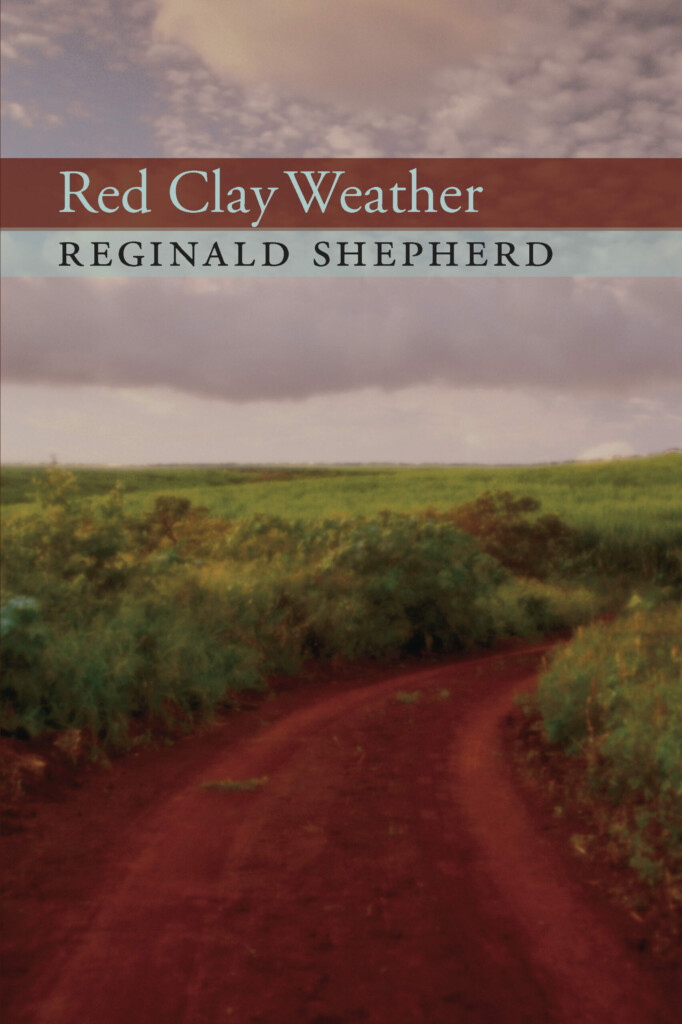
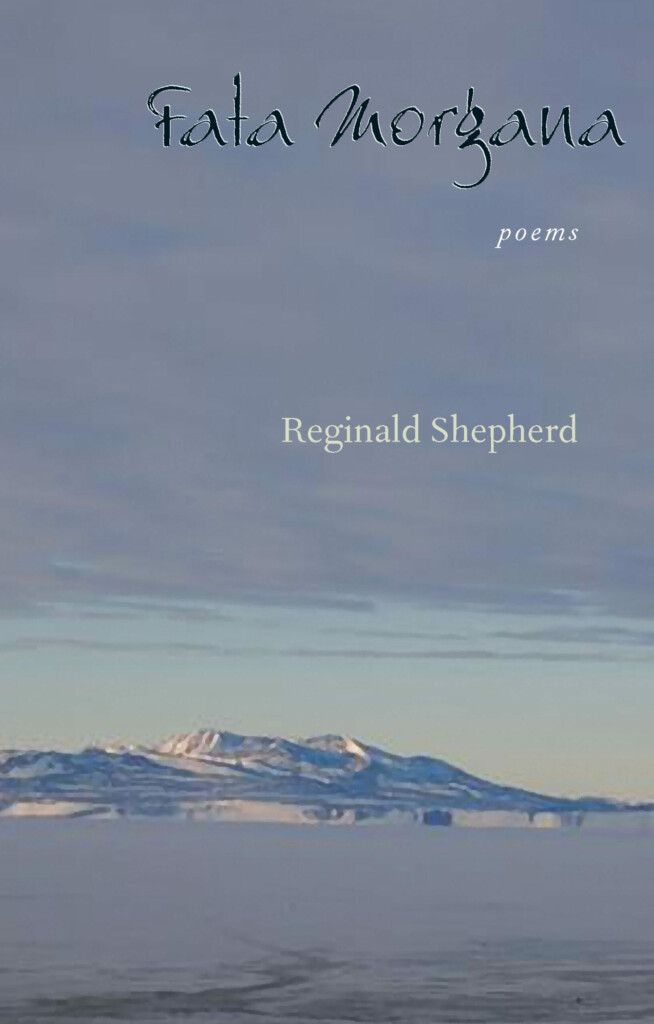
Reginald Shepherd was born Reginald Berry on April 10, 1963, in New York City. When he was five years old, he was issued a birth certificate with the name “Reginald Shepherd” after his mother’s successful suit against the absent man legally proven to be his father. His mother, Blanche Berry, raised him and his sister Regina in the Bronx where he remembers going by “Reggie” until he adopted the more formal “Reginald” in his mid-twenties. (Shepherd addresses the permutations of his name in the essay “What’s in a Name?”3Reginald Shepherd, “What’s in a Name?,” A Martian Muse: Further Essays on Identity, Politics, and the Freedom of Poetry, edited by Robert Philen (Ann Arbor: The University of Michigan Press, 2010): 193–198.). After his mother’s death when he was fourteen—a fact that would shape much of his future poetry—Shepherd moved to his mother’s hometown of Macon, Georgia, to live with family until he left, after graduating from high school, at age seventeen. He enrolled as an undergraduate at Bennington College, leaving in his junior year to move to Boston where he worked at the Boston Public Library, before returning to Bennington to finish his BA four years after his initial expected graduation date. He earned two MFA degrees, one from Brown University and a second from the University of Iowa. Shepherd published five books of poetry [Some Are Drowning (1994); Angel, Interrupted (1996); Wrong (1999); Otherhood (2003); and Fata Morgana (2007)] with a sixth volume published posthumously, Red Clay Weather (2011). He also published two books of essays [Orpheus in the Bronx (2007); A Martian Muse (2010)] and edited two poetry anthologies [The Iowa Anthology of New American Poetries (2004) and Lyric Postmodernisms (2008)].
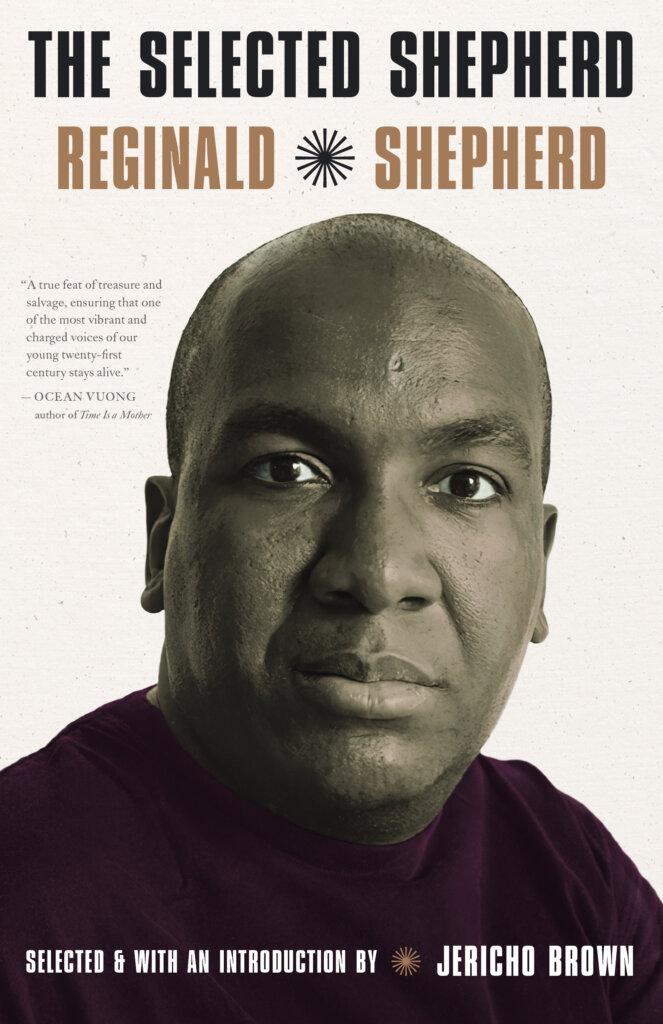
Shepherd met his partner, Robert Philen, in Ithaca, New York, in 1999, and the two moved to Pensacola, Florida, in July 2001. After a battle with colon cancer, Shepherd died on September 10, 2008, in Pensacola. Though he accomplished much in his career, Shepherd remained aware of the structural inequities that prevented men like him from accessing what he called “fair, just” places of belonging in the academic and literary worlds. “Sometimes I stand in the poetry section of Barnes and Noble and wonder how many authors there come from backgrounds like mine. They can be counted on the fingers of one hand,” he writes in an essay published the year before his death. “Unlike the vast majority of those in academia or the literary world, I have nothing to fall back on. Since leaving Georgia at seventeen, I have been on my own… I have gone from place to place, from circumstance to circumstance, and still I haven’t found that fair, just place, but I continue to search, hoping and believing that there’s a place for me.”4Shepherd, “To Make Me Who I Am,” Orpheus in the Bronx: Essay on Identity, Politics, and the Freedom of Poetry (Ann Arbor: University of Michigan Press, 2007), (7–38), 36–37. Sixteen years after his death, Jericho Brown’s The Selected Shepherd has helped secure the poet’s “fair, just place” on the bookshelves of our great poets.
Searching for Shepherd
Reginald Shepherd’s six volumes of poetry continue to amass a dedicated following from fans, fellow poets, and scholars. Shepherd’s work contains an intoxicating blend of image, metaphor, allusion, formal innovation, and often dizzying complexity. His work incorporates references from Hart Crane to Wallace Stevens to Walter Benjamin to Sam Cooke to Barry White while always remaining the work of an original voice and visionary.
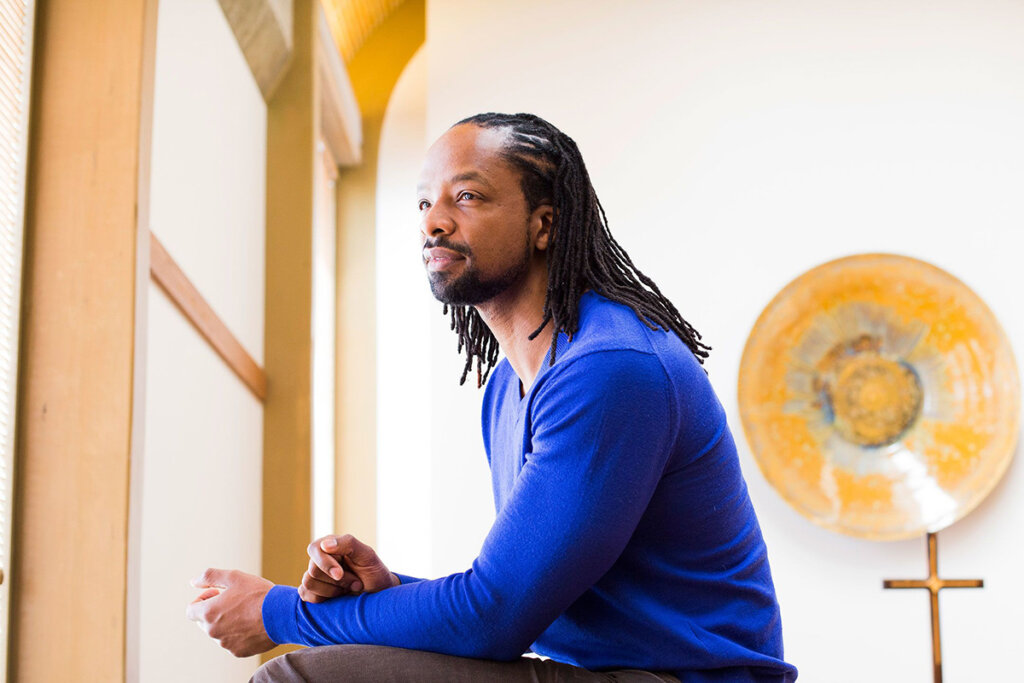
“I was around twenty-four years old when I first read Reginald Shepherd’s poem ‘Semantics at 4 P.M.’ in an edition of the Best American Poetry edited by Rita Dove,” Jericho Brown writes. Transfixed, Brown recalls asking other poets why he had not been made aware of Shepherd’s work beforehand. He continues, “the poem itself does not identify its speaker as gay, but if there is a queer voice, I believed I was reading it.” For Brown, Shepherd became an example of a “gay, Black poet who was alive,” and for those of us lucky enough to have discovered Shepherd’s work, it is the vitality and the voice—queer, brilliant, difficult, propulsive—that resonates long after the initial encounter. Though Brown’s work with The Selected Shepherd will now make a first encounter more accessible for many readers, I would argue that one does not find or search for Shepherd’s poems. As Brown’s story illustrates, you don’t find the poems; his poems find you. Or, as Brown states, poets “are the makers of the beauty that people didn’t know they needed until they see it.”5Jona Colson, “On Truth, Queerness, and Social Media: A Conversation with Jericho Brown,” Literary Hub, November 10, 2020, https://lithub.com/on-truth-queerness-and-social-media-a-conversation-with-jericho-brown/.
Similar to Brown, I (Eric) was twenty-three when I first came to Shepherd’s poetry by happenstance at a time when I needed to “see” his work. I was in an MFA poetry workshop as a MA student in English studying men and masculinities—i.e. not a poet—but we were allowed to take creative writing workshops as our schedules permitted. I recall vividly feeling like an “outsider” to what I perceived to be the “real” poets in the room (classic imposter syndrome), and I found my work at the time out of step with the much more highly innovative and experimental work of my colleagues.
In retrospect, I was attempting in my juvenilia poems to rescue the stories of our queer dead from the tragic detritus to which their lives had forever been relegated in our collective memory. In one poem titled “Appendix,” I elegized Scotty Joe Weaver, an eighteen-year-old gay man from Bay Minette, Alabama, who was killed by two of his roommates in 2004. In another, I attempted to grapple with the death of Matthew Shepard, whose name now serves on official federal hate-crime legislation. One colleague recognized in my meditations on the queer dead something he called a poetic sense of rescue and reclamation, and he invited me to consider Reginald Shepherd when it came time to give presentations on the work of one contemporary poet in our MFA workshop.
Unlike Brown, by the time I found Shepherd, he had passed away. At my friend’s suggestion, I ordered copies of his published work, in which I found poetry full of life and resonance and contradiction and complexity and difficulty but not obscurity. Though they made me feel, I did not then, nor do I now, fully understand what I feel when I encounter and re-read a Shepherd poem. As Brown observes in The Selected Shepherd, Shepherd’s work is not easy by design. Shepherd thought poetry should be “hard enough” to sustain multiple re-readings, not written in such a way that it could be “used up” by readers after a few encounters.6Shepherd, “On Difficulty in Poetry,” A Martian Muse (33–45), 34. For Shepherd, poems should be able to contain different resonances with each return. In a conversation with Krista Tippett, Brown similarly states, “I think poems are better built out of what we don’t understand, not what we do already know, but what we’re trying to figure out and better understand.”7“Jericho Brown: Small Truths and Other Surprises,” On Being with Krista Tippett, June 6, 2019, https://onbeing.org/programs/jericho-brown-small-truths-and-other-surprises.
In searching for and finding Shepherd, equal in importance to the poems for me were something you will not find in The Selected Shepherd: his essays where the poet further attempted to understand his craft, his poetics, as well as identity, politics, and his life journey from the Bronx to Georgia to Boston to Brown University to Iowa and eventually to Florida. In the essays, Shepherd reveals his personal struggles as well as the difficulty of his relationship with academic institutions and the literary world. He also displays his vast critical knowledge and broad reading practice. Shepherd, comments Brown, “was a man who seemed to have read all the books you keep meaning to read.” Further, his insights on what we might call a queer literary canon are must-reads for those of us who study LGBTQ+ culture, past and present.
“My aim,” writes Shepherd, “is to rescue some portion of the drowned and the drowning, including always myself.”8Shepherd, “Why I Write,” Orpheus in the Bronx: Essay on Identity, Politics, and the Freedom of Poetry (Ann Arbor: University of Michigan Press, 2007), (188–198), 188.It seems to me that Shepherd’s “aim” exists in conversation with our queer cultural tradition: those of us in subsequent generations keeping “alive” some portion of the work of those who have gone before, many of whom were lost far too soon. When necessary, we rescue them from the dustbin of memory and place their stories and their works back on the central shelves of literary culture as Jericho Brown has done with The Selected Shepherd. Whether in our creative work or our work as editors, curators, scholars, documentarians or memory-makers, we claim places for our queer kin. As Brown writes, “we know poets don’t die. And if they do, people who love poetry can always resurrect them.” And in rescuing them, in resurrecting them, we rescue, always, ourselves. As Shepherd writes, no matter the challenges we face, we queer folk refuse to “forget beauty, however strange or difficult.”9Shepherd, “Why I Write,” 197.
Interview: Jericho Brown on Selecting Shepherd
Eric Solomon: Thank you, Jericho, for being here for this conversation in our Southern Spaces series “Queer Intersections.” I’ve organized the questions in two parts. First, is thinking about your editing of The Selected Shepherd . And then perhaps we can talk about how Reginald Shepherd’s work helps us think about Jericho Brown.
In choosing poems for The Selected Shepherd, you present a generally equal number from each of his six collections, with a little bit more from Angel, Interrupted. What were you looking for as you were editing?
Jericho Brown: When I got the opportunity to do this, I had somehow already started doing it in my head. It was the kind of thing, you know that phrase “comes to fruition”? it was the kind of thing that I don't even think I was aware of it until I was asked to do it. But I had started doing it somewhere in my brain as a Reginald Shepherd reader, as a person who teaches his poems, as somebody who's interested in his work, as someone who is actually taken by the ways in which his work could be uneven, even.
I don't love every Reginald poem. I don't love every poem by anybody with that many books. I had already started this system of ranking of this particular poet's work, which I think happened because there were so few Black queer poets on the national scene when I was first figuring out that I wanted to be a poet. There were so few that I could hold them all. I could read all of everything they said in every interview. I could read every book. I could read every essay that they had written. Now there are more than I can keep up with. But because there were so few, picking poems for me was at first a matter of going after what I already knew and trying to figure out which book -- was that in Otherhood? Was that in Wrong? Trying to remember exactly which book each poem is in. Rereading the books put me in a position where I could see what Reginald Sheppard's concerns were, or his obsessions, throughout his work. But more than that, it gave me the opportunity to see how he changed from book to book.
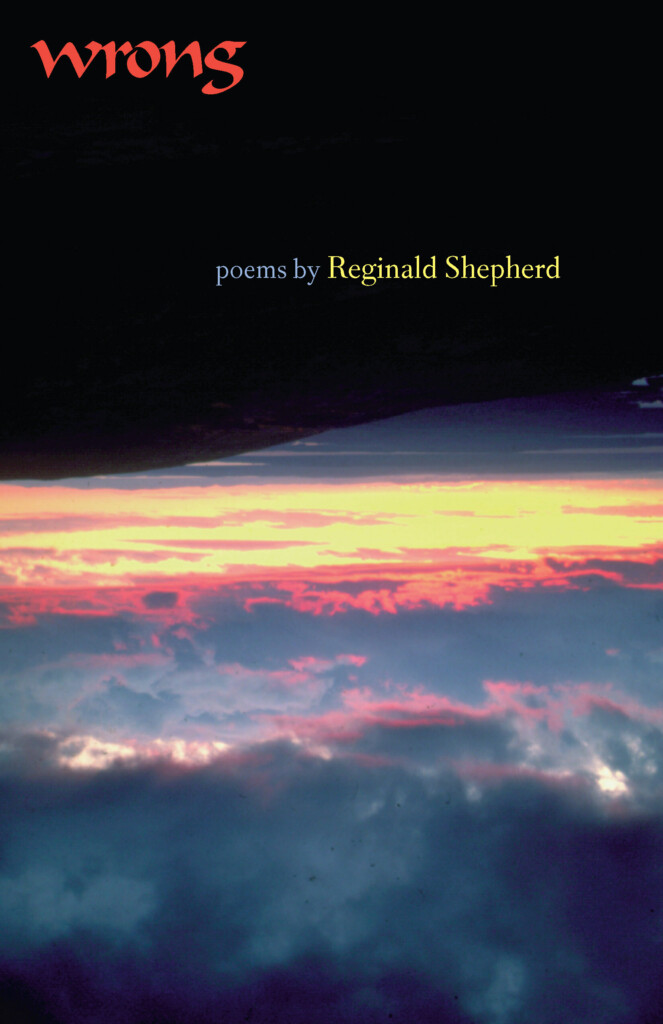
My goal in selecting the poems was to register those changes. I wasn't going to be able to make a book that only was the poems about nature, only was the poems about queer desire, or only poems about his mother. It was never thematic. It was always craft based. For instance, in Angel, Interrupted, he's very clearly trying to write a longer poem. In Otherhood, he's trying to figure out what to make of fragments. In Wrong, he's following up an influence through trying to see what would happen if Wallace Stevens wrote the queer love poem. All of that had a lot to do with how I went about selecting poems. As you mentioned, there are more poems from Angel, Interrupted and from Otherhood, but I just needed more poems to make it clear what those books were doing because they were doing it in a different way.
My favorite book by Shepherd is Wrong because I think it's the most honest that he is in all of his books. I think there are fewer poetic craft tricks. I really love Wrong. I love the long poem “Nights and Days of Nineteen-Something” and “Semantics at Four P.M.” Wrong feels to me when I'm reading it that it's a short book. I can hold on to it in a different way and walk around with it. At some point in “Nights and Days of Nineteen-Something,” he writes,
It was never sex I wanted, the grand etcetera
with a paper towel to wipe it up. I wanted him
to talk to me about Rimbaud while
I sucked him off in the park, drunk
as any wooden boat and tasting of old cigarettes
and Bailey’s Irish Cream, my juvenilia. Don’t talk
with your mouth full. (In the clearing
at the bottom of the artificial hill, his two hands
covered every part of me until I couldn’t be seen,
a darkness past the burnt-out lamppost.
There's something about that kind of audacity. And the way that it includes him. It is indeed that sort of thirst, that primal energy that we associate with desire. But it's also this guy who likes to read Rimbaud. Which is a specific and a particular guy. It's also somebody who's very aware; most of that particular poem includes cruising outside and having sex outside. But also being very aware of the natural landscape that surrounds him as he is following that primal desire, that urge to make love. I'm really taken by that poem and by a lot of the work in Wrong. I would read these books like crazy. I loved Reginald Shepherd, and I would look forward to the next book.
When it became clear to me that he was dying, I felt a kind of sadness. Not because I knew the man. I felt a sadness because I wouldn't be able to see what he was going to pull off next. I thought he was brilliant, and I loved his prose, and I loved following his blog -- at the time that people had blogs. You could wake up and go to the internet and see a beautiful new essay about poetry from Reginald Shepherd, which always included names of poets you never heard of. And because you had never heard of them, you could look them up. You had more reading to do. In many ways, he was like my teacher. I had a lot of respect for him. And I'm glad Terrance Hayes and the editors at Pitt asked me to do it.
Shepherd and Myth
Solomon: I love your craft-based approach being one to register the changes across the six collections and to pull poems that spoke to those changes. And I was reflecting on my own reading of Shepherd. I first encountered his work in 2008, 2009 -- Wrong meant something to me as well. Reading it now, in the light of what you're saying about honesty and audacity and that kind of drive that you see with desire in the poem.
Before we get into thinking about the resonances between Shepherd's work and your own, speaking of those essays that he would post on his blog, he says something about myth, and I'm curious how you understand the role of myth as you were selecting Shepherd's work. He writes in 2007 that “myth can also be used to place one's own experiences, thoughts and feelings in a larger context, opening them up to realms beyond the individual, making them less purely personal.”10Reginald Shepherd, “Mythology in Poetry,” Reginald Shepherd’s Blog, August 17, 2007, https://reginaldshepherd.blogspot.com/2007/08/mythology-in-poetry.html#:~:text=Myth%20can%20also%20be%20used,of%20the%20myth%20of%20Odysseus. How do you see myth in Shepherd's work? Is it speaking to that kind of audacity and that honesty? How is it functioning? As you were selecting poems, did you find yourself drawn to examples of the Adonis, Orpheus, and Narcissus figures?
Brown: No, he uses Greek myths so much that you wouldn't have to plan it out. It's going to happen. Any book you would do selecting Reginald Shepherd's poems, there are so many allusions to Greek mythology that you wouldn't be able to get around it. He had questions about this himself. If you check out the interview he did in Callaloo with Charles Rowell, he talks about that relationship to Greek myth, but also what that might suggest about his relationship to whiteness in general -- which I was really taken by.11Charles Rowell and Reginald Shepherd, “An Interview with Reginald Shepherd,” Callaloo 21, no 2 (Spring 1998), 290–307.He was always honest, and even though he was participating in it, he would also question the ways in which what he thought of as beauty had been informed by whiteness, by white beauty standards. Of course that included not just who he was attracted to physically, but his reading and how that reading played out and how it worked out. And we're all doing that in some way or another. You can only write as wide as your reading is. If you have various kinds of cultures coming in, then that will come through.
People think differently about what writing is and how it's done. What the “we” means in a poem and what the “I” means. That's different considering who you're talking to. And if everything you read is informed by the same classical rendering, then you're going to have a lot of Greek myth in your poems and you're going to have a lot to question about why that Greek myth is there. What does it really mean? And many poets do it. Many poets of color, many African-American poets, even Indigenous poets are making use of, or identifying with, mythological figures from the Greeks. And part of the reason we do that is this understanding that this is something our readers will share. I think Shepherd was very serious about making use of Greek myth because he was very serious about beauty, and he understood that poems must be beautiful.
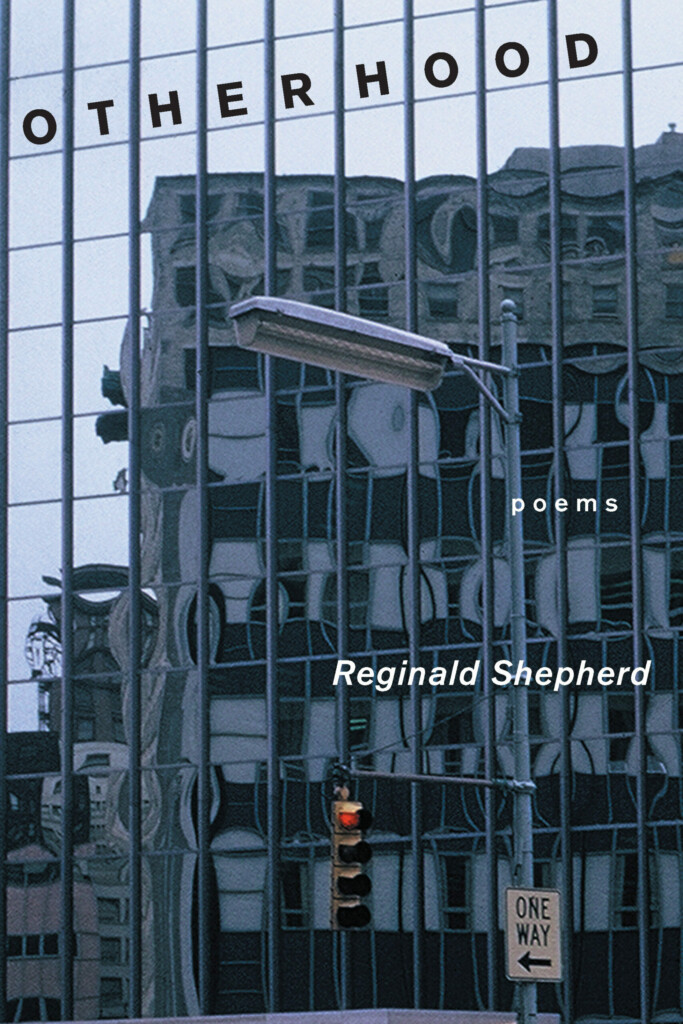
You said something earlier about the book Wrong, and it having meaning for you. Even the titles of Shepherd’s books are so tragic: Otherhood, Some Are Drowning, Wrong, Fata Morgana, Red Clay Weather. It does not sound like a good time. Greek myths lend themselves to tragedy. And Reginald Shepherd, I think, needed a kind of, how do I say this, a backdrop or a landscape of tragedy on which his poems could grow and through which he could build artifice. The Greek myths are full of rapes. They're full of wars. I think it was very important to what he was doing, but I chose poems thinking, okay, in these poems, Reginald Shepherd is making a lot of leaps, a lot of what seems to be non-sequitur leaps. And Orpheus happens to be in here. But in this poem, in another book, for instance, things are very narrative, but Orpheus happens to be in here. So, Orpheus is going to be there.
Solomon: Myth is just a vehicle for him, one of the traditions that he's drawing from and reimagining throughout his work. I know that you were registering changes as you were selecting, but myth is, as you're saying, omnipresent. You couldn't get around it, but it wasn't a strategic thing as you were selecting the poems.
My next question is about the relation of Shepherd with your work. Certainly, the use of myth is a common thread, but I'm thinking in another interview you talked about how poets love flowers, and the use of flowers that connects your work with queer culture. As I was reliving these poems through your work with The Selected Shepherd, I noticed ways in which Jericho Brown and Reginald Shepherd's poetry were in conversation with each other. Have you reflected on these resonances? Either as you were selecting the poems, or post the volume coming out?
Brown: It's hard to tease out.
Solomon: Maybe it's easier for a scholar looking in.
Brown: Yeah, I actually like hearing that. I like finding out what I'm doing and how people relate it to the poets that I'm influenced by. Because I always see things I've never seen before. I recently realized I’ve been reading this poem by Shepherd for years -- I can't think of what poem it is -- but there's a certain kind of phrasing that he uses that I use toward the end of a poem of mine called “Say Thank You, Say I'm Sorry.” As I was reading on a podcast, I'm like, “Oh, I stole that syntax.” I don’t use the same words. I realized there's a lot about my work in terms of syntax that I probably learned from Shepherd.
There are other poets who helped with this, but Shepherd helped me realize that what was most important about my writing would be how singular it was, or is. That I had to somehow either be myself or create a version of my self, and that had to be the speaker of my poems. The way Jericho Brown makes use of sentences. What I sound like in a poem has to be only what I sound like in a poem. So, part of what Shepherd does for me, reading his work through and through, is you realize nobody else wrote these poems.
No one could have written a book like Wrong but Reginald Shepherd. No one could have written “My Mother Was No White Dove,” or “Semantics at Four P.M.” but Reginald Shepherd. And I think he is the person who led me to understand that. It’s like when musical artists appear on the radio, I know its them. The deejay at the radio doesn't have to say “here's the new song by . . . .” I just know, because I've been listening to music, and I know what they sound like. There's really never a question when Mary J. Blige comes. And I figured out through Shepherd that in my own work, when people are reading a Jericho Brown poem, they need to be like, is that Jericho Brown?
So, what does that mean about a consistency of heart, a consistency of intellect, of line, of phrasing, of a kind of experimentation? Which I think was his goal. How do I continue to question myself and to challenge my idea about what a poem is and yet remain who I am throughout the poem? How is it still me? And obviously “me” changes and grows. And yet there's a way that when we look at that last book and we look at that first book by Reginald Shepherd, we can see that it's the same guy, but it's so different. That last book is so different from anything else he's written mostly because he wrote it on his deathbed. He was dying when he was finishing that book. He didn't even get to put the book in order. His partner, Robert Philen, ordered it, but it's all Shepherd’s poems. Which is why there's so many in that last book. I kind of got frustrated because there's so many very long poems, one right after another. And I'm like, “Bro, Shepherd wouldn't have done that.” [laughter] Those long prose poems. But I also noticed maybe he would have done it because it was his first time writing prose poems. I'm fascinated by what those poems yield.
Solomon: Yeah. You're comparing what you learned from Shepherd, that sense of voice, with your own. It is a Jericho Brown poem. It is Reginald Shepherd poem. That can be consistent even if, as you said, the experience of selecting these poems was to track the way he changed in terms of his craft across the six collections. Even though it's changing, there's always a sense that when you read a Reginald Shepherd poem, you know it’s him. And I will say that's also true of a Jericho Brown poem.
Brown: Aw. [laughter] Thanks Eric.
Shepherd's Queer Eros
Solomon: You're welcome. Another thing that I notice as someone who considers myself to be a queer cultural historian, I'm always down for seeing tongue-in-cheek play with the queer community or, “mock” is not quite the right word, but just send us up a little bit. Remind us not to take ourselves too seriously. I think Shepherd does something like that in “The God's at Three A.M." Or where you do it in your poem “Host” which, I think is subversive; it has a message. It's not just pure satire, but it is reminding us as queer people to be better to one another.
Brown: Yeah. To be better to one another is interesting. I never knew I wrote that. But I'm happy to hear it. I'm not against hearing that. I think what attracts me to those poems that you're talking about by Shepherd and by any queer writer, is the same thing that attracts me to poems that I'm attracted to by certain Black writers, whether they are queer or not. Because they're “in-house.” There's a way that you can read Shepherd’s “The Gods” and what you and I see in that poem we know other people are just not going to see. Because we've actually been to that bar. [laughter] And we understand that we could go to any city in America and still go to that bar and see those characters. [laughter] And we can see ourselves. Like, who am I in this poem? And yeah, that’s what is meant in a poem by me, like “Host.” Obviously, there's a reader who won't have had that experience, and they're sort of observing it from the outside, and maybe even identifying with it, but in a different way. It's the same thing as when, Future has this lyric where he says, “Y'all move that dope.” And I'm always amazed. When that song was such a huge song, every time I went to a club, every time I turned on the radio, I would hear that song. And I remember thinking, none of these people dancing to this song are drug dealers. [laughter]
Solomon: Were they “in the know”?
Brown: Yeah, like if I was really moving dope, that song probably had a certain kind of meaning to me when it came out, but when I'm listening to this song, I'm just thinking about grading papers. [laughter] I'm not trying to move dope. I'm just trying to stay up late enough to finish a poem.
I do think some things you can extrapolate or translate beyond that immediate in-house audience, but having an in-house audience I think is the actual backbone to voice. If we're having a conversation about Reginald Shepherd, we're talking about a poet who was always willing to be himself, to always have his own experiences in his poems. And so, sneaking around to make love outside, which I think queer people actually know less about than they used to.
Solomon: I agree.
Brown: But sneaking around to make love outside is an in-house conversation. It can translate. It can extrapolate to anybody sneaking around to do anything. But my experience reading those poems is “Oh, there I am.” Thank you, Reginald Shepherd, for writing this thing about yourself that shows that I'm not crazy, that shows that I exist.
Solomon: And that you're not alone.
Brown: Exactly.
Solomon: A whole history of what we might call cruising.
Brown: Yeah, that I miss. Yeah. [laughter] A whole history of cruising.
Solomon: That some people don't think we need anymore, right?
Brown: Yes. Well, I mean, maybe that's not what this interview is about, so I'll let that go. I don't know if people think we need that anymore. I just know you can meet a guy online and whatever happens from that happens. And you can meet a guy at the grocery store. And if you meet a guy at the grocery store, my personal history has shown that there were more options for what I could do with the guy and what the guy could do with me. When I meet a guy online, it's either I have to make love to you now or marry you? [laughter]
Solomon: There aren’t as many options ... And I love that Shepherd invites us to have this kind of conversation about his work.
Brown: Yeah, exactly.
Solomon: In a way that if I were someone different, if you were someone different, and we were sitting here talking about Reginald Shepherd, maybe we wouldn't be talking about “The God's at Three A.M .” The idea of cruising that you mentioned. I think that's beautiful that his work allows for all these entry points.
Brown: He would love that. And I think that we should also mention that this is all happening for Shepherd from his first book onward at a time when he is in those anthologies with Joseph Beam and Marlon Riggs and Essex Hemphill -- who also heavily used Greek myth. But there's no mixing up Hemphill and Shepherd. Among Black queer writers, even Carl Phillips at the time, there is this idea: we are going to say what our actual experience is in our poems, and we are not coding it. The code will be the fact that we reach out to you, Jericho, in that library when you're nineteen years old. In this library, actually, which is where I found Essex Hemphill’s poems.
Solomon: What you're saying reminds me of Assotto Saint’s “Why I Write” where he says (and I’m paraphrasing) we have an obligation to not file away our experiences in a desk drawer. I think that is very much clear in Shepherd's work and in your work and in Hemphill, and Riggs, and the people that you're mentioning.
Shepherd and the Natural World
You write in the Introduction to The Selected Shepherd, about framing his work around three primary concerns: 1) an understanding of the natural world as endangered; 2) his grief over the death of his mother when he was fourteen, and 3) his desire for the white male body and self-identification as a “snow queen,” and his processing of what this desire might mean.
Can you talk about the way Shepherd “reflects on the beauty of the natural world through an understanding of that world as endangered.” How did his thinking change from Some Are Drowning to Red Clay Weather? Or was it always the natural world as under threat? Did you notice different nuances as you were moving through?
Brown: I think that maybe the one thing Shepherd would have in common with a poet like Mary Oliver is this idea that you protect and conserve the natural world not because of conservation, not because of its resources, but because it is holy. Every image from the environment is always a reason to be excited about nature. But we understand in many of the poems that that which we should be excited about could end.
For me, coming up with these concerns first had to do with separating what is a concern or a subject from that which is artifice. Greek mythology is not a subject, it’s an artifice. He's not writing a poem about the Greek myths. He's making use of classical allusion in order to say something about these other things.
Poets have to use what they have. And what we do have is a bunch of trees, flowers, and grass. We have the sky. We got some dirt. Those things seem to have already been here. They seem to have some capacity to be here if you get rid of us. And I think that particular concern is also the reason why poets can tell you the name of every flower. You just don't know what every flower looks like. You wouldn't be able to actually point to a narcissus. [laughter].
Because you read that part of the intro, I'll read what I say right after that, which I think deals with that, that first concern:
In each book, Shepherd reflects the beauty of the natural world through an understanding of that world as endangered. In his first book, Some Are Drowning, this endangerment appears in direct proportion to the fact of whiteness. And then I quote, “My true love's eyes / are nothing like my own, are bland as the suburban lawn / he mows on a summer Sunday afternoon, backyard / cookout with domesticated dog (And the beef cattle / graze x world? And the deforestation proceeds by x miles / per minute?).”
And that endangerment status matters all the more as environmental elements often get presented as characters with agency. Here are a few lines from “Surface Effects in Summer Wind” from Wrong:
I'm learning to remember the sound
days make: one sky disdaining the idea
of clouds, sunlight surviving
its centrifuge, breeze keeping blessed September
at bay.
Notice September is what's at bay. Then in the same poem a few lines later, he writes:
Midnight,
look at the things I've done
in your name, in my dark, walking out
into the street that changes nothing
Midnight gets called on and talked to directly. September gets held at bay. That which you think of as the natural occurrence, the natural world, has a mind and a life of its own. And the speaker in Shepherd's poems understands that and is always speaking directly to that mind and that life of the natural world.
Solomon: So, there's a sense of that agency of the natural world and that agency being under threat by human actions.
The Day the 'World Ended': Shepherd's Perpetual Return
The second concern is from the very first page of Some Are Drowning to the very last page of Red Clay Weather. It’s everywhere in his poetry. It calls to mind other poets who have talked about what it means to have that sort of exigence—what motivates you to write; what, in many instances, traumatically or tragically, happened that somehow gave you the engine to write. In his poetry and essays, Shepherd writes constantly about – and is processing -- the grief over the death of his mother. In the poem “Vampires,” for example, which you select, he writes “a song like every song for the dead” or in “For My Mother in Lieu of Mourning,” which is in Fata Morgana: “Would you have frozen in these lines? You were their possibility: now love must find another shape.” Really powerfully returning over and over again to what it was like to lose his mother when he was fourteen years old.
I know you spoke with Natasha Trethewey in 2010 in Southern Spaces, and I think about hearing Trethewey speak about that existential wound, the murder of her mother, and also at such a young age. And Shepherd speaking in an essay that he would publish, talking about the day “the world ended” on March 31st, 1978, which was the day of his mother's death.12Reginald Shepherd, “To Make Me Who I Am,” Orpheus in the Bronx: Essays on Identity, Politics, and the Freedom of Poetry (Ann Arbor: University of Michigan Press, 2007), 22. Two questions here. One, how did you live with the loss of Shepherd's mother in these poems as you were reading them? How did that return for you? And then the second question is more for Jericho Brown: does that sense of a wound that writers write from jive with you? Does that make sense to you? What was it like living with that concern that you identify in Shepherd's work?
Brown: I just think it's his best work. I think it's his most beautiful poems. I think when his mother comes into a poem, I'm probably going to like the poem. I think that she was his way into and back to blackness. She was a specter to him. There's a way that she haunted him, and therefore, blackness haunted him. Whenever he talks about music in his work, his mother's coming up. If Sam Cooke, Donny Hathaway, or Otis Redding is in the poem, then his mother's in the poem. Also, the color black itself seems to always appear in a poem where his mother appears, if not talking about Black people, just the fact of a black shirt or a black shoe. I think it's also beautiful because it's not Hallmark washed. It's not a Mother’s Day card. The relationship between the speaker and his mother in these poems is fraught. There's fear as well as love. There's regret. There's also a calling out of neglect in some cases. Reginald Shepherd used to write that his mother knew that if she gave him a book, he would be occupied for the duration of the time that it took him to read the book. So, she could do whatever she wanted. She went through the trouble of making sure he was schooled at the best possible places, in spite of the fact that she was impoverished. He grew up until he was fifteen in the projects, in the Bronx. He has poems about that. I'll give a couple of examples.
I’ll start with this one as it will give me an opportunity to talk about some of the things in Shepherd's work that I'm really interested in.
“My Mother Dated Otis Redding”
My mother is laughing in the hallway with her friends I don’t like much, maybe the numbers runner who gives me dollars to go see movies while they fuck, a mattress propped in the doorway where there’s no door. I know what’s “fuck,” and “dick,” and “pussy.” They’re “tipsy,” she says, they’re having a good time. “Don’t I deserve a good time now and then?” I’m looking through the telescope I just got from a catalogue, while they break out the Tanqueray; I don’t know what that is. They’re putting on some records, it’s 1970, Nixon’s president; there’s a dock in one song and I don’t know how to whistle, but I know what’s a dock, and a bay. There aren’t many stars because of the streetlights, it’s the Bronx, the singer sounds sad, he’s dead. My mother says, “You know, I went to high school with him, back in Macon,” and everybody says “I’ll bet,” and she laughs. I wish I was his son, I wish they’d all go home. It’s late and I just want to go to bed, but she just wants to have a good time. I turn my telescope on the Puerto Rican couple fighting, kissing in a window across the concrete courtyard, three parrots escaped from the loading dock freezing in a trash tree, it’s November, neighborhood kids throwing rocks at each other from bicycles, my mother standing in the hallway with a paper cup of Tanqueray, or lying in the hallway in a pool of her own shit.
That's a poem that's hard on the mother, but also interested in what the mother affords. The mother affords this telescope. The mother affords an awareness of stars. The mother affords an awareness of the speaker's neighbors, of other cultures. The mother also affords this way into Otis Redding's history and music. And then the poem is also political in this way that I think might be in-house for Shepherd. He mentions Nixon; he mentions 1970. What many people don't know is that they would build these projects very purposely without doors in the apartments; you wouldn't have a door on a closet, or a door on a bathroom, or door dividing your bedroom from a hallway. And that was designed to take the idea of deserving privacy out of the minds of people who had to live in the projects. That was real. That was on purpose.
So, part of what he's getting at here goes beyond the mother. And I think what I learned from that poem has to do with how no matter what you start with, the poem's got to include everything. It's got to reach out into the world and somehow be about more than just whatever its obvious subject is.
Here's another poem where Shepherd is talking about his mom:
“My Mother Was No White Dove”
My Mother Was No White Dove no dove at all, coo-rooing through the dusk and foraging for small seeds My mother was the clouded-over night a moon swims through, the dark against which stars switch themselves on, so many already dead by now (stars switch themselves off and are my mother, she was never so celestial, so clearly seen) My mother was the murderous flight of crows stilled, black plumage gleaming among black branches, taken for nocturnal leaves, the difference between two darks: a cacophony of needs in the bare tree silhouette, a flight of feathers, scattering black. She was the night streetlights oppose (perch for the crows, their purchase on sight), obscure bruise across the sky making up names for rain My mother always falling was never snow, no kind of bird, pigeon or crow ...
Which I think is also a beautiful poem because it allows his mother to be a person. And there's a way that when we think about poems -- we found this out during the Iraq War -- the way Laura Bush thinks about poems is that is that they're all sweet. And that's not what poems are. I'm sorry to tell you. So, there's this way we get his mom being his mom, but also a human being, which I really love. Saying your mother is no white dove is a way also of calling to the beauty of one's mother's blackness.
Beautiful White Men: Shepherd's Desire
Solomon: I love hearing you read it. Hearing the rhythm and the way in which it was constructed. One of the things that stood out to me as you read it was the use of the word “snow,” which for readers of Shepherd’s, there's a lot of use of the word snow -- allusion, metaphor, imagery -- throughout his collections, throughout his poetry. And I wonder if this is a convenient segue, or too heavy-handed, but I am curious to get to the last concern that you identify, across his poetry, which is perhaps the most controversial still. I know it was divisive for some readers during Shepherd's lifetime. And that’s his self-identification as a “snow queen.” And where readers today might land. I am thinking about, Shepherd's attraction, veneration, of the white male body.
He writes in the 1986 essay “On Not Being White”: “I write about men, and most of them are white. And I write about white men, and most of them are beautiful. So, I write about beautiful white men.”13 Reginald Shepherd, “On Not Being White,” in In the Life: A Black Gay Anthology, ed. Joseph Beam (Washington DC: Redbone Press, 1986), 30. You can see that in his poems. Do you think that lands differently in 2024? Has anything changed in thinking about Shepherd’s potentially divisive, or confusing, as you put it in your Introduction, presentation of himself.
Brown: I don't know if it's any different. I don't know why, but I guess I just never cared. [laughter] I mean, I do care, but only intellectually. I don't get it, but I don't need to either. Even Shepherd didn't get it. I mean, he says so; he says this is weird. [laughter] There is a poem where he's looking at a very attractive Black guy reading a book and saying, what's wrong with me that I'm not attracted to you? Why not you? You're reading a book. It seems like an admission that the problem that Shepherd has is with himself, with his own idea of his own beauty or possibility for the beauty of blackness. And to be quite honest, I only feel sorry about that.
But all emotions and all ideas are welcome to be expressed in poetry. Only the Black poet can actually write about Black self-loathing that is the result of whiteness. And that's a real thing among us. And not just in the United States. I went to Nigeria a few months ago [laughter] and was just fascinated by how many blonde wigs there were. We've decided something about blonde hair that in and of itself is supposed to have a meaning toward what we think of as beautiful.
So, I don't trip about that from Shepherd. And no shade, but you know these writers who call themselves Black pessimists who are all married to white people, maybe I haven't read enough of it, but I don't see the part of their work where they're like, why is my wife white if I care about Black people so much?
Solomon: So, at least there's a self-reflection that’s happening in Shepherd.
Brown: Yeah. I'm much more attracted to that than I would be attracted to somebody participating in that without understanding that's what they are participating in. There's an awareness. It’s like when I vote Democrat. Like I'm not crazy. I'm not stupid. I also would like to at least have a home to come to. Like, I don't want, like, no shade, but I don't want porn to be illegal. So, I'm not interested in project 2025. And I'm voting for her, but I don't think of Kamala Harris as some kind of freedom fighter or some kind of rebel. I don't think that that is inherent in the fact of her blackness, either.
So, these poems are in the book because they come up so much and that's what he was interested in. And I am so happy that they're there because I would love to see critics and scholars on race and on whiteness -- fields that did not exist during Shepherd's time -- take these poems up.
Solomon: There's a complexity in these poems and in his essays that should lead to studying Shepherd’s approach to the white male body. His will to process and understand.
Brown: He also probably felt, given what was happening among Black queer writers at the time, a bit of a pariah. But it's not like he's the only Black queer person dating white guys. I think him feeling like a bit of a pariah has to do with him expressing it through his poems. When something comes up in a poem, it ends up identifying you like that's who you are. I think we might not be friends with, but we're friends with somebody who's friends with, a Black guy who only dates white people. [laughter]
Solomon: If you think about it, Shepherd publishing in the 90s into the 2000s, the post- In the Life generation, Joseph Beam and the Black man loving Black man is the revolutionary act of the 80s, there is a sense that he is publishing as a poet in contrast to those other writers and poets.
Brown: Yeah. The thing about Shepherd that makes him different is his move that, okay, you call me out about this thing. All right. So that's where I'm going. That's what I'm going to do in this next whole book. We got to see how much of that thing I am. And his way of doing things was put the poems first. And, if that's the experience he had for his poems, that's what was going to be in the poems. I'm really fascinated by that and even envious to some extent. Poets are the people who have to say the brave thing. Who have to say the thing that is true in spite of the fact that nobody else seems to be saying it. Even if that truth makes us look bad.
Solomon: Or is uncomfortable.
Brown: Yeah. And I never felt that I was doing that in my work as much as I feel it now. I feel like, “Oh, damn, I really don't want to talk about this.” I would actually rather not say this in a poem, because once I do, it becomes who I am. You can say this controversial thing in a poem, in Reginald Shepherd's case, he would say in poems that he wanted to suck white cock, which, I've never said it in my life, but -- and he understood this -- after that, you forget that that same person might want a sandwich too, might want a bowl of cereal, might like watching “Charlie's Angels,” might prefer orange to red. [laughter] There's a whole world involved with being a human being. And yet poets have to deal with the fact that once we put it on the page, we understand we will be identified that way, and in many ways dehumanized for that identification. So, Shepherd is an opportunity for me to not dehumanize somebody. But I don't get it. I don't like it, but I like him. I can still be interested in him, even if I'm not interested in that particular facet. And I as I said before, I think that that interest is allowed because he's aware.
From Shepherd to Brown
Solomon: So next is a series of questions that I teased up about how Shepherd can help us think about your work, poetic philosophy, and approach.
In an essay, “To Make Me Who I Am,” Shepherd writes about the importance of certain kinds of music being present in his poetry. For instance, in relationship to his mother as you mentioned. He adds, “Patti Smith was my first image of what a poet might be. She turned social ostracism, into rebellious outsider-hood, loneliness into proud isolation from the uncomprehending mass.” Do you have a Patti Smith? When you think about Jericho Brown before he was Jericho Brown? Was there a person who served as some type of image for you of what a poet might be?
Brown: I think that's a great question. There were always Black poets that I knew about as a kid growing up. I'm always fascinated about people not having an awareness of poetry. I don't know, it's because of the time that I grew up in. I don't know if it's because of what the Black church was then and how it's different now. I learned who Maya Angelou and Nikki Giovanni and Langston Hughes were in church. My idea of a poet were the poets. It is true that when I was a kid listening to Stevie Wonder, I felt like, “Oh, wow, this is poetry!”

I guess the big poet, for me, might be the same as the big poet for a whole bunch of other people. And that's Langston Hughes. Yeah. He seemed to me when I was a kid a kind of unifying force. I was always taken by the fact that the poems are so musical. I loved, and still to this day love, his particularly short poems: “My Friend,” “Island,” “Suicide Note.” He was amazing at creating moments of sublimity. These poems are sublime. When he's good, he's just so good. I don't like “Make America Great Again” or when he goes long. I always thought of him as The Poet because he was given to me as the poet most aware of his people. You know, the self that was made up of many selves; the I that understands there's a we. Later, the more I read his poems, I was taken that he always seemed to be reaching outside of himself.
Hughes was that poet for me. He was the first poet made accessible to me, and I knew when I got him I was getting poems. I never felt locked out of anything. I will also add, I understand people's idea of poetry as a marginal literature. But I didn't understand that at all when I was a kid. I thought poetry was the literature. To this day, I have questions about it. I think there are more poems sitting on people's refrigerators and in their mirrors above their dressers, and right by their door so that they can read them as they walk out, or inside the visor of their car. I think there are more poems in people's lives than there are novels. So, I don't know why we're so marginal. [laughter]
Solomon: Yeah. I wouldn’t argue that.
Brown: Shepherd also in his definition of Patti Smith as that beginning is thinking about how to make use of all the ways that he has been hurt, all the ways that he has been oppressed, both personally and as a Black queer person, and turning that into something else. And part of what he's saying is that Patti Smith was an example of that. I don't think I was self-conscious enough or aware enough as a young person that that was indeed my lot in life. Because I didn't feel that way then, that's not what my need of a poet was.
I liked Sylvia Plath too when I was a kid. I liked Anne Sexton. I liked Gwendolyn Brooks a whole lot. I thought she was amazing. And I mentioned Stevie Wonder. Very early on, Wonder gave me the idea that art could be a contribution to the culture; that you can make a feeling and change the entire culture. I love that. In particular, thinking about blackness. We are having that happening right now with an artist like Kendrick Lamar. Where the music is informing the way the people think about themselves. Which means that blackness, yet again, gets expanded.
So, my idea of what a poem is, and what I do when I write one, is to expand that which is expansive. I do the work of showing you just how big it can be; that it can include all these other things -- definitely Black culture, definitely queer culture, but also the wide American culture.
Identity and Poetry
Solomon: Art has the capacity to expand and not collapse any of our identities. One of the fascinating things for me as a reader of Shepherd's essays is the fact that Orpheus in the Bronx is subtitled Essays On Identity Politics and the Freedom of Poetry and he's constantly ruminating on what identity is and how it makes its way into his poetry or not. And I see some connections here. He states in one interview, “I prefer to call myself a writer who is gay and Black, or a writer who is Black and gay, and to call myself a gay Black writer. I would give the priority to me being a writer. And I certainly think that an engine of my writing is my experience of blackness, my experience of gayness, of marginality, and exclusion. But that doesn't mean that the writing arising from that experience is wholly determined by that experience.”14Charles Rowell and Reginald Shepherd, “An Interview with Reginald Shepherd,” Callaloo 21, no 2 (Spring 1998), 294.
And Shepherd writes in “The Others’ Other” in a similar way: “I have always intensely disliked what I call identity poetics, the use of poetry as a means to assert or claim social identity.”
He continually is thinking through this in his essays: what is the role of identity or “identity politics” in the making and the crafting of a poem. And I really like what you've said before about learning to write about race and sexuality and blackness, in your words, “as if they are givens” and not as if you're “exposing or exposed.”15Marian Kaufman, “Interview with Jericho Brown,” Bayou Magazine, https://bayoumagazine.org/interview-with-jericho-brown/.] I see connections between what Shepherd wrote and what you’ve written. But I also see how they're different. Do you still feel that the priority here is on the writing? What role does politics play in the composition of a Jericho Brown poem?
Brown: I think Shepherd and I were going about this probably the same way, but I also think the difference is that he's worried about bad poems, and I'm not worried about bad poems. People get so frustrated. I mean, I get it. When a really bad book wins a really big prize, you're worried about poetry. [laughter] But if we're doing the immortal thing, let the thing be immortal. It'll work out. It'll happen. But people get really -- and I think Shepherd could have too -- bogged down in the present moment; and in like, oh, why is this a poem? Because you said you were Black three times in it?
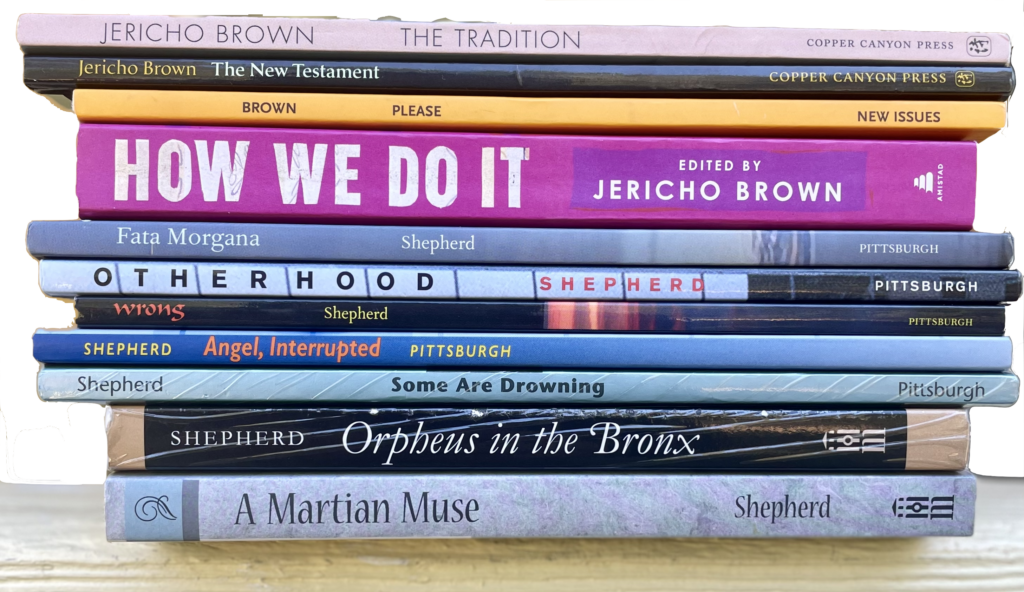
I kind of like the idea that maybe a poem is a poem because you say “Black” three times in it. [laughter] I don't care. [laughter] One of the wonderful things about having served on the National Book Award jury was seeing how many poets that I love and admire and respect approached poetry. Even if I don't like them anymore, [laughter] I still think they're poets. They are people with a lot of reading under their belts. I very distinctly remember being on that jury and seeing people bring up books that I thought were objectively bad. But they liked that mess, and with all their reading history, thought those were great poems. And then the opposite would happen. I'd be like, “Here's this book that's really good.” And they'd be like, “Jericho, no, not that book.” As long as I'm aware of that, I'm not really worried.
I think everything comes out. People get what they need. It's important that we get to hear from as many poets as possible so that we know people are getting what they need. But I also think if something doesn't turn me on, I'm not defensive enough to write an essay. Other people are, and I'm glad they're out there. There are people who are meant for that: something turns you off, you write an essay, go for it. And people talk about it on Twitter [X]. I'm down. Go for it. I love it. Lore, lore. I'm always for more lore. But I just don't get into it because it doesn't fuel my own writing.
My writing, on the other hand, can be fueled by disagreement. I can see someone's poetics being in disagreement with my poetics and my poems can prove them wrong. [laughter] Through craft, through the fact of the poem, but not in a way where I'm calling him on the phone and cussing them out -- which I actually would like better.
Maybe I'm going too far in this question, but I'm always amazed by how people get mad at folks in a community as small as Poetry Land. Where you could just call them. Like if there's a mix up, call me. You don't have to write an essay because you read something wrong. You can send me a DM. Send me an email. Text me.
I think everything goes in a poem and that my job when I'm writing a poem is to allow whatever falls into it to fall into it. And if I'm allowing everything to fall into it, then all that I know will fall into it. Orpheus might be there. Kendrick Lamar might be too. And an experience from when I was sixteen and unhappy might be in there, and an experience from when I was fourteen and happy might be all in the same poem.
And I think that's what Shepherd believes. But I think instead of him saying that he's saying something that puts him on the defensive about identity politics, which I don't get into just because I don't know what that means. And every time I try to define it, every time I look it up, every time I talk to people about it, nobody seems to agree about what identity politics means.
And the other thing I don't know that I see people saying a lot lately is race baiting. I don't know what race baiting means. And I clearly don't need to know to make my work happen. I think poems are political. I don't think there's any way around that. I haven't read the poem that is not. I think people are too. I think lives are. And I think poems are living things. When I'm working on a poem, I'm much more interested in the line, and much more interested in rhyme, and the sounds of things, and the construction of the sentences themselves than I am in what the sentences say. I figure out what the sentences say down in revision land. But when I'm in first draft land, I don't care about that stuff. Then when I'm revising the poem, I'm revising based on a system of sentences and sounds and line and rhyme and meter.
Solomon: There's a sense that you're in agreement with Shepherd on the line itself being the writer constructing the poem. Then these other things may be brought to bear on it in revision or as it’s received in the world. I think that that's powerful. Shepherd is writing these essays in a moment that is different than our moment. During the culture wars of the 90s into the early 2000s, there was this need to define, maybe more so than now in what we might call our queerer moment, when it comes to thinking about identity.
Paying it Forward
One of the things that you mentioned earlier and that I find to be a powerful ethic in Shepherd's work, especially some of his essays, has to do with going to Shepherd to find poets that you should know about. He was always uplifting and amplifying all kinds of different, lesser known, or marginalized poets. That was something that he was committed to: good work getting out there. You've returned to Shepherd here, in the ethic of bringing him to readers today. Are there poets that we should be reading and be talking more about?
Brown: I like everybody, so it's always hard for me. I really do. Nobody believes me, but I do. When I don't like a poet, it's probably because had a run in with them. [laughter] There are poets I don't like. I mean, suddenly your work can get bad to me if you've been disrespectful to me or my students. Or maybe I'm not into it. There aren't a lot of poems out there that I dislike; there are poems that I'm neutral about -- most poems. Most poems happen and I'm like, okay, well moving on. I get Poem a Day, like everybody else and I read poems every day. And sometimes I’m like, ”Oh, God, I gotta send this poem to my ten friends.” And sometimes I'm like, “Okay, girl. Well, you got in there. Go on, go with your bad self.”
So, I like Taylor Johnson, and I think everybody should be reading his work. And I'll stop there.
Solomon: Inevitably someone's going to feel left out.
Brown: Well, it's not just about feeling left out. But there was this other question you had here just about queer poets. I like Brian Teare, Randall Mann, James Allen Hall, Aaron Smith, Danez Smith, Philip B Williams. All of those folks are like the queer men. I like Ellen Bass. I have never disliked a poet whose first name is Robert: Robert Creeley, Robert Frost. I definitely like Robert Duncan. Robert Lowell.
For me, poets write the Bible. You have this book, and what? You don’t like a part of it? [laughter] You don't like Second Thessalonians? You don't you don't like Acts? Which gospel do you not like? You might like some things more than others. People love Song of Solomon because they see it as a love poem. People like any scripture where Jonathan comes up because they like to think about David having a good time. I just think poetry is in and of itself, actually attractive, likable, interesting, complex, a living thing. I like a lot of poets who I think I get on their nerves.
I like Kim Addonizio. I've always liked Terrance Hayes's work. Jeffrey McDaniel. And there are some people whose work I don't get into, but that's just because I don't get into it.
Solomon: And we don't have to name them, right?
Brown: No, I mean, I could. if you want me to say people I don't like, I could do that, too. We could gossip. [laughter] We could talk about who we ought to get rid of. Because they're out there, too. I'm like, oh my God, how is this person still working? You know? That's what y'all doing? I like a lot of very different things. It's easier for me when I'm dealing with students to make recommendations because I've seen their work and I'm like, “Oh, you should read this or that poem.” Everybody's hard on Mary Oliver, but she wrote “The Summer Day.” It's a great poem. Y'all can get crazy if you want. And Sharon Olds wrote “May 1968.” It’s a great poem. You can wear her out all you want. She gave us that. I love Yusef Komunyakaa. If you live in Arkansas and your name is Jeffrey, I probably think you're a great poet. You could spell that “Geo,” “Gef,” “Jeff,” however you get to do. I like a lot of poets because I read a lot of poetry. [laughter]
Solomon: I like finding a sense of connection or commonality with particular poets based upon a student's work. That's how I was introduced to Reginald Shepherd for the first time: someone said, “I see something in your work, read this poet.”
Brown: I like Catherine Barnett. I like Deborah Landau. I generally like poets name Catherine. All poets named Marie or Mary are always good. Mary Shivers. Marie Howe. [laughter]
I'm using that to show that you can't, you can't narrow it down. it is better to create a family tree for yourself. And that includes figuring out who you do love. When you figure out who you love, figuring out who they love. If you can do that, that's a reading life. You can read for the rest of your life that way.
I didn't even say Lucille Clifton's name. Lucille Clifton is my favorite poet. Second to her is probably Louise Glück. She's good. Leave her alone.
Poetry, Theory, Resilience
Solomon: Those of us who've spent time with Shepherd know that he's constantly invoking names like Adorno, Benjamin, Lacan. And he has written, “Unlike many poets, I have never been afraid of theory.” You're a poet, a public intellectual, a teacher. What role does theory play in your creative life? In your intellectual life? Is it something that you begin with? He says it's a “challenge and incitement” for him.16Shepherd, “To Make Me Who I Am,” 31.
Brown: I generally like to read anything that feels like it wants to be read. Anything from novels to criticism to theory to poetry that makes me feel there's an urgency behind it. Sure, I went to graduate school, got a PhD, so I've read these people. Most recently Bettina Judd, a theorist whose work has been so helpful to me. People get frustrated with theorists because they speak abstractly, in the air. And that seems sometimes contradictory to the impulse of poetry to speak on the ground and in images and that which is concrete.
Poets give often the singular situation in order to show that which is common, or known among us. Whereas theorists are doing this other thing where they want to catch the common situation, and then you get to apply it to your individual situation. What I've most recently learned from a writer like Judd has to do with maybe the first question you asked which was about the wound and whether or not I write from it. And maybe I didn't answer that question. Maybe I avoided it.
I think the hardest thing about writing for me has to do with the fact that much of where my earlier writing came from I have healed, or am trying to heal. And knowing that, I am interested in what part of my life, in my personality, only exists because of that wound or because of those wounds. And I want to heal that too. If there is something in me that is a descendant of the abuse I got at the hands of my father, I don't want that thing in me anymore. And some of that I won't be able to get rid of, and it's not like it's bad. I'm like the best friend anybody can have because I am the person who looks forward to cussing people out on somebody else's behalf. But I was never a person that could do that for myself until recently. That's because I always saw myself as a person in a family. And in the family where I grew up, you take care of everybody else, but you don't take care of yourself.
I think that's the case, not just for me. I think it's for my sister. I think it's for my mom. There's this sense that your life is about other people and that you put your life on the backburner, and that's the right thing to do. I just ain’t that person no more. And I don't want to be that person. And so, if I'm not that person, where are my poems coming from? That person wrote Please. So where are my poems going to come from if they're not coming from that wound? And what I've learned from Judd's work is that my present feeling, my present way of being will always have something from which I can pull a poem.
Solomon: It's a powerful reorientation. It makes me think of Whatever Happened to Queer Happiness? I've been thinking with that book by Kevin Brazil. He's questioning why we return to certain kinds of narratives as queer culture. Why we're reproducing certain kinds of stories about loss, about the AIDS dead, for example. And that seems to be even for non queer writers, that's how they imagined queer life. One of the things he talks about is how difficult that reorientation is -- to become someone who can write from a place that's not still dealing with that wound in the same way. You're saying healing, which I think is really powerful. It's not healed. It’s that process. So, I look forward to seeing what you write from this space.
Brown: Me too. Yeah.
About the Authors
Jericho Brown is author of The Tradition, for which he won the Pulitzer Prize. He is the recipient of fellowships from the MacArthur Foundation, Guggenheim Foundation, the Radcliffe Institute for Advanced Study at Harvard, and the National Endowment for the Arts. Brown’s first book, Please, won the American Book Award. His second book, The New Testament, won the Anisfield-Wolf Book Award. He is the director of the Creative Writing Program and a professor at Emory University.
Eric Solomon is an instructor of English and affiliate faculty with the Center for the Study of Southern Culture at the University of Mississippi. He is editor of the “Queer Intersections” series with the journal Southern Spaces; chair of the LGBTQ+ Historic Preservation Advisory Committee with Historic Atlanta; and serves as cultural historian with the Mayor’s LGBTQ+ Advisory Board for the City of Atlanta. In 2021, Solomon launched The #TUOR Project, a digital story tour of sites of importance in Atlanta’s queer past.
Cover Image Attribution
Reginald Shepherd collage created by and courtesy of Eric Solomon, 2024.
]]>
Bransford: Before we talk about An Unflinching Look: Elegy for Wetlands, can you talk about your personal history with the Chassahowitzka National Wildlife Refuge? And then describe the Refuge in terms of both ecology and aesthetics.
Dimmitt: My first trip there was in 1977 with a friend and my brother. The friend wanted to do some fishing. I had never heard of the place, nor had my brother. We drove up from Clearwater, got in his little jon boat and didn't do a lot of exploring, just fished.
I had never seen any place like this before. I had grown up in the Clearwater–Tampa Bay area, which was then probably three hours or more down the road. There are better roads now. And the swamp, as we call it, was very different from what I'd grown up around. There were many freshwater springs that spilt into the beginning of a river. In 1977, the water was clear, cerulean blue, and no one was living there.
We paddled through hardwood forest. The creek is wide in places because that area is perfectly flat. We slowly got into brackish areas and then went into big, open, less fresh, more salty, but still brackish bays. And that's as far as we got. Then we fished.
It was a very long time ago. It was beautiful. I was accustomed to the coast of Florida having barrier islands or beaches, and there were none. Water, just freshwater, merged right out into the Gulf.
Bransford: In broad brushstrokes, can you describe what the Refuge looks like?
Dimmitt: There were ferns and bromeliads everywhere. The humidity was 100% because of the springs constantly pumping out water. Lots of cabbage palm trees, which is the state tree in Florida. Some cypress and cedar trees remain, although most of them were harvested around 1916. There were trees that I wasn’t familiar with, like a type of holly called Dahoon which had little red berries. Maples. Spanish bayonets or yuccas grew on the islands. On slightly higher ground you might see some oaks.
What I loved most were the grasses that grew in the shallow creeks. You could see them by looking over the side of your canoe. The water was crystal clear. Various grasses and large ferns which had giant leaves. When I would stand in the water and make photographs, the current would move the eelgrass, which is about three quarters of an inch wide and many feet long. Those would brush against my legs as I was shooting. I had to learn to not freak out and not imagine that the eelgrass was water moccasins or gators, and just enjoy the caress.
Bransford: When did you start noticing the deterioration of the Refuge's ecosystem? What were some of these changes and the causes?
Dimmitt: Almost all the causes are saltwater intrusion. And second, for ten or twenty years, is the fertilizer getting into the aquifer. That fertilizer comes from the golf courses upstream at The Villages, which is a very large—it spans three counties—active adult retirement community. I believe they have fifty golf courses which must be beautifully kept. They throw a lot of fertilizer on the golf courses and it ends up in the aquifer. The Chassahowitzka and The Villages are both in the same springshed. The fertilizer goes down into the aquifer at The Villages, it ends up encouraging plant growth in the creeks and in the river. What you get is an increase in algae that grows really fast and then blocks sunlight because these are large mats of algae on the surface of the creeks. The algae mats are the size of a room. No sun gets through them and that kills all the smaller plants, which are the food for the smaller animals and on up the food chain. It's called toxic algae for a reason. It smothers life in the creek. That has been going on as long as The Villages has been there.
Another source of the nitrates is septic tanks that burst and go into the aquifer, and just people's yards, the fertilizer that they throw there. Agriculture also adds plenty of fertilizer to the aquifer. This has been going on longer than the impact of the sea level rise.

I wasn’t aware of the sea level rise until 2014, but if I look at photographs shot in 2010, I can see the beginning of the environmental damage. When you go to a place like this, it's like any forest. There are young trees and plants and mature trees and really old trees. But around 2014, the damage had become inescapable because all the hardwoods had died, the creeks were getting a lot of toxic algae, and the palms were starting to look sad. Sabal palms are the most salt tolerant trees in this ecosystem, so they're the last to die. And in many of my photographs, you'll see very little other than dead trees and palms that are on their way out. The eelgrass and other grasses are very delicate and can’t handle the increase in salt. The mats of algae cut down the sunlight that the grasses need in the creek.
Martin: It's really a combination. You have pollutants coming from the east and you have the sea level rise coming from the west. Those two are coming together in the same place and having this devastating effect.
Dimmitt: Exactly. There is no one single cause of the devastation. When I started on this project, I talked with someone who had a good working knowledge of the state’s water management practices. He had his own views that the state was looking away from or ignoring the impacts of over-pumping from the aquifer. So, yeah, it's a lot of different things. Even melting glaciers can't be denied here. That's what is lifting the water up and sending it from the Gulf up into these creeks.
Bransford: And the depletion of the aquifer is also important. To maintain all these golf courses at The Villages necessitates a huge volume of water. The water flow in the Refuge has deteriorated as well.
Dimmitt: Yes. It's so interconnected. One thing that Susan Cerulean goes into in her essay at the beginning of An Unflinching Look is that there has always been a lens—which is a use of the word “lens” I had never heard of before, but I got it right away—that exists between saltwater coming into the aquifer and the freshwater that's already in there. As water is pulled out for any and all purposes, including for sale as bottled water, the lens moves further and further inland. So you now have salt water and brackish water in the aquifer, in the local drinking water.
Bransford: Tell us about the genesis of this book, An Unflinching Look: Elegy for Wetlands.
Dimmitt: I visited there a lot in the eighties. I had my bachelor party up there. I won't go into that except to state that there were no mermaids involved. I enjoyed photographing it because it was unusual to me. I'd never seen any place like it in Florida. In 2004 I started a new photographic project called Primitive Florida. I felt that I needed to photograph these vulnerable landscapes. I was concerned about things like worsening storms and overdevelopment, and these phenomena that I learned about in college in the early seventies called global warming, climate change, and rising sea levels. Lo and behold, everything that I had learned about was starting to happen. I didn't visit the swamp between 2012 and 2014, but when I arrived at the cabin in 2014, the wetlands were devastated.
I didn't understand. I got in touch with scientists in the Tampa Bay area where I grew up and went to college. I showed them the photographs and they said, “That's saltwater intrusion. That's rising sea levels. You didn't know about that? It’s happening along the Gulf coast up to the Panhandle.”
I didn't know that it was going to be happening so soon. Eventually I got in touch with one scientist, Dr. Matthew McCarthy, whose study is excerpted in the book, and he was excited to see my photographs from water level because he's spent many years downloading satellite imagery and aerial photographs of the coast while he was working on his graduate thesis.
Dimmitt: That's the cabin where I stayed when I visited. My brother was one of the partners in the cabin when it was built; they did a lot of this work themselves. Everything had to be brought in by boat. When the cabin was finished, my brother asked me to take some photographs of the cabin.” He was really proud of it. He said, “I'll take you out in the boat and you can shoot back.” This was the shot I felt was best and I sent it to him. He said to me, “No, you can't see the house.” I said, “Well, bro, you built the cabin in a thick forest” The reason they built the cabin there was because the water is always 70 or 72 degrees. This is right on the creek by a spring, and the house stayed cool in the shade. The first picture (on top) is 1987. The second picture (bottom) is 2021. So that's thirty-four years. That's the same cabin and that's the same dock with some minor improvements.
Martin: This is an example of deforestation that involved no cutting down of trees.
Dimmitt: Absolutely. They wanted the shade. I took the first snapshot and made a lot of prints of it for my brother and the business partner. To reshoot in 2021, it was difficult because I had to find someone with patience to go back and forth and back and forth in their boat while I photographed. I had to figure out what lens I used back in 1987. It took awhile to get something that was good. That's often the case with re-photographic diptychs. It's very time consuming to find exactly where you did the early shot, where you stood, and what lens you used. Usually I did them by myself. But for the cabin shot, I had to rely on someone else to drive me back and forth and shoot a lot of frames.
Bransford: And you still are shooting everything on film, right?
Dimmitt: Yes, the entire project was shot on film. Any images that are square were shot with a medium format camera. When I went to reshoot the 35 millimeter images like this pair, I dug out my old 1980 Nikon F2 and got it cleaned and lubed in Asheville and took it down there. I hadn’t used that camera in probably twenty or thirty years. But yeah, everything's on film.

Dimmitt: That's the walkway from the dock to the cabin. The first photograph was made in 1988 and the second one was made in 2020. The earlier photograph lends itself to a vanishing perspective. And for the later one I made a point to shoot from the same position and with the same lens. It's really amazing how all the canopy, all the forest is gone. The saltwater floods around the cabin now at high tides and during hurricanes.
Martin: I'm wondering if I'm seeing what look like saw palmetto in the top photograph and then beneath it, is that Spartina now?
Dimmitt: Yeah, it looks like saw palmetto.
Martin: My gosh. That's a complete change in the ecosystem. Going from a terrestrial with freshwater influence to now saltwater dominated.
Dimmitt: I believe that this diptych shows the greatest span of time. This is from the dock looking downstream in 1986. And then the follow-up is 2020. It's the greatest span between the first and the second shot. If we were to go there now, half of the remaining palm trees in the back on the right would be gone.
Dimmitt: Next to Pat’s cabin, where I stay, is a neighbor’s cabin that has a boat shed, not a boat house. You climb up through a hole in the roof with the camera bag and tripod. I always worry about getting up the ladder with all my gear. And you can see way upriver and downriver to the Gulf. The left photograph was made in 2006 and the right one is 2022. I did several of these over the years, probably about six or more.

Martin: This is a really good pairing, too, because I think of this as a scientist. I'm a geologist, paleontologist by training. We are used to these really long expanses of time for dealing with environmental change. We say sea level rose, and it took thousands of years. Here, this is less than twenty. And in less than twenty years you've documented this complete shift in the ecosystems as a result of this saltwater intrusion coming upstream and affecting and changing those environments.
Dimmitt: The last time I was there, we had a good show. We saw dolphins or porpoises—I never know the difference from afar—chasing a large school of snook. It's brackish there. It’s a frenzy when the snook get trapped against the shore by the bigger, faster predators. You can't miss it if you're in a canoe or standing on the dock. And then another time, not that many years ago, we were seeing manatees come up and they always get your attention by their breathing sounds: the exhale, and then the inhale. You look out, and they've gone underwater to feed. I've seen them often in that stretch of Crawford Creek, which is where the cabin is and where I did almost all the photography.
Martin: So we're actually getting some marine mammals that are starting to come upstream into that area?
Dimmitt: I know that if they're coming up there, they're looking for food. They could easily be caught or eaten. And the spooked snook are something to behold because they go crazy. They're swimming all over the place trying to get away from the porpoises who are very smart and very fast. It's a bloodbath, but it's interesting to watch.
Dimmitt: This is kind of grim. This is 2004 and 2022.
Martin: The total loss of the canopy is so striking to me. In those ecosystems, you originally had shade-tolerant plants and, of course, animals that would have been living in those communities. Then with the loss of that canopy, now you have all that sunlight pouring into those areas and heating them up, as well as the saltwater intrusion. All that is totally changing the ecological communities. And again, this happened in less than twenty years.
Dimmitt: This location is a protected stretch of creeks, maybe twenty or thirty yards out of the wind. What you see between these two photos is not a dramatic difference. My host told me that when fishermen would return in the evening, they'd go up into the grasses and clean their fish, which is why it’s called The Kitchen. And then they can get back out to the Gulf and go back up to the town of Chassahowitzka and pull out or go home. I shot the first one probably in 2004 without a tripod, which is always dicey, with a big, heavy, medium format camera. I kind of like that scene in 2004. When I went back to re-photograph it, I'm again relying on the patience of a friend and sometimes that patience runs short because I'm saying, “No, closer, no, further back.” And you go back and forth in front of it a couple more times, and there's nothing in it for the boat owner. But that was the best I could do. And everything is shot on film, but when you prepare files, when you get the images ready for the publisher, you have to get scans. So I'm working in Photoshop on scans of these negatives that I shot and printed many years ago, and I'm seeing things that I hadn't seen in a long time, and I'm looking at the difference in the two of them side by side and seeing a lot of small differences, and then way off in the background seeing other differences, and the edges of the islands on the left and right. There's some deforestation in there as well. It's a photograph that I enjoy, but it doesn't pack the punch that these other ones do.
Martin: Right. That was one of the aspects that I appreciated is that you had to toggle back and forth between each of the images to appreciate the amount of change that had happened there. And some of it is subtle. So it's something where, if you just had the second photograph, the later photograph by itself, someone who doesn't know that place would say, 'What do you mean, it looks fine, it's totally fine. It's not like there's a condominium or a development there. What's the problem?'
Bransford: Speaking photographically, did you have some compositional strategies of how you wanted to depict the Refuge? Some images have very strong diagonal lines, some obviously have strong vertical lines with the trees, sometimes downed trees dissect the frame horizontally. Other images don't have strong leading lines. The ones with algae or grasses are more abstract, ethereal. Sometimes there's a curved tree in the middle of the frame that grabs our attention or a log in the foreground in the water. Did you have certain compositional strategies of how you wanted to depict the refuge?
Dimmitt: Not at all. In some cases, I am walking around, where it's dry enough, in mud shoes and just looking or in some cases checking to see what some place looks like now. But I don’t have a predetermined way to shoot. That would really bore me. I did almost all of the newer work since 2004 with a square camera. There are only so many things you can do with a square medium format camera. I've had someone tell me it's evident that I had some sort of preconceived notion or was shooting a certain way but that’s not the case. I spent many years on this project. I had to keep it fresh. That might mean working on re-photographic diptychs one day and going on a long paddle to photograph some place new the next day.
This one is a favorite, and I was asked at length about it: how premeditated is this, that sort of thing. We discussed it at the Asheville Art Museum. One of my authors, Alison Nordström, who wrote the book’s long essay on the photography, had this in her slides, and she was saying all sorts of things about it that were wonderful and flattering. And my memory is that it was beautiful. It was very straightforward in that these were palms that had washed up on the edge of a savannah. I was on a narrow dock, and I couldn't move forwards or backwards. So I was completely constricted in how I could compose it, except to change the lenses. I made what I thought was a good photograph. Alison loved it. I didn't mention at the museum book talk, but I feel it now and see it now. It looked like the Pieta to me, it looked like the Virgin Mary with Jesus in her lap. I spent time in Florence in the seventies studying Renaissance painting, etching, lithography, and sometimes all that old Italian Catholic imagery stays in your head. And you’re not even aware of it until later.
Dimmitt: This is another one of those images that was really difficult to photograph. I love it, but it was so busy and there was so much going on. It took a while, maybe twenty or thirty minutes to create some sort of order out of this chaos.
Martin: Something I appreciate in terms of the documentary aspect of this sort of photograph is that the reflection is actually bringing out the sky better. You can see the clouds and the gaps between the clouds that are only implied in the actual sky part of the picture.
Dimmitt: I was asked if I always make my skies white. There are various things I could have done here and I did do in this case, and that's to use a deep yellow filter to try and get some tone in the sky. But it was a very bright sky and there's not much you can do to get tone in it. To further answer your earlier question, I don't have a preconceived notion. This was just very difficult to compose. It's a complicated image visually but I’m very happy with it.
Bransford: You mentioned Alison Nordström, she talks about the opportune slipperiness of these photographs in the sense that they simultaneously inhabit the worlds of art, science, and social action. Was this or is this your intention? Did you come at the project initially from an art photography standpoint and realize gradually that the images also have scientific and even political appeal?
Dimmitt: I'll almost give you a straightforward answer and say yes. And then there's a but. As I mentioned, I started shooting there in earnest in 2004, and I was just photographing something that I thought might disappear or that I just liked an awful lot. And the more I poked around, the more time I took when I went there and paddled in the various parts of the swamp, the more I loved it. And again, I'm from there. This is my native landscape, so I was very happy to be doing what I was doing. And then climate change arrived, and I didn't really change my approach and become a different sort of photographer. I just photographed the impact. There was nothing undamaged. The impact was all encompassing. It was everywhere. You really couldn't escape it, and it got worse every time I went. Someone recently asked me how how many rolls did you shoot? How many times did you go down there? I moved to Asheville in 2014, and that's when I first discovered that the rising seas were starting to do serious damage. The tally I got when asked was around twenty-five trips down there in the eight years that I worked on the project.
I was doing landscape photography. That is what I do. I just happen to like to photograph in wetlands because that’s my native environment. That's my native landscape. I grew up in Clearwater on the bay. I'm working now on a project about mangroves. When I was in Florida last month, I was shooting at Weedon Island in a big, beautiful mangrove forest. That's the kind of subject that I like. The interpretation is up to the beholder.
I imagined that these photographs were good enough that my gallery in Tampa would be interested in exhibiting them. They said they weren’t going to be able to sell them, but they would exhibit them. So we did. And only two or three sold. I was eventually told it should be a book. So I got in touch with the University of Georgia Press, and the director was very excited about the work.
The book then gives you an opportunity to create an editorial viewpoint. And to me, they didn't have an editorial viewpoint. They were just a document of a place that I had made photographs of that was becoming ruined by rising sea levels. Learning about the causes from Dr. McCarthy was something that made me become a little more activist about it, and also learning about my subject and doing research. But the research didn't start until I got a book deal. Learning about The Villages and learning about the state's water management, or water mismanagement, made me even angrier, and that became something my editor convinced me to write about—my feelings. That's why my epilogue is sharper than the rest of my language.
Bransford: I'm glad you mentioned the epilogue. In it, there are the two anecdotes. One of you visiting what I think is the oldest and biggest tree in the refuge and your speculation about what's going to happen to it. And then also the wonderful anecdote of you paddling and not hearing any leaves rustling but hearing the woodpecker sounds. Could you recount those two anecdotes?

Dimmitt: I'm still surprised that the editor got those two things out of me because writing is not something that I do well or do comfortably. The last remaining old growth cypress tree is not the last one in the swamp, but the last one that anyone could direct someone to. It happened because I asked my host down there, Pat, if he could take me there. He said, “Yeah, but we will have to go to the property owner first.” And I said, “That's fine.” So we did that, and then we walked off in the direction of the tree and I'm relying on Pat. He's been there multiple times. And I'm looking up, and I'm waiting to see some old growth tree.
I practically walked into it. It’s the photograph which has a lot of palm fronds and shadows on its fat trunk. I stopped there and photographed. It doesn't show the upper part of the tree, it just shows the trunk, which is huge. I couldn't really see the tree trunk. I almost walked into it because it was somewhat camouflaged by all of its neighboring palm trees, which were small. I imagined that's how it had lived so long, because it had been unrecognizable. And anyone who is looking for cypress trees would have passed it by because its top had probably been blown off by lightning. And I made a couple of photographs of the tree in the shadows, and then backed away and got a different lens and photographed the top, which is a mess. It may still be there. I think that photograph was done in 2021, but it is really close to a creek and all the creeks are becoming saltier. And that may be what kills that tree. It survived the loggers in 1916, and it probably is not going to survive this.
You mentioned something about sound, and I will tell you that the last photographs I showed you of the palms in the creek where we discussed filtering for the sky and, that sort of thing—if I was there maybe twenty or thirty minutes composing and making the photograph and when I'm doing that, I have everything turned up all the way. I am looking as hard as I can. I'm trying to compose something that reaches into me, is compelling compositionally, all the rest of it, where am I standing, that sort of thing. Sinking up to my calves in mud. And I'm seeing everything, and I'm hearing everything. And when you asked about the woodpeckers, I chuckled because when I get back to the cabin at the end of the day, or if I’m here in the mountains and I get back to the car after a long hike, I can tell you every single thing I heard. I can tell you everything I saw. My sniffer's gone, so I can't tell you every smell. Being in the canoe, paddling around, feeling the breeze. It was a hot day in December. Losing control of the canoe in a breeze, and then I got pushed over to the side of the creek. I dropped the anchor and sat there, there was not a photograph for me to take where I ended up, but I could hear not just one woodpecker; I could hear many, many woodpeckers banging away at the all the dead trees, all the dead hardwoods surrounding me. And it was really disheartening. It was an indication that some bird's happy and there's a lot of food for all the woodpeckers now, but that's just another way in which we learn how bad the ecosystem loss is.
Martin: That caught my interest because the last couple of David Haskell's books have dealt with sound. One of them is The Songs of Trees, and Sounds Wild and Broken is his most recent book about how there are not just landscapes—and what you're doing is documenting landscapes that, of course, are waterscapes as well—but there are soundscapes. So you have the visual aesthetic that is intrinsic to your photography, but sometimes with a picture like that, I, as somebody who goes into those kind of environments, experienced the same thing you did, I also hear the sounds when I look at the photograph. And I'm realizing that it's not just visual, that there are other senses that are being engaged with these places and how climate change and sea level rise, pollution, all of these factors are also affecting those other ways we sense the world around us.
Dimmitt: If I'm at the swamp house with my host and his family, if there is a porpoise–snook battle going on, we always go out to the dock and watch. And you don't see it if you're inside the cabin with all its screens. If you're inside, you hear everything outside. You run out and engage with it. It’s nature at its most brutal. I went to school at Eckerd College near Lake Maggiore, and the sound of ospreys chirping for minutes after minutes after minutes is something I grew up with. It resonated with me.
Bransford: Is there anything else about your book that we didn't cover that you'd like to talk about?

Dimmitt: This photograph of fog on the creek closes my essay in An Unflinching Look: Elegy for Wetlands. Something you feel when you're there. It's 100% humidity. If you shoot in the winter, which I prefer because the light is better in the winter and it's not as hot, then you're going to get fog because at night it cools down. And I just walked out of the cabin and down to the edge of the dock, and that was in front of me. That's a palm that had been alive, well, probably four or five years prior. And it was already hosting plant life of its own. This is my first book. Working with an academic press, they didn't give me any direction. I was completely on my own to make the image selection and to sequence it and I came up with the idea of the gatefolds. They were wonderful to work with, and the designer did, I thought, a beautiful job.

Dimmitt: This is one of the last photographs I took in the swamp. It was the same day that I went out and heard all the woodpeckers. What has stuck with me is this whole place was a thick tropical forest, and now it's nothing. This is Spartina? Is that what the grasses are?
Martin: That's what it looks like. Smooth cord grass.
Dimmitt: There’s another grass that’s round.
Martin: Juncus. That’s also a saltwater indicator.
Dimmitt: Often I will shoot from the canoe handheld without a tripod. It’s not easy to do. And I saw this and I thought it was beautiful. I didn't think about what purpose it would serve in a book as propaganda or beauty or science or any of that. I just shot it. But after I finished the photograph, I realized that I had been fighting logs and tree trunks in the creek the whole time, and the image I just called Impassable Creek. That's because you can't paddle in these places anymore because creeks are so full of dead trees. There's no clearance. And it was like being shackled. There are so many corpses that you can't move freely. Someone who wrote about my project wrote that it reminded him of a Civil War battlefield with corpses everywhere. And this was the first time, in 2022, when I was finishing the book, that I felt that I couldn't move in the swamp.

Dimmitt: When I would walk in some of the drier places, I would just be checking in. And one of the things that caught my eye on this day was that saplings were dying. This is kind of a mess as a photograph, but that's what you see when you're walking around. When it’s too salty for palm saplings, then it's really too salty.

Dimmitt: The earlier photographs in the book are photographs of a place that was pristine and exotic. Photographs of things that I found beautiful and unusual. However, I gradually started to photograph death and destruction on a very broad scale. It just kept getting worse and worse. And it will continue to get worse and worse. Hurricane Idalia had a big impact down there. I don't even want to go see that. I had to adapt to shooting environmental destruction. I didn't know how to do this. I get asked about beauty. One thing I didn't want to do was to suddenly go from taking photographs of some place I found compelling and beautiful to using my camera to make ugly photographs or to make these wetlands look bad. When I was doing the event at the Asheville Art Museum with Alison Nordström recently, she said to me, this is a beautiful photograph. Just one of a dead palm in the river. I'm saying to myself, this image is brutal. This is straightforward damage. And it was, again, shot from a canoe, which makes it difficult to do. The creek bottom was vey soft so I can’t get out and walk. And I did the best I could. It's not a good negative, but I'm grateful that I don't have to print much of these images for exhibits because no one would want to show this work in an exhibit. But this is as straightforward a photograph as I can make. I don’t recall making any effort to photograph it beautifully. And I was surprised that Dr. Alison Nordström thought it was beautiful.
Bransford: Is there a tension there of creating beautiful images of things that are brutal and unsettling? Are they mutually exclusive?
Dimmitt: For me, there isn’t a conflict. I don’t feel that they are mutually exclusive. I guess I gave an insight into that a moment ago. I went from photographing a place that I felt was beautiful to photographing its ruin. It’s my native landscape. These are forms and shapes and trees and brackish water that I grew up with in Clearwater. We lived by the bay and there were roots of large mangrove trees that had died in a freeze long ago. They stayed there on the sand bars for decades. So, I guess I got acclimated to seeing a certain amount of death in my surroundings.
I don't know how to make ugly photographs but I do know that a beautiful photograph encourages a viewer to engage with it. I simply continued using the same sense of aesthetics that I brought to the swamp when I started photographing there decades ago.
I made a commitment to this place when I began this project in 2014. I like to honor my subjects. My goal all along has been to make compelling photographs. The book is about bearing witness to a tragic loss, saying farewell to these beautiful, complex wetlands and making it known that this is happening now along low-lying coasts all around the world and will only get worse.
Introducción
El dramaturgo Abel González Melo nació en 1980 en La Habana, Cuba, mismo año en que el Exodo del Mariel vio a aproximadamente 125,000 personas huir de su país, un evento que dramatiza en su obra de 2018 En ningún lugar del mundo. González Melo estudió Artes Teatrales en la Universidad de las Artes de Cuba. Ha recibido diversos premios y galardones por sus obras literarias y teatrales, entre ellos el Premio Primer Concurso de Dramaturgia de la Embajada de España (2005) por Chamaco, una de las obras más reconocidas de González Melo, y más reciente el prestigioso Premio Literario Casa de las Américas 2020 (enero).
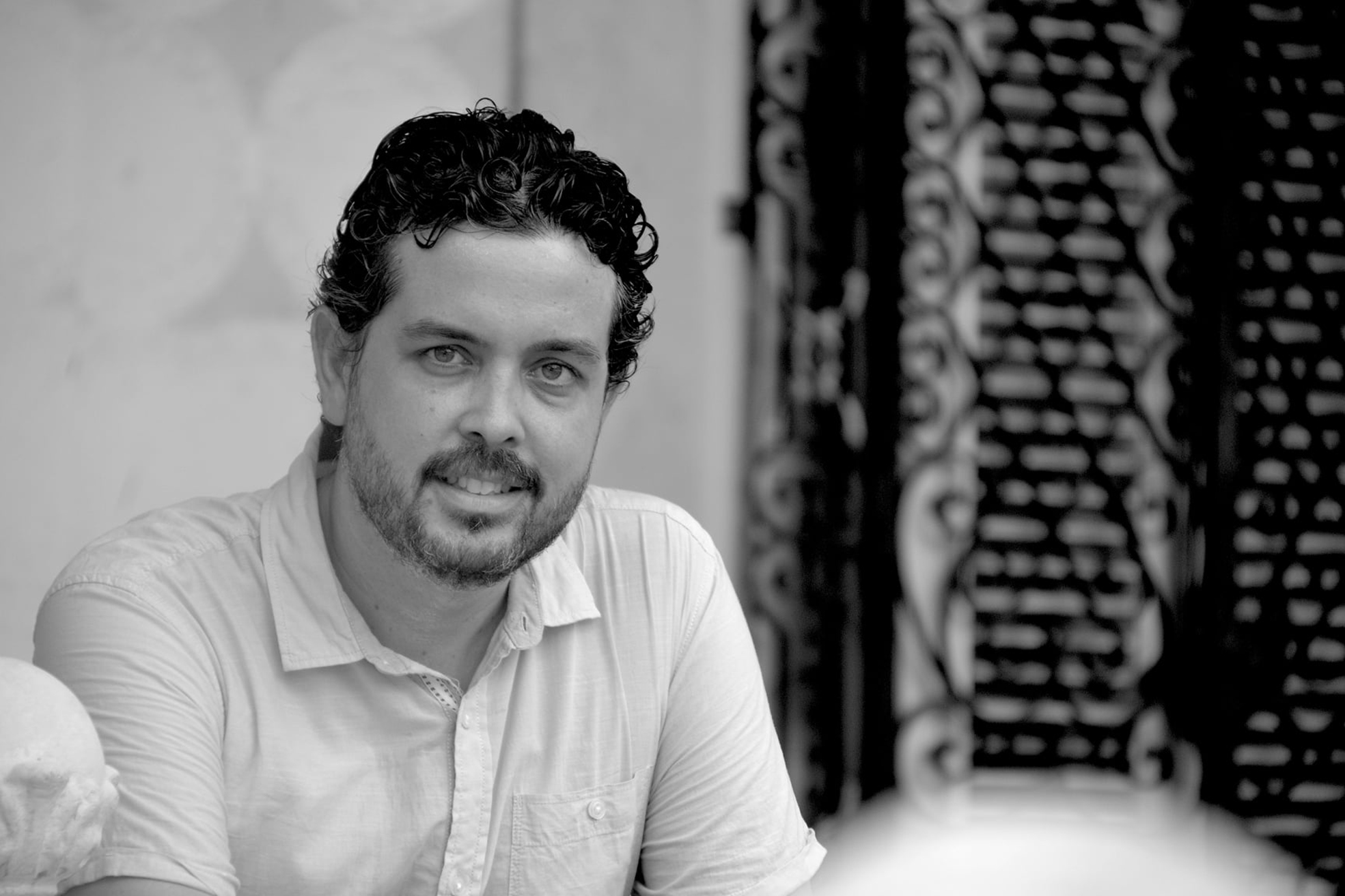
Las obras de González Melo abarcan dos décadas y cubren múltiples temas sociales dentro de la vida cubana. Desde la complicada relación de Cuba con el Exodo del Mariel en En ningún lugar del mundo (2018) hasta la prostitución adolescente a principios de la década de 2000 en La Habana Vieja en su trilogía, Fuga de Invierno (2004–2009), sus obras sumergen al público en las calles que rodean el Capitolio de La Habana, en los parques, callejones y teatros que brindan espacios para la prostitución ilegal, en casas particulares que centran la importancia de la familia para los cubanos. La primera década de la escritura de González Melo problematiza la cultura juvenil cubana de principios de la década de 2000, una cultura a la vez gay y heterosexual, hambrienta y saciada, resistente y complaciente en un país donde la Revolución todavía se lucha a diario en las calles (aunque ahora rodeados por los "WiFi hotspots" aprobados). Mientras González Melo mantiene su identificación sexual privada, sus obras desafían la categorización, preguntan cuestiones de sexualidad y exploran la supervivencia, la mercantilización del cuerpo, el trauma mental intenso, el dolor de la historia y el amor profundo de la familia. Sus personajes se entretejen dentro y fuera de sus obras para demostrar esa complejidad: mientras algunas cosas han cambiado, otras siguen igual de siempre.
La obra más reciente de González Melo pasa a recuperar personajes literarios y episodios de la historia cubana con una perspectiva revisionista. Figuras históricas de la obra de González Melo incluyen la poeta feminista de principios del siglo XX María Luisa Milanés (de Bayamo, Cuba) en Bayamesa (2019), que ganó el premio Casa de las Américas de teatro en enero de 2020. En abordar el tema de la censura en el apogeo de la Revolución en Cuba, la obra más reciente de González Melo presenta personajes históricos cubanos. Fuera del juego dramatiza la experiencia de la figura cultural Heberto Padilla, un poeta venerado cuya obra criticó la Revolución y sus líderes en su momento, 1967–68, resultando en su arresto, tortura y exilio a los Estados Unidos en 1980. Padilla trabajó muchos años en varios puestos en el sistema universitario en los Estados Unidos, como Ohio State University, Bowdoin College y el Instituto de Humanidades de la NYU, antes de morir solo como poeta residente Auburn University en 2000. En su drama más reciente, Cádiz en José Martí (Festival de Teatro Iberoamericano de Cádiz, 2020), González Melo dramatiza al mítico héroe nacional de la isla, el revolucionario José Martí (1853–1895). González Melo lo sitúa en la ciudad española de Cádiz, el primer destino de Martí en su largo exilio y deportación política bajo el régimen colonial.
En esta conversación, González Melo explica su proceso creativo e inspiraciones, la experiencia de la migración cubana como material dramático y la idea de refundir la historia para nuevos públicos y tiempos. Habla de cómo se basó en la experiencia actual en La Habana para crear Fuga de invierno y cómo su obra reciente se sumerge profundamente en las preguntas de la comunidad y la familia durante algunos de los momentos más severos de Cuba. González Melo también reflexiona sobre las ligaduras singulares entre Estados Unidos y Cuba. Uno de estos vínculos es la conexión lingüística español-inglés, ya que muchos cubanoamericanos son bilingües. Por lo tanto, aunque esta conversación se llevó a cabo en español, hemos proporcionado traducciones al inglés. [Read the English translation of this interview here.]
Chamaco : El comienzo de todo, o el trabajo inicial de González Melo
Gunnels: ¿Por qué la dramaturgia? ¿Piensas que el teatro es el mejor vehículo para las historias que quieres contar?
González Melo: El teatro tiene algo maravilloso para un escritor: aleja a la literatura de la soledad. Propone la creación en equipo y el contacto directo con el espectador. Ambas cuestiones me resultan muy atractivas: la idea de que la escritura nunca cesa, siempre es reinterpretada en presente, necesita la comunión del director, los actores, los diseñadores, los técnicos, y precisa, indefectiblemente, la complicidad del público. Me deslumbra esa naturaleza inacabada de la escritura dramática, esa urgencia por impactar de modo inmediato. Disfruto escribir narrativa o ensayo, pero en ambos casos extraño el diálogo real con el ser humano. Será porque, cada vez más, la dramaturgia es en mí un proceso relacionado con un grupo humano concreto, una textura imaginada para gravitar sobre una cuerda floja.
Gunnels: ¿Sientes 'inacabada' esa naturaleza porque necesita de otros artistas para completarse, o porque, cada vez que se representa una obra, hay una nueva audiencia que tendrá reacciones distintas?
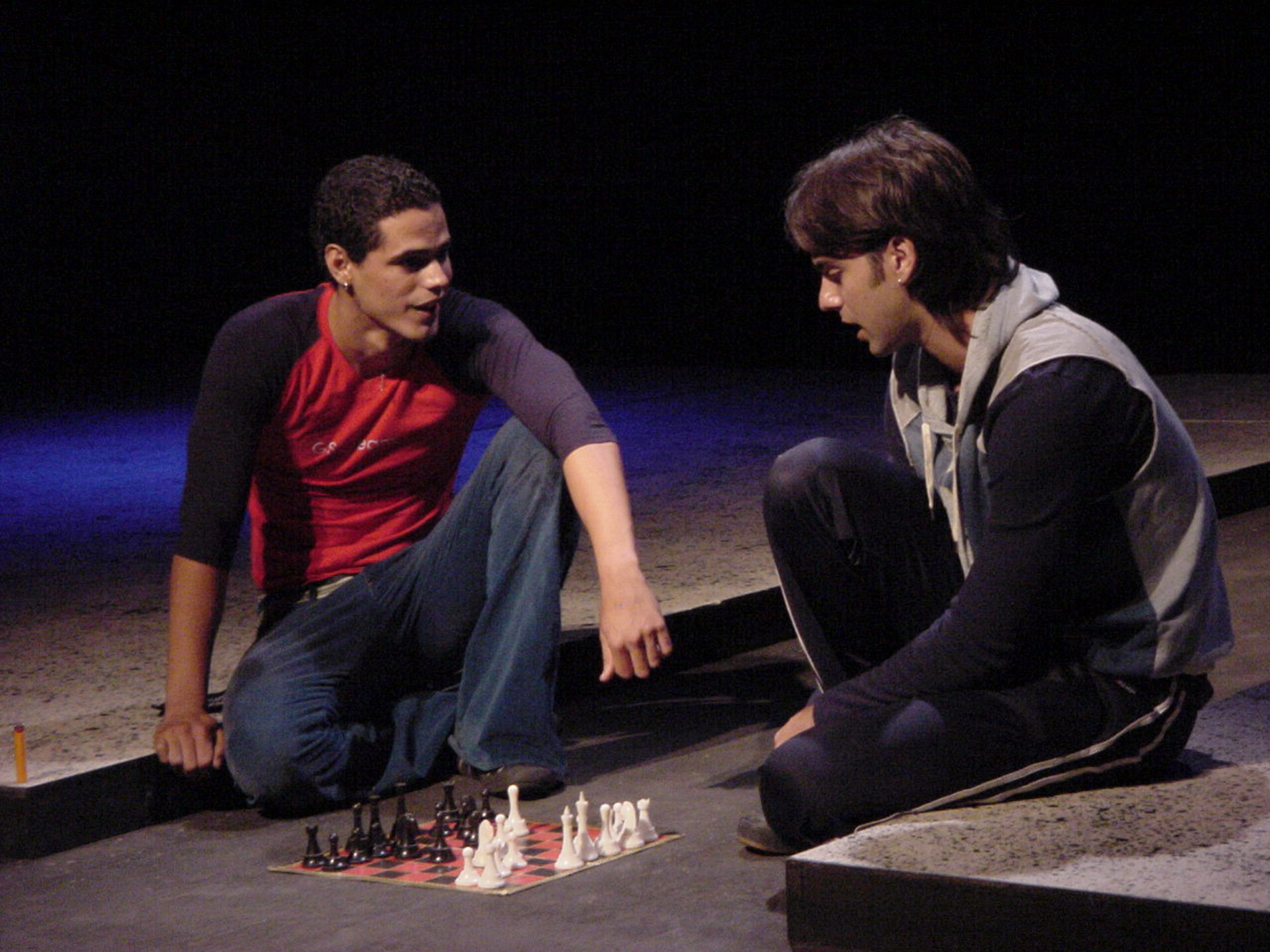
González Melo: El teatro lo hacemos entre todos, los artistas y el público. Basta recordar el origen griego de la palabra "teatro", que significa "mirar". Es decir, solo existimos porque alguien nos mira. Es uno de los mayores placeres de escribir dramaturgia: sentir que uno solo ofrece una guía de acotaciones y parlamentos sobre el papel, solo eso, pero que el personaje tendrá el cuerpo, la voz y el alma de quien lo encarne delante del espectador, que es quien terminará de construirlo en su proceso de recepción activa. ¿Por qué seguimos asistiendo una y otra vez a los estrenos de los clásicos? Pues porque su esencia, más que en el argumento, radica en cómo se cuenta hoy esa historia en el ágora pública: quiénes la ejecutan, por qué deciden hacerla, en qué contexto y ante quiénes, qué sentidos nacen de esa experiencia.
Gunnels: Quisiera pintar la escencia de la triología Fugas de invierno para la audiencia antes de que lo comentemos.
Chamaco (Kiddo, 2004, traducción al inglés de William Gregory) es la primera entrega de la trilogía.1Hay dos traducciones publicadas. William Gregory tradujo los dos Chamaco y Nevada; Yael Prizant tradujo la triología en versión bi-lingual con prensa distinta. Chamaco se ha representado a nivel mundial, desde el Teatro Argos en La Habana hasta Manchester, el Teatro HOME de Inglaterra, hasta la traducción más reciente al checo, con la producción en Praga programada para el otoño de 2021. La trilogía, que incluye Nevada y Talco (la segunda y tercera entrega), cubre un lapso de tres meses en un invierno tropical del descontento, como escribe la crítica de teatro y académica titular Lillian Manzor "the trilogy addresses concerns that are dear to the author and his generation, namely: the complex and contradictory ways in which homosexuality, sex, and migration from the countryside to the capital becomes means of survival in a society that has lost all sense of value."2Lillian Manxor and Austin Webber, "Ground Down to Nothing but Still Fighting." Hemispheric Institute of Performance and Politics. Accessed March 25, 2021. https://hemisphericinstitute.org/en/emisferica-82/manzor-webbert.html. Chamaco sumerge a los espectadores en la Nochebuena en La Habana, donde una hermana espera con inquietud que su hermano regrese a casa para una cena que nunca comerá, ya que sin saberlo ella, murió en una pelea con cuchillas. Nevada sigue a Lucía y su novio/chulo Rosnay cuando se encuentran con la realidad de vender sus cuerpos en el esfuerzo por salir o escapar, en este caso, al estado de Nevada, donde la prostitución es legal, y los "dulces vienen envueltos en papel de brillo". Talco, la última entrega, retrata una realidad cruda y sucia que se desarrolla principalmente en el baño de un antiguo cine utilizado para el tráfico y la prostitución, donde los caminos de cuatro personajes—Javi, Máshenka, Zuleidy y Álvaro—se entrecruzan en una batalla violenta y tensa de supervivencia. A la trilogía la siguen casi veinte obras más, muchas de las cuales han sido traducidas a varios idiomas y representadas tanto en Estados Unidos como en el extranjero. Abel, esta trilogía realmente centra la experiencia de la juventud cubana. Describe la importancia de dar voz a la gente joven cubana en las obras que has escrito.
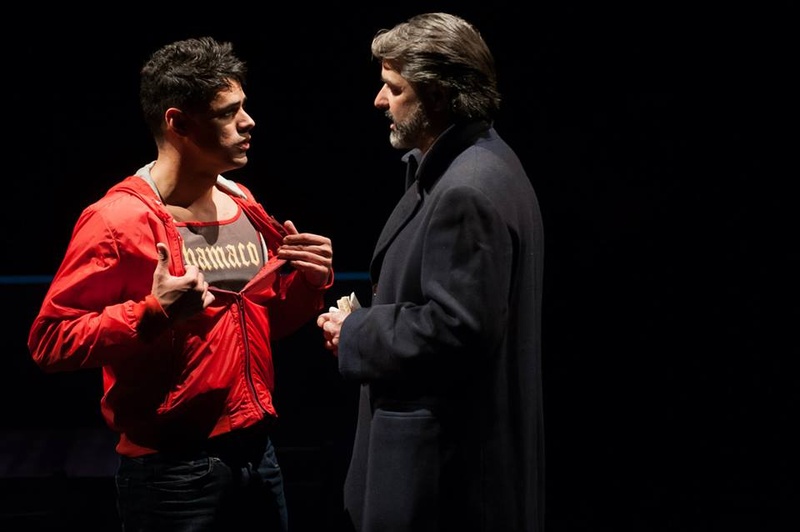
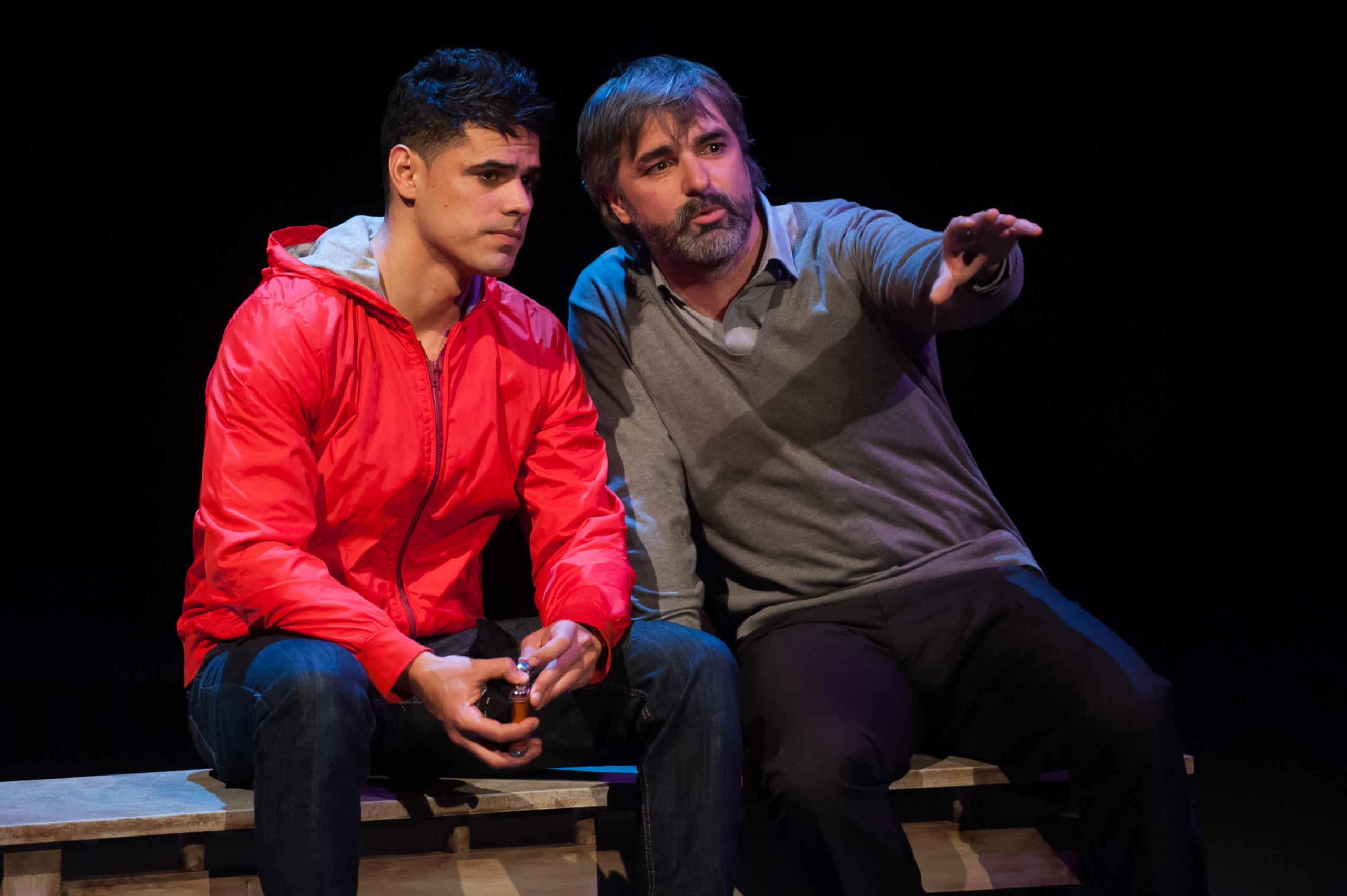
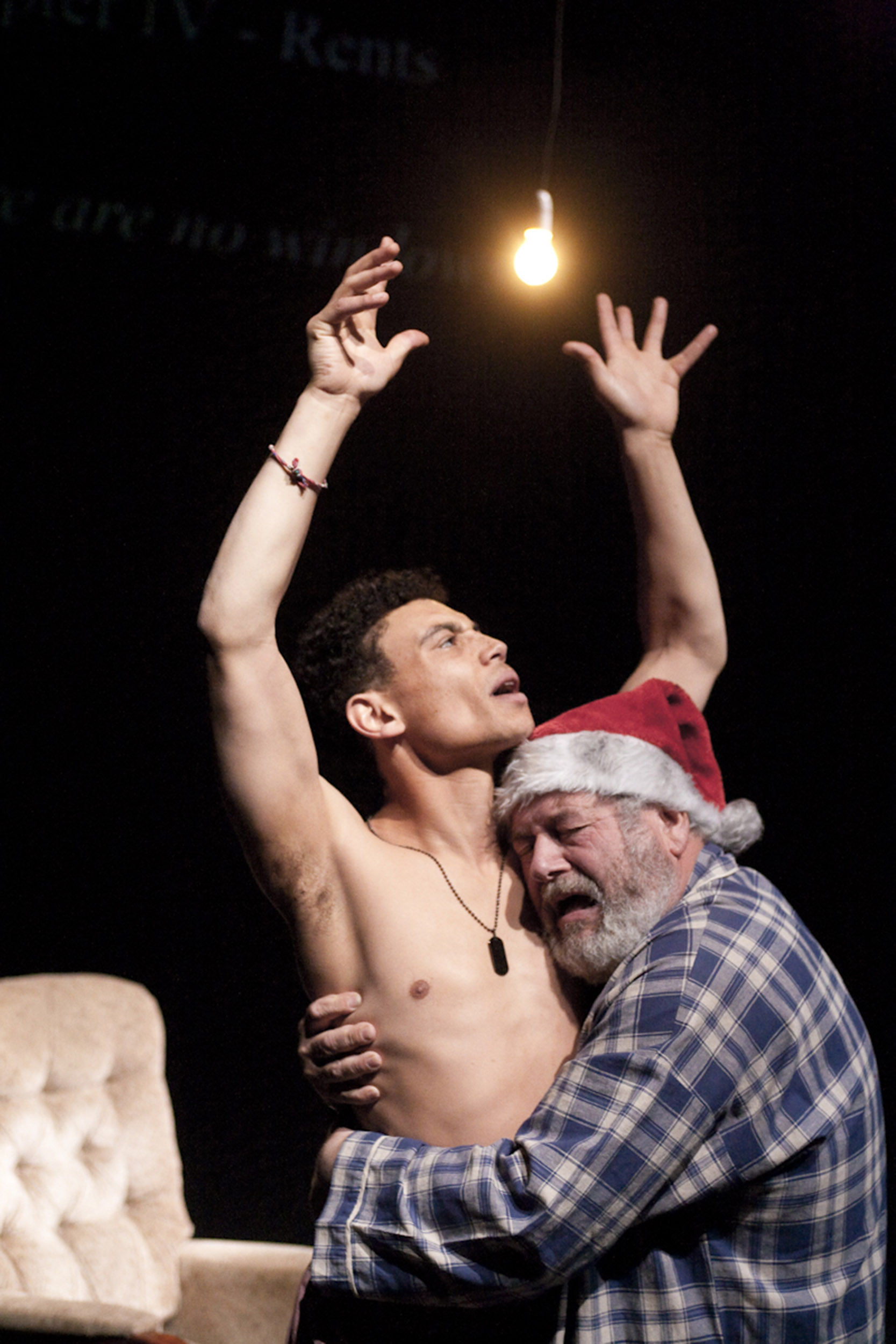
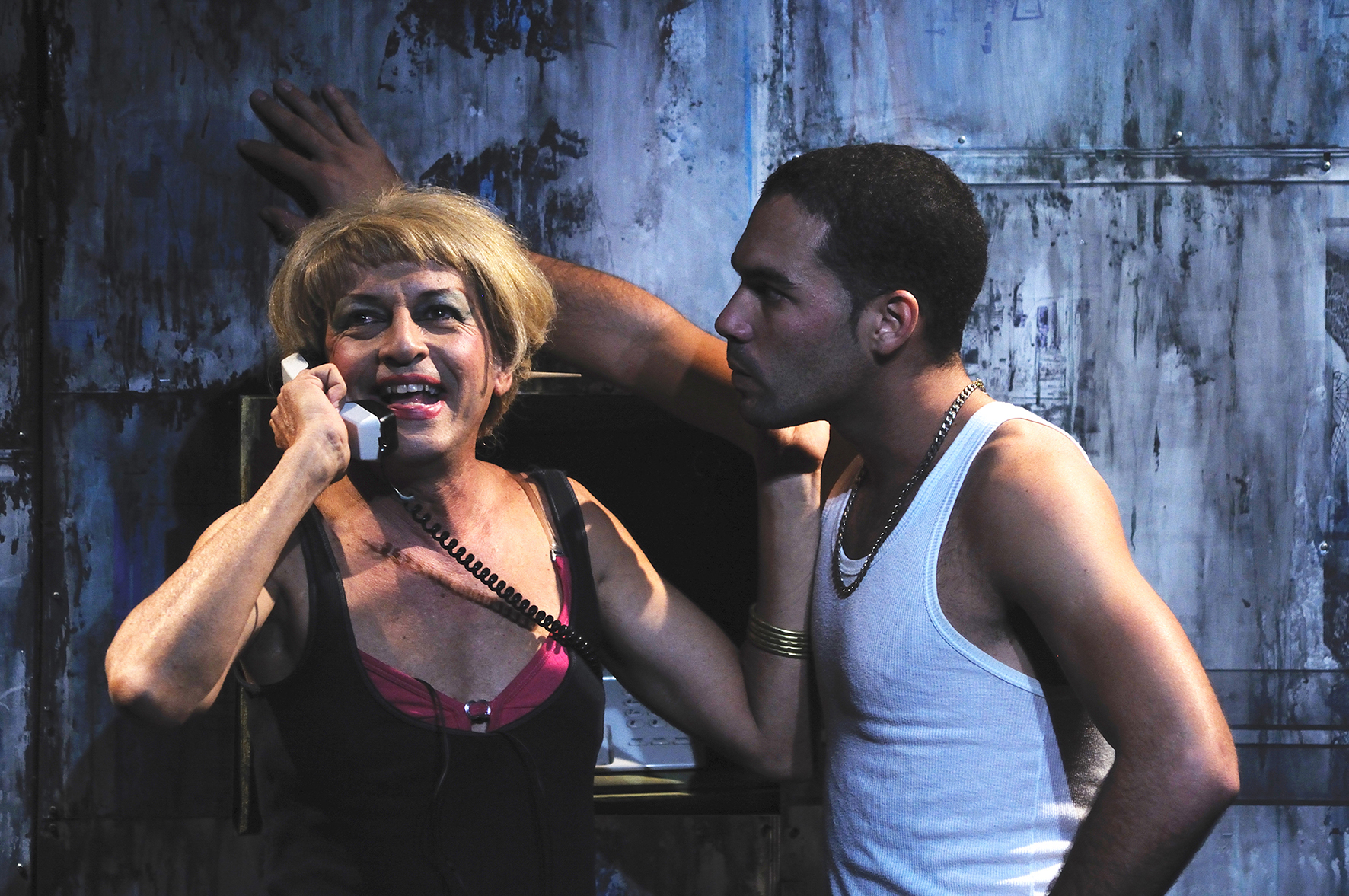
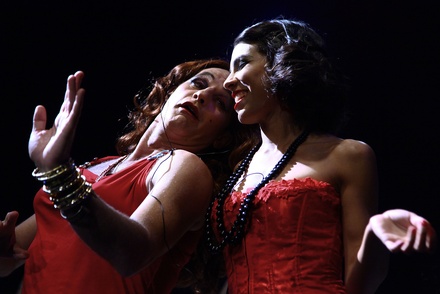

González Melo: Ahora que lo comentas, pienso que los protagonistas de mis obras han ido teniendo mi edad en el momento de escritura, y en cada texto van siendo mayores estos personajes porque crecen conmigo. He querido llenarlos de mis dudas, mis afectos, mis dolores. Son la imagen sublimada de mí mismo en medio del mundo en que he crecido: la Cuba de entresiglos, y desde hace algo más de una década también la España del XXI. Vivo a caballo entre los dos países y los observo a ambos con una mezcla de pasión y extrañeza. No puedo hablar de todos los jóvenes como una masa, eso no sé hacerlo, pero sí de mí en el paso de la adolescencia a la juventud: esas pulsiones son las que habitan mi teatro. Ojalá tengan que ver con las de otras personas.
Gunnels: Dime más sobre eso que llamas 'pasión y entrañeza.'
González Melo: Recuerdo que a principios de los 2000, cuando atravesaba en la noche la Habana Vieja rumbo a mi casa, me despertaban enorme curiosidad las decenas de adolescentes que aguardaban apoyados en las columnas, frente al Capitolio, o rondando el Parque Central, en medio de la zona turística. ¿Qué hacía toda esta gente aquí? ¿Quiénes eran? Poco a poco fui acercándome a ellos, muchos vivían clandestinamente en La Habana, habían emigrado desde el Oriente de la isla. Todos se prostituían, o aspiraban a hacerlo.3Una nota de González Melo: "Aquí estamos hablando, si hay que aclararlo, solo de cisgender masculinos. Yo no soy expert en estudios y terminology de género, pero los trans y las chicas están, como explico, en otras zonas de la ciudad." Supe de historias fascinantes, terribles. Irlos descubriendo a fondo no fue sencillo, ninguno iba a darme una entrevista sin más y contarme su vida. Me convertí en discreto cliente, ahorraba dinero y me iba con alguno de ellos a un cuartico de alquiler. En la fugacidad de ese rato de extraño placer me mantenía alerta: los escuchaba hablar de sus vidas, de sus hijos pequeños a quienes tenían que alimentar, de sus mujeres conscientes de que ellos se dedicaban a la cacería de extranjeros o cubanos que pudieran pagar por sexo. Mi investigación fue ampliándose, una cosa me llevó a la otra, fui componiendo el mapa de la marginalidad nocturna de la Habana Vieja: la zona de las prostitutas estaba en el cruce de las calles Monte y Cienfuegos; los travestis y transexuales aguardaban a sus clientes en el Parque de la Fraternidad; la droga se vendía en un cine abandonado, etc. Me sumergí de lleno. Hice cosas impensables durante aquellos años, cosas que hoy no haría. Pero por suerte me atreví a hacerlo: quería conocer a fondo a estas personas, sus lugares, sus razones, todo ese ambiente que la prensa oficial no publicaba. Tres o cuatro años de inmersión. Tras concluir Chamaco, tenía aún tanto material acumulado que nacieron Nevada y Talco. También en obras como Por gusto y Adentro hay huellas de este universo.
Gunnels: Por mi parte, Lucía de Nevada y María Luisa de Bayamesa me conmuevan por su necesidad de enfrentarse al mundo, al exterior hostil, pero con persistencia y amor por la familia. Son fuertes ejemplos feministas para cualquier generación. Y Lucía, con su vestido rojo, es singular para mí. ¿Hay un ángel en tu obra, un personaje que realmente te conmociona?
González Melo: No suelo partir de la emoción en los procesos de escritura. Soy bastante técnico, algo que aprendí con mi maestra Raquel Carrió (gran autora nuestra, fundadora en 1976 de la carrera de Dramaturgia en la Universidad de las Artes de Cuba): la tríada estructura-personaje-lenguaje es la base de la preparación de mis proyectos. Creo que la emoción llega (o no) en paralelo a (o luego de) la apreciación de la experiencia. La emoción estará entonces en el receptor. Pero para que eso pueda suceder, la construcción misma del texto o del espectáculo ha de ser precisa, nítida, no puede partir del deseo de emocionar, porque se desfigura. A veces siento que la emoción enturbia la objetividad de lo que ocurre: sucede mucho con los actores que actúan "emocionados" y, entonces, sobreactúan; o con los dramaturgos que se sobreemocionan con lo que están haciendo y pierden el rumbo de la acción, pierden síntesis.
Sí es verdad que alguna vez he tenido experiencias singulares, yo diría que místicas, durante la escritura misma, como me sucedió con Chamaco, que sentí que alguien me la dictaba al oído. Estaba muy reciente la violenta muerte de mi padre y el monólogo de Silvia, cuando se entera de que han asesinado a su hermano, lo escribí deshecho en llanto. Siempre he creído que Chamaco es mi padre que se convirtió en ángel para dictarme esta obra y que me acompaña desde entonces.
La historia se repite
Sobre todo en sus dramas más recientes, Abel González Melo ha cambiado de describir experiencias personales en su trabajo a referenciar y dramatizar puntos de contacto históricos cubanos (como el Éxodo Mariel, los UMAP (Unidades Militares de Ayuda a la Producción), el Quinquenio Gris y el Período Especial. El Éxodo Mariel constituye la migración masiva más grande de Cuba en su historia. De abril a octubre de 1980, se estima que ~125.000 cubanos salieron del Puerto Mariel para los Estados Unidos. La historia fue bien cubierta en los medios de comunicación: un pequeño grupo de cubanos tropezó un autobús urbano hasta las puertas de la Embajada peruana en La Habana en un intento de pisar tierra allí y solicitar asilo político (y eventualmente salir de la isla). Se les concedió asilo y, después, más de 10,000 personas se acercaron a la embajada con las mismas esperanzas. Al ver esta situación desarrollarse desde los Estados Unidos, el presidente Jimmy Carter emitió una invitación abierta a cualquier persona de Cuba que huyera del régimen de Castro, evitando en parte la política y el procedimiento de inmigración de los Estados Unidos. Siguió un giro típico de Castro: después de un discurso muy público el primer de mayo, el Día del Trabajador, en la Plaza de la Revolución de La Habana, vació las cárceles y hospitales de Cuba de criminales condenados y enfermos y requirió cualquier embarcación estadounidense que fuera a recoger a familiares o seres queridos para llevar del Puerto Mariel también consigo un barco lleno de otros 'indeseables', en los que incluía hombres homosexuales y personas con problemas psiquiátricos. Como señala González Melo en nuestra conversación a continuación, la historia de Cuba con los hombres homosexuales está marcada por una trágica discriminación, tortura y muerte. Los históricos campos de trabajo de la UMAP (en español, Unidades Militares de Ayuda de la Producción) que sirvieron como un tipo de prisión laboral de 1965 a 1968 en Camagüey, Cuba, fueron politizados como campos agrícolas para "objetores de conciencia", pero fueron más una especie de "purga" social de cualquier persona que fuera considerada anticastrista o antirrevolucionaria, afirma el historiador Abel Sierra Madero.4Abel Sierra Madero, "Academies to Produce Macho-Men in Cuba." Translated by Alicia Barraqué Ellison. Translating Cuba. February 19, 2016. https://translatingcuba.com/academies-to-produce-macho-men-in-cuba-abel-sierra-madero/. Esto incluyó a los acusados de homosexualidad.
Siguiente de los años de la UMAP hay un período de poco más de cinco años (1971–1977) conocido como el quinquenio gris en el que el gobierno cubano controlaba rígidamente las producciones culturales y artísticas de la isla. Esto período limitó severamente la expresión y la publicación artísticas. Varios de los dramaturgos más destacados de Cuba, como Virgilio Piñera (1912–1979), Abelardo Estorino (1925–2013) y Antón Arrufat (1935–), sufrieron tremendamente bajo esta censura, tanto por su insistencia en la libertad creativa como por su homosexualidad. Rodeados de un ambiente hostil, los tres utilizaron la metáfora como forma de expresión, siempre tratando de evitar la censura. La obra de Piñera preguntó en términos amplios conceptos de identidad nacional y la parte del escritor como resistor. Un prolífico escritor de ensayos, cuentos y teatro, las colecciones de Piñera como Cold Tales (1956) y Little Maneuvers (1963) fueron acreditadas por inspirar a generaciones de escritores que vendrán después, incluso el autor conocido del Mariel, Reinaldo Arenas. Abelardo Estorino, que antes fue censurado con su obra Los mangos de Caín (1965), solo escribió un texto en los años 70 y en cambio se dedicó a la dirección de clásicos en la Compañía Teatro Estudio. Antón Arrufat recibió altos honores de la UNEAC por Los siete contra Tebas en 1968, pero esa institución publicó el libro con una nota que acusaba al escritor de ser un contrarrevolucionario; Arrufat fue condenado, y no publicó más por una década.
Finalmente, la inmigración hacia y desde La Habana varió drásticamente desde la década de 1960 hasta la actualidad, y las leyes que prohíben el reingreso, así como la relación política y acre entre los Estados Unidos y el régimen de Castro, crearon una forma estratificada de entender el hogar, la comunidad, y exilio. A principios de la década de 1960 se produjo un éxodo de las clases media y alta, que en su mayor parte aterrizaron en el sur de Florida y se quedaron. Después del Éxodo Mariel, la política de inmigración estadounidense de mediados de la década 90 llevó a un aumento de la inmigración de la isla, ya que 'pie mojado, pie seco' permitió acelerar los procedimientos de inmigración de EE.UU. para cubanos. El aumento de balseros es notable durante este Período Especial. De estas grandes olas de inmigración, Mariel se distingue por la demografía de la población, así como por el giro politizado en ambos lados: ese grupo fue menos aceptado por los cubanos en la isla y experimentó una integración más dura en su nueva comunidad del sur de Florida.5Aviva Chomsky, A History of the Cuban Revolution, 2nd ed. (Hoboken, NJ: Wiley-Blackwell, 2015), 75.
González Melo es descendiente de estos primeros dramaturgos cubanos así como heredero de esta historia enredada. En la conversación que sigue, González Melo reflexiona sobre la realidad del hombre "gay" en Cuba antes y después de Mariel, y cómo esta faceta de la historia cubana encuentra su camino en sus obras dramáticas. En particular, su obra Fuera del juego revisa el Caso Padilla y la UMAP, destacando la censura subversiva y la tortura psicológica de los artistas en los primeros años de la Revolución. Su obra Bayamesa se remonta a lo más lejano de la historia cubana, para abordar temas de la tradición colonialista, los roles de género y el feminismo en Cuba.
Gunnels: Describe los cambios, si los hubiera, en la realidad del hombre gay en Cuba desde que escribiste Chamaco (2004) hasta En ningún lugar del mundo (2018).
González Melo: El lapso que dices comprende poco más de una década y no creo que los cambios hayan sido muy apreciables. La Revolución no se ha comportado de modo precisamente bondadoso con los homosexuales, quienes fueron considerados durante mucho tiempo lacras sociales y enviados entre 1965 y 1968 a campos de trabajo llamados UMAP (Unidades Militares de Ayuda a la Producción). Todo ese proceso acrecentó el machismo y la homofobia en nuestra sociedad. En la obra de grandes dramaturgos cubanos, que además eran homosexuales (pienso en Virgilio Piñera, Abelardo Estorino o Antón Arrufat), el tema no aparece o aparece muy escamoteado, quizás a causa de la autocensura: después de las UMAP vinieron los terribles años 70 y sus políticas de marginación a homosexuales artistas. A mi generación le ha tocado una etapa un poco más amable, aunque la homofobia persiste y ha encontrado vías soterradas para manifestarse. En lo personal he podido abordar el tema gay en textos que se han publicado y estrenado dentro de la isla, han aparecido antologías de poesía y narrativa homoeróticas, etc. Se ha intentado incluir, en la enmienda a la Constitución, la noción del matrimonio igualitario que ya es una realidad en tantos países del mundo: pero durante demasiados años el propio gobierno ha sembrado el odio hacia los homosexuales, y la mentalidad del pueblo no puede cambiarse de un día para otro.
Gunnels: ¿Puede el teatro cambiar a un pueblo? ¿El poder del arte o interrogación?
González Melo: Ni el teatro ni ninguna otra manifestación artística pueden cambiar una sociedad. Sería demasiado pretencioso pensar que sí. He escuchado frases como "el arte cambia el mundo" y siempre siento que tienen un sentido figurado, metafórico. El teatro no es un partido político, no es un ejército, no es una bomba atómica ni una pandemia: no tiene ese poder de cambio brusco, inmediato, contundente. Lo que sí puede el teatro, confío en que sí, es tocar la mente y el corazón de una persona, de un espectador que asiste a una función y descubre otro modo de mirar, se identifica en ese espejo, encuentra algo que le lastima en lo profundo. El teatro transforma, en ese sentido, al individuo y no a la masa, aunque la experiencia de nuestro arte la tengamos en colectivo. El teatro trabaja siempre (en su ejecución, en su recepción) el comportamiento particular, no la generalidad. Tocamos a una persona, y esa persona tendrá en alguna ocasión, quizás, la oportunidad de tocar las cosas que mueven el mundo. Esa es la sencilla y hermosa condición de nuestro arte.
Gunnels: Su obra de 2018 En ningún lugar del mundo (Nowhere in the World) aborda el silencio en torno a la identidad sexual en Cuba (desde los años 80 hasta la actualidad), tanto como temas de visibilidad gay y el trauma del servicio militar, a través del protagonista Ángel se aprecia el dolor agudo del Mariel tanto para los que se fueron como para los que se quedaron. Cuba tiene una historia de trece años en África (1975–1988), con fuerzas militares cubanas sobre el terreno en nombre de la liberación de Sudáfrica durante ese tiempo. La asociación militar terminó con la independencia de Namibia y, según algunos, el comienzo de la retirada del apartheid en la zona. No obstante, las fuerzas cubanas regresaron con problemas psicológicos, y el drama de En ningún lugar del mundo vuelve a visitar esa época, así como el trauma inminente del Mariel. Ángel, como protagonista, sale de Cuba con el éxodo del 1980, y el drama comienza con su regreso a Cuba después del Mariel, solo para descubrir que el trauma entre familias es profundo e implacable. ¿Cómo entiendes el legado de la generación del Mariel a otros artistas cubanos que han escrito en exilio, forzado o no?
González Melo: El protagonista de En ningún lugar del mundo fue forzado a abandonar Cuba en 1980 por el Mariel, debido a problemas psiquiátricos (sí, algo despiadado: los enfermos mentales eran considerados directamente escoria), cuando en realidad la familia se lo quería "quitar de encima" por sus violentos testimonios de la dura experiencia de tres años como soldado en la Guerra de Angola. La historia de nuestros exilios está llena de gente anónima que no ha dado su testimonio porque aún sigue traumatizada. El Mariel es un entorno demasiado amplio y diverso que escapa a catalogaciones homogéneas. Lo más importante, pienso, es lo que significó como fenómeno, y los miles de cubanos que pudieron (que se vieron en la obligación de) integrarse a la cultura norteamericana y, al mismo tiempo, enriquecerla con su acción directa. No puede entenderse la cultura y la sociedad de Miami hoy sin sumar las capas de exilios que esa ciudad ha asumido. En lo personal admiro mucho la voluntad y la resistencia de las generaciones de cubanos exiliados que han reinventado el concepto de patria.
Gunnels: ¿Qué piensas sobre los dramaturgos que vivieron la época del éxodo del Mariel en Cuba pero permanecieron? Pienso particularmente en Ulises Rodríguez Febles y su obra Huevos. Ya hablamos sobre la idea de salir, ¿pero qué pasa con los que se quedan?
González Melo: El Mariel ha sido relatado brillantemente por dramaturgos que se mantienen creando en la isla, como el propio Ulises en Huevos o Carlos Celdrán en Diez millones. Los dos eran muy jóvenes en 1980 pero han logrado imprimir a sus textos, llenos de matices autobiográficos, un carácter que supera la reconstrucción histórica. Me gusta eso, que podamos sacudirnos el polvo de la cotidianidad, que tanta energía nos roba, y mirar nuestra historia y nuestro porvenir con altura. Ellos viven en Cuba, sí, pero poseen una reconocida carrera internacional: Ulises ha triunfado recientemente en México con una obra que curiosamente reconstruye la trayectoria de otro artista exiliado, Dámaso Pérez Prado, y Celdrán ha paseado sus Diez millones por importantes festivales del mundo. Cada vez la frontera entre el afuera y el adentro, entre irse y quedarse, es más permeable y menos estricta. Por suerte.
El teatro disecado: El proyecto persistente de González Melo
Gunnels: ¿Cómo afectó crecer durante el Período Especial a la trayectoria o temario de tu obra, y la influencia de otros poderes mundiales (como Rusia) en tu país?
González Melo: Es inevitable la influencia. Mi niñez estuvo colmada del imaginario ruso y soviético: esa huella es evidente, por ejemplo, en mi obra Talco, pero también en parte de mis cuentos y en mi pasión por esa cultura. Estudié el bachillerato en una escuela vocacional llamada precisamente "Lenin": fue entre los años 1994 y 1997, en régimen interno. Allí padecí la escasez (de alimentos, de luz eléctrica, de recursos sanitarios) pero también descubrí la solidaridad. Allí sufrí acoso escolar pero pude formarme como alguien independiente. De esa experiencia llena de contrastes nació mi primer libro: Memorias de cera. Y esa etapa, en pleno Período Especial, marcó mi interés por la paradoja en que hemos vivido los cubanos: gritar consignas heroicas en la Plaza de la Revolución durante los desfiles, y al mismo tiempo estar muriéndonos de hambre en casa y susurrando por los rincones nuestra miseria de vida. El Período Especial ajustó el nivel de vida de la sociedad y acrecentó las diferencias de clase, el clientelismo, el mercado negro, la corrupción en todos los ámbitos. Esa doble moral atraviesa mi literatura: personajes que precisan, a toda costa, ponerse máscaras para seguir sobreviviendo.
Gunnels: En Nevada, un tema primordial es el deseo de salir. ¿Cómo ves este sentimiento a través de otras obras que has escrito, y de dónde viene? ¿Puedes profundizar un poco en la naturaleza de la relación Cuba/Estados Unidos y este deseo de salir de la isla, especialmente en esta época de inestabilidad inmigratoria?
González Melo: Nacer en una isla condiciona el deseo de ir más allá de las fronteras inmediatas que el mar impone. Ya Virgilio Piñera lo resumía en una imagen: "La maldita circunstancia del agua por todas partes". La isla es encierro y anhelo de partir para, en mi caso, tener la oportunidad de volver. Ha sido una constante cubana la necesidad de huir de la isla, acrecentada por factores políticos y económicos en la etapa de la Revolución. Mi propio padre tuvo que exiliarse en México con el fin de garantizarnos una mejor vida: no hablo de lujos, sino de tener dinero para comer, para asearnos, para transportarnos… Como la mayor diáspora se ha dado hacia Estados Unidos, tenemos con ese país una relación muy estrecha. En mi tesis doctoral estudio precisamente los vínculos entre familia y exilio en la dramaturgia de la Gran Cuba, entendida como la generada tanto en la isla como en el extranjero: me gusta esa idea de patria expandida, no sujeta a límites físicos, sino más bien a sensaciones y ámbitos en común. Esa intención recorre gran parte de mi obra como elemento de nuestra idiosincrasia: partir y regresar. Nevada y Adentro hablan del viaje clandestino por mar y los riesgos que ello supone. En Sistema, la tensión se halla justamente en que el protagonista es atrapado en Miami y no puede volver. Epopeya, Intemperie o En ningún lugar del mundo diseñan el arco que va desde el destierro hasta el regreso al paso de los años, y todo lo que ese reencuentro comporta.
Gunnels: Pero para los Marielitos, a quienes se les aseguró que una vez salieran de Cuba no podrían volver a ella jamás, el exilio ha sido y es especialmente doloroso. ¿Te interesa con En ningún lugar del mundo diseccionar el impacto que ha tenido en esa comunidad el dolor ante el regreso a la isla, que finalmente fue posible?
González Melo: Por supuesto. El Mariel y la Guerra de Angola son asuntos que apenas hemos tratado en la escritura nacional pero sus huellas siguen ahí: son heridas no cerradas, y algo de ello he intentado tocar con En ningún lugar del mundo. La estructura familiar ha sido, en la tradición de la dramaturgia cubana, el núcleo a través del cual observar los grandes temas sociales y políticos. Esto tiene que ver con lo que antes te comentaba: el teatro solo funciona desde lo particular y no desde lo general. Los procesos históricos se analizan en libros, artículos, entrevistas, en amplios fondos bibliográficos y documentales. Una obra de teatro no puede contener todo ese proceso, todas las vidas malgastadas en el intento de construir determinado proyecto político-social. Lo que sí puede una obra es aguzar la mirada, focalizar un pequeño grupo humano y aplicarle el escalpelo. Utilizas el verbo adecuado: diseccionar. Como dramaturgo me siento exactamente así: Cuba es mi quirófano, esa familia destrozada es el cuerpo que yace sobre la camilla, y he de aplicar el bisturí con precaución, con suma responsabilidad, intentando llegar a la raíz del dolor.
Gunnels: Es verdad lo que antes decías, que hay una relación muy estrecha entre Cuba y Estados Unidos. ¿Dirías que las experiencias que has tenido en Estados Unidos como dramaturgo cubano hayan sido particularmente reveladores en cuanto a entender esta relación?
González Melo: Han sido experiencias muy diversas. En Chicago, por ejemplo, Aguijón Theater ha estrenado Adentro y Epopeya; a pesar de ser textos de marcadas referencias nacionales y de que un cubano (Sándor Menéndez) los dirigió, en ambos casos se produjo un rico diálogo con una comunidad latina más amplia, gracias también a las excelentes traducciones de Marcela Muñoz: actores, equipo artístico y espectadores asumían como suyos los temas del desarraigo y la frustración política. Algo similar sentí con el estreno de Por gusto en Repertorio Español de New York, y eso que también era cubana Leyma López, la directora: la desilusión incesante de la juventud y la monotonía de la existencia circular resultaban cuestiones afines a un elenco multinacional. Cuando Ohio Northern University produjo Nevada, recuerdo que les interesaba mucho el estudio minucioso del contexto: parte del equipo visitó la isla y el montaje contó con proyecciones documentales, que contrastaban deliciosamente con la dramatización del texto en inglés, a cargo del mexicano Otto Minera y con traducción de Yael Prizant. En Miami, donde la comunidad hispana es también amplia y variada, la confrontación esencial ha sido con el público cubano, que lógicamente resulta el más interesado, por experiencia directa o por referencia, en ficciones sobre La Habana marginal de Chamaco, Talco y Nevada, obras que Alberto Sarraín dirigió. Siento que el estreno de En ningún lugar del mundo en el XXXIII Festival Internacional de Teatro Hispano, en producción de Teatro Avante, dirigido por Mario Ernesto Sánchez y con traducción de Marian Prío, ha dimensionado aún más el debate sobre la tensión Cuba/Estados Unidos, que es el conflicto entre quienes se quedaron y quienes se fueron. Menciono siempre a las traductoras pues considero esencial su labor y su dedicación: ellas, y mi traductor británico William Gregory, han sido los responsables de que mis textos queden tan bien reescritos en esa lengua.
Gunnels: ¿Cómo escoges los motivos que vas a revisar en el teatro? En Bayamesa (2019) se ve la representación directa de la Cuba tradicional de principios del siglo XX, donde la protagonista María Milanés lucha por encajar a Cuba tradicional con sus propios sueños y ambiciones feministas. En ella, tú alteras tiempo y espacio en el escenario para generar en la obra un diálogo tenso entre el pasado y el presente, y con un suicidio desgarrador que deja a la audiencia destrozada. Nos encontramos a la mujer auténtica que nos anima a todos, pero también aflora la idea de suicidio como tema social, cuando hoy día hay más y más suicidios de gente joven. Como terminas Fuera del juego: "la historia se repite, y se repite".
González Melo: La motivación de la escritura es múltiple y cambia de un proyecto a otro. Lo esencial siempre es que el material de partida resuene en mí, que me parezca urgente compartirlo en escena. En el caso de Bayamesa le debo mucho a mi madre, que es filóloga y escritora, y que me habló por primera vez de María Luisa Milanés (1893–1919). Leí sus poemas. Leí su sorprendente autobiografía, que es posiblemente el primer manifiesto feminista escrito en Cuba y uno de los primeros de Latinoamérica. Me impactó su simbólico suicidio: un disparo en el vientre, con la pistola de su padre militar. Un alma libre como ella prefirió escapar de ese modo, antes que continuar sometida al machismo imperante. Supe que la obra debía ser un réquiem que la devolviera a la vida, mediante una ficción que intentase acompañarla, darle voz, siquiera durante la hora y media que dura la puesta en escena. Se cumplió en 2019 un siglo justo de su muerte y, como dices, sigue siendo por desgracia un drama tan vigente…
Gunnels: ¿En qué anda tu trabajo ahora, después del éxito tremendo de Bayamesa?
González Melo: Me estoy sumergiendo cada vez más en la historia de Cuba. Creo que nuestra historia se ha abordado muy poco en la dramaturgia, a veces con una mirada muy superficial, y confío en que el teatro tiene la posibilidad de arrojar una luz nítida sobre sucesos del pasado que nos permitan situarnos en la complejidad del presente. ¿Cómo podemos vivir, cómo podemos entender el país que somos si no analizamos lo que nos ha traído hasta aquí? Durante años trabajé temas y conflictos del presente inmediato, desde los ambientes marginales hasta el lujo de los nuevos ricos. Pero ahora mismo eso se me ha agotado. Imagínate un país cada vez más desabastecido, con un pésimo transporte público, un país donde la gente tiene que pasar horas y horas en horrorosas colas para conseguir una libra de carne de cerdo, una bolsita de detergente, un litro de aceite, todo ello a precios astronómicos. El panorama actual es desolador, no sabría en qué tono dramático abordarlo. Quizás únicamente desde la farsa o el esperpento. Por eso me refugio en el pasado, porque siento que sin memoria no hay densidad de tradición. Hay mucho donde escarbar. El teatro no ha entrado a fondo, por ejemplo, en los graves casos de censura propiciados por las políticas culturales de la Revolución. La censura me interesa mucho: la tenemos demasiado cerca, a menudo sin percatarnos. Me interesa mucho la revisión histórica, siempre que tenga un matiz particular que pueda hablar de una tensión global.
Gunnels: La censura sigue siendo, en efecto, un problema pernicioso en el mundo, ahora con 'caras' diferentes. Al abordar el caso Padilla en tu obra Fuera del juego, te preocupas por problematizar el rol del artista.6En esta obra, González Melo re-visualiza el infame Caso Padilla, en el que el célebre poeta Heberto Padilla es arrestado, encarcelado, tortuado y finalmente exiliado por su trabajo contrarrevolucionaria que cuestionaba la Revolución, el Comandante (Fidel Castro) y el papel de los escritores en general. Utilizada como ilustración clásica de la traumática censura de finales de los 60 y principios de los 70 en La Habana, González Melo cuenta la historia desde la voz del propio poeta como protagonista principal. ¿Es que te interesa "complicar la cosa", para decirlo con palabras de tu propio personaje de Heberto Padilla?
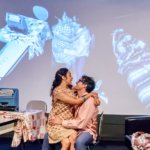
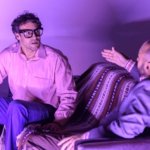
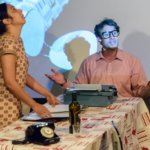

González Melo: Dicen que uno escribe la misma obra a lo largo de toda la vida. El tema de la censura y la autocensura me ha interesado siempre, quizá porque desde muy joven tuve que negociar con ella. Mi libro Memorias de cera por poco no ve la luz, ya que, aunque ganó un premio nacional que consistía en su publicación, contaba mi descubrimiento de la sexualidad en la escuela Lenin, y eso a los funcionarios de la editorial no les gustaba nada. Chamaco, de hecho, puede entenderse como una obra sobre el miedo a la libre expresión dentro de la familia Depás, donde cada uno teme sincerarse ante el otro y todos viven en una espiral de mentiras. Epopeya obtuvo en 2014 el Premio Nacional de Dramaturgia y se publicó por Ediciones Alarcos, pero tuvo una fugaz presentación de solo cincuenta ejemplares, no se distribuyó en librerías, el libro no puede encontrarse en ningún sitio y la obra no puede estrenarse en Cuba (es un texto donde utilizo la metáfora de la Guerra de Troya y el hipotexto de Hécuba de Eurípides para debatir, una vez más, sobre el regreso a la isla de los cubanos exiliados, una vez que Príamo ha caído en combate).
Es cierto que en años recientes me he acercado mucho a la relación entre arte y censura. En 2017 dirigí en Argos Teatro, en La Habana, Cartas de amor a Stalin del dramaturgo español Juan Mayorga, que para mí es una obra que habla sobre la misma situación que padecemos muchos artistas, periodistas y cubanos en general: el terror a decir la verdad, a hablar libremente. Es también uno de los temas de Bayamesa: la censura a la libertad creativa, la plasmación del dolor mediante la poesía, la necesidad de ser independiente. El padre, el marido y la madre de María Luisa Milanés no admitieron ese espíritu rebelde, y eso desencadenó el conflicto y trajo el fatal desenclace. Con Heberto Padilla ocurre lo mismo: fue un hombre muy cercano a la Revolución cubana a inicios de los años 60, incluso fue diplomático, pero lentamente se fue desencantando y su poesía fue haciéndose cada vez más inadmisible para un régimen que terminó asfixiándolo. No quiero "complicar la cosa", más bien intento lo contrario: visibilizar estos asuntos convirtiéndolos en dramaturgia y lenguaje.
Sobre la entrevistadora y el entrevistado
Bridgette W. Gunnels is Associate Professor of Spanish at Emory University and a scholar in Latin American literature from the twentieth century, in all forms, with special emphasis in the short story.
Abel González Melo is a Cuban dramatist, writer, teacher, and theater director. González Melo studied Theater Arts at the Universidad de las Artes de Cuba and is the recipient of various prizes and awards for his literary and theater works, including the Premio Primer Concurso de Dramaturgia de la Embajada de España (2005) for Chamaco [Kiddo]. Most recently, in January 2020, he won the prestigious Casa de las Américas prize for his work, Bayamesa.
]]>Introduction
Playwright Abel González Melo was born in 1980 in Havana, Cuba, the year the Mariel Boatlift saw approximately 125,000 people flee his country, an event he dramatizes in his 2018 play Nowhere in the World (En ningún lugar del mundo). González Melo studied Theater Arts at the Universidad de las Artes de Cuba. He is the recipient of various prizes and awards for his literary and theater works, including the Premio Primer Concurso de Dramaturgia de la Embajada de España (2005) for Chamaco [Kiddo], one of González Melo's most recognized works. Most recently, in January 2020, he won the prestigious Casa de las Américas prize for his work, Bayamesa.
González Melo's work spans two decades and covers multiple social issues of Cuban life. From Cuba's tangled relationship with the Mariel Boatlift in the aforementioned Nowhere in the World (En ningún lugar del mundo, 2018) to teenage prostitution during the early 2000s in Old Havana in his trilogy, Winter Escapes (Fugas de Invierno, 2004–2009), his plays immerse audiences into the streets that surround Havana's Capitolio, to the parks, alleys, and theaters that provide spaces for illegal prostitution, to private homes centering the importance of family to Cubans. The first decade of González Melo's writing centers the Cuban youth culture of the early 2000s, a culture both gay and straight, hungry and sated, resistant and complacent in a country where the Revolution is still fought daily in the streets (although now around the government approved Wifi hotspots). While González Melo maintains his private identification, his plays challenge categorization, interrogate questions of sexuality, and explore survival, the commodification of the body, intense mental trauma, the pain of history, and the deep love of family. His characters weave in and out of his plays to demonstrate with such complexity that as some things have changed others have remained the same.
González Melo's most recent work shifts to recovering figures and episodes from Cuban history with a revisionist eye. Such figures include the early twentieth-century feminist poet María Luisa Milanés (from Bayamo, Cuba) in Bayamesa (2019), which was awarded the Casa de las Américas prize for theater in January of 2020. Tackling the topic of censure at the height of the Revolution in Cuba, González Melo's recent work features Cuban historical figures. Fuera del juego (Outside the Game), dramatizes the experience of Cuban cultural figure Heberto Padilla, an award-winning poet whose work critiqued the Revolution and its leaders in his moment, 1967–68, leading to his arrest, torture, and subsequent exile to the United States in 1980. Padilla worked many years in various positions in higher education in the US, namely Ohio State University, Bowdoin College, and NYU's Institute for the Humanities, before he died alone as a poet in residence at Auburn University, in 2000. In González Melo's most recent drama, Cádiz en José Martí (Festival de Teatro Iberoamericano de Cádiz, 2020), he dramatizes the mythic national hero of the island, revolutionary figure José Martí (1853–1895), by situating him in the Spanish city of Cádiz, his first destination in his long exile and political deportation under the colonial regime.
In this conversation, González Melo explains his creative process and inspirations, the Cuban migration experience as dramatic material, and the idea of recasting history for new audiences and times. He discusses how he drew from lived experience in Havana to craft Winter Escapes as well as how his recent work dives deeply into questions of community and family during some of Cuba's grimmest moments. González Melo also reflects on the unique ligatures between the United States and Cuba. One of these ties is the Spanish-English linguistic connection, as many Cuban-Americans are bilingual. Our conversation, originally conducted in Spanish, has been translated into English here. [Se puede leer la versión en español aquí.]
Kiddo: One Playwright's Beginnings, or González Melo's Early Work
Gunnels: You have written poetry, narrative, non-fiction. Why theater? Do you think that playwriting suits your stories more than other avenues of creation?
González Melo: Theater has something wonderful for a writer: it moves literature away from loneliness. It proposes creation in a team and in direct contact with the spectator. Both questions are very attractive to me. The idea that writing never ceases, is always reinterpreted in the present, needs the communion between the director, the actors, the designers, the technicians, and precisely, inevitably, the complicity of the audience. I am dazzled by that unfinished nature of dramatic writing, that urge to feel the impact immediately. I enjoy writing narrative or essay, but in both cases I miss the real dialogue with the human being. Probably because, more and more, playwriting for me is a process directly related to a very particular human group; it must have an imagined texture that has to walk on a tightrope for success.
Gunnels: Does it feel 'unfinished' to you because it needs other artists, actors to complete it? Or more because of the constant flow of new audiences that are always distinct?
González Melo: Theater is something we do among us all, both the artists and the public. Remember the Greek origin of the word theater: "to watch or look at." Put another way, we only exist because someone looks at us. That is one of the greatest pleasures of writing dramas: feeling that one only offers a guide of stage directions and dialogues on paper, but that the character will have the body, voice, and soul of whoever embodies it in front of the viewer, and that this person will finish building it, in its process of active reception. Why do we keep reviving and repremiering the classics? Because their essence, rather than the argument, lies in how the specific story is told today in the public agora: who executes it, why they decide to do it, in what context and before whom, what senses are born from that experience.
Gunnels: I want to give readers a sense of your Winter Escapes trilogy before we discuss it.
Chamaco ([Kiddo], 2004 English translation by William Gregory) is the first installment of the trilogy. It was first published in Spanish from Ediciones Alarcos and then translated into English by Yael Prizant (University of Miami Press, 2010).1There are two different translations. William Gregory translated both Kiddo and Nevada; Yael Prizant translated the trilogy in a bilingual version with a different press in 2010. Kiddo has been staged globally, from the Argos Theater in Havana to Manchester, England's HOME Theater, to the most recent translation to Czech, with production in Prague set for fall 2021. The trilogy, including Nevada and Talco [Talc] (the second and third installments), covers a span of three months in a tropical winter of discontent. Miami-based academic and theater critic Lillian Manzor writes that "the trilogy addresses concerns that are dear to the author and his generation, namely: the complex and contradictory ways in which homosexuality, sex, and migration from the countryside to the capital becomes means of survival in a society that has lost all sense of value."2Lillian Manxor and Austin Webber, "Ground Down to Nothing but Still Fighting." Hemispheric Institute of Performance and Politics. Accessed March 25, 2021. https://hemisphericinstitute.org/en/emisferica-82/manzor-webbert.html. Kiddo immerses viewers into Christmas Eve in Havana, where a sister uneasily waits for her brother to come home for a dinner that he will never eat, as unbeknownst to her he has died in a knife fight. Nevada follows Lucía and her boyfriend/pimp Rosnay as they encounter the reality of selling their bodies in the effort to get out or escape, in this case, to the state of Nevada, where prostitution is legal, and the "candies come in brilliant gold wrappers." Talc, the final installment, portrays a crude and dirty reality that takes place mainly in the bathroom of an old cinema used for trafficking and prostitution, where the paths of four characters—Javi, Mashenka, Zuleidy, and Alvaro—crisscross in a violent and tense battle for survival. The trilogy was followed by nearly twenty other plays.
Abel, this trilogy really centers the experience of Cuban youth. Describe the importance of giving voice to Cuban youth in many of the works you've written.
González Melo: Now that you mention it, I think that the protagonists of all my plays reflect my age at the time of writing, and in each text these characters are getting older because they grow with me. I wanted to fill them with my doubts, my foibles, my pains. They are like an undercover image of myself in the midst of the world in which I grew up: the Cuba between decades of wars and shortages, and now for a bit more than a decade in Spain in the twenty-first century. I live on the margin between the two countries, and I watch them both with a mixture of passion and strangeness. I cannot speak of all the young people en masse, I do not know how to do it, but I can tell my story of the transition from adolescence to youth. Those impulses are the ones that haunt my work in theater. Hopefully they have to do with the same impulses and emotions of other people.
Gunnels: "Passion and strangeness"—tell me more.
González Melo: I remember that in the early 2000s, when I was walking through Old Havana at night towards my house, I was very curious about the dozens of teenagers who waited leaning on the columns in front of the Capitol, or hanging around Central Park in the middle of the tourist area. What were all these people doing here? Who were they? Little by little, I got closer to them. Many lived clandestinely in Havana; they had emigrated from the East of the island. All of these cisgender boys prostituted themselves, or aspired to do so.3Note from González Melo: "Here we're speaking of, if one must clarify, only cisgender males. I'm no expert in gender studies nor related terminology, but trans populations and women, as I've explained, were in other zones of the city." I learned of many fascinating, terrible stories. The process of discovering them thoroughly was not easy. None were going to give me an interview and tell me about their lives. I became a discreet client. I saved money and went with one of them to a rental room. In the fleetingness of that moment of strange pleasure, I kept myself alert. I listened to them talk about their lives, about their young children whom they had to feed, about their partners who were aware that they were hunting foreigners or Cubans who could pay for sex. My research expanded. One thing led me to another, and I composed a map of the nocturnal marginality of Old Havana. The female prostitute area was at the intersection of Monte and Cienfuegos streets; transvestites and transsexuals were waiting for their clients in the Parque de la Fraternidad; drugs were sold in an abandoned cinema, etc. I fully immersed myself. I did unthinkable things during those years, things that I would not do today. But luckily I dared to do it: I wanted to get to know these people, their places, their reasons, all that environment that the official press did not publish. Three or four years of immersion. After Kiddo finished, I still had so much material that Nevada and Talc were born. Also in my plays Por gusto and Within there are traces of this universe.
Gunnels: Lucía from Nevada and María Luisa from Bayamesa really move me because of the way they confront their worlds, hostile worlds, but always with persistence and love of family front and center. They are strong feminist cross-generational characterizations. For you, is there one character or "angel" from your work that really moves you?
González Melo: I don't usually start from emotion in my writing process. I am quite technical, something I learned with my teacher Raquel Carrió (a great Cuban author, founder in 1976 of the Dramaturgy Department at the University of the Arts of Cuba). the structure-character-language triad is the basis of the preparation of my projects. I believe that emotion comes (or does not come) in parallel with (or after) appreciation of experience. The emotion will then be in the viewer. But for this to happen, the construction of the text or the show itself must be precise, clear; it cannot start from the desire to move emotionally, because the work becomes disfigured. Sometimes I feel that emotion clouds the objectivity of what happens. This happens a lot with actors who act "excited" and then, they overact; or with the dramatists who are over-excited with what they are doing and lose the course of the action, they lose the written synthesis.
It is true that I have had some unique experiences—I would say mystical—during writing itself. It happened while writing Kiddo, in that I felt like someone was dictating it to me directly, right over my shoulder into my ear. The violent death of my father was very recent and the monologue of Silvia, when she found out that her brother had been murdered, I wrote that in tears. I have always believed that Kiddo is my father who became an angel to dictate this work to me and has accompanied me ever since.
History Repeating Itself
Especially in his more recent dramas, Abel González Melo has shifted from describing personal experiences in his work to referencing and dramatizing Cuban historical touchpoints (such as the Mariel Boatlift, the UMAPs work camps, the Grey Period, and the Special Period of Peace). The Mariel Boatlift consitutes the single largest mass migration from Cuba in its history. From April to October 1980, an estimated 125,000 Cubans left the Mariel Port for the United States. The story was well-covered in the media. A small group of Cubans ran a city bus into the gates of the Peruvian Embassy in Havana in an attempt to gain access to the grounds to request political asylum (and eventually leave the island). They were granted asylum, and afterwards, an estimated 10,000 people approached the embassy with the same hopes. Watching this situation unfold from the US, then President Jimmy Carter issued an open invitation to anyone from Cuba who was fleeing the Castro regime, bypassing in part US immigration policy and procedure. A typical Castro pivot followed: after a very public speech on May 1, the Day of the Worker, in Havana's Revolution Plaza, he emptied Cuban's prisons and hospitals of convicted criminals and ill patients and required any American vessel that was picking up family or loved ones at Mariel Port to also take with them a boatload of other 'undesirables,' in which he included homosexual men and those with severe psychiatric problems. As González Melo notes in our conversation below, Cuba's history with gay males is marked by tragic discrimination, torture, and death. The storied UMAP work camps (in Spanish, Unidades Militares de Ayuda de la Producción) that served as a type of work-based prison from 1965–68 in Camagüey, Cuba, were politicized as agricultural camps for "conscientious objectors," but were more a type of social "purge" of any person who was deemed to be anti-Castro or anti-revolutionary, according to historian Abel Sierra Madero.4Abel Sierra Madero, "Academies to Produce Macho-Men in Cuba." Translated by Alicia Barraqué Ellison. Translating Cuba. February 19, 2016. https://translatingcuba.com/academies-to-produce-macho-men-in-cuba-abel-sierra-madero/. This included those accused of homosexuality.
Following the years of the UMAP work camps is a period of a little more than five years (1971–1977) known as the Grey Period (El quinquenio gris in Spanish) in which the Cuban government controlled rigidly the cultural and artistic productions of the island, severly limiting artistic expression and publication. Several of Cuba's most noted dramatists, like Virgilio Piñera (1912–1979), Abelardo Estorino (1925–2013), and Antón Arrufat (1935–) suffered tremendously under this censure, as much for their insistence on creative freedom as for their homosexuality. Surrounded by a hostile environment, all three utilized metaphor as a form of expression, always trying to avoid censure. Piñera's work questioned in broad terms concepts of national identity and the role of the writer as resistor. A prolific writer of essay, short story and theater, Piñera's collections Cold Tales (1956) and Little Maneuvers (1963) were credited with inspiring generations of writers after him, including noted Mariel author Reinaldo Arenas. Abelardo Estorino, who was censured earlier with his work Los mangos de Caín (1965), only wrote one text in the 70s and instead dedicated himself to directing classics in the Company Teatro Estudio. Antón Arrufat was awarded high honors from the National Union of Writers and Artists (UNEAC, in Spanish) for Los siete contra Tebas in 1968, but that institution published the book with a note that accused the writer of being a counter-revolucionary; Arrufat was condemned and ostracized, and didn't publish for more than a decade.
Finally, immigration to and from Havana varied drastically from the 1960s to the present day, and the laws prohibiting re-entry, as well as the acrid political relationship between the US and the Castro regime, created a layered way of understanding home, community, and exile. The early 1960s saw an exodus of the upper and middle classes, who for the most part landed in south Florida and remained. After the Mariel Boatlift, US immigration policy of the mid-90s led to some increased immigration from the island, as "wet foot, dry foot" allowed for fast-tracking of US immigration procedures for Cubans, and the increase of rafters (balseros, in Spanish) is notable during this Special Period of Peace. Of these major immigration waves, Mariel is distinctive due to the population demographics as well as the politicized spin on both sides. That group was both maligned by Cubans on the island and experienced a rougher integration into their new south Florida community.5Aviva Chomsky, A History of the Cuban Revolution, 2nd ed. (Hoboken, NJ: Wiley-Blackwell, 2015), 75.
González Melo is a descendent of these early Cuban playwrights as well as an inheritor of this tangled history. In the conversation below he reflects on the reality of the gay male in Cuba before and after Mariel, and how this facet of Cuban history finds its way into his work. In particular, his play Outside the Game revisits the Padilla Case and the UMAPs, highlighting the subversive censure and psychological torture of artists in the early days of the Revolution. His play Bayamesa reaches back the farthest in Cuban history to tackle issues of colonialist tradition, gender roles, and feminism in Cuba.
Gunnels: How have you seen the Cuban life change for the gay man from writing Kiddo (2004) to Nowhere in the World (2018)?
González Melo: The time period you're referring to is about a decade long, and I don't think that we have seen noted change with regard to the day-to-day life of the gay man in Cuba. The Revolution wasn't too friendly with homosexuals, as they were considered during much of that time as the equivalent of social filth and outcasts; indeed many homosexuals were sent to work camps during the years of 1965–68 (UMAPS, Military Units for Help in Production). This entire process accentuated and encouraged intense machismo and homophobia in Cuban society. In the work of some of the best Cuban dramatists, who additionally were homosexual (I'm thinking of Virgilio Piñera, Abelardo Estorino, or Antón Arrufat), the topic is absent or appears hidden mostly due to self-censure/autocensure. After the horrible experience with the UMAP came the equally traumatic decade of the 1970s, which is historically noted for its strong politics based in marginalization of homosexual artists. My generation hasn't felt as much pain, as today's Cuban artist deals with a more or less 'friendly' public, although homophobia definitely persists and has found more pernicious ways to manifest. In my work personally I've been able to take on the topic of homosexuality in works that I have published and performed on the island; additionally, anthologies of homoerotic poetry and narrative have recently been published. We are trying to include in an amendment to the national Constitution the idea of gay marriage rights, an idea that is presently accepted in many other countries in the world. The problem is that for so many years, too many years, our own government has planted seeds of hate towards homosexuals, and the mentality of a country can't be changed from one day to the next.
Gunnels: But can theater change a country? The power of art or interrogation?
González Melo: I don't believe either theater or any other artistic manifestation can change a society. It would be too pretentious to think so. I have heard phrases like "art changes the world," and I always feel that they have a figurative, metaphorical meaning. Theater is not a political party; it is not an army; it is not an atomic bomb or a pandemic. It does not have that power of abrupt, immediate, forceful change. What theater can do, and I believe this to be true, is to touch the mind and heart of a person, of a spectator who attends a show and discovers another way of looking, of identifying himself/herself in that mirror, of finding something that hurts them deeply. Theater transforms, in this sense, the individual and not the masses, although we share the experience of our art collectively, together. Theater always works at (in its execution, in its reception) particular behaviors, not general ones. We touch one person, and that person will have, on occasion perhaps, the opportunity to touch the things that move the world. That is the simple and beautiful condition of our art.
Gunnels: Your 2018 play Nowhere in the World (En ningún lugar del mundo) addresses silence around sexual identity in Cuba (from the 80s to present day), as well as issues of gay visibility and the trauma of military service, as the lead Ángel negotiates the acute pain of the Mariel Boatlift for those that left as well as for those that remained. Cuba has a thirteen-year history in Africa (1975–1988), with Cuban forces on the ground in the name of liberation from South Africa during that time. Their association ended with Namibian independence and, some say, the beginning of the retreat of apartheid in the area. Regardless, Cuban forces returned with psychological issues, and the drama of Nowhere in the World revisits that time, as well as the impending trauma of Mariel. Ángel leaves the island with the boatlift, and the drama picks up with his return to Cuba after Mariel, to find that family trauma is deep and unforgiving. How do you understand the legacy of the Mariel Generation in comparison to other Cuban artists that have written in exile, either forced or by choice?
González Melo: The protagonist of Nowhere in the World was forced to leave Cuba in 1980 during the Mariel Boatlift, due to psychiatric problems (yes, a ruthless detail of Cuban history: the mentally ill were directly considered scum, unwanted by society, alongside homosexuals and convicts), although the truth of the matter was that the family wanted to get rid of him due to his frequent and violent testimonies of the hard experience of three years as a soldier in the Angolan War as you describe in your synopsis. The history of our exiles is full of anonymous people who have not given their testimony because they are still traumatized. Mariel as a historical moment is very broad and diverse in its interpretation; it often escapes homogeneous cataloging. The most important thing is what it meant as a phenomenon, and the thousands of Cubans who could (who were forced to) integrate themselves into the North American culture and, at the same time, enrich it with their direct action. The culture and society of Miami cannot be understood today without adding the layers of exiles that that city has assumed. Personally, I admire the will and the resistance of the generations of Cuban exiles who have reinvented the concept of homeland.
Gunnels: What do you think about other playwrights who experienced Mariel on the island and stayed? I'm thinking of the play Eggs, by Ulises Rodríguez Febles. We spoke already about the idea of getting out, but what of those who stay?
González Melo: The Mariel story has been told brilliantly by playwrights who keep creating on the island, as Ulises himself in Eggs or Carlos Celdrán in Ten Million. Both were very young in 1980 but have managed to print their texts, full of autobiographical nuances, and this quality surpasses historical reconstruction. I like that: that we can shake off the dust of daily life, that steals so much of our daily energy, and look at our history and our future with a different perspective. Those authors live in Cuba, yes, but they have recognized international careers. Ulises was tremendously successful in Mexico with a work that curiously reconstructs the trajectory of another exiled artist, Dámaso Pérez Prado, and Celdrán has premiered Ten Million at important festivals all over the world. More and more the border between the outside and the inside, between going and staying, is more permeable and less strict. Fortunately.
Drama as Dissection: One Playwright's Persistent Project
From the 1970s to the late 80s, Cuba's economy was nearly solely supported by the Soviet Union, who imported Cuban sugar and other products and exported massive amounts of petroleum to the island to fuel agriculture and transportation. The external effects of the dissolution of the Comecon were immediate: Cuba lost nearly 80% of its imports, and with a heavy trade embargo from the US already in place, the country was left without a major import/export partner. The island entered a period of years (from 1991–1995, although some say it hasn't ended) that later became known as the Special Period of Peace (Período especial), marked by extreme food scarcity (borderline famine), nationwide blackouts to conserve energy (apagones), sometimes for twelve to fourteen hours daily, and a complete dry up of tourism. González Melo was a teenager during this time at the Lenin School in Havana.
Gunnels: Describe how growing up during the Special Period impacted your view of Cuban life vis-à-vis foreign powers.
González Melo: The influence is inevitable. My childhood was full of the Russian and Soviet imaginary: that trace is evident, for example, in my work Talc, but also in part of my stories and in my passion for that culture. I studied in a boarding school called, very precisely, "Lenin." I was there between years 1994 and 1997. There I suffered intense shortages (food, electricity, health resources), but I also discovered solidarity. At that school I suffered bullying, but I was able to become an independent person. From that experience full of contrasts, my first book was born: Wax Memoirs. And that stage, the Special Period, marked my interest in the paradox in which we Cubans have lived. We all shout heroic slogans in the Plaza de la Revolución during the parades, and at the same time we starve to death at home and whisper in the corners the details of our misery. The Special Period adjusted the standard of living of society and increased class differences, clientelism, the black market, corruption in all areas. That double-edged moral crisscrosses my literature: characters who need, at all costs, to put on masks to continue surviving.
Gunnels: In Nevada, a salient theme is the Cuban desire to get out or escape. How do you see that imagined community elsewhere juxtaposed against what is often a very different reality (as in the case of Mariel, for example, or the present-day immigratory reality in the USA)?
González Melo: Being born on an island foments the desire to go beyond the immediate borders that the sea imposes. Virgilio Piñera summed it up in an image: "The damn circumstance of having water everywhere." The island is a prison and the longing to leave is constant alongside, in my case, having the opportunity to return. The need to flee the island has been a consistent facet of Cuban identity, increased by political and economic factors experienced in various stages of the Revolution. My own father had to go into exile in Mexico in order to guarantee us a better life: I am not talking about luxuries, but about having money to eat, to dress and take care of ourselves, to move about the island. The United States is the destination for a great many Cuban migrations; we have a very close relationship. In my doctoral thesis I study precisely the links between family and exile in the dramaturgy of Greater Cuba, understood here as a Cuba generated both on the island and abroad. I like that idea of an expanded homeland, not subject to physical limits, but rather to feelings and areas that both share in common. This issue is found in a large part of my work as an element of our idiosyncrasy: the idea of leaving and returning. Both Nevada and Within talk about the undercover, dangerous trip by sea and the risks undertaken there. In Sistema, the tension is precisely in that the protagonist is trapped in Miami and cannot return. Epopeya, Weathered, Nowhere in the World illustrate the arc that starts at exile only to return after some time, and then most critically, everything that that particular reunion involves and drags out into the present.
Gunnels: But for the Marielitos, precisely, who were told upon leaving that they would never be allowed to return, exile is (was?) painful in different ways. How does this pain of return change the "community" of Greater Cuba that you mention earlier? Is that something that Nowhere in the World wants to dissect?
González Melo: Of course. Mariel and the Angolan War are matters that we have barely dealt with in the Cuban national tradition of writing, but their traces are still there. They are wounds that have not been closed, and I have tried to touch some of it with Nowhere in the World. The family structure has been, in the tradition of Cuban dramaturgy, the nucleus through which to observe perennial social and political issues. This has to do with what I was saying before: theater only works from the particular and not from the general. Historical processes are analyzed in books, articles, interviews, in extensive bibliographic and documentary collections. A play cannot contain all of that process, all of the lives wasted in the attempt to build a certain political-social project. What a play can do is sharpen the gaze, focus on a small human group and apply the scalpel to it. You use the correct verb: dissect. As a playwright I feel exactly like this: Cuba is my operating room, that broken family is the body that lies on the table, and I have to apply the scalpel with caution, with great responsibility, trying to get to the root of the pain.
Gunnels: It's true, as you mention before, there is a very different, distinct type of relationship with the US. Would you say that your experiences in the US as a Cuban-born artist have been particularly revealing in terms of understanding this distinct relationship?
González Melo: They have been very different experiences. In Chicago, for example, Aguijón Theater premiered Within and Epopeya. Despite being texts with marked national references and with a Cuban (Sándor Menéndez) director, in both cases there was a rich dialogue with a wider Latino community, thanks also to the excellent translations of Marcela Muñoz. The actors, artistic team, and spectators took on as their own the themes of uprooting and political frustration. I felt something similar with the premiere of Por gusto in Repertorio Español in New York, and what was also with a Cuban director, Leyma López: the incessant disillusionment of youth and the monotony of a circular existence were related issues to a multinational cast. When Ohio Northern University produced Nevada, I remember that they were very interested in the detailed study of the context. Part of the team visited the island and the editing included documentary projections, which contrasted deliciously with the dramatization of the text in English (by the Mexican Otto Minera and with translation of Yael Prizant). In Miami, where the Hispanic community is also wide and varied, the essential confrontation has been with the Cuban public, which logically is the most interested, either by direct experience or by reference, in fictions about the marginal Havana of Kiddo, Talc, and Nevada, works that Alberto Sarraín directed. I feel that the premiere of Nowhere in the World at the XXXIII International Festival of Hispanic Theater, in production of Teatro Avante, directed by Mario Ernesto Sánchez and with translation by Marian Prío, has further dimensioned the debate on Cuba / United States tension, which is the conflict between those who stayed and those who left. I always mention the translators because I consider their work and dedication essential. They, and my British translator William Gregory, have been responsible for my texts being so well rewritten in that language.
Gunnels: How do you choose what specific issue you are going to dissect in the work? Your 2019 play Bayamesa is the direct portrayal of traditional, early twentieth-century Cuba, where the lead María Milanés struggles to align traditional Cuba with her own very feminist dreams and ambitions. In it, you shift time and space on the stage to bring the play into tense dialogue between past and present, with a gut-wrenching suicide that leaves the audience broken. In Bayamesa we find the authentic woman who encourages all but also the idea of suicide as a social issue emerges, when today there are more and more suicides of young people. It's like the final lines of your other 2019 play Outside the Game: "history repeats itself, and it repeats itself."
González Melo: The motivation for writing is multiple and changes from one project to another. The essential thing is always that the starting material resonates with me, that it seems urgent to share it on stage. In the case of Bayamesa, I owe a lot to my mother, who is a philologist and writer, and who spoke to me for the first time about María Luisa Milanés (1893–1919). I read her poems. I read her surprising autobiography, which is possibly the first feminist manifesto written in Cuba and one of the first in Latin America. I was struck by her symbolic suicide: a shot in the belly, with her military father's pistol. A free soul like her preferred to escape in this way, rather than continue being subjected to the prevailing machismo. I knew that the play must be a requiem that would bring her back to life, through a fiction that tried to accompany her, give her a voice, even during the short hour and a half that the staging lasts. A century of her death was celebrated in 2019 and yet, as you say, unfortunately this continues to be such a current drama....
Gunnels: Where do you see your work going after Bayamesa?
González Melo: I am immersing myself more and more in the history of Cuba. I think that our history has been approached very little in dramaturgy, sometimes with a very superficial gaze, and I trust that theater has the possibility of shining a clear and precise light on events of the past that allow us to situate ourselves in the complexity of the present. How can we live, how can we understand the country we are if we do not analyze what has brought us here? For years I worked on issues and conflicts of the immediate present, from the spaces on the margins to the luxury of the new rich. But right now that present has me exhausted. Imagine a country that is increasingly under-supplied, with lousy public transport, a country where people have to spend hours and hours in horrifying lines to get a pound of pork, a bag of detergent, a liter of oil, all at astronomical prices. The current panorama is bleak; I would not know in what dramatic tone to approach it. Perhaps only from the farce or the grotesque. That is why I take refuge in the past, because I feel that without memory there is no density of tradition. There is so much to dig into. Theater has not gone into depth, for example, in the serious cases of censorship caused by the cultural policies of the Revolution. Censorship interests me a lot. We have it too close to us, often without realizing it. I am very interested in historical revision, provided it has a particular nuance that can speak to a global tension.
Gunnels: Censorship continues to be a pernicious problem in the world, perhaps now with different 'faces.' When addressing the Padilla case in your play Outside the Game, you concentrate on problematizing the role of the artist.6In this play, González Melo re-envisions the infamous Padilla Case, whereby celebrated poet Heberto Padilla is arrested, jailed, tortured, and finally exiled for his counterrevolutionary work that questioned the Revolution, the Comandante (Fidel Castro), and role of writers in general. Used as a classic illustration of the traumatic censorship of the late 60s and early 70s in Havana, González Melo tells the story from the voice of the poet himself as the lead role. Are you interested in "complicating things," to put it in the words of your own Heberto Padilla?
González Melo: It is said that one writes the same work throughout life. The issue of censorship and self-censorship has always interested me, perhaps because from a young age I had to negotiate with that force. My book Wax Memoirs almost didn't see the light of day, because although it won a national award for its publication, it told about my discovery of sexuality at the Lenin school, which the editorial officials did not like at all. Kiddo, in fact, can be understood as a work about the fear of free expression within the Depás family, where each one fears being open to the other and they all live in a spiral of lies. Epopeya, although it won the 2014 National Prize for Dramaturgy and was published by Ediciones Alarcos, had a fleeting presentation of only fifty copies. It was not distributed in bookstores; the book cannot be found anywhere and the work cannot be released in Cuba. (It's a play where I use the metaphor of the Trojan War and the conflicts of Hecuba by Euripides as a hypotext to debate, once again, the return to the island of exiled Cubans, once Priam has fallen in combat).
It is true that in recent years I have moved much closer to the relationship between art and censorship. In 2017 I directed at Argos Teatro in Havana Letters of Love to Stalin by the Spanish playwright Juan Mayorga, which for me is a play that talks about the same situation that many artists, journalists, and Cubans in general suffer: the terror of telling the truth, of speaking freely. It is also one of Bayamesa's themes: the censorship of creative freedom, the expression of pain through poetry, the need to be independent. The father, husband, and mother of María Luisa Milanés did not allow that rebellious spirit, and that unleashed the conflict and brought forth the fatal outcome. The same thing happens with Heberto Padilla: he was a man very close to the Cuban Revolution in the early 1960s. He was even a diplomat, but he slowly became disenchanted and his poetry became increasingly inadmissible for a regime that ended up suffocating him. I don't want to "complicate things," rather I try the opposite: to make these issues visible and debatable by turning them into theater and language.
About the Interviewer and Interviewee
Bridgette W. Gunnels is Associate Professor of Spanish at Emory University and a scholar in Latin American literature from the twentieth century, in all forms, with special emphasis in the short story.
Abel González Melo is a Cuban dramatist, writer, teacher, and theater director. González Melo studied Theater Arts at the Universidad de las Artes de Cuba and is the recipient of various prizes and awards for his literary and theater works, including the Premio Primer Concurso de Dramaturgia de la Embajada de España (2005) for Chamaco [Kiddo]. In January 2020, he won the Casa de las Américas prize for his work, Bayamesa.
]]>Interview
Southern Spaces: How did you begin the project that became this remarkable documentary The Joneses?
John Howard: Jheri (at the time Jerry) Jones and I met forty years ago as coworkers—freight clerks and passenger ticket agents at the Greyhound bus station in Jackson, Mississippi. I was a high school senior. Jheri was a recently divorced father of four who was beginning to transition. Despite the fact that we now live four or five thousand miles apart, we have been friends ever since.
The documentary project spun out of my first book, Men Like That: A Southern Queer History, which began as an Emory dissertation, submitted in 1997. I had these really superb advisers: Mary Odem, Catherine Nickerson, and, of course, Allen Tullos was chair of my committee. Martin Duberman was an external member. Thanks to their incredibly helpful interventions, it was possible to turn that dissertation rather quickly into a University of Chicago Press monograph, Men Like That, that came out in 1999. Doug Mitchell was the key editor, a towering figure in queer publishing. After that, various ideas were floated about how to reach a broader public. Several people recommended verbatim theatre. There were some good examples of this. In 2005 University of Alabama Press published a revised edition of Ben Duncan's memoir The Same Language and I really liked playwright Carl Miller's adaptation for Menagerie Theatre Company in Cambridge (UK). Soon there would be the example of E. Patrick Johnson's very important work on black gay men in the South that he was performing as a one-man show. Johnson had experience in performance studies, and he was using his oral history narratives in that way, which I found very compelling.
I was even more interested in the suggestions to turn Men Like That into a documentary film. Around 2007 Ash Kotak, a friend and neighbor in central London, and I began to talk. I teach his 2000 stage play Hijra, which I think of as a queer/trans subaltern romcom. It's an extraordinary work that will be turned into a film. Ash was insistent that this be a character-led project. We had to forefront an individual who could provide queer, trans, and Mississippi history as part of that character's backstory. We considered several people. An early title was The Strange Career of Jon Hinson based upon a US congressman from Mississippi who twice was caught in compromising situations and queer spaces in the D.C. area, and yet was reelected to Congress for his conservative Republican values. Eventually, he was caught again and run out of office. We thought about Aaron Henry, the great leader of the NAACP in Mississippi, but, to be candid, his wife likely would have quashed any such project.
I told Ash about Jheri's SRS, then called sex reassignment surgery, now called gender confirmation surgery. I was the only friend or family member able to be there when she opted to have that procedure in Belgium. Even with the cost of flights and the initial recovery period in a hotel, it was cheaper to do so there than in the United States. Hearing her story, Ash insisted that Jheri had to be at the center of any documentary that spun out of Men Like That.
We made attempts to get initial funding, including the AHRC (the Arts and Humanities Research Council in the United Kingdom). They gave us the nicest, or worst, rejection: essentially, "this is superb; we have a few concerns around the edges. So be sure and reapply, and we'll give you the money." Well, life intervenes. And sadly, in my case, that involved being drafted into the headship of my department at King's College London. So I was not going to be as deeply involved as I had wanted to be, nor would Ash.
We approached Faction Films in London, where Caroline Spry, formerly with Channel 4, helped steer the project to completion. Among other tasks, Ash and I were asked to interview potential directors. It came down to two: an amazing South African, Oscar-nominated director named Murray Nossel, and a very soft-spoken Londoner named Moby Longinotto. Murray and I really got along in our interview, but I didn't like his initial ideas about how we might frame the project. He wanted a journey of discovery. He wanted me to travel back to Mississippi to ask Jheri for advice, which, for reasons that will become apparent, I don't ever do. That struck me as a bit contrived. All this is unfair to Murray, because this was a single interview and it was just an idea he threw out there. So I want to give a clear shout-out to Murray, I would love to work with him! But it was after viewing the films of both Murray and Moby Longinotto, and especially after seeing Moby's film, Small Town Boy, that Ash and I agreed wholeheartedly that Moby was the person for this project. So, he got busy and on a shoestring budget made a quarter-hour short by 2009.
Q: What was it about Small Town Boy that made you think Moby was suited for Jheri's story?
Howard: It's a beautiful, charming documentary about courage in Somerset, a small-town setting. It's about one brave boy and a group of people who put him out there as the alternative carnival queen, in drag. Moby was able to get extraordinary shots: the fifteen-year-old walks down the street and a fifty-year-old man almost assaults him. And there's great patience and quiet, controlled pacing that seems true to village life. Where, as a filmmaker, you go, stay, and get to know someone for an extended period. You wait for things to happen, and they do.
Q: Do you have any insight into the first meeting between Moby and Jheri and her family?
Howard: Moby hit it off with everyone. As was so apparent in his film No Time for Tea at Raj TV, Moby is adept, attentive, and respectful in cross-cultural settings, easily fitting into local patterns and rhythms. The Joneses soon became accustomed to his regular visits, initially on his own, doing the camera work, and over time with slightly larger teams.
Q: What were those visits like? Did Moby live in Mississippi for months at a time and stay with the family? Did he return over a period of years? How embedded was he?

Howard: He'd go initially for shortish visits. As budgets were slightly increased over time, he would go and stay longer. Stories emerged over years. Different plot lines seemed to come about quite naturally. And the family grew more trusting of Moby and the entire endeavor. More could be said and revealed. Early on, Jheri was talking about using a pseudonym, as we had done in Men Like That. That was going to prove impossible. So much happened over the years that they, all of them, came out in new ways.
Q: I'm struck by your comments that you were there with Jheri in Belgium during her gender confirmation surgery. That's not brought up in The Joneses. Do you know more about how that transpired and how she was able to make connections with care providers in Belgium?
Howard: I do. Jheri got online just before the turn of the millennium, asking trans people in various forums how to get the most affordable but safest surgery possible. She had been transitioning since the late seventies, with Dr. Ben Folk at the University Medical Center in Jackson who prescribed hormones. But she knew she was going have to go out of state for the surgical procedure. Increasingly it seemed it would be more affordable to go out of the country. So that's what she did. It was her first time outside the United States, aside from a cruise to Mexico. It was quite a gutsy thing to do. In The Joneses, Jheri explains how she had to save her money over a long period of time and get to Brussels. Because I live in London, I was able to go and spend several days with her, the only friend or family member who could afford it. An amazing moment happened there, and though I've told this story before, it's important to understanding the genesis of the film project.
Right after her procedure, as Jheri had requested, I rang her eighty-six-year-old mother back in Smith County, Mississippi. Reverting to my old southern accent, I said, "Miz Jones? This is John Howard. I'm calling long distance from Brussels, Belgium. I just wanted to let you know that the surgery was a success. Jheri's still unconscious, but doing fine."
"He is?" she asked.
"Yes, ma'am," I said with emphasis, "she's doing all right."
"Well," she hesitated, "that's good. Please tell her I love her."
That's the story that convinced Ash Kotak that Jheri and her family should be featured. The project held out hope for other reconciliations in fraught familial relationships that went back decades. It also seemed likely to reveal strongly held prejudices, as well as aspects of trans life as yet untold.
For example, around this time, there was a cultural outpouring of stories about sex reassignment surgery. In 2007 Dr. Marci Bowers of Trinidad, Colorado, was getting a lot of attention, and Channel 4 and a US partner made a six-episode series called "Sex Change Hospital" that aired on More4 in the UK and WeTV in the US. Dr. Bowers, by the way, was among the many Jheri consulted by email. It seemed trans media representations at that moment centered on surgery and on good-looking young people. We did not want to do that. We wanted to talk about the distinctive challenges of trans aging, assisted living, end of life care, the Deep South's religious challenges, and LGBT working-class issues more broadly—one of which remains crucially important around the world: employment discrimination.
Q: There are so many determining economic, social, and political pressures in the Joneses situation in Mississippi. How did they understand their economic precarity?
Howard: It's a great question. The documentary can only do so much. The difficulties in Mississippi and the misdeeds and mismanagement of the Mississippi legislature over decades requires a reckoning all its own. But several related things that emerge around structural, systemic oppression of LGBTI people involve intimidation, violence, and employment discrimination. There are scenes in The Joneses where Jheri and her son Trevor reference their experiences of bullying and intimidation in the public schools of Mississippi. Jheri many decades ago; Trevor a couple decades ago. Jheri worries about her grandchildren experiencing bullying if their schoolmates find out they have a trans grandmother.
Trevor was most resistant to the project, not only because of fears of his own coming out as a gay man, but also due to the potential for violent reprisals—worries that I still have around the everyday discrimination and potential violence they face not just in the trailer park, but elsewhere in Mississippi and when they travel. When Jheri tells about her varied job history, it's implicit that after she transitioned, she had to create a whole new job history. What you can't know from The Joneses is that she was hounded out of her job at the Greyhound bus station by some really vicious employees. She was fired from a job at a construction company because management discovered she was trans. She recently told me that she now finally has a job she can't be fired from, because she's a freelance bookkeeper, working mostly for her son Wade, which we do witness onscreen. She still has to work. Retirement is not an option.
To sustain this large family, two members of which are disabled, there's not enough income. There's reference to living at the poverty line. It was very important that the problems of employment discrimination, the precarity of their lives, be central to The Joneses. Much can only be suggested, but it looms over the entire project. This is a poor, working-class family struggling to get by. The nature of the household is forged by economic precarity. Back in 2004, Jheri suggested to Trevor and Brad that it was in their best interest to sell the small house that they had inherited from their mother and move into the trailer with her.
Q: Do you wish that there had been more explicit attention on the structural economic pressures in the documentary? More than is shown through the abandoned storefronts and empty streets of Pearl?
Howard: Yes, to be honest. I was pleased that early on viewers see Jheri preparing for work, and out she goes with her thermos to her car. She's driving to the Salvation Army, where she worked in payroll for a time. If we had tried to film at Salvation Army, she would've been fired. Nonetheless, we do get her narratives of the various kinds of jobs she's held through the years. She doesn't mention chicken farming, and there was other low-wage work that she's unable to speak about. We see Brad working around the home. He does the yardwork. He helps Jheri prepare to cook and cleans up afterward. He walks the pets and does almost all other domestic chores. I wish we could have gotten inside Trevor's workplace, but he works manual labor at a national chain and it seemed very risky.
John Marszalek III's excellent new book Coming Out of the Magnolia Closet shows with great force how employment discrimination informs all aspects of life for lesbian and gay Mississippians. What I've called quiet accommodationism—what his narrators describe as a need for discretion, their refusal to fly the rainbow flag—is borne of the need to keep their jobs and maintain their livelihoods, their tenuous hold on economic security. One narrator after another is fired, suspended, or denied promotion when the boss discovers their sexual orientation.
Q: Equally important in The Joneses are questions of religious belief and practice which the documentary puts into tension and contradiction. From fundamentalist punitive judgment and rejection to joining the inclusive Safe Harbor Jackson congregation. The Joneses are shown joining hands and praying at meals and seem to have adapted Christianity to suit their emotional needs.
Howard: I agree. I think this is one of the The Joneses great successes. I had confidence in Moby's ability to get inside these spaces. They make for some of the most compelling scenes and produce the most important arc in the documentary. We're dealing with a trans matriarch who has four sons, two of whom live with her and one of whom has two children. Jheri grew up in Primitive Baptist traditions, and she is not giving those up. She continues to attend Primitive Baptist churches. Moby manages to get inside one and captures the scene of a well-suited preacher beginning a sermon, stating that "God is love." That sermon rapidly degenerates into condemnations of "sins of the flesh," exhortations against the congregants' "own evil ways." Evil! Moby frames shots in which crocheted blankets are folded over the end of each pew. You get a sense of church ladies' work, their labor in trying to provide cold comfort to these hard pews. But their loving communal labor is in stark contrast to the fierce hellfire-and-brimstone rhetoric from the pulpit.
What we also learn is that Jheri's son Trevor had great trouble coming out as a gay man, even in a trans-headed household. Trevor's biological mother Doris converted to Jehovah's Witness and was rabidly anti-gay. That placed an enormous obstacle in Trevor's reckoning with his own sexuality and identity. In that White Sands Baptist Church cemetery, we have Trevor breaking down, telling his mother at her grave site, I'm gay and I'm not ashamed of it. I know you counseled otherwise, but I must live this way, with honesty. Then, near the end, Trevor and Brad formally join a congregation they had been attending, the LGBTQ+-affirming Safe Harbor Church. Once again, music plays a crucial role. A female pastor inducts them and asks the members of the church to take an oath to support these two new members. There's a powerful hymn, in stark contrast to the Primitive Baptist Church, about love growing and overflowing, with the entire congregation joining hands. It's a much more welcoming and affirming message than those Protestant hymns many of us know so well. Music plays a vital role as these two Joneses are welcomed into this unusual Mississippi church.
Q: Is The Joneses reaching audiences in Mississippi? Do you have a sense that the people who would benefit from this narrative and from having these lives depicted honestly, with the sort of struggles and joy that they have, are accessing the film?
Howard: How can queer youth and LGBTI people of all ages find media representations that feel true to their own experiences? Trevor spends several years in a trans-headed household; even so, it's difficult to come out. He told me that a particular character on a soap opera helped him think things through. The filming also helped him, because it was a process of affirmation and bringing the Jones family closer together.
As for audiences for The Joneses, Jheri was flown to New York and San Francisco for the East and West Coasts premieres; the trio that live in the trailer drove to premieres in Hot Springs, Arkansas, and New Orleans. They were able to participate in the project's dissemination. As of the beginning of 2020, The Joneses has not premiered in Mississippi. It has been shown in Alabama, and most importantly perhaps, it's now available on iTunes, Amazon, and so forth. Hopefully, interviews such as this one will make it more widely known.
As for the struggles of LGBTI youth in Mississippi and the kinds of barriers that trans and non-binary youth are breaking down, it's exciting. People are coming out at younger ages. They're feeling more empowered. There are straight-gay alliances in high schools, though in my hometown the principal actively opposed it, drawing national media scrutiny. Trans youth are doing something heroic and courageous. More power to them. What we thought we could show is how trans elders such as Jheri were the trailblazers.
Q: How were the musical choices made in the documentary? Rarely does it happen that a film crew goes to Mississippi and doesn't replay all the blues clichés. There is a little snippet of blues, but there is also composed acoustic music. And the soundtracks that Jheri has going in the background, and the church music.
Howard: We were paying attention. And while I was reluctant to be too assertive with Moby, it was around music that I was most willing to make suggestions. I would just express to him my worry that we would get the old, hackneyed, twangy blues guitar. The bent notes that are cliché to many of us who see a lot of "Southern" cultural productions. Even in the quarter-hour short in 2009, Moby was paying attention to the ambient music in the household: salsa, classical (at that time on Mississippi Public Radio. No more.), and disco—which is hugely important in Jheri's life and creates moments of affirmation. For me, that musical score is just about perfect. And it begins with composer Joel Pickard's opening number: acoustic guitar with cello underneath when the camera pans over family photo albums and helps viewers understand the chronology they're about to experience. It's extraordinarily powerful. Along with portrait photography and dance, the range of music is a cohesive factor in The Joneses. Interestingly, the one blues track, chosen carefully and used as background when Jheri is describing Mississippi history and the closed society is Tom Dickson's "Labor Blues." I found that an amazing choice, which I had no hand in.
Q: As I was watching The Joneses a second time, I caught myself picking up all sorts of queer cultural cues, especially visually, that are peppered throughout. The rainbow ensemble Jheri wears in her first appearance as she sings "Diamonds are a Girl's Best Friend." A shot of a coffee can tinman sculpture that hangs on a trailer porch recalls the friend of Dorothy and an apocryphal story of the Stonewall Riot origins. A shot of pink flamingos suggests John Waters and Divine. Jheri's dancing and kitchen calisthenics remind me of Little Edie in Grey Gardens. How much was Moby doing deliberately? How do you understand The Joneses in the context of queer cultural history?
Howard: It's highly self-aware and honors various traditions that you've picked up on. It bears multiple viewings. There are more things you can find, not only related to the South but to global capitals' mediation of "Southernness," especially Londoners, especially film and art school types. They know William Eggleston, and you'll notice in the early credits there's a visual citation of him. If not direct citations, there are evocations of photographers Eudora Welty and Zoe Strauss at whom I recommended that Moby take a look in advance of his first trip. And William Christenberry. Moby improves on one of the location stills I was asked to produce early on for promotional purposes, the ubiquitous roadside Golgothas. These are peppered throughout, including lingering as well as fast-paced shots of photo portraits that are on the walls in the Jones home. This works as a way of accessing psychological states and suggesting the back stories for them as individuals and collectively as a family. Moby was able to do so much largely within four walls by virtue of patience and years-long determination to carry the project to completion. He worked his way through the cultural minefield of cliché and hackneyed musical scores and visual representations that we've all worked to undo and deconstruct.
Also hovering over the film, not directly addressed, are the drag cultures that nurtured and sustained Jheri in her earliest days of transitioning. She performed on Jackson drag stages as Lady Gay Chanel in the 1970s and 1980s, specializing in Ethel Merman numbers, and I hope future work, as by the Invisible Histories Project, will have more to say about this. But again, this subject seemed relatively well covered in televisual media, as compared to working-class queer issues, economic struggle, and religious persecution. RuPaul came out of the Atlanta drag scene, and we now have eleven seasons and countless tie-ins and spin-offs that frequently reference distinctive Deep South pageant and performance cultures.
Q: Having dealt with so much across several years, there's an optimism that concludes The Joneses. In terms of the family, what's happened since?
Howard: The family came together, was made stronger, understood themselves better, and were better able to talk with each other. Roughly midway through The Joneses, Trevor tells Jheri, the problem is we never talked. We never talk things through. The production encouraged that and helped make it happen. There are comings out and reconciliations. And this is where the Joneses are now, the year that Jheri celebrated her eightieth birthday. She's still working, working out, and looking for love, arguably in all the wrong places. [Laughter] She's certainly looking for love. But she has to be careful as she discloses to some dates and to new boyfriends. She experiences a lot of rejection, she tells us. At least she no longer faces the "threat of murder," after her surgery.
Brad and Trent are in many ways in the same place physically, sharing that home with Jheri, working in the same jobs, but I think they feel closer to their family members and feel proud of having done this. Trevor's story is most astounding. You'll remember he was the one who was most resistant to being filmed, sending me an all-caps message on Jheri's email account very early in the process: essentially, "GO AWAY. WE DON'T WANT TO PARTICIPATE IN THIS PROJECT."
As we learn in the film, Trevor was forced to drop out of high school to give full-time care to his biological mother Doris, who was in the late stages of morbid obesity, nearing the end of her life. Very recently, Trevor studied for and obtained his GED, and he's considering training as a nurse. He has a boyfriend of two years. Recall that when he spoke on camera as early as 2009 he said he hadn't achieved at his age what he wanted, which left him feeling "worthless" and "inferior." He talked about wanting one person to love and live with. Now, this person is about fifteen miles away, and they spend time in one another's homes.
As for the grandchildren, Nick and Trinity: Because this was a years-long project with countless setbacks, Jheri's grandchildren became teenagers and began to ask questions. You have this extraordinary story of the grandchildren being told that their grandmother—how does Wade put it?—was "technically speaking their grandfather." That trans grandparent coming out to her grandchildren—being helped along with photo albums that visualize her backstory—with their own father, Wade, also explaining is a crucially important part of the story that we never could have imagined when we first began making the documentary.
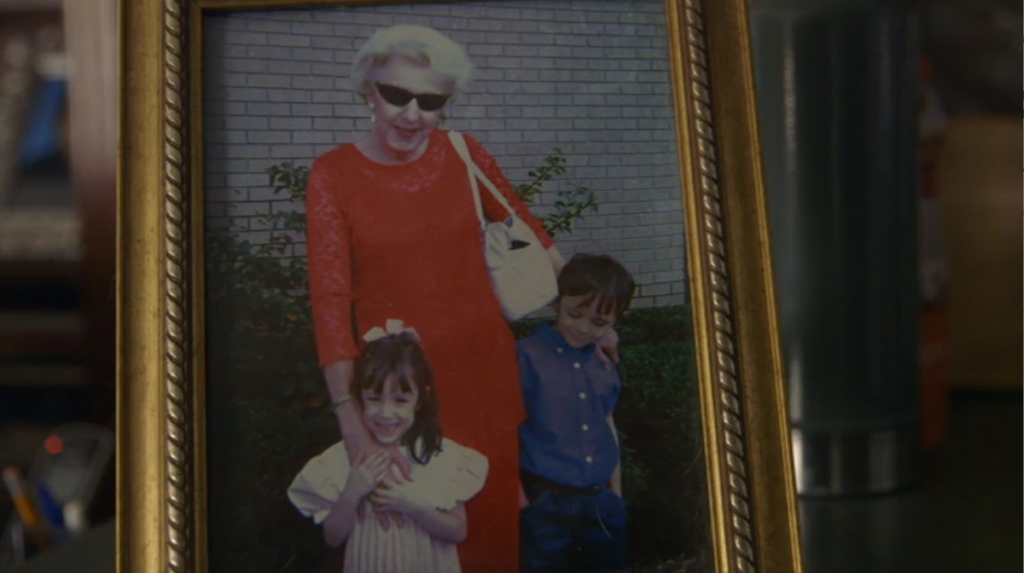
Nick has been in the Marines stationed in Virginia for the last two years and is considering re-enlistment. He regularly visits with his grandma. Nick coined this term "Grandmapa" in The Joneses that helped him reckon with her life history. Now she is known as his grandma, and they have a wonderful relationship. Trinity is very quiet throughout. Jheri interpreted that as affirmation, but now finds that she has a better relationship with Nick than with Trinity. Trinity graduated from high school and attends the local community college.
Q: In observational documentary you're dealing with who you see and who was around, and there isn't a lot of interracial interaction in The Joneses.
Howard: What you see represents the historic shift from de jure Jim Crow segregation to largely de facto segregation. However, there are positive signs. Pearl, Mississippi, was virtually an all-white town for most of the twentieth century, and when we began the project, the trailer park was almost all white. That changed into a multiracial environment. On one of his afternoon walks with Moby, where over time he reckons with his grandmother and is engaged in a kind of moral reflection, Nick references his "homies," his friends of color within the trailer park. Yet, viewers only get glimpses outside the walls of the mobile home.
The first worker seen in the film, other than one of the Joneses, is a black carpenter. Followed by a white mechanic, then the voice of a female African American caregiver at Trent's assisted living facility: "Where the hug at? Where's the hug at?" This becomes a trope from the opening title photo, taken probably twenty years ago, to the final stills, shot specifically for the project. Institutionalized for much of his life, Trent doesn't quite know how to hug. He doesn't know what to do with his arms when he's photographed. And that gesture for me is one of the most compelling, complicated reckonings with the difficulties of disability and care facilities, and how those phenomena are racialized and disproportionately visited on working-class people.
Perhaps most importantly, the one biracial, if not multiracial, gathering we see in The Joneses is the LGBTQ+-affirming congregation of Safe Harbor Church.
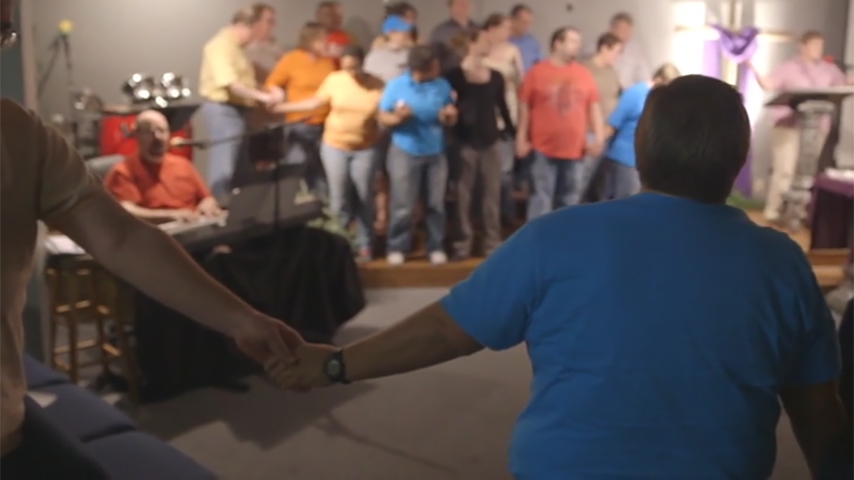
Q: Considering the different paths that brought filmmakers and viewers into this one home, what do you think Jheri hopes for The Joneses to accomplish? And how do you as the producer and Moby as the director perceive it doing activist work? It's so local, specific, and intimate, yet should have resonance far and wide.
Howard: Your question challenges us to think through explicitly activist productions with precise political aims compared with quieter, subtler films that begin as a day in the life and proceed to five plus years in the life. The Joneses resonates with different audiences. The Joneses short went to Brazil, Mexico, the United States, Canada, and Europe. Think about the captioning and the translation that happened, the recirculation of queer ideas and vocabularies. How does this very particular, very queer household in central Mississippi resonate with diverse audiences in other rural or small-town locales? I think the work of Mary Gray is very good on this, her book Out in the Country. Even the most transphobic early cultural productions on cable television can be reworked by latter-day trans-viewers to provide basic information and affirming representations. Jheri has been very explicit: I want to spread the word about trans-knowledge and trans-empowerment.
A group I briefly mentioned above is the Invisible Histories Project. They're an increasingly better funded network for generating new oral history narratives about LBGTI people in the South, as well as archival collecting and preservation. Something Invisible Histories wants to do that we weren't able to develop in The Joneses is explore Jheri's time as a drag performer in the 1970s in gay bars in Jackson, as part of that vital queer bar infrastructure largely made possible by owner-operator Jack Myers. By the way, Malcolm Ingram's stunning 2006 documentary Small Town Gay Bar, set in Mississippi, is an exemplary feature, in this regard.
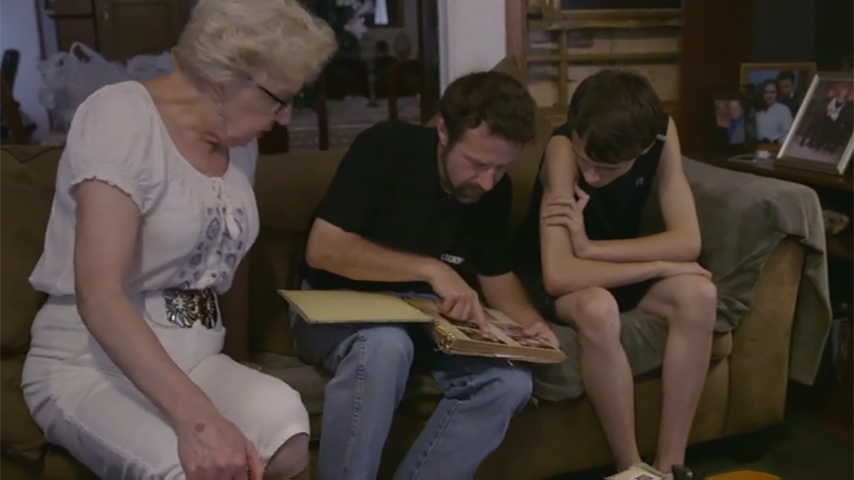

Invisible Histories also wants to safeguard the Jones family photo albums in climate-controlled archives so that primary documents of Jheri and her family members, letters, diaries, and the traditional stuff of academic historical writing can be maintained long-term. As well as the play script Jheri has written! This is a complex project around institutions historically hostile to LGBTI people. During one of my latest trips to the University of Mississippi, someone pointed out that there were raids on LGBT students, specifically on gay male students, having sex in various places on the campus as recently as the 1980s. So how to convince LGBTI individuals to part with their keepsakes, documents, artifacts and entrust them to institutions in states that until very recently had sodomy laws and continue to have discriminatory employment practices and "religious" exemption clauses based on sexual orientation and gender identity. That's going to require some painstaking work liaising between LBGTI individuals and groups and state universities, repositories, and museums, that are increasingly eager to collect this material. Notions of how and what we archive will have to change. The work involved in negotiating these relationships is fraught, but worth the effort.
Some of The Joneses' most important work suggests ways in which we can challenge well entrenched heteronormative, and now homonormative, constructs. How to think about family and flexible kinship networks in richer ways? At one point, Brad describes a dream he had. He's married; they have a child; and that child does not have the cognitive disabilities Brad does. He's also talking about something as seemingly mundane as teeth. You know, what if that child had "perfect teeth"? And for me, this is one of the subtle but, again, very important moments where you see the cruel juxtapositions of living in the poorest state in the richest nation on earth. Right? So you have these outsized consumerist expectations that are delivered to you via mass media. But then you have the hard realities on the ground that most people here cannot afford dentistry much less orthodontics. That was so powerful for me. Because I've known farm people, certainly of my mother's generation, who talk about the resentment they felt because their parents couldn't afford to get their teeth fixed and therefore they could not have that "winning smile." Again, a seemingly mundane phrase, but a phrase that speaks so much about American culture. You know, one must perpetually perform some aspect of American success ideology—whether it's a coming out narrative, a recovery testimony, or a religious conversion experience—and do so beautifully, working on one's attractiveness, which too is referenced in the workout routines in the film, the frequent trips to the gym, the way that one must not only be healthy but be attractive according to normative beauty standards. Brad speaks something quite profound in those moments.

I would have liked to have been consulted on the captions, because I think we missed some really interesting turns of phrase. Jerry uses the old temperance phrase "teetotal," which just gets transcribed as "total." An opportunity is missed in a word or a phrase. But on the whole, I'm astounded that the project was completed. I'm astounded that it's widely available. And all in all, I'm so proud of what Moby especially achieved with Ash, Caroline and, obviously foremost, the Joneses.
What finally are the documentary's activist impulses and key contributions? They concern endurance, perseverance, resilience, and hope. When you face elevated risks of bullying—a weasel word that really means verbal intimidation, sustained harassment, and physical assaults—when you are daily confronted with increased risk of violence, when as a trans person you're much more likely to be murdered, and yet you endure. You live, survive, even thrive, despite poverty, into your eighties. Each day in the life is an enormous victory.
Another narrative that ended up on the cutting room floor: In the vacant lot directly across from the family's trailer, a young gay neighbor, no doubt harassed by locals, took a gun and killed himself. As I watch The Joneses, this looms with ominous force, as Nick takes those reflective afternoon strolls, as Brad walks the dog. It's an unspoken haunting.
Given all those intense pressures and
threats, given the violence of homophobia and transphobia, given the much
higher suicide rates for LGBT people, maybe, just maybe, when young viewers witness
Jheri, Trevor, and Brad persevering in Mississippi, they will decide that they
too can persevere. In this way, the Joneses give hope and inspiration, the crucial
prerequisites of any activist endeavor.
About the Interviewers and Interviewee
John Howard is Emeritus Professor of Arts and Humanities, King's College London.
Allen Tullos is the senior editor of Southern Spaces, co-director of the Emory Center for Digital Scholarship, and a professor in the Department of History at Emory University.
Eric Solomon earned his doctorate in English from Emory University and is a visiting assistant professor of English and American Studies at Oxford College, Emory University. His work is featured in Southern Spaces, south, PopMatters, and Mississippi Quarterly.
Sophia Leonard is a PhD candidate in the Department of English at Emory University.
]]>Introduction
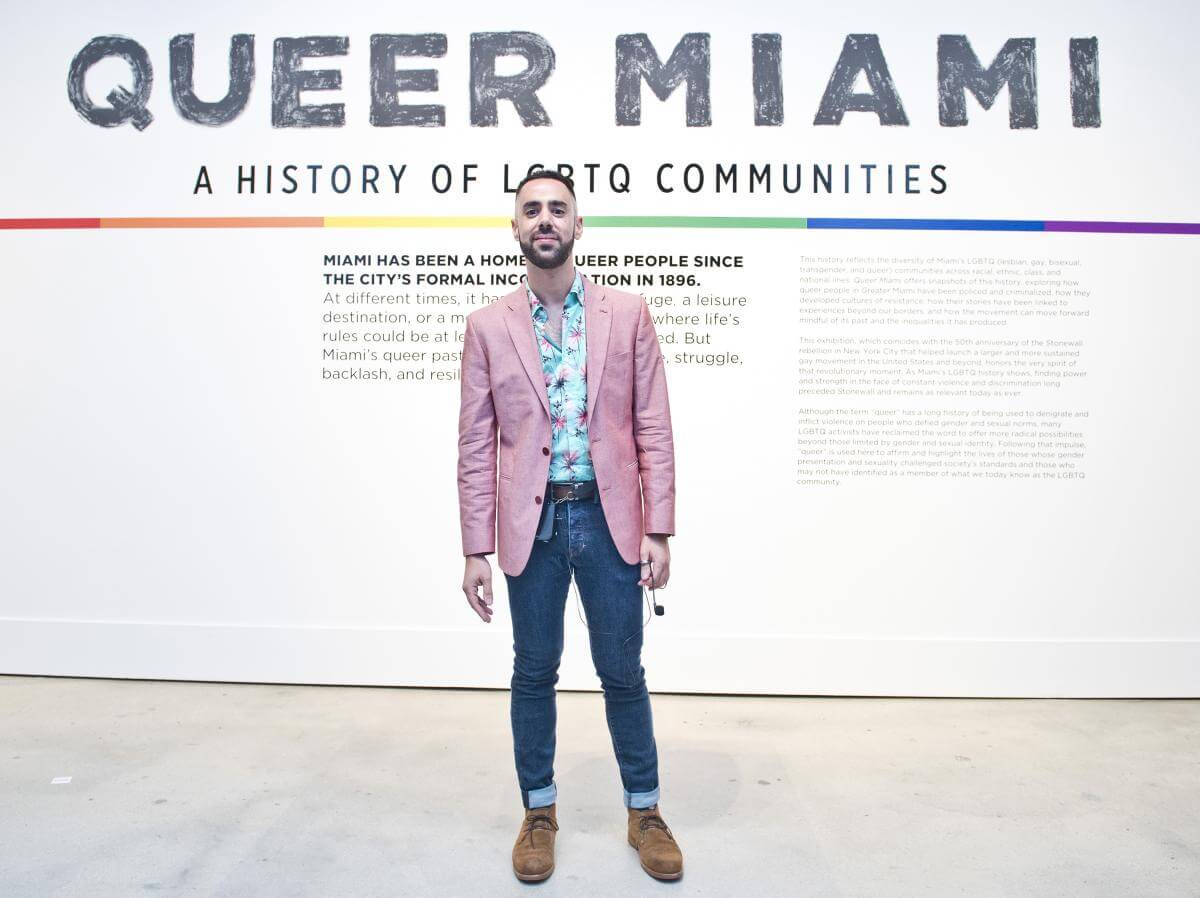
Julio Capó Jr. is a proud Miamian, and much of his work reflects detailed attention to the history of LGBTQ Miami. After seven years at the University of Massachusetts Amherst, Capó returned to his native Miami in the fall of 2019 as an associate professor in the Department of History and the Wolfsonian Public Humanities Laboratory at Florida International University. His first book, Welcome to Fairyland: Queer Miami Before 1940, explores John Sewell's 1933 notion of Florida as "a playground for the Nation" specifically through his deployment of "queer as an analytical tool" with "which to understand contested meanings of nation, race, belonging, and citizenship" in Greater Miami from the 1890s until 1940.1See Julio Capó Jr., Welcome to Fairyland: Queer Miami Before 1940 (Chapel Hill: UNC Press, 2017), 24, 5, 8. Capó explores how influential powerbrokers and everyday people contributed to the process of transforming "Miami into an 'exotic' tropical fairyland linked to the Caribbean and available for purchase."2Capó, 1. "Miami," he writes, "is geographically situated in the U.S. South and tucked in the northern section of the Caribbean Basin."3Capó, 7. Capó's Welcome to Fairyland interprets Miami as "linked to the Caribbean" and as part of a larger US landscape in a historiographical tradition of employing "a transnational lens in the recovery of queer voices, lives, and experiences."4Capó, 7. Queerness is the central analytical tool through which Capó explores Greater Miami. In his history, Capó traces Miami from its early days as a "queer frontier" to how it sustained a reputation as "a site where one could transgress gender and sexual norms."5Capó, 4. The 1950s saw Miami's queer landscape radically change once more, with the 1959 Cuban Revolution and other Cold War era political and cultural shifts. Many bemoaned the fear of losing "Miami after Dark."6Capó, 287.
In this and other ways, Welcome to Fairyland expands the terrain of queer history and southern studies. While it focuses on a seriously understudied period before cogent sexual identities had fully crystallized, the study has important implications for later queer histories with which readers may be more familiar. This includes mid to late twentieth-century narratives of state attacks in the form of the 1956–1966 Florida Johns Committee and Anita Bryant's 1977 Save Our Children campaign. Capó reveals the importance of casting further back to trace organizing strategies Miamians have utilized and how they may serve a more inclusive and socially just present and future.
Capó's curation of the exhibition Queer Miami: A History of LGBTQ Communities with the HistoryMiami Museum (March 15, 2019–September 1, 2019) examines how queer people "carved out spaces for themselves in southern Florida" across the twentieth century. For this interview, I asked Capó about Welcome to Fairyland, the HistoryMiami Museum exhibition, his plans for the future, and his thoughts on the state of queer history.
Welcome to Fairyland: Queer Miami Before 1940
SOLOMON: How did you come to write Welcome to Fairyland? What personal pathways led you to this project? Are there other histories or historians that motivated and inspired you?
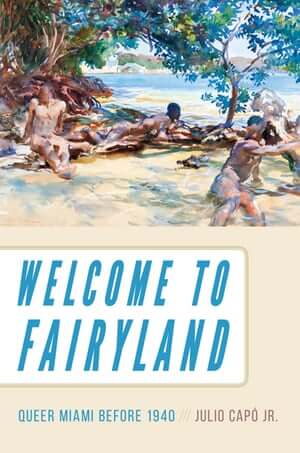
Capó: First, let me thank you for the opportunity to share my work and thoughts with you and your readers. I am most grateful. Welcome to Fairyland developed organically and with quite a bit of urgency as I continued to think historically about questions at the intersection of sexual, racial, class, and gender injustice that take many different forms today. I began revising my dissertation, which was a history of LGBTQ Miami in the post-World War II era that paid particular attention to immigrant populations and experiences. I grew frustrated by assumptions I had to make about what pre-1940 Miami looked like. For starters, there were relatively few queer community studies of the early twentieth century, especially for locations in the US South. Miami's history differed greatly from cities we know much more about, such as New York, San Francisco, and Chicago. Never taken too seriously by most scholars, Miami remains a deeply understudied city. As election polls and media reports often suggest, it remains misunderstood by political strategists and advisers. While many people are quick to point the finger at Florida (and cities like Miami) when the votes are counted (or not counted), they are often given few opportunities to better understand its complicated past.
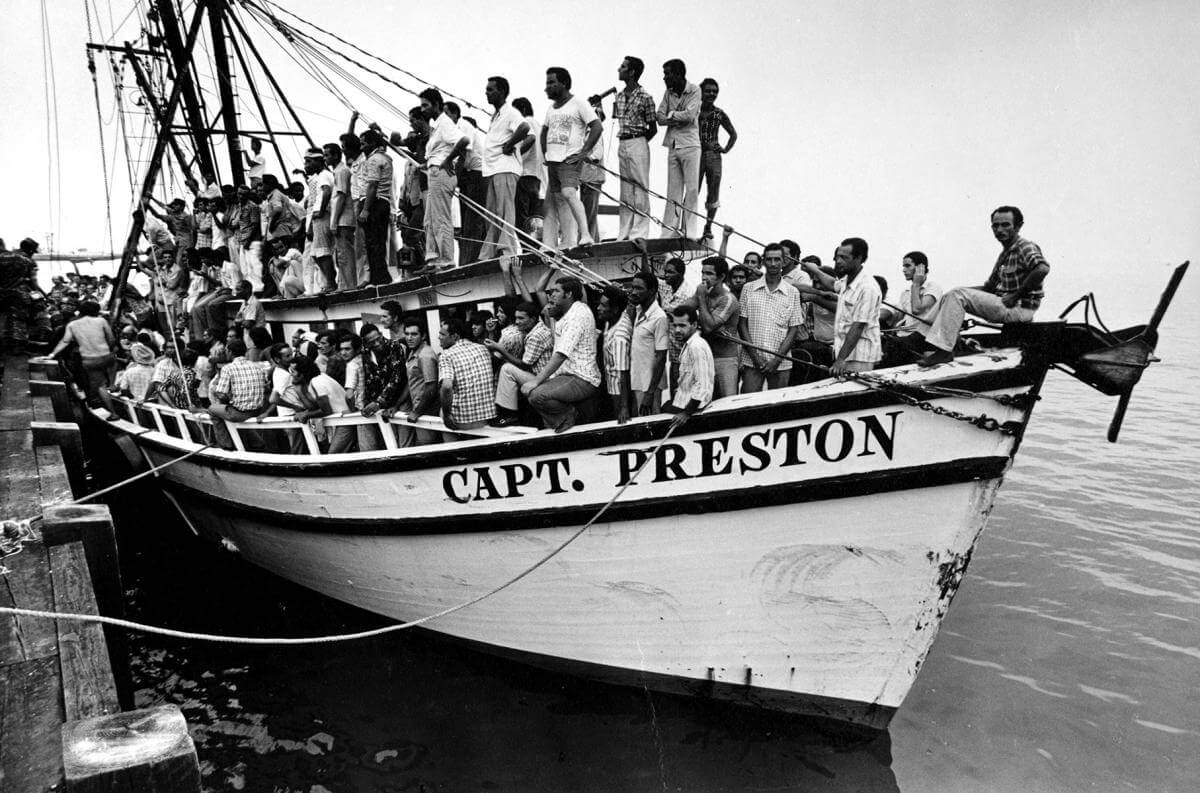
As a historian, I've always believed the past offers us the possibility of instruction and inspiration. It is generative in that we understand the social, political, economic, and cultural architecture on which today's city stands. So, in a nutshell, I went back to the archives hoping to write one concise chapter on queer Miami before the 1940s. My first major find appeared in the criminal records that, once I paired that data with immigration records and colonial records from the Bahamas, taught me that Bahamian male migrant workers were disproportionately arrested for crimes such as sodomy in the city's early days. I realized that this was not a mere chapter in my book. This was very much its own story that deserved all my attention. This was the book I needed to write. And it challenged me to think differently about the research I had already conducted on the mid and late twentieth century.
Solomon: What personal pathways led you to this project?
Capó: My goodness! It's an embarrassment of riches in terms of inspirations for writing Welcome to Fairyland. I have already suggested how social and political injustice inspired me to ask questions that proved most productive in my research. But I also believed that to understand Miami's transnational history, the city's queer past needed to be in direct conversation with arguments and debates that have also taken shape in the fields of gender, Black, southern, Caribbean, immigration, Latinx, and labor and class history. I thought a lot about how scholars such as Cathy Cohen, José Esteban Muñoz, Siobhan Somerville, and Martin Manalansan, among many others, have treated queer as an analytic. I drew inspiration from how Eithne Luibhéid, Marc Stein, Margot Canaday, Amy Sueyoshi, and Nayan Shah have discussed the state's surveillance of immigrant bodies both at the US borders and within them. I found thoughtful transnational approaches in the works of Lara Putnam, Ana Raquel Minian, Andrew Sandoval-Strausz, and so many others. I wanted to contribute to the growing scholarship of Miami's ethnoracial demographics, Caribbean influences, and long history of class warfare that scholars such as N. D. B. Connolly, María Cristina García, and Melanie Shell-Weiss have laid out. And I wanted to expand the parameters and scope of the LGBTQ community study, with its emphasis on space and place, that George Chauncey, Nan Alamilla Boyd, John Howard, among so many others, have set forth. This barely scratches the surface, but I hope it gives a sense of what I was thinking, more broadly, as I approached the archives, the evidence, and the literature as I wrote Welcome to Fairyland.
Solomon: In his 1997 oral history, James T. Sears mentions Florida as the "Mississippi of the homosexual" in the immediate decades following when Welcome to Fairyland ends.7James T. Sears, "The Mississippi of the Homosexual and the Politics of Dialectics," in Lonely Hunters: An Oral History of Lesbian and Gay Southern Life, 1948–1968 (Boulder, CO: Westview Press, 1997). Sears's rhetorical move has always resonated with me, and I mention and challenge it in my first project. I'm from Mississippi, but I've written about Florida extensively. You're from Florida, and Welcome to Fairyland is set in your native Greater Miami. Yet, your study stops before the years (1948–1968) Sears is referencing. How important was it for you to illustrate in detail the development of queer spaces in Miami in terms of your temporal framing?
Capó: Wow, there's a lot to unpack here. Thanks for this important provocation. You know, even though Welcome to Fairyland ends in 1940, as the book's epilogue may suggest, I know quite well what happens in Miami after the 1940s. I wrote a dissertation and have curated an exhibition about that very history. I wanted to understand its origins. At least at the surface, people may be more familiar with the recent history. They have recollections of anti-gay violence spurred on by the Johns Committee, Anita Bryant, the Mariel Boatlift, and more. As I unpack in Welcome to Fairyland, this past is often really violent. It is also, however, a story of queer resistance and resilience.
More directly, what does such a loaded statement mean: Florida was the "Mississippi of the homosexual." Because its framing seeks to make a clear parallel to ground zero for Black civil rights at midcentury, the statement also inherently asks us to separate race and sexuality and imagine anti-Black violence—as well as anti-gay violence—as somehow separate and as possibly contained to a particular geography. One of the events I examine thoroughly in my book, for example, involves the 1937 raid of a Miami gay bar named La Paloma that was conducted by nearly two hundred members of the Ku Klux Klan.
Queer histories have historically been rooted and entangled with—in nuanced and checkered ways—anti-Black violence.
I'm more inclined to think of it this way: Florida was the "Florida" of Blacks and people of color; much of the same anti-Blackness and colonialism created the very conditions for Florida to become the "Florida" of the homosexual. I wonder how scholars such as John Howard would respond to this, as his book Men Like That encouraged us to question our assumptions about the US South, its relationship to gender and sexual liberation and racial politics, and even our perception that liberation was somehow more attainable in urban, rather than rural, spaces, or perhaps even the "North" rather than the "South."
I'm thinking here about the uses and misuses of teleological arguments, but Sears' provocation is a great jumping point for our exploration of temporality and liminal spaces within "the past." Like your reference to growing up in Mississippi, I was born and raised in Miami and, in writing Welcome to Fairyland, I was struck by how much of the history I uncovered in my research had been lost to us. In other instances, I found that this history wasn't exactly lost, but rather made incoherent and illegible. Viewing the watercolors John Singer Sargent produced in early Miami takes on radically new meaning when we pair it with the city's criminal records, or immigration logs, for example. Watching Marilyn Monroe in the 1959 film Some Like it Hot, once you have studied the history of Prohibition at the Miami-Caribbean borderlands, suggests that contemporaries seeing it for the first time might have understood the critical relationship that politics had in sustaining and creating queer communities and culture. Although many of our pasts have indeed been institutionally erased, others have simply lost their meaning over time and are hidden in plain sight but very much alive in meaningful and impactful ways. No one may call Miami "fairyland" anymore; but that moniker's association with doubt can still be found in the area's ongoing efforts to draw in outsiders.
Solomon: Welcome to Fairyland deploys "queer as an analytical tool" and "interprets queer history by maintaining a transnational perspective and by providing an intersectional analysis that factors in how gender and sexuality influenced constructions of class, race, ethnicity, age, and (dis)ability."8Capó, 5. Queer. Transnational. Intersectional. How do you understand the connections between these three terms for your work?
Capó: I think the analytics of queer, transnational, and intersectional are doing a lot of the same work in the book, but in distinct ways. In general they all exist, and I'll shamelessly look to Gloria Anzaldúa for inspiration in Borderlands/La Frontera: The New Mestiza, defying static, singular, fixed positions or statuses. The queer has us move beyond the binary and think expansively about subversion and transgression as it is measured against the normative. A transnational perspective rejects the nation-state and the neat categories it seeks to produce as the dominant form of power and structure. An intersectional approach dictates how different modes of power can simultaneously coexist and that forms of oppression are indeed interlocking and impossible to separate. They are all in flux, fluid, and subject to change. For me, these are the ingredients to doing this history and important and necessary approach for measuring change over time and place.
Solomon: For those seeking to develop research projects or thinking of doing queer history, can you describe the journey of Welcome to Fairyland? How long did the book take you to write? Is the finished project what you thought it would be when you started?
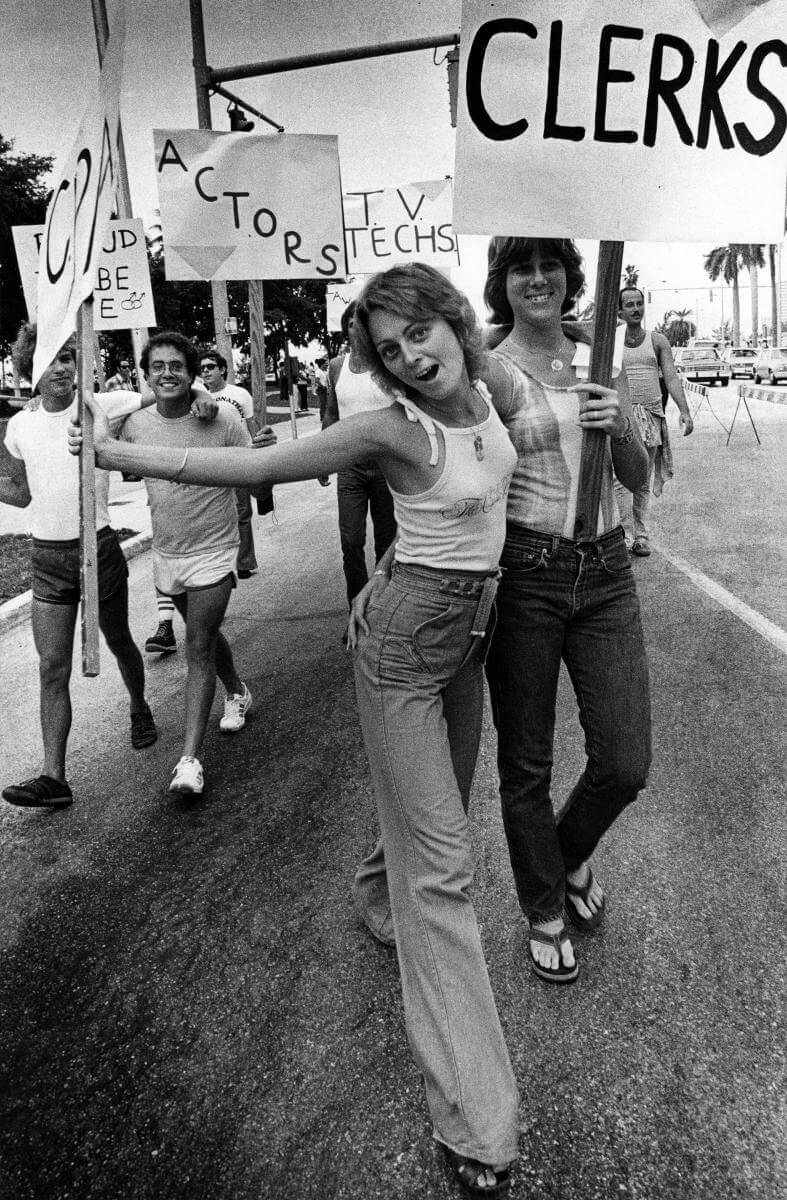
Capó: I've addressed aspects of this already, so I'll just add a few more thoughts. I think I'm a pretty disciplined writer. I'm a former journalist (still contributing to journalism, but now as a trained historian) who understands the importance of deadlines, the mythologies surrounding things such as writer's block, and the necessity of carving out time for writing every day. From concept to page proofs the book took about five years, as I began it during my postdoc. I am really proud of the final product. Once I had processed all the evidence, I realized I had a lot of things I wanted and needed to say. I've always been hyperaware that this history is meaningful, and in very different ways, to many different people—past and present. I'm sure some may not fully appreciate my treatment of the evidence and material, but a work now exists that acknowledges this history as significant and as critical to multiple histories.
I can't really say Welcome to Fairyland was the book I initially sought to write because this book came to fruition as I worked to revise a separate project from discoveries in the archives and from my efforts to respond to gaps in our knowledge. It speaks to the issues I thought—and still think—need much more attention.
Queer Miami: A History of LGBTQ Communities: Miami Across the Twentieth Century
Solomon: You write about the silences within and erasures of the queer archives, drawing from Martin F. Manalansan's understanding of "disarrangements." You also mention your own collecting of historic ephemera as a practice that directly informs your work. What are the roles of historians and nonacademic collectors in preserving queer history?
Capó: There's so much one can say about this, but I'll try to keep it somewhat brief. I think preservation is a key part of activist work. Much of the field of queer history stems from tireless community-based efforts to collect and preserve our past and make it known. Certainly, for the years I address in Welcome to Fairyland, our histories were never meant to be preserved. Those in power sought to erase us. They still do. We have to fight back, but we also have to think harder about how to respectfully recover the voices of those most marginalized within these marginalized groups. And we have to think harder about what constitutes an archive, a legitimate source or evidence, and the places where we can find them.
Many of the sources in Welcome to Fairyland, and perhaps a third of the material objects featured in the exhibition I curated in Miami, are from my personal collection. I have collected t-shirts, piggybanks, postcards, dolls, photographs, letters, rare books, and so many more items—over nearly fifteen years. I've been able to find and acquire some objects through search engines and simple keywords, such as "gay Miami." I think I've been able to piece together something else entirely, though, through my reading and rereading of Miami's past. Things that may not have appeared inherently "queer" at first can be given new meaning in context. I also think I've earned the trust and support of many members of Miami's LGBTQ community, who feel equally invested in recovering this past and having it told and preserved. I am from Miami and I'm openly gay. Over a decade ago now, I worked as an intern at the Stonewall National Museum and Archives in Fort Lauderdale, where I helped catalog some of its unprocessed materials it housed there, especially its Anita Bryant collection. What I want to stress is that this work takes time and dedication. It is, indeed, a community effort.
Solomon: In terms of the Queer Miami exhibition: can you describe your process of curating? How much of your research from Welcome to Fairyland informed or served as foundation for the exhibition? How did your collaboration with the HistoryMiami Museum come about?
Capó: The exhibition covers a bit before the 1890s to the present. That's over a century of material. I had never curated anything before, so I did my homework! I read a lot about the curatorial process, consulted with colleagues and friends, and visited as many exhibitions as I could with a very different eye: as a curator-to-be. This was such a productive and challenging experience for me. I absolutely loved it. I learned so much and have connected with so many members of the community.
Much of the narrative of Queer Miami took shape from threads of Welcome to Fairyland and my dissertation on the post-1945 era, but there are many differences. Unlike a book or an academic article, I had to tell an engaging narrative through objects or other visuals. That's often difficult, especially for the earlier period. We reproduced some ordinances, portraits, paintings, and the like for the early 1910s, but it's very difficult to explain what constituted queerness in Miami when these terms, meanings, and identities were very much in flux and often inchoate; the state also never intended to preserve this history, of course. I did not want this to exclusively be a narrative of criminalization or of surveillance of queer folks, immigrants, the poor, or people of color. I wanted to recover people's voices—as well as their moments of leisure and community-building—whenever possible.
While telling Miami's queer past through objects often proved challenging, an exhibition of this size (five thousand square feet), breadth, and scope permitted me to do a lot of different things. For example, we recovered police footage of gay bar raids (and one at someone's home) from the late 1950s. We recreated a bar counter from that era where people could sit down and watch looped footage of those raids. Altogether, it presents some really powerful testimony. Audiences can see the violence of the state. You see the whiteness of these spaces. Many queer people of color held or attended private parties instead, knowing far too well the risks for them were much greater. You see people fighting back, too. One man throws his drink at the cameraperson, for example. When we think of resistance, we often think of Stonewall-like narratives. That queer people in Miami continued to congregate in and create gay spaces at all—in spite of violence and surveillance—is a testament to their resilience and their efforts to dismantle unjust practices and abuses.
It's productive to challenge ourselves by expanding and redefining our audiences, venues, and methods. I had a similar experience a few years ago when thinking about some of this very same material, but in terms of space and place as part of a study the National Park Service commissioned on LGBTQ historic sites. I contributed a chapter on Miami that narrated existing (surviving) physical sites. This work challenged me to think very differently about material I had been analyzing for years.
Solomon: Can you tell us a little bit about how the Queer Miami exhibit was organized?
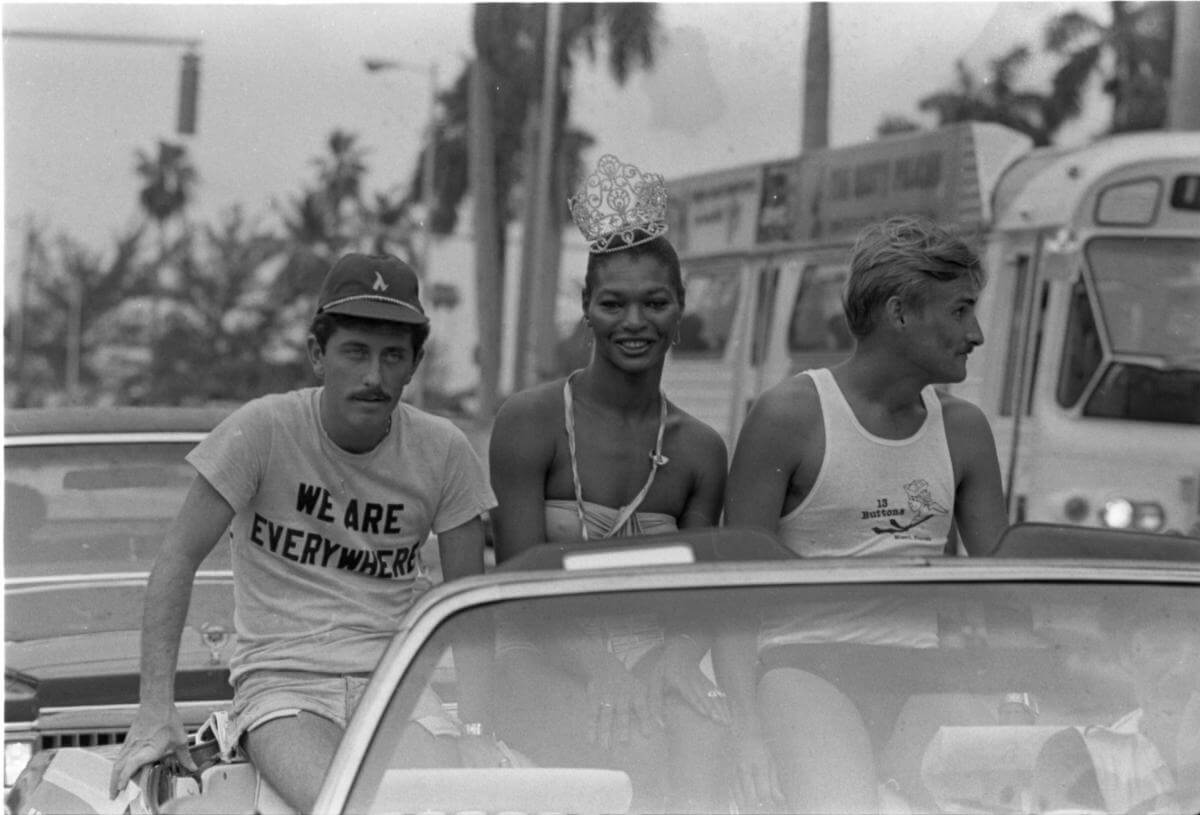
Three participants riding in a car in Miami's first Gay Rights Parade, Miami, Florida, 1978. Photograph by Tim Chapman. Courtesy of the Tim Chapman Collection, HistoryMiami Museum.
Capó: The exhibition represents the diversity of Greater Miami's LGBTQ communities across racial, ethnic, class, and national lines. It offers snapshots of this history, exploring how queer people have been policed and criminalized, how they developed cultures of resistance, how their stories link to experiences beyond our borders, and how the movement can move forward mindful of its past.
Beginning with an introduction to Miami and queer history more generally, the exhibition suggests some of the difficulties of uncovering this past, including the use of terms like "queer," the problem of archives for history never meant to be told, and how Miami's queer history is, despite the many instances of violence and oppression, also one of resilience and resistance.
The exhibition is then organized into five sections: 1) Policing, Surveillance, and Criminalization; 2) Community Development, Representation, and Advocacy; 3) Fighting for Their Rights, Fighting for Their Lives; 4) Gateway to the Americas; and 5) Looking Ahead. For the first two, it was important to convey the many ways the state criminalized and surveilled queer people. These sections explore the significance of racist, xenophobic, and anti-Black sentiments in shaping queer culture and spaces and for the formation of strong and creative bonds of resistance. The third section shifts attention to the local and national significance of the 1977 Anita Bryant campaign to overturn a Miami ordinance that shielded gays, lesbians, and bisexuals from discrimination, and to the HIV/AIDS crisis. I wanted to offer a different narrative and chronology, one that highlights Miami's past, rather than ones that are dictated by the telling of Stonewall and other events that have come to dominate our understanding of queer protest, resistance, and change-making. The fourth section observes how Miami's LGBTQ past extended far beyond the city's borders. It's a story with deep roots in parts of the Caribbean and Latin America and must be understood in the context of the Americas. Lastly, the exhibition explores some of the challenges for Miami's LGBTQ people today and highlights many of the organizations and institutions working to improve their lives. We also provide space for people to reflect and leave testimonies of their own histories with the city and offer their recollections and insights. It's a powerful exercise and testament to what liberation can mean when it is committed to social justice in all its forms. I have enjoyed reading these many contributions to the exhibition from visitors more than I can possibly explain.
About the Interviewer and Interviewee
Eric Solomon earned his doctorate in English from Emory University and is a visiting assistant professor of English and American Studies at Oxford College, Emory University. His work is featured in Southern Spaces, south, Pop Matters, and Mississippi Quarterly.
Julio Capó Jr. is an associate professor in the Department of History and the Wolfsonian Public Humanities Laboratory at Florida International University. He is the author of Welcome to Fairyland: Queer Miami before 1940 (Chapel Hill: The University of North Carolina Press, 2017) and curator of Queer Miami: A History of LGBTQ Communities. His work has also appeared in the Journal of American History, Radical History Review, Diplomatic History, Journal of Urban History, Journal of American Ethnic History, Modern American History, GLQ, H-Net, American Studies, and several volumes.
]]>Introduction
As a child, Ann Pancake dreamed of escaping from West Virginia. Achieving this goal as a young adult, however, only served to strengthen her emotional and cultural bonds to the Mountain State. Over the last two decades, Pancake has become one of the leading Appalachian writers of her generation. Her work addresses many themes in its concern with the everyday lives of West Virginians and the making of regional and national identities. Pancake engages the history of Appalachia and its people, revealing the impact of deindustrialisation, rural poverty, and environmental destruction.
Ann Pancake, Seattle, Washington, 2014. Photograph by Catherine Alexander. Courtesy of the author.
Published by the University Press of New England in 2001, Pancake's first collection of short stories, Given Ground, earned the praise of Elizabeth Judd in the New York Times for "depicting an ignored part of the country with a clear and admiring eye." Pancake, wrote Judd, possesses the "unusual gift for portraying difficult lives with a plain-spoken accuracy that makes them seem suddenly exceptional."1Elizabeth Judd, "Books in Brief," New York Times, August 12, 2001. Six years after Given Ground came Pancake's first novel, Strange as this Weather Has Been.2Ann Pancake, Strange as this Weather Has Been (Berkeley, CA: Counterpoint Press/ Shoemaker & Hoard, 2007). Widely praised for its literary vision and striking language, the novel presents an unflinching portrait of a poor West Virginian family living in the shadow of a strip mine. Writing in the Iowa Review, Jeremy Jones declared Strange as this Weather Has Been to be "a true novel . . . brimmed with beauty and poetics but aimed at change and justice."3Jeremy Jones, "Ann Pancake's STRANGE AS THIS WEATHER HAS BEEN," Iowa Review, January 8, 2011. Pancake's most recent collection of short stories, Me and My Daddy Listen to Bob Marley, arrived in 2015 to considerable acclaim; Publisher's Weekly recommended it as a "gritty, stylish assembly."4"Me and My Daddy Listen to Bob Marley," Publisher's Weekly, December 8, 2014.
Cover of Ann Pancake's Strange as this Weather Has Been (Berkeley, CA: Counterpoint Press/Shoemaker & Hoard, 2007). Cover design by Gerilyn Attebery featuring Jeff Chapman-Crane's The Agony of Gaia, which was created in response to the devastation caused by mining techniques such as mountaintop removal.
Pancake's distinctive style and incisive portraits of Appalachian life have led to acclaim and awards. West Virginian novelist Jayne Anne Phillip characterised Pancake as "Appalachia's Steinbeck." Georgian writer and environmental activist Janisse Ray has described her writing as "shockingly pure, like holding gold in your hands." For critics such as Dan Chaon, Pancake's work is "astonishing . . . tender, alive, full of heart and empathy but never sentimental, full of clenched drama and secrets and surprises but always subtle."5Quotes taken from Pancake's personal website, http://www.annpancake.blogspot.com. Pancake has received the Bakeless Literary Award for short story writing, a Whiting Award, an NEA grant, a Pushcart Prize, and creative writing fellowships from Washington, West Virginia, and Pennsylvania. Strange as this Weather Has Been won the 2007 Weatherford Award by the Appalachian Studies Association, was a finalist for the 2008 Orion Book Award, and was chosen as one of Kirkus Review's ten best fiction books of 2007. Most recently Pancake was chosen as the first recipient of the Barry Lopez Visiting Writer Fellowship at the University of Hawaii.
This interview considers the formative role of Pancake's childhood in Appalachia, and the impact of her time in college and working abroad on her literary aesthetic. Pancake considers her work from a variety of perspectives, tackling questions of violence, historical memory, race, and culture, before discussing the publication of her most recent collection and her plans for the future.
[This interview took place on Wednesday, March 9, 2016 with supplementary correspondence in July and October. It has been edited for clarity. Many thanks to Ann Pancake for being so generous with her time and her willingness to talk about her life and work. Thanks also to the Hagley Museum in Wilmington, Delaware, for providing the setting and the equipment for this discussion.]
Growing Up
JAMES: Hi Ann. Thanks for taking the time to talk with me. Perhaps you can start by offering a brief introduction to readers who might be unfamiliar with your life prior to the publication of Given Ground.
Welcome to Romney, Romney, West Virginia, November 13, 2011. Photograph by Flickr user Ron Cogswell. Creative Commons license CC BY 2.0.
ANN: Sure. Until I was eight years old I lived in Summersville, West Virginia. That's in Nicholas County, an important coal producing part of the state. That was the period of my life in which I became aware of the coal industry and of strip mining, partly because we could see strip mining from our house, and my dad talked to me about strip-mining and the damage it caused. When I was eight we moved to Romney, West Virginia, which is where my dad's family has been for a couple hundred years, and it's agricultural—there's no coal up there. I lived in Romney until I was eighteen, and then I went to West Virginia University.
When I graduated with my BA at twenty-two, I went overseas, partly because I didn't think there was anything to write about in West Virginia, and also because I didn't have a job and the unemployment rate was really high in West Virginia. I got a job in Japan and taught there for a year. In my twenties I also taught in American Samoa for two years and I taught in Thailand for almost a year. I did a good bit of travelling in Asia and the South Pacific. I got my MA in English at the University of North Carolina at Chapel Hill and shortly after, went into the doctorate program at the University of Washington, where I was from 1993 until 1998.
JAMES: I've read about your wanting to get away from West Virginia when you were growing up.
Center of Romney, WV, Romney, West Virginia, April 24, 2004. Photograph by Flickr user Taber Andrew Bain. Creative Commons license CC BY 2.0.
ANN: By the time I was a teenager I really wanted to see other parts of the world and get out of West Virginia. I thought the state was boring and very limited . . . at the same time, my whole life I'd had this highly complicated relationship with it because I was also much prone to homesickness. So I was both deeply attached to West Virginia but also feeling very much the pull to see places outside. I still have that conflicted relationship. Appalachia has an almost mysterious pull on people who grow up there, even on people who aren't native but who have lived there a long time. As a teenager, I felt very strongly the push/pull relationship with West Virginia I feel still.
JAMES: Do your siblings have the same fraught relationship with West Virginia?
ANN: Yes, I'd say the five of us who left the state do have a deep attachment that is also fraught. My only sibling who stayed is my brother who has a lot of addiction problems, which is why he will never leave. My sister, as I think you know, made a documentary film about mountaintop removal in West Virginia called Black Diamonds – she lived in Baltimore while she made it and lives in Philadelphia now, but she feels a profound connection to West Virginia like I do. We're all pretty attached to it. West Virginia is like no other place I've ever been, culturally. You can't find it or replicate it.
JAMES: One of your brothers is an actor and your sister is involved in film and documentary production.6Sam Pancake and Catherine Pancake. Ann and Catherine collaborated on the production of Black Diamonds, a 2006 documentary film about mountaintop removal and the fight for coalfield justice in West Virginia. Did your parents encourage you to develop an interest in the arts as children and was that typical where you grew up?
ANN: My parents did encourage us in the arts, and it was not typical in our community, but my parents both went to college, which was also not typical. Only a small percentage of people in our home county finished college, even now, and that was even a smaller percentage in the 1970's. But my parents expected us to go to college, and we had access to many books, which a lot of families did not. My mom was an art teacher in high school so we were also given art materials from the time we were little. We were very fortunate that way. Most of us were born pretty creative, and I think it was wonderful to grow up playing all the time with these creative siblings because we could make up games and imagine things together. I believe this early kind of play was instrumental to how we later developed as artists, Sam and Catherine and I. At least it was for me. Growing up in West Virginia was poor in some ways, but it was rich in imaginative activity, and it was rich in its proximity to the natural world.
JAMES: What kind of literature did you read growing up?
ANN: Oh . . . stories about being outside. Books about dogs! Old Yeller, Where the Red Fern Grows, Sounder, that kind of thing.7Fred Gipson, Old Yeller (New York: Harper & Bros., 1956). Wilson Rawls, Where the Red Fern Grows (New York: Laurel-Leaf Books, 1961). William Armstrong, Sounder (New York: Harper Collins Publishers, 1969). It wasn't that common to get kids' books that were set in rural areas, most seemed to be set in cities, so if I got my hands on books with rural settings, they resonated more. Where the Lilies Bloom was important to me. It was set in Appalachia. My Side of the Mountain was another one I really liked.8Jean Craighead George, My Side of the Mountain (New York: Scholastic, 1959). Bill Cleaver and Vera Cleaver, Where The Lilies Bloom (New York: Harper Collins, 1969).
Cover of William H. Armstrong's Sounder (New York: Harper & Row, 1969). Cover illustrations by James Barkley.
JAMES: What kind of things would you write as a child?
ANN: When I began to write, I usually wouldn't finish things, but I would write the starts to disaster stories or adventure stories. I didn't understand what "literature" was or why you would read it, so as a teenager, I read authors like Stephen King. But by the time I was sixteen, along with the disaster stories and horror stories, I wrote a few pieces set in West Virginia, pieces that were realism and based on my own experiences. Even then, I knew that those stories felt different in my body.
JAMES: Living so close to the boundaries of other states, how did you identify as a West Virginian?
ANN: Growing up, many of us were very aware we were West Virginian. As a kid in West Virginia, you get a lot of messaging from the larger culture and from the states surrounding you that your place is more backwards, that you are hicks. And, of course, the media delivered that message all the time about "hillbillies." So I understood us as underdogs and I understood that others looked down on us. That sense of identity didn't come from my parents, it came more from the dominant culture. And anytime we ventured out of West Virginia (not that it was common) I was very aware of how West Virginia was different, and how people considered us lesser than them.
College and Travel
Nighttime shot of Woodburn Hall on the West Virginia University Campus, Morgantown, West Virginia, April 22, 2007. Photograph by Flickr user J. Robinson. Creative Commons license CC BY-NC-ND 2.0.
JAMES: Why did you decide to stay in West Virginia for college?
ANN: It was an economic thing. I didn't know how to get scholarships anywhere else, and my dad planned to pay for it, so he said we needed to go to school in state. I did get a good scholarship from WVU after my first semester.
JAMES: How was college? Was it strange being close to and yet apart from your family?
ANN: College was really difficult for me socially. I did fine academically, but going to Morgantown was a culture shock, even though it was only a hundred miles from Romney. Now I know a small college would have been much better for me. I don't know what WVU is like now, but at that time we had a large number of out of state students, partly because our tuition was so cheap, and the whole time I was there I only had one professor who was actually from Appalachia. I experienced a lot of culture clash at WVU and little sensitivity to that on the part of the faculty and the administration. I think it's different there now.
Morgantown, West Virginia Skyline, Morgantown, West Virginia, June 4, 2011. Photograph by Flickr user J. Stephen Conn. Creative Commons license CC BY-NC 2.0.
JAMES: In what ways did you experience this culture clash?
ANN: Our accents marked us. You'd open your mouth, and others would make assumptions about your intelligence and class and politics and your level of sophistication. It made you want to keep quiet. I think now about interviews Catherine and I did for her documentary, and how people in southern West Virginia would preface things by saying, "Now, I can't talk good," and then they'd say something incredibly insightful. In their accent.
JAMES: Early in Strange as this Weather Has Been you describe the loneliness of your protagonist Lace at West Virginia University in a way that feels intensely autobiographical.9"I told myself once I go to WVU, I'd never look back. Truth was, though, after a month away, I was feeling a kind of lonesomeness I'd never known there was…they had hills in Morgantown, but not backhome hills, and not the same feel backhome hills wrap you in. I'd never understood that before, had never even known the feeling was there." Pancake, Strange as this Weather has Been, 4.
ANN: Yeah it is very autobiographical. I mean, I stayed, I didn't quit, but yeah a lot of that is autobiographical.
JAMES: Lace ends up dropping out of West Virginia University to return to the mountains. Did you ever think about following that trajectory?
ANN: Oh yeah, I thought about dropping out, but again, the alternatives were worse. By that time in my life, I'd worked fast food and done line work and waited tables and worked in a grocery store—I realized that if I dropped out, those kinds of jobs would be my future.

Osaka Nightlife, Osaka, Japan, October 23, 2016. Photograph by Flickr user Pedro Szekely. Creative Commons license CC-BY-SA 2.0.
JAMES: After college you just split for Japan.
ANN: Yeah [laughs]
JAMES: Why?
ANN: I heard about a job there from a friend, heard that the owner of a language school in Japan was coming to campus to interview, and I interviewed, and I got it. I had never, ever thought about going to Japan. But I was working at Wendy's, after graduating with my BA in English, no teaching certificate. Unemployment in West Virginia was 12% then. It could have been anybody that showed up, from Norway or South Africa, I think I would have gone.
JAMES: In terms of teaching abroad, particularly teaching English as a foreign language, do you feel that process of thinking about the construction of language had an impact on your own writing?
ANN: Hmm . . . that's a really good question. I think what had an impact was less the actual teaching of English than being in cultures that weren't American and weren't Appalachian. By being in such a radically different culture, I recognized that Appalachia itself had its own distinct and interesting culture, and I started to understand how different our language was from Standard English. It's hard to describe how mind-expanding it was to go from West Virginia to Japan. I'd not even been on a commercial airplane. As an artist and a writer from West Virginia living in Japan, I would feel like I had eyes opening all over my head. Also the Japanese relationship to art and to perception . . . their attentiveness and receptiveness to beauty in the everyday was something they gave to me.10In an earlier interview with Robert Gipe for Appalachian Journal, Pancake cited the impact of the Japanese 'wabi sabi' aesthetic, noting its similarities with Appalachian culture—"an aesthetic that values the old and flawed and rusty." Robert Gipe and Ann Pancake, "Straddling Two Worlds," Appalachian Journal, 2011.
Language and Regional Dialect
ANN: When I first started writing about West Virginia, I wrote with dialect by default, more or less unconsciously, because I wasn't yet very aware that we spoke a dialect nor was I aware that our accent was as strong as it was. I became more aware of the dialect in my stories as I got older and left West Virginia. I write very intuitively. When I'm doing early drafts I hear the story in my head or I hear sounds in my head or the characters talking in my head, and if I'm writing about West Virginia, those voices and sounds naturally come as dialect. Over the decades I have come to think more consciously about the politics of dialect. Dialect in literature can be used in a demeaning way, to set aside the characters who use dialect as "less than" the writer, the reader, and the characters who don't use dialect. Or, one can use dialect in a culturally sensitive and less politically regressive way. I, of course, aim for the latter. I want to use dialect in ways that empower the people I write about and in ways that show how beautiful and inventive Appalachian language can be.
JAMES: It feels like there is a form of double movement here where, to teach English as a foreign language, you became very aware of your own dialect, and the pressure to mould your own patterns of language into a standardised form of English. How aware of that conflict were you?
US 50 Looking West, Romney, West Virginia, 1942. Photograph originally published as part of the Farm Security Administration, Office of War Information Collection in the Library of Congress Prints and Photographs Division. Courtesy of Wikimedia Commons. Image is in public domain.
ANN: When I first left West Virginia and was teaching ESL and then attending graduate school, I felt compelled to use Standard English exclusively and to clean up my accent. Once in Japan when teaching kindergartners, I walked in a classroom after six months or so and said "Good morning, how are you?" And they came right back with, "Fahhhn, Thank you." And I was kind of horrified, that without my knowledge, I had taught these forty, five-year-old Japanese kids English with an Appalachian accent without knowing I was doing that. So certainly during my twenties and during graduate school I tried to mask or change my accent. I don't worry about that so much anymore, although I know when I'm not home, my accent is much diminished. But I'm lucky because I can go back and forth, speak without the accent and speak with it, whereas some of my siblings have lost their accent and can't get it back.
JAMES: Do you worry about losing your accent? How does your accent relate to your identification with West Virginia?"
ANN: I have worried about it. But I know now it's not going to be lost because I'm fifty-three and if I go home I can go right back into it. It's not as strong as when I was little, but it's still in there.
JAMES: And after Japan you returned to the States, and then went to teach in American Samoa?

"Welcome to American Samoa," Nu'Uuli, Eastern District, American Samoa, February 22, 2008. Photograph by Flickr user Ben Miller. Creative Commons license CC BY-ND 2.0.
ANN: Yes, after Japan, I lived in Albuquerque, New Mexico for a year. After that, I taught in American Samoa. This was again economic necessity and also a desire for adventure.
JAMES: Did living in American Samoa affect the way you felt about yourself as an American?
ANN: That's a good question. In American Samoa, I lived for the first time in a place that had been colonized by the United States. I became acutely aware of colonization in the South Pacific and also more aware of the relationship between the US and other countries, the way America exerts power over other countries and exploits them.
JAMES: Did you see similarities or connections between class inequalities or exploitation in West Virginia, and American Samoa as part of a larger colonial project?
ANN: I did, I did. The connections became even more clear to me when I started living in parts of the US that weren't Appalachia, and as I began to understand dominant middle class white culture in the US. As I came to recognize the class discrepancies within the US and realized how little economic and political power Appalachia had, I saw the relationship between Appalachia and exploited non-Western countries. I realized how Appalachia can be seen as a resource colony for the larger United States. And those connections became more defined during graduate school when I started to read postcolonial theory and post-Marxist theory. The only places I've seen people as poor as they are in parts of southern West Virginia was in Indonesia and Thailand.
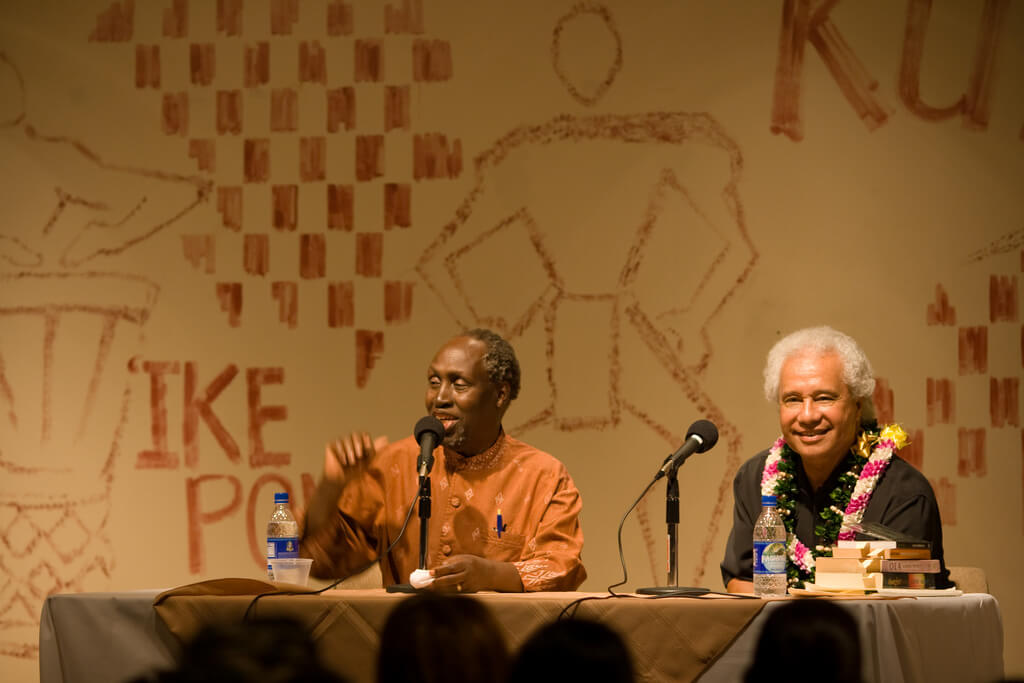
Samoan author Albert Wendt (right) with Kenyan writer Ngũgĩ wa Thiong'o (left), University of Hawaii at Manoa, Honolulu, Hawaii, April 30, 2008. Photograph by Flickr user Kanaka Rastamon. Creative Commons license CC BY-NC 2.0.
JAMES: Did that experience impact your direction in graduate school?
ANN: Yes. I wrote my master's thesis on a Samoan writer, Albert Wendt, using postcolonial theory. The driving question of my PhD dissertation was how Americans sustain their delusion that we have essentially a classless society given the glaring economic disparity in this country. I explored that question through nineteenth and twentieth-century literature and film. When Americans can't blame class discrepancy on racism, they often explain poverty as temporary. The idea is that the lower classes will eventually catch up, in time. This has been used to explain the "Appalachian problem," when Appalachia's poverty is not attributed to how dumb and lazy we are.
JAMES: Alongside your dissertation were you still writing fiction?
ANN: I was writing fiction whenever I could. That usually meant during breaks between quarters. While I was writing so much intellect-driven scholarly work, the pressure to write intuitive fiction would build, so when I had a break, the fiction would kind of come boiling out.
Early Work and Literary Style
Cover of Ann Pancake's Given Ground (Hanover, NH, Middlebury College Press, University Press of New England, 2001).
JAMES: Your first published collection Given Ground was released not too long after you finished graduate school. Was that writing you had been collecting and publishing over a period of time?
ANN: Yes. The oldest story in that book, "Getting Wood," I wrote in 1987. Those stories were not written as a collection but pulled together over a period of years.
JAMES: How did you pick the stories you wanted to put into the collection?
ANN: I pulled together Given Ground when I needed to publish a book for tenure. I put into it every story I'd written that seemed finished enough, and then received feedback from a few friends. I jettisoned one story, then wrote "Redneck Boys" to complete the book. Half of the stories had been published in literary journals already, so that was a kind of confirmation that they were solid enough to put into the collection. However, if I hadn't had the pressure of tenure, I wouldn't have tried to publish that book because I didn't think it was strong enough to find a publisher. Not yet.
JAMES: Did the reaction to the book surprise you? Or is critical acclaim not something you really put a lot of weight on?
ANN: The award, the Bakeless Prize, was a huge surprise. And I was surprised, too, by how the book has been received. It's not an easy book in a lot of ways. The sensibility and style are idiosyncratic, I think. The subject matter is dark. I've come to understand that it's not ever going to reach a broad audience, but those readers it does reach, it reaches deeply, and that's fine with me.
JAMES: To what extent can that idiosyncrasy be traced back to West Virginia? Or, to your broader nomadic experience as a young adult?
ANN: The idiosyncrasy in my writing is mostly rooted in having grown up in WV, although I may not have recognized those idiosyncratic parts without the perspective of having lived in wildly different cultures outside West Virginia. But part of the idiosyncrasy I think I was just born with.
JAMES: You've been praised for moving away from a literary tradition rooted in formula and caricature, and for the complexity of your characterisation of both Appalachia's land and people. Was that always explicit in your work?
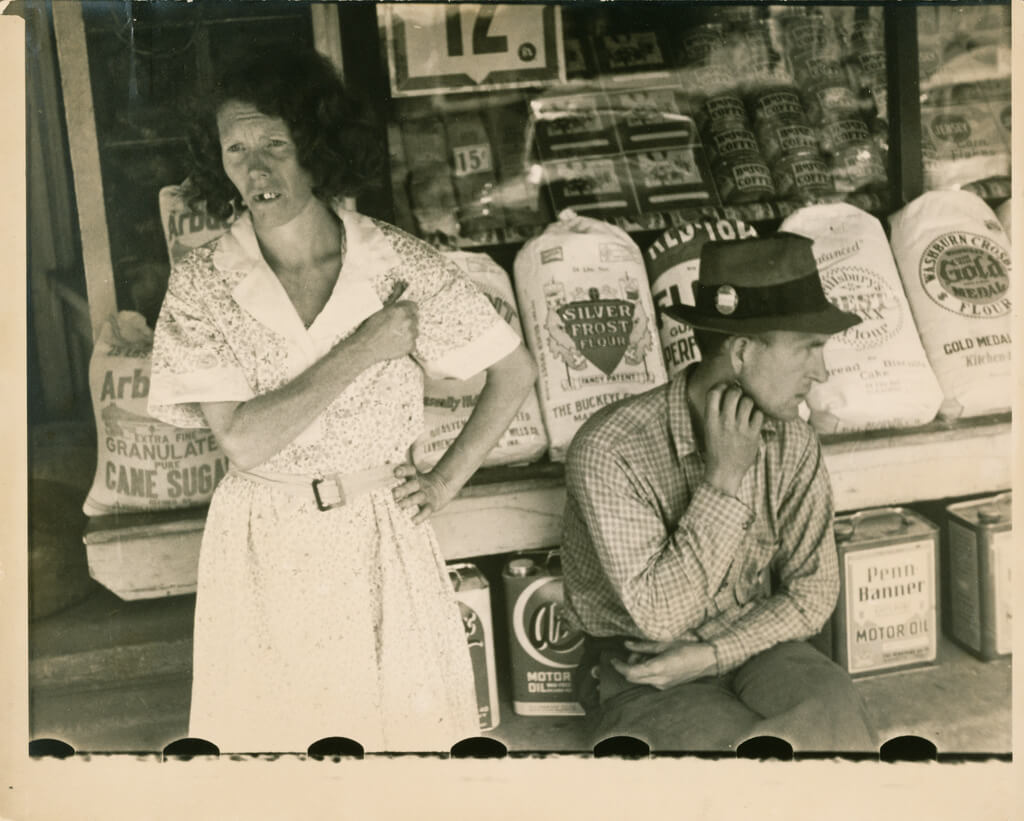
ANN: I was aware that I was resisting stereotype by the time I was writing in college. There are plenty of amazing Appalachian writers who work with complex representations of our region and who influenced me. Still, much writing about Appalachia over the past 150 years, especially writing that has gotten wide distribution, has been by outsiders, and a lot of that perpetuates the usual stereotypes. I've come to believe that the general reading public expects those stereotypes, so publishers expect them, too. But what I also understand are the political ramifications of stereotypes—they demean the people, make it easier to justify their exploitation, easier to see them as worthless. So I've always been very sensitive about complicating or overturning the usual caricatures and stereotypes.
JAMES: Could you name some of those writers, and say how their work appeals to you and what makes it unique?
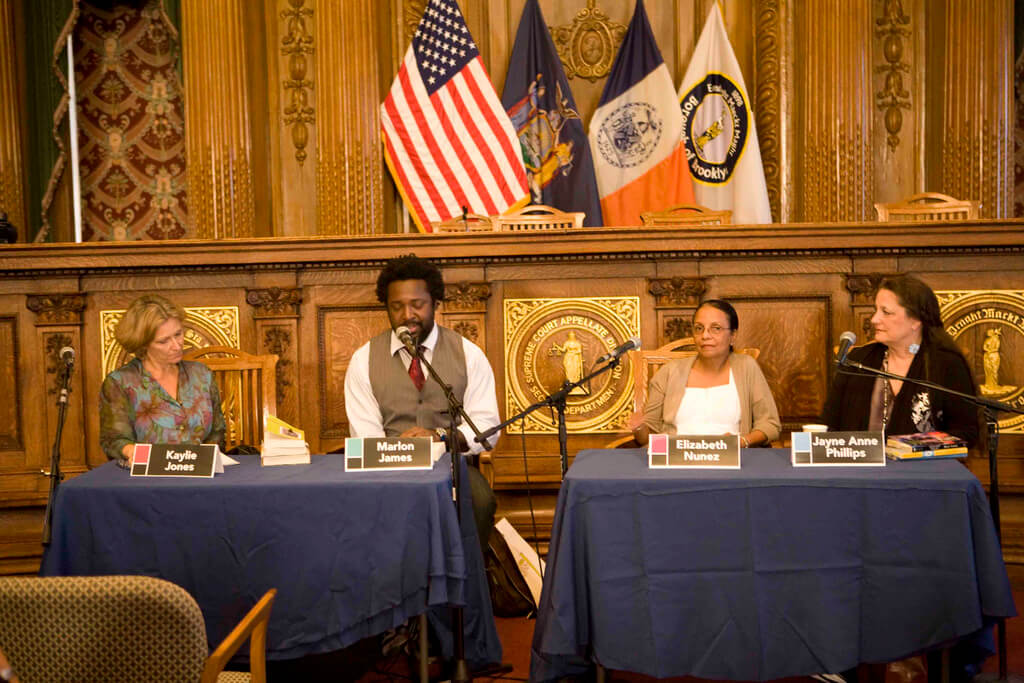
Jayne Anne Phillips (seated on far right) featured on a panel with (from left to right) Kaylie Jones, Marlon James, and Elizabeth Nunez at the Brooklyn Book Festival, Brooklyn, New York, September 12, 2010. Photograph by Flickr user Navdeep Dhillon. Creative Commons license CC BY 2.0.
ANN: Some writers from West Virginia who work with complex representations of the region and who influenced me as a younger writer include Breece Pancake, Jayne Anne Phillips, Denise Giardina, Davis Grubb, and Chuck Kinder.11Breece Pancake, The Stories of Breece D'J Pancake (Boston, MA: Little, Brown,1983). Jayne Anne Phillips, Black Tickets (New York: Dell Pub., 1979). Jayne Anne Phillips, Machine Dreams (New York: E.P. Dutton/Seymour Lawrence, 1984). Jayne Anne Phillips, Lark and Termite: A Novel (New York: Alfred A. Knopf, 2009). Denise Giardina, The Unquiet Earth: A Novel (New York: Norton, 1992). Denise Giardina, Storming Heaven: A Novel (New York: Ballantine Pub. Group, 1987). Davis Grubb, The Night of the Hunter (New York: Harper, 1953). Davis Grubb, The Voices Of Glory (New York: Scribner, 1962). Chuck Kinder, Snakehunter (New York: Knopf, 1973).All of these writers grew up in West Virginia. Each has a different vision of the place, but each vision presents our culture with a nuanced depth perception that complicates the one-note picture of Appalachia so often perpetuated by outsider writers. They offer characters struggling with internal contradictions; they provide context and history that help shed light on the state's darker elements; they carry a sense of place deep in their bodies; and they do amazing things with our language.
There are also West Virginia writers younger than I am who deserve far more recognition than they've received so far, writers who are writing better, in my opinion, than most of their peers outside the region: Jessie Van Eerden; Matthew Neil Null; Glenn Taylor. Only Glenn has received much notice from the wider literary establishment.12For recent work see Jessie Van Eerden, My Radio Radio (Morgantown, WV: Vandalia Press, 2016). Matthew Neill Null, Honey from the Lion (Wilmington, NC: Lookout Books, 2015). M. Glenn Taylor, A Hanging at Cinder Bottom (London Borough Press, 2015).
JAMES: The way you write about Appalachia is clearly very striking, but also something which can be co-opted into broader cultural/media narratives of Appalachian rural poverty that offer a simplistic and frequently unflattering image of Appalachian life—do you grapple with this as a writer, how aware of it are you, does it affect your craft or editing process?
ANN: I'm very aware of how easily one can lapse into stereotype when writing about Appalachia. Appalachian people in the world are confronted with stereotypes about themselves constantly, so we're sharply conscious of them. Still, in early drafts, I might fall into a stereotype because I haven't gotten to the stage of the work where I'm complicating things. So, to answer your question, when I'm writing about violence in Appalachia, I try to be careful to complicate the issue. I try to tell the truth, and I try to tell it with context and by offering different perspectives on the violence and by making the perpetrators and the victims full human beings as opposed to flat caricatures.
West Virginia is its own culture within Appalachian culture, and Appalachian culture, in turn, shares some qualities with US southern culture. If I'm around Southerners there is a feeling of familiarity and home, more so than if I'm around people from Pennsylvania, even though Pennsylvania is fifty miles from where I grew up. I've also been influenced as a writer primarily by writers from the South and from Appalachia.
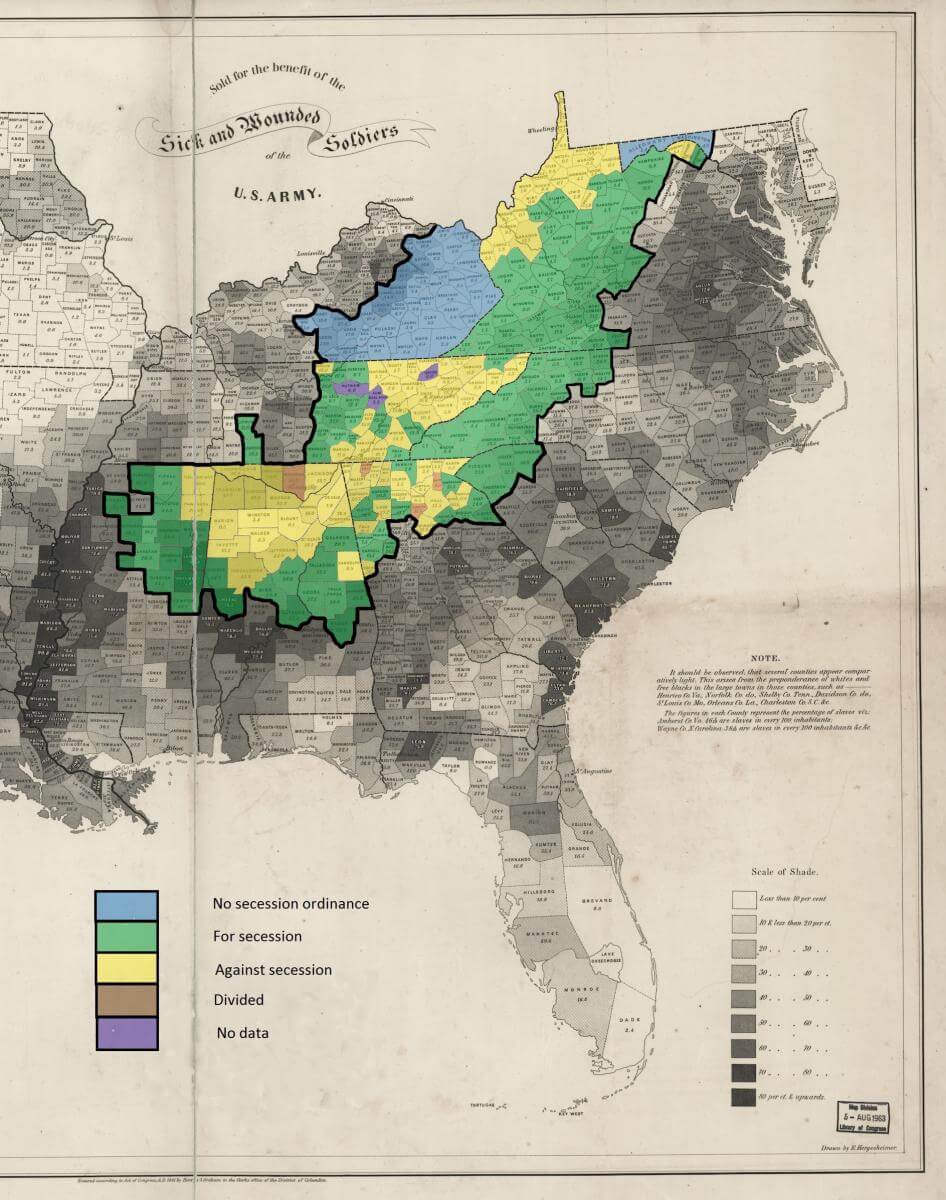
Map of county secession votes of 1860–1861 in Appalachia. Map drawn by E. Hergesheimer. Image courtesy of Wikimedia Commons. Creative Commons license CC BY-SA 4.0.
JAMES: I wanted to talk a little about your use of violence in your writing. One of the recurrent themes in your work is ghosts, especially in relation to the Confederacy and the Civil War. How does that historical violence, or its afterlife, translate into and overlap with physical or literal violence?
ANN: That's a good observation and a good question. I'm not sure how exactly to answer it. Appalachia does have a violent past: the violence of the Civil War and the "Indian" wars before that; the violence inflicted on the environment starting from the time of industrialization; the violence surrounding the labor movement in the early part of the twentieth century; the forms of violence the larger nation imposes on Appalachia in its appetite for Appalachian resources. Appalachian people are not more violent than other Americans, however, despite popular narratives to the contrary. In fact, before the drug epidemic, West Virginia consistently had the lowest violent crime rate in the nation. Still, I believe that all that violence in our past continues to manifest in our present.
The violence to the environment continues, and there is not the political will to stop it, and there is much violence suffered by Appalachia's people. Although often that's self-inflicted: addiction, overdose, suicide. I believe that self-inflicted violence is related to environmental destruction and economic exploitation. I recognize that my work contains a fair amount of literal violence. Some of that is just factual, reflecting the region's history. Some of the violence in my work, though, probably comes out of my love and hate for the region, my fears of and for the region, and my deep desires for the region. The violence may arise from all that conflicted unconscious material.
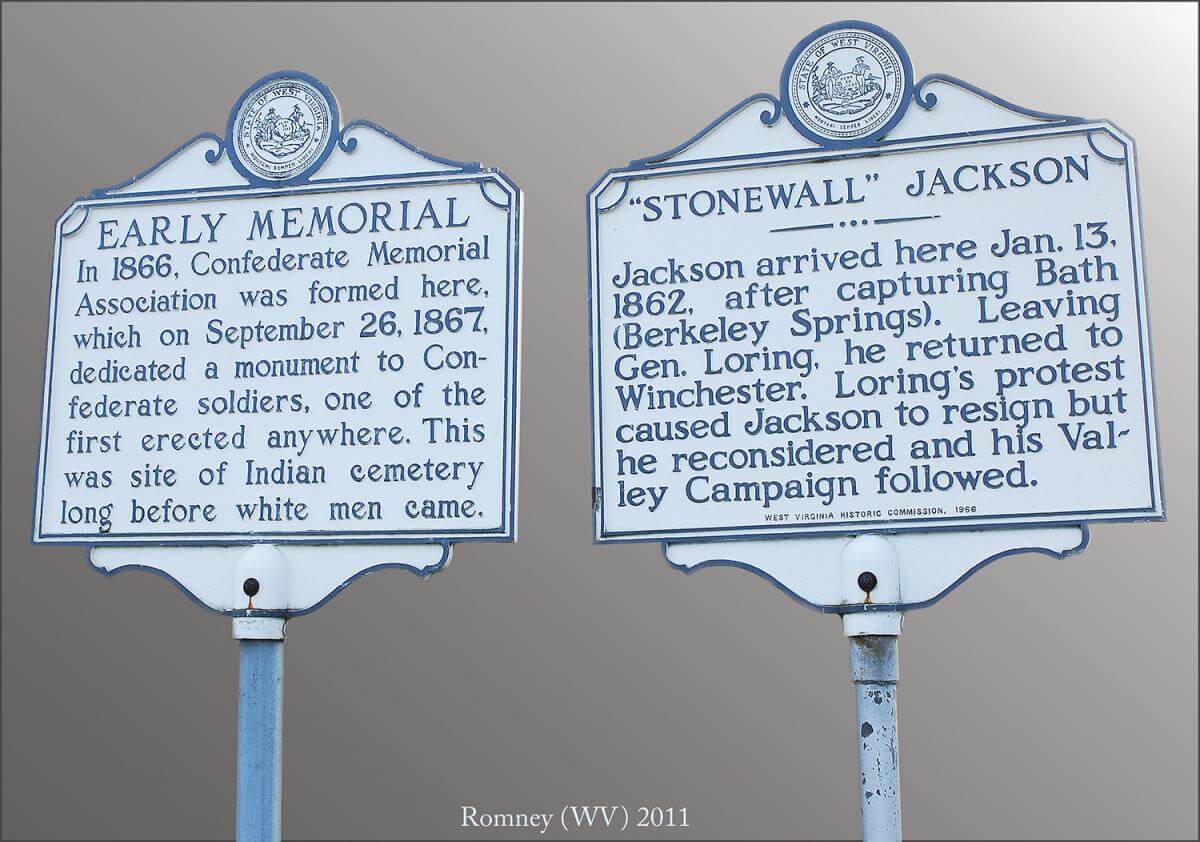
"Early Memorial" and "Stonewall Jackson," Interpretive Signage, Romney, West Virginia, November 13, 2011. Photograph by Flickr user Ron Cogswell. Creative Commons license CC BY 2.0.
JAMES: How much of that fear comes from a sense of displacement, or fracture? Earlier you talked about becoming aware of your identity as a West Virginian through interacting with people from surrounding states. You describe a sense of "we are this because we are not something else." How much of that can be traced back to the Civil War?
ANN: West Virginia's paradoxical place in the Civil War is one of the reasons I find West Virginia fascinating. The state separated from Virginia to be part of the Union in 1863, and popular belief is that we did this because we were against slavery. The truth about our secession is much more complicated and is tied also to the schemes of industrialists. There were certainly Union sympathizers in West Virginia and Union troops. My county, Hampshire, was very Confederate, though, with slave-owners, including my own family. Romney was right on the border, and Romney changed hands between the Union and the Confederacy fifty-four times during the war. I grew up playing in Civil War trenches a mile behind my house.13The trenches Pancake is describing are the Fort Mill Ridge Civil War Trenches, among the best preserved Civil War trenches in the nation. "Fort Mill Civil War Trenches", National Parks Service, http://www.nps.gov/nr/feature/places/13001121.htm.The remnants of the war were very present when I was growing up. And there are stories my family has passed down from the war—my family was Confederate identified, so their stories are about the Yankees coming in and raiding the farm.
JAMES: That feeds into another question I wanted to ask about the role of race in your work—I believe West Virginia is the third or fourth whitest state in the country.14According to the latest United States Census estimates, West Virginia is the fourth-whitest state in the Union.
ANN: West Virginia is very white, but there are and were African-Americans there. It's true, they don't often appear in my work, and I don't think I have any who are main characters. I believe this is the case because I don't want to misappropriate or misrepresent them. My personal relationship with race growing up taught me a lot. My county was very racist and still is, but my parents were much more liberal than most people there. My parents tried to bring us up with a "colorblind" philosophy: everyone is the same regardless of skin color, which also of course isn't true, but it was pretty enlightened for those times and that place. In junior high and high school I had an African-American boyfriend. I haven't talked about that or written about it much, I probably should. That certainly opened my eyes to racism, by the time I was fourteen, because of the kinds of insults I would receive and also because I started to see through my boyfriend's perspective. It also called into question my belief in Christianity. I started to reject the church at that time in large part because I saw very clearly its hypocrisy concerning race, at least where I lived.
JAMES: In your work you're very aware of trying to offer a representative account of West Virginian life. Are you more reluctant to write about African American experience?
ANN: Yeah, I'm much more comfortable writing about class. It's good that you bring that up, people don't usually ask me about it. The truth is, I do have experience with race in Appalachia. I need to ask myself why I don't write more about it.
JAMES: I want to read a short moment from your short story "Ghostless" which encapsulates one of the reasons I enjoy your writing so much:
The cold came high in my chest, but the wind had finally laid and from some distance I could feel the heat off the horse. The hide-odor off the horse, that soily smell he carried even in winter. I pushed my face into it, into the hollow behind the shoulder, before the belly swell . . . . I still had horse on my hands, and I smeared them across my Sunday pants, listening, the wood fire brightening my back.
That's gorgeous. The physicality of your writing, its tactile nature, your relationship to senses and sensory language. Where does that come from and how has it developed over time?
ANN: I write by sinking myself as deeply as I can into a place or a person, then imagining how the character's senses would respond to a situation, or imagining how I personally would react sensorily to a place. Certainly touch and smell in particular are powerful for me in the way they evoke memories. The way they are more animal. I also revise a whole lot, so as I do more drafting, more of that sensory detail comes in.
Me Up the Hollow, Romney, West Virginia, December 14, year unknown. Photograph by Ann Pancake. Courtesy of Ann Pancake.
JAMES: And growing up in West Virginia played an important role in developing that detail in your work?
ANN: Now that I've lived out of West Virginia I've come to understand that growing up in Appalachia usually means growing up closer to the ground than one might in other places. Growing up in Appalachia in the 70's was pretty raw. You were not sheltered in the ways the middle-class is sheltered in Seattle. We had a lot of tactile interaction with the natural world, plants and animals, we were raised working big gardens and running the woods, and we saw our food get killed and skinned out and butchered. We ate that. I think as little kids we were very directly in touch with our senses. We weren't inside, we weren't on computers. I could also identify how poor people were by how they smelled, because the really poor people didn't have plumbing, so couldn't wash like we could. I see this as a metaphor for how white poverty is sometimes invisible in this country.
JAMES: How do you keep that visceral relationship to West Virginia in your writing?
ANN: I try to get home at least twice a year, and the place is very deeply embedded in my memory and in my body, so it's present to some extent even when I'm not there. When I do return, I can settle back into the land pretty quickly. At the same time, the culture in West Virginia has changed since I was a kid. Also, at this point in my life and my career, I'd like to be writing more about places that aren't West Virginia. That'll happen some in my next book.
Presents, Pasts, and Futures
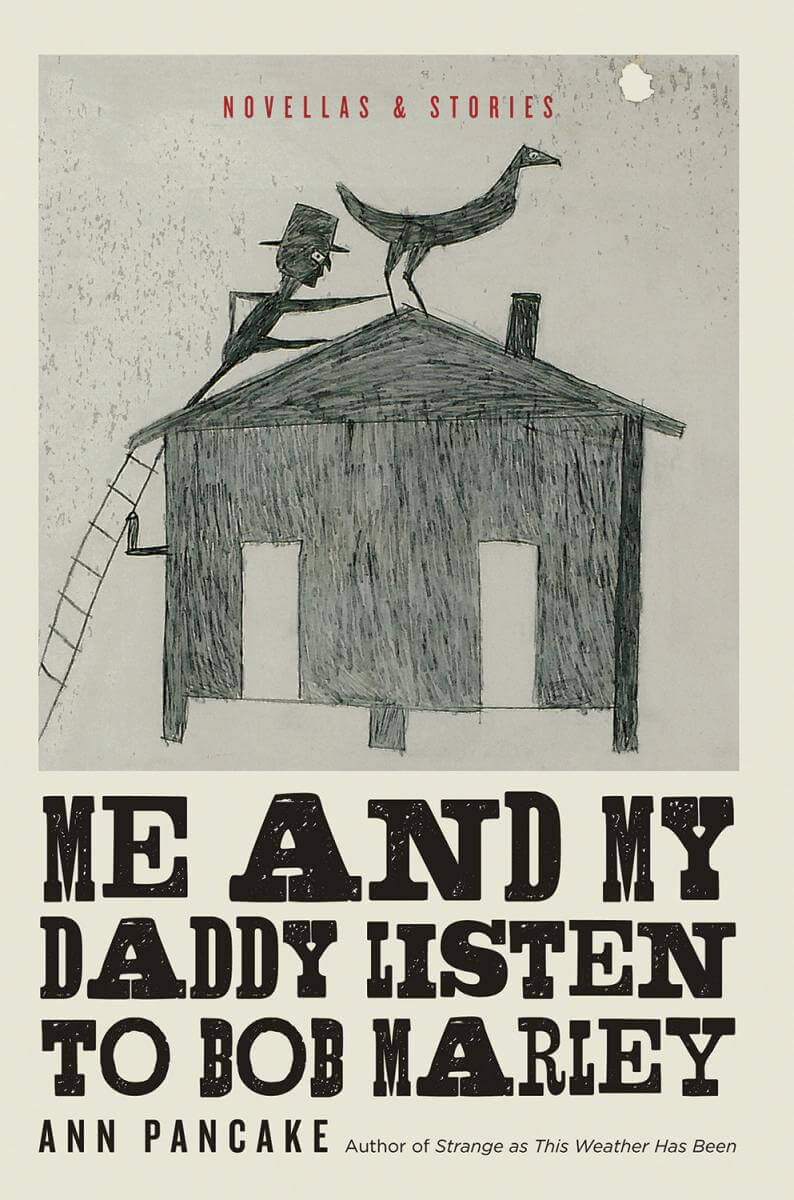
Cover of Ann Pancake's Me and My Daddy Listen to Bob Marley (Berkeley: Counterpoint Press/Shoemaker & Hoard, 2015). Cover design by Briar Levit.
JAMES: Your latest collection Me and My Daddy Listen to Bob Marley remains centered in West Virginia, but in a different way. There seems to be more scope for hope or forward momentum than in your earlier writing.
ANN: I'd agree with that, I think part of it is time of life. I'm at a point in my life where I just can't bear to be spending all that time in darkness like I could while writing Given Ground and some of my earlier work. I also think that, just in order to survive as an American in 2016, I've had to try to figure out ways to look towards light exactly because we are in such a dark time, from a certain perspective. I also think—I wrote about this in an essay for the Georgia Review—I'm finished with writing about how things are hurt in Appalachia.15Ann Pancake, "Towards Light," Georgia Review, 2009. I'm tired of documenting destruction. I'm committed to writing that imagines unconventional ways to relate to the natural, including the natural world in Appalachia. Some of the stories in Me and My Daddy Listen to Bob Marley such as "Sab" or "The Following" play with redefining relationship with the natural world.
JAMES: In the story that opens Me and My Daddy, "In Such Light," that progression definitely comes through. Trauma and hurt persist, but it holds more scope for maturation than many of your earlier stories.
ANN: I'd agree.
JAMES: Do you think that literary shift is connected to a broader recognition within the United States that the country needs to move away from a reliance on coal and seek less destructive and more sustainable forms of energy?
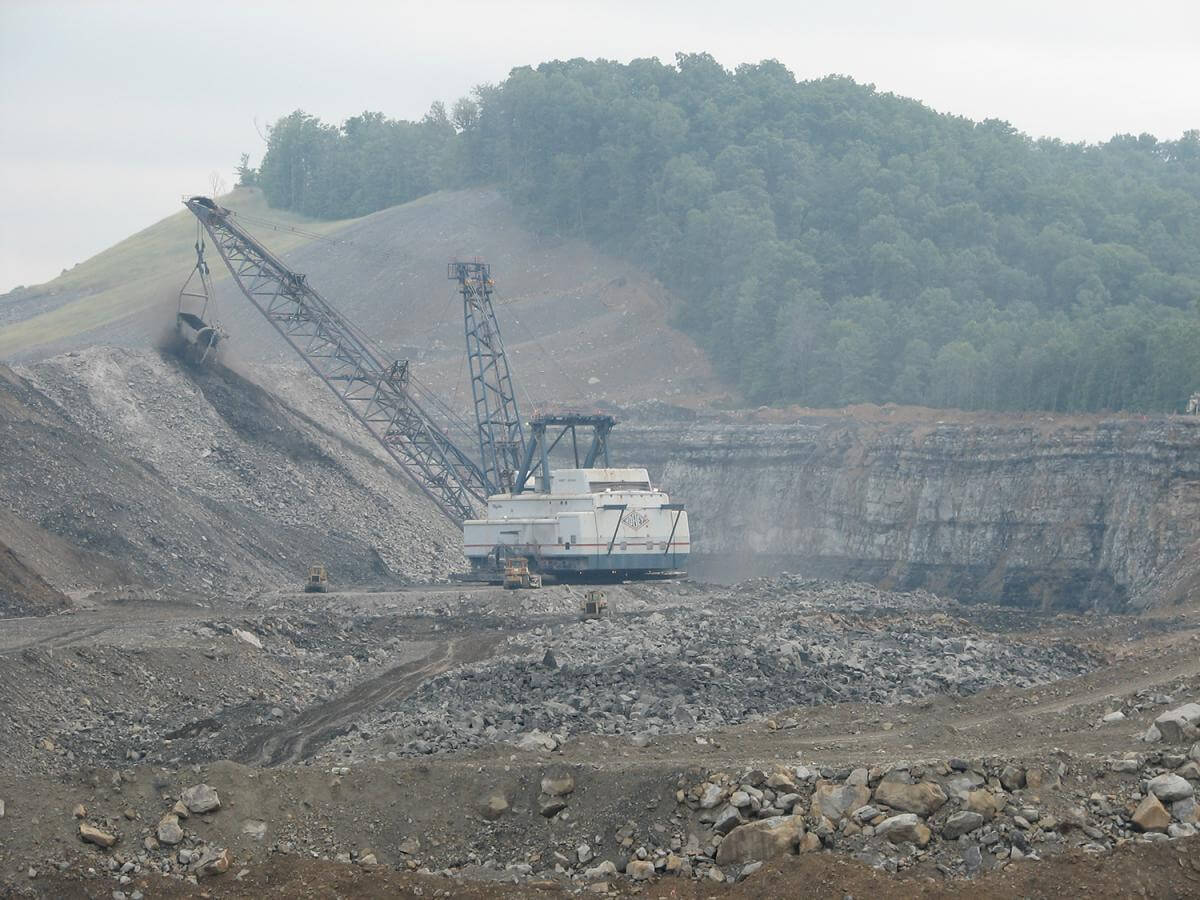
Dragline, West Virginia, ca. 2007. Photograph by Vivian Stockman. Courtesy of Ann Pancake.
ANN: I think my literary shift is connected to a recognition that we won't survive as a species unless we think very, very differently about live beings that aren't human in this world. As for the shift away from coal, it is true that in Appalachia less coal is being mined now, but that's in part because of the boom in natural gas. Areas of West Virginia that were untouched by coal mining are now being devastated by hydrofracking. However, I do think we're at the beginning of the end of coal. And I think there is a wider movement, particular among younger generations in West Virginia, which understands that our state must move beyond dependence on natural resource extraction if we are to survive as a culture and as a people. This gives me optimism.
JAMES: It's been almost fifteen years since the publication of your first short story collection. What do you think are the most notable differences between Me and My Daddy and Given Ground?
ANN: Given Ground was written almost entirely intuitively and without much consideration of an audience. I wrote that book mostly for myself, not because I'm a narcissist, but because I couldn't imagine that many people would want to read those stories. For those reasons, it's more music-driven, less concerned with plot, and less accessible than Me and My Daddy. Me and My Daddy I obviously wrote after finishing my novel, and the novel required that I learn how to work with plot and that I make my writing more accessible. I wanted an audience for Strange as this Weather Has Been. I think those influences and considerations bled over into my writing of Me and My Daddy. Teaching creative writing and writing a novel has made me more conscious of craft, has made me use a little more intellect when I write fiction. I'm not convinced, however, that that is a good thing.
JAMES: Why did you choose that particular title?
ANN: [Laughs] My publisher decided that. I had named the book "Bone Dowser" which was also the original name of the story in the collection now called "The Following." My publisher thought we'd sell more books with the title Me and My Daddy Listen to Bob Marley. I'm sure he's right.
JAMES: If that was a conversation which had happened fifteen years ago, do you think the outcome would have been the same?
ANN: [Laughs] would I have been as malleable do you mean? No I probably would have been more resistant. I've become less resistant, and I don't have as much investment in that kind of stuff anymore. That's a good question!
JAMES: Part of maturing is coming to terms with what exactly you are able to do through your work and through your activism, and being able to channel that in ways and into things which are productive.
ANN: Yeah, exactly.
Breakneck Scenic Overlook, Romney, West Virginia, July 29, 2014. Photograph by Justin Wilcox. Courtesy of Wikimedia Commons. Creative Commons license CC BY-SA 4.0. Pancake family land appears in the lower section of the photo.
JAMES: Do you ever feel like you're writing about a West Virginia that doesn't exist in the same way anymore?
ANN: In some ways West Virginia has changed significantly since I grew up there. One change that I mourn is the way the dialect and accent are being lost among younger people. Exposure to mass media is homogenizing our language. The place is also under greater environmental attack and is suffering a drug addiction epidemic. Those changes, though, I understand very well, because of my research and experiences and because of addiction problems in my family, so when I write about that West Virginia, I'm writing about one that still exists.
JAMES: You live in Seattle now, quite far removed from Appalachia. Is your relationship with the land different now, and if so in what ways?
Seattle Skyline view from Queen Anne Hill, Seattle, Washington, February 17, 2010. Photograph by Wikimedia Commons user Daniel Schwen. Creative Commons license CC BY-SA 4.0.
ANN: I'm not immersed in the land here like I was growing up in West Virginia. Also, the land here doesn't speak to me like back home does. It doesn't give me sounds and stories. Still, I love the mountains in Washington. But it feels more like a friend, while back home land feels like family -- and that includes the way family can be fraught. My relationship to the land back home is very painful because there is so much ongoing destruction of it. In Washington, there is certainly destruction, but because of the kind of economic and political will here, there are vast tracts of land that aren't going to be destroyed, at least not anytime soon, and I can escape into those. That helps to ameliorate the pain I feel about back home. But I won't ever be rooted in the land in Washington like I am rooted in Appalachia.
JAMES: What's the next step? You mentioned that moving forward you are looking to write about Appalachia, but in different ways, and then looking to write about other things as well.
ANN: I can't be really specific about the project I'm working on now because it's in its very early stages, but it's a book that explores the ways we can have different relationships with the natural world and with things that aren't human. It's nonfiction. So there's that strand of it, which runs simultaneously with the ways I see Appalachia as a microcosm of what's happening globally in terms of the environment and as a harbinger of where we're headed without a revolution in our common sense. Finally, there' s a thread about my family, whom I see as a kind of microcosm of Appalachia, in the ways my family's addiction, fear, economic exigencies, and mental illness have caused the destruction of land I love where I grew up.
The book is part memoir, part imagining forward. It asks how we might live well in a time of mass extinction. A modest thesis, I know. I'm obsessed with the question because I've witnessed all my life a place I love be destroyed. Appalachia has always been called backwards, but in the last couple of decades, the rest of the country caught up with Appalachia and recognized the natural environment everywhere is being devastated.
Appalachia Forest Action Project volunteers learning about the land, Rock Creek, West Virginia, May 21, 1994. Photograph by Mary Hufford. Image courtesy of the Library of Congress American Folklife Center.
Most recently, the land where I grew up, in Romney, has been destroyed by the parts of my family who are entangled in my brother's drug addiction. I see this family dynamic and tragedy as a microcosm of larger destructive forces in Appalachia. I see Appalachia, in turn, as a microcosm of larger destructive forces in the United States, especially capitalist corporate forces. So in this new book, I plumb that question—"how do we live well while natural places and beings are being annihilated at an unprecedented rate?"—by tracing my own personal history of loss as a West Virginian.
Part of my answer to the question involves radically reconceiving our relationships with natural beings. To do that, we need to become intellectually flexible enough to see rationalism and mechanistic science as just one way of knowing among several, with no one way superior to the other, and each with its own purpose. In other words, I'm suggesting we give more validity to intuition, the unconscious mind, the imagination, and ideas of the sacred.
About the Interviewer
E. James West is a teaching fellow in the Department of History at the University of Birmingham and a postdoctoral fellow at the Eccles Centre for American Studies at the British Library. His research centers upon on African American history and literature since 1865, with a particular interest in African American media and print culture.
]]>Introduction
Thomas Mullen is the author of four novels, including The Last Town On Earth (2006), which received the James Fenimore Cooper Prize and was recognized by USA Today as the best debut novel of the year. Mullen's books are notable for the range and variety of their historical settings and influences. Last Town on Earth is set in a mill town in the Pacific Northwest during the 1918 flu epidemic. The Many Deaths of the Firefly Brothers (2010) is a Depression-era story following two brothers who gain notoriety due to their bank-robbing exploits. Even his novel The Revisionists (2011), although set in a dystopian future, examines historical agency.
Mullen's newest book, Darktown (2016), is set in the racially polarized, crime-ridden underworld of Atlanta in 1948. The city is on the cusp of a civil rights movement that will transform it politically, socially, and spatially. By following the travails of two African American policemen who were among the first men to desegregate the Atlanta police force, Mullen's novel offers an original perspective on the city's history.
Mullen, a resident of Decatur, Georgia for nearly a decade, came upon this episode in Atlanta's history while researching a magazine article. In this exclusive Southern Spaces interview, he speaks with Joseph Crespino about the sources that informed his fiction, the history that underlies Darktown, and the uses of history and fiction in understanding place and time.
Interview
About the Interviewer
Joseph Crespino is Jimmy Carter Professor of American History at Emory University, specializing in southern history since Reconstruction. He is the author of Strom Thurmond's America (New York: Hill & Wang, 2012) and In Search of Another Country: Mississippi and the Conservative Counterrevolution (Princeton, NJ: Princeton UP, 2007) and co-editor, with Matthew Lassiter, of The Myth of Southern Exceptionalism (Oxford: Oxford University Press, 2010).
]]>
1926 Pharus Map of Berlin, Andrew Battista’s "Spatial Humanities and Modes of Resistance: a Review of Hypercities," September 15, 2015. Screenshot courtesy of Southern Spaces.
Beginnings
How did you become involved with Southern Spaces?
Halbert: I was involved in the inception of Southern Spaces and can shed some light on the endeavors that led to the creation of this marvelous and innovative new vehicle for scholarly communication. A fascinating and unpredictable journey through accidents and sagacity took us to what we needed.
During the early 2000s, I was Director for Digital Programs and Systems at Emory University Libraries while also pursuing my interdisciplinary PhD in Emory's Graduate Institute of the Liberal Arts (ILA). Following my experience and training as a librarian and a technologist (at IBM and Rice University), I wanted to explore what the internet could mean for humanistic inquiry. How could the library and the systems department work more closely with scholars? The story of Southern Spaces began with an initiative seemingly unrelated to creating a journal, but without the initial support for graduate students, faculty travel, and technical assistance, Southern Spaces would not have happened. In retrospect it's very surprising, if not a small miracle, that the support became available for this work at all.
In 2001 the Andrew W. Mellon Foundation funded a series of projects on "metadata harvesting."1Martin Halbert, ed., Workshop on Applications of Metadata Harvesting in Scholarly Portals, MetaScholar Initiative, October 24, 2003, Emory University General Libraries. https://www.researchgate.net/publication/277283794_Workshop_on_Applications_of_Metadata_Harvesting_in_Scholarly_Portals_Findings_from_the_MetaScholar. I was the principal investigator for two of these (the MetaArchive and AmericanSouth), which brought in some six hundred thousand dollars to the Emory Libraries. These grants inaugurated a new era of work for digital library activities at Emory which, I am gratified to say, have greatly expanded.
Without delving too deeply into these two projects, I'll share a few salient points. According to Mellon program officer Don Waters, the general idea of the initiative was to "explore the requirements for developing scholarly-oriented portal services based on the use of a variety of internet technologies, including the new Metadata Harvesting Protocol." 2Donald J. Waters, "The Metadata Harvesting Initiative of the Mellon Foundation," ARL: A Bimonthly Report, no. 217 (August 2001): 10–11. arl.org/storage/documents/publications/arl-br-217.pdf.
While other institutions in this initiative devoted their project work to narrowly defined technical development of software systems designed to use the metadata harvesting telecommunications protocol, I thought that these grant-funded projects should not build technical systems in isolation, but should explore digital innovations through collaborative relationships between the library and scholars. I sought to make MetaArchive and AmericanSouth such a broadly conceived program. I talked with interdisciplinary faculty and, whenever possible, hired bright project personnel who were themselves scholars.
I was interested in how media innovations affect the way we think about scholarly communication—in my doctoral research I studied media history scholars such as Walter Ong, Eric Havelock, and Harold Innis. I labeled this combination of projects the MetaScholar Initiative, and tried to get everyone involved to think both broadly and reflectively about the opportunities that new digital technologies offered. I was very fortunate in meeting people like Allen Tullos (who became my close collaborator and dissertation advisor), Katherine Skinner (my ally in many subsequent endeavors) and a number of ILA graduate students.

Skinner: I was part of the picture when SouthernSpaces.org germinated, gelled, and launched. I worked as its founding managing editor from 2003–2007, and I supervised subsequent managing editors until 2009, when I transitioned into my current role on the journal's editorial board.
Allen Tullos, Charles Regan Wilson, Will Thomas, Lucinda MacKethan, and Carole Merritt made up the scholarly design team for the AmericanSouth project that was led by Martin and on which I served as project manager. We were studying how to unite materials from disparate archives around a specific topical area—the study of the US South—using the internet and the bridging device protocol OAI-PMH (Open Archives Initiative-Protocol for Metadata Harvesting).
As we worked together on this project, Allen (who was also my dissertation director) suggested that primary source materials could be complemented by the creation of an online vehicle for scholarship. From our first conversations about founding a site for scholarly publication, Allen, Martin, and I agreed that we needed to demonstrate how the online environment could not only disseminate text-based digital scholarship, but could create and express new forms. We wanted to advance scholarship that used digital media as essential components.
We also wanted to differentiate the purpose of this new publication from "Southern Studies" in general, which considered "the South" as a monolithic historical and cultural entity. We wanted to examine the plurality of "souths" that existed and overlapped. We prioritized peer-reviewed scholarship that relied on multimedia elements, not just as reference points of cited works supporting an argument, but as part of the scholarship itself.3Charles Reagan Wilson, "A Scholar's Perspective on AmericanSouth.Org," in Halbert, ed., Workshop on Applications of Metadata Harvesting in Scholarly Portals.
Tullos: In terms of editorial perspective, Southern Spaces emerged from spatial theory (Henri Lefebvre), critical regional studies (David Harvey, Doreen Massey, Dolores Hayden), social justice theory (Iris Marion Young), cultural studies (Raymond Williams), and documentary practice. As Katherine Skinner mentions, one of our intentions was to critique broad, mystifying conceptions of the South—"Southern" imaginaries. Who needs or shapes a South and why? Why do simplistic and oppressive meanings of the South manage to live on into the twenty-first century? In such a South, it's always the day after yesterday. What can we gain by understanding the South not as a region, but as a geography of many changing regions and places?
We developed and solicited content about these southern regions (old, recent, and emerging), and about real and imagined places. We sought analysis that made conections from these locales to the wider world. And we aimed for an audience of scholars and teachers, students in and out of classrooms, writers and media producers, and the general public.
We wanted to distinguish Southern Spaces from strictly disciplinary publications and from just-the-facts online projects such as Wikipedia—invaluable though these are. As I assumed the role of senior editor, the scholarly design team transformed into a very active editorial board with the addition of Barbara Ellen Smith, Tom Rankin, Natasha Trethewey, and Earl Lewis—each contributing distinctive perspectives and talents.4See "About," at http://southernchanges.digitalscholarship.emory.edu/. Early on, we featured essays offering interpretations of regions such as the Mississippi Delta, Black Belt, Carolina Piedmont, South Louisiana, metro Atlanta, and the Valley of Virginia. As a field project, we began the "Poets in Place" series (supported by an award from the Emory provost's office) collaborating with Natasha Trethewey to identify and video-record poets reading and commenting on their poems in the places they write about.
Southern Spaces built upon and extended a network of writers and scholars developed from my experiences as editor (1982–2003) of the print journal Southern Changes and from contacts suggested by our editorial board. We set up rights and permissions so that copyright of articles, images, videos, etc., remained with content creators. We depended on the networked infrastructure offered by the Emory Libraries (thanks to Martin and to library director Linda Matthews), and learned about organizing and describing materials from the library's subject area and metadata specialists. We decided, early on, that Southern Spaces would become a site for training graduate students in digital publishing. And that, where possible, we would collaborate with small non-profit organizations engaged in regional research and education that might not have access to their own publishing platforms.
Toton: I came to Emory in the fall of 2003 as a graduate student in American Studies from the University of Iowa. As a research assistant for Prof. Tullos I first transcribed OCR text into XML for the digital archiving of the journal Southern Changes. In January 2004 I began with Southern Spaces where I advanced from editorial associate to photo and media editor, then assistant managing editor, and finally managing editor before becoming a digital strategist at Emory Libraries in 2009. I left Emory to work as a technical product manager in digital media for Turner Broadcasting in 2010.
Abbott: I started working on Southern Spaces as a research assistant for Dr. Tullos during the 2006–2007 school year. I was an editorial associate in the summer of 2007, assistant managing editor from fall 2007 until August 2009, and managing editor from September 2009 until August 2011.
Battle: I began working as a graduate assistant for Southern Spaces in fall 2007, became a part-time, student employee in the summer of 2008, and served as an editorial associate and series editor until December 2010, when I moved to Charleston, South Carolina, to finish researching and writing my dissertation.
Rawson: I came to Emory to continue studying culture in the US South, and I had a background in editing literary journals and producing video, so I knew I wanted to be part of Southern Spaces. I initially tried to volunteer my time; however, the journal has an admirable policy of not having students work for free. Luckily, it didn't take long for then-managing-editor Sarah Toton to find the needed funding to add another position. I joined Southern Spaces as an editorial associate in the summer of 2008. From 2011 to 2013, I was the managing editor.
Melton: When I applied to Emory after my master's program in American Studies at the University of Alabama, I knew that I wanted to work on Southern Spaces. As part of my first-year graduate training for the ILA in 2009, I began as an editorial associate. I continued working on the journal for the next few years, becoming a series editor and assistant managing editor. In 2014, I transitioned into a full-time position at the Emory Center for Digital Scholarship (ECDS) where I continued to support the journal and other projects as a digital publishing strategist.
Karlsberg: I joined Southern Spaces in January 2011 as an editorial associate while serving as Allen Tullos's research assistant. I worked as assistant managing editor from 2012–2013 before becoming managing editor. Two years later I transitioned to a new role as consulting editor in which I help with strategy and technology concerns. I was especially involved in the migration of the journal from its Drupal 6 platform to Drupal 7 in 2015.
Doster: I came on staff in January 2013, transitioning to assistant managing editor in spring 2014. In August 2015, I stepped into the managing editor position, just in time to shepherd the final stages of the journal's migration to Drupal 7 to completion. My main emphasis as managing editor was the sustainability of journal staffing and training with lofty goals of coordinating and implementing a five-year strategic plan.
What was Southern Spaces like when you began working with it? How did it change with your participation?
Halbert: Of course, there was no journal when we started these projects and that wasn't what we thought we were creating. We began with concepts of "annotation," as in annotating archival records and web information discovered in a search and retrieval system. We set out to build "portals." Nowadays you would simply say we were creating websites. And, we built an array of them that did many things. But from discussions with scholars about what would be useful to them, one point kept emerging. While the basic assumption of the projects was that we needed to create systems for researchers to discover existing scholarly information, what scholars really wanted was a means of publishing new work. Everyone had been drowning in information for a long time. We didn't need to drink from a bigger fire hose. What people wanted was a way to make sense of information. Although I was obligated to finish the metadata portal work we had proposed, it was clearly Southern Spaces that became the single most compelling outcome of the projects.
It is always a surprise when you embark on a journey of discovery seeking one thing, and instead come upon something completely different. I thought this was a wonderful and wholly delightful outcome. While Southern Spaces now counts its start as 2004, we were debating the first questions associated with the idea of web-based scholarly publications as early as the 2002 meetings I convened at Emory. We discussed and planned the journal through 2003. Mellon continued to fund the metadata harvesting work with subsequent awards, but Southern Spaces grew in relative importance until it was the project.
Skinner: There was no "journal" in the beginning and we contested and debated the use of that term internally. We wanted relevance that stretched beyond the readers of traditional scholarly publications. Atlanta-based Mindpower Inc., where I'd worked prior to graduate school, produced the earliest design for Southern Spaces: sage green and orange, with a compass in the logo. We produced the site in Dreamweaver—which was a great way for non-coders to build. As the primary "keeper of the code," I produced the initial Southern Spaces publications by hand, using the coding view in Dreamweaver. I tried to code it all in xhtml. As we brought on additional students to help—Sarah Toton, Steve Bransford, Paul O'Grady, Jere Alexander, and Zeb Baker—we refined our methods. We hoped to provide a model that others could adapt.
Tullos: During our first year we were able to model most of content types that came to characterize the journal going forward: text essays that included hyperlinks, images, and maps; videos of poets in place; multi-media surveys of musical genres; media-illustrated lectures and edited conference presentations; interpretive overviews of regions and literary genres.
Not only did we create an excellent and active editorial board, we began to build a network of editorial reviewers to carry out scholarly evaluations of submissions. This network has grown over the years to include many peer reviewers in the US and beyond. Much of the labor that goes into Southern Spaces comes from these unpaid critical scholars, photographers, videographers, and writers—our editorial reviewers.

Southern Spaces scroll bar, 2005. Designed by Sarah Toton. Screenshot courtesy of Southern Spaces.
Toton: At the beginning, Southern Spaces operated with stand-alone, static pages using Dreamweaver. Media was stored in wmv and mov files and to implement Google Analytics, we added the Google snippet to the JavaScript on every page. I programmed all the first SWFs (small web format) for the journal's top scroll until 2006 when Franky Abbott took over this task. We formatted all articles using html and made the journal a composite of handcrafted digital objects. Media was always a bit of a challenge, as was walking content through internal review, peer review, and copyright review. We worked with Lisa Macklin, the first director of Emory's scholarly communications office, to create release-permission forms for writers and content creators and to address questions of copyright and intellectual property.
Battle: The look and feel of Southern Spaces changed significantly during my time working on it, particularly when we shifted from Dreamweaver to Drupal 6 in 2010. While planning for that migration, the staff conducted an audience survey that provided insights into changing the site's appearance to become more user-friendly. We created more accessible menu options for navigating the growing content. With the increasing number of multimedia articles and features, we standardized the organization of pieces to enhance accessibility. We shifted from pieces with numerous pages to scroll-down navigation. These changes began with Sarah Toton, before Franky Abbott oversaw the implementation of the redesign by the Southern Spaces staff. It was a giant endeavor that involved extensive discussions, and was carried out with assistance from a Georgia Tech web designer. As someone new to digital humanities, being involved in that process helped me learn a great deal about how to build web-based projects.
2010 Southern Spaces after migration to Drupal, July 28, 2011. Screenshot courtesy of Southern Spaces.
Abbott: When I started working on Southern Spaces in the fall of 2006, it was in transition. During my tenure, I like to think I helped clarify the journal's online identity to its readership and build systems that remain part of the way Southern Spaces operates: setting goals for monthly publication rate, inaugurating topical series, measuring traffic and considering users and use with Google Analytics, tracking workflow with the first project management system, as well as formalizing training for new students in copyediting, research, and review best practices.
Rawson: I began when the journal used an orange color scheme and was hand-coded with Dreamweaver. Our audio and video media was encoded in three different formats for three different media players. Articles had multiple pages.
Melton: Our shift to Drupal allowed streamlined editing and reviewing. In 2015, with the assistance of Sevaa (an Atlanta-based technical group) we migrated to Drupal 7, which updated the look and feel of the site, as well as added much backend functionality.
We also added and reorganized quite a bit of content. When I began, we had no separate category for reviews, which are now important to the journal. We also added an active blog, that allows us to highlight our new publications and makes the journal and its processes more transparent.
Karlsberg: When I joined Southern Spaces in early 2011, it had recently migrated to the Drupal 6 platform. The site's aesthetics felt contemporary and fresh, and new articles read well and were easy to navigate. One major change from the earlier design was a transition from publishing articles on multiple pages to just a single scrolling page. This transition made sense as page load times improved and users became increasingly accustomed to reading online. However, the new design was an awkward fit with a number of older articles and essays which used novel, beautifully conceived navigation schemes, but were often hard to adapt to the new site's design. As we continued to work with Drupal 6, we transitioned from then-archaic downloadable streaming media players in Real, Quicktime, and Windows Media formats to an embedded JW Player that could accommodate audio and video as well as playlists. These changes increased the range of publication types and media Southern Spaces could accommodate.
Southern Spaces homepage tablet display, 2016. Screenshot courtesy of Southern Spaces.
As monitors grew and pixels shrank and the web's dominant aesthetic shifted from a three-dimensional emulation of real life to a flatter and more minimal aesthetic, our site began to look dated. Conceived with desktop or laptop computers in mind, it was not as easily read on smartphones and tablets. Analytics showed that our readers increasingly accessed our content on handheld devices, part of a larger trend. These concerns informed a redesign we initiated in 2014 that culminated in the August 2015 soft-launch of the Drupal 7 site. The new site featured larger text and a cleaner aesthetic that minimized visual clutter and emphasized content and essential navigation. It was more responsive on mobile devices and tablets and better enabled larger media. As with our previous redesign, fitting old pieces to the new site was a challenge that sometimes required revisiting layout and navigation.
Doster: In my first few semesters at Southern Spaces, we published in Drupal 6 and were beginning conversations about the redesign. New to both Mac operating systems and coding of all kinds, my first months required a steep learning curve. I had finally mastered our older operating systems when we migrated to Drupal 7.
Software, Platforms, and Technology
What were some of the technical challenges of the journal? What software platform(s) did you use? What systems did you develop and implement? How did these technologies impact Southern Spaces's rendering of scholarship?
Halbert: At first, the notion of focusing software development on the journal part of the projects (namely Southern Spaces) did not occupy our thinking much. All the software development went towards the metadata harvesting brouhaha. What we talked about regarding Southern Spaces were (to me more interesting) questions of innovative scholarship: What should the forms, conventions, and citation standards of an "online" journal be? Remember, this was more than a decade ago. You had to do an inspired job of tap-dancing, wheedling, and convincing most humanities faculty that the two words "online" and "journal" could be used in the same sentence. Technical challenges? Software development? Hell, we just wrote up Southern Spaces's initial content in HTML (Ur-language of the internet). And after having done my share of chasing imagined perfect software solutions, I'm convinced that the technology used for publication is far less important than ensuring scholarly standards.

Having said that, Southern Spaces evolved in technical sophistication tremendously and quickly. We realized that the technical infrastructure of an online journal could not be left in basic HTML. There were a number of iterations of the underlying software as we explored the needs and functions involved in content management. I left Emory well before the move to the Drupal platform; I celebrate and salute the Southern Spaces team for their achievement in implementing this sophisticated and robust new software infrastructure. But I also can't help interjecting a longer-term observation that this moment is always a circle-of-life point. What happens when the day comes for extracting all the content out of Drupal? I can virtually guarantee that a new generation of Southern Spaces editors will be scratching (pounding?) their heads over that challenge.
Skinner: A better question would be what technical challenges did we NOT experience . . . wow. Hand-coding a site was one piece of the puzzle—always complicated and prone to problems. But we also had other challenges—video capture (Martin broke a long-standing rule in the Emory Libraries against purchasing Macs so that we could have our first video editing station), storage, back up, preservation, metadata. Paul O'Grady will remember the weeks we spent working with Emory metadata librarian Laura Akerman. Everything was a blank slate. Everything required decisions.
At launch, we used two platforms—one for the journal itself, and another for the editorial process. Open Journal Software (OJS) was being used by another start-up journal at our sister campus in Oxford at the time. We hoped that OJS would help to streamline and manage all of the editorial functions—submission, responding to authors, circulating a piece for blind peer review, synthesizing the reviews, communicating back to the author the status of a piece, etc. It didn't. It was easier for our editorial board to use email. That meant that tracking was also done by hand, both by Allen as senior editor, and by me as managing editor.
As technologies changed, we struggled to adapt. The challenge—always—was almost non-existent funding and staffing. We were a lean enterprise, and heavily relied on the skill sets of graduate students and the work of widely-scattered scholars. That said, I think one of the reasons we're celebrating our years of publishing incredible scholarship is that we operated on sustainable funding and energy.
Tullos: With Dreamweaver, each digital article became a handmade object. But because the journal was innovative and collaborative, our student editorial staff found the layout and design work interesting and artful even as it was tedious and painstaking. My training in ethnographic fieldwork and videography led Southern Spaces, early on, to publish stand-alone video pieces as well as to embed video and audio as necessary complements to written narrative and interpretation. We received a timely grant from the Lewis Beck Foundation to purchase a digital video camera, microphone kit, and editing suite. This helped us launch our Poets in Place series in mid-2004. As a public-facing publication, we sought to balance the quality of media streaming with the low-tech media players that many people used to access the journal. Here we received help from Jim Kruse who maintained Emory library's streaming service. Also, realizing that most of the scholars we were soliciting material from did not have digital production expertise, we felt it was part of our job to provide assistance in gathering, editing, and displaying media in their articles. And we were "long form" before that became a conventional term. One of our most important multimedia essays, Daniel A. Pollock's "The Battle of Atlanta: History and Remembrance" features the long form and an accompanying web app for cell phones that offers a guided tour of this critical Civil War battle. With the move to Drupal 7 came responsive design for mobile device accessibility and our increased use of social media to entice visitors to Southern Spaces.
Battle: Dreamweaver was time consuming and difficult to learn for a person only moderately tech savvy like myself. For example, after we pasted in text for an article from a Word Document, we then had to go through and add code for breaks, italics, bold lettering, em-dashes, links, anchors, and so on. We also had to find and change all apostrophes or quotation marks in the text, because they always pasted in as the wrong font. All of them. This could actually be a weirdly satisfying task after a long day of classes—like a mindless video game to chase the ugly punctuation marks—but it took time. There was also no spellcheck. Inserting images involved lots of fussing with their size and appearance in Photoshop, and figuring out the places to wrap text around the images. With a small staff, we relied on each other heavily for checking all these "fixes." Together, we tackled the endless technical difficulties that seemed to arise in layout and in converting and uploading videos.
After the move from Dreamweaver to Drupal in 2010, layout became much quicker and there were fewer possibilities for errors. This made a difference in the scholarship and impact of Southern Spaces. We could produce more pieces at shorter intervals. This enhanced the overall activity on the site, and our user audiences grew significantly, which led to more scholarly attention and submissions. On the back end, Drupal was easier to learn than Dreamweaver, so our staff could grow to include graduate students with minimal digital expertise who worked for both long and short periods (in the past, the longer learning curve often meant that a staff member had to work on the site for a while to acquire the technical skills).
Toton: Writing a parser to convert content to Drupal was challenging. The hand-coding was something we'd grown used to and losing that was really hard. My biggest fear wasn't the technical side, but that we'd lose funding or that students wouldn't want to work on the journal. I believed in it and wanted to ensure it moved forward. Southern Spaces could have been run on a WordPress site in terms of technical publishing and delivery requirements, but the quality of the content would have suffered. The majority of time was spent on vetting content, conducting internal reviews, researching primary materials, emailing writers and archives, finding supportive media, researching historical information, gaining copyrights, and formatting the text for an online, born-digital piece.
Abbott: I became managing editor of Southern Spaces amid the 2010 redesign from static html to Drupal. This was challenging for a group of students with no experience of holistic web project design, and limited time and funding. We did the very best that we could though! The migration of individual pieces, which had often been constructed in unique ways, provided a huge quality control challenge and required resilience and creativity. Mary Battle, Katie Rawson, Sarah Melton, Caddie Putnam Rankin, and I put a lot of heart and soul into moving Southern Spaces to a new site. I also helped squeeze the first draft of a peer review dashboard out of our part-time developer on his way out the door so that we could have a more consistent process and better archiving for pieces under review. I also led the transition from the three-format encoding model for media files to a single format with the embedded JW Player.
Rawson: When I began, video encoding was often a struggle. We wanted media to work at low bandwidth for accessibility to the widest group of users, but we also wanted clarity and smooth motion. We had to find media player settings that would work for the greatest number of users. Then there was the variation in original materials. Producers submitted many forms, sizes, playback rates, etc. I cut my technical teeth on making video function well. Around 2011, I worked with Jesse Karlsberg and Alan Pike to improve the system by having one embedded streaming player.
The 2010 redesign had a steep learning curve—it was terrible and ultimately amazing. With Dreamweaver, I had filled legal pads with specifications. The redesign built many of those specifications into Drupal, along with easier systems for laying out images and text and adding footnotes.
Melton: Migrating to Drupal 6, a content management system with databases and added functionality, was a challenge. We spent some time thinking about sustainability processes, consistent file naming conventions, and how to wrangle all our pieces into an organizational schema. Much of the work of running a journal is invisible, particularly on the technical end. We periodically update file types to keep up with web standards for usability and accessibility.
Karlsberg: One continuing technological challenge has been a multimedia player that looks good and is easy for readers and staff to use. In 2012 we adopted JW Player, a customizable streaming audio and video player, but running it meant serving video from an in-house server and purchasing regular updates. We decided to migrate to Vimeo, a cloud hosted service with a fair use policy that aligns with our own, an easy-to-use back end, and a widely trafficked site. While Vimeo can accommodate streaming audio if paired with still images, it's a challenge. Multimedia is a core commitment for the journal, but one for which there's no ideal single tool.
Another challenge is maintaining and updating our Drupal platform. With development of Drupal 8 underway but far from complete, and a strong interest in redesigning Southern Spaces, we decided to remake our site in the Drupal 7 environment. Lacking an easy path, upgrading required a substantial investment of time and resources. As an open source platform with a large and active user base, Drupal offers flexibility, and support. These advantages motivated us, but the challenge of upgrading is nontrivial.
Doster: While we initially migrated all audio content to SoundCloud during the migration to Drupal 7, we quickly encountered incompatibilities between our interpretation of "fair use" and SoundCloud's restrictive copyright policies. As an open-access journal we are committed to pushing the boundaries of scholarly communications. To accommodate our authors' interest in embedding a variety of copyright-protected material according to accepted fair-use standards, we decided to migrate our audio files to an internally-hosted streaming server maintained in Emory's Woodruff Library, once again assisted by Jim Kruse. The in-house WOWZA server grants us control over streaming content and allows us to respond quickly and efficiently to any fair-use contestations.
The Publishing Process
What were some of the editorial challenges you and your colleagues faced during your time at Southern Spaces? How did the role(s) of editorial staff shift during your time at the journal?
Halbert: I quickly realized as we dreamed up Southern Spaces that a key role would be to identify a scholar recognized in Southern Studies to step up and serve as editor in chief. I cannot say how pleased I was that Allen Tullos took this on. I believe that Allen's leadership and persistence is one of the primary factors in the success of the journal, the others being the extraordinary project management, diligence, and creativity of Katherine Skinner and the graduate students recruited into the project. That Southern Spaces maintains a living, breathing network of scholars is the reason that it has survived so far. The lack of scholarly engagement is why all the metadata harvesting portals we built in many of the Mellon-funded projects went by the wayside. While I do think I played a significant role in founding Southern Spaces, it was the involvement and commitment of the scholars serving in editorial capacities that made it blossom.
Skinner: Just getting the basic procedures in place and making decisions about . . . everything! Including: what our publishing schedule would be (rolling, not issue-based since "issues" are a print convention and one of the strengths of the digital medium is its lack of dependence on a one-time issuing of batches of content); how we would update content over time; versioning conventions, naming conventions (URLs that were human readable were important in the early years when we were managing lots of files); what to save and store (master images, video, GIS files, etc.) so that we could create new derivatives in future years as technical standards of quality changed.

Tullos: Southern Spaces would not have come into being or have continued for very long without the work of so many collegial, smart, and engaged graduate students. Each of the managing editors has had skills and talents appropriate and equal to the challenges facing the journal at the time they stepped into the position. Although we never had a significant or secure budget until we became part of the Emory Center for Digital Scholarship in 2013 during Rich Mendola's reorganization of Library and Information Technology Services (LITS), we relied upon Woodruff Library's technical infrastructure and support staff from the beginning.
Toton: When it started, it was pretty much Allen Tullos, Katherine Skinner, Emily Satterwhite, and me helping when I could. Steve Bransford began video editing in January 2004. He filmed, edited, and encoded. Paul O'Grady joined as a fellow for historical pieces in fall 2004. Zeb Baker followed as an editorial associate for twentieth-century history and pop culture and did a retrospective on the Atlanta Olympic Games. Jere Alexander worked as an editorial associate in 2005 focusing on pop culture and literature. Robin Connor and Matt Miller also worked on writing, researching, producing video, and copyediting.
When Franky Abbott came onboard in 2006 I felt like Southern Spaces as a student-operated journal was going to succeed and live on. She operationalized the review and publishing process, identified peoples' strengths, and made the journal hum along.
Battle: One of the most useful skills I learned at Southern Spaces was how to work with and rely on a team for our editorial and layout process. So much academic work involves producing your research in isolation. It can be hard to learn how to reach out for help. We relied on staff to provide editorial criticism, assist with technology questions, and provide insight about overall goals. I learned how to give and receive criticism, and how to benefit from multiple perspectives. Now that I am managing graduate students in my current position at the College of Charleston, I constantly have to remind them to ask each other for help.
Group coordination at Southern Spaces relied on leadership from the managing editor. During most of my time there, Franky Abbott filled this role, and I cannot say enough about her attention to structure, communication, and keeping deadlines. Once we started using the project management software Basecamp, Franky was able to delegate tasks more easily and we could see what other staffers were working on.
When I joined in 2007, many scholars were new to producing digital or even multimedia projects, and seemed unclear about their academic significance compared to traditional print publications. By the time I left, more authors were becoming familiar with digital contexts and taking their possibility and impact seriously. As our audience grew, we received and reviewed more competitive and polished submissions across a range of subjects, gaining invaluable experience about the editorial process.
Abbott: I am proudest of the impact that I had on the culture of the student editorial staff. When I arrived as a research assistant, graduate students came and went from the staff every semester; the editorial process was more of an assembly line where individual students applied a particular skill (html/css, video editing) to relevant pieces as they went to publication. At that time, Dr. Tullos was responsible for all aspects of the in-house editorial process that weren't copyediting. I helped build a student review into the process to give us a chance to develop editing skills while decreasing Dr. Tullos's workload (and getting pieces through the system more quickly). We convinced him to extend more editorial trust by working hard on our reviews and discussing challenges honestly in staff meetings. With the development of topic-focused series, social media accounts, and other responsibilities, I also thought about how to incentivize a multi-year commitment to the Southern Spaces team through increased engagement and skill building. I wanted everyone to get the chance to learn skills that interested them and to then show leadership in that area as they spent more time on staff. This model led to a tight-knit team that worked hard to make the journal better. It was all about creating a culture of investment in the project and encouraging new student staff members to buy in. This didn't happen 100% of the time, but it happened often enough to give Southern Spaces some institutional memory and its students some great experience for a variety of future jobs.
Tires dragged along roads by the Border Patrol to see fresh footprints left by immigrants, Brownsville, Texas, 2010. Photograph from Susan Harbage Page and Inés Valez's photo essay "Residues of Border Control," April 27, 2011. Courtesy of Southern Spaces.
Rawson: One of the challenges was learning to reject submissions that were not going to make it to publication. I can name several pieces that we put a great deal of time into when we probably should have cut our losses. At the same time, I can name pieces that we put a lot of work into that were worth every minute because their content is significant and original. We also had a few challenges that involved student-produced work and figuring out how and if we could accommodate it in a peer review journal. I don't know that these questions were resolved in an ideal way—but I felt like these were important conversations around scholarly production.
During the time I was at Southern Spaces, we supported practicing artists, in particular photographers, in developing photo essays that make significant scholarly contributions—and are compelling. The redesign gave us more time to edit. Also, we began pursuing and including book reviews (thanks Alan Pike!).
Melton: Before we became part of the Emory Center for Digital Scholarship, funding for Southern Spaces was a continuing challenge. We had some support from Woodruff Library and from the Laney Graduate School through fellowships.
In general, I've watched the editorial staff become much more comfortable and proactive about the technological directions of the journal. We want staff to leave the journal with a solid set of tech skills that they can use elsewhere. This shift towards overt training sets us apart in many ways—we're teaching staff members how to edit, critique, and build digital scholarship.
Karlsberg: During my time on the journal's staff we added two new regular publication types with different editorial processes than our peer reviewed articles, photo essays, and short videos. Determining how to critically evaluate book reviews and blog posts took experimentation, and, where our decisions broke with common practice, required clear communication with authors. For example, our book reviews undergo rigorous internal review in a genre where author expectations vary widely. Blog posts, which can undergo internal review without the oversight of the senior editor, required a working out of how best to balance prompt publishing with critical evaluation. Our staff also formalized rigorous processes for peer review that were already in practice, helping make clear when editorial staff members take part and how their work contributes to that of the senior editor, editorial board, and external peer reviewers. A parallel challenge was how to train new staff on these processes and expectations, and how to share knowledge about potential publications as they navigated the review process. Better documenting our training process helped us bring new staff members up to speed on our editorial guidelines. Shifting weekly staff meetings from reporting on progress to an opportunity to talk through reviews in progress helped with training and keeping everyone informed about the submissions we were considering.
Doster: Southern Spaces is the product of teamwork and I have benefitted immensely from the hard work and innovation of my predecessors and my colleagues. When I began as managing editor, many of our standard editorial procedures were fully vetted and operational. In 2015, Alan Pike encouraged the journal to adopt Trello, an open-access management tool that we now use to track all phases of solicitation, review, and publication. This tool makes our editorial process easier to follow and manage. In addition to continuing to hone and streamline our internal review—a task that each managing editor and Southern Spaces team takes on—we continue to assess how to best convey digital scholarship conventions to authors more familiar with traditional print publications. On the content front, editorial associate Clint Fluker worked closely with me to revive the Southern Spaces blog. Clint's interdisciplinary work helped keep the blog current and relevant. Editorial associate Kelly Gannon has also championed our more active presence on social media, extending the journal's reach and readership.
Staff Favorites
Describe an article or project that best represents your experience at Southern Spaces.
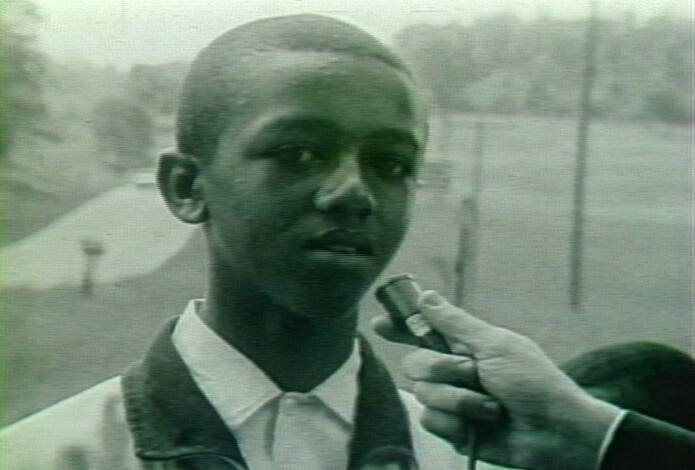
Halbert: Two early articles are Carole Merritt's essay on the Herndon Home in Atlanta and Will Thomas' essay on television coverage of the civil rights movement. These pieces forced the questions I mentioned earlier: What form should an online journal take? What static elements carry over from print journals and what dynamic elements emerge? The internet enabled the display of high-resolution color photographs and audiovisual clips as evidence in making scholarly claims. It's a medium with many more functional capabilities and flexibility than print.
Skinner: One of the most representative articles I hand coded in the earliest years was Will Thomas's piece on television news and civil rights. This was one of the first articles that demonstrated how a multimedia environment could transform scholarship. It was also the last article that I coded mostly solo—and I used it to help train Sarah Toton in my esoteric xhtml dreamweaver practices.
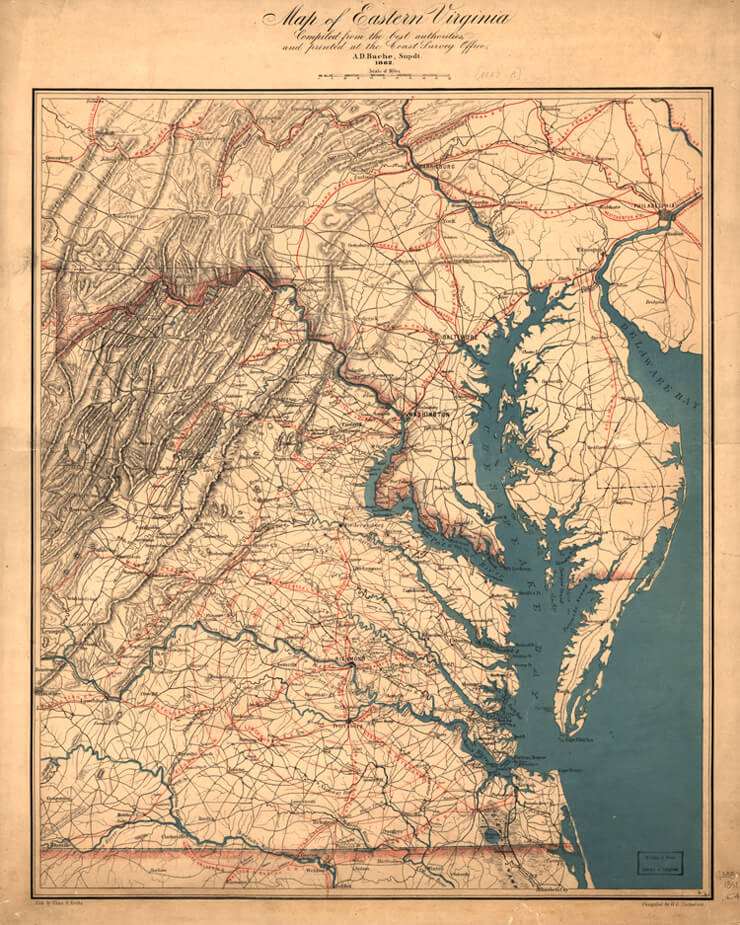
Toton: I remember Rob Amberg's "Corridor of Change" photo essay being particularly challenging. It encompassed around sixty printed pages and we needed to figure out how to tell his story in an online-friendly format. We worked on that essay off and on for months, stitching it together into a piece that was interesting and nonlinear, yet made logical sense. I also worked on laying out Will Thomas's Eastern Shore piece for months. We researched primary materials, found photos and maps, created galleries, slideshows, graphs, etc. to make it a rich born-digital piece of historical storytelling. After we published, Will sent me a pewter otter statue from an artist on the Eastern Shore.
Battle: Starting in 2009, I served as the editor for the series, "Migration, Mobility, Exchange." This included organizing a call for papers and recruiting and reviewing article proposals. We published seven pieces in this series. This was one of my first leadership experiences at Southern Spaces, and it gave me insights into the editorial process from beginning to end. I was proud of the work we produced.
Abbott: Some of the earliest pieces I worked on in 2007 had a big impact on my own scholarship, my growth as an editor and designer, and my sense of what was possible for Southern Spaces: Kevin Pask's "Deep Ellum Blues" and Terry Easton's "Geographies of Hope and Despair." Also the pieces in the Space, Place, and Appalachia series: Scott Mathews' "John Cohen in Eastern Kentucky" and Earl Dotter's "Coalfield Generations." Matt Miller's "Dirty South." Later, Dot Moye's Hurricane Katrina five-year anniversary photo exhibition. The list goes on and on.
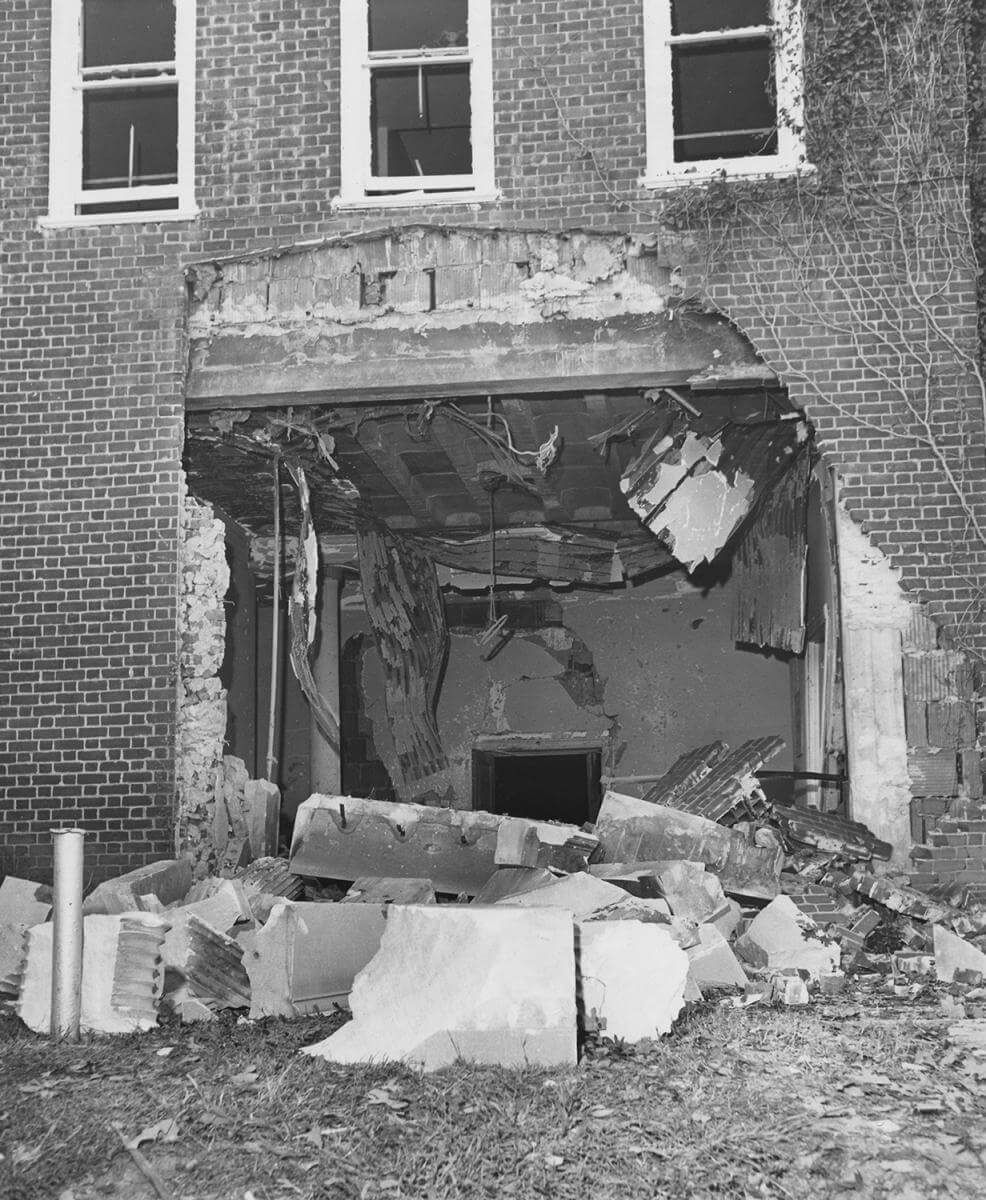
Rawson: Clive Webb's "Counterblast" article exemplifies a Southern Spaces experience to me, because of the multimedia components and its scholarly intervention. It included a mix of public domain images that I found—particularly the released FBI files—and things we had to seek permission for, such as letters from Emory's Rothschild Papers and video from the WSB television collection. It's the kind of article that examines a moment in a particular place and adds to our understanding of the civil rights movement.
Melton: I was a relatively new staff member during the Drupal 6 migration in 2010. The transition was a great opportunity to learn what is required to create and sustain a long-term project. We had six years of article drafts, edited and unedited video, and audio clips and photographs to organize. During this process, I became interested in how we might best support the lifecycle of digital publications. This experience set me on the path to my current career.
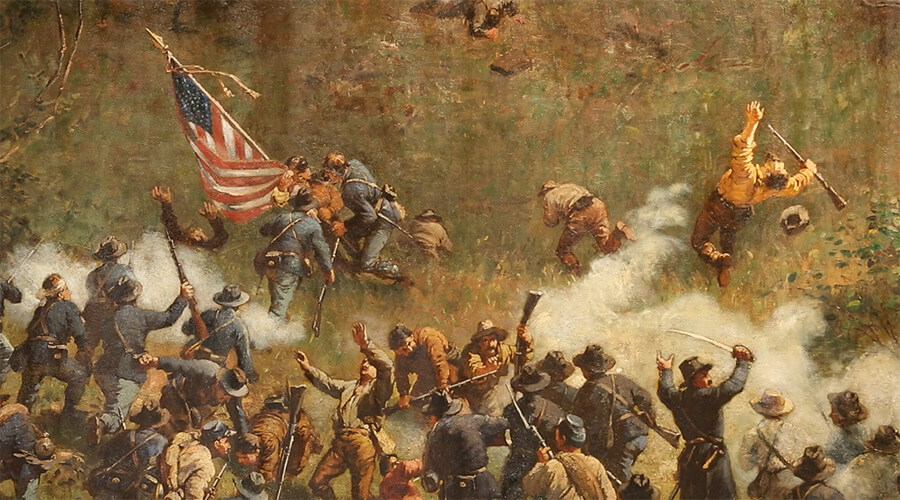
Doster: Many of the pieces mentioned above have taken considerable work to translate into the Drupal 7 redesign. As all Southern Spaces content is conceived and laid out in a specific platform, migrations often require piece-by-piece updates to retain or improve upon previous design and layout. The 2014 Battle of Atlanta publication, for example, required several modifications in its original layout to build a multi-media essay with accompanying app. While the piece is still engaging, the layout isn't as tight in Drupal 7. Updating older pieces while maintaining an active publishing schedule remains a perennial challenge.
Graduate Student Training
How do you understand Southern Spaces's scholarly and pedagogical missions?
Halbert: Southern Spaces provides tremendous research content for interdisciplinary scholarship. It also represents learning and training opportunities for the graduate students who work on it. Many of these students built on their experiences when they progressed to their own careers.
Skinner: Southern Spaces had huge ambitions from 2003, when it was just an idea, and I think those have fed into its mission and its accomplishments. It is no accident that I was a grad student and was given a tremendous amount of access to and collaboration with seasoned and highly respected scholars in the field. From its inception, senior editor Allen Tullos and key library supporter Martin Halbert, engaged students in the work of the publication. Part of the journal's purpose has always been to support the next generation of scholars, giving them exposure to and a voice in scholarly communications. Many of us who have worked on Southern Spaces credit it with leading us into our careers and giving us the skill sets, connections, and street cred we needed to succeed.
A key facet of the Southern Spaces mission is its engagement. That training is similar to what some university presses once did. It benefits the students and enriches the publication. Southern Spaces explores and enables multimedia scholarship in ways that few other publications have done—using the power of the medium, including its huge audience base (much larger than the academy's) in the process. It's a demonstration of public scholarship that crosses boundaries and engages people in different spheres.
Toton: At a selfish level, Southern Spaces is something I can share with my mother. She's often overwhelmed by academic or scholarly writing. I love Southern Spaces because it's open-access so I can send her links for great articles. She reads them, understands and appreciates their points, and we can talk about them. They're accessible. She's excited when new pieces appear.
Battle: When I first started at Southern Spaces in 2007, digital humanities felt like an emerging field. DH has a much longer history, but most academics I knew at that time were not particularly involved. The staff sometimes experienced skepticism from other students and from faculty about dedicating so much time and energy to the journal in the midst of a PhD program. Awareness of the value of this student experience started to grow, but I did not realize the impact digital humanities would have on how I conceptualized scholarship and my future career until I finished working on the journal. The pedagogical importance of digital humanities has since become more recognized at Emory, which I see as a great thing. I learned not just how to build a project using different technology platforms, but also how to conceptualize project structure, workflow, partner collaboration, and layout possibilities. These conceptualization skills have proven crucial in my current work with the Lowcountry Digital History Initiative at the College of Charleston.
Abbott: Southern Spaces offers its graduate student staff the opportunity to have real responsibility in a deeply collaborative environment. This is so rare. Most graduate student jobs are isolated or short-term. They don't offer the kinds of editorial, digital, and team-oriented skill building that a variety of employers look for. Southern Spaces gives students the ability to show off individual work through edited pieces or curated series as well as their contributions to the growth of a whole project and team. It's also rare for a faculty member (in this instance Prof. Tullos) to devote so much time to a student-staffed project, to be that big an advocate for the students, and to use so much of his own time, energy, and intellectual bandwidth to see it grow in positive directions.
For readers, I think Southern Spaces is a smart, well-articulated experiment that they can watch grow and change. The journal publishes academic content alongside artistic and journalistic forms. And Southern Spaces does this in the context of an organized, digital space that capitalizes on the best aspects of that medium: redesigns, updates to functionality, attention to usability, interaction with users, timeliness, rolling submissions. Plus, it's one of the oldest living open access journal surrounded by a graveyard of other open access journals, which says something in and of itself.
Rawson: Two parts of Southern Spaces scholarly mission are central to how I understand it and why I love it: Southern Spaces publishes critical scholarship that is accessible—in medium and style—and Southern Spaces demonstrates that scholarship is more than interpretative text on a page, not simply enriched but made more significant by including primary sources, maps, photography, audio, and film. The journal offers a wide spectrum of what research is, as well as insight into the construction of culture and geographies, the intersection of lived experiences of people and politics, and the ways that places and spaces shape individuals and societies.
Southern Spaces provides three important forms of training. First, intensive scholarly training: editorial staff learn to assess arguments and evidence within the context of multiple fields of inquiry including American Studies, geography, and history, ultimately constructing and revising scholarly publications. Second, training with technology: the details change over time, but Southern Spaces is always on the edge of new media and methods in research and publishing, whether video, digital tools, copyright, GIS, or design. The training is the best, because it is driven by needs and goals. We learn and we teach because that is what keeps the journal going.
Third, and perhaps most significantly, Southern Spaces provides professional training that opens doors and builds careers. I learned how to run a meeting. I learned how to train and manage others as well as how to work collaboratively with peers, with people who are experts and leaders in their fields, and with people who are just venturing into academia—and in situations where everyone did not see eye-to-eye and where solutions were hard won. I learned how to write emails that were direct, tactful, and productive; to write a form email, organize a major transition, develop a workflow, cold call archives and artists, and how to find resources in a complex institution.
Melton: We take time trying to define who our publics are, and I'm not sure we'll ever get a final answer. I've watched our readership grow in ways that I could not have expected, from K-12 students to university librarians to history buffs, and everyone in between. This diversity is part of what I love about the journal (I once found my own article cited on a blog about football). It's clear from readership analytics that our policy of making work open access and minimizing the use of academic jargon has garnered a wide audience.
Karlsberg: Southern Spaces embraces scholarly rigor and an interdisciplinary orientation incorporating history, English, music, anthropology, sociology, and geography as well as interdisciplines such as critical regional studies, critical race theory, sexuality studies, women's and gender studies, and of course space and place theory. The journal also adopts a critical posture that it took me a while to absorb that likewise challenges conventional scholarly and public understandings of the South. Southern Spaces critiques the idea of a monolithic South, eschewing romanticization and stereotypes. The journal advances a vocabulary that complements this critique, urging authors to scrutinize "region"; to reserve "region" rather than "subregion" for geographies such as the Delta or the Black Belt; and to refrain from capitalizing the terms "southern" or "southerner" except in their historically nationalist frame of reference.
Southern Spaces equips the graduate student editorial staff with technical, editorial, and conceptual skills that will aid in the job market and expand career possibilities. Staff members also acquire technical skills—ranging from video, audio, and image editing to familiarity with markup language and web design, to working with interactive mapping tools such as CartoDB—which prepare them for positions involving the digital humanities at university departments, libraries and beyond academia. Staff participation in a digital scholarship graduate training program initiated in the fall of 2015 by ECDS staff member and former Southern Spaces review editor Alan G. Pike, extends and formalizes this process.
Space/Place and the US South: A Critical Approach
What did you learn about critical regional studies, new approaches to the US South, and spatial imaginaries?
Halbert: These are of course some of the most intriguing intellectual foundations of Southern Spaces, and the perspectives that excited us most in its creation. The journal has very effectively challenged and ramified conceptions of the South.
Skinner: I will never, ever approach "the South" or, indeed, any other broad space, as though it can be defined in one dimension. I learned to appreciate pluralities. I also learned that those pluralities can be found in a variety of subject matter—from quilts to poems, and from tree farms to TV broadcasts.
Toton: I moved to a PhD program at Emory from Iowa. I had no understanding of where I would be living beyond that it was in "The South." The idea was nebulous, foreign, antiquated and downright scary. Southern Spaces helped me understand that the South was a collection of regions, and of neighborhoods. This insight influenced not only how I started to understand Atlanta, but the surrounding areas. It taught me the importance of the intersection between geography and cultural studies by repeatedly offering examples of how places impact people and vice versa.
Battle: Being involved in the review and editorial process at Southern Spaces significantly expanded my ability to critically engage scholarship about the US South. In my dissertation research and as a public historian, dismantling traditionally exclusive representations of Charleston's historic tourism landscape to include African American history, as well as the history of slavery and its legacies, is central to my work. My experiences with Southern Spaces helped provide me with the skills to take on this challenge.
Abbott: Discussions of space and place, especially in southern studies, can be abstract, easy, assumptive, and essentialist, or they can be particular and meaningful ways to think about identity, context, and social constructions. Working on Southern Spaces teaches you to know the difference between these when you see it. And how to make use of a map.
Rawson: Southern Spaces conventions are so engrained in me now that I have a hard time seeing them. Southern Spaces asks for certain approaches to language, which is one of the first things I learned as an editorial associate. At the time, I remember feeling exasperated with some of these distinctions; however, I have come to understand how powerful it is to attend to the specific geography of places, the pieces of history and environment that shape a piece of soil, that make imagined Yoknapatawpha, lived Lafayette County, the state of Mississippi, and an imagined literary South each have their own meaning and influence. When we move between these places and scales of place discursively, we must be intentional and attentive.
I also am a real believer in Southern Spaces's mission to expand what people publish—whose stories get told, what the subject matter is, what counts and how places are connected. I am glad that we have chosen to publish difficult stories, work that accounts for what is violent and unjust, as well as work that examines how people respond creatively and productively to facilitate change.
Melton: Coming from an American Studies background, I had already thought a lot about the ways we define the South and the necessity of avoiding monolithic descriptions. Working at the journal has helped broaden my understanding of how to understand the US South and the global South in relation to each other. Mary Frederickson's article on the connection between labor practices in the Carolinas and Uzbekistan remains one of my favorite pieces for precisely this reason.
My own dissertation research examines connections between the struggles for civil and human rights in the US South and South Africa. Southern Spaces has helped me to analyze how people understand the interplay between global and local histories.
Karlsberg: My work at Southern Spaces influenced and was concurrent with my growing interest in applying a critical regional frame to my scholarly work on Sacred Harp singing. I was initially drawn to southern studies because the culture accompanying this musical genre is most widespread in several southern states, but until I began reviewing, discussing, and editing Southern Spaces's submissions, I had little sense of the recent critical turn away from southern exceptionalism and toward analysis of the constructedness of the concept of the "South"—and the acknowledgment of the many intersecting people and southern regions.
Doster: Coming from Appalachian Studies, I was eager to find a cohort of critical regionalists at Emory. At Southern Spaces, I worked among dialogue partners and colleagues invested in critical approaches to the study of the South's many sections. At times, I have questioned the journal's framing—I'm still working out my own relationship to the term "community"—but I have a deep appreciation for Allen Tullos's vision and commitment to fresh narratives and new approaches to southern spaces.
Professional Development
How did your work with the journal influence your professional career goals and employment trajectory?
Halbert: The various projects that collectively comprised what I called the MetaScholar Initiative, and in particular the role I played in the creation of Southern Spaces, are some of the career achievements of which I am most proud. The perspective and experience that I gained during the thirteen years I was at Emory have informed my work subsequently as a library dean in thinking about the broader needs of the university.
Skinner: There isn't a day that goes by that I'm not referencing the experiences and using the skills that I first honed working on Southern Spaces.
Toton: My background in digital publishing and migrating journals to content management systems was the reason I got a position at Turner as a technical product manager. After Southern Spaces, I helped design the content management system used to publish some of Turner's news and sports websites.
Battle: Southern Spaces ended up playing a very influential role in my career. After I moved to Charleston, I found part-time work at the Lowcountry Digital Library (LCDL) housed at the College of Charleston. When my boss at the time, Dr. John White, asked me to update some online exhibitions connected to LCDL, I was able to conceptualize new ways to develop the exhibitions altogether, and to organize a cohesive digital public history platform rather than a series of stand-alone projects. We successfully received major grant support in 2011 and 2013 to launch the Lowcountry Digital History Initiative (LDHI) in 2014. In 2013, I finished my Emory PhD and became the public historian at the College of Charleston's Avery Research Center. The workflow for LDHI online exhibitions relies heavily on the collaborative student work model and editorial process I learned through Southern Spaces.
Abbott: Southern Spaces was the turning point in my own career. I joined because I was interested in southern studies. I left a digital project manager. For many of the core team, the idea was that if we made Southern Spaces as good as possible, we would be rewarded through our affiliation with it on the job market. It was a great and rare kind of experience to have as graduate students and I think it's clear this gamble paid off for us. I wouldn't have had any of the jobs I've had since I graduated without Southern Spaces. It was Southern Spaces that showed me that I didn't want to be a traditional academic and that I would be skilled at a different path. Since graduating from Emory, I've run a digital humanities center at the University of Alabama and I'm currently working as a curation and education strategist for the Digital Public Library of America.
Rawson: My career is what it is because of Southern Spaces. After I completed my American Studies PhD at Emory, I became the coordinator for digital research at the University of Pennsylvania Libraries. Southern Spaces was one of the key factors in my investment in digital scholarship. It prepared me for much of the work that I do and gave me connections that are important for my career. My relationship to Kat Skinner is one example of this. Of course, the group I went through with—Franky Abbott, Mary Battle, Sarah Melton (along with Miriam Posner who sat at the cube over from us)—is the core of my professional network. It is a network that is noticeable at conferences like ASA and DLF. Working at Southern Spaces also helped me understand the importance of supporting people on the alt-ac track. I realized that I like other kinds of work in addition to teaching and research: I like working in teams, at set hours, on projects with clear timelines. Further, I can excel at these things and create and facilitate work that is meaningful. After two-and-a-half years at Penn, I returned to Emory in 2016 in a position as a humanities librarian that emphasizes my digital skills.
Melton: My time at the journal shaped my professional employment trajectory in ways I could not have anticipated. I became interested in open access publishing more generally and began working towards better situating Southern Spaces in the publishing landscape. After the formation of Emory's digital center, I was hired as digital projects coordinator and worked with several of our open access publications. I've become more involved with open educational resources and open data efforts. Southern Spaces has connected me to an international network of people interested in improving scholarly communications. Along the way, I've also learned invaluable skills about managing people and projects that prepared me for my current job as head digital scholarship librarian at Boston College.
Redux homepage, September 2016. Screenshot courtesy of Southern Spaces.
Karlsberg: My work at Southern Spaces has taught me how much I enjoy collaboration, editing, and facilitating the publication of excellent and important writing. Thinking critically about the publishing platform of Southern Spaces introduced me to exciting conversations about digital humanities and the future of scholarly publishing. This contributed to my interest in my next positions: a postdoctoral fellowship centered around the editing of a series of digital critical editions of turn-of-the-twentieth-century US tune- and hymnbooks and a fulltime job as senior digital scholarship strategist in ECDS. In this new role, I manage an open access, multimodal journal and blog featuring interdisciplinary scholarship on Atlanta called Atlanta Studies, continue to work on the proof-of-concept series of publications for a platform for digital critical editions called Readux, and contribute to numerous collaborative research and publishing projects in helping to streamline our center's project process. I remain interested in positions that combine teaching and research but now also hope to make editing and involvement in the future of scholarly publishing a part of the mix.
Southern Spaces: What's Next?
How do you see Southern Spaces evolving in the next ten years? What goals do you have for the journal as it moves forward?
Halbert: There are an enormous number of future avenues for Southern Spaces. Clearly, the basic pattern and best practices of digital scholarship of the journal have now been thoroughly laid down and explored, and should be continued as they constitute some of the best and most accessible digital scholarship available anywhere today. The question comes down to what new directions (if any) Southern Spaces should consider. There are at least two speculative issues. First, is the potential relationship of Southern Spaces with the other big website that I helped create and had to leave behind when I left Emory, namely the Transatlantic Slave Trade Database (slavevoyages.org). The second is the potential connection between Emory and the Digital Public Library of America (DPLA), where former Southern Spaces managing editor Franky Abbott now works.
The significance of Southern Spaces should be evident to everyone that encounters it, as one of the most successful experiments in digital scholarship to have been created to date and as a model for collaboration between researchers and librarians.
Skinner: I hope to see Southern Spaces continue to widen the net and attract many different people to scholarly writing by addressing questions that matter throughout society. I hope it continues to bend what "scholarly writing" is—emphasizing quality, not pedigree, and engaging forms beyond the article, like the reviews, poetry, video, etc. that it already publishes. I hope the journal continues to be propelled by the fabulous ideas and energy of the students who are trained by and contributing to its form over time.
Toton: I think the content has become more diverse and prolific as the journal has enlarged its staff. I love the reviews and hope to see more student-written pieces. I think that the "Southern Spaces Blog" ought to be folded into the general content.
Battle: I am very excited to see where and how Southern Spaces grows. I'm sure we will continue to have plenty to learn from what the journal produces. From my own experience directing the Lowcountry Digital History Initiative, we hope to expand our work on multi-institutional projects as well as projects with individual authors. For example, our current works-in-progress include projects with smaller cultural heritage institutions, translating physical exhibitions to an online context (particularly museums that do not have the resources to host their own online exhibitions). We are also working with library and museum institutions to produce exhibitions that highlight archival collections. With the resources at Emory, it could be interesting to see what similar institutional collaborations could produce through Southern Spaces, particularly for public-facing projects as well as scholarly works.
Abbott: Southern Spaces will have to keep pace with ever-evolving web design. Each generation of Southern Spaces staff thinks the site is a dinosaur and can't wait to make changes. That energy will keep it healthy. Now that the journal has a more stable home in ECDS, I think new collaborations are possible. I want Southern Spaces to never let itself fall into traditional academic modes of discourse—but to continue to push for experiments with video, photography, perhaps the exhibition as a medium. I'd love to see Southern Spaces work more closely with materials from the many great archives at colleges and universities, museums, historical societies, research centers, in pieces that place digital content curation at the narrative center. I also hope Southern Spaces continues to make plans to sustain itself for the future—by consistently engaging and growing the editorial board, seeking grant funding for special projects, providing staff support for graduate students, staying on the bleeding edge of conversation in both digital humanities and critical regional studies.
Rawson: I hope the journal continues to gain readers in the academy and beyond. I expect it to continue to publish important work and new forms of scholarship and to engage with literary production and public scholarship. I hope it continues to expand its role as a space for critical conversation around politics and social justice. On the technology side, I think Southern Spaces has the potential to be a great commuter/wait-time read and hope that the mobile presentation of the journal keeps up with devices and users' reading practices.
Melton: I'm proud that Southern Spaces is an incubator for new directions in scholarly publishing. With the launch of our redesigned site we're also experimenting with new ways to measure the journal's reach. I want to see more of this spirit of experimentation. I also hope Southern Spaces will continue to serve as a model for other publications, both technically and in the context of student training as it seeks to manage sustainability and currency.
Karlsberg: Technologies and design conventions of web-based publishing shift rapidly. Committing to web-only publishing creates opportunities for our authors, yet obligates us to periodically remake our site to preserve and enhance access to what we've published. This also provides us with an opportunity to embrace new tools and to share what we develop. Over the four year period I served as a member of the staff we redesigned the site twice, switched audio and video formats as many times, and introduced new tools for slideshows and interactive mapping. I expect Southern Spaces will continue to revisit these choices as new technologies emerge. As Southern Spaces moves forward I anticipate it will continue to pioneer innovations in the form of scholarly journal publishing that others can learn from and adopt, and that this will enable us to continue to keep our own presentations of scholarship current.
Doster: I'd like to see the journal move into a stronger advocacy role among its peer publications and in national networks, and to continue to model the training of doctoral students in academic digital publishing. I also advocate for long-term planning that regularly assesses the journal's management structure, the sustainability of its staffing model, and its replicability.
Tullos: In 2003, as we began planning what became Southern Spaces, we imagined that other scholarly journals would soon participate in this new model for digital publishing (beyond the pdf) by creating multi-media content formats, expanding open access, and providing grad student training. For many reasons that include slow-to-change academic publishing models, scholarly-society inertias, antiquated tenure and promotion practices, and limited institutional resources—especially following the Great Recession—there are still few digital publications such as ours. In the intervening years we've learned a good deal about the field of scholarly digital publishing, acquiring insights about what works and what to avoid. In this spirit, we welcome inquiries from interested institutions and editors. As our primary emphasis remains with critical content, we hope to continue our commitment to regional studies through original scholarship about southern regions, and exemplary examples from regions far and wide.