Prelude: Fragments of Family
This book is an essay on men’s existence in the South Asian domestic world, and on their self-contradictory articulation in that world of ideas of freedom, or liberation, for themselves and their loved ones: women, children, family, community, nation, and more.
The work begins by situating men firmly in the domestic arena—a domain they, and others, often treat as incidental to their lives and being. Nevertheless, men spend a good deal of their time in this secluded familial space and are plainly dependent on it. The study proceeds through an exploration of the discourses surrounding the mysterious absence/presence of men in—and from—a large part of their own existence, and the expectations and behavior that flow from the resulting rhetoric.
The title of this prelude underscores the conundrum. “Fragment,” as I use the term, is not simply the dictionary’s “piece, broken off.” Rather, it is an interruption, a disruption, an unexpected departure in a conversation or line of thinking: an answer to a question that has not been posed in the conversation, or in the received reflections or inherited common sense of a specific question.1Louis Althusser uses the phrase "an answer to a question that is nowhere posed" in Althusser, Reading Capital, 29. For an explication of my usage of "fragment," see chapter 2 in Gyanendra Pandey, Routine Violence: Nations, Fragments, Histories (Stanford University Press, 2005). A slightly different articulation appeared in the original version: Gyanendra Pandey, “In Defense of the Fragment: Writing About Hindu-Muslim Riots in India Today,” Representations, no. 37 (1992): 27–55.
Men in the home are a fragment in both senses of the term: a part of, and an interruption in, a widely received understanding of family life.
Startling changes occur in ideas of the home and the family in South Asia, and in ideals of the good modern man and woman, between the later nineteenth century and the middle decades of the twentieth—the anti-colonial moment in India’s colonial and postcolonial history. Parallel shifts take place over much of the world in the industrial and postindustrial age. Yet, the context and the fallout have their quite distinct, colonial and postcolonial, inflections in the Indian subcontinent.2I use India and South Asia interchangeably in these pages, since much of the investigation deals with areas in the northern, central, and western regions of the undivided subcontinent, before and after its partition and the establishment of the independent nations of India and Pakistan in 1947 (and the separation of Bangladesh from Pakistan in 1971).
Consider the advent of notions or ideals of (and aspirations to), among other things, “industrial time” and the small, consanguine, loving family—greatly modified as these are in the urban as well as rural Indian context. Industrial time—factory or clock time—is an emphatic feature of this new age, even as it coexists with the more fluid time of light and dark, agricultural seasons, and the ritual calendar. It is especially marked in urban areas, where the clock tower, the factory siren, and other accessories of modern states and entrepreneurship shape timetables for much of the population. However, it extends forcefully into the countryside, to apparently non-capitalist sectors of the society, through the interventions of police, bureaucracy, modern law, and medical institutions; the influence of schools and colleges; and even social service and civic reform.
Similar “deviations” characterize the second symbol of South Asian modernity I have mentioned: understandings of the fundamental unit of domestic life. While the nuclear family— the small, intimate unit of a loving husband, wife, and children—emerges as an ideal, this smaller modern family often includes older generations (grandparents and sometimes great-grandparents), as well as cognate units like “nuclear” families of male siblings, living under the same roof or in adjacent dwellings.
Other radical departures may be noted in the domestic order. Fatherhood emerges in transformed guise. It is attached now to an individual male, the biological father, who in theory has primary responsibility for the maintenance of his immediate family and the training of sons. Fathers become educators. Education is equated with school certificates and college degrees, as cleanliness is with tailored clothes, shoes, soap, and hair oil: objectified and separated from a rather different sense of learning in a wide variety of ways in the community and environment of one’s birth (kith and kin, human and nonhuman neighbors, physical surroundings).3I refer to important scholarly writings on several of these themes in the section titled "Historiography" in chapter one.
The notion of “inner” and “outer” worlds, the “private” retreat inside domestic space and “public” activities in the world outside, comes to be more sharply etched. This is accompanied by a thickening and concretization—one might say, externalization and objectification—of the inner and outer, the home and the world. The wider community, collective gatherings, and storytelling sessions recede as places where inheritance, tradition, and knowledge are passed on in the course of other social engagements. Notions of fostering, nurturing, and training the young are redefined, as is the understanding of men’s and women’s role in history.
Given the heft of these developments, the following chapters underline the importance attached to formal schooling, to cleanliness in dress and appearance, and to the roles of men and women in child- and homecare—all seen as signs of modern and the future. I focus on conjugal relations, central to new ideas of family and home, and detail the daily attrition and constant negotiation that accompany the reentrenchment of domestic hierarchies. One of my aims is to draw attention to the physical, psychological, and emotional costs incurred by men and women, the axiomatically privileged and the routinely disenfranchised alike.
There has been considerable writing and commentary on the question of the modern South Asian domestic order and its enduring hierarchies and discrimination. Why, then, another investigation of the theme? I offer a few reasons. First, whether they are well-recognized, statistically documented, targeted, critiqued, and repeatedly condemned, or not, the discriminatory structures and the violence attendant on gendered hierarchies, male privilege, and women’s subordination are still in place—doggedly persistent and deeply damaging. They are compounded by every man-made and natural disaster, from the climate crisis, to Covid-19, to war and displacement and famine. At the same time, they are regularly brushed under the carpet in the name of “sacred” inheritances that families, communities, and nations tout as needing protection from alien assaults. Or, alternatively, by the logic that such commonplace discrimination and violence is not a crisis of nation or state, not an event in World History, but a matter of secondary importance.4Cf. Ranajit Guha, History at the Limit of World-History, (New York: Columbia University Press, 2003). Such issues, regrettable as they might be, can only be tackled over time, it is said: best of all, through quick economic growth and expanding opportunities and education around the globe.
I believe the present work is necessary also because, for all the commentary on familial hierarchies and oppressions, there has been little investigation of the real-life, flesh-and-blood meaning of being embedded in structures of discrimination and denial in privatized, domestic spaces. This is true not only for women, servants, poorer relatives, and hangers-on, the drudges of the inner world, reflective not only of the humiliation, physical distancing, indignity, and invisibility that they suffer daily: it is true also for those in power in this domain, the upholders of family and national “honor” fulfilling their “duty” through open acts of violence if necessary.
◊◊◊◊
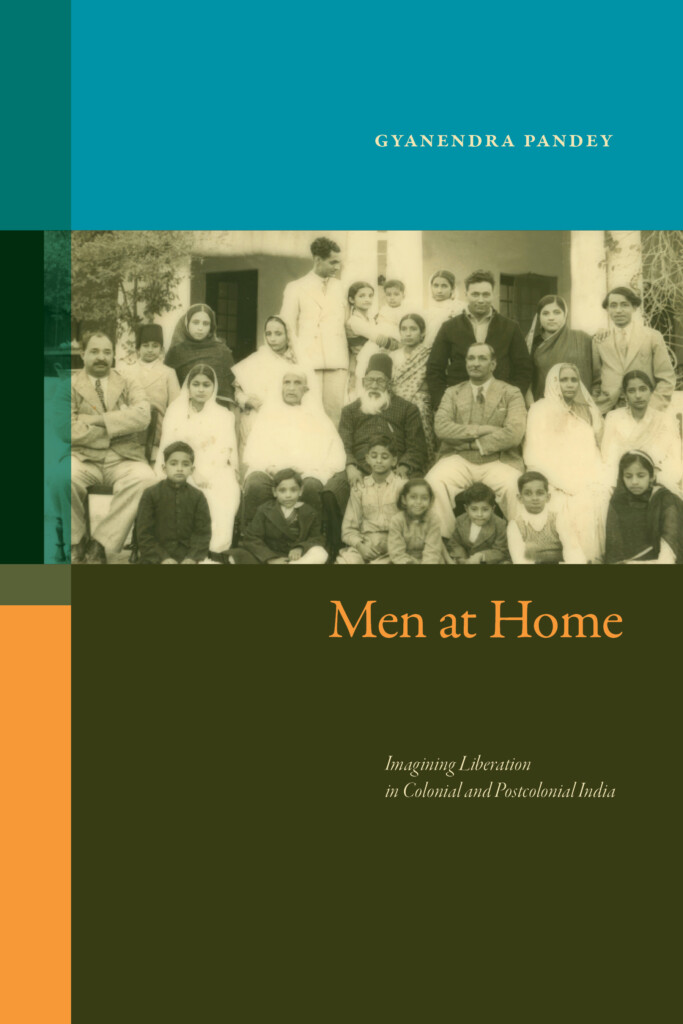
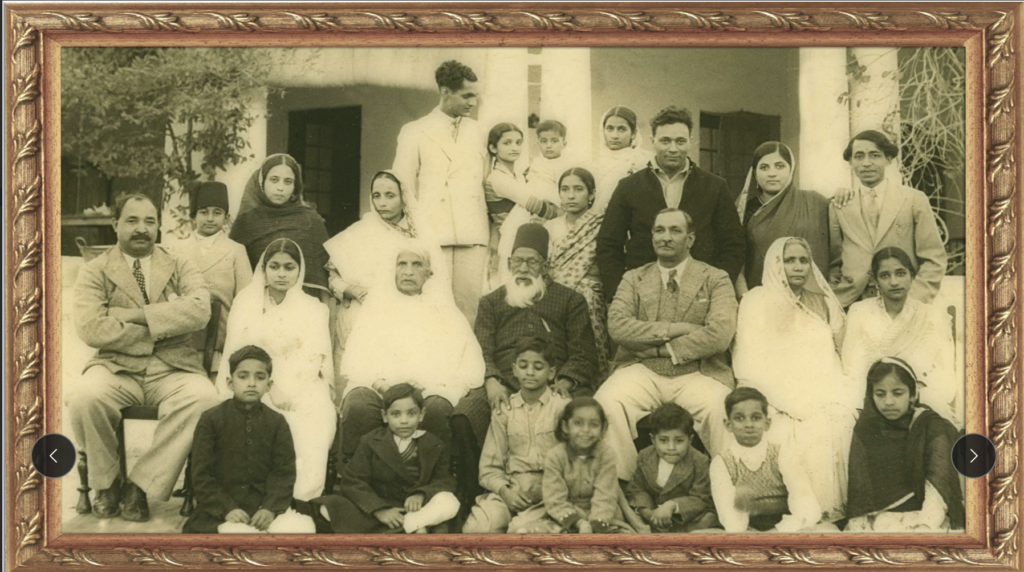
This is a “personal” book in terms of the questions it asks about family, community, culture, and history in contemporary South Asia. I have in some ways lived with the inquiry all my adult life, though it has taken concentrated research over the last decade to bring it to fruition. The exploration flows from observations and questions I had from childhood onward, growing up in a home with a present/absent father and exposed to many homes that were structurally not very different from ours, however diverse they were in terms of the strictness, ebullience, forcefulness, or timidity of the men who were supposedly heads of these modern households, centered on the “nuclear”—yet often three-generational—family.5One might even call it the “extended nuclear family.” The 1935 photograph that appears on the book's cover, marking the wedding of two protagonists whom I center in chapter 4, Hameeda and Akhtar Husain Raipuri, points nicely to the paradoxical character of this modern South Asian family. The bride and groom are tucked away on the extreme right-hand side of the gathering, the bride sitting in the middle row, the groom standing behind her. The photo of the “Khandan” (or extended Omar family), taken in front of the bride’s parents’ home, built by her police-officer father Zafar Omar, is dominated by the elders. The bride’s mother and father are seated next to her in the middle row, on her right, and the oldest “elders,” Zafar Omar’s mother and father, are placed at the center of the assembly.’
My father had little time for hands-on care of children or other domestic duties. He appeared as a distant authority figure, a spectral presence with “more important things to do”: absent even when physically present, a haunting shadow even when absent. A hush fell on the rest of us when he walked into a room, though we waited eagerly to see what gifts he had brought when he returned from an official tour or other engagement out of town. Often, they were fruits and sweets he himself was fond of, from places especially known for them. The shadow of authority surrounding him was accompanied, as well, by his boisterous laughter and storytelling (he was a fiction writer as well as a bureaucrat), as he held court in an outer drawing room where a homosocial company of friends, acquaintances, and sundry male relatives, close and not so close, assembled frequently.
As schoolboys, my older brother and I were often invited to meet these visitors, and then invited to go away and play or do something else. My mother and younger sisters were free to wander in the garden, and to go out for specific ends—to school, to shops, and to friends’ houses. There were also invitations for lunches and dinners or other outings with family friends in which all of us participated. But for much of their time at home, my mother and sisters kept to the inner
rooms and courtyard, adjoining the front rooms—for these weren’t great mansions. The “women” met important visitors infrequently, my mother ate last, and my mother and sisters were expected to be withdrawn, the seclusion and watchful eyes of the elders growing keener once my sisters reached the age of puberty.
Questions that arose in my mind in childhood and adolescence multiplied in my years as a college student and university teacher. Extended research, as well as conversations with colleagues, students, and interlocutors from diverse castes, classes, communities, and countries, led to the conviction that closer investigation of the history of domestic interactions was necessary for a more realistic understanding of modernity, democracy, and dreams of the future in colonial and postcolonial India, and of the social conservatism that survives in the subcontinent even in what appear at first sight as politically and intellectually enlightened circles.
Another word on “beginnings”—moments that are always indistinct and uncertain. A decade or so ago, I re-read Shivrani Devi’s memoir of her life with her husband, Premchand, perhaps the biggest name among the founders of modern Urdu/Hindi literature and hailed as “the storyteller of India’s Independence movement.” That renewed encounter with Shivrani Devi’s Premchand Ghar Mein (Premchand in the home) convinced me more than ever of the need for a study of Hindustani Aadmi Ghar Mein (Indian men in the home)—a theme I had been mulling over for some time.6Shivrani Premchand, Premchand: Ghar Mein (Nayee Kitab Prakashan, 2009).
◊◊◊◊
Premchand’s second wife’s reconstruction of the thirty years she spent with him differs startlingly from the single summary comment Premchand left on their life together. Hers is an uplifting account of two sensitive and committed human beings discovering each other—warts, foibles, exceptional qualities, strengths, weaknesses, all: drawing close together, sharing interests and activities, doing everything they could for one another and for others in their domestic circle. His is a brief and unexpectedly dry statement in a letter written in English in 1935, the year before he died. Following the death of his first wife, he says, “I married a ‘Bal Vidhwa’ [child widow] and am fairly happy with her. She has picked up some literary taste and sometimes writes stories. She is a fearless, bold, uncompromising, sincere lady, amenable to a fault and awfully impulsive. She joined [Gandhi’s] N[on] Co-op[eration] movement and went to jail. I am happy with her, not claiming what she cannot give.”7Madan, Premchand, 20.
I have much more to say about Shivrani Devi and Premchand in the chapters that follow. For the moment, I mention Shivrani Devi’s memoir on their marriage as one intimation of a beginning.
Another beginning occurred when I was nearing the end of a first draft of the book. As I worked on what I hoped would be a close-to-finished version of one of the concluding chapters, I stopped short on encountering a term I had read—and passed by—several times before in my engagement with the distinguished Dalit writer Baby Kamble’s 1986 autobiography in Marathi, Jina Amucha, and its English translation, The Prisons We Broke.8Baby Kamble, The Prisons We Broke, trans. Maya Pandit (Orient Black Swan, 2018). Original text published in 1986. Dalit is the name that Dalit activists give to the depressed castes and classes formerly known as Untouchables. The term, navrapana (husbandness, from navra, husband), condenses multiple dimensions of the history of male privilege, and the expected but not always welcome assertion of manly behavior and male priority, in a single edgy concept. Kamble used it to explain why she had kept her autobiographical writings secret from family members for twenty years. She had to do this, she said to the scholar who translated her memoir into English, because of her husband: “He was a good man, but like all the men of his time and generation, he considered a woman an inferior being.” Her comment on this common mindset and behavior was sharp: “Husbandness [is] the same in every man…Their male ego [gives men] some sense of identity.”9Kamble, Prisons We Broke, 147, 155, 156.
I had not come across anything like Kamble’s conceptualization in Hindi, Urdu, or other Indian languages I know—or, for that matter, in English. There is common talk in north India of mardangi and aadmi bano for manliness and being-a-man. Haughty male behavior is characterized as zamindarana adab, the bearing and behavior of a ruler or aristocrat, and sometimes as sahabi-pan, behaving like a Sahib or overlord, like the British rulers of India. Notably outspoken, brash, or “independent” men might also be described as suffused with devil-may-care life: full of dillagi (fun-loving, jocular), rangeela (colorful), aazad-khayal (freethinking). Rarely are they encapsulated in terms of their readily observable attitudes toward and interactions with a constant presence in their lives, their wives: that is, in terms of an everyday relationship that has come to occupy a central place in most discourses on family life in India.
Contrary to the experience of women, it is unusual to have man, and man’s behavior, reduced to one aspect of his being: in this instance, “husbandness.” Women are regularly defined through a relationship, usually one in a confined domestic world, as wife, mother, or daughter who will soon be a wife and mother. Wifehood itself is subsumed in motherhood, for the maternal instinct is taken to be the “essential” quality of woman. The world is different for the other half of humanity, represented as being complete in themselves, almost from birth: the male of the species growing into himself. There is extensive talk of boyhood, manhood, fatherhood, alongside other “essential” attributes, which can encompass head of household, property owner, breadwinner, professional, laborer. Certainly not qualities that can be condensed into something as reductive—primal and “primitive”—as husbandhood.
The status and authority of woman in an Indian home derived commonly from motherhood, from becoming a mother, or better still, in much of the world, the mother of sons. In the case of men in modern South Asia, that authority comes earlier, but it is not given from birth. It is captured perhaps in the relationship of husband and wife—“a man” in charge of his “little community,” even if that is a community of two, or a few (a wife/wives and in time children). Yet, we must remember that in traditional multigenerational families, age and other factors often trumped “gender” (reckoned as man/woman).10One scholar makes the point about the crisscrossing axes that determine gender power in South Asian homes as follows: a woman's place depends on "the status of her husband, her possession of sons, her fertility, looks, health and capacity for domestic labour. The middle-aged mother of grown-up sons could be a powerful matriarch and elderly mothers-in-law could command and oppress young [daughters-in-law]." Tanika Sarkar, Hindu Wife, Hindu Nation: Community, Religion, and Cultural Nationalism (University of Michigan Press, 2001), 21. The biological father did not even have primary authority over his children; that privilege was reserved for the grandfather and granduncle, or, if that generation had retired, the father’s older brothers and cousins, along with family elders more generally.11It is worth noting that this applied to Baby Kamble's husband: an unemployed young man in a house full of elders, whose enterprising wife (Baby Kamble) comes up with an idea that allows him to contribute to the family's income, he is still someone from whom she has to hide her writing for twenty years. Consider the implications of Baby Kamble’s navrapana (husbandness, husbandly authority and behavior) in that context.
Navra, in Marathi, refers to a bridegroom or husband. The dictionary suggests it derives from the root nav, new, suggesting a “new man,” reborn as in Preludemany societies on the attainment of maturity, on becoming adult and independent, a stage signaled in India by marriage. Navri, “new woman,” is also used for a bride, wife, or girl of marriageable age, but usually for a short while, no more than a few months following marriage, after which the common term for wife or woman of the home, bai-ko (patni, gharwali in Hindi), supervenes.12Another term that may well come from the same root (route?) is nivri in Kutchi, which refers to girls or young women sitting around idling, as a young bride might be allowed to do briefly! I am grateful to Sabrina Datoo for drawing my attention to this term and its meaning. For the modern South Asian man, this moment in the passage from adolescence to adulthood marks the onset of new responsibilities and authority in his bit of the domestic world—and perhaps beyond. The male, now recognized as a grown-up, gains manly status in husbandhood. Conceptually, a shift occurs in the location of this individual from the realm of nature and nurture to that of politics, responsibility, and authority. And many men claim the latter as their primary, if not sole, arena of work.
It takes the doughty, down-to-earth, insurrectionist language of a Marathi Dalit woman, freshly energized and assertive in the era of the anti-Brahmanical movement inspired by Ambedkar, to deploy an idea so “ordinary,” arresting, and rich in its ability to capture the banality of men’s claims to God-given privilege and power. A banality daily on display in men’s comportment and behavior in the mundane, unremarked, everyday domain of the domestic—the supposedly sequestered and invisible space of family and home.
The concept navrapana (husbandness or husbandly authority), with its implicit critique of male arrogance in the assertion of men’s rights as men, opens up the question of male comportment, claims to manliness, and men’s vulnerability—central themes of my study—in unexpected ways. Throughout this book, I use men’s physical and psychological being in the home as an entry point for investigation of their privileged place in the domestic world and of their simultaneous denial of any serious responsibility in that space. Baby Kamble sees husbandness as emblematic of this privilege. I will argue that across castes, classes, and communities in modern South Asia, male authority has been signaled in what she calls husbandness. The privilege of boyhood mutates into the authority of man with the onset of marriage, the stage of householdership (the grihastha ashram) and the responsibilities that stage implies.
A central thread of the present study emerges more sharply from my belated recognition of the implications of Kamble’s insight.
◊◊◊◊
Men at Home is not a history of nation, state, and institutional politics—the well-established subjects of World History—viewed from an unusual vantage point. It is better seen as a history of ordinary life among ordinary people (with both phrases appearing under the sign of a question mark), told from the location of the home—or what I shall for convenience, in the interest of flexibility and in recognition of its uncertain boundaries, simply call domestic space in modern South Asia. If the changed perspective and object of inquiry say something about the limits of World History, or of what a richer world history might be—a history of how people lived, and what it felt like to live in their times and conditions—that is a welcome bonus.
I have framed the inquiry under the mundane rubric of men in the home, since that bland formulation engages questions of male entitlement, authority, and hierarchy in a relatively accessible and open-ended way. Perhaps it will also invite in readers who are daunted by the theoretical language that is often key to close analysis of issues of gender, patriarchy, and masculinity. 
About the Author
Gyanendra Pandey is Arts and Sciences Distinguished Professor of History and Director of the Colonial and Postcolonial Studies Workshop at Emory University. His books include A History of Prejudice: Race, Caste, and Difference in India and the United States (Cambridge University Press, 2013), Routine Violence: Nations, Fragments, Histories (Stanford University Press, 2005), Remembering Partition: Violence, Nationalism, and History in India (Cambridge University Press, 2001), and The Construction of Communalism in Colonial North India (Oxford University Press, 1990).
]]>On election night 2024, when the Associated Press called Pennsylvania and North Carolina for Donald Trump, I knew that he would be our next president, and I went to bed. The next morning, as I came back from a walk, the Harris-Walz bumper stickers on the back of our cars caught my eye.
HARRIS-WALZ 2024 | WE’RE NOT GOING BACK
I immediately thought of the late Willie Lee Rose’s The Port Royal Experiment: Rehearsal for Reconstruction. Rose tells the remarkable story of enslaved and subsequently free Black people living on the South Carolina Sea Islands who gained their freedom—and small plots of land—while the war still raged, and then gained political rights during Reconstruction. That moment ended when a violent white, counter-revolutionary movement took away their rights as citizens and much of their property, returning them to a state of semi-slavery. Written in 1964 at the crest of the civil rights movement, Rose’s last chapter, “Revolutions May Go Backward,” was a cautionary warning to the optimists of her time. Today it seems an epitaph for those of my generation who saw the possibilities of a second Reconstruction that fulfilled the promises of the first.1Willie Lee Rose, Rehearsal for Reconstruction: The Port Royal Experiment (Indianapolis: Bobbs Merrill, 1964), 378–408.
It’s not that I was blindsided by the election results. After President Biden's withdrawal, I became increasingly convinced that the Harris-Walz campaign was in jeopardy. In very close races, polls are unreliable in choosing winners, particularly when it comes to Donald Trump who outperformed almost every major poll in 2016 and 2020, as he would in 2024. But I do think they give some sense of direction. During the last three weeks of the campaign, as Trump became more unhinged in his lies, more threatening to his enemies and more obscene in his rallies, I watched as Harris’s lead slip from 3% to 1%. By election day, I had little confidence that she would win.
I can’t claim to be a prophet. I assumed former President Trump would receive something like his 46 per cent of the vote in 2016 and win because of our archaic and undemocratic eighteenth-century electoral college. I was wrong. He didn’t gain a mandate (49.8 %), but it was more than Harris’s 48.3%. Moreover, by narrow margins in dozens of races, Republicans maintained control of the House and won the Senate. However precarious the majorities, the party of Trump now controls the executive, congressional, judicial branches of government.
Over the next week, I neither read any post-mortems of the election’s outcome nor listened to or watched the news. I knew it would be filled with "what if's?" second-guessing the strategy and tactics of the Harris-Walz/Democratic campaign. The Democratic Party bears some of the blame for this loss. Inhibited by its own wealthy backers and so frightened of the term “socialism” or even “liberalism,” party leaders failed to drive home the economic damage to working- and middle-class voters caused by the neo-liberal policies of the last half century and the dominance of the nation’s new plutocracy.2Elizabeth Popp Berman, Thinking Like an Economist: How Efficiency Replaced Equality in US Policy (Princeton: Princeton University Press, 2023).Despite these failures, there have been substantive policy differences between a Republican Party that has consistently reshaped our tax and economic system to benefit the wealthy and Democratic measures that helped the working and middle-class programs proposed by Democrats. The 2024 election is less about the failures of the Democratic Party than the remarkable success of the wealthy interests and disciplined zealots who have joined hands with Donald Trump to capture the Republican Party.
Historians such as Nancy MacLean (Democracy in Chains), journalists Jane Mayer (Dark Money), and Anne Applebaum (Autocracy, Inc.) as well as other scholars and journalists have described how this anti-government movement has proved successful in carrying out its long-term strategy of promoting libertarian ideas and policies into the mainstream, ideas once dismissed as the work of Ayn Rand cranks and ideologues.3Nancy MacLean, Democracy in Chains: The Deep History of the Radical Right's Stealth Plan for America (New York: Viking Press, 2017); Jane Mayer, Dark Money: The Hidden History of the Billionaires Behind the Rise of the Radical Right (New York: Doubleday, 2016); Anne Applebaum, Autocracy, Inc.: The Dictators Who Want to Run the World (New York: Doubleday, 2024).
Over the last half century, bankrolled by their wealthy backers, this reactionary movement created a broad and effective network of institutions, think tanks, and media mouthpieces that honed dual messages.
The first: money corrupts the poor but elevates the moral character of the rich. Making the lives of marginal and lower middle-class Americans more insecure would lead them to return to the lost work ethic that had made America great. At the same time, making wealthy Americans even richer enabled the super-rich “job creators” to benefit society as a whole.
The second: a contempt for the very concept of “public” in “all its forms (public service, public health and safety agencies, public parks, the protection of public lands, public schools, etc.) and a conviction that the hand of “government” inevitably guarantees inefficiency and corruption. The solution? Replace those critical institutions with the unrestrained market, driven only by profits and freed from the restraints of oversight, regulations, and the demands of labor unions, civil rights activists, feminists, the disabled, and others who struggle for social justice.
The New Right was also able to draw upon a deeply rooted anti-government/“dog-eat-dog”/“everyone for himself and the devil take the hindmost” ethos. While a pittance of charity for widows and orphans has long been considered acceptable, assistance for those who do not succeed (obviously through their own laziness and lack of initiative) designates them as undeserving poor and dependent “takers.”
The Social Darwinism of the Gilded Age shifted somewhat in the wake of the late-nineteenth century Populist movement and during the “Progressive Era” of the early twentieth. Bolstered by an emerging “social gospel” movement that emerged within Protestant, Catholic, and, what Rabbi Shaul Magrid, has called the “Jewish social gospel,” when a majority of Americans concluded—in our complex and interdependent economy—only national institutions could offer protection from monopolistic corporate power and reckless actions that threatened citizens’ health and well-being. Then, faced with the devastation of the Great Depression, Americans of that generation learned the hard way that a reliance on rugged individualism proved useless in the face of a collapsing economy.4Christopher H. Evans, The Social Gospel in American Religion (New York: NYU Press, 2017); Rabbi Shaul Magid is professor of Jewish Studies at Dartmouth. His book is The Necessity of Exile: Essays from a Distance (Brooklyn: Ayin Press, 2023).
By the time Dwight Eisenhower took office in 1953, the Roosevelt revolution seemed broadly accepted by both parties. As Eisenhower wrote to his brother in 1954, federal initiatives such as social security, unemployment compensation, labor laws and other government funded programs were essential and the “Texas oil millionaires” and the politicians and businessmen who sought to turn back the clock were “negligible and . . . stupid.”5Dwight D. Eisenhower, “Letter from Dwight D. Eisenhower to Edgar Newton Eisenhower (1954),” Teaching American History, https://teachingamericanhistory.org/document/letter-to-edgar-newton-eisenhower/.
But the political upheavals of the 1950s and 1960s gave an opening to the anti-government reaction of the last fifty years—our backward revolution.
It’s ironic that Richard Nixon took the first steps in this reactionary movement; ironic because he was hardly an anti-government politician. Like Eisenhower, under whom he served for eight years, Nixon had made peace with expansive government under Franklin Roosevelt and Lyndon Johnson. He not only maintained most of the New Deal/Great Society programs, but supported the creation of the Environmental Protection Agency, the Clean Air and Clean Water Acts, expanded federal resources for the CDC and NIH. and signed Title IX, a sweeping measure designed to prevent gender discrimination at colleges and universities. At one point he considered creating a national guaranteed income program. Politically, however, Nixon was always attuned to the shifting currents of public opinion.
You don’t have to be a historian to list the developments that set us on the road to the election of Donald Trump for a second term. White backlash—activated by the civil rights movement and urban unrest—as well as the trauma of the Vietnam War led the way for this right-ward retreat.
In 1968, Nixon ran as a centrist between Hubert Humphrey and third-party segregationist candidate George Wallace. He came within a hair’s breadth of losing the election after Wallace captured fourteen million votes and the electoral votes of five southern states. (According to exit polls, absent Wallace’s “American Party,” at least four of those states would have voted for Nixon.)
Relying upon the advice of his adviser, Kevin Phillips ("The whole secret of politics is knowing who hates who”), Nixon understood the possibilities for political realignment among several groups of voters. White southerners and white northerners opposed to the gains of the civil rights protests and civil rights legislation, suburban voters frightened and angered by the urban violence of the 1960s, and Americans disgusted by an anti-war movement that rejected the patriotic ideology: “My country, right or wrong.”6Garry Wills, “The Politics of Grievance,” New York Review, July 19, 1990, https://www.nybooks.com/articles/1990/07/19/the-politics-of-grievance/.
Thus was born the GOP “Southern Strategy,” a political plan to create a solid Republican South by “blackening” the Democratic Party in the states of the former Confederacy and drawing disgruntled whites across the US into what had once been the party of Lincoln. In the aftermath of the Watergate scandal, Jimmy Carter managed to defeat Gerald Ford in 1976, but his administration was a brief detour.
During the 1950s, middle- and upper-income voters in four southern states had chosen the popular Dwight Eisenhower, but the major growth in Republican support from lower income white voters came over the next two decades. White evangelicals and religious conservatives also played a major role in the political realignment, strongly supporting traditional gender roles, the nuclear family, and male “leadership” while recoiling against the demands of the women’s movement of the 1970s and 1980s as well as the way that a new, wide-open popular culture undermined traditional sexual mores. As Playboy came out from under the drug store counters and onto the magazine racks, it was no accident that third-party candidate George Wallace attacked the Supreme Court for its rulings requiring desegregation and striking down broad obscenity laws.
Today’s white evangelicals point to the 1973 Supreme Court decision, in Roe v. Wade as the critical turning point for devout Christians. But, if that is true, how can we explain the fact that mainline Protestant denominations, including Southern Baptists, praised the decision?
Randall Balmer, Cornell University historian of American religion, argues in Bad Faith: Race and the Religious Right (2021) that the shift among evangelicals was linked directly to racial issues.7Randall Balmer, Bad Faith (Eerdmans Publishing: Grand Rapids, Michigan, 2021). Gerald Ford’s Justice Department first developed a series of legal cases challenging the tax-exempt status of the segregated “academies” (most of them religious) that expanded in the aftermath of the Brown decision. But it was the Carter administration that dramatically increased the number of lawsuits challenging these tax-exempt segregated schools, a policy eventually affirmed by the Supreme Court in Bob Jones v. United States (1983).
Right-wing Republican activists like Paul Weyrich claimed that this was an attack on religious freedom, but such arguments found only limited traction. Instead, skilled conservative organizer (and devout Catholic) Phyllis Schlafly smoothed over long-time tensions between Catholics, Mormons, and Protestant conservatives, bringing them together to create a “right-to-life” and anti-feminist constituency that proved to be a far more “righteous” movement than defending segregation.
White Protestant evangelicals had voted for the “born-again” Carter in 1976, but four years later two thirds of self-identified white evangelicals voted for the divorced and marginally Christian candidate, Ronald Reagan. Republican support increased through the decades that followed. In the 2024 presidential election, 81 per cent of white evangelicals voted for Trump. Between the late 1960s and the end of the 1980s, the Southern Strategy transformed the “solid South” from a Democratic stronghold to the foundation of Republicans’ national strength.
Racism was not the only factor in creating a white Republican South, but it was a major driving force. And the tactics that created the (white) victory for the Republican Party in the South and attracted white northerners, have allowed politicians to exploit different versions of racism on a national level for the last half century. George Wallace pioneered the use of code words that avoided explicit racist language in the 1960s, but Republican operatives and leaders became even more skilled in their exploitation of white Americans’ underlying racial prejudices. As Lee Atwater, a key adviser to Reagan and to George H.W. Bush famously told Vanderbilt political scientist Alexander Lamis, “You start out in 1954 by saying “N--r, n--r, n--r.” By 1968, you can’t say ‘n--r’—that hurts you. Backfires. So you say stuff like forced busing, states’ rights, and all that stuff.”8Lee Atwater (1981): Interview with Alexander P. Lamis, https://www.bradford-delong.com/2017/03/lee-atwater-interview-with-alexander-p-lamis-rough-transcript-weekend-reading.html.
Equally significant in arousing this white backlash was the emergence of Black and, later, Brown Americans into a constant presence on the nation’s television screens that triggered resentment by many white viewers. The emergence of gay men and lesbians prompted a similar response.
Critics often compare Donald Trumps’ dehumanizing language against his enemies—“vermin,” “garbage,” “scum,” “poisoning the blood of our country,” “traitors,” “diseased,” “bad genes”—to Adolf Hitler.9Gram Slattery, “Trump’s ‘bloodbath’ and other rhetoric inflame his 2024 campaign trail,” Reuters, March 22, 2024, https://www.reuters.com/world/us/bloodbath-vermin-animals-trumps-rhetoric-trail-2024-03-22/. But such rhetoric has deep roots in US history, pitting “us” (true Americans) against “them” (threatening outsiders). From John Higham’s 1955 classic, Strangers in the Land to the more recent publication of Erica Lee’s America for Americans: A History of Xenophobia in the United States, scholars and journalists have described politicians’ exploitation of white/Anglo-Saxon/Protestant Americans’ fear and hatred of Native Americans, Catholics, Jews, Italians, and Hispanics.10John Higham, Strangers in the Land: Patterns of American Nativism, 1860-1925 (Rutgers University Press: New Brunswick University Press, 1955); Erika Lee, America for Americans: A History of Xenophobia in the United States (New York: Basic Books, 2019).
In addition to relying upon such racist and xenophobic appeals, the party that Donald Trump now controls has sought to strengthen its political power by implementing openly undemocratic measures. In Rehearsal for Reconstruction, Willie Lee Rose describes the blunt measures that white Democrats used to disenfranchise (predominantly Black) Republicans. During South Carolina’s 1895 Constitutional Convention the Party stamped out the last handful of Black voters. Whites made no effort to conceal their hand. As one Democrat said, “We don’t propose to have any fair elections.”11Rose, Rehearsal for Reconstruction, 404. Such openly partisan and racist voter suppression measures supported by the modern Republican Party are central to our backward revolution.
When Democrat Bill Clinton won in 1992 and 1996, the Republican Party launched a broad range of measures designed to reduce Democratic voters, particularly Black voters. Despite differences between the disenfranchisement efforts of white Democrats in the late nineteenth century and present-day Republicans, Yogi Berra’s memorable phrase: “It’s déjà vu all over again” seems particularly apt. Political scientists Steven Levitsky and Daniel Ziblatt have shown how this growing anti-democratic movement has exploited weaknesses in our constitutional system to create a “tyranny of the minority,” a process described in detail by scholars like Steve Suitts and Gene Nichols.12Steven Levitsky and Daniel Ziblatt, Tyranny of the Minority: Why American Democracy Reached the Breaking Point (New York: Crown, 2023); Steve Suitts, A War of Sections: How Deep South Political Suppression Shaped Voting Rights in America (Athens, Georgia: New South Books, 2024); Gene R. Nichol, Lessons from North Carolina: Race, Religion, Tribe, and the Future of America (Durham, NC: Blair Publishing, 2023).
Republicans have justified such measures by successfully convincing 88 per cent of Republicans and over 25 percent of Democrats that voter fraud is widespread, despite the fact that every rigorous investigation and analysis has found fraud has been statistically infinitesimal. In a review of such claims over the last twenty-five years, researchers for the Brookings Institution could not find one example of voter fraud that “changed the outcome of a single election.”13Owen Averill, Annabel Hazrati, and Elaine Kamarck, “Widespread election fraud claims by Republicans don’t match the evidence,” Brookings, November 22, 2024, https://www.brookings.edu/articles/widespread-election-fraud-claims-by-republicans-dont-match-the-evidence/.
In 2012, dissatisfied with piecemeal measures to limit Democratic voters, the Republican State Leadership Committee launched its “Redistricting Majority Project” (REDMAP) with the goal of using the decennial redistricting process to gerrymander state and congressional districts to give an advantage to Republican candidates at the state and congressional level. While gerrymandering has long been practiced in American politics, the development of sophisticated computer programs, the heightening of partisan division, and the economic support of dark money by wealthy donors made it possible for the Republican Party to reshape American politics. In 2019, the five-member Republican majority of the Supreme Court gave the green light to such gerrymandering. By 2024, Republicans had created the most distorted electoral system in nine of the ten most gerrymandered states in the nation.14“2012 REDMAP Summary Report,” January 4, 2013, https://www.redistrictingmajorityproject.com/; Nick Wing, “GOP Redmap Memo . . . ,” January 17, 2013, “https://www.huffpost.com/entry/gop-redmap-memo-gerrymandering_n_2498913; “Rucho v. Common Cause," https://en.wikipedia.org/wiki/Rucho_v._Common_Cause; “Most Gerrymandered States,” World Population Review, https://worldpopulationreview.com/state-rankings/most-gerrymandered-states.
Republicans and Democrats argue over whether such measures stem from partisan or racial motives, but it is clear that racism remains one of the key factors in Trump’s personal rise to political prominence. It was his promotion of the “birther lie,” the demonstrably false claim that Barack “Hussein” Obama was born in Kenya and not a “true American” that launched his political career. As a real estate developer with an early history of excluding Black people from his family’s rental properties, Donald Trump learned that traditional anti-Black racism could prove adaptable in politics by exploiting fear and hate against other “outsiders.” Of all his inflammatory and racist claims, none was more successful than his description of a massive (non-existent) crime wave by brown-skinned illegal immigrants spreading chaos, raping and pillaging embattled white Americans.15Slattery, “Trump’s ‘bloodbath’."
Economic inequality grew steadily from the early 1970s onward as members of the middle as well as the working class joined the poor in a struggle from paycheck to paycheck. The New Right didn’t address this increasing wealth gap but kept the emphasis on drawing in religious conservatives by convincing them that Christianity and the family was under attack. Right wing activists and new media outlets spread false but heart-rending accounts of full-term babies ripped from their mother's wombs. As early as 1977, the American singer and anti-gay activist Anita Bryant claimed that homosexuals were seducing children for sexual exploitation, but by 2010, claims of “grooming” were widespread on web sites, promoted by right-wing anti-gay groups and Republican politicians. In a 2023 60 Minute interview, Georgia Congresswoman Marjorie Taylor Greene insisted to interviewer Leslie Stahl that “Democrats are a party of pedophiles. . . . They support grooming children.”16“Anti-gay Organizing on the Right,” PBS Out of the Past, https://www.pbs.org/outofthepast/past/p5/1977.html; “Marjorie Taylor Greene: The 60 Minutes Interview,” https://www.rev.com/transcripts/marjorie-taylor-greene-the-60-minutes-interview-transcript.
Even more astonishing has been the success of the New Right in convincing nearly 60 percent of white Americans that “discrimination against whites is as big a problem as discrimination against blacks and other minorities.”17Ryan Struyk,”Blacks and whites see racism in the United States very, very differently,” CNN, August 18, 2017, https://edition.cnn.com/2017/08/16/politics/blacks-white-racism-united-states-polls/index.html.
Few examples more clearly illustrate the irrational, but powerful appeal of such success at promoting irrationality than the demonization of transgender people in this country—as though they are somehow an existential threat. When a “Fox and Friends” host asked Trump what he would do to “fix” schools, he responded: “No transgender, no operations. You know, they take your kid. There are some places where your boy leaves the school [and] comes back a girl. Without parental consent.”18Daniel Dale, “Fact Check: Trump revives his lie that schools are secretly sending children for gender-affirming surgeries,” CNN, October 26, 2024, https://www.cnn.com/2024/10/26/politics/fact-check-trump-rogan-children-gender-affirming-surgeries/index.html. During the last three months of the 2024 campaign, the GOP spent more than $215 million on political advertisements attacking transgender individuals.19Zane McNeill, “Republicans Spent Nearly $215M on TV Ads Attacking Trans Rights This Election,” truthout, November 5, 2024, https://truthout.org/articles/republicans-spent-nearly-215m-on-tv-ads-attacking-trans-rights-this-election/.
It is easy to see why special interests such as insurance companies, the pharmaceutical industry, health care monopolies, the fossil fuel industry and libertarian tech billionaires fell in line behind Donald Trump once he gained the enormous powers of the presidency. Given the tax policies enacted during the first Trump administration and those proposed for the second, economic self-interest has also attracted support from the super-rich, the wealthy, and even the moderately well-to-do. While much of the attention has concentrated on the top one percent, between the mid-1970s and 2020, the income of top five percent of America’s taxpayers increased 125 per cent while median family income rose less than fifty per cent.20Eric Schutz to the author, February 17, 2025.
While working-class and struggling middle-class American voters are keenly aware of their growing economic insecurity, they seem oblivious to the role of the wealthy interests that have profited from an economy that has shifted wealth from labor to capital—all reinforced by changes in “tax reform” that lowered taxes on the new plutocracy and led to an explosion of our national debt. This transfer of wealth from the working and middle class to the wealthiest has created in the United States the greatest income inequality in any advanced democracy in the world.
But many of these voters found Donald Trump’s repeated explanation for their plight more persuasive: “The mass migration invasion has crushed wages, crashed school systems . . . wrecked the standard of living and brought crime, drugs, misery and death.”21Linda Qui, “Trump’s Claims That Blame Migrants: False or Misleading,” New York Times, October 18, 2024, https://www.nytimes.com/2024/10/18/us/politics/trump-immigration-fact-check.html.
The Democratic Party is hardly immune from the pressures of big money donors, but promoting the interests of the wealthy has been the explicit policy of the Republican Party since Reagan. Trump’s promise not to reduce the federal government’s most expensive programs—Defense, Social Security and Medicare—mean that the only items on the chopping block are those programs that most affect working-class and poor Americans: SNAP (food stamps), Medicaid, ending student loan forgiveness and loan modifications, dismantling the Education Department, and enacting major tariffs that will be passed on to consumers by higher prices.
Reducing the deficit won’t come from increasing taxes. Since signing the “No New Taxes” pledge in 1986, Republicans have opposed tax increases even though—among the thirty-eight advanced economies—US total federal state and local taxes as a percentage of GDP are lower than all but a handful of countries such as Turkey and Mexico.22“Revenue Statistics 2024, Key Findings for the United States," OECD, https://www.oecd.org/content/dam/oecd/en/topics/policy-sub-issues/global-tax-revenues/revenue-statistics-united-states.pdf.
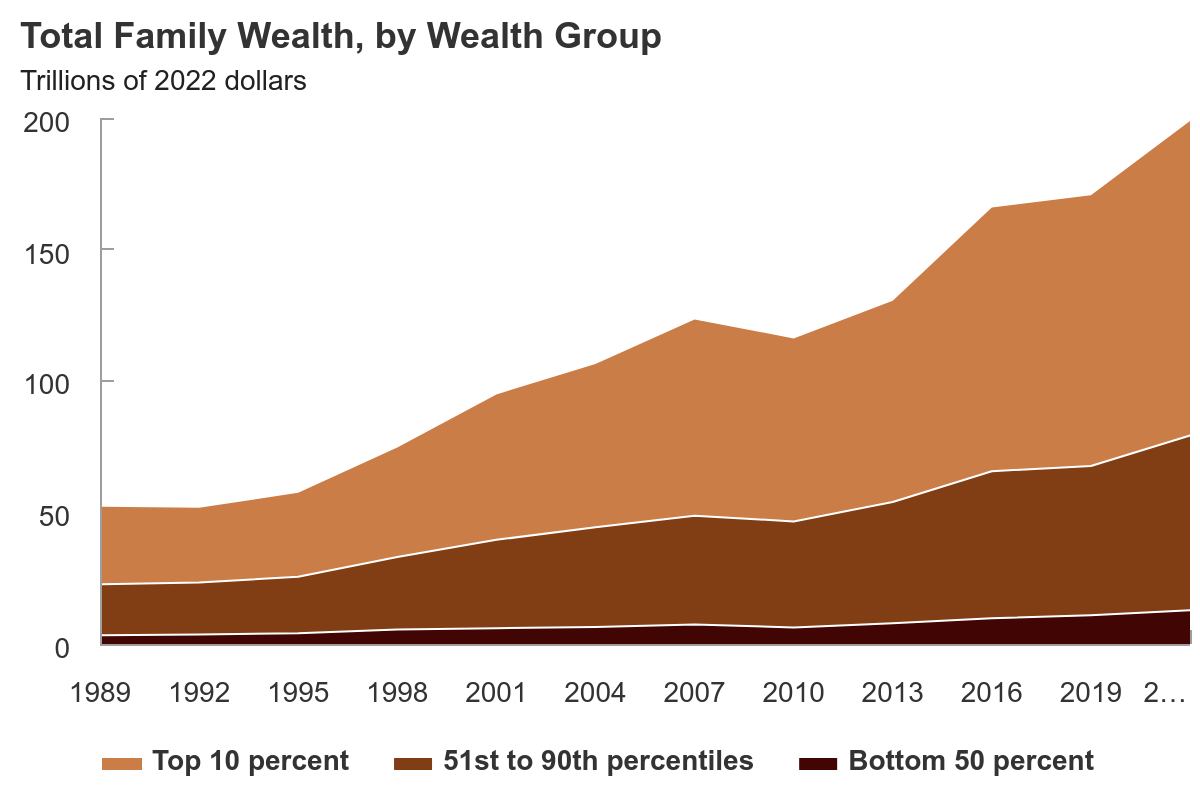
Even as wealth has become more concentrated in the highest income brackets, the tax rates on the upper ten percent and particularly the upper one percent have significantly declined since Ronald Reagan became President in 1981. Over the last forty years, the actual income tax rate paid by the wealthiest one percent of taxpayers has fallen from nearly 40 percent to 26 percent.23Robert McClelland and Nikhita Airi, “Effective Income Tax Rates Have Fallen for the Top One Percent Since World War II,” Tax Policy Center, September 15, 2021, https://taxpolicycenter.org/taxvox/effective-income-tax-rates-have-fallen-top-one-percent-world-war-ii-0. A key provision of the Biden Administration’s 2022 Inflation Reduction was to allocate $80 billion over ten years to the IRS to reduce tax evasion by the wealthiest taxpayers, an amount estimated to be over $600 billion each year.24Natasha Sarin, “The Case for a Robust Attack on the Tax Gap,” U.S. Department of the Treasury Featured Stories, September 7, 2021, https://home.treasury.gov/news/featured-stories/the-case-for-a-robust-attack-on-the-tax-gap; Arianna Fano, “Breaking Down the Federal Tax Gap,” Bipartisan Policy Center, June 27, 2024, https://bipartisanpolicy.org/explainer/breaking-down-the-federal-tax-gap/. Republicans used negotiations over extending the debt ceiling to cut the original $80 billion to $60 billion. Within weeks of Trump’s taking office, he ordered the IRS to lay off 6,000 employees, more than six per cent of the IRS staff, even as he made it clear that this was only the beginning of his assault on the agency. Blocking the IRS from requiring the wealthy to pay their taxes is clearly a cause close to Trump. As he said in his first 2016 debate with Hillary Clinton, “Paying no taxes makes me smart.”25Andrew Duehren and Michael S. Schmidt, “I.R.S. to Begin Laying Off Roughly 6,000 Employees on Thursday,” New York Times, February 19, 2025, https://www.nytimes.com/2025/02/19/us/politics/irs-layoffs.html; Richard Rubin, “Donald Trump on Not Paying Taxes: ‘That Makes Me Smart’,” Wall Street Journal, September 26, 2016, https://www.wsj.com/articles/BL-WB-65659; “September 26, 2016 Debate Transcript,” Commission on Presidential Debates, https://www.debates.org/voter-education/debate-transcripts/september-26-2016-debate-transcript.
In the 2024 campaign, Donald Trump’s unconcealed policies to protect wealthy Americans from paying taxes did not seem to resonate with most Americans who don’t have the advantage of overseas tax havens and creative accountants. Neither did his promise to end clean-energy programs and eviscerate regulations by the Environmental Protection Agency. For decades, the coal, oil, and gas industries have worked to discredit the conclusive evidence that the burning of fossil fuels is the major contributor to global warming. In 2009, Trump signed a full-page New York Times with over one-hundred American business leaders warning that if the United States and other countries failed to act decisively to slow climate change, it was “scientifically irrefutable that there will be catastrophic and irreversible consequences for humanity and our planet.26“Dear President Obama . . .,” New York Times, November 19, 2016, https://static01.nyt.com/packages/pdf/opinion/Dot-Earth/climatead09nyttrumplowrez.pdf. But in 2012, as he began his plans to enter politics, he tweeted that the “concept of global warming was created by and for the Chinese in order to make U.S. manufacturing non-competitive."27Edward Wong, “Trump Has Called Climate Change a Chinese Hoax,” New York Times, November 18, 2016, https://www.nytimes.com/2016/11/19/world/asia/china-trump-climate-change.html.
As in all matters Trump, this was a purely transactional move. Few people were shocked, or even noticed, when he told members of the American Petroleum Industry and over a dozen oil company executives at a private at Mar-a-Lago that they “should donate $1 billion to his presidential campaign.” In return, he said, he would roll back environmental rules.”28Lisa Friedman, Coral Davenport, Jonathan Swan, and Maggie Haberman, “At a Dinner, Trump Assailed Climate Rules and Asked $1 Billion From Big Oil,” New York Times, May 9, 2024, https://www.nytimes.com/2024/05/09/climate/trump-oil-gas-mar-a-lago.html.
Trump knows nothing about economics, science, or history that might guide him as the nation’s President, but his marketing skills honed by years hawking overpriced real estate projects, and his time on television playing the CEO on The Apprentice, created the illusion of him as a brilliant businessman despite his seven bankruptcies and the fact that a jury found his companies guilty of massive tax fraud that led to a $350 million fine. Perhaps many Americans have come to see cheating on taxes by the rich and using bankruptcy laws to stiff those to whom they owe money as simply “good business.”
Above all, Donald Trump discovered what sells in today’s political environment must be saturated with the trappings of entertainment. Our national comedian of cruelty found that the more vulgar, vile and threatening he became, the more millions of Americans adored him.
What initially bewildered me most was the willingness of millions of American voters to accept Trump’s tsunami of transparent lies. In time, I’ve come to believe that Trump sensed the new reality: most Americans believe all politicians lie. By making his lying so brazen and preposterous, he could be seen as somehow more “honest,” and “non-hypocritical” than his opponents.
Even though we can be certain that Trump has never read Hannah Arendt’s Origins of Totalitarianism (1951), he grasped one of her critical insights.
The followers of demagogues, writes Arendt, were “ready at all times to believe the worst, no matter how absurd, and did not particularly object to being deceived because it held every statement to be a lie anyhow.” Such power-obsessed leaders discovered they could “make people believe the most fantastic statements one day, and trust that if the next day they were given irrefutable proof of their falsehood, they would take refuge in cynicism.” They would insist that “they had known all along that the statement was a lie” and would admire their leader for his “tactical intelligence.”29Hannah Arendt, Origins of Totalitarianism (New York: Harcourt, Brace and Company, 1971), 433.
As long as you kept repeating something, “it didn’t really matter if it wasn’t true,” said Stephanie Grisham, Trump’s White House Press Secretary. “Casual dishonesty filtered through the White House as though it were in the air-conditioning system.”30Stephanie Grisham, I’ll Take Your Questions Now: What I Saw at the Trump White House (New York: Harper Collins, 2021), 138; Peter Baker, “In Trump’s Alternate Reality, Lies and Distortions Drive Change,” New York Times, February 23, 2025, https://www.nytimes.com/2025/02/23/us/politics/trump-alternative-reality.html.
Such contempt for the truth is not simply a matter of political tactics. It has demonstrable, and often deadly consequences. In the wake of the COVID epidemic, surveys showed that 75 per cent of Republicans told pollsters they had confidence in Trump’s advice on the epidemic. The result? An analysis published in 2023 in The Journal of American Medicine concluded that, once the COVID vaccine became available, "the excess death rate among Republican voters was 43% higher than the excess death rate among Democratic voters.”31Andrew Greiner, “75% of Republicans trust Trump’s medical advice,” YouGov, April 24, 2020, https://today.yougov.com/politics/articles/29305-75-republicans-trust-trumps-medical-advice; Jacob Wallace, Paul Goldsmith-Pinkham, Jason L. Schwartz, “Excess Death Rates for Republican and Democratic Registered Voters in Florida and Ohio During the COVID-19 Pandemic,” JAMA Internal Medicine, July 24, 2023, https://jamanetwork.com/journals/jamainternalmedicine/fullarticle/2807617; Alyssa Bilinski, Ezekiel J. Emanuel, “COVID-19 and Excess All-Cause Mortality in the US and 18 Comparison Countries,” JAMA Network, October 12, 2020, https://jamanetwork.com/journals/jama/fullarticle/2771841. Lancet, one of the world’s most trusted medical journals, compared America’s COVID response with our European allies during the Trump time in office and estimated that his administration’s inaction and misinformation led to the unnecessary deaths of at least 400,000 Americans.32Steffie Woolhandler, David U. Himmelstein, Sameer Ahmed, Zinzi Bailey, Mary T. Bassett, Michael Bird, et al., “Public Policy and Health in the Trump Era,” The Lancet, February 20, 2021, https://www.thelancet.com/journals/lancet/article/PIIS0140-6736(20)32545-9/abstract.
As I watched his rise to the presidency in 2016 and 2024, I recalled the 1955 book by Milton Mayer, They Thought They Were Free. In 1953, Mayer moved to the small German city of Marburg and came to know a number of local townspeople who looked back on their nation’s journey from the democratic Weimar Republic to Hitler’s Third Reich. None were more perceptive than Heinrich Hildebrandt, a retired teacher of classics and literature. What happened from the beginning of the new German Reich, he said, was the gradual acceptance of the German people to the step-by-step destruction of their democratic institutions, the rise of a dictatorship and the ultimate barbarity: the Holocaust. Each act was worse than the last, but only a little worse, he recalled, and he kept waiting for that one dramatic overreach by Hitler’s regime that would lead decent Germans to rise in resistance.
Then, one evening at dinner, his very young son began talking about “Jew swine”, said Hildebrandt, “and you see that everything, everything, has changed and changed completely under your nose,” recalled Hildebrandt. “The world you live in—your nation, your people—is not the world you were born in at all.”33Milton Mayer, They Thought They Were Free, The Germans, 1933–45 (Chicago: University of Chicago Press, 1955), 171.

Over the last decade a majority of white Americans have come to accept a President who does little to conceal his racism, his contempt for—and abuse of—women, his cruelty toward the displaced and the vulnerable, and his lack of any respect for democratic norms. Donald Trump is no Adolph Hitler, and today’s America is certainly not the Weimar Germany of the Great Depression. But the process of first being appalled by, and then gradually accepting his abnormal words and actions as “normal,” has marked Trump’s rise to power.
Hildebrandt called the response of the German people during the 1930s gewöhnung — "habituation." Social psychologists use the same word to describe the process by which, through repetition, words and behavior once considered unacceptable eventually become dismissed with a shrug. “Just Trump being Trump.” Barring some dramatic shift in the public mood, that process will only continue during a second Trump administration as we are overwhelmed by his incompetence, his merciless cruelty, and his demand for a powerful “unitary executive,” the kind of unlimited authority claimed by monarchs and dictators.
Despite his words and behavior, Trump has gained the passionate support of an overwhelming majority of Republican voters. Their unquestioning embrace has allowed him to achieve something that has never happened in American history: the complete control of one of the nation’s major political parties by a reckless demagogue. Having abandoned integrity and, what earlier generations called a “sense of honor,” his nominees, appointees, and elected Republican officials have prostrated themselves before a President who openly announced that his false claim that the 2020 election was stolen allowed him to “terminate all rules, regulations, and articles, even those found in the Constitution.”34Isaac Arnsdorf and Josh Dawsey, “Trump’s call to suspend Constitution divides Republicans,” Washington Post, December 4, 2022, https://www.washingtonpost.com/national-security/2022/12/04/trump-constitution-republicans/.
Trump’s dismissal of constitutional restraints has been a persistent pattern. Less than a month into his new administration, in a post-midnight post on his “Truth Social” account, he wrote: “He who saves his Country does not violate any law,” a restatement of a quote attributed to Emperor Napoleon Bonaparte. Whether Napoleon actually made such a statement is irrelevant: it reflects Donald Trump’s belief that he is above the law.
Such assertions of unlimited executive power would have discredited any politician a half century ago; a much less extreme claim of presidential authority by Richard Nixon led the Republican Party to abandon the nation’s 37th President and force his resignation in 1974. But the guardrails that help protect our democracy (however flawed) have fallen away during the last thirty to forty years and a crucial element in this process has been the declining confidence of Americans in the institutions that are essential to making informed public policy choices. “Elitists” of all kinds, scientific and medical organizations, professional journalists, social scientists, academics, researchers, colleges and universities, the government agencies that protect our health and safety, judges, prosecutors and legal institutions: all are dismissed as part of the corrupt “Deep State.” While hardly perfect, these social repositories of inquiry and knowledge incorporate ethical guidelines and self-correcting procedures that seek to arrive at some measure of truthfulness, making them infinitely preferable to understand the world as it is rather than what we wish were true, or what feeds our deepest fears.
Is Trump simply a beneficiary of this transformation in our politics? Or is it a moment when an individual’s bizarre and troubling behavior seems matched to our national mood? Since the 1960s, mental health professionals have been wary of diagnosing the mental health of individuals, particularly politicians, but in his 2019 analysis, Diagnosis from a Distance, psychologist John Martin-Joy suggests that, given Donald Trump’s clearly unstable behavior, we may have no choice but to make that assessment.35John Martin-Joy, Diagnosing from a Distance: Debates over Libel Law, Media, and Psychiatric Ethics from Barry Goldwater to Donald Trump (Cambridge: Cambridge University Press, 2019) 224–228.
John Gartner, a nationally recognized psychologist who taught at Johns Hopkins University Medical School for twenty-eight years certainly agrees. He has made a powerful argument that Donald Trump “suffers from malignant narcissism, a diagnosis far more toxic and dangerous than mere narcissistic personality disorder because it combines narcissism with three other severely pathological components: paranoia, sociopathy, and sadism.” In a 2020 essay, Gartner documented Trump’s persistent narcissism (he knows “more about everything than anyone” and his “empathy for no one but himself”). The President’s paranoia was reflected in “his demonization of the press, minorities, immigrants, and anyone who disagrees with him.” Such attributes, concluded Gartner, are classic signs of paranoia. Equally dangerous were the examples of his sociopathy, “a diagnosis that describes people who constantly lie, violate norms and laws, exploit other people, and show no remorse”. Finally, there was his constant sadistic behavior—“He takes gleeful pleasure in harming and humiliating other people. He is undoubtedly the most prolific cyberbully in history.”36John Gartner, “DEFCON 2: Nuclear Risk Is Rising as Donald Trump Goes Downhill,” in Rocket Man: Nuclear Madness and the Mind of Donald Trump, ed. John Gartner, Steven Buser, and Leonard Cruz (Asheville, NC: Chiron Publications, 2018), 29–30.
As it has become more difficult to winnow truth from the torrent of lies, it becomes easier to accept his repeated claim: “I alone can fix it.” Any misgivings can be set aside by finding confirmation of Donald Trump’s lies on conspiracy-affirming social media platforms or Fox News.
Trump also learned much from the internal infighting that marked his first administration. The second time around, he is making certain that every appointment and every candidate who hopes to be re-elected is totally dependent upon his whims. There will be no voices to resist or to ask probing questions. And unlike his first administration, he now has the coordinated support and financial backing of much of America’s plutocracy as well as the right-wing ideologues who produced Project 2025 and have vetted individuals to carry out his wishes.
Indiana Senator Jim Banks (R) described the beginning of the second Trump administration as "shock and awe," but it was essentially Steve Bannon’s recipe: “Flood the zone with shit,” overwhelming critics and the opposition party while insuring that members of his party will approve all his nominees and appointments, even if they are incompetent, convicted criminals, sexual predators, paranoiacs, or xenophobes.37Robert Costa, “Trump ally says first 100 days will be ‘shock and awe’,” CBS Sunday Morning, January 19, 2025, https://www.cbsnews.com/news/trump-ally-says-first-100-days-will-be-shock-and-awe/; Brian Stelter, “This infamous Steve Bannon quote is key to understanding America’s crazy politics,” CNN Business, November 16, 2021, https://www.cnn.com/2021/11/16/media/steve-bannon-reliable-sources/index.html.
As someone who generally votes for Democratic Party candidates, I have been disappointed with election outcomes in the past. However discouraged, I never felt that Ronald Reagan, or the father and son Bushes (or even Richard Nixon) represented a fundamental threat to our democracy. Donald Trump and the extremists, loyalists, and enablers who fill his Administration are that threat and I have no illusion that a subservient Republican congressional majority will stop his abuses of the Constitution. Perhaps the Supreme Court will block his most radical acts, but the Court’s July 2024 decision granting him absolute immunity for actions taken “within his constitutional powers as president” is far from reassuring.38Trump v. United States, 23 U.S. 939 (2024), https://www.supremecourt.gov/opinions/23pdf/23-939_e2pg.pdf.
In all the post-mortems that followed the 2024 election, an interview with Anne Applebaum by the New York Times’ Ezra Klein captured what I had been thinking but couldn’t put into words. As Klein writes:
One of the challenging things about covering Donald Trump is that it is hard to talk about him without sounding unhinged—and that is because he acts in ways that are, by any reasonable standard, unhinged. . . . He makes his opponents look like rabid antagonists by making them respond to a reality that leaves no room for neutrality, no room for a wait-and-see open-mindedness. He creates a wild reality—and then you sound wild simply describing it.39Ezra Klein, “Trump Kicks Down the Guardrails,” New York Times, November 19, 2024, https://www.nytimes.com/2024/11/19/opinion/ezra-klein-podcast-anne-applebaum.html.
In 2018, when the news media uncovered the full extent of the Trump Administration’s deliberate policy of separating children from their mothers and fathers, Joe Biden responded in what would become his refrain over the next six years, “This is not who we are.” He was not referring to policy, but to a code of moral and ethical beliefs that he assumed Americans shared.
Joe Biden was mistaken. On election day, 2024, 61 per cent of white men and 53 percent of white women voted for Donald Trump. This is who the majority of white voters have become.
So, what is to be done? In his 1862 message to Congress as the war for the preservation of the union began, Abraham Lincoln told the nation: “The dogmas of the quiet past are inadequate to the stormy present. The occasion is piled high with difficulty, and we must rise with the occasion,” he said. “As our case is new, we must think anew, and act anew. We must disenthrall ourselves, and then we shall save our country.”40Abraham Lincoln, “December 1, 1862: Second Annual Message,” Miller Center Presidential Speeches, https://millercenter.org/the-presidency/presidential-speeches/december-1-1862-second-annual-message.
More than a century and a half later, Lincoln’s words speak to the present threat to American democracy and the values we once shared. The crisis has been in the making for over half a century. This and future generations now face the long task of reimagining what kind of America, what kind of world, is worth fighting for.
About the Author and the Photographer
Dan T. Carter is Educational Foundation Emeritus Professor at the University of South Carolina. He is the author of numerous books and articles including The Politics of Rage: George Wallace, the Origins of the New Conservatism, and the Transformation of American Politics (Louisiana State University Press, second edition, 2000) and Unmasking the Klansman: The Double Life of Asa and Forrest Carter (Athens, Georgia: New South Books, 2023)
Tom Rankin is Professor of the Practice of Art and Documentary Studies at Duke University where he directs the MFA in Experimental and Documentary Arts. His books include Sacred Space: Photographs from the Mississippi Delta (1993; Deaf Maggie Lee Sayre: Photographs of a River Life (1995); Faulkner's World: The Photographs of Martin J. Dain (1997); Local Heroes Changing America: Indivisible (2000). He edited and wrote the introductory essay for the book One Place: Paul Kwilecki and Four Decades of Photographs from Decatur County, Georgia (2013). He is a member of the Southern Spaces editorial board.
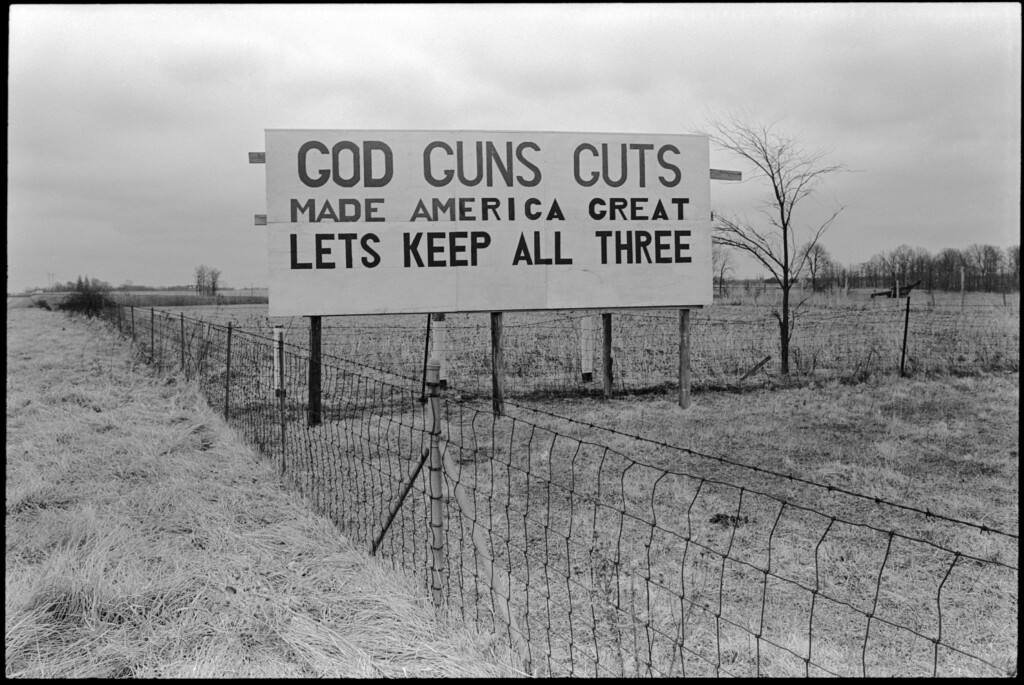
Cover Image Attribution: Camden, Tennessee Christmas Parade, 1982 Billboard along I-65, Indiana, 1976. Photograph by and courtesy of Tom Rankin.
]]>Introduction
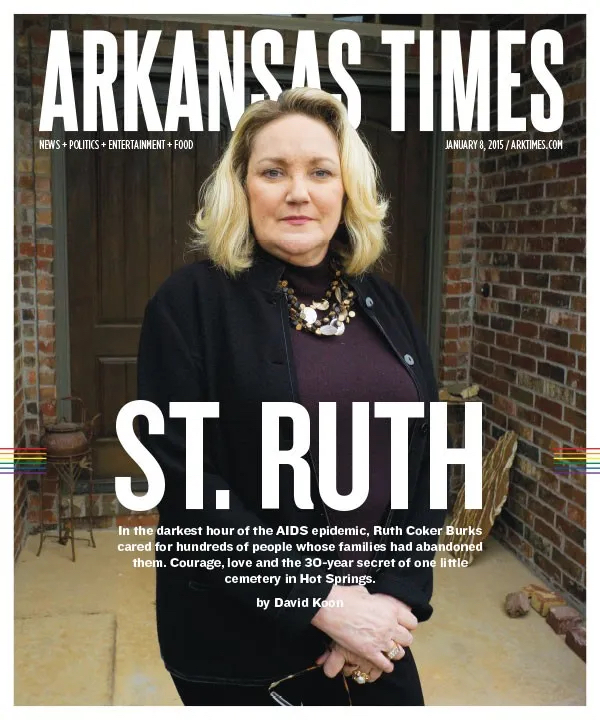
Ruth Coker Burks (born Frances Ruth Coker in 1959) is an Arkansas woman who was a caregiver and AIDS activist in central Arkansas from the mid-1980s to the mid-1990s during the height of the HIV/AIDS epidemic. In 1986, when Burks began her informal care work, she was a mid-twenties single mother who sold timeshare condominiums on Lake Hamilton near her hometown of Hot Springs in central Arkansas. Over the next few years, her informal end-of-life care expanded into daily care work, AIDS activism, and education. Newspaper and magazine profiles, television interviews, a popular memoir, and social media posts have documented her efforts as the ‘Arkansas Cemetery Angel’ (we will refer to Ruth Coker Burks as Ruth since this is how she is named in her memoir and in most press coverage). Laudatory media coverage also led to pointed criticisms of the limits of Ruth’s efforts and to potential flaws in her memory. Rather than evaluating the accuracy of Ruth’s account or those of her critics, this article investigates what her rich, if fragmentary, archival materials, along with her published memoir and newspaper accounts, can reveal about care work, gender, and the lived experience of the AIDS epidemic in Arkansas. More broadly, it begins to address what the publicity (and controversy) around Ruth’s life story offers the study of queer memory in southern spaces.
Ruth’s career as an AIDS caregiver and activist began with a case of mistaken maternal identity and a contested family cemetery. As described in newspaper profiles and her memoir, All the Young Men (2020), in 1986, while visiting a friend in the hospital in Little Rock, Arkansas's capital city, Ruth noticed a neglected patient, Jimmy, who was dying of complications from AIDS. When she went into Jimmy's hospital room, he mistook Ruth for his mother, who refused to visit him. After she confronted the nursing staff, who largely avoided Jimmy's room and failed to convince his mother (over the phone) to come to visit her dying son, Ruth returned to Jimmy's room. And it was as his ‘mama’ that Ruth sat by his bedside for hours, holding his hand and comforting him as he died. This moment of assumed maternal identity marked the beginning of Ruth's decade of informal care work.1Ruth Coker Burks and Kevin Carr O’Leary, All The Young Men: A Memoir of Love, AIDS, and Chosen Family in the American South (New York: Grove Press, 2020), 3–11; Michael Garofalo, “Lessons in Love,” StoryCorps, December 5, 2014, https://storycorps.org/podcast/storycorps-449-lessons-in-love/; David Koon, “Ruth Coker Burks: The Cemetery Angel,” Arkansas Times, January 8, 2015, https://arktimes.com/news/cover-stories/2015/01/08/ruth-coker-burks-the-cemetery-angel.
Alongside care work and public activism, Ruth provided a final resting place for some men she cared for in the Files Cemetery in Hot Springs, an hour's drive southwest of Little Rock in the Ouachita Mountains. It was for Jimmy, who had mistaken Ruth for his mother, that she turned to Files Cemetery.
From the first chapter of Ruth’s memoir, the Files Cemetery is described as a site of commemoration, refuge, and conflict.2Burks and O’Leary, All the Young Men, 11–14. In the following decades, this cemetery has become an essential site of LGBTQ+ memory in Arkansas. Layers of informal commemoration at the Files Cemetery and Ruth’s fragmentary archival record speak to the kinds of alternative archives of AIDS activism—beyond the public sphere—that Stephen Vider has examined in his discussion of community caregiving during the AIDS epidemic as part of his more extensive study of the importance of domestic spaces in LGBTQ+ politics in the United States.3Stephen Vider, The Queerness of Home: Gender, Sexuality, and the Politics of Domesticity after World War II (Chicago, IL: University of Chicago Press, 2021). As far as we know, the Files Cemetery is one of only a few cemeteries in the United States that became a documented resting place for people who died during the HIV/AIDS epidemic.4Two other documented final resting places for those who died during the HIV/AIDS epidemic are the Congressional Cemetery in Washington, DC and the Hart Island Potter's Field in New York City. The Files Cemetery operates at a much smaller and more informal scale than either of these.
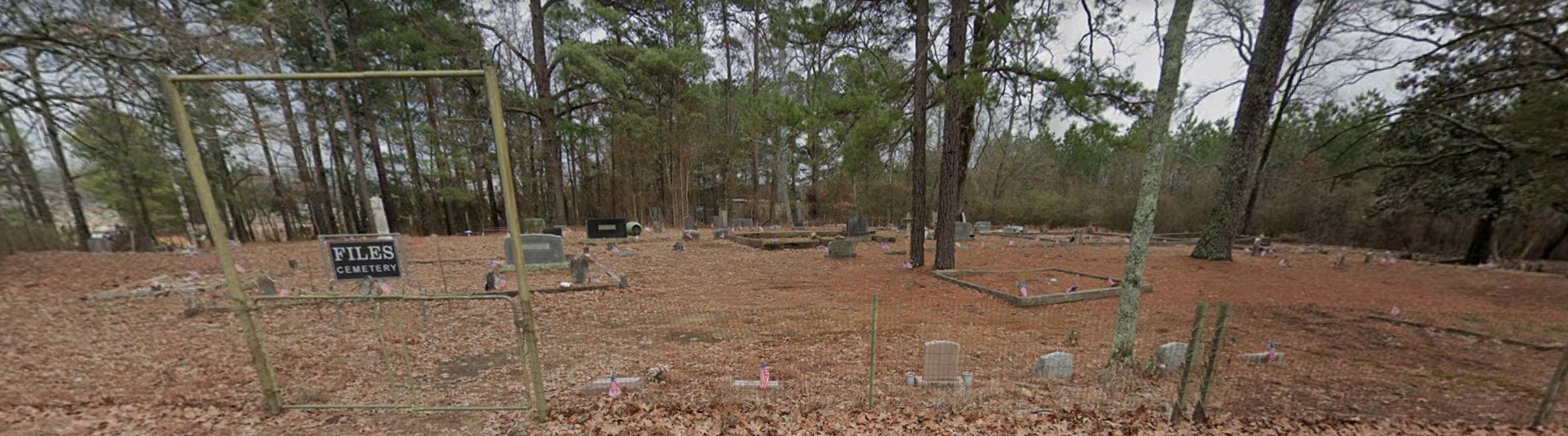
There also is scattered but evocative evidence of continuing engagement with the Files Cemetery as a space for queer memory-making. Facebook posts from March 2019 record how the drag troupe, the Arkansas Sisters of Perpetual Indulgence: The Abbey of the Hillbilly Harlots, cared for the cemetery’s grounds and planted rose bushes. A series of photographs of the Files Cemetery taken at regular intervals from spring 2020 to fall 2024, which are part of a forthcoming donation to the Center for Arkansas History and Culture, reveal earlier layers of informal commemoration (including notes, beer bottles, Mardi Gras beads, and devotional objects) near the resting places of some of the men. In 2020, a grave was added to the cemetery (of which Ruth was unaware.) Some of these later commemorative efforts at individual graves did not involve Ruth and were potentially enacted by local critics of Ruth, as evidenced by one stone that was partially funded by a critical host of a YouTube podcast.
Praise extended to the national and international levels. The first prominent news article on Ruth, which predated the Arkansas Times' profile, was a twelve-minute interview with NPR's StoryCorps in 2014. The December 7, 2020, issue of People magazine featured a glowing article, “They Call Me the AIDS Angel.”5Jason Sheeler, “They Call Me the AIDS Angel,” People, December 7, 2020. Exemplifying Ruth's newfound fame, the Guardian published an article on February 3, 2021 titled, "The Aids Angel: How Ruth Coker Burks Comforted Dying Gay Men." That same year, however, the Arkansas Times published a more critical piece by Austin Gelder about a “missing monument.” Gelder's piece centered on accusations that Burks had exaggerated some of her claims and failed to establish a much-discussed monument at the Files Cemetery in honor of those for whom she had cared.6Austin Gelder, “Ruth Coker Burks and the Missing Monument,” Arkansas Times, July 8, 2021, https://arktimes.com/arkansas-blog/2021/07/08/ruth-coker-burks-and-the-missing-monument. National press coverage trended from the laudatory to the skeptical with pointed questions about Ruth's claims about the number of men for whom she cared, the number of gravesites at the Files Cemetery, and her contested ownership of the cemetery.7Alexander Kacala, “Doubts Surround Viral Story of ‘AIDS Angel’ Who Says She Helped Hundreds of Dying Men,” NBC News, October 29, 2021, https://www.nbcnews.com/nbc-out/out-news/doubts-surround-viral-story-aids-angel-says-helped-hundreds-dying-men-rcna4163. These critiques came largely from residents of Hot Springs, some of whom knew Ruth, some of whom wanted a more thorough history of the events, some who are invested in the history and its public telling, and also those who feel that her version of events is somehow maligning the city. A YouTube podcast, RUTHLESS: The Real Story Behind the ‘Cemetery Angel of Arkansas’ is representative of this critique and is discussed in more detail below. In the wake of this praise and criticism, the Center for Arkansas History and Culture at the University of Arkansas at Little Rock has collected Ms. Burks’ archival materials in an ongoing effort to preserve LGBTQ+ history in Arkansas. The CAHC's archival work complements that of Invisible Histories—an organization who "believes archiving is resistance to oppression and history leads to liberation"—to document queer histories and spaces of memory in the southern United States.8"Invisible Histories." Accessed January 3, 2025. https://invisiblehistory.org/.
This article discusses the history of Ruth's care work and activism in central Arkansas in the broader context of scholarship on gender and care work during the HIV/AIDS epidemic. We will survey the gendered construction of care work and motherhood in Arkansas in Ruth’s memoir and archival materials. Then, we will tackle the life histories of the predominantly white and Latino working class and rural men she cared for and what her archive—with its evocative fragments and enduring silences— reveals about the lived experience of the AIDS epidemic for some people in Arkansas. We conclude with Ruth’s critics and what her story can teach about the contested memory of the AIDS epidemic. This article does not attempt to evaluate the accuracy of the claims of either Ruth or her local critics, but rather examines the possibilities and limits that her archive, and the published materials about her, open up. The historical importance of Ruth’s care work and the validity of some of the criticisms of her are not incompatible. Rather than a binary understanding, we are interested in what Ruth’s archive reveals about the history of the AIDS epidemic and the construction of the role of the idealized caregiver for some women in Arkansas.
Care Work and AIDS Activism in Arkansas
Ruth was one of many women across the United States who played leading roles in AIDS activism and care. As the ACT UP Oral History Project states, “Women were an integral part of the AIDS crisis—first, and foremost, as People with AIDS, but also as leaders of the AIDS Activist Movement, and as caregivers.”9“Women and AIDS,” ACT UP Oral History Project, digital archive, https://www.actuporalhistory.org/actions/women-aids. Ruth’s trajectory reflects what scholars have argued was the complex array of personal, political, social, and spiritual motivations behind many women’s activism during the AIDS epidemic in the United States.10See, for example, Ulrike Boehmer, The Personal and the Political: Women’s Activism in Response to the Breast Cancer and AIDS Epidemics (Albany: State University of New York Press, 2000); Angelique Harris, “Emotions, Feelings, and Social Change: Love, Anger, and Solidarity in Black Women’s AIDS Activism,” Women, Gender, and Families of Color 6, no. 2 (2018): 181–201; For a more expansive history of women’s activism in the United States, see Dawn Durante, ed., Women’s Activist Organizing in US History (Urbana: University of Illinois Press, 2022).
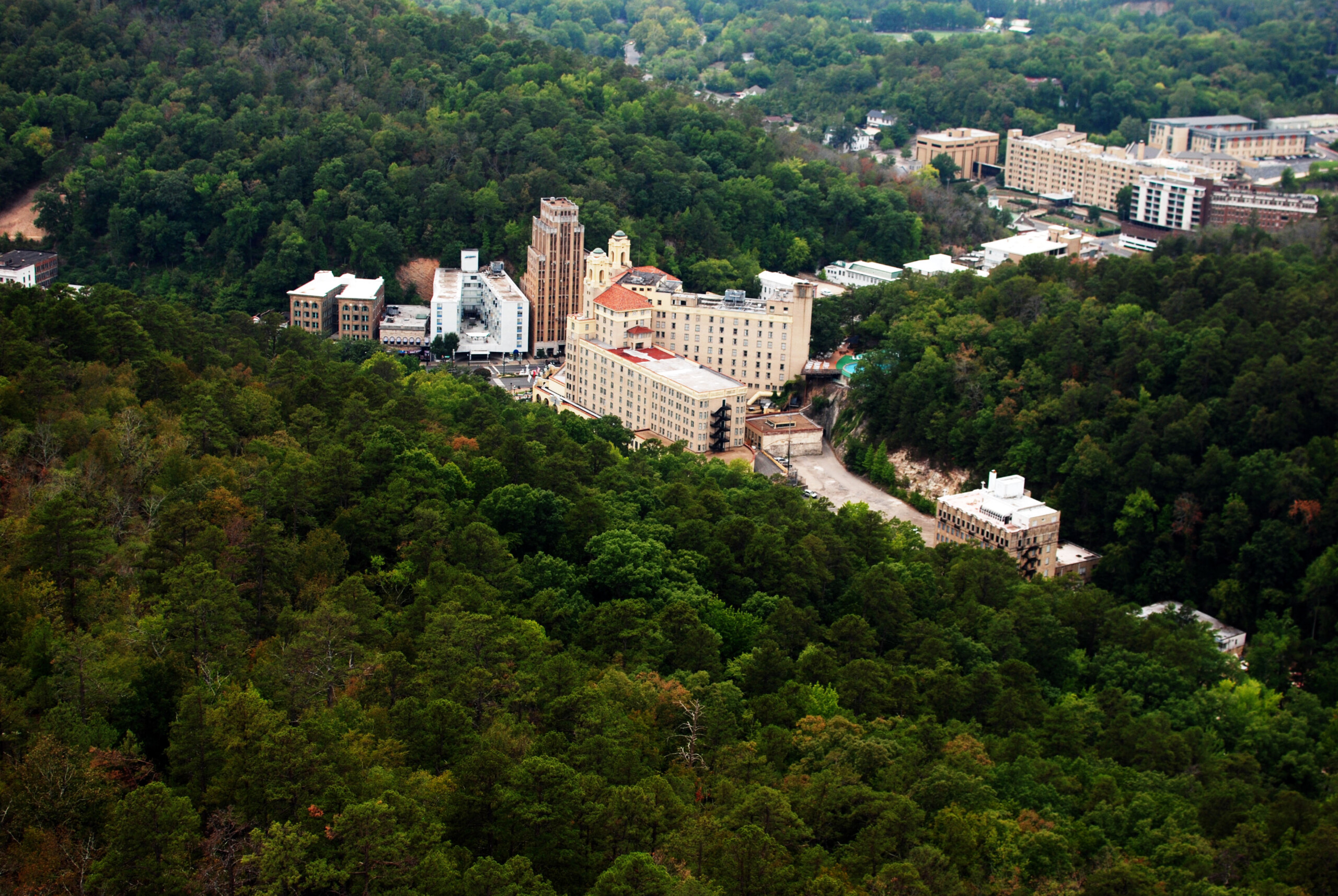
.jpg)
Ruth was a single mother who sold lakeshore timeshares in Hot Springs when she began her informal care work. Her work's flexible and commission-based practices facilitated Ruth’s initial care work. AIDS activism and end-of-life care were not how recently divorced Ruth planned to spend her twenties and early thirties. “All I want sometimes is to be a wife and be in the Junior League.”11Burks and O’Leary, All the Young Men, 74. While Ruth did not come from a well-off background, she hoped to advance in the social scene of Hot Springs. Ruth’s care work encompassed a shifting range of activities from 1986 to 1995. Initially, she focused on visiting the hospital, comforting dying men, and providing supplemental food for those still alive.12Burks and O’Leary, 62; Paula Cocozza, “The AIDS Angel: How Ruth Coker Burks Comforted Dying Gay Men,” The Guardian, February 3, 2021, https://www.theguardian.com/society/2021/feb/03/aids-angel-ruth-coker-burks-dying-gay-men. As she described at one point (she had started dumpster-diving to get adequate cooking supplies), “I could be like this little grocery-delivery person.”13Burks and O’Leary, All the Young Men, 96. Word of mouth drove her first few years of care work as anxious Little Rock and Hot Springs hospital staff contacted her. “More calls started coming. I guess the nurses and doctors all went to the same places to drink and unwind because I later found out they got to talking. ‘Oh my God, we had this insane woman come in, and she went right in the AIDS patient’s room.’ . . . I had two calls that first month, which I thought was crazy. Then three the second.”14Burks and O’Leary, 24–25.
This soon shifted to men calling her directly, either for themselves or for a friend or loved one. As Ruth notes, by 1988, this “network of calls from the hospitals and gay men giving out my number” kept her more than busy, along with caring for her young daughter and trying to make a living.15Burks and O’Leary, 54, 83. It is important not to reify the assumption that persons with HIV/AIDS were always gay men, even if that is often how Ruth discusses her experiences in central Arkansas in her memoir. Ruth’s archive and the ambiguities surrounding the Files Cemetery underline the importance of not projecting contemporary categories onto the past and respecting privacy in the telling of these histories.
From 1986 to 1989, Ruth worked quietly, and from 1989 onwards, she was much more public in attempting to raise awareness and draw local media attention to the AIDS epidemic in central Arkansas. Building on her connections to some of “the town elders” of Hot Springs, Ruth also gave talks at Rotary Clubs across Arkansas and quietly facilitated donations from well-to-do residents of Hot Springs. In her description of one of her early speeches at Rotary, “I talked about the people with AIDS in town, how they needed food and access to care, but what we mainly needed was education.”16Burks and O’Leary, All the Young Men, 125, 129–134, 184, 257. Formalizing her activism, Ruth assisted Norman Jones, who ran the Arkansas non-profit, Helping People with AIDS (HPWA.) Ruth’s work with HPWA encompassed everything from the distribution of accessible sex education materials to creative publicity efforts, including the production of humorous T-shirts with the phrase “I believe in Jesus. Do you?” transformed into “I DO. DO YOU?” about safer sex practices.17Burks and O’Leary, 270–271.
The sharply diverging reactions to Ruth in the present-day echo in her recollections of care work and AIDS activism from the mid-1980s to the mid-1990s. Ruth claims that initially, she was perceived as a prim “‘church lady’” by many of the men she cared for. However, she remembers that to most of Hot Springs, she was viewed as “this insane woman” and “that crazy Ruth Coker Burks,” who wouldn’t stop talking about AIDS and gay rights.18Ruth Coker Burks, "All Her Sons: The Cemetery Angel," interview by Seth Doane, Video, December 1, 2019, CBS Sunday Morning, https://www.cbsnews.com/news/all-her-sons-ruth-coker-burks-the-cemetery-angel/; Burks and O’Leary, All the Young Men, 24, 94, 156.


Along with public-facing activism, Ruth’s informal hospice care evolved from providing company at the bedside of dying men to helping ‘her guys’ live as long as they could by securing housing assistance, filling out death certificates, seeking social security payments, filling AZT prescriptions at often hostile local pharmacies, HIV testing, and ultimately AIDS education.19Koon, “Ruth Coker Burks: The Cemetery Angel”; Burks and O’Leary, All the Young Men, 57–58, 72, 81–83, 86–88, 112–113. Ruth regularly visited hospitals in Hot Springs and Little Rock and frequently cared for people in their homes. At times, she appears to have operated as an informal pharmacy herself, distributing leftover AIDS medication across central Arkansas.20Garofalo, “Lessons in Love”; Burks and O’Leary, All the Young Men, 173. These shifts did not mean she stopped providing personal daily attention. For example, in her time with one of the men for whom she cared, Chip, she visited daily, fed him, bathed him, and read him the newspaper.21Burks and O’Leary, All the Young Men, 234. In his study of queer public history and the home, Vider challenges the often-presumed division between political action (outside of the home) and care work (inside the home). Rather than framing the home as a space away from politics, Vider argues that the home and the care for people with AIDS in their own homes constitute an essential site for activism.22Vider, The Queerness of Home, 179–213. The contours of Ruth's care work reflect Vider's argument.
While Ruth’s individualized efforts to keep ‘her guys’ fed are distinct from the more extensive history of food justice organizing in the twentieth-century United States that Emily Twarog studies in Politics of the Pantry (2017), food was at the center of Ruth’s work, especially in the late 1980s, and her subsequent gendered construction as a caregiving angel.23Emily E. LB. Twarog, Politics of the Pantry: Housewives, Food, and Consumer Protest in Twentieth-Century America (New York: Oxford University Press, 2017). In early media profiles from 2014 and 2015, Ruth estimated that she cared for "nearly 1,000 people" and "hundreds of dying people" from the mid-1980s to the mid-1990s.24Garofalo, “Lessons in Love”; Koon, “Ruth Coker Burks: The Cemetery Angel.” As discussed below, these numbers have been contested. While it is beyond the scope of this article to fully address how Ruth’s efforts intersected with formal and informal care networks in Arkansas, there were additional organized efforts, including the important work of RAIN (Regional AIDS Interfaith Network), which was profiled in a 2016 Arkansas Times piece, among others.
Ruth’s unprocessed archival collection at the Center for Arkansas History and Culture provides some indications of how her care work intersected with broader caregiving networks in Arkansas. Specifically, her archives include a binder of letters of recommendation and typed endorsements from prominent community members regarding Ruth’s nomination for the Arkansas Community Service Award, the establishment of an HIV/AIDS program at Levi Hospital, and the nomination of Ruth for the position of Executive Director of the Arkansas AIDS Foundation. In one letter, the assistant director of the American Psychological Association recommended Ruth for the Arkansas Community Service Award with the argument that “Ruth’s efforts in promoting the conference have remained unflagging. Most impressively, Ruth has served without remuneration, preferring that we hire two part-time local coordinators from our community of those directly affected by AIDS. As one of our local coordinators has suffered an unfortunate precipitous decline in health. Ruth has generously stepped forward to assume his responsibilities while insisting that he still receive the full salary offered for the position.” A local attorney wrote in a separate letter of recommendation, “I would like to recommend Ruth Burks as the person to get this program started. Ruth has demonstrated her commitment to the care of those who are HIV positive and we are fortunate to have someone already in the community who is prepared to immediately take on such a responsibility.”25These recommendation letters are part of Ruth's collection donated to and being processed by the Center for Arkansas History and Culture. Box 6, Folder 20, Ruth Coker Burks papers, Center for Arkansas History and Culture, Little Rock, Arkansas.
Ruth's memoirs and archives only get us so far in researching the experience of AIDS in Arkansas and of women activists during the AIDS epidemic. Ruth remembers primarily, but not exclusively, caring for white and Latinx men. Her life story and archival materials tell us little about the impact of HIV/AIDS on Black communities in Arkansas (15.5% of the Hot Springs population in 1990) or the work of Black women in AIDS activism both at the state and national levels. Recent scholarship has drawn attention to the central role of Black women to AIDS activism and care work in the United States. In her influential study of Black women activists, Angelique Harris argues for the importance of the intersecting emotions of love, compassion, community solidarity, anger, and frustration in AIDS activism and care work.26Harris, “Emotions, Feelings, and Social Change,” 181–183, 186–188, 191–195.
While this article centers upon Ruth’s life and her account of primarily caring for white and Latinx men, it is critical to acknowledge how racial disparities in healthcare profoundly shaped the history of HIV/ AIDS. Unfortunately Ruth’s archive does not tell us much about the impact of the AIDS epidemic on Black people in Arkansas. However, our study of Ruth’s memoir and archival fragments builds on Cherisse Jones-Branch and Gary Edwards’ compelling model of biographical essays in Arkansas Women: Their Lives and Times (2018) and Jayme Stone’s 2010 study of Black women as activist mothers in the Arkansas Delta.27Cherisse Jones-Branch and Gary T. Edwards, eds., Arkansas Women: Their Lives and Times, Southern Women: Their Lives and Times (Athens: University of Georgia Press, 2018); Jayme Millsap Stone, “‘They Were Her Daughters:’ Women and Grassroots Organizing for Social Justice in the Arkansas Delta, 1870–1970” (Memphis, TN, University of Memphis, 2010), https://digitalcommons.memphis.edu/cgi/viewcontent.cgi?article=1238&context=etd. Our examination of the richness and limits of Ruth’s archive expands on these authors’ approach of using various sources to demonstrate women's diverse and multifaceted historical roles.

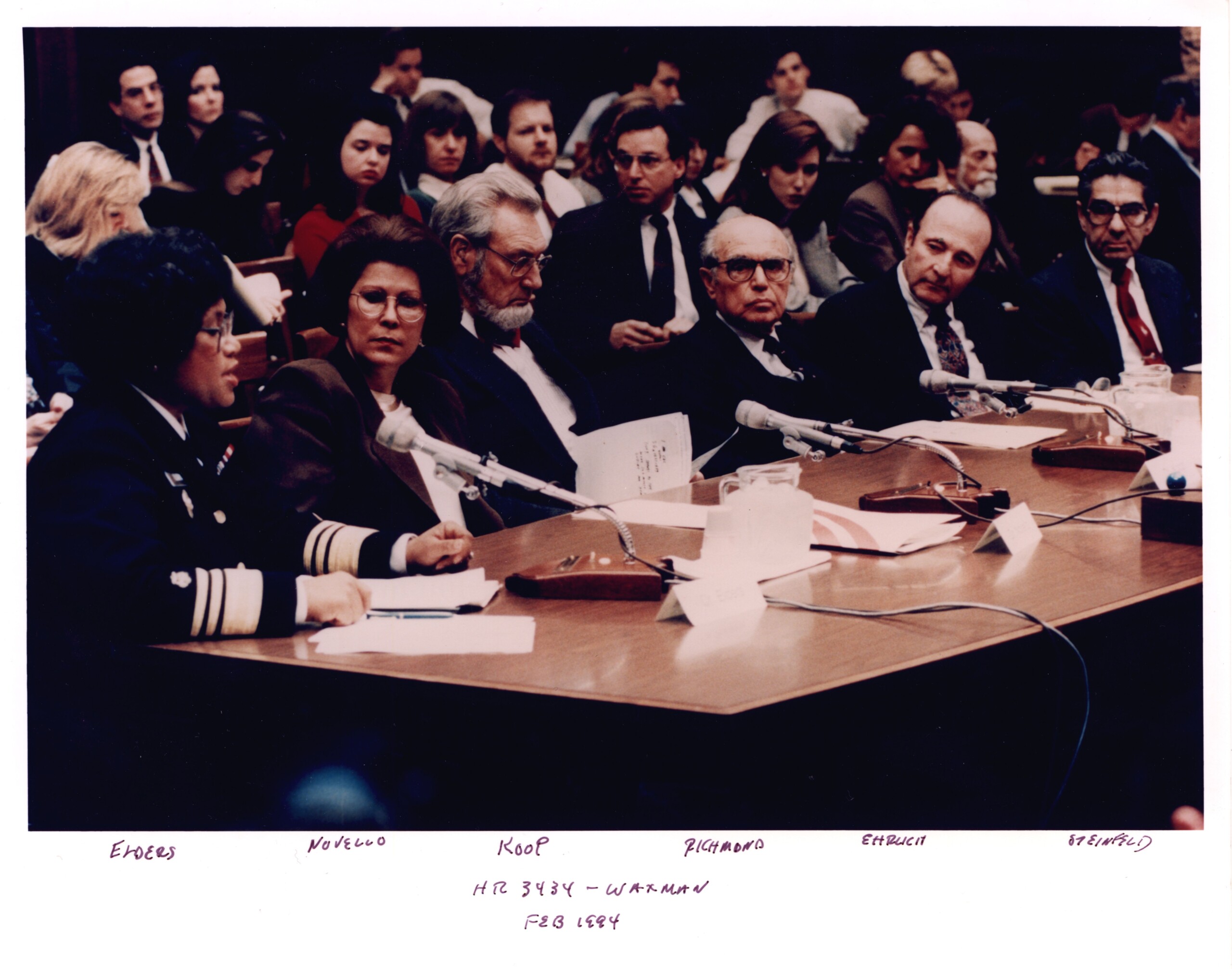

If contested understandings and expectations of gender run through Ruth’s memoir and archives, and the discrimination experienced by many of the men she cared for, Arkansas’s enduring racial divisions implicitly shaped her narrative and its silences. In the words of Catherine Fosl and Daniel Vivian, “the same race, gender, and class divides that mark US society are evident within LGBTQ communities, making histories of queer people of color, women, and trans people more difficult to access, especially by those who do not identify as such.”28Catherine Fosl and Daniel Vivian, “Investigating Kentucky’s LBGTQ Heritage: Subaltern Stories from the Bluegrass State,” The Public Historian 41, no. 2 (2019): 221. Ongoing archival projects in Arkansas are beginning to address these histories. The Historical Research Center at the UAMS Library has collected and preserved the papers of Dr. Joycelyn Elders, Director of the Arkansas Department of Health (1987–1993) and Surgeon General of the United States (1993–1994), who played an important role in the AIDS epidemic both in Arkansas and nationally.
To understand Ruth’s story—and what her archives and cemetery mean for queer memory in the southern United States—we must address how Ruth embraced and struggled against an ideal of “southern femininity” in the 1980s and early 1990s. Ruth’s memoir is a record of the constricted gender expectations imposed on her and her strategic use of her identity to help the men for whom she cared. In her 1991 essay, Frances Ross provides a formative background on changing notions of femininity and how women addressed social problems in turn-of-the-twentieth-century Arkansas.29Frances Mitchell Ross, "The New Woman as Club Woman and Social Activist in Turn of the Century Arkansas," The Arkansas Historical Quarterly 50, no. 4 (1991): 317–351. These norms remained decades later, as Anna Zajicek, Allyn Lord, and Lori Holyfield argue in their article on the women’s movement in northwest Arkansas: “To become activists in the civil rights movement, these women had to challenge the ideals of southern femininity and create a new sense of self.”30Anna M. Zajicek, Allyn Lord, and Lori Holyfield, “The Emergence and First Years of a Grassroots Women’s Movement in Northwest Arkansas, 1970-1980,” The Arkansas Historical Quarterly 62, no. 2 (2003): 155. Ruth also grappled with ideals of femininity while embracing the gendered role of caregiver.
In her memoirs and archival notes, Ruth does not directly discuss feminist politics in Arkansas. However, her complex experiences as a caregiver and activist contribute to what Janet Allured referred to as alternative “wellsprings” of “southern change-seekers” in her study of second-wave feminism in Louisiana.31Janet Allured, Remapping Second-Wave Feminism: The Long Women’s Rights Movement in Louisiana, 1950–1997 (Athens: University of Georgia Press, 2016), 49. Moreover, when we examine Ruth’s experiences, it is vital to consider the historical context of Arkansas in the mid-1980s, a little over a decade after the intense political backlash against the proposed Equal Rights Amendment. As Janine Parry argues, “the Equal Rights Amendment in Arkansas had swiftly moved from being perceived by many observers as ‘virtually assured’ of ratification in January of 1973 to being openly reviled at the next legislative session.”32Janine A. Parry, “‘What Women Wanted’: Arkansas Women’s Commissions and the ERA,” The Arkansas Historical Quarterly 59, no. 3 (2000): 283. While distinct from Ruth's story, these conflicting political currents indirectly shaped her activism and experiences.
Constructing Care Work and Motherhood in Arkansas
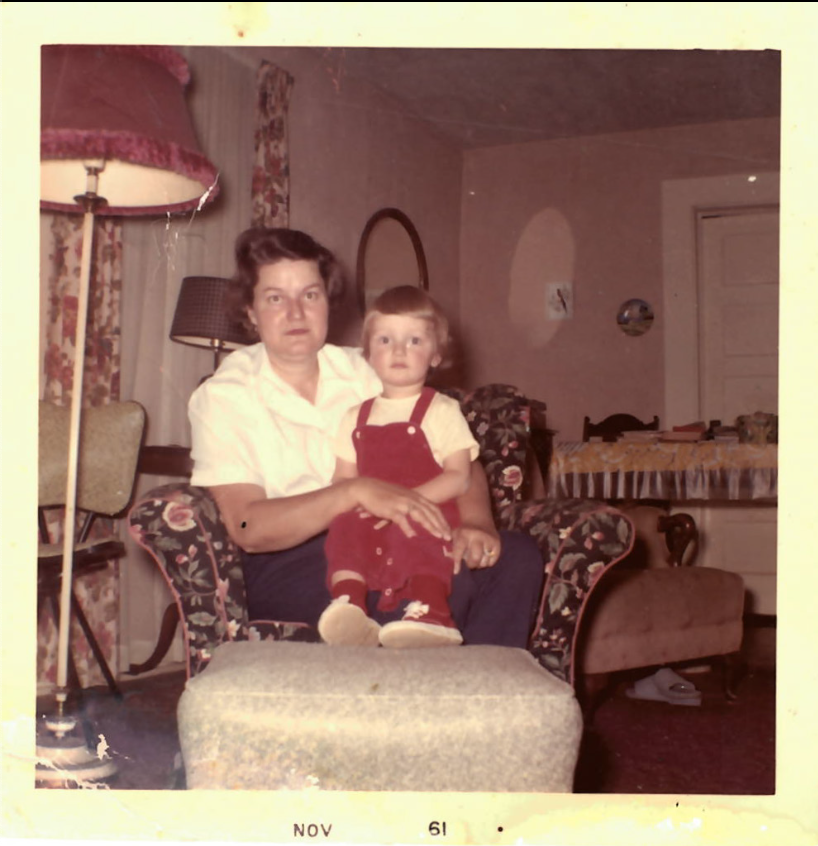

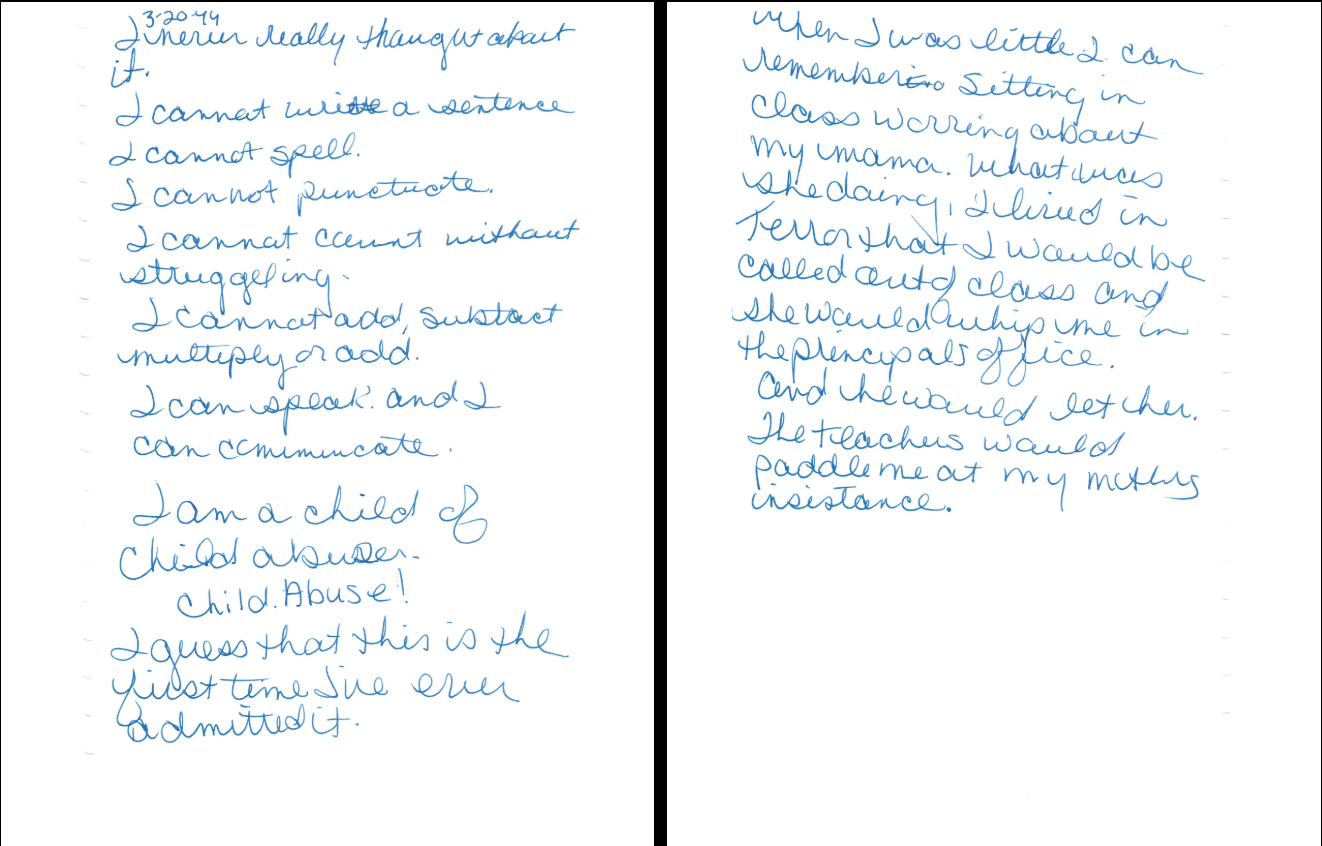
Ruth’s written and archival ephemera record the gendered expectations of care and motherhood often imposed on women in late twentieth-century Arkansas. Her autobiography contains a steady commentary on the contested meaning of motherhood in her life and care work. The figures of abusive mothers, absent mothers, and idealized alternative mothers run throughout the book. Ruth’s deeply damaging mother and her own constant worries that she might cause her young daughter harm through her AIDS work are recurring themes.33Burks and O’Leary, All the Young Men, 100–102. Ruth’s memoir and archives contain glimpses of the range of substitute mothers these dying men sought, including Ruth, the Virgin Mary, and even Dolly Parton.
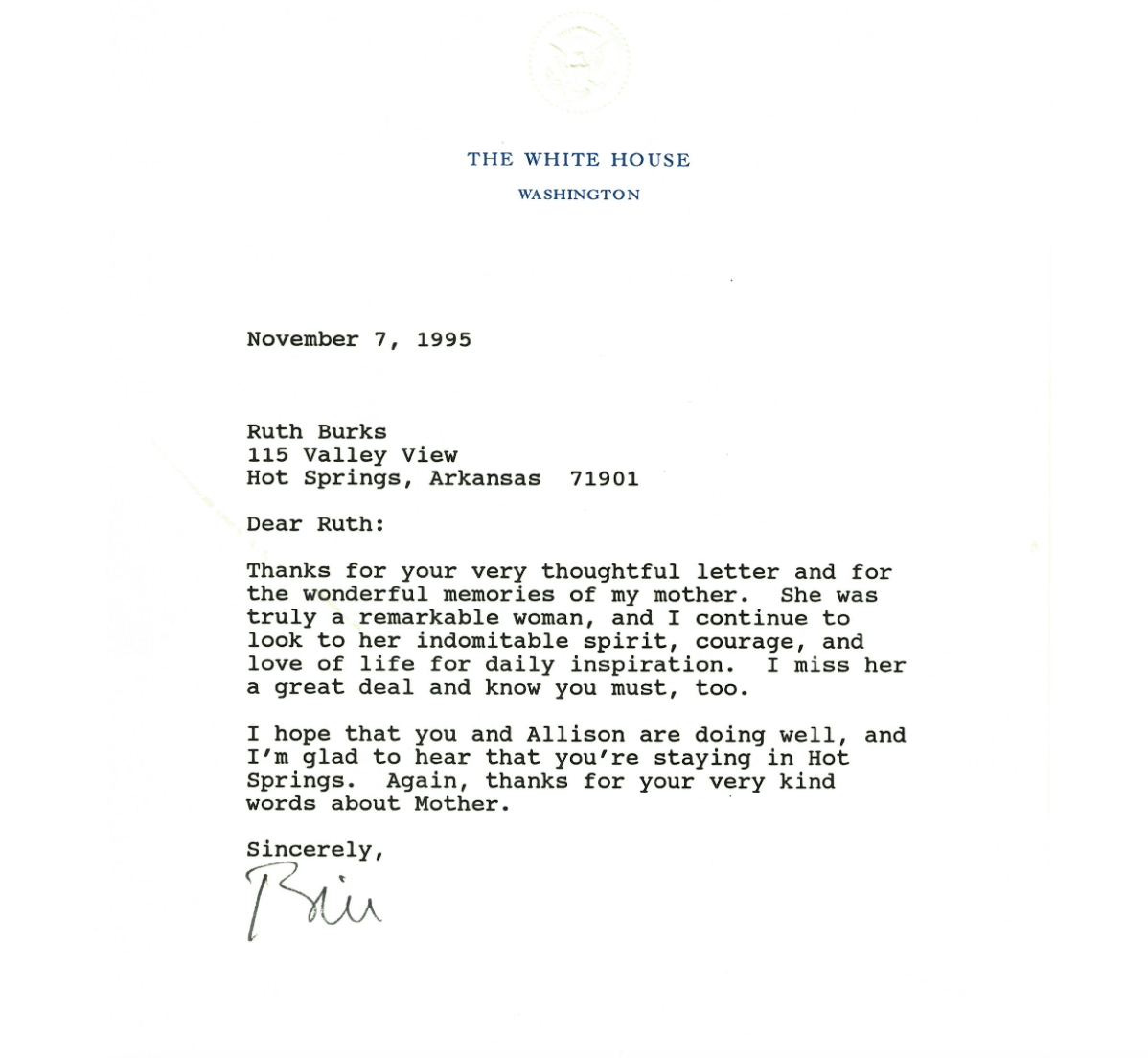
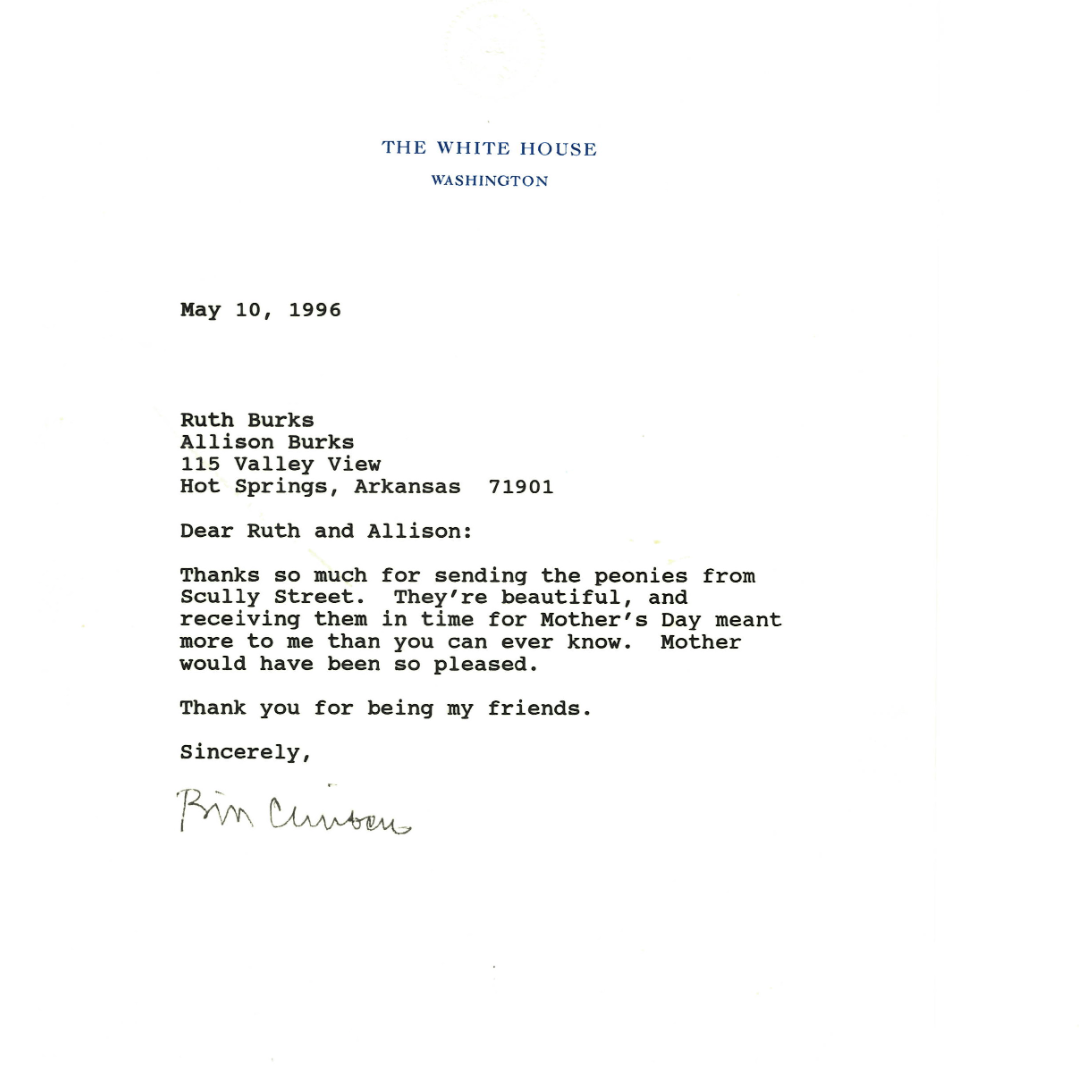
As mentioned, Ruth's career as an informal caregiver in the mid-1980s began with a case of mistaken maternal identity. With only a few exceptions, the men's families for whom Ruth provided care rejected their sick and dying sons.34Garofalo, “Lessons in Love.” “So many arrived [back in Arkansas] thinking Mama would take them back. Sometimes I would go to their homes with them, mostly just to save me a trip of driving back out there when she wouldn’t.”35Burks and O’Leary, All the Young Men, 55.
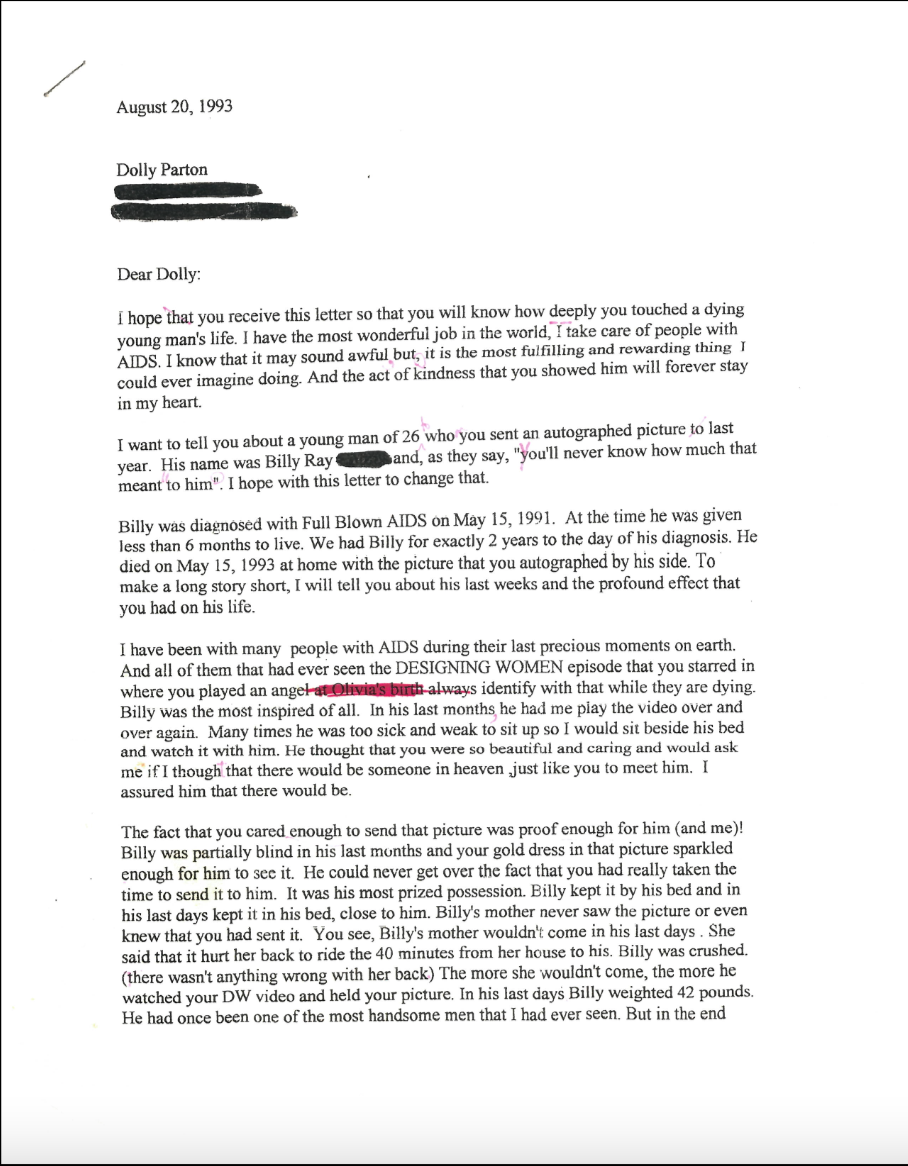
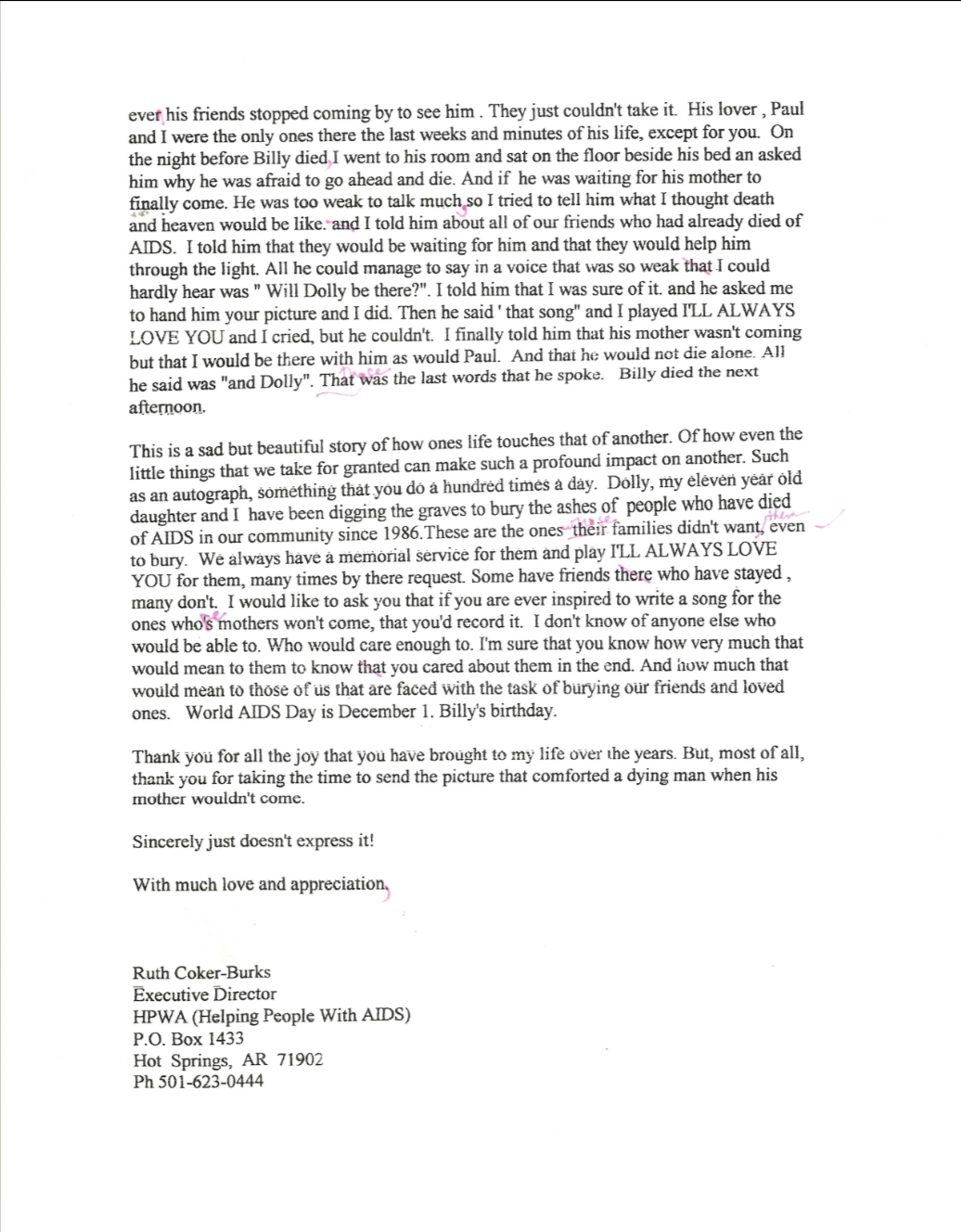
Alongside this parade of neglectful parents, another narrative of idealized mother figures runs through Ruth’s life history and archives. A letter she wrote to Dolly Parton on August 20, 1993, on behalf of Billy Ray Collins soon after he died, fashioned the beloved country music singer as a substitute maternal figure for the dead man. Ruth wrote the letter thanking Dolly for a picture that she had sent to Billy, a devoted fan. “Billy’s mother never saw the picture or even knew that you had sent it,” the letter begins “You see, Billy’s mother wouldn’t come in his last days. . . . Billy was crushed.” Ruth's letter underlined a profound sense of loneliness: “But in the end, even his friends stopped coming by to see him. They just couldn’t take it. His lover, Paul, and I were the only ones there in the last weeks and minutes of his life, except for you.” Ultimately, Ruth had to tell the dying Billy that his mother would not visit him. “I finally told him that his mother wasn’t coming but that I would be there with him as would Paul. And that he would not die alone. All he said was ‘and Dolly’.” In Ruth’s memory of Billy’s final days, recorded in a letter to Parton, a photograph of the singer was transformed into an icon standing in for Billy’s absent mother.36See, Box 6, Folder 16, Ruth Coker Burks papers, Center for Arkansas History and Culture, Little Rock, Arkansas. Billy was certainly not the only one of Ruth’s guys to reach out for their mothers and be denied at the end of their lives. This is a recurring theme in Ruth’s memoir.
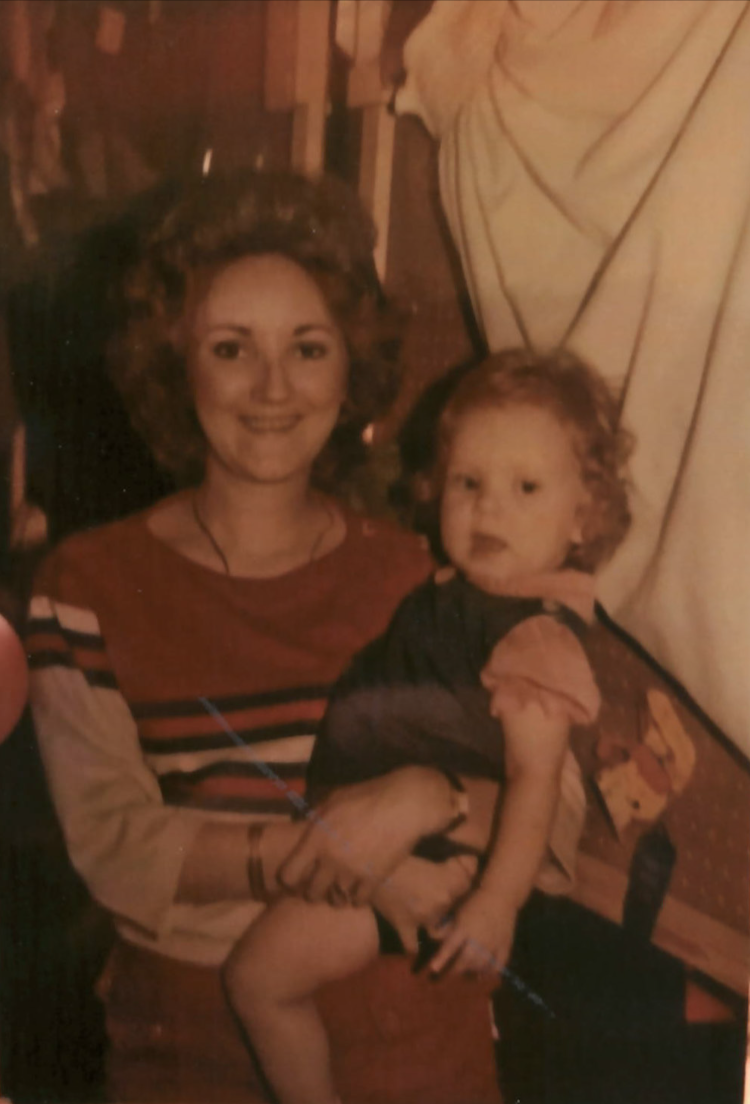
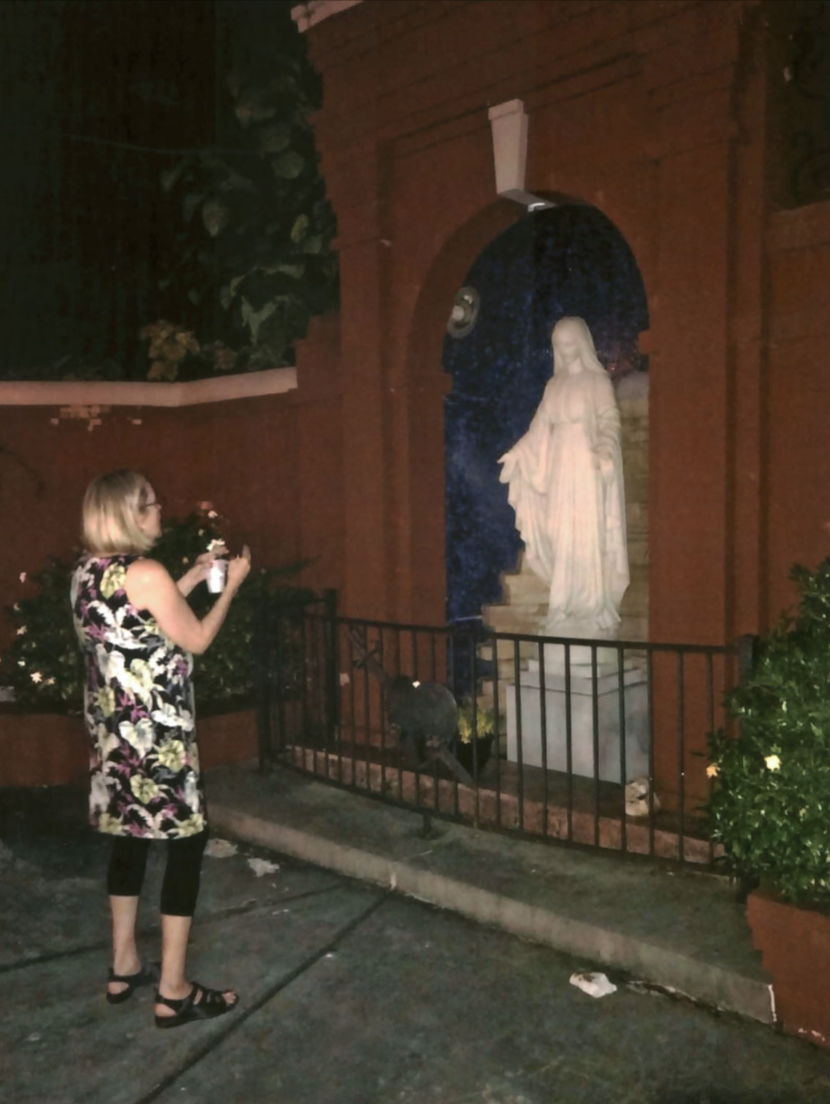
This search for an alternative maternal figure is perhaps best exemplified by Ruth’s visits with the men she cared for to that most idealized, and unrealizable, of mothers: the Virgin Mary. They often visited a small grotto at St. Mary of the Springs Catholic Church in Hot Springs. “There’s a statue of the Virgin Mary there,” writes Ruth, “in a red-brick shrine, hidden from the street. She’s on a pedestal, so she looks down on you, but there’s kindness in the stone of her eyes. . . . Whatever their religion, or lack thereof, my guys often like to visit her . . . sit on the brick and talk to her.”37Burks and O’Leary, 232.
All the Young Men
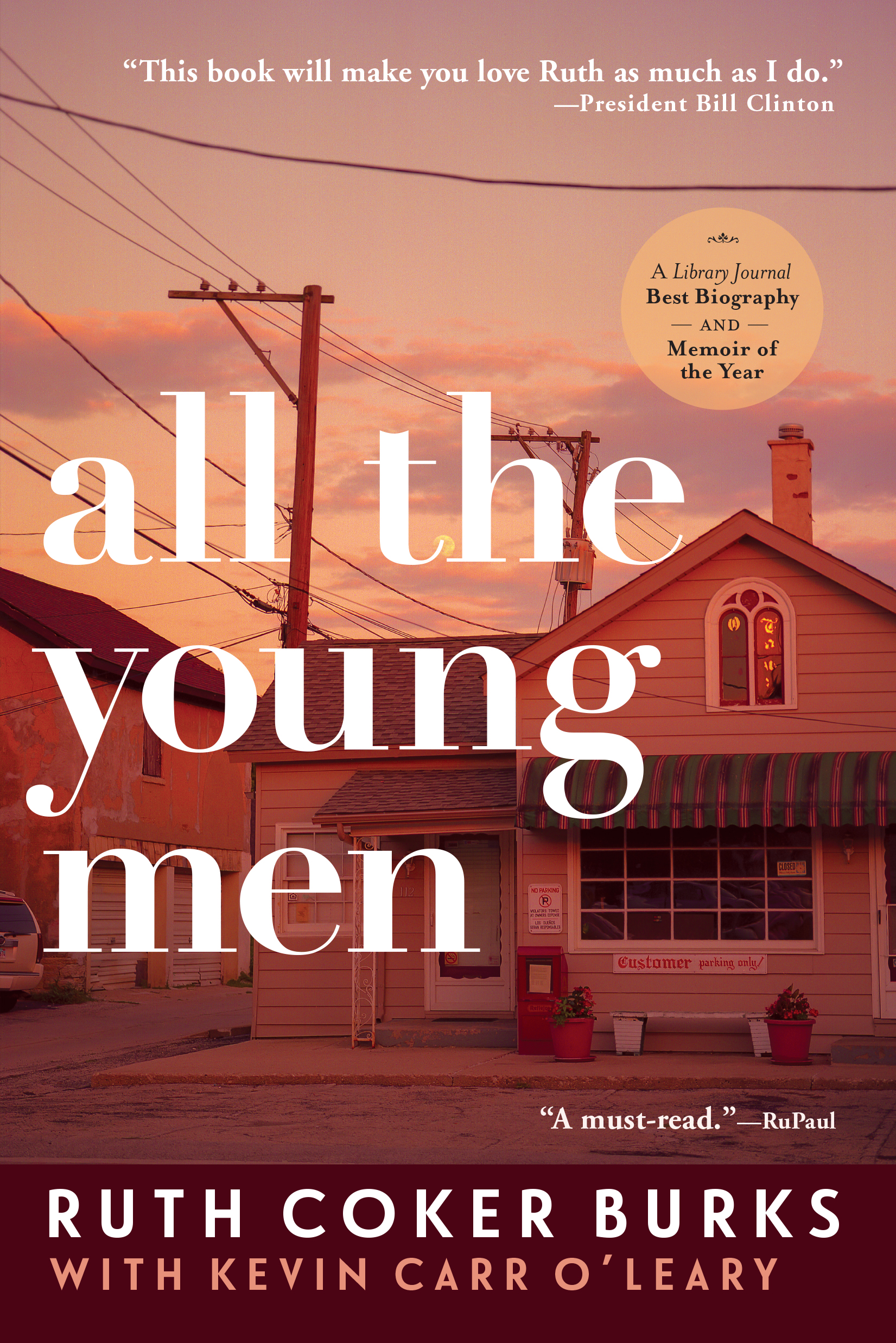
At the heart of Ruth’s memoir, and of recent criticisms of her memory, are the men, including Chip and Billy, who she cared for and those she later buried, such as Jimmy, in the Files Cemetery. Who were the titular ‘young men’ of Ruth’s autobiography, or as some of her critics lament, the lost ‘forty names’ of the Files Cemetery?38Gelder, “Ruth Coker Burks and the Missing Monument.”
Based on Ruth’s account, she cared for hundreds of men dealing with HIV/AIDS in central Arkansas from 1986 to 1995.39Garofalo, “Lessons in Love”; Koon, “Ruth Coker Burks: The Cemetery Angel”; Burks, "All Her Sons: The Cemetery Angel.” The ashes of a small number of them are interred in the Files Cemetery. These men had returned to Arkansas in search of care after living in New York or Washington, DC, or when they had left more rural parts of the state for Hot Springs or Little Rock. In Ruth’s telling, many of these young men only reluctantly returned to Arkansas for care that their families denied them.40Burks and O’Leary, All the Young Men, 30–31, 76–77. “My guy who made it all the way to DC,” wrote Ruth upon visiting Chip’s grave, “only to end up in the place he’d escaped from.”41Burks and O’Leary, 343.
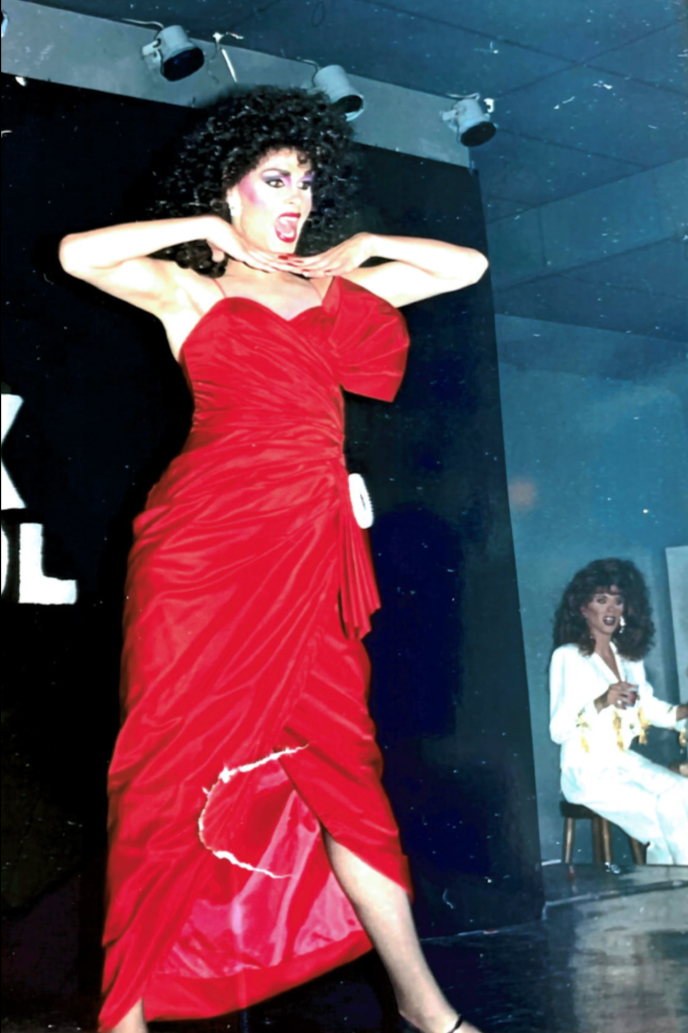
She cared for primarily working-class (sometimes indigent) young white and Latino men. Specifically, Ruth’s memoir, archives, and interviews record her work with numerous white country boys from the hills of Arkansas, Mexican immigrants in Hot Springs, and working-class drag queens. Many came from Mount Ida, Dardanelle, and other rural towns in central Arkansas.42Burks and O’Leary, 148–149, 165–167. Exemplifying this, Ruth’s beloved Billy, a luminescent drag queen, was “the movie star from Dardanelle.”43Burks and O’Leary, 166. Her guys included everyone from Jim, her first patient; to Tim Gentry, “a hillbilly dandy”; to Roger, whose family tried to wash away his sins in a creek baptism; and to the aforementioned Billy, the charismatic drag queen from Dardanelle who prominently featured in many newspaper profiles of Ruth and her book.44Koon, “Ruth Coker Burks: The Cemetery Angel”; Matthew Kincanon, “Ruth Coker Burks Describes Her Lifetime Caring for AIDS Patients to the Gonzaga Community,” The Gonzaga Bulletin, March 1, 2017, https://www.gonzagabulletin.com/news/ruth-coker-burks-describes-her-lifetime-caring-for-aids-patients-to-the-gonzaga-community/article_0e5de906-fdeb-11e6-b294-d72df02858f2.html; Burks and O’Leary, All the Young Men, 70. They also included men from Mexico who worked in tree planting or at the Hot Springs racetrack Oaklawn Park, including Angel Mestizo, whom Ruth recounts assisting as he simultaneously sought medical care and to avoid deportation.45Burks and O’Leary, All the Young Men, 274–277. The marginalized status of many of these men led them to Ruth, who, as she frequently reminds her readers and interviewers, lacked any formal medical training. As Paul Wineland, Billy's former partner, notes in the 2014 StoryCorps interview, "You were the only person that we could call. There wasn’t a doctor. There wasn’t a nurse. There wasn’t anyone. It was just you."46Garofalo, “Lessons in Love.”
Occasionally, Ruth did comment on the class divisions. She provided concise descriptions in her efforts to keep her childhood friend, Arkansas Governor Bill Clinton, informed about the AIDS epidemic: “But I knew he didn’t know the gay men I saw—the poor, the rejected, the ones with nobody to care for them.”47Burks and O’Leary, All the Young Men, 92. In discussing a professional ballet dancer whose partner came home to die in Arkansas, Ruth described “this ballet dancer who seemed so out of place and of a different class than the Hot Springs guys.” Ruth remembers the drag queens she saw at Our House in Hot Springs as goddesses who transformed the city. “The performers came and went . . . It was like Dynasty, but that was absurd because we were in Arkansas, which meant these people didn’t have the means to have a fabulous life. But there they were in fabulous gowns. . . . They were goddesses. The idea that I could breeze by someone like this in Hot Springs.”48Burks and O’Leary, 161, 267.
Not all of the men lacked political or social connections. Chip exemplifies this. While he was from Glenwood, which Ruth described as “one county over from Hot Springs and about forty years behind,” Chip had enjoyed a rising career working for the Democratic Party in Washington, DC. Chip lived with Ruth and her daughter for a few weeks, and she cared for him as he died.49Burks and O’Leary, 230, 233–235. This simultaneous intensity and brevity helps explain some of the gaps in her detailed knowledge of these men: “I felt at home, yet still at a distance from what these men were going through.”50Burks and O’Leary, 53. Ruth often provided daily care for weeks or months before their families sometimes stepped in for their last few days of life.51Burks and O’Leary, 260–266.
While Arkansas was the site of flight and reluctant return in Ruth’s memoir, Hot Springs served as a refuge for many rural gay men. At the gay bar Our House, “almost all the regulars had left their hometowns to create their own lives here in Hot Springs.”52Burks and O’Leary, 5, 37, 166. For a fuller queer history of Arkansas, see Brock Thompson, The Un-Natural State: Arkansas and the Queer South (Fayetteville: University of Arkansas Press, 2010).

If Hot Springs was a refuge, the Files Cemetery emerged as a site for queer memory. Flagging the commemorative importance of this small cemetery, Ruth says “I wanted them to be counted, to have their lives matter, and I wanted them to have control over their destinies, no matter how limited they might seem to others. If I felt they were strong enough, I brought them to Files Cemetery and asked them to tell me where they’d like to be buried.”53Burks and O’Leary, 58.
A significant challenge of working with Ruth's archives and autobiography is the enduring ambiguities surrounding the number of cremations interred in the Files Cemetery either by her from the mid-1980s to the mid-1990s, or in the following years as the cemetery became informally associated with LGBTQ+ memory in Arkansas. Estimates of the number of men whose ashes Ruth interred range from five to approximately forty. In her early interview with StoryCorps, Ruth stated, "I’ve buried over forty people in my family’s cemetery because their families didn’t want them."54Garofalo, “Lessons in Love.” As one longtime resident of Hot Springs, Tim Looper, notes, there are five identifiable graves of men who died during the HIV/AIDS epidemic, and he remembers explicitly going to six funerals there.55Kacala, “Doubts Surround Viral Story of ‘AIDS Angel’ Who Says She Helped Hundreds of Dying Men.” Ruth has long maintained that dozens of other cremations have been interred at Files; she mentions fifteen names in her memoir. She insists that given the passage of time and her health problems, she does not remember the names of all the men she cared for.56Koon, “Ruth Coker Burks: The Cemetery Angel”; Kacala, “Doubts Surround Viral Story of ‘AIDS Angel’ Who Says She Helped Hundreds of Dying Men.” Moreover, she claims that initially in the 1980s, she concealed what she was doing in the Files Cemetery so that those who would have opposed burying abandoned people associated with AIDS there would not find out.57Burks and O’Leary, All the Young Men, 27–28. Further complicating the matter, Ruth claims that she started to receive anonymous ashes in the mail once she was interviewed about HIV/AIDS in local news outlets, and she proceeded to inter these ashes as well.58Burks and O’Leary, 133–136. Finally, the ashes of people Ruth did not know personally have also been interred at Files, as it became a potent space of LGBTQ+ memory. During an August 2020 visit to the cemetery, Ruth noticed a recently added memorial to a queer-identifying young man whom she had never met.
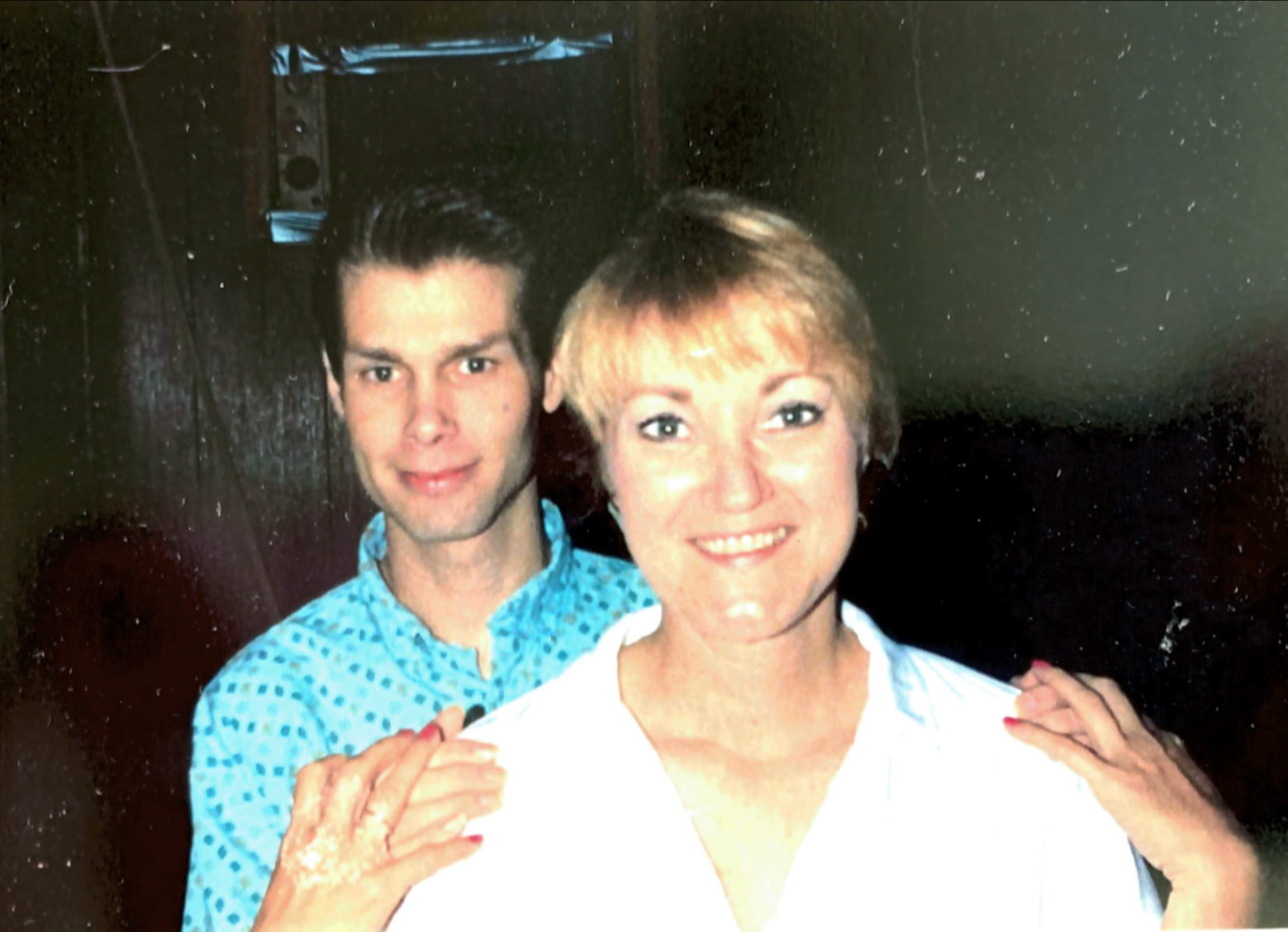
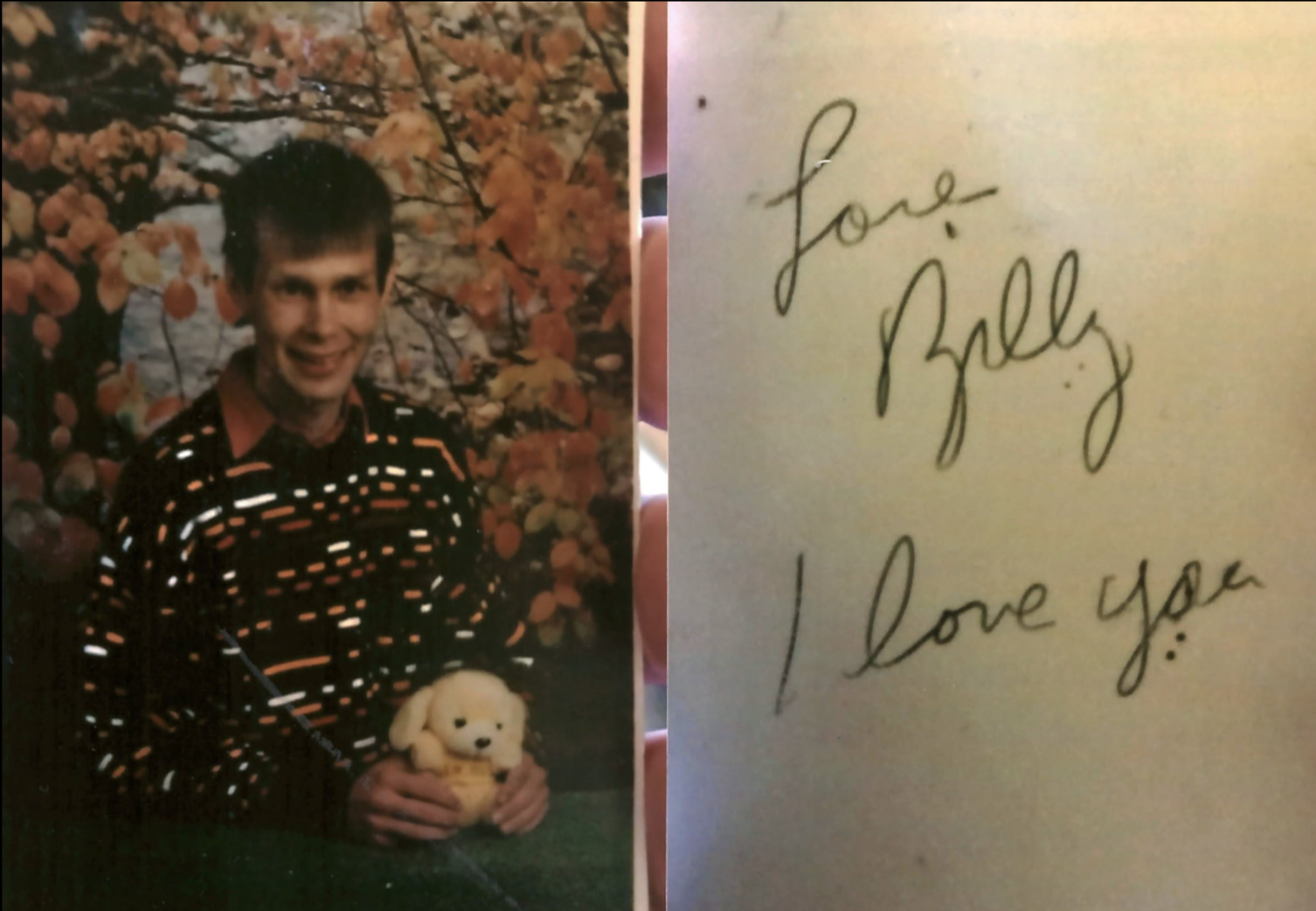
Ambiguity, anonymity, and informality have been central elements of Ruth's work from the beginning. In response to praise during her StoryCorps interview, Ruth said, "You know, they always say 'fake it ‘til you make it,' and I faked my way through the whole thing. I didn’t know what I was doing. I didn’t know anything."59Garofalo, “Lessons in Love.” Respecting the anonymity of many men is central to Ruth's understanding. "I'd go to an apartment to bring food, and another man would be there,” she writes. "There were people I recognized, though I pretended not to know anything about them."60Burks and O’Leary, All the Young Men, 97–98. Ruth's publisher noted in 2021, "Many of the men Ruth helped and eventually buried approached her asking for anonymity due to not wanting to be outed."61Kacala, “Doubts Surround Viral Story of ‘AIDS Angel’ Who Says She Helped Hundreds of Dying Men.”
The cemetery is a throughline in Ruth's memoirs and interviews. She returns to this commemorative geography at the end of All the Young Men as she narrates the journey from Rogers, in the northwestern corner of Arkansas, where she currently lives, back to her hometown of Hot Springs. “I make my way, finally, to Files Cemetery. The carpet of pine needles crunches under my feet as I make the rounds. The mockingbirds still caw above me. I clear brush here and there on the graves, saying hi to Misty before walking over to see Angel, Carlos, and Antonio.”62Burks and O’Leary, All the Young Men, 344. Alongside its status as a refuge and commemorative space, the cemetery is a site of considerable pain for Ruth, not only in terms of the family conflict that resulted in her contested ownership of many cemetery plots and the memory of the men she buried there, but also the more recent debates over what she did (or did not do) in caring for them.
Ruth's Fragmentary Archive
There are scattered, evocative references to Ruth’s archival materials throughout All the Young Men, whether to her pink leather daybook or to the collection of newspaper clippings related to her successful efforts to mobilize the Downtown Merchants Association of Hot Springs for Worlds AIDS Day on December 1, 1993.63Burks and O’Leary, 154, 337, 339. Her fragmentary archive complements recent public history scholarship on queer history and memory in rural areas of the United States. For example, a 2019 special issue on “Commemorating Queer History" in The Public Historian explored how museum exhibits and historical sites, especially in smaller towns and more rural areas, engage queer history.64See Rebecca Bush, “Woman, Southern, Bisexual: Interpreting Ma Rainey and Carson McCullers in Columbus, Georgia,” The Public Historian 41, no. 2 (2019): 94–115; Christopher Hommerding, “Queer Public History in Small-Town Wisconsin: The Pendarvis Historic Site and Interpreting the Queer Past,” The Public Historian 41, no. 2 (2019): 70–93; Fosl and Vivian, “Investigating Kentucky’s LBGTQ Heritage.” As Christopher Hommerding argues, such histories in non-urban areas “[give] lie to the notion that queerness outside of urban centers was historically hidden, invisible, and cut off from queers in other locations.”65Hommerding, “Queer Public History in Small-Town Wisconsin,” 73. Moreover, public historians such as Fosl and Vivian have foregrounded the challenge of “an uneven, often spare historical record” and the need for “better geographic representation” of queer histories in southern spaces.66Fosl and Vivian, “Investigating Kentucky’s LBGTQ Heritage,” 221–222.
In 2022, Ruth donated her archival materials to the Center for Arkansas History and Culture (CAHC) in two batches. The first, more significant donation of materials primarily consisted of biographical and professional information, including planners, personal writing, news clippings, Christmas cards, and scattered photographs from Ruth’s activism and travels in the 1990s. This also included ephemera such as AIDS education t-shirts, drag ball gowns (one of which Ruth wore to Bill Clinton’s first inaugural ball), and the final pottery urn from Dryden Pottery that Ruth never used. The second, smaller donation comprised photo albums, newspapers, magazines, and All the Young Men publication materials. We wish that Ruth had kept better records, but this is the regrettable reality of many archives. Perhaps a better question than why Ruth did not keep better records is what this rich, if incomplete, archive can tell us about the history of HIV/AIDS.

Ruth’s daily planners illustrate the simultaneously rich and fragmentary nature of the collection. The planners in the archival collection include more blank pages than written ones, with some pages marked with only a single name. These fragmentary entries are mundane, a day-to-day account of an individual woman’s hopes and fears. Many are simple notes or reminders, the importance and context coming from either conversation with Ruth or other external sources.
Ruth’s archive reveals what it must have felt like in those difficult early years when she claims she primarily acted alone. As she puts it in the epilogue of her autobiography, “There was no one behind me. I had no choice but to help them.”67Burks and O’Leary, All the Young Men, 343. David Koon began his 2015 profile of Ruth in the Arkansas Times as “one lonely person” attempting to “budge the vast stone wheel of apathy.”68Koon, “Ruth Coker Burks: The Cemetery Angel.” This theme of isolation and hostility runs throughout her memoir. As Ruth notes of one church supper, other parishioners “eyed me suspiciously, but they always eyed me suspiciously, even before I was the town pariah.”69Burks and O’Leary, All the Young Men, 152.
But Ruth was not the only individual caring for AIDS patients in central Arkansas. All the Young Men can be read as a record of “the town elders” of Hot Springs who quietly assisted her. This is best exemplified by Clay Farrar, a prominent Hot Springs lawyer. Clay introduced Ruth to a network of Rotary Clubs where she spoke about her care work and AIDS activism and connected with prominent men who were willing to provide support quietly. Several bankers in Hot Springs occasionally assisted Ruth with monetary donations or by requesting favors in the medical profession.70Burks and O’Leary, 182–184, 257–258.
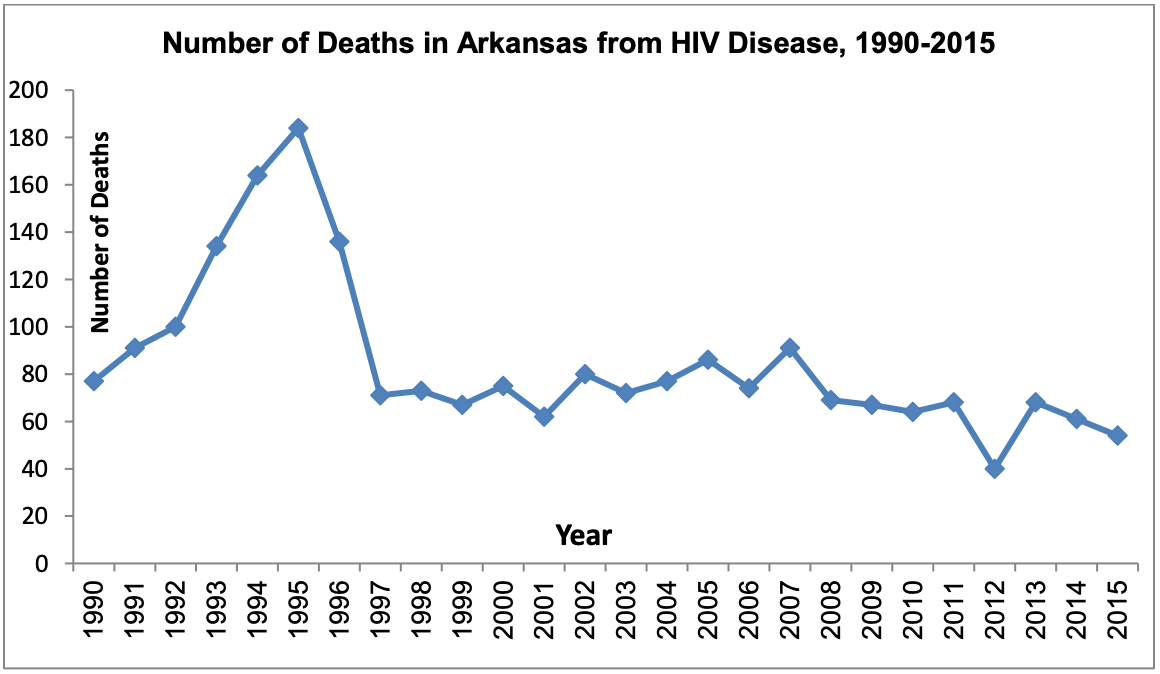
Certainly, a range of individuals and non-profits attempted to help those dealing with HIV/AIDS in Arkansas in the 1980s and early 1990s; however, Ruth’s searing memory but factual inaccuracy in insisting that she acted alone evokes the experience of the HIV/AIDS epidemic for the men she cared for, many of whom—working class, indigent, and abandoned—were from the hills of Arkansas or were Mexican immigrants far from their families. These men were on society’s margins in multiple abject ways. As Ruth describes visiting Angel in the hospital, “Angel and I smiled at each other, together in our lonely place.”71Burks and O’Leary, 277.
This sense of isolation is also represented in Ruth’s archival materials, for instance, in two poems she wrote in the early 1990s, “Shades of Black” and “THIRTYONE.” In writing about her first patient, Jimmy, in “Shades of Black,” the death Ruth recalls is sudden and lonely; there is only Ruth and a dying man crying out for his absent mother. Ruth went into the room alone, held this man’s hand, watched him die, and walked out of the hospital room alone. “Remembering the day that brought me here. He was the first one who just died. Right then, right there. I walked into his room, he took my hand, he nodded and then he died.”72See, Box 6, Folder 16, Ruth Coker Burks papers, Center for Arkansas History and Culture, Little Rock, Arkansas.
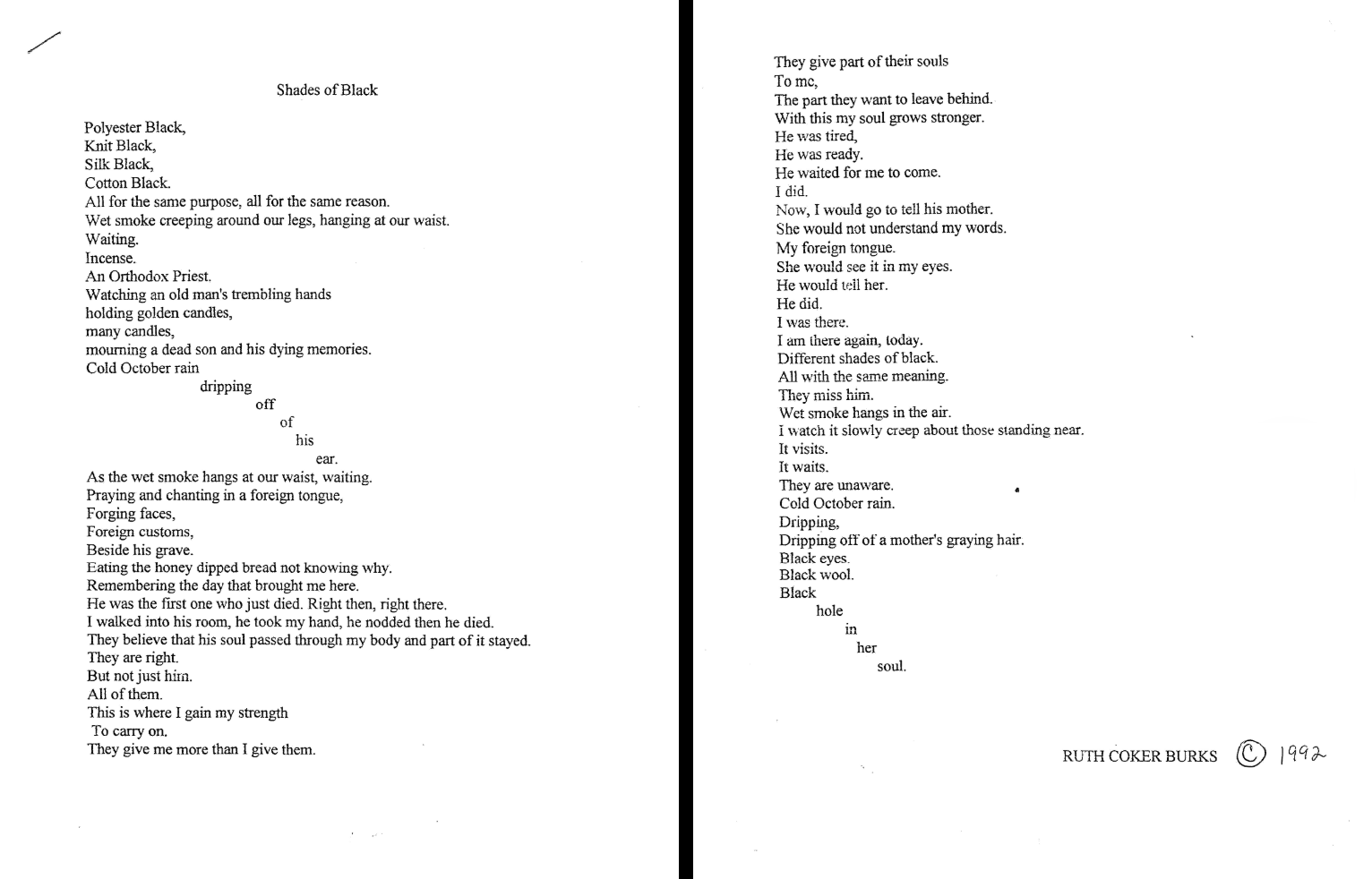
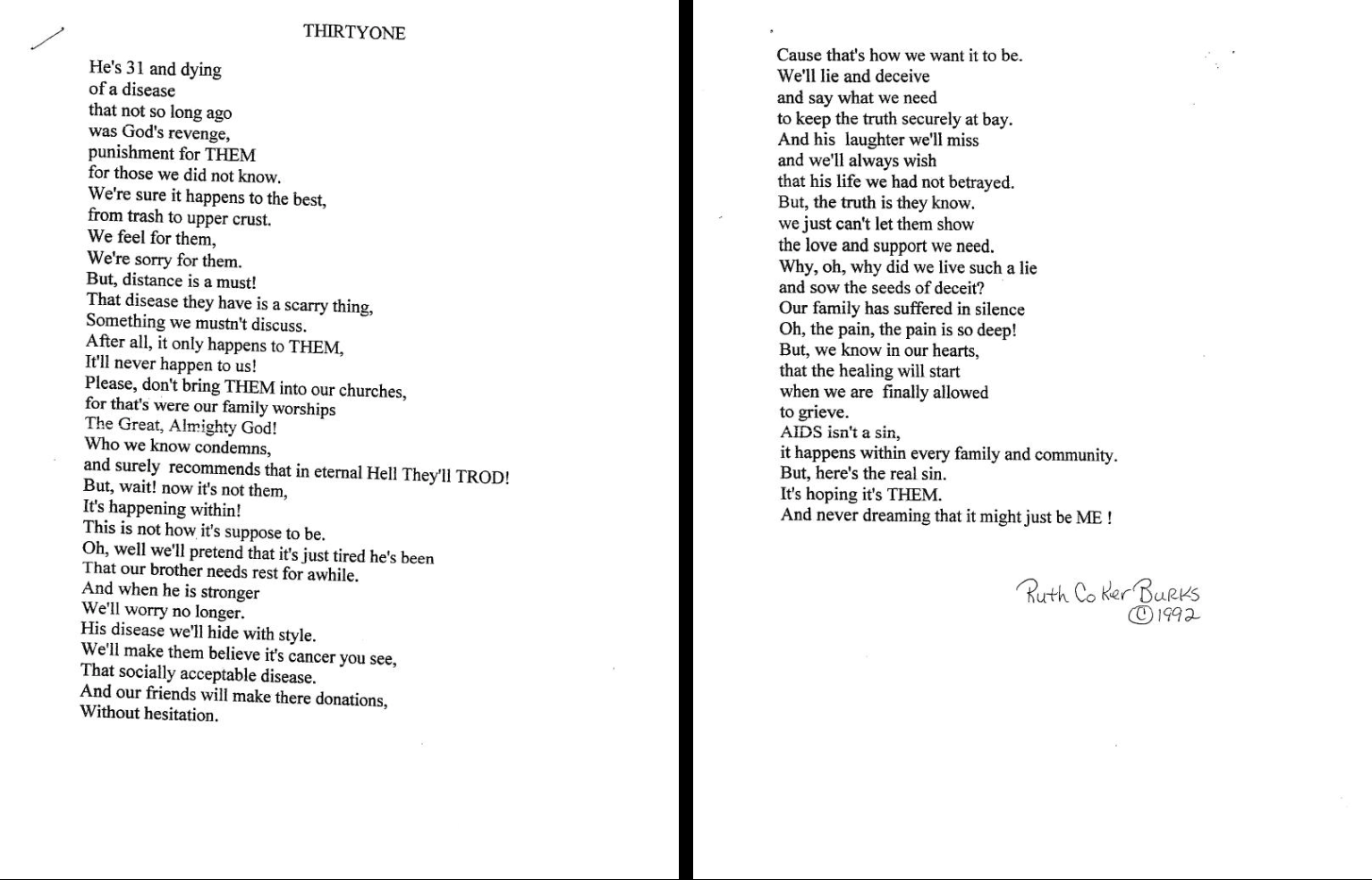
In “THIRTYONE,” the sense of isolation is deployed in anger against society and religious institutions. Ruth writes: “He’s 31 and dying of a disease that not so long ago was God’s revenge, punishment for THEM. While Ruth was sharply critical of the hostility of many religious institutions in Arkansas from the mid-1980s and mid-1990s, she remembers her care work and activism relative to her religious faith. As she has repeated in conversations with us, “I never lost my faith; I just lost faith in everyone else’s faith.”73See, Box 6, Folder 16, Ruth Coker Burks papers, Center for Arkansas History and Culture, Little Rock, Arkansas.
Criticism in Context
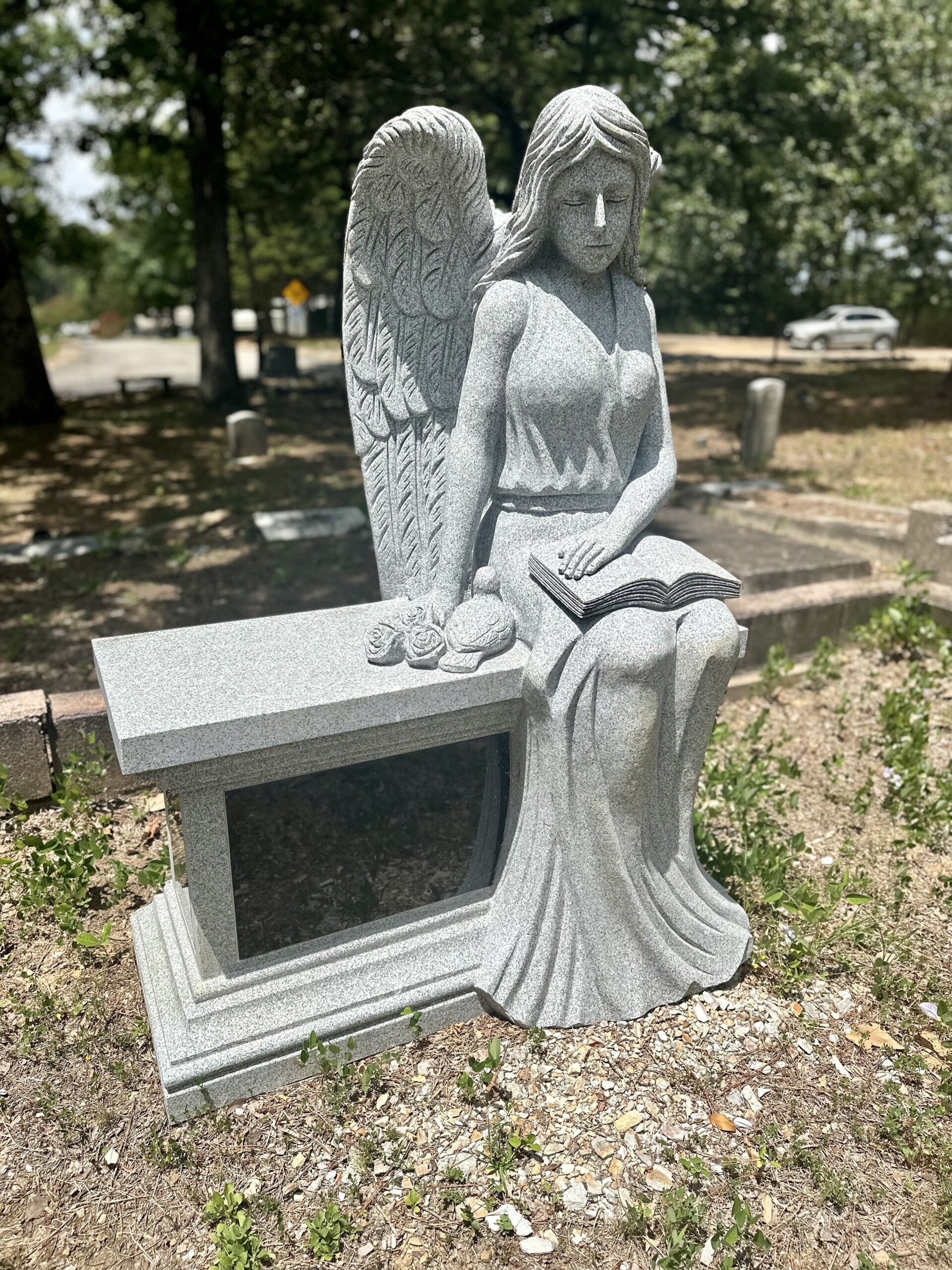
In time, media coverage of Ruth shifted from the laudatory into two overarching criticisms. First, Ruth either kept shoddy records of the men whose ashes she interred in the Files Cemetery or was guilty of exaggerating the number she cared for or buried. Second, she has either been unwilling or unable to put up a monument to these men at the Files Cemetery despite advocating for a memorial for years. Some of her critics suggest that a successful GoFundMe campaign (to raise money for a cemetery memorial and Ruth’s medical bills) was entirely used for the latter purpose and not for the former. For example, in a 2021 piece, the Arkansas Times journalist Austin Gelder discussed how there was not yet a memorial, local disappointment in the limited impact of Ruth’s newfound celebrity on Hot Springs, and debates over ownership and oversight of the Files Cemetery. In a subsequent piece for NBC News, Alexander Kacala expanded on these concerns over funding, management of the Files Cemetery, and local disappointment (and anger.) Kacala also suggested that Ruth may have exaggerated or even fictionalized some of her claims, particularly regarding the number of men for whom she cared.74Kacala, “Doubts Surround Viral Story of ‘AIDS Angel’ Who Says She Helped Hundreds of Dying Men.” It is important to note that in late 2022, Ruth arranged for a monument to be constructed and delivered to the Files Cemetery.
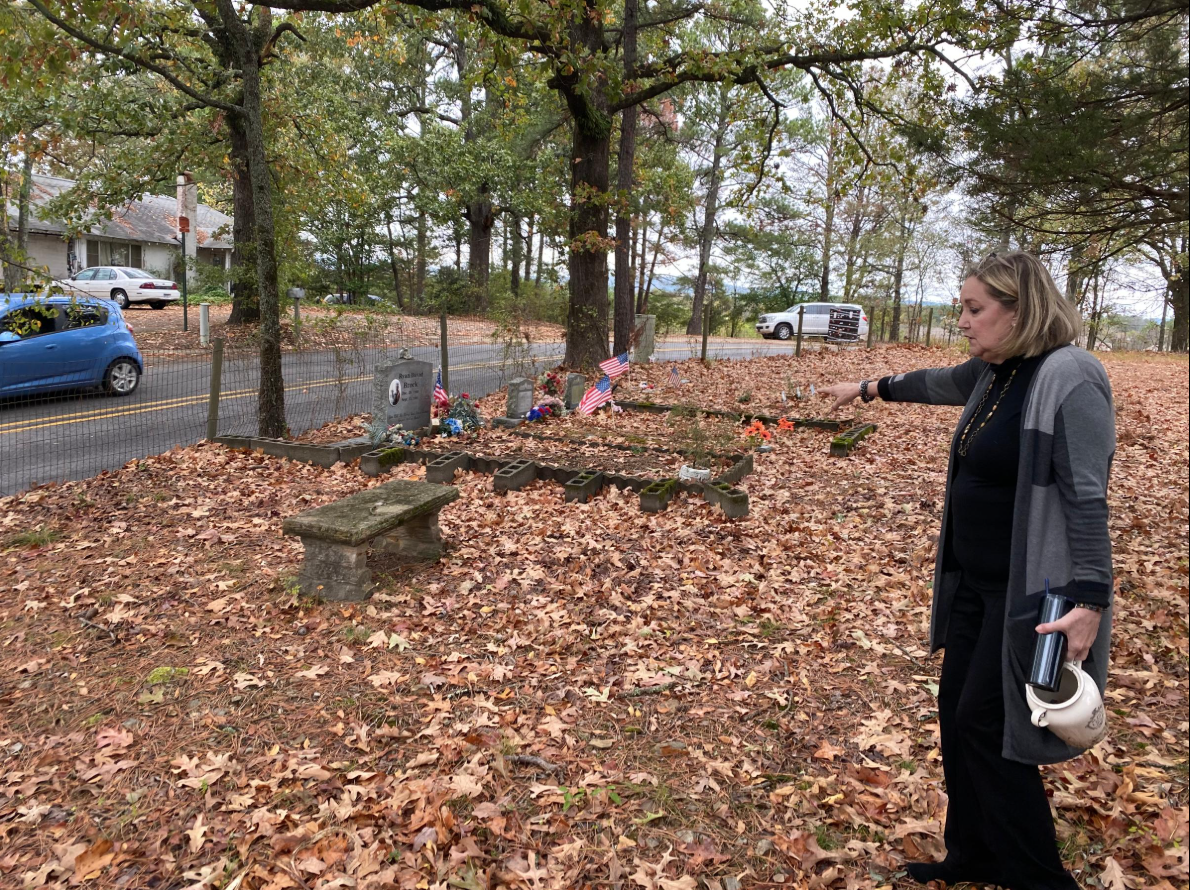
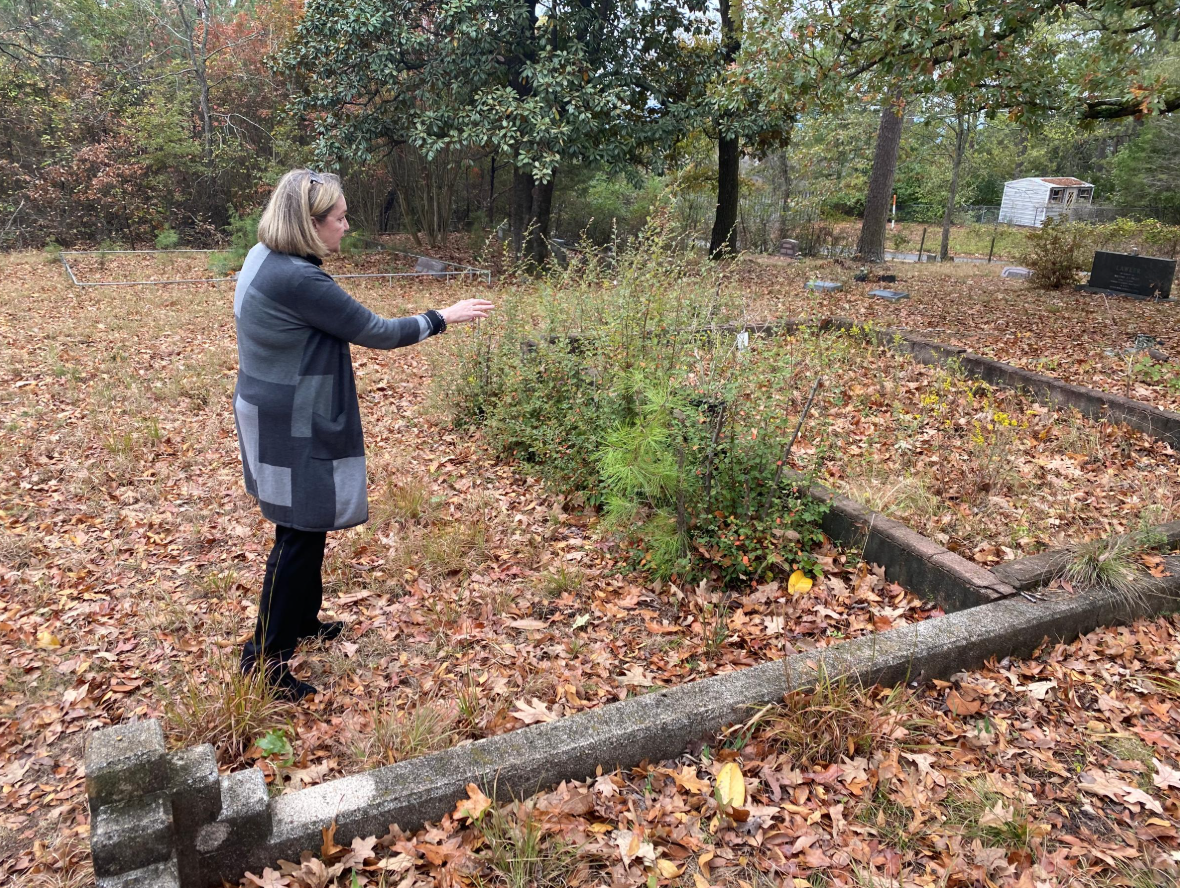
As Gelder notes, most of her critics still “commend Burks . . . [and] don’t want to detract from her good deeds” while insisting on clarity.75Gelder, “Ruth Coker Burks and the Missing Monument.” In turn, Kacala surmises that beyond the good deeds that Ruth did in the 1980s and early 1990s, “over the years either she or the media have sensationalized the story for some sort of gain.”76Kacala, “Doubts Surround Viral Story of ‘AIDS Angel’ Who Says She Helped Hundreds of Dying Men.” Some in Hot Springs are more critical, including Robert Klintworth, a former friend of Ruth who cared for the Files Cemetery for many years (Klintworth provides much of the criticism in both the Arkansas Times and NBC News pieces). Klintworth claims he and his partner, Paul Wineland (who was Billy's partner before his death), cared for the cemetery and provided Ruth with significant assistance in remembering details and names for her book, but that the rewards of the “book deal, a movie deal, and international recognition” have accrued to Ruth alone.77Gelder, “Ruth Coker Burks and the Missing Monument.” Paul Wineland was also central to the 2014 StoryCorp profile, which fed the media's interest on Ruth’s story.
Along with Klintworth, Tim Looper cared for the cemetery for several years after 2015. Looper also is one of Ruth’s prominent local critics, and has argued that Ruth exaggerated her narrative and/or does not remember events accurately.78Kacala, “Doubts Surround Viral Story of ‘AIDS Angel’ Who Says She Helped Hundreds of Dying Men.” Looper maintains, for instance, that Ruth’s first hospital visit occurred in Hot Springs and not in Little Rock, as she writes in her memoir. According to Ruth, some local drag troupes have also provided informal care for the cemetery. In 2023, Hot Springs resident Jim Thompson began to care for the seemingly neglected cemetery, as reported by the local news.79Rolly Hoyt, “One Man’s Mission Helps Restore a Site of Arkansas Cemetery Holding Remains of AIDS Victims,” THV 11, October 26, 2023, https://www.thv11.com/article/news/local/arkansas-files-cemetery-aids-restoration/91-39e9dad1-7ece-4244-b854-4e1d2091c5bc.
A June 2024 YouTube video podcast, RUTHLESS: The Real Story Behind the ‘Cemetery Angel of Arkansas’ alleges to uncover the “scam” perpetrated by the “grifter” Burks. The three-hour video is a sensational retelling of the 2021 Arkansas Times article. Looper is the principal source and the recurrent themes include the alleged exploitation of gay deceased men for fame and fortune, the accusation of profiting from a never-constructed (but since built) memorial, the flagging of factual errors and inconsistencies in the memoir, Ruth’s alleged failure to recognize other individuals and entities who provided aid, and a general sense that her version of events has disparaged Hot Springs and Arkansas. Posted comments about the video are overwhelmingly critical of Ruth, but it is beyond the scope of this article to evaluate these claims.
The CAHC is working to process Ruth's and others' archival papers from these years. However, it would take a large research budget (and a significant scholarly team) to, 1) carefully and responsibly reconstruct the life histories of the men buried in the Files Cemetery, 2) locate the interred cremations within the Files Cemetery with both precision and respect for anonymity, and 3) carefully and empathetically adjudicate the conflicting claims by drawing on state and local records. Complicating any research efforts is the reality that almost all of the direct witnesses of what Ruth did are long dead, and the remaining few include both fervent supporters and biting critics. These conflicting accounts rely on individual memories of traumatic events that occurred at least thirty years ago.
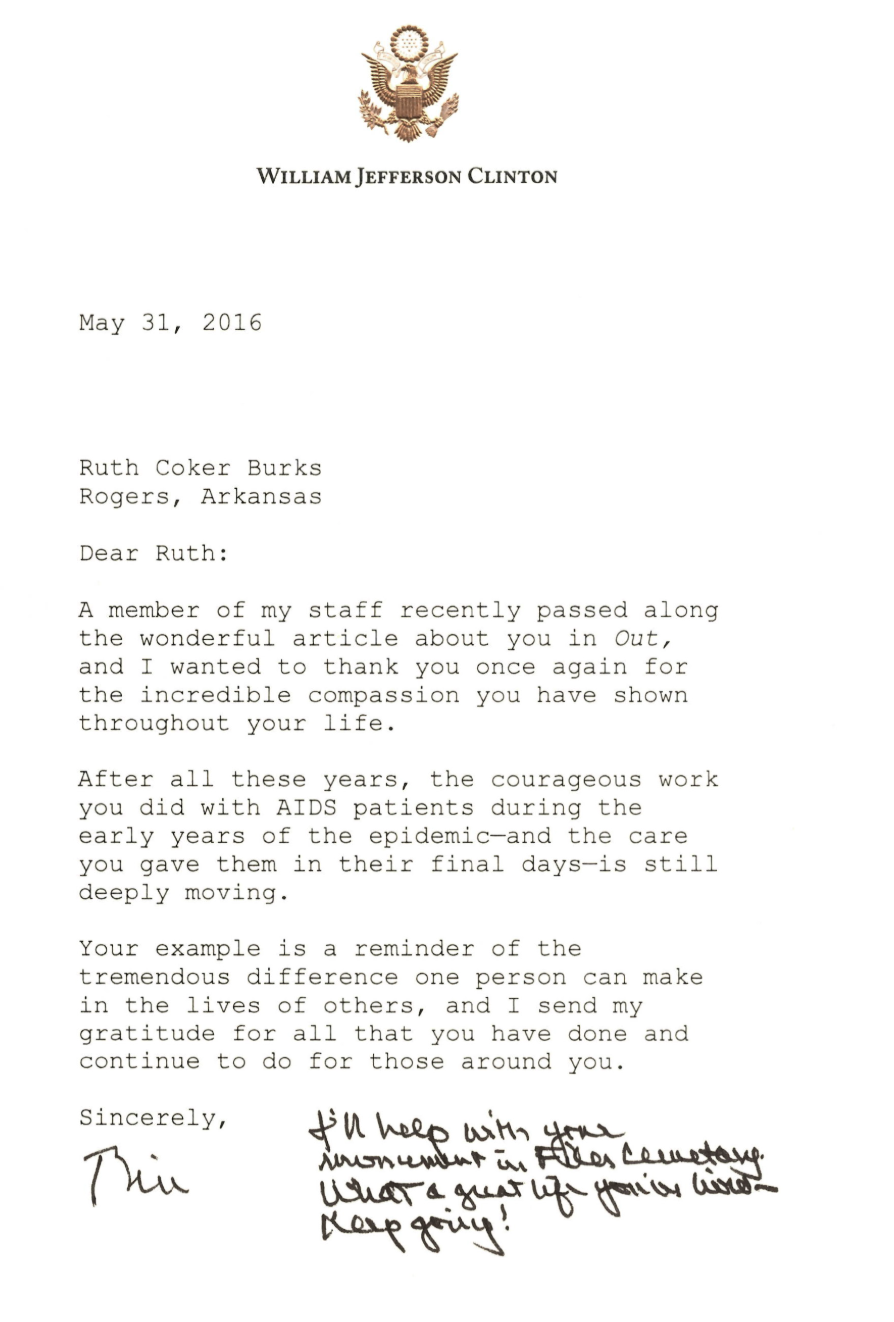
Many of the critiques voiced in newspaper articles and videos are valid. We too would like to know more about the men's life histories and see the Files Cemetery physically transformed into the commemorative site it already is in the minds of so many. In telling and retelling Ruth's story, it is clear that many details and claims remain constant, alongside some ambiguities and exaggerations. Ruth is not necessarily the appropriate target for all of these legitimate concerns. Or to reframe Kacala’s observation as a question, if elements of Ruth’s story have been ‘sensationalized’ over the years, to what end have they been sensationalized for a reading public in Arkansas and beyond?
Our preliminary research suggests that the presentation of Ruth as an almost saintly figure began with the 2014 StoryCorps interview and the 2015 Arkansas Times profile. In the StoryCorps interview, Michael Garofalo notes, "Ruth is one of those rare people who doesn’t run away from suffering. She runs toward it without hesitation."80Garofalo, “Lessons in Love.” David Koon’s article in the Arkansas Times in 2015 was titled, “Ruth Coker Burks, the Cemetery Angel.” A photograph of Ruth overlayed with the text, “St. Ruth,” was the cover story of the initial print edition (the “St. Ruth” title was removed from the online version). It was more often in the headlines of stories, rather than in the body of articles, that she was presented in saintly or angelic terms.
These binary understandings of Ruth, either as a living saint and the Arkansas cemetery angel, or as a fantasist and teller of tall tales, do not map onto the reality of her evocative and fragmentary archive. Returning to the questions we posed at the beginning of this article, what can Ruth’s archive tell us about the history of the AIDS epidemic in Arkansas and the construction of the role of the idealized caregiver for some Arkansas women at the time?
One answer that her archive does provide is that contestation and debate have long been integral to Ruth's care work and activism and that she has always had both enthusiastic supporters and harsh critics. Based on newspaper clippings from her archival donation, the criticism of Ruth and her work began in the early 1990s. In a 1993 letter to the editor published in the Sentinel-Record (Hot Springs, AR) that echoes some of the later criticism, the author states that Ruth “claims too much credit . . . her statistics are out of this world,” and that Ruth made AIDS patients stand out in the cold during a World AIDS Day service. Other local newspaper pieces saved by Ruth from the early 1990s had less to do with Ruth herself and instead reflected rampant prejudice against gay men. An undated letter to the editor states that the author is withdrawing their membership to the Downtown Merchants Association of Hot Springs due to the Association’s support of AIDS Awareness Day since, in the words of the outraged author, “AIDS is a behaviorally transmitted disease and does not need awareness or anything other than saying 'no' to homosexual activity or drug use. How much does it cost to teach that?”81See, Box 6, Folder 2, Ruth Coker Burks papers, Center for Arkansas History and Culture, Little Rock, Arkansas.
Criticisms of Ruth are not the only subject of the news clippings that she assiduously collected. There are several undated articles praising Ruth and her work. These positive assessments from the early 1990s foreshadow the recent praise of Ruth's care work and activism. One letter by Robert Gale (the vice-president of Helping People with AIDS) refuted the claim that Ruth was not the executive director of HPWA, and praised her efforts in that role. At least two articles in Ruth’s collection mention her professional work at her day job at Prudential Lakefront Real Estate.
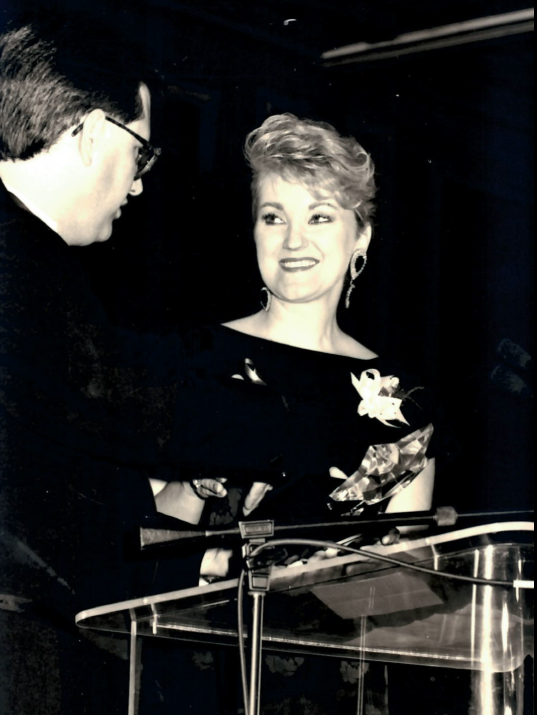
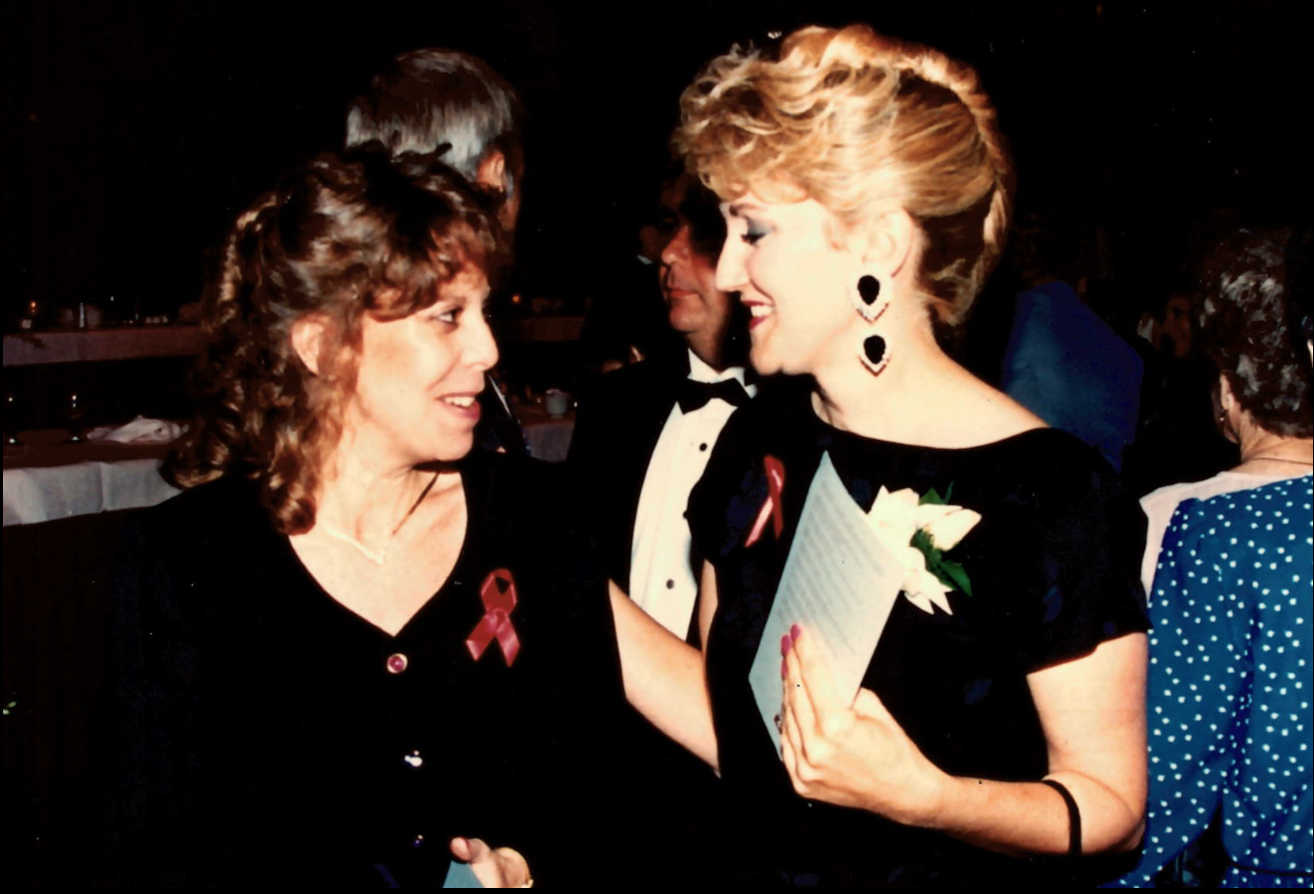
Ruth’s archival collection includes a binder of letters of recommendation and typed endorsements from prominent citizens regarding Ruth’s nomination for the Arkansas Community Service Award, the establishment of an HIV/AIDS program at Levi Hospital, and the nomination of Ruth for the position of Executive Director of the Arkansas AIDS Foundation. These letters provide further evidence of the sustained care work that she offered. For example, a local attorney wrote that “Ruth has demonstrated her commitment to the care of those who are HIV positive, and we are fortunate to have someone already in the community who is prepared to immediately take on such a responsibility.”82See, Box 6, Folder 20, Ruth Coker Burks papers, Center for Arkansas History and Culture, Little Rock, Arkansas.
The testimony of some of Ruth’s critics lends credence to her sustained, if controversial, presence. Kacala includes an extended quote from Hot Springs resident Daymon Jones, a long time survivor of the AIDS epidemic in Hot Springs, who is harshly critical of Ruth. In Jones’ own words, “I have contempt for her … She makes it look like my town was hostile to people with HIV. It’s the fact that she has used that stereotype to portray my town and my community as something horrible and that was not the story.” Jones was particularly annoyed at what he saw as Ruth’s pushy methods in attempting to provide him with unwanted help. Again, in Jones’s own terms, “What really got me riled up [was] how she does it. . . . She said, ‘Well you know I can bury you, too, when you die.’ Well Ruth, I have no intention of dying right now, and even if I do, I have a family cemetery. ‘They won’t let you in, you know that.’ Oh yes they will. We discussed this already. She tried to use fear to make herself look like she was somebody that was going to help.”83Kacala, “Doubts Surround Viral Story of ‘AIDS Angel’ Who Says She Helped Hundreds of Dying Men.
Jones’ comments clearly illustrates that some people living with AIDS in Hot Springs found Ruth’s efforts unnecessary and even offensive. At the same time, the anecdote also suggests that by the early 1990s, Ruth was locally well-known for AIDS-related activism and care work and that she regularly discussed her cemetery as a possible final resting place for those excluded elsewhere.
Conclusion
What can we make of the competing media narratives depicting this individual woman to be either a saint, selflessly salving the wounds of AIDS patients, or a sinner, exaggerating what she did and pocketing the cash? We want to argue that the legitimate anger aimed at the incomplete historical record of these men's lives and the decaying state of their final resting place is standing in for a much larger problem—the terrible treatment accorded those dealing with HIV/AIDS in Arkansas in the 1980s and 1990s by many medical institutions, by civil society, by their families, and by religious congregations. As Ruth put it, with hopefulness, “if I sound the alarm . . . the cavalry will come.”84Burks and O’Leary, All the Young Men, 183. Yet the cavalry never arrived, at least for many of the men for whom Ruth cared. These conclusions are born out in the two persistent emotions that weave their way throughout her story: her searing anger at the failure of others to not do more, and her deep, enduring love for these men whom she often only knew briefly at the very end of their lives. This echoes Harris’s influential analysis of the role of a range of emotions in Black women activists' perspective on their AIDS activism, especially the entanglement of love, compassion, and solidarity with frustration and anger.85Harris, “Emotions, Feelings, and Social Change,” 191–195.
Maybe this rush to canonize or vilify Ruth is an effort to displace this broader societal failure. Suppose Ruth was an angelic caregiver for those dying of AIDS. In that case, it absolves all those in Arkansas (and elsewhere) who either did nothing or actively discriminated against gay men. In turn, if Ruth was an imperfect record keeper with a shaky memory, she could become the target of all the legitimate anger of how these men were treated in life and death.
The archive of Ruth’s life, activism, and care work, and its fragments offers a much more sobering history of AIDS in Arkansas: a colossal tragedy and a systemic failure. Not a failure on the part of Ruth or the other individuals who, at a tremendous personal sacrifice, helped those dealing with HIV/AIDS, but rather a systemic failure on the part of many medical institutions, state government, and civil society. Returning at the very end of her autobiography to the very beginning of her story (when she walked into Jimmy’s hospital room in Little Rock in 1986), Ruth puts it a different way: “The question I get most, the one I hate, is why I went into his room. And why I helped people. Again and again . . . the answer is, How could I not? The real question is, How could you not?”86Burks and O’Leary, All the Young Men, 345.
Ultimately, it is not a question of what Ruth Coker Burks did (or did not do) to become the Arkansas Cemetery Angel, but rather what the depictions of Ruth as an angel and a saint in print and the media reveals about the memory (and continuing reality) of AIDS in Arkansas. At its most potent, Ruth's memoir and archives—alongside the Files Cemetery—not only illustrate the deep commitment of one inspiring individual, however imperfect, to help those suffering at society's margins, but also provide a glimpse into the lives of the men she cared for, whether in documenting their loneliness, their heroic efforts to live as long as they could, or in their fashioning of substitute mothers and chosen family.
Acknowledgements
The authors would like to thank Nathan Marvin, Marta Cieslak, and David Baylis for their encouragement, generous feedback, and insights that contributed to the development of this article.
About the Authors
Andrew Amstutz is an assistant professor of history at Queens College, CUNY. He has published articles in Comparative Studies of South Asia, Africa and the Middle East, Philological Encounters, and South Asia. Prior to joining Queens College, he taught at the University of Arkansas at Little Rock.
Jess Porter is executive director of the Center for Arkansas History and Culture, the University of Arkansas at Little Rock's archive. He is a geographer and former chair of UALR's history department.
Phoenix Smithey is the head of special collections and university archivist at the University of Central Arkansas. Smithey is active with the Academy of Certified Archivists, the Society of Southwest Archivists, and the Arkansas Humanities Council. She teaches in the fields of archival management and archival preservation.
]]>Introduction
On the seventieth anniversary of Brown v. Board of Education, which outlawed racial segregation in the nation’s public schools, the states of the southern US are pushing to reestablish publicly financed, dual school systems—one primarily for higher-income and white children and the other primarily for lower-income and minority children. This seismic shift in how states fund K–12 education through universal vouchers isn’t confined to the South. But it is centered among the states that once mandated racially separate, unequal schools and where segregationists in the 1960s attempted to use private school vouchers to evade the watershed US Supreme Court decision.
More than thirty-five states have created voucher programs to send public dollars to private schools. At least twenty, including most in the South, have adopted or are on a path to enact legislation making state-funded “Educational Savings Accounts” (ESAs)—the newest type of voucher approach—available to all or most families who forego public schools. These families can use the funds to send their children to almost any K–12 private school, including home-schooling, or purchase a wide range of educational materials and services, such as tutoring, summer camps, and counseling.
In recent times, private school vouchers were pitched to the public for the purpose of giving a targeted group of disadvantaged children new educational options, but legislatures are now expanding eligibility and funding for vouchers to include advantaged students. By adopting universal or near universal eligibility for ESAs, states will be obligating tens of billions of tax dollars to finance private schooling while creating a voucher system for use by affluent families with children already attending or planning to attend private school.
States are rushing to enact ESAs while they still have the last of huge federal COVID appropriations to distribute among public schools. This timing allows ESAs' sponsors—Republican legislative leaders and governors—to entice once-reluctant, rural legislators to support vouchers. It also camouflages the severe fiscal impact this scheme will have on routinely underfunded public schools after the special federal funds run out.
The states adopting ESAs are also structuring this emerging, publicly funded, dual system so that private schools and homeschooling remain free of almost all regulations, academic standards, accountability, and oversight. These sorts of rules and regulations are always imposed by state legislatures on public schools and are understood as essential to protect students and to advance learning. Even as legislatures are adding restrictive laws on how local public schools teach topics involving race, sex, ethnicity, and gender they are providing new state funding for private schools and home-schooling that will enable racist, sexist, and other bigoted teaching.
If state legislatures succeed in establishing and broadening this dual, tax-funded system of schools, the tremors will transform the landscape of US elementary and secondary education for decades to come. Calling for “freedom of choice,” a battle cry first voiced by segregationists who fought to overturn the Brown decision,1Steve Suitts, “Segregationists, Libertarians, and the Modern 'School Choice' Movement,” Southern Spaces, June 4, 2019, https://southernspaces.ecdsdev.org/2019/segregationists-libertarians-and-modern-school-choice-movement. Available in book form as Overturning Brown: The Segregationist Legacy of the Modern School Choice Movement (Montgomery: NewSouth Books, 2020). predominantly white Republicans will take states back to a future of separate and unequal education.
The Universal Voucher System
By the seventieth anniversary of Brown, five states (Alabama, Arkansas, Florida, Georgia, and North Carolina) have enacted ESA programs that allow all or a vast majority of families with school-age children to send their children to private schools with state funds that equal or closely match the states’ per pupil expenditures for public schools. South Carolina adopted a “pilot” ESA last year, and a bill making its program permanent has already passed one chamber. The lower house of the Louisiana legislature passed a bill for a statewide universal ESA program to start next year, but the state senate is likely to delay adoption for another year to confirm estimated costs. Both states have governors who are likely to push adoption again next year.2The best source for the current status and terms of voucher and ESA legislation, including those bills passed and pending in 2023–2024, can be found at FutureEd, an independent think tank at Georgetown University’s McCourt School of Public Policy. https://www.future-ed.org/legislative-tracker-2024-state-private-school-choice-bills/; Seanna Adcox, “‘Universal’ school choice approved in SC House before pilot even begins,” South Carolina Daily Gazette, Mar. 21, 2024, https://scdailygazette.com/2024/03/21/universal-school-choice-approved-in-sc-house-before-pilot-even-begins/; Greg LaRose, “Lawmakers advance education savings accounts, parents’ curriculum choice,” Louisiana Illuminator, Mar. 20, 2024, https://lailluminator.com/2024/03/20/education-savings-accounts/; Greg LaRose, “High price tag for education savings accounts leads to proposal overhaul,” Louisiana Illuminator, May 2, 2024, https://lailluminator.com/2024/05/02/education-savings-account/.
The Tennessee legislature adjourned in April without passing either of two pending universal ESA bills—only because Governor Bill Lee and legislative leaders failed to agree on which voucher bill to enact. They vow to pass legislation next session. In Texas, Governor Greg Abbott used campaign funds from a Pennsylvania billionaire in the state’s Republican primary to defeat a handful of legislators who blocked his ESA bill last year. Abbott expects to defeat the two remaining state house members who failed to vote for his legislation—giving him the number he needs to pass his bill, while sending a political message that will keep his supporters in line.3Sam Stockard and Adam Friedman, “Tennessee’s statewide school voucher bill dead, but not forgotten,” Tennessee Outlook, Apr. 22, 2024, https://tennesseelookout.com/2024/04/22/tennessees-statewide-school-voucher-bill-dead-but-not-forgotten/. Karen Brooks Harper, “School voucher supporters bask in primary wins, say goals are within reach,” Texas Tribune, Mar. 6, 2024, https://www.texastribune.org/2024/03/06/texas-primaries-vouchers-school-choice/; Renzo Downey, “Gov. Greg Abbott says Texas is two House votes away from passing school vouchers,” Texas Tribune, Mar. 20, 2024, https://www.texastribune.org/2024/03/20/greg-abbott-tppf-vouchers-primary-runoff/. In identifying ESAs, this essay does not distinguish between those funded by state appropriations and those funded by state tax credits.
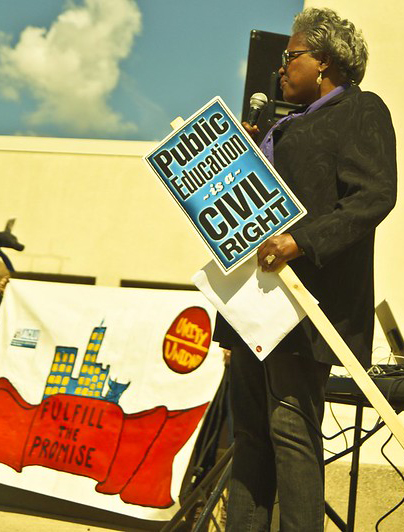
Only two southern states have not yet joined this reactionary movement. Republicans in Virginia’s legislature introduced a half-dozen bills to establish universal ESAs during the last two sessions but were stymied by bipartisan concerns about how vouchers benefited the wealthy and drained funds from public schools, and by Democrats who narrowly control both houses. In prior years, the Virginia legislature passed bills establishing limited ESAs but those too were blocked by the state’s last two Democratic governors.4Joe Landcaster, “Virginia Is Considering 4 Different School Choice Bills,” Reason, Jan. 22, 2023, https://reason.com/2023/01/22/virginia-is-considering-4-different-school-choice-bills/; Megan Pauly, “Wealthiest Virginians are benefiting most from contributions to school voucher program,” VPM News, July 11, 2022, https://www.vpm.org/news/2022-07-11/wealthiest-virginians-are-benefiting-most-from-contributions-to-school-voucher/.
In Mississippi, once the nation’s symbol of truculent political opposition to Brown and home to a vast number of segregation academies set up to evade school desegregation, Republicans control both legislative houses and the governor’s mansion. But, at the end of its 2024 session, the legislature failed to enact both a proposed new $40 million voucher program and a near-universal ESA bill that Governor Tate Reeves sought.5Suitts, Overturning Brown, 29–32; Bracey Harris, “Reckoning with Mississippi’s ‘segregation academies’,” The Hechinger Report, Nov. 29, 2019, https://hechingerreport.org/reckoning-with-mississippis-segregation-academies/; Russ Latino, “New Legislation Would Create Universal School Choice Program in Mississippi by 2029,” Magnolia Tribune, Feb. 20, 2024, https://magnoliatribune.com/2024/02/20/new-legislation-would-create-universal-school-choice-program-in-mississippi-by-2029/; Bobby Harrison, “House advances bill that would establish close study of universal school vouchers,” Mississippi Today, Mar. 5, 2024, https://mississippitoday.org/2024/03/05/house-committee-universal-vouchers/; Bobby Harrison, “Bill increasing tax credits for private schools defeated at end of session,” Mississippi Today, May 7, 2024, https://mississippitoday.org/2024/05/07/private-schools-tax-credits-mississippi-legislature/.
Why is Mississippi currently an exception to the rush to ESAs? First, the state is more rural and poorer than any other southern state, with vastly underfunded public schools and most of its private school children in a few suburban and urban areas. The Democrats who oppose vouchers in the legislature comprise a larger number than in other states (the Black population accounts for the largest percentage of any state). Significant, too, is the work of effective public interest lobbyists in Mississippi, led on school issues by an interracial coalition, The Parents Campaign. The group's director, Nancy Loome, has built a rare reputation on both sides of the legislative aisle as a trusted, honest voice for school children.
Border South states have already joined the separate and unequal movement. In 2021, Oklahoma and West Virginia passed ESA programs that have eligibility guidelines allowing almost every family with school-age children to receive state funding for private schooling and related educational expenses. Missouri expanded its tax credit ESA voucher program to include students across the state in four-person households with incomes up to $147,000. Kentucky passed a tax credit voucher program in 2021, but its supreme court held that the state constitution prohibits financing nonpublic schools. In 2024, the Republican-led legislature passed a bill authorizing a referendum to change the state constitution to permit ESAs.6For the bills terms, see FutureEd, https://www.future-ed.org/legislative-tracker-2024-state-private-school-choice-bills/; Amelia Ferrell Knisely, “Public schools likely to lose $21M after thousands of students left for Hope Scholarship,” West Virginia Watch, Dec. 13, 2023, https://westvirginiawatch.com/2023/12/13/public-schools-likely-to-lose-21m-after-thousands-of-students-left-for-hope-scholarship/; Annelise Hanshaw, “Opposition remains for sprawling education bill expanding Missouri private school tax credits,” Missouri Independent, Mar. 28, 2024, https://missouriindependent.com/2024/03/28/opposition-remains-for-sprawling-education-bill-expanding-missouri-private-school-tax-credits/; McKenna Horsley, “‘Game changer:’ Amendment for public dollars to nonpublic schools clears General Assembly,” Kentucky Lantern, Mar. 15, 2024, https://kentuckylantern.com/2024/03/15/game-changer-amendment-for-public-dollars-to-nonpublic-schools-clears-general-assembly/.
Arizona and Indiana are the leading states for voucher programs outside the South. In 1997, Arizona was one of the earliest adopters. Its ESA now costs more than $900 million a year. Indiana’s near-universal program, enacted in 2022, costs roughly $500 million in 2024.7Beth Lewis and Karen Kirsch, “One year in, Arizona’s universal school vouchers are a cautionary tale for the rest of the nation,” AZMirror, Dec. 11, 2023, https://azmirror.com/2023/12/11/one-year-in-arizonas-universal-school-vouchers-are-a-cautionary-tale-for-the-rest-of-the-nation/; Casey Smith, “Indiana’s ‘school choice’ voucher program grew 20% last year—with more growth coming” Indiana Capital Chronicle, June 14, 2023, https://indianacapitalchronicle.com/2023/06/14/indianas-school-choice-program-grew-20-percent-last-year-with-more-growth-coming/.
The remaining states with ESAs are Kansas, Ohio, Utah, Iowa, New Hampshire, and Wyoming. By 2027, approximately 86 percent of Kansas families could be eligible for a voucher. In Utah, families with a child eligible to attend public schools can receive up to $8,000. Legislation introduced in 2024 would increase the ceiling to $150 million. Iowa’s ESA cost over $100 million in its first year and 60 percent of the recipients were already attending private schools. The New Hampshire ESA program is more restrictive, spending less than $25 million in 2023 and permitting only children from households with incomes below 350 percent of poverty to participate, although school choice advocates are pushing for expansion. Wyoming’s Republican legislature voted to allow families with household incomes of up to $146,000 to receive state funds, but Republican Governor Mark Gordon used a line-item veto to cut the eligibility down to 150 percent of poverty since the state constitution prohibits funding private individuals or organizations “except for the necessary support of the poor.”8Author’s calculations based on the bills’ terms and each state’s median income; FutureEd. Also see Jay Waagmeester, “County-by-county distribution of education savings accounts released,” Iowa Capital Dispatch, Aug. 8, 2023.

So far, sixteen states have set up ESAs to publicly finance private school attendance, home-schooling, and a range of educational services available to a majority of the states’ school-age children. Southern states are leading this movement by undertaking a classic bait and switch—first selling the public on voucher programs to help poor and disadvantaged students in “chronically failing public schools,” and then building and publicly financing an alternative, dual system of private schooling.
The historical context is shameful. Five of the southern states that now have universal vouchers also enacted open-ended vouchers in the 1960s—attempting to defeat Brown’s mandate for school desegregation. All but four of the states that have already embraced publicly financed ESAs were the only states authorizing segregated public schools on the eve of the Supreme Court’s decision.9Suitts, Overturning Brown, 18–53, 87–89; Suitts, “Segregationists, Libertarians, and the Modern 'School Choice' Movement,”; Pauli Murray, States' Laws on Race and Color (Cincinnati, OH: Women's Division of Christian Service of the Methodist Church, 1951). Indiana had school segregation laws from 1869 until 1949, when five years before the Brown decision the legislature revoked the laws, See Murray, 145–147. The eighteen states are the eleven states of the South: West Virginia, Kentucky, Missouri, and Oklahoma in the Border South; Kansas, Indiana, Arizona, and Wyoming.
The fiscal impact of this rush to fund private schooling will be devastating to public schools. In 2018, all fifty states allocated $2.6 billion to finance private school vouchers. In 2021, legislatures increased the total amount to $3.3 billion and more recently to over $6 billion. If the eleven southern states enact the bills currently adopted or pending in their legislatures, their total funding for vouchers will be as much as $6.8 billion in 2025–26 and, according to independent estimates, as much as $20 billion for private schooling in 2030. This sum would equal the total state funds to public schools among six southern states in 2021.10Suitts, Overturning Brown, 3; EdChoice, The ABCs of School Choice, 2024, https://www.edchoice.org/wp-content/uploads/2023/11/2024-ABCs-of-School-Choice.pdf; author's computations based on the provisions of enacted and pending bills, fiscal notes accompanying legislation and independent estimates by non-profits in the southern states.
The Past Is Future
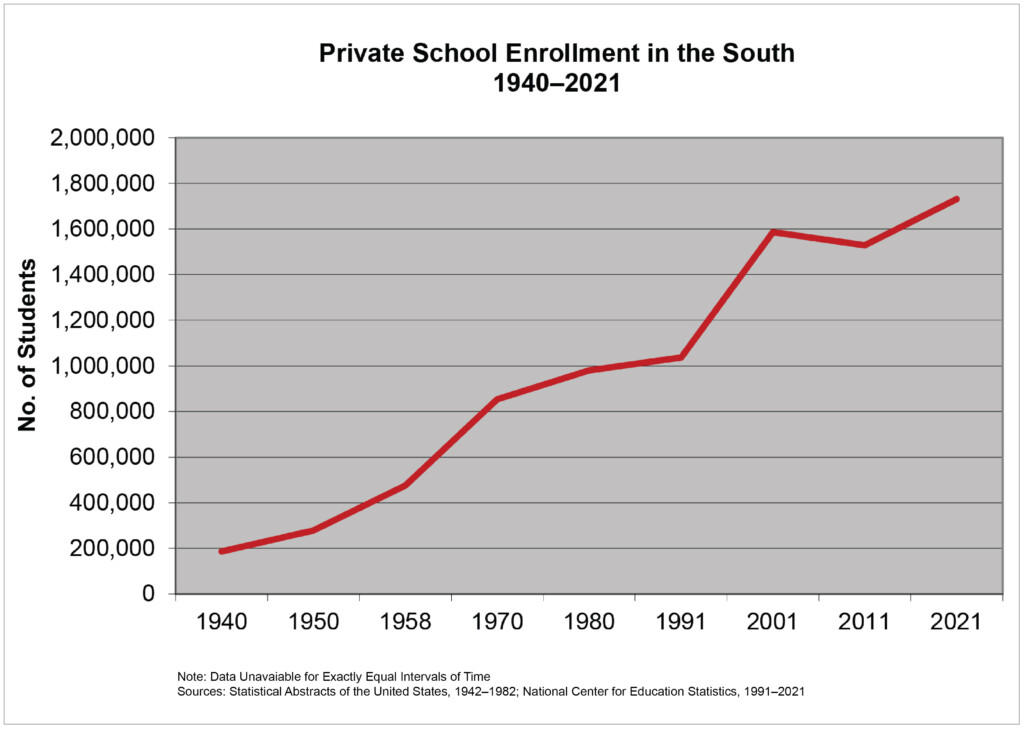
Segregationists’ attempts to use private schools to prevent the implementation of Brown shaped the demography of private school enrollment. After the 1954 decision, enrollment in southern private schools accelerated. With federal court enforcement of Brown, private school growth exploded in the 1960s and 1970s as white families, especially in areas with large Black populations, fled public schools. This was the era of “segregation academies”—private schools created in response to federal court orders to desegregate local public schools. With little or no attempt to hide their intent to evade Brown, seven southern legislatures enacted voucher programs providing families with tax dollars to send their children to private schools. The other four states of the former Confederacy came close to adopting such programs, but abandoned consideration once the federal courts invalidated voucher programs. Adopted as an effort to allow public funds to “fund the child,” Georgia voluntarily defunded its vouchers after segregationist lawmakers realized that they were mostly subsidizing well-to-do families whose children were already attending private schools. In Louisiana, both white and Black families were provided private school vouchers before the federal courts voided the program.11Suitts, “Segregationists, Libertarians, and the Modern 'School Choice' Movement.”
Southern states’ private school enrollment quickened across the decades, especially in the 1990s as population, economy, and personal income markedly increased. To retain a non-profit, federal tax exemption, segregation academies ditched their strict, all-white admission policies, and reoriented their appeal as places of religious education or of higher educational standards. Other private schools became more willing to admit children of color as a new generation of white people was less indoctrinated by received habits, institutions, leaders, and media on the necessity and virtue of total segregation. Whatever non-racial rationale private schools adopted, the vast majority maintained a common character: “These are schools for whites,” observed a group of scholars in the 1970s. “The common thread that runs through them all, Christian, secular, or otherwise, is that they provide white ground to which blacks are admitted only on the school’s terms if at all.”12David Nevin and Robert E. Bills, The Schools that Fear Built: Segregationist Academies in the South (Washington, DC: Acropolis Books, 1976), 11.
Private and Public: Vastly Disparate Students
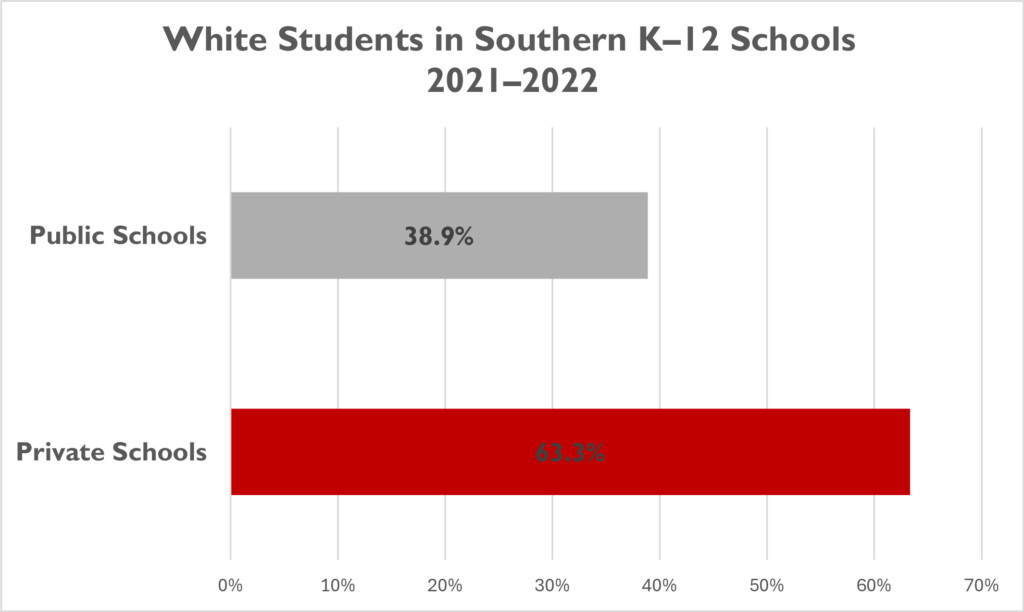
The character of most southern private schools has persisted, but, beginning in the 1990s, the student population of the South’s public schools began to change. Today, the southern states’ private schools remain predominately white and their public schools are predominately non-white, serving children of color. In 2021 (the latest comparable data), white students comprised 63 percent of the South’s private school enrollment and only 39 percent of the public schools. Black and Hispanic children constituted 53 percent of all students in public schools but less than half that proportion—26 percent—in the private schools of the eleven states.13Private school enrollment retrieved and computed from National Center for Education Statistics (NCES), accessed at https://nces.ed.gov/surveys/pss/privateschoolsearch/. Public school enrollment taken from NCES’ Table 203.70 of 2023 Digest of Education Statistics, accessed at https://nces.ed.gov/programs/digest/2023menu_tables.asp.
Income also separates the public and private schools as worlds apart. Private school students come from homes with vastly higher incomes than public school students. The median incomes of private school households in Georgia, Florida, Louisiana North Carolina, Tennessee, Texas, and Virgina have been from 170 percent to nearly 200 percent greater than incomes of public school households over the last two decades. A recent scholarly, national study found that enrollment of higher-income students in private schools had increased over prior decades.14Jacob Fabina, Erik L. Hernandez, and Kevin McElrath, “School Enrollment in the United States: 2021,” American Community Survey Reports, US Census Bureau, Washington, DC, 2023; Bruce D. Baker, Danielle Farrie, David Sciarra, Is School Funding Fair? A National Report Card, 2012, 2014, 2017, “Coverage” appendices; R.J Murnane and Sean Reardon, “Long-Term Trends in Private School Enrollments by Family Income,” AERA Open 4, no. 1 (2018), https://doi.org/10.1177/2332858417751355. The Murname and Reardon study measured the Census South.
As private school enrollment has become wealthier, public school enrollment has become poorer. By 2006, a majority of the South’s public school students came from low-income households, and in 2013, for the first time in recent history, a majority of the nation’s public school children came from low-income households. Despite continued growth in the US economy, these patterns persist. Fifty-two percent of the public school students in the eleven-state South were eligible for free or reduced school meals in 2021, due in large part to the enrollment of so many low-income children. Nationwide, the rate was 49 percent, only slightly down from more than 50 percent during the two prior years.
A sizable number of public school children also have special needs that involve extraordinary educational challenges for teachers and schools. The southern states have almost 40 percent of the nation’s five million school children who are English learners. Students with disabilities (IDEA) range from one in every ten students in Texas to one in every six students in Arkansas public schools. On average, one child out of every fifty in the South’s public schools is homeless.15Steve Suitts, A New Majority: Low Income Students in the South’s Public Schools, Southern Education Foundation, 2008, https://southerneducation.org/publications/newmajority/; Steve Suitts, A New Majority Update: Low Income Students in the South and Nation, Southern Education Foundation, 2013, https://southerneducation.org/wp-content/uploads/documents/new-majority-update-bulletin.pdf; computations from Tables 102.40, 204.10, 204.20, 204.70, 204.75d, “Digest of Education Statistics, 2022,” National Center for Education Statistics, https://nces.ed.gov/programs/digest/2022menu_tables.asp.
There is no reliable data on the number of children with special needs enrolled in private schools. A small number were established to serve special needs students, but the vast majority do not. As a matter of law and mission, most private schools maintain no responsibility to educate disadvantaged students.
Vouchers Worsen School Disparities in a Dual System
Wherever states have abandoned narrow, targeted voucher programs, the expanded public funding has usually been grabbed by the higher-income households, often with children already attending private schools. In 2023, Education Week magazine, which has impartially covered K–12 schools for more than forty years, reported that in states with recently expanded voucher programs a “majority of students participating in these programs were already enrolled in private schools or were homeschool students prior to signing up for the newly expanded, publicly funded education subsidy."16Mark Lieberman, “Most Students Getting New School Choice Funds Aren’t Ditching Public Schools," Education Week, Oct. 4, 2023, https://www.edweek.org/policy-politics/most-students-getting-new-school-choice-funds-arent-ditching-public-schools/2023/10.
During Arkansas’ first year of financing universal ESAs, “95% of the students receiving vouchers” did not attend public schools before receiving the state money. And in four other states that have enacted near-universal ESAs, including Florida, a majority of the new households receiving vouchers have children already attending private schools.17Arkansas Department of Education, LEARNS, Education Freedom Account Annual Report, 2023–2024, https://arktimes.com/wp-content/uploads/2023/10/EFA-Transparency-Report37.pdf; “Iowa’s Students First Education Savings Account program generates more than 29,000 applications,” press of Iowa Governor Kim Reynolds, July 6, 2023, https://governor.iowa.gov/press-release/2023-07-06/iowas-students-first-education-savings-account-program-generates-more; Robin Opsahl, “More than 29,000 apply for Iowa private-school funds in first year,” Iowa Capital Dispatch, July 6, 2023, https://iowacapitaldispatch.com/2023/07/06/more-than-29000-apply-for-iowa-private-school-funds-in-first-year; Ethan Dewitt, “Most education freedom account recipients not leaving public schools, department says,” New Hampshire Bulletin, Mar. 22, 2022, https://newhampshirebulletin.com/briefs/mosteducation-freedom-account-recipients-not-leaving-public-schools-department-says/; News Service Florida, “New report shows nearly 123,000 new students received Florida school vouchers in 2023,” NBC 6 South Florida, https://www.nbcmiami.com/news/local/new-report-shows-nearly-123000-new-students-received-florida-school-vouchers-in-2023/3112869; Florida Department of Education (2023). "Florida’s Private Schools 2022–23: School Year Annual Report," https://www.fldoe.org/core/fileparse.php/7562/urlt/PS-annualReport2023.pdf; Alec MacGillis, “Private Schools, Public Money: School Leaders Are Pushing Parents to Exploit Voucher Programs,” ProPublica, Jan. 21, 2024, https://www.propublica.org/article/private-schools-vouchers-parents-ohio-public-funds.
Data on household income among new ESA recipients is not widely available, but an analysis by Ohio’s former chair of the state house education committee finds that the state’s near-universal voucher programs is subsidizing private school tuition for families in higher income brackets, and that nine of ten of the new recipients have been white. Arizona does not collect income data from its rapidly expanded universal ESA, but Princeton sociologist Jennifer Jennings found in 2024 that “Arizona’s school vouchers are subsidizing its most fortunate families, reinforcing existing disparities rather than mitigating them.” In Florida, the lastest available numbers show that two out of every three new recipients in its universal voucher programs had incomes above 185 percent of poverty. As many as 44 percent had incomes no less than 400 percent above the poverty line.18Stephne Dyer, “Ohio's Disastrous Voucher Explosion,” Tenth Period, Nov. 29, 2023, https://10thperiod.substack.com/p/ohios-disastrous-voucher-explosion?subscribe_prompt=free; Jennifer Jennings, “Arizona’s school vouchers are helping the wealthy and are widening educational opportunity gaps,” Arizona Mirror, Jan. 12, 2024, https://azmirror.com/2024/01/12/arizonas-school-vouchers-are-helping-the-wealthy-and-are-widening-educational-opportunity-gaps; “Transparency in Scholarship Programs,” Step Up for Students via Florida Phoenix Sep. 2023, https://drive.google.com/file/d/1yyl80Jbs9mU6GlV1ktA6zZg8GUjLnsP4/view. The Arizona Common Sense Institute argues that its zip code analysis shows that the state’s ESAs are assisting mostly middle-class families but their analysis lumps together zip codes with median household incomes with those more than twice the state median. In Florida, Step Up for Students expanded the grouping of voucher recipients—the lowest income category showing recipients’ income as high as 185 percent of poverty. Glenn Farley and Kamryn Brunner, Universal ESA’s: Where We Are and Where We Are Going, Arizona Common Sense Institute, May 2023, https://commonsenseinstituteaz.org/wp-content/uploads/2023/05/CSI-Report-_Universal-ESAs_May-2023-2.pdf; Glenn Farley, Growth and Change: How One Year of Universal Empowerment Scholarship Accounts Has (and Has Not) Altered Arizona’s K–12 Landscape, Arizona Common Sense Institute, April 2024, https://commonsenseinstituteaz.org/wp-content/uploads/2024/04/CSI_REPORT_ESA_GROWTH_APRIL_2024.pdf.
It has been evident for years that wealthier households are the primary beneficiaries of open-eligibility tax credit voucher programs. In 2023 the non-profit Institute on Taxation and Economic Policy examined programs in three states that permitted any family to divert state taxes to private school vouchers. Ninety-nine percent of all voucher tax credits in Louisiana and 87 percent in Virginia went to families with annual incomes over $200,000. In Arizona, it was 60 percent. In Georgia, $100 million can now be taken annually from the treasury through state tax credit for funding private school vouchers, and higher-income families have received the majority of the vouchers since 2013. The actual number may be much greater as the program has been plagued by irregularities, deceit, and misrepresentations by private groups distributing the tax credit vouchers. The Georgia Department of Revenue does not use tax records to verify the self-reporting of those receiving the tax credits or vouchers.19Carl Davis, Tax Avoidance Continues to Fuel School Privatization Efforts, Institute on Taxation and Economic Policy, Mar. 3, 2023, https://itep.org/tax-avoidance-fuels-school-vouchers-privatization-efforts/; author’s computations from annual Qualified Education Expense Credit Report, Georgia Department of Revenue, 2013–2021, https://dor.georgia.gov/calendar-year-qualified-education-expense-credit-report; Steve Suitts and Katherine Dunn, A Failed Experiment: Georgia's Tax Credit Scholarships for Private Schools (Summary Report), Southern Education Foundation, 2008, https://southerneducation.org/publications/a-failed-experiment; Nancy Badertscher, “Group targets tax credit scholarships - Revenue Department asked to stem students from private schools,” Atlanta Journal-Constitution, July 22, 2011, B-2; Steve Suitts, “Program encourages deception and helps those who don't need it,” Atlanta Journal-Constitution, July 5, 2011, A-13.
Even with vouchers, few low-income families in the South can afford to keep their children in K–12 private schools. The average cost of private school tuition in ten of eleven southern states exceeds those states’ per-pupil funding of public schools. In other words, even if a voucher equals the state per pupil allocation for public school, it is not enough to match the private school tuition. After including additional expenses of attending a private school—books, supplies, uniforms, technology, athletics, and field trips—the total average cost in all southern states except Arkansas exceeds the state per pupil appropriation. In Texas, that total cost is more than $9,000 over the state’s per pupil public school appropriation. It is more than $2,300 in Mississippi.20Calculations based data on average private tuition prices by state and other costs reported at Raise Right website, https://www.raiseright.com/blog/how-much-do-private-schools-cost, and Prosperity for America website, https://www.prosperityforamerica.org/average-private-school-tuition/. Data on state revenue for state per pupil revenue is found at “2021 Public Elementary-Secondary Education Finance Data, US Census. https://www.census.gov/data/tables/2021/econ/school-finances/secondary-education-finance.html. These back-of-the envelope calculations capture the real-life financial barriers many families will encounter if they rely on an ESA voucher to send a child to a private school, and the calculations don’t even include cost of transportation, something that few private schools provide and is far beyond the resources of most low-income families.
The emerging ESAs are apparently designed for higher-income families that can already afford to pay all or much of the cost of private schooling. Wealthy families can use these vouchers to cover tuition costs and a wide range of expenses. As in several other states, Alabama’s vouchers can go toward tuition, textbooks, fees, after-school care, summer education programs, private tutoring, curriculum and instructional materials, online learning, educational software and applications, standardized assessments, including college admissions tests and advanced placement exams, and college prep courses.
The South Cannot Afford a Dual School System
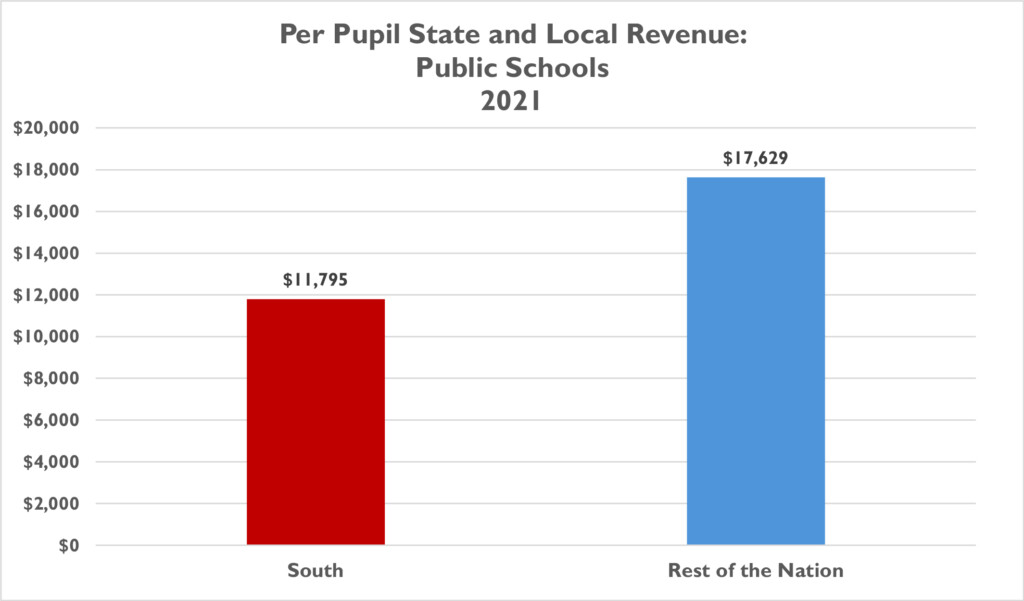
Southern states, while serving a large proportion of disadvantaged children, provide among the lowest per pupil funding in the nation to their public schools. Any given K–12 student in the South received on average $5,831 less for education during 2021–2022 than a student in public school elsewhere in the United States. Public school children in North Carolina, which ranks 48th in state and local funding, received nearly $7,500 less per child than what the rest of the nation provides.
This pattern of underfunding public schools is longstanding and was aggravated over decades, in large part, by the fact that the southern states maintained separate, unequal, dual school systems.21Steve Suitts, “The South: America’s Legacy of Gross Disparities in Funding Education,” No Time to Lose: Why America Needs an Education Amendment to the Constitution, Southern Education Foundation, 2009, https://files.eric.ed.gov/fulltext/ED524094.pdf. And the legacy persists. A recent study by University of Miami Professor Bruce Baker and his colleagues found no less than three out of every four public school districts in the South were chronically underfunded by national standards of need and resources.22Bruce D. Baker, Matthew Di Carlo, and Mark Weber, The Adequacy and Fairness of State School Finance Systems, Jan. 2024, https://www.schoolfinancedata.org/the-adequacy-and-fairness-of-state-school-finance-systems-2024/.
States will soon realize the damage of these disparities. The vast federal funds that were appropriated shortly after the COVID epidemic to shore up schools will run out in 2024. Governors and state legislatures have allocated these temporary funds as if they were state appropriations and often have been able to increase public school funding using federal funds. As that funding is exhausted, public schools in the southern states will suffer extraordinary shortfalls—more so than any other area of the United States.
Approximately nine percent of Louisiana’s education budget across the last three years has been financed with federal funds, almost all of which will be spent by 2025.23Joanna LeFebvre and Sonali Master, Expiration of Federal K–12 Emergency Funds Could Pose Challenges for States, Center on Budget and Policy Priorities, Feb. 2024, https://www.cbpp.org/sites/default/files/2-28-24sfp.pdf. The legislature will be forced to cut K–12 education funding and/or raise additional revenue. If Louisiana's legislature enacts the pending universal ESA it could add more than $65 million in expenses by 2026, and by independent estimates, as much as a half a billion dollars in annual expenditures to the state education budget by 2030.24“Expanding School Choice: Education Savings Accounts Raise Cost, Accountability Concerns,” Public Affairs Research Council of Louisiana, https://parlouisiana.org/wp-content/uploads/2024/03/PAR-Commentary-Expanding-School-Choice-1.pdf.
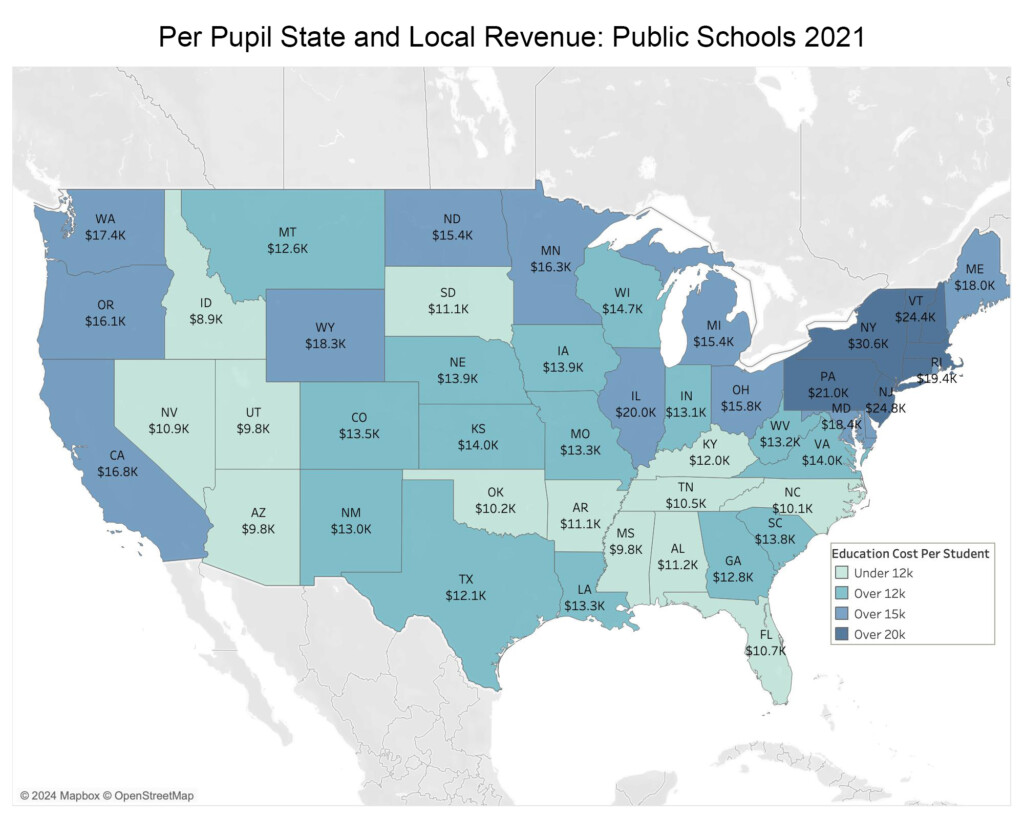
Such grim estimates extend to all states that have enacted or are moving to adopt universal ESAs, including Arizona where 6.9 percent of the state’s recent annual education appropriations will be lost. Yet the fiscal calamities will happen foremost in the southern states where federal funds have constituted an average of 6.4 percent of annual state education spending—and as much as 10.5 percent in Mississippi.
According to ERS, a consulting firm that collaborates with urban school districts, children in fifteen states will be hit hardest as the federal government’s COVID funding ends.25“Here’s Why Some States Are Facing a Steeper ESSER Funding Cliff in 2024,” ERS, Mar. 2023, https://www.erstrategies.org/tap/analysis-esser-funds-fiscal-cliff-by-state/#factor3. Nine of these are southern states, with Florida falling just outside the list. Among the states that will be hardest hit, all except New Mexico have or are currently considering ESA voucher plans.
Replacing $41.5 billion in special federal funding during the last three years will be a daunting challenge for southern states, especially since they also received billions of dollars from other federal COVID relief funding for health care, roads, transportation, and childcare. These funds are also ending. Without massive cutbacks in funding public schools and services, how can the southern states meet this crisis while spending hundreds of millions financing new ESA vouchers in support of a separate system of private schooling? It’s a fool’s errand that will involve educational and financial catastrophe for all but the South’s upper-income households, for whom ESAs will provide a nice subsidy. For public school children, especially most low-income and minority children, it is the making of a disaster.

Dismantling Public Schools
Perhaps it is the aim of some school choice backers who are pushing for a state-financed system of universal vouchers to incapacitate the public education system’s mission and mandate to serve all students with equal educational opportunities. In April 2024, a lead sponsor of universal ESA vouchers in the Tennessee legislature, Republican Scott Cepicky, was caught on tape privately telling home-school parents that his goal for the state’s public schools was to “throw the whole freaking system in the trash at one time and just blow it all back up."26Phil Williams, "'We're trying to throw the whole freaking system in the trash,' school voucher sponsor says," NewsChannel 5 Nashville, Apr. 15, 2024, https://www.newschannel5.com/news/newschannel-5-investigates/revealed/revealed-were-trying-to-throw-the-whole-freaking-system-in-the-trash-school-voucher-sponsor-says
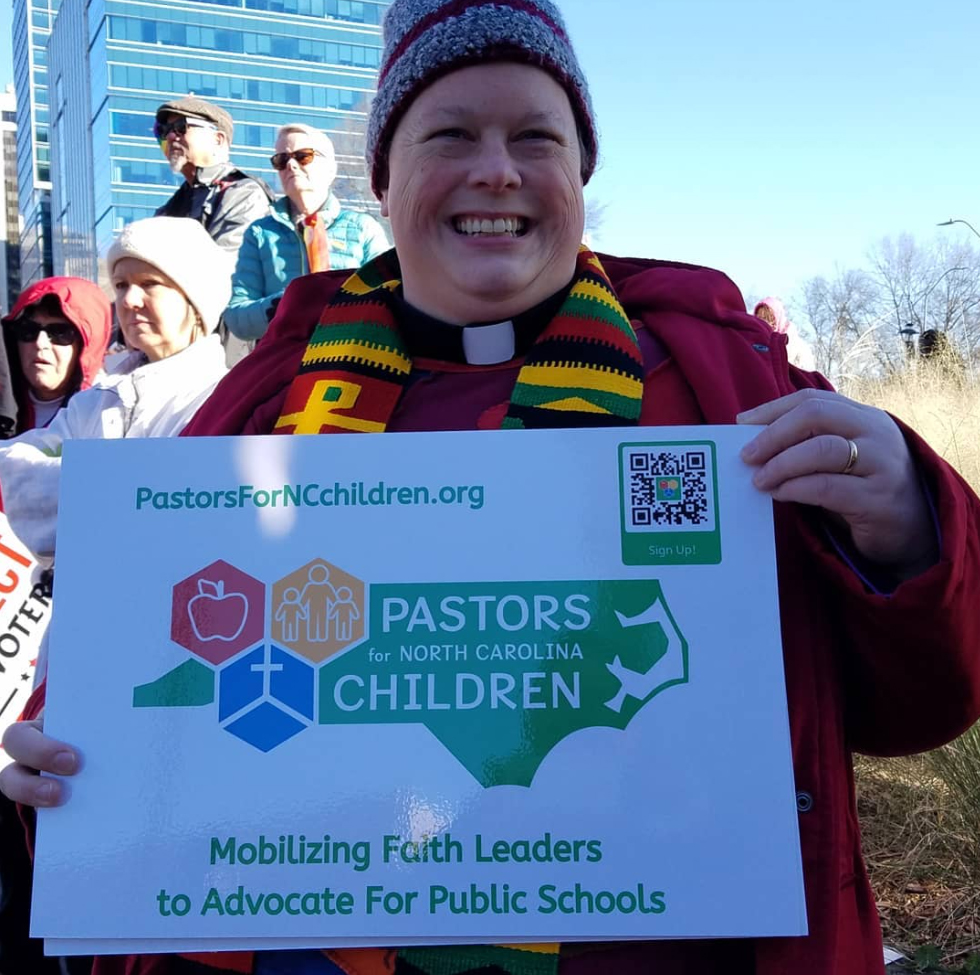
Last year, in a closed meeting of Christian millionaires, one attendee declared that the goal was to “take down the education system as we know it today.” Michael Farris, the Virginia lawyer who has become a prominent leader of the modern home-schooling movement, told the group, “We’ve got to recognize that we’re swinging for the fences here, that any time you try to take down a giant of this nature, it’s an uphill battle,” according to a recording obtained by the Washington Post.27Emma Brown and Peter Jamison, “The Christian home-schooler who made ‘parental rights’ a GOP rallying cry,” Washington Post, Aug. 29, 2023, https://www.washingtonpost.com/education/2023/08/29/michael-farris-homeschoolers-parents-rights-ziklag/.
Few backers of universal vouchers say as much in public, but they no longer keep up a pretense that the school choice movement is about finding ways to provide targeted assistance and opportunities for low-income and minority children. But, Southern governors still like to parade out a group of children of color when they sign voucher bills, as did Georgia Governor Brian Kemp when he held his signing ceremony for the ESA law.28Ty Tagami, “Kemp signs voucher bill he championed,” Atlanta Journal-Constitution, Apr. 24, 2024. Most voucher proponents and wealthy donors who have coalesced for decades, spending enormous energy and money to advance public financing of private education, have confessed openly to a variety of other motives.
This diverse coalition seeks state-supported Christian education, free-market competition, elite-only schooling, unfettered parental control of education, and regulation-free schools, among other objectives. Their movement has progressed over the decades through the collective organizational work and political action committees bankrolled by the super-rich and corporate leaders who believe that the government is too large, taxes too much, and has little or no business in providing education.29David Montgomery, “School Voucher Proponents Spend Big to Overcome Rural Resistance,” Governing, Mar. 28, 2024, https://www.governing.com/finance/school-voucher-proponents-spend-big-to-overcome-rural-resistance; Jimmy Cloutier, “‘School choice’ super PAC targets Texas GOP incumbents,” Open Secrets, Mar. 4, 2024, https://www.opensecrets.org/news/2024/03/school-choice-super-pac-targets-texas-gop-incumbents/; Katie Meyer, “Jeff Yass, the richest man in Pa., is single handedly keeping school choice PACs flush,” WHYY, May 12, 2021, https://www.phillytrib.com/jeff-yass-the-richest-man-in-pa-is-single-handedly-keeping-school-choice-pacs-flush/article_ee7dde98-1989-5ef1-925c-06473429466c.html; James Holmann with Breanne Deppisch and Joanie Greve, “Koch network laying groundwork to fundamentally transform America’s education system,” Washington Post, Jan. 20, 2018, https://www.washingtonpost.com/news/powerpost/paloma/daily-202/2018/01/30/daily-202-koch-network-laying-groundwork-to-fundamentally-transform-america-s-education-system/5a6feb8530fb041c3c7d74db/.
Consider the voucher advocates who believe in economist Milton Freidman’s vision of public education that is entirely based on the government’s providing a voucher to all families with school-age children to go to any school of their choosing. Friedman laid out his free-market idea for voucher-schooling in 1955, a year after Brown. To realize Friedman’s vision today, his adherents’ goal is not a dual school system, but a unitary system of only ESA vouchers. In other words, they seek to destroy public education as it exists.
These free-market proponents fail to grapple deeply with the same issues that Friedman blithely dismissed when condemning “government schools.” In 1955, he acknowledged that his voucher proposal had already been “suggested in several states as a means of evading the Supreme Court ruling against segregation." Friedman’s solution was simple: vouchers paid by government funds would create a system of "exclusively white schools, exclusively colored schools, and mixed schools. Parents can choose which to send their children to." Friedman also opposed a federal fair employment commission to bar racial discrimination in private employment and later the 1964 Civil Rights Act—since it involved government regulation of private businesses for the purpose of prohibiting racial discrimination.30See Suitts, “Segregationists, Libertarians, and the Modern 'School Choice' Movement.”
The belief in the unqualified virtue of private choice means that by design school choice should trump any role government has to prohibit discrimination based on race, sex, and religion in providing the nation’s children with an education. It means the destruction of public schools and their core democratic values.
The emergence of universal vouchers has convinced Pulitzer Prize winning journalist Cara Fitzpatrick to write in The Death of Public Education (2023) that the aim of the movement is to “radically redefine public education in America” with consequences that most citizens have not begun to fully consider.31Cara Fitzpatrick, The Death of Public Education: How Conservatives Won the War over Education in America (New York: Basic Books, 2023). In their revised preface to A Wolf at the Schoolhouse Door (2023), Jack Schneider and Jennifer C. Berkshire write that there is now “a very real threat to public education in the United States . . . we’ve seen more destruction than we imagined could be done in a decade. And we’re worried when we next sit down to update this book, we’ll be writing a eulogy rather than a polemic."32Jack Schneider and Jennifer C. Berkshire, A Wolf at the Schoolhouse Door: The Dismantling of Public Education and the Future of School (New York: The New Press, 2023).
The Bizarre Disparities in Governing the Emerging Dual School Systems
Ending public schools may be the clear goal of the primary advocates behind the private choice movement, but what is emerging in states that are on their way to adopting universal ESAs is a dual school system with vastly, differing, unequal ground rules, responsibilities, and oversight for educating children with public funds.
Most ESA legislation requires minimal regulations of private schools. Children may be rejected by a private school receiving state vouchers for any number of reasons, spoken or unspoken, relating to income, religion, race, ethnicity, dress, sex, gender identity, or disability. The schools will have the ultimate choice—not the children and their families. State legislation usually prohibits discrimination based on race and national origin, but as with most ESAs, there are no mechanisms for oversight, reporting, investigation of complaints, or enforcement.33Kevin G. Welner & Preston C. Green, “Vouchers as a Mechanism for State-Sanctioned Private Discrimination,” in The School Voucher Illusion: Exposing the Pretense of Equity, eds., Kevin Welner, Gary Orfield and Luis A. Huerta (New York: Teacher College Press, 2023), 87–109; Chase M. Billingham and Matthew O. Hunt, “School Racial Composition and Parental Choice: New Evidence on the Preferences of White Parents in the United States,” Sociology of Education, 89, 2 (2016): 99–117, https://doi.org/10.1177/0038040716635718.
The standards for educating children and methods of accountability are minimal or illusory in voucher-supported private schools. The bills establishing ESAs allow these schools to be accredited by a range of private associations, usually comprised of representatives of the schools they accredit. In most southern states, private schools receiving vouchers are not required to assess students for achievement, or, they can use a nationally normed test of their preference, which undermines comparisons among schools. In any case, the results are not always available to the public. Most of these states do not specify, regulate, or review a private school’s curriculum before or after providing voucher funding.
This near-complete freedom to instruct children in whatever way the voucher-supported private schools choose is often justified on the basis that such schools provide students a better education than public schools. There is no factual grounding for this assumption.34Christopher Lubienski, T. Jameson Brewer, and Joel R. Malin, “Bait and Switch: How Voucher Advocates Shift Policy Objectives,” The School Voucher Illusion, 127–141; John Schaaf, “School vouchers hurting students’ academic performance, several studies show,” Kentucky Lantern, Feb. 19, 2024; also, Public Funds, Public Schools has complied a long list of the studies on how private voucher-supported schools have had chronic achievement problems, https://pfps.org/research/. Some private schools are renowned for their high-quality education, but academic study after study has proven this supposition is false. Voucher students are academically harmed on average, particularly in math. Yet, as Cara Fitzpatrick has observed “what the research shows no longer matters.” Private schools are free to indoctrinate students as much as educate them, so long as their parents tolerate or endorse it.35Fitzpatrick, 13.
Some voucher-supported private schools instruct students exclusively about a biblical story of creation. Some require students to pledge allegiance to religious flags and to memorize and recite school-chosen Bible verses. Some teach that homosexuality is a sin. Some expel LGBTQ+ students or even those who associate with LGBTQ+ people. Some use textbooks that belittle the significance of slavery and ignore or downplay the role of Black leaders and the civil rights movement.36Adam Laats, “The Right-Wing Textbooks Shaping What Many Americans Know About History," Time, Oct. 12, 2023, https://time.com/6316978/conservative-textbooks/; Jenna Scaramanga and Michael J. Reiss, “Evolutionary stasis: creationism, evolution and climate change in the Accelerated Christian Education curriculum,” Cultural Studies of Science Education 18 (2023): 809–827. https://link.springer.com/article/10.1007/s11422-023-10187-; Jenna Scaramanga and Michael J. Reiss, “Accelerated Christian Education: a case study of the use of race in voucher-funded private Christian schools,” Curriculum Studies 50, no. 1 (Nov. 2017): 1–19, https://www.researchgate.net/publication/321373088_Accelerated_Christian_Education_a_case_study_of_the_use_of_race_in_voucher-funded_private_Christian_schools; Adam Laats, Forging a Fundamentalist ‘‘'One Best System’': Struggles Over Curriculum and Educational Philosophy for Christian Day Schools, 1970–1989," History of Education Quarterly 49, no. 1 (Jan. 2010): 55–83; Zack Kopplin, “Hundreds of Voucher Schools Teach Creationism in Science Classes,” PBS News, Jan. 29, 2013; “The Loch Ness Monster Is Real; The KKK Is Good: The Shocking Content of Publicly Paid for Christian School Textbooks," Alternet, June 19, 2012; Steve Suitts, Race and Ethnicity in a New Era of Public Funding of Private Schools: Private School Enrollment in the South and the Nation, Southern Education Foundation, 2015, Appendix 14 (available on request); Julie F. Mead and Suzanne E. Eckes, How School Privatization Opens the Door for Discrimination, National Education Policy Center, Nov. 2018; Steve Suitts, Georgia’s Tax Dollars Help Finance Private Schools with Severe Anti-Gay Policies, Practices, & Teachings, Southern Education Foundation, Jan. 2013. There is nothing in the ESA laws, enacted or pending, that restricts a private school teacher, or home-schooling parent from engaging in a lesson plan of indoctrination on the inherent superiority of the white race, the heroism of John Wilkes Booth and James Earl Ray, the need to exterminate LGBTQ+ people, or to punish any woman who seeks an abortion.
In contrast, southern legislatures have piled up decades of regulations, assessments, reporting requirements, and penalties for traditional public schools and more recently are micro-managing what and how teachers can teach and what books local school libraries can keep on their shelves. From 2008 through 2022, the eleven southern states enacted a total of 3,552 laws regulating their public schools. There are nearly a thousand pages devoted to student discipline.37Compilations developed at Education Legislation/Bill Tracking, National Conference of State Legislatures, https://www.ncsl.org/education/education-legislation-bill-tracking; Compendium of School Discipline Laws and Regulations for the 50 States, Washington, DC and the US Territories, National Center on Safe Supportive Learning Environments, 2023, https://safesupportivelearning.ed.gov/school-discipline-compendium.
Southern state legislatures have moved to prohibit what they consider to be inappropriate curricula, lesson plans, and books involving diversity, inclusion, and equity—primarily about how and when persons and groups who are not white or heterosexual should be portrayed in the classroom and in library books. Every southern state has passed laws restricting discussions of race and/or gender identity. Most, like Alabama’s recent law, include restrictions for K–12 public schools on “divisive topics,” or like Arkansas, prohibit “indoctrination or critical race theory." No other area of the US has been as aggressive in restricting public school teachers and librarians, who face penalties or dismissal if they fail to adhere to the regulations banning what they can say and what books students may read.38Hannah Natanson, Lauren Tierney and Clara Ence Morse, “Which states are restricting, or requiring, lessons on race, sex and gender,” Washington Post, Apr. 4, 2024; “America’s Censored Classrooms,” PEN America, Aug. 17, 2022, https://pen.org/report/americas-censored-classrooms/.
It is hard to imagine a more divergent, unequal arrangement. The state-supported private schools can expel a student or teacher for almost any reason, and their teachers and librarians have complete freedom from governmental interference as to what subjects they teach and how they teach it. They have complete freedom to indoctrinate students—with no consequences.
As Vouchers Spread, Brown’s Promise Dies
During the last seventy years, the nation’s public schools have struggled in meeting the promise of Brown, despite clear proof that racially integrated, well-funded schools improve outcomes for Black children.39Rucker C. Johnson, Children of the Dream: Why School Integration Works (New York: Basic Books, 2019). This promise has been especially important to the South, where the states’ first education laws prohibited Black persons from being taught to read or write; where racially segregated schools offered children of color an inferior education across more than a half century. Due to stubborn, racially defined housing patterns, increasing class disparities, adverse, even hostile Supreme Court decisions, a lack of local, interracial community support, and, as recent research confirms, the growth of school choice, public schools continue to face far too many hurdles in providing all children with a good education.40Gary Orfield and Ryan Pfleger, The Unfinished Battle for Integration in a Multiracial America—from Brown to Now, The Civil Rights Project, UCLA, April 2024. https://civilrightsproject.ucla.edu/research/k-12-education/integration-and-diversity/the-unfinished-battle-for-integration-in-a-multiracial-america-2013-from-brown-to-now/National-Segregation-041624-CORRECTED-for.pdf. Also, see Tomas Monarrez, Brian Kisida, and Matthew Chingos, When Is a School Segregated? Making Sense of Segregation 65 Years after Brown v. Board of Education, Urban Institute, Sep. 2019. https://www.urban.org/research/publication/when-school-segregated-making-sense-segregation-65-years-after-brown-v-board-education; Laura Meckler, “The unexpected explanation for why school segregation spiked,” Washington Post, May 6, 2024, https://www.washingtonpost.com/education/2024/05/06/school-segregation-study-policies-court-orders/.
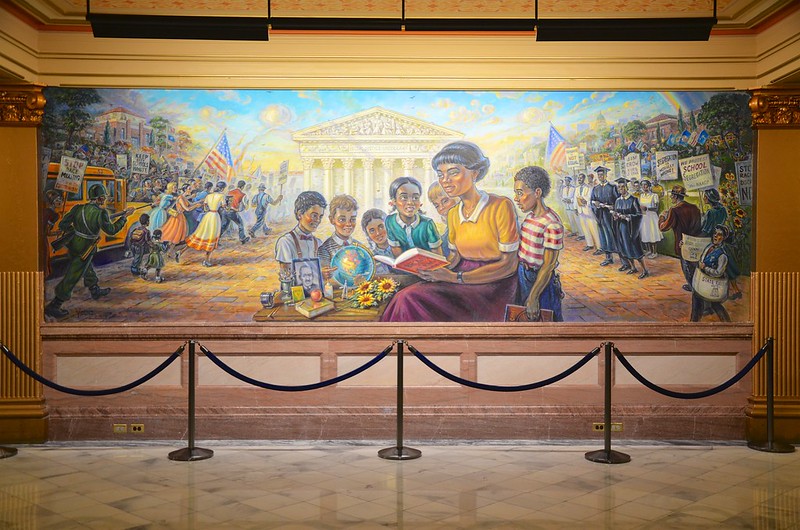
The South’s new dual school system renounces and annuls the mandates and hopes of Brown v. Board of Education. As universal vouchers spread, Brown’s promise dies. By their design, vouchers are an abandonment of Brown’s goal of equality of educational opportunity.
Reestablishing a dual school system will damage the prospects of a good education for all who attend public schools—not just low-income and minority children. The southern states were not able to finance two separate school systems during the era of segregation, even though Black students received a pittance of funding. Today that inability remains. The South continues to be far behind the rest of the nation in state and local funding of public schools. The new schemes of universal Education Savings Account vouchers will exacerbate the lack of sufficient funds for all except those higher-income families whose school-age children can attend private schools or home-schools and enjoy the enhancements and enriching experience that vouchers will subsidize.
Parents, grandparents, and others who support public schools and the democratic promise of public education must raise our voices against this reactionary movement and in furtherance of the importance of public schools. Like democracy itself, public schools may be the worst system for delivering all children an equal opportunity for a good education—except for all the others. We must not betray or abandon public education if we are committed to the democratic goal of a more perfect union and a good society for all.
About the Author
An adjunct with Emory University's Institute for the Liberal Arts, Steve Suitts is the author of A War of Sections: How Deep South Political Suppression Shaped Voting Rights in America (Athens, GA: University of Georgia Press, 2024). Earlier in his career, Suitts served as the executive director of the Southern Regional Council, vice president of the Southern Education Foundation, and executive producer and writer of "Will the Circle Be Unbroken," a thirteen-hour public radio series that received a Peabody Award for its history of the civil rights movement in five Deep South cities.
]]>Introduction—Salt Creek and City Nature

To place Salt Creek geographically, imagine the state of Florida. Zoom in to the west central coast,1This multi-media essay has developed over a long period of time and thanks are due to my home university's Center for Civic Engagement, the Frank E. Duckwall Foundation, the Tampa Bay Estuary Program, and most of all, to my students. Thanks to my comrades at Friends of Salt Creek; my church community at St. Augustine's Episcopal Church (at Salt Creek's headwaters), who have taught me to see my adopted hometown in a new light; to videographer Devin Rice; to Allen Tullos and anonymous readers for Southern Spaces; to Julie Armstrong, Jack Davis, Ray Arsenault, Amanda Hagood, Ray Roa, Chris Meindl, and Jacqueline Hubbard, Esq. then go to St. Petersburg, a midsized city—the second largest in the Tampa Bay area. St. Pete holds down the bottom of Pinellas County, a peninsula upon a peninsula, bracketed by Tampa Bay to the east and the Gulf of Mexico to the west. Water is everywhere.
St. Petersburg has always been two things: a resort town and a product of the segregated South. Known affectionately as the Sunshine City, St. Pete claims the Guinness World Record for sunshine (as a can of local craft beer will tell you, 768 consecutive days). This winter haven boomed in the early twentieth century. White vacationers and retirees flocked here for the weather, often to relax on the green benches (hence the beer) that once lined Central Avenue, the city's main thoroughfare and longtime racial divide. African Americans first migrated here to build the railroad and work the tourist economy, building tight communities over time.
Off the tourist map, Salt Creek remains absent from view, for reasons both geographic and social. Because the water flows in a northeast direction, starting from the middle of Pinellas County then into Tampa Bay, the creek falls off the orderly cadastral map. Avenues go East-West and the streets North-South, while Salt Creek cuts a diagonal course. Most of the creek's banks are culverted, so its "nature" does not adhere to conventional labels of leisurely consumption. Racial divides further hide this fragmented waterway, and the environmental merges with the Sunshine City's flickering, all-too-easily-denied Jim Crow past.
Today only a handful of locals can trace Salt Creek's full course. The best way is to start at the mouth, Bayboro Harbor, just south of the city's previously moribund but now skyrocketing downtown. As one journeys southwest, going upstream, the creek services a working port (properties now eyed for luxury housing). The creek passes under a mangrove cover and empty lots, owned mostly by absentee speculators. The city's sizeable population of street people, who use its shielded banks for shelter, are the principal stakeholders here. Under Fourth Street, a major north-south corridor, Salt Creek opens into mangrove-shrouded Bartlett Pond. Beyond the pond, it crosses under Twenty-Second Avenue South, also a major thoroughfare, before vanishing into a culvert through Harbordale, one of the poorest neighborhoods in Pinellas County. Dammed at the north-south running Dr. Martin Luther King, Jr. Street (or Ninth Street, to old timers), the channel opens into Lake Maggiore, historically an estuarine body of water, now maintained as fresh. Beyond the lake, finally, Salt Creek splits into several other unnamed sources.
Recovering an urban waterway is no easy task, as it requires travel across both time and space. This tour, "Draining Paradise," attempts to render visible our everyday—yet hidden—lives, where water meets land. Because Salt Creek pays no heed to squared-off boundaries or cornered streets, and because property claims trump natural processes, it suffers neglect. In a city founded upon leisure—moreover, with a disenfranchised working class needed to produce that leisure—what counts as "nature" inevitably falls along social, economic, and racial lines. A continuing legacy of inequity shapes environmental priorities. Yet Salt Creek's history is complicated. Water quality intersects with social structures, though not in any simple or straightforward way. The words and conventions we use to describe natural beauty fill in few gaps, nor do current models of environmental justice fully apply. This aquatic system passes through several different neighborhoods—white and Black, rich and poor, protected and industrialized, through parts of town in clear neglect and others in good health. The social constructs fragment the hydrology until a citizenry can no longer see itself in nature. So how do we teach ourselves to see the parts as one whole? Can we come together as a community by cognitively remapping a forgotten stream? If so, what terms do we use? What's the storyline for a creek that has become a ditch?
I first stumbled upon my problem quite by accident, as an extension of my job as an English professor at the University of South Florida's St. Petersburg campus. I came to USF as a part-time instructor, tasked with developing a course called "Rivers of Florida." For several semesters, I ventured with students in canoes and kayaks onto the state's many spectacular wild and scenic rivers—traveling hours for peak nature experiences amid awesome alligators, long legged wading birds, and floodplains filled with cypress—waving trails of Spanish moss over the slick obsidian water. Despite the beauty of our surroundings, student essays from the "Rivers" classes were mostly pedestrian paeans to the "real Florida" and laments for a vanishing nature. Tired of burning class time and fossil fuels, and bored with cliché writing, I turned to nature close to home—Salt Creek, whose mouth empties right onto our campus.
With little initial support, I threw myself into a curriculum that built nature around the city. The project came to consume my work as teacher, writer-researcher, citizen, and activist. The early stages were marked by confusion and indifference. The problem, from a pedagogical standpoint, starts with semantics. What happens when a stream or creek becomes a culvert or ditch? Why do those words matter? We urban dwellers, who seek out nature close to home, are linguistically bereft: there is no term to describe the successful interface of natural and built environs. Outside cities, we have any number of categories for describing natural landscapes. The "wilderness" and "preserve" define parks, without people; the "georgic" or "bucolic" covers farmland; a "pastoral" is where classical shepherds tended their flock while reflecting upon the corruption in Rome, and today denotes cherished spaces of imagined innocence—like a baseball diamond or the Andy Griffith Show. But nature in the city presents an absence. To address this problem, I set up a classroom model. I founded a fictional group, "Friends of Salt Creek," built a website, and started exploring with my students.2For a timeline see Friends of Salt Creek, Accessed April 11, 2023, https://friendsofsaltcreek.org/; for an example on how the critical terminology overlooks city nature, see survey in Greg Garrard, Ecocriticism (New York: Routledge, 2012), which is organized around a series of chapter-keywords (pollution, wilderness, apocalypse, dwelling, animal, earth), but no urban terms. Like a generation of environmental humanists, I first recognized the shortcomings of advocacy strategies and literary conventions after reading the edited collection by William Cronon, Uncommon Ground: Rethinking the Human Place in Nature (New York: W.W. Norton, 1996); more recently, I discuss cultural categories of nature writing, and the challenges of teaching city nature, see "City Creeks: Lessons in Sustainable Environmental Discourse from a Florida Boom Town," Spaces in-between: Cultural and Political Perspectives on Environmental Discourse, ed. Mark Luccarelli and Sigurd Bergmann (Leiden, Netherlands: Brill Rodopi, 2015), 88–101. Using searchable newspaper articles and government documents, we cobbled together a storyline.
The next step was to theorize. Environmental writer Jenny Price details "Thirteen Ways of Seeing Nature in LA," a classic re-examination of the least "natural" of all places, the Los Angeles River. On the East coast, meanwhile, landscape architect Ann Whiston Spirn has combined activism, teaching and writing in a recovery of Mill Creek, a buried stream that threads through West Philadelphia before feeding the Schuylkill. These models and others provided a conceptual groundwork. Over time, I accumulated equivalents. A trip to New York City took me to the Gowanus Canal, a Superfund site where Walt Whitman once ate oysters. I learned how tourists in London will lay out ten pounds each (five for kids) to slip down the culverted Fleet River, now a covered source but a notorious ditch from the reigns of Queens Elizabeth to Victoria. A sixteenth-century mock epic by Ben Jonson, "On the Famous Voyage," recounts a journey up the filthy Fleet: the open sewer runs foul with "grease, and hair of meazled [leprous] dogs; / The heads, houghs [hocks], entrailes, and hides of hogs."3Jenny Price, "Thirteen Ways of Seeing Nature in LA" (Part 1), Believer 33 (April 1, 2006); Anne Whiston Spirn, "Restoring Mill Creek: Landscape Literacy, Environmental Justice and City Planning and Design," Landscape Research 30, no. 3 (2005): 395–413; Ben Jonson, "On the Famous Voyage," in Complete Poetry, ed. William B. Hunter, Jr. (New York: NYU Press, 1963), 72. The same waterway carries away the cannibalistic offal of Stephen Sondheim's Sweeney Todd, "the demon barber of Fleet Street."

Patterns came together. Urban waterways offer a Realometer, as Thoreau wrote, places where you stand right to face the facts.4Henry David Thoreau describes the "Realometer," distinguished from the "Nilometer" (a gauge to measure the mythologized Nile), in the penultimate paragraph of the chapter "Where I Lived, and What I Lived For," from Walden, or A Life in the Woods (Boston, MA: Ticknor and Fields, 1854). Our city creeks mark charismatic, if uncomfortable points of context between activism and disaster fetish, economics and racial inequity, lost memory and recovery, cool-credibility, and very real marginalization. The more I traveled my own channelized waterway, the more analogs I discovered. Friends and colleagues started volunteering their own favorites. The Chicago River (a graduate school buddy reminds me) previously served as a portage between the Great Lakes and the Mississippi. A stunningly illustrated article in the New York Times charts the harrowing impact of sea level rise on this area.5Dan Egan, "A Climate Crisis Haunts Chicago's Future. A Battle Between a Great City and a Great Lake," New York Times, July 7, 2021, https://www.nytimes.com/interactive/2021/07/07/climate/chicago-river-lake-michigan.html. A colleague who graduated from Columbia's school of journalism reminded me that vestiges of Minetta Brook flow under Minetta Street in Greenwich Village. My writing partner for a series of #Creekshed essays in our local alt-weekly, Amanda Hagood, sent vacation photos of Ala Wai Canal in Honolulu. Another traveling colleague, a classicist, Facebook messaged me a photo of the vestigial Eridanos, Greece—the literal path to Hades—which runs through Athens' Monastiraki Metro stop. The community relations person on my campus insisted I walk the C&O canal on my next trip to to Washington, D.C. And while researching an academic memoir about her hometown of Birmingham, Alabama, my colleague and partner Julie Armstrong traced the entirety of Village Creek—a polluted stream that drains both industrial sites and a neighborhood park where she played as a child.6See Thomas Hallock and Amanda Haygood, "#Creekshed Story Map," May 5, 2022, https://storymaps.arcgis.com/stories/b664d097ee3e408c8eacf5a424075af8; for more information on the Ala Wai canal, a lagoon off Waikiki that displaced wetlands used by island Natives for fishing and agriculture in Waikiki, see Sophie Cocke, "Ala Wai Canal: Hawaii's Biggest Mistake?," Honolulu Civil Beat, May 20, 2013, https://www.civilbeat.org/2013/05/ala-wai-canal-hawaiis-biggest-mistake/; a display of Minetta Brook, which used to run through the lobby of a hotel-apartment, is no longer operable, though reference can be found at "Minetta Green," NYC Parks, Access April 11, 2023, www.nycgovparks.org/parks/minetta-green/history; Village Creek Environmental Human & Environmental Justice Society, Accessed April 11, 2023, https://villagecreeksociety.org; Julie Buckner Armstrong, "Two Days along Village Creek," Learning from Birmingham: A Journey into History and Home (Tuscaloosa: University of Alabama Press, 2023). East Lake was the white working-class neighborhood where Julie grew up. Through the post-civil right's era, it was mostly African American. Because of its increasingly coveted real estate, it became a focal point for the A&E program Flipping Down South.
Why this passion? And why is this work necessary? The recovery of an urban waterway can feel like a very vexed homecoming. Even though social history and economics have shaped our aquatic environs, current land use practices erase the very past that brings value, coherence, justice, and yes, even happiness to our communities. City creeks have a particular way of taking one both to the edges and into the heart of where we now live. We are habituated, as geographer Yi-Fu Tuan reminds us, to link memory and place. Tuan's term, "topophilia," is a well-known coinage for the memories that accrue across space. A crack in the sidewalk carries us back emotionally; a whiff of wisteria fosters connection, and one hopes, concern for a given locale.7Yi-Fu Tuan, Topophilia: A Study of Environmental Perception, Attitudes, and Values (New York: Columbia University Press, 1990). Though simple on the surface, the concept is tough to pin down; topophilia, Tuan reminds us, is not just patriotism, childlike nostalgia, or the marketing copy on a beer can. It means coming to grips with both the pleasures and the problematic.
Take the green bench, which is the name of my local brew of choice, but also a hurtful symbolism. As noted in a recent study of systematic racism in the city, green benches lined the main thoroughfare of Central Avenue from 1916 to 1960. For white residents, these benches were a "symbol of hospitality and place to socialize" on a pleasant winter afternoon; for African Americans, not being allowed to sit there served as an "everyday reminder" of humiliating segregation.8Tuan, Topophilia; Ruthmae Sears et al, "Building Bridges & Racial Equity in St. Petersburg Florida" (Tampa: University of South Florida, 2021), 52. City creeks, likewise, sit uneasily in our idea of nature. They do not offer simple recreation or respite. The active search for broken connections instead takes us beneath the placid surface of a city's daily life.
As a white northern transplant, I have learned how a recovered past opens channels for seeing a difficult present. Every metropolitan area holds its own hydrologic history, buried or forgotten. What I offer in this short trip is a lesson in how cities render nature invisible; how what we count as nature is either valued or subject to abuse, and how those decisions follow social lines; and how past, present, and future landscapes intersect. To cross into our fragmented waterways, I must add, requires humility. The divisions rendered in our shaping of the natural world remain. And so the fundamental challenge: to come together, as one community, cleaning our rivers and streams, while at least recognizing—if not starting to heal—the rifts between us.
Bayboro Harbor
Start at Bayboro Harbor, at the campus where I teach. Faculty, staff and students can rent a kayak, paddleboard, sailboat, or canoe at the waterfront office, and here, I typically begin my nature writing classes. Once called "Fiddler's Paradise," for the crabs foraging in the surrounding mangrove and spartina, this former bayou is where Tampa Bay meets Booker and Salt Creeks—two of the major drainage systems for lower Pinellas. The Gulf Coast of Florida has been home to a series of loosely-defined, overlapping cultures, more local polities than "tribes"; these include "archaic" groups, the Weeden Island culture (300CE–1000CE), followed by the Safety Harbor culture (900CE–1500CE), then Tocobaga (the residents of Tampa Bay who most likely met Spanish explorers in the sixteenth century). Florida's first people fished and gathered crustaceans. The refuse from this bounty formed middens and mounds, many of which appear on early postcards from the city. As St. Petersburg boomed through the twentieth century, during the early years of car culture, these shell mounds were looted for road fill. The Indian works, reminders of a successful synthesis of built and natural environs, remain buried under a hospital's out-parcels and parking garages.9Robert J. Austin, "'Its Origin Steeped in Mystery': The Sorry Saga of St. Petersburg's Shell Mound Park," The Florida Anthropologist 73, no. 2 (June 2020): 113–39; the ongoing status of Native remains, held at the Smithsonian and elsewhere, including (until recently) my university's anthropology department is reviewed in "Notice of Inventory Completion: Department of Anthropology, University of South Florida, Tampa, FL," National Archives Federal Register, Sep. 27, 2011; and Gene Demby and Kumari Devarajan, "Skeletons in the Closet," NPR Code Switch, Oct. 13, 2021, https://www.npr.org/transcripts/1045518876.
Salt Creek, meanwhile, tells the classic Florida story of transformation and rapine. The waterway formerly known as "Salt Run" drains lower-lying land, never particularly suited for human habitation. Starting in 1908, a group called the Bayboro Investment Company (supported by local boosters, fat with congressional pork) oversaw the harbor's dredging, which continued for several years. Imposing steam-fueled engines churned the roots, sand and gravel over bulwarks, carving a fifteen-foot channel from the shallow bayou, transforming the "marshy waste" into "valuable lands." Both Salt and Booker Creeks were straightened and deepened for the purposes of top-down economic interests: to connect with a rail depot one mile to the north, plus harborage for "pleasure yachts." Where there had been "naught but a marsh, inhabited by undesirable tenants" the St. Petersburg Evening Independent boasted, soon would "arise a beautified landscape occupied by happy homes of mankind." Four years later, with more federal funding, the city cleared frontage for a harbor and marina.10"The Bayboro Improvements," St. Petersburg (FL) Evening Independent, March 26, 1908, 1; "Deep Water Harbor Ordinance Up Tonight," St. Petersburg (FL) Daily Times, Aug. 14, 1912, 1.
The creek's industrialization had begun. In 1913 the dredgers worked their way further up the channel, yoking the tidal "Salt Run" to Florida's violently enforced economic and social order. As standard histories recount, the area boomed through the first decades of the twentieth century, with a soggy landscape shaped to property developers who then marketed an affordable paradise for white tourists and transplants; this same paradise needed a labor force, and segregation shaped the landscape as much as the pleasures of outdoor leisure. An invisible line along Central had already divided the city into north (white) and south (African American) sides. African Americans moved to St. Petersburg in search of work and the city council sharpened boundaries where people of color could live. A 1931 charter amendment sought "to establish and set apart in said city separate residential limits or districts for White and negro residents." This redlining, impossible to enforce and revised many times, imprinted the city's demographics permanently, shaping everything from voter registration to school funding and supermarket locations.
Has the creek been subject to the same racial violence as Black bodies? It depends on who you ask, though this much is true: segregation in St. Petersburg remains unfinished business. Redlining language remained in the city charter until 1963; through the Jim Crow era, three lynchings were reported in Pinellas County (low for bloody Florida); and various groups such as Pinellas Remembers (which successfully placed an Equal Justice Initiative marker at the site of a 1914 lynching) continue the important, uphill work of healing. Environmental and social histories undoubtedly intertwine—the question is "how?"
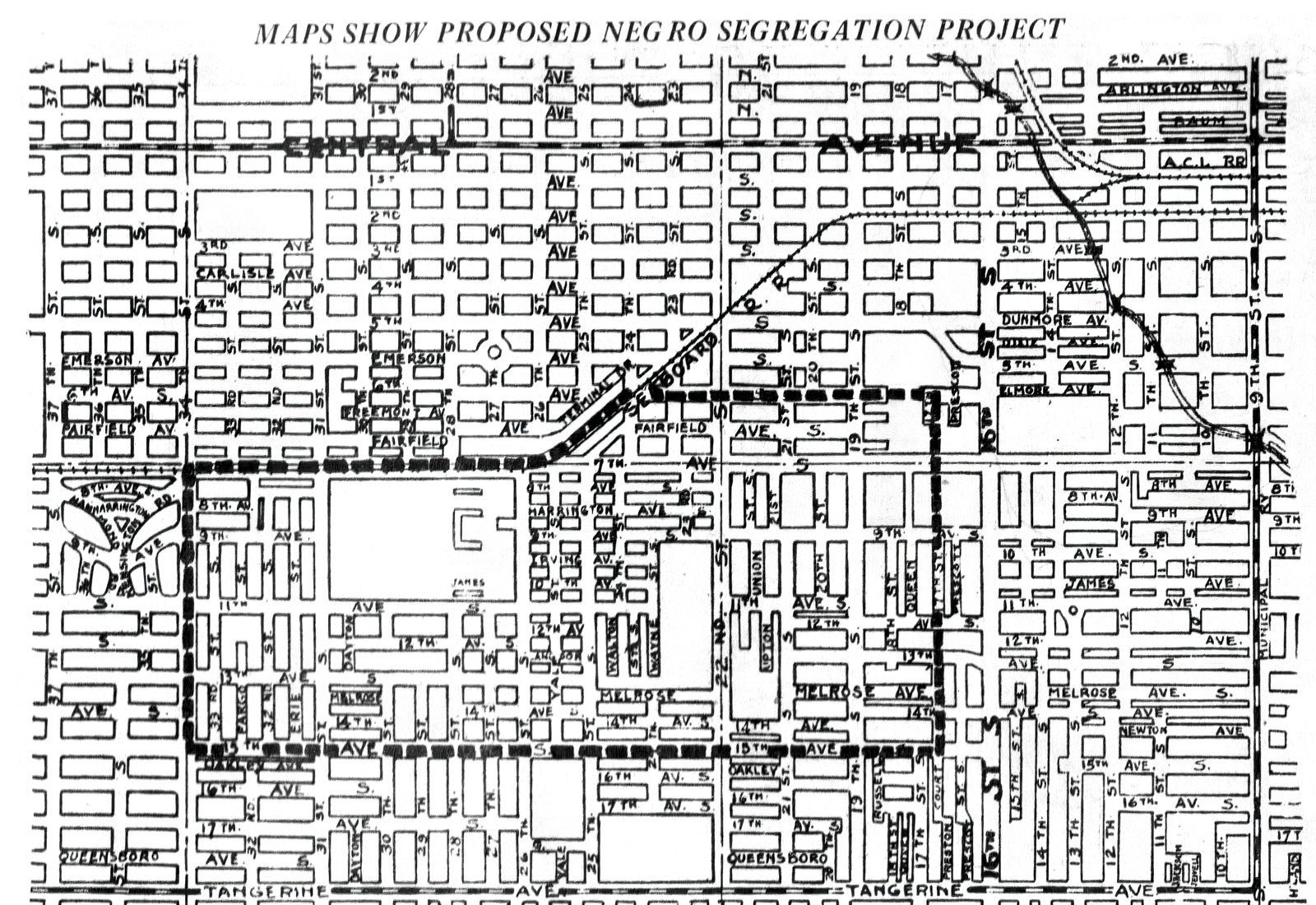
From its early boom years, access to nature came through a front and back door. North of Central Avenue, tourists enjoy Instagram-worthy waterfront parks, showcasing urban amenities alongside Tampa Bay. Today, these parks receive the overwhelming bulk of public funding and remain fiercely guarded by a proud citizenry. The adjacent working waterfront to the south was slated for industry, and set on a course for exploitation. Starting in the 1920s, city leaders commissioned engineering studies, supported business and secured federal money to construct an "industrial harbor." Salt Creek housed oil storage tanks (inevitable spills to follow) and just upstream, a dairy and flash-freeze seafood plants. As industry left in the 1970s, the creek would serve as a site for drugs and illegal sex and squatters, and now, for fast food and a Salvation Army support center. Locals recognize the creek (if at all) from a sharply-arched bridge over Third Street known as "Thrill Hill," or as the place where a sleeping homeless woman tumbled off a seawall and lost her arm to an alligator.
Such are the long string of anecdotes—the stories of drug runners and petty crime, childhood kicks, vagrancy and chicken thieves—that populate the creek's history.11City Council minutes were printed in St. Petersburg (FL) Times, Feb. 14, 1931, 2–3; see also "Open Waters in Salt Creek" St. Petersburg (FL) Times, June 16, 1921, 10. Most recently, the city revised building codes to accommodate Miami developers, who schemed to build high-density housing on the flood plain. That bubble having burst, the area remains scraped.12"Report of Port Exports Announced by Commission," St. Petersburg (FL) Evening Independent, Sept. 16, 1926, 7; "Dairy Concern Adds to Plant on Salt Creek," St. Petersburg (FL) Times, Jan. 1, 1937; "Yacht Basin Boats Face Clampdown," St. Petersburg (FL) Times, Feb. 3, 1960; "Salt Creek Squatters Trouble City Again," St. Petersburg (FL) Independent, Aug. 28, 1961; Jack Alexander, "Drug Raids Nab 11," St. Petersburg (FL) Independent, May 18, 1968.
Salt Creek activists suffer fatigue, even disillusionment, from fighting the combined forces of city hall, Jim Crow's intractable legacy, and poor decisions rationalized by free market economics. Two episodes from the past century illustrate the challenges of turning back the tide. The creek's path traces a low-lying area, or swale. In any other scenario, land this vulnerable to flooding would be set aside for parks and greenspace. Every good planner that has studied a topo map has, in fact, reached that conclusion. In the 1920s John Nolen, the preeminent city planner of his generation, prepared St. Petersburg Today, St. Petersburg Tomorrow—a design that would be considered progressive if it were adopted even now.13John Nolen, City Planning Report: St. Petersburg Today, St. Petersburg Tomorrow (St. Petersburg, FL: St. Petersburg City Planning Board, 1923), https://friendsofsaltcreek.org/wp-content/uploads/2022/02/St-Petersburg-Today-St-Petersburg-Tomorrow-1923-Nolen-Plan-1.pdf; St. Petersburg Conceptual Plan (City of St. Petersburg, FL, May 1974), https://friendsofsaltcreek.org/wp-content/uploads/2022/03/Conceptual-Plan-St.-Petersburg-1974.pdf: 31–32. Nolen suggested a parkway, using Salt Creek to connect gulf to bay with a chain of green "around the lower end of the peninsula." Voters rejected the Nolen plan, however, citing the imposition on private property rights as well as Nolen's reluctance to tighten emerging redline laws. One could blame this shortsightedness on the times. Nolen worked in the shadow of the Rosewood massacre, but fifty years later, the city reached the same conclusion.
Dusting off many of John Nolen's ideas, a 1974 Conceptual Plan also proposed a "green open space network," which included the "natural swale" between Tampa and Boca Ciega Bay. In short, a park along the Salt Creek channel.14R. Bruce Stephenson, Visions of Eden: Environmentalism, Urban Planning, and City Building in St. Petersburg, Florida, 1900–1915 (Columbus: Ohio State University Press, 1997), 65. Neither proposal, almost fifty years apart, made the leap to policy. A common good for the city (sustainable development, equitable access to open space) will lose to private, mostly white interests every time.
In the creek, I confront my own ambivalence towards Florida. I revel in the completely undeserved, over-the-top natural beauty. I also feel overmatched by the state's ugly, obdurate social history. When my own patience runs out, I drop a kayak near the mouth and make a favorite circuit. I enter by the harbor, paddle through the marina, then under the bridges at Third and Fourth Streets, into a hidden wilderness. Past the last dredge line, not far beyond the old trolley bridge, ice cream plant or seafood fast-freeze facility, the docks and crumbling piers give way to a mangrove tangle. Under Thrill Hill, Salt Creek is both wilder and more polluted. The paradox is striking, even in its own way, charismatic. The overlooked canopy serves as a bird sanctuary, where long legged waders roost and nest. Styrofoam and plastic bottles meld with mangrove prop roots. Fecal bacteria levels spike well past acceptable levels. We are still trying to figure out the cause—excrement from the street population, which the city pushed from parks in the tourist center to the poorer southside; guano, which accumulates in the concrete channel because seawalls and dam upstream block the tidal flow; or maybe broken sewer lines.
My route takes me roughly halfway to Lake Maggiore, mostly by industrialized lots left abandoned for speculation. Past the Dollar General and McDonalds, I push through the choking mangroves, then slip under another low-slung bridge at Eighteenth Avenue South. From here the creek opens into Bartlett Pond, a small aperture all but choked off due to overgrowth. I have seen snook roil below the black, murky surface. I've also seen a prize game fish, floating ominously on the surface of the muck. Osprey watch from their nests in the light posts by the athletic fields. Were it not for the hum of traffic, I could be in the 10,000 Islands of the Everglades. Instead I have found Nature in the heart of a city.
This is not where one expects to find a kayak. Citing water quality, Parks and Rec officials have ignored my suggestions to install a put-in off Bartlett Pond. So I engineer my own exit, grabbing the sewer line off a bridge on the opposite side, nudging a gunwale to the shoreline, and throwing my fifty-seven-year-old self onto the muddy bank. From Bartlett Park, I portage back across Fourth Street, past a gas station at the busy intersection of Fourth Street and Twenty-Second Avenue South, back to my once gay and racially-mixed, increasingly gentrified neighborhood. This circuit is not easy, scenic, accessible, or even encouraged. But I find the paddle into every day nature restorative. Wilderness has been erroneously thought of as an escape, rather than as engagement with the here and now. "In wildness is the preservation of the world," Thoreau mused, wandering the clearcuts around Concord. The best wilderness is always close to home.15Henry David Thoreau, "Walking," The Atlantic, June 1862, https://www.theatlantic.com/magazine/archive/1862/06/walking/304674/.
Bartlett Pond
At Bartlett Park, tucked behind Twenty-Second Avenue and Fourth Street, Salt Creek opens into a muddy pool. This little pond adjoins two of St. Petersburg's main thoroughfares, but badly eutrophied and surrounded by mangroves, rarely merits a second look. My wife Julie has lived three blocks away and driven past Bartlett Park for twenty years, but did not know there was actually water behind the brush. A little fishing dock used to provide access on the east side, away from the street and from the park's interior. Vandals, or maybe the homeless on a cold night, burned the outer decking. Repairs to the dock then came slowly and were poorly done. After I called to complain, the parks department blocked off the charred sections, shortening the entire structure.
Environmental racism takes many forms—big and small, from legislation to microaggressions. A perspective at water level renders visible the "slow violence" of local policy, to use Rob Nixon's memorable phrase: the damage "that occurs gradually and out of sight … dispersed across time and space [and] typically not viewed as violence at all." Leisure may not register as a health concern. At least on the surface. But in this city, defined by slow violence, differences in life expectancy across race are measured by decades.16Rob Nixon, Slow Violence and the Environmentalism of the Poor (Cambridge, MA: Harvard University Press, 2011), 2; Sears et al., "Building Bridges," 123. Hypertension kills, green spaces heal.
St. Petersburg and Pinellas County pride themselves on their parks, yet the allocation of amenities follows a classic script in inequity. A Pinellas County park map is literally a reverse image of racial demographics. Docks served by the county's white residents include ADA-compliant handrails, fish cleaning stations, and overhead shelters to protect visitors from the harsh sun or sudden rain. Residents in south St. Pete's poorer Black neighborhood instead get this charred shell, over an overgrown pond my spouse never even knew existed—where health officials deemed the water unsafe to fish or swim.
Economics and social history shape the landscape, but because the history is forgotten and on-the-ground-economics vanish into everyday life, that landscape is tough to read. Bartlett Park embodies this contradiction. Behind the stump of a dock, tennis balls thwock back and forth at the St. Petersburg Tennis Center. Founded in 1926, the municipal courts are a vestige from the early twentieth century, when the neighborhood afforded vacation cottages for winter residents and renting tourists. The court's location seems anomalous, though like every other chapter of the city's history, it can be explained through the local lodestars of leisure and race. The center serves as a throwback to St. Petersburg's peak years as a populist paradise, when white northerners suffering from cold found relief in the mild climate, bay breezes, the foliage, and sport.
The same boom drew African Americans, mostly from across the South, who came here to work a growing service economy. The zoning measures set out to keep the Black population both accessible and cordoned off; these measures, from the middle third of the past century, limited where Blacks could work, live, and travel after dark. African Americans forged communities in neighborhoods that still resound in local lore—the Deuces, Pepper Town, Gas Plant, Campbell Park, Methodist Town. After the waning of de facto segregation, in the early 1970s, once tight communities fanned out across the southern side of the city.17Rosalie Peck and Jon Wilson, St. Petersburg's African American Neighborhoods (Charleston: History Press, 2008), 15–18; Sears et al., "Building Bridges," 108. Black families settled in formerly white neighborhoods on the south side of town, including Bartlett Park. White people moved out, abandoning the neighborhoods, then decades later returned to the same sections—displacing Black families who have now lived there for at least a generation.
The contradictions and shifting dynamics across time and space make Salt Creek difficult to explain. Lime green tennis balls lob over the chain link fence, down the sidewalk, and into the watershed. Environment and community relations cannot seem to find the same page. I struggle personally with my own blindness, fumbling with good intentions. After several years of my teaching along this waterway, graduate students culled together a self-produced book called Salt Creek Journal. During an Earth Day celebration at Bartlett Park, I palmed a copy of the paperback to my city council representative. She actually read the book, then convinced me to form a real group with the same name as the pedagogical fiction—Friends of Salt Creek. For several years, pulled into service, I led the group. We defined goals, calling ourselves a community group centered around nature, not so much preservationist. We met small, consistent successes. Foundation money flowed our way, though before we were logistically prepared to take on projects; we had a grant before we had a bank account. For clean ups, environmental groups like Tampa Bay Watch and the Tampa Bay Estuary Program (who do admirable work advocating for marine health) bring enthusiastic white volunteers from outside, though our constant reminder has been to build from within the neighborhood. The local Keep America Beautiful office wants to drop in cypress trees without asking people who live there.
Conventional narratives of environmental justice, Ellen Griffin Spears observes, have "left out many constituencies—women, workers, indigenous populations, people of color, immigrants—and as a result left out the social justice roots of environmental reform." And so we see the broader trends unfold in local arenas. White environmentalists are not "looking at the community," observes Jacqueline Hubbard, an African American attorney whose family has owned a lakeside home in the area for decades; the result "is a lack of communication and trust."18Ellen Griffith Spears, Rethinking the American Environmental Movement Post–1945 (New York: Routledge, 2020), 4; In my informal interview with Jacqueline Hubbard (Sept. 2, 2022), she mentioned the importance of environmentalists reaching out to churches and groups with well-established records in civil rights; my hope as the author of this article, an online tour, is to have a ready-made program for community presentation.
In retrospect, the lesson feels obvious: restoring the environment starts with community. The questions must always start with, "for whom?" For whom are we working? With whom and why? Bartlett Pond brings fault lines into stark relief. After a long period of asking, the city secured external funds to dredge the eutrophied pond. The mostly white Friends of Salt Creek continue to test waters around the park, hoping to locate the sources of fecal bacteria. But why now? Will the dredging serve the neighborhood's current, mostly Black residents? What will dredging a pond mean for those experiencing homelessness? Is "improvement" merely a bellwether of high-end development downstream? And how does one fight back cynicism? During a May Day clean up, an African American fraternity, the Sigma Betas, led a tree-planting effort that involved local teenage boys. When construction in the park cut off an irrigation line, however, the newly planted trees dried up and died. This story is nothing new. Landscape theorist Anne Whiston Spirn recounts similar frustrations with Philadelphia's Mill Creek. She describes how she led eighth graders along the creek's buried course, then asked the teenagers to develop a landscape plan. The students (more familiar with the realities of the streets than an Ivy League professor) refused to believe any plan they implemented would be suggested. "It won't happen," a student told her; "Someone will wreck it."19Spirn, "Restoring Mill Creek," 404. How do you explain to teenage boys in St. Petersburg, likewise, that the city failed to water plants they put in the ground?
Advocacy puts well intentioned theory to the test. We have to pull out the Thoreauvian "realometer." In our rhetoric and scholarly discourse, one might wax optimistic about bringing together environmental and social justice, building what my local Sierra Club chapter calls a "Black-Green" alliance. But in practice, we learn the hard way, starting by acknowledging the depth of the rift of our divides. We can get the grants but we cannot exact meaningful change. As a white-led group, Friends of Salt Creek seems to have a offered a strategic wedge for easy volunteerism; our group checked the box for "underserved community." Over summer 2021, we drew from a Tampa Bay Estuary Program grant to support an artist in residence program at the local community center. Four artists (two white, two African American) met under a central pavilion, working most closely with kids. The children here are predominantly Black, with many coming from foster homes. White kids go to tennis camp, steps away, taking after-school lessons for $200 per week. Kids from the adjacent Frank Pierce Center are not accustomed to access. The pavilion where we met backs onto the chain-link fences of the neatly rolled courts. At one point, a child passed a gate left open, usually locked, leading to the public court. "Wait," the child asked, "can we go in there?"
The same could be said for the pond. Our entry points to nature are shaped by economics, power, and race. The points of access disclose social boundaries. Where equivalent parks offered sheltered docks and piers, the only dock here is a burnt out stub. The city clears and maintains lakes in other parts of the city, opening code-compliant "windows" through the mangrove; here, the water remains hidden—out of sight and degraded.
This is no accident. Past Bartlett Park, through a hidden gap in the mangroves, Salt Creek cuts diagonally, continuing to run southeast, through one of the poorer parts of the city. Neighborhoods along the creek tumble precipitously from coastal-slash-suburban to impoverished. Median household incomes drop in predictable blocks, as one moves from waterfront from properties along Tampa Bay and west into the city: $78,875 in the mostly white Old Southeast neighborhood, to $44,474 in the Bartlett Park area, to $12,096 in the more African American Harbordale section. A closer analysis provides a much more nuanced intersection of economics and race, not captured by simple caricature, though a trend exists. The city-data website reflects what anyone who lives in St. Petersburg already knows: economics fall along sharp racial lines, effecting in turn, health, access to fresh food, experiences with education and law enforcement, the possibilities of upward mobility, and of course, green space.20"St. Petersburg Florida: Income map, Earnings map, and Wages data," City-Data, Accessed March 31, 2023, https://www.city-data.com/income/income-St.-Petersburg-Florida.html. Structural racism study; see also Sears et al., "Building Bridges," 203-08.
Racial demographics and water quality intersect. At the end of legalized Jim Crow, as African Americans moved into the Harbordale neighborhood, the city let water quality sink. Low oxygen levels during the 1960s resulted in fish kills. Locals likened the smell at low tide to a badly operating sewage plant, the newspaper reported; outsiders (not residents) used the creek as an unlicensed trash pit. The rust colored water tested at almost eight times accepted levels for coliform bacteria. The city was no longer calling this waterway a stream or creek; in newspapers and press conferences the creek was now a "drainage area," or worse, a "ditch."21Willard Cox, "Tests Show [Red] 'Tide' Not Cause of Kills," The Evening Independent, July 6, 1965; "A Fishy Smell at Salt Creek," The Evening Independent, May 2, 1966; "Salt Creek Flow Sickly," The Evening Independent, Sept. 14, 1973; Bill Marden, "Trash, Tide A Problem," The Evening Independent, July 16, 1971. Racism did not cause environmental abuse; water quality was abysmal throughout Tampa Bay. A generation of activists, overwhelmingly white, have "saved the bay"—dramatically improving estuarine health. The poorer areas drained by Salt Creek, following script, are the last to see remediation.
Lake Maggiore
Semantics shape stewardship. At MLK (formerly Ninth, a major north-south street), a dam divides Salt Creek from Lake Maggiore. I am now in the middle-bottom part of the Pinellas Peninsula, on what used to be "Salt Lake," an estuarine habitat typical for coastal Florida. The name changed, however, alongside usage. In the 1920s real estate promoters began pitching new developments around a shallow, still tidal estuarine habitat. A fanciful origin story in the St. Petersburg Times provided the much-needed fiction. The newspaper, upholding real estate interests, staked a dubious claim that "Salt Lake" was discovered by Italian buccaneers, who called it "Maggiore" after a similar body of water on the Swiss-Italian border. In an act of rhetorical desalination, the hucksters presented the Italian as the earlier toponym; the sailors had first found fresh water, though mistakenly, the label "Salt Lake" stuck on later maps. Fiction and finances thus conspired to justify a dam. The Times cited a "peculiar condition" (or what the rest of us call tides) that allowed saltwater species to intrude from the bay. In 1930 a more permanent dam was built, making "Maggiore a freshwater lake for bass fishing." It would remain as such, until no one could recall when the brackish lake was part of an estuarine tidal run. By the 1980s the alligators were so pervasive that water skiers chased them off the slalom course. Neither bass nor gators belong in "Salt Lake," of course, as freshwater species have found their invasive niche in this badly translated Alpine lago.22"Lake Maggiore Believed to be Named by Pirate—To Be a Beautiful Section," St. Petersburg (FL) Times, April 5, 1925; "Lake Maggiore Dam Proposed," St. Petersburg (FL) Independent, Sept. 25, 1930. I am indebted to Jack E. Davis, who grew up on Lake Maggiore and who read a draft of this essay, for the observation about water skiing.
The folly, this not-just-semantic amnesia, has been expensive. Newspapers chronicle a twenty or thirty year cycle of restoration and waste. Eutrophication, fish kill, dredge Crisis, quick fix, repeat. In 1940, ten years after construction of the new dam, the city's Evening Independent would report:
City sanitation crews were burying hundreds of pounds of dead mullet and trout along the eastern shore of Lake Maggiore where they washed up after being killed by what [is] believed to be excessive vegetation gases in the shallow waters of the lake.
The newspaper described a horrific scene. Fish up to two feet long, panting in the grass; sanitation workers removing the rotting carcasses; the city vowing to install a screen to keep saltwater species out of the now-freshwater lake. Again, in 1963, the state game commission concludes that ecologically, the lake has become "old and not conducive to bass reproduction." Fish kills returned in 1968 and 1970, when the city detected chloride, a negatively charged ion that indicated "somehow salt water was getting into" Maggiore. In 1991, the headlines repeat: "Lake Maggiore Sick from Pollution," this time from high concentrations of run-off nitrogen and phosphorous. The following year, sanitation workers hauled off three-hundred pounds of dead menhaden (a coastal and estuarine species), snook, redfish, and yellow fin. Starting in 2004, the city spent two years scraping 1.3 million tons of sediment from the lake bottom. Trucks ran sixteen hours a day, five days a week, transferring the muck to a sod farm and developing area in the swampier part of the county's north end. After high levels of arsenic were detected in the soil, however, the city found itself in a sticky legal battle with the developer who used the fill, eventually settling with a million dollar contamination claim.23"Tons of Fish Die in Lake Maggiore," The Evening Independent Aug. 1, 1940; "Lake Maggiore: Fight Against Aging," St. Petersburg (FL) Times, June 25, 1971; Sue Landry, "Lake Maggiore Sick from Pollution," St. Petersburg (FL) Times, Jan. 16, 1991; "Natural, Normal Fish Kill Hits Lake," St. Petersburg (FL) Times, Nov. 2, 1992; Waveney Ann Moore, "Contaminated Soil to Cost St. Petersburg $1 million, 15 Years after Dredging Project," Tampa Bay (FL) Times, April 12, 2019; Southwest Florida Water Management District, "Final Phase of Lake Maggiore Restoration Project in Full Swing," Water Matters, May–June 2005, https://www.swfwmd.state.fl.us/blog/watermatters-magazine/11/final-phase-lake-maggiore-restoration-project-full-swing. Despite the added cost, toxicity, and history of repeating problems, officials declared victory. "This project attempts to set back the clock on a long history of water quality problems at Lake Maggiore," the Southwest Florida Water Management District (Swiftmud) triumphantly claimed. The irony is deafening. A plan has been set in place, with no heed for the existing pattern of waste. If the clock was "set back," as Swiftmud boasts, then only for the same problems to repeat.24Water Matters, "Final Phase."
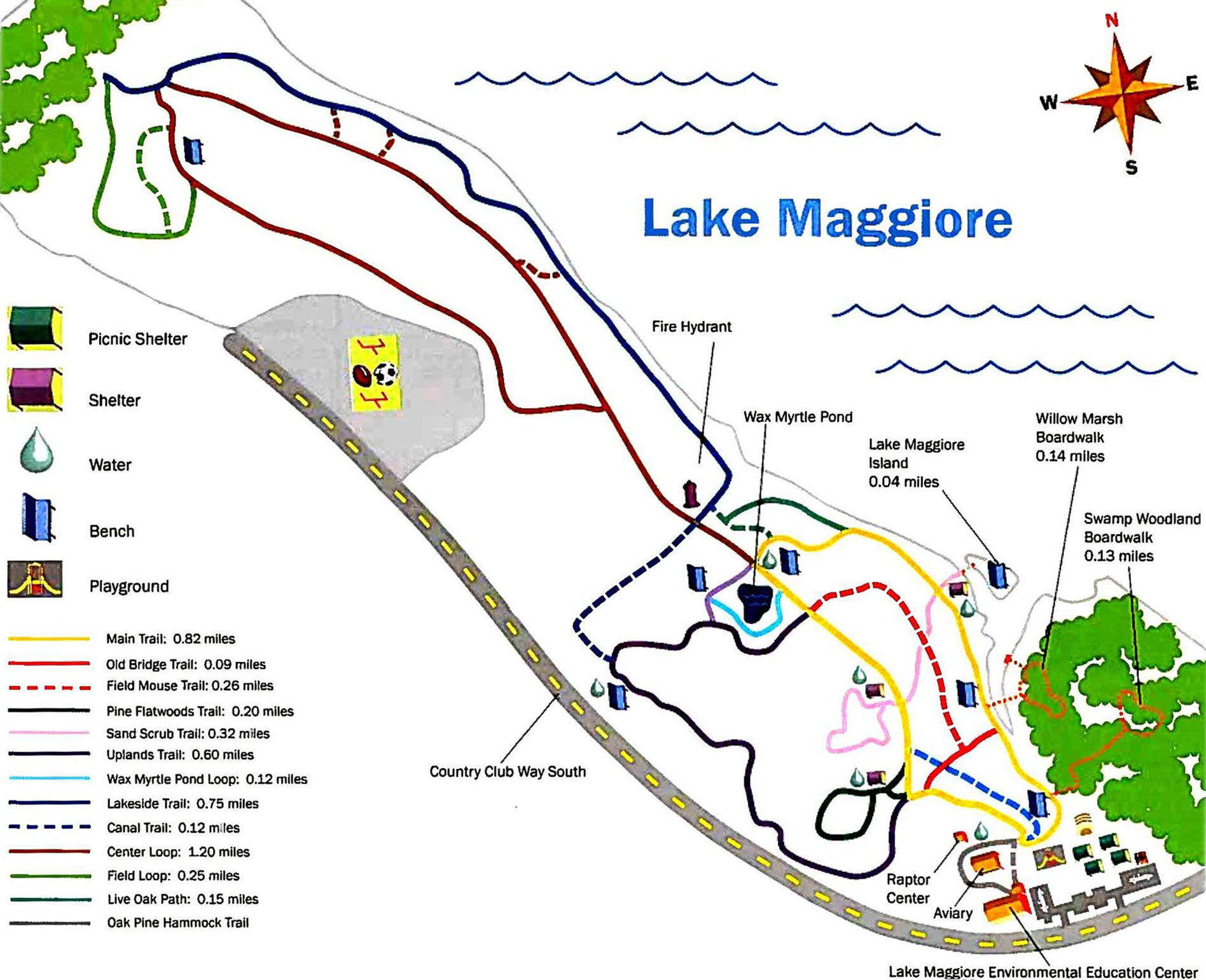
The lake remains awash in contradiction, mismanaged and lexically confused. The dam along MLK seeks to split salt and fresh water. Circle south, past some houses, by a fire station, and a mostly abandoned park. Spin further southwest and much of the land is sheltered by a beloved sanctuary, Boyd Hill Nature Preserve. Along the same tract, adjacent to the preserve, a city dump turns over mulch. At the base of Twenty-Second Street, historically the central corridor for St. Petersburg's African American population, sits a park. The north section fronts Maggiore Shores, originally a white neighborhood, then middle-to-upper-class Black, and today, increasingly white again. Each of the stakeholders holds a claim to the park—some smaller, some larger. Mostly white environmentalists aligned with Boyd Hill argue for removing the dam and restoring the ebb and flow of "Salt Lake." Older home owners in the Maggiore Shores neighborhood (to the north) want cattails around the edges cleared to improve their view; the current water management plan keeps salinity down and serves as flood protection. The only unifying factor is the cattails circling the lake, indicating low water quality. The common denominator is eutrophication; the argument is how to solve the problem. Renamed with a faux history, mispronounced, and managed against its natural flow, this once-tidal lake suffers from being something it is not.
Willow Marsh
On the south shore of the same Lake Maggiore, Salt Creek changes names (again). Then it disappears (again). The precise point of disappearance, ironically, occurs in a beloved nature park, Boyd Hill Nature Preserve, at one of the finest visual prospects in the entire city. A boardwalk on the Willow Marsh Trail faces North, towards downtown. Off in the distance, beyond the lake, cumulus clouds tower over one another, dramatically framing a vast blue horizon and restless skyline. Anhinga roost in a nearby island, and below, any number of species of ducks, moorhen and long-legged waders nudge through spatterdock and duckweed. Common sights are marsh rabbits and alligators, the mother gator often with her yellow-striped young brood. The visitor's map to the preserve marks this particular boardwalk as part of the Willow Marsh Trail, which presumably would make this area "Willow Marsh." Technically, the water forms part of a Salt Creek branch. Trail maps to the preserve, however, do not even mark a stream.
City nature has no place in a "nature preserve." At a point where an urban waterway should be most visible, even celebrated, the comedy of hide-and-seek intensifies. A waterway (now flowing due South) switches names. By the semantically confused lake, it disappears from the map altogether. Why? Because discursive "Nature" and the natural hydrology do not align. Near the Boyd Hill visitors center, hikers have unknowingly crossed Salt Creek. It is the little brook that trickles past an outdoor classroom, by the raptor rehabilitation center, and eventually reaches back to the edge of the nature preserve, where it runs under a chain link fence. Here, the creek becomes a culvert. And with subtle semantic shift, stewardship declines.
The aquatic thread snaps. We lose the connection. In a wealthy suburban neighborhood, the headwaters of Salt Creek runs through a maze of backyard overgrowth, accessible only with permission. To trace the creek now is to trespass. Care falls to individual whim or the conscience of private owners. One particularly zealous environmentalist has dutifully planted native cypress in the bottom, hoping to stabilize the sandy banks and restore habitat; elsewhere, the low-lying area remains mostly a jungle of invasive taro and wild ginger. Further south, where the planner John Nolen proposed a green corridor along the area's natural swale, the St. Petersburg Country Club has engineered the creek's headwaters into a series of water hazards for its golf course. Landscapers mow up to the edges of the artificial ponds along the golf course's back nine.
The hydrology has become impossible to visualize as one piece. Because the waterway is fragmented, no one connects the link from fourteenth fairway to Tampa Bay. Grass clippings run straight into the ditch, Lake Maggiore, into Salt Creek, and eventually into our beloved bay—feeding algae and toxic blooms that have undermined our quality of life, ruined countless fishing trips, and cost the state dearly in tourist revenue.25 The Tampa Bay Regional Planning Council set the loss of tourism revenue for a 2018 red tide bloom at $130.6 million; see The Ripple Effects of Florida Red Tide, (Pinellas Park, FL: Tampa Bay Regional Planning Council, 2019), https://tbrpc.org/wp-content/uploads/2019/01/The-Economic-Ripple-Effects-of-Florida-Red-Tide_unsigned.pdf; A more thorough study set the loss for the same bloom at double the cost, $317 million, see João-Pedro Ferreira, et al. "Impact of Red Tide in Peer-to-Peer Accommodations: A Multi-Regional Input-Output Model," Tourism Economics, March 1, 2022, https://journals.sagepub.com/doi/10.1177/13548166211068276. The neglected stream passes over a dingy concrete weir, amounting to little more than a one-stroke penalty for golfers and repository for lost Titleists.
Again, the aquatic thread splits. There are actually two larger branches feeding Lake Maggiore, the second no easier to trace. In its western course, the stream feeds a lake from a city tract along Dell Holmes Park. From here, it runs due West down a channel, where it parallels a public golf driving range. Canoes and kayaks rarely paddle this channel. The alligators are unusually large. One could go missing here altogether. If I am to put in at Lake Maggiore, I double check my life preserver.
The unnamed, culverted west branch cuts anonymously across public land. I can paddle upstream, with a city mulch processing plant to the left, and a drop-off site for brush to the right. The stream parallels the east-west running Twenty-Sixth Avenue South. Chain-link divides the landfill and private property, in this case two of the more prosperous historically Black churches in the city—St. Augustine's Episcopal and McCabe United Methodist. The location of these churches, or more accurately their relocation, figures into the last half century of city history. Both congregations served Jim Crow neighborhoods closer to the center of town, the middle class Campbell Park and poorer Gas Plant communities. Both neighborhoods were razed in the 1970s and 80s. Following a national trend, in which federal roads targeted Black areas, Interstate i-175 cut the Campbell Park neighborhood in half, running straight over homes where pillars of the African American community lived.
Ten years later, as if by design, the city razed the Gas Plant in the name of urban renewal, leveling a neighborhood to construct a domed stadium. The Tampa Bay Rays (Raze?) now play in the dome, Tropicana Field. But the team's owners (buttressed by city government and a newspaper that depends upon sports for daily copy) declare the thirty-year-old dome obsolete. Once again, the area awaits real estate redevelopment, with little probable return for the people displaced under the banner of "urban renewal" and promises to "get it right." St. Augustine's Episcopal relocated during the 1970s, moving from property now near the interstate, away from a community that has since scattered, and rebuilding on the rich soil of a former nursery near the head of Salt Creek's long swale.
Lake Eli
Where the creek ends remains an open question. According to an environmentalist friend who lives along the south shores of Lake Maggiore, the creek was historically sheet flow, tracing without record or immediate course through pine flatwoods. If I push a kayak further west, past Lake Eli, I trace the drainage ditch, almost to the churches that run along Twenty-Sixth Avenue. Just north of an arrow-straight culvert alongside the parking lot of McCabe United Methodist, the stream unceremoniously ends. The culvert takes a sharp turn at the boundary of church and city land, then runs north, along a straight ditch to north-south running Twenty-Sixth Street. On the other side of the street, Salt Creek finally disappears into underground maze of sewers. And from there, who knows?
Conclusion—Fragmented Headwaters
McCabe's presence at the headwaters embodies a painful chapter of St. Petersburg's history. The congregation of this century old church coalesced around segregated areas, along the eastern edge of the Gas Plant neighborhood. The congregants built the former church themselves, laying their spiritual home on the Black side of a segregation boundary. The interstate and dome destroyed the old structure, and today, the site is now a nondescript concrete parking garage. The current pastor, Reverend Jana Perkins-Hall, speaks clearly of the betrayal:
Black people got together, during that particular time of economic disenfranchisement, pooled their resources and physically built, brick by brick, this place of worship. They were there for fifty years before they were relocated . . . For what?
Perkins-Hall, though not a native, speaks powerfully on behalf of her parishioners: "So what kind of message does that send — spiritually, emotionally, psychologically — to the people who worked for free? That now, in place of a community they called home, is a parking garage?" There is no historical marker, even though stories continue to tell, "that this was once a place of sacred worship." The dislocation remains an unacknowledged erasure. A more visible reminder would at least acknowledge the hurt.26Jana Perkins-Hall spoke at a community forum about Booker Creek and the Tropicana Field site redevelopment, held at the University of South Florida's St. Petersburg campus on Feb. 15, 2019; see, Anna Maria Lineburger, Kelly Kennedy, and Dyllan Furness, ed., Voices of Booker Creek (St. Petersburg: University of South Florida, 2020), 29–30. Just as the teenage boy said to the Penn professor Anne Whiston Spirn: "someone will wreck it."
McCabe United Methodist Church
At McCabe, the unbaptized remnants of Salt Creek disappear into a sewer line, across from the church, at the corner of Twenty-Sixth Avenue and Twenty-Eighth Street. It is smack-dab in the middle Pinellas County, just east of the low sand ridge (a relic dune) that divides the peninsula. How and where the waters ran before development remains a question. Early histories and even the occasional map suggest that the outer reaches of Salt Creek mingled with a bayou to the west, possibly trading headwaters from both the swamp and bay' this memory of an earlier hydrology, however, remains repressed.27Walter Fuller, St. Petersburg and Its People (St. Petersburg: Great Outdoors Publishing Co., 1972), 5. The creek might have run straight across, serving as a liquid connector now lost.
Cities that bury their habitats sacrifice a bit of collective soul. Environmentalists in Los Angeles lament the failure to recognize the human, natural, and even cinematic history of the concretized Los Angeles River. Tourists are drawn to the Fleet River. New Yorkers still want to see the waters that bubbled under Minetta Street in lower Manhattan, and my archaeologist-art history friend clearly felt a connection when she stumbled onto the Eriadnos. With sea level rise, social scientists attend to the psychic costs of disappearing landscapes, citing what they call solastagia or "environmental grief."28Ellis Neville and Ashlee Cunsolo. "Hope and Mourning in the Anthropocene: Understanding Ecological Grief," The Conversation, April 4, 2018, https://theconversation.com/hope-and-mourning-in-the-anthropocene-understanding-ecological-grief-88630; Gren Albrecht et al., "Solastagia: The Distress Caused by Environmental Change," Australasian psychiatry: Bulletin of Royal Australian and New Zealand College of Psychiatrists 15 (2007); Ashlee Cunsolo and Neville R. Ellis, "Ecological Grief as a Mental Health Response to Climate Change-Related Loss," Nature Climate Change 8 no. 3 (2018): 275–281; L.P. Galway , T. Beery, K. Jones-Casey, K. Tasala "Mapping the Solastalgia Literature: A Scoping Review Study." Internal Journal of Environmental Research and Public Health 16:15 (July 2019). The social-historical context adds another layer. My partner Julie walked Birmingham's Village Creek in an effort to connect place and current-day race relations in this iconic civil rights setting. When I trace Salt Creek, I too seek this connection.
Hydrologic systems carry us into our history. They uncover buried pasts, helping us to explain unhealthy divides. Despite Florida's myths of paradise, we remain disconnected from the natural world, from the past that has built itself around us, from one another. Environmentalism needs community, and we best find community in a city's liquid heart. We need to know where the waters run.
About the Author
Thomas Hallock received his PhD from New York University. He is the author of From the Fallen Tree: Frontier Narratives, Environmental Politics and the Roots of a National Pastoral, 1749–1826 (Chapel Hill: University of North Carolina Press, 2003) and the co-editor of Early Modern Ecostudies: From the Florentine Codex to Shakespeare (New York: Palgrave Macmilian, 2008), William Bartram, the Search for Nature's Design: Selected Art, Letters and Unpublished Manuscripts (Athens: University of Georgia Press, 2010), and Travels on the St. Johns River: John and William Bartram (Gainesville: University of Florida Press, 2016). He recently published a series of travel and place-based essays that explain why he loves teaching the American literature survey, A Road Course in Early American Literature: Travel and Teaching from Atzlán to Amherst (Tuscaloosa: University of Alabama Press, 2022).
]]>
A turning point was reached fifty years ago. In 1972, the Club of Rome published the report The Limits to Growth, drawing global attention to the fact that economic growth could not continue indefinitely because of resource depletion. This was also the year in which the first Earth Summit in Stockholm brought together world leaders under the aegis of the United Nations to lay the foundation for global environmental governance. Various international gatherings stimulated research on the environment and the origin of ecological problems, a field that played an increasingly important role in the following years. Thanks to the subsequent emergence of ecologically focused "green" political parties and the rise of various ecological forms of militancy, the critique of an economic model based on limitless growth began to be recognized as a legitimate political concern. Yet at first ecological demands did not acquire a central role; they were seen as one demand among many others that a progressive politics had to consider.
Today, the situation is different. The multiplication of weather-related natural disasters has helped raise awareness of the urgent need to stabilize the climate. Moreover, it is now generally admitted that human activity is responsible for the ecological crisis. Many scientific studies have proved that global warming is the consequence of the accumulation of greenhouse gas emissions caused by the fossil fuel industries and that it is necessary to curtail them. Since 2018, thanks to youth movements such as Greta Thunberg's Fridays for Future, the question of climate change has acquired an unexpected salience among wide sections of the public. A growing part of the population is now aware that the preservation of acceptable living conditions on earth will depend on the ability to effectively combat global warming. The crucial question is no longer if we need to decarbonize our economies, but how, and how quickly.
Despite a large consensus among ecologists of all stripes on the necessity to move to renewable energy, the path to follow is far from agreed upon. Even among progressive parties no consensus exists about the strategy to follow.2For a thoughtful discussion of the different approaches, see Amanda Machin, Negotiating Climate Change: Radical Democracy and the Illusion of Consensus (London and New York: Zed Books, 2013). One of the main disagreements concerns the possibility of effectuating the ecological transition without radical systemic change.
Many ecological parties believe in the possibility of reaching a consensus on the policies that need to be implemented to decarbonize the economy. They are convinced that, since this objective is in the interest of everybody, all reasonable citizens should be able to agree on the measures needed. They warn against attempts to politicize climate issues, claiming that it might create artificial divisions and impede the wide collaboration necessary for the implementation of a sustainable model of society.
In line with this position, most ecological parties avoid taking sides in the confrontation between left and right, and declare themselves to be situated beyond such an axis. This explains why some are ready to enter in coalitions with both right and left political parties, as is the case in Germany and Austria.
From a left populist perspective, the more interesting propositions are those that, like the Green New Deal, advocate a radical ecological bifurcation which involves a rupture with financial capitalism. Such a project is often associated with the arguments used in the United States by the Sunrise Movement and Alexandra Ocasio Cortez, who, on 5 February 2019, presented a path-breaking resolution to deal with climate change to the US Congress. The resolution had the following goals: To reach net-zero greenhouse gas emissions through a fair and just transition for all communities and workers. To create millions of good, high-wage jobs and ensure prosperity and economic security for all people of the United States. To invest in the infrastructure and industry of the United States to sustainably meet the challenges of the twenty-first century. To secure clean air and water, climate and community resilience, healthy food, access to nature, and a sustainable environment for all. To promote justice and equity by stopping current, as well as preventing future and repairing historical, oppression of frontline and vulnerable communities.

The idea of a Green New Deal has actually been discussed since 2008 in various circles in the United Kingdom. A group of economists led by Ann Pettifor was scrutinizing the close links between the financial and economic sectors and the ecosystem. They claimed that in order to address the climate crisis it was necessary to have a radical intervention of the state to regulate the financial system. Furthermore, they stressed the urgency of subordinating the financial sector to the interests of society and the future of the planet. Societies, they asserted, should abandon their dependency on the economic system of globalized financial capitalism that produces ecological disasters as well as economic, political, and social inequalities.3Ann Pettifor, The Case for the Green New Deal (London: Verso, 2019).
The American version of the Green New Deal is more comprehensive because it explicitly links the reduction of greenhouse gas emissions with the objective of fixing social problems. It proposes concrete policies to bring solutions to three fundamental problems: the climate crisis, issues of poverty, and racial inequalities. In order to secure the support of the popular sectors whose jobs will be affected, it contains several important proposals which establish strong links between social, economic, and environmental policies, and prioritizes equality. One of its central ideas is to guarantee work to every unemployed American who wants to work in the construction of infrastructures that respect criteria of efficient energy.
In Britain, the Green Industrial Revolution spelled out in the Labour Party programme under Jeremy Corbyn in 2019 also asserted that social and economic justice cannot be separated from environmental justice. The election manifesto announced that Labour would create one million jobs in the UK to transform industry, energy, transportation, agriculture, and construction, while restoring the natural environment. It would promote measures for a rapid decarbonization of the economy, jointly with investment in sustainable, well-paid, and unionized jobs. It would also create new industries to revive the parts of the country that had been neglected, while working in partnership with the workforce and trade unions in every sector of the economy.
The manifesto also announced that Labour would bring energy and water under democratic public ownership and that they would be treated as rights rather than commodities. Any surplus was to be reinvested or used to reduce bills. Emphasis was put on the fact that public ownership secured democratic control over nationally strategic infrastructures and provided collective stewardship for key natural resources. These measures should bring about a radical decentralization of power in order to give local people and communities greater control over their lives and prospects.
All these different proposals call for an ecological bifurcation that articulates demands of both an ecological and social nature. Their objective is to put the ecological struggle in relation with other types of struggles to create a just and more democratic society. By establishing a political frontier and defining an adversary, they contribute to politicizing ecological issues.
The climate movement must be politicized in order to take into consideration the centrality of labour exploitation, while at the same time social struggles must recognize the urgency of global warming. As defenders of the US Green New Deal assert in A Planet to Win:
A Left populism that mobilizes a genuinely multiracial working class is an essential step in the path to creating a more equal and just society—one that can weather climate change and prevent its most catastrophic effects. That kind of politics draws a sharp line between the masses of the excluded and exploited who are likely to suffer the most, and the rich and powerful who benefit from the status quo.4Kate Aronoff, Alyssa Battistoni, Daniel Aldana Cohen, and Thea Riofrancos, A Planet to Win: Why We Need a Green New Deal (London: Verso, 2019), 183.
Although under different labels, other projects also aim at a radical ecological bifurcation. For example, L'avenir en commun of Jean-Luc Mélenchon's party La France Insoumise. In their programme for l'Union Populaire in the 2022 presidential elections examining the major challenges today, the party advocates a radical change of course and proposes a series of measures to implement an ambitious state-led ecological strategy. This includes 200 billion euros in investments for ecological and social programmes and a vast plan to adapt infrastructures to climate change. Key measures consist in enshrining the principle of the "green rule" in the constitution, whereby no more is taken from nature than can be replenished and collectivizing fundamental common goods such as water and air by democratically controlling their use and protection. Other proposals include establishing an ecological and solidarity-based protectionism to produce in France and a re-localized, diversified, and ecological agriculture that would create 300,000 jobs, fighting against precarious contracts, re-establishing a protective unemployment insurance, rolling back privatization, and introducing a tax for financial transactions. L'avenir en commun stresses the democratic character of this ecological bifurcation and declares: "We must reorganise the republican state according to ecological and democratic objectives. Ecological planning must be based on the commune, the vital level of democracy."5Jean-Luc Mélenchon, L'avenir en commun (Paris: Editions du Seuil, 2021), 45, author's translation.
At the difference of proposals, like the Green Deal of the European Union, these projects recognize that a real ecological transition cannot take place without a confrontation with financial capitalism. It demands breaking with the dominant regime of accumulation characterized by unprecedented financialization and the globalization of capital indexed to the growth of polluting industries. Although disagreements exist about the forms it should take, the struggle to end the fossil fuel industry is generally considered to be of uppermost importance. This industry is responsible for most of the greenhouse gas emissions that cause global warming and ocean acidification. Moreover, it leads to serious environmental damage to local communities.

While the fight against fossil fuels is a priority for stopping global warming, it will not be enough to achieve an ecological bifurcation capable of delivering a new model of development that guarantees democratic rights and social justice. As indicated by the Chinese government's recent announcement of a plan to reach carbon neutrality by 2060 at the latest, such an objective is perfectly compatible with an authoritarian model. And various forms of "green capitalism" might also be able to find ways to thrive without exploiting fossil fuels.
Those who promote a Green New Deal are aware of the magnitude of the problem:
For a stable climate and more equal world, we have to simultaneously unmake our fossil-fuelled lifestyles and build infrastructures that equitably distribute renewable energy. We have to dismantle the most powerful industry on earth incredibly fast, or the things that we build to replace it won't matter. This means tackling fossil capital head on.6Mélenchon, L'avenir en commun, 31.
They also state, "A radical Green New Deal leans in to the inevitable intersections of social, economic, and environmental policy, and prioritized equality."7Mélenchon, L'avenir en commun, 19.
While these proposals are vital, a project that aims to address the ecological question in its multiple dimensions cannot be limited to the struggle against capitalism, as if a bifurcation only needed to take place at the level of production. As historian Dipesh Chakrabarty argues:
While there is no denying that climate change has profoundly to do with the history of capital, a critique that is only a critique of capital is not sufficient for addressing questions relating to human history once the crisis of climate change has been acknowledged and the Anthropocene has begun to loom on the horizon of our present.8Dipesh Chakrabarty, "The Climate of History: Four Theses," Critical Inquiry 35 no. 2, (Winter 2009): 212.
The Anthropocene is a term coined in the 1980s and later popularized by the atmospheric chemist Paul J. Crutzen. In 2000, Crutzen used the term to signal the beginning of a new geological age in which humans have become the dominant force shaping the earth's climate. However, there are disagreements concerning the term's beginnings and main features. Some people prefer to speak of the "Capitalocene" to indicate the epoch's links with the development of capitalism, or the "Plantationcene" to take account of the central significance of slavery and the plantation system in the Americas in producing the current environmental crisis. This debate has given rise to extensive and diverse literature.9A good presentation of the literature can be found in Christophe Bonneuil and Jean-Baptiste Fressoz, The Shock of the Anthropocene: The Earth, History and Us (London and New York: Verso, 2016). Nonetheless, I will limit myself here to the insights in the works associated with the Anthropocene that I find important in the political domain.
Far-reaching consequences can be drawn from the recognition that we have entered a new phase of planetary history with a new climatic regime that endangers the very existence of life on earth. The Anthropocene raises a whole series of philosophical and anthropological issues about the relationship between nature and culture, humans and non-humans. To accept that we are part of nature forces us to adopt a different attitude towards the non-human and to challenge some of the basic tenets of modernity.10The best discussion of this challenge is found in Pierre Charbonnier, Affluence and Freedom: An Environmental History of Political Ideas (Cambridge: Polity, 2021).
It could indeed be pointed out that the rationalism defended by the philosophers of the Enlightenment, whose effects in the political field I discussed in chapter 2, is also responsible for the project of domination of Nature that has led to the Anthropocene. Their rationalist ambition to visualize progress as free from both affects and nature is at the origin of the modern project that sees nature as an infinite resource that could, thanks to infinite technical development, be used to carry out infinite growth.
There are those who claim that the critique of this ambition should make us reject the whole modern project. However, I believe that, just as we are able to break the link between the democratic project of the Enlightenment and its foundation in a rationalist epistemology, we should be able to rescue democratic ideals from the Promethean ambition to dominate nature and the capitalist and colonial socio-economic conditions that allowed the pursuit of this ambition. This requires conceiving democracy differently, questioning the privileged place attributed to a certain conception of freedom as emancipation from all forms of constraints, natural and social, and reclaiming the central value of equality that was eclipsed by the hegemony of liberal discourse. The democratic project must be redefined, freeing it from rationalistic biases, and it should make room for the recognition of the needs of non-humans.
In 1985, reflecting on the emergence of new forms of conflict in Hegemony and Socialist Strategy, Ernesto Laclau and I argued in favour of connecting the demands of the working class with those of the "social movements."11Ernesto Laclau and Chantal Mouffe, Hegemony and Socialist Strategy: Towards a Radical Democratic Politics
(London: Verso, 1985). Furthermore, we proposed envisaging socialism as the "radicalization of democracy"—the extension of democratic ideals to a wide range of social relations.

With the ecological crisis, the project of radicalizing democracy has acquired a new dimension. During the twentieth century, the core of the socialist project was the question of inequality and the fight for social justice, conceived in terms of an equal distribution of the fruits of growth. The struggles of the new social movements add new perspectives to the question of social justice but their focus is on autonomy and liberty, and apart from some ecological movements, they do not fundamentally target the nature of growth.
With the new climatic regime, we have entered a phase in which the struggle for social justice requires questioning the productivist and extractivist models. Growth has ceased being considered a source of protection and has become a danger for the material conditions of social reproduction. It is no longer possible to envisage radicalizing democracy without including the end of the model of growth that endangers the existence of society and whose destructive effects are particularly felt by the more vulnerable groups.
Addressing the new climatic regime requires articulating the anti-neoliberal struggle with the ecological one. The democratic project needs to be reformulated in view of the ecological exigency, and this involves struggles both at the level of production and at the level of reproduction—that is, reproduction understood in the wide sense of the totality of life on the planet, not only human reproduction. Therefore, a critique focused exclusively on capitalism is insufficient and needs to be complemented by concerns about the Anthropocene.
There is another issue I need to raise. While I find proposals for a Green New Deal essential to envisage the policies necessary to fight neoliberalism and its deleterious consequences for the climate, I do not think that those proposals have the capacity, on their own, to generate the common affects that the collective will for carrying out an ecological bifurcation requires. As we have seen, for ideas to acquire force, it is necessary that they meet affects. To awaken affects, ideas need to connect with what Cornelius Castoriadis refers to as the "imaginary significations" that institute the social world proper to a society.12Cornelius Castoriadis, World in Fragments: Writing on Politics, Society, Psychoanalysis, and Imagination (Stanford: Stanford University Press, 1997), 10–13.
In many societies, it is the affective force of the democratic imaginary that has provided the significations that motivate people to act. As recent popular mobilizations testify, democratic values, despite their relegation by neoliberalism, still play an important role in the democratic social and political imaginary. This imaginary is constituted by a repertoire of social significations that are transformed through the effects of a plurality of discursive practices. One of its nodal points is the signifier "democracy," but it is a floating signifier whose meaning is only partially fixed and varies according to different types of articulation. In the nineteenth century, under the impact of socialism, the democratic imaginary was profoundly transformed by the incorporation of social demands. And with the new climatic regime, we are now witnessing new forms of articulation of the democratic ideal. For instance, several proposals have been made to re-signify the meaning of "rights," and diverse initiatives to attribute rights to non-human entities like rivers or forests have taken places in different countries. In 2017, three countries assigned rights and legal statutes to rivers: the Atrato in Colombia, the Whanganui in New Zealand and the Ganges, and the Yamuna in India.13María Ximena González Serrano, "Blog Series 'Nature and Its Rights:' Young Researcher's Seminar April 2020," river-ercproject.eu.
To be able to bring about the necessary ecological bifurcation, the articulation of anti-neoliberal and ecological struggles needs to mobilize affects of political and ecological nature whose articulation can result in the construction of a "people." As I have repeatedly clarified, a "people" is not a sociological category but a discursive construction with a symbolic and libidinal dimension. It consists in federating a diversity of democratic demands and its construction necessitates a principle of articulation, a "hegemonic signifier" around which common affects can crystallize. Thanks to this hegemonic signifier, a chain of equivalence can be established among heterogeneous demands to make them coalesce in a "we" that will act towards a common aim, despite the differences among its components.
What is the hegemonic signifier that could activate the political and ecological affects for creating such a people? I propose envisaging the ecological bifurcation advocated by the Green New Deal in terms of a "Green Democratic Revolution" as a new front in the radicalization of democracy that redefines democratic principles and then extends them to new fields and a plurality of social relations. Understood in that way, the Green Democratic Revolution reactivates and enriches the democratic imaginary and procures the hegemonic signifier needed to create a chain of equivalence. It would play the role of a "myth" in the sense of Georges Sorel, an idea whose power to anticipate the future gives a new figure to the present. It is a narrative that conveys affects that could be more powerful and more credible than competing neoliberal discourses and provide the impulse for the creation of a social majority.
The survival of the planet and the conditions that make it habitable is an objective that concerns a great number of people as well as various movements with heterogeneous demands. Besides trade unions and groups organized around socio-economic issues, we find people involved in a variety of feminist, anti-racist, anti-colonial, and LGBTQ+ struggles. In ordinary circumstances, they generally insist on pursuing their own interests, but in view of the seriousness of the ecological crisis, they might become aware of the need to unite to face the forces responsible for the climate emergency and prevent the advent of authoritarian solutions. All their demands are democratic demands, albeit in different ways, and given their shared opposition to autocracy, they can identify with the vision offered by the Green Democratic Revolution. It is a project that could generate powerful affects across a diversity of groups and resonate with the demands of those who are calling for security and protection while also fighting for equality and against different forms of oppression.

For such an identification to take place it is not necessary that the participants share the same world view, and they can have different religious or philosophical convictions. Their concern for the environment can proceed from different sources and they can follow a diversity of approaches, but these differences should not constitute an insurmountable obstacle. Those involved do not have to agree on a fully fledged political programme. Some will define their aims in terms of "eco-socialism," others will prefer thinking in terms of a "citizen revolution."14For an eloquent defence of the eco-socialist vision, see Paul Magnette, La vie large (Paris: La Découverte, 2022). What they share is a common adversary and the will to maintain a habitable planet to secure the future of a democratic society that can give them the opportunity to pursue their specific struggles in a multiplicity of agonistic public spaces.
By advocating a Green Democratic Revolution, I have been delineating how I think the left populist strategy should currently be envisaged. I contend that such a strategy is the most appropriate for articulating the manifold democratic struggles against different forms of domination, exploitation, and discrimination with the defence of the habitability of the planet. The strength of a left populist strategy lies in acknowledging the partisan character of politics and the importance of mobilizing common affects in the construction of a "we" by drawing a political frontier.
The Green Democratic Revolution asserts that, to bring about a real ecological bifurcation, it is imperative to confront the powerful economic forces that resist it and to break with the neoliberal order. But it also accentuates the democratic character of this bifurcation and visualizes this rupture according to the strategy Erik Olin Wright defines as "eroding capitalism."15Erik Olin Wright, How to Be an Anti-capitalist in the Twenty-First Century (London and New York: Verso, 2019). The objective is not to "smash" capitalism but to displace it through the implementation of a series of what André Gorz calls "non-reformist" reforms and the development of alternative institutions such as cooperative and bottom-up civil-society-centred initiatives that promote economic activities embodying egalitarian relations.
The state needs to be a significant actor in a Green Democratic Revolution because, as many economists recognize, it will not be possible to achieve the necessary transition to renewable energies without ecological planning. It is illusory to imagine that the profound transformations the ecological bifurcation requires could be made by social movements alone. Activists and ecological groupings have an important role to play, but without winning elections and reaching state power it will not be possible to create the conditions to successfully confront the power of fossil capital. To be able to exercise influence on the decisions taken at state level, it is necessary to organize politically. All those who are involved in diverse ecological struggles should realize that they will not be able to make decisive advances if they shun electoral politics.
Envisaging the necessary ecological bifurcation as a Green Democratic Revolution could, I believe, provide the strategy that the left needs to successfully thwart the attempts to harness the sense of vulnerability produced by the social, economic, and climatic crises, and the affects it has generated, to promote authoritarian forms of security and protection. These demands can be articulated in a progressive way, and it would be a serious mistake to neglect them. At the moment, when neoliberalism is trying to recuperate these demands for authoritarian purposes, it is imperative for the left to impede such a move by articulating the idea of protection with the defence of the habitability of the planet, conceiving it in line with what Paolo Gerbaudo calls "protectivism," which he defines as follows: "Protectivism encompasses a great variety of policies, including social welfare, workers' representation, environmental protection and other social support mechanisms."16Paolo Gerbaudo, The Great Recoil: Politics after Populism and Pandemic (London: Verso, 2021), 112. A Green Democratic Revolution aims to defend society and its material conditions of existence and provide security and protection in a way that empowers people instead of making them retreat into defensive nationalism or a passive acceptance of algorithmic forms of governmentality.
Such a project could federate a wide variety of democratic demands because it addresses the challenge of the new climatic regime while providing social justice and fostering solidarity. Activating passions that are central to the democratic imaginary should motivate people to get involved in politics with the aim of establishing the conditions for a society where the democratic principles of liberty and equality are redefined and extended to new domains, including humans and non-humans. I contend that, understood in this way, the left populist strategy is more relevant than ever.
About the Author
Chantal Mouffe is the Professor Emeritus of Political Theory at the Center for the Study of Democracy at the University of Westminster. Her books include Gramsci and Marxist Theory (London: Routledge and Kegan Paul, 1979), Hegemony and Socialist Strategy (London: Verso, 1985) with Ernesto Laclau, Dimensions of Radical Democracy (London: Verso, 1992), and For a Left Populism (London: Verso, 2018).
]]>Ignition
In Pendleton, South Carolina, 1849, John B. Sitton had a difficult decision to make. He knew his neighbors were angry at him. He had a position as a postmaster with a small stipend. That job put him at the center of every local event, decision, and dispute. He was situated, too, in the very center of town on the Pendleton Green. The central post office, one of the largest in the area, operated out of the prominent Farmers Hall behind substantial white columns, a Greek revival building that couldn't be missed. The authority of the postmaster and the strength of the federal government, which accorded him power, was underscored by the placement of the post office.
Sitton knew that some of his white neighbors had recently received unwelcome antislavery pamphlets in the mail. Word had spread that there were likely many more of such scurrilous materials in the sack behind his counter, waiting to be sorted and picked up. Pendleton's newly formed "Executive Committee on Vigilance and Safety," which had been established thanks in part to encouragement by their local political luminary, John C. Calhoun, was now fired up.1Stephen A. West sketches out the evolution of these Calhoun-inspired vigilance committees in From Yeoman to Redneck in the South Carolina Upcountry, 1850–1915 (Charlottesville: University of Virginia Press, 2008), 53–55. See also West's article entitled "Minute Men, Yeomen, and the Mobilization for Secession in the South Carolina Upcountry," The Journal of Southern History 71, no. 1 (2005): 75–104. The most thorough and broad context for this incident can be found in Manisha Sinha's book, The Counterrevolution of Slavery: Politics and Ideology in Antebellum South Carolina (Chapel Hill: University of North Carolina Press, 2000), especially chapter 3, "The Discourse of Southern Nationalism," 63–94. Her specific mention of Barrett can be found on page 80, in which Sinha persuasively characterizes the leaders of this movement to create viliance committees as essentially "potentates" seeking to suppress all "unorthodox" views on slavery. Here I wish to fold the role of Black witness back into the analysis because they were an implicit part of the policed audience for this bonfire.
What followed might seem merely like a small, local action: Pendletonians gathered on the village green and read aloud excerpts from offending documents, ran into the post office, and roughly pushed aside Sitton, who was trying to defend, perhaps half-heartedly, the mail. The white villagers found what they sought. On Pendleton Green, the mob burned thirty-eight pamphlets that were literally and figuratively "incendiary."2For a sense of how the word "incendiary" became a defining legal term in this context see Richard R. John, "Hiland Hall's 'Report on Incendiary Publications': A Forgotten Nineteenth Century Defense of the Constitutional Guarantee of the Freedom of the Press," The American Journal of Legal History 41, no. 1 (1997): 94–125.
At first glance, this event might seem inconsequential for the town. Although antislavery newspapers in the North picked up the story, there seem to have been no further episodes of collective burnings in Pendleton. No one appears to have held any ill will against Sitton, the postmaster. Indeed, he was elected mayor a few years later. This event occurred twelve years before the Civil War and was more of a symptom of growing tension than a cause of further rupture. Overall, the event reinforced how righteous white Pendletonians wanted to see themselves as on the vanguard of a battle, defending their way of life against anyone who might see things differently. In particular, it represented something unique about the place and the space—the town elites of Pendleton were insistent about policing ideas that might reach the less elite white neighbors.3West argues in From Yeomen to Redneck that this type of upstate vigilantism was largely carried out by the slaveholding elites and was "aimed to censor political expression that appealed to the interests of non-slaveholders"; for this region of South Carolina, West argues that "it appears more a an attempt by members of the slaveholding minority to police opinions among the slaveless majority," West, Yeoman to Redneck, 65.
And yet, the event was enormously consequential for a young man from Ohio, John M. Barrett. As those pamphlets burned, he sat in jail in nearby Spartanburg County throughout the summer heat. There he was abused and terrorized into giving up a story of those mailings and how they had found their way into the hands of citizens across South Carolina. He never fully took responsibility for these mailings, perhaps because he knew the terrible penalties for such a "crime." Still, the evidence made it clear to his allies and enemies that he was indeed involved in the scheme. Before he could confess or take on the mantle of hero or martyr, Barrett died while out on bail awaiting trial. Newspapers in Indiana, where he died, reported this as a consequence of his suffering in Spartanburg.4The jail time in Spartanburg is linked to Barrett's death in his obituary as reported in New Castle (IN) Courier, reprinted in Indiana State Sentinel (Indianapolis), April 11, 1850.
And the event was consequential, too, for the enslaved population of Pendleton, who knew and saw what was happening. The bonfire was a public spectacle for Black people, as well as any white dissenters. It was a calculated warning.
This essay explores the broader context of these events by understanding the initial spate of mailings that happened in 1835. This examination includes the author and instigator of these mailings, William Henry Brisbane; the Calhounist culture of Pendleton, SC, that fueled this particular demonstration; the sad fate of the young man, John M. Barrett, who was caught up in the materials' distribution; and the people held captive in the middle of it all, the enslaved men, women, and children of Pendleton.
Test Run: 1835 Antislavery Mail Campaign
Arthur and Lewis Tappan, a Massachusetts pair of evangelical philanthropists, directed much of their money to activist causes, particularly towards antislavery organizations and endeavors. In 1835, the Tappan brothers funded an extraordinary undertaking: they helped the American Anti-Slavery Society send unsolicited abolitionist messages, newspapers, and tracts to many ministers, prominent business people, and public figures in several states below the Mason–Dixon line. This brash endeavor might well have been, to use the words of one historian, "[a campaign that] sparked the country's first crisis over postal content."5Winifred Gallagher, How the Post Office Created America (New York: Penguin Random House, 2016), 75. See also Richard R. John, Spreading the News: The American Postal System from Franklin to Morse (Cambridge, MA: Harvard University Press, 1998), 257–58.
While mailings fanned out across various states, it was in South Carolina that they were met with the most dramatic fury.6For an overview of how this was received in different states, see Wyatt-Brown, Bertram, "The Abolitionists' Postal Campaign of 1835," The Journal of Negro History 50, no. 4 (1965): 227–386. When a large bundle of them arrived at the Charleston Post Office in late July, some were delivered, but several recipients returned them to the post office with umbrage. Knowing there were more bundles of such mailings in the post office's possession and likely more about to arrive, Postmaster Alfred Huger, an enslaver himself, was flummoxed, caught between his federal duties and his angry white constituency.7For an overview of the 1835 abolitionists' postal campaign, see Susan Wyly-Jones, "The 1835 Anti-Abolition Meetings in the South: A New Look at the Controversy over the Abolition Postal Campaign," Civil War History 47, no. 4 (2001): 289–309. Also Hollis Robbins, "Fugitive Mail: The Deliverance of Henry 'Box' Brown and Antebellum Postal Politics," American Studies 50, no. 1/2 (2009): 5–25.
Aside from activist abolitionists, many political figures, even those who often clashed, could come to some shared perspectives— President Andrew Jackson advocated a federal law that would authorize censoring abolitionist mail.8Manisha Sinha, The Slave's Cause: A History of Abolition. (New Haven, CT: Yale University Press, 2016), 250. Senator John C. Calhoun argued that congressional legislation required northern postal officials to obey southern state legislation that prohibited transmission of abolitionist texts. He saw this as a power derived not from the Constitution but from states' rights and nullification, which were issues dear to Calhoun's heart.9Richard R. John, "Hiland Hall's 'Report on Incendiary Publications'", 99.
Postmaster Huger stalled before eventually deciding to have the abolitionist materials, including copies of the Emancipator newspaper, set aside in a distinct and separate bag. To no one's surprise, vigilantes calling themselves "The Lynch Men" broke into the post office. They burned the offending materials along with an effigy of antislavery activist William Lloyd Garrison. Torch-lit parades to protest these mailings were then held in towns throughout South Carolina.10Devin Leonard, Neither Snow nor Rain: A History of the United States Postal Service (New York: Grove Press, 2017), 25. See also Wyly-Jones, "A New Look," 289–309. As an 1835 lithograph suggests, the riot was well-publicized, and a gauntlet was now thrown: slavery advocates demanded mail censorship.11Attack on the Post Office, Charleston, SC, 1835, political cartoon, 15.0 x 18.5 cm, The American Antiquarian Society, Worcester, MA, https://americanantiquarian.org/earlyamericannewsmedia/items/show/48.
Calhoun's bill was narrowly defeated, but the controversy was directly associated with him—something that northern skeptics and southern supporters were not willing to forget. White South Carolinians knew their course of action when the next abolitionist mailing campaign occurred.
The Firebrand: William Henry Brisbane
Nothing intrigues more than that which is banned. The burnings attracted attention that occasionally thwarted rioters' goals. Abolitionist pamphlets and newspapers and the growing debates over eradicating slavery contributed to a battle for minds. Certainly, too, the white supremacists' bonfires would have affected the Black people who watched or heard about them, signaling to the enslaved that there was opposition elsewhere, that people in bondage weren't alone but had allies in the broader world. That notion was precisely what had stoked the greatest fears of the Charleston "Lynch men": the possibility that abolitionist tracts might incite violent slave uprisings.12Wyly-Jones, "A New Look," 1.
One person who stumbled into conversations about abolition was the Reverend William Henry Brisbane (1806–1878) of Beaufort, South Carolina. A man of inherited wealth and property with considerable holdings that included men, women, and children, he found he could not fully counter abolitionist arguments and gradually came to denounce slavery. Eventually, he liberated most of the people he had control over and went on to help many of them relocate with him, as free people, to Ohio. Brisbane renounced his slaveholding past and joined with antislavery activists in the Midwest and nationally to rail against the cruelties of slavery.13See Blake McNulty, "William Henry Brisbane: South Carolina Slaveholder and Abolitionist," in The Southern Enigma: Essays on Race, Class, and Folk Culture, eds. Walter J. Fraser Jr. and Winifred B. Moore Jr. (Westport: Greenwood Press, 1983), 119–129. Also see a characteristic letter from Brisbane pledging to support captives through an Anti-Slavery Society effort. William Brisbane to Lewis Tappan, January 23, 1841, Doc. no. F1-4881, American Missionary Association Archives, Amistad Research Center, New Orleans, LA.
Having been converted to the antislavery movement partly because of his own exposure to abolitionist pamphlets and arguments in the 1830s, Brisbane eventually aided the cause by authoring his speeches, sermons, and tracts, often with very pointed arguments for those South Carolinians he felt were vulnerable to persuasion.14Brent J. Morris, "'We Are Verily Guilty Concerning Our Brother': The Abolitionist Transformation of Planter William Henry Brisbane," South Carolina Historical Magazine 111, no. 3/4 (2010): 123.
Brisbane began to draft opinions under the pseudonyms of "Brutus," "A True South Carolinian," and other aliases that targeted non-slaveholding white men, particularly those from the inland and upcountry regions of the state (including Pendleton and its adjacent districts and counties)—all areas which featured less dense populations and far less concentrated wealth than was found in the coastal or "Lowcountry" region. The three most northwest counties of the state (Oconee, Anderson, and Pickens—often understood as the "Pendleton District") were perceived as being vulnerable to arguments that might appeal to white citizens feeling unrepresented or disenfranchised by the dominance of the planter politics of the state. Brisbane hoped to win "upstate" or "upcountry" South Carolina citizens over to the antislavery cause by arguing that their own best interests were to resist the political power of the class of elite enslavers and to embrace free labor.15The antislavery pamphlet, "An Address to the Citizens of South Carolina," by "Brutus" circulated in the 1849 campaign (and was actually found with John M. Barrett in Spartanburg). The pamphlet was included in his indictment. State v. John Barrett,
Spring Term 1851, Roll #17, Spartanburg County Court of General Sessions, South Carolina Department of Archives and History, Columbia, SC.
These were hardly radical diatribes. They didn't reference immediate abolition and didn't dwell on the inhumane practices of slavery. But that was the point; these liberal pronouncements against injustices burdening the life of white southerners were designed to pique the interest of otherwise indifferent or complacent citizens.
Brisbane, along with other activists from northern states, planned to launch another wave of mailings that would not overtly advocate emancipation, but would primarily rail against the injustices of a state ruled by an elite. He also hoped this would skirt around some of the further restrictions passed after the 1835 campaign. He and his co-conspirators recruited a young man from Indiana, John M. Barrett, to travel through South Carolina, gathering names and addresses and facilitating the mailings, all under the guise of a "Gazetteer," collecting innocuous data for commercial reference work.
Using information and addresses supplied by Barrett, several of Brisbane's tracts were mailed to South Carolinians in 1849. Most of these did not directly advocate for the immediate abolition of slavery, much less urge uprisings or rebellions. Materials authored by Brisbane and later found in the Spartanburg post office were quoted by the Spartan as pointing out that "the great mass of citizens of the State have no PERSONAL INTEREST in slaves, and they know that the benefits of the institution are confined to a very small number of the whole white population."16"The Rev. Wm Henry Brisbane, The Traitor," Spartan, (Spartanburg, SC), April 24, 1849, reprinted in Liberator (Baltimore, MD), October 19, 1849.
As characterized by the New York Tribune, the materials Barrett was accused of circulating materials that decried "the inequality of representation between the strong slaveholding and comparatively non-slaveholding portions of the state; the rigid monopoly of office by the great slaveholders; the degraded condition and gloomy prospects of the white freemen of South Carolina who do not own slaves, etc."17"Law in South-Carolina," New York Tribune, reprinted in Lancaster (PA) Examiner, August 1, 1849. As this paper continued: "as there is no such thing as answering the facts set forth in them [the materials found with Barrett], the slaveholders have sought to keep them from being read."18"Law in South-Carolina." The New York Tribune indignantly pointed out that Barrett had not advocated for abolition at all: "[Barrett] is accused of . . . enlightening the White Non-Slaveholders of South Carolina with regard to the glaring oppressions to which they are subjected by reason of the dominance of Slavery."19"Law in South-Carolina."
Regardless of such indirect arguments or the northern interpretations of the events, white South Carolinians in power knew a threat when they saw one. Being in possession of Brisbane's work could carry with it a death sentence.20David J. McCord, ed., The Statutes at Large of South Carolina, vol. 7 (Columbia, SC: A.S. Johnston, 1840), 389–90. According to Act 15, theft of an enslaved person was a felony without benefit of clergy, which at that time meant that if convicted, you would be whipped, branded, or "suffer death as a felon."
The Spy: John M. Barrett
John M. Barrett (1825–1850) was, by his own admission, a passionate Free Soiler. He opposed the expansion of slavery into the United States' free territories and was generally aligned with abolitionist sentiment. Although he was only twenty-three, he agreed to undertake a covert and dangerous mission alone. The Anti-Slavery Society of Ohio, inspired by the 1835 campaign and with the leadership of the Reverend William Henry Brisbane, who by now had relocated to Ohio, sent young Barrett traveling throughout South Carolina. His job was to gather names of prominent clergymen, businessmen, and other white citizens, both those who enslaved people and those who did not.21One overview of the Barrett story can be found in William Sherman Savage, The Controversy over the Distribution of Abolition Literature (Washington, DC: The Association for the Study of Negro Life and History, Inc., 1938), 115–6. A more recently scholarly study can be found in Chapter Two, "Forging a United People," in West, Yeoman to Redneck, 46–65.
The plan seems to be that he would gather information and names of these influential people at various locales and send that information back to his handlers in Ohio, who would generate mailings. Occasionally his handlers would mail him things directly and ask him to forward post them on their behalf. In each imagined scenario, Barrett would be sure to leave town weeks before any incendiary mailings might arrive. This plan left Barrett vulnerable, alone, and far from any rescue if he attracted local attention.
Initially, things seemed to work as intended: post offices across the state received an onslaught of pamphlets. But authorities caught on fairly quickly: first in Columbia, where a warrant was issued for Barrett's arrest. He then turned up in Winnsboro. There he was let loose for lack of evidence.22Morris, "Abolitionist Transformation," 40. Likely in Apil 1849, he made his way through Anderson County and the Pendleton District. When he reached Spartanburg, a letter from Columbia warning that he might make an appearance arrived with local officials. They detained and arrested Barrett when a letter directed to him (under a pseudonym) was found to contain what one paper termed "celebrated incendiary publications."23McNulty, "William Henry Brisbane," 124–5. See also "Abolitionist Arrested," North Star (Rochester, NY), July 20, 1849. Vague and clumsy references to letters in code and cyphers in his correspondence directed to Barrett made his situation look damning. One newspaper from North Carolina noted that if it hadn't been for clumsy cyphers, the entire affair would have seemed quite innocent.24See "Espionage in the Mails," Raleigh (NC) Register, reprinted in North Star (Rochester, NY), October 5, 1849, https://www.loc.gov/resource/sn84026365/1849-10-05/ed-1/?sp=1&r=0.086,0.73,0.275,0.143,0.
When local law officials found Barrett at Colonel R. C. Poole's Spartanburg hotel, the suspect materials, including a "Brutus" tract railing about the disproportionate political power of slaveowners and some cryptic letters from a "B.H.W." were hard to explain away.25Brutus, "An Address to the Citizens of South Carolina." See also the advertisement for Poole's hotel in Spartanburg. "Mansion House," Spartan (Spartanburg, SC), August 18, 1844.. Nor was it difficult to establish that William Henry Brisbane was the author (especially after Brisbane published a confused defense of Barrett and inadvertently confirmed his involvement).26See Brisbane's letter in the National Anti-Slavery Standard (New York, NY), September 6, 1846. In it he ends with a rather incriminating postscript: "Perhaps at some future time I shall be at liberty to communicate with your readers some things connected with this affair that I cannot now do without a breach of private confidence." While Barrett might have been able to explain possessing antislavery materials, explaining away evidence of a conspiracy to distribute such materials was going to be a fraught defense.27See "The Rev. Wm Henry Brisbane, The Traitor," Spartan, reprinted in Liberator (Baltimore, MD), October 19, 1849, and Keowee (SC) Courier, August 4, 1849.
As had happened with Postmaster Huger in Charleston in 1835, the hapless postmaster of Spartanburg, George W. H. Legg, was now caught in the middle of the controversy as he, too, refused to turn over the mail to unauthorized recipients who demanded it for inspection. By August of 1849, a warrant for Legg's arrest was issued, and he was held at least briefly in the same jail as Barrett. Legg, unlike Barrett, was quickly able to post bond.28Legg's ability to post bond is recounted in "More Nullification" from the New York Tribune, reprinted in Brooklyn (NY) Eagle, July 31, 1849. And while he was free, everyone waited for clear directions from the federal authorities, including the attorney general, about policy.29"Violation of Private Letters," Boston (MA) Evening Transcript, August 11, 1849. See also John, "Hiland Hall's 'Report on Incendiary Publications'," 275.
Barrett sat in the Spartanburg jail throughout the summer. And while he sat there, more unwelcome pamphlets and documents began to arrive across the state, stirring up fury and reviving or launching many local vigilance committees. These committees were well organized and increasingly militant.30West, Yeoman to Redneck, 53–55. The Spartanburg Committee announced that "our object will be to prevent by all means in our power the spread of these abolitionist writings among our people if harsh means be necessary 'we will not hesitate to use them,' and any incendiary hereafter caught, may expect rough treatment—by this Committee."
They signaled their threats to lynch Barrett or any others: "In carrying out the views of the duties imposed on us, we may in some instances have to rise above the Law."31"Fellow Citizens," Pickens Keowee (SC) Courier, September 22, 1949. The Liberator quoted Brisbane stating that John Barrett had been threatened with death, "law or no law," and that if he were to stand for trial, Barrett would be sure to face "Lynch's law."32Brisbane, "The Value of the Union," Crisis (Boston, MA), reprinted in Liberator (Baltimore, MD), January 11, 1850.
While there were some contrary expressions, on the whole, white South Carolinians followed the story with indignation and increasing fury.33See "Espionage in the Mails" for a conciliatory editorial from North Carolina arguing that mail censorship was a bad precedent. And even though the disseminated materials promoted the Brisbane-style of argument that white non-slaveholders should oppose slavery because it disproportionately empowered elites, several newspapers in southern states assessed this argument as likely to incite rebellions and uprisings among the enslaved. The Charleston Daily Courier wrote: "There can be no doubt remaining but that this said John Barrett, is an emissary sent amongst us to further the Hellish purposes of the Abolitionists."34"Another Letter," Charleston (SC) Daily Courier, June 18, 1849.
As the story developed, reporters who visited Barrett noted his ill health. A letter from him to his family was republished by the North Star in October of 1849 in which, perhaps to save his life, Barrett continued to assert his innocence and denied any knowledge of Brisbane. He was despairing, though, writing: "I almost feel that I am never to enjoy much happiness in this world. It seems to me that I am doomed to be a companion with misfortune in my course of life."35Barrett's letter to his father, Centerville (OH) Sentinel, reprinted in North Star (Rochester, NY), October 12, 1849.
After several months, his father came down to South Carolina and finally secured his release by paying $200 in fees and posting $1,000 bail. Barrett never returned to Spartanburg for trial. He died a few months after returning to Indiana. As the New Castle Courier reported:
". . . [he was] collecting matter for a Gazetteer, to procure certain statistical information for them in South Carolina. Soon after his advent in the State, he was so unfortunate as to fall under the suspicion of the authorities as an abolition emissary from the North, engaged in disseminating abolition tracts and documents. On this suspicion, he was arrested at Greenville and thrown into prison, where he remained for several months. When finally liberated on bail, he returned home, the very ghost of his former self-broken down in spirit and a fatal disease seated and gnawing at his vitals."36"Death of John M. Barrett, Esq.," New Castle (IN) Courier, reprinted in Indiana State Sentinel (Indianapolis), April 11, 1850.
The paper goes on to explain:
"Long confinement in a damp and unwholesome prison, want of exercise, and, above all, the chafing of a noble spirit under wrong and injustice—had well nigh completed the work commenced by disease, and he was barely allowed time to return home, to tell his friends of his entire innocence of the charge that had been alleged against him and then to lie down quietly in the bosom of home, and render up his spirit to Him who gave it— another victim to the dark and bloody spirit of Slavery, whose path is strewn with human lives and crushed hopes and bleeding affections, and the fearful aggregation of every human wo [sic] and misery."37"Death of John M. Barrett, Esq."
Perhaps because Barrett never lived to see a resolution to his case and died while still professing his innocence rather than admitting guilt, he was never identified or honored as a prominent martyr for the antislavery cause. There was little recognition for his sacrifice aside from a few comments here and there, often quoting the New Castle Courier notice excerpted above. However, his co-conspirators, including Brisbane, would have carried the memory of Barrett's sacrifice with them for the rest of their lives.
The Outraged: Pendleton in 1849
Rumors and truths about Barrett reached towns across the state (often before any mail did). Citizens in Pendleton could read aloud to each other accounts of the unfolding drama of Barrett and the Spartanburg Post Office. They were keyed up for anything untoward that might appear. And then it did.
The Pendleton Messenger reported:
"We had quite a stir in our village on Friday lest, when the Southern mail was delivered . . . Col. William Sloan was among the first to receive his, and upon examination, he found a printed, post marked Boston, mailed as a letter, charged with ten cents postage, signed Junius, and addressed to the Hon. John C. Calhoun of the most malicious, offensive, and insulting character to the Southern people. This document was read by Colonel Sloan aloud, and it produced much excitement among the persons assembled."38See the August 17, August 21, September 21, and October 5, 1849 issues of the Pendleton Messenger.
There was no doubt in the minds of Pendletonians about the origin of these documents. The Pendleton Messenger wrote: "the most remarkable thing about them is the particularity and correctness with which they were directed to individuals in this neighborhood and in Pickens District on the route which Barrett traveled, and where it is known and can be proved that he obtained the names of the people."39"Abolition Documents," Pendleton (SC) Messenger, August 17, 1849.
William Sloan, who read his letter aloud to the crowd, was a prosperous local farmer who enslaved several people. He was known as a leading citizen of the town. He and many of his relatives in town enslaved people, and neither he nor Calhoun would have been the working-class white men Brisbane had hoped to reach. Sloan was also evidently comfortable enough in his civic standing, righteousness, and relationship with Calhoun to open a letter addressed to Calhoun.
Sloan and his neighbors, a group styling themselves the "Executive Committee on Vigilance and Safety," pushed their way into the building and overcame the resistance by John Sitton, a carriage maker, and merchant who also operated the post office. Appointed in 1835, he had run it from his home for a few years, but its operations had become so busy as to require a separate location.40After Sitton built a new house for himself off the Pendleton Green in the 1850s, he moved the post office out of Farmers Hall and into his first floor for a few years (perhaps to better protect the mail), but the post office operations were later moved back into the Farmers Hall a few years later. See "Sitton House," Pendleton, City Profile, accessed July 20, 2022, https://www.cityprofile.com/south-carolina/sitton-house.html. By 1849, the Pendleton Post Office was officially situated in the Farmers Hall building on the Green.
A Pendletonian who witnessed the event wrote: "The Executive Committee . . . demanded the letters of the postmaster. On his refusal to deliver them, they entered his office and took them by force."41Frederick Douglass, "Doings in South Carolina," North Star (Rochester, NY), October 12, 1849. Postmaster Sitton was unlikely to have put up too much of a fight. All of the Executive Committee members probably pushed him aside and went over or around a counter in the small space, grabbing the bags they wanted. An architectural drawing of the Farmers Hall in the early twentieth century shows that the space was small.42Thomas M. Sloan, Farmers' Hall, Village Green, Pendleton, Anderson County, SC, photograph, Historic American Buildings Survey, Library of Congress, Washington, DC, https://www.loc.gov/item/sc0102. Sitton was no abolitionist. He enslaved several people. But he did his duty as postmaster as well as might be expected with, at least, performative resistance.
This story differs from the conflicts elsewhere in South Carolina in part because Pendleton was unlike other communities Barrett had gone through. Some postmasters did not resist as Sitton had resisted. James E. Hagood in nearby Pickens had personally and preemptively burned some fifteen to twenty pamphlets when he realized they had arrived in his district. Nor did he wait around for a mob to help him. Newspapers recorded other incidents of irritated recipients of antislavery materials across South Carolina. Individuals across the state proudly announced that they, too, had taken it upon themselves to burn such documents.43"Save Your Ink and Paper," Pickens Keowee (SC) Courier, August 25, 1849. But the collective effort in Pendleton suggests a reaction that speaks to the particularity of that place and time.
While the most intense spate of mailings targeted the Upstate, Pendleton was no backwater filled with poor white citizens who might conceivably be receptive to Brisbane's argument against the entrenched and elite political class that ruled the state. It was, instead, a densely populated and established enclave. Significantly, Pendletonians culturally and politically aligned themselves not so much with the Appalachian Scots-Irish settlers in the mountains or the white working-class of non-slaveholders common in the Piedmont. Instead, the town was quite invested in identifying itself with the wealthy sojourners from the Atlantic coast who often vacationed there to escape the summer heat and who had built numerous mansions encircling the town boundaries. Many of the town people were merchants or tradesmen, not planters, but they certainly aspired to join those more elite ranks that gave their town a reputation for gentility.44A genteel and happy history of Pendleton can be found in Mary Esther Huger, The Recollection of a Happy Childhood (Pendleton, SC: Research and Publication Committee, Foundation for Historic Restoration in Pendleton Area, 1976). See also R.W. Simpson, History of Old Pendleton District: With a Genealogy of the Leading Families of the District (Anderson, SC: Oulla Printing & Binding Company, 1913).
While the Upstate or Piedmont region of South Carolina was generally white-majority with far fewer large slaveholders than the coastal region—and was populated with many small yeoman farmers who made a living on properties with poor soil or with the topographic challenges inherent at the foothills of the Appalachians—Pendleton itself was different. It boasted both female and male academies of some repute. It had a long-running circulating library.45Frances Lander Spain, "Early Libraries in Pendleton," The South Carolina Historical and Genealogical Magazine 50, no. 3 (1949): 115–26. For references to the carriage-making reputation of the town, see "Pendleton," The Historical Marker Database, accessed July 20, 2022, https://www.hmdb.org/m.asp?m=9614. Local white artisans, usually assisted by enslaved workers, operated high-end cabinet making and carriage construction businesses that attracted an elite clientele. Pendleton featured wealthier and more politically influential families than many other Upstate towns. The opulent summer houses, hunting lodges, and manor-style properties built around the town by enslaved labor signaled to inhabitants and visitors that they were now in a special and more affluent place than other Upstate villages of comparative size.
Most of all, this town aligned itself with the reputation and identity of their great patron, the illustrious John C. Calhoun, who had long called for censorship of the mail when it came to abolitionist materials.46West, Yeoman to Redneck, 52. Calhoun didn't just represent their state or district; he was their hometown celebrity and a founding member of The Farmers Society, which had built the impressive columned building that housed the post office.
That the round of mailings included at least one pamphlet directed explicitly to the now quite elderly Calhoun may have especially raised the hackles of Pendleton, always protective of the revered statesman. This connection did not go unremarked: As the Brooklyn Eagle noted: "It appears that [the cause of] Mr. John M. Barrett . . . has been taken up by some of John C. Calhoun's minions in South Carolina."47"More Nullification," New York Tribune, reprinted in Brooklyn (NY) Eagle, July 31, 1849.
The alignment of Pendleton and Calhoun was common knowledge. In his newspaper Frederick Douglass characterized the activities of the Pendleton vigilantes: "The hair-brained fools of South Calhounia [sic] are at their work again" above a reprinted letter from a Pendletonian about the Barrett case.48Douglass, "Doings in South Carolina."
This, too, is a story of media power. It is not merely incidental that Pendleton, in 1849, had a newspaper office. At the time of the bonfire, the Pendleton Messenger directly faced the conflagration on the Green. The press was right there to witness, observe, opine, and energetically disseminate the happenings. The Pickens Keowee Courier, another leading paper of the area which at that time was run by editors previously involved with the Pendleton Messenger, also dedicated a lot of ink to the Pendleton happenings.49See West, Yeoman to Redneck, 63. West argues persuasively that the hullabaloo about the press coverage of the Barrett case was not soon forgotten. When, in 1859, vigilantes in Greenville seized a man for holding books and pamphlets they found objectionable, they sought to keep it quiet and out of the newspapers.
Long associated with Calhoun, the Pendleton Messenger had first published his most famous writings on nullification in in the 1830s. It shouldn't be surprising that the paper was especially protective of the celebrity politician who put Pendleton on the map. In general, citizens of the Upstate and the media acolytes of Calhoun were determined to be at the forefront of outrage and resistance.50See Susan Hiott, "Pendleton Messenger," South Carolina Encyclopedia, updated May 22, 2018, https://www.scencyclopedia.org/sce/entries/pendleton-messenger/.
While the Pendleton Messenger ended as the town's newspaper in 1851, its building at 1254 Exchange Street on the Green still stands as the locus of a different kind of political and media power. As of 2022, the old Pendleton Messenger building currently houses the office of longtime US Senator from South Carolina, Lindsey Graham.
The Black Witnesses
Burning mail on the Pendleton Green was probably one of the least violent acts many of these white men enacted in any given week. Black men, women, and children, as well as many Native people, had long been held in bondage in the Upstate of South Carolina. They were controlled by the perpetual threat of violence that, as Orlando Patterson famously codified in his study Slavery and Social Death, was one of the defining and vital tools that enabled the practice of enslaving another human being.51See Orlando Patterson, Slavery and Social Death: A Comparative Study with a New Preface (Cambridge, MA: Harvard University Press, 2018). The power of violent coercion, usually through implicit or explicit threats, was necessary to maintain control over others.
The burning of the antislavery mail was simply another manifestation of this threat. It was a violent rhetorical performance and visible event designed for publicity and to send a message to abolitionists and to white non-slaveholders in the southern states that no contrary thinking could be countenanced.
Black people, the resistors and agents of abolition and antislavery long before the creation of any organizations with those names, would not have needed pamphlets with timid arguments to tell them of injustices. But what might they have thought or felt upon seeing the flames in Pendleton?
Direct records of African Americans' thoughts are not currently part of the material archive. And while we have the outrage of Black audiences expressed in northern papers, we must be careful in speculating about the reactions of Black witnesses in Pendleton. But we would be remiss not to speculate. Their historical presence at the scene is indisputable. To affirm a different kind of Black memory work, we must grapple with the notion that many people watching or smelling that bonfire were aware that their presence was impossible, unregistered, and ignored. And yet, their presence was part of the story, perhaps the most crucial part.
Understood in part as an act of publicity and surveillance, the Pendleton bonfire and its newspaper coverage ensured a wider awareness of violence and racial control. Editors knew well that papers elsewhere would pick up and reprint their reporting. The bonfire also had the cruel effect and intent of warning anyone in the Black population not to feel emboldened or hopeful that they might have allies for liberation. The bonfire was, in many ways, for their witness.
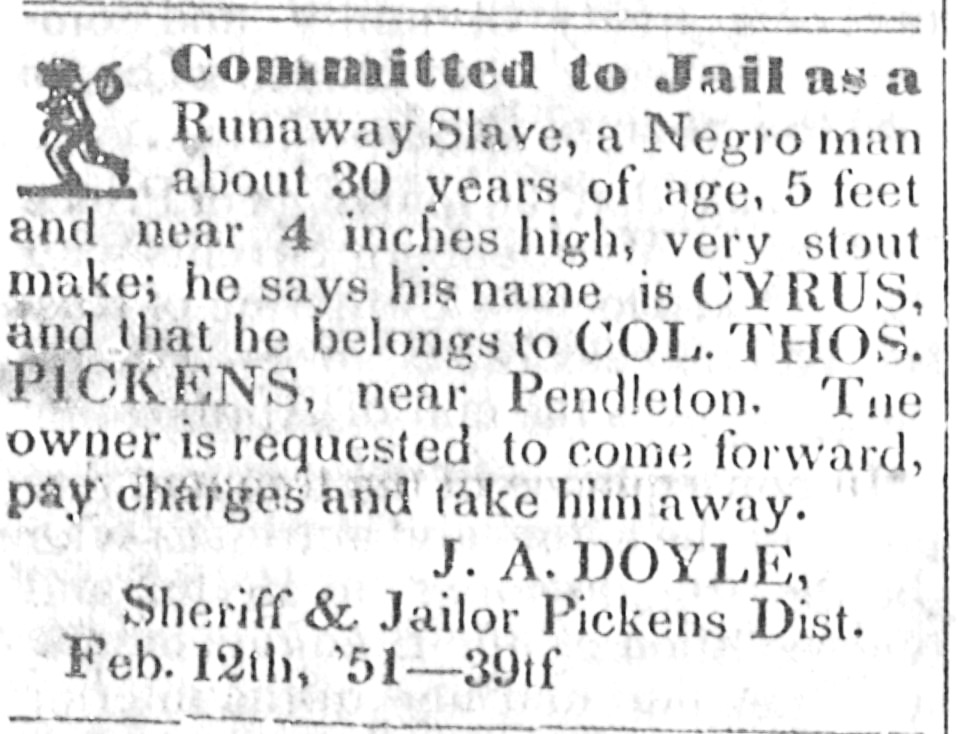
Of course, that message was mixed: white townspeople were kicking up a fuss about a cultural force that had escaped their control. And as they railed against antislavery mail, perhaps it encouraged some Black villagers to self-liberate. Cyrus, for one, enslaved at a labor camp near Pendleton, escaped in 1851.52"Committed to Jail as a Runaway," Pickens Keowee (SC) Courier, February 15, 1851. Although recaptured, he clearly had decided he wouldn't wait for someone to intervene on his behalf.
Anderson courthouse records indicate that in the 1840s a woman named Sylvia hid for eleven weeks in a barn until she accidentally left some clothing in nearby Pendleton and was discovered. The enslaved man in Pendleton who harbored her, Harry, was sentenced to fifty-seven lashes. What happened to Sylvia is unclear but the family and friends of Harry and Sylvia knew to be fearful of the long reach of the Pendleton area authorities.53For the story of Sylvia and Harry, see W. J. Megginson, African American Life in South Carolina's Upper Piedmont 1780–1900 (Columbia: University of South Carolina Press, 2006), 84. W.J. Megginson's work with the Anderson Court records provides many rich examples of the ways in which the culture of the justice system in the upstate of South Carolina controlled Black life. They had carved out some moments of resistance, but the surveillance culture of the Upstate left little room for triumph.
Like most southern-state newspapers of the era, the Pendleton Messenger drew a solid revenue stream from advertising sales of women, babies, children, and men. Almost every issue throughout the 1840s featured such advertisements. In one dated October 27, 1843, the local sheriff's office not far from Pendleton offered for sale Lenah and Jack with their children Beck, Peter, and three "younger ones" in order to pay off their enslaver's debts. From its inception the Pendleton Messenger specialized in silencing the voices and diminishing the personhood of Black people, marketing families like Lenah and Jack's. Literate or not, enslaved persons would have known to be wary of the ways in which news traveled.54"Sheriff's Sales," Pendleton (SC) Messenger, October 27, 1843.
The Pickens Keowee Courier ran advertisements for enslaved people aligning them with sales of animals such as one in February 1, 1851, notifying the public of eighteen people available for purchase.55"Administrator's Sale," Pickens Keowee (SC) Courier, February 1, 1851. The circulation of print in Upstate South Carolina helped set the value of the enslaved and affirm the values of enslavers.
Black activists from afar took note of the frantic reactions to antislavery mailings. "These violent measures resorted to by the slave mongers," wrote Frederick Douglass, "may be regarded as evidence that they see their weakness and the untenableness of their position."56Douglass, "Doings in South Carolina." That fact that updates about John Barrett and the protests were carried in the Anti-Slavery Standard and the Liberator, periodicals with significant Black readership, indicates a kind of displaced testimony to the events, particularly when you consider how these papers frequently reprinted in their entirety articles which had initially appeared in the South Carolina papers.
More concretely, we can return to the site of Pendleton to imagine the role of Black witness. The archival record doesn't record specific witnesses by the people most affected by the event, but when we adjust our attention to see the presence of Black life around that village green, possibilities for seeing the space anew emerge.
Many Black people lived and labored within a short stroll to the Green. Many of the Pendleton men involved in the bonfire, if not all, were enslavers or likely aspirational enslavers. Both Sitton and Sloan, for example, held men, women, and children laboring in bondage on their properties only a few hundred feet from the Green.
A blacksmith's shop was only half a block away from enslaved workers. Indeed, almost every house close to the Green in that period was owned by an individual who shows up as an enslaver on the Federal Slave Schedules of 1850. Black people must have seen the event, perhaps peeking from windows or viewing from alleys. Perhaps from porches at mansions only a block away, enslaved people washing linens or handling horses saw the smoke and heard the yelling. Would they have shrugged and kept their heads down? Likely they realized this agitation represented something more. Were the white people in Pendleton enraged because they were being challenged? Somebody had caused problems and drawn their ire. Doubtless the news traveled.
The enslaved were all around, on acreage outside the town limits as well as close by to attend to domestic tasks. Elam Sharpe, for example, who owned a large house steps away from the Green, held six enslaved people according to the census record of 1840; by 1850 a slave schedule reported he owned thirteen unnamed people. Some of those were women and young children.57"Elam Sharpe," 1850 United States Census (Slave Schedule), Anderson County, SC, NARA series M432, Roll 861, Family Search, accessed July 25, 2022, https://familysearch.org/ark:/61903/1:1:HRWH-H73Z. They might not all have resided at his "in-town" property; some of these women exploited as domestics would undoubtedly have worked in the two-story house in Pendleton. Would these women, occupied with cooking or laundry, have seen a stream of agitated white men passing by their home on the way to the Green? Would have heard the cheering and smelled the smoke? Sharpe's brother-in-law was the editor of the Pendleton Messenger, operating two blocks away, so his household, including the enslaved, would undoubtedly known all about the events. The carriages or horses of the Pendleton Vigilance Committee would have passed by the front porch on the way to the conflagration.
Owned and run by the Maverick family in the 1840s, Montpelier, one of the large plantation labor camps sited on what is now Old Greenville Highway was only a few minutes by wagon from the town center. At least thirty-seven men, women, and children were held in bondage there.58"Samuel Maverick," 1850 United States Census (Slave Schedule), Anderson County, SC, NARA series M432, Roll 861, Family Search, accessed July 25, 2022, https://familysearch.org/ark:/61903/1:1:HRWH-4ZZM. Would word reach them, soon after the event? Would they know people out there in the world were decrying slavery and perhaps have felt a little less alone?
Given the social space of Pendleton, many Black people would have been in the vicinity of the bonfire, watching it or perhaps doing their best to keep far away. Pendleton's population (both the town proper and the broader "Pendleton District") during the early nineteenth century was notably more dense than in many other areas of the Upstate, and their holdings of enslaved people considerable, albeit dispersed among numerous white families. White Pendletonians enslaved people at higher rates than surrounding white populations. According to the 1860 census, the combined population of Oconee and Pickens counties, which encompassed much of the Pendleton District, included 500 enslavers who held 4,195 people in bondage. That's a high number but nothing like comparative statistics in the central or southern parts of the state.59For a good understanding of these numbers, see Megginson, African American Life, 8. Consider how Charles Joyner, in his study of the All Saints Parish in coastal South Carolina (known as the Lowcountry) demonstrated that in the 1860s fifteen wealthy planters enslaved 4,383 people.60Charles W. Joyner, Down by the Riverside: A South Carolina Slave Community (Urbana: University of Illinois Press, 1984), 19. Certainly the Upstate or Pendleton District was quite unlike the Lowcountry. But, the small town of Pendleton was itself quite different from its surrounding areas—and would have felt a bit more like a Lowcountry town in terms of its affluence and its ratio of enslaved people to the white slaveholding populations. The town of Pendleton, as the 1860 census reported, counted 383 white people, one lone free person of color, and 470 enslaved persons.61Population data from 1860 can be found in Joseph Kennedy, Population of the United States in 1860 (Washington, DC: Government Printing Office, 1864), 448–455, accessed July 25, 2022, https://www2.census.gov/library/publications/decennial/1860/population/1860a-32.pdf. Individual enslavers in town held humans in their inventory but so did business entities: The Pendleton mercantile firm of W.H.D. Galliard & Co., for example, listed four enslaved laborers sited on premises near the Pendleton Post Office.62Megginson, African American Life, 8, 114.
Even though many of the affluent white sojourners from the Lowcountry who spent extensive vacation periods in Pendleton left the bulk of their enslaved work crews to endure the rice or cotton plantation labor camps, they would have traveled with a domestic retinue of the enslaved to their Pendleton retreats.
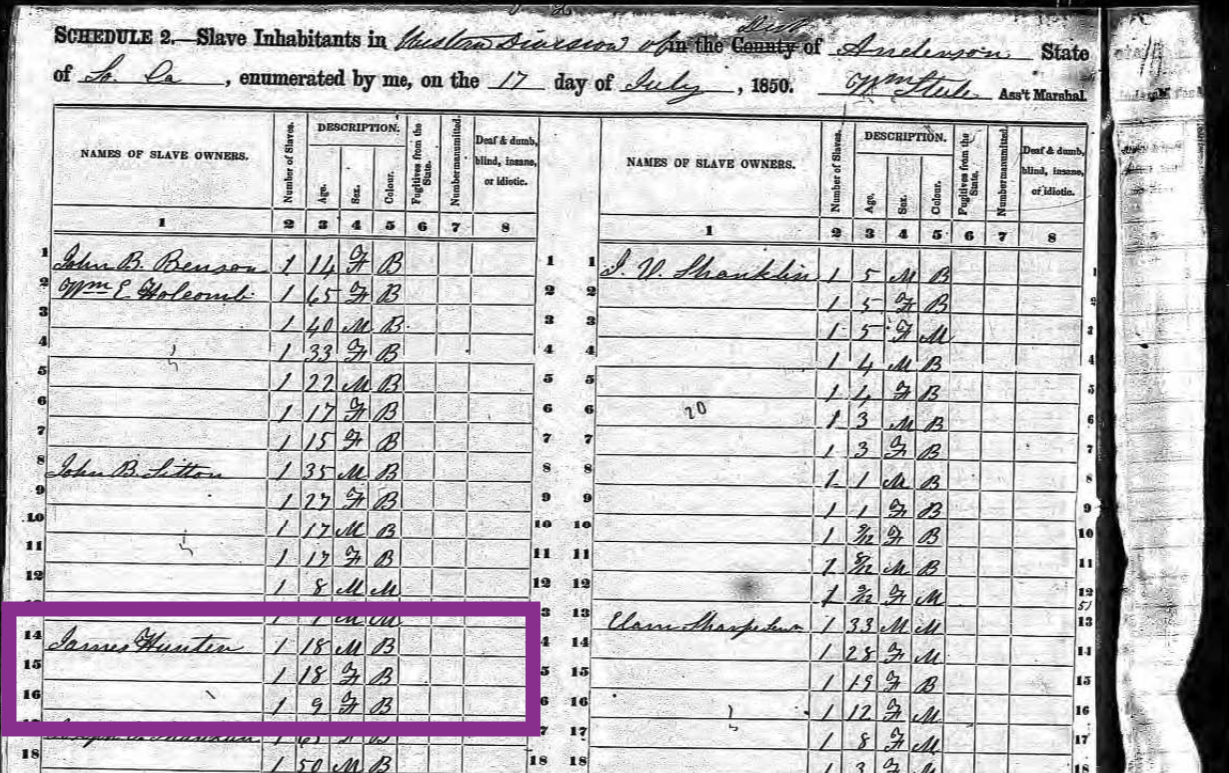
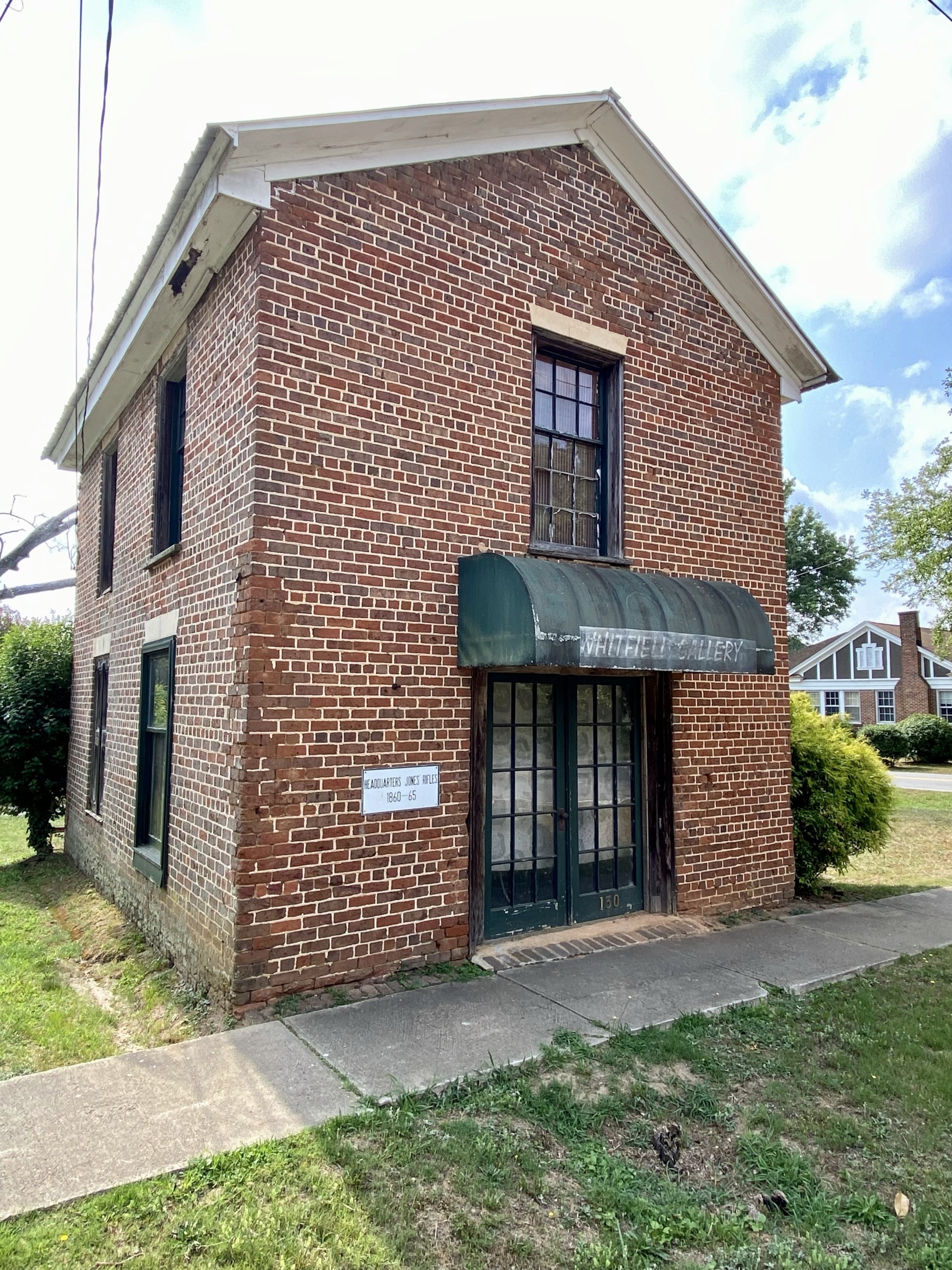
There were more Black people close to the Green for other reasons, too. A few free Black people could even conduct business at the establishments there, but almost every business owner in the town held a few people in bondage. James Hunter, for example, ran a blacksmith shop right off the Green, doubtless assisted in part by one of the three Black people he enslaved, most likely the unnamed eighteen-year-old man listed in the 1850 slave schedule.63"James Hunter," 1850 United States Census (Slave Schedule), Anderson County, SC, NARA series M432, Roll 861, Family Search, accessed July 25, 2022, https://familysearch.org/ark:/61903/1:1:HRW4-GYN2.
There were boarding houses and hotels located within shouting distance of the Green, all of which had travelers with enslaved servants passing through as well as a handful of enslaved people, ensuring that hosting routines went smoothly. They, too, might have seen the fires or the ashes. The Female Academy of Pendleton was located kitty-corner from the Green. While the white students did not board there (they tended to live at houses within walking distance), at least one or two enslaved Black workers stayed on hilly site to tidy the property, clean the classrooms, stoke the fires, and stand ready with carriages and horses to pick the young ladies up and transport them as needed.64For references to the various incarnations of the Female Academy in Pendleton see "South Carolina Education—Anderson County," Carolana, accessed July 20, 2022, https://www.carolana.com/SC/Education/sc_education_anderson_county.html.
A creative cognitive map of Pendleton's enslaved population of 1849 reveals plenty of Black people in proximity to the fiery events. They would have mapped the terrain differently as their perceptions of joined places and slave neighborhoods would not have coincided with officially sanctioned property lines defined by enslavers.65For an overview of this concept see Anthony E. Kaye, Joining Places: Slave Neighborhoods in the Old South (Chapel Hill: University of North Carolina Press, 2007) and "'In the Neighborhood': Towards a Human Geography of US Slave Society," Southern Spaces, September 3, 2008, https://southernspaces.ecdsdev.org/2008/neighborhood-towards-human-geography-us-slave-society/. The entire township, not merely a particular site of bondage, would have encompassed their neighborhood.
The Pendleton Green, town center for white villagers, was likely traversed with great care by Black Pendletonians, who would have understood the performative terrorism and the threat it signified. News carried fast. This was a story for them, about them, and directed at them with cruel menace.
Conclusion
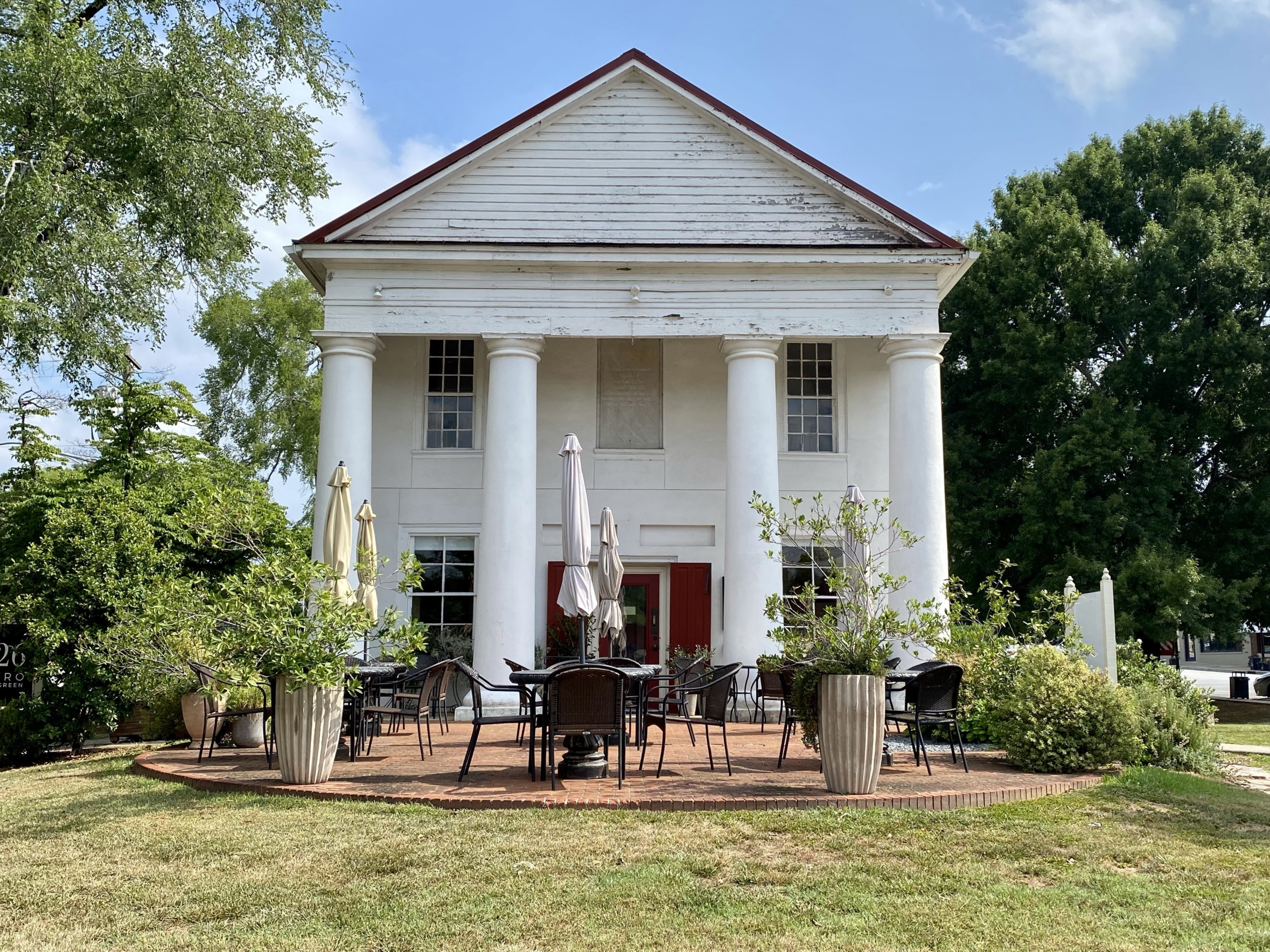
Pendleton today benefits from proximity to nearby Clemson University and tourism. The entire town is on the National Registrar of Historic Places, making it one of the country's largest designated districts.66For details about this historic designation, see "Pendleton Historic District," South Carolina Historic Properties Record, accessed July 20, 2022, http://schpr.sc.gov/index.php/Detail/properties/11705. For the claim that the district is exceptionally large, see "Anderson County, South Carolina," Carolana, accessed July 20, 2022, https://www.carolana.com/SC/Counties/anderson_county_sc.html. It features over fifty buildings dating from the eighteenth and nineteenth centuries. While now promoting restaurants and antique stores more than carriage making or agriculture, it's a lovely place to stroll.67 "Pendleton Historic District, Anderson County (Pendleton)," South Carolina Department of Archives and History, accessed July 20, 2022, http://www.nationalregister.sc.gov/anderson/S10817704013/index.htm.
The Pendleton Foundation for Black History and Culture has worked hard to redirect and enrich much of the public discussion about local history. They have drawn attention to local sites important to Black history; in particular, the significance of the Keese Barn site, only a few hundred steps from the Green, which in the early twentieth century became a gathering place for African Americans.68"About Us," Pendleton Foundation for Black History & Culture, accessed July 19, 2022, https://blackhistorypendleton.org/about.
The story of the Green demands a more complex reckoning than the current historic markers allow. The Farmers Hall still stands in its stolid beauty with its colossal columns. A bustling restaurant called the 1826 Bistro on the Green now occupies its first floor, where the post office once operated.69"1826 Bistro," 1826 Bistro, accessed July 19, 2022, http://www.1826bistro.com/. A bookstore overlooks the Green as do gift stores and a Mexican café.70"Home," The Pendleton Bookshop, accessed July 25, 2022, https://www.pendletonbookshop.com/; "Welcome to Vaquaros Mexican Restaurant," Vaquaros Mexican Restaurant, accessed July 25, 2022, https://www.vaquerosinthesquare.com/; "Home," Mountain Made American Handcrafts, accessed July 25, 2022, https://potteryinpendletonsc.com/. Farmers markets, annual festivals, and local protests, particularly those seeking the attention of US Senator Lindsay Graham, whose office overlooks the Green, regularly enliven the public space.71"Home," US Senator Lindsey Graham, accessed July 19, 2022, https://www.lgraham.senate.gov/public/. But the story of the gathering of white supremacists attacking the federal post office and casting pamphlets into a bonfire remains little known.
About the Author
Susanna Ashton is a professor of English at Clemson University. She studies the writing and witness of enslaved people, particularly those from South Carolina. Ashton holds an MA and a PhD in English from the University of Iowa and received her BA from Vassar College. She has held fellowships at Yale, Harvard, Emory, and the University of South Carolina, and has served as a Fulbright Faculty fellow at University College Cork in the Republic of Ireland. Most recently, she was a W.E.B. Du Bois Fellow at Harvard's Hutchins Center for African and African American Studies for 2021-2022. Ashton's current project, John Andrew Jackson, the Hidden Inspiration Behind Uncle Tom's Cabin, is forthcoming from The New Press, 2024. She lives approximately three miles from the Pendleton Green.
Acknowledgments
I thank Doug Seefeldt (Clemson History) for the opportunity to assemble this story for the public. Thanks are also due to Tara Wood and Brenda Burk for their kind assistance. Staff members at the Anderson County Main Library’s Genealogy and Local History section were especially helpful in finding images of Pendleton. Librarian Mary Lanham, especially, was quite generous with her time. Librarian Daniel Bonsall helped me sort through some puzzling Pendleton statistics. Clemson Colleagues Jessica Serrao, Josh Catalano, and Amanda Regan were models of kindly instruction. The staff at the South Carolina Room at the Hughes Main Public Library in Greenville, the Pendleton Branch Public Library, and the South Carolina State Department of Archives and History (particularly Dr. Steve Tuttle) went beyond the call of duty in helping me assemble the materials undergirding this project. The curators at the South Carolina State Dept of Archives and History were especially helpful in getting me court documents related to the trial, including an actual and rather extraordinary copy of the particular Brutus tract the Spartanburg authorities held as evidence against Barrett. A research sabbatical from Clemson University's College of Architecture, Arts, and Humanities allowed me the luxury of time to hone my professional skills as well as complete this modest storytelling endeavor.
I’m grateful to the editorial team of Southern Spaces and the anonymous peer reviewers, all of whom helped me further develop this project and bring it to the public.72This incident of 1849 was first brought to my attention in Stephen West's terrific book, From Yeoman to Redneck in the South Carolina Upcountry, 1850-1915 (University of Virginia Press, 2008) and I thereafter independently kept bumping into complaints about Brisbane in antebellum newspapers from the Carolinas. It took a few years for me to be able to see how an angle on this story might be particularly about the ways that the Upstate of South Carolina, particularly Pendleton, saw its allegiance to the culture of Calhoun and the culture of the coastal Low Country. Even that only made sense when the Black people at the heart of the story could be appropriately understood to be at the center, not the periphery, of the scene.
While little of my specific information in the Black Witness section comes directly from W. J. Megginson's work, African American Life in South Carolina's Upper Piedmont 1780-1900 (University of South Carolina Press, 2006), I am grateful to him for his deeply felt research that undergirds my approach to apprehending the different kinds of possible witness there. Brent Morris' thorough and thoughtful work on the Reverend William Henry Brisbane was also vital to this project and I suggest anyone seeking more information on Brisbane start with Morris' fine writings on the topic.
Introduction
On January 15, 1909, US President-elect William Howard Taft attended a banquet at the Chamber of Commerce along with "the cream of Atlanta and the south's commercial factors, professional men, editors and railroad magnates" where the main course featured a winter trio of roasted opossum, sweet potatoes, and persimmon beer.1"Taft Eats 'Possum, Gives South Pledge," The New York Times, Jan. 16, 1909, 1. Several months earlier and prior to his election, Taft had become the first Republican candidate to venture into the Democratic "Solid South" during a presidential election.2David Charles Needham, "William Howard Taft, The Negro, and the White South, 1908–1912," (PhD diss., University of Georgia, 1970), 31. The Atlanta banquet represented a continuation of Taft's efforts toward sectional reconciliation as he pledged to "weld into a compact unit the North and the South."3"Taft Eats 'Possum, Gives South Pledge," 1. The event highlighted the white supremacist solidarities necessary for such political and economic reunification, with his speech elaborating policies that would assure federal appointments would not go to African Americans and that southern metal and cotton products would find commercial opportunities in Far Eastern markets.4William H. Taft, "The Winning of the South," Political Issues and Outlooks: Speeches Delivered Between August, 1908, and February, 1909 (New York: Doubleday, Page, 1909), 230–234.
For the prominent white male politicians, businessmen, and other leaders seated at the dining tables, roasted opossum was more than just a show of Gilded Age gustatory extravagance. The food held deep cultural meanings. Since the antebellum era, white males of southern plantation households would occasionally oversee or accompany enslaved people's nighttime opossum hunts, claim their spoils, and then relegate the game's preparation to African American cooks. Drawing on this tradition, a generation of white men with rural upbringings came to see opossum hunts as a means of perpetuating antebellum culture by reinforcing and reinscribing racial lines. They mocked and derided opossums as indicative of negative aspects of African American culture while simultaneously celebrating African Americans as possessing a folk knowledge of hunting, preparing, and cooking opossums.5Psyche Williams-Forson examines similar paradoxes in the case of fried chicken in her chapter "More Than Just the 'Big Piece of Chicken': The Power of Race, Class and Food in American Consciousness," in Food and Culture: A Reader, 3rd ed., Carole Counihan and Penny Van Esterik, eds. (New York: Routledge, 2012): 107–118. See also Williams-Forson Building Houses Out of Chicken Legs: Black Women, Food, and Power (Chapel Hill: University of North Carolina Press, 2006). In the decades after the Civil War, whites of all social classes increasingly consumed this survival food, now labeling it a "southern delicacy."6This sort of cultural appropriation persisted for over half a century after the Taft banquet, with the women of the Junior League of Charleston, South Carolina, suing Ernest Matthew Mickler, author of White Trash Cooking, in the mid-1980s for lifting what they claimed was their historical recipe for roasted opossum. For a brief discussion of cultural appropriation in this context, see Angela Jill Cooley, "Southern Food Studies: An Overview of Debates in the Field," History Compass 16, no. 10 (2018): 1–9. The dish, known as "'possum and 'taters," was one of many items of "southern cooking," which, as Diane Spivey points out, signified a "Whites Only Cuisine" during Jim Crow.7Diane M. Spivey, "Economics, War, and the Northern Migration of the Southern Black Cook," The Peppers, Crackling, and Knots of Wool Cookbook: The Global Migration of African Cuisine (New York: State University of New York Press, 1999).
Challenged by the economic competition of freed people who sought urban factory jobs and attempted to purchase rural farms, in addition to the political competition of the Populist movement that aimed to unite Blacks and working-class whites, opossum suppers, particularly in Georgia, provided a Democratic theatre in the decades following Reconstruction. At the 1909 Atlanta supper, staged to garner national attention, Taft appealed to Democrats who sought to regain national political strength. As the New York Times reported: "Five hundred eyes watched until he had been served and bountifully served and had taken his first bite of the tempting dish."8"Taft Eats 'Possum, Gives South Pledge," 1. In the aftermath of this feast, journalist Don Marquis suggested that "the possum, and all the talk back and forth across the festive boards . . . has likely strengthened Mr. Taft's idea that the 'Solid South' is breakable, and that he is the man to break it. . . . How much of the Southern point of view with regard to the negro did Mr. Taft imbibe while eating the possum?"9Don Marquis, "A Glance: Concerning the Possum and the Negro," Uncle Remus's the Home Magazine, March 1909, 26. https://digitalcollections.library.gsu.edu/digital/collection/printed/id/6450/rec/1.
The opossum's momentary rise to glory parallels the shifting of political power during this era of intensifying apartheid. Whites in Georgia and other southern states turned African American reliance on the opossum as a means of sustenance and source of income into a symbol of racial inferiority. This occurred despite the fact that many subsistence-level whites also sought the opossum as a food source. Glorified opossum consumption complemented practices of Confederate memory-making and white sectional identity.10While scholars and writers have given attention to "southern" foods and foodways since the 1970s and 1980s, the opossum remains largely absent from the historiographical record. Most authors have simply highlighted that this food—along with other game such as raccoons and squirrels—formed an important part of the diets of both white settlers and Black slaves in the antebellum era. Sam Bowers Hilliard, Hog Meat and Hoecake: Food Supply in the Old South, 1810–1860 (1972; repr., Athens: University of Georgia Press, 2014), 54; Joe Gray Taylor, Eating, Drinking, and Visiting in the South: An Informal History (1982; Baton Rouge: Louisiana State University Press, 2008), 8; Herbert C. Covey and Dwight Eisnach, What the Slaves Ate: Recollections of African American Foods and Foodways from the Slave Narratives (Santa Barbara, California: Greenwood Press, 2009). Literary scholar David S. Shields discusses the appearance of roasted opossum on a hotel menu in "Possum in Wetumpka," Southern Provisions: The Creation & Revival of a Cuisine (Illinois: University of Chicago Press, 2015), 143–162. With the emergence of food studies as a field in the 1990s, historians have more rigorously used food to study culture, race, class, gender, and political power.
Geography and Ecology of the Opossum
What was the historical geographic range of the Virginia opossum (Didelphis virginiana)? A mid-1950s article by John Guilday indicates an abundant archeological record of the indigenous marsupial in the Lower and Middle Ohio Valley and in Ohio north to the shore of Lake Erie before European colonization.11John E. Guilday, "The Prehistoric Distribution of the Opossum," Journal of Mammalogy 39 no. 1 (1958): 39–43. An absence of remains reveals that the opossum either did not occur or was uncommon in the Appalachian Plateau of northern West Virginia, western Pennsylvania, and southern New York. Guilday shows that species distribution extended beyond the southeastern United States, even though settlers came to associate the opossum with that section of the country. In The Quadrupeds of North America, John James Audubon writes that the opossum was by no means confined to southern states, particularly during the antebellum period. By 1851 the opossum's range extended north to the Hudson River. Audubon believed that populations would soon occupy southern New York and Long Island "as the living animals are constantly carried there."12John James Audubon and the Rev. John Bachman, The Quadrupeds of North America, vol. II (New York: V. G. Audubon, 1851), 124, https://archive.org/details/b22012436_0002/page/124/mode/1up. In New Jersey and Pennsylvania, opossums were common, but they were more abundant southwardly through North Carolina, South Carolina, Georgia, Louisiana and Texas, to Mexico. They also existed in Indiana, Mississippi, Missouri, and Arkansas, and extended to the Pacific, with some populations in California.13Audubon, Quadrupeds, 125.
The opossum—which is remarkably fecund due to its short gestation period and ability to produce two litters a year in warm climates—was one of the most common small mammals before European colonization in the hardwood forests of the southern Coastal Plain and Piedmont ecoregions, according to environmental historian Timothy Silver.14Timothy Silver, A New Face on the Countryside: Indians, Colonists, and Slaves in South Atlantic Forests, 1500–1800 (New York: Cambridge University Press, 1990), 11. Unlike many species of wildlife adapted to these forests, opossums were not negatively impacted by market hunting since their pelts were of low value. The deforestation that accompanied colonial farming practices allowed opossum populations to increase by driving away foxes, wolves, and other predators and by enabling grass and seed-eating mammals, such as rabbits and mice, to proliferate. Audubon's remark that the opossum consumed everything from grain in cornfields to nuts and berries, as well as rodents, rabbits, and hens, indicates that it found plantations and yeoman farms ideal habitats.15Audubon, Quadrupeds, 112.
Many viewed opossums as pests because of their omnivorous eating habits and their ability to destroy food crops. "A 'Possum Sir, is not a critter, but a varmint," remarked an overseer at Belvoir plantation near Pleasant Hill, Alabama, insinuating that the wild animal was not desirable food.16Philip Henry Gosse, Letters From Alabama (U.S.) Chiefly Relating to Natural History (London: Morgan and Chase, 1859), 234, https://archive.org/details/lettersfromalab00goss/page/234/mode/2up. Significantly, English naturalist Philip Henry Gosse, who recorded the overseer's comment while employed as a tutor at Belvoir in 1838, also observed among the neighboring plantations that the meat of both the opossum and raccoon were "scarcely ever eaten by whites, and never in summer." Travel writers, such as Frederick Law Olmsted, offer evidence that whites occasionally ate the meat during the winter. In January 1854, Olmsted recorded the owner of a large plantation in Virginia serving him opossum, which he described as tasting like a "baked sucking-pig."17 Frederick Law Olmsted, A Journey in the Seaboard Slave States, With Remarks on Their Economy (New York: Dix and Edwards, 1856), 92, https://archive.org/details/journeyinseaboar00olms/page/92/mode/2up?view=theater. Ex-slave Anderson Furr, who grew up on a plantation in Hall County, Georgia, offers a different perspective of white consumption: "Dey made N*****s go out and hunt 'em and de white folks et 'em. Our mouths would water for some of dat 'possum but it warn't often dey let us have none."18Interview with Anderson Furr in Federal Writers' Project of the Works Progress Administration, Slave Narratives: A Folk History of Slavery in the United States From Interviews with Former Slaves, vol. IV, Georgia Narratives, Part 1 (Washington, DC: 1941; Project Gutenberg, 2004), https://www.gutenberg.org/files/13602/13602-h/13602-h.htm. Furr's recollection suggests that already, in the antebellum era, opossum consumption factored into a display of racial domination.
Hunting methods, such as capturing opossums live to fatten at home and clean out their digestive tracts may have helped to improve the taste of this wild game. Yet, associating opossums with native persimmon fruits enabled a popular imaginary that helped to reduce prejudices against prominent whites who occasionally consumed this lowly scavenger. The American persimmon tree (Diospyros virginiana)—an early invading species in disturbed areas and along forest-pasture boundaries—was common throughout the opossum's range. While Native American stories connected opossums with persimmon fruits, the association was particularly strong in antebellum African American songs and folklore, as well as white settler accounts of opossum hunts.19For examples of opossums eating persimmons, see James Mooney, "The Terrapin's Escape from the Wolves," Myths of the Cherokee (Washington, DC: Government Printing Office, 1902), 278–279, https://archive.org/details/cu31924104080076/page/n7/mode/2up. See also Joel Chandler Harris, "Why Mr. Possum Loves Peace," The Complete Tales of Uncle Remus (Boston: Houghton Mifflin Company, 1955), 9. Audubon's illustration of the opossum conveys an ecological association between the plant and animal. Ripe persimmons may have enhanced the flavor of the meat, yet the fruit was not essential to supporting this omnivorous species, which indiscriminately ate plants, insects and animals and opportunistically consumed carrion and trash.
Antebellum Opossum Hunting and Black Culture
Although opossums were a choice component of the antebellum diets of white small landholders and tenants, primary accounts offer more insight into the connections between this food and enslaved people of African descent.20Subsistence farmers engaged extensively in hunting opossums for food, but early to mid-nineteenth-century written sources emphasize on African American consumption. Along with other small game, opossums were an important source of protein and fat in diets that enslavers kept lean and scarce. Ex-slave Peter Randolph explained that in Virginia many slaves made traps with cut timber, often setting fifteen to twenty of them in the swamps to capture opossums, raccoons, hares, and squirrels.21Peter Randolph, Sketches of Slave Life: Illustrations of the "Peculiar Institution" (Boston, MA: Peter Randolph, 1855), 19–20, https://docsouth.unc.edu/neh/randol55/randol55.html. Some slaves, however, used trained dogs to tree opossums at night in wooded areas adjoining plantations. Because hunting and setting traps at night did not directly interfere with daytime farm work, some enslavers permitted those they held in bondage to capture small game for supplementary nutrition. Slaves not allowed to go hunting at night had to be more covert. Ex-slave Solomon Northup recalled that in Louisiana, "There are planters whose slaves, for months at a time, have no other meat than such as is obtained in this manner."22Solomon Northup, Twelve Years a Slave: Narrative of Solomon Northup, a Citizen of New-York, Kidnapped in Washington City in 1841, and Rescued in 1853, from a Cotton Plantation Near the Red River, in Louisiana (Buffalo, NY: Derby, Orton, and Mulligan, 1853), 201, https://docsouth.unc.edu/fpn/northup/northup.html. In interviews for the Works Progress Administration's Federal Writers' Project, the numerous ex-slaves who recollected hunting or eating opossums attest to Northrup's claim that the marsupials were an important meat and that hunger drove consumption of this wild game, often described as greasy and fatty.23See Federal Writers' Project of the Works Progress Administration, A Folk History of Slavery in the United States from Interviews with Former Slaves (Washington, DC, 1941; Project Gutenberg, 2004), https://www.gutenberg.org/ebooks/13847. A few of the interview references to opossums from the WPA slave narratives are referenced in Stephen Winick's blog "A Possum Crisp and Brown: The Opossum and American Foodways" (Washington DC: Library of Congress, August 15, 2019), https://blogs.loc.gov/folklife/2019/08/a-possum-crisp-and-brown-the-opossum-and-american-foodways/.
Opossums were more than a survival food for enslaved people. While John Patterson Green, born to emancipated parents in North Carolina, writes that African American opossum consumption "arises not so much from any constitutional partiality on their part, or difference in their tastes [. . .], as from the absence of fresh meats of all kinds," other slaves and freed people expressed the pleasures they experienced from consuming the animal.24John Patterson Green, Recollections of the Inhabitants, Localities, Superstitions and Ku Klux Outrages of the Carolinas (Cleveland, OH: 1880), 181, https://archive.org/details/recollectionsofigree/page/n5/mode/2up]. "The flesh of the coon is palatable," Northrup notes, "but verily there is nothing in all butcherdom so delicious as a roasted 'possum."25Northup, Twelve Years a Slave, 201. The marsupial also enabled enslaved people to access more desirable food. Remembering having "been kept for a long time on corn and potatoes," ex-slave Andrew Jackson of Kentucky revealed that opossums were one of several "expedients to get luxuries."26Andrew Jackson, Narrative and Writings of Andrew Jackson, of Kentucky; Narrated by Himself (Syracuse, NY: Daily and Weekly Star Office, 1847), 27, https://archive.org/details/narrativewriting00jack/page/n27/mode/2up?view=theater&q=pig. Jackson described a scheme of "eating pig for opossum" that entailed obtaining permission to go opossum hunting, skinning several opossums and burying their bodies, killing two pigs and burying their skin and entrails, and then boiling the pork in kettles. The slaves retained the opossum skins as "proof" of the meat's source. Annie Young, from Tennessee, told of a slave caught with a young pig: "Master it may be a shoat now, but it sho was a possum while ago when I put 'im in dis sack."27Interview with Annie Young in The Federal Writers' Project of the Works Progress Administration, Slave Narratives, Oklahoma: A Folk History of Slavery in the United States from Interviews with Former Slaves, vol. XIII, Oklahoma Narratives (Washington, DC: 1941; Project Gutenberg, 2007): 359, https://www.gutenberg.org/files/20785/20785-h/20785-h.htm. Young's trickster humor suggests a realm of everyday practices that lay beyond the master's grasp.28 Consider Jackson's tale alongside Louis Jordan's popular post-World War II hit song "Ain't Nobody Here But Us Chickens" as discussed in George Lipsitz's Rainbow at Midnight (Urbana: University of Illinois Press, 1994), 303–310.
Because opossums were important in survivance, they figured prominently into Black culture. Thomas Talley, an African American folklorist whose parents were former slaves, documented antebellum rhymes used for dancing and entertainment, such as the "Possum-La," "'Possum up the Gum Stump," "An Opossum Hunt," and "Shake the Persimmons Down."29Thomas Talley, Negro Folk Rhymes (New York: The MacMillan Company, 1922), 3, 23–24, 34, 233–234. References to some of these songs or rhymes can also be found in ex-slave narratives recorded through the Federal Writers' Project of the Works Progress Administration. Songs referenced plants, animals, and activities integral to the environments that enslaved people intimately experienced. The deep meanings that the opossum developed through antebellum folklore and foodways—as a connection to the past and an avenue to the future—would make it all the more significant when southern whites tried to claim an exclusivity of this food during Jim Crow.
Postbellum Opossum Hunting and White Supremacy
After the Civil War, hunting, selling, and consuming opossums remained significant among many African Americans. As formerly enslaved people sought to carve out autonomous livelihoods, opossum consumption represented ecologically rooted foraging skills, economic independence, and household sufficiency. Newspapers began to relay impressive—if not exaggerated—hunting accounts. An editor, for example, remarked on New Year's Day 1880 that a Black hunter in Anderson County, South Carolina had caught 127 opossums since the previous fall.30"South Carolina News," Yorkville (SC) Enquirer, Jan. 1, 1880, 2, https://chroniclingamerica.loc.gov/lccn/sn84026925/1880-01-01/ed-1/seq-2/.Although generally considered a male activity, there were exceptions, such as a Black woman's catching fifteen opossums in Muscogee County, Georgia, in 1877.31"Foraging on our Exchanges," The LaGrange (GA) Reporter, Oct. 11, 1877, 2, https://gahistoricnewspapers.galileo.usg.edu/lccn/sn82015287/1877-10-11/ed-1/seq-2/#date1=10%2F11%2F1877&city=LaGrange&date2=10%2F11%2F1877&words=&searchType=advanced¬text=&index=2&sequence=0&proxdistance=5&rows=12&ortext=&proxtext=&andtext=&page=1.
Enslavers may have tolerated—and on occasion, celebrated—antebellum opossum hunting. Yet, when these same men lost control over their labor force and struggled to maintain their livelihoods after the war, Black opossum hunts signaled an infringement on white supremacy. Whites sought to assert control over African American hunting and foraging practices. Attending opossum hunts with their former slaves provided one way for whites to flex their power. Opossum bounties were another. Depicting autonomous Black hunts as pathological and wasteful, one Atlantan wrote: "But we are wandering among the black jocks," adding that an opossum bounty will "protect negro labor and revive their languid interest in the best government."32"Possums and Protection," Atlanta (GA) Constitution, Sept. 20, 1882, 4. Because opossums destroyed crops and raided chicken houses, bounties gave landowners a way to protect their capital from pests and predators.33There may have been other motives behind paying African Americans to hunt opossums. By paying freed people to hunt opossums, former slave owners attempted to assert their authority over Black hunting, which they framed as an idle diversion from necessary farm work.34Scott Giltner, Hunting and Fishing in the New South: Black Labor and White Leisure after the Civil War (Baltimore, MD: Johns Hopkins University Press, 2008), 28.
For white men who had grown up on plantations, postbellum Black opossum hunting could evoke conflicting feelings. Sometimes the activity signaled a threat to white supremacy, while other times it featured in an imagined "South." While the Ramapough Mountain Indians of New Jersey and New York engaged in hunting opossums, a New York Times correspondent asserted in 1886 that they were "not such picturesque35"Picturesque" appears frequently in late-nineteenth century writing describing opossum hunting throughout the southern states. The term was rooted in eighteenth-century British landscape design, but travel writers, such as William Bartram, later used it to describe an attractive or pleasing scene. See "Picturesque," (Washington, DC: National Gallery of Art, last edited 2021), https://heald.nga.gov/mediawiki/index.php/Picturesque. hunters as their brethren of the south" because, instead of using hunting dogs, they relied on guns and deadfall traps (even though slaves and freed people in the southern states also used guns and traps).36"Hunting the Possum," Buffalo (NY) Commercial, Sep. 4, 1886, 1; "Hunting the Opossum. A Place Where He Is Found North of Mason and Dixon's Line," Wood County Reporter (Grand Rapids, WI), Sep. 23, 1886, 6, https://chroniclingamerica.loc.gov/lccn/sn85033078/1886-09-23/ed-1/seq-6/. Stereotypical depictions of place and race formed around the native marsupial. "No one ever located the opossum hunt anywhere but in the gum swamps or among the persimmon trees of the south," the correspondent wrote in popular racist imagery, "where they are ever associated with the spectacle of the bulging-eyed and expectant darky carrying aloft his flaming pine-knot torch, while his lean and lanky dog leads him to the tree where the much prized possum has sought refuge." A racist "plantation song" suggests a chaotic scene:
Afore de n****r could come down de tree would mostly fall—
Then smack among the dogs would light de possum n*g and all,
De dogs would pitch upon 'em both and most tar dem in half,
Old Marster he would stand aside and kill hisself wid laugh.37"Possum Hunting—A Song," Fairfield Herald (Winnsboro, SC), Mar. 12, 1873, 1, https://chroniclingamerica.loc.gov/lccn/sn84026923/1873-03-12/ed-1/seq-1/.
Whites reinforced their belief in Black inferiority by turning this strenuous and risky nighttime activity of Black survival and economic autonomy into a "picturesque" scene and humorous "spectacle." Such depictions omitted the horrific violence of slavery and Jim Crow, as well as the ecological destruction wrought by cotton, tobacco, and other monocrops that increasingly shaped foodways and contributed to the overhunting of wild game.
For some white men who grew up on plantations or farms in the southern states, opossum hunting evoked Confederate nostalgia. Drawing on tropes portraying Blacks as ineligible for freedom or citizenship, an Atlanta Constitution editor wrote: "Memory yet dwells with peculiar emotions of pleasure upon those glorious old hunts we used to take in by-gone days before Sambo had been transformed into a fifteenth amendment."39"The Opossum," The Atlanta (GA) Constitution, Dec. 3, 1874, 1. A columnist from Natchitoches, Louisiana, suggested: "It reminds one of the lost days ante bellum to speak of such a delicious treat as cold possum and tater on a winter's night."40"Possum and Tater," The People's Vindicator (Natchitoches, LA), Sept. 15, 1877, 3, https://chroniclingamerica.loc.gov/lccn/sn85038558/1877-09-15/ed-1/seq-3/. As it fed nostalgic memory-making, opossum hunting was more than a way of reenacting a past more often imagined than real; it represented a future where whites could retain aspects of their southern sectional identity. Another Atlanta Constitution writer offered his grandiloquent rumination:
There are some customs that even the reconstruction laws failed to disestablish and some of them are intimately connected with the opossum. The opossum still survives the war and all the sectional strife and we have sometimes hoped that the day would come when [. . .] it might become the basis, if not the emblem, of North American fraternity.41"The Premature 'Possum," The Atlanta (GA) Constitution, Aug. 6, 1882, 4.
A white brotherhood, binding the war-torn sections through the hunting and eating of opossums appealed to an apartheid appetite. As Kyla Wazana Tompkins observes, "acts of eating cultivate political subjects by fusing the social with the biological, by imaginatively shaping the matter we experience as body and self."42Kyla Wazana Tompkins, Racial Indigestion: Eating Bodies in the 19th Century (New York: New York University Press, 2012), 1. The opossum supper—a social occasion where white men came together to consume Black labor—served as a signifier of racist solidarity in the decades after the Civil War.
Cultural Appropriation, Neo-Confederates, and Urban Game Markets
Following Reconstruction, Blacks continued to hunt and eat opossums as they had for generations, as did many rural white farmers. In addition, the ascendant white political leadership ("Redeemers") who were attempting to reclaim racial command over Black labor and southern land, increasingly and publicly engaged in these activities. A plantation imaginary filled with adventuresome opossum hunts contributed to the appeal and surge of opossum suppers among white men, who had grown up on plantations or farms but were now confronting the reality of Black people transitioning from human property to citizens. They scrambled to find and re-hash tropes to narrate white supremacy and reassert racial power. Beyond overseeing Black opossum hunts, these men claimed the opossum as a rightful inheritance while depicting Black consumption as deviant. They drew on longstanding racist tropes that cast Blacks as possessing an excessive animality and fondness for opossums, while situating their own opossum consumption as appropriate, measured, and tastefully respectable. Concurrently with terroristic attempts to overthrow Black freedom struggles during Reconstruction, white men within the Democratic party cultivated the opossum supper as a theatre for leadership rites and as a site for framing anti-democratic contentions and racist tactics as legitimate, authentic, and appropriate.
In the 1870s, opossum supper announcements became common in newspapers of southeastern states and occasionally in some northeastern and midwestern ones where freed people had begun to migrate. Early on, these events involved people of different socioeconomic classes and racial or ethnic backgrounds and occurred for a variety of reasons—from political gatherings to church fundraisers and more intimate domestic occasions. With time, Democratic politicians turned the opossum supper into a social event expressive of white men's solidarity.
With the rebuilding and growth of towns into small cities after the Civil War, markets for selling opossums and other game grew. A shift in urban demographics also contributed to growing markets, with both Black and white consumers. In Atlanta, where the proportion of the city's Black population had more than doubled between 1860 and 1870, a notable opossum trade developed.43Tera Hunter, To 'Joy My Freedom: Southern Black Women's Lives and Labors after the Civil War (Cambridge, MA: Harvard University Press, 1997), 21. Atlanta's opossum market stood out with high demands among restaurant keepers, grocers, and commissioners. The grocery firm Messrs. Hambright & Co., for example, opened a wholesale trade, receiving "an invoice of live opossums nearly every day, sometimes as many as sixty at a time" to distribute to retailers in 1874.44"The Opossum," 1. African American Howard Horton drove daily through the city's streets in a wagon with live and dressed animals from the country.45"The Opossum," 1. Known as the city's "great possum cleaner," Horton, a Republican politician, estimated in 1882 that he had dressed approximately two hundred opossums a season, totaling several thousand in his lifetime.46"Howard Horton on Possums," The Atlanta (GA) Constitution, Oct. 24, 1885, 7. Among his clients were white doctors and businessmen, along with politicians, such as Democratic mayor George Hillyer and governor Alfred Colquitt, who vehemently opposed Republican Reconstruction policies.
The large influx of rural whites and freed people into southern cities fueled the growth of urban game markets throughout the late nineteenth and early twentieth centuries. In 1888, the marsupial had "arisen to a very important place in the commercial world" with one Atlanta commissioner handling three hundred of them a month and reportedly earning about $500.47"'Possum and 'Tater. Georgia Gourmets Now Reveling in the Chief Delight of the Year," reprinted from the Atlanta (GA) Journal in the Sun (New York, NY), Oct. 28, 1888, 5, https://chroniclingamerica.loc.gov/lccn/sn83030272/1888-10-28/ed-1/seq-5/. This "country animal has been a part of the south as long as there has been any south," the author asserted. The next year wholesale grocer J.C. McMillan & Co., located on Marietta Street in Atlanta, had begun keeping 160 opossums in a room, where they were "fed on slops just like a pig" for two weeks before being butchered for the table.48"A Horde of 'Possums. The Animals are Kept in a Room on Marietta Street," The Morning News (Savannah, GA), Dec. 11, 1888, 6, https://gahistoricnewspapers.galileo.usg.edu/lccn/sn86063034/1888-12-11/ed-1/seq-6/. While purifying the digestive tracts of these omnivorous animals helped make their meat more suitable for city consumers, so did the removal of grease and fat through distinct roasting techniques.49Richard Malcolm Johnston's government report indicates some of these class differences. In it, he wrote, "Southerners regard it of all meats the least indigestible, and but for its superabundant fat it would appear more frequently on tables of the whites. In some houses this superfluity was disposed of by placing a layer or more of oak or hickory sticks to the height of 3 or 4 inches at the bottom of the oven, and upon the latticework thus made laying the opossum. By such mode much of the oil was deposited on the bottom. The negro, when cooking for himself, never resorts to these measures, but takes his favorite as he is, indeed preferring him with all his imperfections on his head." Richard Malcolm Johnston, "Opossum Hunting Before the War: From the reports of the Bureau of Education," reprinted in Game Laws in Brief and Woodcraft Magazine 1, no. 1 (New York: Forest and Stream Publishing Company, April 1899), 111, https://babel.hathitrust.org/cgi/pt?id=nyp.33433082123633&view=1up&seq=127&skin=2021.
Enterprising farmers found commercial potential in raising opossums. Their efforts joined other uncommon industries labeled as "freak farms."50For a description of different types of "freak farms," see, "Freak Farms a Big Profit to Their Owners," Evening Star (Washington, DC), Aug. 27, 1911, 3, https://chroniclingamerica.loc.gov/lccn/sn83045462/1911-08-27/ed-1/seq-48/; see also Liberty Hyde Bailey, "The Collapse of Freak Farming," Country Life in America no. 4 (May 1903): 14–16, https://babel.hathitrust.org/cgi/pt?id=mdp.39015028160110&view=1up&seq=26&skin=2021. Thomas Chancey started one of the first opossum "ranches" near Hawkinsville, Georgia, in 1884.51"Opossum Farm Down South," Carroll Free Press (Carrolton, GA), June 20, 1884, 4, https://gahistoricnewspapers.galileo.usg.edu/lccn/sn89053126/1884-06-20/ed-1/seq-4/. Soon after, another began in Spartanburg, South Carolina.52The Anderson (SC) Intelligencer, May 14, 1885, 2, https://chroniclingamerica.loc.gov/lccn/sn84026965/1885-05-14/ed-1/seq-2/. Arthur Pritchard's opossum farm in Elizabeth City, North Carolina, attracted visitors in 1889.53"A Possum Farm," The Democrat (Scotland Neck, NC), Dec. 5, 1889, 1, https://newspapers.digitalnc.org/lccn/sn92073907/1889-12-05/ed-1/seq-1/. With opossums growing in demand and commanding higher prices, commercial enterprises spread to other parts of the country, including Colonel Isaac Davis's opossum farm in Ohio, in 1889;54"The Opossum Farm," Democratic Northwest (Napoleon, OH), Dec. 19, 1889, 4, https://chroniclingamerica.loc.gov/lccn/sn84028296/1889-12-19/ed-1/seq-4/. John Rand's ranch in Louisiana, in 1892;55"State News," St. Landry Clarion (Opelousas, LA), May 7, 1892, 1, https://chroniclingamerica.loc.gov/lccn/sn88064250/1892-05-07/ed-1/seq-1/. an English farmer, H.I. Twigg's establishment in Kentucky, in 1896;56"Two Queer Farms," Hopkinsville Kentuckian, June 19, 1896, 3, https://chroniclingamerica.loc.gov/lccn/sn86069395/1896-06-19/ed-1/seq-3/. an unidentified Texas man who had 200 acres of enclosed persimmon trees and muscadine vines in 1899;57"About Texas Crops," Daily Ardmoreite (Ardmore, OK), June 14, 1899, 1, https://chroniclingamerica.loc.gov/lccn/sn85042303/1899-06-14/ed-1/seq-1/. James Hart's opossum breeding project in Indiana, in 1900;58"From Saturday's Daily," Marshall County Independent (Plymouth, IN), Mar. 23, 1900, 5, https://chroniclingamerica.loc.gov/lccn/sn87056251/1900-03-23/ed-1/seq-5/. and governor John Spark's Alamo cattle ranch in Nevada, which received a shipment of opossums from Florida, in 1903.59"Sparks' Possum Ranch," Morning Appeal (Carson City, NV), Nov. 25, 1903, 2, https://chroniclingamerica.loc.gov/lccn/sn86076999/1903-11-25/ed-1/seq-2/.
While opossum farms existed in several states, the most extensive venture was William Throckmorton's ten-acre persimmon grove in Griffin, Georgia, where "over 700 possums were together so thick that the ground could not be seen between them."60E.W.B., "A 'Possum Farm," The Atlanta (GA) Constitution, June 23, 1889, 10. Of the five hundred opossums Throckmorton shipped in late 1889, some went dressed to cities throughout the state, while most went alive by rail to Washington, DC. Politicians consumed opossums at upscale establishments such as L.B. Folsom's restaurant61Known as the "Reading Room" for keeping newspapers, periodicals, and magazines for patrons, Folsom's became "the meeting place of men famous in Georgia affairs." Notable patrons included politician and former Confederate general Robert Toombs; former Atlanta mayor Captain J.W. English; and Atlanta Constitution editors Henry Grady and Evan Howell. "Folsom's Changes Hands," The Atlanta (GA) Constitution, Oct. 1, 1911, D7. in Atlanta, which reportedly was butchering a hundred of the animals monthly.62"'Possum and 'Tater. Georgia Gourmets Now Reveling in the Chief Delight of the Year," https://chroniclingamerica.loc.gov/lccn/sn83030272/1888-10-28/ed-1/seq-5/. Shipments by enterprising individuals such as Throckmorton fulfilled requests by southern congressmen. Georgia Democratic congressmen John Stewart of Griffin and George Barnes of Augusta were "perhaps the most inveterate 'possum eaters in Congress," according to the Atlanta Constitution.63This story gained significant attention. E.W.B., "A 'Possum Farm," The Atlanta (GA) Constitution, June 23, 1889, 10. The congressmen's consumption of opossum marked a shift from the antebellum era when prominent whites would have seldom consumed this survival food.
Opossum Stories, Politics, and Populism
As they sought to legitimize public opossum consumption for themselves, whites engaged in an ongoing dance between accounts of their own tasteful meals of opossum meat and narratives portraying opossum eating among Blacks as a sign of racial and cultural inferiority. Racist stories about opossums and other foods that represented African American social, cultural, and economic autonomy proliferated in the wake of Democratic organizing. In 1868, an opossum trickster story surfaced in a speech at a rally in Walhalla, South Carolina, for Democratic presidential and vice-presidential candidates Horatio Seymour and Francis Blair, Jr.64"Thunder in the Mountains," Charleston (SC) Daily News, Sept. 22, 1868, 1, https://chroniclingamerica.loc.gov/lccn/sn84026994/1868-09-22/ed-1/seq-1/. Drawing on a popular tale that newspapers circulated for over four decades after the Civil War, Greenville journalist Robert McKay conveyed a fictional account of an old hunter who had caught an opossum and fell asleep while roasting it. Another character ate it and deceived the sleeping hunter by leaving the bones in his hands and greasing his mouth so that when he awoke, he believed he had eaten it despite still feeling empty. Rooted in the prewar era, this trickster story was one of the few that depicted a slave stealing from another.65Lawrence Levine, Black Culture and Black Consciousness: Afro-American Folk Thought from Slavery to Freedom (New York: Oxford University Press, 2007), 131. The account sent a message that Blacks could not be trusted, while also asserting that Black people were too unintelligent to know when they had been duped. For McKay, the story showed that freed Blacks "could be made to believe anything. If they would not listen to good advice," he insisted, "they must go on until they found everything eaten up, and then they would be devilish hungry still."66"Thunder in the Mountains," https://chroniclingamerica.loc.gov/lccn/sn84026994/1868-09-22/ed-1/seq-1/. The story depicted Blacks as unintelligent and gullible, and incapable of controlling their insatiable appetites without white authority.
Decades later, white Democrats deployed opossum politics by portraying Blacks as chiefly motivated by appetites. In 1890, a Washington Post writer reiterated McKay's earlier claim that Black opossum consumption revealed animal instincts and inherent political naiveté. However, while McKay had insisted that Blacks were gullible, the Post article added to the narrative by suggesting that the food could be used to garner Black votes. Alexander Dockery, a Democratic member of the US House, had taken "two of his trusted lieutenants some days before the last election and made a trip through the 'Black Belt' [cotton-growing area with large populations of ex-slaves], giving out mysterious invitations to the colored voters to meet" for a supper in Missouri. While the 150 Blacks allegedly in attendance dined on opossums and raccoons, Dockery recited a political speech.67"Dockery's Coon Supper," Washington (DC) Post, Nov. 24, 1890, 2. The takeaway of the story was that, by using game stereotypically associated with ex-slaves, unsavory political actors could easily attract Black Republican voters and deceive them with political promises.68"Thunder in the Mountains," https://chroniclingamerica.loc.gov/lccn/sn84026994/1868-09-22/ed-1/seq-1/. Similar stories proliferated, leading a Washington Evening Star writer to later reminisce that opossum suppers were "great vote-getters in the south."69"'Possum for President in Southern Style," Evening Star (Washington, DC), Dec. 22, 1907, 3, https://chroniclingamerica.loc.gov/lccn/sn83045462/1907-12-22/ed-1/seq-51/. Notably, Dockery's story in 1890 appeared shortly before Democrats began to disenfranchise Blacks by law.
The timing coincides with the rise of the Populist Party, which threatened Democratic Redeemers as it sought, in its beginnings, to unite Blacks and poor whites. Populism was concentrated in the agrarian southern, southwestern, and midwestern states. Its leaders, as one historian has written, "advocated radical changes in the monetary system, regulation of the railroads, and land control as the means by which economic fairness could be assured for all oppressed people."70Sarah A. Soule, "Populism and Black Lynching in Georgia, 1890–1900," Social Forces 71, no. 2 (1992): 395–421. In 1890, Thomas E. Watson of Thomson, Georgia, campaigned on the Farmers' Alliance platform and won a seat in the US House of Representatives. Soon after, he emerged as the state's leading Populist politician and his party threatened Democrats with the possibility of dividing the white vote.
To maintain the existing class and political structure, white Democrats turned to tactics of disenfranchisement and terror against Blacks and poor whites. "The Democrats resorted to murder and beatings to drive blacks away from the Populists," explains historian Charles Postel, adding that Populists also "used terror and intimidation to prevent blacks from voting for Democrats."71Charles Postel, The Populist Vision (New York: Oxford University Press, 2007), 196. Historian C. Vann Woodward points out the high degree of election fraud, noting that there was no way to prevent "wholesale repeating, bribery, ballot-box stuffing, voting of minors, and intimidation" at the polls.72C. Vann Woodward, Tom Watson: Agrarian Rebel (New York: Oxford University Press, 1963), 208. Moreover, Black plantation hands and laborers were hauled by wagon loads and forced to vote the Democratic ticket, some doing so multiple times. Watson lost his 1892 bid for reelection to Congress to Democrat James C. C. Black of Augusta and was defeated again in 1894. Widespread violence and fraud shaped these election outcomes.
Georgia's Opossum Regime
While opossum suppers had grown in popularity throughout the southeastern US in the wake of Emancipation, it is not incidental that Georgia—the last of the former Confederate states to be readmitted into the Union (1870)—would become the spiritual center of these events within a few decades. In the 1890s, cotton-growing states had fallen into an economic depression as prices plummeted and farmers' debts increased.73Steven Hahn, The Roots of Southern Populism: Yeoman Farmers and the Transformation of the Georgia Upcountry, 1850–1890 (New York: Oxford University Press, 2006). Populism created political competition. Freedmen, who had begun seeking factory jobs in cities and attempting to purchase farms in the country, represented economic competition. White racism and lynching intensified.74 Jack Bloom, Class, Race and the Civil Rights Movements: The Changing Political Economy of Southern Racism (Bloomington: Indiana University Press, 1987). Georgia had the second highest number of lynchings from 1890–1900.75Susan Olzak, "The Political Context of Competition: Lynching and Urban Racial Violence, 1882–1914," Social Forces 69, no. 2 (1990): 395–421; George Milton, et al., Lynchings and What They Mean: General Findings of the Southern Commission on the Study of Lynching (Atlanta, GA: The Commission, 1932). Statewide Black voter turnout declined from 55% in 1876 to less than 10% after 1890.76J. Morgan Kousser, The Shaping of Southern Politics: Suffrage Restriction and the Establishment of the One Party South, 1880–1910 (New Haven, CT: Yale University Press, 1974). Lynchings and other forms of vigilante violence helped to ensure a Democratic takeover of government.
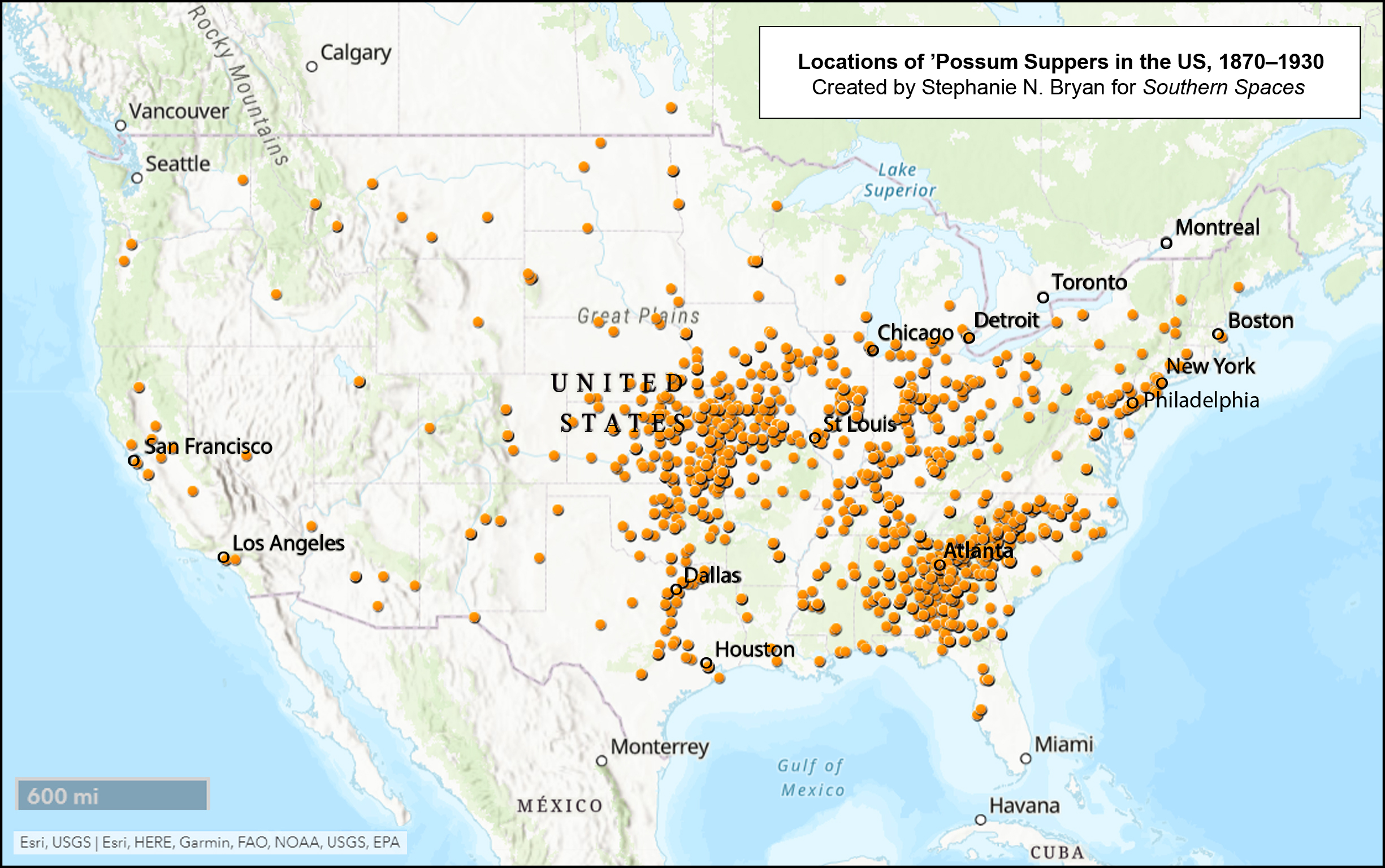
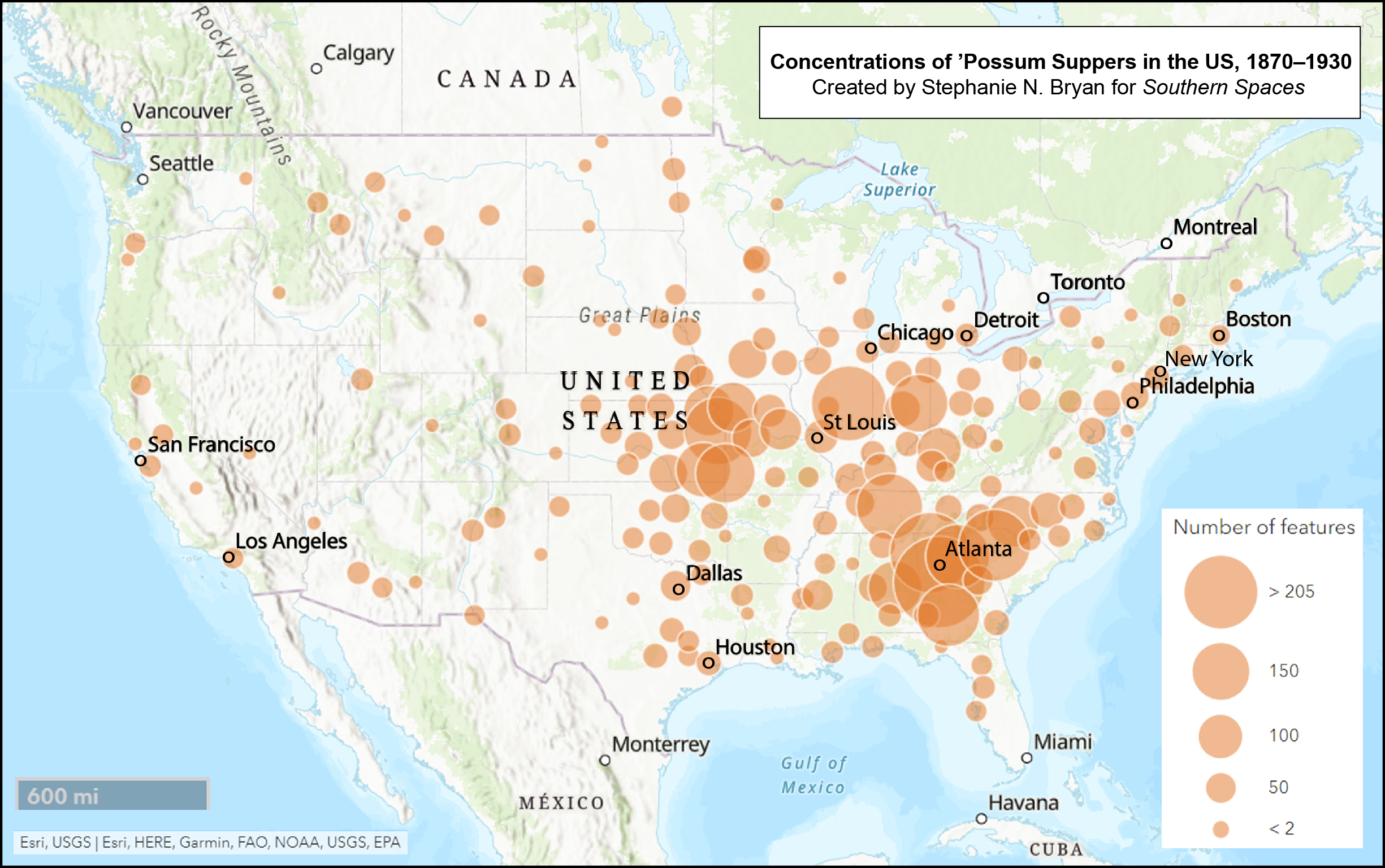
Opossum suppers became an important stage on which political actors could deploy new strategies and solidify networks of accomplices. Beginning in 1894, Colonel Harry Fisher—"railroad man, fertilizer magnate, friend of corporations"—commenced the political opossum suppers of Newnan, Georgia, to advance the Democratic ticket.77"Possum and Politicians: Many Invitations Have Been Sent Out to Newnan's Possum Supper," The Atlanta (GA) Constitution, Dec. 28, 1897, 5, https://chroniclingamerica.loc.gov/lccn/sn86063034/1897-12-28/ed-1/seq-2/. See also "Politicians to Eat 'Possum. The Supper at Newnan to Be a Unique Affair," The Morning News News (Savannah, GA), Dec. 28, 1897, 2, https://chroniclingamerica.loc.gov/lccn/sn86063034/1897-12-28/ed-1/seq-2/. Located about forty miles southwest of Atlanta where many in-state attendees traveled from, Newnan had escaped destruction during the Civil War. Its supper became an annual event, sending out over six hundred invitations "to men of prominence, both inside and outside" of the state. Politicians gathered in anticipation of the official Democratic convention and, while eating opossum, pre-determined the roster of officials for high-ranking positions.
It wasn't long before outside observers began to recognize that the political sway of the Newnan opossum suppers extended beyond southern states. On January 1, 1898, northern newspapers warned of sinister plans circulating "under the cover of savory vapors":
To these feasts are bidden men who have controlled the destinies of the State for years—shrewd politicians, who are anxious to strengthen their influence, statesmen, who gladly seize the opportunity to keep politically in touch with the elect of the State, and persons of a purely convivial nature, who are useful in lending an airy background to the political scheming which is bound to take place under the cover of savory vapors which ascend from the smoking 'possum.78"A 'Possum Supper," Baltimore (MD) Sun, Jan. 1, 1898, 1. For a similar version of this article, see "'Possum and 'Taters," The World (New York, NY), Jan. 1, 1898, 5.
Nearly a decade later, editor, politician, and defender of lynching John Temple Graves reminisced about Georgia's political "'possum regime," which had come to encompass the two-term governorships of Democrats William Y. Atkinson (1894–1898) and Joseph M. Terrell (1902–1907).79John Temple Graves, "The 'Possum Governors" of Georgia," reprinted from the New York American in The Herald and Advertiser (Newnan, GA), Jan. 15, 1909, 1, https://gahistoricnewspapers.galileo.usg.edu/lccn/sn89053456/1909-01-15/ed-1/seq-1/. Atkinson won by a narrow margin in 1894 against Populist candidate Judge James K. Hines and regained reelection in 1896 over another Populist candidate, Seaborn Wright.80James F. Cook, "William Yates Atkinson 1894–1898," The Governors of Georgia, 1754–2004, 3rd ed. (Macon, GA: Mercer University Press, 2005), 181–184. Benefiting from white terror, voter suppression, and fraud, Atkinson ended the threat Populists posed to Democrats in statewide elections.81The 1896 presidential election would further fracture the Populist party across the southern states. Some Populists who supported a fusion with Democrats nominated Tom Watson as the vice-presidential candidate alongside William Jennings Bryan for president. The Democratic National Convention also nominated Bryan, but with Democrat Arthur Sewall as his running mate, both of whom appeared on the Silver Party ticket. Conservative Democrats who disagreed with Bryan's stance on bimetallism and free silver abandoned the party to form the National Democratic Party and instead nominated Senator John Palmer along with his running-mate Simon Bolivar Buckner. With the country experiencing an ongoing economic depression under Democratic President Grover Cleveland, Republican presidential and vice-presidential nominees William McKinley and Garret Hobart, who stood for protectionism and the gold standard, defeated Bryan.
In his capacity of Speaker of the Georgia House of Representatives, Atkinson "had performed countless favors, helping many of his friends gain appointments as solicitors-general and judges of the circuit courts," explains historian Barton Shaw, adding that "Such men eagerly endorsed Atkinson's candidacy, and he also had support in Atlanta's traditional rivals, Augusta, Macon, and Columbus."82Barton C. Shaw, The Wool-Hat Boys: Georgia's Populist Party (Baton Rouge: Louisiana State University Press, 1984), 111. Through these favors, Atkinson "was able to depose the old Bourbon ring perfected by Henry Grady and the Triumvirate," while forging a new legislative ring.83Shaw, The Wool-Hat Boys, 126. His initial gubernatorial campaign against Confederate veteran General Clement Evans was a "coup d'état" that "allowed younger Democrats to take control of the party."84Shaw, The Wool-Hat Boys, 112.
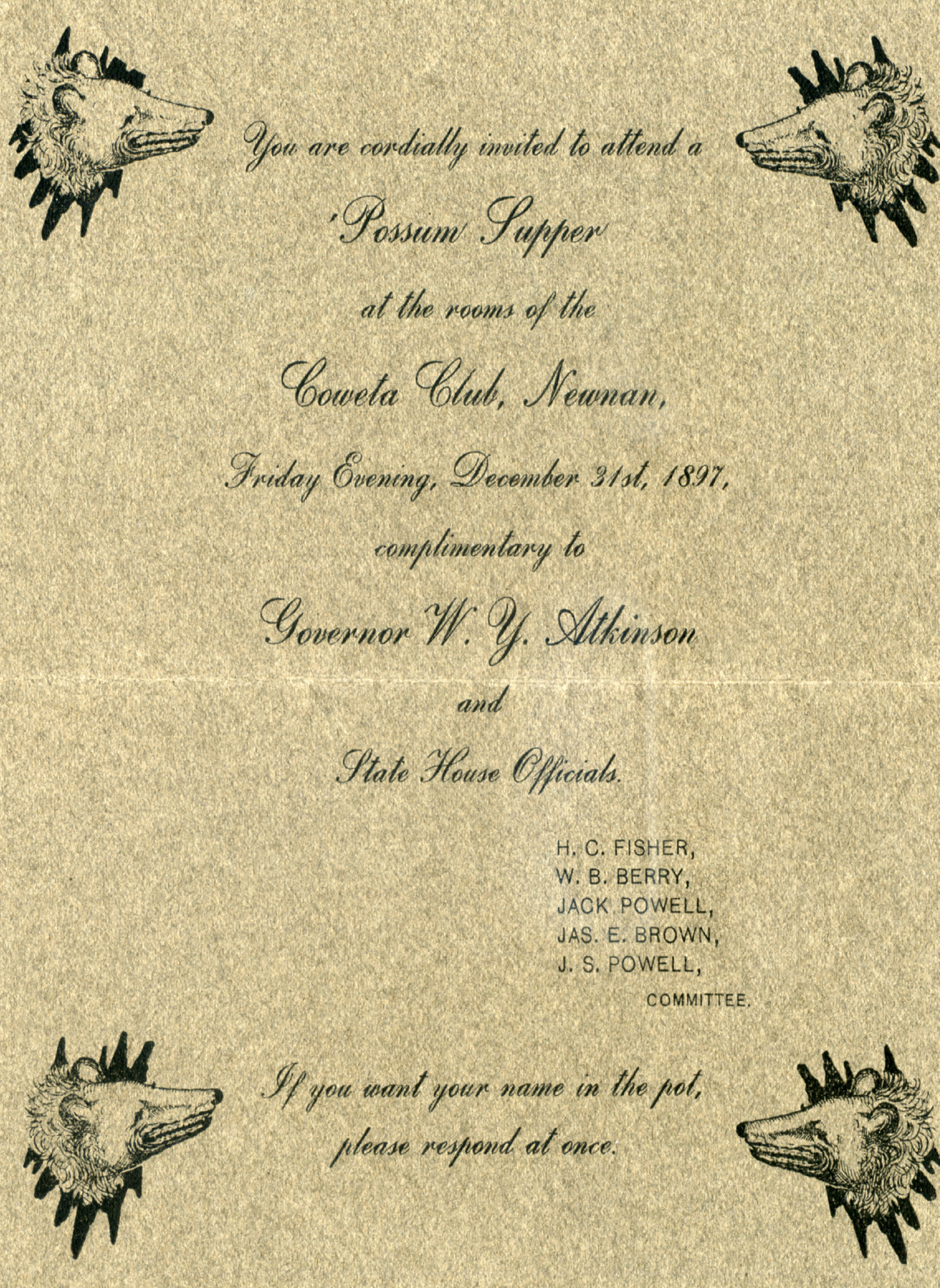
The complexity and behind-the-scenes maneuvering of numerous political factions during this period cast a cloud over why conservative Democrat Allen D. Candler (1898–1902) or Progressive Hoke Smith (1907–1909, 1911) were not considered part of the conspiracy, although it may relate to their efforts to restrict the power of the state railroad commission.85Cook, "Allen Daniel Candler 1898–1902," "Hoke Smith 1907–1909, 1911," Joseph Mackey Brown 1909–1911, 1912–1913," The Governors of Georgia, 185–188; 192–195. For more on Candler claiming to not be part of the "'possum regime" see "Candler on 'Possum Supper," Americus (GA) Times-Recorder, Jan. 14, 1898, 3, https://gahistoricnewspapers.galileo.usg.edu/lccn/sn89053207/1898-01-14/ed-1/seq-3/. Editor Graves offers some insight that Georgia's "'possum regime' was in large measure a railroad regime, and that under it corporations expect the fullness and the fatness which distinguished the adipose of the Georgia 'possum."86Graves, "The 'Possum Governors' of Georgia," https://gahistoricnewspapers.galileo.usg.edu/lccn/sn89053456/1909-01-15/ed-1/seq-1/. Accordingly, capital interests played an important role in the "booming" of certain politicians over others at events such as the Newnan opossum suppers. Barton Shaw explains the monetary benefits gained by those whom legislators appointed: "Solicitors were partly paid in fees, and citizens who could pay the highest price often found the state's charges against them dropped or at least reduced. Judges not only received handsome salaries, but were in excellent positions for advancement. The convict leaseholders always smiled upon those who helped keep up the supply of prisoners. With such support, many judges soon found themselves holding seats in Congress."87Shaw, The Wool-Hat Boys, 125.
The motives behind the Newnan opossum suppers were multifaceted, serving both the personal and collective interests of those in attendance. While they had a dominant Democratic component, occasional guests from other factions superficially presented images of reunion and reconciliation. Honorable George Peck of Chicago, a well-known railroad man who had served as a federal soldier, "referred to himself as the only yankee in the room" in a speech at the function on New Year's Eve 1897.88"'Possum Aftermath," The Atlanta (GA) Constitution, Jan. 2, 1898, 6. "A good deal of fun had been poked at him during the evening because of republicanism" and Confederate General Clement Evans, who attended the event, claimed to have made him "eat Georgia 'possum until he quit and surrendered and went over to the other side."89"Possum Aftermath;" "'Possum and Politics Wrestle for Supremacy Down at Newnan's Feast," The Atlanta (GA) Constitution, Jan. 1, 1898, 5. Although Atlanta Constitution columnist Bill Arp concluded after the event that "a politician will eat anything for office," eating opossum had developed a deeper meaning for prominent white men attending these events, signifying an economic and political alliance, as well as a racial one.90"'Possums and Politics," Watchman and Southron (Sumter, SC), Jan. 26, 1898, 2. "Bill Arp," was a pseudonym for politician Charles Henry Smith: https://evhsonline.org/bartow-history/people/charles-henry-smith-bill-arp-great-american-humorist-writer. Newspapers reported that the 1897 event included a diorama behind the toastmaster's chair comprised of a real persimmon tree, six live opossums, an actual baying opossum dog, and "old Uncle 'Cotton' See, an anxious-looking aged negro with white hair and a 'possum appetite in keeping with his surroundings" of white governors, secretaries of state, attorney generals, judges, and other high officials discussing politics over the feast.91"And Politics for Down at Newnan's Feast to the Governor," The Atlanta (GA) Constitution, Jan. 1, 1898, 5. This nostalgic scene provided a visual display of white power, delineating the rightful place of Blacks not as consumers of opossum, but as providers, cooks, and servers of it.
While Newnan's political opossum suppers were widely publicized in local and national newspapers, the public's attention soon shifted in 1899 to the horrific mob lynching of Sam Hose—a Black man who was bound, tortured, castrated, and set on fire in front of more than four thousand spectators.92For a detailed analysis of this event, see Edwin T. Arnold, What Virtue There Is in Fire: Cultural Memory and the Lynching of Sam Hose (Athens: University of Georgia Press, 2012). Chicago detective Louis P. Le Vin, whom activist Ida B. Wells-Barnett hired to investigate the lynching, concluded, "The real purpose of these savage demonstrations is to teach the Negro that in the South he has no rights that the law will enforce. Samuel Hose was burned to teach the Negroes that no matter what a white man does to them, they must not resist."93Ida B. Wells-Barnett, "Lynch Law in Georgia," (Chicago, IL: Chicago Colored Citizens, 1899), https://www.loc.gov/resource/lcrbmrp.t1612/?st=text&r=0.267,0.55,0.665,0.719,0. William Atkinson, who had moved to Coweta County to practice law following his second term as governor, spoke out to the mob from the city jail in an unsuccessful attempt to prevent Hose's lynching. 94For more on Atkinson's actions and possible motives, see Arnold, What Virtue There Is in Fire, 98–102. As governor, Atkinson had tried on numerous occasions to get the General Assembly to pass his anti-lynching bills. Because he vehemently opposed the lawlessness of mobs and proposed other solutions such as public executions, the anti-lynching stance of Atkinson and other Democrats cannot be equated with racial justice.95Arnold, What Virtue There Is in Fire, 99–100. The Sam Hose lynching led a writer from Thomasville, located near the state's southern border, to comment that Newnan's "reputation no longer rests on possum suppers."96The Daily-Times Enterprise (Thomasville, GA), May 9, 1899, 2, https://gahistoricnewspapers.galileo.usg.edu/lccn/sn88054087/1899-05-09/ed-1/seq-2/. Yet, to some extent the town's reputation did continue to rest on its opossum suppers as the political scheming that occurred at them played a role in the election of governors and other influential white men who disenfranchised Black citizens and worked to maintain the state's Democratic stranglehold.
Symbolic Separations and the Taft Banquet in Atlanta
If white Democrats were responsible for the publicized and politicized opossum suppers in southern states such as Georgia, Blacks gained attention for hosting their own events in other parts of the country.97For several examples of newspaper accounts highlighting these events, see "New Year Festivities at Crowe's Hall," Alton (IL) Evening Telegraph, Jan. 3, 1894, 9; "Lovers of 'Possums: Indianapolis Epicures Who Fancy the Toothsome Dish," The Indianapolis (IN) Journal, Part Two, Dec. 28, 1902, https://chroniclingamerica.loc.gov/lccn/sn82015679/1902-12-28/ed-1/seq-13/; "Oh, Carve Dat 'Possum: First Annual Banquet of 'Possum Club a Splendid Success," Durant Weekly News (Choctaw Nation, Indian Territory, OK), Dec. 8, 1905, 2, https://chroniclingamerica.loc.gov/lccn/sn82015679/1902-12-28/ed-1/seq-13/; "Happenings Condensed," Palestine (TX) Daily Herald, Nov. 29, 1905, 2, https://chroniclingamerica.loc.gov/lccn/sn86090383/1905-11-29/ed-1/seq-2/; "Local Briefs," Deseret Evening News (Great Salt Lake City, UT), Feb. 18, 1902, 8, https://chroniclingamerica.loc.gov/lccn/sn83045555/1902-02-18/ed-1/seq-8/; "Another 'Possum Supper," Morning World Herald (Omaha, NE), Nov. 18, 1902, 2; "That 'Possum Supper," The Anaconda (MT) Standard, Dec. 31, 1901, 9; "A Possum Supper," Grand Forks (ND) Daily Herald, Jan. 9, 1903, 4; "'Possum Supper with Hoe Cake Trimmin's; Janitor Duncan and His Colored Friends are Preparing a Big Treat for Office Holders and Others," Colorado Springs (CO) Gazette, Dec. 9, 1903, 3. Migrating Black populations continued to host opossum suppers in northern and western states, keeping the tradition popular into the early twentieth century. No doubt these individuals were aware of the strong association that opossum suppers had developed among southern Democrats, as well as the longstanding stereotypes aimed at destroying the personal and collective power of Blacks. Their actions can be understood as what Psyche Williams-Forson describes—in the case of Black women redefining fried chicken—as a refusal "to allow the wider American culture to dictate what represents their expressive culture and thereby what represents blackness."98Williams-Forson, "More than Just a 'Big Piece of Chicken'," 107–118, 343.
In 1901, Alfred King held an opossum supper at his Illinois home for the white members with whom he had served on a grand jury, along with other guests including the state attorney, sheriff, circuit clerk, and chief of police. "This is the first time," King announced, "that a grand jury in Macon county ever dined with a colored man, but the world do[es] move," indicating a shift in race relations.99"'Possum Supper. First Grand Jury to Dine with Colored Man," The Daily Review (Decatur, IL), Nov. 22, 1901. The elaborate menu—which included a course of oyster soup with celery and crackers, as well as main dishes of roasted turkey, baked opossum, mashed and sweet potatoes, corn, slaw, cranberries, white and corn bread, in addition to lemon and pumpkin pie, various fruits, ice cream and cake, and coffee for dessert—was not unlike that of an opossum banquet hosted by southern white Democrats.100"'Possum Supper," The Daily Review (Decatur, IL), Nov. 22, 1901.
A few years later, in 1903, ex-slave Jefferson Logan, who worked in the Senate cloakroom, was planning his nineteenth annual opossum supper in Iowa to which he invited Republican state officials and politicians. Described as "a wealthy leader of the colored population," newspapers noted that Logan generally secured "a good position each legislative session through his pull with the politicians."101"Possum Supper and Politics," Omaha (NE) Daily Bee, Dec. 2, 1903, 6, https://chroniclingamerica.loc.gov/lccn/sn99021999/1903-12-02/ed-1/seq-6/; see also, "Jeff Logan and 'Possum Dinner," The Minneapolis (MN) Journal, Nov. 16, 1901, 18, https://chroniclingamerica.loc.gov/lccn/sn83045366/1901-11-16/ed-1/seq-19/; "'Possum Supper a Great Success," The Des Moines (IA) Register, Dec. 6, 1902, 7. By 1907, the Adams County Free Press of Corning, Iowa, claimed, "What the banquets of the Gridiron club is [sic] to Washington the 'possum suppers of the Jeff Logan lodge are to Iowa's capital."102"Big Guns at 'Possum Feast," Adams County Free Press (Corning, IA), Dec. 25, 1907, 1. Founded in 1885, the Gridiron Club of Washington, DC, is a prestigious journalistic organization that holds annual dinners in which the president of the United States is generally in attendance. The dinners have gained criticism since they bring journalists close together with the political officials they cover in their news stories.
African Americans such as Jeff Logan, Alfred King, and others refused to relinquish opossum consumption to the purview of whites. In "Possum," Black poet Paul Laurence Dunbar plays upon the beliefs that African Americans possess a folk knowledge of preparing opossums, while drawing humor from the inherent lack of knowledge of whites. Dunbar uses "negro dialect"—a poetic genre103For a deeper discussion of Dunbar's poetry, see, Michael Cohen, "Paul Laurence Dunbar and the Genres of Dialect," African American Review 41, no. 2 (2007): 247–257. that appealed to literate, middle-class whites—to express his frustration and anger toward their ignorance:
Ef dey's anyt'ing dat riles me
An' jes' gits me out o' hitch,
Twell I want to tek my coat off,
So 's to r'ar an' t'ar an' pitch,
Hit 's to see some ign'ant white man
'Mittin' dat owdacious sin—
W'en he want to cook a possum
Tekin' off de possum's skin.104Paul Laurence Dunbar, Lyrics of the Hearthside (New York: Dodd, Mead and Company, 1899), 163–164, https://archive.org/details/lyricsofhearthsi00dunb/page/162/mode/2up.
If Blacks vied to maintain a symbolic separation between Black and white opossum consumption, so, too, did whites in their repeated assertions that it was the job of people of African descent to provide, cook, and serve them opossum.
By the time Taft came to Atlanta in 1909, white opossum suppers strongly leaned on the figure of the faithful Black servant who dutifully captured and delightfully prepared the animal for white consumers.105For more information on the faithful Black servant trope, see Micki McElya, Clinging to Mammy: The Faithful Slave in Twentieth-Century America (Cambridge, MA: Harvard University Press, 2007). Early twentieth-century newspapers occasionally published obituaries that figured into the faithful Black servant trope. For example, an obituary for Sam Coleman of Americus, Georgia, who was to be "buried by his white friends," highlighted his "reputation as an excellent cook," who had "for perhaps twenty years [. . .] cooked barbecue dinners and possum suppers for local epicures." "A Famous Old Cook Expires. The Long Time Cook of the Cue Club is No More," Americus (GA) Times-Recorder, July 8, 1902, 3. Writers for white newspapers were keenly aware of the racial power exuded through depictions of subservient Black labor in opossum suppers. Atlanta Constitution correspondent H.T. McIntosh reported on the "strenuous 'possum-catching campaign" in Worth County to secure a hundred of the animals for the banquet, which entailed a score of Black hunters overseen by Judge Frank Park.106H.T. McIntosh, "Worth County 'Possum Mad," The Atlanta (GA) Constitution, January 9, 1909, 1, 5. Northern newspapers added to the image by relaying that "old Uncle Levi and two mammies" sent by Park to Atlanta were busy slaughtering and preparing the game. And at the banquet, Rev. Dr. J.W. Lee sang the minstrel song "Carve Him to de Heart" while two Black male waiters served opossum to the president-elect.107"Taft Feasts on Possum and the South Gets Promise of Better Things," Sun (New York, NY), Jan. 16, 1909, 1, https://chroniclingamerica.loc.gov/lccn/sn83030272/1909-01-16/ed-1/seq-1/; "South to Gain," Washington (DC) Herald, Jan. 16, 1909, 1. In order to provide Taft "insight of what the south was before the war," the entire event depended on Black labor.108"Banquet to Judge Taft Marks a Social Epoch in Atlanta's History," The Atlanta (GA) Constitution, Jan. 16, 1909, 1.
Given the popularity of southern Democratic opossum suppers, Taft knew his actions conveyed racially coded political and economic messages. "Southerners are traditionally partial to this dish," explained a Texas reporter, adding that Taft's request to attend an opossum feast "further endeared himself to the people of this section."109"Plenty of 'Possums," Bryan (TX) Morning Eagle, Jan. 2, 1909, 1. Eating or even just tasting opossum, however, was more than an act of endearment; it provided a way for Taft to become "southern" by performing in a display of white supremacy tied to an imagined antebellum culture. This invented tradition encompassed much more than Black servants catching, preparing, and serving hundreds of opossums to prominent white men at the banquet. Because the menu included numerous, heavy courses that would have required several hours to complete, it is unlikely that Taft or other diners consumed much, if any, of the opossum meat on their plates.110Daniel Frank, "Taft Ate Possum in City Auditorium," The Atlanta (GA) Journal and the Atlanta Constitution, Dec. 2, 1956, 1C. Decades later, columnist Daniel Frank explained that "onlookers noticed that Taft took one taste, and only one taste" of the barbecued opossum set before him at the 1909 banquet. "Waste was part of the point," writes food historian Helen Zoe Veit. "Perhaps nowhere more nakedly than at a banquet did wealthy Americans in the Gilded Age show off their ability to command resources for their own and their guests' pleasure, to select only the very choicest morsels from a choice dish, and to leave most of the carefully prepared, expensive food for the slop bucket or the servants."111Helen Zoe Veit, Food in the American Guilded Age (East Lansing: Michigan State University Press, 2017), 196. Yet, in the case of the opossum, throwing away a food that had been critical to Black survival before and after slavery conveyed a socioeconomic message and a racial one.

Similar to the opossum suppers of Newnan that had begun decades earlier, the 1909 Atlanta event presented images of reunion and reconciliation. "It is beautifully emblematic of the fading away of sectionalism and the bitterness of the civil war, this spectacle of a northern Republicant-elect [sic] beaming over relays of ''possum and 'taters' in his march through Georgia," oozed a writer from Wisconsin.112"South Should Let Up," Topeka (KS) State Journal, Jan. 19, 1909, 4, https://chroniclingamerica.loc.gov/lccn/sn82016014/1909-01-19/ed-1/seq-4/. The dish, along with its accompaniment of persimmon beer, garnered a great deal of local and national attention in the weeks and days leading up to the Atlanta event. While the opossum was closely tied to sectional identity, other items on the menu carried different messages associated with Taft's agenda and with white prejudices. "Clear-Green Turtle [soup] a la Panama" correlated to a part in Taft's speech where he emphasized the future commercial benefits that the canal offered to southern states. "Filipino Ice Cream," on the other hand, gestured toward Taft's stance on race relations, given that throughout his tour Taft had often linked Filipinos and African Americans as inferior people dependent on whites for improvement.113"Taft Eats 'Possum, Gives South Pledge"; Edward Frantz, "Goin' Dixie: Republican Presidential Tours of the South, 1877–1933," (PhD diss., University of Wisconsin-Madison, 2002), 305; Needham, "William Howard Taft, The Negro, and the White South, 1908–1912," 63.
The banquet menu required careful tailoring. So did Taft's speech. To his white male Atlanta audience, Taft pledged, "I shall become the president, not of a party, but of a whole united people," reinforcing his aim to solidify white northerners and southerners.114"How New York Papers View 'Possum Banquet," The Atlanta (GA) Constitution, Jan. 18, 1909, 2. Some questioned Taft's motives, with South Carolina Senator Benjamin Tillman warning in August 1909 that "southerners should beware of Taft spreading molasses to give 'hungry office-seekers an excuse for deserting the democratic party. . . .'"115Needham, "William Howard Taft, The Negro, and the White South, 1908–1912," 96. Yet, Taft's participation in the banquet was a signal of his tolerance—and tacit support—of the Jim Crow laws enacted to maintain social control. Several months after the Atlanta event, Taft would address another white audience at a banquet in Birmingham, Alabama, claiming that he "would not have the South give up a single one of her noble traditions."116William Howard Taft, "Speech at the Chamber of Commerce Banquet, Birmingham, Ala. (November 2, 1909)," Presidential Addresses and State Papers (New York: Doubleday, Page & Company, 1910), 402, https://archive.org/details/presidentialaddr00unit/page/402/mode/2up?view=theater&q=traditions. Taft would prove to be a consistent ally of conservative whites, giving them a free hand, enabling "a moratorium on all African American appointees throughout not only the South, but also the North" and thereby transitioning "into a new, even more lily-white era" for Republicans.117Frantz, "Goin' Dixie," 314; 317. As historian David Needham explains, "probably the most visable [sic] effort by Taft toward wooing white southerners was his appointment of independent Democrats to high federal positions" and elimination of Black governmental involvement.118Needham, "William Howard Taft, The Negro, and the White South, 1908–1912," 118.
While the opossum "topped the pinnacle of fame [. . .] basking in the sunlight of a nation's tender interest" after the Atlanta banquet, other working-class and stereotypically African American foods had the potential to further convey Taft's political stance in other states.119"Is Champagne Better to Wash Down 'Possum Than Persimmon Beer?," The Atlanta (GA) Constitution, Jan. 4 1909, 5. In looking ahead to Taft's stop in New Orleans, the Grant Parish Democrat suggested that Taft should eat alligator steak, "a great dish among the darkeys" in order "to remain on good terms with Louisiana Republicans."120"Alligator Steak," The Caucasian (Shreveport, LA), Feb. 7, 1909, https://chroniclingamerica.loc.gov/lccn/sn88064469/1909-02-07/ed-1/seq-8/. Subsequently, the Charlotte Observer called for Taft "to stop off in North Carolina and partake in a supper of Chatham County rabbits," which "would doubtless compare favorably with the alligator steak."121The Caucasian (Clinton, NC), Feb. 18, 1909, 1. With these foods "in his system," one newspaper editor remarked: "Mr. Taft may become practically Southern, instead of the visionary theorist that he is, particularly in connection with the negro and the Republicanizing of any of the States [. . .]."122"Alligator Steak," https://chroniclingamerica.loc.gov/lccn/sn88064469/1909-02-07/ed-1/seq-8/.
Conclusion
Taft's 1909 Atlanta banquet marked the opossum's peak as a symbol of white supremacy and sectional reconciliation. After Democrats regained their political power and fully achieved Black disenfranchisement, opossum suppers diminished in popularity and, with some exceptions,123For example, the Atlanta Association of Building Owners and Managers hosted an opossum supper for Franklin D. Roosevelt, then Governor of New York, during his visit to White Sulphur Springs, Georgia, in 1930. "Roosevelt Eats and Hunts 'Possum as Georgia Guest: Partakes of Primitive Meal in Role of Adopted Son," New York Herald Tribune, Nov. 30, 1930, 11. its ties with Confederate nostalgia and Jim Crow politics faded from memory. Writing in 1916, the editor of the Jackson News in Mississippi revisited the lore surrounding the opossum, as well as the racist stereotypes:
We feel that it is a duty to shatter one of those long-cherished delusions concerning 'possums and sweet taters' as a typical Southern dish . . . . It is true that Southern homes, instinctively hospitable and willing to feed the stranger within its gates after his own heart rather than the local notion of the eternal fitness of things, serve 'possum, but generally with a silent protest that politeness alone prevents making manifest. [. . .] The dark and dismal truth is that 'possum is an all but impossible diet . . . . Possum is so largely a matter of excessive and not too fragrant fat that even Sambo, despite his reputation for never having had enough, has been known to grow tired of the same and pass it up for boiled cabbage and turnips.124Quoted in "Shattering Illusions," Gulfport (MS) Daily Herald, Nov. 29, 1916, 2.
After Reconstruction, white Democrats from Georgia had taken the lead in reinventing opossum culinary culture, once strongly associated with African American autonomy and survivance, and claimed it as their own rightful inheritance. This entailed mocking and deriding African American opossum consumption as indicative of inherently inferior racial traits. White obsessions with Black opossum consumption transformed hunting and eating the native marsupial into a nostalgic Lost Cause celebration of a supposed common culture that former enslavers claimed to share with enslaved people of African descent in the antebellum era. Since the making of a plantation imaginary filled with unforgettable opossum hunts and faithful house servants who knew the art of slaughtering, cleaning, and roasting the creature added to the dish's appeal, whites of all classes partook of opossum in part because of its association with idealized former times, remaking it, for a brief present time, into a powerful cultural symbol of Black subordination and white power.
About the Author
Stephanie N. Bryan is a PhD candidate in the history department at Emory University. She holds a Master's in Landscape Architecture from the University of Georgia, with an emphasis on historic cultural landscape management. Her dissertation examines the ways in which marginalized plant and animal species indigenous to the southeastern US—such as opossums, persimmons, muscadines, and pokeweed—survived and sometimes thrived amid destructive land use and entered into diets, cultures, economies, and politics. An earlier version of the article was “highly commended” for the 2019 Sophie Coe Prize.
]]>An Excerpt from the Introduction

Throughout the nineteenth century, aided by railroads and steam technologies, industrial plantations expanded their footprint into ever new territories across Latin America. The timing was unique: the process occurred right as enslavement, the foundation of these enterprises, was being subjected to unprecedented challenges—from proliferating slave insurgencies to vocal liberal-abolitionist mobilization. But along industrial plantations' margins, vast and socially vibrant free rural communities of African descent made homes for themselves against many odds. Unearthing their worlds sheds light on a distinct history of emancipation that did not fully align with liberalism's trajectory, pushing us to move away from the teleological notion that modern political behaviors within Latin America were variations on their European or North American counterparts.
Across Latin America, Afro-descendant peasants took manifold paths to reach rural worlds of freedom. Some were fugitives from plantation slavery. Others had purchased their freedom in cash or through some form of service-based payments. In places like Santiago, the far eastern province of the Spanish colony of Cuba—the region which this book focuses on—many were only partially free. They had paid a portion of the price for their manumission while continuing to do some work for enslavers. Many of the free people of African descent in these kinds of communities formed families with poor white peasants living nearby. In spite of their differences and internal hierarchies, most such peasantries contended with the same looming threat: ever-expanding planter power and aspirations. As they creatively withstood or moved out of the plantations' way, they opened up and cultivated new land in forest thickets, occupying rugged landscapes traversed by unkempt dirt roads, far from major commercial centers. They bartered and sold the surplus they made in small regional markets and, on occasion, also purchased enslaved people. Their lives were not circumscribed by the plantation's logics, nor by a rigid Black/white divide, even though they contended with both of these forces.
Throughout the nineteenth century, industrial sugar production in Cuba remained centered in the west-central parts of the island, leaving Santiago, home to some relatively small and economically anemic coffee plantations, in a sort of marginal space. Santiago was close enough to be subjected to some of the same policies as the plantation-dominated regions, but far enough to escape many of the socioracial logics that defined sugar plantation communities. These kinds of peripheral communities of free people of African descent, living in the shadows of the plantation (or other regimes of intense slavery-based extraction), could be found, beyond eastern Cuba, throughout Latin America, including rural parts of Puerto Rico, the Dominican Republic, the Pacific lowlands of Colombia, parts of Brazilian Amazonia, and peripheries of the coffee belt in the Brazilian southeast.1Anne Eller, We Dream Together: Dominican Independence, Haiti, and the Fight for Caribbean Freedom (Durham, NC: Duke University Press, 2016); Claudia Leal, Landscapes of Freedom: Building a Postemancipation Society in the Rainforests of Western Colombia (Tucson: University of Arizona Press, 2018); Oscar de la Torre, The People of the River: Nature and Identity in Black Amazonia, 1835–1945 (Chapel Hill: University of North Carolina Press, 2018); Rosa Carasquillo, Our Landless Patria: Marginal Citizenship and Race in Caguas, Puerto Rico, 1880–1910 (Lincoln: University of Nebraska Press, 2006), chapter 1; Lowell Gudmundson and Justin Wolfe, eds., Blacks and Blackness in Central America: Between Race and Place (Durham, NC: Duke University Press, 2010); Hebe Maria Mattos, Das cores do silêncio: os significados da liberdade no sudeste escravista, Brasil século XIX, 3rd ed. (Campinas, Brazil, 2013 [1995]). For work that shows how access to legal process could be limited in some such areas, see Yesenia Barragan, Freedom's Captives: Slavery and Gradual Emancipation on the Colombian Black Pacific (Cambridge: Cambridge University Press, 2021) and "Commerce in Children: Slavery, Gradual Emancipation, and the Free Womb Trade in Colombia," The Americas 78.2 (2021): 229–257. Historians have used the notion of "the peasant breach" to capture the emergence of a class of free rural cultivators out of slavery with relatively ambiguous land ownership rights. This book builds and expands on this work by focusing on the legal dynamics within such peasant communities. Among others, Ciro Flamarion Cardoso, "The Peasant Breach in the Slave System: New Developments in Brazil," Luso-Brazilian Review 25.1 (1988): 49–57; Flavio dos Santos Gomes and João José Reis, eds., Freedom by a Thread: The History of Quilombos in Brazil (New York: Diasporic Africa Press, 2016); Sidney Mintz, Caribbean Transformations (Chicago: Aldine Publishers, 1974), part II, 180–213, and "Slavery and the Rise of Peasantries," Historical Reflections 6 (1979): 213–242; Ira Berlin and Philip Morgan, eds., The Slaves' Economy: Independent Production by Slaves in the Americas (London: Routledge, 2016 [1995]); Stuart Schwartz, Slaves, Peasants, and Rebels: Reconsidering Brazilian Slavery (Urbana: University of Illinois Press, 1992), chapters 2 and 3; David Wheat, Atlantic Africa and the Spanish Caribbean, 1570–1640 (Chapel Hill: University of North Carolina Press, 2016), chapter 5. On the United States and with a focus on legal consciousness as well, Dylan Penningroth, The Claims of Kinfolk: African American Property and Community in the Nineteenth-Century South (Chapel Hill: University of North Carolina Press, 2003).

Looking at a community such as Santiago shows that the plantation was not the only space that defined the Black experience in the Americas. It also helps bring to light other homes for Black freedom beyond well-studied Atlantic port cities.2On Cuba as an island with two histories, one around plantations and another one, beyond, Juan Pérez de la Riva, El barracón: esclavitud y capitalismo en Cuba (Barcelona: Editorial Crítica, 1978), 169–179. This model, however, assumes that there was only one alternative to sugar—one based on livestock production. On a region of Cuba centered on tobacco, in Vuelta Abajo, see William A. Morgan, "Opportunities and Boundaries for Slave Family Formation: Tobacco Labor and Demography in Pinar del Río, Cuba, 1817–1886," CLAR 29.1 (2020): 139–160. A reflexive piece that considers how sugar's ascent has shaped history writing within Cuba, with most categories of analysis emerging out of the study of sugar plantations, is Alejandro de la Fuente, "Apuntes sobre la historiografía de la segunda mitad del siglo XVI cubano," Santiago 71 (1988): 59–118. On the importance of local/regional history and on the impossibility of subsuming Santiago's trajectory to that of sugar planting and of Havana, see Julio LeRiverend, "De la historia provincial y local en sus relaciones con la historia general de Cuba," Santiago 46 (1982): 121–136. The historiography on urban free populations of color is vast. A sample that captures the breadth of this field appears in Jorge Cañizares-Esguerra, Matt Childs, and James Sidbury, eds., The Black Urban Atlantic in the Age of the Slave Trade (Philadelphia: University of Pennsylvania Press, 2013); Whitney Nell Stuart and John Garrison Marks, eds., Race and Nation in the Age of Emancipations (Athens: University of Georgia Press, 2018); special issue "Urban Slavery in the Age of Abolition," ed. Karwan Fatah-Black, IRSH 65 (2020). The inner workings of such rural worlds during the nineteenth century also suggest that attention to liberal abolitionism, nation-centered emancipation and citizenship struggles, or Atlantic abolitionist circulations leaves out another, perhaps less spectacular history of freedom whose protagonists were families, women, and children of African descent who stayed in place and forged locally focused communities. In these corners of Latin America, the nineteenth century was a time of freedom through custom. Here, people operated in a locally grounded legal sphere that consisted of orally negotiated rights, obligations, and social expectations that had the thinnest foundations in written (positive) law. Custom belonged to community justice; its versatility blurred the boundaries between formal and informal law, between legal experts and ordinary litigants, between courts, the governor's office, and hamlets tucked away in forest thickets in the interior. Its logics defied the notion that individuals were entitled to certain rights for life and could carry them across contexts. Instead, within custom-dominated worlds, legal prerogatives were distributed with an eye to local political hierarchies, economic conditions, and reputations. They could be suspended and reassigned.
In the Age of Emancipation, in places like Santiago, free or semi-free Afro-descendant peasantries led a political revolution through custom-centered community justice that remained barely visible to the authorities at the time and, in the long term, even to historians. These peasants did not rely primarily on liberal ideologies of universal freedom, individual autonomy, or notions of inclusive citizenship within national republics, even though on occasion they did invoke them. They did not wait for liberal-nationalist elites to form coalitions with them and to decree freedom from above. Instead, inside courts of law, they usually sought relief in the custom-centered colonial legal framework. In Santiago, these popular legal practices began as far back as the sixteenth century, but became especially active during the nineteenth century, when, for a range of political and economic reasons, manumission rates increased. Day in and day out, enslaved people chipped away at enslavers' authority locally, by negotiating the terms of their manumission and land access. They pulled one another out of plantation slavery gradually, yet consistently, forging communities whose members also played an important role inside courts of law as witnesses, advocates, or bystanders when conflicts arose. Within rural spaces like Santiago that were marked by relative underdevelopment, Afro-descendant peasants creatively defined manumission-based freedoms piece by piece through mundane social practices that had little grounding in positive law, were orally negotiated, and were recognized by local governors and courts of justice. These freedoms were patchwork, often incomplete when measured against liberal-abolitionist yardsticks, precarious, and even reversible. Yet they were very concrete, and in the long term, they served to corrode the legal structures of plantation slavery locally.
In Santiago's musty rooms and busy antechambers, as elsewhere in Latin America, magistrates and litigants puzzled out enslaved people's rights of access to autonomy, property, and family, case by case. Would a woman who had purchased her freedom while pregnant give birth to an enslaved or to a free child? Could enslaved people who had paid half the price of their freedom spend the night with kin living on other properties? To whom did a pig truly belong, the enslaver on whose estate it roamed, or the enslaved who had purchased it with her savings and had tended to it? Could enslaved and free people of color occupy fallow land inside private estates? In Santiago, such claims were not apparently too small to be assessed and extensively documented by local scribes, notaries, and other legal officers. The freedom that such adjudications yielded had a plurality of meanings, some of them contradictory and akin to subordination and dependence. Scholars of the early modern Atlantic world have shown that vernacular understandings of freedom were highly diverse in social practice, going beyond abstract written definitions embedded in legislation.3On manumission-based Black freedom, among others, Erica Ball, Tatiana Seijas, and Terri Snyder, eds., As If She Were Free: A Collective Biography of Women and Emancipation in the Americas (New York: Cambridge University Press, 2020); Mariana Dantas, Black Townsmen: Urban Slavery and Freedom in the Eighteenth-Century Americas (London: Palgrave, 2008); Mariana Dantas and Douglas Libby, "Families, Manumission, and Freed People in Urban Minas Gerais in the Era of Atlantic Abolitionism," IRSH 65 (2020): 117–144; Erika Denise Edwards, Hiding in Plain Sight: Black Women, the Law, and the Making of a White Argentine Republic (Tuscaloosa: University of Alabama Press, 2020); Zephyr Frank, Dutra's World: Wealth and Family in Nineteenth-Century Rio de Janeiro (Albuquerque: University of New Mexico Press, 2004); Oilda Hevia Lanier and Daisy Rubiera Castillo, Emergiendo del silencio: mujeres negras en la historia de Cuba (Havana: Editorial de Ciencias Sociales, 2016); Lyman Johnson, "Manumission in Colonial Buenos Aires, 1776–1810," HAHR (1979): 258–279; Michelle McKinley, Fractional Freedoms: Slavery, Intimacy, and Legal Mobilization in Colonial Lima, h600–h700 (New York: Cambridge University Press, 2016); Aisnara Perera and María de los Angeles Meriño Fuentes, Para librarse de lazos, antes buena familia que buenos brazos: apuntes sobre la manumisión en Cuba (Santiago: Editorial Oriente, 2009). Beyond the Iberian Atlantic, among others, Randy Sparks and Rosemary Brana-Shute, eds., Paths to Freedom: Manumission in the Atlantic World (Charleston: University of South Carolina Press, 2009); Jessica Marie Johnson, Wicked Flesh: Black Women, Intimacy, and Freedom in the Atlantic World (Philadelphia: University of Pennsylvania Press, 2020); Bernard Moitt, Women and Slavery in the French Antilles, 1635–1848 (Bloomington: Indiana University Press, 2001); Judith Shafer, Becoming Free, Remaining Free: Manumission and Enslavement in New Orleans, 1846–1862 (Baton Rouge: Louisiana State University Press, 2003) Within Spanish America, such pluralism did not operate in parallel or at odds with the law; it was part of custom and as such ensconced in the law.4Scholars of law and slavery in American slave societies have emphasized the importance of considering law broadly, beyond the written, to include litigation and petitioning of higher authorities. Such an approach makes visible the participation of subaltern groups in the legal system as well as the plurality of their understandings of law and freedom. This literature is vast. Among others, focusing on Latin America, Manuel Barcia, "'Fighting with the Enemy's Weapons: The Usage of the Colonial Legal Framework by Nineteenth-Century Cuban Slaves,'" Atlantic Studies 3.2 (2006): 159–181; Herman Bennett, Africans in Colonial Mexico: Absolutism, Christianity, and Afro-Creole Consciousness, 1570–1640 (Bloomington: Indiana University Press, 2003); Sherwin Bryant, "Enslaved Rebels, Fugitives, and Litigants: The Resistance Continuum in Colonial Quito," CLAR 13 (2004): 7–46; Camillia Cowling, Conceiving Freedom: Women of Color, Gender, and the Abolition of Slavery in Havana and Rio de Janeiro (Chapel Hill: University of North Carolina Press, 2013); Alejandro de la Fuente and Ariela Gross, Becoming Free, Becoming Black: Race, Freedom, and Law in Cuba, Virginia, and Louisiana (New York: Cambridge University Press, 2020); Keila Grinberg, "Freedom Suits and Civil Law in Brazil and the United States," Slavery & Abolition 22.3 (2001): 66–82; Chloe Ireton, "Black Africans and Freedom Litigation Suits to Define Just War and Just Slavery in the Early Spanish Empire," Renaissance Quarterly 73 (2020): 1–43; McKinley, Fractional Freedoms; Brian Owensby, "How Juan and Leonor Won Their Freedom: Litigation and Liberty in Seventeenth-Century Mexico," HAHR 85 (2005): 39–79; Aisnara Perera Díaz and María de los Ángeles Meriño Fuentes, Estrategias de libertad: un acercamiento a las acciones legales de los esclavos en Cuba (Havana: Editorial de Ciencias Sociales, 2015), 2 vols.; Bianca Premo, The Enlightenment on Trial: Ordinary Litigants and Colonialism in the Spanish Empire (New York: Oxford University Press, 2017) and Children of the Father King: Youth, Authority, and Legal Minority in Colonial Lima (Chapel Hill: University of North Carolina Press, 2005); Frank Proctor III, "Damned Notions of Liberty": Slavery, Culture, and Power in Colonial Mexico, 1640–1769 (Albuquerque: University of New Mexico Press, 2011); Rebecca Scott and Carlos Venegas, "María Coleta and the Capuchin Friar: Slavery, Salvation, and the Adjudication of Status," WMQ 76.4 (2019): 727–762; Aurora Vergara Figueroa and Carmen Luz Cosme, Demando mi libertad: mujeres negras y sus estrategias de resistencia en la Nueva Granada, Venezuela y Cuba, 1700–1800 (Cali, Colombia: Editorial Universidad Icesi, 2018). Beyond Latin America, Mariana Candido, "African Freedom Suits and Portuguese Vassal Status: Legal Mechanisms for Fighting Enslavement in Benguela, Angola, 1800–1830," Slavery & Abolition 32.3 (2011): 447–459; Roquinaldo Ferreira, Cross-Cultural Exchange in the Atlantic World (New York: Cambridge University Press, 2014), chapter 3; Ariela Gross, Double Character: Slavery and Mastery in the Antebellum Southern Courtroom (Princeton, NJ: Princeton University Press, 2000); Kimberly Welch, Black Litigants in the Antebellum American South (Chapel Hill: University of North Carolina Press, 2018). Historians have explored the role of community justice before the rise of modern legal systems, emphasizing local variations, the role of vernacular understandings of justice, and of social and kinship relations associated with personal reputation. Among others, Tommaso Astarita, Village Justice: Community, Family, and Popular Culture in Early Modern Italy (Baltimore, MD: Johns Hopkins University Press, 1999); Laura Edwards, The People and Their Peace: Legal Culture and the Transformation of Inequality in the Post-Revolutionary South (Chapel Hill: University of North Carolina Press, 2009); Daniel Lord Smail, The Consumption of Justice: Emotion, Publicity, and Legal Culture in Marseille, 1264–1423 (Ithaca, NY: Cornell University Press, 2003).
That custom could hold any emancipatory power is by many measures surprising. Within the Spanish colonial tradition, uso y costumbres ("usage and customs") had historically referred to continuity and tradition. This meant that locally negotiated values enabled a population divided by the hierarchies of birth status to coalesce around a tenuous legal-cultural consensus, known as "the peace." For centuries, jurists and state-makers across the Iberian Atlantic had relied on custom to prevent challenges to entrenched hierarchies or, in early modern juridical language, to keep "the peace" ("buen gobierno," "la paz").5Víctor Tau Anzoátegui, El poder de la costumbre: estudios sobre el derecho consuetudi-nario en América hispana hasta la emancipación (Buenos Aires: Instituto de Investigaciones de Historia de Derecho, 2001).
Birth right status structured the distribution of legislated rights in colonial Latin America; certain lineages who controlled power locally could also shape access to customary rights for all. But beyond the imperative of birth status protections, the law also had to manage conflict, which local authorities usually did through custom. State institutions could temper local elites' powers in the name of "the peace."6Other scholars of law and slavery who have pointed out how enslaved people maneuvered prudence-based legal systems beyond the Iberian Atlantic are Edwards, The People and Their Peace; Malik Ghachem, The Old Regime and the Haitian Revolution (New York: Cambridge University Press, 2012); Edward Ruggemer, Slave Law and the Politics of Resistance in the Early Atlantic World (Cambridge, MA: Harvard University Press, 2018). In Santiago, enslaved people invoked the specter of marronage (the action of fleeing slavery) and insurrection to get their way with local institutions and elites and shape law-making; the distinction between the judicial and extra-judicial was therefore not so clear-cut. As one enslaver remarked, enslaved people were more likely to file freedom suits when fears of marronage were rampant among planters.7ANC, ASC, leg. 582, exp. 13,348, "El Síndico Procurador reclama la libertad de la esclava Gertrudis de Madame Fillet Barberousse, 1833." Whether or not the assessment was accurate, it nevertheless suggests that some people with power saw a connection between these two avenues toward freedom. As a result of these related tactics, whether their connections were real or imagined, subaltern sectors of society might be circumstantially permitted to occupy land on privately owned estates. Enslaved people might be granted time off to tend to a vegetable garden, or they might be permitted to purchase their freedom in installments or conditionally, including in return for certain services. To judges' and governors' minds, such equity-based rulings placated the poor and maximized their political utility, since they could then be mobilized as vassals.8 On casuistic (case-by-case) decision-making as a form of equity-based judgment, Recopilación de Leyes de los Reynos de las Indias (Madrid: Imprenta de la viuda de Joaquín Ibarra, 1791 [1680]), Libro II, Titl. I, Law XXIV, 1:223; Códigos Españoles. Novísima Recopilación de las Leyes de España, Libro III, Tit. IV, Law IV (Madrid: Imprenta de la Publicidad, 1850), 2:16. Also, Antonio Manuel Hespanha, Poder e instituçoes no antigo regime: guia de estudo (Lisbon: Cosmos, 1992), 20–35, and Como os juristas viam o mundo (Lisbon, 2015), 407–424; Tamar Herzog, Upholding Justice: Society, State, and the Penal System in Quito (h650–h750) (Ann Arbor: University of Michigan Press, 2004); Brian Owensby, Empire of Law and Indian Justice in Colonial Mexico (Palo Alto, CA: Stanford University Press, 2008), chapter 3; Premo, The Enlightenment on Trial; Víctor Tau Anzoátegui, Casuismo y sistema: indagación sobre el espiritu del derecho indiano (Buenos Aires: IIHD, 1992); Jesús Vallejo, "Power Hierarchies in Medieval Juridical Thought," Ius commune 19 (1992): 1–29; Joaquín Escriche, Diccionario razonado de legislación y jurisprudencia (Madrid: Imprenta del Colegio Nacional de Sordomudos, 1838), vol. 1, under arbitrio de juez, 325, and vol. 2 (Madrid: Libreria de la Señora Viuda de D. Antonio Oleja, 1847), under equidad, 833–834; Alejandro Guzmán-Brito, Codificación del derecho civil interpretación de las leyes (Madrid: Iustel, 2011), 188–221. Enslaved people had the right to be protected against bodily harm, including hunger. Access to a vegetable garden, an equity-based right, was considered as the satisfaction of such a subsistence right. P. IV, Titl. XXI, Law VI, Los Códigos Españoles. El Código de Las Siete Partidas (Madrid: Imprenta de la Publicidad, 1850), 2:519. On legal actions and marronage as elements of a spectrum of related strategies, rather than as independent tactics, Bryant, "Enslaved Rebels, Fugitives, and Litigants" and Rivers of Gold, Lives of Bondage: Governing through Slavery in Colonial Quito (Chapel Hill: University of North Carolina Press, 2014). These kinds of subsistence rights acquired the weight of custom if exercised over a long period of time. They were more likely in areas where the local elite had a tenuous grip on power. Both Africans and Afro-descendants accessed them and fought for them through the courts, a relatively remarkable phenomenon—in light of the documented difficulty that many Africans had to access courts of law in other parts of Latin America.9Mary Karasch, Slave Life in Rio de Janeiro, h800–h850 (Princeton, NJ: Princeton University Press, 1987).

The practice of allocating rights to enslaved people according to custom—a practice that had existed for hundreds of years in Santiago and elsewhere in Latin America—was not intended to be a liberating act. Indeed, its primary goal was simply to release some of the tensions inherent in birth status hierarchies and slavery, all the while promoting conformity among the enslaved. By the eighteenth century, however, in certain parts of Latin America, some such custom-based openings did hold destabilizing power. This was due to the fact that, more and more, subaltern groups began to claim customary entitlements not just in the name of need but also in the name of merit, and against a background of increasingly vocal abolitionist demands in the Atlantic world. Across Latin America, as manumission became more frequent, so did conflict and debate about its workings. When freedom litigants invoked custom, they often pointed to recently established expectations associated with relations of debt and reciprocation. These customs were less akin to tradition, and more similar to contracts—arrangements that were supposed to reward the parties for their respective contributions to an exchange. Contractual logics therefore became increasingly pervasive in rural Santiago as manumission rates increased. That customary relations could be contractual held politically combustible potential at a time of hemispheric liberal rhetoric emphasizing individual labor rights over fixed birth status. Without a doubt, this particular understanding of custom might have gained greater prominence inside courts of law in the nineteenth century precisely under liberal influences.
Yet, when African and Afro-descendant peasants approached contract-like relations as custom, they also tapped into a second definition of it from within the colonial legal tradition: as an expression of "popular will" and traditions of distributing rights based on individual reputation and political utility, not just lineage.10Bianca Premo, "Custom Today: Temporality, Customary Law, and Indigenous Enlightenment," HAHR 94.3 (2014): 355–379, esp. 359; Paola Miceli, Derecho con-suetudinario y memoria: práctica jurídica y costumbre en Castilla y León (siglos XI–XIV) (Madrid: Universidad Carlos III, 2012); Yanna Yannakakis, The Art of Being In-Between: Native Intermediaries, Indian Identity and Local Rule in Colonial Oaxaca (Durham, NC: Duke University Press, 2008), 119, 123. Though vague, the notion of a "popular will" reflected on local custom's power to metamorphose based on circumstances, to be closer to local realities than positive law, and to unmoor power distribution from birth status, lineage, and tradition.11Premo, The Enlightenment on Trial. By this token, manumission and its locally specific transactional logics triggered, in the words of Michelle McKinley, "ripples of activity"—its legalities were not "frozen."12McKinley, Fractional Freedoms, 168. Such activity accelerated in the nineteenth century, butting against fixed status increasingly more.
While freedom as a liberal-abolitionist artifact and freedom as custom might have evolved in parallel and occasionally intersected, they nevertheless did differ in important respects. The world of customary freedom had plural meanings that arose through practice: the securing of that freedom and its meanings were part of the same process. By contrast, the legal meanings of liberal freedom were far more standardized and abstract because more strictly embedded in written law or liberal manifestos. Customary freedom was also centered on families and on extended networks of support and obligations. Freed people often remained entangled in such obligations after obtaining their manumission, in ways that limited their mobility and choices.13On the precarity of manumission-based freedom, Sidney Chalhoub, "The Precariousness of Freedom in a Slavery Society (Brazil in the Nineteenth Century)," IRSH 56.3 (2011): 405–439; Rebecca Scott and Jean Hébrard, Freedom Papers: An Atlantic Odyssey in the Age of Emancipation (Cambridge, MA: Harvard University Press, 2014). In areas with large free populations of color, individuals who were lateral to the enslave—enslaved relationship—the mothers, fathers, siblings, lovers, neighbors of the manumitted—also informed individual experiences of freedom. Dynamics and hierarchies internal to Afro-descendent communities formed the foundation for manumission's legalities. Belonging to such communities, rather than having autonomy, determined what rights one could acquire locally, an undoubtedly fractious process that yielded hierarchies.
The adjudication of free status (as reputation) through the community also informed popular racial thinking at a key historical moment in the history of racial ideologies in Cuba—the mid-nineteenth century. In Santiago, the peasantry used the language of color to describe free status and local hierarchies. As elsewhere, and as other scholars of Latin America have long pointed out, color status was not fixed but, rather, depended on one's actions and locally defined merits and reputation.14Ben Vinson III, "Introduction: African (Black) Diaspora History, Latin American History," The Americas 63.1 (2006): 1–18, and Before Mestizaje: The Frontiers of Race and Caste in Colonial Mexico (New York: Cambridge University Press, 2018); María del Carmen Baerga, Negociaciones de sangre: dinámicas racializantes en el Puerto Rico decimonónico (San Juan: Ediciones Callejón, 2015); Douglas Cope, The Limits of Racial Domination: Plebeian Society in Colonial Mexico (1660–1720) (Madison: University of Wisconsin Press, 1994); María Elena Martínez, Genealogical Fictions: Limpieza de sangre, Religion, and Gender in Colonial Mexico (Palo Alto, CA: Stanford University Press, 2008); Víctor Goldgel Carballo, "El fantasma de la raza: simulación, caricaturas y cosméticos en la Cuba del siglo XIX," in Miradas efímeras. Cultura visual en el siglo XIX, ed. Cecilia Rodríguez Lehmann and Nathalie Buzaglo (Santiago de Chile: Editorial Cuartopropio, 2017), 177–195; Karen Morrison, Cuba's Racial Crucible: The Sexual Economy of Social Identities, 1750–2000 (Bloomington: Indiana University Press, 2015), chapter 4. The point here is not to rediscover the malleability of race in Latin America. It is, rather, to unearth its politics within a specific context and to offer a method for accessing popular forms of racial thinking that did not gain expression in print culture or in elite political manifestos of the time. Indeed, it is to show that racial thinking was fundamentally entwined with manumission as a process. The state itself had allowed for some malleability of official color taxonomies prudentially. Somewhat privileged people of African descent, who had access to household dependents and enslaved people, questioned official Black/white distinctions in this colonial society before the rise of well-known intellectual theories of whitening or of the well-known ideology of "racial confraternity," such as José Martí's.15On nineteenth-century ideologies and practices of whitening in Latin America, George Reid Andrews, Los afroargentinos de Buenos Aires (Buenos Aires: Ediciones de la Flor, 1989 [1980]) and Blacks and Whites in São Paulo, Brazil, 1888–1988 (Madison: University of Wisconsin Press, 1990), 54–89; Dain Borges, "'Puffy, Ugly, Slothful, and Inert': Degeneration in Brazilian Thought, 1880–1940," Journal of Latin American Studies 25.2 (1993): 235–256; Erika Denise Edwards, Hiding in Plain Sight: Black Women, the Law, and the Making of a White Argentine Republic (Tuscaloosa: University of Alabama Press, 2020); Nancy Leys Stepan, The Hour of Eugenics: Race, Gender, and Nation in Latin America (Ithaca, NY: Cornell University Press, 1991); Winthrop Wright, Café con leche: Race, Class, and National Image in Venezuela (Austin: University of Texas Press, 2013); Laura Gotkowitz, ed., Histories of Race and Racism: The Andes and Mesoamerica from Colonial Times to the Present (Durham, NC: Duke University Press, 2011), especially Parts II and III. Some people lost association with official terms denoting Blackness in the record, all the while their African ancestry was still widely known. They did so, however, without direct knowledge of liberal-intellectual elites' theories of whitening, but rather through local reputational politics. Yet this reconceptualization of status was not so radical. The local elite peasant class still operated within the boundaries of a hierarchical system bearing slavery's imprint. Birth status mattered: Africanness and genealogical proximity to slavery (when one and one's ancestors had been manumitted) were considered a stigma. One's upward mobility depended on the acquisition of retainers, including enslaved people, and therefore on domination. These popular understandings of color status did not necessarily coalesce into a larger current. But Santiago's case proves another point that scholars of Latin America have shown: that popular racial ideologies were regionally specific, because, I argue, rooted in local legal customs of manumission.16Paulina Alberto, Terms of Inclusion: Black Intellectuals in Twentieth-Century Brazil (Chapel Hill: University of North Carolina Press, 2011); Nancy Appelbaum, Muddied Waters: Race, Region, and Local History in Colombia, 1846–1948 (Durham, NC: Duke University Press, 2003); Sarah Chambers, From Subjects to Citizens: Honor, Gender, and Politics, Peru, h780–h854 (University Park: Pennsylvania State University Press, 1999); Barbara Weinstein, The Color of Modernity: São Paulo and the Making of Race and Nation in Brazil (Durham, NC: Duke University Press, 2015).
By mid-century, custom-based entitlements fueled political expectations, as the plantation's footprint expanded into Afro-descendant pea-santries' lands and prerogatives. Through legal reforms, planters and state officials in the Spanish Empire, like their counterparts in Brazil, moved to reduce custom's presence in the courtrooms and replace it with positive law.17Among others, Pedro Cantisano and Mariana Armond Dias Paes, "Legal Reasoning in a Slave Society (Brazil, 1860–1888)," LHR 36 (2018): 471–510; Sidney Chalhoub, "The Politics of Ambiguity: Conditional Manumission, Labor Contracts, and Slave Emancipation in Brazil (1850–1888)," IRSH 60 (2015): 161–191; Keila Grinberg, "Slavery, Liberalism, and Civil Law: Definitions of Status and Citizenship in the Elaboration of the Brazilian Civil Code (1855–1916)," in Honor, Status, and Law in Modern Latin America, ed. Sueann Caulfield, Sarah C. Chambers, and Lara Putnam (Durham, NC: Duke University Press, 2005), 109–130. They wrote down some customs that helped the enslaved, likely knowing that the end of the institution of slavery was in sight and that some such rights would facilitate (from their vantage point) a less conflictive transition to general emancipation. At the same time, the policy of turning custom into legislation eroded local autonomy, crucial to Afro-descendant peasant communities, while placing more control in the hands of legal experts and outside creditors who sought uniform legal contexts. Many enslaved people who had negotiated manumission with their enslavers lost ground when they needed to litigate to enforce the terms of those negotiations because judges could no longer recognize customary arrangements and rights; they had to restrict themselves to enforcing strictly the letter of positive law.
In 1868, eastern Cuba's enslaved and free people of African descent rose up in arms against the attacks on their autonomy and land access. They joined a white liberal elite that had initiated a war of independence against Spain. The Afro-descendant peasantry shaped the goals of this thirty-year-long mobilization (1868–1878, 1879–1880, 1895–1898) to include, beyond national liberation, also general emancipation and racially inclusive citizenship rights.18Carmen Barcia, Burguesía esclavista y abolición (Havana: Editorial de Ciencias Sociales, 1987); Ada Ferrer, Insurgent Cuba: Race, Nation, and Revolution, 1868–1898 (Chapel Hill: University of North Carolina Press, 1999); Bonnie A. Lucero, Revolutionary Masculinity and Racial Inequality (Albuquerque: University of New Mexico Press, 2018); Emilio Roíg de Leuchsenring, La guerra libertadora cubana (Havana: Oficina del Historiador de la Ciudad, 1952). Their support of general emancipation had likely developed out of their earlier efforts to undermine plantation slavery through manumission, the court system, and the customary sphere. Some of the ideological fires driving the three Cuban wars of independence—one of the epic moments of Black liberation in the Western Hemisphere—were kindled by the sense of political entitlement to local autonomy that had emerged through regionally grounded community justice and manumission.
About the Author
Adriana Chira is an assistant professor of history at Emory University. She is the author of Patchwork Freedoms: Law, Slavery, and Race beyond Cuba's Plantations (New York: Cambridge University Press, 2022). Her second project, tentatively titled In the Plantations' Shadows: Black Peasants and Land Ownership by Possession in Cuba, Puerto Rico, and Spanish Equatorial Guinea, 1880–1960, explores a mode of land tenure that many rural communities transitioning from slavery to freedom relied on to subsist. Patchwork Freedoms won the American Historical Association's 2023 Rawley Prize "for outstanding historical writing that explores aspects of integration of Atlantic worlds before the twentieth century.”
]]>Songs Cover the Landscape
Yet another program housed under the Works Progress Administration (WPA), the Federal Writers Project (FWP), invited Zora Neale Hurston in 1938 to join the editorial staff of The Florida Guide, part of an "American Guide" series designed to "hold up a mirror to America." The gig provided her with the opportunity to sharpen her ethnographic game, and through her WPA activities and assignments, she began to move closer toward both recording and performing her folk music findings out in the field. According to her colleague Stetson Kennedy, she collected "fabulous folksongs, tales, and legends, possibly representing gleanings from days long gone by." She also drafted reports on the music of local church services and filed an essay on Florida folklore and music entitled "Go Gator and Muddy the Water." Hurston did all of this in spite of her steadfast autonomy as a member—the only Black woman member—of the editorial staff (the lowest paid and yet, according to Kennedy, quite likely the most experienced). In this context, she emerged as the ideal candidate to participate in a statewide recording expedition organized by the FWP.1 Valerie Boyd, Wrapped in Rainbows: The Life of Zora Neale Hurston (New York: Scribner, 2004), 313; Kennedy as quoted in Boyd, 318. Says Kennedy, "She had already published her first two books by that time, but she wanted a job and was given the same job title that I had when I started out. I was junior interviewer. Imagine Zora Hurston, junior interviewer. She had already had her degrees from Boaz (sic) and Columbia and Barnard and so on." "The Sounds of 1930s Florida Folklife," All Things Considered, February 28, 2002, NPR Hearing Voices, http:// hearingvoices.com/transcript.php?fID =23. In his unpublished manuscript on Hurston's career and his time working with her on what became known as the "Negro Unit" of the FWP, Kennedy notes that Hurston was given the title of "Junior Interviewer" and paid "$67.20 per month" for her work with the WPA. "Ironically," Kennedy adds, "the typist at the Negro Unit" in Jacksonville "was paid $5.00 per month more than Zora, by virtue of a higher urban wage scale." Stetson Kennedy, "Alan Lomax/Zora Neal Hurston Field Trip of 1935 . . . As Described by Alan [Lomax] to Stetson Kennedy," Zora Neale Hurston Box 1, Stetson Kennedy Papers, uncataloged, n.d., George A. Smathers Library, University of Florida, Gainesville. However, Stetson remains a tricky figure when it comes to his own treatment of Hurston's legacy. He was a fierce champion of her legendary status, a jealous protector of his own archival materials related to their shared work for the WPA, and also a spectacularly harsh critic of Hurston's contradictory persona. See, for instance, his searing list of "SAD-BUT-TRUE ASPECTS of Zora" which includes a range of inflammatory monikers including "THE SELF-STYLED 'PET DARKEY' . . . NO RACE CHAMPION . . . THE LICKER OF THE WHIP HAND, THE 'HOUSE NIGGER' . . . THE RACISTS' DARLING," "THE ARCH REACTIONARY," and "THE 24-KARAT BITCH." The latter insult Kennedy attributes to Alan Lomax, quoting him as having said that in "the field, Zora was absolutely magnificent—but of course you know she was a 24-karat bitch. . . ." Kennedy, "SAD-BUT-TRUE ASPECTS OF ZORA," September 5, 2000, Zora Neale Hurston Box 1, Stetson Kennedy Papers, uncataloged at the time of archival research. Kennedy wrote obsessively about Hurston in a range of published material and unpublished material that recycled and occasionally reworked versions of the aforementioned list of traits he logged. See, for instance, Kennedy, "Almost all I know about Zora," unpublished manuscript, September 5, 2000, Zora Neale Hurston Box 1, Stetson Kennedy Papers, uncataloged at the time of archival research. Kennedy, untitled ("I am the one who wrote, in my Tribute to Zora . . ."), unpublished manuscript, September 8, 2000, Zora Neale Hurston Box 1, Stetson Kennedy Papers, uncataloged at the time of archival research.
In the eyes of Ben Botkin, the FWP folklore program's new national director, "mere written transcriptions did not provide enough detail and ambience," and so he turned to Hurston and crew to turn up the volume in the wetlands. "When she first came on board and scheduled a visit to our (lily-white) state office," recalls Kennedy, "a staff conference was convened at which we were admonished that 'we would have to make allowances for Zora, as she had been lionized by New York café society, smoked cigarettes in the presence of white people,' etc. And so she did, and so we did."2Boyd, Wrapped in Rainbows, 322; Stetson Kennedy, unpublished manuscript, 6, Zora Neale Hurston Box 1, Stetson Kennedy Papers, uncataloged at the time of archival research.
It was not a situation without stress for her. Writing in late 1938 to state FWP director Carita Doggett Corse, Hurston noted her personal battle with a "form of phobia," a crushing and incapacitating depression that left her unable to "write, read, or do anything at all for a period." Having assured her "Boss" in that letter that when she does "come out of" such spells, it is "as if [she] had just been born again," Hurston nonetheless was plagued at times with questions about how best to make sense of her inner turmoil in relation to her intellectual and artistic pursuits. In her letter to Corse, she ponders the reasons for her despair and notes that she finds that such spells are often "the prelude to creative effort."3Zora Neale Hurston to Carita Dogget Corse, December 3, 1938, in Zora Neale Hurston: A Life in Letters (New York: Anchor, 2003), 417–418. By summer of the following year, she was rolling with the FWP crew and about to embark on some of her most fascinating and unique methods of research.

Bottom, Zora Neale Hurston with Rochelle French and Gabriel Brown, Eatonville, Florida, June 1935. Photograph by Alan Lomax. Courtesy of Library of Congress.
Some four years after the publication of what would become two of her most famous essays, folklorist Herbert Halpert and a crew of fellow WPA workers recorded Hurston on June 18, 1939, performing a range of rollicking vernacular songs down on the Florida peninsula in Jacksonville. Here she and her Florida guide colleagues had set up camp, among them Corse, "twenty-something" Halpert, and local student-turned-project supervisor Kennedy. On site in Jacksonville, Halpert had on hand a recording device "the size of a coffee table—the moving parts looked like a phonograph—and cut recordings with a sapphire needle directly onto a 12-inch acetate disk." For her part, Hurston had, along with her fellow Black FWP colleagues, rounded up "a group of railroad workers, musicians, and church ladies at the Clara White Mission on Ashley Street, a landmark institution in Jacksonville's Black community." There, Halpert "used his cumbersome recording machine to capture the voices of various informants singing, telling stories, and occasionally hamming it up for posterity."4"Sounds of 1930s Florida Folklife." Kennedy traces the recorder back to "the Hurston/Lomax/Barnicle team," pointing out that the team "borrowed the recorder of the Library of Congress" because of Lomax's father's ties to that institution. "In those pre-tape days," he muses, recorders "consisted of a heavy monstrosity. . . ." After joining the FWP, "Zora was able to again wangle it on loan from the Library of Congress" Stetson Kennedy, unpublished manuscript, 62–63, Zora Neale Hurston Box 1, Stetson Kennedy Papers, uncataloged at the time of archival research. Bordelon further points out that Halpert would arrive in Jacksonville "with the equipment carefully stored in a converted World War I ambulance outfitted by workers from the Federal Theater Project. . . . He was one of the few folklorists with field recording experience. He knew how to transport, repair, and set up the cumbersome equipment as well as how to conduct the first-person interviews, an integral part of the recording sessions." "Zora Neale Hurston," Go Gator and Muddy the Water: Writings by Zora Neale Hurston from the Federal Writers Project, ed. Pamela Bordelon (New York: Norton, 1999), 45; Boyd, Wrapped in Rainbows, 324.
Hurston's approach to this whole operation was always distinct, always bent on both reproducing precious sounds through her own performance practices and yet still capitalizing on the quirks and the character of her own interpretative skills. This is Zora's form of phonography, that which loops together a zone in which she operates at the crossroads of the modern and the folk. On tape, one hears a forty-eight-year-old Hurston (who brashly claims for the record that she is thirty-five) both collaborating with and also facing off against Halpert's bulky, furniture-sized machine to offer her own definitive repertoire of southern vernacular culture for the archive. A copy of Halpert's "Tentative Record Check List" from these sessions dated March 12–June 30, 1939, offers a detailed account of songs sung by Hurston and other local interlocutors (for example, "Beatrice Long (white) age 35"; "Rev. H. W. Stuckey, age 43, blind Negro preacher"). Both a playlist of sorts and an archival testimony to this sister's exhaustive performative dynamism, her mad flow, and her tireless and meticulous attention to the cultural eccentricities manifest in the songs themselves, Halpert's "record check" documents Hurston's instructive commentary and her magnetic presence on these expeditions. These are notes that follow the rhythms of her explanatory cues, the distinctions that she makes between, say, a "jook song" and a "lining" accompaniment, her references to her own ethnographic prowess ("Miss Hurston describ[es] how she collects and learns songs (including those she has published)"). The labor of it all lurks in the parentheses as well, as in the bracketed moment when Halpert indicates that "Miss Hurston was tired (in part) and accidentally tacked songs together." This is the document of her marathon performances, her critical acuity in the realm of listening, performing, and, by extension, arranging the sounds that she encounters, stores, and "carrie[s] . . . in her memory" from the heart of the field right into the center of those scholarly circles awaiting her return.5Boyd, Wrapped in Rainbows, 325; Bordelon, "Mule on the Mount" transcription, 163–164; Herbert Halpert, "Tentative Record Check List: southern recording expedition," March 12– June 30, 1939, Herbert Halpert 1939 Southern States Recording Expedition (AFC 1939/005), Archive of Folk Culture, American Folklife Center, Library of Congress, Washington, DC. Kennedy maintains that it was his "bright idea" to "sav[e] travel money," "summo[n]" Hurston to Jacksonville, "si[t] her down in a chair, and recor[d] all the folkstuff she carried around in her head," and he looked to Halpert, who was "using the machine at the time," to "collaborate in interviewing" her. Stetson Kennedy, unpublished manuscript, 64, Zora Neale Hurston Box 1, Stetson Kennedy Papers, uncataloged at the time of archival research.
By way of Zora's phonography, we are made privy to a listening to a listening: Kennedy and Halpert and Corse and others lean in and pose questions as they strain to follow Hurston's musical cartography of folk songs, work chants, and blues and children's songs gathered up in the American South and the Caribbean diaspora, from the Bahamian "Crow Dance" to the swinging "Charleston rhythms" of "Oh the Buford Boat Done Come," music picked up by Hurston from a South Carolina Geechee country woman she met in Florida. She stands at the center of it all, shifting fluidly between the role of the folklorist and that of the informant, melding songs with communal lore, sketching out their sociocultural context and utility, and belting them out for a wonkish gaggle of folklore scholars, a captive audience who, nonetheless, prods her for details. Scholarly jostling ripples as an undercurrent in these sessions. But Hurston the pro brings all her swagger to these proceedings; she brings all of her skills to bear/bare in her vocal aesthetics of song, the means through which she might put the wonder and specificity of Black sonic art on the Florida map once and for all.6Kennedy's version of this recording expedition occasionally frames Hurston as the object of ethnographic inquiry rather than as a fellow collaborator ("I had gotten into the habit of asking my informants if they knew any 'dirty songs.' As it turned out, they knew plenty. . . . I asked Zora if she knew a song called 'Uncle Bud.'"). Stetson Kennedy, unpublished manuscript, 64, Zora Neale Hurston Box 1, Stetson Kennedy Papers, uncataloged at the time of archival research. The Library of Congress website lists both Halpert and Kennedy as "speakers" along with Hurston on various recordings from these sessions. Elsewhere Kennedy elaborates on the team's working conditions, describing how, "in recent years when asked to speak on the subject 'Working with Zora' . . . I have been tempted to suggest that the title 'Trying to Get Zora to Work' would be more appropriate. Like many of us who were on our own out in the field (again myself included), production was sporadic." Stetson Kennedy, "Zora's Contributions," n.d., unpublished manuscript, n.p., Zora Neale Hurston Box 1, Stetson Kennedy Papers, uncataloged. Kennedy was one of Hurston's greatest defenders and also one of the most consistent critics of her well-known ambivalences when it came to racial uplift politics, her "accomodationist-if-not apologist" leanings, as he puts it. But repeatedly in his manuscript, he argues that "we and generations yet to come should focus upon how Zora Neale Hurston wrote, not how she voted." Stetson Kennedy, unpublished manuscript, 68, Zora Neale Hurston Box 1, Stetson Kennedy Papers, uncataloged. See also Kennedy, "sad-but-true aspects of zora," unpublished manuscript, September 5, 2000, Zora Neale Hurston Box 1, Stetson Kennedy Papers, uncataloged at the time of archival research. For more on Hurston's political leanings, see Boyd, Wrapped in Rainbows.
Songs cover the landscape like regional quilts in Zora Neale Hurston's musical repertoire. As she lets loose on "Mule on the Mount," "the most widely distributed work song in the United States," we hear the varied shades and moods of Black regional experience as verses shift and change according to locality. Hurston's fascination with blues dissonance clearly undergirds her theories of Black performance, her liner notes for the recordings still to come when, for instance, she highlights the importance of both angularity (performances that stress the "angles" of bodily expression) and especially asymmetry ("the abrupt and unexpected changes. The frequent change of key and time . . ."). We can hear her working this blues aesthetic out in songs like "Mule on the Mount," that lining rhythm that we might think of as a Hurston, folkified version of "Wartime Blues" since, as is perhaps implicit in her prefatory comments, it shares moments of startling narrative discordance and social upheaval with that Blind Lemon Jefferson blues classic.
Hurston: This song I am going to sing is a lining rhythm, and I am going to call it "Mule on the Mount," though you can start with any verse you want and give it a name. And it's the most widely distributed work song in the United States . . . it has innumerable verses and whatnot, about everything under the sun. . . . [Black folk] sometimes sing it just sitting around the jook houses and doing any kind of work a t'all. . . .Everywhere you'll find this song. Nowhere where you can't find parts of this song. . . .
Halpert: . . . Is it a consistent song . . . as you hear it all over?
Hurston: The tune is consistent, but . . . the verses, you know . . . every locality you find some new verses everywhere. . . . There is no place that I don't hear some of the same verses. . . .
Halpert: Where did you learn this particular way?
Hurston: Well, I heard the first verses, I got in my native village of Eatonville, Florida, from George Thomas.
Halpert: And is . . . that the only version you're going to sing?
Hurston: The tune is the same. I am going to sing verses from a whole lot of places.
Halpert: All right.7Zora Neale Hurston, "Mule on the Mount," Herbert Halpert 1939 Southern States Recording Expedition, AFC 1939/005: AFS 03136 B01, American Folklife Center, Library of Congress, Washington, DC, https://www.loc.gov/item/flwpa000008/.
If the trope of the mule recurs in Hurston's literary and ethnographic writing most famously as a feminized beast of burden, in this song from "everywhere," it is the vehicle that the masculinist singer "rides down" in the opening verse, replaced in the second verse by "a woman" who "shakes like jelly all over." "Mule on the Mount" is, by no means, a feminist revision of sexist vernacular culture, as it transitions into a stock tale of paranoia and betrayal ("My little woman, she had a baby this morning. . . . He had blue eyes"), alienation and revenge ("And I told her, must be the hellfire cap'n Ha! . . . I got a woman. She won't live long, lawd, lawd, she won't live long"). However, it is a song that emerges in her research and performance as raw material that showcases the ways sonic folklore might serve as the connective tissue that ties dispersed Black peoples together through improvisational innovation, as well as temporally and geographically distant modes of collaboration.8Bordelon transcription of "Mule on the Mount," Bordelon, Go Gator, 163–164; Hurston, "Mule on the Mount." Like the protagonist in Jefferson's ode to estrangement and wandering, the tragic hero of Zora's mule tale retold breaks by the fourth verse onto another plane, away from the arrival of the "blue-eyed baby," the product of probable betrayal and potential racialized sexual violation, away from "the hellfire," and turns instead toward the sound of "a cuckoo bird" that "keep a hollerin' Ha! . . . It look like rain, lawd, lawd, it look like rain."9Blind Lemon Jefferson's 1926 "Wartime Blues" makes use of the blues form's "floating verses," oft-repeated verses in Black radical tradition lore, and ones that reference familiar images, for instance, "trains" and "rivers" and tropes evocative of African American rural and migratory life. Such visions and figures and themes "float" from one song to another and can sometimes take shape as jarring abstractions, as thematic non-sequitar. But in every case, they are manifestations of both a dispersed and disrupted culture and the innovative contemplation of and rejoinder to quotidian and ubiquitous crisis. Blind Lemon Jefferson, "Wartime Blues," Release # 12425A, Matrix # 3070, Take #1, The Rise & Fall of Paramount Records, Vol. 1 (1917–1932) (Third Man Records-Revenant Records, 2013). For more on blues aesthetic traditions, see also Scott Blackwood's monumental work on the archive of Paramount recordings. Scott Blackwood, The Red Book liner notes for The Rise & Fall of Paramount Records, Vol. 1 (1917–1932); and Chapter 7. The pivotal fifth verse, and one that would become a signature line in Hurston's repertoire—"I got a rainbow wrapped and tied around my shoulder/It look like rain, lawd, lawd, it look like rain"—is the most telling break in the song, and it is the kind of rupture that Hurston would capitalize on in her role as a "signifying ethnographic" critic of Black sound. With that technicolor coat supplying crucial cover, the heroine of "Mule on the Mount" stands both outside and inside the song's wending, epic narrative. It may pour cats and dogs all around her, this song suggests, but she stays the course all bundled up in a mystical garment. Here in this place, caught in this storm and yet sheltered from it, she is traveling at her own angle against and through the elements. Moving to her own soundtrack, she possesses the equipment to stay in motion and keep the music alive. She wraps that "rainbow . . . tightly around [her] shoulder" and heads on out into the territory that is Black America, picking up exquisite sound, peculiar sound, vital sound all along the way.10Hurston, "Mule on the Mount."
Hurston on the Open Road
"My search for knowledge of things," Hurston muses in her conundrum of a memoir Dust Tracks on a Road, "took me into many strange places and adventures. My life was in danger several times. If I had not learned how to take care of myself in these circumstances, I could have been maimed or killed on most any day of the several years of my research work." Still more, Carla Kaplan makes plain in her edited edition of Hurston's letters how wary she is of "romanticiz[ing] Hurston with Model T and pistol, searching out 'the Negro farthest down' and 'woofing' in 'jooks' along the way." The "truth is," Kaplan contends, "that she worked hard under harsh conditions: traveling in blistering heat, sleeping in her car when 'colored' hotel rooms couldn't be had, defending herself against jealous women, putting up with bedbugs, lack of sanitation, and poor food in some of the turpentine camps, sawmills, and phosphate mines she visited."11Hurston, Dust Tracks on a Road (New York: Harper Perennial, 1996, 146; Carla Kaplan, "'De Talkin Game': The Twenties (and Before)," in Zora Neale Hurston: A Life in Letters (New York: Anchor Books, 2002), 51–52. With regards to the opacity of Dust Tracks, Maya Angelou's 1995 foreword to the book is instructive. Angelou famously observes of Dust Tracks that "the author stands between the content and the reader. It is difficult, if not impossible, to find and touch the real Zora Neale Hurston" (xii). But as she was prone to "wandering" in "spirit," if not always in "geography" and "time," as she would describe it in her memoir, the automobile proved useful as a source of refuge from Jim Crow danger on more than one occasion for her, particularly as "racially 'mixed' teams" of WPA field researchers "travelling together were virtually unheard of." For these reasons, her "beat-up Chevy" was, more often than not, always her most dependable shelter.12Hurston, Dust Tracks on a Road, 67. See also Boyd, Wrapped in Rainbows, 57. Fellow FWP recording expedition team member Kennedy recalls Hurston's time in the field with him "record[ing] more of the songs of migratory black workers in the Everglades mucklands." Stetson Kennedy, unpublished manuscript, 63, Zora Neale Hurston Box 1, Stetson Kennedy Papers, uncataloged at the time of archival research.
Hurston turned to her engine of modernity to gather up, cultivate, and disseminate songs that played with and through time and space and that called attention to the scale and depth of Black community. . . . The songs are the cars that she drives and the vehicles that carry her listeners into the "imagined cartographies" of Black migrants all at once, working out the politics of spirited togetherness as well as passionate longings and everyday dislocations as her vocal wheels keep turning. They are the sounds that stored up a kind of complex counterknowledge to that which irked Hurston, the seemingly knee-jerk rendering of southland Black life that defined it as steeped in suffering and nothing but.13Marti Slaten, Email message to the author, Jan. 13, 2011. Josh Kun would most certainly identify the "audiotopian" sites of cultural memory, communal questing, and questioning in Hurston's sounds. Josh Kun, Audiotopia: Music, Race, and America (Berkeley: University of California Press, 2005). Concerning this noted Blackness and suffering trend, redolent in the work of some of her most prominent 1930s contemporaries like George Gershwin and Richard Wright, she lamented in a 1936 letter that "some writers are playing to the gallery. That is, certain notions have gotten in circulation about conditions in the south and so writers take this formula and workout so-called true stories." Zora Neale Hurston to Stanley Hoole, March 7, 1936, Folder 60, Box 2, Zora Neale Hurston Papers.
I heard "Halimuhfack" down on the . . . East Coast. . . . I was in a big crowd, and I learned it in the evening [in] the crowd. . . . I learned it from the crowd. [Zora singing]: "You may leave 'n go to Halimuhfack, but my slowdrag will bring you back. Well, you may go, but this will bring you back. I been in the country but I move to town. I'm a toe-low shaker from a head on down. Well you may go but this will bring you back. . . . Some folks call me a toe-low shaker, it's a doggone lie. I'm a backbone breaker. Well you may go, but this will bring you back. Oh you like my peaches but you don't like me. Don't you like my peaches, don't you shake my tree? Oh well you may go but this will bring you back. Hoodo! Hoodo! Hoodo do working! My heels are poppin' . . . my toenails crackin'. Well you may go, but this will bring you back."14Zora Neale Hurston, "Halimuhfack," Herbert Halpert 1939 Southern State Recording Expedition, AFC 1939/005: AFS 03138 B02, recorded in Jacksonville, Florida, June 18, 1939, American Folklife Center, Library of Congress, Washington, DC, https://www.loc.gov /item/flwpa000014/.
You can hear Hurston relishing the wicked innuendos running amuck in "Halimuhfack," a jook song she'd "heard down on the East Coast" of Florida and one that exudes the "slow and sensuous" rhythms of the jook, that undercommons gathering place where, as she would famously insist, Negro theater originates, where "bawdiness" and "pleasure" erupt out of a smoldering elixir of song, dance, and inspired instrumentation.15Zora Neale Hurston, "Characteristics of Negro Expression," in The Jazz Cadence of American Culture, ed. Robert O'Meally (New York: Columbia University Press, 1998), 306–309. All taunt and gentle seduction, Hurston the singer/interpreter gamely seizes on the mischievous wonder of a song that nonetheless documents and archives Black geographies in flux. It is a song that calls attention to the "imbrication of material and metaphorical space."16 Katherine McKittrick, Demonic Grounds: Black Women and the Cartographies of Struggle (Minneapolis: University of Minnesota Press, 2006), xiii. McKittrick calls these kinds of "clandestine geographic-knowledge practices" the "spaces of black liberation" that were "invisibly mapped across the United States and Canada and that this invisibility is, in fact, a real and meaningful geography. . . . the unmapped knowledges" (18). These "black geographies," she argues, "are deep spaces and poetic landscapes, which not only gesture to the difficulties of existing geographies and analyses, but also reveal the kinds of tools that are frequently useful to black social critics" (21–22). As Hurston would describe it in her "Folklore" manuscript chapter for the FWP, "Halimuhfack" is a "blues song" whose "title is a corruption of the Canadian city of Halifax. The extra syllables are added for the sake of rhythm."17Zora Neale Hurston, "First Version of Folklore," n.d., manuscript, Box 12, Zora Neale Hurston Papers. Pamela Bordelon includes "the third and final draft of the folklore and music chapter for The Florida Negro" in her collection of Hurston's transcribed FWP writings, but she spells the title as "Halimufask." The song title in Hurston's "first version" is "Halimuhfack." See Zora Neale Hurston, "Go Gator and Muddy the Water," in Bordelon, Go Gator, 72. The Stetson Kennedy Papers include a Zora Neale Hurston "set list" of sorts with "Halimuhfack" listed as "Halimuhfact," as well as the handwritten additional lyric, "My slow drag will bring you back!" Black theater scholar Eric Glover notes that "Halimuhfack" appears in Hurston's script for Polk County as well. See Eric Glover, "By and About: An Antiracist History of the Musicals and Anti-musicals of Langston Hughes and Zora Neale Hurston" (PhD diss., Princeton University, 2017). Yet "extra syllables," the gateway to lyrical "corruption" here, are the beats that carry the song onto another plane of expressive recourse for African Americans managing the exigent pressures of Jim Crow life, the quest for equality, employment, and human sustenance. Like "Diddy-Wah-Diddy" and other "Negro mythical places" of Black folklore that she documents in her automotive guide writing, "Halimuhfack" is the site of the speculative, the not-here; it's the in-between world of mythical folklore and blues quotidian life.18Bordelon points out that one of the "Negro mythical places" included in her automotive guide excerpt, "'Diddy-Wah-Diddy' . . . [is] a magical destination where neither man nor beast had to worry about work or food. Both were magically supplied. They often laughed and dreamed of far-off 'Heaven,' pinning human qualities on its celestial inhabitants." Bordelon, "Zora Neale Hurston," 26. See also Christopher D. Felker, "'Adaptation of Source': Ethnocentricity and 'The Florida Negro,'" in Zora in Florida, ed. Steve Glassman and Kathryn Lee Seidel (Orlando: University of Central Florida Press, 1991), 149. Hurston's shrewd rhythmic elongation of a north-of-the-border place (a place where Black fugitives found shelter from those who sought to return them to US bondage) renders it unrecognizable, turns this place into something new, another site of Black flight with its own quixotic allure, matched only by the "slow drag" of a singer bold enough to try to seduce her lover to return.
"Halimuhfack" is a record of Florida Jim Crow life as it was lived in a felt relationship with space, place, and the land that our intrepid anthropologist criss-crossed by car. In her time working for the FWP—which, on the one hand, flexed its racism by hiring her "in a relief rather than an editorial-supervisory capacity" and yet, on the other hand, enabled her to "live and work out of her own home in Eatonville, a privilege extended to only a handful of writers nationwide"—Zora's taped performances exude the kind of adventurous independence that would ultimately inform the iconicity of her career.19Bordelon, "Zora Neale Hurston," 17. Her recordings also stand as sound evidence of "different knowledges and imaginations . . . ," they are the kind of recordings that hold out the promise of "call[ing] into question the limits of existing spatial paradigms and put[ting] forth more humanly workable geographies."20McKittrick, Demonic Grounds, xxvi–xxvii. Hurston's rendition of the song encapsulates the driving and oscillating Zora, the woman who was both of and in the crowd as well as whimsically positioned outside of it. Reveling in the taunt, sass, and sly insinuations of this jook song's chorus ("You may go but this will bring you back"), she inhabits the playful ("Hoodo! Hoodo!") and the flirtatious energy of the tune while also wistfully stretching out the song's melancholic lyrics ("You may go but this will bring you back"), lyrics that signal lapsed love, abrupt departures, and the sting of abandonment. She translates into sonic feeling "geographic patterns that are underwritten by black alienation from the land."21McKittrick, 5. As the twinned pressures of the Great Migration and the Depression continued on through the thirties, songs like "Halimuhfack" captured the entwined sounds of vibrant, ingenious, raucous communal sociality and movement; sober, individual despair; and a deep bone will to survive and thrive in the face of enormous socioeconomic and regional transformations. Inside the massive archive that is Zora's playlist, in the anatomy of each of these big, colorful and complex songs of the self, Black folks make their own time while the wheels keep turning round and round.
About the Author
Daphne A. Brooks is William R. Kenan, Jr. Professor of African American Studies, American Studies, Women's, Gender, and Sexuality Studies, and Music at Yale University. She is the author of Bodies in Dissent: Spectacular Performances of Race and Freedom, 1850–1910 (Durham, NC: Duke University Press, 2006), winner of The Errol Hill Award for Outstanding Scholarship on African American Performance from the American Society of Theatre Research; Jeff Buckley's Grace (New York: Continuum, 2005); and Liner Notes for the Revolution: The Intellectual Life of Black Feminist Sound (Harvard University Press, February 2021).
]]>