Interview
Southern Spaces: How did you begin the project that became this remarkable documentary The Joneses?
John Howard: Jheri (at the time Jerry) Jones and I met forty years ago as coworkers—freight clerks and passenger ticket agents at the Greyhound bus station in Jackson, Mississippi. I was a high school senior. Jheri was a recently divorced father of four who was beginning to transition. Despite the fact that we now live four or five thousand miles apart, we have been friends ever since.
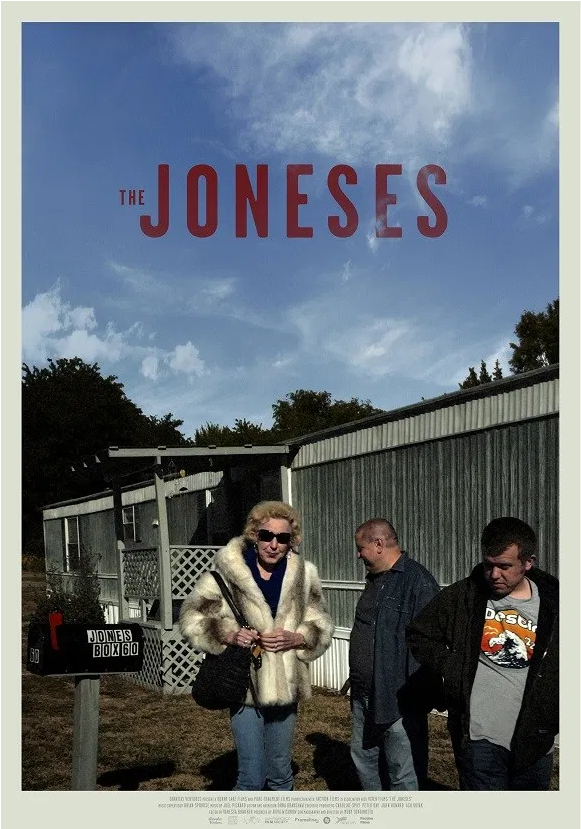
The documentary project spun out of my first book, Men Like That: A Southern Queer History, which began as an Emory dissertation, submitted in 1997. I had these really superb advisers: Mary Odem, Catherine Nickerson, and, of course, Allen Tullos was chair of my committee. Martin Duberman was an external member. Thanks to their incredibly helpful interventions, it was possible to turn that dissertation rather quickly into a University of Chicago Press monograph, Men Like That, that came out in 1999. Doug Mitchell was the key editor, a towering figure in queer publishing. After that, various ideas were floated about how to reach a broader public. Several people recommended verbatim theatre. There were some good examples of this. In 2005 University of Alabama Press published a revised edition of Ben Duncan's memoir The Same Language and I really liked playwright Carl Miller's adaptation for Menagerie Theatre Company in Cambridge (UK). Soon there would be the example of E. Patrick Johnson's very important work on black gay men in the South that he was performing as a one-man show. Johnson had experience in performance studies, and he was using his oral history narratives in that way, which I found very compelling.
I was even more interested in the suggestions to turn Men Like That into a documentary film. Around 2007 Ash Kotak, a friend and neighbor in central London, and I began to talk. I teach his 2000 stage play Hijra, which I think of as a queer/trans subaltern romcom. It's an extraordinary work that will be turned into a film. Ash was insistent that this be a character-led project. We had to forefront an individual who could provide queer, trans, and Mississippi history as part of that character's backstory. We considered several people. An early title was The Strange Career of Jon Hinson based upon a US congressman from Mississippi who twice was caught in compromising situations and queer spaces in the D.C. area, and yet was reelected to Congress for his conservative Republican values. Eventually, he was caught again and run out of office. We thought about Aaron Henry, the great leader of the NAACP in Mississippi, but, to be candid, his wife likely would have quashed any such project.
I told Ash about Jheri's SRS, then called sex reassignment surgery, now called gender confirmation surgery. I was the only friend or family member able to be there when she opted to have that procedure in Belgium. Even with the cost of flights and the initial recovery period in a hotel, it was cheaper to do so there than in the United States. Hearing her story, Ash insisted that Jheri had to be at the center of any documentary that spun out of Men Like That.
We made attempts to get initial funding, including the AHRC (the Arts and Humanities Research Council in the United Kingdom). They gave us the nicest, or worst, rejection: essentially, "this is superb; we have a few concerns around the edges. So be sure and reapply, and we'll give you the money." Well, life intervenes. And sadly, in my case, that involved being drafted into the headship of my department at King's College London. So I was not going to be as deeply involved as I had wanted to be, nor would Ash.
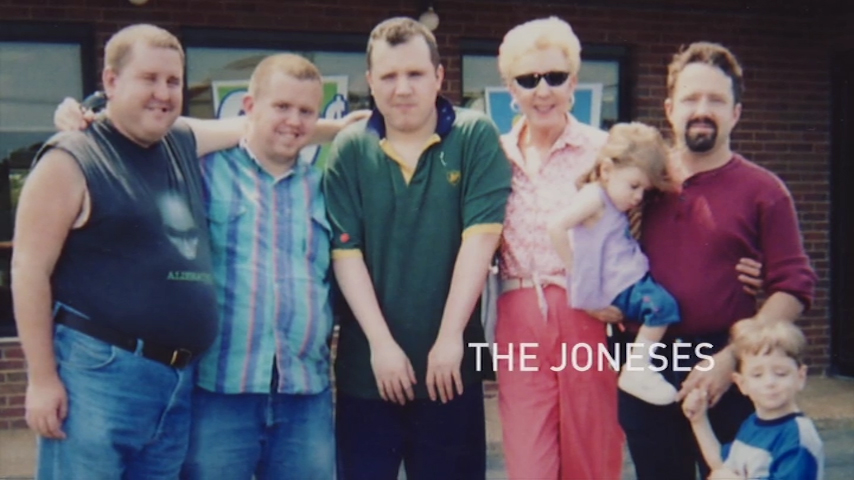
We approached Faction Films in London, where Caroline Spry, formerly with Channel 4, helped steer the project to completion. Among other tasks, Ash and I were asked to interview potential directors. It came down to two: an amazing South African, Oscar-nominated director named Murray Nossel, and a very soft-spoken Londoner named Moby Longinotto. Murray and I really got along in our interview, but I didn't like his initial ideas about how we might frame the project. He wanted a journey of discovery. He wanted me to travel back to Mississippi to ask Jheri for advice, which, for reasons that will become apparent, I don't ever do. That struck me as a bit contrived. All this is unfair to Murray, because this was a single interview and it was just an idea he threw out there. So I want to give a clear shout-out to Murray, I would love to work with him! But it was after viewing the films of both Murray and Moby Longinotto, and especially after seeing Moby's film, Small Town Boy, that Ash and I agreed wholeheartedly that Moby was the person for this project. So, he got busy and on a shoestring budget made a quarter-hour short by 2009.
Q: What was it about Small Town Boy that made you think Moby was suited for Jheri's story?
Howard: It's a beautiful, charming documentary about courage in Somerset, a small-town setting. It's about one brave boy and a group of people who put him out there as the alternative carnival queen, in drag. Moby was able to get extraordinary shots: the fifteen-year-old walks down the street and a fifty-year-old man almost assaults him. And there's great patience and quiet, controlled pacing that seems true to village life. Where, as a filmmaker, you go, stay, and get to know someone for an extended period. You wait for things to happen, and they do.
Q: Do you have any insight into the first meeting between Moby and Jheri and her family?
Howard: Moby hit it off with everyone. As was so apparent in his film No Time for Tea at Raj TV, Moby is adept, attentive, and respectful in cross-cultural settings, easily fitting into local patterns and rhythms. The Joneses soon became accustomed to his regular visits, initially on his own, doing the camera work, and over time with slightly larger teams.
Q: What were those visits like? Did Moby live in Mississippi for months at a time and stay with the family? Did he return over a period of years? How embedded was he?

Howard: He'd go initially for shortish visits. As budgets were slightly increased over time, he would go and stay longer. Stories emerged over years. Different plot lines seemed to come about quite naturally. And the family grew more trusting of Moby and the entire endeavor. More could be said and revealed. Early on, Jheri was talking about using a pseudonym, as we had done in Men Like That. That was going to prove impossible. So much happened over the years that they, all of them, came out in new ways.
Q: I'm struck by your comments that you were there with Jheri in Belgium during her gender confirmation surgery. That's not brought up in The Joneses. Do you know more about how that transpired and how she was able to make connections with care providers in Belgium?
Howard: I do. Jheri got online just before the turn of the millennium, asking trans people in various forums how to get the most affordable but safest surgery possible. She had been transitioning since the late seventies, with Dr. Ben Folk at the University Medical Center in Jackson who prescribed hormones. But she knew she was going have to go out of state for the surgical procedure. Increasingly it seemed it would be more affordable to go out of the country. So that's what she did. It was her first time outside the United States, aside from a cruise to Mexico. It was quite a gutsy thing to do. In The Joneses, Jheri explains how she had to save her money over a long period of time and get to Brussels. Because I live in London, I was able to go and spend several days with her, the only friend or family member who could afford it. An amazing moment happened there, and though I've told this story before, it's important to understanding the genesis of the film project.
Right after her procedure, as Jheri had requested, I rang her eighty-six-year-old mother back in Smith County, Mississippi. Reverting to my old southern accent, I said, "Miz Jones? This is John Howard. I'm calling long distance from Brussels, Belgium. I just wanted to let you know that the surgery was a success. Jheri's still unconscious, but doing fine."
"He is?" she asked.
"Yes, ma'am," I said with emphasis, "she's doing all right."
"Well," she hesitated, "that's good. Please tell her I love her."
That's the story that convinced Ash Kotak that Jheri and her family should be featured. The project held out hope for other reconciliations in fraught familial relationships that went back decades. It also seemed likely to reveal strongly held prejudices, as well as aspects of trans life as yet untold.
For example, around this time, there was a cultural outpouring of stories about sex reassignment surgery. In 2007 Dr. Marci Bowers of Trinidad, Colorado, was getting a lot of attention, and Channel 4 and a US partner made a six-episode series called "Sex Change Hospital" that aired on More4 in the UK and WeTV in the US. Dr. Bowers, by the way, was among the many Jheri consulted by email. It seemed trans media representations at that moment centered on surgery and on good-looking young people. We did not want to do that. We wanted to talk about the distinctive challenges of trans aging, assisted living, end of life care, the Deep South's religious challenges, and LGBT working-class issues more broadly—one of which remains crucially important around the world: employment discrimination.
Q: There are so many determining economic, social, and political pressures in the Joneses situation in Mississippi. How did they understand their economic precarity?
Howard: It's a great question. The documentary can only do so much. The difficulties in Mississippi and the misdeeds and mismanagement of the Mississippi legislature over decades requires a reckoning all its own. But several related things that emerge around structural, systemic oppression of LGBTI people involve intimidation, violence, and employment discrimination. There are scenes in The Joneses where Jheri and her son Trevor reference their experiences of bullying and intimidation in the public schools of Mississippi. Jheri many decades ago; Trevor a couple decades ago. Jheri worries about her grandchildren experiencing bullying if their schoolmates find out they have a trans grandmother.
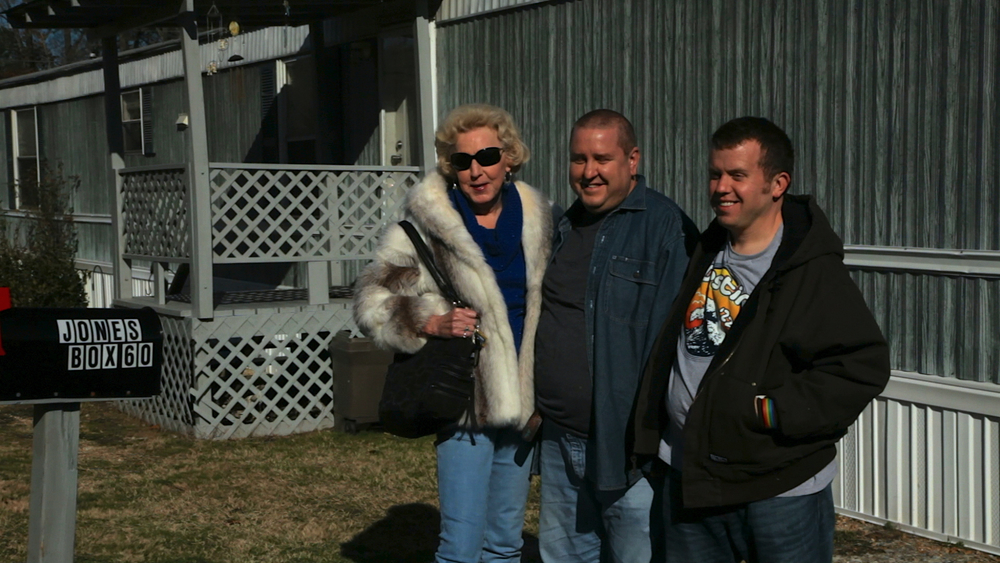
Trevor was most resistant to the project, not only because of fears of his own coming out as a gay man, but also due to the potential for violent reprisals—worries that I still have around the everyday discrimination and potential violence they face not just in the trailer park, but elsewhere in Mississippi and when they travel. When Jheri tells about her varied job history, it's implicit that after she transitioned, she had to create a whole new job history. What you can't know from The Joneses is that she was hounded out of her job at the Greyhound bus station by some really vicious employees. She was fired from a job at a construction company because management discovered she was trans. She recently told me that she now finally has a job she can't be fired from, because she's a freelance bookkeeper, working mostly for her son Wade, which we do witness onscreen. She still has to work. Retirement is not an option.
To sustain this large family, two members of which are disabled, there's not enough income. There's reference to living at the poverty line. It was very important that the problems of employment discrimination, the precarity of their lives, be central to The Joneses. Much can only be suggested, but it looms over the entire project. This is a poor, working-class family struggling to get by. The nature of the household is forged by economic precarity. Back in 2004, Jheri suggested to Trevor and Brad that it was in their best interest to sell the small house that they had inherited from their mother and move into the trailer with her.
Q: Do you wish that there had been more explicit attention on the structural economic pressures in the documentary? More than is shown through the abandoned storefronts and empty streets of Pearl?
Howard: Yes, to be honest. I was pleased that early on viewers see Jheri preparing for work, and out she goes with her thermos to her car. She's driving to the Salvation Army, where she worked in payroll for a time. If we had tried to film at Salvation Army, she would've been fired. Nonetheless, we do get her narratives of the various kinds of jobs she's held through the years. She doesn't mention chicken farming, and there was other low-wage work that she's unable to speak about. We see Brad working around the home. He does the yardwork. He helps Jheri prepare to cook and cleans up afterward. He walks the pets and does almost all other domestic chores. I wish we could have gotten inside Trevor's workplace, but he works manual labor at a national chain and it seemed very risky.
John Marszalek III's excellent new book Coming Out of the Magnolia Closet shows with great force how employment discrimination informs all aspects of life for lesbian and gay Mississippians. What I've called quiet accommodationism—what his narrators describe as a need for discretion, their refusal to fly the rainbow flag—is borne of the need to keep their jobs and maintain their livelihoods, their tenuous hold on economic security. One narrator after another is fired, suspended, or denied promotion when the boss discovers their sexual orientation.
Q: Equally important in The Joneses are questions of religious belief and practice which the documentary puts into tension and contradiction. From fundamentalist punitive judgment and rejection to joining the inclusive Safe Harbor Jackson congregation. The Joneses are shown joining hands and praying at meals and seem to have adapted Christianity to suit their emotional needs.
Howard: I agree. I think this is one of the The Joneses great successes. I had confidence in Moby's ability to get inside these spaces. They make for some of the most compelling scenes and produce the most important arc in the documentary. We're dealing with a trans matriarch who has four sons, two of whom live with her and one of whom has two children. Jheri grew up in Primitive Baptist traditions, and she is not giving those up. She continues to attend Primitive Baptist churches. Moby manages to get inside one and captures the scene of a well-suited preacher beginning a sermon, stating that "God is love." That sermon rapidly degenerates into condemnations of "sins of the flesh," exhortations against the congregants' "own evil ways." Evil! Moby frames shots in which crocheted blankets are folded over the end of each pew. You get a sense of church ladies' work, their labor in trying to provide cold comfort to these hard pews. But their loving communal labor is in stark contrast to the fierce hellfire-and-brimstone rhetoric from the pulpit.
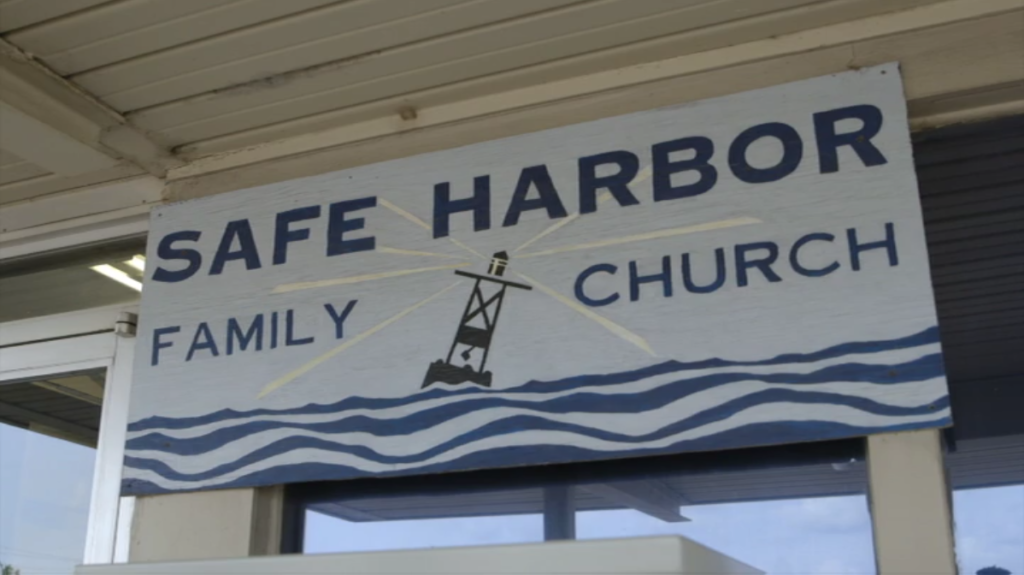
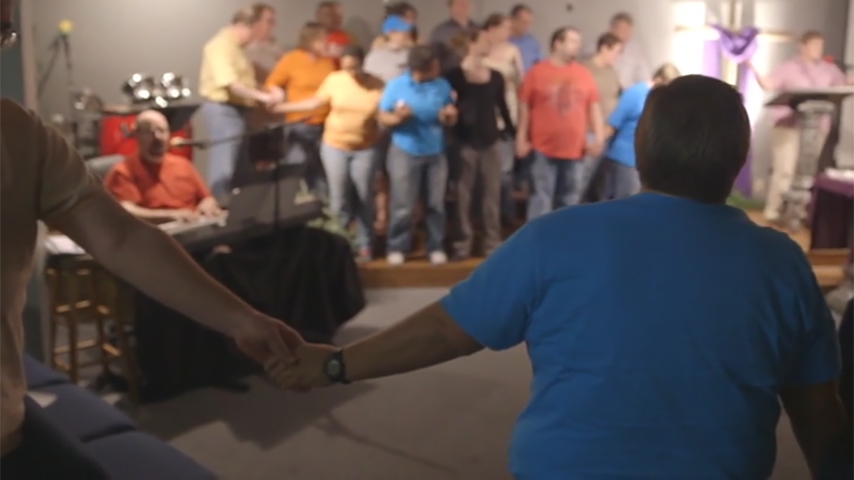
What we also learn is that Jheri's son Trevor had great trouble coming out as a gay man, even in a trans-headed household. Trevor's biological mother Doris converted to Jehovah's Witness and was rabidly anti-gay. That placed an enormous obstacle in Trevor's reckoning with his own sexuality and identity. In that White Sands Baptist Church cemetery, we have Trevor breaking down, telling his mother at her grave site, I'm gay and I'm not ashamed of it. I know you counseled otherwise, but I must live this way, with honesty. Then, near the end, Trevor and Brad formally join a congregation they had been attending, the LGBTQ+-affirming Safe Harbor Church. Once again, music plays a crucial role. A female pastor inducts them and asks the members of the church to take an oath to support these two new members. There's a powerful hymn, in stark contrast to the Primitive Baptist Church, about love growing and overflowing, with the entire congregation joining hands. It's a much more welcoming and affirming message than those Protestant hymns many of us know so well. Music plays a vital role as these two Joneses are welcomed into this unusual Mississippi church.
Q: Is The Joneses reaching audiences in Mississippi? Do you have a sense that the people who would benefit from this narrative and from having these lives depicted honestly, with the sort of struggles and joy that they have, are accessing the film?
Howard: How can queer youth and LGBTI people of all ages find media representations that feel true to their own experiences? Trevor spends several years in a trans-headed household; even so, it's difficult to come out. He told me that a particular character on a soap opera helped him think things through. The filming also helped him, because it was a process of affirmation and bringing the Jones family closer together.
As for audiences for The Joneses, Jheri was flown to New York and San Francisco for the East and West Coasts premieres; the trio that live in the trailer drove to premieres in Hot Springs, Arkansas, and New Orleans. They were able to participate in the project's dissemination. As of the beginning of 2020, The Joneses has not premiered in Mississippi. It has been shown in Alabama, and most importantly perhaps, it's now available on iTunes, Amazon, and so forth. Hopefully, interviews such as this one will make it more widely known.
As for the struggles of LGBTI youth in Mississippi and the kinds of barriers that trans and non-binary youth are breaking down, it's exciting. People are coming out at younger ages. They're feeling more empowered. There are straight-gay alliances in high schools, though in my hometown the principal actively opposed it, drawing national media scrutiny. Trans youth are doing something heroic and courageous. More power to them. What we thought we could show is how trans elders such as Jheri were the trailblazers.
Q: How were the musical choices made in the documentary? Rarely does it happen that a film crew goes to Mississippi and doesn't replay all the blues clichés. There is a little snippet of blues, but there is also composed acoustic music. And the soundtracks that Jheri has going in the background, and the church music.
Howard: We were paying attention. And while I was reluctant to be too assertive with Moby, it was around music that I was most willing to make suggestions. I would just express to him my worry that we would get the old, hackneyed, twangy blues guitar. The bent notes that are cliché to many of us who see a lot of "Southern" cultural productions. Even in the quarter-hour short in 2009, Moby was paying attention to the ambient music in the household: salsa, classical (at that time on Mississippi Public Radio. No more.), and disco—which is hugely important in Jheri's life and creates moments of affirmation. For me, that musical score is just about perfect. And it begins with composer Joel Pickard's opening number: acoustic guitar with cello underneath when the camera pans over family photo albums and helps viewers understand the chronology they're about to experience. It's extraordinarily powerful. Along with portrait photography and dance, the range of music is a cohesive factor in The Joneses. Interestingly, the one blues track, chosen carefully and used as background when Jheri is describing Mississippi history and the closed society is Tom Dickson's "Labor Blues." I found that an amazing choice, which I had no hand in.
Q: As I was watching The Joneses a second time, I caught myself picking up all sorts of queer cultural cues, especially visually, that are peppered throughout. The rainbow ensemble Jheri wears in her first appearance as she sings "Diamonds are a Girl's Best Friend." A shot of a coffee can tinman sculpture that hangs on a trailer porch recalls the friend of Dorothy and an apocryphal story of the Stonewall Riot origins. A shot of pink flamingos suggests John Waters and Divine. Jheri's dancing and kitchen calisthenics remind me of Little Edie in Grey Gardens. How much was Moby doing deliberately? How do you understand The Joneses in the context of queer cultural history?
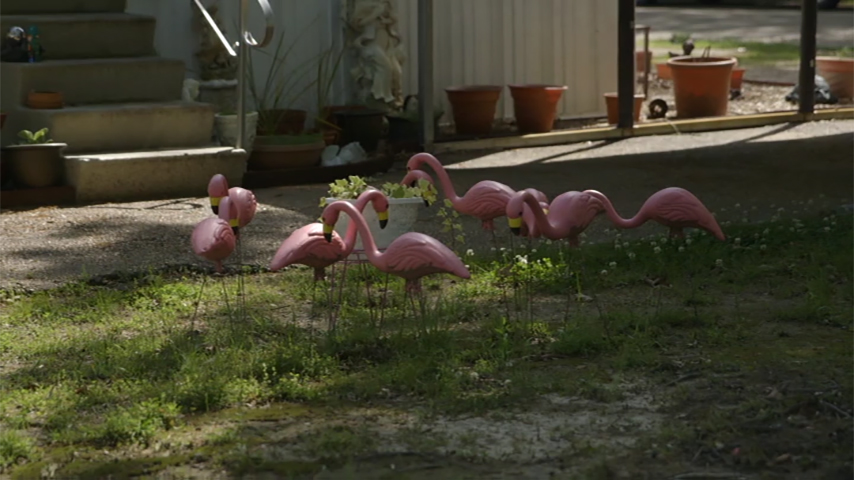
Howard: It's highly self-aware and honors various traditions that you've picked up on. It bears multiple viewings. There are more things you can find, not only related to the South but to global capitals' mediation of "Southernness," especially Londoners, especially film and art school types. They know William Eggleston, and you'll notice in the early credits there's a visual citation of him. If not direct citations, there are evocations of photographers Eudora Welty and Zoe Strauss at whom I recommended that Moby take a look in advance of his first trip. And William Christenberry. Moby improves on one of the location stills I was asked to produce early on for promotional purposes, the ubiquitous roadside Golgothas. These are peppered throughout, including lingering as well as fast-paced shots of photo portraits that are on the walls in the Jones home. This works as a way of accessing psychological states and suggesting the back stories for them as individuals and collectively as a family. Moby was able to do so much largely within four walls by virtue of patience and years-long determination to carry the project to completion. He worked his way through the cultural minefield of cliché and hackneyed musical scores and visual representations that we've all worked to undo and deconstruct.
Also hovering over the film, not directly addressed, are the drag cultures that nurtured and sustained Jheri in her earliest days of transitioning. She performed on Jackson drag stages as Lady Gay Chanel in the 1970s and 1980s, specializing in Ethel Merman numbers, and I hope future work, as by the Invisible Histories Project, will have more to say about this. But again, this subject seemed relatively well covered in televisual media, as compared to working-class queer issues, economic struggle, and religious persecution. RuPaul came out of the Atlanta drag scene, and we now have eleven seasons and countless tie-ins and spin-offs that frequently reference distinctive Deep South pageant and performance cultures.
Q: Having dealt with so much across several years, there's an optimism that concludes The Joneses. In terms of the family, what's happened since?
Howard: The family came together, was made stronger, understood themselves better, and were better able to talk with each other. Roughly midway through The Joneses, Trevor tells Jheri, the problem is we never talked. We never talk things through. The production encouraged that and helped make it happen. There are comings out and reconciliations. And this is where the Joneses are now, the year that Jheri celebrated her eightieth birthday. She's still working, working out, and looking for love, arguably in all the wrong places. [Laughter] She's certainly looking for love. But she has to be careful as she discloses to some dates and to new boyfriends. She experiences a lot of rejection, she tells us. At least she no longer faces the "threat of murder," after her surgery.
Brad and Trent are in many ways in the same place physically, sharing that home with Jheri, working in the same jobs, but I think they feel closer to their family members and feel proud of having done this. Trevor's story is most astounding. You'll remember he was the one who was most resistant to being filmed, sending me an all-caps message on Jheri's email account very early in the process: essentially, "GO AWAY. WE DON'T WANT TO PARTICIPATE IN THIS PROJECT."
As we learn in the film, Trevor was forced to drop out of high school to give full-time care to his biological mother Doris, who was in the late stages of morbid obesity, nearing the end of her life. Very recently, Trevor studied for and obtained his GED, and he's considering training as a nurse. He has a boyfriend of two years. Recall that when he spoke on camera as early as 2009 he said he hadn't achieved at his age what he wanted, which left him feeling "worthless" and "inferior." He talked about wanting one person to love and live with. Now, this person is about fifteen miles away, and they spend time in one another's homes.
As for the grandchildren, Nick and Trinity: Because this was a years-long project with countless setbacks, Jheri's grandchildren became teenagers and began to ask questions. You have this extraordinary story of the grandchildren being told that their grandmother—how does Wade put it?—was "technically speaking their grandfather." That trans grandparent coming out to her grandchildren—being helped along with photo albums that visualize her backstory—with their own father, Wade, also explaining is a crucially important part of the story that we never could have imagined when we first began making the documentary.
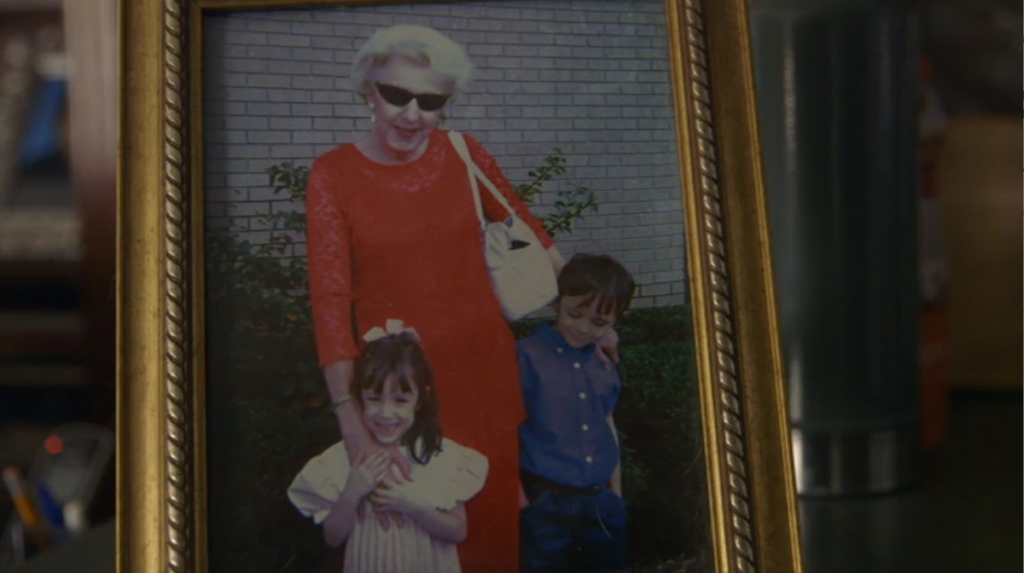
Nick has been in the Marines stationed in Virginia for the last two years and is considering re-enlistment. He regularly visits with his grandma. Nick coined this term "Grandmapa" in The Joneses that helped him reckon with her life history. Now she is known as his grandma, and they have a wonderful relationship. Trinity is very quiet throughout. Jheri interpreted that as affirmation, but now finds that she has a better relationship with Nick than with Trinity. Trinity graduated from high school and attends the local community college.
Q: In observational documentary you're dealing with who you see and who was around, and there isn't a lot of interracial interaction in The Joneses.
Howard: What you see represents the historic shift from de jure Jim Crow segregation to largely de facto segregation. However, there are positive signs. Pearl, Mississippi, was virtually an all-white town for most of the twentieth century, and when we began the project, the trailer park was almost all white. That changed into a multiracial environment. On one of his afternoon walks with Moby, where over time he reckons with his grandmother and is engaged in a kind of moral reflection, Nick references his "homies," his friends of color within the trailer park. Yet, viewers only get glimpses outside the walls of the mobile home.
The first worker seen in the film, other than one of the Joneses, is a black carpenter. Followed by a white mechanic, then the voice of a female African American caregiver at Trent's assisted living facility: "Where the hug at? Where's the hug at?" This becomes a trope from the opening title photo, taken probably twenty years ago, to the final stills, shot specifically for the project. Institutionalized for much of his life, Trent doesn't quite know how to hug. He doesn't know what to do with his arms when he's photographed. And that gesture for me is one of the most compelling, complicated reckonings with the difficulties of disability and care facilities, and how those phenomena are racialized and disproportionately visited on working-class people.
Perhaps most importantly, the one biracial, if not multiracial, gathering we see in The Joneses is the LGBTQ+-affirming congregation of Safe Harbor Church.
Q: Considering the different paths that brought filmmakers and viewers into this one home, what do you think Jheri hopes for The Joneses to accomplish? And how do you as the producer and Moby as the director perceive it doing activist work? It's so local, specific, and intimate, yet should have resonance far and wide.
Howard: Your question challenges us to think through explicitly activist productions with precise political aims compared with quieter, subtler films that begin as a day in the life and proceed to five plus years in the life. The Joneses resonates with different audiences. The Joneses short went to Brazil, Mexico, the United States, Canada, and Europe. Think about the captioning and the translation that happened, the recirculation of queer ideas and vocabularies. How does this very particular, very queer household in central Mississippi resonate with diverse audiences in other rural or small-town locales? I think the work of Mary Gray is very good on this, her book Out in the Country. Even the most transphobic early cultural productions on cable television can be reworked by latter-day trans-viewers to provide basic information and affirming representations. Jheri has been very explicit: I want to spread the word about trans-knowledge and trans-empowerment.
A group I briefly mentioned above is the Invisible Histories Project. They're an increasingly better funded network for generating new oral history narratives about LBGTI people in the South, as well as archival collecting and preservation. Something Invisible Histories wants to do that we weren't able to develop in The Joneses is explore Jheri's time as a drag performer in the 1970s in gay bars in Jackson, as part of that vital queer bar infrastructure largely made possible by owner-operator Jack Myers. By the way, Malcolm Ingram's stunning 2006 documentary Small Town Gay Bar, set in Mississippi, is an exemplary feature, in this regard.
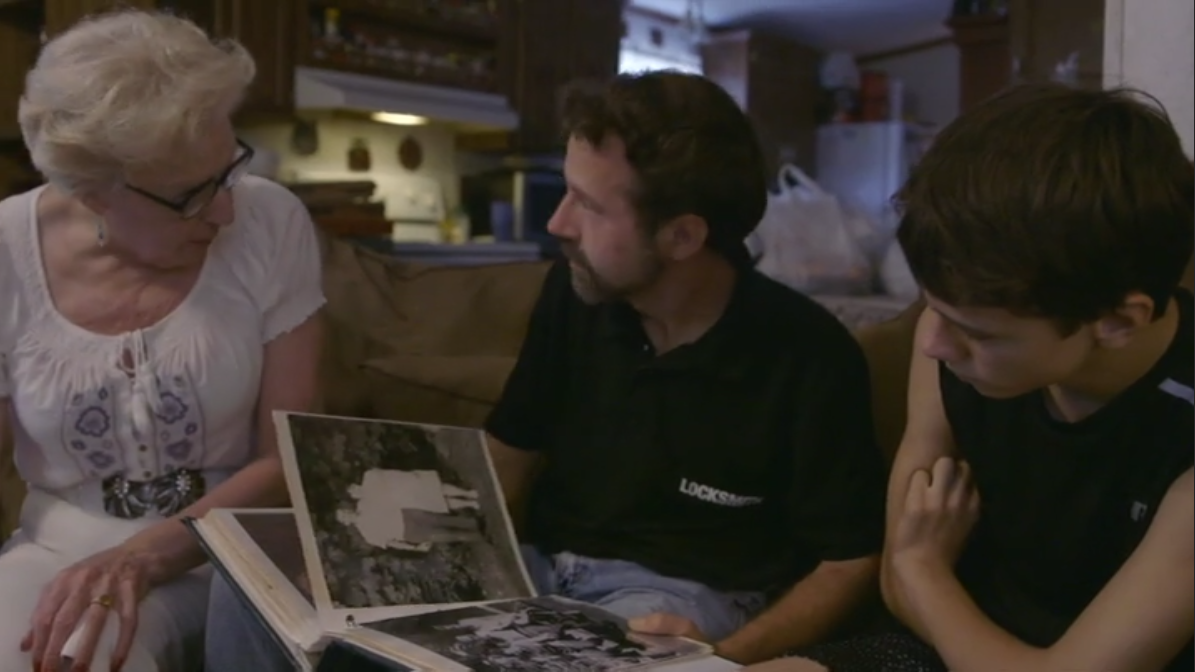
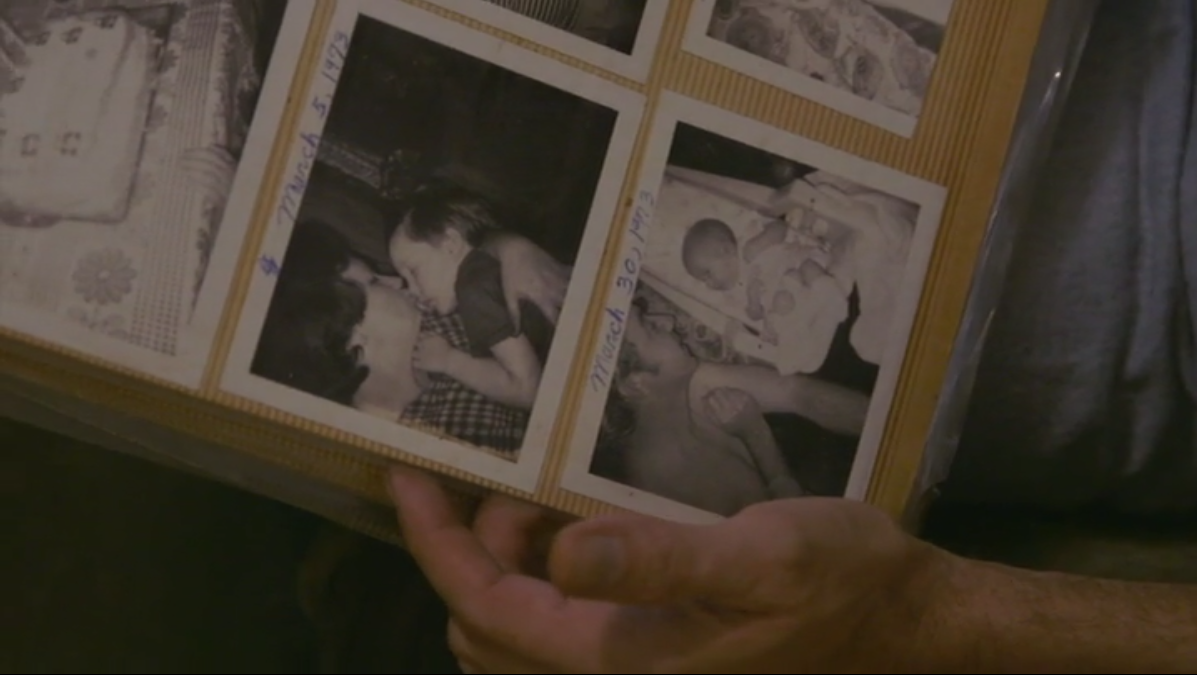
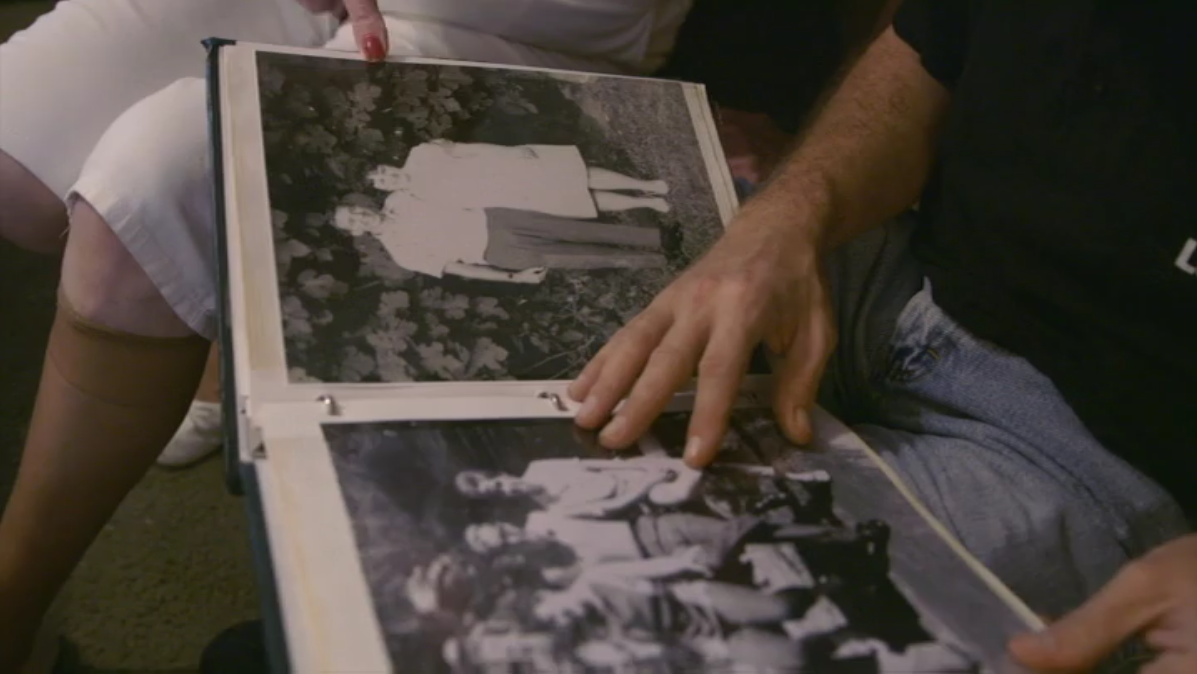
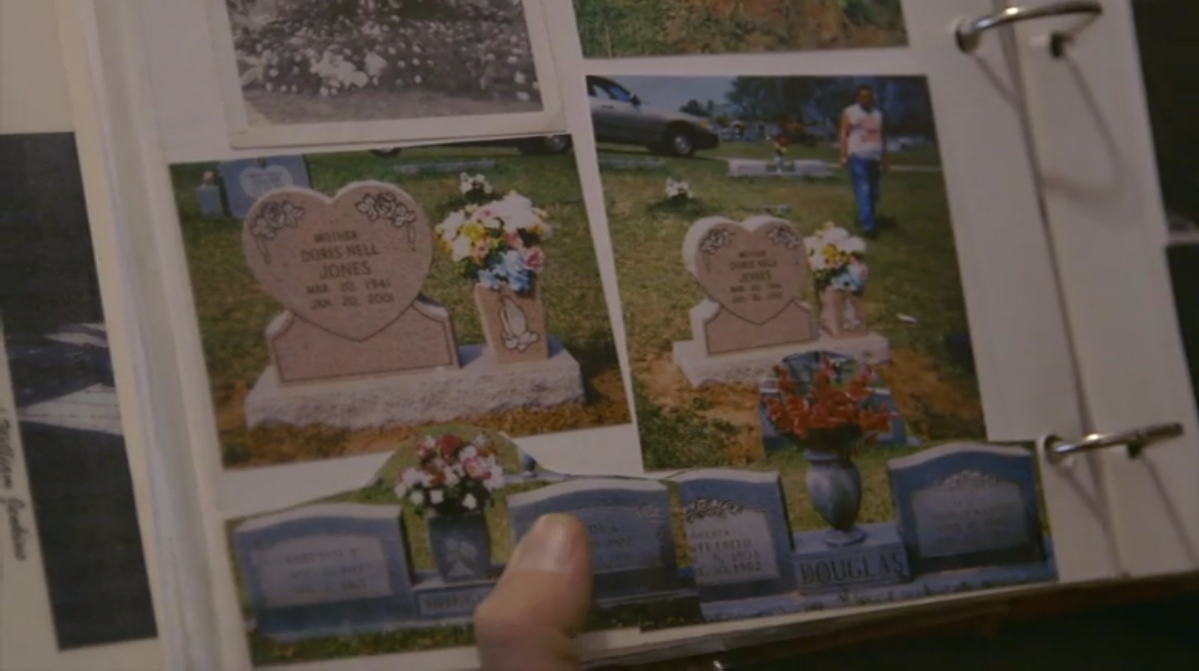
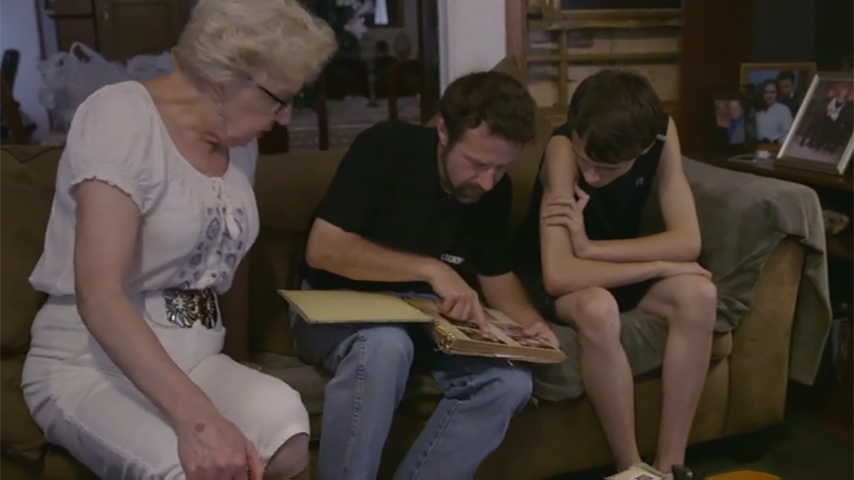
Invisible Histories also wants to safeguard the Jones family photo albums in climate-controlled archives so that primary documents of Jheri and her family members, letters, diaries, and the traditional stuff of academic historical writing can be maintained long-term. As well as the play script Jheri has written! This is a complex project around institutions historically hostile to LGBTI people. During one of my latest trips to the University of Mississippi, someone pointed out that there were raids on LGBT students, specifically on gay male students, having sex in various places on the campus as recently as the 1980s. So how to convince LGBTI individuals to part with their keepsakes, documents, artifacts and entrust them to institutions in states that until very recently had sodomy laws and continue to have discriminatory employment practices and "religious" exemption clauses based on sexual orientation and gender identity. That's going to require some painstaking work liaising between LBGTI individuals and groups and state universities, repositories, and museums, that are increasingly eager to collect this material. Notions of how and what we archive will have to change. The work involved in negotiating these relationships is fraught, but worth the effort.
Some of The Joneses' most important work suggests ways in which we can challenge well entrenched heteronormative, and now homonormative, constructs. How to think about family and flexible kinship networks in richer ways? At one point, Brad describes a dream he had. He's married; they have a child; and that child does not have the cognitive disabilities Brad does. He's also talking about something as seemingly mundane as teeth. You know, what if that child had "perfect teeth"? And for me, this is one of the subtle but, again, very important moments where you see the cruel juxtapositions of living in the poorest state in the richest nation on earth. Right? So you have these outsized consumerist expectations that are delivered to you via mass media. But then you have the hard realities on the ground that most people here cannot afford dentistry much less orthodontics. That was so powerful for me. Because I've known farm people, certainly of my mother's generation, who talk about the resentment they felt because their parents couldn't afford to get their teeth fixed and therefore they could not have that "winning smile." Again, a seemingly mundane phrase, but a phrase that speaks so much about American culture. You know, one must perpetually perform some aspect of American success ideology—whether it's a coming out narrative, a recovery testimony, or a religious conversion experience—and do so beautifully, working on one's attractiveness, which too is referenced in the workout routines in the film, the frequent trips to the gym, the way that one must not only be healthy but be attractive according to normative beauty standards. Brad speaks something quite profound in those moments.
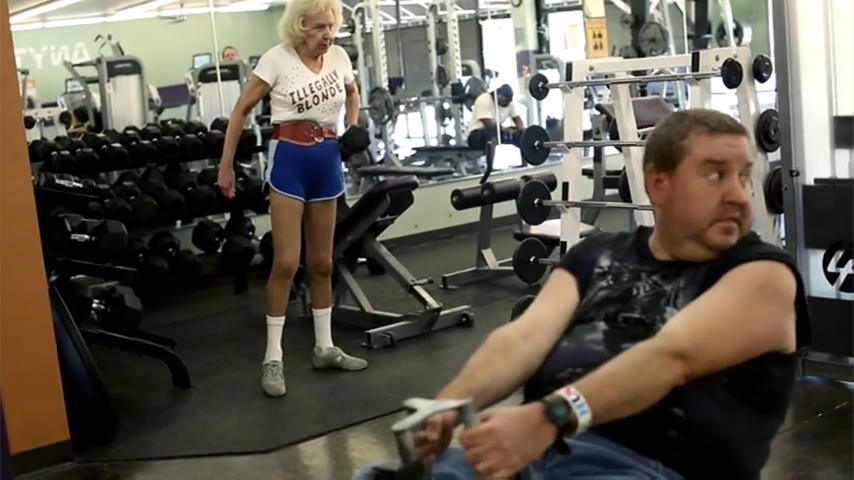
I would have liked to have been consulted on the captions, because I think we missed some really interesting turns of phrase. Jerry uses the old temperance phrase "teetotal," which just gets transcribed as "total." An opportunity is missed in a word or a phrase. But on the whole, I'm astounded that the project was completed. I'm astounded that it's widely available. And all in all, I'm so proud of what Moby especially achieved with Ash, Caroline and, obviously foremost, the Joneses.
What finally are the documentary's activist impulses and key contributions? They concern endurance, perseverance, resilience, and hope. When you face elevated risks of bullying—a weasel word that really means verbal intimidation, sustained harassment, and physical assaults—when you are daily confronted with increased risk of violence, when as a trans person you're much more likely to be murdered, and yet you endure. You live, survive, even thrive, despite poverty, into your eighties. Each day in the life is an enormous victory.
Another narrative that ended up on the cutting room floor: In the vacant lot directly across from the family's trailer, a young gay neighbor, no doubt harassed by locals, took a gun and killed himself. As I watch The Joneses, this looms with ominous force, as Nick takes those reflective afternoon strolls, as Brad walks the dog. It's an unspoken haunting.
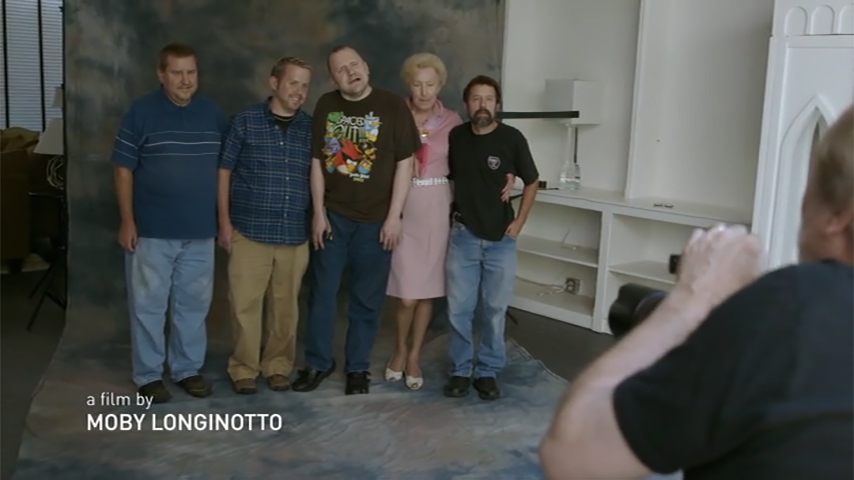
Given all those intense pressures and
threats, given the violence of homophobia and transphobia, given the much
higher suicide rates for LGBT people, maybe, just maybe, when young viewers witness
Jheri, Trevor, and Brad persevering in Mississippi, they will decide that they
too can persevere. In this way, the Joneses give hope and inspiration, the crucial
prerequisites of any activist endeavor. 
About the Interviewers and Interviewee
John Howard is Emeritus Professor of Arts and Humanities, King's College London.
Allen Tullos is the senior editor of Southern Spaces, co-director of the Emory Center for Digital Scholarship, and a professor in the Department of History at Emory University.
Eric Solomon earned his doctorate in English from Emory University and is a visiting assistant professor of English and American Studies at Oxford College, Emory University. His work is featured in Southern Spaces, south, PopMatters, and Mississippi Quarterly.
Sophia Leonard is a PhD candidate in the Department of English at Emory University.
]]>Beneath
Beneath the landmark 1967 Loving v. Virginia US Supreme Court case is a very simple story: two people, Richard Loving and Mildred Jeter, loved each other and wanted to marry and raise their family in rural Caroline County, Virginia. In the 2016 cinematic dramatization, Loving, writer-director Jeff Nichols best exemplifies this simplicity neither through dramatic courtroom scenes nor in his scant exploration of iterations of the legal process needed to achieve legalization of interracial marriage in the Court's decision, but in quiet moments of private intimacy.
The film neither glorifies nor sanctifies. Nichols proceeds with care, illustrating the ways in which all intimacies are negotiated and far from simple. Midway through Loving, after living for some years in exile in Washington, DC, Mildred and Richard decide, in violation of state law, to move back to Virginia with their three young children. They find a farmhouse. It has no telephone or easy connection to the outside world. As the family drives up, Mildred's face beams as she sees her new home—glistening white in the sunlight, surrounded by wide-open space. Richard smiles at her happiness. Mildred's goal is simple, as she tells Richard in DC, a city antithetical to her way of life: "I won't raise my family here." She will raise their children in the rural environs of her home state and in secrecy if need be. Yet, in this scene, as Mildred's joy radiates in the face of actress Ruth Negga as captured by cinematographer Adam Stone, Richard turns and stares into the beyond, back down the road from which they came. While Mildred is intent on raising their children in a manner she sees fit, Richard's goal, as he tells her in one of the film's most emotional scenes, is different yet equally simple: "I can take care of you." In these brief, quiet moments, Mildred is at home; Richard is afraid.
Beneath the Lovings's story, then, are bedrock truths that all couples must negotiate: intimacy and protection in the present, and care and preparation for the future. Nichols crafts this narrative through images of the marriage bed, the laying of a home's foundation, and front porches looking out to an idyllic and unknown beyond. As I search Loving for the "beneath," I recall the late Eve Kosofsky Sedgwick's claim that reading for the beneath fosters narratives of "depth or hiddenness" calling out for "a drama of exposure."1Eve Kosofsky Sedgwick, Touching Feeling: Affect, Pedagogy, Performativity (Durham, NC: Duke University Press, 2003), 8. Sedgwick's foundational contribution to the field of queer theory was her implicit understanding of the closet-structure and coming-out narrative and how they functioned. Sedgwick understood the closet as a "resilient and productive… structure of narrative" with a firm "hold on important forms of social meaning" both before and since the great gay liberationist movement "began" at Stonewall. See Eve Kosofsky Sedgwick, Epistemology of the Closet (Berkeley: University of California Press, 1990), 67. Like other key thinkers such as Michel Foucault and Judith Butler, Sedgwick understood the "very specific crisis of definition" implicit in binary distinctions like gay/straight, homosexual/heterosexual, black/white, as well as how that crisis is often socially constructed, limiting the possibilities of non-normative subjectivities (72). Such distinctions create hierarchy and the implicit desire on the part of the majority for the minority to be exposed, excavated, and/or transcended. These realities necessitate giving voice. Yet, we can read silence and invisibility as power. Arguably, in Loving and Moonlight, what is unsaid, what is invisible, is represented as equal in power to what is said and shown. Reading for the beneath raises ethical questions: Why do we need to justify the loving of this particular couple as valid? For whom are the filmmakers making Loving and why are they placing this story of the past in our present? What are the stakes of excavating and exposing the Loving story now? In supplanting readings for the "beneath," Sedgwick calls for readings of the beside, in which "a number of elements may lie alongside one another… Beside comprises a wide range of desiring, identifying, representing, repelling, paralleling, differentiating, rivaling, leaning, twisting, mimicking, withdrawing, attracting, aggressing, warping, and other relations"—such as loving or moonlighting.
I read Loving not as a film that exposes either the "Loving Story" to a wider audience or the quintessential nature of interracial loving, but as an imperative film which ask viewers to place themselves "beside" others in acts of creating, understanding, universalizing and identifying, legalizing, equalizing, and yes, loving. In so doing, I will read it alongside another 2016 film, Moonlight, to illustrate the power of both films in breaking expectations of narrative form and cultural understanding. Both films invite us to touch, to feel, the intimate lives of their characters in opposition to forces that define, prescribe, limit, and curtail.
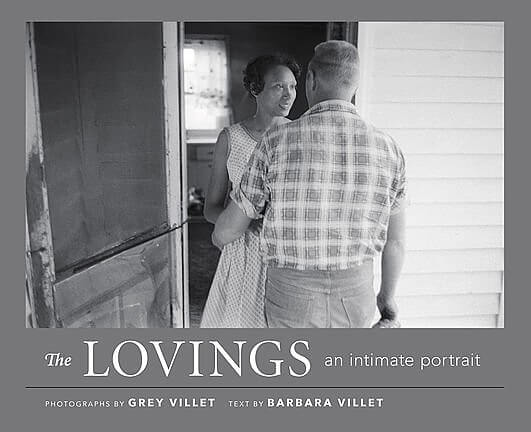
Remember that the grand story of the Lovings—given the photojournalistic treatment by Grey Villet in Life magazine, the Lifetime television treatment with Richard Friedenberg's Mr. and Mrs. Loving (1996), the documentary treatment with Nancy Buirski's The Loving Story (2011), and now the Hollywood treatment—is only known to us, only "a drama of [continued] exposure," because Mildred first wrote a letter to the ACLU via Robert Kennedy in 1963 seeking legal assistance in moving her family from DC back home to Virginia. We know the Lovings because Mildred first engaged in a quiet, solitary act of letter writing. The Lovings were neither unique nor exemplary in their transgressive love. They were unique in their successful resistance to the laws that sought to define how and where they could love and live. And they were unique in asserting that beneath their love was something that could not be cast aside, exiled, closeted.
Beside
Beside each other, they sit in moonglow. Nichols's film opens: first shot Mildred Jeter, second Richard Loving, then both, equal visual weight. Mildred, black and Rappahannock, is pregnant; Richard, white, is the father. Crickets chirp in the background of the 1958 Virginia night. There is silence and joy. They are about to marry, to be parents; they look to the future. Despite Nichols's creative license in blurring the timeline their choice is simple: they will build a life together.
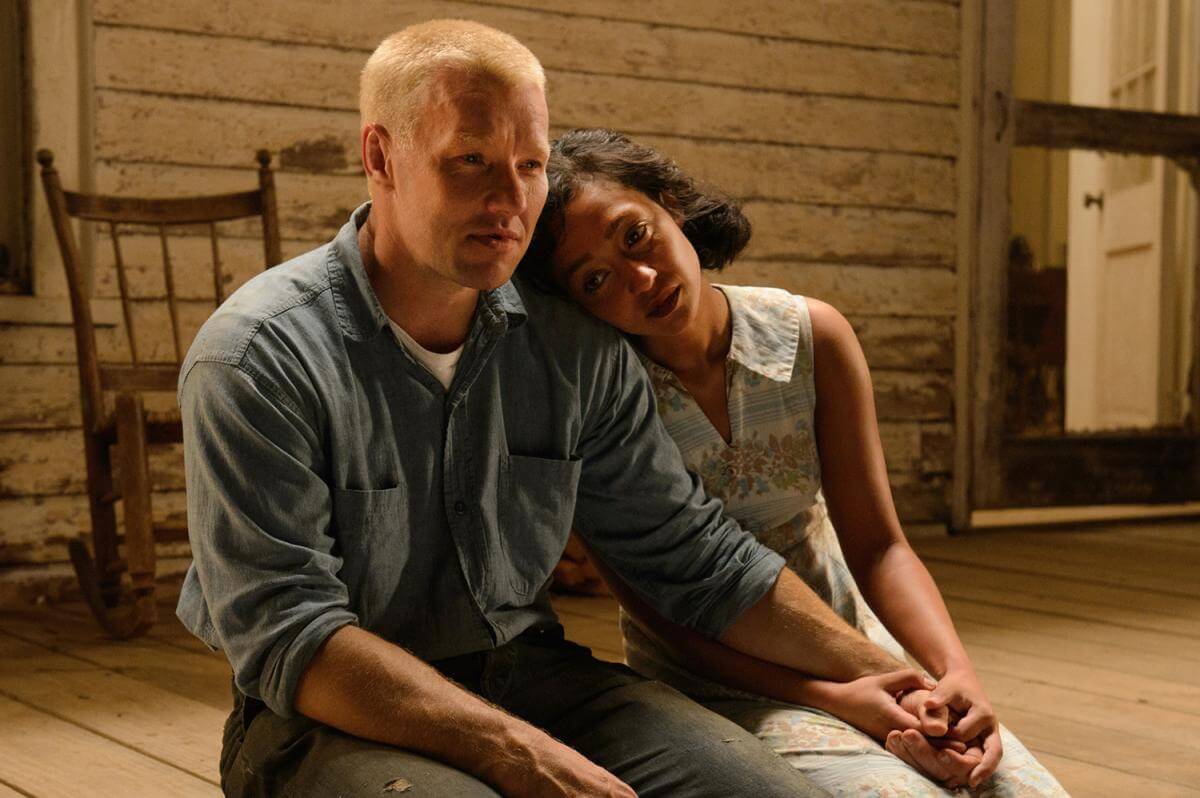
Loving challenges viewers because it is largely a meditative film telling this simple story, not a film of award-baiting fireworks or melodramatics. Nichols's goal in writing and directing was "to concentrate on the day-to-day lives of the Lovings" and "make a really slow, quiet film."2Joe Robberson, "Director Jeff Nichols talks 'Loving,' His relationship With the South & His Muse, Michael Shannon," Zimbio, November 7, 2016, http://www.zimbio.com/Zimbio+Exclusive+Interviews/articles/bqW7H-jZy09/Director+Jeff+Nichols+Talks+Loving+Relationship. The film's composition takes on equal weight to its script: not only what Loving says but also how it says it. Framing becomes central in cinematically portraying the Lovings. The camera eye presenting the narrative reveals an implicit resistance to bombastic inauthenticity. Nichols frames the Lovings via numerous shots of Richard's construction jobs—building home frames with 4x4s, laying foundations of cement blocks, insulating homes with the durable stacking of bricks and scraping of the mortar trowel—and Mildred's domestic work—washing dishes, ironing clothes, speaking on the telephone, buying groceries, running after her kids. Nichols elevates the quotidian tasks of the Lovings into profound meaning. The Lovings simply wanted to build a home together.
As a filmmaker, Nichols understands that in representing a true story that changed the US Constitution, Loving requires both adherence to the preexisting historical record and a multi-dimensional narrative framing of his central characters' lives.3Nichols, a native of Arkansas, has made four previous films: Shotgun Stories (2007), Take Shelter (2011), Mud (2012), and Midnight Special (2016). All of these films are fiction. Loving is Nichols's first film to be rooted in fact. Nichols understands the stakes and proceeds with great care. Loving presents the moments of rupture well known to historians and legal scholars: the invasion of the Lovings's bedroom, their arrest, Mildred's five-day imprisonment, the abrupt judicial decision, and their exile from their home state. Like The Loving Story (2011) documentary before it—which divided its narrative into sections entitled the Crime, Exile, the Climate, the Court, Oral Arguments—Nichols's film presents the known facts with chronological precision. Richard and Mildred committed a crime; they broke the state's love law. A legal holdover from slavery and Jim Crow, the Virginia Racial Integrity Act of 19244Virginia was not alone in enforcing such legal holdovers. By the time of the 1967 decision, fifteen other (mostly southern) states (Alabama, Arkansas, South Carolina, North Carolina, Georgia, Mississippi, West Virginia, Missouri, Louisiana, Kentucky, Florida, Texas, Tennessee, Oklahoma, and Delaware) had similar anti-miscegenation laws on the books. While the Supreme Court's federal decision invalidated all of these state laws, it would take until 1998 and 2000 for South Carolina and Alabama, respectively, to amend their state constitutional language on miscegenation. made it illegal for men and women of different races to marry and live together. Initially, the Lovings accepted a deal to live outside Virginia for twenty-five years or risk re-arrest. In exile, they moved to DC. They grew homesick and disenchanted living in a space that was not their own. Mildred contacted the ACLU, which took on their case. They secretly moved back into Virginia but were discovered and re-arrested. Their case worked its way to the US Supreme Court, and in 1967, the Lovings won. All of this is in Nichols's film, yet he never lets the grandiosity of the circumstances supplant the simplicity of story. This is not The Loving Story; it is Loving.
The stakes for present-day viewers are not whether to understand Mildred and Richard Loving's marriage as equal and legal. That question is moot. The questions today are whether we can see their loving-struggle alongside other forms of loving we still debate, and whether we can accept the lives their loving created as lives equal to all others. For us, then, the Lovings serve as precedent.
"All Love is created equal" says the film's tagline. But Loving's imperative implicitly asks: Who does all include? What is love? When is the time? What do we mean by created? How equal, by what terms? These questions call forth the positionality of various loves alongside one another in cultural understanding and legal equality.
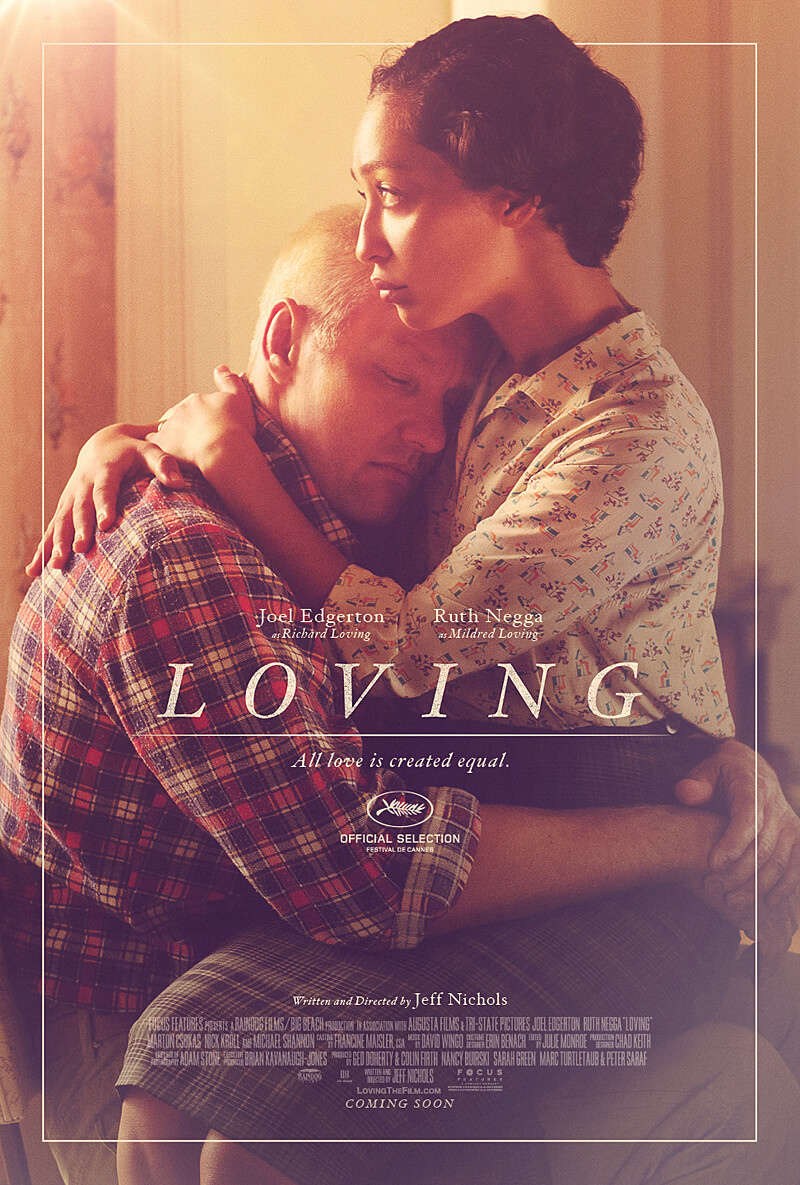
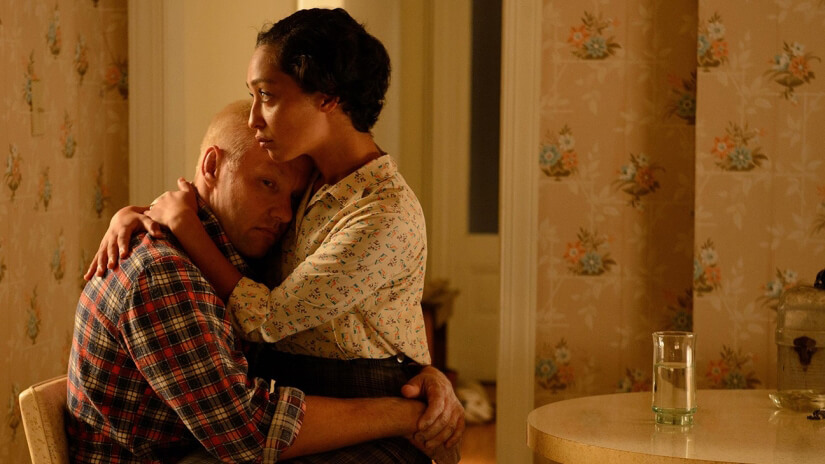
In two of Grey Villet's Life magazine images, Richard and Mildred stand or sit beside one another at their home. Perhaps the film's most powerful image is a similar moment of intimacy in which viewers are invited to sit alongside. It is an image used in the film's promotion: Mildred sits in Richard's lap, holding his head close to her chest. They sit at a kitchen table. An embrace. Silence. Yet, they are in exile in DC; this is not their kitchen table. This still frame invites you to the table alongside them. To dare disrupt this quiet scene. Dare to deny the fierce simplicity of their loving. Help bring them home.
Beneath
Beneath Loving is bedrock: textures of mortar and soil, dirt and desire, the need to build a home and be rooted. Beneath Barry Jenkins's Moonlight is an ocean: the need to be visible as something other than the expected or prescribed, to be seen as singular and more than a drop drowning in the multitude. Loving and Moonlight, released in the same year, are period pieces illustrating tensions between fixity and fluidity in journeys we must take to love ourselves so that we can engage in acts of loving others.
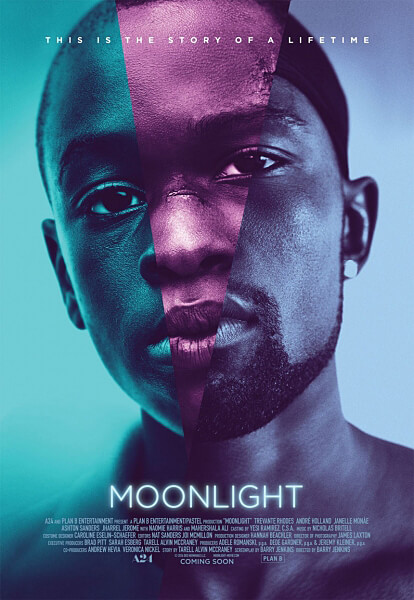
Beneath Moonlight is not the often-told, true-life story of the Lovings, but autobiographical traces of playwright Tarell Alvin McCraney and writer-director Barry Jenkins's upbringings in 1980s Miami.5Moze Halperin, "Playwright Tarell Alvin McCraney Discusses the Piece that Inspired 'Moonlight,'" Flavorwire, October 21, 2016, http://flavorwire.com/592191/playwright-tarell-alvin-mccraney-discusses-the-piece-that-inspired-moonlight. Halperin writes, with "In the Moonlight, which McCraney set in his own home of Liberty City, Florida, the playwright tried to lay out some of his own biographical questions about growing up with a mother grappling with drug addiction, and growing up gay in a neighborhood sequestered by race and class, in a community where his own divergence from masculine norms led him to be classified as Other from a young age. Moonlight writer/director Barry Jenkins likewise grew up in Liberty City—and in the very same public housing unit as McCraney—Liberty Square, though they didn't know each other. His adaptation of McCraney's work combined their diverging and overlapping experiences, and projected them onto the story of a protagonist, who, through the convergence of time and society's all-too-often blanketing perceptions of black manhood, lives as a beautifully unchanging soul housed within three metamorphosed bodies." Moonlight, adapted from both McCraney's sketch In Moonlight Black Boys Look Blue and from life, is fiction. While the film's tagline may read, "This is the story of a lifetime," it is not the story of any one lifetime but a composite of the experiences of many young black "gay" men in the urban South. It burrows beneath while seeking to get beyond. It is not "based on a true story" in any distinct way but culled from the archives of the many men like protagonist Chiron who do not get represented on screen. Moonlight is simple and grand, specific and universal, drop and ocean. The most apt preposition for an exploration of Moonlight may not be "beneath" but "beyond." Moonlight asks to go beyond what we think we know about men, about being black, about being gay. It asks us to think beyond any singular identity and consider the intersections where black-gay-men struggle to exist in places such as Miami and Atlanta.
Jenkins structures Moonlight in a tripartite way, beginning with "Little" and ending with "Black," both nicknames for the character's actual name, "Chiron," the title for the middle section. Little-Chiron-Black. This structure invites side-by-side analysis around three moments of time in one man's life. Little-Chiron-Black function as islands of existence and snapshots of time representing the fragmentary nature of a man growing into himself and negotiating racial, gender, and sexual identities. Viewers encounter all three—Little-Chiron-Black/ Black-Gay-Man—distinctly but also connected across the intersectional, hyphenated breach.
Beyond
Beyond visible: the sound of ocean waves crashing before the fade-in is how Moonlight begins—with what cannot be seen or known but only heard and approached. Loving begins in fixity and stillness—crickets chirping in a calm, rural Virginia night. Moonlight begins in fluidity and chaos. We hear the non-diegetic crashing of waves and the diegetic "Every Nigger is a Star" playing on Juan's car radio as we fade-in to his meeting one of his drug-dealing employees. The camera spins like the eye of a hurricane or a whirlpool undercurrent, circling and weaving around the actors as director Barry Jenkins introduces 1980s Miami and the slow-drain effect of drug addiction and trafficking. We fall into Loving, into the front porch simplicity of a couple, a grand narrative before them. With Moonlight, we crash full force into a street life where "Every Nigger is [or aims to be] a Star."
So much of Moonlight is disassociation, disembodiment, and disorientation: sounds of waves, cracked glass underfoot, muffled moans, zippers descending, voices and whispers, continued movement, and abrupt shifts. The main character Little-Chiron-Black is never fixed, but constantly shifting and adapting. Each section in this man's life is built around a core set of characters who shape him and ultimately help him associate, embody, and orient so that we come to "know" this man not by virtue of his fixed being but by his continual becoming.
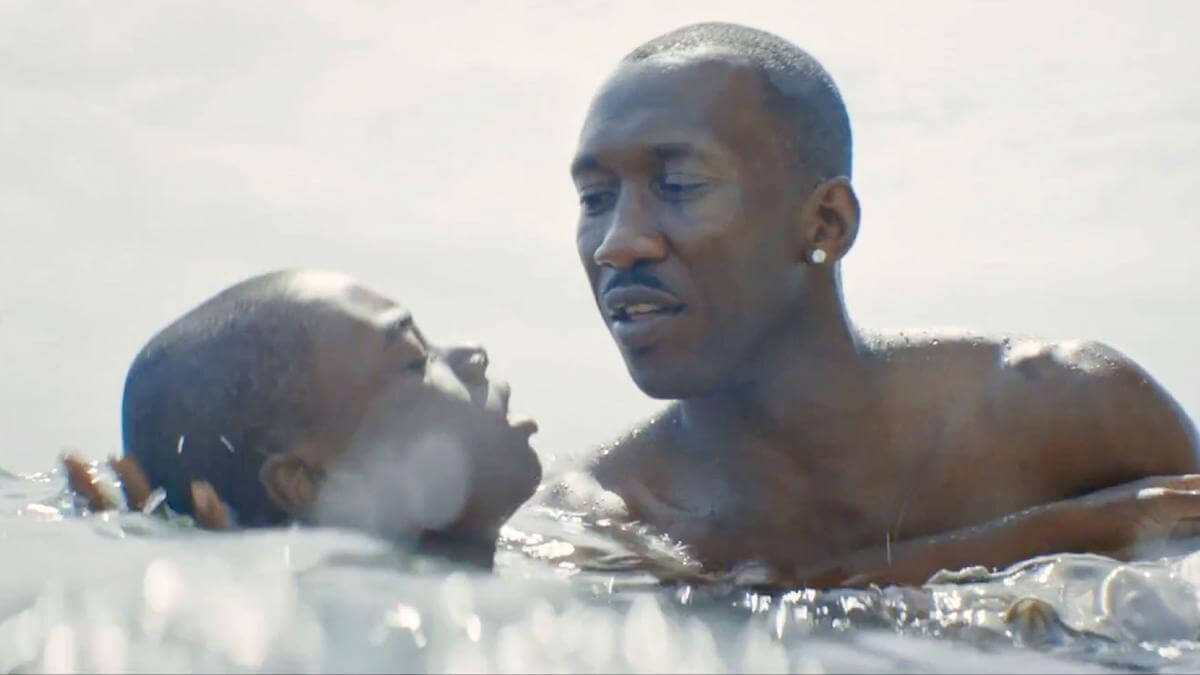
"Little" is structured around Juan, the first character we meet in Moonlight, stepping out of his bright blue car. As played by Mahershala Ali, Juan is not one-dimensional, neither villain nor hero. Yes, he deals drugs, but he also serves as mentor and caretaker for "Little," a lost boy whose mother is adrift on the crack-cocaine Juan sells. It is Juan who teaches Little to swim, who stares out across the Atlantic—back home—and tells Little that he was once called "Blue" as a boy in Cuba, but he no longer identifies with that name because "at some point you got to decide for yourself who you gonna be." Juan creates his morally ambiguous self, and it is from Juan that Little learns self-becoming.
As "Little" progresses, viewers come to know Little's sexuality even before he understands it. In the closing scene of this first snapshot in Chiron's life, Little asks Juan and his partner Teresa, who serves as a second mother, "What's a faggot?" The couple exchange knowing glances, and refuse to lie. They tell him that he will know if he's gay when he knows.
If "Little" reveals Chiron's first moment of self-awareness and recognition, "Chiron" is Little's adolescent hardening. "Chiron" centralizes Kevin, Little's childhood friend and first pubescent crush. "Chiron" shows a young man who lives in fantasies: wet dreams in which the sounds of waves and grunting lead him to find Kevin fucking a faceless woman beneath the south Florida palms. "Chiron," second snapshot in this story of a lifetime, is full of similar sex and frustration, daydream and risk, role-playing and reality.
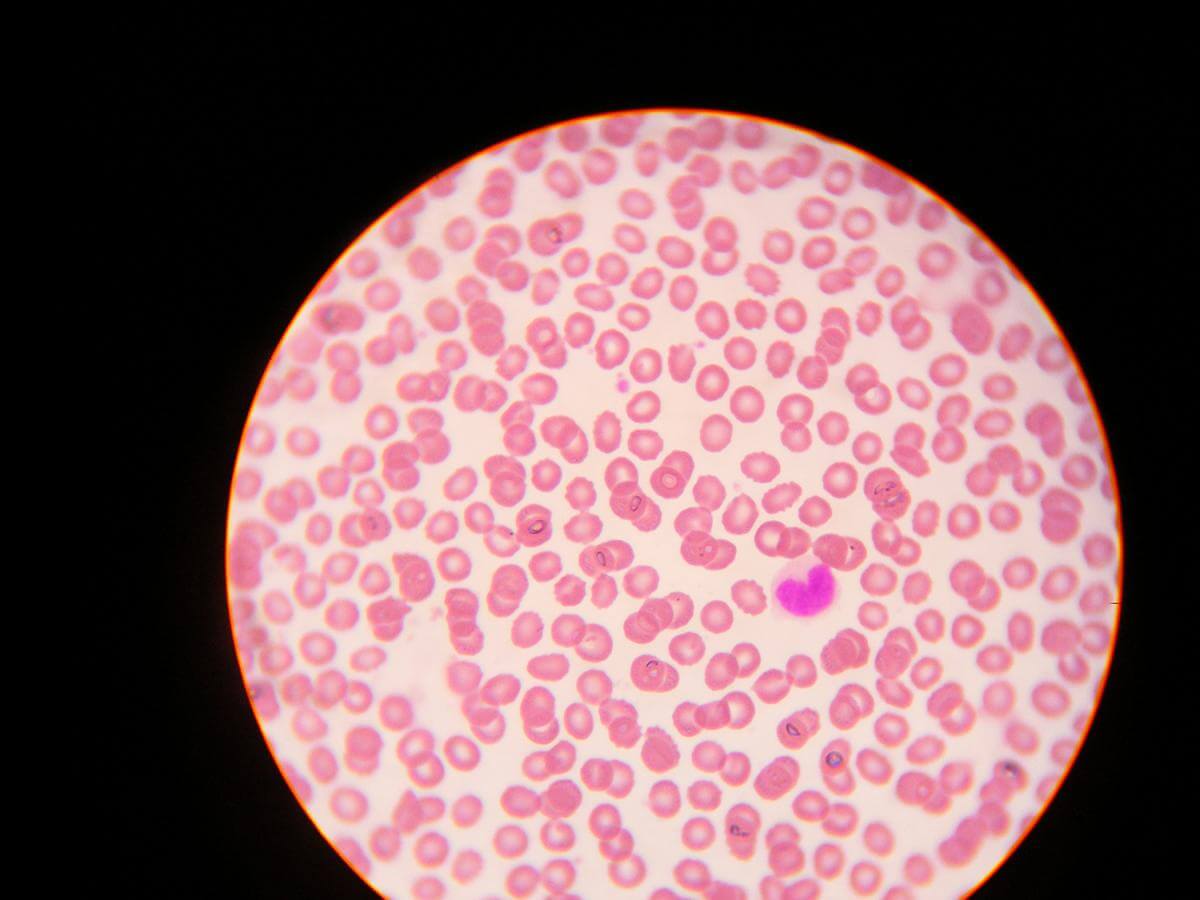
"Chiron" begins with a science teacher discussing DNA in class, suggestive of the heteronormative idea of sex as procreation as well as the heightened sexual risk associated with certain methods of swapping DNA. As if to reify these passing suggestions, Jenkins returns the viewer, in the middle of the "Chiron" section of the film, to the same class, alongside the students, as the same teacher mentions a "lack of white blood cells" in his lesson plan. Said in passing, "a lack of white blood cells" serves as a potent phrase in the middle of a movie set in the early, death-sentencing years of the HIV/AIDS epidemic in which gay sexuality and IV-drug behaviors were stigmatized, misunderstood, and pathologized. It is also a reminder of the startling disparity that people of color and drug addicts continue to face, measured in new HIV infection rates, access to care, and number of AIDS-related deaths in the United States.6"Lifetime Risk of HIV Diagnosis," CDC, February 23, 2016, https://www.cdc.gov/nchhstp/newsroom/2016/croi-press-release-risk.html; "CDC Fact Sheet: Today's HIV/AIDS Epidemic," August 2016, https://www.cdc.gov/nchhstp/newsroom/docs/factsheets/todaysepidemic-508.pdf; Claire Galofaro, "Appalachia Bracing for HIV," U.S. News & World Report, June 5, 2015, http://www.usnews.com/news/us/articles/2015/06/04/appalachia-gripped-by-hepatitis-c-epidemic-bracing-for-hiv. Is it any wonder that Chiron, a young man trying to decide who he is going to be, might be frightened of the sexual urges he feels for Kevin, of both the tenderness and hardening that he is told make him sick, soft, not "man" enough?
And yet, always beneath the surface of Chiron's confusion and self-discovery is Kevin, a young man who boasts of his sexual conquests and the size of his genitalia, who seems to better negotiate his sexual fluidity against the unforgiving, tough, adolescent, environment. Kevin is a consummate performer, adapting his personality and behavior to survive the only world he knows. Kevin recalls James Baldwin's confusion over the term "gay": "I didn't understand the necessity of all the role playing."7Richard Goldstein, "'Go the Way Your Blood Beats': An Interview with James Baldwin," In James Baldwin: The Last Interview and Other Conversations (Brooklyn, NY: Melville House, 2014), 59. To be "gay," to own that identity especially at a certain point in time, one had to consistently play some version of a part—clone, closet case, down low, top, bottom, vers, masc, macho, fem, maricón, queen—in order to survive. One could not simply be "out"; one had to negotiate how one was out. Moonlight never explicitly labels or categorizes either Kevin or Chiron's sexuality; they just are. In the street life of 1980s urban black America, being out in whatever degree meant playing some part to reveal or conceal, make or mask. If one did not play a part, all that was left was a form of self-denial so internally violent, repressing, and damning that lashing out externally seemed a likely result.
It is Kevin who first nicknames Chiron "Black," giving him the role of a lifetime. Kevin knows playing a part is survival. He understands risk and danger associated with authenticity. Chiron does not understand the necessity of role-play or the inundation of danger he receives at school, in the streets, and at home. All Chiron understands are his urges, his emotions, and his desire to act upon them. Throughout most of "Chiron," he rejects Kevin calling him "Black." He is not yet ready to play the part.
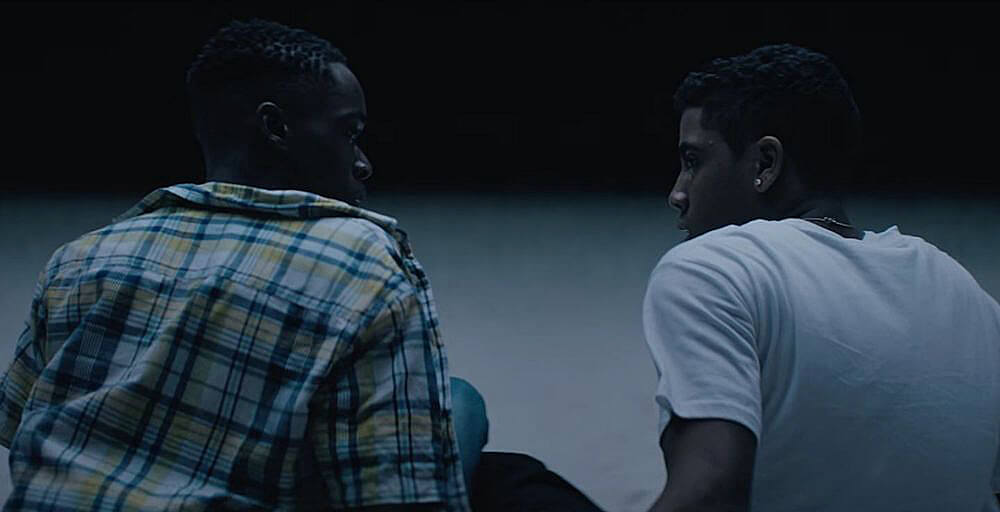
All this changes after Kevin and Chiron meet on a beach, sitting side-by-side as they stare out into the ocean. Kevin is tough, his façade intact. Chiron tells him, "I cry so much sometimes I feel like I just turn to drops." Chiron is "soft," drowning in his own emotions. When Kevin comforts him, the two kiss. The only sexual act they engage in is the one of least risk: Kevin masturbates Chiron. As Kevin wipes Chiron's DNA in the sand, he marks this space, at the edge of the sea, as one of new life where each can stop playing a role and see each other clearly. It is a space of safety not unlike the calm front porch of Loving. They sit side-by-side, and the roles the world asks them to play fall away.
Such safety is illusory. The roles return in full force. Kevin must act a man and beat Chiron after the school bully pressures him to do so. During this first fight scene, as Kevin punches Chiron repeatedly, the camera again moves in chaotic circles, Jenkins illustrating the whirlpool undercurrent, the violent drain, of toxic masculinity. Days later, Chiron responds with a violent rage, beating the class bully who made Kevin prove his manhood in beating Chiron, the soft "faggot." Chiron becomes "Black." Even after Chiron's retaliation in which he plays the role of tough man, the counselor calls him a "boy." In hardening himself to be tough, to be "Black" in order to survive, Chiron is as lost as ever.
The "Black" section of the film begins in Atlanta where Chiron and his mother, Paula, have moved. Black is all muscle, physically imposing, leading a solitary life back on the streets. His mother has sobered up, choosing to live at the rehabilitation center. Yet, it is not Paula who haunts "Black," it is Juan. While mentor to Little, Juan also served as a dangerous model in propagating street life, drug-work, and moral ambiguity as a tough but necessary way of life for a black man. He may teach Little not to fold into himself, but he also provides Little a caricature to play. With "Black," we see a man adopting the teeth, headwear, car and dash ornament, and street lifestyle of his mentor. Yet, Black feels like a radical and a false departure—physically, emotionally—from both Little and Chiron. As the ghost of Juan hovers over "Black," Kevin suddenly resurfaces to offer a moment of startling grace, helping Chiron unmask and reveal "Black" to himself. With "Black," Chiron must learn to integrate the disparate influences of Juan and Kevin into some version of himself.
Little-Chiron is not Black, and it is Kevin who can perhaps best expose and save him from this false self. When Black drives down to Miami and shows up at Kevin's diner, Kevin cooks him dinner and plays "Hello Stranger" on the jukebox. Yes, they are strangers because time and place have divided them. But the meaning goes deeper: Black has taken on the role of stranger to himself; we hear the sound of ocean waves return. Kevin asks Black: "Who is you?"
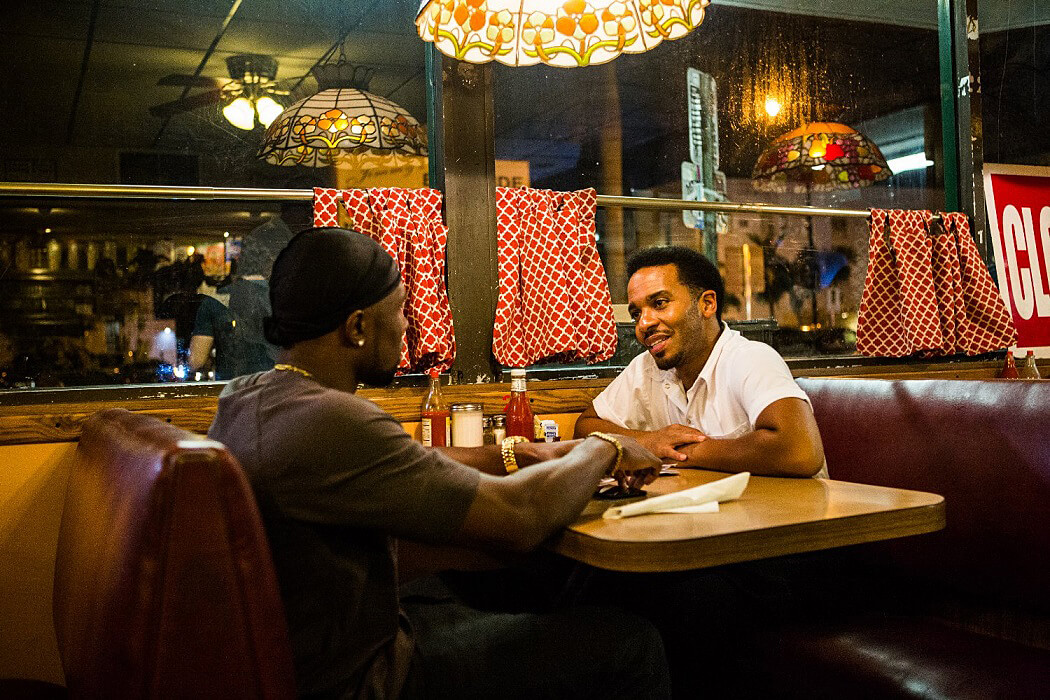
Moonlight begins in darkness, with the sound of ocean water—currents, rhythms, and waves—before fading in to the narrative. It ends with two men, in a kitchen, pouring a glass of water, negotiating each other's past and the present they long to enact. It ends with two men bathing each other in a warm embrace. When Black tells Kevin, "no man has touched me since you," we come to understand Black's answer to Kevin's question. "Who is you?" I am yours, Black seems to say. As Kevin holds Black, we come to "know" and see the man Chiron apart from the roles he has played. The irony of Chiron's story of a lifetime is that it is no longer a "story" with characters—"Little," "Chiron," "Black"; black-gay-man—to create or perform. Illustrating Little-Chiron-Black's harnessing of the ocean's immense body of water into a single glass—his pulling in of desire and intersectional identity from the vast, diffuse, and invisible to the known, contained, and experienced—is the achievement of Barry Jenkins's film.
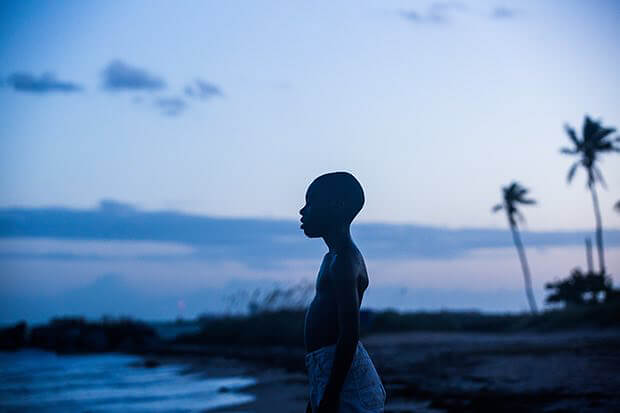
In colloquial terms, to moonlight is to pretend to be something you are not; moonlighting is role-playing. In the film's final frames, we see Little again, his back to us, staring out at the immense waters of the Atlantic. To paraphrase Kate Chopin, the voice of the sea is clam, it is sensuous. It invites you to wade into its waters and lose yourself in the invisible beyond.8Kate Chopin, The Awakening (Chicago and New York: Herbert S. Stone & Co, 1899). At Moonlight's end, however, Little-Chiron-Black is awakened. In the final frame, Little does not walk into the waters, lost to us forever. He turns to the camera and stares directly and fiercely into its lens. He breaks the fourth wall, shattering the pretense of performance. He is present and visible. He is blue in the moonlight. He dares us not to see him and join him on this beach. The film fades to black.
Beside, the Breach
Searching for you in the hollow cage…
—Richie Hoffman, "Sea Interlude: Moonlight"9Richie Hoffman, "Sea Interlude: Moonlight," The Missouri Review, 34, no. 4 (2011): 93.
Beside ocean water, as waves break on the shore, Moonlight ends with a return to Little standing on a solitary beach. Awakened, he stands at the shore of a new becoming, no longer seeking to get beyond himself but to be within himself. The whirlpools have stilled. He stands calmly. As viewers, we are asked to look him in the eye, see him, to place ourselves alongside him. Actor Mahershala Ali, in accepting the SAG award for his performance as Juan, described Chiron as a persecuted man who was folding into himself. Our responsibility, Ali suggests, is to uplift him and tell him he matters. He invites us all to "do a better job of that."10Alex Abad-Santos, "Watch: Mahershala Ali's powerful SAG Awards speech on persecution and acceptance," Vox.com, January 29, 2017, http://www.vox.com/2017/1/29/14433536/mahershala-ali-2017-sag-award-speech-video. Journeys of empathy are not always easy, but as Baldwin once said, you cannot change what you will not face. As we face Little, we stand alongside. We enter his breach as we hear the rhythm of breaking waves. We do not look toward the horizon for a better beyond.
When McCraney, on whose work Moonlight is based, approached writing a play about Hurricane Katrina's devastating effects on New Orleans, he and his collaborators settled on the title The Breach. It begins, "It was water that woke us up that morning."11Catherine Filloux, Tarell Alvin McCraney, and Joe Sutton, The Breach. In Katrina on Stage: Five Plays, edited by Suzanne M. Trauth and Lisa S. Brenner (Evanston, Illinois: Northwestern University Press, 2011), 57.
Beneath Moonlight, the slow return of water and its rhythms upon the shore—fluidity constantly reshaping fixity—wake Chiron up to his true self. Like water splashed in the face of the deep-sleeper, the element of water snaps Chiron out of the fragmentary and traumatic breaches that seek to define him. At Moonlight's close, we join Little-Chiron-Black as he ceases folding into himself and begins to become whole.
In this review essay, I have framed my story deliberately, placing Loving and Moonlight beside each other, linked in more ways than the year of their release. Both films depict breaches—Loving's depiction of a breach of law, Moonlight's breach of time via its non-continual structure and motif of the sound of waves breaching on the shore. More important are the symbolic breaches each film forces us to ponder. Loving is a calm illustration of the fierce power of the action of breaking laws in order to live and love: what is loving? How do we love? Moonlight is a chaotic rumination on being broken, fragmented, traumatized, and the slow process of recovery. What is moonlighting? How do we all moonlight? Each film emplaces viewers alongside characters in the breach. Sutured into the narrative of Loving's calmness and Moonlight's chaos, we wade in these waters in which each lifetime has a story and all love is equal.
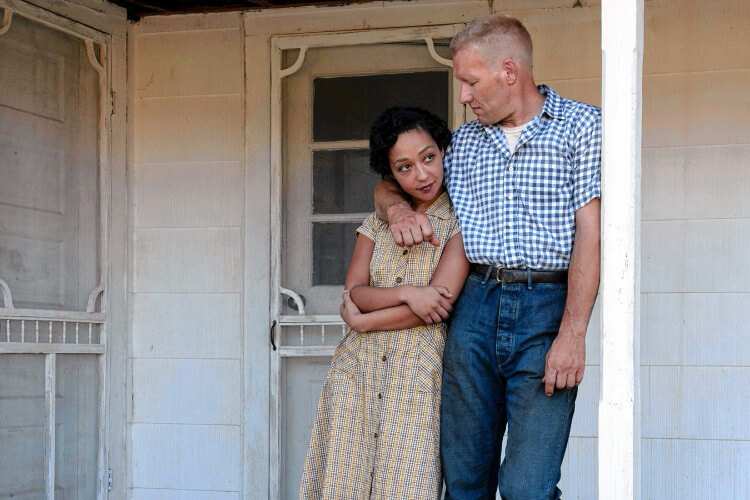
It is perhaps no accident that both Loving and Moonlight, which ponder never-simple questions of race and sexuality, take place in US southern spaces, spaces historically rife with such interrogations. It is also no accident that neither features stereotypical tropes of "southern" filmic narratives. Yes, Loving largely takes place in Virginia, and yes, there is the racist Sheriff and the biased state courts, but the "big white house" is not a centralized plantation but an isolated loving home. In one of the film's most haunting moments, we see a rope being tossed over a tree branch—evoking a murderous history. Nichols, however, immediately cuts to the Loving children who are using this rope for a tire-swing. In rural Virginia, poor whites and blacks often exist alongside one another instead of in opposition. Additionally, the subtext of race in Loving is not simply black and white. The film implicitly asks how can you tell someone with Native blood—whose very marriage license lists her as "Indian"12Arica L. Coleman, "What's Fact and Fiction in Jeff Nichols's Film about the Lovings," History News Network, November 14, 2016, historynewsnetwork.org/article/164415.—that she cannot live in this space?
Similarly, Moonlight takes place in south Florida and Atlanta, but the space is far from traditionally confined. Moonlight exists as spatially liminal: a film located somewhere along the US South—Circum-Caribbean—Black Atlantic continuum. Both Juan and Kevin, the two most important male figures in Chiron's journey, have roots elsewhere. Jenkins's use of the motif of water breaching signifies the larger perplexity of "rootedness" and fixity for all African Americans with ancestors forcibly brought to American shores. How can anyone find stasis out of a heritage of migration, movement, fluidity, and the breach that was the Middle Passage?
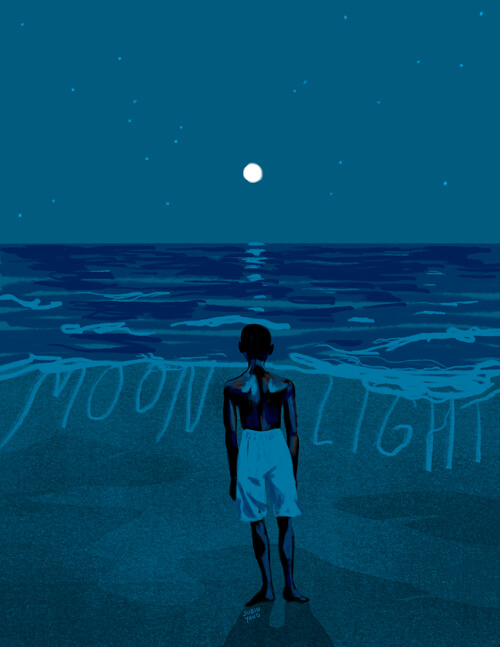
The power of Loving and Moonlight lies in their ability not to didactically excavate beneath or idealistically get beyond, but to emplace the viewers beside the characters within the breach. For Mildred and Richard Loving, that breach is the uprooting of home and the exile they endured. For Little-Chiron-Black, that breach is the brokenness of waves crashing into and continually shaping him to be someone other than who he knows and wants himself to be. Can we cross the empathetic breach to see ourselves shaped by deferred dreams and broken promises? Can we see ourselves, as Black comes to see himself, as a hollow shell moonlighting as a full self? Can we understand his awakening?
Both films implore moments of grace—where we sit alongside on a porch, fight alongside for fair and equal justice, hold one another when we are broken, see and witness the truth and significance of each other's lives. We enter the breach when we rupture our own understandings and prescribed identities.
Loving and Moonlight are linked still in more direct ways. Near the end of her life, Mildred Loving wrote in support of Massachusetts's legalization of same-sex marriage and to commemorate the fortieth anniversary of Loving v. Virginia: "I believe all Americans, no matter their race, no matter their sex, no matter their sexual orientation, should have that same freedom to marry… I support the freedom to marry for all. That's what Loving, and loving are all about."13"Loving for All," Statement by Mildred Loving, June 12, 2007. In Grey Villet, Loving: An Intimate Portrait (New York: Princeton Architectural Press, 2017), 111.
The real-life examples of the Lovings and Loving helps us realize the stakes. Moonlight and Little-Chiron-Black help us understand the slippery nature of ethical imperatives to make lives and loves matter. How do we understand forms of loving—coexisting, cohabitating, desiring, fornicating, fucking, and polyamory, to name but a few—outside the moralizing imperative to move beyond individual bodies and pleasures to the more official, legal institution of marriage? The literal "beyond" of Loving v. Virginia is the Supreme Court's 2015 Obergefell v. Hodges decision that legalized same-sex marriage.14Loving v. Virginia was cited as legal precedent for the Supreme Court's Obergefell v. Hodges decision in which the court saw "the history of marriage is one of continuity and change." See https://www.supremecourt.gov/opinions/14pdf/14-556_3204.pdf. Yet, the achievements of legal recognition of interracial and same-sex marriage, nearly fifty years apart, do not answer the question: how is marriage a moonlighting form of loving and an impoverished form of codifying our love alongside other loves?15Lynne Huffer, "The New Normal is Not Good Enough," The Huffington Post, February 2, 2016, http://www.huffingtonpost.com/lynne-huffer/the-new-normal-not-good-enough_b_1895309.html. How is marriage legalization an easy and impermanent solution to the ethical imperative to see other forms of love alongside one's own?
As Loving and Moonlight bravely enter our world, we ponder the questions they raise as new dangers emerge. The election of Donald Trump feels like an unnavigable breach for many of us, but as the saying goes, now is the time for artists to go to work. In 2015, Toni Morrison wrote of her response to Bush's 2004 re-election: "This is precisely the time when artists go to work. There is no time for despair, no place for self-pity, no need for silence, no room for fear. We speak, we write, we do language. That is how civilizations heal."16Toni Morrison, "No Place for Self-Pity, No Room for Fear," The Nation, March 23, 2015, https://www.thenation.com/article/no-place-self-pity-no-room-fear. Chauncey Devaga cites both Loving and Moonlight as "symbolic resistance in the age of Trump…. They offer a powerful counternarrative to the reactionary social and political forces that elected Donald Trump."17Chauncey Devega, "'Moonlight' and 'Loving': Film as symbolic resistance in the age of Trump," Salon, December 10, 2016, http://www.salon.com/2016/12/10/moonlight-and-loving-film-as-symbolic-resistance-in-the-age-of-trump/. Perhaps what both Moonlight and Loving reveal is that the most important part of speech in our country is the progressive tense "ing"—working, doing, creating, healing. We engage in acts of forming and becoming a more perfect union, whether that union is the result of a crossed breach of difference or sameness. No more moonlighting, no more pretending, we all benefit from loving. We the people must be our own becoming.
About the Author
Eric Solomon is a doctoral candidate in the department of English at Emory University. His dissertation project, Southernmost Currents: Liminal Narratives of Love in the Florida Straits, reads south Florida as a zone of confluence for various queer figures in the latter half of the twentieth century.
]]>The teenagers in this clip from Seventeen, a teen dance show broadcast by WOI-TV to central Iowa in the late-1950s, did not need to know this history to appreciate that Willis's "Betty and Dupree" was a perfect song for dancing the Stroll, even if they did so awkwardly. The teens on Seventeen were emulating their peers in Philadelphia who popularized the dance on the nationally broadcast American Bandstand. Less obviously, the Iowa teens were also emulating teens on The Mitch Thomas Show—a black teen dance show that broadcast locally from Wilmington, Delaware, to the Philadelphia area—whose version of the Stroll influenced the American Bandstand dancers.
While Des Moines, Iowa, may be a long way from the South geographically, television connected Iowa teens to music and dance styles flowing from Delaware, Georgia, South Carolina, and elsewhere. Seventeen was one of dozens of locally broadcast teen dance shows in this era. Each show featured musical performances and records alongside dancing teenagers. The simplicity and profitability of the teen dance show format appealed to television stations, but airing images of youth music culture was a complicated proposition that involved television technologies, network affiliations, marketing, and racial segregation. This essay examines four programs that brought music and dance to southern and border state audiences in the 1950s and 1960s. I focus on three black teen shows, The Mitch Thomas Show from Wilmington, Delaware (1955–1958); Teenage Frolics (1958–1983), hosted by Raleigh, North Carolina, deejay J. D. Lewis; and Washington, DC's Teenarama Dance Party (1963–1970), hosted by Bob King. In addition, I examine Washington's The Milt Grant Show (1956–1961), which allowed only white dancers.
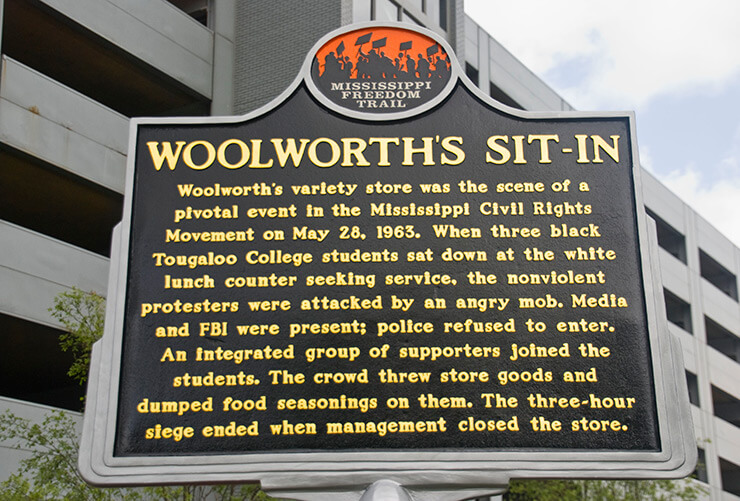
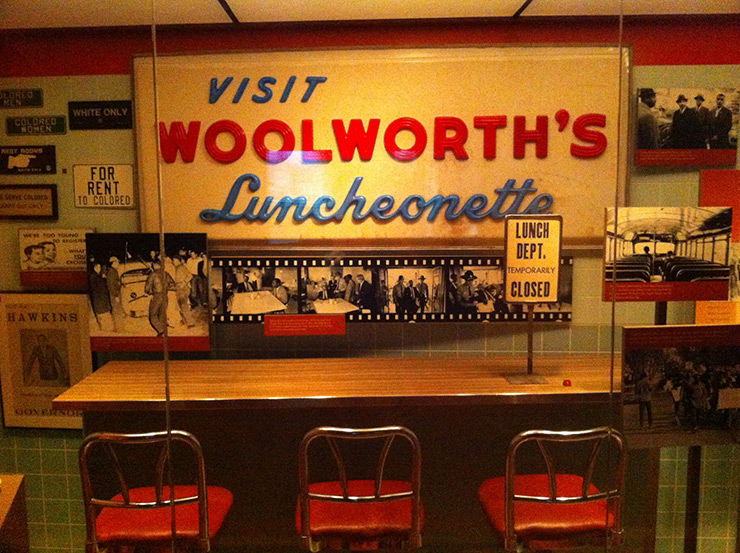
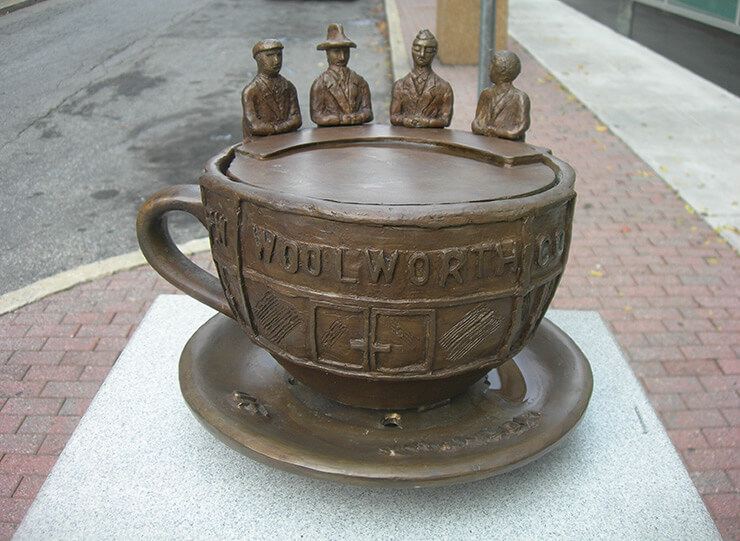
These shows broadcast in an era when civil rights lawsuits and protests sought to overturn policies of racial segregation in schools and public spaces in the South. Wilmington and Washington were the sites of two of the school segregation cases, Belton v. Gebhart and Bolling v. Sharpe, which the Supreme Court combined into Brown v. Board of Education. In Raleigh, token school integration did not begin until 1960, six years after Brown.3Sarah Caroline Thuesen, Greater Than Equal: African American Struggles for Schools and Citizenship in North Carolina, 1919 –1965 (Chapel Hill: University of North Carolina Press, 2013), 225–229. That same year, black students from St. Augustine University and Shaw University staged sit-ins at lunch counters in Raleigh to protest the whites-only policies at Woolworths and other stores.4Jeffrey Crow, Paul Escott, and Flora Hatley, A History of African Americans in North Carolina (Raleigh: Division of Archives and History, North Carolina Department of Cultural Resources, 1992). Televisual representations and photographs of civil rights protests in Little Rock, Greensboro, Birmingham, Jackson, Selma, and other cities also made images of the South highly politicized.5Aniko Bodroghkozy, Equal Time: Television and the Civil Rights Movement (Urbana: University of Illinois Press, 2012); Martin Berger, Seeing Through Race: A Reinterpretation of Civil Rights Photography (Berkeley: University of California Press, 2011); and Leigh Raiford, Imprisoned in a Luminous Glare: Photography and the African American Freedom Struggle (Chapel Hill: University of North Carolina Press, 2013). Part of the power of television for civil rights activists was how the medium exposed excessive acts of physical violence to audiences outside the South. In the midst of the voting rights marches in Selma in 1965, for example, Martin Luther King told marchers and the news media, "We are here to say to the white men that we no longer will let them use clubs on us in the dark corners. We're going to make them do it in the glaring light of television."6Quoted in Bodrogkozy, Equal Time, 2.
In the context of pitched battles over segregation and civil rights, these televised teen dance shows reveal much about the visibility of different youth musical cultures in the 1950s and 1960s. First, The Mitch Thomas Show, Teenage Frolics, and Teenarama Dance Party were important for black teens because the shows offered televisual spaces that valued their creative energies and talents. As historian Earl Lewis has noted, when African Americans faced Jim Crow policies in parks, swimming pools, and movie theaters, they developed separate recreation sites through which they turned segregation into "congregation."7"Afro-Americans who lived in communities as diverse as Chicago, Norfolk, and Buxton, Iowa, congregated—sometimes along class lines, but always together," Earl Lewis argues. "In the southern context, congregation was important because it symbolized an act of free will, whereas segregation represented the imposition of another's will." Earl Lewis, In Their Own Interests: Race, Class, and Power in Twentieth-Century Norfolk, Virginia (Berkeley: University of California Press, 1991), 91–92. Unlike other racially segregated leisure spaces, however, television brought the sounds and images of black music cultures to viewers of all colors across and beyond the cities from which the shows broadcast. Second, television technology worked to enhance and/or limit the visibility of different youth musical cultures. Broadcasting from Wilmington, Raleigh, and Washington, these shows reached regional audiences, but varied in terms of signal strength and network affiliations. Differences in terms of station power and stability shaped the duration of each program. Finally, the visibility these shows offered to teenagers was closely tied to the salability of teen music culture. For The Mitch Thomas Show, Teenage Frolics, and Teenarama Dance Party this meant trying to attract sponsors to advertise to black television audiences. For The Milt Grant Show, this meant airing black music performances while maintaining a segregated studio audience that would appeal to sponsors.
I became interested in these teen dance shows while researching and writing a book on American Bandstand. Counter to host Dick Clark's claims that he integrated American Bandstand, my research revealed how the first national television program directed at teens discriminated against black youth during its early years and how black teens and civil rights advocates protested this discrimination.8Matthew Delmont, The Nicest Kids in Town: American Bandstand, Rock 'n' Roll, and the Struggle for Civil Rights in 1950s Philadelphia (Berkeley: University of California Press, 2012). Like American Bandstand, the local programs I explore in this essay brought dynamic music cultures to eager audiences and advertisers, while they also traced the boundaries of inclusion and exclusion in their cities. Unlike American Bandstand, or Soul Train, which started broadcasting nationally in 1971, The Mitch Thomas Show, Teenage Frolics, Teenarama Dance Party, and The Milt Grant Show are not well known outside of their local broadcast markets. Among these four programs, only one recording is known to exist, a 1957 episode of The Milt Grant Show recorded to sell the show to sponsors. With limited televisual evidence, my analysis draws on archival documents, promotional materials, newspapers, photographs, and interviews to explore how these shows got on and stayed on the air and what they meant to their audiences. By examining these local programs this essay builds on the work of scholars Norma Coates, Murray Forman, Julie Malnig, Tim Wall, George Lipsitz, and Brian Ward who have examined the intersections of music and television, the importance of televised teen dance shows as community spaces, and the development of rhythm and blues and rock and roll.9Norma Coates, "Elvis from the Waist Up and Other Myths: 1950s Music Television and the Gendering of Rock Discourse," in Medium Cool: Music Videos from Soundies to Cellphones, eds. Roger Beebe and Jason Middleton (Durham, NC: Duke University Press, 2007), 226–251; Coates, "Filling in Holes: Television Music as a Recuperation of Popular Music on Television," Music, Sound, and the Moving Image 1, no. 1 (Spring 2007): 21–25; Murray Forman, One Night on TV Is Worth Weeks at the Paramount: Popular Music on Early Television (Durham, NC: Duke University Press, 2012); Julie Malnig, "Let's Go to the Hop: Community Values in Televised Teen Dance Programs of the 1950s," Dance & Community: Proceedings of The Congress on Research in Dance (August, 2006): 171–175; Tim Wall, "Rocking Around the Clock: Teenage Dance Fads from 1955 to 1965," in Ballrooms, Boogie, Shimmy, Sham, Shake: A Social and Popular Dance Reader, ed. Julie Malnig (Urbana: University of Illinois Press, 2009), 182–198; George Lipsitz, Midnight at the Barrelhouse: The Johnny Otis Story (Minneapolis: University of Minnesota Press, 2010); and Brian Ward, Just My Soul Responding: Rhythm and Blues, Black Consciousness, and Race Relations (Berkeley: University of California Press, 1998).
The Mitch Thomas Show
The Mitch Thomas Show debuted on August 13, 1955, on WPFH, an unaffiliated television station that broadcast to Philadelphia and the Delaware Valley from Wilmington.10"The NAACP Reports: WCAM (Radio)," August 7, 1955, NAACP collection, URB 6, box 21, folder 423, TUUA. Born in West Palm Beach, Florida, Mitch Thomas graduated from Delaware State College and served in the army before becoming the first black disc jockey in Wilmington, Delaware, in 1949.11Eustace Gay, "Pioneer In TV Field Doing Marvelous Job Furnishing Youth With Recreation," Philadelphia Tribune, February 11, 1956; Gary Mullinax, "Radio Guided DJ to Stars," The News Journal Papers (Wilmington, DE), January 28, 1986, D4. His television show, broadcast every Saturday, resembled Philadelphia's Bandstand, at the time a local program hosted by Bob Horn, and other locally broadcast teenage dance programs. The Mitch Thomas Show stood out because it was the first television show hosted by a black deejay that featured a studio audience of black teenagers. Otis Givens, who lived in South Philadelphia and attended Ben Franklin High School, remembered that he watched the show every weekend for a year before he finally made the trip to Wilmington to dance on air. "When I got back to Philly, and everyone had seen me on TV, I was big time," Givens recalled. "We weren't able to get into Bandstand, [but] The Mitch Thomas Show gave me a little fame. I was sort of a celebrity at local dances."12Otis Givens, interview with author, June 27, 2007. Similarly, South Philadelphia teen Donna Brown recalled in a 1995 interview, "I remember at the same time that Bandstand used to come on, there used to be a black dance thing that came on, and it was The Mitch Thomas Show . . . And that was something for the black kids to really identify with. Because you would look at Bandstand and we thought it was a joke."13Quoted in John Roberts, From Hucklebuck to Hip-Hop: Social Dance in the African American Community in Philadelphia (Philadelphia: Odunde, 1995), 37. The Mitch Thomas Show also became a frequent topic for the black teenagers who wrote the Philadelphia Tribune's "Teen-Talk" columns. Much in the same way that national teen magazines followed American Bandstand, the Tribune's teen writers kept tabs on the performers featured on Thomas's show, and described the teenagers who formed fan clubs to support their favorite musical artists and deejays.14On the Philadelphia Tribune's "Teen-Talk" coverage of Mitch Thomas' show, see "They're 'Movin' and Groovin,'" Philadelphia Tribune, July 31, 1956; Dolores Lewis, "Talking With Mitch," Philadelphia Tribune, November 9, 1957; Lewis, "Stage Door Spotlight," Philadelphia Tribune, November 9, 1957; Laurine Blackson, "Penny Sez," Philadelphia Tribune, December 7, 1957 and April 26, 1958; Dolores Lewis, "Philly Date Line," Philadelphia Tribune, December 7, 1957; "Queen Lane Apartment Group [photo]," Philadelphia Tribune, December 7, 1957; Jimmy Rivers, "Crickets' Corner," Philadelphia Tribune, January 21 and April 22, 1958; Edith Marshall, "Current Hops," Philadelphia Tribune, March 1, 8 and 22, 1958; Marshall, "Talk of the Teens," Philadelphia Tribune, March 22, 1958; and "Presented in Charity Show [Mitch Thomas photo]," Philadelphia Tribune, April 22, 1958. The fan gossip shared in these columns documented the growth of a youth culture among the black teenagers whom Bandstand excluded. In 1957, it was one of these fan clubs that made the most forceful challenge to Bandstand's discriminatory admissions policies.15Art Peters, "Negroes Crack Barrier of Bandstand TV Show," Philadelphia Tribune, October 5, 1957; "Couldn't Keep Them Out [photo]," Philadelphia Tribune, October 5, 1957; Delores Lewis, "Bobby Brooks' Club Lists 25 Members," Philadelphia Tribune, December 14, 1957. Although many of these teens watched both Bandstand and Thomas's show, as Bandstand grew in popularity and expanded into a national program, The Mitch Thomas Show remained the only television program that represented the region's black rock and roll fans.
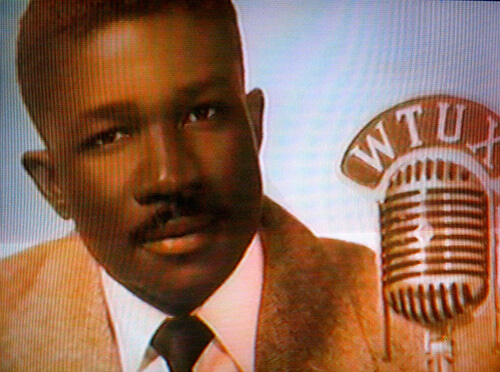
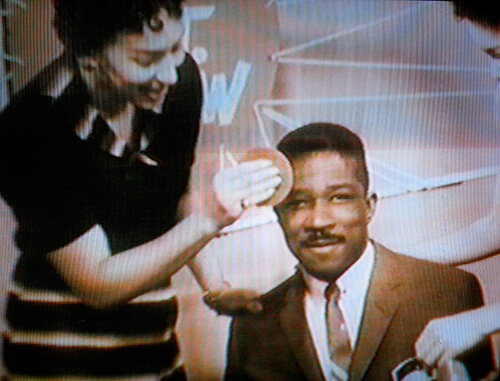
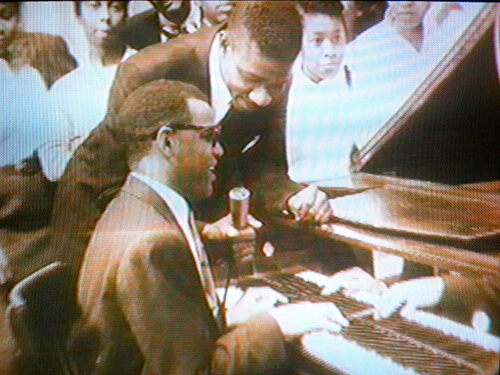
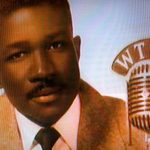
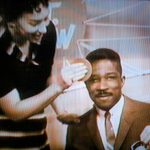
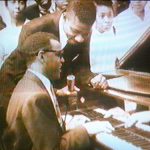
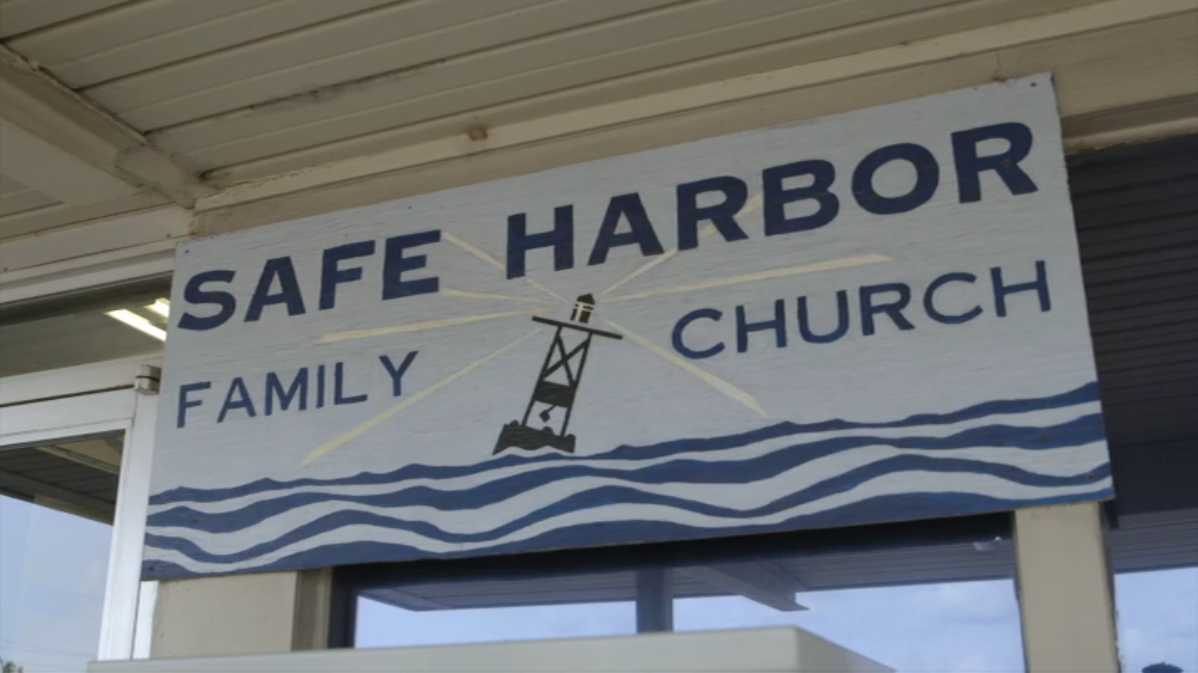
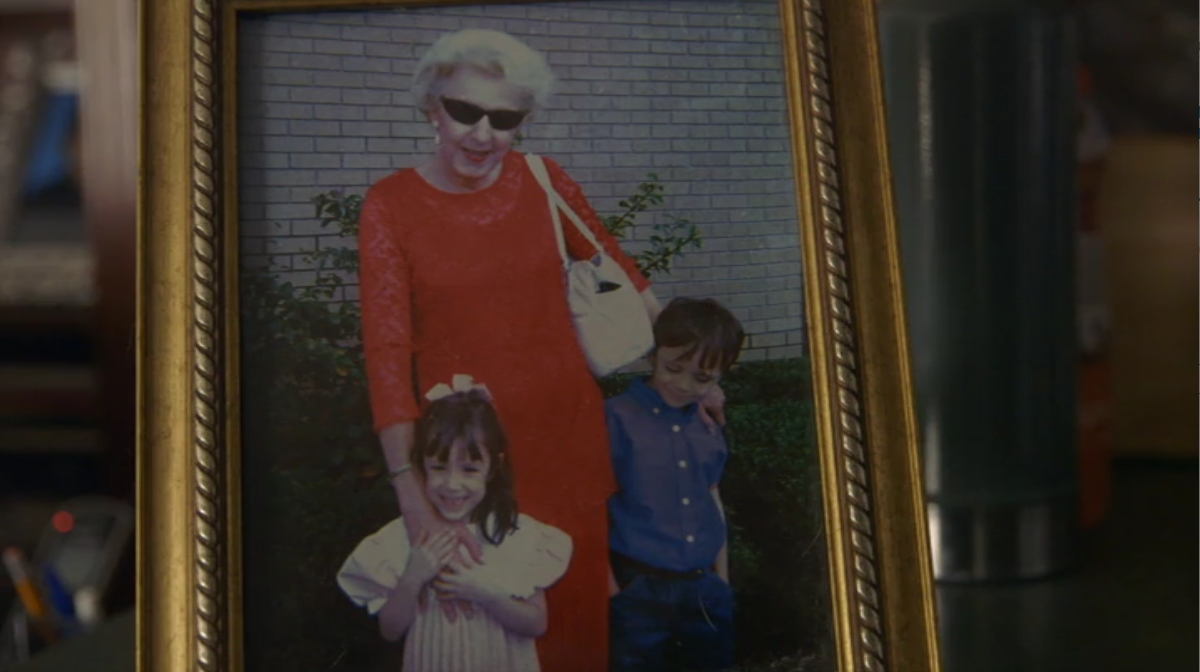
Economics, more than a concern for racial equality, influenced WPFH's decision to provide airtime for this groundbreaking show. Eager to compete with Bandstand and the afternoon offerings on the other network-affiliated stations, WPFH hoped that Thomas's show would appeal to both black and white youth in the same way as black-oriented radio.16On the crossover appeal of black-oriented radio, see Brian Ward, Radio and the Struggle for Civil Rights in the South (Gainsville: University Press of Florida, 2004); William Barlow, Voice Over: The Making of Black Radio (Philadelphia: Temple University Press, 1999); and Susan J. Douglas, Listening In: Radio and the American Imagination (New York: Times Books, 1999), 219–255. The station's bet on Thomas was part of a larger strategy that included hiring white disc jockeys Joe Grady and Ed Hurst to host a daily afternoon dance program that started at 5 p.m., after Bandstand concluded its daily broadcast. While The Grady and Hurst Show broadcast five times per week, the weekly Mitch Thomas Show proved to be more influential.
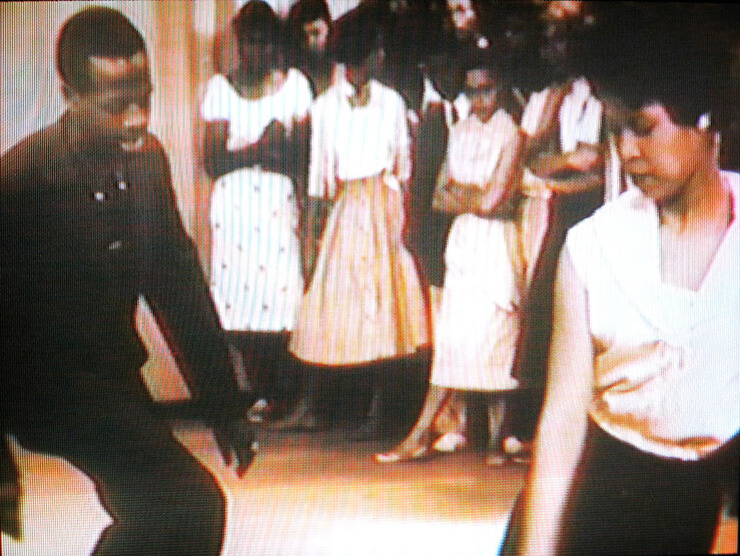
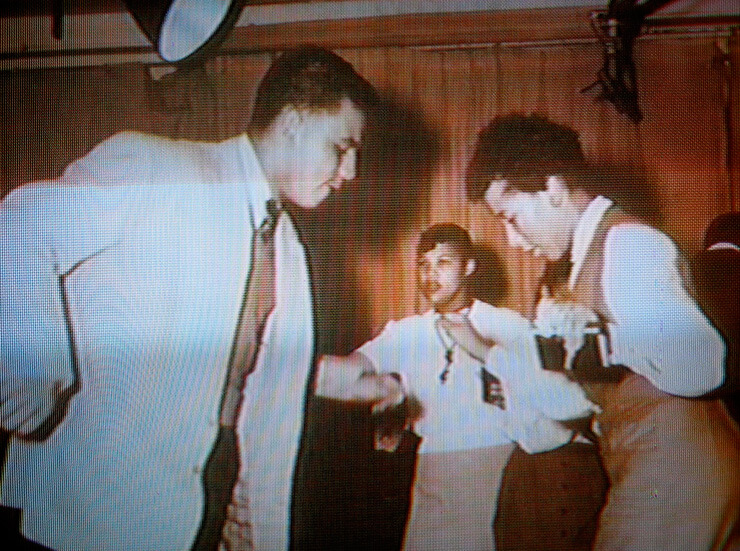
Teens dancing on the The Mitch Thomas Show, locally called the "Black Bandstand," Wilmington, Delaware, ca. 1955-1958. Screenshots (1 and 2) from Black Philadelphia Memories, directed by Trudi Brown (WHYY-TV12, 1999). Screenshots courtesy of Matthew F. Delmont, The Nicest Kids in Town.
Drawing on Thomas's contacts as a radio host and on the talents of the teenagers, the program helped shape the music tastes and dance styles of young people in Philadelphia. In a 1998 interview for the documentary Black Philadelphia Memories, Thomas recalled that "the show was so strong that I could play a record one time and break it wide open."17Black Philadelphia Memories, directed by Trudi Brown (Philadelphia, WHYY-TV12, 1999), television documentary. Indeed, Thomas's show hosted some of the biggest names in rock and roll, including Ray Charles, Little Richard, the Moonglows, and Frankie Lymon and the Teenagers. It also featured vocal harmony groups from the Philadelphia area.18"Teen-Age 'Superiors' Debut on M.T. Show," Philadelphia Tribune, November 19, 1957. Thomas promoted large stage shows as well as small record hops at skating rinks.19On Mitch Thomas' concerts, see Archie Miller, "Fun & Thrills," Philadelphia Tribune, December 4, 1956; "Rock 'n Roll Show & Dance," Philadelphia Tribune, April 19, 1958; "Swingin' the Blues," Philadelphia Tribune, August 5, 1958; "Mitch Thomas Show Attracts Over 2000," Philadelphia Tribune, August 18, 1958; "Don't Miss the Mitch Thomas Rock & Roll Show," Philadelphia Tribune, July 2, 1960. These events were often racially integrated, "The whites that came, they just said, 'Well I'm gonna see the artist and that's it.' I brought Ray Charles in there on a Sunday night, and it was just beautiful to look out there and see everything just nice."20Mullinax, "Radio Guided DJ to Stars."
Ray Smith, who attended American Bandstand frequently and has done research for one of Dick Clark's histories of the show, remembers that he and other white teenagers watched The Mitch Thomas Show to learn new dance steps. Describing the "black Bandstand," Smith recalled:
First of all, black kids had their own dance show, I think it was on channel 12, but one of the reasons I remember it is because I watched it. And I remember that there was a dance that [American Bandstand regulars] Joan Buck and Jimmy Peatross did called "The Strand" and it was a slow version of the jitterbug done to slow records. And it was fantastic. There were two black dancers on this show, the "black Bandstand," or whatever you want to call it. The guy's name was Otis and I don't remember the girl's name. And I always was like "wow." And then I saw Jimmy Peatross and Joan Buck do it, who were probably the best dancers who were ever on Bandstand. I was talking about it to Jimmy Peatross one day, when I was putting together the book, and he said, "Oh, I watched this black couple do it." And that was the black couple that he watched.21Ray Smith, interview with author, August 10, 2006. Jimmy Peatross and Joan Buck tell a related story about learning how to do The Strand from black teenagers in Twist, directed by Ron Mann (Sphinx Productions, 1992), documentary.
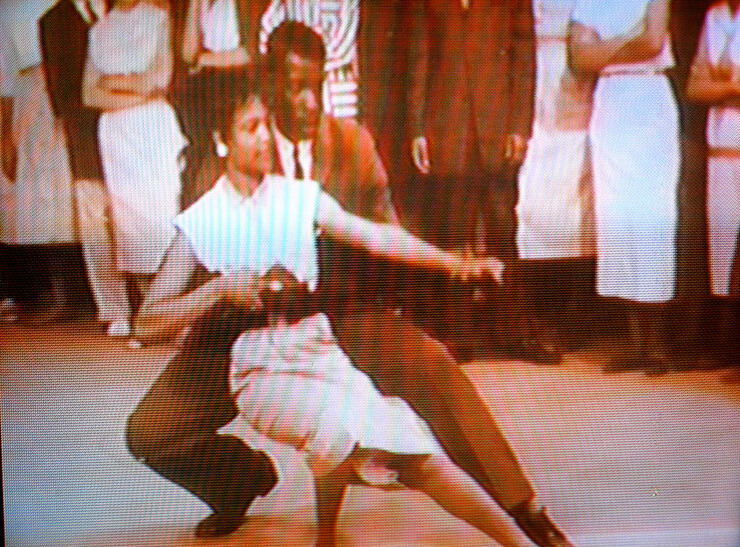
Vera Boyer and Otis Givens show off their dance steps on The Mitch Thomas Show, Wilmington, Delaware, ca. 1956–57. Screenshot from Black Philadelphia Memories, directed by Trudi Brown (WHYY-TV12, 1999). Screenshot courtesy of Matthew F. Delmont, The Nicest Kids in Town.
These white teenagers were not alone in watching The Mitch Thomas Show. Smith's experience supports Mitch Thomas's belief that [American Bandstand teens] "were looking to see what dance steps we were putting out. All you had to do was look at 'Bandstand' the next Monday, and you'd say, 'Oh yeah, they were watching.'"22Ibid. They were watching, for example, when dancers on The Mitch Thomas Show started dancing The Stroll, a group dance where boys and girls faced each other in two parallel lines, while couples took turns strutting down the aisle. Thomas remembers that the teens on his show "created a dance called The Stroll. I was standing there watching them dancing in a line, and after a while I asked them, 'What are y'all doing out there?' They said, 'That's The Stroll.' And The Stroll became a big thing."23Black Philadelphia Memories, dir. Trudi Brown. Because the show influenced American Bandstand during its first year as a national program, teenagers across the country learned dances popularized by The Mitch Thomas Show.
Despite its success among black and white teenagers, Thomas's show remained on television for only three years, from 1955 to 1958. His short-lived television career resembled the experiences of other African American entertainers who hosted music and variety shows in this era. The Nat King Cole Show (1956–1957) failed to attract national advertisers and lasted only one year. Before Cole, shows hosted by black singers Lorenzo Fuller (1947) and Billy Daniels (1952) and the variety program Sugar Hill Times (1949) also fared poorly. Among local programs, the Al Benson Show and Richard Stamz's Open the Door Richard both had brief periods of success in 1950s Chicago.24J. Fred MacDonald, Blacks and White TV: African Americans in Television Since 1948 (Chicago: Nelson-Hall, 1983), 17–21, 57–64; Jannette Dates, "Commercial Television," in Split Image: African Americans and the Mass Media, ed., Davis and Barlow (Washington, DC: Howard University Press, 1993), 267–327; Christopher Lehman, A Critical History of Soul Train on Television (Jefferson, NC: McFarland & Company, 2008), 28; Richard Stamz, Give 'Em Soul, Richard! (Urbana: University of Illinois Press, 2010), 62–63, 77–78; Barlow, Voice Over, 98–103.
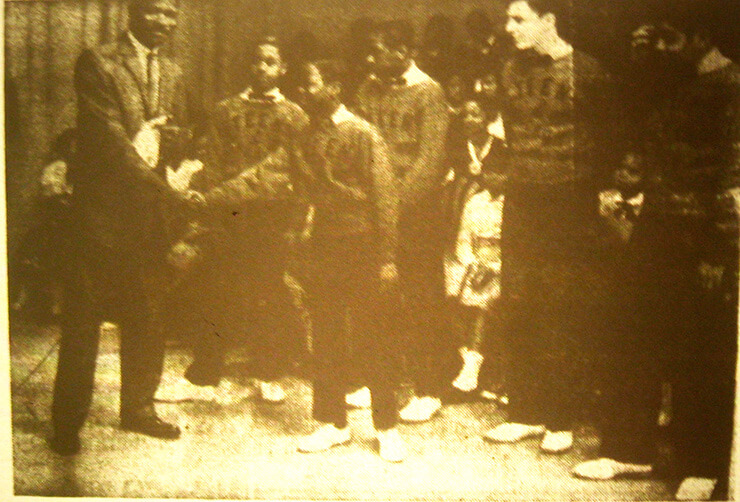
Mitch Thomas hosts Lewis Lymon and the Teenchords, Wilmington, Delaware, December 7, 1957, The Philadelphia Tribune. Reproduced with permission of The Philadelphia Tribune. Courtesy of Matthew F. Delmont, The Nicest Kids in Town.
The failure of the station that broadcast The Mitch Thomas Show underscores the tenuous nature of such unaffiliated local programs. Storer Broadcasting Company purchased WPFH in 1956.25Herbert Howard, Multiple Ownership in Television Broadcasting (New York: Arno Press, 1979), 142–147. Storer frequently bought and sold stations and, at the time of the WPFH acquisition, it also owned stations in Toledo, Cleveland, Atlanta, Miami, and Portland. Storer changed WPFH's call letters to WVUE and hoped to move the station's facilities from Wilmington closer to Philadelphia. The plan faltered, and the station suffered significant operating losses over the next year.26Ibid. Thomas's show was among the first victims of the station's financial problems. While advertisers started to pay more attention to black consumers in the 1950s, a product-identification stigma lingered throughout the decade, preventing many brands from sponsoring black programs.27Barlow, Voice Over, 129; Giacomo Ortizano, "One Your Radio: A Descriptive History of Rhythm-and-blues Radio During the 1950s" (PhD dissertation, Ohio University, 1993), 391–423. WVUE cancelled The Mitch Thomas Show in June 1958, citing the program's lack of sponsorship and low ratings compared to the network shows in Thomas's Saturday timeslot.28Art Peters, "Mitch Thomas Fired From TV Dance Party Job," Philadelphia Tribune, June 17, 1958. Shortly after firing Thomas, Storer announced plans to sell WVUE in order to buy a station in Milwaukee as FCC regulations required multiple broadcast owners to divest from one license in order to buy another. Unable to find a buyer for WVUE, Storer turned the station license back to the government, and the station went dark in September 1958.29Howard, Multiple Ownership in Television Broadcasting, 146. The manager of WVUE later told broadcasting historian Gerry Wilkerson, "No one can make a profit with a TV station unless affiliated with NBC, CBS or ABC." As Dick Clark and American Bandstand celebrated the one-year anniversary of the show's national debut, local broadcast competition brought The Mitch Thomas Show's groundbreaking three-year run to an unceremonious end. Thomas continued to work as a radio disc jockey through the 1960s, until he left broadcasting in 1969 to work as a counselor to gang members in Wilmington.
The Mitch Thomas Show usefully troubles the boundary between the South and the North. Historian Brett Gadsden describes Delaware as "a provincial hybrid, one in which ostensibly southern and northern modes of race relations operated."30Brett Gadsden, Between North and South: Delaware, Desegregation, and the Myth of American Sectionalism (Philadelphia: University of Pennsylvania Press, 2013), 7. Many teens who danced on The Mitch Thomas Show or watched the program would have experienced de jure school segregation and the slow realization of educational equality promised by Brown. At the same time, WPHF's Wilmington studios were only thirty miles from Philadelphia, a city that, historian Matthew Countryman notes, many black people called "Up South."31Matthew Countryman, Up South: Civil Rights and Black Power in Philadelphia (Philadelphia: University of Pennsylvania Press, 2006), 10. The Mitch Thomas Show teenagers would also have been familiar with segregation as practiced in Philadelphia and televised on American Bandstand. Carried out more covertly, this northern-style segregation was no less intentional or demeaning.32On the limitations of the de jure/de facto framework, see Matthew Lassiter, "De Jure/De Facto Segregation: The Long Shadow of a National Myth," in The Myth of Southern Exceptionalism, eds., Lassiter and Joseph Crespino (New York: Oxford University Press, 2010), 25–48. On race and segregation in Philadelphia, see Countryman, Up South; Countryman, "'From Protest to Politics': Community Control and Black Independent Politics in Philadelphia, 1965–1984,"Journal of Urban History 32 (September 2006): 813–861; Delmont, The Nicest Kids in Town; James Wolfinger, Philadelphia Divided: Race and Politics in the City of Brotherly Love (Chapel Hill: University of North Carolina Press, 2007); Wolfinger, "The Limits of Black Activism: Philadelphia's Public Housing in the Depression and World War II," Journal of Urban History 35 (September 2009): 787–814; Guian McKee, The Problem of Jobs: Liberalism, Race, and Deindustrialization in Philadelphia (Chicago: University Chicago Press, 2008); McKee, "'I've Never Dealt with a Government Agency Before': Philadelphia's Somerset Knitting Mills Project, the Local State, and the Missed Opportunities of Urban Renewal," Journal of Urban History 35 (March 2009): 387–409; and Lisa Levenstein, A Movement Without Marches: African American Women and the Politics of Poverty in Postwar Philadelphia (Chapel Hill: University of North Carolina Press, 2009). Seeing The Mitch Thomas Show as "between North and South" highlights the constant negotiation of sectional identities and imaginaries.
Teenage Frolics
J. D. Lewis' Teenage Frolics, which aired from 1958 to 1983, stayed on the air longer than any other local teen dance program. A graduate of Morehouse College and a World War II veteran, John Davis (J. D.) Lewis, Jr. started his radio career at Raleigh's WRAL in 1947 as a morning deejay playing gospel music. A. J. Fletcher and Fred Fletcher's Capitol Broadcasting Company, which owned WRAL, received a TV license in 1956 and Lewis played an important role in convincing the Federal Communications Comission (FCC) that WRAL-TV would serve African American viewers.33Clarence Williams, "JD Lewis Jr.: A Living Broadcasting Legend," Ace: Magazine of the Triangle, September–October 2002, 12–14, 70. Unlike The Mitch Thomas Show and Teenarama, Teenage Frolics aired on a VHF (very high frequency) station with a network affiliation (WRAL-TV had a primary affiliation with NBC and a secondary affiliation with ABC).34"WRAL-TV," 1960 Broadcasting Yearbook, A–73 Despite these network ties, WRAL proved challenging in other ways. Jesse Helms, later a US senator and national conservative leader, became an executive at Capitol Broadcasting in 1960 and delivered news editorials railing against communism, liberalism, and civil rights. As program manager in the late-1960s, Helms was Lewis's boss.35Jesse Helms, Here's Where I Stand (New York, Random House, 2005), 44–51; Ernest Furgurson, Hard Right: The Rise of Jesse Helms (New York: W. W. Norton, 1986), 69–91; William Link, Righteous Warrior: Jesse Helms and the Rise of Modern Conservatism (New York: St. Martin's Press, 2008), 64–98. WRAL, however, offered Teenage Frolics signal strength and stability, and Lewis's success at attracting advertisers and navigating station politics kept the program on the air for twenty-five years.
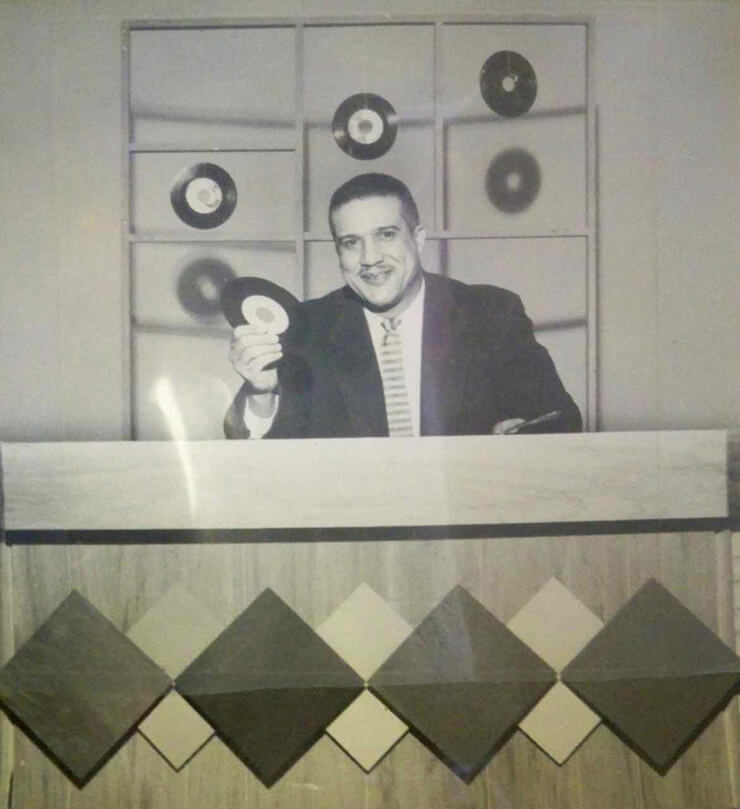
In a letter to potential advertisers, WRAL billed Teenage Frolics as "a live and lively dancing party featuring colored teenagers from high schools in the Channel 5 area." The station also included a coverage map of WRAL-TV, "which includes the most heavily populated Negro areas of the state of North Carolina (Approximately 450,000 Negroes)," and promised that "'The Teen-Age Frolic Show' affords a wonderful opportunity for firsthand consumer reaction to the sponsor's product."36J.D. Lewis (WRAL), letter to Dick Snyder, May 24, 1963, Lewis Family Papers, Southern Historical Collection, University of North Carolina at Chapel Hill, catalog number 5499, folder 139. Lewis secured Pepsi Cola, which sponsored Teenage Frolics as part of the "special markets" campaign to increase sales of the beverage among African Americans.37On Pepsi marketing to black customers, see Stephanie Capparell, The Real Pepsi Challenge: How One Pioneering Company Broke Color Barriers in 1940s American Business (New York: Free Press, 2008). He served as a Pepsi public relations and sales representative for the Raleigh area from 1965 to 1968. Pepsi's sponsorship proved important to making of Teenage Frolics financially viable in the 1960s as it fought for airtime against more profitable national programming. A 1967 memo from Jesse Helms highlights the pressures Teenage Frolics faced from national broadcasts and mentions Pepsi's sponsorship of the show. "As per our conversation of yesterday, it is going to be necessary that we make some adjustment in our Saturday afternoon schedule this fall with respect to Teen-Age Frolics," Helms wrote to inform Lewis and other staff that the show would have to be shortened from its regular one hour broadcast time.
The abbreviated (15 minute) programs are necessary because of ABC's scheduling of American Bandstand from 12:30–1:30 p.m. each Saturday. To do otherwise would necessitate our preemption of a solid hour of commercial network programming, which I deem inadvisable. In the 15-minute programs, please leave two 60-second cutaways for the Pepsi-Cola commercials which I am advised are all that we have sold in Teen-Age Frolics anyhow."38Jesse Helms, memo to Ray Reeve, July 6, 1967, Lewis Family Papers, folder 139; Ray Reeve, memo to J.D. Lewis, July 7, 1967, Lewis Family Papers, folder 139.
Despite Helms's backhanded reference, Pepsi's sponsorship offered Teenage Frolics a national brand sponsor, something neither The Mitch Thomas Show nor Teenarama possessed.
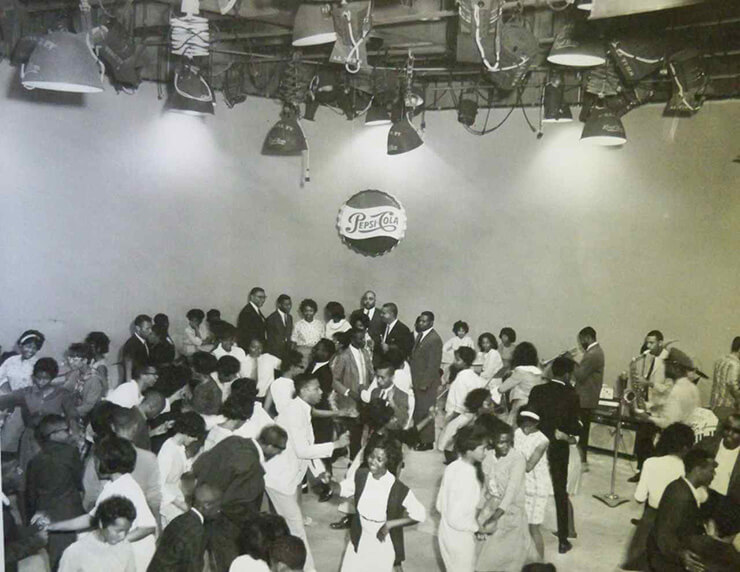
WRAL's mailing to advertisers also included a list of the schools and organizations that had visited the show. Mapping a partial list of the groups that visited the studio highlights how many young people wanted to appear on the show and participate in its creation of black youth music culture. When North Carolina began desegregation from 1969 to 1971, many black high schools were closed or were converted to elementary schools or junior highs. In 1970, for example, black students who attended W. E. B. DuBois High School were transferred to historically white Wake Forest High School and the DuBois High School building became Wake Forest-Rolesville Middle School.39Barry Malone, "Before Brown: Cultural and Social Capital in a Rural Black School Community, W.E.B. Dubois High School, Wake Forest, North Carolina," The North Carolina Historical Review 85, no. 4 (October 2008): 443–444. "When black schools closed," historian David Cecelski writes, "their names, mascots, mottos, holidays, and traditions were sacrificed with them, while students were transferred to historically white schools that retained those markers of cultural and racial identity."40David Cecelski, Along Freedom Road: Hyde County, North Carolina and the Fate of Black Schools in the South (Chapel Hill: University of North Carolina Press), 9. Teenage Frolics offered a black cultural space that bridged this period between segregated and integrated schools.
Letters from viewers and aspiring musicians to Lewis and WRAL attest that many teenagers and performers wanted to appear on Teenage Frolics. "I watch your show every Saturday and enjoy it very much," one viewer wrote. "Your records are up to date and your show is very much for teenagers. I notice everybody that come are in groups. . . . I would like to come with 6 or 7 others, and be a part of your show. I would appreciate your information by telling me if we can come and when we can come. Please rush your information."41Susan Jordan, letter to J.D. Lewis (WRAL), n.d. [ca. 1966-67], Lewis Family Papers, folder 140. A letter to "John D." from an adult chaperone suggests that Lewis was a well-known and approachable local television personality, "I came to your house two Sundays ago to see you. I asked your daughter to tell you to call me, please. . . . My plan is to bring a group of 45 or 50 children . . . on Saturday, May 14th. My question is—may they appear on your 'Dance Party'?"42Hazel Jordan, letter to J.D. Lewis (WRAL), May 8, 1966, Lewis Family Papers, folder 140. Fans also felt free to criticize the format of Teenage Frolics. One particularly opinionated "Frolic Fan" wrote, "I am very concerned with your show. Once you really had a rocking roll show up here. But now it doesn't interest anyone." This viewer offered Lewis several suggestions for how to improve the show, including, "You need more records. New records come out every day and you play old ones."43"Frolic Fan," letter to J.D. Lewis (WRAL), n.d. [ca. 1966-67], Lewis Family Papers, folder 140. Another letter complained that a local band, Irving Fuller and the Corvettes, appeared too often on the show, "Many of the people around Durham and elsewhere are bored of listening to the Corvettes. It seems as if you never play records anymore. Most people listening to a dance program would rather hear the latest records."44Anonymous ("102 Pilot St.), letter to J.D. Lewis (WRAL), June 10, 1967, Lewis Family Papers, folder 140.
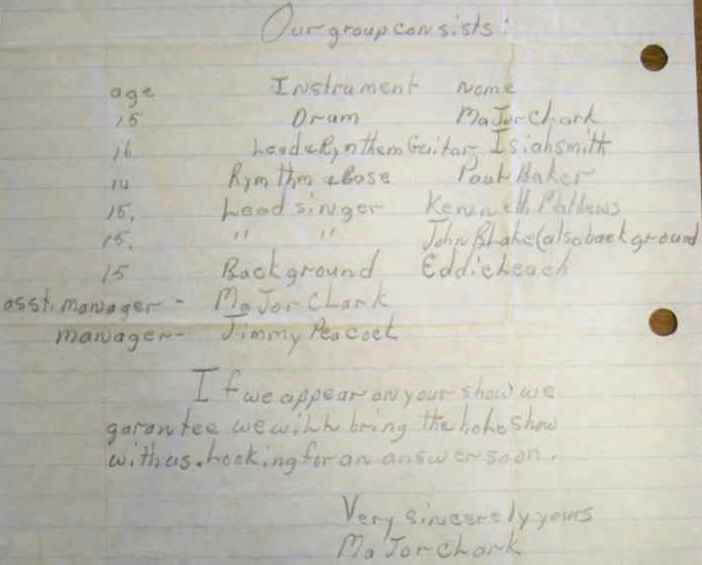
Letter from The Superiors to Teenage Frolic, North Carolina, July 25, 1967. Used with permission of Yvonne Holley, Lewis Family Papers #5499, Southern Historical Collection, The Wilson Library, University of North Carolina at Chapel Hill.
In addition to viewer letters, Lewis received mail from local music groups that watched and wanted to appear on the show. Groups like Donald and the Hitchhikers, Tiny and the Tinniettes, Little Joe and the Diamonds, Cobra and the Fabulous Entertainers, and the Dacels saw Teenage Frolics as a way to perform for other black teenagers and become known beyond their high schools and neighborhoods. The Superiors, a group of six fourteen to sixteen-year-olds from Smithfield, North Carolina, expressed dreams of auditioning for Motown and asked, "could we sort of take an inch of your show to sing" to "show North Carolina they will be greatly represented."45Donald Hodge, letter to J.D. Lewis (WRAL), June 21, 1967, Lewis Family Papers, folder 140; Guadalupe Hudson, letter to J.D. Lewis (WRAL), June 24, 1967, Lewis Family Papers, folder 140; Daniel Jackson, letter to J.D. Lewis (WRAL), May 29, 1967, Lewis Family Papers, folder 140; "Nero, the Mad," letter to J.D. Lewis (WRAL), June 24, 1967, Lewis Family Papers, folder 140, July 22, 1967; Gwendolyn Gilmore, J.D. Lewis (WRAL), n.d. [ca. 1967], Lewis Family Papers, folder 140.
As television production became increasingly centralized in Los Angeles in the 1960s, Teenage Frolics was part of the everyday life of black teenagers in the Raleigh area. In this way, Teenage Frolics served as what scholar and musician Guthrie Ramsey calls a "community theater." Ramsey describes "community theaters" as "sites of cultural memory" that "include but are not limited to cinema, family narratives and histories, the church, the social dance, the nightclub, the skating rink, and even literature."46Guthrie Ramsey, Race Music: Black Cultures from Bebop to Hip-Hop (Berkeley: University of California Press, 2004), 4. From this perspective, localism was a virtue for Teenage Frolics rather than a detriment, because it offered young people a community connection that was not possible with national television. Sisters Gwendolyn and Lena Horton, for example, regularly walked from the Walnut Terrace neighborhood to appear on the show. Gwendolyn Horton recalled, "We would practice all week so we'd be ready on Saturday," while Lena Horton noted, "just to get out there, you thought you were something that could be shown on TV."47Cash Michaels, "Memories of Teenage Frolics," The Carolinian, December 4, 1997. Comparing the show to Soul Train in 1997, The Carolinian, a Raleigh-based African-American newspaper, commented that Teenage Frolics "gave the Hollywood production a run for its money in these parts."48Ibid. Soul Train and American Bandstand attracted nationally known performers, but on Teenage Frolics, teenagers participated in the show's creation and saw their neighbors, classmates, friends, and family do the same.
Teenarama Dance Party
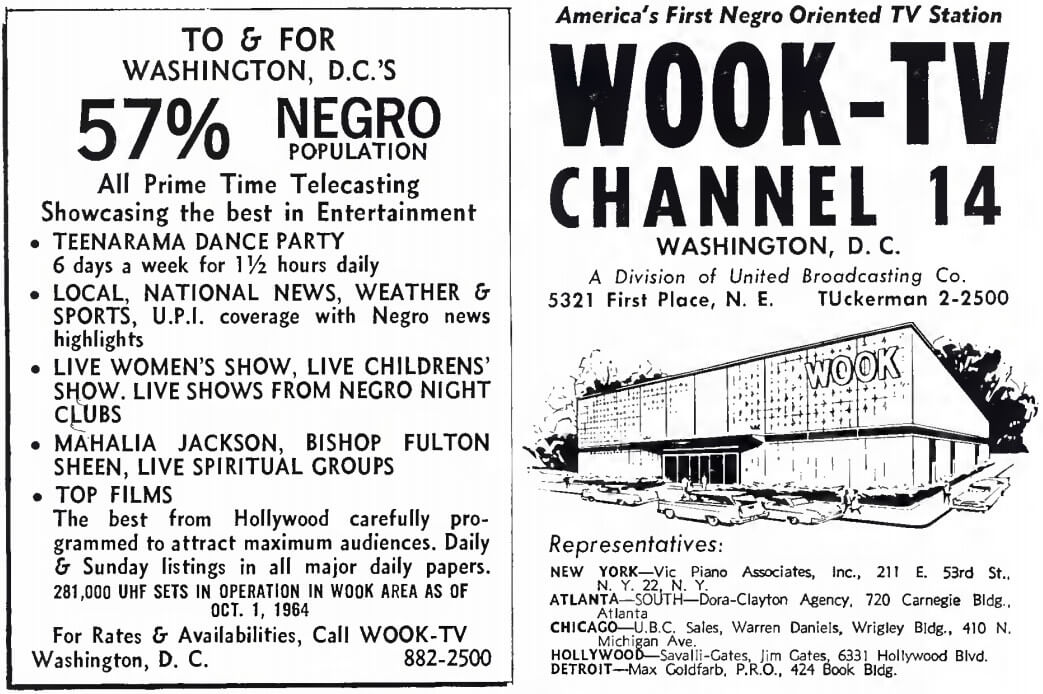
A WOOK-TV advertisement in the 1965 Broadcasting Yearbook highlights the promise and precarity of the station that broadcast Teenarama Dance Party. The advertisement billed WOOK-TV as "America's First Negro Oriented TV Station" broadcasting "To & For Washington, D.C.'s 57% Negro population." While the advertisement used large, bold font to tout the city's majority African American population to potential advertisers, smaller letters tried to put a positive spin on the station's limitations, "281,000 UHF sets in operation in WOOK area as of Oct. 1, 1964."49"WOOK-TV," 1965 Broadcasting Yearbook, A–10. Whereas all television sets could pick up VHF stations, which carried major network programming, UHF (ultra high frequency) stations required viewers to have special UHF tuners. This meant buying additional hardware to receive the channels, or, after Congress passed the All-Channels Receiver Act in 1962, buying a newer television set.50Christopher Sterling and John Michael Kittross, Stay Tuned: A History of American Broadcasting, Third Edition (Mahwah, NJ: Lawrence Erlbaum Associates, 2002), 255–256, 351–352, 383, 415–416. Both of these options were cost prohibitive for many of the African American viewers WOOK hoped to reach. Teenarama Dance Party received top billing in this advertisement and ultimately the show's fortunes would rise and fall with WOOK's.
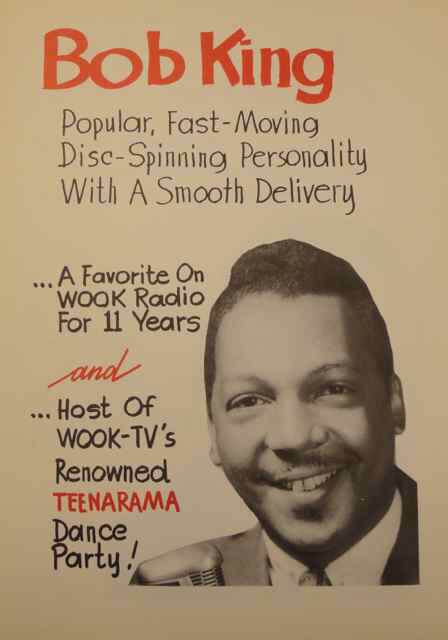
WOOK-TV advertisement for Teenarama host Bob King, 1965. Kendall Productions Records, Smithsonian Anacostia Community Museum. Image courtesy of Matthew F. Delmont.
Teenarama host Bob King came to WOOK in 1956 from WRAP radio in his hometown of Norfolk, Virginia, where he hosted an R&B show.51James Lee, "He Plays Teens Picks," Washington Star, [n.d.] ca. 1963. Looking back on his earlier radio career, King recalled, "In those days what I was playing was called 'race music.' It was a little more raucous. Then people like Presley came along and began to change it . . . In Norfolk in 1951 and 1952, they began calling it rhythm and blues. The hillbilly influence began creeping into it and the music became what we call rock and roll . . . The distinction, which may be a fine one, is the style of the singer and the background of a record. A lot of rock and roll today is bordering on what is called 'popular music.'"52Ibid. King went on to say that he considered Teenarama and his radio show to be "rhythm and blues" programs, and R&B artists like James Brown, Jackie Wilson, Walter Jackson, and Chuck Jackson all performed on Teenarama. For these and other artists who played at Washington's historically black Howard Theater, Teenarama offered an additional opportunity to perform and promote their music while they were in the city.
While performers, record companies, and music fans welcomed Teenarama's promotion of R&B, WOOK's music programing drew criticism from Washington's black press and the city's black leaders. One editorial in the Washington Afro-American complained that WOOK-radio was "monotonous" because it played "rock 'n roll 17 hours a day," and described "'Colored' radio" as having "dedicated itself to a low-mentality level of programming which dispenses musical slop to remind colored people that's all they want to hear."53"WOOK-TV's Coloring Book," Washington Afro-American, February 16, 1963; "WOOK's Insult to Our Race," Washington Afro-American, February 23, 1963. Another editorial argued that WOOK-TV insults "the colored race's intelligence by advertising itself as nothing but a station programming plain ol' music and dancing. As colored people, we've been plagued with that image ever since we were freed from slavery. WOOK-TV only perpetuates this image."54"Voice of the People: In Defense of WOOK-TV," Washington Afro-American, February 23, 1963. Congress of Racial Equality (CORE) chairman Julies Hobson also expressed concern, saying, "I object to foot tapping, dancing, screaming and shouting." Sterling Tucker, director of the Washington branch of the Urban League, worried that WOOK's focus on the "Negro market" was out of step with civil rights efforts, "You don't go along the road of segregation to achieve integration."55"WOOK Says it Isn't Just One-Color TV," Washington Star, February 11, 1963. These critiques reflected differences in age and class between the readership of the Afro-American and potential viewers and listeners of WOOK-TV and WOOK-radio.56John Henry Murphy, Sr. started publishing the Afro-American newspaper in Baltimore in 1892. By 1960, under the control of Carl Murphy, the Afro-American published editions across the Mid-Atlantic States. The Afro-American papers cultivated an older and more middle class black audience than the viewers and listeners WOOK-TV and WOOK-radio targeted. At the same time, the critics expressed concern that the station's management and white president, Richard Eaton, would not attend to community interests and concerns beyond musical entertainment. For his part, Eaton argued on the eve of the station's first broadcast, "WOOK-TV will be a place where young Negroes can develop their talents and the problems of the Negro [will be] vividly displayed. We hope to show interracial activities which are harmonious. We do not intend to assume a controversial role."57"Nation's First Minority Group TV Station to Broadcast Today," Chicago Defender, February 11, 1963.
WOOK-TV never assumed a leadership role with regards to the main political issues of its era, but Teenarama showcased black youth culture for Washington viewers. Chuck Jackson, an R&B artist who appeared on the show several times, described Teenarama's importance, "Before this, with some kids, no one has given them a sense of being someone, a sense of independence. All kids are creative, but we don't let them express it . . . These kids are typical of all the kids who are given something to do, some responsibility."58Nan Randall, "Rocking and Rolling Road to Respectability," Washington Post, July 4, 1965. In an interview with filmmaker Beverly Lindsay-Johnson, who made an important documentary on the show, Teenarama regular Reginald "Lucky" Luckett recalled, "One of the key things about the program was that it got the [teens] involved. If you stood around the cameramen, they would show you how to operate the cameras. I became more fascinated with the operation than the program." Another regular, William Clemmons recalled, "We couldn't go on The Milt Grant Show on a regular basis. We couldn't go on Shindig on a regular basis. We couldn't go on American Bandstand on a regular basis. We had Teenarama, which was ours."59"Dance Party (The Teenarama Story), Research Narrative," Box 2, Kendall Production Records, Smithsonian Anacostia Community Museum. As Clemmons suggests, Teenarama afforded a level of television visibility for black teenagers and black music that was not found on national programs.
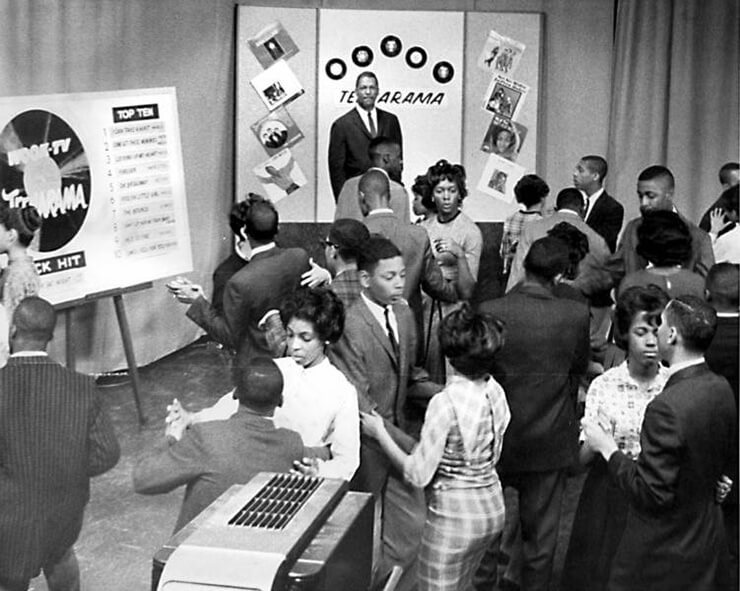
Bob King watches dancers on Teenarama, Washington DC, ca. 1960s. Kendall Productions Records, Smithsonian Anacostia Community Museum. Image courtesy of Matthew F. Delmont.
One of the challenges with analyzing The Mitch Thomas Show, Teenage Frolics, and Teenarama is that no visual traces of the shows are known to exist. Most early television shows were recorded over or discarded because storage was too expensive. In her documentary on Teenarama Beverly Lindsay-Johnson dealt with this lack of footage by recruiting contemporary Washington teenagers, teaching them the locally distinct "hand dance" of the era, and having them reenact the dances. "We had eight weeks to get these kids taught," Lindsay-Johnson remembered, "and when it came time to shoot the reenactments I wasn't sure they got it." She recalled that this changed when they got period clothing, "It was a community effort, there was a guy who used to dance on Teenarama who worked at the Salvation Army and he said, 'come in and get anything you want'…when the kids had the clothes on…the kids got it, I knew they had it."60Beverly Lindsay-Johnson, interview with author, January 8, 2013. This story and the black and white reenactments in Lindsay-Johnson's film speak both to the creativity that historians of television must employ and to the imprint Teenarama made on the black population in Washington, DC.
The Milt Grant Show
As WOOK-TV prepared to come on the air in 1963, the Afro-American newspaper received a letter from Rev. Clarence Burton Jr., defending the station and raising a question about the teen dance show that predated Teenarama. "Who can tell," Burton offered, "from the working of the station maybe we can increase our colored stardom. There have been many cases where our leaders needed to make outcries such as Milt Grant's TV dance program, it seems to me that that was segregation."61"Voice of the People: In Defense of WOOK-TV," Washington Afro-American, February 23, 1963. As Burton suggests, during its five years The Milt Grant Show (1956–1961) was an officially segregated program. The show blocked black teens from the studio, though complaints from black viewers eventually led to one show per week featuring a black studio audience (so-called "Black Tuesday"). Despite its ban on black teenagers, the show regularly featured black R&B performers who were in town to perform at the Howard Theater. The Milt Grant Show is particularly interesting for how it sought to bring black music performances to television viewers while maintaining a segregated studio audience that would appeal to sponsors.
Only one kinescope of The Milt Grant Show is known to exist, but it features two separate performances by R&B performers—one by the duo Johnnie and Joe (Johnnie Lee Richardson and Joe Walker), and the other by LaVern Baker—that help explain how the show sought to manage the differences between black performers and white audience members. In each clip, the teenagers dance as the singers lip sync to recordings of their songs, as was the common practice in this era. The cameras shift between a medium shot of the artists and a wide shot of couples dancing, before using a picture-in-picture production technique that presented the shot of the artists in a box overlaying the shot of the teenagers dancing. A performance later in the show by white singer Jeri Renay did not use this technique. The resulting image nicely illustrates the tensions surrounding televising black music to white audiences. Broadcasting black musical performers on television was more challenging than radio, because television made the performers' bodies visible, and on dance shows like these, put their bodies in close proximity to those of dozens of teenagers. Alan Freed's Big Beat television show, for example, was cancelled in August 1957 after affiliated stations complained about black teenage singer Frankie Lymon dancing with a white teenage girl. A year later, an American Bandstand producer told the New York Post that this incident contributed to American Bandstand's segregation.62John Jackson, Big Beat Heat: Alan Freed and the Early Years of Rock & Roll (New York: Shirmer Trade Books, 2000), 168–169; Jackson, American Bandstand: Dick Clark and the Making of a Rock 'n' Roll Empire (New York: Oxford University Press, 1999), 56. The Milt Grant Show clips from May 1957 predate the Freed-Lymon controversy, but the show faced similar concerns. Grant needed to be able to feature black performers in a way that was safe for the consuming pleasure of the white studio and television audiences and the sponsors that were eager to reach them. With black performers only a few feet away from the white teenage dancers in the studio, the picture-in-picture technique demarcated the racial boundary between performers and audiences and offered one strategy for televising black musicians while maintaining racial segregation.
Despite the racial segregation of the studio audience, The Milt Grant Show offered black performers like LaVern Baker valuable exposure to white consumers. In the prior three years, Baker had mixed experiences with crossing over from the R&B charts to the pop chart. Her songs "Tweedle Dee" and "Jim Dandy" both reached the top twenty of the pop chart, but white singer Georgia Gibbs's cover of "Tweedle Dee" topped the pop chart and outsold Baker's version.63Arnold Shaw, Honkers and Shouters: The Golden Years of Rhythm and Blues (New York: Macmillan, 1978), 376. Baker's contemporary Ruth Brown explained, "I wasn't so upset about other singers copying my songs because that was their privilege, and they had to pay the writers of the song. But what did hurt me was the fact that I had originated the song, and I never got the opportunities to be in the top television shows and the talk shows. I didn't get the exposure. And the other people were copying the style, the whole idea."64Quoted in Ward, Just My Soul Responding, 48. Baker, who appeared on The Milt Grant Show while she was in town to play the Howard Theater, performed "Jim Dandy Got Married" and "Play the Game of Love" on this episode. Even if The Milt Grant Show carefully managed the positioning of black singers and white dancers, television viewers in the greater Washington area saw Baker perform and this exposure was one step towards establishing her as a crossover star in the late-1950s and early-1960s.
The Milt Grant Show dedicated almost every minute to selling products, and Grant, as this message to potential sponsors makes clear, was a compelling and unabashed salesman. While WTTG-TV lacked a network affiliation, Grant proved skilled at recruiting and serving sponsors.65WTTG-TV was was founded as a DuMont station and DuMont ended network operations in 1956. "Grant provides an all-out sponsor and agency service," Billboard reported in 1961. "He attends sales meetings, store openings and maintains close identification with his sponsors' products off the air as well as on."66"TV Jockey Profile: The Milt Grant Show," Billboard, February 6, 1961, 43. He promised potential sponsors that for an hour every afternoon WTTG-TV's studio in the Raleigh Hotel in downtown Washington would be a nexus for selling products to area teenagers. From paid advertisements for consumer goods to promotions of records and musical guests, also often paid for by record promoters, The Milt Grant Show presented its viewers with a host of messages. The show urged teenagers to drink Pepsi, eat at Tops' Drive-Inn, listen to Motorola portable radios, and buy the newest records at the Music Box record store. This was an extraordinarily high level of promotional activity, even by the standards of commercial television. Music was the glue that held together a carnival of consumption.
Sponsors that advertised on The Milt Grant Show bought interaction between their products and the show's teenagers. For example, in a 1957 episode the show's teens finished dancing to The Everly Brothers' "Bye Bye Love" and the camera focused on Grant in front of a table with dozens of bottles of Pepsi. After Grant took a big drink of the soda and delivered the sales pitch ("Never too heavy, never too sweet, always just right"), he asked two teenagers to help hand out bottles of the sponsor's drink to the dancers. As Grant introduced The Four Aces' "I Just Don't Know," he exited the scene, the camera pulled back to focus on teens who flocked to pick up their free Pepsi. The teens held and drank their sodas while dancing, keeping the sponsor's product in the picture throughout the song. Some teens were still holding their bottles when Grant started the next advertisement for Motorola portable radios. Here again, the advertisement incorporated the studio audience, with one young woman holding the radio while Grant praised its features. These interpolated commercials, common in radio and television in this era, offered sponsors daily visual evidence of teenagers' eagerness to consume and encouraged The Milt Grant Show's viewers to participate in the same rituals of consumption.
Conclusion
From one perspective, these televised teen dance shows were commercialized diversions during an era of profound changes in the racial dynamics of the South. From another, however, these shows were spaces that celebrated the creative potential and everyday lives of black youth. To show how these perspectives are intertwined I'll conclude with a brief discussion of a dance show that started broadcasting at a pivotal time and from a pivotal place in the history of civil rights. Steve's Show debuted in Little Rock, Arkansas, in the spring of 1957, months before the integration crisis at Central High School drew national attention. Examining Little Rock, political theorist Danielle Allen writes, "Nineteen fifty-seven forced citizens to confront the nature of their citizenship—that is, the basic habits of interaction in public spaces—and many were shamed into desiring a new order."67Danielle Allen, Talking to Strangers: Anxieties of Citizenship since Brown v. Board of Education (Chicago: University of Chicago Press, 2004), 5. Allen argues that images, like Will Counts's iconic photograph of black student, Elizabeth Eckford, surrounded by a white mob and being cursed by white student Hazel Bryan, forced some white Americans to revaluate their "habits of citizenship."
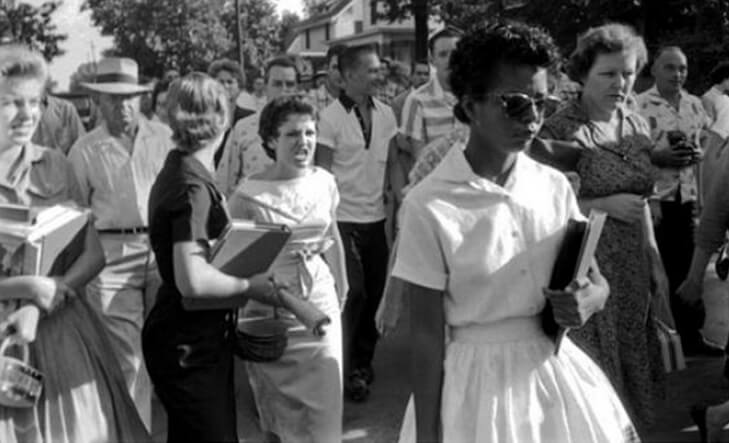
Hazel Bryan (left) harasses Elizabeth Eckford as black students attempt to integrate Little Rock's Central High School, Little Rock, Arkansas, September 4, 1957. Photograph by Will Counts. Courtesy of Matthew F. Delmont.
Changes to the structure of public life took place slowly. Televised teen dance shows offer an example of how "basic habits of interaction in public spaces" did not change dramatically in 1957. Just over one mile from Central High School, Steve's Show broadcast from the KTHV-TV studios. While Little Rock's school desegregation crisis led print and television news across the country in the fall of 1957, Arkansas viewers could tune in every afternoon to watch white teenagers dance on the still-segregated Steve's Show. Like other white teens that protested the desegregation of Central High, Hazel Bryan danced regularly on Steve's Show. After the widely circulated photograph made her a local celebrity she attended the show with a bodyguard.68David Margolick, Elizabeth and Hazel: Two Women of Little Rock (New Haven: Yale University Press, 2011), 44, 290. Steve's Show was a highly visible regional space that asserted a racially segregated public culture and continued to do so until it went off the air in 1961. And Steve's Show was not unique: Dick Reid's Record Hop in Charleston, West Virginia; Ginny Pace's Saturday Hop in Houston, Texas; John Dixon's Dixon on Disc in Mobile, Alabama; Bill Sanders's show in Chattanooga, Tennessee; Dewey Phillips's Pop Shop in Memphis, Tennessee; and Chuck Allen's Teen Tempo in Jackson, Mississippi were all segregated dance shows. Like The Milt Grant Show, Baltimore's Buddy Deane Show, the inspiration for John Waters's Hairspray film and the later Broadway musical and Hollywood film, was officially segregated and only allowed black teens to enter the studio on specific days. Nationally, American Bandstand blocked black teens from entering the studio during its years in Philadelphia, despite host Dick Clark's claims to the contrary. Every weekday afternoon, in each of these broadcast markets, these shows presented images of exclusively white teenagers.
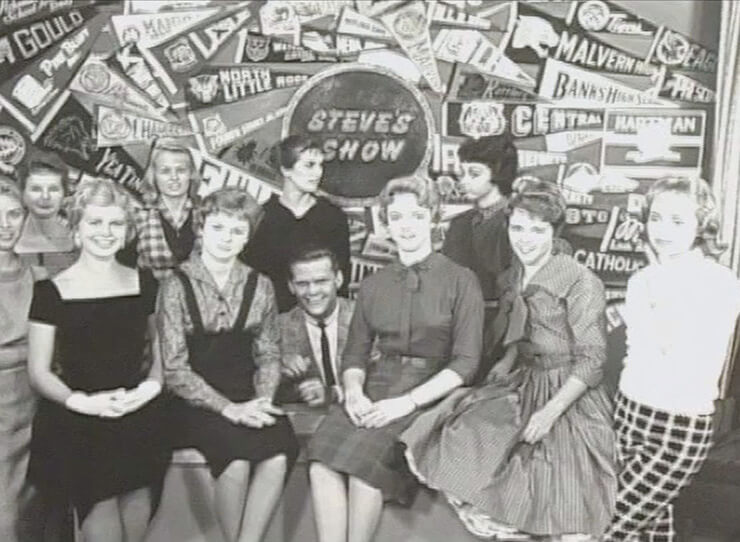
Steve's Show, Little Rock, Arkansas, late 1950s. Broadcast locally during the 1957 school integration crisis, the show featured exclusively white dancers, including Hazel Bryan. Screenshot from Steve's Show, a documentary directed by Sandra Hubbard (Morning Star Studio, 2004). Screenshot courtesy of Matthew F. Delmont.
In his "Letter from a Birmingham Jail," Martin Luther King, Jr. spoke to what it meant for young black people to be excluded from these sorts of entertainment spaces. In a long list of reasons why "we find it difficult to wait," King includes, "when you suddenly find your tongue twisted and your speech stammering as you seek to explain to your six year old daughter why she can't go to the public amusement park that has just been advertised on television, and see tears welling up in her eyes when she is told that Funtown is closed to colored children, and see ominous clouds of inferiority beginning to form in her little mental sky…then you will understand why we find it difficult to wait." King's mention of "Funtown" is preceded by references to lynch mobs, police brutality and the "airtight cage of poverty," and followed by references to hotel segregation and racial slurs. While it is tempting to see "Funtown" as somehow less important than these issues, to do so is a mistake. The "Funtown" reference is powerful because it captures one of the ways that Jim Crow segregation and white supremacy were most meaningful to children and teenagers. For many young people being blocked from amusements parks, swimming pools, and skating rinks would be their first exposure to what King calls the feeling of "forever fighting a degenerating sense of 'nobodiness.'"69Martin Luther King, Jr., "Letter from a Birmingham Jail," April 16, 1963.
The prevalence of racial segregation in recreational spaces and on white teen dance shows throws the importance of The Mitch Thomas Show, Teenage Frolics, and Teenarama into sharp relief. If white teen shows sought to shore up the supremacy of whiteness in youth music culture, the black teen shows visualized black teens as equal participants in the production and consumption of music culture. In her study of the landmark black television show Soul!, that ran from 1968 to 1972, Gayle Wald argues that the show "created a television space where black people…could see, hear, and almost feel each other." Wald describes this as an "affective compact" that "complicates the clear division between production and consumption."70Gayle Wald, It's Been Beautiful: Soul! and Black Power Television (Durham: Duke University Press, 2015), 217, 72. While Soul! was more politically and aesthetically adventurous than The Mitch Thomas Show, Teenage Frolics, and Teenarama, these teen dance shows fostered a similar compact between their audiences and performers. Mitch Thomas, J. D. Lewis, and Bob King created televisual spaces that privileged black audiences and displayed the creative energies and talents of black youth. Years before Soul Train (1971–2006) brought black dance television to national audiences, The Mitch Thomas Show, Teenage Frolics, and Teenarama highlighted black music and dance styles.71Ericka Blount Danois, Love, Peace, and Soul: Behind the Scenes of America's Favorite Dance Show Soul Train: Classic Moments (Milwaukee: Backbeat Books, 2013); Nelson George, The Hippest Trip in America: Soul Train and the Evolution of Culture and Style (New York: William Morrow, 2014); Questlove, Soul Train: The Music, Dance, and Style of a Generation (New York: Harper Design, 2013). Unlike Soul Train, which moved from Chicago to Hollywood after one year, these local shows featured and appealed to black teens from Wilmington, Raleigh, and Washington, and as the opening clip from Seventeen suggests, they influenced American musical cultures in surprising ways.
Ultimately, these televised teen dance shows encourage us to expand the range of sounds and images we associate with black youth in the South. It takes nothing away from the young men and women who risked their lives to desegregate schools and lunch counters to recognize that thousands of teenagers found joy and value in dancing on television or watching their peers do the same. If the iconic civil rights images from cities like Little Rock, Greensboro, and Birmingham attest to the fact that young activists struggled to be treated as first-class citizens, The Mitch Thomas Show, Teenage Frolics, and Teenarama emphasized that black youth were worthy of being first-class consumers and teenagers.72On the relationship between citizenship and consumption, see Lizbeth Cohen, A Consumer's Republic: The Politics of Mass Consumptions in Postwar America (New York: Alfred A. Knopf, 2003); Robert Weems, Jr., Desegregating the Dollar: African American Consumerism in the Twentieth Century (New York: New York University Press, 1998); Victoria Wolcott, Race, Riots, and Roller Coasters: The Struggle over Segregated Recreation in America (Philadelphia: University of Pennsylvania Press: 2012).
About the Author
Matthew Delmont is associate professor of history at Arizona State University and author of The Nicest Kids in Town: American Bandstand, Rock 'n' Roll, and Civil Rights in 1950s Philadelphia (University of California Press, American Crossroads series, February 2012), and Why Busing Failed: Race, Media, and the National Resistance to School Desegregation (University of California Press, American Crossroads series, forthcoming February 2016). He is currently finishing a book titled Making Roots: How an Epic Book and Television Miniseries Made History and Why Roots Still Matters (under contract with University of California Press).
]]>Keep Your Eye upon the Scale
Recording Exchange in Wales and Appalachia
In 1974, American political sociologist John Gaventa initiated a videotape conversation between rank and file coal miners in South Wales and Appalachia. Attending Oxford University with filmmaker Richard Greatrex, Gaventa initially documented the 1974 Wales Miners' Strike, part of a series of national mining strikes across the United Kingdom. When Gaventa returned to the United States, sociologist Helen Lewis invited him to show the tapes to her students at Clinch Valley College in Wise, Virginia. While in Appalachia, Gaventa recorded music-making at the Brookside Strike in Harlan County, Kentucky. In 1975, Lewis expanded this multi-media exchange when she received a National Science Foundation postdoctoral fellowship to research coal mining culture in Wales. Together, Lewis, Gaventa, and Greatrex made over 150 videotapes of daily life in mining communities, documenting conversations about labor history, family life, religion, and culture. The music recorded during this documentary exchange provides soundscapes of mining communities on both sides of the Atlantic.
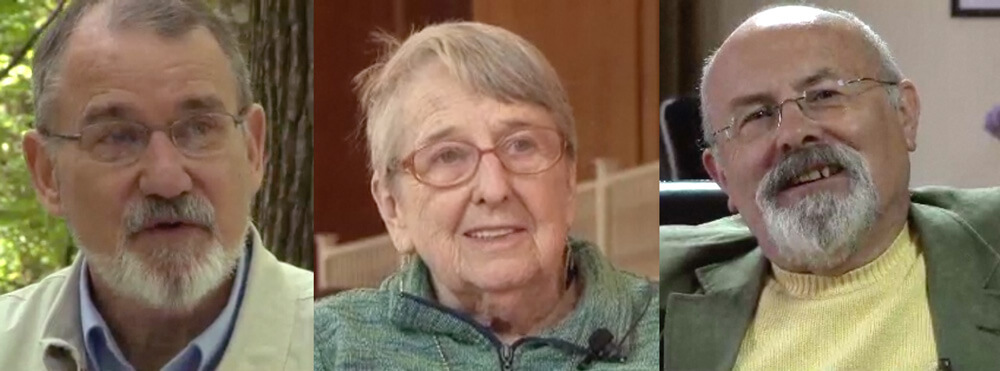 |
| John Gaventa (left), Helen Lewis (middle), and Richard Greatrex (right), 2014. Video stills by Tom Hansell, Patricia Beaver, and Angela Wiley. |
In 2012, Tom Hansell (assistant professor of Appalachian Studies at Appalachian State University) and Patricia Beaver (professor emerita of anthropology at Appalachian State University) developed After Coal: Welsh and Appalachian Mining Communities, a multi-media documentary project exploring the post-coal economic possibilities in Appalachian and Welsh coalfields. After Coal draws on archival footage recorded by Greatrex, Gaventa, and Lewis to document the long ties between these regions. Hansell also turned to this video collection to create Keep Your Eye upon the Scale, foregrounding the musical contributions captured in the initial exchange.
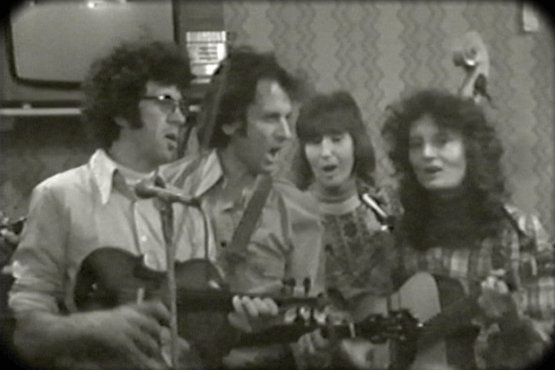 |
| The Strange Creek Singers perform at Onllwyn Miners' Welfare Hall in Onllywyn, South Wales, 1976. Video still from Keep Your Eye upon the Scale, by Tom Hansell, Patricia Beaver, and Angela Wiley. |
Keep Your Eye upon the Scale opens with a ballad sung on the picket line at the Brookside mine in Harlan County, Kentucky. Noting the importance of music in many everyday activities and locales, Gaventa, Greatrex, and Lewis recorded choral performances in Welsh miners' clubs, singing at pubs, and informal song swaps between Appalachian and Welsh singers. Lewis's time in Wales also facilitated in-person cultural exchange, represented in this short documentary by the 1976 performance by The Strange Creek Singers—featuring American musicians Hazel Dickens, Alice Gerrard, Mike Seeger, Tracy Schwarz, and Lamar Grier—in the Onllwyn Miners' Welfare Hall in Onllywyn, South Wales.
The video recordings filmed between 1974 and 1976 in South Wales and Appalachia set the stage for John Gaventa's later work with the Highlander Research and Education Center in Tennessee and Oxfam in Great Britain, for which he received a MacArthur Fellowship and an Order of the British Empire Award. After editing this documentary footage, Richard Greatrex became a successful cinematographer, nominated for an Academy Award for his work on Shakespeare in Love. Helen Lewis authored important scholarship on labor and social justice in Appalachian Studies. Keep Your Eye upon the Scale features the musical cultures of Appalachia and Wales that drew Gaventa, Greatrex, and Lewis's attention. In addition to presenting previously unpublished footage of the cross-Atlantic musical exchange, this documentary includes reflections of the original documentarians about the relationships of geography, culture (especially music), and economy to the lives and livelihoods of Welsh and Appalachian mining communities.
Supplemental Materials
Review
 |
I recently went to an opening-night screening in West Los Angeles of Richard Linklater's latest film, Boyhood. This was no red-carpet affair. There were no designer gowns, photographers, or gawking tourists, all staples of premiers up at Grauman's Chinese Theater on Hollywood Boulevard.1We should all refuse to call Grauman's Chinese Theater, with its famed footprints of the stars out front, by its latest corporate name, TCL Chinese Theater. Even its nearly forty-year run as Mann's Chinese Theater was scoffed at by locals. It was, is, and forever will be Grauman's to those who love both Hollywood the place and Hollywood the slightly seedy state of mind. From what I could see, there was only one star present. Patricia Arquette, who plays Olivia, the mother of the titular boy, was on hand and answered audience questions with charm and generosity, something TMZ and the other toxic Hollywood gossip rags rarely highlight. For a movie that seems to have "the business" buzzing, this was a decidedly understated debut, which makes sense given the subtlety with which Linklater has emerged as one of America's most experimental filmmakers.
Most people who've heard of Boyhood know that it's doing something unique, though not entirely unprecedented in the history of cinema. Shot for a few days at a time over the course of twelve summers and using the same actors throughout, we watch the maturation of not just a young man, but also his family as its various members move around the state of Texas while always staying within each other's orbits. One antecedent for this project is François Truffaut's series of films following the character of Antoine Doinel, played by Jean-Pierre Léaud.2The films in the Antoine Doinel series are: The 400 Blows (1959 feature), Antoine and Colette (1962 short), Stolen Kisses (1968 feature), Bed and Board (1970 feature), and Love on the Run (1979 feature). But even this comparison is imprecise, as Linklater condenses into one film what Truffaut spreads over five.
 |
| The Criterion Collection's packaging for The Adventures of Antoine Doinel, featuring Truffaut's five films following the titular character played by Jean-Pierre Leaud, 2003. Richard Linklater has already confirmed that Boyhood will be released through the boutique DVD label. |
Linklater's fascination with the passing of time and its relationship with physical movement emerges in his first full-length movie, Slacker (1991), which consists of loosely interconnected vignettes depicting a day in the life of Austin, Texas, where Linklater still lives. Morning turns to night and then to a new day, and for all we've seen, we know that so much more went on just in this one place, and will continue to, day after day. The camera appears to drift through the air, handing us off from one incomplete story to the next, taking us down Austin's streets, into its apartments and bars, and eventually to the bluffs outside of town. The final frenetic scene is a handheld Super 8 shot of young people drinking and carousing on a cliff above the river while the popular African big-band standard "Skokiaan" plays. The camera doesn't settle on any image for more than a few seconds, save for two: the cover of Paul Goodman's Growing Up Absurd (1960), and one of the revelers preparing to heave his own camera into the river below. When he commits his absurd act, our perspective flips end-over-end as well, ejecting us from the film. Slacker's fragmentation and abrupt conclusion reminds us that the best we can do in most cases is piece together bits of information about the lives of others. Given this incomplete knowledge, we're better off not passing wholesale judgments. You might even call it cutting everyone some slack.
Linklater's other major experimental project, which he was working on while filming Boyhood (and several other movies—both mainstream Hollywood fare and indie flicks) is known informally as the Before Trilogy (Before Sunrise, Before Sunset, Before Midnight). Beginning in 1995 and released nine years apart, these films focus on Céline and Jesse, a French woman and American man (played by Julie Delpy and Ethan Hawke), who meet on a train and spend one night wandering around Vienna flirting and talking about the kinds of things young people who are more well-read than wise tend to talk about. Walking while talking structures all three Before films, linking the passage of time, the exchange of ideas, and the creation of memories with moving through particular spaces. If we float over Austin in Slacker, we are grounded in the European streets of Before, connecting us to the characters and their lives more concretely. However, for as much as we might feel privy to the intimate details of Jesse and Céline's relationship, each subsequent installment of the trilogy finds them pretty different individuals than they were in the last one. As with Truffaut's Antoine Doinel series, a lot can and does happen in nine years, once again leaving us in the position of trying to piece together the unseen from what is said and implied visually. The unfilled gaps force us to think about both what we don't know and what Céline and Jesse don't know about each other, ideally resulting in our extending generosity to the characters, and hopefully to the people in our own lives whom we love but can never understand completely, even if we live in and out of one another's pockets.
 |
| Director Richard Linklater's previous experimental film project involving the passage of time—known informally as the Before Trilogy and comprised of the films Before Sunrise (1995), Before Sunset (2004), and Before Midnight (2013)—follows the relationship of Céline (Julie Delpy) and Jesse (Ethan Hawke) over the course of many years. Him and Her, Collage and Ink by Eric Solomon. Courtesy of Eric Solomon, 2014. |
Boyhood deals with space and time in a way that is simultaneously more radical and more classical than Linklater's previous experimental films. For all of its production-related innovation, Boyhood tells a simple story about the lives of a few people as circumstances take them across Texas. As with Slacker and the Before Trilogy, setting is crucial to Boyhood. From the new industrial South of Houston, to San Marcos, to Austin, to Big Bend National Park near the West Texas-Mexico border, the film has a vast canvas that contrasts with the seeming smallness of the story to amplify the core question almost all of us are always asking ourselves, whether we know it or not: How can I lead a good life? As one might expect, Boyhood never answers this question, but this experimental film emphasizes the importance of trying to answer it by mimicking a familiar literary form.
As I wrote in a blog post after seeing the trailer and reading about the production, Boyhood might be the closest a film has come to replicating the traditional literary Bildungsroman. Like Richard Wright's autobiographical novel Black Boy and J. M. Coetzee's Scenes from Provincial Life (among many others), Boyhood gives us a series of signifying events in the young life of its protagonist, Mason Jr., played by native Texan Ellar Coltrane, a previously unknown actor whom Arquette claimed could not yet read when Linklater cast him at the age of six.3Scenes from Provincial Life is a compendium of Coetzee's three fictionalized memoirs: Boyhood (1997), Youth (2002), and Summertime (2009). When we meet Mason Jr., he's doing what little boys do: playing outside, fighting with his sister, Samantha (star-in-the-making, Lorelai Linklater—yes, the director's daughter), and giggling at a decidedly tame lingerie catalogue an older boy shows him. Condensing twelve years into a single movie, even one with a running time of nearly three hours, has the potential to leave the story feeling scattered and incomplete. And indeed, as is the case with Linklater's earlier films and any Bildungsroman, there are undoubtedly important moments in the unseen gaps between when we meet Mason Jr. and when we leave him on his first day of college. But it's precisely because Boyhood emerges from what may be Western literature's most enduring narrative form that we are able to "read" it with ease, even as it does something no single movie has done up to this point: show us real aging, real maturation.4Obviously, many films have sequels (and prequels), but most aren't purposefully playing with the (dis)continuity of time the way Linklater's Before Trilogy and Boyhood (and Truffaut's series) are. The order of events may matter to the plot or even the emotional resonance of series like The Godfather, The Terminator, or The Lord of the Rings, but the passage of real time isn't integral to what most traditional Hollywood movies and series are trying to say. What requires special effects and makeup artists in most movies is provided by time itself, a commodity that seemingly stretches out endlessly before and behind us, but that no one has enough of, especially in Hollywood.
 |
| The evolution of Ellar Coltrane as Mason Evans Jr., 2014. Photographs by Matt Lankes. © IFC Films. |
Some critics, including Eve Tushnet at The American Conservative, argue that Boyhood's signifying moments aren't significant enough because of Mason Jr.'s characterization. She writes:
He's a prototypical good-but-aimless kid. We see his foibles—he's a bit surly and a tad whiny, he smokes some pot if you consider that a foible, he comes home late at least once which possibly makes his mom cry, he sometimes fails to do his homework—but no real sins. He's bullied but never bullies back. His sister at least gets to be snotty about her grades, which makes her seem like a real person. Where's the casual cruelty of childhood, the hurtful rather than just boring narcissism of adolescence, the misdeeds which will only be acknowledged and regretted years later? I mean, I get that Boyhood isn't Carrie, but must it be Annie?5Eve Tushnet, "The Boy is the Father of Whatever: Richard Linklater's Boyhood," The American Conservative, July 18, 2014, http://www.theamericanconservative.com/the-boy-is-the-father-of-whatever-richard-linklaters-boyhood.
Mason Jr. certainly isn't Hamlet, but the hyperbolic comparison with Annie fails to imagine that Linklater and Coltrane play it the way they do for a reason. There have been plenty of bad movies about allegedly interesting, tortured teens and their sins. The always-brooding, ready-to-explode child of divorced parents is a stock character in after-school specials and Lifetime movies. By rejecting the clichéd "angry kid figures it all out after a catastrophe of his own making" storyline, Boyhood subverts our narrative expectations to make a subtle yet significant critique of the use of family life as a political football.
 |
| Promotional infographic illustrating the making of Boyhood, 2014. © IFC Films. |
In times of economic crisis, many pundits and politicians choose to blame our problems on a degraded "culture" in order to avoid discussing the fiscal and political systems that reward some fantastically, while simultaneously forcing many people—those without developed professional networks, high-end degrees, and access to capital—to run themselves ragged just to avoid eviction and hunger. A popular talking point for conservative critics in particular is the divorce rate that's been on the rise since the mid-twentieth-century marriage boom. The New York Times's David Brooks and the controversial sociologist Charles Murray (among many others) have written at length about the importance of marriage in establishing, maintaining, and potentially transcending a middle class life, and the National Organization for Marriage has fought against anything that even looks like gay marriage on the grounds that it might weaken an already flailing American "marriage culture."
Both social science research and anecdotal evidence back up the idea that divorce can have profound effects on all members of a family. However, this doesn't mean that the hardships often caused by divorce are in and of themselves enough to completely derail a person's life, much less crater a whole society, as some would have us believe. And similarly, stable marriages aren't enough to counteract what outsourcing, out of control militarism, racism, and the War on Drugs (just to name a few) have wrought. What's radical about Boyhood is that it doesn't treat the divorce of Olivia and Mason Sr. (played brilliantly by Ethan Hawke) as a catastrophe, or even as indicative of a broader cultural trend. It is simply something that happened because two people who weren't ready got pregnant and tried to give marriage a go. The divorce complicates the lives of all of the characters and is central to the plot and structure of the movie, but this isn't a "dysfunctional" family. Both Olivia and Mason Sr. are caring, if sometimes self-involved, parents who grow throughout Boyhood. While Olivia bears the brunt of the day-to-day childrearing, Mason Sr. isn't an absent father (though it's implied that he was when the children were very young), and when he's with his children, he's invested in making them better people. And far from being portrayed as an overwhelmed victim, Olivia becomes a psychology teacher and leaves two alcoholic partners when they threaten the things that matter to her.6The man Olivia marries in the first half of the film is her one-time professor, an embittered alcoholic who forces Mason Jr. to shave his head and generally bullies Olivia's children and his own with criticism that turns abusive as his drinking problem worsens. Olivia's second significant partner in the movie is, fittingly, one of her own former students, a vet of the War on Terror who is ill-equipped to deal with Olivia's defiant children, in spite of the fact that he seems to mean well. The members of this family aren't without their problems, but that makes them human, not evidence of cultural collapse.
 |
 |
| In the top photograph, Mason Jr. (Ellar Coltrane) hangs out with friends in a truck bed. In the bottom photograph, Mason Sr. (Ethan Hawke) and Mason Jr. share a moment inside an empty rock club near the end of the film, 2014. © IFC Films. |
Even in moments that seemingly have little to do with Mason Sr. and Olivia's separation, Linklater is playing with our expectations of narratives about the children of divorce. So often we are told that kids get into trouble because there isn't always a father figure around to discipline them and "keep them on the straight and narrow." This isn't an idea lacking all merit, but Boyhood's refusal to give us overwrought tragedy shows that folding all non-traditional families into this narrative is a mistake that elides the lived experiences of countless people. There are moments throughout the film when we anticipate that something awful is about to happen. But then the tension quickly dissipates. In one scene, Mason Jr. and some boys are sleeping over in a house undergoing renovation, a spatial symbol for Mason's own evolving family. The boys are drinking and decide to throw some stray saw blades at a board. This is all standard (and dumb) adolescent male behavior, so we wait for one of them to lose a finger or worse. We expect this in part because most filmmakers would feel the need to add drama to the story, or to give the audience something familiar. Linklater is more confident in his craft than this, so instead he gives us the banal truth: not all bad behavior or potentially dangerous situations result in tragedy. Sometimes we get lucky, and other times, as when Olivia's drunken husband throws his glass at Mason Jr.'s plate at dinner, bad moments simply don't, for whatever reason, get worse. In admitting this, Boyhood isn't a failure of realism, as Tushnet contends, but rather an admission that reality and cinematic clichés are seldom compatible.
Still, Boyhood isn't minimizing the pain divorce can cause. In a remarkable scene near the end of the film, Masons Jr. and Sr. are in an empty rock club waiting to see one of Mason Sr.'s former bandmates, Tommy, play a gig. By this point, Mason Sr. is an actuary with a new wife and young child, every bit the traditional husband and father Brooks and Murray idealize. But when Mason Sr. gives his son advice about growing up and going off to college, Mason Jr. kindly but bluntly tells his father that he wishes he would have gotten his act together sooner to spare them all the "parade of drunken assholes" Olivia dates or marries. Linklater doesn't linger on this moment or play it for cheap melodrama, but the point gets across: Mason loves and respects his father, but he isn't about to pretend that the past didn't play out the way it did just because he managed to make it through adolescence relatively unscathed. The divorce hurt Mason Jr., and has fundamentally shaped him, but in ways that he doesn't often directly reveal. The personal isn't explicitly political in Boyhood, but in portraying a family bent, but not broken, by divorce, it pushes back against the toxic idea that marriages and families should support an entire society when political and economic institutions do little to support all kinds of families.
 |
| Patricia Arquette as Olivia, mom to Samantha (Lorelei Linklater) and Mason Jr. (Ellar Coltrane), in this still from the film, 2014. © IFC Films. |
In the Q&A session after the premier, Patricia Arquette tried to convey both how normal and different working on Boyhood was. Like on any other shoot, they were just actors and crewmembers doing jobs, and even the children didn't inhabit their roles once the takes ended. These were all professionals. At the same time though, they were making a movie that might not get finished, much less distributed. It required faith in the story, faith in Linklater, and faith that what they were doing was important. If you think about where you might be in twelve years, odds are that you'll actually end up somewhere very different, whether it's living in another state, or with a different state of mind. The idea that people are dynamic in the world and within themselves is the essential link between all of Linklater's great experimental movies, and this dynamism is represented not just in the films' content, but also their production. While all filmmaking requires dexterity and a willingness to accept what is beyond one's control, the making of Boyhood was more vulnerable to fate than other shoots. Had a major actor died during the twelve-year production, the movie would tell a very different story, if it came into being at all. A film this dependent on the real couldn't have fallen back on Hollywood magic to execute a predetermined vision. This precariousness makes watching Boyhood an experience much like the production itself. We have to be sensitive to the surprises hidden within the ordinary and allow the film to take us unexpected places.
About the Author
Daniel Pecchenino is a lecturer in the writing program at the University of Southern California.
]]>Review
The intricate mapping of Louisiana below Interstate 10 in HBO's 2014 series True Detective generates more than just the obvious voyeurism of extreme poverty that marks so many shows about Louisiana, such as Swamp People (History Channel) and Duck Dynasty (A&E)1Duck Dynasty, a reality show about a family in the duck call industry, is not only a voyeuristic show about poor country living in Louisiana, but one whose subjects are actually wealthy, performing poverty and capitalizing on nostalgia for old-fashioned living. or about "true crime" in rural areas, such as Cajun Justice (A&E). True Detective is a show about precarious life as much as it is about catching a serial killer. The mystery plot is standard fare: two male detectives, on the trail of perpetrators of an apparent "Satanic ritual abuse" killing, uncover a dusky underworld of cults and corruption. However, the way True Detective links a critical understanding of Louisiana with a type of cartographic character development relies more on the intensities of place than a sequence of defining moments. Rust and Marty, played by Matthew McConaughey and Woody Harrelson in virtuoso performances, travel from Lake Charles to Avoyelles to Lafayette to lower Terrebonne to Beaumont, Texas, to suburban New Orleans to Erath, tracing intensities and textures of relationships in particular places to income, education, landscape, and health disparities. Rust is a Texan, a detail that is constantly used to justify his utter strangeness, to portray him as an intruder, and to set up a Louisiana only understood from the inside. He is also a mystical nihilist whose popularity gave rise to fans hunting down and interpreting his allusions to nineteenth century weird fiction, Nietzsche, and M-theory during the run of the show. Before moving to Louisiana to work homicide, Rust spent too long deep undercover in vice, heavily drugged, delivering gun justice to cartel thugs. Marty, a University of Louisiana at Lafayette alum and good old boy, is his more or less straight-laced partner. Their story begins with investigating the death of a young woman found in a canefield, naked and trussed, wearing a crown of antlers. It ends with them killing a man who had done the murdering, but who was only a relative of one the real masterminds: a cabal of politicians, nonprofit leaders, businessmen, police, and meth cookers who stage gruesome murders, kidnap children, and control state politics, education, and revenue. Rust and Marty will not pursue them because True Detective is an anthology series, and their story is over.
 |
| Richard Misrach, Sugar Cane and Refinery, Mississippi River Corridor, Louisiana, 1998 from Petrochemical America, photographs by Richard Misrach, Ecological Atlas by Kate Orff (Aperture, 2012). © Richard Misrach, courtesy of Pace/MacGill Gallery, New York; Fraenkel Gallery, San Francisco; and Marc Selwyn Gallery, Los Angeles. |
 |
| First image of True Detective's title sequence, 2014, sequence by Antibody and Elastic. © HBO. |
If you have followed Southern Spaces's coverage of Petrochemical America, you will recognize the images that open True Detective, beginning in the title sequence with Sugar Cane and Refinery, a photograph by Richard Misrach of a dirt road through a cane field, terminating in a ditch.2Richard Misrach and Kate Orff, Petrochemical America (New York: Aperture Foundation, 2012), Plate 20, page 50. Patrick Clair, the director of the title sequence, pitched the aesthetic of Petrochemical America explicitly to HBO when presenting his vision for True Detective's opener. See Patrick Clair and Jennifer Sofio Hall, "True Detective: Opening Title Sequence Concept," (Proposal presented at the Original pitch proposal produced by Elastic.tv and Antibody for the title sequence from True Detective, March 9, 2014), http://www.scribd.com/doc/211405775/Original-Pitch-for-Title-Sequence-from-True-Detective. An oil refinery shrouded in smog looms over it. It's a busted up Emerald City, desaturated and toxic, an unreal city in an industrialized Oz. HBO has three shows set in Louisiana: Treme, reimagining a New Orleans broken by flood and evacuation; True Blood, swamp-and-vampire melodrama full of bodies and camp and carnivalesque violence; and True Detective, a show that might fall under a genre called Louisiana apocalyptic noir.3Each Louisiana-based HBO depiction offers smart and problematic depictions. Treme, particularly, lovingly (and perhaps cruelly) recreates the immediate years after Katrina, from drooping ceiling fans in flooded homes to the talismanic power of normal work and local music to get through the grief. What stands out in True Detective is its uncanny evocation of southern Louisiana: a place simultaneously real and unreal. Like Petrochemical America, this genre is concerned with lifting the veil on the dirty truths of the wetland, not so much the titillations of satanic murder sprees but petroleum conspiracy and ecocide. True Detective's big reveal—which does not come when Rust and Marty catch the deranged, stereotypical murderer, but accumulates from the title sequence—is that the southern Louisiana land- and waterscape lies at the nexus of corporate-produced inequality, fragile bodies, toxic waste, indigence, political bullying, and an unruly ecosystem.
What makes True Detective unique among representations of Louisiana is that its attention to the particularities of place undercuts the image of the wetlands that is all spectacular gumbos and alligator fishing. Borrowing the political imperative from Kate Orff and Richard Misrach's Petrochemical America, True Detective exposes the contemporary disasters that structure Louisiana life. The narrative flashes back to the 1990s when the biggest hurricane was named Andrew, and cycles in and out of a diegetic present in 2012, when the name of another hurricane had yet to leave people's lips. Hurricanes, however, are not the only traumatic events spiraling through the narrative; there's also the aftermath of desegregation, the rise of private education, the loss of permanent archives from years of flooding and reflooding. And there's a not-so-subtle critique of the state's despotic governors—the one in the 1990s segment, named Edwin, tied to the corrupt structures of power, certainly feels familiar. But this show is neither documentary nor polemic, only mappings. To quote Patrick Clair's pitch for the opening sequence, "We've zoned in on the idea of personal geographies."4Michelle Lanz, "'True Detective': How the opening titles came together, what they mean,'" Take Two, Southern California Public Radio (March 9, 2014), http://www.scpr.org/programs/take-two/2014/03/09/36373/hollywood-jobs-crafting-the-opening-titles-for-tru/. True Detective inscribes into the critical geography of Petrochemical America what Gwen Ottinger found lacking in the book: stories of people.5Ottinger writes, "The authors are unable to present a more coherent account of what change might look like, I believe, because of an important omission from the main substance of the book: people." Gwen Ottinger, Ellen Griffith Spears, Kate Orff, and Emma Lirette, "Petrochemical America, Petrochemical Addiction," Southern Spaces (November 26, 2013), https://southernspaces.ecdsdev.org/2013/petrochemical-america-petrochemical-addiction.
The superimposition of personal onto critical geography is evident in the title sequence as a ghosted image of McConaughey's character, Rust Cohle, fades into the photo of the refinery and canefield. The overarching visual techniques are compositing and double exposure, combining photographs mostly from Misrach's Cancer Alley exhibition (Petrochemical America) with the outlines of bodies and faces: the face of Harrelson's character, Marty Hart, containing a tangle of highway cloverleaves,6This is one of the few photographs not part of Cancer Alley. a valve wheel containing the church in Misrach's Cypress Swamp, Alligator Bayou,7Misrach and Orff, Petrochemical America, Plate 17. the bare ass of a woman squatting on top of spiky heels containing the refinery that began the sequence. The faces of people—mostly characters from the show—break apart, joining traces of maps and machinery, becoming hybrid people-in-place. In one particular image, Rust's head appears in outline, but only the area below his nose retains photographic density, the top-half of his head fading to nothing. In this nothing, the pyres and scaffolding of a refinery yard jut out, and, right as the image jumps to the next one, a trace of the Mississippi River remaps the border of his head. This combination of photography and geography also finds its precursor in Petrochemical America: Orff's visual arguments collage Misrach's photos with mapping.
The images in the sequence move from desaturated and bleached out to luminously dark to sparking red. It's a bit heavy-handed, this travel into the Louisiana night of industrial apocalypse through the pictorial bodies of cynical men and lushly naked women. True Detective is, after all, homage to the hardboiled murder mysteries of the mid-twentieth century, a genre defined by its gritty-but-honorable men and femmes fatales. True Detective is also on HBO, a cable and satellite network that practically invented the made-for-adult hour-long drama with another busted up Emerald City in the prison saga Oz and has reached its gratuitous "adult themes" saturation with True Blood. Unlike the opening sequences for Oz or True Blood, however, True Detective's sequence insists on the importance of geography and people.8The media firm commissioned for the True Detective sequence, Elastic—in coproduction with Antibody—is the same one that put together the decidedly cartographic opener for HBO's Game of Thrones, a pseudo-medieval fantasy that spans a massive and intricately mapped world based on George R. R. Martin's A Song of Ice and Fire series. And despite True Detective and True Blood both being set in Louisiana, featuring intense violence, and having "True" in their titles, these shows share little else. Where True Blood's title sequence—like its plotting and characterization—is hypersaturated, paced for blooming or exploding rot, True Detective's opener features a world in chemical sterilization. Rather than a sexy, murky adventure swamp, its Louisiana is in tension between a postindustrial fade to iron surrounded by barren earth and the wild rule of plants and reptiles. As Rust says in the first episode, "This place is like somebody's memory of a town, and the memory is fading. It's like there was never anything here but jungle." Here, we find the sad landscapes of Misrach: a place overrun by pipes and salt water, religious statuary from another era, swamp and canefield, fog and abandon. But then again, as Rust's partner Marty replies, "Stop saying shit like that, it's unprofessional."9Cary Joji Fukunaga, "The Long Bright Dark," True Detective (HBO, January 12, 2014), Episode 1.
In the eight episodes of season one, Rust and Marty uncover strange genealogies and rigged systems, sometimes reluctantly and always at great cost to their lives and security. They commit awful violence against people, such as during the lauded six-minute-long take at the end of episode four.10Cary Joji Fukunaga, "Who Goes There," True Detective (HBO, January 12, 2014), Episode 4. To set this scene, Rust enters a world of one-percenter bikers, dark roadhouses, and thickly masculine tropes—which is saying something given that True Detective is a show about men living in a brutally masculine world. This world is the Texas that Rust claims as his origin, a place reminiscent of the imagined "Western" hells in Cormac McCarthy's Blood Meridian or No Country for Old Men. Rust trades his involvement in a robbery for information on a deranged meth cook who might be the killer. Rust and the bikers storm a housing project11The projects, which diegetically seem to be in Beaumont or Houston, are actual government subsidized housing in Westwego, a suburb of New Orleans. (which Ginger, a white biker, calls "Coon Country") to get a stash of drugs. Things fall apart. Ginger kills a hostage. Rust takes Ginger hostage, dragging him in and out of people's houses, over a fence. SWAT arrives with helicopters and they light up the houses with a firefight. The scene involves one camera following Rust as he weaves through the neighborhood, escaping the war he brought to the unsuspecting bikers, who were bringing war to the much more unsuspecting project residents. This is a tense, personal way to film an action sequence, and it underscores the richness of exploring space in narrative film and the cruelty of True Detective's ropey heroes, who bring an army of white men (bikers and police) to wage a battle in the all-black projects.
 |
| Map of long take from "Who Goes There," 2014, from We Keep the Other Bad Men from the Door, a graphic tribute to HBO's True Detective. Infographic by Nigel Evan Dennis. Courtesy of Nigel Evan Dennis. |
If we don't feel that this scene emplaces us, it is effective at associating Rust with a way of moving through a world: macho, aggressive, distant, rooted in his environment, yet ready to navigate and change directions. Rust's hyperawareness (sometimes tinged with hallucinations) causes him to pontificate a lot. He says crazy-sounding things that make for good Internet memes. He is cocky and sinewy. He is also swift with his logic and usually right about it. Compared to Marty, he is alien. When Marty tells Rust that his (constant) dismissive observations about Louisiana are unprofessional, it's also a way of staking a claim for the people who do live there, who are not outsiders with easy quips. When their investigation in 1995 leads them to a big tent revival, Rust asks Marty, "What do you think the average IQ of this group is, huh?" Marty replies, "Can you see Texas up there on your high horse? What do you know about these people?" Rust's reply positions him as a quasi-anthropologist, someone savvy to the statistics and social problems: "Just observation and deduction. I see a propensity for obesity. Poverty. A yen for fairy tales. Folks puttin' what few bucks they do have into a little wicker basket being passed around. I think it's safe to say nobody here's gonna be splitting the atom, Marty."12Cary Joji Fukunaga, "The Locked Room," True Detective (HBO, January 12, 2014), Episode 3. Rust embodies the kind of cynical, yet politically progressive attitudes in HBO's past programming (The Wire, Oz, and the documentary series America Undercover). But he also embodies the kind of hip blogger criticism found on websites like Gawker, Daily Beast, Jezebel, and Uproxx when they write about a place such as Louisiana, a style that exposes problems in Louisiana and portrays them as obvious absurdities from a place living up to its caricature. When Marty repeatedly tries to shut Rust up ("Let's make the car a place for silent reflection from now on"13Fukunaga, "The Long Bright Dark."), it serves as a check on the tendency to make glib generalizations, to be cruel with analysis, to forget that people are still there, living in the places we analyze. We might still root out the bad—Marty is, at least nominally, a cop—but temper that goal with compassion.
Marty is pretty much a terrible person too. After delivering a brief taxonomy of detective types ("the bully, the charmer, the surrogate dad, the man possessed by ungovernable rage"), Marty claims the following category: "I'm just a regular guy with a big ass dick."14Ibid. He is an affable jerk, the kind of detective who takes nights off to have sex with women he's "saved" on the job and takes weekends off to spend time with his family. His simplistic vision of Louisiana is where, in Marty's words, "folks enjoy community" and "a common good."15Fukunaga, "The Locked Room." He attempts to emotionally manipulate his much smarter wife, Maggie, played by Michelle Monaghan, the lone female regular in True Detective.16See Emily Nussbaum's scathing critique of the gender politics of True Detective: "Cool Story, Bro: The Shallow Deep Talk of 'True Detective,'" the New Yorker, March 3, 2014, http://www.newyorker.com/arts/critics/television/2014/03/03/140303crte_television_nussbaum. He fails, loses his marriage and family. He deserves to. He loses Rust, who becomes vicious and obsessed when he realizes they didn't actually get all the murderers when they closed the case in 1995. But throughout, there are certain things Marty can't abide: while Rust handcuffs their lead suspect, Marty finds two children, one dead, who were clearly tortured and raped. He storms out of the cabin and puts a bullet through the handcuffed man's skull. Because the show had thus far split the narrative between 1995 and 2012, this scene is thick with dramatic irony: in killing this man (who was only part of the cabal), Marty forecloses the possibility of catching the rest of the men responsible. Instead of Clint Eastwood, we get a regular guy with an impotent sense of justice and a big gun.
Marty's misogyny is more infantilizing than hateful. While driving with Rust through a marshland of salted, dead cypress trees, Marty asks, "Do you ever wonder if you're a bad man?" Rust replies, "No, I don't wonder. The world needs bad men. We keep other bad men from the door."17Fukunaga, "The Locked Room." In this way, True Detective makes a case for both the rusty knife of critique and the fragility of living lives in a precarious place, even as it interprets the world as men minimalizing the collateral damage inflicted on women and children from the actions of worse men. The Manichean optimism breaks apart as the show goes on, charting the complex geographies of structural inequality, political overdetermination, and incoherent Louisiana imaginaries. And the surety of the detectives' masculine agency fragments. True Detective is built on the "women in refrigerators" trope that structures the genres it pays homage to—principally the hardboiled mystery à la Raymond Chandler and the film noir à la Double Indemnity and Chinatown. It uses women as both things-to-be-saved and erotic obstacles for the male leads, a sexism typical for much mystery/thriller-based narrative media. After years of decline and in the face of mounting evidence that everything from policework and state groundskeeping to meth and murder exists in a continuous ecology of violence and power, Marty and Rust become capable of doing only one thing right: taking out the monster made possible by all the other bad things.
 |
| Marty and Rust, capable of doing only one thing right, from True Detective's final episode, "Form and Void," 2014. © HBO. |
Many viewers who were initially thrilled about the smartness of True Detective found the ending anticlimactic, and rightfully so. It panders to the worst stereotypes of "southerners" in cinematic history: the killer is a schizophrenic man named Errol Childress, living with his dimwitted sister-lover in a decrepit mansion full of random bullshit, keeping the body of his dead father out back, and lording over a spooky lair that was once, among other things, a fort for Confederate soldiers.18Carcosa, the lair, was shot at Fort Macomb, which was raised in 1822 and abandoned in 1871. See Ella Morton, "The Real Location of True Detective's Carcosa," Atlas Obscura, Slate, March 11, 2014, http://www.slate.com/blogs/atlas_obscura/2014/03/11/here_s_the_real_location_of_true_detective_s_carcosa.html. But to rule True Detective a lousy mystery with a cheesy villain is to miss the critical work this ending does. Past their glory days, the detectives, both living secret lives of loneliness and regret, knowing that the case that made them famous was a sham, muster their lives towards the righting of a single wrong. Rust and Marty know that this righting will only stop the most spectacular edge of deeply rooted disease. True Detective's actual villain lies everywhere and nowhere, among the apparatuses of power that structure life in Louisiana. A backwater villain such as Childress is possible because of the machinations of power that lay pipe through bayous and neighborhoods and dig ship channels into estuaries, that subject the poor to living in "somebody's memory of a town," that name them, count them, and separate them. When Rust kills him, he's only killed an effigy. When Rust survives—a thing he did not want to do—he does so knowing that his actions did not alter the landscape in Louisiana. Some viewers might view the last moments (Rust says, looking at the sky, "Well, once there was just dark. You ask me, the light's winning."19Cary Joji Fukunaga, "Form and Void," True Detective (HBO, March 9, 2014), Episode 8.) as a cheap, positive note. Yet, made possible by the anticlimactic end to the mystery plot, Rust's last lines affirm the will to survive an increasing state of disaster, to contest things held immovable or sacrosanct or inevitable by locality.
Since 2002, Louisiana has wooed filmmakers and television producers through the state's Motion Picture Tax Incentive Act, which offers a 30 percent tax credit on production expenses over $300,000 and an additional 5 percent credit on local labor.20Louisiana Motion Picture Tax Incentive Act, LA Revised Statutes, 47:1121; 47:1125; 47:1125.1, 1990, 2002. The attractive tax credits can be found in sections 1125 and 1125.1, which were first enacted in 2002. Because out-of-state production companies have no Louisiana tax liability, the credits can be exchanged for cash. For the most part, this use of Louisiana is either invisible or obnoxious: shows shot on stages in Shreveport or which use places in Louisiana that can stand in for anywhere, such as WGN's Salem, which is set in Massachusetts but is filmed entirely in Louisiana,21Marisela Burgos, "Behind the Scenes of the New TV Show 'Salem,'" Fox59, March 14, 2014, http://fox59.com/2014/04/14/behind-the-scenes-of-the-new-tv-show-salem/. or shows that follow people hoping to capture some version of Louisiana exoticism, such as Duck Dynasty. True Detective is an exception, one that slips through, incorporates, and critiques the official narratives of Louisiana optimism, its representation in rural poverty porn, and the flashy exposés of the state's political, economic, cultural, and medical ineptitude. It is clear to me, a Louisiana native, that the show was mostly shot on location. Novelist Nic Pizzolatto, also a native, pitched True Detective as an original concept and wrote each episode. The show provides ample evidence of his familiarity with Louisiana geography and politics.22Director Cary Fukanaga, on the other hand, is from California's Bay Area, and is known for two major films that are polar opposites in genre and tone: Jane Eyre, a film adaptation of Charlotte Brontë's 1847 bildungsroman/romance novel; and Sin Nombre, a movie about two young people trying to escape gang violence in Honduras. His upcoming projects include Beasts of No Nation about revolution in a western African country and an adaptation of Stephen King's It. Apparently he prepared for True Detective by spending time with a Louisiana homicide detective and his outlaw cousin: "True Director," Interview, June 2014, http://www.interviewmagazine.com/culture/cary-fukunaga-true-detective/. With the long drives on Highway 90, the boarded-up gas stations, the trailer parks, even the golf course on Chateau Boulevard in Kenner, True Detective takes full advantage of its setting, filming a Louisiana rarely found on television.
 |
| Richard Misrach, Holy Rosary Cemetery and Dow Chemical Corporation (Union Carbide Complex), Taft, Louisiana, 1998 from Petrochemical America, photographs by Richard Misrach, Ecological Atlas by Kate Orff (Aperture, 2012). © Richard Misrach, courtesy of Pace/MacGill Gallery, New York; Fraenkel Gallery, San Francisco; and Marc Selwyn Gallery, Los Angeles. |
 |
| Abandoned church from True Detective episode two, "Seeing Things," 2014. © HBO. |
The influence of Petrochemical America does not stay within the title sequence, but seeps into the story, creating a heterogeneous geography, a palimpsest Louisiana with varied, distinct meanings and genealogies. This is the surface Louisiana: pipelines munching up communities, burning canefields, government corruption, the ecstasy of truck stops full of uppers and flesh, big tent revivals in the plains of Acadiana, women who are either whores or wives, fisherman roughing it out in raised camps, serial murdering pederasts with Satanic attitudes. Typical of the way Louisiana is coded in the national imaginary: flooded by hurricanes and oil, fanatically Christian, hiding deep, dark secrets about sex. That would be the Louisiana of True Blood and Swamp People and Easy Rider. But True Detective also shows the Louisiana that is aging single men living off TV dinners and football somewhere in Metairie without loved ones, housing projects that are subject to as much banal precarity as they are to bright flashes of cruelty and sullen violence, an education system where rural children are subject to the inadequacy of state-sponsored schooling or the caprice of church- and charter-funded schools. The victims of the murder cult are largely poor children culled from far-away Christian schools and women pried from hidden brothels. If the show has a message, it is that there is systemic oppression running rampant in Louisiana, from feckless keepers of the peace to corrosive poverty, from serial killers nostalgic for the good ole days of spectacular violence to broken, paternalistic would-be heroes. This Louisiana is also different from the Louisiana of Beasts of the Southern Wild, even if both works find their foundation in the discarded and polluted. As Patricia Yaeger observes, "Beasts is a movie where debris and light vie for screen time."23Patricia Yaeger, "Beasts of the Southern Wild and Dirty Ecology," Southern Spaces, February 13, 2013, https://southernspaces.ecdsdev.org/2013/beasts-southern-wild-and-dirty-ecology. The trash in True Detective is not luminous, and the whimsy is full of terror. Light, here, is anticlimactic—as in the final battle between Marty and Rust and a killer who is less scary than the systems that make him possible. Or the light is too harsh, radiant as in radiation, threatening to scour with its illumination. Instead of exploring a fantasy of Louisiana, True Detective charts an uncanny geography. This Louisiana-of-the-shadows uneasily combines with the one mapped by Orff and Misrach, extending the cartography of Petrochemical America, mutating it into a place where pipes and roots and crosses and truck stops and abandoned schools and caves and the good life and the sad withering of imagination and bigger, national and global things are so enmeshed they flatten out into landscape, one with horizon at center, and vegetation at the fore, and ghosts and industrial equipment sewn into the sky.
About the Author
Emma Lirette, originally from Chauvin, Louisiana, lives outside Atlanta with her wife and two daughters. She works as a User Experience Researcher in social media and holds a PhD in American Studies and an MFA in Creative Writing. Her book Last Stand of the Louisiana Shrimpers is forthcoming from University of Mississippi Press in September 2022.
]]>Review
 |
At the 2013 New York Film Critics Circle Awards (NYFCC), English filmmaker Steve McQueen was named Best Director for his stunning adaptation of Solomon Northup's 1853 memoir Twelve Years a Slave. While McQueen didn't pick up the same trophy at the Golden Globes a few weeks later, he arguably took home that night's biggest prize when 12 Years a Slave was named the best drama of the year by the Hollywood Foreign Press. Having been nominated for nine Academy Awards, including Best Picture and Best Director, expect the film and its auteur to garner several more golden statues. Just don't expect the drama to be confined to the movie itself.
When McQueen went up to receive his honor at the NYFCC Awards, someone in the crowd allegedly shouted: "You're an embarrassing doorman and a garbage man! Fuck you. Kiss my ass." Most media outlets identified the heckler as City Arts film critic and provocateur Armond White, though White has denied the charge in his typically self-aggrandizing (perhaps justified) fashion.1David Denby, "Privilege and Bad Manners," The New Yorker, January 7, 2014, http://www.newyorker.com/online/blogs/culture/2014/01/steve-mcqueen-armond-white-controversy.html. In a statement to the Hollywood Reporter, White refers to himself as "the strongest voice that exists in contemporary criticism," and claims that several influential New York film critics are using the concocted incident as a chance to convene a "Communist-style special 'Emergency Meeting' supposedly in the interest of legislating 'decorum'—a meeting based entirely upon something that none of them actually heard and one that is really intended to purge me from the Circle." See Scott Feinberg, "Embattled Film Critic Armond White: I Never Heckled Steve McQueen," The Hollywood Reporter, January 7, 2014, http://www.hollywoodreporter.com/race/embattled-film-critic-armond-white-669032. Even if White didn't try to publically humiliate McQueen, the fact that he has been accused of doing so isn't shocking. White, film criticism's most notorious gadfly, is the most prominent and caustic critic of McQueen's nearly universally lauded film.
White's opinions aren't frivolous and uniformed, and it isn't simple trolling when he calls 12 Years a Slave "torture porn" in his City Arts review, likening it to the Saw franchise and the—quite literally—execrable Human Centipede. 12 Years a Slave does depict slavery as a "horror show" at the expense of portraying the inner lives of slaves and the relationships they forged under totalitarian circumstances, but in doing so it does not ally itself with slasher films or low-budget thrillers like Paranormal Activity, which are practically minting money at the box office. Instead, it combines gothic terror tropes with classic Hollywood narrative and aesthetic elements to call into question the American variation on the desire to be terrorized by the supernatural, the psychosadistic, and the patently absurd. Our history is laced with horrors we can't bear to look at and think about for more than the length of a television news report or tweet, yet we continue to seek out the next great scare in the most unlikely scenarios. McQueen understands that the limits of this search will not be reached when horror films get too bizarre, but rather when they depict the horror too close to home, the horror that helped build the United States and continues to haunt us.
 |
| Solomon Northup in his "plantation suit," ca. 1853. Engraving from Solomon Northrup's Twelve Years a Slave (Auburn: Derby and Miller, 1853). From Archive.org. |
12 Years a Slave was an important American story long before Steve McQueen put it on screen, and it was a part of a much more critical national discussion than the one about what Armond White did or didn't say. Released in the wake of Harriet Beecher Stowe's Uncle Tom's Cabin, Solomon Northup's 1853 slave narrative was the kind of "as-told-to" tale that was central to the abolitionist project. It presented northern white audiences with a sympathetic figure, a professional and classically cultured black family man living in Saratoga Springs, New York, who was kidnapped into slavery by agents offering him a brief, lucrative job playing his violin in Washington, DC. Northup, portrayed in the film with subtle opacity and strength by Academy Award nominee Chiwetel Ejiofor, would spend over a decade in bondage under the mistaken identity of a runaway slave from Georgia, hiding the fact that he was once a free man from most of the people he met in order to avoid even more brutal treatment. Northup's masters ranged from being relatively kind to besotted and brutal. His captivity ended, due in no small part to a white Canadian itinerant abolitionist (played in the film by Brad Pitt, who also was one of the movie's producers) who got word to Northup's friends in New York.2Pitt's presence in the film is one of 12 Years a Slave's few missteps. Having such a recognizable star come in and play a kind of angel figure distracts us from both the miracle of Northup's staying alive and the power of Ejiofor's performance. Had the role been played by a younger, less well-known actor, it would have highlighted the randomness of Northup's delivery from bondage. This problematic choice to cast Pitt (perhaps made by Pitt himself in his role as producer) has had repercussions outside of the film itself, as a poster advertising 12 Years a Slave's Italian release featured a huge headshot of Pitt looming over a much smaller full-body profile of Ejiofor. The poster was quickly recalled, but not before it led to a backlash from critics who felt the marketing was focusing on the film's white stars (there was also a poster featuring Michael Fassbender, who at least has a lot of screen time) at the expense of its two black leads, Ejiofor and Lupita Nyong'o. The poster was made by a third-party distributor and reflects a long-term problem Hollywood has had in marketing films focusing on people of color, particularly in international markets. In the end of both the film and his memoir, Northup is reunited with his family, but those who caused his ordeal are never brought to justice. The world then lost track of Northup, as the date, place, and manner of his death remain unknown.
 |
| Chiwetel Ejiofor as Solomon Northup, 2013. © FoxSearchlight. |
Like McQueen's previous two films, 2008's Hunger and 2011's Shame, 12 Years a Slave is gorgeously shot, edited with a jeweler's eye, and uses its sound design to bleed scenes into one another. This technical proficiency is part of what makes 12 Years a Slave, like its predecessors, at times excruciatingly difficult to watch. Two scenes of extended torture are among the most perfectly framed in the entire film. The first, an uncomfortably long shot of Northup hanging by his neck just low enough to the ground that he can touch his toes to the mud that continuously slips out from under them, shows us how alone every slave ultimately was. It is implied that Northup hangs for hours, while other slaves who have a chance to cut him down continue with their chores, trying not to get involved. It is important to note that Northup was not strung up by his relatively benign master William Ford (played by a pitch-perfectly milquetoast Benedict Cumberbatch), but rather by an indebted carpenter (Paul Dano) working on the plantation who was jealous of Northup's intelligence and rapport with his master. When Ford eventually finds Northup, he cuts him down and apologizes. The other slaves likely knew this would happen given their master's temperament and earlier treatment of Northup. Still, the carpenter was a white man, and one who felt within his rights to hang one of Ford's slaves as payback for an earlier altercation. Cutting down their fellow slave could have led to a quick death if the enraged carpenter were still lurking around the plantation. The film's isolation of Northup, and therefore all of the slaves, within a crowd, speaks of the culture of privilege that allowed white men with even miniscule amounts of authority to destroy social bonds through sanctioned violence.
The second major scene of torture takes this idea to its logical endpoint. After the incident with the carpenter, Northup is sold to Edwin Epps, a notoriously brutal, drunken, and crazed plantation owner hauntingly portrayed by McQueen's muse, Michael Fassbender. Ford does this after Northup reveals that he is a free man wrongly imprisoned—establishing that an evil cultural logic guided even "good" slave masters. On Epps's plantation, Northup finds it difficult to learn the skill of picking cotton and is whipped when his haul is below average. Patsey, a young slave woman whose picking prowess makes Northup look particularly bad, is the apple of Epps's deranged eye. He drips honeyed, violent words on her and rapes her later in the film. Epps's obvious lust does not sit well with his wife, a prototypical icy mistress made even colder by Sarah Paulson's performance. She begs her husband to beat Patsey, only to be rebuffed until Epps thinks that Patsey has snuck off to another plantation to sleep with its lecherous owner. Patsey actually had gone to get soap to wash off the filth of suffering under Epps. What follows are some of the most stunning and horrifying few minutes in mainstream film.
 |
| Sarah Paulson as Mistress Epps and Lupita Nyong'o as Patsey, 2013. © FoxSearchlight. |
In an attempt to break (but not kill) two slaves with one whip, Epps binds Patsey to a post and demands that Northup lash her. This order is all the more heartbreaking because earlier in the film Patsey, portrayed in an Oscar-nominated performance by Lupita Nyong'o, asked Northup to drown her as an act of mercy, a request he refused for fear of going to hell. As Patsey stands stripped and Northup holds the whip in his hand, they might as well already be there. Forced to obey his master, Northup whips Patsey, but not hard enough for the liking of Mistress Epps. Eventually, Epps takes over and cuts Patsey's back to ribbons, each stroke of the whip sending a fine mist of blood into the air above Patsey's head. As viewers, we see the shot from just in front of Patsey, foregrounding her agony, but not letting us forget its wicked source, the gradual diminishment of her vitality, and the protagonist powerless to end her suffering. In one shot, McQueen forces us to confront the perverse horror of slavery without the filters of history, text, or, as is the case in Quentin Tarentino's Django Unchained, a film that many critics have compared to 12 Years a Slave, the stylized detachment of "cool" violence. This scene is overheated, but not overdone, torture, but not porn.
If these two scenes were the only striking moments in 12 Years a Slave, it would still be one of the most significant artistic renderings of American slavery. But what makes it a contender to take home multiple Oscars is that it depicts the terror of slavery and institutionalized racism on multiple registers. Indeed, two other scenes in the film brought me back to Jean Toomer's gothic dramatic short story "Kabnis," from his 1923 poetic novel Cane. "Kabnis" offers a suffocating account of Jim Crow racism wherein the reader follows the mixed-race Fred Kabnis underground in Georgia, where the mystical figure of Father John tells him that the great sin occurred when "th [sic] white folks made the Bible lie" (116). Likewise, one of the creepiest scenes in 12 Years a Slave is when Epps preaches a gospel to his chattel that justifies and demands their subservience to his will. By making "th [sic] Bible lie," slave owners like Epps helped cement cultural attitudes that survived the Civil War and Reconstruction to terrorize African Americans in the US South deep into the twentieth century. To this day, we hear the echoes of this sermon in political rhetoric that demonizes the Civil Rights Act and blames welfare programs, not the entrenched racism that found its justification in twisted interpretations of the Bible, for the poverty of African Americans.3Recently, Phil Robertson, one of the stars of the astoundingly popular A&E television show Duck Dynasty, gave an interview to GQ in which he said (among many other things) that: "I never, with my eyes, saw the mistreatment of any black person. Not once. Where we lived was all farmers. The blacks worked for the farmers. I hoed cotton with them. I'm with the blacks, because we're white trash. We're going across the field. . . . They're singing and happy. I never heard one of them, one black person, say, 'I tell you what: These doggone white people'—not a word! . . . Pre-entitlement, pre-welfare, you say: Were they happy? They were godly; they were happy; no one was singing the blues." See Drew Magary, "Duck Dynasty's Phil Robertson Gives Drew Magary a Tour," GQ, January 2014, http://www.gq.com/entertainment/television/201401/duck-dynasty-phil-robertson.
The gothic trope of entrapment that Toomer dramatizes by having the climactic scene of "Kabnis" take place underground is figured aboveground in 12 Years a Slave. At one point during his captivity on the Epps plantation (time in the film feels distorted and out of joint, a product of the never-ending nature of enslavement), Mistress Epps asks Northup to go to the store to pick up some goods. He is given a list and an identifying tag and sent on his way. For a brief moment we can see on Northup's face the hope that he might be able to escape. He isn't being watched, save by the God who allegedly demands his servitude, and the woods around him seem to provide endless routes to freedom. But quite quickly, Northup stumbles upon a group of white men preparing to lynch a few black men. The audience immediately imagines Northup being added to this execution, but he is saved when one of the lynchers reads his tag and sends him on his way as the other men are hanged. Deep in Louisiana, there's nowhere for Northup to run, so he must retrieve the mistress's goods and head "home." This echoes a theme that would become central to the works of African American writers from Richard Wright to Toni Morrison to Mos Def: in America, the only way for a young black man to survive is to play by the rules he had no role in writing.
Of course, there are parts of the stories of slavery and of Northup's life that McQueen's film leaves out. We never learn what Northup's family was doing during his twelve years of captivity, and while we are presented with a couple of scenes of slaves ministering to each other's wounds, sleeping, and talking about their awful conditions, there's very little of the mundane in the movie. In this sense, 12 Years a Slave is again like a horror film: terror builds upon terror, pushing all else into the background, only to release the viewer and Northup back into polite society, still in shock. However, unlike horror film franchises that dream up a slightly new scenario for the inevitable "two years later" sequels, we know that there will be no break in the violence, both casual and spectacular, on Epps's plantation. Every night has the potential for slaves to be called from their quarters and forced to dance, bleary-eyed and aching, for their master's pleasure. Every day has the potential to be the day that the mistress will throw a cut glass decanter into the face of a perceived rival for her husband's attention.And even when the Civil War ended, and with it the South's peculiar institution, the legacy of slavery's totalitarian racism lived on. This is the "horror show" McQueen's film walks its viewers through, and Armond White is correct that this choice certainly limits our understanding of the complexity of the lives of individual slaves. But in doing so, 12 Years a Slave challenges audiences that shell out hundreds of millions of dollars a year in search of terror to look behind and around them at our streets, our prisons, our decaying urban schools, and the slave trade that still keeps many women bound to men every bit as bad as Edwin Epps. Viewers numbed by years of cheap thrills need a film like this to remind them that horror is real and persistent, especially if you try to ignore it.
About the Author
Daniel Pecchenino is a lecturer in the writing program at the University of Southern California.
]]>Review
 |
To borrow a line from Joel and Ethan Coen's seminal slacker classic, The Big Lebowski, James Franco "draws a lotta water in this town."1 If you don't believe me, consider the fact that The Los Angeles Review of Books has run not one, but two interviews with Franco, as well as a review, in the last six months about his adaptation of Faulkner's As I Lay Dying: Joseph Entin, "Filming Faulkner's Modernism: James Franco's As I Lay Dying," The Los Angeles Review of Books, November 13, 2013, http://lareviewofbooks.org/essay/filming-faulkners-modernism-on-james-francos-as-i-lay-dying; Merve Emre, "Merve Emre Interviews James Franco: James Franco and Matt Rager on 'As I Lay Dying,'" The Los Angeles Review of Books, October 27, 2013, http://lareviewofbooks.org/interview/james-franco-and-matt-rager-on-as-i-lay-dying; Michael Bibler, "Michael Bibler Interviews James Franco," The Los Angeles Review of Books, May 15, 2013, http://lareviewofbooks.org/interview/james-franco-on-his-adaptation-of-faulkners-as-i-lay-dying. And this town isn't just Tinseltown. Indeed, Franco has been cutting a swath across the country from Los Angeles to New York to New Haven. Not content with just being a talented actor, Franco has spent the last few years trying to fashion himself into an arts and humanities polymath: a mash-up of John Cassavetes, Jean-Michel Basquiat, Will Oldham, Bret Easton Ellis, and Harold Bloom. As I write this, Franco is likely entering another field, and not tentatively.
It's this ambition that warrants respect when watching Franco's first foray into adapting the work of America's most notoriously unadaptable writer, William Faulkner. Unfortunately, this same ambition is what makes Franco's As I Lay Dying another installment in a series of unsatisfying films based on Faulkner's experimental fiction.2Faulkner himself worked in Hollywood on and off for over two decades, and his ambivalence about film and the place that churned out reel after reel of the stuff is well documented. For more on this, see Tom Dardis' Some Time in the Sun (New York: Scribner's,1976), Ian Hamilton's Writers in Hollywood: 1915–1951 (New York: Carroll & Graf, 1990), Joseph Blotner's Faulkner: A Biography (Jackson: University Press of Mississippi, 1974), and Meta Carpenter Wilde and Oren Borsten's A Loving Gentleman: The Love Story of William Faulkner and Meta Carpenter (New York: Simon and Schuster, 1976). From 1933's The Story of Temple Drake, based on the seedy potboiler Sanctuary, to 1959's The Sound and the Fury (starring Yul Brynner, of all people, as the sadistic Jason Compson), big screen adaptations of Faulkner's modernist novels have failed to approximate what makes these books great: the language that layers detail upon idiom upon idea upon history, building up a story like paint on a canvas or a mansion torn violently from the earth. Faulkner's best works are three-dimensional objects, while the films adapted from these novels are, without exception, flat.3The 1969 film version of The Reivers, starring Steve McQueen, is enjoyable, but the novel is far more conventional than most of Faulkner's other fiction, making the act of adaptation much simpler.
Faulkner's As I Lay Dying is the story of the poor, rural Bundren family's disastrous journey to bury the body of their matriarch in Jefferson, the closest thing to an urban center in the author's fictional Yoknapatawpha County. Readers inhabit the thoughts of fifteen different narrators spread over fifty-nine chapters, experiencing how each family member (including the dead mother herself) views and is viewed by kin and community. Addie Bundren's body is both nearly lost in a river and consumed in a fire deliberately set by her own son, Darl; two of her other boys, Cash and Jewel, are almost killed trying to complete the voyage; her daughter, Dewey Dell, uses the trek as a chance to get into town to try to have an abortion; and Addie's husband, Anse, pushes his broken family onward while doing as little of the heavy lifting as possible. With a structure as simultaneously fragmented and unified as the Bundren family itself, As I Lay Dying is Faulkner's most experimental page-turner.
Actors Logan Marshall-Green, Tim Blake Nelson, Danny McBride, and James Franco in an excerpt from Franco's adaptation of As I Lay Dying. In this clip the Bundren men try to balance their need for income with their obligation to honor Addie's burial wishes.
One of the biggest problems with Franco's take on the Bundren family's quest to bury their mother's body is Franco's presence in it. Darl Bundren is Faulkner's most barely embodied character. This is what makes the novel's scene in which Darl burns down a good Samaritan's barn sheltering Addie's body for the night so surreal. Up to this point in the novel, Darl is a voice, a mouth that drinks, and a set of "parts" that cool wind blows across in the night (11).4William Faulkner, As I Lay Dying (New York: Vintage International Edition, 1990). He is a cubist painting of a man, a collection of pieces, echoing his description of his mother's coffin up on sawhorses as being "like a cubistic bug" (219). While we know that earlier he goes with Jewel to get a load of wood that "means three dollars" (17, 19), we never see Faulkner's Darl working, a fact that links him with his shiftless and shady father, Anse, and that separates him from his mother who whips her schoolchildren, and his siblings who we actually witness toiling. Franco's Darl is Franco's body, a man's body, big, fit, and good looking. It's a body many men would like to walk around in, but it keeps Darl grounded in a story that he should be floating over, through, and finally inside "the womb of time . . . the hard girdle in which lie the outraged entrails of events" (121).
 |
| James Franco as Darl Bundren, 2013. Photograph by Alissa Whelan.© RabbitBandini Productions. |
Franco isn't Darl's only problem, though since the actor also directed and co-wrote (with Matt Rager) the project, I suppose that's not entirely true. Some key details and scenes from the novel that establish Darl as an even madder philosopher than The Sound and the Fury's Quentin Compson are curiously omitted from the film. The most glaring absence is any hint that Darl's ability to narrate scenes for which he's not present might have something to do with his time "in France at the war" (244). In fact, his breakdown on the train to Jackson, which is "further away than crazy" (252), is not depicted, and it would be very easy to come away from the film thinking that Darl is simply arrested, not committed. The implication of Darl's shellshock that comes late in the novel is crucial in forcing us to take a backward glance at the entire miserable story of the family's journey. Faulkner's Darl is akin to J.D. Salinger's Seymour Glass, a man who has seen too much to simply let things go on as they are. Without this background, the madness Franco tries to inject into Darl's arrest at Addie's gravesite feels tacked on, and the film misses a chance to reflect our current concerns about PTSD and the burden born by America's poor in our most recent wars.
This is not the only omission that impedes our thicker understanding of the characters in the film. The novel's built-up mystery surrounding how Jewel got his beloved horse, which Darl frequently refers to as Jewel's "mother," is reduced to a single line in the film simply explaining that he worked for it. While we understand that this means something given the Bundrens' poverty, without really seeing all that the horse cost him (sleepless nights, Addie's grief, his siblings' extra labor to pick up Jewel's slack), the moment when he leaves the family and gives the horse to Flem Snopes to complete the deal Anse made behind Jewel's back for a new team of mules to haul the wagon is simply one of a boy begrudgingly fulfilling an obligation, not an almost erotically-charged profession of his love for his mother. This lack of context diminishes the tension between Anse and Jewel, who is not actually his son, but rather the product of an affair Addie had with the local minister. Jewel is a rather minor character in Franco's As I Lay Dying, but this is true of all of the characters, in spite of the fact that some of the actors (particularly Jim Parrack as Cash, and Ahna O'Reilly as Dewey Dell) give outstanding performances.
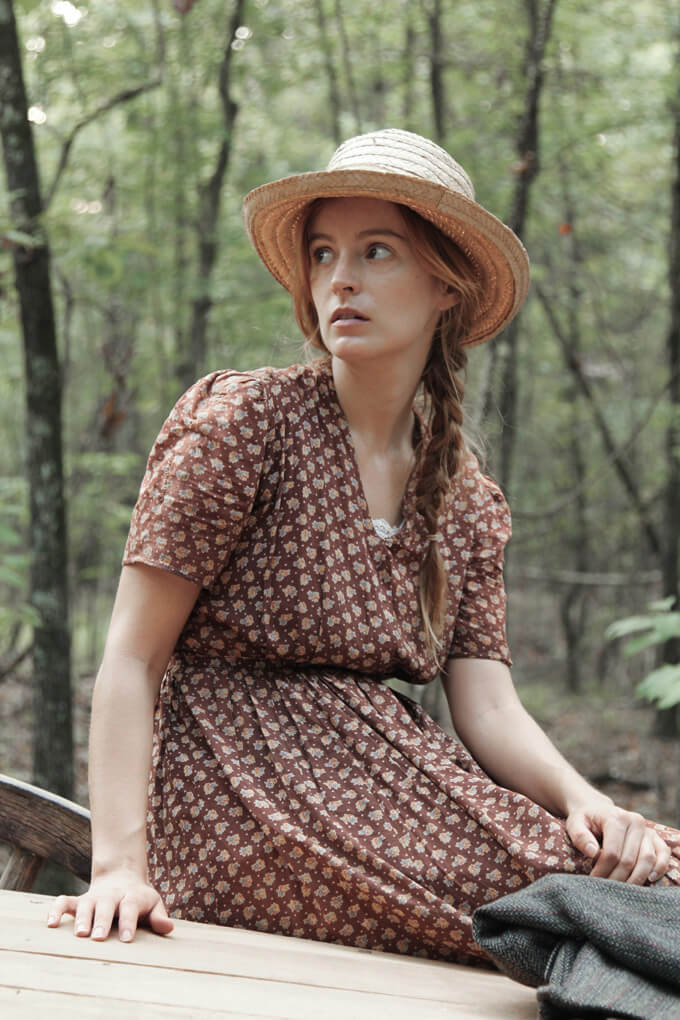 |
| Actress Ahna O'Reilly as Dewey Dell Bundren, 2013. Photograph by Alissa Whelan. © RabbitBandini Productions. |
Because the film focuses more on the journey to bury Addie's rotting corpse than the inner lives of the characters, it fails to emphasize what's most important in the novel: the violence the Bundrens do to each other for reasons both innocent and evil. An absent scene that helps cement the latter motivation is when Anse basically steals the money Dewey Dell has brought with her to try and get an abortion in Jefferson. In the novel, this is the moment of Dewey Dell's final abjection, and it sets up the shocking ending where we realize that Anse has used his family's labor and capital as a way of securing himself a second life, complete with a new "Mrs. Bundren" and a set of teeth purchased with the money taken from his used up (and soon to be shamed) daughter. The film's scene of Anse smiling his new smile would have been a gut shot had we previously seen him extorting Dewey Dell just after her rape at the hands of the druggist who promised that violation would cure what ailed her. Without knowing how Anse paid to be able to eat "God's own victuals" (37), we're left thinking him wily and maybe a little goofy, not a hillcountry Machiavelli.
Even the story of the disastrous journey is incomplete in Franco's film. Following the barn burning scene in the novel, the Bundrens approach Jefferson worse for wear: Cash's leg is decaying in its concrete cast, Addie's coffin has holes drilled through the lid and into her face because of her youngest son's curiosity, and Jewel's back is burned after rescuing Addie's box from the fire. On the road into town, the wagon passes "three negroes" and "a white man" (229). The "negroes" balk at the stench coming from the wagon, and upon hearing their comment, Jewel utters his grammatically incorrect invective, "Son of a bitches" (229). However, he says this as the wagon passes "the white man," who pulls a knife on Jewel and demands an apology, which he gets, but only after Darl makes it clear that Jewel doesn't fear the man (229). As Candace Waid points out in her study, The Signifying Eye: Seeing Faulkner's Art, this is the only direct reference to race in the entire novel, and its coupling with Jewel's burned and blackened back, as well as his assertion that "the white man" looks down on them "because he's a goddamn town fellow" (230), is a powerful instance of the "coloring of class" (71), a theme Faulkner explores more explicitly in Light in August, Absalom, Absalom!, and his Snopes Trilogy.5The intersection of race, class, and the visual arts in Faulkner's fiction is examined in Waid's The Signifying Eye: Seeing Faulkner's Art (Athens: University of Georgia Press, 2013). In the interest of full disclosure, I worked with Dr. Waid on this book as an editorial consultant.
The fact that the coloring of class is a preoccupation of Faulkner's later novels is not enough of a reason to fault Franco for not including this road scene in this adaptation. However, within As I Lay Dying this scene reminds us that the Bundrens' place outside the bounds of respectability (another of Faulkner's oft-explored themes) is intimately tied up with their barely landed agrarianism in the face of a South becoming more and more a social geography of "town folk." The film depicts this divide by showing the disgust the people in town experience as the smell coming from the wagon wafts through the square. The novel does this as well, but by combining it with the scene on the road, Faulkner's As I Lay Dying makes it clear that the antagonism is more fundamental. It's about who the Bundrens are and what they will never be, not what they've got in the wagon.
In this scene from Martin Ritt's The Sound and the Fury, Yul Brynner's Jason Compson berates Joanne Woodward's Quentin after her night out. The scene exemplifies how the film plays Faulkner's text as a straight melodrama, stripping the main characters of the internal monologues that give them complexity, and denying us Faulkner's unique ability to critique his own characters (and the ideas and estates they represent) simply by letting them talk to us. Brynner's Jason is particularly altered, as his characterization lacks any of the hyperbolic and comedic sense of victimization that makes his sadistic personality in the novel almost understandable.
Franco's next take on Faulkner is an already half-filmed adaptation of The Sound and the Fury, an even more difficult text to render into the language of film without losing all the texture that Faulkner's prose provides. Just ask Yul Brynner. Still, the fact that Franco is looking to take on these projects is encouraging, as it provides an opportunity for someone to do with Faulkner on celluloid what has only been attempted on stage thus far. The theater troupe the Elevator Repair Service has staged a dramatic reading of the first section, "April Seventh, 1928," of The Sound and the Fury that mirrors the experimentalism of the novel by engaging in multivocal ventriloquism, with actors moving between parts that aren't really parts at all because they all come from within the mind of the mentally handicapped Benjy. While Franco likely won't (and probably shouldn't) try to simply mimic this on screen, here's to hoping that he embraces the fullness of Faulkner's modernism, creating the kind of layered film Faulkner never would have been able to write during his days haunting the Warner Brothers back lot.
About the Author
Daniel Pecchenino is a lecturer in the writing program at the University of Southern California.
]]>Review
Released on July 1, 2012, Anne Braden: Southern Patriot examines the remarkable life of civil rights activist Anne Braden in the context of the social justice movements of her time: labor rights, civil rights, anti-war activism, women’s liberation, and gay rights. Based on oral history interviews and rich with archival photographs and footage, this documentary narrates Braden's challenge to systemic racism and economic inequality in the United States. Intended to reach a broad audience through television airings, distribution to high schools and colleges, and presentations by grassroots organizations and churches throughout the United States, Anne Braden has screened in Austin, Louisville, Lexington, Oakland, San Francisco, Philadelphia, Cincinnati, and Vancouver with more viewings scheduled. Kentucky Public Television (KETKY) has rebroadcast Anne Braden five times since first airing it on October 29, 2012.
Filmmakers Anne Lewis (associate director, Harlan County, USA) and Mimi Pickering (Director, The Buffalo Creek Flood) worked with Braden to make this documentary, recording a series of conversations over more than two years. Initially a reluctant subject, Braden confides on camera that being the focus of such attention "embarrasses me highly." Eventually, she grew more trusting of these two filmmaking veterans, relaxed and told her story. But Braden never relinquished control of her narrative. As Anne Lewis put it, Braden "refused to be reduced to sound bites and would command me to be patient if I tried to steer her in any way." Cinematically straightforward, Anne Braden: Southern Patriot resembles Henry Hampton’s Eyes on the Prize: America’s Civil Rights Years (Part 1, 1986; Part 2, 1989) in narrative style, content, and editing.
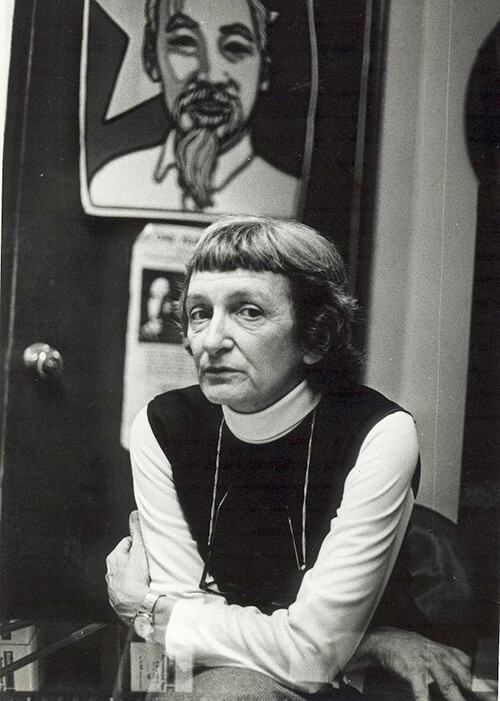 |
| Anne Braden in the SCEF office where she edited The Southern Patriot, Louisville, Kentucky, October 1962. Reproduced by permission from the Wisconsin Historical Society. |
The DVD cover of Anne Braden shows its subject in a white turtleneck and black jumper, strikingly like a priestly garment and clerical collar. Although the documentary brushes aside her life-long devotion to organized religion, this image embodies the film’s argument—that she was a martyr to the causes she believed in, gave her life for others, and made sacrifices that far transcended the ordinary. Anne Braden details how as a child of the white southern middle-class, Braden grew up to critique the language of white supremacy and use her sharp intelligence and pragmatic skills as a journalist at the Anniston Star, the Birmingham News, and the Louisville Courier, to investigate case after case of racial injustice in the South and the nation. Her 1948 marriage to Carl Braden, the son of recent immigrants, forged a personal and political alliance that merged her commitment to racial integration with his close ties to the labor movement and the Socialist Party.
A first-person documentary based largely on biographer Catherine Fosl’s book, Subversive Southerner (2006), Southern Patriot is narrated principally by Braden. Fosl makes multiple appearances, recounting in a riveting statement early on that throughout Braden's long career, she never "took her hand off the plow" of social justice, and once her course was set, she did not look back. Interviews with a number of activists who worked with Braden across the decades recount stories of her dedication and vision. Brief, laudatory vignettes by Cornel West, Bernice Johnson Reagon, Reverend C.T. Vivian, and Angela Davis underscore the importance of Anne Braden’s path-breaking work on civil rights and discuss the implications of her activism for the twenty-first century.
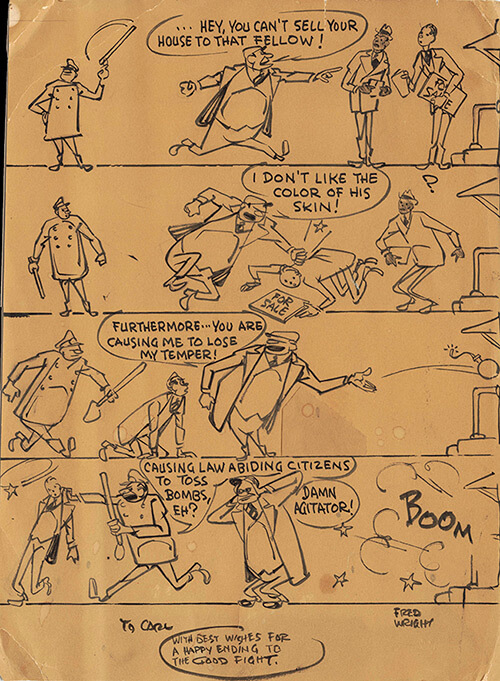 |
| Fred Wright, The Wade House Bombing Comic Strip, 1954. Reproduced by permission from the Wisconsin Historical Society. |
The film recounts Anne and her husband Carl's 1954 decision to purchase a house in an all-white Louisville neighborhood for Andrew and Charlotte Wade, a young African American couple. The Wades moved in on May 15, 1954, two days before the US Supreme Court's Brown vs. Board of Education decision striking down school segregation. Anne Braden documents in harrowing detail how this modest suburban home, first damaged by rocks and gunshots, and then partially destroyed by a bomb, became the focal point for desegregation in Louisville. The hostile white neighbors who had threatened the Wades' safety multiple times were never seriously questioned about these crimes. Rather, the state of Kentucky charged the Bradens with arson and sedition. Carl spent seven months of a fifteen year sentence in prison and lost his job at the Courier-Journal. In a low-pitched voice-over, Braden narrates over newspaper articles from the trials, photographs of the bombing, and film clips, including portions of an interview with Andrew Wade. She analyzes the context of this pivotal civil rights case, concluding that: "The anti-Communist sort of hysteria that was gripping the country and the anti-Black hysteria that was certainly gripping the South, all got rolled up in a ball and hurled at us. We were traitors to the country, to our race, we were Communists; we were evil; we were the devil."
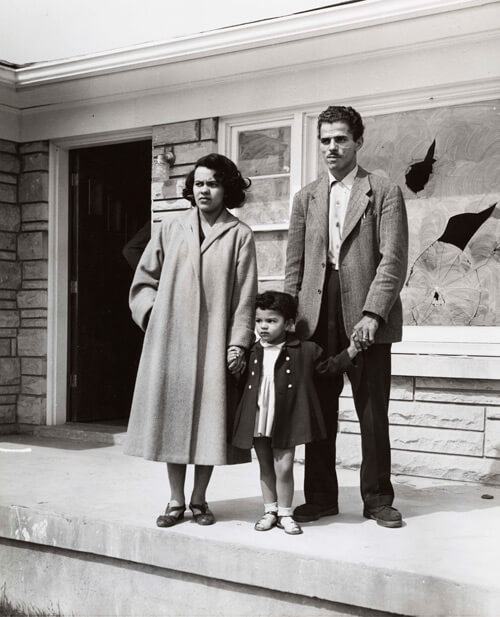 | 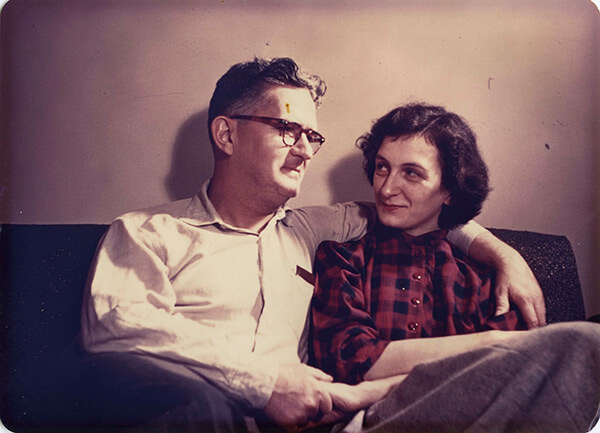 |
| Andrew Wade and his wife and daughter stand in front of their damaged house, May 16, 1954, from the Louisville Courier-Journal. Reproduced by permission from the Wisconsin Historical Society. | Social activists Carl and Anne Braden, taken about the time of their marriage, 1948. Reproduced by permission from the Wisconsin Historical Society. |
The Bradens deepened their commitment to activism. Their reputation as "subversives" followed them into the wider civil rights movement. Throughout the 1950s and 1960s, the Bradens worked in relative isolation, especially in the South, and were treated like political and social pariahs in their hometown. Until decades after Carl’s death from a heart attack in 1975, even groups dedicated to social change spurned their participation. Blacklisted from employment, Anne and Carl Braden accepted an offer from the Southern Conference Education Fund (SCEF), an outgrowth of the New Deal era's Southern Conference for Human Welfare. They worked as SCEF organizers out of Louisville on a comprehensive civil rights agenda aimed at ending segregation and extending the power of trade unions. For years Anne Braden used her talents as a journalist to edit SCEF’s widely read radical left newsletter The Southern Patriot.
 |
| Cover of Free Thomas Wansley: A letter to white Southern women from Anne Braden, 1972. Print by John Wilson. Courtesy of Emory University's Manuscript, Archive, and Rare Book Library. Page 1 - Page 2 - Page 3 - Page 4 |
The film Anne Braden: Southern Patriot shows how Anne Braden found her voice as a southern white woman after following the advice of William Patterson, the African American founder of the radical Civil Rights Congress. Braden recounts on camera how Patterson told her: "You don’t have to be part of the world of the lynchers; you can join the 'Other America,' the people who struggled against slavery . . . the white people who supported them, the people who all through Reconstruction struggled." He listed all those who have worked against injustice, she remembers, and at this point when "I was hardly dry behind the ears . . . that’s what I needed to hear." Braden heeded Patterson’s counsel, cast her lot with those in the "Other America," and shaped a broad vision of solidarity that encompassed past generations of American dissidents, those involved in current struggles, and those who would continue to fight for social and economic justice. Relatively slow to embrace women’s liberation, Anne Braden came to see feminism and eventually gay rights as natural extensions of the civil rights movement. In December 1972 she penned "A letter to white Southern women," (included in a PDF on the Anne Braden DVD), whom she addressed as "my white sisters." She made a powerful plea to white women of the South, who she argued "belong in this fight," to join a campaign to free Thomas Wansley, a young black man arrested at age sixteen who had spent a decade in prison on a fabricated rape charge. Braden reflects on this case in Anne Braden and restates her argument that: "no white woman reared in the South—or perhaps anywhere in this racist country—can find freedom as a woman until she deals in her own consciousness with the question of race." Only women, she argued, could destroy "the myth of white Southern womanhood" by not remaining silent as black men die or go to prison.
Braden’s message and influence are made clear in Anne Braden, but the question of her motivation is one that the film skirts. What forces drove her to take up the cause social justice in such a decisive way? What gave Anne and Carl the courage, year after year, to dedicate everything they had to changing the world, to making real their shared vision of a beloved community built on racial equality and economic justice? How did she weave together the seemingly diverse elements of her background, religion, and education to take on the challenges of racial and economic justice in the second half of the twentieth century? How did she become a radical?
 |
| Anne Braden speaking at a rally, Louisville, Kentucky, 2002. Reproduced by permission from the Wisconsin Historical Society. |
Anne Braden was an activist who left a rich bequest in the dozens of multi-racial activist groups that continue her work. By the final years of her life (she died in 2006) even longstanding arch-enemies acknowledged Braden as a heroine. Predominantly white liberal groups that had previously shunned her began presenting her with awards. The American Civil Liberties Union gave her the first Roger Baldwin Medal of Liberty, and the Southern Regional Council bestowed its Lifetime Achievement Award. Once the tide turned Anne received multiple honorary degrees, and after her death, even the state of Kentucky went from vilifying her to paying "honor and tribute" in an official resolution. Anne Braden called these actions, "apologizing for fifty years of history." Anne Braden: Southern Patriot celebrates Braden’s long career, from 1948–2006, and what activist Angela Davis termed, her "inveterate optimism, even in the worst of times [and] her refusal to give up."
About the Author
Mary E. Frederickson is a professor of history at Miami University, Oxford, Ohio, where her research and teaching centers upon women’s history and labor studies. She is the author of Looking South: Race, Gender, and the Transformation of Labor (University Press of Florida, 2011) and Gendered Resistance: Women, Slavery and the Legacy of Margaret Garner (University of Illinois Press, forthcoming 2013). During 2012–13, professor Frederickson has been a Mellon fellow at the James Weldon Johnson Institute working on a social and legal history of sickle cell disease. She will be a visiting professor in the Graduate Institute of Liberal Arts at Emory University in 2013–14.
]]>Review
I adored Beasts of the Southern Wild and have seen it three times: each viewing a quick incursion into the southern surreal. Benh Zeitlin's movie has received a nomination for best film, and Quvenzhané Wallis, his spunky, firebreathing star, may be crowned best actress. In the movie she plays the part of one of Louisiana's Katrina-surviving, throwaway children, but on her own terms she is a gargantua. The poster for the film shows the actress in darkness—her legs striding the ground, arms reaching out like Leonardo's Vitruvian Man and in each hand a giant sparkler irradiating the movie's title in untamable light.
 |
| Film poster for Beasts of the Southern Wild, Twentieth Century Fox, 2012. |
My present passion is luminous trash, glowing debris, garbage that lights up—like the tossed-away sled at the end of Citizen Kane or the illuminated basketball hoops that David Hammons makes out of Harlem debris or the bright garbage that a dirty robot collects in Wall-E. Beasts is a movie where debris and light vie for screen time. The heroine, Hushpuppy, is covered with mud as she traverses the squishy soil around her claptrap, rickety house. In the film's opening scenes the screen floods with light when the Bathtub's bright revelry spills over and neons the Cineplex audience. This film carries the nation's baggage; it investigates a culture of racial neglect, creates a zone of history-making for Katrina's disposable bodies, and provides a steady critique of white capital. The film's rags and wastelands—its killing fields—become powerful emblems of the Southland's (and our nation's) commitment to toxic inequality.
But something else rages in this film; it refuses the realism of social critique and advances instead into hubris land, into a new realm of myth making for the twenty-first century. "We's who the earth is for," boasts Hushpuppy, echoing her father's view of the racially mixed population of the Bathtub. This community bristles with carnivores, meat-eating women and men unashamed of their appetites, alcohol, and impoverishment. Nurtured, imperiled, the child creates a wild set of gods: demiurges, mother figures, aurochs, and sirens to inhabit a world dangerous and ecstatic. She forces us to ask: what myths do we need to live in an era of global warming where every coastal community may soon look like the Bathtub? As Zeitlin said of Isle de Jean Charles, the place where Beasts was filmed: "it's a place where ingenuity rules. Planks, low-lying bridges make up the walkways from house to house, so if your bridge gets knocked out, you fill the gap with a mattress or roofing."1Emily Brennan, "A Filmmaker's Lessons From the Bayou," The New York Times, August 16, 2012, Tr 3. Quvenzhané Wallis deserves an Academy Award because her impassioned presence and plain speaking bestow an unexpected path for assessing the mess we have made; her measured voice endows the film with a new mythos that addresses a world we have broken: a human cosmos that may be dirtied beyond repair.
Where to begin? Charles Wright's poem "In Praise of Thomas Hardy" takes us straight to the heart of light, dirt, and their relation to energy:
Each second the Earth is struck hard
by four and a half pounds of sunlight.
Each second.
Try to imagine that.
No wonder deep shade is what the soul longs for,
And not, as we always thought, the light.
No wonder the inner life is dark.2Charles Wright, "In Praise of Thomas Hardy," in A Short History of the Shadow (New York: Farrar, Straus, and Giroux, 2002), 27.
 |
| Still from Beasts of the Southern Wild, Twentieth Century Fox, 2012. |
Beasts of the Southern Wild is about this four and a half pounds of sunlight. What happens when we take it for granted? What happens as we unravel the fabric of the universe by throwing two and a half centuries of fossil fuel back at the sun?
Beasts begins with a child making a dirt nest for a half grown chick, reminding us that even though primates may have started in the treetops, our home is in the dirt. This mud nest is small, lopsided, and looks uncomfortable, like a practice run for that other dirt-obsessed movie, Close Encounters of the Third Kind. But instead of conjuring light-hungry aliens who come to earth, the nest-building child picks up the chick and listens to its heart; she imagines a chorus of animals: "'I'm hungry. I want to poop.' But sometimes they start talking in codes." How do we make our way into the coded life of other species? In Beasts meat is never processed and prepackaged; it always comes on the bone or in the shell—a reminder of its origins inside other creatures. "Meat is the buffet of the universe," Hushpuppy 's teacher insists. Hushpuppy's father reminds her: "Share with the dog," as if our main task in the Anthropocene, this new era when humans must learn to see themselves as a geologic force preying on the planet, is to know ourselves as a species dependent on other species. As Dipesh Chakrabarty suggests in "The Climate of History": "Changing the climate, increasingly not only the average temperature of the planet but also the acidity and level of the oceans, and destroying the food chain are actions that cannot be in the interest of our lives."3Dipesh Chakrabarty, "The Climate of History: Four Theses," Critical Inquiry 35 (Winter 2009): 219. Or as Hushpuppy says in the trailer: "The whole universe depends on everything fitting together. If one piece busts, even a small piece, the entire universe will get busted."
The vulnerability at the heart of Beasts is staggering. We should have created a planet where children can be safe, but we have not. One in ten American children live in deep poverty; 2.8 million children live in households that have incomes of less than two dollars per person per day—a benchmark for developing countries.4 Paul Tough, "The Birthplace of Obama the Politician," New York Times Magazine, August 19, 2012, 31. Peter J. Hotez, "Tropical Diseases: The New Plague of Poverty," New York Times, Saturday Review, August 19, 2012. Hushpuppy steers through her world in underpants, wearing white plastic boots covered in mud, her parents lost, the camera lens that follows her scratched or marred. She jousts perilously with sparklers; she lights a gas range and burns down her house; neglected and feisty, she is more wild than free, and her thoughtful face summons archetypes of abandonment.
 |
| Quvenzhané Wallis as Hushpuppy. Still from Beasts of the Southern Wild, Twentieth Century Fox, 2012. |
Hushpuppy's near nakedness stirs the film's controversy. Author bell hooks protests oppressive stereotypes that ensure Hushpuppy's victim status and her father's abusiveness and cruelty: his life of drunken delirium. Arlene Keizer, a scholar of African American literature, noted in conversation that Zeitlin's film luxuriates in dirt, disorder, and mental disturbance—as if these were the exclusive properties of the racialized poor. Even the actress who plays Hushpuppy, Quvenzhané Wallis, insists in an interview with Oprah that the heroine should have been allowed to wear long pants. Were the filmmakers conscious of tapping these reservoirs of stereotypical abjection? Why summon inaccurate, dirty cliches about the hopeless lot of underclass blacks, Louisiana, and the marginal Southland, so blindly?
I want to argue that these criticisms, while eloquent, are off the mark. Beasts is not a slice of life or a realist screed; its business is mythological: it proffers a sacred narrative with overtones of awe and cosmic investigation. Querying the social order, it offers strange pedagogies about how we should live in a melting world. Hushpuppy equals the Invisible Man as a "thinker-tinker," a philosopher child who makes up her own world of demiurges and deities; she imagines calving glaciers, starry mothers, and glistening aurochs who want to gobble up cave babies, and in the process she creates creatures so scary and risible that we almost forget their filmic source—a handful of potbelly pigs blown up by the camera and turned into primeval beasts with a patchwork of nutria fur and tacked-on tusks—the bricolage of an odd filmmaker and an even odder child's imagination.
Beasts works through two additional forms of myth making. First, while Hushpuppy's father Wink is scary, he also has a vitality so palpable that his daughter has to absorb it. "Who de man?" he shouts. "I the Man!" she replies. In a scene where one of the white men in her community is teaching Hushpuppy how to eat crab with a knife (and standing suggestively behind her, reminding us of Hushpuppy's sexual vulnerability once her father dies), Wink insists that she "beast it": she must break the crab open with her bare hands and suck its guts out by sheer force of will. Her father may be helpless against the curse of alcohol, but he provides her with meat, with safety from other men (including himself, since he insists that they live in separate houses), and he inhabits the mythic register of the Fisher King, a wounded monarch whose sickness unto death puts his entire kingdom in jeopardy—a wild lord who must be restored to health, or replaced, if the wasteland is to flourish. And in the final scenes Hushpuppy hews to this myth by bringing him a bizarre magic chalice—the closest thing to a talisman that the commodity world owns—a throwaway Styrofoam container filled with gator meat fried by her knife-wielding, light-creating, imaginary mom. The wasteland is with us now and forever—even its myths create trash.
 |
| Hushpuppy and Wink, played by Dwight Henry. Still from Beasts of the Southern Wild, Twentieth Century Fox, 2012. |
This throwaway Styrofoam brings us to Beasts' other mythic register—its quest for a way to represent our species' relation to global warming. Styrofoam is made from oil, and images of acetylene torches, gas stoves, and gas engines remind us that although the film's characters are battered by the forces of global warming and their carbon footprint is small, creating a carbon-free democracy is not their concern. The citizens of the Bathtub practice a dirty ecology, making do with what they can salvage from other waste-making classes. When a Katrina-like storm savages their community, the damage is endless. A giant pig-beast knocks over power lines: these are animals who "eat their own mommas and daddies." In the Bathtub the carbon apocalypse is already upon us. Early in the movie, Hushpuppy's teacher raises her skirt; she shows a thigh tattooed with prehistoric aurochs—"fierce" creatures who signify that "any day the fabric of the universe is going to unravel." A blast of poverty consumes everyone living in Wink's and Hushpuppy's community. After we watch the child, her father, and their chickens, dog, and pig chew up the world during a ritual "feed-up time," the film veers from animal eating to the screen-filling shot of an oil refinery. "Ain't that ugly over there?" Wink says from his repurposed boat. "We got the prettiest place on earth." The Bathtub's houses are made from castaway metal and lumber, its people jettisoned by the currents of capitalism. It's too close to the water: cut off by a levy from the thing-creating world. The oil refinery looks at once mechanical and auratic; its white spires hover in the same place in the pictorial frame as the calving glaciers that start to rain down on the audience, and free child-eating aurochs—the mythic equivalents of carbon's rough beasts, their hour come round at last.
These once-extinct, returning aurochs mark the movie's geologic concern, its interest in eras. Around 1750, humans switched from renewable energy to the large-scale use of fossil fuel—a shift in scale marking the beginning of a new era.5Chakrabarty, 207. Ten thousand years ago the Pleistocene or Ice Age gave way to the warmer Holocene, and civilization began in earnest. But our contemporary era, the Anthropocene, has speeded up our species' access to matter until we now create our own weather events, our own set of fractures. Humans are reborn as geologic agents, as the main cause of change for earth itself. Chakrabarty argues that humans now wield a separate geological force and that we must scale up our imagination of the human, the consciousness of our scope and reach as species being, before we can hope to redeem the planet.6Chakrabarty, 206. This means owning up to the imbroglios we have made, and their unintended consequences. Claiming these unintended consequences becomes Hushpuppy's lament, her motif in Beasts. Angry at her father for going away (near the beginning of the film we see him wandering toward the house, dazed, in a hospital gown; he's been institutionalized against his will for delirium tremens brought on by heavy drinking), she sasses him and he strikes her. She then strikes him back, and he goes down—a man of great will but little strength. The screen flashes with visions of glaciers melting; Hushpuppy transfers her teacher's parable onto her father's ruined body: fantasizing that he is a landscape her bad actions have broken. She dashes to get him medicine and he disappears again, only to reappear as the heavens open: a hurricane nears. Like Lear, Hushpuppy takes the force of the gathering storm upon herself, calling into the wind: "Momma, is that you? I've broken everything."
This is primitive thinking—an animistic sense that her actions have caused the decay of the universe. It is mistaken, childish—and may suggest a deep psychological wound. Children reeling from abuse may internalize themselves as bad objects, blaming themselves because it's too painful—too dangerous—to jeopardize a precarious relationship with their parents. To decide that she is at fault, that she's done the breaking, puts Hushpuppy in a universe of children who've been neglected or traumatized. She blames the world's trauma on herself to keep from alienating her caretaker—a father so unpredictable that even a child's feathery anger might frighten him away. Self accusation makes sense in terms of the film's psychological economy, but it also operates in a mythical or cosmic register.
According to Chakrabarty, Bruno Latour, Tim Mitchell—or a thousand ecologists—the guilty recognition that we have the power to shatter our own universe is exactly the tragic recognition—a true anagnorisis—that we need to embrace; we need to scale up not only our self-knowledge, but our self-image as quasi-subjects with the terrible power to change the planet, not just individually, but as species-being. Beasts names us as a vulnerable species in need of tools that can mirror and refract the depth of our ongoing, entangled acts of pollution, our attachment to things that keep turning into debris, our power to destroy Earth itself. Hushpuppy's animistic thinking is a mistake, but this displacement is also a powerful origin point for a necessary myth, for the dream we need to dream (that is, to make into creed, to make tangible) of our complicity as a dangerous, polluting species.
 |
| Wink and Hushpuppy. Still from Beasts of the Southern Wild, Twentieth Century Fox, 2012. |
I'm arguing that Hushpuppy signals to us, again and again, possible transference points for claiming kin with our carbon voracity. First, she's a determined creatrix who tries to memorialize her own acts of trashing: "If Daddy kill me [for burning down the house] I ain't going to be forgotten," she thinks and hides under a cardboard box while the flames advance as she draws a picture of herself for posterity. "Daddy could have turned into a tree or a bug," she thinks when he disappears, "there wasn't any way to know," and the screen flashes with tent caterpillars and ice floes suggesting the break-up of the universe. When the hurricane rages we see mud-spattered animals trudge through the needling rain. When it's over and Hushpuppy and Wink float in their newly drowned world, Hushpuppy thinks of the waste of dead animals: "They're all down below trying to breathe through the water. For animals that didn't have a Dad to put them in the boat, the end of the world already happened." When the water finally drains out of the Bathtub, Hushpuppy reminds us: "It didn't matter that the water was gone. Sometimes you can break something so bad that it can't be put back together." Or, watching her father die, she exclaims, "The brave ones stay and watch it happen. They don't run," but she still finds herself on a boat skippered by a captain who hoards all his Chick-fil-A wrappers: "the smell helps me to be cohesive." Garbage animates this wasteland, but as the movie veers away from a world filled with animal parts—and unabashed human carnivores who lie down in mounds of crawfish shells or sleep in piles of rags and throw-away clothing that, to bourgeois noses, would smell unclean—it embraces a comedy of processed food that seems to grow its own trash, and Hushpuppy insists that you still have to "fix what you can."
 |
| Still from Beasts of the Southern Wild, Twentieth Century Fox, 2012. |
In Beasts nothing gets mended, except for the audience's amazement at a child's voracious imagination. After the apocalypse, those left in the Bathtub try to drain the polluting water by detonating a levy. The screen goes white when the detonation is successful, and then reveals barren bayous. Hushpuppy's community is forced to go to the "Open Arms Processing Center," a sterile, inhospitable world where "when an animal gets sick here they plug it into the wall." The film starts to fall apart in this civilized bureaucracy. Hushpuppy's imagination slows down, and Zeitlin falters as his mythic backdrop falls away. The film finally picks up when it returns to the wasteland, although it makes a second detour to a buoyant island of happy prostitutes. This detour from carbon catastrophe is beautiful; the screen dazzles with utopian lights that reiterate, in a vague and careless way, a wished-for matriarchy. At the end of this scene little girls dance with loving women wearing old-fashioned white slips—as if the movie wants to promise us a Land of Cockaigne where little girls will always be sexually safe, where mothers can be cooks instead of hookers, and where heat and light are endless.
To return to life as an endangered child in a universe of bureaucracy and endless waste is scary. But the ritual death of the Fisher King, the film's insistence that Hushuppy's father must die and cannot heal the wasteland, keeps us mired in the film's litany of Anthropocene images. Allan Stoekl argues that every twenty-first century addiction flows from our addiction to oil.7Allan Stoekl, Bataille's Peak: Energy, Religion, and Postsustainability (Minneapolis: University of Minnesota Press, 2007). To break this obsession means reformulating our entire subjectivity.
To prevent this, we practice a dirty ecology: recycling a few things while leaking and expending everything else. In other words, dirty ecology is the science of halfway practices. We know that driving and flying and industrial pollution and living in drywall houses destroys the planet, but we continue to do it. Hushpuppy appeals so powerfully because she is an early avatar of who we need to become: a child who clings to Styrofoam but sends her liquor-addicted dead father in his gasoline-addicted-repurposed-Chevy truck-made-into-a-boat off into another world.
 |
| Still from Beasts of the Southern Wild, Twentieth Century Fox, 2012. |
Hushpuppy's cry keeps echoing: "Momma . . . I've broken everything!" Her mythical thinking represents childish animism and a private legacy of psychological damage. But myths also establish long-term models for guiding behavior. They require, first of all, mystery—awe at fact of the universe and our place in it; second, a topos—an explication of cosmic shape that can ground us in a felt geography; third, an epistemology—shaping foundations supported by codes or ideas that establish the norms of the social order; and finally an ethic—a set of rules or maxims about how to live within the parameters of the everyday. Beasts bestows a weird movie mythopoeia for reestablishing each of these needs within our present era: the carbon-drunk Anthropocene.
In this movie's wake, I hope for a long line of girls and boys who will call out to us with the knowledge that we've broken our ecosystem. We must dirty ecology, the science of whole environments, with myths, fictions, half-truths, dirty imagery. Myths are crucial as implements of attachment and ownership for all the unintended consequences we have to live with in order to make a buffet, a movable feast, and a pedagogy out of our cosmic impasse. "If daddy don't get back soon it will be time for me to eat my pets," Hushpuppy says early in the movie to soothe her growing sense of abandonment. Even though Wink imagines that "I got it under control," he also sees that "my blood is eating itself." No one has it under control in the Anthropocene, and unless we recognize this soon we will have to eat things stranger and less appetizing than our pets. What's the world coming to when the best movie of 2012 has a nutria rigger, when it reimagines extinct aurochs as potbellied pigs with plastic horns? Beasts of the Southern Wild is whimsical, but it is also an epic comment on our condition of metamorphosis when humans persist in changing Earth's geologic direction: "Daddy could have turned into a tree or a bug, there wasn't any way to know." Trees and bugs may not need mythologies, but the rest of us do, and to advance the project of reshaping a planetary epistemology, see this movie—and then let's start to fix what we can.
About the Author
Patricia Yaeger is Henry Simmons Frieze Collegiate Chair at the University of Michigan. She was editor of PMLA from 2006–2011 and author of the award-winning Dirt and Desire: Reconstructing Southern Women's Writing. She is working on two books: "Luminous Trash: America in an Age of Conspicuous Destruction" and "Flannery O'Connor in Drag," and is co-editing volumes on literature and energy, "Fueling Culture: Energy, History, Politics" and "American Dirt."
]]>