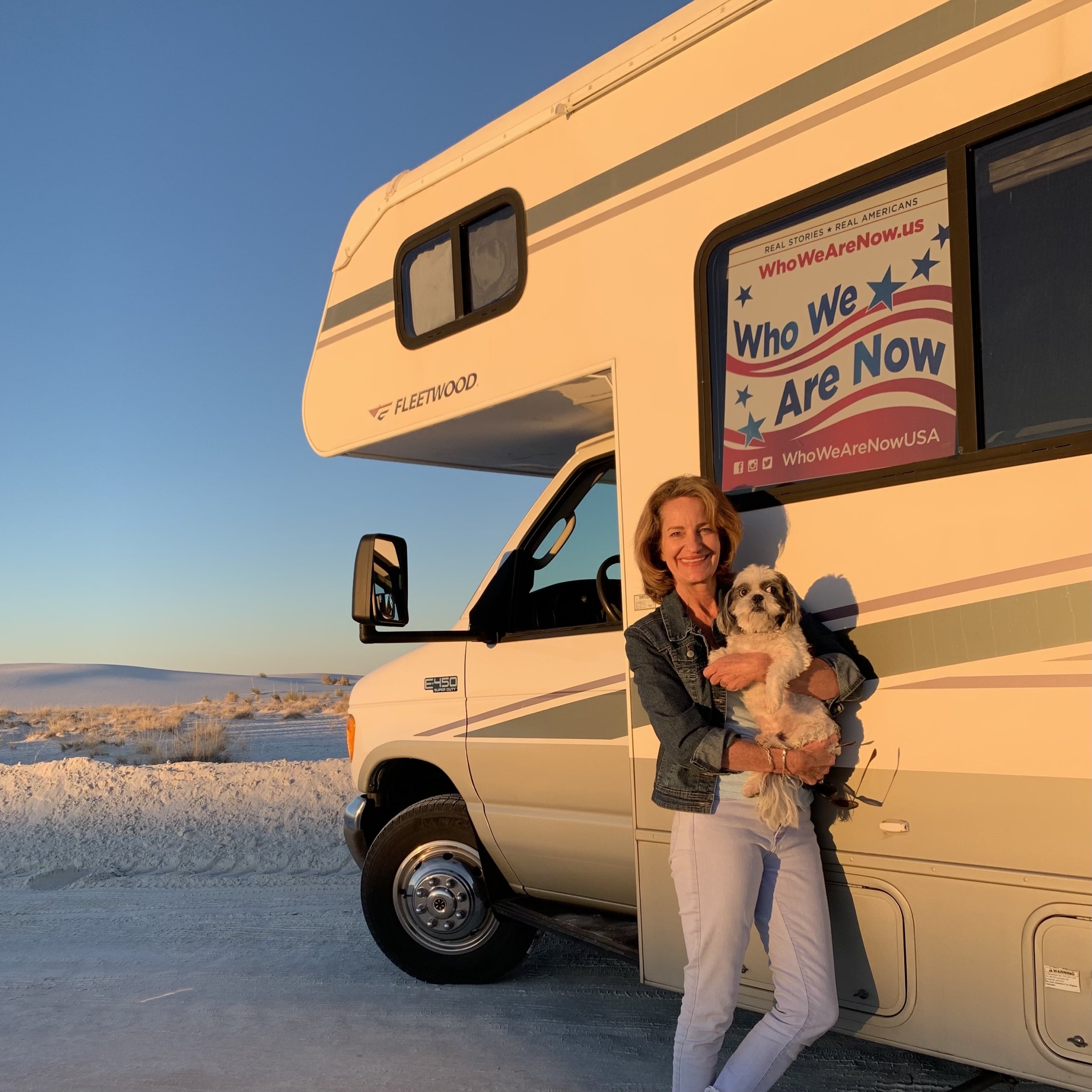
Southern Spaces: Oh, here's Michelle now. Are you in your RV?
Michelle Fishburne: Yes, I am. As a matter of fact, I'm in the RV at Jordan Lake State Park near Chapel Hill. It's about ten minutes from where I raised the kids. I have a twenty-three-year-old who has struggled with long COVID, but has just graduated from UNC. And then we'll go up to Princeton, New Jersey, where I grew up. I'll be housesitting for two weeks.
Q: We've been intrigued by your book, Who We Are Now. It's an important project. The interviews hit powerfully with regard to the loss and heartbreak from COVID. Sometimes now, in the wake of the pandemic, it's possible to think it wasn't really that bad. Life goes on. But going back to the beginnings and to the following many months as you do, the power of this pandemic can't be avoided.
Let's start with what were you doing when it became evident COVID had arrived and was not going away. What were the early months of COVID in 2020 like for you? When was it evident that COVID was not going to be a two week, stay-home-and-then-go-back-to-life-as-normal situation? And how did you develop the project that ultimately became the book?
Fishburne: I think that moment when I realized this was going to last more than two weeks takes me into early April. In January, I had just gotten back from a wonderful vacation in Grand Cayman and I had told everybody all over holiday break how much I was enjoying my job and that I could just pinch myself. It was just a great job. I was a public relations partnership person for Inmates to Entrepreneurs, some people who really, really needed it. I was working on an event at the US Senate and the House of Representatives. We were talking to John Legend, who was working on something similar, about going into a prison with him.
And then on January 17, an unknown virus attacked my eighth cranial nerve and I lost my hearing in my right ear and my vestibular functioning. I began using a walker and learning to adjust to life without hearing in one ear. In February, I bought a prom dress for my senior in high school. She was very excited about the prom and we were waiting to hear back from colleges.
Then my boss, when he saw COVID coming, he was having some struggles. His doctor said to him, "You know, you can't go anywhere." And so he said to me, "I'm going to have to lay you off because I can't go do any of these things that you are preparing." So I was laid off and I thought, "No big deal. I have a law degree from UVA. I have had an illustrious career. I've done wonderful things. I'll find a job." I wasn't panicked. But I submitted eighty-six customized cover letters between the middle of March and the middle of July, and I had nothing.
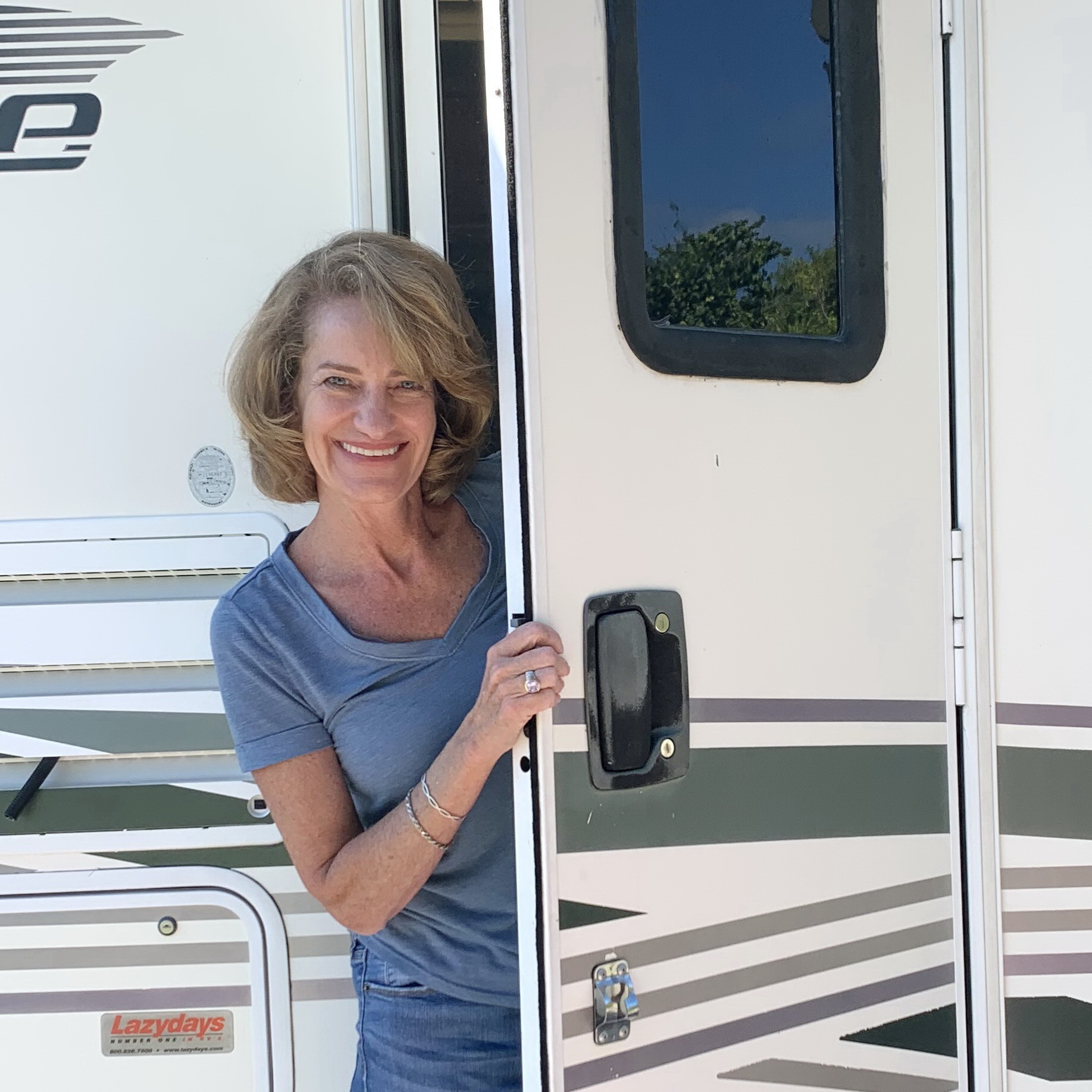
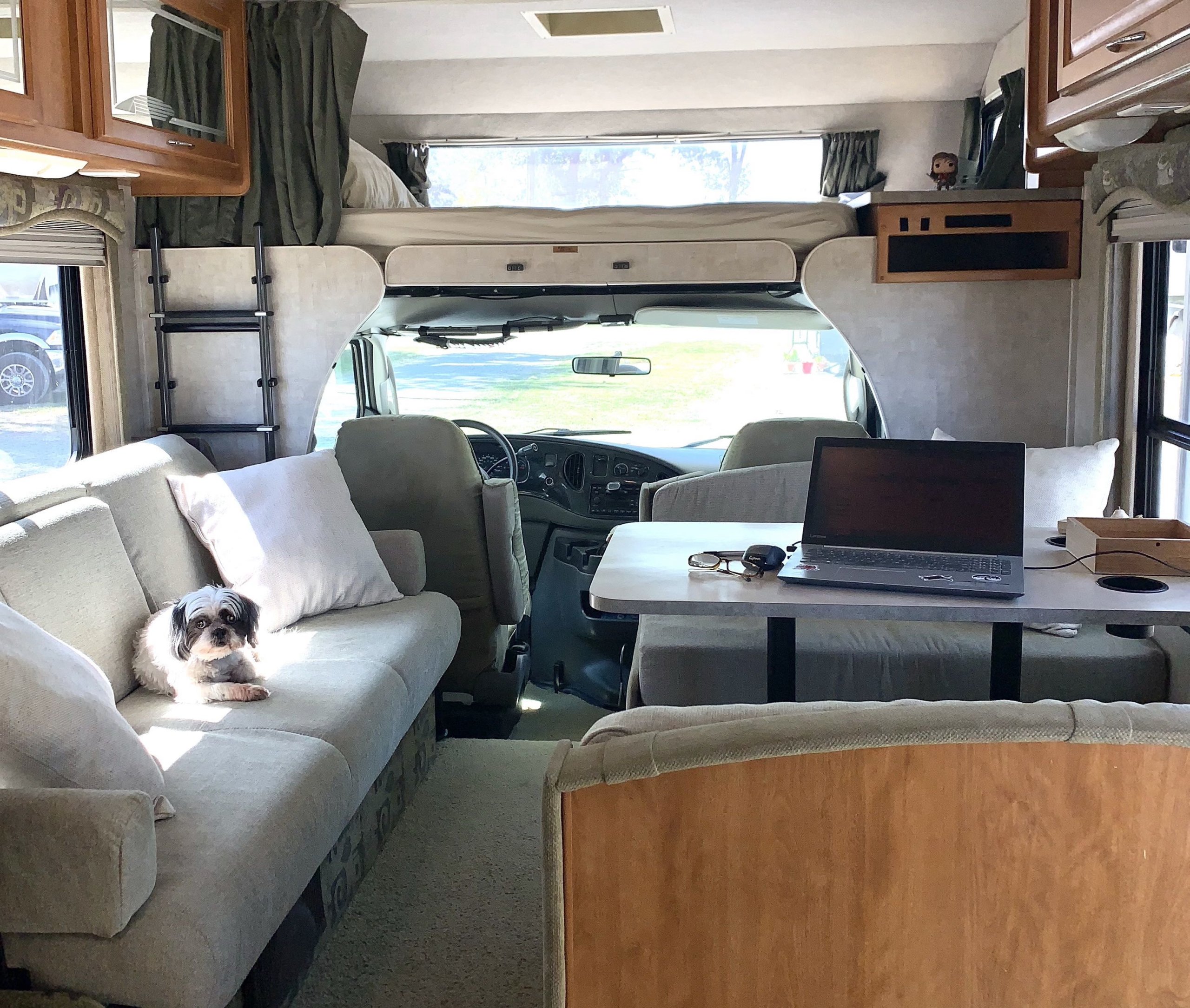
The lease on the post-divorce house was coming up on July 31. I knew that on August 1 I would have no house, no spouse, no job, and no kids to take care of. And the big critical moment happened in a Target parking lot on June 15, when I had to decide where to have the movers put my stuff. I thought, "What doesn't make any sense for me is to rent a place because I have no idea where I'm gonna have to go to get a job. I've got the motorhome that I homeschooled my kids in for ten months once. All right, I can move into the motorhome." So I put everything in storage.
And then I thought, "Oh, what will I do? Well, I love the Outer Banks. Take the motorhome to the Outer Banks." But then I thought, "Michelle, you can be in hell while you're in paradise. And if you're waking up every day thinking what's your next job, you're kidding yourself. You need a project."
I could drive out to Yellowstone from North Carolina because I've done it before. Yeah, and then I will cry the entire time I go to national parks because I won't be with my little ones anymore and I'll be all by myself.
Then out of the blue came the idea of Humans of New York. And I thought, "Oh, Brandon Stanton interviewed thousands of people in New York, took their photo, got a little snippet of their story, put it on social media." I could do the same thing. I could do Americans of the pandemic. Who We Are Now—that was the name right from the beginning.
I know that when you focus on other people, it's easier not to be afraid. I also know now from somebody I met during the interviews that action is the antidote to fear.
Getting in the motorhome and doing a fast run helped with my fear. And focusing on other people helped with a different kind of fear. But I was also very naive. What made me think I could go out in the middle of the pandemic and find strangers to talk with?
Q: Your project started off the way interviews work. One person leads to another. But you say that your fear did not seem to have been pandemic related. We're wondering, weren't you concerned about catching the virus?
Fishburne: I wasn't. Once again, naivete really helped. I thought, "I'll just wear my mask and I'll be smart. I mean, I could be smart in Chapel Hill. Why can't I be smart in Saint Louis or New Mexico?" But what I found when I got out into parts of the country that were sparsely populated, I started to reconsider what critical thinking meant.
I did take some risks. I'd think, "Okay, this building is big enough and it's just me and this person. They're way over there and I'm way over here." Because if somebody is going to tell you a story, and they've just met you, and it's about their lives, especially since I only ask one question, what I really needed was for somebody to keep going and going, going and going, right in my face. Inviting them to continue and showing interest. The mouth is really important to that. As much as I tried to use just part of my face and some body language, there were times when I needed to take off the mask.
Q: That makes perfect sense. So you talk about how this book got started, but then you traveled a long road. How did you have the momentum to sustain the project?
Fishburne: It became something unto itself. I'm just a project person and I got in the groove. What sustained me was how surprised I was every single time I got to listen to somebody else. I mean, there were genuine moments of surprise in every single interview. For example, when I talked with Anne, who's the wedding planner in LA, I had in my mind all these questions I was going to ask her because I was interested in how weddings had changed. But when I asked her the one question, she went off in a completely different direction that surprised me.
I think the excitement of knowing I was going to hear somebody else's story is what sustained me.
Q: Who was most helpful in encouraging and supporting you?
Fishburne: My mother, who is now eighty-five, was my sounding board and supporter. She also is an editor. I would send her transcripts of the interviews. I would think, "Well, this person's got different parts of their story in different places in this transcript." So I would move it around then send it back to the person and ask, "Is this what you said?" Or they'd say, "Yes, that's pretty much what I said. Or, "I said 'like' too many times. Can you take that out?"
My mom has a PhD in sociology from NYU. I grew up knowing about qualitative and quantitative research. Knowing how you ask the question is so important. We talked about the question a lot. And I needed to have a grid, a mosaic, to do a representation of the US as best I could. We talked about that, too.
Q: How did you organize your project? And, to get a sense of the scale and the scope of all the interviews you did, how much is included? How much is left out? How did you edit?
Fishburne: I was conscious of what was going on geographically. Age, race, gender, class, they're all in the mosaic. Urban, suburban and rural. Religion of different kinds. There's New York City and there's Jackson, Mississippi. I used a reverse order of population of the top fifty cities to make sure that I got different types of urban places in different parts of the country.
One area I leaned into heavily was the performing arts because they rely on a live audience. And other vocations that really had a hard time. I overloaded those a bit because they were compelling.
I interviewed about three hundred people, but only a hundred are in the book. There are more on the website and there are more that never made their way into a story. One of the peer reviewers called the book "elegiac," not a word I had anticipated. He had seen the book without any photos. Originally the contract was for forty photos, but one hundred people. And I thought, "I don't know how I'm going to choose which forty people." This was December 2021. My editor at UNC, Lucas Church, said, "Maybe we shouldn't have photos in the book. Then it would be elegiac." So the book went without the photos; the way it's set up, it kind of tumbles.
In order to get that tumble feel, some of the stories had to be very short. For example, I spent two hours with Luke and Rodney and only used Luke's story about how he got more grief for wearing a mask than holding the hand of his partner. Lucas said the stories need to be between 250 words and about 1,200. The average interview was probably thirty-five or forty minutes. If the average story length is six-hundred words, which takes about three to five minutes to say out loud, the book has about five hundred minutes of material. And I recorded three-hundred times thirty minutes. A lot was left out.
When Who We Are Now was published—I'm just going to say the truth—it did not do very well. We think what happened is that it arrived during COVID exhaustion. Yeah. More recently, the couple of book clubs that have used it have really delighted in it because it helped them reframe what the pandemic was. I know that however-many-years hence everything that I gathered is going to have more value than it has today. I think in seven years, when I'm sixty-seven, I'm going to be a very popular lady at the ten-year anniversary.
Q: As a historical read as compared with a contemporary read, I think you may not have to wait that long.
Fishburne: Sometimes when I pick it up and I read it—like I just opened up to Tina, the grief counselor—it washes over me. It all just comes back and you think, "Oh, yes, we had to go through that. How do you grieve when you can't have the formal process?"
And then when I was re-reading Tina's story, Melissa's story in Corinth, Mississippi came flooding back. Her mom had died during COVID. And Melissa said to me, "I've always thought it odd when a family member passes and you go back to the home and you have the whole spread of food that people bring. I never understood the importance of it until now. Because now when I walk down the street, it can be a beautiful day, months and months after my mom has passed and I'm having a good day and somebody who hasn't seen me since my mom passed will say, 'Melissa, I am so sorry about your mom.' I didn't get the kind of closure you get with everyone there eating food, drinking, talking."
And in a way that's how it was with COVID itself. It came, peaked, and petered out, but we never had the "end," even though the federal emergency was over. But it's not the end. Especially for people with long COVID.
Q: You mention that Who We Are Now came out around the time of COVID fatigue. But how did these oral histories affect you? Did you compartmentalize them as research?
Fishburne: I didn't see the project as research. It was just my life. Even now, when people talk about the pandemic, most people talk about it in ways that are very foreign to me. And the way I talk about it is very foreign to most people. Before I got in the motorhome and drove around the country, I thought I knew the pandemic experience, but that was based on my own lived experience. When I left here in September 2020, I expected to find desolation, depression, and division. I expected it to be very, very negative. What really surprised me was the human tenacity. The pluck. And that's the word that I use now a lot, pluck, which is spirited and determined.
In doing the interviews, I settled on asking only one question: What was your 2020 supposed to be like and what did it end up being? And people could talk about what they wanted to. They talked about what really mattered to them, what really defined this period of time, and what made it very difficult, or challenging, or surprising.
People who were out in areas that are sparsely populated would say, "Oh, I just went on the same way." But I know having been there, that every person was changed during the pandemic. More than normally every person genuinely thought about other people and what they were going through. And then there were people who were not given anywhere near the support they needed.
Q: And what do you say now, with a bit of distance, in terms of the perspective that you have?
Fishburne: My mom keeps telling me that I'm a sociologist and I keep pushing back and saying, no, I'm a collector of stories because a sociologist goes back and looks writ large. And I don't feel qualified to do that. I centered the project on individuals and offered up each story.
Many people had very difficult experiences of having to go in and try to do their jobs under incredibly hard circumstances. Often, they didn't have the equipment, didn't have the guidance, didn't have the support. They were watching people die or people turned people away. They couldn't do the jobs that they had trained to do. Then people would come in and reject what they were trying to do or tell them they were wrong. That was head spinning. Or to walk into a store and nobody would have masks on because it was a state where you didn't need to have a mask. It was like a horror movie. They'd think, "Which one of you am I going to see next week?" A lot of the people that I talked with in the healthcare field felt like they went through a trauma.
I thought about various groups of people who were struggling. For instance, I talked with Emma, a director of a migrant farmworker nonprofit. She told me about how really nobody cared to protect migrant farmworkers and about one man who died alone in a motel room. That never should happen. In Birmingham, I interviewed Anne, who was running a homeless shelter. She said it got to a moment when she had to ask whether people were safer inside the building or outside.
I had just started eastward in Texas when Governor Abbott announced that you didn't need to wear a mask anymore. I'm like, "What the heck, Texas is a long state to have to go through no matter which way you do it, right up or down or sideways." I was going west to east and had to be in the state for four more days. It became very uncomfortable. I am a political animal so it was really hard for me to not lean into that. But I became so fascinated with each individual. And I thought, "We are all in this together."
But let's take Fox News, on cable all over America right now. And I was really angry at a big part of the country. I'm like, how can you think that way? How can you think that way? It's Fox News. People have had it in their homes for so long. Fox was pitting us against each other, making people angrier and angrier. Some really ugly parts of us came out. But when you actually get in and talk to people, that's not who they want to be. That's not what they want to be thinking about it.
The false narrative that COVID was not as serious as it indeed was really impacted our healthcare workers and public health officials. I interviewed people who had significant responsibilities, including top public health officials in major metropolitan areas, and they stepped away or are in therapy. And some decided not to deal with it affirmatively. One doctor I spoke with recently said, "I can't talk about it." She started the dialogue and then she said, "I can't. I've just put this away in a compartment. I just can't touch it. I just can't do it." But then, there was a nurse who cried at the end of the interview and said, "Oh my gosh, I just really needed to talk about that."
I saw and heard America in these different ways. People trying to get through. It was such an odd time. The challenges we faced were very unusual.
Luke, South Carolina
Mask Wearer—November 2020
We have felt more discriminated against for wearing masks than being gay. And that's crazy. In the United States of America, we are getting more nasty comments said to us in a grocery store, on the street, for the fact that we have a mask on than the fact that we're holding hands as two men. That's just hilariously tragic. Like, that's where we're at? You're really going to be angry that I have a mask on? So no shame or foul to people who don't want to wear a mask—just don't call me a sheep because I have a mask. That literally happened to me at the gas pump this week.
Valerie, North Carolina
State Senator—December 2020
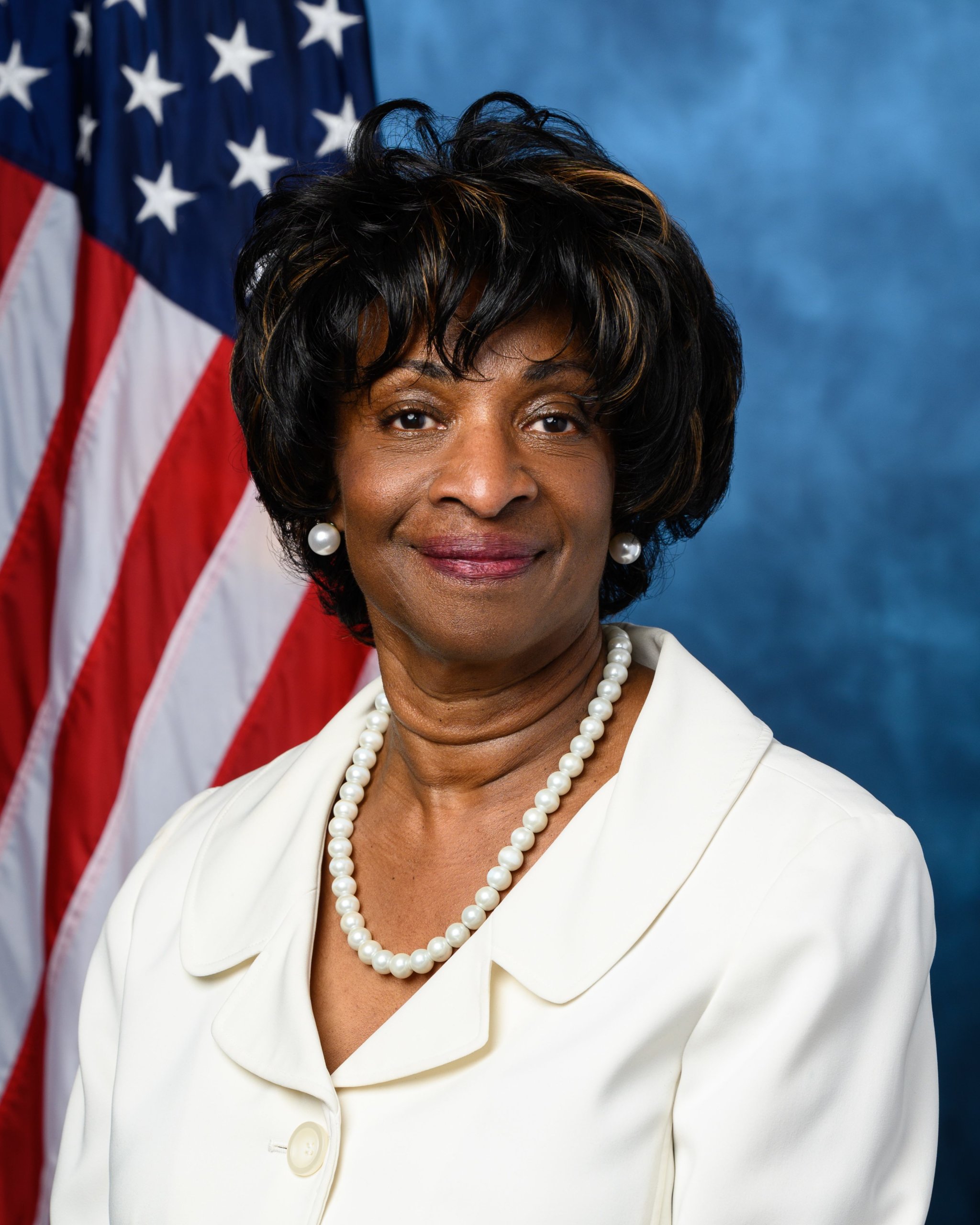
On March 3, I was attending a conference in Charlotte, and I got a text message from Health and Human Services. It was, to put it mildly, surprising to get a text from DHHS out of the blue. They were alerting me that the first confirmed cases of coronavirus in the state of North Carolina were in my district. Two residents of Chatham County who had traveled to Italy had contracted the disease. I knew enough to know that this was huge and that we were on our way into something that was not going to be good. I left Charlotte that day rather than staying over the next night because I knew that if there were two cases, there certainly were more.
When I look back at 2020, coming from that point of entry into where we are now, with massive unemployment because of shutdowns, and then the blowback, the pushback, it has been very, very difficult. We knew the shutdowns were not the best thing for the economy, but having this juxtaposition of the economy versus overall healthy communities was hard. The governor was in a tough position.
And in the midst of all of that, we were waiting on the federal government to bring in aid. When people started to lose their jobs and people's rents and mortgages and car payments went into jeopardy, there was no help. And the state system was not equipped to handle the massive number of unemployment insurance claims. Before COVID, we usually had about 800 or so claims a week. Then all of a sudden, we went from 800 to 1,800 to 300,000.
Our constituents were coming to us saying, "I followed everything you told me, Senator. I filed my unemployment claim and I've waited for three weeks now. When I call, nobody answers the phone. When I go online, I get knocked off. When I do stay online, I keep getting the same thing saying I'm not eligible. I know I'm eligible. I can't pay my rent and my family is going to be out on the street. Can you help me?"
How many of those folks do you think I could help? Very few. And then the small businesses were calling and saying, "Senator, we're not eligible for PPP [Paycheck Protection Program]." Or "Senator, you can only apply through certain banks or lending institutions. I've never done this before. I need technical assistance in applying." Or "Senator, I don't have an established relationship with this bank, so they will not even talk to me. So where's our help?" That's so painful.
And then I got the call that brought everything really close to home. It went like this.
"Hey, Valerie, how are you?"
"I'm good, how are you?"
"Not so good. So-and-so died of COViD."
"No, can't be."
"Yes."
"What happened?"
"Well, you know he had surgery. After the surgery, he was sent to a convalescent center. He contracted COVID there and died in four days."
Two days later, his family asked me if I would eulogize him. The ceremony was on May 2. There was no church service, just a graveside service, because of course we had to be outside. Afterwards, my husband and I just drove around because I just was not ready to go inside. While we were driving, I got a phone call. I had noticed at the funeral that my friend's best friend was not there. Well, so I got the call from another friend who was at the funeral. This is how it went:
"Valerie, I know this is going to upset you, but they found Kenneth dead today."
"What do you mean?"
"That's why he wasn't at the funeral."
He was only two years older than me. Kenneth was the editor and publisher of the Carolina Times newspaper, one of the few Black newspapers in our state. So that's no more. That's the end of an era that started with his grandfather, Louis Austin, way back in 1927.
And so, when I quiet myself, those are the things I most vividly remember.
Frank, Louisiana
COVID-19 Ventilator Patient—January 2021
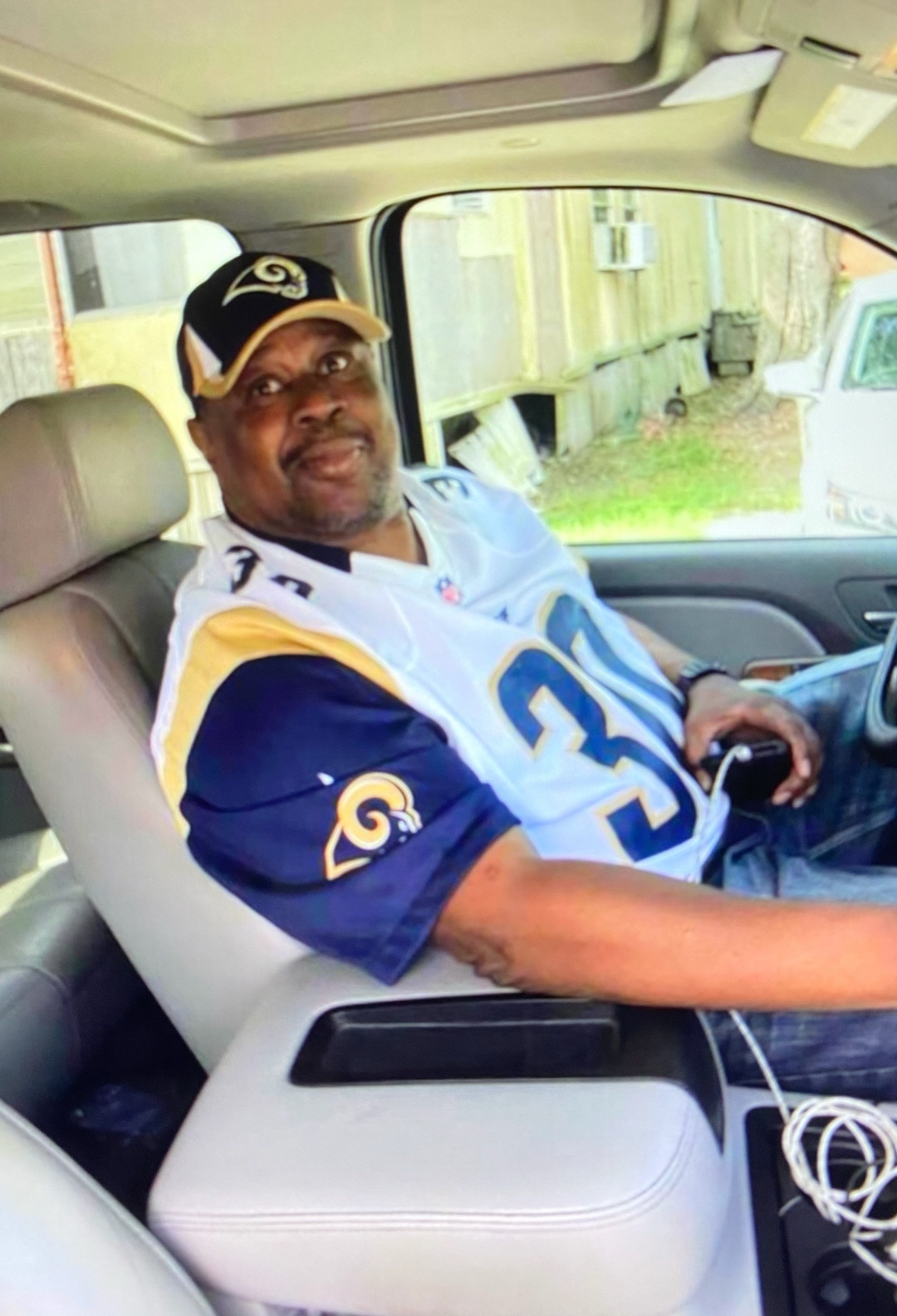
I was working for a nonprofit organization driving a bus. We would bring older people, people on Medicare, back and forth to doctor appointments, rehab centers. I come home from work, sit down, and watch TV, and all of a sudden, I can't breathe. I called my son and he took me to the hospital. They diagnosed me: "You have COVID." I said, "Man, I ain't got no COVID." The next morning, Dr. M. come and say, "What's the matter?" I'm telling him I come here last night, and the doctor told me I have COVID. I just couldn't breathe. He said, "Are you ready to go home?" I said, "Yeah." So they let me come home. Got home, next day, the same thing. Can't breathe.
They had an ambulance service come get me. They came in here and gave me a breathing treatment and took me to the hospital. And when I got there, on March 24, Dr. M. say he's going to put me in a medically induced coma. I went to sleep on March 24 and when I woke up, it was April 23. I'd been on a ventilator for almost thirty days. The hospital's head of infectious medicine told Dr. M. to unplug me earlier than that, but Dr. M. said, "Man, I'm in the business of saving lives. I'm not going to unplug that man and tell his family he is brain dead, which he's not." When I woke up, I asked my wife when was Easter, and she said, "Boy, Easter been gone." And I say, "Where I been?" And she said, "You been out, asleep." But I didn't remember nothing, and I didn't realize how sick I was until I called my wife and said, "When you come get me?" and she said, "Not right now." I had no idea that I couldn't walk. I had no idea. I couldn't go to the bathroom. I couldn't pull up in the bed. I couldn't use nothing on my body. Hands, legs, feet, nothing. I couldn't do nothing, period, in a vegetative state. I lost the use of everything, man.
They told me they would send me to a rehab center. When I got there, they put me in a room, and the next thing I know, they put me on a second floor by myself and told me that I got COVID again. So I stayed thirty days in there, with everybody masked up, aproned up, gloved up. And they just got me laying there in the bed, can't turn over, can't feed myself, can't do nothing. And nobody could come visit me because I was in isolation. Every time they come in the room, they'd say, "Why are you down in that hole?" "Man, I've been trying to get out of this hole, but I don't have the strength to pull myself up." And then they get mad with you, they'd bring three or four people in and take you out of the hole and then all of a sudden you're back in that hole. Yeah, I mean, I'm laying flat like this for three months. It was supposed to be a rehab center, but they did nothing for me.
I finally got out of there and back to the hospital to do rehab. In two weeks, I was able to stand at the parallel bars and sit in this wheelchair and push up. And then they started walking me, and it was amazing because I hadn't walked in ninety-something days. I got off-balance and never could get the strength. I would walk with a walker and then I would get tired. Like right now, I still get tired fast, I still don't have no balance, still can't taste every now and then, still can't smell every now and then.
I know there's a God 'cause it's a miracle that I am here. The guy's son who does the dialysis tell me, "Mr. Frank, you're a walking miracle." I say, "What are you talking about?" He say, "Frankie, everyone who
was on that floor that had COVID, all of them died but you." And he say, "I know there is a God, you blessed." Then Dr. V., the heart doctor, say, "Man, we really thought you was going to die." Dr. S., "Man, we really thought you was going to die." You know, it's a bad feeling when everybody coming to you, telling you that they really thought you was going to die. And they look at you, "Man, Frank!" and you don't remember. The doctor told me maybe it's good I don't remember. You know? And I'll be asking my wife, "What happened?" And she'll be telling me, and I don't remember. He said, "That's a part of your life that you will never be able to get back." That's fine, I'm here now. I don't wish this on nobody, man.
Emma, Arizona
Migrant Farmworker—February 2021
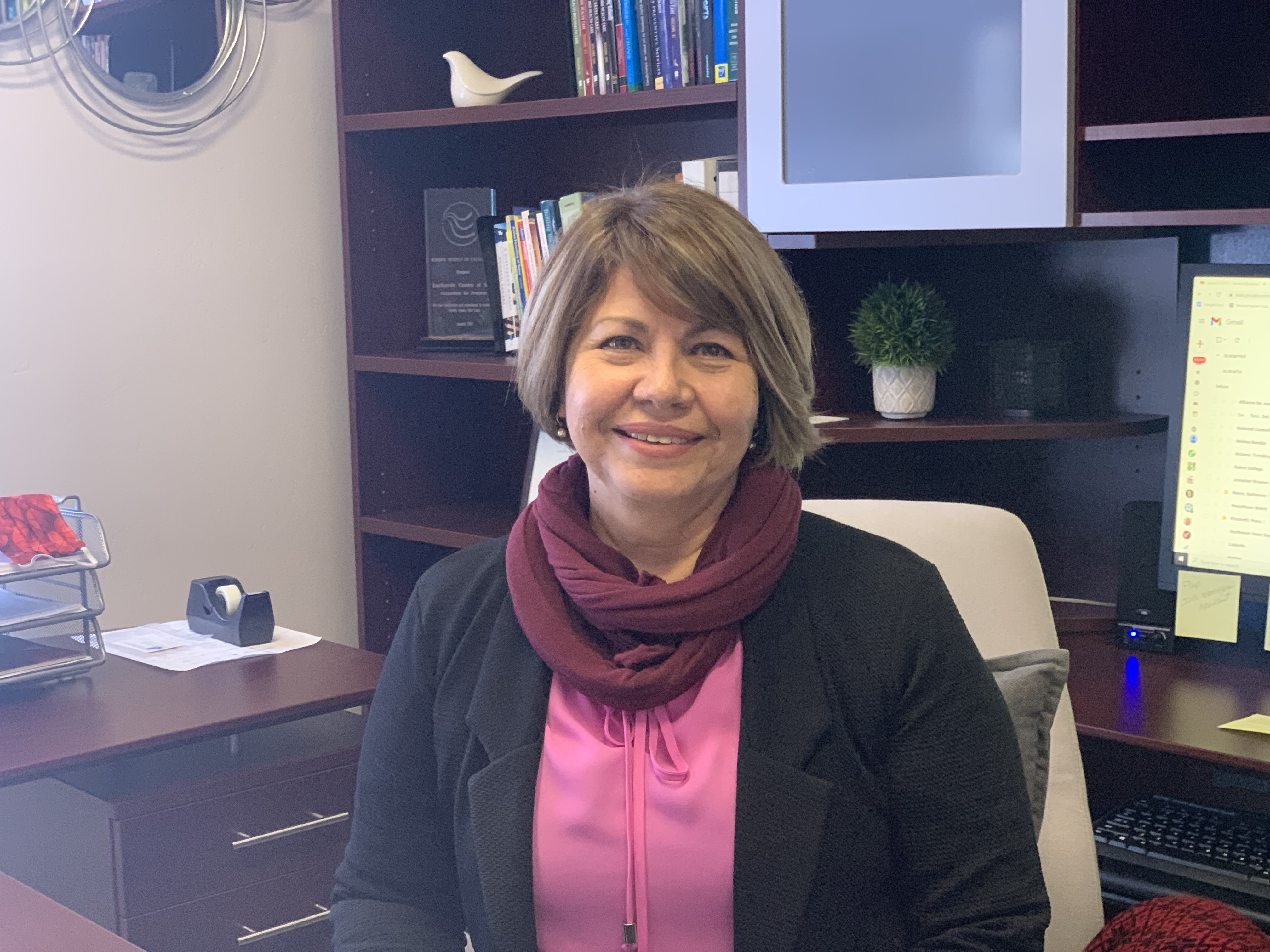
Our farmworker population start their days at 2:00 a.m., sometimes earlier. Approximately 15,000 to 20,000 of them cross every day, and the lines on the border can be two or three hours long. They leave early so they can make it here in time to get on the bus and be taken to the fields where they harvest the fruits and vegetables that America eats. This area around Yuma is called "America's Salad Bowl." Our organization provides services to our population, including immigration, housing, parenting, chronic disease prevention, and behavioral health. We're always very busy, so when we started hearing the news that this virus was impacting China and how bad it was, we didn't have a lot of time to think about it. We have a small, rural life, so you don't think a lot about whether something international will hit here. You don't think about how interconnected you are in reference to it. Then at the end of January, we had three cases. It was still not a pandemic at that point, and it was just three cases, so we were thinking, Okay, so three cases. We continued business as usual, no additional precautions, just basic hygiene and all that. When the governor issued a shelter-in-place order, we realized this was serious. Shops started closing and people were running around and piling up food and toilet paper.
After our agricultural season ended, a lot of our farmworkers migrated to California, particularly Salinas, San Joaquin, Santa Maria. Then we started hearing about the pandemic hitting them over there, and even some deaths. One man died in a hotel room by himself. The family knew he was very sick. Nobody was visiting him or giving him food or anything, according to the family. The only contact they had was just through the phone, and all of a sudden, he stopped answering. That's how they realized he had died.
During the stay-at-home order, I had a lot of thinking to do about our office here in Yuma. We have thirty employees, and it's important for personal and cultural issues to have direct, one-on-one contact with the individuals we serve. After the two weeks of stay-at-home, we opened the office back up. My husband used to work at the Health Department's emergency preparedness program and helped us understand the precautions we needed to take. We invested a lot of money in plastic safety barriers and hygiene equipment and products, and we had the offices fumigated every two weeks to sanitize them.
Then there was the question of whether to open the doors or lock them and make people knock. But I felt badly for the elderly or the farmworkers who just needed a form to be read or translated or just basic services like that. So I decided that we were going to have to take a risk and open the doors and do whatever we could and pray to God. We were going to face the threats and fight them because we could not be paralyzed; we have to continue serving our population. So we opened the doors. We let people in just two at a time or one at a time to keep as safe an environment for them and for us as possible.
When the agricultural season started back up again in October, the owners of the farms required the workers to wear masks and did temperature checks, but the buses were loaded just the same as before, everyone crowded in. We did two or three campaigns where we went to meet the loading area for the buses at three o'clock in the morning. We provided tote bags with masks, information, gloves, and everything. Our staff was wearing their gowns and PPE, like they were in a hospital. They were there, facing their fears, because what else could we do? One time we gave out about one thousand bags between 3:00 a.m. and 4:30 a.m.
At some point in the pandemic, we were ground zero in the world for the number of cases. The harvest season and the pandemic season collided. Many of the migrants were sick, but they wouldn't say anything. And a lot of them were young, between eighteen and thirty-six, and didn't show symptoms. Migrant workers don't get fringe benefits or sick leave or anything like that, so a lot of them, especially the H-2A temporary workers, didn't want to be quarantined for two or three weeks. So the sick workers wouldn't say anything and then the whole crew would get sick, but they would not say anything. The employers wouldn't say anything either. They wouldn't want the testing to be done for the workers and the workers wouldn't want to be tested, and so there was like this kind of silent agreement. "Don't ask, don't tell, because we need you and you need us." That is what I have been hearing.
Donna, Georgia
Senior Living Community Executive—July 2021
The coronavirus came to our campus on March 13. It was one employee and we sent them home. I then went to my boss, the CEO of our company, and said, "Our best strategy right now is to lock in. We'll ask employees to volunteer to live on campus and we'll reward them. And we will just live on campus with our members. It'll be over in two weeks, four weeks max." He never blinked. He was behind me 100 percent.
We didn't call it "lock out." We "locked in" with our members and we kept the world out. We kept coronavirus out. The gate was literally locked, and the only thing that came in and out of that gate was food deliveries, Amazon packages, and Instacart.
I asked for volunteers from our employee body, and sixty people raised their hands immediately.
They included our director of accounting, our moving coordinator, servers, housekeepers, maintenance, security. I took any volunteer who raised their hand. Ended up being seventy-five. The next step was figuring out where people were going to sleep, how we were going to feed employees, and how we were going to keep the operations of our 500-member community running with a staff of seventy-five instead of 300.
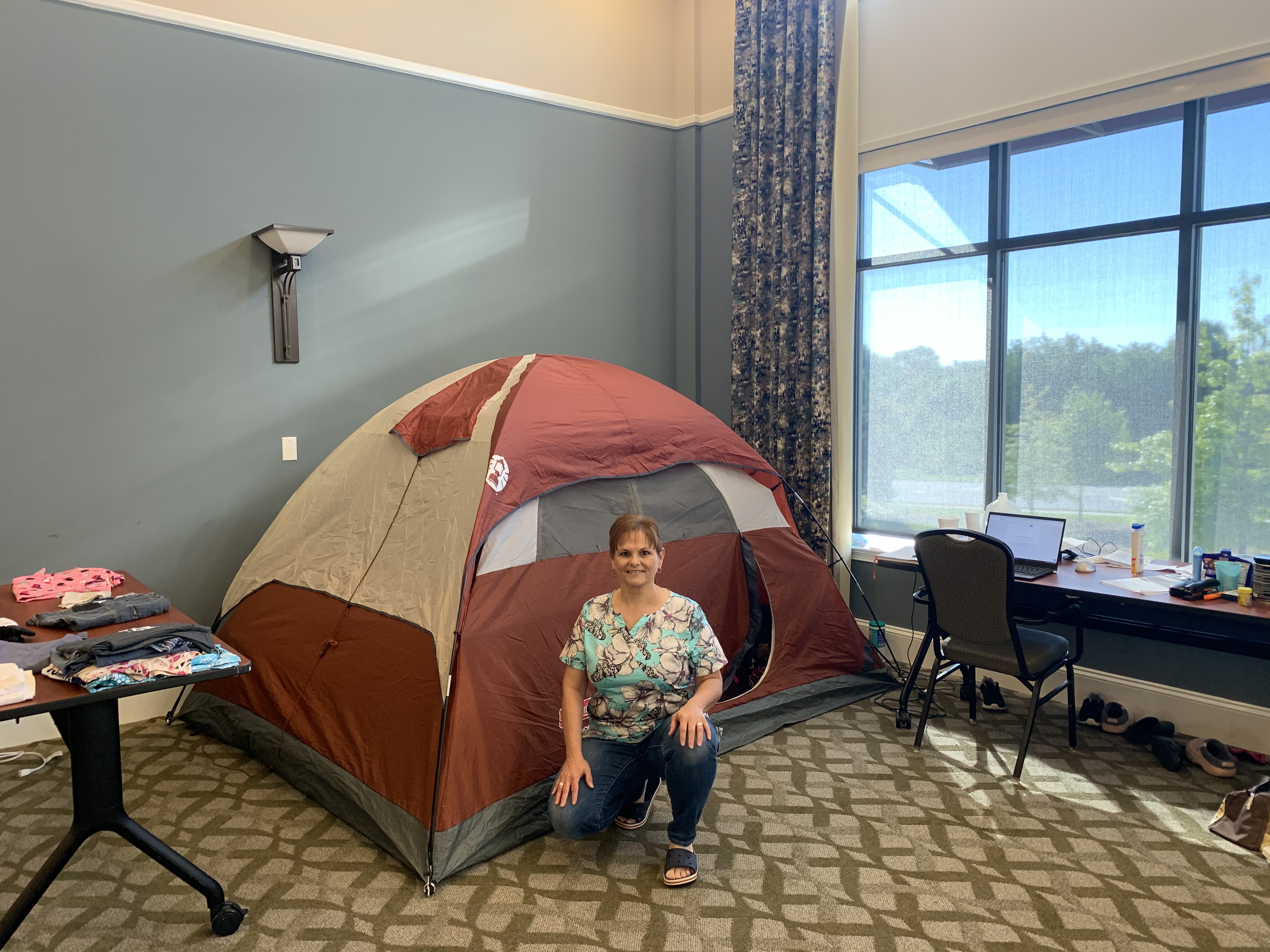
Some of the employees lived in model rooms, some lived in rooms on air mattresses, and some people, like me, lived in our health center, with memory care and skilled nursing. I lived in a tent in the community hall.
We left our titles at the door and we all took on different roles, whatever we needed to do to take care of members. Everybody at mealtime became someone that delivered meals. Everyone became someone who would disinfect our common areas. Everyone became whatever we needed them to be in the moment. I don't even know that some of my employees that I was serving with knew I was the COO. They just knew I was that girl that came and made French toast on Sunday mornings and vacuumed the hallways and helped do laundry. It didn't matter because it was all of us together, fighting a common enemy called COVID.
Each day, I would crawl out of my tent, put on my scrubs and ball cap, and go down to see who needed help with breakfast. I might be feeding a member, I might be cooking in the kitchen, I might be just engaging with members around a game of cards or a board game, or painting nails or giving a haircut. By the time breakfast was over, it was already lunchtime, and we were making sure that everybody was eating and getting their meals. Days were filled with making sure our households were clean, members' rooms were clean, laundry was done for everyone, and everyone received their medications. And spending time together, like sitting outside in the courtyard, soaking up the sun, talking and visiting. We did things to keep people entertained, too, like Zoom karaoke. They got such a hoot out of hearing me sing not well.
We were working twelve, fourteen, sixteen hours a day, doing what was needed and trying to keep everyone's spirits up. It was constant motion. I will admit that sometimes it was nice to retreat to my tent and just turn off the device and just be. I have an Energizer Bunny in my body, so it wasn't so much physically exhausting as much as just mentally exhausting. Retreating to my tent and just being by myself was a relief for me.
Two weeks went by and the coronavirus was a hot-fire mess in Georgia. Then four weeks. I got everyone together and said, "If you need to go home, you can. You did what I asked you to do. You committed for four weeks. But I still need you." That's the hardest thing I've ever had to do as a leader, to say, "You have given me what you promised, but I need more." And every time I did that, they would say, "You can count on me." And that's not about me, it's about what we do here. It's about our mission of loving and serving members. We make a promise to them that they never have to leave, that we will move them through the continuum of care as they progress in age, and that we will always take care of them.
This was a wonderful example of seeing people living our mission in action. It was about living it to the extreme. And it was a beautiful thing. Our employees talk about our members as their second family. We got to live that; we got to see it in action.
Employees made a commitment to leave their own families during this crisis so they could take care of the members of their second family. We have one director of nursing who has six kids, a husband, and her mom who lives with them. She talked to her family, and she said, "I feel like I need to do this." And the family said, "Don't worry about us. You go and do this and we will take care of home." I've got a picture of her standing in a window, looking at her family two stories down, waving up at the window. That's powerful commitment.
Growing up, my father was a soldier who went to Vietnam twice. You know, I was watching my father go off and hoping he would come back. With COVID, we knew we could lose members. If we didn't do extreme things like locking in, we could lose members, and we weren't willing to do that. That's what I learned from my father about mission and commitment.
We locked in for seventy-five days. When we did leave, it was because we had the processes in place, the PPE and testing in place, that we needed to make sure we could take care of our members and employees. But it was so interesting on that last day when everyone was leaving, and their families were meeting them in the parking lot. They all hung out in the parking lot talking, like they didn't quite know how to leave. They were a big family of seventy-three sisters and two brothers, needing to leave each other so they could be with their own families.
I was remembering that the other day when we finally were able to open up to family visits for our members. They had not seen their families in person, to be able to touch and hug each other, for over a year. Our staff, because they remember how emotional they were after the seventy-five days, were standing by the doors, crying, while the families were reuniting in the rooms. They knew.
We all walked away changed. You can't go through something like that and not be changed.
Michael, Texas
Bar Owner—January 2021
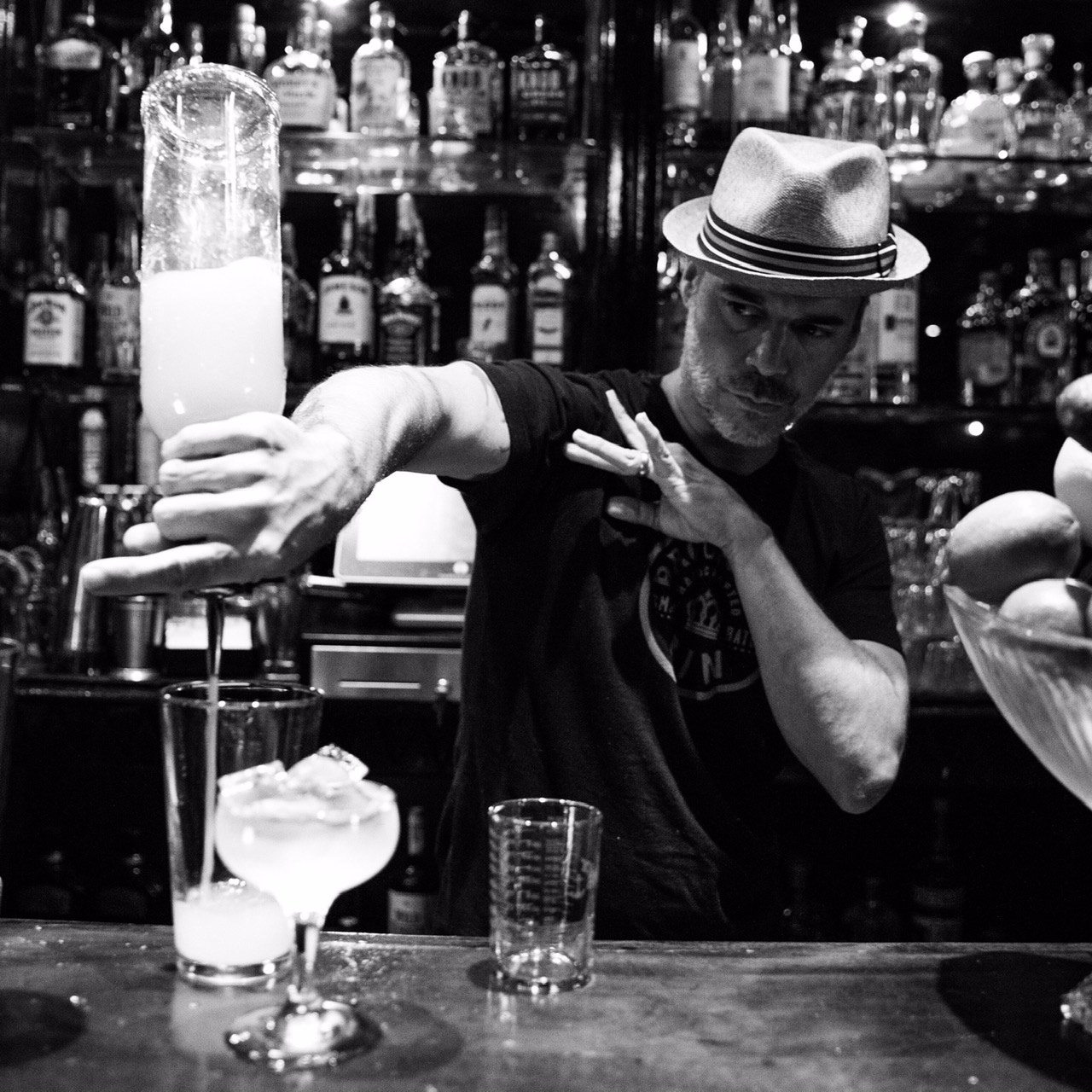
Bars are places that people rely on in disasters. We're community hubs, a place where people go to be able to contextualize what's going on. So even people who you might not see in a bar regularly, you'll see them in times of crisis because it's a place to get news, it's a place to get out of your house, and it's a place to be around people in your neighborhood or community and reassure yourself that there's other people like you. That things are going to be okay. This particular disaster, though, was one that featured humans gathering as the disaster.
When we had to shut down, we wanted to find a way to be able to serve our clientele. We have a community of people that rely on us to be there for them for whatever reason they need us.
People don't go to bars because they want to get drunk. You can get drunk anywhere. People go to bars because of the basic human need to connect. Given the way modern society is going, there's more and more separation and less and less connection. As grocery stores have gone from local shops to big-box stores, there isn't anyone there to talk with anymore. Same with coffee shops. And now that everything is automated and delivered, you can sit in your home and order everything you need and have every interaction through a computer.
We were very cognizant of the fact that the people that needed us as bartenders were still going to need us, and probably more because they were stuck at home, so whatever drove them out of their house in the first place, that hadn't gone away. And more than that, their social outlet was gone; their community gathering outlet was gone.
We started livestreaming from the bar. We went on every night for an hour, and we did all kinds of crazy things, like we sang karaoke for them, hosted trivia nights, and sometimes made cocktails. I called it a virtual bar, and we were as interactive as possible with people. Sometimes we had guests come on from other places in the country. We ended up building a really, really strong following. Basically, virtual bar clientele would sit at home and have a beer, or they'd have a drink of their own, and they would come and talk to us and they would watch us do silly stuff. We put out a tip jar that they could put money in for the staff. It was surprisingly powerful.
That lasted for a while until Texas reopened again, very early and very unwisely. At the time, we were getting towards the end of whatever resources we had, so we tried to open as safely as possible. That lasted for a couple of weeks until one of my bartenders got COVID. Then I was furious. Furious that we'd been put in the position of even trying to let people in our place. And so, out of pique, I recorded a video that was basically addressed to Greg Abbott, the governor of Texas. It was a plea from a bar in a pandemic. It ended up getting something like half a million views on social media. What a lot of people didn't realize was that bars were excluded from a lot of the aid being offered to small businesses during the pandemic. We were placed in a position of needing to open as soon as we were allowed to, even if it was unwise.
Pretty much right after my video, Texas closed down again because there was a big spike in cases. It was a big spike at the time, but compared to where we are now, it was nothing. That big spike that closed Texas down in July was a fraction of where we are now.
Mike, Florida
Doctor—January 2021

We have knowledge we learned based on our experiences in past pandemics. Yet, over the last year, we've acted like we learned nothing. That's very disheartening. We have had a lack of direction, and that's been very frustrating. They say that tough times bring out the best in people. It also brings out the worst in people. I have seen benevolence and kindness that was just phenomenal. And I have seen selfishness and self-centeredness that I would never have expected. It's really been an eye-opening experience.
My grandmother used to say, "I've been alive long enough that I have a right to say what I believe, especially if it's true." I'm not even close to her age, but that being said, I also feel that I've been around long enough, and especially around the medical field long enough, more than thirty-five years, that I can be open and honest.
Over the last year, I've become extremely disappointed with people, from leadership all the way down. I've seen political leaders come out and say, "The doctors and the medical experts say this, but I'm going to do what I want to do." And they're supposed to be our leaders. When people say, "I'm not going to follow guidelines because it's an infringement on my rights," I want to ask, "At what point does it become not all about you but all about everybody else and all about society?" Rather than people uniting with a focused approach, which would have led to a lot less suffering and death for many people, many leaders took such a selfish and self-centered approach that it made a bad situation terrible.
And I'll be honest, I would never have foreseen this happening. Previously, I thought that if we had a worldwide pandemic and we knew it and we saw it daily, that we would take the right approach, follow the high road, a consistent approach. We have done none of that.
I work as a hospitalist and do critical care medicine as well as palliative care work. In the Florida panhandle, our COVID hospitalization numbers have been climbing rapidly. From the beginning in March through November, I would have twelve to fifteen patients to work with each shift, with somewhere between two to four COVID patients. Occasionally, I had up to eighteen patients, but that would be a heavy load. On my shift a week and a half ago, I had twenty-six patients, fourteen of which had COVID. COVID-positive patients take about 50 percent more time. So taking care of twenty-six patients was actually like taking care of thirty-nine regular patients. Four of those patients were in the ICU on mechanical ventilators, which takes even more time.
I truly try to provide the best care I can for each patient, but at some point, it's like something's got to give. That is very disheartening to the doctors and nurses and other members of the medical team because we try to give our all, but unfortunately, it doesn't always work. I've taken care of hundreds of patients with this disease, and I've seen dozens and dozens die from it. Yesterday, more than 4,000 people died from COVID nationally. Many of those dying are young, and even more are dying alone.
It's frustrating when the emergency room is packed with COVID patients, the ambulance bays are packed with COVID patients, and we have no ICU beds available for our critically ill patients. I had a patient come in who was not COVID positive, but he was bleeding out from the bottom, terribly, and he had dropped his blood count by two-thirds.
When a COVID patient died, we cleaned the room and then put this guy in there, but he was the only non-COVID patient in the entire ICU. We have other patients coming in who need ICU beds, like patients with acute strokes and severe heart failure. When these patients come in and the hospital tells them, "We don't have any beds, you've got to go to another hospital," that means more time before they're admitted. As they say, every second is brain tissue in a stroke; every second is heart muscle in a heart attack. And we're having to divert these patients because there's no room. And if we can fit them in the hospital but not in the ICU, then they are put on other floors without the equipment and staffing needed to give them the proper care.
I started during the HIV days, so I've been doing this a long time. Now, when I get home after working up to sixteen hours instead of what is supposed to be a twelve-hour shift, I just try to close my eyes, sleep, and let it go. Because I know that I have to go back tomorrow and do it again. 
About the Author
Michelle Fishburne is a full-time digital nomad, splitting her time between her 2006 motorhome, Airbnbs, and the occasional housesitting gig.
Public Health in the US and Global South is a collection of interdisciplinary, multimedia publications examining the relationship between public health and specific geographies—both real and imagined—in and across the US and Global South. These essays raise questions about the origin, replication, and entrenchment of health disparities; the ways that race and gender shape and are shaped by health policy; and the inseparable connection between health justice and health advocacy.
Beginning in 2022, the series expands to include 1000-word blog posts, as well as longer commentaries, essays, articles and media productions that address the public health and political implications of the COVID-19 pandemic from multiple perspectives. The series editor for Public Health in the US and Global South is Mary E. Frederickson.
During the night of June 19, 2023, the first federally recognized Juneteenth holiday, an unknown vandal or vandals desecrated by fire a much-beloved child's mid-nineteenth-century headstone in Washington, DC's oldest African American burial ground, the Mount Zion–Female Union Band Society cemetery in Georgetown. For a quarter century, visitors to the grave marker have left objects—dolls, toys, and birthday cards—a practice that harkens to the nineteenth century history of the cemetery. Why has this particular child's memorial become the scene of gift-giving? And why did it become a site of apparent racist attack? Equally puzzling is the identity of the child. The simple, crowned bluestone marker bears the following inscription:
Nannie
Born May 26, 1848
Died May 18, 1856
The identity of "Nannie" has been a mystery for generations. Her short life spanned momentous events in local and national African American history. She was born one month after the ill-fated mass escape of enslaved people on the schooner The Pearl, the largest attempted self-liberation event in antebellum US history. She was two years old in 1850 when the slave trade (although not slavery) within the District of Columbia was banned and the Fugitive Slave Act made life precarious for free people of color within the District. She was four when Uncle Tom's Cabin was published, six when fugitive slave Anthony Burns was arrested in Boston and shipped back to Virginia, enraging abolitionists during the same year the Republican Party was founded. Nannie was seven when open mass violent conflict erupted in Kansas. In the month of her death, the US Supreme Court called for re-argument of Dred Scott v. Sanford, leading to the majority opinion in March 1857, authored by Chief Justice Roger Brooke Taney, holding that persons of African descent "had no rights which the white man was bound to respect."
This essay places Nannie's enigmatic gravesite and headstone in the context of the social, political, and spiritual history of the cemetery. We then propose an identity for the girl commemorated as "Nannie," who died one week shy of her eighth birthday, and consider why her resting place has become a compelling site of emotional connection, commemoration, and resistance. Finally, we speculate as to why persons unknown, on the night of Juneteenth, sought to attack this particular site.
The Mount Zion–Female Union Band Society Cemetery
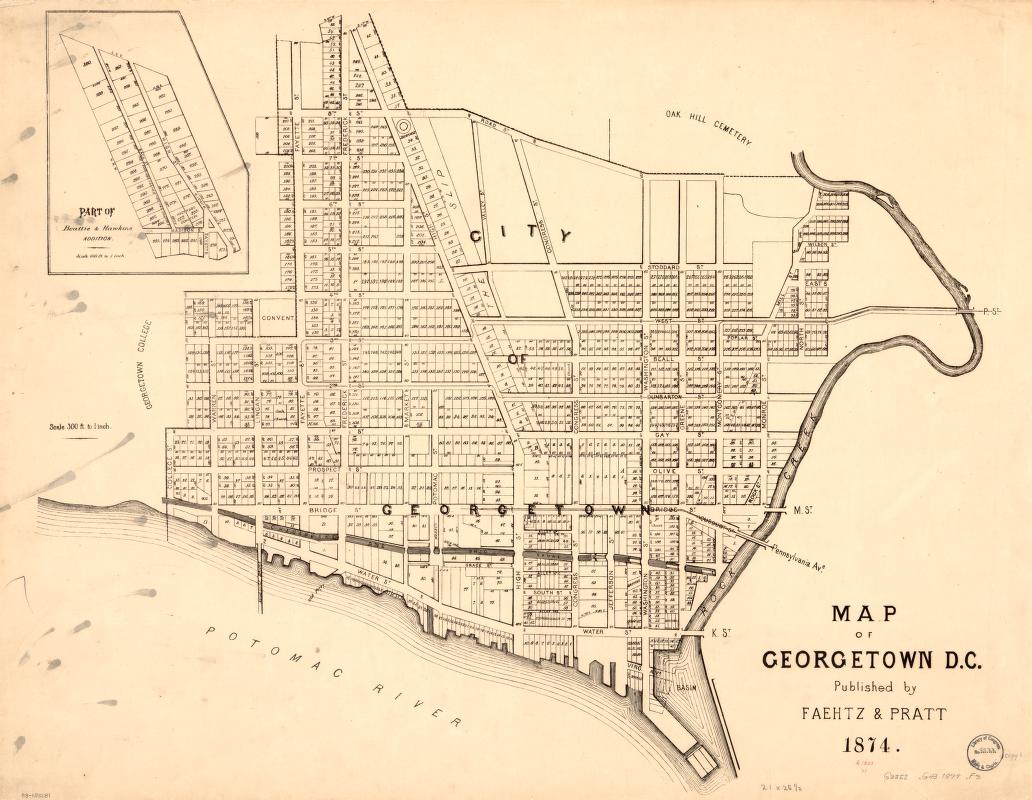
Many District of Columbia residents have incorrectly assumed that Mount Zion Cemetery is composed of a single burial ground. A three-acre property, it actually consists of two separate but adjacent cemeteries of equal size: the old Methodist Burying Ground (now known as Mount Zion Cemetery), and the Female Union Band Society Cemetery.1Stanton L. Wormley, ed. Mt. Zion Cemetery: Washington, DC, Brief History and Interments, comp. by Paul E. Sluby, Sr. (Washington DC: Columbian Harmony Society, 1984); Paul E. Sluby, Sr., Bury me deep: Burial Places Past and Present in and Nearby Washington, D.C.: A Historical Review and Reference Manual (Temple Hills, MD: P.E. Sluby, 2009). In 1931, the Federal Government took one half acre of the earlier cemetery grounds to create Rock Creek Parkway and an adjacent horse riding trail. The grounds are now under the authority of the National Park Service.
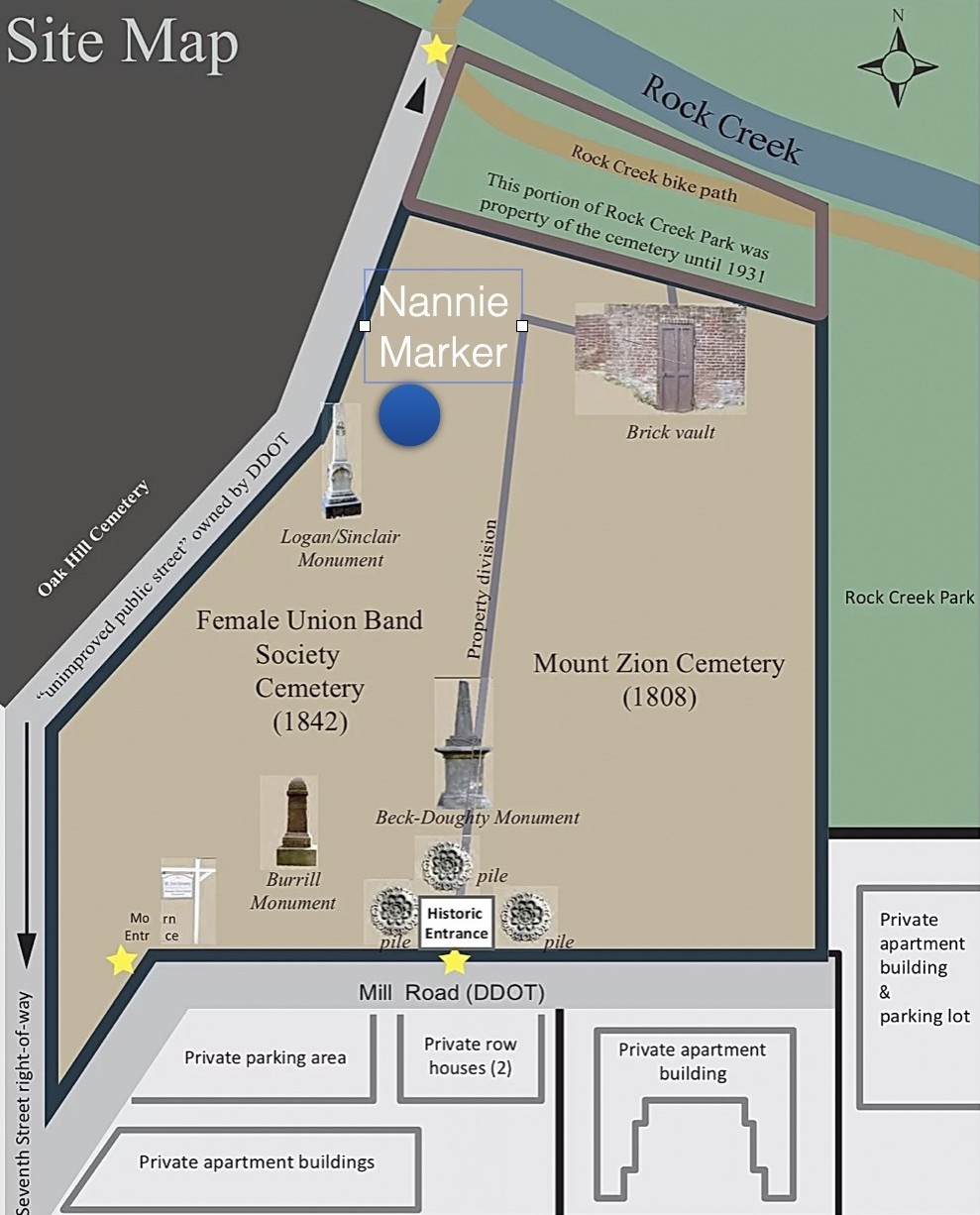
The old Methodist Burying Ground was purchased in 1808 by the Montgomery Street Church in Georgetown, one of the first Methodist churches in the country, founded in 1772 (known today as the Dumbarton United Methodist Church).2The church was formerly located on Twenty-Eighth Street between M and Olive Streets, N.W. (formerly Montgomery Street between Bridge and Olive Streets), approximately one-half mile southwest of the cemetery. At the beginning of the nineteenth century the membership of the Montgomery Street Church was almost 50 percent Black and included free and enslaved congregants. Upset with segregated and racist practices, 125 Black members left Montgomery Street in 1816 and formed the first Black congregation in the District of Columbia, known then as the Meeting House or the Little Ark, and today as Mount Zion United Methodist Church. The two Methodist churches, white and Black, continued to share the Methodist Burying Ground until after the Civil War.3The land was purchased from Thomas Beall, who had inherited extensive property from his grandfather Ninian Beall (1630–1717). In the early nineteenth century, Beall owned about fifteen slaves and many properties in Maryland and the District of Columbia, including the properties now known as Dumbarton House, Beall-Washington House, Conjuror's Disappointment and Rock of Dumbarton. He served in the 1790s as the second Mayor of Georgetown and played an important role in establishing the District of Columbia. On Dumbarton Methodist, see: Jane Donovan, Many Witnesses: A History of Dumbarton United Methodist Church 1772–1990 (Washington, DC: Dumbarton United Methodist Church, 1998); J.W. Cromwell, "The First Negro Churches in the District of Columbia," The Journal of Negro History 7, no. 1 (1922): 64–107; Janet Lee Ricks, "Mt. Zion United Methodist Church Marks 185th Anniversary," Washington History 13, no. 1 (Spring/Summer 2001): 71–73.
Around 1832, a group of free women of color formed a benevolent organization, the Female Union Band Society (FUBS). A decade later and for $250, they engaged Joseph T. Mason—schoolteacher and free man of color—to purchase a plot of land adjacent to the Old Methodist Burying Ground to use as a burial ground for the society's members and their families. Court records indicate the land was acquired from Joseph E. Whitehead of New Orleans. Mason ran a school within the Black church that after 1844 was known as Mount Zion Methodist. If Nannie was a free child of color in the vicinity, Joseph Mason most likely taught her as a pupil.
It is also believed that these burial grounds also served as a refuge on the Underground Railroad. Mount Zion Church and the burial holding vault located on the Mount Zion Cemetery property are said to have opperated as hiding site for escaping "passengers" heading north. Over the first half of the nineteenth century, the numbers of enslaved in the District of Columbia declined. By 1850 (when Nannie was two years old) 3,185 of the 13,746 Black inhabitants are listed as enslaved. In DC, enslaved and free persons often lived, worked, and worshipped together, although their life conditions were often precarious.4Pauline Gaksins Mitchell, The History of Mt. Zion United Methodist Church and Mt. Zion Cemetery, 51 (Washington, DC: Records of the Columbia Historical Society, 1984): 103–18. The History of Mt. Zion United Methodist Church is 51st separately bound book; Stella Mae Richard, "Two Hidden Cemeteries in the Georgetown Section of Washington D.C.," Negro History Bulletin, Washington 32, no. 8 (Nov 1969): 29.
In 1849, Oak Hill Cemetery, reserved for white burials, was established by the financier, philanthropist, and former slaveowner William Wilson Corcoran (1798–1888), later denounced as a Confederate sympathizer, who after the Civil War founded the Corcoran Gallery of Art.5In 1830, Thomas Corcoran, William Wilson Corcoran's father and sometime mayor of Georgetown, owned five enslaved people. The 1840 census indicates that William Wilson Corcoran owned one male enslaved person between the ages of ten and twenty-three and three free women of color, who may have been previously enslaved by him; all resided in his household. In 1845, William Corcoran manumitted the enslaved woman Mary and four of her children. (National Archives and Records Administration, Records of the U.S. Circuit Court for the District of Columbia, Records of Manumission, vol. 3, Record Group 60, Washington, DC; cited in Mark Laurence Goldstein, "Capital and Culture: William Wilson Corcoran and the Making of Nineteenth-Century America" (PhD diss., University of Maryland, 2015), 30–31. This woman may appear in the 1850 census as Mary Degges, born 1819, married to Judson Degges, with children Adelia, born 1834 and Mary, born 1837. Corcoran's "Last Will and Testament," September 6, 1887, provides a stipend of $200 to a woman named Mary Neale, "once owned by me, and long since manumitted." This person may be the Mary Neil who evidently married John Neil in 1875, and may have been born as Mary Degges, daughter of the older Mary Degges. This 22.5 acre cemetery sits adjacent to the Female Union Band Society Cemetery and is separated by a sliver of elevated land, Lyon Mill Road, that served as a path leading to a mill within present-day Rock Creek Park. After Oak Hill opened, whites at the Methodist church gradually abandoned the Methodist Burying Ground and began to disinter their white relatives and re-bury them in Oak Hill and other "white only" cemeteries around the city. Early references to the area that became Mount Zion Cemetery are to the "Methodist Episopal Burial Ground of Georgetown," the "Old Methodist Burial Ground," or the "Colored Methodist Burial Ground."6Richard P. Jackson. The Chronicles of Georgetown DC from 1751 to 1878. (Washington DC: R.O. Pokinhorn, Printer, 1878), 270; Wesley E. Pippenger, District of Columbia Interments (Index to Death), January 1, 1858 to July 31, 1874 (Westminster, MD: Heritage Books, 1999), xix. The land in question is north of Q Street and east of Lyons (Mill) Road (now an extension of 27th street) and Oak Hill Cemetery, extending down hilly slopes to Rock Creek. Over time, the eastern section of this burying ground became known as Mount Zion Cemetery (or Mount Zion East) and the western zone as the Female Union Band Society cemetery. By 1879, white parishioners entirely ceased using the Old Methodist Burying Ground and leased it to Mount Zion Church for ninety-nine years, its name officially changing to "Mount Zion Cemetery."
As racist policies and practices pushed many Black residents out of Georgetown over the next half-century, the cemetery suffered neglect and abandonment. The final burial in Mount Zion took place in the early 1950s. The District's department of health condemned the two cemeteries in 1953, prohibiting future burials. In the 1960s, developers sought to buy the land and disinter the remains in both burial grounds. African American activists, including the Afro-American Bicentennial Corporation (ABC), energetically resisted these plans, and in the mid-1970s secured court and appellate rulings that safeguarded the cemeteries' futures as a memorial park, with disinterments prohibited. As part of planning and restoration, many headstones and markers in both cemeteries were relocated and consolidated in 1975, evidently with the intention of restoring and returning them to their original positions. However, given the fragility of the stone tablets, they were left in place and not returned.7Before the moving of the stones, Mount Zion stones were mapped with a good deal of detail; the Female Union Band Society mapping was, it appears, less thorough. Richards, Two Hidden Cemeteries, 29; Mitchell, The History of Mt. Zion United Methodist, 103–118; Kathleen Menzie Lesko, Valerie Babb, Carroll R. Gibbs, Black Georgetown Remembered: A History of its Black Community from the Founding of "The Town of George" in 1751 (Washington, DC: Georgetown University Press, 2016); Steven J. Richardson, The Burial Grounds of Black Washington: 1880–1919 (Washington: DC: Records of the Columbia Historical Society, 1989), 52: 304–326. Burial Grounds is the 52nd separately bound book.
The cemeteries were added to the National Register of Historic Places in 1975. The joint cemetery is now maintained by the non-profit Black Georgetown Foundation (until recently The Mount Zion–Female Union Band Historic Memorial Park, Inc.) The cemeterties' survival and restoration in the face of powerful white-dominated development interests is celebrated as a miraculous point of deep pride. It is located at the very top of Georgetown, one of the wealthiest and whitest quarters of the city, adjacent to Oak Hill Cemetery, where many of the city's elite white residents have been interred since the mid-nineteenth century. It sits besides Dumbarton House, a structure long associated with prominent white slaveowning families, now the national headquarters of the Colonial Dames of America. It overlooks Rock Creek Park, the greenway that connects the metropolitan area's wealthy northwestern suburbs to the downtown seat of government. The cemetery represents, for many, a defiant unofficial monument to Black struggles for self-determination in a historically Black city undergoing rapid gentrification, still denied statehood and Congressional voting representation.8US District Court Judge Oliver Gasch reversed the order allowing disinterment by developers in order to build condos, stating that such action by the heirs and developers "cannot but offend the sensitivities of civilized people." "Equally important," said the judge, "is the fact that not only would such a degradation be perpetrated against the dead, but in this instance the violation of their graves involves the destruction of a monument to evolving free black culture in the District of Columbia." Female Union Band Ass'n v. Unknown Heirs at Law, 403 F.Supp. 540, 547 D.D.C. 1975.
Gravesite Objects as Memorialization Practices
Since organized efforts began in the 1970s to safeguard and restore Mount Zion, volunteers have often come across bottles, pottery shards, sea shells, and related objects. Frequently dismissed by officials as "debris" or "trash," these objects are interpreted by guardians of the cemetery as traces of much older Black memorialization practices, dating back into the era of enslavement.
Strong evidence for this interpretation is provided by a series of newspaper articles, widely reprinted during August and September 1894, documenting popular memorial practices in Mount Zion cemetery. Local African Americans regularly placed objects associated with the life experiences of the deceased on gravesites, including medicine bottles containing residue of medications taken during final illnesses.9Versions of this story are reprinted in the Gazette (York, Pennsylvania), 10 Aug 1894, 5, The Clarion Ledger (Jackson, Mississippi), September 10, 1894 and many other newspapers in August and September 1894. In the articles, Sexton Henry Bowles (c. 1840–1907) explained that familiar toys and tools encouraged the spirits of the dead to "confine their manifestations to the cemetery," rather than haunting the living. On the grave of a "Mr. Johnsing" (perhaps Henry Johnson, who died in December of 1893) his widow placed a wooden hobby horse, "buried up to its haunches," commemorating the dead man's occupation as an express wagon driver, as well as his beloved horse. Each night, she explained, her late husband's spirit would hitch and unhitch the wooden horse, and thus be distracted from tormenting his surviving kin. The half-burial of the horse evoked the object's transitional status, mediating between the realms of the Living and the Dead.
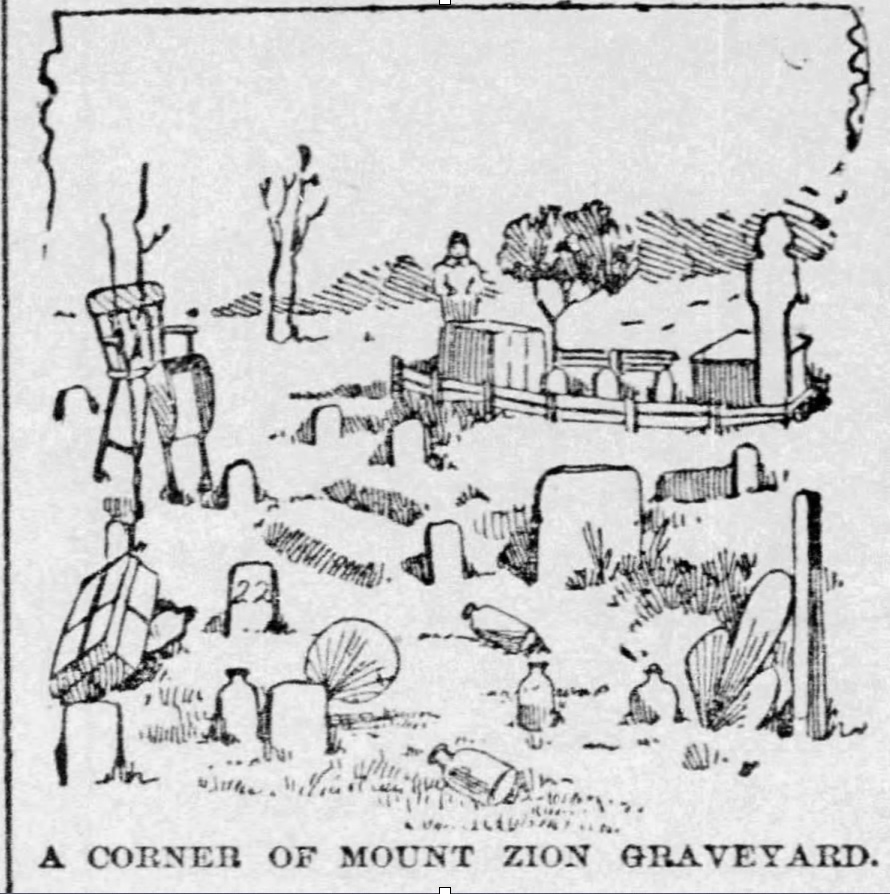
Placed on the grave of a young boy, a high chair and toy wheelbarrow signified objects of importance in his life. A woman named "Lize Lundy," who was fond of wearing a new bonnet to church each Sunday, was honored with her final bonnet and a hand mirror placed on her grave. A particularly complex grave assemblage, perhaps for a military veteran, featured a mound guarded by two large toy soldiers, with smaller soldiers in front of each large soldier; at the mound's center stood three upright bottles. The items may be thought of as "transitional objects," easing the transition from one life stage to another. By repeatedly touching intermediate objects, mourners gradually come to terms with a painful loss and in time relinquish the full burden of their immediate grief.10D.W. Winnicott, Playing and Reality (London: Tavistock Publications, 1971); Melanie Klein, "Mourning and Its Relation to Manic-Depressive States," The International Journal of Psychoanalysis 21 (1940): 125–153; Ellen Schattschneider, "Buy Me a Bride: Death and Exchange in Northern Japanese Bride-Doll Marriage," American Ethnologist 28, no. 4 (2001): 854–880.
These practices are consistent with vernacular African American grave decorations widely documented throughout the Americas, having African antecedents, and transmitted by enslaved and free people across the generations.11Jamieson, Ross W., "Material Culture and Social Death: African-American Burial Practices," Historical Archaeology 29 (1995): 39–58; John Michael Vlach, The Afro-American Tradition in Decorative Arts (Cleveland, OH: Cleveland Museum of Art, 1978). Bottles, shells, pottery and other elements are held to ward off mystical dangers and ease the Dead's transition into the other world and towards ancestral status.12Thompson, Robert Farris, Flash of the Spirit: African & Afro-American Art & Philosophy (New York: Random House, 2010); Vlach, The Afro-American Tradition in Decorative Arts, 142; Savannah Unit Georgia Writers' Project Work Administration, Drums and Shadows: Survival Studies among the Georgia Coastal Negroes (Athens: University of Georgia Press, 1940).
The Nannie Stone in the Modern Era
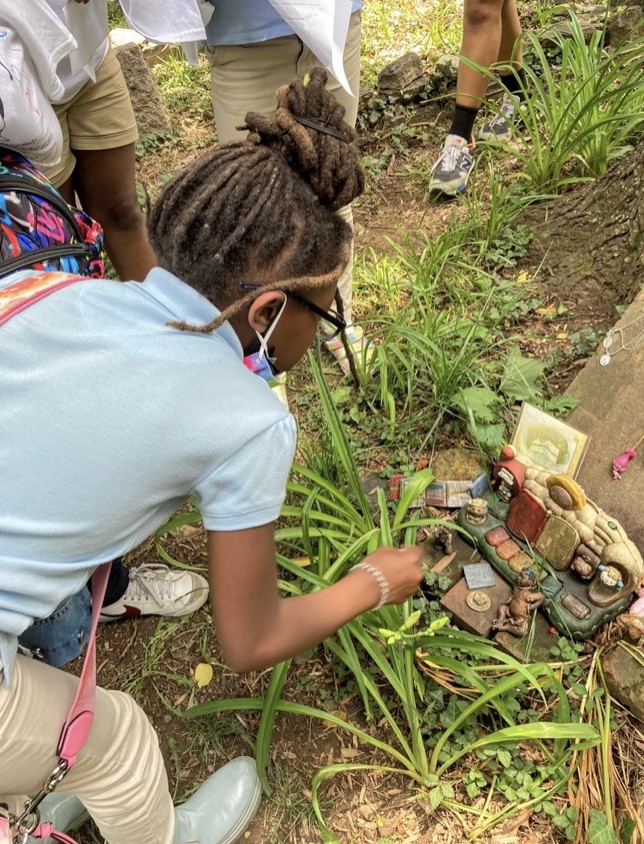
Public attention to Nannie's gravesite is largely due to the efforts of Omar "Casey" Ibrahim, born around 1936, who during the summer 1997 worked as a volunteer to clear and help restore the cemetery, much of which had been inaccessible due to fallen limbs and extensive weeds and vines. At an October 1997 ceremony, Ibrahim pointed to Nannie's burial site, which was marked only by a fallen-over slab. He urged each person to adopt a gravesite to care for. "I've adopted Nannie . . . I'm going to set her stone up straight and clean all around there. Then I'll put up a little red fence. And then I'll give her a teddy bear and other toys that children like."13Linda Wheeler, "Black Church Honors it Historic Cemetery," Washington Post, October 14, 1997. Mr. Ibrhaim and his daughter continued to place objects at Nannie's memorial for several years. Inspired by this example visitors across the subsequent years have placed objects, including dolls, ribbons, toys, and birthday cards, in front of the Nannie headstone.14Theresa Vargas, "Someone Keeps Leaving Toys and Birthday Cards at a 7-Year-Old's Grave in a Historic Black Cemetery. No One Knows Who," Washington Post, April 17, 2021. The marker has catalyzed speculation and a series of commemorative art works, including by artist Lindsey Brittain Collin, inspired by dolls left at Nannie's graveside.
Nannie's grave marker is currently located within the old "Female Union Band Society" section, at times referred to as "Mount Zion West." The headstone is propped up against a tree. Like many stones in the cemetery it has been moved at least once. Its original location is not marked on the 1970s' survey, but was well within this section—which means that Nannie was almost certainly a child of color who was part of the substantial free Black population residing in Georgetown and other DC neighborhoods. It is possible, however, that she was enslaved for some or all of her short life. Slavery was legal in the District until April 16, 1862, when an act of Congress instituted a compensated emancipation system.15Mary Mitchell, "'I Held George Washington's Horse': Compensated Emancipation in the District of Columbia," Records of the Columbia Historical Society, Washington, DC 63/65 (1963–1965): 221–229; Reidy, Joseph P, "The Winding Path to Freedom under the District of Columbia Emancipation Act of April 16, 1862," Washington History 26, no. 2 (2014): 18–22. The complex relationships between enslaved and free persons of color in the antebellum District of Columbia are examined in Mary Corrigan, "A Social Union of Heart and Effort: the African-American Family in the District of Columbia on the Eve of Emancipation" (PhD diss., University of Maryland, 1996). The broader context of DC emancipation is addressed in Kate Masur, An Example for All the Land: Emancipation and the Struggle Over Equality in Washington, D.C. (Chapel Hill: University of North Carolina Press, 2010).
Considering "Nannie"
Who was Nannie, and why was this striking headstone? The inscription is done professionally and with great care, which suggests that it was paid for by someone of means, or with access to a network of supporters who helped fund the purchase.
Why was only the child's first name used, given that surnames are usually inscribed on Mount Zion–FUBS headstones? Possibly because the child was buried within an extant family plot that was obscured through the relocation of markers in the 1975. Or, if Nannie had been fathered by a prosperous white man with a woman of color, outside of wedlock, the father might have paid for a headstone, but been unwilling to authorize his surname.
The name Nannie, like Anne, is derived from the Hebrew term for favor or grace. Nannie was sometimes a diminutive for Ann, Agnes, Nancy, or other girls' names. "Nannie" was also a girl's name in its own right in the mid-nineteenth century. The 1850 census records about seventeen free women of color named "Nannie" living in the United States. The 1870 census, the first to list all African Americans, lists about two-thousand black women named Nannie. An obelisk to Nannie Diggs, who died October 23, 1923, at age sixty-on, was erected by her daughter Katie Anderson in the same section of the cemetery as the headstone to the mysterious child "Nannie." The records of the Mount Zion–FUBS cemetery list two other Nannies: Nannie Diggs, born 1852 in Virginia, and a Nannie Washington, born 1858, also in Virginia. The most prominent Black Washingtonian bearing the name "Nannie" was the pioneering educator and religious leader, Nannie Helen Burroughs, 1879 –1961, born in Virginia, and a member at 19th Street Baptist. Two months before the death of the young "Nannie" buried in Mount Zion, the Evening Star (DC) reported the death of "Old Aunt Nannie," an enslaved woman at the purported age of 112 years near Powhatan Courthouse, Virginia."16Evening Star (Washington, DC), March 6, 1856, 3.
A Candidate for Nannie: William Teney's Child
Official registers of death were kept in the District of Columbia for Black and white burials from 1855 onwards. However, a register of burials of the Joseph F. Birch Funeral Home, was kept from January 1, 1847 for white and Black burials, and is an invaluable historical resource. Children's deaths were listed by the name of the parent (usually the father) followed by the word "child." The Birch's "Register of Burials, Colored Persons" begins with death #1, January 11, 1847, "Colbert's child," buried in the "Colored Methodist Ground" (the cemetery later known as Mt. Zion). Nineteen pages later, under May 1856, the register lists death #368, "Wm Teney child," as interred in the same Colored Methodist Episcopal Burial Ground. The precise date of death is somewhat ambiguous. The previous line, for death #367, is clearly May 11. Then, for William Teney's child, inverted double commas, indicating ditto, are given for the death date, which would seem to indicate May 11, whereas "our" Nannie, according to her headstone, died one week later on May 18. Nonetheless, other aspects of this child align with our search.17Paul E. Sluby and Stanton L. Wormley, eds., Register of Burials of the Joseph F. Birch Funeral Home, Volume I, (Washington, DC: Columbian Harmony Society, January 1, 1847–April 12, 1864). Also available as FamilySearch microfilm #008135478. Note that a reference to "William Tenney child," is not listed in in Pippenger, District of Columbia Interments.
The most reasonable candidate for William Teney strikes us as a free Black man William Tinny, age twenty or thirty, laborer, born in Maryland, listed with his family in the 1850 census. He is married to Bridget Tinny, born Maryland, age twenty-four, with three children: Sarah Tinny, age seven, born in Maryland c. 1843: Mary Tinny, age five, born in the District of Columbia, c. 1845; Francis Tinny, age three, born in the District of Columbia, c. 1847. Of these three children. Francis, who is born around 1847, is not mentioned in the 1860 census or other subsequent records, and is thus a strong candidate for "our" Nannie. Although Nannie was not a standard nickname for Francis in the period, it seems possible that Nannie was a term of endearment used for her within the family, perhaps rhyming with "Frannie."18Francis's father William appears in a November 15, 1827 District of Columbia manumission record:
"Know all men, by these Presents that I Charles Teney of Washington County in the District of of Columbia for divers good causes and considerations, me thereunto moving [?] and also in further consideration of the sum of one dollar to me in hand paid have released from slavery, liberated and manumitted and set free, and by these present do release from slavery, liberated and manumit and set free my slave woman named Matilda Teney aged about thirty five years, and her three children Anne aged about thirteen years, Andrew aged about three years and William Don Otious aged about 19 months, and able to work and gain a sufficient livelihood and maintenance, which said mentioned slaves were obtained by me as heir at law of my son William Don Otious Teney late of said County deceased, and them the said Matilda and her three children, Ann Andrew and William Don Otious I do declare to be henceforth free, manumitted and discharged from all manner of servitude and service to me and my executors, administrators, or assignees forever. In presence of Lemuel J Middleton and A Balmance."
Two other candidates for "Nannie" are suggested by comparing the 1850 and 1860 censuses: (A) The daughter "Ann" (born about 1848) of freed-people Francis Yates and Caroline (Smith) Yates, who later took the surname Cole, does not appear in the records after 1850. Francis and Caroline married three months before the birth of the "Nannie" memorialized on the headstone. Anna Yates, Black, one year old, died 10 August 1857 and was buried in Ebenezer African Methodist Episcopal burial ground; she may be related, but is clearly a different person; (B) Ann E. Twine, the daughter of coachman David Twine and his wife Caroline Gray Twine, both free persons of color in the District. David Twine was interred in Mount Zion in 1894. A member of Metropolitan A.M.E., David Twine came from a family with long connections to Georgetown and the local Black Methodist community. Both of these girls appear in the 1850 census but are not enumerated in the 1860 census or other records. However, Ann E. Twine may appear in the 1860 census as "Eliza Twine", ten years old, living with an older couple that may be her grandparents. Neither girl is indicated in the DC Register of Burials, so they seem much less likely candidates than the child of William Tenney, who died in May 1856 and who is recorded as interred in the "Colored Methodist Burial Ground."
Francis Tenney (c.1847–c.1856) was born into a free family of color who had been free in the District of Columbia for at least twenty years prior to her birth, and who had struggled intensively to achieve freedom. As noted in the appendices, her family clearly had an extensive network of free kin in the District of Columbia who in 1856 might have pooled resources to enable to purchase and inscription of the well-made headstone.
Desecration
During midday on Monday, June 19, 2023, the first time Juneteenth had been celebrated as a federal holiday, over two-hundred people gathered in Mount Zion-Female Union Bank Society Cemetery to honor the burial ground and the history of African American liberation. The event, organized by the Black Georgetown Foundation, which oversees the two burial grounds, had been widely advertised on social media and radio. Attendees, many of them first-time visitors to the site, were moved by the story of the struggle to preserve and document the cemeteries and the lives of those interred. The event culminated with a gathering in front of Nannie's headstone, where speakers reflected on the enigmas of her life and the history of antebellum Black Georgetown.
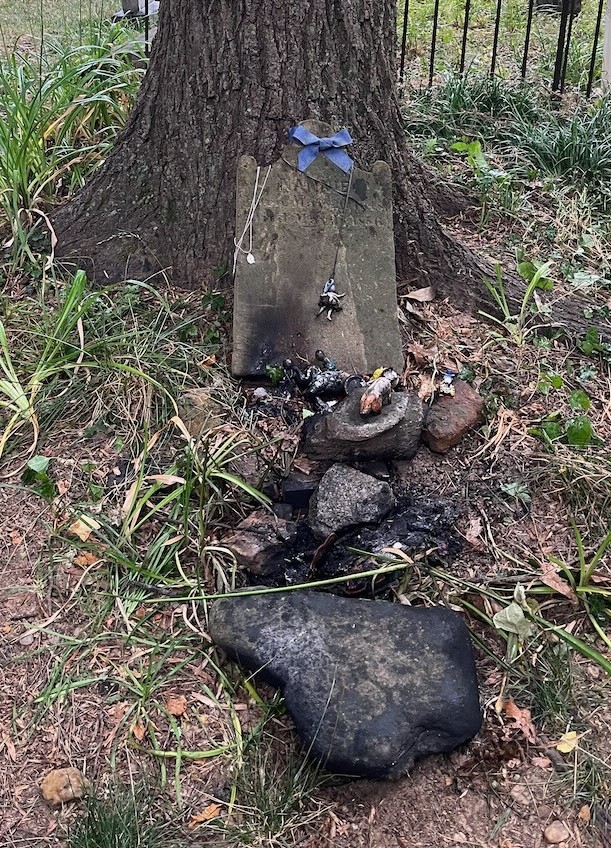
During the night of June 19–20, a person or persons unknown set a fire in front of the Nannie headstone, destroying or damaging toys and objects left as offerings during the previous year and leaving dark burn marks on the stone. The attacker was likely aware of the connection felt by thousands of people to Nannie, the preceding day's events, and the fact that in recent years this marker has, more than any other memorial on the grounds, compelled the greatest number of gifts.
The gravestone desecration and the burning of the objects was a form of racial terror, reminiscent of the burning and bombing of sites of Black assembly and resistance such as churches, and indeed, of the burning of victims of lynching. In the days following the fire, people stopped by the cemetery to give new offerings to Nannie.
Memorialization and #BlackLivesMatter
Why has Nannie's grave marker inspired such an outpouring of offerings and attention by scores of people with no direct kinship link to her? Certainly her young age is compelling, as is the approaching storm of national disunion during the span of her life. Perhaps equally significant are the still-ongoing crises of racism and inclusion in the United States. Her prominent, yet plain marker, is suffused with resonance for past and present injustices. The obscurity of her identity allows Nannie to evoke the "many thousands gone" among persons of color in the District and elsewhere. In the present era of #BlackLivesMatter and the continuous assaults on the rights of persons of color to own their bodies, the story of Mount Zion cemetery, nearly eradicated to serve commercial development interests, is particularly resonant. The restoration of this storied African American burial ground, now surrounded by multiples sites of white, elite privilege, is a powerful testimony to African American resilience and cultural vibrancy.
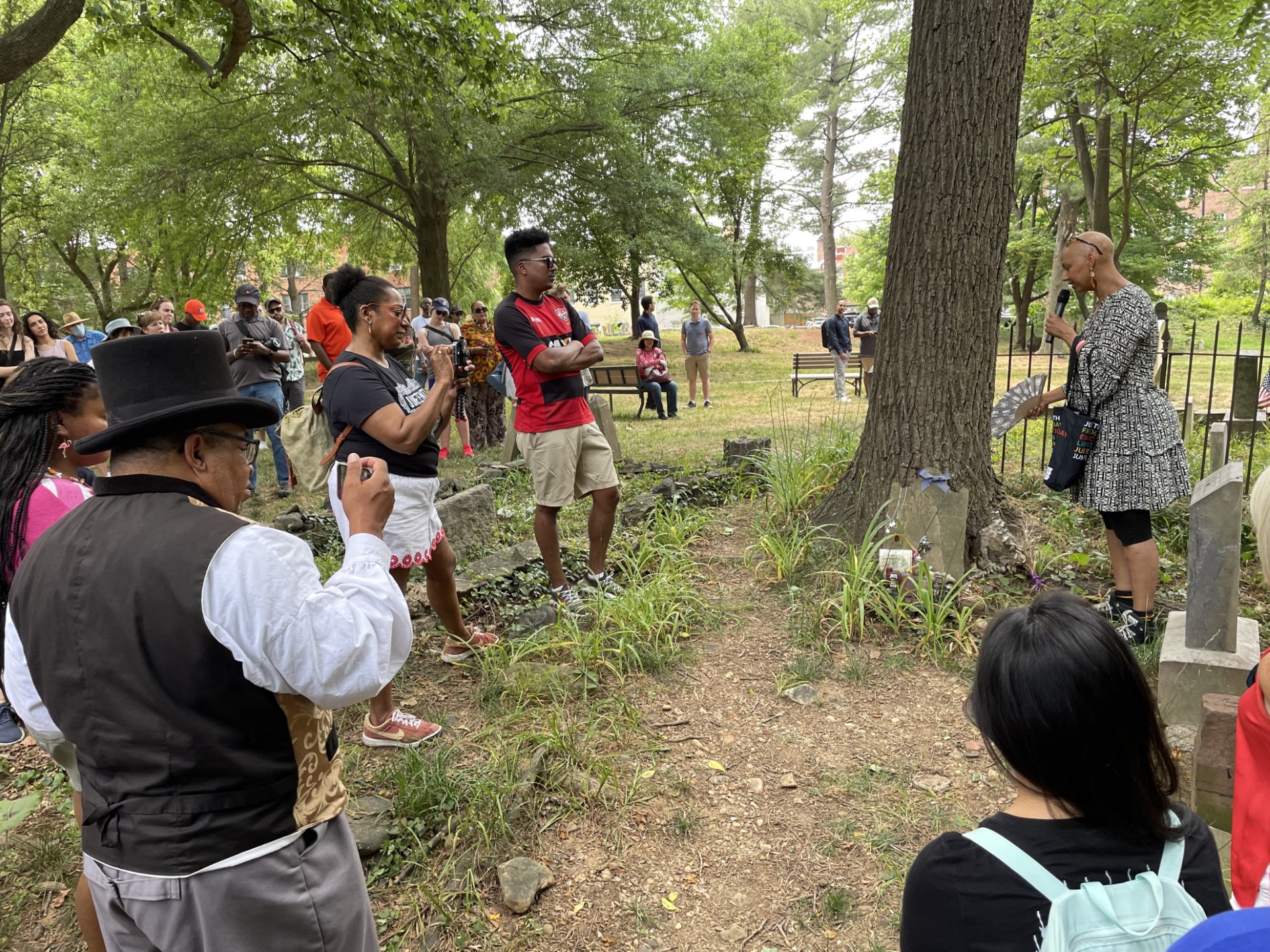
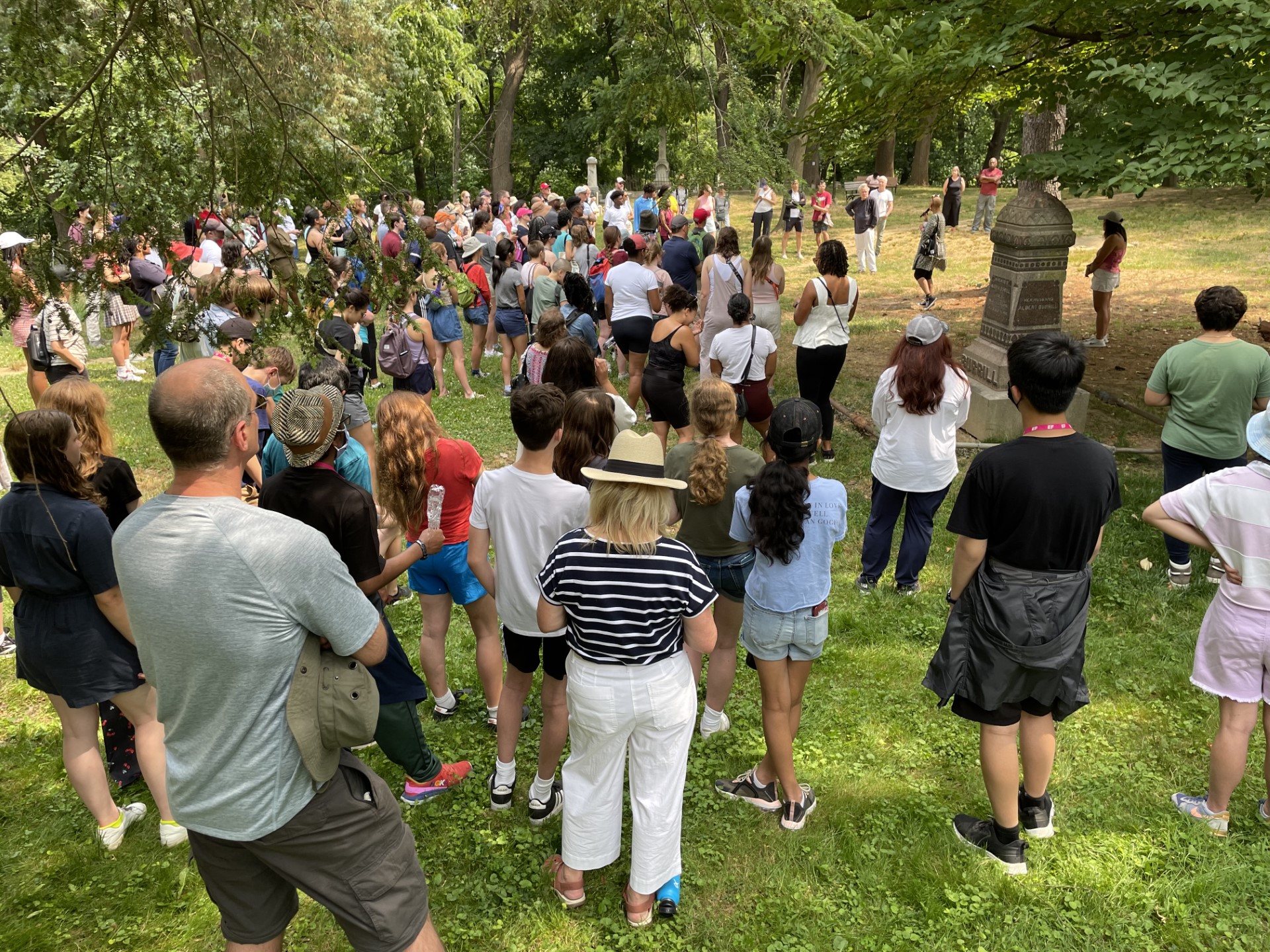
Nannie, for many, has come to represent hallowed ground and the larger history and geography of racial segregation, anti-Blackness, and liberation struggles within the District of Columbia. The centuries-old African-Atlantic practice of grave decoration, ubiquitous in this cemetery in the nineteenth century, has been revived to honor Nannie's memory—poignant testimony to the power of ancestral remembrance—as well as the continuing mission of activism.
About the Authors:
Mark Auslander is the author of The Accidental Slaveowner: Revisiting a Myth of Race and Finding an American Family (Athens: University of Georgia Press, 2011). He is a visiting faculty member in anthropology at Mount Holyoke College.
Lisa Fager, Executive Director of the Black Georgetown Foundation, oversees the Mount Zion and Female Union Band Society cemeteries in Georgetown, Washington DC.
Acknowledgements:
We acknowledge the tireless work and insights of community historians Mary Belcher and Patrick Tisdale, and the many other volunteers associated with the Mount Zion–Female Union Band Society Cemeteries, and the Mount Zion United Methodist Church in documenting the important history associated with the cemetery and the local faith community. Erika Berg located 1894 newspaper accounts of grave decorations in Mount Zion. We are grateful to Carlton Fletcher, Fath Davis Ruffins, Russell Smith, Ibrahim Sundiata, and Jay Ball for many interpretive insights into this narrative. Many thanks to the staff at the Kiplinger Library, Washington historical Society; The Library of Congress Periodicals and Manuscripts rooms; Special Collections and University Archives, The Maryland Room Hornbake Library, University of Maryland College Park; the Smithsonian Institution Archives; the District of Columbia Public Library Washingtoniana/People’s Archive Division and the Georgetown Library Peabody Room; the District of Columbia Archives; the National Archives and Records Administration; the Maryland State Archives; and the Daughters of the American Revolution Library. Particular thanks to Andrew Boisvert of the DAR Library and Damani Davis and Rose Buchanan of NARA Archives 1 for their insights into antebellum District of Columbia records. Omar “Casey" Ibrahim generously shared his memories of recovering the Nannie memorial stone and initiating the modern gift-giving tradition in the 1990s. We are grateful for careful editorial work on this post by Allen Tullos and the Southern Spaces team.
Appendices
]]>Modeling the Marie-Séraphique
The Marie-Séraphique
Video Permissions
Creative Commons license CC-BY-ND
To inquire about use permissions for all or part of these videos, contact Southern Spaces at seditor@emory.edu.
Songs Cover the Landscape
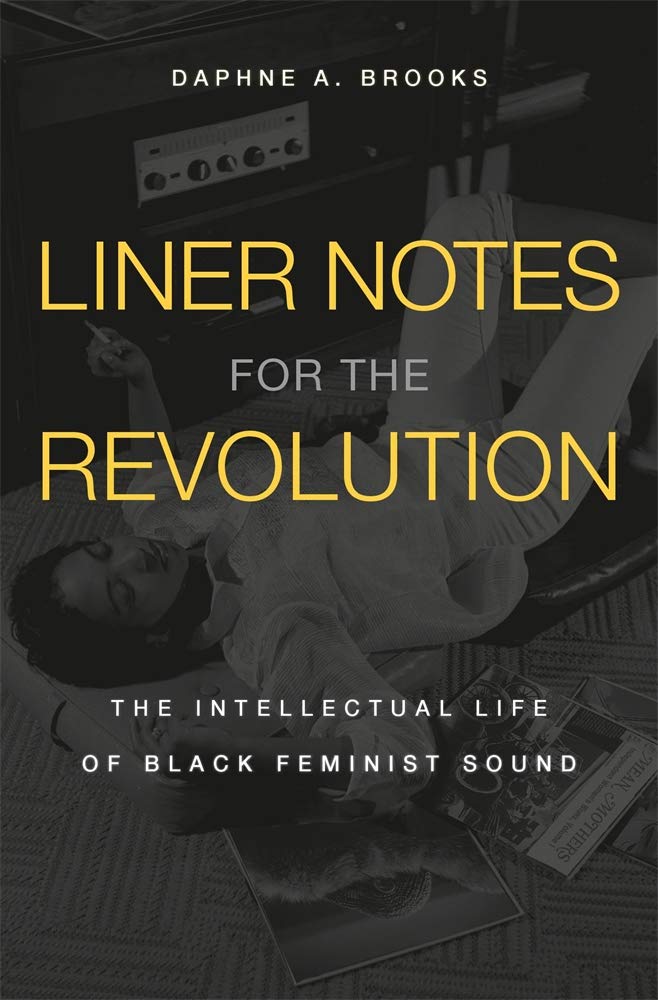
Yet another program housed under the Works Progress Administration (WPA), the Federal Writers Project (FWP), invited Zora Neale Hurston in 1938 to join the editorial staff of The Florida Guide, part of an "American Guide" series designed to "hold up a mirror to America." The gig provided her with the opportunity to sharpen her ethnographic game, and through her WPA activities and assignments, she began to move closer toward both recording and performing her folk music findings out in the field. According to her colleague Stetson Kennedy, she collected "fabulous folksongs, tales, and legends, possibly representing gleanings from days long gone by." She also drafted reports on the music of local church services and filed an essay on Florida folklore and music entitled "Go Gator and Muddy the Water." Hurston did all of this in spite of her steadfast autonomy as a member—the only Black woman member—of the editorial staff (the lowest paid and yet, according to Kennedy, quite likely the most experienced). In this context, she emerged as the ideal candidate to participate in a statewide recording expedition organized by the FWP.1 Valerie Boyd, Wrapped in Rainbows: The Life of Zora Neale Hurston (New York: Scribner, 2004), 313; Kennedy as quoted in Boyd, 318. Says Kennedy, "She had already published her first two books by that time, but she wanted a job and was given the same job title that I had when I started out. I was junior interviewer. Imagine Zora Hurston, junior interviewer. She had already had her degrees from Boaz (sic) and Columbia and Barnard and so on." "The Sounds of 1930s Florida Folklife," All Things Considered, February 28, 2002, NPR Hearing Voices, http:// hearingvoices.com/transcript.php?fID =23. In his unpublished manuscript on Hurston's career and his time working with her on what became known as the "Negro Unit" of the FWP, Kennedy notes that Hurston was given the title of "Junior Interviewer" and paid "$67.20 per month" for her work with the WPA. "Ironically," Kennedy adds, "the typist at the Negro Unit" in Jacksonville "was paid $5.00 per month more than Zora, by virtue of a higher urban wage scale." Stetson Kennedy, "Alan Lomax/Zora Neal Hurston Field Trip of 1935 . . . As Described by Alan [Lomax] to Stetson Kennedy," Zora Neale Hurston Box 1, Stetson Kennedy Papers, uncataloged, n.d., George A. Smathers Library, University of Florida, Gainesville. However, Stetson remains a tricky figure when it comes to his own treatment of Hurston's legacy. He was a fierce champion of her legendary status, a jealous protector of his own archival materials related to their shared work for the WPA, and also a spectacularly harsh critic of Hurston's contradictory persona. See, for instance, his searing list of "SAD-BUT-TRUE ASPECTS of Zora" which includes a range of inflammatory monikers including "THE SELF-STYLED 'PET DARKEY' . . . NO RACE CHAMPION . . . THE LICKER OF THE WHIP HAND, THE 'HOUSE NIGGER' . . . THE RACISTS' DARLING," "THE ARCH REACTIONARY," and "THE 24-KARAT BITCH." The latter insult Kennedy attributes to Alan Lomax, quoting him as having said that in "the field, Zora was absolutely magnificent—but of course you know she was a 24-karat bitch. . . ." Kennedy, "SAD-BUT-TRUE ASPECTS OF ZORA," September 5, 2000, Zora Neale Hurston Box 1, Stetson Kennedy Papers, uncataloged at the time of archival research. Kennedy wrote obsessively about Hurston in a range of published material and unpublished material that recycled and occasionally reworked versions of the aforementioned list of traits he logged. See, for instance, Kennedy, "Almost all I know about Zora," unpublished manuscript, September 5, 2000, Zora Neale Hurston Box 1, Stetson Kennedy Papers, uncataloged at the time of archival research. Kennedy, untitled ("I am the one who wrote, in my Tribute to Zora . . ."), unpublished manuscript, September 8, 2000, Zora Neale Hurston Box 1, Stetson Kennedy Papers, uncataloged at the time of archival research.
In the eyes of Ben Botkin, the FWP folklore program's new national director, "mere written transcriptions did not provide enough detail and ambience," and so he turned to Hurston and crew to turn up the volume in the wetlands. "When she first came on board and scheduled a visit to our (lily-white) state office," recalls Kennedy, "a staff conference was convened at which we were admonished that 'we would have to make allowances for Zora, as she had been lionized by New York café society, smoked cigarettes in the presence of white people,' etc. And so she did, and so we did."2Boyd, Wrapped in Rainbows, 322; Stetson Kennedy, unpublished manuscript, 6, Zora Neale Hurston Box 1, Stetson Kennedy Papers, uncataloged at the time of archival research.
It was not a situation without stress for her. Writing in late 1938 to state FWP director Carita Doggett Corse, Hurston noted her personal battle with a "form of phobia," a crushing and incapacitating depression that left her unable to "write, read, or do anything at all for a period." Having assured her "Boss" in that letter that when she does "come out of" such spells, it is "as if [she] had just been born again," Hurston nonetheless was plagued at times with questions about how best to make sense of her inner turmoil in relation to her intellectual and artistic pursuits. In her letter to Corse, she ponders the reasons for her despair and notes that she finds that such spells are often "the prelude to creative effort."3Zora Neale Hurston to Carita Dogget Corse, December 3, 1938, in Zora Neale Hurston: A Life in Letters (New York: Anchor, 2003), 417–418. By summer of the following year, she was rolling with the FWP crew and about to embark on some of her most fascinating and unique methods of research.

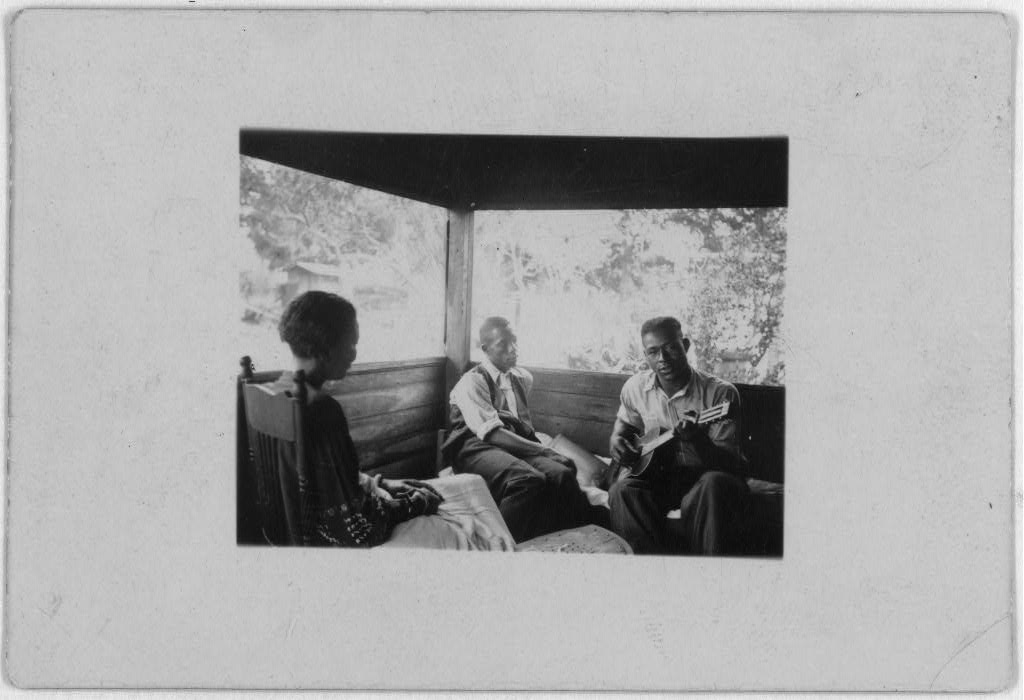
Bottom, Zora Neale Hurston with Rochelle French and Gabriel Brown, Eatonville, Florida, June 1935. Photograph by Alan Lomax. Courtesy of Library of Congress.
Some four years after the publication of what would become two of her most famous essays, folklorist Herbert Halpert and a crew of fellow WPA workers recorded Hurston on June 18, 1939, performing a range of rollicking vernacular songs down on the Florida peninsula in Jacksonville. Here she and her Florida guide colleagues had set up camp, among them Corse, "twenty-something" Halpert, and local student-turned-project supervisor Kennedy. On site in Jacksonville, Halpert had on hand a recording device "the size of a coffee table—the moving parts looked like a phonograph—and cut recordings with a sapphire needle directly onto a 12-inch acetate disk." For her part, Hurston had, along with her fellow Black FWP colleagues, rounded up "a group of railroad workers, musicians, and church ladies at the Clara White Mission on Ashley Street, a landmark institution in Jacksonville's Black community." There, Halpert "used his cumbersome recording machine to capture the voices of various informants singing, telling stories, and occasionally hamming it up for posterity."4"Sounds of 1930s Florida Folklife." Kennedy traces the recorder back to "the Hurston/Lomax/Barnicle team," pointing out that the team "borrowed the recorder of the Library of Congress" because of Lomax's father's ties to that institution. "In those pre-tape days," he muses, recorders "consisted of a heavy monstrosity. . . ." After joining the FWP, "Zora was able to again wangle it on loan from the Library of Congress" Stetson Kennedy, unpublished manuscript, 62–63, Zora Neale Hurston Box 1, Stetson Kennedy Papers, uncataloged at the time of archival research. Bordelon further points out that Halpert would arrive in Jacksonville "with the equipment carefully stored in a converted World War I ambulance outfitted by workers from the Federal Theater Project. . . . He was one of the few folklorists with field recording experience. He knew how to transport, repair, and set up the cumbersome equipment as well as how to conduct the first-person interviews, an integral part of the recording sessions." "Zora Neale Hurston," Go Gator and Muddy the Water: Writings by Zora Neale Hurston from the Federal Writers Project, ed. Pamela Bordelon (New York: Norton, 1999), 45; Boyd, Wrapped in Rainbows, 324.
Hurston's approach to this whole operation was always distinct, always bent on both reproducing precious sounds through her own performance practices and yet still capitalizing on the quirks and the character of her own interpretative skills. This is Zora's form of phonography, that which loops together a zone in which she operates at the crossroads of the modern and the folk. On tape, one hears a forty-eight-year-old Hurston (who brashly claims for the record that she is thirty-five) both collaborating with and also facing off against Halpert's bulky, furniture-sized machine to offer her own definitive repertoire of southern vernacular culture for the archive. A copy of Halpert's "Tentative Record Check List" from these sessions dated March 12–June 30, 1939, offers a detailed account of songs sung by Hurston and other local interlocutors (for example, "Beatrice Long (white) age 35"; "Rev. H. W. Stuckey, age 43, blind Negro preacher"). Both a playlist of sorts and an archival testimony to this sister's exhaustive performative dynamism, her mad flow, and her tireless and meticulous attention to the cultural eccentricities manifest in the songs themselves, Halpert's "record check" documents Hurston's instructive commentary and her magnetic presence on these expeditions. These are notes that follow the rhythms of her explanatory cues, the distinctions that she makes between, say, a "jook song" and a "lining" accompaniment, her references to her own ethnographic prowess ("Miss Hurston describ[es] how she collects and learns songs (including those she has published)"). The labor of it all lurks in the parentheses as well, as in the bracketed moment when Halpert indicates that "Miss Hurston was tired (in part) and accidentally tacked songs together." This is the document of her marathon performances, her critical acuity in the realm of listening, performing, and, by extension, arranging the sounds that she encounters, stores, and "carrie[s] . . . in her memory" from the heart of the field right into the center of those scholarly circles awaiting her return.5Boyd, Wrapped in Rainbows, 325; Bordelon, "Mule on the Mount" transcription, 163–164; Herbert Halpert, "Tentative Record Check List: southern recording expedition," March 12– June 30, 1939, Herbert Halpert 1939 Southern States Recording Expedition (AFC 1939/005), Archive of Folk Culture, American Folklife Center, Library of Congress, Washington, DC. Kennedy maintains that it was his "bright idea" to "sav[e] travel money," "summo[n]" Hurston to Jacksonville, "si[t] her down in a chair, and recor[d] all the folkstuff she carried around in her head," and he looked to Halpert, who was "using the machine at the time," to "collaborate in interviewing" her. Stetson Kennedy, unpublished manuscript, 64, Zora Neale Hurston Box 1, Stetson Kennedy Papers, uncataloged at the time of archival research.
By way of Zora's phonography, we are made privy to a listening to a listening: Kennedy and Halpert and Corse and others lean in and pose questions as they strain to follow Hurston's musical cartography of folk songs, work chants, and blues and children's songs gathered up in the American South and the Caribbean diaspora, from the Bahamian "Crow Dance" to the swinging "Charleston rhythms" of "Oh the Buford Boat Done Come," music picked up by Hurston from a South Carolina Geechee country woman she met in Florida. She stands at the center of it all, shifting fluidly between the role of the folklorist and that of the informant, melding songs with communal lore, sketching out their sociocultural context and utility, and belting them out for a wonkish gaggle of folklore scholars, a captive audience who, nonetheless, prods her for details. Scholarly jostling ripples as an undercurrent in these sessions. But Hurston the pro brings all her swagger to these proceedings; she brings all of her skills to bear/bare in her vocal aesthetics of song, the means through which she might put the wonder and specificity of Black sonic art on the Florida map once and for all.6Kennedy's version of this recording expedition occasionally frames Hurston as the object of ethnographic inquiry rather than as a fellow collaborator ("I had gotten into the habit of asking my informants if they knew any 'dirty songs.' As it turned out, they knew plenty. . . . I asked Zora if she knew a song called 'Uncle Bud.'"). Stetson Kennedy, unpublished manuscript, 64, Zora Neale Hurston Box 1, Stetson Kennedy Papers, uncataloged at the time of archival research. The Library of Congress website lists both Halpert and Kennedy as "speakers" along with Hurston on various recordings from these sessions. Elsewhere Kennedy elaborates on the team's working conditions, describing how, "in recent years when asked to speak on the subject 'Working with Zora' . . . I have been tempted to suggest that the title 'Trying to Get Zora to Work' would be more appropriate. Like many of us who were on our own out in the field (again myself included), production was sporadic." Stetson Kennedy, "Zora's Contributions," n.d., unpublished manuscript, n.p., Zora Neale Hurston Box 1, Stetson Kennedy Papers, uncataloged. Kennedy was one of Hurston's greatest defenders and also one of the most consistent critics of her well-known ambivalences when it came to racial uplift politics, her "accomodationist-if-not apologist" leanings, as he puts it. But repeatedly in his manuscript, he argues that "we and generations yet to come should focus upon how Zora Neale Hurston wrote, not how she voted." Stetson Kennedy, unpublished manuscript, 68, Zora Neale Hurston Box 1, Stetson Kennedy Papers, uncataloged. See also Kennedy, "sad-but-true aspects of zora," unpublished manuscript, September 5, 2000, Zora Neale Hurston Box 1, Stetson Kennedy Papers, uncataloged at the time of archival research. For more on Hurston's political leanings, see Boyd, Wrapped in Rainbows.
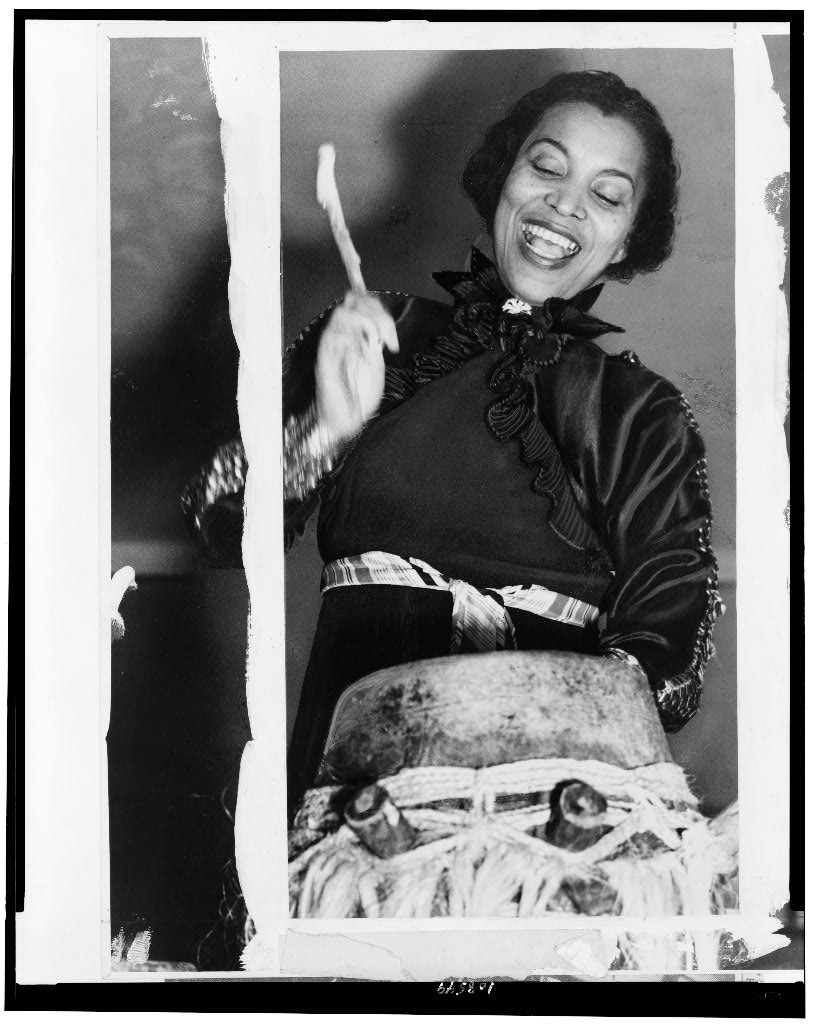
Songs cover the landscape like regional quilts in Zora Neale Hurston's musical repertoire. As she lets loose on "Mule on the Mount," "the most widely distributed work song in the United States," we hear the varied shades and moods of Black regional experience as verses shift and change according to locality. Hurston's fascination with blues dissonance clearly undergirds her theories of Black performance, her liner notes for the recordings still to come when, for instance, she highlights the importance of both angularity (performances that stress the "angles" of bodily expression) and especially asymmetry ("the abrupt and unexpected changes. The frequent change of key and time . . ."). We can hear her working this blues aesthetic out in songs like "Mule on the Mount," that lining rhythm that we might think of as a Hurston, folkified version of "Wartime Blues" since, as is perhaps implicit in her prefatory comments, it shares moments of startling narrative discordance and social upheaval with that Blind Lemon Jefferson blues classic.
Hurston: This song I am going to sing is a lining rhythm, and I am going to call it "Mule on the Mount," though you can start with any verse you want and give it a name. And it's the most widely distributed work song in the United States . . . it has innumerable verses and whatnot, about everything under the sun. . . . [Black folk] sometimes sing it just sitting around the jook houses and doing any kind of work a t'all. . . .Everywhere you'll find this song. Nowhere where you can't find parts of this song. . . .
Halpert: . . . Is it a consistent song . . . as you hear it all over?
Hurston: The tune is consistent, but . . . the verses, you know . . . every locality you find some new verses everywhere. . . . There is no place that I don't hear some of the same verses. . . .
Halpert: Where did you learn this particular way?
Hurston: Well, I heard the first verses, I got in my native village of Eatonville, Florida, from George Thomas.
Halpert: And is . . . that the only version you're going to sing?
Hurston: The tune is the same. I am going to sing verses from a whole lot of places.
Halpert: All right.7Zora Neale Hurston, "Mule on the Mount," Herbert Halpert 1939 Southern States Recording Expedition, AFC 1939/005: AFS 03136 B01, American Folklife Center, Library of Congress, Washington, DC, https://www.loc.gov/item/flwpa000008/.
If the trope of the mule recurs in Hurston's literary and ethnographic writing most famously as a feminized beast of burden, in this song from "everywhere," it is the vehicle that the masculinist singer "rides down" in the opening verse, replaced in the second verse by "a woman" who "shakes like jelly all over." "Mule on the Mount" is, by no means, a feminist revision of sexist vernacular culture, as it transitions into a stock tale of paranoia and betrayal ("My little woman, she had a baby this morning. . . . He had blue eyes"), alienation and revenge ("And I told her, must be the hellfire cap'n Ha! . . . I got a woman. She won't live long, lawd, lawd, she won't live long"). However, it is a song that emerges in her research and performance as raw material that showcases the ways sonic folklore might serve as the connective tissue that ties dispersed Black peoples together through improvisational innovation, as well as temporally and geographically distant modes of collaboration.8Bordelon transcription of "Mule on the Mount," Bordelon, Go Gator, 163–164; Hurston, "Mule on the Mount." Like the protagonist in Jefferson's ode to estrangement and wandering, the tragic hero of Zora's mule tale retold breaks by the fourth verse onto another plane, away from the arrival of the "blue-eyed baby," the product of probable betrayal and potential racialized sexual violation, away from "the hellfire," and turns instead toward the sound of "a cuckoo bird" that "keep a hollerin' Ha! . . . It look like rain, lawd, lawd, it look like rain."9Blind Lemon Jefferson's 1926 "Wartime Blues" makes use of the blues form's "floating verses," oft-repeated verses in Black radical tradition lore, and ones that reference familiar images, for instance, "trains" and "rivers" and tropes evocative of African American rural and migratory life. Such visions and figures and themes "float" from one song to another and can sometimes take shape as jarring abstractions, as thematic non-sequitar. But in every case, they are manifestations of both a dispersed and disrupted culture and the innovative contemplation of and rejoinder to quotidian and ubiquitous crisis. Blind Lemon Jefferson, "Wartime Blues," Release # 12425A, Matrix # 3070, Take #1, The Rise & Fall of Paramount Records, Vol. 1 (1917–1932) (Third Man Records-Revenant Records, 2013). For more on blues aesthetic traditions, see also Scott Blackwood's monumental work on the archive of Paramount recordings. Scott Blackwood, The Red Book liner notes for The Rise & Fall of Paramount Records, Vol. 1 (1917–1932); and Chapter 7. The pivotal fifth verse, and one that would become a signature line in Hurston's repertoire—"I got a rainbow wrapped and tied around my shoulder/It look like rain, lawd, lawd, it look like rain"—is the most telling break in the song, and it is the kind of rupture that Hurston would capitalize on in her role as a "signifying ethnographic" critic of Black sound. With that technicolor coat supplying crucial cover, the heroine of "Mule on the Mount" stands both outside and inside the song's wending, epic narrative. It may pour cats and dogs all around her, this song suggests, but she stays the course all bundled up in a mystical garment. Here in this place, caught in this storm and yet sheltered from it, she is traveling at her own angle against and through the elements. Moving to her own soundtrack, she possesses the equipment to stay in motion and keep the music alive. She wraps that "rainbow . . . tightly around [her] shoulder" and heads on out into the territory that is Black America, picking up exquisite sound, peculiar sound, vital sound all along the way.10Hurston, "Mule on the Mount."
Hurston on the Open Road
"My search for knowledge of things," Hurston muses in her conundrum of a memoir Dust Tracks on a Road, "took me into many strange places and adventures. My life was in danger several times. If I had not learned how to take care of myself in these circumstances, I could have been maimed or killed on most any day of the several years of my research work." Still more, Carla Kaplan makes plain in her edited edition of Hurston's letters how wary she is of "romanticiz[ing] Hurston with Model T and pistol, searching out 'the Negro farthest down' and 'woofing' in 'jooks' along the way." The "truth is," Kaplan contends, "that she worked hard under harsh conditions: traveling in blistering heat, sleeping in her car when 'colored' hotel rooms couldn't be had, defending herself against jealous women, putting up with bedbugs, lack of sanitation, and poor food in some of the turpentine camps, sawmills, and phosphate mines she visited."11Hurston, Dust Tracks on a Road (New York: Harper Perennial, 1996, 146; Carla Kaplan, "'De Talkin Game': The Twenties (and Before)," in Zora Neale Hurston: A Life in Letters (New York: Anchor Books, 2002), 51–52. With regards to the opacity of Dust Tracks, Maya Angelou's 1995 foreword to the book is instructive. Angelou famously observes of Dust Tracks that "the author stands between the content and the reader. It is difficult, if not impossible, to find and touch the real Zora Neale Hurston" (xii). But as she was prone to "wandering" in "spirit," if not always in "geography" and "time," as she would describe it in her memoir, the automobile proved useful as a source of refuge from Jim Crow danger on more than one occasion for her, particularly as "racially 'mixed' teams" of WPA field researchers "travelling together were virtually unheard of." For these reasons, her "beat-up Chevy" was, more often than not, always her most dependable shelter.12Hurston, Dust Tracks on a Road, 67. See also Boyd, Wrapped in Rainbows, 57. Fellow FWP recording expedition team member Kennedy recalls Hurston's time in the field with him "record[ing] more of the songs of migratory black workers in the Everglades mucklands." Stetson Kennedy, unpublished manuscript, 63, Zora Neale Hurston Box 1, Stetson Kennedy Papers, uncataloged at the time of archival research.
Hurston turned to her engine of modernity to gather up, cultivate, and disseminate songs that played with and through time and space and that called attention to the scale and depth of Black community. . . . The songs are the cars that she drives and the vehicles that carry her listeners into the "imagined cartographies" of Black migrants all at once, working out the politics of spirited togetherness as well as passionate longings and everyday dislocations as her vocal wheels keep turning. They are the sounds that stored up a kind of complex counterknowledge to that which irked Hurston, the seemingly knee-jerk rendering of southland Black life that defined it as steeped in suffering and nothing but.13Marti Slaten, Email message to the author, Jan. 13, 2011. Josh Kun would most certainly identify the "audiotopian" sites of cultural memory, communal questing, and questioning in Hurston's sounds. Josh Kun, Audiotopia: Music, Race, and America (Berkeley: University of California Press, 2005). Concerning this noted Blackness and suffering trend, redolent in the work of some of her most prominent 1930s contemporaries like George Gershwin and Richard Wright, she lamented in a 1936 letter that "some writers are playing to the gallery. That is, certain notions have gotten in circulation about conditions in the south and so writers take this formula and workout so-called true stories." Zora Neale Hurston to Stanley Hoole, March 7, 1936, Folder 60, Box 2, Zora Neale Hurston Papers.
I heard "Halimuhfack" down on the . . . East Coast. . . . I was in a big crowd, and I learned it in the evening [in] the crowd. . . . I learned it from the crowd. [Zora singing]: "You may leave 'n go to Halimuhfack, but my slowdrag will bring you back. Well, you may go, but this will bring you back. I been in the country but I move to town. I'm a toe-low shaker from a head on down. Well you may go but this will bring you back. . . . Some folks call me a toe-low shaker, it's a doggone lie. I'm a backbone breaker. Well you may go, but this will bring you back. Oh you like my peaches but you don't like me. Don't you like my peaches, don't you shake my tree? Oh well you may go but this will bring you back. Hoodo! Hoodo! Hoodo do working! My heels are poppin' . . . my toenails crackin'. Well you may go, but this will bring you back."14Zora Neale Hurston, "Halimuhfack," Herbert Halpert 1939 Southern State Recording Expedition, AFC 1939/005: AFS 03138 B02, recorded in Jacksonville, Florida, June 18, 1939, American Folklife Center, Library of Congress, Washington, DC, https://www.loc.gov /item/flwpa000014/.
You can hear Hurston relishing the wicked innuendos running amuck in "Halimuhfack," a jook song she'd "heard down on the East Coast" of Florida and one that exudes the "slow and sensuous" rhythms of the jook, that undercommons gathering place where, as she would famously insist, Negro theater originates, where "bawdiness" and "pleasure" erupt out of a smoldering elixir of song, dance, and inspired instrumentation.15Zora Neale Hurston, "Characteristics of Negro Expression," in The Jazz Cadence of American Culture, ed. Robert O'Meally (New York: Columbia University Press, 1998), 306–309. All taunt and gentle seduction, Hurston the singer/interpreter gamely seizes on the mischievous wonder of a song that nonetheless documents and archives Black geographies in flux. It is a song that calls attention to the "imbrication of material and metaphorical space."16 Katherine McKittrick, Demonic Grounds: Black Women and the Cartographies of Struggle (Minneapolis: University of Minnesota Press, 2006), xiii. McKittrick calls these kinds of "clandestine geographic-knowledge practices" the "spaces of black liberation" that were "invisibly mapped across the United States and Canada and that this invisibility is, in fact, a real and meaningful geography. . . . the unmapped knowledges" (18). These "black geographies," she argues, "are deep spaces and poetic landscapes, which not only gesture to the difficulties of existing geographies and analyses, but also reveal the kinds of tools that are frequently useful to black social critics" (21–22). As Hurston would describe it in her "Folklore" manuscript chapter for the FWP, "Halimuhfack" is a "blues song" whose "title is a corruption of the Canadian city of Halifax. The extra syllables are added for the sake of rhythm."17Zora Neale Hurston, "First Version of Folklore," n.d., manuscript, Box 12, Zora Neale Hurston Papers. Pamela Bordelon includes "the third and final draft of the folklore and music chapter for The Florida Negro" in her collection of Hurston's transcribed FWP writings, but she spells the title as "Halimufask." The song title in Hurston's "first version" is "Halimuhfack." See Zora Neale Hurston, "Go Gator and Muddy the Water," in Bordelon, Go Gator, 72. The Stetson Kennedy Papers include a Zora Neale Hurston "set list" of sorts with "Halimuhfack" listed as "Halimuhfact," as well as the handwritten additional lyric, "My slow drag will bring you back!" Black theater scholar Eric Glover notes that "Halimuhfack" appears in Hurston's script for Polk County as well. See Eric Glover, "By and About: An Antiracist History of the Musicals and Anti-musicals of Langston Hughes and Zora Neale Hurston" (PhD diss., Princeton University, 2017). Yet "extra syllables," the gateway to lyrical "corruption" here, are the beats that carry the song onto another plane of expressive recourse for African Americans managing the exigent pressures of Jim Crow life, the quest for equality, employment, and human sustenance. Like "Diddy-Wah-Diddy" and other "Negro mythical places" of Black folklore that she documents in her automotive guide writing, "Halimuhfack" is the site of the speculative, the not-here; it's the in-between world of mythical folklore and blues quotidian life.18Bordelon points out that one of the "Negro mythical places" included in her automotive guide excerpt, "'Diddy-Wah-Diddy' . . . [is] a magical destination where neither man nor beast had to worry about work or food. Both were magically supplied. They often laughed and dreamed of far-off 'Heaven,' pinning human qualities on its celestial inhabitants." Bordelon, "Zora Neale Hurston," 26. See also Christopher D. Felker, "'Adaptation of Source': Ethnocentricity and 'The Florida Negro,'" in Zora in Florida, ed. Steve Glassman and Kathryn Lee Seidel (Orlando: University of Central Florida Press, 1991), 149. Hurston's shrewd rhythmic elongation of a north-of-the-border place (a place where Black fugitives found shelter from those who sought to return them to US bondage) renders it unrecognizable, turns this place into something new, another site of Black flight with its own quixotic allure, matched only by the "slow drag" of a singer bold enough to try to seduce her lover to return.
"Halimuhfack" is a record of Florida Jim Crow life as it was lived in a felt relationship with space, place, and the land that our intrepid anthropologist criss-crossed by car. In her time working for the FWP—which, on the one hand, flexed its racism by hiring her "in a relief rather than an editorial-supervisory capacity" and yet, on the other hand, enabled her to "live and work out of her own home in Eatonville, a privilege extended to only a handful of writers nationwide"—Zora's taped performances exude the kind of adventurous independence that would ultimately inform the iconicity of her career.19Bordelon, "Zora Neale Hurston," 17. Her recordings also stand as sound evidence of "different knowledges and imaginations . . . ," they are the kind of recordings that hold out the promise of "call[ing] into question the limits of existing spatial paradigms and put[ting] forth more humanly workable geographies."20McKittrick, Demonic Grounds, xxvi–xxvii. Hurston's rendition of the song encapsulates the driving and oscillating Zora, the woman who was both of and in the crowd as well as whimsically positioned outside of it. Reveling in the taunt, sass, and sly insinuations of this jook song's chorus ("You may go but this will bring you back"), she inhabits the playful ("Hoodo! Hoodo!") and the flirtatious energy of the tune while also wistfully stretching out the song's melancholic lyrics ("You may go but this will bring you back"), lyrics that signal lapsed love, abrupt departures, and the sting of abandonment. She translates into sonic feeling "geographic patterns that are underwritten by black alienation from the land."21McKittrick, 5. As the twinned pressures of the Great Migration and the Depression continued on through the thirties, songs like "Halimuhfack" captured the entwined sounds of vibrant, ingenious, raucous communal sociality and movement; sober, individual despair; and a deep bone will to survive and thrive in the face of enormous socioeconomic and regional transformations. Inside the massive archive that is Zora's playlist, in the anatomy of each of these big, colorful and complex songs of the self, Black folks make their own time while the wheels keep turning round and round.
About the Author
Daphne A. Brooks is William R. Kenan, Jr. Professor of African American Studies, American Studies, Women's, Gender, and Sexuality Studies, and Music at Yale University. She is the author of Bodies in Dissent: Spectacular Performances of Race and Freedom, 1850–1910 (Durham, NC: Duke University Press, 2006), winner of The Errol Hill Award for Outstanding Scholarship on African American Performance from the American Society of Theatre Research; Jeff Buckley's Grace (New York: Continuum, 2005); and Liner Notes for the Revolution: The Intellectual Life of Black Feminist Sound (Harvard University Press, February 2021).
]]>Introduction
I remembered back to my coming-out days in San Antonio, Texas, in the early 1960s and realized that I had lived long enough and been out long enough to be historic.
— Carolyn Weathers
In October of 2015, I met with Carolyn Weathers in her condo in Long Beach, California. I had spent the past few weeks perusing her papers at the ONE National Gay and Lesbian Archives in Los Angeles mostly on a whim: she was one of the few individuals in the archive who hailed from the US South—Texas specifically—and as a queer southerner from Texas myself, I wondered what insights her collection might offer about LGBTQ+ experience in our home state. I never expected to come across photos of gay bars in pre-Stonewall San Antonio or a short story Weathers had written about her time in them. But as seasoned researchers already know and novices quickly learn, the archive is full of such surprises. Agreeing to an interview with me after an archivist put us in touch, Weathers and I spent a temperate, sunny southern California day together, lunching at a local café, walking the nearby boardwalk, and sitting down in her living room for a two-hour recorded interview. This essay combines information from that interview with the short story and photos from the Weathers Collection at ONE to develop a historical case study of LGBTQ+ experience in early 1960s San Antonio.
Structurally, I begin with a brief history of San Antonio to situate us in place before analyzing how Weathers narrativizes her experience in the city in her 1987 self-published short story "Cheers Everybody!" Next, I sketch four real historical bars that Weathers frequented: The Acme, Fernando's Hideaway, The Country, and Mary Ellen's Top Hat. I approach "Cheers" as a historical document that records how Weathers imaginatively used San Antonio to historicize and process her experience of the movement for LGBTQ+ rights. I develop the bar sketches primarily through my interview with Weathers—with occasional references to how she fictionalizes them in "Cheers"—and the archival photos from ONE. Together, these objects of analysis not only reveal the centrality of the gay bar to LGBTQ+ life in early 1960s San Antonio, but they also provide clues as to how the city's colonial and military history affected the formation of racialized gay space. In other words, although attentive to patron activities, demographics, and police encounters, the bar sketches investigate how these histories influenced the creation of gay space, which racialized subjects had access to gay space, and how that space was racialized or imbued with ideas about race as a consequence.1I follow Michael Omi and Howard Winant's definition of racialization: "the extension of racial meaning to a previously racially unclassified social relationship, social practice or group." Michael Omi and Howard Winant, Racial Formation in the United States (New York: Routledge, 2014), 111. Few studies—most of them unpublished dissertations and theses—about LGBTQ+ life in Texas during this period currently exist.2Besides the studies of San Antonio cited later in the essay, some relevant theses and dissertations of interest include: Kyle Edelbrock, "Taking it to the Streets: The History of Gay Pride Parades in Dallas, Texas, 1972–1986" (master's thesis, University of North Texas, 2015); Carl J. Stoneham, "How Prophecy Got Her Queer Back: (Re)discovering the Prophetic at the Rainbow Lounge, 40 Years and Eight Minutes Later" (master's thesis, Texas Christian University, 2010); and John D. Goins, "Confronting Itself: The AIDS Crisis and the LGBT Community in Houston" (PhD diss., University of Houston, 2014). As such, this essay is both a call to expand and further develop such research, as well as an example of how to make archival materials speak to the imbrication of LGBTQ+ identity and community formation within the colonial and racial formations that are central to the production of modernity.
To Historicize the Gay Bar
The origins of San Antonio's two nicknames—Alamo City and Military City, USA—lie in the city's history as a contested colonial space and as home to one of the largest concentrations of military bases in the United States. Founded by Spanish explorers and missionaries on the lands of the Payaya Indians in 1718, San Antonio de Béxar was capital of the Spanish and later Mexican colonial province called Tejas. After its 1821 independence from Spain, the newly established Mexican government began offering free land grants to Anglo-American settlers, who primarily took up residence in lands northeast of San Antonio. These Anglo settlers, who identified as Texians, and Hispanic settlers, who identified as Tejanos, fought against the Mexican Army led by President General Antonio López de Santa Anna during the Texas Revolution: the conflict from which the phrase "Remember the Alamo!" comes.3The actions of those fallen at the Alamo were glorified in Texas history and culture, and today, the Alamo commemorative monument and museum helps attract around 37 million annual visitors to San Antonio, whose tourism and hospitality industry generated an estimated 15.2 billion dollars in 2017.
Sparked by the Battle of Gonzales on October 2, 1835, the Texas Revolution resulted from decades of rising tensions between Tejas residents and the Mexican government, ranging from the Mexican state's abolishment of slavery in 1829 to its prohibition of new Anglo settlers in 1830.4The newly independent Mexican government began as the First Empire of Mexico headed by Agustín de Iturbide (1822–1823) before transitioning into a federal republic, with the Constitution of 1824 officially establishing the First Mexican Republic (Primera República Federal), known as the United Mexican States (Estados Unidos Mexicanos). As the EUM sorted out its leadership and organizational structure, it failed to exert strong control and governance from Mexico City over the distant Tejas. Thus, the Mexican government's gradual steps towards abolishing slavery in 1829—which, in the eyes of many Anglo settlers, reneged on Iturbide's promise to let them practice chattel slavery in Tejas—and the prohibition of new Anglo settlers in the Law of April 6, 1830—which was precipitated by fears that the United States would annex Tejas and resulted in Mexican officials and troops being dispatched to enforce Mexican law in the province—encroached on the rights and privileges that settlers had grown accustomed to. The 1833 presidential election of Santa Anna only exacerbated these issues, as he threw out the Constitution of 1824, which allowed him to centralize control of the government by eradicating provincial or state governments, and also imprisoned Stephen F. Austin, the first empresario of Tejas and primary Texian representative, for a year. Less than a year later, on April 21, 1836, the Republic of Texas became official when Texians, Tejanos, and US volunteers defeated Santa Anna and his troops at the Battle of San Jacinto.5Randolph B. Campbell, Gone to Texas: A History of the Lone Star State (New York: Oxford University Press, 2018); David Montejano, Anglos and Mexicans in the Making of Texas, 1836–1986 (Austin: University of Texas Press, 1987). But San Antonio remained a contested colonial space for decades after the Texas Revolution. By 1845, Mexico still did not officially recognize the Republic of Texas, and US Annexation that same year led to the Mexican–American War and Treaty of Guadalupe Hidalgo, which forced Mexican cession of disputed Texas territory (see Figure 1) and its northern territories of Alta California and Santa Fe de Nuevo México (see Figure 2).6Campbell, Gone to Texas; Montejano, Anglos and Mexicans in the Making of Texas. As part of these war efforts, the US Army established its initial presence in San Antonio at Camp Almus, later consolidated as part of Fort Sam Houston in 1890 (the first permanent US military installation in the city). During World War I (1914–1918), the US War Department expanded the fort, with the additions of Camp Bullis, Camp Travis, and Camp Stanley, while laying the foundations for its fledgling aviation program. When the US Air Force gained autonomy after World War II (1939–1945) in 1948, the aviation infrastructure was divided into the Kelly Air Force Base, the Randolph Air Force Base, and the Lackland Air Force Base.7John Manguso, "Fort Sam Houston," Handbook of Texas, Texas State Historical Association, accessed April 1, 2019, https://tshaonline.org/handbook/online/articles/qbf43; Robert Wooster, "Military History," Handbook of Texas, Texas State Historical Association, accessed April 1, 2019, https://tshaonline.org/handbook/online/articles/qzmtg. While Kelly AFB closed in 2001, the other two bases, along with Ft. Sam Houston, currently make up Joint Base San Antonio (JBSA), which contributes around 49 billion dollars annually to the city's local economy.8"2015 Military Economic Impact Study" (San Antonio, TX: Department of Government and Public Affairs, accessed July 1, 2021), https://www.sanantonio.gov/Portals/0/Files/OMA/EconImpact/2015SanAntonioMilitaryEconomicImpact.pdf?ver=2017-02-15-142835-893.
Although contemporary San Antonio's diversified economy (financial services, health care, energy, oil, and gas) attracts international and domestic job seekers, recently earning San Antonio the title of fastest growing city in the United States, population growth in recent decades pales in comparison to the boom between 1940 and 1960, when the city's population more than doubled, rising from 253,854 to 587,718, as a consequence of mass military mobilizations during WWII and a growing military job sector.9The United States Census Bureau designated San Antonio the fastest growing city in the United States in 2018: United States Census Bureau, "Census Bureau Reveals Fastest-Growing Large Cities," release number CB18-78, May 24, 2018, https://www.census.gov/newsroom/press-releases/2018/estimates-cities.html; "Texas Almanac: City Population History from 1850–2000," Texas Almanac, accessed April 5, 2019, https://texasalmanac.com/sites/default/files/images/CityPopHist%20web.pdf. These mobilizations, according to scholars such as John D'Emilio, Allan Bérubé, and George Chauncey, were part of a historical phenomenon that facilitated the formation of urban gay subcultures in US cities.10See Allan Bérubé, Coming Out Under Fire: The History of Gay Men and Women in World War II (New York: Plume, 1991); George Chauncey, Gay New York: Gender, Urban Culture, and the Making of the Gay Male World, 1890–1940 (New York: Basic Books, 1994); and John D'Emilio, "Capitalism and Gay Identity" in The Lesbian and Gay Studies Reader, edited by Henry Abelove, Michèle Aina Barale, and David M. Halperin (New York: Routledge, 1993), 467–476. "Millions of young men and women," D'Emilio notes, "whose sexual identities were just forming," were placed into "sex-segregated institutions," providing them opportunities to explore same-sex sexual desire.11D'Emilio, "Capitalism and Gay Identity," 472. Post-WWII suburbanization, which caused property prices in urban cores to plummet, making it easier to purchase real estate and open gay bars and nightclubs, as well as the founding of homophile civil rights organizations, such as the Mattachine Society (1950–1969) and the Daughters of Bilitis (1955–1995), whose respective publications, the Mattachine Review (1955–1967) and the Ladder (1956–1972), reached readers across the United States, enabled the growth of gay and lesbian neighborhoods, reading publics, and social networks.
In San Antonio specifically, gay and lesbian culture "grew dramatically in the 1950s and 1960s," writes Amy L. Stone, "and built upon a tradition of local nightclubs that had attracted female impersonators . . . in the 1930s and 1940s."12Amy L. Stone, "Crowning King Anchovy: Cold War Gay Visibility in San Antonio's Urban Festival," Journal of the History of Sexuality 25, no. 2 (2016): 300. Also, see Melissa Gohlke's blog post about these nightclubs and female impersonators: "San Antonio's Drag Culture of the 1930s and 40s," The Top Shelf, October 22, 2012, https://utsalibrariestopshelf.wordpress.com/2012/10/22/san-antonios-drag-culture/. According to Melissa Gohlke, "by the early 1950s, San Antonio led the five-state Fourth Army area" (Texas, Louisiana, Arkansas, Oklahoma, and New Mexico) "in off-limits places with fifty-three establishments."13Melissa Gohlke, "Off-Limits and Out of Bounds, World War II and San Antonio's Queer Community," The Top Shelf, February 25, 2013, https://utsalibrariestopshelf.wordpress.com/2013/02/25/off-limits-and-out-of-bounds-world-war-ii-and-san-antonios-queer-community/. Products of the 1941 May Act, which gave military police the authority to surveil and restrict access to places associated with prostitution and homosexuality, these "off-limits" lists, composed and released by military officials, conversely resulted in giving gay bars more publicity and patronage. "All a GI or WAC need[ed] to do [was] read the list," notes Gohlke, "and head out for a night of same-sex recreation."14Gohlke, "Off-Limits." While the military did not standardize anti-homosexual policies until the creation of the Department of Defense in 1949, each branch prohibited and prosecuted homosexuality through psychological screenings and forms of military discharge prior to and throughout WWII.15For further specification on these procedures, see Bérubé, Coming Out under Fire; Chauncey, Gay New York; and Margot Canaday's The Straight State: Sexuality and Citizenship in Twentieth-Century America (Princeton, NJ: Princeton University Press, 2009). If discovered in such venues, military personnel faced certain punishment, if not discharge.16Gohlke, "Off-Limits."
A native white Texan and self-identified lesbian born in 1941, Carolyn Weathers entered the San Antonio gay scene in her early twenties, at a time of increased scrutiny and persecution as a consequence of "antigay laws, the medicalization of homosexuality, nationwide panics about homosexuality as contagion, and anti-Communist organizing against homosexuality."17Stone, "Crowning King Anchovy," 299. Born in the central Texas town of Eastland to a middle-class Baptist family, Weathers spent her early childhood in Cleburne before moving to Brownfield in the Panhandle. The second daughter of an educator, Alida Nabors Weathers, and a Baptist preacher, Jones Weathers, Carolyn followed the geographical trajectory of her only sibling and older sister by two and a half years, Brenda, moving to Dallas, San Antonio, and ultimately Southern California. Kicked out of Texas Women's University in Denton for "lesbianism" in 1957 at the age of seventeen, Brenda introduced her sister to the queer worlds that she discovered in Dallas and San Antonio of the late fifties and early sixties. Carolyn came out in 1961 while living with Brenda in San Antonio. She later joined Brenda in Los Angeles, where they were initially drawn by the countercultural movement of the sixties, ultimately participating in feminist and LGBTQ+ activism during the seventies and eighties. As members of the Los Angeles Gay Liberation Front (GLF-LA), Brenda founded the Alcoholism Center for Women (still in existence), and Carolyn was the first out lesbian on an Los Angeles television show, as well as a participant in the GLF raid of the American Psychiatric Association's 1970 convention in Los Angeles. Carolyn also contributed to the Women in Print Movement, creating Clothespin Fever Press in the mid-eighties with her partner at the time, Jenny Wrenn.18Weathers was featured on AM Los Angeles with Regis Philbin. In 1970, prior to the GLF raid of the APA's L.A. Convention, the GLF raided an APA convention in San Francisco. These raids were to protest the APA's classification of homosexuality as a mental illness. Having completed their post-secondary education in the late sixties, Brenda supported herself primarily through heading substance abuse centers and animal shelters, while Carolyn worked as a librarian for the Los Angeles Public Library. From the time Brenda and Carolyn came out throughout their years of activism, their parents remained supportive and maintained close relationships with each of them. Brenda passed from lung cancer in 2005, and Carolyn, a 2015 recipient of an LGBT Heritage Award by the City of Los Angeles, is currently retired in Long Beach.19Carolyn Weathers, interview by author, October 22, 2015, Long Beach, California, video recording. Biographical information is condensed from the interview.
Both my 2015 interview with Weathers and an analysis of how she narrativizes her experience in San Antonio in a 1987 self-published short story, "Cheers Everybody!" reveal how the city's colonial and military history affected the formation of racialized gay space as well as how Weathers imaginatively used San Antonio to historicize and process her personal experience of the movement for LGBTQ+ rights. When Carolyn wrote "Cheers Everybody!" in the mid-eighties, she wanted to document and comment on her lived experience. As she relates in the 1989 preface to the second edition of her collection of short stories, Shitkickers & Other Texas Stories, "I remembered back to my coming-out days in San Antonio, Texas, in the early 1960s and realized that I had lived long enough and been out long enough to be historic."20Carolyn Weathers, Shitkickers & Other Texas Stories (Los Angeles: Clothespin Fever Press, 1989), 13. "Cheers," then, while a testament to Weathers's lived experience, is also a mid-eighties reflection on pre-Stonewall LGBTQ+ life that is inflected with historical analysis. Writing "Cheers" as a bildungsroman—or coming-of-age tale whose generic conventions and narrative structure consist of tracing a character's psychological growth from youth to young adulthood—allowed Weathers to depict the gay cultural milieu she experienced in pre-Stonewall San Antonio while offering didactic historical messages about LGBTQ+ community formation, substance and alcohol abuse, political organizing, writing, and representation. These messages—conveyed through the political awakening of the story's protagonist—ultimately culminate in the text's primary theme: while the gay bar should be celebrated as the foundation of gay sociality—in that it enables community, friendships, and intimate relationships—it should also be critiqued for its limited ability to psychologically and physically sustain community. Political organizations and influence, LGBTQ+ self-representation, and LGBTQ+-owned businesses and cultural spaces, among other forms of community building and cohesion, are needed to combat systemic oppression and enhance LGBTQ+ people's quality of life.
Written from the third-person perspective of an unnamed narrator, the twenty-nine-page narrative mimics the experience of gay bar hopping, following the partying trail of Jane Jones (the protagonist and Weathers's fictional self) as she moves from The Acme to The Country to Fernando's Hideaway (all actual historical bars).21I originally accessed "Cheers Everybody!" in the Weathers Collection at ONE. However, the collection of short stories in which "Cheers" is included—Shitkickers & Other Texas Stories—can occasionally be found in used bookstores or on Amazon. Peopled with representations of Weathers's sister Brenda and friends, the story intersperses bar scenes with house parties, dinner dates, and downtime with lovers and friends. But the narrative's constant return to the bar suggests its centrality to gay life and community formation in early 1960s San Antonio. Although cities such as Chicago, San Francisco, and Los Angeles were home to the burgeoning homophile movement during this time, which offered alternative, if similarly clandestine, spaces to those of the bar, scholars have neither discovered organized political activity associated with or inspired by organizations like the Daughters of Bilitis or the Mattachine Society in San Antonio, nor have individuals who participated in the pre-Stonewall San Antonio gay scene reported such activity.22As of publication, there are only two other academic studies of pre-Stonewall San Antonio: Melissa Gohlke's "Out in the Alamo City: Revealing San Antonio's Gay and Lesbian, World War II to the 1990s," (master's thesis, University of Texas at San Antonio, 2012); and Amy Stone's Cornyation: San Antonio's Outrageous Fiesta Tradition (San Antonio: Maverick Books, 2017)—from which her article, "Crowning King Anchovy," condenses information. While ONE, a monthly magazine published by ONE, Inc., a gay rights organization founded in Los Angeles in 1952, was available for purchase in San Antonio, Weathers remembers "coming out when there was absolutely nothing but the bars—no thought or hope that there would ever be anything else."23Stone, "Crowning King Anchovy," 300; Amy Stone and Craig Lofton, personal email, August 21, 2013. Stone writes, "Bars, coffee shops, and newsstands that sold ONE Magazine sprang up on the edges of Travis Park, a downtown green space known as a meeting place for gay men"; Weathers, Shitkickers, 13. In short, the gay bar was then the only established subcultural space for gay people to meet other gay people in San Antonio. These gay bars, as Weathers told me, serviced a mixed-gender crowd of men and women on a daily basis and were the source of friendships, hook-ups, and committed relationships. Throughout this essay, I consciously deploy the terms gay and gay women rather than lesbian when referencing patrons of these bars because Weathers specified that lesbian was not used in the gay San Antonio scene when she was there.
"Cheers" opens with the narrator describing Jane's giddy investment in absorbing and understanding the new gay world that her older sister, Diane, has introduced her to, highlighting Weathers's understanding of the gay bar as an important source of visibility, sociality, and community building in San Antonio:
Jane Jones took everything in. The Acme Bar was packed. Everyone knew most everyone, and she was learning. The Acme Bar was no rathole to her. It was an enchanted room, the first gay bar Diane and Maria took her to when she arrived in the colorful, picturesque city of San Antonio from West Texas two weeks earlier.24Weathers, Shitkickers, 19.
As Jane immerses herself in the gay bar scene, she experiences multiple complicated love affairs, establishes a network of friends, and transitions from the youthful exuberance of initially coming out—as depicted in this first scene—to a more critical and politicized approach towards gay life and experience. She learns how everyday homophobia and institutions such as law enforcement and the military affect gay livelihood.
"Cheers" features military personnel in civilian life through two primary characters, Nan Grinder and Maria, based, respectively, on a mutual friend of the Weathers sisters known as Liz and a lover of Brenda Weathers named Anita Ornelas.25Weathers, interview by author. Nan and Maria are enlisted as WACs (Women's Army Corps).26Founded in 1942 as the women's branch of the US Army, the Women's Army Corps existed until 1978, when it was disbanded as the Army implemented gender-integrated units. The former is notorious for her paranoia and alcoholism while the latter is characterized as a hard-working soldier who exudes "patriotism and earnestness."27Weathers, Shitkickers, 29. Weathers uses this character foiling to point to the precarious existence that all gay WACs, regardless of personalities or work ethic, faced in the homophobic armed forces. For instance, Maria's goal of attaining the Good Conduct Medal is quashed when she's late to guard duty after trying to cover for two gay women making out on base. The next day two gay WACs—Sergeant Rusty and Sergeant Scaggs—report Stacey, one of the women from the make out session, for homosexual activity. Rusty and Scaggs had been "fixtures at Nan Grinder's martini parties," which she would throw as a cover for herself each time she slept with a woman.28Weathers, Shitkickers, 30. Their actions result in Nan's becoming a reclusive shut-in as she fears that anyone, regardless of sexual identity, will potentially out her to military authorities and end her career. All of these experiences paint the military as a dead end for solidarity or long-term community building among gay women. And Weathers's depiction is not unfounded, as oral histories of WACs recorded by Allan Bérubé in Coming Out Under Fire, along with studies of the climate of fear and vast purging of homosexuals in the government and military during this period, such as David K. Johnson's The Lavender Scare, attest to the power dynamics and political tactics forced upon and performed by gay WACs as a means of survival.29David K. Johnson, The Lavender Scare: The Cold War Persecution of Gays and Lesbians in the Federal Government (Chicago: University of Chicago Press, 2009).
Alongside this bleak outlook on the possibility for gay women's community, Weathers includes descriptions of the WAC Shack, a bar for WACs only, to document historical experience while alluding to a future of lesbian bars that would fulfill desires for queer women's space. In "Cheers" and in her interview, Weathers frames the WAC Shack as a source of speculation and fantasy among civilian women who wondered what it must be like to patronize a bar full of women. Although the homosociality of the WAC Shack enabled women to potentially recognize their same-sex desire and offered a place of female bonding, its idealization by gay civilians negated the reality of gay WACs who had to navigate the space. While a place of sociality, the WAC Shack, more so than civilian gay bars, was also a place where patrons would worry that any homosexual behavior would be reported to military officials.
Desire for a queer future also appears when Jane fantasizes about positive cultural representations and access to LGBTQ+ writing. As one friend proudly shows off a book that pathologizes homosexuality and sings the praises of The Children's Hour, Jane asks, "Wouldn't it be something . . . if there were gay bookstores?"30Weathers, Shitkickers, 38. Based on Lillian Hellman's 1934 play of the same name, The Children's Hour (1961) was directed by William Wyler and featured Audrey Hepburn (Karen) and Shirley MacLaine (Martha). Falsely accused of lesbianism by a vindictive student, Karen and Martha, teachers at a private school for girls, get caught up in negative media coverage that isolates them. The film ends in Martha's suicide, as she realizes that she has loved Karen all along and feels responsible for their public humiliation and Karen's failed marriage engagement. "You mean," asks another friend, "bookstores with only gay books in them." "Yeah," Jane replies, "that said nice things."31Weathers, Shitkickers, 38. The group's response is partly cynical ("She wants the world"), partly optimistic ("You never know").32Weathers, Shitkickers, 39. Here, in a story set in the 1960s but self-published in 1987, Weathers invokes the Women in Print Movement, in which she was involved as a publisher and writer. From the late 1960s through the 1980s, feminist and lesbian-feminist print cultures flourished in numerous small towns and cities, with women-run collectives and presses churning out journals, newspapers, newsletters, magazines, novels, poetry chapbooks, etc. These artifacts, as well as their byways—or their sharing by word of mouth, conferences, meetings, feminist and lesbian-feminist bookstores, and the mail—make up what recent scholarship terms the Women in Print Movement (WIPM).33Jaime Harker, The Lesbian South: Southern Feminists, the Women in Print Movement, and the Queer Literary Canon (Chapel Hill: University of North Carolina Press, 2018), 17. For more histories of the WIPM, see Agatha Beins, Liberation in Print: Feminist Periodicals and Social Movement Identity (Athens: University of Georgia Press, 2017); Victoria Hesford, Feeling Women's Liberation (Durham, NC: Duke University Press, 2013); Kathryn Thoms Flannery, Feminist Literacies: 1968–75 (Champaign: University of Illinois Press, 2010); Julie R. Enszer, "A Fine Bind: Lesbian-Feminist Publishing from 1969 through 2009" (PhD diss., University of Maryland, 2013); and Kristen Hogan, The Feminist Bookstore Movement: Lesbian Antiracism and Feminist Accountability (Durham, NC: Duke University Press, 2016). The WIPM provided spaces for women to hone their fiction, poetry, and nonfiction writing, as well as sociopolitical analyses; it also generated connections between nodes of the movement throughout the United States, creating a feminist network with stronger organizing capabilities at local, state, and national levels.
These moments of political awakening in "Cheers" further character development within the narrative arc of the bildungsroman and help codify the story's primary theme, both of which are fully rendered in the final scene. In contrast to the opening scene, which depicts an elated novice Jane responding to The Acme, the final scene is contemplative, featuring recognition among Jane and her friends that something needs to change. Trying to figure out what to do on a sweltering San Antonio day, one friend suggests a scored game of throwing pebbles at birds, and Jane replies:
Nan used to . . . only she used rocks; come home from work and right away, after mixing up martinis, go out to her back porch and chonk rocks at the little birds; busted their little heads, too; never winced, never smiled, never nothing; just grim, grim, grim.
No one spoke for a time, just looked at one another and down at the ground. Jane felt there was surely something hanging in the oppressive air. It did not seem to be rain, but no one was sure. It had to break soon. They still did not know what to do.34Weathers, Shitkickers, 44.
This shared emotional response builds upon the story's central engagement with the day-to-day struggles of gay men and women and disenchantment that the story increasingly conveys through Nan, Jane, and her sister, Diane. By the story's end, Nan's mental and physical deterioration disturbs all of her former associates, particularly Jane, while Diane, bored and restless with the daily nine-to-five and happy hour at the bar, considers a move to California. Jane, aware of her own mortality while standing on a concrete ledge overlooking the San Antonio River, realizes that her reckless behavior—her cavalier tempting of death through hard drug abuse and an eating disorder—will eventually kill her. The sociality of the gay bar can neither change the homophobic military regulations that have impacted the mental and physical health of Nan Grinder, provide the environment Jane needs to get sober, nor give Diane the intellectual stimulation, political activism, and sense of purpose that she desires. But rather than gesture towards political organizations, therapy, or social networks beyond the gay bar, the group remains silent until Jane suggests that they go to the bar, which they do.35Weathers, Shitkickers, 44.
In early 1960s San Antonio, the bar remains a necessary distraction and needed escape. Weathers's prefatory words to the story resonate here: "I remember coming out when there was absolutely nothing but the bars—no thought or hope that there would ever be anything else."36Weathers, Shitkickers, 13. By the end of "Cheers," its narrator believes that "the something . . . hanging in the oppressive air" will "break soon."37Weathers, Shitkickers, 44. While historiographical and cultural tendencies to narrativize LGBTQ+ liberation as beginning with the 1969 Stonewall riots38This was a series of violent riots within the Greenwich Village neighborhood of New York City that was set off by a police raid of the Stonewall Inn on June 28, 1969. have come under critique for erasing previous LGBTQ+ activism or dismissing it as more assimilative than radical, Weathers's account in "Cheers" offers documentary testimony through the thin guise of fiction for how some queer people who did not have access to organized political groups understood their lived experience at one time (1960s) and place (San Antonio).39See, for instance, Elizabeth A. Armstrong and Suzanna M. Crage, "Movements and Memory: The Making of the Stonewall Myth," American Sociological Review 71, no. 5 (2006): 724–751; Craig A. Rimmerman, The Lesbian and Gay Movements: Assimilation or Liberation? (New York: Routledge, 2014).
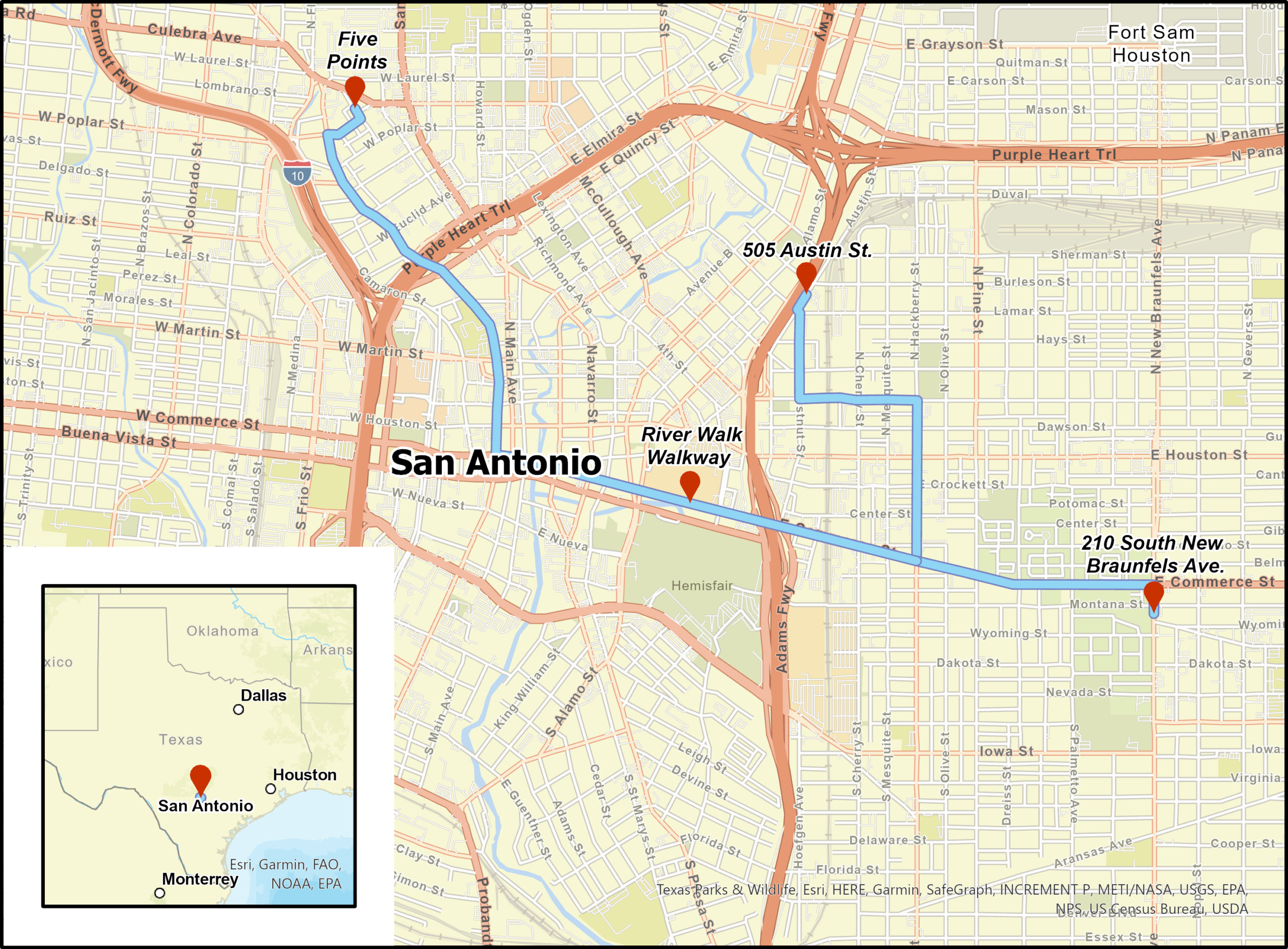
Although "Cheers" describes the centrality of bars to gay life in pre-Stonewall San Antonio, it reveals little about how issues of race and class inflected gay experience in the city at this time. Photographs of these gay bars that Weathers took as a patron hint at racial demographics, but further contextualization of these spaces provided by my interview with her shows that while fluid and mixed in terms of class demographics, these gay bars' racial demographics were very much pre- and over-determined by Jim Crow racial segregation. Of the bar sketches that follow, all of them but Mary Ellen's Top Hat—located at 210 South New Braunfels Avenue in Figure 3—appear in "Cheers," and each sketch will offer deeper insight (through the use of Weathers's personal reflections in our interview) into the racialization of San Antonio gay bars than is provided in Weathers's autobiographical short story. Figure 3 also notes locations for The Acme (505 Austin Street)—the first bar that Weathers entered when she moved to San Antonio and the bar "Jane" first encounters in "Cheers"—the River Walk, and Five Points. Fernando's Hideaway, as depicted in "Cheers" and told to me by Weathers, was located on the River Walk.40Weathers, interview by author. In her thesis, Gohlke locates Fernando's Hideaway at 2100 Frio City Road, but she provides no information about the bar beyond that. It is unclear whether this is a discrepancy in information or Fernando's moved locations at some point. Besides Fernando's Hideaway and The Country II, Gohlke's study does not document the bars that I discuss here. See Gohlke, "Out in the Alamo City." Five Points serves as visual orientation for Fredericksburg Road (to its immediate northwest), which led out to The Country (address now lost).
The Acme
In "Cheers," the narrator describes the neighborhood where The Acme is located, at 505 Austin Street on the outskirts of downtown, as "an eerie area of locked warehouses and abandoned storefronts where life had left, as though an alien spaceship had beamed everyone else up during the night."41Weathers, Shitkickers, 15. A tiny little dive bar, or as Weathers called it, "a dump," The Acme was very popular, always "stuffed full of gay men and women." The co-owners, fictionalized as Ray Davis and Lila Tankersley in "Cheers," were an amiable white gay man and a white elderly woman who Weathers believes was asexual. "Lila" also owned a shop next door called The Acme Pharmacy and had a reputation for hassling patrons of the bar, insisting that they produce their IDs. Unsure of how these two became business partners, Weathers noted that the bar serviced a mixed crowd of civilian and military, working class and upper class, gay folk and occasionally heterosexual couples. For instance, a straight couple, the Rodriguezes, "would come in and join [them] for hamburgers and beers." When asked about the racial make up of the bars, specifically if they were interracial, Weathers specified that Mexican Americans and whites mingled in all San Antonio gay bars, but that this wasn't viewed as interracial mingling because Mexican American and Anglo cultures were heavily intertwined in San Antonio. The idea of race as something that marked Mexican Americans and Anglos as apart from or different from each other became more apparent to her when she moved to Los Angeles, where she was "surprised by how segregated Mexicans and whites were."42Weathers, interview by author.
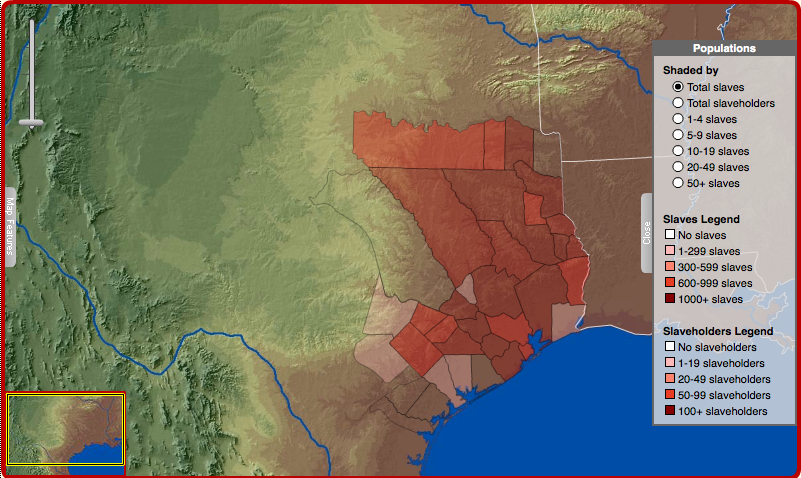
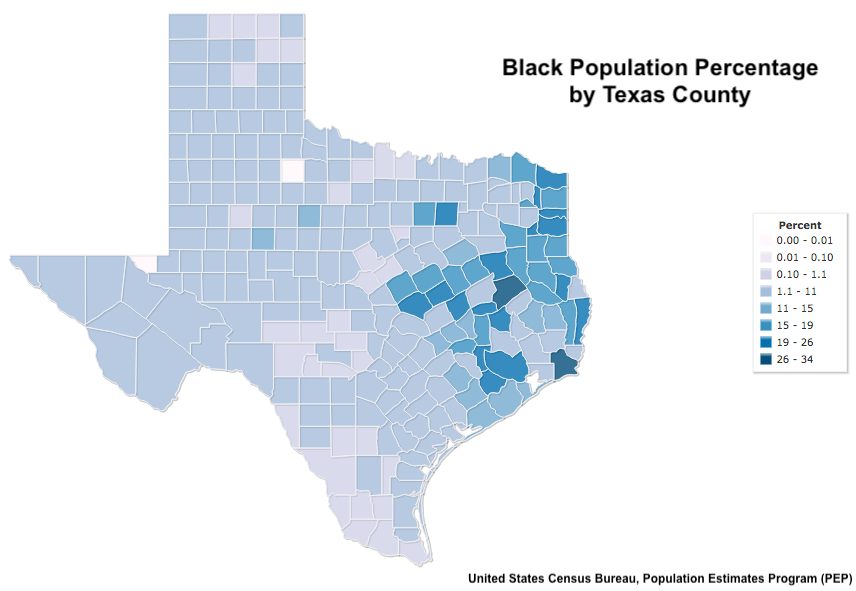
Given the long history of anti-Brown violence and political disenfranchisement in south, central, and west Texas, if my informant had been a Mexican American woman, then she would have likely told a different story about race. But Weathers's account offers insight into white experience of racial intimacy in San Antonio, while also alluding to potential Mexican American identification with whiteness as produced by San Antonio's colonial and military history. South, central, and west Texas—parts of which were included in the territory of the Republic of Texas and parts of which were considered contested territory between Mexico and Texas until US annexation and the Treaty of Guadalupe Hidalgo (refer back to Figure 1)—have traditionally homed the majority of the state's Latino demographic. Latino populations in north and east Texas have increased in recent years, particularly in Houston and the Dallas–Fort Worth Metroplex. However, because these areas were heavily settled post–Mexican Independence by Anglos practicing chattel slavery, they have been and continue to be home to most of Texas's Black demographic.43See "The Changing Population of the Texas and the Tyler Region," (Tyler: Texas Demographic Center, 2017), https://demographics.texas.gov/Resources/Presentations/OSD/2017/
2017_03_21_TylerCatalyst100.pdf. Figure 4 presents a map of Texas's Black enslaved population in 1845, and Figure 5 a map of Black demographics by Texas county as of 2020–2021. Consequently, the establishment of white supremacy in Texas, in its republic and later state forms, required regionally specific racialized policing practices. Whereas east Texas followed the rest of the US South in contending with white over Black, south, central, and west Texas had to contend with white over Black and Brown.44These regionally specific racialized policing practices are not transhistorical—although their afterlives or permutations of them are—and shift according to changing racial demographics. For instance, by the early 1970s, Houston had a significant Latino demographic in comparison to the rest of predominately rural east Texas. Consequently, as Guadalupe San Miguel Jr. documents in Brown, Not White: School Integration and the Chicano Movement in Houston (College Station: Texas A&M University Press, 2005), Houston Independent School District tried to avoid integrating white and Black students by classifying Latinos as white. That is, Latino and Black students would be integrated, while white students would attend separate institutions.
While the legal practice of chattel slavery meant whites maintained control over Black individuals throughout Texas in its various iterations as province, republic, and state, shortly after the Texas Revolution, alliances between Texians and Tejanos unraveled. Whites in south, central, and west Texas removed Tejanos from positions in government and public office and committed rapes, lynchings, and massacres as a means to assert dominance and instill fear. Although Tejanos enlisted and served in the Confederate Army during the Civil War, the emancipation of enslaved Black people and the white power grab post-Reconstruction to reassert social structures and hierarchies of old that enabled the monitoring and control of Black bodies necessitated the creation of Jim Crow laws, which in south, central, and west Texas were accompanied by Juan Crow laws. Not only intended to ensure Black and Brown disenfranchisement in such forms as voter suppression, racist housing policies, and underfunded educational institutions, Juan and Jim Crow instantiated tripartite racial segregation in an effort to explicitly convey white supremacy and racial difference from Mexican Americans and Black people while also deterring Black and Brown coalitions.45For further information, consult the following: Gloria Anzaldúa, Borderlands/La Frontera: The New Mestiza (San Francisco: Aunt Lute, 1987); William D. Carrigan and Clive Webb, Forgotten Dead: Mob Violence Against Mexicans in the United States, 1848–1928 (London: Oxford University Press, 2017); David Montejano, Anglos and Mexicans in the Making of Texas, 1836–1986 (Austin: University of Texas Press, 1987); and Nicholas Villanueva Jr., The Lynching of Mexicans in the Texas Borderlands (Albuquerque: University of New Mexico Press, 2018). Analyzing Mexican American and Black civil rights movements from the early to mid-twentieth century in Texas, Brian D. Behnken argues that Juan and Jim Crow were, by and large, effective in encouraging Black and Mexican Americans to "work against each other" politically.46Brian D. Behnken, Fighting Their Own Battles: Mexican Americans, African Americans, and the Struggle for Civil Rights in Texas (Chapel Hill: The University of North Carolina Press, 2014), 230. Political organizations such as the League of United Latin American Citizens (LULAC) "sought to include Mexican Americans on the white side of Jim Crow," and some Mexican Americans sought to prove their whiteness through anti-Black practices and violence, such as denying Black people service and setting off bombs in Black homes.47Behnken, Fighting, 68. Specifically, Behnken references a 1950 bombing in South Dallas, in which 15 bombs were detonated at the homes of Black residents who had integrated a white neighborhood. While there were multiple vigilantes involved, many of whom were never apprehended, two suspects were Mexican American men who felt threatened by the presence of Black residents in white neighborhoods. As Behnken elaborates, this political strategy wasn't successful in gaining Mexican Americans long-term equal rights, but many whites, including Texas governors of the period, did "[recognize] Mexican American whiteness," thus demonstrating the malleability of whiteness or how false promises of inclusion within white racial identity were deployed to further anti-Black and Brown sentiment while shoring up white supremacy.48Behnken, 40. Given these racial dynamics, Weathers's words about white and Mexican American mingling in San Antonio gay bars reflect Sharon Holland's thoughts on racial intimacy: rather than tamping down racist ideologies and practices, "proximity and familiarity" might actually "replicate the terms upon which difference is articulated and therefore maintained."49Sharon Patricia Holland, The Erotic Life of Racism (Durham, NC: Duke University Press, 2012), 19.
Fernando's Hideaway
Inspired by the Mexican American bar owner's name and a popular song ("Hernando's Hideaway"), Fernando's Hideaway was in a historic building along the San Antonio River Walk. Construction on the River Walk began in the 1920s, when the city hired engineers to create a dam system that would address the frequent threats of disastrous flooding by the San Antonio River. Plans to convert the river and its banks into a storm sewer system resulted in the founding of the San Antonio Conservation Society, which successfully lobbied against this measure and was tasked with overseeing future development of the area. Delayed by the Great Depression, the River Project—plans to develop the river by adding restaurants, walkways, and shops—was initiated in 1939 through local tax and WPA (Works Progress Administration) funding. Initially headed by architect Robert H. Hugman and later J. Fred Buenz, construction on the River Project by WPA workers ended in 1940, with an opening dedication ceremony coinciding with the city's inaugural Fiesta River Parade in April of 1941. Throughout the forties and fifties, the River Walk featured a small sampling of restaurants, shops, and boating activities that drew in a fair number of locals and tourists alike but was generally considered an unsafe area at night due to crime. From the 1960s up until 2011, however, the face and reputation of the River Walk radically changed, as the city heavily invested in its further development and expansion in order to capitalize on tourism capabilities.50Consult these sources for a more detailed history and timeline: Lewis F. Fisher, "San Antonio River Walk [Paseo del Rio]," Handbook of Texas, Texas State Historical Association, accessed April 20, 2019, https://tshaonline.org/handbook/online/articles/hps02; "History of the River Walk," The San Antonio River Walk, accessed April 20, 2019, https://www.thesanantonioriverwalk.com/history/history-of-the-river-walk; City of San Antonio, "River Walk," accessed April 20, 2019, https://www.sanantonio.gov/CCDO/riverwalk.
Attentive to the River Walk milieu of Fernando's Hideaway, scenes of the bar in "Cheers" occur amid Fiesta San Antonio, an annual ten-day celebration of the city's history and culture, which started in 1891 to commemorate those fallen at the battles of the Alamo and San Jacinto. According to Weathers, Fernando's was much "fancier" than the other bars and not as "secretive," given its location in an area with heavy foot traffic. The racial, gender, and class make-up of the bar was like The Acme, with straight people often patronizing it as well. The bar's balcony that overlooked the river was a popular spot, and Weathers laughingly recalled a Fiesta memory of Navy men floating in a boat down the river as gay men catcalled "sea food" from the balcony.51Weathers, interview by author. The fact that gay men and women weren't discouraged from patronizing Fernando's despite its public visibility speaks to the assimilative capabilities of white and Mexican American gay bars in the downtown San Antonio district during this period. As Amy L. Stone's work on Cornyation (a mock debutante pageant organized and performed by gay men during Fiesta from 1951 to 1964) reveals, spaces and events associated with Fiesta often allowed for gay visibility within certain limits. "Attended by a public audience of thousands and reviewed in local newspapers," Cornyation, Stone argues, "rendered gay culture visible to some heterosexual observers and implicated gay men as urban citizens worthy of integration into the city," but "this legibility ultimately led festival organizers to ban Cornyation."52Stone, "Crowning King Anchovy," 298. Given Fernando's proximity to Fiesta activities held on and near the River Walk, as well as its accessibility to tourists, perhaps it's plausible to suggest that the general public did not necessarily recognize it as a gay bar and that its existence was contingent, in part, on it servicing a large heterosexual demographic.
The Country
The Country featured in "Cheers" was located outside the city limits on Fredericksburg Road. It is also referred to as Stein's Bar in the short story, but the actual name for it—when folks did not invoke its nickname, The Country—was Kline's Bar. Two white elderly lesbians, Maybelle and Bee, operated The Country and had probably been together since the 1930s. Weathers described The Country as much "nicer" than The Acme: it "sat in some thickets" off the road and had "long tables" and a jukebox in its "cavernous dance hall." Moreover, there was a separate lounge room with a bar at the front of The Country where customers could relax on chairs and sofas while purchasing drinks. The racial, gender, and class demographics of The Country mirrored The Acme's, with many people frequenting both of these bars. This shared patronage was not just because The Country had more room and was the site of "a lot of drunkenness and singing loud to Patsy Cline," but also because gay couples could dance at The Country. Unlike urban gay bars, which didn't allow same-sex dancing due to their close proximity to police stations, The Country permitted same-sex dancing because its distance from police stations gave the bar owners and patrons time to warn each other and switch into heterosexual pairs.53Weathers, interview by author.
Military and Bexar County police occasionally raided The Country, and Weathers, having witnessed one of these raids, fictionalizes the method employed to alert patrons in a way that is very similar to the actual method she shared with me in person: Maybelle would walk around with her yellow bandana in her shirt pocket, which was a sign that cops were coming, and same-sex couples would immediately rearrange into heterosexual pairs. Another precaution included banning two people in the bathroom at once because if, for example, two women were in the ladies restroom during a raid, cops had probable cause to arrest them for homosexual behavior. When the cops entered the bar, "they would," according to Weathers, "go around the room looking for a woman's hand on another woman's knee" or any type of same-sex touching. I asked her if authorities persecuted gay men and women if they dressed in clothes typically associated with the opposite sex, as in, for example, Buffalo, New York, where butches were arrested for wearing less than three articles of women's clothing, and she said gay men and women in San Antonio wore the same casual dress clothes as heterosexuals: "jeans, t-shirts, Bermuda shorts."54An informant recounts this in Elizabeth Lapovsky Kennedy and Madeline D. Davis's Boots of Leather, Slippers of Gold: The History of a Lesbian Community (New York: Routledge, 1993). By her account, there weren't butch–femme pairings in the gay scene, and people didn't use those terms; instead, the only term used was fluff, which referred to more feminine women. Outside of this specification, Weathers's remarks also suggest that drag was not a common feature in these bars, nor was there a significant presence of people presenting as gender variant.55Weathers, interview by author.
For reasons that Weathers can't remember, Maybelle and Bee ended up closing The Country. A white gay man and white bisexual woman with an arranged heterosexual marriage opened a similar venue called The Country II in a different location not long after.56Weathers, interview by author. In her study of San Antonio gay bars, Gohlke explains that like The Country, this bar was a queer gathering space that allowed for same-sex dancing and touching due to its location outside the city limits. The patrons and bar owners also employed their own technique for warning of incoming cops: flashing the lights on and off.57Gohlke, "Out in the Alamo City." Gohlke and Weathers have been in contact with each other, and Weathers told me that The Country referred to in Gohlke's thesis is, in fact, The Country II. The Country's function as a queer space on the city's periphery that gay people fluctuated between in the process of creating queer community resonates with John Howard's idea of circulating, which he uses to account for how gay men in Cold War Mississippi engendered queer experience and space by remaining in a state of flux.58John Howard, Men Like That: A Southern Queer History (Chicago: University of Chicago Press, 1999), 78.
Mary Ellen's Top Hat
Located at 210 South New Braunfels Avenue on the city's east side, a traditionally Black neighborhood since formerly enslaved people began establishing Freedmen's Towns there after the Civil War, Mary Ellen's Top Hat is the final bar that Weathers remembers from her time in San Antonio.59For more information about Black history and experience in San Antonio, see Alwyn Barr, Black Texans: A History of African Americans in Texas, 1528–1995 (Norman: University of Oklahoma Press, 1996); Bruce A. Glasrud, ed., African Americans in South Texas History (College Station: Texas A&M University Press, 2011); Kenneth Mason, African Americans and Race Relations in San Antonio, Texas, 1867–1937 (New York: Garland Publishing, 1998). Owned by a heterosexual Black woman of the same name, Mary Ellen's was unique because it welcomed Black, Mexican American, and Anglo patrons. According to Weathers, during their revelry at the bar, Mary Ellen would sing Ray Charles songs and Weathers and her friends would act as Mary Ellen's chorus. The bar also had a beer-drinking club called UN CAPPA-FU—a play on "uncap a few." As an interracial space, Mary Ellen's heightened Weathers's awareness about Black experience in the United States through conversations she had with Mary Ellen, a Black male acquaintance nicknamed Mr. Elegance, and white and Mexican American friends and fellow patrons. Becoming noticeably emotional when discussing the racial dynamics of this bar, Weathers recalled that she, Mary Ellen, and Mr. Elegance decided to integrate The Country one night after a heated discussion over Black civil rights. However, they left in separate vehicles, and upon arriving at The Country, Weathers went in without waiting for them. She doesn't know if they were denied entrance or if they even showed up, and that lack of knowledge, as well as her failure to wait for them, is a source of strong regret today.60Weathers, interview by author.
Although heavy media coverage of the civil rights movement brought images of violence and struggle into the everyday lives of white people across the country, when Weathers entered the San Antonio gay bar scene in her early twenties, she was still ignorant and indifferent due to her race, youth, and regional upbringing. Recall that west Texas has always had a significantly smaller Black population in comparison to other parts of the state, which has influenced how anti-Black practices and ideologies manifest and circulate there. West Texas officials did not always enforce Jim Crow laws to the extent that they were enforced in more eastern parts of the state, and anti-Mexican sentiment often predominated among locals given the region's colonial history and significant Latino demographic.61William S. Osborn, "Curtains for Jim Crow: Law, Race, and the Texas Railroads," Southwestern Historical Quarterly 105, no. 3 (2002): 395. The small, predominately white town that Weathers grew up in, Brownfield, was no exception. She struggled to remember incidents of anti-Black violence and racism in her childhood, quickly adding, however, that she did notice anti-Mexican sentiment, especially in relation to the presence of imported Mexican agricultural workers in Brownfield. Weathers's experiences in Mary Ellen's Top Hat reveal that, in facilitating cross-racial dialogue, racially integrated gay bars in San Antonio were potential sites of racial consciousness raising, however limited, among patrons.62Weathers, interview by author.
Conclusion
Absent in these bar sketches are the voices of people of color such as Anita, or Fernando, or Mary Ellen, or Mr. Elegance. What might a Black-owned gay bar have meant to someone like Mr. Elegance? What were his and Mary Ellen's thoughts about gay bars like The Country upholding anti-Black Jim Crow laws? Was Mary Ellen's Top Hat racially integrated because under Jim Crow, white people actually had access to all spaces, or was it a political statement on Mary Ellen's behalf? What did it mean to a Mexican American bar owner like Fernando to deny services to Black gay people and Black people generally? As a Mexican American woman, what was Anita's experience of racism and racialization as she moved from Mexican American-owned bars to white-owned bars to Black-owned bars? The Weathers Collection at the ONE Archives cannot answer these questions, but they should prompt us to consider what research approaches and archival practices are needed to adequately represent a fuller and more inclusive queer history of pre-Stonewall San Antonio and Texas. Now is the time to gather oral histories and create cross-reference lists of Texas queer experience in LGBTQ+, Black, Latino, and Asian American archives so that the research process is streamlined for academics and non-academics invested in interpreting and preserving this history.
Beyond this call to further curate and study Texas queer history, my analysis here does open up other questions that could be more thoroughly explored in future work with the Weathers Collection. For instance, how did military history influence racial dynamics in San Antonio? How might sexual dynamics be understood through the city's colonial history? What were common or popular understandings of gender in the gay community at the time? These are just a few provocations that readers might find in this essay. From this work, I hope readers will notice the gap in racial awareness when considering Weathers's "Cheers" short story and our later interview. That is, the short story itself does not discuss Jim Crow segregation or the different racialized experiences of characters. In fact, none of the characters are openly racialized. If it were not for my interview with Weathers, I could not have provided an analysis of racialized gay space in San Antonio at this time. Both text and context, story and oral history, work together to tell a richer, if still incomplete, version of pre-Stonewall gay life in San Antonio. This essay, then, might serve as an object lesson in how to work with racial silences that are often common in the archival materials of white subjects. And considering that one of the problems of archives—LGBTQ+ and otherwise—is the over-predominance of collections from white subjects, this is not an object lesson to easily cast aside.
About the Author
Amanda Mixon is Assistant Professor of Instruction in the Center for Women's and Gender Studies at The University of Texas at Austin. Her research on US social movements has appeared in the Journal of Lesbian Studies and received support from the American Association of University Women, Duke University, the University of Virginia, and the University of California, Irvine Humanities Center.
]]>Blog Post
I recently bought a crumbling old house in a historically gay neighborhood in Roanoke, Virginia. I met my ex-lover in this house five years ago. At the time they lived with a coterie of other young people. They threw raucous queer parties and housed folks who didn't have anywhere else to go.
A few blocks down the street is another building. There, in 1971, a group of young men and women founded the Gay Alliance of the Roanoke Valley (GARV), the region's first gay liberation organization. This building is now a medical office. I come here once a year to see my endocrinologist. He prescribes spironolactone and estradiol to help my body transform into something approximating that of a woman.
The local neighborhood association puts up signs that read, "A Past with a Future." As I see it, the neighborhood's past is rich with gay history, and the future is my transitioning body and the pink, white, and blue flag I fly in the driveway.
Queer history lives here. It's overlapping in the spaces of my neighborhood. It's in the bones of the buildings. Queer ghosts inhabit the walls. Archaeological troves are remnant in the yards. My dog June digs them up with her ready paws and pearl-white fangs. My gender transformation is hitched to the woodwork and to the water pipes of all the apartment buildings where I have lived. People have lived queerly in these spaces. I have bought a home that not only holds the past but makes space for the future—for my womanhood, my motherhood, and for the chosen family I will assemble underneath this roof.
LGBTQ people have long known that our stories are not to be found in the so-called annals of history, and that we have to look in unexpected places to find our past. Lesbians in Roanoke in the 1980s devoted an entire issue of their newsletter, Skip Two Periods, to "Discovering Our Heritage." The writer, "B. F.," wrote about finding her heritage at the Lesbian Herstory Archives in Brooklyn, in Jonathan Ned Katz's book Gay American History, through the National Women's History Project, and in the published letters shared among nineteenth-century women. She also suggested that lesbian history is found in our families. "Write to your grandmother and ask her about her grandmother," she pleaded. Indeed, queer history is present in the way my parents reacted when I first came out, as they referenced a family member who died of AIDS in 1989 and hinted that I might face a similar fate. We carry queer trauma in our bodies. All of us—straight, gay, cis, trans—live in a world shaped by the queer past.
We have the tools to probe this history on the local level. Since the 1970s, queer history projects have flourished across the United States. New archives are forged from the remains stowed away in activists' attics and closets. Oral history collections are assembled from the stories of our elders, talking about what it was like growing up as a trans person in Appalachia in the 1960s, for example. Doing queer history work provides us with the opportunity to bring LGBTQ people together across generations, to talk about what was and what can be, to find new meaning in the spaces of our lives.
Six years ago, I helped found the Southwest Virginia LGBTQ+ History Project, a community history project that has since engaged hundreds of local people in the process of researching and interpreting queer pasts. This has involved creating a permanent archive in partnership with the local public library system, developing an oral history collection through interviews with our elders, leading monthly walking tours, unveiling digital exhibits, releasing podcasts, and working with local youth on interactive theater and zine-making workshops. This project is how I ended up spending time in this house; it's where I fell in love with a project member who lived here. It's how we know the geography of bars and cruising spaces that once littered the neighborhood, and the all-queer and all-trans houses that still stand. It's how I discovered my gender. Interviewing trans women about their lives, I realized this was also my story. So I came out into the spaces of the project, into the spaces of our city, into a new relationship with queer history. A past with a future.
Every October we celebrate LGBTQ History Month. To me, this month is a reminder that we are still fighting, especially here in the South, for students' right to learn basic LGBTQ history in the classroom. But beyond the metanarrative of what should be taught in school, there are thousands of local queer histories still waiting to be uncovered. This work takes all of us—students, elders, volunteers, professionals. Do you know when the first gay organization was founded in your community? Have you met your trans elders? The work of doing queer history has the power to transform lives. It has the power to give new meaning to the places we call home.
About the Author
Gregory Samantha Rosenthal is the author of Living Queer History: Remembrance and Belonging in a Southern City (Chapel Hill: University of North Carolina Press, 2021).
]]>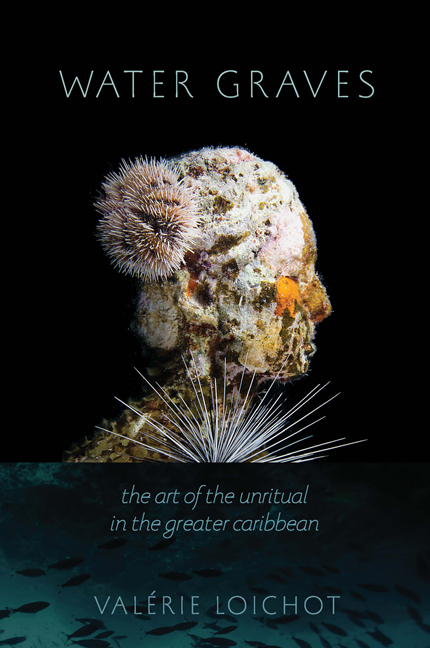
Water Graves investigates how contemporary writers and artists of the greater Caribbean (such as Jason deCaires Taylor) reinvest sites of racialized violence and environmental degradation—as so many manifestations of "unritual"—with a new sense of the sacred that allows for remembrance and re-humanization. Rituals—be they initiations, funerary rites, or collective acts of remembrance—confer "humanity" on those who practice them and sacredness on the places of these practices. The unritual comprises moments and spaces of desecration. Unritual occurs when rituals are ignored, violently suppressed or obstructed outright, and where so-called "natural" spaces are commodified, exploited, and profaned. Closely appended to Loichot's unritual are the notions of "undead" and "unrest"; the liminal zone of (non)being they demarcate emphasizes the unritual's alienating, unsettling, and dehumanizing effects before and beyond the grave.
Off the coast of Grenada, several meters below the Caribbean surface, stands Jason deCaires Taylor's Vicissitudes. It is an installation of statues which, at first glimpse, shows a group of men and women arranged in a large circle, holding hands as they gaze outward along the ocean floor. The figures bear bright red, pink, and violet protrusions of coral, undulating gossamers of seaweed, and the occasional sea star. The texture and topography of these statues' skin—their pores, wrinkles, and scars—provide the ideal environment for aquatic life to take root and repopulate this portion of ocean floor. Vicissitudes also offers another, more haunting kind of repopulation, this time by the specters of the Triangular Trade: the innumerable captives thrown overboard after dying in transit during the Atlantic crossing and condemned to perish, away from ancestral lands and families that could offer funerary rites or remembrance. As the installation confronts the degradation of coral environments, its underwater surroundings also beckon and materialize the (un)dead of the African Diaspora whose memory—likewise rarefied and threatened—inhabits these statues alongside the coral. Vicissitudes, a monument that explores the creative and memorial agency of Caribbean underwater spaces, serves as one of many objects that Valérie Loichot examines in her book, Water Graves: The Art of the Unritual in the Greater Caribbean.
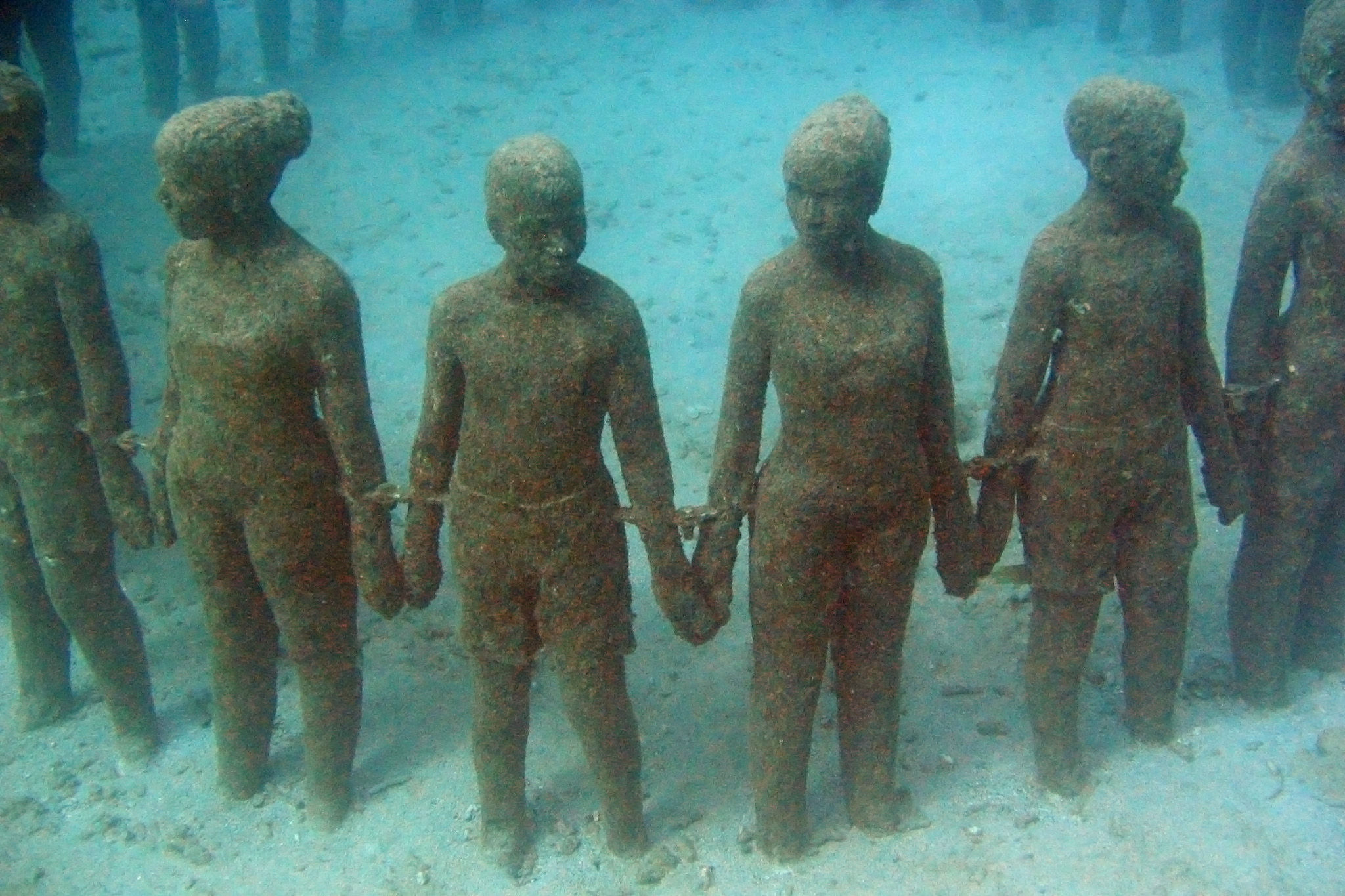
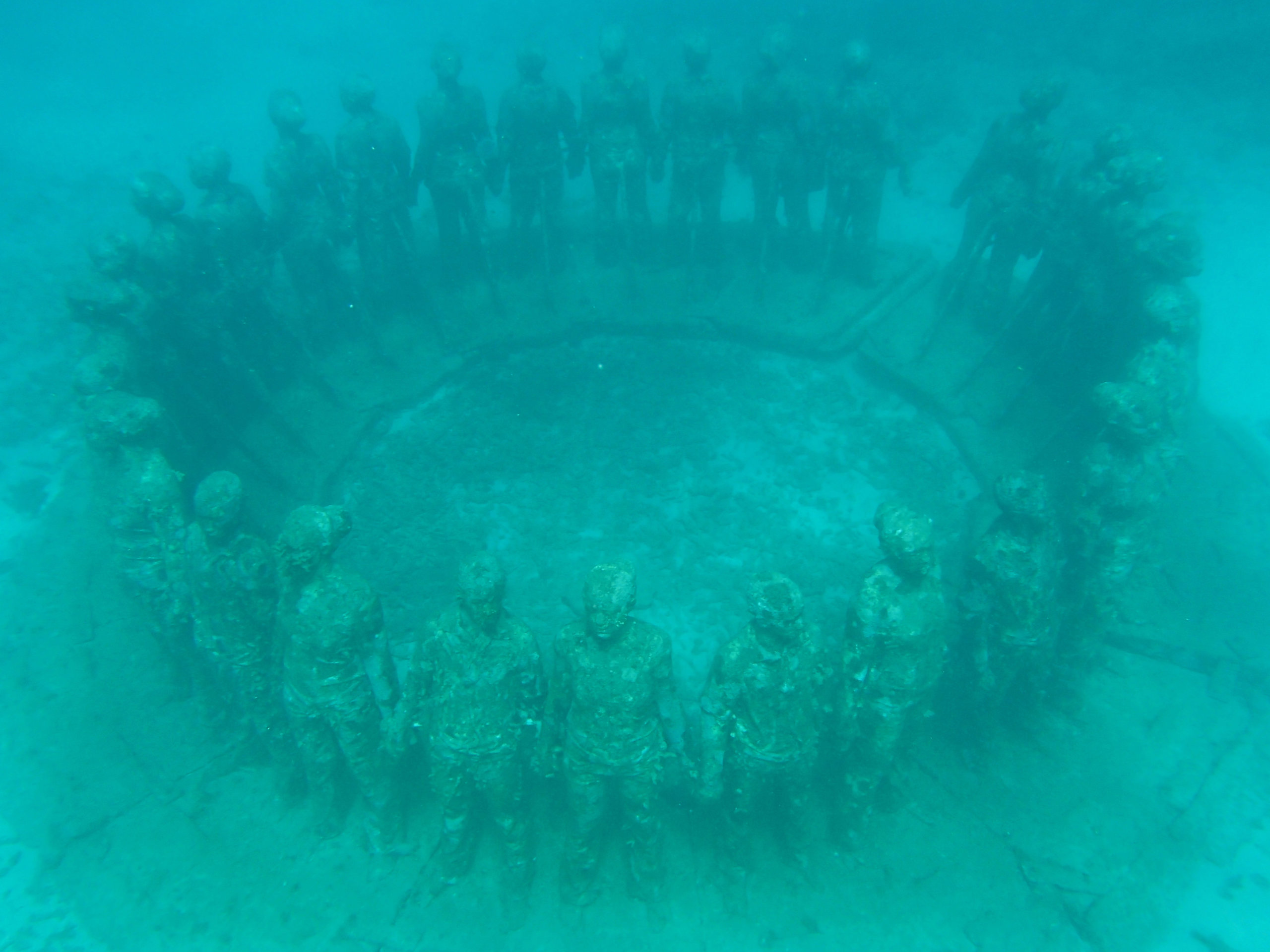
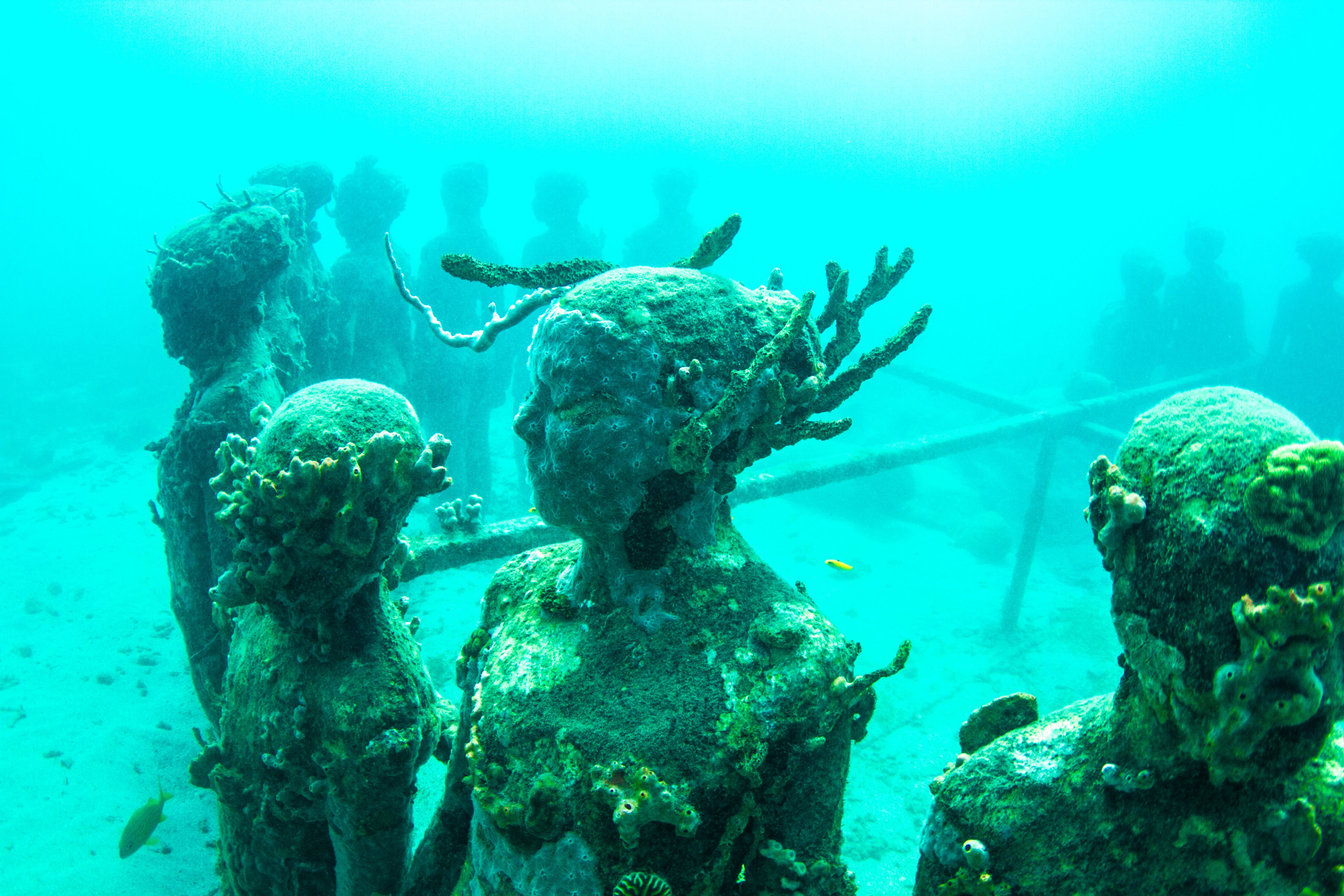
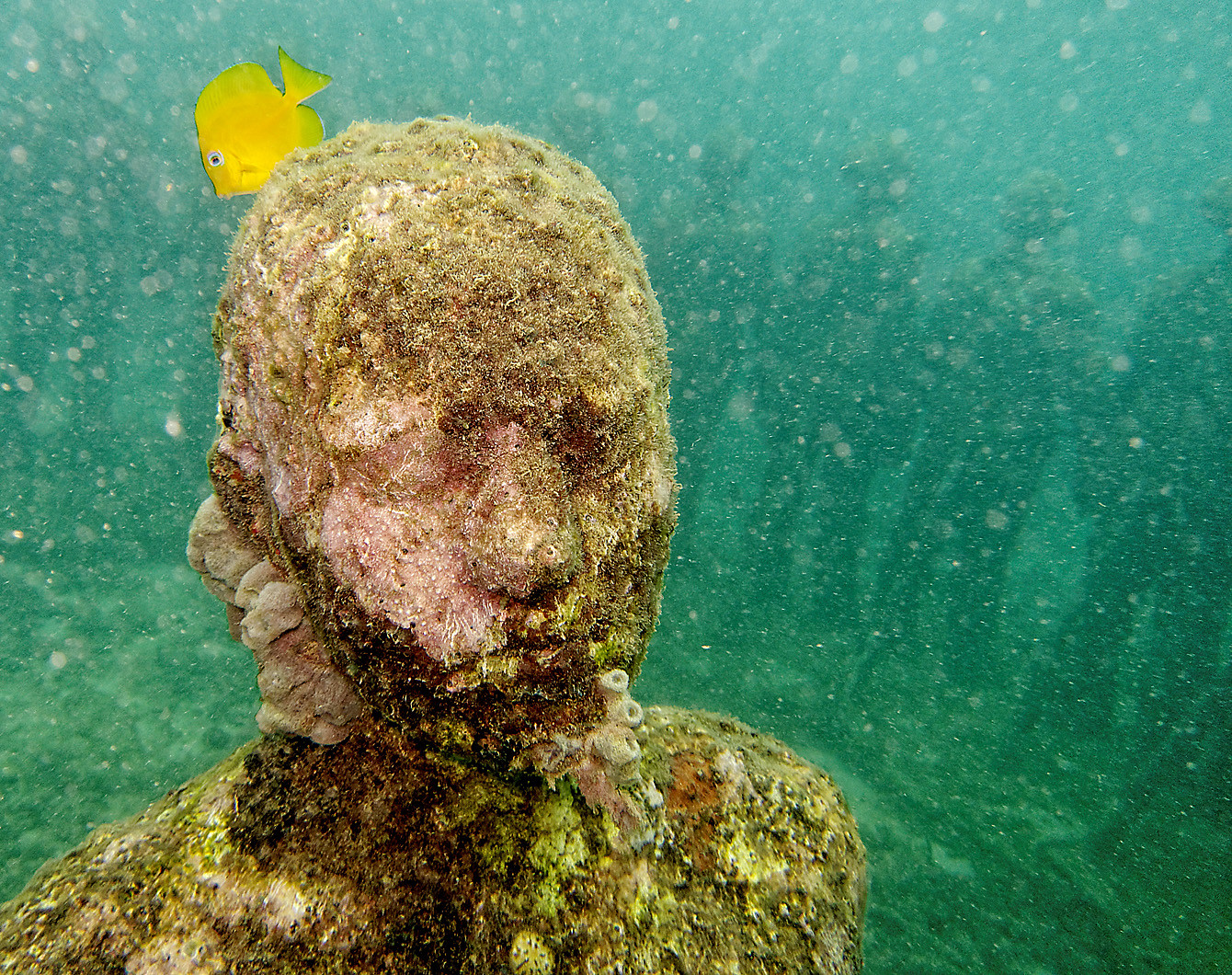
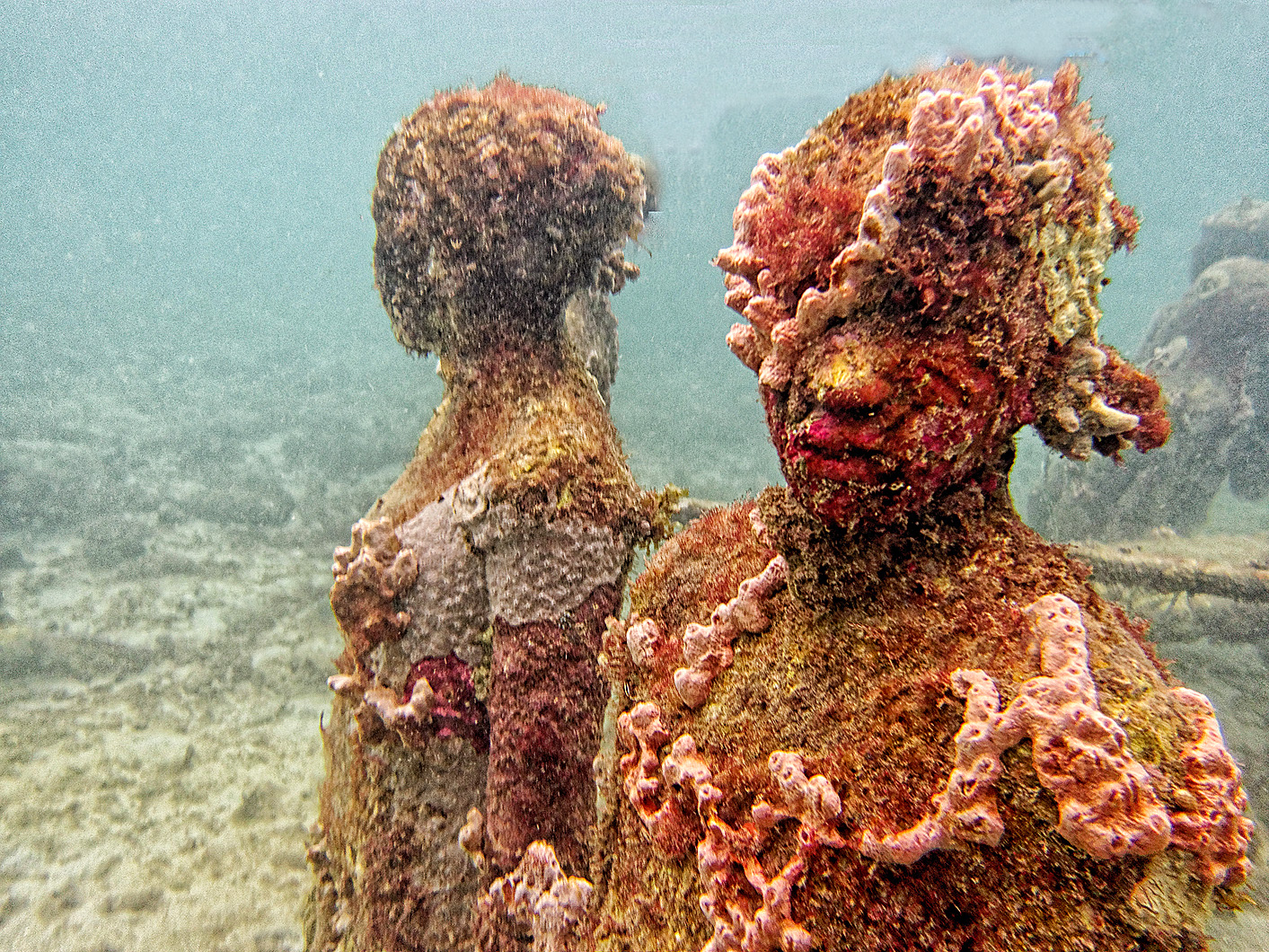

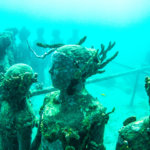
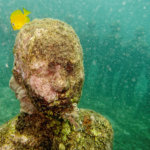

An interdisciplinary exegesis in the fields of Postcolonial Studies, Caribbean Studies, African Diaspora Studies and Ecocriticism, Water Graves investigates objects across many mediums that, like Vicissitudes, work through or heal the effects of unritual. The oeuvre of poet-philosopher Edouard Glissant serves as the opening and the theoretical springboard for the rest of the book. Here, Loichot engages the notion of "relational sacred," which draws heavily from Glissant's concepts of creolization, relaying, and entour or "surroundings."1As Loichot explains, "Entour signifies for Glissant the whole environment comprising the poem, human and nonhuman animals, vegetation, rocks, lavas, and 'nature' and 'culture.' The latter terms lose meaning since they exist in a continuum, not in a system of opposition" (28). For another in-depth look at Glissant's entour, see Carrie Noland, "Éduoard Glissant: A Poetics of the Entour," in Poetry After Cultural Studies, ed. Heidi R. Bean and Mike Chasar (Iowa City: University of Iowa Press, 2011), 143–172. This "relational sacred"—which extends the expressions of memory or ritual beyond religious confines—informs more specifically how the objects featured in Water Graves's chapters (objects of literature, music, film, visual arts, poetry, and photography) repair the effects of unritual.
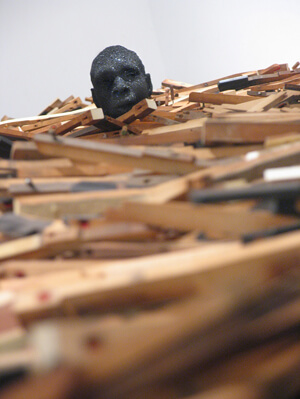
Loichot's "Graves for Katrina" examines the work of mourning effected by visual artists in the wake of Hurricane Katrina. Featuring the photography of Eric Waters and the paintings and mixed-media exhibitions of Radcliffe Bailey and Epaul Julien, this chapter considers the (mis)use and subversion of frames as devices that circumscribe the spatial, temporal, and conceptual boundaries of a work. For instance, Bailey's installation, Windward Coast–West Coast Slave Trade (2009–18)—which is comprised of a large sea-like arrangement of salvaged piano keys from which emerges a lone, "African" head—eschews "framing" within a singular meaning or temporality. By evoking at once the "victims of the Middle Passage, Katrina, or [prophetically] the Haitian Earthquake" Bailey's installation goes beyond the temporal frames that would separate these events (101, 66). These overlapping and recursive temporalities, argues Loichot, prompt spectators to see similar logics of "unritual" at work in all of them, logics that signal the longue-durée effects of racialized slavery whereby Black people remain subject to violence and dehumanization.
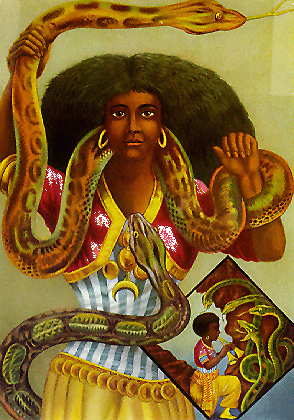
As the objects of Bailey, Waters, and Julien spill out of conventional "frames" or conceptual boundaries, Loichot's analysis flows into the murky waters of Katrina and its racial and environmental violence in "Mami Wata the Formidable." Loichot wades through the ethical ambiguity of Kara Walker's exhibit/book, After the Deluge, and Beyoncé's visual album, Lemonade, which represent—and potentially reproduce—the violence of slavery and Katrina. Yet, in this representation and acknowledgement, Walker and Beyoncé—like Mami Wata, the titular voudou figure who grants life and death to those lost at sea—also sanctify the victims of the violence their objects traverse. Through Julia Kristeva's notion of "muck," Loichot shows the creative and "sacred" potential of Walker's and Beyoncé's portrayals of violence as the "abject substance [that] paradoxically—and horrifyingly—becomes the amniotic fluid of a new birth" (112).
"Drowned," delves further into fluid spaces—this time of the ocean floor—via Jason deCaires Taylor's Cancún Underwater Museum and Édouard Duval Carrié's paintings. These works, Loichot contends, project spectators into the space of the drowned while teasing out the links between environmental degradation, those thrown overboard during the Middle Passage, and the migrants who drown while crossing the Mediterranean today. From these underwater spaces of death, "Stone Pillow and Bone Water" turns to the "hard materiality of words" which are likened to the raw material that M. NourbeSe Philip and Natasha Trethewey shape into poetic "graves, stones, or monuments to the neglected, forgotten, or desecrated dead" (177). Loichot details how Philip deconstructs and reshapes the juridical/scientific language implicated in justifying racialized slavery: "As herself both a lawyer and a poet, Philip must rectify the law . . . by giving humanity and sacred back to the victims of the legalized unritual, through her poetic creation. Poetry—poiesis as act of making—relays a faulty even criminal, law" (204).
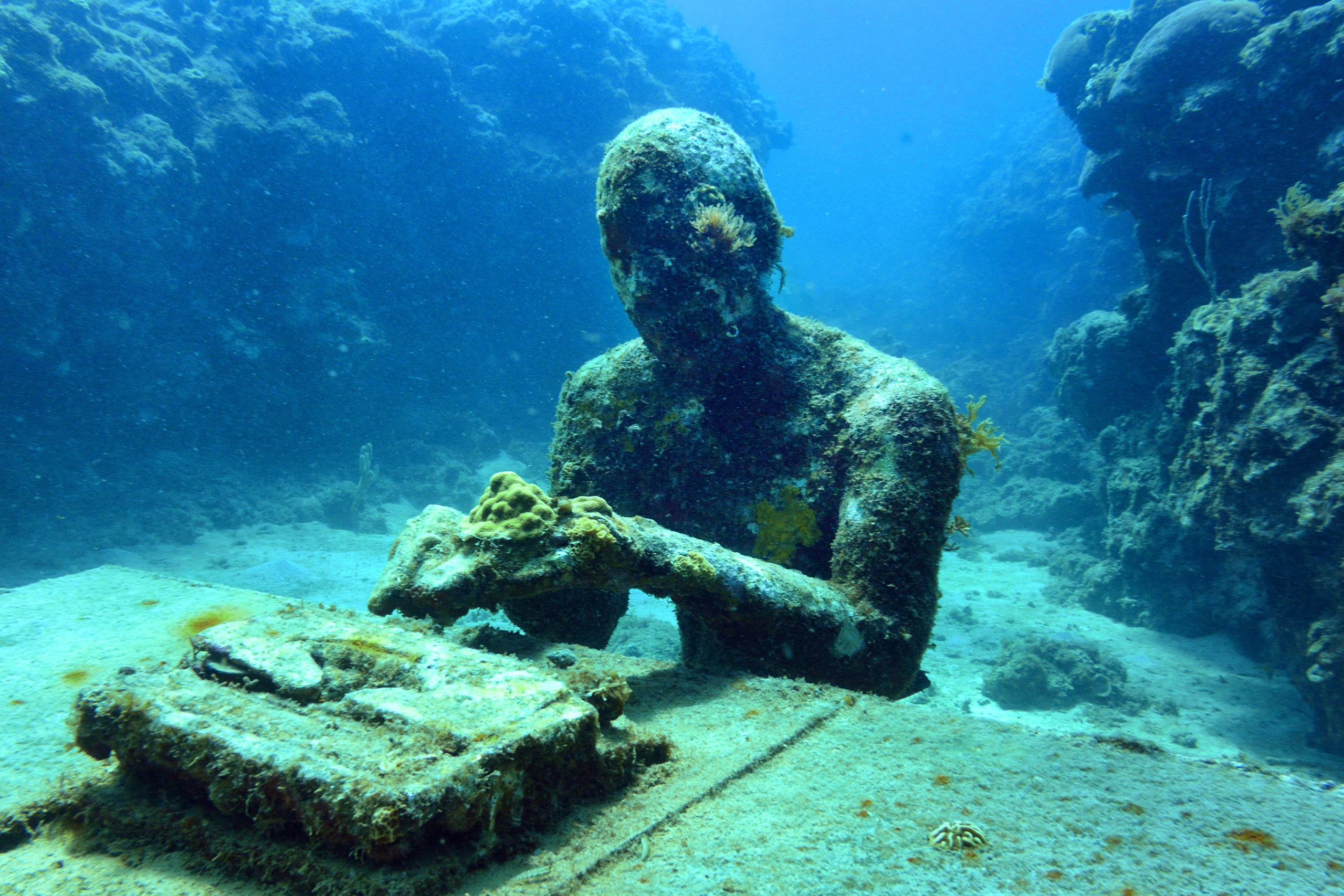
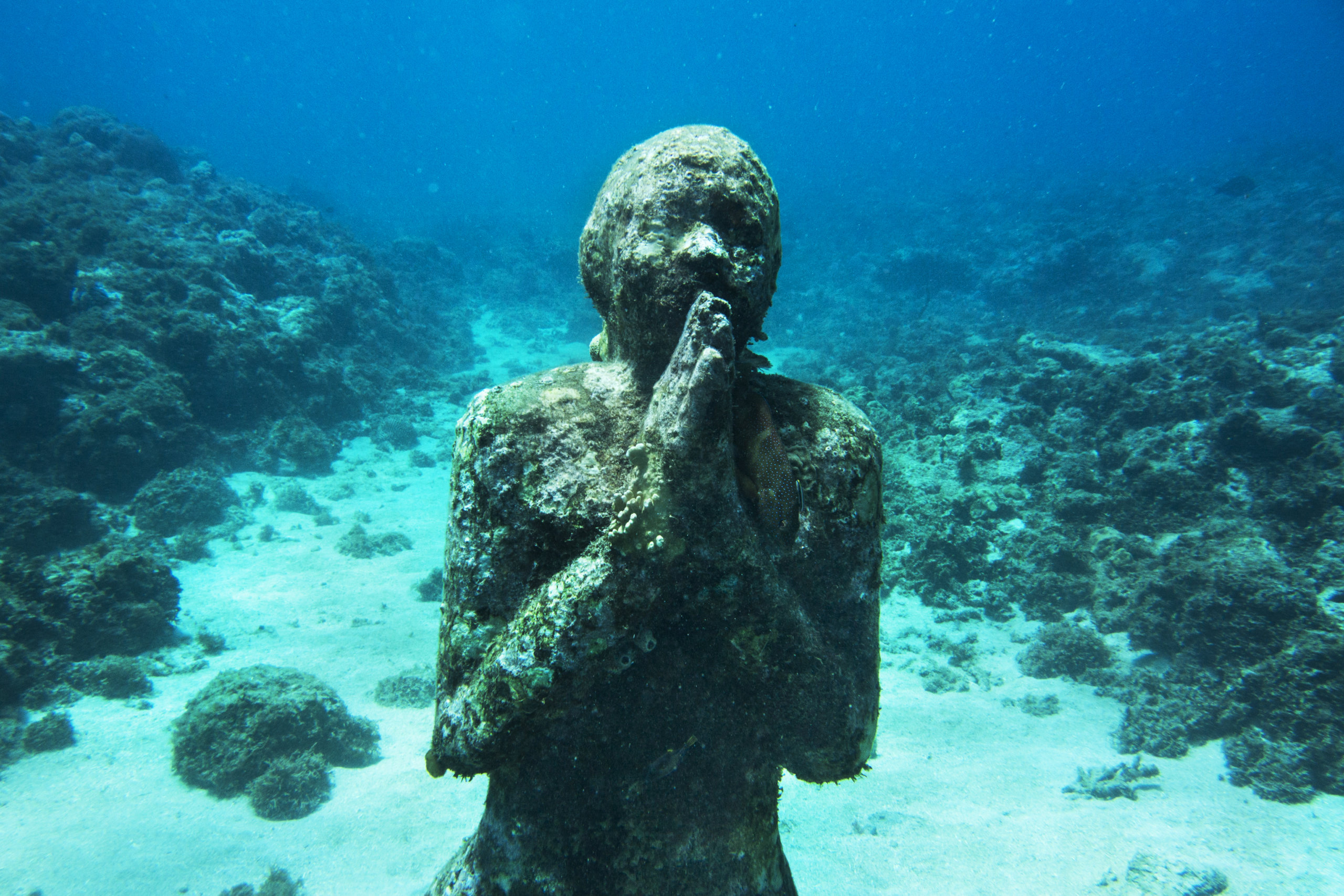
As the variety of objects featured in Water Graves indicates, Loichot's relational methodology echoes and enacts principles of Édouard Glissant's notion of "Relation," particularly that of "relaying" understood as: "an act of solidarity between those touched by the unritual, such as humans and their hurt ecologies. [Relaying] calls for disciplines like literary and artistic interpretation, history and science, to join forces where they meet the epistemological abyss of the unknown" (19). By bringing the notion of entour—which implicates so-called "natural" surroundings in "human" creativity and activity—to bear on its analyses, Water Graves effectively broadens the scope of the unritual to include the natural world, underlining connections between racial violence and environmental destruction. One of the strengths of this relational methodology resides in its juxtaposition of disparate objects. These juxtapositions not only highlight the connections among seemingly distinct historical phenomenon; they also bring into conversation creative works that confront the systems responsible for propagating the unritual. The hybrid figures in Beyoncé's Lemonade (lasiwène or the siren) and Jason deCaires Taylor's Vicissitudes, for example, challenge ontological boundaries that condition spaces of racialized violence and environmental degradation—boundaries between life and death, human and coral, sacred and profane, memory and oblivion. Loichot's treatment of these two objects—which come from different entours and mediums—reveals the poetical, creolizing, and memorial potential of underwater spaces in the Greater Caribbean. As Loichot puts it, "[t]he water is thus not a dividing line but a site of passage, flux, communication and confusion between . . . realms" (154).
Though my appraisal of Water Graves remains predominantly laudatory, I will signal two critiques in terms of its methods and conceptual vocabulary. Loichot's powerful juxtapositions showcase the poetic possibilities of creating a network of oeuvres motivated by the desire to heal and move beyond the unritual. But Water Graves's relational approach sometimes sidesteps the paradoxes highlighted by this kind of comparative work. As Shu-mei Shih proposes in her essay "Comparison as Relation," relating ostensibly dissimilar objects allows one to deconstruct boundaries (disciplinary or otherwise) erected by "certain interests" or "the workings of Power" (which Water Graves certainly does).2Shu-mei Shih, "Comparison as Relation," Comparison: Theories, Approaches, Uses, ed. Rita Felski and Susan Friedman (Baltimore: John Hopkins University Press, 2013), 79. Yet, it is equally important, Shih notes, to "evacuate and analyze" how these economic, national, or other interests nevertheless infuse the objects of comparison and their relations.3Shih, 84. That Beyoncé's album (and related concerts) garnered hundreds of millions of dollars within neoliberal capitalism—a socioeconomic system predicated on exploiting women, people of color, and vulnerable workforces in developing countries—constitutes an aporia that Water Graves acknowledges without exploring.4As indicated by the Pew Research Center, wage gaps continue to track along gender and racial lines in the U.S. Eileen Patten, "Racial, gender wage gap persists in U.S. despite some progress," Pew Research Center, July 1, 2016, https://www.pewresearch.org/fact-tank/2016/07/01/racial-gender-wage-gaps-persist-in-u-s-despite-some-progress/. Though Water Graves recognizes the album's imbrication with capitalist profit—casting Beyoncé as an embodiment of the capitalistic deity Mami Wata—it doesn't investigate how the economic "interests" underwriting her album inflect and/or constrain the work of healing or moving beyond the unritual.5bell hooks, "Beyoncé's Lemonade is capitalist money-making at its best," in The Guardian, May 11, 2016, https://www.theguardian.com/music/2016/may/11/capitalism-of-beyonce-lemonade-album. As bell hooks points out, both Beyoncé and Serena Williams are featured in the album wearing sports clothing, as Beyoncé's sports clothing line—Ivy Park—would appear the same year as Lemonade, thereby walking a fine line between dissident discourse and advertisement. This is not to say that Beyoncé's discourse is invalidated by this antagonism, nor that one can totally disengage from the "workings of Power," particularly in the era of globalization; rather, I mean to emphasize the importance of situating the discourse of a given object within its material conditions and outcomes, especially as these conditions and outcomes often constitute sites of unritual, which complicate our readings of these objects and the ways in which they relate to each other.

My second critique relates to the use of terms historically operationalized in colonial contexts to exclude non-European populations. Although its creolizing methodology works across disciplinary and cultural frameworks, Water Graves employs certain universalizing notions, notably "humanity," whose investment in a colonial epistemological tradition is not always fully interrogated. As the philosopher and novelist Sylvia Wynter writes in "Unsettling the Coloniality of Being/ Power/Truth/ Freedom," the term "humanity" has historically been invoked to exclude racialized persons from its prerogatives, and has, in fact, depended on the racialized "Other," relegated to a space of unritual in order to mark its boundaries. Indeed, Wynter tracks how the conceptions of "human" and "humanity" came to correspond with "reason" and "rationality" in Renaissance Europe (and continue to do so today), whereas the conditions of "subrationality" and uncivilization were used to characterize colonized populations.6Sylvia Wynter, "Unsettling the Coloniality of Being/Power/Truth/Freedom: Towards the Human, After Man, Its Overrepresentation—An Argument" in CR: The New Centennial Review 3, no. 3 (2003): 266, 301. In other words, under the guise of describing the entire "human race," the term "humanity" has come to reify and universalize Western values and ideals. Although Water Graves's introduction construes "humanity" in an inclusive way—proposing that rituals "of the sacred" writ large are "a defining mark of humanity"—the text leaves unattended its watermark of exclusion and eurocentrism (7). The uninterrogated use of "humanity," then, potentially constitutes a discursive site of "unritual"—what Loichot's objects and analysis strive to "heal"—as its eurocentric and exclusionary connotations of so-called "rationality" and "civilization" implicitly accompany its evocation. Explicitly deconstructing the history and usage of "humanity" while signaling a plurality of humanities would not only eliminate the tension created by the colonial baggage of this term, but would also dovetail with Glissant's conception of Relation which rejects universalizing concepts, while insisting on multitudinous humanities.
Water Graves is an important and compelling study for anyone interested in the Caribbean, Afro-Diasporic experiences, colonialism, and slavery, as it engages with the enduring aftereffects of their histories, including how artists reinscribe them with new meanings. Loichot's work merits praise for its epistemological and methodological originality as she extends Glissant's concepts of Relation and relaying. In literary, artistic, and musical objects from across the Caribbean, Loichot skillfully interweaves questions of (post)colonial legacies, environmental degradation, and social justice in order to explore these objects' often unexpected correspondences as well as their tensions. Ultimately, Loichot demonstrates how literary and artistic exegesis "relate" with its artistic objects in ways that not only explore the memory and trauma of the unritual and its resacralization, but that also engage new modalities and transdisciplinary vocabularies for comparing creative works across the broader Caribbean.
About the Author
Aaron Witcher is a PhD Candidate in French and Francophone Studies at The Pennsylvania State University.
]]>Excerpt
Georgetown, April 2017
It was early morning when I crossed the Francis Scott Key Bridge from Virginia into Georgetown. College spires loomed in the distance, gray in the dawn light. I was headed to a religious service at Georgetown University that would acknowledge the trauma of a massive slave sale in 1838, a deal that shored up the finances of the struggling college and sent more than two hundred men, women, and children into the cane fields of Louisiana. Most of the families torn apart in the sale could trace their lineage to White Marsh, one of the Jesuit-owned plantations located in Prince George's County, Maryland.
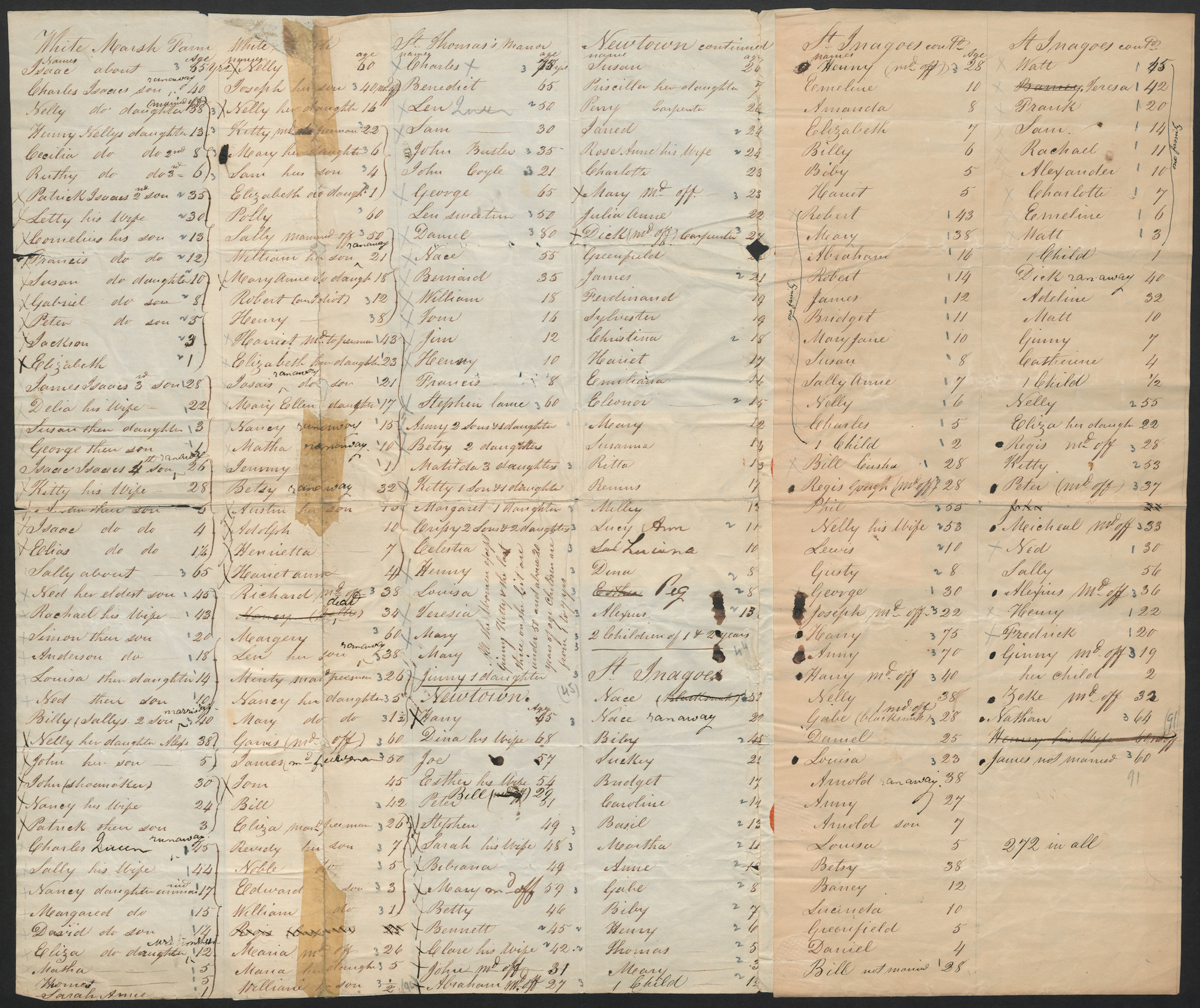
I had been researching the history of the White Marsh families for nearly a decade, uncovering the lawsuits they had brought against the Jesuits and other prominent Maryland slaveholders long before the 1838 sale. Some won their freedom. Others didn't—but each of their cases challenged the legitimacy of slavery in American law. Together they counted among the most significant freedom suits in U.S. history. And there were hundreds of others. Yet their particular stories would lead me, like the Georgetown Jesuits, to reckon with what I did not know about my own family and its role in this story.
More than a hundred descendants, a dozen university officials, and a cluster of Jesuit priests assembled inside Healy Hall for the liturgy and slowly processed into an ornate, wood-paneled auditorium on the third floor. After the opening prayer Sandra Green Thomas rose to address the congregation. Thomas, a descendant of the Harris and Ware families and president of the GU272 Descendants Association, waited a long moment before speaking. "My people were humble," she began. "They provided for their families. They tried to protect their children as best they could from the cruelties of this world, but given what the world is and what people can be, they were not always as successful as they would have hoped." The anguish and fortitude of her ancestors echoed in the firmness of her tone. "Their pain was unparalleled," she observed. "Their pain is still here. It burns in the soul of every person of African descent in the United States. It lives in people, some of whom have no knowledge of its origins but cope with the ever-present longing and lack it causes."1"Liturgy of Remembrance, Contrition, and Hope," Georgetown University, April 18, 2017. Notes and recording in possession of the author. A full recording is available at from Georgetown University at https://www.youtube.com/watch?v=tO4Xsz36kTU, with Sandra Green Thomas's remarks beginning at minute 29:33. Several major research projects have come to the fore around the Georgetown history. First, the Georgetown Slavery Archive (slaveryarchive.georgetown.edu, herein abbreviated GSA) is a repository of archival materials related to the Maryland Jesuits and Georgetown University. Second, the Georgetown Memory Project (www.georgetownmemoryproject.org) is an independent nonprofit dedicated to researching, finding, and advocating for the descendants of the 272. The project released its database of descendants in May 2019 with American Ancestors by the New England Historic Genealogical Society (see the GU272 Descendants, 1785–2000 database, www.americanancestors.org/search/databasesearch/2756/gu272-descendants-1785-2000). Third, historian Sharon Leon has undertaken a highly significant digital history-based analysis of the families on the Jesuit plantations. See Sharon Leon, The Jesuit Plantation Project: An Examination of the Enslaved Persons Owned (and Sold) by the Maryland Province Jesuits, 1717–1838 (https://jesuitplantationproject.org). I have also followed closely the Universities Studying Slavery working group at the University of Virginia since 2014 (slavery.virginia.edu/universities-studying-slavery) and other university reports, especially Stephen Mullen and Simon Newman, Slavery, Abolition and the University of Glasgow, Report and Recommendations of the University of Glasgow History of Slavery Steering Committee (September 2018), and Princeton Seminary and Slavery: A Report of the Historical Audit Committee (slavery.ptsem.edu/full-report). Also see Craig Steven Wilder, Ebony and Ivy: Race, Slavery, and the Troubled History of America's Universities, reprint ed. (New York: Bloomsbury, 2014).
I had met Thomas in New Orleans for the first time a few weeks before the ceremony. I had asked her then what slavery meant to her family, and she had said that slavery was quite simply one thing: theft. To understand American history required dealing with the fact that slavery was premised on a series of lies. The slaveholders, whether Jesuit priests or English tobacco planters, saw themselves differently, of course. We had talked about how they rationalized slavery on the basis of race, religion, law, science, and history and with myriad other prejudices, doctrines, sentiments, and myths.
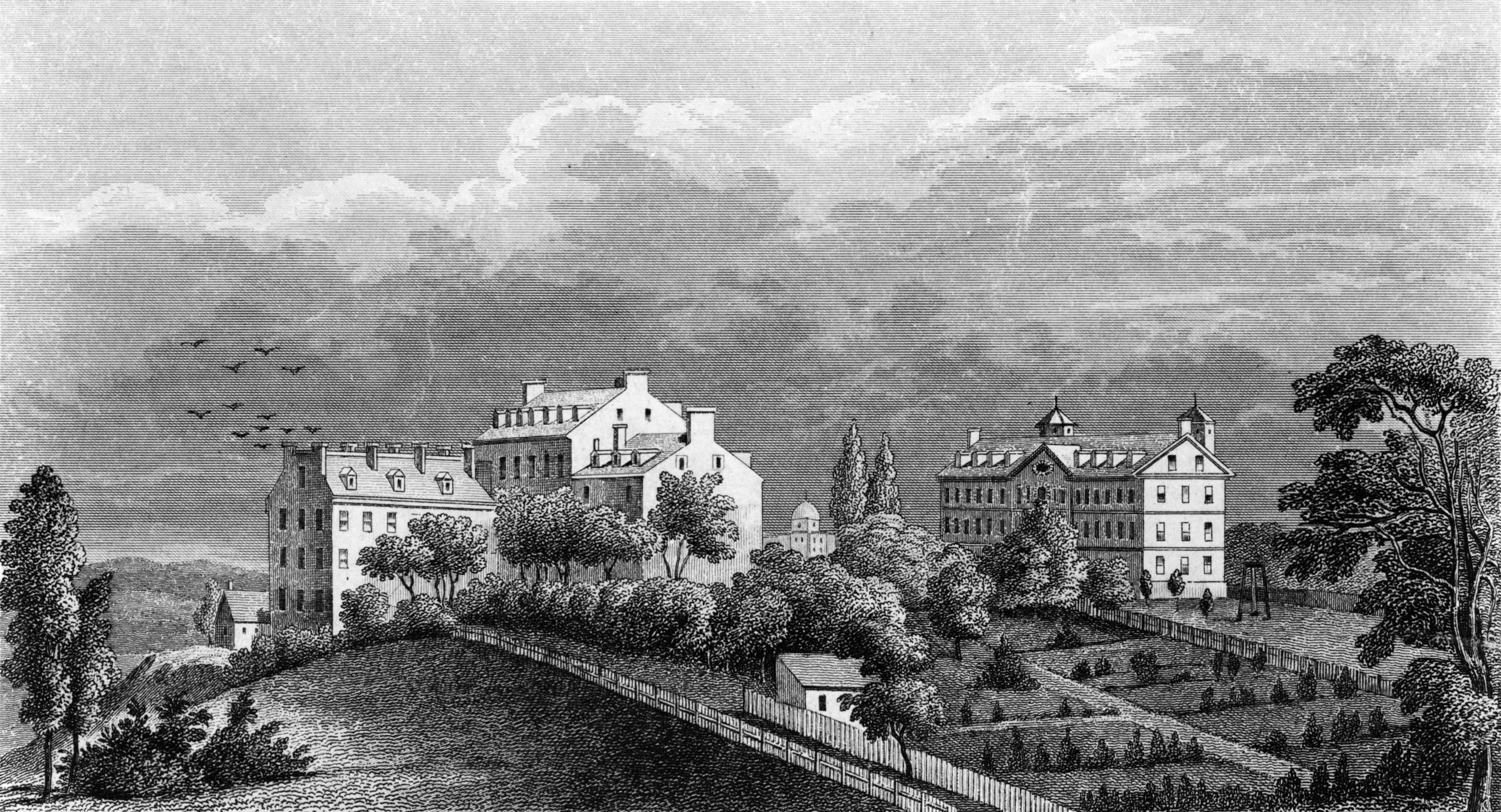
Now, I wondered how Thomas would broach the lies that slaveholders told and the theft that slavery was. She turned to the heart of the matter, and to the Jesuits whose predecessors had enslaved her ancestors. "I know it is difficult to honestly look at yourself, the way you operate in the world, and your true motivations and priorities." Americans face an uncomfortable truth, she noted. History demanded "self-revelation" about the stories we accept without questioning, about the narratives we use without thinking. She offered forgiveness to the Jesuits, but she sought justice. Thomas spoke for all of the descendants who thirsted for an acknowledgment of their family's particular enslavement, and after she finished thunderous applause erupted in the room.
An expectant hush fell across the auditorium as the Reverend Tim Kesicki, a Jesuit priest and president of the Jesuit Conference of Canada and the United States, rose to address the descendants. He wore a plain black business suit and Roman clerical collar. With an air of earnestness, he spoke slowly, like a pastor to his flock. The long shadow of enslavement, Kesicki said, "remains with us to this day, trapping us in an historic truth." The truth, he admitted, was that the Jesuits had "betrayed the very name of Jesus." Kesicki offered a sweeping apology, confessed the sin of enslavement, and sought "on bended knee" forgiveness for the Jesuits' entire participation in slavery.
But he did not kneel. The remarks, sincere and heartfelt as they were, seemed strangely inadequate. Kesicki wished to acknowledge the sins of the past but was unprepared to deal with the real trauma the Church had caused and offered no meaningful pathway forward. His apology and the request for forgiveness fell flat. Descendants turned their heads away.
In this uncomfortable moment, something more than a Jesuit failure came into view—Kesicki's words symbolized an American failure to deal with a hurtful history. He had not referred to a single descendant or ancestor by name; he had directed his apology to his "sisters and brothers." For hundreds of years the Jesuits had spoken to the enslaved families on similar occasions without addressing them individually, and here at Georgetown the particularity of their enslavement appeared again to be disregarded. Kesicki's apology, nonetheless, marked a subtle but decisive departure in the Jesuits' acknowledgment of their role in slavery. Even the most recent Jesuit histories had failed to fully acknowledge the Society of Jesus's complicity. Indeed, until Kesicki spoke, most attempts to come to terms with this history had downplayed the Jesuit slaveholders' actions: decisions explained, rationalized, and inspected, all pointing to something called "slavery" but not to the families they enslaved. The same vagueness could describe how Americans more generally regard slavery.2Robert Emmett Curran, Shaping American Catholicism: Maryland and New York, 1805–1915 (Washington, D.C.: Catholic University Press, 2012), 36–38. See also Edward F. Beckett, "Listening to Our History: Inculturation and Jesuit Slaveholding," Studies in the Spirituality of Jesuits 28, no. 5 (1996), which explains the Jesuits as paternalists: "To a certain extent, the plantation formed a kind of domestic parish to which slaves belonged" (11). Beckett concludes that Jesuits treated slaves "no worse than" other slaveholders, but following Curran, he emphasizes that the Jesuits encouraged slaves to gain skills. In the most recent and thorough review of Jesuit slaveholding in Maryland, Thomas Murphy, S.J., argues that the Jesuits understood themselves as paternalists and as superior, like all other enslavers in the early American republic. His account is the most balanced examination of the Jesuit role in slaveholding, yet his stance is similarly apologetic. As for their decision to sell supernumerary slaves, Murphy concludes that the Jesuits could not bring themselves to do so and instead sold the physically fit and "missed an opportunity to develop a morally strong case for making profits out of right motives." See Murphy, Jesuit Slaveholding in Maryland, 1717–1838 (New York: Routledge, 2001), 72.
But America's founding, like Georgetown University's, cannot be disentangled from its enslavement of particular families. Our national imagination still sees slavery as an aberration, a detour, from the true story of the country. Many Americans see enslaved people in history as faceless and nameless, victims of a long-ago system that has now disappeared. In such a situation, the nation needs to experience what we at the liturgy experienced: a confrontation, a reckoning, with real people, with real histories, with real families whose descendants live among us. Until such encounters happen more widely, Americans will continue to live in separate historical spheres of understanding, a condition that more than anything limits our ability to come to terms with the past. We cannot, of course, do anything to change what happened long ago, but we can change the way we understand what happened and what it means to us in the present.3A central aspect of the approach taken here is historical imagination. This asks readers to experience a world other than their own and to step outside of themselves into the characters in this history. Recent examples of narrative imagination include Imani Perry, Looking for Lorraine: The Radiant and Radical Life of Lorraine Hansberry (Boston: Beacon Press, 2018); Lisa Brooks, Our Beloved Kin: A New History of King Philip's War (New Haven: Yale University Press, 2018); and Saidiya Hartman, Wayward Lives, Beautiful Experiments: Intimate Histories of Social Upheaval (New York: W. W. Norton, 2019). Each is an inspiration in the form of its narrative and in its attention to re-creating the voices, situations, and daily experiences of people left out of the archive. See also Natalie Zemon Davis, The Return of Martin Guerre (Cambridge: Harvard University Press, 1983).
About the Author
William G. Thomas III is the John and Catherine Angle Chair in the Humanities and Professor of History at the University of Nebraska–Lincoln. He is on the Southern Spaces editorial board, and was co-founder and director of the Virginia Center for Digital History at the University of Virginia.
]]>Interview
Southern Spaces: How did you begin the project that became this remarkable documentary The Joneses?
John Howard: Jheri (at the time Jerry) Jones and I met forty years ago as coworkers—freight clerks and passenger ticket agents at the Greyhound bus station in Jackson, Mississippi. I was a high school senior. Jheri was a recently divorced father of four who was beginning to transition. Despite the fact that we now live four or five thousand miles apart, we have been friends ever since.
The documentary project spun out of my first book, Men Like That: A Southern Queer History, which began as an Emory dissertation, submitted in 1997. I had these really superb advisers: Mary Odem, Catherine Nickerson, and, of course, Allen Tullos was chair of my committee. Martin Duberman was an external member. Thanks to their incredibly helpful interventions, it was possible to turn that dissertation rather quickly into a University of Chicago Press monograph, Men Like That, that came out in 1999. Doug Mitchell was the key editor, a towering figure in queer publishing. After that, various ideas were floated about how to reach a broader public. Several people recommended verbatim theatre. There were some good examples of this. In 2005 University of Alabama Press published a revised edition of Ben Duncan's memoir The Same Language and I really liked playwright Carl Miller's adaptation for Menagerie Theatre Company in Cambridge (UK). Soon there would be the example of E. Patrick Johnson's very important work on black gay men in the South that he was performing as a one-man show. Johnson had experience in performance studies, and he was using his oral history narratives in that way, which I found very compelling.
I was even more interested in the suggestions to turn Men Like That into a documentary film. Around 2007 Ash Kotak, a friend and neighbor in central London, and I began to talk. I teach his 2000 stage play Hijra, which I think of as a queer/trans subaltern romcom. It's an extraordinary work that will be turned into a film. Ash was insistent that this be a character-led project. We had to forefront an individual who could provide queer, trans, and Mississippi history as part of that character's backstory. We considered several people. An early title was The Strange Career of Jon Hinson based upon a US congressman from Mississippi who twice was caught in compromising situations and queer spaces in the D.C. area, and yet was reelected to Congress for his conservative Republican values. Eventually, he was caught again and run out of office. We thought about Aaron Henry, the great leader of the NAACP in Mississippi, but, to be candid, his wife likely would have quashed any such project.
I told Ash about Jheri's SRS, then called sex reassignment surgery, now called gender confirmation surgery. I was the only friend or family member able to be there when she opted to have that procedure in Belgium. Even with the cost of flights and the initial recovery period in a hotel, it was cheaper to do so there than in the United States. Hearing her story, Ash insisted that Jheri had to be at the center of any documentary that spun out of Men Like That.
We made attempts to get initial funding, including the AHRC (the Arts and Humanities Research Council in the United Kingdom). They gave us the nicest, or worst, rejection: essentially, "this is superb; we have a few concerns around the edges. So be sure and reapply, and we'll give you the money." Well, life intervenes. And sadly, in my case, that involved being drafted into the headship of my department at King's College London. So I was not going to be as deeply involved as I had wanted to be, nor would Ash.
We approached Faction Films in London, where Caroline Spry, formerly with Channel 4, helped steer the project to completion. Among other tasks, Ash and I were asked to interview potential directors. It came down to two: an amazing South African, Oscar-nominated director named Murray Nossel, and a very soft-spoken Londoner named Moby Longinotto. Murray and I really got along in our interview, but I didn't like his initial ideas about how we might frame the project. He wanted a journey of discovery. He wanted me to travel back to Mississippi to ask Jheri for advice, which, for reasons that will become apparent, I don't ever do. That struck me as a bit contrived. All this is unfair to Murray, because this was a single interview and it was just an idea he threw out there. So I want to give a clear shout-out to Murray, I would love to work with him! But it was after viewing the films of both Murray and Moby Longinotto, and especially after seeing Moby's film, Small Town Boy, that Ash and I agreed wholeheartedly that Moby was the person for this project. So, he got busy and on a shoestring budget made a quarter-hour short by 2009.
Q: What was it about Small Town Boy that made you think Moby was suited for Jheri's story?
Howard: It's a beautiful, charming documentary about courage in Somerset, a small-town setting. It's about one brave boy and a group of people who put him out there as the alternative carnival queen, in drag. Moby was able to get extraordinary shots: the fifteen-year-old walks down the street and a fifty-year-old man almost assaults him. And there's great patience and quiet, controlled pacing that seems true to village life. Where, as a filmmaker, you go, stay, and get to know someone for an extended period. You wait for things to happen, and they do.
Q: Do you have any insight into the first meeting between Moby and Jheri and her family?
Howard: Moby hit it off with everyone. As was so apparent in his film No Time for Tea at Raj TV, Moby is adept, attentive, and respectful in cross-cultural settings, easily fitting into local patterns and rhythms. The Joneses soon became accustomed to his regular visits, initially on his own, doing the camera work, and over time with slightly larger teams.
Q: What were those visits like? Did Moby live in Mississippi for months at a time and stay with the family? Did he return over a period of years? How embedded was he?

Howard: He'd go initially for shortish visits. As budgets were slightly increased over time, he would go and stay longer. Stories emerged over years. Different plot lines seemed to come about quite naturally. And the family grew more trusting of Moby and the entire endeavor. More could be said and revealed. Early on, Jheri was talking about using a pseudonym, as we had done in Men Like That. That was going to prove impossible. So much happened over the years that they, all of them, came out in new ways.
Q: I'm struck by your comments that you were there with Jheri in Belgium during her gender confirmation surgery. That's not brought up in The Joneses. Do you know more about how that transpired and how she was able to make connections with care providers in Belgium?
Howard: I do. Jheri got online just before the turn of the millennium, asking trans people in various forums how to get the most affordable but safest surgery possible. She had been transitioning since the late seventies, with Dr. Ben Folk at the University Medical Center in Jackson who prescribed hormones. But she knew she was going have to go out of state for the surgical procedure. Increasingly it seemed it would be more affordable to go out of the country. So that's what she did. It was her first time outside the United States, aside from a cruise to Mexico. It was quite a gutsy thing to do. In The Joneses, Jheri explains how she had to save her money over a long period of time and get to Brussels. Because I live in London, I was able to go and spend several days with her, the only friend or family member who could afford it. An amazing moment happened there, and though I've told this story before, it's important to understanding the genesis of the film project.
Right after her procedure, as Jheri had requested, I rang her eighty-six-year-old mother back in Smith County, Mississippi. Reverting to my old southern accent, I said, "Miz Jones? This is John Howard. I'm calling long distance from Brussels, Belgium. I just wanted to let you know that the surgery was a success. Jheri's still unconscious, but doing fine."
"He is?" she asked.
"Yes, ma'am," I said with emphasis, "she's doing all right."
"Well," she hesitated, "that's good. Please tell her I love her."
That's the story that convinced Ash Kotak that Jheri and her family should be featured. The project held out hope for other reconciliations in fraught familial relationships that went back decades. It also seemed likely to reveal strongly held prejudices, as well as aspects of trans life as yet untold.
For example, around this time, there was a cultural outpouring of stories about sex reassignment surgery. In 2007 Dr. Marci Bowers of Trinidad, Colorado, was getting a lot of attention, and Channel 4 and a US partner made a six-episode series called "Sex Change Hospital" that aired on More4 in the UK and WeTV in the US. Dr. Bowers, by the way, was among the many Jheri consulted by email. It seemed trans media representations at that moment centered on surgery and on good-looking young people. We did not want to do that. We wanted to talk about the distinctive challenges of trans aging, assisted living, end of life care, the Deep South's religious challenges, and LGBT working-class issues more broadly—one of which remains crucially important around the world: employment discrimination.
Q: There are so many determining economic, social, and political pressures in the Joneses situation in Mississippi. How did they understand their economic precarity?
Howard: It's a great question. The documentary can only do so much. The difficulties in Mississippi and the misdeeds and mismanagement of the Mississippi legislature over decades requires a reckoning all its own. But several related things that emerge around structural, systemic oppression of LGBTI people involve intimidation, violence, and employment discrimination. There are scenes in The Joneses where Jheri and her son Trevor reference their experiences of bullying and intimidation in the public schools of Mississippi. Jheri many decades ago; Trevor a couple decades ago. Jheri worries about her grandchildren experiencing bullying if their schoolmates find out they have a trans grandmother.
Trevor was most resistant to the project, not only because of fears of his own coming out as a gay man, but also due to the potential for violent reprisals—worries that I still have around the everyday discrimination and potential violence they face not just in the trailer park, but elsewhere in Mississippi and when they travel. When Jheri tells about her varied job history, it's implicit that after she transitioned, she had to create a whole new job history. What you can't know from The Joneses is that she was hounded out of her job at the Greyhound bus station by some really vicious employees. She was fired from a job at a construction company because management discovered she was trans. She recently told me that she now finally has a job she can't be fired from, because she's a freelance bookkeeper, working mostly for her son Wade, which we do witness onscreen. She still has to work. Retirement is not an option.
To sustain this large family, two members of which are disabled, there's not enough income. There's reference to living at the poverty line. It was very important that the problems of employment discrimination, the precarity of their lives, be central to The Joneses. Much can only be suggested, but it looms over the entire project. This is a poor, working-class family struggling to get by. The nature of the household is forged by economic precarity. Back in 2004, Jheri suggested to Trevor and Brad that it was in their best interest to sell the small house that they had inherited from their mother and move into the trailer with her.
Q: Do you wish that there had been more explicit attention on the structural economic pressures in the documentary? More than is shown through the abandoned storefronts and empty streets of Pearl?
Howard: Yes, to be honest. I was pleased that early on viewers see Jheri preparing for work, and out she goes with her thermos to her car. She's driving to the Salvation Army, where she worked in payroll for a time. If we had tried to film at Salvation Army, she would've been fired. Nonetheless, we do get her narratives of the various kinds of jobs she's held through the years. She doesn't mention chicken farming, and there was other low-wage work that she's unable to speak about. We see Brad working around the home. He does the yardwork. He helps Jheri prepare to cook and cleans up afterward. He walks the pets and does almost all other domestic chores. I wish we could have gotten inside Trevor's workplace, but he works manual labor at a national chain and it seemed very risky.
John Marszalek III's excellent new book Coming Out of the Magnolia Closet shows with great force how employment discrimination informs all aspects of life for lesbian and gay Mississippians. What I've called quiet accommodationism—what his narrators describe as a need for discretion, their refusal to fly the rainbow flag—is borne of the need to keep their jobs and maintain their livelihoods, their tenuous hold on economic security. One narrator after another is fired, suspended, or denied promotion when the boss discovers their sexual orientation.
Q: Equally important in The Joneses are questions of religious belief and practice which the documentary puts into tension and contradiction. From fundamentalist punitive judgment and rejection to joining the inclusive Safe Harbor Jackson congregation. The Joneses are shown joining hands and praying at meals and seem to have adapted Christianity to suit their emotional needs.
Howard: I agree. I think this is one of the The Joneses great successes. I had confidence in Moby's ability to get inside these spaces. They make for some of the most compelling scenes and produce the most important arc in the documentary. We're dealing with a trans matriarch who has four sons, two of whom live with her and one of whom has two children. Jheri grew up in Primitive Baptist traditions, and she is not giving those up. She continues to attend Primitive Baptist churches. Moby manages to get inside one and captures the scene of a well-suited preacher beginning a sermon, stating that "God is love." That sermon rapidly degenerates into condemnations of "sins of the flesh," exhortations against the congregants' "own evil ways." Evil! Moby frames shots in which crocheted blankets are folded over the end of each pew. You get a sense of church ladies' work, their labor in trying to provide cold comfort to these hard pews. But their loving communal labor is in stark contrast to the fierce hellfire-and-brimstone rhetoric from the pulpit.
What we also learn is that Jheri's son Trevor had great trouble coming out as a gay man, even in a trans-headed household. Trevor's biological mother Doris converted to Jehovah's Witness and was rabidly anti-gay. That placed an enormous obstacle in Trevor's reckoning with his own sexuality and identity. In that White Sands Baptist Church cemetery, we have Trevor breaking down, telling his mother at her grave site, I'm gay and I'm not ashamed of it. I know you counseled otherwise, but I must live this way, with honesty. Then, near the end, Trevor and Brad formally join a congregation they had been attending, the LGBTQ+-affirming Safe Harbor Church. Once again, music plays a crucial role. A female pastor inducts them and asks the members of the church to take an oath to support these two new members. There's a powerful hymn, in stark contrast to the Primitive Baptist Church, about love growing and overflowing, with the entire congregation joining hands. It's a much more welcoming and affirming message than those Protestant hymns many of us know so well. Music plays a vital role as these two Joneses are welcomed into this unusual Mississippi church.
Q: Is The Joneses reaching audiences in Mississippi? Do you have a sense that the people who would benefit from this narrative and from having these lives depicted honestly, with the sort of struggles and joy that they have, are accessing the film?
Howard: How can queer youth and LGBTI people of all ages find media representations that feel true to their own experiences? Trevor spends several years in a trans-headed household; even so, it's difficult to come out. He told me that a particular character on a soap opera helped him think things through. The filming also helped him, because it was a process of affirmation and bringing the Jones family closer together.
As for audiences for The Joneses, Jheri was flown to New York and San Francisco for the East and West Coasts premieres; the trio that live in the trailer drove to premieres in Hot Springs, Arkansas, and New Orleans. They were able to participate in the project's dissemination. As of the beginning of 2020, The Joneses has not premiered in Mississippi. It has been shown in Alabama, and most importantly perhaps, it's now available on iTunes, Amazon, and so forth. Hopefully, interviews such as this one will make it more widely known.
As for the struggles of LGBTI youth in Mississippi and the kinds of barriers that trans and non-binary youth are breaking down, it's exciting. People are coming out at younger ages. They're feeling more empowered. There are straight-gay alliances in high schools, though in my hometown the principal actively opposed it, drawing national media scrutiny. Trans youth are doing something heroic and courageous. More power to them. What we thought we could show is how trans elders such as Jheri were the trailblazers.
Q: How were the musical choices made in the documentary? Rarely does it happen that a film crew goes to Mississippi and doesn't replay all the blues clichés. There is a little snippet of blues, but there is also composed acoustic music. And the soundtracks that Jheri has going in the background, and the church music.
Howard: We were paying attention. And while I was reluctant to be too assertive with Moby, it was around music that I was most willing to make suggestions. I would just express to him my worry that we would get the old, hackneyed, twangy blues guitar. The bent notes that are cliché to many of us who see a lot of "Southern" cultural productions. Even in the quarter-hour short in 2009, Moby was paying attention to the ambient music in the household: salsa, classical (at that time on Mississippi Public Radio. No more.), and disco—which is hugely important in Jheri's life and creates moments of affirmation. For me, that musical score is just about perfect. And it begins with composer Joel Pickard's opening number: acoustic guitar with cello underneath when the camera pans over family photo albums and helps viewers understand the chronology they're about to experience. It's extraordinarily powerful. Along with portrait photography and dance, the range of music is a cohesive factor in The Joneses. Interestingly, the one blues track, chosen carefully and used as background when Jheri is describing Mississippi history and the closed society is Tom Dickson's "Labor Blues." I found that an amazing choice, which I had no hand in.
Q: As I was watching The Joneses a second time, I caught myself picking up all sorts of queer cultural cues, especially visually, that are peppered throughout. The rainbow ensemble Jheri wears in her first appearance as she sings "Diamonds are a Girl's Best Friend." A shot of a coffee can tinman sculpture that hangs on a trailer porch recalls the friend of Dorothy and an apocryphal story of the Stonewall Riot origins. A shot of pink flamingos suggests John Waters and Divine. Jheri's dancing and kitchen calisthenics remind me of Little Edie in Grey Gardens. How much was Moby doing deliberately? How do you understand The Joneses in the context of queer cultural history?
Howard: It's highly self-aware and honors various traditions that you've picked up on. It bears multiple viewings. There are more things you can find, not only related to the South but to global capitals' mediation of "Southernness," especially Londoners, especially film and art school types. They know William Eggleston, and you'll notice in the early credits there's a visual citation of him. If not direct citations, there are evocations of photographers Eudora Welty and Zoe Strauss at whom I recommended that Moby take a look in advance of his first trip. And William Christenberry. Moby improves on one of the location stills I was asked to produce early on for promotional purposes, the ubiquitous roadside Golgothas. These are peppered throughout, including lingering as well as fast-paced shots of photo portraits that are on the walls in the Jones home. This works as a way of accessing psychological states and suggesting the back stories for them as individuals and collectively as a family. Moby was able to do so much largely within four walls by virtue of patience and years-long determination to carry the project to completion. He worked his way through the cultural minefield of cliché and hackneyed musical scores and visual representations that we've all worked to undo and deconstruct.
Also hovering over the film, not directly addressed, are the drag cultures that nurtured and sustained Jheri in her earliest days of transitioning. She performed on Jackson drag stages as Lady Gay Chanel in the 1970s and 1980s, specializing in Ethel Merman numbers, and I hope future work, as by the Invisible Histories Project, will have more to say about this. But again, this subject seemed relatively well covered in televisual media, as compared to working-class queer issues, economic struggle, and religious persecution. RuPaul came out of the Atlanta drag scene, and we now have eleven seasons and countless tie-ins and spin-offs that frequently reference distinctive Deep South pageant and performance cultures.
Q: Having dealt with so much across several years, there's an optimism that concludes The Joneses. In terms of the family, what's happened since?
Howard: The family came together, was made stronger, understood themselves better, and were better able to talk with each other. Roughly midway through The Joneses, Trevor tells Jheri, the problem is we never talked. We never talk things through. The production encouraged that and helped make it happen. There are comings out and reconciliations. And this is where the Joneses are now, the year that Jheri celebrated her eightieth birthday. She's still working, working out, and looking for love, arguably in all the wrong places. [Laughter] She's certainly looking for love. But she has to be careful as she discloses to some dates and to new boyfriends. She experiences a lot of rejection, she tells us. At least she no longer faces the "threat of murder," after her surgery.
Brad and Trent are in many ways in the same place physically, sharing that home with Jheri, working in the same jobs, but I think they feel closer to their family members and feel proud of having done this. Trevor's story is most astounding. You'll remember he was the one who was most resistant to being filmed, sending me an all-caps message on Jheri's email account very early in the process: essentially, "GO AWAY. WE DON'T WANT TO PARTICIPATE IN THIS PROJECT."
As we learn in the film, Trevor was forced to drop out of high school to give full-time care to his biological mother Doris, who was in the late stages of morbid obesity, nearing the end of her life. Very recently, Trevor studied for and obtained his GED, and he's considering training as a nurse. He has a boyfriend of two years. Recall that when he spoke on camera as early as 2009 he said he hadn't achieved at his age what he wanted, which left him feeling "worthless" and "inferior." He talked about wanting one person to love and live with. Now, this person is about fifteen miles away, and they spend time in one another's homes.
As for the grandchildren, Nick and Trinity: Because this was a years-long project with countless setbacks, Jheri's grandchildren became teenagers and began to ask questions. You have this extraordinary story of the grandchildren being told that their grandmother—how does Wade put it?—was "technically speaking their grandfather." That trans grandparent coming out to her grandchildren—being helped along with photo albums that visualize her backstory—with their own father, Wade, also explaining is a crucially important part of the story that we never could have imagined when we first began making the documentary.
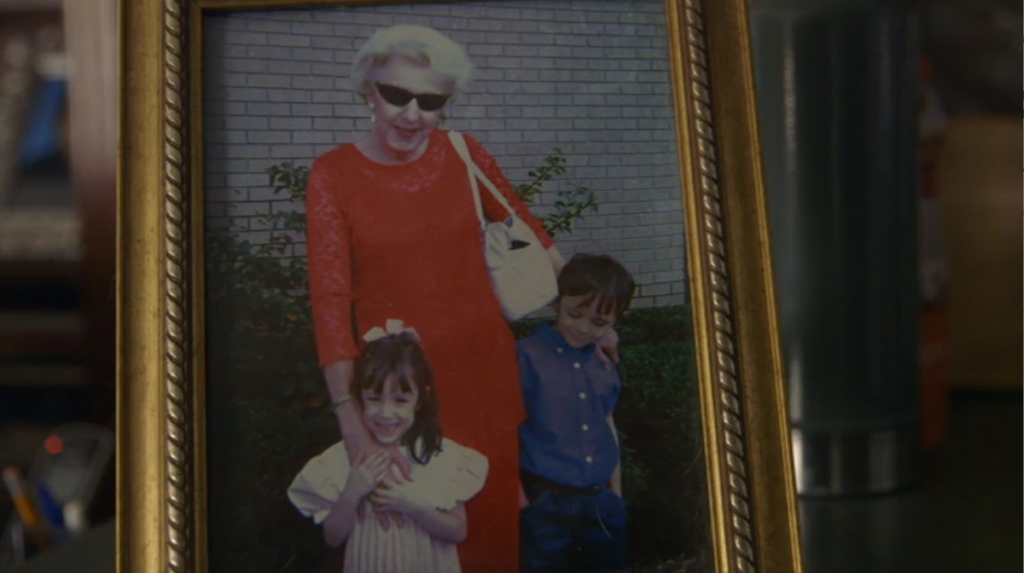
Nick has been in the Marines stationed in Virginia for the last two years and is considering re-enlistment. He regularly visits with his grandma. Nick coined this term "Grandmapa" in The Joneses that helped him reckon with her life history. Now she is known as his grandma, and they have a wonderful relationship. Trinity is very quiet throughout. Jheri interpreted that as affirmation, but now finds that she has a better relationship with Nick than with Trinity. Trinity graduated from high school and attends the local community college.
Q: In observational documentary you're dealing with who you see and who was around, and there isn't a lot of interracial interaction in The Joneses.
Howard: What you see represents the historic shift from de jure Jim Crow segregation to largely de facto segregation. However, there are positive signs. Pearl, Mississippi, was virtually an all-white town for most of the twentieth century, and when we began the project, the trailer park was almost all white. That changed into a multiracial environment. On one of his afternoon walks with Moby, where over time he reckons with his grandmother and is engaged in a kind of moral reflection, Nick references his "homies," his friends of color within the trailer park. Yet, viewers only get glimpses outside the walls of the mobile home.
The first worker seen in the film, other than one of the Joneses, is a black carpenter. Followed by a white mechanic, then the voice of a female African American caregiver at Trent's assisted living facility: "Where the hug at? Where's the hug at?" This becomes a trope from the opening title photo, taken probably twenty years ago, to the final stills, shot specifically for the project. Institutionalized for much of his life, Trent doesn't quite know how to hug. He doesn't know what to do with his arms when he's photographed. And that gesture for me is one of the most compelling, complicated reckonings with the difficulties of disability and care facilities, and how those phenomena are racialized and disproportionately visited on working-class people.
Perhaps most importantly, the one biracial, if not multiracial, gathering we see in The Joneses is the LGBTQ+-affirming congregation of Safe Harbor Church.
Q: Considering the different paths that brought filmmakers and viewers into this one home, what do you think Jheri hopes for The Joneses to accomplish? And how do you as the producer and Moby as the director perceive it doing activist work? It's so local, specific, and intimate, yet should have resonance far and wide.
Howard: Your question challenges us to think through explicitly activist productions with precise political aims compared with quieter, subtler films that begin as a day in the life and proceed to five plus years in the life. The Joneses resonates with different audiences. The Joneses short went to Brazil, Mexico, the United States, Canada, and Europe. Think about the captioning and the translation that happened, the recirculation of queer ideas and vocabularies. How does this very particular, very queer household in central Mississippi resonate with diverse audiences in other rural or small-town locales? I think the work of Mary Gray is very good on this, her book Out in the Country. Even the most transphobic early cultural productions on cable television can be reworked by latter-day trans-viewers to provide basic information and affirming representations. Jheri has been very explicit: I want to spread the word about trans-knowledge and trans-empowerment.
A group I briefly mentioned above is the Invisible Histories Project. They're an increasingly better funded network for generating new oral history narratives about LBGTI people in the South, as well as archival collecting and preservation. Something Invisible Histories wants to do that we weren't able to develop in The Joneses is explore Jheri's time as a drag performer in the 1970s in gay bars in Jackson, as part of that vital queer bar infrastructure largely made possible by owner-operator Jack Myers. By the way, Malcolm Ingram's stunning 2006 documentary Small Town Gay Bar, set in Mississippi, is an exemplary feature, in this regard.
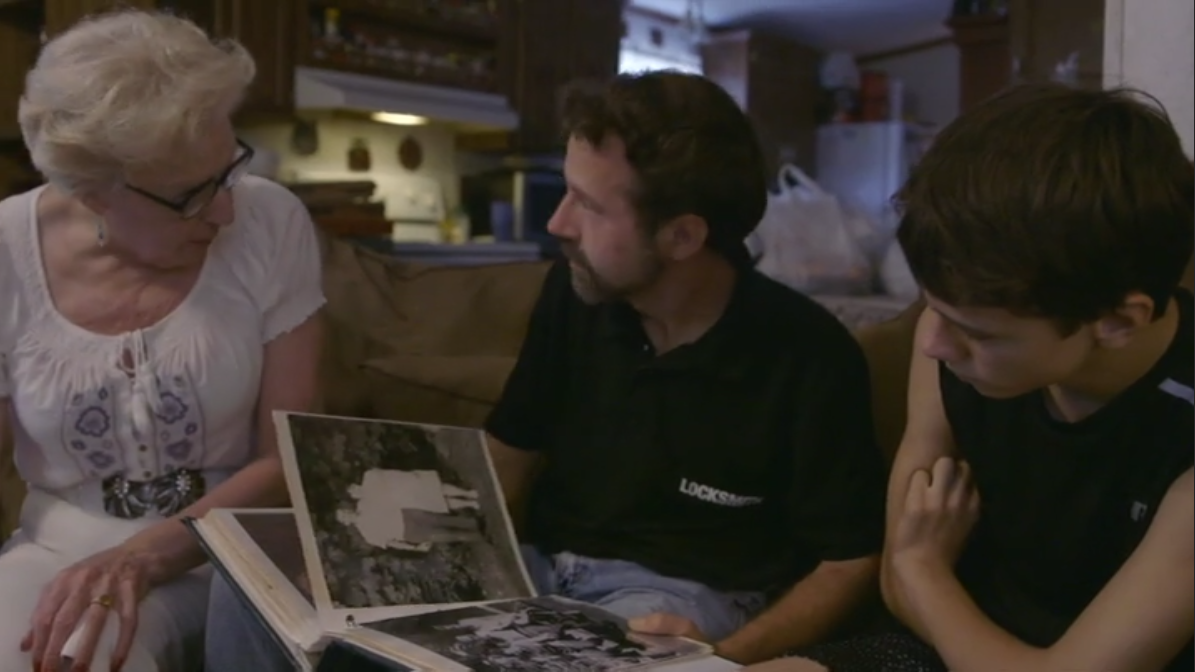
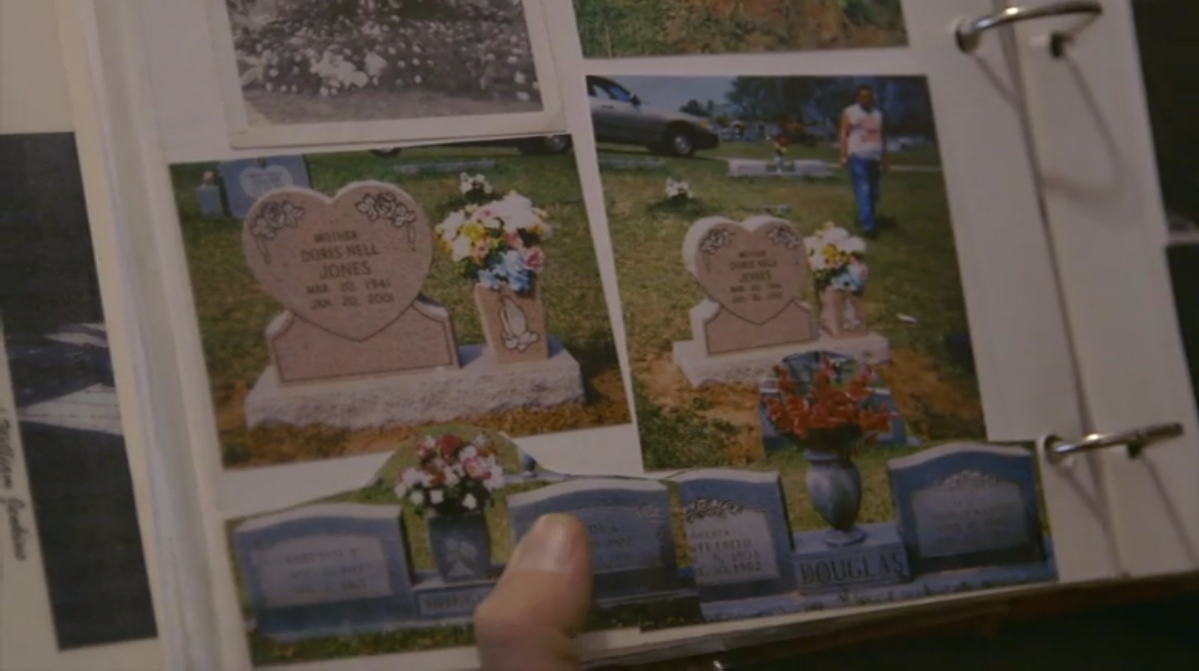
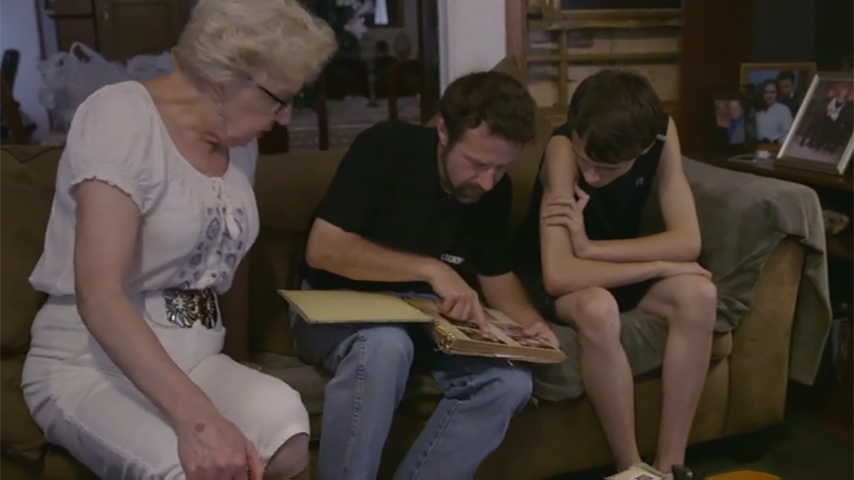
.svg)

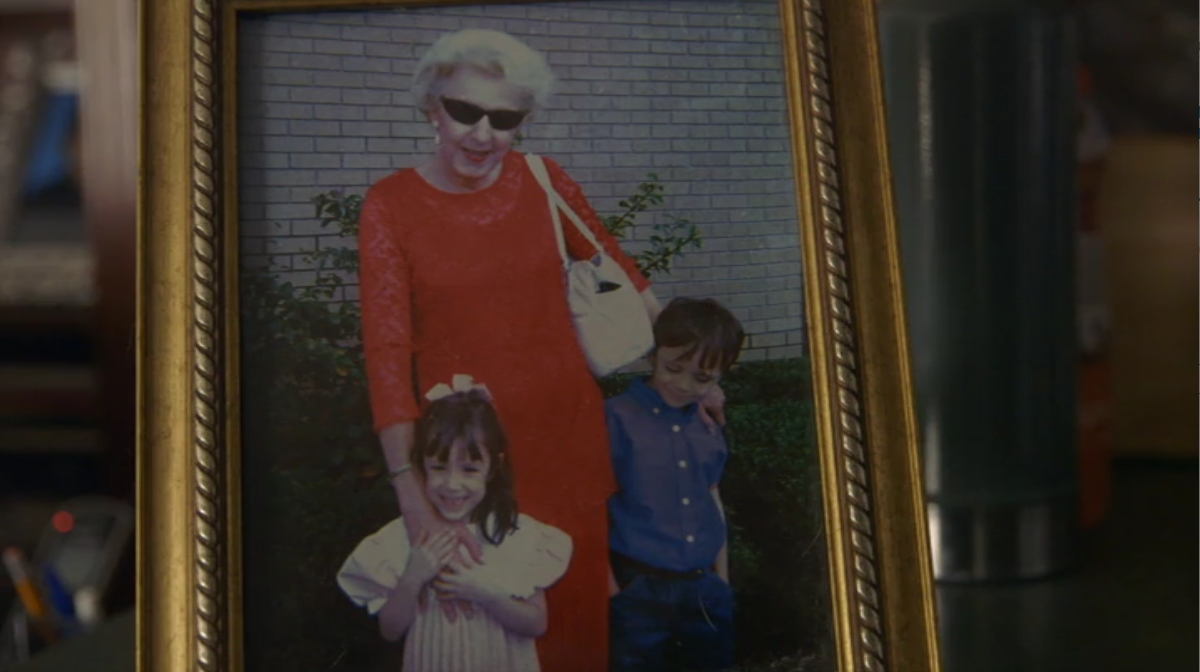
Invisible Histories also wants to safeguard the Jones family photo albums in climate-controlled archives so that primary documents of Jheri and her family members, letters, diaries, and the traditional stuff of academic historical writing can be maintained long-term. As well as the play script Jheri has written! This is a complex project around institutions historically hostile to LGBTI people. During one of my latest trips to the University of Mississippi, someone pointed out that there were raids on LGBT students, specifically on gay male students, having sex in various places on the campus as recently as the 1980s. So how to convince LGBTI individuals to part with their keepsakes, documents, artifacts and entrust them to institutions in states that until very recently had sodomy laws and continue to have discriminatory employment practices and "religious" exemption clauses based on sexual orientation and gender identity. That's going to require some painstaking work liaising between LBGTI individuals and groups and state universities, repositories, and museums, that are increasingly eager to collect this material. Notions of how and what we archive will have to change. The work involved in negotiating these relationships is fraught, but worth the effort.
Some of The Joneses' most important work suggests ways in which we can challenge well entrenched heteronormative, and now homonormative, constructs. How to think about family and flexible kinship networks in richer ways? At one point, Brad describes a dream he had. He's married; they have a child; and that child does not have the cognitive disabilities Brad does. He's also talking about something as seemingly mundane as teeth. You know, what if that child had "perfect teeth"? And for me, this is one of the subtle but, again, very important moments where you see the cruel juxtapositions of living in the poorest state in the richest nation on earth. Right? So you have these outsized consumerist expectations that are delivered to you via mass media. But then you have the hard realities on the ground that most people here cannot afford dentistry much less orthodontics. That was so powerful for me. Because I've known farm people, certainly of my mother's generation, who talk about the resentment they felt because their parents couldn't afford to get their teeth fixed and therefore they could not have that "winning smile." Again, a seemingly mundane phrase, but a phrase that speaks so much about American culture. You know, one must perpetually perform some aspect of American success ideology—whether it's a coming out narrative, a recovery testimony, or a religious conversion experience—and do so beautifully, working on one's attractiveness, which too is referenced in the workout routines in the film, the frequent trips to the gym, the way that one must not only be healthy but be attractive according to normative beauty standards. Brad speaks something quite profound in those moments.
I would have liked to have been consulted on the captions, because I think we missed some really interesting turns of phrase. Jerry uses the old temperance phrase "teetotal," which just gets transcribed as "total." An opportunity is missed in a word or a phrase. But on the whole, I'm astounded that the project was completed. I'm astounded that it's widely available. And all in all, I'm so proud of what Moby especially achieved with Ash, Caroline and, obviously foremost, the Joneses.
What finally are the documentary's activist impulses and key contributions? They concern endurance, perseverance, resilience, and hope. When you face elevated risks of bullying—a weasel word that really means verbal intimidation, sustained harassment, and physical assaults—when you are daily confronted with increased risk of violence, when as a trans person you're much more likely to be murdered, and yet you endure. You live, survive, even thrive, despite poverty, into your eighties. Each day in the life is an enormous victory.
Another narrative that ended up on the cutting room floor: In the vacant lot directly across from the family's trailer, a young gay neighbor, no doubt harassed by locals, took a gun and killed himself. As I watch The Joneses, this looms with ominous force, as Nick takes those reflective afternoon strolls, as Brad walks the dog. It's an unspoken haunting.
Given all those intense pressures and
threats, given the violence of homophobia and transphobia, given the much
higher suicide rates for LGBT people, maybe, just maybe, when young viewers witness
Jheri, Trevor, and Brad persevering in Mississippi, they will decide that they
too can persevere. In this way, the Joneses give hope and inspiration, the crucial
prerequisites of any activist endeavor.
About the Interviewers and Interviewee
John Howard is Emeritus Professor of Arts and Humanities, King's College London.
Allen Tullos is the senior editor of Southern Spaces, co-director of the Emory Center for Digital Scholarship, and a professor in the Department of History at Emory University.
Eric Solomon earned his doctorate in English from Emory University and is a visiting assistant professor of English and American Studies at Oxford College, Emory University. His work is featured in Southern Spaces, south, PopMatters, and Mississippi Quarterly.
Sophia Leonard is a PhD candidate in the Department of English at Emory University.
]]>Introduction
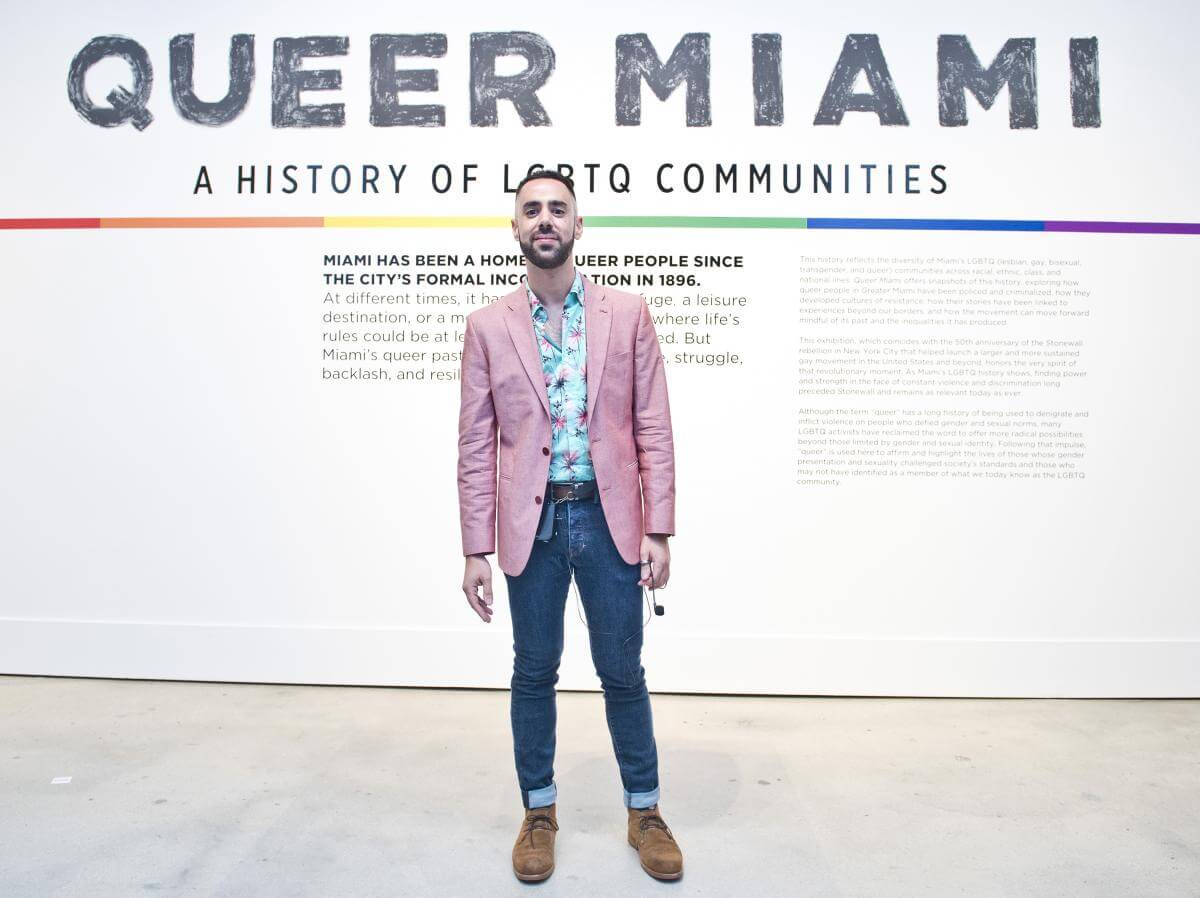
Julio Capó Jr. is a proud Miamian, and much of his work reflects detailed attention to the history of LGBTQ Miami. After seven years at the University of Massachusetts Amherst, Capó returned to his native Miami in the fall of 2019 as an associate professor in the Department of History and the Wolfsonian Public Humanities Laboratory at Florida International University. His first book, Welcome to Fairyland: Queer Miami Before 1940, explores John Sewell's 1933 notion of Florida as "a playground for the Nation" specifically through his deployment of "queer as an analytical tool" with "which to understand contested meanings of nation, race, belonging, and citizenship" in Greater Miami from the 1890s until 1940.1See Julio Capó Jr., Welcome to Fairyland: Queer Miami Before 1940 (Chapel Hill: UNC Press, 2017), 24, 5, 8. Capó explores how influential powerbrokers and everyday people contributed to the process of transforming "Miami into an 'exotic' tropical fairyland linked to the Caribbean and available for purchase."2Capó, 1. "Miami," he writes, "is geographically situated in the U.S. South and tucked in the northern section of the Caribbean Basin."3Capó, 7. Capó's Welcome to Fairyland interprets Miami as "linked to the Caribbean" and as part of a larger US landscape in a historiographical tradition of employing "a transnational lens in the recovery of queer voices, lives, and experiences."4Capó, 7. Queerness is the central analytical tool through which Capó explores Greater Miami. In his history, Capó traces Miami from its early days as a "queer frontier" to how it sustained a reputation as "a site where one could transgress gender and sexual norms."5Capó, 4. The 1950s saw Miami's queer landscape radically change once more, with the 1959 Cuban Revolution and other Cold War era political and cultural shifts. Many bemoaned the fear of losing "Miami after Dark."6Capó, 287.
In this and other ways, Welcome to Fairyland expands the terrain of queer history and southern studies. While it focuses on a seriously understudied period before cogent sexual identities had fully crystallized, the study has important implications for later queer histories with which readers may be more familiar. This includes mid to late twentieth-century narratives of state attacks in the form of the 1956–1966 Florida Johns Committee and Anita Bryant's 1977 Save Our Children campaign. Capó reveals the importance of casting further back to trace organizing strategies Miamians have utilized and how they may serve a more inclusive and socially just present and future.
Capó's curation of the exhibition Queer Miami: A History of LGBTQ Communities with the HistoryMiami Museum (March 15, 2019–September 1, 2019) examines how queer people "carved out spaces for themselves in southern Florida" across the twentieth century. For this interview, I asked Capó about Welcome to Fairyland, the HistoryMiami Museum exhibition, his plans for the future, and his thoughts on the state of queer history.
Welcome to Fairyland: Queer Miami Before 1940
SOLOMON: How did you come to write Welcome to Fairyland? What personal pathways led you to this project? Are there other histories or historians that motivated and inspired you?
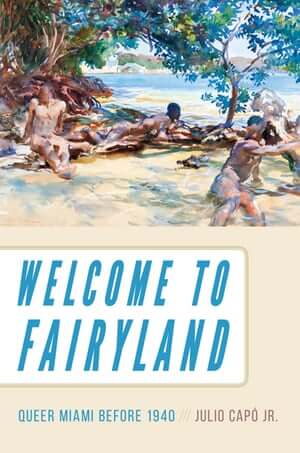
Capó: First, let me thank you for the opportunity to share my work and thoughts with you and your readers. I am most grateful. Welcome to Fairyland developed organically and with quite a bit of urgency as I continued to think historically about questions at the intersection of sexual, racial, class, and gender injustice that take many different forms today. I began revising my dissertation, which was a history of LGBTQ Miami in the post-World War II era that paid particular attention to immigrant populations and experiences. I grew frustrated by assumptions I had to make about what pre-1940 Miami looked like. For starters, there were relatively few queer community studies of the early twentieth century, especially for locations in the US South. Miami's history differed greatly from cities we know much more about, such as New York, San Francisco, and Chicago. Never taken too seriously by most scholars, Miami remains a deeply understudied city. As election polls and media reports often suggest, it remains misunderstood by political strategists and advisers. While many people are quick to point the finger at Florida (and cities like Miami) when the votes are counted (or not counted), they are often given few opportunities to better understand its complicated past.
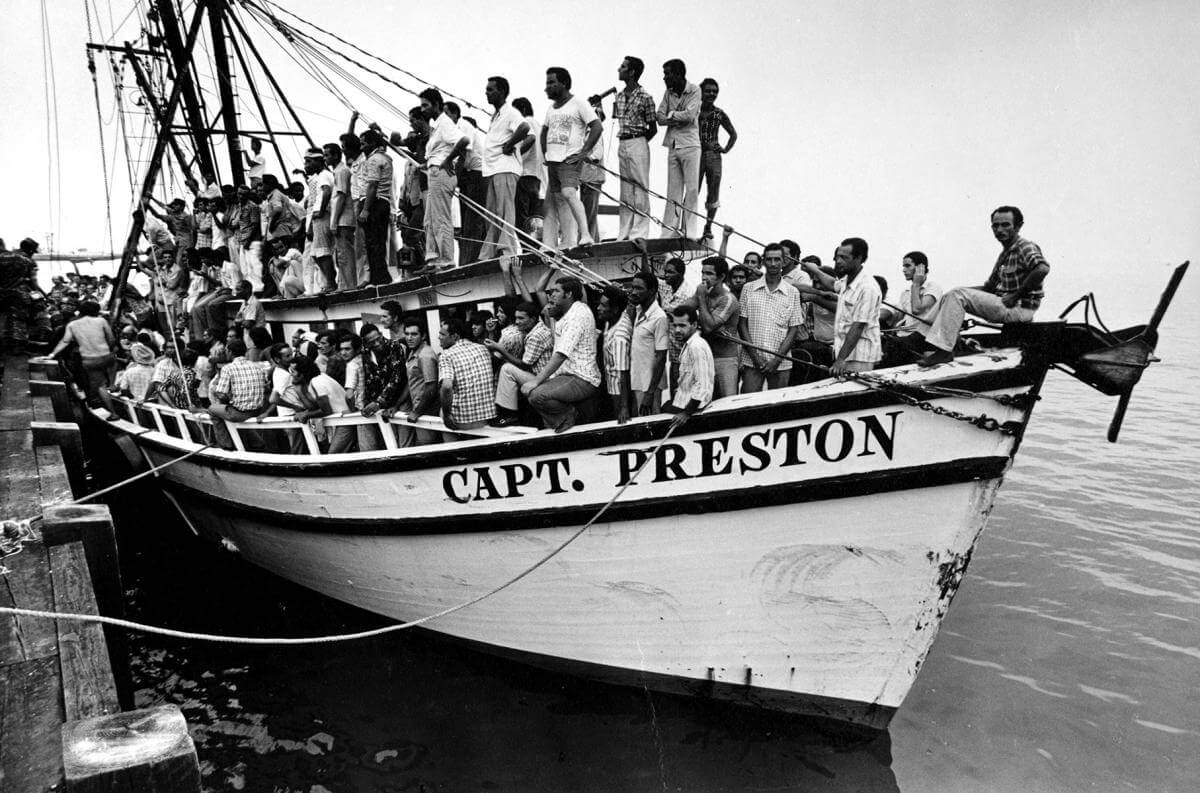
As a historian, I've always believed the past offers us the possibility of instruction and inspiration. It is generative in that we understand the social, political, economic, and cultural architecture on which today's city stands. So, in a nutshell, I went back to the archives hoping to write one concise chapter on queer Miami before the 1940s. My first major find appeared in the criminal records that, once I paired that data with immigration records and colonial records from the Bahamas, taught me that Bahamian male migrant workers were disproportionately arrested for crimes such as sodomy in the city's early days. I realized that this was not a mere chapter in my book. This was very much its own story that deserved all my attention. This was the book I needed to write. And it challenged me to think differently about the research I had already conducted on the mid and late twentieth century.
Solomon: What personal pathways led you to this project?
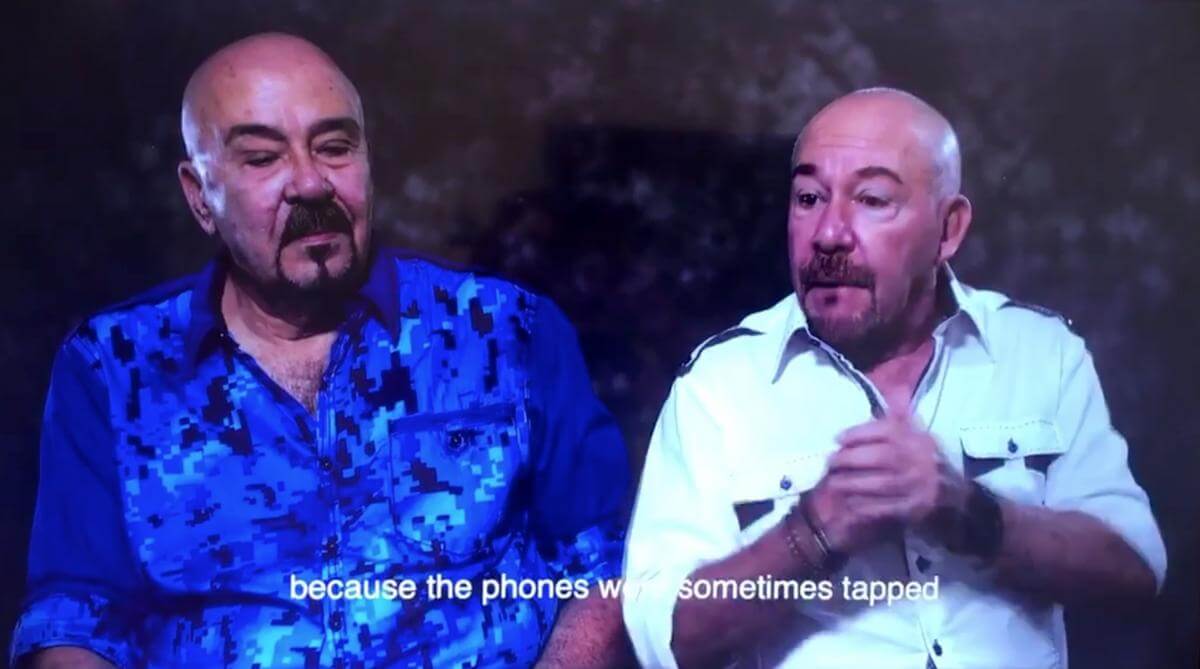
Capó: My goodness! It's an embarrassment of riches in terms of inspirations for writing Welcome to Fairyland. I have already suggested how social and political injustice inspired me to ask questions that proved most productive in my research. But I also believed that to understand Miami's transnational history, the city's queer past needed to be in direct conversation with arguments and debates that have also taken shape in the fields of gender, Black, southern, Caribbean, immigration, Latinx, and labor and class history. I thought a lot about how scholars such as Cathy Cohen, José Esteban Muñoz, Siobhan Somerville, and Martin Manalansan, among many others, have treated queer as an analytic. I drew inspiration from how Eithne Luibhéid, Marc Stein, Margot Canaday, Amy Sueyoshi, and Nayan Shah have discussed the state's surveillance of immigrant bodies both at the US borders and within them. I found thoughtful transnational approaches in the works of Lara Putnam, Ana Raquel Minian, Andrew Sandoval-Strausz, and so many others. I wanted to contribute to the growing scholarship of Miami's ethnoracial demographics, Caribbean influences, and long history of class warfare that scholars such as N. D. B. Connolly, María Cristina García, and Melanie Shell-Weiss have laid out. And I wanted to expand the parameters and scope of the LGBTQ community study, with its emphasis on space and place, that George Chauncey, Nan Alamilla Boyd, John Howard, among so many others, have set forth. This barely scratches the surface, but I hope it gives a sense of what I was thinking, more broadly, as I approached the archives, the evidence, and the literature as I wrote Welcome to Fairyland.
Solomon: In his 1997 oral history, James T. Sears mentions Florida as the "Mississippi of the homosexual" in the immediate decades following when Welcome to Fairyland ends.7James T. Sears, "The Mississippi of the Homosexual and the Politics of Dialectics," in Lonely Hunters: An Oral History of Lesbian and Gay Southern Life, 1948–1968 (Boulder, CO: Westview Press, 1997). Sears's rhetorical move has always resonated with me, and I mention and challenge it in my first project. I'm from Mississippi, but I've written about Florida extensively. You're from Florida, and Welcome to Fairyland is set in your native Greater Miami. Yet, your study stops before the years (1948–1968) Sears is referencing. How important was it for you to illustrate in detail the development of queer spaces in Miami in terms of your temporal framing?
Capó: Wow, there's a lot to unpack here. Thanks for this important provocation. You know, even though Welcome to Fairyland ends in 1940, as the book's epilogue may suggest, I know quite well what happens in Miami after the 1940s. I wrote a dissertation and have curated an exhibition about that very history. I wanted to understand its origins. At least at the surface, people may be more familiar with the recent history. They have recollections of anti-gay violence spurred on by the Johns Committee, Anita Bryant, the Mariel Boatlift, and more. As I unpack in Welcome to Fairyland, this past is often really violent. It is also, however, a story of queer resistance and resilience.
More directly, what does such a loaded statement mean: Florida was the "Mississippi of the homosexual." Because its framing seeks to make a clear parallel to ground zero for Black civil rights at midcentury, the statement also inherently asks us to separate race and sexuality and imagine anti-Black violence—as well as anti-gay violence—as somehow separate and as possibly contained to a particular geography. One of the events I examine thoroughly in my book, for example, involves the 1937 raid of a Miami gay bar named La Paloma that was conducted by nearly two hundred members of the Ku Klux Klan.
Queer histories have historically been rooted and entangled with—in nuanced and checkered ways—anti-Black violence.
I'm more inclined to think of it this way: Florida was the "Florida" of Blacks and people of color; much of the same anti-Blackness and colonialism created the very conditions for Florida to become the "Florida" of the homosexual. I wonder how scholars such as John Howard would respond to this, as his book Men Like That encouraged us to question our assumptions about the US South, its relationship to gender and sexual liberation and racial politics, and even our perception that liberation was somehow more attainable in urban, rather than rural, spaces, or perhaps even the "North" rather than the "South."
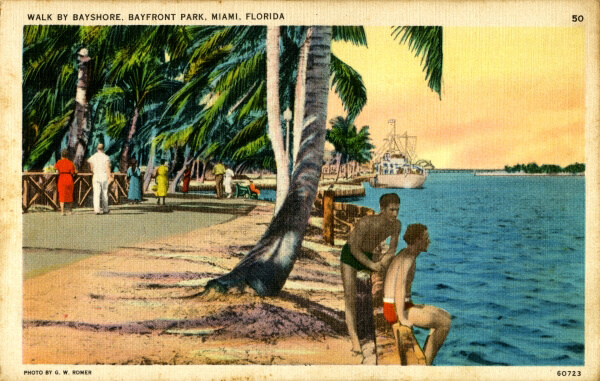
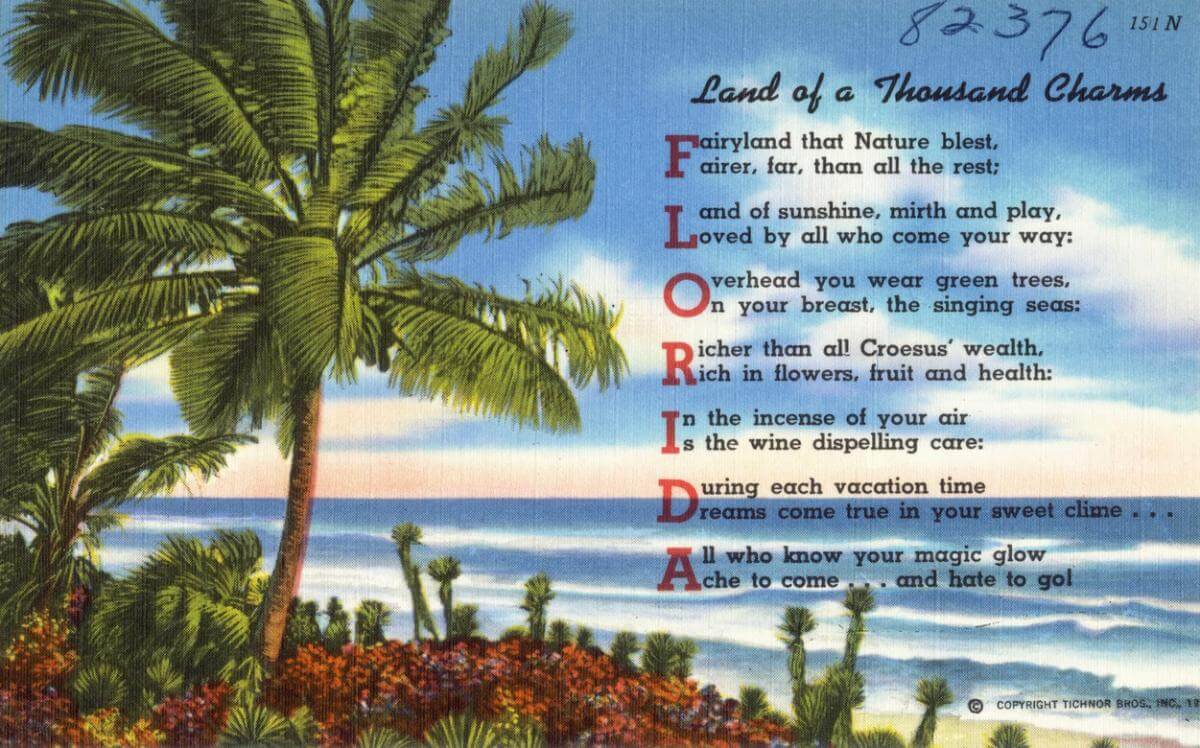
I'm thinking here about the uses and misuses of teleological arguments, but Sears' provocation is a great jumping point for our exploration of temporality and liminal spaces within "the past." Like your reference to growing up in Mississippi, I was born and raised in Miami and, in writing Welcome to Fairyland, I was struck by how much of the history I uncovered in my research had been lost to us. In other instances, I found that this history wasn't exactly lost, but rather made incoherent and illegible. Viewing the watercolors John Singer Sargent produced in early Miami takes on radically new meaning when we pair it with the city's criminal records, or immigration logs, for example. Watching Marilyn Monroe in the 1959 film Some Like it Hot, once you have studied the history of Prohibition at the Miami-Caribbean borderlands, suggests that contemporaries seeing it for the first time might have understood the critical relationship that politics had in sustaining and creating queer communities and culture. Although many of our pasts have indeed been institutionally erased, others have simply lost their meaning over time and are hidden in plain sight but very much alive in meaningful and impactful ways. No one may call Miami "fairyland" anymore; but that moniker's association with doubt can still be found in the area's ongoing efforts to draw in outsiders.
Solomon: Welcome to Fairyland deploys "queer as an analytical tool" and "interprets queer history by maintaining a transnational perspective and by providing an intersectional analysis that factors in how gender and sexuality influenced constructions of class, race, ethnicity, age, and (dis)ability."8Capó, 5. Queer. Transnational. Intersectional. How do you understand the connections between these three terms for your work?
Capó: I think the analytics of queer, transnational, and intersectional are doing a lot of the same work in the book, but in distinct ways. In general they all exist, and I'll shamelessly look to Gloria Anzaldúa for inspiration in Borderlands/La Frontera: The New Mestiza, defying static, singular, fixed positions or statuses. The queer has us move beyond the binary and think expansively about subversion and transgression as it is measured against the normative. A transnational perspective rejects the nation-state and the neat categories it seeks to produce as the dominant form of power and structure. An intersectional approach dictates how different modes of power can simultaneously coexist and that forms of oppression are indeed interlocking and impossible to separate. They are all in flux, fluid, and subject to change. For me, these are the ingredients to doing this history and important and necessary approach for measuring change over time and place.
Solomon: For those seeking to develop research projects or thinking of doing queer history, can you describe the journey of Welcome to Fairyland? How long did the book take you to write? Is the finished project what you thought it would be when you started?
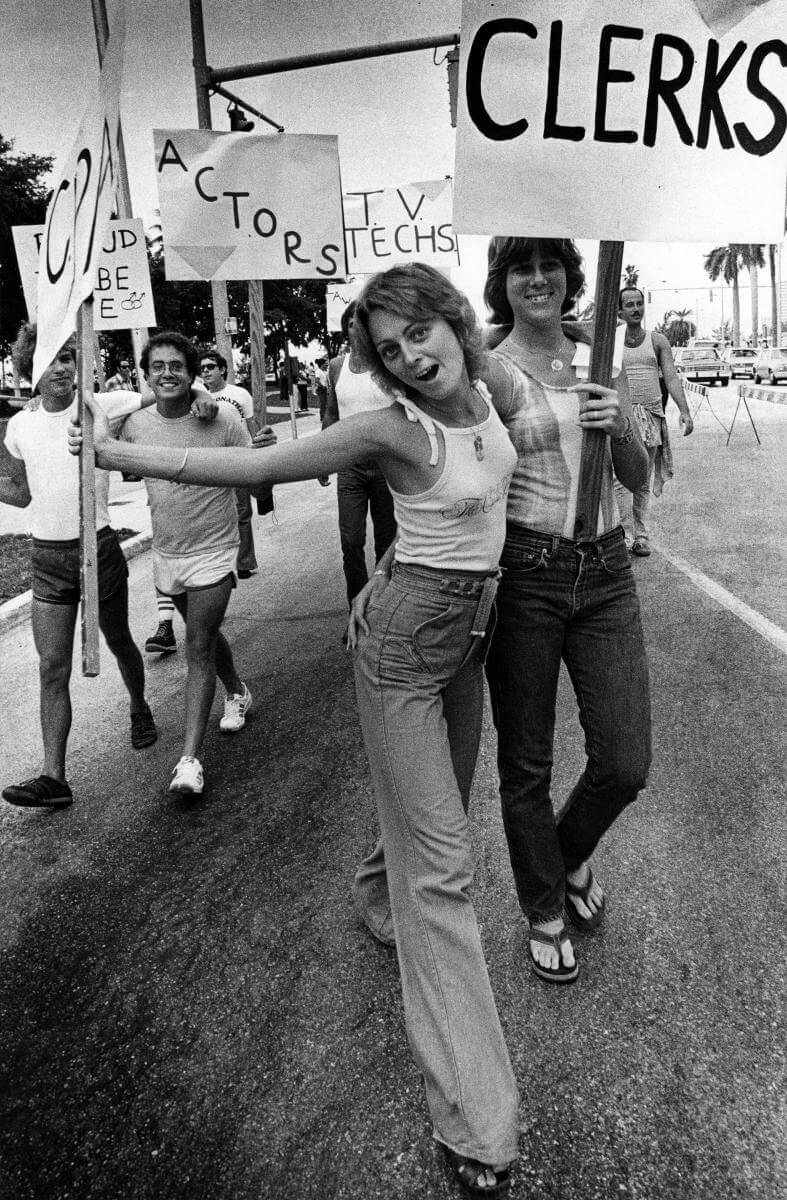
Capó: I've addressed aspects of this already, so I'll just add a few more thoughts. I think I'm a pretty disciplined writer. I'm a former journalist (still contributing to journalism, but now as a trained historian) who understands the importance of deadlines, the mythologies surrounding things such as writer's block, and the necessity of carving out time for writing every day. From concept to page proofs the book took about five years, as I began it during my postdoc. I am really proud of the final product. Once I had processed all the evidence, I realized I had a lot of things I wanted and needed to say. I've always been hyperaware that this history is meaningful, and in very different ways, to many different people—past and present. I'm sure some may not fully appreciate my treatment of the evidence and material, but a work now exists that acknowledges this history as significant and as critical to multiple histories.
I can't really say Welcome to Fairyland was the book I initially sought to write because this book came to fruition as I worked to revise a separate project from discoveries in the archives and from my efforts to respond to gaps in our knowledge. It speaks to the issues I thought—and still think—need much more attention.
Queer Miami: A History of LGBTQ Communities: Miami Across the Twentieth Century
Solomon: You write about the silences within and erasures of the queer archives, drawing from Martin F. Manalansan's understanding of "disarrangements." You also mention your own collecting of historic ephemera as a practice that directly informs your work. What are the roles of historians and nonacademic collectors in preserving queer history?
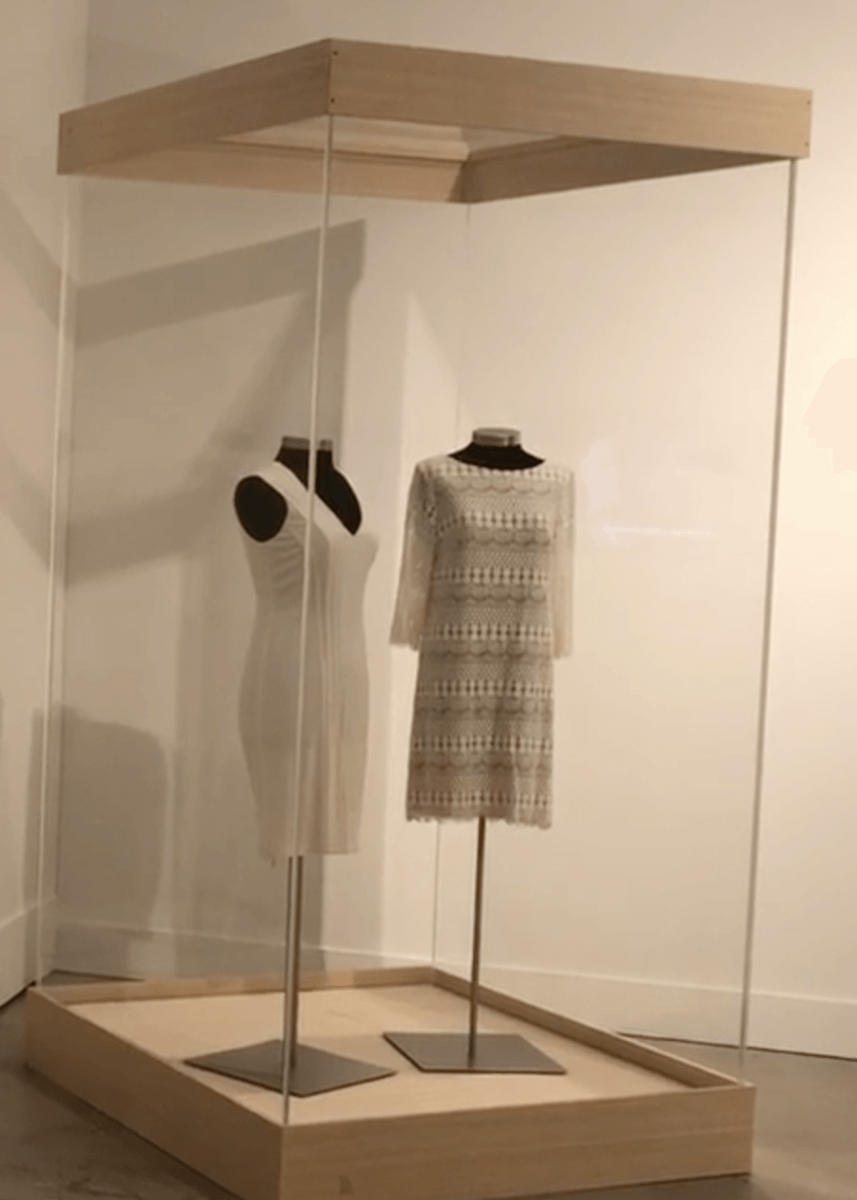
Capó: There's so much one can say about this, but I'll try to keep it somewhat brief. I think preservation is a key part of activist work. Much of the field of queer history stems from tireless community-based efforts to collect and preserve our past and make it known. Certainly, for the years I address in Welcome to Fairyland, our histories were never meant to be preserved. Those in power sought to erase us. They still do. We have to fight back, but we also have to think harder about how to respectfully recover the voices of those most marginalized within these marginalized groups. And we have to think harder about what constitutes an archive, a legitimate source or evidence, and the places where we can find them.
Many of the sources in Welcome to Fairyland, and perhaps a third of the material objects featured in the exhibition I curated in Miami, are from my personal collection. I have collected t-shirts, piggybanks, postcards, dolls, photographs, letters, rare books, and so many more items—over nearly fifteen years. I've been able to find and acquire some objects through search engines and simple keywords, such as "gay Miami." I think I've been able to piece together something else entirely, though, through my reading and rereading of Miami's past. Things that may not have appeared inherently "queer" at first can be given new meaning in context. I also think I've earned the trust and support of many members of Miami's LGBTQ community, who feel equally invested in recovering this past and having it told and preserved. I am from Miami and I'm openly gay. Over a decade ago now, I worked as an intern at the Stonewall National Museum and Archives in Fort Lauderdale, where I helped catalog some of its unprocessed materials it housed there, especially its Anita Bryant collection. What I want to stress is that this work takes time and dedication. It is, indeed, a community effort.
Solomon: In terms of the Queer Miami exhibition: can you describe your process of curating? How much of your research from Welcome to Fairyland informed or served as foundation for the exhibition? How did your collaboration with the HistoryMiami Museum come about?
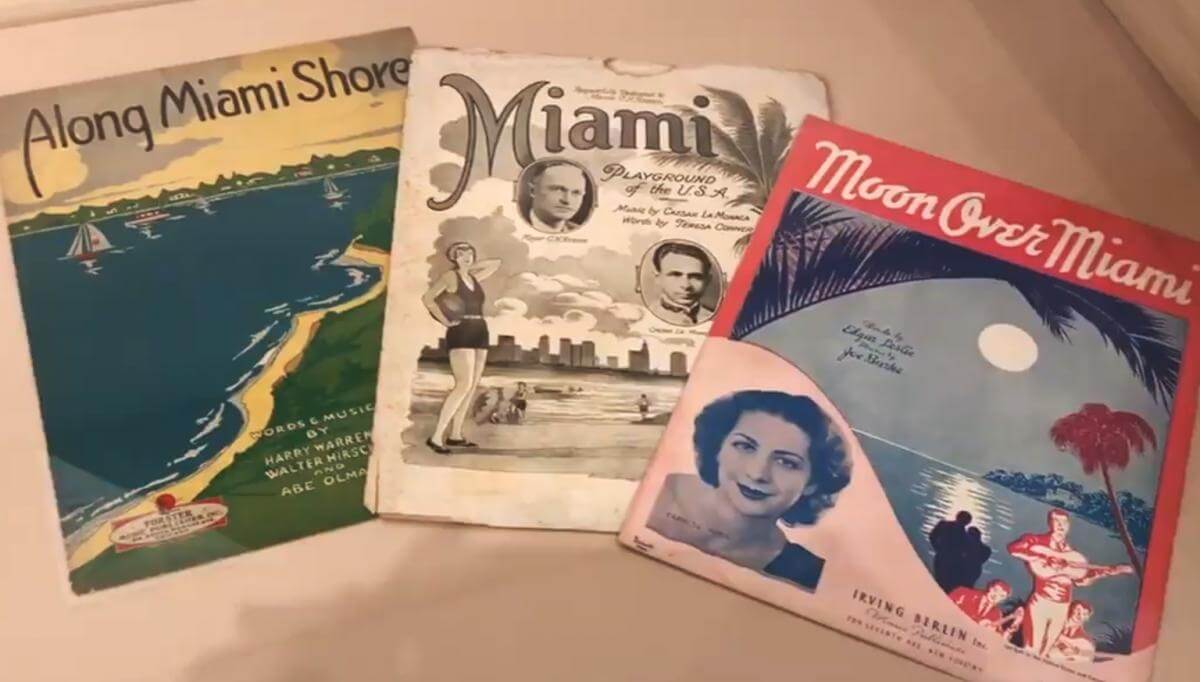
Capó: The exhibition covers a bit before the 1890s to the present. That's over a century of material. I had never curated anything before, so I did my homework! I read a lot about the curatorial process, consulted with colleagues and friends, and visited as many exhibitions as I could with a very different eye: as a curator-to-be. This was such a productive and challenging experience for me. I absolutely loved it. I learned so much and have connected with so many members of the community.
Much of the narrative of Queer Miami took shape from threads of Welcome to Fairyland and my dissertation on the post-1945 era, but there are many differences. Unlike a book or an academic article, I had to tell an engaging narrative through objects or other visuals. That's often difficult, especially for the earlier period. We reproduced some ordinances, portraits, paintings, and the like for the early 1910s, but it's very difficult to explain what constituted queerness in Miami when these terms, meanings, and identities were very much in flux and often inchoate; the state also never intended to preserve this history, of course. I did not want this to exclusively be a narrative of criminalization or of surveillance of queer folks, immigrants, the poor, or people of color. I wanted to recover people's voices—as well as their moments of leisure and community-building—whenever possible.
While telling Miami's queer past through objects often proved challenging, an exhibition of this size (five thousand square feet), breadth, and scope permitted me to do a lot of different things. For example, we recovered police footage of gay bar raids (and one at someone's home) from the late 1950s. We recreated a bar counter from that era where people could sit down and watch looped footage of those raids. Altogether, it presents some really powerful testimony. Audiences can see the violence of the state. You see the whiteness of these spaces. Many queer people of color held or attended private parties instead, knowing far too well the risks for them were much greater. You see people fighting back, too. One man throws his drink at the cameraperson, for example. When we think of resistance, we often think of Stonewall-like narratives. That queer people in Miami continued to congregate in and create gay spaces at all—in spite of violence and surveillance—is a testament to their resilience and their efforts to dismantle unjust practices and abuses.
It's productive to challenge ourselves by expanding and redefining our audiences, venues, and methods. I had a similar experience a few years ago when thinking about some of this very same material, but in terms of space and place as part of a study the National Park Service commissioned on LGBTQ historic sites. I contributed a chapter on Miami that narrated existing (surviving) physical sites. This work challenged me to think very differently about material I had been analyzing for years.
Solomon: Can you tell us a little bit about how the Queer Miami exhibit was organized?
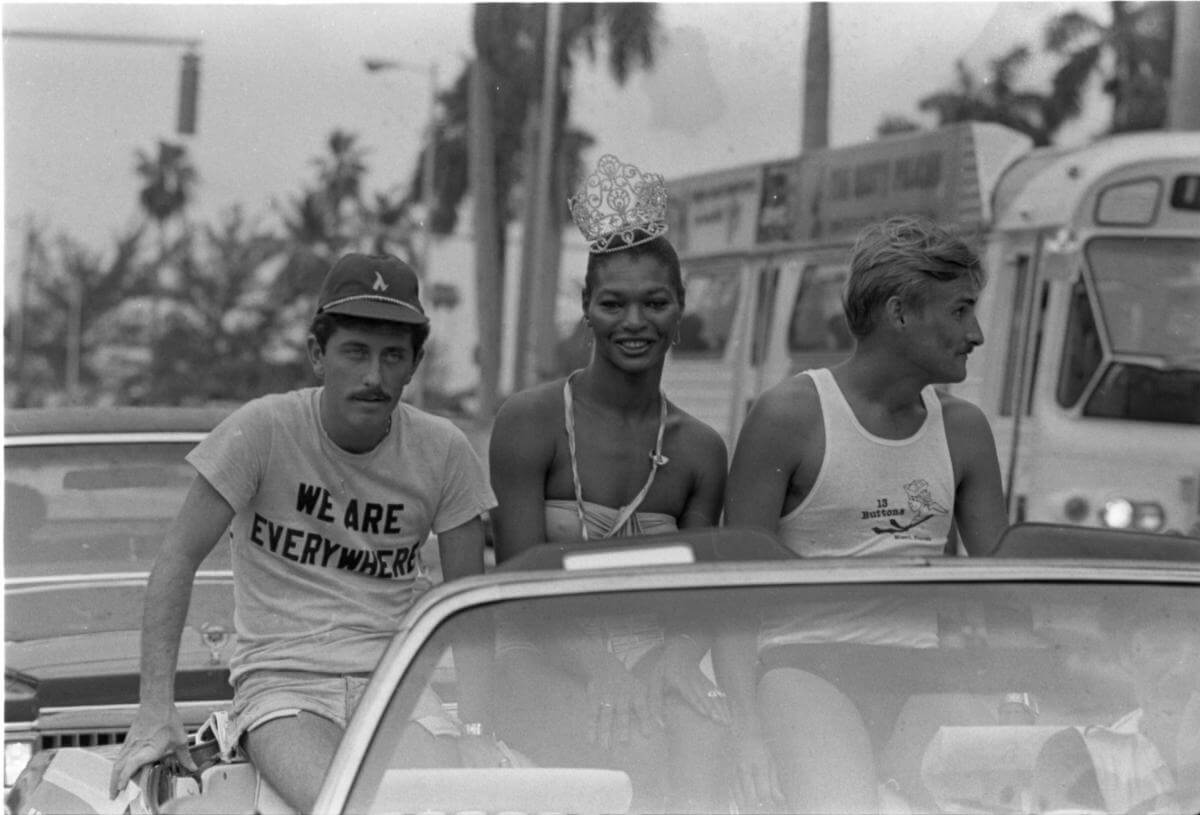
Three participants riding in a car in Miami's first Gay Rights Parade, Miami, Florida, 1978. Photograph by Tim Chapman. Courtesy of the Tim Chapman Collection, HistoryMiami Museum.
Capó: The exhibition represents the diversity of Greater Miami's LGBTQ communities across racial, ethnic, class, and national lines. It offers snapshots of this history, exploring how queer people have been policed and criminalized, how they developed cultures of resistance, how their stories link to experiences beyond our borders, and how the movement can move forward mindful of its past.
Beginning with an introduction to Miami and queer history more generally, the exhibition suggests some of the difficulties of uncovering this past, including the use of terms like "queer," the problem of archives for history never meant to be told, and how Miami's queer history is, despite the many instances of violence and oppression, also one of resilience and resistance.
The exhibition is then organized into five sections: 1) Policing, Surveillance, and Criminalization; 2) Community Development, Representation, and Advocacy; 3) Fighting for Their Rights, Fighting for Their Lives; 4) Gateway to the Americas; and 5) Looking Ahead. For the first two, it was important to convey the many ways the state criminalized and surveilled queer people. These sections explore the significance of racist, xenophobic, and anti-Black sentiments in shaping queer culture and spaces and for the formation of strong and creative bonds of resistance. The third section shifts attention to the local and national significance of the 1977 Anita Bryant campaign to overturn a Miami ordinance that shielded gays, lesbians, and bisexuals from discrimination, and to the HIV/AIDS crisis. I wanted to offer a different narrative and chronology, one that highlights Miami's past, rather than ones that are dictated by the telling of Stonewall and other events that have come to dominate our understanding of queer protest, resistance, and change-making. The fourth section observes how Miami's LGBTQ past extended far beyond the city's borders. It's a story with deep roots in parts of the Caribbean and Latin America and must be understood in the context of the Americas. Lastly, the exhibition explores some of the challenges for Miami's LGBTQ people today and highlights many of the organizations and institutions working to improve their lives. We also provide space for people to reflect and leave testimonies of their own histories with the city and offer their recollections and insights. It's a powerful exercise and testament to what liberation can mean when it is committed to social justice in all its forms. I have enjoyed reading these many contributions to the exhibition from visitors more than I can possibly explain.
About the Interviewer and Interviewee
Eric Solomon earned his doctorate in English from Emory University and is a visiting assistant professor of English and American Studies at Oxford College, Emory University. His work is featured in Southern Spaces, south, Pop Matters, and Mississippi Quarterly.
Julio Capó Jr. is an associate professor in the Department of History and the Wolfsonian Public Humanities Laboratory at Florida International University. He is the author of Welcome to Fairyland: Queer Miami before 1940 (Chapel Hill: The University of North Carolina Press, 2017) and curator of Queer Miami: A History of LGBTQ Communities. His work has also appeared in the Journal of American History, Radical History Review, Diplomatic History, Journal of Urban History, Journal of American Ethnic History, Modern American History, GLQ, H-Net, American Studies, and several volumes.
]]>