Excerpt
Georgetown, April 2017
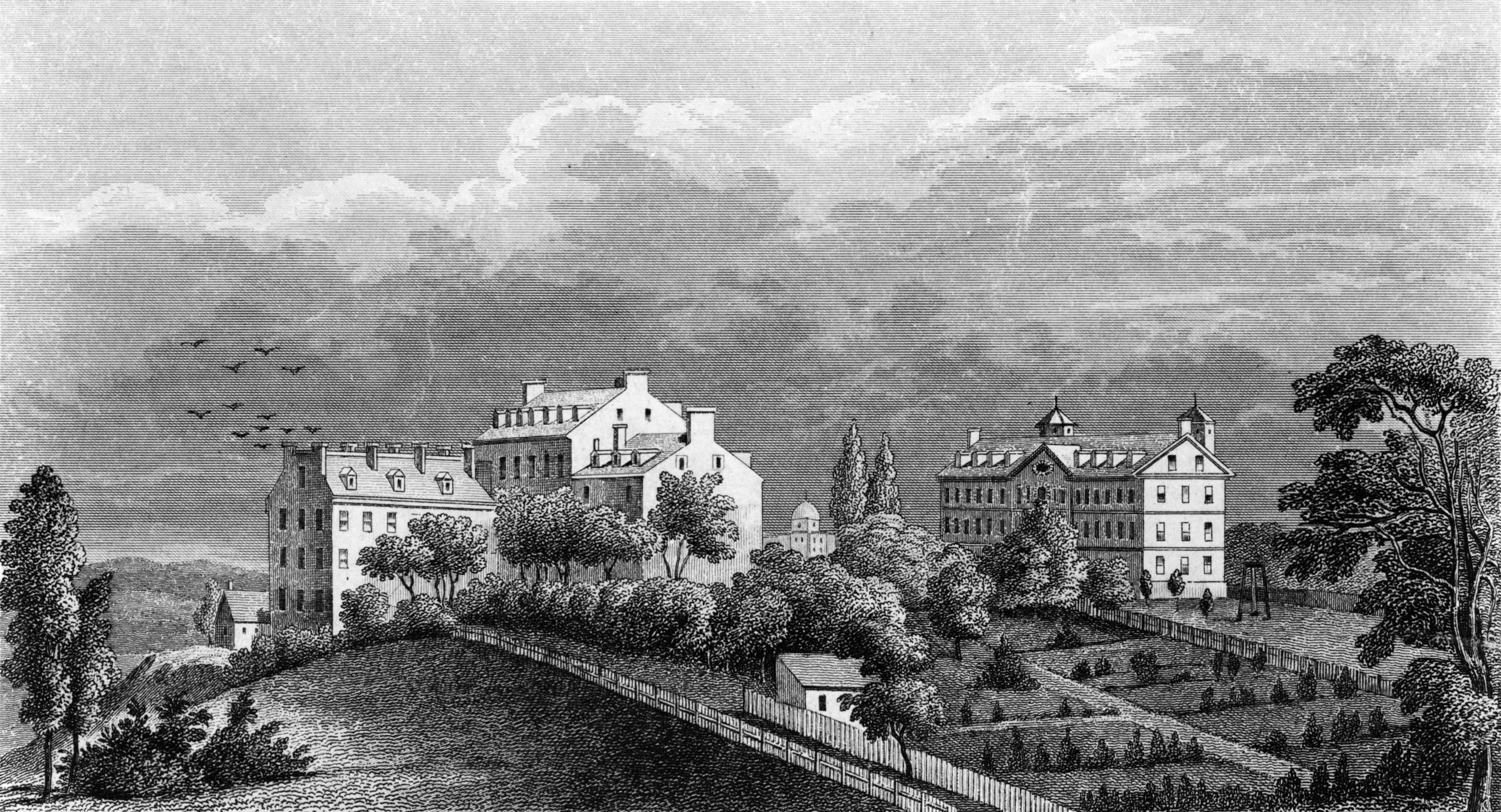
It was early morning when I crossed the Francis Scott Key Bridge from Virginia into Georgetown. College spires loomed in the distance, gray in the dawn light. I was headed to a religious service at Georgetown University that would acknowledge the trauma of a massive slave sale in 1838, a deal that shored up the finances of the struggling college and sent more than two hundred men, women, and children into the cane fields of Louisiana. Most of the families torn apart in the sale could trace their lineage to White Marsh, one of the Jesuit-owned plantations located in Prince George's County, Maryland.
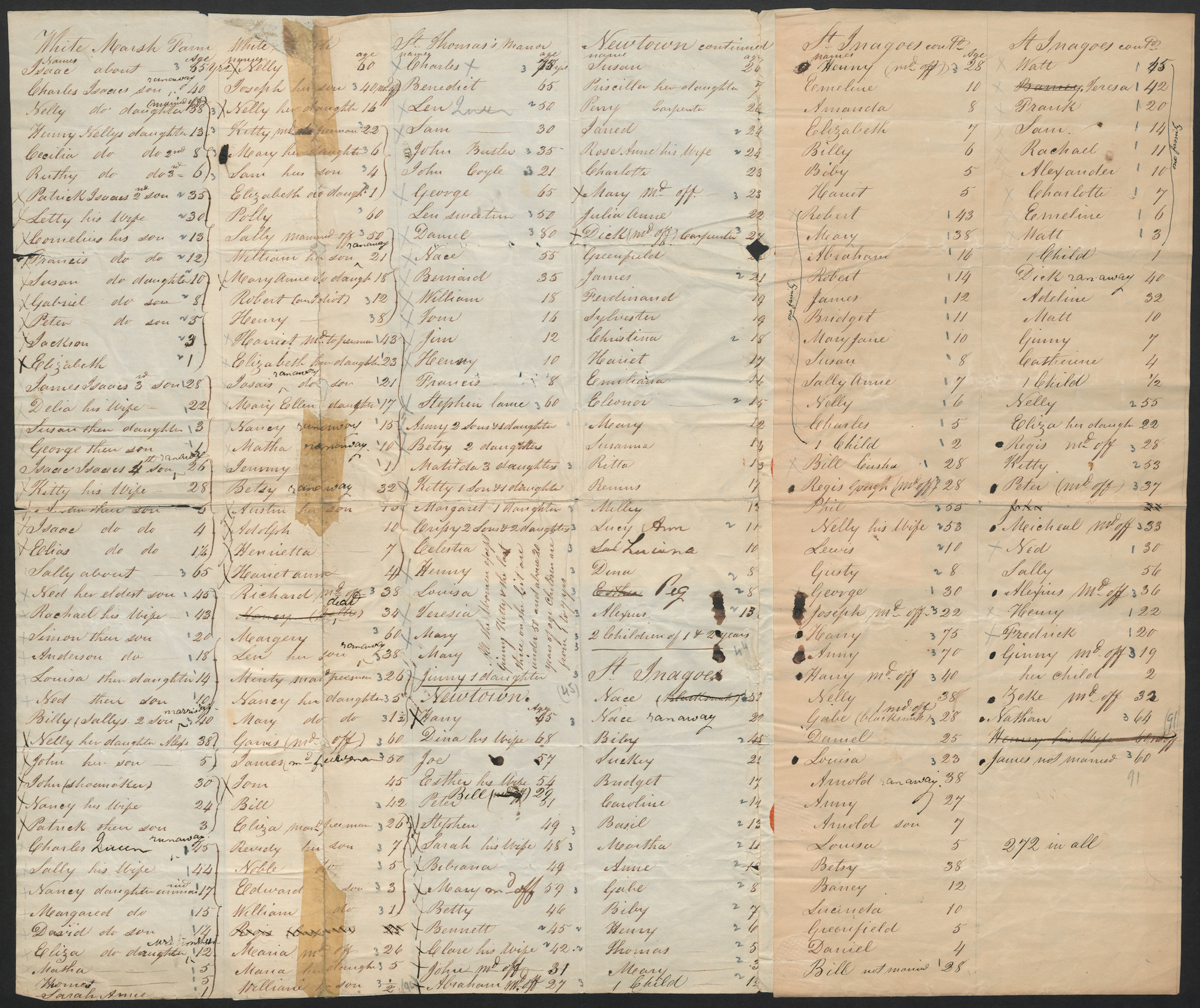
I had been researching the history of the White Marsh families for nearly a decade, uncovering the lawsuits they had brought against the Jesuits and other prominent Maryland slaveholders long before the 1838 sale. Some won their freedom. Others didn't—but each of their cases challenged the legitimacy of slavery in American law. Together they counted among the most significant freedom suits in U.S. history. And there were hundreds of others. Yet their particular stories would lead me, like the Georgetown Jesuits, to reckon with what I did not know about my own family and its role in this story.
More than a hundred descendants, a dozen university officials, and a cluster of Jesuit priests assembled inside Healy Hall for the liturgy and slowly processed into an ornate, wood-paneled auditorium on the third floor. After the opening prayer Sandra Green Thomas rose to address the congregation. Thomas, a descendant of the Harris and Ware families and president of the GU272 Descendants Association, waited a long moment before speaking. "My people were humble," she began. "They provided for their families. They tried to protect their children as best they could from the cruelties of this world, but given what the world is and what people can be, they were not always as successful as they would have hoped." The anguish and fortitude of her ancestors echoed in the firmness of her tone. "Their pain was unparalleled," she observed. "Their pain is still here. It burns in the soul of every person of African descent in the United States. It lives in people, some of whom have no knowledge of its origins but cope with the ever-present longing and lack it causes."1"Liturgy of Remembrance, Contrition, and Hope," Georgetown University, April 18, 2017. Notes and recording in possession of the author. A full recording is available at from Georgetown University at https://www.youtube.com/watch?v=tO4Xsz36kTU, with Sandra Green Thomas's remarks beginning at minute 29:33. Several major research projects have come to the fore around the Georgetown history. First, the Georgetown Slavery Archive (slaveryarchive.georgetown.edu, herein abbreviated GSA) is a repository of archival materials related to the Maryland Jesuits and Georgetown University. Second, the Georgetown Memory Project (www.georgetownmemoryproject.org) is an independent nonprofit dedicated to researching, finding, and advocating for the descendants of the 272. The project released its database of descendants in May 2019 with American Ancestors by the New England Historic Genealogical Society (see the GU272 Descendants, 1785–2000 database, www.americanancestors.org/search/databasesearch/2756/gu272-descendants-1785-2000). Third, historian Sharon Leon has undertaken a highly significant digital history-based analysis of the families on the Jesuit plantations. See Sharon Leon, The Jesuit Plantation Project: An Examination of the Enslaved Persons Owned (and Sold) by the Maryland Province Jesuits, 1717–1838 (https://jesuitplantationproject.org). I have also followed closely the Universities Studying Slavery working group at the University of Virginia since 2014 (slavery.virginia.edu/universities-studying-slavery) and other university reports, especially Stephen Mullen and Simon Newman, Slavery, Abolition and the University of Glasgow, Report and Recommendations of the University of Glasgow History of Slavery Steering Committee (September 2018), and Princeton Seminary and Slavery: A Report of the Historical Audit Committee (slavery.ptsem.edu/full-report). Also see Craig Steven Wilder, Ebony and Ivy: Race, Slavery, and the Troubled History of America's Universities, reprint ed. (New York: Bloomsbury, 2014).
I had met Thomas in New Orleans for the first time a few weeks before the ceremony. I had asked her then what slavery meant to her family, and she had said that slavery was quite simply one thing: theft. To understand American history required dealing with the fact that slavery was premised on a series of lies. The slaveholders, whether Jesuit priests or English tobacco planters, saw themselves differently, of course. We had talked about how they rationalized slavery on the basis of race, religion, law, science, and history and with myriad other prejudices, doctrines, sentiments, and myths.
Now, I wondered how Thomas would broach the lies that slaveholders told and the theft that slavery was. She turned to the heart of the matter, and to the Jesuits whose predecessors had enslaved her ancestors. "I know it is difficult to honestly look at yourself, the way you operate in the world, and your true motivations and priorities." Americans face an uncomfortable truth, she noted. History demanded "self-revelation" about the stories we accept without questioning, about the narratives we use without thinking. She offered forgiveness to the Jesuits, but she sought justice. Thomas spoke for all of the descendants who thirsted for an acknowledgment of their family's particular enslavement, and after she finished thunderous applause erupted in the room.
An expectant hush fell across the auditorium as the Reverend Tim Kesicki, a Jesuit priest and president of the Jesuit Conference of Canada and the United States, rose to address the descendants. He wore a plain black business suit and Roman clerical collar. With an air of earnestness, he spoke slowly, like a pastor to his flock. The long shadow of enslavement, Kesicki said, "remains with us to this day, trapping us in an historic truth." The truth, he admitted, was that the Jesuits had "betrayed the very name of Jesus." Kesicki offered a sweeping apology, confessed the sin of enslavement, and sought "on bended knee" forgiveness for the Jesuits' entire participation in slavery.
But he did not kneel. The remarks, sincere and heartfelt as they were, seemed strangely inadequate. Kesicki wished to acknowledge the sins of the past but was unprepared to deal with the real trauma the Church had caused and offered no meaningful pathway forward. His apology and the request for forgiveness fell flat. Descendants turned their heads away.
In this uncomfortable moment, something more than a Jesuit failure came into view—Kesicki's words symbolized an American failure to deal with a hurtful history. He had not referred to a single descendant or ancestor by name; he had directed his apology to his "sisters and brothers." For hundreds of years the Jesuits had spoken to the enslaved families on similar occasions without addressing them individually, and here at Georgetown the particularity of their enslavement appeared again to be disregarded. Kesicki's apology, nonetheless, marked a subtle but decisive departure in the Jesuits' acknowledgment of their role in slavery. Even the most recent Jesuit histories had failed to fully acknowledge the Society of Jesus's complicity. Indeed, until Kesicki spoke, most attempts to come to terms with this history had downplayed the Jesuit slaveholders' actions: decisions explained, rationalized, and inspected, all pointing to something called "slavery" but not to the families they enslaved. The same vagueness could describe how Americans more generally regard slavery.2Robert Emmett Curran, Shaping American Catholicism: Maryland and New York, 1805–1915 (Washington, D.C.: Catholic University Press, 2012), 36–38. See also Edward F. Beckett, "Listening to Our History: Inculturation and Jesuit Slaveholding," Studies in the Spirituality of Jesuits 28, no. 5 (1996), which explains the Jesuits as paternalists: "To a certain extent, the plantation formed a kind of domestic parish to which slaves belonged" (11). Beckett concludes that Jesuits treated slaves "no worse than" other slaveholders, but following Curran, he emphasizes that the Jesuits encouraged slaves to gain skills. In the most recent and thorough review of Jesuit slaveholding in Maryland, Thomas Murphy, S.J., argues that the Jesuits understood themselves as paternalists and as superior, like all other enslavers in the early American republic. His account is the most balanced examination of the Jesuit role in slaveholding, yet his stance is similarly apologetic. As for their decision to sell supernumerary slaves, Murphy concludes that the Jesuits could not bring themselves to do so and instead sold the physically fit and "missed an opportunity to develop a morally strong case for making profits out of right motives." See Murphy, Jesuit Slaveholding in Maryland, 1717–1838 (New York: Routledge, 2001), 72.
But America's founding, like Georgetown University's, cannot be disentangled from its enslavement of particular families. Our national imagination still sees slavery as an aberration, a detour, from the true story of the country. Many Americans see enslaved people in history as faceless and nameless, victims of a long-ago system that has now disappeared. In such a situation, the nation needs to experience what we at the liturgy experienced: a confrontation, a reckoning, with real people, with real histories, with real families whose descendants live among us. Until such encounters happen more widely, Americans will continue to live in separate historical spheres of understanding, a condition that more than anything limits our ability to come to terms with the past. We cannot, of course, do anything to change what happened long ago, but we can change the way we understand what happened and what it means to us in the present.3A central aspect of the approach taken here is historical imagination. This asks readers to experience a world other than their own and to step outside of themselves into the characters in this history. Recent examples of narrative imagination include Imani Perry, Looking for Lorraine: The Radiant and Radical Life of Lorraine Hansberry (Boston: Beacon Press, 2018); Lisa Brooks, Our Beloved Kin: A New History of King Philip's War (New Haven: Yale University Press, 2018); and Saidiya Hartman, Wayward Lives, Beautiful Experiments: Intimate Histories of Social Upheaval (New York: W. W. Norton, 2019). Each is an inspiration in the form of its narrative and in its attention to re-creating the voices, situations, and daily experiences of people left out of the archive. See also Natalie Zemon Davis, The Return of Martin Guerre (Cambridge: Harvard University Press, 1983). 
About the Author
William G. Thomas III is the John and Catherine Angle Chair in the Humanities and Professor of History at the University of Nebraska–Lincoln. He is on the Southern Spaces editorial board, and was co-founder and director of the Virginia Center for Digital History at the University of Virginia.
]]>
While I was an undergraduate at Temple University in the mid-1990s, gospel's ubiquity in both secular and sacred spaces was a source of great fascination for me. On a Saturday night stroll down the halls of my dormitory, Temple Towers, one might hear Kirk Franklin's "Silver and Gold," Mary J. Blige's "My Life," and Biggie's "One More Chance" in succession. Though hip-hop had the loyalty of most undergraduates, my inner circle, particularly my fellow women's basketball teammates, had a deep appreciation for gospel music. On our road trips, at the dining halls, and in our dormitories, gospel music occupied the same space as R&B and old-school soul. Fortunately, my academic work as an African American studies major and history minor reinforced many of the lessons provided during my extracurricular activities. Classes and conversations with Professors Sonia Sanchez, Bettye Collier Thomas, Greg Carr, Valethia Watkins, and Mario Beatty, among others, strengthened my already firm sense of the importance of the spiritual lives of black folk. Seeds sown in my childhood home of Jacksonville blossomed under the guidance of these teachers and the music journalists and cultural critics whom I read over the next two decades: Horace Boyer, Mark Burford, Mellonee Burnim, Portia Maultsby, Eileen Southern, Jon Michael Spencer, Brooksie Eugene Harrington, Michael W. Harris, Robert Darden, Anthony Heilbut, Glenn Hinson, Wyatt Tee Walker, Pearl Williams-Jones, Robert Marovich, and Jerma Jackson.1See Horace Clarence Boyer, Golden Age of Gospel (Champaign: University of Illinois Press, 2000); Jon Spencer, Protest and Praise: Sacred Music of Black Religion (Minneapolis, MN: Fortress Press, 1991); Michael W. Harris, Rise of Gospel Blues: The Music of Thomas Andrew Dorsey in the Urban Church (New York: Oxford University Press, 1994); Bob Darden, People Get Ready! A New History of Black Gospel Music (New York: Bloomsbury, 2004); Anthony Heilbut, Gospel Sound: Good News and Bad Times (New York: Simon and Schuster, 1971); Pearl Williams-Jones, "Afro-American Gospel Music: A Crystallization of the Black Aesthetic," Ethnomusicology 19, no. 3 (1975) 373–385; Robert M. Marovich, A City Called Heaven: Chicago and the Birth of Gospel Music (Champaign, University of Illinois Press, 2015); and Jerry Zolten, Great God A'Mighty! The Dixie Hummingbirds: Celebrating the Rise of Soul Gospel Music (New York: Oxford University Press, 2003) Their respective histories of gospel music enriched my understanding of the genre's centrality to black culture, its early relationship to the recording industry, and its role as a source of individual and collective uplift for people of African descent. They also reaffirmed my belief in gospel music as a subject worthy of in-depth cultural criticism and historical analysis.
And yet, despite my admiration for their work, or perhaps because of it, these authors always left me wanting more, particularly greater engagement with the gospel music of the post-civil rights era. Why couldn't their razor-sharp analyses of gospel music's "golden era" (1945–65) extend into the 1970s and 1980s, I often wondered? Why did the black sacred music adored by so many of my generation seem inconsequential to the historians whose scholarship mattered so much to me? To be sure, Heilbut's The Gospel Sound and Darden's People Get Ready! extended their analyses beyond gospel's golden era. But their discussion of the genre's later years lacked the detailed attention given to the earlier period.
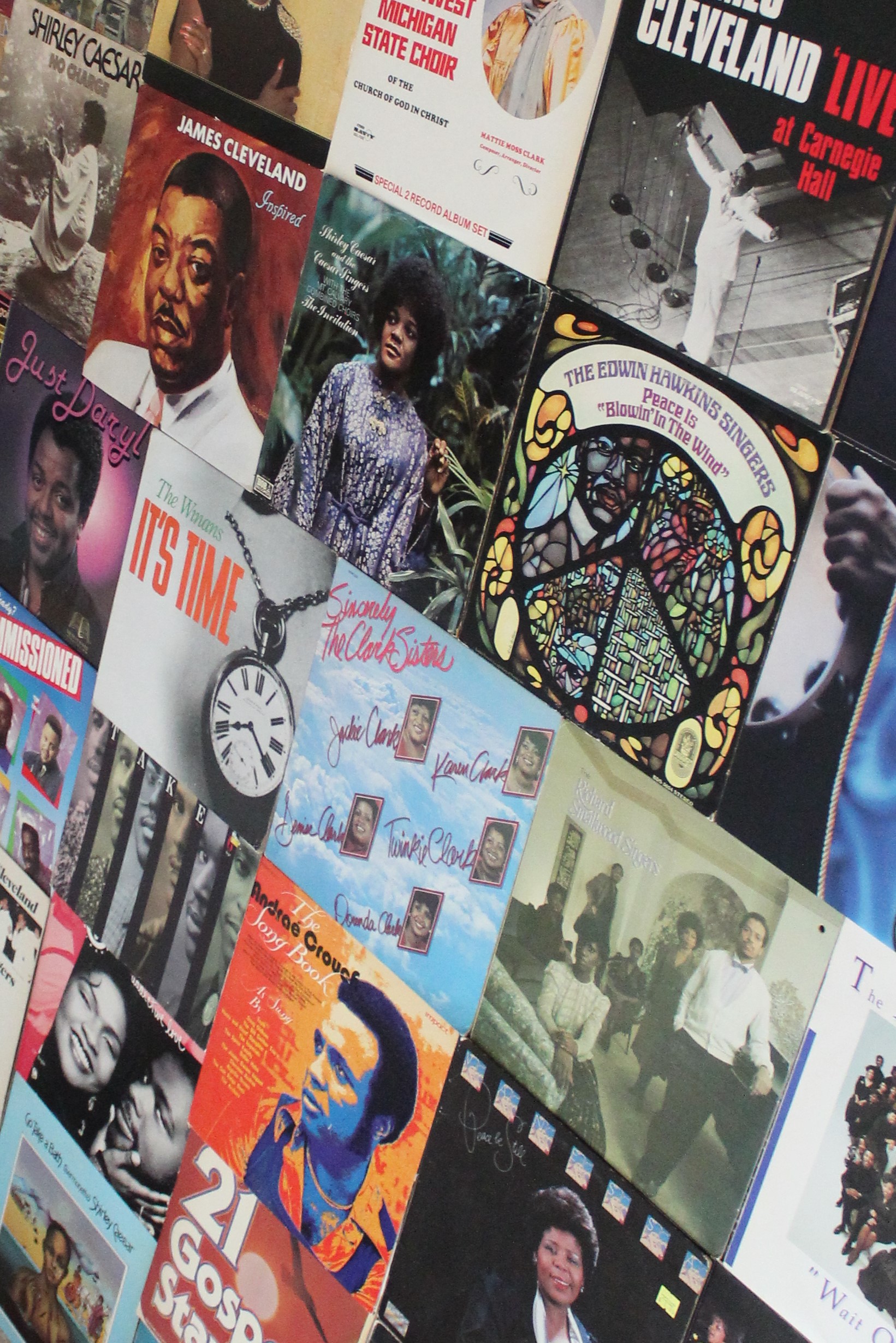
By focusing primarily on the last three decades of the twentieth century, When Sunday Comes shines light on gospel's golden era of commercialism. Instead of dismissing this period as one of musical decline and questionable crossover pursuits, this book treats these years as a time of great artistic innovation and advancement.2Fortunately, digging deeper into gospel's more recent history has been made easier with the important work of scholars like Mellonee V. Burnim, Brooksie Eugene Harrington, Deborah Pollard Smith, Jon Spencer, Guthrie Ramsey, and Birgitta Johnson. In addition, historians like Shawn David Young and David Stowe provide useful insights into the contemporary Christian music genre. Brooksie Eugene Harrington, "Shirley Caesar: A Woman of Words" (PhD diss., Ohio State University, 1992); Birgitta J. Johnson, "Back to the Heart of Worship: Praise and Worship Music in a Los Angeles African-American Megachurch," Black Music Research Journal 31, no. 1 (2011): 105–129; Deborah Smith Pollard, When the Church Becomes Your Party: Contemporary Gospel Music (Detroit, MI: Wayne State University Press, 2008); Spencer, Protest and Praise; David W. Stowe, No Sympathy for the Devil: Christian Pop Music and the Transformation of American Evangelicalism (Chapel Hill: University of North Carolina Press, 2013); Shawn David Young, Gray Sabbath: Jesus People USA, the Evangelical Left, and the Evolution of Christian Rock (New York: Columbia University Press, 2015); Guthrie P. Ramsey, Race Music: Black Cultures from Bebop to Hip-Hop (Berkeley: University of California Press, 2004). It details how Kirk Franklin, the Winans, Take 6, and the Clark Sisters, among others, not only advanced the black sacred music tradition but also ensured that gospel remained embedded in African American culture. That embeddedness has surfaced in a variety of cultural contexts and arenas and continues to do so: BET's annual award shows; the music of secular stars like Beyoncé, D'Angelo, Missy Elliot, Snoop Dogg, Chance the Rapper, and Kanye; the cinematic offerings of such avant-garde filmmakers as Arthur Jafa, Kevin Jerome Everson, and Cauleen Smith; and even the televised funerals of some of the entertainment industry's biggest icons. Take as a case in point the very public mourning that followed the deaths of Michael Jackson and Whitney Houston. On July 7, 2009, twelve days after Jackson's death, millions of fans watched the homegoing service of the "King of Pop." The memorial opened with Andraé Crouch and his choir humming the melody of the gospel classic "Soon and Very Soon" as Jackson's brothers rolled his casket to the center stage of Staples Center in Los Angeles.
Three years later, Crouch's music had a strong presence at the homegoing of another pop legend, Whitney Houston. This time, the musical vessel was not Crouch himself but his student Marvin Winans. Standing before a grief-stricken audience of family, friends, music legends, and curious onlookers, Winans belted out Crouch's latest hit, "Let the Church Say Amen," as he closed his eulogy of a woman who had been raised in New Hope Baptist Church under the tutelage of her mother, Cissy Houston; who had supported the careers of his younger siblings BeBe and CeCe Winans; and who fifteen years before her passing released the multi-platinum gospel album The Preacher's Wife. The presence of Crouch's music at both Houston's and Jackson's funerals not only symbolized his importance to the gospel sound but also showed how often African Americans have turned to this vibrant and life-affirming art form to make sense of the tragicomic reality of human existence.
As I reflected on what gospel music has meant to African Americans, my thoughts often turned to the song that inspired the book's title: Donald Lawrence and the Tri-City Singers' 1995 hit "When Sunday Comes." Seven minutes long, the song features gospel legend Daryl Coley on lead vocals. Throughout the performance, Coley titillates the crowd with a flurry of vocal riffs, drawing from the improvisational styles of both gospel and jazz. The audience's shouts of approval convey their agreement with his message of the joy that awaits Jesus's Second Coming and also their recognition of his mastery of form. "When Sunday Comes," as both a song and a metaphor, captures the wide range of emotions, relationships, and processes operating in African American gospel music: the climactic moment in a performance when a musician reaches the height of his or her artistic and spiritual powers, the gospel audience's contribution to and immediate recognition of such moments, and the deep cultural meanings the sacred songs hold for people of African descent in America.
For many of the artists in When Sunday Comes, singing gospel was not simply a form of self-expression or a way to magnify God but also a way to uplift people, to lighten their burden. Perhaps no one understood this more than Shirley Caesar, who envisioned her concerts as a way to elevate her audience to a higher spiritual plane. "It's not so much that I want people to shout," she explained to Geoffrey Himes in 1987. "I want them to forget that burden they left behind when they came to the concert. I want to give them a spiritual catharsis."3Geoffrey Himes, "Shout It! Gospel According to Shirley Caesar," Washington Post, April 3, 1987, B7.
Outside the County Line: The Southern Soul of John P. Kee
More than thirty years have passed since my first encounter with the music of John P. Kee, but the memory of that experience remains fresh in my mind. On a weekend visit to my aunt's house, where gospel music played from sunup to sundown, we both found ourselves mesmerized by a new song: Kee's "Wait on Him." Within seconds of the song's opening verse, my attention shifted from mildly interested to fully engaged as Kee's powerful voice ripped through the speakers: "I'm going to run this race, if I go by myself," Kee sang as the choir roared: "Wait on Jeeee-suuuus." As Kee and the choir riffed off each other, bassist Andrew Gouche, guitarist Jimmy Hill, and drummers George Clinkscale and Calvin Livingstone held down the rhythm section. During the extended vamp, Kee adlibbed with a ferociousness reminiscent of Joe Ligon of the Mighty Clouds of Joy: "They that wait on the Lord, shall renew their strength. . . . They shall mount up on wings, as eagles. They shall run, not get weary."4John P. Kee, Wait on Him (Tyscot Records, 1991). This was the sound of Christian faith forged in the crucible of the southern black church.
The release of Wait on Him in 1989 marked the beginning of a remarkable creative run for Kee and his New Life Community Choir (NLCC). Between 1989 and 1996, Kee released hugely popular singles as well as the critically acclaimed records Wash Me and Show Up! (which was certified gold). Enjoying widespread radio play, sold-out concerts, and high record sales, Kee won the hearts of thousands of gospel lovers with his signature voice and classic songs. Not since James Cleveland had a male vocalist in the gospel world occupied such a ubiquitous presence on gospel radio. Tunes like "The Storm Is Passing Over," "Lily in the Valley," "Never Shall Forget," "Standing in the Need," "Wait on Him," "Wash Me," and the smash hit "Jesus Is Real" were in constant rotation. These songs were also part of the repertoire of countless black gospel choirs across the country. Even as the black religious community became increasingly diverse, Kee's music held an esteemed place in a variety of African American churches, from Pentecostal to Baptist.
Especially down south, Kee's blue-collar aesthetic and country home vibe earned a special place in the hearts of gospel music fans, particularly those who saw themselves or their families' history in his work. A proud southerner, Kee frequently transported his listeners to the black South, where women, men, and children cared for and loved each other, where elders shared their wisdom with the young, where the church anchored the social and cultural lives of a striving people. Kee was an artist for whom the South's past and present supplied endless inspiration and material. On both his studio and live recordings, he can be found resurrecting the spirit of his father, honoring the religiosity and deep faith of his grandmother, and reflecting on his life-changing encounters with ordinary southern women and men in the streets of Charlotte, North Carolina. Throughout his discography, the South looms large as an incubator of his cultural, religious, and political sensibilities. Kee's South is neither monolithic nor static but a geography constantly responding to new political forces and new social realities.
North Carolina Beginnings
John Prince Kee was born on June 4, 1962, in Durham County, North Carolina. The fifteenth child of John Henry and Lizzie Mae Kee, the young John lived on the outskirts of Durham until the age of five, when his father started work as a foreman at a local brickyard. In many ways, the world in which young John entered was radically different from that of his older brothers and sisters, due in no small part to the growing political determination of African Americans in Durham.
Notwithstanding its image as a progressive southern city, Durham was racist to its core. Even when the white power structure appeared to bend in favor of African Americans, its actions were often more symbolic than substantive. As historian Christina Greene rightly points out, Durham's white power brokers were more concerned with racial harmony than with racial justice. The conflict between the city's racial moderates and more direct action-oriented civil rights organizers reached a fever pitch in the summer of 1962. Late in July, members of the Congress of Racial Equality and the NAACP picketed Eckerd's Drug Store and Howard Johnson's ice cream parlor. At Eckerd's, the issue at hand was the store's refusal to hire African Americans as salespersons, despite the fact that blacks constituted half of its customers. Likewise, Howard Johnson's was opposed to hiring African Americans in clerical positions. The restaurant had also refused to desegregate its lunch counter, even after the sit-ins of 1960 led other stores to reverse their segregation policies. Taking the lead in the fight against Howard Johnson's were black students from North Carolina Central, who in their efforts to implement change endured verbal assaults, threats of violence, consternation from conservative blacks, arrests, and sometimes imprisonment. For their refusal to pay a trespass fine for protesting Howard Johnson's, students Guytana Horton and Joycelyn McKissick were sentenced to thirty days in jail. Their arrest and subsequent jailing galvanized the civil rights community, which in August held a large rally at one of the city's movement centers, St. Joseph AME Church. Shortly after the rally, 1,500 African Americans headed to Howard Johnson's to continue their protests. These protests persisted throughout the summer as part of the "Freedom Highways" project, a CORE-directed campaign that extended from Maryland to Florida. This project eventually led more than half of the Howard Johnson's establishments in North Carolina to desegregate their lunch counters. One of the holdout restaurants was the Howard Johnson's in Durham, which in 1963 was the site of one of the largest civil rights demonstrations in North Carolina.5Christina Greene, Our Separate Ways: Women and the Black Freedom Movement in Durham, North Carolina (Chapel Hill: University of North Carolina Press, 2005). Over the next few years, Durham remained a center of political protest and grassroots activism as African Americans directed their attention to the problems of urban renewal, deindustrialization, employment discrimination, and the housing crisis.
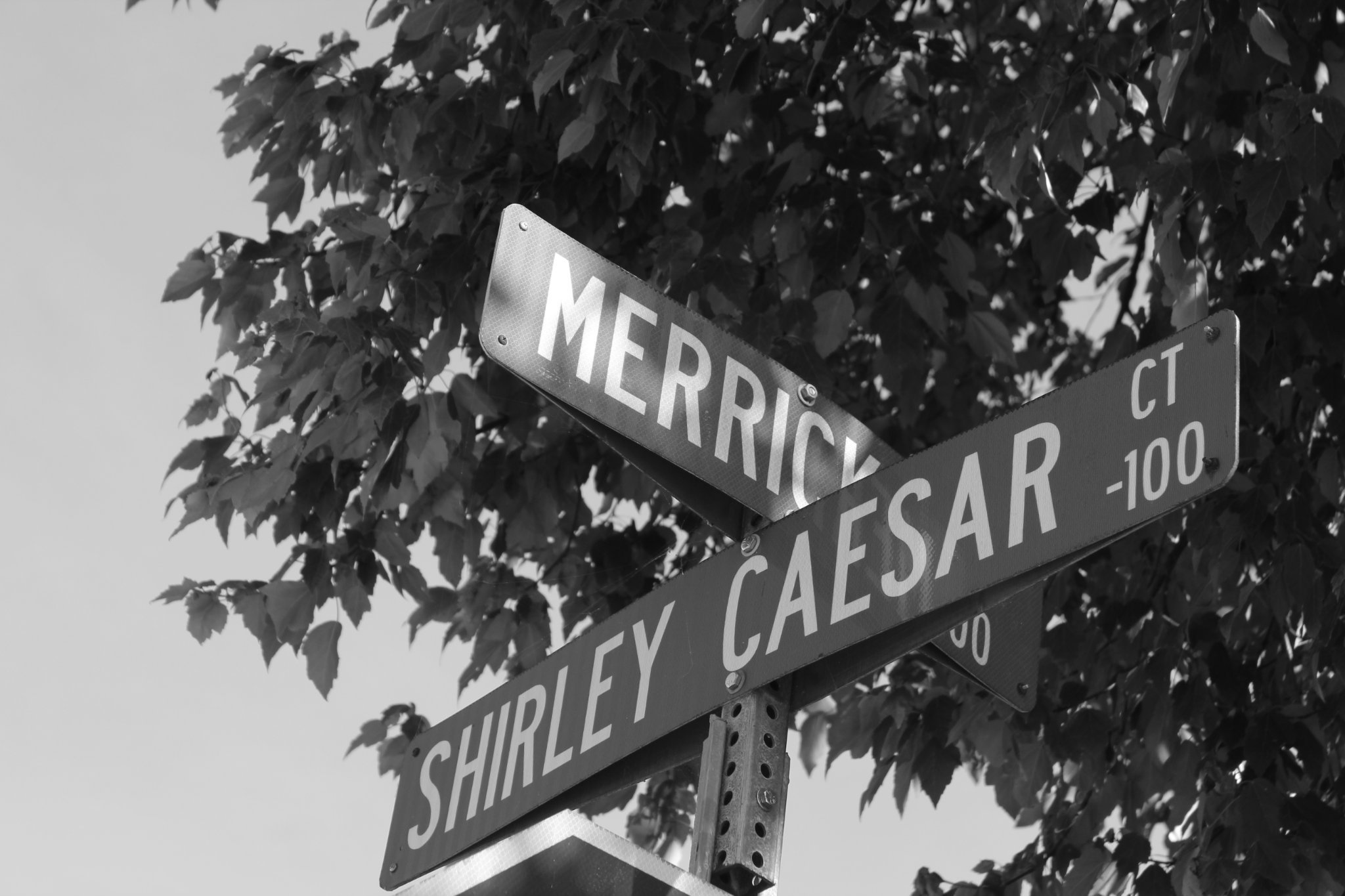
One important center of local organizing was Union Baptist, the church home of the Kee family and hundreds of other blacks. Under the pastorate of Dr. Grady Davis, Union was a center of black spiritual life in Durham and an anchoring institution for the local civil rights movement. A dedicated member until his death in 1981, John Henry Kee lent his musical talents to the Grady Davis Choir and the Senior Male Choir.6"Obituary," Carolina Times, January 31, 1981. Like his father, young John developed a deep love for music, routinely spending hours at the family's Walter upright piano. "I was about seven years old when I started playing that piano, and I got a lot of encouragement because music in our household was just the thing to do. And it was by playing piano that I kept my dad's attention."7Bobby Jones and Lesley Sussman, Touched by God: Black Gospel Greats Share Their Stories of Finding God (New York: Pocket Books, 1998), 239.
Showing great promise as a musician, Kee enrolled at the North Carolina School of the Arts in Winston-Salem and then graduated from there at the age of fourteen. To further develop his musical skills, he joined his brothers at Yuba College Conservatory in Marysville, California. To support himself, Kee worked as a sideman for Cameo and Donald Byrd on their visits to Northern California. On the surface, the talented youngster seemed destined for greatness, but on his route to superstardom he took several dangerous detours.
During his time in California, Kee descended into a world of drug use. He then returned to North Carolina, where he found work with the Charlotte-based Miss Black Universe pageants. His move back south was part of a national trend. Since the 1970s, the number of African Americans migrating to the South exceeded the number of those leaving the region. Especially for returning and primary migrants frustrated by the declining economic opportunities available in the rustbelt cities of the Midwest and Northeast, the metropolitan centers of Atlanta, Houston, Dallas, and Charlotte seemed much more appealing than their northern and midwestern counterparts.8Carol B. Stack, Call to Home: African Americans Reclaim the Rural South (New York: Basic Books, 1996); Sabrina Pendergrass, "Perceptions of Race and Region in the Black Reverse Migration to the South," Du Bois Review: Social Science Research on Race 10, no. 1 (2013): 155–178; George Gmelch, "Return Migration," Annual Review of Anthropology 9 (1980): 135–159; Larry H. Long and Kristin A. Hansen, "Trends in Return Migration to the South," Demography 12, no. 4 (1975): 601–614. "If ever there was a city that epitomizes the New South," boasted the June 1983 edition of Black Enterprise, "it is Charlotte, N.C., the largest city between Washington and Atlanta. . . . This Sunbelt city is now home to 314,000 residents—31 percent of them black—and to a burgeoning business community, which includes 500 black-owned companies."9David D. Porter and Rosalyn Gist Porter, "The Changing Profile of Charlotte," Black Enterprise 13 (June 1983): 180. For ambitious African Americans wishing to improve their lives and perhaps avoid the problems of the urban North, Charlotte was the place for them.
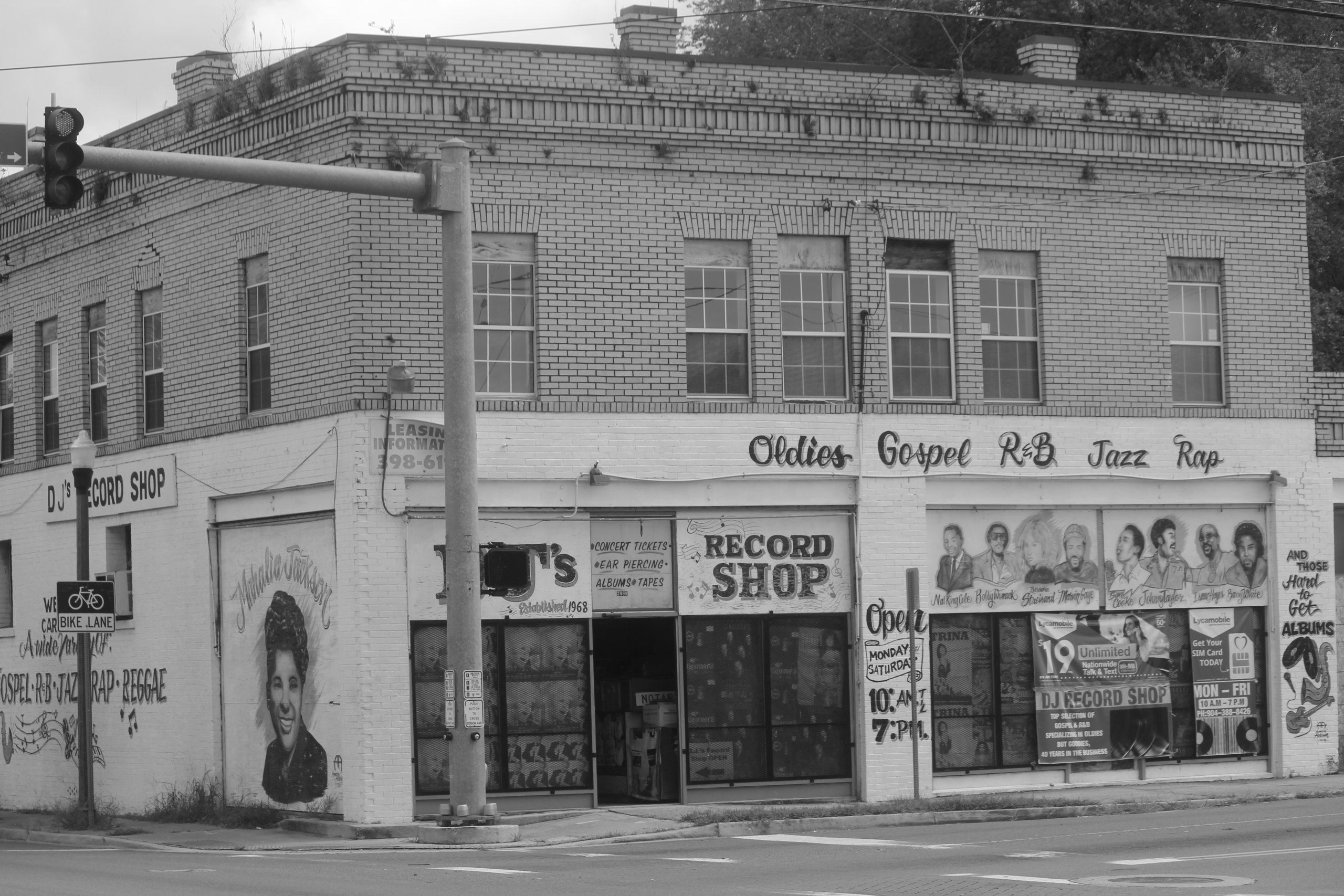
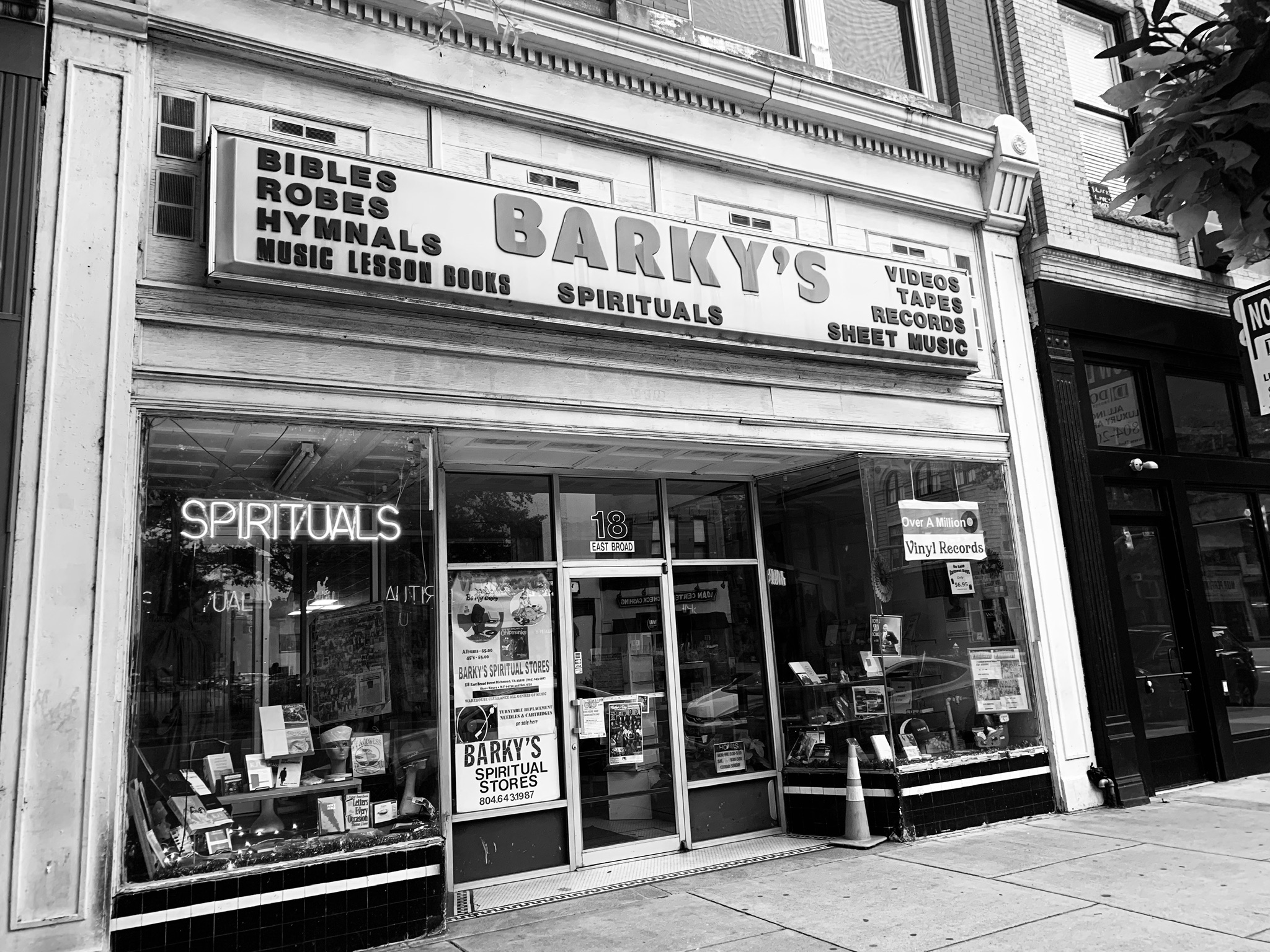
To many outsiders, this was a city on the move, a great place for young people with talent, ambition, and a hard work ethic. Unfortunately, Kee was not quite ready to take advantage of the city's benefits. Even after his move back south, Kee remained a part of the drug scene—not only as a user but as a seller as well. Upon his arrival in Charlotte, he settled into the Double Oaks neighborhood, an area facing many of the problems plaguing other inner-city communities. Crime, unemployment, substandard housing, and drugs wreaked havoc on many of its residents. Drifting further away from the values of his early childhood, Kee was an active participant in Double Oaks's underworld.
A dramatic shift occurred in Kee's life in 1981, when one of his closest friends fell victim to drug-related violence. His friend's murder shook Kee to his core, forcing him to reevaluate his life: "I was seeing young men dying on the street, and I think I just made up my mind that I did not want to leave here like that. I just felt like there was a gift or something inside of me, and I didn't want to waste it."10Jones, Touched by God, 242. The reformed drug dealer started working with a group of young singers involved in the Combination Choir, which was based in Charlotte. This marked the beginning of Kee's lifelong commitment to the local community, particularly the Double Oaks neighborhood. The choir later morphed into the New Life Community Choir, which gained national attention in the 1990s for their work with Kee.
Kee's Breakthrough
On his rehabilitation journey, Kee received major support from two of gospel's most iconic figures, James Cleveland and Edwin Hawkins. Like many aspiring musicians in the gospel field, Kee turned to the Gospel Music Workshop of America to gain a larger audience and connect with industry insiders. In 1985, Cleveland placed two of Kee's compositions, "He's My All in All" and "Jesus Can Do It," on his 1985 GMWA recording. Two years later, Kee was a featured vocalist and songwriter on Edwin Hawkins's music and arts seminar recording. That same year, Kee released Yes Lord, his debut with the black-owned label Tyscot. A relatively small company based in Indianapolis, Tyscot begin in 1977 as a vehicle for one of its founders, Leonard Scott, to promote his church choir. The label would add to its roster a few minor gospel acts, but it was hardly on the radar of most in the gospel industry. This would change with the release of Kee's Yes Lord. Though the record had modest sales, it generated considerable anticipation for Kee and the New Life Community Choir's 1989 release, Wait on Him.
Finding a receptive audience among lovers of traditional and contemporary gospel music, Wait on Him elevated Kee to superstar status in the black gospel world. The album climbed to #4 on the gospel charts, dominated gospel radio, and enabled Kee to launch a nationwide tour. "We're getting more requests than I can handle," Kee informed journalist Robert Darden. Though the record had a southern sound, its popularity extended beyond the Mason-Dixon Line. "'Wait on Him' is doing incredible business in New York," Kee marveled. The singer was also receiving attention from beyond the black gospel world. "We're getting calls from white churches in Texas, Washington state, even the hills of Tennessee—where the man told me all they've ever heard is 'hillbilly gospel' before now!"11Robert Darden, "New Life's 'Wait on Him' Is an Overnight Hit for John P. Kee," Billboard, February 24, 1990, 45.
About the Author
Claudrena N. Harold is a professor of African American and African Studies and History at the University of Virginia and an editorial board member at Southern Spaces. She is the author of New Negro Politics in the Jim Crow South (Athens: University of Georgia Press, 2016) and The Rise and Fall of the Garvey Movement in the Urban South, 1918–1942 (UK: Routledge Press, 2007).
]]>Introduction
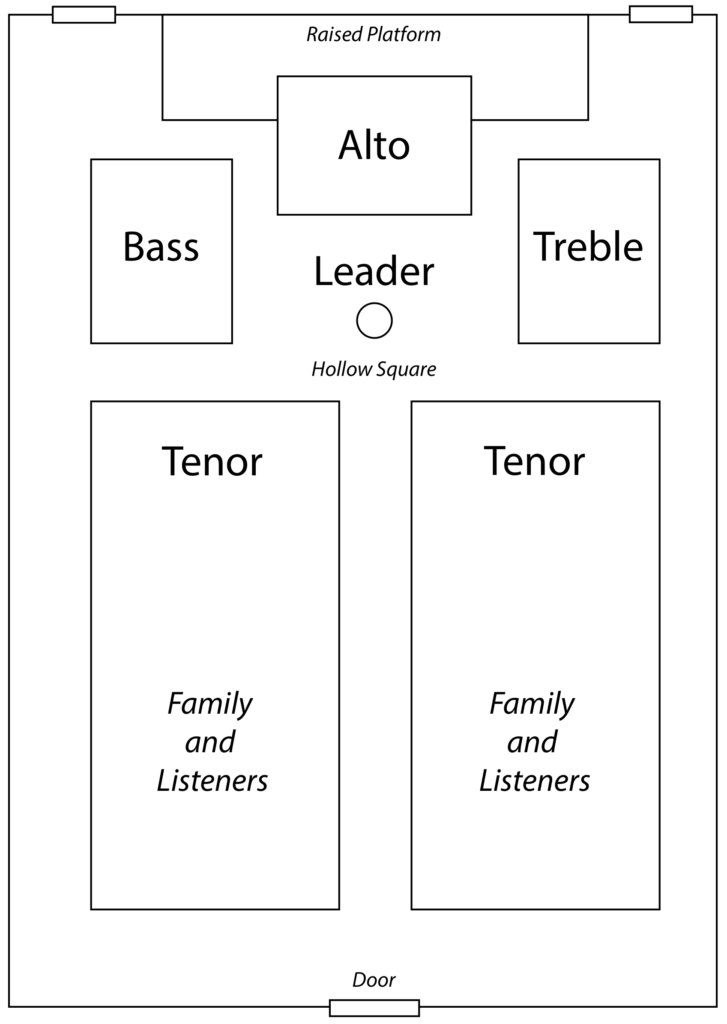
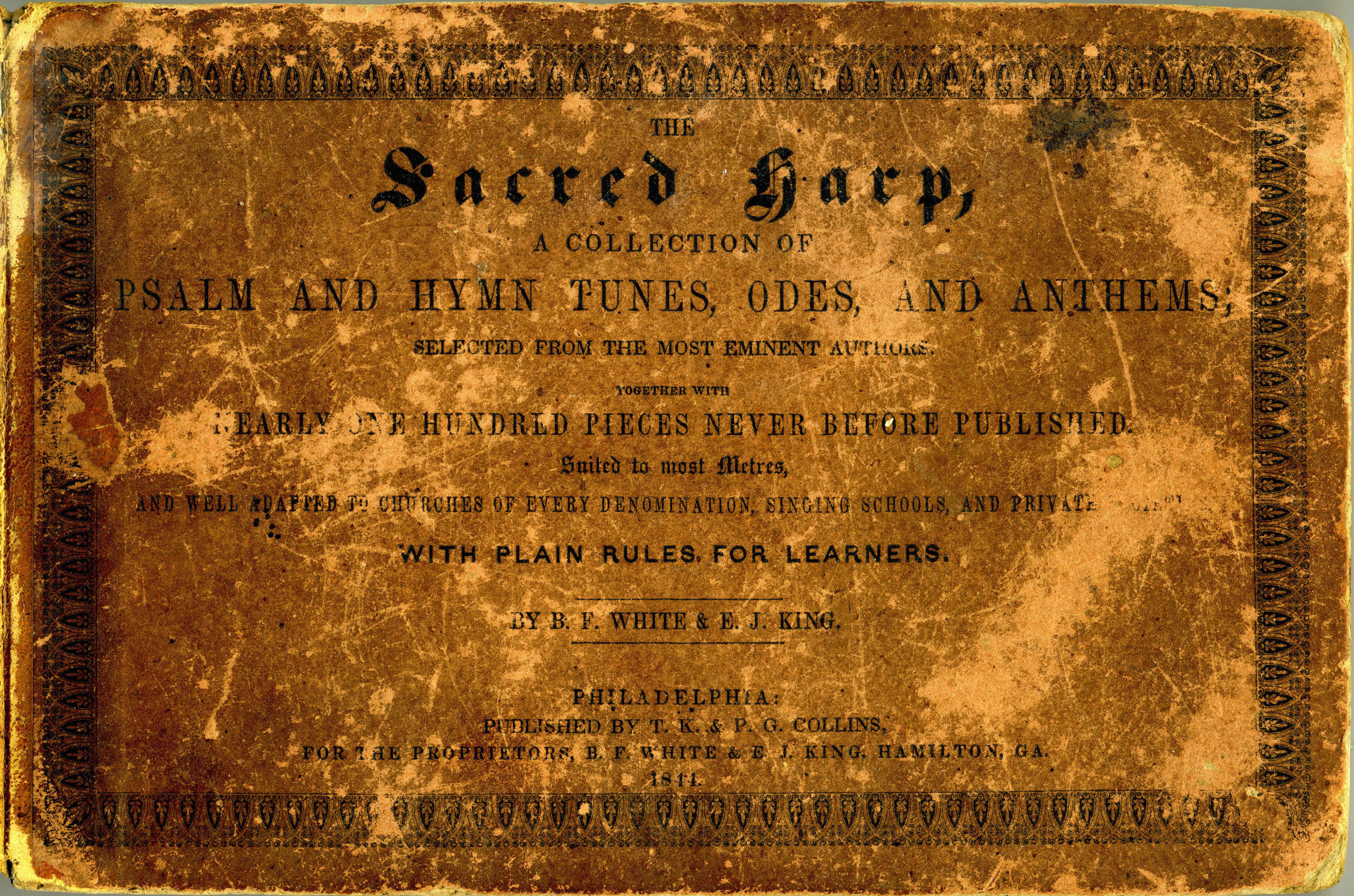
Sacred Harp singing is defined by its spatial organization as much as by its musical style. In this form of shape-note music, an assembled "class" of singers gathers at annual events called "singings"—weekend days spent in churches or community centers singing songs from The Sacred Harp, a nineteenth-century Georgia tunebook revised every generation or so. The tunebook uses a pedagogical system in which the music's note heads have four distinct shapes corresponding to their position in the scale, associated with the names "fa," "sol," "la," and "mi," which singers recite before singing a song's hymn text. Just as important as the shape-notes to the Sacred Harpers is the "hollow square" orientation in which singers sit, facing each other in rows of pews or chairs organized by voice part (bass, alto, treble, and tenor). Throughout the singing day, a procession of leaders take turns stepping into the hollow center to face the tenor or lead section that carries the melody and direct the class in a song or two of their choice from The Sacred Harp.1For more on Sacred Harp singing, see, especially, Buell E. Cobb Jr., The Sacred Harp: A Tradition and Its Music (Athens: University of Georgia Press, 1989); John Bealle, Public Worship, Private Faith: Sacred Harp and American Folksong (Athens: University of Georgia Press, 1997); Kiri Miller, Traveling Home: Sacred Harp Singing and American Pluralism (Champaign: University of Illinois Press, 2008); David Warren Steel and Richard H. Hulan, The Makers of the Sacred Harp (Champaign: University of Illinois Press, 2010).
For singers, the hollow square is both a practically necessary convention and a deeply meaningful space. Encircled by full-voiced singing to hymn texts such as Isaac Watts's "Within Thy circling pow'r I stand, On ev'ry side I find Thy hand," for singers the immersiveness of the hollow square comes to represent God's encompassing love.2"Akin," music by P. Dan Brittain (1971), words by Isaac Watts (1719), in Hugh McGraw et al., eds., The Sacred Harp: 1991 Edition (Carrollton, GA: Sacred Harp Publishing Company, 1991), 472. For composers, the spatial organization of singings, especially the separation of voice parts, is something to consider and emphasize in writing for the tradition. For singers and scholars seeking to capture the essence of Sacred Harp singings, the hollow square has been a longstanding focus, with advances in recording technology leading to new strategies. In this publication we introduce new immersive 360-degree video and audio recordings we made from within the hollow square in the summer of 2019 and offer context drawing on a larger project about the hollow square's meaning to singers and composers and the history of attempts to capture the experience of this unique sonic space.
Yi Halo and Ambeo VR at Mt. Lebanon
We used new video and audio recording technologies to capture elements of the experience of the hollow square. Our recording equipment included the Yi Halo, a device that captures video via seventeen separate cameras arranged in a circular housing. The Google platform Jump Assembler (now defunct) stitched the footage from all the cameras into a series of 360-degree videos.3Janko Roettgers, "Google Is Shutting Down Its Jump VR Video Program," Variety (blog), May 18, 2019, https://variety.com/2019/digital/news/google-jump-shutting-down-1203219306/. We used the Sennheiser Ambeo VR microphone to capture 360-degree spatial audio via four interconnected microphone capsules. Using the video editing application Adobe Premiere, we connected the 360-degree video to the spatial audio. When the user shifts the 360-degree visual field of view in the YouTube window, the audio shifts correspondingly. This spatial audio can only be experienced when wearing headphones.
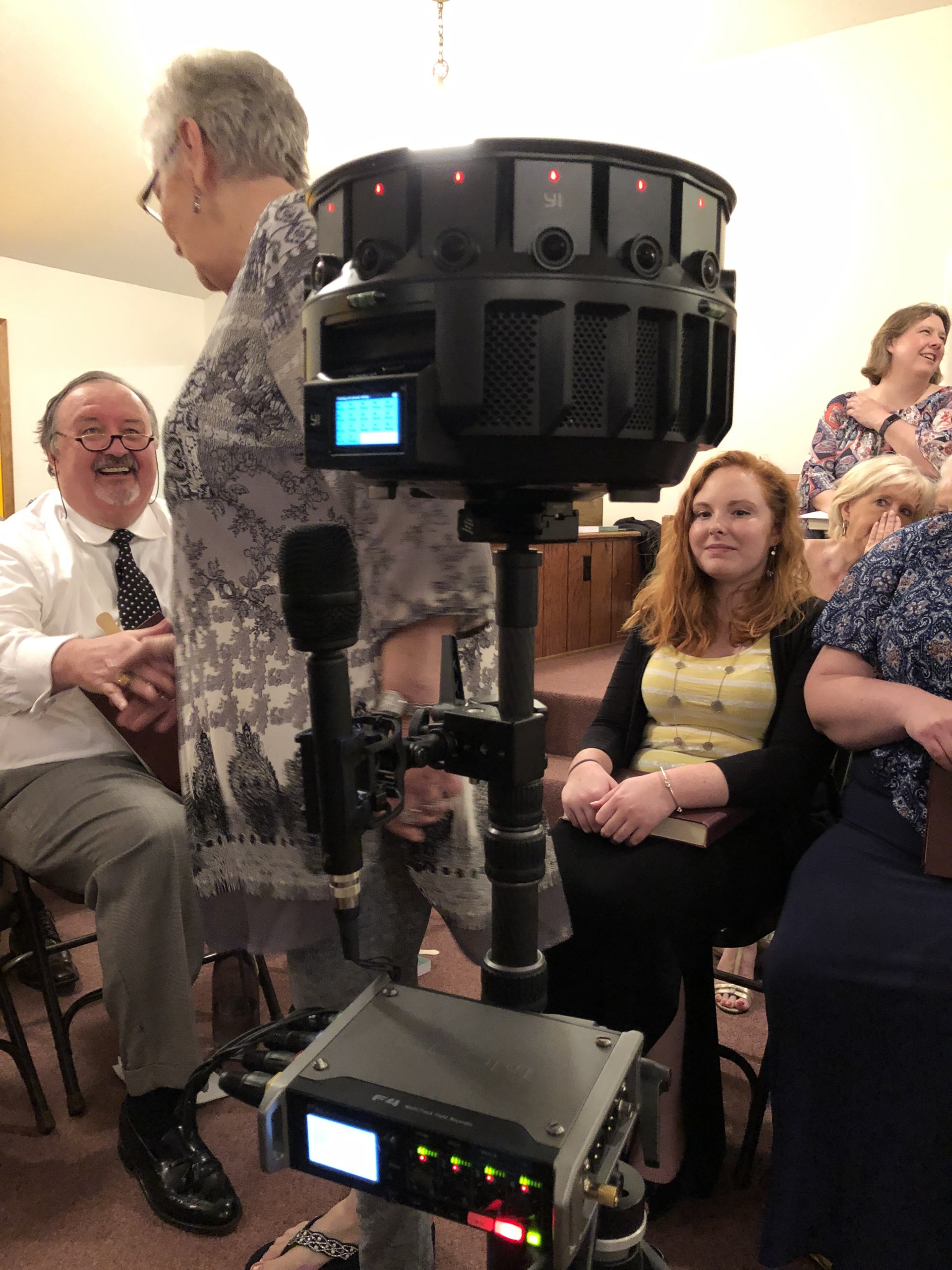
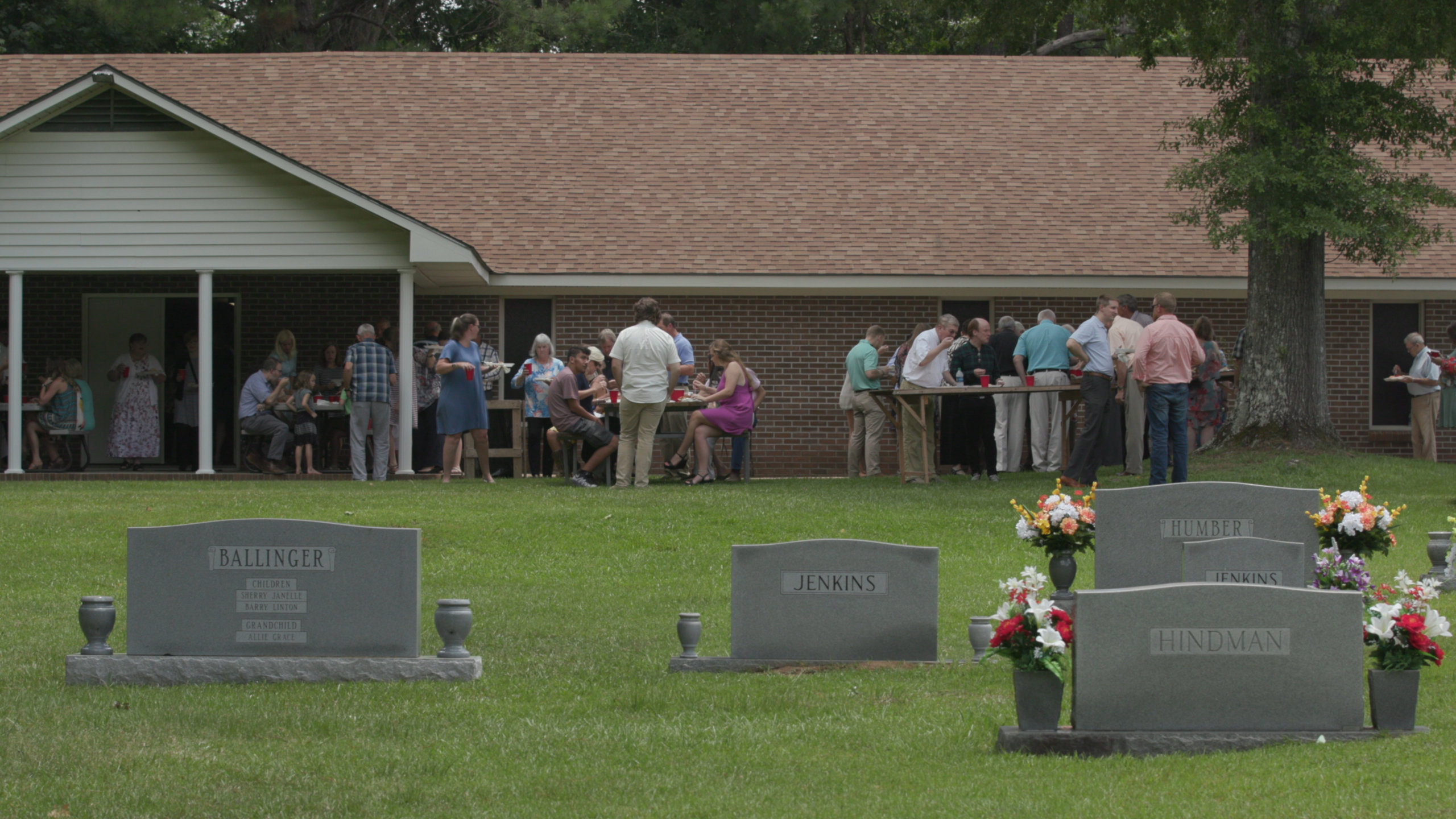
After trying out the device at a Decatur, Georgia, all-day singing, we recorded three hours of the annual singing at Mt. Lebanon Baptist Church in rural Fayette County in west Alabama. This lively, midsize singing is in an area long central to the geography of what is now an international music culture with roots in Alabama, Georgia, Mississippi, Florida, and Texas.4On Sacred Harp's shifting geography, see James B. Wallace, "Stormy Banks and Sweet Rivers: A Sacred Harp Geography," Southern Spaces, June 4, 2007, https://southernspaces.ecdsdev.org/2007/stormy-banks-and-sweet-rivers-sacred-harp-geography; Jesse P. Karlsberg, "Folklore's Filter: Race, Place, and Sacred Harp Singing" (PhD diss., Emory University, 2015), https://etd.library.emory.edu/concern/etds/n009w256n?locale=en; Jesse P. Karlsberg and Robert A. W. Dunn, "Mapping the 'Big Minutes': Visualizing Sacred Harp's Geographic Coalescence and Expansion, 1995–2014," Southern Spaces Blog (blog), January 23, 2018, https://southernspaces.ecdsdev.org/2017/mapping-big-minutes-visualizing-sacred-harps-geographic-coalescence-and-expansion-1995-2014. The Mt. Lebanon Singing also serves as this Independent Baptist church's homecoming and as a reunion for the Ballinger family, a number of whose members are active singers. Today the singing also attracts members of singing communities in northeast Alabama, metro Atlanta, and further afield: singers in 2019 had traveled from New York City and Dublin, Ireland, to Fayette County. Trying the singers' patience and good humor, we placed the cumbersome, many-eyed Yi Halo in the singing's cozy hollow square for much of the day. Song leaders stood right next to the device. Steve captured conventional "flat" video from the back of the room, behind the tenor section, while Jesse sat and sang with the tenors.
The resulting recordings, embedded in this publication and accessible through YouTube, present video and audio from the center of the hollow square. This vantage point, typically inaccessible to those who don't lead songs, is the physical and spiritual center of Sacred Harp singings.
Entering the Hollow Square
The hollow square is central to understanding the music and music culture that surrounds The Sacred Harp. Singers associate the hollow square with key values of participation and community. Sacred Harp singers often state that they are "singing for each other and for God," rather than for an audience. Though non-singers such as family members and descendants of singers, congregants at churches hosting singings, and other curious individuals do sometimes come to listen, the layout of Sacred Harp singings, in which singers face each other rather than the listeners in the back, reinforces its participatory ethos.5On how Sacred Harp's spatial organization compares to that of historically related sacred music cultures, see Paula Tadlock, "Shape-Note Singing in Mississippi," in Discourse in Ethnomusicology: Essays in Honor of George List, ed. Caroline Card et al. (Bloomington: Ethnomusicology Publications Group, Indiana University, 1978), 191–207.
The hollow square also bolsters singers' sense of Sacred Harp as a community. Eye contact across the hollow square, where trebles face basses and tenors face altos, has kindled relationships, reinforced friendships, and intensified shared emotional experiences. Sacred Harp's music culture generally discourages talking while a singing is in session. In the absence of commentary on the affective and spiritual experience of singing, nonverbal communication—during singing and between songs as leaders cycle in and out of the square—contributes to singers' understanding of their experience as shared.6On verbal and nonverbal communication, the hollow square, and affective intensity in Sacred Harp singing, see Miller, Traveling Home; Kiri Miller, "'Like Cords Around My Heart': Sacred Harp Memorial Lessons and the Transmission of Tradition," Oral Tradition 25, no. 2 (2010), http://muse.jhu.edu/journals/oral_tradition/v025/25.2.miller.html; Anne Heider and R. Stephen Warner, "Bodies in Sync: Interaction Ritual Theory Applied to Sacred Harp Singing," Sociology of Religion 71, no. 1 (2010): 76–97.
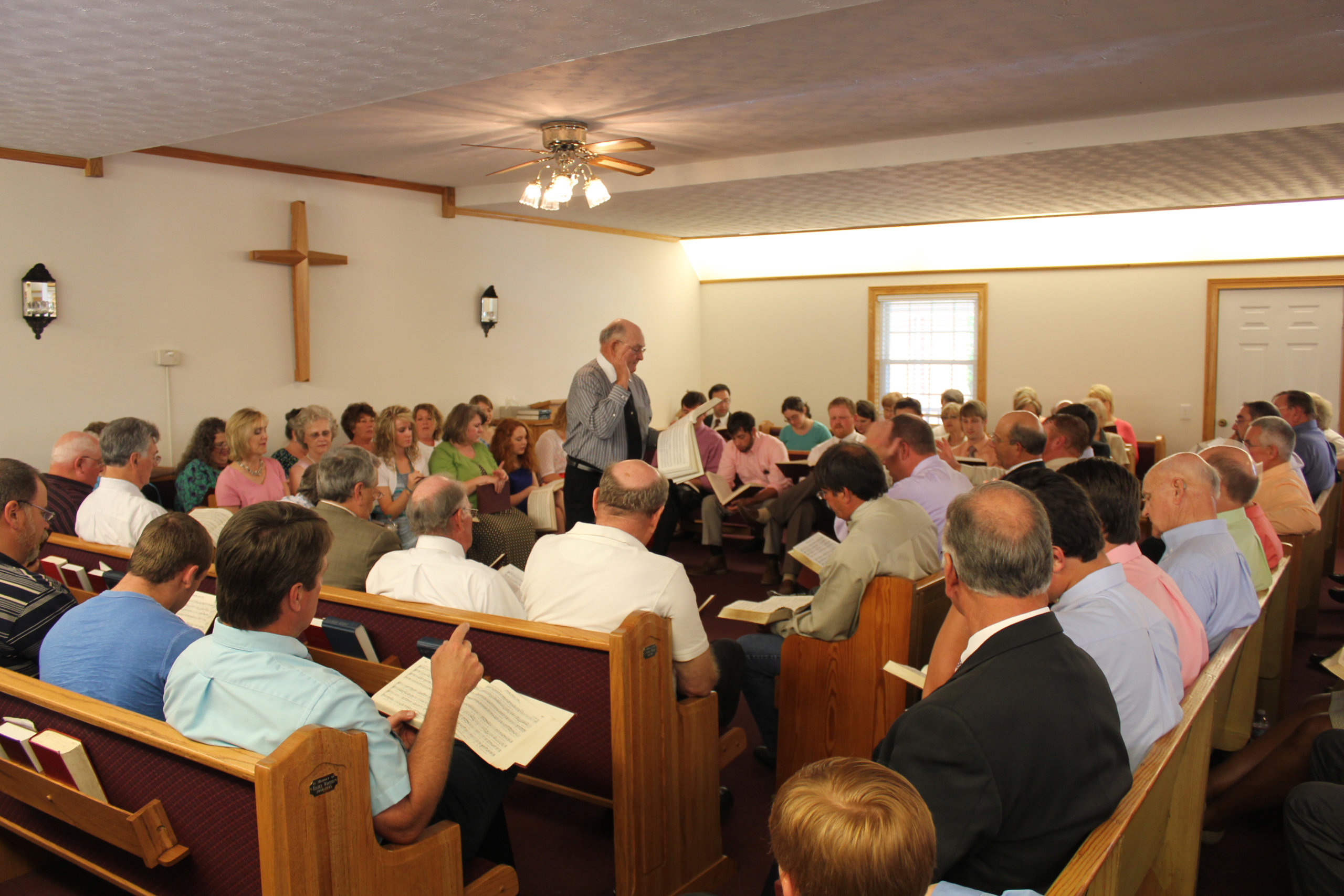
The hollow square also improves the sound of Sacred Harp singings in ways both practically and aesthetically valued by singers. Facing each other makes it easier for singers to stay together. All can see and follow the leader, who beats time, moving an arm down and up to convey tempo. Singing at each other rather than out at an audience concentrates sound, making it easier for singers to hear each other. The accumulated volume enhances the depth of the experience.
Of course, the very best sound is in the center of the hollow square. In this space, the singing is loudest and all four parts achieve their best balance. Many singers who came to Sacred Harp singing as adults remember the first time they stepped into this space as the time they knew Sacred Harp singing would become an enduring part of their lives. Over time many come to think of this locus of Sacred Harp's spatial organization as a sacred space. Singers frequently invite newcomers to join them in the center for a song, believing that this is the best vantage point from which to apprehend what makes the music culture so moving to its participants.
Composing Sacred Harp's Spatiality
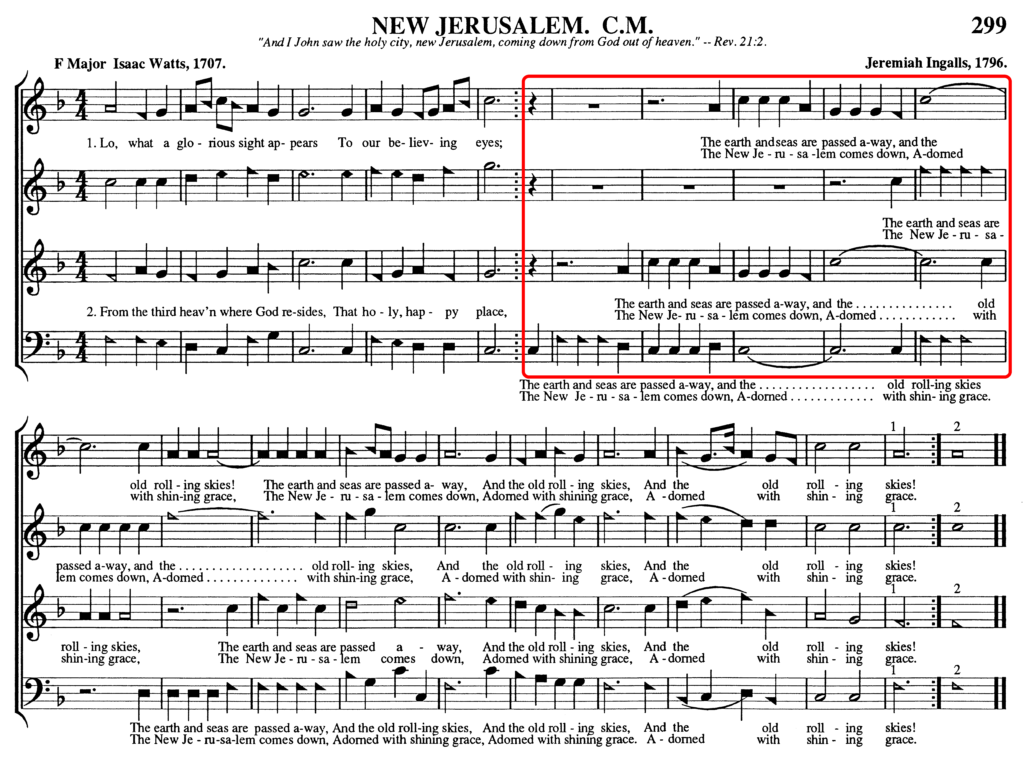
Many of the songs in The Sacred Harp leverage specific features of the hollow square for musical and emotional impact. The three immersive recordings of the Sacred Harp singing at Mt. Lebanon feature songs exemplifying two such approaches: fuging among the voice parts and traded high notes between the tenor and treble parts. Fuging tunes are among the most characteristic and popular song forms in The Sacred Harp. Typical fuging tunes begin with all the parts singing together, followed by a section in which each of the four voice parts enters in sequence, finally coming together again before the conclusion of the song.7Irving Lowens, "The Origins of the American Fuging Tune," Journal of the American Musicological Society 6, no. 1 (April 1, 1953): 46, https://doi.org/10.2307/829998. On fuging tunes, see also Karl Kroeger, American Fuging-Tunes, 1770–1820: A Descriptive Catalog (Westport, CT: Greenwood Press, 1994); Maxine Ann Fawcett-Yeske, "The Fuging Tune in America, 1770–1820: An Analytical Study" (PhD diss., University of Colorado at Boulder, 1997); Jesse P. Karlsberg, "Genre Spanning in the Close and Dispersed Harmony Shape-Note Songs of Sidney Whitfield Denson and Orin Adolphus Parris," American Music 35, no. 1 (2017): 94–132. The most common of these entrance patterns, as found in Jeremiah Ingalls's "New Jerusalem," led by Eli Hinton of Atlanta, Georgia, is propelled forward not just by the cascade of entrances and their progression from lower to higher voices, but by their spatialization. The entrance pattern proceeds counterclockwise around the hollow square, with basses followed by tenors, trebles, and altos.8"New Jerusalem," music by Jeremiah Ingalls (1796), words by Isaac Watts (1707), in McGraw et al., The Sacred Harp, 299.
Generations of composers have adopted this pattern and experimented with alternatives, frequently inspired by the arrangement of the vocal parts around the hollow square. After a short fuging section, Amos Munson's "Newburgh," led by Cheyenne Ivey, a member of a singing family from Henagar, Alabama, leverages the physical separation of the vocal parts to dramatize the celestial distance between the sun and stars. After the basses to the right of the leader enter on the phrase "Thou sun with golden beams" and all four parts sing "And moon with paler rays," the trebles, to the leader's left, reply with a shimmering "Ye starry lights, ye twinkling flames, Shine to your Maker's praise."9"Newburgh," music by Amos Munson (1798), words by Isaac Watts (1719), in McGraw et al., 182.
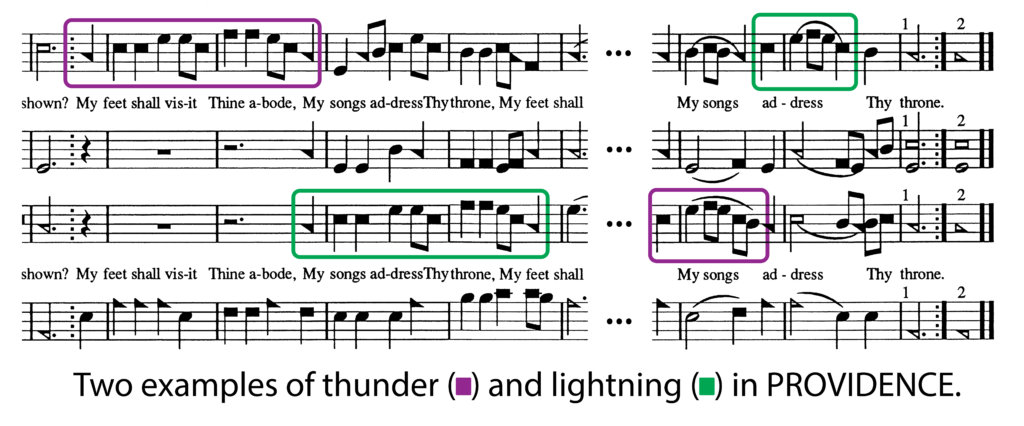
Composers also rely on the separation of vocal parts to create moments of power and energy by trading prominent high notes in rapid succession between the tenor and treble parts, a feature that singers often refer to as "thunder and lightning." Since these two parts are typically sung by mixed gender groups with similar vocal ranges, this trading back and forth of high notes would be undetectable without the vocal separation that the hollow square provides. In songs like C. Curtis's "Providence," led here by siblings Wanda Capps and Danny Creel from Dora and Hoover, Alabama, respectively, the traded high notes are distinct and clearly audible, contributing dynamic crackling energy to the song. "Providence" features "thunder and lightning" in multiple places. After a short opening section, the song's chorus begins with the trebles singing a musical phrase that peaks on a high note (accompanied by the basses) which is immediately echoed by the tenors. The song continues with similar exchanges, culminating in a figure ricocheting from the tenor to the treble as the song reaches its conclusion.10"Providence," music by C. Curtis (1820), words by Isaac Watts (1719), in McGraw et al., 298.
Recording the Hollow Square
For singers and scholars, Sacred Harp's spatial qualities have made recording the style appealing. Yet the results have persistently struck their makers and audiences as falling short of conveying the experience of being at a singing. The earliest field recordings, made by John W. Work III in 1938 and Alan Lomax and George Pullen Jackson in 1942, used then-available monophonic technology, collapsing the music's richly spatialized four-part harmonies to a single channel of recorded sound.
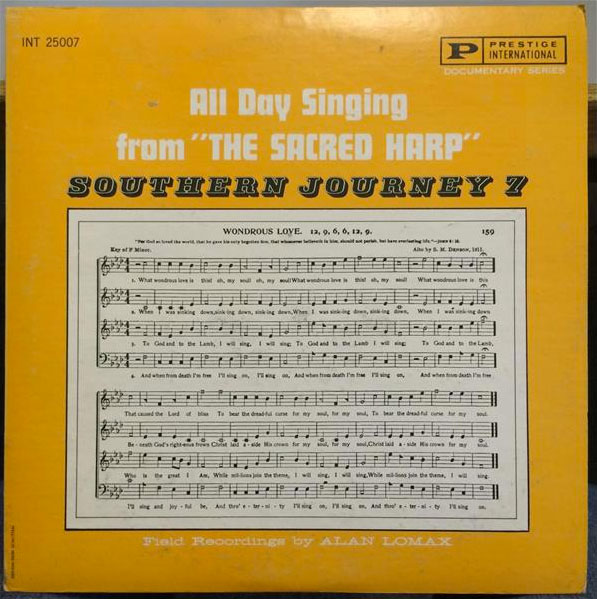
For Lomax, frustration with the result prompted him to include Sacred Harp singing in his itinerary for the "Southern Journey" field recording sessions he conducted in August through October of 1959 after he first gained access to portable stereo recording technology. The ensuing recordings, released in part as All Day Singing from "The Sacred Harp" (1961), provide considerably greater depth and intimacy than the monophonic recordings from the 1930s and 1940s, and contributed to greater public awareness of and interest in participating in Sacred Harp singing during the folk revival.11Alan Lomax and Alabama Sacred Harp Singers, All Day Singing from "The Sacred Harp," recorded 1959, 33 1/3 rpm record, Southern Journey (Bergenfield, NJ: Prestige, 1961). But Lomax's vantage point at one corner of the hollow square contributed to an imbalance among the parts that bothered contemporaneous Sacred Harp singers. The Sacred Harp Publishing Company, publisher of the most widely used tunebook at singings, responded by recording, producing, and releasing a series of LPs in the 1960s and 1970s, recorded in a studio and mastered to provide what they deemed a more satisfying balance of the parts.12Cobb, The Sacred Harp. When quadrophonic sound systems—one speaker for each Sacred Harp voice part!—proliferated in the 1970s, the same organization planned a release in this format, but the project was eventually shelved.
Conclusion
In the 2020s, as in the 1930s, there is no substitute for experiencing a Sacred Harp singing in person; singings today are held across the United States and beyond every weekend of the year. Yet we think the recordings of these three songs provide new virtual access to the experience of Sacred Harp's spatiality. We invite you to explore the activity in different parts of the singing space by shifting your perspective while navigating the video on your desktop monitor or your phone's YouTube app. If you wear headphones, you can hear the spatial audio shift along with the visual field of view. If you have access to a virtual reality headset, you can immersively experience the perspective these recordings afford. We plan to stage virtual reality viewings of these recordings at the Camp Fasola Sacred Harp singing school and at other singings in 2020. We will also make recordings of other songs accessible through the web in the coming months to expand the selection of songs and leaders captured using this technology. 
Additional Videos
- Philip Gilmore, of Oneonta, Alabama, leads Ananias Davisson's "Idumea" (p. 47b) from The Sacred Harp.
- Ewa Lichnerowicz, of Dublin, Ireland, leads S. M. Denson's "Praise God" (p. 328) from The Sacred Harp.
- Cindy Tanner, of Henagar, Alabama, leads George Coles's "Green Street" (p. 198) from The Sacred Harp.
- Beth Wallace, Eady Porter, Aubrey Zeanah, and Ridley Colvin, of Fayette, Northport, and Demopolis, Alabama, lead O. A. Parris's "My Brightest Days" (p. 546) from The Sacred Harp.
- Judy Caudle, of Eva, Alabama, leads H. S. Rees's "Sweet Morning" (p. 421) from The Sacred Harp.
About the Authors
Steve Bransford is the senior video producer at the Emory Center for Digital Scholarship. His documentary feature, The Well-Placed Weed, is available on Vimeo.
Jesse P. Karlsberg is the senior digital scholarship strategist at the Emory Center for Digital Scholarship. He is the project director and editor-in-chief of Sounding Spirit, a research lab and publishing initiative promoting collaborative engagement with historical American songbooks. Karlsberg is an internationally recognized singer, teacher, composer, and songbook editor in the Sacred Harp tradition.
]]>Presentation
Question and Answer Session
About the Speaker
Niall Atkinson is Neubauer Family Assistant Professor of Art History and the College at the University of Chicago. His publications include The Noisy Renaissance: Sound, Architecture, and Florentine Urban Life (University Park: Penn State University Press, 2016), as well as articles and chapters in Grey Room, Senses and Society, and A Companion to Renaissance and Baroque Art (Hoboken, NJ: Wiley-Blackwell, 2013).
]]>Review
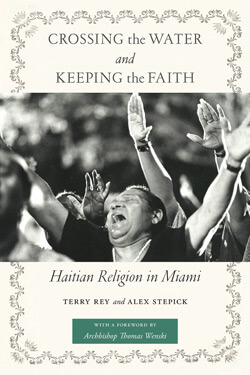
In Crossing the Water and Keeping the Faith, sociologists Terry Rey and Alex Stepick map the vibrant diasporic religious cultures of Miami, the site of the largest Haitian-descended population outside Haiti itself. Well aware that prevailing academic and popular narratives ascribe Vodou practice to all Haitian citizens and expatriates, Rey and Stepick offer a meticulous historical and ethnographic account of Miami's religious landscape that evolves at the crossroads of Catholic, Protestant, and Vodouist praxes.
 |
| Crossing the Water, Notre Dame d'Haiti Catholic Church, Little Haiti, Miami. Mural by Alex Jean Altidor. Photo by Jerry Berndt. Courtesy of New York University Press. |
Crossing the Water and Keeing the Faith opens with a vivid description of Alex Jean Altidor's prominent mural at Notre Dame d'Haiti Catholic Church, "the leading cultural and religious institution in Haitian Miami and one of the most significant 'ethnic parishes' in American Catholic history" (35). This colorful mural depicts Haitians traveling by passenger jet and wooden boat to Miami, framing Rey and Stepick's emphasis on religious exchange and serving as a devotional reminder of the journeys between these two sites. One interpretation of this painting asserts that Haitian émigrés employ a singular Catholic theology of migration. However, Rey and Stepick reveal multiple dimensions of the Haitian American religioscape in Miami that preserve and theologize a complex lifesystem. Our Lady of Perpetual Help, a central figure in the mural who guards over the emigrants' journeys, serves as a polyreligious national symbol, taking on significant meaning in the three religious trajectories that Crossing the Water and Keeping the Faith describes. Rey and Stepick argue that religion facilitates the successful migration, assimilation, and flourishing of immigrant communities. As the mural's motifs testify, and Rey and Stepick illuminate, experiences of immigration shape Haitian American religiosity in Miami.
 |
| Forest of Artists Haitian Cross, Artisan Project of Port-de-Paix, Haiti, sister diocese to the Archdiocese of Miami. Notre Dame d'Haiti Cathedral, Miami, Florida, February 1, 2014. Photo by Monica Lauzurique. Courtesy of the Archdiocese of Miami. |
In characterizing "the transnational Haitian religious field"—some 690 miles between Miami and Haiti—Crossing the Water and Keeping the Faith advances a "Haitian religious collusio," defined as "a generally shared substratum of features that runs beneath [Haitian religious] diversity and animosity" (5, 8). The authors understand Pierre Bourdieu's term collusio as an extension of his more commonly cited habitus, "the 'matrix of perception' through which one makes sense of the world and the seat or generator of one's dispositions, inclinations, and tastes" (7–8).1For an extended discussion of the relationship between habitus and collusio, see Pierre Bourdieu, "The Production of Belief," Media, Culture, and Society 2 (July 1980): 261–293. A Haitian religious collusio encompasses a worldview "inhabited by invisible, supernatural forces that are to be served and which can be called upon and operationalized toward healing ills, mitigating plight, enhancing luck, and achieving goals" (10). Rey and Stepick are clear: Vodou2Vodou is an indigenous Haitian religion, closely related to West African Vodun, that draws from multiple West African religions, in addition to Roman Catholicism, European mysticism, and freemasonery. Most practitioners of Vodou reference themselves as "servants of the spirits," and understand the religion as a worldview. See Karen McCarthy Brown, Mama Lola: A Vodou Priestess in Brooklyn (Berkeley: University of California Press, 1991); David Cosentino, Ed., Sacred Arts of Haitian Vodou (Los Angeles: UCLA Fowler Musuem of Cultural History, 1995); and Patrick Bellegard-Smith and Claudine Michel, Eds., Vodou in Haitian Life and Culture: Invisible Powers (New York: Palgrave Macmillan, 2006). binds together disparate Haitian religious orientations that can otherwise be viewed as antagonistic and oppositional. Crossing the Water and Keeping the Faith examines how a particular Latin American religious collusio manifests in Miami.
Importantly, Rey and Stepick foreground how religion informs classism among Miami's Haitian Christian population. In Chapter Two, "Immigrant Faith and Class Distinctions: Haitian Catholics beyond Little Haiti," they explore how the religiosity of middle- and upper-class Haitian Americans reifies their class standing. The economic differences between the mural's airplane and boat suggest parallel devotional differences between Miami's mostly lower-class "Little Haiti" and various middle- and upper-class suburban enclaves. Haitians in middle- and upper-class neighborhoods outside of Miami (such as West Kendall and Perrine), participate in more overtly "sacramental rites" at a Traditionalist Catholic shrine in Little Havana (the Shrine of St. Philomena),3The Traditionalist Catholic movement performs sacraments in accordance with church teachings prior to the Second Vatican Council (1962–1966). Vatican II made noteworthy changes to sacramental rituals. For example, the altar is closer to laypersons, and much of the liturgy is spoken in local languages rather than in Latin (63). at Our Lady of Lourdes Catholic Church in Kendall, and at Christ the King Catholic Church in Perrine (59, 63). Highlighting important class markers, such as Latin or French masses as contrasted with those in Haitian Creole, Rey and Stepick posit that well-off Haitian Americans pursue upward mobility while maintaining "Old World" separations between themselves and lower-class Haitian Americans.
 |
| Our Lady of Perpetual Help, Marian Shrine at the Notre Dame d'Haiti Catholic Church, Miami, Florida, February 1, 2014. Photo by Ana Rodriguez-Soto. Courtesy of the Archdiocese of Miami. |
Although Mary is a venerated figure across global Catholic devotion, Rey and Stepick posit a "Marian collusio" among Haitian Catholics across time and space.4For more on Haitian Marian devotion, see Terry Rey, Our Lady of Class Struggle: The Cult of the Virgin Mary in Haiti (Trenton: Africa World Press, 1999). They assert that
on the Catholic side of the Haitian religious triangle of forces, the supernatural being who is believed to be most involved in the lives of believers and the history of their nation and its diaspora is the Virgin Mary. . . . Even as Haitian Catholicism changes over generations and as it has been carried across seas, this is its most enduring feature, devotion to the Virgin Mary who fought for Haitian independence, who inspired the toppling of dictators, and who maternally guided thousands of Haitian immigrants in their crossing to and thriving in Miami. (81)
In addition to exploring subaltern spaces and practices, Stepick and Rey note the active participation of middle- and upper-class Haitians in the Catholic Charismatic Renewal (CCR), a Pentecostal movement that has heavily influenced the Catholic Church in Haiti.5The Catholic Charismatic Renewal, a direct result of Catholic encounter with Protestant Pentecostalism dates to the 1960s and is found in over two-hundred countries. In gatherings outside of Mass, members of CCR participate in prophecy, faith healing, and glossolalia. It reflects a larger Neo-Pentecostal movement of persons and groups experiencing "charismatic" worship and choosing to stay in their familiar Catholic faith tradition, as opposed to aligning with Pentecostal congregations. See Paul Josef Cordes, Call to Holiness: Reflections on the Catholic Charismatic Renewal (Collegeville: Michael Glazier, 1997) and Susan A. Maurer, The Spirit of Enthusiasm: A History of the Catholic Charismatic Movement, 1967–2000 (Lanham: University Press of America, 2010). They highlight the movement's 2002 national convention in Haiti, drawing several thousand attendees and "[r]epresenting all social classes of the Haitian diaspora" (74). For Rey and Stepick, Neo-Pentecostal movements such as CCR have the ability to implode class boundaries (76). Though Haitian class tensions manifest in urban and suburban Miami, the realities engendered by migration can challenge or shore up social structures.
The Haitian diaspora evades easy categorization (78). In Crossing the Water and Keeping the Faith, collusio serves as a theoretical orientation for Haitian American religious identity spanning class identities. Members of various religious groups "believe strongly that faith is a source of healing and of matchless protection against destructive supernatural powers and against the fallout from sin—a source of salvation goods" (80).
Rey and Stepick understand religion as mitigating the discrimination that Miami Haitian Americans experience.6For an example, see Regine O. Jackson, "After the Exodus: The New Catholics in Boston's Old Ethnic Neighborhoods," Religion and American Culture 17.2 (2007): 204. Jackson argues that religion sometimes become a lowest common denominator amongst co-ethnics. Religious institutions and weekly practice offer immigrants "…a way to recreate social ties and generate narratives of self-worth despite structural challenges to individual and collective mobility." The cornerstone of the collusio—harnessing and directing supernatural power—responds to life's realities:
[W]e have argued that for many Haitian immigrants in Miami religious practice is a source of worthiness, a form of salvation goods that such practice accrues for believers. . . . For Haitians in Miami and elsewhere in the diaspora, the religious capital possessed by churches, temples, priests, pastors, botanicas, oungan, and manbo generates a wide array of salvation goods that believers pursue, the most obvious being sacraments, luck, magic, and healing. Less obvious, though equally important, especially for poor immigrants, is worthiness: a sense of being worthy of a place in American society; a sense that one's gifts from Haiti are making an important contribution to both the American social fabric and the Haitian; a sense of dignity and respect that transforms boat people into people; beasts into gods. (201)
"Symbolic capital" and "salvation goods" take on a particular meaning in Haiti's material-based religious cultures and affect what Rey and Stepick identify as Haitian religion's ultimate concern: healing (14–15). On a more everyday level, "worth"—invisibly and materially—furnishes an individual and communal currency to leverage toward efficacy, power, and self-confidence.
Rey and Stepick suggest that the collusio is at work in all Haitian American religious spaces. From Catholicism's political advocacy and feast days to evangelical Protestantism's storefront churches, Crossing the Water and Keeping the Faith's diverse representation of Haitian Christianity constitutes its primary intervention. Emphasizing that Christians comprise a majority within the Haitian diaspora, the authors repeatedly connect immigration with Christian conversion, theorized as an act of spiritual thanksgiving and religio-social assimilation. Archbishop Thomas Wenski's (former activist priest at Notre Dame d'Haiti Catholic Church) foreword and the church-centered descriptions of Vodou practice evince Rey and Stepick's casting of Haitian American religion as predominately Christian.
 |  | |
| Archbishop Thomas Wenski receiving offertory gifts of fruits and native plants from parishioners, Notre Dame d'Haiti Catholic Church dedication service, Miami, Florida, February 1, 2015. Photo by Ana Rodriguez-Soto. Courtesy of the Archdiocese of Miami. | ||
This assessment hinges on contested etic religious categories and foregrounds boundaries between the three faith systems that do not correspond with the broad Africana epistemology championed by theologian Dianne M. Stewart and religious historian Tracey R. Hucks. Synthesizing the work of social scientists, religious and secular historians, theologians, and ethicists to provide a thorough historiography of Africana religious studies in the Americas over the last century, Stewart and Hucks challenge entrenched notions of Christian influence and religious syncretism that impact representations of African and Africana religions. With the exception of Cuban Santería and Palo Monte practitioners in Miami, Rey and Stepick do not engage Haitian American religiosity comparatively within this larger Africana religious milieu.7See Tracey E. Hucks and Dianne Stewart Diakité, "Africana Religious Studies: Toward a Transdisciplinary Agenda in an Emerging Field," Journal of Africana Religions 1.1 (2013): 39. In contrast to Rey and Stepick's emphasis on Christianity as the religious vocabulary through which Haitian Americans identify, understand, and live out their polyreligious collusio, the fluidity of the "crossed" water depicted in Crossing the Water and Keeping the Faith's opening mural may more accurately represent multiple and disparate ways that Haitian Americans mobilize various religious technologies. Rey and Stepick depart from other contemporary ethnographic explorations of the Haitian diaspora in Miami and urban America. In comparison with scholarly works that connect Vodou practice and migration as parallel processes—such as Karen McCarthy Brown's oft-cited Mama Lola: A Vodou Priestess in Brooklyn, Elizabeth McAlister's Rara! Vodou, Power, and Performance in Haiti and its Diaspora, or Karen Richman's Migration and Vodou—Rey and Stepick reimagine the Haitian American religious landscape as predominantly Christian.
 |
The sole chapter in Crossing the Water and Keeping the Faith dealing with African-derived religious culture of Haiti, "Vodou in the Magic City: Serving the Spirits across the Sea," demonstrates a broad understanding of religious syncretism in Miami.8In an ethnography of the Tobagonian Spiritual Baptist faith, anthropologist Maarit Laitinen offers an impressive intellectual genealogy of "syncretism" between African and European religious cultures. Laitinen advances a textured theory that "does not downplay the agency of people living in creole societies, but presents them as active, creative participants in the reproduction of change and religion within particular socio-historical circumstances." Though Laitinen is one of many theorists who articulate a novel theory of religious encounter in the Caribbean, her scholar-practitioner identity is particularly concerned with "bridg[ing] the conceptual gap, often hierarchically valued, between creole cultures and 'cultures of origin'" (61). Laitinen's perspective helpfully elucidates the Caribbean religious landscape from which Vodou emerges and, by implication, problematizes "syncretism" as a primary interpretive lens of Caribbean religions. See Maarit Laitinen, Marching to Zion: Creolisation in Spiritual Baptist Rituals and Cosmology (Helsinki: Helsinki University Press, 2002). Although it underscores gross misperceptions of Vodou practice, it offers only scant engagement with the phenomenon in the United States. Instead, Rey and Stepick emphasize four stages of Vodou practice in the Miami diaspora: its transformations along the Haitian-Miami corridor; the role of Catholic churches and shrines in sustaining practices; challenges that practices pose to local judiciary; and the transnational characteristics of Miami neighborhoods practicing Vodou (118). Despite contemporary scholarship that illumines Africana religions and categories, Rey and Stepick depict Vodou as a historical undercurrent for waves of Haitian American Christian growth. To their credit, they mention Vodou practitioners' reticence to engage fully with ethnographers and thereby betray questions of access to the tradition the authors describe as declining.9There are numerous reasons for Vodou practitioners to withhold their religious identities and practices from outsiders, including academic misrepresentation, social stigma, and political persecution. See Benjamin Blue, "They Fought the Lwa and the Lwa Won: Persecution of Haitian Vodou," The Journal of the Vodou Archive (Spring 2013): 2–7. While Rey and Stepick return to the Catholic, Protestant, and Vodouist legs of the Haitian collusio, their analysis of Vodou's contribution remains limited.
An Africana religious framework would benefit Crossing the Water and Keeping the Faith, ensuring a consideration of the coterminous beliefs and practices issued from multiple religious heritages. Anthropologist Stephen Glazier's theory of religious juxtaposition in the Spiritual Baptist tradition would also extend Rey and Stepick's collusio framework. Glazier suggests that rites from disparate religions, though sometimes separated by time and space, can find ritual homes in the same bodies and places. Multiple religious traditions are juxtaposed in a ritual altar display, or on ceremonial vestments, rather than being absorbed, ignored, or obliterated.10Stephen Glazier, "Syncretism and Separation: Ritual Change in Afro-Caribbean Faith," The Journal of American Folklore 98.387 (January-March 1985): 49–62. While Rey and Stepick make similar claims about Vodou practice and "Haitian religion" writ large, their perspective obscures Vodou's pivotal influences. By retaining Bourdieu's collusio throughout Crossing the Water and Keeping the Faith—designating what constitutes a Catholic, Protestant, or Vodou initiate without a sustained discussion of persons inhabiting multiple religious identities—Rey and Stepick miss opportunities to engage Africana-centered theories that represent dialogical relationships between African and Christian practices. The mantle of one faith need not elide the presence of another. The authors' indexing Haitian American religious ways along a Christian continuum over-simplifies the dynamic religious orientation that emerges in the diasporic movement.
 |
| Student kneeling in front of Alex Jean Altidor's mural, former Notre Dame Academy for Girls, Miami, Florida, August 29, 2013. Photo by Ana Rodriguez-Soto. Courtesy of the Archdiocese of Miami. |
Crossing the Water and Keeping the Faith successfully locates Catholic, Protestant, and Vodouist religious identities in Haitian Miami and illustrates the diversity of religious places in the diaspora. Rey and Stepick's extensive fieldwork yields vivid anecdotes of faithful persons, sensitive considerations of immigrant struggle and resilience and, to date, the most comprehensive theory of Haitian American religious lives. Exploring how religious cultures mobilize and sustain themselves and their adherents, Crossing the Water and Keeping the Faith extends popular and scholarly understandings of Haitian religiosity in the United States. In their debatable adoption of Christianity as the dominant epistempology for Haitian religious practice, Rey and Stepick illuminate the need for critical interrogation of the radical encounters of diaspora, pointing to the project of extending their theoretical framework of collusio into broader, Africana frameworks.
About the Author
Meredith Frances Coleman-Tobias is a PhD candidate in the Graduate Division of Religion at Emory University. In the American Religious Cultures course of study, her research interests consider Caribbean and North American iterations of African Atlantic religious cultures. She is specifically interested in contemporary Africana religious migrations, which she began to study during her tenure as a Fulbright fellow in Barbados (2009–2010). Meredith's dissertation research focuses on the ritual diaspora of two Burkinabé spiritual leaders. Investigating their “reverse mission” in Western countries, she interrogates African and non-African descendants' intentional practice of Dagara spirituality in North America and the Caribbean. Meredith earned the BA from Spelman College in 2006 and the MDiv from Yale Divinity School in 2009.
]]>There is no place where I can go, or where you can go, and think about, or summon the presence of, or recollect the absences of the ones that made the journey. There is no small bench by the road, there is not even a tree scored and initialized that I can visit, or you can visit, in Charleston, or Savannah, or New York, or Providence, or the Ohio River, or better still, on the banks of the Mississippi.
—Toni Morrison1Toni Morrison, "A Bench by the Road," World Journal of the Unitarian Universalist Association 3 (January/February 1989): 4.
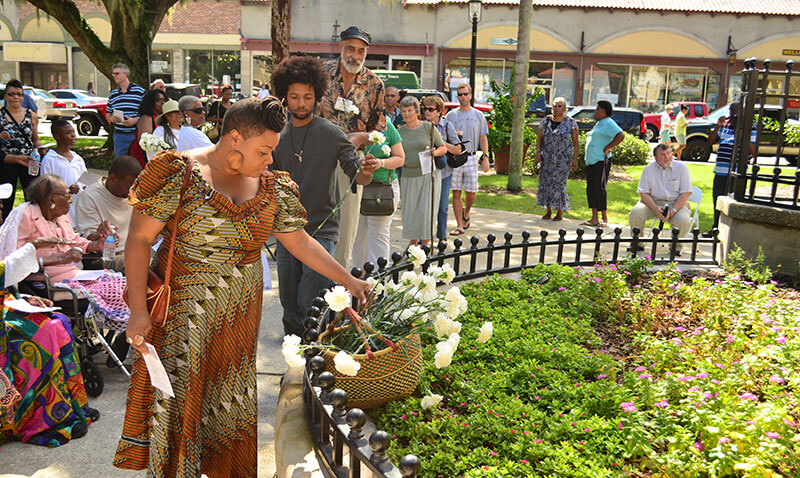
The Middle Passage Ceremonies and Port Markers Project (MPCPMP) was established in 2011 to honor and commemorate the two million captive Africans who died during the Middle Passage from Africa to the Americas. Some half-million enslaved arrived at forty-one documented sites in the United States. At these arrival ports a significant portion of American history began. Relying principally upon information from Voyages: The Transatlantic Slave Trade Database, developed by professors David Eltis of Emory University and P. David Richardson of the University of Hull, the remembrance ceremonies at these ports present the history of the transatlantic human trade and provide a means for addressing a painful and shameful American experience whose vestiges persist today. These ceremonies feature rituals incorporating representatives of African, Native American, Asian, and European religious traditions with current and historical ties to the site as well as a detailed recounting of the history of enslavement in the specific locale.
The installation of historic markers at the forty-one Middle Passage arrival ports publicly designates these places as crucial points where the lives of European and African people intersected to form what would become the United States. In some cases, this has required a reassessment of the popular narrative and perceptions. For instance, Jamestown, Virginia, which is routinely identified in schoolbooks as the place where Africans first arrived in North America, is neither the actual place of Africans' first arrival in Virginia (Point Comfort, Hampton, Virginia, is the actual site) or in North America (Florida holds that distinction). Residents of Fredericksburg, Virginia, long identified with the domestic human trade, recently learned, after MPCPMP presented Eltis's research from the Voyages Database, that their city was a Middle Passage port on the Rappahannock River.2Further study by a National Park Service historian reviewing data from the New York Historical Society provided more detail to support this "new" site definition.
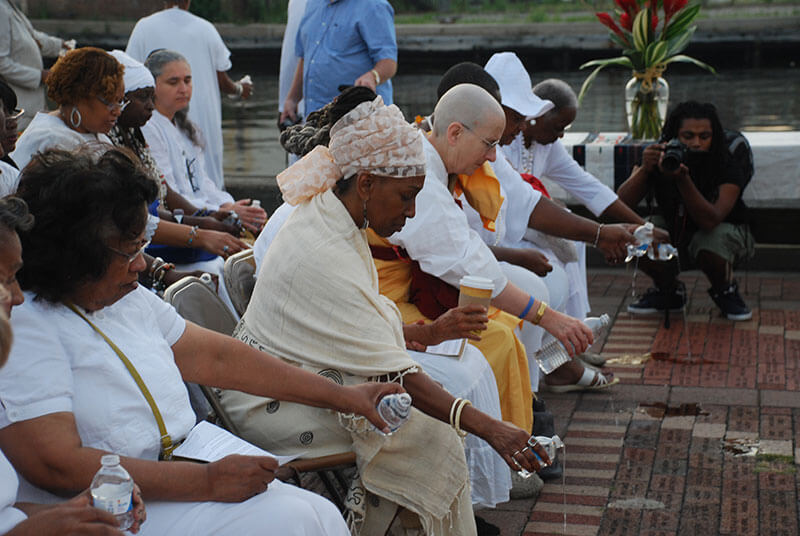
With a proposed marker to be unveiled February 7, 2015, St. Augustine, Florida, previously known as a Spanish colony, will henceforth be identified as the oldest permanent (1565) European/African/Native American settlement on US territory. The inclusion of the forty–six free and enslaved Africans who arrived on Spanish ships at the first landing on August 28, 1565, significantly alters the narrative as the city embarks on commemorating its 450th anniversary. Boston is scheduled to hold a Middle Passage remembrance ceremony and to place a marker on August 23, 2015. The historical marker text will inform the general public about the Bay Colony's role as the first place where slavery was legal in the North American British colonies. This further reconfigures the popular perception that slavery was a phenomenon only of the US South. When a marker is installed in the Sapelo Bay area in Georgia, it will increase awareness that in 1526 the first European/African settlement, San Miguel de Gualdape, was established in this area. That marker will also record that Sapelo Bay is the site of the first rebellion by enslaved Africans and the first maroon community on the North American mainland.
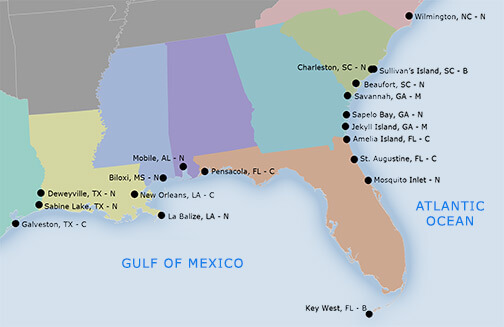
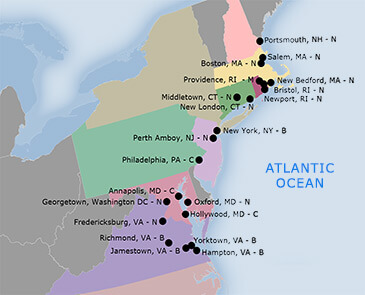
Each MPCPMP ceremony and marker is unique. In our initial presentation to local participants in the commemoration project, we suggest elements to include in the remembrance ceremony and discuss the historical information on each marker, but otherwise we act only as a facilitator and advisor. Each locale makes the decisions on the ceremony, program, marker design, and text. To date, nine sites have sponsored ceremonies in conjunction with the project since 2012:
- Baltimore, Maryland,
- Sotterley Plantation in Hollywood, Maryland,
- Annapolis, Maryland,
- Historic Jamestowne, Virginia,
- Yorktown, Virginia,
- Philadelphia, Pennsylvania,
- Pensacola, Florida,
- Fernandina Beach, Florida,
- St. Augustine, Florida.
Three locations have installed markers: Historic Jamestowne, Virginia; Yorktown, Virginia; and Sotterley Plantation in Hollywood, Maryland. Eight locations are planning for ceremonies and/or marker installations: Boston (scheduled for August 23, 2015); Bristol, Rhode Island; Annapolis, Maryland (scheduled for February, 2015); Philadelphia, Pennsylvania; Galveston, Texas; Fredericksburg, Virginia (scheduled for 2015); St. Augustine, Florida (scheduled for February 7, 2015); and Perth Amboy, New Jersey. Two cities are reviewing historical evidence to determine if they will support the designation of Middle Passage arrival ports: Baltimore and Oxford, Maryland.
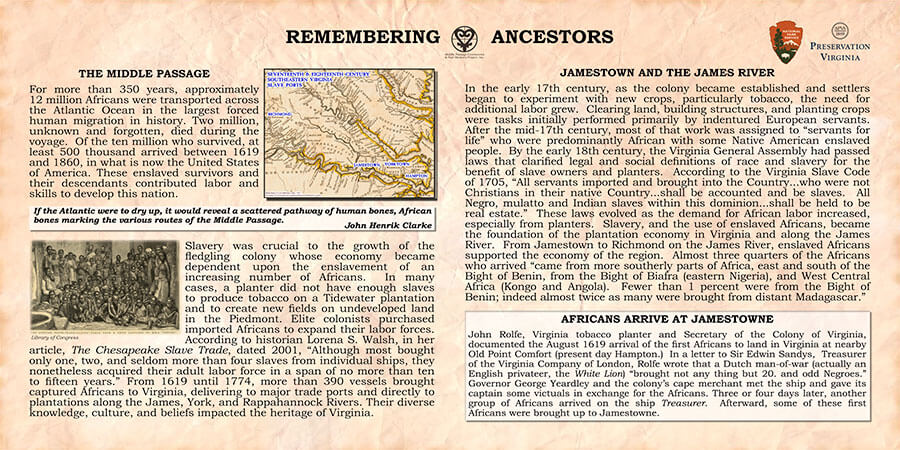
Over the last twenty years local groups in several US cities have conducted African ancestral remembrance ceremonies marking Middle Passage sites.3These cities include New York, New York, New Orleans, Louisiana, Hampton, Virginia, Oakland, California, Miami, Florida, Key West, Florida, and Galveston, Texas. Some have affiliated into a loosely knit network independent of MPCPMP. As the only national organization working to commemorate Middle Passage sites, MPCPMP complements this work by ensuring that this history is systematically acknowledged and documented. As a member of the MPCPMP honorary board and creator of the database of the transatlantic slave trade, Eltis has been instrumental to this effort. Through information on the years, ships, numbers of captive Africans delivered, and embarkation and disembarkation locations obtained from Voyages, the project is able to present an appeal for ceremonies and markers at each arrival site based upon scholarly research. In a very real way, this is the direct and immediate application of scholarship to public history. MPCPMP works with local contacts to make a place where everyone "can go, to think about, or . . . summon the presence of, or recollect the absences of . . . the ones that made the journey."4Toni Morrison, "A Bench by the Road."
For further information on MPCPMP visit middlepassageproject.org or the project's Facebook page.
About the Author
Ann Chinn is the Executive Director of the Middle Passage Ceremonies and Port Markers Project (MPCPMP).
This is an open access work distributed under the terms of the Creative Commons Attribution No Derivatives 4.0 License.
]]>Poem
Robert Morgan reads his poem "Bricking the Church," 2014.
Bricking the Church
At the foot of Meetinghouse Hill
where once the white chapel
pointed among junipers and pulled
a wash of gravestones west,
they've buried the wooden snow that
answered sarvis in bloom
and early morning fogs, in brick,
a crust the same dull red
as clay in nearby gullies.
The little churchhouse now looks more
like a post office or school.
It's hard to find
among the brown winter slopes
or plowed fields of spring.
Brick was prestigious back when
they set their minds and savings to it.
They wanted to assert its form
and presence if not in stone
at least in hardened earth, urban weight,
as the white clapboards replaced
unpainted lumber which replaced
the logs of the original
where men brought their guns to preaching
and wolves answered the preacher.
The structure grows successive rings,
and as its doctrine softens
puts on a hard shell
for weathering this world.
Acknowledgments
"Bricking the Church" from Robert Morgan's book Groundwork (Gnomon Press, 1979) appears here by permission of Gnomon Press.
About the Author
Robert Morgan is the author of fourteen books of poetry, most recently Terroir, 2011. He has also published nine volumes of fiction, including Gap Creek, a New York Times bestseller. A sequel to Gap Creek, The Road From Gap Creek, was published in 2013. A new novel, North Star, is forthcoming in 2015. In addition, he is the author of three nonfiction books, Good Measure: Essays, Interviews, and Notes on Poetry, 1993; Boone: A Biography, 2008; and Lions of the West: Heroes and Villains of the Westward Expansion, 2011. In 2010 a special issue of Southern Quarterly, edited by Jesse Graves, was devoted to essays about his work. He has been awarded the James G. Hanes Poetry Prize by the Fellowship of Southern Writers and the Academy Award in Literature by the American Academy of Arts and Letters. In 2013 he received the History Award Medal from the Daughters of the American Revolution. Recipient of fellowships from the Guggenheim and Rockefeller foundations, the National Endowment for the Arts, and the New York State Arts Council, he has served as visiting writer at Davidson College, Furman, Duke, Appalachian State, and East Carolina universities. A member of the Fellowship of Southern Writers, he was inducted into the North Carolina Literary Hall of Fame in 2010. Born on October 3, 1944 in Hendersonville, North Carolina, he has taught since 1971 at Cornell University, where he is Kappa Alpha Professor of English.
]]>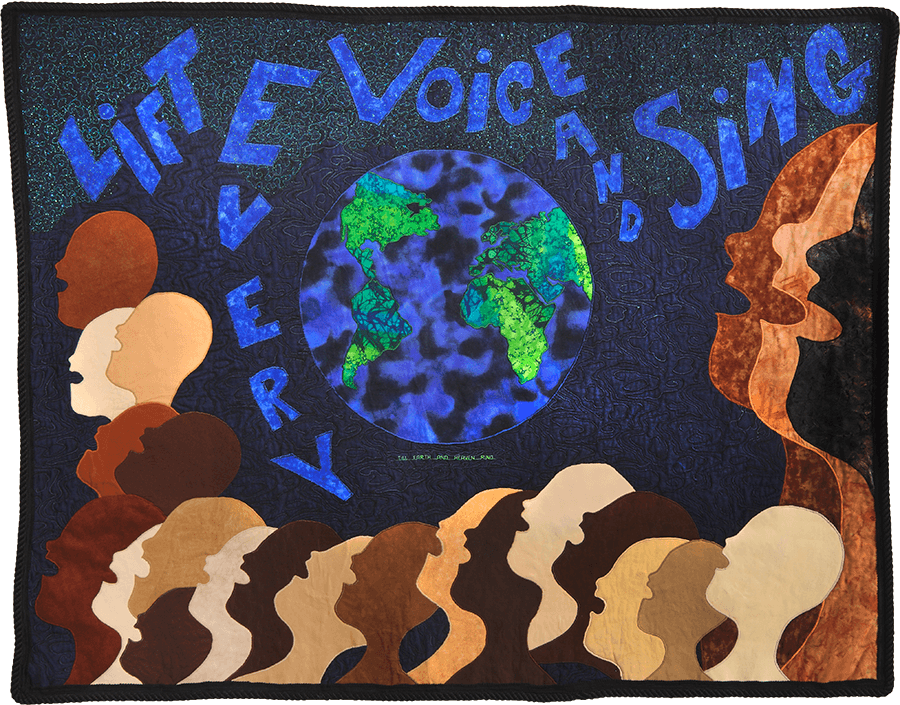
Introduction
The art flows through me, but does not belong to me alone. It speaks for those who have no voices, whose voices have been ignored, whose voices have been silenced. It relates history and circumstances that must not be forgotten.
—Gwendolyn Ann Magee, ArtistRarely does an individual who has experienced oppression and prejudice find the means of expressing her experience with such masterful skill, in such an appropriate medium, and with such an embracing, uplifting tone.1Bradley, Betsy. "Acknowledgments," in Journey of the Spirit: The Art of Gwendolyn A. Magee, ed. René P. Barilleaux (Jackson, MS: Mississippi Museum of Art, 2004), 3.
—Betsy Bradley, Director, Mississippi Museum of Art
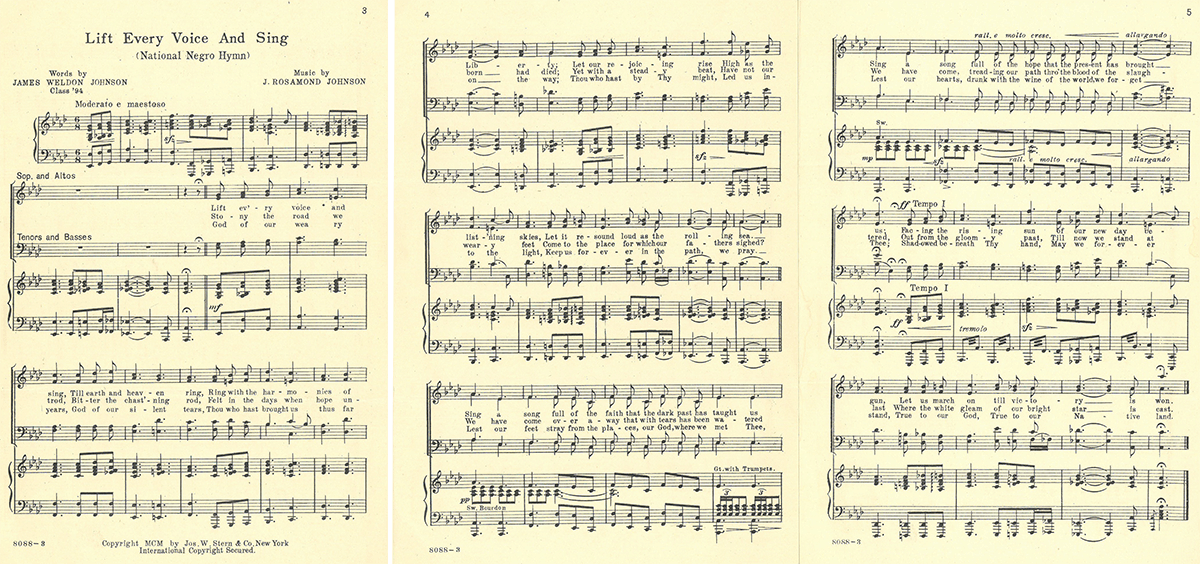 |
| Lift Every Voice and Sing, 1900. Poem by James Weldon Johnson. Music by John Rosamond Johnson. Courtesy of Emory University Manuscript, Archives, and Rare Book Library. |
An extraordinary artist working in fiber, Gwendolyn Ann Jones Magee (1943–2011) produced powerful abstract and narrative works in the medium of quilts. Magee's art, which she came to in midlife, was informed by her childhood in a creative home, her education in the social sciences, participation in the civil rights movement, careers in social work and business, and her experiences as a wife, mother, and grandmother.
A native of High Point, North Carolina, Magee lived most of her adult life in Mississippi. Educated in the public schools of High Point, she graduated from the Woman's College of the University of North Carolina (WCUNC), now the University of North Carolina at Greensboro (UNCG). This essay, exhibition, and accompanying programming sponsored by the art department of UNCG brings Magee home and helps to raise awareness of her work. In the same spirit of homecoming, the High Point Museum will exhibit selections of Magee's work following the Greensboro exhibition, December 5, 2014–February 21, 2015.
Lift Every Voice and Sing: The Quilts of Gwendolyn Ann Magee features twelve works based on James Weldon Johnson's transformative lyrics, set to music by his brother John Rosamond Johnson, and often referred to as "The Negro National Anthem." The quilt exhibition and this essay feature the twelve pieces as a cohesive body of work in narrative sequence. The exhibition also includes selected works that emphasize Magee's development through the expression of her social concerns and the evolution of her technical skills.
Fascinated with Color
 |
| Gwen Magee, 1947. Courtesy of Estate of Gwendolyn A. Magee. |
Magee's childhood and early adult years in the Triad area of North Carolina contributed to the passionate voice she brought to her art. Edith Mayfield Wiggins, a childhood and college friend, remembers young Gwen Jones spinning endless stories and imaginative flights of fancy.2Edith Mayfield Wiggins, telephone conversation with author, July 10, 2014. Hers was a childhood surrounded by art publications and crafts in various media, and included museum trips to New York with her adoptive mother, schoolteacher Annie Lee Jones.3Roland Freeman, "Journey of the Spirit: The Art of Gwendolyn A. Magee," in Barilleaux, Journey of the Spirit. Fascinated with color, Magee recalled trying to dig into paper with crayons to achieve the depths and intensities that could match the pure hues in her mind's eye.4Gwendolyn A. Magee, oral history interview with Larry Morrisey, March 29, 2007. Courtesy of SouthArts. The power of color became a signature of her mature work.
Another influence throughout Magee's childhood and youth that affected her later work was the pervasive presence of "Lift Every Voice and Sing":
I well remember singing it at the beginning of almost every elementary and high school assembly program and at community activities. . . . It speaks to our heritage of slavery and oppression, as well as of our hope for equality, freedom, and justice.5Eleanor Dugan, "The Power of a Series: Gwen Magee Finds Inspiration in an Anthem," Quilting Quarterly, Journal of the National Quilting Association 30, no. 3 (Fall 2001).
I grew up with this song. It's been a major part of my life. All the way through school, we would sing it in assemblies, and sometimes daily in some of my classes. I can remember from about the age of four going with my mother to community programs or events and hearing it. For me, it's a powerfully emotional song, because it deals with pride, cultural heritage, and a clear recognition of all the difficulties African Americans have faced over the centuries.6Magee quoted in Freeman, "Journey of the Spirit."
In the fall of 1959, Gwen Jones, as a new graduate from William Penn High School in High Point, entered the Woman's College of the University of North Carolina in nearby Greensboro. Three years earlier JoAnne Smart and Betty Ann Davis had broken the color barrier at the all-white women's school. Although there were not violent protests or grandstanding in the schoolhouse door, the transition was not easy. Alice Joyner Irby, the newly appointed director of admissions, recalls touring the state, "searching for other black women who could succeed at WC. The women needed to be tough, smart, and ambitious to withstand the volatile culture they'd potentially face."7Sarah Perry, "A Place of Distinction: Woman's College in Greensboro," Our State: North Carolina, January 2014, http://www.ourstate.com/womans-college-greensboro/. By the time Jones and her four freshman cohorts arrived on campus they found themselves segregated in one section of one dormitory, and the target of discrimination, both subtle and not.8Magee, on her college years, quoted in Freeman, "Journey of the Spirit." The school was desegregated but not fully integrated.
 |
| Gwendolyn Ann Jones, 1963. Photo from Woman's College of the University of North Carolina yearbook, Pine Needles. |
During Gwen Jones's college years, 1959–1963, Greensboro was a center of civil rights activities, best known as the site of the Woolworth's sit-ins initiated by four North Carolina Agricultural & Technical State University (A&T) students9Known as the Greensboro Four, the A&T freshmen were Joseph McNeil, Franklin McCain, Ezell Blair, Jr. (later known as Jibreel Khazan), and David Richmond. in February 1960. Advised by WCUNC administrators not to participate in the local demonstrations, between 1962–1964 Jones along with other students, black and white, targeted businesses adjacent to the campus and eventually prevailed in integrating the neighborhood movie theater and restaurants. Full integration did not occur until after she had graduated.
In a 1990 interview, Dr. M. Elaine Burgess, one of Magee's most influential professors in her major, sociology, recalled the action:
The kids were the ones that were doing it. They were brave. And they were so disciplined because they were frightened 'cause the Ku Klux Klan would come rolling up. They were never in danger, but they didn't know. You know, those early days—those young southern girls. That was a pretty big step. . . . I felt they did a nice job. And they organized it.10Oral history interview with M. Elaine Burgess, 1990, Martha Blakeney Hodges Special Collections and University Archives, University of North Carolina at Greensboro.
After her 1963 graduation with a BA in sociology, Jones continued graduate study in social science at Kent State and Washington universities, working as an assistant with various research projects. She did not pursue a graduate degree, but took a fieldwork assignment. All of these experiences helped sharpen the consciousness that would inform her art.
In 1969 Gwen married Dr. D. E. Magee, an ophthalmologist she met during fieldwork in Mound Bayou, Mississippi. After Dr. Magee completed his residency in Philadelphia, the couple moved to Jackson, Mississippi, where they established careers and raised their two daughters, Kamili and Aliya. Although she had continued during the passing years to practice a variety of craft media while employed with Xerox, Merrill Lynch, and other corporate and minority placement programs, Magee decided in 1989 that she should learn to quilt in order to create reminders of home for her college-bound daughters. She discovered her artistic voice in the fiber arts, swiftly mastering quilting and surface design techniques through which she powerfully expressed herself and engaged an audience.
 |  | |
| Gwen Magee at work on her abstract design Bolero. Photography by J.D. Schwalm and The Clarion-Ledger, 2001. | Gwen Magee at work with her daughter Kamili Magee Hemphill and Grandson Ellington Hemphill. Photo courtesy of Roland L. Freeman, 2014. |
Gwen Magee's first works in traditional quilting soon moved into abstract designs, and then references to African culture through the use of textile and design traditions. She reveled in and fine-tuned her fascination with the intensity and interplay of color. As she developed her skills, techniques, composition, and color management, she was also laying the groundwork for a transition in subject matter. As she studied quilting periodicals she discovered the narrative work of other African American quilters, which inspired a growing dissatisfaction with her own work as lacking in cultural relevance and significance. The artist challenged herself to create work satisfying to an audience of one, herself, responding to her need to deal with her own history and heritage. Her vision expanded to include her concern with social justice and African American heritage in the creation of extraordinary textile narratives.11Magee and Morrisey.
Lift Every Voice and Sing: The Quilts of Gwendolyn Ann Magee
The exhibition, Lift Every Voice and Sing: The Quilts of Gwendolyn Ann Magee, includes examples of the artist's work created concurrently with the title series (2001–2011) that illustrate the strengths of her approach. Although Magee's first ventures into quilting had expressed affirmative emotions toward domestic life, she understood the toughness of the subjects she chose to address as her narrative direction developed, and did not flinch from the use of powerful imagery. "I am fully aware," she blogged in 2009, "that the dissonance is palpable between this medium through which my art finds expression and the subject matter that it articulates. I know that the quilt form usually is associated with feelings of warmth, comfort, serenity and security and that my subject matter often is harsh, intense, somber and frequently brutal. However, viewers of the art frequently convey to me that they find the work to be compelling, evocative, meaningful and riveting."12Gwendolyn A. Magee, "Gwendolyn Magee in Her Own Words", Subversive Stitchers: Women Armed with Needles, February 6, 2009, http://subversivestitch.blogspot.com/2009/02/gwendolyn-magee-in-her-own-words.html.
"Shocking Quilts: We Show You the Controversial Patchwork" read the cover of a 2009 Quilter's Home magazine that included some of Magee's narrative works. The Washington Post commented on the resulting kerfuffle over censorship after a few traditional quilt shops, including the Jo-Ann Fabrics chain, refused to carry the issue:
"Some of the images are disturbing—and moving—like quilter Gwen Magee's Southern Heritage/Southern Shame, which depicts five lynching victims hanging in front of a Confederate flag. . . . Magee says that the contrast between her soft fabrics and her harsh social messages is exactly what makes her work effective. She did see a letter from one guy protesting her quilts, asking, 'Who would want to cuddle under such a thing?' 'He had no concept that this wasn't that kind of quilt,' Magee says."13Monica Hesse, "Quilting Magazine Exposes Craft's Risque Underside," Washington Post, March 5, 2009, http://www.washingtonpost.com/wp-dyn/content/article/2009/03/04/AR2009030403994.html.
Southern Heritage/Southern Shame
This was my response to the failure of a referendum to remove the Confederate battle emblem from the Mississippi state flag.
—Gwen Magee
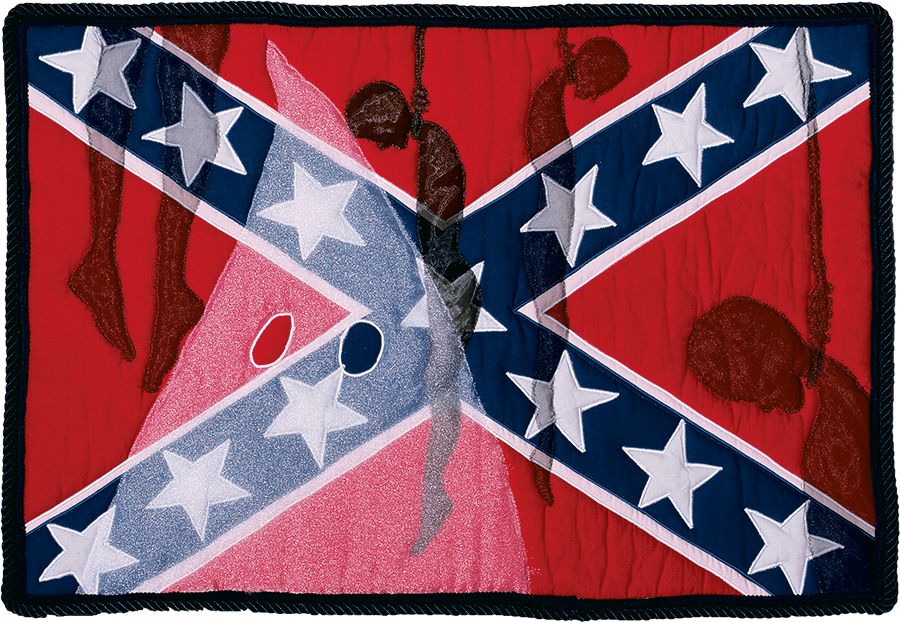 |
| Southern Heritage/Southern Shame, 2001. © Gwendolyn A. Magee. Pieced, quilted, and appliquéd fabrics, with cording. 22.5"x32.5". Collection of Michigan State University Museum, East Lansing, Michigan. Purchased with funding from the MSU Office of Research and Graduate Studies and the MSU Foundation. Photography © 2014 Roland L. Freeman. |
This multilayered quilt, with its narrative elements and use of transparencies to create layers of meaning, is now in the collection of the Michigan State University Museum. The Confederate battle flag is overlaid with silhouettes of lynched bodies, but the left side of the work is deceiving—at first glance viewers may try to blink away a fog or a smudge. But suddenly, through Magee's skilled use of materials, a figure emerges and the shadowy, hooded figure leaps into view.
Five Years Hard Labor
In blisteringly hot sun, chain gang prisoners break rocks under the watchful eye of an armed guard and his dog.
—Gwen Magee
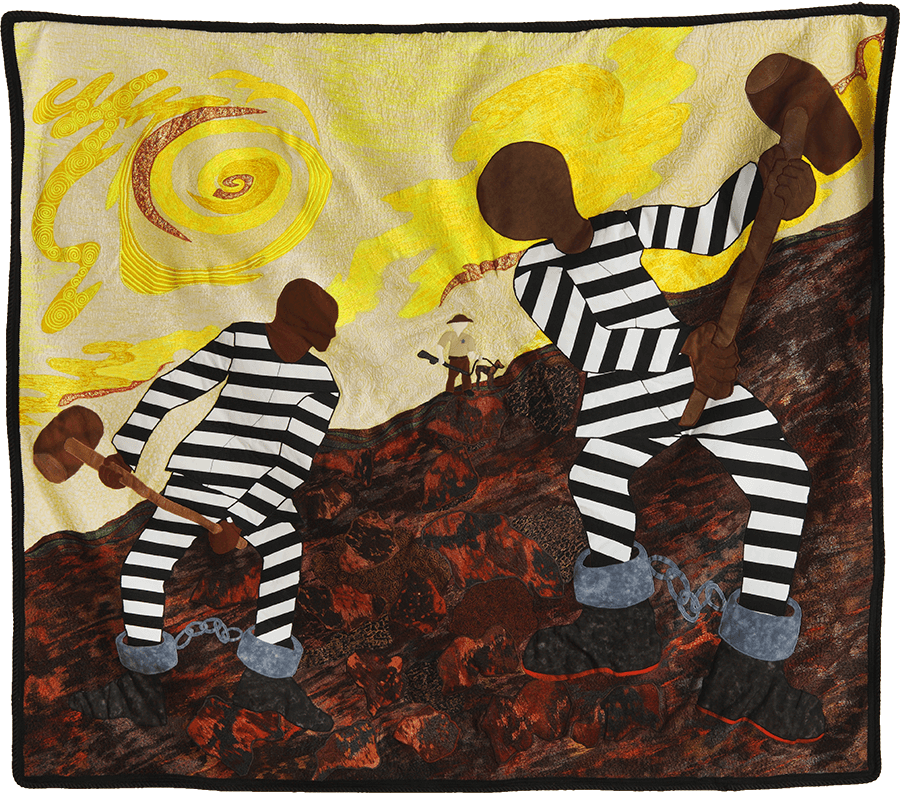



The Mississippi Museum of Art commissioned Five Years Hard Labor for The Mississippi Story, a selection of more than three hundred objects from its permanent collection of work by artists from around the state. Magee's narrative features one notorious element of Mississippi history, a chain gang, in a highly textured work.
This work combines techniques and design elements characteristic of Magee's style: diversely textured fabrics, intense color to enhance the mood, and heavy threadwork. The threadwork (often created with free motion machine embroidery) builds up textures in layers and helps unify the surfaces across a body of work, just as a painter's brushwork can become a style signature.
As in Five Years Hard Labor, human figures in Magee's work often appear as featureless profiles, reminiscent of Romare Bearden's pictorial narratives. The postures and apparel of the chain gang figures identify their status.
Magee's use of spiral elements lends universality to her compositions. The angry sun, an agitated disc in the chain gang quilt, combines shape, motion, and intense color to emphasize the scene's heat. A spiraling background texture echoes the sun.
Requiem
This is a lament for a vibrant city that will never again be the same with the devastation wreaked by Hurricane Katrina compounded by the indifference and ineptitude of our government.
—Gwen Magee
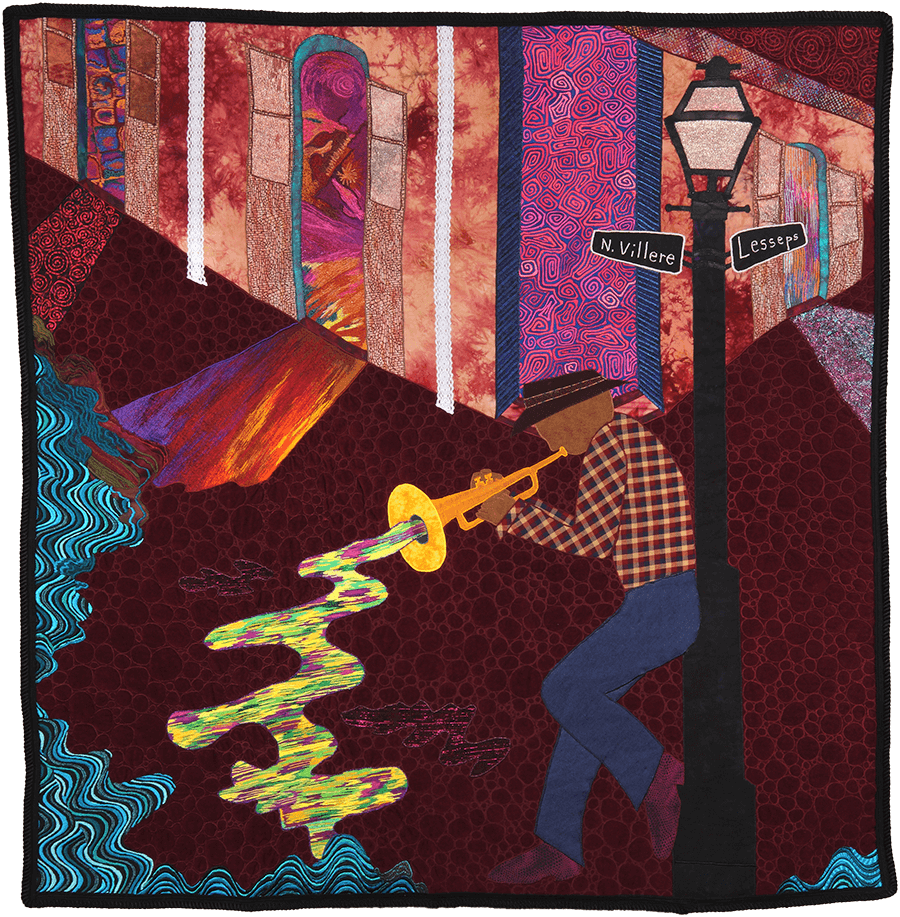

Requiem represents another example of Magee's reactions to current events, and was the beginning of a planned series about Hurricane Katrina and its aftermath. Magee completed only two pieces in this series. Family ties in New Orleans and keen attachments to the city, coupled with growing horror at government failures to deal with an overwhelming natural and manmade disaster drove the creation of this work. Requiem combines references to musical culture, a street corner significant to Magee's family, and the encroaching floodwaters where streams of music pouring from the trumpet meet and blend with streams of water flowing through broken levees.
Multiple details—the variety of specialty and hand-dyed fabrics mimicking decorative ironwork, window glass, the musician's alligator shoes, and the luminosity of a street lamp—enhance the strengths of the Katrina narrative told in one vignette. Heavy thread work suggests layers of architectural and cultural history on a typical street corner. The featureless figure of a musician propped against a street lamp stands in as a cultural icon. The spiral elements make their appearance, but in this work they are distorted and their perpetual motion diverted. On first glance, an arched doorway appears to frame rich shadows and coloring achieved with intense thread work that, when examined, emerge from the background as a montage of abstract images—a spiraling hurricane, rampaging water, a levee break—framed by an architectural feature.
Expendable Cargo
Slavers continued to operate even after importation of slaves became illegal. However, if the patrol ships were bearing down on them on the high seas, the illegal cargo was unceremoniously dumped overboard to drown - if no slaves were found on board there would be no imprisonment or fines.
—Gwen Magee
 |  |
| Expendable Cargo, 2010. © Gwendolyn A. Magee. Pieced, quilted, and appliquéd cotton, with cording. 82"x18". Collection of Mississippi Museum of Art, Jackson. Purchase, with funds from McCravey Fund, 2013.014. Photograph © 2014 Gil Ford Photography. Detail photograph by Dave Dawson Photography. | |
On completion of Lift Every Voice, Magee began another African American history series. Expendable Cargo is representative of this body of work depicting harrowing facets of enslavement—here, the jettisoning of human cargo to rid a pursued ship of incriminating bodies. The shape of the quilt emphasizes the descending human figures, weighted and dragged downward by restraints, silhouettes shackled together, sinking through the depths of blue waves.
Expendable Cargo, part of Slavery Series, in the collection of the Mississippi Museum of Art is composed of quilts that are generally smaller in format and treated with less visual complexity than other Magee works. Again, Slavery Series' figures are featureless. Each represents a story of slavery told and retold. The surfaces are not as intensely worked, but the graphic qualities are inescapably direct. Some of the work moves toward sculptural adaptations that extend from the surface. Intensely experienced by the artist and viewers, images and narratives pour from Magee's Slavery Series, as if she seems compelled to create them as quickly as possible.
Deep Into the Woods
 |
| Deep into the Woods, 2011. © Gwendolyn A. Magee. Pieced, quilted, stitched, and appliquéd fabrics. 16"x11.75"(closed), 16"x11.75"x23" (open). Collection of the Gwendolyn Ann Magee Estate, D. E. Magee, administrator. |
Deep Into the Woods, one of Magee's later works, offers a purely sculptural means of telling a story, and represents an increasing transition from two-dimensional wall work into representations with more depth. This aptly named category of handmade objects is called a tunnel book. Using this multi-dimensional format, Magee layered in story elements, capturing a chilling moment in the deep woods. The stylized spiral foliage frames a hooded figure peering out from the depths, backed up by flames, an empty noose, and the Confederate battle flag. While Magee created many pieces that incorporated layers—using transluscent and sculpted fabrics, along with machine stitching—she found that the tunnel book format enabled her to express with actual (as opposed to illusive) depth the layers of meaning and imagery characteristic of her work.
 |
| Deep Into the Woods, alternate view. Photograph by Dave Dawson Photography. |
Verse One: Lift Every Voice
The title series of this exhibition draws its inspiration from the majestic words and music of "Lift Every Voice and Sing." The song's lyrics are a major legacy from James Weldon Johnson, and a crucial contribution to the twentieth-century struggle for civil rights. Johnson's achievements in many fields were acknowledged in the 2007 creation of Emory University's James Weldon Johnson Institute, but "his place in African American history and culture would be secure if he had composed only in 1900 with J. Rosamond Johnson 'Lift Ev'ry Voice and Sing,' a hymn officially adopted by the National Association for the Advancement of Colored People (NAACP) and widely sung by African Americans as the Negro National Anthem."14"About James Weldon Johnson," The James Weldon Johnson Institute for the Study of Race and Difference, http://jamesweldonjohnson.emory.edu/home/about/index.html.
Julian Bond and Sondra Kathryn Wilson articulated the power of "Lift Every Voice" in the introduction to their book of tributes on the 100th anniversary of the song's creation:15Julian Bond and Sondra Kathryn Wilson, eds., Lift Every Voice And Sing: A Celebration of the Negro National Anthem: 100 Years, 100 Voices (New York: Random House, 2000). "It is wondrous and hardly explicable to many," wrote Bond and Wilson, "how James Weldon Johnson could have written such spiritually enriching lyrics in 1900 . . . 'Lift Every Voice and Sing' is fittingly provocative. Yet its message, ingeniously crafted, does not fuel the fires of racial hatred."16Ibid.
Magee's Lift Every Voice series translates the song's verbal images into powerful visuality. Images from words embedded in life experience were shared through well-developed skills that conveyed both the history and the passion of shared time and participation. " I had mental pictures inspired by the words," recalled Magee's longtime friend Edith Wiggins, "and when I saw Gwen's series my reaction was, 'Yes—that's exactly what I was thinking.' The series helps to validate and underscore what you've always felt and visualized."17Wiggins and Moye.
In a 2007 interview, Magee summed up her wishes that her legacy be "a body of work that not only is meaningful but is compelling, through its use of color, design, and/or subject matter—so that the viewer is not only engaged but is drawn into the work and, hopefully, back to it repeatedly."18Magee and Morrisey.
Lift every voice and sing
Till earth and heaven ring
Ring with the harmonies of Liberty;
Let our rejoicing rise
High as the listening skies,
Let it resound loud as the rolling sea.
Lift Every Voice and Sing
The full color spectrum not only of African-Americans, but of all peoples of the world is depicted. All should be able to find themselves represented.
—Gwen Magee
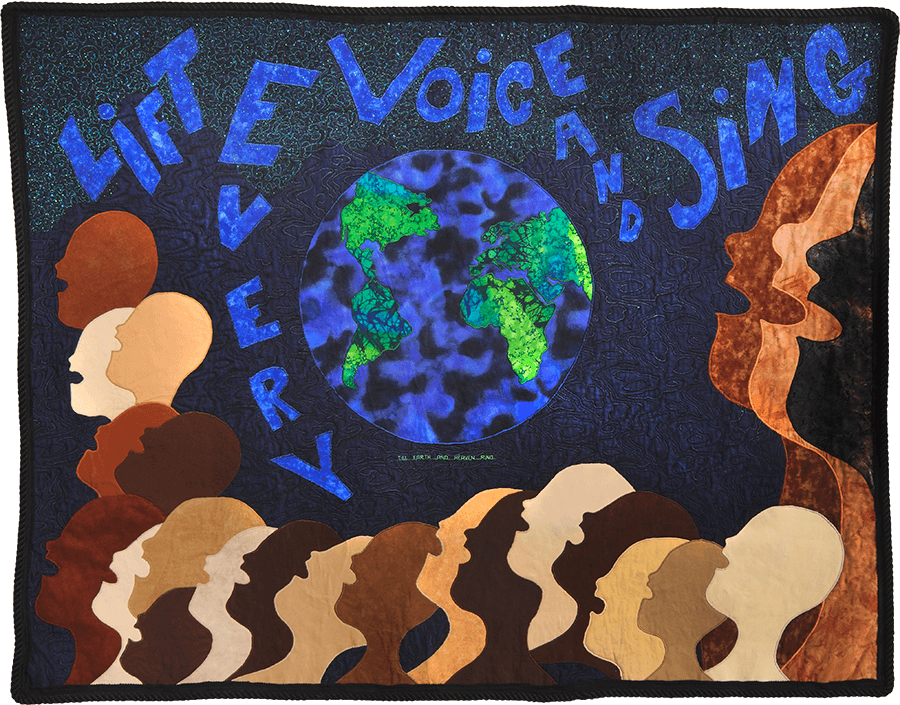




In her title piece to the series, Magee uses a spectrum of skin colors to introduce her wish to cross boundaries that separate humankind. The featureless profiles lift their voices, eyes, and heads.
The placement of the globe and text in a night sky, enhanced with sparkling stars and a texture of meander quilting suggesting swirling galaxies, connects this title piece to the "the blue marble"19A description of the term applied to the planet Earth, as described by the crew of Apollo 17: http://life.time.com/history/blue-marble-apollo-17-photo-of-earth-from-space/#1. Meander quilting is a technique in which non-overlapping quilting stitches meander across a quilt in a fluid, seemingly random fashion. perspective of earth, as viewed from space. The rainbow of faces lifted in hope, and the implied voices lifted in song convey Magee's hope for a universe that will "ring with the harmonies of liberty."
Full of the Faith
Three women kneel in the shadow of the cross to indicate their submission to the will of a higher power. This piece conveys the important role played by religion during slavery and reconstruction.
—Gwen Magee
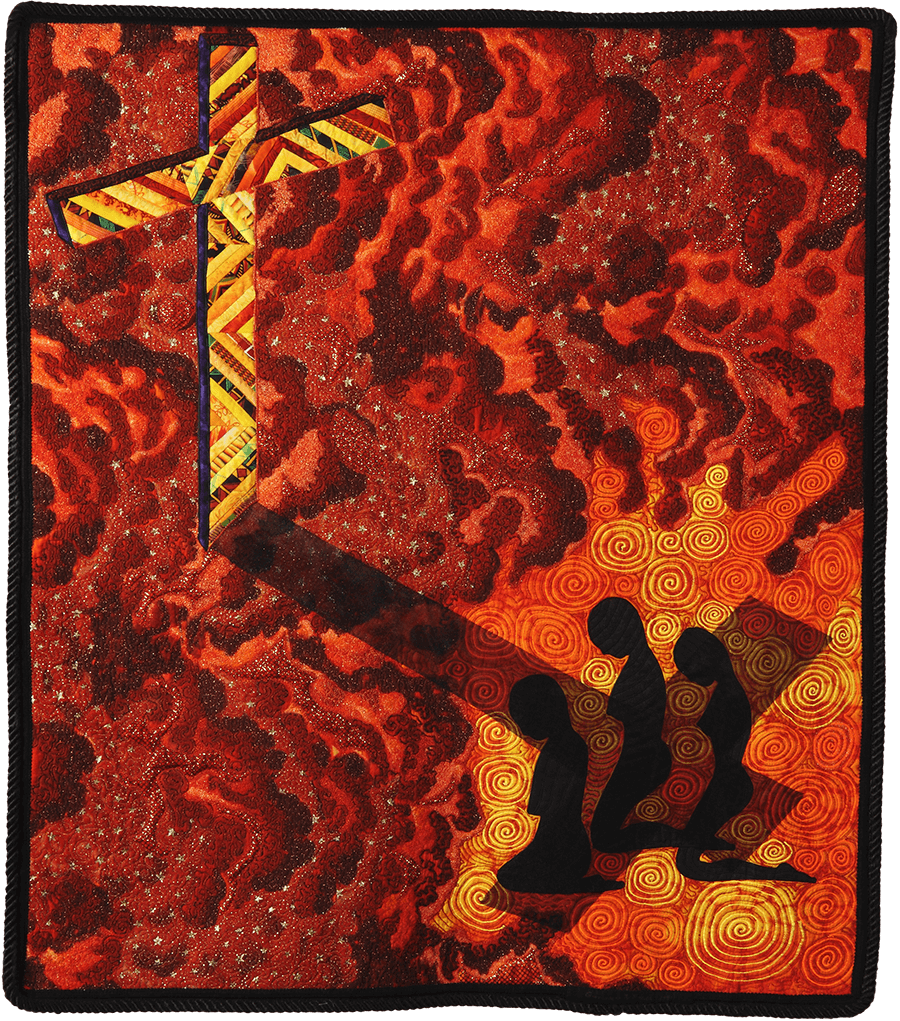 |
| Full of the Faith, 2004. © Gwendolyn A. Magee. Pieced, quilted, stitched, and appliquéd fabrics, with cording. 42.5"x37". Collection of the Gwendolyn Ann Magee Estate, D. E. Magee, administrator. Photograph by Dave Dawson Photography. |
 |
| Full of the Faith, 2004. Detail. Photograph by Dave Dawson Photography. |
Multilayered in technique and meaning, this work depicts the centrality of faith in African American culture. Identified by their profiles and postures as a young woman, a mature woman, and an older woman, the three kneeling figures are iconic for their generational span and for their strength. These three figures, although flat fabrics, are visually contoured with the use of linear work that is an internal echo of the outlines shapes. The cross, with its African-patterned textiles, casts a protective shadow on the trio.
The cross rises from a richly embroidered billow of threadwork in deep and varied reds with gold overlays, a tour de force of surface work. The sheer beauty of this background belies reference to the smoldering and smoking remains of another form of burning cross all too familiar to African American history—another lesson of "the dark past."
Full of the Hope
Youth and education have long been very powerful symbols of hope for African-Americans with education viewed as our road map for making it into 'the promised land'.
—Gwen Magee
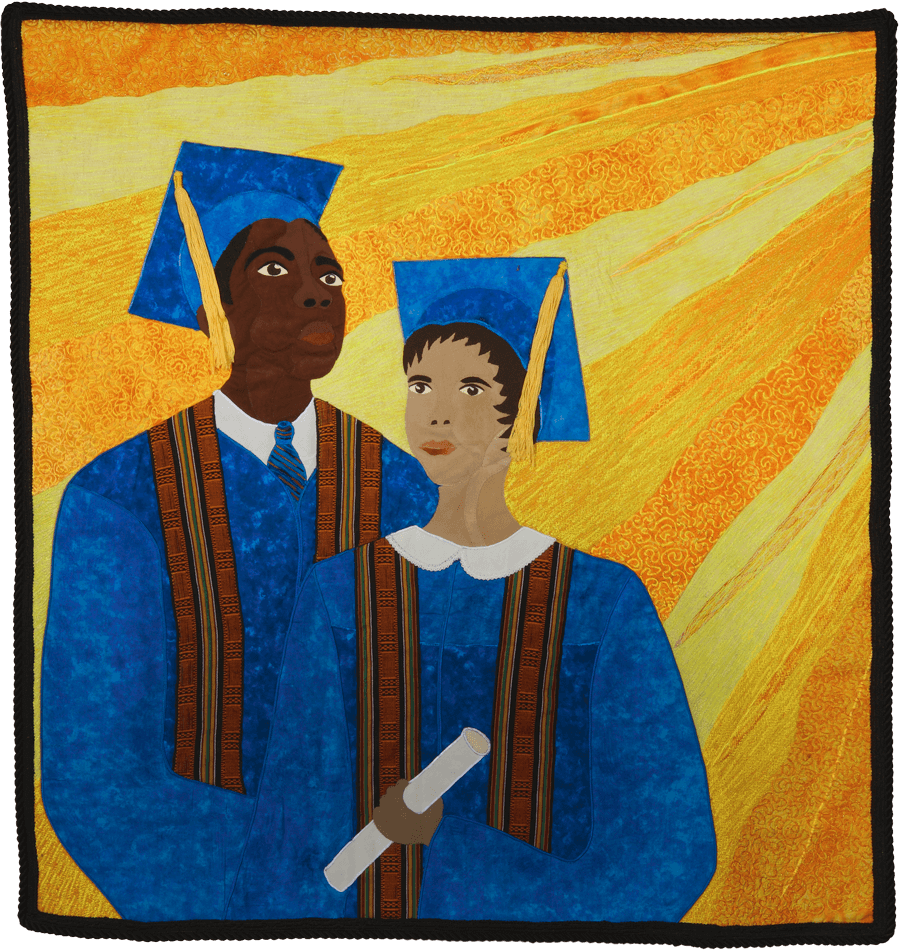 |
| Full of the Hope, 2002. © Gwendolyn A. Magee. Pieced, quilted, stitched, and appliquéd fabrics, with cording. 42"x40". Collection of the Gwendolyn Ann Magee Estate, D. E. Magee, administrator. Photograph by Dave Dawson Photography. |
 |
| Full of the Hope, 2002. Detail. Photograph by Dave Dawson Photography. |
Full of the Hope invokes the potential of education. With its open, serious faces and uplifted eyes, this is one of only three pieces in the exhibition that do not portray figures in featureless profile. The young man and woman in cap and gown and with diplomas in hand, stand in the light of golden rays. Magee believed fervently in the power of education, and spoke frequently to school groups as a part of her artistic mission.The graduation gowns are adorned with stoles emblematic of racial pride.
Our New Day Begun
A blazing sun symbolizes hope.
—Gwen Magee






The climax of the first stanza of Johnson's anthem is the title phrase for Magee's Our New Day Begun. A geometrically complex sun shines forth from a hand-dyed background, its luminosity enhanced with intricate lines of shading from meander lines of variegated thread work. The rising sun of this text is not the angry, spiraling sun of other works, but a glowing symbol of purpose and belief in the future.
Verse Two: Stony the Road We Trod
A slave coffle gives testimony to the miles and miles that men, women, and children were forced to trudge while shackled and chained.
—Gwen Magee

Moving into a second verse, Johnson's anthem turns toward history, as does Magee's imagery. She does not avoid the terrors of slavery as she translates words to visuals.
A variegated deep red background and profiled black feet suggest the bloody treks of shackled slaves traveling to unknown destinations, before and after the Middle Passage. The horizontal format of the quilt emphasizes the distance of these treks over perilous terrain. Interior contour lines emphasize the three-dimensiality of the trudging feet.
Bitter the Chastening Rod
The image of a chained woman being cruelly whipped even though her womb is heavy with child graphically illustrates the dehumanization of slaves.
—Gwen Magee
 |
| Bitter the Chastening Rod, 2000. © Gwendolyn A. Magee. Pieced, quilted, stitched, and appliquéd fabrics, with cording. 43.75"x39". Collection of the Gwendolyn Ann Magee Estate, D. E. Magee, administrator. Photography © 2014 Dave Dawson Photography. |
As she is whipped, a chained, pregnant, enslaved woman raises her voice in naked anguish. The stark black and white palette underscores the bitter verse as a featureless profiled figure represents numberless cruelties, violations, and abuses. Again, the interior linework on the silhouette emphasizes the contours of the writhing body.
 | |
| Bitter the Chastening Rod, 2000. Detail. Photograph by Dave Dawson Photography. |
When Hope Unborn Had Died
A couple has bought a hog and a toddler at auction. Its mother, screaming in anguish, runs desperately out of the cotton field.
—Gwen Magee
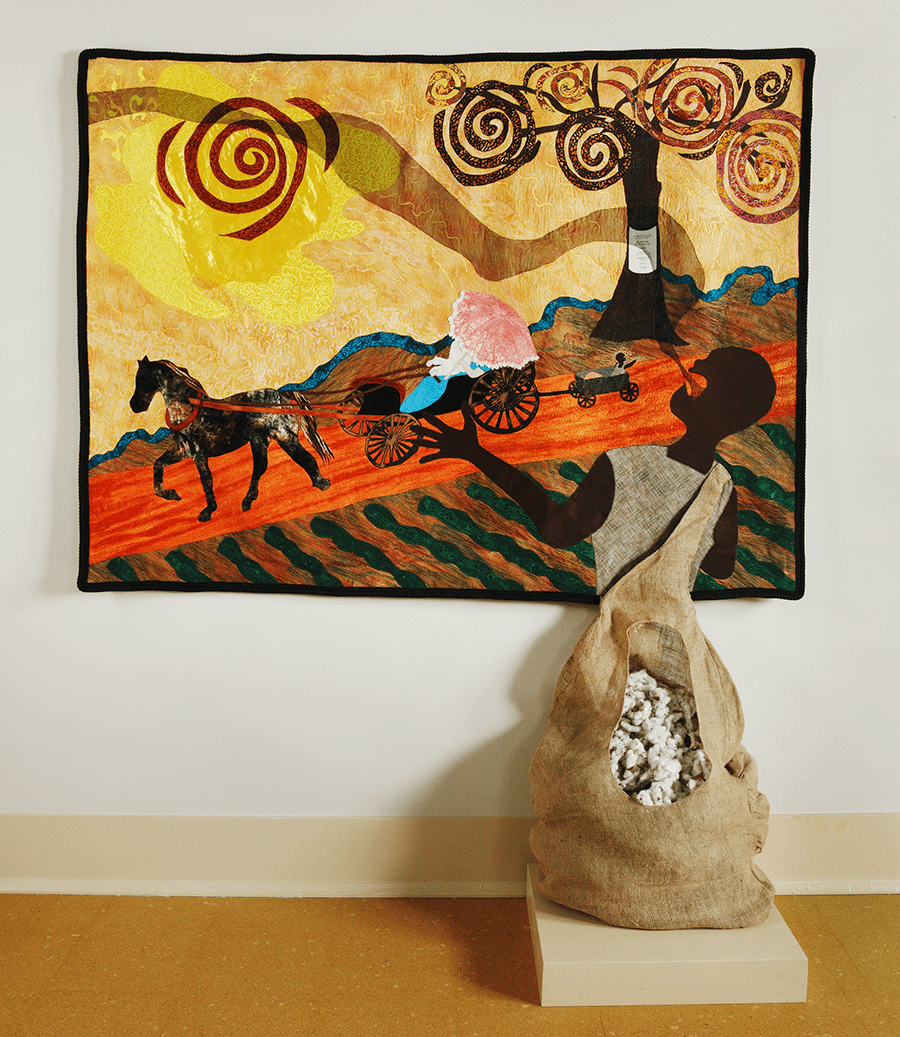
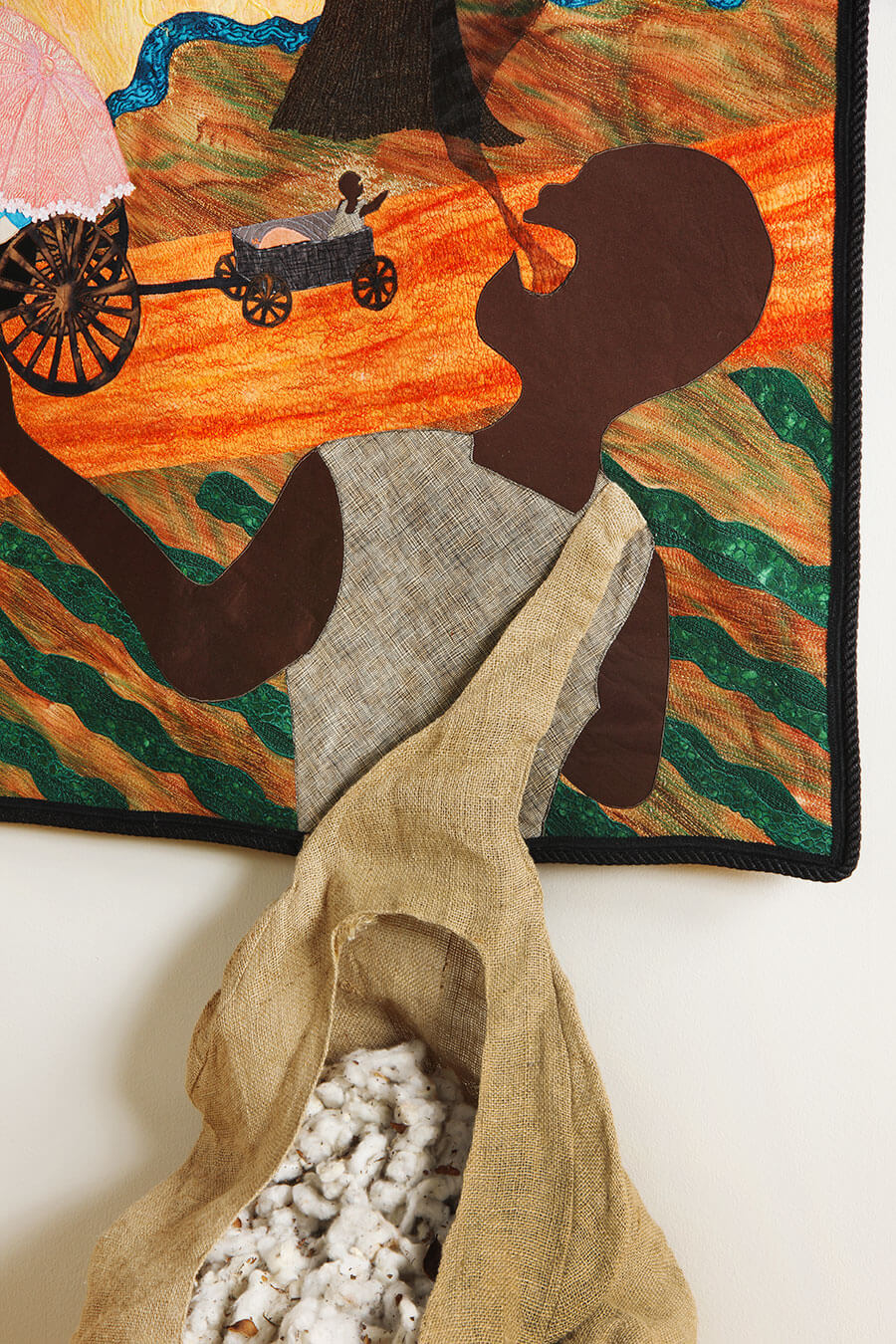

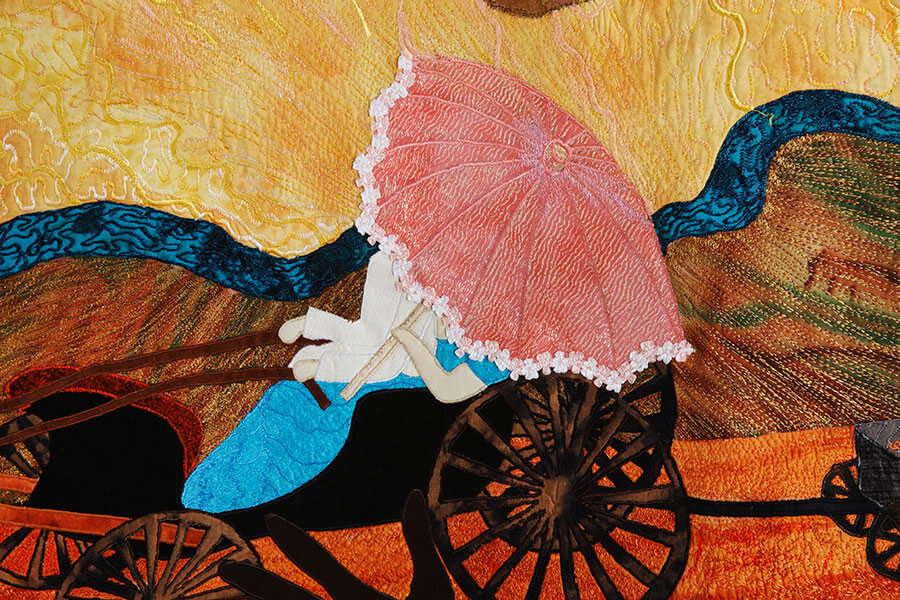
The flat plane of two-dimensional artwork cannot contain the emotions of When Hope Unborn Had Died. An anguished mother, weighed down by a heavy cotton sack, screams across the unfolding scene. A parasol obscures the couple that has purchased her child, as a high stepping horse moves their carriage, cart, and cargo diagonally toward the edge of the frame, soon to disappear.
The action originates in the viewers' space as the three-dimensional sack of cotton drags out of the picture plane and anchors the mother in a powerless dimension. Viewers who approach this work are drawn into the narrative and to the figure whose futile scream floats above the carriage. Her featureless profile with its screaming mouth echoes the cries of countless mothers during generations of American slavery.
The use of fabrics as identifiers is particularly strong here. The slave mother wears rough cloth resembling the homespun of field work; the cotton sack is of burlap. The shielding parasol is of shiny, luxury cloth; the dappled horse is an irregularly dyed fabric; and the sun is a shiny, intense yellow. The stark, stylized tree with its unnatural spiral foliage echoes the angry sun.
Yet with a steady beat,
Have not our weary feet
Come to the place for which our fathers sighed?
We have come over a way that with tears has been watered
We Have Come Over a Way That with Tears Has Been Watered
A slave ship plunges through ocean waters. Blazing in the sky the sun depicts the turmoil of the voyage. Slave trade routes are depicted by the quilting lines connecting Africa and the United States.
—Gwen Magee
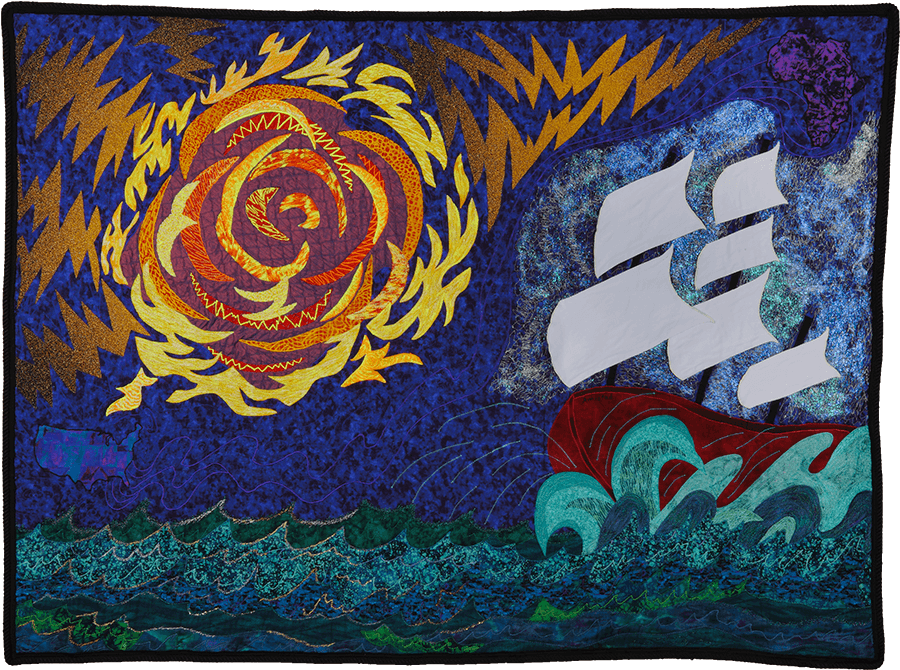
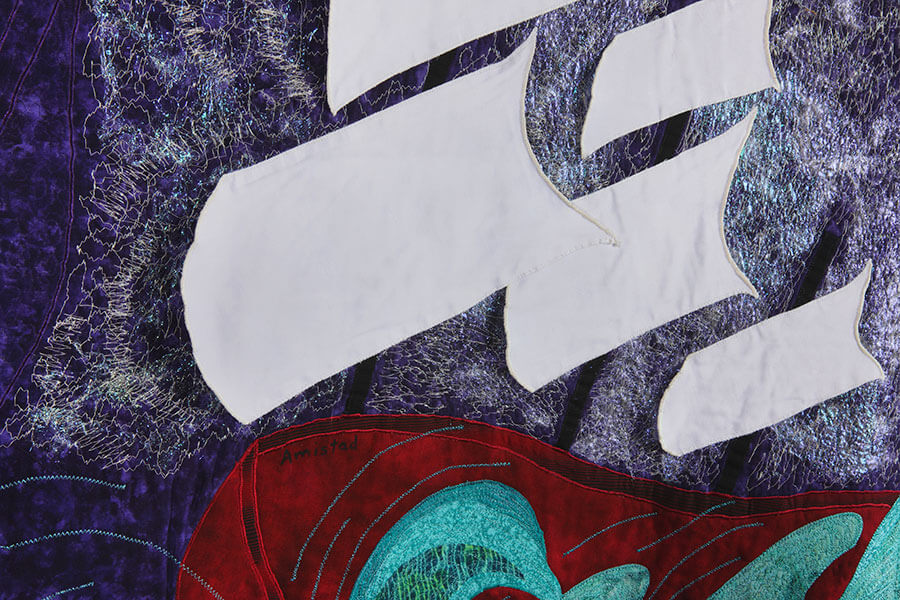
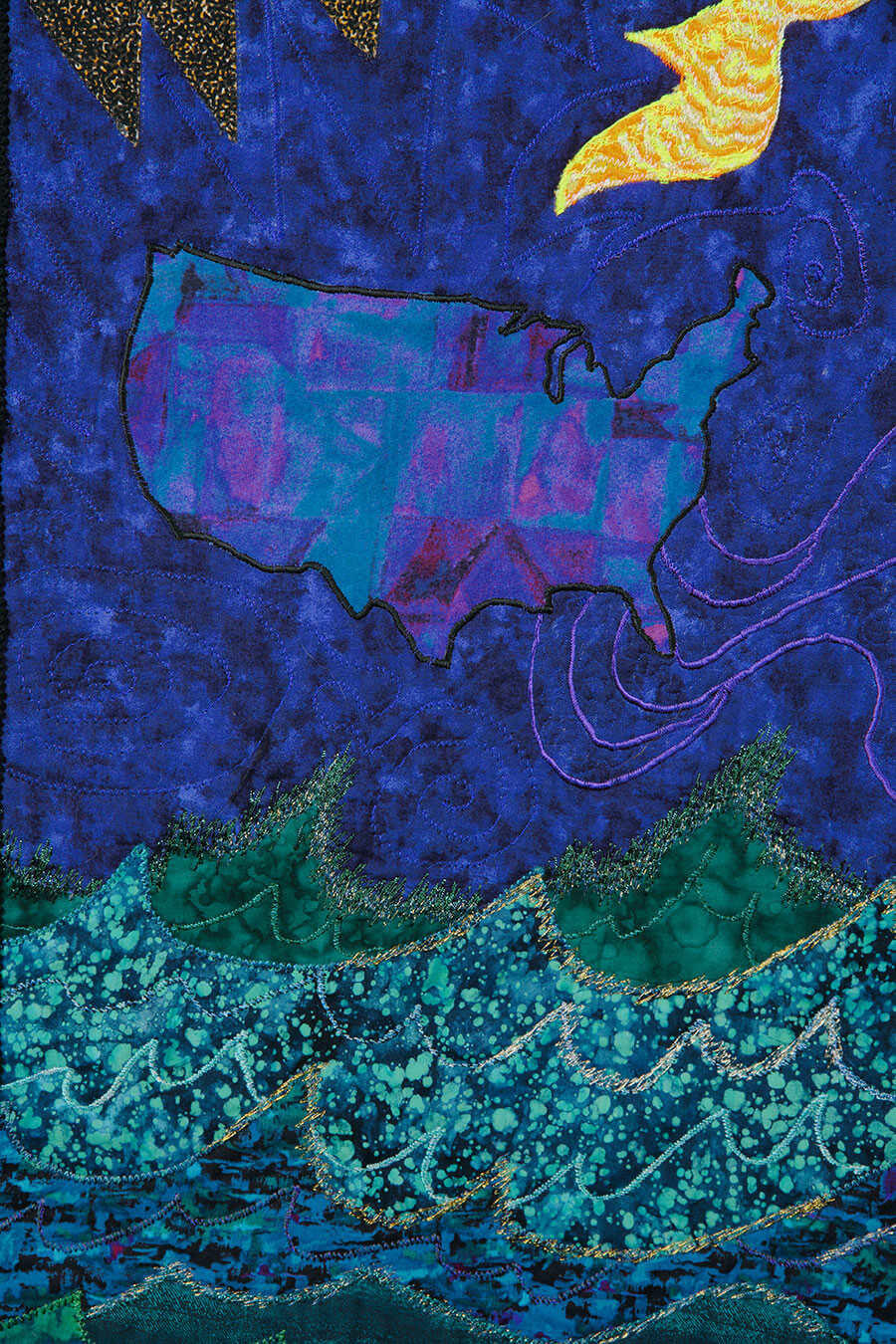


A slave ship in full sail splitting the waters of the Atlantic evokes the Middle Passage in Over a Way that with Tears Has Been Watered. The atmosphere echoes the turmoil of the human cargo; a spinning sun of judgment emits jagged rays, filling the dark sky as turbulent waters crash the ship's hull.
The white sails billow and propel the ship through deep waters. The sails and the hold of the ship, with the telltale name of Amistad, are surrounded by a nest of tangled white threadwork, suggesting the rising miasma of misery.
Almost obscured in the chaos is the relentless path of map lines indicating slave voyages connecting Africa in the upper right corner to the Americas in the lower left.
Blood of the Slaughtered I and II
"Treading our path through the blood of the slaughtered . . ." The words haunted me for months—reverberating in my head over and over again; nine little words embodying a multiplicity of possible interpretations. But one meaning in particular resonated mercilessly. This single line . . . gripped me at the deepest core of my being and left me with no refuge.
—Gwen Magee
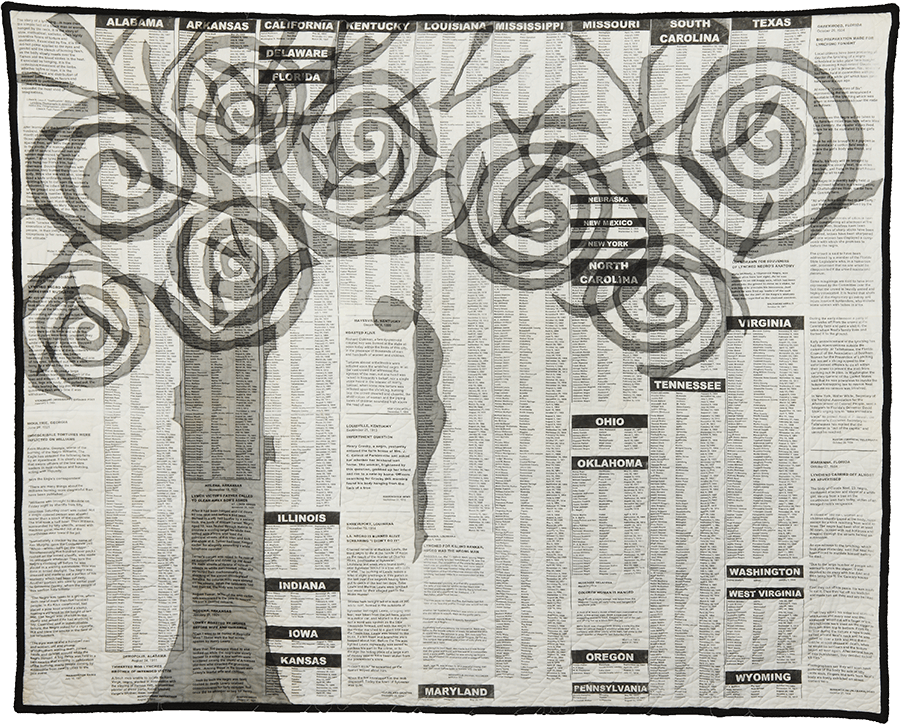 |
| The Blood of the Slaughtered I, 2001. © Gwendolyn A. Magee. Pieced, quilted, stitched, and appliquéd fabrics, with cording. 70"x85.5". Collection of the Gwendolyn Ann Magee Estate, D. E. Magee, administrator. Photography © 2014 Dave Dawson Photography. |
By their title The Blood of the Slaughtered I and II warns viewers that this work is difficult to imagine and to comprehend. The listing of names of documented lynching victims is Magee's memorial—a textile roll call for viewers to read and ponder.
The names of the lynched, recorded by state, and localized within each state, brings the horrific history home. This is a memorial piece, a Vietnam Wall in cloth. With the spiraling tree in translucent overlay, fading body, and stark black and white palette, every element of this piece is stark and compelling.
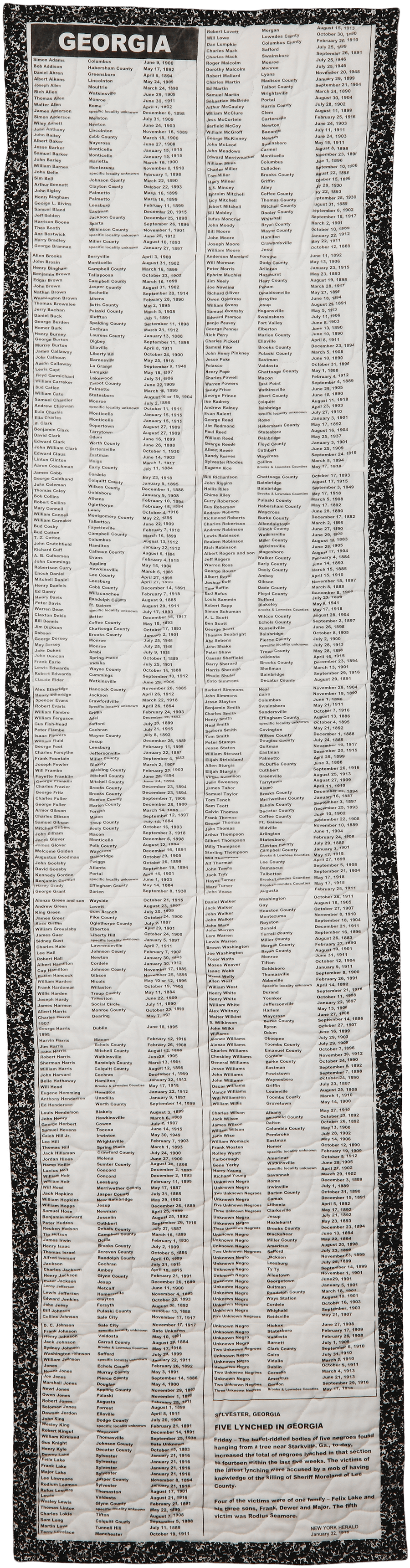 |  |
| Blood of the Slaughtered I, 2001. Detail above, below. Photograph by Dave Dawson Photography. | |
 | |
| The Blood of the Slaughtered II, 2001. © Gwendolyn A. Magee, Pieced, quilted, stitched, and appliquéd fabrics, with cording. 70"x18". Collection of the Gwendolyn Ann Magee Estate, D. E. Magee. |
Out from the gloomy past,
Till now we stand at last
Where the white gleam of our bright star is cast
Verse Three: God of Our Weary Years
God of our weary years,
God of our silent tears,
As African Americans, just as we have so much hope for our youth to 'lead the way' and to 'fulfill the dream,' we also have to daily face the reality that for countless reasons many of our youth, particularly if they are male and teenagers,somehow wind up being touched by the criminal justice system. This piece speaks to that issue.
—Gwen Magee



The face above the prison orange peering between bars—the same face as the eager graduate in Full of the Hope—stands in for a generation of black youth caught in persisting structural conditions of poverty and lack of education who may become a part of modern-day mass incarceration.
God of Our Silent Tears I
An execution scene addressing the disproportionate percentage of African Americans given the death penalty and executed. It does not address the question of guilt or innocence, but questions whether or not our system of justiceIs truly equal for all.
—Gwen Magee
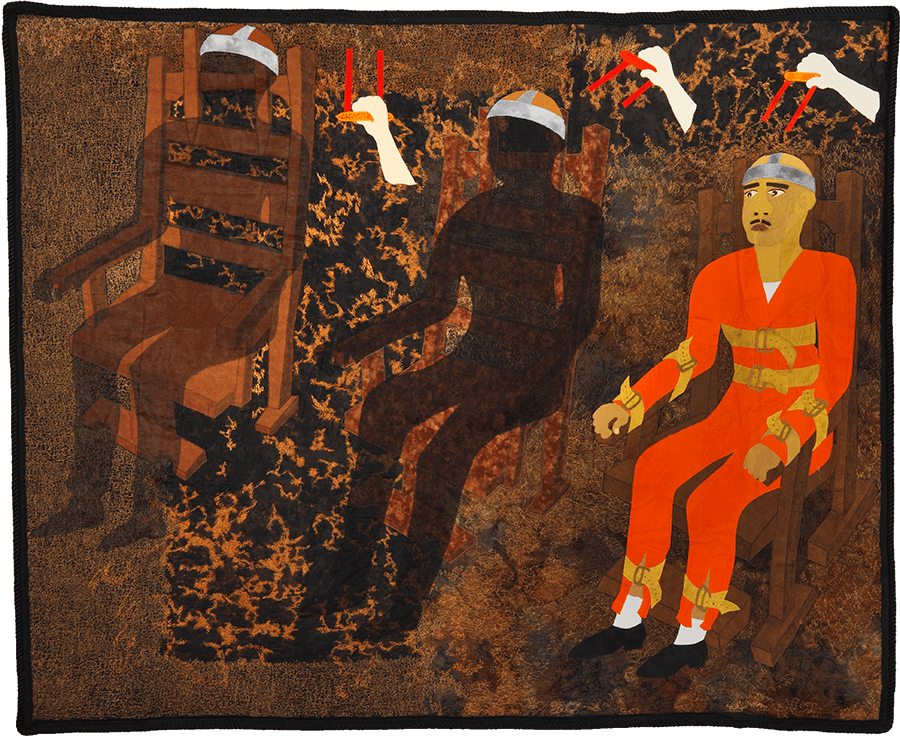




God of Our Silent Tears I takes viewers into the execution chamber, where the life force of a condemned man fades, marked by the receding image of his body as an overhead hand throws the switch to the electric chair. Magee has chosen to give this figure an African American face and not portray him as a featureless profile. The tableau reminds viewers that capital punishment in America imposes unequal racial judgment in society's name.
God of Our Silent Tears II
This companion piece looks at execution from another perspective—that of the family being left behind, for they, too, will suffer. Each of the three newspapers shown takes a different position—one is against capital punishment and also questions the politics of the trail and whether or not this man was railroaded for political reasons. Another paper takes the position that the evidence clearly proved his guilt and that he therefore should be executed.The third takes a middle of the road point of view.
—Gwen Magee
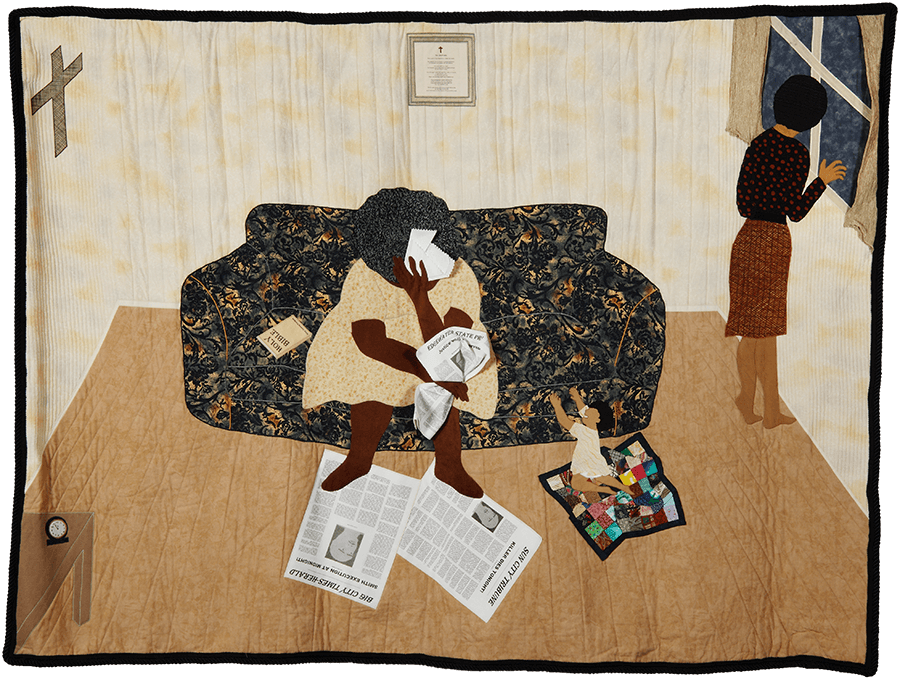

As the family of a condemned man waits, and the clock nears the appointed hour of midnight, God of Our Silent Tears II portrays the other side of the execution scene, that of the "family being left behind."
Thou Who Has Brought Us
Thou who has brought us thus far on the way;
Thou who has by Thy might
Led us into the light,
Keep us forever in the path, we pray.
Lest our feet stray from the places, our God, where we met Thee,
Lest, our hearts drunk with the wine of the world, we forget Thee;
Shadowed beneath Thy hand,
May we forever stand.
True to our God,
True to our native land.
Gwen Magee's series doesn't interpret the final lines of Lift Every Voice, but could be reprised by the hope expressed in Our New Day Begun. The spirit of Magee's work—informed by history but not overwhelmed by sorrow—complements the anthem that inspired her throughout her life.
Infinity
 |
| Infinity, 1995. © Gwendolyn A. Magee. Pieced, quilted, and stitched, fabrics. 105.5"x90". Collection D. E. Magee. Photography © 2014 Dave Dawson Photography. |
Infinity, the last quilt in the narrative sequence of Lift Every Voice and Sing: The Quilts of Gwendolyn Ann Magee, voices the joy Gwen Magee knew in her life, the love she experienced for her family and friends, and the legacy of her work. Early in the chronology of her work in fiber, Magee created Infinity as a Christmas gift for her husband, D. E. Magee. Just beginning to flex her creative muscles, she worked from a traditional quilt pattern that she altered to celebrate Dr. Magee's serious hobby of astronomy and his profession as an ophthalmologist.
 |
| Infinity, 1995. Detail. Photograph by Dave Dawson Photography. |
Infinity glows with intensity of color and precise geometry, successfully moving light across the surface while creating illusions of dimension through the manipulation of color and form. Dr. Magee's insistence that this was a work of art for the wall and not a bed covering marked a turning point from which Gwen Magee recognized and identified herself as an artist.
Curator René Barilleaux, who worked with Magee on her exhibition, Journey of the Spirit, at the Mississippi Museum of Art, sums up her life in the arts: "Gwen Magee was a rare combination of artist, advocate, and gentle spirit. In her life and in her art, she made monumental statements on those things about which she cared deeply."20René Barilleaux, e-mail communication with author, April 5, 2013.
 |
| Gwendolyn Ann Magee, 1943–2011. Photograph by Barbara Gauntt. © Barbara Gauntt/Clarion-Ledger. |
About the Artist
Gwendolyn Ann Magee has work in the permanent collections of the Mississippi Museum of Art, the Museum of Mississippi History (Department of Archives and History), the Michigan State University Museum, and the Renwick Gallery of the Smithsonian Museum of American Art. Magee's work also has been exhibited in the Museum of Arts and Design, the Atlanta History Museum, the National Art Gallery of the Republic of Namibia, the Val d'Argent Expo in Alsace, France, the Victoria and Albert Museum in London, and at numerous other national and international galleries. Among other honors she was recognized by the Mississippi Institute of Arts and Letters as Visual Artist of the Year in 2003 and she was a 2007 Ford Fellow through United States Artists.21Gwendolyn A. Magee, "Exhibitions/Resume," http://gwenmagee.com/resume.html.
About the Author
Dorothy Moye is a Decatur, Georgia, art consultant and a college classmate of Gwen Jones Magee (WCUNC '63). She is Visiting Curator for the Gatewood Gallery at UNC-Greensboro, for Lift Every Voice and Sing: The Quilts of Gwendolyn Ann Magee, September 11–November 8, 2014. Other curatorial projects in 2014-15 include Flight Patterns: A Fiber Art Exhibition, at Hartsfield-Jackson Atlanta International Airport through April 2015 and at the Welch Gallery, Georgia State University May 14–July 31, 2015; and semiannual exhibitions through the Decatur Arts Alliance.
Moye participates in multifaceted projects in the arts, and holds membership in numerous arts organizations, both local and national. She graduated from UNC–Greensboro and North Carolina State University in Raleigh with degrees in sociology.
Acknowledgements
The author would like to thank those who have worked tirelessly to bring the work of Gwendolyn Ann Jones Magee to a wider audience.
- The Magee Family: Dr. D. E. Magee, MD; Kamili Magee Hemphill; and Dr. Aliya Magee, DVM for sharing their legacy with the world.
- Dr. Lawrence Jenkens and the staff of the Art Department at the University of North Carolina at Greensboro for belief in this project and the opportunity to curate an exhibition of the work of my friend Gwen Magee.
- Dr. Allen Tullos, Jesse P. Karlsberg, Meredith Doster, and the outstanding editors and staff of Southern Spaces for the opportunity to give ongoing digital life to the Gwen Magee Project. Thanks in particular to Emma Lirette and Clinton Fluker for their work laying out this piece.
- Carol Furey Matney and the other members of the Magee Project Committee for support and assistance and making this project possible: Bill Baites, Linda Arnold Carlisle, JoAnne Smart Drane, Day Heusner McLaughlin, Maggie Triplette, Charlotte Vestal Wainwright, and Edith Mayfield Wiggins.
- The director and staff of the Mississippi Museum of Art for assistance in the logistics of the project, as well as for the loan of three important works.
- The Mississippi Department of Archives and History and the Michigan State University Museum for their generous loans.
- South Arts for access to an important oral history from their archives.
- Family and friends for valuable support and assistance in every aspect of this project.
- The African American graduates of the Woman's College of the University of North Carolina (1960–1963) who pioneered the way to the most diverse campus in the state's university system, the University of North Carolina at Greensboro.
In the spring of 1974, a dozen white and African American women and their daughters gathered outside the office of the Textile Workers Union of America (TWUA) in Roanoke Rapids, North Carolina.1The union in 1974 was the Textile Workers Union of America, which merged with the Amalgamated Clothing Workers Union in 1976 to form the Amalgamated Clothing and Textile Workers Union of America (ACTWU). As the cameras of Gloria Steinem's PBS series Woman Alive! rolled, the girls, wearing handmade cheerleading uniforms with "TWUA" emblazoned across the front, chanted, "You can rock us, you sock us, but you can't knock us flat! Tell me Mr. Stevens, can you top that?" Their mothers tried to ignore the camera crew. They had created the cheerleading squad the previous year to support unionizing the seven J. P. Stevens plants in Roanoke Rapids, but they were unaccustomed to this kind of attention.
Steinem's episode featured Crystal Lee Sutton.2Joan Shigekawa, Woman Alive! (June 19, 1974; Dallas/Fort Worth, Texas: KERA-TV), Documentary. Accessed in Crystal Lee Sutton's personal papers 986.87, an unprocessed collection housed at Alamance Community College, Graham, North Carolina. For more information about the history and content of the Woman Alive! series, see Woman Alive! produced by KERA-TV Dallas/Fort Worth and WNET/13 New York; made possible by a grant from the Corporation of Public Broadcasting; exective producer, Joan Shigekawa: A Finding Aid, MC 421; Vt-30, Arthur and Elizabeth Schlesinger Library on the History of Women in America, Radcliff College. On May 30, 1973, Stevens had fired Sutton for insubordination after she insisted on copying an anti-union letter posted on the company bulletin board. Sutton then climbed atop a shop floor table and raised a piece of cardboard with "UNION" scrawled on it. She spent the night in jail. Steinem read about Sutton's confrontation with Stevens managers and local police in a New York Times article on the TWUA's organizing drive and wanted to include her in Woman Alive!—an early example of the media coverage and outside support the union received in its six-year struggle with the J. P. Stevens corporation. While the episode called attention to Sutton, it also showed many other mill women front and center.
A bold, multi-faceted effort, the campaign to unionize J. P. Stevens included boycotts, community-based organizing, and publicity campaigns against corporate intransigence and irresponsibility. The union's deployment of these tactics reached many audiences and motivated allies within and beyond the labor movement. This essay contextualizes the mill women's experiences, illuminating the crucial role they played in capturing attention, garnering support, and motivating action from allies. Personal narratives of white and African American women workers tapped into concerns with workplace justice fostered by the women's and civil rights movements. Aware of the limits of Stevens unionization, I examine what women gave to the effort and the distinct forms their activism took.
The Stevens Campaign and the Southern Textile Industry
From the 1920s through the 1960s, textile unionists labored to organize mill workers in the southern Piedmont, a region stretching from north Georgia and central Alabama through the middle of the Carolinas and into southern Virginia. Flanked on the west by the Appalachian Mountains and to the east by the Atlantic coastal plain, the Piedmont was a stronghold of textile and apparel manufacturing, which provided the main source of industrial jobs for working-class white families. From the 1920s through the 1950s, white women comprised at least one-third of the textile labor force; in 1929, their numbers in North Carolina peaked at 44.6 percent. By 1960, the United States textile labor force was overwhelmingly white, southern, and female. More than three-fourths of all textile manufacturing in the United States happened in the southern Piedmont, where 45 percent of all textile workers were female. African Americans, barred from all but the least-skilled and lowest-paid jobs in the mills, accounted for less than 5 percent of the work force. Wages in southern textile mills were always lower than the national average for factory workers, with the exception of the 1950s, when average wages in the southern mills equaled those in the North. About 5 percent of Piedmont mill workers belonged to a union in the 1960s, compared to 37 to 46 percent in New England and Mid-Atlantic states. Despite low wages and harsh working conditions, most workers' standard of living improved when they traded agricultural and domestic work for manufacturing.3Timothy J. Minchin, Hiring the Black Worker: The Racial Integration of the Southern Textile Industry, 1960–1980 (Chapel Hill: University of North Carolina Press, 1999), 164–165; Timothy J. Minchin, Don't Sleep with Stevens!: The J. P. Stevens Campaign and the Struggle to Organize the South, 1963–80 (Gainesville: University Press of Florida, 2005), 10–11, 22–24; Linda Frankel, "Southern Textile Women: Generations of Survival and Struggle," in My Troubles Are Going to Have Trouble with Me: Everyday Trials and Triumphs of Women Workers, eds. Karen Brodkin Sacks and Dorothy Remy (New Brunswick: Rutgers University Press, 1984), 41–42; Nancy MacLean, Freedom is Not Enough: The Opening of the American Workplace (Cambridge: Harvard University Press, 2006), 79.
Postwar growth and industrial diversification shrank the textile labor force in the 1950s and 1960s. Title VII of the 1964 Civil Rights Act enabled black workers to demand more and better jobs in the mills. African Americans organized through the National Association for the Advancement of Colored People's (NAACP) "TEAM" project (Textiles: Employment and Advancement for Minorities). They were more likely than white workers to believe unionization was necessary for wage justice and equal opportunity.4Minchin, Don't Sleep With Stevens!, 23–24; MacLean, Freedom is Not Enough, 78–79, 84. Sensing an opportunity in the 1960s, the TWUA sent waves of organizers into the J. P. Stevens mills, the second-largest textile corporation in the United States with more than thirty thousand workers in some seventy mills in Virginia, Tennessee, Georgia, Alabama, and the Carolinas. Stevens proved an unrelenting opponent. Between 1963 and 1973, the National Labor Relations Board (NLRB) found Stevens guilty of violating labor laws in twenty-one of twenty-two cases. Stevens paid $1.3 million in back wages to nearly three hundred workers illegally discharged for union support. In 1974, workers in Stevens's seven Roanoke Rapids plants voted for union representation, a stunning achievement for the interracial group of workers who led the organizing drive. As Stevens fought a contract for the next six years, the Roanoke Rapids struggle transformed from a local conflict to a national campaign. The election victory united labor, civil rights, and women's rights activists behind the newly merged textile and clothing workers' union and its "Don't Sleep with Stevens" boycott.5Minchin, Don't Sleep With Stevens!, 27; Timothy J. Minchin, "‘Don't Sleep with Stevens!': The J. P. Stevens Boycott and Social Activism in the 1970s," Journal of American Studies 39, no. 3 (2005): 512.
 |
| Cover of Norma Rae, directed by Martin Rich, Twentieth Century Fox Film Corporation, 1979. The 2001 DVD re-release cover of Norma Rae features Sally Field's title character in the film's most famous moment. |
In 1979, Hollywood told a fictionalized version of the Stevens campaign in the Academy Award–winning Norma Rae. Scriptwriters framed the movie around Sutton's life story, as told to journalist Henry Leifermann in a 1973 New York Times Magazine article and 1975 book, Crystal Lee, A Woman of Inheritance.6Norma Rae, directed by Martin Ritt (1979; Hollywood: Twentieth Century Fox Home Entertainment, 2001), DVD; Henry Leifermann, "The Unions Are Coming: Trouble in the South's First Industry," New York Times Magazine, August 5, 1973, sec. 6, 10–11, 25–26. Leifermann later published a book based on his interviews with Sutton entitled Crystal Lee, A Woman of Inheritance (New York: MacMillan Publishing, 1975). Sutton revealed her past marital infidelity and that she had never married her second son's father. She feared that anti-union people in town who knew or suspected these things about her would use her secrets to silence her. Sutton later reflected that the New York Times Magazine article freed her from the small town rumor mill because "nobody will ever have anything to hold over me no more."7Sutton, quoted in Victoria Byerly, Hard Times Cotton Mill Girls: Personal Histories of Womanhood and Poverty in the South (Ithaca: ILR Press, 1986), 212. Sutton's unabashed revelations about her checkered past and her unrepentant sexuality caused trouble for her with pro- and anti-union people. "Rumor has got back to me," she recalled, "that people are saying that it's a bunch of whores standing out getting people to join the union." While she was leafleting outside of the mills between shifts, an older white woman refused to take a union card, saying to her, "I been wanting to meet you. I sure do feel sorry for you because of any woman that has little enough respect for herself to [reveal sexual indiscretions in a newspaper article]."8Shikegawa, Woman Alive!, Documentary. In 1974, a dozen pro-union workers wrote to Harold McIver, regional director of the organizing drive, complaining that Sutton exerted too much influence over Eli Zivkovich, the organizer in Roanoke Rapids. One letter insinuated that Sutton and Zivkovich were having an affair: "[Crystal] has got a key to the office. She has got a key to Eli's motel room. So why shouldn't people be talking?"9Letters to Harold McIver from Roanoke Rapids workers, October 29 and 30, 1974, Box 5, Folder "JPS-Roanoke rapids, N.C., General Information and Correspondence," Textile Workers Union of America records, Wisconsin Historical Society, Madison, Wisconsin, Collection 396. (Hereafter cited as TWUA records, WHS, 396.) To the chagrin of Sutton and union leaders, Norma Rae relied heavily on these themes of sexuality, rumor, and internal tensions. But the movie was enormously popular and drew positive attention to the union's Stevens campaign. Sutton toured the country as "the real Norma Rae" in support of the boycott of Stevens's products, always stressing that there were many Norma Raes.
A scene from Norma Rae (1979) illustrating the tension between Norma Rae, a worker at a textile mill, and Reuben Warshowsky, a union organizer. In this scene, Norma Rae's attempt to copy the company's racially inflammatory anti-union letter is mostly faithful to Sutton's biography and official records. The sexually-charged argument between Norma and Reuben, however, was fabricated to demonstrate the unconsumated attraction between the two that the filmmakers wanted in the story. Reuben pushes Norma to prove her political commitment and personal investment in the union campaign, then storms out to relieve the tension by having sex with any woman in town but Norma.
Under pressure from leaders of northern and southern progressive churches and religious groups, women's groups, consumers, and stockholders, Stevens agreed to negotiate contracts in good faith at its mills in Roanoke Rapids and Montgomery, Alabama, the two sites where the union had won elections but did not have contracts. In return, the union agreed to end its boycott and corporate campaign. The 1980 settlement covered only about 12 percent of Stevens workers, but compared to totally nonunion textile corporations, such as Burlington and Cannon, this victory seemed extraordinary. Although national textile employment fell 26 percent between 1973 and 1983, pro-union mill workers in 1980 did not imagine that this victory marked the beginning of the end of their struggle with a failing domestic industry.10Minchin, Don't Sleep with Stevens!, 166–168,177; John Gaventa and Barbara Ellen Smith, "The Deindustrialization of the Textile South: A Case Study," in Hanging by a Thread: Social Change in Southern Textiles, eds. Jeffrey Leiter, Michael D. Schulman, and Phillip J. Wood (Ithaca: ILR Press, 1991), 139–162. For more on the decline of textile manufacturing in the United States and the effects of globalization on textile and apparel industries, see Grace I. Kunz and Myrna B. Garner, Going Global: The Textile and Apparel Industry (New York: Fairchild, 2007); Mary E. Frederickson, Looking South: Race, Gender, and the Transformation of Labor from Reconstruction to Globalization (Gainesville: University Press of Florida, 2011); and Timothy J. Minchin, "Shutdowns in the Sun Belt: The Decline of the Textile and Apparel Industry and Deindustrialization in the South," in Life and Labor in the New New South, ed. Robert H. Zieger (Gainesville: University Press of Florida, 2012). The Stevens campaign built new alliances among feminists, civil rights, and labor advocates and brought publicity to the union's southern effort. Verdicts in the plaintiffs' favor were rolling in from class action discrimination lawsuits filed by African American and women workers against textile corporations. In Roanoke Rapids, Sutton's sister Syretha Medlin evoked the sentiment of her fellow pro-union workers when she said, "This is just wonderful. It's like a whole new life."11Medlin quoted in Minchin, Don't Sleep with Stevens!, 170. On verdicts in class-action discrimination lawsuits, see MacLean, Freedom is Not Enough, 86–87.
Since the 1980s, several labor historians have written about Norma Rae and the Stevens campaign. Timothy Minchin's monograph explores the boycott and corporate campaign from the union's perspective and argues that J. P. Stevens set a precedent for aggressive anti-union attacks in the 1980s. Essays by James Hodges and Robert Zieger describe Crystal Lee Sutton's participation in the unionization effort, critique Norma Rae's poetic license, and celebrate her as a working-class heroine.12 Minchin, Don't Sleep with Stevens!; James A. Hodges, "The Real Norma Rae," in Southern Labor in Transition, 1940–1995, ed. Robert H. Zieger (Knoxville: University of Tennessee Press, 1997), 251–272. See also James A. Hodges, "J. P. Stevens and the Union: Struggle for the South," in Race, Class, and Community in Southern Labor History, eds. Gary M. Fink and Merl E. Reed (Tuscaloosa: University of Alabama Press, 1994), 53–64; Jefferson Cowie, Stayin' Alive: The 1970s and the Last Days of the Working Class (New York: New Press, 2010). In these historians' writings, however, the task of separating fact from fiction obscures the interplay between politics and fantasy, sex and race, and labor and feminism at work in the 1970s. The Stevens campaign reveals how important working-class women's labor feminism and considerations of gender and sexuality were to organizing the textile and apparel industries.13My use of gender and sexuality to analyze the roles of women in labor organizing and economic justice campaigns is greatly influenced by the following scholarship: Jacquelyn Dowd Hall, "Disorderly Women: Gender and Labor Militancy in the Appalachian South," The Journal of American History 73, no. 2 (1986): 354–382; Jacquelyn Dowd Hall, "Public Eyes, Private Women: Images of Class and Sex in the Urban South, Atlanta, Georgia, 1913–1915," in Work Engendered: Toward A New History of American Labor, ed. Ava Baron (Ithaca: Cornell University Press, 1991), 216–242; Jacquelyn Dowd Hall, James Leloudis, Robert Korstad, Mary Murphy, Lu Ann Jones, and Christopher B. Daly, Like a Family: The Making of a Southern Cotton Mill World (Chapel Hill: The University of North Carolina Press, 1987); Mary E. Frederickson, "Heroines and Girl Strikers: Gender Issues and Organized Labor in the Twentieth-Century American South," in Organized Labor in the Twentieth-Century South, ed. Robert H. Zieger (Knoxville: The University of Tennessee Press 1991), 84–112; Mary E. Frederickson, "I Know Which Side I'm On: Southern Women in the Labor Movement in the Twentieth Century," in Women, Work, and Protest, ed. Ruth Milkman (Boston: Routledge and Kegan Paul, 1985), 156–180; Nancy MacLean, "Redesigning Dixie with Affirmative Action: Race, Gender, and the Desegregation of the Southern Textile Mill World," in Gender and the Southern Body Politic, ed., Nancy Bercaw (Oxford: University Press of Mississippi, 2000), 161–191; Dorothy Sue Cobble, The Other Women's Movement: Workplace Justice and Social Rights in Modern America (Princeton: Princeton University Press, 2004); Nancy Gabin, Feminism in the Labor Movement: Women and the United Auto Workers, 1933–1975 (Ithaca: Cornell University Press, 1990); Alice Kessler-Harris, Gendering Labor History (Urbana: University of Illinois Press, 2006); Patricia Hill Collins, Black Feminist Thought: Knowledge, Consciousness, and the Politics of Empowerment (New York: Routledge, 1990), see especially Chapter 3, "Work, Family, and Black Women's Oppression"; Annelise Orleck, Storming Caesar's Palace: How Black Mothers Fought Their Own War on Poverty (Boston: Beacon Press, 2005).
Sick for Justice
On August 28, 1974 in Roanoke Rapids, 3,133 workers streamed through the polling stations in the seven Stevens plants in an NLRB election to determine if the TWUA would represent them. Maurine Hedgepeth, a middle-aged weaver who lost her job in the 1960s because she supported the union, observed the ballot counting that evening in the meeting room in front of the Rosemary mill. The union won by 237 votes. For organizers and union leaders, the success in Roanoke Rapids seemed to signal a turning point: black and white workers could unite against a company as aggressively anti-union as Stevens. "Roanoke Rapids is everywhere," proclaimed North Carolina civil rights activist Reverend W. W. Finlator. Organizer Michael Spzak, who had worked in Greenville, South Carolina, recalls that among labor organizers in the South in the 1970s, "everything was Roanoke Rapids."14 Statement of W. W. Finlator, August 26, 1977, Box 2363, Folder 1, North Carolina State AFL-CIO records, 1945–1981, Special Collections and Archives, Georgia State University Library, Atlanta, Georgia, Collection L1981-20. (Hereafter cited as "NC State AFL-CIO records, GSU Library.") Michael Spzak, recorded interview with the author, March 23, 2011, in author's possession. (Hereafter, cited as "Spzak interview.")
It soon became clear, as one NLRB judge noted, that J. P. Stevens "approached [contract] negotiations with all the tractability and openmindedness of Sherman at the outskirts of Atlanta."15Mimi Conway, Rise Gonna Rise: A Portrait of Southern Textile Workers (New York: Anchor Press/Doubleday, 1979), 11. The quotation from the NLRB judge also appears in Hodges, "J. P. Stevens and the Union," 59. Two years after the euphoria of Roanoke Rapids, the workers still had no contract, and Stevens's persistent labor law violations mired the TWUA in legal battles that siphoned resources away from the organizing. In 1976, the TWUA and the Amalgamated Clothing Workers (ACWA) merged to create the Amalgamated Textile and Clothing Workers Union of America (ACTWU, pronounced "Act Two"). Inspired by the ACWA's successful boycott against the Farah Manufacturing Company in Texas, ACTWU undertook "Don't Sleep with Stevens."16 For information on the Farah Strike, see Emily Honig, "Women at Farah Revisited: Political Mobilization and Its Aftermath among Chicana Workers in El Paso, Texas, 1972–1992," Feminist Studies 22, no. 2 (Summer 1996): 425–452. ACTWU staffer Ray Rogers started a corporate campaign aimed to pressure Stevens executives through stockholders and the financial and insurance companies that supported the company's operations.17Minchin, Don't Sleep With Stevens!, 111–112, 122–124. Hodges, "J. P. Stevens and the Union," 59–61.
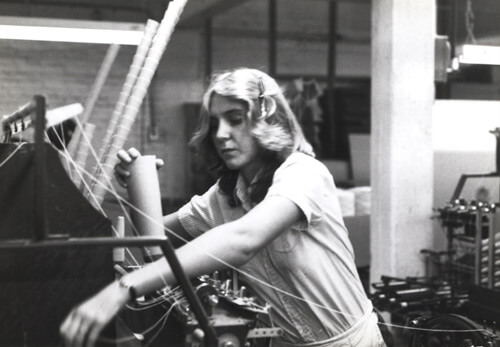 |
| Blonde Woman Working in a Textile Plant, Tennessee, circa late 1970s. Courtesy of Special Collections and Archives, Georgia State University Library, Southern Labor Archives, Amalgamated Clothing and Textile Workers Union, Memphis-Jackson Joint Board Records, L1992_11_112. |
Labor activists and pro-union politicians recognized that with the dramatic growth in economies of the southern states since the 1950s, the future of manufacturing workers in the United States was linked to the South. At the 1977 national labor law reform hearings held in the Roanoke Rapids Civic Center, Congressman Ted Weiss of New York told the Stevens workers there to testify that "the fight that you are waging here in North Carolina and the rest of the South is not just your fight for the workers down here." Wilbur Hobby, president of the North Carolina state AFL-CIO, spoke to the assault on trade unionism through decertification efforts. Civil rights and anti-poverty advocates understood the Stevens campaign to be the next step in keeping alive the 1960s vision of a more equitable and just society. Diana Wilson, a young, African American anti-poverty activist, told the House subcommittee, "People's concerns with union campaigns today are like what black Southerners experienced during the early civil rights days." In March 1977, Coretta Scott King, widow of Martin Luther King Jr., and Bayard Rustin, executive director of the A. Philip Randolph Institute, marched with workers in a protest at Stevens's stockholders meeting in New York.18Conway, Rise Gonna Rise, 130–131, 148, 154–155.
ACTWU allies included politicians, such as US senator Daniel Patrick Moynihan; organizations such as the American Civil Liberties Union (ACLU), the Institute for Southern Studies (ISS), and the National Football League Players Association; and civil rights groups and liberal religious associations. Southerners for Economic Justice (SEJ), formed in 1976 with financial support from ACTWU, became the backbone of the coalition. High profile figures from the 1960s Virginia Durr, Georgia senator Julian Bond, freedom rider John Lewis, Atlanta mayor Maynard Jackson, Rev. W. W. Finlator of the Pullen Baptist Church in Raleigh, North Carolina, and NAACP southern director Ruby Hurley. These veterans joined forces with young, relatively unknown social justice activists coming out of the 1960s New Left and student movements such as Bob Hall, a thirty-two-year-old Florida native and one of the founders of ISS, and Bill Finger, a thirty-year-old civil rights and labor activist from Mississippi who served as SEJ's first executive director. SEJ emphasized its background in the civil rights movement, origin in the South, and independence from ACTWU.19"ACTWU Press Release," December 1978, Box 25, Folder "IUD information," TWUA records, WHS, 396; Minchin, Don't Sleep with Stevens!, 94; "Hearings Before the Committee on Education and Labor (Sub-committee on Labor-Management Relations), H.R. 8410, Labor Reform Act of 1977," August 9, 1977, Box 16, Folder "Misc. Legal Cases," TWUA records, WHS, 396.
SEJ sought to unite activists and organizations around the goal of economic justice. It portrayed the union's campaign as a human rights struggle pitting decent, hard-working women and men against an impersonal corporate giant with a record of discrimination and law-breaking that affronted Christian principles.20"Report from Jim Sessions, SEJ Executive Director," August 8, 1978, Box 12, Folder "Southerners for Economic Justice," TWUA records, WHS, 396. SEJ put pressure on Stevens through letter-writing campaigns, demonstrations and rallies, television and magazine ads, and protesting at stockholder meetings. In January 1978, for instance, SEJ paid for a television commercial, featuring Tom Banks and Ken Reaves of the St. Louis Cardinals, a professional football team that later moved to Arizona, which aired on Greenville, South Carolina, stations just days before the Super Bowl. Banks likened the Stevens campaign to the struggle to organize professional football players.21"Letter to Harold McIver from Bill Finger, with ad script enclosed," December 22, 1977, Box 12, Folder "Southerners For Economic Justice," TWUA records, WHS, 396. SEJ helped the union secure boycott endorsements from civic and religious organizations against Stevens products and the stores that sold them. The United Presbyterian Church identified three Biblical concepts that supported workers' right to organize and passed a resolution that urged its two-and-a-half million members to make a "public witness" through the boycott and "cast their economic ballots in favor of collective bargaining."22"Final report and recommendations on the J. P. Stevens situation, United Presbyterian General Assembly," May 29, 1979, Box 1799, Folder 144, AFL-CIO Civil Rights Department Southeastern Office Records,1974–1984, Special Collections and Archives, Georgia State University Library, Atlanta, Georgia, Collection L1985-16. (Hereafter cited as "AFL-CIO Civil Rights Dept. SE Office records, GSU Library.")
The boycott, as Spzak makes clear, "brought the issue of J. P. Stevens workers to the public eye and into the public arena."23Spzak interview. This did not guarantee change. In a 1976 working paper, SEJ admitted that "the participants in the J. P. Stevens campaign . . . are relatively unknown to most people," making it difficult to "define the merits" of unionization. The participants were "vast numbers of working women who call on the average consumers of Stevens products—another working woman—to help them earn a living for their families."24"Southerners for Economic Justice, Working Paper on J. P. Stevens Campaign," December 1976, Box 1799, Folder 130, AFL-CIO Civil Rights Dept. SE Office records, GSU Library. The personal testimonies of white and African American women workers sought to transform public attention into action. Rank-and-file women displayed their paychecks, private lives, and their bodies as evidence of injustice and as a call to action.
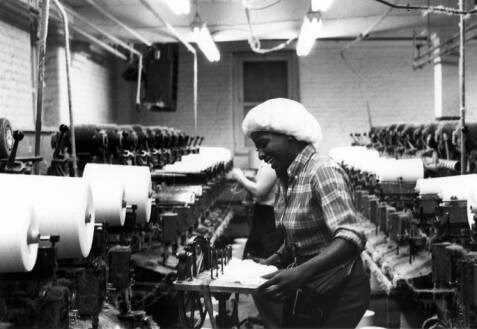 |
| Woman Working with Textiles, ca. late 1970s. Courtesy of Special Collections and Archives, Georgia State University Library, Southern Labor Archives, Amalgamated Clothing and Textile Workers Union, Memphis-Jackson Joint Board Records, L1992-11_73. |
Lucy Taylor was the president of the Roanoke Rapids chapter of the Carolina Brown Lung Association, a group dedicated to getting compensation for mill workers afflicted with respiratory diseases caused by inhaling cotton fibers. She was a fiery public speaker, peppering her speeches with statements like, "They gave me brown lung, I'm giving them hell." Taylor testified at the 1977 annual J. P. Stevens stockholder meeting that at Stevens the "machinery [is] more important than people."25Conway, Rise Gonna Rise, 131, 136. Mildred Whitley of the West Boylston plant in Montgomery, Alabama, explained that after she had a mastectomy, her supervisor told her she could either continue working at the expected pace or go on welfare. SEJ printed her photograph and story in fliers and newsletters sent to supporting organizations, such as the National Alliance Against Racism and Political Repression.26"J. P. Stevens Flier," undated, Box 2, Folder ‘Behavior Control," National Alliance Against Racism & Political Repression Collection, The Schomburg Library, New York City, New York. (Hereafter cited as "NAARPR, Schomburg.") In an interview with the Appalachian magazine, Mountain Life and Work, Addie Jackson of Statesboro, Georgia, linked the treatment of black mill workers to the history of chattel slavery.27"Testimony of Addie Jackson," Mountain Life and Work: The Magazine of the Appalachian South, Volume 53, No. 3 (April 1977), accessed in the Sutton collection, ACC, 986.87. At the labor law reform hearings in Roanoke Rapids in 1977, Louise Bailey, a spinner for thirty-six years, testified that her support of the union in the 1940s got her blackballed for four years. "I feel just sick to my gut," said Bailey, "because when I go in [to work] now, I don't know whether I am going to have a job or not. I know what it is to go hungry. I know what it is when you have a child."28Testimony of Louise Bailey at the congressional field hearings on national labor law reform, the Roanoke Rapids Civic Center, Roanoke Rapids, North Carolina, August 9, 1977, quoted in Conway, Rise, Gonna Rise, 142.
The women's stories made visceral and vivid the abstractions of labor law violations and corporate intransigence. The everyday details in the stories drew the public sympathetically into the workers' lives and complaints: how they had to eat their lunches in the bathrooms because the air in the mill was thick with "cotton dust"; how foremen told crude jokes and vulgar stories to harass and intimidate them; how Stevens monitored bathroom breaks, embarrassing female workers when their "womanly troubles" required more frequent visits; how the company passed them over for promotions and raises because of their sex or race or both. Lucy Taylor's husband quipped that he should sue Stevens for "alienation of affection" because the couple slept in separate beds when brown lung kept Lucy coughing all night. Then he added, "When she gets quiet, I start to worry that she's dead."29The examples of harassment and intimidation that the women described can be found in: Fred Powledge, "The South Will Fall Again," Penthouse, May 1979, 72–79, and Wayne King, "Southern Leaders Form Group to Support Stevens Textile Workers," New York Times, December 12, 1976. Both articles were accessed at Sutton, ACC, 986.87. For personal testimony on women experiencing racial and sexual discrimination in hiring and job placement in the mills, see Conway, Rise Gonna Rise, 109–113. Lucy Taylor's husband quoted in Conway, Rise, Gonna Rise, 86.
Religious Support for Stevens Workers after the 1974 Election Victory
SEJ focused much of its energies on religious leaders and church groups and on publicizing their support. This was especially important in mill towns, where churches provided space for gatherings, were often the center of community life, and lent moral credibility to the activities on their grounds. Chip Hughes and Len Stanley, organizers for the Carolina Brown Lung Association (CBLA) in Erwin, North Carolina, noted that most workers they encountered had grafted their union and CBLA activism onto their church activities. Stanley noted that this was especially true of the women, who organized fish fries and potluck dinners that brought activists and workers together.30Len Stanley from field notes of interview with Betty Bailey, Len Stanley and Thad Moore by Alicia J. Rouverol January 6, 1995, (G-0222), in the Southern Oral History Program Collection (#4007), Southern Historical Collection, Wilson Library, University of North Carolina at Chapel Hill. Chip Hughes recalled the importance of church organizing experience for the elderly women in Erwin. Joseph "Chip" Hughes, recorded interview with the author, December 20, 2011, in author's possession. (Hereafter cited as "Hughes interview.") SEJ's independence from the union allowed it to work through institutions that might have been prejudiced against or wary of organized labor. Spzak recalls that a Free Will Baptist church in Spartanburg, South Carolina, lent its bus to Stevens workers protesting in Columbia.31Spzak interview. Aware that organized religion in the South was often a strong force working against unionization, SEJ sought to organize through sympathetic churches to demonstrate "with maximum visibility the broad range of citizens and southern leaders that support the J. P. Stevens workers" and "minimize the potential for the Stevens campaign to be viewed as a contest between ‘big labor' and ‘big business.'"32"Southerners for Economic Justice, Working Paper on J. P. Stevens Campaign," December 1976, Box 1799, Folder 130, AFL-CIO Civil Rights Dept. SE Office records, Georgia State University Library.
SEJ reported that in 1977 it held more than sixty workshops with ministers, local leaders, and teachers in almost thirty towns and cities and five universities in Tennessee, Virginia, North and South Carolina, Georgia, and Alabama.33"Proposal for SEJ's Third Year," August 8, 1978, Box 12, Folder "Southerners for Economic Justice," TWUA records, WHS, 396. In November 1978, SEJ sponsored a conference, "The Church's Responsibility in the Changing Southern Economy; Case Study: The Church and J. P. Stevens," at Lake Junaluska, North Carolina. Seventy clergy and laity from Tennessee, Virginia, Washington, DC, and the Carolinas participated, representing seven different Christian denominations. In the summer of 1979, SEJ secured a $5,000 donation for the Stevens campaign from the World Council of Churches and organized an economic justice ministry with Sister Mary Priniski in Rock Hill, South Carolina.34"Conference pamphlet, ‘The Church's Responsibility in the Changing Southern Economy; Case Study: The Church and J. P. Stevens,'" November 4 and 5, 1978. "Report from Bill Finger, SEJ Staffer, to Harold McIver," January 19, 1978. "Memo to SEJ Board of Directors, two-month report July 15-Sept. 15, 1979 from Jim Sessions, Director," September 1979. All items from Box 12, Folder "Southerners for Economic Justice," TWUA records, WHS, 396.
 |
| Southeners for Economic Justice (SEJ) pamphlet for the symposium for southern churches held in North Carolina, November 4-5, 1978. Courtesy of the Textile Union of America records, Wisconsin Historical Society, Madison, Wisconsin. |
In Roanoke Rapids in February and November of 1977, Reverend Jim Sessions, then an organizer with the Southern Appalachian Ministry and soon-to-be director of SEJ, and Collins Kilburn of the North Carolina Council of Churches met with ministers of Rosemary United Methodist, First United Methodist, and First Presbyterian churches. "All three are generally supportive of the workers' right to organize," Finger summarized in a report to ACTWU, however they "had some reservations about the boycott." First Union Methodist's pastor had many "high level management people in his church" who did not "believe in the tactic of a boycott," but admitted the NLRB process was an inefficient way to resolve the impasse over a contract. The minister of First Presbyterian, "a patriarch in town [with] some 35 years at the same church," agreed to publicly state that he supported the workers' right to form a union, but felt the boycott "might hurt the town."35"Staff Report by Jim Sessions, Southern Appalachian Ministry," November 3, 1977, and "Report to Concerned Parties by Bill Finger," Box 12, Folder "Southerners for Economic Justice," TWUA records, WHS, 396. While many African American and northern Baptist and Methodist churches and Catholic leaders endorsed the boycott, the support of white southern Protestant churches was more difficult to secure. Getting white southern church leaders to agree to any public acknowledgement of workers' rights—or even just neutrality rather than anti-unionism—was a step forward. Union organizer Joe Uehlein recounts meetings in which he helped Spzak and Sessions talk with anti-union Baptist preachers in Mississippi, explaining that, "Our hope was—and it worked—was to neutralize them so they wouldn't preach against the union."36Joseph Uehlein, recorded interview with the author, March 24, 2012, in author's possession. (Hereafter cited as "Uehlein interview.")
By 1979, an array of religious groups endorsed the boycott: the National Council of Churches, the Women's Division of the United Methodist Church (with nearly one million members), the General Assembly of the United Presbyterian Church, the National Council of Catholic Women, the National Council of Catholic Charities, the Commission on Religion in Appalachia, and the North Carolina Council of Churches.37"ACTWU Press Release," December 1978, Box 25, Folder "IUD information," TWUA records, WHS, 396. At a Roman Catholic Call to Action conference in Detroit, Michigan, in October 1976, the participating bishops issued a statement that advocated the repeal of right-to-work laws and urged the Catholic Church to "commit itself with monies and human resources to aid the struggle of non-union workers to organize in the South, especially the textile industry."38"Catholic Leaders Urge Church to Aid the Organizing Struggle of Textile Workers in the South," Labor Unity 62, no. 13 (December 1976): 11, Sutton, ACC, 986.87. "We believe that those multinational corporations [like] J. P. Stevens . . . must be challenged by Christians in the name of the Lord," extolled the National Coalition of American Nuns. Forty-three-year-old Lucille Sampson, an African American who worked for SEJ after Stevens fired her from its Greenville plant, explained, "They [anti-union co-workers] put you through mental torture. [But] God says, ‘Fear not for I am with thee,' so I'm not afraid."39Quotation from the National Coalition of American Nuns from Minchin, Don't Sleep with Stevens!, 96. Quotation from Lucille Sampson in "Church Women Investigate J. P. Stevens & Company," undated clipping from the newsletter of Church Women United, The Church Woman, page 24, Box 12, Folder "Southerners for Economic Justice," TWUA records, WHS, 396. ACTWU secretary-treasurer Jacob Sheinkman and boycott director Del Mileski claimed that the union's boycott "stirred the nation's conscience" and received more support than the Farah or the United Farm Workers boycotts. SEJ's organizing carried ACTWU's message through networks the union could not or would not work through. Support from preachers, churchwomen, and priests infused the Stevens campaign with a moral urgency and righteous indignation.
Labor Feminism
 |  | |
| Woman Working in a Textile Plant, Tennessee, circa late 1970s. Courtesy of Special Collections and Archives, Georgia State University Library, Southern Labor Archives, Amalgamated Clothing and Textile Workers Union, Memphis-Jackson Joint Board Records, L1992_11_88. | African American Woman Working in a Textile Plant, Tennessee, circa late 1970s. Courtesy of Special Collections and Archives, Georgia State University Library, Southern Labor Archives, Amalgamated Clothing and Textile Workers Union, Memphis-Jackson Joint Board Records, L1992_11_91. |
In the last twenty years, historians and feminist scholars have challenged stereotypes and popular images of second-wave feminism, revealing the feminisms of women of color, the gender-conscious activism of working-class women, and the concerns for economic justice that infused many feminist agendas in the 1970s.40See for instance: Benita Roth, Separate Roads to Feminism: Black, Chicana, and White Feminist Movements in America's Second Wave (Cambridge: Cambridge University Press, 2004); Anne M. Valk, Radical Sisters: Second-wave Feminism and Black Liberation in Washington, D.C. (Urbana: University of Illinois Press, 2008); Dennis Deslippe, Rights, Not Roses: Unions and the Rise of Working-Class Feminism, 1945–1980 (Urbana: University of Illinois Press, 2000); Donald Mathews and Jane Sherron De Hart, Sex, Gender, and the Politics of ERA: A State and the Nation (Oxford: Oxford University Press, 1990); Stephanie Gilmore, ed., Feminist Coalitions: Historical Perspectives on Second-Wave Feminism in the United States, (Urbana: University of Illinois Press, 2008); Stephanie Gilmore, Groundswell: Grassroots Feminist Activism in Postwar America (New York: Routledge, 2012); Lisa Levenstein, "‘Don't Agonize, Organize!': The Displaced Homemakers Campaign and the Contested Goals of Postwar Feminism," Journal of American History 100, no. 4 (March 2014): 1114–1138; Annelise Orleck, Storming Caesar's Palace: How Black Mothers Fought Their Own War on Poverty (Boston: Beacon Press, 2005); Anna Enke, Finding the Movement: Sexuality, Contested Space, and Feminist Activism (Durham: Duke University Press, 2007); Melissa Estes Blair, Revolutionizing Expectations: Women's Organizations, Feminism, and the Transformation of Political Culture, 1965–1980 (Athens: University of Georgia Press, 2014). Dozens of women's rights groups endorsed the Stevens boycott, including: the National Organization for Women (NOW), the Coalition of Labor Union Women (CLUW), Church Women United, the National Assembly of Women Religious (NAWR), and the YWCA. Bella Abzug, NOW president Eleanor Smeal, Jane Fonda, and Gloria Steinem spoke in support of the union's campaign. In March 1978, representatives from more than thirty women's organizations met in Washington and established the National Women's Committee to Support J. P. Stevens Workers. The Committee organized letter-writing campaigns aimed at major department store chains, urging them not to sell Stevens products. "As the major purchasers of domestic products," one letter to Woolworth's stated, "we are using our consumer power to help bring justice to the workplace at J. P. Stevens."41"ACTWU Press Release," December 1978, TWUA records, WHS, Box 25, Folder "IUD information," 396; Social Justice 17 (May 1978), accessed in Sutton collection ACC, 986.87; quotation in Minchin, Don't Sleep with Stevens!, 98. The New York chapter of NOW burned Stevens bedsheets in front of Madison Square Garden. The Durham chapter held NOW meetings in the state AFL-CIO's Labor Temple, where they connected their efforts to ratify the Equal Rights Amendment with the Stevens campaign.42"Letters from Harriet Hopkins (coordinator of the NOW Durham chapter) to NC AFL-CIO president Wilbur Hobby," September 10 and 22, 1978, Box 2376, Folder 15; "News from the AFL-CIO: ERA," July 7, 1976, Box 2349, Folder 2, both items in NC State AFL-CIO 1950-81, GSU; "Let's Stand Together: The Story of Ella Mae Wiggins," September 14, 1979, Metrolina Chapter of NOW, Charlotte, NC, in Sutton, ACC, 986.87. See also Minchin, Don't Sleep with Stevens!, 96–98.
Crystal Lee Sutton's speaking tour as "the real Norma Rae" provided the most public example of the connection between labor and feminism in the Stevens campaign and demonstrated how personal narratives engaged a broader public. Norma Rae was a rare Hollywood movie: a sympathetic portrayal of organized labor with a female protagonist. The Washington Post editorialized that "chances were better than good that [audiences] would emerge from the theater cheering for Norma Rae and the Union against the Big, Powerful, Impersonal Company."43"Norma Rae 1, J. P. Stevens 0," Washington Post, October 24, 1980, accessed in Sutton collection, ACC, 986.87. Sutton was disappointed that the film obscured the role of other workers—especially the black workers—who sacrificed their time and often their jobs for the campaign. She also disliked the movie's portrayal of her character as a promiscuous and directionless unwed mother whose romantic interest in the union organizer motivated her activism.44Sutton expressed her displeasure with the movie in several interviews: Mary Bishop, "The Diary of a Union Organizer," Charlotte Observer, May 7, 1978, Section D, 1, 3; Megan Rosenfeld, "Through the Mill with Crystal Lee and ‘Norma Rae,'" Washington Post, June 11, 1980; C. S. Crawford, "Life on Film? One-time Organizer, Crystal Lee Says Movie Is Based On Her Life," Greensboro Daily Times, April 18, 1979; William C. Lhotka, "Real-life Norma Rae Recalls Stevens Fight During St. Louis Visit," St. Louis Post-Dispatch, December 14, 1980, 12A; all accessed at Sutton, ACC, 986.87. Scenes that demonstrate Norma Rae's personal growth hinge on her sexuality: her prior promiscuity, the sexual tension between her and union organizer Reuben Warshowsky, and her revelations about her past to her children. In contrast, director Martin Ritt desexualized Warshowsky to protect "the whole moral fiber of the film" so that it would not seem to audiences that the organizer "was going from one town to another, screwing every dame he made a connection with."45Ritt quoted in Lyn Goldfarb and Anatoli Ilyashov, "Working Class Hero: An Interview with Martin Ritt," in Martin Ritt: Interviews, ed. Gabriel Miller (Jackson: University of Mississippi Press, 2003), 87. The audience, Ritt believed, needed to see Norma Rae's sexuality in order to understand her commitment to the union, but they could not see Warshowsky's sexuality if they were to believe in his integrity.
Whatever misgivings Sutton had about Norma Rae and the script's sexual double standard, she eagerly supported the Stevens campaign. The union ignored the movie's poetic license and embraced its potential to raise public awareness. ACTWU sent publicist Gail Jeffords on a nationwide speaking tour with Sutton. Jeffords wrote to Mileski that Sutton was "a proven media ‘draw,'" and that "ACTWU's position in the Stevens conflict can only be enhanced by taking advantage of her inherent usefulness in public relations." In the first six months of 1980, Sutton was featured in fifty-seven newspapers and made sixty-three appearances on local television and thirty-nine on radio, reaching a potential audience of seventy-five million people.46"Gail Jeffords to Del Mileski," October 16, 1979, and "Gail Jeffords to Murray Finley et al, Final Media Report on Media Coverage for Crystal Lee Sutton," June 30, 1980, both in Box 23, Folder 25, ACTWU Papers, Organizing Department Records, the Kheel Center for Labor-Management Documentation and Archives, School of Industrial and Labor Relations, Cornell University, Ithaca, New York, 5619/007. (Hereafter cited as "ACTWU Paper, Kheel Center, Cornell University.) On Sutton's "Norma Rae" tour, see also Hodges, "The Real Norma Rae," 267.
 |
| A Woman's Place Is in Her Union, button by the Women's Department of the International Association of Machinists and Aerospace Workers, date unknown. Photograph by the Minnesota Historical Society. Featured on the Minnesota Historical Society's Collections Up Close Blog. Courtesy of Minnesota Historical Society. |
Across the country, labor activists arranged screenings of Norma Rae. Reverend Finlator wrote to North Carolina AFL-CIO president Wilbur Hobby recommending that when introducing the film, Hobby should "mention that it was the Women who shut down the machines first—Black and White."47"‘Rev. – W. W. Finlator – Best Regards,' handwritten letter from Finlator to Wilbur Hobby," undated, Box 2363, Folder 1, North Carolina State AFL-CIO records, 1945–1981, GSU Library, L1981-20. In May 1979 in Laurens, South Carolina, the Oaks Cinema cancelled the screenings of Norma Rae after the manager received harassing phone calls and unknown individuals attempted to tear down the cinema's marquee. SEJ organized a petitioning campaign to the stars of the film from moviegoers in Laurens. One handwritten letter accompanying the petitions stated, "We beg you Mr. Liebman [Ron Leibman, who played the union organizer] please don't let us miss Norma Rae. We have heard so much about it and want to see it in our home town where it should be shown." The authors added, "P.S. There is a J. P. Stevens supervisor who works part time at the Oaks Theater."48"Notes on Norma Rae viewings and controversy at the Oaks Cinema," dated April 30–May 18, 1979, TWUA records, WHS, Box 25, Folder "Norma Rae (cancellation)," 396.
Norma Rae and Sutton's speaking tour garnered support for the Stevens campaign from feminists and women's groups. Sutton renewed her ties with Gloria Steinem, who wrote a scathing indictment of Stevens's labor law violations in the Village Voice. Sutton was in conversation with Barbara Kopple, director of the 1977 Oscar-winning documentary of a Kentucky coalminers' strike Harlan County USA, hoping to collaborate on a more factual account of Sutton's experiences with Lily Tomlin in the leading role. Sutton connected the movie's theme of a woman's liberation from her dependency on men with the fight for economic justice in the textile industry. She reminded audiences that in the mills, "women stay on those same jobs year after year with no promotions and few raises [and] it's women who have to smile and flirt to be sure they keep their jobs or don't get impossible jobs."49For more quotations from Sutton that connected economic justice and women's liberation, see Elizabeth Stone, "Norma Rae: The Story They Could Have Told," Ms. Magazine, May 1979, 30–32; Mary Bishop, "The Diary of a Union Organizer," Charlotte Observer, May 7, 1978, Section D, 1, 3; Anicia Lane, "Fact and Fiction: Crystal Lee Sutton Insists She Is Not ‘Norma Rae,'" Signal, April 8, 1980, 10–12. On the number of women in the US labor force in the 1970s, see: "U.S. Department of Labor Employment Standards Administration Women's Bureau ‘Highlights of Women's Employment and Education,'" Box 2443, Folder 18, NC AFL-CIO State Records, GSU. Sutton quoted in "Transcript, International Women's Day Speech," March 8, 1980, Sutton, ACC, 986.87. For scholarly analyses of the themes of unionism and feminism in the movie, see Edward Benson and Sharon Hartman Strom, "Crystal Lee, Norma Rae, and All Their Sisters: Working Women on Film," Film Library Quarterly 12, no. 2/3 (1979): 18–23, and Gay P. Zieger and Robert H. Zieger, "Unions on the Silver Screen: A Review-Essay of F.I.S.T., Blue Collar, and Norma Rae," Labor History 23, no. 1 (Winter 1982): 67–78. She described letting housework take a backseat to the organizing drive in 1973 and the strain on her marriage. "When I got involved with the union there was just no way that I could do [all the housework]," Sutton explained, "And that started causing trouble [at home]."50Sutton quoted in Megan Rosenfeld "Through the Mill With Crystal Lee and ‘Norma Rae,'" Washington Post, June 11, 1980.
Sutton's stories and Norma Rae rang true to many women in the 1970s who discovered a new vocabulary through the women's movement for discussing the challenges they faced as daughters, wives, mothers, and workers.51For an example of southern feminist literature on changing men's attitudes and reforming the institutions they dominated, see Gainesville Women's Liberation Movement, "What Men Can Do for Women's Liberation" in Dear Sisters: Dispatches from the Women's Liberation Movement, eds., Rosalyn Baxandall and Linda Gordon (New York: Basic Books, 2000), 76–77. For an example of an evangelical feminist leader addressing Christian men's unease with women's liberation, see Letha Scanzoni, "How to Live with a Liberated Wife," Christianity Today, June 4, 1976, 6–9. Pat Burgess, for instance, worked at the White Horse and Monaghan Textile plants in Greenville, South Carolina, in the 1970s. When she saw Norma Rae in the theater, she told the Greenville News and Piedmont, "I got so excited I had to holler two or three times." Burgess's coworkers shunned her for passing out union literature. "It's like you're working in a pit of snakes," she said. "Those ladies, I love them, but they're afraid, they define their opinions with what their husbands think."52Sharon Todd, "Two Reviews of Norma Rae," March 25, 1979, Greenville News and Piedmont, Box 26, Folder "Norma Rae Articles," TWUA records, WHS, 396. Charlotte Brody, an activist who lived in Roanoke Rapids from 1976–1979 and worked for the union and the Carolina Brown Lung Association, traveled with Stevens workers to hearings and rallies up and down the eastern seaboard. On the long bus rides, Brody recalls, white and African American working-class women talked about their lives and families. "They were basically saying," Brody recounts, "this is who I always had to be, this is how I always had to fight."53Charlotte Brody, recorded interview with the author, September 3, 2011, in author's possession. (Hereafter cited as "Brody interview.") Some African American women, such as Roanoke Rapids worker Lucy Sledge, had previous organizing experiences with the NAACP and the Halifax County Voters Movement. Many older white women drew on their experiences in church ladies auxiliaries. For most, the campaign was their first chance to be leaders and to speak out as women and workers. Norma Rae was the first time they saw their stories on the big screen.
The extent to which southern working-class women embraced (or even tolerated) the principles and values of women's liberation should not be exaggerated. Brody recalls white working-class women punishing her through gossip and shunning for wearing tight pants and a two-piece bathing suit: "Your politics alone were enough to dismiss you and to suggest that you were less worthy. And then if anybody knew anything about your sexual politics . . . it meant that all forms of misogyny were deserved. It's a lot to stand up to. And people still did."54Ibid. Maurine Hedgepeth, the middle-aged weaver in Roanoke Rapids who had won reinstatement and back pay, met Jane Fonda in 1977. Fonda was one of several actresses under consideration for the role of Norma Rae; she came to Roanoke Rapids to research the campaign and stayed in a rental house owned by the Hedgepeth family. Hedgepeth told Fonda not to take the role because the movie would "throw us in a bad light" and the Norma Rae character was "a loose woman."55Moe Foner, interviewed by Robert Master, Columbia University Oral History Research Office, Notable New Yorkers collection, Session 15, page 359, http://www.columbia.edu/cu/lweb/digital/collections/nny/fonerm/transcripts/fonerm_1_15_356.html, January 23, 1986. Hereafter cited as "Foner interview."
For some workers in Roanoke Rapids, whether pro- or anti-union, the organizing drive and nationwide campaign tapped into social anxieties in the 1970s: desegregation, sexual liberation, Watergate, the oil embargo, soaring inflation, and the ignominy surrounding the Vietnam War. The activism of mill women threatened the gender and sexual normalcy that structured family life and social relationships and supported privileges enjoyed by men and women, including local status and respect. Women such as Hedgepeth had good reason to be invested in the cultural strictures of respectable womanhood. Gossip and rumor had political purchase in Piedmont mill towns. For women labor activists, a sterling reputation as a "good woman" offered protection against accusations of impropriety.56On the sense of social disorder in the 1970s, see Cowie, Stayin' Alive. For an excellent overview of African American experiences integrating the mills in the 1960s and 70s, see Minchin, Hiring the Black Worker. Nancy MacLean argues that "southern white mill workers did not, by and large, militantly act out anxieties about life troubles on black newcomers" in textile mills, but points out that white women "redrew racial boundaries around areas they had more power to control: courtship, family, and church life." "Redesigning Dixie," 179, 184. See also interviews with mill women in Roxanne Newton, Women Workers on Strike: Narratives of Southern Women Unionists (New York: Routledge, 2007); Victoria Morris Byerly, Hard Times Cotton Mill Girls: Personal Histories of Womanhood and Poverty in the South (Ithaca: ILR Press, 1986); and Conway, Rise Gonna Rise, for evidence in the oral histories of white and African American workers that anxieties over racial integration in the mills tended to play out through social exclusivity rather than physical violence. Transgressions against gendered codes of ethics had consequences, from the loss of a job and friends to public shaming and abandonment. Millworkers relied heavily on "who you knew and how you were known" to get and keep a job at the mill. Reverend Joseph Battle, black pastor of the Quankey Baptist Church in Roanoke Rapids, recalled that in 1974 he went to Jessie Shaw, a white man whose family owned a store in town, to get a reference to work at Stevens. Shaw was "the person that folk listened to and if he gave you a reference, you were in."57Reverend Joseph Battle, recorded interview with Rob Shapard and the author, December 4, 2013, in author's possession. (Hereafter cited as "Battle interview.") Good standing in the community was critical to white and African American working-class women. A damaged reputation, from fact or fiction, could mean unemployment and poverty. White and African American women took substantial risks when they stood for the union.
 |
| In the Textile Mills in Union Point, Greene County, Georgia, 1941. Photograph by Jack Delano. Courtesy of the Library of Congress, Prints and Photographs Division, LC-USF34-046430-D. |
The working-class women of the Stevens campaign joined a long history of "disorderly" working women who blended indictments of labor exploitation, gender inequality, and racial discrimination in their protests and resistance, from the mill girls who formed the Lowell Female Labor Reform Association in 1844, to the "washing Amazons" of the Atlanta laundresses' strikes in 1877 and 1881, to the female strikers who led the "flying squadrons" across the southern Piedmont in the 1934 General Textile Strike, and the women of the black freedom struggle who led "a rebellion of working-class women" in the 1955 Montgomery bus boycott.58On the Lowell mill girls, see Thomas Dublin, Women at Work: The Transformation of Work and Community in Lowell, Massachusetts, 1826–1860 (New York: Columbia University Press, 1979). On the "washing Amazons," see Tera Hunter, To 'Joy My Freedom: Southern Black Women's Lives and Labors After the Civil War (Boston: Harvard University Press, 1997). On the disorderly women of the 1920s strikes and 1934 General Textile Strike in the southern Piedmont, see Hall et al, Like A Family, and Hall, "Disorderly Women." The "rebellion of working-class women" quotation comes from Ruby Nell Sales, interview by Joseph Mosnier, Library of Congress, Civil Rights History Project, http://findingaids.loc.gov/db/search/xq/searchMferDsc04.xq?_id=loc.afc.eadafc.af013005&_start=58&_lines=125, April 25, 2011. Partial transcript in author's possession.
By the late 1970s, opportunities for living very different lives from their mothers arose for a younger generation of mill women. Cohabitation before marriage was more common, there were legal tools to combat discrimination and abuse, and for all but the most isolated of women, televised evidence of women's "liberation," from demonstrations in Durham, Atlanta, and Gainesville to sitcoms about single mothers like Alice.59See, for instance: Cowie, Stayin' Alive; Enke, Finding the Movement; and Beth Bailey, "‘She Can Bring Home the Bacon': Negotiating Gender in Seventies America," in America in the Seventies, eds. Bailey and David Farber (Lawrence: The University Press of Kansas, 2004). Oral history interviews in the Southern Oral History Program's "The Women's Movement in the South" series U-16, and "The Women's Movement and North Carolina Churches," series R-25 offer many firsthand accounts of how the social justice movements of the 1960s and 1970s changed women's communities and lives in North Carolina and east Tennessee. When Sutton graduated from high school in 1959, she could not imagine any options other than living with her parents or living with a husband. She had never worked closely with African American men or women. In 1974, Sutton befriended Jeannie Bailey and Cheryl Wasmund, two young white women at a Stevens Fabricating Plant who rented a trailer together in town. The three attended interracial union meetings in Sutton's home on Henry Street, next door to one of her foremen at Stevens.60Leifermann, Crystal Lee, 132. Lucy Sledge came from a black working-class family in Halifax County, North Carolina, where her uncle Otis worked for the Stevens mills. In 1970, Sledge represented more than a thousand black workers in Roanoke Rapids in a class-action discrimination lawsuit against the company.61Conway, Rise Gonna Rise, 96–101, 109–113. The TWUA cheerleading squad may not have been the first time mill women brought their daughters into public protests, but because of the women's movement, it was broadcast on public television. "Looking back," said a Roanoke Rapids union activist, the Stevens campaign "really was a working-class women's campaign."62Anonymous union activist, in discussion with the author, October 26, 2013.
At an event in New York City in 1980 celebrating an exhibition of photographs of southern textile workers, Roanoke Rapids weaver Maurine Hedgepeth apologized to Fonda for dissuading her from taking the Norma Rae role. Fonda embraced Hedgepeth and replied, "I've got China Syndrome, Sally [Field] has Norma Rae, we've both got big hits. So it's okay."63Foner interview.
The Norma Raes Win a Contract and Create a Legacy
 |
| Women Support J. P. Stevens Workers. Courtesy of the National Alliance Against Racism & Political Repression Collection, Manuscripts, Archives and Rare Books Division, Schomburg Center for Research in Black Culture, The New York Public Library. |
In 1980, ACTWU and J. P. Stevens agreed to a settlement. Stevens would not block negotiations over contracts in Roanoke Rapids plants and at West Boylston in Montgomery, Alabama, the two sites where the union had won bargaining rights. Stevens agreed to recognize the union at plants ACTWU was able to organize within the next year and a half. The company agreed to automatic check-off of dues, binding arbitration of grievances, and compensation for the wage increases the workers lost during the years spent trying to secure a contract. In the wake of the settlement, dozens of Roanoke Rapids workers joined the union for the first time. In return, ACTWU called off the boycott and agreed to not single out Stevens as a target in the corporate campaign.64Minchin, Don't Sleep with Stevens!, 166–171.
Success came at a price. In debt, the union laid off many organizers and staffers. Stevens closed the West Boylston plant in 1982; the union negotiated severance pay. ACTWU won more than a third of its elections in the early 1980s, but this was overshadowed by plant closures and layoffs.65Ibid., 175–176; Mary Robinson, Moisture of the Earth: Mary Robinson, Civil Rights and Textile Union Activist, An Oral History, Compiled and Edited by Fran Leeper Buss (Ann Arbor: University of Michigan Press, 2009), 180. Facing import rates that doubled in the 1980s, Stevens, like many textile and apparel manufacturers in the United States, reduced production and shut down many operations. There were more than two million textile and apparel workers in the United States in 1973. By 2009, there were 400,000, nearly all in the Carolinas. Between 1980 and 1985, ACTWU lost more than 50,000 members.66Minchin, "Shutdowns in the Sun Belt," 260, 264. With the 1994 North American Free Trade Agreement, US-owned factories flourished in the maquiladora zone along the Mexican border, exacerbating the decline in textile and apparel manufacturing. The Piedmont lost hundreds of thousands of jobs between 1989 and 1999, and Asian imports continued to flood American markets, especially after China's admission to the World Trade Organization in 2001.67Minchin, "Shutdowns in the Sun Belt," 267. See also Frederickson, Looking South, 241–246.
Production in Roanoke Rapids declined, but the mills—and the union—survived the 1980s. WestPoint Pepperell, Inc. bought J. P. Stevens in a leveraged buyout in 1988 and broke the corporation into three separate businesses. The mills in Roanoke Rapids continued operating under the Bibb Company, and in 1993 Bibb and WestPoint Pepperell merged to create WestPoint Stevens.68Minchin, "Shutdowns in the Sun Belt," 265; Battle's interview. More information on the history of the J. P. Stevens textile corporation can be found at "Global Manufacturing," WestPoint Home, accessed August 9, 2017, http://www.westpointhome.com/about-us.html. When the last mill in Roanoke Rapids closed in 2003, WestPoint Stevens employed about three hundred workers, and the union local was part of the Union of Needletrades, Industrial and Textile Employees (UNITE). Two decades of assaults on organized labor through decertification campaigns, a deindustrialized manufacturing base, and hostility at the state and federal levels of government had considerably weakened the United States labor movement. Less than 10 percent of all textile and apparel workers in the United States were organized.69Frederickson, Looking South, 235. Looking back over the previous thirty years, Bennett Taylor, president of Roanoke Rapids UNITE and one of the many African American workers who worked alongside Crystal Lee Sutton, considered the Stevens legacy with sadness and pride. "J. P. Stevens was, at that time, known as the number one lawbreaker, and for us to organize J. P. Stevens back then," he paused, and took a deep breath, "we made history. I think it's a good legacy. Maybe people don't talk about it enough."70Taylor interviewed in "North Carolina Now," UNC-TV, June 25, 2003, accessed at Sutton, ACC, 986.87.
Mary Robinson was an in-plant organizer in Montgomery and president of the West Boylston local. "I was a nice, little old black girl from the country when I started," she says, "but Stevens made me a woman." When Stevens closed the West Boylston plant, Robinson worked at an axle-factory and then as a bus driver for juvenile disciplinary facilities. She organized the bus drivers and janitors and won representation by the American Federation of State, County, and Municipal Employees. "I try to teach the support personnel what I learned in ACTWU," she said.71Robinson, Moisture of the Earth, 182, 184, 190. Reflections by working-class women who were leaders in the Stevens campaign echo Taylor's pride and suggest that the Stevens legacy has multiple layers. Crystal Lee Sutton declared that getting involved with the union "gave me an opportunity to be the woman I always wanted to be."72Woman Alive!, Documentary. In the 1970s, after her marriage ended and she left Roanoke Rapids and J. P. Stevens, Sutton worked in a hotel and organized her co-workers at the Hilton Inn in Burlington, North Carolina. Her participation in the Stevens campaign gave her a sophisticated grasp of labor politics and her 1980 speaking tour as the "real Norma Rae" honed her skills. In a speech to flight attendants in Dallas, Texas, in 1987, she called for the elimination of the two-tier wage system, explaining how it disproportionately affected women and minorities and discouraged worker solidarity. At a high school in Graham, North Carolina, she warned students about letting racial differences impede class solidarity, telling them, "Green is the color we all need to be concerned about."73"Crystal Lee Sutton's Union Experience," speech given at Graham High School, October 11, 2000; "Crystal Lee Sutton, the ‘real Norma Rae,'" speech given at the Professional Flight Attendants Union in Dallas, Texas, April 22, 1987. Both transcripts accessed at Sutton collection, ACC, 986.87. She embraced her persona as the real Norma Rae and spoke across the United States, in Canada, and the Soviet Union. Since 1979, "Norma Rae" has become a title of sorts, bestowed on female activists to indicate a woman who is sometimes a feminist, usually a workers' rights advocate, and always a strong-willed leader. Journalist Barbara Ehrenreich nicknamed Ai-jen Poo, the founder of the National Domestic Workers Alliance, the "Nannies' Norma Rae."74Barbara Ehrenreich, "The Nannies' Norma Rae," April 26, 2011, New York Times, accessed May 6, 2014, http://tmagazine.blogs.nytimes.com/2011/04/26/the-nannies-norma-rae. In an interview in 1995, Harold McIver, director of the Industrial Union Department's southern campaigns, continually referred to Sutton as "Norma Rae," suggesting the deep intertwining of movie and memory.75Harold McIver, interview by Chris Lutz, Meansville, Georgia, Southern Labor Archives, Special Collections and Archives Department, GSU Library, September 26, 1995.
 |
| J. P. Stevens Mill, Roanoke Rapids, North Carolina, January 20, 2011. Photographs (above and below) by Donna Longenecker. Courtesy of Donna Longenecker. |
 |
Workers such as Mary Robinson regret the loss of their roles as activists. "I sit sometimes and think about all the wonderful people I met during our struggle," Robinson wrote, "and I think I wish that part of it was not over. Life is so short and the good times always go by so fast. But, as long as I can stay close to the labor movement in any way, I will be happy."76Robinson, quoted in Dignity: Lower Income Women Tell of Their Lives and Struggles, ed. Fran Leeper Buss (University of Michigan Press, 1985), 244. For Mildred McEwen, working nights at the West Boylston mill made her feel alone and "empty." Two things comforted her: watching the 700 Club and working for the union: "I think working with the union is a real Christian act because you're working for other people, not just yourself. I could do something else, I don't have to be there [but] I want to see it through."77Whitley quoted in Buss, Dignity, 241–242, and in Labor Unity, November 1980, 7, Sutton, 986.87, ACC. When the mill closed, McEwen left Montgomery to live with her daughter.
In Roanoke Rapids, the legacy of the Stevens campaign took hold in workers' engagement with local politics. Bennett Taylor, James Boone, and Maurine Hedgepeth became active in voter registration drives and local elections. Between 1974 and 1984, voter registration increased by 20 percent in Halifax County (where the mills were located) and nearby Northampton County. For minority residents, registration more than doubled.
Edith Jenkins, one of the first African American women hired as an operative in the late 1960s, supported the 1973–1974 union drive. In the summer of 1985, she organized other black mothers through the Parent Teacher Association to picket the Weldon school superintendent—a white man in a school district that was 90 percent black—after he fired three black administrators. (Weldon is a small town east of Roanoke Rapids in Halifax County.) In 1992, Jenkins won a seat on the school board. "You've got to fight just to survive around here," she said. "That's how we won the union, that's how I won my school board seat."78William Adler, "A New Day in Dixie," Southern Exposure 22, no. 1 (1994): 18.
In 1993, union workers allied with the NAACP to stop a toxic incinerator from being built near a low-income African American neighborhood in Northampton County.79Ibid., 24–25. The Stevens campaign had a lasting impact on its participants, especially the women. Their experiences as organizers and leaders motivated them as activists in other political arenas long after the 1980 settlement. Their years as union activists gave them knowledge, skills, and a sense of confidence and purpose that bolstered them long after the Stevens campaign ended.
The union learned lessons from the Stevens campaign that supported later efforts. ACTWU became UNITE in the 1980s and continued to organize in the South. Plant closures made organizing more difficult, but did not completely halt the union's efforts. In one instance, UNITE organizers followed laid-off garment workers in the Miami, Florida, area into their new occupations in nursing homes and successfully organized about 250 workers.80Bruce Nissen, "A Different Kind of Union: SEIU Healthcare Florida from the Mid-1990s through 2009," in Zieger, Life and Labor in the New New South, 291. Willie Jones, currently the Southern Region Organizing Director for Workers United, worked in the Cone Brothers's White Oak Cotton Mills in Greensboro, North Carolina, in the late 1970s. Jones recalled that when she began working at the mill, the union's leadership "didn't reflect the people that [they] were actually representing." She credits Bruce Raynor, president of UNITE and Workers United, for the change that occurred in the early 1980s. When he took over as director of the southern region, she noted, "women got a chance and minorities got a chance." Raynor started his career as an ACTWU organizer during the Stevens campaign.81Willie Jones, recorded interview with the author, January 15, 2010, in author's possession.
Southerners for Economic Justice continued organizing in the Carolinas after the 1980 settlement. Its "job rights workshops" in unorganized plants in the Carolinas developed into the Worker's Rights Project (WRP), which claimed several state legislative victories, most notably a 1986 South Carolina law making it harder for companies to dismiss injured workers. WRP expanded into the Carolina Alliance for Fair Employment (CAFÉ) in 1987, which then broadened to include concerns over immigration, criminal justice, and domestic violence.82 Janice Fine, "Workers Centers: Organizing Communities at the Edge of the Dream," February 2006, "Publications," Economic Policy Institute, accessed May 6, 2014, http://www.epi.org/publication/books_worker_centers/. With organized labor under attack from corporations, think tanks, well-funded political action committees, and some state governments, the numbers of functioning labor temples and union halls has fallen across the United States, making projects like WRP and CAFÉ all the more valuable for worker education and empowerment.
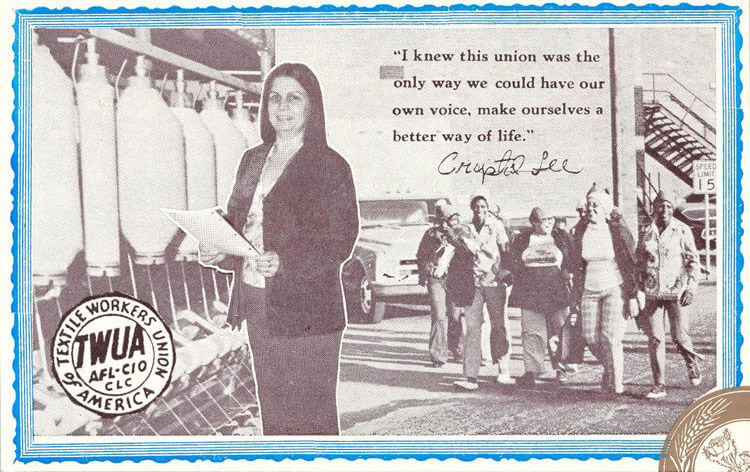 |
| Postcard featuring Crystal Sutton, ca. 1979. Courtesy of The Crystal Sutton Collection, The Learning Resources Center, Alamance Community College, Graham, North Carolina. |
While the Stevens campaign did not have the effect on other corporations that ACTWU hoped it would, it promoted women's leadership and a more community-based approach that many organizers adopted in the 1980s and 1990s.83Groups like Interfaith Workers organize within and without the formal institutions of the labor movement on issues of wage theft, the right to collective bargaining, immigration and labor laws, and corporate responsibility for workers' safety and public health. See "History," Interfaith Worker Justice, accessed May 6, 2014, http://www.iwj.org/about/history. For a recent essay on the alliances between labor and women's groups in North Carolina, see Jennifer Ferris, "Are you One of the 90,000 NC Women Living on the Edge?," March 19, 2014, Women AdvaNCe, accessed June 3, 2014, http://womenadvancenc.org/are-you-one-of-the-90000-nc-women-living-on-the-edge/. For a recent essay on conservative and corporate alliances against labor and religious organizers responses in North Carolina's "Moral Mondays," see Dan T. Carter, "North Carolina: A State of Shock," September 24, 2013, Southern Spaces, accessed June 3, 2014, https://southernspaces.ecdsdev.org/2013/north-carolina-state-shock. Joe Uehlein worked under Harold McIver, organizing furniture workers in 1979 in Tupelo, Mississippi, in an "experimental organizing project where [we] organized through the churches. We set up the women's organizing project. We were doing all this community stuff, which Harold had no patience for." Uehlein reflects on the changes in the union leadership's attitudes in the 1980s, a change he credits to the 1970s Stevens campaign. In Tupelo he hired two women organizers. "I remember it really clearly," he says, "because when [they] showed up, it was like the talk of the union movement." By the late 1980s, the Industrial Union Department had set up the Women's Organizing Project and female staffers and organizers were more common. "A lot of things led to that, but clearly the J. P. Stevens thing, with Norma Rae the movie coming out, Crystal Lee being the leader, that had a lot to do with it."84Uehlein interview. The architects of the Stevens campaign and the working-class women who put themselves front and center to win a contract blazed a trail for future organizers and women workers that has outlasted the mills they organized.
About the Author
Joey Fink is a PhD candidate in history at the University of North Carolina at Chapel Hill. Her dissertation, "The Many Norma Raes," examines the roles of working-class women in the campaign to unionize the J. P. Stevens textile plants in the Piedmont South in the 1970s. While tracing the connections between the women's movement, civil rights groups, and liberal religious organizations in the labor struggle, Fink explores the local contexts and national platforms in which white and African American textile women became leaders and spokeswomen for a workers' rights movement.
]]>
The Best of the Martins, 2011. Gaither Gospel Series DVD cover. © Slanted Records and The Martins.
For the past forty years or so, "southern gospel" has named a professional musical style associated with white fundamentalists and evangelicals in the US South.1For an extended discussion of "southern gospel" see, Douglas Harrison, Then Sings My Soul: The Culture of Southern Gospel Music (Urbana–Champaign: University of Illinois Press, 2012), 2–5, 80–109. In its modern, commercial form, southern gospel emerges "from a broad-based, post-Civil War recreational culture built around singing schools and community (or 'convention') singings popular among poor and working-class whites throughout the South and Midwest."2Ibid., 2. This tradition is distinctive for its cultivation of close harmony sung in ensembles—traditionally male quartets, a formation that dominated the commercial sector of southern gospel through roughly the first half of the twentieth century, and more recently, mixed-gender foursomes and trios, often comprising family members.3Today's professional southern gospel includes many family and mixed gender foursomes and trios, configurations that were and are common in the singing convention world that dominated southern gospel in the late nineteenth century and early twentieth century. But professional southern gospel has always been strongly grounded its history and identity in the male quartet. The seven-shape notational system (and culture) of songwriting, singing, and music education that took root in the southern uplands in the late 1800s has heavily influenced the music of southern gospel and its values.4Here, following Loyal Jones, "Southern Uplands" designates the regions and people of trans-Appalachia and extends eastward into the Piedmont and westward to the Ozarks. See Jones, Faith and Meaning in the Southern Uplands (Urbana–Champaign: University of Illinois Press, 1999), 9. For more on the rise and spread of southern gospel regionally and nationally, see James R. Goff Jr., Close Harmony: A History of Southern Gospel (Chapel HIll: University of North Carolina Press, 2001), 50–109; Don Cusic, The Sound of Light: A History of Gospel Music (Madison: Popular Press, 1990), 153–162; 171–176. This musical culture subsequently spread across trans-Appalachia, and then later throughout the Midwest, Southwest, and, after the Great Migration of white southerners in the post–World War II era, into other parts of the United States influenced by southern migration. Today southern gospel is found in areas of the United States and lower Canada with concentrated populations of white fundamentalist evangelicals.5For more on the demographic profile of southern gospel see Harrison, Then Sings My Soul, 175–180.
Among these people, "the term southern gospel," as I have noted elsewhere, "was not used to describe the music [in its professional, commercialized form] until the 1970s and did not gain widespread use until the 1980s. Before then the music was simply known to its practitioners and fans as gospel."6Not that "southern gospel" never made an appearance before the 1970s and 1980s. Music publishers of seven-shape notational gospel music and the convention singing tradition to which these publishers catered were familiar with the term for much of the twentieth century. This essay is interested primarily with professional southern gospel, which descends from convention singing but has been distinct from it since the 1930s and 1940s. If, as Anthony Heilbut has noted, "gospel" is a vexingly "vague and inadequate" term for a wide and shifting range of sacred music within Anglo-European and African American Protestantism,7Anthony Heilbut, "Black Urban Hymnody," on Brighten the Corner Where You Are: Black and White Urban Hymnody (New World, 1978, NW-224). "southern gospel" brings with it additional layers of interpretive complication regarding race, class, and geography. The overwhelming majority of fans and professionals in contemporary southern gospel are white Christians who are "culturally southern, socially conservative, and Anglo-American."8Stephen Shearon, Harry Eskew, James C. Downey, and Robert Darden, "Gospel Music," Grove Music Online, July 10, 2012, accessed October 15, 2013, http://www.oxfordmusiconline.com/subscriber/article/grove/music/A2224388. So it is tempting to assume that the emergence of "southern" to describe the music since the 1960s matters only as an unsubtle substitute for the more racially antagonistic "white." Such an assumption would not be wholly unjustified.9The conflation of "southern" and "white" to describe this music circulates widely among scholars and non-specialists, but has only been tentatively stated in scholarship. My reading sees race, racism, and a racialized concept of self and other in southern gospel as an important, not always dominant, factor in the emergence of "southern gospel" and the cultural function of the music. For a fuller discussion of "southern" as a racial signifier and readings of race and white gospel see Harrison, Then Sings My Soul, 96–103. My own research has been the first to document at length how, throughout much of the twentieth century, the music's unsavory history of explicit racism, affiliation with supremacist ideas and politicians, and its largely unreconciled relationship to this past echo jarringly in any use of the term "southern gospel." In short, whiteness remains strongly associated with southern gospel performance and fan culture.10Ibid., 203, especially note 53.
 |
| Front cover of Crowning Day (Dayton, VA: Ruebush-Kieffer, 1900). Courtesy of Douglas Harrison. At the end of the nineteenth century and into the first three decades of the twentieth century, southern white gospel was dominated by convention singings that relied on the regular release of small octavo shape-note songbooks such as Crowning Day. |
Yet it is a mistake to treat southern gospel as wholly synonymous with white gospel. Nor is its cultural function exclusively or even primarily of scholarly interest for what it may tell us about southern whiteness in an ever more racially diverse and pluralistic world. Although southern gospel is undoubtedly white, not all white gospel is southern, and not all gospel of the US South is white.11Following Harry Eskew's lead in the Grove Music entry for Gospel Music, Stephen Shearon uses "northern urban" gospel to designate commercial Christian music of and for primarily white Protestants that emerged in the late-nineteenth- and early-twentieth-century revivalism in urban areas outside the South. Key figures include Ira Sankey (the evangelist Dwight Moody's song leader), Homer Rodeheaver (Billy Sunday's music director), and George Beverly Shea (Billy Graham's most famous soloist). "Northern urban" gospel is the historical forerunner of today's Contemporary Christian Music (CCM). Even though I do not have a better name for it, I remain deeply ambivalent about "northern urban gospel." (See Harrison, Then Sings My Soul, 182–183).
"Southern" gospel has its own difficulties, not least the fact that not all gospel from, of, or appealing to people in the South is a white enterprise. "Gospel," as Heilbut has noted, is "the favored term for what working-class black congregations [do,] often to the exclusion to white traditions." See Heilbut, "Black Urban Hymnody." Black gospel draws heavily on southern lifeways, many of its biggest stars have been from the South, and it has always found a good portion of its audience there. Still, the cultivation and creation of twentieth-century commercial black gospel's golden age (1945–1960) was largely rooted in Chicago, Philadelphia, and other urban centers in the Midwest and Northeast where many black southerners moved during the Great Migration. See Shearon et al., "Gospel Music," and Heilbut, The Gospel Sound: Good News in Bad Times (Milwaukee, WI: Hal Leonard, 2001 [1979]) and Harrison, "Why Southern Gospel Music Matters," Religion and American Culture 18, no. 1 (2008): 27–58.
"Southern gospel" remains the preferred term in the study of white gospel music of the South. Unlike "northern urban" gospel (a phrase with no currency outside academe), it is the preferred way to self-identify within the culture and the most widely recognized way to describe the music to outsiders. The rise of "southern" gospel emerged in response to a network of cultural tensions, social conflicts, and religious instabilities.12These longstanding conflicts precede the twentieth century. Southern gospel's negotiation of them has often manifested in overt racism or a way of thinking, talking, and singing that renders whiteness falsely normative. Southern gospel has found itself in alliances with black gospel traditions and the black church. As Stephen Shearon has noted, both white and black gospel have "liked aspects of what the other was doing" ever since blacks and whites began singing sacred music near one another in North America. And both black and white gospel have "borrowed those aspects, reinterpreting them for their own cultures" and purposes. See Shearon, email to H-Southern Music Network mailing list, March 27, 2009. Of course, race is never far from any discussion of southern cultures, but it is also true that, in southern gospel, "overmuch emphasis on black-white polarities diminishes our understanding of cultural dynamics submerged beneath the surface of the music."13Harrison, Then Sings My Soul, 103. Consequently, in what follows, "southern gospel" stands as shorthand for professional, commercialized white gospel from, or culturally aligned with, the evangelical fundamentalist South. North American gospel history and the cultural realities of contemporary southern gospel defy further generalization.
Evoking Arkansas as a state encompassed by the southern gospel tradition signals my interest in exploring ways that large-scale changes in conceptions of religion, geographical identity, and social status play out and are revoiced in subcultural and local registers. The Arkansas imaginary explored here is not a totalizing way of understanding the vernacular music of white fundamentalists. Rather, I aim to map a specific hot spot within the psychosocial terrain of contemporary professional southern gospel as an instance of a broader phenomenon that could be explored in US southern and rural imaginaries.
This essay is interested in how the imagining of a place shapes and is shaped by understandings of vernacular sacred music and the shifting identities this music contains. "Place" signifies a physical location, a material culture, a set of affiliated social relations, and more nebulous meanings associated with place as a concept. The interplay of praxis and imagination is crucial. In cultural geography, "sense of place" refers to the feelings and emotions a place evokes and that help constitute it.14Tim Cresswell, Place: A Short Introduction (London: Wiley-Blackwell, 2004), 169. More than just feelings or emotions, such sense of place encompasses perceptions, assumptions, and habits of thought and behavior of people who are part of a place. The collective effect forms the social imaginary, a way to understand self- and group-concepts in postmodern life.15Charles Taylor, Modern Social Imaginaries (Durham: Duke University Press, 2003), 3. For more on cultural-geographic conceptualizations of place, see John Agnew, The United States in the World Economy: A Regional Geography (London: Cambridge University Press, 1987), and Cresswell, Place. Taylor's development of the social imaginary builds on (but also departs from) Benedict Anderson, Imagined Communities (London: Verso, 2006). In addition to these sources, my own use of social imaginary theory is indebted as well to Cornelius Castoriadis, The Imaginary Institution of Society (Cambridge: MIT Press, 1998).
Arkansas has undergone considerable stereotyping in the US imagination.16Brooks Blevins, Arkansas/Arkansaw: How Bear Hunters, Hillbillies, and Good Ole Boys Defined a State (Fayetteville: University of Arkansas Press, 2009), 4. To speak of an "Arkansas imaginary" in this essay is to conceptualize Arkansas as a site—particularly among poor and working-class white evangelicals and fundamentalists—for the practice of religious life, or "lived religion."17On "lived religion," see David D. Hall, Lived Religion: Toward a History of Practice (Princeton: Princeton University Press, 1997), 3–21. Such an approach asks how southern gospel artists (most from beyond the state) use Arkansas's status as an imaginative resource to make sense of themselves and their music in late twentieth and early twenty-first century fundamentalist Protestantism.18I have in mind the period in American conservative and fundamentalist evangelicalism inaugurated by Richard Nixon's conjuring of the "silent majority" of cultural traditionalists who opposed the advance of liberal policies and social practices in the US. This period was followed by the mobilization of right-leaning Protestants (and many conservative Catholics) into a political base for the Republican Party in the Reagan Era and a power base for evangelical leaders (including Jerry Falwell's Moral Majority, Pat Robertson's—and later Ralph Reed's—Christian Coalition, and, more recently, Donald Wildmon's American Family Association, and Tony Perkins's Family Research Council); and the not-entirely unrelated realignments within conservative and fundamentalist Protestantism wrought by the rise of non-denominational evangelical mega-churches and the Tea Party. Representative scholarly studies include Nancy Ammerman, Baptist Battles: Social Change and Religious Conflict in the Southern Baptist Convention (New Brunswick: Rutgers University Press, 2001); Susan Friend Harding, The Book of Jerry Falwell: Fundamentalist Politics and Language (Princeton: Princeton University Press, 2001); Darren Dochuk, From Bible Belt to Sunbelt: Plain-Folk Religion, Grassroots Politics, and the Rise of Evangelical Conservatism (New York: W.W. Norton, 2011); Mark Hulsether, Religion, Culture and Politics in the Twentieth Century United States (New York: Columbia University Press, 2007).
I explore the Arkansas imaginary through the state's most famous southern gospel sibling trio, The Martins, their music, and their reception since approximately 1990.191990 coincides roughly with the emergence of what would become the Bill and Gloria Gaither Homecoming Friends video (later concert) series. In addition to being the vehicle through which The Martins received fame, Homecoming marked an epochal shift in the reception and self-concept of southern gospel. My focus on professional southern gospel music is distinct from the avocational or amateur tradition, known as convention singing. Southern gospel denotes "an overlapping, commercialized national network of musical products, professionals, and their fans, commonly referred to as 'the industry'" (Harrison, Then Sings My Soul, 4–5). For an overview of southern gospel's history and development within the wider domain of American gospel music, see Shearon et al., "Gospel Music," and Don Cusic, The Sound of Light: A History of Gospel Music (Madison: Popular Press, 1990). The emergence of The Martins as a national touring group relied strategically on their Arkansas roots. Their continuing appeal has involved a narrative about their Arkansas identity as proof of authenticity as individual performers and for the genre of southern gospel. Explored through the Martins, how do non-musical categories of knowledge, patterns of affiliation, and cultural values—such as sense of place—help clarify, sustain, or revalue religious music traditions, identities, subject positions, and the ideological commitments those traditions encompass?
Southern Gospel's Decline and the Sister-Bertha-Better-Than-You Effect
Southern gospel's cultural sustainability turns out to be an urgent matter of concern, even if southern gospel people themselves do not tend to speak about it that way. Since at least the late 1970s, southern gospel's fortunes, measured by market standards, have trended downward, a decline attributed to broader trends within commercial Christian music entertainment and more broadly within fundamentalist and evangelical Protestantism.As the fortunes of southern gospel have declined, those of Contemporary Christian Music (CCM) have risen. CCM is a broad category built around religious songs that, to the uninitiated, can sound virtually indistinguishable from a cross-section of mainstream American adult contemporary and Top 40.20Within southern gospel, "CCM" designates nearly all other forms of commercial Christian music deemed insufficiently pious or overly commercialized (marketed in ways different from southern gospel). Sometimes this includes black gospel, particularly the performers who take inspiration from the mainstream music industry (pop, rock, R&B, and hip-hop). More conventional black gospel singers (such as Angie Primm and the late Jessy Dixon, both of whom have appeared on Gaither Homecoming videos) and black gospel choirs are generally held in high regard in southern gospel. The Gospel Music Association (GMA), Christian music's umbrella professional organization that administers the Dove Awards (Christian Music's Grammys), classifies this type of black Christian music as "traditional gospel," as distinct from "contemporary gospel," which encompasses black gospel in the style of mainstream R&B. Many southern gospel performers and groups incorporate covers of traditional black gospel songs and spirituals into their repertoire. Southern gospel performers often emulate black gospel style—including arrangements, vocal techniques, and use of choirs as backing voices. See Goff, Close Harmony, 233–236, 269–274. For an analysis of the cultural and religious tensions between southern gospel traditionalists, who founded the GMA, and the CCM fans and performers whose tastes have dominated the GMA for nearly forty years, see Harrison, Then Sings My Soul, 91–96. In its early decades, CCM's creative and cultural home was Nashville and many performers and professionals still work there. Its fans and participants aspire to transcend or dissolve regional expectations, theological boundaries, and denominational classifications. The music remains popular among white evangelicals and many African American Protestants, though its market share—like that of most sectors of the music industry—has declined considerably.21Sales of "Christian/Gospel" (which consists overwhelmingly of CCM and black gospel music, but also includes some southern gospel) reached a high point in 1998, totaling $836 million; in 2012, total sales in the same category were $24.2 million. See "Music Album Sales in the United States in 2012, by Genre,"Statistica.com, 2012, accessed January 28, 2014, http://www.statista.com/statistics/188910/us-music-album-sales-by-genre-2010/; Natalie Gillespie, "Gospel Music Sees Record-Setting RIAA Numbers," CCM Update, March 29, 1999; and Lindy Warren, "Top 15 Impact-Makers in 1997," CCM Update, December 22, 1997. The only subgenre of white Christian music that remains relatively strong is Praise and Worship music, whose fortunes have been buoyed by the demand for choruses in non-denominational evangelical churches. The precipitous decline in "Christian/Gospel" has devastated most sectors of the market. Professional black gospel, which has a historically longstanding relationship with African American worship traditions to a much greater extent than commercial white Christian music has with white Protestant churches, has remained creatively vibrant. Heilbut notes that this vibrancy is driven by the rise of name-it-and-claim-it prosperity gospel in the black church, which is intensely homophobic and discourages its members from thinking in "broad sociological" categories in favor of a self-aggrandizing theology that links spiritual well-being with personal wealth (See "The Gospel Church and the Ruining of Gay Lives: An Interview with Anthony Heilbut," interview by Douglas Harrison, ReligionDispatches.com, July 30, 2013, accessed January 28, 2014, http://www.religiondispatches.org/books/culture/6221/the_gospel_church_and_the_ruining_of_gay_lives%3 A_an_interview_with_anthony_heilbut/; and Heilbut, The Fan Who Knew Too Much: Aretha Franklin, the Rise of the Soap Opera, Children of the Gospel Church, and Other Meditations [New York: Knopf, 2012]). GMA has drastically shifted its outreach and marketing emphasis toward black gospel artists and groups, going so far in 2011 as to move the Dove Awards from Nashville's Grand Ole Opry to Atlanta, the unofficial capital of black gospel music. In 2013, the Doves moved back to Nashville, not to the Grand Ole Opry House but to the auditorium of a small religious college in the suburbs (Dave Paulson, "Dove Awards Fly Back to Nashville," USAToday.com, October 14, 2013, accessed January 28, 2014, http://www.usatoday.com/story/life/music/2013/10/14/dove-awards-nashville/2984327/).
The rise of CCM participated in the transformation of conservative and fundamentalist Christian culture in the United States beginning in the 1970s and intensifying in the 1980s and 1990s. In commercial Christian music, this transformation foregrounded oft-blurred distinctions between "evangelicals" and "fundamentalists." My use of "evangelical" follows George Marsden's, denoting Protestant thought and action shaped by Reformed theology. Today it designates right-leaning North American Protestantism defined in large part by its opposition to cultural, theological, and political liberalism. "Fundamentalism" indicates evangelicals for whom militancy in resistance to liberalism is the defining feature of lived religion.22George Marsden, Understanding Fundamentalism and Evangelicalism (Grand Rapids: Eerdmans, 1991), 1–5. Randall Balmer, My Eyes of Have Seen the Glory: A Journey Into the Evangelical Subculture in America (New York: Oxford University Press, 2006); and Donald Dayton and Robert Johnson, eds., The Variety of Evangelicalism, (Knoxville: University of Tennessee Press, 2001). Dayton offers an alternative account of "evangelicalism," emphasizing the rise of Pentecostalism and holiness traditions, which, as Jonathan Dodrill notes, "do not seem so bent to ward off liberalism." Dayton, The Theological Roots of Pentecostalism (Grand Rapids: Francis Asbury Press, 1987); and Dodrill, "Evangelicalism Examined . . . Again: Continuing the Debate between Donald Dayton and George Marsden," in The Continued Relevance of Wesleyan Theology: Essays in Honor of Laurence Wood, ed. Nathaniel Crawford (Eugene: Wifp and Stock, 2011), 84. Southern gospel is overwhelmingly a product of evangelical fundamentalism. But it also resonates with less militant but hardly less conservative evangelicals—mostly white—who respond powerfully to its organizing themes: proud piety, traditionalist notions of family, and unapologetic sentimentality about evangelistic faith and religious community.
During the last three decades of the twentieth century, these conservative evangelicals and fundamentalists ceased perceiving themselves in the Nixonian paradigm as a silent majority existing voicelessly and invisibly within mainstream US politics and culture. Consequently, much of conservative Christian culture challenged secular narratives and norms. Evangelicals and fundamentalists have never agreed on how best to live out the scriptural directive that Christians be in the world, but not of it. In the final decades of the twentieth century, these disagreements opened up a fault line between southern gospel and CCM, with each camp pursuing styles of music that implied divergent theories of musical evangelism.
CCM emerged as the musical avatar of those conservative evangelicals who believed it was a mistake for Christians to concede entire swaths of popular culture to secular tastes and values in the name of resisting worldliness and impiety. Instead, CCM performers and fans came together around a common commitment to reclaim the devil's music for God. At first, this meant reclaiming (or sonically imitating) mainly rock 'n' roll, but ultimately it came to encompass almost any kind of popular mainstream American music heard on commercial radio, especially among teen and youth audiences. The hottest acts in Christian music appropriated the musical conventions and performance styles of rock, pop, adult contemporary, heavy metal, and later, jazz, R&B, rap, hip-hop, and punk. In this way, CCM musicalized the desires of many conservative Christians to perceive themselves as culturally relevant.23David Stowe, No Sympathy For the Devil: Christian Pop Music and the Transformation of American Evangelicalism (Chapel Hill: University of North Carolina Press, 2011) notes that the poly-generic style that defined the emergence of CCM in the 1980s was linked with the politicization of Christian music as part of the broader mobilization of evangelicals and social conservatives (246–248). And see José Casanova, Public Religions in the Modern World (Chicago: University of Chicago Press, 1994).
Within commercial Christian music, most white fundamentalist fans and professionals left cold by CCM—and committed to traditional modes of evangelistic outreach—coalesced around "southern" gospel. Although the male quartet continued to dominate southern gospel's self-image, the genre as a commercial enterprise became home for strains of more traditional white evangelical vernacular sacred musics, including explicitly pietistic bluegrass and country gospel. More deeply, southern gospel functioned as a figurative space of cultural retrenchment against the music's loss of reputational capital within white evangelical popular culture.24For more on southern gospel's shift within Christian entertainment from a "dominant" to a "residual" status, see Harrison, Then Sings My Soul, 103–109.
If much of CCM musically enciphers the aspirations of evangelicalism's dominant demographic—suburban, white, seeker-centered25"Seeker" sensitive models of congregational development and worship emerged in the 1970s and 1980s as part of the so-called church-growth movement, an organized effort to expand church membership and participation beyond traditional populations. This movement was popular among (though not exclusive to) non-denominational evangelical megachurches. The Willow Creek megachurch, under the leadership of Bill Hybels, is the most prominent example of a seeker-sensitive church. These congregations structured worship, congregational culture, and church outreach to target "those who had never established a relationship with Christ and the Church, and those trying to reconnect" (Lester Ruth, "Lex Agendi, Lex Orandi: Toward an Understanding of Seeker Services as a New Kind of Liturgy," Worship 70, no. 5 [September, 1996]: 386–405). This model "avoided conventional church approaches, using . . . Sunday services to reach the unchurched through polished music, multimedia, and sermons referencing popular culture and other familiar themes. The church's leadership believed the approach would attract people searching for answers, bring them into a relationship with Christ, and then capitalize on their contagious fervor to evangelize others" (Matt Branaugh, "Willow Creek's 'Huge Shift,'" ChristianityToday.com, May 15, 2008, accessed May 15, 2014, http://www.christianitytoday.com/ct/2008/june/5.13.html). Interestingly, Willow Creek leaders published a study conducted by the church in 2008 that indicated the seeker-sensitive model did not reliably lead to consistently reported levels of spiritual development or maturity among those who were attracted to the church by its seeker sensitivity (Greg Hawkins and Cally Parkinson, Reveal: Where Are You? [South Barrington, IL: Willow Creek Association, 2007]). conservatives primarily in denominationally unaffiliated megachurches—southern gospel has come to voice the revanchist critique of non-denominational evangelicalism offered by old-line denominational fundamentalists (namely, Southern Baptists, General Baptists, Free Will Baptists, and Independent Baptists; Nazarenes; Church of God; Church of Christ; Assemblies of God; and the more fundamentalist strains of Methodism).26These denominations were most frequently represented in original ethnographic research I have conducted into the contemporary culture of southern gospel. See Harrison, Then Sings My Soul, 75–180. From this traditionalist perspective, CCM's project of reclaiming the devil's music for the Lord amounts to little more than evangelical apologia set to music in "Jesus is my boyfriend" songs: notionally Christian tunes that overlay the stylistic trends and tastes of secular music with lyrics about a love beyond all measure, directed toward a pronominally vague beloved who could be divine, or more sublunary.
 |
| Amy Grant, Nashville, Tennessee, 2009. Photograph by Bob Muller. Courtesy of Bob Muller. |
Within southern gospel, perhaps the most polarizing figure thought to embody this accommodationist dynamic is Amy Grant, who began as a CCM ingénue ("Father's Eyes," "El Shaddai" and "Angels") and subsequently landed crossover hits in American pop during the 1980s (her debut outside of CCM came in a duet with Peter Cetera, "The Next Time I Fall In Love"). There was no love lost between southern gospel and the "Queen of Christian Pop" to begin with, but after Grant's rise to fame, she became a galvanizing symbol for southern gospel of cultural accommodation run amok in doctrinally compromised music. After Grant's divorce from Gary Chapman, her symbolic function in southern gospel expanded to include the corrupting effect of musical compromises on personal morality and the heternormative family.Southern gospel's disdain of CCM can come off as a kind of "Sister Bertha Better Than You" self-righteousness.27Here, I am borrowing an image first popularized by Ray Stevens in "Mississippi Squirrel Revival," on He Thinks He's Ray Stevens (Universal, 1987, MCAC-5517).And it is that, to a certain extent. But this rejection of CCM also bespeaks the stance toward modernity that defines southern gospel culture and fundamentalism. The southern gospel condemnation of CCM has long and deep roots.28Although CCM borrows heavily from mainstream secular music and performance styles, it does so to cultivate a canon of popular music that signifies Christianity's cultural relevance and the music's evangelistic savvy, while claiming a special status derived from CCM's pious commitments to conservative evangelical values and theological positions. This dynamic was captured in the 2014 Grammys. Nominated in the "Gospel/Contemporary Christian Music" category, CCM soloist Natalie Grant attended the ceremony, only to leave before the show ended. "I've many thoughts about the show tonight," she tweeted, "most of which are probably better left inside my head. But I'll say this: I've never been more honored to sing about Jesus and for Jesus. And I've never been more sure of the path I've chosen." Many fans and most observers interpreted her actions and words as a rebuke of a mass wedding of gay and straight couples performed during the broadcast. (Jennifer Jones, "Natalie Grant Responds after Leaving Grammys Early," Christianitytoday.com, January 29, 2014, accessed January 31, 2014, http://www.christiantoday.com/article/mass.wedding.at.
2014.grammys.criticized.as.political.stunt.to.push.gay.marriage.agenda.natalie.grant.responds.after.early.exit/35586.htm). While CCM is less fundamentalist than southern gospel, it participates in the long drift of conservative evangelicalism toward separating itself from the wider world of American life and culture. Professional southern gospel emerged from a Reconstruction-era subculture of poor and working-class white southerners. Teaching, learning, and singing gospel to fashion a meaningful identity shares in the reconstitutive ambitions of the New South movement more generally.29For a cogent analysis of how shape-note gospel from the South mediated cultural conflicts and status instabilities of white, southern farmers, see Gavin James Campbell, "'Old Can Be Used Instead of New': Shape Note Singing and the Crisis of Modernity in the South, 1880–1920," Journal of American Folklore 110, no. 436 (1997): 169–188. But the development of professional gospel resonates most powerfully as part of white fundamentalist evangelical withdrawal from mainstream secular society over the long twentieth century. Mark Noll has described this process as one focused on the formation of a parallel but separate evangelical culture meant to preserve pietistic thought and action perceived to be under attack and threat of extinction by secularization. With the dissolution of the "Christian-cultural synthesis," fundamentalists, Noll concludes, "made a virtue of their alienation."30Mark Noll, The Scandal of the Evangelical Mind (Grand Rapids: Eerdmans, 1994), 67, 211. Molly Worthen has mapped contemporary evangelicalism's uneasy relationship with post-modernity and religious self concept. See Apostles of Reason: The Crisis of Authority in American Evangelicalism (New York: Oxford, 2013). Indeed, the style of four-part male harmony for which professional southern gospel is most well-known has been historically linked to the practice of piety and lived religious devotion in the premillennial dispensationalist tradition.31Premillennial dispensationalism has been the dominant theological paradigm for fundamentalist evangelicals in the United States since the mid-nineteenth century. It emphasizes the unfolding of God's dealings with humanity in phases or eras ("dispensations"). Premillenialists espouse a literalist interpretation of scripture that foresees the imminent return of Christ to earth. Most fundamentalists and many conservative evangelicals believe this return will be presaged by certain historical events, including cataclysmic conflict between Arabs and Jews in the Holy Land, the rise of Anti-Christ, and the emergence of a one-world order. Christ's return coincides with the rapture of living Christians and the raising of the righteous dead to heaven. Following the rapture is Tribulation, a seven-year period during which Anti-Christ reigns on earth, Millennium (during which time Satan is bound), and ultimately the establishment and eternal reign of Christ's kingdom. See Robert K. Whalen, "Premillennialism," The Encyclopedia of Millennialism and Millennial Movements, ed. Richard A. Landes (New York: Routledge, 2000).
It is in this tradition of pietistic, blood-bought, soul-saving, life-giving harmony of the one true way to Christ that The Martins were raised and trained.32For more on The Martins's biography, see the following section and note 41. Their success in the late 1980s and early 1990s coincided with the resurgence of cultural separatism that has come to dominate southern gospel discourse.33This element of cultural separatism has reemerged in the past generation within southern gospel. In its resurgence, one hears from the gospel stage and in other acts of self-representation an intensification of emphasis on social resentment and cultural grievance. See Harrison, Then Sings My Soul, 1–3. Southern gospel product sales also experienced what now appears to be a last-gasp micro-surge of popularity, with market shares reaching an inflection point somewhere in the mid–1990s, followed by a precipitous sales decline by as much as 90 percent in the decade between 2000 and 2010.34Goff's remains the most extensive and influential account of southern gospel's market decline. Researched in the 1990s and published in 2002, Close Harmony traces the music's development from the nineteenth century. However, in light of the subsequent collapse of most of the southern gospel industry not affiliated with the Homecoming Series, Close Harmony offers an overly optimistic view of southern gospel prospects in the twenty-first century (283–287). For the past fifteen years or so, professional southern gospel groups, including The Martins, regularly dissolved and re-formed, or disbanded outright under the constant pecuniary strain of small crowds and even smaller free-will love offerings, and the upheavals these instabilities introduce into private life. Marquee ensemble singers who once would have driven a group's fame and success today leave ensemble work and go solo to cut costs and stay viable.35Examples of changes and shifts within professional southern gospel since 1990 include the disbanding of numerous groups as well as the retirements and deaths of many of the mid-twentieth century singers who anchored the genre's golden era. Recording companies experienced similar contractions. The National Quartet Convention, southern gospel's annual flagship event that at its height in the mid-1990s drew crowds approaching 25,000 for four or five nights in a row, no longer attracts audiences or interest to warrant multiyear leases with the Kentucky Fair and Expo Center in Louisville. NQC's leadership recently announced that the event will take up residence in a regional conference center at Pigeon Forge, Tennessee.36Sheldon Shafer, "National Quartet Convention Ending Long Run in Louisville," Louisville Courier-Journal.com, September 3, 2013, accessed October 1, 2013, http://www.courier-journal.com/article/20130903/SCENE04/309030069/. This retreat from metropolis to outpost acknowledges that southern gospel is no longer a national phenomenon.37 Douglas Harrison, "Slouching Toward Pigeon Forge." Averyfineline.com, September 24, 2012, accessed October 1, 2013, http://averyfineline.com/2012/09/24/slouching-toward-pigeon-forge/.
On the surface, these indicators suggest the clear shift in tastes within Christian music entertainment away from southern gospel's preference for close harmony sung in the ensemble. More deeply, the decline in market share and cultural capital has eroded southern gospel's self-concept and induced a crisis of authenticity. Pamela Fox has noted that "while academia has for the most part abandoned the authentic as any kind of meaningful analytic category," the vernacular music of southern, white, rustic life and experience has "tended to preserve it."38Pamela Fox, Natural Acts: Gender, Race, and Rusticity in Country Music (Ann Arbor: University of Michigan Press, 2009), 7. For more on links between country and gospel, see Douglas Harrison, "Grace to Catch a Falling Soul: Country, Gospel, and Evangelical Populism in the Music of Dottie Rambo," in Walking the Line: Country Music Lyricists and the American Culture, edited by Roxanne Harde and Thomas Alan Holmes (Lanham: Rowman and Littlefield, 2013), 77–96. Certainly this is true of southern gospel. Fox's work on rusticity and identity suggests that any crisis of authenticity in popular music from the South will register across a range of cultural texts and products. Jennifer Lena has exhorted scholars of music culture to deemphasize sounds and instead examine "social structures and collective actions."39Jennifer Lena, Banding Together: How Communities Create Genres in Popular Music (Princeton: Princeton University Press, 2012), 2. My approach attends to southern gospel as a musical style,40Lower compositional sophistication, more uneven production quality, and rougher cuts by commercial standards—all defining features of the southern gospel sound of the past twenty years—can function for many evangelicals and fundamentalists as indices of a more real music and catalysts for a more authentic experience of the religious self. while emphasizing cultural texts and discourses. My sources include celebrity interviews of performers, DVD bonus features, album covers, and online press coverage. From these materials emerge patterns of description, allusive gestures, cultural maneuvers, and possibilities for self-concept through which southern gospel identities are constructed and reimagined.
From Arkansas With Love
In the early 1990s, two sisters and their brother, Judy, Joyce, and Jonathan, then in their late teens and performing as The Martins, began appearing with the Gaither Homecoming Friends. Comparatively little has been published about The Martins's biography beyond birth, marriages, and professional accomplishments.41The basic details provided here derive largely from The Martins's disclosures on stage, press coverage, conservations I have had with industry professionals, and my experience. The siblings all lived most of their formative years in Arkansas, where they learned to sing and with which their comments in public indicate a strong identification. Judy Martin is married to Jake Hess, Jr., the son of the legendary southern gospel lead singer Jake Hess. They live in Columbus, Georgia, and have five children. Joyce Martin is married to Paul Michael Sanders, who has had periodic jobs as a southern gospel singer. They live in Nashville and have two children (Martin Sanders was married previously to Harrie McCullough, with whom he had a child). Jonathan Martin and his wife, Dara, live in Des Moines with their six children (Craig Harris, "Martins Storm Back onto the Scene," sgnscoops.com, December 17, 2013 [accessed January 31, 2014)]. This dearth conforms to a tendency in southern gospel to celebrate those performers who seem to embody orthodox cultural values, religious beliefs, and pietistic practices, as opposed to those who provide rich and particularized details about their personal lives. Indeed, specific aspects of a performer's biography usually only come into play for southern gospel when an instance of individual characteristics, crisis, or great fortune serve to point audiences toward notionally transcendent truths of fundamentalist theology. Absence of biographical detail about The Martins clears space for the Arkansas imaginary to operate.
 |
| Bill Gaither, Tallahassee, Florida, 2006. Photograph by Judy Baxter. Courtesy of Judy Baxter. |
In the late 1980s and early 1990s, The Martins performed mostly in the southern half of the Mississippi Delta region and recorded self-financed albums. However, a 1993 appearance on the Gaither Homecoming series helped transform The Martins from an avocational regional trio into a professional act with a national following in fundamentalist Christian entertainment.
Gaither Homecoming is a popular series built on themed video recordings, live concerts, and a host of related residuals-generating merchandise.42In the 1990s and early 2000s, Gaither Homecoming was popular on the now-defunct TNN cable channel. The videos still air regularly on many local-access religious television channels, but sales today are largely driven through merchandizing at concerts, the Gaither Homecoming Magazine, syndicated radio shows on terrestrial and satellite radio, and not least of all through the Gaither online store. Each video or concert is a variation on a format: Bill and Gloria Gaither invite many of the aging stars of southern gospel's mid-twentieth-century golden age to join them and their musical friends, peers, and rising stars from southern gospel and a range of subgenres on the more traditional and conventional sides of North American Christian music—country gospel, bluegrass, inspirational, and choral and hymnody. Everyone sits on risers around a piano and sings: old songs, new songs, gospel songs, hymns, inspirational ballads, spiritual anthems, praise and worship choruses, even a few secular tunes now and then (Bill Withers's "Lean on Me," or an arrangement of Barry Manilow's "One Voice").
The popularity of Homecoming derives from its emergence during—and its response to—the declension crisis in southern gospel. Rooted in the professional identity crisis Bill Gaither experienced in the late 1980s and early 1990s as an éminence grise in Christian entertainment who was struggling to figure out what to do next, Homecoming "has succeeded and thrived by using religious music entertainment to address a wider crisis of relevance afflicting" southern gospel and contemporary evangelicalism. By leveraging anxieties about cultural authenticity and relevance roiling conservative evangelical and fundamentalist culture, Homecoming creates "a musical screen onto which people from a wide range of Christian cultural traditions within the American middle class can project their own religious concerns and spiritual aspirations."43Harrison, Then Sings My Soul, 124. For more on Gaither Homecomings and their role and appeal in southern gospel and beyond, see ibid., 110–136.
The Martins first appeared in 1993 on an early Gaither Homecoming video, Precious Memories. The trio performed an a capella arrangement of the 1862 gospel hymn, "He Leadeth Me," a standby in the culture of Homecoming's fan base.44"Gospel hymns" refer to a repertoire of American sacred songs that "first appeared in religious revivals during the 1850s, but which flourished with the urban revivalism that arose in the English-speaking world in the last third of the nineteenth century and continued into the twentieth century." Though the publication of "He Leadeth Me" predates the popularization of the term of "gospel hymns" (which is most commonly sourced to Philip P. Bliss's Gospel Songs [1874] and Bliss and Ira D. Sankey's Gospel Hymns and Sacred Songs [1875]), the song's style anticipates the dominant features of the gospel hymn and is customarily treated by gospel singers and fans as part of the corpus of gospel hymns that remain popular in southern gospel. See Shearon et al., "Gospel Music."
This performance is important not just because the group's knack for reimagining southern gospel harmonies in dazzling vocal arabesques led in short order to celebrity. Beyond the style it captures, this clip points to the structures of thought and feeling that underlie The Martins's appeal and southern gospel music more generally. In the broadest sense, The Martins here evince how "the interaction of lyrics, music, and religious experience in southern gospel functions as a way for evangelicals to cultivate the social tools and emotional intelligence necessary for modern living." Through southern gospel, participants "develop the capacity to think and act as modern pluralists or situational relativists when necessary, while retaining their identification with antimodern religious traditions that notionally believe in timeless, unchanging absolutes."45Harrison, Then Sings My Soul, 3. For an extended discussion of the psychodynamics of southern gospel, see ibid., 1–49. In this light, and flowing from this initial performance of "He Leadeth Me," The Martins established a reputation as the pure-hearted "songbirds" of southern gospel, to borrow a description that Bill Gaither offers on a Homecoming video, The Best of the Martins.
This reputation is curious, because most of the music the group has written, recorded, and performed outside Homecoming merrily mixes and merges stylistic features from adjacent genres and traditions: most notably, CCM, country, southern and urban gospel, choral music, inspirational, light rock, pop, and classic hymnody. Media releases promoting The Martins tout this diversity and eclecticism. They have won several Dove Awards (Christian music's Grammy) in the southern gospel, inspirational, and Christian country categories, and received a Grammy nomination in the Best Southern, Country, or Bluegrass Gospel Album category.
 |
| The Martins, From Arkansas With Love, early 1990s. Cassette tape cover. © The Martins. |
This pan-stylistic hybridity was apparent in the group's repertoire before their Gaither affiliation. The Martins recorded five independent albums prior to their breakout. The most prominent, From Arkansas With Love, is full of original material, almost all written by Joyce Martin. The songs are structurally derivative and lyrically conventional, but this music is interesting for what it suggests about The Martins's cultural temperament and expressive style, best described in these early years as one of rustic post-teen southern evangelical angsty spiritual wonderment. From Arkansas With Love demonstrates southern gospel's influence. At the same time, the group evinces no interest in stylistic purity or generic fealty to a specific tradition, even as the album title—including the florid and flowing cover typography—frames their music as a filiopietistic missive from the old home place that is a staple of the southern gospel imagination.46While David Fillingim argues that "home" as a concept in southern gospel allows its participants to imagine and explore a flight from material hardship and social marginalization in this world (in favor of an eternal home of magnificence in heaven), my research suggests that in southern gospel "home" serves to give concrete, graspable shape to abstract theological concepts and spiritual experiences for ordinary Christians in the here and now. "Home" functions primarily in southern gospel as a meaning-making tool for experience in this life, not the next. See David Fillingim, "A Flight From Liminality: 'Home' in Country and Gospel Music," Studies in Popular Culture 20, no. 1 (1997): 75–82; and Harrison, "Grace To Catch a Falling Soul." For "homecoming" as a practice and concept in southern fundamentalism, see Jeff Todd Titon, Powerhouse for God: Speech, Chant, and Song in Appalachian Baptist Church (Austin: University of Texas Press, 1988).
The paradox of The Martins's Homecoming reputation as masters of classic gospel hymnody and their much wider stylistic reach and renown before and beyond the Homecoming stage suggests that there is more to their appeal to southern gospel audiences than can be accounted for by their music. At face value, much of The Martins's stylistically hybridized and contemporary music would seem to commit many of the very musical sins that southern gospel culture has long cited as justification for disparaging most other major forms of Christian music entertainment (except, perhaps, bluegrass).47The history and role of bluegrass, old-time, and mountain musics, particularly songs with pietistic lyrics that have found a home in southern gospel, is understudied. Several prominent bluegrass and old time families have been mainstays of southern gospel since family acts began to emerge in the 1930s and 1940s: most prominently, The Lewis Family and The Chuck Wagon Gang, and later the Primitive Quartet, The Easters, and The Isaacs. Goff, Close Harmony, 264–282, traces these and other important bluegrass groups in southern history. Stephen Marini has provided the most sustained interpretive examination of bluegrass families in southern gospel: Sacred Song in America: Religion, Music, and Public Culture (Urbana–Champaign: University of Illinois Press, 2003), 296–320. Yet The Martins remain beloved members of the Homecoming cast and reputational avatars of gospel traditionalism carried on in the music of a new generation of songbirds.
Not least of all, The Martins's success has relied on the popularity within southern gospel of what I have referred to as backwoods virtuosi—up-from-nothing children of the white US South able to create and perform distinctive arrangements of gospel songs and hymns whose lyrics are, as most southern gospel is, suffused with first-person struggles of ordinary Christians, striving after, struggling for, and faithfully pressing on toward greater assurance of belief and affirmative experience of the divine in their lives.48On backwoods virtuosi, see Harrison, "Grace to Catch a Falling Soul." What continues to distinguish The Martins is their acoustic style full of complex harmonies, modulations, and voicings that reflect influences of country, bluegrass, folk, old-time, choral, black gospel, and vocal jazz styles and arrangements.
The Martins's arrival on the national gospel scene participates in a familiar narrative of the country kids from Nowheresville, USA, making it big. Roger Bennett played piano for the Cathedral Quartet for nearly twenty years, and throughout his career, he was introduced as a child prodigy at the keyboard from Strawberry, Arkansas. Similarly, Gerald Wolfe, also originally a pianist for the Cathedral Quartet and subsequently the owner and emcee of his own professional trio, Greater Vision, was famously plucked from obscurity (or so the story went onstage in his early years as a performer) while singing with the Dumplin' Valley Boys.49References to Bennett's birthplace in Strawberry, Arkansas, were staples of Cathedrals concerts, several of which I attended, in the 1980s and 1990s. For a recording of the set piece associated with Gerald Wolfe's time with the Dumplin' Valley Boys, see This is Your Life George Younce, directed by Charlie Waller (n.d., Louisville, KY: National Quartet Convention), DVD. Even if The Andy Griffith Show had not made small, rural towns with earthy-sounding names synonymous with culturally unsophisticated, plainspoken provincialism,50Toward the end of his life, Andy Griffith recorded multiple southern gospel albums. I Love to the Tell the Story: 25 Timeless Hymns, won a 1996 Grammy for Best Southern Gospel, Country Gospel, or Bluegrass Gospel Album. Just as I Am: 30 Favorite Old Time Hymns, was nominated for a 1998 Grammy in the same category. "Andy Griffith Dies." Grammy.com, July 3, 2013, accessed October 1, 2013, http://www.grammy.com/blogs/andy-griffith-dies. southern gospel audiences have historically bonded with performers who come to fame through place-based narratives of discovery. These bonds seem heavily predicated on shared assumptions that performers' professional legitimacy and artistic authenticity arise from a God-given prodigiousness untainted by the artifice of formal education or the contrivance of worldliness, which in southern gospel culture is associated with urban(e) or cosmopolitan ways of life.
From the start, the case of The Martins is linked to the state of their birth. The Martins's music signals that what makes this trio a southern gospel group is its commitment to a worldview and way of life that is place-based, class-bound, and consistent with values and assumptions that prevail in white, fundamentalist evangelicalism. There is an associational—as opposed to primarily musical—logic to this appeal that tracks with broader "patterns of cultural experience and affiliation." In its current, commercial form, this tradition "is most powerfully defined by common historical, economic, social, and cultural connections among professionals and fans to a constellation of corporate and professional organizations that anchor the creation, consumption, and commemoration of the music," Gaither Homecoming among them. Rather than denoting a style or sound of vernacular sacred musicmaking, "southern gospel" as a term and a set of at-best partially unexamined social practices and religious beliefs "indicate the music and culture of those people who choose to associate themselves with this tradition."51Harrison, Then Sings My Soul, 5. As The Martins achieved fame and renown, they did so less because of what and how they sang, and more because of the way in which they have presented themselves and their music, and the way the Gaither Homecoming appropriated them as children of traditional gospel values at a moment when the viability of these values was perceived to be in question.
The Cultural Consolations of the Hillbilly
The Martins's performance of pious authenticity plays out in public in ways that take common celebrity narratives (the underdog or, as in the story below, the innocent) and recodes them within the logic of the Arkansas imaginary. Take, for instance, Joyce and Judy's 2001 telling of how The Martins scored the chance to sing "He Leadeth Me" on the Homecoming stage.
Joyce: We went to Indianapolis [in 1992] with Michael English and Mark Lowry [of the Gaither Vocal Band and the Gaithers' inner circle]. Michael actually took us there and Mark and Mike tried to figure out a way for Bill [Gaither] to hear us sing. He was very busy and was getting ready for the next day's video. So, we're in the little church in Anderson, Indiana, and they are rehearsing for the next day and we're in the foyer. Bill never comes out into the foyer but Gloria does. When she came out, Mark grabbed her arm and said, "You have to hear these kids sing!" Except [we didn't] know where to go, all the rooms were locked, too much going on in the auditorium, so Mark suggests we go into the bathroom.
Judy: Into the ladies room!
Joyce: So we went into the bathroom. It was Mark, Mike, of course the three Martins, Gloria and two or three other people. We sang "He Leadeth Me" a cappella for Gloria Gaither, in the ladies bathroom, in Anderson, Ind. She tells Bill, "you have to hear these kids sing." So we sang next day on the video [Precious Memories], "He Leadeth Me" . . . And that was actually the first time Bill heard us sing. After that we did a few Gaither dates, then [we] were signed to Spring Hill Records [a recording company in which Gaither Music had substantial holdings at the time]. . .52The Martins, interview by J. Man, Crosswalk.com. November 13, 2001, accessed September 23, 2013, http://www.crosswalk.com/1108828/. The Martins initially auditioned for Gaither in 1992; the video on which they appeared was not officially released until 1993.
The Martins's insistence upon their childlike wonderment—then and now—at the improbability of the audition's circumstances is overlaid with the immediately recognizable nature of The Martins's talent by music industry veterans. These two tropes—innocence and prodigious talent—interacting with the publically retold stories of their backcountry upbringing, suggest an authenticity that speaks across generations, professional accomplishment, and even the cynicizing forces of the entertainment business.53A notable elision in this story—and it points to more general (mis)understandings about the Gaithers's personae—is the role of Gloria Gaither. Clearly this story of The Martins's beginning as Homecoming Friends is important to them because they are depicted in the narrative as so natively talented that Bill Gaither purportedly allows them to perform without ever having himself auditioned them. It is difficult to lend much credence to this account unless Gloria Gaither's opinion and judgment plays a much more determinative role in the Gaither image and Homecoming productions than is generally allowed or assumed. Fortunately, new and forthcoming work in the study of southern gospel is beginning to scrutinize Gloria Gaither's role as a Christian entrepreneur, thinker, and writer much more closely. Such work is as welcome as it is needed.
If The Martins's Arkansas origins are not revealed in this story, their roots surface in a 2011 Gaither Homecoming video, The Best of The Martins, a collection of performances over the preceding nineteen years. Between highlights, Bill Gaither interviews Joyce, Judy, and Jonathan,54The interviews are actually excerpts taken from long conversations filmed in a homey setting in which The Martins sit side-by-side on a large couch facing the camera and Bill Gaither sits in an overstuffed armchair to the right of the frame. The camera cuts back and forth between The Martins and Gaither, occasionally taking in the four of them in a wide shot. connecting their identities, the group's history, and their Arkansas roots with the force of southern gospel music.
Here the Arkansas imaginary is in operation. The Martins's family narrative emphasizes anti-modern, unsophisticated, and materially modest childhoods, reinforced with a washed-out photo of the family's ramshackle cabin. Its primitive construction and the faded color photo intensify the contrast between rustic lifeways and the warmly lit, generously appointed, and contemporarily decorated set in which The Martins appear comfortable, coiffed, and professionally poised. Gaither's questions establish Jonathan's lifelong love of "huntin'" as linked to his Arkansas adolescence. The conversation encourages audiences to understand The Martins's music as a cultural practice connected to the Arkansas backcountry.
The values implied by customs and conditions are elemental in stereotypes of "Arkansas" as hillbilly territory. Arkansas has long been defined by poverty and isolation born of the cashless frontier societies of the state's uplands and the agrarian barter economies that prevailed in the lowlands.55Morris Arnold, "The Significance of the Arkansas Colonial Experience," Arkansas Historical Quarterly 51 (Spring 1992): 78–80. That legacy of subsistence and pervasive poverty persists. Arkansas ranks forty-fifth in median income in the United States and, by official self-description since the 1970s, is culturally "the natural state." Recreational tourism is a cornerstone of Arkansas's economy and reputation.56For income distributions by state, see "Per Capita Income by State," Bureau of Business and Economic Research. April 13, 2013, accessed October 15, 2013, http://bber.unm.edu/. For branding of the natural state, see Arkansas.com, Arkansas Department of Parks and Tourism, accessed October 15, 2013, http://www.arkansas.com.
A particular Arkansas primitivism merits attention here. Arkansas, writes Brooks Blevins, "has become in many ways indistinguishable from concurrent stereotypes of backwoods southerners or of southern mountaineers and hillbillies," despite the geographical, cultural, and social differences between the Ozark and Ouachita hill country to the north of the state, the Mississippi River alluvial region to the east, and the "primeval swampland" in the state's southern half. Any Arkansas setting becomes synonymous with the Ozark hillbilly. In addition, "many of the characteristics and stereotypes considered [representative of Arkansas as a whole]," Blevins concludes, are "extensions of broader regional and cultural images" applied by others to Arkansans.57Blevins, Arkansas/Arkansaw, 39, 9.
 |
| Map of the Ark-La-Miss Borders. The Martins grew up in the town of Hamburg in Ashley County, Arkansas. Map by Southern Spaces. |
Arkansas is not unique in being treated as the home of the benighted white southerner, redneck, or hillbilly, and the Arkansas imaginary is but one sort of white, working class, rurality. The Arkansas imaginary has explanatory power for The Martins inasmuch as southern gospel music revoices and revalues the distortions and elisions of religious identity and cultural history central to the self-concept of many white fundamentalists and evangelicals. These distortions and elisions are at work in the Gaither video biography of The Martins that points to aspects of the Arkansas imaginary distinct from generalized assumptions about white trash and hillbillies.
The Martins hail from Hamburg near the Louisiana border in Ashley County, in the southeast quadrant of the state, where the west Gulf coastal plain meets the Mississippi Delta. The Gaither interview invites viewers to imagine them as representing a set of hill-country values—a love of hunting, closeness to nature, self-sufficiency, and cultural isolation—that Blevins argues have over the course of two centuries come to stand in for all (white) Arkansans.58The cultural difference between the Ozark/Ouachita and Mississippi Delta regions of Arkansas is aptly captured by/in two recent films. Winter's Bone, set in the rural Ozarks, vividly portrays the psychosocial costs of geographical isolation, lack of economic and educational opportunity, and sense of cultural confinement associated with life in the deep woods of Ozark hill country. Mud, set in the Arkansas Mississippi River Delta, powerfully evokes the fluidity of class, ethnicity, and geography as defining features of identity in a region where the flux of life is so heavily dependent on, shaped by, and intertwined with the flow of the river. The noticeable absence of non-whites in these films, like the assumptions at work in Blevins's account and Gaither video, suggests to the degree to which whiteness remains largely unelucidated as a structuring category of identity, ideology, and religious belief in southern gospel. Blevins links the emergence of the Ozark image to the cultivation of cotton, which transformed the lowlands and delta of Arkansas's east, middle, and south into vast mechanized agricultural zones. This transformation left untouched only the Ozarks and Ouachita to the north and west. These were "places so divorced from the frenzied modernization of twentieth-century America" that they presented an easily caricatured type from which to generalize about the state as a whole.59Ibid., 5–16, 67.
The conflation of The Martins's southern Arkansas bayou background with upstate Ozark hillbillyism emerges through the rhetoric of Bill Gaither as host and interlocutor. Gaither uses a repertoire of leading questions, strategic glosses of the singers' responses, folksy asides, and improvised amplifications to cultivate the image of The Martins as hill-country kids made good as gospel celebrities. His interview enacts a modern gospel version of the venerable Arkansas Traveler colloquy in which a high-born southerner (the Traveler) engages an Arkansas Squatter in a dialogue about the differences of class and geography.60Bill Clinton's presidential campaign used the Traveler name and image as a way to strengthen his populist appeal running against a Washington insider. For discussions of the Traveler trope see "The Arkansas Traveler" entries in the online resources of the Historic Arkansas Museum, accessed October 1, 2013, http://www.arkansas-traveler.org, and on Arkansas.com, Arkansas Department of Parks and Tourism.
![Arkansas squatter's home, along Route 70, 1935. Photograph by Ben Shahn. Courtesy of the Library of Congress, Prints and Photographs Division, LC-USF33- 006029-M1 [P&P]. Despite the geographical and cultural variety found in the state, many common stereotypes about Arkansas treat all Arkansas natives as derivatives of the squatter.](https://southernspaces.ecdsdev.org/wp-content/uploads/2019/07/harrison-010-squatter-lg.jpg "Arkansas squatter's home, along Route 70, 1935. Photograph by Ben Shahn. Courtesy of the Library of Congress, Prints and Photographs Division, LC-USF33- 006029-M1 [P&P]. Despite the geographical and cultural variety found in the state, many common stereotypes about Arkansas treat all Arkansas natives as derivatives of the squatter.") |
| Arkansas squatter's home, along Route 70, 1935. Photograph by Ben Shahn. Courtesy of the Library of Congress, Prints and Photographs Division, LC-USF33- 006029-M1 [P&P]. Despite the geographical and cultural variety found in the state, many common stereotypes about Arkansas treat all Arkansas natives as derivatives of the squatter. |
What emerges in The Martins's interview echoes Anthony Harkins's observations about constructed hillbilly rusticity: "Middle-class white Americans [can] see these people [hillbillies] as a fascinating and exotic 'other' akin to Native Americans or Blacks, while at the same time sympathize with them as poorer and less modern versions of themselves."61Anthony Harkins, Hillbilly: A Cultural History of an American Icon (New York: Oxford University Press, 2003), 7. Yet many of the white, conservative, and fundamentalist Christian consumers who are the target audience for this kind of Christian entertainment merchandise may well see something quite different. For them, Gaither's interview effectively constructs and encourages audiences to see in The Martins representative, unifying figures of white, evangelical populism whose home is, as Bethany Moreton has shown in her study of Wal-Mart and evangelicalism, the Ozarks of northern Arkansas and south-central Missouri—the literal geographic location in which Gaither's colloquy imaginatively relocates The Martins. In the process, The Martins's music and cultural valence become revalued and highly desirable within the network of associations and commitments merging at the intersection of white conservative Christianity, right-wing cultural politics, and a "global service economy."62 Bethany Moreton, To Serve God and Wal-Mart (Cambridge: Harvard University Press, 2009), 5.
Tradition, Progress, and Cultural Instability
The gestalt of Arkansas rusticity associated with The Martins serves to understand their sophisticated harmonies. At one point in the interview with The Martins, Gaither describes their music as "sophisticated," and Judy Martin Hess jokes that Gaither was not saying The Martins themselves are sophisticated, only their music. Her reply offers quick-witted banter and comic reinforcement of the widespread assumption—abetted by the Gaither Music Company—that The Martins's southern gospel is an artistically and spiritually serious form of sacred song from people who are proud of their pietistic primitivism. In this context, gospel music functions as a style of vernacular religious entertainment and a form of evangelical cultural experience transcending denominations or confessional traditions. When Gaither says, "You can take them anywhere," he seems to mean that in his role as producer and impresario he can rely on The Martins to stand and deliver whatever the show demands. There is also the sense that The Martins's appeal reaches across the spectrum of religious beliefs and musical tastes that form the conservative end of the white Christian music entertainment market. Gaither's remark associates a universality to The Martins, who are legitimated by the origins their music is purported to transcend.
The notion of The Martins's music as culturally transcendent—not despite but because of its particularized rusticity—is reinforced in another clip from The Best of The Martins in which the trio sings on the 1998 Hawaiian Homecoming.
The Martins's singing by the sea resonates with the disjunction of three "kids" from a cold-water backwoods shack harmonizing in an exotic locale with an international gospel touring company. The video cuts from the Hawaiian excerpt back to the homey interview setting. Bill Gaither sighs contentedly, then adopts an avuncular, lightheartedly admonishing tone, commenting that The Martins had only sung the first verse and indicating, as if unplanned, that the trio should "finish it" on the couch at that moment. You can take them anywhere.
What started in Hawaii more than a decade earlier ends in Studio A in Andersonville, Indiana, with Gaither presiding as witness to The Martins's musical authenticity—by sea, in the studio, (notionally) on command, at home among southern gospel's Homecoming Friends or in faraway lands. The Martins appear to possess an unadorned, God-given popularity that abides in their embodiment of white tradition and progress. Their mix of rustic piety and sophisticated harmonizing (in The Best of video, much is made of their performance with the Homecoming Friends at Carnegie Hall) gives audiences powerful, palpable reassurance that despite shifts in taste, technology, and demographics of Christian entertainment during the past three decades, southern gospel music and values are thriving and persevering in the youthful artistry and rustic ethos of normatively white, middle class, evangelical traditionalism embodied in artists such as The Martins.
Geography and biography merge in the Arkansas imaginary to redefine and authenticate The Martins's musical personae and southern gospel as a mode of fundamentalist and conservative evangelical experience. The southern gospel tradition carries on primarily through the cultivation of a musical sensibility connected to an underlying set of cultural affiliations. The Martins sing—and their fans enjoy—a fairly broad range of musical styles and an innovative pastiche of old and new that is often indistinguishable from some of the very CCM sounds southern gospel has long denounced as immoral and worldly. A fan's review of The Best of The Martins video on Amazon.com captures this dynamic succinctly: "I wouldn't consider the Martins southern gospel," the reviewer writes, "as their sound is more contemporary but they have a love of the Lord and that comes across strong in their work and their lives. I recommend this DVD highly."63Emphasis added. John F. Mooney, review of The Best of The Martins, directed by Bill Gaither, Amazon.com, July 29, 2013, accessed October 15, 2013, http://www.amazon.com/review/R399G8O3TFUQHH/.
In considering The Martins's arrival "From Arkansas With Love," I have demonstrated how a network of religious, geographic, and cultural associations merge in the construction of imagined place. Certainly there are southern and rural imaginaries writ large and available for scholarly scrutiny. But so too are there imaginaries rooted in the history, mores, and culture of more particular geographies requiring study to understand their cultural formations and uses.
With respect to The Martins, the same music on an album titled From Hyde Park With Love, or even From Hilton Head With Love, would likely not be considered southern gospel by most of its intended audiences. Just as significantly, while From Kentucky With Love, or From the Smoky Mountains With Love, would probably be received with the same warmth and enthusiasm that greeted The Martins's music, the precise structure of a Kentucky imaginary or a Smoky Mountain imaginary would be located in the meaning-making of those places. Claiming a home in southern gospel grounds The Martins in an imagined identity that they in turn hold out for fans seeking models of stability and reassurance in an extended moment of great cultural change and instability for white evangelical fundamentalist religious culture.
About the Author
Douglas Harrison is Associate Professor of English and Assistant Director of the Center for Faculty Innovation at James Madison University. His book Then Sings My Soul: The Culture of Southern Gospel Music was published by the University of Illinois Press in 2012.
Acknowledgements
The core of this essay began as a conference paper for the 2013 conference of the Society for American Music. Kevin Kehrberg generously included me on a panel he organized on shape-note gospel and its half lives in Arkansas and beyond, and Meredith Doster encouraged me to expand the paper into a submission for Southern Spaces. The peer reviewers for Southern Spaces provided generous feedback that sharpened my thinking and refined the essay's argument considerably. Finally, I'm grateful to The Martins and so many other southern gospel performers for making music that has held me in thrall and demanded to be taken seriously.
]]>