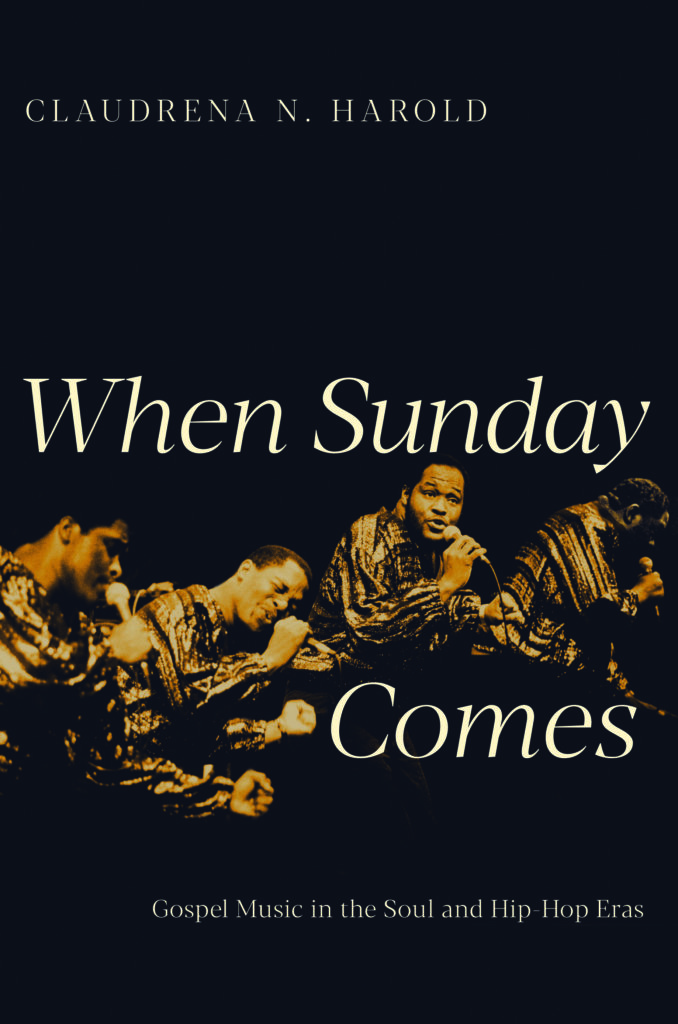
While I was an undergraduate at Temple University in the mid-1990s, gospel's ubiquity in both secular and sacred spaces was a source of great fascination for me. On a Saturday night stroll down the halls of my dormitory, Temple Towers, one might hear Kirk Franklin's "Silver and Gold," Mary J. Blige's "My Life," and Biggie's "One More Chance" in succession. Though hip-hop had the loyalty of most undergraduates, my inner circle, particularly my fellow women's basketball teammates, had a deep appreciation for gospel music. On our road trips, at the dining halls, and in our dormitories, gospel music occupied the same space as R&B and old-school soul. Fortunately, my academic work as an African American studies major and history minor reinforced many of the lessons provided during my extracurricular activities. Classes and conversations with Professors Sonia Sanchez, Bettye Collier Thomas, Greg Carr, Valethia Watkins, and Mario Beatty, among others, strengthened my already firm sense of the importance of the spiritual lives of black folk. Seeds sown in my childhood home of Jacksonville blossomed under the guidance of these teachers and the music journalists and cultural critics whom I read over the next two decades: Horace Boyer, Mark Burford, Mellonee Burnim, Portia Maultsby, Eileen Southern, Jon Michael Spencer, Brooksie Eugene Harrington, Michael W. Harris, Robert Darden, Anthony Heilbut, Glenn Hinson, Wyatt Tee Walker, Pearl Williams-Jones, Robert Marovich, and Jerma Jackson.1See Horace Clarence Boyer, Golden Age of Gospel (Champaign: University of Illinois Press, 2000); Jon Spencer, Protest and Praise: Sacred Music of Black Religion (Minneapolis, MN: Fortress Press, 1991); Michael W. Harris, Rise of Gospel Blues: The Music of Thomas Andrew Dorsey in the Urban Church (New York: Oxford University Press, 1994); Bob Darden, People Get Ready! A New History of Black Gospel Music (New York: Bloomsbury, 2004); Anthony Heilbut, Gospel Sound: Good News and Bad Times (New York: Simon and Schuster, 1971); Pearl Williams-Jones, "Afro-American Gospel Music: A Crystallization of the Black Aesthetic," Ethnomusicology 19, no. 3 (1975) 373–385; Robert M. Marovich, A City Called Heaven: Chicago and the Birth of Gospel Music (Champaign, University of Illinois Press, 2015); and Jerry Zolten, Great God A'Mighty! The Dixie Hummingbirds: Celebrating the Rise of Soul Gospel Music (New York: Oxford University Press, 2003) Their respective histories of gospel music enriched my understanding of the genre's centrality to black culture, its early relationship to the recording industry, and its role as a source of individual and collective uplift for people of African descent. They also reaffirmed my belief in gospel music as a subject worthy of in-depth cultural criticism and historical analysis.
And yet, despite my admiration for their work, or perhaps because of it, these authors always left me wanting more, particularly greater engagement with the gospel music of the post-civil rights era. Why couldn't their razor-sharp analyses of gospel music's "golden era" (1945–65) extend into the 1970s and 1980s, I often wondered? Why did the black sacred music adored by so many of my generation seem inconsequential to the historians whose scholarship mattered so much to me? To be sure, Heilbut's The Gospel Sound and Darden's People Get Ready! extended their analyses beyond gospel's golden era. But their discussion of the genre's later years lacked the detailed attention given to the earlier period.
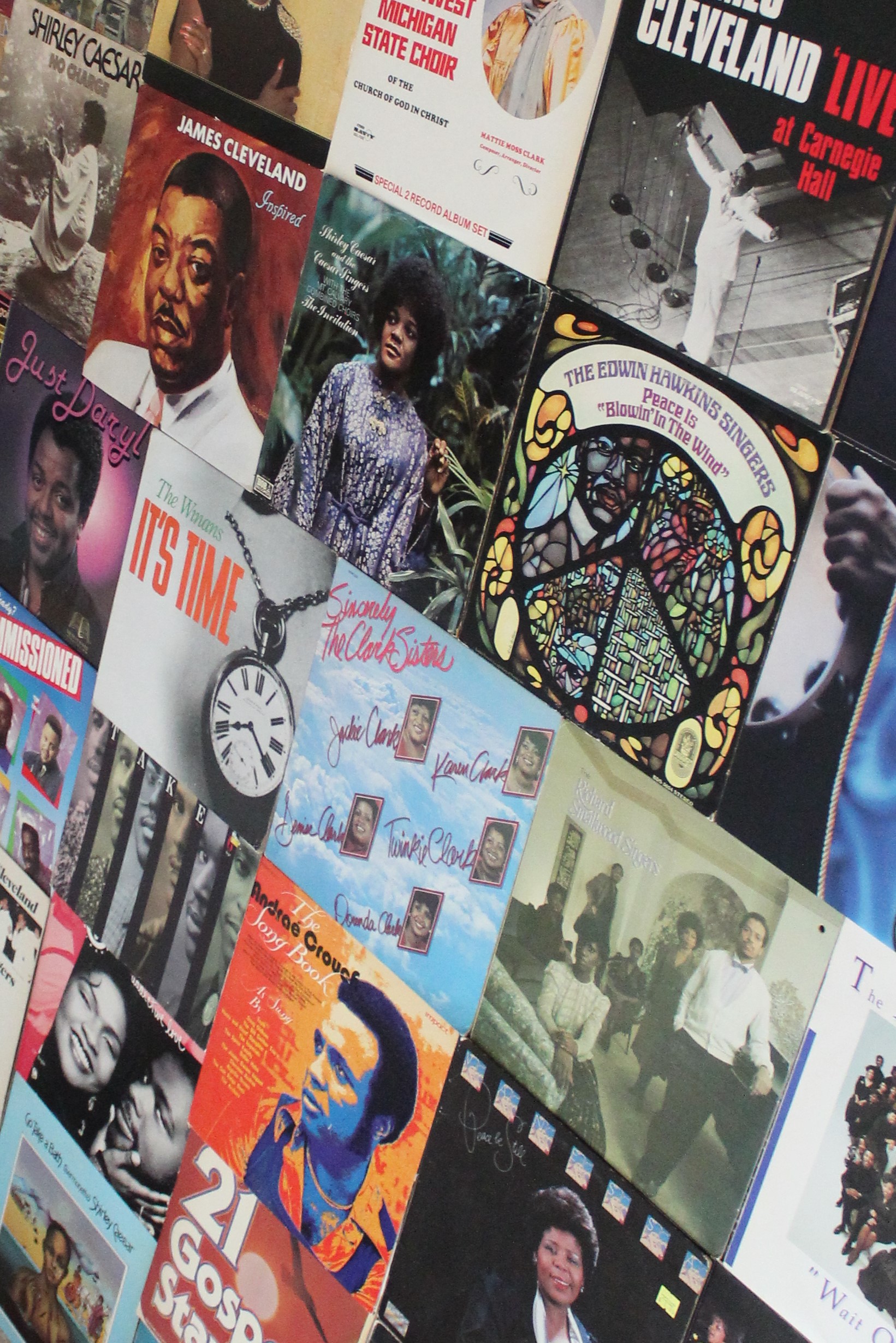
By focusing primarily on the last three decades of the twentieth century, When Sunday Comes shines light on gospel's golden era of commercialism. Instead of dismissing this period as one of musical decline and questionable crossover pursuits, this book treats these years as a time of great artistic innovation and advancement.2Fortunately, digging deeper into gospel's more recent history has been made easier with the important work of scholars like Mellonee V. Burnim, Brooksie Eugene Harrington, Deborah Pollard Smith, Jon Spencer, Guthrie Ramsey, and Birgitta Johnson. In addition, historians like Shawn David Young and David Stowe provide useful insights into the contemporary Christian music genre. Brooksie Eugene Harrington, "Shirley Caesar: A Woman of Words" (PhD diss., Ohio State University, 1992); Birgitta J. Johnson, "Back to the Heart of Worship: Praise and Worship Music in a Los Angeles African-American Megachurch," Black Music Research Journal 31, no. 1 (2011): 105–129; Deborah Smith Pollard, When the Church Becomes Your Party: Contemporary Gospel Music (Detroit, MI: Wayne State University Press, 2008); Spencer, Protest and Praise; David W. Stowe, No Sympathy for the Devil: Christian Pop Music and the Transformation of American Evangelicalism (Chapel Hill: University of North Carolina Press, 2013); Shawn David Young, Gray Sabbath: Jesus People USA, the Evangelical Left, and the Evolution of Christian Rock (New York: Columbia University Press, 2015); Guthrie P. Ramsey, Race Music: Black Cultures from Bebop to Hip-Hop (Berkeley: University of California Press, 2004). It details how Kirk Franklin, the Winans, Take 6, and the Clark Sisters, among others, not only advanced the black sacred music tradition but also ensured that gospel remained embedded in African American culture. That embeddedness has surfaced in a variety of cultural contexts and arenas and continues to do so: BET's annual award shows; the music of secular stars like Beyoncé, D'Angelo, Missy Elliot, Snoop Dogg, Chance the Rapper, and Kanye; the cinematic offerings of such avant-garde filmmakers as Arthur Jafa, Kevin Jerome Everson, and Cauleen Smith; and even the televised funerals of some of the entertainment industry's biggest icons. Take as a case in point the very public mourning that followed the deaths of Michael Jackson and Whitney Houston. On July 7, 2009, twelve days after Jackson's death, millions of fans watched the homegoing service of the "King of Pop." The memorial opened with Andraé Crouch and his choir humming the melody of the gospel classic "Soon and Very Soon" as Jackson's brothers rolled his casket to the center stage of Staples Center in Los Angeles.
Three years later, Crouch's music had a strong presence at the homegoing of another pop legend, Whitney Houston. This time, the musical vessel was not Crouch himself but his student Marvin Winans. Standing before a grief-stricken audience of family, friends, music legends, and curious onlookers, Winans belted out Crouch's latest hit, "Let the Church Say Amen," as he closed his eulogy of a woman who had been raised in New Hope Baptist Church under the tutelage of her mother, Cissy Houston; who had supported the careers of his younger siblings BeBe and CeCe Winans; and who fifteen years before her passing released the multi-platinum gospel album The Preacher's Wife. The presence of Crouch's music at both Houston's and Jackson's funerals not only symbolized his importance to the gospel sound but also showed how often African Americans have turned to this vibrant and life-affirming art form to make sense of the tragicomic reality of human existence.
As I reflected on what gospel music has meant to African Americans, my thoughts often turned to the song that inspired the book's title: Donald Lawrence and the Tri-City Singers' 1995 hit "When Sunday Comes." Seven minutes long, the song features gospel legend Daryl Coley on lead vocals. Throughout the performance, Coley titillates the crowd with a flurry of vocal riffs, drawing from the improvisational styles of both gospel and jazz. The audience's shouts of approval convey their agreement with his message of the joy that awaits Jesus's Second Coming and also their recognition of his mastery of form. "When Sunday Comes," as both a song and a metaphor, captures the wide range of emotions, relationships, and processes operating in African American gospel music: the climactic moment in a performance when a musician reaches the height of his or her artistic and spiritual powers, the gospel audience's contribution to and immediate recognition of such moments, and the deep cultural meanings the sacred songs hold for people of African descent in America.
For many of the artists in When Sunday Comes, singing gospel was not simply a form of self-expression or a way to magnify God but also a way to uplift people, to lighten their burden. Perhaps no one understood this more than Shirley Caesar, who envisioned her concerts as a way to elevate her audience to a higher spiritual plane. "It's not so much that I want people to shout," she explained to Geoffrey Himes in 1987. "I want them to forget that burden they left behind when they came to the concert. I want to give them a spiritual catharsis."3Geoffrey Himes, "Shout It! Gospel According to Shirley Caesar," Washington Post, April 3, 1987, B7.
Outside the County Line: The Southern Soul of John P. Kee
More than thirty years have passed since my first encounter with the music of John P. Kee, but the memory of that experience remains fresh in my mind. On a weekend visit to my aunt's house, where gospel music played from sunup to sundown, we both found ourselves mesmerized by a new song: Kee's "Wait on Him." Within seconds of the song's opening verse, my attention shifted from mildly interested to fully engaged as Kee's powerful voice ripped through the speakers: "I'm going to run this race, if I go by myself," Kee sang as the choir roared: "Wait on Jeeee-suuuus." As Kee and the choir riffed off each other, bassist Andrew Gouche, guitarist Jimmy Hill, and drummers George Clinkscale and Calvin Livingstone held down the rhythm section. During the extended vamp, Kee adlibbed with a ferociousness reminiscent of Joe Ligon of the Mighty Clouds of Joy: "They that wait on the Lord, shall renew their strength. . . . They shall mount up on wings, as eagles. They shall run, not get weary."4John P. Kee, Wait on Him (Tyscot Records, 1991). This was the sound of Christian faith forged in the crucible of the southern black church.
The release of Wait on Him in 1989 marked the beginning of a remarkable creative run for Kee and his New Life Community Choir (NLCC). Between 1989 and 1996, Kee released hugely popular singles as well as the critically acclaimed records Wash Me and Show Up! (which was certified gold). Enjoying widespread radio play, sold-out concerts, and high record sales, Kee won the hearts of thousands of gospel lovers with his signature voice and classic songs. Not since James Cleveland had a male vocalist in the gospel world occupied such a ubiquitous presence on gospel radio. Tunes like "The Storm Is Passing Over," "Lily in the Valley," "Never Shall Forget," "Standing in the Need," "Wait on Him," "Wash Me," and the smash hit "Jesus Is Real" were in constant rotation. These songs were also part of the repertoire of countless black gospel choirs across the country. Even as the black religious community became increasingly diverse, Kee's music held an esteemed place in a variety of African American churches, from Pentecostal to Baptist.
Especially down south, Kee's blue-collar aesthetic and country home vibe earned a special place in the hearts of gospel music fans, particularly those who saw themselves or their families' history in his work. A proud southerner, Kee frequently transported his listeners to the black South, where women, men, and children cared for and loved each other, where elders shared their wisdom with the young, where the church anchored the social and cultural lives of a striving people. Kee was an artist for whom the South's past and present supplied endless inspiration and material. On both his studio and live recordings, he can be found resurrecting the spirit of his father, honoring the religiosity and deep faith of his grandmother, and reflecting on his life-changing encounters with ordinary southern women and men in the streets of Charlotte, North Carolina. Throughout his discography, the South looms large as an incubator of his cultural, religious, and political sensibilities. Kee's South is neither monolithic nor static but a geography constantly responding to new political forces and new social realities.
North Carolina Beginnings
John Prince Kee was born on June 4, 1962, in Durham County, North Carolina. The fifteenth child of John Henry and Lizzie Mae Kee, the young John lived on the outskirts of Durham until the age of five, when his father started work as a foreman at a local brickyard. In many ways, the world in which young John entered was radically different from that of his older brothers and sisters, due in no small part to the growing political determination of African Americans in Durham.
Notwithstanding its image as a progressive southern city, Durham was racist to its core. Even when the white power structure appeared to bend in favor of African Americans, its actions were often more symbolic than substantive. As historian Christina Greene rightly points out, Durham's white power brokers were more concerned with racial harmony than with racial justice. The conflict between the city's racial moderates and more direct action-oriented civil rights organizers reached a fever pitch in the summer of 1962. Late in July, members of the Congress of Racial Equality and the NAACP picketed Eckerd's Drug Store and Howard Johnson's ice cream parlor. At Eckerd's, the issue at hand was the store's refusal to hire African Americans as salespersons, despite the fact that blacks constituted half of its customers. Likewise, Howard Johnson's was opposed to hiring African Americans in clerical positions. The restaurant had also refused to desegregate its lunch counter, even after the sit-ins of 1960 led other stores to reverse their segregation policies. Taking the lead in the fight against Howard Johnson's were black students from North Carolina Central, who in their efforts to implement change endured verbal assaults, threats of violence, consternation from conservative blacks, arrests, and sometimes imprisonment. For their refusal to pay a trespass fine for protesting Howard Johnson's, students Guytana Horton and Joycelyn McKissick were sentenced to thirty days in jail. Their arrest and subsequent jailing galvanized the civil rights community, which in August held a large rally at one of the city's movement centers, St. Joseph AME Church. Shortly after the rally, 1,500 African Americans headed to Howard Johnson's to continue their protests. These protests persisted throughout the summer as part of the "Freedom Highways" project, a CORE-directed campaign that extended from Maryland to Florida. This project eventually led more than half of the Howard Johnson's establishments in North Carolina to desegregate their lunch counters. One of the holdout restaurants was the Howard Johnson's in Durham, which in 1963 was the site of one of the largest civil rights demonstrations in North Carolina.5Christina Greene, Our Separate Ways: Women and the Black Freedom Movement in Durham, North Carolina (Chapel Hill: University of North Carolina Press, 2005). Over the next few years, Durham remained a center of political protest and grassroots activism as African Americans directed their attention to the problems of urban renewal, deindustrialization, employment discrimination, and the housing crisis.
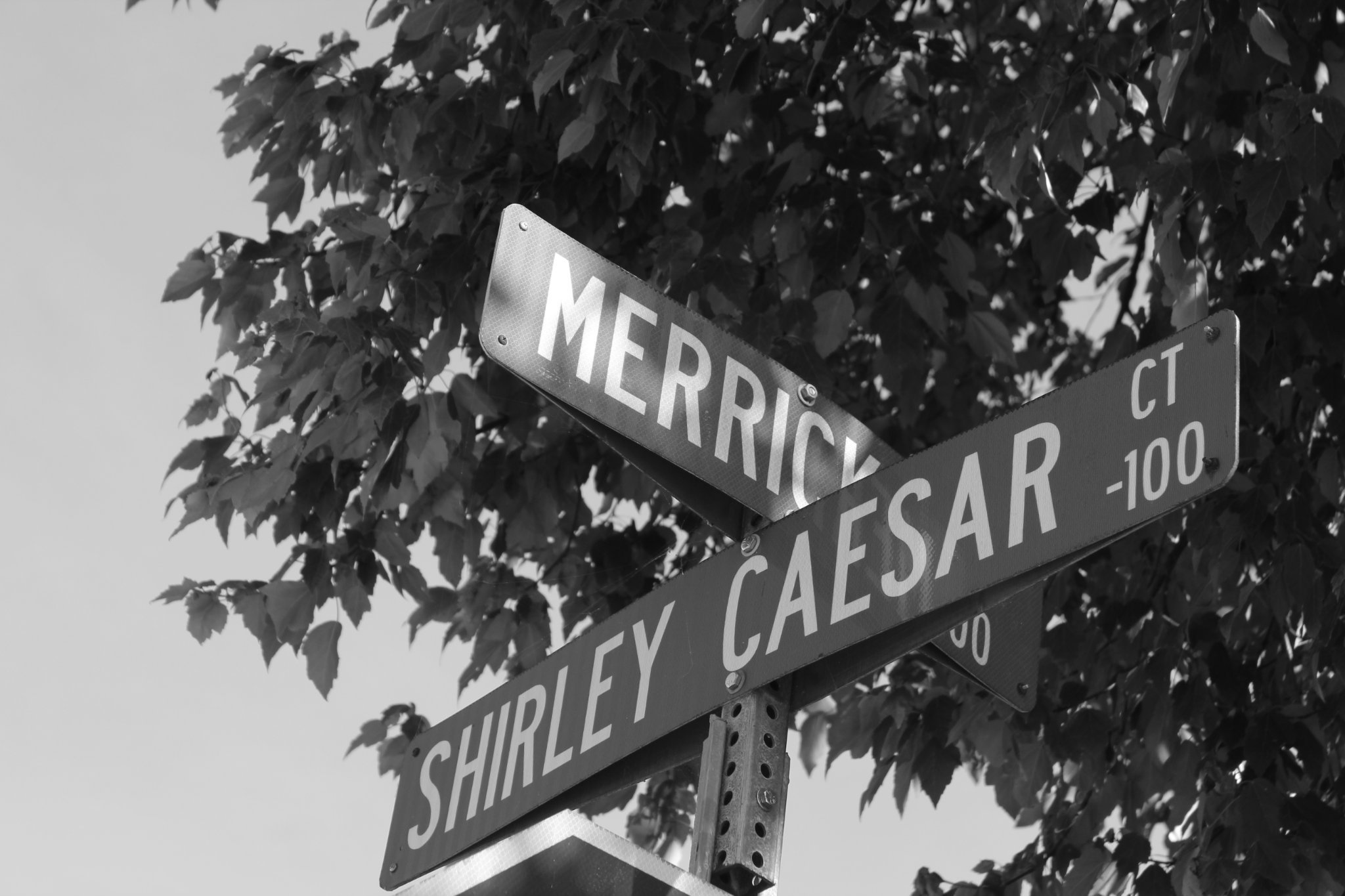
One important center of local organizing was Union Baptist, the church home of the Kee family and hundreds of other blacks. Under the pastorate of Dr. Grady Davis, Union was a center of black spiritual life in Durham and an anchoring institution for the local civil rights movement. A dedicated member until his death in 1981, John Henry Kee lent his musical talents to the Grady Davis Choir and the Senior Male Choir.6"Obituary," Carolina Times, January 31, 1981. Like his father, young John developed a deep love for music, routinely spending hours at the family's Walter upright piano. "I was about seven years old when I started playing that piano, and I got a lot of encouragement because music in our household was just the thing to do. And it was by playing piano that I kept my dad's attention."7Bobby Jones and Lesley Sussman, Touched by God: Black Gospel Greats Share Their Stories of Finding God (New York: Pocket Books, 1998), 239.
Showing great promise as a musician, Kee enrolled at the North Carolina School of the Arts in Winston-Salem and then graduated from there at the age of fourteen. To further develop his musical skills, he joined his brothers at Yuba College Conservatory in Marysville, California. To support himself, Kee worked as a sideman for Cameo and Donald Byrd on their visits to Northern California. On the surface, the talented youngster seemed destined for greatness, but on his route to superstardom he took several dangerous detours.
During his time in California, Kee descended into a world of drug use. He then returned to North Carolina, where he found work with the Charlotte-based Miss Black Universe pageants. His move back south was part of a national trend. Since the 1970s, the number of African Americans migrating to the South exceeded the number of those leaving the region. Especially for returning and primary migrants frustrated by the declining economic opportunities available in the rustbelt cities of the Midwest and Northeast, the metropolitan centers of Atlanta, Houston, Dallas, and Charlotte seemed much more appealing than their northern and midwestern counterparts.8Carol B. Stack, Call to Home: African Americans Reclaim the Rural South (New York: Basic Books, 1996); Sabrina Pendergrass, "Perceptions of Race and Region in the Black Reverse Migration to the South," Du Bois Review: Social Science Research on Race 10, no. 1 (2013): 155–178; George Gmelch, "Return Migration," Annual Review of Anthropology 9 (1980): 135–159; Larry H. Long and Kristin A. Hansen, "Trends in Return Migration to the South," Demography 12, no. 4 (1975): 601–614. "If ever there was a city that epitomizes the New South," boasted the June 1983 edition of Black Enterprise, "it is Charlotte, N.C., the largest city between Washington and Atlanta. . . . This Sunbelt city is now home to 314,000 residents—31 percent of them black—and to a burgeoning business community, which includes 500 black-owned companies."9David D. Porter and Rosalyn Gist Porter, "The Changing Profile of Charlotte," Black Enterprise 13 (June 1983): 180. For ambitious African Americans wishing to improve their lives and perhaps avoid the problems of the urban North, Charlotte was the place for them.
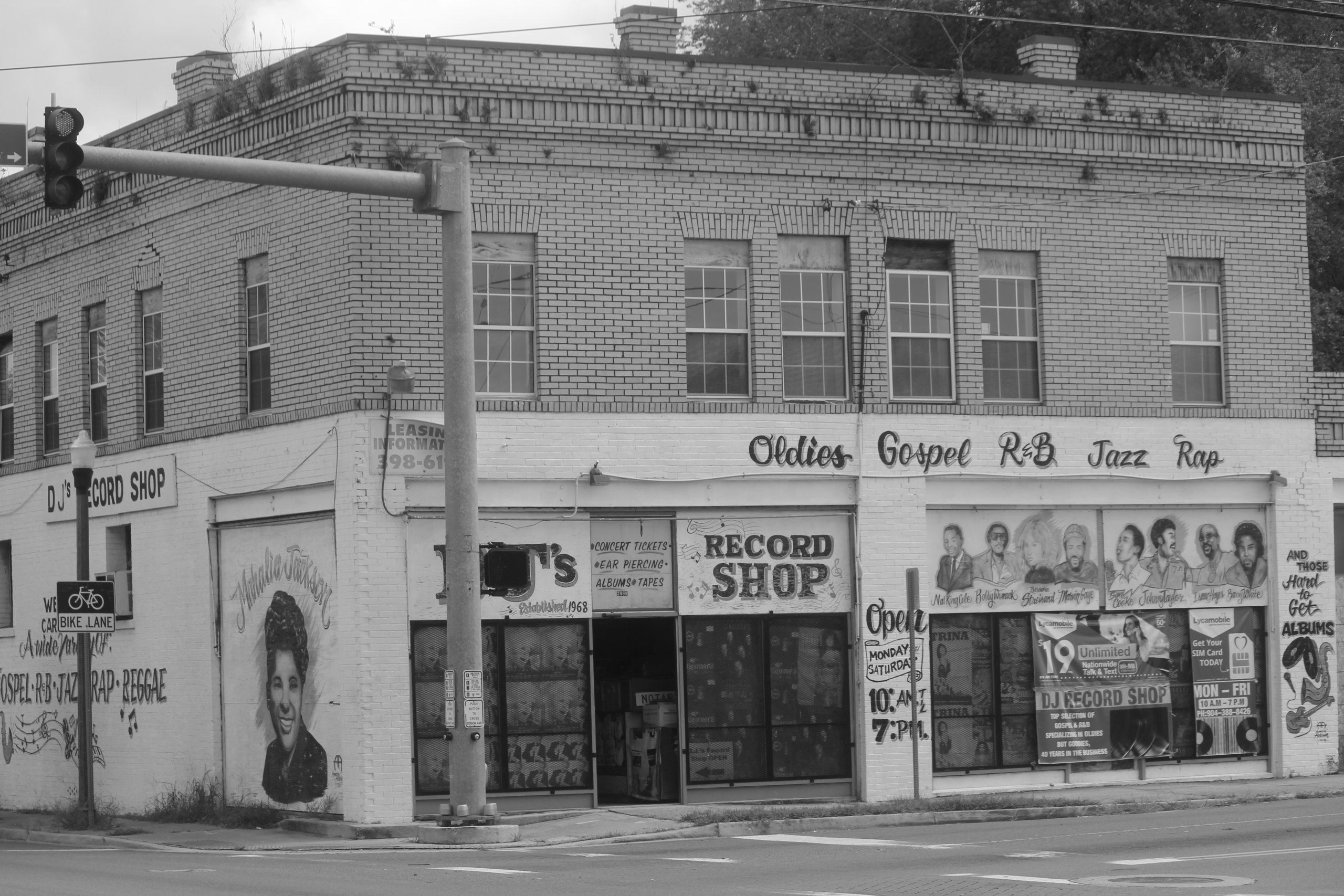
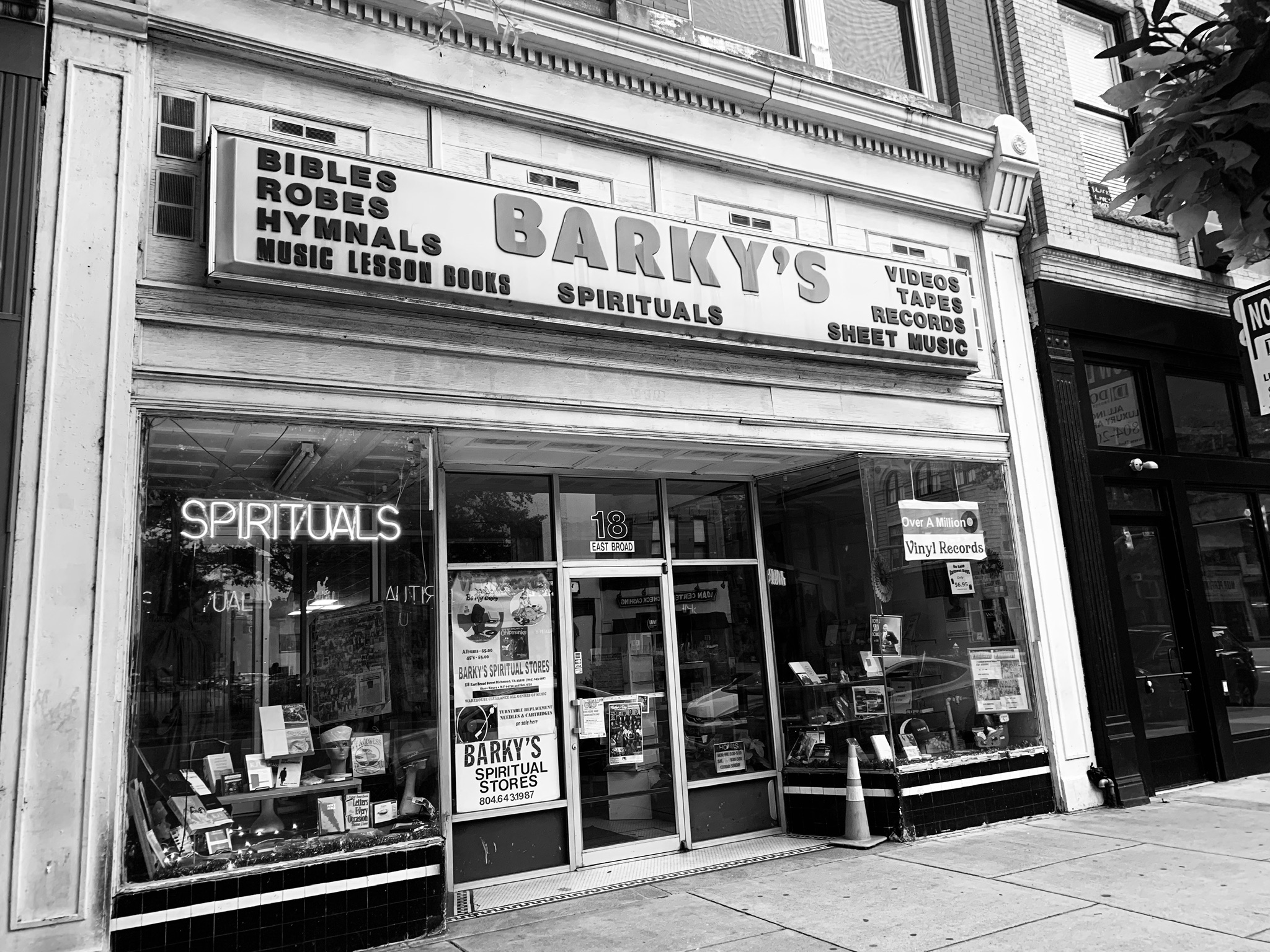
To many outsiders, this was a city on the move, a great place for young people with talent, ambition, and a hard work ethic. Unfortunately, Kee was not quite ready to take advantage of the city's benefits. Even after his move back south, Kee remained a part of the drug scene—not only as a user but as a seller as well. Upon his arrival in Charlotte, he settled into the Double Oaks neighborhood, an area facing many of the problems plaguing other inner-city communities. Crime, unemployment, substandard housing, and drugs wreaked havoc on many of its residents. Drifting further away from the values of his early childhood, Kee was an active participant in Double Oaks's underworld.
A dramatic shift occurred in Kee's life in 1981, when one of his closest friends fell victim to drug-related violence. His friend's murder shook Kee to his core, forcing him to reevaluate his life: "I was seeing young men dying on the street, and I think I just made up my mind that I did not want to leave here like that. I just felt like there was a gift or something inside of me, and I didn't want to waste it."10Jones, Touched by God, 242. The reformed drug dealer started working with a group of young singers involved in the Combination Choir, which was based in Charlotte. This marked the beginning of Kee's lifelong commitment to the local community, particularly the Double Oaks neighborhood. The choir later morphed into the New Life Community Choir, which gained national attention in the 1990s for their work with Kee.
Kee's Breakthrough
On his rehabilitation journey, Kee received major support from two of gospel's most iconic figures, James Cleveland and Edwin Hawkins. Like many aspiring musicians in the gospel field, Kee turned to the Gospel Music Workshop of America to gain a larger audience and connect with industry insiders. In 1985, Cleveland placed two of Kee's compositions, "He's My All in All" and "Jesus Can Do It," on his 1985 GMWA recording. Two years later, Kee was a featured vocalist and songwriter on Edwin Hawkins's music and arts seminar recording. That same year, Kee released Yes Lord, his debut with the black-owned label Tyscot. A relatively small company based in Indianapolis, Tyscot begin in 1977 as a vehicle for one of its founders, Leonard Scott, to promote his church choir. The label would add to its roster a few minor gospel acts, but it was hardly on the radar of most in the gospel industry. This would change with the release of Kee's Yes Lord. Though the record had modest sales, it generated considerable anticipation for Kee and the New Life Community Choir's 1989 release, Wait on Him.
Finding a receptive audience among lovers of traditional and contemporary gospel music, Wait on Him elevated Kee to superstar status in the black gospel world. The album climbed to #4 on the gospel charts, dominated gospel radio, and enabled Kee to launch a nationwide tour. "We're getting more requests than I can handle," Kee informed journalist Robert Darden. Though the record had a southern sound, its popularity extended beyond the Mason-Dixon Line. "'Wait on Him' is doing incredible business in New York," Kee marveled. The singer was also receiving attention from beyond the black gospel world. "We're getting calls from white churches in Texas, Washington state, even the hills of Tennessee—where the man told me all they've ever heard is 'hillbilly gospel' before now!"11Robert Darden, "New Life's 'Wait on Him' Is an Overnight Hit for John P. Kee," Billboard, February 24, 1990, 45. 
About the Author
Claudrena N. Harold is a professor of African American and African Studies and History at the University of Virginia and an editorial board member at Southern Spaces. She is the author of New Negro Politics in the Jim Crow South (Athens: University of Georgia Press, 2016) and The Rise and Fall of the Garvey Movement in the Urban South, 1918–1942 (UK: Routledge Press, 2007).
]]>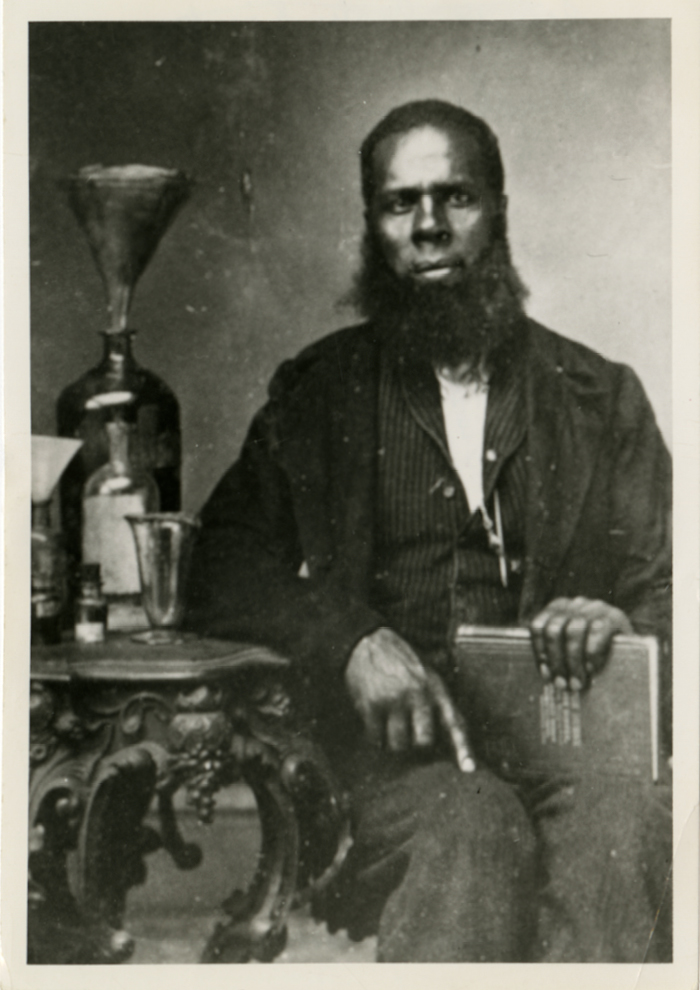
A freeborn Black abolitionist from Ohio, Joshua McCarter Simpson opened his 1854 indictment of the hypocrisy of Christian supporters of slavery, "To the White People of America," with searing words that echo across the centuries. Simpson's poetic voice resonated when Donald Trump strode through Lafayette Park for a photo opportunity—an image of him holding a Bible in front of St. John's Episcopal Church—moments after DC police, reinforced by National Guard troops, dispersed peaceful protesters who had gathered to demand that government leaders address systemic racism.
Simpson published "To the White People of America" in his collection The Emancipation Car, Being an Original Composition Of Anti-Slavery Ballads, Composed Exclusively For the Under Ground Rail Road (1854), written for abolitionists ferrying enslaved people to freedom. The Emancipation Car includes forty-three poems, all meant to be sung to then-popular tunes, and a few prose passages. The title of Simpson's collection extends the metaphor of the Underground Railroad, where these songs were popular among the formerly enslaved and where Simpson served as a conductor. In 1874 the collection was reprinted with its prose passages reworked in verse and a new appendix featuring poetic commentaries on the Fifteenth Amendment, the Underground Railroad, and related topics.
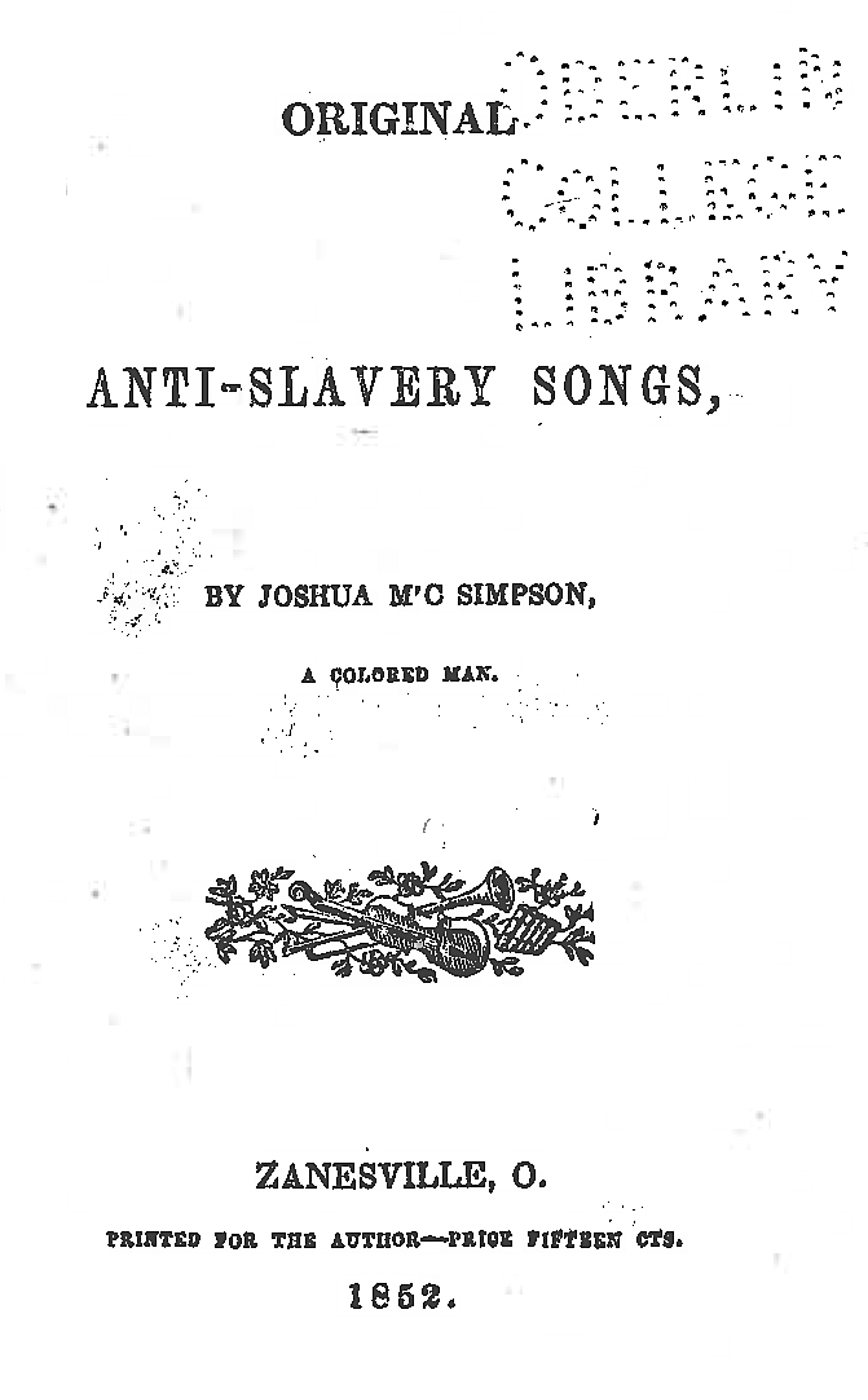
Simpson was born around 1820 in Windsor, Ohio, in the far northeastern corner of the border state, near Lake Erie. He was indentured as a servant from his childhood until he turned twenty-one, working in brutal conditions for a stonemason and later a farmer. He then taught himself to read and write, attended the Oberlin Collegiate Institute from 1844 to 1848, and moved to Zanesville in central Ohio, where he became an herbal doctor and grocer. Simpson gradually embraced abolitionism during his servitude and became a fierce advocate for emancipation thereafter. In his preface to The Emancipation Car, Simpson explains, "As soon as I could write, which was not until I was past twenty-one years old, a spirit of poetry, (which was always in me,) became revived, and seemed to waft before my mind horrid pictures of the condition of my people, and something seemed to say, 'Write and sing about it—you can sing what would be death to speak.' So I began to write and sing."1Joshua McCarter Simpson, "Note to the Public," in The Emancipation Car, Being an Original Composition Of Anti-Slavery Ballads, Composed Exclusively For the Under Ground Rail Road (1874; repr., Miami: Mnemosyne Publishing Co., 1969), vi. He first publicly performed an anti-slavery song in 1842 and published a collection of thirteen poems titled Original Anti-Slavery Songs in 1852. Simpson died in 1876.
Joshua McCarter Simpson's writing is remarkable for its force, conviction, moral clarity, and emotional depth. His poems are also frequently witty, both in their turns of phrase and in their relationship to the popular tunes with which Simpson chose to pair them. Simpson notes that "To the White People of America" should be sung to the tune "Massa's in the Cold, Cold Ground," a blackface minstrel tune composed by New York songwriter Stephen Foster in 1852, just two years prior to the publication of The Emancipation Car. In dialect, Foster's song depicts enslaved people crying as they mourn the death of their former owner, rendering Simpson's ironic appropriation bitingly clever. "In my selection of 'Airs,'" writes Simpson, "I have gathered such as are popular, and extensively known. Many superstitious persons, and perhaps many good conscientious, well-meaning Christians, will denounce and reject the work on account of the 'Tunes,' but my object has been to change the flow of those sweet melodies (so often disgraced by Comic Negro Songs, and sung by our own people,) into a more appropriate and useful channel."2Simpson, "Note to the Public," v–vi.
Despite his groundbreaking creativity, Simpson is little known today. Few scholars have written about his work, and he has never been the subject of a biography. I learned about Simpson when music bibliographer Erin Fulton included The Emancipation Car in the "Checklist of Southern Sacred Music Imprints, 1850–1925" that she compiled for the Sounding Spirit publishing initiative. Fulton turned to The Emancipation Car as Sounding Spirit searched for words from historical composers and hymnwriters in expressing our solidarity with Black Lives Matter protests in the wake of the murder of George Floyd and many others.
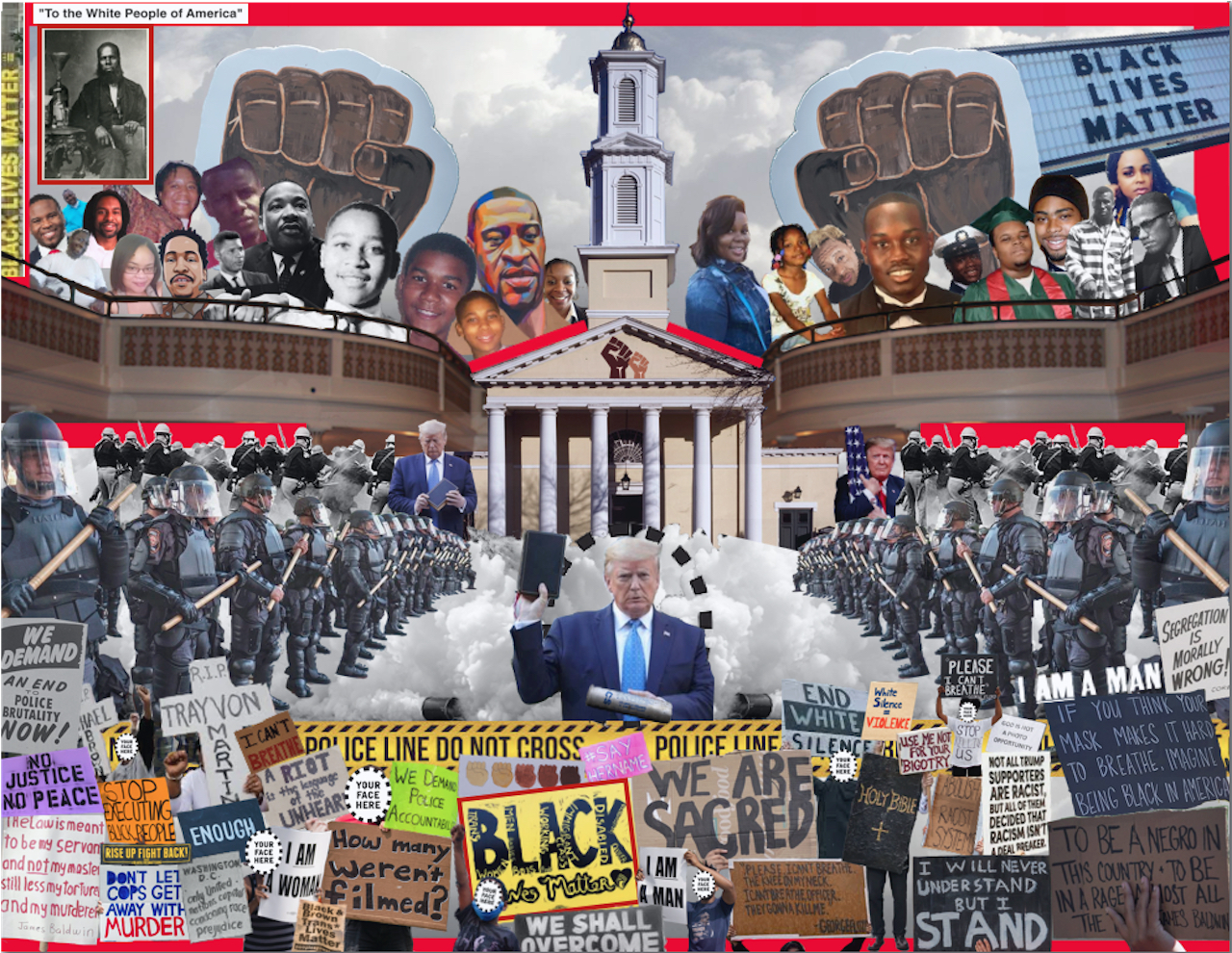
Reading Simpson's words from 1854 immediately conjures the image of Trump at St. John's Church:
"To the White People of America"
Air—"Massa's in the Cold, Cold Ground"
O'er this wide extended country,
Hear the solemn echoes roll,
For a long and weary century,
Those cries have gone from pole to pole;
See the white man sway his sceptre,
In one hand he holds the rod—
In the other hand the Scripture,
And says that he's a man of God.
Hear ye that mourning?
'Tis your brothers' cry!
O! ye wicked men take warning,
The day will come when you must die.
Lo! Ten thousand steeples shining
Through this mighty Christian land,
While four millions slaves all pining
And dying 'neath the Tyrant's hand.
See the "blood-stained" Christian banner
Followed by a host of saints (?)3Question mark appears in the original.
While they loudly sing Hosannah,
We hear the dying slave's complaints:
Hear ye that mourning?
Anglo-sons of God,
O! ye Hypocrites take warning,
And shun your sable brothers blood.
In our Legislative members,
Few there are with humane souls,
Though they speak in tones of thunder
'Gainst sins which they cannot control,
Women's rights and annexation,
Is the topic by the way,
While poor Africa's sable nation
For mercy, cry both by night and day.
Hear ye that mourning?
'Tis a solemn sound,
O! ye wicked men take warning,
For God will send his judgment down.
Tell us not of distant Island—
Never will we colonize:
Send us not to British Highlands,
For this is neither just nor wise,
Give us equal rights and chances,
All the rights of citizens—
And as light and truth advances,
We'll show you that we all are men.
Hear ye that mourning?
'Tis your brothers sigh,
O! ye wicked men take warning,
The judgment day will come by and by.
About the Author
Jesse P. Karlsberg is the senior digital scholarship strategist at the Emory Center for Digital Scholarship. He is the project director and editor-in-chief of Sounding Spirit, a research lab and publishing initiative promoting collaborative engagement with historical American songbooks. Karlsberg is an internationally recognized singer, teacher, composer, and songbook editor in the Sacred Harp tradition.
]]>An Unlikely Bohemia
We are hope despite the times.
R.E.M., "These Days" (1986)
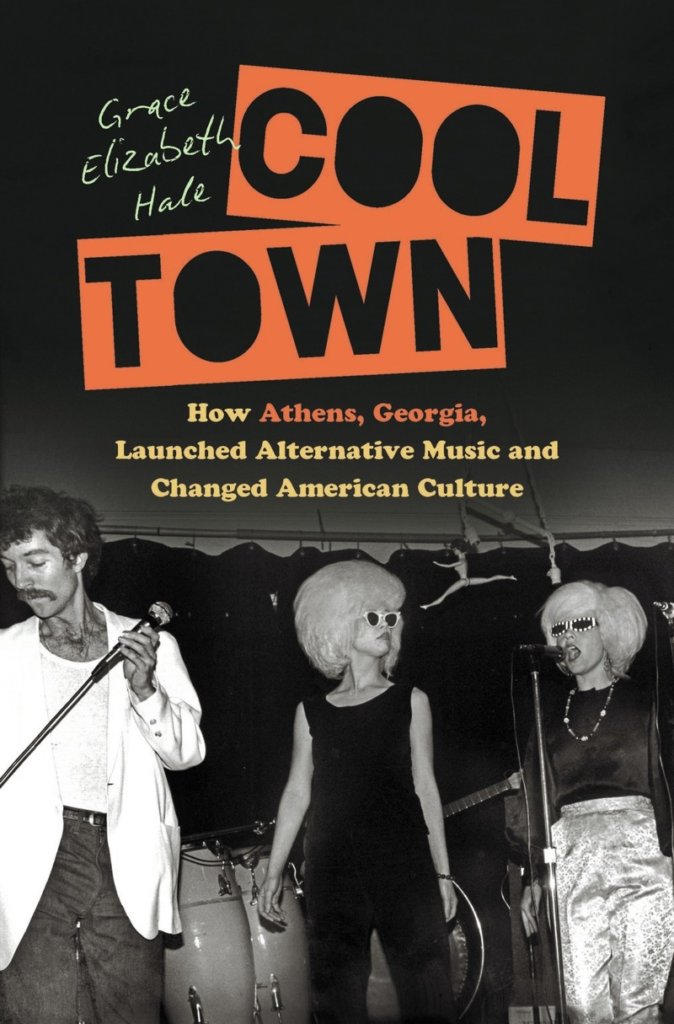
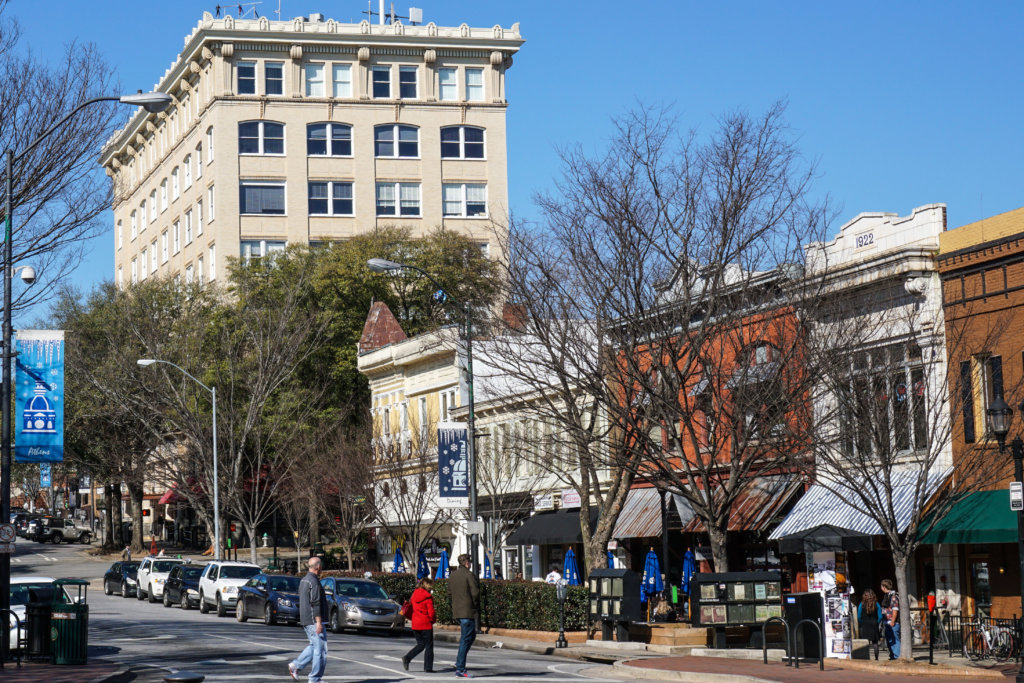
In Athens, Georgia, in the 1980s, if you were young and willing to live without much money, anything seemed possible. Magic sparkled like sweat on the skin of dancers at a party or a club. Promise winked underfoot like the bits of broken glass embedded in the downtown sidewalks. A new world seemed to be emerging out of our creativity, our music and art, and our politics, but also the way we understood ourselves and related to each other.
In my memory, the weight of the air on summer nights made possibility seem like a substance I could hold in my hand. Always, local bands played and people listened—at practice spaces and house parties and venues like the 40 Watt. People went to hear their roommate or boyfriend or coworker play one night and urged everyone to come and see their group the next. Easy to make and easy to hear, live music was everywhere. We used it to reinvent and express ourselves and connect with each other. We used it to live.
After the clubs let out, the scene kept moving until dawn. Small groups climbed the fences at apartment complexes—no one would admit to living in one—and went skinny-dipping. Sometimes people walked to a big Victorian house on Hill Street and danced to mixtapes in the hall between the rolled-back pocket doors until their clothes dripped with sweat and their heads spun. Occasionally, at midnight, a small drama troupe would perform an original play up and down the aisles of the twenty-four-hour Kroger. Film buffs too young to see movies like Sleeper, Raging Bull, and Paper Moon when they came out watched them for free in the air-conditioned quiet of the seventh floor of the University of Georgia's library. Often, people paired up, going home with the person they were seeing or an acquaintance or someone they had just met. One perfect July night, I lay naked with a friend on the cool cement floor of a screen porch as the wet heat thinned and the crickets rasped and we talked about music until dawn. Possibility proved more addictive than the beer everyone drank and the drugs many people took.
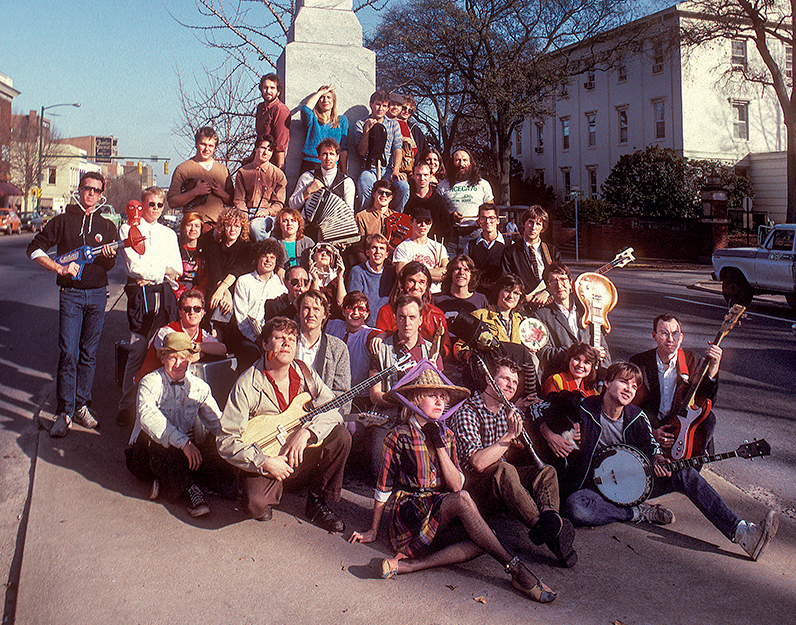
We were unlikely people in an unlikely place. No one expected us to do these creative things. No one who mattered thought that we could make a new kind of American bohemia. Yet Athens kids built the first important small-town American music scene and the key early site of what would become alternative or indie culture.
We had grown up anything but alternative. Home was a new version of the South created by desegregation, interstates, air conditioning, and airports. Our parents had mostly enjoyed the rewards, a hard-earned success that had been knocked back in the last decade by the oil crisis, stagflation, and the Reagan recession. Our schools practiced a form of neglect that suggested racial integration was easy, feminism unnecessary, and gay sexuality nonexistent. None of that was true, of course, but white, middle-class kids often skated over the consequences.
On some vague level, we sensed that we were living in a changed and changing world, yet the adults around us seemed to be in denial, clinging to old ideas about life and work and community. The most visible alternative, the hippies and peace activists left over from an earlier generation's counterculture, appeared to have degenerated into caricature. Reading books and music magazines and talking to older Athens artists and University of Georgia professors, we learned about creative communities in Paris and London and New York, places that had nurtured earlier rebels from the Beats and the jazz musicians and the abstract painters to the rockers and the drag queens and the punks. Some of us even got to know nearby "folk" artists and musicians, people who followed their own visions right here at home. We longed to send our yawp over the roofs of the world, too, to live for music and art and sex, to be daring and original and important. Why the hell not? We did not want to be rednecks or racists or conservative Christians or live in subdivisions or work as middle managers. We dreamed not of the Reagan-era Sunbelt but of a different world, a new, new, new South. And in the university's libraries and archives and studios and galleries and concert halls and the town's old buildings, we found resources to try to make that world a reality.
The scene was our answer to what we understood as the failures and limits of our America. And our participation in this collective creativity transformed us. In my case, the scene took in an unhappy accounting major confused about politics and about six years later spit out a feminist and anti-racist scholar determined to live her life as art. Along the way, I waited tables and catered, made rugs and wall-hangings out of old clothes, took up painting and the cello, earned a master's degree in history, and cofounded and ran a local venue. When I left Athens to start a history PhD program elsewhere, I took that magical sense of possibility with me and used it to weather the perils of graduate school and the academic job market. My story was not unique. The scene changed everyone I knew. Middle-aged now, a historian and the mother of college kids myself, I can see how the things we learned—question the givens, find something to do that engages your passions, build community into whatever you do, and stop often for beauty and pleasure—radically transformed the trajectory of our lives.
From the late-seventies origins of bohemian Athens to the early nineties when Seattle became the center of American alternative culture, the Athens scene produced amazingly good music, from famous groups like the B-52s, R.E.M., and Widespread Panic to critics' darlings like Pylon and Vic Chesnutt and acts that built a grassroots fan base one show at a time, like the Squalls and Mercyland. But the scene also transformed the punk idea that anyone could start a band into the even more radical idea that people in unlikely places could make a new culture and imagine new ways of thinking about the meaning of the good life and the ties that bind humans to each other. The history of the Athens scene proves that people you would not expect in places you have not thought about can create a better world. It also reveals how cultural rebellion can transform human experience.
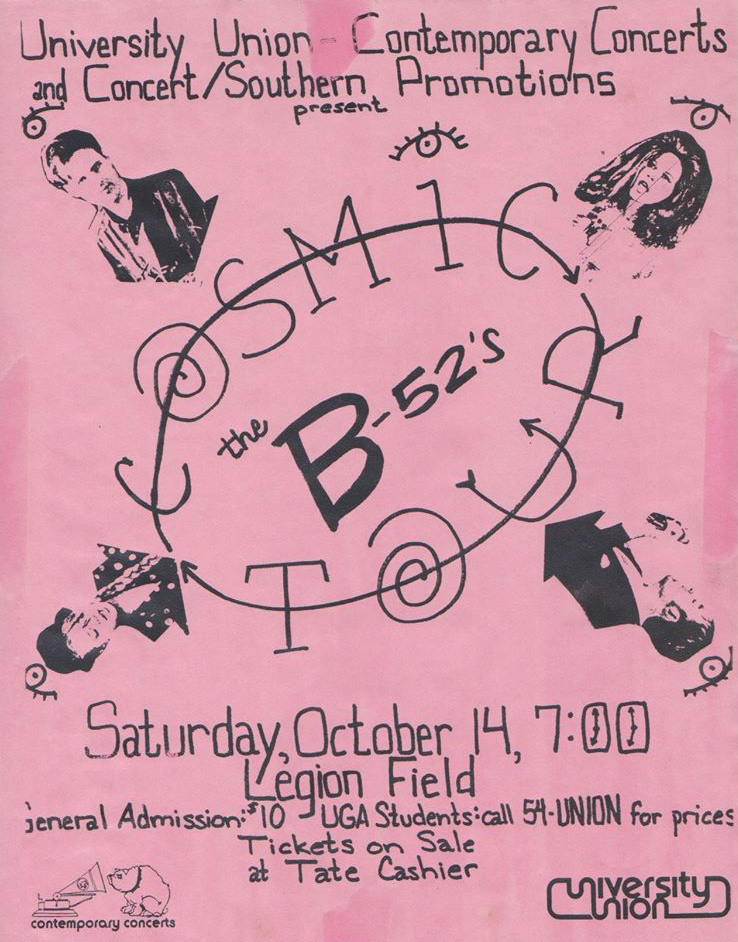
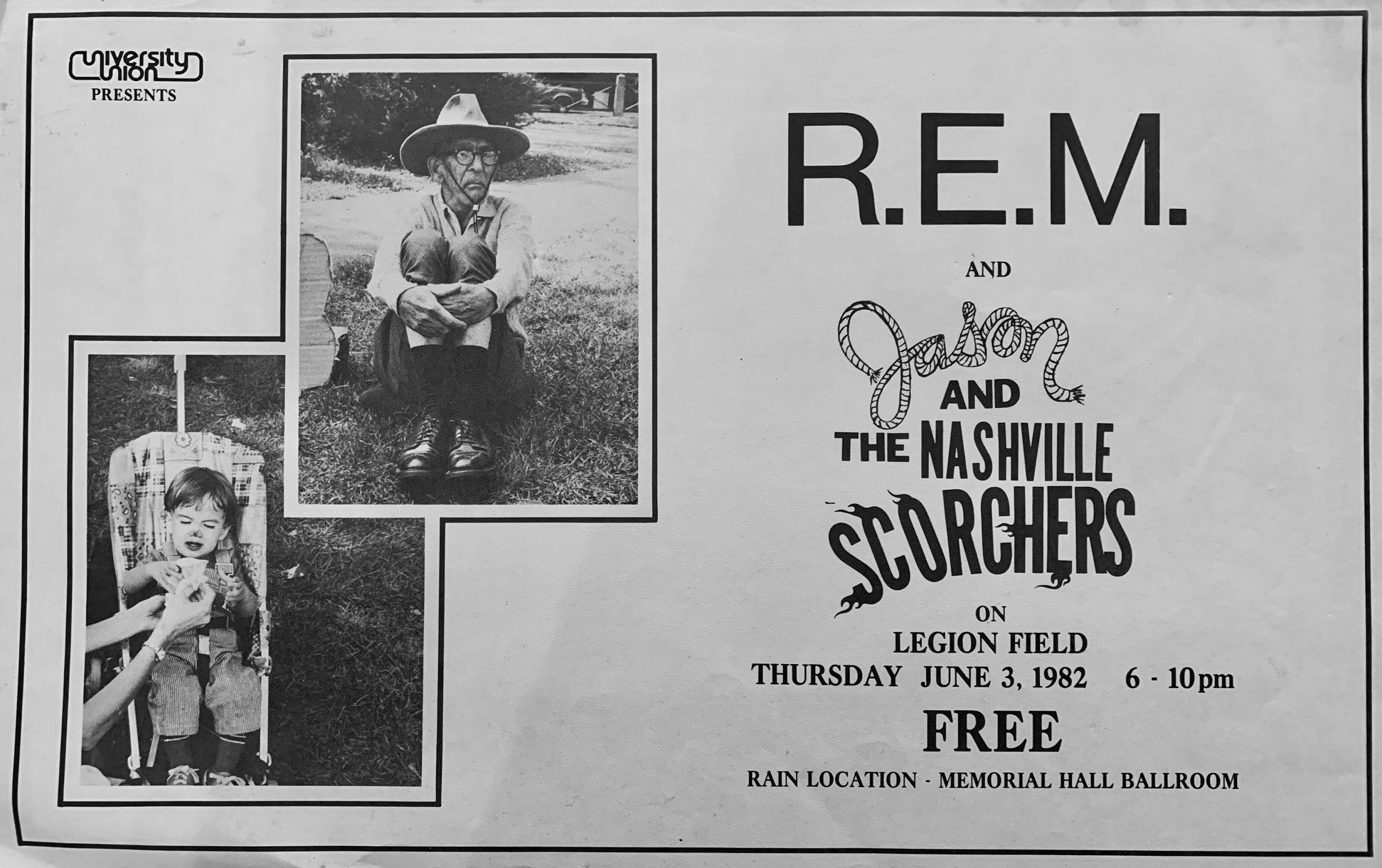
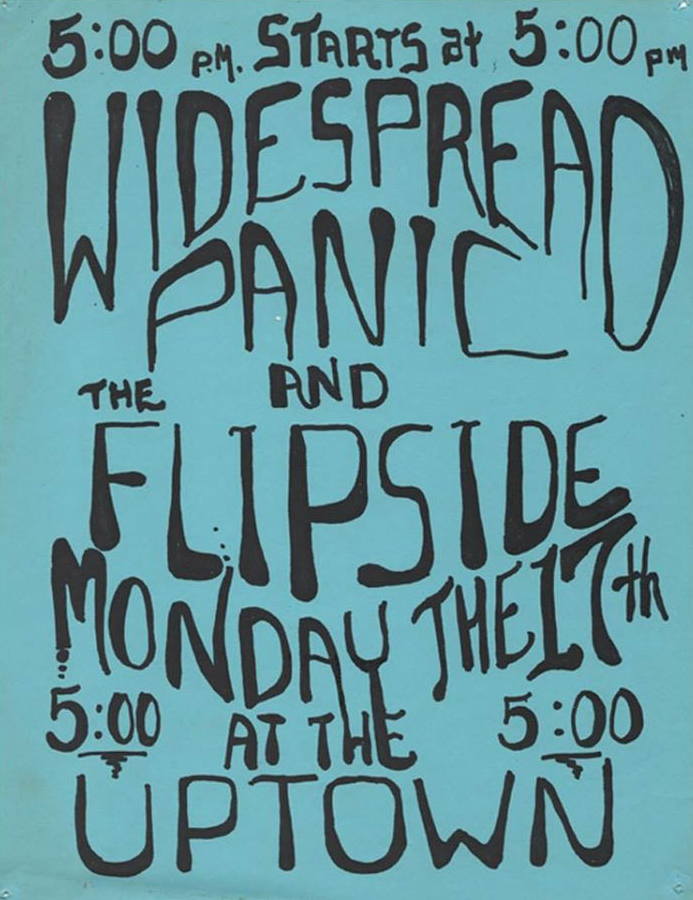
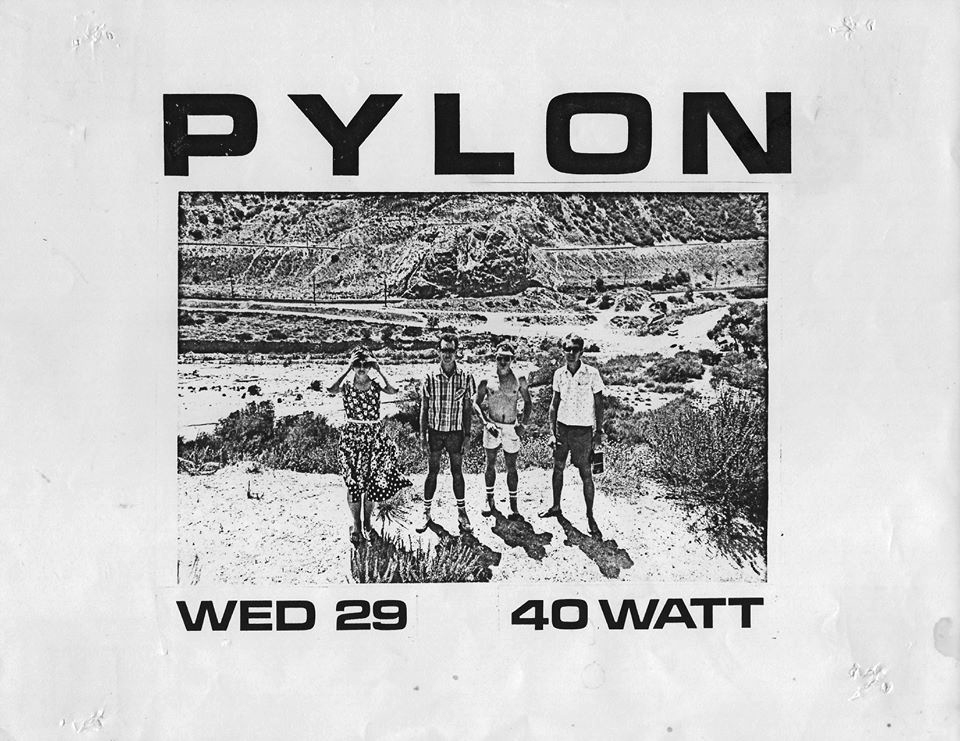
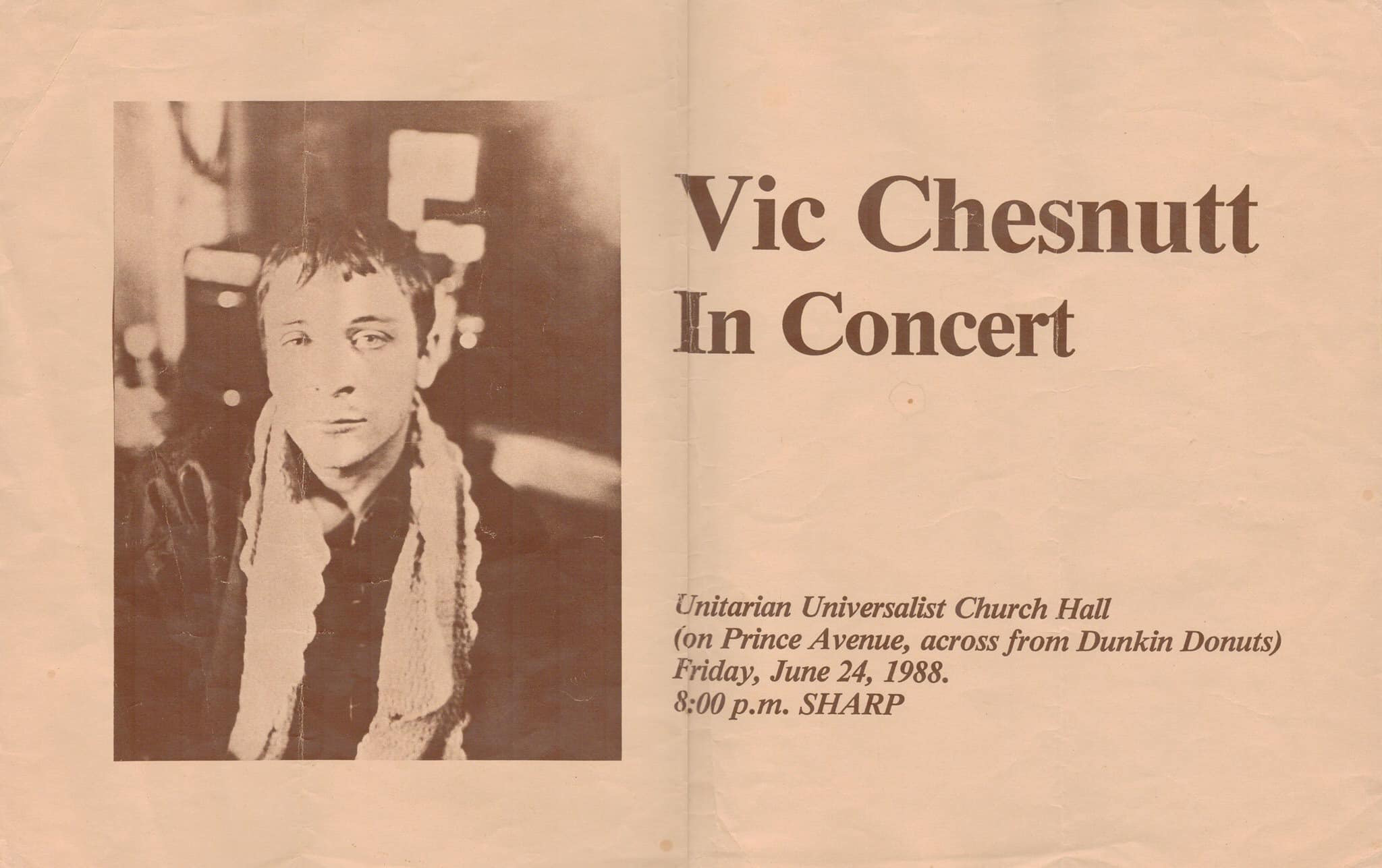
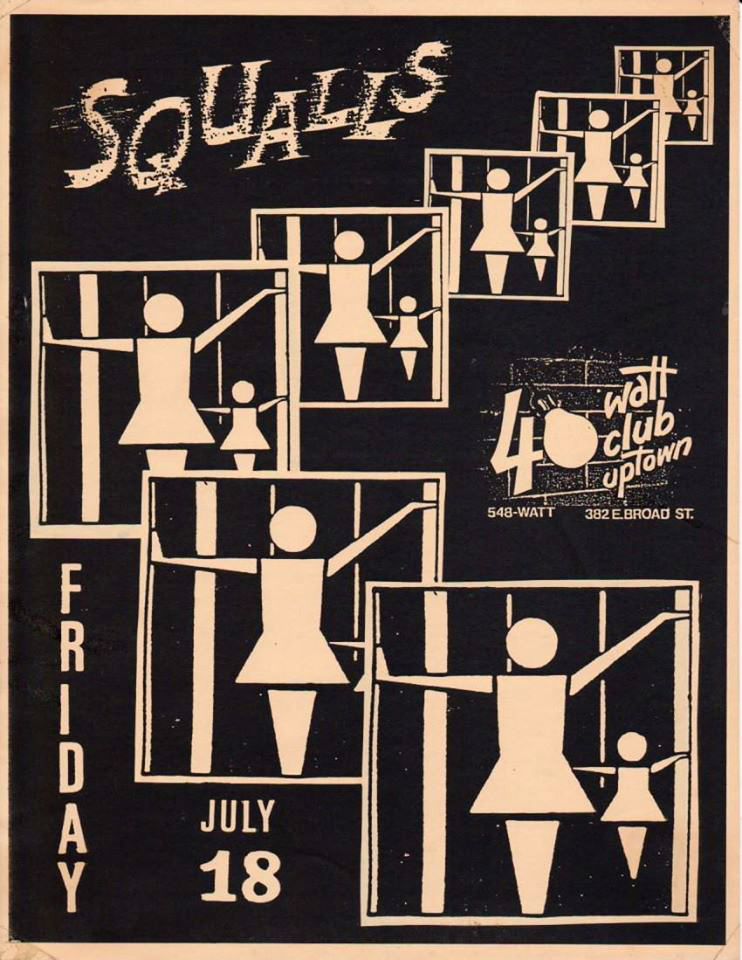
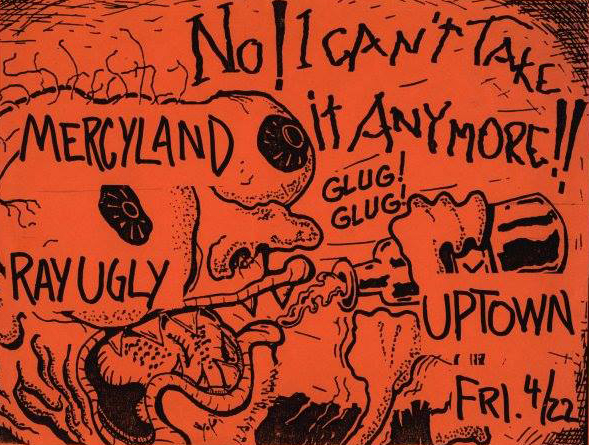
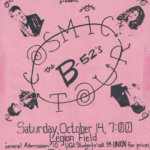
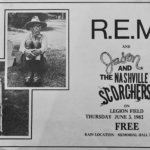
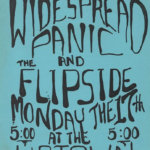
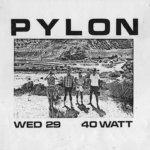
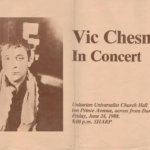
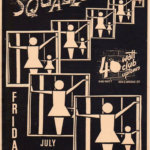
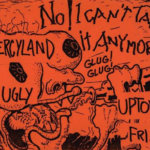
Of course, the music mattered. Athens musicians combined an arty, avant-garde approach that prized originality with its seeming opposite, a commitment to the pleasures of pop culture, rhythms that made you feel and move, and spectacle that made you stare. Reimagining the structures of rock music went hand in hand with having fun. Athens bands helped make this pop-art fusion an important part of the new overlapping music genres of college and alternative and indie rock. Because the Athens scene emerged so early in the transition between punk and indie, it also served as a model for kids trying to make their own music in other places not previously understood as having underground potential. If punk taught people that anyone could play, Athens taught them that this music making could happen anywhere, even in the South, even in small-town America.1Bernard Gendron, Between Montmartre and the Mudd Club: Popular Music and the Avant-garde (Chicago: University of Chicago Press, 2002); Tricia Henry, "Punk and Avant-Garde Art," Journal of Popular Culture 17, no. 4 (Spring 1984): 30. Another, early node of DIY culture in an unlikely place was the scene which formed in Akron and Cleveland, Ohio, two adjacent and then-deindustrializing cities, after the formation of Devo in 1973. See Calvin C. Rydbom, The Akron Sound: The Heyday of the Midwest Punk Capital (Charleston, SC: The History Press, 2018). On the relationship between the Akron scene and Kent State University, see Tim Sommer, "How the Kent State Massacre Helped Give Birth to Punk Rock," Washington Post, May 3, 2018, https://www.washingtonpost.com/outlook/how-the-kent-state-massacre-changed-music/2018/05/03/b45ca462-4cb6-11e8-b725-92c89fe3ca4c_story.html. See also the publication D.I.Y: The Do-It-Yourself New Music Magazine, published in Manhattan Beach, California, in 1980 and 1981. Issues included lists of clubs that would book punk and other kinds of new music, independent record stores, and college radio stations, as well as coverage of scenes in Cleveland, New York, Los Angeles, and a few other cities.
While bands created the most widely circulated forms of eighties alternative culture, the point was never only to make our own music. People in Athens and in other outposts of indie America were working on something more. We were trying to build authentic and meaningful lives in opposition to what we understood as the stifling conventions, false idols, and emptiness of modern middle-class American life. We were trying to save popular music, sure, but we were also attempting to create real places in which real people interacted with each other in order to boost real human flourishing. Surrounded by New Right politics, evangelical social conservatism, and corporate-dominated life, we worked to preserve the very idea of culture as a space of freedom and play and pleasure. And our efforts helped move the ideals we valued—a much more open and tolerant society, an appreciation for and investment in the local, a commitment to beauty and pleasure in everyday life, and a belief that what you do for a living does not define your identity—from the margins to the mainstream of contemporary life.
It is easy to scoff at our naivete and our ignorance—and even our arrogance—and to argue that the DIY notions we imagined as utopia gave way instead to today's start-up mentality, the gig economy, and ballooning inequality. Many people whose opinions I value want the story of Athens to follow a rise and fall arc. But this story distorts and simplifies the history of this scene and ignores the facts. And I am not ready to give up on the promise of alternative culture yet, not in my Athens of the past or in any possible Athens of the future.
Unlike many other places where eighties and nineties alternative culture flourished, contemporary Athens has not become a bohemian stage set for the top 10 percent of Americans, with a little bit of genuine creative culture clawing for survival among the rising rents. It has not been taken over by tech culture and "creative" entrepreneurship like Seattle, Brooklyn, and Austin. And it has not turned slick and rich with retirees and people with "family" money like many other college towns. Gentrification is occurring, but the area remains relatively cheap, isolated, hard to get to, and modest, especially outside the historic districts and areas close to campus. And somehow, within and even on the margins of the scene, wealth is still not something you want to brag about or display unless you want to be considered an idiot or a racist or a Republican. The currency remains DIY culture, and while you can buy other people's creativity and aesthetic sensibility, nothing is as cool as cultivating your own. While the scene is still too white, events like Hot Corner Hip Hop and venues like the World Famous have stretched the boundaries of Athens alternative culture to include African American musicians and fans of indie hip-hop. Today, bohemian Athens still works about as well as it ever did, nurturing a famous band here or there but always churning away at the less glamourous but arguably more important work of transforming the lives of suburban and small-town southern kids and giving them a vision of a bigger and more creative, open, and tolerant world.2Contrast Coran Capshaw, the manager of Charlottesville's most famous musical group, the Dave Matthews Band, with Bertis Downs, R.E.M.'s lawyer and manager, who still runs the business end of that former band. Capshaw is an entrepreneur who runs multiple companies and a real estate empire in the college town where I live now, while Downs spends most of his time as a local and national advocate for public schools.
Pylon's "Danger"
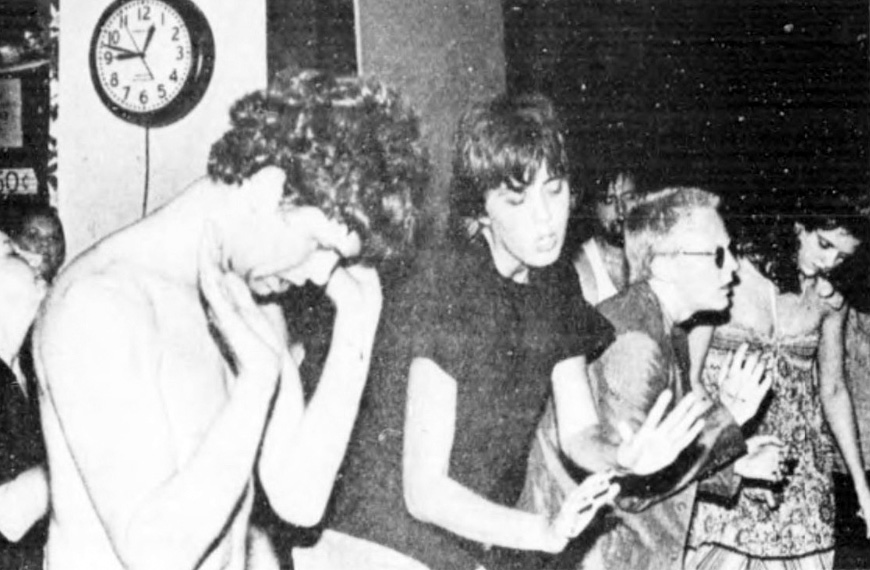
Sonically and visually, Pylon worked the contrast between flat, machine-like minimalism and ragged, southern-accented amateurism. Their songs used a four-on-the-floor disco beat to mash together punk's emotional excess and industrial repetition and detachment. The band may have been "safety conscious," but the raw, pounding sound did not make anyone feel safe. Band members turned uneven development—the collision between Athens as a small southern town and Athens as the home of a modern university and Athens as a peripheral industrial site—into a startlingly original sound, an audio portrait of postmodernity.
After Jim Fouratt left Hurrah, he and a partner opened Danceteria, a New York dance club that also showcased live bands. Video artists Emily Armstrong and Pat Ivers programmed the video lounge there, and they recorded one of Pylon's shows. The surviving footage reveals what Pylon looked and sounded like at the height of their power.3"Pylon-1980," online at https://vimeo.com/50389377. See also http://localeastvillage.com/2012/10/15/nightclubbing-pylon/, which described the video as part of Pat Ivers and Emily Armstrong's archive of punk-era concert footage being digitized for the Downtown Collection at N.Y.U.'s Fales Library.
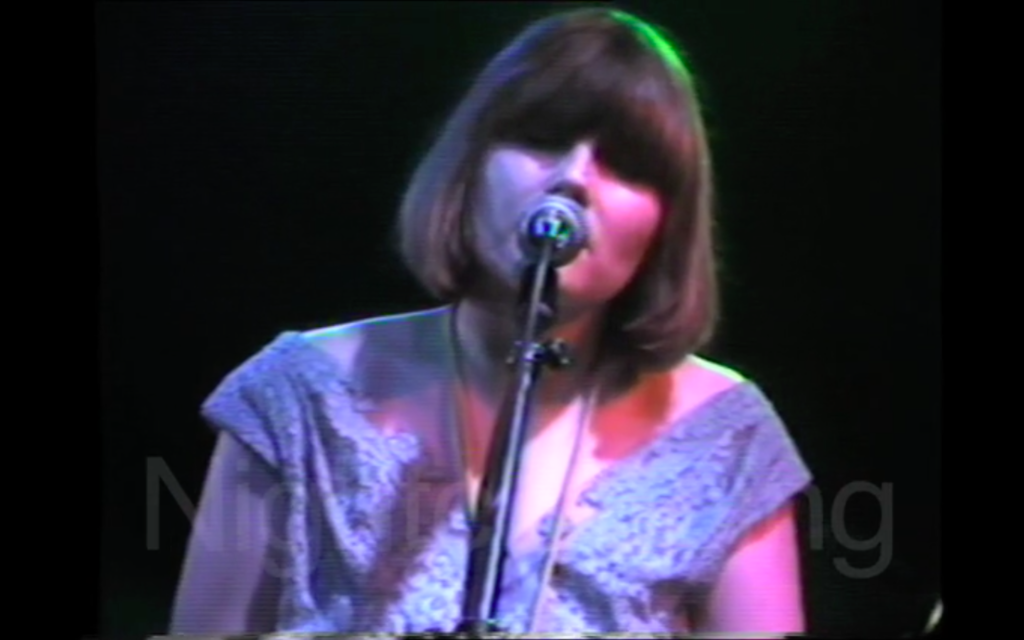
The song "Danger" begins with a bass drum beat and lead singer Vanessa Briscoe Hay quietly alternating between making a "ssssss" sound and chanting works like "the sound of danger." Drum and voice hold the line as the bass rings out and a scattering of guitar notes compete with a clanging cymbal. Someone thinks to turn up the stage light, and Briscoe Hay's head and upper torso emerge from the dark. Michael Lachowski's bass builds, repeating a bouncing five-note phrase again and again, and the guitar and cymbal clang repeatedly. Briscoe Hay stares straight ahead at the audience, her eyes barely visible under a thatch of brown bangs, and hisses into the mic, impersonating a snake or a valve letting off steam, the sound equivalent of the machine in the garden.4Local East Village, "Pylon-1980."
On stage, Briscoe Hay and Lachowski's bodies and clothes create a kind of visual dissonance. Briscoe Hay wears a church dress gone wrong, its color a bit faded and its shape a little soft. As she shakes and twirls her head, a limp lace sleeve slips down her shoulder. Instead of a necklace, she wears her whistle. Her facial expressions alternate between lack and excess, an underplaying that suggests choked amateurism and an overplaying that evokes the entwined histories of blackface and drag.5Van Gosse, "Pylon Draws the Line," Village Voice, February 25, 1981, describes Briscoe Hay in a performance at the Rock Lounge in New York on Valentine's Day 1981 as, "shoeless with whistle, in a parochial-school blue smock and white blouse" (3).
As the song builds, Briscoe Hay spins like a windup whirling dervish, slowing down and speeding up according to the tension in her spring. As she dances, her moves accentuate her curves. The only sharp things here are her cheekbones. Her accent is somehow flat and yet also lushly southern. Like Cindy Wilson in the B-52s, Briscoe Hay both conjures and contradicts the multiple meanings of performing like a girl. In contrast, Lachowski is tall, hard, and thin, a pole of a man with slow, repressed gestures. He sticks out his tongue, and he turns his head a little, looking away from the crowd on one side and then the other. At times, he seems a little scared. His t-shirt and jeans refuse notice. In the critic Van Gosse's words, Lachowski and guitarist Randall Bewley look "like bike mechanics or sculptors" who perform a kind of "abstract hopping around, cute yet unposed."6Gosse, "Pylon Draws the Line," 3.
About a minute in, Briscoe Hay shakes her brown bangs from her brown eyes and half smiles, half grimaces at the audience as she increases the volume and the emotional intensity of her voice. "Dannnne . . . gerrrr," she sings, like a southern girl struggling to speak a foreign tongue, "Be careful. Be caw . . . tious." Drawing out the "caw" until it mimics the sound of a crow, she over-enunciates and turns her head for emphasis, like a teacher trying to force her students to pay attention. A delay effect sends the vocals echoing in all directions and conjures the large space of a factory or a church. With Briscoe Hay's vocal shift, the song explodes. The drums become fat and big and bullying. Sprays of a few guitar and bass notes and shouted words form achingly simple hooks. Then Briscoe Hay blows a long blast on her whistle right into the mic, and the sound of a safety alert at a factory or a foul in a gym rings out an elementary need. The serial riffs convey both the repetition of machinery and a growing urgency as volume and tempo slowly build. At the end, the guitar and bass sound like they are unwinding. Briscoe Hay begins to scream and moan, and the delay effect unravels her voice. The creamy skin of her chest shows just above her breast where her dress has slipped off her shoulder. Decreasing the volume and cutting the speed, she winds listeners out of the song on a wash of emotions that refuse to coalesce into any coherent form.
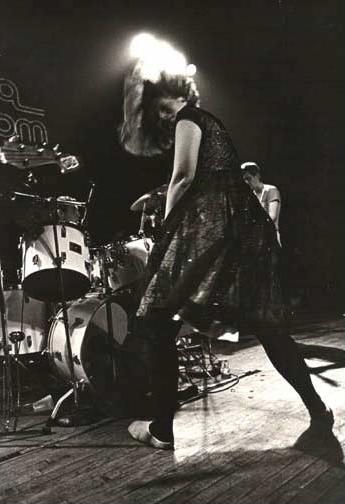
In person, Briscoe Hay sounded like a girl—she spoke in a soft, high voice with a deep southern accent. On stage, she developed a grown-up and powerful roar. Part beauty queen and part drag queen, she worked the intersections of white southern conventions of femininity and drag performance, Patti Smith's androgyny and Yoko Ono's arty shock and awe. The Danceteria video conveyed the charisma of the maturing band's live performances, an allure never quite captured on their recordings. Back in Athens, Vanessa's performances made other women think that if a sweet southern girl could do this, then they too might dare to dream.
That November, DB Records released Gyrate, Pylon's first album, recorded the previous spring in a three-day session at Stone Mountain Studios and produced by Kevin Dunn, a former member of Atlanta punk band the Fans who had also helped with the B-52s's and Pylon's singles. In December, Armageddon Records released the album in England. Critics raved. New Music Express named the record "one of the year's most fundamental rock and roll celebrations." Melody Maker worked the unlikeliness angle: "Buried deep in the land of rednecks, peanut farms and wave-yer-hat-and shout-yeehaw boogie bands, there's something stirring." Pylon made its first overseas tour, playing across England and a few dates in Europe in November and December. Back in New York, John Lennon was murdered. Briscoe Hay remembered getting out of a car in Liverpool and accidently stepping into a pile of flowers left as a makeshift memorial.7"Review of Gyrate," New Music Express, December 1980; Robert Holland, "After Hours," Red and Black, February 8, 1980, 5; "Interview with Danny Beard," Tasty World 3 [April 1985], 11; Jay Watson, "Local Groups Get Boost from DB Records," Red and Black, January 13, 1982, 1, 5; Briscoe Hay, "Vanessa's Version"; Briscoe Hay, interview; Bourne, interview; Biddle, interview; Rasmussen, interview. Bewley did the cover art for the album and former art student Bourne, then working in Atlanta at Beard's record store, did the art direction and design.
Reagan had been elected president just as the album came out, and many critics heard something political in the band's unique sound. Glenn O'Brien prefaced his positive review of Gyrate with a rant about the new political moment. He agreed with the president that America still believed in "those great ideals, those hopes and dreams." The problem for O'Brien was that collectively, Americans had lost "our national ability to identify facts, to absorb information and correlate it; in short, our ability to know anything." By really making you feel like dancing, by moving listeners and making them think, Pylon worked as an antidote to this know-nothingness.8Glenn O'Brien, "Glenn O'Brien's BEAT," Interview, March 1981, 62.
For critic Van Gosse, writing in the Village Voice, Pylon's new album was not just great; as the Reagan era began amidst "imperial decline and the sound of cowboy bluster," it was essential. "If there is any conceivable 'rock 'n' roll future,'" he argued, it lay "in the intrinsic values of a music that is kept blindingly simple, unsentimental, uncomfortable: that which embodies the particular contradictions of its historical epoch in three minutes of glorious noise." For Van Gosse, rock and roll meant "nothing more or less than controlled rhythmsmack, an exquisite tension and release embodied in sound." Pylon embodied "this formal truth right now in a way that only the Rolling Stones ever have before." After lovingly describing their sound and raving about the "hypnotic" Briscoe Hay, "shoeless with whistle," he returned to the importance of this kind of band in this kind of time. Before Pylon, "the class acts of post-everything modernism" came from "the most ancient bowels of decayed industrial capitalist, the dreary olde U.K." While many young Americans loved this music, "we're not really rotted enough yet ourselves. What was needed was something with a little frontier chutzpah, some rooty-toot-toot all-American get-up-an-go, to sing of our bodies electric and alone." Pylon, from "the proverbial sleepy college town," was that band.9Gosse, "Pylon Draws the Line," 61–62. Gosse's article offered very high praise considering how much good rock and roll came out in 1980, including Springsteen's The River, John Lennon's Double Fantasy, Pete Townshend's Empty Glass, David Bowie's Scary Monsters, Grace Jones' Warm Leatherette, Captain Beefheart's Doc at the Radar Station, The English Beat's I Just Can't Stop It, and Stevie Wonder's Hotter Than July, and albums by more underground acts like the Talking Heads' Remain in Light, Elvis Costello's Get Happy!, X's Los Angeles, The Clash's Sandinista!, and the Dead Kennedys' Fresh Fruit for Rotting Vegetables.
New York Rocker's March 1981 Pylon cover story and interview "From Athens, Georgia: New Sounds of the Old South" did not so much argue as gush. The band's "utter lack of attitude" offered an antidote to big city jadedness: "Aren't y'all tired of patronizing arty-fartiness pawned off as entertainment?" Pushed to describe Pylon's sound, Lachowski called the band's music "temporary," in contrast to contemporary, rock. In the same issue, Vic Varney explained the new Athens scene under the headline "Nineteen Hours from New York," and New York Rocker printed photos of the next wave of bands: R.E.M., Love Tractor, and the Side Effects.10Karen Moline, "Pylon: From Athens, GA: New Sounds of the Old South," New York Rocker, March 1981, 15–17; Vic Varney, "'Nineteen Hours from New York': Small Town Makes Good," New York Rocker, March 1981. For more interesting writing about Pylon, see Robert Palmer, "Critics' Choices," New York Times, April 4, 1982; Guy Trebay, "Survey of the Week's Events: Pylon/dB's," Village Voice, April 20, 1982; "Pylon/'Crazy,'" New York Rocker, June 1982, 43; Steve Anderson, "Pylontechnics," Village Voice, November 9, 1982, 66; Stephen Holden, "Music: Pylon at the Ritz," New York Times, May 31, 1983, C15; Tom Carson, "Pylon Up Around the Bend," Village Voice, June 14, 1983, 84; Kim Taylor Bennett, "We Talked to Pylon's Michael Lachowski Because He's a Legend," Vice, August 14, 2014, https://www.vice.com/en_us/article/6w3vw6/we-talked-to-michael-lachowski-from-pylon-because-hes-a-legend.
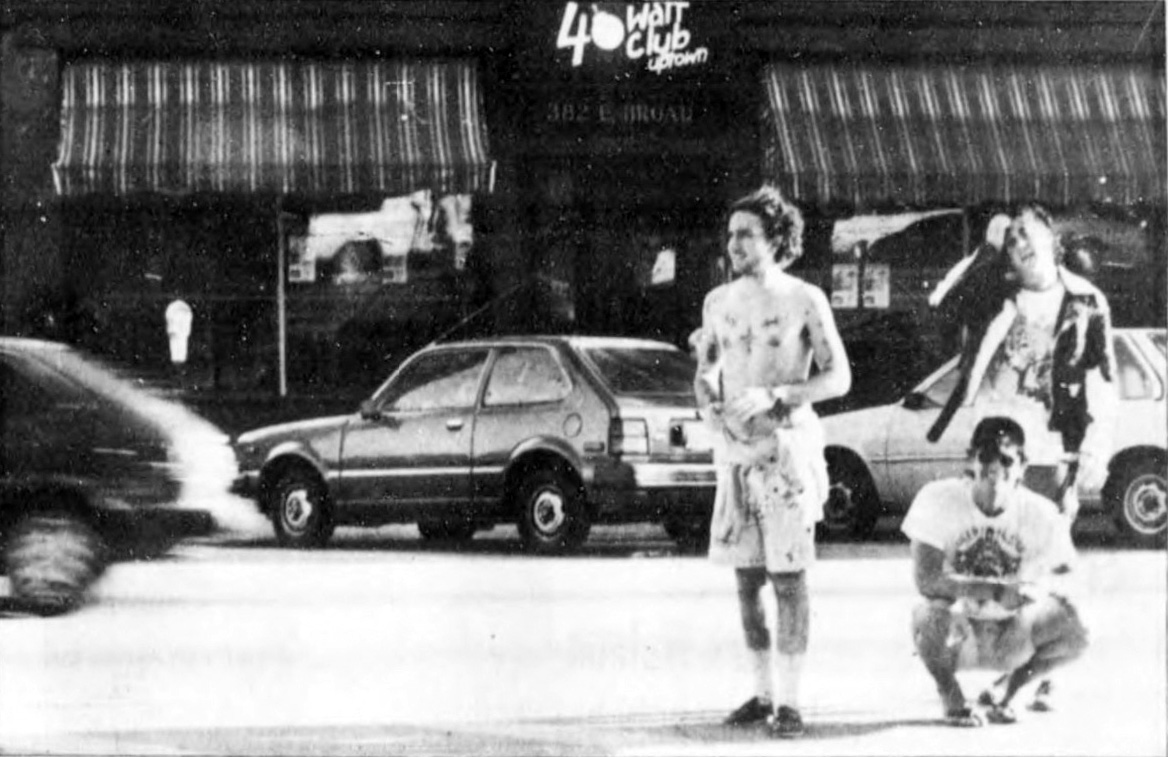
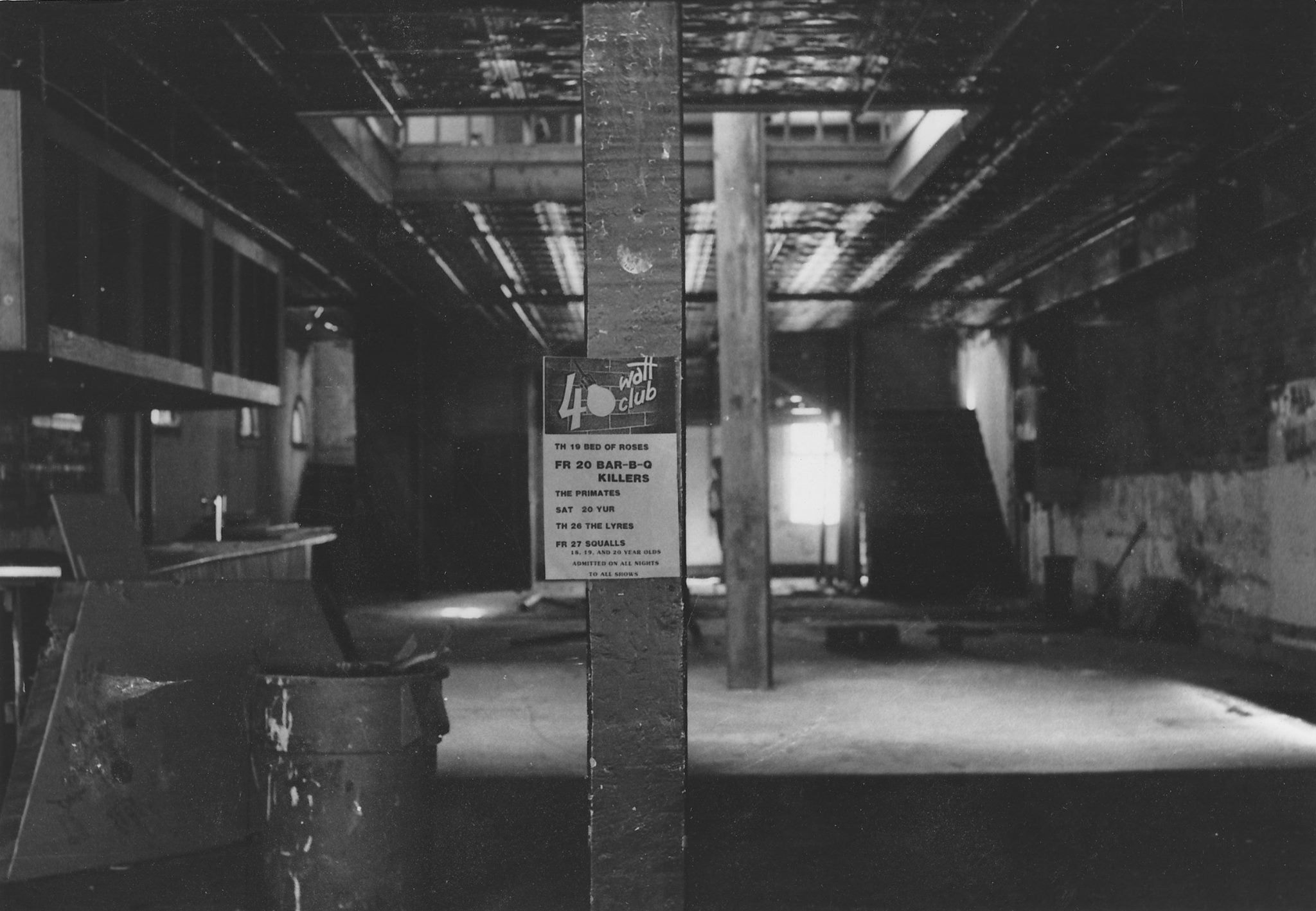
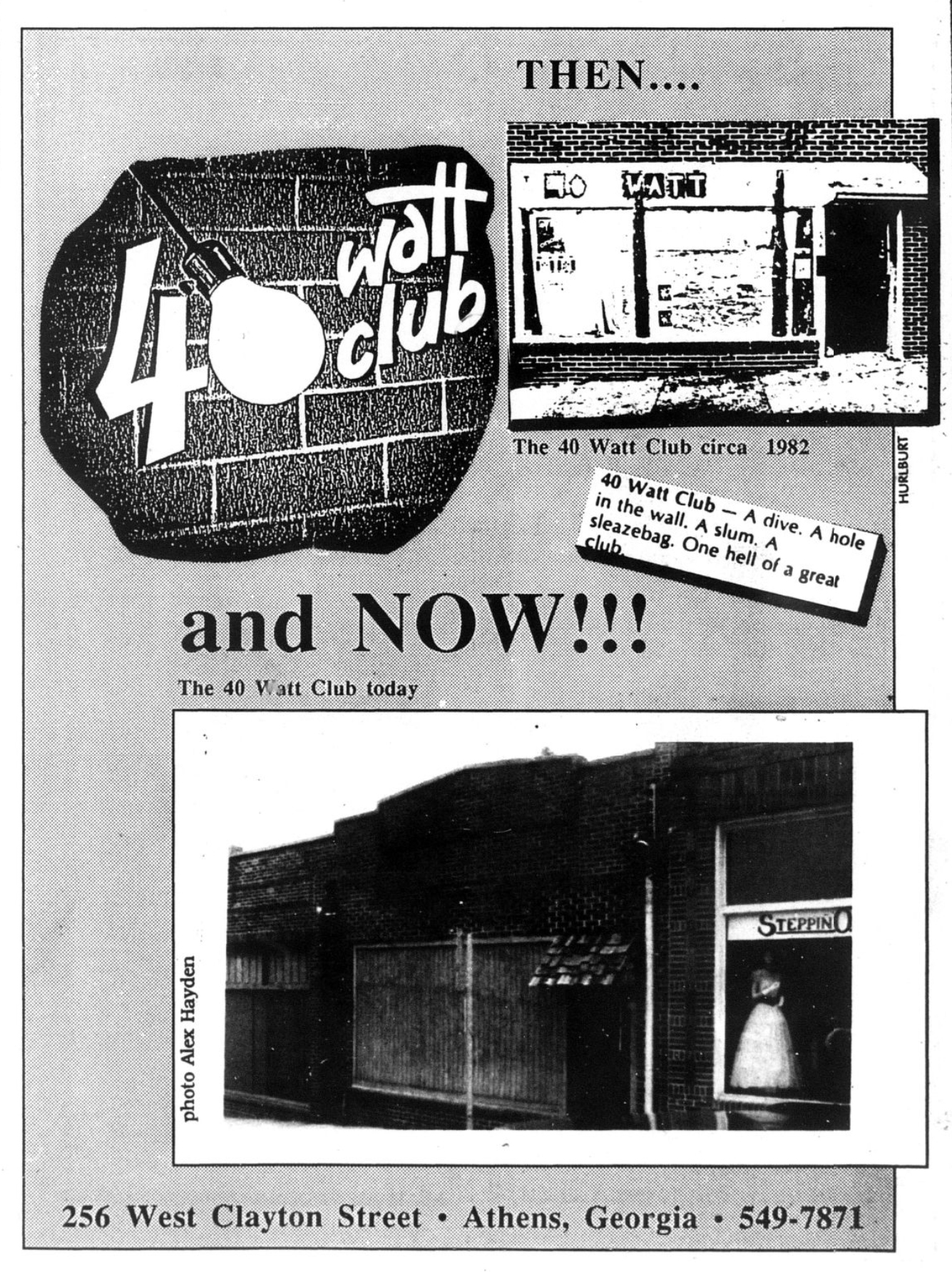
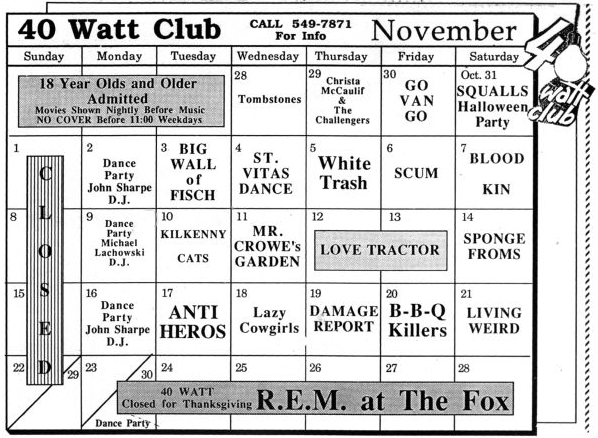
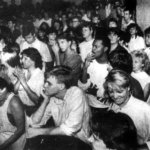
When the 40 Watt Club reopened with new ownership on West Clayton near the old Last Resort space, Pylon was the obvious choice to headline. Varney had exaggerated when he told New York Rocker that Pylon was essentially "commuting to New York." Despite touring with the Gang of Four in the Midwest and Canada and recording a new single, "Crazy"/"M-Train," and a second album, Chomp, band members still lived in Athens and spent a lot of time there. In January 1982, the group played a now-legendary show on campus, selling out the large Memorial Hall ballroom. That fall, Pylon packed the i and i, a warehouse-sized club that for a short time booked the new bands. In April of 1983, when the 40 Watt moved from Clayton Street to a bigger venue on Broad Street, only Pylon could headline the back-to-back closing and then opening shows and pack both rooms. Pylon ruled the scene that the band had done so much to create.11Vanessa Briscoe Hay interviews, T. Patton Biddle interview; Jay Watson, "'Athens' Finest' Play Tonight," Red and Black, January 13, 1982, 5; Moline, "Pylon: From Athens, GA"; T. Patton Biddle, better known as Pat the soundman, has the flyer for the Memorial Hall show with Pylon and Love Tractor on his website at https://www.patthewiz.com/.
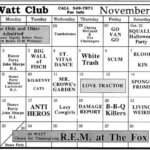
In contrast, the New York-based B-52s hit something of a slump. After following up their debut album with 1980's successful Wild Planet, the group finally released Mesopotamia in early 1982, a David Byrne–produced recording that ended up being an EP because the band simply did not have enough new material. Most critics panned it. New York Rocker captured the prevailing sentiment: "This best-dressed act doesn't know what to do for an encore." Still, a lot of Athens folks headed down to Atlanta to catch the B-52s at the Fox, and Fred Schneider plugged his friend Jerry Ayers's band Limbo District, playing later that night at the Atlanta club 688. The next spring, the B-52s released Whammy!, a new album that returned to their original sound and did better commercially than the EP without generating any hits.12Cindy Wilson interview; Jon Piccarella, "The B-52s, Mesopotamia (Warner Brothers)," New York Rocker, April 1982, 43; J. Eddy Ellison, "Athens Own B-52s Rock the Fox, Still Have Their 40 Watt Charisma," Red and Black, May 12, 1982, 2. Of course, the B-52s never played the 40 Watt Club.
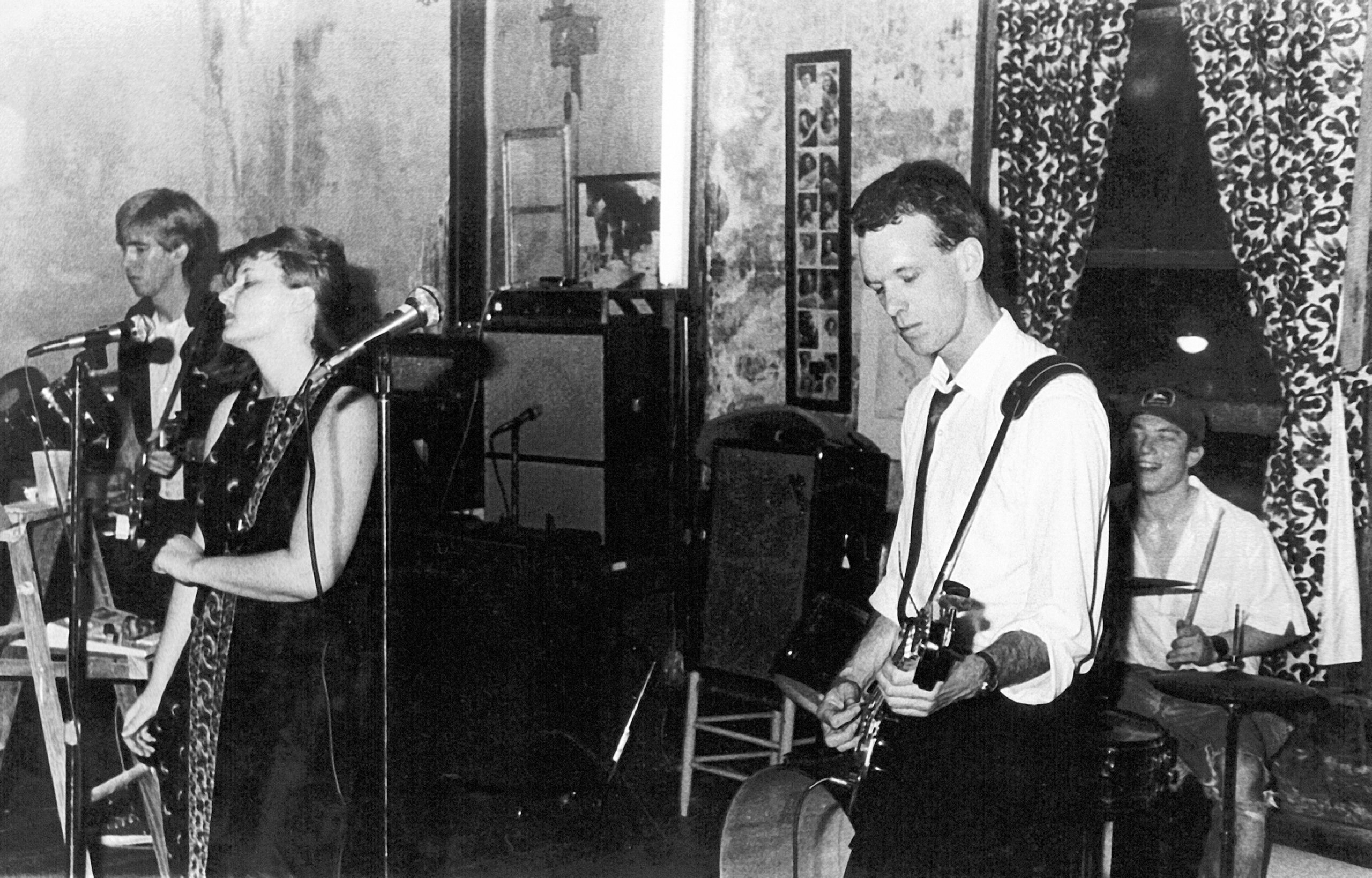
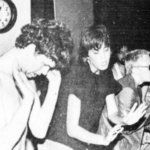
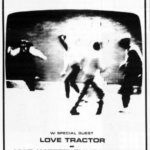
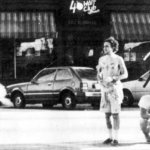
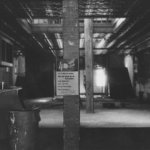


Pylon, too, hit a wall. From an underground perspective, the band seemed wildly successful. In Athens, New York, a few other American cities, and in England, they packed the clubs. Elsewhere, audiences did not seem to know what to make of the group. And while the members of Pylon made enough money to live cheaply in Athens, they weren't exactly comfortable. To reach the next level, they hired a professional booking agent. He landed them a gig most bands would have been giddy to get: the opening slot for U2's U.S. tour in support of their recently released album War. At first, band members said no, but eventually they compromised and agreed to play the first several dates. When they took the stage, crowds impatient to see the Irish band ignored them. As Briscoe Hay recalled, "People were heckling . . . 'Where's U2?' and 'Get off the stage.'" What everyone said was great felt instead like failure. It certainly was not fun. Maybe they did not really want this kind of success. Maybe their music was not for everybody. Maybe their performance-art-turned-band was exactly what they said it was, "temporary rock."13Briscoe Hay, interviews; Michael Lachowski, interviews.
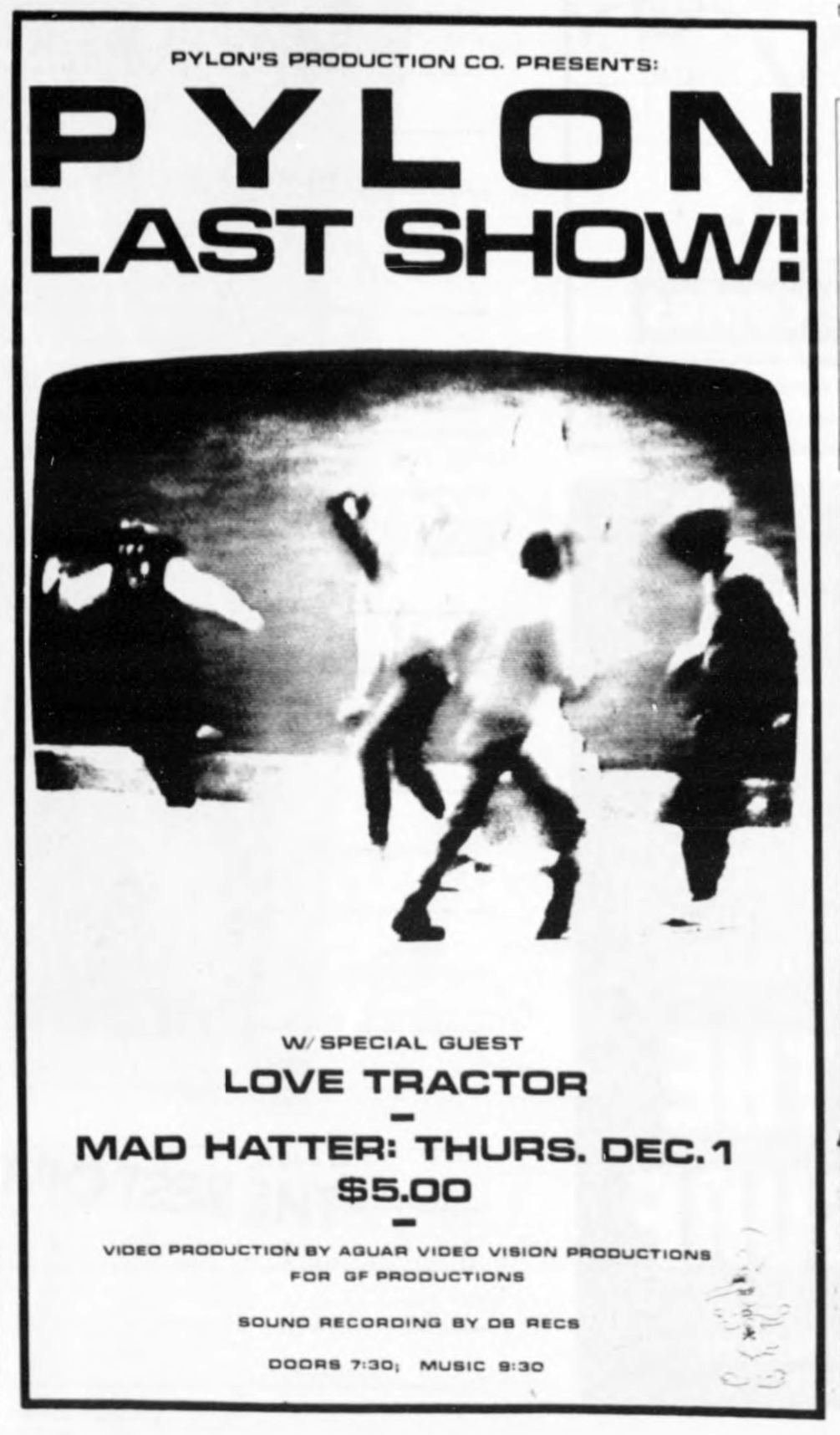
In January 1983, Briscoe Hay told the Athens Observer, "I think if it ever became miserable, we would just disband," and in retrospect she was hinting at what was to come. Band members decided around this time to break up at the end of the year, after they fulfilled their bookings, but they kept their decision secret. In Athens, most people found out when posters went up for "Pylon's Last Show" with opening act Love Tractor. The gig took place in a huge venue known more for its cheap drink nights than live music so everyone could come.14Poster reproduced as an ad, Red and Black, December 1, 1983, 6; Lachowski, interviews; Briscoe Hay, interviews.
A live recording of that farewell show released in 2016 finally gave those of us who missed it a chance to listen in on this essential moment in Athens history. From the opening note of the first song, "Working Is No Problem," Pylon lays out what a critic fittingly describes as "an all-business, no-banter set" of twenty-two songs with hair-on-fire intensity that does not let up until the five-song encore finishes. Over the course of approximately an hour and a quarter of music, the crowd roars out its encouragement. Sometimes, the fans sing along to lyrics like "everything is cool" and even occasionally to guitar hooks, like the woo-woo of "M-Train." At other times, they just yell. No one wants the evening to stop. When it does, Pylon ends with a song that only their earliest fans would get and an homage to their origins in Lachowski's loft studio, their version of the Batman theme song. Superheroes fight evil. To resist the way the market strips away every meaning but money, maybe you just have to refuse to play.15Pylon, Pylon Live (Atlanta, GA: Chunklet Industries, 2016); Stuart Berman, "Pylon: Pylon Live," Pitchfork, July 19, 2016, https://pitchfork.com/reviews/albums/22125-pylon-live/.
Interviewed about the breakup, band members reflected on why they had started making music "as another form of artistic expression." "We accomplished what we set out to do," Lachowski said. "It's not that we are miserable, it's just that we've seen all we're going to see and don't want to put any more time into it." "Our whole reason for doing it was for fun," Crowe argued, "and when the fun wears out and it starts turning into a serious type of job—there's no reason to do it anymore." Briscoe Hay captured the purity and the privilege of the band's attitude: "We wanted to do what we wanted to do when we wanted to do it." As Lachowski explained, "What was frustrating was not trying to live like other bands, but trying to convince everybody that we didn't want to do it that way. . . . We were the only ones that understood why we were not out there with the other bands trying to make it big." But for all the talk about fun, at least one band member was still thinking about the importance of form. "We'll become a cult band now," Bewley predicted on the eve of Pylon's last show. "This is a type of suicide that'll make us more popular in the long run." And he was right.16J. Eddy Ellison, "A Found Farewell: Fans, Followers and Friends Sadly Try to Accept," Athens Banner Herald-Athens Daily News, December 2, 1983, 10–11; Lachowski, interviews; Briscoe Hay, interviews; David Pierce, "The Tasty World Interview: Michael Lachowski," Tasty World 2, 23, 29.
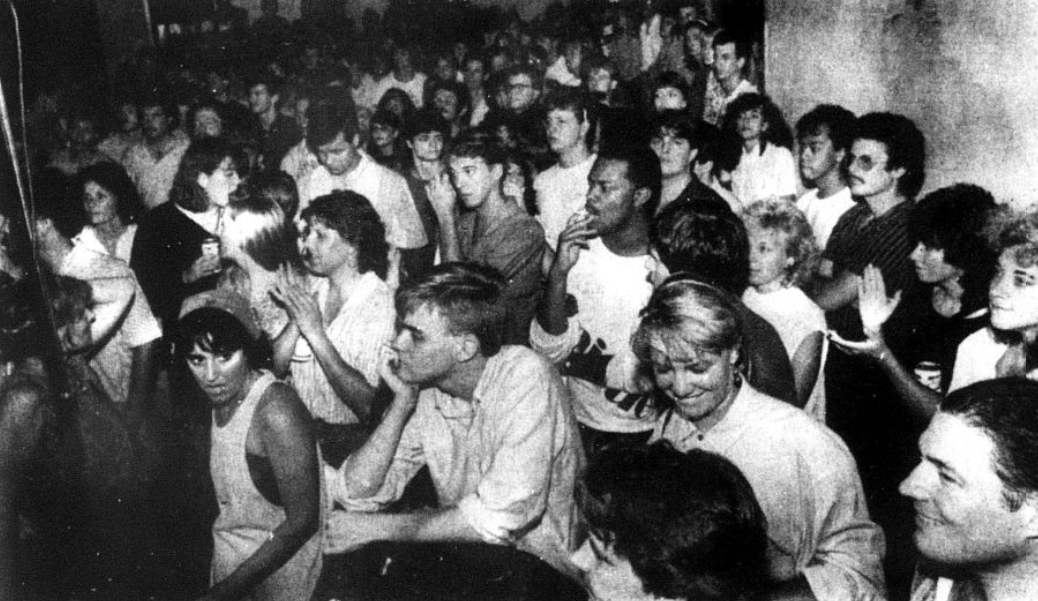
It was a tiny crowd really, fewer people than belonged to a single average-sized fraternity. Cline remembered about sixty people plus hangers on, a hundred tops. Briscoe Hay recalled a tight core of about one hundred people. Lachowski, comparing Athens to the early CBGB's days, argued that both scenes were "so vibrant because they were so tight." Proximity and personal relationships were key. Yet closeness alone was not enough. To be a scene, you needed a story. You needed a narrative to connect what was happening in Athens to a larger vision of the good life. You needed a myth.17Mark Cline interviews; Briscoe Hay, interviews; Lachowski, interviews.
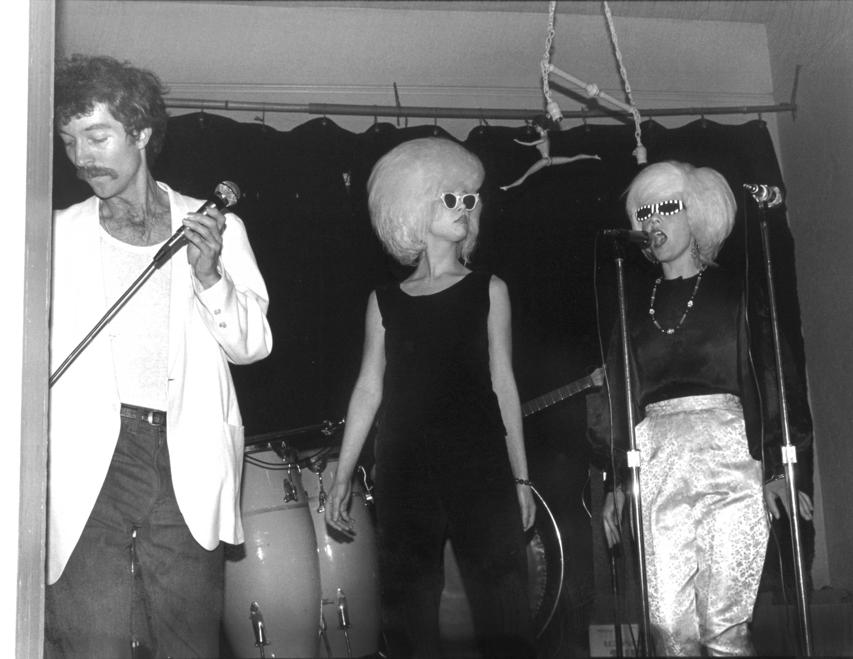
With their attention to "form" and their decision to quit at the height of their fame, Pylon provided this story, doing more than any other single group to fuse the loose, downtown-based network of art students, artists, other outsiders, and their friends that the B-52s had helped spark into what became known as the Athens scene. Performing their music, they also shared their bohemian vision. Life should be about making art for and with friends, combining creativity and pleasure and personal relationships, and living within and sharing a culture that you made yourselves. Money and fame were not necessary. They might even be lethal, killing the experience of creative pleasure.
The B-52s had turned pop art and drag into a form of punk music and proved a little bit of bohemia could flower even in as unlikely a location as a Georgia college town. Pylon, too, started with art and ratcheted up the intensity. Performance art depended on presence to offer messy truths. Pylon made performance art people could dance to, delivering a punk comment on the survival of originality in the machine-made future in a southern drawl more commonly associated with the handmade past. Live, the band's raw, intense music worked the contradictory meanings of repetition, how duplicated sounds and acts could evoke expansiveness or constriction, pleasure or boredom, play or work, and the body or the machine. Critics' darlings, repeatedly named the best band in Athens, Pylon carried their art piece so far that they broke up on the cusp of stardom. The members of Pylon might not have had the language to describe resistance to what people by the end of the century would be calling neoliberalism, but they had the sound.
About the Author
Grace Elizabeth Hale is the Commonwealth Professor of American Studies and History at the University of Virginia. Her previous books include A Nation of Outsiders: How the White Middle Class Fell in Love with Rebellion in Postwar America and Making Whiteness: The Culture of Segregation in the South, 1890–1940.
]]>Introduction
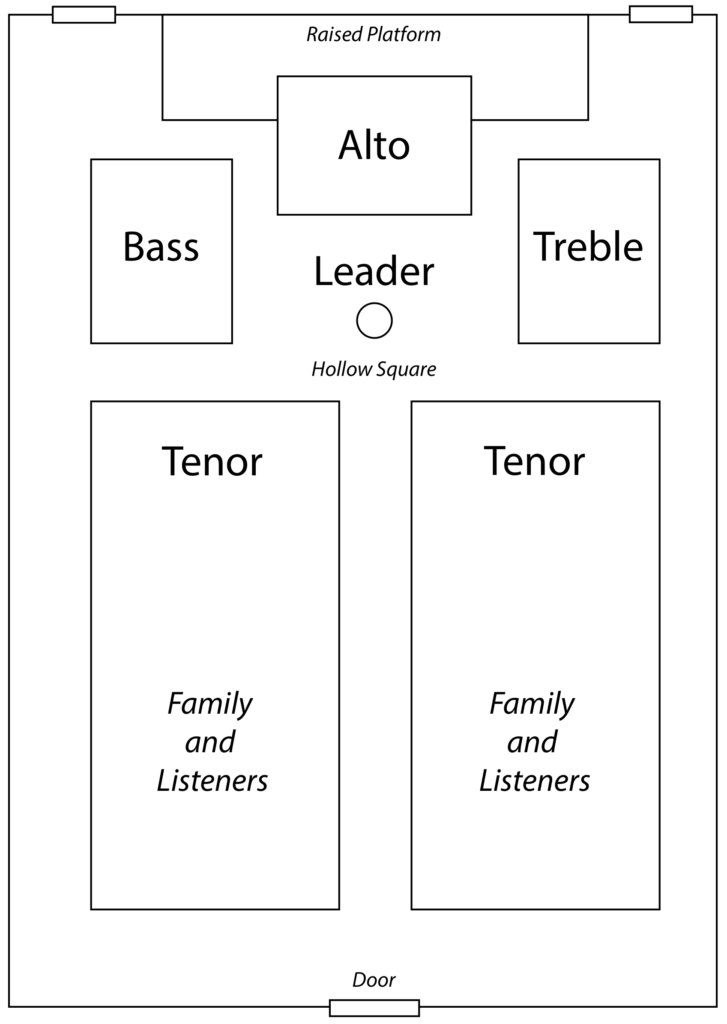
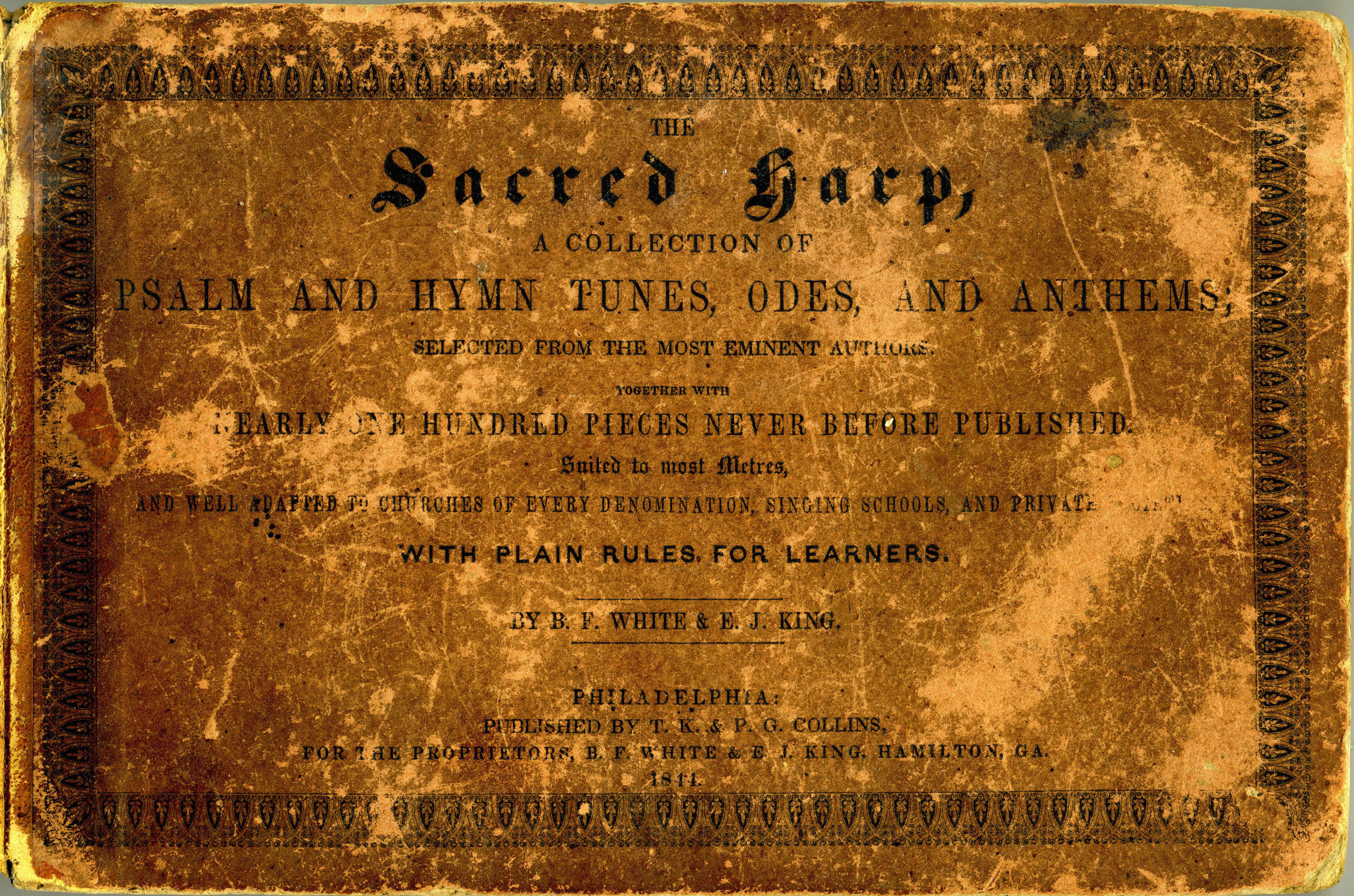
Sacred Harp singing is defined by its spatial organization as much as by its musical style. In this form of shape-note music, an assembled "class" of singers gathers at annual events called "singings"—weekend days spent in churches or community centers singing songs from The Sacred Harp, a nineteenth-century Georgia tunebook revised every generation or so. The tunebook uses a pedagogical system in which the music's note heads have four distinct shapes corresponding to their position in the scale, associated with the names "fa," "sol," "la," and "mi," which singers recite before singing a song's hymn text. Just as important as the shape-notes to the Sacred Harpers is the "hollow square" orientation in which singers sit, facing each other in rows of pews or chairs organized by voice part (bass, alto, treble, and tenor). Throughout the singing day, a procession of leaders take turns stepping into the hollow center to face the tenor or lead section that carries the melody and direct the class in a song or two of their choice from The Sacred Harp.1For more on Sacred Harp singing, see, especially, Buell E. Cobb Jr., The Sacred Harp: A Tradition and Its Music (Athens: University of Georgia Press, 1989); John Bealle, Public Worship, Private Faith: Sacred Harp and American Folksong (Athens: University of Georgia Press, 1997); Kiri Miller, Traveling Home: Sacred Harp Singing and American Pluralism (Champaign: University of Illinois Press, 2008); David Warren Steel and Richard H. Hulan, The Makers of the Sacred Harp (Champaign: University of Illinois Press, 2010).
For singers, the hollow square is both a practically necessary convention and a deeply meaningful space. Encircled by full-voiced singing to hymn texts such as Isaac Watts's "Within Thy circling pow'r I stand, On ev'ry side I find Thy hand," for singers the immersiveness of the hollow square comes to represent God's encompassing love.2"Akin," music by P. Dan Brittain (1971), words by Isaac Watts (1719), in Hugh McGraw et al., eds., The Sacred Harp: 1991 Edition (Carrollton, GA: Sacred Harp Publishing Company, 1991), 472. For composers, the spatial organization of singings, especially the separation of voice parts, is something to consider and emphasize in writing for the tradition. For singers and scholars seeking to capture the essence of Sacred Harp singings, the hollow square has been a longstanding focus, with advances in recording technology leading to new strategies. In this publication we introduce new immersive 360-degree video and audio recordings we made from within the hollow square in the summer of 2019 and offer context drawing on a larger project about the hollow square's meaning to singers and composers and the history of attempts to capture the experience of this unique sonic space.
Yi Halo and Ambeo VR at Mt. Lebanon
We used new video and audio recording technologies to capture elements of the experience of the hollow square. Our recording equipment included the Yi Halo, a device that captures video via seventeen separate cameras arranged in a circular housing. The Google platform Jump Assembler (now defunct) stitched the footage from all the cameras into a series of 360-degree videos.3Janko Roettgers, "Google Is Shutting Down Its Jump VR Video Program," Variety (blog), May 18, 2019, https://variety.com/2019/digital/news/google-jump-shutting-down-1203219306/. We used the Sennheiser Ambeo VR microphone to capture 360-degree spatial audio via four interconnected microphone capsules. Using the video editing application Adobe Premiere, we connected the 360-degree video to the spatial audio. When the user shifts the 360-degree visual field of view in the YouTube window, the audio shifts correspondingly. This spatial audio can only be experienced when wearing headphones.
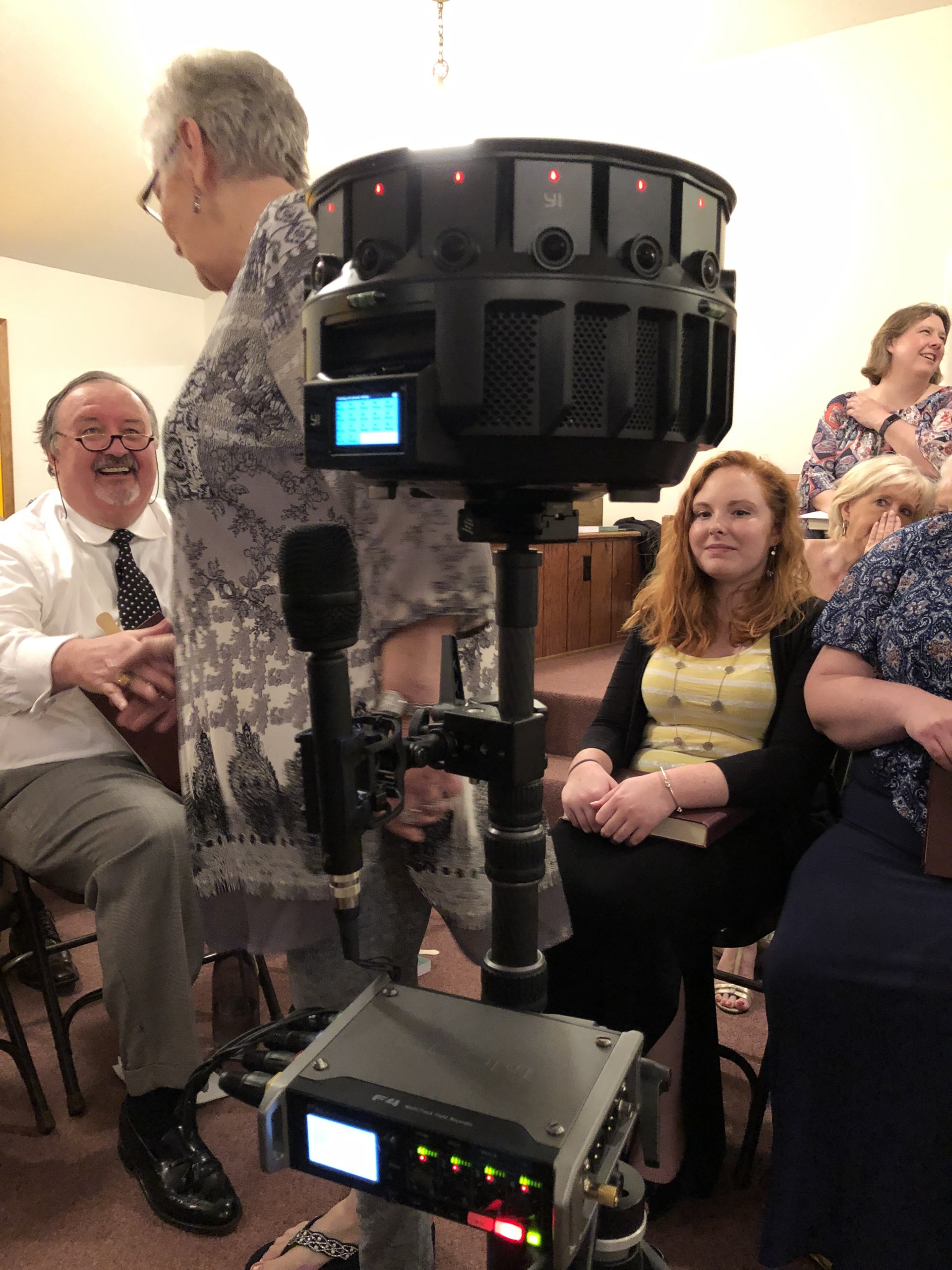
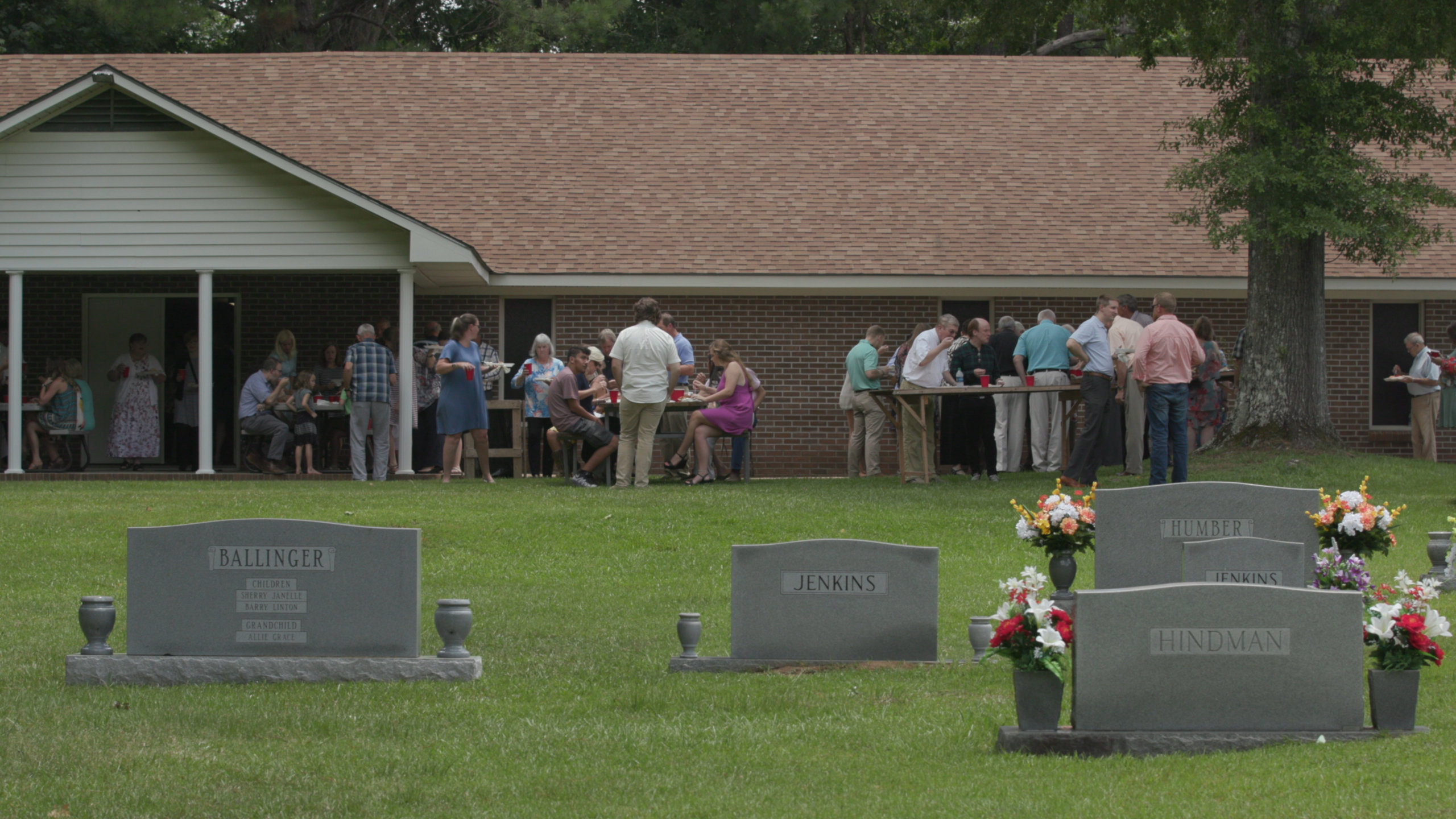
After trying out the device at a Decatur, Georgia, all-day singing, we recorded three hours of the annual singing at Mt. Lebanon Baptist Church in rural Fayette County in west Alabama. This lively, midsize singing is in an area long central to the geography of what is now an international music culture with roots in Alabama, Georgia, Mississippi, Florida, and Texas.4On Sacred Harp's shifting geography, see James B. Wallace, "Stormy Banks and Sweet Rivers: A Sacred Harp Geography," Southern Spaces, June 4, 2007, https://southernspaces.ecdsdev.org/2007/stormy-banks-and-sweet-rivers-sacred-harp-geography; Jesse P. Karlsberg, "Folklore's Filter: Race, Place, and Sacred Harp Singing" (PhD diss., Emory University, 2015), https://etd.library.emory.edu/concern/etds/n009w256n?locale=en; Jesse P. Karlsberg and Robert A. W. Dunn, "Mapping the 'Big Minutes': Visualizing Sacred Harp's Geographic Coalescence and Expansion, 1995–2014," Southern Spaces Blog (blog), January 23, 2018, https://southernspaces.ecdsdev.org/2017/mapping-big-minutes-visualizing-sacred-harps-geographic-coalescence-and-expansion-1995-2014. The Mt. Lebanon Singing also serves as this Independent Baptist church's homecoming and as a reunion for the Ballinger family, a number of whose members are active singers. Today the singing also attracts members of singing communities in northeast Alabama, metro Atlanta, and further afield: singers in 2019 had traveled from New York City and Dublin, Ireland, to Fayette County. Trying the singers' patience and good humor, we placed the cumbersome, many-eyed Yi Halo in the singing's cozy hollow square for much of the day. Song leaders stood right next to the device. Steve captured conventional "flat" video from the back of the room, behind the tenor section, while Jesse sat and sang with the tenors.
The resulting recordings, embedded in this publication and accessible through YouTube, present video and audio from the center of the hollow square. This vantage point, typically inaccessible to those who don't lead songs, is the physical and spiritual center of Sacred Harp singings.
Entering the Hollow Square
The hollow square is central to understanding the music and music culture that surrounds The Sacred Harp. Singers associate the hollow square with key values of participation and community. Sacred Harp singers often state that they are "singing for each other and for God," rather than for an audience. Though non-singers such as family members and descendants of singers, congregants at churches hosting singings, and other curious individuals do sometimes come to listen, the layout of Sacred Harp singings, in which singers face each other rather than the listeners in the back, reinforces its participatory ethos.5On how Sacred Harp's spatial organization compares to that of historically related sacred music cultures, see Paula Tadlock, "Shape-Note Singing in Mississippi," in Discourse in Ethnomusicology: Essays in Honor of George List, ed. Caroline Card et al. (Bloomington: Ethnomusicology Publications Group, Indiana University, 1978), 191–207.
The hollow square also bolsters singers' sense of Sacred Harp as a community. Eye contact across the hollow square, where trebles face basses and tenors face altos, has kindled relationships, reinforced friendships, and intensified shared emotional experiences. Sacred Harp's music culture generally discourages talking while a singing is in session. In the absence of commentary on the affective and spiritual experience of singing, nonverbal communication—during singing and between songs as leaders cycle in and out of the square—contributes to singers' understanding of their experience as shared.6On verbal and nonverbal communication, the hollow square, and affective intensity in Sacred Harp singing, see Miller, Traveling Home; Kiri Miller, "'Like Cords Around My Heart': Sacred Harp Memorial Lessons and the Transmission of Tradition," Oral Tradition 25, no. 2 (2010), http://muse.jhu.edu/journals/oral_tradition/v025/25.2.miller.html; Anne Heider and R. Stephen Warner, "Bodies in Sync: Interaction Ritual Theory Applied to Sacred Harp Singing," Sociology of Religion 71, no. 1 (2010): 76–97.
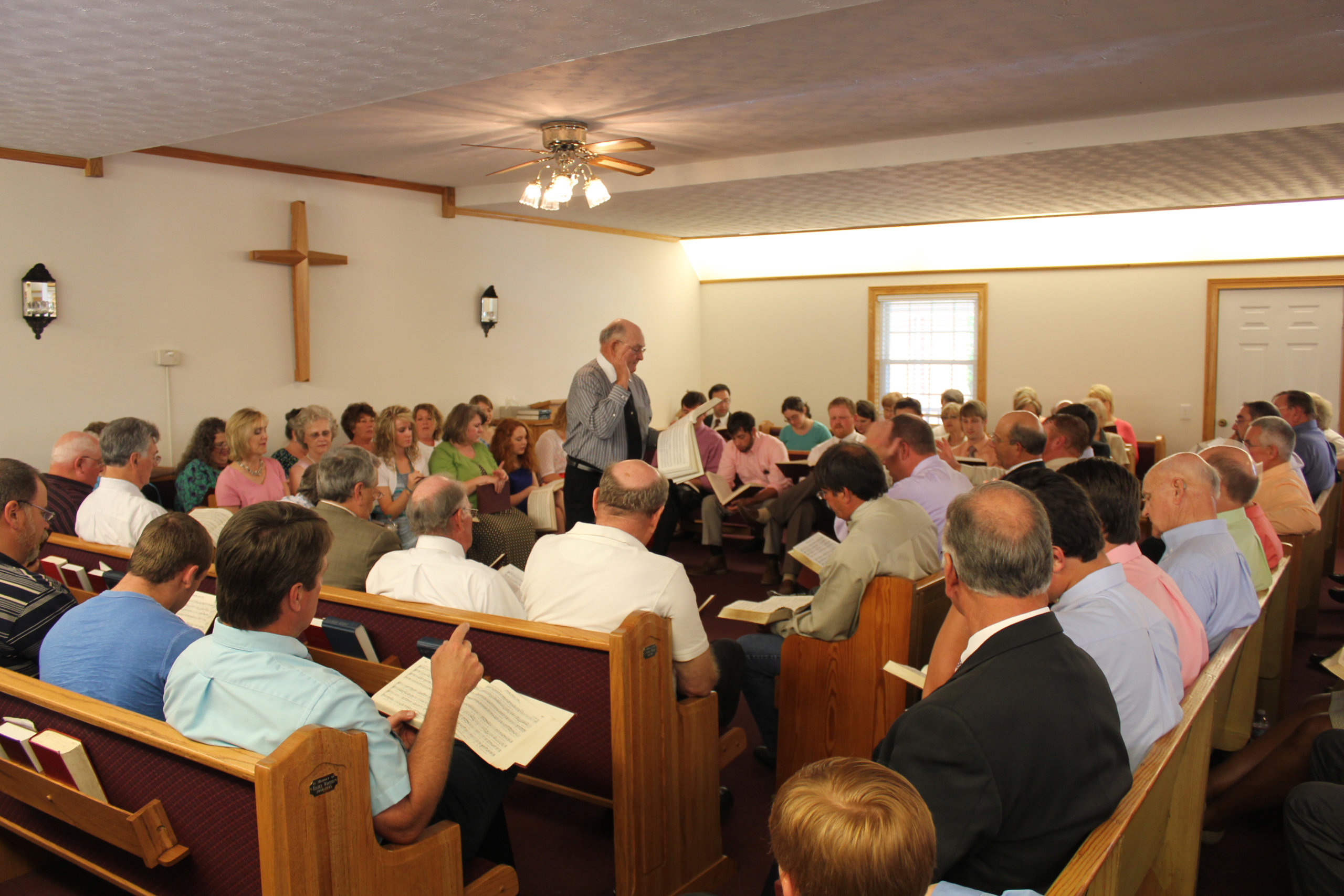
The hollow square also improves the sound of Sacred Harp singings in ways both practically and aesthetically valued by singers. Facing each other makes it easier for singers to stay together. All can see and follow the leader, who beats time, moving an arm down and up to convey tempo. Singing at each other rather than out at an audience concentrates sound, making it easier for singers to hear each other. The accumulated volume enhances the depth of the experience.
Of course, the very best sound is in the center of the hollow square. In this space, the singing is loudest and all four parts achieve their best balance. Many singers who came to Sacred Harp singing as adults remember the first time they stepped into this space as the time they knew Sacred Harp singing would become an enduring part of their lives. Over time many come to think of this locus of Sacred Harp's spatial organization as a sacred space. Singers frequently invite newcomers to join them in the center for a song, believing that this is the best vantage point from which to apprehend what makes the music culture so moving to its participants.
Composing Sacred Harp's Spatiality
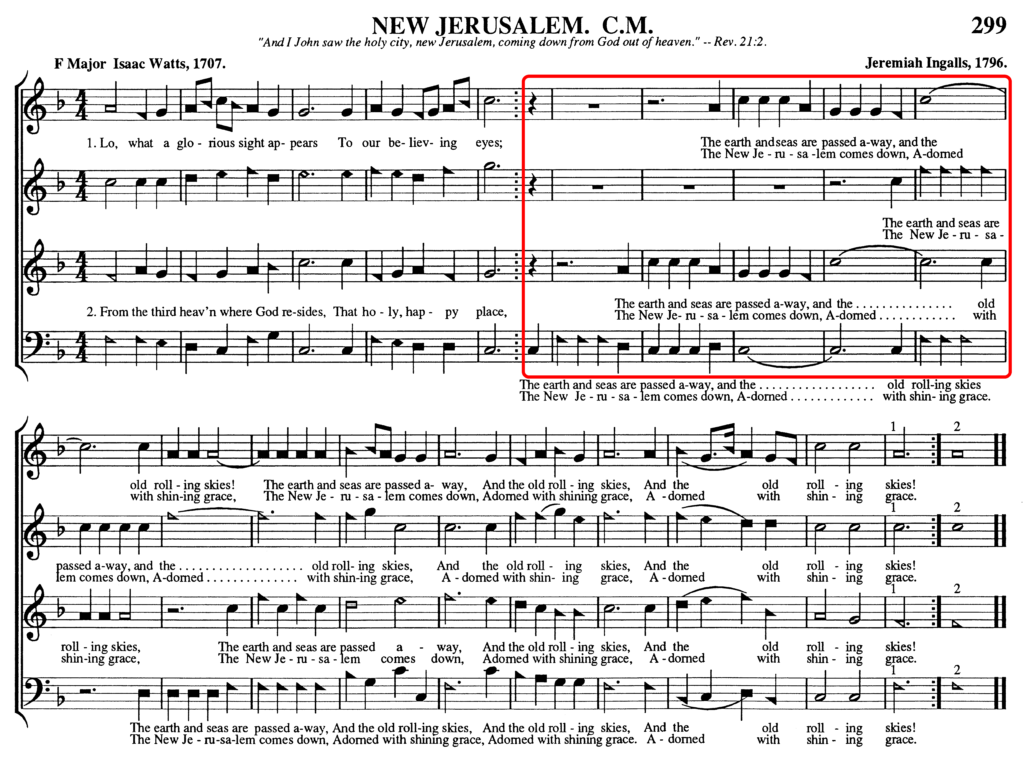
Many of the songs in The Sacred Harp leverage specific features of the hollow square for musical and emotional impact. The three immersive recordings of the Sacred Harp singing at Mt. Lebanon feature songs exemplifying two such approaches: fuging among the voice parts and traded high notes between the tenor and treble parts. Fuging tunes are among the most characteristic and popular song forms in The Sacred Harp. Typical fuging tunes begin with all the parts singing together, followed by a section in which each of the four voice parts enters in sequence, finally coming together again before the conclusion of the song.7Irving Lowens, "The Origins of the American Fuging Tune," Journal of the American Musicological Society 6, no. 1 (April 1, 1953): 46, https://doi.org/10.2307/829998. On fuging tunes, see also Karl Kroeger, American Fuging-Tunes, 1770–1820: A Descriptive Catalog (Westport, CT: Greenwood Press, 1994); Maxine Ann Fawcett-Yeske, "The Fuging Tune in America, 1770–1820: An Analytical Study" (PhD diss., University of Colorado at Boulder, 1997); Jesse P. Karlsberg, "Genre Spanning in the Close and Dispersed Harmony Shape-Note Songs of Sidney Whitfield Denson and Orin Adolphus Parris," American Music 35, no. 1 (2017): 94–132. The most common of these entrance patterns, as found in Jeremiah Ingalls's "New Jerusalem," led by Eli Hinton of Atlanta, Georgia, is propelled forward not just by the cascade of entrances and their progression from lower to higher voices, but by their spatialization. The entrance pattern proceeds counterclockwise around the hollow square, with basses followed by tenors, trebles, and altos.8"New Jerusalem," music by Jeremiah Ingalls (1796), words by Isaac Watts (1707), in McGraw et al., The Sacred Harp, 299.
Generations of composers have adopted this pattern and experimented with alternatives, frequently inspired by the arrangement of the vocal parts around the hollow square. After a short fuging section, Amos Munson's "Newburgh," led by Cheyenne Ivey, a member of a singing family from Henagar, Alabama, leverages the physical separation of the vocal parts to dramatize the celestial distance between the sun and stars. After the basses to the right of the leader enter on the phrase "Thou sun with golden beams" and all four parts sing "And moon with paler rays," the trebles, to the leader's left, reply with a shimmering "Ye starry lights, ye twinkling flames, Shine to your Maker's praise."9"Newburgh," music by Amos Munson (1798), words by Isaac Watts (1719), in McGraw et al., 182.
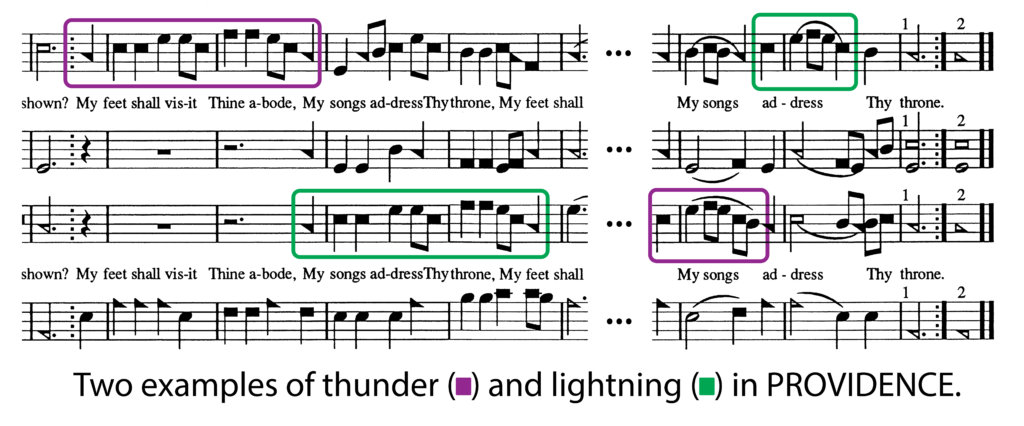
Composers also rely on the separation of vocal parts to create moments of power and energy by trading prominent high notes in rapid succession between the tenor and treble parts, a feature that singers often refer to as "thunder and lightning." Since these two parts are typically sung by mixed gender groups with similar vocal ranges, this trading back and forth of high notes would be undetectable without the vocal separation that the hollow square provides. In songs like C. Curtis's "Providence," led here by siblings Wanda Capps and Danny Creel from Dora and Hoover, Alabama, respectively, the traded high notes are distinct and clearly audible, contributing dynamic crackling energy to the song. "Providence" features "thunder and lightning" in multiple places. After a short opening section, the song's chorus begins with the trebles singing a musical phrase that peaks on a high note (accompanied by the basses) which is immediately echoed by the tenors. The song continues with similar exchanges, culminating in a figure ricocheting from the tenor to the treble as the song reaches its conclusion.10"Providence," music by C. Curtis (1820), words by Isaac Watts (1719), in McGraw et al., 298.
Recording the Hollow Square
For singers and scholars, Sacred Harp's spatial qualities have made recording the style appealing. Yet the results have persistently struck their makers and audiences as falling short of conveying the experience of being at a singing. The earliest field recordings, made by John W. Work III in 1938 and Alan Lomax and George Pullen Jackson in 1942, used then-available monophonic technology, collapsing the music's richly spatialized four-part harmonies to a single channel of recorded sound.
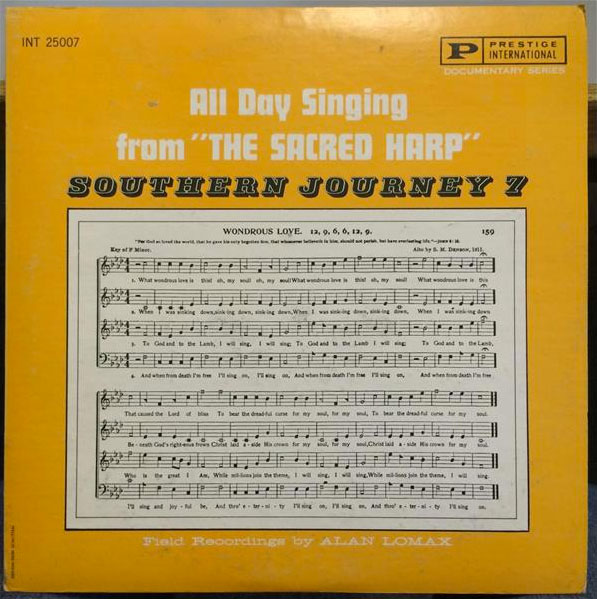
For Lomax, frustration with the result prompted him to include Sacred Harp singing in his itinerary for the "Southern Journey" field recording sessions he conducted in August through October of 1959 after he first gained access to portable stereo recording technology. The ensuing recordings, released in part as All Day Singing from "The Sacred Harp" (1961), provide considerably greater depth and intimacy than the monophonic recordings from the 1930s and 1940s, and contributed to greater public awareness of and interest in participating in Sacred Harp singing during the folk revival.11Alan Lomax and Alabama Sacred Harp Singers, All Day Singing from "The Sacred Harp," recorded 1959, 33 1/3 rpm record, Southern Journey (Bergenfield, NJ: Prestige, 1961). But Lomax's vantage point at one corner of the hollow square contributed to an imbalance among the parts that bothered contemporaneous Sacred Harp singers. The Sacred Harp Publishing Company, publisher of the most widely used tunebook at singings, responded by recording, producing, and releasing a series of LPs in the 1960s and 1970s, recorded in a studio and mastered to provide what they deemed a more satisfying balance of the parts.12Cobb, The Sacred Harp. When quadrophonic sound systems—one speaker for each Sacred Harp voice part!—proliferated in the 1970s, the same organization planned a release in this format, but the project was eventually shelved.
Conclusion
In the 2020s, as in the 1930s, there is no substitute for experiencing a Sacred Harp singing in person; singings today are held across the United States and beyond every weekend of the year. Yet we think the recordings of these three songs provide new virtual access to the experience of Sacred Harp's spatiality. We invite you to explore the activity in different parts of the singing space by shifting your perspective while navigating the video on your desktop monitor or your phone's YouTube app. If you wear headphones, you can hear the spatial audio shift along with the visual field of view. If you have access to a virtual reality headset, you can immersively experience the perspective these recordings afford. We plan to stage virtual reality viewings of these recordings at the Camp Fasola Sacred Harp singing school and at other singings in 2020. We will also make recordings of other songs accessible through the web in the coming months to expand the selection of songs and leaders captured using this technology. 
Additional Videos
- Philip Gilmore, of Oneonta, Alabama, leads Ananias Davisson's "Idumea" (p. 47b) from The Sacred Harp.
- Ewa Lichnerowicz, of Dublin, Ireland, leads S. M. Denson's "Praise God" (p. 328) from The Sacred Harp.
- Cindy Tanner, of Henagar, Alabama, leads George Coles's "Green Street" (p. 198) from The Sacred Harp.
- Beth Wallace, Eady Porter, Aubrey Zeanah, and Ridley Colvin, of Fayette, Northport, and Demopolis, Alabama, lead O. A. Parris's "My Brightest Days" (p. 546) from The Sacred Harp.
- Judy Caudle, of Eva, Alabama, leads H. S. Rees's "Sweet Morning" (p. 421) from The Sacred Harp.
About the Authors
Steve Bransford is the senior video producer at the Emory Center for Digital Scholarship. His documentary feature, The Well-Placed Weed, is available on Vimeo.
Jesse P. Karlsberg is the senior digital scholarship strategist at the Emory Center for Digital Scholarship. He is the project director and editor-in-chief of Sounding Spirit, a research lab and publishing initiative promoting collaborative engagement with historical American songbooks. Karlsberg is an internationally recognized singer, teacher, composer, and songbook editor in the Sacred Harp tradition.
]]>Review
Sensory history is an exciting new approach to writing history. It offers a fresh take on past perceptions. Sensing between the lines of written sources, the sensory historian recasts history as sense-making activity, not merely a litany of dates and deeds. Ideally, readers can feel the pulse of a given period, sniff the atmosphere, and see events in a different light.
Mark M. Smith is the doyen of sensory history in the US. In Sensing the Past: Seeing, Hearing, Smelling, Tasting, and Touching in History (Oakland: University of California Press, 2007) he laid out a manifesto for bringing history to our senses. In How Race Is Made: Slavery, Segregation, and the Senses (Chapel Hill: University of North Carolina Press, 2006) he explored the sensory dynamics of racialization in the American South. In The Smell of Battle, The Taste of Siege, he turns his attention to the Civil War.
Smith begins by evoking the antebellum sensorium offered in an 1852 essay, "The Cultivation of the Senses," published in Harper's New Monthly Magazine that portrayed the senses as shapers of character and agents of civilization, provided they were exercised properly: "[the] eye should not be injured by resting on a vulgar confusion of colors, or clumsy, ill-proportioned forms; the ear should not be falsified by discordant sounds, and harsh, unloving voices; the nose should not be a receptacle for impure odors; each sense should be preserved in its purity" (1). This preoccupation with sensory order and decorum was particularly intense in a city such as Charleston, South Carolina, built on slavery, where every social relation exhibited gradations of command and obedience. The slave did not speak unless spoken to; there was a strict curfew prohibiting movement at night; the singing of slaves at work in the fields was music to the ears of the white slaveholder.
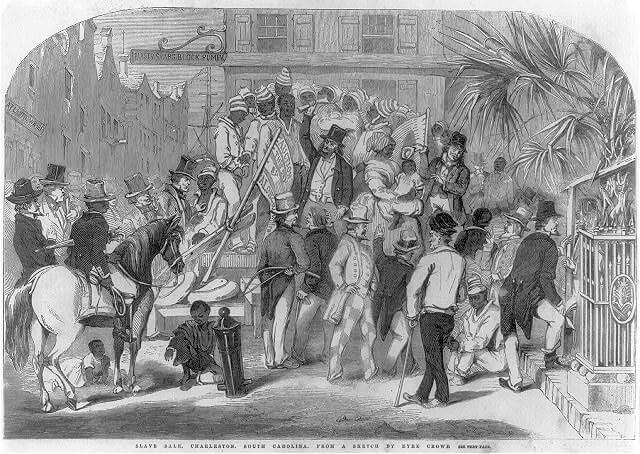
However, the ostensibly serene city of Charleston also shivered with fear at the prospect of a slave revolt. Silence was ominous as well as golden: "If they [the slaves] want to kill us," one female diarist wrote, "they can do it when they please, they are as noiseless as panthers" (18). The senses of the white population were already on edge leading up to 1861–1864 when, as Smith puts it: "The nation that had prided itself on its civilized control of the senses lost that control" (6).
Smith's book is structured around five events, each analyzed through a different sensory modality, while at the same time noting shifts in the salience of certain sensations as the event unfolded. The effect is captivating, and generative of many insights into, for example, military tactics, survival strategies, and commemorative practices.
In "The Sounds of Secession," Smith invites readers to listen in to transformations in the Charleston soundscape from the first murmurs of dissension sparked by Abraham Lincoln's election through the "storm of cheers" that greeted the signing of the Ordinance of Secession in November 1860 to the deafening bombardment of the Union stronghold at Fort Sumter in April 1861. Thousands of Charlestonians exited their homes to witness the conflagration in the harbor: "Unused as their ears were to the appalling sounds, or the vivid flashes from the batteries, they stood for hours fascinated with horror" (33).
In "Eyeing First Bull Run," Smith discusses how commanders on both sides were preoccupied with drawing up maps, building observation towers, constructing battle lines, ordering columns, and framing engagements—that is, with visualizing the impending battle. However, the first casualty of the Manassas battlefield was the certainty of sight and seeing. Due to dense woods, billowing clouds of dust and smoke, and dilapidated uniforms, it quickly proved impossible for the soldiers to keep in line, or to distinguish friend from foe. Many resorted to shooting blind. Somehow the Confederate forces prevailed, perhaps on account of their oft-remarked spine-tingling rebel yell.
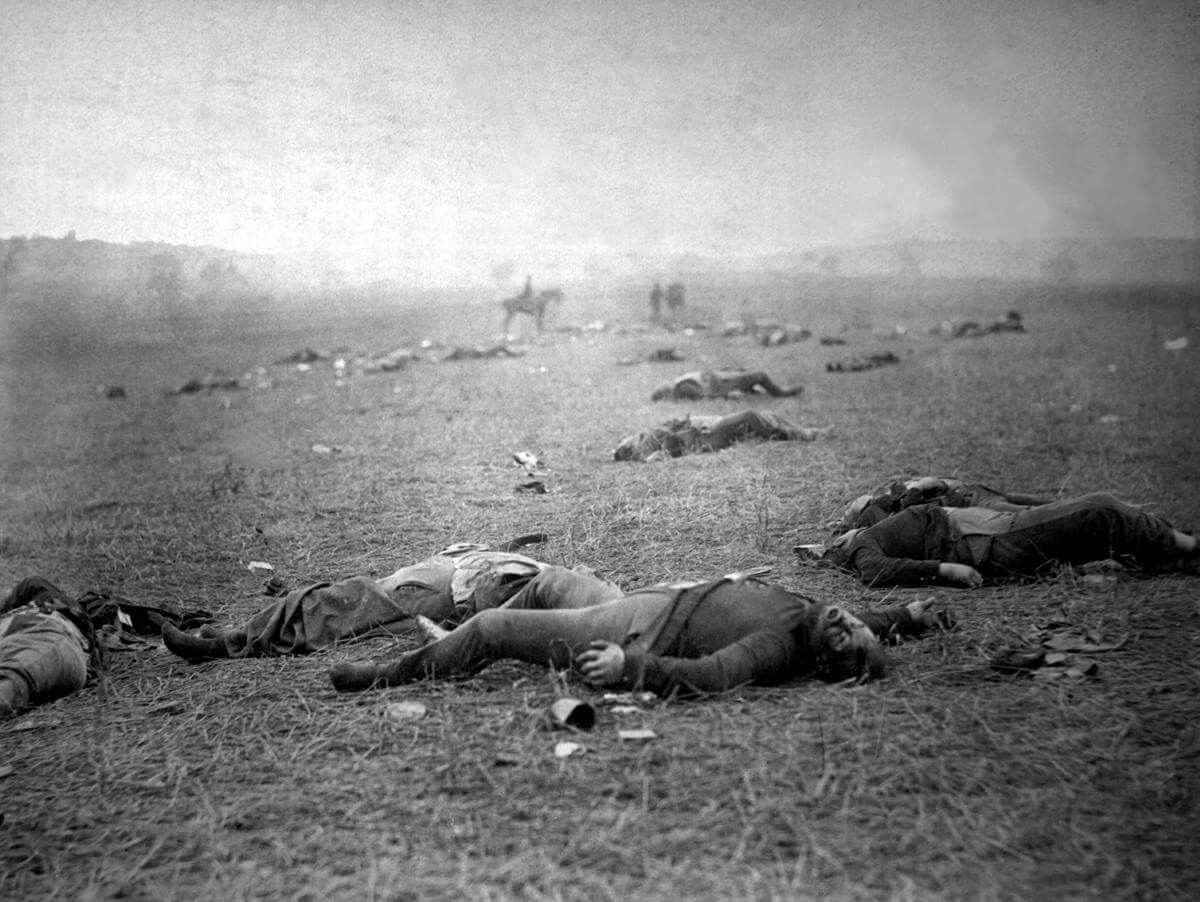
Incidents of the war. A harvest of death, Gettysburg, Pennsylvania, July 1863. Photograph by Timothy H. O'Sullivan. Courtesy of Wikimedia Commons. Image is in public domain.
Smith surveys the carnage at the Battle of Gettysburg, documented by the new technology of photography. The sensation that made the most lasting impression, however, was not that of sight but of stench. As one female diarist wrote:
Not the presence of the dead bodies themselves, swollen and disfigured as they were and lying in heaps on every side was as awful to the spectator as that deadly, nauseating atmosphere which robbed the battlefield of its glory, the survivors of their victory and the wounded of what little chance of life was left to them . . . A sickening, overpowering, awful stench announced the presence of the unburied dead upon which the July sun was mercilessly shining and at every step the air grew heavier and fouler until it seemed to possess a palpable horrible density that could be seen and felt and cut with a knife. (79)
Gettysburg was a "degenerative moment," Smith writes (7). It would take many grandiloquent speeches and solemn reconciliatory gestures to dispel the miasma and make it stand for something meaningful, a turning point.
Examining the Union siege of Vicksburg, Smith tells a harrowing tale of a city "taken by hunger." The Union forces under Grant dug in around the base of the terraced city, and kept up a constant bombardment of "shistling" bullets and pounding shells. Residents found shelter in newly dug caves, which provided a limited defense, and took a toll on the residents' comfort and dignity. "We went in this evening and sat down," one diarist wrote, and "the earthy, suffocating feeling, as of a living tomb, was dreadful to me. I fear I shall risk death outside rather than melt in that dark furnace" (98). Besides being reduced to a "troglodyte existence," the residents' diet was reduced and reduced again to "spoiled greasy bacon and bread made of musty pea-flour" (110). Ignominy as much as starvation precipitated surrender.
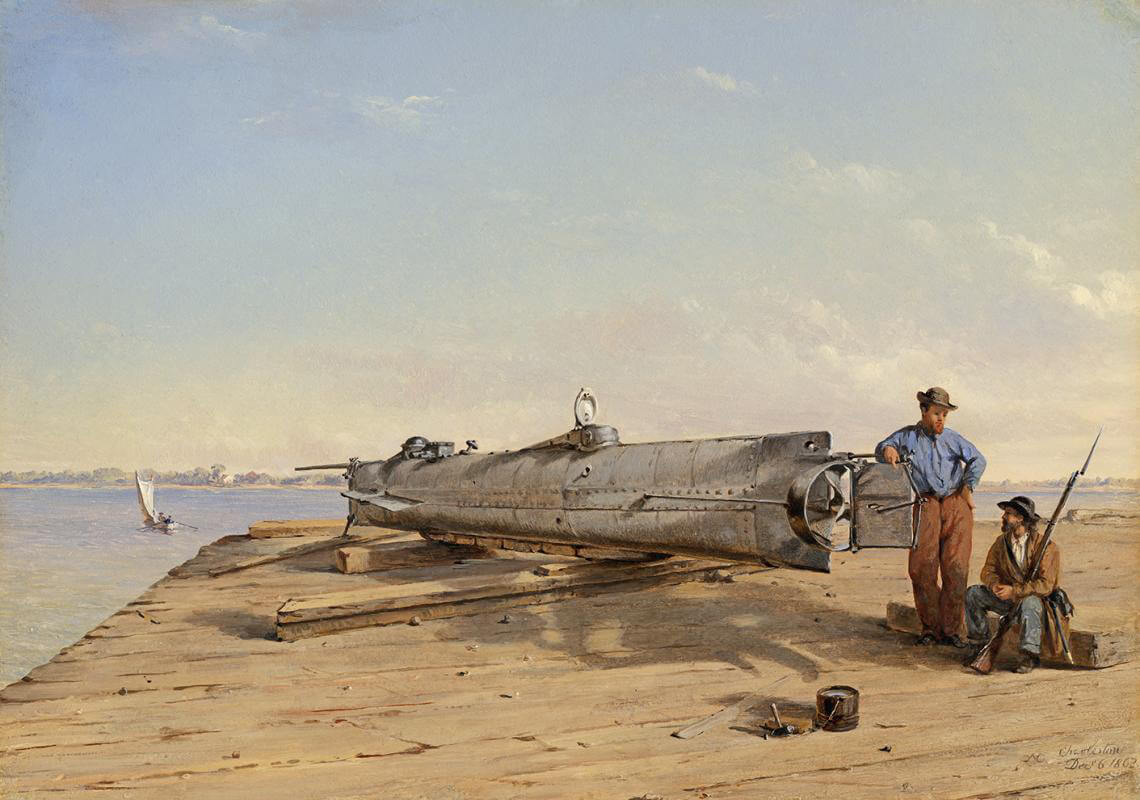
In the final chapter, Smith delves into the H.L. Hunley, a proud piece of Confederate technology, designed to break the US Navy's blockade of Charleston Harbor. The Hunley was an "underwater machine" consisting of a forty-foot-long refitted boiler (forty-eight inches in diameter) in which eight men turned cranks attached to the propeller shaft. A long arm protruded from the front of the vessel with a torpedo attached to its tip. Smith makes much of the cramped quarters, which imposed an unnatural proximity, and of the cranks' constant turning, which was reminiscent of slaves ginning cotton: "The Hunley men weren't slaves [they were volunteers], but they . . . willingly placed themselves in the condition of slaves—in the fight to preserve slavery" (128). Thanks to its underwater stealth, the Hunley succeeded at torpedoing and sinking the USS Housatonic, sowing great consternation, even though the entire crew drowned at their stations. This experiment in underwater warfare was not repeated.
Smith's epilogue revisits General Sherman's March, a swath of destruction up to sixty miles wide through the Confederate heartland, assaulting senses and resources, doling deprivation and misery while laying waste to buildings and crops in an effort to break Confederate will. Particularly loathsome to the defeated Southerners was the sight of the Union flag and the riling notes of "Yankee Doodle," not to mention the taunts. "Did you ever think of this when you hurrahed for Secession?" one Union soldier asked a white man in Columbia, as he gestured to the flames engulfing the city. "Your mouth is silenced now and it is worth every damn year of this bloody war. How do you like it, hey?" (144–45).
Smith's sensory history of the Civil War brings a dramatic new perspective to bear on this transformative event that gave rebirth to a nation. He tells a compelling story, based on diaries, letters, and other archival material. A number of questions remain unanswered, however. What of the sounds and expressions of the enslaved when out of earshot of the slaveowners? What did singing mean to them, and what messages did the songs convey? Smith has touched on these questions elsewhere, in Listening to Nineteenth-Century America (Chapel Hill: University of North Carolina Press, 2001), for example, but he does not address them in this book. For that, one might start with Lawrence W. Levine's Black Culture and Black Consciousness (New York: Oxford University Press, 1978). Levine succeeds at rendering the inaudible sensible in ways that Smith does not, for Smith's book is more a "history from above" (attuned to the anxious perceptions of the dominant society) than "from below" (attentive to the sonic and other practices of persistence and resistance of the subaltern).
The Smell of Battle, the Taste of Siege is a foundational work, both in sensory history and in the emergent field of conflict and the senses.1 Nicholas J. Saunders and Paul Cornish, eds., Modern Conflict and the Senses (New York: Routledge, 2017). It yields many important insights into the lived experience of the Civil War, and is certain to inspire further research into what ranks as the most traumatic event in US history.
About the Author
David Howes is a professor of Anthropology and Director of the Centre for Sensory Studies at Concordia University, Montreal. He is also the Director of the Concordia Centre for Interdisciplinary Studies in Society and Culture (CISSC). He teaches courses on law, commerce, aesthetics, and the senses in cross-cultural perspectives.
]]>Blog Post
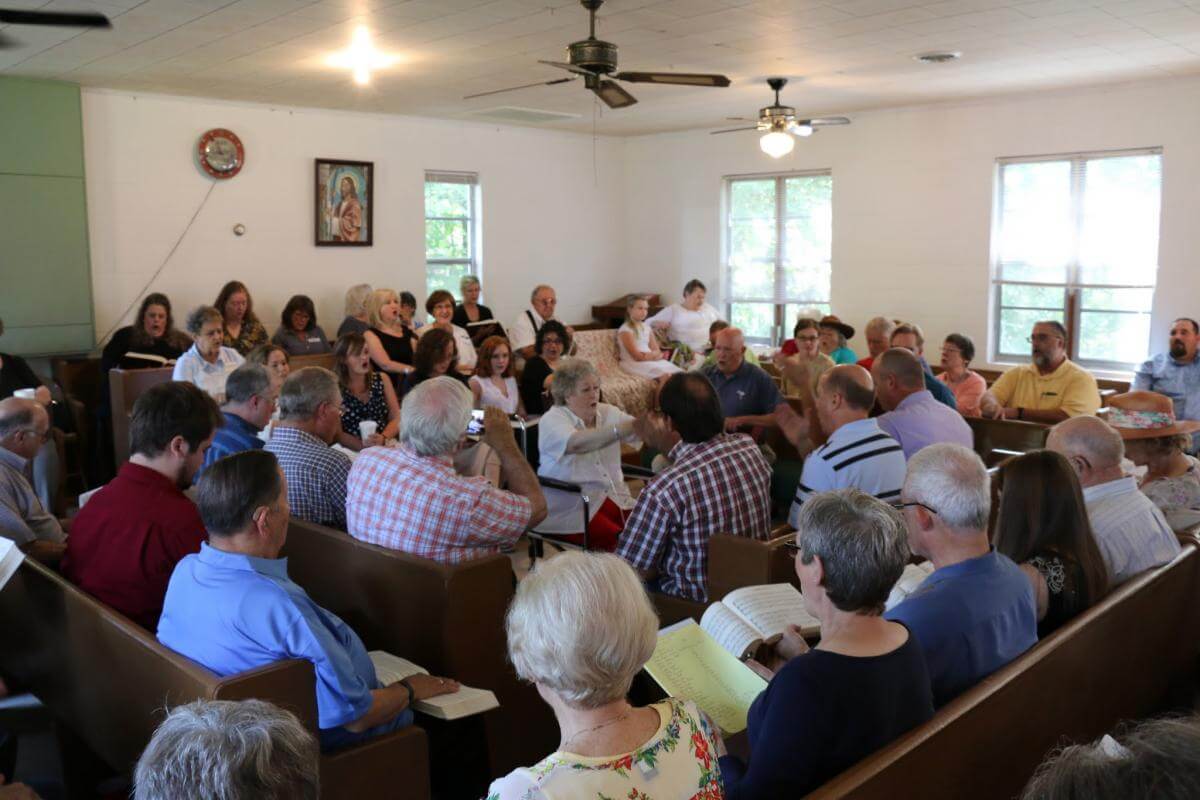
The Sacred Harp, a shape-note tunebook first published in 1844, has long been the center of a network of "singing conventions," weekend meetings featuring a cappella harmony singing at which participants take turns leading an informally assembled group in singing selections from the book. Beginning with singings in Georgia, Alabama, Florida, Tennessee, Mississippi, and Texas during the second half of the nineteenth century, participation in Sacred Harp has been tied to local, church, and kinship networks.1George Pullen Jackson, White Spirituals in the Southern Uplands: The Story of the Fasola Folk, Their Songs, Singings, and "Buckwheat Notes" (Chapel Hill: University of North Carolina Press, 1933); Buell E. Cobb, The Sacred Harp: A Tradition and Its Music (Athens: University of Georgia Press, 1989); David Warren Steel, The Makers of the Sacred Harp (Champaign: University of Illinois Press, 2010). In the twentieth century, however, The Sacred Harp's geography shifted to reach beyond these contexts. Scholars frequently recount the contours of these shifts in broad strokes bound up in narratives tied to folksong rhetoric and southern romanticism.2John Bealle, Public Worship, Private Faith: Sacred Harp and American Folksong (Athens: University of Georgia Press, 1997); Kiri Miller, Traveling Home: Sacred Harp Singing and American Pluralism (Champaign: University of Illinois Press, 2008). As the style came to be characterized as a folk music and included in American music curricula on college campuses in the second half of the twentieth century, singings spread to the Northeast, Midwest, and West Coast. Later, through these same channels, The Sacred Harp expanded to Canada, Europe, Australia, and East Asia.3Jesse P. Karlsberg, "Folklore's Filter: Race, Place, and Sacred Harp Singing" (Ph.D. dissertation, Emory University, 2015), http://pid.emory.edu/ark:/25593/pgtds; Ellen Lueck, "Sacred Harp Singing in Europe: Its Pathways, Spaces, and Meanings" (Ph.D. dissertation, Wesleyan University, 2016). Meanwhile, journalists and individuals across Sacred Harp's geography associated the style with "old-fogy" rural southern white culture in decline and regularly foretold the style's extinction in the southern states where it first thrived.4For examples and analysis of Sacred Harp singers' negotiation of the "old-fogy" label, see George Pullen Jackson, The Story of The Sacred Harp, 1844–1944: A Book of Religious Folk Song as an American Institution (Nashville, TN: Vanderbilt University Press, 1944); Hugh W. McGraw, "'There Are More Singings Now Than Ever Before': Hugh McGraw Addresses the Harpeth Valley Singers," Sacred Harp Publishing Company Newsletter 2, no. 3 (December 31, 2013), http://originalsacredharp.com/2013/12/31/there-are-more-singings-now-than-ever-before-hugh-mcgraw-addresses-the-harpeth-valley-singers; Karlsberg, "Folklore's Filter," 105–12.
In this post we complicate these narratives, drawing on a newly augmented database of the proceedings at thousands of Sacred Harp singings in the late twentieth and early twenty-first centuries, adding nuance and specificity to the story of Sacred Harp's recent geographic transformations. Minutes, summaries of the proceedings at annual Sacred Harp singings, constitute an integral part of this music culture. Elected or appointed secretaries originally published minutes in pamphlets or spread them through local newspapers. After World War II, rural depopulation caused local singing networks to contract, while improved infrastructure facilitated travel. During this time, a publication known colloquially as the "Big Minutes" grew out of the minutes pamphlets of a network of singings centered in Winston County, Alabama.5Editors of today's "Big Minutes" repeat the received history that the book originated as the minutes pamphlet of the Alabama State Sacred Harp Musical Convention, based in Birmingham, Alabama. However, minutes pamphlets in the collections of Winston County, Alabama, singers Roma Rice and Margaret Keeton, and the Carrolton, Georgia, Sacred Harp Museum, suggest that this Winston County-centered publication was the precursor to today’s “Big Minutes”; continuities in printer, editor, and singings between a set of 1930s and early 1940s minutes pamphlets for a group of singing conventions centered in Winston County, Alabama, and pamphlets published beginning in 1945 titled Minutes of the Alabama-Tennessee Sacred Harp Singing Conventions, and, after 1954, titled Minutes: Alabama, Mississippi and Tennessee Sacred Harp Singings, indicate a shared lineage. Today the "Big Minutes" are comprehensive: nearly all annual singings using the most common edition of The Sacred Harp disseminate their minutes through the volume. The "Big Minutes" contain appendices including contact information and birthdays for thousands of active singers, lists of singers who have died in the past year, and a directory of upcoming singings for the year. Still, the bulk of its contents are dedicated to documenting each singing held the previous calendar year.
These minutes for individual Sacred Harp singings are remarkable documents, providing a granular record of the musical taste and activities of each participant in this decentralized music culture. Minutes detail the name of each song leader, the page number(s) of song(s) each person led, the names of officers and committee members, these committees' reports, and even the timing of lunch and recesses. They also include information about the location of each singing, most often listing the city or town, state, and name of the church or other building where the singing was held.
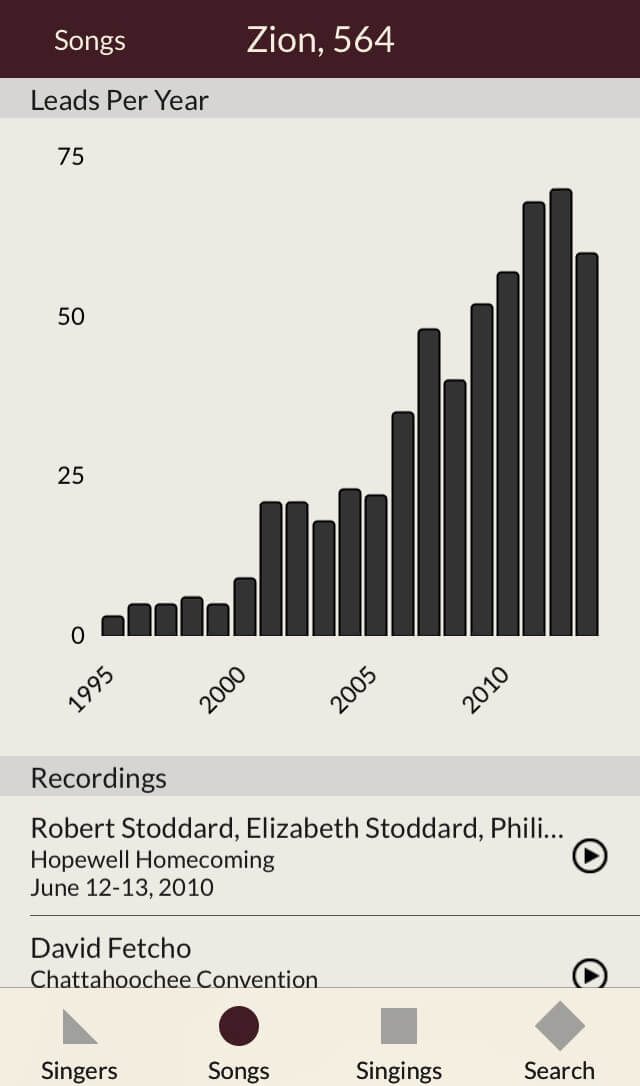
In 1995, a non-profit organization, the Sacred Harp Musical Heritage Association (SHMHA), assumed responsibility for the minutes and adopted a digital process enabling more streamlined production of annual print volumes and the publication of a searchable database.6To access this database or order a print copy of the contemporary "Big Minutes," see Judy Caudle, et al., eds., "Minutes and Directory of Sacred Harp Singings," Fasola.org, http://fasola.org/minutes/. Projects such as the FaSoLa Minutes iOS and Android app and the "Song Use in The Sacred Harp" statistics page on Fasola.org draw on the availability of the minutes in digital form to enable analysis of song use and leader behavior.7On the FaSoLa Minutes app, see Clarissa Fetrow, "There's an App for That: A Review of the 'FaSoLa Minutes' App," Sacred Harp Publishing Company Newsletter 3, no. 2 (November 12, 2014), http://originalsacredharp.com/2014/11/12/theres-an-app-for-that-a-review-of-the-fasola-minutes-app/. Thanks to its inclusion of location information, the minutes database also suggests the possibility of visualizing the geographical development of Sacred Harp over the past twenty years.
Our new mapping of Sacred Harp singings—drawing on minutes data—required enhancing the database used to publish the annual volumes. We began with data from 4,173 singings using The Sacred Harp: 1991 Edition held between January 1995 and December 2014.8Mark T. Godfrey created this dataset for the FaSoLa Minutes app and with Jesse P. Karlsberg supported Robert A. W. Dunn's research augmenting the data with precise locations. Godfrey's original dataset features enhancements to the SHMHA data and excludes 740 singings using other Sacred Harp editions and related shape-note books. These singings were initially excluded to ensure that page numbers included in the minutes reliably indexed specific songs in The Sacred Harp. The exclusions also improve the representativeness of the minutes, which feature nearly all annual singings from The Sacred Harp: 1991 Edition, but relatively few singings from other tunebooks, which typically disseminate their minutes through other publications. An array of variations from year to year and from singing to singing presented problems in creating a unified dataset. For example, different secretaries responsible for taking minutes at these singings adopted disparate approaches to the level of detail in naming singing locations.9Most secretaries include the names of buildings where singings are held, but others give names of larger institutions or campuses with multiple potential venues. A handful of singing minutes feature no specific location, instead providing just a city or town and county. Other minutes include a city or town but no county, or a county but no municipality. Additionally, a singing may undergo changes from year to year, as the building in which it was located may change names or the singing may move to a different location entirely, all while keeping the same singing name. Mapping the minutes required consistently adopting naming conventions found within the minutes so that each singing was given a building name, city/town, county, and state.
However, the majority of the work involved locating data not found in the minutes book. Through using a combination of web-based mapping services (such as Google Maps, Google Street View, MapQuest, and HERE), contacting dozens of singers who helped organize singings with hard-to-pin-down locations, and taking one field trip to a log cabin in Winston County, Alabama, we identified exact locations of all but thirty-one singings, complete with street names and numbers and, most importantly, GPS coordinates. This unified dataset with precise location data makes visualizing Sacred Harp's geographical shifts over the past twenty years possible to an unprecedented extent. The global timeline map (below) displays the locations of singings held each year between 1995 and 2014 in sequence.
Global Sacred Harp Singings, 1995–2014
Global Sacred Harp Singings, 1995–2014. Interactive Map by Jesse P. Karlsberg and Robert A. W. Dunn. View larger version.
The growth of Sacred Harp singings in Europe from a single annual event in England to a dense cluster with additional singings scattered across the continent, and the establishment of a singing in Australia, are perhaps the most noticeable of all changes on this world map. Even at this scale, changes within the United States, such as the increase in the density of singings in the Northeast and on the West Coast, are also visible.
Many more changes to the United States' singing geography are observable on a more regional scale. The zone stretching from West Georgia to West Alabama reveals a hotbed of Sacred Harp singing dating from the nineteenth century. Noticeable shifts are apparent between 1995 and 2014. These changes affirm that singings have ceased to be held in some counties, yet demonstrate that strong networks persist in other areas, undercutting the overdetermined narrative of the decline of southern singings. Our visualizations demonstrate that what began in 1995 as a solid strip of singings stretching across this area of the Alabama and Georgia upcountry had by 2014 coalesced into discrete spatial clusters. Interconnected networks of singings persisted in Walker, Winston, and Cullman Counties north of Birmingham; in northeast Alabama; and on the Alabama-Georgia border in Cleburne County, Alabama, and Haralson, Carroll, and Heard Counties, Georgia.
Alabama and Georgia Upcountry Sacred Harp Singings, 1995–2014
Alabama and Georgia Upcountry Sacred Harp Singings, 1995–2014. Interactive Map by Jesse P. Karlsberg and Robert A. W. Dunn. View larger version.
In the Birmingham and Atlanta metropolitan regions, the number of singings has held steady even as their geography has shifted, revealing nuance obscured by the overarching narrative of southern decline. In Birmingham, the number of annual singings remains constant while their locations move out of the city center (view interactive map). In Atlanta, singings held in north Fulton County are steadily supplanted by those held towards the center of DeKalb County (view interactive map).
The visible growth of Sacred Harp singings in southern states outside of historical singing areas, perhaps most noticeable in South Carolina (view interactive map) and Arkansas (view interactive map), undercuts the binaristic opposition of growth in the North and decline in the South. Before 1999, there were no Sacred Harp Singings held in South Carolina. By 2011, there were four annual singings held across the state. Arkansas, at its peak, featured three singings, none of which were held in 1995. (The state presently features two.)
Mapping minutes data also adds specificity to the story of Sacred Harp's expansion to other parts of the United States. Popular narratives date the style's expansion as occurring in the 1970s and 1980s, in the immediate aftermath of Sacred Harp's incorporation into the folk revival. Yet the mapping of minutes data reveals a later acceleration of the style's spread beyond the South in the 1990s and 2000s. No annual singings were held in Pennsylvania in 1995, yet singings proliferated in the eastern part of the state over the subsequent two decades, and spread to the central and western part of the state from 2008 to 2010 (view interactive map). Eight singings were held in Pennsylvania in 2014. Sacred Harp singing also grew steadily in the Pacific Northwest, from one singing in the mid- to late 1990s, to seven annual singings in 2014 (view interactive map). Even in New England, where the oldest continuously held annual singing outside the South celebrated its fortieth anniversary in the fall of 2016, mapping the minutes reveals a dramatic expansion from a single annual singing in 1995 to eleven events in 2014 (view interactive map).
New England Sacred Harp Singings, 1995–2014
New England Sacred Harp Singings, 1995–2014. Interactive Map by Jesse P. Karlsberg and Robert A. W. Dunn. View larger version.
Visualizing the changing geography of singings from The Sacred Harp: 1991 Edition also demonstrates shifts in the balance of singing from different Sacred Harp editions and the growing comprehensiveness of the "Big Minutes" compilation. In Texas, where singings generally feature the descendant of a competing early-twentieth-century revision of The Sacred Harp known as the "Cooper Book," mapping reveals the inroads made by the 1991 Edition in the state, growing from two singings in 1995 to six singings in 2014 (view interactive map).10On the social context of the increasing number of singings from the 1991 Edition in Texas since the 1990s, see Karlsberg, "Folklore's Filter," 118–24. The increase in singings in the area of middle and south Georgia around Macon and Thomaston (view interactive map) and in east central Alabama near Alexander City is due to the decision of longstanding networks of singings from the 1991 Edition that continued to publish their own separate minutes pamphlets to affiliate with the "Big Minutes" in the late 1990s and early 2000s.11The South Georgia Convention, a network of a dozen singings from the 1991 Edition centered around Macon and extending south to Cordele, Georgia, continues to publish an annual minutes pamphlet, even as its sponsored singings increasingly submit minutes to the "Big Minutes."
Our augmentation of born-digital Sacred Harp minutes data dating back to 1995 affords an unprecedented look at the extent to which the use of The Sacred Harp: 1991 Edition has shifted in the past two decades, complicating popular narratives of the style's northern spread and southern decline. A team of volunteers is currently processing digitized minutes from fifty annual volumes going back to 1945, produced prior to the digitization of the minutes' production process, part of a plan to expand the database that we augmented to create these maps.12For more on this process and a collection of research drawing on the expanding Sacred Harp minutes database, see "Sacred Harp Minutes: Querying Sacred Harp's Sonic Past through the Minutes of Sacred Harp Singings, 1945–2016," 2017, http://fasolaminutes.org/. We hope this marks the beginning of the process of drawing insights from the extraordinarily comprehensive and granular record of participation in a music culture that the Sacred Harp minutes provide.
Additional Maps
- Metro Birmingham (Alabama)
- Metro Atlanta (Georgia)
- South Carolina
- Arkansas
- Pennsylvania
- Pacific Northwest
- Texas
- South Georgia
Acknowledgments
The authors would like to thank Chris Thorman, Mark T. Godfrey, and Judy Caudle for their assistance obtaining and editing minutes data and Megan Slemons, Stephanie Bryan, and the rest of the Southern Spaces staff, for their assistance producing this post.
About the Authors
Jesse P. Karlsberg is the Senior Digital Scholarship Strategist at the Emory Center for Digital Scholarship and the consulting editor of Southern Spaces. A scholar of digital publishing and American music, Jesse is the editor of Original Sacred Harp: Centennial Edition (Pitts Theology Library and Sacred Harp Publishing Company, 2015). His 2015 dissertation, "Folklore's Filter: Race, Place, and Sacred Harp Singing," earned honorable mention for the Society of American Music's Wiley Housewright Dissertation Award.
Robert A. W. Dunn is a music and historical research consultant for the Emory Center for Digital Scholarship’s Sounding Spirit project. He is a Sacred Harp singer and musician and graduated in 2016 from Emory University with a BA in History and Music.
]]>Presentation
Question and Answer Session
About the Speaker
Niall Atkinson is Neubauer Family Assistant Professor of Art History and the College at the University of Chicago. His publications include The Noisy Renaissance: Sound, Architecture, and Florentine Urban Life (University Park: Penn State University Press, 2016), as well as articles and chapters in Grey Room, Senses and Society, and A Companion to Renaissance and Baroque Art (Hoboken, NJ: Wiley-Blackwell, 2013).
]]>
My childhood family vacations included mandatory excursions to museums, libraries, and historical sites. To ensure that my little brother and I "enjoyed" cultural experiences of all stripes, we toured the Smithsonian in Washington, DC, Martin Luther King Jr.'s grave at the King Center in Atlanta, Georgia, and the Boston Children's Museum. Much to my parent's dismay, I was much more interested in playing outside with friends, drawing superheroes, and tormenting my little brother than in appreciating educational tourism.
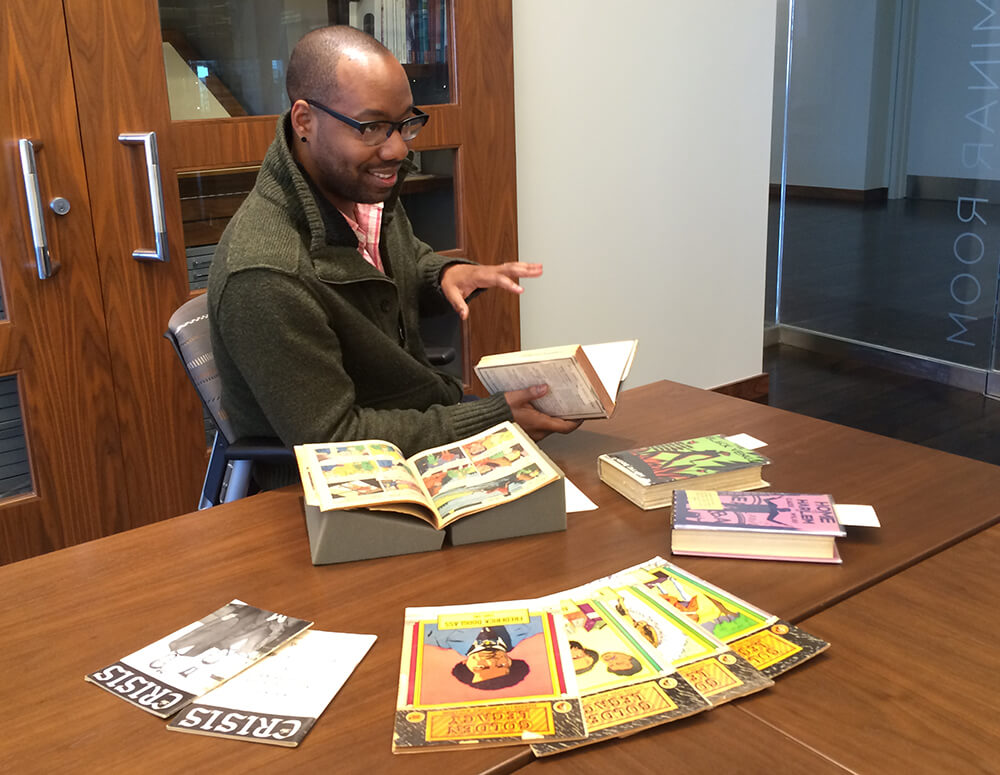
Today, as a doctoral student in Emory University's Institute for the Liberal Arts, I research contemporary science fiction and fantasy, focusing on the literary and visual cultures of Afrofuturism. My research takes me into the Stuart A. Rose Manuscript, Archives, and Rare Book Library where I read the late twentieth century writings of Octavia Butler, Steven Barnes, and Samuel R. Delany alongside the visual images of early 20th century artists, like Aaron Douglas.
Exploring connections across genres and time periods, as well as class and color lines, I look for imagined black futures in archival holdings. In addition to my research, I work as an assistant curator for the African American Collections in the Rose library, creating programs that connect undergraduates to Emory's archives. My twelve-year-old self would marvel at this transformation: somewhere between grade school and graduate study, I learned to appreciate smelly old books, discolored newspapers, and indecipherable manuscripts. I blame my parents—after all, they planted the seed that is now blossoming into full-blown archive fever.
My scholarly interests and newfound archival passions come together in the monthly LiFT art salons that bring young Atlantans into local museums and historic sites. On November 22nd 2015, LiFT hosted the #DareToBe event at the Hammonds House Museum, a nineteenth-century home that has served as one of Atlanta's premiere institutions of black art since 1988. The #DareToBe event targeted Atlanta University Center (AUC) students, hoping to encourage a substantive dialogue in one Atlanta neighborhood.
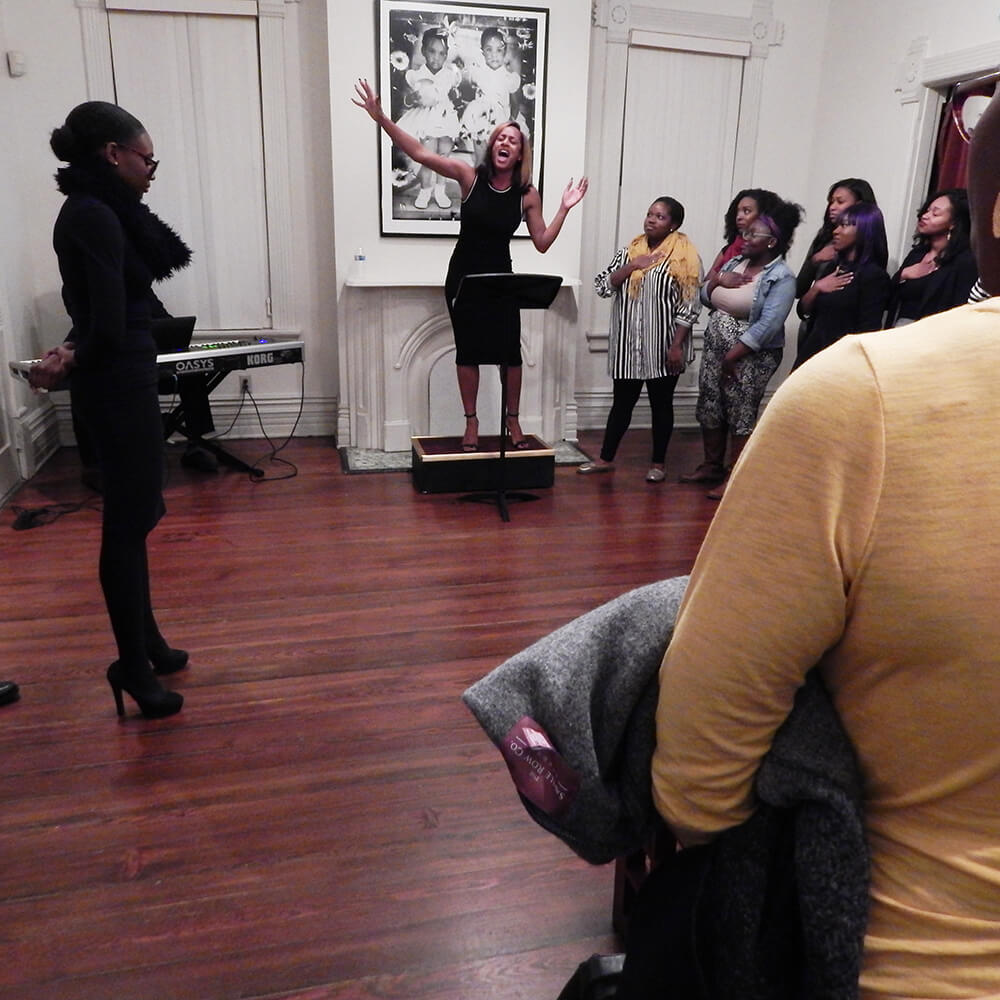
The AUC is a collective of Historically Black Colleges and Universities that include Morehouse College, Morehouse School of Medicine, Spelman College, and Clark Atlanta University. While these institutions share West End real estate, close proximity does not necessarily imply longstanding relations between current AUC students and their host neighborhood. On the contrary. During my time as a Morehouse undergraduate, I stayed primarily on campus and rarely connected with the West End or the Atlanta metro region. By hosting #DareToBe at the Hammonds House Museum, LiFT encouraged AUC students to get off campus and to understand themselves within broader networks.
LiFT team members collaborated with two Spelman professors to plan, promote, and stage the gathering. Professor of drama and renowned playwright and dance instructor Aku Kadogo joined forces with Glee Club director Dr. Kevin Johnson to design the fall 2015 "Collaborative Arts" seminar that culminated in LiFT's #DareToBe event. For her final project, each student created a project to perform or feature at the Hammonds House gathering. This creative activity stretched many students beyond their comfort zones, asking them to be artists and creators.
#DareToBe was staged in each room of the Hammonds House, inviting the Spelman students to consider the home's architecture as an active participant in their creative process. With students singing, dancing, and acting across the building's footprint, the museum transformed into a living, breathing art studio. In total, there were four performances: "Mathematical Proof" featured a spoken word performance accompanied by piano and backup vocals. "Chorepoem" cast four Spelman women in an interactive performance celebrating black womanhood. "Karrah 4 Prez" envisioned a black female presidential candidate in a one-act scene. The final performance, "#Daretobe Anthem", brought the entire class together to perform an original song.
For Professor Kadogo, the event extended one Spelman classroom beyond the campus gates:
Connecting our Spelman College students with the historic Hammonds House proved to be an invaluable experience. The Spelman students participated in networking, decision-making, and performance creation. As part of our process, we visited the Hammonds House and toured the entire museum, deciding along with LiFT curator Shady Patterson and event coordinator Miriam Denard where each performance might best be stationed to facilitate a "walking tour" performance event.
Working in collaboration with LiFT, the students gained encouragement and inspiration, realizing that they were creating something that other people wanted to experience.1Aku Kadogo, phone interview with author, March 10th, 2016, Atlanta, Georgia. Transcription by author.
The students' performances generated an energized talk-back with the crowd. During the question and answer session, attendees engaged the students as artists, probing them about their creative process and performance experiences. Many students shared that the LiFT event prompted their first visit to the Hammonds House, signaling to them the importance of historic institutions in their neighborhood and beyond. Event attendees shared similar stories about a lack of familiarity with local museums and cultural institutions.
LiFT Art Salon measures success by the relationships it builds between people, institutions, and their histories, specifically between those spaces that narrate black history and Atlanta's young African American population. I know first-hand that nurturing these relationships takes the time and investment of an engaged community of elders, scholars, and teachers. The LiFT team learned a valuable lesson at #DareToBe. In order to make museums and archives accessible to a new generation, we need to build hands-on, interactive experiences that invite young Atlantans to actively engage the city's diverse centers and institutions. At our monthly gatherings, LiFT attempts to demonstrate to a new constituency that cultural institutions are not merely repositories. Instead, as I am reminded each time I comb the archives or plan a LiFT event , these sites serve as creative commons for those who dare to enter and be.
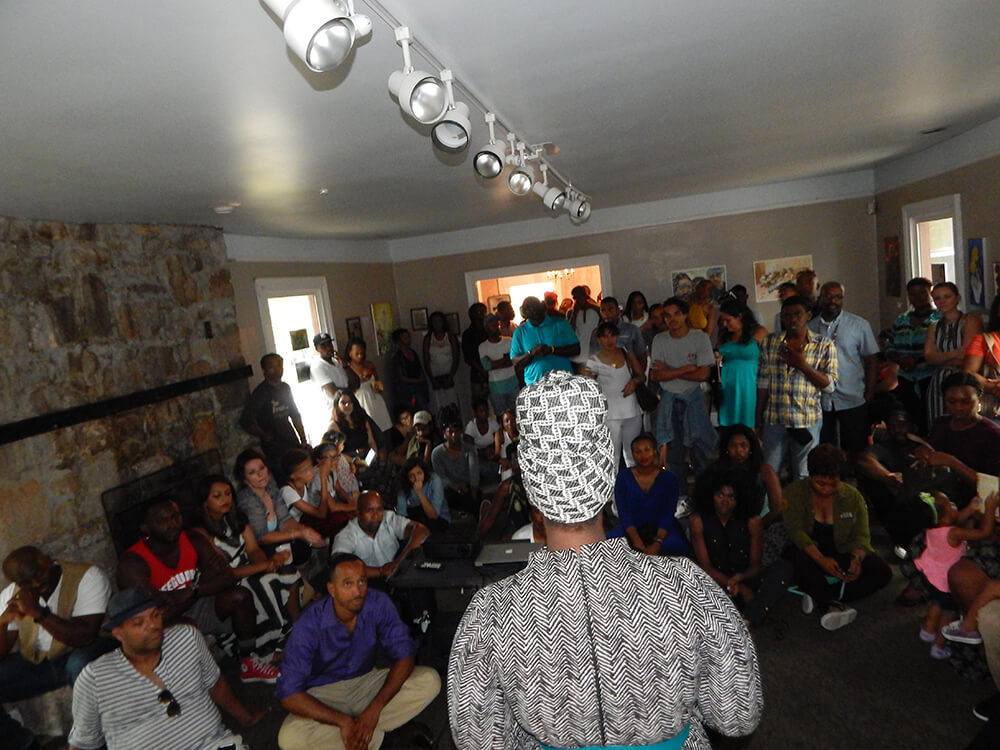
I grew up in metro Atlanta watching revitalization efforts spread across the city's many neighborhoods. The rebranding of City Hall East, Krog Street, and the Atlanta Railroad as Ponce City Market, Krog Street Market, and the celebrated Atlanta Beltline underscores a shared aesthetic at the heart of development projects that map new bastions of commerce onto existing urban footprints. Many mixed-use projects include residential neighborhoods replete with spaces targeting Atlanta's young creatives: performance venues for live music and art shows, community spaces for job talks and self-improvement classes, and ubiquitous coffee shops and bars. These developments are creating new buzz about Atlanta's future.
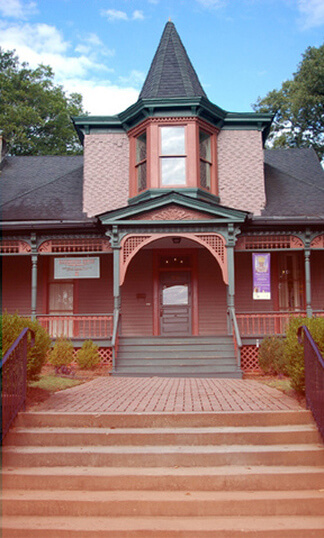
But urban hot spots do not emerge in a vacuum. Instead, they often pop up in black neighborhoods, crowding out institutions vital to artistic and cultural flourishing. Take for example, the next planned stop on the Atlanta Beltline: the Westside. In addition to the Atlanta University Center (AUC), the Westside is home to several black cultural centers, including The Hammonds House Museum, The Wren’s Nest, The Shrine of the Black Madonna, and the Herndon Home Museum. While these institutions do not have the financial resources to refashion their neighborhoods as Atlanta's next "go-to" destinations, they do possess something invaluable to the city’s future—black history.
LiFT Art Salon intentionally operates out of historically black buildings, spaces, and cultural centers to redirect Atlanta's young adult population to institutions with long histories of community-building through arts activism and education. In this spirit, we hosted one of our first LiFT gatherings in the Hammonds House Museum. Founded in 1988, the Hammonds House Museum serves as one of Atlanta's premiere institutions of African American and African diasporic art. The July 12, 2015, event was titled #homeplace, an homage to bell hooks's essay about black women's homes as sites of resistance and to Hammonds House original owner and resident Otis Thrash Hammonds, a prominent Atlanta physician and avid black art collector.
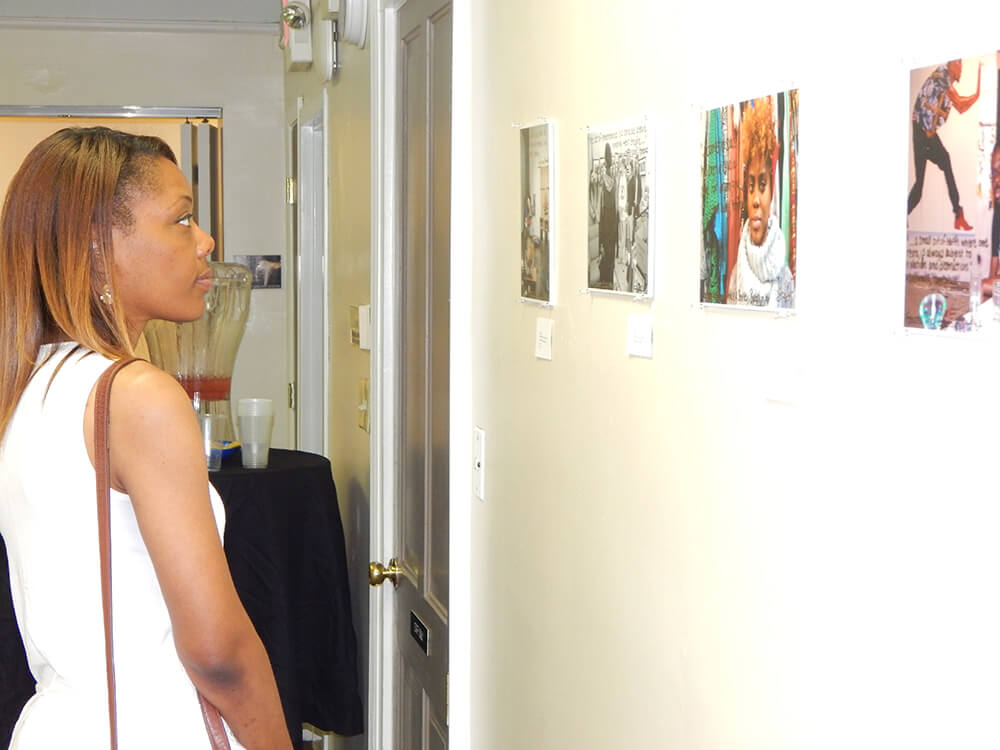
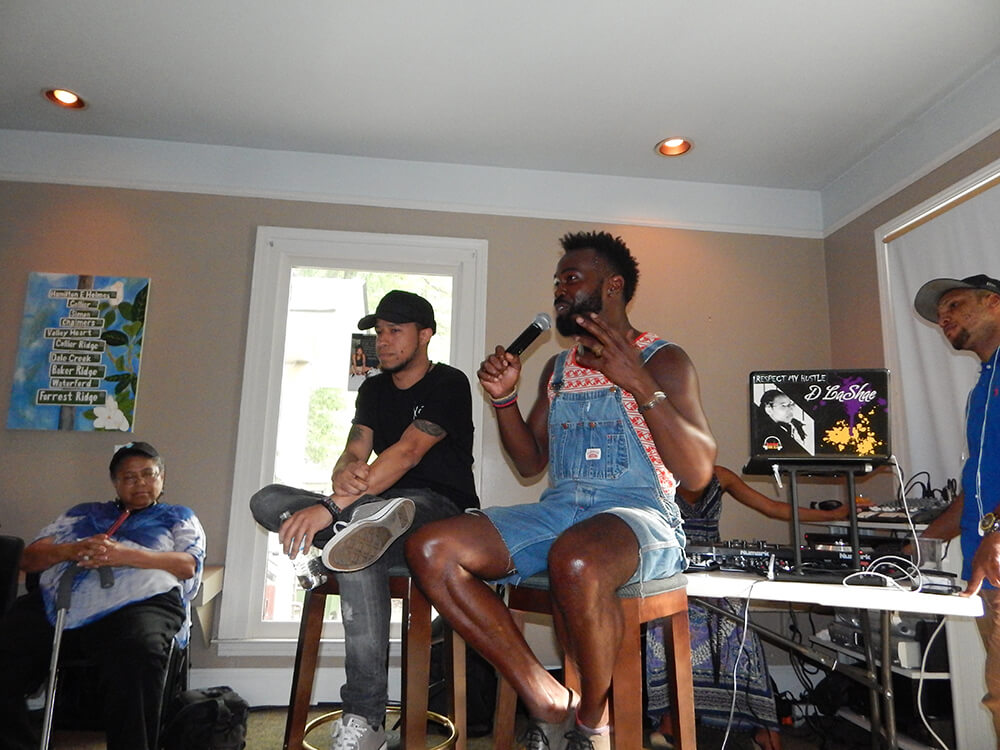
To celebrate #homeplace and showcase the historic building, our event included four components staged across the footprint of the Hammonds House. The first act featured an exhibit of visual art from the LiFT Art Collective. Curated by Shady, each visual artist produced work that interpreted homeplace. Stephanie Alvarado offered a spoken word performance about the challenges of finding "home" as a South American émigré to New York City. WERC Crew's Xavier Blk and Will Edmond, two of Atlanta's hottest DJs and party promoters, discussed their business philosophy and the "creative" benefits of living as a collective. Finally, hometown R&B singer, Donnie, gave a concert in the Hammonds House courtyard.
Over the course of the event, the performances came together in unexpected ways. In a recent interview, event coordinator Miriam Denard explained how the performers and attendees drew inspiration from the museum and its standing exhibits:
This event really opened our eyes to the variations of expression and experience we can have at each Art Salon without losing the essence of the event. People were up and moving around and able to sit by different guests, sharing the experience. And then to end the evening with live, outdoor music was really special because it pulled the theme—of the home as place of community, affirmation, and resistance—together with the standing exhibits on display at the Hammonds House Museum.1Miriam Denard, phone interview with author, January 15th, 2016, Atlanta, Georgia. Transcription by author
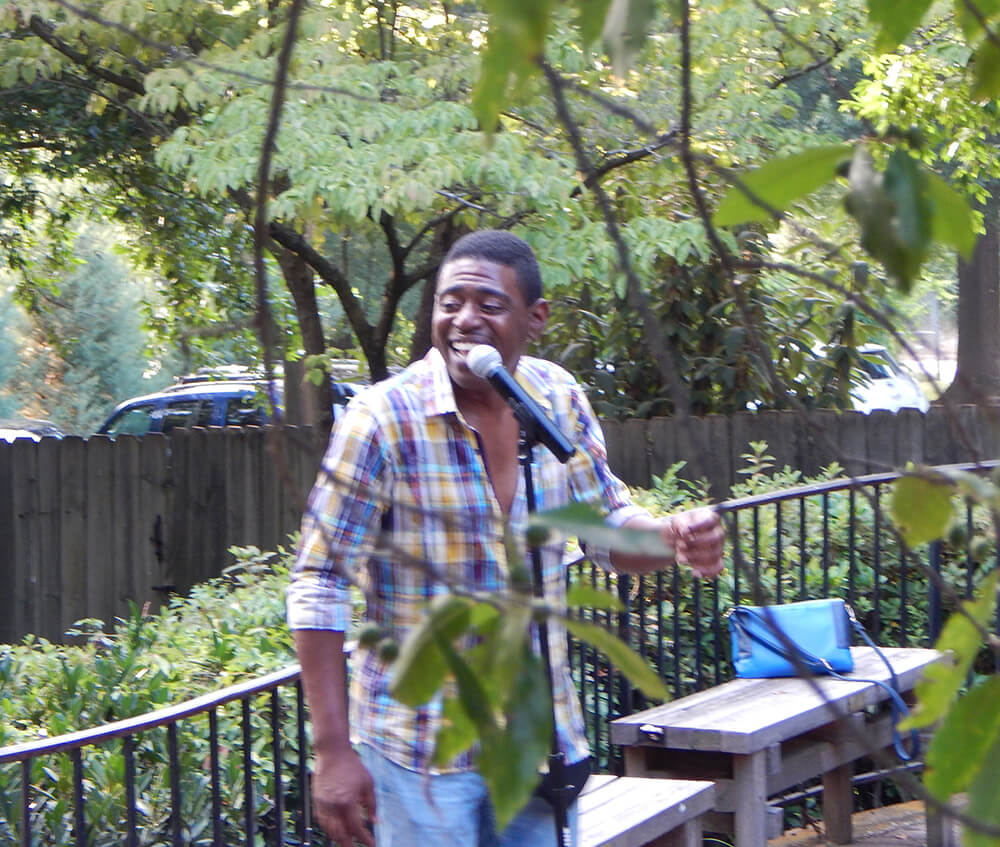
Lydia Harris's photography exhibit "The View From Collier Heights" was hanging during the #homeplace event. Harris's exhibition featured a collection of photos from Collier Heights, a neighborhood developed in the 1950s to house Atlanta's sizable and growing black middle class. Harris's photos captured both the facades and interiors of the homes and provided a visual backdrop to the LiFT performances.
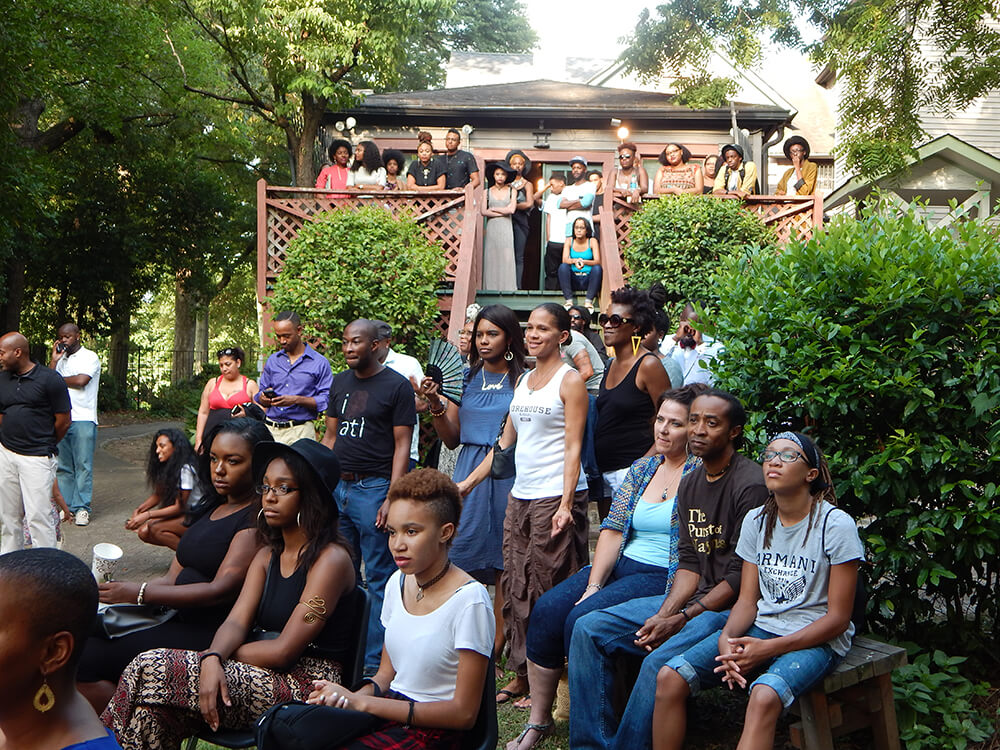
We packed a lot of punch into this first of several events that LiFT hosted at the Hammonds House in 2014 and 2015. As Atlanta makes important strides towards revitalizing urban neighborhoods, LiFT understands its work as making visible, promoting, and drawing on the rich histories of institutions and cultural centers already in place and at work across the city. LiFT Art Salon challenges readers and event attendees to look long and hard at neighborhoods undergoing revitalization and gentrification; often, beneath the shiny facades and new aesthetics, vibrant, intentional black communities are already in place.
]]>Poem
Zircon
When my great-uncles dug for zircons on
the mountainside and on the pasture hill
a hundred years ago they'd no idea
the little crystal bit they sought would be
a token from the planet's fiery birth.
For zircons are almost as old as earth's
creation in the conflagration from
debris that formed the galaxies of suns.
This tiny stone found in the family dirt's
a kind of clock they say, a register
of time from the beginning since it traps
uranium and other elements
decaying at a steady measured rate.
The zircon lasts when mother rocks around
have crumbled, worn away to sand. It keeps
the fingerprints of isotopes from clouds
of the original primordial dust,
right here where spiders hide in rotting duff.
Acknowledgements
"Zircon", from DARK ENERGY by Robert Morgan, copyright © 2015 by Robert Morgan. Used by permission of Viking Books, an imprint of Penguin Publishing Group, a division of Penguin Random House LLC. This film was produced by Emma Lirette, Clint Fluker, and Tim Rainey II.
About the Author
Robert Morgan is the author of fifteen books of poetry, most recently Dark Energy (Penguin, 2015). He has also published nine volumes of fiction, including Gap Creek (1999), a New York Times bestseller. A sequel to Gap Creek, The Road From Gap Creek, was published in 2013. A new novel, Chasing the North Star, is forthcoming in April 2016. In addition, Morgan is author of three nonfiction books, Good Measure: Essays, Interviews, and Notes on Poetry, 1993; Boone: A Biography, 2008; and Lions of the West: Heroes and Villains of the Westward Expansion, 2011. In 2010 a special issue of The Southern Quarterly, edited by Jesse Graves, was devoted to essays about his work. Morgan was awarded the James G. Hanes Poetry Prize by the Fellowship of Southern Writers and the Academy Award in Literature by the American Academy of Arts and Letters. In 2013 he received the History Award Medal from the Daughters of the American Revolution. As a recipient of fellowships from the Guggenheim and Rockefeller foundations, the National Endowment for the Arts, and the New York State Arts Council, Morgan has served as visiting writer at Davidson College, Furman, Duke, Appalachian State, and East Carolina universities. A member of the Fellowship of Southern Writers, Morgan was inducted into the North Carolina Literary Hall of Fame in 2010. Born on October 3, 1944 in Hendersonville, North Carolina, he has taught since 1971 at Cornell University, where he is Kappa Alpha Professor of English.
]]>