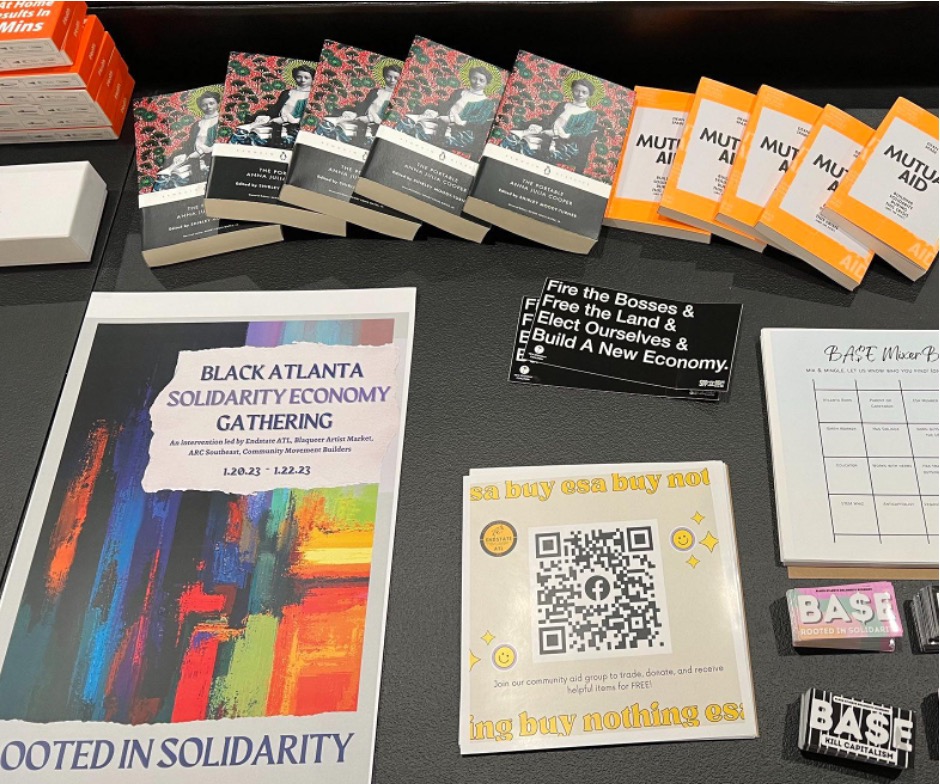
In May of 2023, when the World Health Organization downgraded the coronavirus emergency from a global health pandemic to an "ongoing health crisis," the shift made sense in many ways. Most developed nations have made vaccines available for over two years. Shutdowns and enforced quarantines ended, even in holdout nations. The WHO's announcement signaled that other countries, including the United States, would follow suit if they had not already. This move, however, will have material consequences for grassroots charitable organizations across the US. Endstate ATL (ESA), a group I have worked with since 2021, is one of many non-profit groups that will be affected.
In Georgia, the COVID state of emergency officially ended in May 2022, even as it remained in place at the national level. This allowed organizations like ESA to continue our mutual aid work. But when the US announced the end of the Federal COVID-19 Public Health Emergency (PHE) Declaration on May 11, 2023, enhancements to public assistance and social safety net programs ceased. From this point on, groups like ESA once again will have to jump through multiple bureaucratic hoops to obtain the funding necessary to provide care.
Following the global outbreak of COVID in 2020 many governments created temporary measures to extend aid to vulnerable populations. In the US, these included extensions of unemployment benefits, a moratorium on student loan interest and payments, no-cost COVID testing and vaccinations, Medicare flexibility, and opportunities to provide nontaxable disaster relief funds. The national government also released relief funds to individual state governments, although often these funds did not reach the people who needed them.1Rebecca Riess and Devon M. Sayers, "Alabama Governor Signs Bill to Use Covid-19 Relief Funds to Build Prisons," CNN, October 1, 2021, https://www.cnn.com/2021/10/01/politics/alabama-covid-relief-prison-bills-signed-governor-kay-ivey/index.html. Despite the uneven distribution of aid, many people, specifically children and elders, moved above the poverty line thanks to COVID assistance.2John Creamer, "Supplemental Poverty Measure That Accounts for Additional Government Benefits Lowest on Record at 7.8%," Census, September 13, 2022, https://www.census.gov/library/stories/2022/09/government-assistance-lifts-millions-out-of-poverty.html.
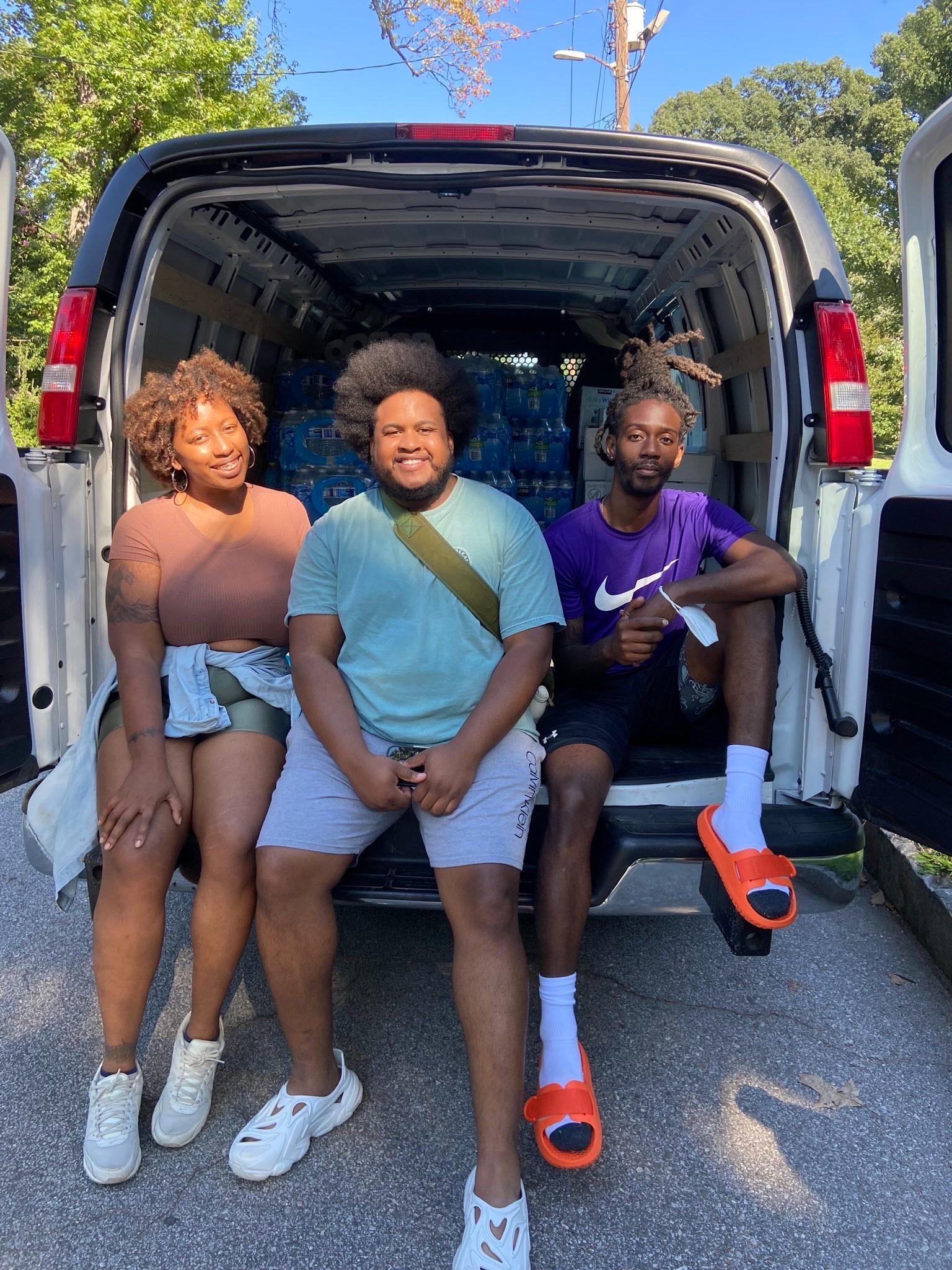
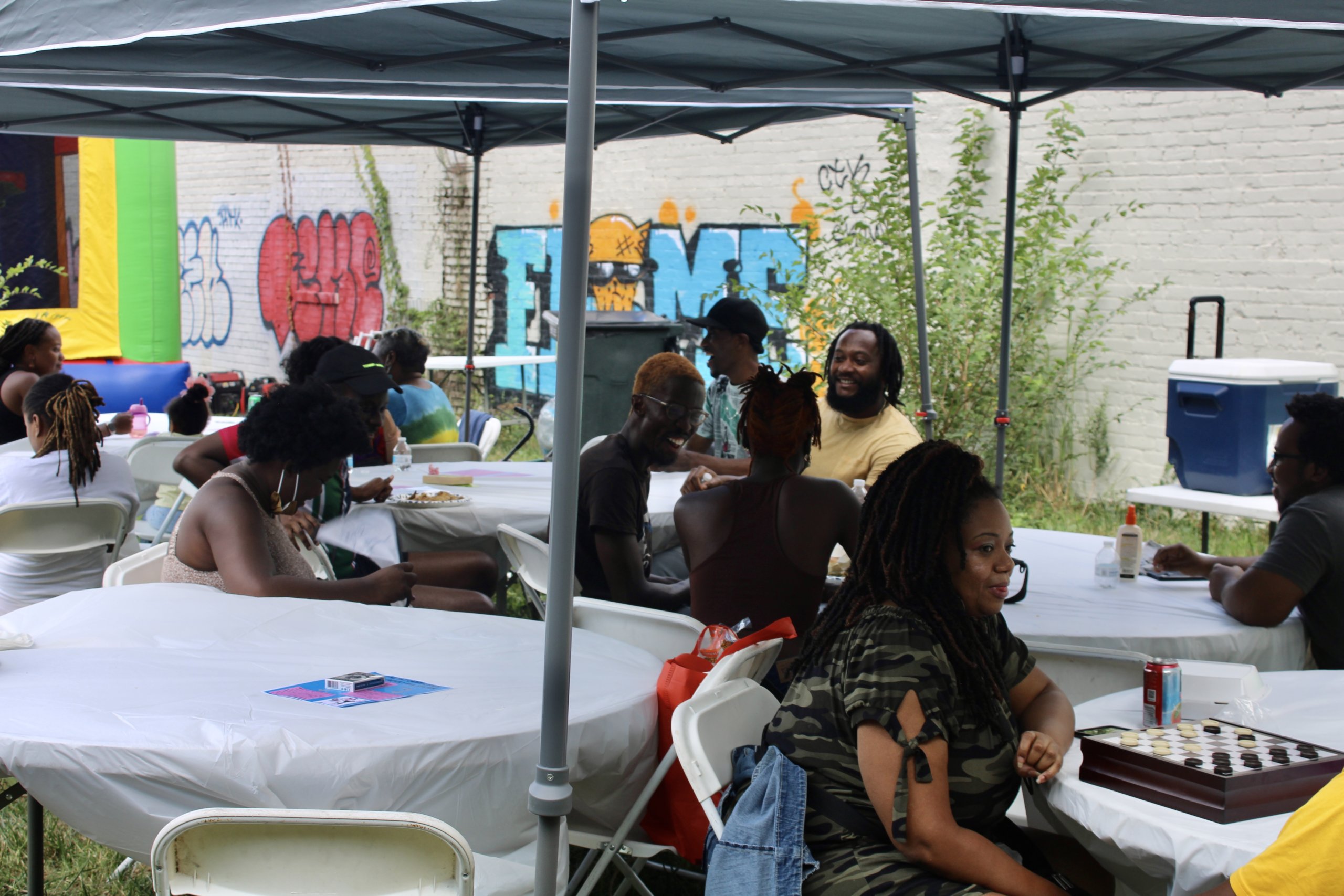
The flexibility surrounding nontaxable disaster relief funds eased mutual aid work. Mutual aid has a long history in the US and Global South, and the onset of the COVID-19 pandemic witnessed an outpouring of community solidarity towards those in need. Mutual aid stands apart from other charity models because of its non-hierachal emphasis on mutualism rather than models that maintain divisions between givers and receivers. Mutual aid is rooted in reciprocity.
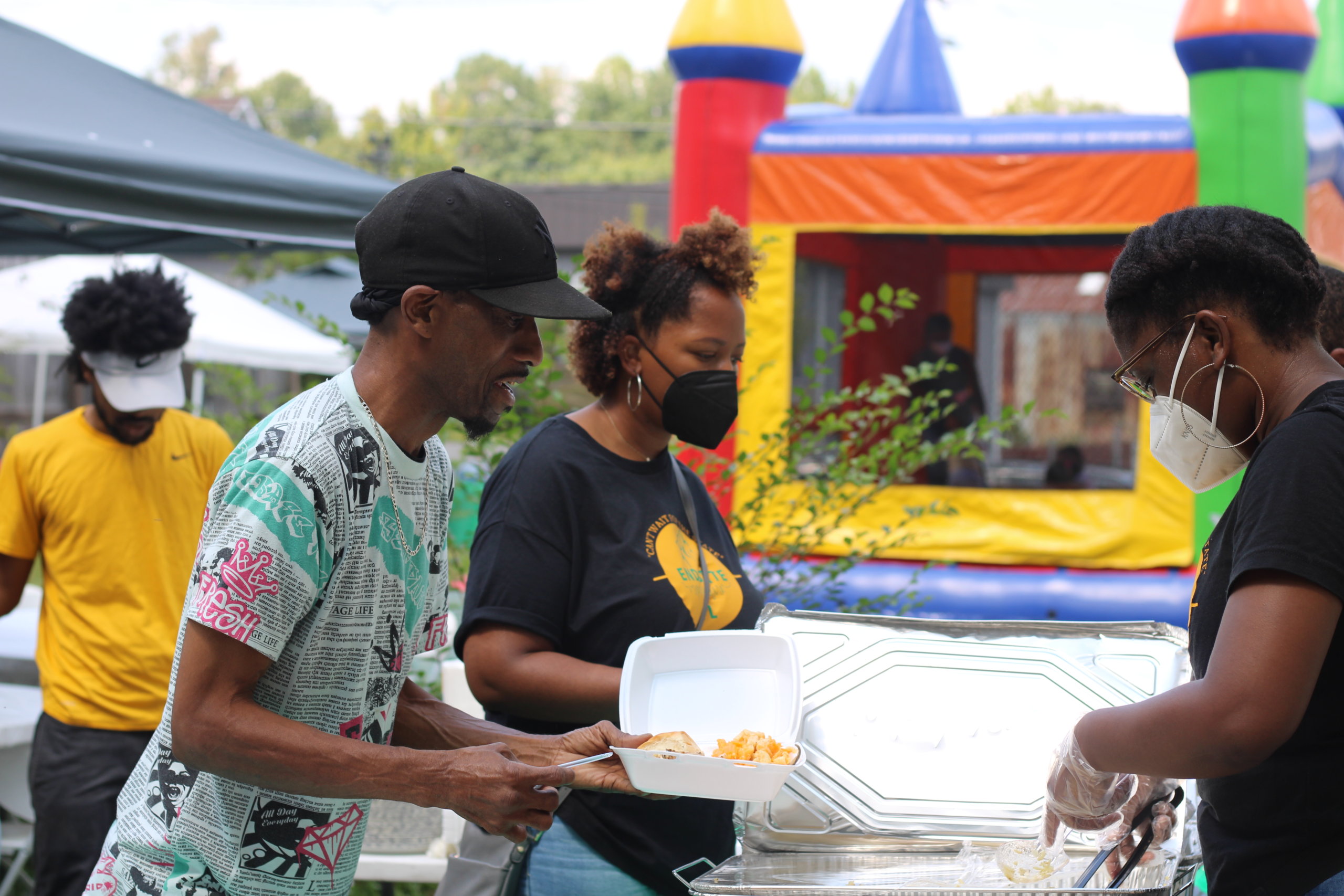
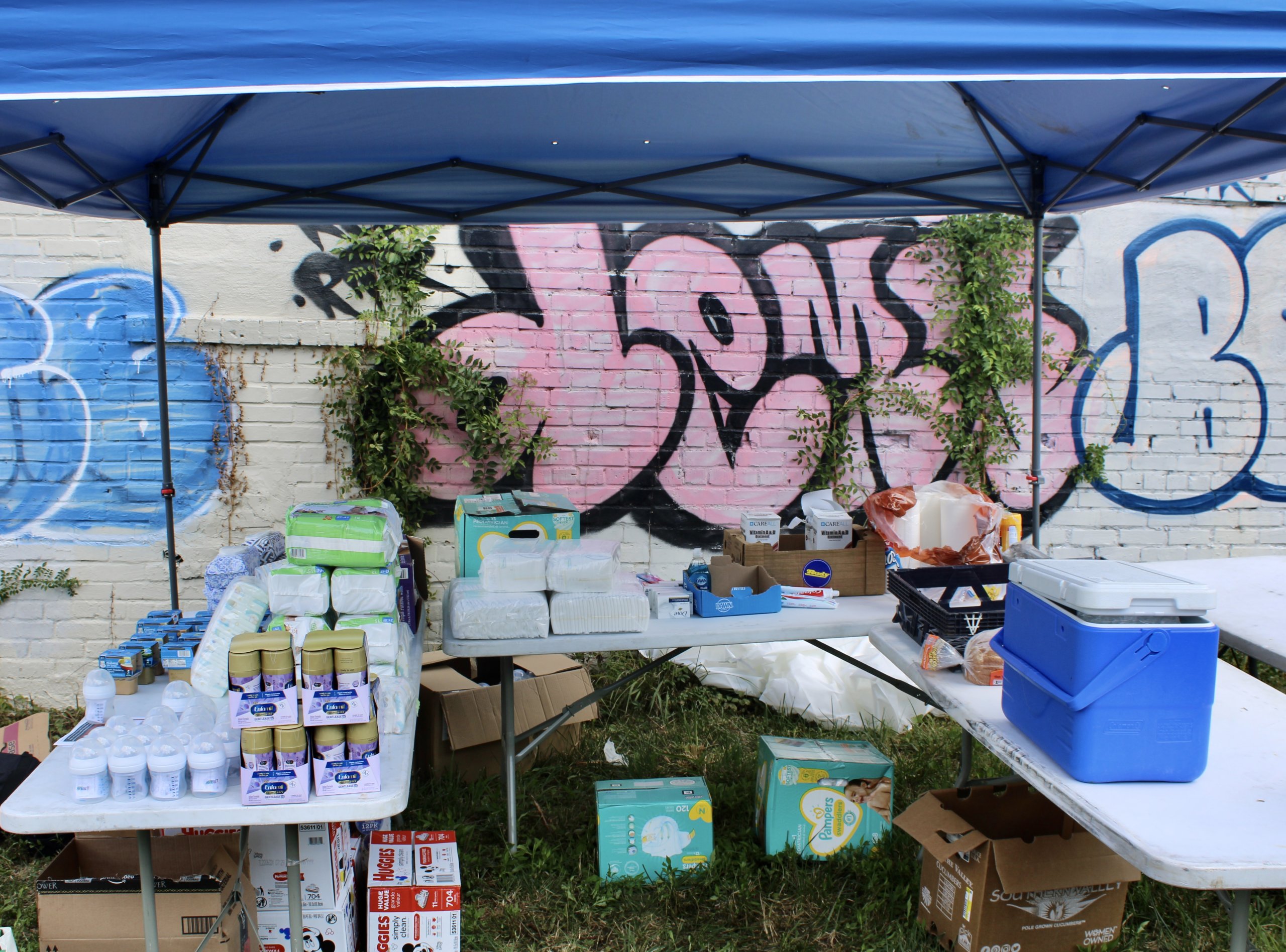
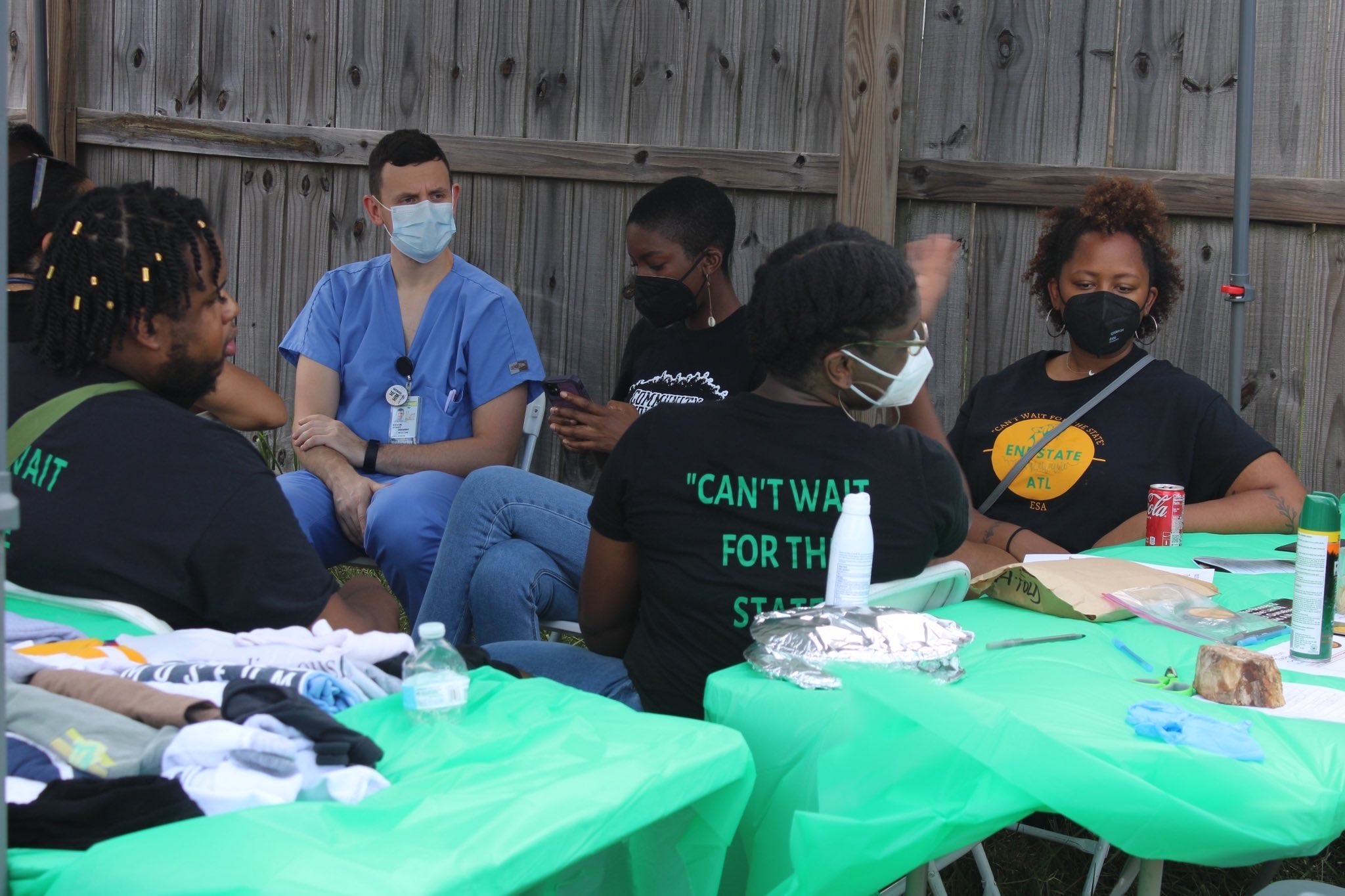
Endstate ATL took advantage of these temporary measures for the betterment and aid of our community members. Rooted in southwest Atlanta with a Black queer feminist politic, ESA's work aims to reach those most marginalized through community building, political education, and mutual aid. Through our Black Power Fund, which pays up to three months' worth of utility bills for Black queer households, and our Pack Provides Programs, which provide household supplies, COVID PPE, and infant essentials including formula, clothing, and sanitary products to caregivers of young children, we seek to step in where the state fails to provide support.
Mutual aid allows organizations to provide immediate care and relief to individuals in need without imposing the bureaucratic processes that often keep aid beyond reach. Under a state of emergency, disaster relief payments are not taxable. As such, ESA, and other groups like it, were able to provide direct aid through a less convoluted system of reporting and disbursement. This allowed us to move funds directly and rapidly to people in need and has been crucial to our ability to substantively support people in a timely way. ESA has covered bills for ten households in the past year, as well as covered a year of utilities for the BARRED Business house, which provides stable, community-owned housing for people recently released from prison. We have been able to report these funds as disaster relief.3"Mutual Aid Legal ToolKit," Sustainable Economies Law Center, Accessed June 22, 2023, https://www.theselc.org/mutual_aid_toolkit.
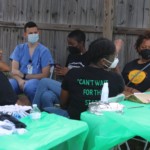
The efforts of mutual aid groups helped supplement aid where state and local leadership failed. Georgia governor Brian Kemp refused to take the COVID-19 pandemic seriously. In 2020, Georgia was the first state in the nation to relax quarantine restrictions, even as Kiesha Lance Bottoms, the mayor of Atlanta, sought to retain many protective measures. Initial reporting that the virus would largely impact the elderly and immunocompromised, combined with anti-fear government propaganda, engendered a sense of invincibility and an attitude of disregard among many Georgians. As of 2021, Georgia had one of the highest COVID mortality rates in the US, and those most impacted were poor, working class, and people of color.4"COVID-19 Mortality by State," CDC, Accessed June 22, 2023, https://www.cdc.gov/nchs/pressroom/sosmap/covid19_mortality_final/COVID19.htm. The refusal of Governor Kemp to implement mandated social distancing or mask requirements, even before vaccines were available, left the entire state population vulnerable to infection. The consequences were devastating, with thousands of unnecessary deaths and debilitating outcomes for those suffering from long COVID.
Pandemic relief payments meant to alleviate the burden of rising interest rates were out of reach for marginalized Georgians. In order to receive national stimulus checks and Kemp's own "special tax credit," individuals needed to have filed and paid taxes for the preceding two years, a barrier that left people who were unemployed or homeless without access to relief.5"Gov. Kemp Announces First Round of This Year's Special Tax Refund," Department of Revenue, May 1, 2023, https://dor.georgia.gov/press-releases/2023-05-01/gov-kemp-announces-first-round-years-special-tax-refund#:~:text=Single%20filers%20and%20married%20individuals,a%20maximum%20refund%20of%20%24500.
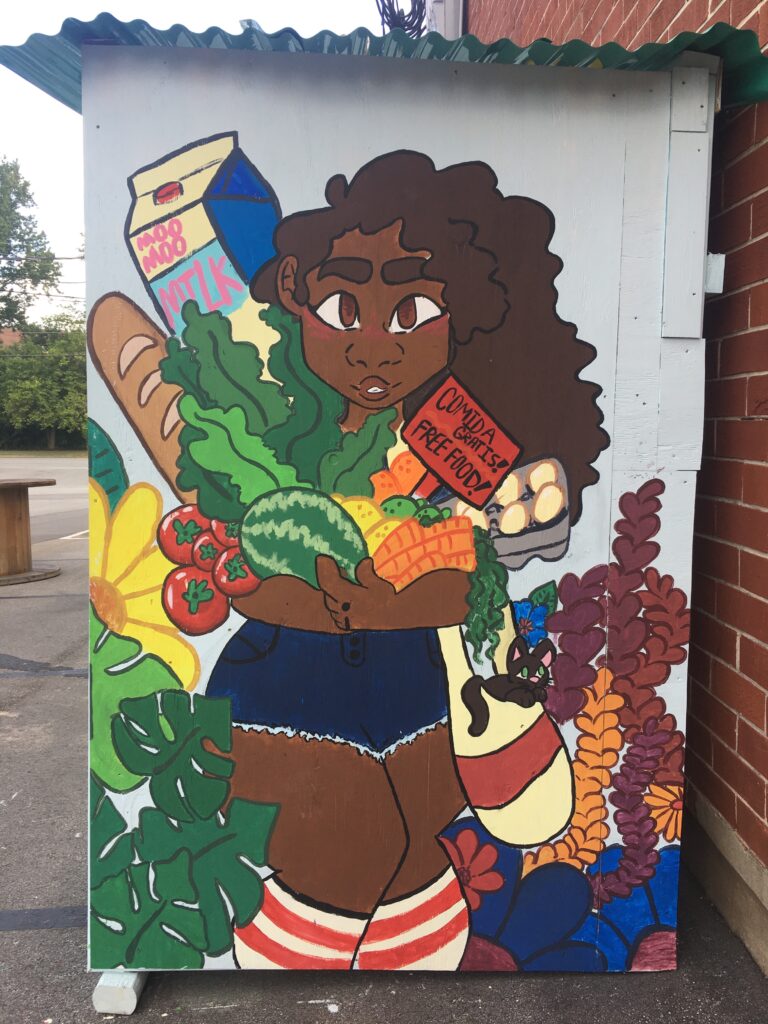
In response to the pandemic, groups emerged such as Bed Stuy Strong, based in Brooklyn, which created a robust grocery delivery system by first relying on the resources at their disposal before evolving into a program that benefited thousands.6Haritha Kumar, "Four Key Takeaways from Mutual Aid Organizing During the COVID-19 Pandemic," Georgetown University Beeckcenter, October 4, 2022, https://beeckcenter.georgetown.edu/four-key-takeaways-from-mutual-aid-organizing-during-the-covid-19-pandemic/. Georgia has similar organizations. Community Movement Builders developed stabilization programs that include rent/mortgage payments as well as groceries in their efforts to impede the gentrification of southwest Atlanta, and Food4Lives a non-profit started by Georgia Tech and Emory students provides food and supplies for the unhoused in the greater Atlanta area.7Katie Burkholder, "Housing as a Human Right: Community Movement Builders Organize Against Gentrification," Georgia Voice, April 21, 2022, https://thegavoice.com/today-in-gay-atlanta/housing-as-a-human-right-community-movement-builders-organize-against-gentrification/; "Who are We?" Food4Lives, Accessed June 22, 2023, https://food4lives.org/about.html. Both organizations preceded the pandemic, but their work became much more indispensable in its wake.
The increase in groups doing this aid work was significant, especially in red states where Republican leadership champions laissez-faire government structures for almost everything but reproductive health, policing, and surveillance. Pandemic or no pandemic, people need help. However, smaller aid groups face difficulties in keeping the work going. ESA has primarily been funded by grants, a funding model that is not easily sustainable. According to one of our members, "A significant struggle we've faced since the end of the COVID-19 pandemic is the philanthropic and public perception that the conditions for folks have changed enough that mutual aid is not necessary even as we continue to field a significant number of requests." Further, all members participate on a volunteer basis, spending much of our time otherwise as graduate students, teachers, doulas, herbalists, and nonprofit workers. Over the last two years, many of us have faced our own destabilizing events, financial uncertainty, bouts of COVID, and family loss. The ability of small groups to come together and push to make a difference in their communities—despite personal difficulties and decreasing assistance from governing bodies—should inspire more activism. But the question remains, how can we continue this work when governmental policies have resumed restricting social safety nets while offering few, if any, alternatives?
Changing policy is one problem organizers face, burnout is another. Studies have suggested that we approach "burnout as a part of activism and as influenced by the organizational context, rather than as something that individual activists experience outside of activism."8Maria Fernandes-Jesus et al., "More Than a COVID-19 Response: Sustaining Mutual Aid Groups During and Beyond the Pandemic," Frontiers in Psychology 12 716202, October 2021, https://www.ncbi.nlm.nih.gov/pmc/articles/PMC8563598/. However, as young Black people organizing in the South, my colleagues and I experience burnout from many directions. We deal with the stress of everyday life, as well as the difficulty of doing our solidarity work, with constant reminders from government leadership that our goals are at odds with theirs.
With the COVID state of emergency ending in the US, aid provided by organizations such as Endstate ATL becomes taxable, dramatically altering the way funds can be mobilized, as well as the process that recipients must go through to receive support. Charitable tax deductions are reserved for individuals and corporations who donate money to qualified charities.9Up until December 2021, entities meeting these requirements were able to claim as much as 100% of their AGI in charitable tax write offs. "CARES Act Charitable Benefits Not Extended For 2022," Stanford Giving, March 14, 2022, https://giving.stanford.edu/stories/cares-act-not-extended-for-2022/. Because ESA puts money "directly" in the hands of marginalized people, such direct contributions to individuals are not tax-exempt. The COVID state of emergency allowed groups like ESA to move funds to individuals more freely—on an emergency basis. The end of the state of emergency means we must restructure our aid programs. The beautiful thing about mutual aid is that even if one group burns out, another group can and likely will step up right behind to fill the gap. In this way, the work continues. We never stop. 
About the Author
Ra'Niqua Lee writes to share her particular visions of love and the South. She earned an MFA in fiction from Georgia State University, and she is currently at Emory pursuing a PhD in late nineteenth/early twentieth century African American literature with a focus on spatial and Black queer feminist theories. Her fiction has appeared or is forthcoming in Cream City Review, SmokeLong Quarterly, Indiana Review, Passages North, Best of the Net 2023, Best Small Fictions 2023, and elsewhere. In 2021, the Georgia Writers Association awarded her the John Lewis Writing Grant for fiction. Her flash collection For What Ails You is forthcoming from ELJ Editions.
Acknowledgments
Many thanks to my colleagues. Without their collaborative support, I would not be able to do this work: Julian Rose, Britni Ruff, Christina Foster, Michelle, Jovan Julien, and extra thanks to Hugh Hunter for his early edits.
Public Health in the US and Global South is a collection of interdisciplinary, multimedia publications examining the relationship between public health and specific geographies—both real and imagined—in and across the US and Global South. These essays raise questions about the origin, replication, and entrenchment of health disparities; the ways that race and gender shape and are shaped by health policy; and the inseparable connection between health justice and health advocacy.
Beginning in 2022, the series expands to include 1000-word blog posts, as well as longer commentaries, essays, articles and media productions that address the public health and political implications of the COVID-19 pandemic from multiple perspectives. The series editor for Public Health in the US and Global South is Mary E. Frederickson.
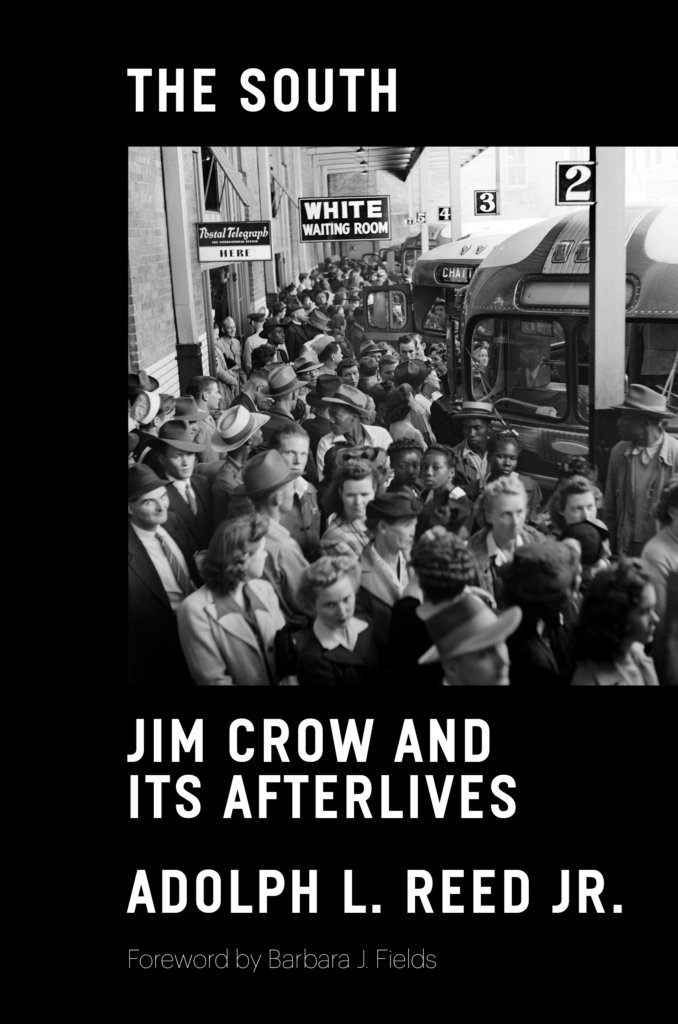
In this short book, distinguished political scientist Adolph L. Reed, Jr. offers remembrances from his early life below the Mason-Dixon line as a member of the last African American generation who came of age during Jim Crow. Reed writes with a purpose—not to chronicle his own pivotal events, hardships, or personal demons, nor to proclaim general truths. Instead, he aims to prevent misconceptions he fears are taking root about the uniform nature of the segregated South and forestall mistaken present-day lessons that ignore the role of class in the racial order of the Jim Crow South.
Reed considers himself a southerner with "a small asterisk."1Reed, Adolph L. Jr., The South: Jim Crow and Its Afterlives (New York: Verso Books, 2022), 9. Born in the Bronx, he was in grammar school in Washington DC, in 1954 when the Supreme Court handed down Brown v. Board of Education. Later, his parents, natives of the Arkansas Delta and New Orleans, moved back to the South where he grew up in Pine Bluff, Arkansas,and the Crescent City. Reed attended college in Chapel Hill, North Carolina and Atlanta and traveled the region while doing summer jobs. He taught at colleges and universities in Atlanta and worked in the city government during the second term of its first Black mayor, Maynard Jackson. He then returned north where he has spent most of the last forty years—primarily at Yale, Northwestern University, and the University of Pennsylvania—teaching and writing about the importance of the working class and the role of class in racial politics.
Although entitled The South, Reed's book illuminates how he and others experienced several different "Souths," where culture, class, ideology, and the laws emerging from segregation varied by geography in practice and form. Reed came to understand that Black people of all ages had to learn differing local white rules of Jim Crow if and when they moved to new places across the southern states—and even in the same city where rules applied differently store-by-store or block-by-block with varying degrees of racial humiliation. For example, one white-owned shop in New Orleans allowed Reed's family to try on clothes before purchase, but in others not shoes or not hats. Some stores permitted no Black person to try the fit of any merchandise. Mistakes in knowing a local "calculus of tolerance" could involve much more than indignity for old or young. "Fourteen-year-old Emmett Till," Reed writes, "was murdered in nearby Mississippi on a family visit from Chicago in 1955 because he unknowingly violated a local rule of subordination in a way that was interpreted as 'getting fresh' with a white woman."2Reed, 12.
"If bristling at Jim Crow's injustices were especially prominent in my consciousness," Reed writes, "it was partly because, as a result of moving around, I was always struggling to learn the local rules and grammar of subordination and how to craft a normal kid's and adolescent's life within them." As the son of well-educated Black teachers, Reed adds, "Where I lived and my family's class position also made it easier to cultivate and express indignation." 3Reed, 13.
The pervasive but varying conditions of white supremacy meant that the places where Black people could be their own free selves, away from everyday racial dangers and indignities, lay within their own segregated communities—especially in Black churches and schools where few whites often entered. As a child living in Pine Bluff, Arkansas, Reed had contact with hardly any white persons because his middle-class father taught at the local historically Black college and his parents kept him close to home near the campus.
Black families deployed a variety of defenses. Traveling on a ferry boat with his grandmother, Reed asked her why chicken wire had been strung between the segregated seating areas. "Well, you see," she stage-whispered, "a lot of crazy people ride this ferry, and they have to sit on the other side."4Reed, 11–12.
Reed's vignette echoes forms of sly resistance, such as that recalled by Mississippi civil rights leader Aaron Henry, growing up under Jim Crow a generation earlier. As a boy, Henry repeatedly complained to his mother that the local white children were able to attend school for seven months but he could only go to school for five. "Aaron," his mother finally responded, "you my boy—and you don't need but five. The rest of them jokers they got to have seven." "Hell, I been cocky ever since," Henry insisted.5Worth Long, "Aaron Henry from Clarksdale," Southern Changes, 5, no. 5 (1983): 9–12. https://southernchanges.digitalscholarship.emory.edu/sc05-5_001/sc05-5_007/.
Passing as white occupies a full chapter as Reed explores the making of racial identities. During his teenage years in New Orleans, passant blanc was often accepted in the Black community as a personal choice, not so much a betrayal of the race. Reed remembers that in the city's Seventh Ward, a family of first cousins with the same surname occupied two sides of a duplex house. "The family on one side lived as black; that on the other side lived as white, and they all acknowledged one another."6Reed, 92–93. In his own family, an adult with light skin color occasionally posed as white to get some prized local delicacy or quicker service from an all-white restaurant, or to momentarily avoid a racial indignity.
Some white leaders openly acknowledged what a large number of various skin complexions meant in the real life of a society where a "one-drop rule" about race-mixing was used to demarcate the presumption of racial inferiority. Reed remembers the legendary Huey Long's brother, Earl, observing in 1960 that a single serving of red beans and rice would be enough to feed all the people in south Louisiana who were truly white (without any mixed ancestry). Alabama's two-term populist governor, James "Big Jim" Folsom, said as much in 1962, after noting the presence of a large number of light-skinned African Americans in his audience. "There's a whole lot of integratin' goin' on at night" in the state's Black Belt, he declared.7Carl Grafton and Anne Permaloff, Big Mules & Branchheads: James E. Folsom and Political Power in Alabama (Athens: University of Georgia Press, 1985), 68.
In concluding his chapter on "The Obsolescence of 'Passing,'" Reed remembers he came to understand at the New Orleans Jazz and Heritage Festival during the 1990s how much the vagaries of race and identity had changed with the end of Jim Crow, especially for young middle class people whose status allowed them to mingle as one at such shared events. "People who may have identified as Cubans and Hondurans, South Asians, Italian (largely Sicilian) Americans, Isleños from the Canary Islands, and other nominal whites formed a physically and behaviorally indistinguishable blur with whoever may have been (Black) Creoles."8Reed, 103.
Throughout The South, Reed investigates continuities and changes in racism and race relations that took place as he experienced the last phases of Jim Crow and the emergence of a second "New South" in Atlanta. His recollections end around 2017 as New Orleans begins removing its most prominent Confederate statues at a time when he was often in the city due to the illness and death of his mother. As if paying tribute to his mother's generation, Reed writes a full-throated analytic attack on the mythology and symbols of the Lost Cause, ripping apart their defenders' rationale for honoring enslavers who undertook a "criminal insurrection."9Reed, 123.
Reed is quick to warn that dwelling on the modern defenders of the erstwhile slave society (touting "heritage not hate") or lingering on "explicit racial hierarchies that defined Jim Crow era" should not replace a "deep examination of the discrete processes that ground and reproduce inequality in the present."10 Reed, 110. The segregationist system of white supremacy not only was more complex and opaque than popularly portrayed today but also was not "merely about white supremacy for its own sake," Reed writes. "It was the instrument of a specific order of political and economic power that was clearly racial but that most fundamentally stabilized and reinforced the dominance of powerful political and economic interests."11Reed, 137. In other words, because "the core of the Jim Crow order was a class system," Reed insists that "a simple racism/antiracism framework isn't adequate for making sense of the segregation era . . . or challenging the forms of inequality and injustice that persist."12 Reed, 140.
This part of Reed's book is not surprising for those who know his career. As a scholar and activist who spent most of his professional life teaching and writing about race and political thought in the United States, Reed has uplifted the importance of class in understanding the dynamics of racial disparities and for dismantling structures of inequality and exploitation. However, most of his remembered experiences with Jim Crow in this book do not directly support his enduring thesis. His argument about the central role of class in The South serves as a coda to his fifty years in advancing the working class as a subject of academic study and political agenda more than a conclusion revealed from the book's remembrances.
In some respects, Reed didn't need to make a case for the importance of class in the life of the South's Jim Crow. It had been done before by himself and others, some of whom he cites in his concluding chapter. One source he did not reference but surely knows is Dr. Martin Luther King, Jr. On March 25, 1965, at the end of the Selma-to-Montgomery march, King delivered a powerful address to the nation—one overshadowed in popular culture by his 1963 Lincoln Memorial "I Have a Dream" speech. In front of the first capitol of the Confederacy, King delivered a speech that included a popular history lesson.
Citing C. Vann Woodward's The Strange Career of Jim Crow, King told the crowd that "the segregation of the races was really a political stratagem" of the South's elite "to keep the southern masses divided and southern labor the cheapest in the land. You see," he explained, "it was a simple thing to keep the poor white masses working for near-starvation wages in the years that followed the Civil War."
King recalled the South's Populist movement when its leaders "began awakening the poor white masses and the former Negro slaves to the fact that they were being fleeced" and "began uniting the Negro and white masses into a voting bloc that threatened" to dislodge elite white control of the South's political power. "To meet this threat, the southern aristocracy began immediately to engineer this development of a segregated society" that became "the roots of racism and the denial of the right to vote," King told thousands who had marched with him for voting rights. "Through their control of mass media, they revised the doctrine of white supremacy. They saturated the thinking of the poor white masses with it." They established segregated laws often making it "a crime for Negroes and whites to come together as equals at any level. And that did it . . ."
"If it may be said of the slavery era," King proclaimed, "that the white man took the world and gave the Negro Jesus, then it may be said … that the southern aristocracy took the world and gave the poor white man Jim Crow."13"Address at the Conclusion of the Selma to Montgomery March," March 25, 1965, The Martin Luther King Jr. Research and Education Institute, Stanford University, Audio, 29:21, https://www.learnoutloud.com/Free-Audio-Video/History/American-History/How-Long-Not-Long/90591.
In remembering the Jim Crow he experienced, Adolph Reed has added nuance and insight to understanding the segregated South as it came to a formal end. In this book and others, Reed has placed himself in the company of southerners who came before him, scholars and activists alike, who devoted their life's work to the search for strategies and means to build a necessary interracial coalition to make democracy work in the nation—and to finally entomb Jim Crow with no chance for an afterlife.
About the Author
An adjunct with Emory University's Institute for the Liberal Arts, Steve Suitts is the author of Hugo Black of Alabama: How His Roots and Early Career Shaped the Great Champion of the Constitution (Montgomery, AL: NewSouth Books, 2017). Earlier in his career, Suitts served as the executive director of the Southern Regional Council, vice president of the Southern Education Foundation, and executive producer and writer of "Will the Circle Be Unbroken," a thirteen-hour public radio series that received a Peabody Award for its history of the civil rights movement in five Deep South cities.
]]>Introduction: Series Editor's Note
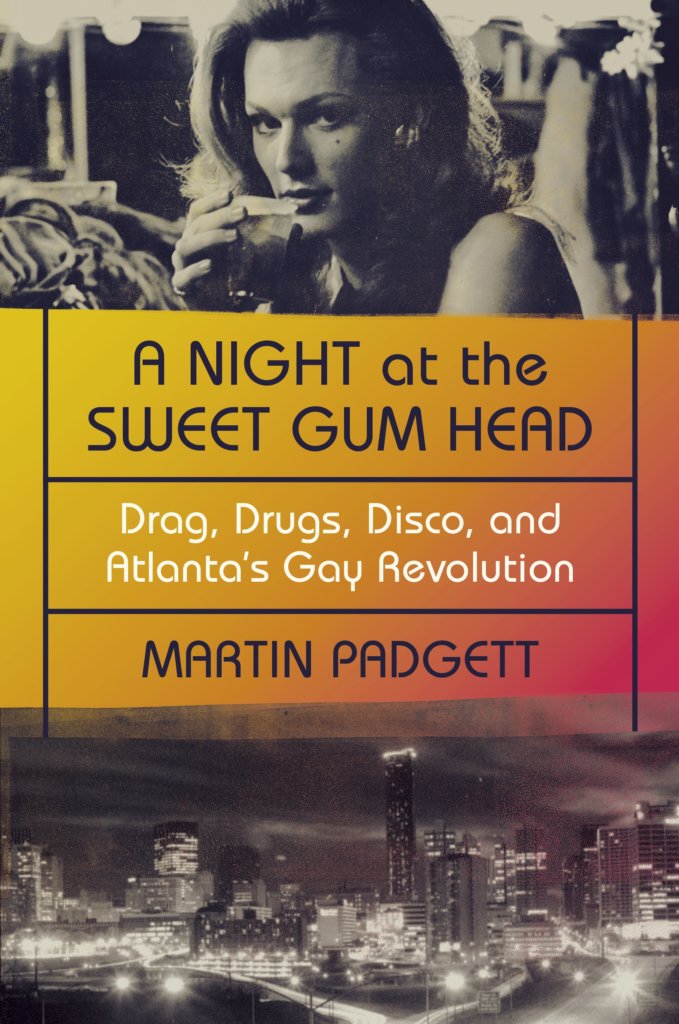
Martin Padgett's A Night at the Sweet Gum Head explores a cast of historical actors who shaped modern LGBTQ+ politics and culture in 1970s Atlanta, Georgia. This cast includes Frank Powell (who owned "more than a dozen gay bars" including the Sweet Gum Head from the late 1960s until his death in 1996), John Greenwell a.k.a. "drag superstar" Rachel Wells, and the activist and trailblazer Bill Smith, who is featured in Padgett's excerpt published here with "Queer Intersections / Southern Spaces." Padgett, too, is central to the narrative he crafts. He writes: "As for me, [the book is] something of a memoir. In many ways, John and Bill and I have lived the same life, in our search for the place we call home, in search of our true selves. . .This isn't my story of Atlanta. It's mine too. It belongs to us" (xiv, emphasis added).
What follows is excerpted from Padgett's "Preface" and a glimpse into Bill Smith's participation in the first Atlanta Pride march on June 27, 1971. This is one of the many entries in Padgett's book that traces the evolution of Bill Smith in 1970s Atlanta until his death in 1980. This exploration of Smith is a brief snapshot of the many nights at the Sweet Gum Head in Padgett's book: pick up your copy to read more about Smith, John Greenwell/Rachel Wells, and the development of LGBTQ+ life across 1970s Atlanta.
From Preface
Today, American lesbians, gays, bisexuals, transgender people, and queers can get married. We can find short-term special friends or life partners on our smartphones. We can venture proudly and safely into the straight world outside the confines of bars and clubs once designated specifically as "gay spaces."
Fifty years ago, none of those things was true. Queer people were shamed and muted, jailed, exiled, and put in danger. Often they were left no choice but to leave home, and to run away to cities where they might be accepted, or at least tolerated.
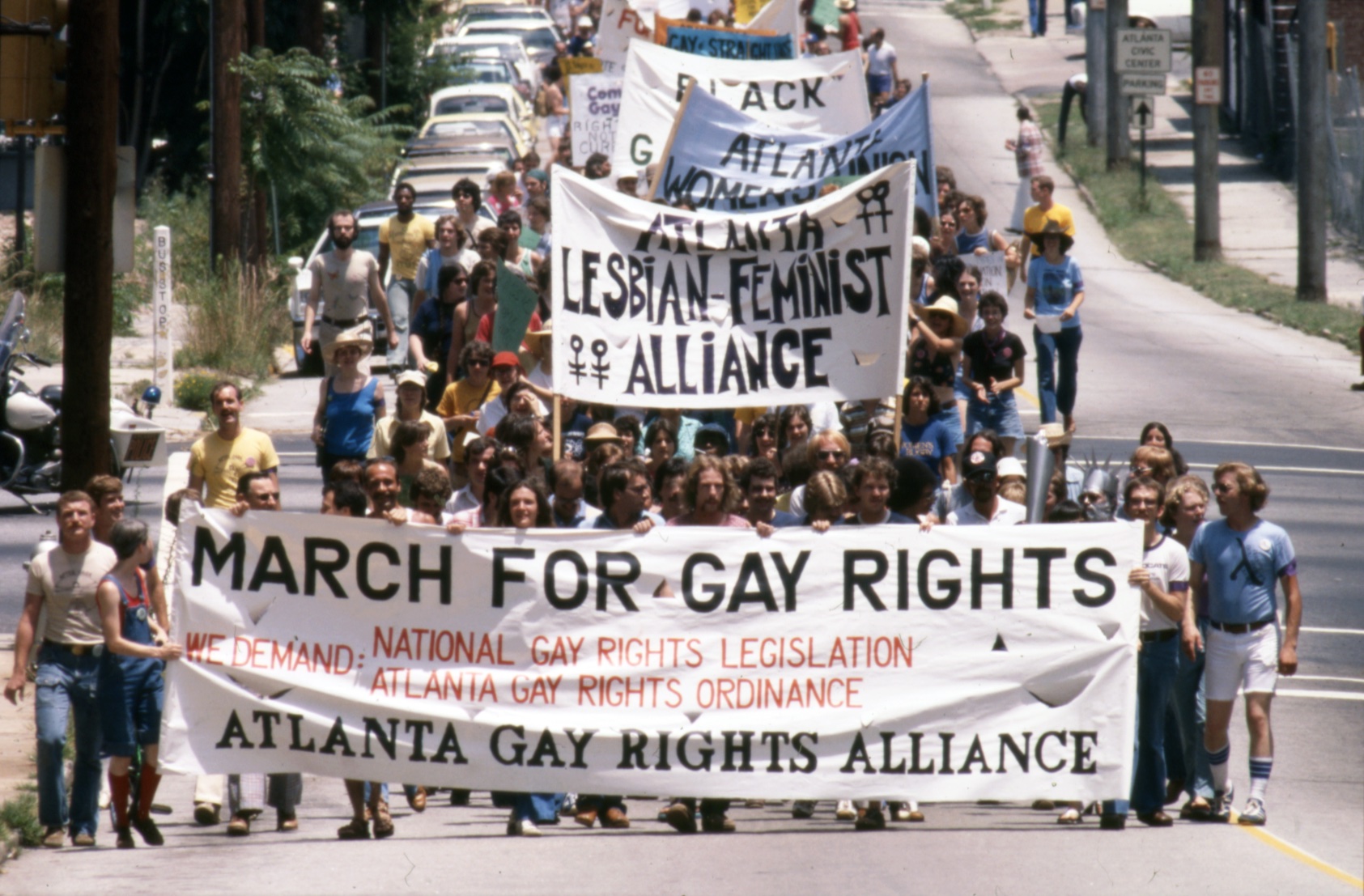
Even in those cities, gay bars were dangerous and illicit places—but they were also the birthplace of the emerging gay rights movement. Queer communities formed, and they demanded equality. It was a time of heady optimism. Many believed anything was possible, even progress. The movement had its most visible roots in New York and San Francisco, but after it flared in the riots at the seedy Stonewall Inn tavern in 1969, it spread quickly to cities such as Atlanta, a relatively progressive oasis surrounded by ultraconservative mores.
In the 1970s, Atlanta's cruisy, electric core was the Sweet Gum Head nightclub, where an intoxicating blend of drag, drugs, disco, and revolution had a pivotal role in uniting Atlanta's gay civil-rights movement—and in turning Stonewall's rebellion into art. The Sweet Gum Head is where Atlanta earned its reputation for top-flight female impersonation. It's where Atlanta's drag came out of the closet.
Before RuPaul Charles, there was John Greenwell, who ran away from Alabama to Atlanta and found a new home at the Sweet Gum Head. John became Rachel Wells—and Rachel became a drag superstar. Along the way, John put the two halves of his life back together.
John left the marches and protests to activists like Bill Smith. A son of devout Baptists, Bill took a seat as a city commissioner, then took over the most influential gay newspaper in the South, The Barb. When his addictions and predilections were revealed, he lost everything.
Then it all died. In the same summer of 1981 when the Sweet Gum Head closed, the New York Times reported on a "rare cancer seen in 41 homosexuals."
Bill Smith, Georgia State Capitol, Summer 1971
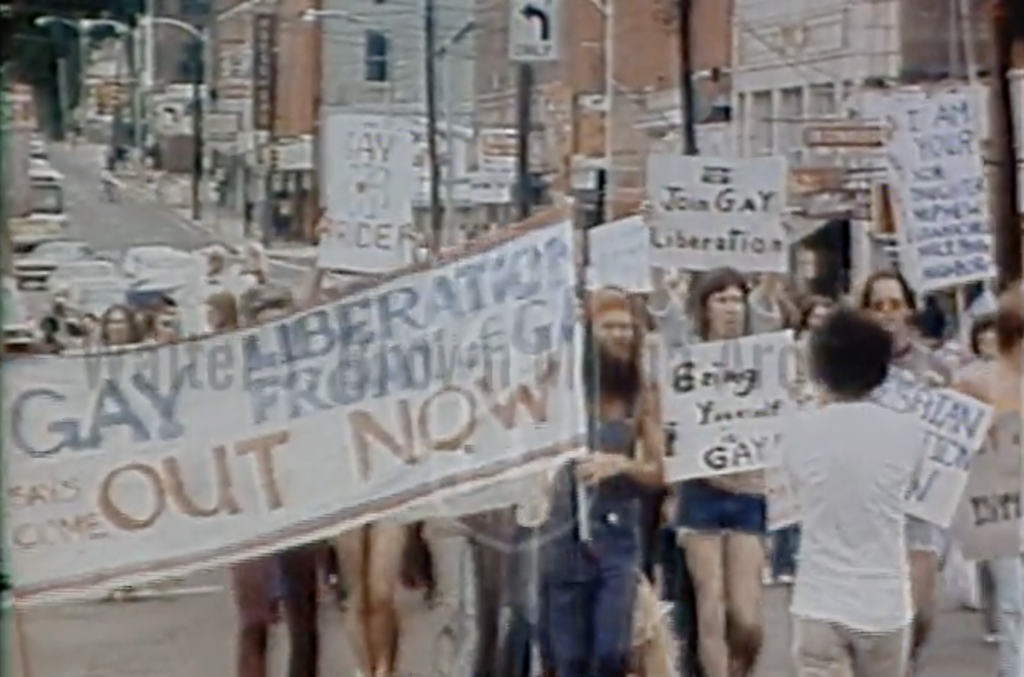
The television camera stared at Bill as he strode down the sidewalk. He wore his usual explosion of red-brown hair and goatee, squared-off spectacles, and a white button-down shirt. He clutched protest signs and slung a white purse over his left shoulder as he led more than a hundred protestors from downtown Atlanta to Piedmont Park on June 27, 1971.
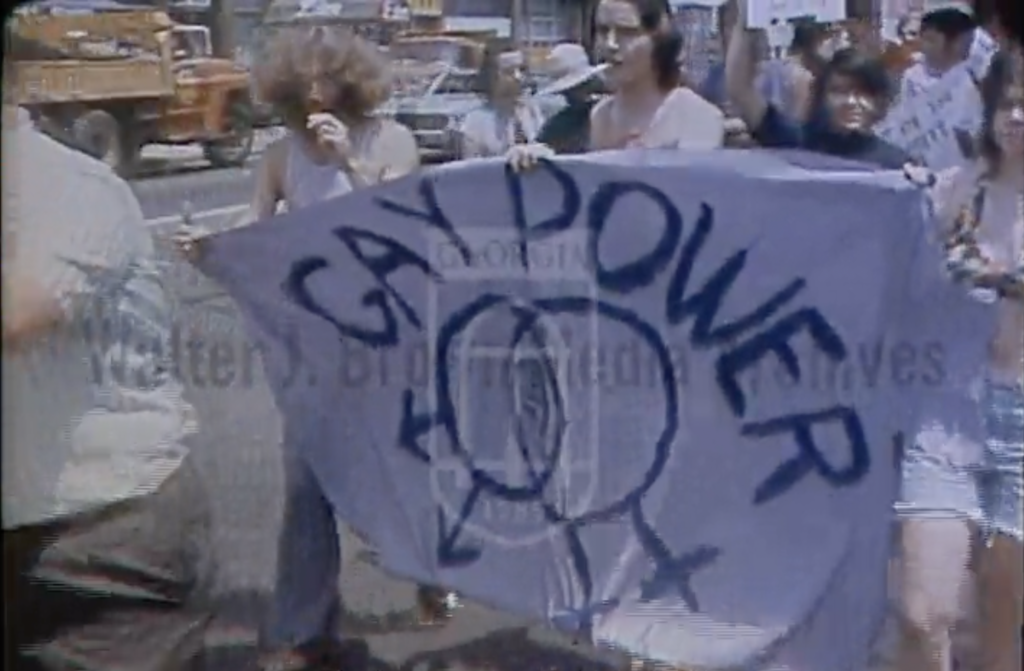
He fronted an army of lovers in warpaint and war robes, a Seussian spectacle with signs and bongos and buttons. One marcher hummed through a blue-and-orange kazoo, tootling it beneath a shock of golden hair and gold-rimmed glasses. Another wore a bowl cut, black-rimmed frames, and a mock turtleneck. He sniffed a red carnation and licked his lips luridly.
They marched two by two, animals on an ark, forced by the police onto the sidewalk and to stop for traffic lights and pedestrians. They had asked the ACLU for help with a permit to march, but were told they were not a minority.
People in cars took leaflets and stared as the group tambourined their way to the park and called to motel balconies: "Join us!"
"This is just like the early anti-war marches," one straight-identified protester marveled, "the way passers-by stare at us."
Bill's eyes angled down, dark and serious, as he spoke into the television camera.
"As people find out that you are a homosexual, there's a good chance that you may lose your job," he said with a bit of a lilt in his voice. His bony shoulders shifted while he proceeded with his lecture, part plea, part civic lesson. He told dinner-hour Atlanta how being gay affected every aspect of his life, even outside the bedroom.
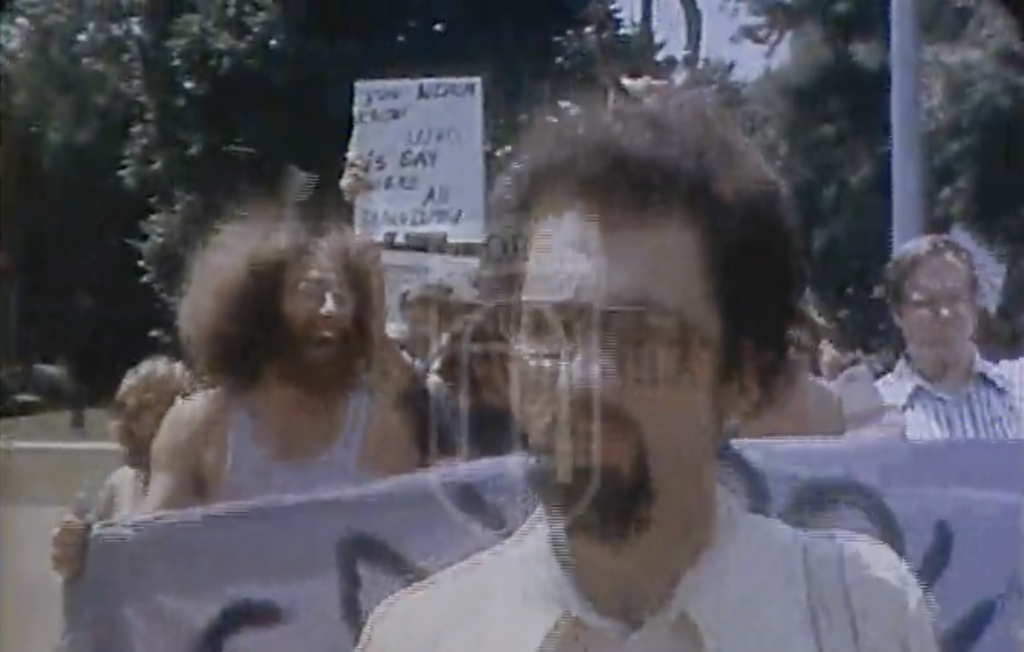
"The state will not hire homosexuals," he said. "The schools will not hire homosexuals. The federal government will not hire homosexuals. They consider us a security risk."1Bill Smith, interview by WSB-TV, "Gay Rights Protestors March in Atlanta," The Walter J. Brown Media Archives & Peabody Awards Collection at UGA Libraries, Athens, Georgia, June 27, 1971.
He parsed his words carefully. Atlanta was not San Francisco. He warned Northern friends, half in jest, not to mention General Sherman's name unless they were prepared to be bashed. He worried the Klan would shoot at protestors from the rooftops of nearby buildings. He spoke past that fear, directly to the more than 100,000 gay men and women who lived in Atlanta but had not come to demonstrate, who could lose everything—jobs, churches, family—if they joined the first Gay Pride march in Atlanta history.
Bill had worried that Atlanta still was not ready to mount a successful protest. He knew he could count on seven friends to show up, but on the day of the march more than a hundred had shown up, and some of Bill's closeted friends told him that they had driven around where the marchers had gathered, in silent support.
"Five or 10 years ago nobody would have suspected this," Bill said.2United Press International, "50 in Atlanta Mark Gay Liberation Day," Atlanta Journal Constitution. June 28, 1971. 9A. "It is a new beginning for the gay community."
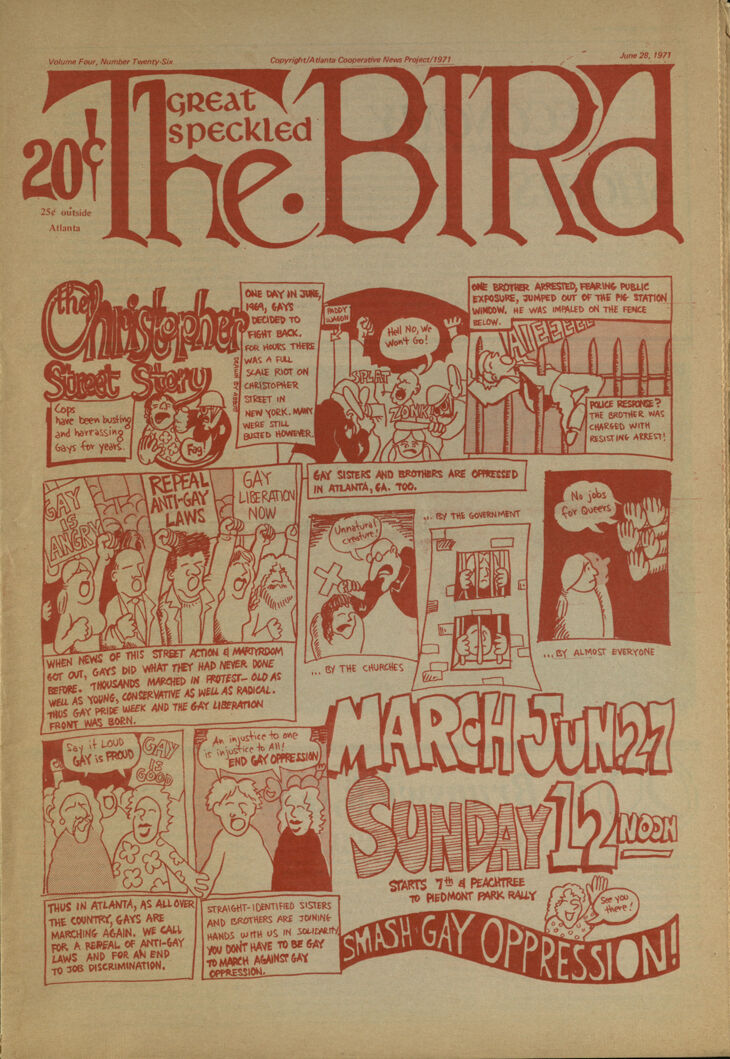
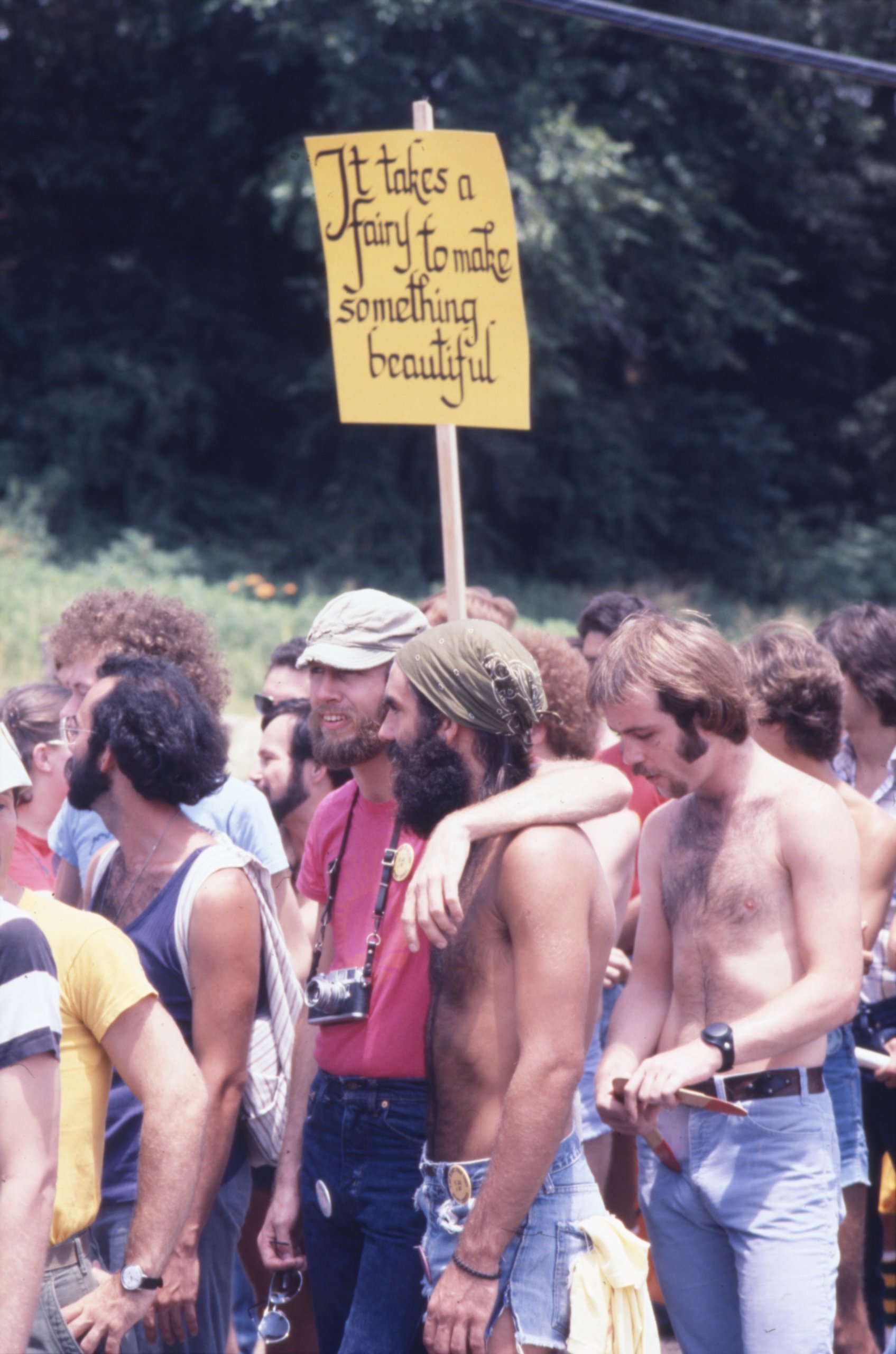
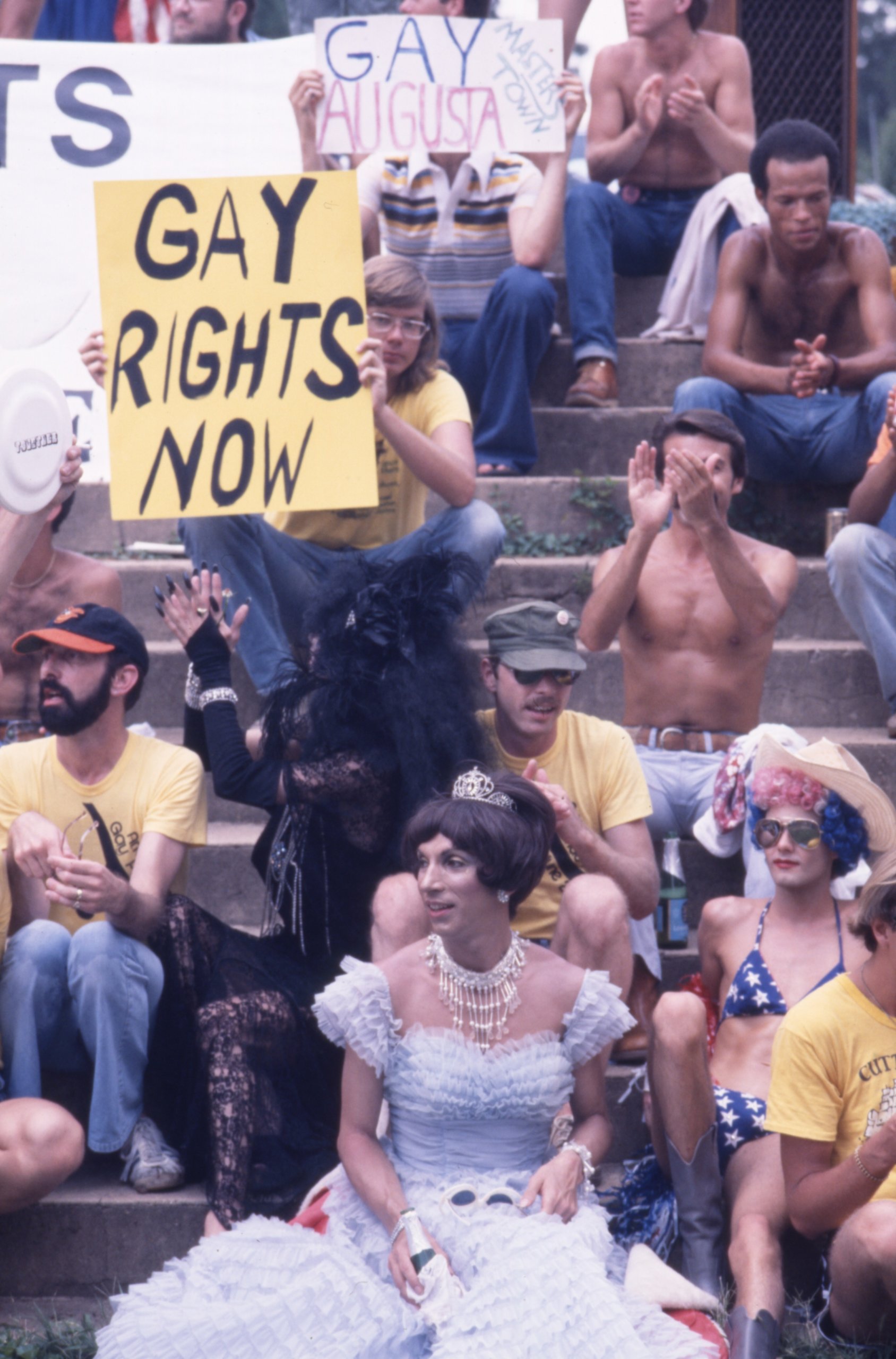
At Piedmont Park, the march re-formed as a rally replete with guerrilla theatre. In the first skit, soldiers shot at Vietnamese peasants under orders, and had their medals ripped off when they questioned why. Next, police threw people to the ground and hurled epithets—"Queer!" "Lezzy!" "Fag!" In the final act, a panel of experts interrogated a straight couple on the Slick Cavett Show: "How long have you been this way?" Atlanta's first Pride ended with promises for bigger, better, and more.3cyclops, "Celebration . . . Very Gay," Great Speckled Bird, July 5, 1971, 2.
Bill went home to see himself on the evening news. He reported for work the next day as usual at the Board of Education's accounting room. His colleagues stared straight ahead and would not speak to him. Bill laughed and got down to work.4Dave Hayward in discussion with author, November 11, 2017.
About the Author
Martin Padgett has an MFA from the University of Georgia's Grady College of Journalism and is working on a new book about Michael Hardwick and the 1986 Supreme Court sexual-privacy decision bearing his name.
]]>I. Introduction
In February 2017, playwright and composer Max Vernon debuted their first Off-Broadway musical The View UpStairs at the Lynn Redgrave Theater in New York City. Following The View's success with another hit musical later that same year, which sold out theaters and nabbed a stack of awards, Vernon firmly established their reputation as a "radical" creative mind known for "gigantic" productions in immersive staging that render an "unexpected and marvelous" audience experience.1Excerpts taken from the following reviews found on Max Vernon's website: Lina Landstroem, "Queer History on Stage: A Review of The View UpStairs by Max Vernon," Public Seminar, March 1, 2017, https://publicseminar.org/2017/03/when-a-bar-was-your-home/; Zackary Stewart, "KPOP," TheaterMania, September 22, 2017, https://www.theatermania.com/off-broadway/reviews/kpop_82533.html; Elisabeth Vincentelli, "Review: A Gay Nightclub Tragedy, Decades Before Orlando, in 'The View UpStairs'," The New York Times, March 7, 2017, https://www.nytimes.com/2017/03/07/theater/the-view-upstairs-review.html. The View UpStairs animates the real life Up Stairs Lounge gay bar environment on the eve of an arson attack on June 24, 1973. The tragedy stands as the deadliest fire on record in New Orleans history, and it once figured as the deadliest US attack on LGBTQ+ people until Orlando's Pulse Nightclub massacre in 2016. Considering the production's immersive staging and use of melodramatic mode, I interpret The View UpStairs as an adaptation in a genealogy of liberatory queer performance tracing back through the "drag reviews" and "deeply interactive, cross-dressing . . . nellydramas" staged at the Lounge in the 1970s.2Robert W. Fieseler, Tinderbox: The Untold Story of the Up Stairs Lounge Fire and the Rise of Gay Liberation (New York: Liveright Publishing, 2018), 227. The View activates a legacy of intersectional coalition that is vital to contemporary social justice activism confronting the racist, nationalist, and anti-LGBTQ+ violence emboldened in a post-Trump America. The View builds new forms of solidarity across impossible limits of time, place, and subjectivity by dissolving distinctions between 2017 and 1973, New York and New Orleans, actors and audience.
II. The Up Stairs Lounge, 1970–1973
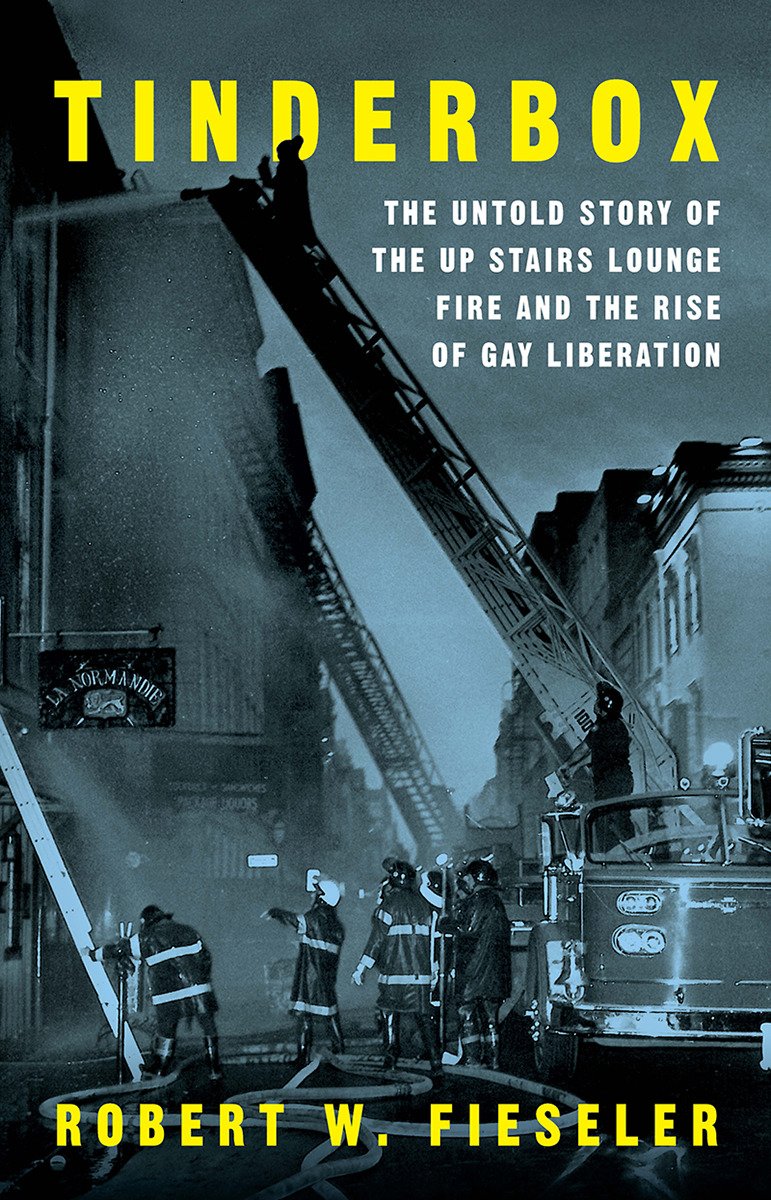
As a Los Angeles native and NYU alum, Vernon was drawn to the Up Stairs Lounge fire not so much for its tragedy but because the "fire [had] been erased" from history.3Max Vernon, interview by author, September 8, 2017. Robert W. Fieseler underscores in Tinderbox (2018) that "more stories about the Up Stairs Lounge appeared in major news outlets after the [2016] Pulse shooting than in the previous four decades."4Fieseler, Tinderbox, xix. While Vernon was understandably shocked by the tragedy's erasure, the complexities surrounding the arson, its immediate but mostly local news coverage, and its swift muting from public discourse resist hasty conclusions about the cause or consequence of such silence. On the one hand, the contemporaneous frontpage spread in the Times-Picayune had broken a multigenerational "social compact" whereby New Orleans dominant society had tolerated queer society as long as it remained apolitical and out of sight.5See the front page spread of The Times-Picayune (New Orleans, LA), June 25, 1973, Monday Morning Edition, 1. The Up Stairs Lounge arson and media coverage acknowledged a thriving gay culture within the French Quarter. The arson's silencing became a tragedy suppressed from public consciousness. Media coverage also non-consensually "outed" many closeted survivors for whom employment, housing, and other basic needs depended upon privacy. For them, media silence was more than a welcome salve; it was necessary for survival. This ethical complexity between historical recovery work and guarding survivors' privacy presented a daunting challenge: How to restore cultural visibility when so many victims and survivors would not have wanted public exposure, whose agency to "come out" (or not) was taken from them? This exigency guided Vernon's creative work. It underscores why this musical is decidedly not about the arson but, rather, a dramatic "View" of life from the perspective of "composite" characters adapted from Up Stairs patrons, anonymously recovering the kinds of human connections that the bar made possible before and until June 24, 1973, at 7:53 p.m. when "[f]lames gathered on a front step."6Vernon, interview by author; Fieseler, Tinderbox, 70.
Aside from some library microfiche newspapers and a few Times-Picayune articles online, Vernon primarily referenced Clayton Delery-Edwards's 2014 book The Up Stairs Lounge Arson. Few other resources existed while Vernon was writing.7Clayton Delery-Edwards, The Up Stairs Lounge Arson: Thirty-Two Deaths in a New Orleans Gay Bar, June 24, 1973 (Jefferson, NC: McFarland, 2014); Vernon, interview by author; see also Johnny Townsend, Let the Faggots Burn: The UpStairs Lounge Fire (Bangor, ME: BookLocker, 2011). Townsend's 1989–90 archival work informed Delery-Edwards's research. Delery-Edwards, a native of New Orleans, was drawn to the fire when he "watch[ed] news coverage in 1973."8Delery-Edwards, The Up Stairs Lounge Arson, 2. His book was only the second book about the tragedy after Johnny Townsend's self-published and poorly documented interviews in Let the Faggots Burn (2011).9Townsend, Let the Faggots Burn, vii. Delery-Edwards's work was the clear, better choice for Vernon's research.10It is important to note that some inconsistencies exist in Delery-Edwards's text, as well. Today, Robert W. Fieseler's Tinderbox (2018) is considered a more thorough, accurate record of the fire.
The title of Delery-Edwards's first chapter, "Beer, Prayer and Nellydrama," scans as an early outline for the plot of The View. Delery-Edwards describes the Lounge as a cultural space that sought to insulate patrons from homophobic violence, what Vernon would imagine in a musical number, "The World Outside These Walls."11Max Vernon, The View UpStairs (New York: Samuel French, 2017), 45. The Up Stairs Lounge operated amid tumultuous years (1970–1973) of gender politics: "Roe v. Wade, the Women's Liberation movement, [and] the Gay Liberation movement spurred by the 1969 Stonewall Riots" and its one-year anniversary parade.12Vernon, The View UpStairs, 45. Police brutality and institutional violence compelled LGBTQ+ people to remain closeted for survival, though Delery-Edwards explains that some sought escape via "life in a big city . . . Someplace like San Francisco. Or New York. Or New Orleans."13Delery-Edwards, The Up Stairs Lounge Arson, 10. However, these urban spaces and the gay bars they provided were not reliably safe. "Police would raid gay bars for no real cause," he writes, "beating up the patrons without fear of repercussion, and arresting people for infractions not much more serious than shaking hands."14Delery-Edwards, The Up Stairs Lounge Arson, 10. It was this kind of police raid that precipitated the New York City Stonewall Uprising in the early morning of June 28, 1969, when LGBTQ+ people—particularly those who were Black and Brown—fought back.15Although the most well-known, the Stonewall Uprising was not the first instance of LGBTQ+ resistance. The Cooper Do-Nuts Riot (1959) as well as the Compton's Cafeteria Riot (1966), both in California, precede Stonewall. Many have argued that Stonewall became central to the development of Gay Liberation largely as a result of practices of memory (organized activism) that arose to commemorate the event, such as the Christopher Street Liberation Day (1970), often cited as the first gay pride event in the country.
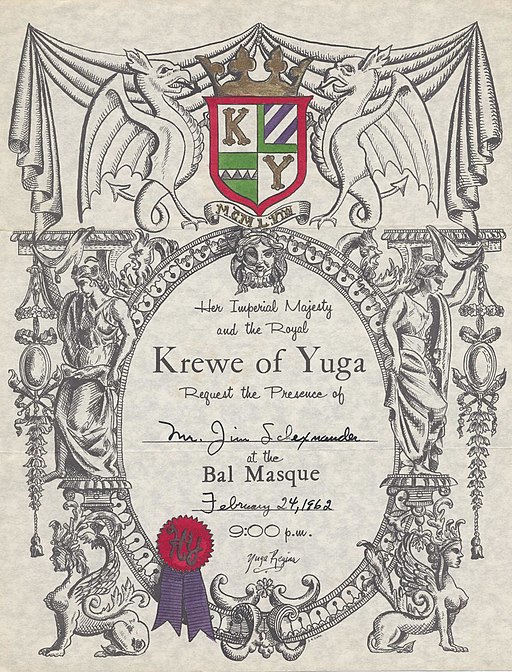
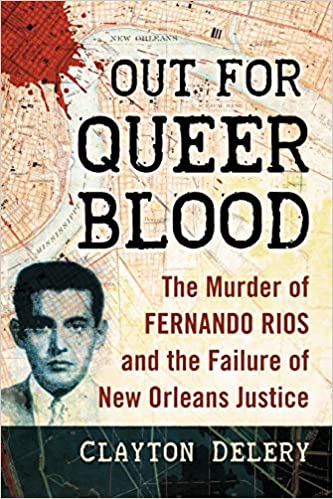
By 1973, the Gay Liberation movement that had been radicalizing in localized spaces before Stonewall was now galvanizing on a national scale, yet political activism still had not animated New Orleans. Ironically, the city's (and specifically the French Quarter's) deep history as a site of celebrated deviance may have delayed political radicalization.16Ryan Prechter, "Gay New Orleans: A History" (PhD diss, Georgia State University, 2017), https://scholarworks.gsu.edu/history_diss/60/. Fifteen years before the Up Stairs arson, two significant events in New Orleans gay history occurred within seven months of one another, and their ambiguous correlation underscores gay New Orleans apolitical climate at the time. In 1958, the first gay Mardi Gras krewe—"the Krewe of Yuga"—was formed, and later that year, three white Tulane students murdered Fernando Rios, a gay Mexican man, in what would now be called a homophobic hate crime.17The three white Tulane murderers intended to "roll a queer," or assault a gay person, the night they killed Rios. Trial testimony revealed that the murderers bragged about the assault after they left Rios for dead. Clayton Delery-Edwards, Out for Queer Blood: The Murder of Fernando Rios and the Failure of New Orleans Justice (Jefferson, NC: McFarland, 2017), 97. The murderers confessed to the crime but were acquitted. Meanwhile, New Orleans gay society continued to grow and thrive apolitically via the privacy of burgeoning gay Mardi Gras organizations. According to Delery-Edwards, gay society's response to Rios's murder was perhaps only recognizable in social migration toward newly founded gay krewes: "[Rios's] death and the fear it engendered motivated some gay men to join these fledgling organizations."18Delery-Edwards, Out for Queer Blood, 148. The city's cultural climate—Mardi Gras, gay krewes, cross-racial musical and cultural engagement, sex work, bohemian artistry, jazz, and substance-infused revelry—made the Quarter a mecca for gendered and sexual play, so long as participants abided by the social compact of apolitical invisibility and navigated onerous and Janus-faced local mores (e.g., public cross-dressing was allowed, but only on Mardi Gras).19James Karst, "Halloween Cross-Dress Costumes Lead to 21 Arrests in 1952: Our Times," The Times-Picayune, October 18, 2015, https://www.nola.com/news/crime_police/article_4522e6d7-b6bb-5143-a772-ee5712675293.html. LBGTQ+ people could enjoy a fragile sense of stability in the semi-closeted niche of the Quarter's gay bars. This local culture blunted the sense of urgency of a national "Stonewall moment," even after the tragedy at the Up Stairs Lounge.
Tucked away from Bourbon Street, just around the corner at Iberville and Chartres, the Up Stairs Lounge provided its patrons with social engagement, Christian community, and queer performance theater. The Lounge's "out-of-the-way location meant that you had to have a definite reason to go there," explains Delery-Edwards, while a continual schedule of events such as "costume parties, tricycle races . . . and the weekly Beer Bust" kept patrons returning for alcohol, comradery, and escapism.20Delery-Edwards, The Up Stairs Lounge Arson, 29. Up Stairs became a hub for the Metropolitan Community Church (MCC), a Los Angeles based Protestant LGBTQ+ congregation that was founded and led by the openly gay Reverend Troy Perry.21Delery-Edwards, The Up Stairs Lounge Arson, 21. In spring 1971, Reverend David Solomon established the New Orleans branch, and by fall, MCC services were relocated to the Lounge.22Fieseler, Tinderbox, 25, 31–32. Over the year that the Lounge hosted MCC services, congregants became accustomed to continuing "fellowship" at the bar's "Sunday Beer Bust," so much so that even after the MCC moved to another location in 1972, "the congregation kept close ties with the Up Stairs Lounge and maintained the tradition of fellowship."23Fieseler, Tinderbox, 34. The Lounge owners, concludes Delery-Edwards, "had been very successful at creating a warm, welcoming environment."24Delery-Edwards, The Up Stairs Lounge Arson, 29.
Early on, a few Up Stairs regulars built a stage and began to perform "light-hearted melodramas," often casting men as women characters, stylistically to "make the plays funnier" and practically "because the Up Stairs regulars included far more men than women."25Delery-Edwards, The Up Stairs Lounge Arson, 24–25. Given the plays' gender parody and over-acted pathos, the Up Stairs patrons "stopped calling these plays melodramas and started calling them 'nellydramas.'"26Delery-Edwards, The Up Stairs Lounge Arson, 25. Several of these productions were written and directed by Bettye McAnear, and "the Up Stairs Players were known to veer from her script in repeat performances by letting audience members interrupt the action to shout the big lines. In response, casts started ad-libbing to throw off the crowd."27Fieseler, Tinderbox, 33. These highly interactive, gender-playful nellydramas animated the Lounge stage for nearly all of its three years, a fitting performance genre for a gay bar given how melodrama, as Jonathan Goldberg argues, can "work . . . the system against itself, exposing how opposition is possible without imagining the reform of institutions that seem to be impediments to human flourishing."28Jonathan Goldberg, Melodrama: An Aesthetics of Impossibility (Durham, NC: Duke University Press, 2016), 160. Up Stairs patrons and performers would have faced hostility beyond the walls of the bar, but in performing nellydramas, they created oppositional space, even without the capacity to affect systemic change. Plus, they were a lot of fun. Nellydramas were so beloved in the gay Quarter that even after the fire, the performances returned.29Fieseler, Tinderbox, 227.
Although the Lounge celebrated the nellydramas' gay parody, the Lounge owner initially "discouraged drag queens from coming into the bar," perhaps indicating the era's still-nascent articulation of minority gender identities.30Delery-Edwards, The Up Stairs Lounge Arson, 29. The art of drag reviews in the 1970s took gender performance much more seriously than mere gender parody; a drag queen's success was often evaluated by her "performative act of passing" as convincingly feminine.31Bryant Alexander, "Querying Queer Theory Again (Or Queer Theory as Drag Performance)," Journal of Homosexuality 45, no. 2–4 (2003): 351. Acceptance of drag performance was mixed, even among gay communities that had already radicalized politically. Betty Luther Hillman notes of San Francisco's Gay Liberation Movement: "While some liberationists appropriated drag as a symbolic statement against gender norms, others saw drag as exacerbating stereotypes of 'effeminate' homosexuality. Still others aligned with radical feminists who saw female impersonation and drag as an affront to women . . . These debates coalesced into contradictory stances on the political and cultural meanings of drag and drag queens as constituents of gay liberation."32Betty Luther Hillman, "'The most profoundly revolutionary act a homosexual can engage in': Drag and the Politics of Gender Presentation in the San Francisco Gay Liberation Movement, 1964–1972," Journal of the History of Sexuality 20, no. 1 (2011): 158.
When the Up Stairs Lounge welcomed Marcy Marcell (née Marco Sperandeo) as its first drag queen in 1972, it could be argued that the bar was making a bold statement about inclusion in their social community. Or, given that she "was a smash" right from the start, the decision may have just been about boosting beer sales.33Delery-Edwards, The Up Stairs Lounge Arson, 29. Regardless, Marcy "was soon a regular performer . . . her shows took place on Sunday evenings at eight."34Delery-Edwards, The Up Stairs Lounge Arson, 29. The Lounge owner eventually embraced these delightfully subversive "drag reviews," recommencing them at the bar he established after the Up Stairs Lounge burned.35Fieseler, Tinderbox, 227. On the night of the fire, Marcy was scheduled for her regular Sunday performance, but she procrastinated at home, feeling a premonition. She was watching a "Bette Davis movie" when reports of the fire appeared on television.36Delery-Edwards, The Up Stairs Lounge Arson, 50 (ellipses original); See also Townsend, Let the Faggots Burn, 184–185.
Shortly after the Sunday evening Beer Bust on Sunday, June 24, 1973, the patrons inside the Up Stairs Lounge heard the buzzer ringing from the front door of the bar. When a "patron [and] MCC congregant" opened a door to descend the staircase, fire exploded in a backdraft through the stairwell, clawing into the bar.37Fieseler, Tinderbox, 71. In minutes, the fire ripped through the Up Stairs Lounge as patrons and employees attempted to flee for exits in a building that failed to meet New Orleans fire codes.38Fieseler, Tinderbox, 183. When the pandemonium was over, thirty-two victims had perished, either immediately or in the following days as a result of injuries.39Fieseler, Tinderbox, 187. After the fire department turned off their hoses and first responders began sorting through the rubble, rumors arose that a drunken gay patron named Roger Dale Nunez had initiated a fight, been kicked out of the bar, and threatened on his way out "to burn this place to the ground."40Fieseler, Tinderbox, 66.
When historians consider why the Up Stairs fire did not stir pro-gay radicalization in New Orleans, Nunez's identity as a gay man frequently comes up: he was part of the LGBTQ+ patronage, not a hostile anti-gay assailant. But there are other, more systemic factors that played into the arson's erasure from public discourse and memory: mishandlings by police forensics, a foiled criminal investigation, political urgency to diminish public attention to a gay bar, homophobic misrepresentation by local media, and outright public contempt for the victims' sexuality. By August 1973, Nunez had evaded arrest by an apathetic police force. Some parents and families of victims had refused to claim the bodies of their dead sons and brothers. To this day, the bodies of four victims—three unidentified victims and one military veteran—lie in a "city-affiliated cemetery for indigents."41Fieseler, Tinderbox, 191. No protestors stormed City Hall. Few challenged the homophobic culture or city codes. The Up Stairs Lounge arson would not galvanize enduring change or create the organized, "sustained gay activism" that Stonewall's one-year anniversary had inspired nationally.42Delery-Edwards, The Up Stairs Lounge Arson, 164. The Up Stairs Lounge would not become a "Southern Stonewall."43Delery-Edwards, The Up Stairs Lounge Arson, 164.
However, the fire was not altogether ignored. For a small network of LGBTQ+ individuals aware of the Lounge through the MCC, the tragedy compelled support from beyond New Orleans. Both Delery-Edwards's and Fieseler's books document the days after the fire when nonlocal, gay activists arrived in New Orleans, including Los Angeles leaders Troy Perry (MCC founder) and Morris Kight (President of Gay Community Services Center of Los Angeles).44Fieseler, Tinderbox, 111–112. Perry, Kight, and others came to help local survivors and rouse LGBTQ+ support, but people in New Orleans, especially survivors of the fire, were largely resistant to what they perceived as outside meddling by "fairy carpetbaggers."45Delery-Edwards, The Up Stairs Lounge Arson, 63, 146–149. This name-calling queered the Reconstruction-era slur created by unreconstructed white southerners for northerners who descended upon the defeated South supposedly for personal gain.46Delery-Edwards, 63, 146–149. Closeted gay New Orleanians who survived the Up Stairs fire only to be forcibly "outed" as gay in its aftermath desired a private space to heal. The Lounge owner was especially critical of Perry and Kight, suggesting that they were a "divisive force," and that "perhaps there [was] some correlation between the amount of gay activism in other cities and the degree of police harassment."47Fieseler, Tinderbox, 228. It was clear that many of the survivors of the fire were hostile toward these "fairy carpetbaggers."
At the same time, it was the work of MCC members, the Gay Community Service Center of Los Angeles, and a wide range of LGBTQ+ activists and donors from beyond New Orleans who provided financial relief for survivors as well as families and loved ones of those who perished. In January 1974, Kight met with "concerned members of the New Orleans Community" and deployed the "National New Orleans Memorial Fund" to disperse $6,000 to support those impacted by the arson, an amount that would grow to "nearly $18,000."48Delery-Edwards, The Up Stairs Lounge Arson, 147. "[I]n some ways," writes Delery-Edwards, "the most important political activity connected to the fire wasn't local at all; it was a brief, national project intended to provide aid and support to survivors of the Up Stairs."49Delery-Edwards, The Up Stairs Lounge Arson, 146. Through their skills in fundraising and national outreach, the "fairy carpetbaggers" facilitated donations from "all over the country: New York, Boston, Philadelphia, Baltimore, Atlanta, Jacksonville, Detroit, Chicago, Houston, Phoenix, Denver, Boulder, San Jose, Los Angeles, and San Francisco."50Delery-Edwards, The Up Stairs Lounge Arson, 147.
New York, Boston, Baltimore, Atlanta, Chicago, Los Angeles, San Francisco: all of these US cities and six more have staged Max Vernon's The View UpStairs since its debut in 2017. Add to the list a 2018 production at the Hayes Theatre Company in Sydney, a 2019 run at the Soho Theatre in London, and an upcoming 2022 performance at Nippon Seinenkan Hall in Tokyo, and the impact of Vernon's musical underscores the representational power of this local New Orleans narrative for national and international audiences. The View UpStairs immerses its audience in an emotionally powerful depiction of that 1973 French Quarter blaze by engaging melodramatic modes of performance similar to the Lounge's nellydramas and drag shows. Vernon's musical adaptation makes room for relationality across generations and geographies of LGBTQ+ experience.
III: "Possibilities in the Impossible": Immersive Staging, Queer Melodrama, and Adaptation
In January 2017, friend and colleague Dr. Ryan Prechter emailed me an article previewing The View UpStairs. We were both incredulous and ecstatic: Ryan's doctoral research on the Up Stairs arson had appeared in his post-1900 history of gay New Orleans, but circa 2017, very few people in the general public had heard of the fire.51Ryan Prechter, "Gay New Orleans: A History." Googling for tickets, I saw our future. We would attend the production and try to meet the playwright: How did you learn about this occluded event in New Orleans gay history? Why tell the Up Stairs Lounge story now, after all these years? All of these events transpired, and while I was, and remain, awestruck to experience Vernon's production and professional generosity, I could not help but feel apprehensive, too. The scenario that led to the staging of The View UpStairs—whereby an Los Angeles-bred and New York City-based activist/writer imaginatively travels to New Orleans to adapt the closeted Up Stairs patrons into characters engaging a national gay rights discourse—felt eerily similar to the history of the arson's immediate aftermath. I also could not ignore that something about Vernon's production felt different from that history, unexpected.
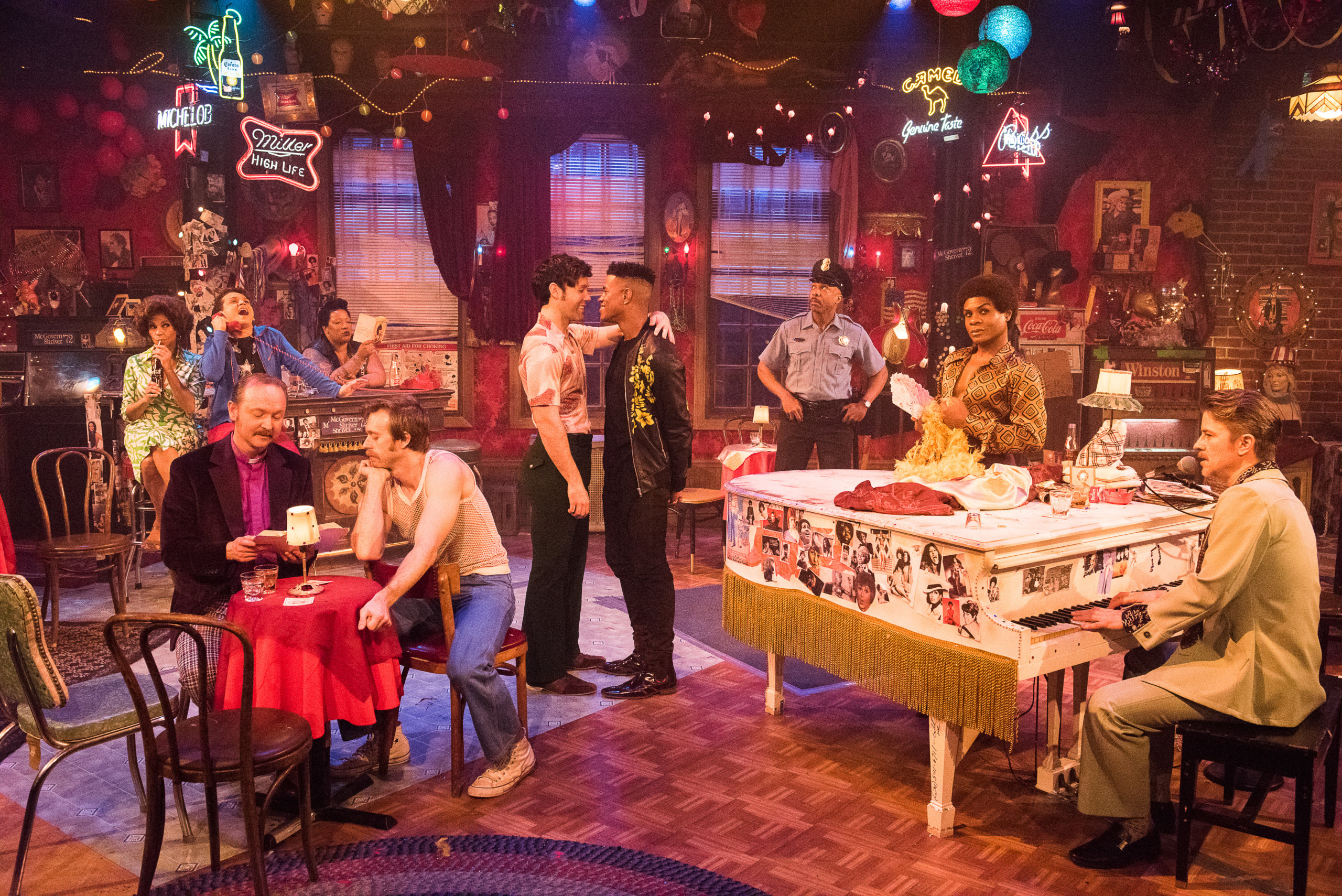
Walking into the Lynn Redgrave Theater for the 8:00 p.m. performance of The View UpStairs on Saturday, March 27, 2017, Ryan and I pass through double French doors into what looks like a dingy cabaret with a beat-up piano, retro cigarette dispensers, dank velvet curtains, a dildo chandelier, and rafters strung with Mardi Gras beads.52The View UpStairs, written and composed by Max Vernon, dir. Scott Ebersold, chor. Al Blackstone, performed by Jeremy Pope, Taylor Frey, Frenchie Davis, Benjamin Howes, Michael Longoria, Ben Mayne, Randy Red, Nancy Ticotin, Richard E. Waits, and Nathan Lee Graham, New York, Lynn Redgrave Theater, March 25, 2017. Surrounding the cabaret seems to be a compact auditorium with riser seating on three sides. We enter, not into the lobby but, onto the stage, a disarming immersive design with dainty two-top tables and chairs. Some audience members are finding their reserved seats on the set. Ryan and I purchase drinks from the staged and operational Up Stairs bar and find our seats in the front row of the risers. We play Where's Waldo with the queer iconography around the room. Posters of Dolly Parton, Barbara Streisand, and David Bowie cover the walls. A nude Burt Reynolds lounges above velvet curtains. Ryan explains that in a well-known photograph of Up Stairs Lounge's bartender-manager, the same poster adorned the bar wall in 1973.53Delery-Edwards, The Up Stairs Lounge Arson, 20. Our game continues until an attractive blonde man in a mesh shirt and retro-coiffed moustache slides next to my colleague and starts chatting him up: "I've never seen you here before. Are you new?" When the play begins, we recognize him as the Dale character (Ben Mayne)—a nod to the historic arson suspect Roger Dale Nunez.
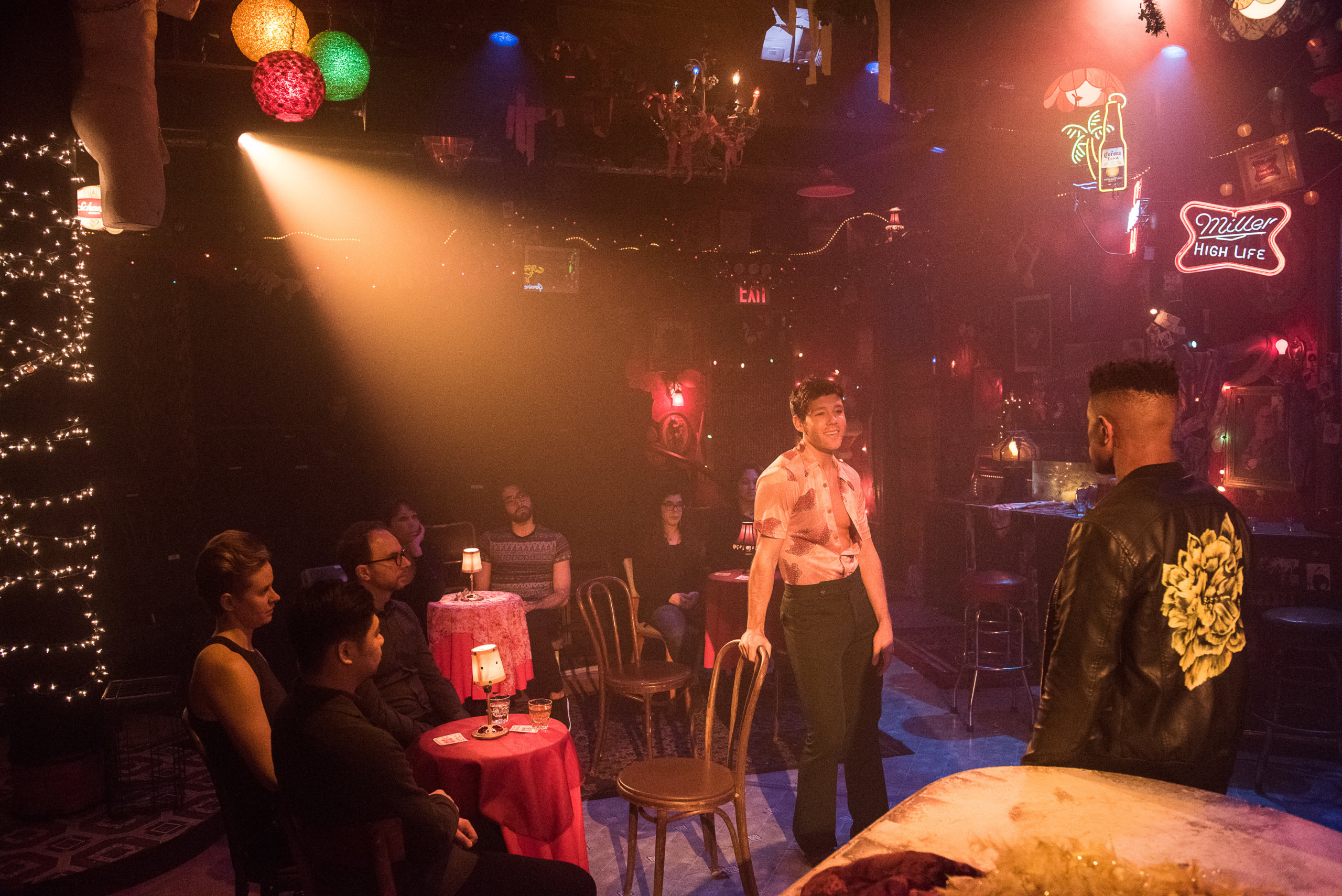
This intimate dissolution of the fourth wall pulls the audience into a participatory experience that clearly embodies Josephine Machon's definition of "immersive theatre," as The View's production creates a conspicuous confluence of space and time disrupting passive reception, and compelling the audience to actively engage with our bizarre surroundings in a room that is simultaneously 1973 and 2017, stage and audience, New Orleans and New York.54Josephine Machon, Immersive Theatres: Intimacy and Immediacy in Contemporary Performance (New York: Palgrave Macmillan, 2013); See especially "The Scale of Immersivity," 93–102. Vernon explains in their author's notes that the musical "was originally performed in an intimate, immersive setting, casting the audience as patrons in the bar when they walked into the theater. This allowed for actors to ad-lib with audiences in a way that was often hilarious, and also made the fire sequence more immediate and terrifying."55Vernon, The View UpStairs, 7. The act of casting audience members underscores "a pivotal criterion" of Machon's immersive theatre: "Where an event is wholly immersive the audience-immersant is always fundamentally complicit within the concept, content and form of the work. As a consequence, . . . the naming of 'the audience' as such becomes a vexed term in itself . . . the special and active exchange that occurs between the performance and the audience member[] illustrat[es] the breakdown of division between audience and creative crew."56Machon, Immersive Theatres, 98. The orientation of the audience's entrance onto the stage inaugurates their entry into a "contract for participation" in the audience-immersant role, whereby "the structures of the immersive world . . . invite varying levels of agency and participation."57Machon, Immersive Theatres, 99–100. The View's immersive staging compels the audience to assume a participatory role that recalls the The Up Stairs Players' highly-interactive nellydramas.
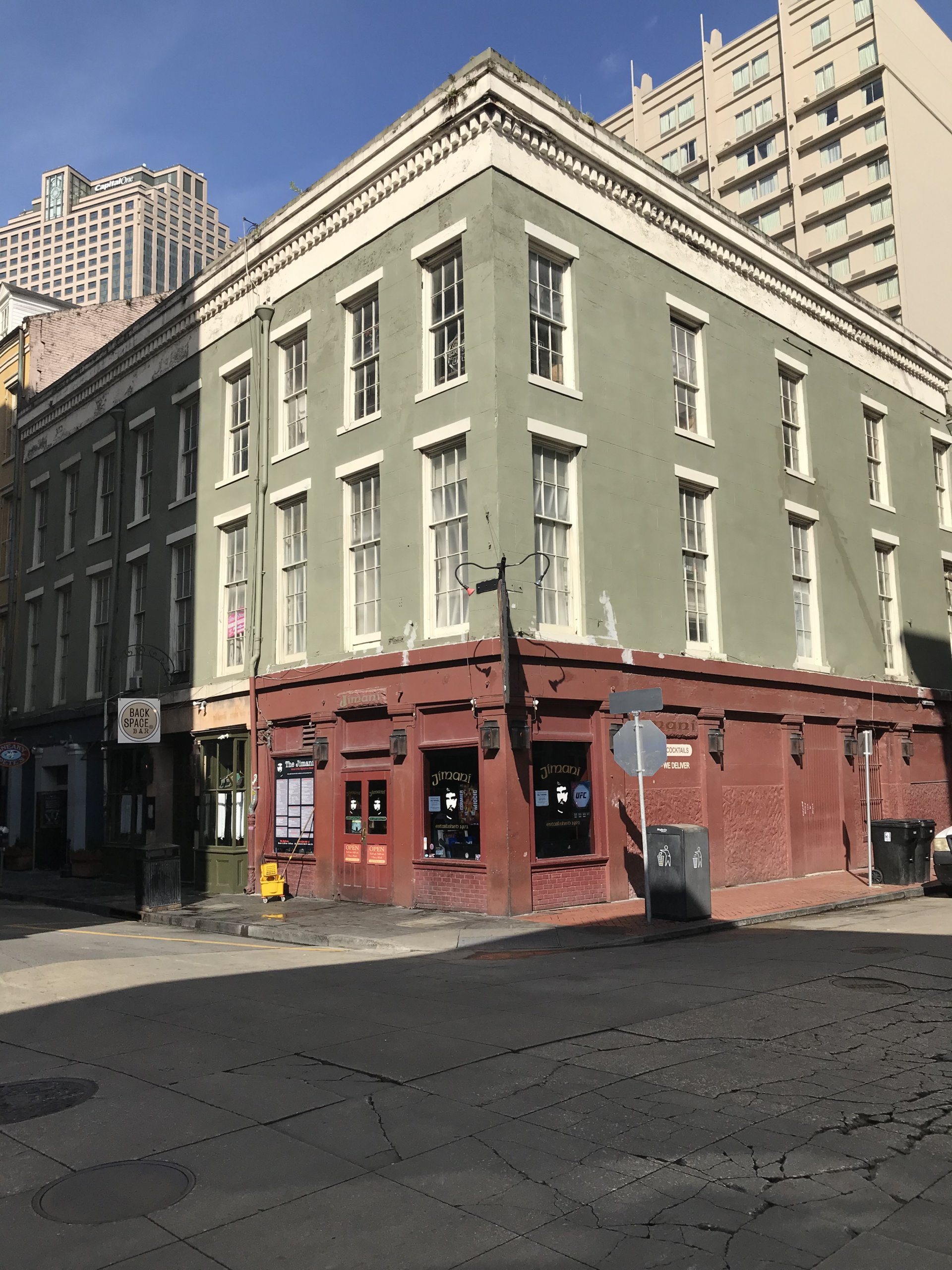
Vernon's immersive, interactive staging and the emotional intimacy it facilitates between audience-patrons and cast-patrons further reimagines the melodramatic genre of the original Up Stairs nellydramas. However, I interpret The View's use of melodrama not as genre but as mode in Linda Williams's definition; the "melodramatic mode" in theater is "a modality of narrative with a high quotient of pathos and action" deployed to render a moral conclusion.58Linda Williams, "Melodrama Revised," in Refiguring American Film Genres: History and Theory, ed. Nick Browne (Berkeley: University of California Press, 1998), 51. This modality manifests in The View's immersive production and is compatible with Vernon's explicit script instructions that actors should perform their characters in controlled realism, eschewing hyperbolic "melodrama" in the colloquial sense.59Vernon cautions, "While it's important to carve out true emotional beats for the characters, never let the piece veer into melodrama." Vernon, The View UpStairs, 6. Realistic performance by cast-patrons staged in immersive proximity and engaged with audience-patrons produces affective attachment through the immediacy of narrative action, and Vernon most certainly leverages this mode to foster a moral conclusion, as I examine below. As the 1973 cast-patrons assemble on stage, piano man Buddy (Randy Redd) launches into the catchy opening number, and the band "rock[s] the f*ck out."60Vernon, The View UpStairs, 9–11. The lights drop, and enters the protagonist Wes (Jeremy Pope), a gay Black millennial fashion designer. In the present day, he buys the burnt-out former Up Stairs Lounge to launch the "flagship for [his] store."61The View UpStairs, 73; At the time of this publication, the former Up Stairs Lounge now houses office space and the kitchen for The Jimani sports bar.Lamenting the building's condition, especially the "ugly curtain" draped across the blackened windows, Wes "snorts . . . cocaine," inaugurating his drug-induced "trip" back to June 24, 1973.
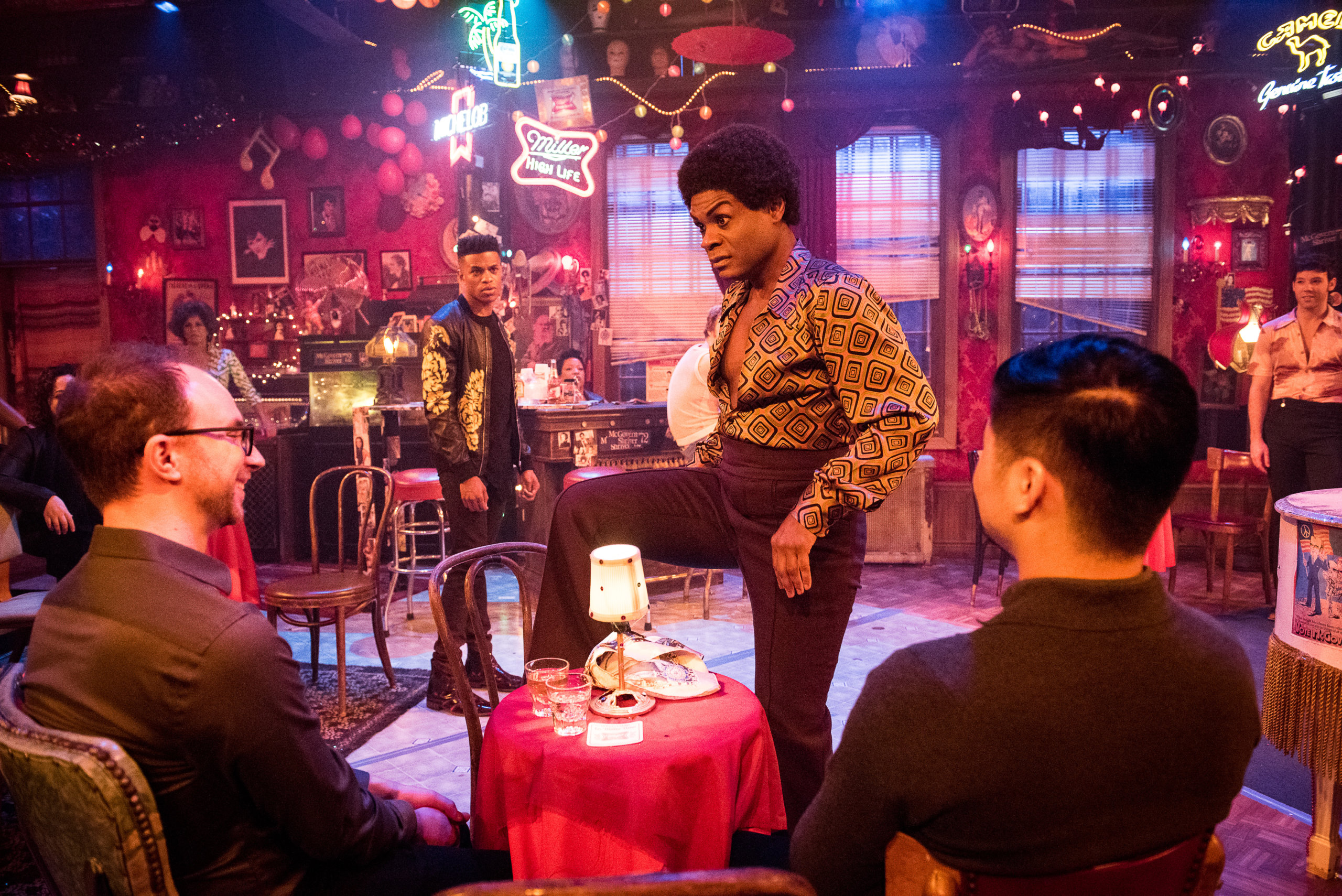
Wes's future-past presence disrupts the Up Stairs patrons, and the ensuing commotion introduces Vernon's composite characters. The bartender-manager Henri (Frenchie Davis) slings drinks while Willie, played by the indomitable Nathan Lee Graham, struts around the bar stealing the stage, as a "flaming, demented former ballerina" is wont to do.62Vernon, The View UpStairs, 8, 5; Vernon, interview by author. MCC priest Richard (Benjamin Howes) leads a church service attended by all of the aforementioned characters and one "runaway hustler" named Patrick (Taylor Frey) who becomes Wes's love interest.63Vernon, The View UpStairs, 5; For a rich discussion of performance theater that stages LGBT+ engagement in religious liturgy, see Lusie Cuskey, "The Liturgy that Dare Not Speak Its Name: Religious Engagement and Affective Memory as a Site of Queer Activism in Musical Theatre," Ecumenica: Performance and Religion 13, no. 1 (2020): 52–68. Vernon's characters do indeed gesture toward real patrons who were at the bar on the night of the arson, but his adaptation precludes historical reenactment. "Many of these characters are composites of real people who frequented the UpStairs," Vernon writes in their script, "but out of respect and creative license I've changed names and certain details."64Vernon, The View UpStairs, 8; Vernon, interview by author. Adaptation helped Vernon navigate the ethical precarity of depicting people who were largely closeted at the time of the fire and who risked losing everything if outed in 1973 New Orleans.65Vernon explains, "And so, I think in many ways, where they have these anti-sodomy laws in the South, and where regularly, if a gay bar was raided and they took your ID, your name could be printed in the paper, and you could lose your job. You could lose housing. I think they didn't have the same freedoms as New York to be as visible, so they had a different mode of survival of how they had to exist in these spaces like the Up Stairs Lounge." Vernon, interview by author.
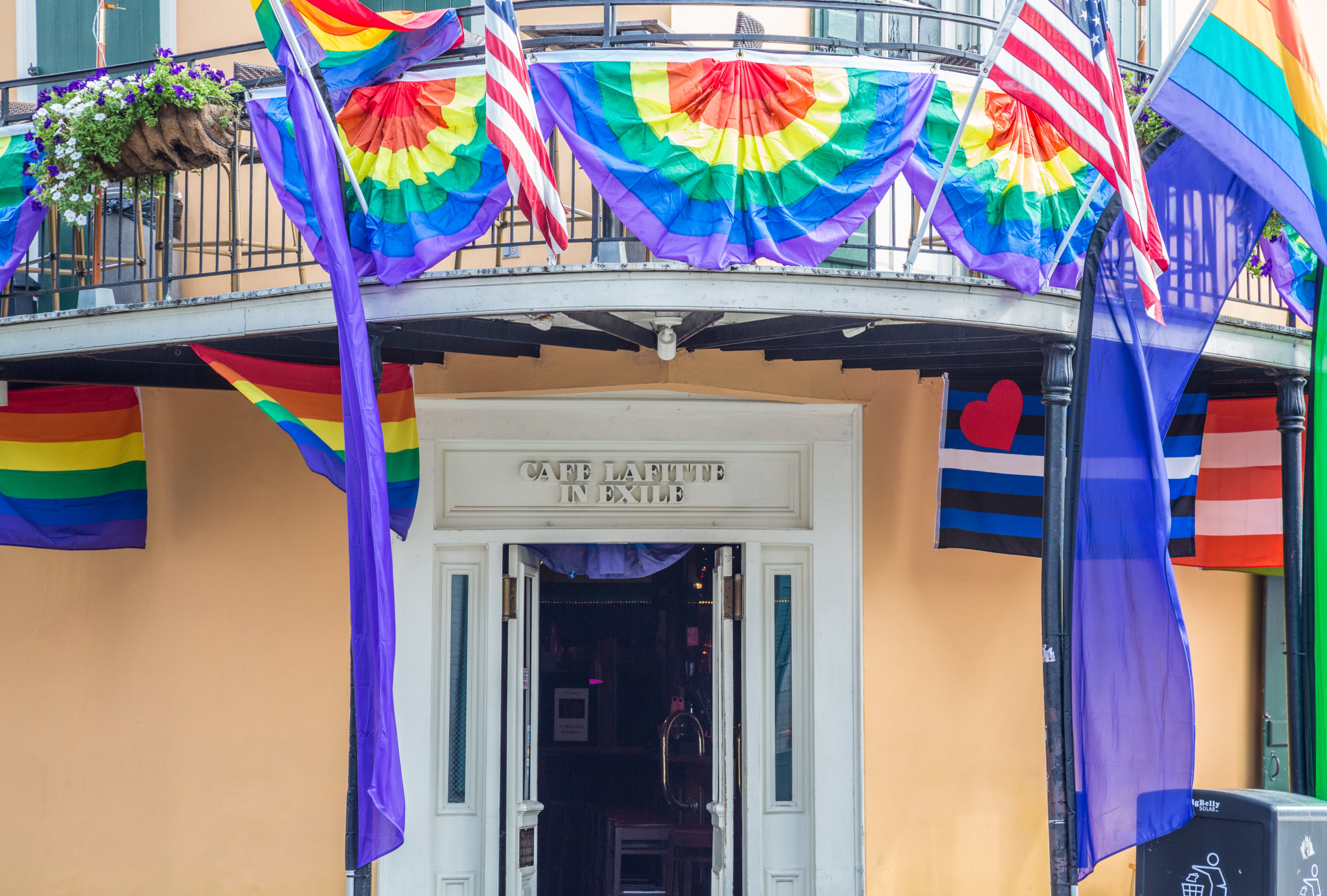
Adapting composite characters in melodramatic mode also facilitates The View's stance on intersectional coalition, which nods to the historic Lounge's rare, inclusive history as one of "a few fringe establishments [that were] brazen enough to encourage interracial mingling"; the bartender-manager "even let[] women into the bar at a time when gays and lesbians were strictly separated."66Robert W. Fieseler, "The UpStairs Lounge Fire Killed 32 People. Its Legacy Still Haunts Black Gay New Orleans," The Daily Beast, May 13, 2019, https://www.thedailybeast.com/the-upstairs-lounge-fire-killed-32-people-its-legacy-still-haunts-black-gay-ne. Gay communities are hardly immune to the racism and sexism that permeates dominant society. For example, in 1973, one of the oldest operating gay bars on Bourbon Street, Café Lafitte in Exile, "had a sign on the door . . . It said 'No Blacks, No Fems, No Women.'"67Fieseler, "The UpStairs Lounge Fire Killed 32 People." However, the Up Stairs Lounge was different, and Vernon emphasizes the bar's unique inclusivity especially in their composite characters. For example, although the bartender-manager was historically a gay white man in "a gay white man's community," he "was known to be especially friendly to all comers," regardless of race or gender identity.68Regina Adams quoted in Fieseler, "The Up Stairs Lounge Fire Killed 32 People." In this spirit, Vernon composes the bartender-manager character Henri, a "[t]ough as nails, no-nonsense, old-school butch lesbian" played in the original production by Grammy-nominated Frenchie Davis, a show-stopping Black woman singer, social activist, and educator.69Vernon, The View UpStairs, 7. While casting a Black performer in Davis was unique to this production, her "old-school butch lesbian" identity is proscribed, as is Willie's Black identity and Inez's and Freddy's Puerto Rican identities (characters who enter the plot later on).70Vernon, The View UpStairs, 5. While the Lounge's inclusivity was certainly progressive for its era, one cautions against overstating the diversity of its patronage, which was still largely white men even as Black, Latino/a/x, and women patrons were welcome. The Lounge owner's initial refusal to allow drag queens into the bar, for example, demonstrates the need for a nuanced understanding of the 1970s Up Stairs Lounge as a site of complex, overlapping, and sometimes contradictory social politics.
These historical complexities further contextualize Vernon's 2017 production, as they intentionally wrote and casted characters from underrepresented backgrounds to promote coalition across complex and intersecting subjectivities, even across distinctions between performer/audience. As José Esteban Muñoz explains, "performance permits the spectator, often a queer who has been locked out of the halls of representation or rendered a static character there, to imagine a world where queer lives, politics, and possibilities are representable in their complexity."71José Muñoz, Disidentifications: Queers of Color and the Performance of Politics, (Minneapolis: University of Minnesota Press, 1999), 1. He further champions that "Queer performance . . . is about transformation, about the powerful and charged transformation of the world, about the world that is born through performance."72Muñoz, Disidentifications, xiv. For the cast- and audience-patrons of The View, the world born through performance creates possibilities for futures even freer than the noteworthy yet limited atmosphere of the 1973 Lounge. Vernon expresses this cautious ethos most clearly in the lyrics of the opening number "Some Kind of Paradise." The playwright explains, "It's not just 'Paradise!' . . . no matter what the time period, the world is always going to be kind of shitty and imperfect and evolving and in-process."73Vernon, interview by author. In fostering relationships across so many "evolving" and overlapping identities, generations, and performance subjectivities, Vernon challenges cast-patrons and audience-patrons together as actor-agents called to realize a more equitable future that was once im/possible in history and has evolved to remain differently im/possible in the present.
The View recasts the subjectivities of and relationships between the 1973 Lounge patrons and contemporary cast- and audience-patrons. Confronting the limits of these impossibilities through melodramatic mode and immersive theatre facilitates new possibilities. "The formal use of melodrama," Goldberg explains, "brings to a point of crisis the ideologies of gender and sexuality."74Goldberg, Melodrama, 21. Escalating these "ideologies" to their dramatic limits, the intense pathos can foster transformation by "imitat[ing] ways past the impasses of the impossible gender/political situation; it discovers new possibilities of relationality": "The indeterminations of the remediated nature of melodrama allow for the possibilities in the impossible."75Goldberg, Melodrama, 156. Indeed, Vernon's goal in writing and composing The View was to "imitate a way past the impasses" that have foreclosed millennial LGBTQ+ access to the experience and wisdom of generations before them, as manifest in The View through Wes's impossible social and romantic intimacy with a pre-AIDS generation of doomed queer characters.
IV. Exposed Seams: Constructing Identity in Performance
The View's plot centers on Wes's character development as he gets to know each of the cast-patrons before his trip back in time ends at 7:53 p.m., one moment before the fire overtakes the bar: the fire never enters the stage, the tragedy never reenacted. In this way, the narrative emphasizes the interpersonal connections across generations rather than spectacularizing trauma. We learn that, characteristic of millennial stereotypes, Wes struggles with anxiety and disillusionment fostered by obsessive relationships to "little white pills," social media, reality television, and fashion labels.76Vernon, The View UpStairs, 58. Spending time with the baby boomer patrons, he learns to appreciate face-to-face human engagement unmitigated by Instagram, even falling in love with Patrick without Grindr or Tinder or texting. Meanwhile, Wes learns how the patrons struggle to survive, rendering visible the ways in which much of 1970s LGBTQ+ life was encumbered by violences that still threaten in the twenty-first century: conversion therapy (Patrick's song "Waltz"), homelessness (Dale's song "Better than Silence"), and immigration (Inez's song "The Most Important Thing"). The exposition builds with these personal encounters until, suddenly, police sirens blare. The bar's beloved Puerto Rican drag queen Freddy/Aurora Whorealis (Michael Longoria) staggers in with his mother Inez (Nancy Ticotin), bloody and beaten. The Cop (Richard E. Waits) barges in, harasses patrons, demands identification, and threatens violence until the patrons pay him off.77Vernon, The View UpStairs, 39–42. The violence began on the street; when the Cop assaulted Freddy and Inez, a suitcase carrying his drag costume fell open. They escape arrest for violating the New Orleans cross-dressing ban, but the drag wardrobe is lost. Freddy laments, "What am I going to wear?"78Vernon, The View UpStairs, 49. Enter Wes—a fashion designer.
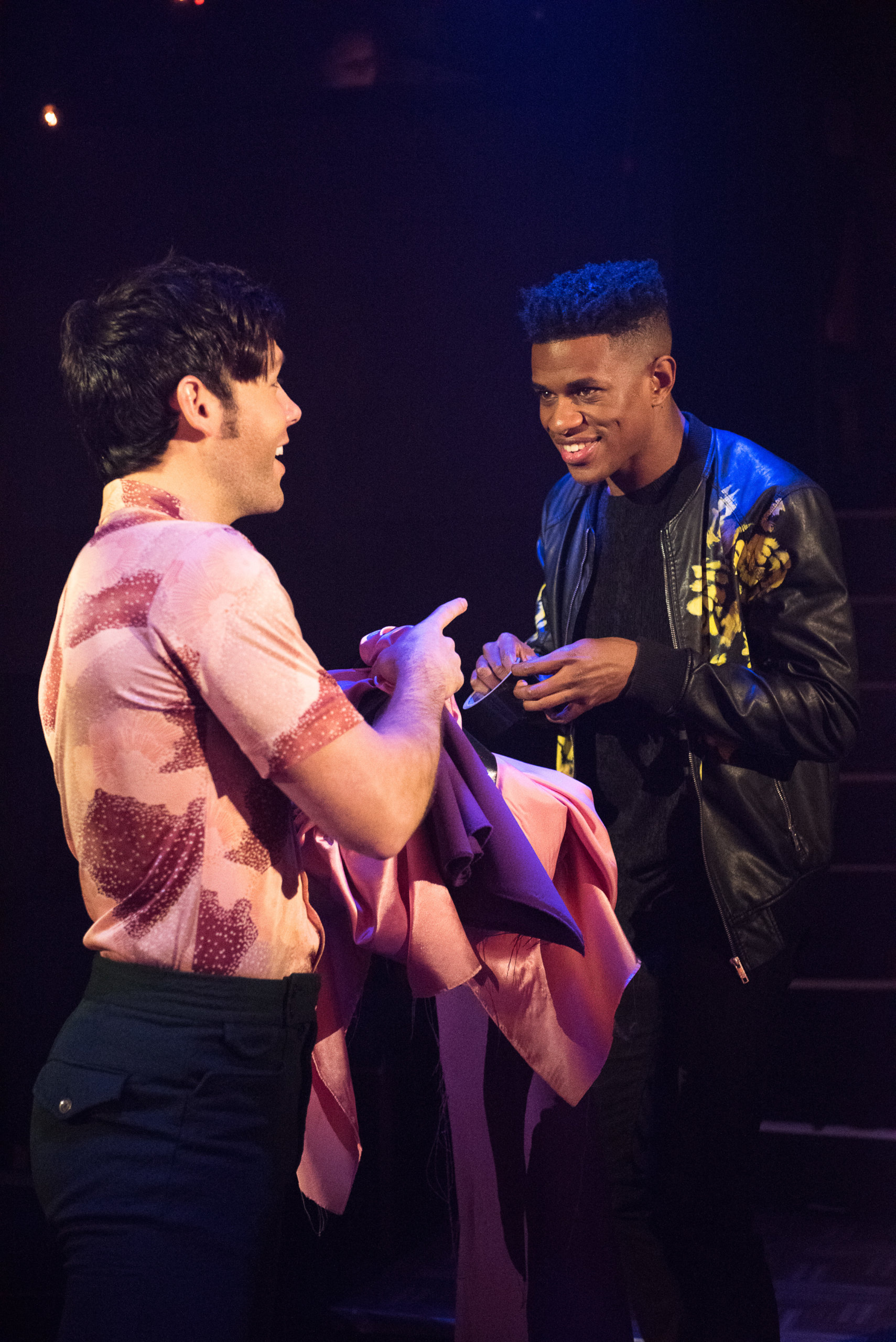
The ensuing scene builds to the musical's narrative climax as the characters facilitate Aurora Whorealis's drag performance. Channeling Scarlett O'Hara in the iconic green curtain dress scene from Gone with the Wind, Wes rips down the drapes wilting across the bar windows and seizes a roll of duct tape. In a flash, the entire Lounge mobilizes to help Freddy become Aurora. Again, the immersive staging engages the audience in the excitement and chaos of the moment. Freddy and Inez run stage right into the audience risers where they style Aurora's hair and makeup just two feet from the nearest audience-patron. Stage left and up the risers, Wes and Patrick immerse themselves near the last row to construct Aurora's wardrobe. Audience-patrons twist in their seats, craning their necks to follow the action. The spatial arrangement builds awkwardness and delight in our unexpected eye contact with other audience-patrons—an embodied moment of chaotic pathos that coincides with the character-patrons' experiences.79Mélissa Bertrand, "Performative Theatre: A Queer Theatre?" Whatever 3 (2020): 229. This staging evinces Mélissa Bertrand's concept of "trans-theatre," which I develop more thoroughly later in this essay. Here, Bertrand's emphasis on the body in queer performance implicates not just the performer, but the audience: "the body is given a major role . . . For the audience, it also implies to question the way we position ourselves as viewers of the show. The power of the gaze must be redefined, and queer sequences of theater can help rethink it." The triumphant progression to Aurora Whorealis's drag performance builds as the cast sings "Completely Overdone." Wes shrieks in delights at his frock: "It's like Count Dracula and Miss Whoopi Goldberg in Sister Act having a kiki in outer space!"80Vernon, The View UpStairs, 52.
The staged construction of Aurora Whorealis's overdone look recalls Bryant Alexander's critical affection for the exposed seams of so-called "bad" drag: "Sometimes I like seeing the seams . . . it is the seams that seemingly call my attention to the constructedness of the venture."81Alexander, "Querying Queer Theory Again," 351. He suggests that visible drag "seams" offer a metaphor for resisting a dangerous homogenizing trend that emerged in the early 2000s, one that deployed "queer" as an "inclusive signifier" to unify all manifestations of LGBTQ+ subjectivity.82Alexander, "Querying Queer Theory Again," 349. Alexander warns that "queer" discourses gloss over difference and risk silencing "any discussion that links perception, practice, performance and the politics of sexual identity to race, ethnicity, culture, time, place and the discourses produced within these disparate locations."83Alexander, "Querying Queer Theory Again," 349–50. The View's on-stage construction of Aurora Whorealis's drag look refuses such homogenizing erasure by drawing attention to the character's particularity as Puerto Rican, gay, man, son, and drag queen in pre-radicalized 1973 New Orleans. Revealing the multiple facets of Freddy/Aurora highlights not only individual particularity but also shared experience, as homophobic police brutality keenly resonates with a 2017 pro-LGBTQ+ audience in New York City sitting less than a mile from the Stonewall Inn. Freddy, a Spanish-speaking son of a Puerto Rican immigrant, complicates the Black/white dichotomy that has long falsely characterized the multiethnic, multinational US South. Aurora Whorealis, a blonde drag star with a communally constructed look, rejects singular constructs of identity as she "werks" a wardrobe manufactured from manifold referents across time, place, and subjectivity.
Aurora's multilayered frock in the original production (designed and created by Anita Yavich) evokes generations of pop culture and fashion icons that would have been impossible to assemble in 1973. Evoking Scarlett's curtain dress in/as drag, The View alludes to the season two premiere of RuPaul's Drag Race, "Gone with the Window," wherein contestants create a look from a set of window coverings and compete in drag performance.84"Gone with the Window." RuPaul's Drag Race, season 2, episode 1, "Gone with the Window," produced and hosted by RuPaul, aired February 1, 2010, on Logo. Wes exclaims, "I love this! I feel like I'm on Project Runway," further highlighting the precursor series that influenced RuPaul.85Vernon, The View UpStairs, 50. The curtains are crafted into a "nun's habit" that Aurora wears as she takes the stage to sing "Sex on Legs."86Vernon, The View UpStairs, 66. After the first chorus, she throws off the habit to reveal a frock clearly reminiscent of Madonna's "Vogue" looks, merging the superstar's 1990 music video and subsequent MTV Video Music Awards performance. But Wes's version of the dress uses "knick-knacks taken from the bar": the iconic cone bra fashioned in duct tape (music video), seventeenth-century panniers out of red solo cups (VMAs).87Vernon, The View UpStairs, 67. Though the costume begins with Scarlett's South, the underdress moves to New York City and reclaims "voguing" as an invention of Black and Latina/x queens of ball drag culture in the 1960s–1980s.
Aurora further strips off her panniers and climbs atop the grand piano for the song's climax; her cones explode into party hats with clown heads as confetti shoots out toward the audience. As the song winds down, Aurora relinquishes the clown bra for a final version made from Mardi Gras beads in concentric circles of purple, green, and gold. What stable category of gender identity lies beneath Aurora's cone bra? Clown heads and confetti. Mardi Gras gender play. Absurd constructed spectacle. Vernon's production asserts that a search for one singular, glossing identity misses the point; gender identity is always performative, always performance, indeed is constituted through the performance.88The performativity of Aurora Whorealis's manifold, evolving identifications might also be read through Bertrand: "At the crossroads between the notions of an actor•tress carrying a character's fictional identity through its own body, and that of a performer assuming their personal history and using it as a creative material, a new dynamic emerges, a more dialectical and complex positioning. In shows integrating queer themes, physical identity is located on a breach, on a border. This type of event includes what I would call 'bodies in trans-' or a 'theatre in trans-'." This is understood through the multiple terms that the prefix suggests, "'trance (transe in French), transition, transformation, transidentity, transgression, transfer…" Bertrand, "Performative Theatre," 215, (ellipses original). Exposing the seams of Aurora's constructed look and salvaging icons from disparate histories leverages drag performance as activism that simultaneously constitutes selfhood. Aurora's drag show reclaims these shared histories for the historic Up Stairs patrons and the cast- and audience-patrons participating in her reclamation in the present day.
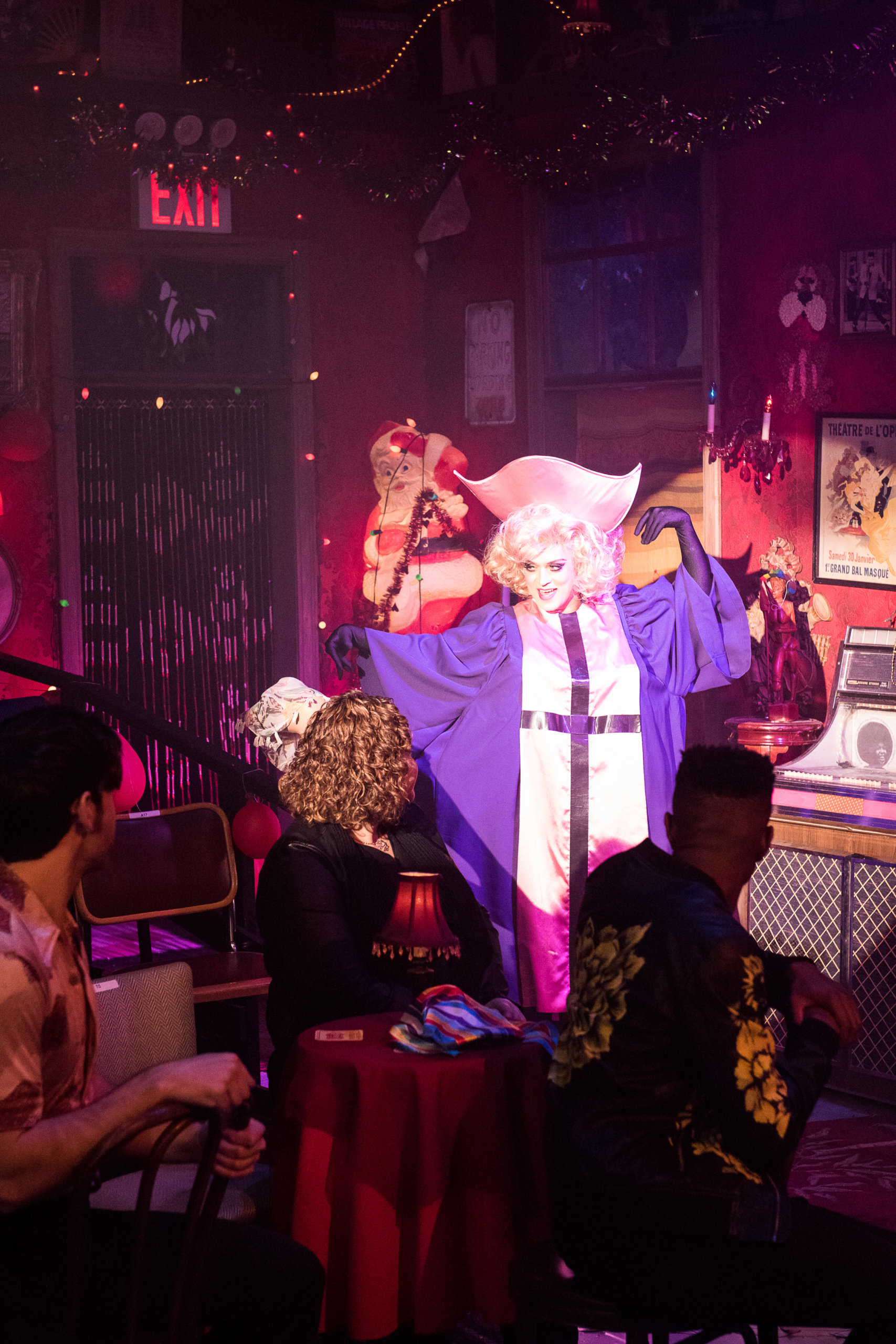
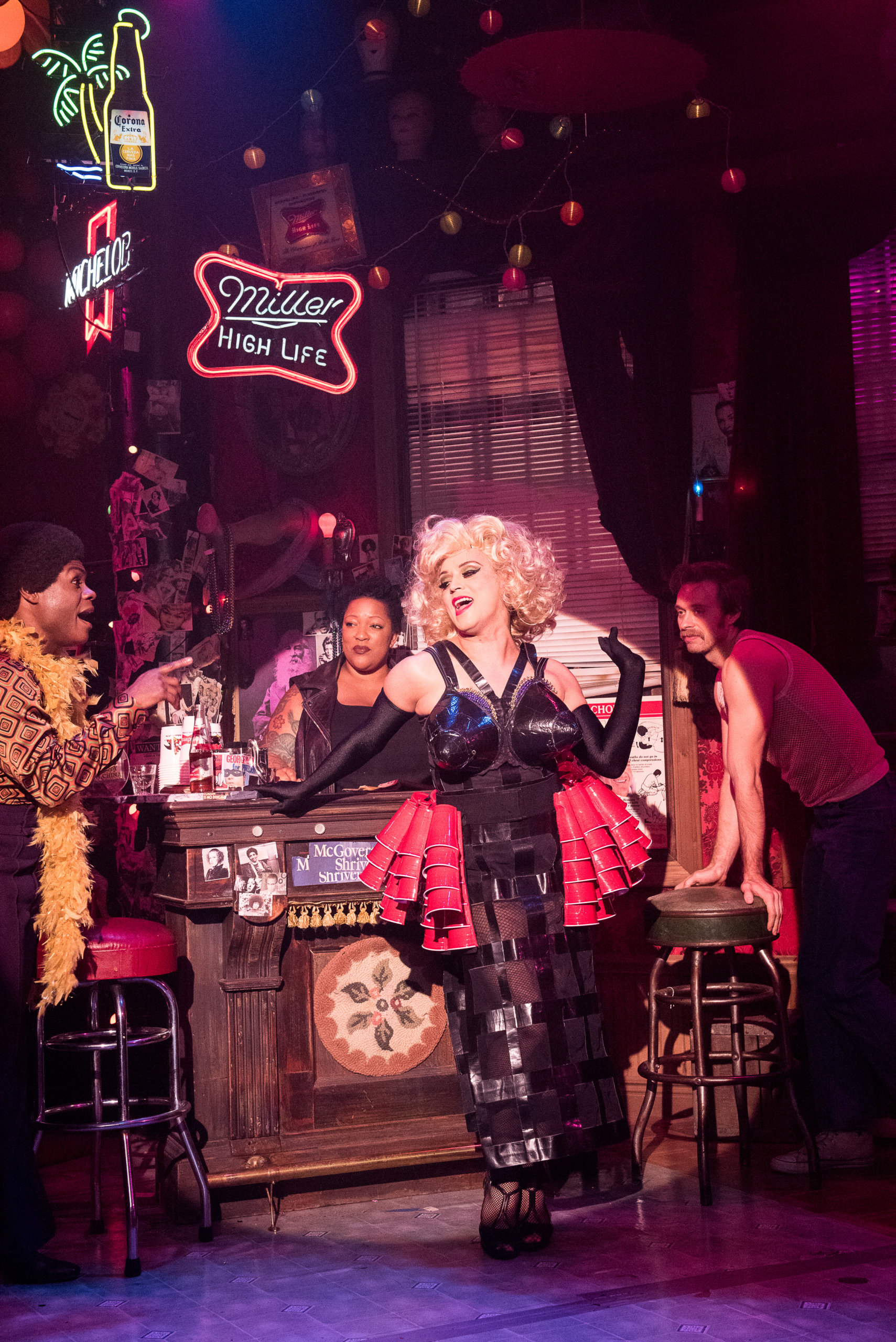
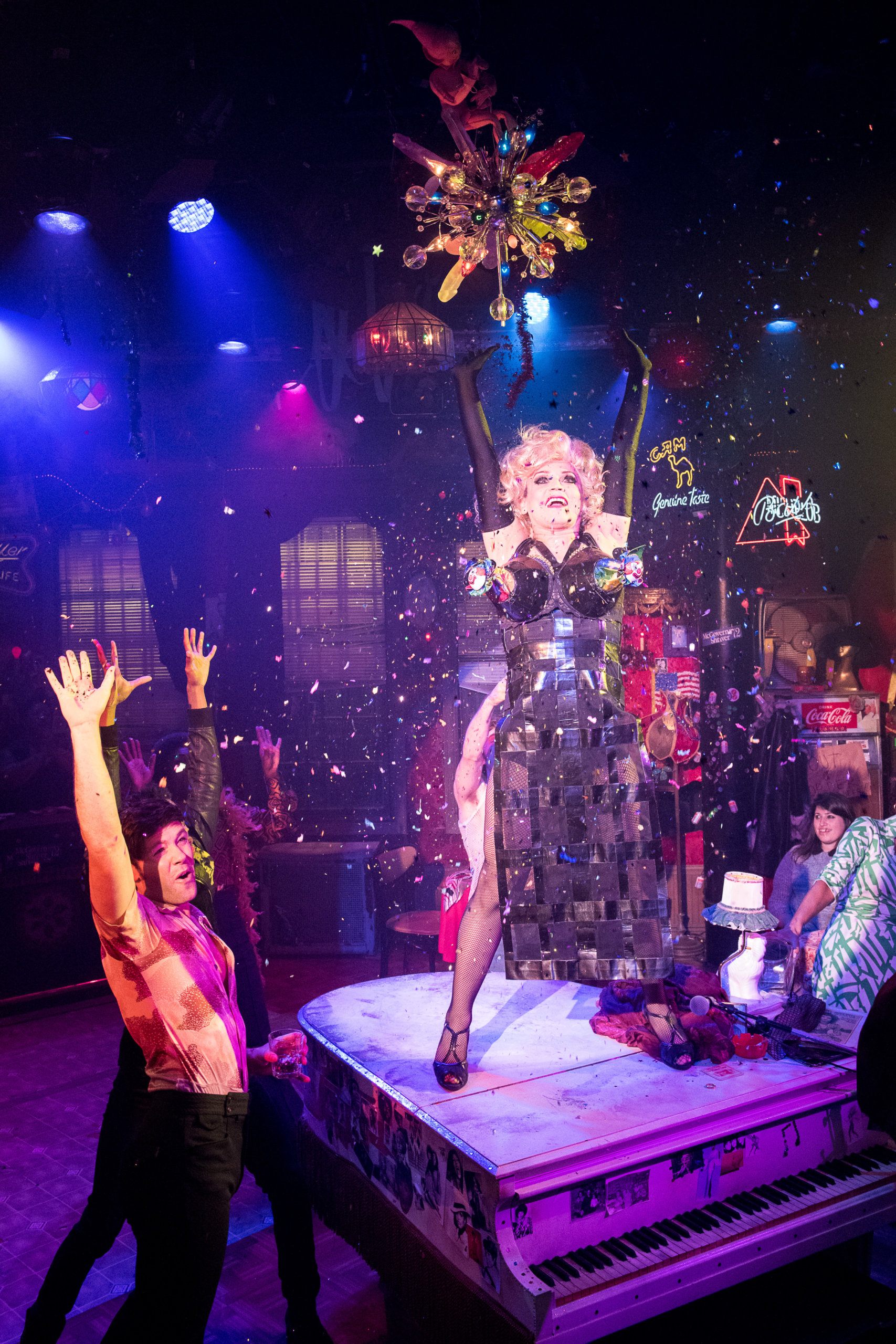
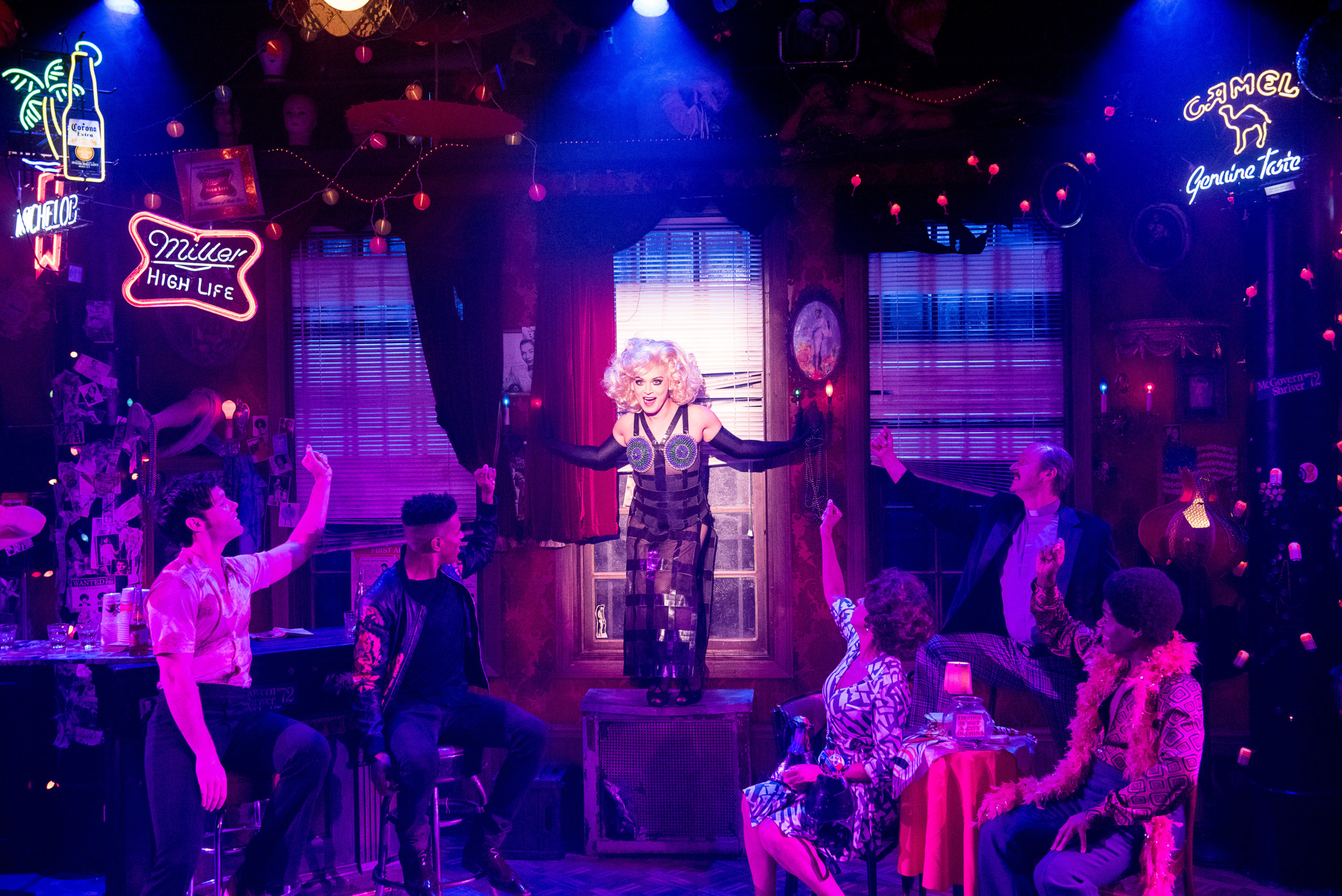
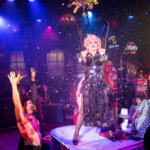
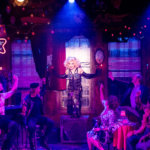
In constructing Aurora's costume, Wes self-actualizes, too. He creates and manifests the fashion designer facet of his identity: "I forgot how good it feels to actually create . . . This cheap roll of duct tape is giving me life!"89Vernon, The View UpStairs, 53. The act of creation returns to Wes a sense of self, underscoring Katie R. Horowitz's important intervention in gender performativity theory that drag is not merely discursive but constitutive of identity.90Katie R. Horowitz, "The Trouble with 'Queerness': Drag and the Making of Two Cultures," Signs: Journal of Women in Culture and Society 38, no. 2 (2013): 303–326. "[D]rag [is] in fact productive of the identity that [many gender scholars] claim it merely expresses," Horowitz explains, "drag does far more identity work than an argument premised on the distinction between stage performance and the performance of everyday life can convey."91Katie R. Horowitz, "The Trouble with 'Queerness,'" 311. She cites her field research at an LGBTQ+ bar in Cleveland, Ohio, where many of the drag kings and queens expressed that they feel their "drag self is in many ways more real than [their] real (i.e., offstage) self."92Katie R. Horowitz, "The Trouble with 'Queerness,'" 312. This inextricability of staged versus "offstage" identity resonates in Mélissa Bertrand's 2020 concept of "trans-theatre," which extends Josette Féral's "performative theatre" to the role of the body in queer performance. For Bertrand, a trans-theatre "go[es] beyond the dualisms that oppose, among other things, theatricality and performativity, the fictional identity of the character and the physical identity of the performer."93Bertrand, "Performative Theatre," 216. Undermining the distinction between what is "real (i.e., offstage)" and what is performed on stage, both Bertrand's and Horowitz's frameworks explicate why Wes is so enlivened by the staged act of creation; the act (i.e., action and performance) both manifests his character development and moves the plot forward.
V. "We all want the same thing": LGBTQ+ Genealogy, Futurity, Coalition
Importantly, Wes's self-constituting act also necessarily reclaims racial histories of enslavement evoked by the Gone with the Wind allusion, mirroring Aurora's reclamation of voguing. In Margaret Mitchell's scene, also depicted in the 1940 film, Scarlett commands Mammy to make her a costume from "moss-green velvet curtains" to perform southern belle planter-class drag so she can seduce "three hundred dollars" from Rhett Butler.94Margaret Mitchell, Gone with the Wind, 50th Anniversary Commemorative Edition (New York: Avon Books, 1986), 535, 513; Sam Killerman, "Vocabulary Extravaganza," The Safe Zone Project, accessed February 3, 2019, https://thesafezoneproject.com/activities/vocab-extravaganza/; My use of "drag" to characterize Scarlett's performance in the green velvet dress is intentional. As Killermann defines, the term "drag queen" indicates "someone who performs femininity theatrically." Scarlett's embodiment, before donning Mammy's green dress, is marked by hard labor, starvation, and poverty, all which manifest on her body: "breasts . . . so small," a "scrawny neck and hungry cat eyes and raggedy dress" (Mitchell, 534 and 525). In order to seduce Rhett into giving her the money, she must perform a specific form of femininity, the carefree southern belle who is so "bored" from a life of leisure that she decided "to take a trip and have a good time" (Mitchell, 565). This is, of course, a complete lie, and she must conceal the truth by suppressing her fury at him, feigning tears, and hiding her eyes when she feels she has triumphantly hooked him (Mitchell, 564–571). When Rhett discovers the deception, he says, "You wanted something from me and you wanted it badly enough to put on quite a show" (Mitchell, 570). In the same way that drag queens perform a wide range of femininity across race, class, age, and culture, so too does Scarlett perform drag southern belle. Vernon's queer adaptation rewrites the racial logic of labor inherent in Mammy's formerly enslaved status; Wes seizes the challenge of garment creation with agency and self-determination. The inverse of racial obedience to white supremacy, Wes demonstrates his generative power to constitute meaning out of salvaged refuse, a clear metaphor for the reclamation and adaptation of violent, erased histories. As his lover Patrick affirms, "You just made a dress out of nothing."95Vernon, The View UpStairs, 47. The plot's climax in the drag show figures a key moment of Wes's character development; he realizes his own creative power, demonstrating how artistic production can galvanize queer (and) Black agency by reclaiming histories and historic icons as tools of affective change in the present. In creative work, Wes constitutes his identity from a traumatic history, demonstrating agency over his own future. As Patrick and Wes affirm in their lover's duet, "It's our story and the ending's ours to write."96Vernon, The View UpStairs, 82.
Patrick and Wes's ethic mirrors the playwright's own. Perhaps the most important feature of The View's constitutive performance was Vernon's own goal in composing the musical. Vernon explains in our interview that writing The View was motivated by a need for mentorship from a lost LGBTQ+ generation, not only the Up Stairs victims but all who perished in the 1980s AIDS epidemic:
It was about wanting to understand my own history. Growing up I didn't have any queer mentors to help me figure out how to exist in this world. And, you could say maybe that's because of the AIDS epidemic: a link in the chain of mentorship might have been broken. I wanted to go back to the seventies to exist in a pre-AIDS world to kind of understand my lineage as an LGBTQ person and understand where I came from and if that could, at all, help me figure out how to navigate this time period that we're in [today in 2017], which is very fraught and bizarre.97Vernon, interview by author.
For Vernon, composing The View fostered new relationship possibilities across impossible limits of time and space—as well as the ontological divide separating the living and the dead—which helped to constitute their "own history" and queer identity.98Taraneh, "Pop-Culturalist Chats with Max Vernon," Pop-Culturalist, September 18, 2018, http://pop-culturalist.com/pop-culturalist-chats-with-max-vernon/?fbclid=IwAR2EbOmNg5fbr_MtK_sVsnrKuIWRH0_kSHncmNtBrhnxCw4_K6botNev9Dc. By reaching back into history through performance, their creative work taps into a very personal longing and loss.
On World AIDS Day 2018, Vernon posted a public Facebook memorial honoring their uncle who, if not for AIDS, might have been an LGBTQ+ mentor:
I do not know a whole lot about my uncle Robert, the only other queer person from my family history . . . He became addicted to Heroin- not sure if it was the needles or gay sex that caused him to seroconvert, but he became HIV positive and most of my memories of him growing up involve visiting him in hospitals.
Towards the end of his life I know he cleaned up, worked as a janitor, and had a solid community of friends around him in Minneapolis. My uncle Robert died of aids when I was around 10 years old. He left me a package of rainbow socks bc I think in the back of his mind he knew I was also queer. At this point I only have one pair left- the green socks, and they're full of holes. I can't bring myself to throw them out though... Anyway that's my #worldaidsday story. With Prep, etc it's a different era today (at least in this country) but I mourn the collective loss for our community, and I hope my many friends who are + know how much I love and appreciate them.
99Max Vernon, "I do not know," Facebook, December 1, 2018, https://www.facebook.com/MaxVernonMusic/posts/101.


The absence of knowledge about their uncle Robert's life compounds Vernon's grief over his death and orients their relationship to a queer genealogy through the AIDS epidemic. Vernon begins with the pain of not knowing, and they conclude with a metaphor of incompleteness in the gifted "green socks . . . full of holes." Their need for connection underscores a lost intergenerational relationship with "the only other queer person in [their] family history." Denied inheritance of familial queer genealogy, Vernon created The View UpStairs, imitating a mentorship with their uncle's generation that works around the impossibility of time, space, and death.
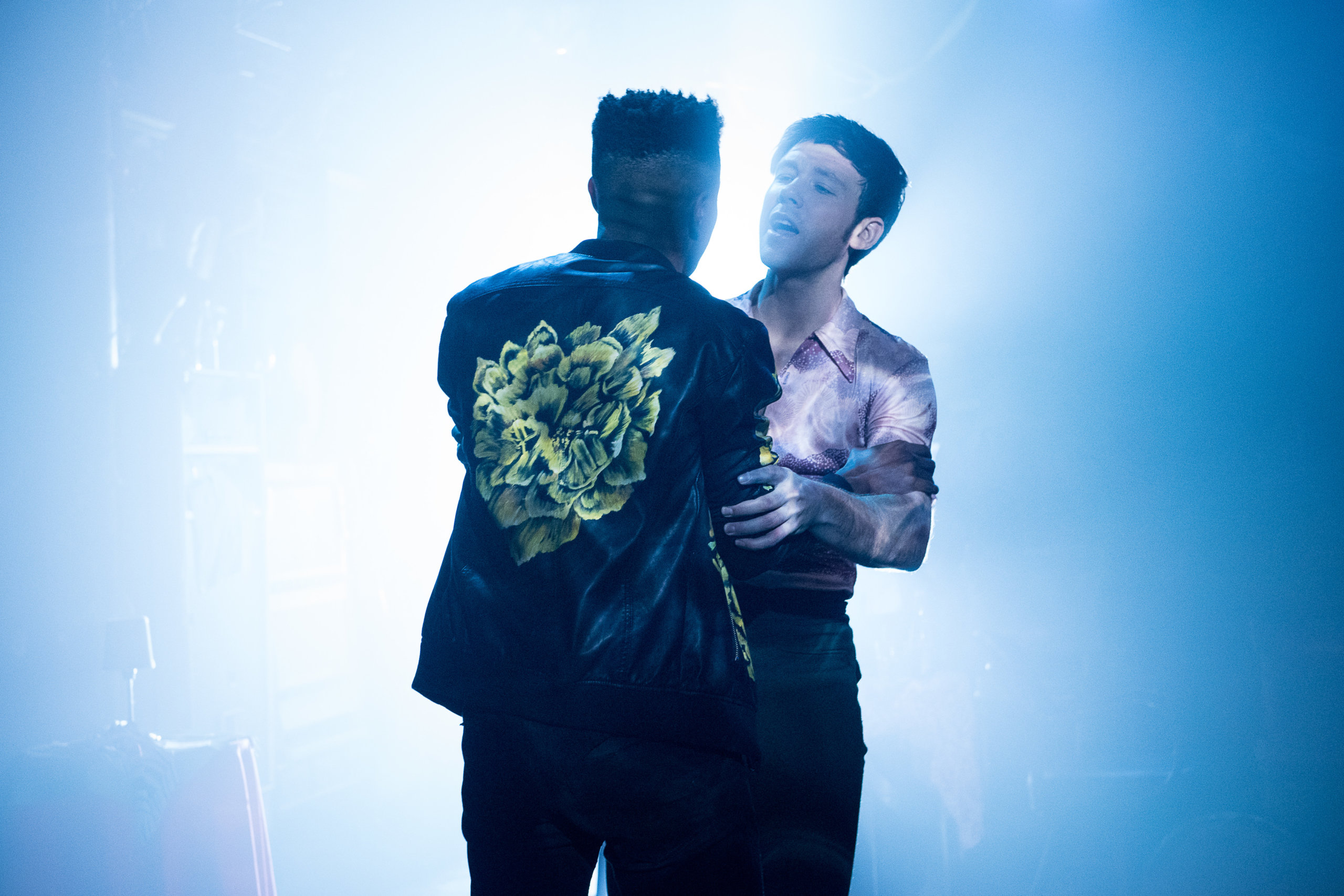
Likewise, The View brings its cast- and audience-patrons into new modes of relationality with imagined subjectivities of LGBTQ+ people who lived pre-AIDS and were abandoned by their nation in the epidemic. It compels the audience to collectively face the epidemic's "impossible gender/political situation," to use Goldberg's phrase, of a pre-radicalized LGBTQ+ New Orleans alongside the enduring legacy of the Reagan administration's institutional abandonment (1981–1989)—a legacy that would doom the 1973 patrons' future and continue to shape the present for the 2017 cast- and audience-patrons.100During Reagan's two-term presidency, nearly 253,000 new cases were diagnosed, and 230,000 or 91% of those diagnosed died as a result of the disease between 1981 and 1992, "HIV and AIDS---United States, 1981--2000," Morbid and Mortality Weekly Report 50, no. 21 (Atlanta, GA: Center for Disease Control and Prevention, June 1, 2001): 430–434.. https://www.cdc.gov/mmwr/preview/mmwrhtml/mm5021a2.htm. Wes explores this generational tension in "The Future Is Great," which voices queer millennial reflection to subvert belief in the teleological progression of LGBTQ+ rights. Talking to the 1973 patrons, Wes sings, "But I guess you're also lucky / living in the seventies. / There's no need for wearing condoms / you can slut it up guilt-free. / Nowadays we have fancy drugs / to help us all forget… / how the eighties came killed all your friends / you just don't know it yet."101Vernon, The View UpStairs, 58. Wes's simultaneous envy and fear for the Up Stairs generation demonstrates how LGBTQ+ millennials would come to experience HIV/AIDS under vastly less deadly conditions, many through secondhand history (e.g, "With Prep, etc. it's a different era today"). Having lost their uncle to that epidemic, Vernon, a millennial themself, feels the loss keenly and craves historical wisdom to constitute their own selfhood amid another hostile, anti-gay, transphobic, and racist recent presidential administration.
Throughout the musical, dialogue alludes to then recently inaugurated Donald Trump until the post-fire denouement when The View's contemporary intervention reaches fever pitch. Wes grieves the Lounge victims and traces its legacy through Pulse and the 2016 election. "This shit isn't better!" he shouts, "They're killing us. Fifty people just died in Orlando . . . Look at who's running this country! . . . OUR VICE PRESIDENT BELIEVES IN CONVERSION THERAPY!"102Vernon, The View UpStairs, 92. Jeremy Pope's performance of Wes's climactic line is desperate and immediate; he manifests the very real fear that the cast- and audience-patrons feel intimately as we anticipated the first of what would be many racist, nationalist, and anti-LGBTQ+ policies that the Trump/Pence administration would eventually enact.103The first directly anti-LGBTQ policy was announced that following July in 2017, when Trump tweet-announced the so-called "Trans Ban" in the US military that "the Administration began implementing . . . on April 12, 2019." "Transgender Military Service," Human Rights Campaign, last modified October 1, 2019, https://www.hrc.org/resources/transgender-military-service. In the immediacy of Wes's terror, the audience is brought to crisis and shared experience with the 1973 patrons. Wes reminds us that "this shit isn't better," a wake-up call against declining vigilance in a post-Obergefell political moment, and perhaps also a rebuke of guaranteed future betterment idealized in Dan Savage and Terry Miller's It Gets Better Project.104The home page of the It Gets Better Project reads, "The It Gets Better Project inspires people across the globe to share their stories and remind the next generation of LGBTQ+ youth that hope is out there, and it will get better" (emphasis mine); It Gets Better Project, accessed June 25, 2020, https://itgetsbetter.org. In either or both contexts, historic-, cast-, and audience-patrons are experientially united, haunted by dangerous futures. We are compelled to recognize how we constitute an intersectional collective despite the (im)possibilities of time, space, and subjectivity by confronting a national genealogy of hostile anti-LGBTQ+ policy tracing back from Trump, through Clinton, Reagan, Eisenhower, and beyond.105The homophobic policies of Trump and Reagan are outlined above. Importantly, anti-LGBTQ+ policy has been enacted by conservative and liberal administrations; President Bill Clinton instituted the discriminatory "Don't Ask, Don't Tell" military policy in 1993 forcibly closeting LGBTQ+ service people and signed the Defense of Marriage Act into law in 1996, prohibiting federal recognition of gay marriage. Eisenhower famously authorized the McCarthy-era Lavender Scare that terrorized homosexual Americans under anti-communist pretenses.
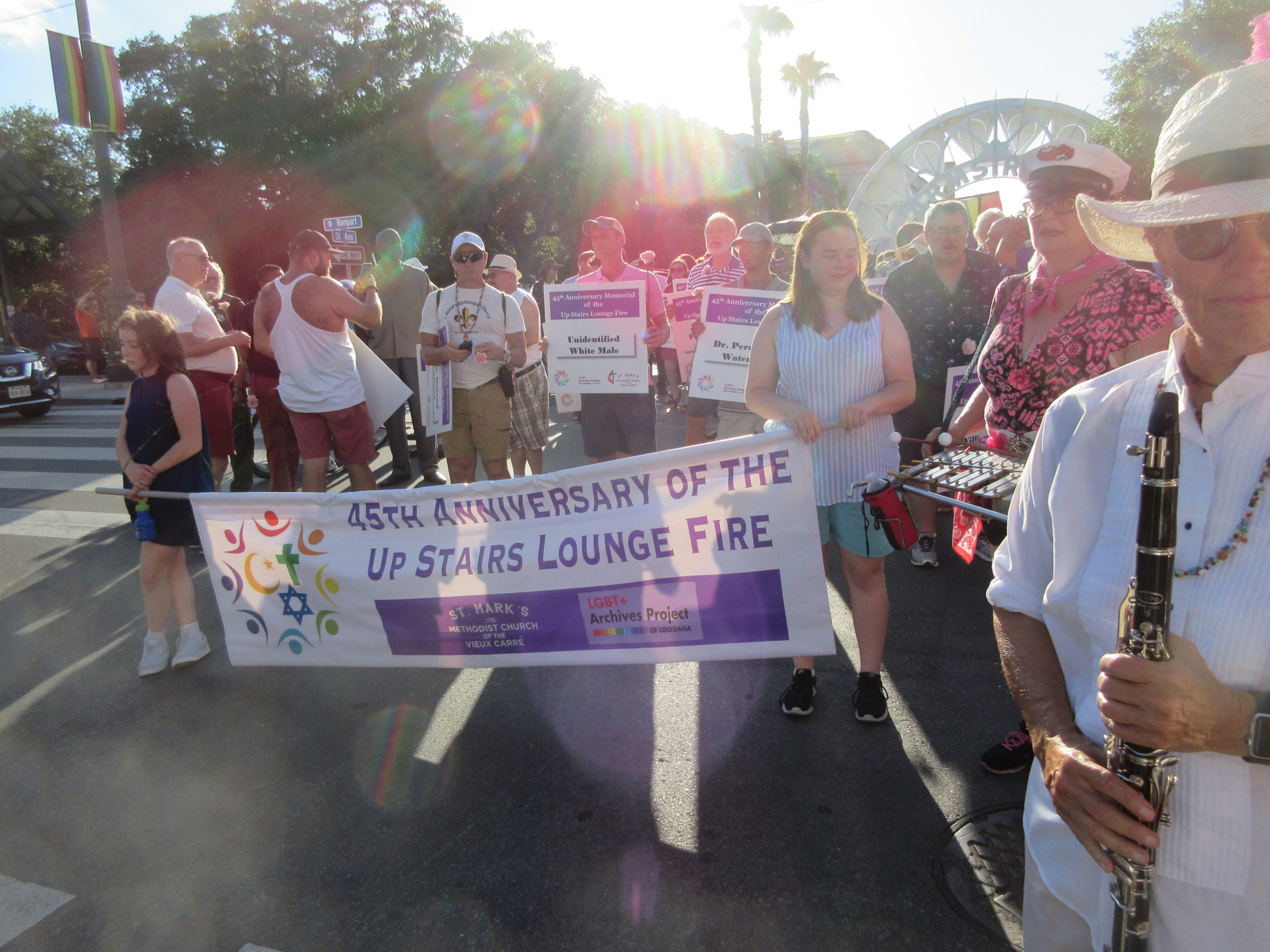
The View's immersive melodramatic pathos as executed in Pope's captivating performance manifests Goldberg's claim that melodrama can "work[] the system against itself" to foster opposition without necessarily changing the structures that inhibit LGBTQ+ life.106Goldberg, Melodrama, 160. The musical "open[s] a space of irresolution," and in that space, "[m]elodrama remediates [in the] double implication of the verb."107Goldberg, Melodrama, 4, xv. That is, The View confronts the impasse of time-space possibility for LGBTQ+ mentorship, and it thereby enacts the primary and secondary definitions of the verb "remediate." It conceptually remedies, or fixes again, oppressive ideological structures that inhibit "human flourishing" by recovering the erased arson attack and calling for resistance in the present day. The production also acts as a continual intermediary, mediating between what is possible (i.e., intimacy between cast- and audience-patrons) and what is impossible (i.e., mentorship by deceased historic-patrons and AIDS victims). The melodramatic mode in Vernon's adaptation does not simply re-present: it constitutes new possibilities for coalition against impossibility, however limited they may be.
The View UpStairs's immersive, melodramatic adaptation of nellydrama and drag performances that animated the 1973 Up Stairs Lounge subverts potential toward national voyeurism that recoiled local arson survivors at the arrival of those "fairy carpetbaggers." Vernon refuses to stage the fire's carnage, exploit the individual bar patrons, or reduce the event to mere symbol. In adapting the Lounge's performance genres, The View constructs a collective that links the cast and audience back to the generation who drank, prayed, performed, and lived in so many 1970s gay bars around the United States, imagining future possibilities for limitlessly diverse forms of LGBTQ+ subjectivity, relationality, and resistance. Indeed, such possibilities resonate most clearly in the words of Vernon's adapted MCC Reverend Richard: "We have too many people against us to be against each other. Maybe we have different ideas on how to get there, but we all want the same thing."108Vernon, The View UpStairs, 48.
About the Author
Stephanie Rountree is an assistant professor at the University of North Georgia. She is co-editor of Remediating Region: New Media and the U.S. South (Baton Rouge: LSU Press 2021) and Small-Screen Souths: Region, Identity, and the Cultural Politics of Television (Baton Rouge: LSU Press, 2017).
Acknowledgements
This essay manifests years of discussions with Dr. Ryan Prechter on his doctoral research on gay New Orleans and The View UpStairs. He introduced me to both the historic Up Stairs Lounge fire and Vernon's musical. Without his collaboration, this article would not exist. Similarly, I am deeply grateful to the external reviewers and editorial team at Southern Spaces, whose generous feedback helped shape my argument in important ways.
]]>Video
Essay
Jeff Drew, born in 1951, is a lifelong resident of Birmingham, Alabama's North Smithfield neighborhood. In 2013, following the fiftieth anniversary commemoration of the Birmingham campaign of the civil rights movement, Drew was inspired to be his neighborhood's oral historian: "The people who can tell the story are dying off."
Long before Birmingham was a center of 1960s movement protest, the hilly residential street where Drew grew up and still resides was a battleground in the fight against segregation. In the 1940s, Center Street was the dividing line between white and Black property: white residents on the west side and Black residents on the east side. Ignoring Jim Crow, Drew's family and other Black families crossed the color line and built homes on the west side of Center Street. Between 1947 and 1965, Black residences in Birmingham were bombed at least fifty times.
A graduate of Morehouse College in Atlanta, Jeff Drew's father, John (1908–1991), co-founded the Alexander Insurance Agency with the mission of providing affordable insurance to Black customers. While a Morehouse student, John Drew met Alfred Daniel King, Dr. Martin Luther King, Jr.'s brother. Participants in the Montgomery bus boycott in 1955–56 faced a dilemma: retaliating against Black protestors' refusal to ride the busses, the city imposed higher car insurance fees. When Dr. King asked his brother if he knew anyone who could help, Alfred connected him with John Drew, beginning a relationship that would last until Dr. King's assassination.
John Drew and Dr. King, along with local Birmingham civil rights leaders such as Fred Shuttlesworth and Arthur Shores, worked closely together to tear down Birmingham's segregated zoning ordinances, paving the way for Black families to live on the west side of Center Street—but not without brutal backlash. The area was bombed so frequently it became known as "Dynamite Hill," in a city already dubbed "Bombingham." Led by the Ku Klux Klan, assailants took to the cover of night to throw bombs, burn doors, and shoot into homes.
Atop Dynamite Hill, the Drew household was a high priority target for domestic terrorism because it was also a safehouse for civil rights organizing. Addine Drew (1916–2003), Jeff's mother, was known as the "Den Mother" of the movement. The trust between the Drews and Dr. King was so strong that he would stay with the family when in Birmingham. Local Black leaders would meet at 1108 Dynamite Hill to plan the next moves for equality. Jeff Drew tells of his childhood in this space, how he spent nights listening in on strategic conversations and woke up to find Dr. King sleeping on the couch. Given the profiles of those in attendance, these meetings were difficult to keep secret, so they were constantly under assault.
The original street-facing window of 1108 was a grand, cathedral-style frame—a colossal opening into a living room where the organizers met. Shot at and shattered countless times, the scenic window now only exists in photographs. After sustaining several bombings and much gunfire, the Drews had the home rebuilt with a new structure designed to endure bomb blasts. They constructed eight-foot tall brick walls that encased the perimeter of 1108 and reconfigured the interior so that the bedrooms were the furthest away from the street. The walls held and have endured, with the scars of attempted murders visible on the bricks.
The opportunity to hear Jeff Drew's story is a recent development. After Birmingham's 2013 commemoration, Drew told reporters that his parents asked him to never give interviews about "Uncle Mike" for fear that the white press would seek to tarnish his legacy and that of other local Black activists. With time, and the passing of many 1960s movement participants, Drew decided that he would talk more about this history. Seeing Drew outside 1108 talking to whoever will listen is as ordinary as seeing the mail being delivered. The only time he might turn down a conversation would be under similar circumstances to when he had us reschedule: he had a lunch date with childhood neighbor Angela Davis.
Acknowledgements
Special thanks to Jeff Drew for treating strangers like neighbors and taking the time to share his essential story.
About the Authors
Joseph Quintana earned his MA in Communication Studies from the University of Alabama in 2019. He recently received a screenwriting certificate from NYU Tisch School of the Arts and is currently pitching prospective screenplays and researching documentary subjects.
Mary Campbell Kitchens is a graduate from the University of Alabama and works as a secondary math special education instructor in New Orleans, Louisiana.
]]>Blog Post
I recently bought a crumbling old house in a historically gay neighborhood in Roanoke, Virginia. I met my ex-lover in this house five years ago. At the time they lived with a coterie of other young people. They threw raucous queer parties and housed folks who didn't have anywhere else to go.
A few blocks down the street is another building. There, in 1971, a group of young men and women founded the Gay Alliance of the Roanoke Valley (GARV), the region's first gay liberation organization. This building is now a medical office. I come here once a year to see my endocrinologist. He prescribes spironolactone and estradiol to help my body transform into something approximating that of a woman.
The local neighborhood association puts up signs that read, "A Past with a Future." As I see it, the neighborhood's past is rich with gay history, and the future is my transitioning body and the pink, white, and blue flag I fly in the driveway.
Queer history lives here. It's overlapping in the spaces of my neighborhood. It's in the bones of the buildings. Queer ghosts inhabit the walls. Archaeological troves are remnant in the yards. My dog June digs them up with her ready paws and pearl-white fangs. My gender transformation is hitched to the woodwork and to the water pipes of all the apartment buildings where I have lived. People have lived queerly in these spaces. I have bought a home that not only holds the past but makes space for the future—for my womanhood, my motherhood, and for the chosen family I will assemble underneath this roof.
LGBTQ people have long known that our stories are not to be found in the so-called annals of history, and that we have to look in unexpected places to find our past. Lesbians in Roanoke in the 1980s devoted an entire issue of their newsletter, Skip Two Periods, to "Discovering Our Heritage." The writer, "B. F.," wrote about finding her heritage at the Lesbian Herstory Archives in Brooklyn, in Jonathan Ned Katz's book Gay American History, through the National Women's History Project, and in the published letters shared among nineteenth-century women. She also suggested that lesbian history is found in our families. "Write to your grandmother and ask her about her grandmother," she pleaded. Indeed, queer history is present in the way my parents reacted when I first came out, as they referenced a family member who died of AIDS in 1989 and hinted that I might face a similar fate. We carry queer trauma in our bodies. All of us—straight, gay, cis, trans—live in a world shaped by the queer past.
We have the tools to probe this history on the local level. Since the 1970s, queer history projects have flourished across the United States. New archives are forged from the remains stowed away in activists' attics and closets. Oral history collections are assembled from the stories of our elders, talking about what it was like growing up as a trans person in Appalachia in the 1960s, for example. Doing queer history work provides us with the opportunity to bring LGBTQ people together across generations, to talk about what was and what can be, to find new meaning in the spaces of our lives.
Six years ago, I helped found the Southwest Virginia LGBTQ+ History Project, a community history project that has since engaged hundreds of local people in the process of researching and interpreting queer pasts. This has involved creating a permanent archive in partnership with the local public library system, developing an oral history collection through interviews with our elders, leading monthly walking tours, unveiling digital exhibits, releasing podcasts, and working with local youth on interactive theater and zine-making workshops. This project is how I ended up spending time in this house; it's where I fell in love with a project member who lived here. It's how we know the geography of bars and cruising spaces that once littered the neighborhood, and the all-queer and all-trans houses that still stand. It's how I discovered my gender. Interviewing trans women about their lives, I realized this was also my story. So I came out into the spaces of the project, into the spaces of our city, into a new relationship with queer history. A past with a future.
Every October we celebrate LGBTQ History Month. To me, this month is a reminder that we are still fighting, especially here in the South, for students' right to learn basic LGBTQ history in the classroom. But beyond the metanarrative of what should be taught in school, there are thousands of local queer histories still waiting to be uncovered. This work takes all of us—students, elders, volunteers, professionals. Do you know when the first gay organization was founded in your community? Have you met your trans elders? The work of doing queer history has the power to transform lives. It has the power to give new meaning to the places we call home.
About the Author
Gregory Samantha Rosenthal is the author of Living Queer History: Remembrance and Belonging in a Southern City (Chapel Hill: University of North Carolina Press, 2021).
]]>Blog post
Mother Jones died ninety years ago, but she was back in Alabama this July. It was not her first visit to the state. She came to Birmingham and Bessemer to support striking railroad workers in 1894, and a few years later, she took a job in a Tuscaloosa cotton mill to report on the wretched working conditions faced by women and children.
Truth be told, it was not the real Mother Jones but a twelve-foot inflatable likeness of her that showed up at the Brookwood Ballpark for a rally in support of striking coal miners. Roughly two thousand people came out to the event, and many stopped to have their picture taken with "the grand old lady of the labor movement." Present were representatives of labor unions from across the country—longshoremen, flight attendants, municipal employees, as well as members of the United Mine Workers of America from West Virginia, Kentucky, Illinois, Indiana, Pennsylvania, and Ohio.
The inflatable likeness belongs to the Mother Jones Heritage Project, a pro-labor organization based in the Chicago area. Jim Dixon of Springfield, Illinois, drove her down to Alabama. Now retired, he was president of Springfield Trades and Labor Council, a member of the American Federation of State, County and Municipal Employees (AFSME), and a union activist. He came to Alabama not only with Mother Jones, but with checks for the miners' strike fund from his AFSCME local, and from the Mother Jones Foundation.
The immediate spur for Dixon's trip to Alabama was the five-month-old strike, called by the United Mine Workers of America, of over a thousand workers in Tuscaloosa County. They took a big pay cut four years ago when their employer, the Walter Energy Company, went bankrupt. The new owner, Warrior Met, refuses to negotiate restoration of pay, overtime, and holidays now that the old contract has expired, despite the fact that coal shipments to China, Europe, and Latin America have made the company profitable once again.

We think of Alabama as a deep red "right-to-work" state, yet it has a long history of union organizing. In Bessemer, just half an hour east on Interstate 20, was the big organizing drive against Amazon a few months ago. The contradictions of red state unionism are right on the surface. Many of the striking miners are Trump Republicans who loved his promise to "bring back coal." But they recognize too that there has been no support for the strike coming from the right, no GOP politicians standing in solidarity for fair wages, no Fox News coverage. Meanwhile, the law has winked at a few incidents of violence against the strikers. But there is also a contradiction from the left. Coal is a filthy fuel, a major contributor to global warming, yet promises of "good paying green jobs" sound like pie in the sky to working class families who have struggled across generations for the bit of security offered by UMWA jobs.
Jim Dixon said he was struck by several things during his time in Alabama. He was impressed with the size of the crowd and the energy at the rally staged by the United Mine Workers. He also mentioned that it was a well-integrated event—about a fifth of the striking miners are African American, and he felt a strong spirit of solidarity across racial lines. The miners Dixon spoke with were upbeat, ready to keep fighting for a contract. Still, he added, this strike isn't getting the press attention it deserves. Not just newspapers, but unions too need to go back to educating Americans about economics. The biggest owner of Warrior Met, he noted, was BlackRock, the world's largest asset manager. "Workers know they're getting kicked," Dixon said, "but they don't always know whose foot is in the boot."
"An injury to one is an injury to all," he added, quoting the slogan of the nineteenth-century Knights of Labor. Dixon's grandfather, a coal miner, narrowly escaped death in Illinois's horrific Cherry Mine Disaster in 1909. Organized labor, Dixon emphasized, was a family; working people needed security, safety, and decent pay to keep their children properly fed and clothed. Mother Jones, he pointed out, always referred to "the family of labor" because unions looked out for households and communities, not just individuals.


That is why Mother Jones remains an important symbol for the labor movement. Mary Harris Jones always called out whose foot was in the boot. Born in 1837, a famine immigrant from Ireland in 1850, she lost her husband and four children to a yellow fever epidemic in Memphis when she was thirty years old, then had her seamstress shop burned out in the Chicago fire of 1871. Tragedy only heightened her empathy for her fellow workers and fearlessness toward the powerful. She studied the social conditions of Gilded Age America, developed her oratorical skills, and as an elderly woman she emerged as Mother Jones, the fierce leader of a thousand labor battles.
Mother Jones organized men and women, Black and white, immigrant and native-born workers. Across industries, from steel milling to needle trades, but especially coal mining, she gave exploited American workers hope of gaining some control over their lives and bettering their conditions. To dramatize the exploitation of child labor in America, she even organized one hundred striking kids into "the March of the Mill Children," from Philadelphia to President Theodore Roosevelt's summer home on Long Island.
By the early twentieth century, Mother Jones was one of the most famous women in America. Local officials locked her up to keep her away from strike zones, but she always said she could raise more hell in prison than out. "The most dangerous woman in America," one prosecutor called her; "She is a wonder," her friend Carl Sandberg wrote; "The walking wrath of God," Upton Sinclair declared. Meridel Le Sueur, just fourteen years old when she first heard Mother Jones speak, recalled, "I felt engendered by the true mother, not the private mother of one family, but the emboldened and blazing defender of all her sons and daughters."
In Chicago, the Mother Jones Heritage Project is negotiating with the city to erect a statue of her downtown. As America reevaluates who its heroes are, rethinks who deserves to be immortalized in bronze, here is a forgotten figure, larger than life, an immigrant, a woman, an elderly person, a worker, inspiring others to "pray for the dead and fight like hell for the living." Just ask the miners—Mother Jones lives!
About the Author
Elliott J. Gorn teaches history at Loyola University Chicago. He is the author of Mother Jones: The Most Dangerous Woman in America (New York: Hill and Wang, 2001), and most recently, Let the People See: The Story of Emmett Till (New York: Oxford University Press, 2018).
]]>Preface
Digging Our Own Graves, first published in 1987, concluded with an ominous prediction: "Black lung disease awaits the younger generation of coal miners who are now at work underground." Would that I had been wrong! Today, not only do coal miners still suffer from this lethal but preventable lung disease, they do so at younger ages, some even in their thirties, and they are contracting the most advanced form of black lung at the highest rates ever recorded. More than fifty years after the US Coal Mine Health and Safety Act of 1969 imposed a respirable dust standard on the coal industry, designed to prevent black lung, why do such carnage and suffering persist? This updated version of the original book seeks answers to that question.
My own introduction to black lung began in the winter of 1971–1972, when I came to West Virginia to work for the Black Lung Association. I was barely twenty years old. Extraordinary political transformations were in the making: coal miners, miners' wives, and widows were challenging powerful institutions that had once commanded their acquiescence—the hierarchy of the United Mine Workers, the coal operators' association, county political machines, and the Social Security Administration.1The language of "miners' wives and widows" implies that all miners are male. However, since at the least the 1970s, women have worked in the mines, including underground, albeit in small numbers. I use the language of "wives and widows" because most black lung activists use this language in their organizing and their discussion of black lung compensation (e.g., "widows' claims"). For a young college student from the Midwest, these developments in the mountains of West Virginia beckoned with a romantic excitement. Besides, the mountains were my ancestral homeplace; now I could return to them, not on a summer vacation in the backseat of the family car, but on my own.
Working with the older coal miners and impatient young organizers who made up the Black Lung Association at that time was a formative political experience for me. Coming from a long line of southern subsistence farmers and circuit-riding preachers, I was instilled with a righteous, if vague, sense of populism that made me eager to join the struggles of "working people." But neither my political heritage nor my exposure to campus radicals prepared me for what I found in the coalfields of West Virginia: above all, the stark boundaries and clear perceptions of class antagonism. Virtually every coal miner over the age of sixty-five proudly claimed to have "fought in the battle of Blair Mountain with a machine gun" in 1921 to bring the union into southern West Virginia. They were up against the combined forces of coal company guards, the state police, county sheriffs and their deputies, aerial bombers, and, ultimately, the US Army. I was dumbfounded.
Fortunately, it didn't occur to me to write about any of these experiences until my age and the changing times helped to deepen my understanding of what they might mean. In 1978, more than six years after I had first worked for the Black Lung Association, I began the research for a dissertation on the black lung movement. The political atmosphere was altogether different. A reform movement in the United Mine Workers of America (UMWA) had arisen, succeeded in a special election for leadership of the union, then disintegrated; the black lung movement had seemingly disappeared; and a storm of reaction was sweeping the Appalachian coalfields. The setbacks were frightening, but they made possible a more sober and critical perspective on the earlier period of upheaval.
I began this book as a labor history, asking obvious questions that seemed most important at the time: Why did the movement end this way? What did it accomplish? How did it fail? Who or what was to blame? As I dug deeper into the history of the black lung movement, however, these apparently clear-cut questions about victories and defeats began to seem ambiguous, even misleading. The assessment of whether the movement had succeeded or failed depended a great deal on whose goals were used as the standard of measurement—and goals varied considerably among different participants. Moreover, what the larger political culture defined as the movement's greatest accomplishments often turned out to be mainly symbolic; they represented the visible outcomes of formal processes of reform (the passage of legislation, for example), but in and of themselves did not necessarily signify substantial and lasting change. The simplicity of my original questions faded as the labels of victory and defeat, success and failure, appeared more and more ephemeral. The central analytical problems increasingly seemed to involve the maddening complexity of social change itself, which prevented any person or group from controlling the course or outcomes of this movement.
As I delved further into the reforms sought and controversies engendered by the black lung movement, it became apparent that the movement was more than an important episode of labor resistance. At issue in the struggles over black lung, which have reemerged today, is not only how to prevent the disease or compensate those affected by it but also the very definition of black lung. Frequently, the most ideologically powerful opponents that miners have faced in their successive surges of activism are not coal operators or conservative politicians but physicians. At the center of the black lung controversy has been a profound power struggle between miners and physicians over who will control the definition of this disease.2See Daniel M. Fox and Judith F. Stone, "Black Lung: Miners' Militancy and Medical Uncertainty, 1968–1972," Bulletin of the History of Medicine 54, no. 1 (1980): 43–63, for an early framing of the black lung struggle as between miners and physicians over the definition of disease. Their emphasis on medical uncertainty differs from the analysis in my own article, which came out during the same time period: Barbara Ellen Smith, "Black Lung: The Social Production of Disease," International Journal of Health Services 11, no. 3 (1981): 343–359.
As a result of these and other shifts in emphasis, this book is a hybrid. It draws on diverse theoretical traditions in order to analyze not only the organization and development of the black lung movement, but also the history and conflict that underlie the brutal fact of coal miners' diseased bodies. Beginning with how and why black lung originates in the workplace, this book also explores the medical history of the disease and the conflicting meanings that miners and certain physicians, lawyers, and government administrators invest in black lung.
After moving away to a self-imposed exile some twenty-five years ago, I live once again in West Virginia. Contrasts with the 1970s heyday of working-class activism are evident throughout the rural landscape of abandoned gas stations, rusted coal tipples, and boarded-up union halls. The differences are personal as well: when I interviewed black lung activists in the 1970s, I was the age of their daughters and granddaughters; today, I am eligible for Medicare. As I conducted additional interviews in 2019, mostly with retired coal miners close to my age, their bodies as well as their words spoke the story of black lung disease and the physical toll of hard-labor jobs. Conditioned as a white woman to thinking of my embodiment primarily in terms of gender, I was struck again and again by how the privileges of class have shielded me from harm and become subsumed into my body. This updated and revised book, which includes two new chapters and a moving, evocative photo gallery by Earl Dotter, thus entails not only additional research into medical, legal, and economic materials relevant to black lung, but also historical reckonings both political and personal.
Today, as I write this preface, the power relations that miners experience on the job are dangerously asymmetrical, and their outcomes grim. Coal miners in southern West Virginia, once the stronghold of the UMWA in central Appalachia, where those who crossed a picket line invited ostracism if not assault, now work nonunion. Coal companies, facing shrinking domestic markets and in many instances bankruptcy, force workers, coal communities, and American taxpayers to bear the costs of their decline. Black lung can only be fully understood as part of this historical moment, when resistance, remarkably, persists. Digging Our Own Graves analyzes the dreadful resurgence of black lung within the long history of efforts to legitimate this disease and make it visible, prevent black lung in the workplaces where it is produced, and extend dignity and a measure of justice to those for whom prevention comes too late.
Conclusion: Class Power, Scientific Authority, and State Regulation
Nearly two centuries have passed since Dr. James Gregory opened up the lifeless body of John Hogg and hypothesized a connection between the miner's blackened lungs, his respiratory disability in later life, his occupation, and his death. For a time, physicians in Britain and the United States continued to investigate the relationship between occupational exposures and miners' respiratory distress. Toward the end of the nineteenth century, however, during a period of tight corporate control in the Appalachian coalfields and an increasingly restrictive scientific understanding of disease, black lung began to disappear from the medical literature of both countries. In the United States, coal miners eventually precipitated renewed medical attention to black lung by winning a union-controlled health care plan for themselves and their families. Even so, coal workers' pneumoconiosis—much less the broader ensemble of illnesses called black lung—was not accepted as a legitimate, occupationally related disease by the medical profession as a whole.3Journalistic and some scientific accounts equate coal workers' pneumoconiosis (CWP) with black lung. However, an essential component of the black lung movement was miners' and their families' struggle to broaden the definition, beyond CWP, of miners' disabling, occupationally related lung disease. Research by physicians and other scientists familiar with and sympathetic to miners and their health has validated this broader definition. See, for example, Edward L. Petsonk, Cecile Rose, and Robert Cohen, "Coal Mine Dust Lung Disease: New Lessons from an Old Exposure," American Journal of Respiratory and Critical Care Medicine 187, no. 11 (2013): 1178–85. Formal recognition required collective political intervention by coal miners themselves.
Even as social and economic factors have impinged on the medical construction of black lung, so have they shaped the actual production of disease. Black lung originates not simply from the physical presence of dust in coal mines, but from the relative power and respective actions of miners and operators, which influence conditions in the workplace. Miners' eventual success in unionization enhanced their collective power in the workplace, but, depending on UMWA leaders' priorities, unionism at times paradoxically undermined miners' capacity to make that workplace healthy and safe. In the years after World War II, the pact between larger operators and the UMWA produced unimpeded mechanization of the production process, high levels of unemployment, forced migration, and occupational death and disability from black lung. However, that industrial collaboration also produced massive rank-and-file upheaval and a successful effort to reform the union. In the present moment, union weakness and miners' lack of bargaining leverage in the workplace, combined with certain operators' endgame maneuvers to extract coal from thinner seams even while pressing for high levels of labor productivity, once again intensify the extent and severity of the disease.
The virulence of black lung today—fifty years after it was supposedly destined for elimination—does not diminish what coal miners, their families, and their allies accomplished in the past. Rather, it attests to the enduring realities of labor exploitation that the black lung movement episodically managed to contest. For its constituents, the movement achieved a unique and unprecedented federal compensation program. Approximately half a million miners and widows have received compensation under the federal black lung program; especially for those ineligible for a pension or other benefits, the monthly payments can mean the difference between destitution and modest survival.4This estimate of the number of black lung beneficiaries is extrapolated from data on the number of claims filed each year, changing approval rates, the annual total cost of claims, and, for some years, reports from the administering federal agency. See, for example, Social Security Administration, Annual Statistical Supplement to the Social Security Bulletin, 2016 (Washington, DC, 2017), Table 9. Beneficiaries who are miners and those who are widows, added together, do not equal the total number of miners judged disabled by black lung, as a widow may receive her husband's benefits after his death. Further, the number of beneficiaries is reported each year as a rolling total, and thus cannot be summed. The coronavirus interrupted my efforts to obtain more precise data. As of December 2018, an individual beneficiary is entitled to receive $660/month, which increases up to a maximum of $1,320 for those with three or more dependents. US Department of Labor, Division of Coal Mine Workers' Compensation, "Benefit Rates Under Part C, 1973–2018," accessed August 16, 2019, https://www.dol.gov/owcp/dcmwc/statistics/PastPartCBenefitRates.htm. The respirable dust standard and other disease prevention measures in the US Coal Mine Health and Safety Act of 1969 are also attributable to the black lung movement. As one element in a larger upheaval throughout the coalfields, the movement contributed as well to the rank-and-file takeover of the United Mine Workers of America and renewal of union leaders' critical attention to occupational safety and health.
Originally and essentially, however, the black lung movement was a struggle over the recognition and, more implicitly, causation of an occupational disease. What seemed at first a straightforward task— achieving legal inclusion of a "new" dust disease under the workers' compensation system—turned out to be a far more complex undertaking. Miners and other activists learned early on that "black lung," as refracted through the lens of scientific medicine, was quite different from the disease for which they sought recognition, compensation, and prevention. In a struggle that has lasted more than fifty years, activists have persistently challenged physicians, lawyers, and policymakers over the meaning of this disease; at different times, they have been able to replace the restrictive scientific construction of a rarely disabling coal workers' pneumoconiosis with their own definition of "black lung." Although focused on arcane disputes over diagnostic methods, disability standards, legal presumptions, and other issues, this conflict over the definition and causation of black lung is intensely political: it involves the ideological content of medicine's view of disease, including the technical perspective that narrows causation to the inhalation of dust, and the powerful role of physicians in labeling work-related disability as legitimate. On the outcome of such conflict rests financial liability for the coal industry that potentially ranges into billions of dollars. The legacy of black lung activism thus entails unsettling questions about the relationship between scientific and technical knowledge, state regulation, and the exercise of class power.
It should be stressed at the outset that not all physicians subscribe to a narrow or purely technical understanding of black lung: recall the role of three doctors (Buff, Rasmussen, and Wells) in the first black lung mobilization during 1968 to 1969 in West Virginia. Dr. Donald Rasmussen continued to work with and advocate for coal miner patients out of his pulmonary lab in Beckley, West Virginia, for five decades, up until his death in 2015.5Sam Roberts, "Dr. Donald L. Rasmussen, Crusader for Miners' Health, Dies at 87," New York Times, August 2, 2015, accessed September 29, 2019, https://www.nytimes.com/2015/08/03/health/research/dr-donald-l-rasmussen-crusader-for-coal-miners-health-dies-at-87.html. Rasmussen's mantle now falls on Dr. Robert Cohen, a pulmonologist who directs the occupational lung disease unit at Northwestern University and frequently testifies before Congress on miners' behalf.6Dr. Cohen testified during the hearings on black lung, "Breathless and Betrayed." See "What is MHSA Doing to Protect Miners from the Resurgence of Black Lung Disease?" YouTube video, 2:58:39, June 20, 2019, House Committee on Education and Labor, https://www.youtube.com/watch?v=sJUDcTf0a_g. Other physicians in the coalfields, such as Drs. Gregory Wagner and Brandon Crum, have devoted much of their professional lives to caring for coal miners with lung disease. After practicing medicine at a clinic on Cabin Creek (West Virginia), Wagner eventually came to direct Respiratory Disease Studies at NIOSH when that agency issued the criteria document that legitimated a broad definition of black lung, inclusive of COPD (chronic obstructive pulmonary disease), and recommended much lower limits on miners' exposure to coal dust and silica.7NIOSH, Criteria for a Recommended Standard: Occupational Exposure to Respirable Coal Mine Dust, publication no. 95–106 (Washington, DC: US Government Printing Office, 1995), xxii, https:// www.cdc.gov/niosh/docs/95-106/default.html. Crum, a radiologist—and, not coincidentally, former coal miner—was first to sound the alarm over black lung's escalating severity, which in 2014 he began detecting among his patients in eastern Kentucky. Four years later, the coal-industry-beholden state legislature responded by disqualifying him from reading X-rays for miners' workers' compensation claims.8Austyn Gaffney, "As Black Lung Strikes Younger Coal Miners, Kentucky Restricts Medical Benefits," NRDC, September 24, 2018, accessed September 29, 2018, https://www.nrdc.org/stories/black-lung-strikes-younger-coal-miners-kentucky-restricts-medical-benefits.
Apart from such individual physicians' political and medical predispositions, however, there remain epistemological tendencies within scientific medicine that militate against the understanding of disease advanced by black lung activists.9This summary of miners' perspectives on the origins of black lung and the role of physicians in advocating a restrictive view of work-related, compensable disease is based on the author's interviews and observations in southern West Virginia at different moments during the past five decades. Within the restrictive medical viewpoint that requires conclusive, scientific proof of occupational causation, black lung is in fact coal workers' pneumoconiosis, a single clinical entity, disabling only in advanced and, even today, relatively rare stages. The disease acquires legitimacy—indeed, effectively comes into existence—only when visible to trained personnel viewing objective diagnostic evidence, that is, X-rays, of an individual miner's lungs. The thousands of miners who believe themselves disabled by black lung yet exhibit no X-ray evidence of advanced CWP might legitimately be considered "disabled"—if the quantitative results of certain tests confirm such a condition. However, the origin of their disability is nonoccupational, above all their own cigarette smoking, or, if nonsmokers, other sources outside the workplace. Although this scientific definition of disease is quite different from physicians' earlier construction of a benign "miners' asthma," the result, in the eyes of many victims, is the same: black lung is trivialized. What many miners view as a collective problem becomes, from the perspective of scientific medicine, individual, quantifiable cases. What they experience as part of the shared social world of coal mining becomes occasional, biological events. What they attribute to their class relationship with the coal operators becomes the product of a single physical agent, dust. In sum, what is collective becomes individual, what is social becomes biological, what is produced by human action becomes the outcome of inert material.
Certain tendencies intrinsic to clinical medical practice are also at stake in the seemingly incommensurable perspectives of miners and certain physicians. Scientific medicine situates disease spatially, within the individual body, and temporally, at the point when signs, symptoms, or other physical alterations develop. Disease is ahistorical as well as asocial; it has no history except a "natural," that is, physical, history. It is said to exist when experienced by the individual and diagnosed by the physician, not at the point when it is being produced. The possibilities for prevention are thus constrained within the very definition of disease.10Howard S. Berliner and J. Warren Salmon, "The Holistic Health Movement and Scientific Medicine: The Naked and the Dead," Socialist Review 9, no. 1 (January–February 1979): 31–52.
Clinical medicine reflects this understanding of disease on a practical level: individual patients present the physician with their distinctive symptoms and complaints; they appear as random, disconnected "cases," and they are granted therapeutic treatment as individuals. There is no social meaning to disease in the sense of an internal relationship between social relations and the individual experience of ill health; primarily individual behaviors, such as diet, exercise, and smoking habits, command attention. Yet, in quantifying disability and allocating it to occupational or nonoccupational sources, physicians implicitly assess the conditions in which miners have lived and worked all their lives. That most physicians have never been in a coal mine (much less worked in one), and that some have never even been in the coalfields, serves to intensify the conflict between physicians and coal miners, who experience the superior legitimacy automatically granted scientific medical knowledge as a complex and powerful form of social control.
The authority of physicians to pronounce miners "healthy" or "disabled" carries important financial consequences. In the context of federal black lung compensation, doctors' assessments of coal miners' health can be decisive in the award or denial of financial benefits that are allocated in large part according to medical eligibility criteria. Doctors act as gatekeepers in a more generic sense as well: they control access to the "sick role," the sole avenue by which adults may legitimately escape the daily responsibilities of their class, race, and gender.11See Talcott Parsons, The Social System (New York: Free Press, 1951). Parsons's conceptualization of the sick role was neither class nor historically specific. For coal miners, as for other workers, the preeminent requirement of their class position is to perform wage labor. Medical criteria for assessing disability (and determining compensation eligibility) that take as the standard for health the functional capacity to work explicitly enforce this requirement. Even if damaged by work, coal miners still must provide medically sanctioned evidence of their "total disability"—i.e., complete inability to continue working—in order to receive financial compensation and legitimate relief from wage labor. In pushing against the limits of this compensation policy, miners and their families implicitly contest not only the ideological authority of physicians to define disease and assess disability; they ultimately threaten the economic power of coal operators by pressing for a broad definition of black lung and relaxed standard of disability that would provide unhealthy miners an alternative to labor in the mines.
This convergence between the restrictive scientific view of black lung and the economic interests of the coal industry is, for many miners and their families, an ultimate source of distrust and conflict with physicians. The narrow definition of disabling black lung as a relatively rare, complicated pneumoconiosis is highly functional to the industry: it circumscribes the scope of occupational lung disease and correspondingly diminishes both the cost of compensation benefits and the importance of prevention. In the context of policy formation, scientific medicine plays a mediating role between the interests of the coal industry and the actions of the state. It facilitates apparent distance between corporate power and public policy, and seems to ground political decision-making in the neutral, technical knowledge of a third party.
The lessons of the protracted struggle over black lung disease encompass both caution and inspiration, loss and hope. In an era of science denialism, when defense of factual truths and scientific knowledge seems obviously necessary, the case of black lung still stands as a warning about the presumed neutrality and appropriate scope of scientific and technical solutions: beware of technical fixes for problems that ultimately derive from economic exploitation and grossly unequal political power. Activists' original quest for redress through the workers' compensation system offers a related caution: the sprawling administrative machinery of the state, which presents the customary, sanctioned route for institutionalizing reform, entails embedded interests that can thwart activists' aims even as it seems to grant their demands. Finally, the long history of black lung suggests that effective prevention of occupational disease, injury, and death ultimately resides in the ever-changing power relations of the workplace and workers' collective, organized capacity to defend themselves. For these and many other reasons, victories are never secure, achieved once and for all; they must be defended, expanded, critiqued, and revised, as black lung activists have doggedly done for some five decades now.
Today, the industry that for more than a century has defined central Appalachia is dying. Those who would chart a post-coal future must grapple with the industry's legacy of incalculable human and environmental destruction, but they would do well to learn from the additional legacy of coal mining families' solidarity and resistance. Ever since the first investors laid claim to the coal of Appalachia, the people of this region have been revolting in various forms against the appropriation of their land, their labor, and even their lives. Those who fought in the black lung movement are both heirs and contributors to this long history of resistance. Today, many miners pay the cost of coal production in the currency of their very breath, but they also continue to resist. Danny Whitt: "We don't never give up. You know when I'll stop? When the last breath leaves my body."12Author's interview with Danny Whitt, Matewan, WV, September 4, 2019.
About the Author
Barbara Ellen Smith is professor emerita of women's and gender studies in the Department of Sociology at Virginia Tech. She has been active in and writing about movements for social and economic justice in Appalachia and the US South for more than 45 years. Her recent publications include a co-edited book with Stephen L. Fisher, Transforming Places: Lessons from Appalachia (University of Illinois, 2012) and Digging Our Own Graves: Coal Miners and the Struggle over Black Lung Disease (Haymarket Books, 2020).
]]>Introducción
El dramaturgo Abel González Melo nació en 1980 en La Habana, Cuba, mismo año en que el Exodo del Mariel vio a aproximadamente 125,000 personas huir de su país, un evento que dramatiza en su obra de 2018 En ningún lugar del mundo. González Melo estudió Artes Teatrales en la Universidad de las Artes de Cuba. Ha recibido diversos premios y galardones por sus obras literarias y teatrales, entre ellos el Premio Primer Concurso de Dramaturgia de la Embajada de España (2005) por Chamaco, una de las obras más reconocidas de González Melo, y más reciente el prestigioso Premio Literario Casa de las Américas 2020 (enero).
Las obras de González Melo abarcan dos décadas y cubren múltiples temas sociales dentro de la vida cubana. Desde la complicada relación de Cuba con el Exodo del Mariel en En ningún lugar del mundo (2018) hasta la prostitución adolescente a principios de la década de 2000 en La Habana Vieja en su trilogía, Fuga de Invierno (2004–2009), sus obras sumergen al público en las calles que rodean el Capitolio de La Habana, en los parques, callejones y teatros que brindan espacios para la prostitución ilegal, en casas particulares que centran la importancia de la familia para los cubanos. La primera década de la escritura de González Melo problematiza la cultura juvenil cubana de principios de la década de 2000, una cultura a la vez gay y heterosexual, hambrienta y saciada, resistente y complaciente en un país donde la Revolución todavía se lucha a diario en las calles (aunque ahora rodeados por los "WiFi hotspots" aprobados). Mientras González Melo mantiene su identificación sexual privada, sus obras desafían la categorización, preguntan cuestiones de sexualidad y exploran la supervivencia, la mercantilización del cuerpo, el trauma mental intenso, el dolor de la historia y el amor profundo de la familia. Sus personajes se entretejen dentro y fuera de sus obras para demostrar esa complejidad: mientras algunas cosas han cambiado, otras siguen igual de siempre.
La obra más reciente de González Melo pasa a recuperar personajes literarios y episodios de la historia cubana con una perspectiva revisionista. Figuras históricas de la obra de González Melo incluyen la poeta feminista de principios del siglo XX María Luisa Milanés (de Bayamo, Cuba) en Bayamesa (2019), que ganó el premio Casa de las Américas de teatro en enero de 2020. En abordar el tema de la censura en el apogeo de la Revolución en Cuba, la obra más reciente de González Melo presenta personajes históricos cubanos. Fuera del juego dramatiza la experiencia de la figura cultural Heberto Padilla, un poeta venerado cuya obra criticó la Revolución y sus líderes en su momento, 1967–68, resultando en su arresto, tortura y exilio a los Estados Unidos en 1980. Padilla trabajó muchos años en varios puestos en el sistema universitario en los Estados Unidos, como Ohio State University, Bowdoin College y el Instituto de Humanidades de la NYU, antes de morir solo como poeta residente Auburn University en 2000. En su drama más reciente, Cádiz en José Martí (Festival de Teatro Iberoamericano de Cádiz, 2020), González Melo dramatiza al mítico héroe nacional de la isla, el revolucionario José Martí (1853–1895). González Melo lo sitúa en la ciudad española de Cádiz, el primer destino de Martí en su largo exilio y deportación política bajo el régimen colonial.
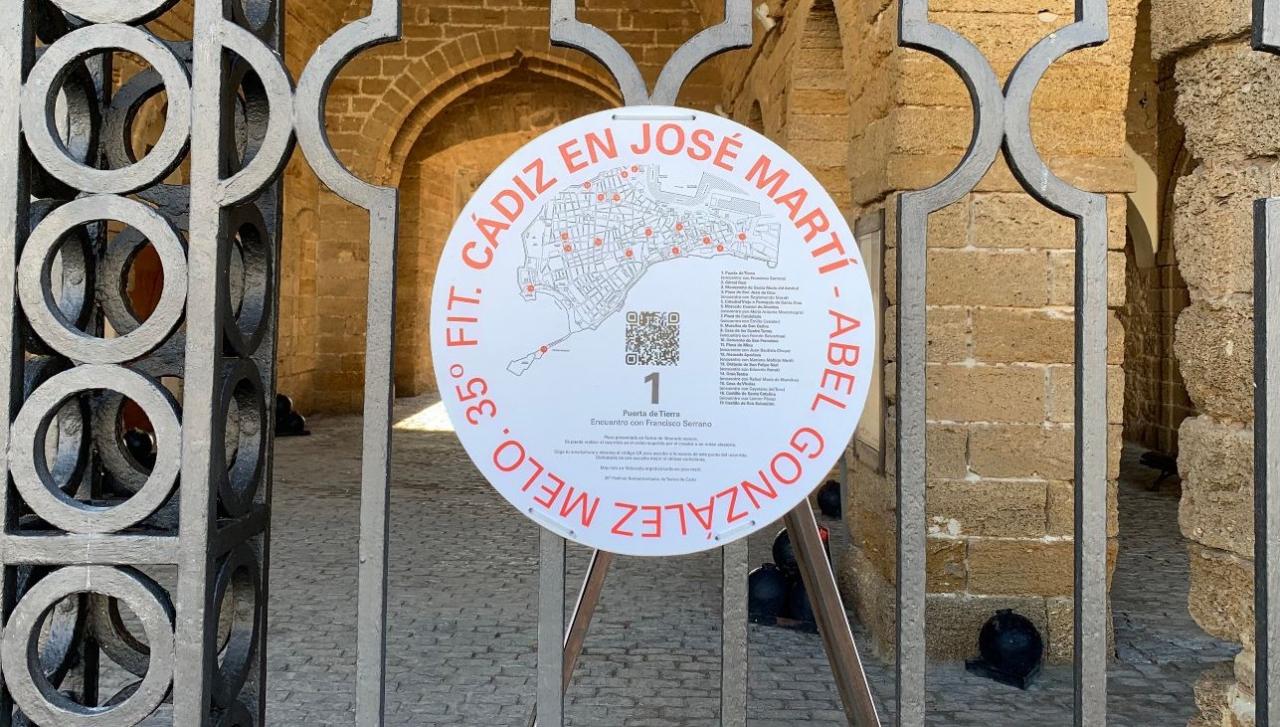
En esta conversación, González Melo explica su proceso creativo e inspiraciones, la experiencia de la migración cubana como material dramático y la idea de refundir la historia para nuevos públicos y tiempos. Habla de cómo se basó en la experiencia actual en La Habana para crear Fuga de invierno y cómo su obra reciente se sumerge profundamente en las preguntas de la comunidad y la familia durante algunos de los momentos más severos de Cuba. González Melo también reflexiona sobre las ligaduras singulares entre Estados Unidos y Cuba. Uno de estos vínculos es la conexión lingüística español-inglés, ya que muchos cubanoamericanos son bilingües. Por lo tanto, aunque esta conversación se llevó a cabo en español, hemos proporcionado traducciones al inglés. [Read the English translation of this interview here.]
Chamaco : El comienzo de todo, o el trabajo inicial de González Melo
Gunnels: ¿Por qué la dramaturgia? ¿Piensas que el teatro es el mejor vehículo para las historias que quieres contar?
González Melo: El teatro tiene algo maravilloso para un escritor: aleja a la literatura de la soledad. Propone la creación en equipo y el contacto directo con el espectador. Ambas cuestiones me resultan muy atractivas: la idea de que la escritura nunca cesa, siempre es reinterpretada en presente, necesita la comunión del director, los actores, los diseñadores, los técnicos, y precisa, indefectiblemente, la complicidad del público. Me deslumbra esa naturaleza inacabada de la escritura dramática, esa urgencia por impactar de modo inmediato. Disfruto escribir narrativa o ensayo, pero en ambos casos extraño el diálogo real con el ser humano. Será porque, cada vez más, la dramaturgia es en mí un proceso relacionado con un grupo humano concreto, una textura imaginada para gravitar sobre una cuerda floja.
Gunnels: ¿Sientes 'inacabada' esa naturaleza porque necesita de otros artistas para completarse, o porque, cada vez que se representa una obra, hay una nueva audiencia que tendrá reacciones distintas?
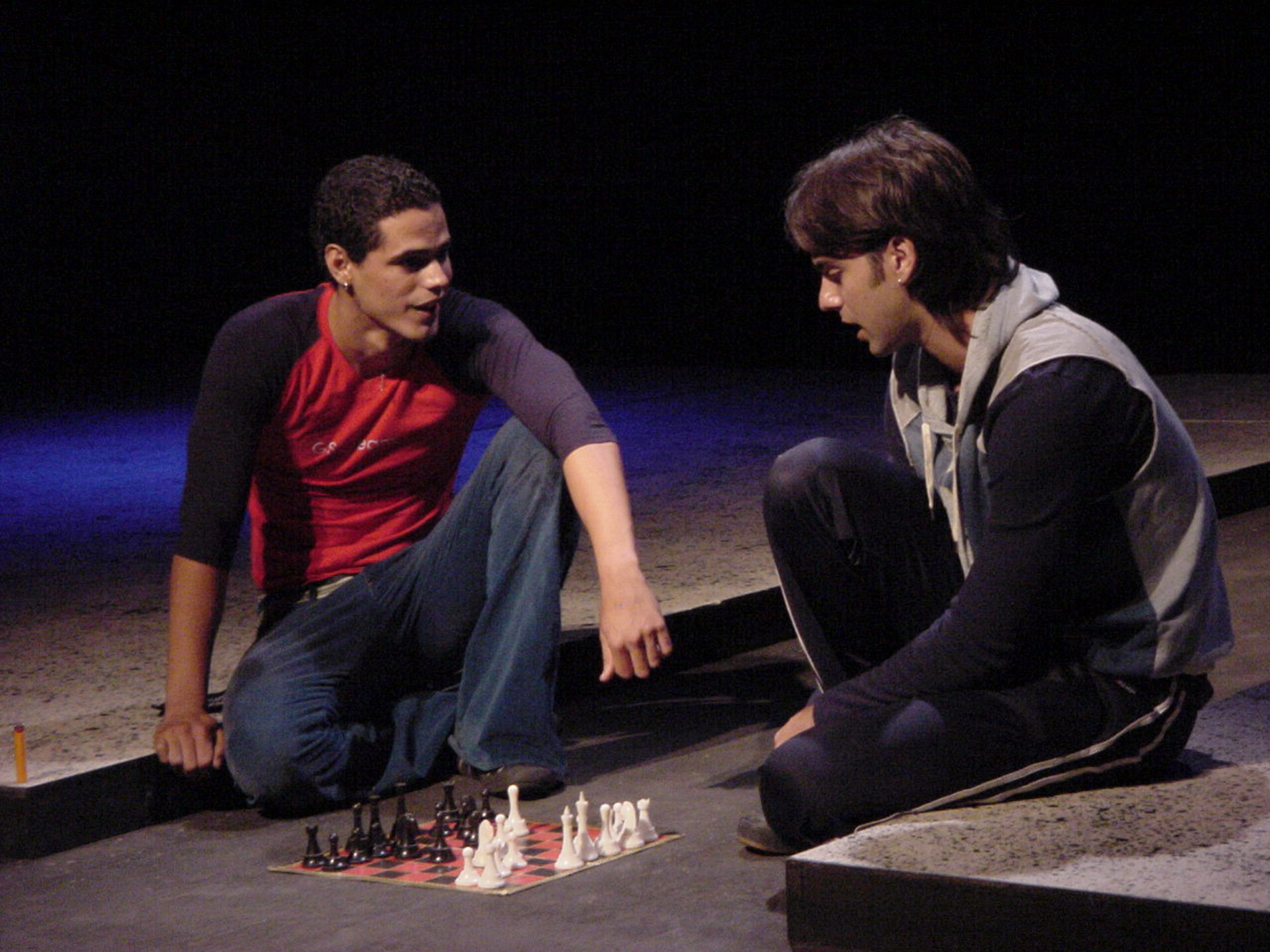
González Melo: El teatro lo hacemos entre todos, los artistas y el público. Basta recordar el origen griego de la palabra "teatro", que significa "mirar". Es decir, solo existimos porque alguien nos mira. Es uno de los mayores placeres de escribir dramaturgia: sentir que uno solo ofrece una guía de acotaciones y parlamentos sobre el papel, solo eso, pero que el personaje tendrá el cuerpo, la voz y el alma de quien lo encarne delante del espectador, que es quien terminará de construirlo en su proceso de recepción activa. ¿Por qué seguimos asistiendo una y otra vez a los estrenos de los clásicos? Pues porque su esencia, más que en el argumento, radica en cómo se cuenta hoy esa historia en el ágora pública: quiénes la ejecutan, por qué deciden hacerla, en qué contexto y ante quiénes, qué sentidos nacen de esa experiencia.
Gunnels: Quisiera pintar la escencia de la triología Fugas de invierno para la audiencia antes de que lo comentemos.
Chamaco (Kiddo, 2004, traducción al inglés de William Gregory) es la primera entrega de la trilogía.1Hay dos traducciones publicadas. William Gregory tradujo los dos Chamaco y Nevada; Yael Prizant tradujo la triología en versión bi-lingual con prensa distinta. Chamaco se ha representado a nivel mundial, desde el Teatro Argos en La Habana hasta Manchester, el Teatro HOME de Inglaterra, hasta la traducción más reciente al checo, con la producción en Praga programada para el otoño de 2021. La trilogía, que incluye Nevada y Talco (la segunda y tercera entrega), cubre un lapso de tres meses en un invierno tropical del descontento, como escribe la crítica de teatro y académica titular Lillian Manzor "the trilogy addresses concerns that are dear to the author and his generation, namely: the complex and contradictory ways in which homosexuality, sex, and migration from the countryside to the capital becomes means of survival in a society that has lost all sense of value."2Lillian Manxor and Austin Webber, "Ground Down to Nothing but Still Fighting." Hemispheric Institute of Performance and Politics. Accessed March 25, 2021. https://hemisphericinstitute.org/en/emisferica-82/manzor-webbert.html. Chamaco sumerge a los espectadores en la Nochebuena en La Habana, donde una hermana espera con inquietud que su hermano regrese a casa para una cena que nunca comerá, ya que sin saberlo ella, murió en una pelea con cuchillas. Nevada sigue a Lucía y su novio/chulo Rosnay cuando se encuentran con la realidad de vender sus cuerpos en el esfuerzo por salir o escapar, en este caso, al estado de Nevada, donde la prostitución es legal, y los "dulces vienen envueltos en papel de brillo". Talco, la última entrega, retrata una realidad cruda y sucia que se desarrolla principalmente en el baño de un antiguo cine utilizado para el tráfico y la prostitución, donde los caminos de cuatro personajes—Javi, Máshenka, Zuleidy y Álvaro—se entrecruzan en una batalla violenta y tensa de supervivencia. A la trilogía la siguen casi veinte obras más, muchas de las cuales han sido traducidas a varios idiomas y representadas tanto en Estados Unidos como en el extranjero. Abel, esta trilogía realmente centra la experiencia de la juventud cubana. Describe la importancia de dar voz a la gente joven cubana en las obras que has escrito.
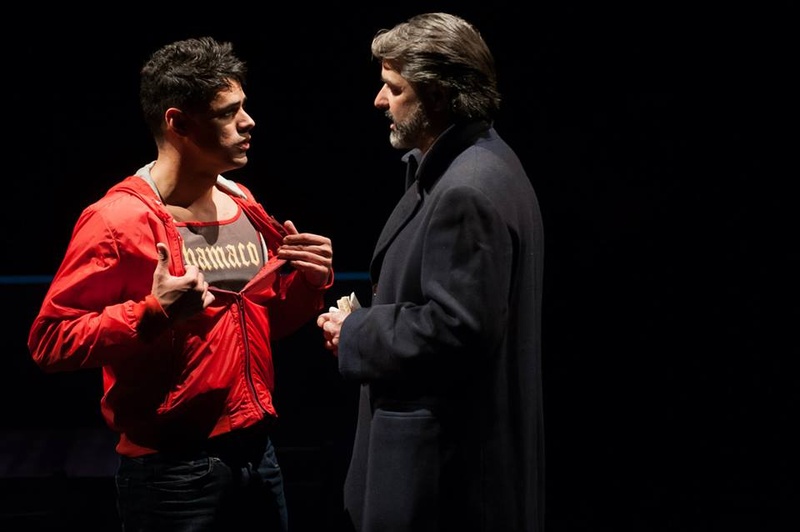
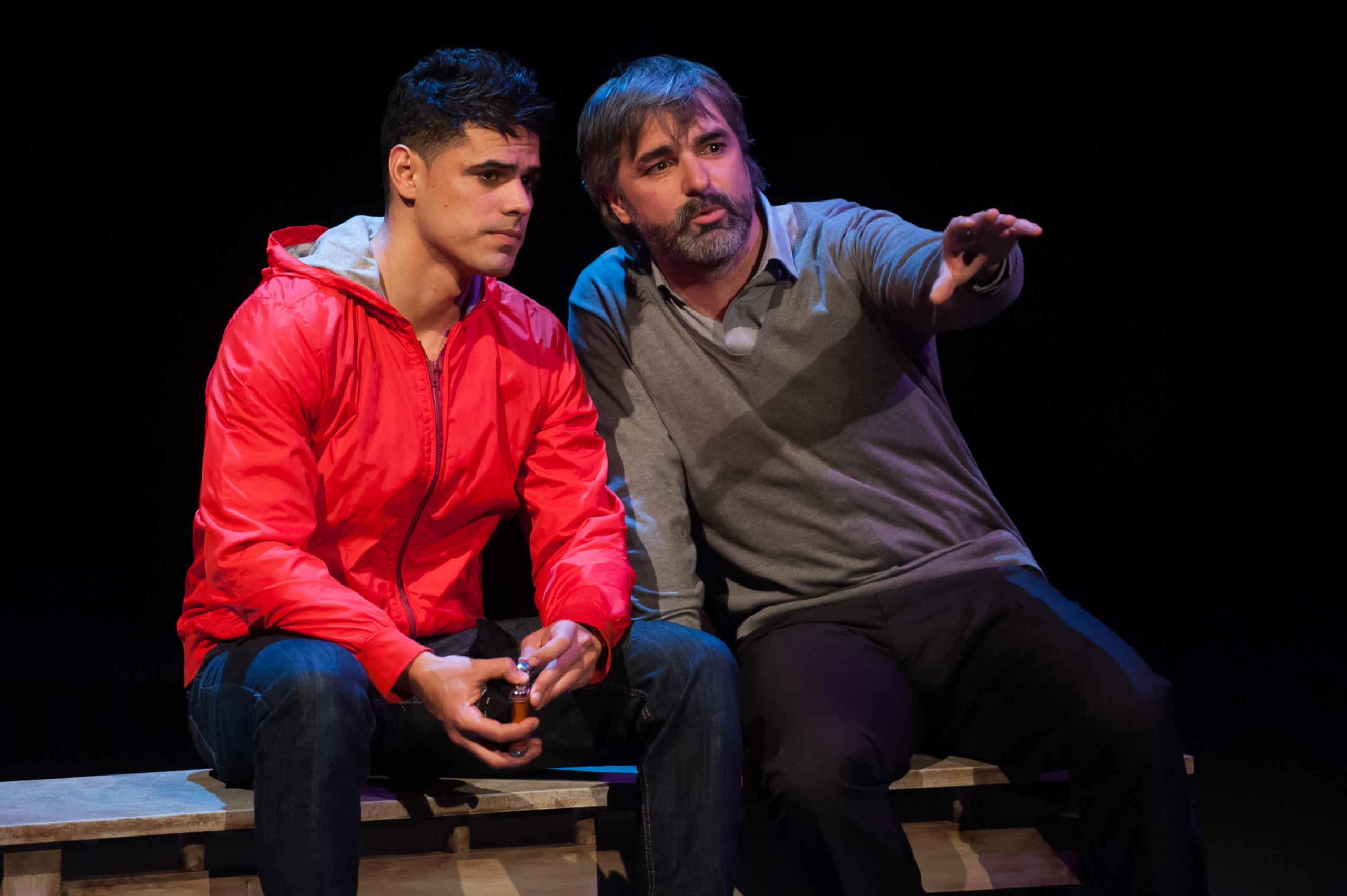
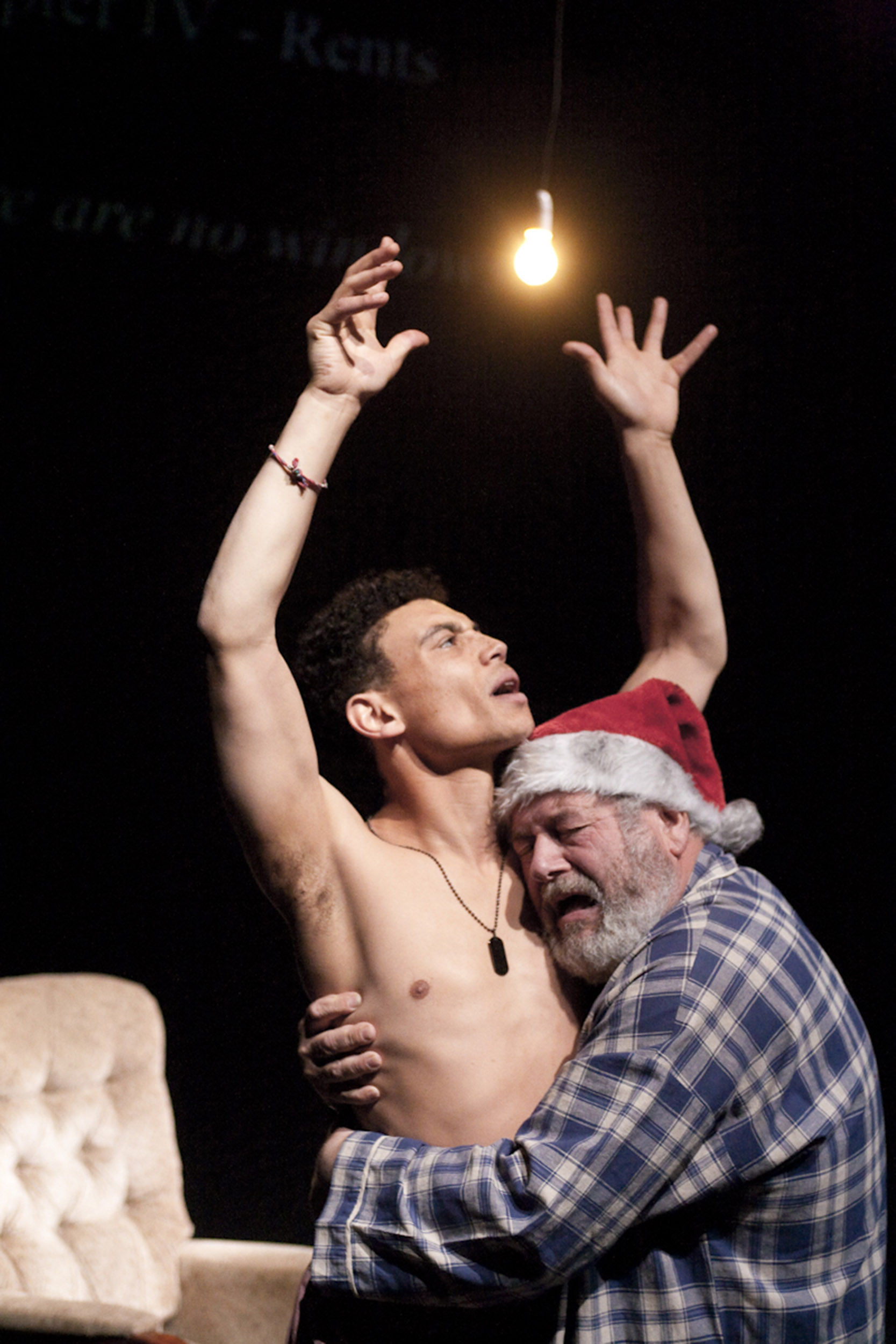
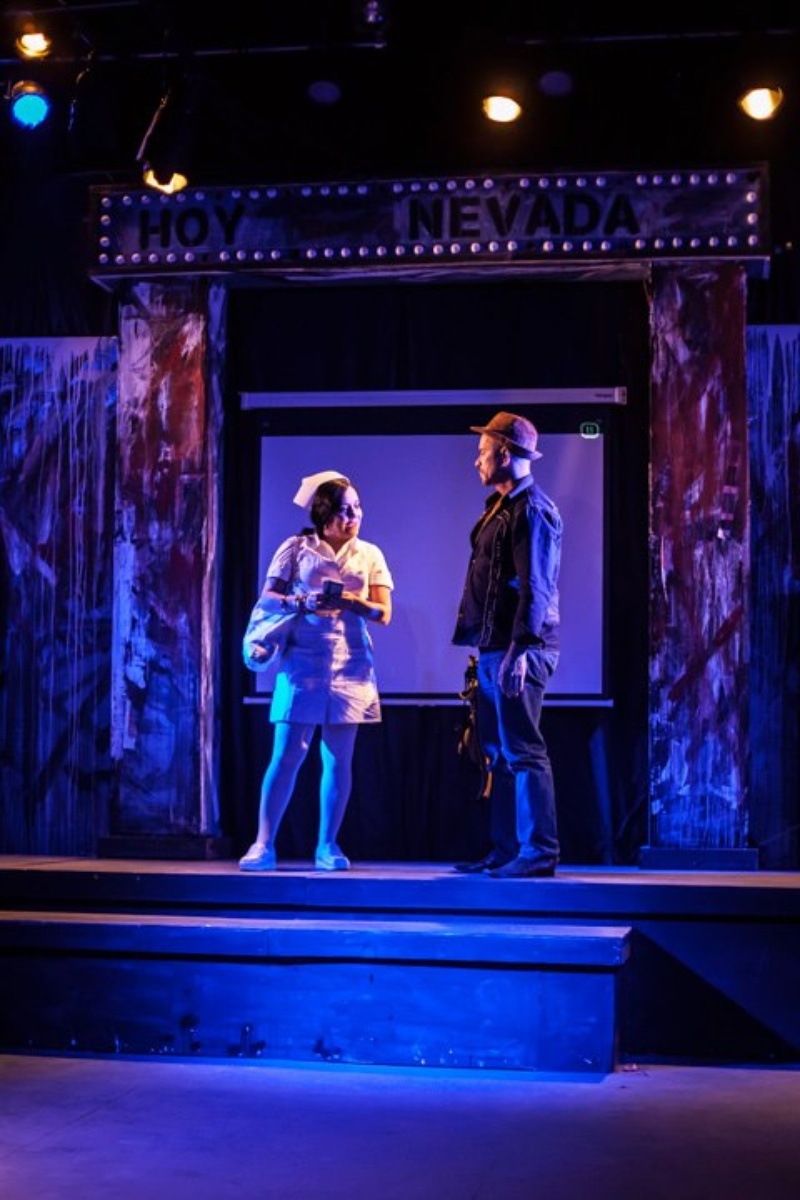
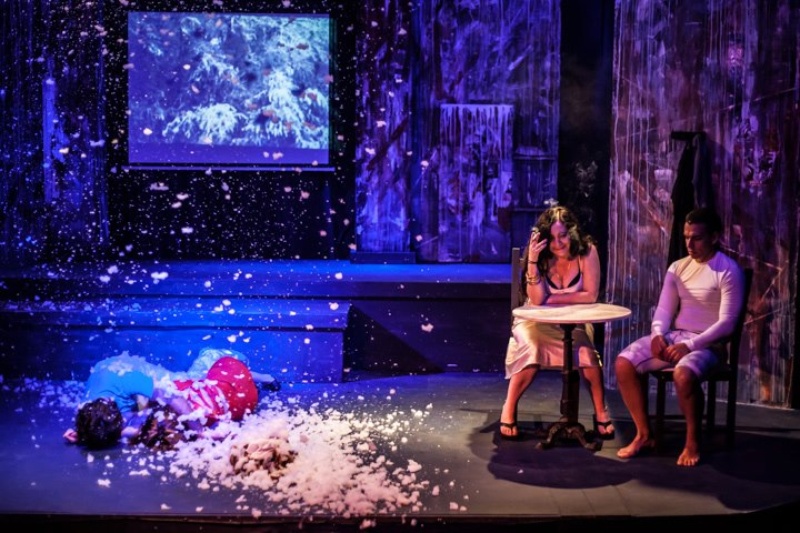
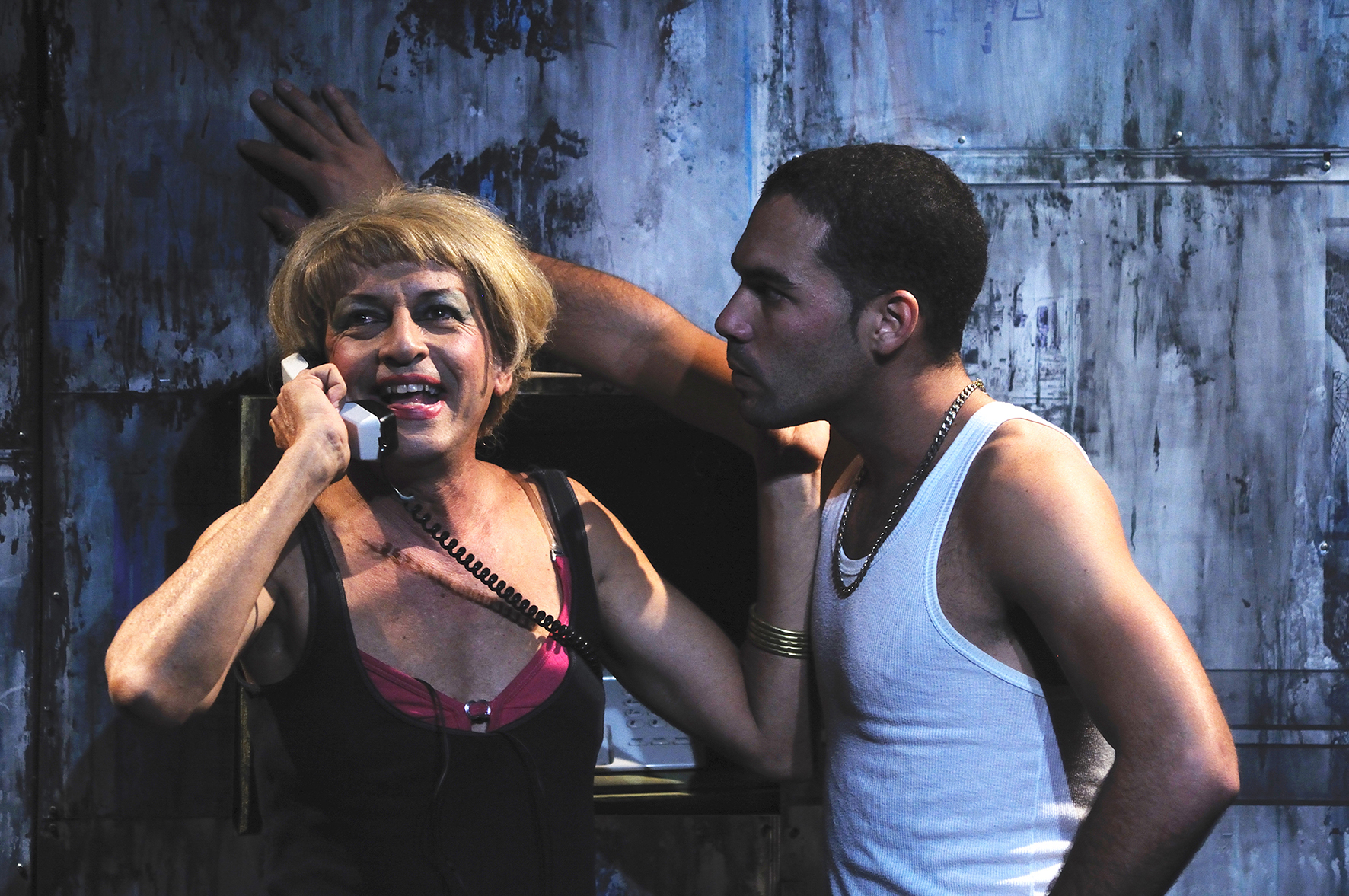
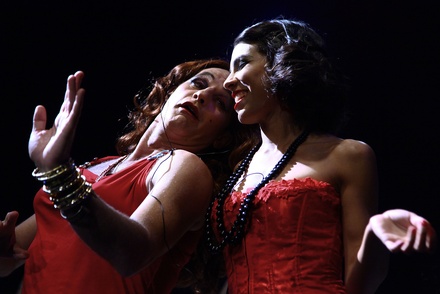
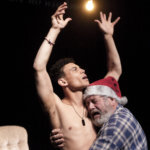
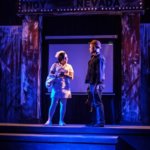
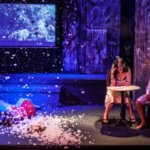
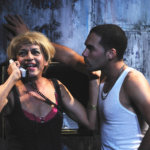
González Melo: Ahora que lo comentas, pienso que los protagonistas de mis obras han ido teniendo mi edad en el momento de escritura, y en cada texto van siendo mayores estos personajes porque crecen conmigo. He querido llenarlos de mis dudas, mis afectos, mis dolores. Son la imagen sublimada de mí mismo en medio del mundo en que he crecido: la Cuba de entresiglos, y desde hace algo más de una década también la España del XXI. Vivo a caballo entre los dos países y los observo a ambos con una mezcla de pasión y extrañeza. No puedo hablar de todos los jóvenes como una masa, eso no sé hacerlo, pero sí de mí en el paso de la adolescencia a la juventud: esas pulsiones son las que habitan mi teatro. Ojalá tengan que ver con las de otras personas.
Gunnels: Dime más sobre eso que llamas 'pasión y entrañeza.'
González Melo: Recuerdo que a principios de los 2000, cuando atravesaba en la noche la Habana Vieja rumbo a mi casa, me despertaban enorme curiosidad las decenas de adolescentes que aguardaban apoyados en las columnas, frente al Capitolio, o rondando el Parque Central, en medio de la zona turística. ¿Qué hacía toda esta gente aquí? ¿Quiénes eran? Poco a poco fui acercándome a ellos, muchos vivían clandestinamente en La Habana, habían emigrado desde el Oriente de la isla. Todos se prostituían, o aspiraban a hacerlo.3Una nota de González Melo: "Aquí estamos hablando, si hay que aclararlo, solo de cisgender masculinos. Yo no soy expert en estudios y terminology de género, pero los trans y las chicas están, como explico, en otras zonas de la ciudad." Supe de historias fascinantes, terribles. Irlos descubriendo a fondo no fue sencillo, ninguno iba a darme una entrevista sin más y contarme su vida. Me convertí en discreto cliente, ahorraba dinero y me iba con alguno de ellos a un cuartico de alquiler. En la fugacidad de ese rato de extraño placer me mantenía alerta: los escuchaba hablar de sus vidas, de sus hijos pequeños a quienes tenían que alimentar, de sus mujeres conscientes de que ellos se dedicaban a la cacería de extranjeros o cubanos que pudieran pagar por sexo. Mi investigación fue ampliándose, una cosa me llevó a la otra, fui componiendo el mapa de la marginalidad nocturna de la Habana Vieja: la zona de las prostitutas estaba en el cruce de las calles Monte y Cienfuegos; los travestis y transexuales aguardaban a sus clientes en el Parque de la Fraternidad; la droga se vendía en un cine abandonado, etc. Me sumergí de lleno. Hice cosas impensables durante aquellos años, cosas que hoy no haría. Pero por suerte me atreví a hacerlo: quería conocer a fondo a estas personas, sus lugares, sus razones, todo ese ambiente que la prensa oficial no publicaba. Tres o cuatro años de inmersión. Tras concluir Chamaco, tenía aún tanto material acumulado que nacieron Nevada y Talco. También en obras como Por gusto y Adentro hay huellas de este universo.
Gunnels: Por mi parte, Lucía de Nevada y María Luisa de Bayamesa me conmuevan por su necesidad de enfrentarse al mundo, al exterior hostil, pero con persistencia y amor por la familia. Son fuertes ejemplos feministas para cualquier generación. Y Lucía, con su vestido rojo, es singular para mí. ¿Hay un ángel en tu obra, un personaje que realmente te conmociona?
González Melo: No suelo partir de la emoción en los procesos de escritura. Soy bastante técnico, algo que aprendí con mi maestra Raquel Carrió (gran autora nuestra, fundadora en 1976 de la carrera de Dramaturgia en la Universidad de las Artes de Cuba): la tríada estructura-personaje-lenguaje es la base de la preparación de mis proyectos. Creo que la emoción llega (o no) en paralelo a (o luego de) la apreciación de la experiencia. La emoción estará entonces en el receptor. Pero para que eso pueda suceder, la construcción misma del texto o del espectáculo ha de ser precisa, nítida, no puede partir del deseo de emocionar, porque se desfigura. A veces siento que la emoción enturbia la objetividad de lo que ocurre: sucede mucho con los actores que actúan "emocionados" y, entonces, sobreactúan; o con los dramaturgos que se sobreemocionan con lo que están haciendo y pierden el rumbo de la acción, pierden síntesis.
Sí es verdad que alguna vez he tenido experiencias singulares, yo diría que místicas, durante la escritura misma, como me sucedió con Chamaco, que sentí que alguien me la dictaba al oído. Estaba muy reciente la violenta muerte de mi padre y el monólogo de Silvia, cuando se entera de que han asesinado a su hermano, lo escribí deshecho en llanto. Siempre he creído que Chamaco es mi padre que se convirtió en ángel para dictarme esta obra y que me acompaña desde entonces.
La historia se repite
Sobre todo en sus dramas más recientes, Abel González Melo ha cambiado de describir experiencias personales en su trabajo a referenciar y dramatizar puntos de contacto históricos cubanos (como el Éxodo Mariel, los UMAP (Unidades Militares de Ayuda a la Producción), el Quinquenio Gris y el Período Especial. El Éxodo Mariel constituye la migración masiva más grande de Cuba en su historia. De abril a octubre de 1980, se estima que ~125.000 cubanos salieron del Puerto Mariel para los Estados Unidos. La historia fue bien cubierta en los medios de comunicación: un pequeño grupo de cubanos tropezó un autobús urbano hasta las puertas de la Embajada peruana en La Habana en un intento de pisar tierra allí y solicitar asilo político (y eventualmente salir de la isla). Se les concedió asilo y, después, más de 10,000 personas se acercaron a la embajada con las mismas esperanzas. Al ver esta situación desarrollarse desde los Estados Unidos, el presidente Jimmy Carter emitió una invitación abierta a cualquier persona de Cuba que huyera del régimen de Castro, evitando en parte la política y el procedimiento de inmigración de los Estados Unidos. Siguió un giro típico de Castro: después de un discurso muy público el primer de mayo, el Día del Trabajador, en la Plaza de la Revolución de La Habana, vació las cárceles y hospitales de Cuba de criminales condenados y enfermos y requirió cualquier embarcación estadounidense que fuera a recoger a familiares o seres queridos para llevar del Puerto Mariel también consigo un barco lleno de otros 'indeseables', en los que incluía hombres homosexuales y personas con problemas psiquiátricos. Como señala González Melo en nuestra conversación a continuación, la historia de Cuba con los hombres homosexuales está marcada por una trágica discriminación, tortura y muerte. Los históricos campos de trabajo de la UMAP (en español, Unidades Militares de Ayuda de la Producción) que sirvieron como un tipo de prisión laboral de 1965 a 1968 en Camagüey, Cuba, fueron politizados como campos agrícolas para "objetores de conciencia", pero fueron más una especie de "purga" social de cualquier persona que fuera considerada anticastrista o antirrevolucionaria, afirma el historiador Abel Sierra Madero.4Abel Sierra Madero, "Academies to Produce Macho-Men in Cuba." Translated by Alicia Barraqué Ellison. Translating Cuba. February 19, 2016. https://translatingcuba.com/academies-to-produce-macho-men-in-cuba-abel-sierra-madero/. Esto incluyó a los acusados de homosexualidad.
Siguiente de los años de la UMAP hay un período de poco más de cinco años (1971–1977) conocido como el quinquenio gris en el que el gobierno cubano controlaba rígidamente las producciones culturales y artísticas de la isla. Esto período limitó severamente la expresión y la publicación artísticas. Varios de los dramaturgos más destacados de Cuba, como Virgilio Piñera (1912–1979), Abelardo Estorino (1925–2013) y Antón Arrufat (1935–), sufrieron tremendamente bajo esta censura, tanto por su insistencia en la libertad creativa como por su homosexualidad. Rodeados de un ambiente hostil, los tres utilizaron la metáfora como forma de expresión, siempre tratando de evitar la censura. La obra de Piñera preguntó en términos amplios conceptos de identidad nacional y la parte del escritor como resistor. Un prolífico escritor de ensayos, cuentos y teatro, las colecciones de Piñera como Cold Tales (1956) y Little Maneuvers (1963) fueron acreditadas por inspirar a generaciones de escritores que vendrán después, incluso el autor conocido del Mariel, Reinaldo Arenas. Abelardo Estorino, que antes fue censurado con su obra Los mangos de Caín (1965), solo escribió un texto en los años 70 y en cambio se dedicó a la dirección de clásicos en la Compañía Teatro Estudio. Antón Arrufat recibió altos honores de la UNEAC por Los siete contra Tebas en 1968, pero esa institución publicó el libro con una nota que acusaba al escritor de ser un contrarrevolucionario; Arrufat fue condenado, y no publicó más por una década.
Finalmente, la inmigración hacia y desde La Habana varió drásticamente desde la década de 1960 hasta la actualidad, y las leyes que prohíben el reingreso, así como la relación política y acre entre los Estados Unidos y el régimen de Castro, crearon una forma estratificada de entender el hogar, la comunidad, y exilio. A principios de la década de 1960 se produjo un éxodo de las clases media y alta, que en su mayor parte aterrizaron en el sur de Florida y se quedaron. Después del Éxodo Mariel, la política de inmigración estadounidense de mediados de la década 90 llevó a un aumento de la inmigración de la isla, ya que 'pie mojado, pie seco' permitió acelerar los procedimientos de inmigración de EE.UU. para cubanos. El aumento de balseros es notable durante este Período Especial. De estas grandes olas de inmigración, Mariel se distingue por la demografía de la población, así como por el giro politizado en ambos lados: ese grupo fue menos aceptado por los cubanos en la isla y experimentó una integración más dura en su nueva comunidad del sur de Florida.5Aviva Chomsky, A History of the Cuban Revolution, 2nd ed. (Hoboken, NJ: Wiley-Blackwell, 2015), 75.
González Melo es descendiente de estos primeros dramaturgos cubanos así como heredero de esta historia enredada. En la conversación que sigue, González Melo reflexiona sobre la realidad del hombre "gay" en Cuba antes y después de Mariel, y cómo esta faceta de la historia cubana encuentra su camino en sus obras dramáticas. En particular, su obra Fuera del juego revisa el Caso Padilla y la UMAP, destacando la censura subversiva y la tortura psicológica de los artistas en los primeros años de la Revolución. Su obra Bayamesa se remonta a lo más lejano de la historia cubana, para abordar temas de la tradición colonialista, los roles de género y el feminismo en Cuba.
Gunnels: Describe los cambios, si los hubiera, en la realidad del hombre gay en Cuba desde que escribiste Chamaco (2004) hasta En ningún lugar del mundo (2018).
González Melo: El lapso que dices comprende poco más de una década y no creo que los cambios hayan sido muy apreciables. La Revolución no se ha comportado de modo precisamente bondadoso con los homosexuales, quienes fueron considerados durante mucho tiempo lacras sociales y enviados entre 1965 y 1968 a campos de trabajo llamados UMAP (Unidades Militares de Ayuda a la Producción). Todo ese proceso acrecentó el machismo y la homofobia en nuestra sociedad. En la obra de grandes dramaturgos cubanos, que además eran homosexuales (pienso en Virgilio Piñera, Abelardo Estorino o Antón Arrufat), el tema no aparece o aparece muy escamoteado, quizás a causa de la autocensura: después de las UMAP vinieron los terribles años 70 y sus políticas de marginación a homosexuales artistas. A mi generación le ha tocado una etapa un poco más amable, aunque la homofobia persiste y ha encontrado vías soterradas para manifestarse. En lo personal he podido abordar el tema gay en textos que se han publicado y estrenado dentro de la isla, han aparecido antologías de poesía y narrativa homoeróticas, etc. Se ha intentado incluir, en la enmienda a la Constitución, la noción del matrimonio igualitario que ya es una realidad en tantos países del mundo: pero durante demasiados años el propio gobierno ha sembrado el odio hacia los homosexuales, y la mentalidad del pueblo no puede cambiarse de un día para otro.
Gunnels: ¿Puede el teatro cambiar a un pueblo? ¿El poder del arte o interrogación?
González Melo: Ni el teatro ni ninguna otra manifestación artística pueden cambiar una sociedad. Sería demasiado pretencioso pensar que sí. He escuchado frases como "el arte cambia el mundo" y siempre siento que tienen un sentido figurado, metafórico. El teatro no es un partido político, no es un ejército, no es una bomba atómica ni una pandemia: no tiene ese poder de cambio brusco, inmediato, contundente. Lo que sí puede el teatro, confío en que sí, es tocar la mente y el corazón de una persona, de un espectador que asiste a una función y descubre otro modo de mirar, se identifica en ese espejo, encuentra algo que le lastima en lo profundo. El teatro transforma, en ese sentido, al individuo y no a la masa, aunque la experiencia de nuestro arte la tengamos en colectivo. El teatro trabaja siempre (en su ejecución, en su recepción) el comportamiento particular, no la generalidad. Tocamos a una persona, y esa persona tendrá en alguna ocasión, quizás, la oportunidad de tocar las cosas que mueven el mundo. Esa es la sencilla y hermosa condición de nuestro arte.
Gunnels: Su obra de 2018 En ningún lugar del mundo (Nowhere in the World) aborda el silencio en torno a la identidad sexual en Cuba (desde los años 80 hasta la actualidad), tanto como temas de visibilidad gay y el trauma del servicio militar, a través del protagonista Ángel se aprecia el dolor agudo del Mariel tanto para los que se fueron como para los que se quedaron. Cuba tiene una historia de trece años en África (1975–1988), con fuerzas militares cubanas sobre el terreno en nombre de la liberación de Sudáfrica durante ese tiempo. La asociación militar terminó con la independencia de Namibia y, según algunos, el comienzo de la retirada del apartheid en la zona. No obstante, las fuerzas cubanas regresaron con problemas psicológicos, y el drama de En ningún lugar del mundo vuelve a visitar esa época, así como el trauma inminente del Mariel. Ángel, como protagonista, sale de Cuba con el éxodo del 1980, y el drama comienza con su regreso a Cuba después del Mariel, solo para descubrir que el trauma entre familias es profundo e implacable. ¿Cómo entiendes el legado de la generación del Mariel a otros artistas cubanos que han escrito en exilio, forzado o no?
González Melo: El protagonista de En ningún lugar del mundo fue forzado a abandonar Cuba en 1980 por el Mariel, debido a problemas psiquiátricos (sí, algo despiadado: los enfermos mentales eran considerados directamente escoria), cuando en realidad la familia se lo quería "quitar de encima" por sus violentos testimonios de la dura experiencia de tres años como soldado en la Guerra de Angola. La historia de nuestros exilios está llena de gente anónima que no ha dado su testimonio porque aún sigue traumatizada. El Mariel es un entorno demasiado amplio y diverso que escapa a catalogaciones homogéneas. Lo más importante, pienso, es lo que significó como fenómeno, y los miles de cubanos que pudieron (que se vieron en la obligación de) integrarse a la cultura norteamericana y, al mismo tiempo, enriquecerla con su acción directa. No puede entenderse la cultura y la sociedad de Miami hoy sin sumar las capas de exilios que esa ciudad ha asumido. En lo personal admiro mucho la voluntad y la resistencia de las generaciones de cubanos exiliados que han reinventado el concepto de patria.
Gunnels: ¿Qué piensas sobre los dramaturgos que vivieron la época del éxodo del Mariel en Cuba pero permanecieron? Pienso particularmente en Ulises Rodríguez Febles y su obra Huevos. Ya hablamos sobre la idea de salir, ¿pero qué pasa con los que se quedan?
González Melo: El Mariel ha sido relatado brillantemente por dramaturgos que se mantienen creando en la isla, como el propio Ulises en Huevos o Carlos Celdrán en Diez millones. Los dos eran muy jóvenes en 1980 pero han logrado imprimir a sus textos, llenos de matices autobiográficos, un carácter que supera la reconstrucción histórica. Me gusta eso, que podamos sacudirnos el polvo de la cotidianidad, que tanta energía nos roba, y mirar nuestra historia y nuestro porvenir con altura. Ellos viven en Cuba, sí, pero poseen una reconocida carrera internacional: Ulises ha triunfado recientemente en México con una obra que curiosamente reconstruye la trayectoria de otro artista exiliado, Dámaso Pérez Prado, y Celdrán ha paseado sus Diez millones por importantes festivales del mundo. Cada vez la frontera entre el afuera y el adentro, entre irse y quedarse, es más permeable y menos estricta. Por suerte.
El teatro disecado: El proyecto persistente de González Melo
Gunnels: ¿Cómo afectó crecer durante el Período Especial a la trayectoria o temario de tu obra, y la influencia de otros poderes mundiales (como Rusia) en tu país?
González Melo: Es inevitable la influencia. Mi niñez estuvo colmada del imaginario ruso y soviético: esa huella es evidente, por ejemplo, en mi obra Talco, pero también en parte de mis cuentos y en mi pasión por esa cultura. Estudié el bachillerato en una escuela vocacional llamada precisamente "Lenin": fue entre los años 1994 y 1997, en régimen interno. Allí padecí la escasez (de alimentos, de luz eléctrica, de recursos sanitarios) pero también descubrí la solidaridad. Allí sufrí acoso escolar pero pude formarme como alguien independiente. De esa experiencia llena de contrastes nació mi primer libro: Memorias de cera. Y esa etapa, en pleno Período Especial, marcó mi interés por la paradoja en que hemos vivido los cubanos: gritar consignas heroicas en la Plaza de la Revolución durante los desfiles, y al mismo tiempo estar muriéndonos de hambre en casa y susurrando por los rincones nuestra miseria de vida. El Período Especial ajustó el nivel de vida de la sociedad y acrecentó las diferencias de clase, el clientelismo, el mercado negro, la corrupción en todos los ámbitos. Esa doble moral atraviesa mi literatura: personajes que precisan, a toda costa, ponerse máscaras para seguir sobreviviendo.
Gunnels: En Nevada, un tema primordial es el deseo de salir. ¿Cómo ves este sentimiento a través de otras obras que has escrito, y de dónde viene? ¿Puedes profundizar un poco en la naturaleza de la relación Cuba/Estados Unidos y este deseo de salir de la isla, especialmente en esta época de inestabilidad inmigratoria?
González Melo: Nacer en una isla condiciona el deseo de ir más allá de las fronteras inmediatas que el mar impone. Ya Virgilio Piñera lo resumía en una imagen: "La maldita circunstancia del agua por todas partes". La isla es encierro y anhelo de partir para, en mi caso, tener la oportunidad de volver. Ha sido una constante cubana la necesidad de huir de la isla, acrecentada por factores políticos y económicos en la etapa de la Revolución. Mi propio padre tuvo que exiliarse en México con el fin de garantizarnos una mejor vida: no hablo de lujos, sino de tener dinero para comer, para asearnos, para transportarnos… Como la mayor diáspora se ha dado hacia Estados Unidos, tenemos con ese país una relación muy estrecha. En mi tesis doctoral estudio precisamente los vínculos entre familia y exilio en la dramaturgia de la Gran Cuba, entendida como la generada tanto en la isla como en el extranjero: me gusta esa idea de patria expandida, no sujeta a límites físicos, sino más bien a sensaciones y ámbitos en común. Esa intención recorre gran parte de mi obra como elemento de nuestra idiosincrasia: partir y regresar. Nevada y Adentro hablan del viaje clandestino por mar y los riesgos que ello supone. En Sistema, la tensión se halla justamente en que el protagonista es atrapado en Miami y no puede volver. Epopeya, Intemperie o En ningún lugar del mundo diseñan el arco que va desde el destierro hasta el regreso al paso de los años, y todo lo que ese reencuentro comporta.
Gunnels: Pero para los Marielitos, a quienes se les aseguró que una vez salieran de Cuba no podrían volver a ella jamás, el exilio ha sido y es especialmente doloroso. ¿Te interesa con En ningún lugar del mundo diseccionar el impacto que ha tenido en esa comunidad el dolor ante el regreso a la isla, que finalmente fue posible?
González Melo: Por supuesto. El Mariel y la Guerra de Angola son asuntos que apenas hemos tratado en la escritura nacional pero sus huellas siguen ahí: son heridas no cerradas, y algo de ello he intentado tocar con En ningún lugar del mundo. La estructura familiar ha sido, en la tradición de la dramaturgia cubana, el núcleo a través del cual observar los grandes temas sociales y políticos. Esto tiene que ver con lo que antes te comentaba: el teatro solo funciona desde lo particular y no desde lo general. Los procesos históricos se analizan en libros, artículos, entrevistas, en amplios fondos bibliográficos y documentales. Una obra de teatro no puede contener todo ese proceso, todas las vidas malgastadas en el intento de construir determinado proyecto político-social. Lo que sí puede una obra es aguzar la mirada, focalizar un pequeño grupo humano y aplicarle el escalpelo. Utilizas el verbo adecuado: diseccionar. Como dramaturgo me siento exactamente así: Cuba es mi quirófano, esa familia destrozada es el cuerpo que yace sobre la camilla, y he de aplicar el bisturí con precaución, con suma responsabilidad, intentando llegar a la raíz del dolor.
Gunnels: Es verdad lo que antes decías, que hay una relación muy estrecha entre Cuba y Estados Unidos. ¿Dirías que las experiencias que has tenido en Estados Unidos como dramaturgo cubano hayan sido particularmente reveladores en cuanto a entender esta relación?
González Melo: Han sido experiencias muy diversas. En Chicago, por ejemplo, Aguijón Theater ha estrenado Adentro y Epopeya; a pesar de ser textos de marcadas referencias nacionales y de que un cubano (Sándor Menéndez) los dirigió, en ambos casos se produjo un rico diálogo con una comunidad latina más amplia, gracias también a las excelentes traducciones de Marcela Muñoz: actores, equipo artístico y espectadores asumían como suyos los temas del desarraigo y la frustración política. Algo similar sentí con el estreno de Por gusto en Repertorio Español de New York, y eso que también era cubana Leyma López, la directora: la desilusión incesante de la juventud y la monotonía de la existencia circular resultaban cuestiones afines a un elenco multinacional. Cuando Ohio Northern University produjo Nevada, recuerdo que les interesaba mucho el estudio minucioso del contexto: parte del equipo visitó la isla y el montaje contó con proyecciones documentales, que contrastaban deliciosamente con la dramatización del texto en inglés, a cargo del mexicano Otto Minera y con traducción de Yael Prizant. En Miami, donde la comunidad hispana es también amplia y variada, la confrontación esencial ha sido con el público cubano, que lógicamente resulta el más interesado, por experiencia directa o por referencia, en ficciones sobre La Habana marginal de Chamaco, Talco y Nevada, obras que Alberto Sarraín dirigió. Siento que el estreno de En ningún lugar del mundo en el XXXIII Festival Internacional de Teatro Hispano, en producción de Teatro Avante, dirigido por Mario Ernesto Sánchez y con traducción de Marian Prío, ha dimensionado aún más el debate sobre la tensión Cuba/Estados Unidos, que es el conflicto entre quienes se quedaron y quienes se fueron. Menciono siempre a las traductoras pues considero esencial su labor y su dedicación: ellas, y mi traductor británico William Gregory, han sido los responsables de que mis textos queden tan bien reescritos en esa lengua.
Gunnels: ¿Cómo escoges los motivos que vas a revisar en el teatro? En Bayamesa (2019) se ve la representación directa de la Cuba tradicional de principios del siglo XX, donde la protagonista María Milanés lucha por encajar a Cuba tradicional con sus propios sueños y ambiciones feministas. En ella, tú alteras tiempo y espacio en el escenario para generar en la obra un diálogo tenso entre el pasado y el presente, y con un suicidio desgarrador que deja a la audiencia destrozada. Nos encontramos a la mujer auténtica que nos anima a todos, pero también aflora la idea de suicidio como tema social, cuando hoy día hay más y más suicidios de gente joven. Como terminas Fuera del juego: "la historia se repite, y se repite".
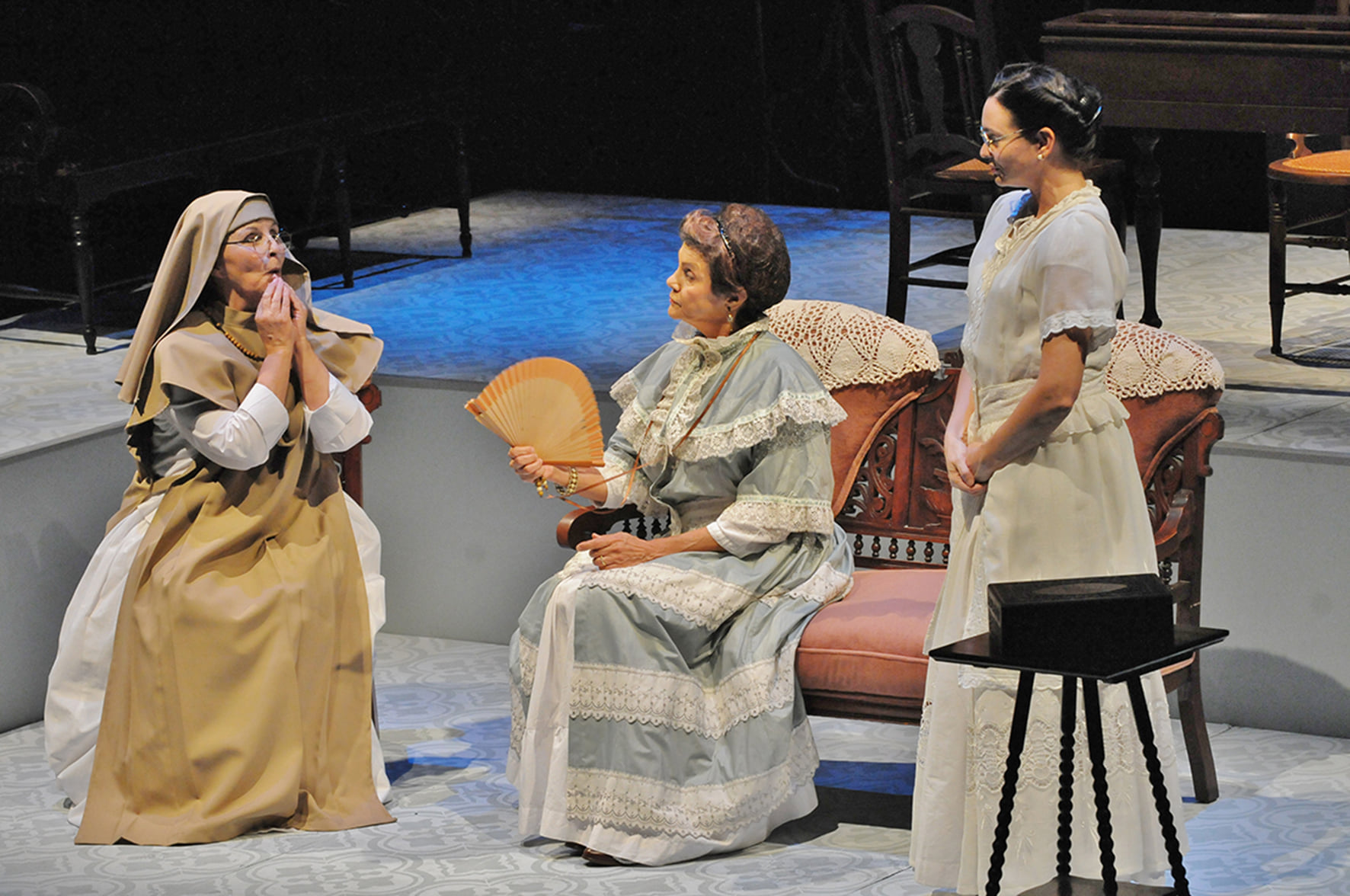
González Melo: La motivación de la escritura es múltiple y cambia de un proyecto a otro. Lo esencial siempre es que el material de partida resuene en mí, que me parezca urgente compartirlo en escena. En el caso de Bayamesa le debo mucho a mi madre, que es filóloga y escritora, y que me habló por primera vez de María Luisa Milanés (1893–1919). Leí sus poemas. Leí su sorprendente autobiografía, que es posiblemente el primer manifiesto feminista escrito en Cuba y uno de los primeros de Latinoamérica. Me impactó su simbólico suicidio: un disparo en el vientre, con la pistola de su padre militar. Un alma libre como ella prefirió escapar de ese modo, antes que continuar sometida al machismo imperante. Supe que la obra debía ser un réquiem que la devolviera a la vida, mediante una ficción que intentase acompañarla, darle voz, siquiera durante la hora y media que dura la puesta en escena. Se cumplió en 2019 un siglo justo de su muerte y, como dices, sigue siendo por desgracia un drama tan vigente…
Gunnels: ¿En qué anda tu trabajo ahora, después del éxito tremendo de Bayamesa?
González Melo: Me estoy sumergiendo cada vez más en la historia de Cuba. Creo que nuestra historia se ha abordado muy poco en la dramaturgia, a veces con una mirada muy superficial, y confío en que el teatro tiene la posibilidad de arrojar una luz nítida sobre sucesos del pasado que nos permitan situarnos en la complejidad del presente. ¿Cómo podemos vivir, cómo podemos entender el país que somos si no analizamos lo que nos ha traído hasta aquí? Durante años trabajé temas y conflictos del presente inmediato, desde los ambientes marginales hasta el lujo de los nuevos ricos. Pero ahora mismo eso se me ha agotado. Imagínate un país cada vez más desabastecido, con un pésimo transporte público, un país donde la gente tiene que pasar horas y horas en horrorosas colas para conseguir una libra de carne de cerdo, una bolsita de detergente, un litro de aceite, todo ello a precios astronómicos. El panorama actual es desolador, no sabría en qué tono dramático abordarlo. Quizás únicamente desde la farsa o el esperpento. Por eso me refugio en el pasado, porque siento que sin memoria no hay densidad de tradición. Hay mucho donde escarbar. El teatro no ha entrado a fondo, por ejemplo, en los graves casos de censura propiciados por las políticas culturales de la Revolución. La censura me interesa mucho: la tenemos demasiado cerca, a menudo sin percatarnos. Me interesa mucho la revisión histórica, siempre que tenga un matiz particular que pueda hablar de una tensión global.
Gunnels: La censura sigue siendo, en efecto, un problema pernicioso en el mundo, ahora con 'caras' diferentes. Al abordar el caso Padilla en tu obra Fuera del juego, te preocupas por problematizar el rol del artista.6En esta obra, González Melo re-visualiza el infame Caso Padilla, en el que el célebre poeta Heberto Padilla es arrestado, encarcelado, tortuado y finalmente exiliado por su trabajo contrarrevolucionaria que cuestionaba la Revolución, el Comandante (Fidel Castro) y el papel de los escritores en general. Utilizada como ilustración clásica de la traumática censura de finales de los 60 y principios de los 70 en La Habana, González Melo cuenta la historia desde la voz del propio poeta como protagonista principal. ¿Es que te interesa "complicar la cosa", para decirlo con palabras de tu propio personaje de Heberto Padilla?
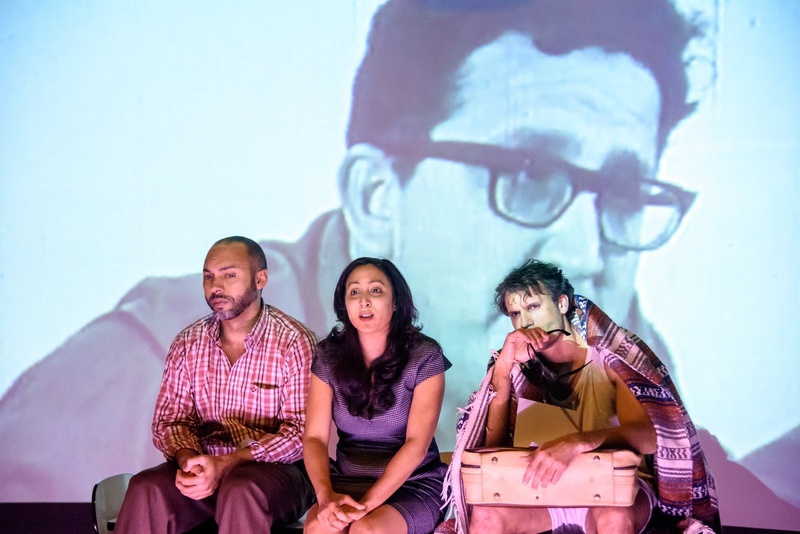
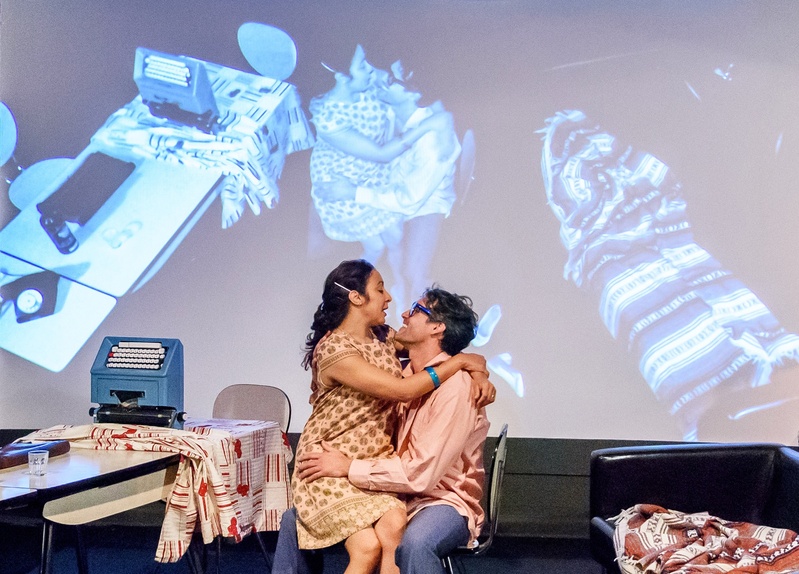
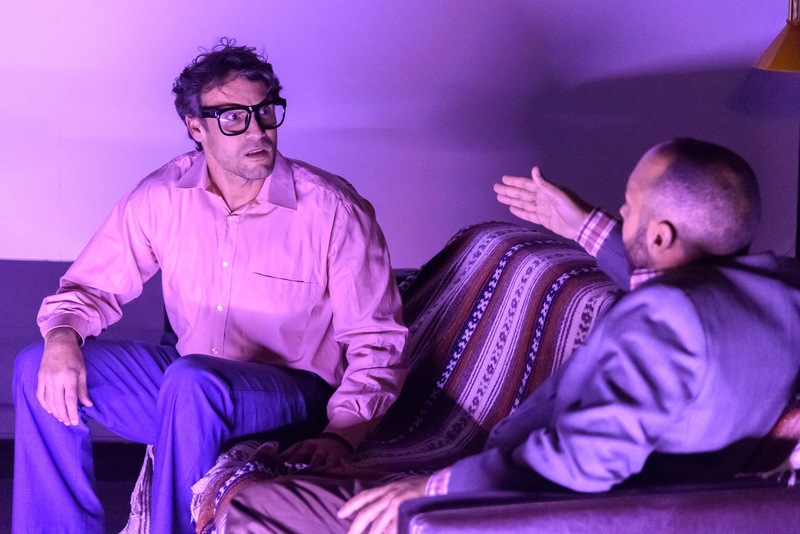
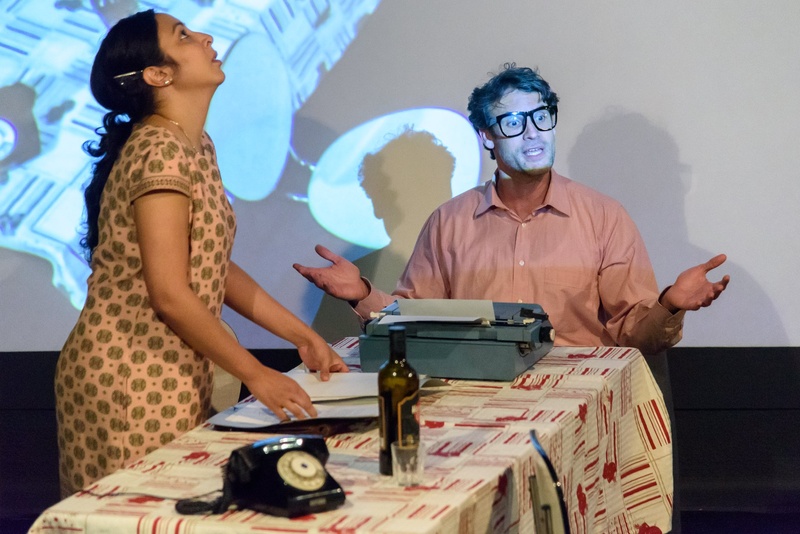
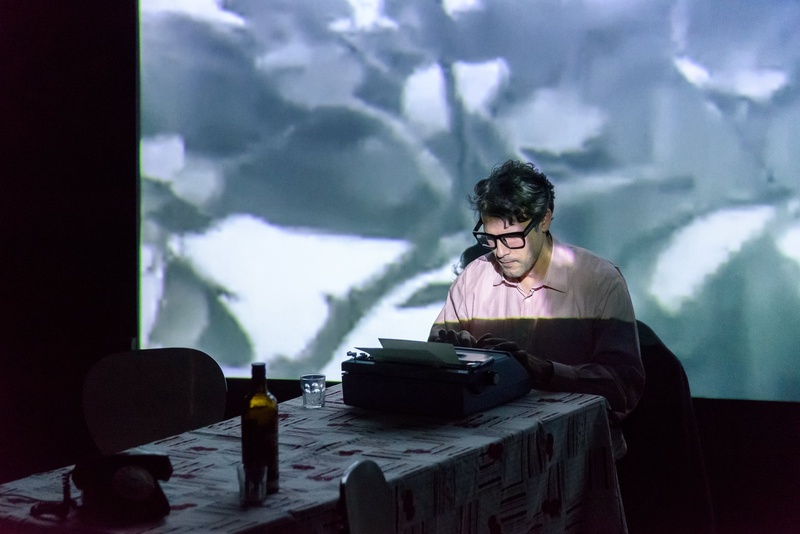
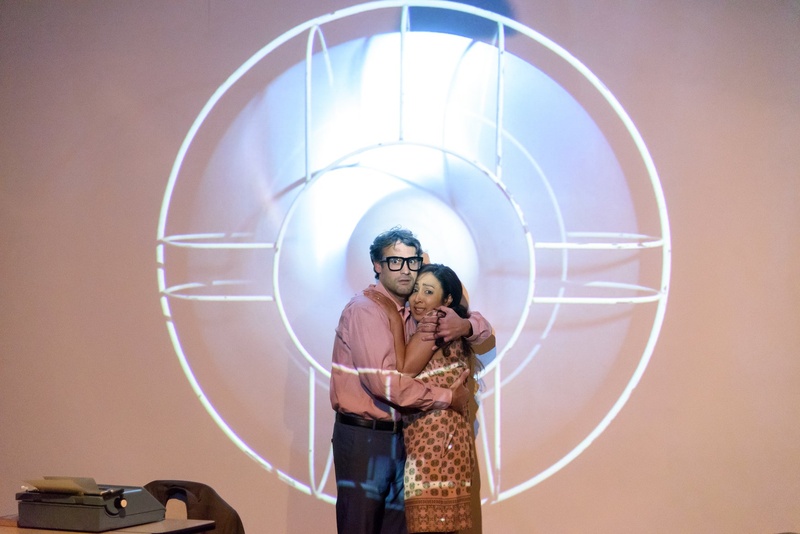
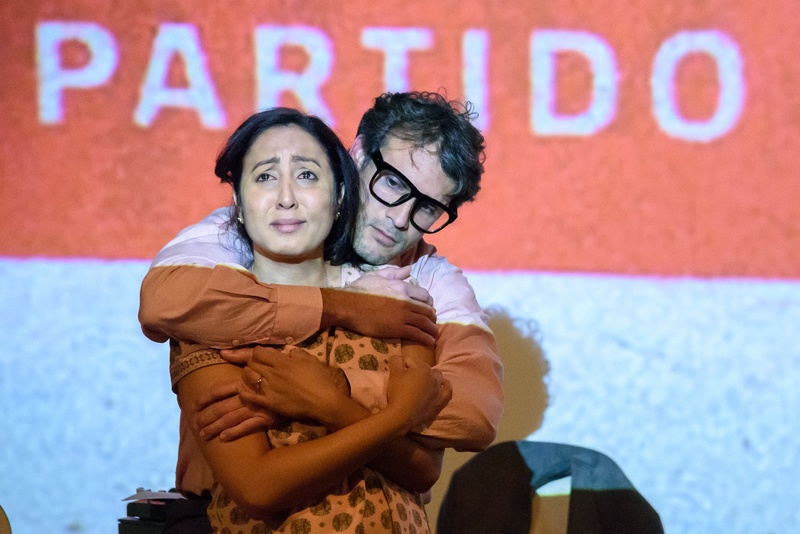
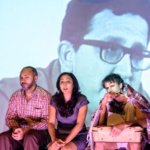
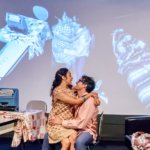
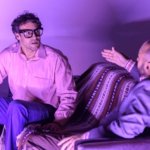
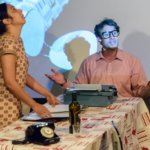
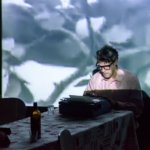
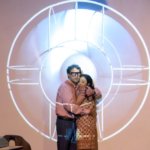
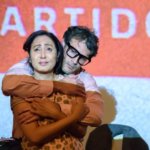


González Melo: Dicen que uno escribe la misma obra a lo largo de toda la vida. El tema de la censura y la autocensura me ha interesado siempre, quizá porque desde muy joven tuve que negociar con ella. Mi libro Memorias de cera por poco no ve la luz, ya que, aunque ganó un premio nacional que consistía en su publicación, contaba mi descubrimiento de la sexualidad en la escuela Lenin, y eso a los funcionarios de la editorial no les gustaba nada. Chamaco, de hecho, puede entenderse como una obra sobre el miedo a la libre expresión dentro de la familia Depás, donde cada uno teme sincerarse ante el otro y todos viven en una espiral de mentiras. Epopeya obtuvo en 2014 el Premio Nacional de Dramaturgia y se publicó por Ediciones Alarcos, pero tuvo una fugaz presentación de solo cincuenta ejemplares, no se distribuyó en librerías, el libro no puede encontrarse en ningún sitio y la obra no puede estrenarse en Cuba (es un texto donde utilizo la metáfora de la Guerra de Troya y el hipotexto de Hécuba de Eurípides para debatir, una vez más, sobre el regreso a la isla de los cubanos exiliados, una vez que Príamo ha caído en combate).
Es cierto que en años recientes me he acercado mucho a la relación entre arte y censura. En 2017 dirigí en Argos Teatro, en La Habana, Cartas de amor a Stalin del dramaturgo español Juan Mayorga, que para mí es una obra que habla sobre la misma situación que padecemos muchos artistas, periodistas y cubanos en general: el terror a decir la verdad, a hablar libremente. Es también uno de los temas de Bayamesa: la censura a la libertad creativa, la plasmación del dolor mediante la poesía, la necesidad de ser independiente. El padre, el marido y la madre de María Luisa Milanés no admitieron ese espíritu rebelde, y eso desencadenó el conflicto y trajo el fatal desenclace. Con Heberto Padilla ocurre lo mismo: fue un hombre muy cercano a la Revolución cubana a inicios de los años 60, incluso fue diplomático, pero lentamente se fue desencantando y su poesía fue haciéndose cada vez más inadmisible para un régimen que terminó asfixiándolo. No quiero "complicar la cosa", más bien intento lo contrario: visibilizar estos asuntos convirtiéndolos en dramaturgia y lenguaje.
Sobre la entrevistadora y el entrevistado
Bridgette W. Gunnels is Associate Professor of Spanish at Emory University and a scholar in Latin American literature from the twentieth century, in all forms, with special emphasis in the short story.
Abel González Melo is a Cuban dramatist, writer, teacher, and theater director. González Melo studied Theater Arts at the Universidad de las Artes de Cuba and is the recipient of various prizes and awards for his literary and theater works, including the Premio Primer Concurso de Dramaturgia de la Embajada de España (2005) for Chamaco [Kiddo]. Most recently, in January 2020, he won the prestigious Casa de las Américas prize for his work, Bayamesa.
]]>Introduction
Playwright Abel González Melo was born in 1980 in Havana, Cuba, the year the Mariel Boatlift saw approximately 125,000 people flee his country, an event he dramatizes in his 2018 play Nowhere in the World (En ningún lugar del mundo). González Melo studied Theater Arts at the Universidad de las Artes de Cuba. He is the recipient of various prizes and awards for his literary and theater works, including the Premio Primer Concurso de Dramaturgia de la Embajada de España (2005) for Chamaco [Kiddo], one of González Melo's most recognized works. Most recently, in January 2020, he won the prestigious Casa de las Américas prize for his work, Bayamesa.
González Melo's work spans two decades and covers multiple social issues of Cuban life. From Cuba's tangled relationship with the Mariel Boatlift in the aforementioned Nowhere in the World (En ningún lugar del mundo, 2018) to teenage prostitution during the early 2000s in Old Havana in his trilogy, Winter Escapes (Fugas de Invierno, 2004–2009), his plays immerse audiences into the streets that surround Havana's Capitolio, to the parks, alleys, and theaters that provide spaces for illegal prostitution, to private homes centering the importance of family to Cubans. The first decade of González Melo's writing centers the Cuban youth culture of the early 2000s, a culture both gay and straight, hungry and sated, resistant and complacent in a country where the Revolution is still fought daily in the streets (although now around the government approved Wifi hotspots). While González Melo maintains his private identification, his plays challenge categorization, interrogate questions of sexuality, and explore survival, the commodification of the body, intense mental trauma, the pain of history, and the deep love of family. His characters weave in and out of his plays to demonstrate with such complexity that as some things have changed others have remained the same.
González Melo's most recent work shifts to recovering figures and episodes from Cuban history with a revisionist eye. Such figures include the early twentieth-century feminist poet María Luisa Milanés (from Bayamo, Cuba) in Bayamesa (2019), which was awarded the Casa de las Américas prize for theater in January of 2020. Tackling the topic of censure at the height of the Revolution in Cuba, González Melo's recent work features Cuban historical figures. Fuera del juego (Outside the Game), dramatizes the experience of Cuban cultural figure Heberto Padilla, an award-winning poet whose work critiqued the Revolution and its leaders in his moment, 1967–68, leading to his arrest, torture, and subsequent exile to the United States in 1980. Padilla worked many years in various positions in higher education in the US, namely Ohio State University, Bowdoin College, and NYU's Institute for the Humanities, before he died alone as a poet in residence at Auburn University, in 2000. In González Melo's most recent drama, Cádiz en José Martí (Festival de Teatro Iberoamericano de Cádiz, 2020), he dramatizes the mythic national hero of the island, revolutionary figure José Martí (1853–1895), by situating him in the Spanish city of Cádiz, his first destination in his long exile and political deportation under the colonial regime.
In this conversation, González Melo explains his creative process and inspirations, the Cuban migration experience as dramatic material, and the idea of recasting history for new audiences and times. He discusses how he drew from lived experience in Havana to craft Winter Escapes as well as how his recent work dives deeply into questions of community and family during some of Cuba's grimmest moments. González Melo also reflects on the unique ligatures between the United States and Cuba. One of these ties is the Spanish-English linguistic connection, as many Cuban-Americans are bilingual. Our conversation, originally conducted in Spanish, has been translated into English here. [Se puede leer la versión en español aquí.]
Kiddo: One Playwright's Beginnings, or González Melo's Early Work
Gunnels: You have written poetry, narrative, non-fiction. Why theater? Do you think that playwriting suits your stories more than other avenues of creation?
González Melo: Theater has something wonderful for a writer: it moves literature away from loneliness. It proposes creation in a team and in direct contact with the spectator. Both questions are very attractive to me. The idea that writing never ceases, is always reinterpreted in the present, needs the communion between the director, the actors, the designers, the technicians, and precisely, inevitably, the complicity of the audience. I am dazzled by that unfinished nature of dramatic writing, that urge to feel the impact immediately. I enjoy writing narrative or essay, but in both cases I miss the real dialogue with the human being. Probably because, more and more, playwriting for me is a process directly related to a very particular human group; it must have an imagined texture that has to walk on a tightrope for success.
Gunnels: Does it feel 'unfinished' to you because it needs other artists, actors to complete it? Or more because of the constant flow of new audiences that are always distinct?
González Melo: Theater is something we do among us all, both the artists and the public. Remember the Greek origin of the word theater: "to watch or look at." Put another way, we only exist because someone looks at us. That is one of the greatest pleasures of writing dramas: feeling that one only offers a guide of stage directions and dialogues on paper, but that the character will have the body, voice, and soul of whoever embodies it in front of the viewer, and that this person will finish building it, in its process of active reception. Why do we keep reviving and repremiering the classics? Because their essence, rather than the argument, lies in how the specific story is told today in the public agora: who executes it, why they decide to do it, in what context and before whom, what senses are born from that experience.
Gunnels: I want to give readers a sense of your Winter Escapes trilogy before we discuss it.
Chamaco ([Kiddo], 2004 English translation by William Gregory) is the first installment of the trilogy. It was first published in Spanish from Ediciones Alarcos and then translated into English by Yael Prizant (University of Miami Press, 2010).1There are two different translations. William Gregory translated both Kiddo and Nevada; Yael Prizant translated the trilogy in a bilingual version with a different press in 2010. Kiddo has been staged globally, from the Argos Theater in Havana to Manchester, England's HOME Theater, to the most recent translation to Czech, with production in Prague set for fall 2021. The trilogy, including Nevada and Talco [Talc] (the second and third installments), covers a span of three months in a tropical winter of discontent. Miami-based academic and theater critic Lillian Manzor writes that "the trilogy addresses concerns that are dear to the author and his generation, namely: the complex and contradictory ways in which homosexuality, sex, and migration from the countryside to the capital becomes means of survival in a society that has lost all sense of value."2Lillian Manxor and Austin Webber, "Ground Down to Nothing but Still Fighting." Hemispheric Institute of Performance and Politics. Accessed March 25, 2021. https://hemisphericinstitute.org/en/emisferica-82/manzor-webbert.html. Kiddo immerses viewers into Christmas Eve in Havana, where a sister uneasily waits for her brother to come home for a dinner that he will never eat, as unbeknownst to her he has died in a knife fight. Nevada follows Lucía and her boyfriend/pimp Rosnay as they encounter the reality of selling their bodies in the effort to get out or escape, in this case, to the state of Nevada, where prostitution is legal, and the "candies come in brilliant gold wrappers." Talc, the final installment, portrays a crude and dirty reality that takes place mainly in the bathroom of an old cinema used for trafficking and prostitution, where the paths of four characters—Javi, Mashenka, Zuleidy, and Alvaro—crisscross in a violent and tense battle for survival. The trilogy was followed by nearly twenty other plays.
Abel, this trilogy really centers the experience of Cuban youth. Describe the importance of giving voice to Cuban youth in many of the works you've written.
González Melo: Now that you mention it, I think that the protagonists of all my plays reflect my age at the time of writing, and in each text these characters are getting older because they grow with me. I wanted to fill them with my doubts, my foibles, my pains. They are like an undercover image of myself in the midst of the world in which I grew up: the Cuba between decades of wars and shortages, and now for a bit more than a decade in Spain in the twenty-first century. I live on the margin between the two countries, and I watch them both with a mixture of passion and strangeness. I cannot speak of all the young people en masse, I do not know how to do it, but I can tell my story of the transition from adolescence to youth. Those impulses are the ones that haunt my work in theater. Hopefully they have to do with the same impulses and emotions of other people.
Gunnels: "Passion and strangeness"—tell me more.
González Melo: I remember that in the early 2000s, when I was walking through Old Havana at night towards my house, I was very curious about the dozens of teenagers who waited leaning on the columns in front of the Capitol, or hanging around Central Park in the middle of the tourist area. What were all these people doing here? Who were they? Little by little, I got closer to them. Many lived clandestinely in Havana; they had emigrated from the East of the island. All of these cisgender boys prostituted themselves, or aspired to do so.3Note from González Melo: "Here we're speaking of, if one must clarify, only cisgender males. I'm no expert in gender studies nor related terminology, but trans populations and women, as I've explained, were in other zones of the city." I learned of many fascinating, terrible stories. The process of discovering them thoroughly was not easy. None were going to give me an interview and tell me about their lives. I became a discreet client. I saved money and went with one of them to a rental room. In the fleetingness of that moment of strange pleasure, I kept myself alert. I listened to them talk about their lives, about their young children whom they had to feed, about their partners who were aware that they were hunting foreigners or Cubans who could pay for sex. My research expanded. One thing led me to another, and I composed a map of the nocturnal marginality of Old Havana. The female prostitute area was at the intersection of Monte and Cienfuegos streets; transvestites and transsexuals were waiting for their clients in the Parque de la Fraternidad; drugs were sold in an abandoned cinema, etc. I fully immersed myself. I did unthinkable things during those years, things that I would not do today. But luckily I dared to do it: I wanted to get to know these people, their places, their reasons, all that environment that the official press did not publish. Three or four years of immersion. After Kiddo finished, I still had so much material that Nevada and Talc were born. Also in my plays Por gusto and Within there are traces of this universe.
Gunnels: Lucía from Nevada and María Luisa from Bayamesa really move me because of the way they confront their worlds, hostile worlds, but always with persistence and love of family front and center. They are strong feminist cross-generational characterizations. For you, is there one character or "angel" from your work that really moves you?
González Melo: I don't usually start from emotion in my writing process. I am quite technical, something I learned with my teacher Raquel Carrió (a great Cuban author, founder in 1976 of the Dramaturgy Department at the University of the Arts of Cuba). the structure-character-language triad is the basis of the preparation of my projects. I believe that emotion comes (or does not come) in parallel with (or after) appreciation of experience. The emotion will then be in the viewer. But for this to happen, the construction of the text or the show itself must be precise, clear; it cannot start from the desire to move emotionally, because the work becomes disfigured. Sometimes I feel that emotion clouds the objectivity of what happens. This happens a lot with actors who act "excited" and then, they overact; or with the dramatists who are over-excited with what they are doing and lose the course of the action, they lose the written synthesis.
It is true that I have had some unique experiences—I would say mystical—during writing itself. It happened while writing Kiddo, in that I felt like someone was dictating it to me directly, right over my shoulder into my ear. The violent death of my father was very recent and the monologue of Silvia, when she found out that her brother had been murdered, I wrote that in tears. I have always believed that Kiddo is my father who became an angel to dictate this work to me and has accompanied me ever since.
History Repeating Itself
Especially in his more recent dramas, Abel González Melo has shifted from describing personal experiences in his work to referencing and dramatizing Cuban historical touchpoints (such as the Mariel Boatlift, the UMAPs work camps, the Grey Period, and the Special Period of Peace). The Mariel Boatlift consitutes the single largest mass migration from Cuba in its history. From April to October 1980, an estimated 125,000 Cubans left the Mariel Port for the United States. The story was well-covered in the media. A small group of Cubans ran a city bus into the gates of the Peruvian Embassy in Havana in an attempt to gain access to the grounds to request political asylum (and eventually leave the island). They were granted asylum, and afterwards, an estimated 10,000 people approached the embassy with the same hopes. Watching this situation unfold from the US, then President Jimmy Carter issued an open invitation to anyone from Cuba who was fleeing the Castro regime, bypassing in part US immigration policy and procedure. A typical Castro pivot followed: after a very public speech on May 1, the Day of the Worker, in Havana's Revolution Plaza, he emptied Cuban's prisons and hospitals of convicted criminals and ill patients and required any American vessel that was picking up family or loved ones at Mariel Port to also take with them a boatload of other 'undesirables,' in which he included homosexual men and those with severe psychiatric problems. As González Melo notes in our conversation below, Cuba's history with gay males is marked by tragic discrimination, torture, and death. The storied UMAP work camps (in Spanish, Unidades Militares de Ayuda de la Producción) that served as a type of work-based prison from 1965–68 in Camagüey, Cuba, were politicized as agricultural camps for "conscientious objectors," but were more a type of social "purge" of any person who was deemed to be anti-Castro or anti-revolutionary, according to historian Abel Sierra Madero.4Abel Sierra Madero, "Academies to Produce Macho-Men in Cuba." Translated by Alicia Barraqué Ellison. Translating Cuba. February 19, 2016. https://translatingcuba.com/academies-to-produce-macho-men-in-cuba-abel-sierra-madero/. This included those accused of homosexuality.
Following the years of the UMAP work camps is a period of a little more than five years (1971–1977) known as the Grey Period (El quinquenio gris in Spanish) in which the Cuban government controlled rigidly the cultural and artistic productions of the island, severly limiting artistic expression and publication. Several of Cuba's most noted dramatists, like Virgilio Piñera (1912–1979), Abelardo Estorino (1925–2013), and Antón Arrufat (1935–) suffered tremendously under this censure, as much for their insistence on creative freedom as for their homosexuality. Surrounded by a hostile environment, all three utilized metaphor as a form of expression, always trying to avoid censure. Piñera's work questioned in broad terms concepts of national identity and the role of the writer as resistor. A prolific writer of essay, short story and theater, Piñera's collections Cold Tales (1956) and Little Maneuvers (1963) were credited with inspiring generations of writers after him, including noted Mariel author Reinaldo Arenas. Abelardo Estorino, who was censured earlier with his work Los mangos de Caín (1965), only wrote one text in the 70s and instead dedicated himself to directing classics in the Company Teatro Estudio. Antón Arrufat was awarded high honors from the National Union of Writers and Artists (UNEAC, in Spanish) for Los siete contra Tebas in 1968, but that institution published the book with a note that accused the writer of being a counter-revolucionary; Arrufat was condemned and ostracized, and didn't publish for more than a decade.
Finally, immigration to and from Havana varied drastically from the 1960s to the present day, and the laws prohibiting re-entry, as well as the acrid political relationship between the US and the Castro regime, created a layered way of understanding home, community, and exile. The early 1960s saw an exodus of the upper and middle classes, who for the most part landed in south Florida and remained. After the Mariel Boatlift, US immigration policy of the mid-90s led to some increased immigration from the island, as "wet foot, dry foot" allowed for fast-tracking of US immigration procedures for Cubans, and the increase of rafters (balseros, in Spanish) is notable during this Special Period of Peace. Of these major immigration waves, Mariel is distinctive due to the population demographics as well as the politicized spin on both sides. That group was both maligned by Cubans on the island and experienced a rougher integration into their new south Florida community.5Aviva Chomsky, A History of the Cuban Revolution, 2nd ed. (Hoboken, NJ: Wiley-Blackwell, 2015), 75.
González Melo is a descendent of these early Cuban playwrights as well as an inheritor of this tangled history. In the conversation below he reflects on the reality of the gay male in Cuba before and after Mariel, and how this facet of Cuban history finds its way into his work. In particular, his play Outside the Game revisits the Padilla Case and the UMAPs, highlighting the subversive censure and psychological torture of artists in the early days of the Revolution. His play Bayamesa reaches back the farthest in Cuban history to tackle issues of colonialist tradition, gender roles, and feminism in Cuba.
Gunnels: How have you seen the Cuban life change for the gay man from writing Kiddo (2004) to Nowhere in the World (2018)?
González Melo: The time period you're referring to is about a decade long, and I don't think that we have seen noted change with regard to the day-to-day life of the gay man in Cuba. The Revolution wasn't too friendly with homosexuals, as they were considered during much of that time as the equivalent of social filth and outcasts; indeed many homosexuals were sent to work camps during the years of 1965–68 (UMAPS, Military Units for Help in Production). This entire process accentuated and encouraged intense machismo and homophobia in Cuban society. In the work of some of the best Cuban dramatists, who additionally were homosexual (I'm thinking of Virgilio Piñera, Abelardo Estorino, or Antón Arrufat), the topic is absent or appears hidden mostly due to self-censure/autocensure. After the horrible experience with the UMAP came the equally traumatic decade of the 1970s, which is historically noted for its strong politics based in marginalization of homosexual artists. My generation hasn't felt as much pain, as today's Cuban artist deals with a more or less 'friendly' public, although homophobia definitely persists and has found more pernicious ways to manifest. In my work personally I've been able to take on the topic of homosexuality in works that I have published and performed on the island; additionally, anthologies of homoerotic poetry and narrative have recently been published. We are trying to include in an amendment to the national Constitution the idea of gay marriage rights, an idea that is presently accepted in many other countries in the world. The problem is that for so many years, too many years, our own government has planted seeds of hate towards homosexuals, and the mentality of a country can't be changed from one day to the next.
Gunnels: But can theater change a country? The power of art or interrogation?
González Melo: I don't believe either theater or any other artistic manifestation can change a society. It would be too pretentious to think so. I have heard phrases like "art changes the world," and I always feel that they have a figurative, metaphorical meaning. Theater is not a political party; it is not an army; it is not an atomic bomb or a pandemic. It does not have that power of abrupt, immediate, forceful change. What theater can do, and I believe this to be true, is to touch the mind and heart of a person, of a spectator who attends a show and discovers another way of looking, of identifying himself/herself in that mirror, of finding something that hurts them deeply. Theater transforms, in this sense, the individual and not the masses, although we share the experience of our art collectively, together. Theater always works at (in its execution, in its reception) particular behaviors, not general ones. We touch one person, and that person will have, on occasion perhaps, the opportunity to touch the things that move the world. That is the simple and beautiful condition of our art.
Gunnels: Your 2018 play Nowhere in the World (En ningún lugar del mundo) addresses silence around sexual identity in Cuba (from the 80s to present day), as well as issues of gay visibility and the trauma of military service, as the lead Ángel negotiates the acute pain of the Mariel Boatlift for those that left as well as for those that remained. Cuba has a thirteen-year history in Africa (1975–1988), with Cuban forces on the ground in the name of liberation from South Africa during that time. Their association ended with Namibian independence and, some say, the beginning of the retreat of apartheid in the area. Regardless, Cuban forces returned with psychological issues, and the drama of Nowhere in the World revisits that time, as well as the impending trauma of Mariel. Ángel leaves the island with the boatlift, and the drama picks up with his return to Cuba after Mariel, to find that family trauma is deep and unforgiving. How do you understand the legacy of the Mariel Generation in comparison to other Cuban artists that have written in exile, either forced or by choice?
González Melo: The protagonist of Nowhere in the World was forced to leave Cuba in 1980 during the Mariel Boatlift, due to psychiatric problems (yes, a ruthless detail of Cuban history: the mentally ill were directly considered scum, unwanted by society, alongside homosexuals and convicts), although the truth of the matter was that the family wanted to get rid of him due to his frequent and violent testimonies of the hard experience of three years as a soldier in the Angolan War as you describe in your synopsis. The history of our exiles is full of anonymous people who have not given their testimony because they are still traumatized. Mariel as a historical moment is very broad and diverse in its interpretation; it often escapes homogeneous cataloging. The most important thing is what it meant as a phenomenon, and the thousands of Cubans who could (who were forced to) integrate themselves into the North American culture and, at the same time, enrich it with their direct action. The culture and society of Miami cannot be understood today without adding the layers of exiles that that city has assumed. Personally, I admire the will and the resistance of the generations of Cuban exiles who have reinvented the concept of homeland.
Gunnels: What do you think about other playwrights who experienced Mariel on the island and stayed? I'm thinking of the play Eggs, by Ulises Rodríguez Febles. We spoke already about the idea of getting out, but what of those who stay?
González Melo: The Mariel story has been told brilliantly by playwrights who keep creating on the island, as Ulises himself in Eggs or Carlos Celdrán in Ten Million. Both were very young in 1980 but have managed to print their texts, full of autobiographical nuances, and this quality surpasses historical reconstruction. I like that: that we can shake off the dust of daily life, that steals so much of our daily energy, and look at our history and our future with a different perspective. Those authors live in Cuba, yes, but they have recognized international careers. Ulises was tremendously successful in Mexico with a work that curiously reconstructs the trajectory of another exiled artist, Dámaso Pérez Prado, and Celdrán has premiered Ten Million at important festivals all over the world. More and more the border between the outside and the inside, between going and staying, is more permeable and less strict. Fortunately.
Drama as Dissection: One Playwright's Persistent Project
From the 1970s to the late 80s, Cuba's economy was nearly solely supported by the Soviet Union, who imported Cuban sugar and other products and exported massive amounts of petroleum to the island to fuel agriculture and transportation. The external effects of the dissolution of the Comecon were immediate: Cuba lost nearly 80% of its imports, and with a heavy trade embargo from the US already in place, the country was left without a major import/export partner. The island entered a period of years (from 1991–1995, although some say it hasn't ended) that later became known as the Special Period of Peace (Período especial), marked by extreme food scarcity (borderline famine), nationwide blackouts to conserve energy (apagones), sometimes for twelve to fourteen hours daily, and a complete dry up of tourism. González Melo was a teenager during this time at the Lenin School in Havana.
Gunnels: Describe how growing up during the Special Period impacted your view of Cuban life vis-à-vis foreign powers.
González Melo: The influence is inevitable. My childhood was full of the Russian and Soviet imaginary: that trace is evident, for example, in my work Talc, but also in part of my stories and in my passion for that culture. I studied in a boarding school called, very precisely, "Lenin." I was there between years 1994 and 1997. There I suffered intense shortages (food, electricity, health resources), but I also discovered solidarity. At that school I suffered bullying, but I was able to become an independent person. From that experience full of contrasts, my first book was born: Wax Memoirs. And that stage, the Special Period, marked my interest in the paradox in which we Cubans have lived. We all shout heroic slogans in the Plaza de la Revolución during the parades, and at the same time we starve to death at home and whisper in the corners the details of our misery. The Special Period adjusted the standard of living of society and increased class differences, clientelism, the black market, corruption in all areas. That double-edged moral crisscrosses my literature: characters who need, at all costs, to put on masks to continue surviving.
Gunnels: In Nevada, a salient theme is the Cuban desire to get out or escape. How do you see that imagined community elsewhere juxtaposed against what is often a very different reality (as in the case of Mariel, for example, or the present-day immigratory reality in the USA)?
González Melo: Being born on an island foments the desire to go beyond the immediate borders that the sea imposes. Virgilio Piñera summed it up in an image: "The damn circumstance of having water everywhere." The island is a prison and the longing to leave is constant alongside, in my case, having the opportunity to return. The need to flee the island has been a consistent facet of Cuban identity, increased by political and economic factors experienced in various stages of the Revolution. My own father had to go into exile in Mexico in order to guarantee us a better life: I am not talking about luxuries, but about having money to eat, to dress and take care of ourselves, to move about the island. The United States is the destination for a great many Cuban migrations; we have a very close relationship. In my doctoral thesis I study precisely the links between family and exile in the dramaturgy of Greater Cuba, understood here as a Cuba generated both on the island and abroad. I like that idea of an expanded homeland, not subject to physical limits, but rather to feelings and areas that both share in common. This issue is found in a large part of my work as an element of our idiosyncrasy: the idea of leaving and returning. Both Nevada and Within talk about the undercover, dangerous trip by sea and the risks undertaken there. In Sistema, the tension is precisely in that the protagonist is trapped in Miami and cannot return. Epopeya, Weathered, Nowhere in the World illustrate the arc that starts at exile only to return after some time, and then most critically, everything that that particular reunion involves and drags out into the present.
Gunnels: But for the Marielitos, precisely, who were told upon leaving that they would never be allowed to return, exile is (was?) painful in different ways. How does this pain of return change the "community" of Greater Cuba that you mention earlier? Is that something that Nowhere in the World wants to dissect?
González Melo: Of course. Mariel and the Angolan War are matters that we have barely dealt with in the Cuban national tradition of writing, but their traces are still there. They are wounds that have not been closed, and I have tried to touch some of it with Nowhere in the World. The family structure has been, in the tradition of Cuban dramaturgy, the nucleus through which to observe perennial social and political issues. This has to do with what I was saying before: theater only works from the particular and not from the general. Historical processes are analyzed in books, articles, interviews, in extensive bibliographic and documentary collections. A play cannot contain all of that process, all of the lives wasted in the attempt to build a certain political-social project. What a play can do is sharpen the gaze, focus on a small human group and apply the scalpel to it. You use the correct verb: dissect. As a playwright I feel exactly like this: Cuba is my operating room, that broken family is the body that lies on the table, and I have to apply the scalpel with caution, with great responsibility, trying to get to the root of the pain.
Gunnels: It's true, as you mention before, there is a very different, distinct type of relationship with the US. Would you say that your experiences in the US as a Cuban-born artist have been particularly revealing in terms of understanding this distinct relationship?
González Melo: They have been very different experiences. In Chicago, for example, Aguijón Theater premiered Within and Epopeya. Despite being texts with marked national references and with a Cuban (Sándor Menéndez) director, in both cases there was a rich dialogue with a wider Latino community, thanks also to the excellent translations of Marcela Muñoz. The actors, artistic team, and spectators took on as their own the themes of uprooting and political frustration. I felt something similar with the premiere of Por gusto in Repertorio Español in New York, and what was also with a Cuban director, Leyma López: the incessant disillusionment of youth and the monotony of a circular existence were related issues to a multinational cast. When Ohio Northern University produced Nevada, I remember that they were very interested in the detailed study of the context. Part of the team visited the island and the editing included documentary projections, which contrasted deliciously with the dramatization of the text in English (by the Mexican Otto Minera and with translation of Yael Prizant). In Miami, where the Hispanic community is also wide and varied, the essential confrontation has been with the Cuban public, which logically is the most interested, either by direct experience or by reference, in fictions about the marginal Havana of Kiddo, Talc, and Nevada, works that Alberto Sarraín directed. I feel that the premiere of Nowhere in the World at the XXXIII International Festival of Hispanic Theater, in production of Teatro Avante, directed by Mario Ernesto Sánchez and with translation by Marian Prío, has further dimensioned the debate on Cuba / United States tension, which is the conflict between those who stayed and those who left. I always mention the translators because I consider their work and dedication essential. They, and my British translator William Gregory, have been responsible for my texts being so well rewritten in that language.
Gunnels: How do you choose what specific issue you are going to dissect in the work? Your 2019 play Bayamesa is the direct portrayal of traditional, early twentieth-century Cuba, where the lead María Milanés struggles to align traditional Cuba with her own very feminist dreams and ambitions. In it, you shift time and space on the stage to bring the play into tense dialogue between past and present, with a gut-wrenching suicide that leaves the audience broken. In Bayamesa we find the authentic woman who encourages all but also the idea of suicide as a social issue emerges, when today there are more and more suicides of young people. It's like the final lines of your other 2019 play Outside the Game: "history repeats itself, and it repeats itself."
González Melo: The motivation for writing is multiple and changes from one project to another. The essential thing is always that the starting material resonates with me, that it seems urgent to share it on stage. In the case of Bayamesa, I owe a lot to my mother, who is a philologist and writer, and who spoke to me for the first time about María Luisa Milanés (1893–1919). I read her poems. I read her surprising autobiography, which is possibly the first feminist manifesto written in Cuba and one of the first in Latin America. I was struck by her symbolic suicide: a shot in the belly, with her military father's pistol. A free soul like her preferred to escape in this way, rather than continue being subjected to the prevailing machismo. I knew that the play must be a requiem that would bring her back to life, through a fiction that tried to accompany her, give her a voice, even during the short hour and a half that the staging lasts. A century of her death was celebrated in 2019 and yet, as you say, unfortunately this continues to be such a current drama....
Gunnels: Where do you see your work going after Bayamesa?
González Melo: I am immersing myself more and more in the history of Cuba. I think that our history has been approached very little in dramaturgy, sometimes with a very superficial gaze, and I trust that theater has the possibility of shining a clear and precise light on events of the past that allow us to situate ourselves in the complexity of the present. How can we live, how can we understand the country we are if we do not analyze what has brought us here? For years I worked on issues and conflicts of the immediate present, from the spaces on the margins to the luxury of the new rich. But right now that present has me exhausted. Imagine a country that is increasingly under-supplied, with lousy public transport, a country where people have to spend hours and hours in horrifying lines to get a pound of pork, a bag of detergent, a liter of oil, all at astronomical prices. The current panorama is bleak; I would not know in what dramatic tone to approach it. Perhaps only from the farce or the grotesque. That is why I take refuge in the past, because I feel that without memory there is no density of tradition. There is so much to dig into. Theater has not gone into depth, for example, in the serious cases of censorship caused by the cultural policies of the Revolution. Censorship interests me a lot. We have it too close to us, often without realizing it. I am very interested in historical revision, provided it has a particular nuance that can speak to a global tension.
Gunnels: Censorship continues to be a pernicious problem in the world, perhaps now with different 'faces.' When addressing the Padilla case in your play Outside the Game, you concentrate on problematizing the role of the artist.6In this play, González Melo re-envisions the infamous Padilla Case, whereby celebrated poet Heberto Padilla is arrested, jailed, tortured, and finally exiled for his counterrevolutionary work that questioned the Revolution, the Comandante (Fidel Castro), and role of writers in general. Used as a classic illustration of the traumatic censorship of the late 60s and early 70s in Havana, González Melo tells the story from the voice of the poet himself as the lead role. Are you interested in "complicating things," to put it in the words of your own Heberto Padilla?
González Melo: It is said that one writes the same work throughout life. The issue of censorship and self-censorship has always interested me, perhaps because from a young age I had to negotiate with that force. My book Wax Memoirs almost didn't see the light of day, because although it won a national award for its publication, it told about my discovery of sexuality at the Lenin school, which the editorial officials did not like at all. Kiddo, in fact, can be understood as a work about the fear of free expression within the Depás family, where each one fears being open to the other and they all live in a spiral of lies. Epopeya, although it won the 2014 National Prize for Dramaturgy and was published by Ediciones Alarcos, had a fleeting presentation of only fifty copies. It was not distributed in bookstores; the book cannot be found anywhere and the work cannot be released in Cuba. (It's a play where I use the metaphor of the Trojan War and the conflicts of Hecuba by Euripides as a hypotext to debate, once again, the return to the island of exiled Cubans, once Priam has fallen in combat).
It is true that in recent years I have moved much closer to the relationship between art and censorship. In 2017 I directed at Argos Teatro in Havana Letters of Love to Stalin by the Spanish playwright Juan Mayorga, which for me is a play that talks about the same situation that many artists, journalists, and Cubans in general suffer: the terror of telling the truth, of speaking freely. It is also one of Bayamesa's themes: the censorship of creative freedom, the expression of pain through poetry, the need to be independent. The father, husband, and mother of María Luisa Milanés did not allow that rebellious spirit, and that unleashed the conflict and brought forth the fatal outcome. The same thing happens with Heberto Padilla: he was a man very close to the Cuban Revolution in the early 1960s. He was even a diplomat, but he slowly became disenchanted and his poetry became increasingly inadmissible for a regime that ended up suffocating him. I don't want to "complicate things," rather I try the opposite: to make these issues visible and debatable by turning them into theater and language.
About the Interviewer and Interviewee
Bridgette W. Gunnels is Associate Professor of Spanish at Emory University and a scholar in Latin American literature from the twentieth century, in all forms, with special emphasis in the short story.
Abel González Melo is a Cuban dramatist, writer, teacher, and theater director. González Melo studied Theater Arts at the Universidad de las Artes de Cuba and is the recipient of various prizes and awards for his literary and theater works, including the Premio Primer Concurso de Dramaturgia de la Embajada de España (2005) for Chamaco [Kiddo]. In January 2020, he won the Casa de las Américas prize for his work, Bayamesa.
]]>