Introduction
On the seventieth anniversary of Brown v. Board of Education, which outlawed racial segregation in the nation’s public schools, the states of the southern US are pushing to reestablish publicly financed, dual school systems—one primarily for higher-income and white children and the other primarily for lower-income and minority children. This seismic shift in how states fund K–12 education through universal vouchers isn’t confined to the South. But it is centered among the states that once mandated racially separate, unequal schools and where segregationists in the 1960s attempted to use private school vouchers to evade the watershed US Supreme Court decision.
More than thirty-five states have created voucher programs to send public dollars to private schools. At least twenty, including most in the South, have adopted or are on a path to enact legislation making state-funded “Educational Savings Accounts” (ESAs)—the newest type of voucher approach—available to all or most families who forego public schools. These families can use the funds to send their children to almost any K–12 private school, including home-schooling, or purchase a wide range of educational materials and services, such as tutoring, summer camps, and counseling.
In recent times, private school vouchers were pitched to the public for the purpose of giving a targeted group of disadvantaged children new educational options, but legislatures are now expanding eligibility and funding for vouchers to include advantaged students. By adopting universal or near universal eligibility for ESAs, states will be obligating tens of billions of tax dollars to finance private schooling while creating a voucher system for use by affluent families with children already attending or planning to attend private school.
States are rushing to enact ESAs while they still have the last of huge federal COVID appropriations to distribute among public schools. This timing allows ESAs' sponsors—Republican legislative leaders and governors—to entice once-reluctant, rural legislators to support vouchers. It also camouflages the severe fiscal impact this scheme will have on routinely underfunded public schools after the special federal funds run out.
The states adopting ESAs are also structuring this emerging, publicly funded, dual system so that private schools and homeschooling remain free of almost all regulations, academic standards, accountability, and oversight. These sorts of rules and regulations are always imposed by state legislatures on public schools and are understood as essential to protect students and to advance learning. Even as legislatures are adding restrictive laws on how local public schools teach topics involving race, sex, ethnicity, and gender they are providing new state funding for private schools and home-schooling that will enable racist, sexist, and other bigoted teaching.
If state legislatures succeed in establishing and broadening this dual, tax-funded system of schools, the tremors will transform the landscape of US elementary and secondary education for decades to come. Calling for “freedom of choice,” a battle cry first voiced by segregationists who fought to overturn the Brown decision,1Steve Suitts, “Segregationists, Libertarians, and the Modern 'School Choice' Movement,” Southern Spaces, June 4, 2019, https://southernspaces.ecdsdev.org/2019/segregationists-libertarians-and-modern-school-choice-movement. Available in book form as Overturning Brown: The Segregationist Legacy of the Modern School Choice Movement (Montgomery: NewSouth Books, 2020). predominantly white Republicans will take states back to a future of separate and unequal education.
The Universal Voucher System
By the seventieth anniversary of Brown, five states (Alabama, Arkansas, Florida, Georgia, and North Carolina) have enacted ESA programs that allow all or a vast majority of families with school-age children to send their children to private schools with state funds that equal or closely match the states’ per pupil expenditures for public schools. South Carolina adopted a “pilot” ESA last year, and a bill making its program permanent has already passed one chamber. The lower house of the Louisiana legislature passed a bill for a statewide universal ESA program to start next year, but the state senate is likely to delay adoption for another year to confirm estimated costs. Both states have governors who are likely to push adoption again next year.2The best source for the current status and terms of voucher and ESA legislation, including those bills passed and pending in 2023–2024, can be found at FutureEd, an independent think tank at Georgetown University’s McCourt School of Public Policy. https://www.future-ed.org/legislative-tracker-2024-state-private-school-choice-bills/; Seanna Adcox, “‘Universal’ school choice approved in SC House before pilot even begins,” South Carolina Daily Gazette, Mar. 21, 2024, https://scdailygazette.com/2024/03/21/universal-school-choice-approved-in-sc-house-before-pilot-even-begins/; Greg LaRose, “Lawmakers advance education savings accounts, parents’ curriculum choice,” Louisiana Illuminator, Mar. 20, 2024, https://lailluminator.com/2024/03/20/education-savings-accounts/; Greg LaRose, “High price tag for education savings accounts leads to proposal overhaul,” Louisiana Illuminator, May 2, 2024, https://lailluminator.com/2024/05/02/education-savings-account/.
The Tennessee legislature adjourned in April without passing either of two pending universal ESA bills—only because Governor Bill Lee and legislative leaders failed to agree on which voucher bill to enact. They vow to pass legislation next session. In Texas, Governor Greg Abbott used campaign funds from a Pennsylvania billionaire in the state’s Republican primary to defeat a handful of legislators who blocked his ESA bill last year. Abbott expects to defeat the two remaining state house members who failed to vote for his legislation—giving him the number he needs to pass his bill, while sending a political message that will keep his supporters in line.3Sam Stockard and Adam Friedman, “Tennessee’s statewide school voucher bill dead, but not forgotten,” Tennessee Outlook, Apr. 22, 2024, https://tennesseelookout.com/2024/04/22/tennessees-statewide-school-voucher-bill-dead-but-not-forgotten/. Karen Brooks Harper, “School voucher supporters bask in primary wins, say goals are within reach,” Texas Tribune, Mar. 6, 2024, https://www.texastribune.org/2024/03/06/texas-primaries-vouchers-school-choice/; Renzo Downey, “Gov. Greg Abbott says Texas is two House votes away from passing school vouchers,” Texas Tribune, Mar. 20, 2024, https://www.texastribune.org/2024/03/20/greg-abbott-tppf-vouchers-primary-runoff/. In identifying ESAs, this essay does not distinguish between those funded by state appropriations and those funded by state tax credits.
Only two southern states have not yet joined this reactionary movement. Republicans in Virginia’s legislature introduced a half-dozen bills to establish universal ESAs during the last two sessions but were stymied by bipartisan concerns about how vouchers benefited the wealthy and drained funds from public schools, and by Democrats who narrowly control both houses. In prior years, the Virginia legislature passed bills establishing limited ESAs but those too were blocked by the state’s last two Democratic governors.4Joe Landcaster, “Virginia Is Considering 4 Different School Choice Bills,” Reason, Jan. 22, 2023, https://reason.com/2023/01/22/virginia-is-considering-4-different-school-choice-bills/; Megan Pauly, “Wealthiest Virginians are benefiting most from contributions to school voucher program,” VPM News, July 11, 2022, https://www.vpm.org/news/2022-07-11/wealthiest-virginians-are-benefiting-most-from-contributions-to-school-voucher/.
In Mississippi, once the nation’s symbol of truculent political opposition to Brown and home to a vast number of segregation academies set up to evade school desegregation, Republicans control both legislative houses and the governor’s mansion. But, at the end of its 2024 session, the legislature failed to enact both a proposed new $40 million voucher program and a near-universal ESA bill that Governor Tate Reeves sought.5Suitts, Overturning Brown, 29–32; Bracey Harris, “Reckoning with Mississippi’s ‘segregation academies’,” The Hechinger Report, Nov. 29, 2019, https://hechingerreport.org/reckoning-with-mississippis-segregation-academies/; Russ Latino, “New Legislation Would Create Universal School Choice Program in Mississippi by 2029,” Magnolia Tribune, Feb. 20, 2024, https://magnoliatribune.com/2024/02/20/new-legislation-would-create-universal-school-choice-program-in-mississippi-by-2029/; Bobby Harrison, “House advances bill that would establish close study of universal school vouchers,” Mississippi Today, Mar. 5, 2024, https://mississippitoday.org/2024/03/05/house-committee-universal-vouchers/; Bobby Harrison, “Bill increasing tax credits for private schools defeated at end of session,” Mississippi Today, May 7, 2024, https://mississippitoday.org/2024/05/07/private-schools-tax-credits-mississippi-legislature/.
Why is Mississippi currently an exception to the rush to ESAs? First, the state is more rural and poorer than any other southern state, with vastly underfunded public schools and most of its private school children in a few suburban and urban areas. The Democrats who oppose vouchers in the legislature comprise a larger number than in other states (the Black population accounts for the largest percentage of any state). Significant, too, is the work of effective public interest lobbyists in Mississippi, led on school issues by an interracial coalition, The Parents Campaign. The group's director, Nancy Loome, has built a rare reputation on both sides of the legislative aisle as a trusted, honest voice for school children.
Border South states have already joined the separate and unequal movement. In 2021, Oklahoma and West Virginia passed ESA programs that have eligibility guidelines allowing almost every family with school-age children to receive state funding for private schooling and related educational expenses. Missouri expanded its tax credit ESA voucher program to include students across the state in four-person households with incomes up to $147,000. Kentucky passed a tax credit voucher program in 2021, but its supreme court held that the state constitution prohibits financing nonpublic schools. In 2024, the Republican-led legislature passed a bill authorizing a referendum to change the state constitution to permit ESAs.6For the bills terms, see FutureEd, https://www.future-ed.org/legislative-tracker-2024-state-private-school-choice-bills/; Amelia Ferrell Knisely, “Public schools likely to lose $21M after thousands of students left for Hope Scholarship,” West Virginia Watch, Dec. 13, 2023, https://westvirginiawatch.com/2023/12/13/public-schools-likely-to-lose-21m-after-thousands-of-students-left-for-hope-scholarship/; Annelise Hanshaw, “Opposition remains for sprawling education bill expanding Missouri private school tax credits,” Missouri Independent, Mar. 28, 2024, https://missouriindependent.com/2024/03/28/opposition-remains-for-sprawling-education-bill-expanding-missouri-private-school-tax-credits/; McKenna Horsley, “‘Game changer:’ Amendment for public dollars to nonpublic schools clears General Assembly,” Kentucky Lantern, Mar. 15, 2024, https://kentuckylantern.com/2024/03/15/game-changer-amendment-for-public-dollars-to-nonpublic-schools-clears-general-assembly/.
Arizona and Indiana are the leading states for voucher programs outside the South. In 1997, Arizona was one of the earliest adopters. Its ESA now costs more than $900 million a year. Indiana’s near-universal program, enacted in 2022, costs roughly $500 million in 2024.7Beth Lewis and Karen Kirsch, “One year in, Arizona’s universal school vouchers are a cautionary tale for the rest of the nation,” AZMirror, Dec. 11, 2023, https://azmirror.com/2023/12/11/one-year-in-arizonas-universal-school-vouchers-are-a-cautionary-tale-for-the-rest-of-the-nation/; Casey Smith, “Indiana’s ‘school choice’ voucher program grew 20% last year—with more growth coming” Indiana Capital Chronicle, June 14, 2023, https://indianacapitalchronicle.com/2023/06/14/indianas-school-choice-program-grew-20-percent-last-year-with-more-growth-coming/.
The remaining states with ESAs are Kansas, Ohio, Utah, Iowa, New Hampshire, and Wyoming. By 2027, approximately 86 percent of Kansas families could be eligible for a voucher. In Utah, families with a child eligible to attend public schools can receive up to $8,000. Legislation introduced in 2024 would increase the ceiling to $150 million. Iowa’s ESA cost over $100 million in its first year and 60 percent of the recipients were already attending private schools. The New Hampshire ESA program is more restrictive, spending less than $25 million in 2023 and permitting only children from households with incomes below 350 percent of poverty to participate, although school choice advocates are pushing for expansion. Wyoming’s Republican legislature voted to allow families with household incomes of up to $146,000 to receive state funds, but Republican Governor Mark Gordon used a line-item veto to cut the eligibility down to 150 percent of poverty since the state constitution prohibits funding private individuals or organizations “except for the necessary support of the poor.”8Author’s calculations based on the bills’ terms and each state’s median income; FutureEd. Also see Jay Waagmeester, “County-by-county distribution of education savings accounts released,” Iowa Capital Dispatch, Aug. 8, 2023.
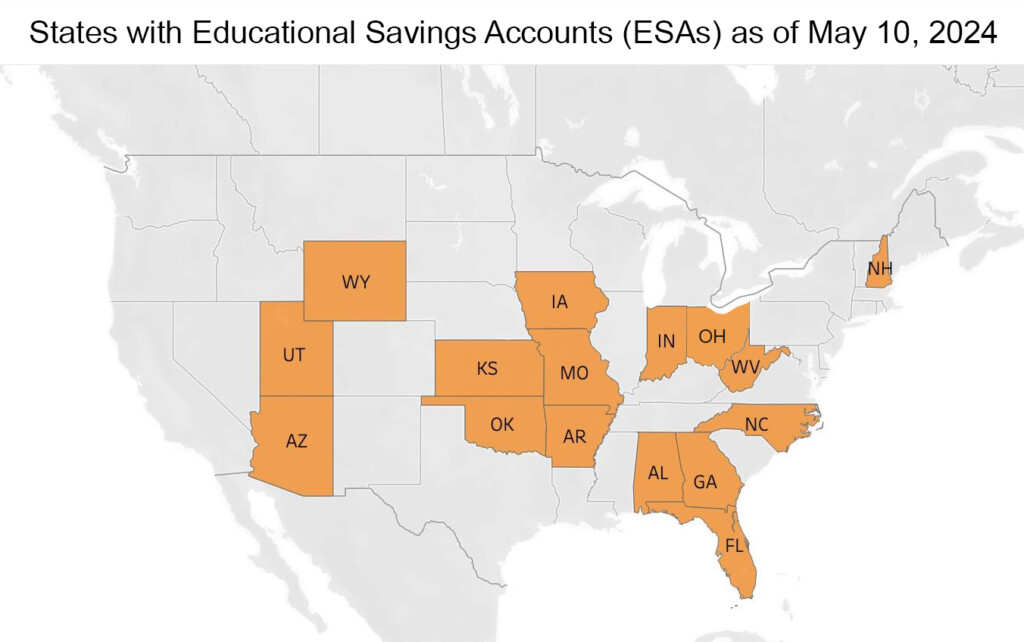
So far, sixteen states have set up ESAs to publicly finance private school attendance, home-schooling, and a range of educational services available to a majority of the states’ school-age children. Southern states are leading this movement by undertaking a classic bait and switch—first selling the public on voucher programs to help poor and disadvantaged students in “chronically failing public schools,” and then building and publicly financing an alternative, dual system of private schooling.
The historical context is shameful. Five of the southern states that now have universal vouchers also enacted open-ended vouchers in the 1960s—attempting to defeat Brown’s mandate for school desegregation. All but four of the states that have already embraced publicly financed ESAs were the only states authorizing segregated public schools on the eve of the Supreme Court’s decision.9Suitts, Overturning Brown, 18–53, 87–89; Suitts, “Segregationists, Libertarians, and the Modern 'School Choice' Movement,”; Pauli Murray, States' Laws on Race and Color (Cincinnati, OH: Women's Division of Christian Service of the Methodist Church, 1951). Indiana had school segregation laws from 1869 until 1949, when five years before the Brown decision the legislature revoked the laws, See Murray, 145–147. The eighteen states are the eleven states of the South: West Virginia, Kentucky, Missouri, and Oklahoma in the Border South; Kansas, Indiana, Arizona, and Wyoming.
The fiscal impact of this rush to fund private schooling will be devastating to public schools. In 2018, all fifty states allocated $2.6 billion to finance private school vouchers. In 2021, legislatures increased the total amount to $3.3 billion and more recently to over $6 billion. If the eleven southern states enact the bills currently adopted or pending in their legislatures, their total funding for vouchers will be as much as $6.8 billion in 2025–26 and, according to independent estimates, as much as $20 billion for private schooling in 2030. This sum would equal the total state funds to public schools among six southern states in 2021.10Suitts, Overturning Brown, 3; EdChoice, The ABCs of School Choice, 2024, https://www.edchoice.org/wp-content/uploads/2023/11/2024-ABCs-of-School-Choice.pdf; author's computations based on the provisions of enacted and pending bills, fiscal notes accompanying legislation and independent estimates by non-profits in the southern states.
The Past Is Future
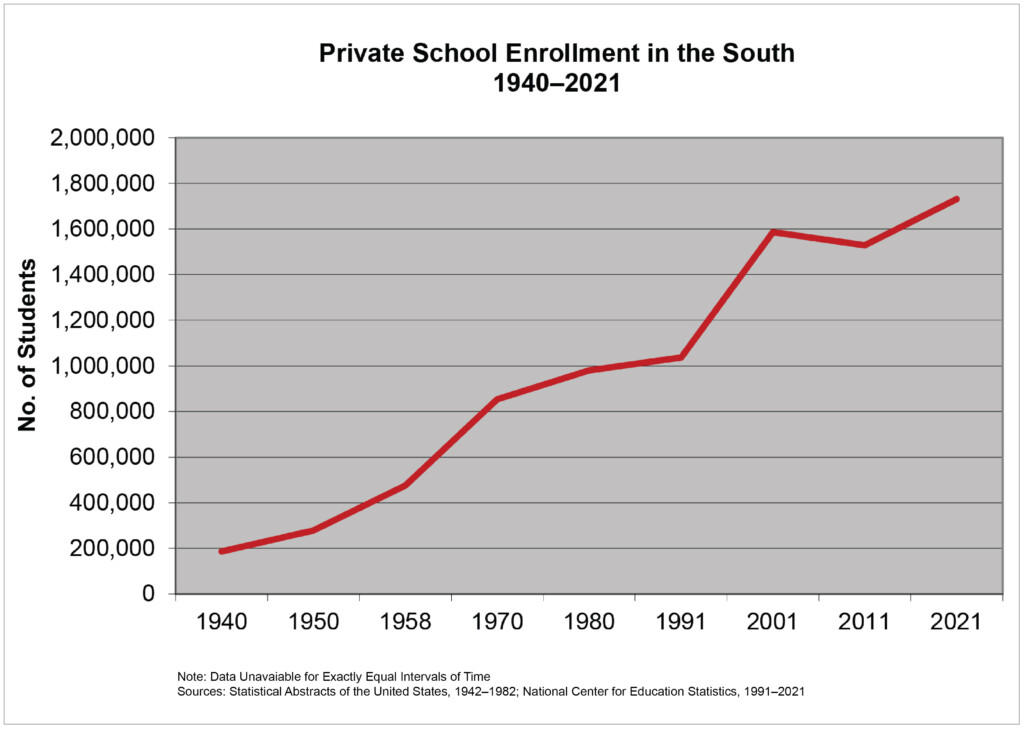
Segregationists’ attempts to use private schools to prevent the implementation of Brown shaped the demography of private school enrollment. After the 1954 decision, enrollment in southern private schools accelerated. With federal court enforcement of Brown, private school growth exploded in the 1960s and 1970s as white families, especially in areas with large Black populations, fled public schools. This was the era of “segregation academies”—private schools created in response to federal court orders to desegregate local public schools. With little or no attempt to hide their intent to evade Brown, seven southern legislatures enacted voucher programs providing families with tax dollars to send their children to private schools. The other four states of the former Confederacy came close to adopting such programs, but abandoned consideration once the federal courts invalidated voucher programs. Adopted as an effort to allow public funds to “fund the child,” Georgia voluntarily defunded its vouchers after segregationist lawmakers realized that they were mostly subsidizing well-to-do families whose children were already attending private schools. In Louisiana, both white and Black families were provided private school vouchers before the federal courts voided the program.11Suitts, “Segregationists, Libertarians, and the Modern 'School Choice' Movement.”
Southern states’ private school enrollment quickened across the decades, especially in the 1990s as population, economy, and personal income markedly increased. To retain a non-profit, federal tax exemption, segregation academies ditched their strict, all-white admission policies, and reoriented their appeal as places of religious education or of higher educational standards. Other private schools became more willing to admit children of color as a new generation of white people was less indoctrinated by received habits, institutions, leaders, and media on the necessity and virtue of total segregation. Whatever non-racial rationale private schools adopted, the vast majority maintained a common character: “These are schools for whites,” observed a group of scholars in the 1970s. “The common thread that runs through them all, Christian, secular, or otherwise, is that they provide white ground to which blacks are admitted only on the school’s terms if at all.”12David Nevin and Robert E. Bills, The Schools that Fear Built: Segregationist Academies in the South (Washington, DC: Acropolis Books, 1976), 11.
Private and Public: Vastly Disparate Students
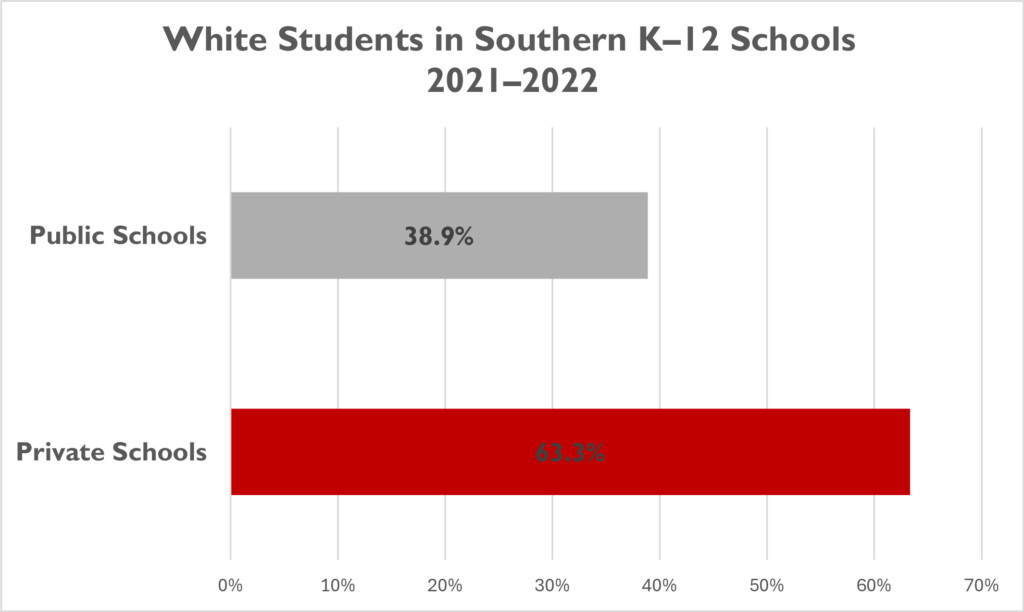
The character of most southern private schools has persisted, but, beginning in the 1990s, the student population of the South’s public schools began to change. Today, the southern states’ private schools remain predominately white and their public schools are predominately non-white, serving children of color. In 2021 (the latest comparable data), white students comprised 63 percent of the South’s private school enrollment and only 39 percent of the public schools. Black and Hispanic children constituted 53 percent of all students in public schools but less than half that proportion—26 percent—in the private schools of the eleven states.13Private school enrollment retrieved and computed from National Center for Education Statistics (NCES), accessed at https://nces.ed.gov/surveys/pss/privateschoolsearch/. Public school enrollment taken from NCES’ Table 203.70 of 2023 Digest of Education Statistics, accessed at https://nces.ed.gov/programs/digest/2023menu_tables.asp.
Income also separates the public and private schools as worlds apart. Private school students come from homes with vastly higher incomes than public school students. The median incomes of private school households in Georgia, Florida, Louisiana North Carolina, Tennessee, Texas, and Virgina have been from 170 percent to nearly 200 percent greater than incomes of public school households over the last two decades. A recent scholarly, national study found that enrollment of higher-income students in private schools had increased over prior decades.14Jacob Fabina, Erik L. Hernandez, and Kevin McElrath, “School Enrollment in the United States: 2021,” American Community Survey Reports, US Census Bureau, Washington, DC, 2023; Bruce D. Baker, Danielle Farrie, David Sciarra, Is School Funding Fair? A National Report Card, 2012, 2014, 2017, “Coverage” appendices; R.J Murnane and Sean Reardon, “Long-Term Trends in Private School Enrollments by Family Income,” AERA Open 4, no. 1 (2018), https://doi.org/10.1177/2332858417751355. The Murname and Reardon study measured the Census South.
As private school enrollment has become wealthier, public school enrollment has become poorer. By 2006, a majority of the South’s public school students came from low-income households, and in 2013, for the first time in recent history, a majority of the nation’s public school children came from low-income households. Despite continued growth in the US economy, these patterns persist. Fifty-two percent of the public school students in the eleven-state South were eligible for free or reduced school meals in 2021, due in large part to the enrollment of so many low-income children. Nationwide, the rate was 49 percent, only slightly down from more than 50 percent during the two prior years.
A sizable number of public school children also have special needs that involve extraordinary educational challenges for teachers and schools. The southern states have almost 40 percent of the nation’s five million school children who are English learners. Students with disabilities (IDEA) range from one in every ten students in Texas to one in every six students in Arkansas public schools. On average, one child out of every fifty in the South’s public schools is homeless.15Steve Suitts, A New Majority: Low Income Students in the South’s Public Schools, Southern Education Foundation, 2008, https://southerneducation.org/publications/newmajority/; Steve Suitts, A New Majority Update: Low Income Students in the South and Nation, Southern Education Foundation, 2013, https://southerneducation.org/wp-content/uploads/documents/new-majority-update-bulletin.pdf; computations from Tables 102.40, 204.10, 204.20, 204.70, 204.75d, “Digest of Education Statistics, 2022,” National Center for Education Statistics, https://nces.ed.gov/programs/digest/2022menu_tables.asp.
There is no reliable data on the number of children with special needs enrolled in private schools. A small number were established to serve special needs students, but the vast majority do not. As a matter of law and mission, most private schools maintain no responsibility to educate disadvantaged students.
Vouchers Worsen School Disparities in a Dual System
Wherever states have abandoned narrow, targeted voucher programs, the expanded public funding has usually been grabbed by the higher-income households, often with children already attending private schools. In 2023, Education Week magazine, which has impartially covered K–12 schools for more than forty years, reported that in states with recently expanded voucher programs a “majority of students participating in these programs were already enrolled in private schools or were homeschool students prior to signing up for the newly expanded, publicly funded education subsidy."16Mark Lieberman, “Most Students Getting New School Choice Funds Aren’t Ditching Public Schools," Education Week, Oct. 4, 2023, https://www.edweek.org/policy-politics/most-students-getting-new-school-choice-funds-arent-ditching-public-schools/2023/10.
During Arkansas’ first year of financing universal ESAs, “95% of the students receiving vouchers” did not attend public schools before receiving the state money. And in four other states that have enacted near-universal ESAs, including Florida, a majority of the new households receiving vouchers have children already attending private schools.17Arkansas Department of Education, LEARNS, Education Freedom Account Annual Report, 2023–2024, https://arktimes.com/wp-content/uploads/2023/10/EFA-Transparency-Report37.pdf; “Iowa’s Students First Education Savings Account program generates more than 29,000 applications,” press of Iowa Governor Kim Reynolds, July 6, 2023, https://governor.iowa.gov/press-release/2023-07-06/iowas-students-first-education-savings-account-program-generates-more; Robin Opsahl, “More than 29,000 apply for Iowa private-school funds in first year,” Iowa Capital Dispatch, July 6, 2023, https://iowacapitaldispatch.com/2023/07/06/more-than-29000-apply-for-iowa-private-school-funds-in-first-year; Ethan Dewitt, “Most education freedom account recipients not leaving public schools, department says,” New Hampshire Bulletin, Mar. 22, 2022, https://newhampshirebulletin.com/briefs/mosteducation-freedom-account-recipients-not-leaving-public-schools-department-says/; News Service Florida, “New report shows nearly 123,000 new students received Florida school vouchers in 2023,” NBC 6 South Florida, https://www.nbcmiami.com/news/local/new-report-shows-nearly-123000-new-students-received-florida-school-vouchers-in-2023/3112869; Florida Department of Education (2023). "Florida’s Private Schools 2022–23: School Year Annual Report," https://www.fldoe.org/core/fileparse.php/7562/urlt/PS-annualReport2023.pdf; Alec MacGillis, “Private Schools, Public Money: School Leaders Are Pushing Parents to Exploit Voucher Programs,” ProPublica, Jan. 21, 2024, https://www.propublica.org/article/private-schools-vouchers-parents-ohio-public-funds.
Data on household income among new ESA recipients is not widely available, but an analysis by Ohio’s former chair of the state house education committee finds that the state’s near-universal voucher programs is subsidizing private school tuition for families in higher income brackets, and that nine of ten of the new recipients have been white. Arizona does not collect income data from its rapidly expanded universal ESA, but Princeton sociologist Jennifer Jennings found in 2024 that “Arizona’s school vouchers are subsidizing its most fortunate families, reinforcing existing disparities rather than mitigating them.” In Florida, the lastest available numbers show that two out of every three new recipients in its universal voucher programs had incomes above 185 percent of poverty. As many as 44 percent had incomes no less than 400 percent above the poverty line.18Stephne Dyer, “Ohio's Disastrous Voucher Explosion,” Tenth Period, Nov. 29, 2023, https://10thperiod.substack.com/p/ohios-disastrous-voucher-explosion?subscribe_prompt=free; Jennifer Jennings, “Arizona’s school vouchers are helping the wealthy and are widening educational opportunity gaps,” Arizona Mirror, Jan. 12, 2024, https://azmirror.com/2024/01/12/arizonas-school-vouchers-are-helping-the-wealthy-and-are-widening-educational-opportunity-gaps; “Transparency in Scholarship Programs,” Step Up for Students via Florida Phoenix Sep. 2023, https://drive.google.com/file/d/1yyl80Jbs9mU6GlV1ktA6zZg8GUjLnsP4/view. The Arizona Common Sense Institute argues that its zip code analysis shows that the state’s ESAs are assisting mostly middle-class families but their analysis lumps together zip codes with median household incomes with those more than twice the state median. In Florida, Step Up for Students expanded the grouping of voucher recipients—the lowest income category showing recipients’ income as high as 185 percent of poverty. Glenn Farley and Kamryn Brunner, Universal ESA’s: Where We Are and Where We Are Going, Arizona Common Sense Institute, May 2023, https://commonsenseinstituteaz.org/wp-content/uploads/2023/05/CSI-Report-_Universal-ESAs_May-2023-2.pdf; Glenn Farley, Growth and Change: How One Year of Universal Empowerment Scholarship Accounts Has (and Has Not) Altered Arizona’s K–12 Landscape, Arizona Common Sense Institute, April 2024, https://commonsenseinstituteaz.org/wp-content/uploads/2024/04/CSI_REPORT_ESA_GROWTH_APRIL_2024.pdf.
It has been evident for years that wealthier households are the primary beneficiaries of open-eligibility tax credit voucher programs. In 2023 the non-profit Institute on Taxation and Economic Policy examined programs in three states that permitted any family to divert state taxes to private school vouchers. Ninety-nine percent of all voucher tax credits in Louisiana and 87 percent in Virginia went to families with annual incomes over $200,000. In Arizona, it was 60 percent. In Georgia, $100 million can now be taken annually from the treasury through state tax credit for funding private school vouchers, and higher-income families have received the majority of the vouchers since 2013. The actual number may be much greater as the program has been plagued by irregularities, deceit, and misrepresentations by private groups distributing the tax credit vouchers. The Georgia Department of Revenue does not use tax records to verify the self-reporting of those receiving the tax credits or vouchers.19Carl Davis, Tax Avoidance Continues to Fuel School Privatization Efforts, Institute on Taxation and Economic Policy, Mar. 3, 2023, https://itep.org/tax-avoidance-fuels-school-vouchers-privatization-efforts/; author’s computations from annual Qualified Education Expense Credit Report, Georgia Department of Revenue, 2013–2021, https://dor.georgia.gov/calendar-year-qualified-education-expense-credit-report; Steve Suitts and Katherine Dunn, A Failed Experiment: Georgia's Tax Credit Scholarships for Private Schools (Summary Report), Southern Education Foundation, 2008, https://southerneducation.org/publications/a-failed-experiment; Nancy Badertscher, “Group targets tax credit scholarships - Revenue Department asked to stem students from private schools,” Atlanta Journal-Constitution, July 22, 2011, B-2; Steve Suitts, “Program encourages deception and helps those who don't need it,” Atlanta Journal-Constitution, July 5, 2011, A-13.
Even with vouchers, few low-income families in the South can afford to keep their children in K–12 private schools. The average cost of private school tuition in ten of eleven southern states exceeds those states’ per-pupil funding of public schools. In other words, even if a voucher equals the state per pupil allocation for public school, it is not enough to match the private school tuition. After including additional expenses of attending a private school—books, supplies, uniforms, technology, athletics, and field trips—the total average cost in all southern states except Arkansas exceeds the state per pupil appropriation. In Texas, that total cost is more than $9,000 over the state’s per pupil public school appropriation. It is more than $2,300 in Mississippi.20Calculations based data on average private tuition prices by state and other costs reported at Raise Right website, https://www.raiseright.com/blog/how-much-do-private-schools-cost, and Prosperity for America website, https://www.prosperityforamerica.org/average-private-school-tuition/. Data on state revenue for state per pupil revenue is found at “2021 Public Elementary-Secondary Education Finance Data, US Census. https://www.census.gov/data/tables/2021/econ/school-finances/secondary-education-finance.html. These back-of-the envelope calculations capture the real-life financial barriers many families will encounter if they rely on an ESA voucher to send a child to a private school, and the calculations don’t even include cost of transportation, something that few private schools provide and is far beyond the resources of most low-income families.
The emerging ESAs are apparently designed for higher-income families that can already afford to pay all or much of the cost of private schooling. Wealthy families can use these vouchers to cover tuition costs and a wide range of expenses. As in several other states, Alabama’s vouchers can go toward tuition, textbooks, fees, after-school care, summer education programs, private tutoring, curriculum and instructional materials, online learning, educational software and applications, standardized assessments, including college admissions tests and advanced placement exams, and college prep courses.
The South Cannot Afford a Dual School System
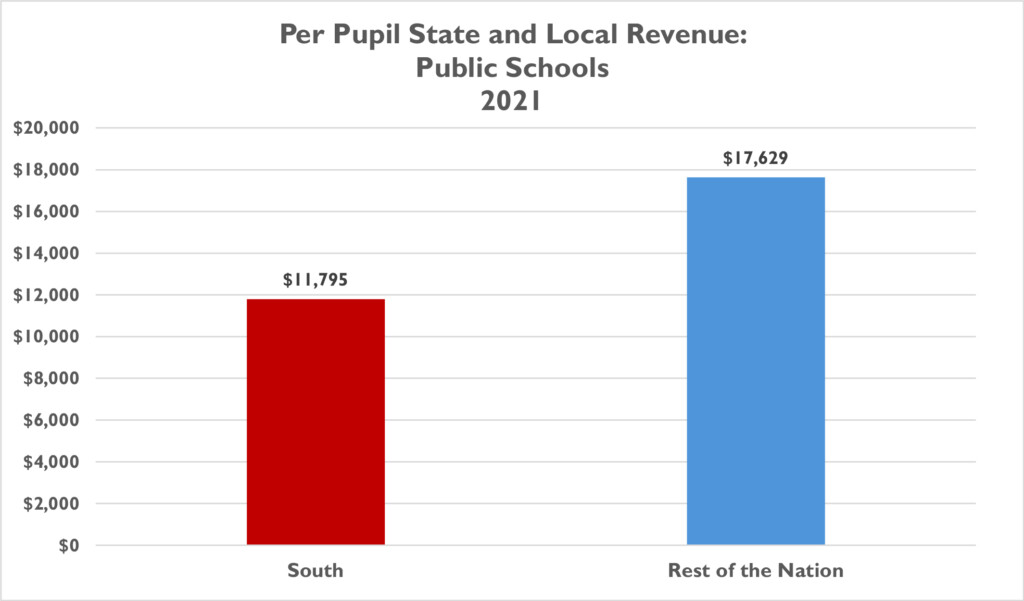
Southern states, while serving a large proportion of disadvantaged children, provide among the lowest per pupil funding in the nation to their public schools. Any given K–12 student in the South received on average $5,831 less for education during 2021–2022 than a student in public school elsewhere in the United States. Public school children in North Carolina, which ranks 48th in state and local funding, received nearly $7,500 less per child than what the rest of the nation provides.
This pattern of underfunding public schools is longstanding and was aggravated over decades, in large part, by the fact that the southern states maintained separate, unequal, dual school systems.21Steve Suitts, “The South: America’s Legacy of Gross Disparities in Funding Education,” No Time to Lose: Why America Needs an Education Amendment to the Constitution, Southern Education Foundation, 2009, https://files.eric.ed.gov/fulltext/ED524094.pdf. And the legacy persists. A recent study by University of Miami Professor Bruce Baker and his colleagues found no less than three out of every four public school districts in the South were chronically underfunded by national standards of need and resources.22Bruce D. Baker, Matthew Di Carlo, and Mark Weber, The Adequacy and Fairness of State School Finance Systems, Jan. 2024, https://www.schoolfinancedata.org/the-adequacy-and-fairness-of-state-school-finance-systems-2024/.
States will soon realize the damage of these disparities. The vast federal funds that were appropriated shortly after the COVID epidemic to shore up schools will run out in 2024. Governors and state legislatures have allocated these temporary funds as if they were state appropriations and often have been able to increase public school funding using federal funds. As that funding is exhausted, public schools in the southern states will suffer extraordinary shortfalls—more so than any other area of the United States.
Approximately nine percent of Louisiana’s education budget across the last three years has been financed with federal funds, almost all of which will be spent by 2025.23Joanna LeFebvre and Sonali Master, Expiration of Federal K–12 Emergency Funds Could Pose Challenges for States, Center on Budget and Policy Priorities, Feb. 2024, https://www.cbpp.org/sites/default/files/2-28-24sfp.pdf. The legislature will be forced to cut K–12 education funding and/or raise additional revenue. If Louisiana's legislature enacts the pending universal ESA it could add more than $65 million in expenses by 2026, and by independent estimates, as much as a half a billion dollars in annual expenditures to the state education budget by 2030.24“Expanding School Choice: Education Savings Accounts Raise Cost, Accountability Concerns,” Public Affairs Research Council of Louisiana, https://parlouisiana.org/wp-content/uploads/2024/03/PAR-Commentary-Expanding-School-Choice-1.pdf.
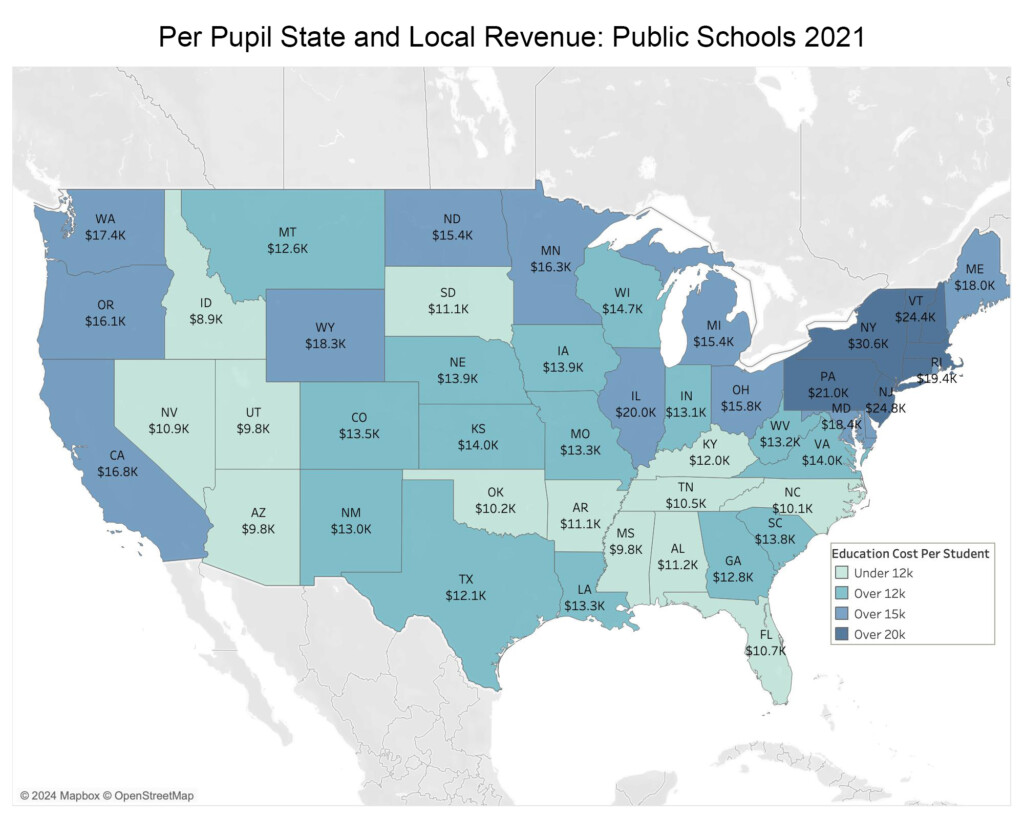
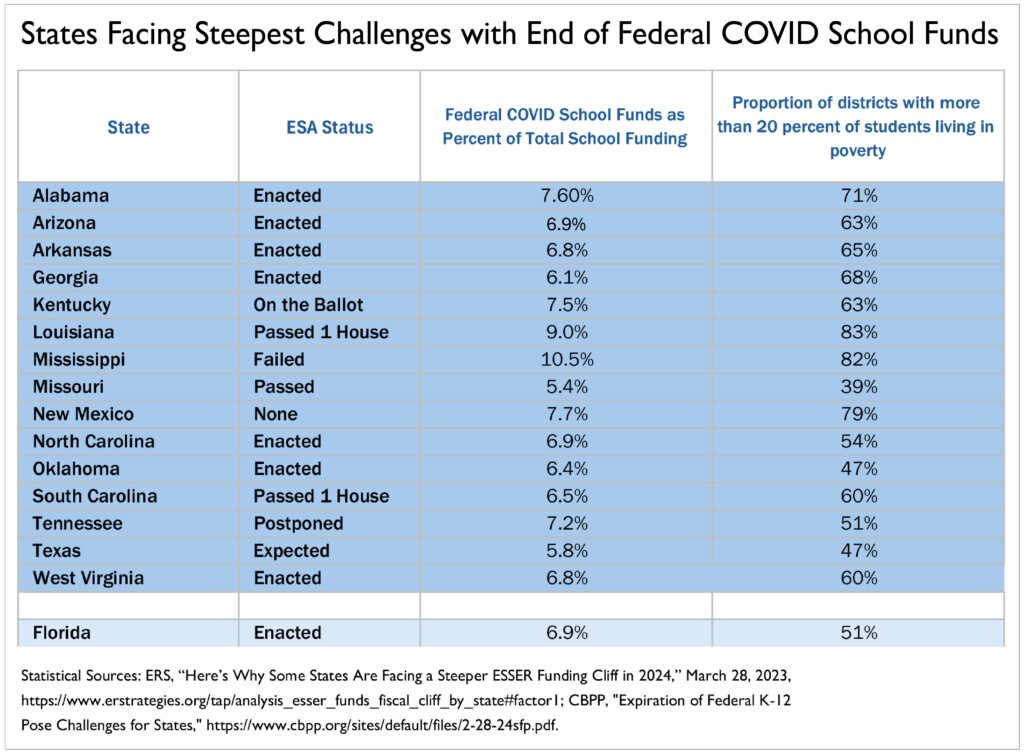
Such grim estimates extend to all states that have enacted or are moving to adopt universal ESAs, including Arizona where 6.9 percent of the state’s recent annual education appropriations will be lost. Yet the fiscal calamities will happen foremost in the southern states where federal funds have constituted an average of 6.4 percent of annual state education spending—and as much as 10.5 percent in Mississippi.
According to ERS, a consulting firm that collaborates with urban school districts, children in fifteen states will be hit hardest as the federal government’s COVID funding ends.25“Here’s Why Some States Are Facing a Steeper ESSER Funding Cliff in 2024,” ERS, Mar. 2023, https://www.erstrategies.org/tap/analysis-esser-funds-fiscal-cliff-by-state/#factor3. Nine of these are southern states, with Florida falling just outside the list. Among the states that will be hardest hit, all except New Mexico have or are currently considering ESA voucher plans.
Replacing $41.5 billion in special federal funding during the last three years will be a daunting challenge for southern states, especially since they also received billions of dollars from other federal COVID relief funding for health care, roads, transportation, and childcare. These funds are also ending. Without massive cutbacks in funding public schools and services, how can the southern states meet this crisis while spending hundreds of millions financing new ESA vouchers in support of a separate system of private schooling? It’s a fool’s errand that will involve educational and financial catastrophe for all but the South’s upper-income households, for whom ESAs will provide a nice subsidy. For public school children, especially most low-income and minority children, it is the making of a disaster.
Dismantling Public Schools
Perhaps it is the aim of some school choice backers who are pushing for a state-financed system of universal vouchers to incapacitate the public education system’s mission and mandate to serve all students with equal educational opportunities. In April 2024, a lead sponsor of universal ESA vouchers in the Tennessee legislature, Republican Scott Cepicky, was caught on tape privately telling home-school parents that his goal for the state’s public schools was to “throw the whole freaking system in the trash at one time and just blow it all back up."26Phil Williams, "'We're trying to throw the whole freaking system in the trash,' school voucher sponsor says," NewsChannel 5 Nashville, Apr. 15, 2024, https://www.newschannel5.com/news/newschannel-5-investigates/revealed/revealed-were-trying-to-throw-the-whole-freaking-system-in-the-trash-school-voucher-sponsor-says
Last year, in a closed meeting of Christian millionaires, one attendee declared that the goal was to “take down the education system as we know it today.” Michael Farris, the Virginia lawyer who has become a prominent leader of the modern home-schooling movement, told the group, “We’ve got to recognize that we’re swinging for the fences here, that any time you try to take down a giant of this nature, it’s an uphill battle,” according to a recording obtained by the Washington Post.27Emma Brown and Peter Jamison, “The Christian home-schooler who made ‘parental rights’ a GOP rallying cry,” Washington Post, Aug. 29, 2023, https://www.washingtonpost.com/education/2023/08/29/michael-farris-homeschoolers-parents-rights-ziklag/.
Few backers of universal vouchers say as much in public, but they no longer keep up a pretense that the school choice movement is about finding ways to provide targeted assistance and opportunities for low-income and minority children. But, Southern governors still like to parade out a group of children of color when they sign voucher bills, as did Georgia Governor Brian Kemp when he held his signing ceremony for the ESA law.28Ty Tagami, “Kemp signs voucher bill he championed,” Atlanta Journal-Constitution, Apr. 24, 2024. Most voucher proponents and wealthy donors who have coalesced for decades, spending enormous energy and money to advance public financing of private education, have confessed openly to a variety of other motives.
This diverse coalition seeks state-supported Christian education, free-market competition, elite-only schooling, unfettered parental control of education, and regulation-free schools, among other objectives. Their movement has progressed over the decades through the collective organizational work and political action committees bankrolled by the super-rich and corporate leaders who believe that the government is too large, taxes too much, and has little or no business in providing education.29David Montgomery, “School Voucher Proponents Spend Big to Overcome Rural Resistance,” Governing, Mar. 28, 2024, https://www.governing.com/finance/school-voucher-proponents-spend-big-to-overcome-rural-resistance; Jimmy Cloutier, “‘School choice’ super PAC targets Texas GOP incumbents,” Open Secrets, Mar. 4, 2024, https://www.opensecrets.org/news/2024/03/school-choice-super-pac-targets-texas-gop-incumbents/; Katie Meyer, “Jeff Yass, the richest man in Pa., is single handedly keeping school choice PACs flush,” WHYY, May 12, 2021, https://www.phillytrib.com/jeff-yass-the-richest-man-in-pa-is-single-handedly-keeping-school-choice-pacs-flush/article_ee7dde98-1989-5ef1-925c-06473429466c.html; James Holmann with Breanne Deppisch and Joanie Greve, “Koch network laying groundwork to fundamentally transform America’s education system,” Washington Post, Jan. 20, 2018, https://www.washingtonpost.com/news/powerpost/paloma/daily-202/2018/01/30/daily-202-koch-network-laying-groundwork-to-fundamentally-transform-america-s-education-system/5a6feb8530fb041c3c7d74db/.
Consider the voucher advocates who believe in economist Milton Freidman’s vision of public education that is entirely based on the government’s providing a voucher to all families with school-age children to go to any school of their choosing. Friedman laid out his free-market idea for voucher-schooling in 1955, a year after Brown. To realize Friedman’s vision today, his adherents’ goal is not a dual school system, but a unitary system of only ESA vouchers. In other words, they seek to destroy public education as it exists.
These free-market proponents fail to grapple deeply with the same issues that Friedman blithely dismissed when condemning “government schools.” In 1955, he acknowledged that his voucher proposal had already been “suggested in several states as a means of evading the Supreme Court ruling against segregation." Friedman’s solution was simple: vouchers paid by government funds would create a system of "exclusively white schools, exclusively colored schools, and mixed schools. Parents can choose which to send their children to." Friedman also opposed a federal fair employment commission to bar racial discrimination in private employment and later the 1964 Civil Rights Act—since it involved government regulation of private businesses for the purpose of prohibiting racial discrimination.30See Suitts, “Segregationists, Libertarians, and the Modern 'School Choice' Movement.”
The belief in the unqualified virtue of private choice means that by design school choice should trump any role government has to prohibit discrimination based on race, sex, and religion in providing the nation’s children with an education. It means the destruction of public schools and their core democratic values.
The emergence of universal vouchers has convinced Pulitzer Prize winning journalist Cara Fitzpatrick to write in The Death of Public Education (2023) that the aim of the movement is to “radically redefine public education in America” with consequences that most citizens have not begun to fully consider.31Cara Fitzpatrick, The Death of Public Education: How Conservatives Won the War over Education in America (New York: Basic Books, 2023). In their revised preface to A Wolf at the Schoolhouse Door (2023), Jack Schneider and Jennifer C. Berkshire write that there is now “a very real threat to public education in the United States . . . we’ve seen more destruction than we imagined could be done in a decade. And we’re worried when we next sit down to update this book, we’ll be writing a eulogy rather than a polemic."32Jack Schneider and Jennifer C. Berkshire, A Wolf at the Schoolhouse Door: The Dismantling of Public Education and the Future of School (New York: The New Press, 2023).
The Bizarre Disparities in Governing the Emerging Dual School Systems
Ending public schools may be the clear goal of the primary advocates behind the private choice movement, but what is emerging in states that are on their way to adopting universal ESAs is a dual school system with vastly, differing, unequal ground rules, responsibilities, and oversight for educating children with public funds.
Most ESA legislation requires minimal regulations of private schools. Children may be rejected by a private school receiving state vouchers for any number of reasons, spoken or unspoken, relating to income, religion, race, ethnicity, dress, sex, gender identity, or disability. The schools will have the ultimate choice—not the children and their families. State legislation usually prohibits discrimination based on race and national origin, but as with most ESAs, there are no mechanisms for oversight, reporting, investigation of complaints, or enforcement.33Kevin G. Welner & Preston C. Green, “Vouchers as a Mechanism for State-Sanctioned Private Discrimination,” in The School Voucher Illusion: Exposing the Pretense of Equity, eds., Kevin Welner, Gary Orfield and Luis A. Huerta (New York: Teacher College Press, 2023), 87–109; Chase M. Billingham and Matthew O. Hunt, “School Racial Composition and Parental Choice: New Evidence on the Preferences of White Parents in the United States,” Sociology of Education, 89, 2 (2016): 99–117, https://doi.org/10.1177/0038040716635718.
The standards for educating children and methods of accountability are minimal or illusory in voucher-supported private schools. The bills establishing ESAs allow these schools to be accredited by a range of private associations, usually comprised of representatives of the schools they accredit. In most southern states, private schools receiving vouchers are not required to assess students for achievement, or, they can use a nationally normed test of their preference, which undermines comparisons among schools. In any case, the results are not always available to the public. Most of these states do not specify, regulate, or review a private school’s curriculum before or after providing voucher funding.
This near-complete freedom to instruct children in whatever way the voucher-supported private schools choose is often justified on the basis that such schools provide students a better education than public schools. There is no factual grounding for this assumption.34Christopher Lubienski, T. Jameson Brewer, and Joel R. Malin, “Bait and Switch: How Voucher Advocates Shift Policy Objectives,” The School Voucher Illusion, 127–141; John Schaaf, “School vouchers hurting students’ academic performance, several studies show,” Kentucky Lantern, Feb. 19, 2024; also, Public Funds, Public Schools has complied a long list of the studies on how private voucher-supported schools have had chronic achievement problems, https://pfps.org/research/. Some private schools are renowned for their high-quality education, but academic study after study has proven this supposition is false. Voucher students are academically harmed on average, particularly in math. Yet, as Cara Fitzpatrick has observed “what the research shows no longer matters.” Private schools are free to indoctrinate students as much as educate them, so long as their parents tolerate or endorse it.35Fitzpatrick, 13.
Some voucher-supported private schools instruct students exclusively about a biblical story of creation. Some require students to pledge allegiance to religious flags and to memorize and recite school-chosen Bible verses. Some teach that homosexuality is a sin. Some expel LGBTQ+ students or even those who associate with LGBTQ+ people. Some use textbooks that belittle the significance of slavery and ignore or downplay the role of Black leaders and the civil rights movement.36Adam Laats, “The Right-Wing Textbooks Shaping What Many Americans Know About History," Time, Oct. 12, 2023, https://time.com/6316978/conservative-textbooks/; Jenna Scaramanga and Michael J. Reiss, “Evolutionary stasis: creationism, evolution and climate change in the Accelerated Christian Education curriculum,” Cultural Studies of Science Education 18 (2023): 809–827. https://link.springer.com/article/10.1007/s11422-023-10187-; Jenna Scaramanga and Michael J. Reiss, “Accelerated Christian Education: a case study of the use of race in voucher-funded private Christian schools,” Curriculum Studies 50, no. 1 (Nov. 2017): 1–19, https://www.researchgate.net/publication/321373088_Accelerated_Christian_Education_a_case_study_of_the_use_of_race_in_voucher-funded_private_Christian_schools; Adam Laats, Forging a Fundamentalist ‘‘'One Best System’': Struggles Over Curriculum and Educational Philosophy for Christian Day Schools, 1970–1989," History of Education Quarterly 49, no. 1 (Jan. 2010): 55–83; Zack Kopplin, “Hundreds of Voucher Schools Teach Creationism in Science Classes,” PBS News, Jan. 29, 2013; “The Loch Ness Monster Is Real; The KKK Is Good: The Shocking Content of Publicly Paid for Christian School Textbooks," Alternet, June 19, 2012; Steve Suitts, Race and Ethnicity in a New Era of Public Funding of Private Schools: Private School Enrollment in the South and the Nation, Southern Education Foundation, 2015, Appendix 14 (available on request); Julie F. Mead and Suzanne E. Eckes, How School Privatization Opens the Door for Discrimination, National Education Policy Center, Nov. 2018; Steve Suitts, Georgia’s Tax Dollars Help Finance Private Schools with Severe Anti-Gay Policies, Practices, & Teachings, Southern Education Foundation, Jan. 2013. There is nothing in the ESA laws, enacted or pending, that restricts a private school teacher, or home-schooling parent from engaging in a lesson plan of indoctrination on the inherent superiority of the white race, the heroism of John Wilkes Booth and James Earl Ray, the need to exterminate LGBTQ+ people, or to punish any woman who seeks an abortion.
In contrast, southern legislatures have piled up decades of regulations, assessments, reporting requirements, and penalties for traditional public schools and more recently are micro-managing what and how teachers can teach and what books local school libraries can keep on their shelves. From 2008 through 2022, the eleven southern states enacted a total of 3,552 laws regulating their public schools. There are nearly a thousand pages devoted to student discipline.37Compilations developed at Education Legislation/Bill Tracking, National Conference of State Legislatures, https://www.ncsl.org/education/education-legislation-bill-tracking; Compendium of School Discipline Laws and Regulations for the 50 States, Washington, DC and the US Territories, National Center on Safe Supportive Learning Environments, 2023, https://safesupportivelearning.ed.gov/school-discipline-compendium.
Southern state legislatures have moved to prohibit what they consider to be inappropriate curricula, lesson plans, and books involving diversity, inclusion, and equity—primarily about how and when persons and groups who are not white or heterosexual should be portrayed in the classroom and in library books. Every southern state has passed laws restricting discussions of race and/or gender identity. Most, like Alabama’s recent law, include restrictions for K–12 public schools on “divisive topics,” or like Arkansas, prohibit “indoctrination or critical race theory." No other area of the US has been as aggressive in restricting public school teachers and librarians, who face penalties or dismissal if they fail to adhere to the regulations banning what they can say and what books students may read.38Hannah Natanson, Lauren Tierney and Clara Ence Morse, “Which states are restricting, or requiring, lessons on race, sex and gender,” Washington Post, Apr. 4, 2024; “America’s Censored Classrooms,” PEN America, Aug. 17, 2022, https://pen.org/report/americas-censored-classrooms/.
It is hard to imagine a more divergent, unequal arrangement. The state-supported private schools can expel a student or teacher for almost any reason, and their teachers and librarians have complete freedom from governmental interference as to what subjects they teach and how they teach it. They have complete freedom to indoctrinate students—with no consequences.
As Vouchers Spread, Brown’s Promise Dies
During the last seventy years, the nation’s public schools have struggled in meeting the promise of Brown, despite clear proof that racially integrated, well-funded schools improve outcomes for Black children.39Rucker C. Johnson, Children of the Dream: Why School Integration Works (New York: Basic Books, 2019). This promise has been especially important to the South, where the states’ first education laws prohibited Black persons from being taught to read or write; where racially segregated schools offered children of color an inferior education across more than a half century. Due to stubborn, racially defined housing patterns, increasing class disparities, adverse, even hostile Supreme Court decisions, a lack of local, interracial community support, and, as recent research confirms, the growth of school choice, public schools continue to face far too many hurdles in providing all children with a good education.40Gary Orfield and Ryan Pfleger, The Unfinished Battle for Integration in a Multiracial America—from Brown to Now, The Civil Rights Project, UCLA, April 2024. https://civilrightsproject.ucla.edu/research/k-12-education/integration-and-diversity/the-unfinished-battle-for-integration-in-a-multiracial-america-2013-from-brown-to-now/National-Segregation-041624-CORRECTED-for.pdf. Also, see Tomas Monarrez, Brian Kisida, and Matthew Chingos, When Is a School Segregated? Making Sense of Segregation 65 Years after Brown v. Board of Education, Urban Institute, Sep. 2019. https://www.urban.org/research/publication/when-school-segregated-making-sense-segregation-65-years-after-brown-v-board-education; Laura Meckler, “The unexpected explanation for why school segregation spiked,” Washington Post, May 6, 2024, https://www.washingtonpost.com/education/2024/05/06/school-segregation-study-policies-court-orders/.
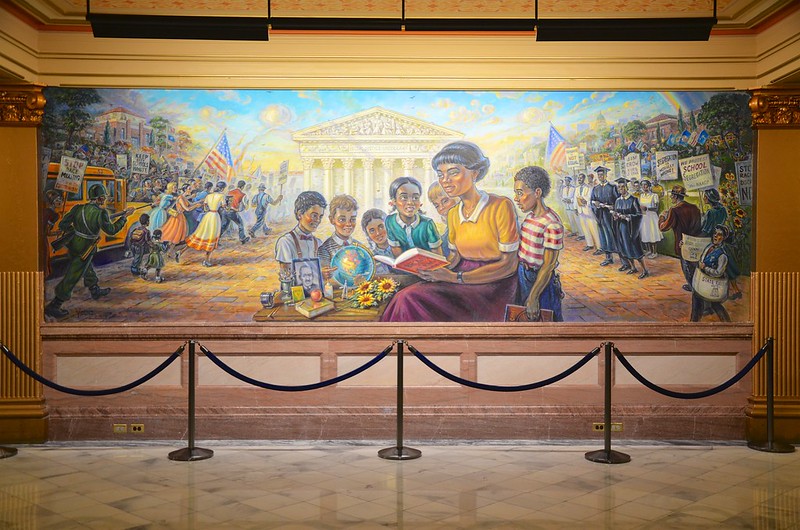
The South’s new dual school system renounces and annuls the mandates and hopes of Brown v. Board of Education. As universal vouchers spread, Brown’s promise dies. By their design, vouchers are an abandonment of Brown’s goal of equality of educational opportunity.
Reestablishing a dual school system will damage the prospects of a good education for all who attend public schools—not just low-income and minority children. The southern states were not able to finance two separate school systems during the era of segregation, even though Black students received a pittance of funding. Today that inability remains. The South continues to be far behind the rest of the nation in state and local funding of public schools. The new schemes of universal Education Savings Account vouchers will exacerbate the lack of sufficient funds for all except those higher-income families whose school-age children can attend private schools or home-schools and enjoy the enhancements and enriching experience that vouchers will subsidize.
Parents, grandparents, and others who support public schools and the democratic promise of public education must raise our voices against this reactionary movement and in furtherance of the importance of public schools. Like democracy itself, public schools may be the worst system for delivering all children an equal opportunity for a good education—except for all the others. We must not betray or abandon public education if we are committed to the democratic goal of a more perfect union and a good society for all. 
About the Author
An adjunct with Emory University's Institute for the Liberal Arts, Steve Suitts is the author of A War of Sections: How Deep South Political Suppression Shaped Voting Rights in America (Athens, GA: University of Georgia Press, 2024). Earlier in his career, Suitts served as the executive director of the Southern Regional Council, vice president of the Southern Education Foundation, and executive producer and writer of "Will the Circle Be Unbroken," a thirteen-hour public radio series that received a Peabody Award for its history of the civil rights movement in five Deep South cities.
]]>Excerpt
Georgetown, April 2017
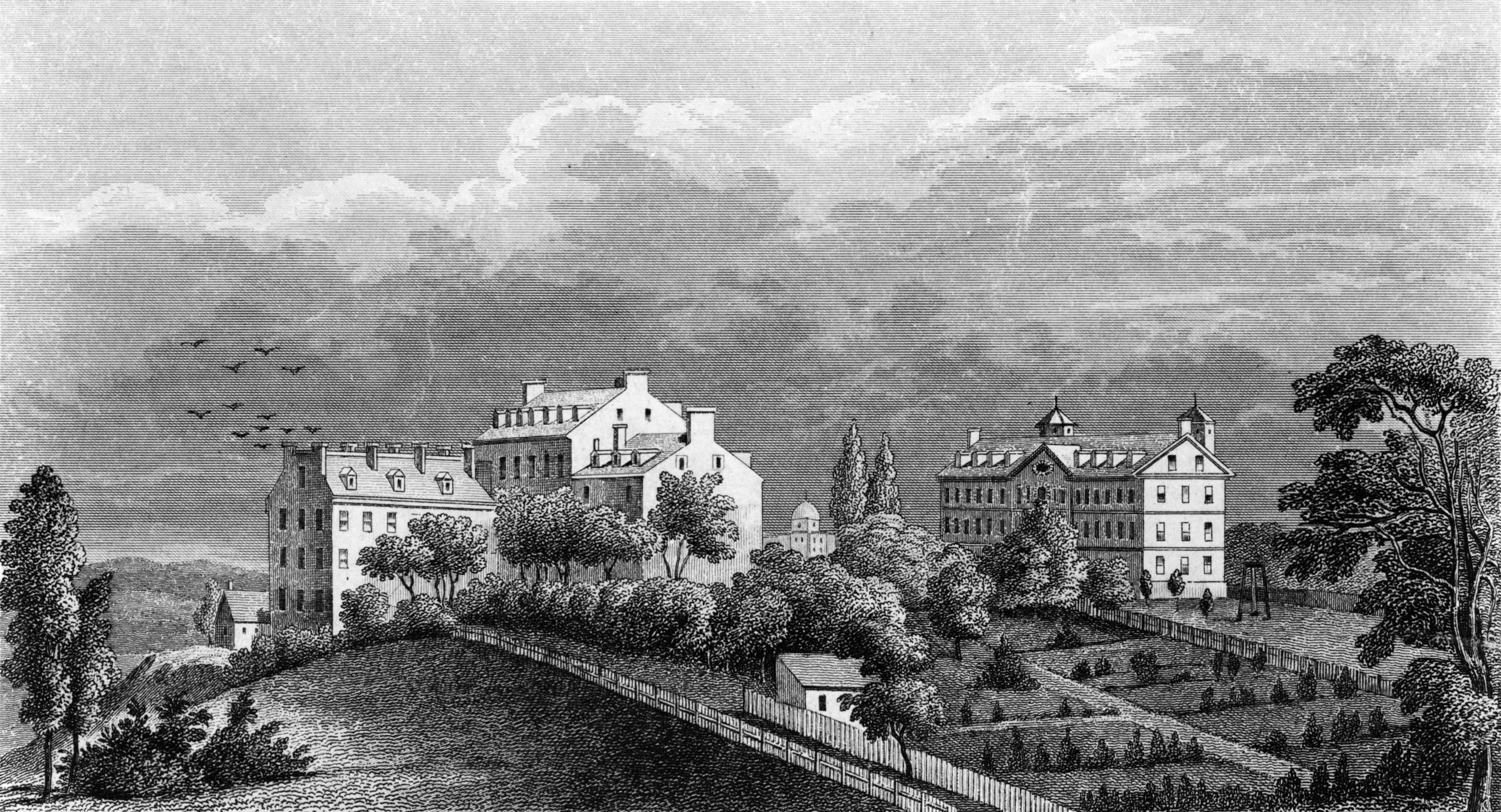
It was early morning when I crossed the Francis Scott Key Bridge from Virginia into Georgetown. College spires loomed in the distance, gray in the dawn light. I was headed to a religious service at Georgetown University that would acknowledge the trauma of a massive slave sale in 1838, a deal that shored up the finances of the struggling college and sent more than two hundred men, women, and children into the cane fields of Louisiana. Most of the families torn apart in the sale could trace their lineage to White Marsh, one of the Jesuit-owned plantations located in Prince George's County, Maryland.
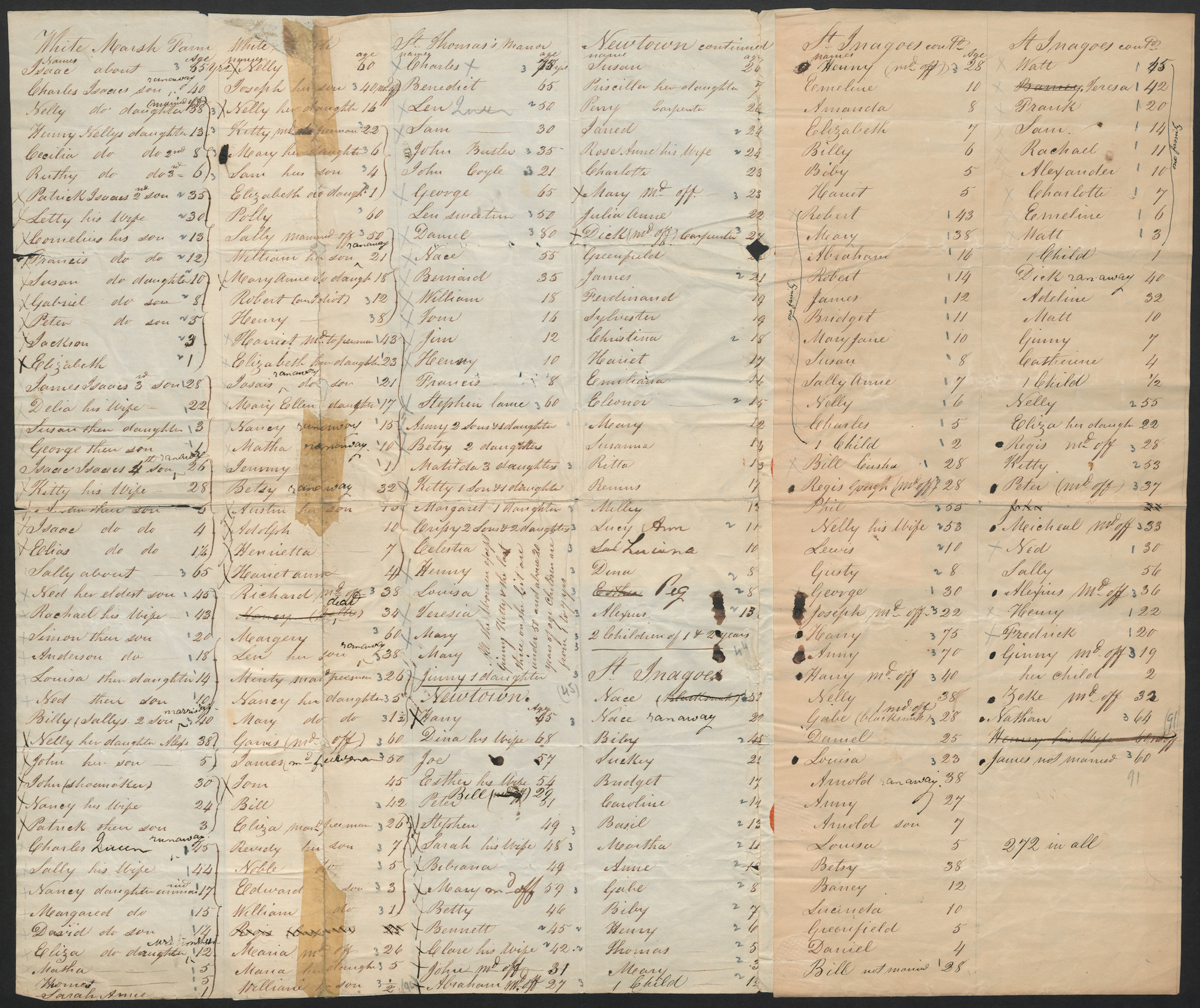
I had been researching the history of the White Marsh families for nearly a decade, uncovering the lawsuits they had brought against the Jesuits and other prominent Maryland slaveholders long before the 1838 sale. Some won their freedom. Others didn't—but each of their cases challenged the legitimacy of slavery in American law. Together they counted among the most significant freedom suits in U.S. history. And there were hundreds of others. Yet their particular stories would lead me, like the Georgetown Jesuits, to reckon with what I did not know about my own family and its role in this story.
More than a hundred descendants, a dozen university officials, and a cluster of Jesuit priests assembled inside Healy Hall for the liturgy and slowly processed into an ornate, wood-paneled auditorium on the third floor. After the opening prayer Sandra Green Thomas rose to address the congregation. Thomas, a descendant of the Harris and Ware families and president of the GU272 Descendants Association, waited a long moment before speaking. "My people were humble," she began. "They provided for their families. They tried to protect their children as best they could from the cruelties of this world, but given what the world is and what people can be, they were not always as successful as they would have hoped." The anguish and fortitude of her ancestors echoed in the firmness of her tone. "Their pain was unparalleled," she observed. "Their pain is still here. It burns in the soul of every person of African descent in the United States. It lives in people, some of whom have no knowledge of its origins but cope with the ever-present longing and lack it causes."1"Liturgy of Remembrance, Contrition, and Hope," Georgetown University, April 18, 2017. Notes and recording in possession of the author. A full recording is available at from Georgetown University at https://www.youtube.com/watch?v=tO4Xsz36kTU, with Sandra Green Thomas's remarks beginning at minute 29:33. Several major research projects have come to the fore around the Georgetown history. First, the Georgetown Slavery Archive (slaveryarchive.georgetown.edu, herein abbreviated GSA) is a repository of archival materials related to the Maryland Jesuits and Georgetown University. Second, the Georgetown Memory Project (www.georgetownmemoryproject.org) is an independent nonprofit dedicated to researching, finding, and advocating for the descendants of the 272. The project released its database of descendants in May 2019 with American Ancestors by the New England Historic Genealogical Society (see the GU272 Descendants, 1785–2000 database, www.americanancestors.org/search/databasesearch/2756/gu272-descendants-1785-2000). Third, historian Sharon Leon has undertaken a highly significant digital history-based analysis of the families on the Jesuit plantations. See Sharon Leon, The Jesuit Plantation Project: An Examination of the Enslaved Persons Owned (and Sold) by the Maryland Province Jesuits, 1717–1838 (https://jesuitplantationproject.org). I have also followed closely the Universities Studying Slavery working group at the University of Virginia since 2014 (slavery.virginia.edu/universities-studying-slavery) and other university reports, especially Stephen Mullen and Simon Newman, Slavery, Abolition and the University of Glasgow, Report and Recommendations of the University of Glasgow History of Slavery Steering Committee (September 2018), and Princeton Seminary and Slavery: A Report of the Historical Audit Committee (slavery.ptsem.edu/full-report). Also see Craig Steven Wilder, Ebony and Ivy: Race, Slavery, and the Troubled History of America's Universities, reprint ed. (New York: Bloomsbury, 2014).
I had met Thomas in New Orleans for the first time a few weeks before the ceremony. I had asked her then what slavery meant to her family, and she had said that slavery was quite simply one thing: theft. To understand American history required dealing with the fact that slavery was premised on a series of lies. The slaveholders, whether Jesuit priests or English tobacco planters, saw themselves differently, of course. We had talked about how they rationalized slavery on the basis of race, religion, law, science, and history and with myriad other prejudices, doctrines, sentiments, and myths.
Now, I wondered how Thomas would broach the lies that slaveholders told and the theft that slavery was. She turned to the heart of the matter, and to the Jesuits whose predecessors had enslaved her ancestors. "I know it is difficult to honestly look at yourself, the way you operate in the world, and your true motivations and priorities." Americans face an uncomfortable truth, she noted. History demanded "self-revelation" about the stories we accept without questioning, about the narratives we use without thinking. She offered forgiveness to the Jesuits, but she sought justice. Thomas spoke for all of the descendants who thirsted for an acknowledgment of their family's particular enslavement, and after she finished thunderous applause erupted in the room.
An expectant hush fell across the auditorium as the Reverend Tim Kesicki, a Jesuit priest and president of the Jesuit Conference of Canada and the United States, rose to address the descendants. He wore a plain black business suit and Roman clerical collar. With an air of earnestness, he spoke slowly, like a pastor to his flock. The long shadow of enslavement, Kesicki said, "remains with us to this day, trapping us in an historic truth." The truth, he admitted, was that the Jesuits had "betrayed the very name of Jesus." Kesicki offered a sweeping apology, confessed the sin of enslavement, and sought "on bended knee" forgiveness for the Jesuits' entire participation in slavery.
But he did not kneel. The remarks, sincere and heartfelt as they were, seemed strangely inadequate. Kesicki wished to acknowledge the sins of the past but was unprepared to deal with the real trauma the Church had caused and offered no meaningful pathway forward. His apology and the request for forgiveness fell flat. Descendants turned their heads away.
In this uncomfortable moment, something more than a Jesuit failure came into view—Kesicki's words symbolized an American failure to deal with a hurtful history. He had not referred to a single descendant or ancestor by name; he had directed his apology to his "sisters and brothers." For hundreds of years the Jesuits had spoken to the enslaved families on similar occasions without addressing them individually, and here at Georgetown the particularity of their enslavement appeared again to be disregarded. Kesicki's apology, nonetheless, marked a subtle but decisive departure in the Jesuits' acknowledgment of their role in slavery. Even the most recent Jesuit histories had failed to fully acknowledge the Society of Jesus's complicity. Indeed, until Kesicki spoke, most attempts to come to terms with this history had downplayed the Jesuit slaveholders' actions: decisions explained, rationalized, and inspected, all pointing to something called "slavery" but not to the families they enslaved. The same vagueness could describe how Americans more generally regard slavery.2Robert Emmett Curran, Shaping American Catholicism: Maryland and New York, 1805–1915 (Washington, D.C.: Catholic University Press, 2012), 36–38. See also Edward F. Beckett, "Listening to Our History: Inculturation and Jesuit Slaveholding," Studies in the Spirituality of Jesuits 28, no. 5 (1996), which explains the Jesuits as paternalists: "To a certain extent, the plantation formed a kind of domestic parish to which slaves belonged" (11). Beckett concludes that Jesuits treated slaves "no worse than" other slaveholders, but following Curran, he emphasizes that the Jesuits encouraged slaves to gain skills. In the most recent and thorough review of Jesuit slaveholding in Maryland, Thomas Murphy, S.J., argues that the Jesuits understood themselves as paternalists and as superior, like all other enslavers in the early American republic. His account is the most balanced examination of the Jesuit role in slaveholding, yet his stance is similarly apologetic. As for their decision to sell supernumerary slaves, Murphy concludes that the Jesuits could not bring themselves to do so and instead sold the physically fit and "missed an opportunity to develop a morally strong case for making profits out of right motives." See Murphy, Jesuit Slaveholding in Maryland, 1717–1838 (New York: Routledge, 2001), 72.
But America's founding, like Georgetown University's, cannot be disentangled from its enslavement of particular families. Our national imagination still sees slavery as an aberration, a detour, from the true story of the country. Many Americans see enslaved people in history as faceless and nameless, victims of a long-ago system that has now disappeared. In such a situation, the nation needs to experience what we at the liturgy experienced: a confrontation, a reckoning, with real people, with real histories, with real families whose descendants live among us. Until such encounters happen more widely, Americans will continue to live in separate historical spheres of understanding, a condition that more than anything limits our ability to come to terms with the past. We cannot, of course, do anything to change what happened long ago, but we can change the way we understand what happened and what it means to us in the present.3A central aspect of the approach taken here is historical imagination. This asks readers to experience a world other than their own and to step outside of themselves into the characters in this history. Recent examples of narrative imagination include Imani Perry, Looking for Lorraine: The Radiant and Radical Life of Lorraine Hansberry (Boston: Beacon Press, 2018); Lisa Brooks, Our Beloved Kin: A New History of King Philip's War (New Haven: Yale University Press, 2018); and Saidiya Hartman, Wayward Lives, Beautiful Experiments: Intimate Histories of Social Upheaval (New York: W. W. Norton, 2019). Each is an inspiration in the form of its narrative and in its attention to re-creating the voices, situations, and daily experiences of people left out of the archive. See also Natalie Zemon Davis, The Return of Martin Guerre (Cambridge: Harvard University Press, 1983).
About the Author
William G. Thomas III is the John and Catherine Angle Chair in the Humanities and Professor of History at the University of Nebraska–Lincoln. He is on the Southern Spaces editorial board, and was co-founder and director of the Virginia Center for Digital History at the University of Virginia.
]]>Blog post
In a case decided on the grounds of religious freedom, the US Supreme Court took another big step on June 30 in supporting religious discrimination in publicly financed schooling and, more broadly, in overturning Brown v. Board of Education, the 1954 landmark opinion that promised the end of racial segregation in public education.
The Court ruled in Espinoza v. Montana Department of Revenue that the US Constitution’s guarantee of religious freedom prohibits a state from excluding religious schools when it finances attendance in private schools. There should be no misunderstanding about what this case means in regard to religion: states are now free to finance private schools that discriminate against students on the basis of students’ religions.
As troubling as that holding is, the opinion also constitutes a major, often ignored long-term impact on school desegregation. Today most students attending private schools are in religious schools, and most religious schools are effectively segregated and exclusionary by race. For this reason, Espinoza constitutes a regrettable, and significant, decision in the Supreme Court’s long and certain movement over the last forty years to overturn the Brown decision.
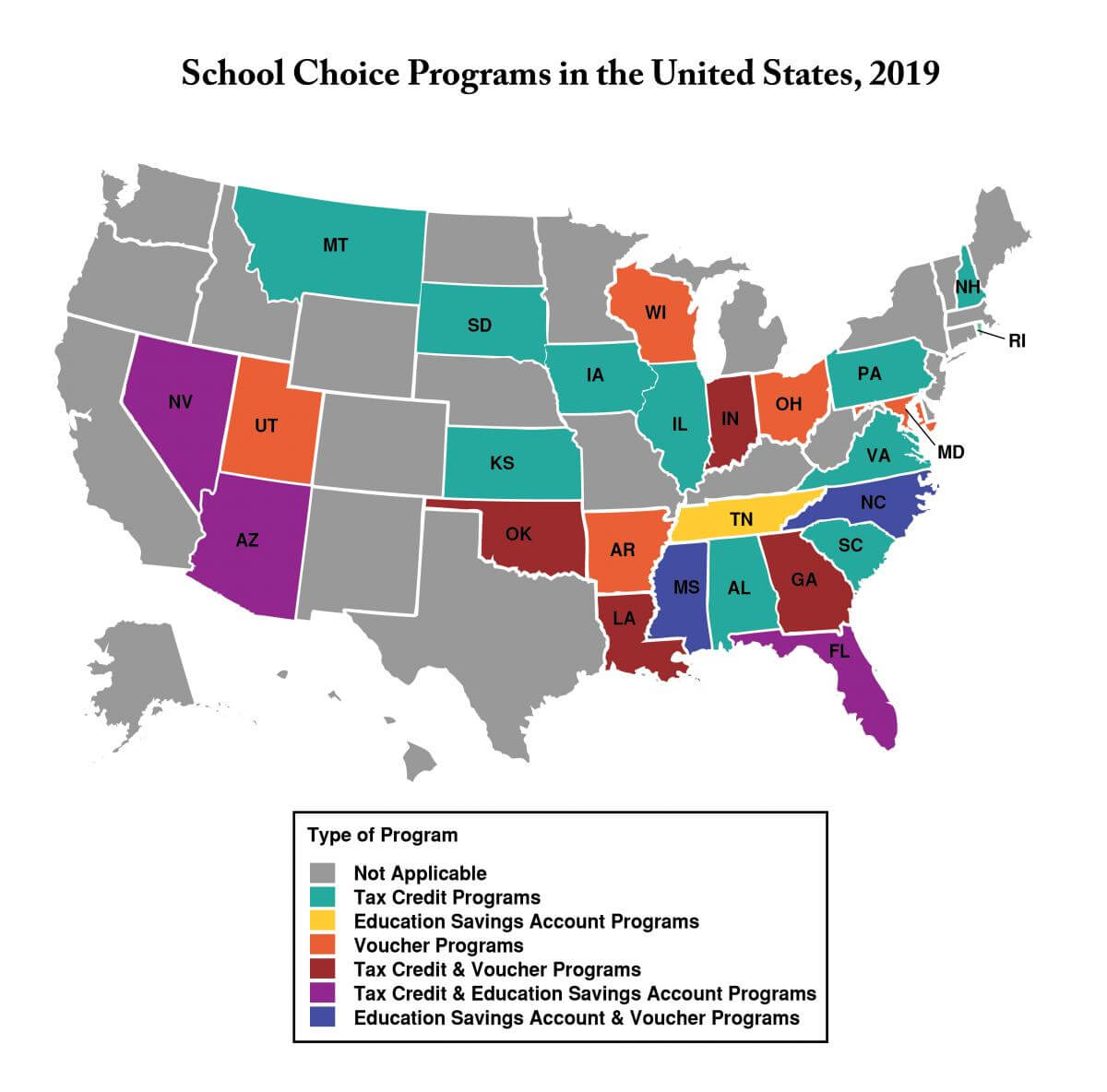
In the short run, the Court’s decision adds momentum to the school choice movement that has been lobbying in Washington and the state capitols to increase public funding of private schools through programs that often safeguard the private schools’ discretion to choose whomever they wish to admit as students. Already twenty-six of the fifty states have yielded to school choice advocates by enacting a variety of voucher programs financed by state appropriations and state tax credits.
Together these voucher programs are diverting more than $2.1 billion annually to private schools. That sum is larger than the annual state funding of public schools in thirteen of the nation’s fifty states. And in January, decrying “failing government schools,” President Trump renewed his support for US Secretary of Education Betsy DeVos’s plan to spend billions of federal dollars on private school vouchers.
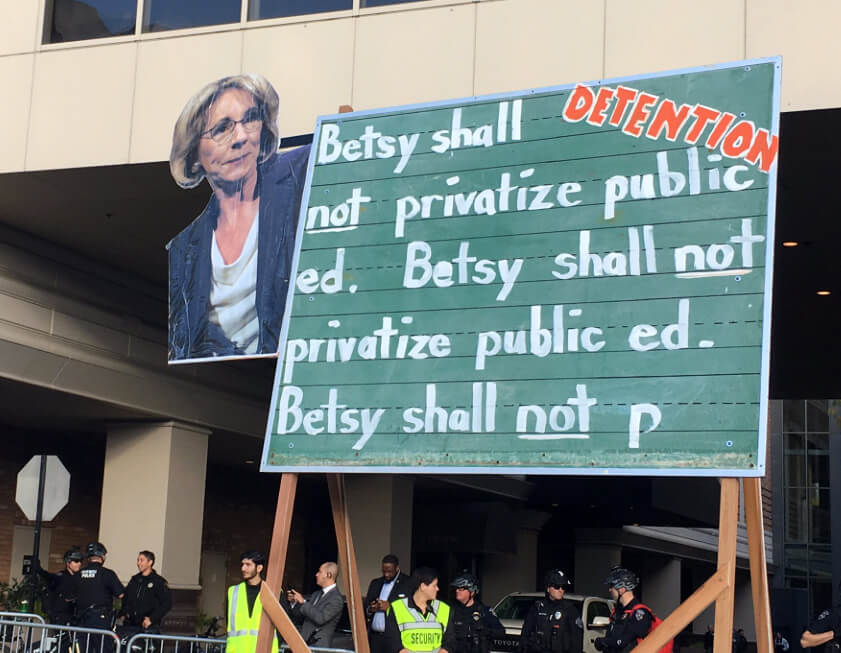
Advocates of “school choice” claim they are advancing religious freedom, social justice, and civil rights when in fact, as I document in “Segregationists, Libertarians, and the Modern ‘School Choice’ Movement," they echo the language and tactics used by southern segregationists in their efforts to evade school desegregation after Brown. It is there—in the history of the segregationists’ fight against Brown and in how the federal courts addressed their strategies—that the long-range impact of Espinoza becomes evident.
In the years following Brown, southern states passed dozens of bills to condemn and frustrate school desegregation. The overall strategy of massive resistance was based on two basic tactics. One was placing pupils in public schools according to what the segregationists claimed were children’s “ability to learn”—which they believed, but after Brown carefully avoiding saying, was inherently different due to race. The other was funding vouchers for private academies where segregationists were free to set up exclusionary admission standards.
By the end of the 1960s, the Supreme Court and other federal courts had effectively confronted this two-pronged strategy by ruling that most of the pupil placement laws for public schools were racially discriminatory in their application and that the South’s voucher programs were a violation of the US Constitution’s Fourteenth Amendment guarantee of “equal protection of the laws.” By that time, however, local and state funding had enabled the rapid growth of private schools—schools that were segregated, often with a token number of Black students to deflect federal scrutiny, and that increasingly professed nonracial reasons for their practices, often citing religion.
Many headmasters of the “segregation academies” by the early 1970s claimed their schools were motivated by religion. “Our people—supporters of the Independent schools—are convinced God is behind us,” asserted the head of the Louisiana segregated private schools. “People believe wholeheartedly that God doesn’t want us to mix.”1Steve Suitts, Overturning Brown: The Segregationist Legacy of the Modern School Choice Movement (Montgomery: NewSouth Books, 2020), 71. Whatever their purported nonracial rationale, the vast majority of the South’s private schools had become religion-based and remained nearly entirely segregated.2Ironically, the Court’s decision in Espinoza removes one of the few restrictions that the Southern segregationists’ voucher programs in the 1960s actually upheld—a prohibition against financing vouchers for students in religious private schools.
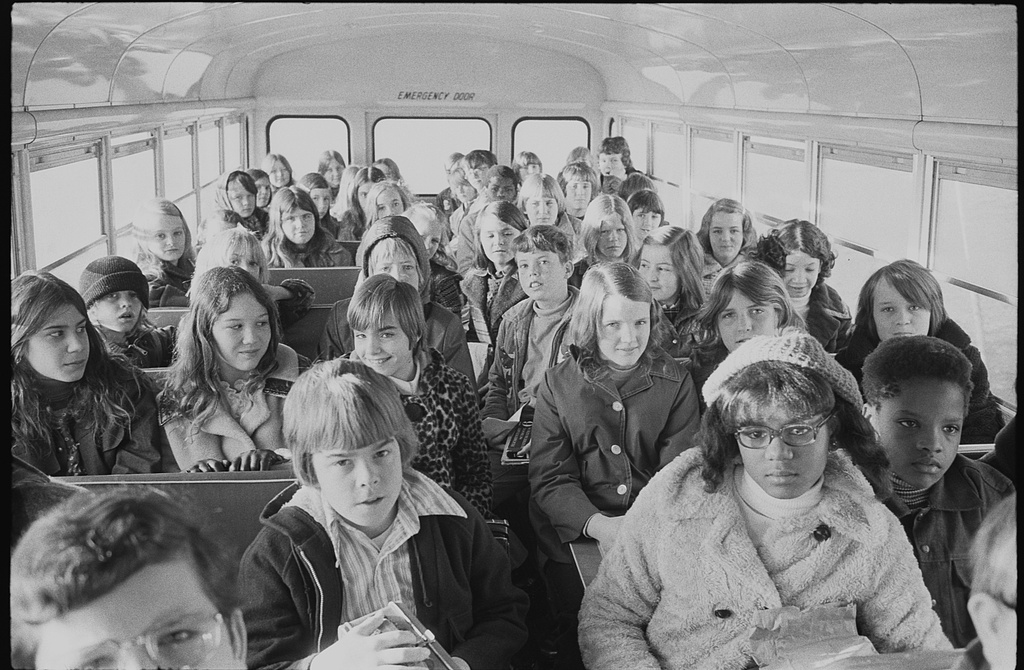
In retrospect, the 1970s also was the era signaling how and when the Supreme Court would turn away from its vigilant efforts over the previous two decades to implement the promise of Brown. The Court began issuing decisions that would block desegregation efforts in public schools—where most students of color seek a better education—and enable public financing of private schools that preserve virtually segregated, exclusionary education for white students.
As early as 1973, Justice William Rehnquist became the first member of the Court to issue a dissent from a school desegregation case relying on the precedent of Brown. In a case concerning school segregation in Denver, he condemned the Court’s opinion for requiring a school district to advance desegregation—employing the old scare word, “racial mixing”—where there were “neutrally drawn boundary lines” that sustained segregation.3Keyes v. School Dist. No. 1, Denver, 413 US 189 (1973), 258. See Justin Driver, The Schoolhouse Gate: Public Education, the Supreme Court, and the Battle for the American Mind (New York: Pantheon Books, 2018), 278–283. As Driver notes, Justice Rehnquist as a Supreme Court law clerk had argued while Brown was being considered that the Court should not overrule Plessy v. Ferguson, 163 U.S. 537 (1896), which had sanctioned state-sponsored segregation and the South’s Jim Crowism for three generations. Chief Justice Roberts was a law clerk to Justice Rehnquist in 1980.
With the ascendency of Justice Rehnquist as Chief Justice and the appointment of other justices across more than three decades, the Court increasingly refused to require public school districts to use effective methods of dismantling school segregation. In 2007, the Court turned Brown on its head when Chief Justice John Roberts wrote that Brown commanded school districts to avoid using race as a consideration, even for the purpose of recognizing and diminishing public school segregation. “When it comes to using race to assign children to schools,” Roberts wrote without doubt or irony, “history will be heard.”4Parents Inv. In Community Schools v. Seattle School, 127 S. Ct. 2738 (2007). In truth, the Court silenced the historical voices and promise of Brown.
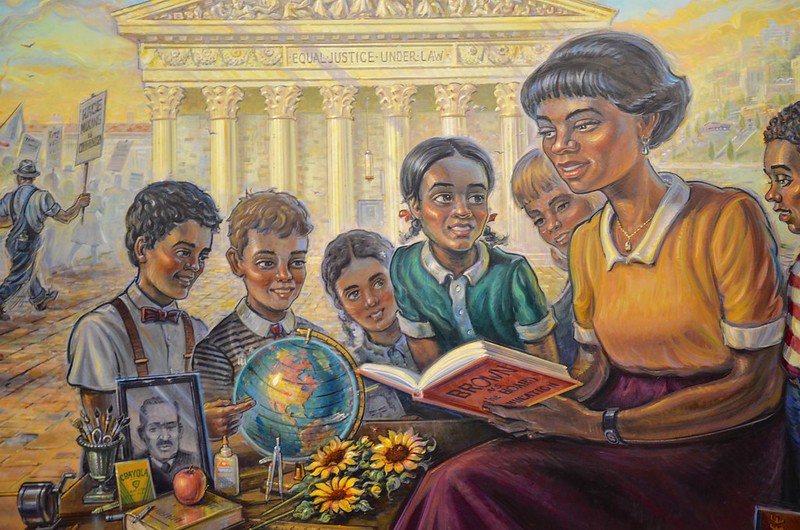
The Supreme Court’s strategy in addressing the second prong of the old segregationists’ strategies—banning government financing of segregated private schools—had a robust but short-lived revival in the early 1980s. Chief Justice Warren Burger used majestic language in 1983, holding that a religious school, Bob Jones University, could not require segregation on its campus and retain an IRS tax exemption. “The Government has a fundamental, overriding interest in eradicating racial discrimination in education—discrimination that prevailed, with official approval, for the first 165 years of this Nation’s constitutional history,” he wrote. “That governmental interest substantially outweighs whatever burden denial of tax benefits places on petitioners’ exercise of their religious beliefs.”5Bob Jones Univ. v. United States, 461 U.S. 574 (1983).
But barely a year after the Bob Jones decision, the Supreme Court slammed shut the courthouse door on those seeking to challenge the IRS’s weak enforcement of that decision and other violations among private schools. Parents of twenty-five Black public school children sued the IRS, charging that its standards and procedures were inadequate to fulfill its obligation to deny tax-exempt status to racially discriminatory private schools. In 1984, the US Supreme Court held that the parents had no standing to bring such a suit.6Allen v. Wright, 468 US 737 (1984).
In more recent years, Justice Anthony Kennedy led the Court in nailing that door completely closed and unleashing private schools from constitutional restraints on receiving taxpayer funds. Arizona’s program of tax credit vouchers allowed individuals and corporations to give tax dollars to private schools instead of paying them to the state. The program was similar to the Montana program in Espinoza and to the private school funding programs that the Supreme Court had outlawed in prior cases in the 1960s, including in Prince Edward County, Virginia, where Justice Hugo Black struck down both direct and tax credit-based vouchers.7Griffin v. School Bd. of Prince Edward Cty, 377 US 218 (1964).
In 2011, Justice Kennedy held for the majority that tax credit vouchers did not involve public funds or any state action that the Bill of Rights would prohibit. “While the State, at the outset, affords the opportunity to create and contribute,” Kennedy wrote, “the tax credit system is implemented by private action and with no state intervention,” with the result that citizens had no standing to challenge the constitutionality of the tax credit voucher program.8Arizona Christian School Tuition Org. v. Winn, 131 S. Ct. 1436 (2011), 1448. Justice Kennedy’s opinion considered whether the First Amendment’s clause requiring separation of church and state, by way of application to the states through the Fourteenth Amendment, prohibited providing state tax credit vouchers to religious schools.
The Court’s opinion in Espinoza v. Montana Department of Revenue holds that there is state action involving constitutional principles that citizens can enforce when they challenge a state exclusion of religious schools from its program of tax credit funding on the basis of religious freedom. However, according to the earlier Arizona ruling, there is no state action when citizens challenge a program of tax credit funding of religious schools on the basis of separation of church and state. It is an odd double standard that makes no sense and represents result-directed law.
Worse, Espinoza moves the Court one step closer to overturning Brown. With Espinoza, state programs can now finance private schools that discriminate on the basis of religion, which has become over the decades a frequent proxy for race. It sanctions expanding state programs that permit private schools across the nation to maintain what strategic southern segregationists sought to achieve after Brown—virtual segregation and exclusion of children of color—while its prior rulings have insured that public school districts cannot recognize race to voluntarily employ effective strategies to desegregate its own schools.
Long gone is the nation’s “fundamental, overriding interest in eradicating racial discrimination in education.”
About the Author
An adjunct with Emory University's Institute for the Liberal Arts, Steve Suitts is the author of Hugo Black of Alabama: How His Roots and Early Career Shaped the Great Champion of the Constitution. Earlier in his career, Suitts served as the executive director of the Southern Regional Council, vice president of the Southern Education Foundation, and executive producer and writer of "Will the Circle Be Unbroken," a thirteen-hour public radio series that received a Peabody Award for its history of the civil rights movement in five Deep South cities.
]]>Women's Space, Queer Space: Communes, Landykes, and Queer Contact Zones in the Lesbian Feminist South
The middle-aged man sitting in the row in front of me shoved his wife's arm and pointed at two women. "See?!" he said, conspiratorially, derisively. I looked at my friend Cheryl and raised an eyebrow. Where did he think he was, anyway? The Southeastern Conference (SEC) Women's Basketball Tournament audience is filled with lesbians—butches, femmes, sports dykes, some distinguished by a modified mullet, others by their no-makeup, tennis shoes, and jeans uniform, but all united in their obsession with women's basketball.
Of course, the tournament audience includes others besides lesbians; like most queer spaces in the South, lesbians share the space with many other groups—retirees, parents and their tween daughters, and random diehard SEC fans who love their team or really hate their rivals. Yet the SEC Women's Basketball Tournament is a roving capital of the southern sisterhood, and it is anything but subtle, but if you ask the fathers and the busloads of white-haired retirees about all the lesbians they will look at you blankly, whether they noticed them or not.
This is because "the South" has always been an imagined community, based in wish fulfillment and aspiration, that depends upon deliberate unlooking. It excludes populations that, collectively, comprise a majority of the population. It excludes black southerners, who understandably have a more ambivalent relationship to the "sense of place" invested in their subordination. It excludes the many immigrant groups that have made the South their home over the generations—Chinese, Lebanese, Italians, and more recently, Indians, Vietnamese, Africans, Hispanics. It ignores queer southern communities in towns both small and large. In other words, the "sense of place" so beloved by traditional southern literary critics overlooks the actual people in that place.
This tendency to disavow the full complexity of diverse communities in the South has a long, shameful history. The Confederacy imagined a southern aristocracy based on honor and culture, obscuring a white supremacy dependent on stolen slave labor. Post-Reconstruction politics did more than rewrite the cause of the Civil War—it also remade the space of the South: Confederate memorial statues were erected, often in town squares or in prominent public locations, as Jim Crow laws limited the spaces and places African Americans could live, work, and recreate.1For more see, Caroline E. Janney, Burying the Dead but Not the Past: Ladies' Memorial Associations and the Lost Cause (Chapel Hill: University of North Carolina Press, 2008) and Micki McElya, Clinging to Mammy: The Faithful Slave in Twentieth-Century America (Cambridge, MA: Harvard University Press, 2007). The fact that these public Confederate monuments still dominate southern spaces, and that their removals provoke intense debate and outcry, suggests how effectively this southern space made inequity seem natural.
The ubiquitous notion of a static, conservative South has led to many unwarranted assumptions about LGBTQ communities and their incompatibility in the South. Gay liberation was framed as an urban phenomenon; gay people leave their inhospitable small towns and regions and build a critical mass in major cities like New York and San Francisco, where their visibility and numbers result in political clout and political influence. Greenwich Village in New York and the Castro in San Francisco were two models; pioneer Harvey Milk encouraged queers across the country to join him in paradise.
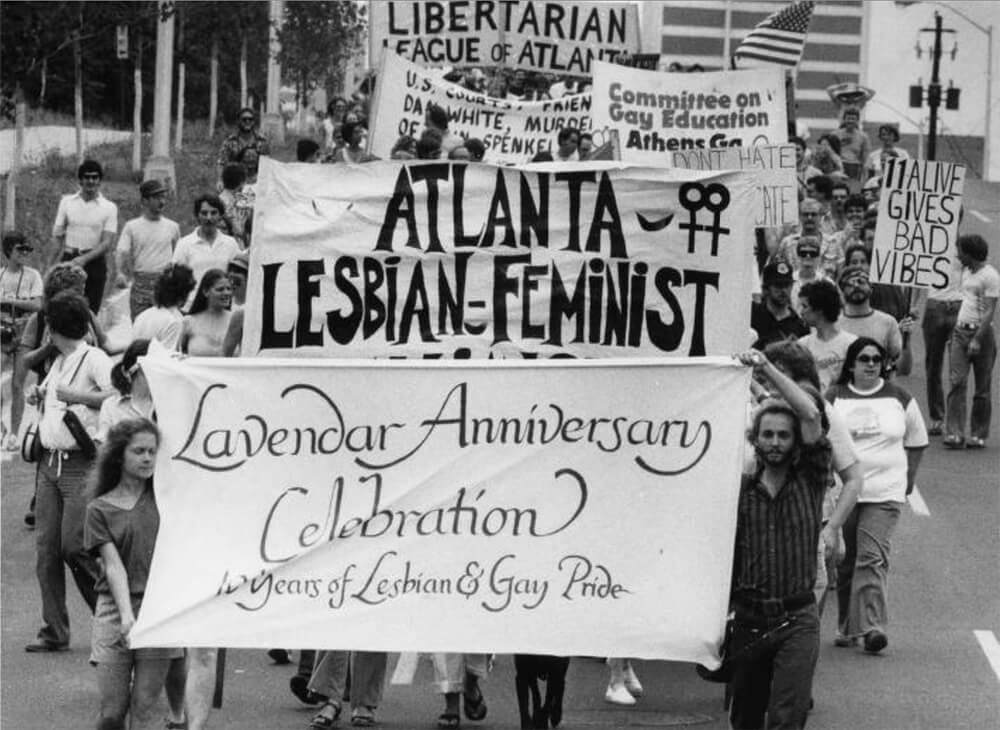
This metronormativity has been questioned in studies of rural and southern queer spaces like John Howard's Men Like That, Mary Gray's Out in the Country, and Scott Herring's Another Country. Howard's ground-breaking book challenged the linking of gay identity and urban life, insisting that this bias "at times has denied agency to rural folk, [and] has assumed that nonurban dwellers can't attach meanings to, can't find useful ways of framing, their nonconforming attractions and behaviors."2John Howard, Men Like That: A Southern Queer History (Chicago: University of Chicago Press, 1999), 14. He argues that "in Mississippi, spatial configurations—the unique characteristics of a rural landscape—forged distinct human interactions, movements, and sites," and that the urban model "incompletely and inadequately gets at the shape and scope of queer life."3Howard, Men Like That, 15. He suggests new models for understanding that queer life, decoupled from both identity and a fixed sense of place.
Scott Herring concurs. He provides a detailed overview of the growing scholarship on queer rural communities, concluding that "these artists and authors pay heed to the 'non-metropolitan' as a dynamic space of inquiry and sexual vitality. Complicating geophobic claims that ruralized spaces are always and only hotbeds of hostility, cultural and socioeconomic poverty, religious fundamentalism, homophobia, racism, urbanoia, and social conservatism, their works question knee-jerk assumptions that the 'rural' is a hate-filled space for queers as they archive the complex desires that contribute to any non-metropolitan identification."4Scott Herring, Another Country: Queer Anti-Urbanism (New York: New York University Press, 2010), 9. Herring's own work focuses on contemporary artistic portrayals of the rural queer in periodicals, photography, memoirs, and graphic novels.
This work on rural queerness is enhanced by feminist and queer geography, which has provided new paradigms to theorize how ideologies order and impede our understandings of space and how different configurations can remake that sense of space. Jack Geiseking explains that "space is not absolute or fixed in the Kantian sense but constantly produced in how it is all at once created, conceived, and lived."5Jen Jack Giesking, "A Queer Geographer's Life as an Introduction to Queer Theory, Space, and Time," in Queer Geographies: Beirut, Tijuana, Copenhagen, eds. Lasse Lau, Mirene Arsanios, Felipe Zuniga-Gonzalez, Mathia Kryger, and Omar Mismar (Roskilde, Denmark: Museet for Samtidskunst, 2014), 14. Our "natural" notions of space, in other words, are not innocent; instead, as the Women and Geography Study Group argues, "dominant senses of place reflect, in both their form and their content, the meanings given to places by the powerful."6Gillian Rose, Nicky Gregson, Jo Foord, et al., Introduction to Feminist Geographies: Explorations in Diversity and Difference, ed. Women and Geography Study Group (Essex, UK: Longman, 1997), 9. They continue, "A consequence of the way in which very specific senses of place are constructed through the particular images and values attached to them by the socially and culturally powerful, is that senses of place are often highly controversial. Other groups may challenge the senses of place produced by the powerful, and cultural geographers therefore argue that senses of place are often also sites of contestation."7Rose et al., Introduction to Feminist Geographies, 9. This focus on space as a site of contestation serves as a dominant focus of feminist and queer geography. "Space" isn't natural, and it isn't neutral.
Doreen Massey lays out the terms for understanding space beyond the fixed narrative of the powerful. She argues that space is heterogeneous, inhabited by diverse groups of people who often disagree about its functions and purpose. Multiple and relational, space is also open-ended and unfixed. As she explains,
What is special about place is not some romance of a pre-given collective identity or of the eternity of the hills. Rather, what is special about place is precisely that throwntogetherness, the unavoidable challenge of negotiating a here-and-now. . . . There can be no assumption of pre-given coherence, or of community or collective identity. . . . In sharp contrast to the view of place as settled and pre-given, with a coherence only to be disturbed by "external" forces, places as presented here in a sense necessitate invention; they pose a challenge. . . . They require that, in one way or another, we confront the challenge of the negotiation of multiplicity.8Doreen Massey, For Space (London: Sage Publications, 2005), 140–141.
Massey's insistence that there is no "pre-given coherence" to a space challenges a fundamental assumption about the fixity of the South and rejects the idea that there is some coherent essence of southernness. It constructs space that is always being created in the present moment, negotiating often contradictory perspectives.
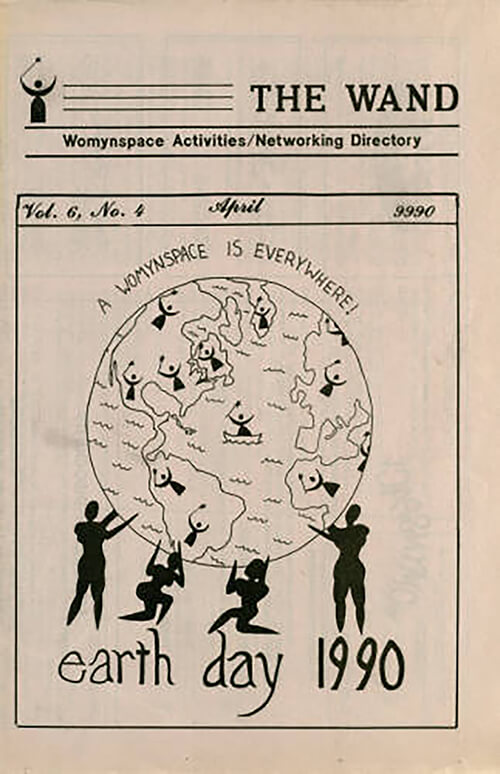
Indeed, Massey's notion of "throwntogetherness" allows for radical reimaginations of space: "What I'm interested in is how we might imagine spaces for these times; how we might pursue an alternative imagination. What is needed, I think, is to uproot 'space' from that constellation of concepts in which it has so unquestioningly so often been embedded (stasis; closure; representation) and to settle it among another set of ideas (heterogeneity; relationality; coevalness . . . liveliness indeed) where it releases a more challenging political landscape."9Massey, For Space, 13. The idea of "alternative imagination" of space is a dominant theme in feminist and queer geography. Geiseking privileges the "action of queering: refusing the normative and upsetting privilege for more radical, just worlds, even those not yet imagined,"10Giesking, "A Queer Geographer's Life," 15. to "uproariously alter the everyday spatialities of heterosexuality."11Giesking, 15. These disruptions include interventions in "the built environment" and the "landscapes" we construct to represent "nature."
Though studies of this utopian "act of queering" tend to focus on contemporary, urban interventions, the act of queering was central to utopian reimaginations of rural space in early women's liberation. Creating autonomous women's space and queer space was a central focus of women's communes and the landyke movement, which had particular resonance in the archive of southern lesbian feminism.
Landykes, Communes, and Lesbian Idealization of the Rural
Early women's liberation was long engaged with challenging the patriarchal hierarchies of space, both public and private. Many early protests—the sit-in at Ladies Home Journal, for example, and the burning of undergarments at the Miss America pageant—were forms of performance art that sought to make visible the seemingly "natural" public spaces allowed to women. These demonstrations intended to smash the public/private distinction that had isolated women and made their concerns a personal failing rather than a structural injustice. The creation of temporary spaces of freedom within a larger heteropatriarchal society—like gay bars and women's music festivals—were another strategy to reconfigure space.
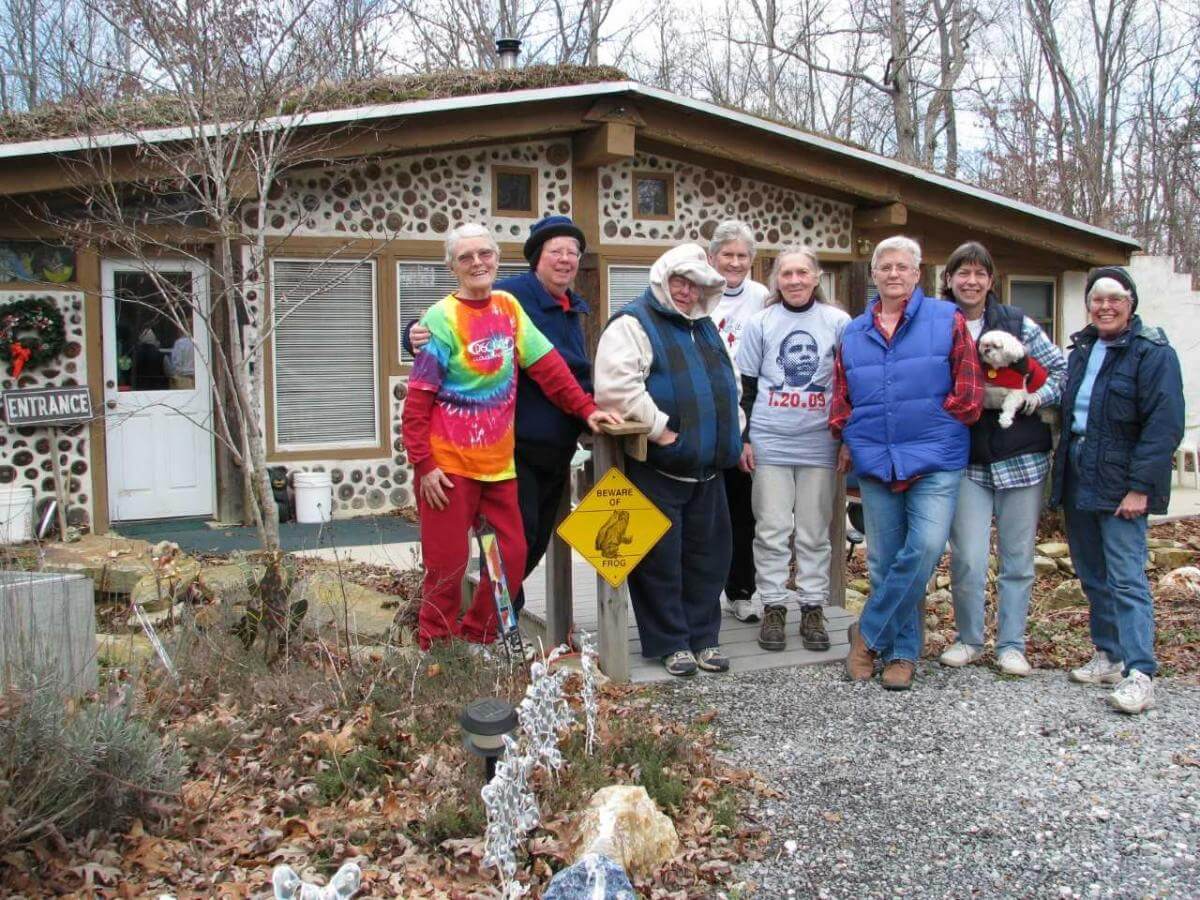
Some lesbian feminists opted for more permanent means of escape that involved experiments in living that were, fundamentally, experiments of spatiality. Greta Rensenbrink explains that "separatist communities emerged in urban areas, especially San Francisco and New York, and increasingly on rural land communes across the United States."12Greta Rensenbrink, "Parthenogenesis and Lesbian Separatism: Regenerating Women's Community through Virgin Birth in the United States in the 1970s and 1980s," Journal of the History of Sexuality 19, no. 2 (May 2010): 291. These separatist communities often functioned as "collectives" in urban areas; some of the most important manifestos of the early women's movement emerged from collectives, which formed and reformed with alacrity in the early 1970s. Women lived and worked in the same space, breaking down the notions of public and private, masculine and feminine. Collectives broke down hierarchies within private and public lives, as well. Members often rejected the distinction between intellectual labor and physical labor; in press collectives, for example, women both wrote articles, short stories, and poems and physically printed these pieces—sometimes on mimeograph machines and later on letterpresses they bought and taught themselves how to use. There was deep suspicion about "leaders" of these groups; decisions were collectively and democratically reached. Cooking, cleaning, home repair—all were burdens to be shared equally in the collective. Collective members tried to re-make space to construct new revolutionary models. They also tried to remake economic models. Frequently, only a few of the members of these collectives had "straight" jobs, which were used to support the entire community. Collectives experimented with different models for self-sufficiency to free themselves from the obligations of capitalist patriarchy. Very few women stayed in these collectives for long; manifestos often had more staying power than the intentional communities that produced them.
Some collective experiments sought physical separation from mainstream society. Research has shown the "the country was an 'ideal' or 'fantasy' place for lesbians to live,"13David Bell and Gill Valentine, "Introduction: Orientations," in Mapping Desire: Geographies of Sexualities, eds. David Bell and Gill Valentine (New York: Routledge, 1995), 8. because it seemed to allow for a reinvention of space from the ground up. Sine Anahita explains, "In the early 1970s, the landdyke movement was created when a radical branch of second-wave feminism converged with ideas from the hippie back-to-the-land and other social movements. . . . From the outset, landdykes articulated the connections between ecological and feminist principles. Early activists sought to create a network of land-based communities where ecofeminist principles could manifest in everyday acts to prefigure a lesbian feminist, nature-centered, postpatriarchal future."14Sine Anahita, "Nestled into Niches: Prefigurative Communities on Lesbian Land," Journal of Homosexuality 56, no. 6 (August/September 2009): 724. This geographical experiment allowed for more democratic and communal constructions of space to teach, inspire, provide refuge, and influence the larger culture with guerrilla-type actions. Rose Norman, Merril Mushroom, and Kate Ellison, editors of a special issue of Sinister Wisdom on the landyke movement in the South, explain that "landykes were creating something larger, beyond a couple or a family. They attempted to live out egalitarian and ecological principles, which they saw as the core of female culture. They attempted this within sometimes stark financial, cultural, and psychological limitations."15Rose Norman, Merril Mushroom, and Kate Ellison, "Notes for a Special Issue, Landykes of the South: Women's Land Groups and Lesbian Communities in the South," Sinister Wisdom 98 (Fall 2015): 8. While the landyke movement was national, the editors suggested that the South has always contained a large share of these experimental communities.16Norman et al., "Notes for a Special Issue," 5.
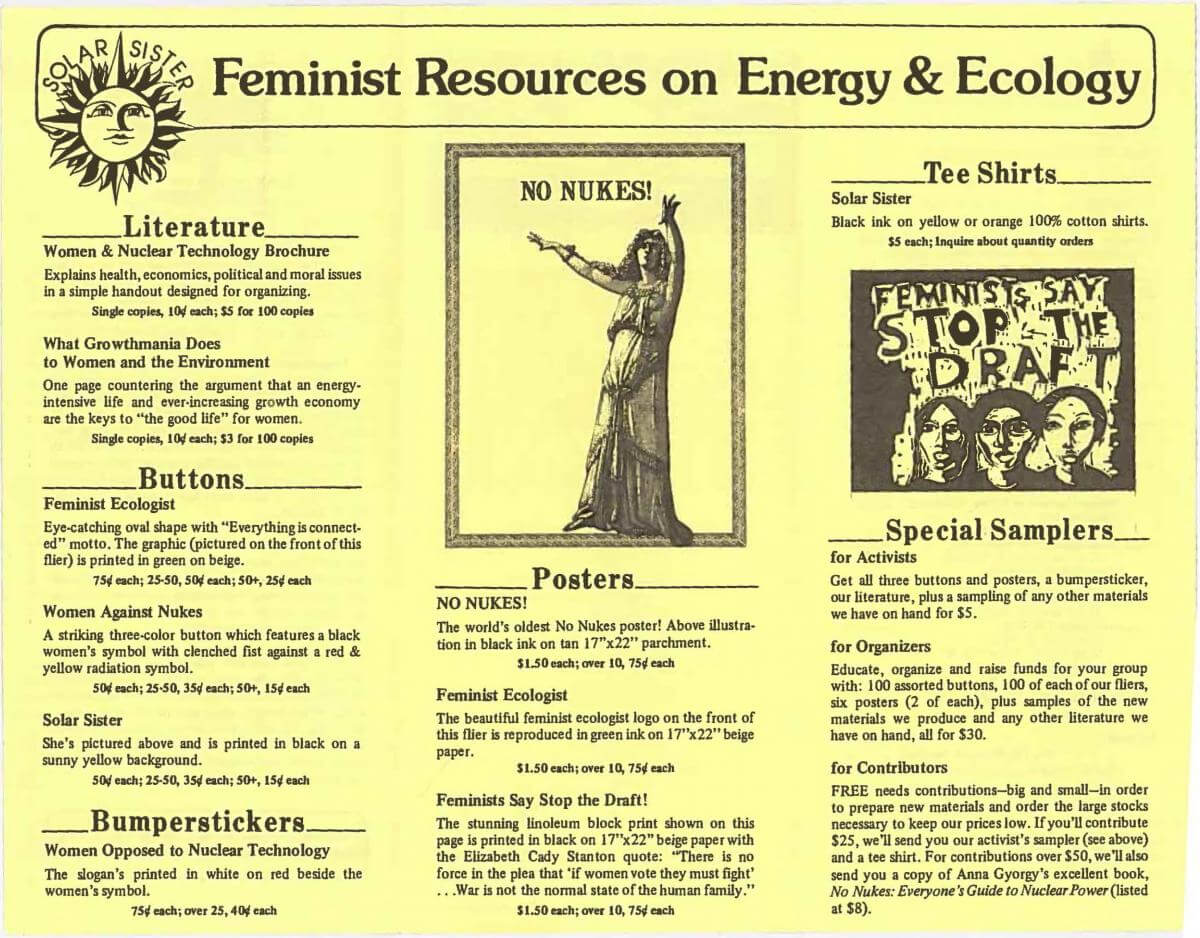
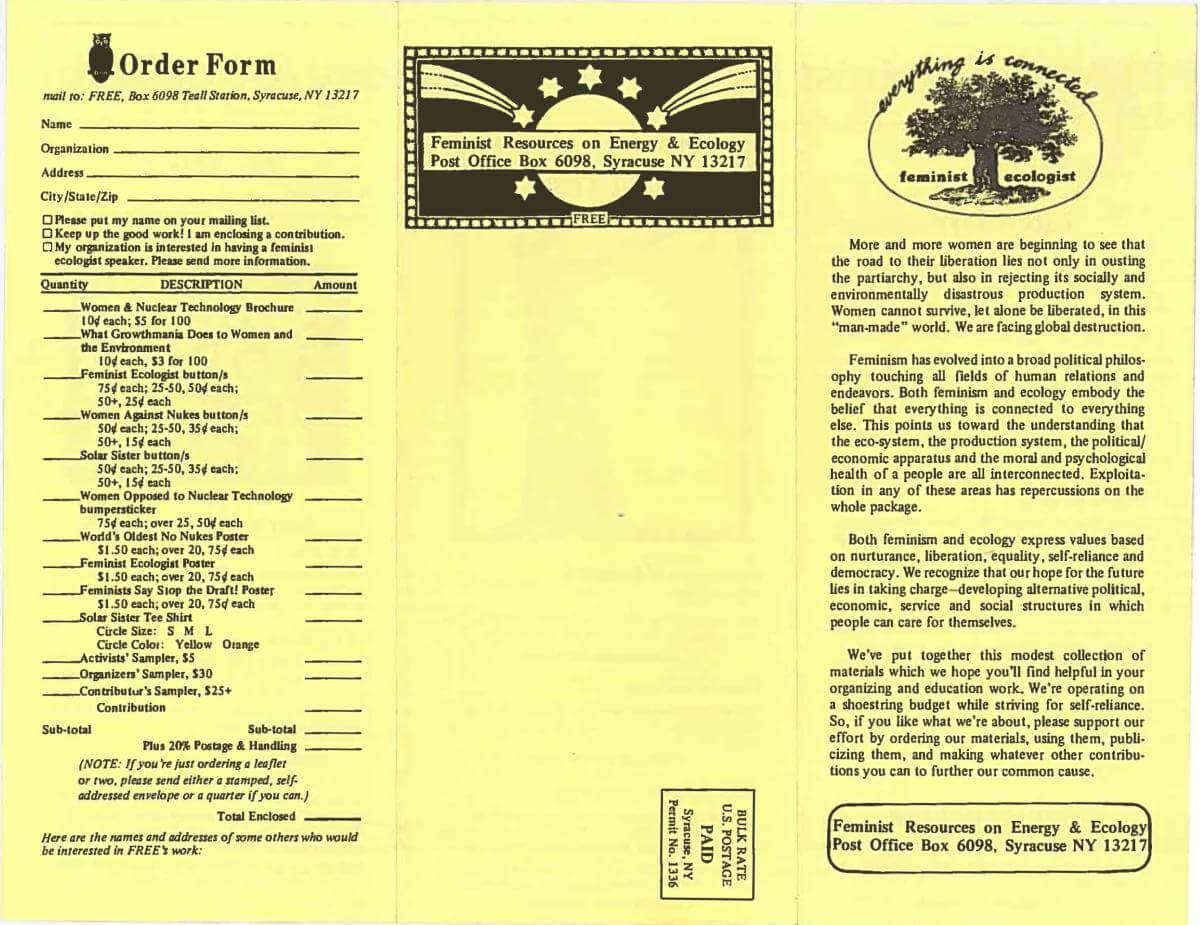
Such movements are controversial and have been denounced as essentialist, white-identified, privileged, and unrealistic, but participants portray them differently. Some are unapologetic in their insistence on a women-only space and cling to essentialist notions of women's innate difference and superiority, but others see the landyke movement as an essential part of their development that allowed for creative rethinking of what is possible in culture, politics, and living. Sarah Shanbaum explained: "We created a closed and separatist environment, and in that closed and separatist environment, we learned and we became strong, and then we broke that like an egg, and went out into the world, and did what it was we wanted to do."17Dee Mosbacher, dir., Radical Harmonies: Woodstock Meets Women's Liberation in a Film about a Movement that Exploded the Gender Barriers in Music (Wolfe Video, 2004). Seeing separatism as a necessary phase that led to a broader inclusiveness is common for participants, and it is a pattern that we see in the archive of southern lesbian feminism as well.
Women's space and women's land were essential for the utopian possibilities they fostered. Greta Rensenbrink argues that "separatists embraced prefigurative politics, seeking to live the future in the present and working to create communities and local cultures that anticipated a utopian dream."18Rensenbrink, "Parthenogenesis and Lesbian Separatism," 292. As one landyke participant explained in the documentary Lesbiana:
We were actively rethinking the world. Each time I walked out of the bar, I felt like I was crossing a zone from a fictional world—the life in the bar—into reality—life in the city. And that is how I developed this notion of reality versus fiction. Meaning that women's reality was perceived as fiction by men, and what we called reality, was in fact the accumulation of masculine subjectivity that has been working for centuries establishing laws, traditions, etc. And we called that "reality," but it was nothing more than the male version of reality carried through the centuries. During that time, I was writing two pages. On one page I was trying to figure out the male system, a horrible system, detrimental to women: patriarchy. I was trying to figure out its strategies and its tactics, and how it evolved and was persistent to this day. And on the other page, I was writing about desire, utopia, beauty, pleasure, and everything I was discovering with other women. This is how I stayed in touch with the reality of patriarchy and still I could take flight, into love, lust, sisterhood, and all the discoveries I was making at that time.19Myriam Fougère, dir., Lesbiana: A Parallel Revolution (Women Make Movies, 2012).
The creation of a utopian, liberated space, both actual and imagined, was a key part of early women's liberation. It is why the arts were so enmeshed with political activism; why "consciousness-raising" moved from physical gatherings to novels; why women's press collectives were seen as political activism. Physical and imaginative space were mutually interdependent, and a compelling imagined space might end up having more impact than a physical space.
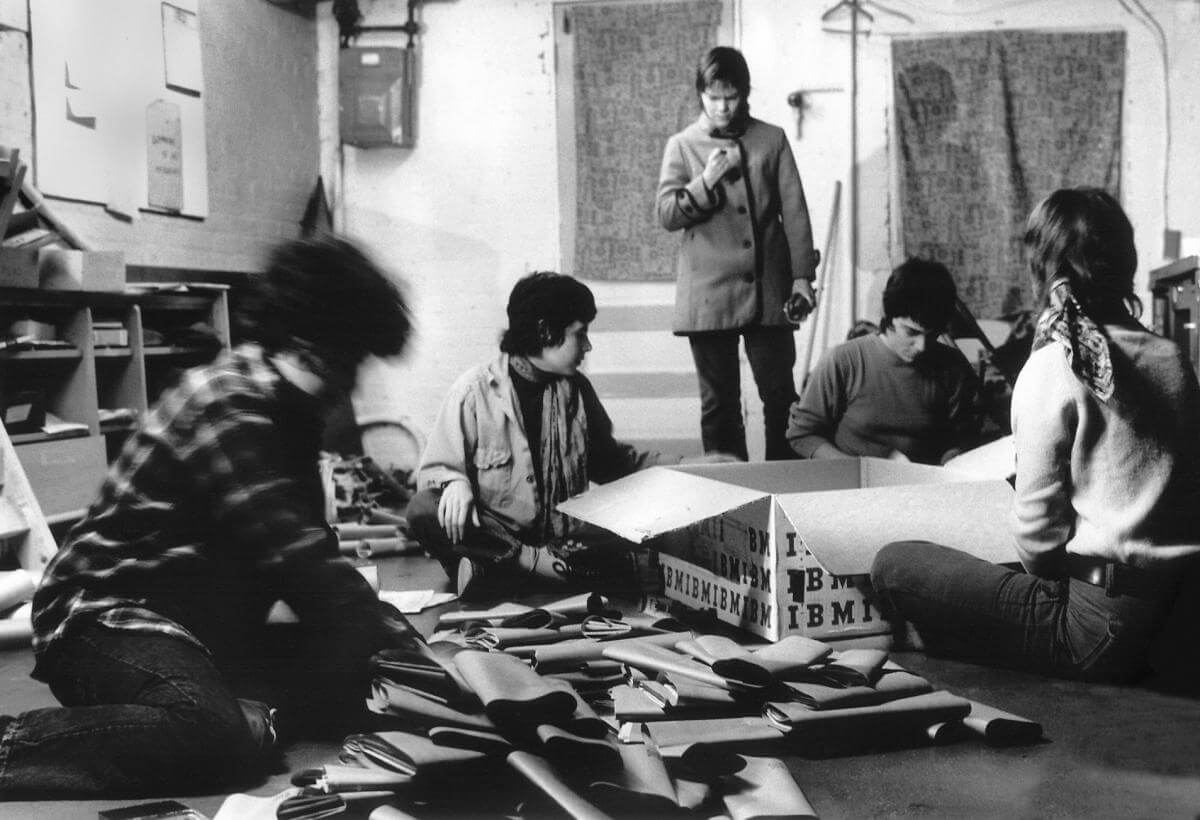
Many writers in the southern lesbian feminist archive were invested in communes and collectives. Bertha Harris went with a group of lesbian friends (including anthropologist Esther Newton and her then-lover Louise Fishman, the painter) to an upstate New York property owned by Jill Johnston,20Esther Newton, Margaret Mead Made Me Gay: Person Essays, Public Ideas (Durham, NC: Duke University Press, 2000), 277n6. which served as a weekend getaway and part-time retreat that Harris would later memorialize in Lover. Blanche McCrary Boyd joined a commune in Vermont (not an exclusively lesbian commune, though she transforms it into one in Terminal Velocity); Rita Mae Brown was part of a women's collective, the Furies, in Washington, D.C., and when she eventually moved to Virginia (after the sale of Rubyfruit Jungle to Bantam Books) she didn't establish a commune, but she did buy land.
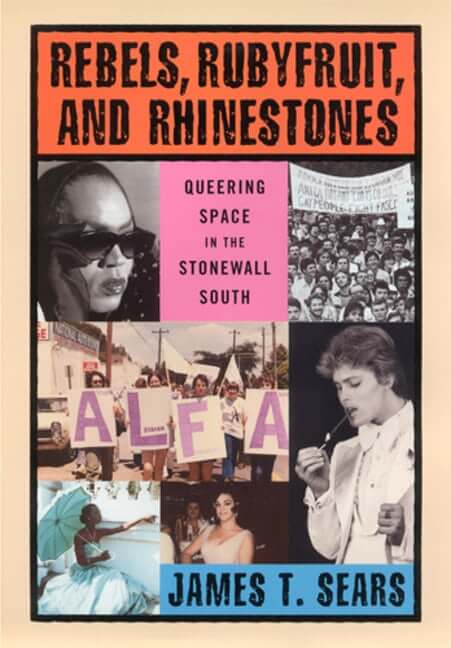
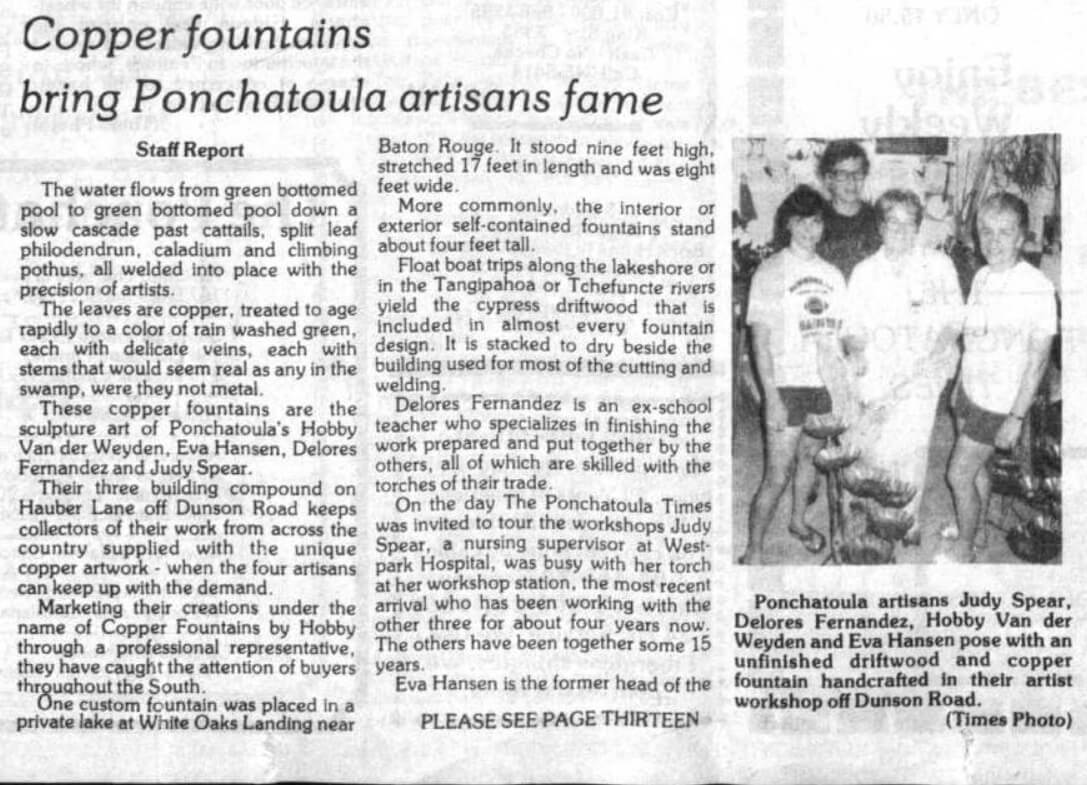
In Rebels, Rubyfruits, and Rhinestones, James T. Sears describes a seamless transition of southern queers from their small southern towns to New York City and back to intentional communities in the South—a fluid circulation that negated neither urban gay communities nor southern identities.21James T. Sears, Rebels, Rubyfruit, and Rhinestones: Queering Space in the Stonewall South (New Brunswick, NJ: Rutgers University Press, 2001). The Pagoda community in St. Augustine, Florida was one of the most famous,22For more information, see Lin Daniels, "Pagoda, Temple of Love: Practice Ground for the Matriarchy," 1977, http://kongress-matriarchatspolitik.ch/upload/Lin-Daniels.pdf. but many smaller ones thrived under the radar across the South. Dorothy Allison belonged to a women's collective in Tallahassee, Florida. Catherine Nicholson lived in a collective in Charlotte, North Carolina but was kicked out for her intergenerational romance with Harriet Desmoines; photographs of the Sinister Wisdom group, taken at Nicholson's house on Country Club Drive (with many of the women topless), suggest a faux commune had formed there. And Catherine Ennis, who was so cautious that she wouldn't do readings of her lesbian novels too close to her hometown, appeared in the Ponchatoula Times in the mid-1980s with her "artisans" collective; the photograph suggests a lesbian commune flying under the radar.23"Copper Fountains Bring Ponchatoula Artisans Fame," Ponchatoula Times, July 31, 1986, http://ptl.stparchive.com/pageimage.php?paper=PTL&year=1986&month=7&day=31&page =1&mode=F&base=PTL07311986P01&title=The%20Ponchatoula%20Times. In smaller communities this sort of caution wasn't uncommon. Other communes—usually those in urban centers or college towns in the South—were more open and combative, though often no more visible. The Atlanta Lesbian Feminist Alliance (ALFA), which operated for two decades in the largest urban center in the South and hosted a number of lesbian writers, including southern lesbian feminist writers, was largely unknown in Atlanta proper. The Feminary collective in Durham, North Carolina was well known within lesbian feminist circles but fairly anonymous inside the Research Triangle. More recent communes include one in Alabama and Camp Sister Spirit in Mississippi.24A 2009 New York Times article discusses the Alabama community—see Sarah Kershaw, "My Sister's Keeper," New York Times, January 30, 2009, http://www.nytimes.com/2009/02 /01/fashion/01womyn.html. For more on Camp Sister Spirit, see "Controversial Camp Sister Spirit Celebrates 10 Years," WLOX News, September 22, 2003, http://www.wlox.com/story/1451559/controversial-camp-sister-spirit-celebrates-10-years/.
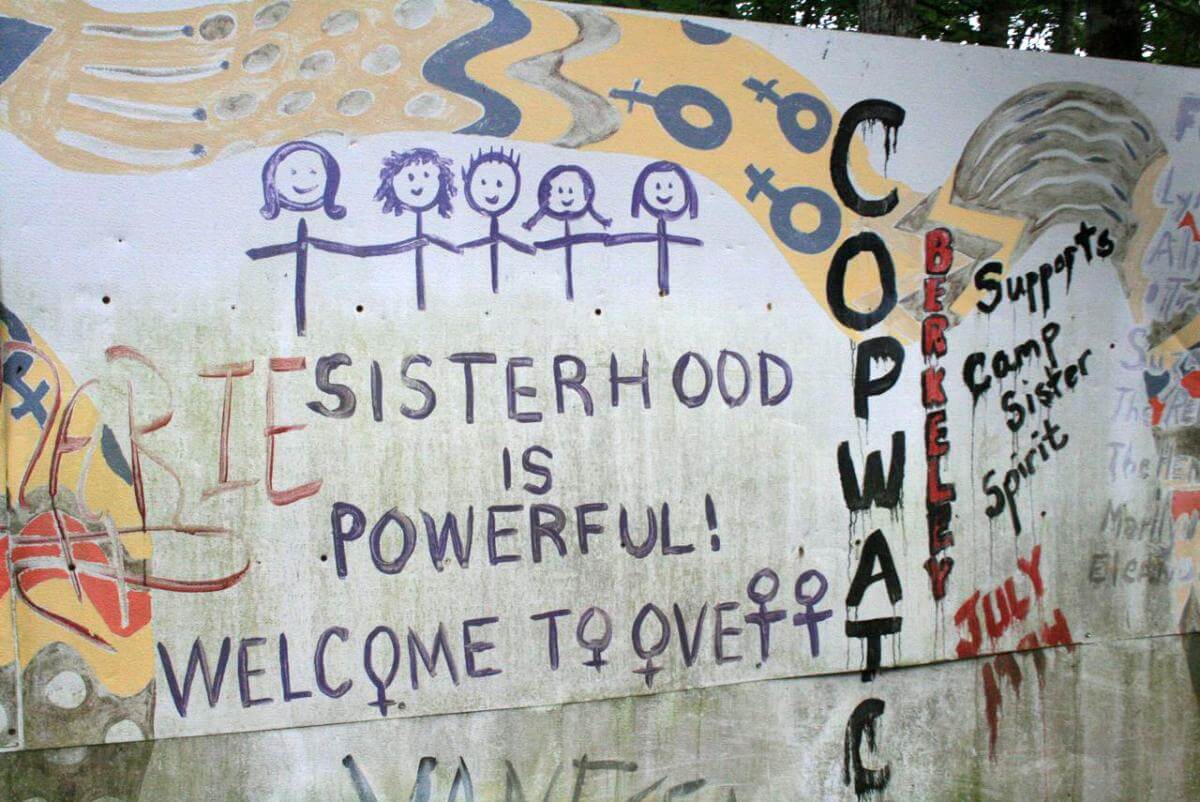
Despite their many differences in locations, visibility, and intentions, all these communes and collectives served an important function in the archive of southern lesbian feminism. Southern lesbian feminists were deeply invested in the spaces and places of the South. Whether they stayed in the South or fled to New York or San Francisco, they engaged imaginatively and combatively in the remaking of southern place to create a South they did not have to leave. Southern lesbian feminists—white, Latina, and African American—reconsidered their own "sense of place" in regard to their sexual identities and regional inheritance.
Southern lesbian feminist writers reinvent southern space as an imagined kingdom of racial impurities, sexual perversity, and political radicalism. In their imaginary sites of southern space, they include utopian imaginings, communes and collectives, and queer contact zones within the larger communities.
About the Author
Jaime Harker is professor of English and the director of the Sarah Isom Center for Women and Gender Studies at the University of Mississippi. Her research centers on popular American women writers of the interwar period, Cold War gay literature, and women's liberation and gay liberation literature. Prior to writing the book from which this essay is excerpted, she has written two other monographs: America the Middlebrow: Women's Novels, Progressivism, and Middlebrow Authorship Between the Wars (Amherst: University of Massachusetts Press, 2007) and Middlebrow Queer: Christopher Isherwood in America (Minneapolis: University of Minnesota Press, 2013).
]]>A New Era for "School Choice" and Vouchers
The United States has never been closer to adopting a nationwide program in which the state and federal governments spend billions of tax dollars to finance largely unaccountable private schools to educate children from kindergarten through the twelfth grade. By the beginning of 2019, more than half of the fifty states had enacted a variety of voucher programs diverting public funds to private schools and in some places to home-schooling—often for the purported purpose of improving the education of low-income African American and Hispanic students. These programs use state appropriations or tax credits to divert public monies to support self-governing private schools, often with few requirements or restrictions.
The states have steadily enlarged these programs during recent decades as a result of persistent, intense lobbying from school choice advocates. Often, programs have started modestly with special-needs children, then expanded to a broader student population. School choice programs are spread across the nation, although the South has more than anywhere else.1"Interactive Guide to School Choice Laws," National Conference of State Legislatures, June 15, 2017, http://www.ncsl.org/research/education/interactive-guide-to-school-choice.aspx; "School Choice in America," EdChoice, last modified April 9, 2019, https://www.edchoice.org/school-choice/school-choice-in-america/. Twelve of the twenty-six states with voucher programs using direct appropriations, indirect tax credits, or tax savings education accounts are in the South: Alabama, Arkansas, Florida, Georgia, Louisiana, Maryland, Mississippi, Oklahoma, North Carolina, South Carolina, Tennessee, and Virginia. State programs vary in form and scope, but some, like Georgia, permit state tax dollars to be diverted for home-schooling. All charts and maps with labels indicating "South" in this article refer to a fifteen-state South, which includes the twelve states listed above as well as Kentucky, Texas, and West Virginia. In 2018, more than $2.1 billion dollars in state funds went to support private schooling—a sum larger than the annual state appropriation for public schools in any of thirteen states across the nation.2School Choice Guidebook 2017–2018 (Washington, DC: American Federation for Children Growth Fund, 2018), 7–9, https://www.federationforchildren.org/wp-content/uploads/2018/10/AFC_School_Choice_Guidebook_2017-18_10.3.pdf; "2016 Public Elementary-Secondary Education Finance Data," Annual Survey of School System Finances, US Census, last modified May 17, 2018, https://www.census.gov/data/tables/2016/econ/school-finances/secondary-education-finance.html.
In addition, there is growing support in Washington for establishing school choice nationwide. In his first address to a joint session of Congress, President Donald Trump declared:
Education is the civil rights issue of our time. (Applause.) I am calling upon members of both parties to pass an education bill that funds school choice for disadvantaged youth, including millions of African American and Latino children. (Applause.) These families should be free to choose the public, private, charter, magnet, religious, or home school that is right for them.3"Trump's Speech to Congress: Video and Transcript," New York Times, February 28, 2017, https://www.nytimes.com/2017/02/28/us/politics/trump-congress-video-transcript.html. During his speech, the President also introduced an African American student who had received a tax credit voucher.
During his campaign, Trump pledged that he would become the "nation's biggest cheerleader for school choice" and would provide states with the means to use $20 billion in federal money to create vouchers allowing children to attend the private schools of their choice. "There is no policy more in need of urgent change than our government-run education monopoly," he said, "[that] has trapped millions of African American and Hispanic youth" in failing schools.
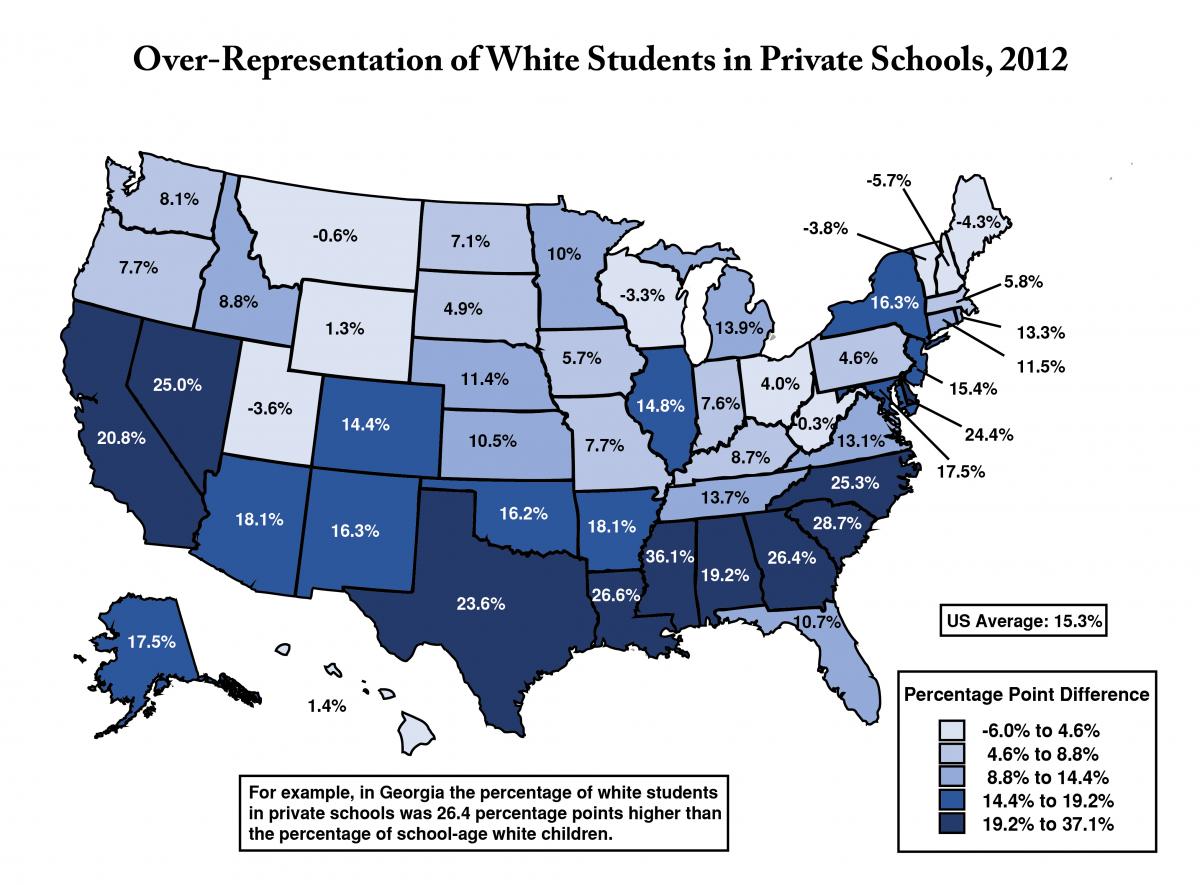
Trump's secretary of education, Elizabeth "Betsy" DeVos, a wealthy donor to Republican causes and a leading advocate of public funding of religious private schools, stated in May 2017 that the Trump administration would propose "the most ambitious expansion of education choice in our nation's history" because the "cause is both right and just." The Trump administration proposed to divert more than $1 billion to private schools in the 2019 budget in order to fund "scholarships to students from low-income families that could be used to transfer to a private school." But DeVos has so far been unable to convince Congress to fund such programs directly.4Jane Mayer, "Betsy DeVos, Trump's Big-Donor Education Secretary," New Yorker, November 23, 2016, https://www.newyorker.com/news/news-desk/betsy-devos-trumps-big-donor-education-secretary; Emma Brown, "DeVos Promises 'the Most Ambitious Expansion of Education Choice in Our Nation's History'—but Offers No Details," Washington Post, May 22, 2017, https://www.washingtonpost.com/local/education/betsy-devos-promises-the-most-ambitious-expansion-of-education-choice-in-our-nations-history--but-offers-no-details/2017/05/22/ae90f55e-3f03-11e7-8c25-44d09ff5a4a8_story.html; Valerie Strauss, Danielle Douglas-Gabriel, and Moriah Balingit, "DeVos Seeks Cuts from Education Department to Support School Choice," Washington Post, February 13, 2018, https://www.washingtonpost.com/news/education/wp/2018/02/12/devos-seeks-massive-cuts-from-education-department-to-support-school-choice; Laura Meckler, "The Education of Betsy DeVos: Why Her School Choice Agenda Has Not Advanced," Washington Post, September 4, 2018, https://www.washingtonpost.com/local/education/the-education-of-betsy-devos-why-her-school-choice-agenda-has-crashed/2018/09/04/c21119b8-9666-11e8-810c-5fa705927d54_story.html; US Department of Education, Fiscal Year 2019 Budget: Summary and Background Information, last modified February 12, 2018, https://www2.ed.gov/about/overview/budget/budget19/summary/19summary.pdf.
Support for federal funding of private schools is not a phenomenon only of the Trump administration. In 2012, the Republican candidate for president, Mitt Romney, issued an education "white paper" proposing public financing of tuition costs in private schools as the centerpiece of a new national education reform. The Romney for President position paper proposed to overhaul the primary federal funding of K–12 public schools "so that low-income and special-needs students can choose which school to attend and bring their funding with them. The choices offered to students under this policy will include . . . private schools if permitted by state law."5Romney for President, "A Chance for Every Child: Mitt Romney's Plan for Restoring the Promise of American Education," May 23, 2012, Chesapeake Digital Preservation Group, Georgetown Law Library, https://web.archive.org/web/20180624193755/http:/cdm16064.contentdm.oclc.org/cdm/ref/collection/p266901coll4/id/3980. The white paper was endorsed in a foreword by former Florida governor Jeb Bush.
In 2014, US senators Tim Scott of South Carolina and Lamar Alexander of Tennessee (ranking Republican on the committee for education) introduced legislation to enable federal funding for low-income and special-needs students in public schools to attend private schools. Alexander explained: "Allowing $2,100 federal scholarships to follow 11 million children to whatever school they attend would enable other school choice innovations, in the same way that developers rushed to provide applications for the iPhone platform."6Motoko Rich, "Bill to Offer an Option to Give Vouchers," New York Times, January 27, 2014, https://www.nytimes.com/2014/01/28/education/senator-to-propose-school-vouchers-program.html; American Enterprise Institute, "Senators Lamar Alexander and Tim Scott Unveil Ambitious Proposal to Expand School Choice," January 28, 2014, http://www.aei.org/events/senators-lamar-alexander-and-tim-scott-unveil-ambitious-proposals-to-expand-school-choice/; Lamar Alexander, "Weekly Column by Lamar Alexander: The 'Scholarship for Kids' Act," Weekly Columns, Lamar Alexander: United States Senator for Tennessee, February 18, 2014, https://www.alexander.senate.gov/public/index.cfm/2014/2/weekly-column-by-lamar-alexander-the-scholarships-for-kids-act; See also CHOICE Act, S. 1909, 113th Cong. (2014) and Scholarships for Kids Act, S. 1968, 115th Cong. (2017).
This momentum for vouchers found its way into the major federal tax overhaul enacted in 2017. Congress expanded the use of "529 savings plans" beyond paying for college costs so that tax-advantaged funds can now be used to pay up to $10,000 annually for costs of elementary and secondary education in K–12 private schools.7Ron Lieber, "Yes, You Really Can Pay for Private School With 529 Plans Now," New York Times, December 21, 2017, https://www.nytimes.com/2017/12/21/your-money/529-plans-taxes-private-school.html. This federal change supplements the Coverdell Education Savings Accounts passed first in the Clinton administration and expanded during the George W. Bush administration. It allows a limited use of federal tax dollars to support attendance at private elementary and secondary schools. See Coverdell Education Savings Accounts, 26 U.S.C. § 530 (2006). Most private schools, as non-profit organizations, receive contributions that are deductible for donors from federal income taxes. They also are exempt from income taxes and often local property taxes. This change promises to become quite significant, especially for wealthier households. It opens up a fund—$328 billion and growing—from which monies can be diverted yearly to private K–12 schools.8"529 Plan Data," College Savings Plan Network, June 30, 2018, http://www.collegesavings.org/wp-content/uploads/2018/10/June-2018-529-plan-data-10.15.18.pdf.
Civil Rights Rhetoric Echoes in "School Choice" and Vouchers
"School choice" has no traditional or intrinsic meaning in the field of education, but over the last several decades it has become a political slogan for the claim that government should finance children's education from pre-kindergarten through the twelfth grade in schools outside the public system in order to provide parents with a choice. In recent years, charter schools have been included as a "school choice" option because many local districts and some states now authorize private profit-making or non-profit entities to operate these schools independently, often without meeting requirements and rules that public schools must follow. In 2015, there were 2.8 million students in charter schools and 5.8 million students in private elementary and secondary schools across the United States.9"Public Charter School Enrollment," The Condition of Education 2018, National Center for Education Statistics, 2018, https://nces.ed.gov/programs/coe/pdf/coe_cgb.pdf; "Private School Enrollment," The Condition of Education 2018, National Center for Education Statistics, 2018, https://nces.ed.gov/programs/coe/pdf/coe_cgc.pdf. Also, see Peter Bergman and Isaac McFarlin Jr., "Education for All? A Nationwide Audit Study of Schools of Choice" (working paper 25396, National Bureau of Economic Research, December 2018). This article examines the history of government support for private schools as both the origin and primary foundation for the current movement for "school choice."
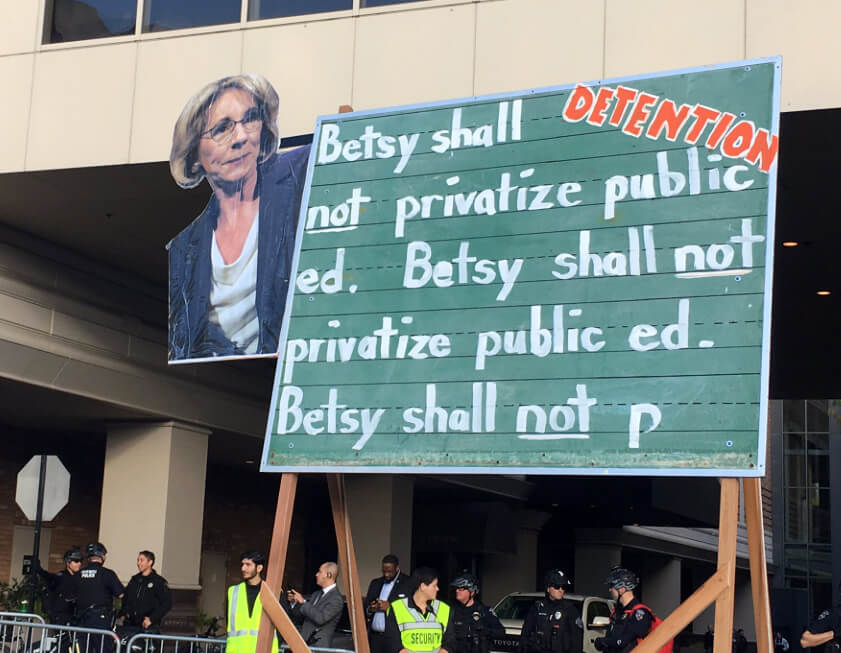
In claiming private "school choice" as right and just, President Trump and Secretary DeVos echo rhetoric that others have used to argue that publicly financed vouchers for children to attend private K–12 schools are a moral imperative. In articles such as "How School Choice Helps Advance Martin Luther King's Legacy," the Heritage Foundation has insisted that vouchers continue the civil rights movement. In 2011, the founder of the tax credit voucher program in Florida declared that school choice for low-income families "is one of the most important social justice issues of our time."10John Kirtley, "Facing a Harsh Truth When Fighting for a Bipartisan Cause," RedefinED, May 20, 2011, https://www.redefinedonline.org/2011/05/facing-a-harsh-truth-when-fighting-for-a-bipartisan-cause/; Katie Nielsen, "How School Choice Helps Advance Martin Luther King's Legacy," My Heritage, Heritage Foundation, August 28, 2013, https://www.myheritage.org/news/how-school-choice-helps-advance-martin-luther-kings-legacy/.
One of Dr. King's children, in fact, joined the cause of vouchers for private schools in Florida to give "black, Latino, and Hispanic" children the same options as others. "This is about justice," Martin Luther King III stated in 2016. "This is about righteousness. This is about freedom—the freedom to choose for your family and your child."11Kristen M. Clark, "Thousands Rally in Support of Program Opposed by Union," Miami Herald, January 19, 2016, www.miamiherald.com/news/politics-government/state-politics/article55454785.html. Martin Luther King III attended and graduated from the private Galloway School, created in Atlanta in 1969. Earlier, his parents attempted to enter him into another Atlanta private school when he reached school-age in the 1960s, after they were misinformed by an Episcopal priest that the all-white, private Lovett School would accept their son. Their written application for his admission was denied without reference to a reason, although the chairman of the school board later stated that he believed that both the "negro and the white man has some individual rights." "Diversity and Inclusion at Galloway," The Galloway School, accessed March 27, 2019, https://www.gallowayschool.org/community-life/diversity-inclusion; Kevin M. Kruse, White Flight: Atlanta and the Making of Modern Conservatism (Princeton, NJ: Princeton University Press, 2005), 175–177.
The political movement for "school choice" is employing the icons and language of civil rights and social justice to advance private school vouchers that fifty years ago were primary tools for segregationists to preserve unequal education for African American and Hispanic children. President Trump's call for a national program of "school choice" echoes the language of George Wallace and others who demanded the federal government and US courts permit Alabama and the South to administer "freedom of choice" for elementary and secondary schools.
These apparent contradictions emerge from the unexamined legacy of segregationists who designed and developed effective, lasting strategies that frustrated and blocked K–12 school desegregation. It is a legacy that turns the icons and language of civil rights inside-out while thwarting the national goal of an effective, equitable system of education for all children.
Forgotten Segregationists
Historically, the methods and forms of segregation have been neither monolithic nor inert.12See C. Vann Woodward, The Strange Career of Jim Crow (New York: Oxford University Press, 1966); Pauli Murray, States' Laws on Race and Color (Cincinnati, OH: Women's Division of Christian Service of the Methodist Church, 1951), 3–20; J. Mills Thornton III, "Segregation and the City: White Supremacy in Alabama in the Mid-Twentieth Century," in Fog of War: The Second World War and the Civil Rights Movement, eds. Kevin M. Kruse and Stephen Tuck (New York: Oxford University Press, 2012), 52–55. Southern segregationists held differing notions about the best ways to preserve school segregation along with their beliefs in racial superiority. As Sylvan Meyer observed in 1960, southern segregationists included "all those whose views varied from a mild belief that the South would be better off maintaining as much racial separation as possible to those advocating insurrection rather than 'surrender' to any compromise whatsoever."13Walter Spearman and Sylvan Meyer, Racial Crisis and the Press (Atlanta, GA: Southern Regional Council, 1960), 47. Many segregationist leaders who designed and implemented plans for school choice have been forgotten, as have their plethora of rationales, strategies, and tactics. They were never widely known, and popular culture has narrowed the cast to a small rogues' gallery.
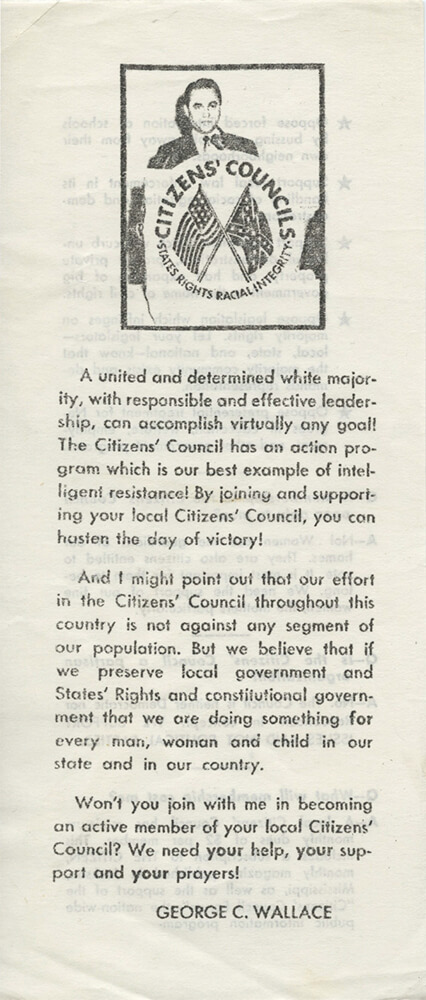
Prevalent images include segregationists such as Alabama governor George Wallace, Birmingham police commissioner Eugene "Bull" Connor, and a bevy of other white leaders such as Mississippi senator James Eastland who endure as premiere political symbols—in large part because their defiant images in multiple confrontations with and condemnations of federal officials often were captured as television came of age in the 1960s.14See Gene Roberts and Hank Klibanoff, The Race Beat: The Press, the Civil Rights Struggle, and the Awakening of a Nation (New York: Random House, 2006), 56, 301–325, 376–379. A few, such as Wallace and North Carolina's Jesse Helms, remained on the national political stage for more than a decade.15See Dan T. Carter, The Politics of Rage: George Wallace, the Origins of the New Conservatism, and the Transformation of American Politics (New York: Simon & Schuster, 1995), 451–468. Wallace prompted controversies over "free speech" rights on college campuses into the 1970s and remains today a popular reference for personifying the southern segregationist. See Peter Salovey, "Free Speech, Personified," New York Times, November 26, 2017, https://www.nytimes.com/2017/11/26/opinion/free-speech-yale-civil-rights.html.
But George Wallace was only one type of segregationist—and hardly a representative figure for those more successful over time in frustrating and blocking school desegregation. Segregationists with other styles and backgrounds built the more lasting terms, tools, and tactics that obstructed the Supreme Court's unanimous 1954 opinion in Brown v. Board of Education16Brown v. Board of Education of Topeka, 347 U.S. 483 (1954). outlawing segregated public education. This wider cast of white supremacists competed fiercely in shaping how and where segregated schools could be preserved. When political self-interest and racial ideology aligned, they occasionally cooperated. At times they shared a vocabulary against Brown, depicted as a federal edict to force the South to create "mixed schools," never to create equitable, desegregated or integrated schools.17Spearman and Meyer, Racial Crisis and the Press, 19, 25, 46–48, 52. Meyer explains how "mix" was a "scare word." Justin Driver, "Supremacies and the Southern Manifesto," Texas Law Review 92 (2014): 1082, https://chicagounbound.uchicago.edu/journal_articles/4043/.
These white men included die-hards, such as those found in the middle-class Citizens' Councils who usually pushed to abandon all public schooling rather than accept any desegregation. Some Citizens' Council leaders, however, came to recognize exceptions to absolute, complete segregation. Ku Klux Klanners, especially in the Deep South, were also dead-set against a single Black child entering an all-white school and were willing to use extra-legal intimidation and violence. Others, such as South Carolina governor Jimmy Byrnes, believed that the impact of Brown could be postponed indefinitely or avoided in large measure by building new Black schools so that separate schools appeared closer to equal.
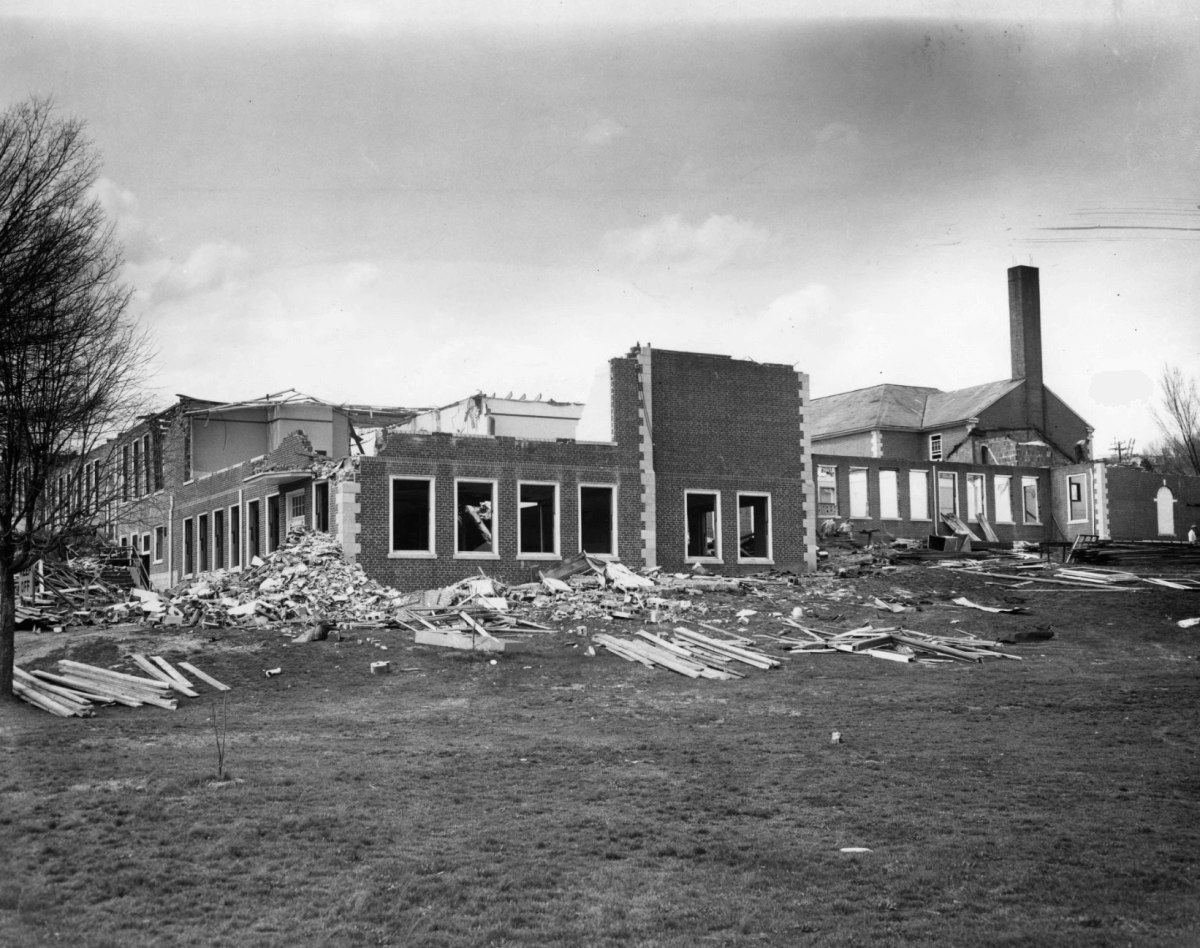
Political leaders such as Georgia's Ernest Vandiver won office by campaigning on a slogan of "No, not one" African American child would ever be allowed in a white school but discovered after entering the governor's office that complete, absolute segregation was impossible to achieve—and counter-productive to preserving as many virtually segregated schools as possible. There were segregationists such as Alabama state senator Albert Boutwell—who later as a "moderate" mayoral candidate defeated "Bull" Connor—and Birmingham corporate attorney Forney Johnston. While Wallace began as a white liberal before shifting his politics to become governor, Boutwell and Johnston were the first segregationist leaders to develop a variety of strategies, tactics, and rationales for school choice that often delayed and defeated the promise of Brown.
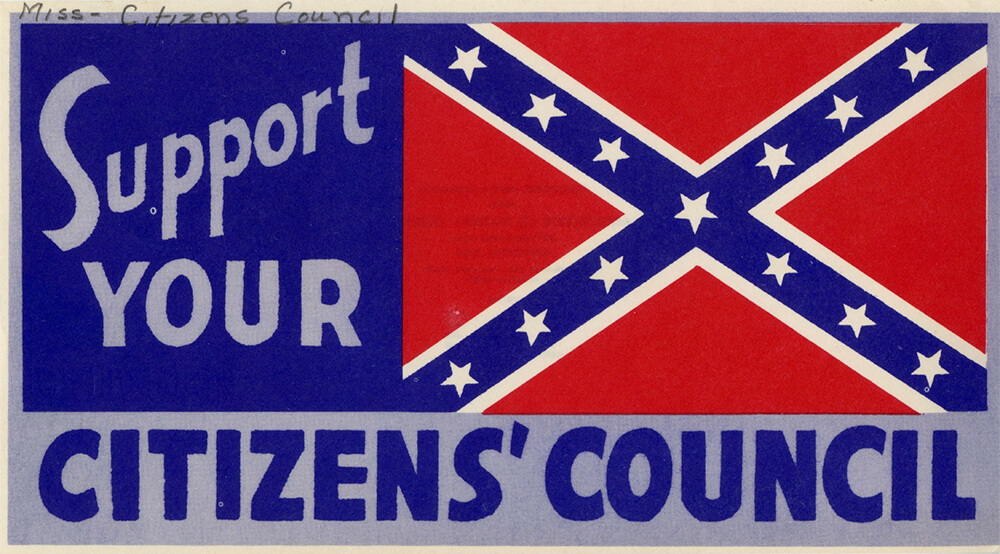
Resistance to school desegregation differed across the states of the former Confederacy according to class, geography, religion, and political ambition.18David L. Chappell, "The Divided Mind of Southern Segregationists," Georgia Historical Quarterly 82, no. 1 (Spring 1998): 45–72; James Graham Cook, The Segregationists (New York: Appleton-Century-Crofts, 1962), 5–6; Clive Webb, ed., Massive Resistance: Southern Opposition to the Second Reconstruction (New York: Oxford University Press, 2005), 8–9. The different factors influencing all policy issues, including race, in the segregated South were detailed by state in V. O. Key Jr., Southern Politics in State and Nation (New York: Alfred A. Knopf, 1949). These different factors also were evident in southern white attitudes toward African American education. See Gunnar Myrdal, An American Dilemma: The Negro Problem and Modern Democracy (New York: Harper and Brothers, 1944), 893–900. For an example of class divisions during desegregation, see Karen Anderson, "The Little Rock School Desegregation Crisis: Moderation and Social Conflict," Journal of Southern History 70, no. 3 (August 2004): 603–636. Only by recovering and understanding the work of a wider cast of white actors who crafted enduring tools and strategies protecting segregation can the reactionary heritage of today's school choice become clear. As Justin Driver has found, the efforts of these segregationist leaders "to maintain white supremacy were often considerably more sophisticated, self-aware, and nuanced than the cartoonish depiction of southern stupidity and hostility would admit."19Driver, "Supremacies and the Southern Manifesto," 1079. These forgotten and ignored strategies help explain how today's proponents of public financing of private schools can employ the language of civil rights without widespread discredit. They also reveal how the origins and historical development of "freedom of choice" have shaped and continue to define the impact and role of "school choice" and vouchers in public education across the nation.20This study is, of course, not the first essay to explore the southern segregationist origins of private school vouchers for elementary and secondary schools. See, for example, Chris Ford, Stephenie Johnson, and Lisette Partelow, The Racist Origins of Private School Vouchers (Washington, DC: Center for American Progress, July 12, 2017), https://www.americanprogress.org/issues/education-k-12/reports/2017/07/12/435629/racist-origins-private-school-vouchers/, and Mark A. Gooden, Huriya Jabbar, and Mario S. Torres Jr., "Race and School Vouchers: Legal, Historical, and Political Contexts," Peabody Journal of Education 91, no. 4 (2016): 522–536.
School Choice and Vouchers Become Segregationist Tools
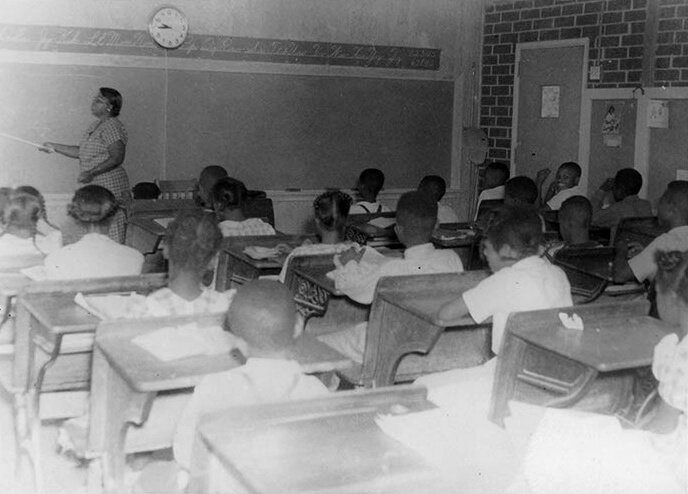
During the middle of the twentieth century, K–12 private schooling became intertwined with race and ethnicity as the Supreme Court issued opinions outlawing segregated graduate and professional public education.21Dick M. Carpenter II and Krista Kafer, "A History of Private School Choice," Peabody Journal of Education 87, no. 3 (2012): 336–338. For a review of the Court's decisions leading up to Brown, see Richard Kluger, Simple Justice: The History of Brown v. Board of Education and Black America's Struggle for Equality (New York: Alfred A. Knopf, 1976), 256–284; Sam P. Wiggins, Higher Education in the South (Berkeley, CA: McCutchan Pub. Corp., 1966), 169. There is an earlier history of school choice in the United States, when Catholic schools competed with public schools, often decidedly Protestant in nature, that carried forward into the twentieth century. See Robert N. Gross, Public vs. Private: The Early History of School Choice in America (New York: Oxford University Press, 2018). Yet, Gross largely ignores the pivotal period of Reconstruction when African American representatives helped to write new southern state constitutions mandating public schools as an essential duty of state governments. W.E.B. Du Bois, Black Reconstruction in America, 1860–1880 (New York: MacMillan, 1992), 637–669. These decisions had no impact on elementary and secondary public schools, but they signaled the direction the Court was moving.
From 1940 to 1950, private school enrollment in the South rose by more than 125,000 students—a 43-percent increase, and, for the first time since private enrollment numbers were documented, the rate of growth doubled that of the rest of the nation.
From 1950 to 1965, US private school enrollment grew at unprecedented rates while the South's rate again exceeded the nation's. Whites in record numbers fled to traditional and newly formed private schools. From 1950 to 1958, the South's private school enrollment increased by more than 250,000 students. By 1965, there were nearly one million southern private school students. Almost all were white.22See Norman Dorsen, "Racial Discrimination in 'Private' Schools," William & Mary Law Review 9, no. 1 (1967): 46, https://scholarship.law.wm.edu/wmlr/vol9/iss1/4/.
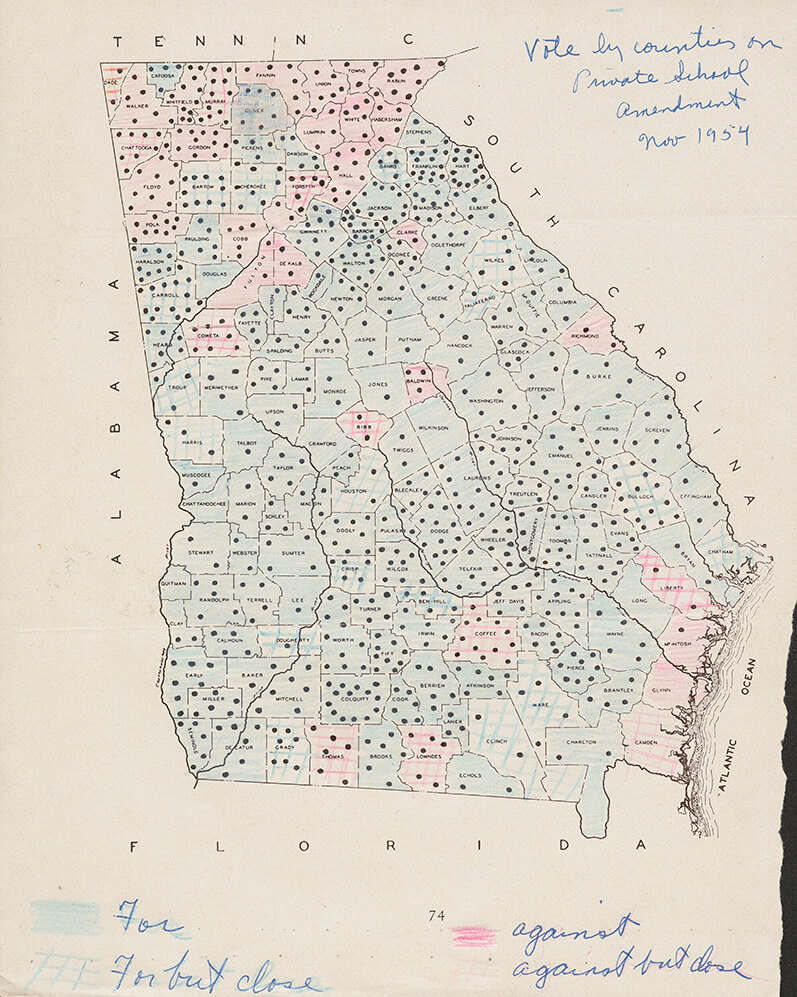
Legislatures passed laws authorizing vouchers and other means of transferring public assets and monies to private schools.23Reaction to Brown was comparatively muted outside the South since the Supreme Court struck down only school segregation established by law, and most segregation laws were in southern states. There was widespread de facto school segregation outside the South but only in a relatively few places did the law erect a dual system of publicly financed education based on race or ethnicity. See Murray, States' Laws on Race and Color; Robin M. Williams Jr. and Margaret W. Ryan, eds., Schools in Transition: Community Experiences in Desegregation (Chapel Hill: University of North Carolina Press, 1954); Will Maslow, "De Facto Public School Segregation," Villanova Law Review 6, no. 3 (1961), https://digitalcommons.law.villanova.edu/vlr/vol6/iss3/2/. In November 1953, as it appeared the Supreme Court might strike down school segregation, white South Carolinians voted to repeal a section of their state constitution that provided for a "liberal system of free public schools"—to clear the way for establishing a private school system. Georgia became the first southern state to pass a constitutional amendment enabling the legislature to send state, county, and municipal funds to "citizens of the State for educational purposes, in discharge of all obligation of the State to provide adequate education for its citizens." A month later, white Mississippians voted for a constitutional amendment granting the legislature power to close public schools and finance private ones. By the end of 1956, Virginia, Alabama, and North Carolina passed similar measures.24W. D. Workman Jr., "The Deep South," in With All Deliberate Speed: Segregation-Desegregation in Southern Schools, ed. Don Shoemaker (New York: Harper and Brothers, 1957), 97–100; House Resolution No. 225, Acts and Resolutions of the General Assembly of the State of Georgia, 1953, November–December Session, vol. 2, 241; Molly Townes O'Brien, "Private School Tuition Vouchers and the Realities of Racial Politics," Tennessee Law Review 64, no. 2 (1997): 359–407. Louisiana adopted a constitutional amendment in 1954 affirming its police powers to prevent desegregation of public schools, and this amendment apparently was interpreted to provide the state legislature will the power to fund private schools. See Poindexter v. Louisiana Financial Assistance Commission, 275 F. Supp. 833 (1967).
From 1954 to 1965, southern legislatures enacted as many as 450 laws and resolutions attempting to discredit, block, postpone, limit, or evade school desegregation. A large number of these acts allowed the re-direction of public resources, including school resources, to benefit private schools.25Tom Flake, "475 Legislative Actions Pertain to Race, Schools," Southern School News, May 1964, B-1. In 1956, the Georgia legislature permitted the leasing of public property to segregated private schools. Five years later, the state enacted a law to provide vouchers for students to attend any non-sectarian private school, boldly declaring the act was to advance "the constitutional rights of school children to attend private schools of their choice in lieu of public schools."26For a full treatment of the methods and strategies of resistance, including diverting public resources to private schools, see Thomas V. O'Brien, The Politics of Race and Schooling: Public Education in Georgia, 1900–1961 (Lanham, MD: Lexington Books, 1999), 99–198.
The North Carolina legislature enacted eight bills, the first of which was a constitutional amendment to authorize vouchers for private education and to allow whites to close public schools through a local referendum. In Alabama, Louisiana, Mississippi, and South Carolina, legislatures passed laws to publicly fund vouchers for private schools and to transfer public school property to private educational organizations. Citizens' Councils were active in setting up private schools, especially in Mississippi. The Virginia legislature declared its support for this "freedom of choice" movement by enacting a system of vouchers for private organizations and citizens.27Arthur Larentz Carlson, "With All Deliberate Speed: The Pearsall Plan and School Desegregation in North Carolina, 1954–1966" (master's thesis, East Carolina University, 2011); Jim Leeson, "Private Schools Continue to Increase in the South," Southern Education Report 2 (November 1966): 22–25; Walter F. Murphy, "Private Education with Public Funds," Journal of Politics 20, no. 4 (November 1954): 636–637; Lester Tanzer, "Private School Push: Integration of Virginia Public Schools Spurs Growth of Private Units," Wall Street Journal, February 6, 1959; Neil R. McMillen, The Citizens' Council: Organized Resistance to the Second Reconstruction, 1954–64 (Urbana: University of Illinois Press, 1971), 297–304; Mary Ellen Goodman, Sanctuaries for Tradition: Virginia's New Private Schools (Atlanta, GA: Southern Regional Council, 1961).
In addition to direct transfers of public funds and assets, some states employed tax schemes, including tax credits, to build and finance private school systems. In the Little Rock Crisis of 1957, after President Dwight Eisenhower was forced to call out federal troops to protect a handful of Black children attempting to attend Central High School, Governor Orval Faubus funneled public monies through contracts and tax credits to the Little Rock Private School Corporation until the federal courts stopped the subterfuge (along with further attempts by Arkansas to enact vouchers). In 1959, Georgia governor Ernest Vandiver led the legislature in passing the six segregation bills, including one that supported "the establishment of bona fide private schools by allowing taxpayers credits upon their State income tax returns for contributions to such institutions."28Clay Gowran, "Faubus Tells 'Legal Plan' To Segregate," Chicago Daily Tribune, September 19, 1958; Journal of the House of Representatives, State of Georgia, Regular Session, 1959, 80; "'Resistance' Laws Urged in Georgia: Governor Offers 6 Measures Designed to Strengthen Segregated Schools," New York Times, January 16, 1959; "Georgia Asked To Strengthen Segregation: Six Bills Offered by Governor," Chicago Daily Tribune, January 16, 1959.
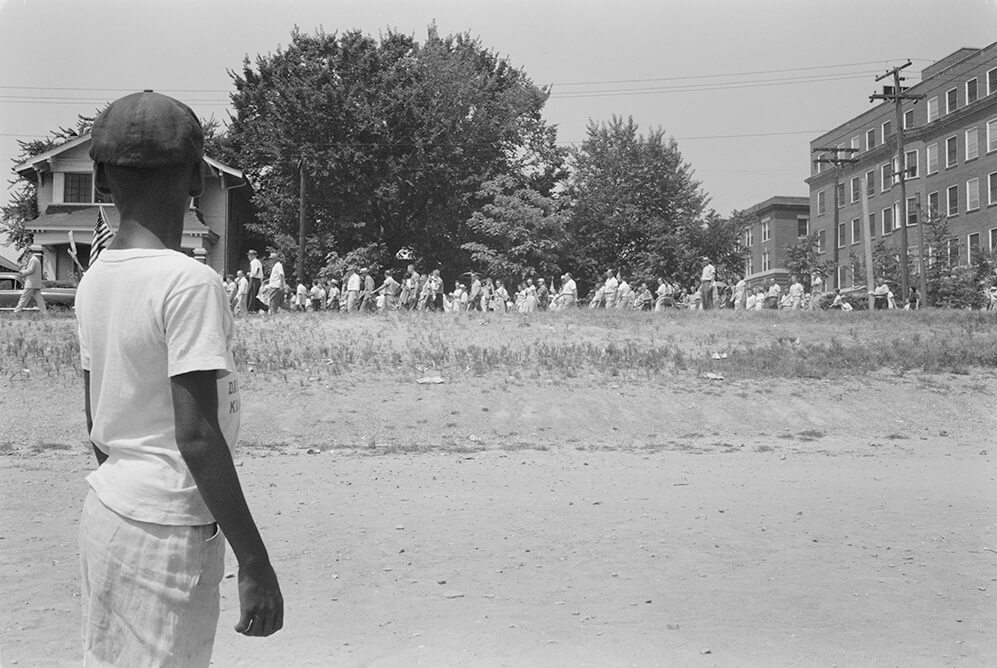
In the same year, Florida governor LeRoy Collins successfully opposed a legislative initiative to pass a constitutional amendment to allow state tax credits for private school contributions. In Prince Edward County and other locations in Virginia, officials used both direct payments and tax credits to build private schools until the federal courts halted both. In Mississippi, after federal courts struck down a direct tuition grant to private schools, Governor John Bell Williams proposed a state tax credit as he searched for the "ways and means of rendering assistance" for white flight to private schools.29"May Veto Plan To Sell Segregation," Daily Defender, June 8, 1959; Lester Tanzer, "Private School Push: Integration of Virginia Public Schools Spurs Growth of Private Units Norfolk Academy, Others Will Expand; State Aids Shift, Authorizes Tuition Grants A Pattern for Solid South? Private School Push: Integration in Virginia Spurs Growth of Units," Wall Street Journal, February 6, 1959; Raymond Moley, "Children Are the Real Victims of the School Integration War," Los Angeles Times, May 18, 1961; Jon Nordheimer, "Integration Raises the Issue of Coeducation in South," New York Times, June 4, 1970.
By 1965, seven states had enacted some type of voucher that enabled the largest growth of private schools in the South's history. Yet, vouchers as a preferred and essential method of resistance to Brown did not stand alone but worked most effectively through larger plans that emerged from the different states. These plans were not uniform, but most incorporated strategies and language that have evolved and endured as the ways and means by which vouchers, school choice, and private schooling have escaped the stigma of their segregationist origins without losing much of the same purpose or effect.
Preserving Virtual School Segregation through Vouchers
During the era of massive resistance, several state legislatures and governors established committees or commissions to develop options for preserving segregation. These strategy groups were often known by the name of the persons chairing them—usually a senior legislator or well-known businessman. In Alabama, it was the Boutwell Committee, led by a prominent, well-to-do state senator. In South Carolina, a wealthy state senator chaired the Gressette Committee. The Pearsall Committee in North Carolina was named for its businessman leader; an Atlanta business leader guided Georgia's Sibley Commission. In Virginia, both of its strategy commissions were named for their prominent businessmen chairs.
The strategy groups issued recommendations in written reports explaining the imperatives for segregation, the rationale for preserving it, including arguments for why segregation was advantageous to Black families, and the different tactics of resistance. These reports demonstrate that segregationist leaders came to understand that vouchers and other forms of aid to private schools worked best in conjunction with a variety of other tactics and strategies for defeating Brown.
Alabama: "Big Mules" Develop a Freedom of Choice Plan
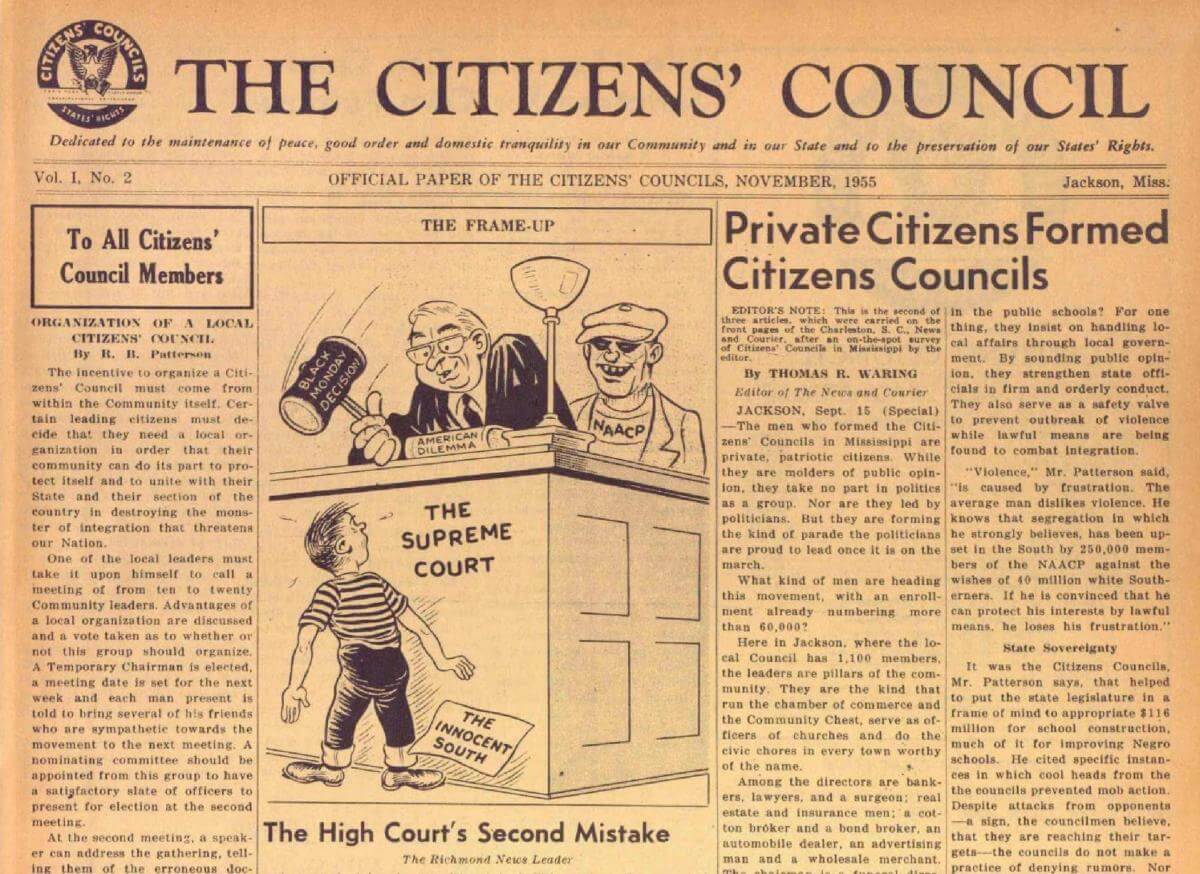
In October 1954, barely five months after Brown, the Boutwell Committee became the first strategy group to lay out a complete, multifaceted plan of resistance. As a moderate segregationist, state senator Albert Boutwell did not believe it feasible or advisable to maintain old segregation laws and disavowed the use of force.30Boutwell's reputation as a moderate grew larger after he ran against and defeated Birmingham Police Commissioner Eugene "Bull" Connor in a race for mayor. "Albert Boutwell Lieutenant Governor: 1959–1963," Alabama Department of Archives and History, last modified August 20, 2009, http://www.archives.state.al.us/conoff/Boutwell.html. Perhaps the Boutwell plan's chief architect and certainly its primary intellectual force was Forney Johnston, a brilliant segregationist and corporate attorney in Birmingham who represented Alabama's "Big Mules"—coal companies, railroads, and wealthy industrialists and investors who profited from Birmingham's exploitative heavy industries. As a backroom politician and former governor's son, Johnston adroitly maneuvered in politics and law to protect the corporate interests he represented and to preserve his notion of segregation. He had managed a 1924 presidential campaign, mounted major legal challenges to New Deal economic reforms, and worked behind the scenes to secure pardons for the "Scottsboro Boys"—but only to prevent growing national support for federal intervention in "states' rights."31Edward R. Crowther, "Alabama's Fight to Maintain Segregated Schools," Alabama Review 43 (1990): 209–210; Thomas Jasper Gilliam Sr., "The Second Folsom Administration: The Destruction of Alabama Liberalism" (PhD diss., Auburn University, 1975), 107, 116, 194, 384. Johnston played a behind-the-scenes role in Alabama on racial matters. As a life-long white supremacist, he worked with state political and business leaders after both world wars in developing laws and strategies to thwart the expectations and aspirations of returning Black soldiers. Yet after managing a presidential primary campaign, Johnston nominated Alabama senator Oscar W. Underwood as the anti-Klan candidate for president at the Democratic National Convention of 1924. John W. Davis, who later argued before the US Supreme Court on behalf of southern states in Brown, won the nomination over Underwood after an unprecedented number of ballots. Johnston was a formidable and talented legal opponent. Steve Suitts, Hugo Black of Alabama (Montgomery, AL: NewSouth Books, 2005), 235–236, 462–472; "Roosevelt Stand on Policies Asked; Forney Johnston Urges Chamber to Seek Clarification of President's Objectives," New York Times, May 1, 1935; "Graves Is Accused in Scottsboro Case," New York Times, December 25, 1938; John Temple Graves, "The Wage-War Between the States," Nation's Business, June 1934, 42; Frank W. Boykin to Mrs. Forney Johnston, June 7, 1962, Frank W. Boykin Papers, Alabama Department of Archives and History.
The Boutwell report decried "forced integration," claiming it would lead to "violence, disorder, and tension for the state and its children." It warned that if the federal courts pursued "coerced integration," white employers would fire Black employees involved in such efforts and the federal courts would prompt inevitable violence among "the least stable and least mentally matured and responsible members of both races." The report also suggested that "compulsory integration" would devastate public school finances by estranging "white people, who pay by far the greater part of taxes which maintain the schools."
The Boutwell plan sought to assure two goals ("Education for all children of the state" and "No compulsory mixing of races in our schools") by proposing four basic strategies:
- Eliminate any "prohibition against the operation of mixed schools, attended by both races" in the current state constitution and laws. In other words, Alabama laws would "concede the right of white and negro families to send their children to mixed public schools." This change would enshrine "the principle of freedom of choice" to enable parents to select the school their children should attend—within certain predetermined conditions and qualifications.
- Remove any suggestion from the state constitution that there is a right of education or an obligation of the state to fund public schoolchildren and establish a "policy of the State of Alabama to foster and promote the education of its citizens in a manner and extent consistent with its available resources, and the willingness and ability of the individual student [emphasis added]."
- Invest the legislature with constitutional powers to enable local school officials to determine the conditions and qualifications for "eligibility, admission, and allocation of pupils, including the power to refuse admission to individuals or groups whose deficiencies in scholastic aptitude would compel undue lowering of school standards."
- Grant the legislature the constitutional power to provide vouchers and other tax funds in "support and furtherance of education in other ways than the operation of public schools" for both Black and white children.
In effect, the plan would establish in the name of school "choice" a three-school system, instead of a dual school system. The new system would enable children to attend all-white schools, all-Black schools, or desegregated schools in a state-financed system of public and private schools.
With only one "nay" vote, the legislature passed the proposals to revise the state constitution, and white voters of Alabama ratified the amendments in 1956 to set up the plan's framework. Alabama's Citizens' Council (called "manicured Kluxism" by the editor of the Montgomery Advertiser) worried that the proposals were weak. The Council's leader, state senator Sam Engelhardt, had earlier proposed legislation to close all public schools and use vouchers for white parents to enroll in private schools in order to "keep every brick in our segregation wall intact." Alabama governor James E. "Big Jim" Folsom opposed all of these measures. "I wouldn't want to sign a bill that would let rich folks send their kids all to one school and the poor folks to another school," the populist Folsom declared.32Fred Taylor, "'Freedom of Choice' Bill Seeks School Solution in Alabama," Atlanta Journal-Constitution, February 12, 1956; Fred Taylor, "3-School System Amendment Expected to Pass in Alabama," Atlanta Journal-Constitution, August 26, 1956; Crowther, "Alabama's Fight," 214; "Georgia," Southern School News, September 3, 1954; Carter, The Politics of Rage, 83.
While the constitutional amendments recommended by the Boutwell Committee were pending before the legislature, Forney Johnston gave a speech to the Alabama Bar Association that identified the plan's legal underpinnings: "the liberty of parents to direct the basic conditions under which their children shall be educated." Quoting from the 1925 US Supreme Court opinion that struck down an Oregon statute requiring all disability-free children to attend a public school,33Pierce v. Society of Sisters, 268 U.S. 510 (1925). Johnston declared: "This parental liberty, like other liberties, is not absolute; but is limited only by an overriding necessity for community order or welfare, reflected not in some remote Federal pronouncement, but in the grass-root exercise of state police power, by the State acting in its sovereign capacity."
Johnston argued that the Boutwell plan provided freedom of choice without regard to race and, in that context, the federal courts could not require white parents to send their children to a desegregated school, although some white parents could decide to do so. "If the 14th Amendment now says that a state cannot inhibit the freedom of negroes to attend schools with white people, what does it say about the freedom of white people to choose not to go to school with negroes?" Johnston answered his own question. Virtually segregated schools could continue through this freedom of choice in a new system of education where the government financed both public and private schools, where there was "ordinary and customary geographical districting" for public schools, and where the independent "application of accepted educational tests and standards" by both private and public schools were the terms for admitting students.
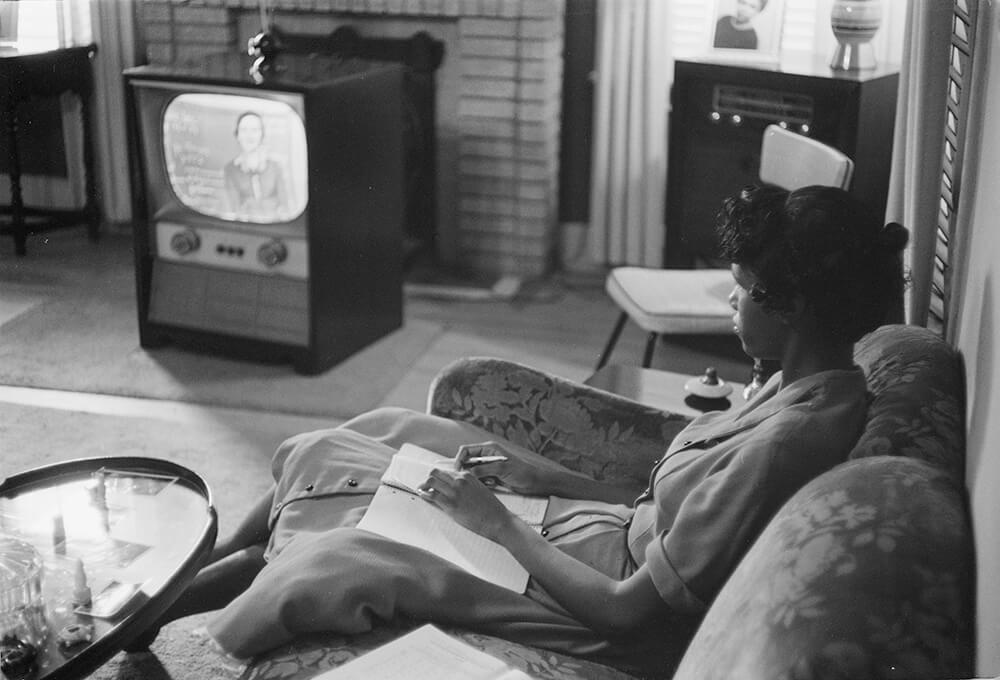
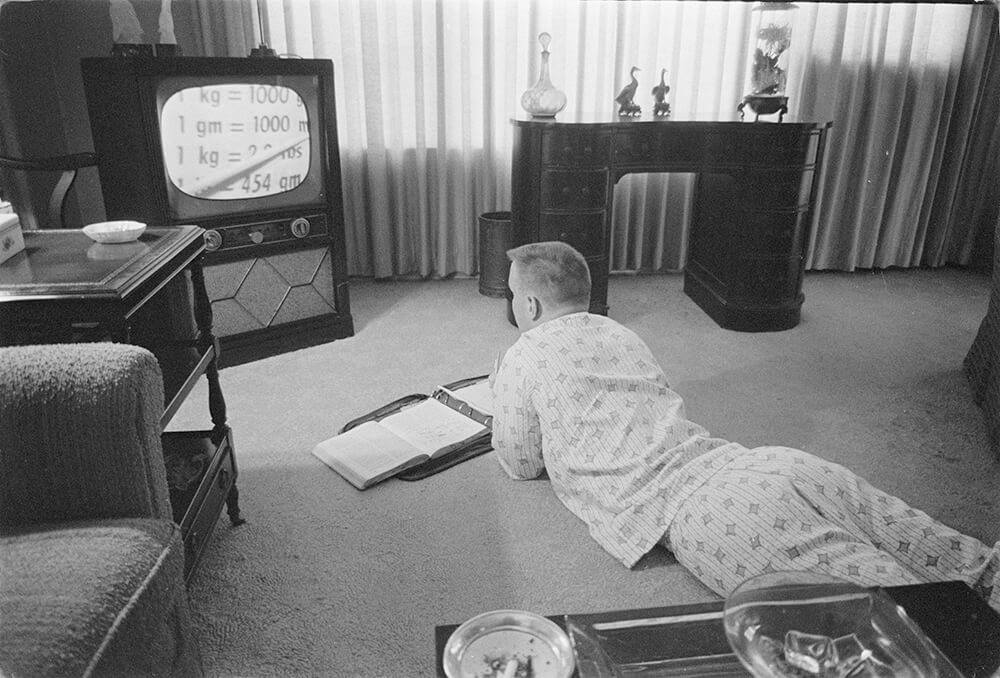
This type of school system would permit parental choice for a desegregated school, all-white school, or all-Black school within a structure and standards that were expressly non-racial. "If the members of a race are thereby deprived of access to a school attended by the other race," Johnston observed, "the result is attributable not to compulsion by the state but to the inconsistent choices of free citizens. Under such circumstances, the state is obliged to give effect to the desire of parents without compulsion against either side."34Joseph F. Johnston, "Schools, the Supreme Court, and the States' Power To Direct the Removal of Gunpowder," Alabama Lawyer 17, no. 3 (1956): 3–10.
The full details of the Boutwell plan failed to become law in 1955 in large measure because of the direct and behind-the-scenes opposition of Governor Folsom, who downplayed the Brown decision and fought on many other issues with Black Belt politicians and Birmingham's "Big Mules" and their lawyers such as Johnston. Folsom also vetoed a handful of local bills that attempted to punish Black teachers if they voiced support for desegregation, but the legislature passed the segregationists' pupil placement bill by a veto-proof margin.
The new pupil placement law for public schools was sponsored by Senator Sam Engelhardt, the Citizens' Council leader who had come to embrace the Boutwell Committee's concepts and strategies. The law asserted it had nothing to do with segregation, but aimed to advance each child's education:
To establish a practical school system whereby the state's school program can be adapted to each pupil's ability to learn. To this end it provides a modern school placement system, so that pupils can be so grouped that the less advanced pupils shall not be penalized by being placed in the class with pupils who are more advanced or capable of learning at a more rapid rate, and conversely, that exceptionally bright and able pupils shall not be held back to a level below their ability to learn.
The law empowered local school boards alone to make decisions about which school each student was assigned to attend based on the following factors: tests of student aptitude and ability as well as the distance of school from a pupil's home; a pupil's educational background and home environment; a student's long-established ties of friendship or the dangers of placing a pupil in hostile surroundings absent former friends and "associates"; a pupil's own wishes as evidenced by a written request from his parents or guardian to be assigned to a particular school; and whether, in the judgment of the school board, the assignment would cause or tend to cause a breach of the peace, riot, or "affray." The law provided for a complicated, costly appeal process, if parents disagreed with the board's decision. Not one word in the legislation mentioned segregation, integration, or a child's race.35Fred Taylor, "School Segregation Problem No. 1 on Ala. Legislature List: Measures Proposing Varied Plans Readied for Extra Session Call," Atlanta Journal-Constitution, January 2, 1955; "Alabama," Southern School News, February 3, 1955, 3; J. Tyra Harris, "Alabama Reaction to the Brown Decision, 1954–1956: A Case Study in Early Massive Resistance" (PhD diss., Middle Tennessee State University, 1978), 208–209.
A year later, with the Montgomery bus boycott threatening to end segregated seating in the state capital, the federal courts ordered the admission of Autherine Lucy, a Black woman, into the University of Alabama, and white-led race riots broke out in Tuscaloosa.36Lucy was summarily suspended "for her own safety" after a series of riotous events on campus following her attendance. Charles Morgan Jr., A Time To Speak (New York: Harper and Row, 1964), 37–39. Lucy remembered in 2017 at a university ceremony dedicating a historical marker in her honor that whites had chanted: "Hey, Hey, Ho! Where in the Hell did the nigger go?" See Jessa Reid Bolling and Rebecca Griesbach, "Autherine Lucy Foster Memorialized with Historical Marker," The Crimson White, September 18, 2017, 3, http://now.dirxion.com/Crimson_White/library/Crimson_White_09_18_2017.pdf; AL.com, "Autherine Lucy Foster Monument Unveiled," YouTube video, 1:56, September 17, 2017, https://youtu.be/6jriSBIwSHg. Afterwards, the legislature decided it was time to place before voters the basic parts of the Boutwell plan or, as it was publicly called, the "Freedom of Choice Plan." Folsom declared the legislation "hogwash" and many of his supporters opposed it. It also was opposed by die-hards such as Asa Carter, a Citizens' Council (and soon Klan) leader, since the proposal removed all constitutional requirements for the complete separation of the races in the schools.
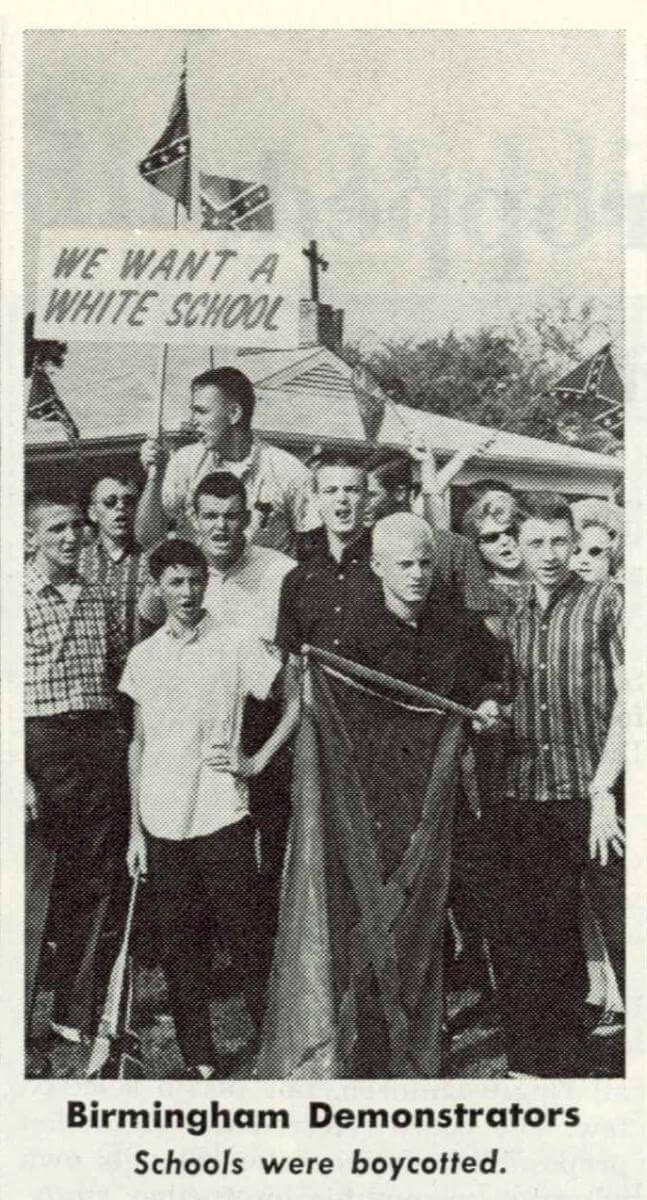
Alabama's virtually all-white electorate approved the "freedom of choice" amendments to the constitution with 61 percent of the vote, and the Boutwell plan's key elements became the operating terms for the strategy to resist and slow school desegregation in the Heart of Dixie.
John Patterson won the race for governor in 1958 as a hard-edged, proven segregationist who, as Alabama attorney general, had attempted to put the NAACP out of business through a series of persistent, harassing lawsuits—an attack commenced after a strategy meeting that included Forney Johnston. As governor, Patterson assured white Alabamians that "I would not agree under any circumstances to operate an integrated school," but, with Boutwell serving as lieutenant governor, he followed the spirit and letter of the Boutwell-Johnston strategy. It proved remarkably successful. During Patterson's four years in the governor's mansion, the US Supreme Court upheld Alabama's pupil placement law on its face as constitutional and, as Patterson later boasted, no Alabama public school was ever desegregated while he was governor.37Harris, "Alabama Reaction to the Brown Decision," 226–229, 241–249; Gilliam Sr., "The Second Folsom Administration," 316–321, 374–384, 423–436; Joseph M. Bagley, "School Desegregation, Law and Order, and Litigating Social Justice in Alabama, 1954–1973" (PhD diss., Georgia State University, 2013), 104–105; Shuttlesworth v. Birmingham Board of Education, 162 F. Supp. 372 (1958) affirmed by Shuttlesworth v. Board of Education, 358 U.S. 101 (1958); "Alabama: Governor Renews Vow to Resist Integration," Southern School News, February 1961, 14; Warren Trest, Nobody But the People: The Life and Times of Alabama's Youngest Governor (Montgomery, AL: NewSouth Books, 2008), 260, 303–306; William Warren Rogers et al., Alabama: A History of a Deep South State (Tuscaloosa: University of Alabama Press, 1994), 547–548.
Alabama's approach to controlling school desegregation changed dramatically in 1963 after George Wallace won the race for governor by making good on his promise—uttered after losing to Patterson in 1958—that "no other son-of-a-bitch will ever out-nigger me again."38Carter, The Politics of Rage, 96–109. Wallace defeated Folsom, Boutwell, and "Bull" Connor, among others. In his inaugural speech written by Asa Carter, Wallace proclaimed words that have resounded across the decades:
Today I have stood, where once Jefferson Davis stood. . . . Let us . . . send our answer to the tyranny that clanks its chains upon the South. . . . I draw the line in the dust and toss the gauntlet before the feet of tyranny . . . and I say . . . segregation now . . . segregation tomorrow . . . segregation forever.39George C. Wallace, "The Inaugural Address of Governor George C. Wallace," January 14, 1963, Alabama Textual Materials Collections, Alabama Department of Archives and History, transcript, http://digital.archives.alabama.gov/cdm/ref/collection/voices/id/2952.
Governor Wallace kicked off an orchestrated, theatrical performance of massive resistance a few months later when he stood in the schoolhouse door to decry federal encroachment on state sovereignty and to protest the admission of two Black students to the University of Alabama, which had a total enrollment of almost ten thousand students. Afterwards, Wallace led the state government in replaying strategies used earlier in Mississippi and Louisiana, including the formation of state spy commissions to monitor and intimidate civil right activists. His administration coordinated with the Klan and the Citizens' Council, and Wallace's frequent public pronouncements left little doubt that Alabama's school program had nothing to do with the Boutwell Committee's earlier stated purposes of advancing "each pupil's ability to learn" and everything to do with preserving absolute segregation.
Buoyed by national news coverage and by the enthusiastic support of white Alabamians that came as a result of Jim Crow grandstanding, Wallace had no intention of permitting any Alabama official to accept or implement token integration in the schools without an opportunity for him to publicly display his fight for complete segregation. The governor called out state troopers to surround school buildings in several Alabama towns—even when local white school boards had decided to permit a small number of Black children to cross the color line.
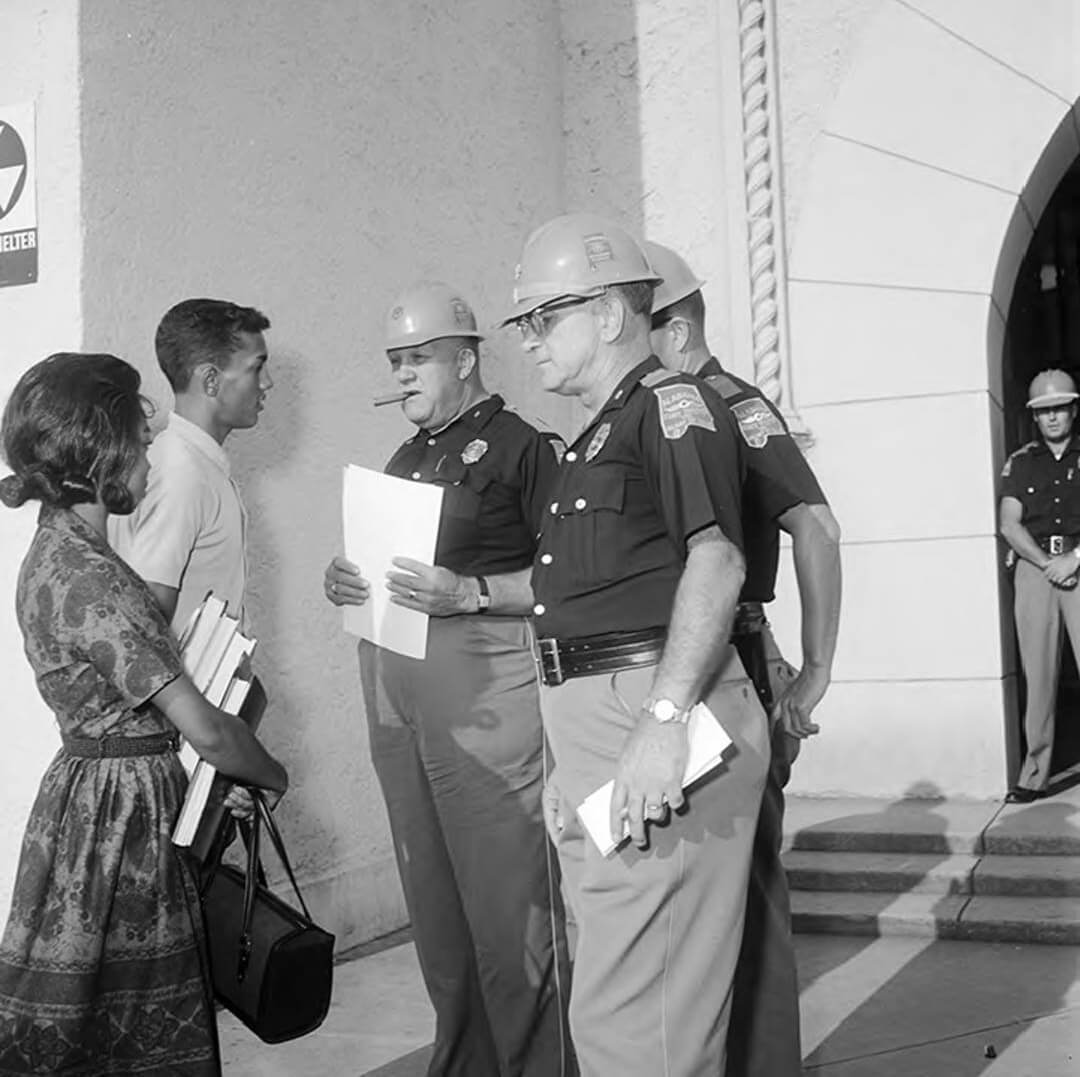
In response, civil rights attorneys returned to federal court with new evidence from Wallace's statements and actions that the school laws and their enforcement were intended to block Brown, and the courts began striking down the state's education laws—including its private school voucher law—and ordering school desegregation. As his lawyers lost in the federal courts, Wallace kept racial politics center stage, creating an environment for violence and capturing the adulation of the white die-hards. He also attracted the nation's attention by expanding and amplifying the provocative rhetoric of total, massive federal resistance. Wallace became in the political imaginary one of the nation's enduring southern segregationist icons.40Carter, The Politics of Rage, 133–293; Stephan Lesher, George Wallace: American Populist (Boston, MA: Addison Wesley, 1994), 244–253; Lee v. Macon County Board of Education, 267 F. Supp. 458 (1967); Allen Tullos, Alabama Getaway: The Political Imaginary and the Heart of Dixie (Athens: University of Georgia Press, 2011), 233–241.
The Other Southern States: "Freedom from Compulsory Association" by Any or Many Means
Six other states—Mississippi, Louisiana, Virginia, North Carolina, South Carolina, and Georgia—also created strategy groups to block school desegregation. Each group had its own distinct design and role within the dynamics of how each state built massive resistance to Brown, but most shared similar characteristics and tactics. All adopted vouchers for private schools.
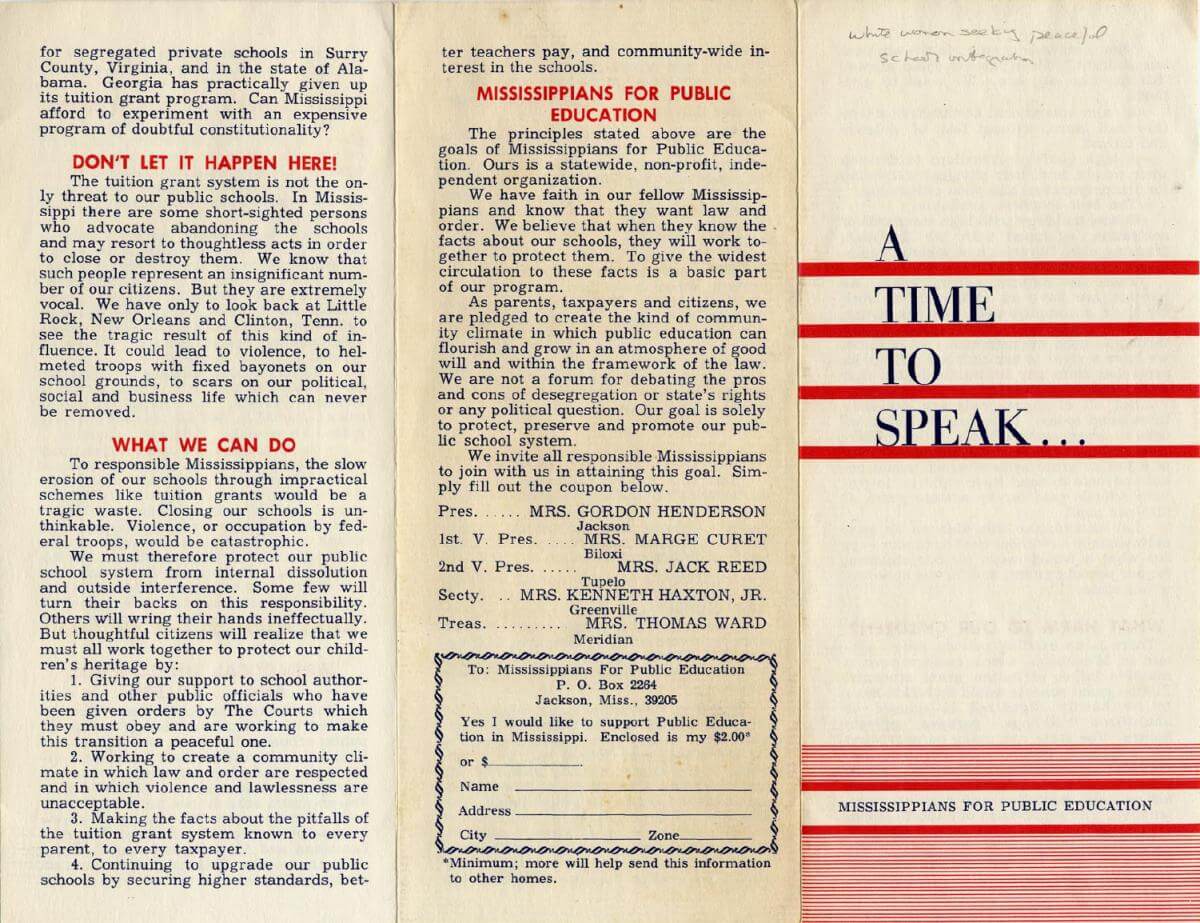
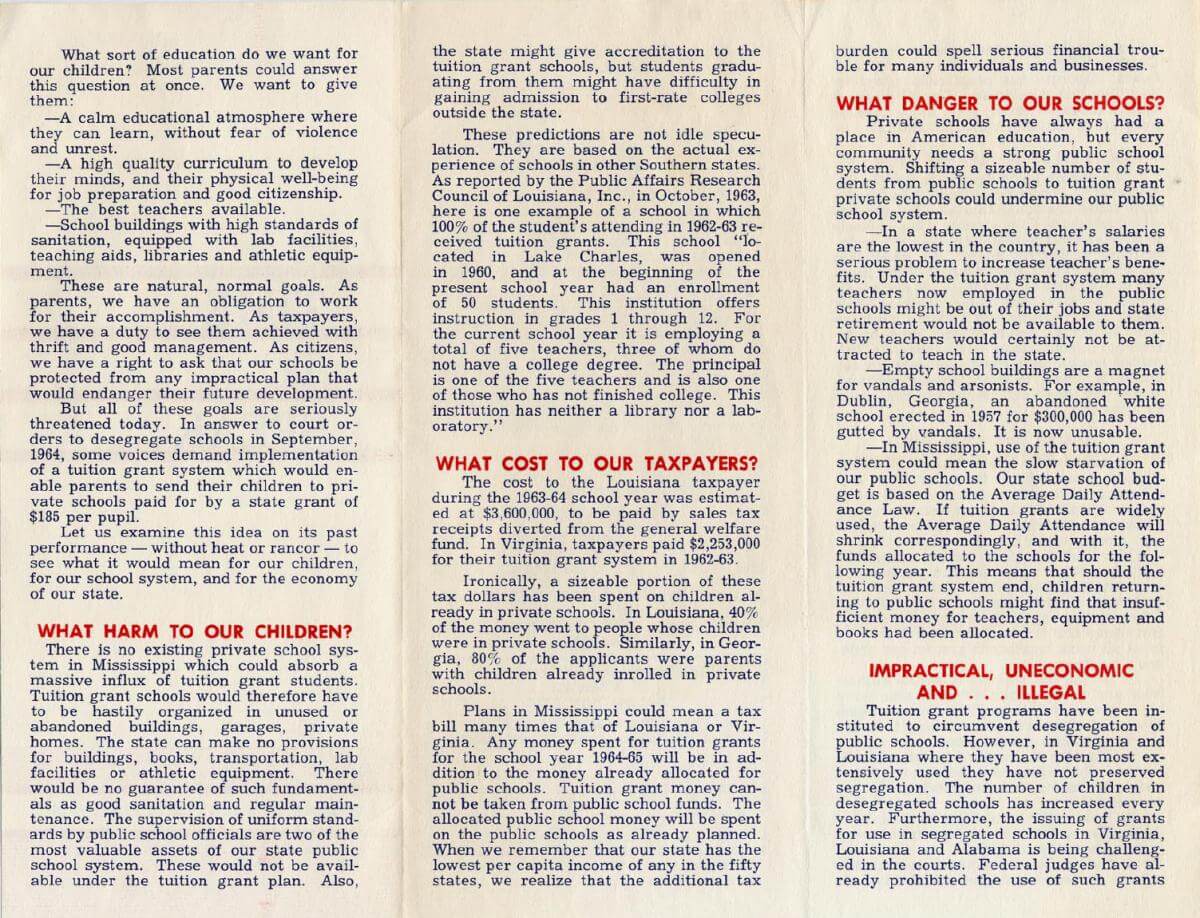
In Mississippi, white voters approved state constitutional changes recommended by Governor Hugh White's advisory group that authorized state funding for children to attend their parents' choice of a private school and for transferring public school properties to private schools. Afterwards, the strategy committee did little more since Mississippi's white leaders employed other groups and strategies as their first line of defense. The legislature approved small funding increases forBlack public schools in an attempt to convince Black citizens that the state would move closer to "separate but equal" facilities.
Mississippi's primary strategies to block school desegregation involved private and public agencies that undertook economic and social intimidation, behind-the-scenes spying, physical threats, and violence. The Mississippi Sovereignty Commission kept tabs on "agitators" in conjunction with the Citizens' Council, the Klan, and other vigilante groups.41"Mississippi," Southern School News, September 3, 1954; Charles C. Bolton, The Hardest Deal of All: The Battle Over School Integration in Mississippi (Jackson: University Press of Mississippi, 2005), 65–68, 75–88; McMillen, The Citizens' Council, 15–32, 360–361; John Dittmer, Local People: The Struggle for Civil Rights in Mississippi (Urbana: University of Illinois Press, 1994), 45–72; Charles M. Payne, I've Got the Light of Freedom: The Organizing Tradition and the Mississippi Freedom Struggle (Berkeley: University of California Press, 1995), 34–37.
Other states used legal and extra-legal tactics to keep schools segregated, but, as one author wrote, "Mississippi verged on totalitarianism."42Michael J. Klarman, "Why Massive Resistance?" in Massive Resistance: Southern Opposition to the Second Reconstruction, ed. Clive Webb (New York: Oxford University Press, 2005), 27. "This is a fight for white supremacy," declared the editor of the Jackson Daily News, returning to public language often abandoned by segregationists elsewhere. "[T]here will be no room for neutrals or non-combatants." Local Black leaders such as Leake County sisters Winson and Dovie Hudson faced combatants as they continued to challenge school segregation, despite economic reprisals, physical threats, and more than one bombing of their own homes. "I'm going to stay here and pay the cost, no matter what it is," Dovie Hudson assured Mississippi NAACP field secretary Medgar Evers, who soon afterwards was murdered in his own driveway in Jackson. Anyone connected to school desegregation or civil rights work in Mississippi ran a real risk of being fired from work, thrown out of their house, beaten, bombed, or shot at. Several were killed.43Dennis J. Mitchell, Mississippi Liberal: A Biography of Frank E. Smith (Jackson: University Press of Mississippi, 2001), 130; Constance Curry, "A Right to Be There," Southern Changes 14, no. 1 (1992): 18–25, http://southernchanges.digitalscholarship.emory.edu/sc14-3_1204/sc14-3_005/; Winson Hudson and Connie Curry, Mississippi Harmony: Memoirs of a Freedom Fighter (New York: Palgrave MacMillan, 2002), 47–73; Marin Noel and Roderick Wright, "Mrs. Murtis Powell: On the Front Lines of Battle," in Minds Stayed on Freedom: The Civil Rights Struggle in the Rural South, an Oral History, ed. Youth of the Rural Organizing and Cultural Center (Boulder, CO: Westview Press, 1991), 110–115.
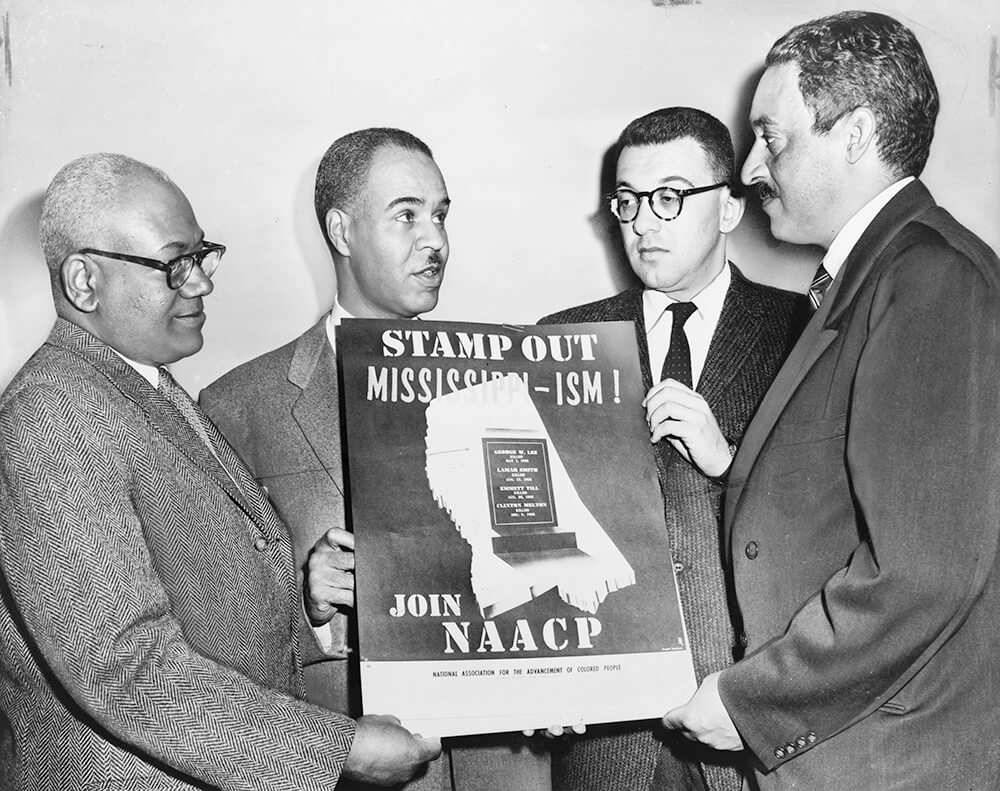
As a result, school desegregation moved very slowly in Mississippi. In 1969, fifteen years after Brown, the US Supreme Court found that Mississippi had made hardly any strides in undoing "segregated conditions" and ordered every school district in the state "to terminate dual school systems at once." Aided by Citizens' Council chapters, segregation academies sprung up across the state, and Mississippi's public schools desegregated only when and where civil rights lawyers won their day in federal courts.44Survey of School Desegregation in the Southern and Border States, 1965–1966 (Washington, DC: United States Commission on Civil Rights, 1966), 33–42, https://www2.law.umaryland.edu/marshall/usccr/documents/cr12sch611.pdf; Alexander v. Holmes County Board of Education, 396 US 19 (1969); McMillen, The Citizens' Council, 302; Bolton, The Hardest Deal of All, 169–186.
The strategy group in Louisiana was headed by long-time state senator William M. Rainach, who also spearheaded the creation of Louisiana's Citizens' Councils.45Jim Carl, Freedom of Choice: Vouchers in American Education (Santa Barbara, CA: Praeger, 2011), 26–28; "Louisiana," Southern School News, September 3, 1954, 13; Charles A. Reynard, "Legislation Affecting Segregation," Louisiana Law Review 17 (1956–57): 104–114. For a brief time, Rainach later became head of the Louisiana Sovereignty Commission, the primary state apparatus to spy on and harass civil rights activists and supporters. Carl, Freedom of Choice, 37, 46. The Rainach Committee became a coordinating agency as much for action as for legislative strategy. It helped to mount legal roadblocks to school desegregation, orchestrated legal attacks on Black activist organizations, and spurred efforts to remove or block Black voting in close collaboration with the Louisiana Sovereignty Commission. Like many other state agencies across the South, the committee condemned integration as the work of communists.
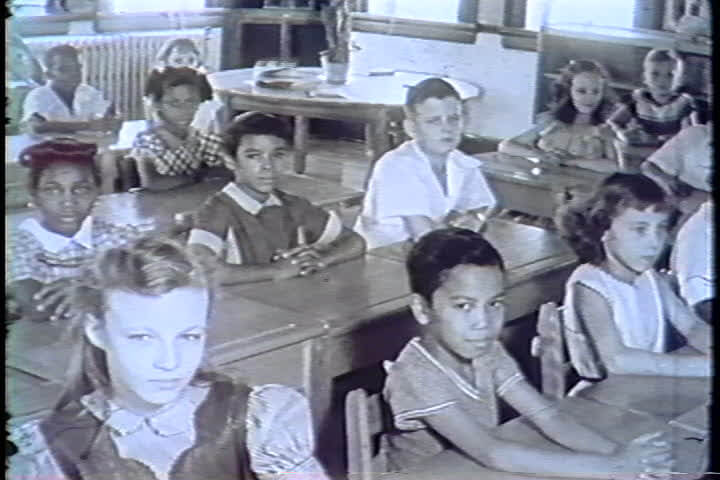
Following the Rainach Committee's recommendations, the legislature in 1958 authorized public schools to become private education cooperatives and a voucher program for white students to attend non-religious private schools.46Carl, Freedom of Choice, 29–32; "Supreme Court Approves Invalidation of Louisiana's Pupil Placement Law," Southern School News, July 1957, 7. In New Orleans, the Catholic schools were uniquely more willing to integrate sooner than the public schools. As early as 1956, the Archbishop publicly declared that segregation was morally wrong. Local NAACP leader Daniel Boyd suggested to national legal director Thurgood Marshall that "the Luzanna legislature will keep ignoring any and all court decisions until a number of them are jailed."47Adam Fairclough, Race and Democracy: The Civil Rights Struggle in Louisiana, 1915–1972 (Athens: University of Georgia Press, 1995), 247. In 1960, refusing further delays, federal district judge Skelly Wright ordered the desegregation of New Orleans's 9th Ward elementary school. Amid death threats, a six-year-old Black girl, Ruby Bridges, entered the previously all-white school with an escort of federal marshals amid a mob of angry, screaming white men and women. Senator Rainach abandoned his role as strategist in order to appear publicly more attractive as he campaigned to become governor. "Let's use the 'scorched earth policy,'" he proclaimed at a Citizens' Council rally.
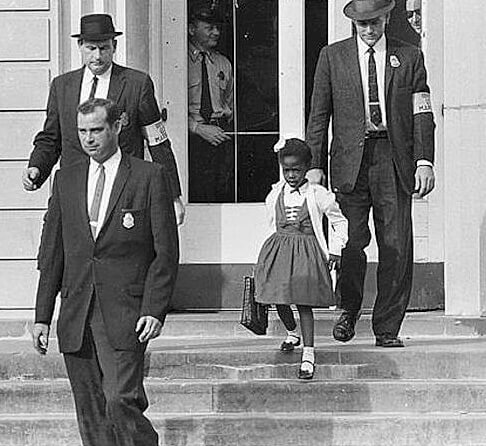
Jimmie Davis became the newly elected governor and quickly disbanded Rainach's committee. Following other southern governors, Davis pushed the legislature to revoke all overt segregation laws and pass race-neutral programs for advancing freedom of choice for parents. A new voucher law also made no mention of race; it allowed any Louisiana child eligible to receive a state-funded voucher to attend a non-profit, non-sectarian private school.48Carl, Freedom of Choice, 47–48; "State Again Fails To Get Control of Orleans Schools," Southern School News, February 1961, 6.
The race-neutral program began in 1962, operated for four years, and distributed more than fifty-five thousand vouchers. The vast majority of state funds went to the families of white students, although existing records show that about 7 percent of all vouchers supported students from Black families. All voucher-supported private schools were segregated by race—either all-white or all-Black.
After the voucher law was challenged in federal court, four all-Black private schools joined the state government in defending the program. The legislature renamed its voucher commission the "Louisiana Education Commission for Needy Children" with the professed purpose of addressing the problems of juvenile delinquency and school dropouts as well as the special needs of "retarded children" as it declared "that the parent, not the State of Louisiana, shall be the determining force which shall decide on the type of education ultimately received by the child." A federal court panel, however, found the "necessary effect of the Louisiana tuition grants [was] to establish . . . a system of segregated schools for white children, in violation of the equal protection clause."49Carl, Freedom of Choice, 48–53; "Louisiana Legislators Go Home; Teachers Miss Pay," Southern School News, January 1961, 1, 8–11; Poindexter, 275 F. Supp. 833.
Thomas J. Pearsall, a North Carolina attorney, businessman, and former Speaker of the House, chaired the North Carolina strategy committee responsible for finding a response to Brown. The Pearsall Committee originally had three African Americans among twenty members. Its first report proposed only a pupil assignment act mirroring the basics of Alabama's law. It empowered local school officials to assign students according to factors such as community relations, student ability, school capacity, and geographic location—without any mention of race.50John E. Batchelor, Race and Education in North Carolina: From Segregation to Desegregation (Baton Rouge: Louisiana State University Press, 2015), 32–42; Carlson, "With All Deliberate Speed," 55–59.
Hardline segregationists such as Jesse Helms, later US senator, dismissed the report, arguing that the state had to choose between "integrated public schools and free choice private schools." North Carolina attorney general Beverly Lake, also later a US senator, made the same argument urging the closure of public schools and the provision of vouchers for white children to attend totally segregated private schools.51Batchelor, Race and Education, 36–40.
In a second report in April 1956, the now all-white Pearsall Committee declared that it would "preserve a segregated system" like the one in the past and suggested ways to move from a "segregated-by-law system" to a segregated-by-choice system. The report reminded local school officials that, due to the US Supreme Court, there can be "no racial segregation by law," but nothing prohibited them from making "assignment according to natural racial preference and the administrative determination of what is best for the child." It recommended vouchers wherever "a child cannot be conveniently assigned to a non-mixed public school," regardless of the child's race, so long as the child's parent did not want a desegregated school. The committee insisted that while the Supreme Court had struck down laws "compelling the separation of the races in public schools," no court could compel "the mixing of the races."
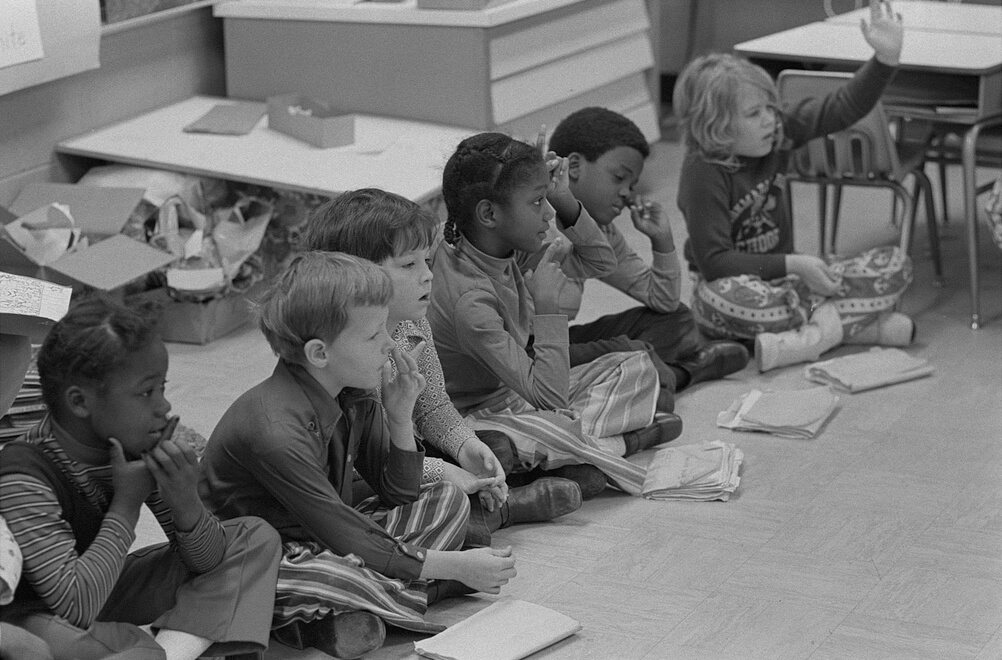
Over the next decade, most North Carolina schools slowly admitted a token number of Black students in previously all-white schools, although many small, rural school districts in eastern North Carolina resisted until a court order required the admission of a token number of Black children in previously all-white schools. The Pearsall Plan began to crumble when North Carolina civil rights attorney Julius Chambers persuaded a federal three-judge panel in 1966 that "the payment of tuition grants is clearly state action, and unquestionably impermissible." A year earlier, Chambers's home had been bombed twice and his car firebombed once as a result of his willingness to openly challenge school segregation. Following his own advice to others—"Keep fighting"—Chambers convinced the federal court that the "state may not circumvent the Constitution by giving financial encouragement to individuals to follow a course which defeats desegregation."52Batchelor, Race and Education, 76–110; Carlson, "With All Deliberate Speed," 72; Douglas Martin, "Julius Chambers, a Fighter for Civil Rights, Dies at 76," New York Times, August 6, 2013, https://www.nytimes.com/2013/08/07/us/julius-chambers-a-fighter-for-civil-rights-dies-at-76.html; "Hawkins v. North Carolina State Board of Education," Race Relations Law Reporter 11 (1966): 745, 747.
In Virginia, there were two strategy commissions. The first was chaired by businessman and state senator Garland Gray. In November 1955, it recommended the three basic methods of resistance first outlined by Alabama's Boutwell Committee: 1) investing local school officials with broad discretion to assign public school students on the basis of apparently non-racial factors such as availability of facilities and transportation, health, and aptitude of the child; 2) authorizing vouchers and other payments to private schools; and 3) permitting parents, without regard to race, to receive state-funded vouchers to attend private schools if their children were assigned to desegregated schools.
The Gray Commission's proposals implied that it would preserve only virtual segregation, not total segregation—an approach that many Virginia politicians defiantly opposed.53Joseph J. Thorndike, "'The Sometimes Sordid Level of Race and Segregation': James J. Kilpatrick and the Virginia Campaign against Brown," in The Moderates' Dilemma: Massive Resistance to School Desegregation in Virginia, eds. Matthew D. Lassiter and Andrew B. Lewis (Charlottesville: University Press of Virginia, 1998), 70. Bowing to the hardline segregationists, state leaders rejected the Gray Commission's recommendation in favor of massive resistance. The legislature declared desegregation a "clear and present danger" that required closing public schools when necessary. The new law also discarded the Gray Commission's recommendation to give local school boards the authority to make pupil assignments on terms without expressly mentioning race. The state board of education was specifically authorized to prevent assigning white and Black students in the same school.54Carl W. Tobias, "Public School Desegregation in Virginia During the Post-Brown Decade," William & Mary Law Review 37 (1996): 1269–1271.
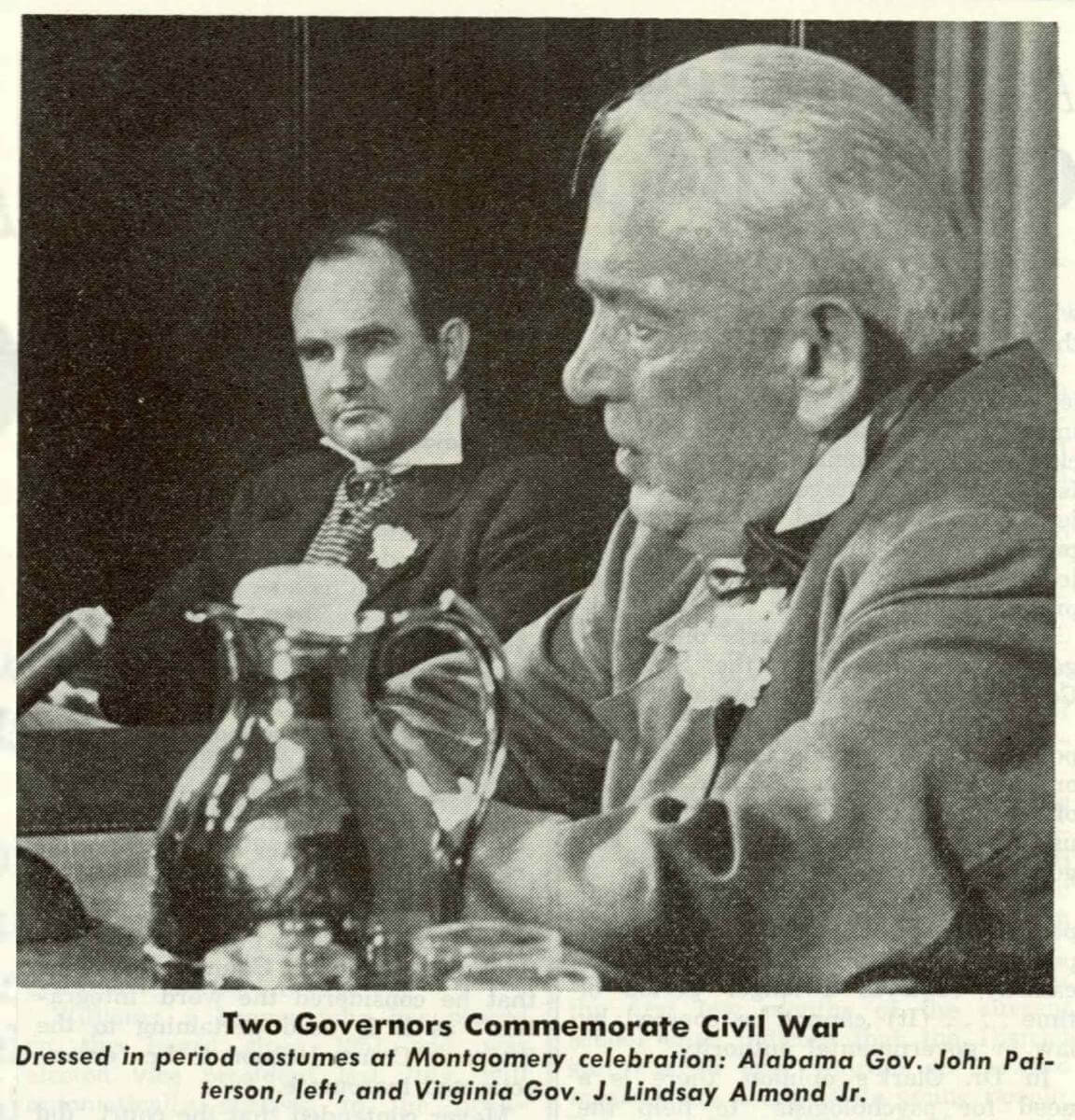
Lindsay Almond became Virginia's new governor in 1957 after a campaign in which he supported the hardline approach. "I'd rather lose my right arm," he proclaimed, "than to see one nigra child enter the white schools of Virginia." But, once in office, Governor Almond was persuaded by business leaders and others to establish a second commission, named after its chair, state senator Mosby Perrow, a prosperous lawyer and farmer. The Perrow Commission's report echoed the Gray Commission's "twin principles of local determination and freedom of choice." It also recommended adopting the strategies of the earlier Gray Commission and Alabama's Boutwell Committee: abandon any mention of race; allow local, flexible pupil placement on factors without explicit mention of race; create vouchers or so-called "scholarships."
The Perrow report did not specify exact terms for proposed legislation in each area since its members were not certain at that moment if a "three school plan," first envisioned in Alabama five years earlier, would be successfully defended in the courts. It did recommend a new uniform testing program—but testing only for the public schools, not for the private schools supported by vouchers.55Commission on Public Education, "Report of the Commission to the Governor of Virginia" (Richmond, 1959). This report is also referred to as the Perrow Report in reference to the chairman of the Commission, Mosby G. Perrow Jr.
Not all local jurisdictions followed the Perrow report. Some, such as Prince Edward County, maintained absolute segregation by closing the county's public schools and providing county tax credit scholarships to supplement state vouchers for white children to attend private schools. In 1964, however, Justice Hugo Black issued the Supreme Court opinion outlawing the die-hard segregationists' schemes. The Court ordered the public schools reopened on a desegregated basis and held that both tax credit and direct vouchers were unconstitutional.56"Report of the Commission to the Governor of Virginia," 21–25; "Virginia: State Commission Draws Up New Legislative Proposals," Southern School News, April 1959, 16; George M. Cochran, "Virginia Facing Reality: The 1959 Perrow Commission," Augusta Historical Bulletin 42 (2006), http://mlkcommission.dls.virginia.gov/va_school_closings/pdfs/Cochrane%20Augusta%20Historical%20Bulletin.pdf; Griffin v. School Board of Prince Edward County, 377 U.S. 218 (1964) at 233.
Senator Marion Gressette, chair of the South Carolina Segregation School Committee—first created by Governor Jimmy Byrnes and the state legislature in 1951—led resistance to court-ordered desegregation for more than twenty years. The Gressette Committee believed the best defense against the federal courts was to move "with caution and with a minimum of publicity" and to report publicly as little as possible.57John W. White, "Managed Compliance: White Resistance and Desegregation in South Carolina, 1950–1970" (PhD diss., University of Florida, 2006), 152.
Before Brown, Governor Byrnes initiated an aggressive statewide building program of segregated schools for Black children to bolster the legal argument that "separate but equal" was equal and constitutional, but the passage of a state constitutional amendment two years before Brown also permitted South Carolina to close its public schools—a clear message to the Black population to leave segregation as it had been.
After Brown, Byrnes suspended the Black school construction program, but restarted it once persuaded by the Gressette Committee that the program remained a useful incentive for Black parents to keep their children in segregated, all-Black schools instead of seeking admission to all-white public schools.58Stephen Harold Lowe, "'The Magnificent Fight': Civil Rights Litigation in South Carolina Federal Courts, 1940–1970" (PhD diss., University of Michigan, 1999), 193–201; White, "Managed Compliance," 43–61; "South Carolina," Southern School News, September 3, 1954, 12.
Following the Gressette Committee's recommendations, the legislature also passed a pupil assignment bill giving local school boards the authority to make all decisions about attendance based on a family's geographic location and a child's scholastic aptitude (e.g., "each child shall be considered individually") without mention of race. Gressette understood that this color-blind standard in pupil placement could be a barrier to widespread school desegregation because of residential segregation. As the staff director of the Gressette Committee privately observed, local school boards could also decide, even where housing segregation did not preserve separate schools, that "there are few Negroes educationally qualified to go to schools with similarly aged white children."59White, "Managed Compliance," 151–153. "Academic standards" without any reference to race or skin color also were used to assure that African American teachers did not receive equal pay with white teachers, despite a federal court order to equalize teachers' salaries. Also see R. Scott Baker, "Testing Equality: The National Teacher Examination and the NAACP's Legal Campaign to Equalize Teachers' Salaries in the South 1936–63," History of Education Quarterly 35, no. 1 (1995): 49–64 and R. Scott Baker, "The Paradoxes of Desegregation: Race, Class, and Education, 1935–1975," American Journal of Education 109, no. 3 (May 2001): 320–343. The Gressette Committee also attempted to convince the NAACP lawyers that geography, not the state government, was responsible for school segregation. See Maxie Myron Cox Jr., "1963—the Year of Decision: Desegregation in South Carolina" (PhD diss., University of South Carolina, 1996), 166.
The president of the South Carolina Farm Bureau echoed the analysis made earlier by Alabama corporate attorney Forney Johnston when he observed: "If Negroes are to have the right of free choice in attending separate or mixed schools if they wish, then even the Supreme Court cannot deny to white people that same free choice of sending their children to separate or mixed schools."60"South Carolina," Southern School News, January 6, 1955, 14.
The state's acceptance of token desegregation in order to keep schools virtually segregated did not satisfy South Carolina's hardliners, but the Gressette Committee's approach prevailed even as escalating racial violence and state-sponsored intimidation against Black and white activists, especially the NAACP, continued.61White, "Managed Compliance," 166–265. Over time, and without mentioning race, the South Carolina legislature repealed compulsory attendance in public schools, pushed decision-making about school enrollment and school closing to local districts, permitted white students living in racially diverse areas to transfer to a nearby virtually segregated school district, and established tax exemptions for children attending private schools.62"South Carolina," Southern School News, February 3, 1955, 3; "South Carolina," Southern School News, March 3, 1955, 14; "South Carolina," Southern School News, July 1955, 4. Even bills proposing confrontational tactics, such as closing public schools, often did not mention race. For example, a bill in 1955 proposed to close any public school where a student was admitted by court order. See "South Carolina," Southern School News, May 4, 1955, 6. In 1960, on advice of the Gressette Committee, the legislature removed the phrase "for racially segregated schools only" from its appropriations bill. See Cox Jr., "1963—the Year of Decision," 15.
On January 28, 1963, following a federal court order, Harvey Gantt became the first African American since Reconstruction to enroll in a state university in South Carolina when he was admitted to Clemson without incident. Gantt had attended college in Iowa but decided: "I was homesick for the South, I was a child of the South, and that's where I wanted to go."63"Clemson College Admits Negro in State's First Desegregation," Southern School News, February 1963, 1; Interview with Harvey B. Gantt by William R. Ferris, September 28, 2015, C-0367, Southern Oral History Program Collection #4007, Southern Historical Collection, Wilson Library, University of North Carolina at Chapel Hill, https://dc.lib.unc.edu/cdm/compoundobject/collection/sohp/id/27218/rec/2.
The next day, South Carolina's new governor, Donald Russell, announced that the state would provide parents with vouchers or "scholarship grants" to send their children to non-sectarian private schools. Russell did not mention race. He argued that vouchers would require public schools to compete with private ones for students and "this competition would stimulate progress in public education." The Gressette Committee reported that vouchers would "offer to all our citizens the broadest possible freedom of choice."64"Clemson College Admits Negro on Order of Appellate Court," Southern School News, February 1963, 8–9.
In May 1968, after hearing arguments on the voucher program from Matthew Perry and Ernest Finney Jr. (two African American attorneys who later became judges), a panel of three federal judges declared the "purpose, motive and effect of the Act is to unconstitutionally circumvent the requirement . . . that the State of South Carolina not discriminate on the basis of race or color in its public educational system."65White, "Managed Compliance," 390–391; Brown v. South Carolina State Board of Education, 296 F. Supp. 199 (1968).
In Georgia in 1950, more than two hundred African American students and parents filed a lawsuit claiming unequal education on account of race and seeking admission to all-white schools in Atlanta. Governor Eugene Talmadge warned, "Our rifles are ready" to resist any court desegregation order. Roy Harris, an influential political operative and head of the Citizens' Council, called for the closure of the state's public schools and the creation of a tax-funded private school system.66O'Brien, "Private School Vouchers and the Reality of Racial Politics," 79–92.
Over the next few years, the General Assembly passed laws cutting off funding to any public school that a federal court ordered to desegregate. It also passed laws increasing school funding for segregated Black schools and, after Brown was argued in 1953, additional laws enabled white voters to approve a constitutional amendment to permit vouchers for private schooling. Georgia's attorney general, Eugene Cook, assured white Georgians that any plan to "subsidize the child rather than the school" was lawful.67O'Brien, 105–108; "Georgia Attorney General Says Supreme Court Will Mix Schools," Chicago Defender, October 31, 1953, 5; Acts and Resolutions of the General Assembly of the State of Georgia, 1956, vol. 1, 10–11, 13–15. These laws followed the passage of a 1955 law mandating that in Georgia "no State or local funds shall be in any manner appropriated or expended for public school purposes except for schools in which the white and colored races are separately educated." See Acts and Resolutions of the General Assembly of the State of Georgia, 1955, vol. 1, 174–176.
In 1958, Ernest Vandiver became governor after promising white voters: "Neither my child nor your child will ever attend an integrated school during my administration. No, not one!" Afterwards, the legislature enacted tuition tax credits for families whose children attended private schools, barred using local property taxes to finance desegregated public schools, and empowered the governor to close either school districts or individual public schools as needed.68Acts and Resolutions of the General Assembly of the State of Georgia, 1959, vol. 1, 7, 15, 157; "Georgia: Teachers Endorse Separate-But-Equal; Decision Awaited In State Test Case," Southern School News, April 1959, 7. During this period, Atlanta's NAACP attorney Donald Hollowell, who advanced many of the court challenges to Georgia's school segregation, stated that he would not predict the outcome of any court case, but added that he fully expected the color line to fall.69"Motion to Dismiss Is Overruled," Atlanta Daily World, December 16, 1958.
Facing a federal court order for the token desegregation of four Atlanta public schools, Governor Vandiver considered accepting virtual segregation, earning the outrage of political kingmaker Roy Harris, who declared: "If one little Negro is entitled to go to Henry Grady High School in Atlanta, then all Negroes are entitled to go to some high school with whites."70O'Brien, "Private School Vouchers and the Reality of Racial Politics," 174. Vandiver tried having it both ways: he recommended bills to continue absolute segregation while creating a Committee on the Schools, later called the Sibley Commission, to explore best options.
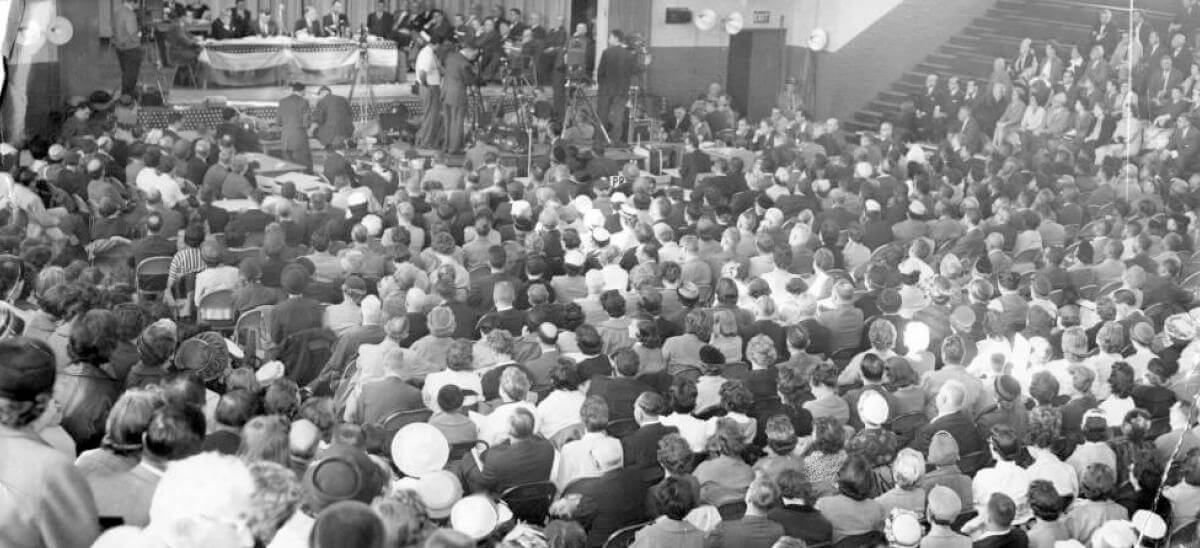
Atlanta businessman and corporate attorney John Sibley led the new commission in holding public hearings across the state. Afterwards the Commission recommended that public schools remain open and, in effect, that the state manage a slow process of token desegregation: "Those who insist upon total segregation must face the fact that it cannot be maintained in public schools by state law." The report's plan was designed "to effectuate voluntary association." Recommended strategies included freedom of parental choice, local decisions for pupil placements and pupil transfers, and tuition grants to private schools—the pillars of Alabama's earlier Boutwell plan.71O'Brien, 171–181; Acts and Resolutions of the General Assembly of the State of Georgia, 1960, vol. 1, 1187; Jeff Roche, Restructured Resistance: The Sibley Commission and the Politics of Desegregation in Georgia (Athens: University of Georgia Press, 1998), 163–172; "Here's Text of Majority Report by Sibley Committee," Atlanta Constitution, April 29, 1960; "Text of Minority Report," Atlanta Constitution, April 29, 1960; Paul Delaney, "Judge Hooper to Study Sibley Report Monday," Atlanta Daily World, May 8, 1960.
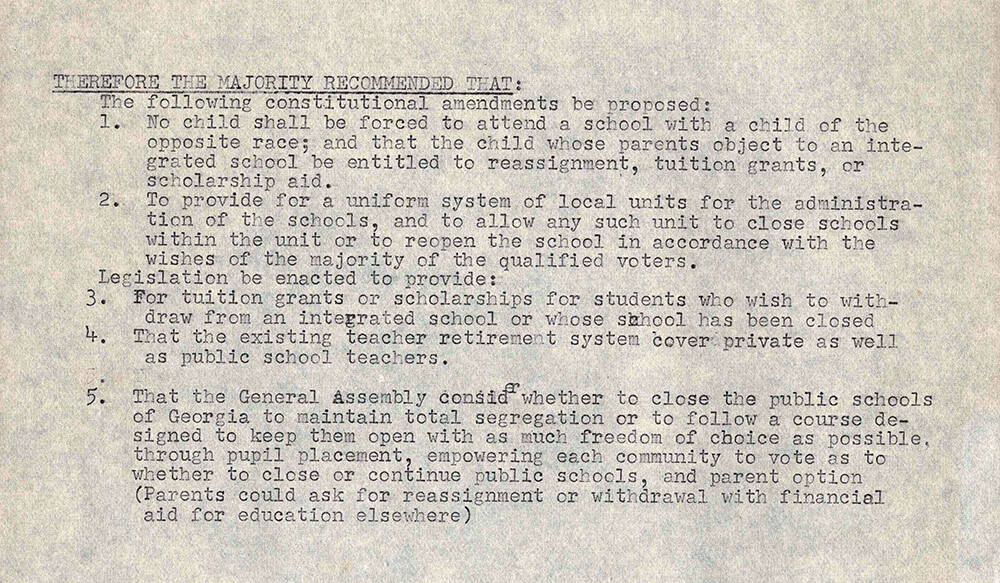
In January 1961, shortly after two thousand angry whites surrounded the dormitory of Charlayne Hunter, one of two Black students admitted to the University of Georgia in Athens,72Matthew D. Lassiter, The Silent Majority: Suburban Politics in the Sunbelt South (Princeton, NJ: Princeton University Press, 2006), 87–89. Governor Vandiver announced he would follow the Sibley report. He proposed to repeal race-specific laws of massive resistance and promised every Georgia child "his God-given right to freedom of association" through a new amendment securing "the constitutional rights of school children to attend private schools of their choice in lieu of public schools" through public financing.73O'Brien, "Private School Vouchers and the Reality of Racial Politics," 189–191, 199–201; "Gov. Ernest Vandiver Asks 4-Point Child Protection Defense Package," Atlanta Daily World, January 19, 1961; "U.S. Judge Rejects Contentions of Georgia Officials," Southern School News, February 1961, 8; Acts and Resolutions of the General Assembly of the State of Georgia, 1961, vol. 1, 35.
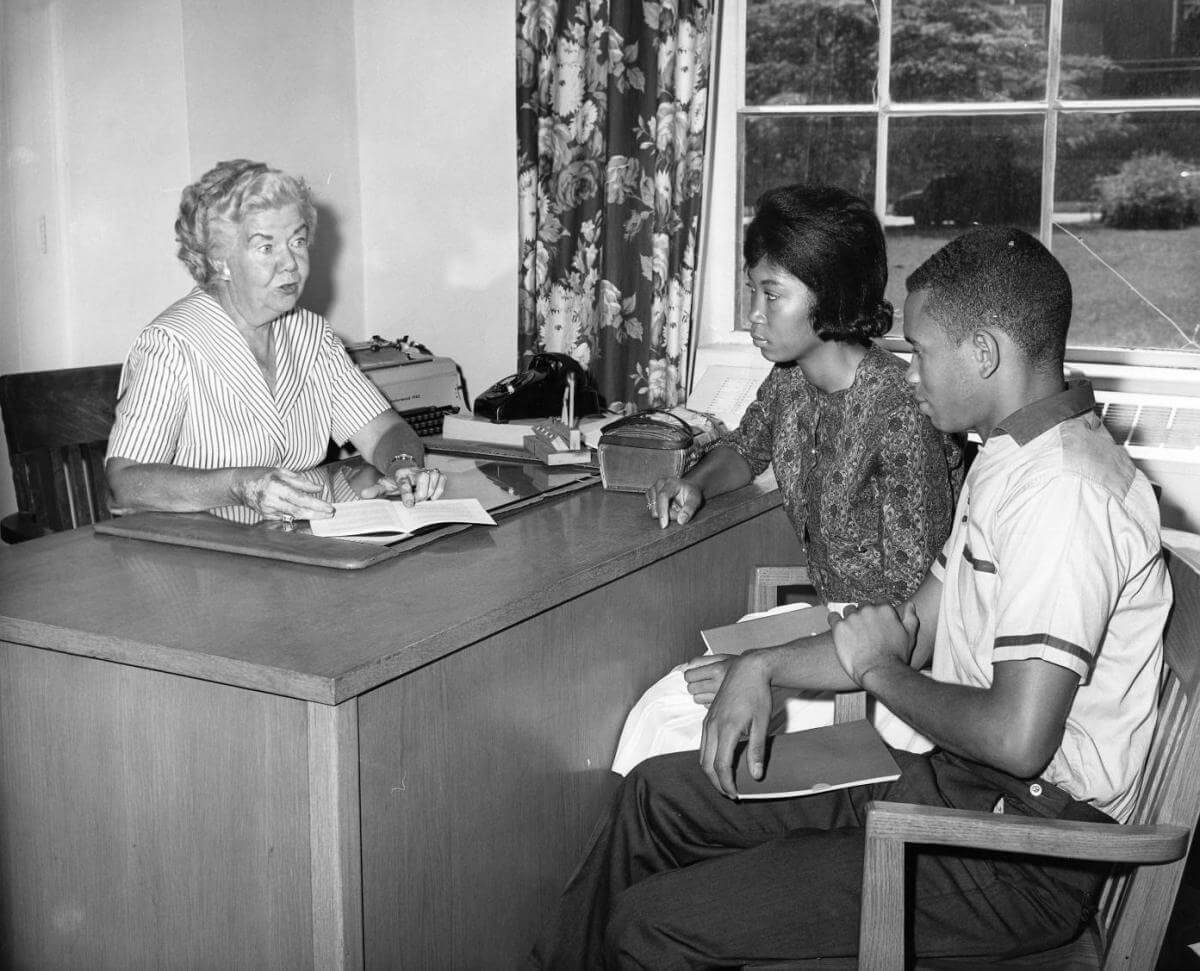
In August 1961, two Black students desegregated Atlanta's Grady High School without incident. Atlanta's peaceful acceptance of token integration at Grady and the city's other all-white high schools became, in the words of the New York Times, a "new and shining example of what can be accomplished" in the South. President John Kennedy said afterwards: "I strongly urge all communities which face this difficult transition to look closely at what Atlanta has done."74Kruse, White Flight, 150–156. That one day in 1961 burnished the city's growing international reputation as the "City Too Busy to Hate," while, in fact, it set in motion a process of pupil assignments that preserved virtual segregation across the entire school system.75Lassiter, The Silent Majority, 104–105.
In 1962, Georgia financed vouchers for more than fifteen hundred students in private schools. In addition, the legislature aided white teachers in leaving public for private schools by allowing them to remain in the state retirement system. None of the new laws specifically mentioned "race" or racial segregation. In the aftermath of its "shining example," the Atlanta school board routinely denied requests by scores of Black parents to transfer their children to all-white schools. Attorney Donald Hollowell assured the public "we will appeal," but courtroom challenges could not catch up with the school board's delaying tactics. By December 1963, Dr. Martin Luther King Jr. publicly condemned "something strange and appalling"—not a single Black child was attending Atlanta's all-white elementary schools and only 153 of more than 14,000 Black high school students attended classes with whites.76Bruce Galphin, "40 Negro Students File Appeals for Transfers," Atlanta Constitution, June 14, 1961; Bruce Galphin, "38 Negroes, White Girl Lose Transfer Appeals," Atlanta Constitution, July 7, 1961; Tomoko Brown-Nagin, Courage to Dissent: Atlanta and the Long History of the Civil Rights Movement (New York: Oxford University Press, 2011), 307.
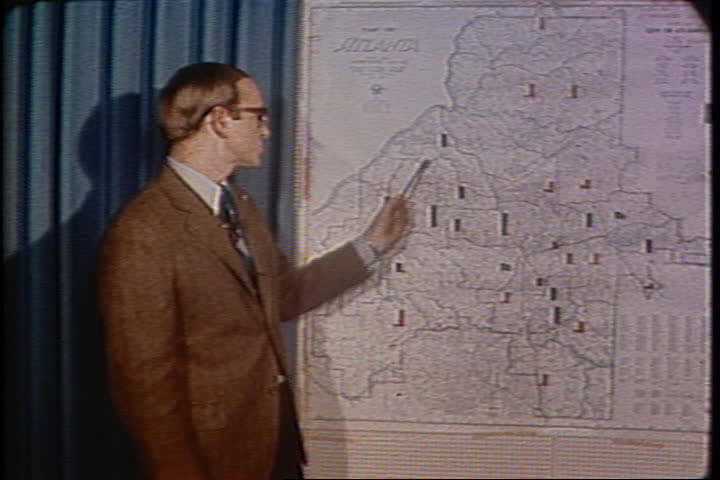
With each passing year throughout the 1960s, legal strategies and tools of resistance to Brown became less important in Atlanta and other metropolitan areas as white flight to suburban counties increased—illuminating another highly effective option for preserving the "freedom of white people to choose not to go to school with negroes." Georgia's voucher program petered out after a couple of years—once it became obvious that the program would not survive review by the courts and after the discovery that many of the program's beneficiaries were already attending private schools.77Kruse, White Flight, 9–17, 161–177, 234–235; John H. Britton, "Fear of Increase in Taxes Is Blamed for Bond Measure Defeat: Negro Votes Favored Most Bond Proposals," Atlanta Daily World, August 4, 1962; "$206,640 Granted Students to Attend Jim Crow Schools," Atlanta Daily World, October 17, 1962.
The Limits of Lawsuits: Toppling Voucher Programs but Not Segregated Schools
By 1965, most voucher programs, which had been enacted only in southern states, had been declared unconstitutional or were under serious attack, no matter whether the programs involved indirect expenditures such as tax credits or were shrouded in non-racial language. Each law financing private schools was soon invalidated by a federal court (or abandoned in the case of Georgia before it could be struck down) because the efforts were perceived to evade or disrupt public school desegregation and to "significantly encourage and involve the State in private discriminations."78See these federal cases: Coffey v. State Educational Finance Commission, 296 F. Supp. 1389 (S.D. Miss. 1969); Griffin v. State Board of Education, 296 F. Supp. 1178 (E.D. Va. 1969); Poindexter v. Louisiana Financial Assistance Commission, 296 F. Supp. 686 (E.D. La. 1968); Brown v. South Carolina State Board of Education, 296 F. Supp. 199 (D.S.C. 1968), aff'd, 393 U.S. 222 (1968); Poindexter v. Louisiana Financial Assistance Commission, 275 F. Supp. 833 (E.D. La. 1968), aff'd, 389 U.S. 571 (1968); Lee v. Macon County Board of Education, 267 F. Supp. 458 (M.D. Ala. 1967); Hawkins v. North Carolina State Board of Education, 11 Race Relations Law Reporter 745 (W.D.N.C. 1966); Griffin v. State Board of Education, 239 F. Supp. 560 (E.D. Va. 1965); Lee v. Macon County Board of Education, 231 F. Supp. 743 (E.D. Ala. 1964); Pettaway v. County School Board, 230 F. Supp. 480 (E.D. Va. 1964), aff'd, 339 F. 2d 486 (2d Cir. 1964); Hall v. St. Helena Parish School Board, 231 F. Supp. 649 (E.D. La. 1961), aff'd, 368 U.S. 515 (1962); Aaron v. McKinley, 173 F. Supp. 944 (E.D. Ark. 1959), aff'd sub nom, Faubus v. Arron, 361 U.S. 197 (1959).
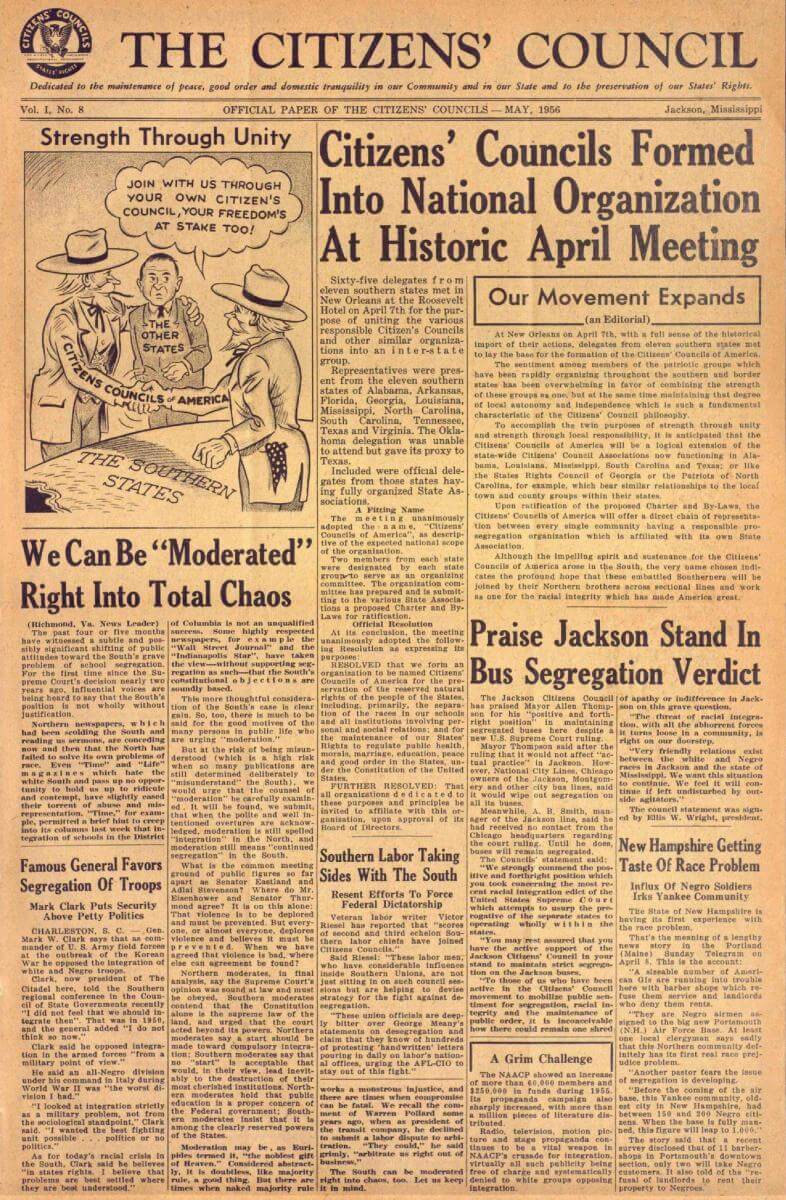
A vital component in states' strategies to preserve segregation, vouchers operated differently depending on state politics, federal court decisions, and the values and judgments of the strategy committees. Exchanging ideas and information, these committees functioned separately, shaped and reshaped by the dynamics of a state's political and business leadership and without a coordinated sectional effort.
In their final reports, most strategy committees adopted methods and means that evaded any exact definition of what preserving school segregation meant as an expression of racial subordination. Like Georgia Governor "No, Not One" Vandiver, states adapted to the reality that absolute or total segregation could not be preserved in the face of federal enforcement of Brown. Sooner or later, white leaders such as Tom P. Brady, the Mississippi politician credited with the idea of forming the Citizens' Council, were willing to accept virtual segregation. Others, including Alabama corporate attorney Forney Johnston, knew at the time of Brown that virtual segregation with its token exceptions could preserve white supremacy so long as conservative white leaders kept control of schools, politics, and the economy.79Tom P. Brady, "Segregation and the South," October 4, 1957, Citizens' Council Collection, Archives and Special Collections, University of Mississippi Libraries; McMillen, The Citizens' Council, 265–266; Thomas P. Brady, interview by Orley B. Caudill, March 4, 1972, Center for Oral History and Cultural Heritage, University of Southern Mississippi Libraries. In 1962, Arnold Rose, who assisted Gunnar Myrdal, wrote a postscript in the 1962 edition of An American Dilemma (New York: McGraw Hill, xxxv–xxxvii) where he discussed how the initial monolithic response to Brown by southern whites changed and adapted to fit the times.
Starting in the mid-1960s, civil rights lawyers were able to use new national anti-discrimination laws to challenge a wider range of white supremacist laws and practices. The civil rights movement moved away from the courtroom as the primary venue for creating change. Before Brown, the NAACP and other civil rights lawyers led the way by using the words of the Constitution to take down the wall of segregation, beginning in the schoolhouses, one student at a time. Privately, NAACP chief attorney Thurgood Marshall laid out the legal approach: "Those white crackers are going to get tired of having Negro lawyers beating 'em every day in court."80Harry S. Ashmore, Hearts and Minds: The Anatomy of Racism from Roosevelt to Reagan (New York: McGraw Hill, 1982), 214. Publicly, it was the hallmark of attorneys such as Donald Hollowell, known in Georgia as "Mr. Civil Rights," to remain reserved and dignified—what Hollowell later remembered with a wink as "courtly"—using only federal filings to argue with white society about segregation, even as white state officials brazenly belittled, condemned, and harassed them.81Brown-Nagin, Courage to Dissent, 336; Donald Hollowell, conversation with the author, May 1978. This strategy confronted white stereotypes and rendered Brown as the law of the land, but alone it proved too slow and inadequate to halt relentless white efforts to stop change or to keep pace with growing Black demands.
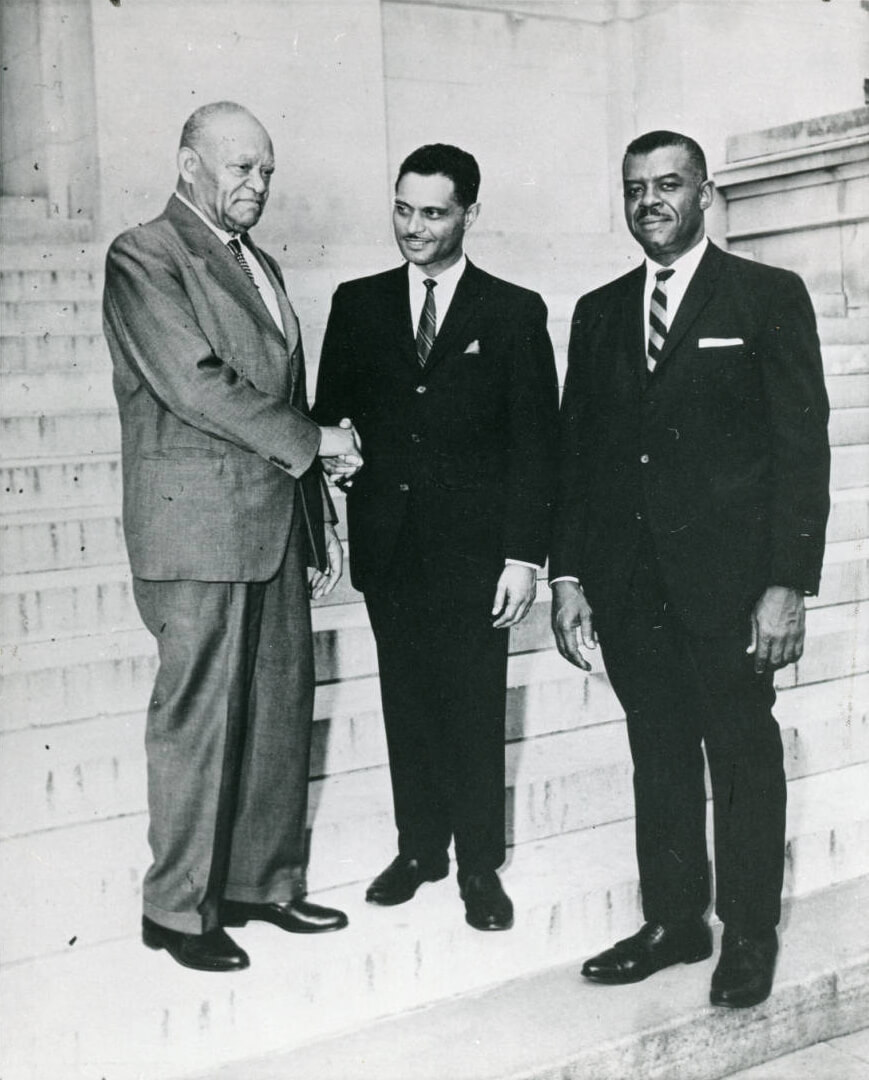
The emergence of the student movement and direct action as strategies for challenging private and public segregation was in part a reaction to the slow, back-and-forth pace of litigation. In some places, even "the twin avenues of civil rights protest—legal and direct action—did not have a catalytic effect" in advancing desegregation. By the middle of the 1960s, school desegregation was no longer the civil rights spearhead. As Dr. Martin Luther King Jr. observed about his own town: "In the absence of legal, political, economic, and moral pressure, not even a city as enlightened as Atlanta is likely to grant the Negro his constitutional rights."82Brown-Nagin, 307–309.
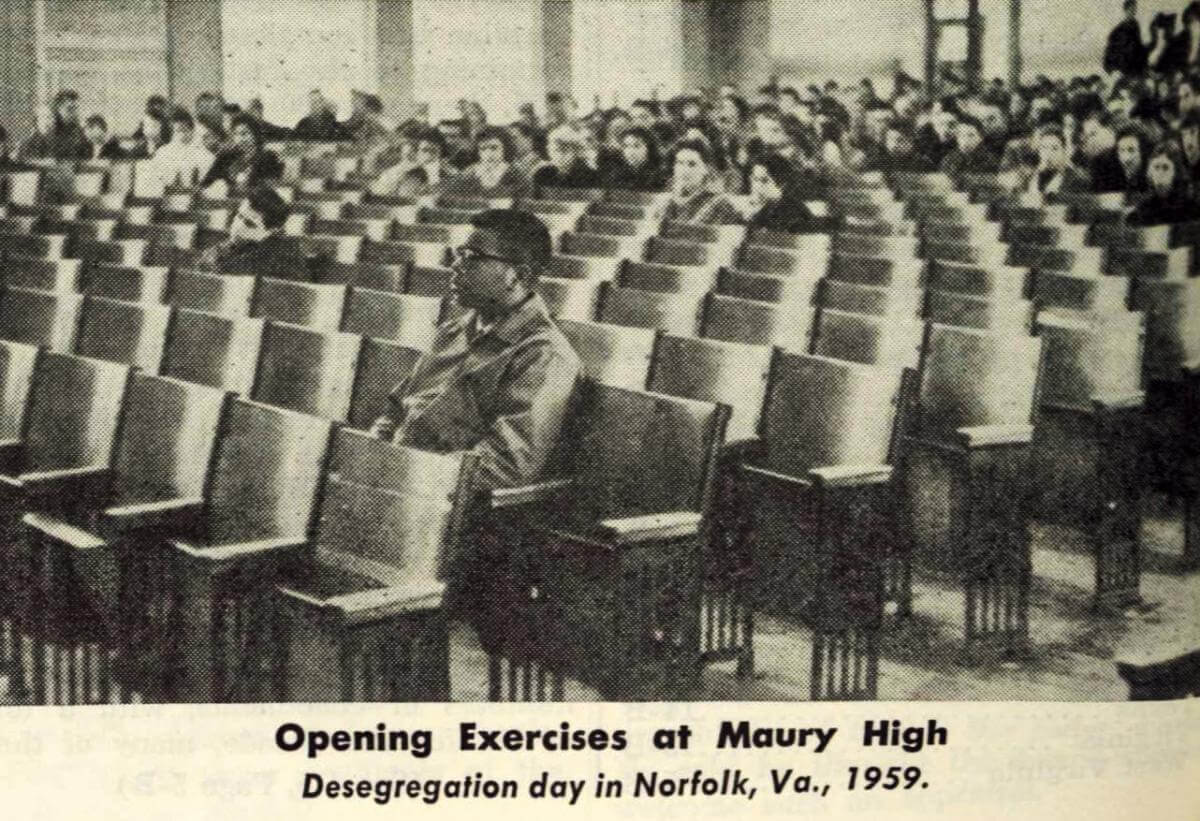
Most of the South's white leaders were discovering that a more fluid definition of segregation was their most effective defense. Increasingly, they realized the efficacy of moving away from "No, not one" or a stand in the schoolhouse door toward strategies that could do almost as much as absolute segregation. As early as 1956, the founder of the Citizens' Council had suggested that members should redefine their way of life as far more than complete separation of the races: "Segregation represents the freedom to choose one's associates, Americanism, state sovereignty, and the survival of the white race."83Robert B. Patterson, 2nd Annual Report (Greenwood, MS: Association of Citizens' Councils of Mississippi, August 1956), 2.
As for the public schools, it did not matter that all the tools for preserving segregation could not withstand the scrutiny of the federal courts or that the civil rights leaders were employing new strategies. A decade after Brown, the architects and advocates of private school vouchers had discovered the means to permit only a symbolic semblance of desegregation. If only by trial and error in some states, "southern anti-integration efforts during the post-Brown era were more often characterized by creativity and flexibility than by obstinacy and intransigence."84Driver, "Supremacies and the Southern Manifesto," 1093. While discussing the ideas and strategies voiced by southern federal officials, Driver illuminates the components of segregationists' plans of resistance that "play a role today in maintaining the paucity of meaningful integration in the nation's public schools." See pages 1094, 1097–1099.
By the end of the 1965 school year, Alabama, Georgia, Louisiana, Mississippi, North Carolina, South Carolina, and Virginia—the seven states that had adopted voucher programs—maintained the South's lowest rates of school desegregation. That year, fewer than 2 percent of all Black students in each of the seven states were attending public schools with white students.85Statistical Summary: School Segregation–Desegregation in the Southern and Border States (Nashville, TN: Southern Education Reporting Service, 1966–67), 43.
Milton Friedman and "Government Schools"
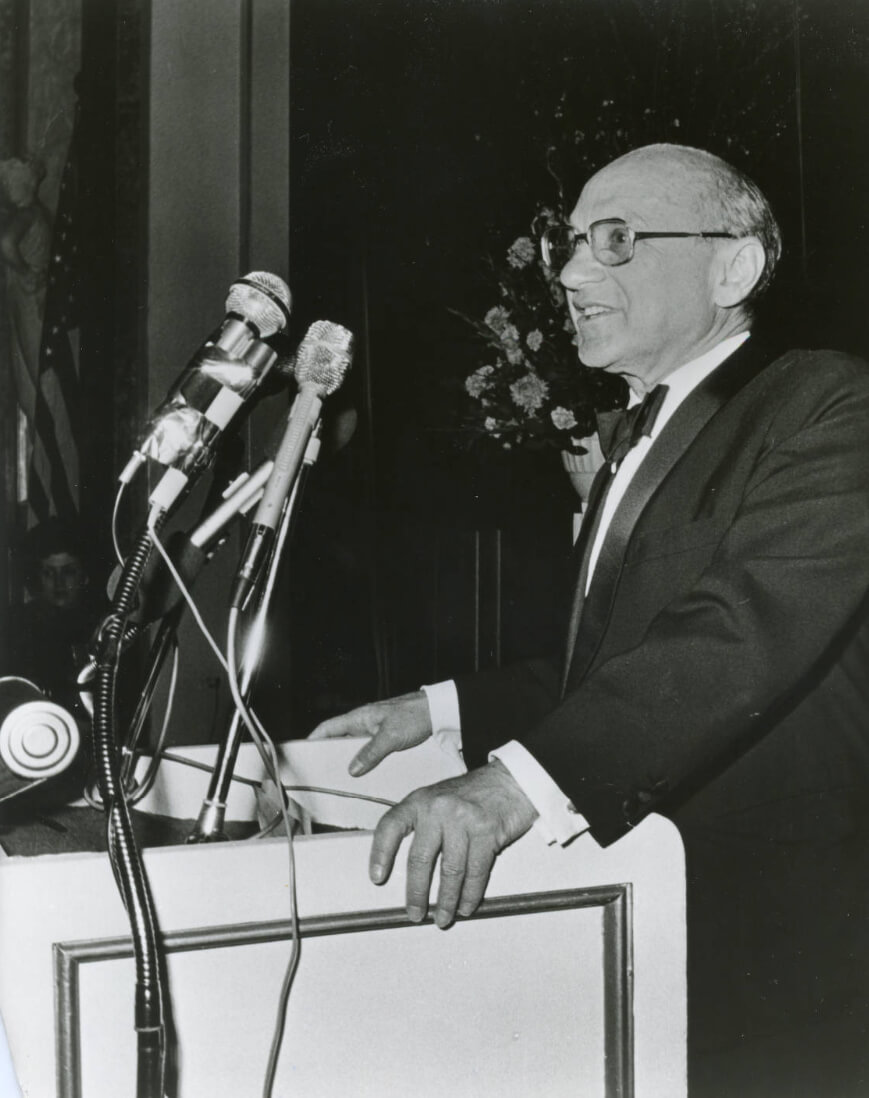
In 1955, almost a year after Albert Boutwell released the Alabama legislative report proposing private school vouchers as a key element in his committee's plan of "freedom of choice," libertarian economist Milton Friedman of the University of Chicago published "The Role of Government in Education."86Milton Friedman, "The Role of Government in Education," in Economics and the Public Interest, ed. Robert A. Solo (New Brunswick, NJ: Rutgers University Press, 1955), 123–144. Friedman was awarded the Nobel Prize for economics in 1976 for his work on monetary policy. It introduced academicians to an economic rationale for school vouchers. Friedman believed parents would get the best education for their children when private schools competed for enrollment. Advancing a theory he and others would repeat over decades, Friedman argued that "competitive private enterprise is likely to be far more efficient in meeting consumer demands than nationalized enterprises" in education.87Friedman, "The Role of Government in Education," 129.
Friedman's advocacy for a system of government-financed vouchers to replace "government schools," as he called them, was grounded in his free market beliefs. However, in a page-long footnote he acknowledged that essentially the same proposal "has recently been suggested in several states as a means of evading the Supreme Court ruling against segregation"—a development Friedman said came to his attention after he had largely completed his essay. The economist assured readers that he deplored segregation and racial prejudice, but he also opposed forced "non-segregation" no less than forced segregation. (Friedman also opposed a federal fair employment commission that would prohibit racial discrimination in private employment and, later, the 1964 Civil Rights Act's prohibition against racial discrimination by private businesses.88Milton Friedman, Capitalism and Freedom (Chicago: University of Chicago Press, 2002), 111–115; "Friedman Cautions Against Rights Bill," Harvard Crimson, May 5, 1964.)
Friedman acknowledged that vouchers would allow a system where there could be "exclusively white schools, exclusively colored schools, and mixed schools. Parents can choose which to send their children to." He was at best agnostic about ending segregation in schools. He noted that the government could decide to make public funds available to private schools only if they were segregated schools, as some southern states proposed in 1955, or only if they were non-segregated schools. His proposal for vouchers was "not therefore inconsistent with either forced segregation or forced nonsegregation."89Friedman, "The Role of Government in Education," 131, fn. 2.
Had he cared enough to inquire about southern segregation, Friedman would have discovered that many white supremacists had already adopted the same outlook and conceptual framework to make vouchers instrumental in maintaining segregated schools. A year earlier, in response to Brown, Mississippi politician Tom P. Brady gave a speech (later expanded into a book) that became an informal manifesto for the Citizens' Council and other southern segregationists. In Black Monday, Brady wrote:
The public school is a socialized or politically monopolized institution, and suffers from weakness inherent in all monopolies. The only thing that prevents the public school from decaying completely is the fact that it is not a complete monopoly. Local control of the school gives the taxpayer and parent some say in its management. . . . Nothing will do more to better education in America than the breaking of the public school trust. . . .
This is not a proposal to abolish public schools. It is a proposal to put them into competition with free enterprise schools, so they can prove their worth. And this can be done by the remission to parents of the taxes they are compelled to pay to support politically-controlled schools, in an amount comparable to what they pay for private schooling. The method of effecting this remission—whether by deduction from income taxes or allowances from local levies—is a technical matter; if the principle established that a parent has the right to buy the educational service he deems best for his child, the fiscal problem of tax remission could be solved.90Tom P. Brady, Black Monday (Winona, MS: Association of Citizens' Councils, 1954), 56; Brady, interview.
Similarly, the Alabama "freedom of choice" plan—the first segregation strategy report, published a year before Friedman's essay—was built on the foundational philosophy that when "members of a race are thereby deprived of access to a school attended by the other race, the result is attributable not to compulsion by the state but to the inconsistent choices of free citizens." As Alabama's Forney Johnston explained, under his segregation plan "the state is obliged to give effect to the desire of parents without compulsion against either side" or, as Milton Friedman wrote, without "either forced segregation or forced nonsegregation."
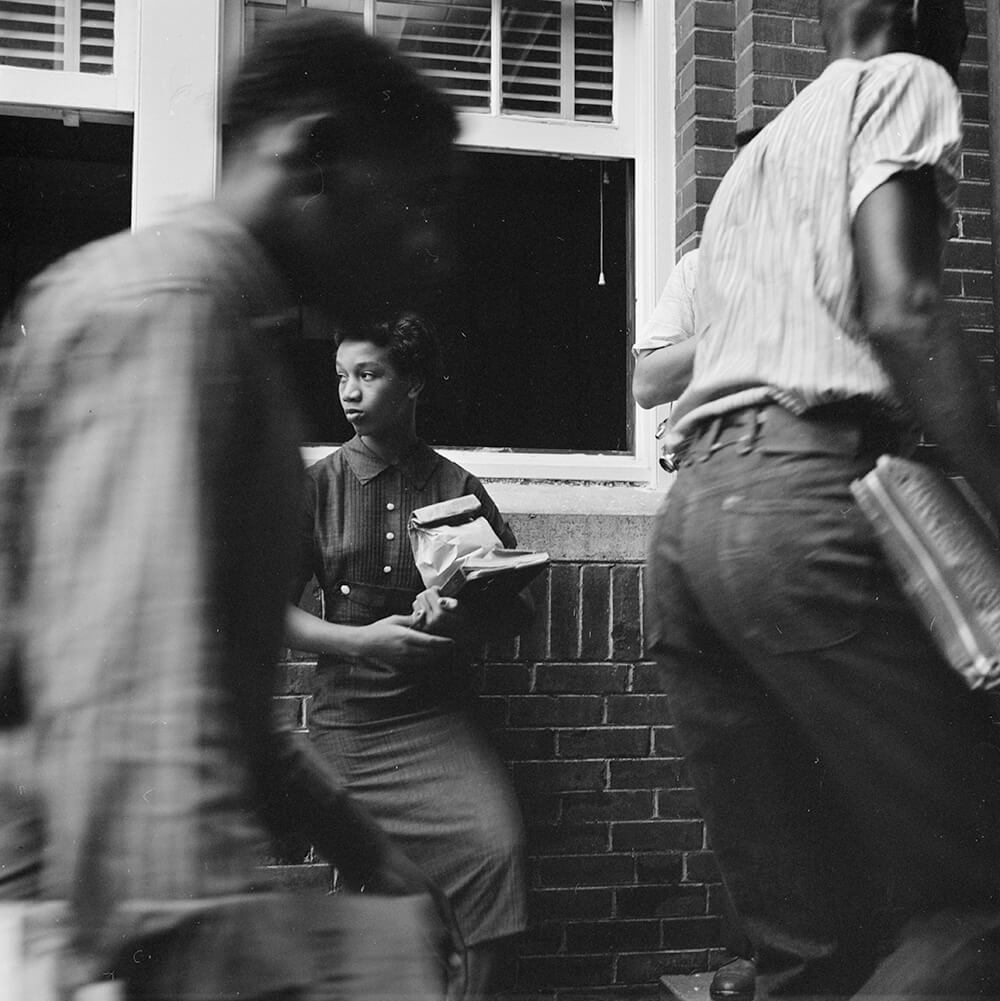
Johnston foresaw that his Alabama plan would lead to the same place Friedman envisioned—moving from a dual school system to a three-school system with "exclusively white schools, exclusively colored schools, and mixed schools." And Johnston was confident that, so long as white parents had access to vouchers for private schools and segregationist leaders established and implemented pupil placement, his plan would preserve segregation in some form for most white students in his state.91Johnston, "Schools, the Supreme Court, and the States' Power," 3–10.
Friedman's analysis not only echoed segregationist plans but helped to revive a new non-racial defense of segregation. Within four years of the publication of Friedman's essay, a large number of southern segregationists were advancing the theory of individual freedom as the leading rationale for vouchers and school choice. Perhaps the most prolific, active disciple of this libertarian approach was Virginia newspaperman Leon Dure, who converted Friedman's advocacies into a constitutional argument for freedom of association.
As tactics of massive resistance began to fail in Virginia, Dure urged state leaders in 1958 to adopt school vouchers and his principles of freedom of choice or freedom of association as the most effective means for limiting desegregation. The plan offered every child "of whatever color, of whatever means" a voucher (called a "scholarship"). Echoing Johnston and Friedman, Dure argued that "the South accepts the right of all people to associate, but it insists on the right of all people not to associate." On these terms, Dure wrote, "the southern white case is not compulsory segregation; it also is individual liberty," which he believed was protected in federal and state constitutions' guarantees of the right to assemble. Oliver Hill, the Virginia NAACP's leading attorney who had brought one of the original cases involved in Brown, told Dure that his proposal would do little more than mask racial discrimination.92James H. Hershman and the Dictionary of Virginia Biography, "Leon S. Dure (1907–1993)," Encyclopedia Virginia, last modified October 6, 2016, https://www.encyclopediavirginia.org/Dure_Leon_S_1907-1993; Leon Dure, "Virginia's New Freedom," The Georgia Review 18, no. 1 (Spring 1964): 4; Leon Dure, "The New Southern Response: Anatomy of Two New Freedoms," The Georgia Review 15, no. 4 (Winter 1961): 401–409, 412; James H. Hershman Jr., "Massive Resistance Meets Its Match: The Emergence of a Pro-Public School Majority," in The Moderates' Dilemma: Massive Resistance to School Desegregation in Virginia, eds. Matthew D. Lassiter and Andrew B. Lewis (Charlottesville: University Press of Virginia, 1998), 128. Dure seemed especially delighted that the US Supreme Court had recognized the "right of association" in a case where the Court prevented the Alabama attorney general's assault against the NAACP. See NAACP v. Alabama ex rel. Patterson, 357 U.S. 449 (1958). Dure was also influenced by the writings of Virgil Blum, a political scientist at Marquette University who advocated for school vouchers for private schools, including parochial schools, on a philosophy of free-markets and freedom of religion. See Carl, Freedom of Choice, 91–92.
When Virginia's Perrow Commission issued its report, reversing the openly defiant tone and recommendations of earlier governors and legislatures, it embraced tactics of local control and freedom of association. As one politician wrote to Dure, there was now complete "agreement that the Freedom of Choice plan is . . . not based on segregation or integration but that any child in Virginia may obtain a tuition grant"—an equal opportunity to all children to freely disassociate.93Hershman Jr., "Massive Resistance Meets Its Match," 127–130; C.F. Hicks to Leon Dure, June 22, 1961, Leon Dure Papers, University of Virginia, Charlottesville, Virginia.
Dure also helped to convince white leaders in Georgia to reverse their approach for preserving segregated schools. Dure's frequent correspondence with John Sibley and others helped Governor Vandiver's administration understand how embracing "freedom of association" held the best promise for justifying and preserving virtually segregated schools. The exact language of the new state constitutional amendment approved by the white voters of Georgia stated: "Freedom from compulsory association at all levels of public education shall be preserved inviolate." During the same period, Louisiana's white leaders also attempted to rescue their strategies to resist desegregation through a similar approach.94Hershman Jr., "Massive Resistance Meets Its Match," 127–128, including fn. 52; Carl, Freedom of Choice, 91–92. The Georgia amendment became Section VIII of Article VIII of the Georgia Constitution and remained in the constitution until removed twenty years later as a "vestige of the past," although many in the early 1980s had no notion of what the provision represented. See Committee to Revise Article VIII, "Transcripts of Meetings," 22 May 1980, State of Georgia Select Committee on Constitutional Revision, 1977–1981, vol. I, 9.
Just as Friedman adopted the term "mixed schools," the segregationists' favorite scare phrase for desegregated schools, die-hard segregationists adopted Friedman's language. In 1964, the Mississippi administrator of the Citizens' Council, William Simmons, abandoned his earlier primary defense of segregated schools as a matter of constitutional "state rights" and began condemning the monopoly of "government schools." In the Council's newsletter, echoing both Brady and Friedman, Simmons wrote that that public schools "can no longer be considered public—they have become government school systems." Afterwards, the White Citizens' Council focused primarily in Mississippi on developing a private school system of choice, as their leaders condemned government schools as "socialism in its purest form."95Michael W. Fuquay, "Civil Rights and the Private School Movement in Mississippi, 1964–1971," History of Education Quarterly 42, no. 2 (Summer 2002): 163–164, 178–179. Parroting Friedman, right wing radio and media personalities such as Neal Boortz and Sean Hannity have hammered for years at "government schools." Neal Boortz, "Government Idiocy in Action at Schools," Atlanta Journal-Constitution, December 8, 2009, https://www.ajc.com/news/opinion/neal-boortz-government-idiocy-action-schools/mQCmFIfvMZ36Nwc2t2YoDI/; "Sean Hannity Attacks Social Security and Public Schools as Ineffective Programs Exploiting People's Fears," Media Matters for America, January 3, 2019, https://www.mediamatters.org/video/2019/01/03/sean-hannity-attacks-social-security-and-public-schools-ineffective-programs-exploiting-peoples/222411.
Friedman never joined forces with segregationists, but he remained indifferent about how his libertarian economic arguments aided their strategies. Over several decades he continued to promote the concepts and framework that segregationists in the late 1950s and early 1960s believed were their best chance and best arguments. Long after southerners abandoned their segregationist rhetoric, Friedman's advocacy shaped how future scholars, advocates, and the general public would see vouchers and "freedom of choice" as acts of consumerism rather than segregationist tactics. "For whites moving into the new suburbs," writes historian James Hardman Jr., the term "carried the popular consumer phrase 'choice,' and gave the impression that simple economic choice, not morally questionable racial prejudice, was behind the segregation in their communities."96James Hardman Jr., "Virginia on the Cusp of Change," in Historians in Service of a Better South, eds. Robert J. Norrell and Andrew H. Myers (Montgomery, AL: NewSouth Books, 2017), 80. It was a redefinition of choice that most of the South's private schools, even those started as "segregation academies," came to embrace and propagate as they persisted and expanded in the decades that followed.
Challenging Tax Benefits of Segregated Private Schools
Civil rights organizations recognized during the 1960s the danger that governmental support posed in helping to build segregated systems of private schools even after the courts had dismantled voucher programs. These groups pushed the Internal Revenue Service (IRS) to deny tax-exempt applications of "segregation academies." This federal tax status enabled whites to reduce their taxable income when contributing to racially exclusionary private schools. But, in 1967, the IRS announced that it would grant tax deductions for contributions to any southern private school, even self-avowed segregation academies, because "the school is private and does not have such degree of involvement with the political subdivision as has been determined by the courts to constitute State action for constitutional purposes."97Green v. Kennedy, 309 F. Supp. 1127 (1970) at 1130.
The Lawyers Committee for Civil Rights Under Law sued the IRS in 1969 and obtained a court order requiring it to "affirmatively determine" that a private school in Mississippi is not "operated on a racially segregated basis as an alternative to white students seeking to avoid desegregated public schools." The three-judge federal court found that the "tax benefits under the Internal Revenue Code mean a substantial and significant support by the Government to the segregated private school pattern."98Green, 309 F. Supp. 1127 (1970) aff'd sub nom, Cannon v. Green, 398 U.S. 956 (1970); Eileen Shanahan, "Schools in South May Avoid Taxes," New York Times, August 3, 1967; Eileen Shanahan, "Private Schools That Bar Blacks to Lose Tax Aid," New York Times, July 11, 1970. After its ruling was affirmed without opinion by the US Supreme Court, the court issued a permanent injunction restricting the IRS from granting a tax exemption to any and all Mississippi private schools that applied for the tax benefit.99Green v. Connally, 330 F. Supp. 1150 (1971), aff'd sub nom, Coit v. Green, 404 U.S. 997 (1971).
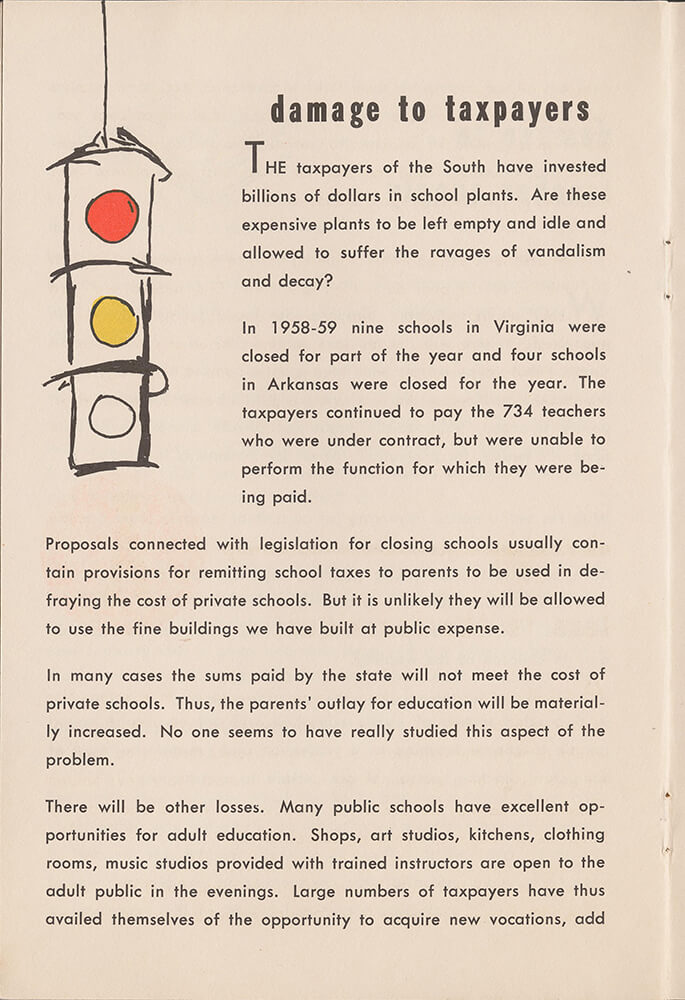
Afterwards, the IRS revoked the tax exemptions of more than one hundred private schools and scrutinized applications for tax exemption from others; however, it took eight years before the agency proposed specific administrative regulations to implement the non-discrimination policy adopted in 1970. During this time, the IRS faced a backlash from private schools and their supporters, including southern members of Congress, and, in this political environment, went back and forth with proposed administrative procedures and congressional hearings. When the Nixon administration issued final guidelines, the Lawyers Committee, the US Civil Rights Commission, and others criticized the IRS's rules, procedures, and enforcement as inadequate.100"Proposed Rules on Tax Exemptions for Private Schools Eased by IRS," New York Times, February 10, 1979; IRS Tax Exemptions and Segregated Private Schools: Hearing Before the Subcommittee on Civil and Constitutional Rights of the Committee on the Judiciary, House of Representatives, 97th Cong., 2d Sess. 39 (1982); also see Tax-Exempt Status of Private Schools: Hearing Before the Subcommittee on Oversight of the Committee on Ways and Means, House of Representatives, 99th Cong., 2d Sess. 39 (1985).
Despite the regulation's shortcomings, a significant number of religious private schools in the South objected to the new IRS rules on the grounds of religious freedom, claiming that the government could not oversee their operations under any circumstances, even if they engaged in practices of segregation and racial discrimination. In 1983, the US Supreme Court disagreed and upheld the application of the IRS rules on religious schools in a case involving Bob Jones University in South Carolina. Chief Justice Warren Burger wrote that "the Government has a fundamental, overriding interest in eradicating racial discrimination in education—discrimination that prevailed, with official approval, for the first 165 years of this Nation's constitutional history. That governmental interest substantially outweighs whatever burden denial of tax benefits places on petitioners' exercise of their religious beliefs."101Julia Malone, "Those Tax Breaks for Segregated Schools Stir Storm," Christian Science Monitor, January 14, 1982; Bob Jones University v. United States, 461 U.S. 574 (1983); Strat Douthat, "Some All-White Academies Struggle," Richmond Times-Dispatch, March 18, 1986.
After Bob Jones, the IRS required tax-exempt private schools to demonstrate non-discriminatory policies and operations. But the requirements proved minimal—involving little more than adoption of a policy statement by the school's founders or board, publication of the policy (in brochures and catalogues), and some way of demonstrating that the school had abandoned total, absolute segregation.102Terry Berkovsky, Andrew Megosh, Debra Cowen, and David Daume, "Private School Update," 2000 EO CPE Text, Internal Revenue Service, 2000, www.irs.gov/pub/irs-tege/eotopicn00.pdf. The IRS rules suggest that a school must evidence that "it currently enrolls a meaningful number of racial minority students, or that its promotional activities and recruiting efforts are reasonably designed to inform students of all racial segments in the general communities within the area of the availability of the school." But, as a matter of practice, citing language in the Bob Jones case that denial of tax exemptions should be made "only where there is no doubt that the organization's activities violate fundamental public policy," the IRS and the US Tax Court has denied tax status only when a school maintains total segregation. See Calhoun Academy v. Commissioner, 94 T.C. 284 (1990).
Private schools in the South began to publish non-discrimination statements and many began a slow process of admitting a token number of Black or other students of color. It was a replay of the most effective tactics that segregationists had deployed in the public schools several years earlier. This change did little more than end all-white segregation in order to sustain virtual segregation. The practices satisfied the IRS requirement and allowed subsequent federal administrations to claim that private schools had shown "clear and specific factual evidence" of non-discrimination.
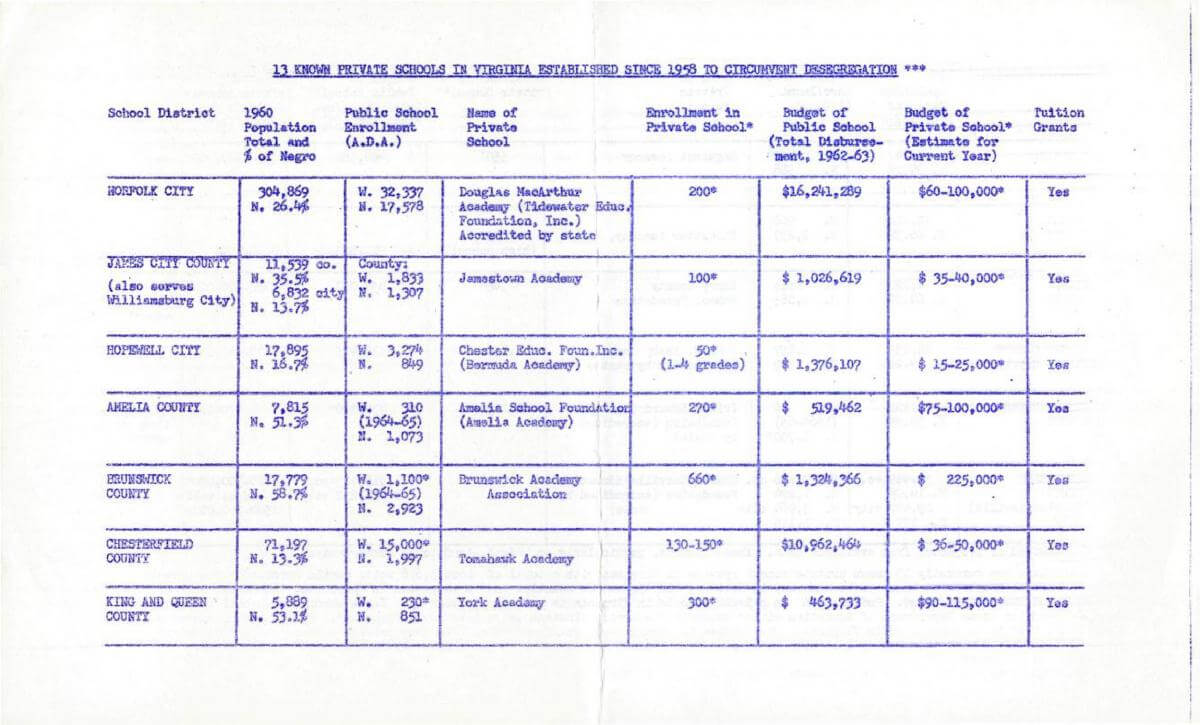
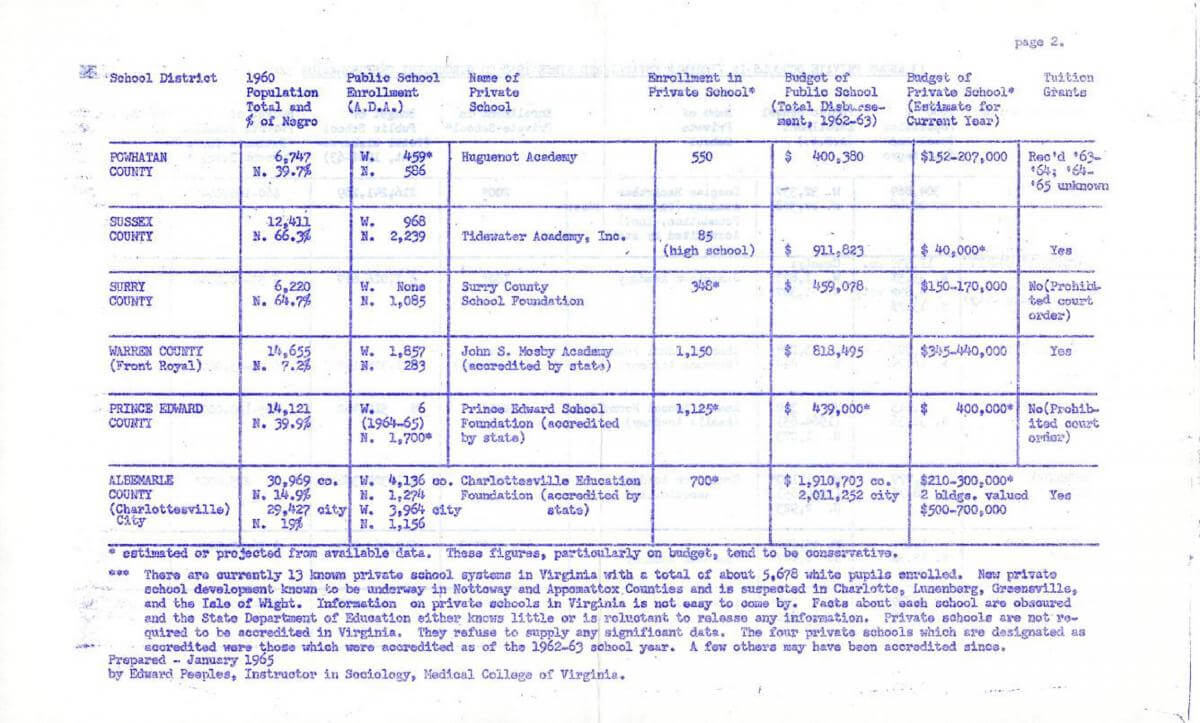
The private school movement grew rapidly. After the 1969 Supreme Court ruling that "every school district is to terminate dual school systems at once" in Mississippi,103"Private Schools on Rise in the South," New York Amsterdam News, November 8, 1969; Kitty Terjen, "The Segregation Academy Movement," in The South and Her Children: School Desegregation, 1970–1971, ed. Robert E. Anderson Jr. (Atlanta, GA: Southern Regional Council, 1971), 69–71; "Civil Rights: Segregation: Federal Income Tax Exemptions and Deductions: The Validity of Tax Benefits to Private Segregated Schools," Michigan Law Review 68, no. 7 (June 1970): 1410–1414; Alexander v. Holmes County Board of Education, 396 U.S. 19 (1969). white parents responded. From 1965 to 1980, private school enrollment increased by more than 200,000 students across the South—with about two-thirds of that growth occurring in the states that had created voucher programs.104Steve Suitts, Race and Ethnicity in a New Era of Public Funding of Private Schools: Private School Enrollment in the South and the Nation (Atlanta, GA: Southern Education Foundation, 2015), 7–8.
There were no government surveys reporting race or ethnicity for private school enrollment at the start of the 1980s, but the Southern Regional Council, which monitored the movement after Brown, estimated that virtually segregated private schools in the eleven states of the former Confederacy enrolled between 675,000 and 750,000 white students. When computed with overall enrollment data for those states, these estimates suggest that somewhere between 65 and 75 percent of the private school's white students were virtually segregated by the early 1980s.105Hearings on IRS Tax Exemptions and Segregated Private Schools, Before the Subcommittee on Civil and Constitutional Rights of the Committee of the Judiciary, 97th Cong. (1982), 69; Digest of Education Statistics, 1981 (Washington, DC: National Center for Education Statistics, 1981).
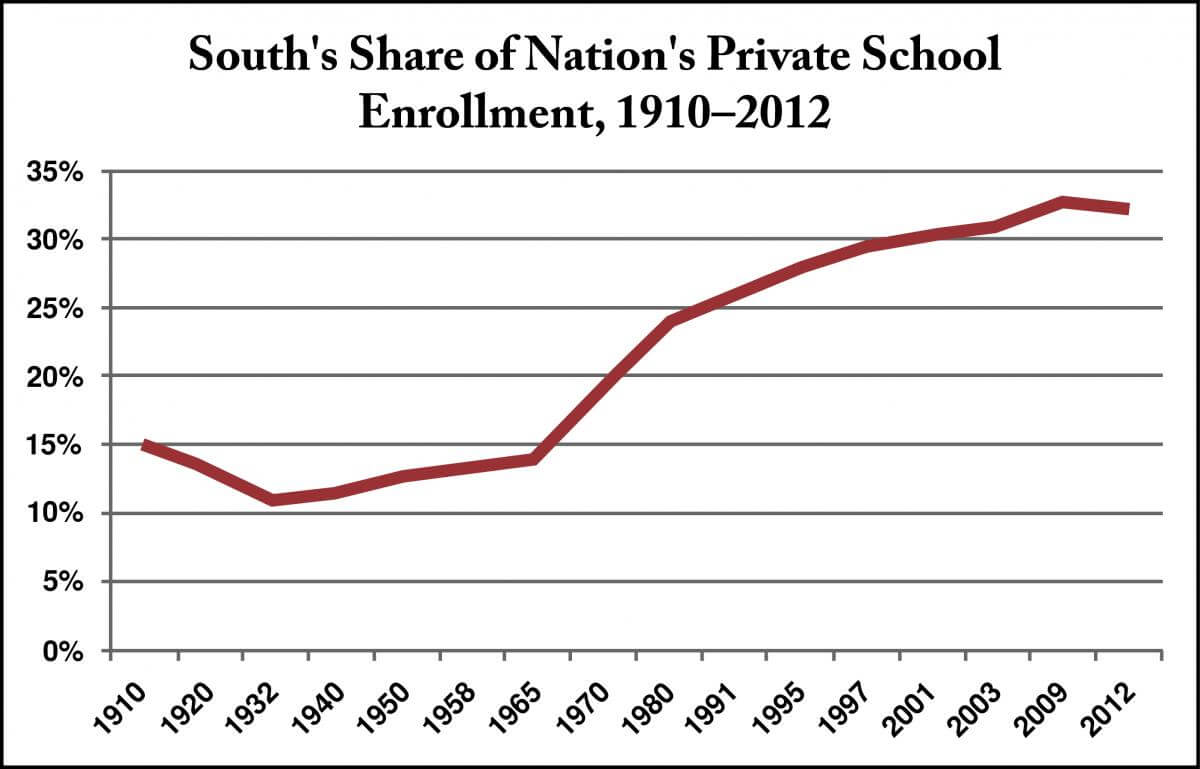
Overall, the southern states' white flight from public schools in the wake of desegregation from 1940 through 1980 helped to quadruple the number of students attending segregated private schools. As Jason Morgan Ward aptly observed, "[T]he end of the Jim Crow era rendered segregation, like white supremacy before it, a doomed battle cry. But it was not a dead proposition."106Jason Morgan Ward, Defending White Democracy: The Making of a Segregationist Movement and the Remaking of Racial Politics, 1936–1965 (Chapel Hill: University of North Carolina Press, 2011), 183.
The "Post-Racialist" Standards Movement
Most of the South's private schools that started during massive resistance survived without vouchers—but with federal tax exemptions. Many increased their enrollments and resources as they embraced the old-line segregationists' non-racial language and reasoning. This transformation of stated purpose from preserving segregation to meeting children's needs for a quality education through choice involved an initial phase when headmasters and other promoters of private schools struggled to abandon their original meaning and adopt a new, non-racial script about motives and purposes.
Dr. T. E. Wannamaker, for example, founder of the South Carolina Independent School Association, explained in 1966 the reasons for his organization and schools: "We're here because we have convictions and we're going to stay. It's not token integration we're concerned about, but the effects mass integration will have on our schools in the future." Earlier, Wannamaker had described himself as "an old-time conservative. I believe it's heredity first and environment second. Many (Negroes) are little more than field hands." In 1970, he became the first leader of the Southern Independent School Association.107Terjen, "The Segregation Academy Movement," 76; Margaret Rose Gladney, "I'll Take My Stand: The Southern Segregation Academy Movement" (PhD diss., University of New Mexico, 1974), 80. An Alabama private school advocate told a journalist in 1969, "We really didn't do it on account of segregation. We done it for a better education."108Kitty Griffith, "New 'Segregation Academies' Flourish in the South," South Today, October 1969, 1.
By the 1970s, as many public schools in the South were being desegregated for the first time, promoters of private schools were developing a more consistent line of reasoning: the schools may have begun over the "racial question," but were now operating to provide "quality education." "I've been fighting to take the race question out of the Independent Schools," a member of the Louisiana Private School Association said in 1973. "I've run a segregated school for 33 years. . . . I want nice people in my school. We're trying to sell quality education."109Gladney, "I'll Take My Stand," 80.
The headmaster of Prince Edward Academy (which five years earlier had been denied the continued benefit of vouchers and tax credits due to racial discrimination) told a researcher: "This school came into being because we love our children and want the best education in a controlled environment." A leader of Louisiana's private schools expanded this new language of transition: "I think people would be able to accept integration if it did not mean lowering of academic and moral standards. But they know it means it; therefore, they resort to private schools." And the head of the Alabama Independent School Association told researcher Rose Gladney in 1972: "Our primary interest is educating people basically of like learning capacities. We adopt a school system to meet their needs. . . . The real historical importance of the movement is not one of segregation or integration. It's academically important."
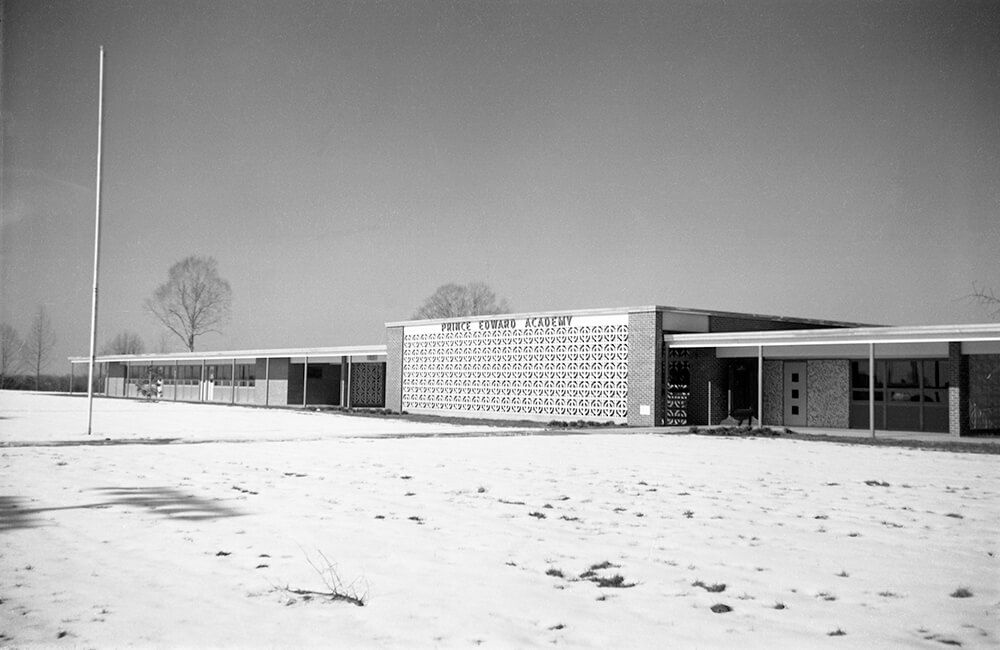
It was left to a student in one of the private schools that Gladney visited to be explicit about the white supremacist message he heard from administrators, promoters, and perhaps family: "Niggers are dumb; can't learn. And when you have a majority of low standard in a school, they will pull all the rest down. It is not really a race issue, just a matter of lowering standards."110Gladney, 99–126.
Many private schools operated by churches also began to justify their existence through the imperative of religious education. "Religion is an integral part of the Independent School movement," said the director of the Louisiana Independent School Association. "We're developing a pseudo-parochial system where there's a fixed religion we feel we want."111Gladney, 134–136. These often became Christian schools that turned "in every particular around Bible teachings and interpretations."112David Nevin and Robert E. Bills, The Schools that Fear Built: Segregationist Academies in the South (Washington, DC: Acropolis Books, 1976), 61.
Whatever the non-racial rationale—economic freedom, better education, religious instruction—the vast majority of the South's private schools were established when it became clear locally that federal law would require some form of desegregation. By the start of the 1980s, the character of most of these private schools was set. "These are schools for whites," wrote the authors of The Schools that Fear Built in 1976. "The common thread that runs through them all, Christian, secular, or otherwise, is that they provide white ground to which Blacks are admitted only on the school's terms if at all."113Nevin and Bills, 11.
For God and Private Schools
Following the 1980 election of Ronald Reagan, private schools throughout the nation received federal support and endorsement as never before. The Reagan administration justified proposed federal assistance to private schools as a means for advancing high quality education along with diversity and pluralism. The administration waffled on whether to support Bob Jones University's claim that religion gave it the right to discriminate on the basis of race even while receiving tax exemption. "I was under the impression," Reagan said, "that the problem of segregated schools had been settled, that we have desegregation."114Catherine A. Lugg, "For God and Country: Conservative Ideology and Federal School Policy during the First Term of President Ronald Reagan" (PhD diss., Pennsylvania State University, 1995), 105–111, 121.
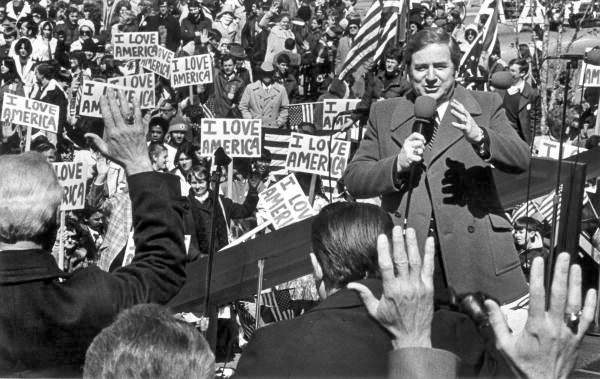
In 1981, Reagan's secretary of education testified in support of tax credit vouchers for private schools as "an expansion of educational opportunities for all Americans." In 1983, Reagan became the first president to send Congress legislation for federal tax credits to finance private schools. The proposed "Educational Opportunity and Equity Act," the administration argued, would benefit a wide range of students, including low-income children of color, and more broadly would "promote diversity in education and the freedom of individuals to take advantage of it, and to nurture the pluralism in American society which this diversity fosters." School segregation was a thing of the past, said Reagan, and private schools were the engines of diversity.115Lugg, "For God and Country," 132; Julia Malone, "Drive Begins for Tuition Tax Credit: Reagan Education Secretary Argues for Private School Help," Christian Science Monitor, June 8, 1981; Julia Malone, "Bid to Allow Tax Credits for Private-School Tuition Awaits Next Session of Congress," Christian Science Monitor, November 16, 1983; David E. Rosenbaum, "Tuition Credit Seen in Reagan Plan," New York Times, May 27, 1985.
Reagan linked his tax credit bill with an imperative to return religion to schools. "I don't think God should ever have been expelled from the classroom," he declared at a news conference in which he defended his support of private schools, including religious schools. The president's remarks echoed a long line of southern segregationists who had justified the growth of private schools on religious grounds, especially after 1961 when the US Supreme Court outlawed a New York statute that required public school students to recite an official Christian prayer.116Lugg, 126–127; Engel v. Vitale, 370 U.S. 421 (1962).
White churches started private academies in the wake of court-ordered desegregation, with religion and segregation often intermingling in the schools' stated purpose. In Prince Edward County, Virginia, many white clergy supported closing the public schools, their churches provided white-only space, and their curricula were built around church teachings. "Our people—supporters of the Independent schools—are convinced God is behind us," asserted the head of the Louisiana segregated private schools in the early 1970s. "If you don't include that aspect, you're missing a good part of the motivation behind this movement. People believe wholeheartedly that God doesn't want us to mix."117Gladney, "I'll Take My Stand," 134.
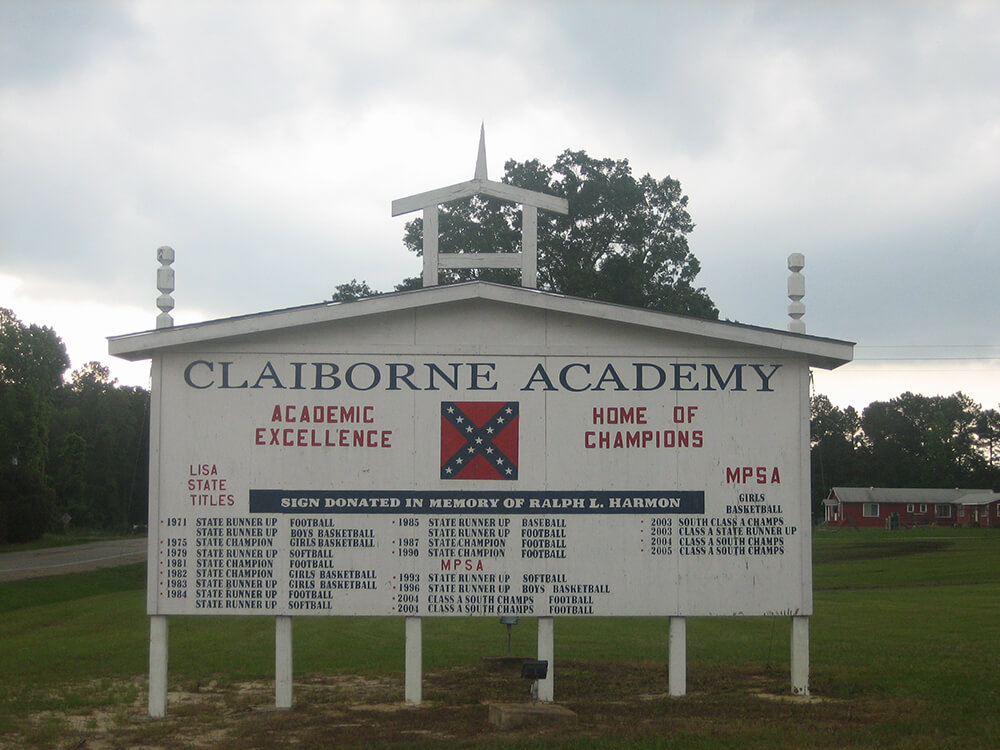
Looking across the South in 1974, Rose Gladney, a young scholar whose family had been actively involved in setting up a segregation academy in Homer, Louisiana, saw how most adults involved in private schools had merged racial segregation, quality education, and religion into one rationale. "The teachings of the academies," Gladney sadly observed, "hope to ensure that there will be people who think there is a need because they will have been taught, for at least another generation, that love of God, love of their white skins, and love of quality education cannot be separated."118Goodman, Sanctuaries for Tradition, 9–12; Gladney, 137.
President Reagan transformed a "love of white skin" into a color-blind doctrinal belief that individual freedom of choice in schooling created diversity and opportunity for all in an era without segregation. Reagan became the nation's primary voice for why and how government should support private schools, and, as a former actor and California governor, his own past and national leadership obscured the original role and rationales of southern white supremacists from public memory.
In 1984, in re-nominating Reagan, the Republican Party's education platform included support for the right to pray in public schools, opposition to busing for desegregation, passage of tuition tax credits for private schools, and redirecting billions of federal funds dedicated to assist low-income students in public schools into vouchers for private schools. It was the first time a national political party endorsed school vouchers. In his State of the Union address fourteen months later, President Reagan declared: "We must continue the advance by supporting discipline in our schools, vouchers that give parents freedom of choice; and we must give back to our children their lost right to acknowledge God in their classrooms."119Lugg, "For God and Country," 212–213; "Republican Party Platform of 1984," The American Presidency Project, accessed March 8, 2019, https://www.presidency.ucsb.edu/documents/republican-party-platform-1984; Ronald Reagan, the annual State of the Union address (speech, Washington, DC, February 4, 1986), The American Presidency Project, www.presidency.ucsb.edu/documents/address-before-joint-session-congress-the-state-the-union. The first time a national political party's platform endorsed tax credits for private schools was in 1972 at the Republican National Convention. It was the first time a US president expressly advocated for school vouchers before a joint session of Congress. Without attribution, the views and tools of southern segregationists had become the official position of the national Republican Party and the Reagan presidency.
No to "Racial-Mixing," Yes to Vouchers
At the end of the Reagan administration, almost thirty-five years after Brown, enrollment in the South's private schools continued to grow in absence of any significant new government financial support.120The next federal legislation providing new tax benefits to private schools was the Coverdell Education Account created in 1997 during the Clinton administration. It permits annual contributions up to $500 to earn tax-free funds to cover expenses in college or in elementary and secondary private schools. The accounts have restrictions on income and uses for K-12 private school tuition. Ironically, First Lady Hillary Clinton's first job out of law school involved investigating discriminatory practices of southern private schools. See Amy Chozick, "How Hillary Clinton Went Undercover to Examine Race in Education," New York Times, December 27, 2015, www.nytimes.com/2015/12/28/us/politics/how-hillary-clinton-went-undercover-to-examine-race-in-education.html. Some schools created in defiance of desegregation struggled and failed, but most survived by embracing other stated purposes for their existence and by maintaining their tax-exempt status—a benefit that required most to enroll just enough children of color to avoid total segregation while preserving a culture of "schools for whites."121See, for example, John Egerton, "Hammond Academy: A Rebel Yell, Fading," in Shades of Gray: Dispatches from the Modern South (Baton Rouge: Louisiana State University Press, 1991), 237–248.
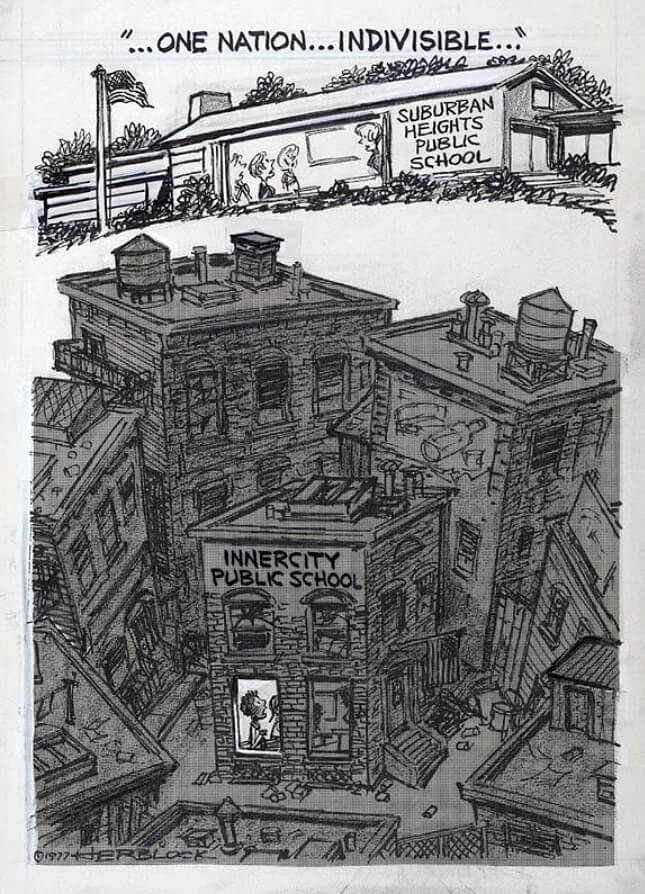
Since the 1960s, white flight from urban public systems such as Atlanta's had maintained and extended segregated patterns in private tax-exempt schools and in suburban public schools. On both sides of the Mason–Dixon line, many white middle-class parents had escaped the mandates of school desegregation by moving into suburban neighborhoods where residential patterns of racial isolation and economics provided virtually segregated public schools. This suburban constituency helped to sustain Nixon and Reagan policies in blocking inter-district desegregation plans.122See Lassiter, The Silent Majority, 295–324.
Earlier segregationists had foreseen the importance of district lines. In 1955, Forney Johnston, one of the architects of the Alabama three-school "freedom of choice" plan, identified "ordinary and customary geographical districting" as a primary tool for defeating Brown. His strategies cast a very long shadow. Examining school data from 1988 to 1990, a national study concluded "that white families are fleeing public schools with large concentrations of poor minority schoolchildren. In addition, the clearest flight appears to be away from poor black schoolchildren."123Robert W. Fairlie and Alexandra M. Resch, "Is There 'White Flight' into Private Schools? Evidence from the National Educational Longitudinal Survey," Review of Economics and Statistics 84 (2002): 21–33.
The patterns persisted. Based on data from 1998, scholars Sean Reardon and Jon Yun found that the "South ha[d] the greatest segregation between the public and private sector of any region—white and Asian private school enrollment rates are more than three times greater than Black rates in the South, and more than double Latino rates."124Sean F. Reardon and John T. Yun, Private School Racial Enrollments and Segregation (Cambridge, MA: The Civil Rights Project, Harvard University, 2002), 22, https://civilrightsproject.ucla.edu/research/k-12-education/integration-and-diversity/private-school-racial-enrollments-and-segregation/Private_Schools.pdf. They also concluded that "the strongest predictor of white private enrollment is the proportion of Black students in the area."125Reardon and Yun, Private School Racial Enrollments and Segregation, 22.
Drawing upon the 2000 Census, Duke University scholar Charles Clotfelter found that private schools were continuing to foster racial separation and isolation in K–12 education in the South, especially in non-metropolitan areas: "Combined with the general stability or growth of private enrollments in the South since 1970, these findings suggest that private schools were playing much the same role in non-metropolitan counties of the South in 1999–2000 as they were shortly after desegregation."126Charles T. Clotfelter, "Private Schools, Segregation, and the Southern States," Peabody Journal of Education 79, no. 2 (2004): 74–97.
During this time, Milwaukee and Cleveland became limited, urban experiments in voucher programs in northern states, as some white liberals suggested that vouchers might offer a way to break up what they came to believe were intractable problems faced by low-income public schoolchildren. It was also the era when state governments began establishing programs to finance attendance in private schools, especially through tax credit vouchers. This new initiative reached into every part of the nation, but mostly the South, including all of the states where segregationists had established vouchers.127Harry Brighthouse, "Egalitarian Liberals and School Choice," Politics & Society 24, no. 4 (1996): 457–486; James S. Coleman, "Some Points on Choice in Education," Sociology of Education 65, no. 4 (1992): 260–262. For a clear, deep understanding of this recent emergence of tax credits to finance enrollment at private schools, see Kevin G. Welner, NeoVouchers: The Emergence of Tuition Tax Credits for Private Schooling (Lanham, MD: Rowman & Littlefield, 2008).
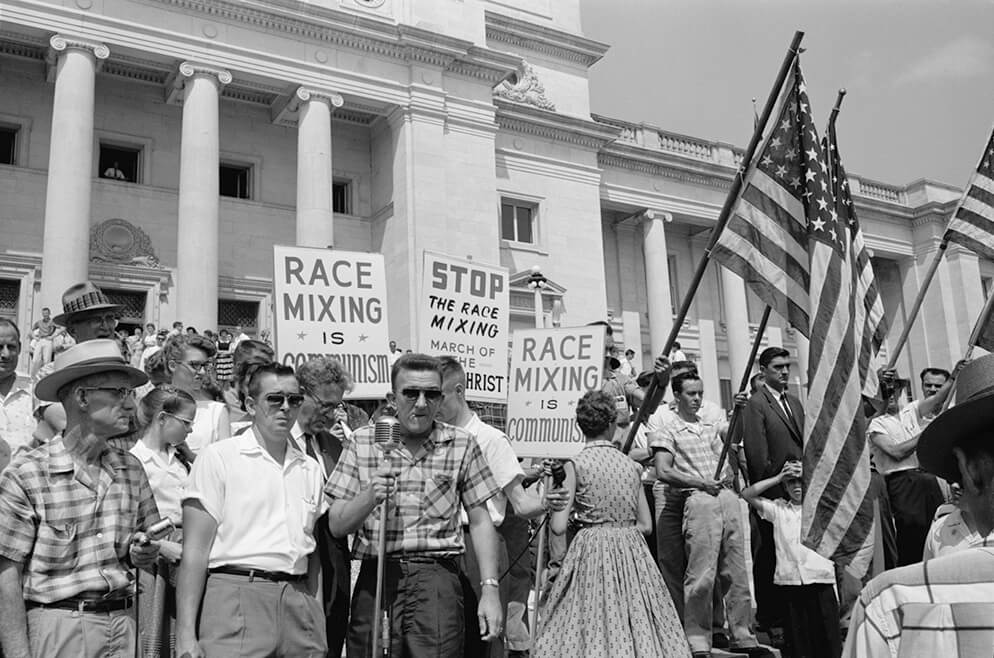
The US Supreme Court began to bless these developments. As early as 1973, Justice William Rehnquist became the first member of the Court to issue a dissent from a school desegregation case relying on the precedent of Brown. In a case concerning school segregation in Denver, he condemned the Court's opinion for requiring a school district to advance desegregation—employing the old scare word, "racial mixing"—where there were "neutrally drawn boundary lines" that sustained segregation.128Keyes v. School Dist. No. 1, Denver, 413 US 189 (1973), 258; Justin Driver, The Schoolhouse Gate: Public Education, the Supreme Court, and the Battle for the American Mind (New York: Pantheon, 2018), 278–283. As Driver notes, Justice Rehnquist as a Supreme Court law clerk had argued while Brown was being considered that the Court should not overrule Plessy v. Ferguson, 163 U.S. 537 (1896), which had sanctioned state-sponsored segregation. Barely a year after the Bob Jones decision held that religious private schools could not hold a tax exemption and discriminate on the basis of race, the Supreme Court slammed shut the courthouse door on those seeking to challenge the IRS's weak enforcement. Parents of twenty-five Black public school children sued the IRS, charging that its standards and procedures were inadequate to fulfill its obligation to deny tax-exempt status to racially discriminatory private schools. In 1984, the US Supreme Court held that the parents had no standing to bring such a suit.129Allen v. Wright, 468 US 737 (1984).
With the appointment of other justices across more than three decades, the Court increasingly refused to require school districts to use any method of desegregation that proved effective in dismantling the dynamics of separation. By 2007, the Court had turned Brown on its head as a precedent for backing public school districts' voluntary efforts to desegregate. Chief Justice John Roberts wrote that Brown commanded school districts to avoid using race as a consideration, even for the purpose of recognizing and diminishing public school segregation. "When it comes to using race to assign children to schools," Roberts wrote without doubt or irony, "history will be heard."130Parents Involved in Community Schools v. Seattle School Dist. No. 1, 551 US 701 (2007), 2744; Driver, The Schoolhouse Gate, 293–308.
As the Court stymied effective strategies for desegregating public schools, Justice Anthony Kennedy led it in unleashing private schools from constitutional restraints for receiving taxpayer funds. Arizona's program of tax credit vouchers allowed individuals and corporations to give tax dollars to private schools instead of paying them to the state—a scheme similar to those the Court had outlawed in prior cases, including in Prince Edward County, Virginia, in the 1960s. Kennedy, in a majority opinion, held that tax credit vouchers did not involve public funds or any state action that the Bill of Rights would prohibit. "While the State, at the outset, affords the opportunity to create and contribute," Kennedy wrote, "the tax credit system is implemented by private action and with no state intervention."131Arizona Christian School Tuition Organization v. Winn, 131 U.S. 1436 (2011) at 1448. Justice Kennedy's opinion considered whether the First Amendment's clause requiring separation of church and state, by way of application to the states through the 14th Amendment, prohibited providing state tax credit vouchers to religious schools.
With few federal restraints, legislatures have expanded these programs or established new forms of vouchers, such as educational savings accounts that deposit state and local per-pupil expenditures into a personal account for a child's parents to use toward private schooling or to supplement home-schooling.
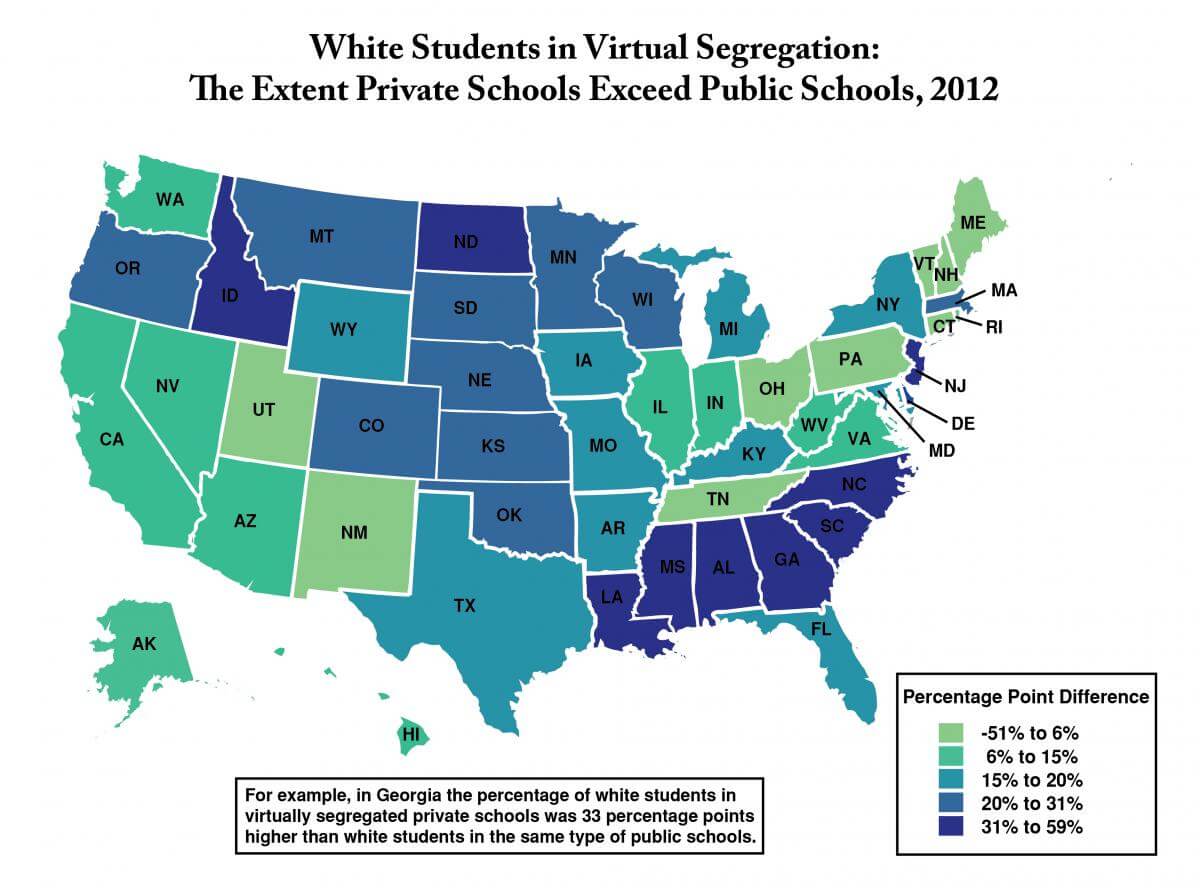
Patterns of virtual segregation have stayed remarkably high in private schools. As recently as 2012, 43 percent of the nation's private school students attended virtually all-white schools—schools where white students comprise 90 percent or more of the enrollment. That year, half of the fifty states had a majority of private school students attending virtually segregated schools.132Suitts, Race and Ethnicity in a New Era of Public Funding of Private Schools, 36–39.
Despite white flight, virtual segregation for white students was far more substantial in private schools than in public schools, especially in the South. In 2012, 63 percent of white students in South Carolina's private schools were virtually segregated compared with only 5 percent of white students in South Carolina's public schools. Private schools were almost twelve times more likely to enroll white students in virtually segregated schools in 2012 than were the state's public schools.
In Mississippi, white students attending private schools were almost four times more likely to be in virtually segregated schools than public school students. More than seven out of ten white students in Mississippi's private schools attended schools where 90 percent or more of the enrollment was white. In the state's public schools, the rate was 15 percent. In Louisiana, 52 percent of the white students in private schools were virtually segregated in 2012, but only 14 percent for white public school students.
This new era of vouchers emerged as public schools across the nation experienced a substantial increase in the numbers of low-income students and students of color. Completing a trend that began in the 1980s, low-income students (those eligible for free or reduced lunch) became a majority of the South's public schoolchildren in 2006; in 2009, the South's public schools also had a majority of students of color. By 2013, more than 50 percent of the nation's public schoolchildren were from low-income families and almost half were children of color.133Steve Suitts, A New Majority: Low Income Students in the South's Public Schools (Atlanta, GA: Southern Education Foundation, 2007), https://www.southerneducation.org/wp-content/uploads/2019/02/A-New-Majority-Report-Final.pdf; Steve Suitts, A New Diverse Majority: Students of Color in the South's Public Schools (Atlanta, GA: Southern Education Foundation, 2010), https://www.southerneducation.org/wp-content/uploads/2019/02/A-New-Diverse-Majority-2010.pdf; Steve Suitts, A New Majority: Low Income Students Now a Majority in the Nation's Public Schools (Atlanta, GA: Southern Education Foundation, 2015), https://www.southerneducation.org/wp-content/uploads/2019/02/New-Majority-Update-Bulletin.pdf; Shaila Dewan, "Southern Schools Mark Two Majorities," New York Times, January 6, 2010, https://www.nytimes.com/2010/01/07/us/07south.html; Lyndsey Layton, "Majority of US Public School Students Are in Poverty," Washington Post, January 16, 2015, https://www.washingtonpost.com/local/education/majority-of-us-public-school-students-are-in-poverty/2015/01/15/df7171d0-9ce9-11e4-a7ee-526210d665b4_story.html.
Changing patterns, most evident in the nation's cities, spread to the suburbs. In 2011, 40 percent of public schoolchildren in the nation's suburban districts were low-income; the rates were 45 percent or higher in suburbs in the West and the South. During the 2000s, the number of suburban poor exceeded the number in the nation's cities for the first time. Similarly, with a huge increase in Hispanic children, suburban school districts began educating a student population in which students of color comprised more than 40 percent. At the same time, African Americans moved into suburban counties surrounding central cities (such as Atlanta) in record numbers.134Suitts, A New Majority: Low Income Students in the South and Nation (Atlanta, GA: Southern Education Foundation, 2013), 5–6, 15, https://www.southerneducation.org/wp-content/uploads/2019/02/New-Majority-2013.pdf; Elizabeth Kneebone, "The Changing Geography of US Poverty," The Brookings Institution, February 15, 2017, https://www.brookings.edu/testimonies/the-changing-geography-of-us-poverty/; Richard Fry, "Sharp Growth in Suburban Minority Enrollment Yields Modest Gains in School Diversity" (Washington, DC: Pew Research Center, March 31, 2009), http://www.pewhispanic.org/2009/03/31/sharp-growth-in-suburban-minority-enrollmentbryields-modest-gains-in-school-diversity/; Karen Pooley, "Segregation's New Geography: The Atlanta Metro Region, Race, and the Declining Prospects for Upward Mobility," Southern Spaces, April 15, 2015, https://southernspaces.ecdsdev.org/2015/segregations-new-geography-atlanta-metro-region-race-and-declining-prospects-upward-mobility.
This new diversity in suburban school-age populations did not result in major increases in integrated schools. Instead, old habits resurfaced that involved shifting residential segregation, white flight into exurbs, localities attempting to secede from majority-Black public school districts, and the states' rebirth of vouchers for private schools. Legislatures failed to increase public school funding to meet the huge challenges of educating a majority of schoolchildren who are low-income and non-white, especially in the South and West where most voucher programs have emerged.135Don Boyd and Lucy Dadayan, "State and Local Governments Reshape Their Finances," The Book of the States 2016 (Lexington, KY: The Council of State Governments, 2016), http://knowledgecenter.csg.org/kc/system/files/Boyd%20Dadayan%202016.pdf; Nikole Hannah-Jones, "The Resegregation of Jefferson County," New York Times, September 6, 2017, https://www.nytimes.com/2017/09/06/magazine/the-resegregation-of-jefferson-county.html; Suitts, A New Majority: Low Income Students in the South and Nation, 8–13.
New Token Students of Choice
Overall trends have obscured a small, inclusive change in the color line for admission to private schools amid a more pronounced, underlying pattern of racial exclusion. Frequently, white private schools have chosen Asian or Pacific Island children to break their completely segregated enrollment in order to reach a token level of diversity for an IRS tax exemption. These students have family ancestries from countries including China, Vietnam, Korea, Japan, India, the Philippines, and various islands of the Pacific. In 2012, Asian American students comprised 5.8 percent of the nation's private school enrollment—a number slightly above the percentage of the Asian school-age population. Only white students and students with Asian ancestries were in private schools in numbers that exceeded or generally matched their representation in the school-age population. In forty-two states, the percentage of Asian students in private schools exceeded the state's percentage of school-age Asian children.136Suitts, Race and Ethnicity in a New Era of Public Funding of Private Schools, 17, 27–29. Reardon and Yun also found that Asian students were over-represented in private schools in 1998. One other group of school-age children nationally matched their representation in private schools in 2012: students who self-identified as "of two or more races."
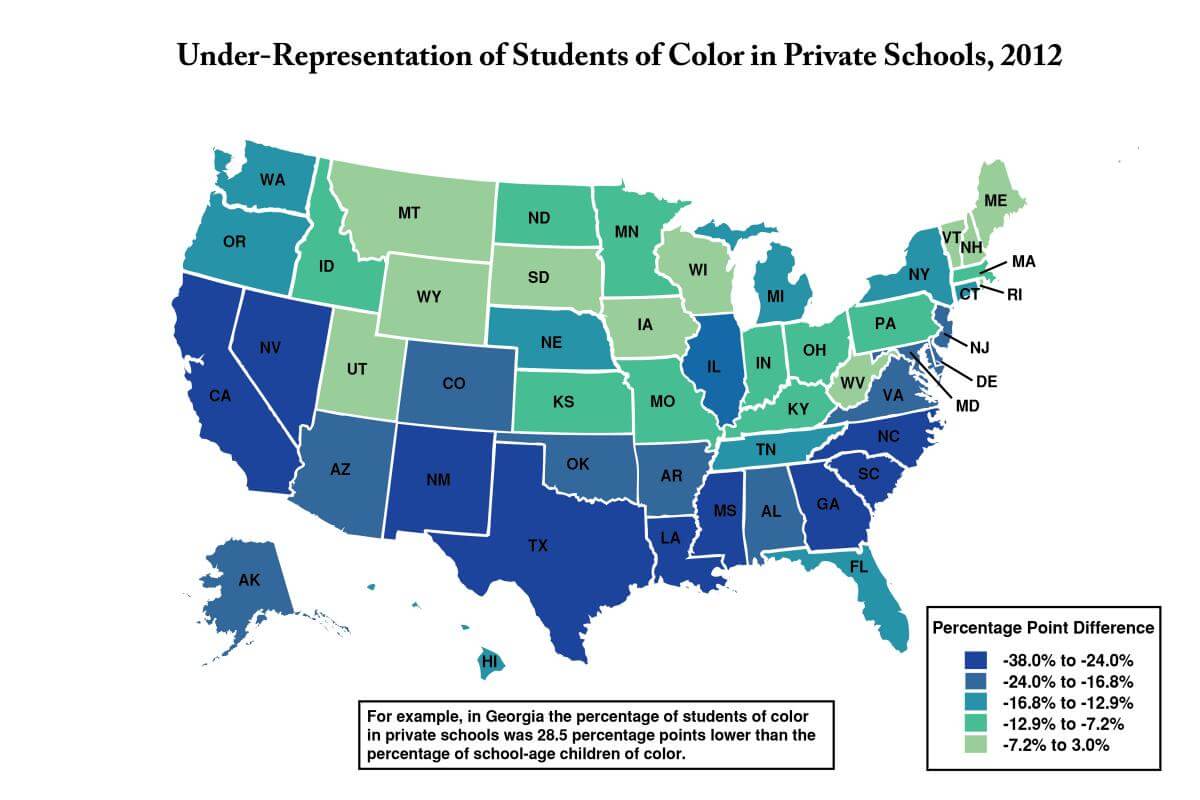
This development stands in sharp contrast to the history of discrimination that Asians have experienced, especially in California and the South, and makes Asian students stand out among students of color attending private schools. The explanation for this shift seems grounded in at least three factors: since the late 1980s, Asian households have had the nation's highest median income (more than $11,500 above non-Hispanic white household income in 2012); since at least the 1990s, Asian students have had the nation's highest scores on standardized tests; and more than three generations after World War II, some whites may find the lighter skin color of Asian Americans more acceptable according to racist hierarchies.137See Joyce Kuo, "Excluded, Segregated and Forgotten: A Historical View of the Discrimination of Chinese Americans in Public Schools," Asian American Law Journal 5 (1998): 181–212, https://scholarship.law.berkeley.edu/cgi/viewcontent.cgi?article=1044&context=aalj; Carmen DeNavas-Walt, Bernadette D. Proctor, and Jessica C. Smith, Income, Poverty, and Health Insurance Coverage in the United States: 2012, Current Population Reports (Washington, DC: US Census Bureau, 2013), 5, https://www.census.gov/prod/2013pubs/p60-245.pdf; Lauren Musu-Gillette, Cristobal de Brey, Joel McFarland, William Hussar, William Sonnenberg, and Sidney Wilkinson-Flicker, Status and Trends in the Education of Racial and Ethnic Groups 2017 (Washington, DC: US Department of Education, National Center for Education Statistics, 2017), 46–52, https://nces.ed.gov/pubs2017/2017051.pdf; Herbert J. Gans, "'Whitening' and the Changing American Racial Hierarchy," Du Bois Review: Social Science Research on Race 9, no. 2 (2012): 267–279.
Asian children usually comprise a small minority of a private school's enrollment. Their presence often serves to increase a school's performance on college entrance exams—enabling schools to promote evidence of quality education while avoiding an all-white enrollment that could jeopardize their tax exemption. Asian Americans' admission, however, does not change the reality of most private schools as "schools for whites."138Suitts, Race and Ethnicity in a New Era of Public Funding of Private Schools, 28. The two states with the largest percentage of Asian and Pacific Islander school-age children, Hawaii and Alaska, have an under-representation of these children in private schools—in fact, the largest gaps among the 50 states in 2012.
Increased token admission of Asian children obscures the fact that the patterns of virtual segregation and exclusion in private schools are considerably larger for under-represented racial and ethnic groups: African Americans, Hispanics, and Native Americans. In 2012, two-thirds of white students in US private schools attended virtually "exclusionary schools"—schools where African American, Hispanic, and Native American children comprised 10 percent or less of total enrollment. In thirty of the fifty states, 70 percent or more of all white students attending private schools were in such schools.139Suitts, Race and Ethnicity in a New Era of Public Funding of Private Schools, 40–42, 64–65. Hispanics and Native Americans have their own linked histories of discrimination in education. See Victoria-María MacDonald, "Demanding their Rights: The Latino Struggle for Educational Access and Equity," in American Latinos and the Making of the United States: A Theme Study, National Park Service, 2013, https://www.nps.gov/articles/latinothemeeducation.htm; Richard R. Valencia, "The Mexican American Struggle for Equal Educational Opportunity in Mendez v. Westminster: Helping to Pave the Way for Brown v. Board of Education," Teachers College Record 107, no. 3 (March 2005): 389–423; David Wallace Adams, Education for Extinction: American Indians and the Boarding School Experience, 1875–1928 (Lawrence: University Press of Kansas, 1995); Theda Perdue, "The Legacy of Indian Removal," Journal of Southern History 78, no. 1 (February 2012): 3–36.
This "exclusionary" pattern is not unique to private schools. Some public schools also have extremely low rates of enrollment of African American, Hispanic, and Native American children. But, private schools in forty-seven of the fifty states have far higher rates of this kind of "exclusionary" enrollment than do public schools. In twenty-six of these states, the rates of "exclusionary" schooling in private schools were more than 25 percentage points higher than rates in public schools. The largest differences were in southern states. For example, 84 percent of white students in South Carolina private schools attended schools where African American, Hispanic, and Native American students together comprised only 10 percent or less of the private school enrollment. But only 11 percent of the white students attending public schools in South Carolina were in similarly "exclusionary" schools.
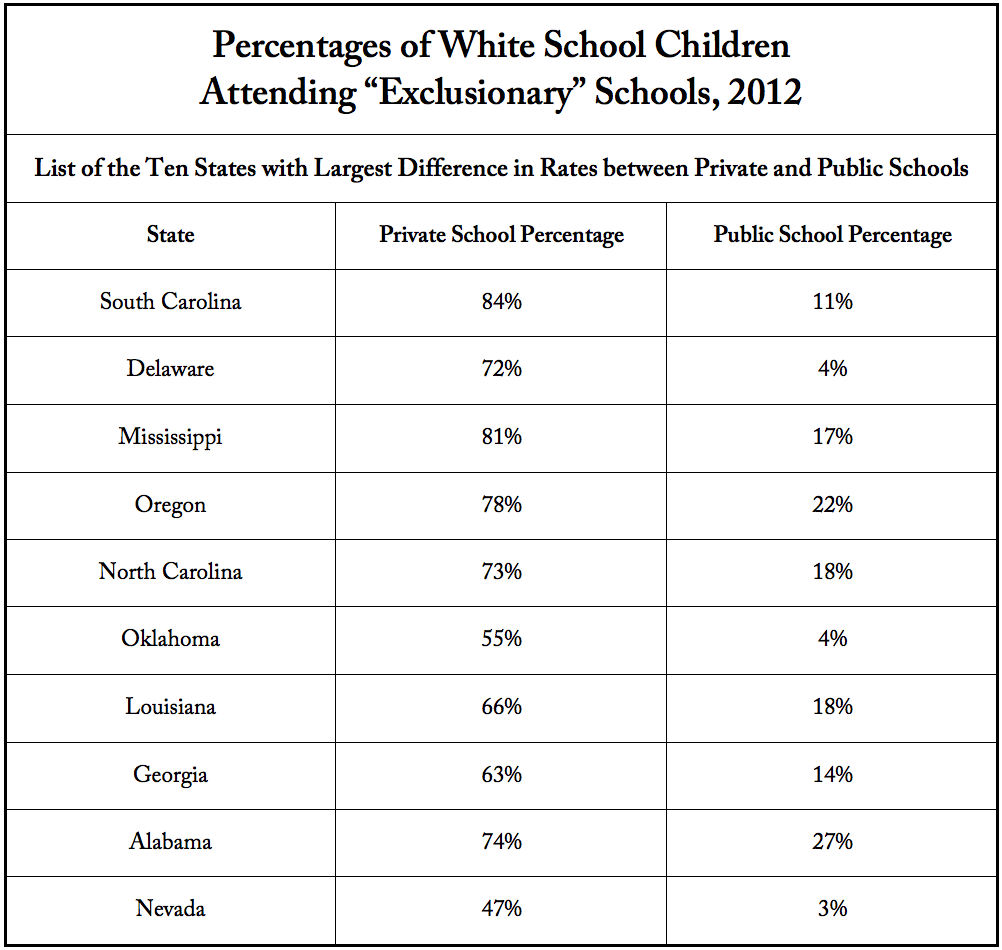
Each southern state that adopted voucher schemes in the era of massive resistance to Brown, except for Virginia, appears on the top ten list for exclusionary schooling, and Virginia was not far away. Like Virginia, Arkansas (where vouchers were tried temporarily in Little Rock) also had a gap of 34 percentage points. All southern states, except West Virginia, had a gap of 20 percentage points or larger. In West Virginia, the gap was 10 percentage points.
With the re-emergence of vouchers, the overwhelming majority of white students attending the nation's private schools continue to attend "schools for whites." The geographies where segregationists invented and implemented vouchers to resist Brown remain the places with greatest patterns of "exclusionary" private schools—assuring their white students that they do not attend school with any more than a token number of under-represented students of color. In 2012, the percentage of white students attending "exclusionary" private schools in the South exceeded the percentage in similar public schools in the South by 37 percentage points. This gap was double that of the rest of the nation.
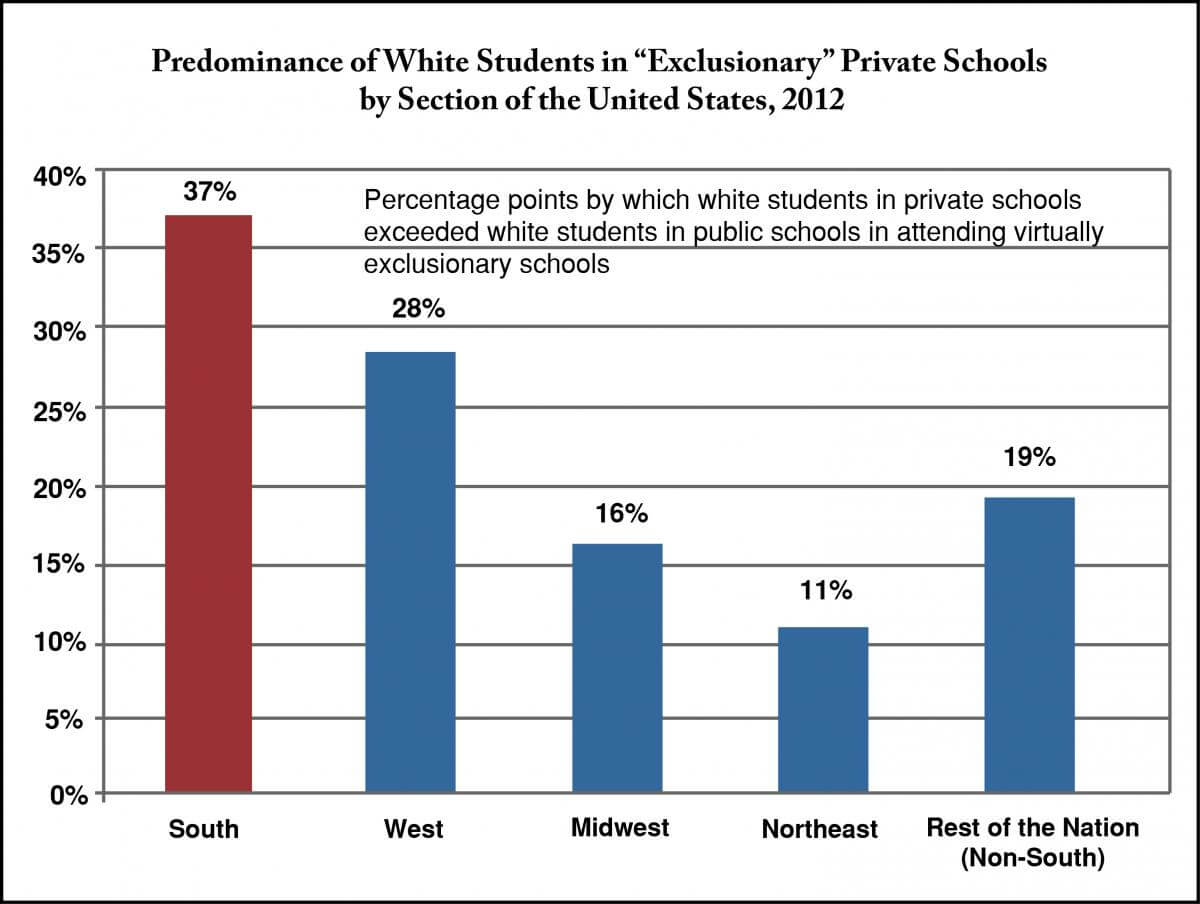
Lingering Facets of Jim Crow Segregation
States that adopted the first voucher plans in the 1950s and 1960s were forced by federal courts to abandon the laws and practices of complete separation of the races in schools and other public places. Yet Jim Crow laws were far from the only manifestations of segregation. The "better citizens" (as upper-class white supremacists were often called) were willing to accept token desegregation because of their belief that white supremacy and racial superiority did not place each and every white person always above "a negro of intelligence and good character."140Woodward, The Strange Career of Jim Crow, 107; Thomas J. Woofter, Southern Race Progress (Washington, DC: Public Affairs Press, 1957), 133–137. In the Jim Crow era, many southern industrialists believed in white supremacy but did not always find absolute segregation an economic advantage for their companies. See Suitts, Hugo Black of Alabama, 246–250, for a précis of this condition in Birmingham.
The practice of permitting virtual segregation or token desegregation was widespread before and during Jim Crow. Often, the all-white Democratic primary was not all-white. "In county after county," V. O. Key Jr. wrote in Southern Politics in State and Nation, "a few Negroes have voted for many years in Democratic primaries conducted under white-primary rules." The practice of holding virtually segregated primaries was particularly common where African Americans comprised a small proportion of the population.141Key Jr., Southern Politics in State and Nation, 620. Of course, attempting to vote in a southern state's Democratic primary was dangerous or deadly for African Americans. Steven F. Lawson, Black Ballots: Voting Rights in the South, 1944–1969 (New York: Columbia University Press, 1976), 119–121; Howell Raines, My Soul Is Rested: Movement Days in the Deep South Remembered (New York: Bantam Books, 1978), 285–294; also, listen to Hank Klibanoff, Buried Truths, 2018, podcast, https://www.wabe.org/shows/buried-truths.
Similarly, southern justice was segregated, and "after 1900, essentially no Blacks sat on southern juries." But, as civil rights and civil liberties attorney Charles ("Chuck") Morgan noted in the 1960s, "[T]he names of a token number of Negroes are often included on jury rolls." These token Blacks—hand-picked by white jury commissioners from the few African Americans deemed acceptable—seldom served since they could be struck by prosecutors or defense lawyers.142Michael J. Klarman, Brown v. Board of Education and the Civil Rights Movement (New York: Oxford University Press, 2007), 14; Charles Morgan Jr., "Segregated Justice," in Southern Justice, ed. Leon Friedman (New York: Random House, 1965), 159–161.
In their analysis of the South's segregationist leaders during massive resistance, historians Matthew Lassiter and James Hershman characterize segregationists as either caste-based or class-based. The caste-based defended complete segregation or exclusion on the belief that "all black people were inherently inferior to all white people." Understanding that absolute segregation was unnecessary to maintain a rule of white supremacy, the class-based segregationist (sometimes described as "moderate segregationists") conceded that "perhaps a few black people could be accepted into white institutions."143Hershman, "Massive Resistance Meets Its Match," 105.
The ambitions of politicians such as George Wallace and Ernest Vandiver muddled the division between caste and class, but the contrasting definitions illustrate that segregation was not defined as only a total, absolute exclusion of all African Americans or other people of color from the spaces—including schools—occupied by whites. Southern laws were often written that way, but reality was different. Affluent leaders of the most successful strategies for defeating desegregation demonstrated a class-based acceptance of virtual segregation and worked to preserve it. They anticipated the long-term possibility of ending absolute segregation and empowering leaders of local schools to justify virtual segregation through non-racial language, traditional school attendance boundaries, and neutral-sounding educational admissions standards, although it is doubtful that many realized how powerful class-based terms would resonate in suburban desegregation politics decades later.144Hershman, 104–106; Lassiter, The Silent Majority, 13–14, 26–29, 322–323.
The layered dimensions of segregation and exclusion are also illuminated by school segregation laws outside the South—in states that practiced de jure segregation well into the twentieth century—including the law invalidated by the Brown decision in Topeka, Kansas.145Brown v. Board of Education of Topeka, 98 F. Supp. 797 (1951).
All the attention drawn to the South's massive resistance eclipsed notice of how the Kansas school segregation law differed by excluding Black children from all white schools only in cities with a population over 15,000. The Kansas statute allowed boards of education in larger municipalities to decide if they should establish absolute segregation in those places where the number of African American children might exceed virtual or token segregation in a public school. In all other areas of Kansas with small Black populations, demographic patterns assured an acceptable level of virtual segregation.
Kansas population data illustrates how the law preserved virtual segregation in most of the state and absolute segregation where there was more than a token number of Black children. From 1890 through 1950, Kansas's Black population never reached 4 percent of the state's total, with the vast majority of Black Kansans living in and around a few cities. In 1950, there were 73,158 African Americans among more than 1.9 million Kansans. Almost three-fourths of the state's Black population resided in five counties where the state's largest cities were empowered to enact total segregation. All but one did. Elsewhere in Kansas in 1950, twenty thousand African Americans were spread among 1.3 million whites across one hundred counties, ensuring the maintenance of virtual segregation without the force of law.146Murray, State Laws on Race and Color, 161; Institute for Social and Environmental Studies, Kansas Statistical Abstract 1976 (Lawrence: University of Kansas, 1977), 5–9, 23, http://ipsr.ku.edu/ksdata/ksah/KSA12.pdf. There was a failed legislative effort in 1921 to change the nineteenth-century Kansas law to allow towns as small as two thousand to establish absolute segregation in schools. Thom Rosenblum, "The Segregation of Topeka's Public School System, 1879–1951," National Park Service, last modified April 10, 2015, https://www.nps.gov/brvb/learn/historyculture/topekasegregation.htm.
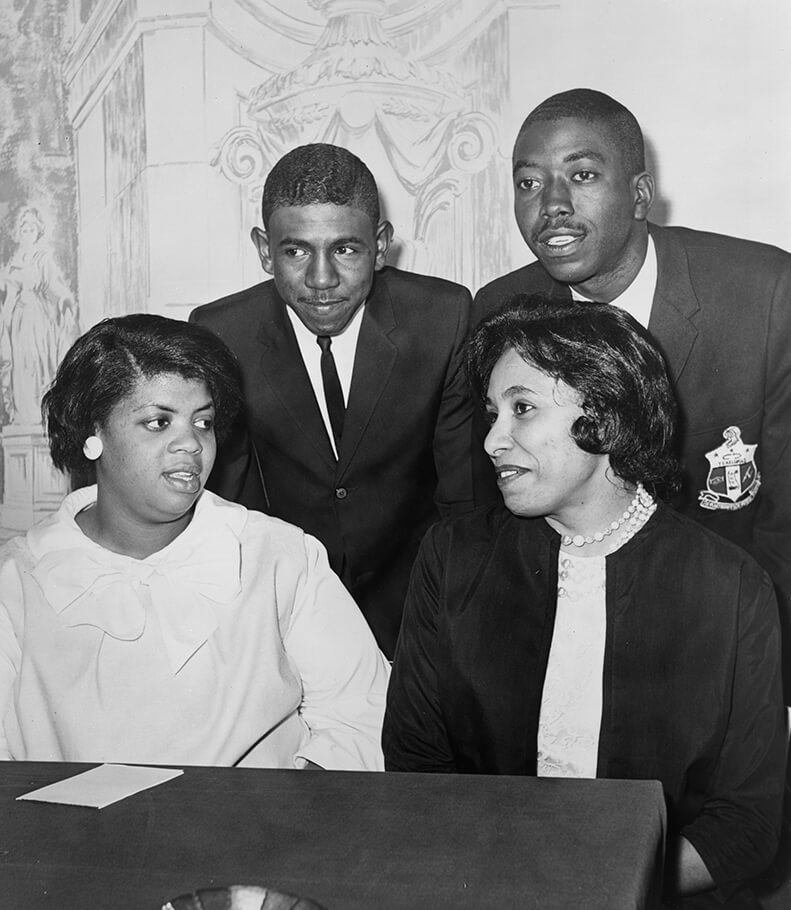
In 1951, when Linda Brown's father sued to desegregate her school system, Topeka (pop. 80,000) required absolute segregation in neighborhood elementary schools, undoing the virtual segregation that demographic trends assured to most white parents elsewhere in Kansas. In other words, Kansas's law had the same intent as southern laws—to maintain some form of segregation in all cases—although it did not establish absolute segregation as the default. That was implemented only when virtual segregation could not be maintained in practice.
Arizona also had a school segregation law—in some public high schools—triggered whenever twenty-five or more "pupils of African race" registered. In these situations, 15 percent of the voters in the school district could initiate a referendum to require the local school board to "segregate the pupils of the African race from pupils of the Caucasian race." In other words, the presence of twenty-five Black students in a high school could set in motion a process for absolute segregation.
In adjoining New Mexico, the law permitted the separation of "pupils of African descent" into separate classrooms in the same buildings if the school boards decided "it was for the best advantage of the school." The state allowed a local school board to decide what number of students might endanger virtual segregation, although it did permit the local jurisdiction to avoid the cost of building a separate school to implement absolute segregation.
Wyoming law gave school boards and superintendents power to enforce absolute segregation whenever there were fifteen or more "colored children" within a district. Since the large majority of Wyoming's schools were small, the numerical calculation of what number might threaten virtual segregation was also quite small. Until 1949, local jurisdictions in Indiana could decide to institute absolute segregation under a law used almost exclusively in larger cities where the percentage of Black population jeopardized virtual segregation.147Murray, 35–36; 290–291, 144; Mary Melcher, "'This Is Not Right': Rural Arizona Women Challenge Segregation and Ethnic Division, 1925–1950," Frontiers: A Journal of Women Studies 20, no. 2 (1999): 198–199. Arizona did require all elementary schools to segregate by race. Melcher suggests that Arizona required school segregation due to the large number of former southerners serving in the legislature. See Murray, 524; Reid E. Jackson, "The Development and Character of Permissive and Partly Segregated Schools," Journal of Negro Education 16, no. 3 (Summer 1947): 302–305.
These laws were different from those in the South because they assumed a different starting point. Before Brown, non-southern states started with virtual segregation and went to the absolute form when necessary, while southern states started with absolute segregation and went to virtual segregation when required by Brown. Wherever, school segregation was a multifarious exclusion without an exact shape or defining measure. As practiced, segregation always revolved around what a white-controlled legislature, white constituency, or white-controlled institution considered minimally acceptable. Contemporary private school patterns and practices—that state and federal governments have come to tolerate and often support with public funds—appear for what they are: legacies of class-based southern segregation used to evade Brown and multi-dimensional segregation of non-southern states before Brown.
Desegregation's Future
During the heyday of the first era of school vouchers, Dr. Martin Luther King Jr. decried that "token integration is little more than token democracy, which ends up with many new evasive schemes and it ends up with new discrimination, covered up with such niceties of complexity."148Martin Luther King Jr., "Love, Law, and Civil Disobedience," New South, December 1961. King's words have proven prophetic, although he could not have foreseen how dramatically the icons and language of the movement he led would be used, even by his own lineage, to develop and advance the tools and strategies that segregationists of his day thought could defeat the promise of Brown.
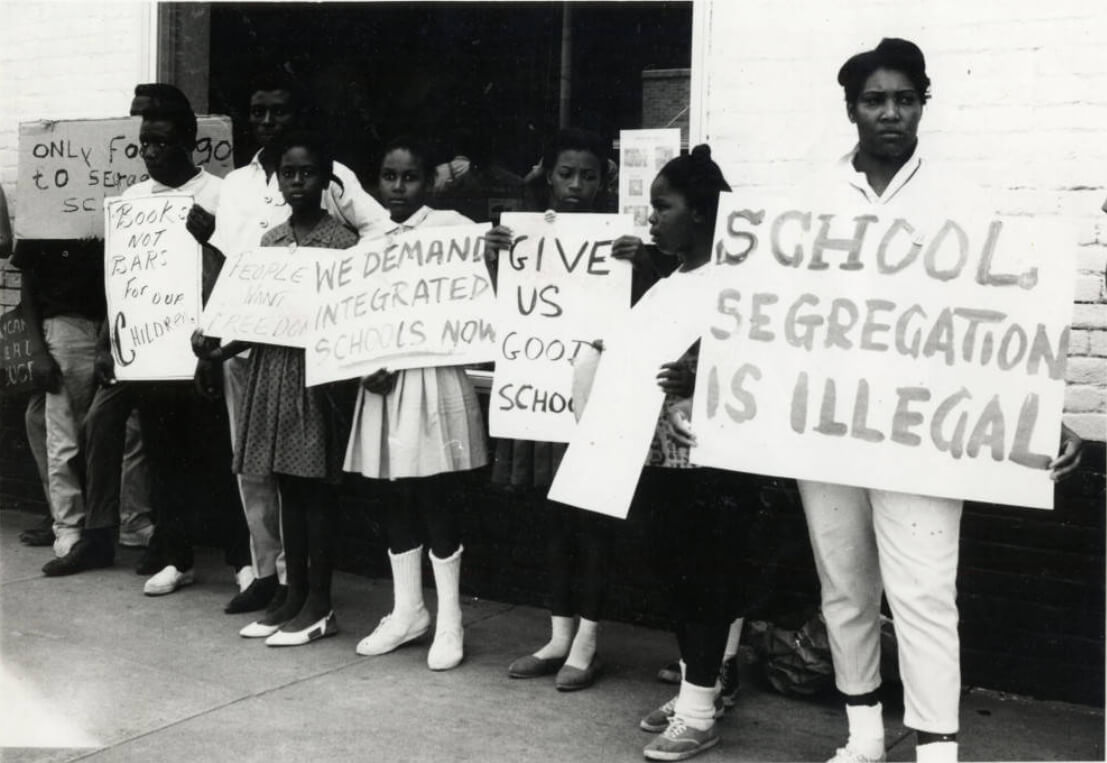
Today's advocates of school vouchers are not the first to attempt to graft the words and imagery of King and the civil rights movement onto their reactionary cause. As early as 1988, Rev. Jerry Falwell of the Moral Majority declared to a gathering of all-white, conservative male ministers in Atlanta that "Martin Luther King is everybody's American hero."149Lorri Denise Booker, "250 Protest Anti-Abortion Conference—2 Arrested; 600 Pack Omni to Hear Falwell," Atlanta Journal-Constitution, December 9, 1988; "Homogenized Heroes," SRC Home Record, Southern Regional Council, First & Second Quarters, 1989, 5. Ralph Reed, director of the Christian Coalition, continued to try to align King as the role model for conservative evangelical activists, many of whom supported public funding for private religious schools. Carter, The Politics of Rage, 466. But the school choice and voucher movement is remarkable in replicating so closely the primary strategies and tactics of southern segregationists while claiming the righteous mantle of the people and movement who fought against those segregationists.
One reason school choice proponents have appropriated civil rights rhetoric may relate to the fact that there is little evidence that vouchers improve the education of low-income children or children of color.150See Robert C. Pianta and Arya Ansan, "Does Attendance in Private Schools Predict Student Outcomes at Age 15? Evidence From a Longitudinal Study," Educational Researcher 47, no. 7 (2018), https://journals.sagepub.com/stoken/default+domain/XfYmtC25VddcCfbA3xiV/full; Mark Dynarski, On Negative Effects of Vouchers (Washington, DC: Brookings Institution, 2016), https://www.brookings.edu/research/on-negative-effects-of-vouchers/; Mark Dynarski and Austin Nichols, More Findings about School Vouchers and Test Scores, and They Are Still Negative (Washington, DC: Brookings Institution, 2017), https://www.brookings.edu/research/more-findings-about-school-vouchers-and-test-scores-and-they-are-still-negative/; Martin Carnoy, School Vouchers Are Not a Proven Strategy for Improving Student Achievement (Washington, DC: Economic Policy Institute, 2017), https://www.epi.org/publication/school-vouchers-are-not-a-proven-strategy-for-improving-student-achievement/; Halley Potter, Do Private School Vouchers Pose a Threat to Integration? (Washington, DC: The Century Foundation, 2017), https://s3-us-west-2.amazonaws.com/production.tcf.org/wp-content/uploads/2017/03/22102646/do-private-school-vouchers-pose-a-threat-to-integration.pdf; Kevin Carey, "Dismal Voucher Results Surprise Researchers as DeVos Era Begins," New York Times, February 23, 2017, https://www.nytimes.com/2017/02/23/upshot/dismal-results-from-vouchers-surprise-researchers-as-devos-era-begins.html. Voucher advocates' strongest arguments invoke social justice as well as freedom in order to legitimate school choice as more than a consumerist mindset and to obscure the factual results.151Samuel E. Abrams, Education and the Commercial Mindset (Cambridge, MA: Harvard University Press, 2016), 303–307.
A larger part of the explanation surely lies in forgetting what little was known and understood about segregationists such as Alabama's Forney Johnston and Albert Boutwell, Georgia's John Sibley, North Carolina's Thomas Pearsall, and Virginia's Garland Gray. In current memory, George Wallace remains the image of the diehard segregationist—standing defiantly to assure not one Black child in any white school. The images, language, and cruel tactics of Wallace and Birmingham's "Bull" Connor remain vivid in the lingering American mind, but not the strategic, behind-the-scenes work of South Carolina's Marion Gressette.
Yet, the southern states' first plan for defeating court-ordered desegregation, the one that Johnston and Boutwell devised in 1954 in Alabama, is exactly what today's advocates and supporters of vouchers seek to implement: no compulsory "race-mixing" in schools and no mention of any intent to discriminate. What could be more American than the freedom of parents to choose their children's school—private or public—with public financial support?
The Boutwell plan also aimed to remove from the state constitution and statutes any right of education for a child and any obligation to fund education. Instead, a state was to "foster education of its citizens in a manner and extent consistent with its available resources, and the willingness and ability of the individual student [emphasis added]."152Report of Alabama Interim Legislative Committee on Segregation in the Public Schools, 11. The plan authorized white school officials to decide "the eligibility, admission, and allocation of pupils, including the power to refuse admission to individuals or groups whose deficiencies in scholastic aptitude would compel undue lowering of school standards."153Report of Alabama Interim Legislative Committee on Segregation in the Public Schools, 7–8. The state was to provide vouchers and tax funds to private schools to increase school choice options.
The primary components of segregationist plans developed in the 1950s and 1960s by southern states are today the main objectives of policymakers and advocates leading the movement for school choice and vouchers.154For video overviews of the struggles against efforts to use vouchers to privatize public education, see videos at "Vouchers and Tax Credit Scholarships in the US," Southern Education Foundation, 2015, https://www.southerneducation.org/publications/vouchersandtaxcreditscholarships/; "Advancing Public Education in the South," Southern Education Foundation, 2013, https://www.youtube.com/watch?v=dBo4HwZ_8v8. No less remarkable, the segregation that Forney Johnston envisioned in his tripartite school system was also foreseen by economist Milton Friedman, who considered it an acceptable consequence of his goal of managing the country's education systems through market forces.
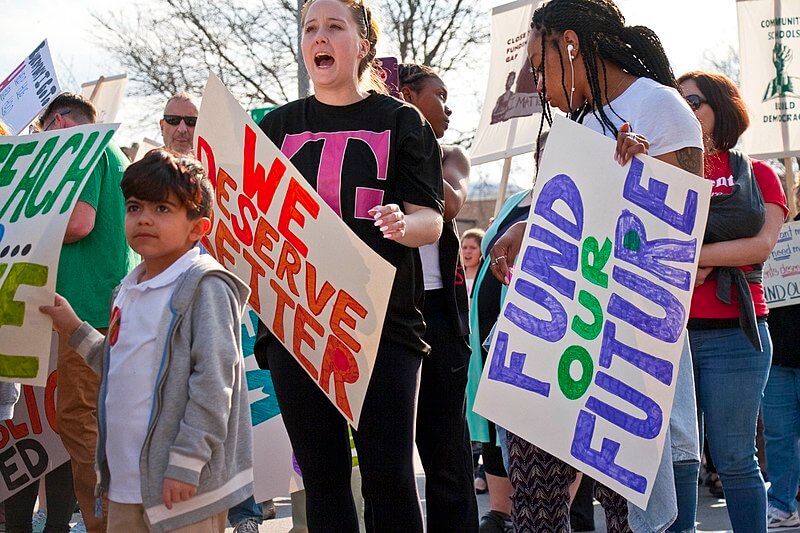
The nation's lack of memory has done far more than encourage the acceptance as racially neutral the economic and social arguments of voucher advocates, who blithely use the language of civil rights to advance the tools of segregationists. The nation has lost an understanding of class-based segregation as a general but not absolute condition for preserving racial superiority. This country also has failed to remember that school segregation laws outside the South embodied the same bifurcated notion of absolute and virtual segregation, although applied to different locales and demographies. More disturbing is the current wide acceptance of segregation as a part of an American way of schooling that merits public funding.
At the same time, the legal meaning and force of racial discrimination in civil rights enforcement and tax policy has shrunk to such an extent that courts, the public, and policy makers often recognize discrimination in private schools only if a person or institution sounds like an old-style segregationist who says "No, not one." Even some of the nation's most prominent public scholars have failed to grasp how, despite past court rulings, the strategies of virtual segregation continue today as prevailing practice among religious and non-religious private schools with tax exemptions.155For example, Jill Lepore writes that, because of the Supreme Court decision in Coit v. Green in 1971, "private religious schools no longer provided a refuge for whites opposed to integration." See Jill Lepore, These Truths: A History of the United States (New York: W.W. Norton, 2018), 663. There is no basis in fact for such a conclusion.
The US Supreme Court has declared as law of the land that private schools cannot enjoy the benefits of exemptions from federal income tax, much less receive tax credits and direct government funding, while engaging in racial discrimination, even when motivated by claims of religious freedom. But, the federal government's current standards and practices of enforcement accept as valid and true on its face any private school's public pledge of non-discrimination in admission practices and operations, so long as the school has no formal or written policies to the contrary and does not maintain absolute, complete "No, not one" segregation. And parents of public school children cannot go to federal court to challenge the lack of robust, effective enforcement.
This faux policy of anti-discrimination has permitted a majority of private schools across the nation to maintain what strategic southern segregationists sought to achieve after Brown—virtual segregation and exclusion of children of color. Recall that two-thirds of white students attending the nation's private P–12 schools are in institutions where African American, Hispanic, and Native American children constitute 10 percent or less of the student body. These white schools are exercising "school choice" to decide which and how many children of color to admit—in token numbers and on terms, values, and motives inherited from strategic segregationists who, as Julian Bond noted, "dared not say out loud" their true goals.156See Julian Bond, "Civil Rights in the Popular Culture," Southern Changes 14, no. 2 (1992): 4, http://southernchanges.digitalscholarship.emory.edu/sc14-2_1204/sc14-2_002/.
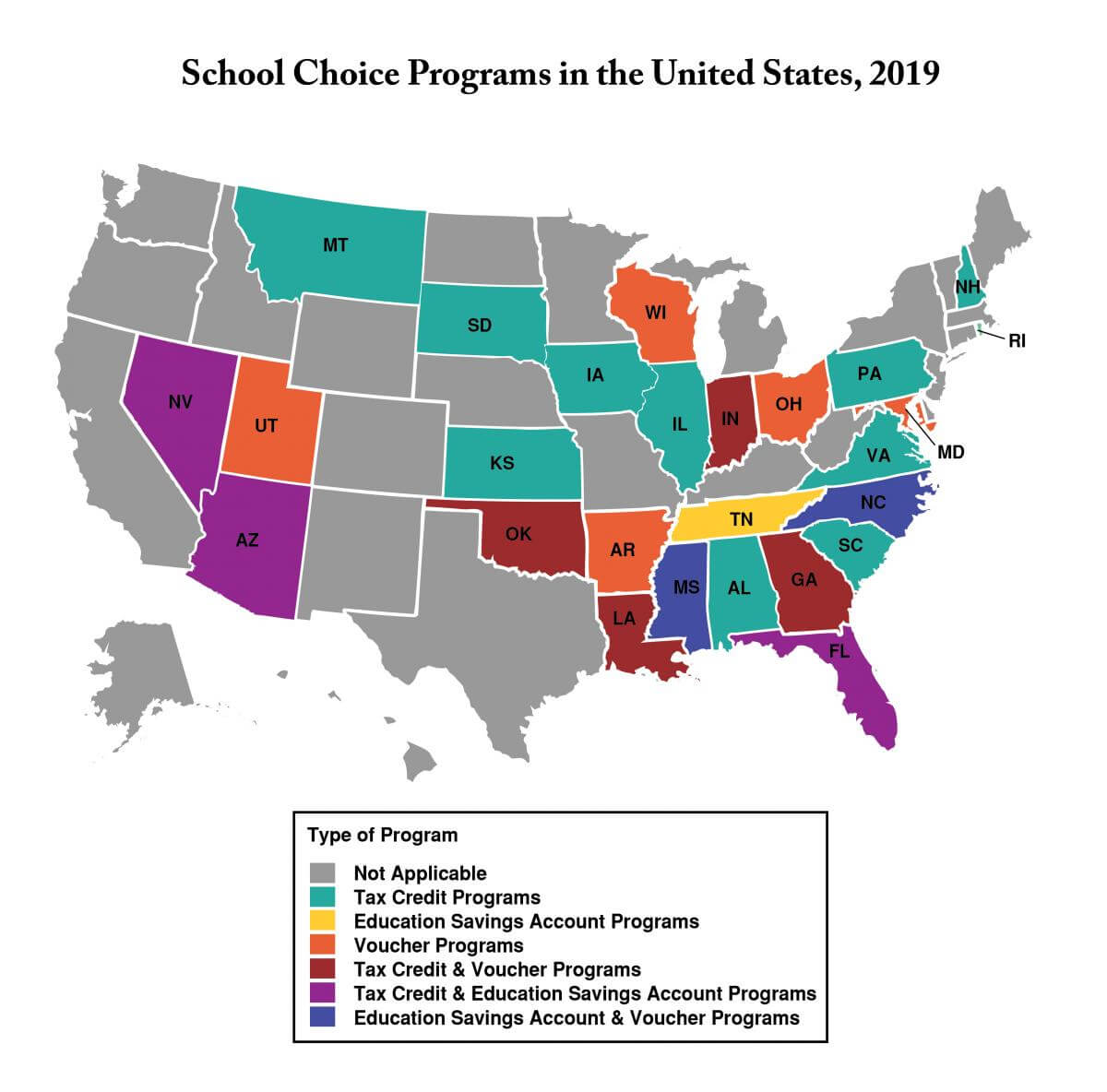
More than half of the nation's states have adopted some form of vouchers to support private schools, portending that virtual segregation and exclusion will be sustained over time. And the federal government is moving closer than ever to establishing a program of direct or tax credit vouchers to support private schools on whatever terms are acceptable to the states. Nor is there serious consideration of revising the standards and practices that have already permitted many states to erect the scaffolding of a private–public school system first put forward by Alabama segregationists in 1954.
By failing to grasp the history of the struggles and tactics against southern school desegregation, the nation has come to recognize segregation and racial superiority only in those private schools that are absolutely all-white. The looming danger lies in legitimizing and advancing a system of segregation and exclusion in education that is not called by its name. Even if most Americans find repugnant the absolute separation of the races that George Wallace defiantly championed as destiny in 1963, his words have transformed into a prophesy about schools across the nation that rings true by the most accurate, historical definition of the term: "segregation now . . . segregation tomorrow . . . segregation forever."
Acknowledgments
Many thanks to Southern Spaces staff members Stephanie Bryan, Madison Elkins, Amelia Golcheski, Camille Goldmon, Hannah Griggs, Rachel Kolb, Ra'Niqua Lee, and Sophia Leonard for their work on this piece. Thanks as well to Jon N. Hale for his suggestions. A special appreciation to Megan Slemons, GIS specialist with the Emory Center for Digital Scholarship, for assistance with maps and tables; and to Allen Tullos, my dear friend and senior editor of Southern Spaces.
About the Author
An adjunct with Emory University's Institute for the Liberal Arts, Steve Suitts is the author of Hugo Black of Alabama: How His Roots and Early Career Shaped the Great Champion of the Constitution. Earlier in his career, Suitts served as the executive director of the Southern Regional Council, vice president of the Southern Education Foundation, and executive producer and writer of "Will the Circle Be Unbroken," a thirteen-hour public radio series that received a Peabody Award for its history of the civil rights movement in five Deep South cities.
]]>Video and Essay
Ryan Gainey (1944–2016) grew up in the Sandhills of South Carolina in the small town of Middendorf, twelve miles north of Hartsville. Born to a working-class family, Gainey picked cotton at an early age with his brothers, sister, and cousins. Through relatives and neighbors, he developed an early love for propagating plants, rooting camellias in Mason jars underneath the eave of a barn (where they could catch the rain), and learning to grow old-fashioned varieties of petunias and roses. In the 1960s, Gainey studied horticulture at Clemson University, served in the Navy, and eventually settled in Atlanta. He opened a series of garden shops in the affluent Buckhead neighborhood that were successful in part because there were few other boutique garden shops in the area at the time. Gainey sourced many of his plants from the Holcombe Nursery in Decatur, five miles east of Atlanta. When he learned that the Holcombe family wanted to sell their property in 1980, he jumped at the chance.
Gainey envisioned a beautiful new garden in the informal cottage style, using the aged brick walls of the old Holcombe greenhouses as the boundaries for a series of "garden rooms." As his creations garnered attention, he received commissions around the city. Although not formally trained in landscape design, Gainey, through self-study and experimentation, developed a distinctive style that combined cottage garden aesthetics and classical English design with a strong reliance on native plants. By the 1990s he'd become internationally renowned, forming friendships with such English gardening notables as Rosemary Verey and Penelope Hobhouse.
Chad Stogner, founder of the garden accessory company Elegant Earth, worked with Gainey in the 1990s and noted that the designer had a way of "making things look spontaneous. . .that were planned." Most gardeners work to eliminate weeds, but Gainey would allow them to pop up in certain areas. To visitors, these would appear as happy accidents, but they were deliberate, as Gainey explained in his 1993 book The Well-Placed Weed from which our documentary takes its title. Gainey's gardens feature a fascinating give-and-take between the structured and the free-flowing.
Gainey chose many of the plants in his garden for their personal and historical connections, such as the chinaberry tree (Melia azedarach), which was a prominent feature in his childhood yard and also was, as he liked to point out, one of Thomas Jefferson's favorite plants. He discouraged gardeners from mimicking the plant choices of classical English gardens and instead championed the use of native southeastern US plants along with plants from similar latitudes in China and Japan.
In March 2016, a 140-year-old white oak tree that had served as the shady anchor of Gainey's Decatur garden fell on his house. At home at the time and miraculously uninjured, Gainey was forced to relocate to Lexington, Georgia, seventeen miles east of Athens where, in July, he died in a fire trying to save his beloved Jack Russell terriers.
We did our first video shoot with Gainey in the spring of 2010. At the outset, we didn't know what we were doing and were content to let him unspool lectures on gardening topics of his choosing: the history of tea olives or figs, blending purple and gold plant colors, and how to maintain fragrance year-round. He thought we were producing a gardening masterclass. None of us thought we were making a documentary.

We became fascinated with the funny moments just before or just after he delivered his monologues—such as when he'd yell at his dogs or tell a dirty joke or make some ridiculous boast. We were drawn to the tangents that floated above and below the persona: his humor, narcissism, and personal connections to plants.
We eventually found structure for the project by developing a series of overlapping threads: Gainey's childhood, his rise as an entrepreneur and social figure in Atlanta, and his wider reputation as garden designer. We were also drawn to his idiosyncratic personality. We witnessed him being prickly and self-absorbed, as well as generous and thoughtful.
There remain gaps in our story. Gainey acknowledged a couple of times on camera that he was gay but never discussed any of his longtime partners in any detail. We tried to steer him to fill in the biographical narrative, but became resigned that there was no directing Ryan Gainey. He served up a vast body of knowledge via his commanding and often contradictory persona. In the end, we did our best to wrangle an honest character study.


We thought we were winding down the project in early 2016 before the tree fell on his house. That event set in motion a string of calamities that culminated in his tragic death. We worked for another year and a half to tidy up the edit and flow before premiering The Well-Placed Weed: The Bountiful Life of Ryan Gainey at a festival in South Carolina in April 2018.
Ryan Gainey made and collected beautiful things. We are grateful that he shared some of these with us and that, through our documentary, we now share this with others.
Visit The Well-Placed Weed's website for more information and to view the documentary in its full length of seventy-eight minutes.
About the Directors
Steve Bransford is the senior video producer at the Emory Center for Digital Scholarship and the founder of Terminus Films. Cooper Sanchez is an artist and garden designer focused on the restoration of historic southern gardens. For ten years, Cooper has been working to rejuvenate the gardens at Historic Oakland Cemetery as well to build his own garden in Clarkston, Georgia.
]]>Video
A Reflection by Craig Womack
A friend of mine tells a story about his high school days in the greater tri-city area (Wetumka, Weleetka, and Wewoka—Creek names for water that roars, runs, and barks—for those of you from parts other than rural eastern Oklahoma). One day in his Weleetka High School class, everyone stopped paying attention to the teacher and turned their eyes from the chalkboard, and United States history, to a Kafkaesque-sized cockroach making his (or her) way leisurely across the classroom floor, giant antennae twitching as it navigated its escape from secondary education.
As all of those in our noble profession know, even the most starry-eyed believer in the power of education sometimes loses control of the classroom, and this particular teacher, upon realizing her lecture had been hijacked by a very large insect, walked over to the uninvited intruder and ground it under the heel of her shoe. Given the size of the cockroach, some cleanup was in order, so she went down the hall to get paper towels from the restroom. On the way back, she heard all kinds of cheering coming from her class. While she had been out, the cockroach had reanimated and was making a second beeline, so to speak, for the door. If not for her puzzlement over all the commotion, the teacher might have nailed it again, but the cockroach reached safety, while all the Indian kids in the class cheered it on!
I don't care to judge the historical veracity of this wonderful tale, but it seems to me the Mvskoke Creek language might have about as much chance for survival as that cockroach, and I will leave it up to the reader, and the film viewer, to interpret whether or not I am suggesting that a miracle is needed or that miracles sometimes occur.1The official name of the tribe located in present-day Oklahoma is the Muscogee Creek Nation. The word, in the language, for what Creek people speak is "Mvskoke," pronounced the same as the word for the tribe. Some Creeks prefer the name "Mvskoke" since "Creek" is a name given to the tribe by the English in the Colonial era.
For sure, the dominating force of English surrounds us. People in Creek country say there are five thousand Creek speakers left, but nobody seems to know where that number comes from, and many suggest there are only a few hundred speakers, some even far fewer. This documentary, Hearing the Call: The Cultural and Spiritual Journey of Rosemary McCombs Maxey, features a Creek community leader who is determined to speak the Creek language every day—to people, when possible, and to llamas, chickens, cats, and dogs, when not.
Four years ago, I was approached by Stefanie Pierce, at that time the administrative assistant in the Department of Environmental Sciences at Emory University, who said she was talking to people about making a documentary on Rosemary. The project immediately struck me as having merit, because women in the Creek Nation are seldom given public recognition for their knowledge and contributions, especially in the realm of language and culture where women have been both instrumental as well as often ignored. In Rosemary's case, as Hearing the Call attests, she possesses multi-generational knowledge about community genealogies predating Creek Removal from ancestral homelands in Alabama and Georgia in 1836 as well as a command of specific family histories in Oklahoma Creek churches that goes back to the 1840s, when her family first started becoming leaders in these places of worship. Add to this her history working in Indian Country outside the Creek Nation, among Lakota people in South Dakota, for example; as an advocate for Native Hawaiian prisoners incarcerated in Oklahoma and Arizona; as an interim pastor for a year at Community of Hope, Tulsa's GLBTQ church; as a pastor of various United Church of Christ congregations on the East Coast; and as a person in critical dialogue with leading feminist, race, and theological scholars in the 1970s and 1980s, and it becomes evident that the subject of our documentary has more stories than we could ever put up on the screen.
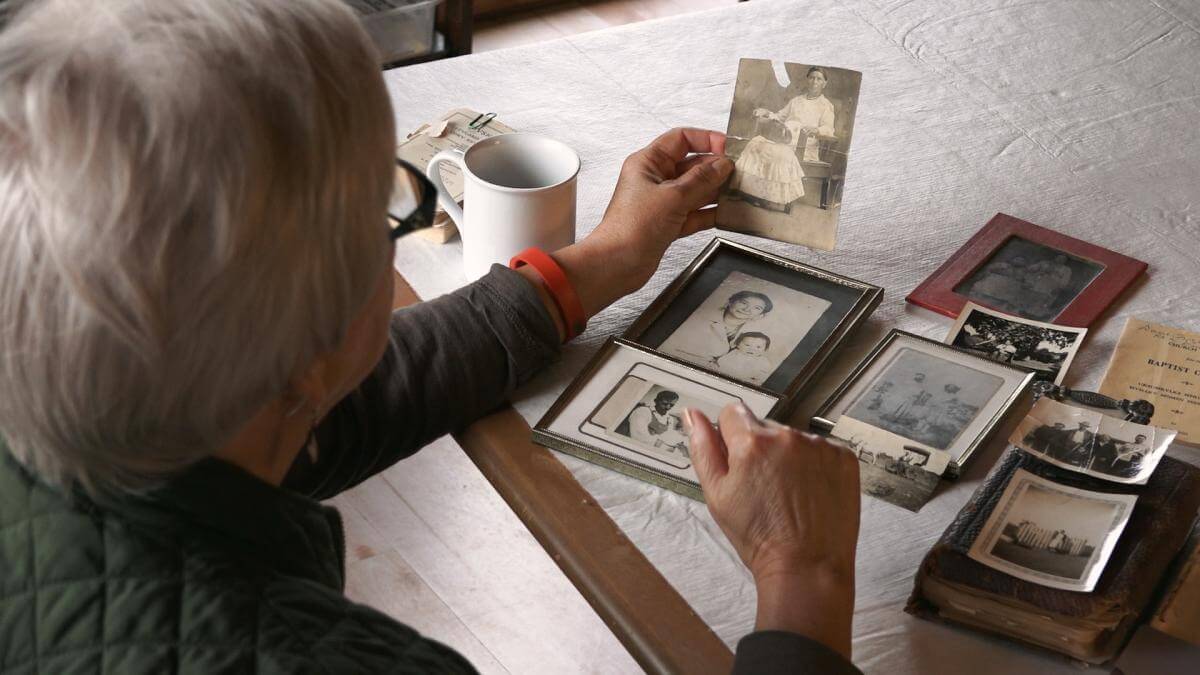
As I, along with Rosemary herself and a group of Creek language advocates, watched the story unfold when Hearing the Call premiered at Emory earlier this year, it felt like its own kind of coming out story, albeit in this case the story of a kid who, rather than announce to her parents she is gay, instead tells them she's called to be a preacher—even though no such role exists for women in the denomination she grew up in. What strikes me as an incredible act of the imagination seems like something else the way Rosemary tells it: being around preachers was the only thing she knew, so as far back as she can remember she practiced sermonizing on farm animals. I don't know if Rosemary would have ground the cockroach into oblivion, had it shown up during one of her childhood church services on back porches and in farm wagons, but, having known her for many years, I feel confident that it wouldn't have escaped without being addressed at length in the Creek language, and I don't hesitate to imagine it coming up to the altar to be saved.
What is the Creek language, anyway? Without getting too complicated, let's just say it is one of the original languages of the US Southeast, and since I am an Emory professor, I will add that it is the first and foremost language of the campus where I teach. Creek people lived at Emory's exact location prior to the 1820s, having been forced out of the area earlier before the removal of the main body of the tribe that occurred in 1836, the year of Emory's founding. When I am on campus, therefore, I simply have to look where I am stepping if I want to know where the Creek language originates.
The language was originally spoken throughout Alabama and Georgia, and in the late 1700s and into the early decades of the nineteenth century, it spread into Florida through Creek-speaking groups that migrated there and now live on the Seminole reservations and elsewhere in Florida. In 1836 when the tribe was forcibly removed from Alabama and Georgia to the present-day state of Oklahoma, the language moved into what was then known as Indian Territory, a sovereign entity set aside for the exiled tribes sent there. Today, the language is primarily spoken by Oklahoma Creeks, Oklahoma Seminoles, and Florida Seminoles.
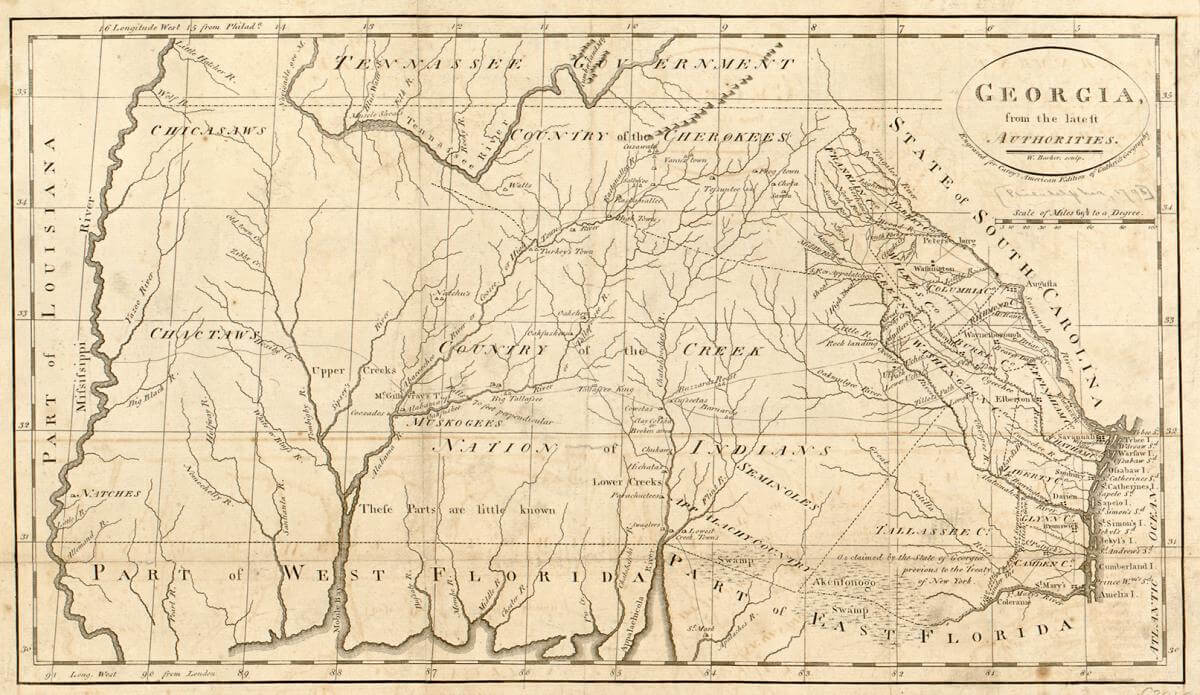
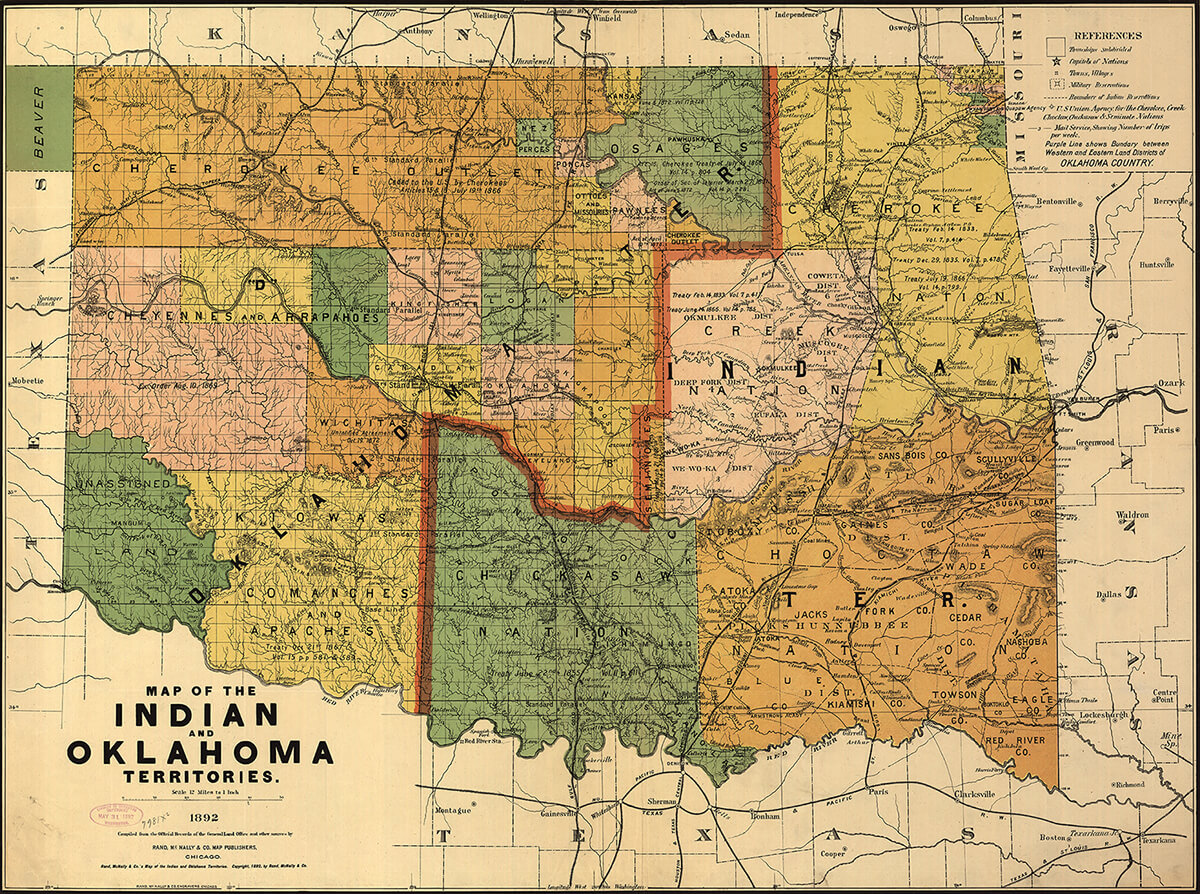
The first university course in the Creek language took place at the University of Oklahoma in the fall of 1991. As fate would have it, I was in that course. A non-Indian graduate student in anthropology, Pam Innes, was the instructor of record, and she was working with the Creek ceremonialist Linda Alexander and her daughter, Bertha Tilkens, both active members of Greenleaf Ceremonial Ground. I remember three things very vividly from that first effort. First, a Creek/Comanche friend of mine, who sat next to me, would rail after every meeting: "How can we have this non-Indian, who doesn't speak the language, trying to teach us how to speak Creek?" I didn't feel inclined to disagree. Secondly, there was constant writing and erasing, the instructors' hands working at cross-purposes, as Pam would write down a verb she had Linda conjugate, then leave it on the board; the next time Linda conjugated the verb it would be totally different, due to the infinite contextual factors that change Creek verbs. Thirdly, though we had no cockroaches for entertainment, Linda had her own way of hijacking a classroom through hilarious and raunchy stories that I have never quite gotten over and hope I never will. I am happy to report that the collaboration between Pam, Linda, and Bertha evolved into a respectful and reciprocal alliance, a friendship I have always been grateful to have been caught up in.
Since these tenuous beginnings, when academics were speculating about how Creek language worked, often relying on the meticulous fieldwork of the linguist Mary Haas, who worked in Oklahoma in the 1930s, and basing their guesses on Mary Haas's guesses, the Creek language has come a long way in terms of formal analysis. A significant part of the progress has involved checking and analyzing this earlier linguistic work with a large cohort of contemporary Creek speakers.
Pam Innes's collaboration produced a Creek grammar—Beginning Creek: Mvskoke Emponvkv (Norman: University of Oklahoma Press, 2004)—which followed a Creek-English dictionary published in 2000 by the linguist Jack Martin, who worked collaboratively for a decade with Creek elder Margaret Mauldin. By the new millennium, classes had spread from the University of Oklahoma to Oklahoma State, campuses where significant numbers of Creek students are enrolled. Martin's own work would expand tremendously with grammars, Creek-to-English translations of stories, innovative interviews of Creek elders by other Creek elders in the Creek language, videos of Creek Christians singing hymns in Creek, and much more.
While all of this has gone on at the level of formal study, the community's ability to produce young Creek language speakers is a dire situation. The tribe faces two major challenges: getting long-term immersion programs started, and the even more daunting chore of creating environments where immersed kids have some place outside the immersion classroom to practice their language skills. It is simply a fact that young kids surrounded constantly by a second language will learn it, but how do you create people for them to speak with? Can this really be done? In comparison, the cockroach might have had it easy.
Questions abound. Numerous tribes no longer have any native language speakers. Does this mean the tribe no longer has an easily definable cultural identity, or can they find new ways to identify as Indian? What, exactly, is contained in language, and to what extent do non-linguistic factors also carry culture? To what degree can English, a language spoken by almost every Indian in the United States and English-speaking Canada, also be considered an Indian language at this point? What does the Chickasaw poet Linda Hogan mean when she writes, "[b]lessed are those who listen / when no one is left to speak"?2Linda Hogan, "Blessing," in Calling Myself Home (New York: Greenfield Review Press, 1978), 27.

Rosemary McCombs Maxey still has people to talk with in Creek, farm animals who get dinner and a language lesson at the same time, Skype meetings with Creek academics in which we work together on bringing increasing levels of Creek language into our writings, and many other ongoing conversations throughout Creek country. We listen, and, since we come from a culture that prizes call and response, we hope to echo back some of what she has taught us. As for our cockroach, I don't know if it had anything akin to a language, but it did have witnesses who wanted it to survive, and we hope Hearing the Call bears witness to the power of resistance and continuance.
About the Directors
Craig Womack is an Oklahoma Creek-Cherokee Native American literary scholar, writer, and teacher, and an associate professor of English at Emory University. He is the author of Red on Red: Native American Literary Separatism (1999), Drowning in Fire (2001), and Art as Performance, Story as Criticism: Reflections on Native Literary Aesthetics (2009). He is co-author of American Indian Literary Nationalism (2006) and Reasoning Together: The Native Critics Collective (2008). He is currently working on a novel about a young musician in Northern Minnesota and his obsession with the Oklahoma folk singer Woody Guthrie. Steve Bransford is a Senior Video Producer at the Emory Center for Digital Scholarship.
]]>Introduction
At present, the people of Appalachia continue to endure the contraction and retreat of extractive industry with little more than big-box retail for employment. They work for local hospitals and county governments at a time when both depend on a withering tax base. Many residents hunt, fish, and garden to make up the shortfall in their household incomes. The Appalachian Regional Commission has not come up with a solution; neither has the leadership of the United States. It seems unlikely, though I would not say impossible, that corporations will show up in southern West Virginia or eastern Kentucky and open factories and offices. I wrote the Commons Communities Act after months of thinking about how the people of the southern mountains might find work with dignity, working for themselves and their families without owing their existences to corporations. I thought that government could help to solve this problem and do what it should do: stand between citizens and the power of capital.
It is difficult to find anything Appalachians have gained by voting for Republicans. Yet a majority in every county in West Virginia voted for Donald Trump in 2016. His promise to revitalize the coal industry lacks a footing in reality. Sensing this, one voter gave him a desperate endorsement, saying, "He's the only shot we got." If Trump studies West Virginia's congressional delegation, he might conclude that he doesn't need to do very much. But the people can do better than that. They can make their representatives justify the trust placed in them. They can demand more of their government. They can assert a right to land and livelihood and reparations from the corporations that used and abused them for so long. Maybe that can be the basis for a positive political identity.1For an argument in favor of collective identities in the service of an ethical politics, see Critchley, Infinitely Demanding. I have especially learned from David Whisnant's "Developments in the Appalachian Identity Movement," which though published in 1980 still resonates. "At its worst . . . regional identification is an isolationist impulse." He deconstructs an essentialist mountain identity. And yet, "The political value of regional identity lies in its usefulness as a basis for broad solidarity and coalition." Whisnant, David. "Developments in the Appalachian Identity Movement: All is Process." Appalachian Journal 8, no. 1 (1980): 41–47.
I favor democratic socialism and a reinvention of the nation-state as a conduit for meeting human needs rather than for accumulating capital. I also favor a realm of democratic autonomy, and that might have more political traction. If Congress and the president can cooperate, such a realm can exist as a function of the United States itself. But it can also exist outside of centralized government, sponsored by West Virginia or Kentucky or Tennessee. Or people can do it themselves, by squatting on abandoned land and defending their right to the commons.2In the words of two historians, "Making visible activities that neoliberalism renders invisible expands the range of ideas for producing social livelihoods and economic development." Amanda Fickey and Michael Samers, "Developing Appalachia: The Impact of Limited Economic Imagination," in Studying Appalachian Studies: Making the Path by Walking, ed. Chad Berry, Phillip J. Obermiller, and Shaunna L. Scott (Urbana: University of Illinois Press, 2015), 123.

There is talk and some action regarding returning land. Various organizations have held public meetings to elicit policies directly from citizens. Even Congress is thinking along these lines. In 2016, Representative Harold Rogers, a Kentucky Republican, introduced the Reclaim Act. The law would empower the Department of the Interior to distribute funds to states and Indian nations aimed at developing land in communities "adversely affected by coal mining." I would push this thinking toward creating a reconstituted commons. What if people who wished to do so lived by hunting and gardening as part of a social project that encouraged political participation? What if citizens possessed use-rights over a sustaining landscape?
Historians don't often write legislation. My attempt is consistent with the argument of this book. Consider it more a thought experiment than a ready-made policy. Any actual solution would require the knowledge of people who live in the mountains and the sponsorship of organizations and activists working on these questions. The following owes something to the New Deal economist Milburn Wilson, the geographer J. Russell Smith, the historian Lewis Cecil Gray, the Kentucky farmer and writer Wendell Berry, and also to Mahatma Gandhi, Lewis Mumford, and E. F. Schumacher.3Appalachian Voices is one such organization. The Reclaim Act is H.R. 4456, 114th Congress. Introduced in the House in February 2016. I call it . . .
THE COMMONS COMMUNITIES ACT
Whereas coal mining is diminishing in the southern mountains, leaving thousands unemployed, and whereas coal contributes to climate change and the disruption of human societies all over the world; whereas a rural policy should incorporate ecological principles with food production on a small scale, and whereas the United States once included millions of households engaged in production for subsistence and exchange; whereas when people take care of landscapes, landscapes take care of them,
SECTION 1. The United States shall create a series of commons communities, each designed to include a specified number of households within a larger landscape that will be managed by them, the residents. This landscape will provide the ecological base for hunting and gathering, cattle grazing, timber harvesting, vegetable gardening, and farming. The ecological base will be owned as a conservation easement or land trust under the authority of the states and/or counties where each community resides.
SECTION 2. Commons communities would be organized according to the design principles developed by the economist Elinor Ostrom, who was awarded the Nobel Prize in Economic Sciences in 2009 for her work on the economic governance of common resources. Each community shall include well-defined boundaries and members. Each will devise rules for appropriation suitable to the environment, along with sanctions and penalties for those who violate the rules and take too much or otherwise abuse the resource. Each must establish a means of conflict resolution and governance. In the event that residents need to sue the community or other residents, they would use the county, state, or federal courts.4Ostrom (1933–2012) shared the Nobel Prize with Oliver E. Williamson. The act would rely on Ostrom's Governing the Commons: The Evolution of Institutions for Collective Action (Cambridge: Cambridge University Press, 1990). For design principles, see pages 90–101.
SECTION 3. Commons communities will not be limited to Appalachia but could be established anywhere a sufficient ecological base exists, including the outskirts of cities and suburbs. This law must not be construed to favor one location or ethnic group.
SECTION 4. Social services and education will be paid for by an income tax on the top one percent of household incomes in the United States and an Industrial Abandonment Tax, attached to any corporation that closed its operations in any city or region of the United States within the last twenty years of the date of this Act and moved elsewhere, leaving behind toxic waste and poverty.
SECTION 5. Resident households with incomes under $50,000 a year will pay no federal income tax. Residents will own their own homes, paying for them with low-interest mortgages and a $1.00 down payment.
SECTION 6. No nonresident, trust, or corporation is permitted to purchase property in a commons community.
SECTION 7. The organization of commons communities will proceed through the Department of Agriculture. The Department will initiate the identification of suitable lands for condemnation by eminent domain or land already owned by counties, states, or the United States. The Department will determine how much land is needed to sustain a given number of residents.
SECTION 8. Allied Programs.
SUB-SECTION A. Income tax incentives will encourage teachers and medical doctors to live in commons communities and work in the schools and nearby hospitals.
SUB-SECTION B. College-age members of any commons household may apply for free tuition at their state university. Tuition shall be paid for by the Industrial Abandonment Tax.
SUB-SECTION C. Commons communities will receive special programs intended to link them to the Internet. Cooperation between communities will incorporate schools, artists and writers in residence, and scientists engaged in the study of the environment. This Act provides funds for the publication of a journal or magazine of commons life to be written and published by the residents of the various communities.
SUB-SECTION D. Another program will link gardeners with markets for their produce, including grocery stores and restaurants. Proceeds from this Market Garden Initiative will not be subject to state or federal income tax.
SUB-SECTION E. University experiment stations in every state where commons communities exist will send representatives to teach the latest methods of garden production, with the approval and consent of residents.
SECTION 9. If the members of a commons community no longer wish to be associated with the federal government, they may become independent at any time with a majority vote consisting of two-thirds of adult residents, at which time all federal programs associated with this Act will cease. Ownership of the commons would not change and residents would keep their homes.
The act might look like Arthurdale and the Division of Subsistence Homesteads all over again. But it has no factory, no originating debt, and no presumption that people must subsist entirely from gardens. It emphasizes scientific conservation, cultural expression, entrepreneurship, and democracy. It would not prevent any resident from earning money in any job or profession. Some within Appalachia might object to the participation of the federal government. But government can do things that communities cannot by themselves, like purchase land, relieve taxes on citizens and levy them on corporations, advance citizen participation, and pay for college. Government can help the residents of commons communities remain connected to the wider world of economic opportunity and political participation. But the act allows for its own dissolution. Residents would have the authority to end the government's participation and keep their gains.5On corporate subsidies, Niraj Chokshi, "The United States of Subsidies," Washington Post, March 18, 2015, www.washingtonpost.com/blogs/govbeat/wp/2015/03/17/the-united-states-of-subsidies-the-biggest-corporate-winners-in-each-state/?utm_term=.314361798972.
Top, View of Arthurdale project, Reedsville, West Virginia, 1935. Photograph by Walker Evans. Courtesy of the New York Public Library Miriam and Ira D. Wallach Division, digitalcollections.nypl.org/items/96818680-baca-0132-6504-58d385a7b928. Bottom, Homes and land cultivation, Arthurdale project, Reedsville, West Virginia, 1935. Photograph by Walker Evans. Courtesy of the New York Public Library Miriam and Ira D. Wallach Division, digitalcollections.nypl.org/items/94ba4f90-baca-0132-01de-58d385a7b928.
The act seeks to preserve and encourage a makeshift economy that has been practiced for two centuries among mountain farmers, as well as among people in other parts of the United States. Readers in New York, Chicago, or Los Angeles might not appreciate the extent to which rural Americans depend on forests and other environments for food and cash. In the 1980s, Timothy Lee Barnwell photographed and interviewed Appalachians who practiced agrarian economy. Charlie Thomas of Bush Creek, North Carolina, said, "Even when I was growing up we raised almost everything we ate. You'd buy a little coffee if you wanted it, but we never drank it, and buy or trade for what sugar you needed, and we used honey for that. We've always kept bees for our own honey." A series of interviews conducted in southern West Virginia during the 1990s is now part of the Library of Congress. "People around here . . . on Coal River, just about every one of them does the same thing," explained Dave Bailey. "They pick the grains, they pick the black berries, they fish, they hunt . . . they get the molly moochers [the morchella or morel mushroom] . . . They do that, their kids is going to do it, their grandkids is going to do it, and that's the way it is on Coal River." Others interviewed detailed their extensive knowledge of trees and plants. None of these West Virginians need the Commons Communities Act to continue living as they always have, from whatever forested commons they can still find. The act is meant to promote this social ecology. By combining land and livelihood—by fostering possession against a history of dispossession—it would reconnect communities and landscapes in a structure for sustaining both.6Tim Barnwell, The Face of Appalachia: Portraits from the Mountain Farm (New York: W. W. Norton, 2003), 121, 122, 126. The project is Tending the Commons: Folklife and Landscape in Southern West Virginia in cooperation with the Coal River Folklife Project and the American Folklife Center at the Library of Congress. Dave Bailey interviewed by Mary Hufford on April 12, 1996 (AFC 1999/008), http://hdl.loc.gov/loc.afc/afccmns.104007; Virgil Jarrell interviewed by Mary Hufford on May 23, 1996 (AFC 1999/008), http://hdl.loc.gov/loc.afc/afccmns.117004.
The political economy of the act combines private and communal property. Residents may buy and sell their homes, pass them to the next generation, and do anything else with them permitted by local law. They would act differently in their role as managers of common woods and waters. Economists have rarely understood the logic of collective use. The most common argument says that every user has an incentive to cut every last tree, shoot every last large-bodied mammal, and let his cattle graze every last acre of wild meadow, leaving nothing for anyone else. The forest is reduced to stumps; the high meadow is overrun with thistle. This is the misleading parable of the "Tragedy of the Commons," most famously described by the biologist Garrett Hardin in 1968.7Garrett Hardin, "The Tragedy of the Commons," Science 162 (December 13, 1968): 1243–48.

Hardin based his model on a self-serving conception of human nature. His essay has nothing to do with how actual people govern actual shared resources, cases that Hardin seems to have known little about. His first mistake was to think that a commons is a free-for-all. No such set of resources is open to everyone, but only to members, defined in various ways. Consider the forests of New England in the nineteenth century. Colonial towns owned them and controlled access, allowing some to cut trees and others to hunt and fish with permission. Lobster fishermen in Maine operate according to their own rules and institutions, with little government involvement, resulting in one of the most successful fisheries in the world. But they decide who can and cannot benefit. Thus everyone who depends on common property has an incentive to maintain it. This is not to say that everyone is always satisfied. Community management requires governance to mediate disagreement and limit the consequences of conflict. The point is that it's simply not true that common property always degenerates into scarcity.8According to Richard Judd, "These local common resource regimes established two central principles for the emerging New England conservation tradition: communities bore collective responsibility for managing their resources in a productive fashion, and they were to allocate these resources equitably." Judd, Common Lands, Common People: The Origins of Conservation in Northern New England (Cambridge, MA: Harvard University Press, 1997), 7–8, 41–45; James Acheson, Capturing the Commons: Devising Institutions to Manage the Maine Lobster Industry (Hanover, NH: University Press of New England, 2003), 206; Allan Greer, "Commons and Enclosure in the Colonization of North America," American Historical Review 117, no. 2 (April 2012): 365–86.
But Hardin cannot be dismissed altogether. His fable reasonably describes resources that no group can manage, like the open ocean and the atmosphere. And not all collective uses of land have succeeded. (In fact, we know very little about how the functional forest commons fared in West Virginia, how well users governed themselves.) Without regulations and penalties, without clear borders and firm institutions, they can result in devastation. This is why Elinor Ostrom studied them—to figure out why some failed and others thrived.9Kathryn Newfont, Blue Ridge Commons: Environmental Activism and Forest History in Western North Carolina (Athens: University of Georgia Press, 2012), 276.
We all live in communities. In a sense, no one really lives in the United States but in neighborhoods, towns, and counties. Strengthening those bonds within environments that allow for economic autonomy seems like a way of creating space between people and the nation-state. It might also offer a way to endure during times of climate disruption, when the United States might not be capable of compensating for any number of possible disasters. The Commons Communities Act proposes land reform and collective governance. It proposes nothing new, but rather something very old, a sense of ownership without the enclosure and the abuse of power characteristic of private property.10Ibid.
And yet, I have my own objections to the Commons Communities Act. Small-scale development programs appeared decades ago, with mixed results. The same reformers and intellectuals who rediscovered the small town and the Indian pueblo during the New Deal urged communitarian approaches all over the world. But these schemes harbored certain false assumptions, well described by the historian Daniel Immerwahr. Development agencies believed that the members of a village acted from shared principles and that local elites would fairly apportion money entrusted to them. But villages in the Philippines and India turned out to be more complicated—and divided—than the sanguine Americans had thought. Immerwahr suggests another problem. When a nation-state invests in a community, where does its influence end? What role would the United States play in a commons community?11Daniel Immerwahr, Thinking Small: The United States and the Lure of Community Development (Cambridge, MA: Harvard University Press, 2015).
The act might also be criticized for shunting the problem of industrial abandonment onto the poor, just like the Division of Subsistence Homesteads. In this way, it seems like a neoliberal policy intended to reduce the cost of state services and lower taxes on the rich. And while under the act the corporations that caused so much human and ecological ruin would be required to pay for houses and schools, this doesn't change or challenge a political economy in which humans and environments serve as inputs in the circulation of capital. For corporations, compensating for social destruction is merely part of the cost of doing business. Eliminating these contradictions so that citizens benefit would require a government and a set of laws dedicated to human welfare.
The act includes scholarships so that the children of Appalachian households might attend college, but it does not come close to addressing the larger cultural problem of why high school kids in Appalachia often don't apply. In Hillbilly Elegy (2016), J. D. Vance eloquently explains why it's so difficult for Appalachians to find a way out of unemployment and improve the quality of their lives. Some see themselves as different from those outside their families or counties. People in other parts of the country view them harshly, with many of the same racialized stereotypes present a century ago. All of this makes geographic and social mobility difficult. Vance's own story suggests that a strong mentor with the capacity to see beyond limited local opportunities can overcome self-defeat. Vance's mentor was his grandmother. "She didn't just preach and cuss and demand. She showed me what was possible . . . and made sure I knew how to get there." Her home provided Vance stability and peace, "not just a short-term haven but also hope for a better life."
Vance got out. He graduated from Ohio State University, the Marines, and Yale Law School before joining a Silicon Valley investment firm. But his very success implies the depth of the problem he confronted. The most unsettling currents in Hillbilly Elegy lie in the necessity of leaving and in its emphasis on a strong and uncompromising grandmother. If meaningful work and a decent occupation only exist elsewhere, then most Appalachians will be abandoned. If escape depends on someone who rises above despair and abuse, then most will be stuck. The role of public policy and a political solution to poverty is to attempt to help everyone in the same situation rather than rely on extraordinary circumstance and plain luck to produce successful individuals. Vance's book is inspiring as a memoir, but it might be construed as saying that the tragedy of Appalachia is the sum of its individual failings or the insularity of its families.12J. D. Vance, Hillbilly Elegy: A Memoir of a Family and Culture in Crisis (New York: Harper Collins, 2016): 148–49, 206. Domestic violence, drug abuse, and hopelessness on such a scale have social causes. They require solutions that do not place the burden on the sufferers themselves to transcend their circumstances.
About the Author
Steven Stoll is a professor of history at Fordham University and the author of The Great Delusion (Hill and Wang, 2008) and Larding the Lean Earth (Hill and Wang, 2002). His writing has appeared in Harper's Magazine, Lapham's Quarterly, and the New Haven Review.
]]>
Open Educational Resource (OER) is the name given by proponents of open access to educational material—including course content, assignments, syllabi, and more—freely available to copy and distribute. Increasing the availability of high-quality educational content through OERs is part of a broader movement of open access that disseminates research and critical analysis, reduces barriers to the discovery of scholarship, and enhances education and research initiatives.1"Benefits of Open Access Journals," Public Library of Science, accessed November 17, 2017, https://www.plos.org/open-access/.
A spirit of accessibility and collaboration underpins the creation of OERs. Southern Spaces joins several resources available online for instructors and students interested in incorporating OERs into their teaching and learning, or creating and disseminating their own classroom materials. Open Washington has created a self-paced online workshop that "cover[s] the fundamental aspects of OER including open licensing and public domain" and "provid[es] practical guidance in locating and applying openly available resources."2"How to Use Open Educational Resources," Open Washington, last modified March 3, 2016, http://www.openwa.org/module-1/. The website features OER collections that include videos, images, course materials, and textbooks. Other popular OER repositories include OER Commons, an online public library of OERs, and MIT OpenCourseWare, a "web-based publication of virtually all MIT course content."3"About OCW," MIT OpenCourseWare, accessed November 17, 2017, https://ocw.mit.edu/about/. We hope our own OERs will be useful to Southern Spaces readers as they create syllabi, study guides, and assignments for courses, as well as engage in research projects and conversations about real and imagined spaces.
The Educational Resources section of our website—navigable by clicking "Browse" on the Southern Spaces navigation bar, selecting "Educational Resource" in the menu that appears at the left, then clicking "More"—currently features eight curated educational resources, with more collections forthcoming as the journal continues to innovate in critical regional studies, digital scholarship, and open access publishing.
Educational resources currently available include:
- African American Art and Aesthetic Experiences
- Environments and Ecologies
- Indigenous Souths
- Queer Souths
- Reading and Writing Souths
- Religion
- Social Memory and Memorialization
- Southern Screens
Southern Spaces will update our educational resources as we publish new scholarship, and we will continue to expand the range of subjects our educational materials cover. Upcoming resources will feature collections on music and sound cultures and the Atlanta Metro and Appalachian regions. To offer suggestions for future educational resources, please contact us with ideas and recommendations here.
Using Southern Spaces Open Educational Resources
Southern Spaces seeks to make scholarship accessible and available to a wide audience of researchers and teachers, students in and out of classrooms, library patrons, and general readers. Accordingly, we have created these educational resources for use at multiple educational levels and in various learning situations.
Southern Spaces educational resources are especially suited for discussions of the history of the shifting idea of the American South as well as the emergence of distinct southern regions with their political, social, economic, and cultural expressions. Our long-form interpretive and critical pieces result from extended scholarly engagement with a topic, frequently breaking new ground in critical regional studies, African American, Native, and American Studies, women's and gender studies, public health, and digital humanities. The publications collected in the "Indigenous Souths" educational resource—for example, Sarah H. Hill's expansive studies of Native Removal in Rome and Ellijay, Georgia—stand at the forefront of scholarship on the historical, political, and social dimensions of Cherokee Removal. Similarly, the "Social Memory and Memorialization" educational resource collects innovative Southern Spaces scholarship on such topics as the history of slave labor in the construction of American universities and the Smithsonian; a review of artist Kara Walker's "Blood Sugar" installation; and a video presentation about how Confederate monuments participate in historical erasure.
Our educational resources also emphasize interdisciplinary approaches in the study of southern regions and their global connections. "Reading and Writing Souths," for instance, adapts spatial theory and cultural geography to the study of written expression and literature. Our scholarship on canonical author Flannery O'Connor embodies this approach. Students can examine a photo essay of Andalusia (the farm near Milledgeville, Georgia, where O'Connor spent the last thirteen years of her life), an article that traces the landscapes and characters of her life as they emerge in her letters, a discussion of her importance to novelist Alice Walker in a reconsideration of the "Southern Renaissance," and a visit by poet Sean Hill to the segregated cemetery where she is buried. These sources explore Andalusia and Milledgeville as lived spaces alongside the imagined geographies that O'Connor created. A 2014 blog post, too, presents the many afterlives of the author as they emerge in "Scale Highly Eccentric: A Zine of Portraits of Flannery O'Connor."
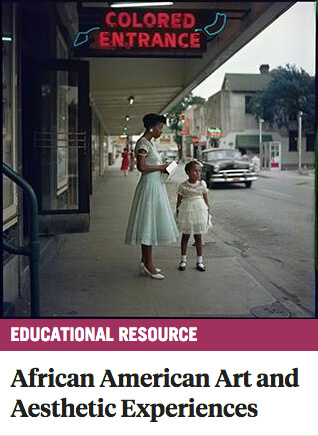
We encourage the use of Southern Spaces educational resources in composition and writing classrooms. Our curated collections feature publications that approach a similar theme or subject across multiple genres, creating ways to examine constraints and opportunities unique to each. Studying the rhetorical situation of writing about memory and place collected in "Social Memory and Memorialization," for example, uncovers compelling differences in audience, purpose, tone, style, register, claims, structures, and arguments across the genres we publish. What does poetry offer for Natasha Trethewey's meditations on geography and place compared to a recorded interview or public address? Similarly, studying reviews of films, monographs, photography and art installations, and digital projects create opportunities for teaching the types of analyses, evidence, and organization that scholars use to make critical assessments. The "Southern Screens" and "African American Art and Aesthetic Experiences" educational resources offer robust collections of reviews well-suited for studying composition.
Southern Spaces educational resources also create possibilities for investigating intersections between images and texts. As a digital journal, Southern Spaces delivers audio, video, images, text, and data to facilitate new ways of presenting and interpreting content. "African American Art and Aesthetic Experiences" organizes examples of how visual materials—photographs of homes in Atlanta's Collier Heights neighborhood, the epic quilts of Gwendolyn Ann Magee, or portraits of Low Country Traveler car club members—convey moving narratives and incisive scholarship, as well as examples of how students might integrate media into their own multimodal projects.
Southern Spaces considers the creation and distribution of our educational resources an important part of our mission to make valuable knowledge and insightful critique openly and freely available. We hope these materials generate constructive opportunities for Southern Spaces readers to enhance teaching, learning, and research while reducing costs and barriers.
About the Author
Sophia Leonard is the assistant managing editor of Southern Spaces and a PhD student in English at Emory University.
]]>Review
In the aftermath of the Great Recession, cities and metropolitan regions were often portrayed as (and often were) spaces of economic turmoil and social upheaval. From December 2007 to June 2009, “more than eight million Americans lost their jobs, nearly four million were foreclosed each year, and 2.5 million businesses were shuttered.”1Diane Whitmore Schanzenbach, “The Great Recession: Over but not Gone?” Northwestern Institute for Policy Research, accessed October 23, 2017. http://www.ipr.northwestern.edu/about/news/2014/IPR-research-Great-Recession-unemployment-foreclosures-safety-net-fertility-public-opinion.html. Foreclosures and underwater mortgages decimated real estate markets from Los Angeles to Orlando. Housing starts evaporated. Underfunded and overburdened state governments cracked under the pressure generated by millions of newly unemployed workers, many in cities and suburbs. Businesses contracted or closed and municipal governments faced layoffs and cut programs because of declining tax revenues.
In Austin, Texas, though, growth had rarely been stronger or more dynamic. Its population grew by 30 percent from 2000 to 2013—when it became the fastest growing city in the United States. Popular publications lauded its economic resiliency; Forbes and Time named it the top city for small business and economic growth in 2011. In 2012, Austin experienced a 6.3 percent growth in its economy, easily the best among the 102 largest US markets. The city’s success became a model others sought to emulate. Eliot Tretter, quoting Andrew Park, observes in the opening pages of Shadows of a Sunbelt City that “everywhere you look, cities big and small are trying to get in touch with their inner Austin" (2).
Yet as Tretter forcefully argues, the sunny portrayals of Austin’s economy, cultural vibrancy, creativity, environmental progressivism, and overall quality of life obscure the race and class discrimination below the surface that is closely tied to the city’s history and contemporary landscape. Understanding structural dimensions of this discrimination is paramount to creating cities where resources are shared more equitably. Austin, imagined as a liberal anomaly in a state long defined by conservativism, is quite similar to other more conservative cities throughout the US South in terms of its urban planning, elites’ desire for economic growth and political power, and race relations.2See for example, Joe Feagin, Free Enterprise City: Houston in Political Economic Perspective (Camden, NJ: Rutgers University Press, 1988); Christopher Silver, Twentieth Century Richmond: Planning, Politics, and Race (Knoxville: University of Tennessee Press, 1984); Christopher MacGregor Scribner, Renewing Birmingham: Federal Funding and the Promise of Change, 1929–1979 (Athens: University of Georgia Press, 2002); Kevin M. Kruse, White Flight: Atlanta and the Making of Modern Conservatism (Princeton, NJ: Princeton University Press, 2005); David R. Goldfield, Race, Region, and Cities: Interpreting the Urban South (Baton Rouge: Louisiana State University, 1997).
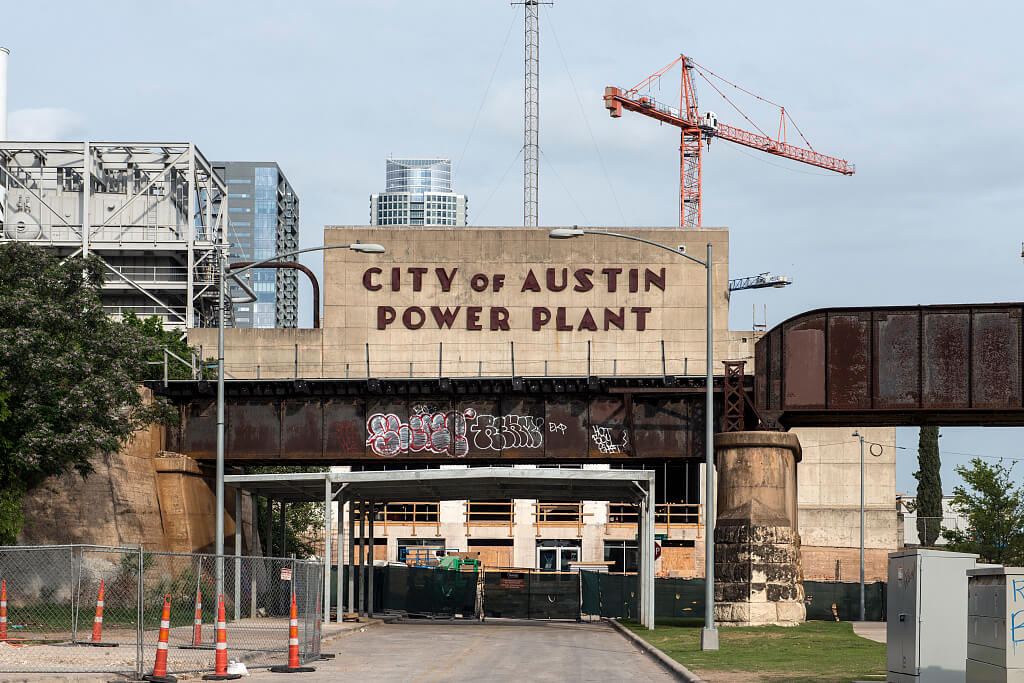
But Austin stands out in its approach to growth. The uniqueness of Tretter’s argument lies in the local circumstances that elites used to transform Austin from a midsized university and state government town to an emergent global hotspot of technology, sustainability, and cultural production. While the city benefited from a migration of people and capital, its leading sectors of development differentiated it from cities of neighboring states. The University of Texas was key because it generated and fostered a knowledge economy that, combined with the state government, allowed elites to pursue a path for growth that eschewed heavy industry. As national and global priorities began to trumpet high technology in the 1970s and 1980s, Austin was in a prime position to prosper. Tretter explains this process using David Harvey’s “tertiary circuit of capital,” in which “the growing significance of technological and knowledge-rent seeking” increasingly drives economic growth in the developed world (18).3The primary circuit consists of the primary production process (transforming natural resources into finished products, for example) and the secondary circuit consists of investments in infrastructure that facilitates the production process. The tertiary circuit consists of “social infrastructure,” the increased application of science to production to maximize the productive power of labor. Also see David Harvey, The Limits to Capital (London, UK: Verso, 1999). To Tretter, “cities of knowledge such as Austin, and their growth coalitions, strongly supported by federal policy, succeed because they are able to switch capital into the tertiary circuit and expand infrastructure that supports knowledge-rent taking” (19). Research universities, with their wealth of knowledge labor, scientific infrastructure, and public-supported capital, are central to this process, generating private wealth through patenting, technology transfer, and spinoff companies.4For academic capitalism and the role of the university in generating economic growth, see Margaret Pugh O’Mara, Cities of Knowledge: Cold War Science and the Search for the Next Silicon Valley (Princeton, NJ: Princeton University Press, 2005); Roger L. Geiger, Research and Relevant Knowledge: American Research Universities since World War II (New York: Oxford University Press, 1993); Sheila Slaughter and Larry L. Leslie, Academic Capitalism: Politics, Policy, and the Entrepreneurial University (Baltimore, MD: Johns Hopkins University Press, 1997). In his first chapter, “The Making of a Globalized Austin,” Tretter unpacks this technical argument and relates it to broad changes in global capitalism since the 1970s.
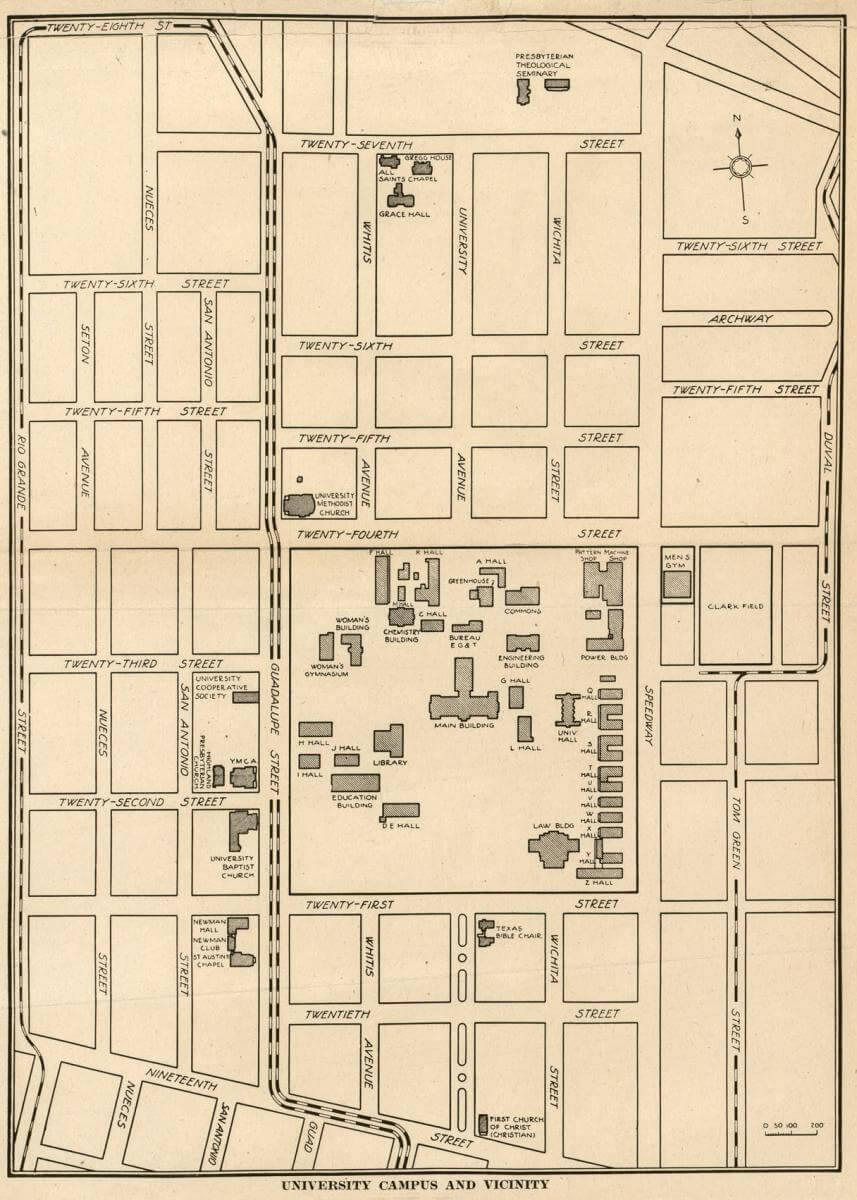
Central to Austin’s growth, the University of Texas has acted as the primary force in transforming the city’s urban space, with consequences that reveal a consistent pattern of historical racial discrimination. Tretter examines the role of the university in developing land and shaping geography to facilitate the type of growth desired by political, economic, and university elites—who were often the same people. He gives a broad account of the university’s expansion efforts during the early and mid-twentieth century, emphasizing the conscious effort to improve its research capacity and capture federal research and development dollars in the 1950s. The university used federal urban renewal funds as well as eminent domain laws to enlarge the campus by roughly a hundred acres. The choice to expand into predominantly African American neighborhoods to the east, rather than the white neighborhoods to the north and west, reveals discrimination most clearly. Tretter argues university administrators employed a “racist theory of value,” which assumes “that African American neighborhoods, households, and bodies were simply less valuable and desirable than those of whites” when deciding which neighborhoods to eviscerate (49). Predictably, the outcome was terrible for the already marginalized African American community. Around a thousand people were displaced, dozens of businesses shuttered, and overall racial segregation was intensified as most African Americans resettled in areas further east heavily populated by African Americans. Tretter’s use of University of Texas archival documents is effective here; he demonstrates the racist and often contradictory logic used by University of Texas administrators to justify dispossession of vulnerable residents.
Tretter pursues a similar theme in the 1970s and 1980s, but expands the scope to include the state of Texas as part of the growth machine. Following Harvey and other critics of neoliberalism, Tretter argues that a new era of competitiveness emerged in the 1980s in which universities, as well as cities and states, became more entrepreneurial in attracting investment and generating revenues.5David Harvey, “From Managerialism to Entrepreneurialism: The Transformation in Urban Governance in Late Capitalism,” Geografiska Annaler B 71.1 (1989): 3–17. Texas, looking to diversify its economy, viewed the university as an entity capable of supporting high levels of industrialization because of its research and development capacity. Federal and state liberalization of patent and technology laws incentivized this “academic capitalism” by making it possible for both researchers and universities to profit from high tech patents and licensing. Universities became more profit-oriented. In an original and important argument, Tretter emphasizes how universities, with their quasi-public status, were also lucrative assets because of their ability to develop land that could provide incentives for outside investment. This strategy paid off when the state, city, and university partnered to attract two major research consortia, Microelectronic and Computer Corporation in 1983 and SEMATECH in 1987, largely by offering university assets: space, labor, capital, and land. Along with other branch facilities and a growing sector related to the defense industry, high tech formed the core of Austin’s growth in the 1980s and established the city as an important technological hub and emergent global city.
“Urban Transformations,” the second half of Shadows of a Sunbelt City, emphasizes the role of urban planning (particularly Smart Growth and urban sustainability) and its relationship to municipal governance in contemporary Austin. Why did sustainable planning emerge so forcefully here? How did it affect vulnerable residents, homeless people and minorities? Tretter chronicles how sustainability and environmental quality became central to Austin’s growth in the 1990s. After decades of bitter confrontation, the city’s pro-development and anti-development coalitions struck a deal where the city’s pristine western hinterland, long the concern of environmentalists, would be protected from intensive development. In return, environmentalists supported bonds and zoning changes that incentivized development in Austin’s urban core, effectively transferring the city’s geography of development from suburban to urban. The city council adopted Smart Growth policies, which encouraged higher density, environmental protections, and other New Urbanist ideals. These changes, Tretter argues, increased Austin’s competitiveness but necessitated increased policing of the homeless who were seen as impediments to the livability of downtown. Austin’s growth advocates came to understand environmental amenities and quality of life as marketable features that could further their interests.6John R. Logan and Harvey L. Molotch, Urban Fortunes: The Political Economy of Place (Berkeley: University of California Press, 1987).
Tretter assesses the outcomes of sustainability on Austin’s populations of color, concentrating on the chasm between mainstream environmentalists and the Latino environmental justice group People Organized in Defense of Earth and her Resources (PODER). He concludes that minorities bore the burden of sustainability because the growth coalition saw their neighborhoods as potentially lucrative to redevelop but also because PODER couldn’t convince mainstream environmentalists that minority displacement was an environmental concern. Improvement in the lives of vulnerable minorities, writes Tretter, will only be possible through an inclusive redefinition of the “environment.”
Examining the historical relationship between urban governance and urban planning in Austin, Tretter charts the major changes in the structure of the city’s government (from a ward system to a commission to a city manager system from 1900 to 1924, and the adoption of at-large voting) and correlates them with large-scale urban planning initiatives (e.g., the 1928 Austin City Plan). He follows this line of inquiry through to the present, with business elites still the leading actors in urban planning.
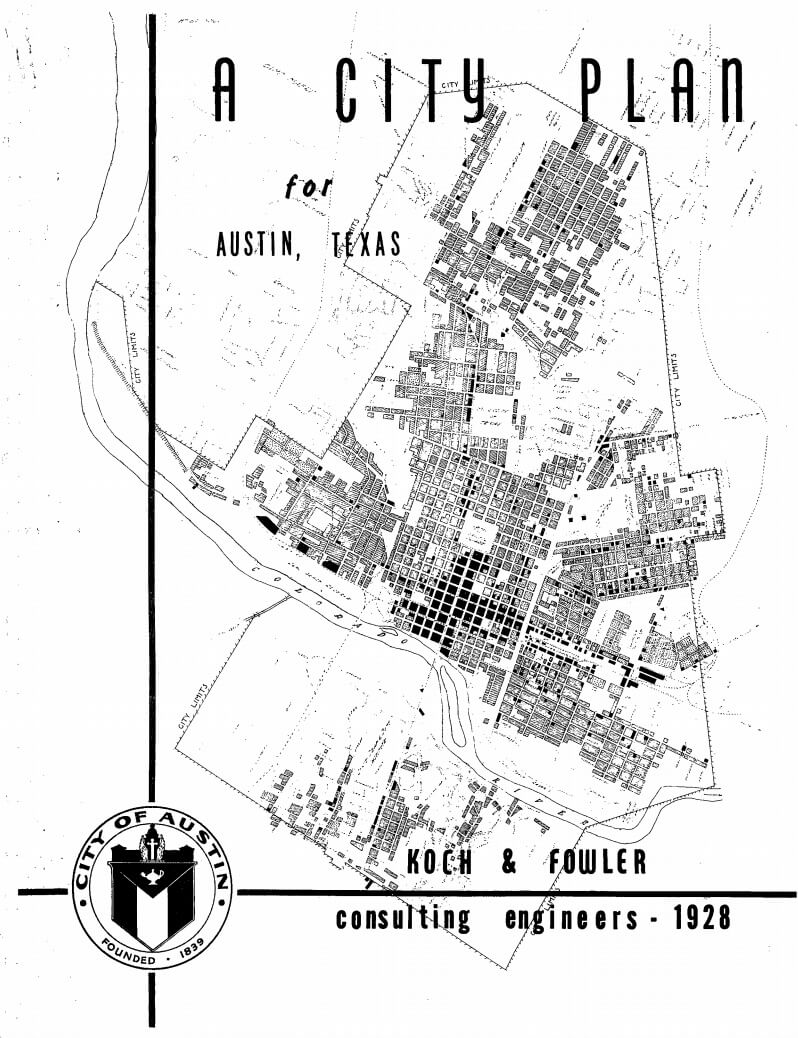
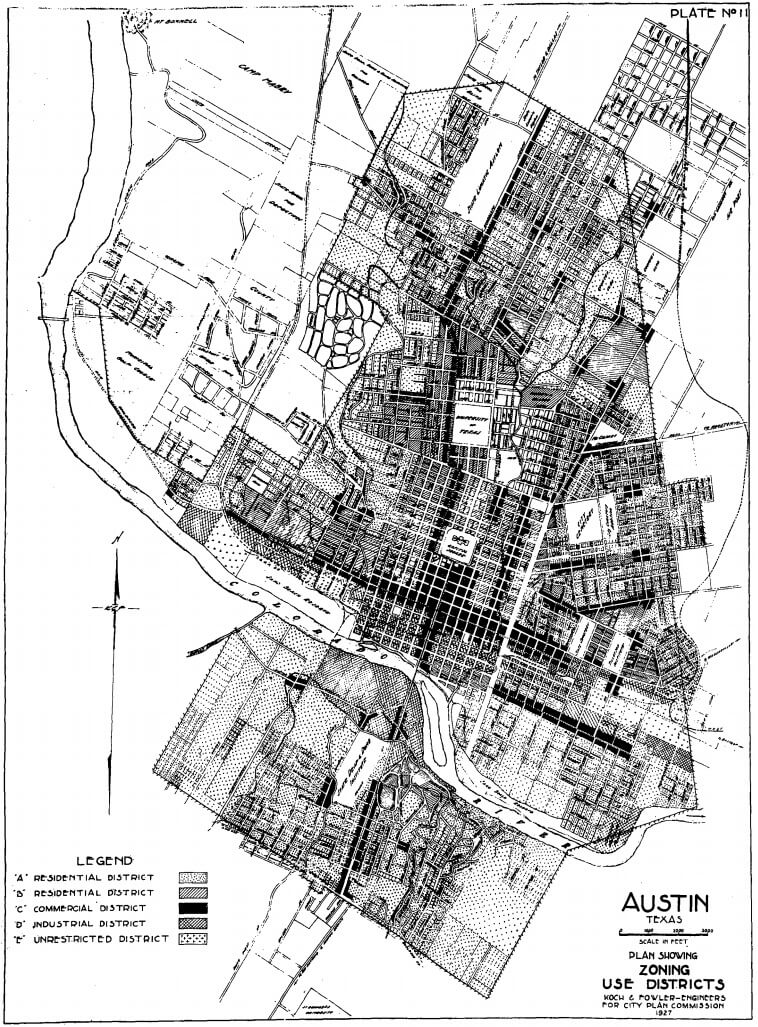
Supported by much research—interviews, archival materials, and interdisciplinary secondary source material—Shadows of a Sunbelt City is effective in its theoretical intervention (though as a geographer, Tretter’s major conversations also engage that field). Emphasizing the university as land developer is the book’s most important contribution to urban studies; this aspect has long been overlooked in favor of research universities’ knowledge production and patenting, production of skilled labor, and ability to generate private firms. Tretter complicates our understanding of the relationship among sustainability, growth, and uneven social and spatial relations. Numerous maps and graphs enhance his arguments. Tretter’s engagement with David Harvey and the tradition of materialist geography demonstrates a commitment to principles of justice, as does his concern with uneven power relations and the myriad ways that growth paradigms undermine the rights and autonomy of vulnerable populations. Shadows of a Sunbelt City is a theoretically sophisticated and critically thoughtful book that improves our understanding of the knowledge economy, sustainable urban practice, racial discrimination, and urban governance and power.
A more developed introduction could have identified a stronger central theme tying the book together. But to his credit, Tretter points out that Shadows of a Sunbelt City is “not written to reflect a straightforward historical narrative,” and offers multiple reasons why Austin is important to study (5). Each chapter intervenes in different discussions and contains several claims. Tretter’s chapter that follows changes in urban governance throughout the entire twentieth century, while richly detailed and convincing, could have been more strongly connected to the rest of the book.
Although the “Sunbelt” of the book’s title is offered as a unifying concept, it is neither defined nor explained, nor does Tretter does contextualize Austin in relation to other “Sunbelt” writing. Tellingly, the term does not appear in the index. This is a glaring omission given the long-standing arguments over what constitutes the Sunbelt. Neither is “Environment,” also in the title, analyzed in the manner readers might expect. Tretter offers an insightful analysis of how the environmental movement and environmental politics unfolded in Austin, but very little about how the natural world was augmented as Austin grew. As urban environmental studies are documenting, environmental improvements, policies, and ideology are often active components in the oppression of minorities during urbanization.
Shadows of a Sunbelt City offers a compelling analysis of the power that universities wield in regional development and their complicity in reshaping the urban form to benefit powerful actors, often at the expense of vulnerable residents. As he examines how policy and social relations transform cities, Tretter challenges the narrative that sustainable urban policy, and the knowledge economy that undergirds it, is universally beneficial.
About the Author
Andrew M. Busch is an assistant professor in the Honors Program at Coastal Carolina University where he teaches interdisciplinary courses on urbanism, environmental studies, globalization, and US History. His first book, City in a Garden: Environmental Transformations and Racial Justice in Twentieth-Century Austin, Texas was published by the University of North Carolina Press in 2017.
]]>