Songs Cover the Landscape
Yet another program housed under the Works Progress Administration (WPA), the Federal Writers Project (FWP), invited Zora Neale Hurston in 1938 to join the editorial staff of The Florida Guide, part of an "American Guide" series designed to "hold up a mirror to America." The gig provided her with the opportunity to sharpen her ethnographic game, and through her WPA activities and assignments, she began to move closer toward both recording and performing her folk music findings out in the field. According to her colleague Stetson Kennedy, she collected "fabulous folksongs, tales, and legends, possibly representing gleanings from days long gone by." She also drafted reports on the music of local church services and filed an essay on Florida folklore and music entitled "Go Gator and Muddy the Water." Hurston did all of this in spite of her steadfast autonomy as a member—the only Black woman member—of the editorial staff (the lowest paid and yet, according to Kennedy, quite likely the most experienced). In this context, she emerged as the ideal candidate to participate in a statewide recording expedition organized by the FWP.1 Valerie Boyd, Wrapped in Rainbows: The Life of Zora Neale Hurston (New York: Scribner, 2004), 313; Kennedy as quoted in Boyd, 318. Says Kennedy, "She had already published her first two books by that time, but she wanted a job and was given the same job title that I had when I started out. I was junior interviewer. Imagine Zora Hurston, junior interviewer. She had already had her degrees from Boaz (sic) and Columbia and Barnard and so on." "The Sounds of 1930s Florida Folklife," All Things Considered, February 28, 2002, NPR Hearing Voices, http:// hearingvoices.com/transcript.php?fID =23. In his unpublished manuscript on Hurston's career and his time working with her on what became known as the "Negro Unit" of the FWP, Kennedy notes that Hurston was given the title of "Junior Interviewer" and paid "$67.20 per month" for her work with the WPA. "Ironically," Kennedy adds, "the typist at the Negro Unit" in Jacksonville "was paid $5.00 per month more than Zora, by virtue of a higher urban wage scale." Stetson Kennedy, "Alan Lomax/Zora Neal Hurston Field Trip of 1935 . . . As Described by Alan [Lomax] to Stetson Kennedy," Zora Neale Hurston Box 1, Stetson Kennedy Papers, uncataloged, n.d., George A. Smathers Library, University of Florida, Gainesville. However, Stetson remains a tricky figure when it comes to his own treatment of Hurston's legacy. He was a fierce champion of her legendary status, a jealous protector of his own archival materials related to their shared work for the WPA, and also a spectacularly harsh critic of Hurston's contradictory persona. See, for instance, his searing list of "SAD-BUT-TRUE ASPECTS of Zora" which includes a range of inflammatory monikers including "THE SELF-STYLED 'PET DARKEY' . . . NO RACE CHAMPION . . . THE LICKER OF THE WHIP HAND, THE 'HOUSE NIGGER' . . . THE RACISTS' DARLING," "THE ARCH REACTIONARY," and "THE 24-KARAT BITCH." The latter insult Kennedy attributes to Alan Lomax, quoting him as having said that in "the field, Zora was absolutely magnificent—but of course you know she was a 24-karat bitch. . . ." Kennedy, "SAD-BUT-TRUE ASPECTS OF ZORA," September 5, 2000, Zora Neale Hurston Box 1, Stetson Kennedy Papers, uncataloged at the time of archival research. Kennedy wrote obsessively about Hurston in a range of published material and unpublished material that recycled and occasionally reworked versions of the aforementioned list of traits he logged. See, for instance, Kennedy, "Almost all I know about Zora," unpublished manuscript, September 5, 2000, Zora Neale Hurston Box 1, Stetson Kennedy Papers, uncataloged at the time of archival research. Kennedy, untitled ("I am the one who wrote, in my Tribute to Zora . . ."), unpublished manuscript, September 8, 2000, Zora Neale Hurston Box 1, Stetson Kennedy Papers, uncataloged at the time of archival research.
In the eyes of Ben Botkin, the FWP folklore program's new national director, "mere written transcriptions did not provide enough detail and ambience," and so he turned to Hurston and crew to turn up the volume in the wetlands. "When she first came on board and scheduled a visit to our (lily-white) state office," recalls Kennedy, "a staff conference was convened at which we were admonished that 'we would have to make allowances for Zora, as she had been lionized by New York café society, smoked cigarettes in the presence of white people,' etc. And so she did, and so we did."2Boyd, Wrapped in Rainbows, 322; Stetson Kennedy, unpublished manuscript, 6, Zora Neale Hurston Box 1, Stetson Kennedy Papers, uncataloged at the time of archival research.
It was not a situation without stress for her. Writing in late 1938 to state FWP director Carita Doggett Corse, Hurston noted her personal battle with a "form of phobia," a crushing and incapacitating depression that left her unable to "write, read, or do anything at all for a period." Having assured her "Boss" in that letter that when she does "come out of" such spells, it is "as if [she] had just been born again," Hurston nonetheless was plagued at times with questions about how best to make sense of her inner turmoil in relation to her intellectual and artistic pursuits. In her letter to Corse, she ponders the reasons for her despair and notes that she finds that such spells are often "the prelude to creative effort."3Zora Neale Hurston to Carita Dogget Corse, December 3, 1938, in Zora Neale Hurston: A Life in Letters (New York: Anchor, 2003), 417–418. By summer of the following year, she was rolling with the FWP crew and about to embark on some of her most fascinating and unique methods of research.

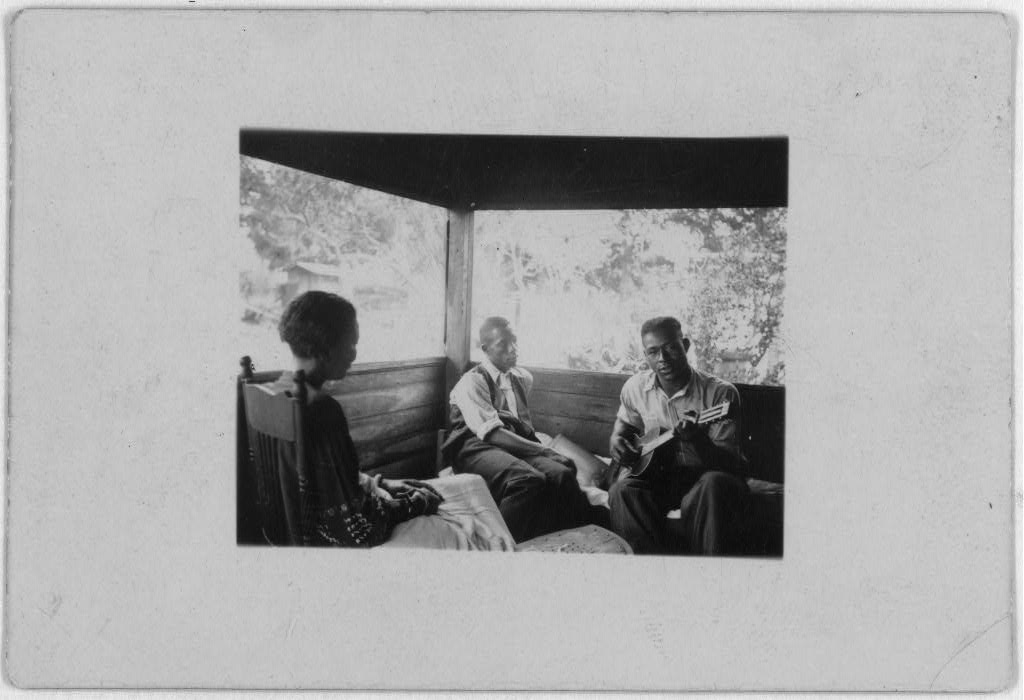
Bottom, Zora Neale Hurston with Rochelle French and Gabriel Brown, Eatonville, Florida, June 1935. Photograph by Alan Lomax. Courtesy of Library of Congress.
Some four years after the publication of what would become two of her most famous essays, folklorist Herbert Halpert and a crew of fellow WPA workers recorded Hurston on June 18, 1939, performing a range of rollicking vernacular songs down on the Florida peninsula in Jacksonville. Here she and her Florida guide colleagues had set up camp, among them Corse, "twenty-something" Halpert, and local student-turned-project supervisor Kennedy. On site in Jacksonville, Halpert had on hand a recording device "the size of a coffee table—the moving parts looked like a phonograph—and cut recordings with a sapphire needle directly onto a 12-inch acetate disk." For her part, Hurston had, along with her fellow Black FWP colleagues, rounded up "a group of railroad workers, musicians, and church ladies at the Clara White Mission on Ashley Street, a landmark institution in Jacksonville's Black community." There, Halpert "used his cumbersome recording machine to capture the voices of various informants singing, telling stories, and occasionally hamming it up for posterity."4"Sounds of 1930s Florida Folklife." Kennedy traces the recorder back to "the Hurston/Lomax/Barnicle team," pointing out that the team "borrowed the recorder of the Library of Congress" because of Lomax's father's ties to that institution. "In those pre-tape days," he muses, recorders "consisted of a heavy monstrosity. . . ." After joining the FWP, "Zora was able to again wangle it on loan from the Library of Congress" Stetson Kennedy, unpublished manuscript, 62–63, Zora Neale Hurston Box 1, Stetson Kennedy Papers, uncataloged at the time of archival research. Bordelon further points out that Halpert would arrive in Jacksonville "with the equipment carefully stored in a converted World War I ambulance outfitted by workers from the Federal Theater Project. . . . He was one of the few folklorists with field recording experience. He knew how to transport, repair, and set up the cumbersome equipment as well as how to conduct the first-person interviews, an integral part of the recording sessions." "Zora Neale Hurston," Go Gator and Muddy the Water: Writings by Zora Neale Hurston from the Federal Writers Project, ed. Pamela Bordelon (New York: Norton, 1999), 45; Boyd, Wrapped in Rainbows, 324.
Hurston's approach to this whole operation was always distinct, always bent on both reproducing precious sounds through her own performance practices and yet still capitalizing on the quirks and the character of her own interpretative skills. This is Zora's form of phonography, that which loops together a zone in which she operates at the crossroads of the modern and the folk. On tape, one hears a forty-eight-year-old Hurston (who brashly claims for the record that she is thirty-five) both collaborating with and also facing off against Halpert's bulky, furniture-sized machine to offer her own definitive repertoire of southern vernacular culture for the archive. A copy of Halpert's "Tentative Record Check List" from these sessions dated March 12–June 30, 1939, offers a detailed account of songs sung by Hurston and other local interlocutors (for example, "Beatrice Long (white) age 35"; "Rev. H. W. Stuckey, age 43, blind Negro preacher"). Both a playlist of sorts and an archival testimony to this sister's exhaustive performative dynamism, her mad flow, and her tireless and meticulous attention to the cultural eccentricities manifest in the songs themselves, Halpert's "record check" documents Hurston's instructive commentary and her magnetic presence on these expeditions. These are notes that follow the rhythms of her explanatory cues, the distinctions that she makes between, say, a "jook song" and a "lining" accompaniment, her references to her own ethnographic prowess ("Miss Hurston describ[es] how she collects and learns songs (including those she has published)"). The labor of it all lurks in the parentheses as well, as in the bracketed moment when Halpert indicates that "Miss Hurston was tired (in part) and accidentally tacked songs together." This is the document of her marathon performances, her critical acuity in the realm of listening, performing, and, by extension, arranging the sounds that she encounters, stores, and "carrie[s] . . . in her memory" from the heart of the field right into the center of those scholarly circles awaiting her return.5Boyd, Wrapped in Rainbows, 325; Bordelon, "Mule on the Mount" transcription, 163–164; Herbert Halpert, "Tentative Record Check List: southern recording expedition," March 12– June 30, 1939, Herbert Halpert 1939 Southern States Recording Expedition (AFC 1939/005), Archive of Folk Culture, American Folklife Center, Library of Congress, Washington, DC. Kennedy maintains that it was his "bright idea" to "sav[e] travel money," "summo[n]" Hurston to Jacksonville, "si[t] her down in a chair, and recor[d] all the folkstuff she carried around in her head," and he looked to Halpert, who was "using the machine at the time," to "collaborate in interviewing" her. Stetson Kennedy, unpublished manuscript, 64, Zora Neale Hurston Box 1, Stetson Kennedy Papers, uncataloged at the time of archival research.
By way of Zora's phonography, we are made privy to a listening to a listening: Kennedy and Halpert and Corse and others lean in and pose questions as they strain to follow Hurston's musical cartography of folk songs, work chants, and blues and children's songs gathered up in the American South and the Caribbean diaspora, from the Bahamian "Crow Dance" to the swinging "Charleston rhythms" of "Oh the Buford Boat Done Come," music picked up by Hurston from a South Carolina Geechee country woman she met in Florida. She stands at the center of it all, shifting fluidly between the role of the folklorist and that of the informant, melding songs with communal lore, sketching out their sociocultural context and utility, and belting them out for a wonkish gaggle of folklore scholars, a captive audience who, nonetheless, prods her for details. Scholarly jostling ripples as an undercurrent in these sessions. But Hurston the pro brings all her swagger to these proceedings; she brings all of her skills to bear/bare in her vocal aesthetics of song, the means through which she might put the wonder and specificity of Black sonic art on the Florida map once and for all.6Kennedy's version of this recording expedition occasionally frames Hurston as the object of ethnographic inquiry rather than as a fellow collaborator ("I had gotten into the habit of asking my informants if they knew any 'dirty songs.' As it turned out, they knew plenty. . . . I asked Zora if she knew a song called 'Uncle Bud.'"). Stetson Kennedy, unpublished manuscript, 64, Zora Neale Hurston Box 1, Stetson Kennedy Papers, uncataloged at the time of archival research. The Library of Congress website lists both Halpert and Kennedy as "speakers" along with Hurston on various recordings from these sessions. Elsewhere Kennedy elaborates on the team's working conditions, describing how, "in recent years when asked to speak on the subject 'Working with Zora' . . . I have been tempted to suggest that the title 'Trying to Get Zora to Work' would be more appropriate. Like many of us who were on our own out in the field (again myself included), production was sporadic." Stetson Kennedy, "Zora's Contributions," n.d., unpublished manuscript, n.p., Zora Neale Hurston Box 1, Stetson Kennedy Papers, uncataloged. Kennedy was one of Hurston's greatest defenders and also one of the most consistent critics of her well-known ambivalences when it came to racial uplift politics, her "accomodationist-if-not apologist" leanings, as he puts it. But repeatedly in his manuscript, he argues that "we and generations yet to come should focus upon how Zora Neale Hurston wrote, not how she voted." Stetson Kennedy, unpublished manuscript, 68, Zora Neale Hurston Box 1, Stetson Kennedy Papers, uncataloged. See also Kennedy, "sad-but-true aspects of zora," unpublished manuscript, September 5, 2000, Zora Neale Hurston Box 1, Stetson Kennedy Papers, uncataloged at the time of archival research. For more on Hurston's political leanings, see Boyd, Wrapped in Rainbows.
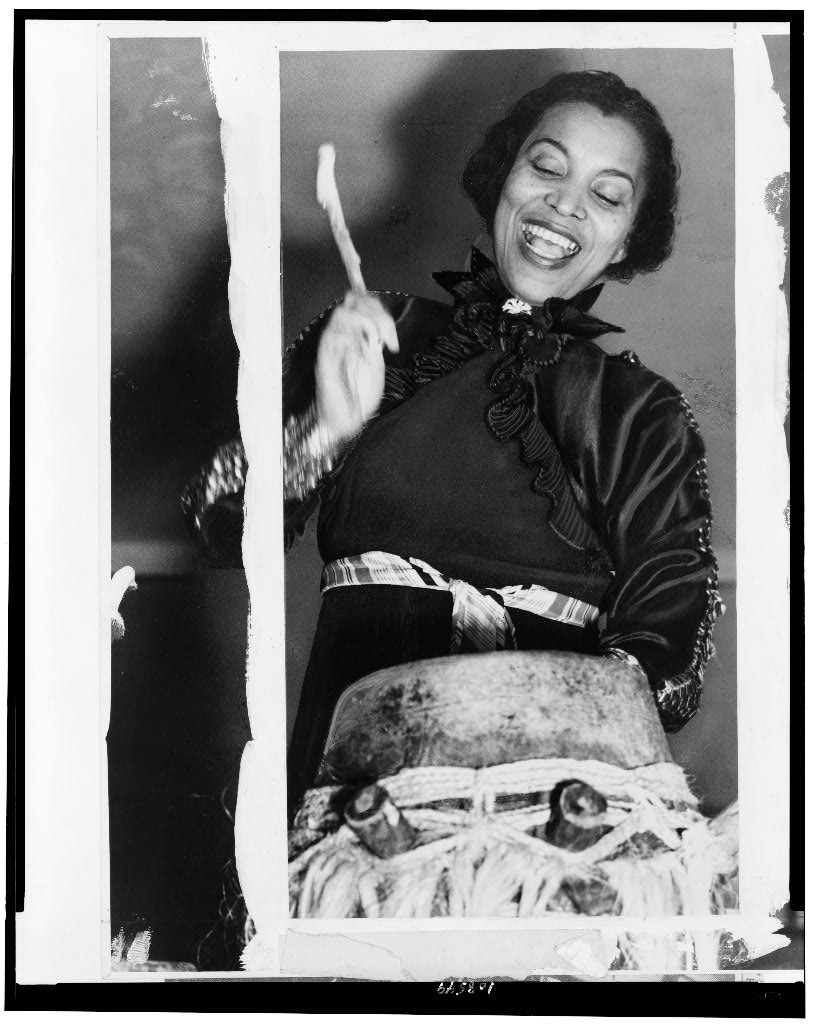
Songs cover the landscape like regional quilts in Zora Neale Hurston's musical repertoire. As she lets loose on "Mule on the Mount," "the most widely distributed work song in the United States," we hear the varied shades and moods of Black regional experience as verses shift and change according to locality. Hurston's fascination with blues dissonance clearly undergirds her theories of Black performance, her liner notes for the recordings still to come when, for instance, she highlights the importance of both angularity (performances that stress the "angles" of bodily expression) and especially asymmetry ("the abrupt and unexpected changes. The frequent change of key and time . . ."). We can hear her working this blues aesthetic out in songs like "Mule on the Mount," that lining rhythm that we might think of as a Hurston, folkified version of "Wartime Blues" since, as is perhaps implicit in her prefatory comments, it shares moments of startling narrative discordance and social upheaval with that Blind Lemon Jefferson blues classic.
Hurston: This song I am going to sing is a lining rhythm, and I am going to call it "Mule on the Mount," though you can start with any verse you want and give it a name. And it's the most widely distributed work song in the United States . . . it has innumerable verses and whatnot, about everything under the sun. . . . [Black folk] sometimes sing it just sitting around the jook houses and doing any kind of work a t'all. . . .Everywhere you'll find this song. Nowhere where you can't find parts of this song. . . .
Halpert: . . . Is it a consistent song . . . as you hear it all over?
Hurston: The tune is consistent, but . . . the verses, you know . . . every locality you find some new verses everywhere. . . . There is no place that I don't hear some of the same verses. . . .
Halpert: Where did you learn this particular way?
Hurston: Well, I heard the first verses, I got in my native village of Eatonville, Florida, from George Thomas.
Halpert: And is . . . that the only version you're going to sing?
Hurston: The tune is the same. I am going to sing verses from a whole lot of places.
Halpert: All right.7Zora Neale Hurston, "Mule on the Mount," Herbert Halpert 1939 Southern States Recording Expedition, AFC 1939/005: AFS 03136 B01, American Folklife Center, Library of Congress, Washington, DC, https://www.loc.gov/item/flwpa000008/.
If the trope of the mule recurs in Hurston's literary and ethnographic writing most famously as a feminized beast of burden, in this song from "everywhere," it is the vehicle that the masculinist singer "rides down" in the opening verse, replaced in the second verse by "a woman" who "shakes like jelly all over." "Mule on the Mount" is, by no means, a feminist revision of sexist vernacular culture, as it transitions into a stock tale of paranoia and betrayal ("My little woman, she had a baby this morning. . . . He had blue eyes"), alienation and revenge ("And I told her, must be the hellfire cap'n Ha! . . . I got a woman. She won't live long, lawd, lawd, she won't live long"). However, it is a song that emerges in her research and performance as raw material that showcases the ways sonic folklore might serve as the connective tissue that ties dispersed Black peoples together through improvisational innovation, as well as temporally and geographically distant modes of collaboration.8Bordelon transcription of "Mule on the Mount," Bordelon, Go Gator, 163–164; Hurston, "Mule on the Mount." Like the protagonist in Jefferson's ode to estrangement and wandering, the tragic hero of Zora's mule tale retold breaks by the fourth verse onto another plane, away from the arrival of the "blue-eyed baby," the product of probable betrayal and potential racialized sexual violation, away from "the hellfire," and turns instead toward the sound of "a cuckoo bird" that "keep a hollerin' Ha! . . . It look like rain, lawd, lawd, it look like rain."9Blind Lemon Jefferson's 1926 "Wartime Blues" makes use of the blues form's "floating verses," oft-repeated verses in Black radical tradition lore, and ones that reference familiar images, for instance, "trains" and "rivers" and tropes evocative of African American rural and migratory life. Such visions and figures and themes "float" from one song to another and can sometimes take shape as jarring abstractions, as thematic non-sequitar. But in every case, they are manifestations of both a dispersed and disrupted culture and the innovative contemplation of and rejoinder to quotidian and ubiquitous crisis. Blind Lemon Jefferson, "Wartime Blues," Release # 12425A, Matrix # 3070, Take #1, The Rise & Fall of Paramount Records, Vol. 1 (1917–1932) (Third Man Records-Revenant Records, 2013). For more on blues aesthetic traditions, see also Scott Blackwood's monumental work on the archive of Paramount recordings. Scott Blackwood, The Red Book liner notes for The Rise & Fall of Paramount Records, Vol. 1 (1917–1932); and Chapter 7. The pivotal fifth verse, and one that would become a signature line in Hurston's repertoire—"I got a rainbow wrapped and tied around my shoulder/It look like rain, lawd, lawd, it look like rain"—is the most telling break in the song, and it is the kind of rupture that Hurston would capitalize on in her role as a "signifying ethnographic" critic of Black sound. With that technicolor coat supplying crucial cover, the heroine of "Mule on the Mount" stands both outside and inside the song's wending, epic narrative. It may pour cats and dogs all around her, this song suggests, but she stays the course all bundled up in a mystical garment. Here in this place, caught in this storm and yet sheltered from it, she is traveling at her own angle against and through the elements. Moving to her own soundtrack, she possesses the equipment to stay in motion and keep the music alive. She wraps that "rainbow . . . tightly around [her] shoulder" and heads on out into the territory that is Black America, picking up exquisite sound, peculiar sound, vital sound all along the way.10Hurston, "Mule on the Mount."
Hurston on the Open Road
"My search for knowledge of things," Hurston muses in her conundrum of a memoir Dust Tracks on a Road, "took me into many strange places and adventures. My life was in danger several times. If I had not learned how to take care of myself in these circumstances, I could have been maimed or killed on most any day of the several years of my research work." Still more, Carla Kaplan makes plain in her edited edition of Hurston's letters how wary she is of "romanticiz[ing] Hurston with Model T and pistol, searching out 'the Negro farthest down' and 'woofing' in 'jooks' along the way." The "truth is," Kaplan contends, "that she worked hard under harsh conditions: traveling in blistering heat, sleeping in her car when 'colored' hotel rooms couldn't be had, defending herself against jealous women, putting up with bedbugs, lack of sanitation, and poor food in some of the turpentine camps, sawmills, and phosphate mines she visited."11Hurston, Dust Tracks on a Road (New York: Harper Perennial, 1996, 146; Carla Kaplan, "'De Talkin Game': The Twenties (and Before)," in Zora Neale Hurston: A Life in Letters (New York: Anchor Books, 2002), 51–52. With regards to the opacity of Dust Tracks, Maya Angelou's 1995 foreword to the book is instructive. Angelou famously observes of Dust Tracks that "the author stands between the content and the reader. It is difficult, if not impossible, to find and touch the real Zora Neale Hurston" (xii). But as she was prone to "wandering" in "spirit," if not always in "geography" and "time," as she would describe it in her memoir, the automobile proved useful as a source of refuge from Jim Crow danger on more than one occasion for her, particularly as "racially 'mixed' teams" of WPA field researchers "travelling together were virtually unheard of." For these reasons, her "beat-up Chevy" was, more often than not, always her most dependable shelter.12Hurston, Dust Tracks on a Road, 67. See also Boyd, Wrapped in Rainbows, 57. Fellow FWP recording expedition team member Kennedy recalls Hurston's time in the field with him "record[ing] more of the songs of migratory black workers in the Everglades mucklands." Stetson Kennedy, unpublished manuscript, 63, Zora Neale Hurston Box 1, Stetson Kennedy Papers, uncataloged at the time of archival research.
Hurston turned to her engine of modernity to gather up, cultivate, and disseminate songs that played with and through time and space and that called attention to the scale and depth of Black community. . . . The songs are the cars that she drives and the vehicles that carry her listeners into the "imagined cartographies" of Black migrants all at once, working out the politics of spirited togetherness as well as passionate longings and everyday dislocations as her vocal wheels keep turning. They are the sounds that stored up a kind of complex counterknowledge to that which irked Hurston, the seemingly knee-jerk rendering of southland Black life that defined it as steeped in suffering and nothing but.13Marti Slaten, Email message to the author, Jan. 13, 2011. Josh Kun would most certainly identify the "audiotopian" sites of cultural memory, communal questing, and questioning in Hurston's sounds. Josh Kun, Audiotopia: Music, Race, and America (Berkeley: University of California Press, 2005). Concerning this noted Blackness and suffering trend, redolent in the work of some of her most prominent 1930s contemporaries like George Gershwin and Richard Wright, she lamented in a 1936 letter that "some writers are playing to the gallery. That is, certain notions have gotten in circulation about conditions in the south and so writers take this formula and workout so-called true stories." Zora Neale Hurston to Stanley Hoole, March 7, 1936, Folder 60, Box 2, Zora Neale Hurston Papers.
I heard "Halimuhfack" down on the . . . East Coast. . . . I was in a big crowd, and I learned it in the evening [in] the crowd. . . . I learned it from the crowd. [Zora singing]: "You may leave 'n go to Halimuhfack, but my slowdrag will bring you back. Well, you may go, but this will bring you back. I been in the country but I move to town. I'm a toe-low shaker from a head on down. Well you may go but this will bring you back. . . . Some folks call me a toe-low shaker, it's a doggone lie. I'm a backbone breaker. Well you may go, but this will bring you back. Oh you like my peaches but you don't like me. Don't you like my peaches, don't you shake my tree? Oh well you may go but this will bring you back. Hoodo! Hoodo! Hoodo do working! My heels are poppin' . . . my toenails crackin'. Well you may go, but this will bring you back."14Zora Neale Hurston, "Halimuhfack," Herbert Halpert 1939 Southern State Recording Expedition, AFC 1939/005: AFS 03138 B02, recorded in Jacksonville, Florida, June 18, 1939, American Folklife Center, Library of Congress, Washington, DC, https://www.loc.gov /item/flwpa000014/.
You can hear Hurston relishing the wicked innuendos running amuck in "Halimuhfack," a jook song she'd "heard down on the East Coast" of Florida and one that exudes the "slow and sensuous" rhythms of the jook, that undercommons gathering place where, as she would famously insist, Negro theater originates, where "bawdiness" and "pleasure" erupt out of a smoldering elixir of song, dance, and inspired instrumentation.15Zora Neale Hurston, "Characteristics of Negro Expression," in The Jazz Cadence of American Culture, ed. Robert O'Meally (New York: Columbia University Press, 1998), 306–309. All taunt and gentle seduction, Hurston the singer/interpreter gamely seizes on the mischievous wonder of a song that nonetheless documents and archives Black geographies in flux. It is a song that calls attention to the "imbrication of material and metaphorical space."16 Katherine McKittrick, Demonic Grounds: Black Women and the Cartographies of Struggle (Minneapolis: University of Minnesota Press, 2006), xiii. McKittrick calls these kinds of "clandestine geographic-knowledge practices" the "spaces of black liberation" that were "invisibly mapped across the United States and Canada and that this invisibility is, in fact, a real and meaningful geography. . . . the unmapped knowledges" (18). These "black geographies," she argues, "are deep spaces and poetic landscapes, which not only gesture to the difficulties of existing geographies and analyses, but also reveal the kinds of tools that are frequently useful to black social critics" (21–22). As Hurston would describe it in her "Folklore" manuscript chapter for the FWP, "Halimuhfack" is a "blues song" whose "title is a corruption of the Canadian city of Halifax. The extra syllables are added for the sake of rhythm."17Zora Neale Hurston, "First Version of Folklore," n.d., manuscript, Box 12, Zora Neale Hurston Papers. Pamela Bordelon includes "the third and final draft of the folklore and music chapter for The Florida Negro" in her collection of Hurston's transcribed FWP writings, but she spells the title as "Halimufask." The song title in Hurston's "first version" is "Halimuhfack." See Zora Neale Hurston, "Go Gator and Muddy the Water," in Bordelon, Go Gator, 72. The Stetson Kennedy Papers include a Zora Neale Hurston "set list" of sorts with "Halimuhfack" listed as "Halimuhfact," as well as the handwritten additional lyric, "My slow drag will bring you back!" Black theater scholar Eric Glover notes that "Halimuhfack" appears in Hurston's script for Polk County as well. See Eric Glover, "By and About: An Antiracist History of the Musicals and Anti-musicals of Langston Hughes and Zora Neale Hurston" (PhD diss., Princeton University, 2017). Yet "extra syllables," the gateway to lyrical "corruption" here, are the beats that carry the song onto another plane of expressive recourse for African Americans managing the exigent pressures of Jim Crow life, the quest for equality, employment, and human sustenance. Like "Diddy-Wah-Diddy" and other "Negro mythical places" of Black folklore that she documents in her automotive guide writing, "Halimuhfack" is the site of the speculative, the not-here; it's the in-between world of mythical folklore and blues quotidian life.18Bordelon points out that one of the "Negro mythical places" included in her automotive guide excerpt, "'Diddy-Wah-Diddy' . . . [is] a magical destination where neither man nor beast had to worry about work or food. Both were magically supplied. They often laughed and dreamed of far-off 'Heaven,' pinning human qualities on its celestial inhabitants." Bordelon, "Zora Neale Hurston," 26. See also Christopher D. Felker, "'Adaptation of Source': Ethnocentricity and 'The Florida Negro,'" in Zora in Florida, ed. Steve Glassman and Kathryn Lee Seidel (Orlando: University of Central Florida Press, 1991), 149. Hurston's shrewd rhythmic elongation of a north-of-the-border place (a place where Black fugitives found shelter from those who sought to return them to US bondage) renders it unrecognizable, turns this place into something new, another site of Black flight with its own quixotic allure, matched only by the "slow drag" of a singer bold enough to try to seduce her lover to return.
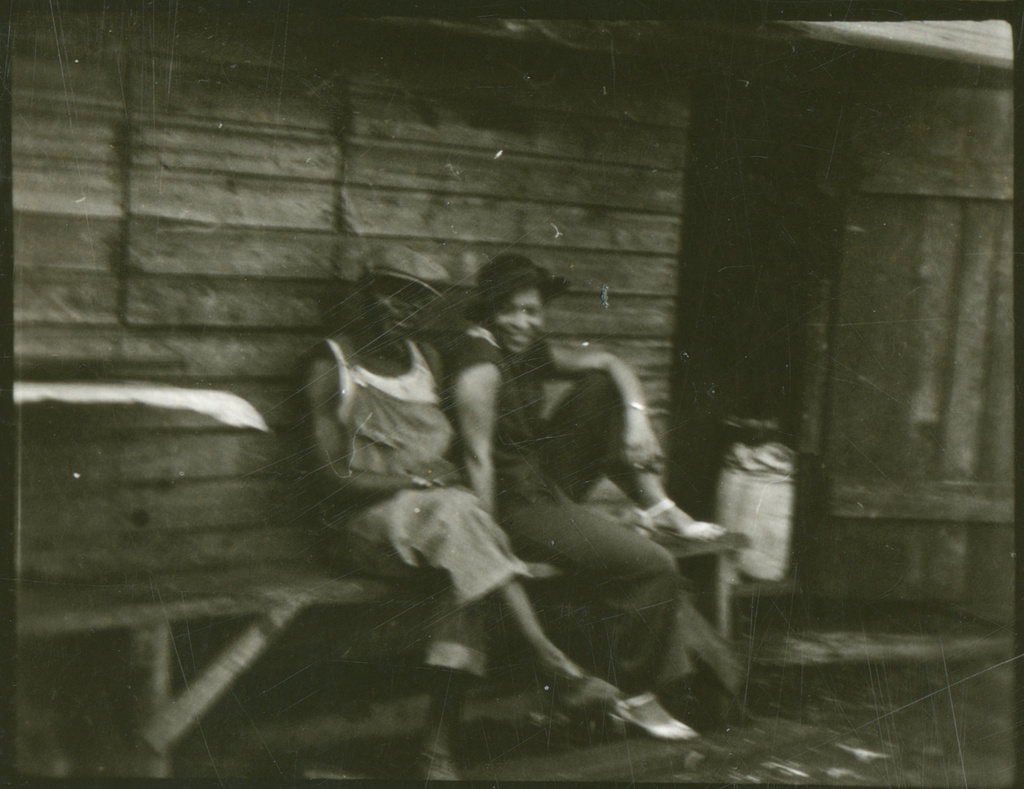
"Halimuhfack" is a record of Florida Jim Crow life as it was lived in a felt relationship with space, place, and the land that our intrepid anthropologist criss-crossed by car. In her time working for the FWP—which, on the one hand, flexed its racism by hiring her "in a relief rather than an editorial-supervisory capacity" and yet, on the other hand, enabled her to "live and work out of her own home in Eatonville, a privilege extended to only a handful of writers nationwide"—Zora's taped performances exude the kind of adventurous independence that would ultimately inform the iconicity of her career.19Bordelon, "Zora Neale Hurston," 17. Her recordings also stand as sound evidence of "different knowledges and imaginations . . . ," they are the kind of recordings that hold out the promise of "call[ing] into question the limits of existing spatial paradigms and put[ting] forth more humanly workable geographies."20McKittrick, Demonic Grounds, xxvi–xxvii. Hurston's rendition of the song encapsulates the driving and oscillating Zora, the woman who was both of and in the crowd as well as whimsically positioned outside of it. Reveling in the taunt, sass, and sly insinuations of this jook song's chorus ("You may go but this will bring you back"), she inhabits the playful ("Hoodo! Hoodo!") and the flirtatious energy of the tune while also wistfully stretching out the song's melancholic lyrics ("You may go but this will bring you back"), lyrics that signal lapsed love, abrupt departures, and the sting of abandonment. She translates into sonic feeling "geographic patterns that are underwritten by black alienation from the land."21McKittrick, 5. As the twinned pressures of the Great Migration and the Depression continued on through the thirties, songs like "Halimuhfack" captured the entwined sounds of vibrant, ingenious, raucous communal sociality and movement; sober, individual despair; and a deep bone will to survive and thrive in the face of enormous socioeconomic and regional transformations. Inside the massive archive that is Zora's playlist, in the anatomy of each of these big, colorful and complex songs of the self, Black folks make their own time while the wheels keep turning round and round. 
About the Author
Daphne A. Brooks is William R. Kenan, Jr. Professor of African American Studies, American Studies, Women's, Gender, and Sexuality Studies, and Music at Yale University. She is the author of Bodies in Dissent: Spectacular Performances of Race and Freedom, 1850–1910 (Durham, NC: Duke University Press, 2006), winner of The Errol Hill Award for Outstanding Scholarship on African American Performance from the American Society of Theatre Research; Jeff Buckley's Grace (New York: Continuum, 2005); and Liner Notes for the Revolution: The Intellectual Life of Black Feminist Sound (Harvard University Press, February 2021).
]]>
Water Graves investigates how contemporary writers and artists of the greater Caribbean (such as Jason deCaires Taylor) reinvest sites of racialized violence and environmental degradation—as so many manifestations of "unritual"—with a new sense of the sacred that allows for remembrance and re-humanization. Rituals—be they initiations, funerary rites, or collective acts of remembrance—confer "humanity" on those who practice them and sacredness on the places of these practices. The unritual comprises moments and spaces of desecration. Unritual occurs when rituals are ignored, violently suppressed or obstructed outright, and where so-called "natural" spaces are commodified, exploited, and profaned. Closely appended to Loichot's unritual are the notions of "undead" and "unrest"; the liminal zone of (non)being they demarcate emphasizes the unritual's alienating, unsettling, and dehumanizing effects before and beyond the grave.
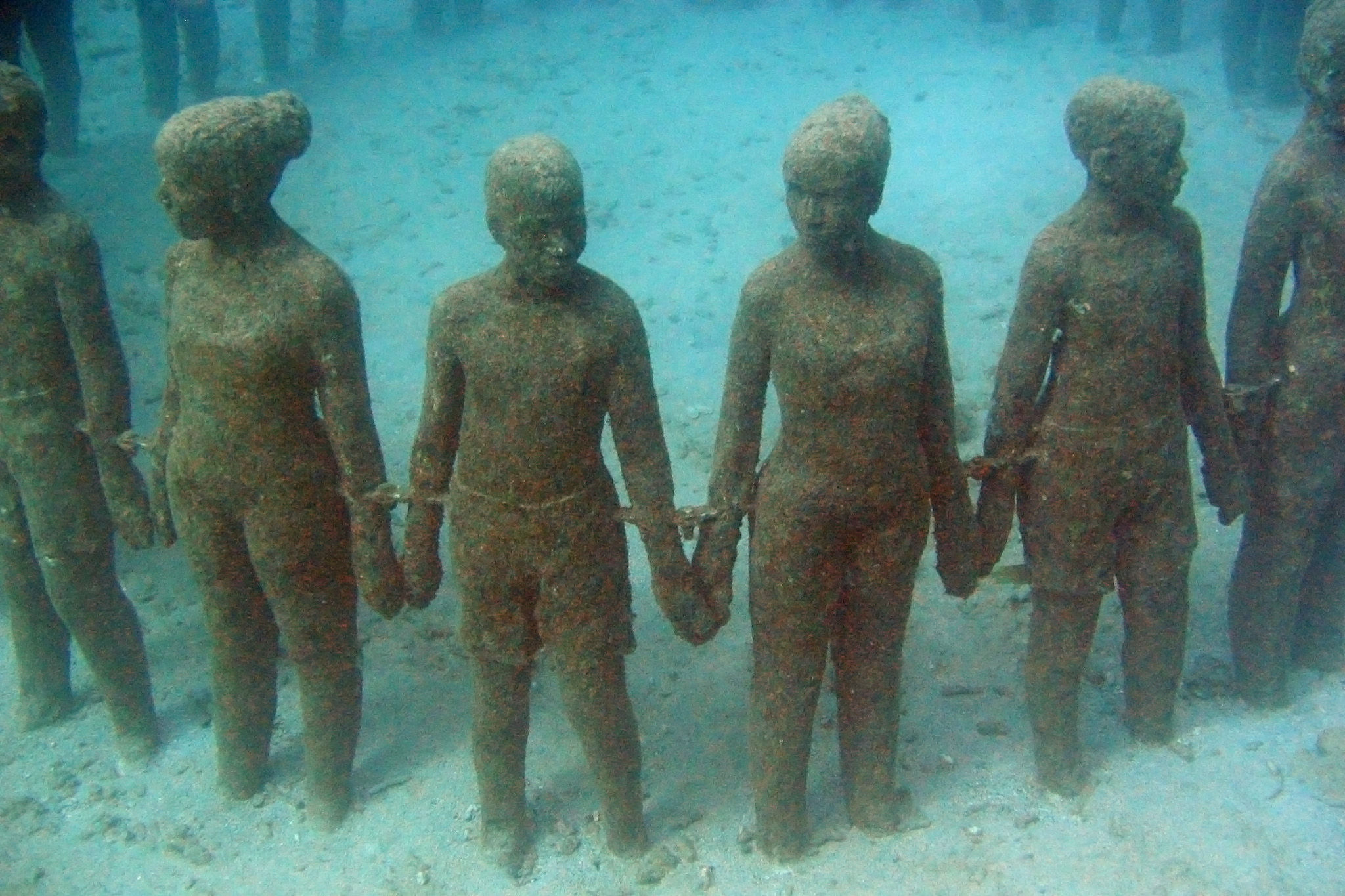
Off the coast of Grenada, several meters below the Caribbean surface, stands Jason deCaires Taylor's Vicissitudes. It is an installation of statues which, at first glimpse, shows a group of men and women arranged in a large circle, holding hands as they gaze outward along the ocean floor. The figures bear bright red, pink, and violet protrusions of coral, undulating gossamers of seaweed, and the occasional sea star. The texture and topography of these statues' skin—their pores, wrinkles, and scars—provide the ideal environment for aquatic life to take root and repopulate this portion of ocean floor. Vicissitudes also offers another, more haunting kind of repopulation, this time by the specters of the Triangular Trade: the innumerable captives thrown overboard after dying in transit during the Atlantic crossing and condemned to perish, away from ancestral lands and families that could offer funerary rites or remembrance. As the installation confronts the degradation of coral environments, its underwater surroundings also beckon and materialize the (un)dead of the African Diaspora whose memory—likewise rarefied and threatened—inhabits these statues alongside the coral. Vicissitudes, a monument that explores the creative and memorial agency of Caribbean underwater spaces, serves as one of many objects that Valérie Loichot examines in her book, Water Graves: The Art of the Unritual in the Greater Caribbean.







An interdisciplinary exegesis in the fields of Postcolonial Studies, Caribbean Studies, African Diaspora Studies and Ecocriticism, Water Graves investigates objects across many mediums that, like Vicissitudes, work through or heal the effects of unritual. The oeuvre of poet-philosopher Edouard Glissant serves as the opening and the theoretical springboard for the rest of the book. Here, Loichot engages the notion of "relational sacred," which draws heavily from Glissant's concepts of creolization, relaying, and entour or "surroundings."1As Loichot explains, "Entour signifies for Glissant the whole environment comprising the poem, human and nonhuman animals, vegetation, rocks, lavas, and 'nature' and 'culture.' The latter terms lose meaning since they exist in a continuum, not in a system of opposition" (28). For another in-depth look at Glissant's entour, see Carrie Noland, "Éduoard Glissant: A Poetics of the Entour," in Poetry After Cultural Studies, ed. Heidi R. Bean and Mike Chasar (Iowa City: University of Iowa Press, 2011), 143–172. This "relational sacred"—which extends the expressions of memory or ritual beyond religious confines—informs more specifically how the objects featured in Water Graves's chapters (objects of literature, music, film, visual arts, poetry, and photography) repair the effects of unritual.

Loichot's "Graves for Katrina" examines the work of mourning effected by visual artists in the wake of Hurricane Katrina. Featuring the photography of Eric Waters and the paintings and mixed-media exhibitions of Radcliffe Bailey and Epaul Julien, this chapter considers the (mis)use and subversion of frames as devices that circumscribe the spatial, temporal, and conceptual boundaries of a work. For instance, Bailey's installation, Windward Coast–West Coast Slave Trade (2009–18)—which is comprised of a large sea-like arrangement of salvaged piano keys from which emerges a lone, "African" head—eschews "framing" within a singular meaning or temporality. By evoking at once the "victims of the Middle Passage, Katrina, or [prophetically] the Haitian Earthquake" Bailey's installation goes beyond the temporal frames that would separate these events (101, 66). These overlapping and recursive temporalities, argues Loichot, prompt spectators to see similar logics of "unritual" at work in all of them, logics that signal the longue-durée effects of racialized slavery whereby Black people remain subject to violence and dehumanization.
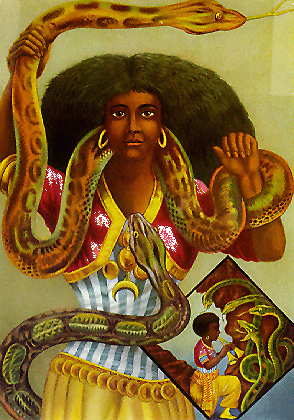

As the objects of Bailey, Waters, and Julien spill out of conventional "frames" or conceptual boundaries, Loichot's analysis flows into the murky waters of Katrina and its racial and environmental violence in "Mami Wata the Formidable." Loichot wades through the ethical ambiguity of Kara Walker's exhibit/book, After the Deluge, and Beyoncé's visual album, Lemonade, which represent—and potentially reproduce—the violence of slavery and Katrina. Yet, in this representation and acknowledgement, Walker and Beyoncé—like Mami Wata, the titular voudou figure who grants life and death to those lost at sea—also sanctify the victims of the violence their objects traverse. Through Julia Kristeva's notion of "muck," Loichot shows the creative and "sacred" potential of Walker's and Beyoncé's portrayals of violence as the "abject substance [that] paradoxically—and horrifyingly—becomes the amniotic fluid of a new birth" (112).
"Drowned," delves further into fluid spaces—this time of the ocean floor—via Jason deCaires Taylor's Cancún Underwater Museum and Édouard Duval Carrié's paintings. These works, Loichot contends, project spectators into the space of the drowned while teasing out the links between environmental degradation, those thrown overboard during the Middle Passage, and the migrants who drown while crossing the Mediterranean today. From these underwater spaces of death, "Stone Pillow and Bone Water" turns to the "hard materiality of words" which are likened to the raw material that M. NourbeSe Philip and Natasha Trethewey shape into poetic "graves, stones, or monuments to the neglected, forgotten, or desecrated dead" (177). Loichot details how Philip deconstructs and reshapes the juridical/scientific language implicated in justifying racialized slavery: "As herself both a lawyer and a poet, Philip must rectify the law . . . by giving humanity and sacred back to the victims of the legalized unritual, through her poetic creation. Poetry—poiesis as act of making—relays a faulty even criminal, law" (204).


As the variety of objects featured in Water Graves indicates, Loichot's relational methodology echoes and enacts principles of Édouard Glissant's notion of "Relation," particularly that of "relaying" understood as: "an act of solidarity between those touched by the unritual, such as humans and their hurt ecologies. [Relaying] calls for disciplines like literary and artistic interpretation, history and science, to join forces where they meet the epistemological abyss of the unknown" (19). By bringing the notion of entour—which implicates so-called "natural" surroundings in "human" creativity and activity—to bear on its analyses, Water Graves effectively broadens the scope of the unritual to include the natural world, underlining connections between racial violence and environmental destruction. One of the strengths of this relational methodology resides in its juxtaposition of disparate objects. These juxtapositions not only highlight the connections among seemingly distinct historical phenomenon; they also bring into conversation creative works that confront the systems responsible for propagating the unritual. The hybrid figures in Beyoncé's Lemonade (lasiwène or the siren) and Jason deCaires Taylor's Vicissitudes, for example, challenge ontological boundaries that condition spaces of racialized violence and environmental degradation—boundaries between life and death, human and coral, sacred and profane, memory and oblivion. Loichot's treatment of these two objects—which come from different entours and mediums—reveals the poetical, creolizing, and memorial potential of underwater spaces in the Greater Caribbean. As Loichot puts it, "[t]he water is thus not a dividing line but a site of passage, flux, communication and confusion between . . . realms" (154).
Though my appraisal of Water Graves remains predominantly laudatory, I will signal two critiques in terms of its methods and conceptual vocabulary. Loichot's powerful juxtapositions showcase the poetic possibilities of creating a network of oeuvres motivated by the desire to heal and move beyond the unritual. But Water Graves's relational approach sometimes sidesteps the paradoxes highlighted by this kind of comparative work. As Shu-mei Shih proposes in her essay "Comparison as Relation," relating ostensibly dissimilar objects allows one to deconstruct boundaries (disciplinary or otherwise) erected by "certain interests" or "the workings of Power" (which Water Graves certainly does).2Shu-mei Shih, "Comparison as Relation," Comparison: Theories, Approaches, Uses, ed. Rita Felski and Susan Friedman (Baltimore: John Hopkins University Press, 2013), 79. Yet, it is equally important, Shih notes, to "evacuate and analyze" how these economic, national, or other interests nevertheless infuse the objects of comparison and their relations.3Shih, 84. That Beyoncé's album (and related concerts) garnered hundreds of millions of dollars within neoliberal capitalism—a socioeconomic system predicated on exploiting women, people of color, and vulnerable workforces in developing countries—constitutes an aporia that Water Graves acknowledges without exploring.4As indicated by the Pew Research Center, wage gaps continue to track along gender and racial lines in the U.S. Eileen Patten, "Racial, gender wage gap persists in U.S. despite some progress," Pew Research Center, July 1, 2016, https://www.pewresearch.org/fact-tank/2016/07/01/racial-gender-wage-gaps-persist-in-u-s-despite-some-progress/. Though Water Graves recognizes the album's imbrication with capitalist profit—casting Beyoncé as an embodiment of the capitalistic deity Mami Wata—it doesn't investigate how the economic "interests" underwriting her album inflect and/or constrain the work of healing or moving beyond the unritual.5bell hooks, "Beyoncé's Lemonade is capitalist money-making at its best," in The Guardian, May 11, 2016, https://www.theguardian.com/music/2016/may/11/capitalism-of-beyonce-lemonade-album. As bell hooks points out, both Beyoncé and Serena Williams are featured in the album wearing sports clothing, as Beyoncé's sports clothing line—Ivy Park—would appear the same year as Lemonade, thereby walking a fine line between dissident discourse and advertisement. This is not to say that Beyoncé's discourse is invalidated by this antagonism, nor that one can totally disengage from the "workings of Power," particularly in the era of globalization; rather, I mean to emphasize the importance of situating the discourse of a given object within its material conditions and outcomes, especially as these conditions and outcomes often constitute sites of unritual, which complicate our readings of these objects and the ways in which they relate to each other.

My second critique relates to the use of terms historically operationalized in colonial contexts to exclude non-European populations. Although its creolizing methodology works across disciplinary and cultural frameworks, Water Graves employs certain universalizing notions, notably "humanity," whose investment in a colonial epistemological tradition is not always fully interrogated. As the philosopher and novelist Sylvia Wynter writes in "Unsettling the Coloniality of Being/ Power/Truth/ Freedom," the term "humanity" has historically been invoked to exclude racialized persons from its prerogatives, and has, in fact, depended on the racialized "Other," relegated to a space of unritual in order to mark its boundaries. Indeed, Wynter tracks how the conceptions of "human" and "humanity" came to correspond with "reason" and "rationality" in Renaissance Europe (and continue to do so today), whereas the conditions of "subrationality" and uncivilization were used to characterize colonized populations.6Sylvia Wynter, "Unsettling the Coloniality of Being/Power/Truth/Freedom: Towards the Human, After Man, Its Overrepresentation—An Argument" in CR: The New Centennial Review 3, no. 3 (2003): 266, 301. In other words, under the guise of describing the entire "human race," the term "humanity" has come to reify and universalize Western values and ideals. Although Water Graves's introduction construes "humanity" in an inclusive way—proposing that rituals "of the sacred" writ large are "a defining mark of humanity"—the text leaves unattended its watermark of exclusion and eurocentrism (7). The uninterrogated use of "humanity," then, potentially constitutes a discursive site of "unritual"—what Loichot's objects and analysis strive to "heal"—as its eurocentric and exclusionary connotations of so-called "rationality" and "civilization" implicitly accompany its evocation. Explicitly deconstructing the history and usage of "humanity" while signaling a plurality of humanities would not only eliminate the tension created by the colonial baggage of this term, but would also dovetail with Glissant's conception of Relation which rejects universalizing concepts, while insisting on multitudinous humanities.
Water Graves is an important and compelling study for anyone interested in the Caribbean, Afro-Diasporic experiences, colonialism, and slavery, as it engages with the enduring aftereffects of their histories, including how artists reinscribe them with new meanings. Loichot's work merits praise for its epistemological and methodological originality as she extends Glissant's concepts of Relation and relaying. In literary, artistic, and musical objects from across the Caribbean, Loichot skillfully interweaves questions of (post)colonial legacies, environmental degradation, and social justice in order to explore these objects' often unexpected correspondences as well as their tensions. Ultimately, Loichot demonstrates how literary and artistic exegesis "relate" with its artistic objects in ways that not only explore the memory and trauma of the unritual and its resacralization, but that also engage new modalities and transdisciplinary vocabularies for comparing creative works across the broader Caribbean.
About the Author
Aaron Witcher is a PhD Candidate in French and Francophone Studies at The Pennsylvania State University.
]]>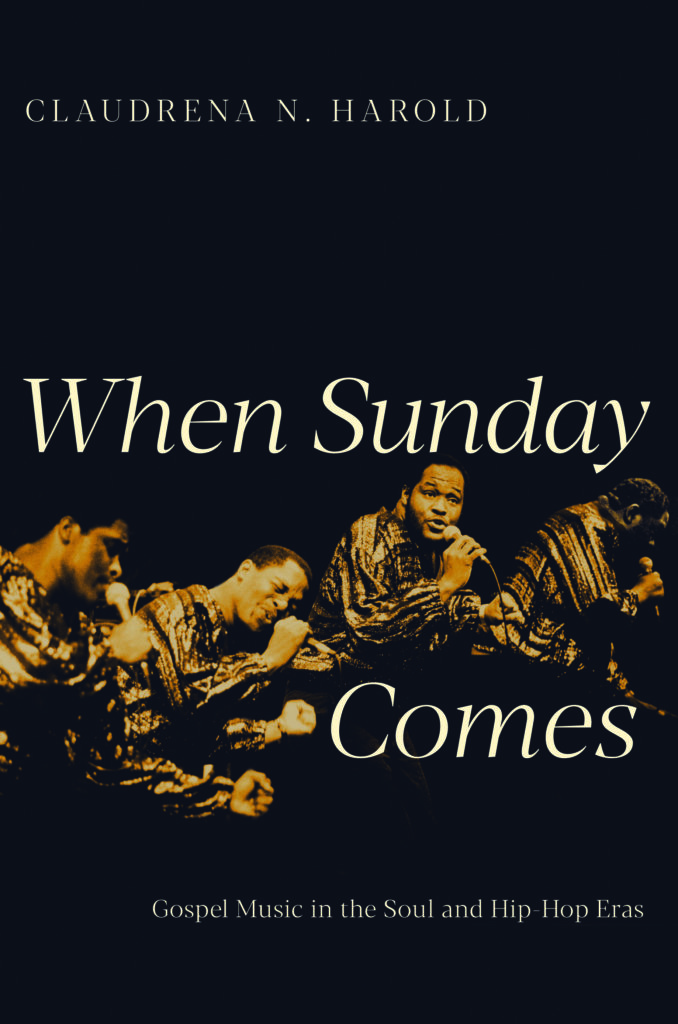
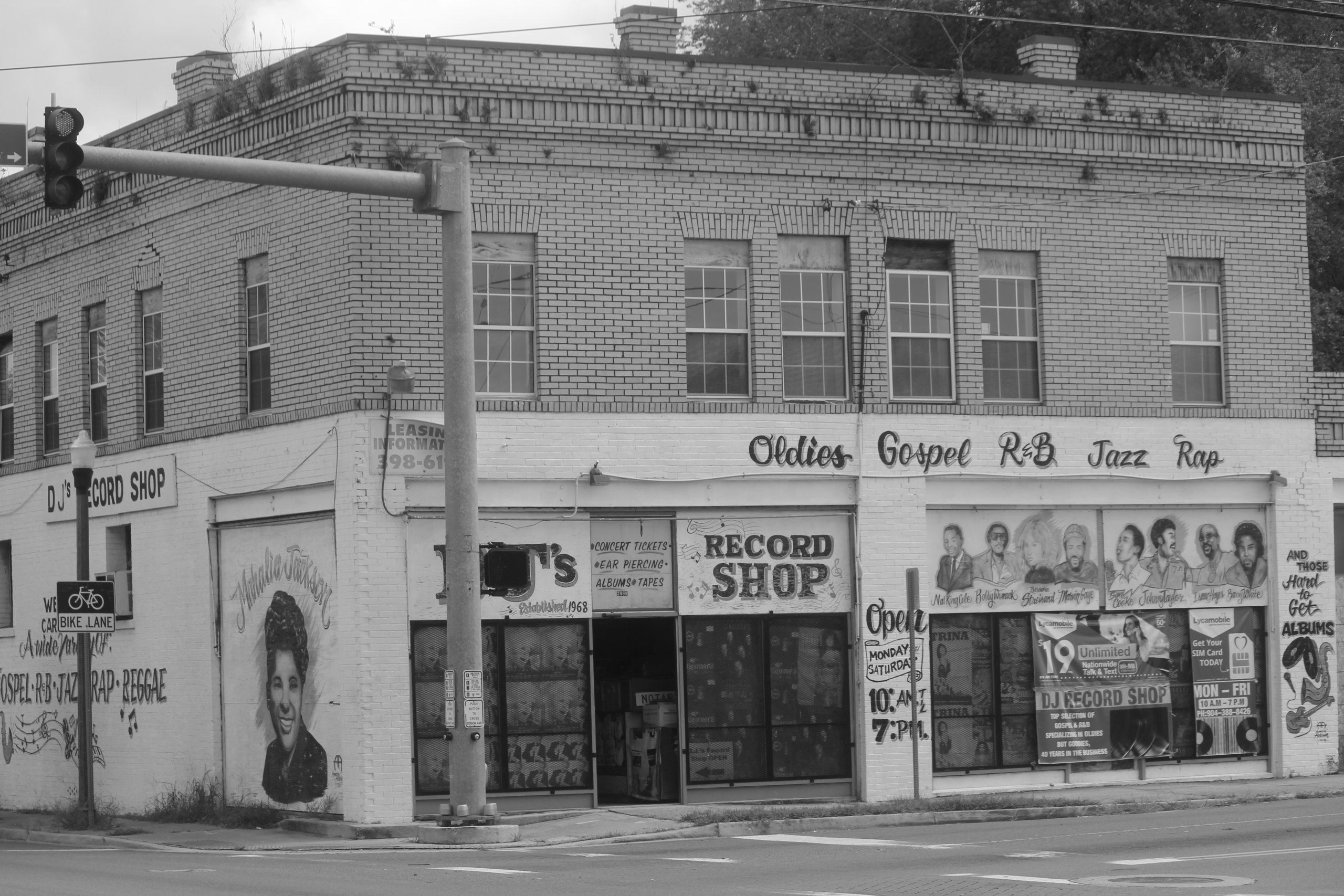
While I was an undergraduate at Temple University in the mid-1990s, gospel's ubiquity in both secular and sacred spaces was a source of great fascination for me. On a Saturday night stroll down the halls of my dormitory, Temple Towers, one might hear Kirk Franklin's "Silver and Gold," Mary J. Blige's "My Life," and Biggie's "One More Chance" in succession. Though hip-hop had the loyalty of most undergraduates, my inner circle, particularly my fellow women's basketball teammates, had a deep appreciation for gospel music. On our road trips, at the dining halls, and in our dormitories, gospel music occupied the same space as R&B and old-school soul. Fortunately, my academic work as an African American studies major and history minor reinforced many of the lessons provided during my extracurricular activities. Classes and conversations with Professors Sonia Sanchez, Bettye Collier Thomas, Greg Carr, Valethia Watkins, and Mario Beatty, among others, strengthened my already firm sense of the importance of the spiritual lives of black folk. Seeds sown in my childhood home of Jacksonville blossomed under the guidance of these teachers and the music journalists and cultural critics whom I read over the next two decades: Horace Boyer, Mark Burford, Mellonee Burnim, Portia Maultsby, Eileen Southern, Jon Michael Spencer, Brooksie Eugene Harrington, Michael W. Harris, Robert Darden, Anthony Heilbut, Glenn Hinson, Wyatt Tee Walker, Pearl Williams-Jones, Robert Marovich, and Jerma Jackson.1See Horace Clarence Boyer, Golden Age of Gospel (Champaign: University of Illinois Press, 2000); Jon Spencer, Protest and Praise: Sacred Music of Black Religion (Minneapolis, MN: Fortress Press, 1991); Michael W. Harris, Rise of Gospel Blues: The Music of Thomas Andrew Dorsey in the Urban Church (New York: Oxford University Press, 1994); Bob Darden, People Get Ready! A New History of Black Gospel Music (New York: Bloomsbury, 2004); Anthony Heilbut, Gospel Sound: Good News and Bad Times (New York: Simon and Schuster, 1971); Pearl Williams-Jones, "Afro-American Gospel Music: A Crystallization of the Black Aesthetic," Ethnomusicology 19, no. 3 (1975) 373–385; Robert M. Marovich, A City Called Heaven: Chicago and the Birth of Gospel Music (Champaign, University of Illinois Press, 2015); and Jerry Zolten, Great God A'Mighty! The Dixie Hummingbirds: Celebrating the Rise of Soul Gospel Music (New York: Oxford University Press, 2003) Their respective histories of gospel music enriched my understanding of the genre's centrality to black culture, its early relationship to the recording industry, and its role as a source of individual and collective uplift for people of African descent. They also reaffirmed my belief in gospel music as a subject worthy of in-depth cultural criticism and historical analysis.
And yet, despite my admiration for their work, or perhaps because of it, these authors always left me wanting more, particularly greater engagement with the gospel music of the post-civil rights era. Why couldn't their razor-sharp analyses of gospel music's "golden era" (1945–65) extend into the 1970s and 1980s, I often wondered? Why did the black sacred music adored by so many of my generation seem inconsequential to the historians whose scholarship mattered so much to me? To be sure, Heilbut's The Gospel Sound and Darden's People Get Ready! extended their analyses beyond gospel's golden era. But their discussion of the genre's later years lacked the detailed attention given to the earlier period.
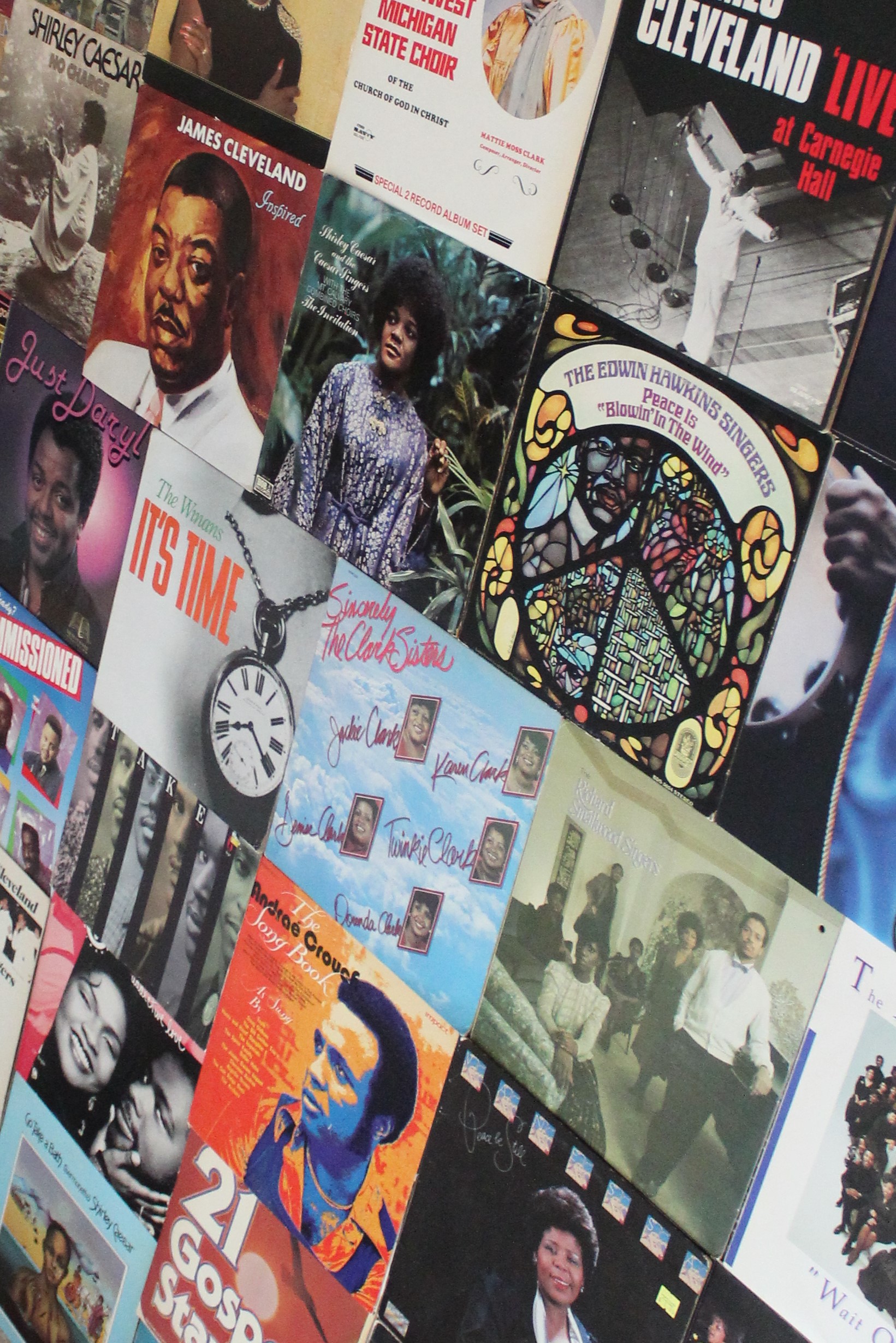
By focusing primarily on the last three decades of the twentieth century, When Sunday Comes shines light on gospel's golden era of commercialism. Instead of dismissing this period as one of musical decline and questionable crossover pursuits, this book treats these years as a time of great artistic innovation and advancement.2Fortunately, digging deeper into gospel's more recent history has been made easier with the important work of scholars like Mellonee V. Burnim, Brooksie Eugene Harrington, Deborah Pollard Smith, Jon Spencer, Guthrie Ramsey, and Birgitta Johnson. In addition, historians like Shawn David Young and David Stowe provide useful insights into the contemporary Christian music genre. Brooksie Eugene Harrington, "Shirley Caesar: A Woman of Words" (PhD diss., Ohio State University, 1992); Birgitta J. Johnson, "Back to the Heart of Worship: Praise and Worship Music in a Los Angeles African-American Megachurch," Black Music Research Journal 31, no. 1 (2011): 105–129; Deborah Smith Pollard, When the Church Becomes Your Party: Contemporary Gospel Music (Detroit, MI: Wayne State University Press, 2008); Spencer, Protest and Praise; David W. Stowe, No Sympathy for the Devil: Christian Pop Music and the Transformation of American Evangelicalism (Chapel Hill: University of North Carolina Press, 2013); Shawn David Young, Gray Sabbath: Jesus People USA, the Evangelical Left, and the Evolution of Christian Rock (New York: Columbia University Press, 2015); Guthrie P. Ramsey, Race Music: Black Cultures from Bebop to Hip-Hop (Berkeley: University of California Press, 2004). It details how Kirk Franklin, the Winans, Take 6, and the Clark Sisters, among others, not only advanced the black sacred music tradition but also ensured that gospel remained embedded in African American culture. That embeddedness has surfaced in a variety of cultural contexts and arenas and continues to do so: BET's annual award shows; the music of secular stars like Beyoncé, D'Angelo, Missy Elliot, Snoop Dogg, Chance the Rapper, and Kanye; the cinematic offerings of such avant-garde filmmakers as Arthur Jafa, Kevin Jerome Everson, and Cauleen Smith; and even the televised funerals of some of the entertainment industry's biggest icons. Take as a case in point the very public mourning that followed the deaths of Michael Jackson and Whitney Houston. On July 7, 2009, twelve days after Jackson's death, millions of fans watched the homegoing service of the "King of Pop." The memorial opened with Andraé Crouch and his choir humming the melody of the gospel classic "Soon and Very Soon" as Jackson's brothers rolled his casket to the center stage of Staples Center in Los Angeles.
Three years later, Crouch's music had a strong presence at the homegoing of another pop legend, Whitney Houston. This time, the musical vessel was not Crouch himself but his student Marvin Winans. Standing before a grief-stricken audience of family, friends, music legends, and curious onlookers, Winans belted out Crouch's latest hit, "Let the Church Say Amen," as he closed his eulogy of a woman who had been raised in New Hope Baptist Church under the tutelage of her mother, Cissy Houston; who had supported the careers of his younger siblings BeBe and CeCe Winans; and who fifteen years before her passing released the multi-platinum gospel album The Preacher's Wife. The presence of Crouch's music at both Houston's and Jackson's funerals not only symbolized his importance to the gospel sound but also showed how often African Americans have turned to this vibrant and life-affirming art form to make sense of the tragicomic reality of human existence.
As I reflected on what gospel music has meant to African Americans, my thoughts often turned to the song that inspired the book's title: Donald Lawrence and the Tri-City Singers' 1995 hit "When Sunday Comes." Seven minutes long, the song features gospel legend Daryl Coley on lead vocals. Throughout the performance, Coley titillates the crowd with a flurry of vocal riffs, drawing from the improvisational styles of both gospel and jazz. The audience's shouts of approval convey their agreement with his message of the joy that awaits Jesus's Second Coming and also their recognition of his mastery of form. "When Sunday Comes," as both a song and a metaphor, captures the wide range of emotions, relationships, and processes operating in African American gospel music: the climactic moment in a performance when a musician reaches the height of his or her artistic and spiritual powers, the gospel audience's contribution to and immediate recognition of such moments, and the deep cultural meanings the sacred songs hold for people of African descent in America.
For many of the artists in When Sunday Comes, singing gospel was not simply a form of self-expression or a way to magnify God but also a way to uplift people, to lighten their burden. Perhaps no one understood this more than Shirley Caesar, who envisioned her concerts as a way to elevate her audience to a higher spiritual plane. "It's not so much that I want people to shout," she explained to Geoffrey Himes in 1987. "I want them to forget that burden they left behind when they came to the concert. I want to give them a spiritual catharsis."3Geoffrey Himes, "Shout It! Gospel According to Shirley Caesar," Washington Post, April 3, 1987, B7.
Outside the County Line: The Southern Soul of John P. Kee
More than thirty years have passed since my first encounter with the music of John P. Kee, but the memory of that experience remains fresh in my mind. On a weekend visit to my aunt's house, where gospel music played from sunup to sundown, we both found ourselves mesmerized by a new song: Kee's "Wait on Him." Within seconds of the song's opening verse, my attention shifted from mildly interested to fully engaged as Kee's powerful voice ripped through the speakers: "I'm going to run this race, if I go by myself," Kee sang as the choir roared: "Wait on Jeeee-suuuus." As Kee and the choir riffed off each other, bassist Andrew Gouche, guitarist Jimmy Hill, and drummers George Clinkscale and Calvin Livingstone held down the rhythm section. During the extended vamp, Kee adlibbed with a ferociousness reminiscent of Joe Ligon of the Mighty Clouds of Joy: "They that wait on the Lord, shall renew their strength. . . . They shall mount up on wings, as eagles. They shall run, not get weary."4John P. Kee, Wait on Him (Tyscot Records, 1991). This was the sound of Christian faith forged in the crucible of the southern black church.
The release of Wait on Him in 1989 marked the beginning of a remarkable creative run for Kee and his New Life Community Choir (NLCC). Between 1989 and 1996, Kee released hugely popular singles as well as the critically acclaimed records Wash Me and Show Up! (which was certified gold). Enjoying widespread radio play, sold-out concerts, and high record sales, Kee won the hearts of thousands of gospel lovers with his signature voice and classic songs. Not since James Cleveland had a male vocalist in the gospel world occupied such a ubiquitous presence on gospel radio. Tunes like "The Storm Is Passing Over," "Lily in the Valley," "Never Shall Forget," "Standing in the Need," "Wait on Him," "Wash Me," and the smash hit "Jesus Is Real" were in constant rotation. These songs were also part of the repertoire of countless black gospel choirs across the country. Even as the black religious community became increasingly diverse, Kee's music held an esteemed place in a variety of African American churches, from Pentecostal to Baptist.
Especially down south, Kee's blue-collar aesthetic and country home vibe earned a special place in the hearts of gospel music fans, particularly those who saw themselves or their families' history in his work. A proud southerner, Kee frequently transported his listeners to the black South, where women, men, and children cared for and loved each other, where elders shared their wisdom with the young, where the church anchored the social and cultural lives of a striving people. Kee was an artist for whom the South's past and present supplied endless inspiration and material. On both his studio and live recordings, he can be found resurrecting the spirit of his father, honoring the religiosity and deep faith of his grandmother, and reflecting on his life-changing encounters with ordinary southern women and men in the streets of Charlotte, North Carolina. Throughout his discography, the South looms large as an incubator of his cultural, religious, and political sensibilities. Kee's South is neither monolithic nor static but a geography constantly responding to new political forces and new social realities.
North Carolina Beginnings
John Prince Kee was born on June 4, 1962, in Durham County, North Carolina. The fifteenth child of John Henry and Lizzie Mae Kee, the young John lived on the outskirts of Durham until the age of five, when his father started work as a foreman at a local brickyard. In many ways, the world in which young John entered was radically different from that of his older brothers and sisters, due in no small part to the growing political determination of African Americans in Durham.
Notwithstanding its image as a progressive southern city, Durham was racist to its core. Even when the white power structure appeared to bend in favor of African Americans, its actions were often more symbolic than substantive. As historian Christina Greene rightly points out, Durham's white power brokers were more concerned with racial harmony than with racial justice. The conflict between the city's racial moderates and more direct action-oriented civil rights organizers reached a fever pitch in the summer of 1962. Late in July, members of the Congress of Racial Equality and the NAACP picketed Eckerd's Drug Store and Howard Johnson's ice cream parlor. At Eckerd's, the issue at hand was the store's refusal to hire African Americans as salespersons, despite the fact that blacks constituted half of its customers. Likewise, Howard Johnson's was opposed to hiring African Americans in clerical positions. The restaurant had also refused to desegregate its lunch counter, even after the sit-ins of 1960 led other stores to reverse their segregation policies. Taking the lead in the fight against Howard Johnson's were black students from North Carolina Central, who in their efforts to implement change endured verbal assaults, threats of violence, consternation from conservative blacks, arrests, and sometimes imprisonment. For their refusal to pay a trespass fine for protesting Howard Johnson's, students Guytana Horton and Joycelyn McKissick were sentenced to thirty days in jail. Their arrest and subsequent jailing galvanized the civil rights community, which in August held a large rally at one of the city's movement centers, St. Joseph AME Church. Shortly after the rally, 1,500 African Americans headed to Howard Johnson's to continue their protests. These protests persisted throughout the summer as part of the "Freedom Highways" project, a CORE-directed campaign that extended from Maryland to Florida. This project eventually led more than half of the Howard Johnson's establishments in North Carolina to desegregate their lunch counters. One of the holdout restaurants was the Howard Johnson's in Durham, which in 1963 was the site of one of the largest civil rights demonstrations in North Carolina.5Christina Greene, Our Separate Ways: Women and the Black Freedom Movement in Durham, North Carolina (Chapel Hill: University of North Carolina Press, 2005). Over the next few years, Durham remained a center of political protest and grassroots activism as African Americans directed their attention to the problems of urban renewal, deindustrialization, employment discrimination, and the housing crisis.
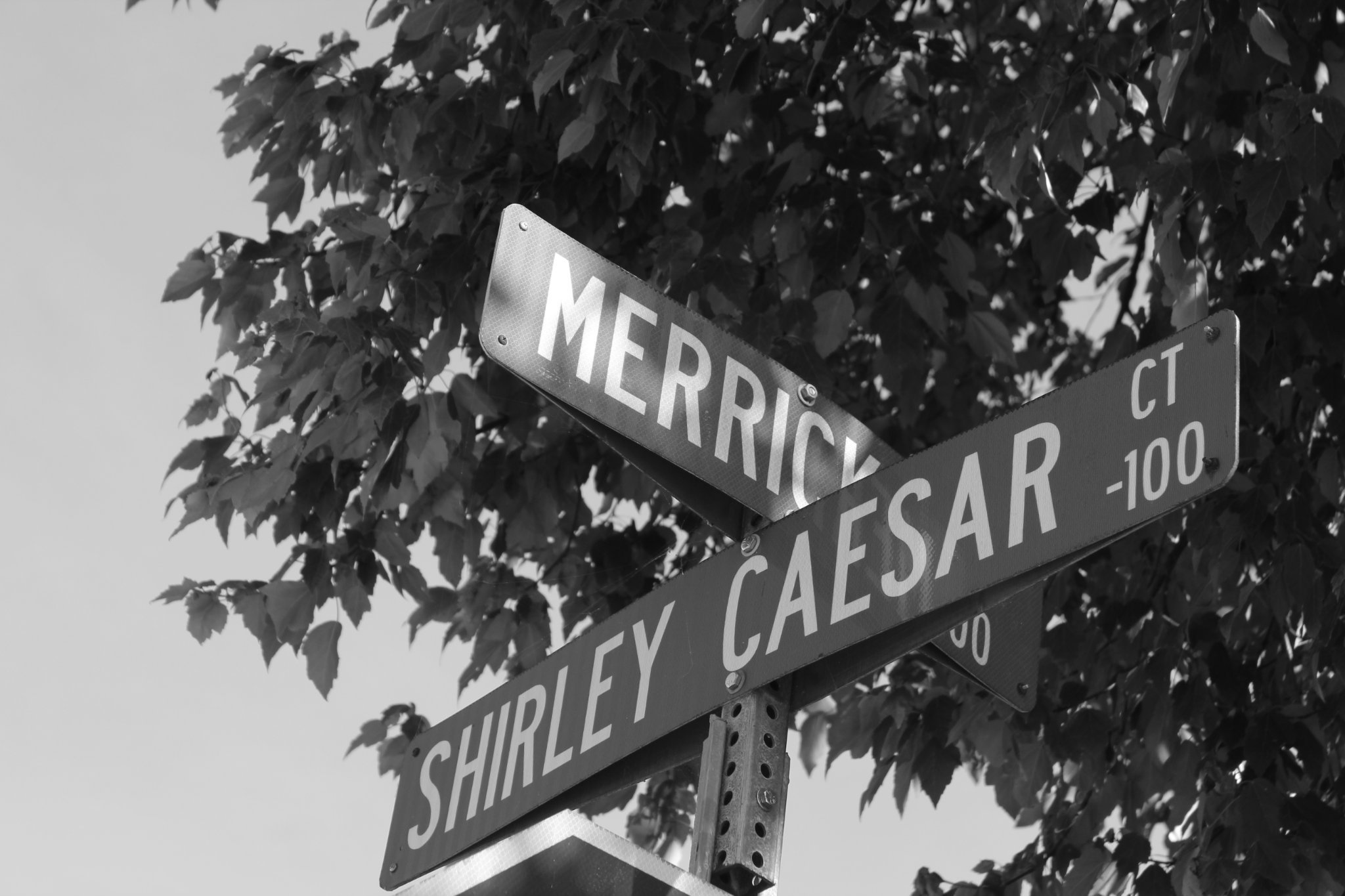
One important center of local organizing was Union Baptist, the church home of the Kee family and hundreds of other blacks. Under the pastorate of Dr. Grady Davis, Union was a center of black spiritual life in Durham and an anchoring institution for the local civil rights movement. A dedicated member until his death in 1981, John Henry Kee lent his musical talents to the Grady Davis Choir and the Senior Male Choir.6"Obituary," Carolina Times, January 31, 1981. Like his father, young John developed a deep love for music, routinely spending hours at the family's Walter upright piano. "I was about seven years old when I started playing that piano, and I got a lot of encouragement because music in our household was just the thing to do. And it was by playing piano that I kept my dad's attention."7Bobby Jones and Lesley Sussman, Touched by God: Black Gospel Greats Share Their Stories of Finding God (New York: Pocket Books, 1998), 239.
Showing great promise as a musician, Kee enrolled at the North Carolina School of the Arts in Winston-Salem and then graduated from there at the age of fourteen. To further develop his musical skills, he joined his brothers at Yuba College Conservatory in Marysville, California. To support himself, Kee worked as a sideman for Cameo and Donald Byrd on their visits to Northern California. On the surface, the talented youngster seemed destined for greatness, but on his route to superstardom he took several dangerous detours.
During his time in California, Kee descended into a world of drug use. He then returned to North Carolina, where he found work with the Charlotte-based Miss Black Universe pageants. His move back south was part of a national trend. Since the 1970s, the number of African Americans migrating to the South exceeded the number of those leaving the region. Especially for returning and primary migrants frustrated by the declining economic opportunities available in the rustbelt cities of the Midwest and Northeast, the metropolitan centers of Atlanta, Houston, Dallas, and Charlotte seemed much more appealing than their northern and midwestern counterparts.8Carol B. Stack, Call to Home: African Americans Reclaim the Rural South (New York: Basic Books, 1996); Sabrina Pendergrass, "Perceptions of Race and Region in the Black Reverse Migration to the South," Du Bois Review: Social Science Research on Race 10, no. 1 (2013): 155–178; George Gmelch, "Return Migration," Annual Review of Anthropology 9 (1980): 135–159; Larry H. Long and Kristin A. Hansen, "Trends in Return Migration to the South," Demography 12, no. 4 (1975): 601–614. "If ever there was a city that epitomizes the New South," boasted the June 1983 edition of Black Enterprise, "it is Charlotte, N.C., the largest city between Washington and Atlanta. . . . This Sunbelt city is now home to 314,000 residents—31 percent of them black—and to a burgeoning business community, which includes 500 black-owned companies."9David D. Porter and Rosalyn Gist Porter, "The Changing Profile of Charlotte," Black Enterprise 13 (June 1983): 180. For ambitious African Americans wishing to improve their lives and perhaps avoid the problems of the urban North, Charlotte was the place for them.
To many outsiders, this was a city on the move, a great place for young people with talent, ambition, and a hard work ethic. Unfortunately, Kee was not quite ready to take advantage of the city's benefits. Even after his move back south, Kee remained a part of the drug scene—not only as a user but as a seller as well. Upon his arrival in Charlotte, he settled into the Double Oaks neighborhood, an area facing many of the problems plaguing other inner-city communities. Crime, unemployment, substandard housing, and drugs wreaked havoc on many of its residents. Drifting further away from the values of his early childhood, Kee was an active participant in Double Oaks's underworld.
A dramatic shift occurred in Kee's life in 1981, when one of his closest friends fell victim to drug-related violence. His friend's murder shook Kee to his core, forcing him to reevaluate his life: "I was seeing young men dying on the street, and I think I just made up my mind that I did not want to leave here like that. I just felt like there was a gift or something inside of me, and I didn't want to waste it."10Jones, Touched by God, 242. The reformed drug dealer started working with a group of young singers involved in the Combination Choir, which was based in Charlotte. This marked the beginning of Kee's lifelong commitment to the local community, particularly the Double Oaks neighborhood. The choir later morphed into the New Life Community Choir, which gained national attention in the 1990s for their work with Kee.
Kee's Breakthrough
On his rehabilitation journey, Kee received major support from two of gospel's most iconic figures, James Cleveland and Edwin Hawkins. Like many aspiring musicians in the gospel field, Kee turned to the Gospel Music Workshop of America to gain a larger audience and connect with industry insiders. In 1985, Cleveland placed two of Kee's compositions, "He's My All in All" and "Jesus Can Do It," on his 1985 GMWA recording. Two years later, Kee was a featured vocalist and songwriter on Edwin Hawkins's music and arts seminar recording. That same year, Kee released Yes Lord, his debut with the black-owned label Tyscot. A relatively small company based in Indianapolis, Tyscot begin in 1977 as a vehicle for one of its founders, Leonard Scott, to promote his church choir. The label would add to its roster a few minor gospel acts, but it was hardly on the radar of most in the gospel industry. This would change with the release of Kee's Yes Lord. Though the record had modest sales, it generated considerable anticipation for Kee and the New Life Community Choir's 1989 release, Wait on Him.
Finding a receptive audience among lovers of traditional and contemporary gospel music, Wait on Him elevated Kee to superstar status in the black gospel world. The album climbed to #4 on the gospel charts, dominated gospel radio, and enabled Kee to launch a nationwide tour. "We're getting more requests than I can handle," Kee informed journalist Robert Darden. Though the record had a southern sound, its popularity extended beyond the Mason-Dixon Line. "'Wait on Him' is doing incredible business in New York," Kee marveled. The singer was also receiving attention from beyond the black gospel world. "We're getting calls from white churches in Texas, Washington state, even the hills of Tennessee—where the man told me all they've ever heard is 'hillbilly gospel' before now!"11Robert Darden, "New Life's 'Wait on Him' Is an Overnight Hit for John P. Kee," Billboard, February 24, 1990, 45.
About the Author
Claudrena N. Harold is a professor of African American and African Studies and History at the University of Virginia and an editorial board member at Southern Spaces. She is the author of New Negro Politics in the Jim Crow South (Athens: University of Georgia Press, 2016) and The Rise and Fall of the Garvey Movement in the Urban South, 1918–1942 (UK: Routledge Press, 2007).
]]>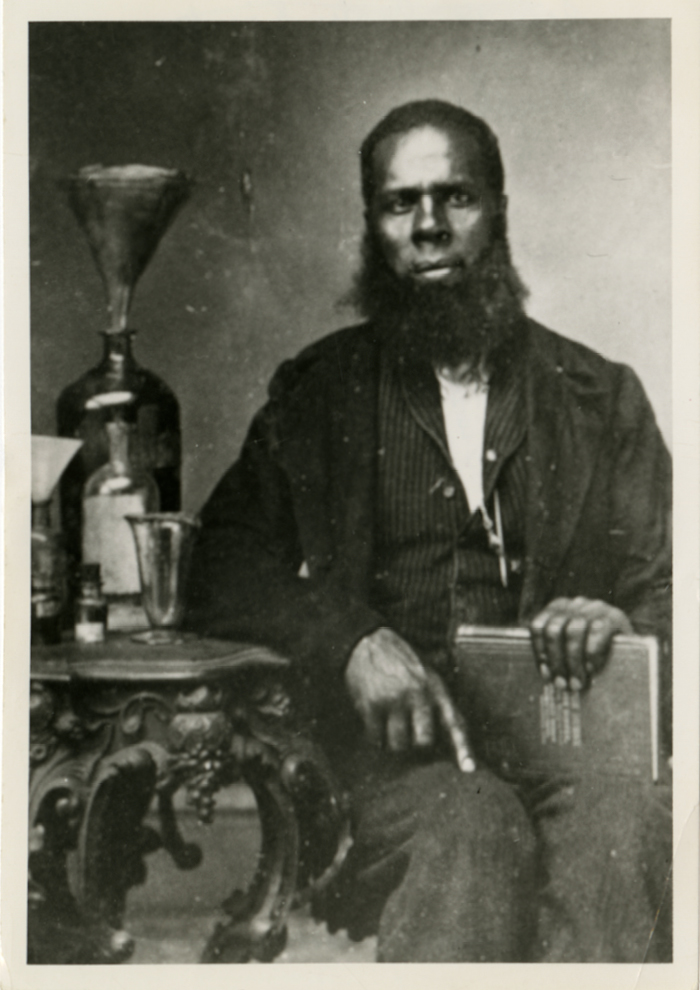

A freeborn Black abolitionist from Ohio, Joshua McCarter Simpson opened his 1854 indictment of the hypocrisy of Christian supporters of slavery, "To the White People of America," with searing words that echo across the centuries. Simpson's poetic voice resonated when Donald Trump strode through Lafayette Park for a photo opportunity—an image of him holding a Bible in front of St. John's Episcopal Church—moments after DC police, reinforced by National Guard troops, dispersed peaceful protesters who had gathered to demand that government leaders address systemic racism.
Simpson published "To the White People of America" in his collection The Emancipation Car, Being an Original Composition Of Anti-Slavery Ballads, Composed Exclusively For the Under Ground Rail Road (1854), written for abolitionists ferrying enslaved people to freedom. The Emancipation Car includes forty-three poems, all meant to be sung to then-popular tunes, and a few prose passages. The title of Simpson's collection extends the metaphor of the Underground Railroad, where these songs were popular among the formerly enslaved and where Simpson served as a conductor. In 1874 the collection was reprinted with its prose passages reworked in verse and a new appendix featuring poetic commentaries on the Fifteenth Amendment, the Underground Railroad, and related topics.
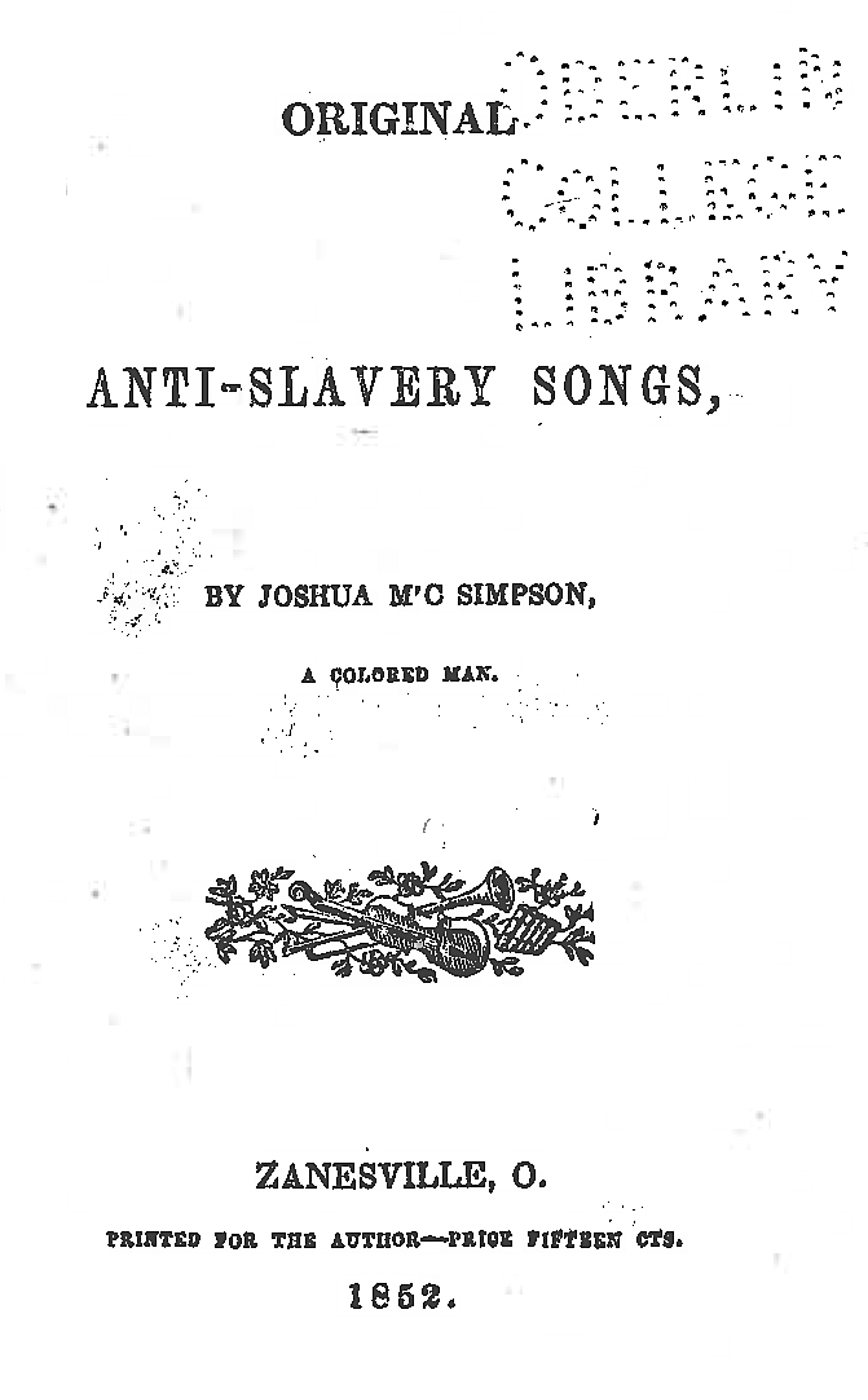
Simpson was born around 1820 in Windsor, Ohio, in the far northeastern corner of the border state, near Lake Erie. He was indentured as a servant from his childhood until he turned twenty-one, working in brutal conditions for a stonemason and later a farmer. He then taught himself to read and write, attended the Oberlin Collegiate Institute from 1844 to 1848, and moved to Zanesville in central Ohio, where he became an herbal doctor and grocer. Simpson gradually embraced abolitionism during his servitude and became a fierce advocate for emancipation thereafter. In his preface to The Emancipation Car, Simpson explains, "As soon as I could write, which was not until I was past twenty-one years old, a spirit of poetry, (which was always in me,) became revived, and seemed to waft before my mind horrid pictures of the condition of my people, and something seemed to say, 'Write and sing about it—you can sing what would be death to speak.' So I began to write and sing."1Joshua McCarter Simpson, "Note to the Public," in The Emancipation Car, Being an Original Composition Of Anti-Slavery Ballads, Composed Exclusively For the Under Ground Rail Road (1874; repr., Miami: Mnemosyne Publishing Co., 1969), vi. He first publicly performed an anti-slavery song in 1842 and published a collection of thirteen poems titled Original Anti-Slavery Songs in 1852. Simpson died in 1876.
Joshua McCarter Simpson's writing is remarkable for its force, conviction, moral clarity, and emotional depth. His poems are also frequently witty, both in their turns of phrase and in their relationship to the popular tunes with which Simpson chose to pair them. Simpson notes that "To the White People of America" should be sung to the tune "Massa's in the Cold, Cold Ground," a blackface minstrel tune composed by New York songwriter Stephen Foster in 1852, just two years prior to the publication of The Emancipation Car. In dialect, Foster's song depicts enslaved people crying as they mourn the death of their former owner, rendering Simpson's ironic appropriation bitingly clever. "In my selection of 'Airs,'" writes Simpson, "I have gathered such as are popular, and extensively known. Many superstitious persons, and perhaps many good conscientious, well-meaning Christians, will denounce and reject the work on account of the 'Tunes,' but my object has been to change the flow of those sweet melodies (so often disgraced by Comic Negro Songs, and sung by our own people,) into a more appropriate and useful channel."2Simpson, "Note to the Public," v–vi.
Despite his groundbreaking creativity, Simpson is little known today. Few scholars have written about his work, and he has never been the subject of a biography. I learned about Simpson when music bibliographer Erin Fulton included The Emancipation Car in the "Checklist of Southern Sacred Music Imprints, 1850–1925" that she compiled for the Sounding Spirit publishing initiative. Fulton turned to The Emancipation Car as Sounding Spirit searched for words from historical composers and hymnwriters in expressing our solidarity with Black Lives Matter protests in the wake of the murder of George Floyd and many others.

Reading Simpson's words from 1854 immediately conjures the image of Trump at St. John's Church:
"To the White People of America"
Air—"Massa's in the Cold, Cold Ground"
O'er this wide extended country,
Hear the solemn echoes roll,
For a long and weary century,
Those cries have gone from pole to pole;
See the white man sway his sceptre,
In one hand he holds the rod—
In the other hand the Scripture,
And says that he's a man of God.
Hear ye that mourning?
'Tis your brothers' cry!
O! ye wicked men take warning,
The day will come when you must die.
Lo! Ten thousand steeples shining
Through this mighty Christian land,
While four millions slaves all pining
And dying 'neath the Tyrant's hand.
See the "blood-stained" Christian banner
Followed by a host of saints (?)3Question mark appears in the original.
While they loudly sing Hosannah,
We hear the dying slave's complaints:
Hear ye that mourning?
Anglo-sons of God,
O! ye Hypocrites take warning,
And shun your sable brothers blood.
In our Legislative members,
Few there are with humane souls,
Though they speak in tones of thunder
'Gainst sins which they cannot control,
Women's rights and annexation,
Is the topic by the way,
While poor Africa's sable nation
For mercy, cry both by night and day.
Hear ye that mourning?
'Tis a solemn sound,
O! ye wicked men take warning,
For God will send his judgment down.
Tell us not of distant Island—
Never will we colonize:
Send us not to British Highlands,
For this is neither just nor wise,
Give us equal rights and chances,
All the rights of citizens—
And as light and truth advances,
We'll show you that we all are men.
Hear ye that mourning?
'Tis your brothers sigh,
O! ye wicked men take warning,
The judgment day will come by and by.
About the Author
Jesse P. Karlsberg is the senior digital scholarship strategist at the Emory Center for Digital Scholarship. He is the project director and editor-in-chief of Sounding Spirit, a research lab and publishing initiative promoting collaborative engagement with historical American songbooks. Karlsberg is an internationally recognized singer, teacher, composer, and songbook editor in the Sacred Harp tradition.
]]>Introduction by Katherine Jentleson
During the summer of 2018, Atlanta's High Museum of Art hosted Outliers and American Vanguard Art, an exhibition that demonstrated how self-taught artists have been major contributors to the development of modern and contemporary art over the last century. One of the most popular galleries in Outliers contained a vast open installation that considered the influences of textile and craft-based practices upon generations of painters and sculptors. By mixing quilts by Mary Lee Bendolph and Annie Mae Young of the Gee's Bend Quilting Collective, and the West Coast quilter Rosie Lee Tompkins, with paintings by avant-garde artists such as Al Loving, Mary Heilmann and Howardena Pindell, Outliers emphasized the formative influence that quilts had on artists working in New York in the 1970s, thanks in part to a 1971 exhibition at the Whitney Museum, Abstract Design in American Quilts, that put historical quilts in conversation with twentieth century abstraction.
As the Outliers exhibition brought quilts to Atlanta, there was also an incredible quilt-celebrating show at the Metropolitan Museum of Art in New York: History Refused to Die: Highlights from the Souls Grown Deep Foundation Gift. In addition to monumental works by artists such as Thornton Dial and Joe Minter, the exhibition featured eighteen quilts by Gee's Bend, Alabama, artists including Loretta Pettway and Emma Lee Pettway Campbell that are now part of the museum's collection. Outliers, History Refused to Die, and the High's newly reopened permanent collection galleries, which demonstrate the museum's commitment to collecting and showing more quilts, are all proof of how, despite their long history of being pigeonholed and neglected, quilts have become significant objects in US art museums.
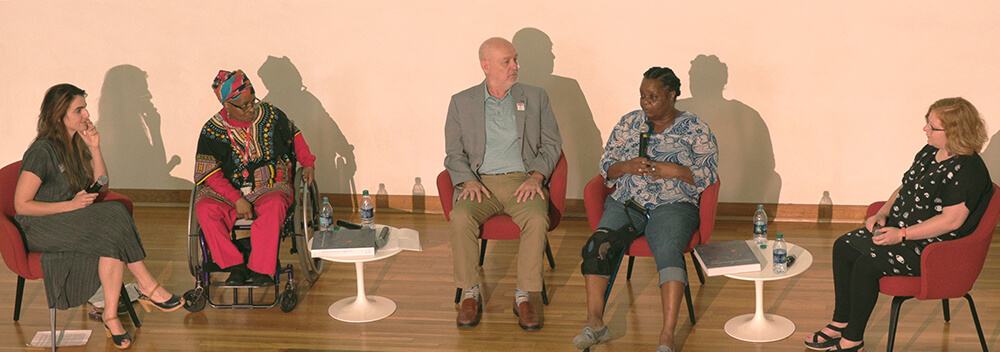
Convened at the High Museum during the final weeks of Outliers, this "Quilting Conversations" panel invited individuals chosen not only for their personal achievements, but also for the variety of relationships to quilting that they each represent. These panelists took the stage and offered their perspectives on the past, present, and future of quilts and quilting.
Marquetta Johnson
Marquetta Johnson, fourth-generation quilter and textile artist, discusses how her quilting techniques have developed over a lifetime, and how she uses her creativity to inspire new generations of quilters, students, and activists.
Michael Moon
Michael Moon considers quilts as kōans ("What is this?") and, with several vivid examples, ponders the intense emotional power and spiritual force that includes, but goes beyond, quilts' visual appeal.
Mary Margaret Pettway
Fourth-generation quilter Mary Margaret Pettway discusses a variety of quilts she has made during her life in Gee's Bend, Alabama. "The mind of a quilter," she says, "is a twisted thing."
Erin Jane Nelson
Erin Jane Nelson puts quilts "into new situations" in her own work by combining traditional methods with inspirations and techniques drawn from contemporary art scenes and movements.
About the Speakers
Katherine Jentleson is the Merrie and Dan Boone Curator of Folk and Self-Taught Art at Atlanta's High Museum of Art. She previously worked as an arts journalist in New York and received her PhD from the department of Art, Art History, and Visual Studies at Duke University, specializing in the art of the United States, with an emphasis on the interwar period.
Marquetta Johnson is a self-taught artist and fourth-generation quilter, known for using innovative hand-dyeing techniques. Her work is represented by Mason Murer Fine Art Gallery in Atlanta, and is in many private and corporate collections (Mr. and Mrs. Bernie Marcus of Atlanta, the Coca Cola Corporation, and the Hartsfield-Jackson International Airport). She is a teaching artist affiliated with the High Museum, VSA arts of Georgia, the Atlanta Partnership for the Arts in Learning, and the NAMES Project Foundation.
Michael Moon is a professor of Women's, Gender and Sexuality Studies at Emory University. In addition to LGBT studies and queer theory, Moon's research concerns modern literature, literary theory, media and mass culture, with a particular emphasis on the cultural production of "outsider" communities. His two most reecent books are Darger's Resources (Durham, NC: Duke University Press, 2012) and Arabian Nights (Arsenal Pulp Press, 2016).
Mary Margaret Pettway is a fourth-generation quilter and member of Gee's Bend Quilt Collective. She is the new Board Chair for the Souls Grown Deep Foundation and a 2018 Fellow of the Alabama Humanities Foundation.
Erin Jane Nelson is the executive director of the digital magazine BURNAWAY. She previously worked as curatorial assistant in Photography and Folk and Self-Taught Art at the High Museum and managed web design, publications, and other media initiatives at the Fraenkel Gallery in San Francisco. She is an actively exhibiting artist, having recently shown her work at the Whitney Museum of American Art and Atlanta Contemporary.
]]>Beneath
Beneath the landmark 1967 Loving v. Virginia US Supreme Court case is a very simple story: two people, Richard Loving and Mildred Jeter, loved each other and wanted to marry and raise their family in rural Caroline County, Virginia. In the 2016 cinematic dramatization, Loving, writer-director Jeff Nichols best exemplifies this simplicity neither through dramatic courtroom scenes nor in his scant exploration of iterations of the legal process needed to achieve legalization of interracial marriage in the Court's decision, but in quiet moments of private intimacy.
The film neither glorifies nor sanctifies. Nichols proceeds with care, illustrating the ways in which all intimacies are negotiated and far from simple. Midway through Loving, after living for some years in exile in Washington, DC, Mildred and Richard decide, in violation of state law, to move back to Virginia with their three young children. They find a farmhouse. It has no telephone or easy connection to the outside world. As the family drives up, Mildred's face beams as she sees her new home—glistening white in the sunlight, surrounded by wide-open space. Richard smiles at her happiness. Mildred's goal is simple, as she tells Richard in DC, a city antithetical to her way of life: "I won't raise my family here." She will raise their children in the rural environs of her home state and in secrecy if need be. Yet, in this scene, as Mildred's joy radiates in the face of actress Ruth Negga as captured by cinematographer Adam Stone, Richard turns and stares into the beyond, back down the road from which they came. While Mildred is intent on raising their children in a manner she sees fit, Richard's goal, as he tells her in one of the film's most emotional scenes, is different yet equally simple: "I can take care of you." In these brief, quiet moments, Mildred is at home; Richard is afraid.
Beneath the Lovings's story, then, are bedrock truths that all couples must negotiate: intimacy and protection in the present, and care and preparation for the future. Nichols crafts this narrative through images of the marriage bed, the laying of a home's foundation, and front porches looking out to an idyllic and unknown beyond. As I search Loving for the "beneath," I recall the late Eve Kosofsky Sedgwick's claim that reading for the beneath fosters narratives of "depth or hiddenness" calling out for "a drama of exposure."1Eve Kosofsky Sedgwick, Touching Feeling: Affect, Pedagogy, Performativity (Durham, NC: Duke University Press, 2003), 8. Sedgwick's foundational contribution to the field of queer theory was her implicit understanding of the closet-structure and coming-out narrative and how they functioned. Sedgwick understood the closet as a "resilient and productive… structure of narrative" with a firm "hold on important forms of social meaning" both before and since the great gay liberationist movement "began" at Stonewall. See Eve Kosofsky Sedgwick, Epistemology of the Closet (Berkeley: University of California Press, 1990), 67. Like other key thinkers such as Michel Foucault and Judith Butler, Sedgwick understood the "very specific crisis of definition" implicit in binary distinctions like gay/straight, homosexual/heterosexual, black/white, as well as how that crisis is often socially constructed, limiting the possibilities of non-normative subjectivities (72). Such distinctions create hierarchy and the implicit desire on the part of the majority for the minority to be exposed, excavated, and/or transcended. These realities necessitate giving voice. Yet, we can read silence and invisibility as power. Arguably, in Loving and Moonlight, what is unsaid, what is invisible, is represented as equal in power to what is said and shown. Reading for the beneath raises ethical questions: Why do we need to justify the loving of this particular couple as valid? For whom are the filmmakers making Loving and why are they placing this story of the past in our present? What are the stakes of excavating and exposing the Loving story now? In supplanting readings for the "beneath," Sedgwick calls for readings of the beside, in which "a number of elements may lie alongside one another… Beside comprises a wide range of desiring, identifying, representing, repelling, paralleling, differentiating, rivaling, leaning, twisting, mimicking, withdrawing, attracting, aggressing, warping, and other relations"—such as loving or moonlighting.
I read Loving not as a film that exposes either the "Loving Story" to a wider audience or the quintessential nature of interracial loving, but as an imperative film which ask viewers to place themselves "beside" others in acts of creating, understanding, universalizing and identifying, legalizing, equalizing, and yes, loving. In so doing, I will read it alongside another 2016 film, Moonlight, to illustrate the power of both films in breaking expectations of narrative form and cultural understanding. Both films invite us to touch, to feel, the intimate lives of their characters in opposition to forces that define, prescribe, limit, and curtail.
Remember that the grand story of the Lovings—given the photojournalistic treatment by Grey Villet in Life magazine, the Lifetime television treatment with Richard Friedenberg's Mr. and Mrs. Loving (1996), the documentary treatment with Nancy Buirski's The Loving Story (2011), and now the Hollywood treatment—is only known to us, only "a drama of [continued] exposure," because Mildred first wrote a letter to the ACLU via Robert Kennedy in 1963 seeking legal assistance in moving her family from DC back home to Virginia. We know the Lovings because Mildred first engaged in a quiet, solitary act of letter writing. The Lovings were neither unique nor exemplary in their transgressive love. They were unique in their successful resistance to the laws that sought to define how and where they could love and live. And they were unique in asserting that beneath their love was something that could not be cast aside, exiled, closeted.
Beside
Beside each other, they sit in moonglow. Nichols's film opens: first shot Mildred Jeter, second Richard Loving, then both, equal visual weight. Mildred, black and Rappahannock, is pregnant; Richard, white, is the father. Crickets chirp in the background of the 1958 Virginia night. There is silence and joy. They are about to marry, to be parents; they look to the future. Despite Nichols's creative license in blurring the timeline their choice is simple: they will build a life together.
Loving challenges viewers because it is largely a meditative film telling this simple story, not a film of award-baiting fireworks or melodramatics. Nichols's goal in writing and directing was "to concentrate on the day-to-day lives of the Lovings" and "make a really slow, quiet film."2Joe Robberson, "Director Jeff Nichols talks 'Loving,' His relationship With the South & His Muse, Michael Shannon," Zimbio, November 7, 2016, http://www.zimbio.com/Zimbio+Exclusive+Interviews/articles/bqW7H-jZy09/Director+Jeff+Nichols+Talks+Loving+Relationship. The film's composition takes on equal weight to its script: not only what Loving says but also how it says it. Framing becomes central in cinematically portraying the Lovings. The camera eye presenting the narrative reveals an implicit resistance to bombastic inauthenticity. Nichols frames the Lovings via numerous shots of Richard's construction jobs—building home frames with 4x4s, laying foundations of cement blocks, insulating homes with the durable stacking of bricks and scraping of the mortar trowel—and Mildred's domestic work—washing dishes, ironing clothes, speaking on the telephone, buying groceries, running after her kids. Nichols elevates the quotidian tasks of the Lovings into profound meaning. The Lovings simply wanted to build a home together.
As a filmmaker, Nichols understands that in representing a true story that changed the US Constitution, Loving requires both adherence to the preexisting historical record and a multi-dimensional narrative framing of his central characters' lives.3Nichols, a native of Arkansas, has made four previous films: Shotgun Stories (2007), Take Shelter (2011), Mud (2012), and Midnight Special (2016). All of these films are fiction. Loving is Nichols's first film to be rooted in fact. Nichols understands the stakes and proceeds with great care. Loving presents the moments of rupture well known to historians and legal scholars: the invasion of the Lovings's bedroom, their arrest, Mildred's five-day imprisonment, the abrupt judicial decision, and their exile from their home state. Like The Loving Story (2011) documentary before it—which divided its narrative into sections entitled the Crime, Exile, the Climate, the Court, Oral Arguments—Nichols's film presents the known facts with chronological precision. Richard and Mildred committed a crime; they broke the state's love law. A legal holdover from slavery and Jim Crow, the Virginia Racial Integrity Act of 19244Virginia was not alone in enforcing such legal holdovers. By the time of the 1967 decision, fifteen other (mostly southern) states (Alabama, Arkansas, South Carolina, North Carolina, Georgia, Mississippi, West Virginia, Missouri, Louisiana, Kentucky, Florida, Texas, Tennessee, Oklahoma, and Delaware) had similar anti-miscegenation laws on the books. While the Supreme Court's federal decision invalidated all of these state laws, it would take until 1998 and 2000 for South Carolina and Alabama, respectively, to amend their state constitutional language on miscegenation. made it illegal for men and women of different races to marry and live together. Initially, the Lovings accepted a deal to live outside Virginia for twenty-five years or risk re-arrest. In exile, they moved to DC. They grew homesick and disenchanted living in a space that was not their own. Mildred contacted the ACLU, which took on their case. They secretly moved back into Virginia but were discovered and re-arrested. Their case worked its way to the US Supreme Court, and in 1967, the Lovings won. All of this is in Nichols's film, yet he never lets the grandiosity of the circumstances supplant the simplicity of story. This is not The Loving Story; it is Loving.
The stakes for present-day viewers are not whether to understand Mildred and Richard Loving's marriage as equal and legal. That question is moot. The questions today are whether we can see their loving-struggle alongside other forms of loving we still debate, and whether we can accept the lives their loving created as lives equal to all others. For us, then, the Lovings serve as precedent.
"All Love is created equal" says the film's tagline. But Loving's imperative implicitly asks: Who does all include? What is love? When is the time? What do we mean by created? How equal, by what terms? These questions call forth the positionality of various loves alongside one another in cultural understanding and legal equality.
In two of Grey Villet's Life magazine images, Richard and Mildred stand or sit beside one another at their home. Perhaps the film's most powerful image is a similar moment of intimacy in which viewers are invited to sit alongside. It is an image used in the film's promotion: Mildred sits in Richard's lap, holding his head close to her chest. They sit at a kitchen table. An embrace. Silence. Yet, they are in exile in DC; this is not their kitchen table. This still frame invites you to the table alongside them. To dare disrupt this quiet scene. Dare to deny the fierce simplicity of their loving. Help bring them home.
Beneath
Beneath Loving is bedrock: textures of mortar and soil, dirt and desire, the need to build a home and be rooted. Beneath Barry Jenkins's Moonlight is an ocean: the need to be visible as something other than the expected or prescribed, to be seen as singular and more than a drop drowning in the multitude. Loving and Moonlight, released in the same year, are period pieces illustrating tensions between fixity and fluidity in journeys we must take to love ourselves so that we can engage in acts of loving others.

Beneath Moonlight is not the often-told, true-life story of the Lovings, but autobiographical traces of playwright Tarell Alvin McCraney and writer-director Barry Jenkins's upbringings in 1980s Miami.5Moze Halperin, "Playwright Tarell Alvin McCraney Discusses the Piece that Inspired 'Moonlight,'" Flavorwire, October 21, 2016, http://flavorwire.com/592191/playwright-tarell-alvin-mccraney-discusses-the-piece-that-inspired-moonlight. Halperin writes, with "In the Moonlight, which McCraney set in his own home of Liberty City, Florida, the playwright tried to lay out some of his own biographical questions about growing up with a mother grappling with drug addiction, and growing up gay in a neighborhood sequestered by race and class, in a community where his own divergence from masculine norms led him to be classified as Other from a young age. Moonlight writer/director Barry Jenkins likewise grew up in Liberty City—and in the very same public housing unit as McCraney—Liberty Square, though they didn't know each other. His adaptation of McCraney's work combined their diverging and overlapping experiences, and projected them onto the story of a protagonist, who, through the convergence of time and society's all-too-often blanketing perceptions of black manhood, lives as a beautifully unchanging soul housed within three metamorphosed bodies." Moonlight, adapted from both McCraney's sketch In Moonlight Black Boys Look Blue and from life, is fiction. While the film's tagline may read, "This is the story of a lifetime," it is not the story of any one lifetime but a composite of the experiences of many young black "gay" men in the urban South. It burrows beneath while seeking to get beyond. It is not "based on a true story" in any distinct way but culled from the archives of the many men like protagonist Chiron who do not get represented on screen. Moonlight is simple and grand, specific and universal, drop and ocean. The most apt preposition for an exploration of Moonlight may not be "beneath" but "beyond." Moonlight asks to go beyond what we think we know about men, about being black, about being gay. It asks us to think beyond any singular identity and consider the intersections where black-gay-men struggle to exist in places such as Miami and Atlanta.
Jenkins structures Moonlight in a tripartite way, beginning with "Little" and ending with "Black," both nicknames for the character's actual name, "Chiron," the title for the middle section. Little-Chiron-Black. This structure invites side-by-side analysis around three moments of time in one man's life. Little-Chiron-Black function as islands of existence and snapshots of time representing the fragmentary nature of a man growing into himself and negotiating racial, gender, and sexual identities. Viewers encounter all three—Little-Chiron-Black/ Black-Gay-Man—distinctly but also connected across the intersectional, hyphenated breach.
Beyond
Beyond visible: the sound of ocean waves crashing before the fade-in is how Moonlight begins—with what cannot be seen or known but only heard and approached. Loving begins in fixity and stillness—crickets chirping in a calm, rural Virginia night. Moonlight begins in fluidity and chaos. We hear the non-diegetic crashing of waves and the diegetic "Every Nigger is a Star" playing on Juan's car radio as we fade-in to his meeting one of his drug-dealing employees. The camera spins like the eye of a hurricane or a whirlpool undercurrent, circling and weaving around the actors as director Barry Jenkins introduces 1980s Miami and the slow-drain effect of drug addiction and trafficking. We fall into Loving, into the front porch simplicity of a couple, a grand narrative before them. With Moonlight, we crash full force into a street life where "Every Nigger is [or aims to be] a Star."
So much of Moonlight is disassociation, disembodiment, and disorientation: sounds of waves, cracked glass underfoot, muffled moans, zippers descending, voices and whispers, continued movement, and abrupt shifts. The main character Little-Chiron-Black is never fixed, but constantly shifting and adapting. Each section in this man's life is built around a core set of characters who shape him and ultimately help him associate, embody, and orient so that we come to "know" this man not by virtue of his fixed being but by his continual becoming.
"Little" is structured around Juan, the first character we meet in Moonlight, stepping out of his bright blue car. As played by Mahershala Ali, Juan is not one-dimensional, neither villain nor hero. Yes, he deals drugs, but he also serves as mentor and caretaker for "Little," a lost boy whose mother is adrift on the crack-cocaine Juan sells. It is Juan who teaches Little to swim, who stares out across the Atlantic—back home—and tells Little that he was once called "Blue" as a boy in Cuba, but he no longer identifies with that name because "at some point you got to decide for yourself who you gonna be." Juan creates his morally ambiguous self, and it is from Juan that Little learns self-becoming.
As "Little" progresses, viewers come to know Little's sexuality even before he understands it. In the closing scene of this first snapshot in Chiron's life, Little asks Juan and his partner Teresa, who serves as a second mother, "What's a faggot?" The couple exchange knowing glances, and refuse to lie. They tell him that he will know if he's gay when he knows.
If "Little" reveals Chiron's first moment of self-awareness and recognition, "Chiron" is Little's adolescent hardening. "Chiron" centralizes Kevin, Little's childhood friend and first pubescent crush. "Chiron" shows a young man who lives in fantasies: wet dreams in which the sounds of waves and grunting lead him to find Kevin fucking a faceless woman beneath the south Florida palms. "Chiron," second snapshot in this story of a lifetime, is full of similar sex and frustration, daydream and risk, role-playing and reality.
"Chiron" begins with a science teacher discussing DNA in class, suggestive of the heteronormative idea of sex as procreation as well as the heightened sexual risk associated with certain methods of swapping DNA. As if to reify these passing suggestions, Jenkins returns the viewer, in the middle of the "Chiron" section of the film, to the same class, alongside the students, as the same teacher mentions a "lack of white blood cells" in his lesson plan. Said in passing, "a lack of white blood cells" serves as a potent phrase in the middle of a movie set in the early, death-sentencing years of the HIV/AIDS epidemic in which gay sexuality and IV-drug behaviors were stigmatized, misunderstood, and pathologized. It is also a reminder of the startling disparity that people of color and drug addicts continue to face, measured in new HIV infection rates, access to care, and number of AIDS-related deaths in the United States.6"Lifetime Risk of HIV Diagnosis," CDC, February 23, 2016, https://www.cdc.gov/nchhstp/newsroom/2016/croi-press-release-risk.html; "CDC Fact Sheet: Today's HIV/AIDS Epidemic," August 2016, https://www.cdc.gov/nchhstp/newsroom/docs/factsheets/todaysepidemic-508.pdf; Claire Galofaro, "Appalachia Bracing for HIV," U.S. News & World Report, June 5, 2015, http://www.usnews.com/news/us/articles/2015/06/04/appalachia-gripped-by-hepatitis-c-epidemic-bracing-for-hiv. Is it any wonder that Chiron, a young man trying to decide who he is going to be, might be frightened of the sexual urges he feels for Kevin, of both the tenderness and hardening that he is told make him sick, soft, not "man" enough?
And yet, always beneath the surface of Chiron's confusion and self-discovery is Kevin, a young man who boasts of his sexual conquests and the size of his genitalia, who seems to better negotiate his sexual fluidity against the unforgiving, tough, adolescent, environment. Kevin is a consummate performer, adapting his personality and behavior to survive the only world he knows. Kevin recalls James Baldwin's confusion over the term "gay": "I didn't understand the necessity of all the role playing."7Richard Goldstein, "'Go the Way Your Blood Beats': An Interview with James Baldwin," In James Baldwin: The Last Interview and Other Conversations (Brooklyn, NY: Melville House, 2014), 59. To be "gay," to own that identity especially at a certain point in time, one had to consistently play some version of a part—clone, closet case, down low, top, bottom, vers, masc, macho, fem, maricón, queen—in order to survive. One could not simply be "out"; one had to negotiate how one was out. Moonlight never explicitly labels or categorizes either Kevin or Chiron's sexuality; they just are. In the street life of 1980s urban black America, being out in whatever degree meant playing some part to reveal or conceal, make or mask. If one did not play a part, all that was left was a form of self-denial so internally violent, repressing, and damning that lashing out externally seemed a likely result.
It is Kevin who first nicknames Chiron "Black," giving him the role of a lifetime. Kevin knows playing a part is survival. He understands risk and danger associated with authenticity. Chiron does not understand the necessity of role-play or the inundation of danger he receives at school, in the streets, and at home. All Chiron understands are his urges, his emotions, and his desire to act upon them. Throughout most of "Chiron," he rejects Kevin calling him "Black." He is not yet ready to play the part.
All this changes after Kevin and Chiron meet on a beach, sitting side-by-side as they stare out into the ocean. Kevin is tough, his façade intact. Chiron tells him, "I cry so much sometimes I feel like I just turn to drops." Chiron is "soft," drowning in his own emotions. When Kevin comforts him, the two kiss. The only sexual act they engage in is the one of least risk: Kevin masturbates Chiron. As Kevin wipes Chiron's DNA in the sand, he marks this space, at the edge of the sea, as one of new life where each can stop playing a role and see each other clearly. It is a space of safety not unlike the calm front porch of Loving. They sit side-by-side, and the roles the world asks them to play fall away.
Such safety is illusory. The roles return in full force. Kevin must act a man and beat Chiron after the school bully pressures him to do so. During this first fight scene, as Kevin punches Chiron repeatedly, the camera again moves in chaotic circles, Jenkins illustrating the whirlpool undercurrent, the violent drain, of toxic masculinity. Days later, Chiron responds with a violent rage, beating the class bully who made Kevin prove his manhood in beating Chiron, the soft "faggot." Chiron becomes "Black." Even after Chiron's retaliation in which he plays the role of tough man, the counselor calls him a "boy." In hardening himself to be tough, to be "Black" in order to survive, Chiron is as lost as ever.
The "Black" section of the film begins in Atlanta where Chiron and his mother, Paula, have moved. Black is all muscle, physically imposing, leading a solitary life back on the streets. His mother has sobered up, choosing to live at the rehabilitation center. Yet, it is not Paula who haunts "Black," it is Juan. While mentor to Little, Juan also served as a dangerous model in propagating street life, drug-work, and moral ambiguity as a tough but necessary way of life for a black man. He may teach Little not to fold into himself, but he also provides Little a caricature to play. With "Black," we see a man adopting the teeth, headwear, car and dash ornament, and street lifestyle of his mentor. Yet, Black feels like a radical and a false departure—physically, emotionally—from both Little and Chiron. As the ghost of Juan hovers over "Black," Kevin suddenly resurfaces to offer a moment of startling grace, helping Chiron unmask and reveal "Black" to himself. With "Black," Chiron must learn to integrate the disparate influences of Juan and Kevin into some version of himself.
Little-Chiron is not Black, and it is Kevin who can perhaps best expose and save him from this false self. When Black drives down to Miami and shows up at Kevin's diner, Kevin cooks him dinner and plays "Hello Stranger" on the jukebox. Yes, they are strangers because time and place have divided them. But the meaning goes deeper: Black has taken on the role of stranger to himself; we hear the sound of ocean waves return. Kevin asks Black: "Who is you?"
Moonlight begins in darkness, with the sound of ocean water—currents, rhythms, and waves—before fading in to the narrative. It ends with two men, in a kitchen, pouring a glass of water, negotiating each other's past and the present they long to enact. It ends with two men bathing each other in a warm embrace. When Black tells Kevin, "no man has touched me since you," we come to understand Black's answer to Kevin's question. "Who is you?" I am yours, Black seems to say. As Kevin holds Black, we come to "know" and see the man Chiron apart from the roles he has played. The irony of Chiron's story of a lifetime is that it is no longer a "story" with characters—"Little," "Chiron," "Black"; black-gay-man—to create or perform. Illustrating Little-Chiron-Black's harnessing of the ocean's immense body of water into a single glass—his pulling in of desire and intersectional identity from the vast, diffuse, and invisible to the known, contained, and experienced—is the achievement of Barry Jenkins's film.
In colloquial terms, to moonlight is to pretend to be something you are not; moonlighting is role-playing. In the film's final frames, we see Little again, his back to us, staring out at the immense waters of the Atlantic. To paraphrase Kate Chopin, the voice of the sea is clam, it is sensuous. It invites you to wade into its waters and lose yourself in the invisible beyond.8Kate Chopin, The Awakening (Chicago and New York: Herbert S. Stone & Co, 1899). At Moonlight's end, however, Little-Chiron-Black is awakened. In the final frame, Little does not walk into the waters, lost to us forever. He turns to the camera and stares directly and fiercely into its lens. He breaks the fourth wall, shattering the pretense of performance. He is present and visible. He is blue in the moonlight. He dares us not to see him and join him on this beach. The film fades to black.
Beside, the Breach
Searching for you in the hollow cage…
—Richie Hoffman, "Sea Interlude: Moonlight"9Richie Hoffman, "Sea Interlude: Moonlight," The Missouri Review, 34, no. 4 (2011): 93.
Beside ocean water, as waves break on the shore, Moonlight ends with a return to Little standing on a solitary beach. Awakened, he stands at the shore of a new becoming, no longer seeking to get beyond himself but to be within himself. The whirlpools have stilled. He stands calmly. As viewers, we are asked to look him in the eye, see him, to place ourselves alongside him. Actor Mahershala Ali, in accepting the SAG award for his performance as Juan, described Chiron as a persecuted man who was folding into himself. Our responsibility, Ali suggests, is to uplift him and tell him he matters. He invites us all to "do a better job of that."10Alex Abad-Santos, "Watch: Mahershala Ali's powerful SAG Awards speech on persecution and acceptance," Vox.com, January 29, 2017, http://www.vox.com/2017/1/29/14433536/mahershala-ali-2017-sag-award-speech-video. Journeys of empathy are not always easy, but as Baldwin once said, you cannot change what you will not face. As we face Little, we stand alongside. We enter his breach as we hear the rhythm of breaking waves. We do not look toward the horizon for a better beyond.
When McCraney, on whose work Moonlight is based, approached writing a play about Hurricane Katrina's devastating effects on New Orleans, he and his collaborators settled on the title The Breach. It begins, "It was water that woke us up that morning."11Catherine Filloux, Tarell Alvin McCraney, and Joe Sutton, The Breach. In Katrina on Stage: Five Plays, edited by Suzanne M. Trauth and Lisa S. Brenner (Evanston, Illinois: Northwestern University Press, 2011), 57.
Beneath Moonlight, the slow return of water and its rhythms upon the shore—fluidity constantly reshaping fixity—wake Chiron up to his true self. Like water splashed in the face of the deep-sleeper, the element of water snaps Chiron out of the fragmentary and traumatic breaches that seek to define him. At Moonlight's close, we join Little-Chiron-Black as he ceases folding into himself and begins to become whole.
In this review essay, I have framed my story deliberately, placing Loving and Moonlight beside each other, linked in more ways than the year of their release. Both films depict breaches—Loving's depiction of a breach of law, Moonlight's breach of time via its non-continual structure and motif of the sound of waves breaching on the shore. More important are the symbolic breaches each film forces us to ponder. Loving is a calm illustration of the fierce power of the action of breaking laws in order to live and love: what is loving? How do we love? Moonlight is a chaotic rumination on being broken, fragmented, traumatized, and the slow process of recovery. What is moonlighting? How do we all moonlight? Each film emplaces viewers alongside characters in the breach. Sutured into the narrative of Loving's calmness and Moonlight's chaos, we wade in these waters in which each lifetime has a story and all love is equal.
It is perhaps no accident that both Loving and Moonlight, which ponder never-simple questions of race and sexuality, take place in US southern spaces, spaces historically rife with such interrogations. It is also no accident that neither features stereotypical tropes of "southern" filmic narratives. Yes, Loving largely takes place in Virginia, and yes, there is the racist Sheriff and the biased state courts, but the "big white house" is not a centralized plantation but an isolated loving home. In one of the film's most haunting moments, we see a rope being tossed over a tree branch—evoking a murderous history. Nichols, however, immediately cuts to the Loving children who are using this rope for a tire-swing. In rural Virginia, poor whites and blacks often exist alongside one another instead of in opposition. Additionally, the subtext of race in Loving is not simply black and white. The film implicitly asks how can you tell someone with Native blood—whose very marriage license lists her as "Indian"12Arica L. Coleman, "What's Fact and Fiction in Jeff Nichols's Film about the Lovings," History News Network, November 14, 2016, historynewsnetwork.org/article/164415.—that she cannot live in this space?
Similarly, Moonlight takes place in south Florida and Atlanta, but the space is far from traditionally confined. Moonlight exists as spatially liminal: a film located somewhere along the US South—Circum-Caribbean—Black Atlantic continuum. Both Juan and Kevin, the two most important male figures in Chiron's journey, have roots elsewhere. Jenkins's use of the motif of water breaching signifies the larger perplexity of "rootedness" and fixity for all African Americans with ancestors forcibly brought to American shores. How can anyone find stasis out of a heritage of migration, movement, fluidity, and the breach that was the Middle Passage?

The power of Loving and Moonlight lies in their ability not to didactically excavate beneath or idealistically get beyond, but to emplace the viewers beside the characters within the breach. For Mildred and Richard Loving, that breach is the uprooting of home and the exile they endured. For Little-Chiron-Black, that breach is the brokenness of waves crashing into and continually shaping him to be someone other than who he knows and wants himself to be. Can we cross the empathetic breach to see ourselves shaped by deferred dreams and broken promises? Can we see ourselves, as Black comes to see himself, as a hollow shell moonlighting as a full self? Can we understand his awakening?
Both films implore moments of grace—where we sit alongside on a porch, fight alongside for fair and equal justice, hold one another when we are broken, see and witness the truth and significance of each other's lives. We enter the breach when we rupture our own understandings and prescribed identities.
Loving and Moonlight are linked still in more direct ways. Near the end of her life, Mildred Loving wrote in support of Massachusetts's legalization of same-sex marriage and to commemorate the fortieth anniversary of Loving v. Virginia: "I believe all Americans, no matter their race, no matter their sex, no matter their sexual orientation, should have that same freedom to marry… I support the freedom to marry for all. That's what Loving, and loving are all about."13"Loving for All," Statement by Mildred Loving, June 12, 2007. In Grey Villet, Loving: An Intimate Portrait (New York: Princeton Architectural Press, 2017), 111.
The real-life examples of the Lovings and Loving helps us realize the stakes. Moonlight and Little-Chiron-Black help us understand the slippery nature of ethical imperatives to make lives and loves matter. How do we understand forms of loving—coexisting, cohabitating, desiring, fornicating, fucking, and polyamory, to name but a few—outside the moralizing imperative to move beyond individual bodies and pleasures to the more official, legal institution of marriage? The literal "beyond" of Loving v. Virginia is the Supreme Court's 2015 Obergefell v. Hodges decision that legalized same-sex marriage.14Loving v. Virginia was cited as legal precedent for the Supreme Court's Obergefell v. Hodges decision in which the court saw "the history of marriage is one of continuity and change." See https://www.supremecourt.gov/opinions/14pdf/14-556_3204.pdf. Yet, the achievements of legal recognition of interracial and same-sex marriage, nearly fifty years apart, do not answer the question: how is marriage a moonlighting form of loving and an impoverished form of codifying our love alongside other loves?15Lynne Huffer, "The New Normal is Not Good Enough," The Huffington Post, February 2, 2016, http://www.huffingtonpost.com/lynne-huffer/the-new-normal-not-good-enough_b_1895309.html. How is marriage legalization an easy and impermanent solution to the ethical imperative to see other forms of love alongside one's own?
As Loving and Moonlight bravely enter our world, we ponder the questions they raise as new dangers emerge. The election of Donald Trump feels like an unnavigable breach for many of us, but as the saying goes, now is the time for artists to go to work. In 2015, Toni Morrison wrote of her response to Bush's 2004 re-election: "This is precisely the time when artists go to work. There is no time for despair, no place for self-pity, no need for silence, no room for fear. We speak, we write, we do language. That is how civilizations heal."16Toni Morrison, "No Place for Self-Pity, No Room for Fear," The Nation, March 23, 2015, https://www.thenation.com/article/no-place-self-pity-no-room-fear. Chauncey Devaga cites both Loving and Moonlight as "symbolic resistance in the age of Trump…. They offer a powerful counternarrative to the reactionary social and political forces that elected Donald Trump."17Chauncey Devega, "'Moonlight' and 'Loving': Film as symbolic resistance in the age of Trump," Salon, December 10, 2016, http://www.salon.com/2016/12/10/moonlight-and-loving-film-as-symbolic-resistance-in-the-age-of-trump/. Perhaps what both Moonlight and Loving reveal is that the most important part of speech in our country is the progressive tense "ing"—working, doing, creating, healing. We engage in acts of forming and becoming a more perfect union, whether that union is the result of a crossed breach of difference or sameness. No more moonlighting, no more pretending, we all benefit from loving. We the people must be our own becoming.
About the Author
Eric Solomon is a doctoral candidate in the department of English at Emory University. His dissertation project, Southernmost Currents: Liminal Narratives of Love in the Florida Straits, reads south Florida as a zone of confluence for various queer figures in the latter half of the twentieth century.
]]>Blog Post
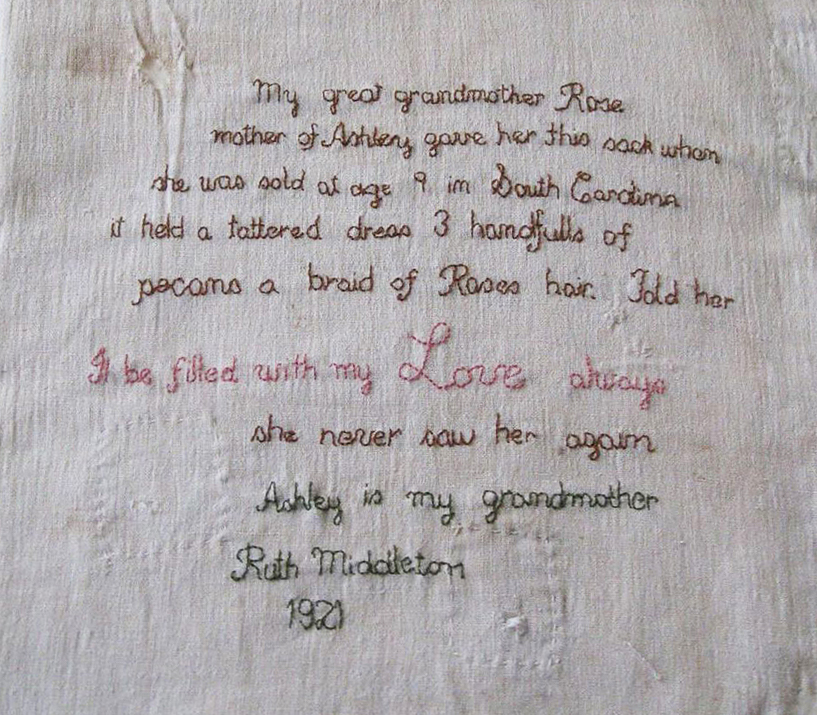
"Ashley's Sack" is among the most resonant and enigmatic artifacts on display in the newly opened Smithsonian National Museum of African American History and Culture (NMAAHC) in Washington, DC. Evidently a seed sack made of unbleached cotton fabric dating to the mid-nineteenth century, it measures about thirty-three by sixteen inches. Patched repeatedly, Ashley's Sack is stitched in three colors of cotton embroidery floss with the following ten lines of text, sewn on the lower third of the sack in 1921:
My great grandmother Rose
mother of Ashley gave her this sack when
she was sold at age 9 in South Carolina
it held a tattered dress 3 handfulls [sic] of
pecans a braid of Roses hair. Told her
It be filled with my Love always
she never saw her again
Ashley is my grandmother
Ruth Middleton
1921
With no accounts of its history, Ashley's Sack surfaced at a flea market in Springfield, Tennessee in 2007. From 2009–2013 it was displayed at Middleton Place in South Carolina, where it had enormous emotional impact on thousands of visitors.1Heather Andrea Williams, Help Me to Find My People: The African American Search for Family Lost in Slavery (University of North Carolina Press, 2012), 196–197. The sack is described in the epilogue of Williams's book, and has been discussed from time to time in media reports since the mid-2000s. Now on loan to the Smithsonian, it's likely to be viewed and pondered by millions in the coming years.
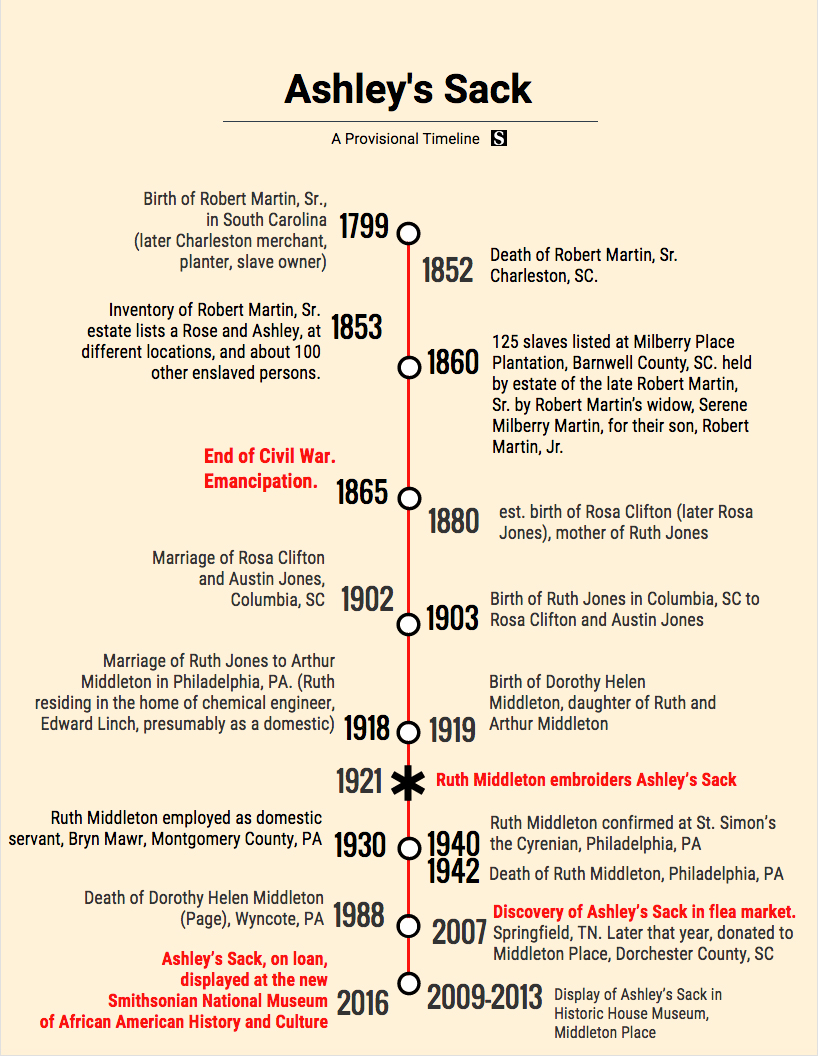
In this essay, I attempt to reconstruct the history of Ashley's Sack, from the time of slavery onwards, and explore its shifting meanings in different display venues. My reconstruction of the sack's history prior to 2007, while grounded in careful archival research, is necessarily conjectural at points, given the paucity of primary documentary evidence on the enslaved and free family lines in question. Although some of the "detective story" that follows is speculative, I suggest the project of tracing the sack is important for several reasons. It demonstrates that the narrative embroidered by "Ruth Middleton" is very likely to be accurate, or at least highly plausible. This undertaking helps us understand how, in the face of the terrible fragmentation of family solidarity caused by the domestic slave trade, family lineal memory and continuity endured across at least four generations. Finally, the 150-year history of the sack demonstrates how, in the face of structural forces that systematically alienated property from enslaved and liberated people of color, a single material object was inherited, preserved, and creatively transformed across time and space.
Tracing Rose and Ashley
If the embroidered text is correct, Ashley probably kept the gifted object throughout her life, in slavery and freedom, and presented it to her own child—likely a daughter. Ashley's child then must have passed the sack onto her (or his) daughter, the woman identified as Ruth Middleton. In 1921, Ruth Middleton made the decision to embroider the words passed down orally through the generations.
Who were these women?
The most likely candidates for "Rose" and "Ashley" appear among the enslaved people owned by wealthy Charleston merchant and planter, Robert Martin (c. 1790–1852), who was worth over $300,000 at his death in December 1852.2Robert Martin inventory for Charleston property, listing Rose, 358; Barnwell County property, listing Ashley, 366–367, Inventories, Appraisements and Sales, 1850–1853, Charleston, South Carolina, South Carolina Department of Archives and History. Note that antebellum loose probate records from Charleston District did not survive the Civil War. According to surviving Charleston inventory records, his palatial household in Charleston at 16 Charlotte Street held seven slaves, among them a woman named Rose, valued at $700. The full listing reads:
Slave Cicero 1,000, slave Sophia 300, slave Jane 400
Slave Jack 800, slave Rose 700, slave David 800, old woman 100
Robert Martin's Barnwell County plantation, "Milberry Place" (which employed overseer Robert Harper), contained about 105 slaves in 1853, among them the following family group, with the attached monetary evaluations:
Toney 100 Winney 50 Mary 500 Emma 500
Ashley 300 Levy 250
[...]
Total: 1700
Toney and Winney are presumably elderly, given their low valuations and the practice in this particular inventory account of listing named slaves in family groupings from eldest to youngest. Perhaps Ashley is Toney and Winney's grandchild, and they were looking after her in the absence of Ashley's mother Rose.
Fourteen months after Robert Martin Sr.'s death, a newspaper announcement of a court-decreed sale of the property notes that his Milberry Place Plantation contained over 2,900 acres.3Charleston Courier (Charleston, SC), Feb. 6, 1854, 4. This property was located along the Savannah River about a hundred miles west of Charleston, in an area now known as "Milbury," an unincorporated part of southeastern Allendale County. The tract is about six miles southeast of the present-day town of Allendale.
The will of Robert Martin stipulates that his house on Charlotte Street, its furniture, and "house servants" will remain in the custody of his widow, Milberry Serena Martin (1808–1877), the apparent namesake of Milberry Place.4Copy of Robert Martin's will, Means Family Papers, Pinckney-Means Papers, South Carolina Historical Society. See also Robert Martin will transcript, South Carolina Department of Archives and History. As executrix, she was enjoined to dissolve his resources as quickly as possible in order to realize enough cash to provide an inheritance of $20,000 for each of his children. Soon after Robert Martin's death, the parties to the inheritance entered into a complex series of cases in the South Carolina Court of Equity, leading to court-decreed sales of many components of his voluminous and diverse estate.5Milbery S. Martin (Executrix of Robert Martin) v. James B. Campbell, Bill for Account and Relief, filed 9 January 1858, and papers, filed 18 April 1858; Miberry S. Martin v. Edward Petit, 2 July 1859–1861, March 1860, Court of Equity Records, South Carolina Department of Archives and History. Mrs. Martin purchased the land of Milberry Plantation in early 1854 and allowed her son Robert Jr. to reside on it.6Loose genealogical papers pertaining to Robert Martin Sr. and descendants, Pinckney-Means Family Papers, South Carolina Historical Society. For information on Robert Martin Jr. see also Chalmers. G. Davidson, The Last Foray: South Carolina planters of 1860, A Sociological Study (Columbia: Published for the South Carolina Tricentennial Commission by the University of South Carolina Press, 1971), 288. By 1860, 125 slaves were held here. It also appears that, in accordance with court decrees, several enslaved persons were sold to raise cash.7James Daniel Erwin will, 1852, Barnwell County, South Carolina Department of Archives and History. In September 1854, Robert Martin Jr. married Annie Eliza Erwin, whose father, James Daniel Erwin, had died two years earlier and bequeathed her twenty-three slaves, many of who were held on his Erwinton plantation, adjacent to Milberry Place. Perhaps some of the 125 slaves at Milberry in 1860 had come there from the Erwin bequest.
Evidently, most of the enslaved people at Milberry remained on the plantation through the Civil War until freedom came in the spring of 1865. Some newly freed people also stayed in the vicinity. For example, the man Scipio listed in the 1853 inventory of Robert Martin's Barnwell County "Milberry" estate is presumably the Scipio Martin, recorded in the 1870 census, residing in Bamberg township, about forty miles from Milberry. Similarly, it seems likely that Frances and Amanda in the 1853 inventory became Frances Martin (born 1843) and Amanda Martin (born 1845), both residing in nearby Barnwell town in the 1870 census.
These circumstances are consistent with the scenario outlined in Ruth Middleton's embroidery. Under the will of Robert Martin Sr., Rose and the other house slaves were kept in the Charleston household at 16 Charlotte Street to look after Mrs. Martin and her minor children. Enslaved people at Milberry Place in southwestern Barnwell County could be sold off at Mrs. Martin's discretion.
At this point, we encounter a significant gap in the chain of evidence. There is no specific record of an "Ashley" after the 1853 inventory. It is not clear when the sale of Ashley took place, or how Rose and Ashley might have had the described reunion before their separation. There is no listing in Charleston newspapers of a slave sale connected to Robert Martin's estate, although there are a number of notices for equity court-decreed sales of land and real estate associated with Martin's holdings.
If the sale took place in 1853, the year after Robert Martin Sr.'s death, and Ashley was, as the needlework states, nine years old, we can assume she was born around 1844. We do not know if Rose stayed on in Charleston, or survived until emancipation.
The 1870 census reports Robert Martin's widow Serena living in Charleston with her daughter "Nina" (Serena) and four African American house servants, all with the surname Franklin:
J Franklin age 35
John Franklin age 29
Sarah Franklin age 20
Robert Franklin age 18
The embroidered text records that Rose and Ashley never saw one another again, which suggests that Rose may have died prior to 1865, or was sold out of the area after 1853.
In sum, we do have a record of a Rose and Ashley owned by the same wealthy South Carolina planter and merchant, Robert Martin, at the time of his death in late 1852, held at properties over one hundred miles apart from one another. We have legal records indicating that Robert Martin's widow was enjoined by her late husband's will to retain Rose at the Charleston mansion, but that she was free to sell Ashley and other slaves from the Savannah River "Milberry" plantation, in southeastern Barnwell County, and that she, as executrix, was under urgent pressure to raise cash for the lawful heirs of her late husband. We do not have direct evidence, however, that Ashley was sold and separated from her mother in the manner described in the 1921 embroidery. All we can say is that the 1921 embroidered account—of a nine-year-old Ashley being sold away from her mother Rose—is consistent with the extant documentary record of Robert Martin's estate.
Tracing Ruth Middleton
Who was Ruth Middleton, the woman who appears to have embroidered Ashley's Sack in 1921? We can proceed both by process of elimination, ruling out less likely "candidates," and by positive evidence for one particular woman who bore the name Ruth Middleton. There are sixteen African American women across the nation in the 1920 US census named "Ruth Middleton." Two additional Ruth Middletons, who do not appear in the census, are documented in marriage and other records. Of these eighteen women, we can subtract those born after 1915 (presumably too young to embroider in 1921). We can probably also remove from consideration those women who, according to the census, could neither read nor write. Further, that the embroiderer specified that the events took place in "South Carolina" perhaps suggests that she was not residing there when doing the needlework.
Of the six remaining candidates, one, by far, appears most likely. Only she had clear family roots in South Carolina, resided outside of the state, was literate, and resided in a context in which she plausibly could have created the needlework in question.
This woman is not among the Ruth Middletons in the 1920 US census—for reasons that may be telling. In 1918, a young African American, born Ruth Jones in Columbia, South Carolina around 1903, married Arthur Middleton, born around 1899, also from South Carolina, in Philadelphia, Pennsylvania, where she evidently resided for the rest of her life. Arthur was born in Camden, Kershaw County, South Carolina, about twenty miles from Columbia, and was the child of Pink (Thompson) and Flander Middleton.8Flander Middleton, the father-in-law of Ruth Jones, was born in Sumter County, South Carolina, around 1863. The 1880 census records him residing in Providence, a town in Sumter County currently known as Dalzell, a few miles northeast of Sumter township, the county seat. Although Flander is not listed in the 1870 census, the census for that year does record a Dolly Middleton (born 1855) residing in the same neighborhood of Providence. Dolly also is listed, under the married name of Dawson, living adjacent to Flander Middleton in the 1880 census. In their marriage license application, Ruth claims to be born in 1897—that is to say, to have reached twenty-one, the legal age of consent. All other sources, however, indicate that she was fifteen or sixteen at the time of her marriage.
Ruth's parents, Austin and Rosa Jones, appear to have married around 1902 in Columbia, one year before her birth. Austin worked for a time as wagon driver; in 1910 he and Rosa both worked as servants at the University of South Carolina (in Columbia), and appear to have lived next door to the well-known white South Carolina historian Alexander Salley. Austin died in 1912 and Rosa in 1916, leaving Ruth an orphan.9Letters of Administration, Richland County, South Carolina, Probate Court. Record of Admissions, Vol. 6, 114–15; Record of Deaths, 44–5, South Carolina State Mental Hospital. Certificate of Death no. 35328, Rosa Jones; South Carolina Department of History and Archives. Ruth's father, Austin Jones, died in May 1912. Ruth's mother Rosa Jones was admitted on 26 June 1916 to the South Carolina State Mental Hospital and died there three days later.
It is possible that Ruth came up to Philadelphia with Arthur Middleton, or that they met there. In her marriage application, Ruth lists her occupation as "housework" and her address as 501 Woodside Terrace.10County of Philadelphia, Commonwealth of Pennsylvania. Marriage license application (25 June 1918), Arthur Middleton and Ruth Jones. This was the elegant Italianate home of chemical engineer and factory owner Edward Linch and his wife Mabel, an organist who performed in the most prominent circles of Philadelphia white society.
Employed as a domestic worker in this household, Ruth must have observed the ins and outs of Philadelphia society, and perhaps took up needlework during this time. It is not clear how long Ruth remained in the Linch family's employ. She gave birth to a baby girl, Dorothy Helen Middleton, in January 1919, six months after her marriage to Arthur.
There is no record that Ruth and Arthur ever lived together. Soon after their wedding, Arthur was inducted into the US Army and served overseas in World War I until mid-1919.11Army separation application #272507 (22 November 1919), Arthur Middleton. In the 1920 census he is living apart from his wife as a lodger in Philadelphia. He later resided in Brooklyn, New York, near his elder sister Helen and his mother, who eventually moved to Brooklyn from South Carolina. Ruth appears to have kept up connections with Arthur's family: a 1928 notice in the Philadelphia Tribune reports that Ruth entertained Arthur's elder sister Helen Middleton Hadley of New York for Thanksgiving.
It would therefore appear that in 1921, the year that Ashley's Sack was embroidered, Ruth Jones Middleton was an eighteen- or nineteen-year-old single mother living in Philadelphia.
Ruth Jones Middleton's later life remains somewhat of an enigma. I have found no traces of her from 1919 through 1924. In 1925, she resides in a lodging house in South Philadelphia. In the 1930 census she is listed as a live-in "waitress" in the elegant home of well-to-do white photographer, Samuel J. Caster, adjacent to Bryn Mawr College in Lower Merion, a main line suburb of Philadelphia. Eleven-year-old Dorothy Helen is not listed as living with her.12Suggestively, the only black "Dorothy Middleton" appearing anywhere in the 1930 US census is an eleven-year-old girl residing in the home of George and Maggie Lynch in Mount Hope, Fayette County, West Virginia, listed as their "niece." I do not know if this African American couple, the "Lynches," had any connection to the white Linch family who employed Ruth in 1918, in Philadelphia.

From around 1928 onwards, Ruth appears to have reinvented herself. She is mentioned regularly in the "Smart Set" and "High Society" pages of the Philadelphia Tribune, the leading African American newspaper of the region, hosting bridge and cocktail parties and wearing elegant couture.13References to Mrs. Ruth Jones Middleton in the "Woman's Page," "Society at a Glance," "Smart Set," "Younger Set," and other columns of the Philadelphia Tribune (Philadelphia, PA), Dec. 8, 1928, 6; July 24, 1929, 4; Aug.13, 1931, 4; Feb. 18, 1932, 5; Sept. 8, 1932, 5; Dec. 21, 1933, 6; Feb. 3, 1938, 6; Feb. 17, 1938, 6; March 3, 1938, 5; April 7, 1938, 6; Dec. 13, 1939, 9; Jan. 4, 1940, 8; Jan. 18, 1940, 8; Feb. 18, 1940, 9; March 17, 1940, 18. There are no known newspaper obituaries after her death in 1942. Ruth's daughter Dorothy Helen Middleton appears several times as a member of fashionable dance clubs and, in the late 1930s around age twenty, authored the Philadelphia Tribune's "Smart Set" society column at least twice.
In February 1940, the Tribune reported, "attractive South Philadelphia matron, Mrs. Ruth Middleton will be confirmed next month at St Simons Church." The Episcopal Chapel of Saint Simon the Cyrenian, at 1401 22nd Street, was a socially prominent African American church. Ruth's confirmation marked her transition to the more "respectable" ranks of black Philadelphia society. Also in 1940, Ruth is listed as a lodger in downtown Philadelphia with her daughter, Dorothy Helen Middleton. The census reports that Ruth is Dorothy's "sister"; it seems plausible that Ruth intentionally misstated their relationship to obscure the fact that she had given birth at the age of fifteen or sixteen.
The 1940 church confirmation notices are the last mention in the press of Ruth Jones Middleton, who may, by this point, already have developed the illness that would take her life. She died in January 1942 of tuberculosis, after six months in Philadelphia's Douglass Memorial Hospital.14County of Philadelphia, Commonwealth of Pennsylvania. Certificate of Death No. 9389, Ruth Middleton. Her daughter Dorothy Helen could only afford thirty dollars for an unmarked grave in Mount Lawn cemetery in Sharon Hills, outside the city.15In 1942, Dorothy Helen Middleton purchased two burial plots—one for her mother and one for herself—at Mount Lawn in Sharon Hill, Pennsylvania. Mount Lawn cemetery records indicate that she never used the second plot; it is not known where she was buried after her death in 1988. Perhaps Ruth had a wealthy patron during her life to support her society lifestyle; if so, no resources for her funeral expenses were available after her death.
Ruth's daughter Dorothy lived until 1988, taking the name Dorothy Page at some point, perhaps because of marriage. At the time of her death, she resided in the north Philadelphia suburb of Wyncote. It's not clear whether Dorothy Helen Middleton Page (who evidently died in a nursing home) retained Ashley's Sack during her life, or how it made its way to the flea market for the 2007 sale.
Ruth Jones Middleton's Ancestry
What of the parentage and ancestry of Ruth Jones Middleton? Can we link her to Rose, to Ashley, or to Robert Martin's Milberry Place plantation of Barnwell County, South Carolina?
![Detail from U.S. Geological Survey. Peeples quadrangle, South Carolina-Georgia [map]. First Edition 1943. 1:62,500. Reston, Va: United States Department of the Interior, USGS, 2016.](https://southernspaces.ecdsdev.org/wp-content/uploads/2019/07/auslander_015_mildburylocationmap.jpg "Detail from U.S. Geological Survey. Peeples quadrangle, South Carolina-Georgia [map]. First Edition 1943. 1:62,500. Reston, Va: United States Department of the Interior, USGS, 2016.")
As of this writing, there is no direct documentary proof that Ruth Jones Middleton's family came from Milberry Place Plantation, where the "Ashley" owned by Robert Martin resided in the early 1850s. However, there is strong circumstantial evidence linking Ruth's mother and maternal grandparents to this specific region of South Carolina.
As mentioned above, Ruth is recorded in the 1910 census for Columbia, South Carolina, as the seven-year-old child of Austin Jones (born in 1878) and Rosa Jones (born in 1879), both employed as servants of the University of South Carolina. We may speculate that perhaps the name of Ruth's mother, "Rosa," honors an earlier woman in the family history named "Rose."
In her 1918 marriage license application, Ruth lists her mother's maiden name as "Rosa Clifton." The 1870 census, the first census to record the names of all recently emancipated African Americans, records about sixty African Americans named Clifton in the state of South Carolina. The only white slave owning Cliftons in antebellum South Carolina were concentrated in Chester County; many black Cliftons lived in Chester County and its environs in the 1870s.
The census records a single black Clifton family in Columbia, South Carolina, and a cluster of black Clifton families between Columbia and the Savannah River—in the Barnwell County townships of Barnwell, Blackville, Bamberg and Diamond Hill, and in the adjacent Orangeburg communities of Amelia and Goodlands. Nearly all of these Clifton families reside within a fifty-mile radius of Robert Martin's Milberry Place Plantation, where Ashley was clearly enslaved in 1852. Numerous African Americans with the surname "Martin," whose first names correspond with those listed in the 1853 Robert Martin estate inventory at Milberry, are scattered through this same geography. It's likely that Rosa Clifton Jones and her daughter Ruth Jones Middleton had roots in this extended family network.
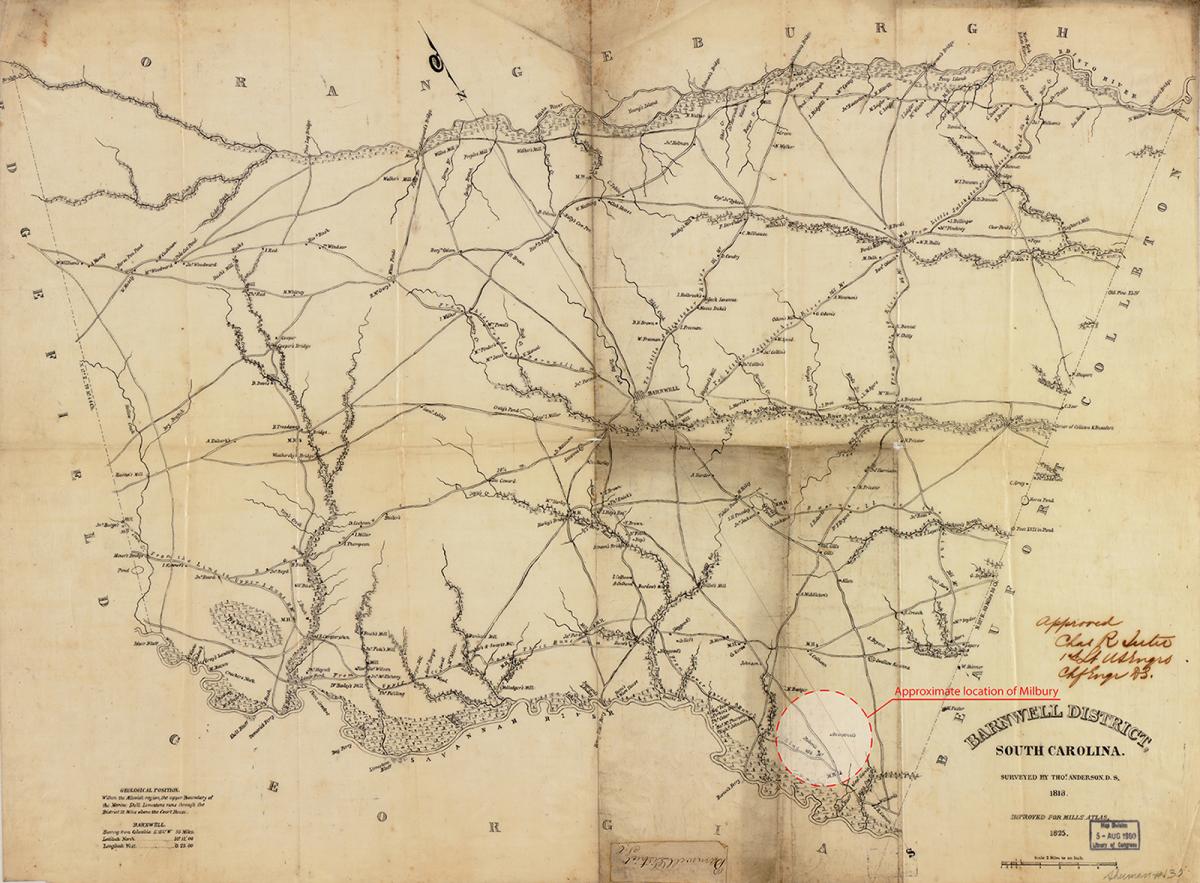
Barnwell District, South Carolina, ca. 1825. Map by Robert Mills and Anderson Thomas (surveyor). Courtesy of the Library of Congress Geography and Map Division, loc.gov/resource/g3913b.cws00130.
How do we know this? The mother of Ruth Jones Middleton, "Rosa Clifton," born around 1880, is listed in the 1900 census as living in Columbia, employed as a chambermaid. She is listed as the "sister in law" of a Wesley Perry, married to a Hattie Perry (born around 1873) who is presumably Rosa's sister (with the maiden name of Clifton). The 1880 census records a "Hattie Clifton" (born around 1874) in the Goodlands township of Orangeburg County, adjacent to Springfield, about forty miles south of Columbia. Her parents are listed as William Clifton (born around 1841) and Sarah Clifton (born around 1849).
To be sure, it would be ideal if we had clear evidence that this woman "Sarah" bore the earlier name of "Ashley," or that Rosa Clifton's grandmother bore the name Rose. In the lack of such evidence, all we can currently conjecture is that Rosa Clifton's parents probably resided in the same geographical region within which many former slaves from Milberry lived.
In short, although the lines of descent are unclear, it is highly plausible that Rosa Clifton Jones, the mother of Ruth Jones Middleton, had family roots among the once-enslaved people of the Robert Martin plantation, who, after emancipation, spread out into Barnwell, Orangeburg, and Richland Counties. Future research may provide more definitive evidence that Rosa Clifton Jones was in fact mothered by the "Ashley" listed in the Robert Martin estate.
The Sack Since 2007

To return to recent history, in February 2007 a white woman (who wishes to remain anonymous) discovered and purchased Ashley's Sack for twenty dollars from a white man at an open-air flea market in Springfield, Tennessee. She first explored selling it through eBay and a New York auction house, but after dreaming of the little girl Ashley and developing a close connection over the telephone with a Middleton Place senior staff member, she decided to transfer it to the Middleton Place historic house museum near Charleston.16"Slave child torn from mom filled sack with love" Spartanburg Herald-Journal (Spartanburg, SC) April 16, 2007, C1, C3.
When Middleton Place Foundation acquired Ashley's Sack, it had already taken steps towards incorporating the slavery narrative into its interpretive mission. Indeed, one of the reasons the donor was so willing to present it to the Middleton Place was its demonstrated commitment to engage with mass enslavement and its legacy: Around 2005, Middleton installed a permanent exhibition on slavery in one of its outbuildings, known as Eliza's House, listing the names of about 2,600 enslaved people associated with the plantation.
Since Eliza's House lacked environmental control and security, Ashley's Sack wasn't installed there. Instead, Ashley's Sack was displayed within the historic house museum. It was initially exhibited in the upstairs library, near facsimiles of the Declaration of Independence (signed by Arthur Middleton) and South Carolina's Ordinance of Secession (signed, among others, by Arthur Middleton's descendant William). The Middleton Place leadership hoped that Ashley's Sack's placement would productively complicate the interpretation of these documents, highlighting the paradoxes embedded in American conceptions of liberty and equality. Later, the object was moved downstairs to the front hall, to a specially constructed case with other items more definitively linked to slavery at Middleton Place, including a slave badge and buttons worn by enslaved workers.
Middleton Place staff recall that Ashley's Sack posed interpretive challenges for many of the more veteran volunteer guides, who were more familiar with storylines emphasizing the accomplishments and refinement of the white Middletons. Some felt uncomfortable with direct discussions of slavery; others were overwhelmed by the emotional responses catalyzed by the object, which brought tears to many visitors' eyes. Some volunteer guides complained that the sack, and the powerful reactions it engendered, distracted from the core mission of the tour: to highlight the wealth, political leadership, and cosmopolitanism of the white Middletons.
Whatever reservations some volunteers might harbor about Ashley's Sack, the object is treasured by professional staff at Middleton Place. A large reproduction is included in the Foundation's commemorative book.17Charles Duell, Middleton Place: A Phoenix Still Rising. Middleton Place Foundation. (Charleston: Middleton Place Foundation, 2013), 57. Mary Edna Sullivan, Middleton's curator, brought it in January 2011 to the Winter Antiques Show in New York's Park Avenue Armory, where it attracted deep interest and emotional responses from hundreds of visitors.
From the time they acquired Ashley's Sack, curatorial and interpretive staff harbored the hope that it would prove to have a historical connection with Middleton Place families, black or white. Noting that the sack was discovered near Nashville, Tennessee, where some white Middletons had settled after the Civil War, they conjectured that the object might have travelled with them.18Although Ruth had no apparent lineal connection to the Middleton slaves, there is some circumstantial evidence that her father-in-law, Flander Middleton, born around 1863 during the Civil War in Sumter County, South Carolina, may have been descended from persons enslaved by the Middletons of Middleton Place. A possible link is through the Middleton heir, Eliza Carolina Middleton Huger (1824–1919), daughter of Isabella Joanne Middleton, born in 1780 at Middleton Place, the daughter of Arthur Middleton, a signer of the Declaration of Independence. Eliza Smith's son, William Mason Smith, records in an 1863 letter that he transferred his slave "Philander" and Philander's family (including a newborn child) to their Sumter County plantation, following Harriet Tubman's Combahee Raid. It is possible that the Middleton name was being maintained by the enslaved family of Philander, and a child named Philander was later known as "Flander." (I am indebted to Dottie Stone, Middleton Place historian, for this suggested connection between Flander Middleton and the Middletons of Middleton Place.) It is certainly intriguing in this light that Ruth's husband was named "Arthur Middleton," the same name as the illustrious Middleton Place patriarch.
In any event, a Middleton staff member brought Ashley's Sack to the May 2009 "Save America's Treasures" event in Charleston hosted by the National Museum of African American History and Culture (NMAAHC), as the Museum searched for significant, previously unknown works of African American material culture. Smithsonian curators were deeply moved by the object; after negotiations, Middleton agreed to lend it to the Smithsonian on a year-to-year basis.
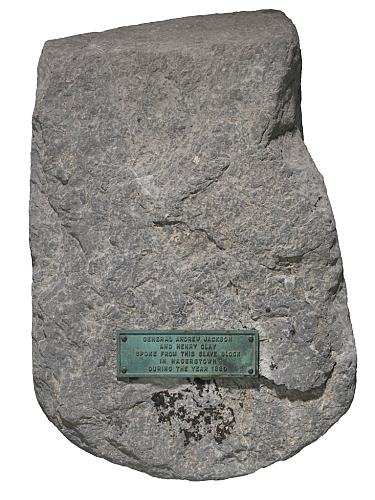
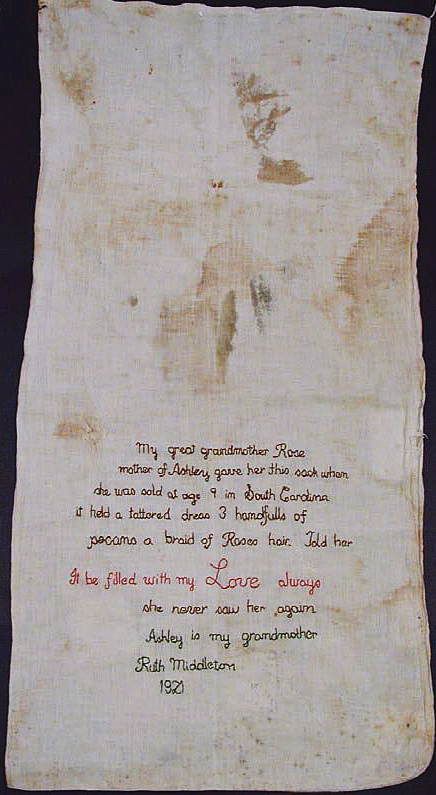
At the NMAAHC, which opened in September 2016, Ashley's Sack is exhibited directly next to a case holding an "auction block" and near a large installation evoking bales of piled cotton, entitled "King Cotton." These elements, the curators explain, evoke the enormous financial wealth generated by the slavery system. In contrast, Ashley's Sack evokes the intangible "human cost" of slavery, emphasizing a specific family story of tragedy and endurance across generations. Adjacent text describes the tragedy of family members being torn away from one another. A soundscape loop presents a range of first person commentaries, including WPA oral histories, about slave sales.
In its new location, the sack is hung entirely vertically, with the full front surface of the cloth visible, so that the text begins about three feet off the floor. Museum patrons must crouch low to read it.
Perhaps, in time, the NMAAHC will develop a more interactive and accessible installation strategy, including an enlarged reproduction of the text, allowing visitors to contemplate Ruth Middleton's complex, ambiguous narrative and to enter more directly into this complex historical trajectory. As my students and I have contemplated Ashley's Sack, it seems that the object calls out for a hands-on presentation. Perhaps visitors from around the world might write letters to Rose or Ashley, emulating Ruth's own commitment to the power of the written word to confront time's passage. Perhaps such letters could constitute an evolving installation. Alternately, visitors might ponder what they would do if faced with Rose's predicament. My colleague Jay Ball suggests asking what three gifts might visitors choose for a loved one they would never meet again. As at the adjacent Vietnam Veterans Memorial, one could imagine this exhibition space becoming a pilgrimage destination, where visitors leave objects, photographs, heirlooms, and works of art to achieve a reunion across race and difference, creating a new space of collective homecoming.
Acknowledgments
I am grateful to Jane Aldrich, Toni Carrier, Simon Lewis, and the Low Country Africana collective for guidance in this research. (Low Country Africana's ambitious partnership with fold3.com and the South Carolina Department of Archives and History has made many significant slavery-era documents searchable and accessible.) Special thanks to Laura Booth and the Philadelphia chapter of African American Genealogical and Historical Society; Mary Skinner-Jones of AME Bethel, Columbia, SC; Steve Tuttle and his colleagues at the South Carolina Department of Archives and History; Rev. John A. Middleton (New Light Beulah Baptist Church, Hopkins, South Carolina); Rev. Betsey Ivey (Saint Simon the Cyrenian Episcopal Church in Philadelphia); Peter Moak (Episcopal Diocese of Pennsylvania Archives); Mount Lawn and Eden cemeteries, Delaware County, PA; Rev. Tiffany Knowlin (Wesley United Methodist Church, Columbia, SC); Mary Elliot and Nancy Bercaw at the Smithsonian National Museum of African American History and Culture; and, Tracey Todd, Mary Edna Sullivan, Jeff Neale and Charles Duell, of Middleton Place. Research was also conducted at the Library of Congress Manuscript Division, the Free Library of Philadelphia, the Historical Society of Pennsylvania, the South Carolinia Library of the University of South Carolina, the South Carolina Historical Society, the Charleston County Public Library, and courthouses in Barnwell and Richland counties, South Carolina. I have also benefited from the many insights of Jessica Hope Amason, Ellen Avitts, Jay Ball, Randall Burkett, Nic Butler, Keith Champagne, Bobby Cummings, Lynn Linnemeier, Negara Kudumu, Wyatt MacGaffey, Jonathan Prude, Richard Reid, Ellen Schattschneider, Rosalind Shaw, Terrance Weik, Avis Williams, and my students in the Museum Studies program at Central Washington University. Finally, thanks to the Southern Spaces team for their attentive reading and editorial work.
Comments and reflections on this post, and on the meaning and significance of Ashley's Sack, may be shared at: http://culturalenvironments.blogspot.com/2016/10/origins-of-ashleys-sack.html
About the Author
Mark Auslander is Associate Professor of Anthropology and Museum Studies at Central Washington University, where he directs the university's Museum of Culture and Environment. He is the author of The Accidental Slaveowner: Revisiting a Myth of Race and Finding an American Family (Athens: University of Georgia Press, 2011). He writes a regular blog on his ethnographic, museum, and cultural studies interests, "Cultural Environments."
]]>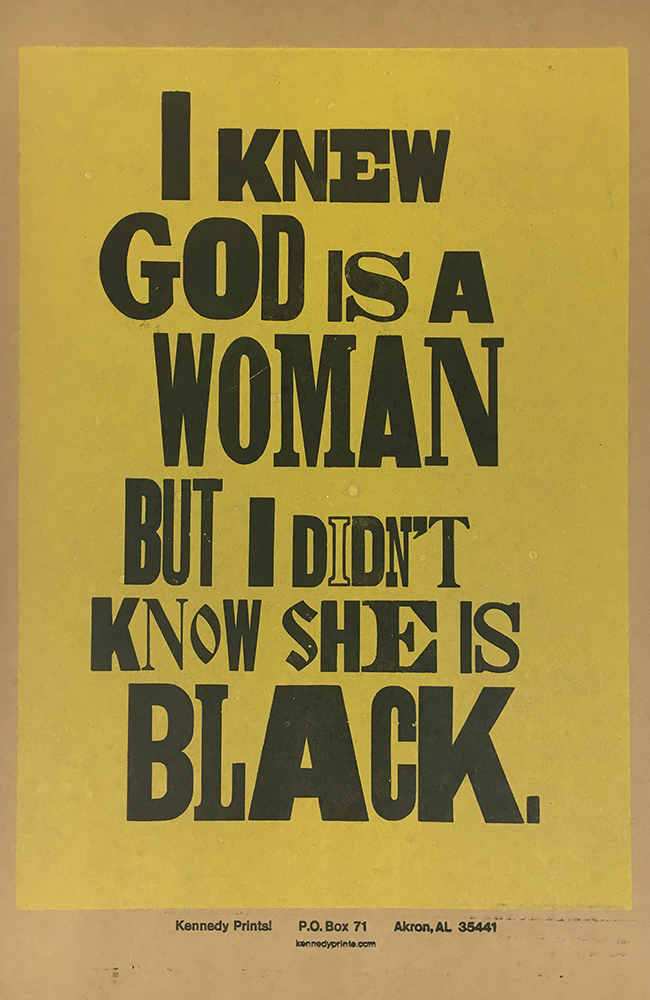
On March 15, 2016, acclaimed printmaker Amos Kennedy, Jr. participated in a public conversation about his archival holdings in the African American collections at Emory University's Stuart A. Rose Manuscript, Archives, and Rare Book Library. Best known for artist books that narrate African American history in striking 3-D format, Kennedy also creates posters featuring tongue-in-cheek phrases about southern cultures and identities. In 2014, Southern Spaces published a blog post about Kennedy's "Burnt Church," an artist book inspired by a series of underreported black church burnings in southern states during the early 1990s.
During his recent visit, I had the opportunity to interview Kennedy. As we chatted, Kennedy described his relationship to various places, including a "ten-year apprenticeship" in the US South, as well as his current home base in Detroit, Michigan. Reflecting on how location informs his artistic process, Kennedy encouraged others to adopt a "just do it mentality" by drawing fully on local resources. Kennedy also interacted with one of the pieces in the "Burnt Church" series, describing its materiality as an important artistic intervention in the digital age.
]]>
My childhood family vacations included mandatory excursions to museums, libraries, and historical sites. To ensure that my little brother and I "enjoyed" cultural experiences of all stripes, we toured the Smithsonian in Washington, DC, Martin Luther King Jr.'s grave at the King Center in Atlanta, Georgia, and the Boston Children's Museum. Much to my parent's dismay, I was much more interested in playing outside with friends, drawing superheroes, and tormenting my little brother than in appreciating educational tourism.
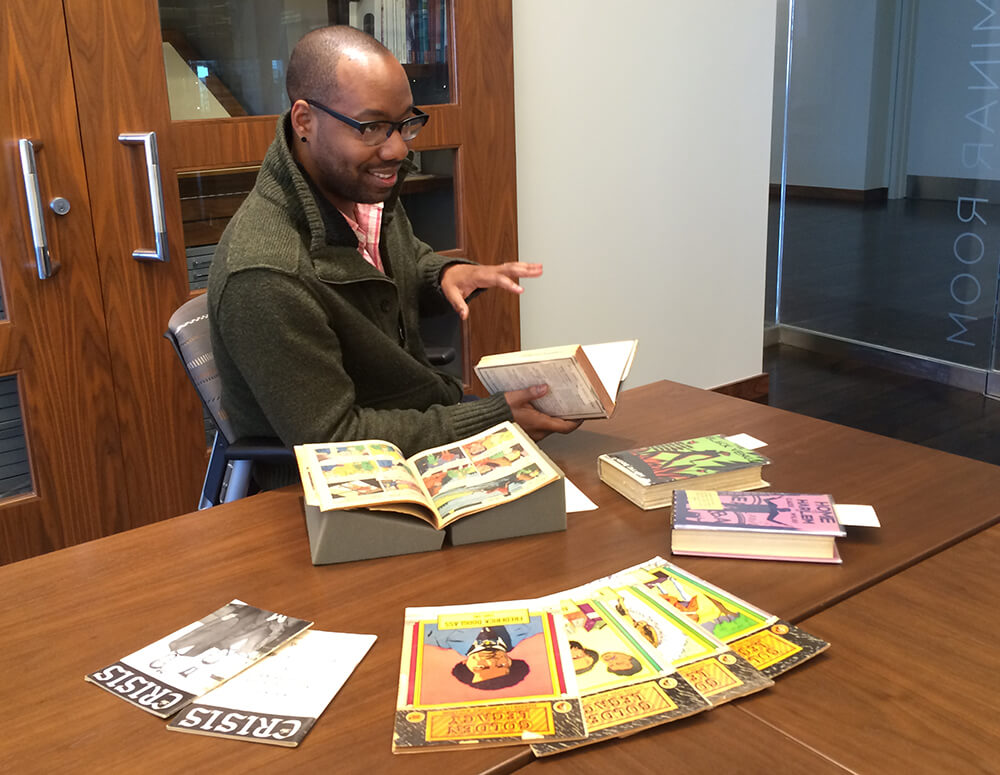
Today, as a doctoral student in Emory University's Institute for the Liberal Arts, I research contemporary science fiction and fantasy, focusing on the literary and visual cultures of Afrofuturism. My research takes me into the Stuart A. Rose Manuscript, Archives, and Rare Book Library where I read the late twentieth century writings of Octavia Butler, Steven Barnes, and Samuel R. Delany alongside the visual images of early 20th century artists, like Aaron Douglas.
Exploring connections across genres and time periods, as well as class and color lines, I look for imagined black futures in archival holdings. In addition to my research, I work as an assistant curator for the African American Collections in the Rose library, creating programs that connect undergraduates to Emory's archives. My twelve-year-old self would marvel at this transformation: somewhere between grade school and graduate study, I learned to appreciate smelly old books, discolored newspapers, and indecipherable manuscripts. I blame my parents—after all, they planted the seed that is now blossoming into full-blown archive fever.
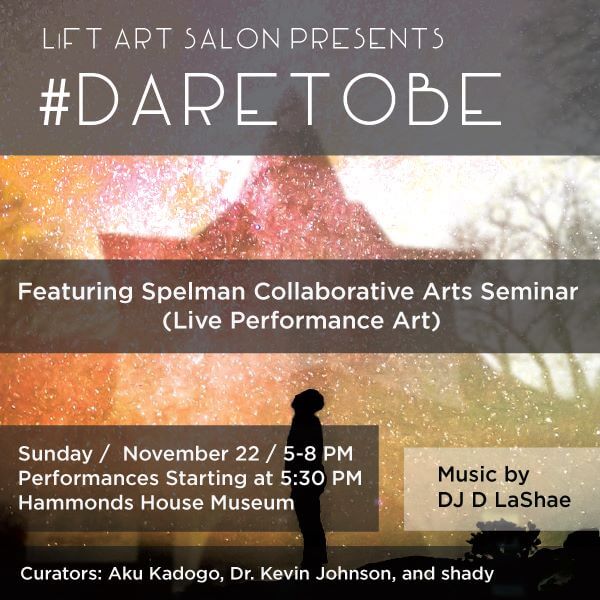
My scholarly interests and newfound archival passions come together in the monthly LiFT art salons that bring young Atlantans into local museums and historic sites. On November 22nd 2015, LiFT hosted the #DareToBe event at the Hammonds House Museum, a nineteenth-century home that has served as one of Atlanta's premiere institutions of black art since 1988. The #DareToBe event targeted Atlanta University Center (AUC) students, hoping to encourage a substantive dialogue in one Atlanta neighborhood.
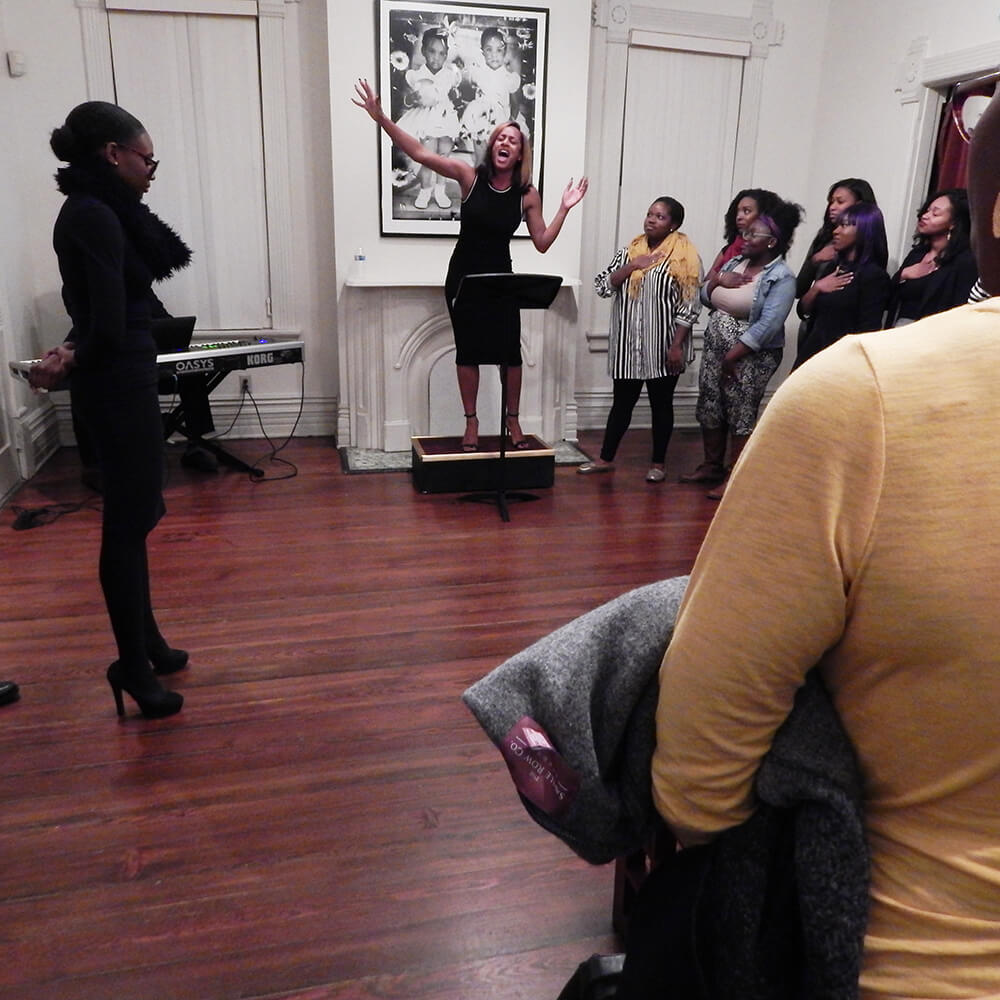
The AUC is a collective of Historically Black Colleges and Universities that include Morehouse College, Morehouse School of Medicine, Spelman College, and Clark Atlanta University. While these institutions share West End real estate, close proximity does not necessarily imply longstanding relations between current AUC students and their host neighborhood. On the contrary. During my time as a Morehouse undergraduate, I stayed primarily on campus and rarely connected with the West End or the Atlanta metro region. By hosting #DareToBe at the Hammonds House Museum, LiFT encouraged AUC students to get off campus and to understand themselves within broader networks.
LiFT team members collaborated with two Spelman professors to plan, promote, and stage the gathering. Professor of drama and renowned playwright and dance instructor Aku Kadogo joined forces with Glee Club director Dr. Kevin Johnson to design the fall 2015 "Collaborative Arts" seminar that culminated in LiFT's #DareToBe event. For her final project, each student created a project to perform or feature at the Hammonds House gathering. This creative activity stretched many students beyond their comfort zones, asking them to be artists and creators.
#DareToBe was staged in each room of the Hammonds House, inviting the Spelman students to consider the home's architecture as an active participant in their creative process. With students singing, dancing, and acting across the building's footprint, the museum transformed into a living, breathing art studio. In total, there were four performances: "Mathematical Proof" featured a spoken word performance accompanied by piano and backup vocals. "Chorepoem" cast four Spelman women in an interactive performance celebrating black womanhood. "Karrah 4 Prez" envisioned a black female presidential candidate in a one-act scene. The final performance, "#Daretobe Anthem", brought the entire class together to perform an original song.
For Professor Kadogo, the event extended one Spelman classroom beyond the campus gates:
Connecting our Spelman College students with the historic Hammonds House proved to be an invaluable experience. The Spelman students participated in networking, decision-making, and performance creation. As part of our process, we visited the Hammonds House and toured the entire museum, deciding along with LiFT curator Shady Patterson and event coordinator Miriam Denard where each performance might best be stationed to facilitate a "walking tour" performance event.
Working in collaboration with LiFT, the students gained encouragement and inspiration, realizing that they were creating something that other people wanted to experience.1Aku Kadogo, phone interview with author, March 10th, 2016, Atlanta, Georgia. Transcription by author.
The students' performances generated an energized talk-back with the crowd. During the question and answer session, attendees engaged the students as artists, probing them about their creative process and performance experiences. Many students shared that the LiFT event prompted their first visit to the Hammonds House, signaling to them the importance of historic institutions in their neighborhood and beyond. Event attendees shared similar stories about a lack of familiarity with local museums and cultural institutions.
LiFT Art Salon measures success by the relationships it builds between people, institutions, and their histories, specifically between those spaces that narrate black history and Atlanta's young African American population. I know first-hand that nurturing these relationships takes the time and investment of an engaged community of elders, scholars, and teachers. The LiFT team learned a valuable lesson at #DareToBe. In order to make museums and archives accessible to a new generation, we need to build hands-on, interactive experiences that invite young Atlantans to actively engage the city's diverse centers and institutions. At our monthly gatherings, LiFT attempts to demonstrate to a new constituency that cultural institutions are not merely repositories. Instead, as I am reminded each time I comb the archives or plan a LiFT event , these sites serve as creative commons for those who dare to enter and be.
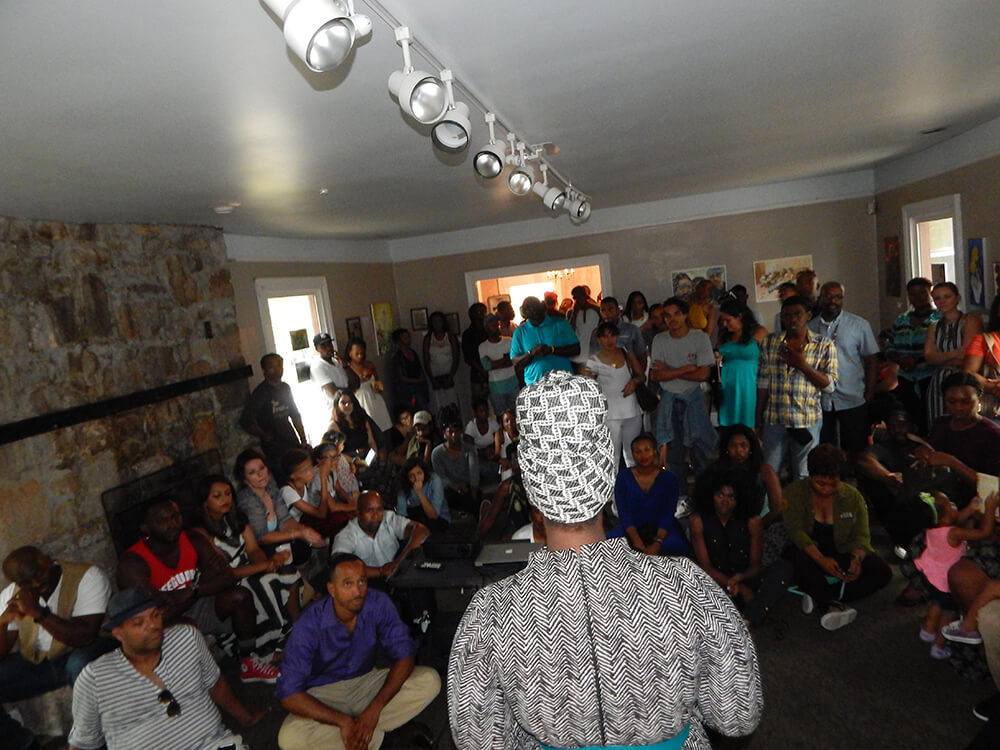
I grew up in metro Atlanta watching revitalization efforts spread across the city's many neighborhoods. The rebranding of City Hall East, Krog Street, and the Atlanta Railroad as Ponce City Market, Krog Street Market, and the celebrated Atlanta Beltline underscores a shared aesthetic at the heart of development projects that map new bastions of commerce onto existing urban footprints. Many mixed-use projects include residential neighborhoods replete with spaces targeting Atlanta's young creatives: performance venues for live music and art shows, community spaces for job talks and self-improvement classes, and ubiquitous coffee shops and bars. These developments are creating new buzz about Atlanta's future.
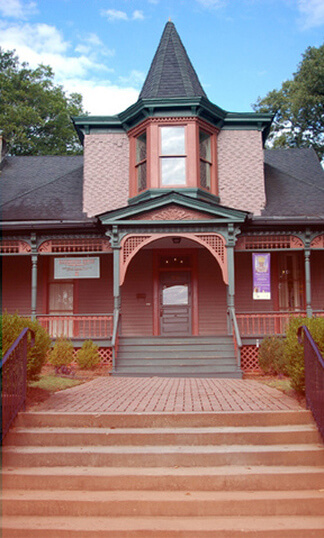
But urban hot spots do not emerge in a vacuum. Instead, they often pop up in black neighborhoods, crowding out institutions vital to artistic and cultural flourishing. Take for example, the next planned stop on the Atlanta Beltline: the Westside. In addition to the Atlanta University Center (AUC), the Westside is home to several black cultural centers, including The Hammonds House Museum, The Wren’s Nest, The Shrine of the Black Madonna, and the Herndon Home Museum. While these institutions do not have the financial resources to refashion their neighborhoods as Atlanta's next "go-to" destinations, they do possess something invaluable to the city’s future—black history.
LiFT Art Salon intentionally operates out of historically black buildings, spaces, and cultural centers to redirect Atlanta's young adult population to institutions with long histories of community-building through arts activism and education. In this spirit, we hosted one of our first LiFT gatherings in the Hammonds House Museum. Founded in 1988, the Hammonds House Museum serves as one of Atlanta's premiere institutions of African American and African diasporic art. The July 12, 2015, event was titled #homeplace, an homage to bell hooks's essay about black women's homes as sites of resistance and to Hammonds House original owner and resident Otis Thrash Hammonds, a prominent Atlanta physician and avid black art collector.
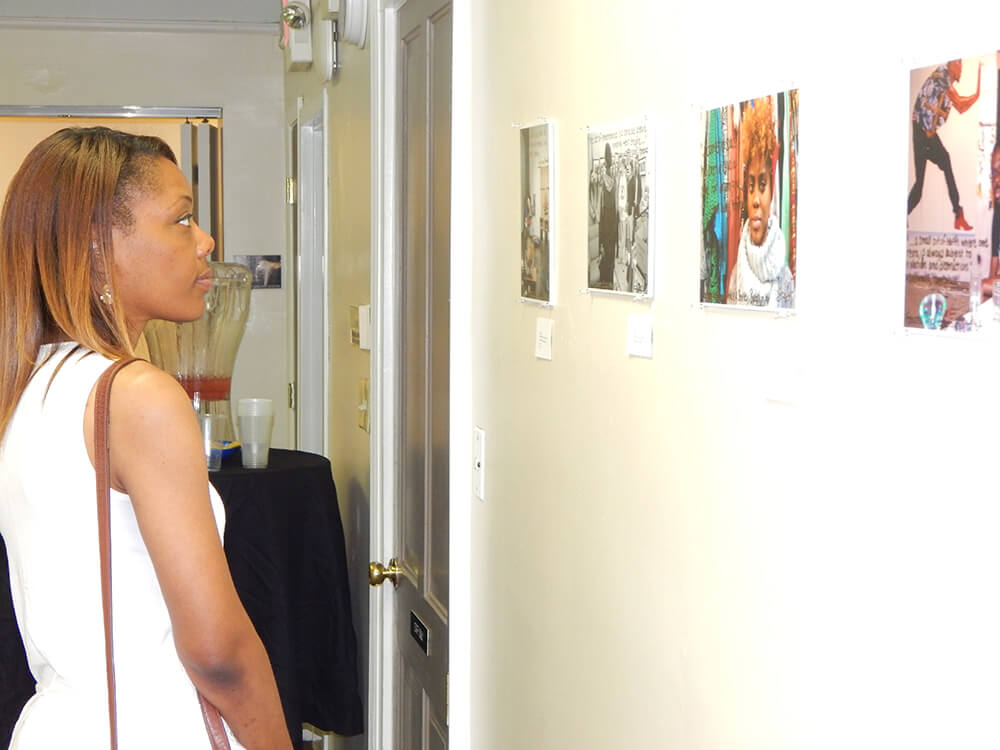
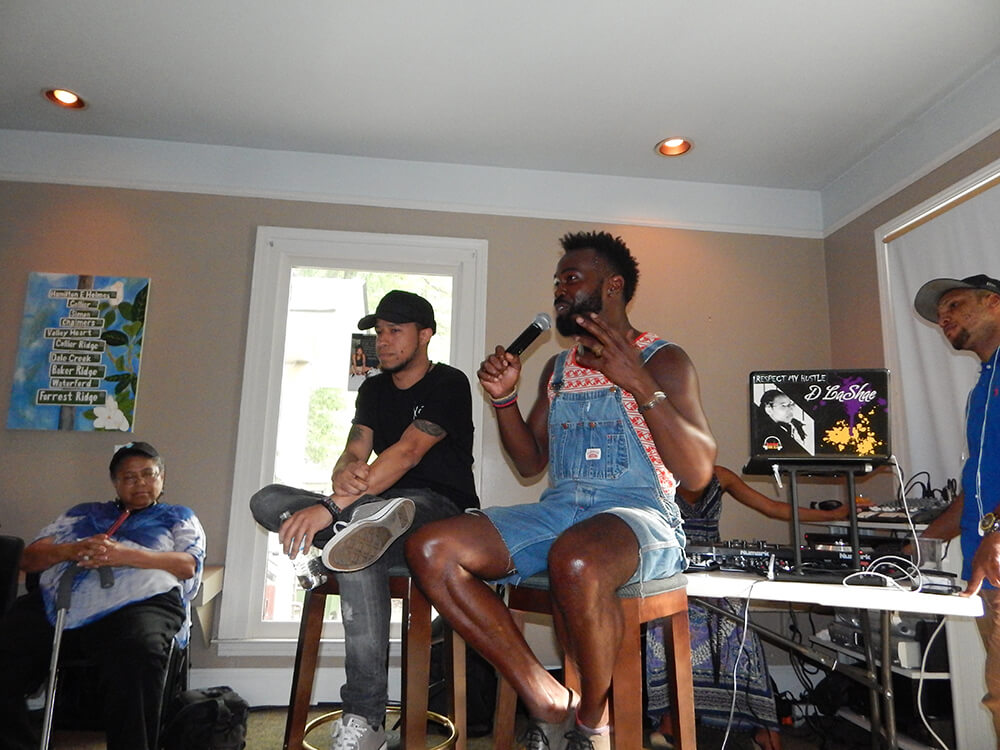
To celebrate #homeplace and showcase the historic building, our event included four components staged across the footprint of the Hammonds House. The first act featured an exhibit of visual art from the LiFT Art Collective. Curated by Shady, each visual artist produced work that interpreted homeplace. Stephanie Alvarado offered a spoken word performance about the challenges of finding "home" as a South American émigré to New York City. WERC Crew's Xavier Blk and Will Edmond, two of Atlanta's hottest DJs and party promoters, discussed their business philosophy and the "creative" benefits of living as a collective. Finally, hometown R&B singer, Donnie, gave a concert in the Hammonds House courtyard.
Over the course of the event, the performances came together in unexpected ways. In a recent interview, event coordinator Miriam Denard explained how the performers and attendees drew inspiration from the museum and its standing exhibits:
This event really opened our eyes to the variations of expression and experience we can have at each Art Salon without losing the essence of the event. People were up and moving around and able to sit by different guests, sharing the experience. And then to end the evening with live, outdoor music was really special because it pulled the theme—of the home as place of community, affirmation, and resistance—together with the standing exhibits on display at the Hammonds House Museum.1Miriam Denard, phone interview with author, January 15th, 2016, Atlanta, Georgia. Transcription by author
Lydia Harris's photography exhibit "The View From Collier Heights" was hanging during the #homeplace event. Harris's exhibition featured a collection of photos from Collier Heights, a neighborhood developed in the 1950s to house Atlanta's sizable and growing black middle class. Harris's photos captured both the facades and interiors of the homes and provided a visual backdrop to the LiFT performances.
We packed a lot of punch into this first of several events that LiFT hosted at the Hammonds House in 2014 and 2015. As Atlanta makes important strides towards revitalizing urban neighborhoods, LiFT understands its work as making visible, promoting, and drawing on the rich histories of institutions and cultural centers already in place and at work across the city. LiFT Art Salon challenges readers and event attendees to look long and hard at neighborhoods undergoing revitalization and gentrification; often, beneath the shiny facades and new aesthetics, vibrant, intentional black communities are already in place.
]]>